The Reformation Classical inheritance of humanism combined with the tradition of Christianity.
Catholic Seven Blessed Sacraments Baptism Eucharist Reconciliation Confirmation Marriage Holy Orders Extreme Unction
Sources of the Reformation spread of Italian Renaissance humanism Christian, or Northern Renaissance, humanism (Erasmus) town development Medieval institution of the university Scholasticism: reaction to convoluted argumentation of and distortion of teaching by Scholastic philosophers
The Reformation: New Ideas about God and Humanity fast pace of change of concepts about the world and universe during the Renaissance no other movement transformed Europe as much as the Reformation inaugurated by Martin Luther in Germany tension giving rise to the Reformation: spiritual power ( Republica   Christiana ) v. political (or, secular) power (emerging nation-states)
The Reformation and Technology Johannes Gutenberg Mainz, Germany mass production of  movable, metal type; oil-based ink; and, the wooden printing press  Gutenberg Bible
The Gutenberg Bible
Martin Luther (1483-1546) Augustinian Friar and Professor of Theology at the University of Wittenberg Luther became incensed over a succession of corrupt popes from Sixtus IV (r. 1471-1484) to Leo X (r. 1513-1521) as well as what he viewed as the corrupt practices within the Church: sale of indulgences by ecclesiastical officials to replenish the Church treasury which had been depleted in order to finance construction of St. Peter’s Basilica in Rome
Martin Luther posted his ninety-five theses on the door of the castle church at Wittenberg on October 31, 1517 advocated faith in salvation by grace alone confirmed Luther’s belief in the authority of the Word of God without intercession by the Church indulgences were remissions by the Church of temporal punishment on earth or in purgatory---Church was essentially selling pardons; papal pardons, especially when sold, were no guarantee of salvation according to Luther, hence, challenging the authority of the pope
Main Tenets of Lutheranism doctrine of individuality faith through grace alone salvation of the individual soul personal knowledge of God without need of church or priest as intercessor
Martin Luther (L) and John Calvin (R)
John Calvin (1509-1564) French protestant educated in law and theology persecuted in France for his religious beliefs, Calvin fled to Switzerland Calvin established a theocratic republic in Geneva, Switzerland Calvinism was known for its stern rigidity in that it forbade most ordinary pleasures mixture of church and state in Calvinist doctrine made infractions of divine law punishable by civilian government
John Calvin,  The Institutes of the Christian Religion  (1559) statement of Calvinist philosophy of faith unconditional sovereignty of God is the foundation of Calvinist doctrine; God’s will is absolute assistance of a Savior, Jesus Christ, was necessary because of the total, abject helplessness of humanity predestination is rigorous and universal: a few of the elect will be saved through faith in God, but most humans will be forever damned group of the elect constitutes the church; preservation of the church is responsibility of both religious and state authorities
John Calvin,  The Institutes of the Christian Religion  (1559)
The Counter-Reformation:  A Catholic Response Papal response to the Reformation; convened by Pope Paul III  (r. 1534-1549), and subsequently known as the Council of Trent (1545-1563) reaffirmed all Catholic doctrines attacked by Martin Luther including original sin, grace, redemption, the sacraments, sacrifice of the Mass, and purgatory violations of discipline were denounced, reforms were enacted, and inobservance was grounds for censure music was reformed leading to new trends in Counter-Reformation arts and architecture (e.g. Mannerism in painting and Baroque in sculpture, painting, music, dance, and architecture)
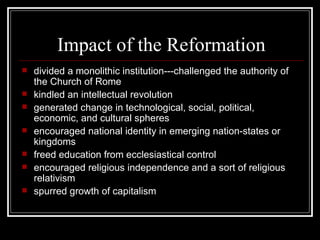
Impact of the Reformation divided a monolithic institution---challenged the authority of the Church of Rome kindled an intellectual revolution generated change in technological, social, political, economic, and cultural spheres encouraged national identity in emerging nation-states or kingdoms freed education from ecclesiastical control encouraged religious independence and a sort of religious relativism spurred growth of capitalism

The Reformation

  • 1.
    The Reformation Classicalinheritance of humanism combined with the tradition of Christianity.
  • 2.
    Catholic Seven BlessedSacraments Baptism Eucharist Reconciliation Confirmation Marriage Holy Orders Extreme Unction
  • 3.
    Sources of theReformation spread of Italian Renaissance humanism Christian, or Northern Renaissance, humanism (Erasmus) town development Medieval institution of the university Scholasticism: reaction to convoluted argumentation of and distortion of teaching by Scholastic philosophers
  • 4.
    The Reformation: NewIdeas about God and Humanity fast pace of change of concepts about the world and universe during the Renaissance no other movement transformed Europe as much as the Reformation inaugurated by Martin Luther in Germany tension giving rise to the Reformation: spiritual power ( Republica Christiana ) v. political (or, secular) power (emerging nation-states)
  • 5.
    The Reformation andTechnology Johannes Gutenberg Mainz, Germany mass production of movable, metal type; oil-based ink; and, the wooden printing press Gutenberg Bible
  • 6.
  • 7.
    Martin Luther (1483-1546)Augustinian Friar and Professor of Theology at the University of Wittenberg Luther became incensed over a succession of corrupt popes from Sixtus IV (r. 1471-1484) to Leo X (r. 1513-1521) as well as what he viewed as the corrupt practices within the Church: sale of indulgences by ecclesiastical officials to replenish the Church treasury which had been depleted in order to finance construction of St. Peter’s Basilica in Rome
  • 8.
    Martin Luther postedhis ninety-five theses on the door of the castle church at Wittenberg on October 31, 1517 advocated faith in salvation by grace alone confirmed Luther’s belief in the authority of the Word of God without intercession by the Church indulgences were remissions by the Church of temporal punishment on earth or in purgatory---Church was essentially selling pardons; papal pardons, especially when sold, were no guarantee of salvation according to Luther, hence, challenging the authority of the pope
  • 9.
    Main Tenets ofLutheranism doctrine of individuality faith through grace alone salvation of the individual soul personal knowledge of God without need of church or priest as intercessor
  • 10.
    Martin Luther (L)and John Calvin (R)
  • 11.
    John Calvin (1509-1564)French protestant educated in law and theology persecuted in France for his religious beliefs, Calvin fled to Switzerland Calvin established a theocratic republic in Geneva, Switzerland Calvinism was known for its stern rigidity in that it forbade most ordinary pleasures mixture of church and state in Calvinist doctrine made infractions of divine law punishable by civilian government
  • 12.
    John Calvin, The Institutes of the Christian Religion (1559) statement of Calvinist philosophy of faith unconditional sovereignty of God is the foundation of Calvinist doctrine; God’s will is absolute assistance of a Savior, Jesus Christ, was necessary because of the total, abject helplessness of humanity predestination is rigorous and universal: a few of the elect will be saved through faith in God, but most humans will be forever damned group of the elect constitutes the church; preservation of the church is responsibility of both religious and state authorities
  • 13.
    John Calvin, The Institutes of the Christian Religion (1559)
  • 14.
    The Counter-Reformation: A Catholic Response Papal response to the Reformation; convened by Pope Paul III (r. 1534-1549), and subsequently known as the Council of Trent (1545-1563) reaffirmed all Catholic doctrines attacked by Martin Luther including original sin, grace, redemption, the sacraments, sacrifice of the Mass, and purgatory violations of discipline were denounced, reforms were enacted, and inobservance was grounds for censure music was reformed leading to new trends in Counter-Reformation arts and architecture (e.g. Mannerism in painting and Baroque in sculpture, painting, music, dance, and architecture)
  • 15.
    Impact of theReformation divided a monolithic institution---challenged the authority of the Church of Rome kindled an intellectual revolution generated change in technological, social, political, economic, and cultural spheres encouraged national identity in emerging nation-states or kingdoms freed education from ecclesiastical control encouraged religious independence and a sort of religious relativism spurred growth of capitalism