Politics, Religion, and Reform 1820-1865
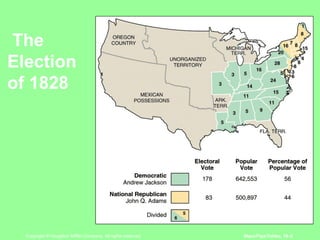
The Election of 1828
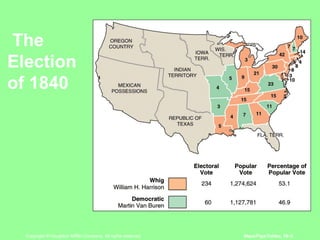
The Election of 1840
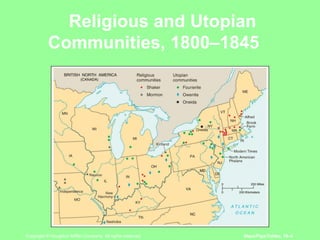
Religious and Utopian Communities, 1800–1845
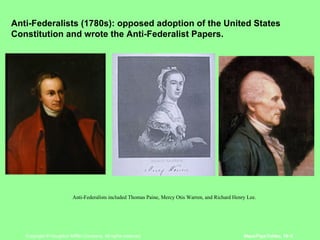
Anti-Federalists (1780s): opposed adoption of the United States Constitution and wrote the Anti-Federalist Papers. Anti-Federalists included Thomas Paine, Mercy Otis Warren, and Richard Henry Lee.
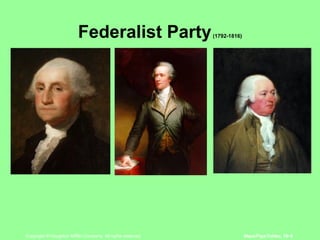
Federalist Party  (1792-1816)
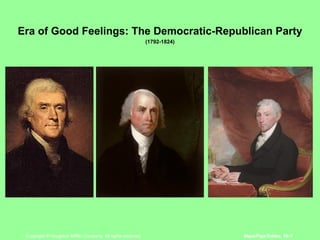
Era of Good Feelings: The Democratic-Republican Party   (1792-1824)
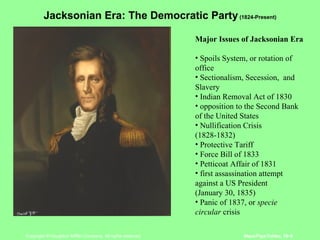
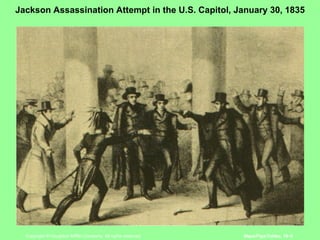
Jacksonian Era: The Democratic Party  (1824-Present) Major Issues of Jacksonian Era Spoils System, or rotation of office Sectionalism, Secession,  and Slavery Indian Removal Act of 1830 opposition to the Second Bank of the United States Nullification Crisis (1828-1832) Protective Tariff Force Bill of 1833 Petticoat Affair of 1831 first assassination attempt against a US President  (January 30, 1835) Panic of 1837, or  specie circular  crisis
Jackson Assassination Attempt in the U.S. Capitol, January 30, 1835
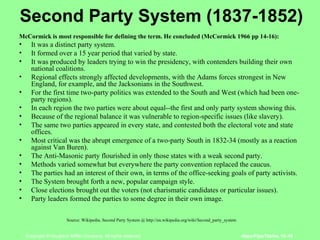
Second Party System (1837-1852) McCormick is most responsible for defining the term. He concluded (McCormick 1966 pp 14-16): It was a distinct party system.  It formed over a 15 year period that varied by state.  It was produced by leaders trying to win the presidency, with contenders building their own national coalitions.  Regional effects strongly affected developments, with the Adams forces strongest in New England, for example, and the Jacksonians in the Southwest.  For the first time two-party politics was extended to the South and West (which had been one-party regions).  In each region the two parties were about equal--the first and only party system showing this.  Because of the regional balance it was vulnerable to region-specific issues (like slavery).  The same two parties appeared in every state, and contested both the electoral vote and state offices.  Most critical was the abrupt emergence of a two-party South in 1832-34 (mostly as a reaction against Van Buren).  The Anti-Masonic party flourished in only those states with a weak second party.  Methods varied somewhat but everywhere the party convention replaced the caucus.  The parties had an interest of their own, in terms of the office-seeking goals of party activists.  The System brought forth a new, popular campaign style.  Close elections brought out the voters (not charismatic candidates or particular issues).  Party leaders formed the parties to some degree in their own image.  Source: Wikipedia, Second Party System @ http://en.wikipedia.org/wiki/Second_party_system
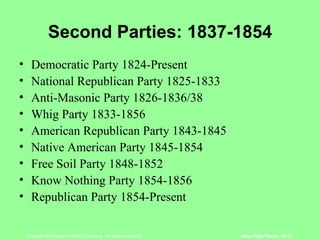
Second Parties: 1837-1854 Democratic Party 1824-Present National Republican Party 1825-1833 Anti-Masonic Party 1826-1836/38 Whig Party 1833-1856 American Republican Party 1843-1845 Native American Party 1845-1854 Free Soil Party 1848-1852 Know Nothing Party 1854-1856 Republican Party 1854-Present
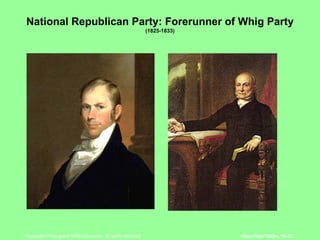
National Republican Party: Forerunner of Whig Party (1825-1833)
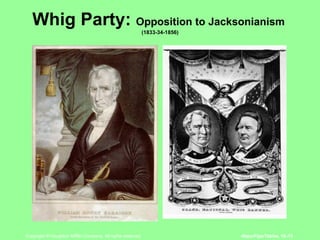
Whig Party:  Opposition to Jacksonianism  (1833-34-1856)
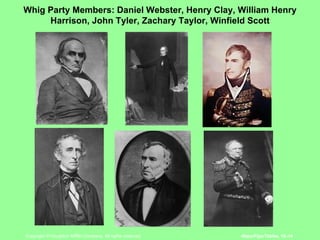
Whig Party Members: Daniel Webster, Henry Clay, William Henry Harrison, John Tyler, Zachary Taylor, Winfield Scott
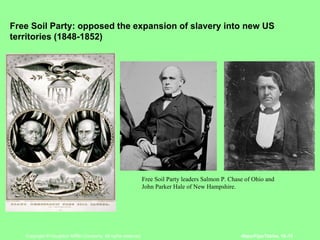
Free Soil Party: opposed the expansion of slavery into new US territories (1848-1852) Free Soil Party leaders Salmon P. Chase of Ohio and John Parker Hale of New Hampshire.
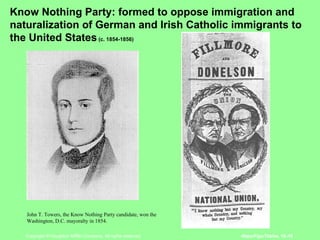
Know Nothing Party: formed to oppose immigration and naturalization of German and Irish Catholic immigrants to the United States  (c. 1854-1856) John T. Towers, the Know Nothing Party candidate, won the Washington, D.C. mayoralty in 1854.
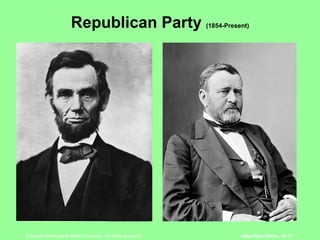
Republican Party  (1854-Present)

Jacksonian Era

  • 1.
    Politics, Religion, andReform 1820-1865
  • 2.
  • 3.
  • 4.
    Religious and UtopianCommunities, 1800–1845
  • 5.
    Anti-Federalists (1780s): opposedadoption of the United States Constitution and wrote the Anti-Federalist Papers. Anti-Federalists included Thomas Paine, Mercy Otis Warren, and Richard Henry Lee.
  • 6.
    Federalist Party (1792-1816)
  • 7.
    Era of GoodFeelings: The Democratic-Republican Party (1792-1824)
  • 8.
    Jacksonian Era: TheDemocratic Party (1824-Present) Major Issues of Jacksonian Era Spoils System, or rotation of office Sectionalism, Secession, and Slavery Indian Removal Act of 1830 opposition to the Second Bank of the United States Nullification Crisis (1828-1832) Protective Tariff Force Bill of 1833 Petticoat Affair of 1831 first assassination attempt against a US President (January 30, 1835) Panic of 1837, or specie circular crisis
  • 9.
    Jackson Assassination Attemptin the U.S. Capitol, January 30, 1835
  • 10.
    Second Party System(1837-1852) McCormick is most responsible for defining the term. He concluded (McCormick 1966 pp 14-16): It was a distinct party system. It formed over a 15 year period that varied by state. It was produced by leaders trying to win the presidency, with contenders building their own national coalitions. Regional effects strongly affected developments, with the Adams forces strongest in New England, for example, and the Jacksonians in the Southwest. For the first time two-party politics was extended to the South and West (which had been one-party regions). In each region the two parties were about equal--the first and only party system showing this. Because of the regional balance it was vulnerable to region-specific issues (like slavery). The same two parties appeared in every state, and contested both the electoral vote and state offices. Most critical was the abrupt emergence of a two-party South in 1832-34 (mostly as a reaction against Van Buren). The Anti-Masonic party flourished in only those states with a weak second party. Methods varied somewhat but everywhere the party convention replaced the caucus. The parties had an interest of their own, in terms of the office-seeking goals of party activists. The System brought forth a new, popular campaign style. Close elections brought out the voters (not charismatic candidates or particular issues). Party leaders formed the parties to some degree in their own image. Source: Wikipedia, Second Party System @ http://en.wikipedia.org/wiki/Second_party_system
  • 11.
    Second Parties: 1837-1854Democratic Party 1824-Present National Republican Party 1825-1833 Anti-Masonic Party 1826-1836/38 Whig Party 1833-1856 American Republican Party 1843-1845 Native American Party 1845-1854 Free Soil Party 1848-1852 Know Nothing Party 1854-1856 Republican Party 1854-Present
  • 12.
    National Republican Party:Forerunner of Whig Party (1825-1833)
  • 13.
    Whig Party: Opposition to Jacksonianism (1833-34-1856)
  • 14.
    Whig Party Members:Daniel Webster, Henry Clay, William Henry Harrison, John Tyler, Zachary Taylor, Winfield Scott
  • 15.
    Free Soil Party:opposed the expansion of slavery into new US territories (1848-1852) Free Soil Party leaders Salmon P. Chase of Ohio and John Parker Hale of New Hampshire.
  • 16.
    Know Nothing Party:formed to oppose immigration and naturalization of German and Irish Catholic immigrants to the United States (c. 1854-1856) John T. Towers, the Know Nothing Party candidate, won the Washington, D.C. mayoralty in 1854.
  • 17.
    Republican Party (1854-Present)