Success Dynamics International  TM Presents: Strategic Communication Creating a Plan for Success
It articulates, explains and promotes a vision {and mission} with a set of well-defined goals. It sets the framework and tone for the allocation of resources to achieve objectives. It creates a consistent, unified “voice” that links diverse activities and goals in a way that appeals to various audiences and stakeholders. It focuses attention and effort based on hierarchical objectives and environmental constraints. What does a Communication Strategy Do? Success Dynamics International
Strategic Dimensions Audience: Who are the pertinent audiences, partners and stakeholders? Performance: Who is accountable for articulating the message? How? Message: What does the organization want/need to say? How are messages best crafted to convey meaning and connect? Success Dynamics International
Strategic Dimensions Media: What mix of channels should be chosen? How rich do exchanges need to be? Assessment: How and when are structures and programs evaluated as to effectiveness? Success Dynamics International
Define goals and objectives Determine budgeting and scheduling of resources Create tactical parameters for coordination and implementation {execution} Set control {evaluation} based on costs and benefits Create monitoring    systems Optimize resource  effectiveness and    limit waste Set the framework for   continuous learning    and improvement Create review/audit   structure  Needs Assessment & Planning Success Dynamics International
What are the associated costs and benefits of communication? How is content controlled and verified? Are personal and nonpersonal methods appropriately integrated? How credible are the messages? Is there a consistent set of communication? How is external noise managed? Does communication address change and continuous improvement? Are efforts subject to regular, objective review? Strategic Concerns Success Dynamics International
Ultimate Goal of Communication is to facilitate a change in behavior….to achieve Management Objectives. ~World Bank 2001~
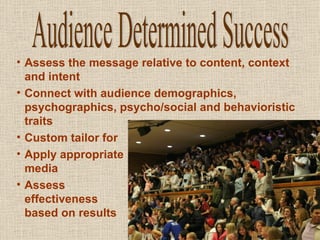
Assess the message relative to content, context and intent Connect with audience demographics, psychographics, psycho/social and behavioristic traits Custom tailor for   impact Apply appropriate   media Assess    effectiveness    based on results Audience Determined Success Success Dynamics International
Send the right message To the right audience At the right time In the right way
Strategic Analysis Mission & Contribution to Objectives Strengths/Weaknesses/Opportunities/  Threats Effective Internal & External Allocation of Resources Execution Evaluation & Control Procedures
Leadership & Teambuilding Communication Handling Confrontation, Conflict & Contention Service & Performance Improvement Communication Influence & Persuasion 232 Bent Oak Loop; Davenport, Florida 33837  (863) 420-1929

Strategic Communication

  • 1.
    Success Dynamics International TM Presents: Strategic Communication Creating a Plan for Success
  • 2.
    It articulates, explainsand promotes a vision {and mission} with a set of well-defined goals. It sets the framework and tone for the allocation of resources to achieve objectives. It creates a consistent, unified “voice” that links diverse activities and goals in a way that appeals to various audiences and stakeholders. It focuses attention and effort based on hierarchical objectives and environmental constraints. What does a Communication Strategy Do? Success Dynamics International
  • 3.
    Strategic Dimensions Audience:Who are the pertinent audiences, partners and stakeholders? Performance: Who is accountable for articulating the message? How? Message: What does the organization want/need to say? How are messages best crafted to convey meaning and connect? Success Dynamics International
  • 4.
    Strategic Dimensions Media:What mix of channels should be chosen? How rich do exchanges need to be? Assessment: How and when are structures and programs evaluated as to effectiveness? Success Dynamics International
  • 5.
    Define goals andobjectives Determine budgeting and scheduling of resources Create tactical parameters for coordination and implementation {execution} Set control {evaluation} based on costs and benefits Create monitoring systems Optimize resource effectiveness and limit waste Set the framework for continuous learning and improvement Create review/audit structure Needs Assessment & Planning Success Dynamics International
  • 6.
    What are theassociated costs and benefits of communication? How is content controlled and verified? Are personal and nonpersonal methods appropriately integrated? How credible are the messages? Is there a consistent set of communication? How is external noise managed? Does communication address change and continuous improvement? Are efforts subject to regular, objective review? Strategic Concerns Success Dynamics International
  • 7.
    Ultimate Goal ofCommunication is to facilitate a change in behavior….to achieve Management Objectives. ~World Bank 2001~
  • 8.
    Assess the messagerelative to content, context and intent Connect with audience demographics, psychographics, psycho/social and behavioristic traits Custom tailor for impact Apply appropriate media Assess effectiveness based on results Audience Determined Success Success Dynamics International
  • 9.
    Send the rightmessage To the right audience At the right time In the right way
  • 10.
    Strategic Analysis Mission& Contribution to Objectives Strengths/Weaknesses/Opportunities/ Threats Effective Internal & External Allocation of Resources Execution Evaluation & Control Procedures
  • 11.
    Leadership & TeambuildingCommunication Handling Confrontation, Conflict & Contention Service & Performance Improvement Communication Influence & Persuasion 232 Bent Oak Loop; Davenport, Florida 33837 (863) 420-1929

Editor's Notes

  • #2 Success Dynamics International Communication Fallacies Strategic Communication: Creating a Plan for Success Too often, organizations neglect developing strategic communication plans assuming that they either need not be done or will take care of themselves. Ignoring the concern does not make it go away. The most effective organizations develop integrated plans that account for both internal and external messages.