Strategic Enrollment Management
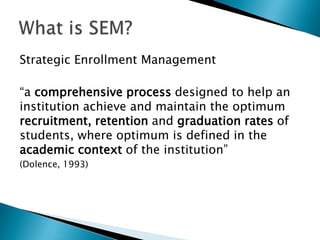
“a comprehensive process designed to help an
institution achieve and maintain the optimum
recruitment, retention and graduation rates of
students, where optimum is defined in the
academic context of the institution”
(Dolence, 1993)
SEI SEP SEM
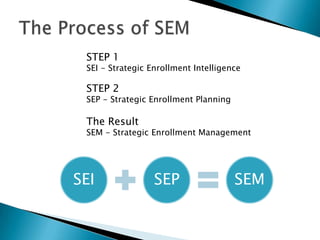
STEP 1
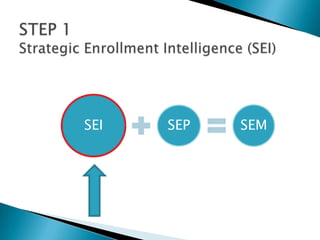
SEI - Strategic Enrollment Intelligence
STEP 2
SEP - Strategic Enrollment Planning
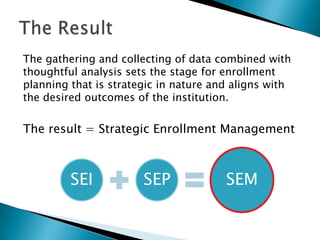
The Result
SEM - Strategic Enrollment Management
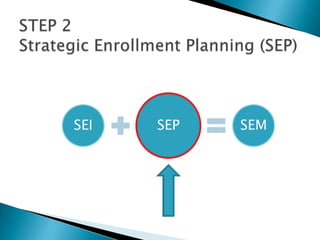
SEI SEP SEM
“The use of actionable intelligence to inform
enrolment strategies and practices and thus,
position an institution strategically to achieve
optimal enrolment results”
 Jim Black, Strategic Enrolment Intelligence, Academia Group
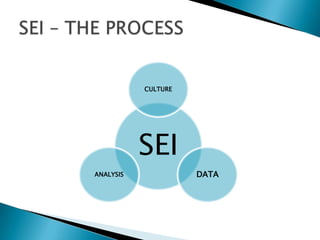
SEI
CULTURE
DATAANALYSIS
 Create a data-informed campus culture
 Understand where you are and where you
need to be
 Collect and “USE” data to drive institutional
behaviour, strategy and decision making
 Strive to always have the right people,
saying the right things, to the right people,
at the right time
Data „informed‟ Institutions ask themselves:
1. Does our data allow us to understand our context
and draw implications about how we need to
change in order to fulfill our mission and vision
for the future?
2. Does our current state align with the future
needs, demands, and trends of the market?
3. Does our future vision align with our capacity?
4. Can our institutional needs sustain itself and our
future visions?
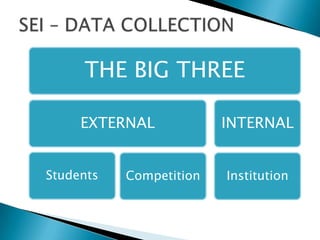
THE BIG THREE
EXTERNAL
Students Competition
INTERNAL
Institution
Data „informed‟ institutions ask themselves:
1. What do students demand?
2. What does the competition offer?
3. What does the institution do well?
4. Where do we fail?
SEI must conclude with a SWOT that incorporates all
the external and internal information collected about
students, competition and the institution.
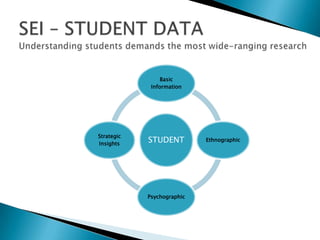
STUDENT
Basic
Information
Ethnographic
Psychographic
Strategic
Insights
 Basic Information – demographics & academics
 Ethnographic – understanding student culture
 Psychographic – values, beliefs and behaviours
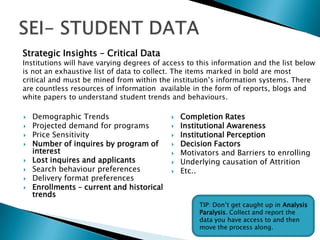
 Demographic Trends
 Projected demand for programs
 Price Sensitivity
 Number of inquires by program of
interest
 Lost inquires and applicants
 Search behaviour preferences
 Delivery format preferences
 Enrollments – current and historical
trends
 Completion Rates
 Institutional Awareness
 Institutional Perception
 Decision Factors
 Motivators and Barriers to enrolling
 Underlying causation of Attrition
 Etc..
Strategic Insights – Critical Data
Institutions will have varying degrees of access to this information. Items
in bold are critical and must be mined from within the institution‟s
information systems.
TIP: Don‟t get caught up in Analysis
Paralysis. Collect and report the
data you have access to and then
move the process along.
Comprehensive Competitor Analysis should include:
 Enrollment trends
 Marketing messages
 Communication strategies
 Academic program offerings
 Institutional Image
TIP: Sometimes institutions post
their annual strategic plans online.
Browse their websites and take note
of their mission, vision and values.
An institution can best affect change when informed
by data that addresses:
 Student Satisfaction and Engagement
 Institutional Capacity – current and ability to scale
 Faculty/Staff alignment with student expectations
 Alumni Satisfaction/outcomes
 Student attrition
Collect this data through surveys and evaluations.
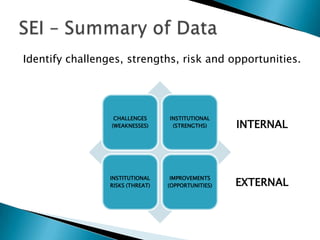
Identify challenges, strengths, risk and opportunities.
CHALLENGES
(WEAKNESSES)
INSTITUTIONAL
(STRENGTHS)
INSTITUTIONAL
RISKS (THREAT)
IMPROVEMENTS
(OPPORTUNITIES)
INTERNAL
EXTERNAL
Align the culture, data and KPIs with the
institutional mission, vision, values and goals.
What is the desired outcome?
 Manage – stay the same
 Grow or Build – increase capacity
 Shrink – reduce or eliminate
 Start – create new things
Now you are ready for the planning step of SEM.
SEI SEP SEM
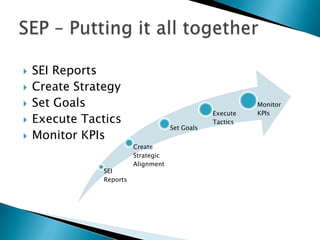
 SEI Reports
 Create Strategy
 Set Goals
 Execute Tactics
 Monitor KPIs
SEI
Reports
Create
Strategic
Alignment
Set Goals
Execute
Tactics
Monitor
KPIs
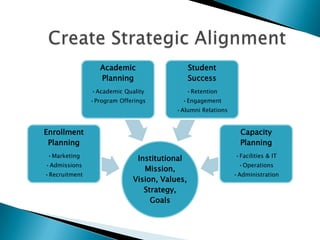
Institutional
Mission,
Vision, Values,
Strategy,
Goals
Enrollment
Planning
•Marketing
•Admissions
•Recruitment
Academic
Planning
•Academic Quality
•Program Offerings
Student
Success
•Retention
•Engagement
•Alumni Relations
Capacity
Planning
•Facilities & IT
•Operations
•Administration
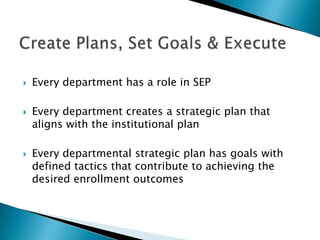
 Every department has a role in SEP
 Every department creates a strategic plan that
aligns with the institutional plan
 Every departmental strategic plan includes goals
with defined tactics that contribute to achieving the
desired enrollment outcomes
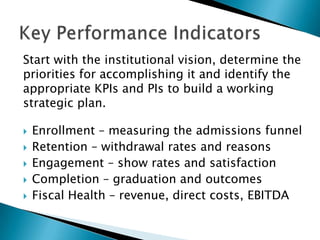
Start with the institutional vision, determine the
priorities for accomplishing it and identify the
appropriate KPIs and PIs to build a working
strategic plan.
 Enrollment – measuring the admissions funnel
 Retention – withdrawal rates and reasons
 Engagement – show rates and satisfaction
 Completion – graduation and outcomes
 Fiscal Health – revenue, direct costs, EBITDA
The gathering and collecting of data combined with
thoughtful analysis sets the stage for enrollment
planning that is strategic in nature and aligns with
the desired outcomes of the institution.
The result = Strategic Enrollment Management
SEI SEP SEM
When the institution has achieved a state of
alignment enrollment outcomes can be
managed.
 Determine the KPIs that will best measure the
desired outcomes
 Create reports to measure the KPIs
 Assign Accountability
 Monitor the results and make swift changes
when needed
 Gather Intelligence – DATA
 Determine Desired Outcomes
 Create Strategic Alignment
 Monitor Results
 Manage the Desired Outcomes
 Read two books
1. Strategic Enrollment Planning: A Dynamic
Collaboration, Edited by Jim Hundrieser, PhD
2. Strategic Enrolment Intelligence, Canada‟s First
Book on Strategic Enrollment Management, Edited
by Jim Black
 Noel-Levitz https://www.noellevitz.com
◦ Annual Reports, Blogs, White papers
 SEM Works http://www.semworks.net
◦ Books and White papers

Strategic enrollment management

  • 2.
    Strategic Enrollment Management “acomprehensive process designed to help an institution achieve and maintain the optimum recruitment, retention and graduation rates of students, where optimum is defined in the academic context of the institution” (Dolence, 1993)
  • 3.
    SEI SEP SEM STEP1 SEI - Strategic Enrollment Intelligence STEP 2 SEP - Strategic Enrollment Planning The Result SEM - Strategic Enrollment Management
  • 4.
  • 5.
    “The use ofactionable intelligence to inform enrolment strategies and practices and thus, position an institution strategically to achieve optimal enrolment results”  Jim Black, Strategic Enrolment Intelligence, Academia Group
  • 6.
  • 7.
     Create adata-informed campus culture  Understand where you are and where you need to be  Collect and “USE” data to drive institutional behaviour, strategy and decision making  Strive to always have the right people, saying the right things, to the right people, at the right time
  • 8.
    Data „informed‟ Institutionsask themselves: 1. Does our data allow us to understand our context and draw implications about how we need to change in order to fulfill our mission and vision for the future? 2. Does our current state align with the future needs, demands, and trends of the market? 3. Does our future vision align with our capacity? 4. Can our institutional needs sustain itself and our future visions?
  • 9.
    THE BIG THREE EXTERNAL StudentsCompetition INTERNAL Institution
  • 10.
    Data „informed‟ institutionsask themselves: 1. What do students demand? 2. What does the competition offer? 3. What does the institution do well? 4. Where do we fail? SEI must conclude with a SWOT that incorporates all the external and internal information collected about students, competition and the institution.
  • 11.
  • 12.
     Basic Information– demographics & academics  Ethnographic – understanding student culture  Psychographic – values, beliefs and behaviours
  • 13.
     Demographic Trends Projected demand for programs  Price Sensitivity  Number of inquires by program of interest  Lost inquires and applicants  Search behaviour preferences  Delivery format preferences  Enrollments – current and historical trends  Completion Rates  Institutional Awareness  Institutional Perception  Decision Factors  Motivators and Barriers to enrolling  Underlying causation of Attrition  Etc.. Strategic Insights – Critical Data Institutions will have varying degrees of access to this information. Items in bold are critical and must be mined from within the institution‟s information systems. TIP: Don‟t get caught up in Analysis Paralysis. Collect and report the data you have access to and then move the process along.
  • 14.
    Comprehensive Competitor Analysisshould include:  Enrollment trends  Marketing messages  Communication strategies  Academic program offerings  Institutional Image TIP: Sometimes institutions post their annual strategic plans online. Browse their websites and take note of their mission, vision and values.
  • 15.
    An institution canbest affect change when informed by data that addresses:  Student Satisfaction and Engagement  Institutional Capacity – current and ability to scale  Faculty/Staff alignment with student expectations  Alumni Satisfaction/outcomes  Student attrition Collect this data through surveys and evaluations.
  • 16.
    Identify challenges, strengths,risk and opportunities. CHALLENGES (WEAKNESSES) INSTITUTIONAL (STRENGTHS) INSTITUTIONAL RISKS (THREAT) IMPROVEMENTS (OPPORTUNITIES) INTERNAL EXTERNAL
  • 17.
    Align the culture,data and KPIs with the institutional mission, vision, values and goals. What is the desired outcome?  Manage – stay the same  Grow or Build – increase capacity  Shrink – reduce or eliminate  Start – create new things Now you are ready for the planning step of SEM.
  • 18.
  • 19.
     SEI Reports Create Strategy  Set Goals  Execute Tactics  Monitor KPIs SEI Reports Create Strategic Alignment Set Goals Execute Tactics Monitor KPIs
  • 20.
    Institutional Mission, Vision, Values, Strategy, Goals Enrollment Planning •Marketing •Admissions •Recruitment Academic Planning •Academic Quality •ProgramOfferings Student Success •Retention •Engagement •Alumni Relations Capacity Planning •Facilities & IT •Operations •Administration
  • 21.
     Every departmenthas a role in SEP  Every department creates a strategic plan that aligns with the institutional plan  Every departmental strategic plan includes goals with defined tactics that contribute to achieving the desired enrollment outcomes
  • 22.
    Start with theinstitutional vision, determine the priorities for accomplishing it and identify the appropriate KPIs and PIs to build a working strategic plan.  Enrollment – measuring the admissions funnel  Retention – withdrawal rates and reasons  Engagement – show rates and satisfaction  Completion – graduation and outcomes  Fiscal Health – revenue, direct costs, EBITDA
  • 23.
    The gathering andcollecting of data combined with thoughtful analysis sets the stage for enrollment planning that is strategic in nature and aligns with the desired outcomes of the institution. The result = Strategic Enrollment Management SEI SEP SEM
  • 24.
    When the institutionhas achieved a state of alignment enrollment outcomes can be managed.  Determine the KPIs that will best measure the desired outcomes  Create reports to measure the KPIs  Assign Accountability  Monitor the results and make swift changes when needed
  • 25.
     Gather Intelligence– DATA  Determine Desired Outcomes  Create Strategic Alignment  Monitor Results  Manage the Desired Outcomes
  • 26.
     Read twobooks 1. Strategic Enrollment Planning: A Dynamic Collaboration, Edited by Jim Hundrieser, PhD 2. Strategic Enrolment Intelligence, Canada‟s First Book on Strategic Enrollment Management, Edited by Jim Black  Noel-Levitz https://www.noellevitz.com ◦ Annual Reports, Blogs, White papers  SEM Works http://www.semworks.net ◦ Books and White papers