IMPROVING STAFF COMPLIANCE WITH MEDICARE GUIDELINES FOR CHARTING HOSPITAL IN-PATIENT DISCHARGE Monica Petrucelli Falkin, MPH Green Belt Project Leader
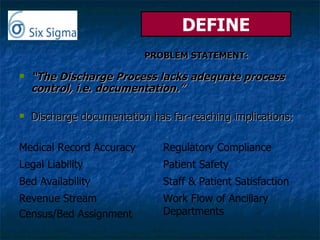
“ The Discharge Process lacks adequate process control, i.e. documentation.” Discharge documentation has far-reaching implications: DEFINE PROBLEM STATEMENT: Work Flow of Ancillary Departments Revenue Stream Census/Bed Assignment Staff & Patient Satisfaction Bed Availability Patient Safety Legal Liability Regulatory Compliance Medical Record Accuracy
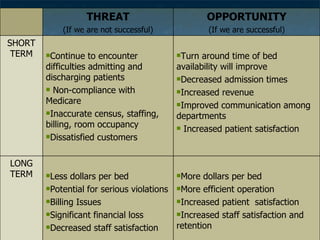
LONG TERM SHORT TERM More dollars per bed More efficient operation Increased patient  satisfaction Increased staff satisfaction and retention Less dollars per bed Potential for serious violations Billing Issues Significant financial loss Decreased staff satisfaction Turn around time of bed availability will improve Decreased admission times Increased revenue Improved communication among departments Increased patient satisfaction Continue to encounter difficulties admitting and discharging patients Non-compliance with Medicare Inaccurate census, staffing, billing, room occupancy Dissatisfied customers OPPORTUNITY (If we are successful) THREAT (If we are not successful)
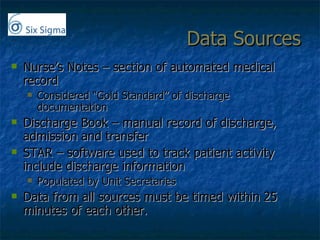
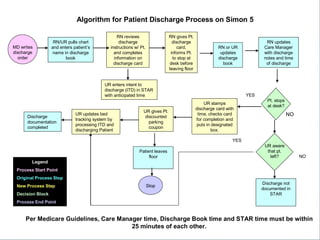
Data Sources Nurse’s Notes – section of automated medical record Considered “Gold Standard” of discharge documentation Discharge Book – manual record of discharge, admission and transfer STAR – software used to track patient activity include discharge information Populated by Unit Secretaries Data from all sources must be timed within 25 minutes of each other.
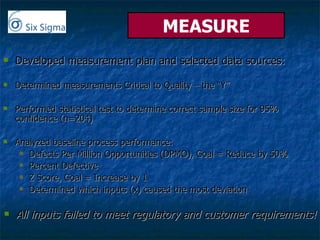
Developed measurement plan and selected data sources: Determined measurements Critical to Quality – the “Y” Performed statistical test to determine correct sample size for 95% confidence (n=204) Analyzed baseline process performance: Defects Per Million Opportunities (DPMO), Goal = Reduce by 50% Percent Defective Z Score, Goal = Increase by 1 Determined which inputs (x) caused the most deviation All inputs failed to meet regulatory and customer requirements! MEASURE
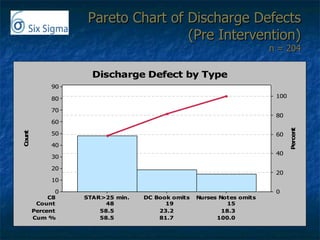
Pareto Chart of Discharge Defects (Pre Intervention) n = 204
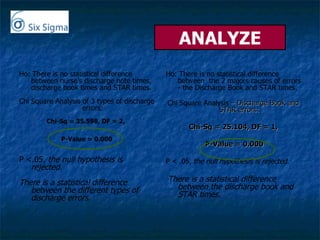
ANALYZE Ho: There is no statistical difference between nurse’s discharge note times, discharge book times and STAR times. Chi Square Analysis of 3 types of discharge errors: Chi-Sq = 35.598, DF = 2,  P-Value = 0.000 P <.05,  the null hypothesis is rejected.   There is a statistical difference between the different types of discharge errors. Ho: There is no statistical difference between  the 2 majors causes of errors - the Discharge Book and STAR times. Chi Square Analysis  – Discharge Book and STAR errors: Chi-Sq = 25.104, DF = 1, P-Value = 0.000 P < .05,  the null hypothesis is rejected. There is a statistical difference between the discharge book and STAR times.
RESULTS Implementation of  Process improvements  Achieved greater Control over Patient discharge
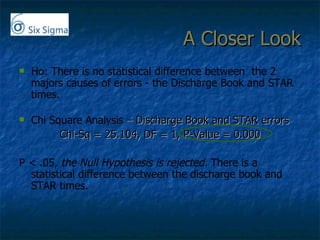
A Closer Look Ho: There is no statistical difference between  the 2 majors causes of errors - the Discharge Book and STAR times. Chi Square Analysis  – Discharge Book and STAR errors Chi-Sq = 25.104, DF = 1, P-Value = 0.000 P < .05,  the Null Hypothesis is rejected.  There is a statistical difference between the discharge book and STAR times.
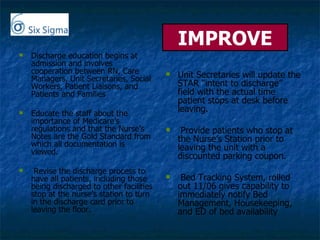
IMPROVE Discharge education begins at admission and involves cooperation between RN, Care Managers, Unit Secretaries, Social Workers, Patient Liaisons, and Patients and Families Educate the staff about the importance of Medicare’s regulations and that the Nurse’s Notes are the Gold Standard from which all documentation is viewed. Revise the discharge process to have all patients, including those being discharged to other facilities stop at the nurse’s station to turn in the discharge card prior to leaving the floor. Unit Secretaries will update the STAR “intent to discharge” field with the actual time patient stops at desk before leaving. Provide patients who stop at the Nurse’s Station prior to leaving the unit with a discounted parking coupon.  Bed Tracking System, rolled out 11/06 gives capability to immediately notify Bed Management, Housekeeping, and ED of bed availability
Optimized Solutions II  Unit Secretaries will update the STAR “intent to discharge” field with the actual time patient stops at desk before leaving. Provide patients who stop at the Nurse’s Station prior to leaving the unit with a discounted parking coupon.  Bed Tracking System, rolled out 11/06 gives capability to immediately notify Bed Management, Housekeeping, and ED of bed availability
 
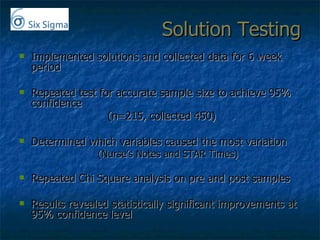
Solution Testing Implemented solutions and collected data for 6 week period  Repeated test for accurate sample size to achieve 95% confidence (n=215, collected 450) Determined which variables caused the most variation (Nurse’s Notes and STAR Times) Repeated Chi Square analysis on pre and post samples Results revealed statistically significant improvements at 95% confidence level
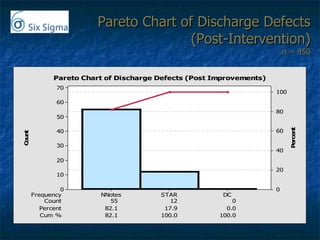
Pareto Chart of Discharge Defects (Post-Intervention) n = 450
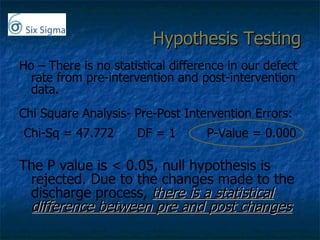
Hypothesis Testing Ho – There is no statistical difference in our defect rate from pre-intervention and post-intervention data. Chi Square Analysis- Pre-Post Intervention Errors: Chi-Sq = 47.772  DF = 1  P-Value = 0.000 The P value is < 0.05, null hypothesis is rejected. Due to the changes made to the discharge process,  there is a statistical difference between pre and post changes
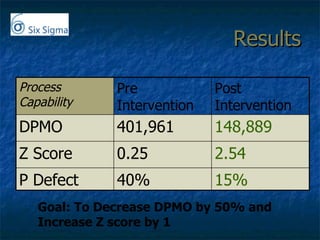
Results Goal: To Decrease DPMO by 50% and Increase Z score by 1 15% 40% P Defect 2.54 0.25 Z Score 148,889 401,961 DPMO Post Intervention Pre Intervention Process Capability
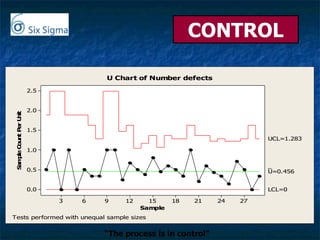
CONTROL “ The process is in control”
Conclusions Implementation of process improvements achieved greater control over patient discharge Errors in charting reduced more than 50% Continue to audit 50 charts per month for one year Continue to work with RNs to improve Nurse’s Notes documentation Publish results and make adjustments accordingly. Process improvements will be incorporated into standard practice for discharge and applied throughout hospital.

Six Sigma Discharge Project

  • 1.
    IMPROVING STAFF COMPLIANCEWITH MEDICARE GUIDELINES FOR CHARTING HOSPITAL IN-PATIENT DISCHARGE Monica Petrucelli Falkin, MPH Green Belt Project Leader
  • 2.
    “ The DischargeProcess lacks adequate process control, i.e. documentation.” Discharge documentation has far-reaching implications: DEFINE PROBLEM STATEMENT: Work Flow of Ancillary Departments Revenue Stream Census/Bed Assignment Staff & Patient Satisfaction Bed Availability Patient Safety Legal Liability Regulatory Compliance Medical Record Accuracy
  • 3.
    LONG TERM SHORTTERM More dollars per bed More efficient operation Increased patient satisfaction Increased staff satisfaction and retention Less dollars per bed Potential for serious violations Billing Issues Significant financial loss Decreased staff satisfaction Turn around time of bed availability will improve Decreased admission times Increased revenue Improved communication among departments Increased patient satisfaction Continue to encounter difficulties admitting and discharging patients Non-compliance with Medicare Inaccurate census, staffing, billing, room occupancy Dissatisfied customers OPPORTUNITY (If we are successful) THREAT (If we are not successful)
  • 4.
    Data Sources Nurse’sNotes – section of automated medical record Considered “Gold Standard” of discharge documentation Discharge Book – manual record of discharge, admission and transfer STAR – software used to track patient activity include discharge information Populated by Unit Secretaries Data from all sources must be timed within 25 minutes of each other.
  • 5.
    Developed measurement planand selected data sources: Determined measurements Critical to Quality – the “Y” Performed statistical test to determine correct sample size for 95% confidence (n=204) Analyzed baseline process performance: Defects Per Million Opportunities (DPMO), Goal = Reduce by 50% Percent Defective Z Score, Goal = Increase by 1 Determined which inputs (x) caused the most deviation All inputs failed to meet regulatory and customer requirements! MEASURE
  • 6.
    Pareto Chart ofDischarge Defects (Pre Intervention) n = 204
  • 7.
    ANALYZE Ho: Thereis no statistical difference between nurse’s discharge note times, discharge book times and STAR times. Chi Square Analysis of 3 types of discharge errors: Chi-Sq = 35.598, DF = 2, P-Value = 0.000 P <.05, the null hypothesis is rejected. There is a statistical difference between the different types of discharge errors. Ho: There is no statistical difference between the 2 majors causes of errors - the Discharge Book and STAR times. Chi Square Analysis – Discharge Book and STAR errors: Chi-Sq = 25.104, DF = 1, P-Value = 0.000 P < .05, the null hypothesis is rejected. There is a statistical difference between the discharge book and STAR times.
  • 8.
    RESULTS Implementation of Process improvements Achieved greater Control over Patient discharge
  • 9.
    A Closer LookHo: There is no statistical difference between the 2 majors causes of errors - the Discharge Book and STAR times. Chi Square Analysis – Discharge Book and STAR errors Chi-Sq = 25.104, DF = 1, P-Value = 0.000 P < .05, the Null Hypothesis is rejected. There is a statistical difference between the discharge book and STAR times.
  • 10.
    IMPROVE Discharge educationbegins at admission and involves cooperation between RN, Care Managers, Unit Secretaries, Social Workers, Patient Liaisons, and Patients and Families Educate the staff about the importance of Medicare’s regulations and that the Nurse’s Notes are the Gold Standard from which all documentation is viewed. Revise the discharge process to have all patients, including those being discharged to other facilities stop at the nurse’s station to turn in the discharge card prior to leaving the floor. Unit Secretaries will update the STAR “intent to discharge” field with the actual time patient stops at desk before leaving. Provide patients who stop at the Nurse’s Station prior to leaving the unit with a discounted parking coupon. Bed Tracking System, rolled out 11/06 gives capability to immediately notify Bed Management, Housekeeping, and ED of bed availability
  • 11.
    Optimized Solutions II Unit Secretaries will update the STAR “intent to discharge” field with the actual time patient stops at desk before leaving. Provide patients who stop at the Nurse’s Station prior to leaving the unit with a discounted parking coupon. Bed Tracking System, rolled out 11/06 gives capability to immediately notify Bed Management, Housekeeping, and ED of bed availability
  • 12.
  • 13.
    Solution Testing Implementedsolutions and collected data for 6 week period Repeated test for accurate sample size to achieve 95% confidence (n=215, collected 450) Determined which variables caused the most variation (Nurse’s Notes and STAR Times) Repeated Chi Square analysis on pre and post samples Results revealed statistically significant improvements at 95% confidence level
  • 14.
    Pareto Chart ofDischarge Defects (Post-Intervention) n = 450
  • 15.
    Hypothesis Testing Ho– There is no statistical difference in our defect rate from pre-intervention and post-intervention data. Chi Square Analysis- Pre-Post Intervention Errors: Chi-Sq = 47.772 DF = 1 P-Value = 0.000 The P value is < 0.05, null hypothesis is rejected. Due to the changes made to the discharge process, there is a statistical difference between pre and post changes
  • 16.
    Results Goal: ToDecrease DPMO by 50% and Increase Z score by 1 15% 40% P Defect 2.54 0.25 Z Score 148,889 401,961 DPMO Post Intervention Pre Intervention Process Capability
  • 17.
    CONTROL “ Theprocess is in control”
  • 18.
    Conclusions Implementation ofprocess improvements achieved greater control over patient discharge Errors in charting reduced more than 50% Continue to audit 50 charts per month for one year Continue to work with RNs to improve Nurse’s Notes documentation Publish results and make adjustments accordingly. Process improvements will be incorporated into standard practice for discharge and applied throughout hospital.