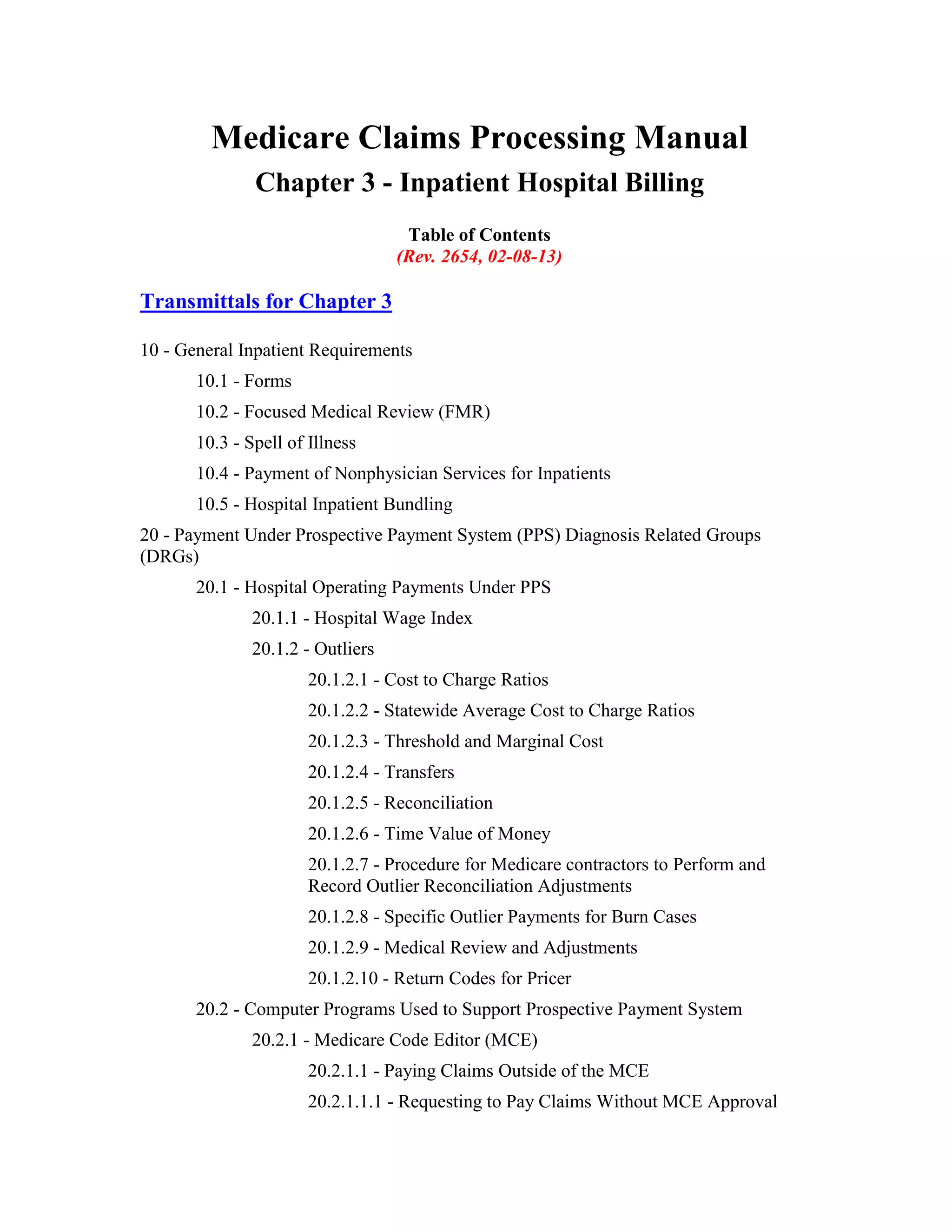
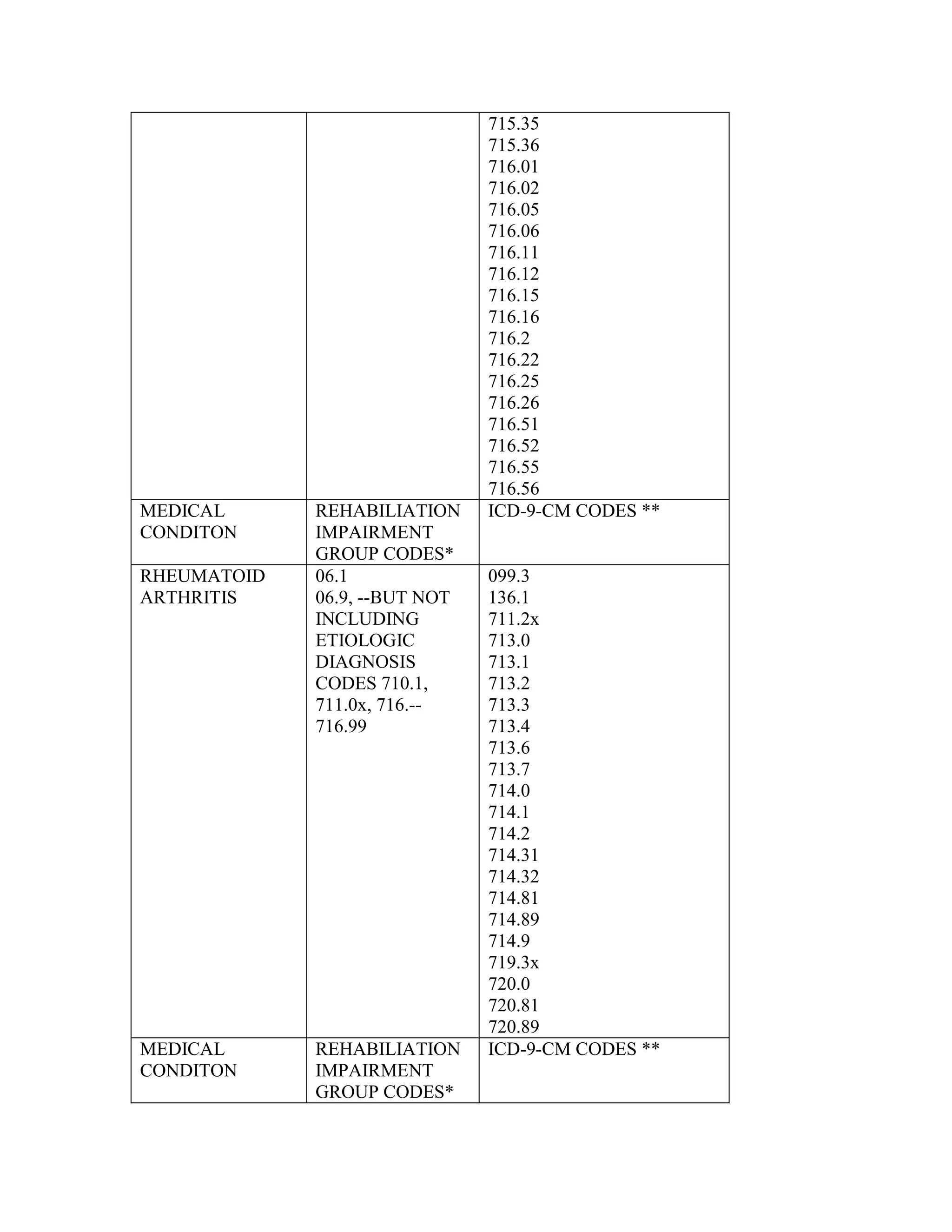
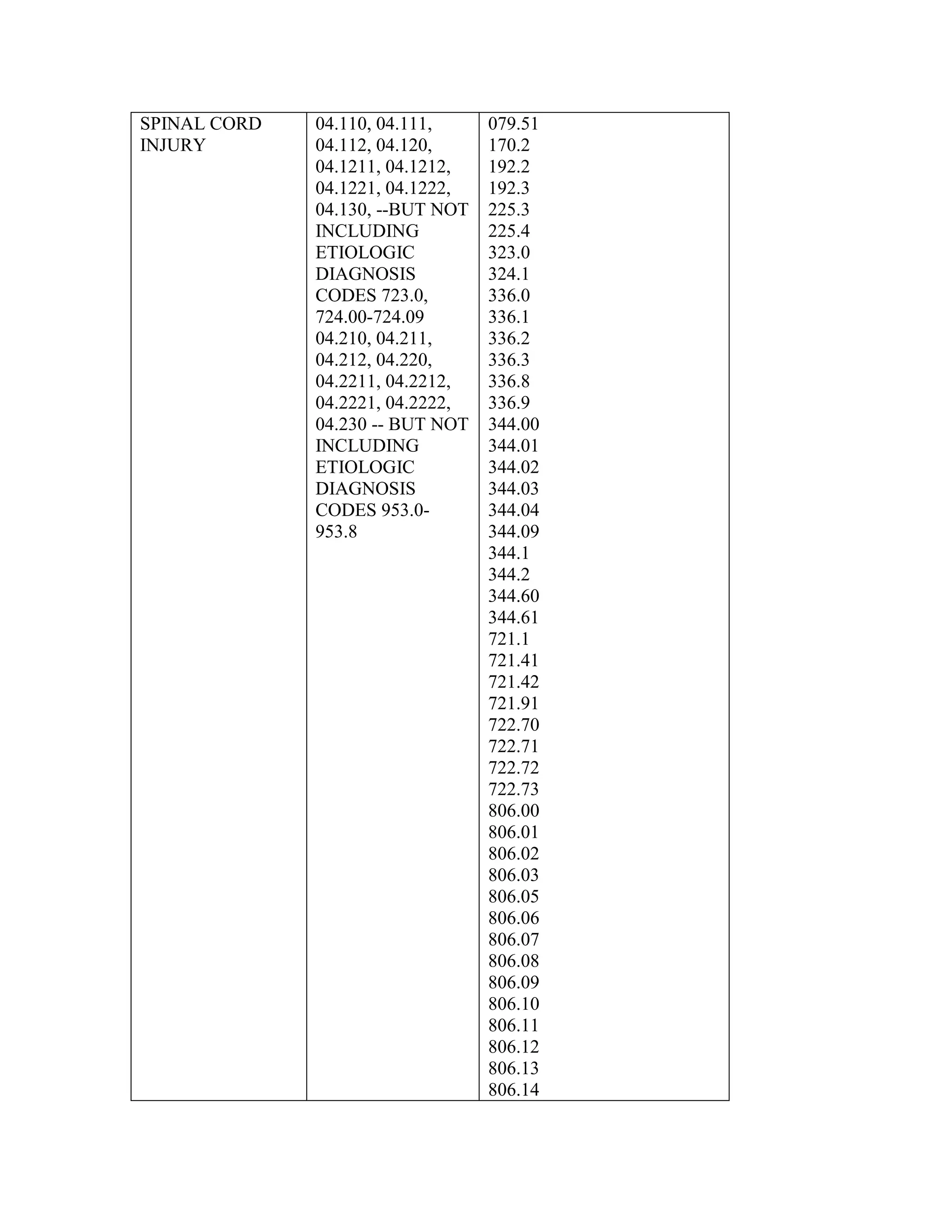
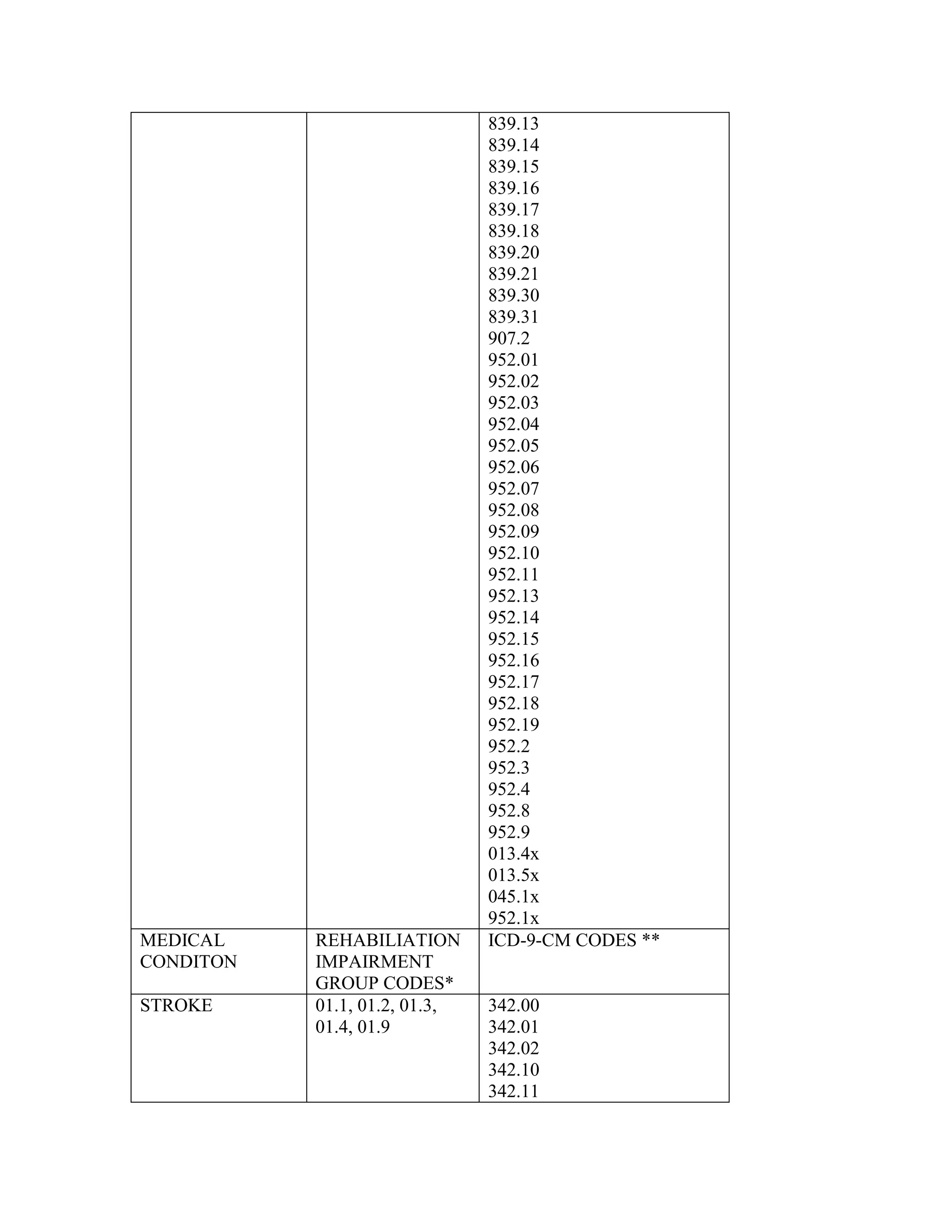
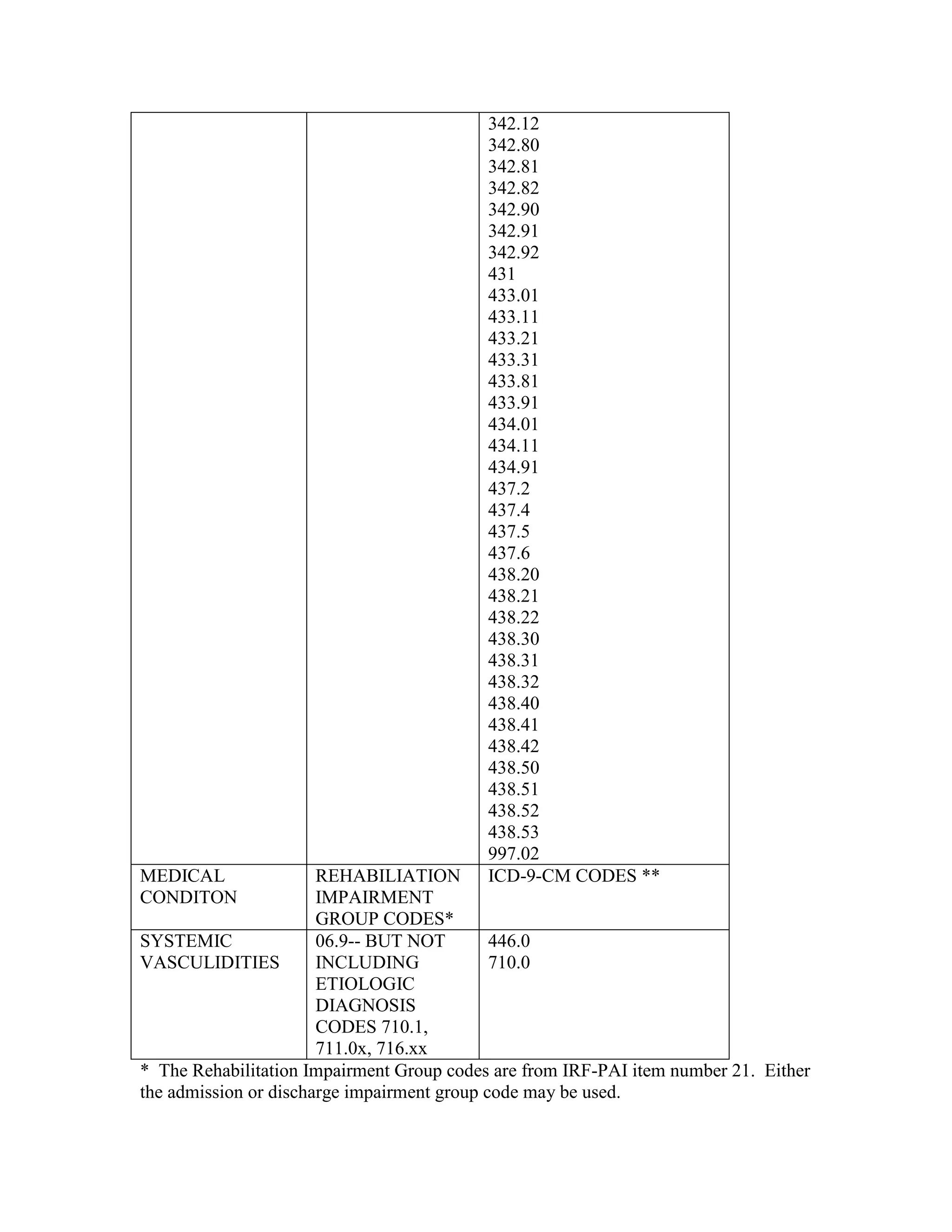
Medicare Claims Processing Manual
Chapter 3 - Inpatient Hospital Billing
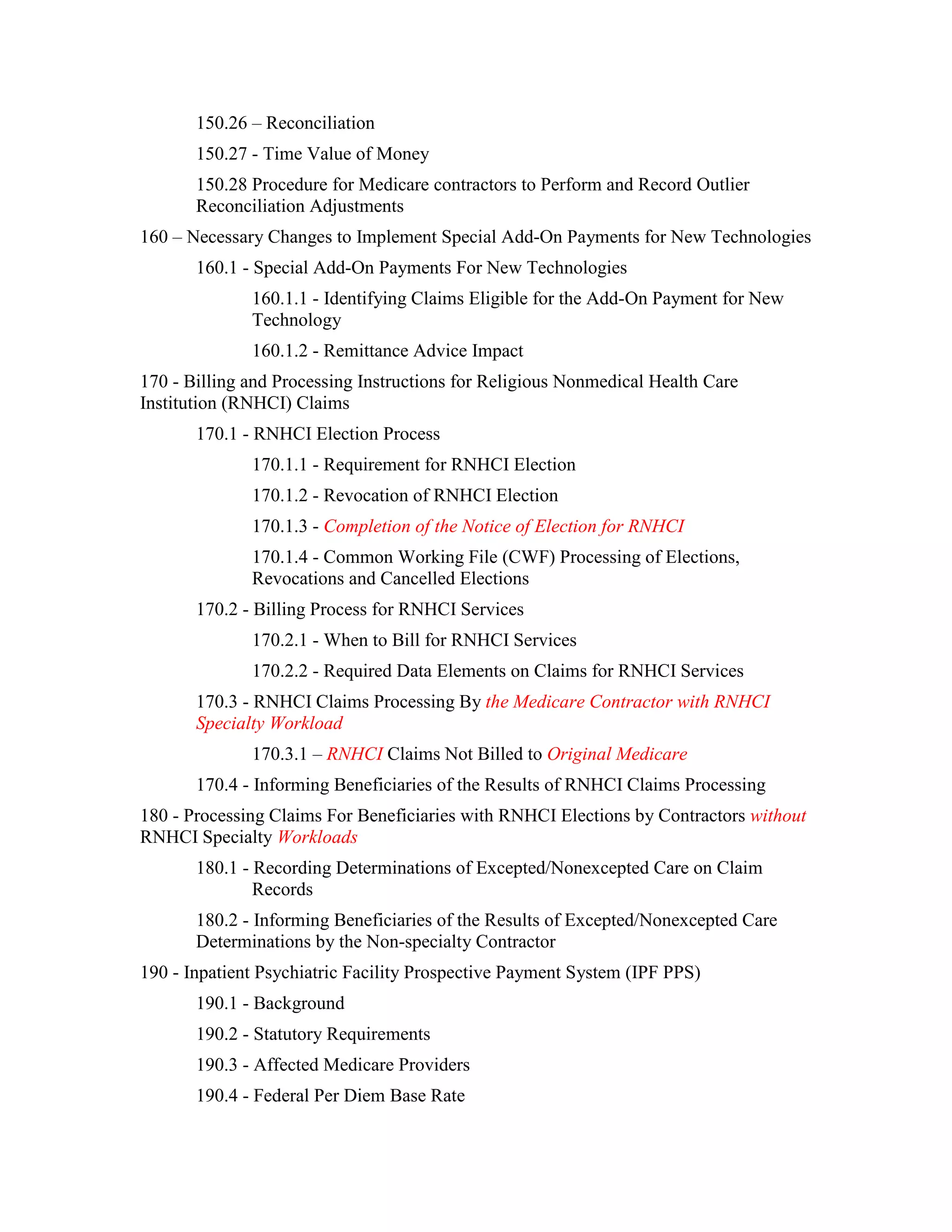
Table of Contents
(Rev. 2654, 02-08-13)

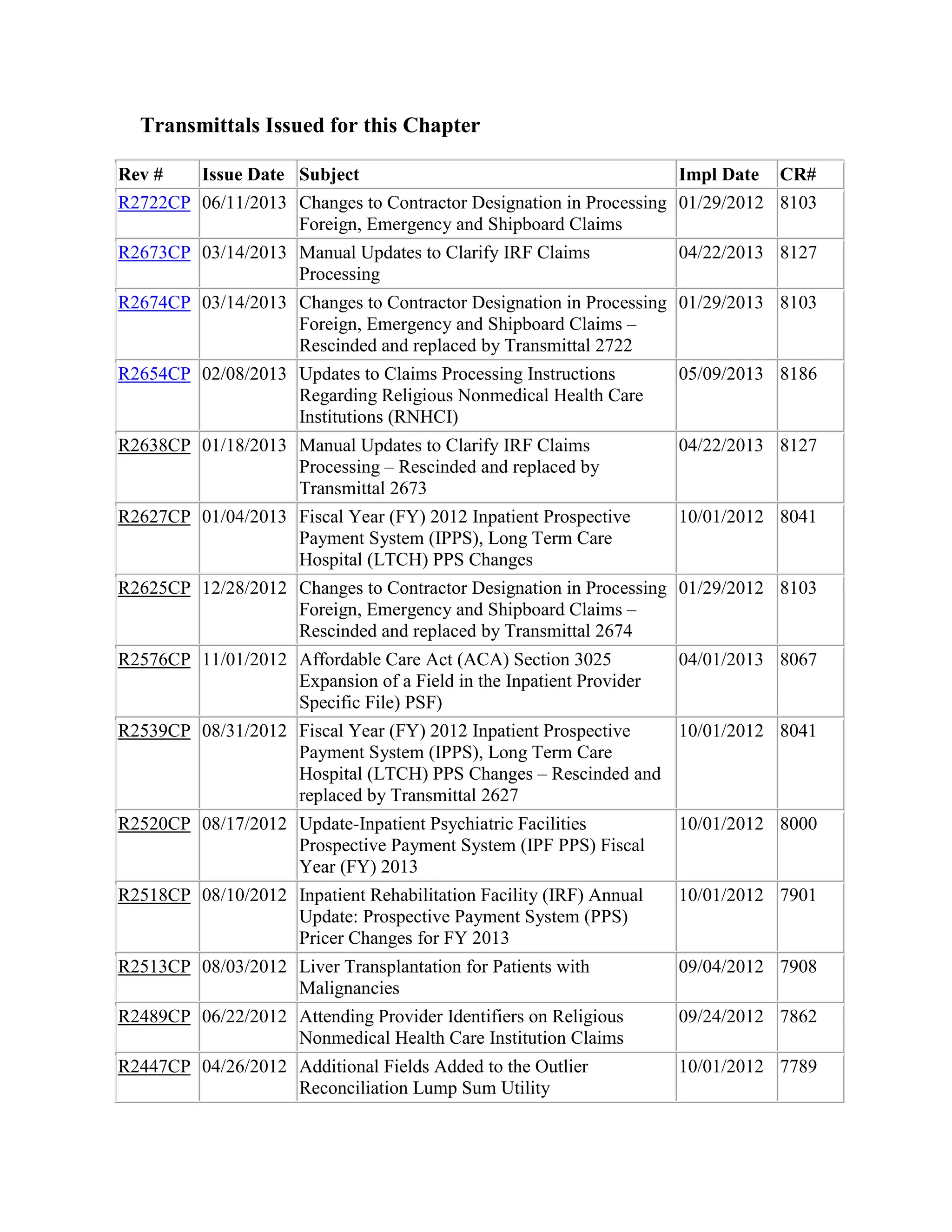
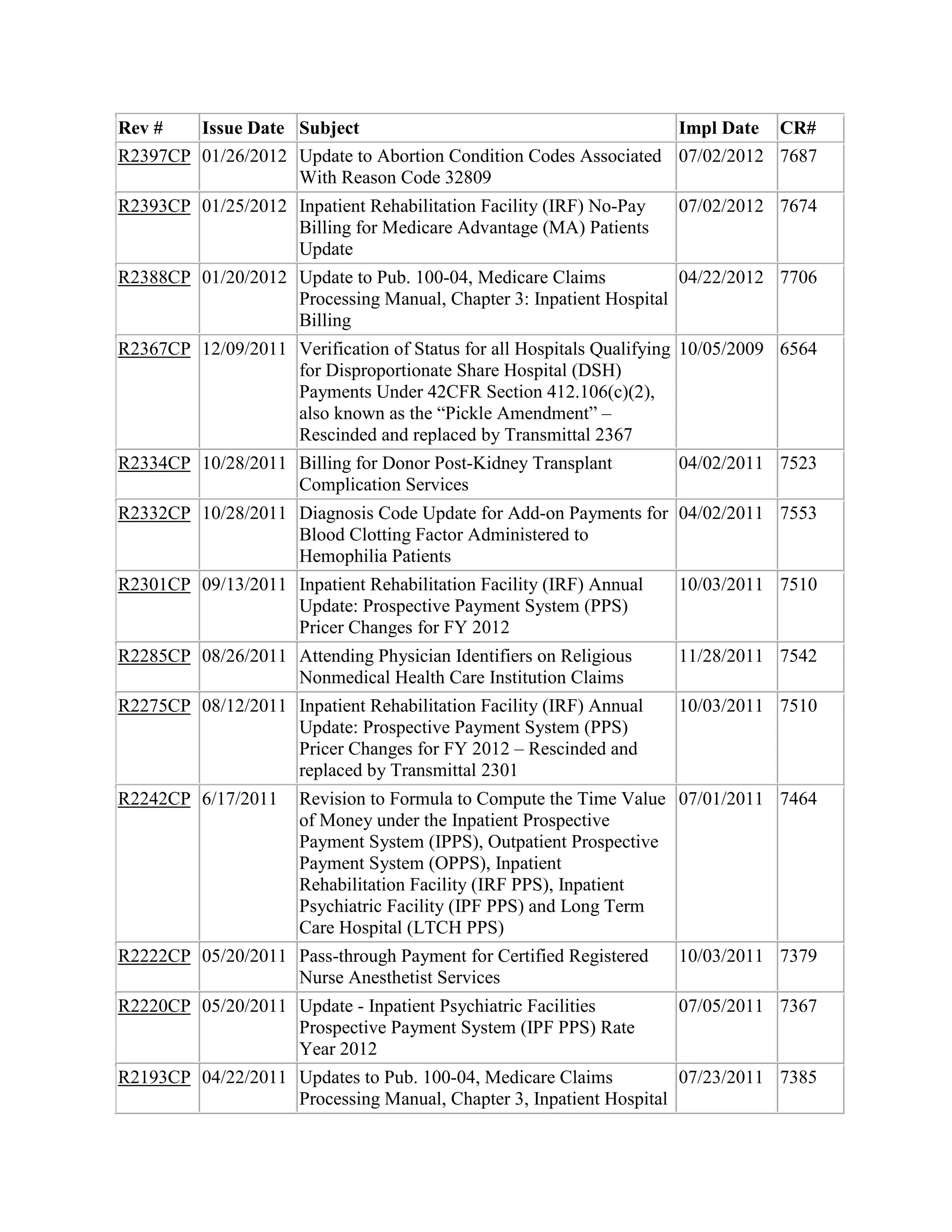
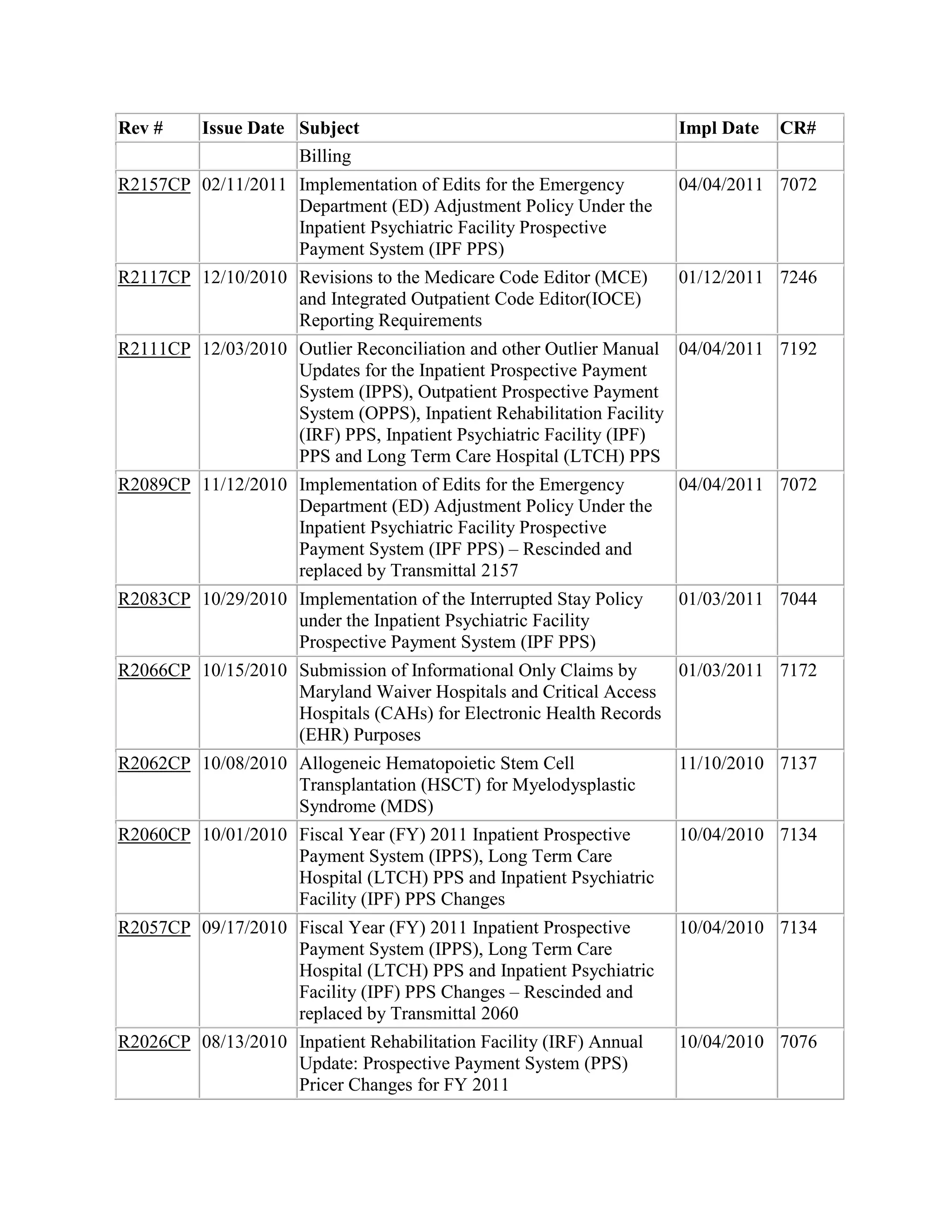
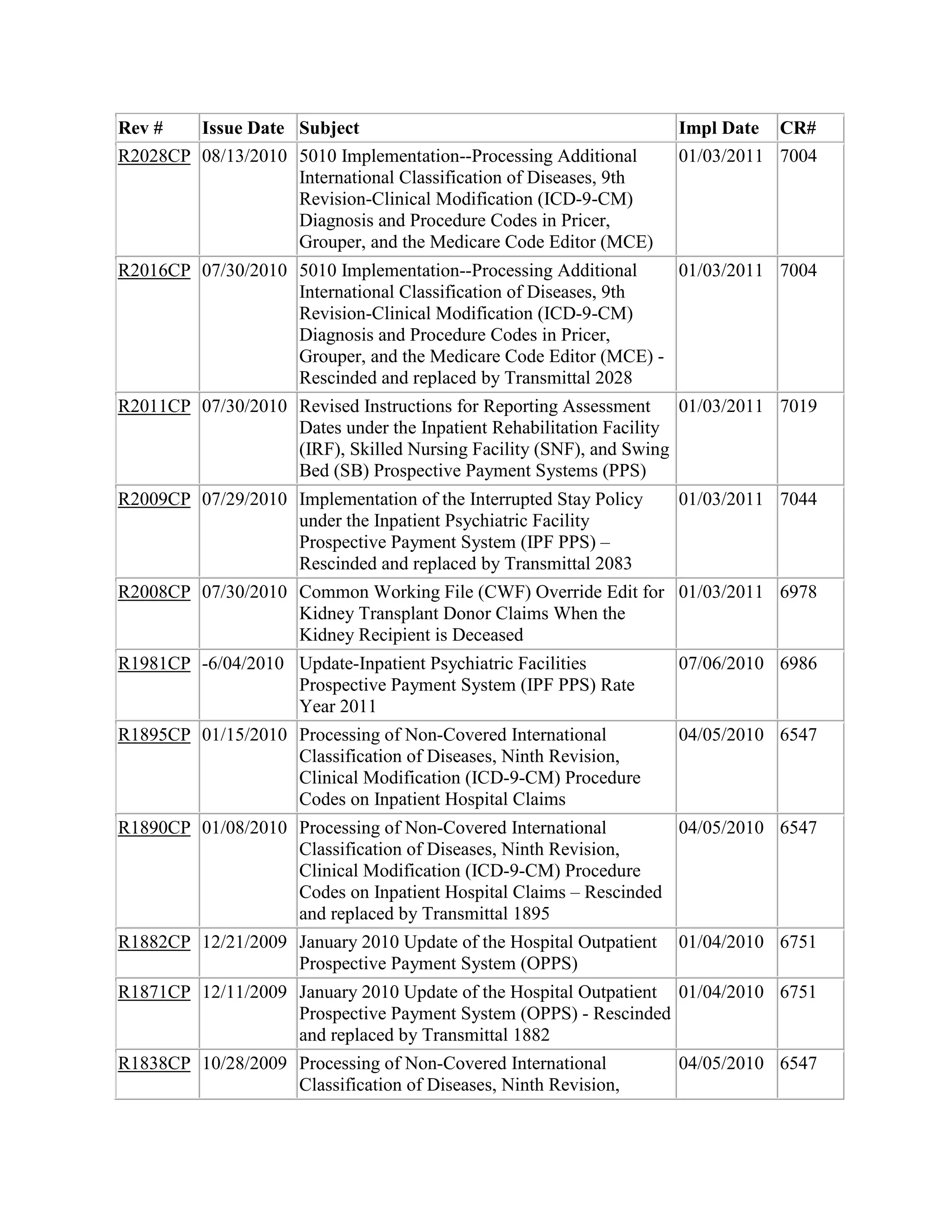
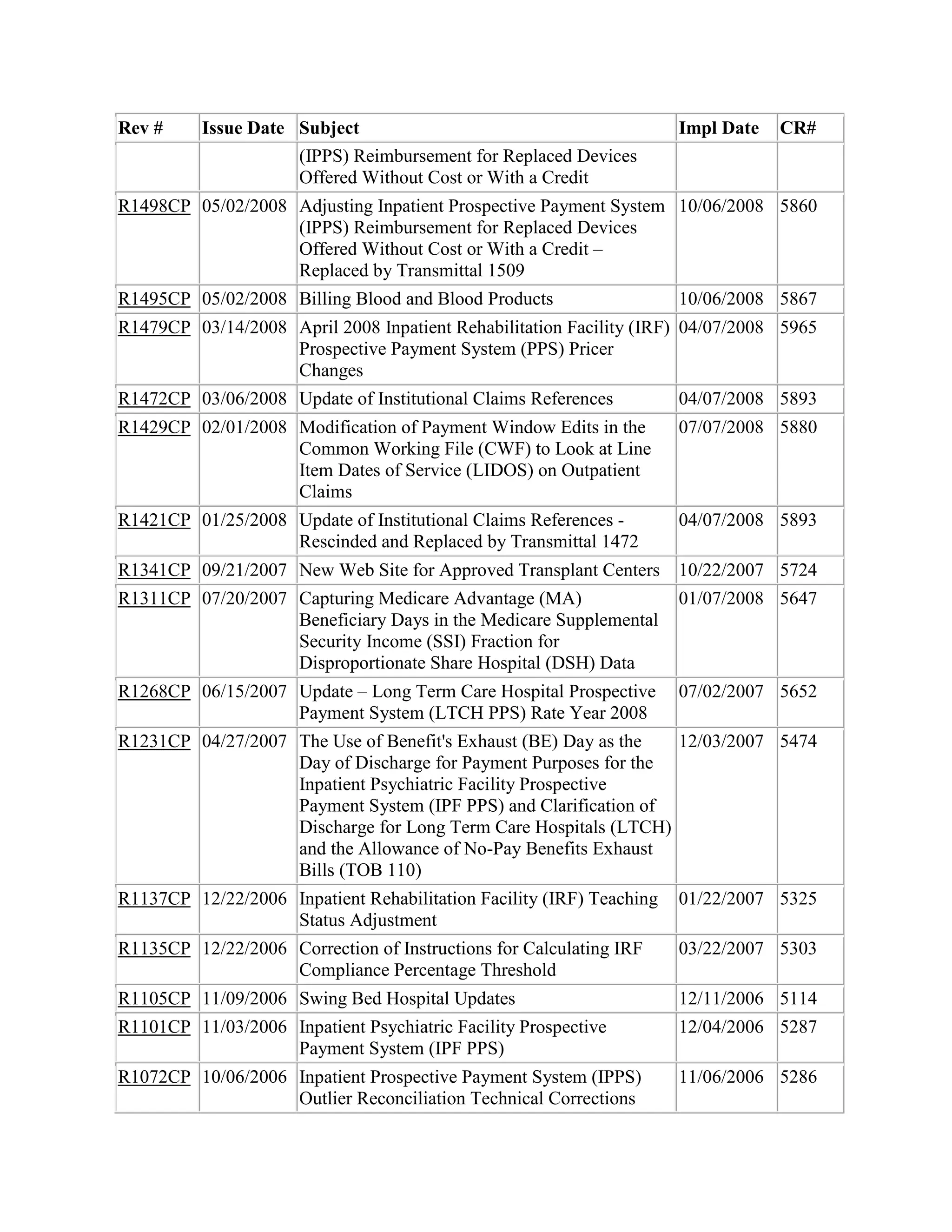
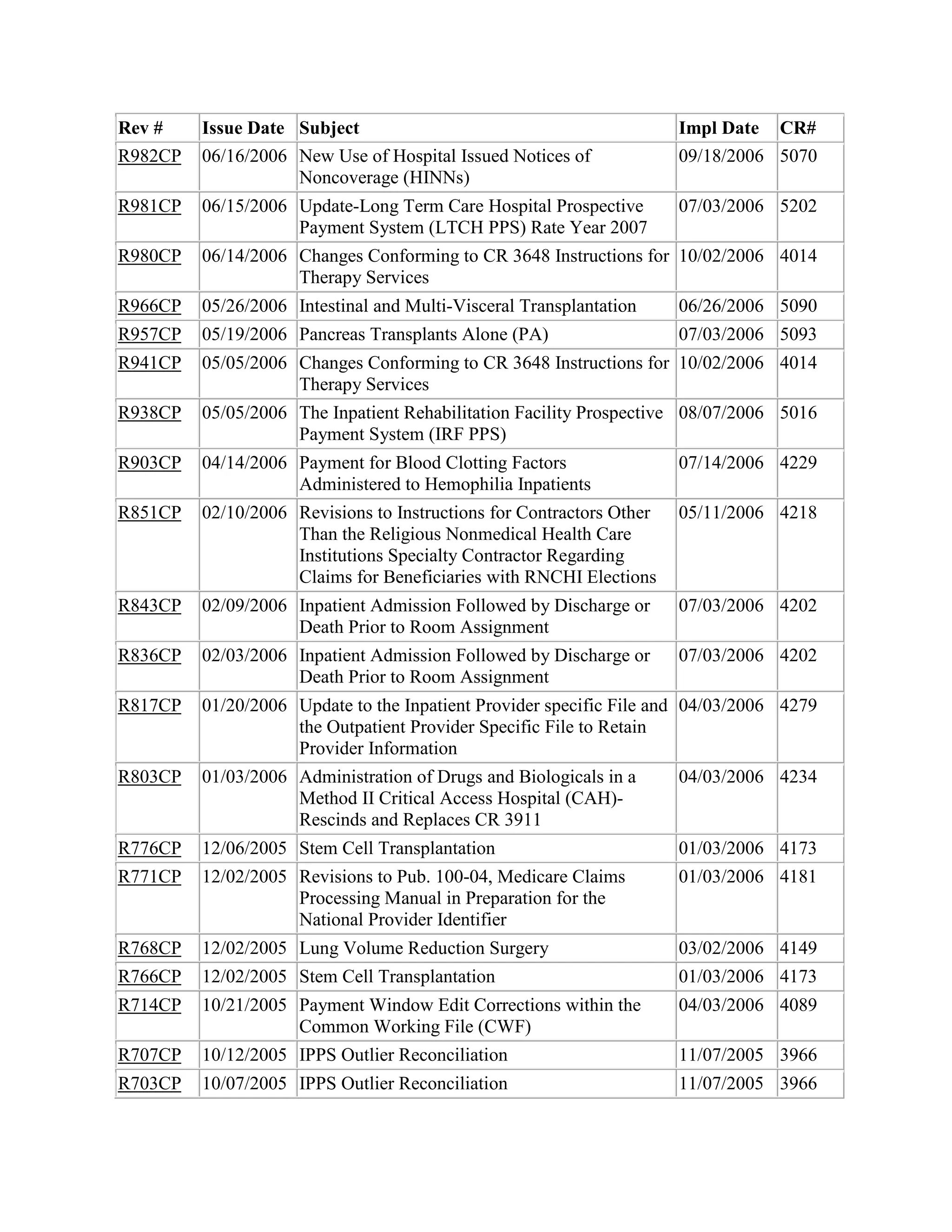
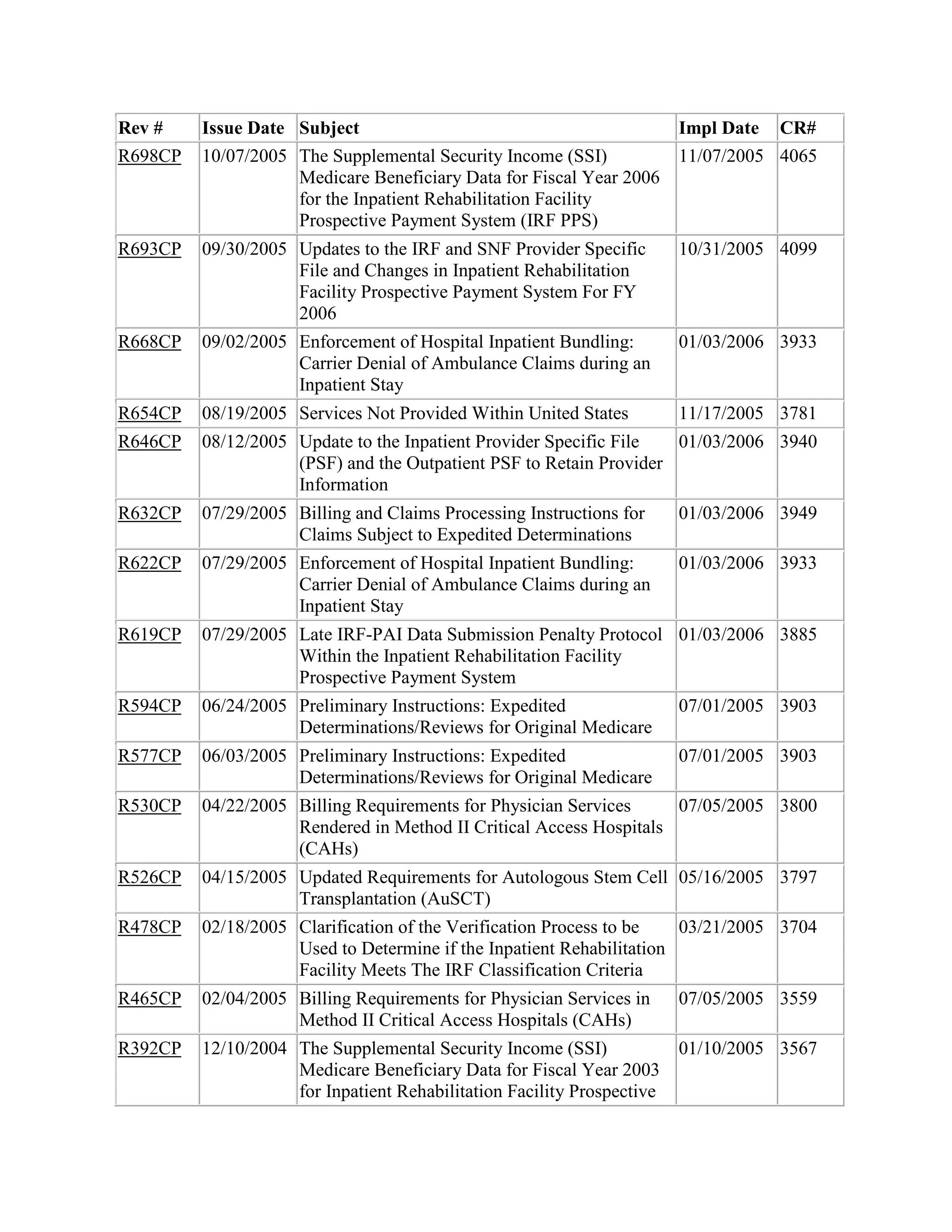
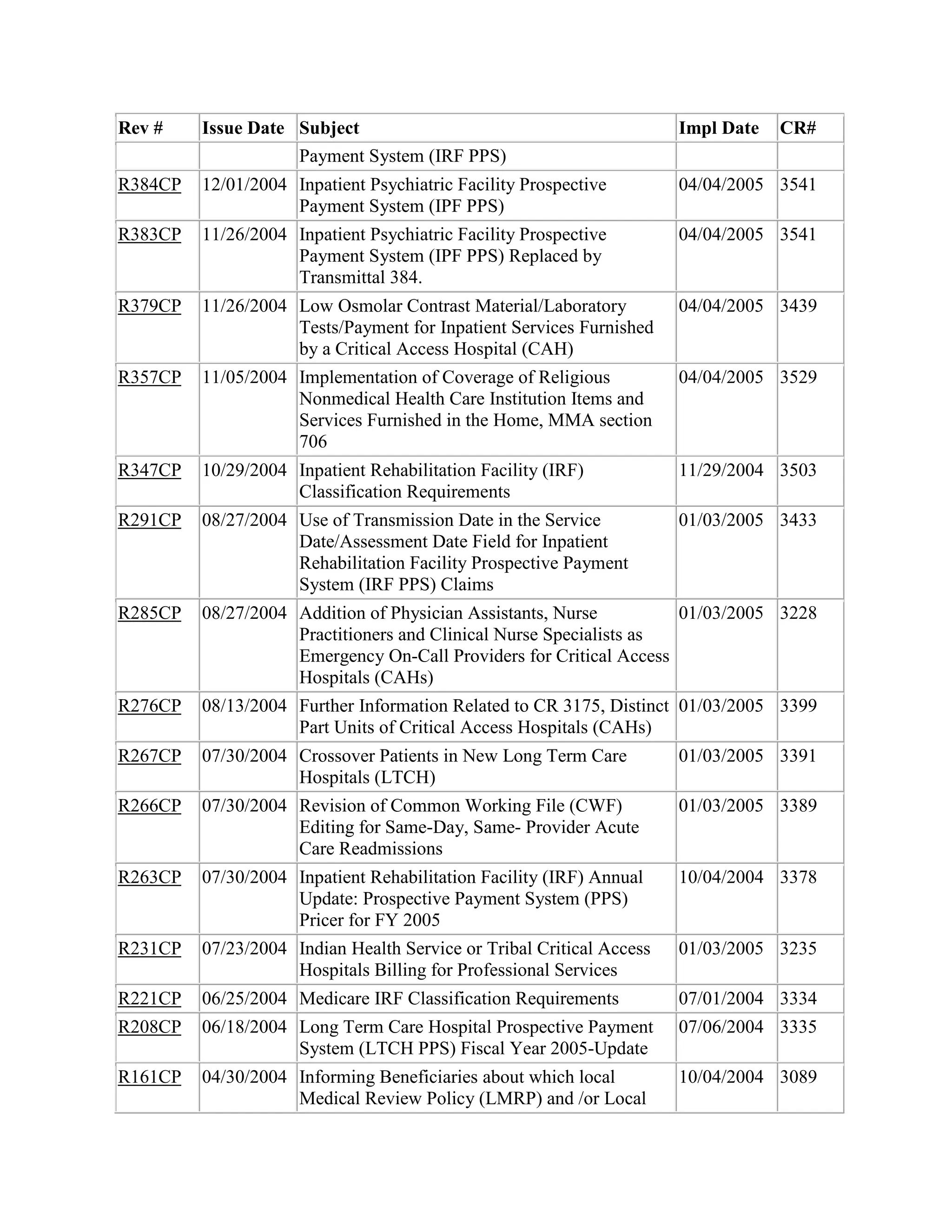
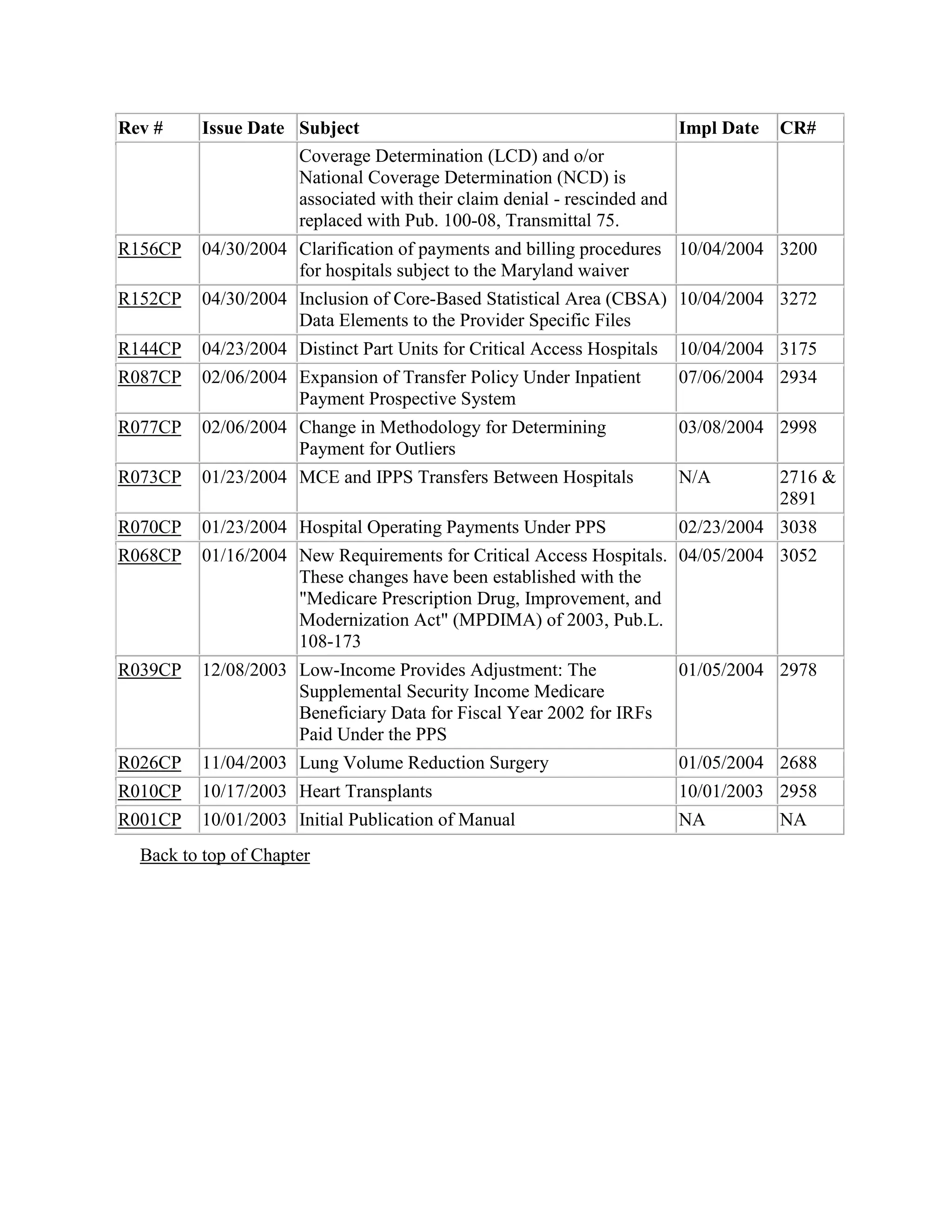
Transmittals for Chapter 3
10 - General Inpatient Requirements
10.1 - Forms
10.2 - Focused Medical Review (FMR)
10.3 - Spell of Illness
10.4 - Payment of Nonphysician Services for Inpatients
10.5 - Hospital Inpatient Bundling
20 - Payment Under Prospective Payment System (PPS) Diagnosis Related Groups
(DRGs)
20.1 - Hospital Operating Payments Under PPS
20.1.1 - Hospital Wage Index
20.1.2 - Outliers
20.1.2.1 - Cost to Charge Ratios
20.1.2.2 - Statewide Average Cost to Charge Ratios
20.1.2.3 - Threshold and Marginal Cost
20.1.2.4 - Transfers
20.1.2.5 - Reconciliation
20.1.2.6 - Time Value of Money
20.1.2.7 - Procedure for Medicare contractors to Perform and
Record Outlier Reconciliation Adjustments
20.1.2.8 - Specific Outlier Payments for Burn Cases
20.1.2.9 - Medical Review and Adjustments
20.1.2.10 - Return Codes for Pricer
20.2 - Computer Programs Used to Support Prospective Payment System
20.2.1 - Medicare Code Editor (MCE)
20.2.1.1 - Paying Claims Outside of the MCE
20.2.1.1.1 - Requesting to Pay Claims Without MCE Approval
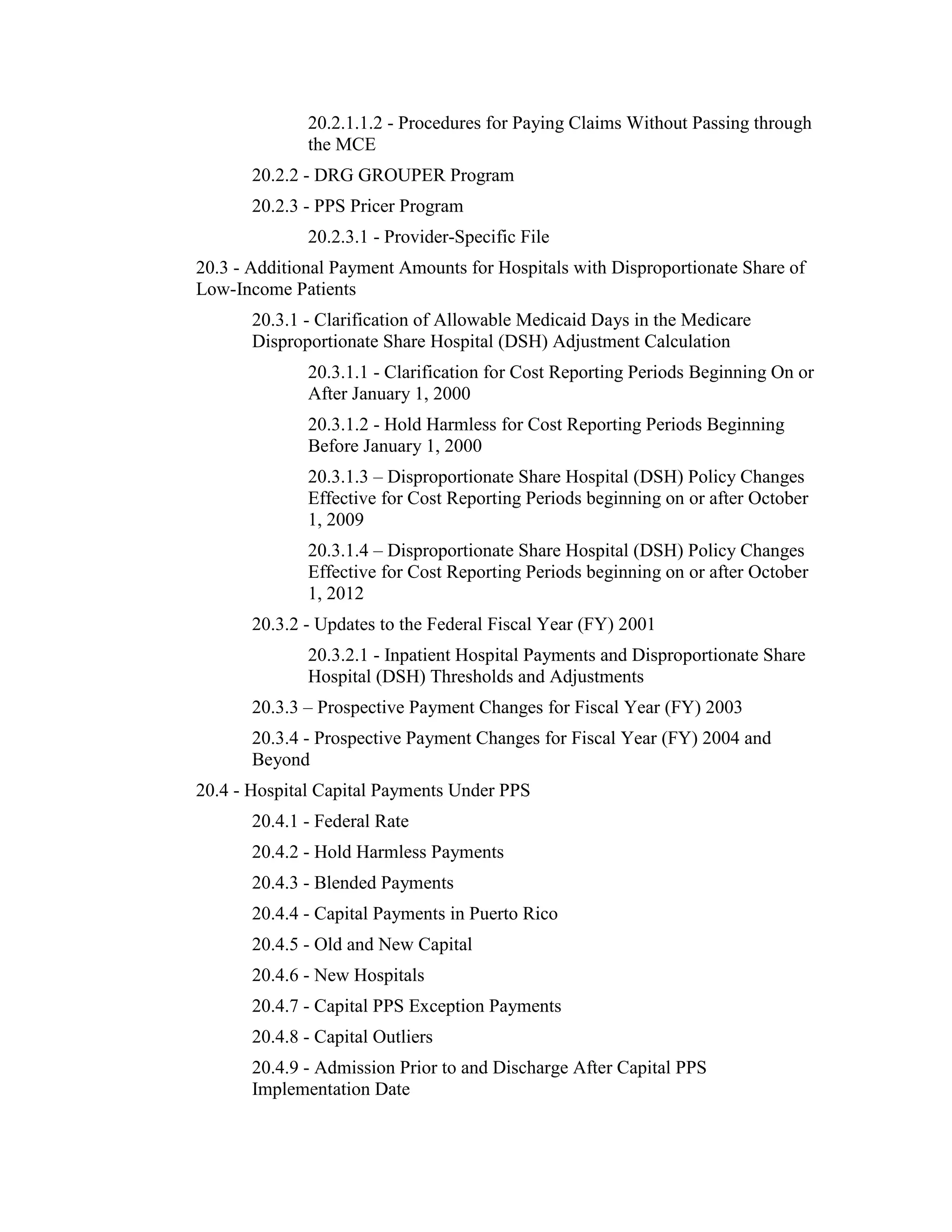
20.2.1.1.2 - Procedures for Paying Claims Without Passing through
the MCE
20.2.2 - DRG GROUPER Program
20.2.3 - PPS Pricer Program
20.2.3.1 - Provider-Specific File
20.3 - Additional Payment Amounts for Hospitals with Disproportionate Share of
Low-Income Patients
20.3.1 - Clarification of Allowable Medicaid Days in the Medicare
Disproportionate Share Hospital (DSH) Adjustment Calculation
20.3.1.1 - Clarification for Cost Reporting Periods Beginning On or
After January 1, 2000
20.3.1.2 - Hold Harmless for Cost Reporting Periods Beginning
Before January 1, 2000
20.3.1.3 – Disproportionate Share Hospital (DSH) Policy Changes
Effective for Cost Reporting Periods beginning on or after October
1, 2009
20.3.1.4 – Disproportionate Share Hospital (DSH) Policy Changes
Effective for Cost Reporting Periods beginning on or after October
1, 2012
20.3.2 - Updates to the Federal Fiscal Year (FY) 2001
20.3.2.1 - Inpatient Hospital Payments and Disproportionate Share
Hospital (DSH) Thresholds and Adjustments
20.3.3 – Prospective Payment Changes for Fiscal Year (FY) 2003
20.3.4 - Prospective Payment Changes for Fiscal Year (FY) 2004 and
Beyond
20.4 - Hospital Capital Payments Under PPS
20.4.1 - Federal Rate
20.4.2 - Hold Harmless Payments
20.4.3 - Blended Payments
20.4.4 - Capital Payments in Puerto Rico
20.4.5 - Old and New Capital
20.4.6 - New Hospitals
20.4.7 - Capital PPS Exception Payments
20.4.8 - Capital Outliers
20.4.9 - Admission Prior to and Discharge After Capital PPS
Implementation Date
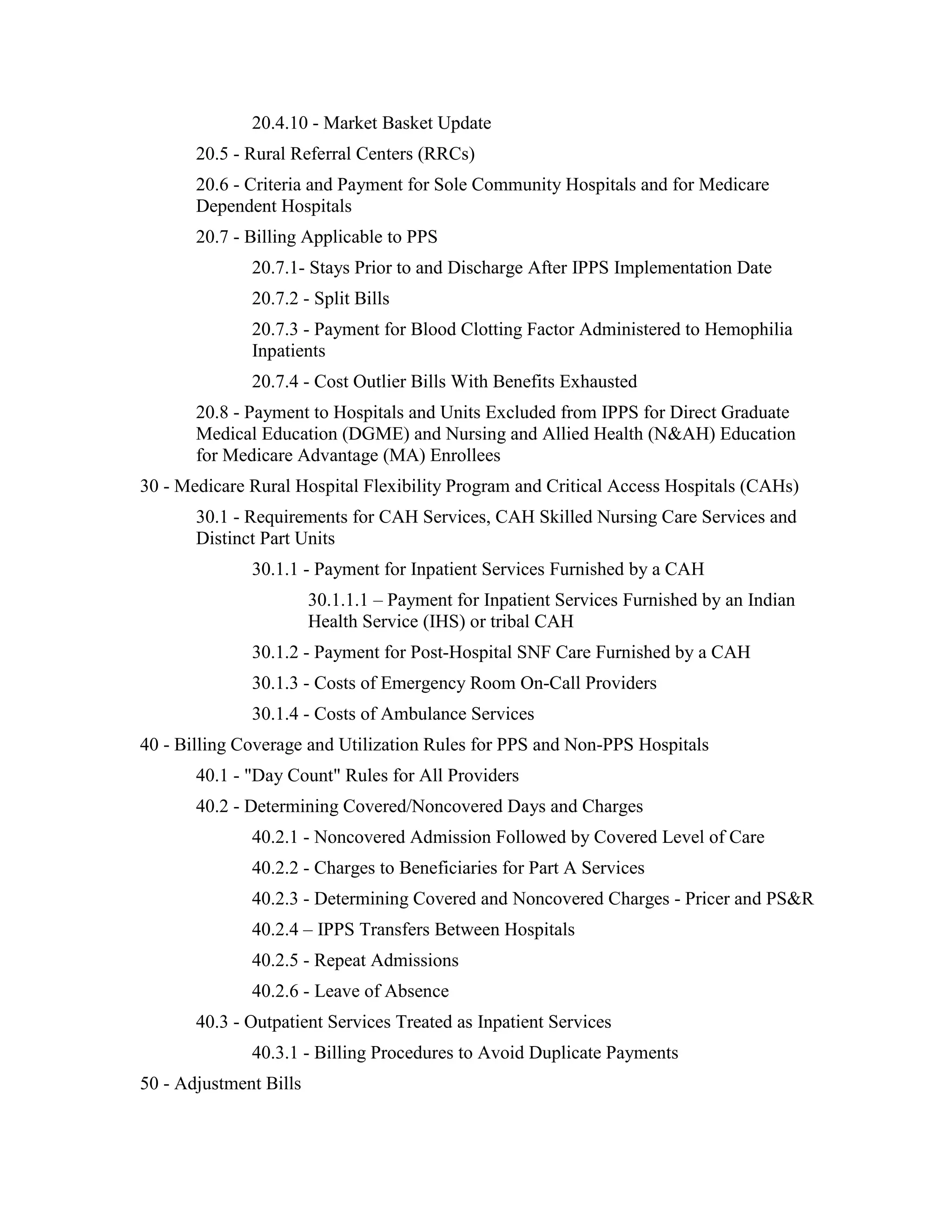
20.4.10 - Market Basket Update
20.5 - Rural Referral Centers (RRCs)
20.6 - Criteria and Payment for Sole Community Hospitals and for Medicare
Dependent Hospitals
20.7 - Billing Applicable to PPS
20.7.1- Stays Prior to and Discharge After IPPS Implementation Date
20.7.2 - Split Bills
20.7.3 - Payment for Blood Clotting Factor Administered to Hemophilia
Inpatients
20.7.4 - Cost Outlier Bills With Benefits Exhausted
20.8 - Payment to Hospitals and Units Excluded from IPPS for Direct Graduate
Medical Education (DGME) and Nursing and Allied Health (N&AH) Education
for Medicare Advantage (MA) Enrollees
30 - Medicare Rural Hospital Flexibility Program and Critical Access Hospitals (CAHs)
30.1 - Requirements for CAH Services, CAH Skilled Nursing Care Services and
Distinct Part Units
30.1.1 - Payment for Inpatient Services Furnished by a CAH
30.1.1.1 – Payment for Inpatient Services Furnished by an Indian
Health Service (IHS) or tribal CAH
30.1.2 - Payment for Post-Hospital SNF Care Furnished by a CAH
30.1.3 - Costs of Emergency Room On-Call Providers
30.1.4 - Costs of Ambulance Services
40 - Billing Coverage and Utilization Rules for PPS and Non-PPS Hospitals
40.1 - "Day Count" Rules for All Providers
40.2 - Determining Covered/Noncovered Days and Charges
40.2.1 - Noncovered Admission Followed by Covered Level of Care
40.2.2 - Charges to Beneficiaries for Part A Services
40.2.3 - Determining Covered and Noncovered Charges - Pricer and PS&R
40.2.4 – IPPS Transfers Between Hospitals
40.2.5 - Repeat Admissions
40.2.6 - Leave of Absence
40.3 - Outpatient Services Treated as Inpatient Services
40.3.1 - Billing Procedures to Avoid Duplicate Payments
50 - Adjustment Bills
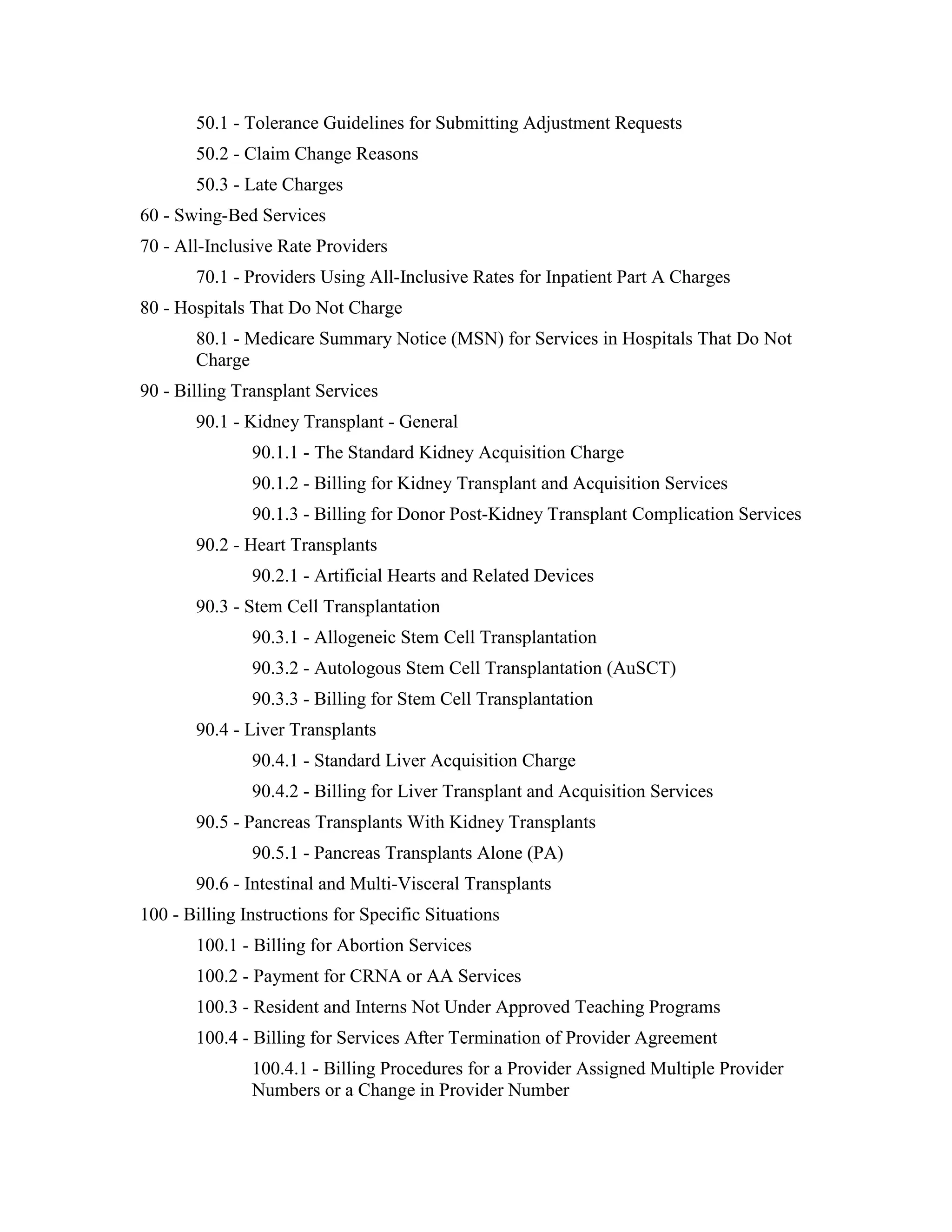
50.1 - Tolerance Guidelines for Submitting Adjustment Requests
50.2 - Claim Change Reasons
50.3 - Late Charges
60 - Swing-Bed Services
70 - All-Inclusive Rate Providers
70.1 - Providers Using All-Inclusive Rates for Inpatient Part A Charges
80 - Hospitals That Do Not Charge
80.1 - Medicare Summary Notice (MSN) for Services in Hospitals That Do Not
Charge
90 - Billing Transplant Services
90.1 - Kidney Transplant - General
90.1.1 - The Standard Kidney Acquisition Charge
90.1.2 - Billing for Kidney Transplant and Acquisition Services
90.1.3 - Billing for Donor Post-Kidney Transplant Complication Services
90.2 - Heart Transplants
90.2.1 - Artificial Hearts and Related Devices
90.3 - Stem Cell Transplantation
90.3.1 - Allogeneic Stem Cell Transplantation
90.3.2 - Autologous Stem Cell Transplantation (AuSCT)
90.3.3 - Billing for Stem Cell Transplantation
90.4 - Liver Transplants
90.4.1 - Standard Liver Acquisition Charge
90.4.2 - Billing for Liver Transplant and Acquisition Services
90.5 - Pancreas Transplants With Kidney Transplants
90.5.1 - Pancreas Transplants Alone (PA)
90.6 - Intestinal and Multi-Visceral Transplants
100 - Billing Instructions for Specific Situations
100.1 - Billing for Abortion Services
100.2 - Payment for CRNA or AA Services
100.3 - Resident and Interns Not Under Approved Teaching Programs
100.4 - Billing for Services After Termination of Provider Agreement
100.4.1 - Billing Procedures for a Provider Assigned Multiple Provider
Numbers or a Change in Provider Number
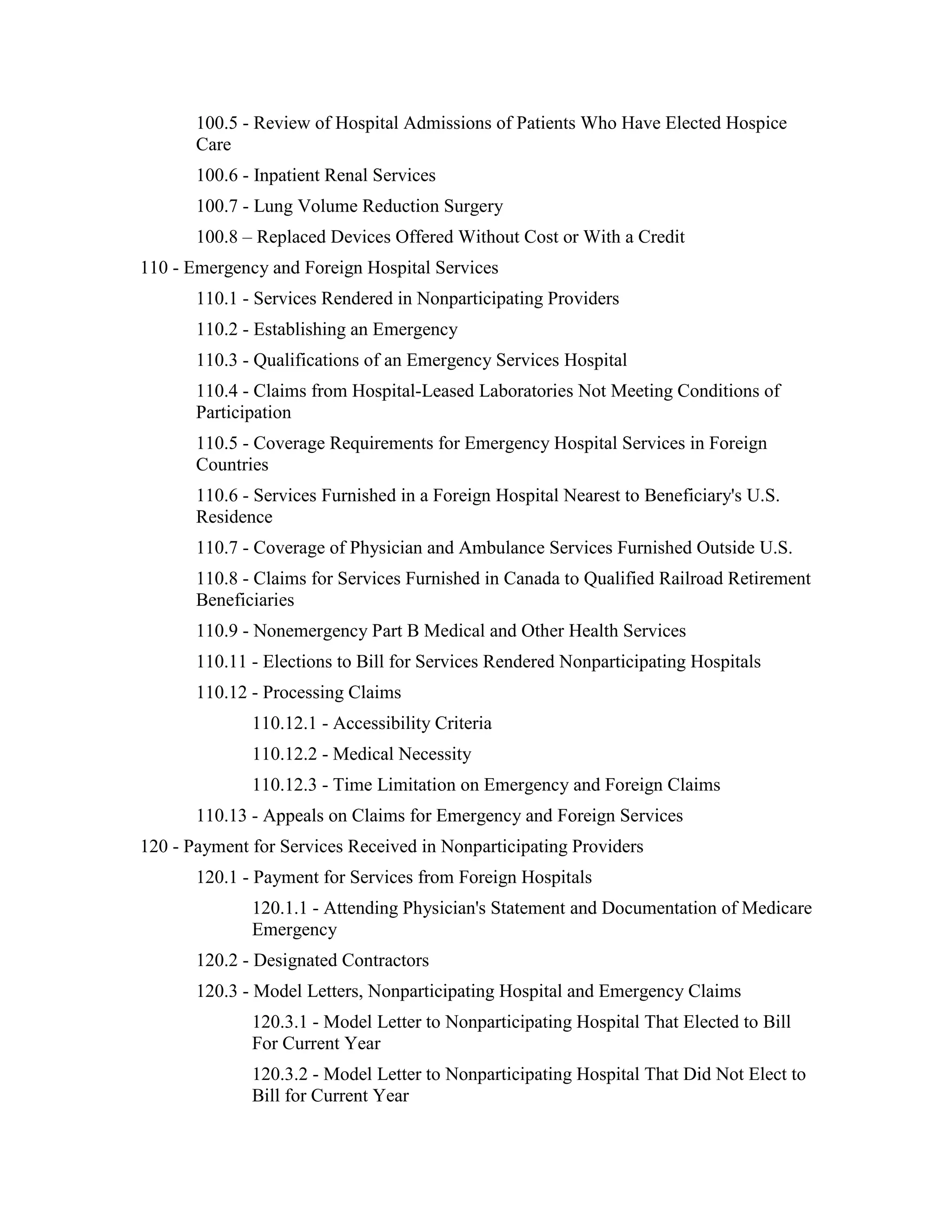
100.5 - Review of Hospital Admissions of Patients Who Have Elected Hospice
Care
100.6 - Inpatient Renal Services
100.7 - Lung Volume Reduction Surgery
100.8 – Replaced Devices Offered Without Cost or With a Credit
110 - Emergency and Foreign Hospital Services
110.1 - Services Rendered in Nonparticipating Providers
110.2 - Establishing an Emergency
110.3 - Qualifications of an Emergency Services Hospital
110.4 - Claims from Hospital-Leased Laboratories Not Meeting Conditions of
Participation
110.5 - Coverage Requirements for Emergency Hospital Services in Foreign
Countries
110.6 - Services Furnished in a Foreign Hospital Nearest to Beneficiary's U.S.
Residence
110.7 - Coverage of Physician and Ambulance Services Furnished Outside U.S.
110.8 - Claims for Services Furnished in Canada to Qualified Railroad Retirement
Beneficiaries
110.9 - Nonemergency Part B Medical and Other Health Services
110.11 - Elections to Bill for Services Rendered Nonparticipating Hospitals
110.12 - Processing Claims
110.12.1 - Accessibility Criteria
110.12.2 - Medical Necessity
110.12.3 - Time Limitation on Emergency and Foreign Claims
110.13 - Appeals on Claims for Emergency and Foreign Services
120 - Payment for Services Received in Nonparticipating Providers
120.1 - Payment for Services from Foreign Hospitals
120.1.1 - Attending Physician's Statement and Documentation of Medicare
Emergency
120.2 - Designated Contractors
120.3 - Model Letters, Nonparticipating Hospital and Emergency Claims
120.3.1 - Model Letter to Nonparticipating Hospital That Elected to Bill
For Current Year
120.3.2 - Model Letter to Nonparticipating Hospital That Did Not Elect to
Bill for Current Year
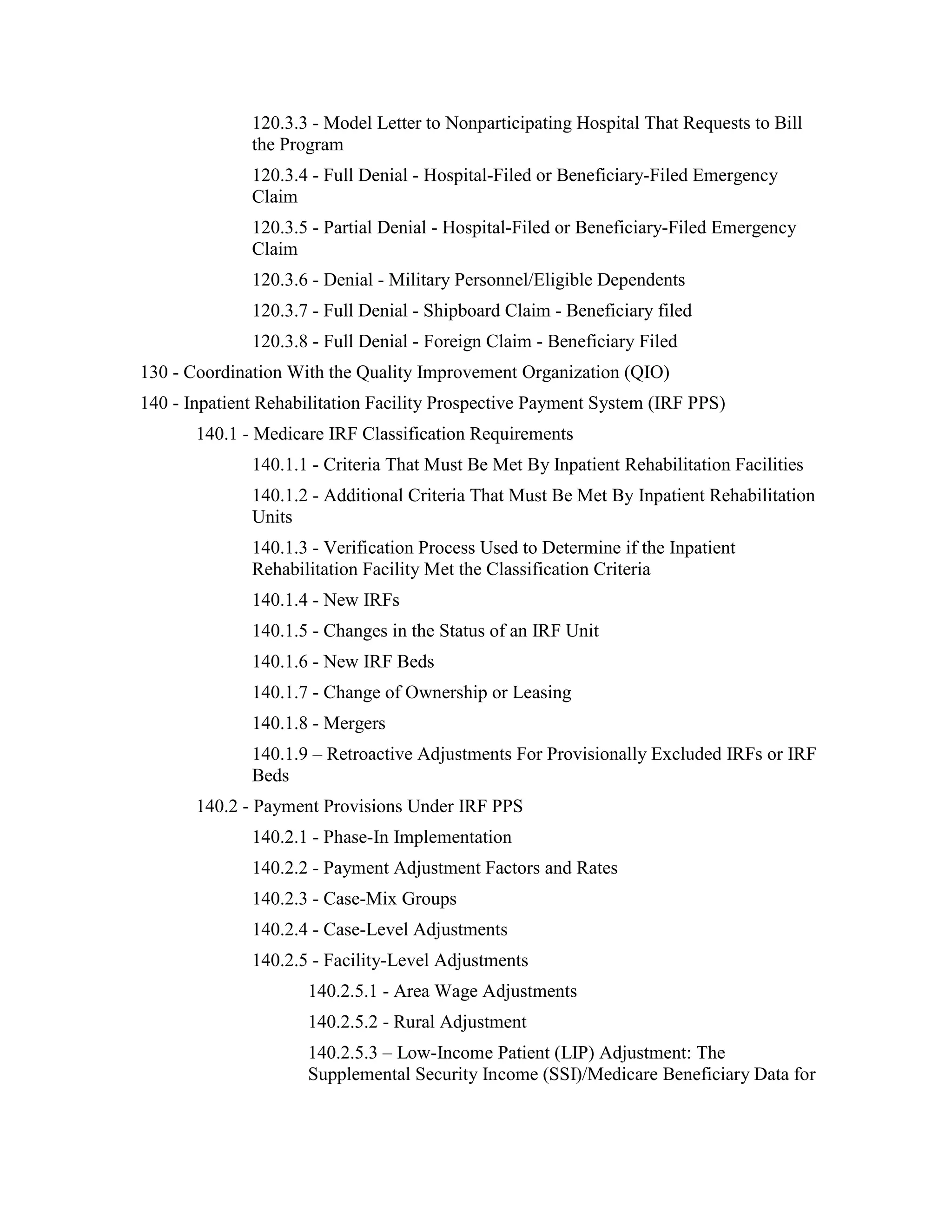
120.3.3 - Model Letter to Nonparticipating Hospital That Requests to Bill
the Program
120.3.4 - Full Denial - Hospital-Filed or Beneficiary-Filed Emergency
Claim
120.3.5 - Partial Denial - Hospital-Filed or Beneficiary-Filed Emergency
Claim
120.3.6 - Denial - Military Personnel/Eligible Dependents
120.3.7 - Full Denial - Shipboard Claim - Beneficiary filed
120.3.8 - Full Denial - Foreign Claim - Beneficiary Filed
130 - Coordination With the Quality Improvement Organization (QIO)
140 - Inpatient Rehabilitation Facility Prospective Payment System (IRF PPS)
140.1 - Medicare IRF Classification Requirements
140.1.1 - Criteria That Must Be Met By Inpatient Rehabilitation Facilities
140.1.2 - Additional Criteria That Must Be Met By Inpatient Rehabilitation
Units
140.1.3 - Verification Process Used to Determine if the Inpatient
Rehabilitation Facility Met the Classification Criteria
140.1.4 - New IRFs
140.1.5 - Changes in the Status of an IRF Unit
140.1.6 - New IRF Beds
140.1.7 - Change of Ownership or Leasing
140.1.8 - Mergers
140.1.9 – Retroactive Adjustments For Provisionally Excluded IRFs or IRF
Beds
140.2 - Payment Provisions Under IRF PPS
140.2.1 - Phase-In Implementation
140.2.2 - Payment Adjustment Factors and Rates
140.2.3 - Case-Mix Groups
140.2.4 - Case-Level Adjustments
140.2.5 - Facility-Level Adjustments
140.2.5.1 - Area Wage Adjustments
140.2.5.2 - Rural Adjustment
140.2.5.3 – Low-Income Patient (LIP) Adjustment: The
Supplemental Security Income (SSI)/Medicare Beneficiary Data for
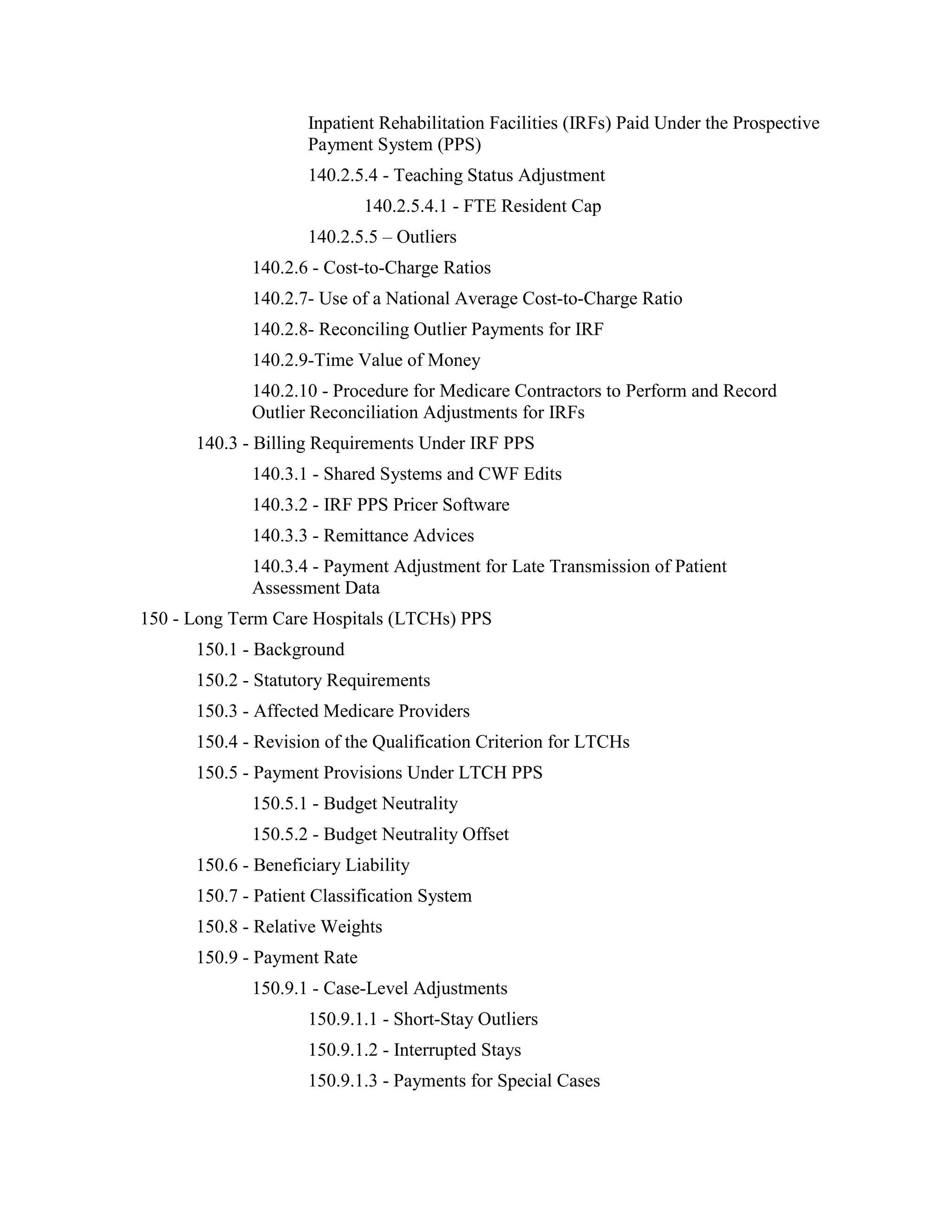
Inpatient Rehabilitation Facilities (IRFs) Paid Under the Prospective
Payment System (PPS)
140.2.5.4 - Teaching Status Adjustment
140.2.5.4.1 - FTE Resident Cap
140.2.5.5 – Outliers
140.2.6 - Cost-to-Charge Ratios
140.2.7- Use of a National Average Cost-to-Charge Ratio
140.2.8- Reconciling Outlier Payments for IRF
140.2.9-Time Value of Money
140.2.10 - Procedure for Medicare Contractors to Perform and Record
Outlier Reconciliation Adjustments for IRFs
140.3 - Billing Requirements Under IRF PPS
140.3.1 - Shared Systems and CWF Edits
140.3.2 - IRF PPS Pricer Software
140.3.3 - Remittance Advices
140.3.4 - Payment Adjustment for Late Transmission of Patient
Assessment Data
150 - Long Term Care Hospitals (LTCHs) PPS
150.1 - Background
150.2 - Statutory Requirements
150.3 - Affected Medicare Providers
150.4 - Revision of the Qualification Criterion for LTCHs
150.5 - Payment Provisions Under LTCH PPS
150.5.1 - Budget Neutrality
150.5.2 - Budget Neutrality Offset
150.6 - Beneficiary Liability
150.7 - Patient Classification System
150.8 - Relative Weights
150.9 - Payment Rate
150.9.1 - Case-Level Adjustments
150.9.1.1 - Short-Stay Outliers
150.9.1.2 - Interrupted Stays
150.9.1.3 - Payments for Special Cases
150.9.1.4 - Payment Policy for Co-Located Providers
150.9.1.5 - High Cost Outlier Cases
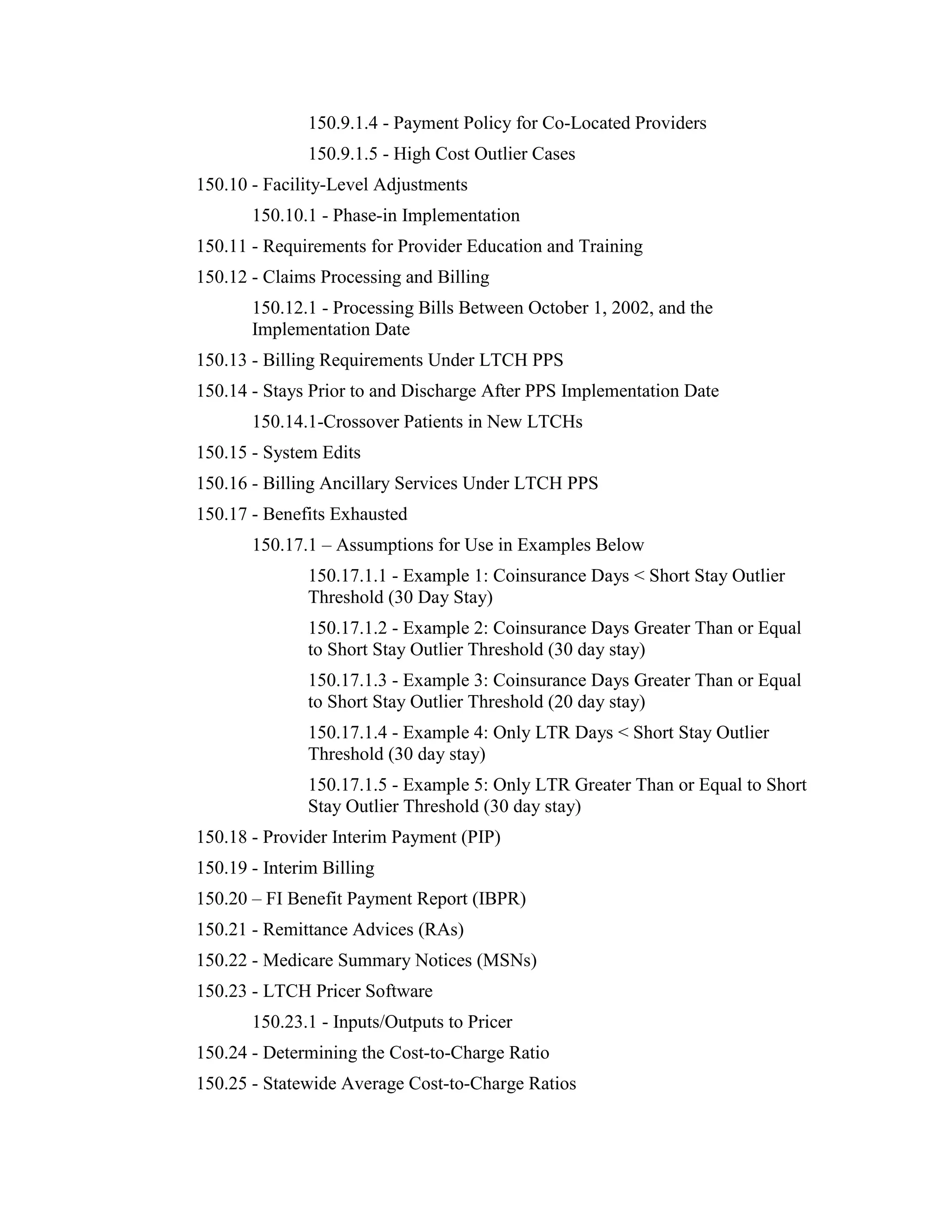
150.10 - Facility-Level Adjustments
150.10.1 - Phase-in Implementation
150.11 - Requirements for Provider Education and Training
150.12 - Claims Processing and Billing
150.12.1 - Processing Bills Between October 1, 2002, and the
Implementation Date
150.13 - Billing Requirements Under LTCH PPS
150.14 - Stays Prior to and Discharge After PPS Implementation Date
150.14.1-Crossover Patients in New LTCHs
150.15 - System Edits
150.16 - Billing Ancillary Services Under LTCH PPS
150.17 - Benefits Exhausted
150.17.1 – Assumptions for Use in Examples Below
150.17.1.1 - Example 1: Coinsurance Days < Short Stay Outlier
Threshold (30 Day Stay)
150.17.1.2 - Example 2: Coinsurance Days Greater Than or Equal
to Short Stay Outlier Threshold (30 day stay)
150.17.1.3 - Example 3: Coinsurance Days Greater Than or Equal
to Short Stay Outlier Threshold (20 day stay)
150.17.1.4 - Example 4: Only LTR Days < Short Stay Outlier
Threshold (30 day stay)
150.17.1.5 - Example 5: Only LTR Greater Than or Equal to Short
Stay Outlier Threshold (30 day stay)
150.18 - Provider Interim Payment (PIP)
150.19 - Interim Billing
150.20 – FI Benefit Payment Report (IBPR)
150.21 - Remittance Advices (RAs)
150.22 - Medicare Summary Notices (MSNs)
150.23 - LTCH Pricer Software
150.23.1 - Inputs/Outputs to Pricer
150.24 - Determining the Cost-to-Charge Ratio
150.25 - Statewide Average Cost-to-Charge Ratios
150.26 – Reconciliation
150.27 - Time Value of Money
150.28 Procedure for Medicare contractors to Perform and Record Outlier
Reconciliation Adjustments
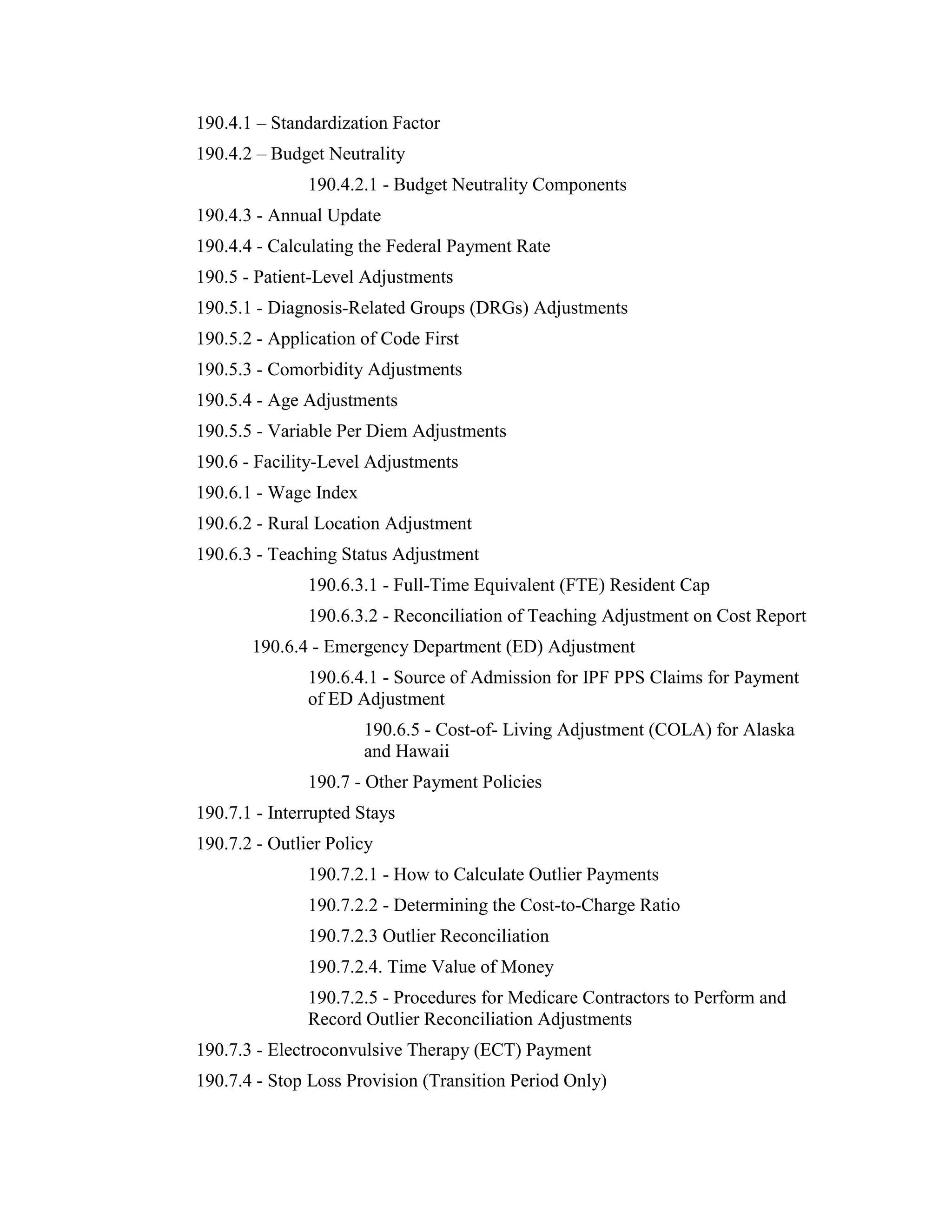
160 – Necessary Changes to Implement Special Add-On Payments for New Technologies
160.1 - Special Add-On Payments For New Technologies
160.1.1 - Identifying Claims Eligible for the Add-On Payment for New
Technology
160.1.2 - Remittance Advice Impact
170 - Billing and Processing Instructions for Religious Nonmedical Health Care
Institution (RNHCI) Claims
170.1 - RNHCI Election Process
170.1.1 - Requirement for RNHCI Election
170.1.2 - Revocation of RNHCI Election
170.1.3 - Completion of the Notice of Election for RNHCI
170.1.4 - Common Working File (CWF) Processing of Elections,
Revocations and Cancelled Elections
170.2 - Billing Process for RNHCI Services
170.2.1 - When to Bill for RNHCI Services
170.2.2 - Required Data Elements on Claims for RNHCI Services
170.3 - RNHCI Claims Processing By the Medicare Contractor with RNHCI
Specialty Workload
170.3.1 – RNHCI Claims Not Billed to Original Medicare
170.4 - Informing Beneficiaries of the Results of RNHCI Claims Processing
180 - Processing Claims For Beneficiaries with RNHCI Elections by Contractors without
RNHCI Specialty Workloads
180.1 - Recording Determinations of Excepted/Nonexcepted Care on Claim
Records
180.2 - Informing Beneficiaries of the Results of Excepted/Nonexcepted Care
Determinations by the Non-specialty Contractor
190 - Inpatient Psychiatric Facility Prospective Payment System (IPF PPS)
190.1 - Background
190.2 - Statutory Requirements
190.3 - Affected Medicare Providers
190.4 - Federal Per Diem Base Rate
190.4.1 – Standardization Factor
190.4.2 – Budget Neutrality
190.4.2.1 - Budget Neutrality Components
190.4.3 - Annual Update
190.4.4 - Calculating the Federal Payment Rate
190.5 - Patient-Level Adjustments
190.5.1 - Diagnosis-Related Groups (DRGs) Adjustments
190.5.2 - Application of Code First
190.5.3 - Comorbidity Adjustments
190.5.4 - Age Adjustments
190.5.5 - Variable Per Diem Adjustments
190.6 - Facility-Level Adjustments
190.6.1 - Wage Index
190.6.2 - Rural Location Adjustment
190.6.3 - Teaching Status Adjustment
190.6.3.1 - Full-Time Equivalent (FTE) Resident Cap
190.6.3.2 - Reconciliation of Teaching Adjustment on Cost Report
190.6.4 - Emergency Department (ED) Adjustment
190.6.4.1 - Source of Admission for IPF PPS Claims for Payment
of ED Adjustment
190.6.5 - Cost-of- Living Adjustment (COLA) for Alaska
and Hawaii
190.7 - Other Payment Policies
190.7.1 - Interrupted Stays
190.7.2 - Outlier Policy
190.7.2.1 - How to Calculate Outlier Payments
190.7.2.2 - Determining the Cost-to-Charge Ratio
190.7.2.3 Outlier Reconciliation
190.7.2.4. Time Value of Money
190.7.2.5 - Procedures for Medicare Contractors to Perform and
Record Outlier Reconciliation Adjustments
190.7.3 - Electroconvulsive Therapy (ECT) Payment
190.7.4 - Stop Loss Provision (Transition Period Only)
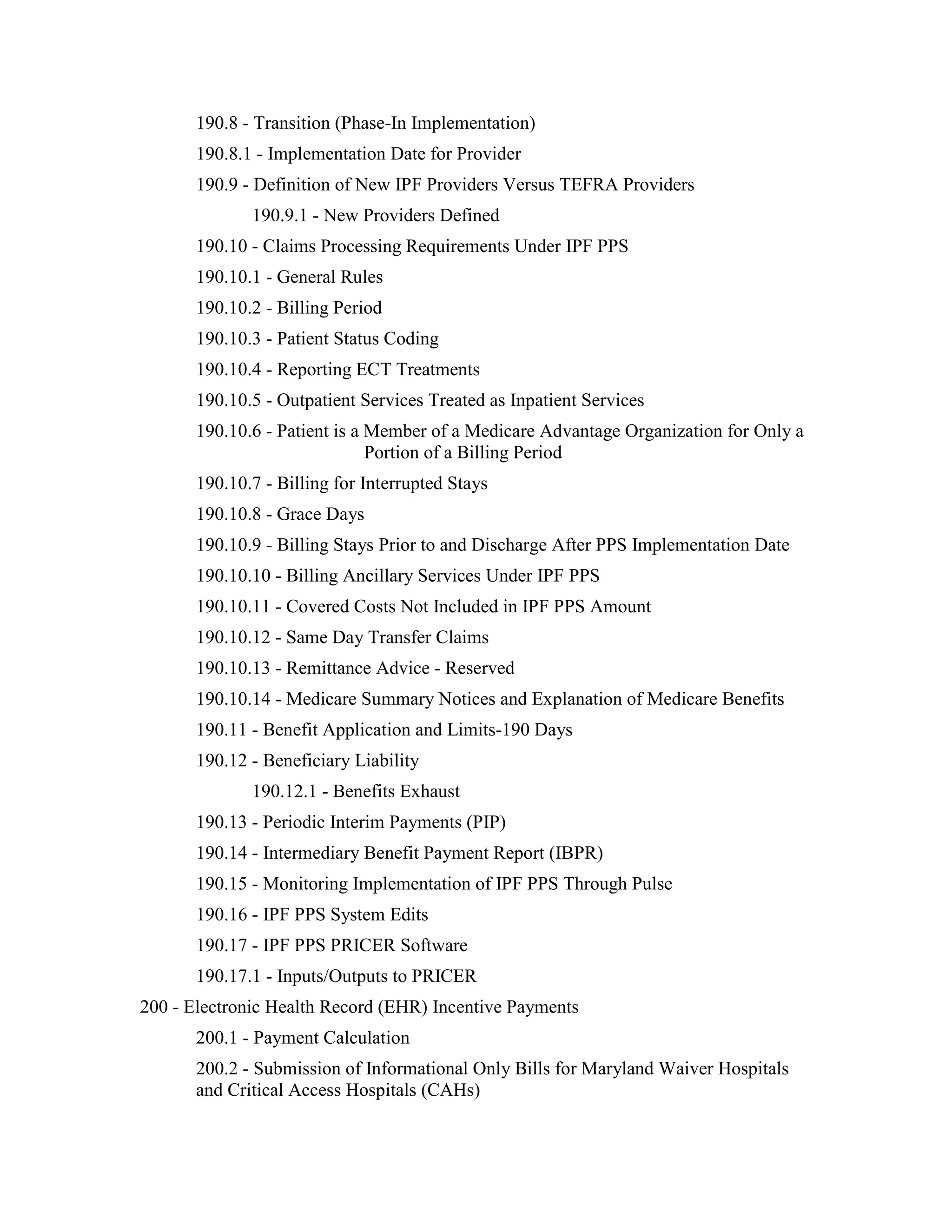
190.8 - Transition (Phase-In Implementation)
190.8.1 - Implementation Date for Provider
190.9 - Definition of New IPF Providers Versus TEFRA Providers
190.9.1 - New Providers Defined
190.10 - Claims Processing Requirements Under IPF PPS
190.10.1 - General Rules
190.10.2 - Billing Period
190.10.3 - Patient Status Coding
190.10.4 - Reporting ECT Treatments
190.10.5 - Outpatient Services Treated as Inpatient Services
190.10.6 - Patient is a Member of a Medicare Advantage Organization for Only a
Portion of a Billing Period
190.10.7 - Billing for Interrupted Stays
190.10.8 - Grace Days
190.10.9 - Billing Stays Prior to and Discharge After PPS Implementation Date
190.10.10 - Billing Ancillary Services Under IPF PPS
190.10.11 - Covered Costs Not Included in IPF PPS Amount
190.10.12 - Same Day Transfer Claims
190.10.13 - Remittance Advice - Reserved
190.10.14 - Medicare Summary Notices and Explanation of Medicare Benefits
190.11 - Benefit Application and Limits-190 Days
190.12 - Beneficiary Liability
190.12.1 - Benefits Exhaust
190.13 - Periodic Interim Payments (PIP)
190.14 - Intermediary Benefit Payment Report (IBPR)
190.15 - Monitoring Implementation of IPF PPS Through Pulse
190.16 - IPF PPS System Edits
190.17 - IPF PPS PRICER Software
190.17.1 - Inputs/Outputs to PRICER
200 - Electronic Health Record (EHR) Incentive Payments
200.1 - Payment Calculation
200.2 - Submission of Informational Only Bills for Maryland Waiver Hospitals
and Critical Access Hospitals (CAHs)
Addendum A - Provider Specific File
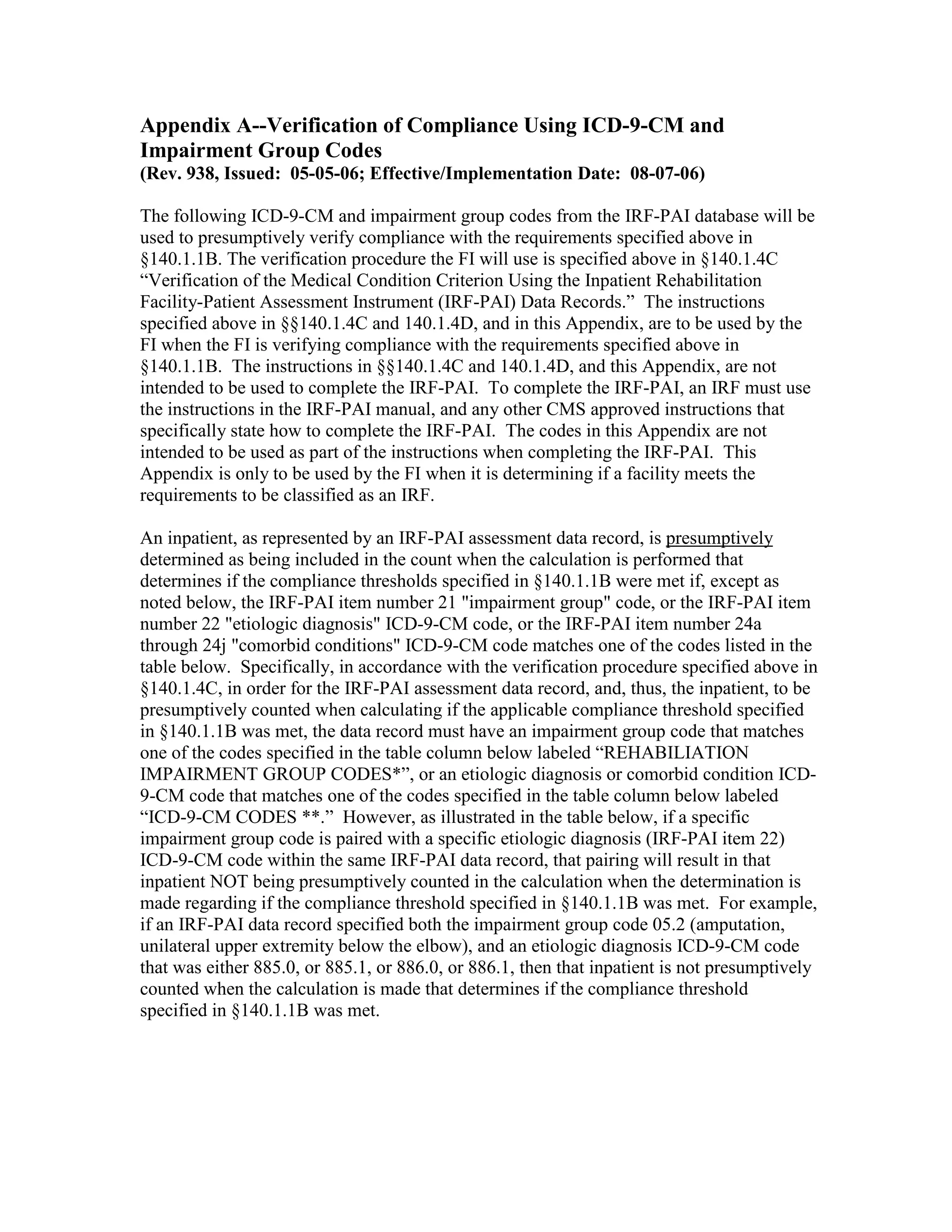
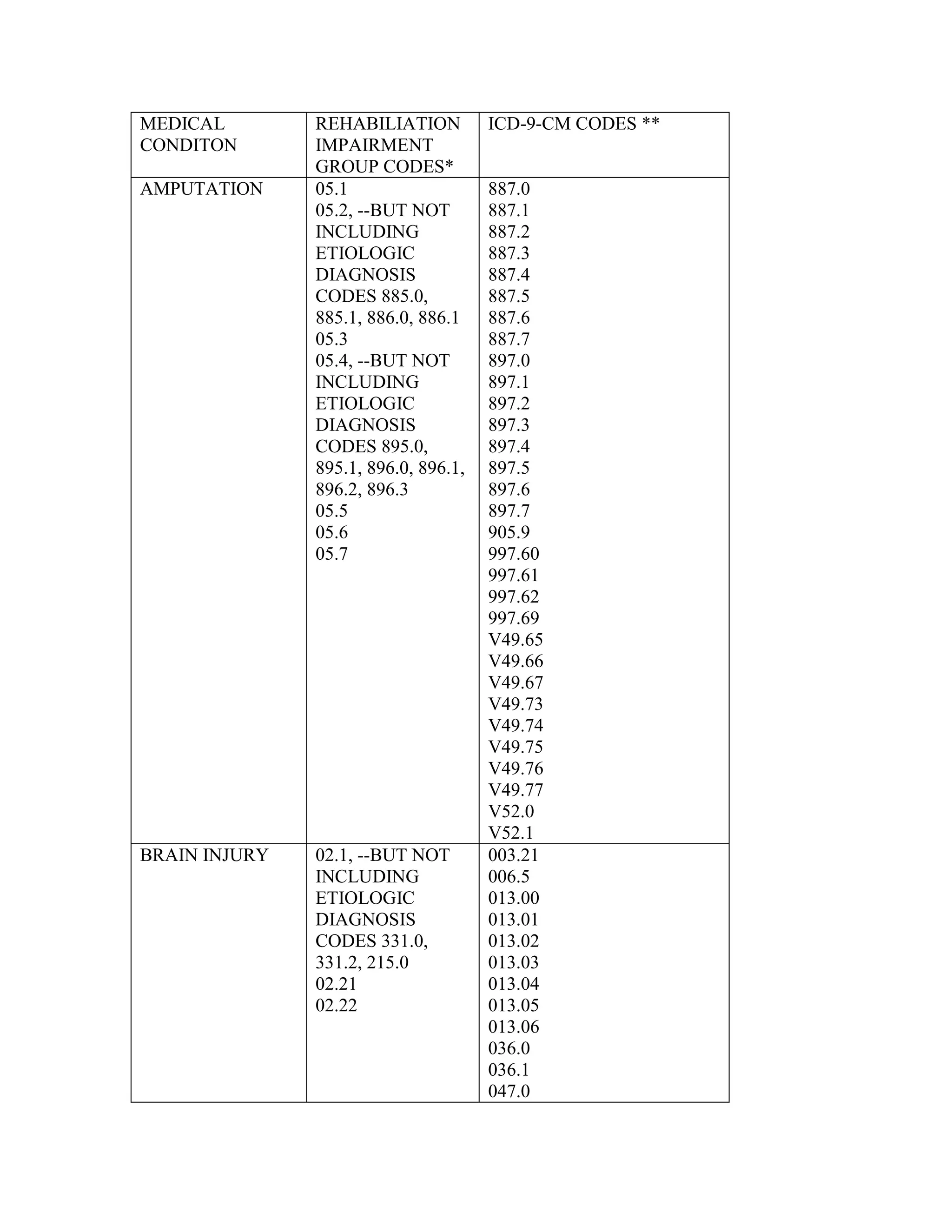
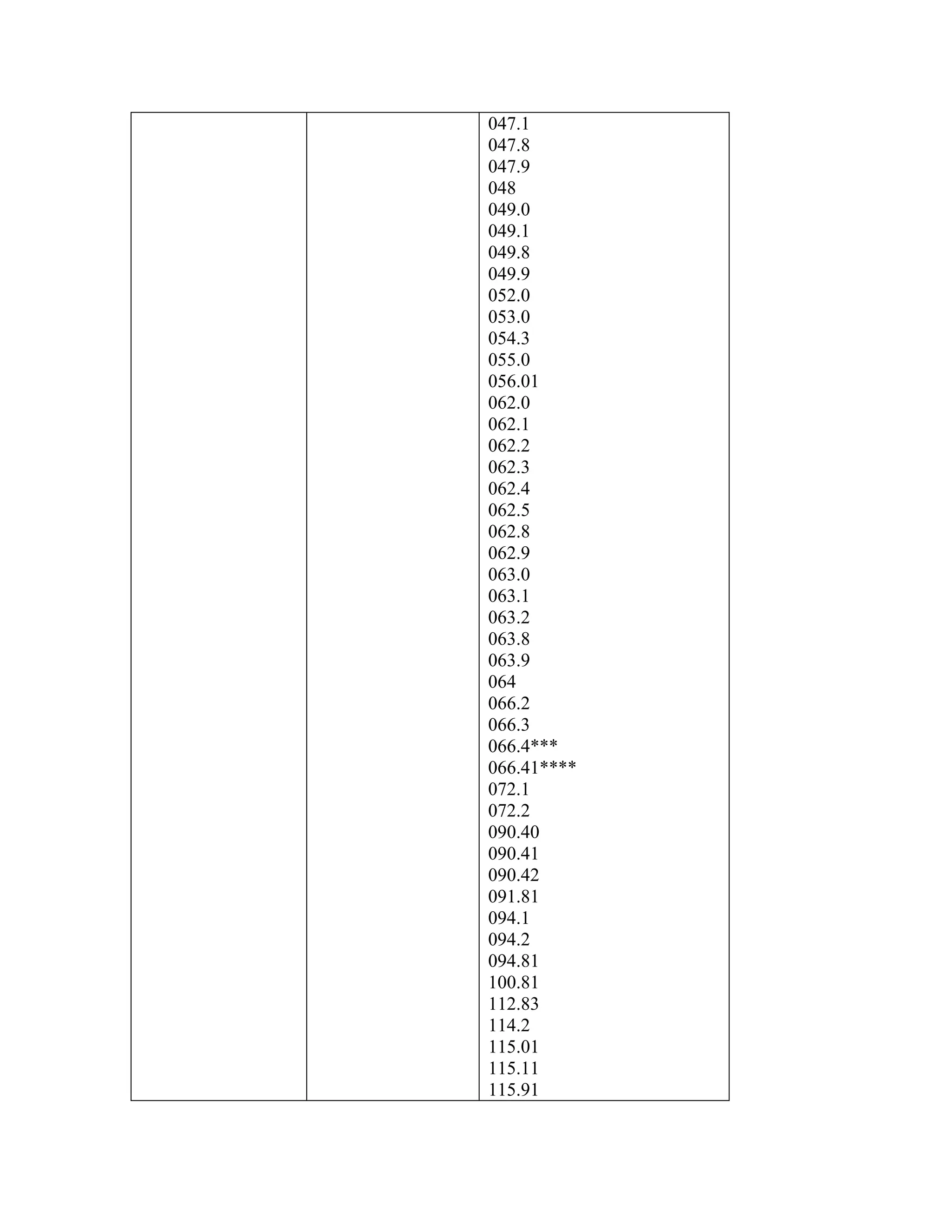
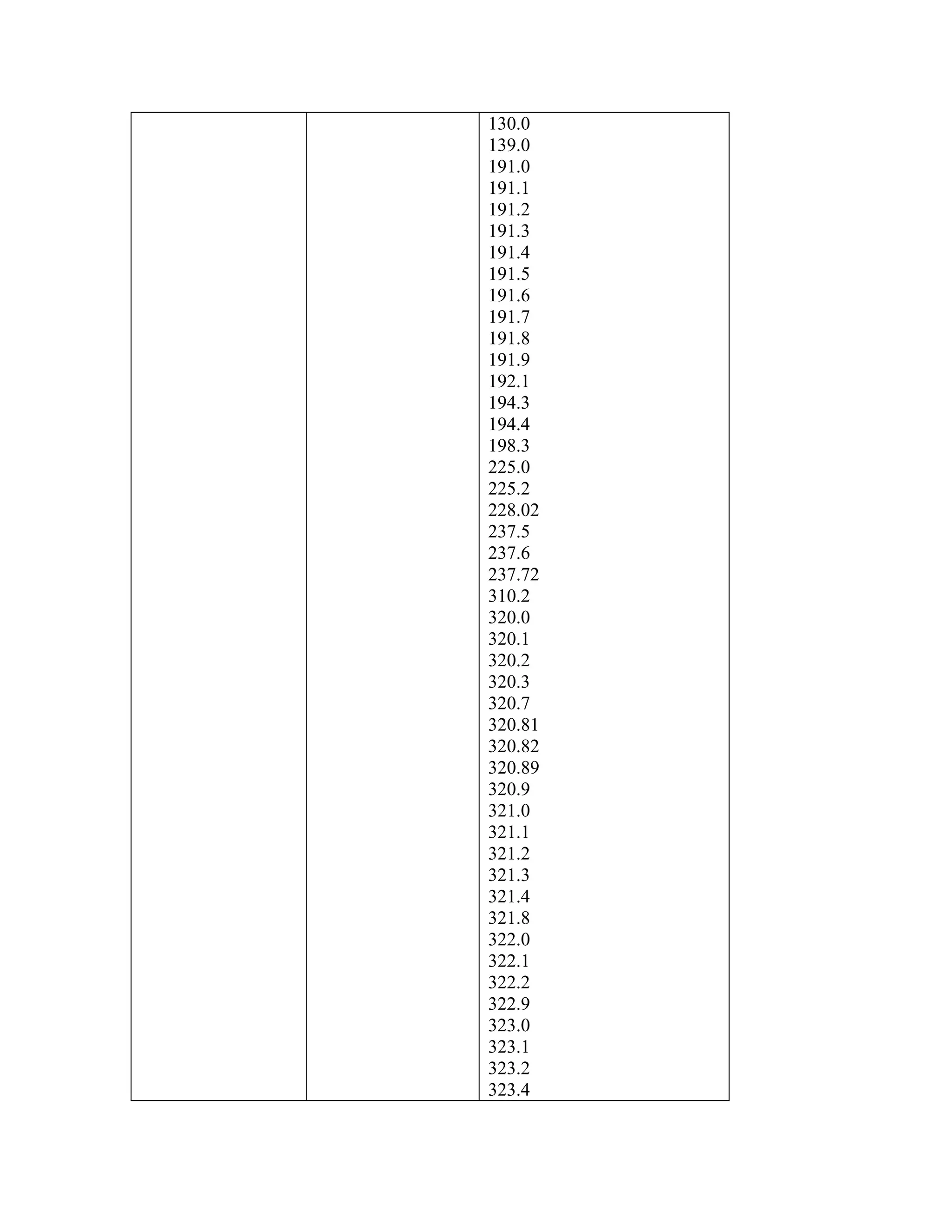
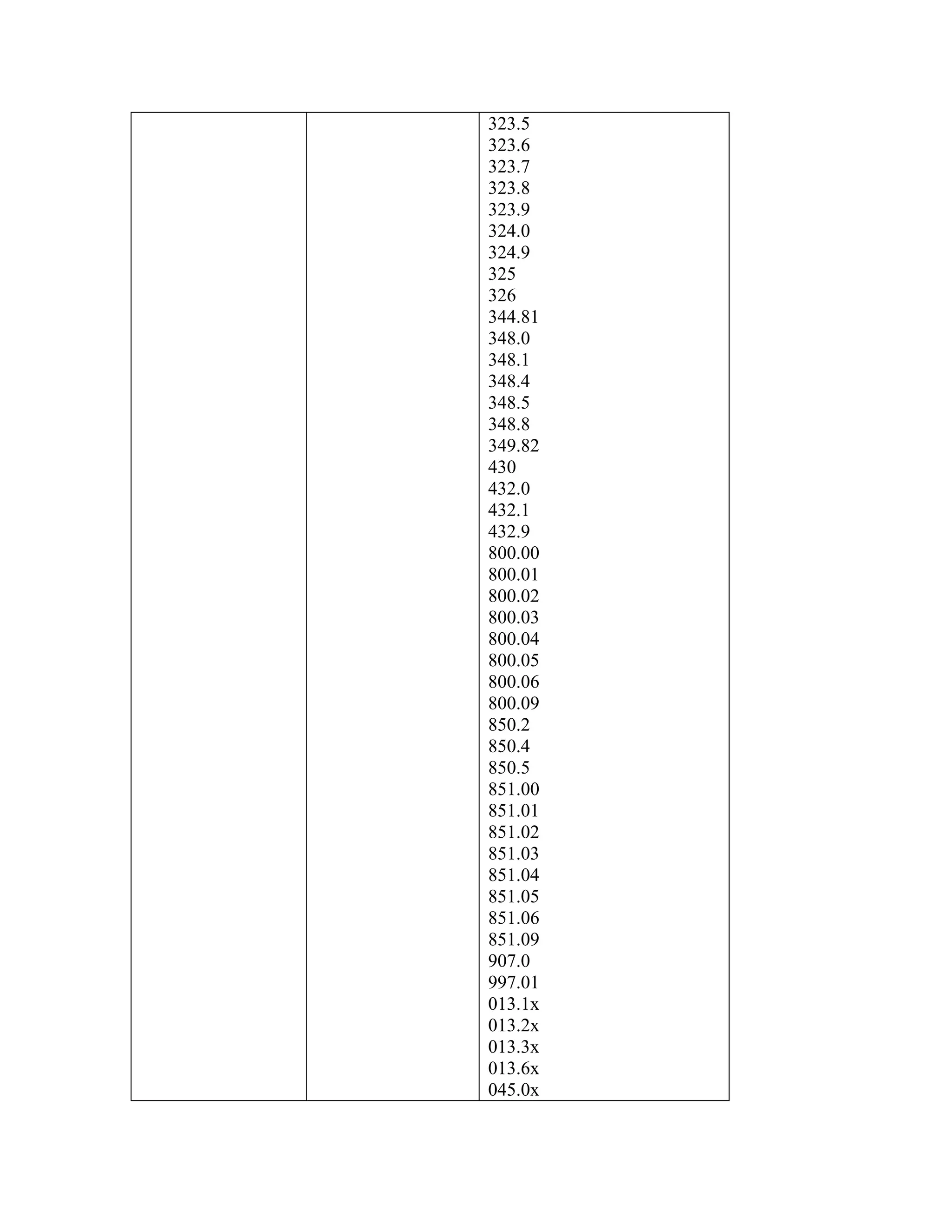
Appendix A - Verification of Compliance Using ICD-9-CM and Impairment Group Codes
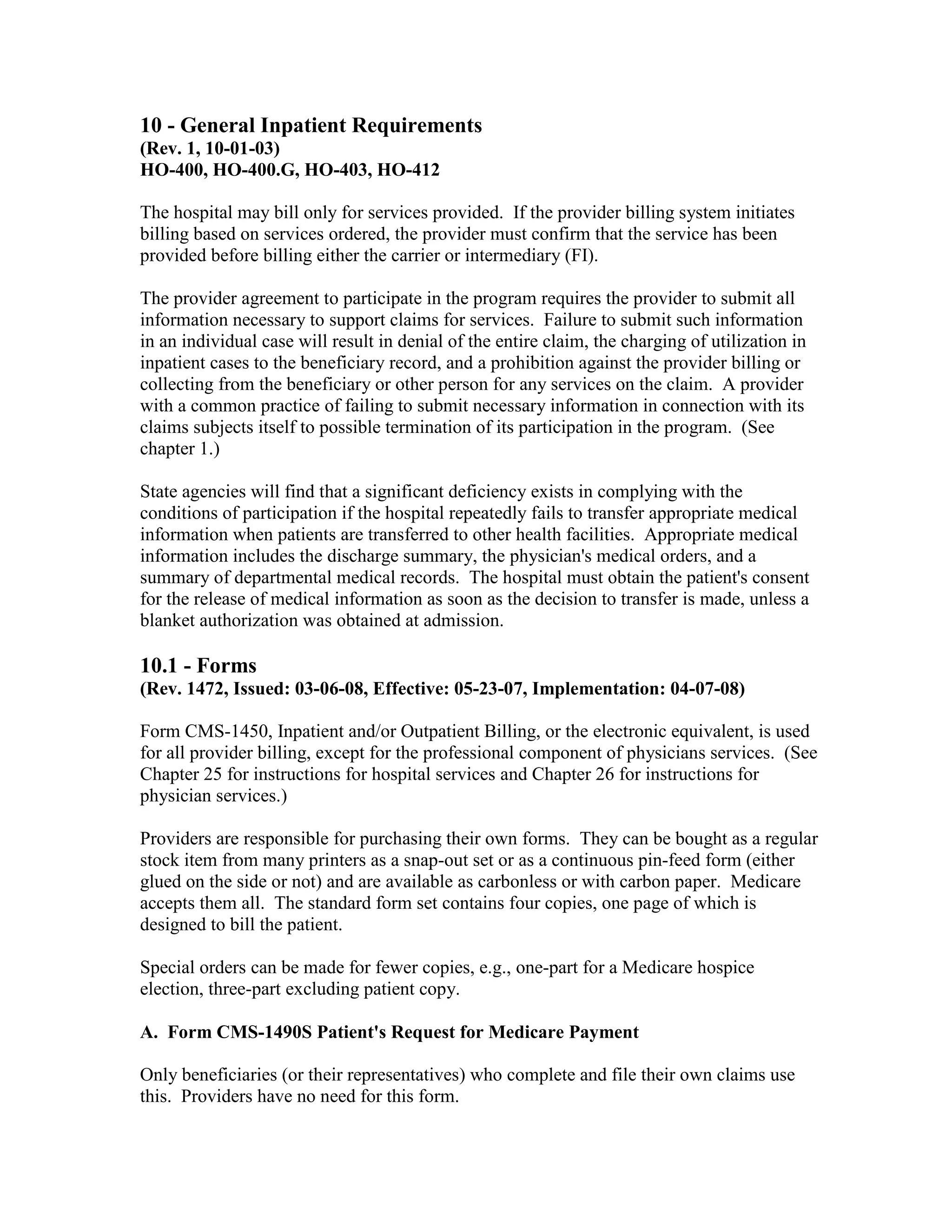
10 - General Inpatient Requirements
(Rev. 1, 10-01-03)
HO-400, HO-400.G, HO-403, HO-412
The hospital may bill only for services provided. If the provider billing system initiates
billing based on services ordered, the provider must confirm that the service has been
provided before billing either the carrier or intermediary (FI).
The provider agreement to participate in the program requires the provider to submit all
information necessary to support claims for services. Failure to submit such information
in an individual case will result in denial of the entire claim, the charging of utilization in
inpatient cases to the beneficiary record, and a prohibition against the provider billing or
collecting from the beneficiary or other person for any services on the claim. A provider
with a common practice of failing to submit necessary information in connection with its
claims subjects itself to possible termination of its participation in the program. (See
chapter 1.)
State agencies will find that a significant deficiency exists in complying with the
conditions of participation if the hospital repeatedly fails to transfer appropriate medical
information when patients are transferred to other health facilities. Appropriate medical
information includes the discharge summary, the physician's medical orders, and a
summary of departmental medical records. The hospital must obtain the patient's consent
for the release of medical information as soon as the decision to transfer is made, unless a
blanket authorization was obtained at admission.

10.1 - Forms
(Rev. 1472, Issued: 03-06-08, Effective: 05-23-07, Implementation: 04-07-08)
Form CMS-1450, Inpatient and/or Outpatient Billing, or the electronic equivalent, is used
for all provider billing, except for the professional component of physicians services. (See
Chapter 25 for instructions for hospital services and Chapter 26 for instructions for
physician services.)
Providers are responsible for purchasing their own forms. They can be bought as a regular
stock item from many printers as a snap-out set or as a continuous pin-feed form (either
glued on the side or not) and are available as carbonless or with carbon paper. Medicare
accepts them all. The standard form set contains four copies, one page of which is
designed to bill the patient.
Special orders can be made for fewer copies, e.g., one-part for a Medicare hospice
election, three-part excluding patient copy.
A. Form CMS-1490S Patient's Request for Medicare Payment
Only beneficiaries (or their representatives) who complete and file their own claims use
this. Providers have no need for this form.
B. Form CMS-1500 Health Insurance Claim Form
HH-424
This is the prescribed form for claims prepared by physicians or suppliers whether or not
the claims are assigned. Institutional providers may use the Form CMS-1500 to bill the
Part B carrier for the professional component of physicians' services where applicable.
Form CMS-1450, is processed by the provider's FI.

10.2 - Focused Medical Review (FMR)
(Rev. 1, 10-01-03)
HO-419, HH-450, HH-452, HH-462.1
This section has been moved to the Program Integrity Manual, which can be found at the
following Internet address http://www.cms.hhs.gov/manuals/cmsindex.asp.

10.3 - Spell of Illness
(Rev. 1, 10-01-03)
A3-3622
The FI makes spell of illness determinations in accordance with the Medicare Benefit
Policy Manual, Chapter 3, and these special instructions.
A. Beginning a Spell of Illness in Nonparticipating Provider
The noncovered services furnished by a nonparticipating provider can begin a spell of
illness only if the provider is a qualified provider. A qualified provider is a hospital
(including a psychiatric hospital) or an SNF that meets all requirements in the definition of
such an institution even though it may not be participating.
It is most unlikely that a nonparticipating hospital that is not accredited by JCAHO or a
nonparticipating SNF satisfies the conditions of participation, particularly with regard to
utilization review. Therefore, for spell of illness purposes, the FI assumes that
nonparticipating providers are not qualified providers in the absence of evidence to the
contrary. Situations that might constitute such contrary evidence include cases where the
provider recently dropped out of the program or, after a survey by the State agency,
decided not to participate even though the conditions of participation were met. Hospitals
accredited by JCAHO are deemed to meet all requirements except utilization review. For
such a hospital, the FI determines through the RO whether the hospital has a utilization
review plan in effect.
B. Continuing a Spell of Illness
1. Hospital Services
For purposes of continuing a spell of illness in a hospital, the hospital in which the stay
occurs need not meet all requirements that are necessary for starting a spell of illness. If
there has been a stay in a hospital that might continue the spell of illness and the FI cannot
ascertain its status, the FI contacts the RO, which maintains a list of all medical facilities
and their status.
2. SNF Services
For purposes of continuing a spell of illness in a SNF the spell of illness ends when the
beneficiary no longer needs or receives a Medicare covered level of care.
The FI uses the following seven presumptions to determine whether the skilled level of
care standards were met during a prior SNF stay. If the information upon which to base a
presumption is not readily available, the FI may, at its discretion, review the beneficiary's
medical records to determine whether the beneficiary was an inpatient of an SNF for
purposes of ending a spell of illness.
These special rules for determining whether a beneficiary in a SNF is an inpatient for
benefit period purposes is applicable in all cases where a prior SNF stay affects benefit
period status, not only when a beneficiary is seeking to continue a benefit period, but also
where it results in the beneficiary starting a new benefit period. If the applicable skilled
level of care standards were met during a prior SNF stay, the spell of illness is continued
with current utilization available to the beneficiary. If the applicable skilled level of care
standards were not met during a prior SNF stay, the spell of illness is not continued. A
new spell of illness restores full utilization and imposes a cash deductible.
Presumptions:
Presumption 1: A beneficiary's care in a SNF met the skilled level of care standards if a
Medicare SNF claim was paid for the care, unless such payment was made under
limitation of liability rules.
Presumption 2: A beneficiary's care in a SNF met the skilled level of care standards if a
SNF claim was paid for the services provided in the SNF under the special Medicare
limitation on liability rules pursuant to placement in a noncertified bed. See Chapter 30.
Presumption 3: A beneficiary's care in a SNF did not meet the skilled level of care
standards if a claim was paid for the services provided in the SNF pursuant to the general
Medicare limitation on liability rules in Chapter 30. (This presumption does not apply to
placement in a noncertified bed. For claims paid under these special provisions, see
Presumption 2.)
Presumption 4: A beneficiary's care in a Medicaid nursing facility (NF) did not meet the
skilled level of care standards if a Medicaid claim for the services provided in the NF was
denied on the grounds that the services received were not at the NF level of care (even if
paid under applicable Medicaid administratively necessary days provisions which result in
payment for care not meeting the NF level of care requirements).
Presumption 5: A beneficiary's care in an SNF met the skilled level of care standards if a
Medicare SNF claim for the services provided in the SNF was denied on grounds other
than that the services were not at the skilled level of care.
Presumption 6: A beneficiary's care in an SNF did not meet the skilled level of care
standards if a Medicare claim for the services provided in the SNF was denied on the
grounds that the services were not at the skilled level of care and no limitation of liability
payment was made.
Presumption 7: A beneficiary's care in a SNF did not meet the skilled level of care
standards if no Medicare or Medicaid claim was submitted by the SNF.
Rebuttal of Presumptions
Presumptions 1 through 4 cannot be rebutted. Thus, prior Medicare and Medicaid claim
determinations that necessarily required a level of care determination for the time period
under consideration are binding for purposes of a later benefit period calculation.
Although Presumptions 1 through 4 are not in themselves rebuttable, a beneficiary may
seek to reverse a benefit period determination that was dictated by one of these
presumptions by timely appealing the prior Medicare or Medicaid claim determination
which triggered the presumption.
Presumptions 5 through 7 can be rebutted by beneficiary showings that the level of care
needed or received is other than that which the presumption dictates. Rebuttal showings
are permitted at both FI determination levels under 42 CFR 405, Subpart G (i.e., a rebuttal
showing regarding the status of a prior SNF stay is made at the time that an inpatient claim
is submitted and/or at the reconsideration level). Evaluate rebuttal documentation even if
the presumption being rebutted was triggered by a Medicaid denial. Decisions under
presumptions 5 through 7 require the FI to send a notice to advise the beneficiary of the
basis for the determination and the right to present evidence to rebut the determination on
reconsideration.
Presumption 6 can be rebutted because the Medicare skilled level of care definition for
coverage purposes is broader than the skilled level of care definition used here for benefit
period determinations. For example, prior hospital care related to the SNF care is
included in the Medicare SNF coverage requirements but is not included in the standard
for benefit period determinations. Therefore, Medicare payment could have been denied
for an SNF stay because of noncompliance with that requirement, even though skilled
level of care requirements for benefit period determinations were in fact met by the SNF
stay. Consequently, when Medicare SNF payment is denied, the beneficiary must be
given the opportunity to demonstrate that he/she still needed and received a skilled level
of care for purposes of benefit period determinations to extend a benefit period if this
would be to the beneficiary's advantage.
NOTE: Effective October 1, 1990, the levels of care that were previously covered
separately under the Medicaid SNF and intermediate care facility (ICF) benefits are
combined in a single Medicaid nursing facility (NF) benefit. Thus, the Medicaid NF
benefit includes essentially the same type of skilled care covered by Medicare's SNF
benefit, but it includes less intensive care as well. This means that when a person is found
not to require at least a Medicaid NF level of care (as under Presumption 4), it can be
presumed that he or she also does not meet the Medicare skilled level of care standards.
However, since the NF benefit can include care that is less intensive than Medicare SNF
care, merely establishing that a person does require NF level care does not necessarily
mean that he or she also meets the Medicare skilled level of care standards. Determining
whether an individual who requires NF level care also meets the Medicare skilled level of
care standards requires an actual examination of the medical evidence and cannot be
accomplished through the simple use of a presumption.
Medicare no payment bills submitted by an SNF result in Medicare program payment
determinations (i.e., denials). Therefore, such no payment bills trigger the appropriate
presumptions. This also applies in any State where the Medicaid program utilizes no
payment bills which lead to Medicaid program payment determinations. If an SNF
erroneously fails to submit a Medicare claim (albeit a no-pay claim) when Medicare rules
require such submission, request compliance. Once the no-pay bill is submitted and
denied, the applicable presumption (other than presumption 7) is triggered. If a patient is
moving from a SNF level of care to a non-SNF level of care in a facility certified to
provide SNF care, occurrence code 22 (date active care ended) is used to signify the
beginning of the no-pay period on the bill and trigger the appropriate presumptions.
Some of the presumptions require knowledge of Medicaid's claims processing
involvement with the prior claim. The FI uses current bill data, accompanying
documentation, bill history files, and telephone contacts with the prior stay facility and/or
the Medicaid agency to develop the Medicaid aspects. It does not continue Medicaid
development beyond a telephone contact. It concludes its consideration of the
presumption at this point based upon the Medicaid information available.

10.4 - Payment of Nonphysician Services for Inpatients
(Rev. 1, 10-01-03)
HO-407
All items and nonphysician services furnished to inpatients must be furnished directly by
the hospital or billed through the hospital under arrangements. This provision applies to
all hospitals, regardless of whether they are subject to PPS.
A. Other Medical Items, Supplies, and Services
The following medical items, supplies, and services furnished to inpatients are covered
under Part A. Consequently, they are covered by the prospective payment rate or
reimbursed as reasonable costs under Part A to hospitals excluded from PPS.
•

Laboratory services (excluding anatomic pathology services and certain clinical
pathology services);

•

Pacemakers and other prosthetic devices including lenses, and artificial limbs,
knees, and hips;

•

Radiology services including computed tomography (CT) scans furnished to
inpatients by a physician's office, other hospital, or radiology clinic;

•

Total parenteral nutrition (TPN) services; and

•

Transportation, including transportation by ambulance, to and from another
hospital or freestanding facility to receive specialized diagnostic or therapeutic
services not available at the facility where the patient is an inpatient.

The hospital must include the cost of these services in the appropriate ancillary service
cost center, i.e., in the cost of the diagnostic or therapeutic service. It must not show them
separately under revenue code 0540.
EXCEPTIONS:
•

Pneumococcal Vaccine - is payable under Part B only and is billed by the hospital
on the Form CMS-1450.

•

Ambulance Service - For purposes of this section "hospital inpatient" means a
beneficiary who has been formally admitted it does not include a beneficiary who
is in the process of being transferred from one hospital to another. Where the
patient is transferred from one hospital to another, and is admitted as an inpatient
to the second, the ambulance service is payable under only Part B. If
transportation is by a hospital owned and operated ambulance, the hospital bills
separately on Form CMS-1450 as appropriate. Similarly, if the hospital arranges
for the ambulance transportation with an ambulance operator, including paying the
ambulance operator, it bills separately. However, if the hospital does not assume
any financial responsibility, the billing is to the carrier by the ambulance operator
or beneficiary, as appropriate, if an ambulance is used for the transportation of a
hospital inpatient to another facility for diagnostic tests or special treatment the
ambulance trip is considered part of the DRG, and not separately billable, if the
resident hospital is under PPS.

•

Part B Inpatient Services - Where Part A benefits are not payable, payment may
be made to the hospital under Part B for certain medical and other health services.
See Chapter 4 for a description of Part B inpatient services.

•

Anesthetist Services "Incident to" Physician Services - If a physician's practice
was to employ anesthetists and to bill on a reasonable charge basis for these
services and that practice was in effect as of the last day of the hospital's most
recent 12-month cost reporting period ending before September 30, 1983, the
physician may continue that practice through cost reporting periods beginning
October 1, 1984. However, if the physician chooses to continue this practice, the
hospital may not add costs of the anesthetist’s service to its base period costs for
purposes of its transition payment rates. If it is the existing or new practice of the
physician to employ certified registered nurse anesthetists (CRNAs) and other
qualified anesthetists and include charges for their services in the physician bills
for anesthesiology services for the hospital's cost report periods beginning on or
after October 1, 1984, and before October 1, 1987, the physician may continue to
do so.
B. Exceptions/Waivers
These provisions were waived before cost reporting periods beginning on or after October
1, 1986, under certain circumstances. The basic criteria for waiver was that services
furnished by outside suppliers are so extensive that a sudden change in billing practices
would threaten the stability of patient care. Specific criteria for waiver and processing
procedures are in §2804 of the Provider Reimbursement Manual (CMS Pub. 15-1).

10.5 – Hospital Inpatient Bundling
(Rev. 668, Issued: 09-02-05; Effective: Ambulance claims received on or after
January 3, 2006, and 4 years after initial determination for adjustments;
Implementation: 01-03-06)
Hospital bundling rules exclude payment to independent suppliers of ambulance services
for beneficiaries in a hospital inpatient stay. The Common Working File (CWF) performs
reject edits to incoming claims from independent suppliers of ambulance services. The
CWF searches paid claim history and compares the line item service date on an ambulance
claim to the admission and discharge dates on a hospital inpatient stay. The CWF rejects
the line item when the ambulance line item service date falls within the admission and
discharge dates on a hospital inpatient claim. Based on CWF rejects, the carrier must deny
line items for ambulance services billed by independent suppliers that should be bundled
to the hospital.
Upon receipt of a hospital inpatient claim, CWF searches paid claim history and compares
the period between the hospital inpatient admission and discharge dates to the line item
service date on an ambulance claim billed by an independent supplier. The CWF shall
generate an unsolicited response when the line item service date falls within the admission
and discharge dates of the hospital inpatient claim.
Upon receipt of the unsolicited response, the carrier shall adjust the ambulance claim and
recoup the payment.
Ambulance services with a date of service that is the same as the admission or discharge
date on an inpatient claim are separately payable and not subject to the bundling rules.
The CWF performs an additional edit before determining if the ambulance line item
should be rejected when the beneficiary is an inpatient of a long term care facility
(LTCH), inpatient psychiatric facility (IPF) or inpatient rehabilitation facility (IRF) and is
transported via ambulance to an acute care hospital to receive specialized services. The
CWF edits the claim for the presence of occurrence span code 74 (non-covered level of
care) and the associated occurrence span code from and through dates. The CWF bypasses
the reject edit when the ambulance line item service date falls within the occurrence span
code 74 from and through dates plus one day. In this case, the ambulance line item is
separately payable. The CWF rejects the ambulance line item when the service date falls
outside the occurrence span code 74 from and through dates plus one day.

20 - Payment Under Prospective Payment System (PPS) Diagnosis
Related Groups (DRGs)
(Rev. 1571; Issued: 08-07-08; Effective Date: 08-01-08; Implementation Date: 0815-08)
A. General
The Social Security Amendments of 1983 (P.L. 98-21) provided for establishment of a
prospective payment system (PPS) for Medicare payment of inpatient hospital services.
(See §20.4 for corresponding information for PPS capital payments and computation of
capital and operating outliers for FY 1992.) Under PPS, hospitals are paid a
predetermined rate per discharge for inpatient hospital services furnished to Medicare
beneficiaries. Each type of Medicare discharge is classified according to a list of DRGs.
These amounts are, with certain exceptions, payment in full to the hospital for inpatient
operating costs. Beneficiary cost-sharing is limited to statutory deductibles, coinsurance,
and payment for noncovered items and services. Section 4003 of OBRA of 1990 (P.L.
101-508) expands the definition of inpatient operating costs to include certain
preadmission services. (See §40.3.)
The statute excludes children's hospitals and cancer hospitals, hospitals located outside the
50 States. In addition to these categorical exclusions, the statute provides other special
exclusions, such as hospitals that are covered under State reimbursement control systems.
These excluded hospitals and units are paid on the basis of reasonable costs subject to the
target rate of increase limits.
In accordance with Section 1814 (b) (3) of the Act, services provided by hospitals in
Maryland subject to the Health Services Cost Review Commission (provider numbers
21000-21099) are paid according to the terms of the waiver, that is 94% of submitted
charges subject to any unmet Part B deductible and coinsurance.
For discharges occurring on or after April 1, 1988, separate standardized payment
amounts are established for large urban areas and rural areas. Large urban areas are urban
areas with populations of more than 1,000,000 as determined by the Secretary of HHS on
the basis of the most recent census population data. In addition, any New England County
Metropolitan Area (NECMA) with a population of more than 970,000 is a large urban
area.
The OBRA 1987 required payment of capital costs under PPS effective with cost reporting
periods that began October 1, 1991, or later. A 10-year transition period was provided to
protect hospitals that had incurred capital obligations in excess of the standardized
national rate from major disruption. High capital cost hospitals are known as "hold
harmless" hospitals. The transition period also provides for phase-in of the national
Federal capital payment rate for hospitals with capital obligations that are less than the
national rate. New hospitals that open during the transition period are exempt from capital
PPS payment for their first 2 years of operation. Hospitals and hospital distinct part units
that are excluded from PPS for operating costs are also excluded from PPS for capital
costs.
Capital payments are based on the same DRG designations and weights, outlier
guidelines, geographic classifications, wage indexes, and disproportionate share
percentages that apply to operating payments under PPS. The indirect teaching
adjustment is based on the ratio of residents to average daily census. The hospital split
bill, adjustment bill, waiver of liability and remaining guidelines that have historically
been applied to operating payments also apply to capital payments under PPS.
B. Hospitals and Units Excluded
The following hospitals and distinct part hospital units (DPU) are excluded from PPS and
are paid on a reasonable cost or other basis:
•

Pediatric hospitals whose inpatients are predominately under the age of 18.

Hospitals located outside the 50 States.
• Hospitals participating in a CMS-approved demonstration project or State payment
control system.
•

Nonparticipating hospitals furnishing emergency services have not been affected
by the PPS statute (P.L. 97-21). They are paid under their existing basis.
C. Situations Requiring Special Handling
1. Sole community hospitals are paid in accordance with the methods used to establish
the operating prospective rates for the first year of the PPS transition for operating costs.
The appropriate percentage of hospital-specific rate and the Federal regional rate is
applied by the Pricer program in accordance with the current values for the appropriate
fiscal year.
2. Hospitals have the option to continue to be reimbursed on a reasonable cost basis
subject to the target ceiling rate or to be reimbursed under PPS if the following are met:
• Recognized as of April 20, 1983, by the National Cancer Institute as
comprehensive cancer centers or clinical research centers;
• Demonstrating that the entire facility is organized primarily for treatment
of, and research on, cancer; and
• Having a patient population that is at least 50 percent of the hospital's total
discharges with a principal diagnosis of neoplastic disease.
The hospital makes this decision at the beginning of its fiscal year. The choice continues
until the hospital requests a change. If it selects reasonable cost subject to the target
ceiling, it can later request PPS. No further option is allowed.
3. Regional and national referral centers within short-term acute care hospital complexes.
Rural hospitals that meet the criteria have their prospective rate determined on the basis of
the urban, rather than the rural, adjusted standardized amounts, as adjusted by the
applicable DRG weighting factor and the hospital's area wage index.
4. Hospitals in Alaska and Hawaii have the nonlabor related portion of the wage index
adjusted by their appropriate cost-of-living factor. These calculations are made by the
Pricer program and are included in the Federal portion of the rate.
5. Kidney, heart, and liver acquisition costs incurred by approved transplant centers are
treated as an adjustment to the hospital's payments. These payments are adjusted in each
cost reporting period to compensate for the reasonable expenses of the acquisition and are
not included in determining prospective payment.
6. Religious nonmedical health care institutions are paid on the basis of a predetermined
fixed amount per discharge. Payment is based on the historical inpatient operating costs
per discharge and is not calculated by Pricer.
7. Transferring hospitals with discharges assigned to MS-DRG 789 (neonates, died or
transferred to another acute care facility) or MS-DRG 927-935 (burns - transferred to
another acute care facility) have their payments calculated by the Pricer program on the
same basis as those receiving the full prospective payment. They are also eligible for cost
outliers.
8. Nonparticipating hospitals furnishing emergency services are not included in PPS.
9. Veterans Administration (VA) hospitals are generally excluded from participation.
Where payments are made for Medicare patients, the payments are determined in
accordance with 38 U.S.C. 5053(d).
10. A hospital that loses its urban area status as a result of the Executive Office of
Management and Budget redesignation occurring after April 20, 1983, may qualify for
special consideration by having its rural Federal rate phased-in over a 2-year period. The
hospital will receive, in addition to its rural Federal rate in the first cost reporting period,
two-thirds of the difference between its rural Federal rate and the urban Federal rate that
would have been paid had it retained its urban status. In the second reporting period, onethird of the difference is applied. The adjustment is applied for two successive cost
reporting periods beginning with the cost-reporting period in which CMS recognizes the
reclassification.
11. The payment per discharge under the PPS for hospitals in Puerto Rico is the sum of:
• 50 percent of the Puerto Rico discharge weighted urban or rural
standardized rate.
•

50 percent of the national discharge weighted standardized rate.

(The special treatment of referral centers and sole community hospitals does not apply to
prospective payment hospitals in Puerto Rico.)
There are special criteria that facilities must meet in order to obtain approval for payment
for heart transplants and special processing procedures for these bills. (See §90.2.)
Facilities that wish to obtain coverage of heart transplants for their Medicare patients must
submit an application and documentation showing their initial and ongoing compliance
with the criteria. For facilities that are approved, Medicare covers under Part A all
medically reasonable and necessary inpatient services.
12. Hospitals with high percentage of ESRD discharges may qualify for additional
payment. These payments are handled as adjustments to cost reports.
13. Exception payments are provided for hospitals with inordinately high levels of capital
obligations. They will expire at the end of the 10-year transition period. Exception
payments ensure that for FY 1992 and FY 1993:
•

Sole community hospitals receive 90 percent of Medicare inpatient capital costs:

• Urban hospitals with 100 or more beds and a disproportionate share patient
percentage of at least 20.2 percent receive 80 percent of their Medicare inpatient capital
costs; and
•

All other hospitals receive 70 percent of their Medicare inpatient capital costs.

A limited capital exception payment is also provided during the 10-year capital transition
period for hospitals that experience extraordinary circumstances that require an
unanticipated major capital expenditure. Events such as a tornado, earthquake,
catastrophic fire, or a hurricane are examples of extraordinary circumstances. The capital
project must cost at least $5 million to qualify for this exception.
D. MS-DRG Classification
The MS-DRGs (Medicare Severity DRGs) are a patient classification system which
provides a means of relating types of patients a hospital treats (i.e., its case mix) to the
costs incurred by the hospital. Payment for inpatient hospital services is made on the basis
of a rate per discharge that varies according to the MS-DRG to which a beneficiary's stay
is assigned. All inpatient transfer/discharge bills from both PPS and non-PPS facilities,
including those from waiver States, long-term care facilities, and excluded units are
classified by the Grouper software program into one of 745 diagnosis related groups
(DRGs).
The following MS-DRGs receive special attention:
•

MS-DRGs No. 981-983 - Represent discharges with valid data, but the surgical
procedure is unrelated to the principal diagnosis. MS-DRGs 981 (Extensive O.R.
Procedure Unrelated to the Principal Diagnosis w/ MCC), 982 (Extensive O.R. Procedure
Unrelated to the Principal Diagnosis w/ CC), and 983 (Extensive O.R. Procedure
Unrelated to the Principal Diagnosis w/o CC/MCC) each have relative weights assigned to
them and will be paid. The hospital must review the record on each of these MS-DRGs in
the remittance record and determine that where either the principle diagnosis or surgical
procedure was reported incorrectly, prepare an adjustment bill. The FI may elect to avoid
the adjustment bill by returning the bill to the hospital prior to payment.
• MS-DRG No. 998 - Represents a discharge reporting a principle diagnosis that is
invalid as a principal diagnosis. Examples include a diagnosis of diabetes mellitus or an
infection of the genitourinary tract during pregnancy, both unspecified as to episode of
care. These diagnoses may be valid, but they are not sufficient to determine the principal
diagnosis for MS-DRG assignment purposes. FIs will return the claims. The hospital
must enter the corrected principal diagnosis for proper MS-DRG assignment and resubmit
the claim.
•

MS-DRG No. 999 - Represents a discharge with invalid data, making it
ungroupable. FIs return the claims for correction of data elements affecting proper MSDRG assignment. The hospital resubmits the corrected claim.
When the bills are processed in conjunction with the MCE (see §20.2.1) coding
inconsistencies in the information and data are identified.
The MCE must be run before Grouper to identify inconsistencies before the bills are
processed through the Grouper.
E. Difference in Age/Admission Versus Discharge
HO-415.4
When a beneficiary's age changes between the date of admission and date of discharge, the
DRG and related payment amount are determined from the patient's age at admission.
20.1 – Hospital Operating Payments Under PPS
(Rev. 1816; Issued: 09-17-09; Effective Date: Discharges on or after October 1,
2009; Implementation Date: 10-05-09)
Section 1886(d) of the Social Security Act (the Act) sets forth a system of payment for the
operating costs of acute care hospital inpatient stays under Medicare Part A (Hospital
Insurance) based on prospectively set rates. Under the PPS, Medicare payment for hospital
inpatient operating costs is made at predetermined, specific rates for each hospital
discharge. Discharges are classified according to a list of diagnosis-related groups
(DRGs).
The base payment rate is comprised of a standardized amount that is divided into a laborrelated share and a nonlabor-related share. The labor-related share is adjusted by the wage
index applicable to the area where the hospital is located; and if the hospital is located in
Alaska or Hawaii, the nonlabor-related share is adjusted by a cost-of-living adjustment
factor. This base payment rate is multiplied by the DRG relative weight.
If the hospital treats a high percentage of low-income patients, it receives a percentage
add-on payment applied to the DRG-adjusted base payment rate. This add-on payment,
known as the disproportionate share hospital (DSH) adjustment, provides for a percentage
increase in Medicare payments to hospitals that qualify under statutory formulas designed
to identify hospitals that serve a disproportionate share of low-income patients. For
qualifying hospitals, the amount of this adjustment may vary based on the outcome of the
statutory calculations.
If the hospital is an approved teaching hospital, it receives a percentage add-on payment
for each case paid under the PPS (known as the indirect medical education (IME)
adjustment). This percentage varies, depending on the ratio of residents to beds.
Additional payments may be made for cases that involve new technologies that have been
approved for special add-on payments. To qualify, a new technology must demonstrate
that it is a substantial clinical improvement over technologies otherwise available, and
that, absent an add-on payment, it would be inadequately paid under the regular DRG
payment.
The costs incurred by the hospital for a case are evaluated to determine whether the
hospital is eligible for an additional payment as an outlier case. This additional payment is
designed to protect the hospital from large financial losses due to unusually expensive
cases. Any outlier payment due is added to the DRG-adjusted base payment rate, plus any
DSH, IME, and new technology add-on adjustments.
Although payments to most hospitals under the PPS are made on the basis of the
standardized amounts, some categories of hospitals are paid based on the higher of a
hospital-specific rate determined from their costs in a base year as specified in the statute,
or the PPS rate based on the standardized amount. For example, sole community hospitals
(SCHs) are the sole source of care in their areas, and small rural Medicare-dependent
hospitals (MDHs) are a major source of care for Medicare beneficiaries in their areas.
Both of these categories of hospitals are afforded this special payment protection in order
to maintain access to services for beneficiaries (although the statutory payment formulas
for SCHs and MDHs differ as described below in section 20.6).
The existing regulations governing payments to hospitals under the PPS are located in
42 CFR Part 412, Subparts A through M.

20.1.1 – Hospital Wage Index
(Rev. 70, 01-23-04)
Section 1886(d)(3)(E) of the Act requires that, as part of the methodology for determining
prospective payments to hospitals, the Secretary must adjust the standardized amounts
“for area differences in hospital wage levels by a factor (established by the Secretary)
reflecting the relative hospital wage level in the geographic area of the hospital compared
to the national average hospital wage level.” This adjustment factor is the wage index.
CMS defines hospital geographic areas (labor market areas) based on the definitions of
urban (e.g., Metropolitan Statistical Areas (MSAs)) and rural areas issued by the Office of
Management and Budget.
The Act further requires the wage index to be updated annually, based on a survey of
wages and wage-related costs of short-term, acute care hospitals. These data are collected
on Worksheet S-3, Parts II and III of the Medicare Cost Report (Form CMS-2552). To
ensure the accuracy of the wage index, fiscal intermediaries are required to perform annual
desk reviews of hospitals’ wage data. CMS also publishes the wage data, and allows
hospitals an opportunity to review and request corrections to the data, before the wage
index is finalized.
In computing the wage index, CMS derives an average hourly wage for each labor market
area (total wage costs divided by total hours for all hospitals in the geographic area) and a
national average hourly wage (total wage costs divided by total hours for all hospitals
surveyed in the nation). A labor market area’s wage index value is the ratio of the area’s
average hourly wage to the national average hourly wage. If a labor market area’s average
hourly wage is greater than the national average, the area’s wage index value will be
greater than 1.0000. If an area’s average hourly wage is less than the national average, the
area’s wage index value will be less than 1.0000. The wage index adjustment factor is
applied only to the labor portion of the standardized amounts.
Section 4410 of Public Law 105-33 provides that, for discharges on or after October 1,
1997, the area wage index value applicable to any hospital that is located in an urban area
may not be less than the area wage index value applicable to hospitals located in rural
areas in that State. Furthermore, this wage index floor is to be implemented in such a
manner as to ensure that aggregate prospective payment system payments are not greater
or less than those that would have been made in the year if this section did not apply.
20.1.2 - Outliers
(Rev. 2111, Issued: 12-03-10, Effective: 04-01-11, Implementation: 04-04-11)
§1886(d)(5)(A) of the Act provides for Medicare payments to Medicare-participating
hospitals in addition to the basic prospective payments for cases incurring extraordinarily
high costs. This additional payment known as an “Outlier” is designed to protect the
hospital from large financial losses due to unusually expensive cases. To qualify for
outlier payments, a case must have costs above a fixed-loss cost threshold amount (a
dollar amount by which the costs of a case must exceed payments in order to qualify for
outliers), which is published in the annual Inpatient Prospective Payment System final
rule. The regulations governing payments for operating costs under the IPPS are located
in 42 CFR Part 412. The specific regulations governing payments for outlier cases are
located at 42 CFR 412.80 through 412.86.
The actual determination of whether a case qualifies for outlier payments is made by the
Medicare contractor using Pricer, which takes into account both operating and capital
costs and Medicare severity-diagnostic related group (MS-DRG) payments. That is, the
combined operating and capital costs of a case must exceed the fixed loss outlier threshold
to qualify for an outlier payment. The operating and capital costs are computed separately
by multiplying the total covered charges by the operating and capital cost-to-charge ratios.
The estimated operating and capital costs are compared with the fixed-loss threshold after
dividing that threshold into an operating portion and a capital portion (by first summing
the operating and capital ratios and then determining the proportion of that total comprised
by the operating and capital ratios and applying these percentages to the fixed-loss
threshold). The thresholds are also adjusted by the area wage index (and capital
geographic adjustment factor) before being compared to the operating and capital costs of
the case. Finally, the outlier payment is based on a marginal cost factor equal to 80
percent of the combined operating and capital costs in excess of the fixed-loss threshold
(90 percent for burn MS-DRGs). Any outlier payment due is added to the MS-DRG
adjusted base payment rate, plus any DSH, IME and new technology add-on payment.
For a more detailed explanation on the calculation of outlier payments, visit our Web site
at http://www.cms.hhs.gov/providers/hipps/ippsotlr.asp.
The Medicare contractor may choose to review outliers if data analysis deems it a priority.
The IPPS outliers are not applicable to non-PPS hospitals. The Pricer program makes all
outlier determinations except for the medical review determination. Outlier payments
apply only to the Federal portion of a capital PPS payment.

20.1.2.1 - Cost to Charge Ratios
(Rev. 2111, Issued: 12-03-10, Effective: 04-01-11, Implementation: 04-04-11)
For discharges before August 8, 2003, Medicare contractors used the latest final settled
cost report to determine a hospital’s cost-to-charge ratios (CCRs). For those hospitals that
met the criteria in part I. A. of PM A-03-058 (July 3, 2003), effective for discharges
occurring on or after August 8, 2003 Medicare contractors are to use alternative CCRs
rather than one based on the latest settled cost report when determining a hospital’s CCR
(to download PM A-03-058, visit our Web site at
http://www.cms.hhs.gov/Transmittals/Downloads/A03058.pdf). For all other hospitals,
effective October 1, 2003, Medicare contractors are to use CCRs from the latest final
settled cost report or from the latest tentative settled cost report (whichever is from the
later period) to determine a hospital’s operating and capital CCRs.
A. Calculating a Cost-to-Charge Ratio
For IPPS outlier calculations, Medicare’s portion of hospital costs is determined by using
hospital specific cost-to-charge ratios (CCRs). At the end of the cost reporting period, the
hospital prepares and submits a cost report to its Medicare contractor, which includes
Medicare allowable costs and charges. The Medicare contractor completes a preliminary
review of the as-submitted cost report and issue a tentative settlement. The cost report is
later final settled, which may be based on a subsequent review, and an NPR is issued.
The Medicare contractor shall update the PSF using the CCR calculated from the final
settled cost report or from the latest tentative settled cost report (whichever is from the
later period).
Effective November 7, 2005, the following methodology shall be used to calculate a
hospital’s operating and capital CCRs.
Inpatient PPS Operating CCR
1) Identify total Medicare inpatient operating costs from the Medicare cost report,
from Worksheet D-1, Part II, line 53. (If a positive amount is reported on line 42 for
nursery costs, subtract this amount on line 42 from the amount on line 53).
2) Identify total Medicare inpatient operating charges (the sum of routine and
ancillary charges), from Worksheet D-4, column 2, the sum of lines 25 through 30 and
line 103.
3) Determine the Inpatient PPS operating CCR by dividing the amount in step 1 by
the amount in step 2.
Inpatient Capital CCR
1) Identify total Medicare inpatient capital cost from Worksheet D Part 1, column 10,
sum of lines 25 through 30, plus column 12, sum of lines 25 through 30 plus Medicare
inpatient ancillary capital costs from Worksheet D Part II, column 6, line 101 plus column
8 line 101.
2) Identify total Medicare inpatient capital charges (the sum of routine and ancillary
charges), from Worksheet D-4, column 2, the sum of lines 25 through 30 and line 103.
3) Determine the Inpatient PPS capital CCR by dividing the amount in step 1 by the
amount in step 2.
B. Use of Alternative Data in Determining CCRs For Hospitals
Effective August 8, 2003, the CMS Central Office may direct Medicare contractors to use
an alternative CCR if CMS believes this will result in a more accurate CCR. Also, if the
Medicare contractor finds evidence that indicates that using data from the latest settled or
tentatively settled cost report would not result in the most accurate CCR, then the
Medicare contractor shall notify the CMS Regional Office and CMS Central Office to
seek approval to use a CCR based on alternative data. For example, CCRs may be revised
more often if a change in a hospital’s operations occurs which materially affects a
hospital’s costs and/or charges. The CMS Regional Office, in conjunction with the CMS
Central Office, must approve the Medicare contractor’s request before the Medicare
contractor may use a CCR based on alternative data. Revised CCRs will be applied
prospectively to all IPPS claims processed after the update. Medicare contractors shall
send notification to the Central Office via the following address and email address:
CMS
C/O Division of Acute Care- IPPS Outlier Team
7500 Security Blvd
Mail Stop C4-08-06
Baltimore, MD 21244
outliersIPPS@cms.hhs.gov
C. Ongoing CCR Updates Using CCRs From Tentative Settlements For Hospitals
Subject to the IPPS
The Medicare contractor shall continue to update a hospital’s operating and capital CCRs
(in the Provider Specific File) each time a more recent cost report is settled (either final or
tentative). Revised CCRs shall be entered into the Provider Specific File not later than 30
days after the date of the latest settlement used in calculating the CCRs.
Subject to the approval of CMS, a hospital’s operating and/or capital CCR may be revised
more often if a change in a hospital’s operations occurs which materially affects a
hospital’s costs or charges. A revised CCR will be applied prospectively to all hospital
claims processed after the update.
D. Request for use of a Different CCR by CMS, the Medicare Contractor or the
Hospital
Effective August 8, 2003, CMS (or the Medicare contractor) may specify an alternative
CCR if it believes that the CCR being applied is inaccurate. In addition, a hospital will
have the opportunity to request that a different CCR be applied in the event it believes the
CCR being applied is inaccurate. The hospital is required to present substantial evidence
supporting its request. Such evidence should include documentation regarding its costs
and charges that demonstrate its claim that an alternative ratio is more accurate. After the
Medicare contractor has evaluated the evidence presented by the hospital, the Medicare
contractor notifies the CMS regional office and CMS Central Office of any such request.
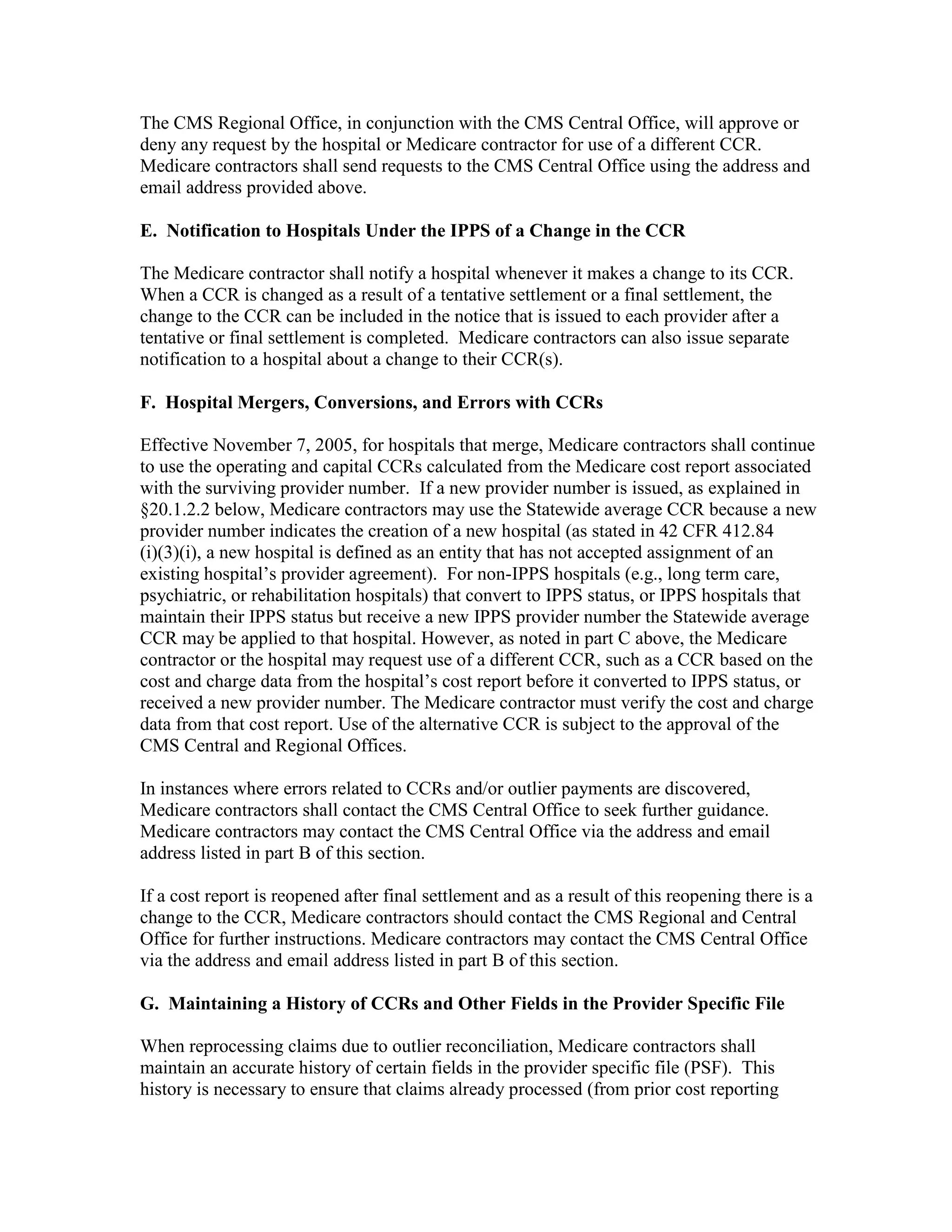
The CMS Regional Office, in conjunction with the CMS Central Office, will approve or
deny any request by the hospital or Medicare contractor for use of a different CCR.
Medicare contractors shall send requests to the CMS Central Office using the address and
email address provided above.
E. Notification to Hospitals Under the IPPS of a Change in the CCR
The Medicare contractor shall notify a hospital whenever it makes a change to its CCR.
When a CCR is changed as a result of a tentative settlement or a final settlement, the
change to the CCR can be included in the notice that is issued to each provider after a
tentative or final settlement is completed. Medicare contractors can also issue separate
notification to a hospital about a change to their CCR(s).
F. Hospital Mergers, Conversions, and Errors with CCRs
Effective November 7, 2005, for hospitals that merge, Medicare contractors shall continue
to use the operating and capital CCRs calculated from the Medicare cost report associated
with the surviving provider number. If a new provider number is issued, as explained in
§20.1.2.2 below, Medicare contractors may use the Statewide average CCR because a new
provider number indicates the creation of a new hospital (as stated in 42 CFR 412.84
(i)(3)(i), a new hospital is defined as an entity that has not accepted assignment of an
existing hospital’s provider agreement). For non-IPPS hospitals (e.g., long term care,
psychiatric, or rehabilitation hospitals) that convert to IPPS status, or IPPS hospitals that
maintain their IPPS status but receive a new IPPS provider number the Statewide average
CCR may be applied to that hospital. However, as noted in part C above, the Medicare
contractor or the hospital may request use of a different CCR, such as a CCR based on the
cost and charge data from the hospital’s cost report before it converted to IPPS status, or
received a new provider number. The Medicare contractor must verify the cost and charge
data from that cost report. Use of the alternative CCR is subject to the approval of the
CMS Central and Regional Offices.
In instances where errors related to CCRs and/or outlier payments are discovered,
Medicare contractors shall contact the CMS Central Office to seek further guidance.
Medicare contractors may contact the CMS Central Office via the address and email
address listed in part B of this section.
If a cost report is reopened after final settlement and as a result of this reopening there is a
change to the CCR, Medicare contractors should contact the CMS Regional and Central
Office for further instructions. Medicare contractors may contact the CMS Central Office
via the address and email address listed in part B of this section.
G. Maintaining a History of CCRs and Other Fields in the Provider Specific File
When reprocessing claims due to outlier reconciliation, Medicare contractors shall
maintain an accurate history of certain fields in the provider specific file (PSF). This
history is necessary to ensure that claims already processed (from prior cost reporting
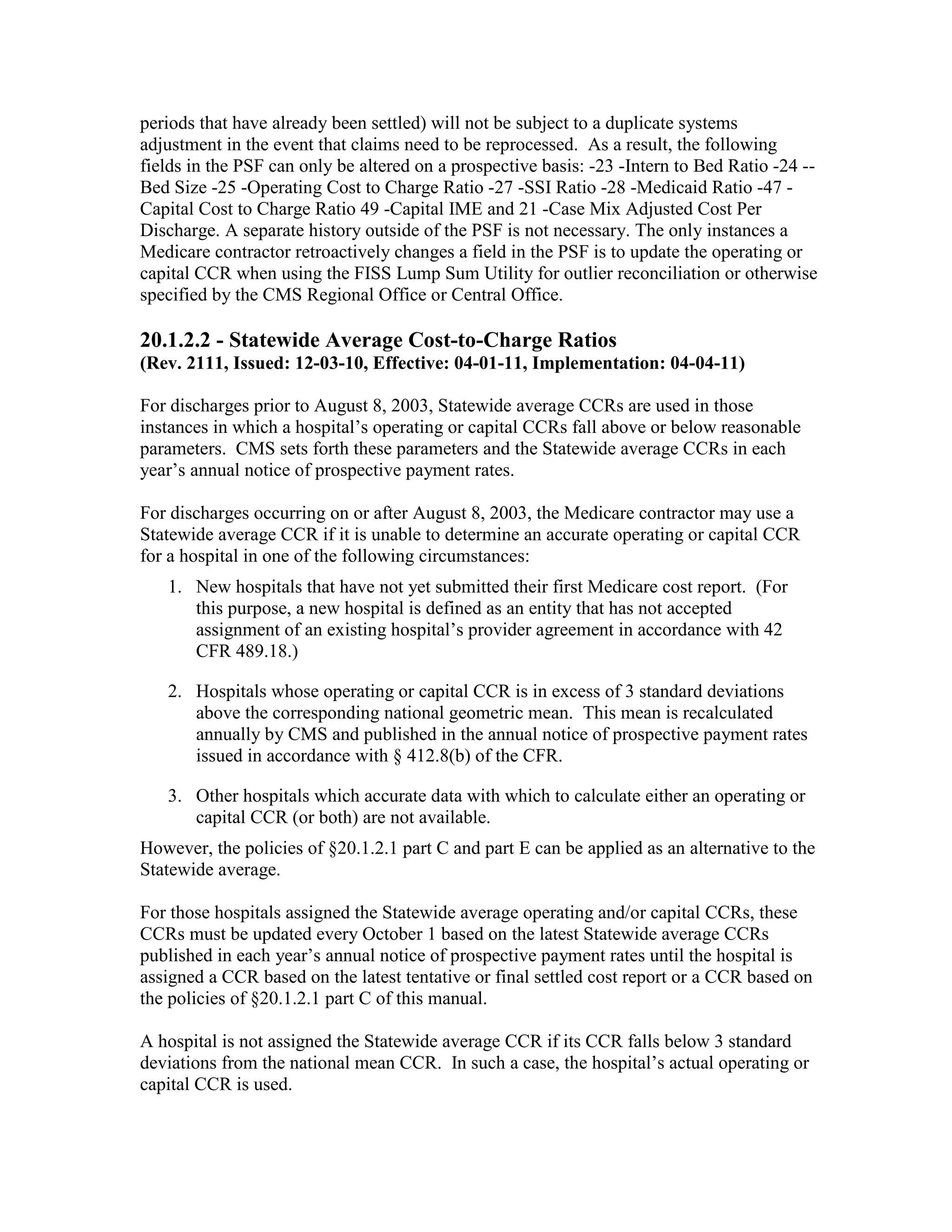
periods that have already been settled) will not be subject to a duplicate systems
adjustment in the event that claims need to be reprocessed. As a result, the following
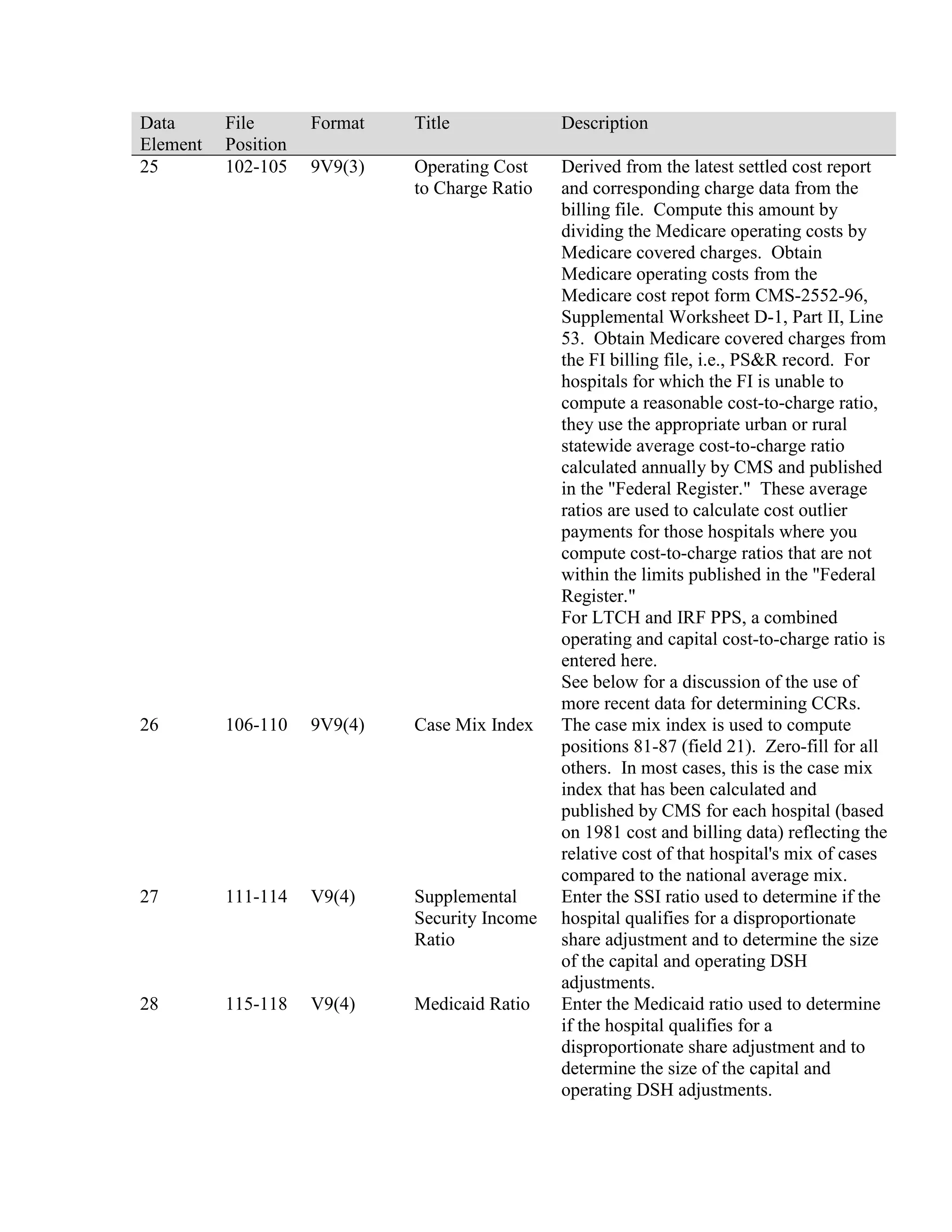
fields in the PSF can only be altered on a prospective basis: -23 -Intern to Bed Ratio -24 -Bed Size -25 -Operating Cost to Charge Ratio -27 -SSI Ratio -28 -Medicaid Ratio -47 Capital Cost to Charge Ratio 49 -Capital IME and 21 -Case Mix Adjusted Cost Per
Discharge. A separate history outside of the PSF is not necessary. The only instances a
Medicare contractor retroactively changes a field in the PSF is to update the operating or
capital CCR when using the FISS Lump Sum Utility for outlier reconciliation or otherwise
specified by the CMS Regional Office or Central Office.

20.1.2.2 - Statewide Average Cost-to-Charge Ratios
(Rev. 2111, Issued: 12-03-10, Effective: 04-01-11, Implementation: 04-04-11)
For discharges prior to August 8, 2003, Statewide average CCRs are used in those
instances in which a hospital’s operating or capital CCRs fall above or below reasonable
parameters. CMS sets forth these parameters and the Statewide average CCRs in each
year’s annual notice of prospective payment rates.
For discharges occurring on or after August 8, 2003, the Medicare contractor may use a
Statewide average CCR if it is unable to determine an accurate operating or capital CCR
for a hospital in one of the following circumstances:
1. New hospitals that have not yet submitted their first Medicare cost report. (For
this purpose, a new hospital is defined as an entity that has not accepted
assignment of an existing hospital’s provider agreement in accordance with 42
CFR 489.18.)
2. Hospitals whose operating or capital CCR is in excess of 3 standard deviations
above the corresponding national geometric mean. This mean is recalculated
annually by CMS and published in the annual notice of prospective payment rates
issued in accordance with § 412.8(b) of the CFR.
3. Other hospitals which accurate data with which to calculate either an operating or
capital CCR (or both) are not available.
However, the policies of §20.1.2.1 part C and part E can be applied as an alternative to the
Statewide average.
For those hospitals assigned the Statewide average operating and/or capital CCRs, these
CCRs must be updated every October 1 based on the latest Statewide average CCRs
published in each year’s annual notice of prospective payment rates until the hospital is
assigned a CCR based on the latest tentative or final settled cost report or a CCR based on
the policies of §20.1.2.1 part C of this manual.
A hospital is not assigned the Statewide average CCR if its CCR falls below 3 standard
deviations from the national mean CCR. In such a case, the hospital’s actual operating or
capital CCR is used.
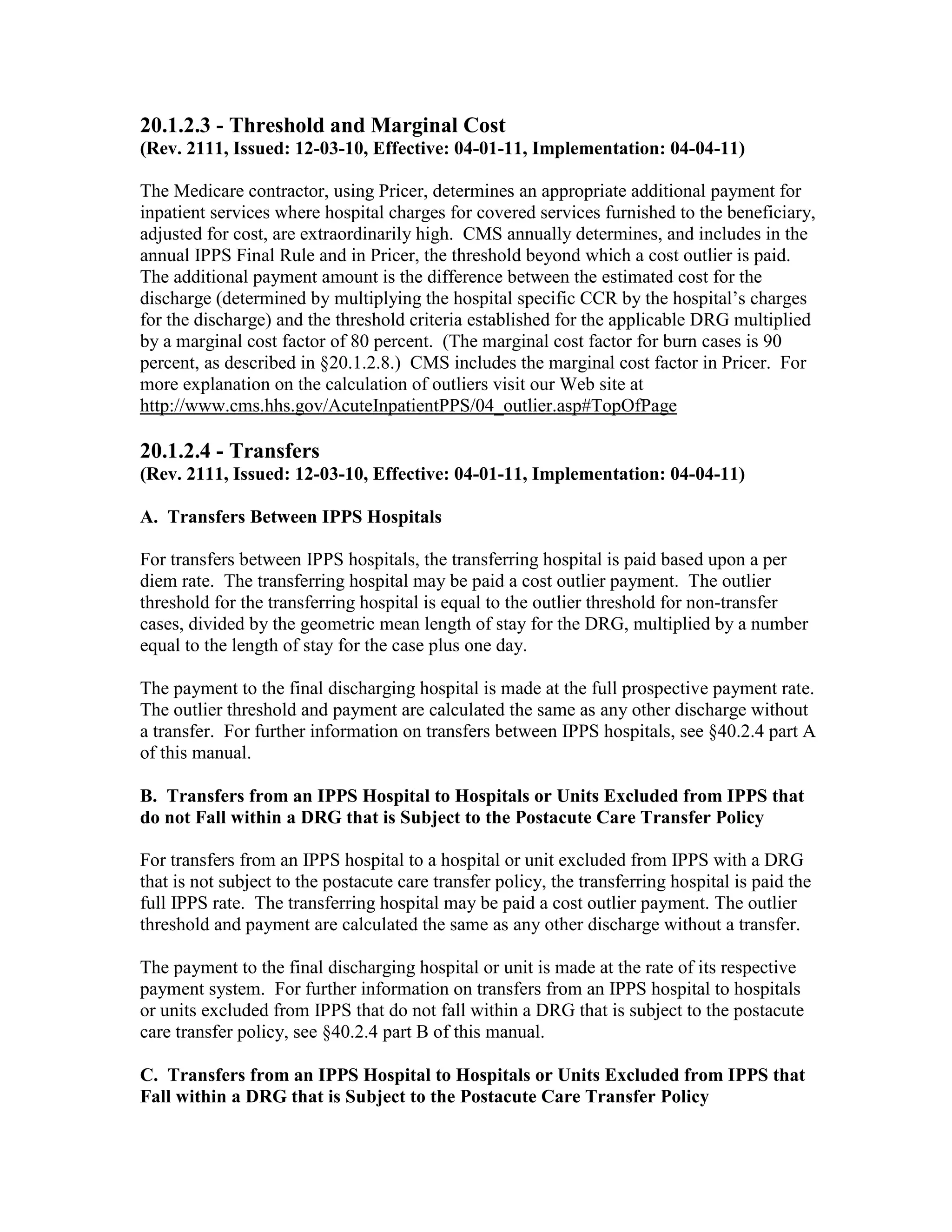
20.1.2.3 - Threshold and Marginal Cost
(Rev. 2111, Issued: 12-03-10, Effective: 04-01-11, Implementation: 04-04-11)
The Medicare contractor, using Pricer, determines an appropriate additional payment for
inpatient services where hospital charges for covered services furnished to the beneficiary,
adjusted for cost, are extraordinarily high. CMS annually determines, and includes in the
annual IPPS Final Rule and in Pricer, the threshold beyond which a cost outlier is paid.
The additional payment amount is the difference between the estimated cost for the
discharge (determined by multiplying the hospital specific CCR by the hospital’s charges
for the discharge) and the threshold criteria established for the applicable DRG multiplied
by a marginal cost factor of 80 percent. (The marginal cost factor for burn cases is 90
percent, as described in §20.1.2.8.) CMS includes the marginal cost factor in Pricer. For
more explanation on the calculation of outliers visit our Web site at
http://www.cms.hhs.gov/AcuteInpatientPPS/04_outlier.asp#TopOfPage

20.1.2.4 - Transfers
(Rev. 2111, Issued: 12-03-10, Effective: 04-01-11, Implementation: 04-04-11)
A. Transfers Between IPPS Hospitals
For transfers between IPPS hospitals, the transferring hospital is paid based upon a per
diem rate. The transferring hospital may be paid a cost outlier payment. The outlier
threshold for the transferring hospital is equal to the outlier threshold for non-transfer
cases, divided by the geometric mean length of stay for the DRG, multiplied by a number
equal to the length of stay for the case plus one day.
The payment to the final discharging hospital is made at the full prospective payment rate.
The outlier threshold and payment are calculated the same as any other discharge without
a transfer. For further information on transfers between IPPS hospitals, see §40.2.4 part A
of this manual.
B. Transfers from an IPPS Hospital to Hospitals or Units Excluded from IPPS that
do not Fall within a DRG that is Subject to the Postacute Care Transfer Policy
For transfers from an IPPS hospital to a hospital or unit excluded from IPPS with a DRG
that is not subject to the postacute care transfer policy, the transferring hospital is paid the
full IPPS rate. The transferring hospital may be paid a cost outlier payment. The outlier
threshold and payment are calculated the same as any other discharge without a transfer.
The payment to the final discharging hospital or unit is made at the rate of its respective
payment system. For further information on transfers from an IPPS hospital to hospitals
or units excluded from IPPS that do not fall within a DRG that is subject to the postacute
care transfer policy, see §40.2.4 part B of this manual.
C. Transfers from an IPPS Hospital to Hospitals or Units Excluded from IPPS that
Fall within a DRG that is Subject to the Postacute Care Transfer Policy
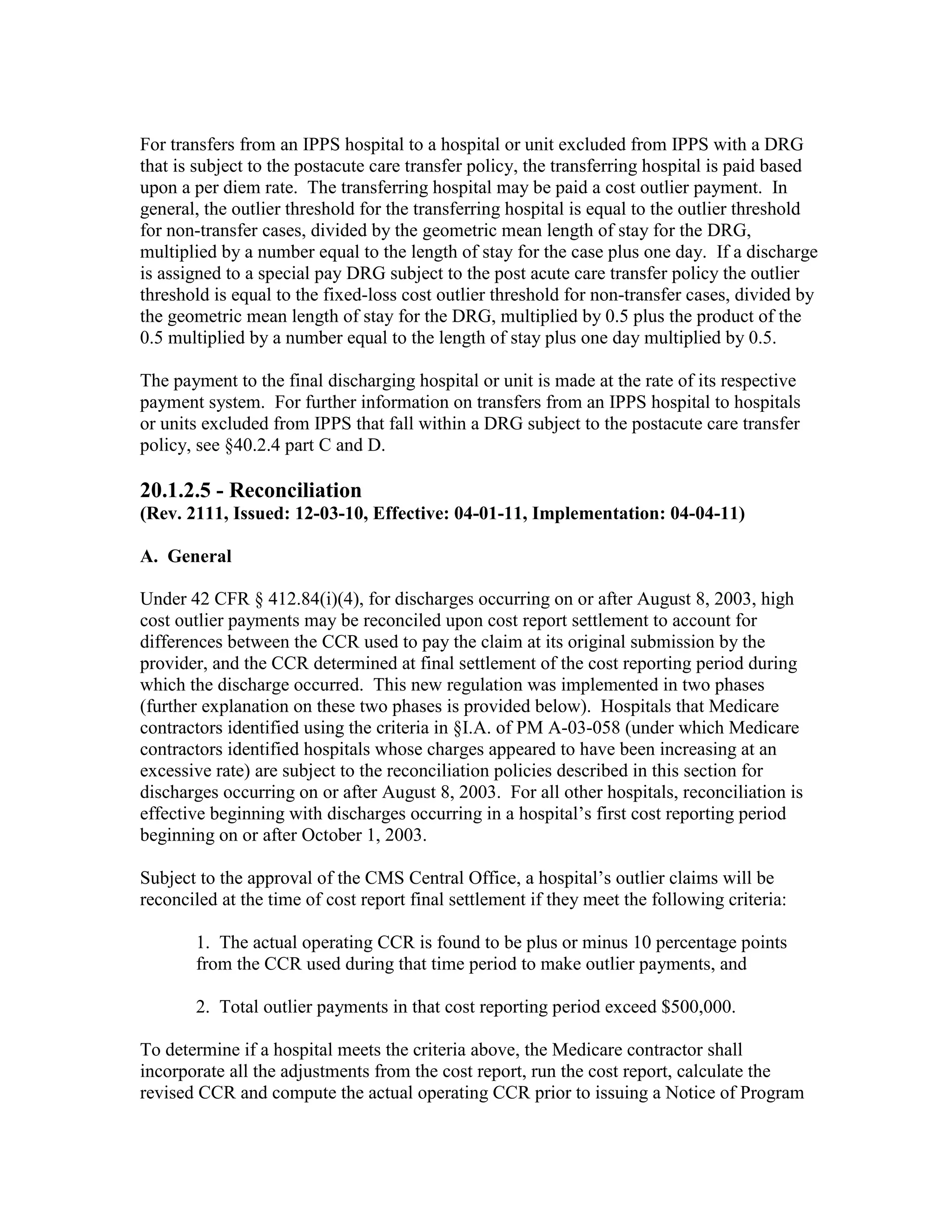
For transfers from an IPPS hospital to a hospital or unit excluded from IPPS with a DRG
that is subject to the postacute care transfer policy, the transferring hospital is paid based
upon a per diem rate. The transferring hospital may be paid a cost outlier payment. In
general, the outlier threshold for the transferring hospital is equal to the outlier threshold
for non-transfer cases, divided by the geometric mean length of stay for the DRG,
multiplied by a number equal to the length of stay for the case plus one day. If a discharge
is assigned to a special pay DRG subject to the post acute care transfer policy the outlier
threshold is equal to the fixed-loss cost outlier threshold for non-transfer cases, divided by
the geometric mean length of stay for the DRG, multiplied by 0.5 plus the product of the
0.5 multiplied by a number equal to the length of stay plus one day multiplied by 0.5.
The payment to the final discharging hospital or unit is made at the rate of its respective
payment system. For further information on transfers from an IPPS hospital to hospitals
or units excluded from IPPS that fall within a DRG subject to the postacute care transfer
policy, see §40.2.4 part C and D.

20.1.2.5 - Reconciliation
(Rev. 2111, Issued: 12-03-10, Effective: 04-01-11, Implementation: 04-04-11)
A. General
Under 42 CFR § 412.84(i)(4), for discharges occurring on or after August 8, 2003, high
cost outlier payments may be reconciled upon cost report settlement to account for
differences between the CCR used to pay the claim at its original submission by the
provider, and the CCR determined at final settlement of the cost reporting period during
which the discharge occurred. This new regulation was implemented in two phases
(further explanation on these two phases is provided below). Hospitals that Medicare
contractors identified using the criteria in §I.A. of PM A-03-058 (under which Medicare
contractors identified hospitals whose charges appeared to have been increasing at an
excessive rate) are subject to the reconciliation policies described in this section for
discharges occurring on or after August 8, 2003. For all other hospitals, reconciliation is
effective beginning with discharges occurring in a hospital’s first cost reporting period
beginning on or after October 1, 2003.
Subject to the approval of the CMS Central Office, a hospital’s outlier claims will be
reconciled at the time of cost report final settlement if they meet the following criteria:
1. The actual operating CCR is found to be plus or minus 10 percentage points
from the CCR used during that time period to make outlier payments, and
2. Total outlier payments in that cost reporting period exceed $500,000.
To determine if a hospital meets the criteria above, the Medicare contractor shall
incorporate all the adjustments from the cost report, run the cost report, calculate the
revised CCR and compute the actual operating CCR prior to issuing a Notice of Program
Reimbursement (NPR). If the criteria for reconciliation are not met, the cost report shall
be finalized. If the criteria for reconciliation are met, Medicare contractors shall follow
the instructions below in §20.1.2.7. The NPR cannot be issued nor can the cost report be
finalized until outlier reconciliation is complete.
The first criterion requires a 10 percentage point fluctuation in the operating CCR only
(and not the capital CCR). However, if a hospital meets both criteria, claims will be
reconciled using the operating and capital CCRs from the final settled cost report.
As stated above, if a cost report is reopened after final settlement and as a result of this
reopening there is a change to the CCR (which could trigger or affect outlier reconciliation
and outlier payments), Medicare contractors shall notify the CMS Regional and Central
Office for further instructions. Notification to the CMS Central Office shall be sent to the
address and email address provided in §20.1.2.1 (b).
Even if a hospital does not meet the criteria for reconciliation, subject to approval of the
Regional and Central Office, the Medicare contractor has the discretion to request that a
hospital’s outlier payments in a cost reporting period be reconciled if the hospital’s most
recent cost and charge data indicate that the outlier payments to the hospital were
significantly inaccurate. The Medicare contractor sends notification to the Central Office
via the address and email address provided in §20.1.2.1 (b). Upon approval of the CMS
Regional and Central Office that a hospital’s outlier claims need to be reconciled,
Medicare contractors should follow the instructions in §20.1.2.7.
B. Reconciling Outlier Payments for those Hospitals Identified in PM A-03-058
As stated above, for a hospital that met the criteria in §I.A. of PM A-03-058,
reconciliation begins for discharges occurring on or after August 8, 2003. To establish
whether a hospital’s outlier payments are subject to reprocessing, Medicare contractors
determine if the CCR and total outlier payments from the entire cost reporting period meet
the two criteria in part A of this section. However, if both criteria for reconciliation are
met, only the discharges that occurred between August 8, 2003 and the end of the cost
reporting period will be reconciled. These hospitals will be subject to reconciliation in
subsequent cost reporting periods if they meet the two criteria outlined in part A of this
section. See example A below.
The Medicare contractors shall notify the CMS Regional Office and CMS Central Office
of any hospital that meets the criteria for reconciliation. Notification to the CMS Central
Office shall be sent to the address and email address provided in §20.1.2.1. Further
instructions for Medicare contractors on reconciliation and the time value of money are
provided below in §§20.1.2.6 and 20.1.2.7.
EXAMPLE A:
Cost Reporting Period: 09/01/2002-08/31/2003
Operating CCR used to pay original claims submitted during cost reporting period: 0.40
(In this example, this CCR is from the tentatively or final settled 2002 cost report)
Final settled operating CCR from 09/01/2002-08/31/2003 cost report: 0.50
Total outlier payout in 09/01/2002-08/31/2003 cost reporting period: $600,000
Because the CCR of 0.40 used at the time the claim was originally paid changed to 0.50 at
the time of final settlement, and the provider received greater than $500,000 in outlier
payments during that cost reporting period, the provider’s claims for discharges from
August 8, 2003 through August 31, 2003 shall be reconciled using the correct CCR of
0.50. The same criteria shall be applied to the cost report beginning on 09/01/2003 to
determine whether reconciliation of outlier payments for that cost reporting period is
necessary. For details on how to apply multiple CCRs in a cost reporting period, see
example C below.
C. Reconciling Outlier Payments for those Hospitals Not Identified in PM A-03-058
Beginning with the first cost reporting period starting on or after October 1, 2003, all
hospitals are subject to the reconciliation policies set forth in this section. If a hospital
meets the criteria in part A of this section, the Medicare contractor shall notify the CMS
Regional Office and Central Office at the address and email address provided in §20.1.2.1.
Further instructions for Medicare contractors on reconciliation and the time value of
money are provided below in §§20.1.2.6 and 20.1.2.7.
The following examples demonstrate how to apply the criteria for reconciliation:
EXAMPLE B:
Cost Reporting Period: 01/01/2004-12/31/2004
Operating CCR used to pay original claims submitted during cost reporting period: 0.40
(In this example, this CCR is from the tentatively settled 2002 cost report)
Final settled operating CCR from 01/01/2004-12/31/2004 cost report: 0.50
Total outlier payout in 01/01/2004-12/31/2004 cost reporting period: $600,000
Because the CCR of 0.40 used at the time the claim was originally paid changed to 0.50 at
the time of final settlement, and the provider received greater than $500,000 in outlier
payments during that cost reporting period, the criteria has been met to trigger
reconciliation, and therefore, the Medicare contractor shall notify the CMS Regional
Office and Central Office. The provider’s outlier payments for this cost reporting period
will be reconciled using the correct CCR of 0.50.
In the event that multiple CCRs are used in a given cost reporting period, Medicare
contractors should calculate a weighted average of the CCRs in that cost reporting period.
(See Example C below for instructions on how to weight the CCRs). The Medicare
contractor shall then compare the weighted CCR to the CCR determined at the time of
final settlement of the cost reporting period to determine if reconciliation is required.
Again, total outlier payments for the entire cost reporting period must exceed $500,000 in
order to trigger reconciliation.
EXAMPLE C:
Cost Reporting Period: 01/01/2004-12/31/2004
Operating CCR used to pay original claims submitted during cost reporting period:
-

0.40 from 01/01/2004-03/31/2004 (This CCR could be from the tentatively
settled 2001 cost report)

-

0.50 from 04/01/2004-12/31/2004 (This CCR could be from the tentatively
settled 2002 cost report)

Final settled operating CCR from 01/01/2004-12/31/2004 cost report: 0.35
Total Outlier payout in 01/01/2004-12/31/2004 cost reporting period: $600,000
Weighted Average CCR: 0.474
CCR
0.40

Days
91

Weight
0.248 (91 Days / 366 Days)

0.50

275

0.751 (275 Days / 366 Days )

TOTAL

*366

Weighted CCR
(a) 0.099=
(0.40 * 0.248)
(b) 0.375=
(0.50 * 0.751)
(a)+(b) =0.4742

*NOTE: There are 366 days in the year because 2004 was a leap year.
The hospital meets the criteria for reconciliation in this cost reporting period because the
weighted average CCR at the time the claim was originally paid changed from 0.474 to
0.35 (which is greater than 10 percentage points) at the time of final settlement, and the
provider received an outlier payment greater than $500,000 for the entire cost reporting
period.
D. Providers Already Flagged for Outlier Reconciliation
Medicare contractors shall have until April 25, 2011 to submit via email to
outliersipps@cms.hhs.gov a list of providers that were flagged for outlier reconciliation
prior to April 1, 2011 (NOTE: Do not send this list prior to April 1, 2011 as this list shall
include all providers flagged for outlier reconciliation prior to April 1, 2011). In this list,
Medicare contractors shall include the provider number, provider name, cost reporting
begin date, cost reporting end date, status of cost report (was the Notice of Program
Reimbursement (NPR) issued), date of NPR, total operating and capital outlier payments
in the cost reporting period, the operating CCR or weighted operating CCR from the time
the claims were paid during the cost reporting period being reconciled and the final settled
operating and capital CCR. The CMS Central Office will then review this list and grant
formal approval via email for Medicare contractors to reprice and reconcile the claims of
those hospitals that have been flagged for outlier reconciliation. Upon approval from the
CMS Central Office, Medicare contractors shall follow the procedures in §20.1.2.7 and
complete the reconciliation process by October 1, 2011. If a Medicare contractor cannot
complete the reconciliation process by October 1, 2011, the Medicare contractor shall
contact the CMS Central Office for further guidance. NOTE: Those Medicare contractors
that do not have any providers flagged for outlier reconciliation prior to April 1, 2011
shall also send an email to the address above indicating that they have no providers
flagged for outlier reconciliation prior to April 1, 2011.

20.1.2.6 - Time Value of Money
(Rev. 2242, Issued: 06-17-11, Effective: 07-01-11, Implementation: 07-01-11)
Effective for discharges occurring on or after August 8, 2003, at the time of any
reconciliation under §20.1.2.5, outlier payment may be adjusted to account for the time
value of money of any adjustments to outlier payments as a result of reconciliation. The
time value of money is applied from the midpoint of the hospital’s cost reporting period
being settled to the date on which the CMS Central Office receives notification from the
Medicare contractor that reconciliation should be performed.
If a hospital’s outlier payments have met the criteria for reconciliation, CMS will calculate
the aggregate adjustment using the instructions below concerning reprocessing claims and
determine the additional amount attributable to the time value of money of that
adjustment. The index that will be used to calculate the time value of money is the
monthly rate of return that the Medicare trust fund earns. This index can be found at
http://www.ssa.gov/OACT/ProgData/newIssueRates.html.
The following formula will be used to calculate the rate of the time value of money.
(Rate from Web site as of the midpoint of the cost report being settled / 365) * # of days
from that midpoint until date of reconciliation. NOTE: The time value of money can be a
positive or negative amount depending if the provider is owed money by CMS or if the
provider owes money to CMS.
For purposes of calculating the time value of money, the “date of reconciliation” is the day
on which the CMS Central Office receives notification. This date is either the postmark
from the written notification sent to the CMS Central Office via mail by the Medicare
contractor, or the date an email was received from the Medicare contractor by the CMS
Central Office, whichever date is earlier.
The following is an example of the computation of the adjustment to account for the time
value of money:
EXAMPLE
Cost Reporting Period: 01/01/2004-12/31/2004
Midpoint of Cost Reporting Period: 07/01/2004
Date of Reconciliation: 12/31/2005
Number of days from Midpoint until date of Reconciliation: 549
Rate from Social Security Web site: 4.625%
Operating CCR used to pay actual original claims in cost reporting period: 0.40 (This
CCR could be from the tentatively settled 2002 or 2003 cost report)
Final settled operating CCR from 01/01/2004-12/31/2004 cost report: 0.50
Total outlier payout in 01/01/2004-12/31/2004 cost reporting period: $600,000.
Because the CCR fluctuated from .40 at the time the claims were originally paid to 0.50 at
the time of final settlement and the provider has total outlier payments greater than
$500,000, the criteria have been met to trigger reconciliation. The Medicare contractor
notifies the CMS Regional and Central Office.
The Medicare contractor reprocesses and reconciles the claims. The reprocessing indicates
the revised outlier payments are $700,000.
Using the values above, determine the rate that will be used for the time value of money:
(4.625 / 365) * 549 = 6.9565%
Based on the claims reconciled, the provider is owed $100,000 ($700,000-$600,000) for
the reconciled amount and $6,956.50 ($100,000 * 6.9565 %) for the time value of money.

20.1.2.7 - Procedure for Medicare Contractors to Perform and Record
Outlier Reconciliation Adjustments
(Rev. 2447, Issued: 04-26-12, Effective: 10-01-12, Implementation: 10-01-12)
The following is a step-by-step explanation of the procedures that Medicare contractors
are to follow if a hospital is eligible for outlier reconciliation:
1) The Medicare contractor shall send notification to the CMS Central Office (not the
hospital), via the street address and email address provided in §20.1.2.1 (B)) and
regional office that a hospital has met the criteria for reconciliation. Medicare
contractors shall include in their notification the provider number, provider name,
cost reporting begin date, cost reporting end date, total operating and capital outlier
payments in the cost reporting period, the operating CCR or weighted average
operating CCR from the time the claims were paid during the cost reporting period
eligible for reconciliation and the final settled operating and capital CCR.
2) If the Medicare contractor receives approval from the CMS Central Office that
reconciliation is appropriate, the Medicare contractor follows steps 3-14 below.
NOTE: Hospital cost reports will remain open until their claims have been
processed for outlier reconciliation.
3) The Medicare contractor shall notify the hospital and copy the CMS Regional
Office and Central Office in writing and via email (through the addresses provided
in §20.1.2.1 (B)) that the hospital’s outlier claims are to be reconciled.
4) Prior to running claims in the *Lump Sum Utility, Medicare contractors shall
update the applicable provider records in the Inpatient Provider Specific File
(IPSF) by entering the final settled operating and capital CCR from the cost report
in the operating and capital CCR fields. Specifically, for hospitals paid under the
IPPS, Medicare contractors shall enter the revised operating CCR in PSF field 25 Operating Cost to Charge Ratio and the revised capital CCR in PSF field 47 Capital Cost to Charge Ratio. No other elements in the IPSF (such as elements
related to the DSH and IME adjustments) shall be updated for the applicable
provider records in the IPSF that span the cost reporting period being reconciled
aside from the elements for the operating and capital CCRs.
*NOTE: The FISS Lump Sum Utility is a Medicare contractor tool that,
depending on the elements that are input, will produce an extract that will calculate
the difference between the original PPS payment amounts and revised PPS
payment amounts into a Microsoft Access generated report. The Lump Sum Utility
calculates the original and revised payments offline and will not affect the original
claim payment amounts as displayed in various CMS systems (such as NCH).
5) Medicare contractors shall ensure that, prior to running claims through the FISS
Lump Sum Utility, all pending claims (e.g., appeal adjustments) are finalized for
the applicable provider.
6) Medicare contractors shall only run claims in the Lump Sum Utility that meet the
following criteria:
•
•
•

Type of Bill (TOB) equals 11X
Previous claim is in a paid status (P location) within FISS
Cancel date is ‘blank’

7) The Medicare contractor reconciles the claims through the applicable IPPS Pricer
software and not through any editing or grouping software.
8) Upon completing steps 3 through 7 above, the Medicare contractor shall run the
claims through the Lump Sum Utility. The Lump Sum Utility will produce an
extract, according to the elements in Table 1 below. NOTE: The extract must be
importable by Microsoft Access or a similar software program (Microsoft Excel).
9) Medicare contractors shall upload the extract into Microsoft Access or a similar
software program to generate a report that contains elements in Table 1. Medicare
contractors shall ensure this report is retained with the cost report settlement work
papers.
10) For hospitals paid under the IPPS, the Lump Sum Utility will calculate the
difference between the original and revised operating and capital outlier amounts.
If the difference between the original and revised operating and capital outlier
amounts (calculated by the Lump Sum Utility) is positive, then a credit amount
(addition) shall be issued to the provider. If the difference between the original and
revised operating and capital amounts (calculated by the Lump Sum Utility) is
negative, then a debit amount (deduction) shall be issued to the provider. NOTE:
The difference between the original and revised operating outlier amounts and the
difference between the original and revised capital outlier amounts are two distinct
amounts calculated by the lump sum utility and are recorded on two separate lines
on the cost report.
11) The operating and capital time value of money amounts are two distinct
calculations that are recorded separately on the cost report. Medicare contractors
shall determine the applicable time value of money amount by using the
calculation methodology in §20.1.2.6. If the difference between the original and
revised operating and capital outlier amounts is a negative amount then the time
value of money is also a negative amount. If the difference between the original
and revised operating and capital outlier amounts is a positive amount then the
time value of money is also a positive amount. Similar to step 10, if the time value
of money is positive, then a credit amount (addition) shall be issued to the
provider. If the time value of money is negative, then a debit amount (deduction)
shall be issued to the provider. NOTE: The time value of money is applied to the
difference between the original and revised operating and capital outlier amounts.
12) For cost reporting periods beginning before May 1, 2010, under cost report 255296, the Medicare contractor shall record the original operating and capital outlier
amounts, the operating and capital outlier reconciliation adjustment amount (the
difference between the original and revised operating and capital outlier amounts
calculated by the Lump Sum Utility), the operating and capital time value of
money and the rate used to calculate the time value of money on lines 50-56, of
Worksheet E, Part A of the cost report (NOTE: the amounts recorded on lines 5053 and 55 thru 56 can be positive or negative amounts per the instructions above).
The total outlier reconciliation adjustment amount (the difference between the
original and revised operating and capital outlier amount (calculated by the Lump
Sum Utility) plus the time value of money) shall be recorded on line 24.99 of
Worksheet E, Part A. For complete instructions on how to fill out these lines
please see § 3630.1 of the Provider Reimbursement Manual, Part II. NOTE: Both
the operating and capital amounts are combined and recorded on line 24.99 of
Worksheet E, Part A.
For cost reporting periods beginning on or after May 1, 2010, under cost report
2552-10, the Medicare contractor shall record the original operating and capital
outlier amounts, the operating and capital outlier reconciliation adjustment
amounts (the difference between the original and revised operating and capital
outlier amounts calculated by the Lump Sum Utility), the operating and capital
time value of money and the rate used to calculate the time value of money on
lines 90-96, of Worksheet E, Part A of the cost report (NOTE: the amounts
recorded on lines 90-93 and 95 thru 96 can be positive or negative amounts per the
instructions above). The total outlier reconciliation adjustment amount (the
difference between the original and revised operating and capital outlier amount
(calculated by the Lump Sum Utility) plus the time value of money) shall be
recorded on line 69 of Worksheet E, Part A. NOTE: Both the operating and capital
amounts are combined and recorded on line 69 of Worksheet E, Part A.
13) The Medicare contractor shall finalize the cost report, issue a NPR and make the
necessary adjustment from or to the provider.
14) After determining the total outlier reconciliation amount and issuing a NPR,
Medicare contractors shall restore the operating and capital CCR(s) elements to
their original values (that is, the CCRs used to pay the claims) in the applicable
provider records in the IPSF to ensure an accurate history is maintained.
Specifically, for hospitals paid under the IPPS, Medicare contractors shall enter the
original operating CCR in PSF field 25 -Operating Cost to Charge Ratio and the
original capital CCR in PSF field 47 -Capital Cost to Charge Ratio.
If the Medicare contractor has any questions regarding this process it should contact the
CMS Central Office via the address and email address provided in §20.1.2.1 (B).
Table 1: Data Elements for FISS Extract
List of Data Elements for FISS Extract
Provider #
Health Insurance Claim (HIC) Number
Document Control Number (DCN)
Type of Bill
Original Paid Date
Statement From Date
Statement To Date
Original Reimbursement Amount (claims page 10)
Revised Reimbursement Amount (claim page 10)
Difference between these amounts
Original Deductible Amount, Payer A, B, C (Value Code A1, B1, C1)
Revised Deductible Amount, Payer A, B, C (Value Code A1, B1, C1)
Difference between these amounts
Original Coinsurance Amount, Payer A, B, C (Value Code A2, B2, C2)
Revised Coinsurance Amount, Payer A, B, C (Value Code A2, B2, C2)
Difference between these amounts
Original Medicare Lifetime Reserve Amount in the first calendar year period (Value
Code 08)
Revised Medicare Lifetime Reserve Amount in the first calendar year period (Value
Code 08)
Difference between these amounts
Original Medicare Coinsurance Amount in the first calendar year period (Value Code 09)
Revised Medicare Coinsurance Amount in the first calendar year period (Value Code 09)
Difference between these amounts
Original Medicare Lifetime Reserve Amount in the second calendar year period (Value
code 10)
Revised Medicare Lifetime Reserve Amount in the second calendar year period (Value
code 10)
Difference between these amounts
Original Medicare Coinsurance Amount in the second calendar year period (Value code
11)
Revised Medicare Coinsurance Amount in the second calendar year period (Value code
11)
Difference between these amounts
Original Outlier Amount (Value Code 17)
Revised Outlier Amount (Value Code 17)
Difference between these amounts
Original DSH Amount (Value Code 18)
Revised DSH Amount (Value Code 18)
Difference between these amounts
Original IME Amount (Value Code 19)
Revised IME Amount (Value Code 19)
Difference between these amounts
Original New Tech Add-on (Value Code 77)
Revised New Tech Add-on (Value Code 77)
Difference between these amounts
Original Device Reductions (Value Code D4)
Revised Device Reductions (Value Code D4)
Difference between these amounts
TOT CHRG – total billed charges (claim page 3)
COV CHRG – total covered charges (claim page 3)
Original Hospital Portion (claim page 14)
Revised Hospital Portion (claim page 14)
Difference between these amounts
Original Federal Portion (claim page 14)
Revised Federal Portion (claim page 14)
Difference between these amounts
Original C TOT PAY (claim page 14)
Revised C TOT PAY (claim page 14)
Difference between these amounts
Original C FSP (claim page 14)
Revised C FSP (claim page 14)
Difference between these amounts
Original C OUTLIER (claim page 14)
Revised C OUTLIER (claim page 14)
Difference between these amounts
Original C DSH ADJ (claim page 14)
Revised C DSH ADJ (claim page 14)
Difference between these amounts
Original C IME ADJ (claim page 14)
Revised C IME ADJ (claim page 14)
Difference between these amounts
Original Pricer Amount
Revised Pricer Amount
Difference between these amounts
Original PPS Payment (claim page 14)
Revised PPS Payment (claim page 14)
Difference between these amounts
Original PPS Return Code (claim page 14)
Revised PPS Return Code (claim page 14)
DRG
MSP Indicator (Value Codes 12-16 & 41-43 – indicator indicating the claim is MSP; ‘Y’
= MSP, ‘blank’ = no MSP
Reason Code
HMO-IME Indicator
Filler

20.1.2.8 - Special Outlier Payments for Burn Cases
(Rev. 707, Issued: 10-12-05; Effective/Implementation Dates: 11-07-05)
For discharges occurring on or after April 1, 1988, the additional payment amount for the
DRGs related to burn cases, which are identified in the most recent annual notice of
prospective payment rates is computed using the same methodology (as stated above in
section 20.1.2.3) except that the payment is made using a marginal cost factor of 90
percent instead of 80 percent.

20.1.2.9 - Medical Review and Adjustments
(Rev. 1571; Issued: 08-07-08; Effective Date: 08-01-08; Implementation Date: 0815-08)
Effective April 1, 2008, QIOs are no longer performing the majority of medical review for
payment of acute inpatient prospective payment system (IPPS) hospital and long term care
hospital (LTCH) claims. These reviews are the responsibility of the A/B MACs or the
FIs. An exception occurs when a provider requests a higher-weighted DRG review from
the QIO. The QIO will continue to perform those reviews.
The A/B MAC or the FI may review a sample of cost outlier cases after payment. The
charges for any services identified as non-covered through this review are denied and any
outlier payment made for these services is recovered, as appropriate, after a determination
as to the provider’s liability has been made.
If the A/B MAC or the FI finds a pattern of inappropriate utilization by a hospital, all cost
outlier cases from that hospital may be subject to medical review, and this review may be
conducted prior to payment until the A/B MAC or the FI determines that appropriate
corrective actions have been taken.
When the A/B MAC or the FI reviews cost outlier cases, they shall do so using the
medical records and itemized charges, to verify the following:
1. The admission was medically necessary and appropriate;
2. Services were medically necessary and delivered in the most appropriate setting;
3. Services were ordered by the physician, actually furnished, and not duplicatively
billed; and
4. The diagnostic and procedural coding are correct.
Where the A/B MAC’s or the FI’s decision changes previously processed bills, an
adjustment bill is prepared to correct the bill.
When the hospital provides the A/B MACs or the FIs with medical records for cost outlier
review, the hospital must indicate the precise revenue code for each charge billed. In case
adjustments are needed, revenue codes are necessary to ensure proper accounting for cost
report purposes. It is not acceptable for the hospital to merely provide listings of revenue
codes expecting the A/B MACs or the FIs to assign the charges to the appropriate code. If
the correct revenue codes are not provided, the A/B MACs or the FIs will deny the bill.

20.1.2.10 - Return Codes for Pricer
(Rev. 707, Issued: 10-12-05; Effective/Implementation Dates: 11-07-05)
The following return codes are calculated by PRICER and passed back to the calling
program. Depending on the type of payment and case, return codes 30, 44, 33, 40 and 42
indicate that an outlier would be paid if the cost-to-charge ratio would rise by 20
percentage points. If a provider(s) (CCR rises by 10 percentage points and) meets the
criteria of reconciliation, the CMS Central Office uses return codes 30, 44, 33, 40 and 42
to determine a smaller pool of claims for reprocessing claims due to outlier reconciliation.
Acute Care
Return Code 00: Paid normal DRG payment.
Return Code 02: Paid normal DRG payment plus a cost outlier.
Return Code 14: Paid normal DRG payment with per diem days equal or greater than
geometric mean length of stay.
Return Code 16: Paid normal DRG payment plus a cost outlier with per diem days equal
to or greater than geometric mean length of stay.
Return Code 30: Paid normal DRG payment and indicates an outlier payment would be
necessary if the CCR would increase by 20 percentage points.
Return Code 44: Paid normal DRG payment with per diem days equal or greater than
geometric mean length of stay and indicates an outlier payment would be necessary if the
CCR would increase by 20 percentage points.
Transfer Cases
Return Code 03: Paid a per diem payment to the transferring IPPS hospital (when the
patient transfers to an IPPS hospital) up to and including the full DRG payment if the
covered days are less than the geometric mean length of stay for the DRG. If covered
days equal or exceed the geometric mean length of stay, the standard payment is
calculated.
Return Code 05: Paid a per diem payment to the transferring IPPS hospital (when the
patient transfers to an IPPS hospital) up to and including the full DRG payment if the
covered days are less than the geometric mean length of stay for the DRG. If covered
days equal or exceed the geometric mean length of stay, the standard payment is
calculated. Also indicates case qualified for a cost outlier payment.
Return Code 06: Paid a per diem payment to the transferring IPPS hospital (when the
patient transfers to an IPPS hospital) up to and including the full DRG payment if the
covered days are less than the geometric mean length of stay for the DRG. If covered
days equal or exceed the geometric mean length of stay, the standard payment is
calculated. Also indicates provider refused cost outlier payment.
Return Code 33: Paid a per diem payment to the transferring IPPS hospital (when the
patient transfers to an IPPS hospital) up to and including the full DRG payment if the
covered days are less than the geometric mean length of stay for the DRG. If covered
days equal or exceed the geometric mean length of stay, the standard payment is
calculated. Also indicates an outlier payment would be necessary if the CCR increased by
20 percentage points.
Post Acute Transfer Cases
Return Code 10: Makes payment to the transferring IPPS hospital (when the patient
transfers to a non-IPPS hospital) for post acute transfer DRGs (that have double the
payment on the 1st day for purposes of the postacute care transfer policy) as published in
the annual IPPS Final Rule. Will calculate a per diem payment based on the standard
DRG payment if the covered days are less than the geometric mean length of stay for the
DRG. If covered days equal or exceed the geometric mean length of stay the standard
payment is also calculated. The cost outlier portion of the payment is calculated if the
adjusted charges on the bill exceed the outlier threshold.
Return Code 12: Makes payment to the transferring IPPS hospital (when the patient
transfers to a non-IPPS hospital) for post acute transfer DRGs (that receive 50 percent of
the prospective payment on the 1st day of the stay for purposes of the postacute care
transfer policy) as published in the annual IPPS Final Rule. Will calculate a per diem
payment based on the standard DRG payment if the covered days are less than the
geometric mean length of stay for the DRG. If covered days equal or exceed the
geometric mean length of stay, the standard payment is calculated. The cost outlier
portion of the payment is calculated if the adjusted charges on the bill exceed the outlier
threshold.
Return Code 40: Makes payment to the transferring IPPS hospital (when the patient
transfers to a non-IPPS hospital) for post acute transfer DRGs (that have double the
payment on the 1st day for purposes of the postacute care transfer policy) as published in
the annual IPPS Final Rule. Will calculate a per diem payment based on the standard
DRG payment if the covered days are less than the geometric mean length of stay for the
DRG. If covered days equal or exceed the geometric mean length of stay, the standard
payment is calculated. Also indicates an outlier payment would be necessary if the CCR
increased by 20 percentage points.
Return Code 42: Makes payment to the transferring IPPS hospital (when the patient
transfers to a non-IPPS hospital) for post acute transfer DRGs (that receive 50 percent of
the prospective payment on the 1st day of the stay for purposes of the postacute care
transfer policy) as published in the annual IPPS Final Rule. Will calculate a per diem
payment based on the standard DRG payment if the covered days are less than the
geometric mean length of stay for the DRG. If covered days equal or exceed the
geometric mean length of stay, the standard payment is calculated. Also indicates an
outlier payment would be necessary if the CCR increased by 20 percentage points.

20.2 - Computer Programs Used to Support Prospective Payment System
(Rev. 1571; Issued: 08-07-08; Effective Date: 08-01-08; Implementation Date: 0815-08)
Medicare Code Editor
The Medicare Code Editor (MCE) is a front-end software program that edits claims to
detect incorrect billing data. The MCE addresses three basic types of edits which will
support the DRG assignment. They include correct ICD-9-CM coding, coverage, and
clinical edits.
Built into the MCE, which is the first portion of the Grouper program, are edits which
reject incomplete or impossible codes. Claims submitted with valid diagnoses and valid
diagnoses-surgical procedure combinations but are incorrect in that they do not represent
the actual diagnosis or procedure, cannot be detected. The responsibility for accuracy
rests with the hospital. However, a post claim approval review may be conducted by the
A/B MACs or the FIs, using medical records and the approved claim.
Grouper Program
The Grouper program determines the DRG from data elements the hospital reported. It is
used on all inpatient discharge/transfer bills received from both PPS and non-PPS
facilities, including those from waiver States, long-term care hospitals, and excluded units.
Pricer Program
The Pricer program determines the amount to pay under prospective payment.
The Pricer program applies the DRG relative weights, hospital urban or rural and census
division location, hospital specific data, and beneficiary hospital data from the bill to
determine the amount payable for each PPS discharge bill.
Most hospitals should not need a Pricer program because only one rate per DRG applies
unless the claim results in a cost outlier for a beneficiary who's benefits are exhausted
during the stay. For those claims, the provider must identify the outlier threshold to
properly bill covered days on an inpatient claim. See §20.7.4 below. Hospitals and
hospital claims in multiple geographic areas may obtain a Pricer from
National Technical Institute
U.S. Department of Commerce
NTIS
Springfield, VA 22161.
Hospitals may also download a PC Pricer that will process one record at the time from the
CMS Web site at: http://www.cms.hhs.gov/providers/pricer/default.asp.

20.2.1 - Medicare Code Editor (MCE)
(Rev. 2627, Issued 01-04-13, Effective 10-01-12, Implementation 10-01-12)
A. General
The MCE edits claims to detect incorrect billing data. In determining the appropriate MSDRG for a Medicare patient, the age, sex, discharge status, principal diagnosis, secondary
diagnosis, and procedures performed must be reported accurately to the Grouper program.
The logic of the Grouper software assumes that this information is accurate and the
Grouper does not make any attempt to edit the data for accuracy. Only where extreme
inconsistencies occur in the patient information will a patient not be assigned to a MSDRG. Therefore, the MCE is used to improve the quality of information given to
Grouper.
The MCE addresses three basic types of edits which will support the MS-DRG
assignment:
Code Edits - Examines a record for the correct use of ICD-9-CM codes that
describe a patient's diagnoses and procedures. They include basic consistency
checks on the interrelationship among a patient's age, sex, and diagnoses and
procedures.
Coverage Edits - Examines the type of patient and procedures performed to
determine if the services where covered.
Clinical Edits - Examines the clinical consistency of the diagnostic and procedural
information on the medical claim to determine if they are clinically reasonable and,
therefore, should be paid.
B. Implementation Requirements
The FI/MAC processes all inpatient Part A discharge/transfer bills for both PPS and nonPPS facilities (including waiver States, long-term care hospitals, and excluded units)
through the MCE. It processes claims that have been reviewed by the QIO prior to billing
through the MCE only for edit types 1, 2, 3, 4, 7, and 12. It does not process the following
kinds of bills through the MCE:
• Where no Medicare payment is due (amounts reported by value codes 12, 13, 14,
15, or 16 equal or exceed charges).
• Where no Medicare payment is being made. Where partial payment is made,
editing is required.
•

Where QIO reviewed prior to billing (code C1 or C3 in FL 24-30). It may process
these exceptions through the program and ignore development codes or bypass the
program.
The MCE software contains multiple versions. The version of the MCE accessed by the
program depends upon the patient discharge date entered on the claim.
C. Bill System/MCE Interface
The FI/MAC installs the MCE online, if possible, so that prepayment edit requirements
identified in subsection C can be directed to hospitals without clerical handling.
The MCE needs the following data elements to analyze the bill:
•

Age;

•

Sex;

•

Discharge status;

•

Diagnosis (25 maximum – principal diagnosis and up to 24 additional diagnoses);

•

Procedures (25 maximum); and

•

Discharge date.

The MCE provides the FI/MAC an analysis of "errors" on the bill as described in
subsection D. The FI/MAC develops its own interface program to provide data to MCE
and receive data from it.
The MCE Installation Manual describes the installation and operation of the program,
including data base formats and locations.
D. Processing Requirements
The hospital must follow the procedure described below for each error code. For bills
returned to the provider, the FI/MAC considers the bill improperly completed for control
and processing time purposes. (See chapter 1.)
1. Invalid Diagnosis or Procedure Code
The MCE checks each diagnosis code, including the admitting diagnosis, and each
procedure code against a table of valid ICD-9-CM codes. An admitting diagnosis, a
principle diagnosis, and up to eight additional diagnoses may be reported. Up to six total
procedure codes may be reported on an inpatient claim. If the recorded code is not in this
table, the code is invalid, and the FI/MAC returns the bill to the provider.
For a list of all valid ICD-9-CM codes see "International Classification of Diseases, 9th
Revision, Clinical Modification (ICD-9-CM), January 1979, Volume I (Diseases)" and
"Volume 3 (Procedures)," and the "Addendum/Errata" and new codes furnished by the FI.
The hospital must review the medical record and/or face sheet and enter the correct
diagnosis/procedure codes before returning the bill.

2. E-Code as Principal Diagnosis
E-codes describe the circumstances that caused an injury, not the nature of the injury, and
therefore are not recognized by the Grouper program as acceptable principal diagnoses.
E-codes are all ICD-9-CM diagnosis codes that begin with the letter E. For a list of all Ecodes, see "International Classification of Diseases, 9th Revision, Clinical Modification
(ICD-9-CM), January 1979, Volume l (Diseases)." The hospital must review the medical
record and/or face sheet and enter the correct diagnosis before returning the bill.
3. Duplicate of PDX
Any secondary diagnosis that is the same code as the principal diagnosis is identified as a
duplicate of the principal diagnoses. This is unacceptable because the secondary diagnosis
may cause an erroneous assignment to a higher severity MS-DRG. Hospitals may not
repeat a diagnosis code. The FI/MAC will delete the duplicate secondary diagnosis and
process the bill.
4. Age Conflict
The MCE detects inconsistencies between a patient's age and any diagnosis on the
patient's record. Examples are:
•

A 5-year-old patient with benign prostatic hypertrophy.

•

A 78-year-old delivery.

In the above cases, the diagnosis is clinically impossible in a patient of the stated age.
Therefore, either the diagnosis or age is presumed to be incorrect. Four age code
categories are described below.
•

A subset of diagnoses is intended only for newborns and neonates. These are
"Newborn" diagnoses. For "Newborn" diagnoses, the patient's age must be 0 years.
• Certain diagnoses are considered reasonable only for children between the ages of
0 and 17. These are "Pediatric" diagnoses.
• Diagnoses identified as "Maternity" are coded only for patients between the ages
of l2 and 55 years.
•

A subset of diagnoses is considered valid only for patients over the age of 14.
These are "Adult" diagnoses. For "Adult" diagnoses the age range is 15 through 124.
The list of diagnoses that are acceptable for each age category can be located in the most
current version of the MCE, which is posted as a data file under the Acute Inpatient PPS
webpage. http://www.cms.gov/Medicare/Medicare-Fee-for-ServicePayment/AcuteInpatientPPS/index.html?redirect=/AcuteInpatientPPS/01_overview.asp
If the FI/MAC edits online, it will return such bills for a proper diagnosis or correction of
age as applicable. If the FI/MAC edits in batch operations after receipt of the admission
query response, it uses the age based on CMS records and returns bills that fail this edit.
The hospital must review the medical record and/or face sheet and enter the proper
diagnosis or patient’s age before returning the bill.
5. Sex Conflict
The MCE detects inconsistencies between a patient's sex and a diagnosis or procedure on
the patient's record. Examples are:
•

Male patient with cervical cancer (diagnosis).

•

Male patient with a hysterectomy (procedure).

In both instances, the indicated diagnosis or the procedure conflicts with the stated sex of
the patient. Therefore, either the patient's diagnosis, procedure or sex is incorrect.
The MCE contains listings of male and female related ICD-9-CM diagnosis and procedure
codes and the corresponding English descriptions. The hospital should review the medical
record and/or face sheet and enter the proper sex, diagnosis, and procedure before
returning the bill.
6. Manifestation Code As Principal Diagnosis
A manifestation code describes the manifestation of an underlying disease, not the disease
itself, and therefore, cannot be a principal diagnosis. The MCE contains listings of ICD-9CM diagnoses identified as manifestation codes. The hospital should review the medical
record and/or face sheet and enter the proper diagnosis before returning the bill.
7. Nonspecific Principal Diagnosis
Effective October 1, 2007 (FY 2008), the non-specific principal diagnosis edit was
discontinued and will appear for claims processed using MCE version 2.0-23.0 only.
8. Questionable Admission
There are some diagnoses which are not usually sufficient justification for admission to an
acute care hospital. For example, if a patient is given a principal diagnosis of:
4011 - Benign Hypertension
then this patient would have a questionable admission, since benign hypertension is not
normally sufficient justification for admission.
The MCE contains a listing of ICD-9-CM diagnosis codes identified as "Questionable
Admission" when used as principal diagnosis.
The A/B MACs or the FIs may review on a post-payment basis all questionable admission
cases. Where the A/B MACs or the FIs determines the denial rate is sufficiently high to
warrant, it may review the claim before payment.
9. Unacceptable Principal Diagnosis
There are selected codes that describe a circumstance which influences an individual's
health status but is not a current illness or injury; therefore, they are unacceptable as a
principal diagnosis. For example, Vl73 (Family History of Ischemic Heart Disease) is an
unacceptable principal diagnosis.
In a few cases, there are codes that are acceptable if a secondary diagnosis is coded. If no
secondary diagnosis is present for them, MCE returns the message "requires secondary
dx." The A/B MAC or the FI may review claims with diagnosis V571, V5721, V5722,
V573, V5789, and V579 and a secondary diagnosis. A/B MACs or FIs may choose to
review as a principal diagnosis if data analysis deems it a priority.
If these codes are identified without a secondary diagnosis, the FI/MAC returns the bill to
the hospital and requests a secondary diagnosis that describes the origin of the
impairment. Also, bills containing other "unacceptable principal diagnosis" codes are
returned.
The hospital reviews the medical record and/or face sheet and enters the principal
diagnosis that describes the illness or injury before returning the bill.
10. Nonspecific O.R. Procedures
Effective October 1, 2007 (FY 2008), the non-specific O.R. procedure edit was
discontinued and will appear for claims processed using MCE version 2.0-23.0 only.
11. Noncovered O.R. Procedures
There are some O.R. procedures for which Medicare does not provide payment.
The FI/MAC will return the bill requesting that the non-covered procedure and its
associated charges be removed from the covered claim, Type of Bill (TOB) 11X. If the
hospital wishes to receive a Medicare denial, etc., the hospital may submit a non-covered
claim, TOB 110, with the non-covered procedure/charges. (For more information on
billing non-pay claims, see Chapter 1 of this Manual, Section 60.1.4).
12. Open Biopsy Check
Biopsies can be performed as open (i.e., a body cavity is entered surgically),
percutaneously, or endoscopically. The MS-DRG Grouper logic assign a patient to
different MS-DRGs depending upon whether or not the biopsy was open. In general, for
most organ systems, open biopsies are performed infrequently.
Effective October 1, 1987, there are revised biopsy codes that distinguish between open
and closed biopsies. To make sure that hospitals are using ICD-9-CM codes correctly, the
FI/MAC requests O.R. reports on a sample of 10 percent of claims with open biopsy
procedures for review on a post payment basis.
If the O.R. report reveals that the biopsy was closed (performed percutaneously,
endoscopically, etc.) the FI/MAC changes the procedure code on the bill to the closed
biopsy code and processes an adjustment bill. Some biopsy codes (3328 and 5634) have
two related closed biopsy codes, one for closed endoscopic and for closed percutaneous
biopsies. The FI/MAC assigns the appropriate closed biopsy code after reviewing the
medical information.
13. Bilateral Procedure
There are codes that do not accurately reflect performed procedures in one admission on
two or more different bilateral joints of the lower extremities. A combination of these
codes show a bilateral procedure when, in fact, they could be single joint procedures (i.e.,
duplicate procedures).
If two more of these procedures are coded, and the principal diagnosis is in MDC 8, the
claim is flagged for post-pay development. The FI/MAC processes the bill as coded but
requests an O.R. report. If the report substantiates bilateral surgery, no further action is
necessary. If the O.R. report does not substantiate bilateral surgery, an adjustment bill is
processed.
If the error rate for any provider is sufficiently high, the FI/MAC may develop claims
prior to payment on a provider-specific basis.
14. Invalid Age
If the hospital reports an age over l24, the FI/MAC requests the hospital to determine if it
made a bill preparation error. If the beneficiary's age is established at over l24, the
hospital enters 123.
15. Invalid Sex
A patient's sex is sometimes necessary for appropriate MS-DRG determination. Usually
the FI/MAC can resolve the issue without hospital assistance. The sex code reported must
be either 1 (male) or 2 (female).
16. Invalid Discharge Status
A patient's discharge status is sometimes necessary for appropriate MS-DRG
determination. Discharge status must be coded according to the Form CMS-1450
conventions. See Chapter 25.
17. Invalid Discharge Date
An invalid discharge date is a discharge date that does not fall into the acceptable range of
numbers to represent, either the month, day or year (e.g., 13/03/01, 12/32/01). If no
discharge date is entered, it is also invalid. MCE reports when an invalid discharge date is
entered.
18 – Limited Coverage
Effective October 1, 2003, for certain procedures whose medical complexity and serious
nature incur extraordinary associated costs, Medicare limits coverage. The edit message
indicates the type of limited coverage (e.g., LVRS, heart transplant, etc). The procedures
receiving limited coverage edits previously were listed as non-covered procedures, but
were covered under Medicare in certain circumstances. The FIs/MACs will handle these
procedures as they had previously.
19 - Procedure inconsistent with length of stay
Effective October 1, 2012, the following procedure code should only be coded on claims with a
length of stay of four days or greater.

9672

Continuous invasive mechanical ventilation for 96 consecutive hours or more

20.2.1.1 - Paying Claims Outside of the MCE
(Rev. 1649; Issued: 12-18-08; Effective/Implementation Date: 11-25-08)
All institutional inpatient claims are routed through the MCE before they are processed to
payment. There may be special circumstances, however, when it is necessary to pay
claims bypassing MCE edits. The CMS will notify the contractor of these instances. They
include:
•

New coverage policies are enacted by Congress with effective dates that preclude
making the necessary changes timely; and

•

Errors are discovered that cannot be corrected timely.

A/B MACs and FIs are responsible for reporting problems timely.

20.2.1.1.1 - Requesting to Pay Claims Without MCE Approval
(Rev. 1649; Issued: 12-18-08; Effective/Implementation Date: 11-25-08)
The contractor may also request approval from the RO in specific situations to pay claims
without first sending them through the MCE. Examples of such situations are:
•

A systems error cannot be corrected timely, and the provider's cash flow will be
substantially impacted; and/or

•

Administrative Law Judge (ALJ) decisions, court decisions, and CMS instructions
in particular cases may necessitate that payment be made outside the normal
process.

20.2.1.1.2 - Procedures for Paying Claims Without Passing through the
MCE
(Rev. 2117, Issued: 12-10-10, Effective: 01-12-11, Implementation: 01-12-11)
Before an inpatient claim may be paid without first going through the MCE, the contractor
shall obtain approval from CMS Central Office or the RO.
Note: In certain situations, contractors bypass the MCE through an established, CMSinstructed claim processing procedure (e.g., to verify a facility is certified to perform a
specified service after a MCE limited coverage edit is applied). Such scenarios do not
require approval from the RO as the approval for such a bypass was inherently implied
when the established procedure was first implemented.
In all instances involving payment outside the normal inpatient editing process, the
contractor applies the following procedures:
•

Contractors shall submit the claim overriding the MCE using the appropriate field
in FISS.

•

Pay interest accrued through the date payment is made on clean claims. Do not pay
any additional interest.

•

Maintain a record of payment and implement controls to be sure that incorrect
payment is not made, i.e., when the claim is paid without being subject to normal
editing.

•

Monitor MCE software to determine when the impediment to processing is
removed.

•

Consider the claim processed for workload and expenditure reports when it is paid.

•

Submit to the RO Consortium Contractor Manager (CCM) by the 20th of each
month a report of all inpatient claims paid without processing through the MCE
with the exception of override situations explained in the Note above (e.g., for
limited coverage edits). The list of claims paid outside of the MCE is to include
the following information:
o
o
o
o
o
o
o
o
o
o

HIC
DCN
TOB
DOS (From/Through)
Provider Number
MCE/OCE OVR (Claim/Line)
Reimbursement Amount
Receipt Date
Process Date
Paid Date

Also, include summary data for each edit code showing claim volume and payment. Any
override approvals received and/or relevant JSM references should be annotated on the
reports.

20.2.2 - DRG GROUPER Program
(Rev. 2028, Issued: 08-13-10, Effective: 01-01-11, Implementation: 01-03-11)
The FI/MAC pays for inpatient hospital services on the basis of a rate per discharge that
varies according to the MS-DRG to which a beneficiary's stay is assigned. Each MS-DRG
represents the average resources required to care for a case in that particular MS-DRG
relative to the national average of resources consumed per case. The MS-DRG weights
used to calculate payment are in the Pricer DRGX file.
The FI/MAC uses the GROUPER program to assign the MS-DRG number. GROUPER
determines the MS-DRG from data elements reported by the hospital. This applies to all
inpatient discharge/transfer bills received from both PPS and non-PPS facilities, including
those from waiver States, long-term care hospitals, and excluded units.
The Pricer (PPSMAIN) driver program calls the correct fiscal year GROUPER based
upon the discharge date. If the FI/MAC or shared system writes its own driver program, it
must access the GROUPER for the correct FY based on discharge date. GROUPER does
not determine the MS-DRG price. GROUPER input/output are specified below. The
FI/MAC determines the best place in its total system to place the GROUPER program.
Grouper requires the following items:
1 - Principal and up to 24 other ICD-9-CM diagnoses
2 - Principal and up to 24 additional ICD-9-CM procedures
3 - Age at last birthday at admission
4 - Sex (1=male and 2=female)
5 - Discharge destination (patient status code from the claim)
The claim sex coding is M for male and F for female while GROUPER is l for male and 2
for female. Discharge destination codes are similar to claim definitions for patient status
except codes 20-29 are summarized as 20. The FI/MAC calculates age at admission.
GROUPER needs age rather than date of birth.
Grouper responds with the following information:
1 - Major diagnostic category
2 - MS-DRG number
3 - Grouper return code (a one position code indicating the action taken by the
program)
4 - Procedure code used in determining the MS-DRG
5 - Diagnosis code used in determining the MS-DRG
6 - Secondary diagnosis code used in determining the MS-DRG, if applicable

20.2.3 - PPS Pricer Program
(Rev. 1, 10-01-03)
A3-3615.3, A3-3656.3
The CMS provides a Pricer program to determine the price upon which to base payment
under prospective payment. A separate Pricer installation guide is provided. The FI uses
the Pricer appropriate for the date of discharge.
After GROUPER determines the DRG, the FI's system calls the Pricer program. Pricer
determines the price to pay and prepares a report.
Four data files are included. CMS maintains three:
•

DRGX file - contains DRG weights, average length of stay and outlier cutoff
points.

•

MSAX file - contains urban and rural wage indexes used in calculating payment.
CMS may request that the FI make interim changes to this file when index changes
are issued for individual hospitals after issuance of Pricer for the period.

•

RATE file - contains census division values and updating amounts used in
calculating payment.
The FI maintains the provider-specific file, (PROV file). This contains information about
the facts specific to the provider that affect computations, e.g., effective dates for PPS,
type of provider (for application of special computation rules), census division, MSA,
adjusted cost per discharge, disproportionate share adjustment percentage, and capital
data.
Pricer also calculates the disproportionate share adjustment and adds it to the DRG
payment. Correct calculation depends upon the accuracy of related information the FI
includes in the PRICER PROV file.
The Pricer program applies the DRG relative weights, hospital urban or rural and census
division location, provider-specific data, and beneficiary hospital data from the bill to
determine the amount payable for each PPS discharge bill.
Pricer uses the Intern-to-Bed ratio in calculating the indirect teaching adjustment for
operating costs for the FI to accumulate and use in related payments. Pricer uses the
intern-to-average daily census ratio to calculate the indirect teaching adjustment for capital
costs. The FI ensures that these ratios are available for Pricer to compute payment for
teaching hospitals. It includes the ratios in its PROV file to ensure that cost outliers are
not overpaid to its teaching hospitals.
Pricer does not calculate utilization days required for the PS&R, CWF, or cost report. It
does not determine the amount to pay after deduction for deductible, coinsurance, or the
primary payment where Medicare is secondary. The FI must calculate the price and make
adjustments to the price furnished before making payment.
The FIs use the Pricer implementation guide for information concerning Pricer processing
reports, input parameters and data requirements.

20.2.3.1 - Provider-Specific File
(Rev. 981, Issued: 06-15-06; Effective: 07-01-06; Implementation: 07-03-06)
The PROV file contains needed information about each provider to enable the pricing
software to calculate the payment amount. The FI maintains the accuracy of the data in
accordance with the following criteria.
Whenever the status of any element changes, the FI prepares an additional record showing
the effective date. For example, when a hospital's FY beginning date changes as a result
of a change in ownership or other "good cause," the FI makes an additional record
showing the effective date of the change.
The format and data required by the PRICER program and by the provider-specific file is
found in Addendum A.
The FIs submit a file of provider-specific payment data to CMS CO every three months
for PPS and non-PPS hospitals, inpatient rehabilitation hospitals or units (referred to as
IRFs), long term care hospitals (LTCHs), inpatient psychiatric facilities (IPFs), SNFs, and
hospices, including those in Maryland. Regional home health FIs (RHHIs) submit a file
of provider specific data for all home health agencies. FIs serving as the audit FI for
hospital based HHAs do not submit a file of provider specific data for HHAs.
The FIs create a new record any time a change occurs for a provider. Data must be
reported for the following periods: October 2 - January 1, January 2 - April 1, April 2 July 1, and July 2 - October 1. This file must be received in CO within seven business
days after the end of the period being reported.
NOTE: FIs submit the latest available provider-specific data for the entire reporting
period to CO by the seven-business day deadline. If CO fails to issue applicable
instructions concerning changes or additions to the file fields by 10 calendar days before
the end of the reporting period, the FI may delay reporting of data related to the CO
instructions until the next file due date. For example, if CO instructions changing a file
field are issued on or after September 21 with an effective date of October 1, the FI may
exclude the October 1 CO-required changes from the file submitted by October 9. The FI
includes the October 1 CO-required changes, and all subsequent changes through January
1 in the file submitted in January.
A. PPS Hospitals
The FIs submit all records (past and current) for all PPS providers every three months.
Duplicate the provider file used in the "PRICER" module of the claims processing system.
B. Non-PPS Hospitals and Exempt Units
The FIs create a provider specific history file using the listed data elements for each nonPPS hospital and exempt hospital unit. Submit the current and the preceding fiscal years
every three months. Code Y in position 49 (waiver code) to maintain the record in the
PRICER PROV file.
C. Hospice
The FIs create a provider specific history file using the following data elements for each
hospice. Submit the current and the preceding fiscal years every three months. Data
elements 3, 4, 5, 6, 9, 10, 13, and 17 are required. All other data elements are optional for
this provider type.
Effective October 1, 2005, data element 13 is no longer applicable to payment applications
but is still required. Data element 35 is required for all hospices. Data elements 33 and 38
are optional and may be populated if needed.
D. Skilled Nursing Facility (SNF)
The FIs create a provider specific history file using the following data elements for each
SNF beginning with their first cost reporting period that starts on or after July 1, 1998.
The FIs submit the current and the preceding fiscal years every three months. For PPSexempt providers, code Y in position 49 (waiver code) to maintain the record in the
PRICER PROV file. Data elements 3, 4, 5, 6, 9, 10, 13, 19, and 21 are required. All other
data elements are optional for this provider type.
Effective October 1, 2005, data element 13 is no longer applicable to payment applications
but is still required. Data element 35 is required for all SNFs. Data elements 33 and 38
are required if there is a special wage index. Effective October 1, 2005, through
September 30, 2006, data elements 33 and 38 are required since there is a special wage
index.
E. Home Health Agency (HHA)
The FIs create a provider specific history file using the following data elements for each
HHA. Regional home health FIs (RHHIs) submit the current and the preceding fiscal
years every three months. Data elements 3, 4, 5, 6, 7, 8, 9, 10, 11, 13, and 19 are required.
All other data elements are optional for this provider type. All fields must be zero filled if
not completed. Update the effective date in data element 4 annually. Ensure that the
current census division in data element 11 is not zero. Ensure that the waiver indicator in
data element 8 is N. Ensure that the MSA code reported in data element 13 is a valid
MSA code.
F. Inpatient Rehabilitation Facilities (IRFs)
The FIs create a provider specific history file using the following data elements for each
IRF beginning with their first cost reporting period that starts on or after January 1, 2002.
FIs submit the current and the preceding fiscal years every three months. For PPS-exempt
providers, code Y in position 49 (waiver code) to maintain the record in the PRICER
PROV file. Data elements 1, 2, 3, 4, 5, 6, 7, 8, 9, 10, 11, 13, 18, 19, 21, 25, 27, 28, and 42
are required. All other data elements are optional for this provider type.
Effective October 1, 2005, data element 13 is no longer applicable to payment applications
but is still required. Data element 35 is required for all IRFs. Data elements 17, 33, 38,
and 49 are required if applicable to the IRF.
G. Long Term Care Hospital (LTCH)
The FIs create a provider specific history file using the following data elements for each
LTCH beginning with their first cost reporting period that starts on or after October 1,
2002. FIs submit the current and the preceding fiscal years every three months. For PPSexempt providers, code Y in position 49 (waiver code) to maintain the record in the
PRICER PROV file. Data elements 1, 2, 3, 4, 5, 6, 7, 8, 9, 10, 12, 13, 14, 18, 19, 21, 22,
and 25 are the minimum required fields for entering a provider under LTCH PPS.
Effective July 1, 2005, data element 35 is required. Data elements 33 and 38 are optional
and may be populated if needed. Data elements 12, 13, and 14 are no longer applicable.
Effective July 1, 2006, data elements 23, 24, 27, 28, and 49 are required.
H. Inpatient Psychiatric Facilities (IPF)
The FIs create a provider specific history file using the following data elements for each
IPF beginning with their first cost reporting period that starts on or after January 1, 2005.
The FIs submit the current and the preceding fiscal years every three months. For PPSexempt providers, code Y in position 49 (waiver code) to maintain the record in the
PRICER PROV file. Data elements 1, 2, 3, 4, 5, 6, 7, 8, 9, 10, 13, 17, 18, 19, 21, 22, 23,
25, 33, 35, 38, and 48 are required. All other data elements are optional for this provider
type. Although data element 25 refers to the operating cost to charge ratio, ensure that
both operating and capital cost-to-charge ratio are entered in data element 25 for IPFs.
Ensure that data element 21 (Facility Specific Rate) will be determined using the same
methodology to determine the interim payment per discharge under the TEFRA system.
Effective July 1, 2006, data element 13 is no longer required. Data elements 33 and 38 are
optional and may be populated if needed.
NOTE: All data elements, whether required or optional, must have a default value of “0”
(zero) if numerical, or a blank value if alphanumerical.
The provider specific file (PSF) should be transferred to CO using the Network Data
Mover (NDM) system, COPY TO and RUN JOB statements, which will notify CO of PSF
file transfer. FIs must set up an NDM transfer from the FI's system for which it is
responsible. It is critical that the provider specific data is copied to the CMS Data Center
using the following input data set names ("99999" should be changed to the FI's 5-digit
number):
Data set Name ---COPY TO: --MU00.@FPA2175.intermediary99999
DCB=(HCFA1.MODEL,BLKSIZE=2400,LRECL=2400,RECFM=FB)
Data set Name ---RUN JOB: --MU00.@FPA2175.CLIST(intermediary99999)
See Addendum A for the Provider Specific File record layout and description.

20.3 - Additional Payment Amounts for Hospitals with Disproportionate
Share of Low-Income Patients
(Rev. 2393, Issued: 01-25-12, Effective: 10-01-11, Implementation: 07-02-12)
The Consolidated Omnibus Budget Reconciliation Act (COBRA) of 1985, (Public Law:
99-272), provides for an additional payment to an urban hospital of 100 or more beds that
serves a disproportionate share of low-income patients.
Adjustments are made in the Federal portion of the operating cost DRG payment to
increase payments to hospitals serving a disproportionate share of low-income patients.
The additional payment equals the Federal portion of the operating cost DRG payment and
outlier payments, but excludes any additional payments for the costs of indirect medical
education multiplied by an adjustment percentage.
If a hospital meets the disproportionate share hospital (DSH) definition, an additional
operating cost payment will be made for discharges occurring on or after May 1, 1986.
The DSH adjustment is applied only to the Federal portion of the operating cost DRG
payment (including outlier payments). It is basically a year-end lump sum adjustment.
However, the FI will identify hospitals that are eligible to receive the DSH adjustment and
make interim payments subject to a year-end settlement based upon the hospital's DSH
percentage for the cost reporting period. The DRG payment a hospital receives includes
the interim operating cost DSH payment and an interim operating indirect medical
education adjustment.
For services on or after October 1, 1997, the DSH percentage is not applied to outlier
payments.
The Supplemental Security Income (SSI)/Medicare Beneficiary Data for IPPS hospitals is
located at the following CMS web address:
http://www.cms.hhs.gov/AcuteInpatientPPS/05_dsh.asp#TopOfPage
The data is used for settlement purposes for hospitals.
Note that CMS issues a Recurring Update Notification prior to the Federal Fiscal Year
beginning date to provide contractors with the updated SSI file information.
A. Regular Calculation of DSH Percentage
The operating DSH percentage is the sum of:
•

The percentage of the hospital's total Medicare Part A patient days attributable to
Medicare patients who are also SSI recipients (this percentage will be supplied to
the FI by CMS). Since the SSI/Medicare percentages are determined by CMS on a
fiscal year basis, hospitals will be afforded the option (for settlement purposes) of
determining their SSI/Medicare percentage based upon data from their own cost
reporting period. If a hospital avails itself of this option, it must furnish its FI, in a
manner and format prescribed by CMS, data on its Medicare patients for the cost
reporting period. CMS will match these data to data supplied by SSA to determine
the patients dually entitled to Medicare Part A and SSI for the hospital's cost
reporting period. The hospital bears the full cost of this process, including the cost
of verification by SSA.
Consistent with the regulations at 42 CFR 412.106(b)(2)(i) and 412.106(b)(2)(iii),
patients who are enrolled in Medicare Advantage (administered through Medicare Part
C) should also be included in the Medicare fraction. These days will be included in the
Medicare/SSI fraction, but in order for them to be counted, the hospital must submit an
informational only bill (TOB 111) which includes Condition Code 04 to their
Medicare contractor. This will ensure that these days are included in the hospital’s
SSI ratio for Fiscal Year 2007 and beyond.
Acute Care hospitals that received DSH during FY 2006 are also required to submit
informational only bills for their Medicare Advantage patients.
For MA patients, Long Term Care Hospitals are also required to submit informational
only bills (TOB 111) with Condition Code 04.
For MA patients, Inpatient Rehabilitation Facilities are also required to submit
informational only bills (TOB 111) with both Condition Code 04 and the Case Mix
Group (CMG) from the IRF PAI. Refer to section 140.2.4.3 for the requirements for
Inpatient Rehabilitation Facilities.
(Teaching hospitals do not need to submit additional claims with Condition Code 04 as
they already submit claims for Indirect Medical Education for MA beneficiaries with
Condition Codes 04 and 69. We will capture SSI information from these claims.)
•

The percentage of total patient days attributable to patients entitled to Medicaid,
but not to Medicare Part A. (Medicaid days and total days are available on the cost
report.)

For operating DSH payments:
For discharges between May 1, 1986, and March 31, 1990, a hospital qualifies for an
operating cost DSH adjustment if it has a DSH percentage of:
•

At least 15 percent for an urban hospital with 100 or more beds;

•

At least 40 percent for an urban hospital with less than 100 beds; or

•

At least 45 percent for a rural hospital, with fewer than 500 beds.

For discharges on and after October 1, 1986, the hospital qualifies for an operating cost
DSH adjustment if it has a DSH percentage of at least 15 percent, is located in a rural area,
and has 500 or more beds.
For discharges between April 1, 1990 and December 31, 1995, a hospital qualifies for an
operating DSH adjustment if it has a DSH percentage of:
•

At least 15 percent for an urban hospital with 100 or more beds, or a rural hospital
with 500 or more beds;

•

At least 40 percent for an urban hospital with fewer than 100 beds;

•

At least 45 percent for a rural hospital with 100 beds or fewer, if it is not also
classified as a sole community hospital; or

•

At least 30 percent for a rural hospital with more than 100 beds which is classified
as a sole community hospital.

A hospital qualifies for a capital DSH adjustment if it is located in a large urban or other
urban area, has at least 100 beds, and has a DSH percentage greater than 0.
For the DSH determination, the number of beds in a hospital is determined by counting
the number of inpatient care bed days available during the cost reporting period, excluding
beds assigned to newborns, custodial care, and PPS excluded distinct part hospital units,
and dividing that number by the number of days in the cost reporting period. Inpatient
care bed days available should be the same as Indirect Medical Education (IME) bed days.
Available beds may not match the number of licensed beds.
B. Determination of Operating DSH Adjustment Percentage
Hospitals that meet the DSH percentage criteria are entitled to adjustments to the Federal
portion of their operating cost DRG payments (including the Federal portion of outlier
payments) as follows. For hospitals that qualify for DSH payment, Pricer calculates the
DSH adjustment percentage. (See §20.2.3.) The following procedures are used to
calculate the DSH adjustment.
For the period May 1, 1986 - September 30, 1988:
Urban hospitals with 100 or more beds and rural hospitals with 500 or more beds The lesser of 15 percent or the percentage determined by using the following formula:
(DSH % - 15)(.5) + 2.5
EXAMPLES:
Hospital A is an urban hospital with 200 beds and has a DSH percentage of 21. Its DSH
payment factor is computed:
(21 - 15)(.5) + 2.5 = 5.5%
DSH adjustment factor = 5.5% (.0550)
Hospital B is an urban hospital with 250 beds and has a DSH percentage of 45. Its DSH
payment adjustment factor is computed:
(45 - 15)(.5) + 2.5 = 17.5%
DSH adjustment factor = 15% (.1500) (the maximum adjustment under the law)
•

Urban hospitals with fewer than 100 beds - 5 percent.

•

Rural hospitals with fewer than 500 beds - 4 percent.

For the period October 1, 1988 - March 31, 1990:
•

Urban hospitals with 100 or more beds and rural hospitals with 500 or more
beds - the following formula is used:
(DSH % - 15) (.5) + 2.5

EXAMPLES:
Hospital A is an urban hospital with 200 beds and has a DSH percentage of 21 percent. Its
DSH payment factor is computed:
(21-15)(.5) + 2.5 = 5.5%
DSH adjustment factor = 5.5% (.0550)
Hospital B is an urban hospital with 250 beds and has a DSH percentage of 45 percent. Its
DSH payment adjustment factor is computed:
(45-15) (.5) + 2.5 = 17.5%
DSH adjustment factor = 17.5% (.1750, the limit was removed effective 10/1/88)
•

Urban hospitals with fewer than 100 beds - 5 percent.

•

Rural hospitals with fewer than 500 beds - 4 percent.

For the period April 1, 1990 - December 31, 1995:
•

Urban hospitals with 100 or more beds and rural hospitals with 500 or more
beds whose DSH percentage is greater than 20.2 - the following formula is
used:
Through December 31, 1990 - (DSH % - 20.2) (.65) + 5.62
January 1, 1991, and later - (DSH % - 20.2) (.7) + 5.62
EXAMPLES:
Hospital A is an urban hospital with 200 beds and has a DSH percentage of 21 percent. Its
December 1990 DSH payment factor is computed:
(21 - 20.2) (.65) + 5.62 = 6.14%
DSH adjustment factor = 6.14% (.0614)
Hospital B is an urban hospital with 250 beds and has a DSH percentage of 45 percent. Its
December 1990 DSH payment adjustment factor is computed:
(45 - 20.2) (.65) + 5.62% = 21.74%
DSH adjustment factor = 21.74% (.2174)
Urban hospitals with 100 or more beds and rural hospitals with 500 or more beds
whose DSH percentage is equal to or less than 20.2 - the following formula is
used:
(DSH % - 15) (.6) + 2.5
•

Urban hospitals with fewer than 100 beds - 5 percent.

•

Rural hospitals that are RRCs and sole community hospitals - the greater of 10
percent or the percentage determined using the following formula:
(DSH % - 30) (.6) + 4.0

EXAMPLES:
Hospital C is a rural hospital that is an RRC and a sole community hospital, and has a
DSH percentage of 35 percent. Its DSH payment factor is computed:
(35 - 30) (.6) + 4.0 = 7%
DSH adjustment factor = 10% (.1000)
Hospital D is a rural hospital which is a RRC and a sole community hospital. It has a
DSH percentage of 45 percent. Its DSH payment factor is computed:
(45 - 30) (.6) + 4.0 = 13%
DSH adjustment factor is 13% (.1300)
•

Rural hospitals that are RRCs, but are not sole community hospitals-the
following formula is used:
(DSH % - 30) (.6) + 4.0

•

Rural hospitals that are sole community hospitals, but are not RRCs - 10
percent.

•

Rural hospitals not described above with 100 beds or less - 4 percent if DSH
percentage is 45 percent or more.

•

Rural hospitals not described above with more than 100 beds but fewer than
500 beds - 4 percent if DSH percentage is 30 percent or more.

•

Urban hospitals with 100 or more beds whose DSH percentage is less than or
equal to 20.2 - the following formula is used:
(DSH % - 15) (.6) + 2.5

For the period October 1, 1993, through September 30, 1994:
•

Urban hospitals with 100 or more beds whose DSH percentage is greater than
20.2-the following formula is used:
(DSH % - 20.2) (.8) + 5.88

•

•

Urban hospitals with 100 or more beds whose DSH percentage is less than or
equal to 20.2 - the following formula is used:
(DSH % - 15) (.6) + 2.5
Rural hospitals that are RRCs and sole community hospitals - the greater of 10
percent or the percentage determined using the following formula:
(DSH % - 30) (.6) + 4.0

EXAMPLES:
Hospital C is a rural hospital that is a RRC and a sole community hospital. It has a DSH
percentage of 35 percent. The DSH payment factor is computed:
(35 - 30) (.6) + 4.0 = 7%
DSH adjustment factor = 10% (.1000), the greater payment
Hospital D is a rural hospital that is a RRC and a sole community hospital. It has a DSH
percentage of 45 percent. Its DSH payment factor is computed:
(45 - 30) (.6) + 4.0 = 13%
DSH adjustment factor = 13% (.1300)
Rural hospitals that are RRCs and are not sole community hospitals - the percentage
is determined using the following formula:
(DSH % - 30) (.6) + 4.0
•

Rural hospitals that are sole community hospitals and are not RRCs - 10
percent.

•

Rural hospitals not described above - 4 percent.

For discharges after September 30, 1994:
•

Urban hospitals with 100 or more beds and rural hospitals with 500 or more
beds whose DSH percentage is greater than 20.2 - the percentage is determined
using the following formula:
(DSH % - 20.2) (.825) + 5.88

•

Urban hospitals with 100 or more beds whose DSH percentage is less than or
equal to 20.2 - the following formula is used:
(DSH % - 15) (.65) + 2.5

•

Rural hospitals that are RRCs and sole community hospitals - the greater of 10
percent or the percentage determined with the following formula:
(DSH % - 30) (.6) + 4.0

EXAMPLES:
Hospital C is a rural hospital that is an RRC and a sole community hospital. It has a DSH
percentage of 35 percent. Its October 1994 DSH payment factor is computed:
(35 - 30) (.6) + 4.0 = 7%
DSH adjustment factor = 10% (.1000), the greater rate
Hospital D is a rural hospital that is an RRC and a sole community hospital. It has a DSH
percentage of 45 percent. Its October 1994 DSH payment factor is computed:
(45 - 30) (.6) + 4.0 = 13%
DSH adjustment factor = 13% (.1300)
•

Rural hospitals that are RRCs, but not sole community hospitals - Use the
following formula:
(DSH % - 30) (.6) + 4.0

•

Rural hospitals that are sole community hospitals and are not RRCs - 10
percent.

•

Rural hospitals not described above - 4 percent.

The amount of the operating cost DSH adjustment is computed by multiplying the Federal
portion of the hospital's operating cost DRG revenues by the appropriate DSH adjustment
factor.
EXAMPLE: Hospital A's DSH payment adjustment factor is 5.5 percent (.0550). The
Federal portion of its DRG revenues including appropriate outlier payments, but excluding
any payments for indirect medical education costs, equals $100,000.
Federal DRG revenues x DSH adjustment factor = DSH adjustment amount $100,000 x
.055 = $5,500
The FI will accumulate a record of the DSH amount paid, the Federal portion of the
operating cost DRG and any outlier amount for hospital discharges after April 30, 1986, to
use at cost settlement.
C. Computation of DSH Adjustment
Compute the amount of the DSH adjustment by multiplying the Federal portion of the
hospital's DRG revenues by the appropriate DSH adjustment factor.
EXAMPLE: Hospital A's DSH payment adjustment factor is 5.5 percent (or .0550). The
Federal portion of its DRG revenues (including appropriate outlier payments, but
excluding any payments for indirect medical education costs) equals $100,000.
Federal DRG revenues x DSH adjustment factor = DSH adjustment amount $100,000 x
.055 = $5,500
D. DSH Exception
The law contains a provision whereby a hospital can qualify for an operating cost DSH
adjustment of:
•

15 percent for discharges prior to October 1, 1988;

•

25 percent for discharges between October 1, 1988, and April 1, 1990;

•

30 percent for discharges from April 1, 1990, through September 31, 1991;

•

35 percent for discharges on or after October 1, 1991, if:
°

It is located in an urban area and has 100 or more beds; and

°

It demonstrates that, during its cost reporting period, more than 30 percent of
its total inpatient care revenues were derived from State and local government
payments for indigent care furnished to patients not covered by Medicare or
Medicaid.

It is incumbent upon the hospital to demonstrate that more than 30 percent of its total
inpatient care revenues are from State and local government sources and that they are
specifically earmarked for the care of indigents (that is, none of the money may be used
for any purpose other than indigent care). The following are the types of care that are not
included as indigent care:
•

Free care furnished to satisfy a hospitals Hill-Burton obligation.

•

Free care or care a hospital furnished at reduced rates to its employees or by a
government hospital to any category of public employee.

•

Funds furnished to a hospital to cover general operating deficits.

•

The adjustment is not automatic from year to year but must be applied for on an
annual basis.

Documentation to support the application includes the hospital's complete audited
financial statements and their accompanying notes. The hospital must provide detailed
schedules related to State and local revenue appropriations and outline their purpose.
Unless the appropriations are specifically earmarked for indigent patient care, the FI
and/or A/B MAC shall assume that a portion of the funds was intended to cover the costs
of other uncompensated care, such as bad debts for non-indigent patients, free care to
employees, etc., as well as to cover general operating deficits. The FI and/or A/B MAC
shall calculate the percentage of charity care included in all uncompensated care and apply
the percentage to the appropriate funds to determine the amount appropriated for charity
care.
Hospitals must submit documentation to support amounts claimed as indigent patient care.
This includes a copy of their procedures for determining indigence, steps used to verify a
patient's financial information, and methods used to distinguish bad debts from indigence.
The FI and/or A/B MAC shall review the documentation submitted in support of the
provider's request for a disproportionate share adjustment under 42 CFR 412.106(c)(2) of
the regulations. Beginning with Federal Fiscal Year (FY) 2011 FIs and/or MACs shall
submit to CMS annually by February 28 documentation for the hospitals they determine
meet the qualifying standards for receiving disproportionate share hospital (DSH)
payments under section 42 CFR 412.106(c)(2). This review can be accomplished in
conjunction with the audit/settlement of the cost report for the period subject to the
adjustment. At a minimum, the FI and/or A/B MAC shall:
•

Verify total inpatient revenues;

•

Verify that State and local government appropriations on the financial statements
are consistent with amounts contained in governmental appropriations bills;

•

Review, on the basis of a sample of cases, the provider's implementation of
procedures for identifying indigent patients. Ensure that amounts for "indigent"
patients do not include charges associated with:
°

Titles XIX and XVIII patient care;

°

Hill-Burton care;

°

Free care to employees; and

°

Bad debts for patients who are not indigent.

E. Reporting for PS&R and CWF
The FI's PPS Pricer identifies the amount of the DSH adjustment on each bill. The FI
reports this amount with value code 18 to its PS&R, and to CWF.

20.3.1 - Clarification of Allowable Medicaid Days in the Medicare
Disproportionate Share Hospital (DSH) Adjustment Calculation
(Rev. 1, 10-01-03)

20.3.1.1 - Clarification for Cost Reporting Periods Beginning On or
After January 1, 2000
(Rev. 1, 10-01-03)
PM A-01-03
Under §1886(d)(5)(F) of the Social Security Act (the Act), the Medicare disproportionate
share patient percentage is made up of two computations. The first computation includes
patient days that were furnished to patients who, during a given month, were entitled to
both Medicare Part A and Supplemental Security Income (SSI) (excluding State
supplementation). This number is divided by the number of covered patient days utilized
by patients under Medicare Part A for that same period. The second computation includes
patient days associated with beneficiaries who were eligible for medical assistance
(Medicaid) under a State plan approved under Title XIX but who were not entitled to
Medicare Part A. (See 42 CFR 412.106(b)(4).) This number is divided by the total
number of patient days for that same period.
Included Days
In calculating the number of Medicaid days, the hospital must determine whether the
patient was eligible for Medicaid under a State plan approved under Title XIX on the day
of service. If the patient was so eligible, the day counts in the Medicare disproportionate
share adjustment calculation. The statutory formula for "Medicaid days" reflects several
key concepts. First, the focus is on the patient's eligibility for Medicaid benefits as
determined by the State, not the hospital's "eligibility" for some form of Medicaid
payment. Second, the focus is on the patient's eligibility for medical assistance under an
approved Title XIX State plan, not the patient's eligibility for general assistance under a
State-only program. Third, the focus is on eligibility for medical assistance under an
approved Title XIX State plan, not medical assistance under a State-only program or other
program. Thus, for a day to be counted, the patient must be eligible on that day for
medical assistance benefits under the Federal-State cooperative program known as
Medicaid (under an approved Title XIX State plan). In other words, for purposes of the
Medicare disproportionate share adjustment calculation, the term "Medicaid days" refers
to days on which the patient is eligible for medical assistance benefits under an approved
Title XIX State plan. The term "Medicaid days" does not refer to all days that have some
relation to the Medicaid program, through a matching payment or otherwise; if a patient is
not eligible for medical assistance benefits under an approved Title XIX State plan, the
patient day cannot become a "Medicaid day" simply by virtue of some other association
with the Medicaid program.
Medicaid days, for purposes of the Medicare disproportionate share adjustment
calculation, include all days during which a patient is eligible, under a State plan approved
under Title XIX, for Medicaid benefits, even if Medicaid did not make payment for any
services. Thus, Medicaid days include, but are not limited to, days that are determined to
be medically necessary but for which payment is denied by Medicaid because the provider
did not bill timely, days that are beyond the number of days for which a State will pay,
days that are utilized by a Medicaid beneficiary prior to an admission approval but for
which a valid enrollment is determined within the prescribed period, and days for which
payment is made by a third party. In addition, we recognize in the calculation days that
are utilized by a Medicaid beneficiary who is eligible for Medicaid under a State plan
approved under Title XIX through a managed care organization (MCO) or health
maintenance organization (HMO). However, in accordance with 42 CFR 412.106(b)(4), a
day does not count in the Medicare disproportionate share adjustment calculation if the
patient was entitled to both Medicare Part A and Medicaid on that day. Therefore, once
the eligibility of the patient for Medicaid under a State plan approved under Title XIX has
been verified, the FI must determine whether any of the days are dual entitlement days
and, to the extent that they are, subtract them from the other days in the calculation.
Excluded Days
Many States operate programs that include both State-only and Federal-State eligibility
groups in an integrated program. For example, some States provide medical assistance to
beneficiaries of State-funded income support programs. These beneficiaries, however, are
not eligible for Medicaid under a State plan approved under Title XIX, and, therefore,
days utilized by these beneficiaries do not count in the Medicare disproportionate share
adjustment calculation. If a hospital is unable to distinguish between Medicaid
beneficiaries and other medical assistance beneficiaries, then it must contact the State for
assistance in doing so.
In addition, if a given patient day affects the level of Medicaid DSH payments to the
hospital but the patient is not eligible for Medicaid under a State plan approved under Title
XIX on that day, the day is not included in the Medicare DSH calculation.
It should be noted that the types of days discussed above are not necessarily the only types
of excluded days. Please see the chart in 140.2.4.1, which summarizes some, but not
necessarily all, of the types of days to be excluded from (or included in) the Medicare
DSH adjustment calculation.
To provide consistency in both components of the calculation, any days that are added to
the Medicaid day count must also be added to the total day count, to the extent that they
have not been previously so added.
Regardless of the type of allowable Medicaid day, the hospital bears the burden of proof
and must verify with the State that the patient was eligible under one of the allowable
categories during each day of the patient's stay. The hospital is responsible for and must
provide adequate documentation to substantiate the number of Medicaid days claimed.
Days for patients that cannot be verified by State records to have fallen within a period
wherein the patient was eligible for Medicaid as described in this memorandum cannot be
counted.

20.3.1.2 - Hold Harmless for Cost Reporting Periods Beginning Before
January 1, 2000
(Rev. 1, 10-01-03)
In accordance with the hold harmless position communicated by CMS on October 15,
1999, for cost reporting periods beginning before January 1, 2000, hospitals are not to
disallow, within the parameters discussed below, the portion of Medicare DSH adjustment
payments previously made to hospitals attributable to the erroneous inclusion of general
assistance or other State-only health program, charity care, Medicaid DSH, and/or
ineligible waiver or demonstration population days in the Medicaid days factor used in the
Medicare DSH formula. This is consistent with CMS' determination that hospitals and FIs
relied, for the most part, on Medicaid days data obtained from State Medicaid agencies to
compute Medicare DSH payments and that some of those agencies commingled the types
of otherwise ineligible days listed above with Medicaid Title XIX days in the data
transmitted to hospitals and/or FIs. Although CMS has decided to allow the hospitals to
be held harmless for receiving additional payments resulting from the erroneous inclusion
of these types of otherwise ineligible days, this decision is not intended to hold hospitals
harmless for any other aspect of the calculation of Medicare DSH payments or any other
Medicare payments.
Hospitals That Received Payments Reflecting the Erroneous Inclusion of Days at
Issue
In practical terms this means that the FI is not to reopen any cost reports for cost reporting
periods beginning before January 1, 2000, to disallow the portions of Medicare DSH
payments attributable to the erroneous inclusion of general assistance or other State-only
health program charity care, Medicaid DSH, and/or ineligible waiver or demonstration
population days if the hospital received payments for those days based on those cost
reports. If, prior to the issuance of this Program Memorandum, a hospital reopened a
settled cost report to disallow the portion of Medicare DSH payment attributable to the
inclusion of these types of days, reopen that cost report again and refund the amounts
(including interest) collected. Do not, however, pay the hospitals interest on the amounts
previously recouped as result of the disallowance. Furthermore, on or after October 15,
1999, the FI is not to accept reopening requests for previously settled cost reports or
amendments to previously submitted cost reports pertaining to the inclusion of these types
of days in the Medicare DSH formula.
For cost reporting periods beginning before January 1, 2000, hospitals are to continue to
allow these types of days in the Medicare DSH calculation for all open cost reports only in
accordance with the practice followed for the hospital at issue before October 15, 1999,
(i.e., for open cost reports, the FI allows only those types of otherwise ineligible days that
the hospital received payment for in previous cost reporting periods settled before October
15, 1999). For example, if, for a given hospital, a portion of Medicare DSH payment was
attributable to the erroneous inclusion of general assistance days for only the out-of-State
or HMO population in cost reports settled before October 15, 1999, the FI is to include the
ineligible waiver days for only that population when settling open cost reports for cost
reporting periods beginning before January 1, 2000. However, the actual number of
general assistance and other State-only health program, charity care, Medicaid DSH,
and/or ineligible waiver or demonstration days, as well as Medicaid Title XIX days, that
the FI allows for the open cost reports must be supported by auditable documentation
provided by the hospital.
Hospitals That Did Not Receive Payments Reflecting the Erroneous Inclusion of
Days at Issue
If a hospital did not receive any payment based on the erroneous inclusion of general
assistance or other State-only health program, charity care, Medicaid DSH, and/or waiver
or demonstration population days for cost reports that were settled before October 15,
1999, and the hospital never filed a jurisdictionally proper appeal to the Provider
Reimbursement Review Board (PRRB) on this issue, the FI is not to pay the hospital
based on the inclusion of these types of days for any open cost reports for cost reporting
periods beginning before January 1, 2000. Furthermore, on or after October 15, 1999, the
FI is not to accept reopening requests for previously settled cost reports or amendments to
previously submitted cost reports pertaining to the inclusion of these types of days in the
Medicare DSH formula.
If, for cost reporting periods beginning before January 1, 2000, a hospital that did not
receive payments reflecting the erroneous inclusion of otherwise ineligible days filed a
jurisdictionally proper appeal to the PRRB on the issue of the exclusion of these types of
days from the Medicare DSH formula before October 15, 1999, the FI will reopen the cost
report at issue and revise the Medicare DSH payment to reflect the inclusion of these types
of days as Medicaid days. If there are any questions or concerns regarding the
qualifications for a "jurisdictionally proper appeal," the FI submits them in writing before
rendering a decision in a specific case to:
Centers for Medicare & Medicaid Services
7500 Security Boulevard
Office of Financial Management
Financial Services Group
Location C3-14-16
Baltimore, Maryland 21244-1850.
Where, for cost reporting periods beginning before January 1, 2000, a hospital filed a
jurisdictionally proper appeal to the PRRB on the issue of the exclusion of these types of
days from the Medicare DSH formula on or after October 15, 1999, reopen the settled cost
report at issue and revise the Medicare DSH payment to reflect the inclusion of these types
of days as Medicaid days, but only if the hospital appealed, before October 15, 1999, the
denial of payment for the days in question in previous cost reporting periods. The actual
number of these types of days that are used in this revision must be properly supported by
adequate documentation provided by the hospital. Do not reopen a cost report and revise
the Medicare DSH payment to reflect the inclusion of these types of days as Medicaid
days if, on or after October 15, 1999, a hospital added the issue of the exclusion of these
types of days to a jurisdictionally proper appeal already pending before PRRB on other
Medicare DSH issues or other unrelated issues.
Continue to pay the Medicare DSH adjustment reflecting the inclusion of general
assistance or other State-only health program, charity care, Medicaid DSH, and/or waiver
or demonstration population days for all open cost reports for cost reporting periods
beginning before January 1, 2000, to any hospital that, before October 15, 1999, filed a
jurisdictionally proper appeal to the PRRB specifically for this issue on previously settled
cost reports.
Finally, if a hospital has filed a jurisdictionally proper appeal with respect to the
CMS 97-2 ruling and the hospital has otherwise received payment for the portion of
Medicare DSH adjustment attributable to the inclusion of general assistance or other
State-only health programs, charity care, Medicaid DSH, and/or ineligible waiver or
demonstration population days based on its paid Medicaid days, include these types of
unpaid days in the Medicare DSH formula when revising the cost reports affected by the
CMS 97-2 appeal.
TYPE OF DAY

DESCRIPTION

ELIGIBLE
TITLE XIX
DAY

General Assistance
Patient Days

Days for patients covered under a State-only (or countyonly) general assistance program (whether or not any
payment is available for health care services under the
program). These patients are not Medicaid-eligible
under the State plan.

No.

Other State-Only Health
Program Patient Days

Days for patients covered under a State-only health
program. These patients are not Medicaid-eligible
under the State plan.

No.

Charity Care Patient
Days

Days for patients not eligible for Medicaid or any other
third-party payer, and claimed as uncompensated care
by a hospital. These patients are not Medicaid-eligible
under the State plan.

No.

Actual 1902(r)(2) and
1931(b) Days

Days for patients eligible under a State plan based on a
1902(r)(2) or 1931(b) election. These patients are
Medicaid-eligible under the Title XIX State plan under
the authority of these provisions, which is exercised by
the State in the context of the approved State plan.

Yes.

Medicaid Optional
Targeted Low-Income
Children (CHIP-related)
Days

Days for patients who are Title XIX-eligible and who
meet the definition of "optional targeted low-income
children" under §1905(u)(2). The difference between
these children and other Title XIX children is the
enhanced FMAP rate available to the State. These
children are fully Medicaid-eligible under the State
plan.

Yes.

Separate CHIP Days

Days for patients who are eligible for benefits under a
non-Medicaid State program furnishing child health
assistance to targeted low-income children. These
children are, by definition, not Medicaid-eligible under
a State plan.

No.

§1915(c) Eligible Patient
(the "217" group) Days

Days for patients in the eligibility group under the State
plan for individuals under a Home and Community

Yes.
TYPE OF DAY

Retroactive Eligible Days

Medicaid Managed Care
Organization Days

Medicaid DSH Days

DESCRIPTION

Based Services waiver. This group includes individuals
who would be Medicaid-eligible if they were in a
medical institution. Under this special eligibility group,
they are Medicaid-eligible under the State plan.
Days for patients not enrolled in the Medicaid program
at the time of service, but found retroactively eligible
for Medicaid benefits for the days at issue. These
patients are Medicaid-eligible under the State plan.
Days for patients who are eligible for Medicaid under a
State plan when the payment to the hospital is made by
an MCO for the service. An MCO is the financing
mechanism for Medicaid benefits, and payment for the
service through the MCO does not affect eligibility.
Days for patients who are not eligible for Medicaid
benefits, but are considered in the calculation of
Medicaid DSH payments by the State. These patients
are not Medicaid-eligible.

ELIGIBLE
TITLE XIX
DAY

Yes.

Yes.

No.

Sometimes Medicaid State plans specify that Medicaid
DSH payments are based upon a hospital's amount of
charity care or general assistance days. This, however,
is not "payment" for those days, and does not mean that
the patient is eligible for Medicaid benefits or can be
counted as such in the Medicare formula.

20.3.1.3 – Disproportionate Share Hospital (DSH) Policy Changes
Effective for Cost Reporting Periods beginning on or after October 1,
2009
(Rev. 2627, Issued 01-04-13, Effective 10-01-12, Implementation 10-01-12)
Observation Days
For cost reporting periods beginning on or after October 1, 2009, observation days for patients
later admitted as an inpatient will no longer be included in the Medicare disproportionate
patient percentage (DPP). In addition, observation bed days for patients later admitted as an
inpatient will no longer be counted towards a hospital’s available bed day count for DSH and
IME. Between October 1, 2003, and October 1, 2009, hospitals had reported on their cost
report the Medicaid observation patient days for admitted patients and total observation
patient days for admitted patients for inclusion in the Medicaid fraction of the Medicare DPP,
and for the determination of the available bed day count for DSH and IME. However,
effective for cost reporting periods beginning on or after October 1, 2009, observation patient
days are no longer included in the DPP, and observation bed days will no longer be counted
towards the available bed day count for DSH or IME.
Labor and Delivery Patient Days
For cost reporting periods beginning on or after October 1, 2009, we will include in the
Medicare disproportionate patient percentage (DPP) patient days associated with maternity
patients who were admitted as inpatients and were receiving ancillary labor and delivery
services at the time the inpatient routine census is taken, regardless of whether the patient
occupied a routine bed prior to occupying an ancillary labor and delivery bed and regardless
of whether the patient occupies a “maternity suite” in which labor, delivery, recovery and
postpartum care all take place in the same room. Prior to October 1, 2009, patient days
associated with beds used for ancillary labor and deliver were not counted in the DPP.
However, for cost reporting periods beginning on or after October 1, 2009, but before cost
reporting periods beginning on or after October 1, 2012, if a patient, admitted to the hospital
as an inpatient, occupies an ancillary bed for labor and delivery, the patient days associated
with the ancillary labor/delivery services will be counted in the DPP. For cost reporting
periods beginning on or after October 1, 2009 but before cost reporting periods beginning on
or after October 1, 2012, this policy applies only to counting patient days, and does not
change the policy of determining the number of available beds in 42 CFR 412.106(a). Beds
associated with ancillary labor/delivery services are not included in the available bed day
count.
Reporting Inpatient Days in the Numerator of the Medicaid Fraction
Hospitals can report days in the numerator of the Medicaid fraction by one of three
methodologies. For cost reporting periods beginning on or after October 1, 2009, hospitals can
report Medicaid-eligible days based on date of discharge, date of admission, or dates of
service. A hospital is required to notify CMS (through the fiscal intermediary or MAC) in
writing if the hospital chooses to change its methodology of counting days in the numerator of
the Medicaid fraction. The written notification should be submitted at least 30 days prior to
the beginning of the cost reporting period to which the change would apply. The written
notification must specify the changed methodology the hospital wishes to use and the cost
reporting period for which the methodology would apply. The change in methodology would
be effective on the first day of the specified cost reporting period for the entire cost reporting
period. The change would be effective for all future cost reporting periods unless the hospital
submits a subsequent written notification to change its methodology.

20.3.1.4 – Disproportionate Share Hospital (DSH) Policy Changes
Effective for Cost Reporting Periods beginning on or after October 1,
2012
(Rev. 2627, Issued 01-04-13, Effective 10-01-12, Implementation 10-01-12)
Labor and Delivery Bed Days
Effective for cost reporting periods beginning on or after October 1, 2012, we will include
bed days associated with ancillary labor/delivery services to determine the number of beds
in 42CFR412.105(b), which is cross-referenced in 42 CFR412.106(a)(1)(i) for the
purposes of determining the DSH payment adjustment. Bed days associated with ancillary
labor/delivery services will be included to determine the number of beds for DSH and
IME. For cost reporting periods beginning before October 1, 2012, bed days associated
with ancillary labor and delivery services were not counted in the available bed day count
for DSH and IME.

20.3.2 - Updates to the Federal Fiscal Year (FY) 2001
(Rev. 1, 10-01-03)
PM A-01-47

20.3.2.1 - Inpatient Hospital Payments and Disproportionate Share
Hospital (DSH) Thresholds and Adjustments
(Rev. 1, 10-01-03)
The new FY 2001 operating standardized amounts are effective April 1, 2001, as required
by §301 of BIPA 2000 (P.L. 106-554), and the new DSH thresholds and adjustments are
required by §211 of BIPA 2000. In conjunction with the new standardized amount, the
new capital rates and outlier adjustment factor thresholds are effective April 1, 2001.
The following standardized amounts effective for discharges occurring on or after April 1,
2001, and before October 1, 2001, are:
Final FY 2001 Operating Rates

+National
National PR
Puerto Rico
SCHs

Large Urban Areas
LaborNonlaborRelated
Related
$2,925.82
$1,189.26
$2,900.64
$1,179.02
$1,402.79
$564.66
$2,895.02
$1,176.74

Other Areas
LaborNonlaborRelated
Related
$2,879.51
$1,170.43
$2,900.64
$1,179.02
$1,380.58
$555.72
$2,849.20
$ 1,158.11

Final FY 2001 Capital Rates
National
Puerto Rico

$380.85
$184.61

Due to the changes to the standardized amounts, CMS recalculated the fixed loss cost
outlier threshold applicable for discharges on or after April 1, 2001, and before October 1,
2001. The new thresholds are equal to the prospective payment rate for the DRG plus the
IME and DSH payments plus $16,350 ($14,940 for hospitals that have not yet entered the
prospective payment system for capital-related costs).
In addition, §211 of BIPA 2000 revised the thresholds by which certain classes of
hospitals qualify for the disproportionate share adjustment, effective for discharges
occurring on or after April 1, 2001. Section 211 also revised the adjustment computations
for these hospitals.
The specific changes are identified below.
Urban Hospitals
0-99 Beds
100+ Beds (No Change in Law)
Rural Hospitals
Sole Community Hospitals
(SCH)
Rural Referral Centers (RRC)

Both SCH and RRC
Other Rural Hospitals
0-499Beds

Qualifying DSH
Percent
≥15%, <19.3%
≥19.3%
≥15%,<20.2%
≥20.2%

Adjustment Computation

≥15%, <19.3%
≥19.3%,<30%
≥30%
≥15%,<19.3%
≥19.3%,<30%
≥30%
≥15%

2.5% + [.65 x (DSH pct.-15%)]
5.25%
10%
2.5% + [.65 x (DSH pct.-15%)]
5.25%
5.25% + [.6 x (DSH pct.-30%)]
higher of SCH or RRC adjustment

2.5% + [.65 x (DSH pct.-15)]
5.25%
2.5% + [.65 x (DSH pct.-15%)]
5.88% + [.825 x (DSH pct.-20.2%)]

≥15%,<19.3%
2.5% + [.65 x (DSH pct.-15%)]
≥19.3%
5.25%
500+ Beds (No Change in
≥15%,<20.2%
2.5% + [.65 x (DSH pct.-15%)]
Law)
≥20.2%
5.88% + [.825 x (DSH pct. -20.2%)]
These new rates as well as changes to the DSH adjustments are incorporated into Pricer
01.2. The formulas are spelled out in the statute.

20.3.3 – Prospective Payment Changes for Fiscal Year (FY) 2003
(Rev. 1, 10-01-03)
A-02-084
The PPS changes for FY2003 were published in the Federal Register on August 1, 2002.
All changes are effective for hospital discharges occurring on or after October 1, 2002,
unless otherwise noted.
ICD-9-CM coding changes are effective October 1, 2002. The new ICD-9-CM codes are
listed, along with their diagnosis-related group (DRG) classifications in Tables 6a and 6b
in the final rule for PPS changes for FY 2003. The ICD-9-CM codes that have been
replaced by expanded codes or other codes, or have been deleted are included in Tables 6c
and 6d. The revised code titles are in Tables 6e and 6f of the same final rule. GROUPER
20.0 assigns each case into a DRG on the basis of the diagnosis and procedure codes and
demographic information (that is age, sex, and discharge status) and is effective with
discharges occurring on or after October 1, 2002. Medicare Code Editor (MCE) 19.0 and
Outpatient Code Editor (OCE) versions 18.0 and 3.20 use the new ICD-9-CM codes to
validate coding for discharges and outpatient services effective October 1, 2002.
Additional changes for FY 2003 are:
•

The standardized amount update factor is 2.95 percent for all hospitals.

•

The hospital specific update factor is 2.95 percent for all hospitals.

•

The common fixed loss cost outlier threshold in FY 2003 is equal to the PPS rate
for the DRG, Indirect Medical Education (IME), and Disproportionate Share
Hospital (DSH) plus $33,560.

•

The marginal cost factor for cost outliers remains 80 percent.

•

The 2003 Federal capital rate is $407.01 and the Puerto Rico capital rate is
$198.29.

•

The FY 2003 outlier adjustment factor is 0.948999 for the operating standardized
amount.

•

The FY 2003 outlier adjustment factor for Puerto Rico is 0.981651 for the
operating standardized amount. Also new for FY 03, there is an outlier adjustment
factor of 0.965325 for operating national/Puerto Rican blend.

•

Payments under the DSH provision are not reduced in FY 2003.

•

The IME formula is 1.35*[(1+ resident-to-bed ratio)**. 405-1] for FY 2003.

•

The revised hospital wage indexes and geographic adjustment factors are
contained in Tables 4a (urban areas), 4b (rural areas) and 4c (redesignated
hospitals) of section VI of the addendum to the PPS final rule.

•

Grouper 20.0 and MCE 19.0 for discharges occurring on or after October 1, 2002
replace earlier versions of the software.

See Addendum: Hospital Reclassifications and Redesignations by Individual Hospital –
FY2003.

20.3.4 – Prospective Payment Changes for Fiscal Year (FY) 2004 and
Beyond
(Rev. 73, 01-23-04)
The IPPS changes for FY 2004 were published in the Federal Register on August 1, 2003.
All changes are effective for hospital discharges occurring on or after October 1, 2003.
Additional changes were listed in a Correction Notice to the Federal Register on October
6, 2003, and a One Time Notification (Pub. 100-20, Transmittal 16, published on October
31, 2003).
Changes to the inpatient prospective payment system occur every October. Specific
instructions will be published shortly after the publication of the IPPS Final Rule each
year.

20.4 - Hospital Capital Payments Under PPS
(Rev. 1, 10-01-03)
A3-3611
The Omnibus Budget Reconciliation Act of 1987 established an effective date of October
1, 1991, for capital PPS. Capital PPS will pay hospitals a fixed amount for each Medicare
admission upon completion of a 10-year transition period.
Hospitals and hospital distinct part units that are excluded from PPS for operating costs
are also excluded from PPS for capital costs. They continue to be paid for capital-related
costs on a reasonable cost basis.
Capital payments are based on the same DRG designations and weights, outlier
guidelines, geographic classifications, wage indexes, and disproportionate share
percentages that apply to PPS for operating costs. The indirect teaching adjustment is
based on the ratio of residents to average daily census. The hospital split bill, adjustment
bill, waiver of liability and remaining guidelines in §§40, also apply to capital PPS
payments. Outlier thresholds and computation methods have been combined effective
with FY 1993 for operating and capital costs.
Capital transfer cases are paid on a per diem basis analogous to the manner in which
operating PPS payments are made for transfer cases.
Beneficiary deductible and coinsurance obligations do not apply to capital costs.
Ancillary costs paid under Part B do not impact capital PPS payments. The 10-year
transition period was established to protect hospitals that had incurred capital obligations
in excess of the standardized national rate from major disruption. These high capital cost
hospitals are known as "hold harmless" hospitals. The transition period also provides for
phase-in of the national rate for those hospitals with capital obligations that are less than
the national rate.
A combined payment is made for both operating costs and capital costs under PPS, but the
value of the payment for each must be separately identified in the remittance advice for
accounting purposes.

20.4.1 - Federal Rate
(Rev. 1, 10-01-03)
A3-3611.1
The standard Federal capital payment for FY 1992 and later years is based on the
projected national average Medicare capital costs per discharge for each of the fiscal
years. The Federal rate is adjusted for each hospital's case mix, day and cost outliers and
wage index location. A hospital qualifies for a capital DSH adjustment if it is located in a
large urban or other urban area, has at least 100 beds, and has a disproportionate share
(DSH) percentage greater than 0.
The Federal rate is adjusted annually to reflect changes in these factors.
An adjustment is also provided to the Federal rate for indirect costs of medical education
of interns and residents. The FI calculates the adjustment by dividing the hospital's fulltime equivalent total of interns and residents by the hospital's total patient days (line 8,
column 6 of worksheet S3 of the CMS Form 2552-89, minus the total of the lines 1B, 1C,
1D, and 7, divided by the number of days in the cost reporting period.) It reviews the
hospital's records and makes any needed changes in the count at the end of the cost
reporting period. It enters the indirect medical education adjustment ratio in positions
184-188 of the provider-specific file for use by Pricer.

20.4.2 - Hold Harmless Payments
(Rev. 1, 10-01-03)
A3-3611.2
In FY 1992, hospitals with a hospital-specific rate for capital that is above the Federal PPS
rate for the cost reporting period that ended in FY 1990 can receive the higher of:
•

The hold harmless-old capital rate, which is 100 percent of the reasonable costs of
old capital for sole community hospitals, or 85 percent of the reasonable costs
associated with old capital for all other hospitals, plus a payment for new capital
(see §20.4.5 for the definitions of old and new capital); or

•

The hold harmless - 100 percent Federal rate.

The FI adjusts the hospital-specific rate in the cost report for the period ending in FY 1990
for case mix. It updates the rate to FY 1992 levels using the projected increase in national
average capital costs per discharge to initially determine whether a hospital should be paid
under the hold harmless or the fully prospective methodology. The type of methodology
is entered in the provider-specific file. (See §20.2.3.)
Hospitals paid under the fully prospective methodology may change to the hold harmless
methodology if justified by the addition of obligated capital and other changes in
remaining old capital costs subsequent to the base period. This option is available through
the later of a hospital's cost reporting period beginning in FY 94 or after obligated capital
has been put in use. Hospitals must request an extension from the FI by the later of
January 1, 1993, or within 180 days of the event causing the delay, if they will be unable
to put an asset in use for inpatient care by October 1, 1996. The new hospital-specific rate
reflects the disposal of old assets and the addition of obligated capital costs, but not new
capital acquisitions. If the recalculated hospital-specific rate exceeds the Federal rate, the
hospital will be paid under the hold harmless methodology. The payment methodology in
effect for FY 94 (or after the obligated capital has been put in use, if later) determines the
payment methodology applicable for the remainder of the transition period under either
transition payment methodology.
The FI does not hold harmless a hospital for increased costs resulting from a lease
arrangement entered into after December 31, 1990.
If a hospital has such low Medicare utilization in its original capital base period that it is
not required to file a cost report, its hospital-specific rate will be based on its old capital
costs per discharge in the first 12-month cost reporting period for which a cost report is
filed.
The FI converts a reasonable cost/hold harmless hospital to the 100 percent Federal
payment rate when:
•

Advantageous due to reductions in depreciation and/or the allowable percentage of
old capital;

•

A hospital elects to be paid at 100 percent of the Federal rate; or

•

A hospital does not maintain adequate records to identify its old capital related
costs.

The FI enters the payment methodology change in the provider-specific file.
An adjustment is also provided to the Federal rate for indirect costs of medical education
of interns and residents. The FI calculates the adjustment by dividing the hospital's fulltime equivalent total of interns and residents by the hospital's total patient days (line 8,
column 6 of worksheet S3 of the CMS Form 2552-89, minus the total of the lines 1B, 1C,
1D, and 7, divided by the number of days in the cost reporting period). It reviews the
hospital's records and makes any needed changes in the count at the end of the cost
reporting period. It enters the indirect medical education adjustment ratio in positions
184-188 of the provider-specific file for use by Pricer.

20.4.3 - Blended Payments
(Rev. 1, 10-01-03)
A3-3611.3
Hospitals with a FY 1990 hospital-specific rate for capital below the Federal rate are paid
a fully prospective capital rate based on a blend of their hospital-specific rate and the
Federal rate. The payment for discharges occurring during a cost-reporting period that
began in FY 1992 is based on a blend of 90 percent of the hospital-specific rate and 10
percent of the Federal rate. The payment for discharges occurring during a cost-reporting
period that began in FY 1993 is based on a blend of 80 percent of the hospital-specific rate
and 20 percent of the Federal rate. The Federal portion of the payment increases by 10
percent each year and the hospital-specific portions decreases by 10 percent each year,
culminating in payment at 100 percent of the Federal rate in the tenth year.

20.4.4 - Capital Payments in Puerto Rico
(Rev. 1, 10-01-03)
A3-3611.4
A special standard rate applies to Puerto Rico. It is a combination of 50 percent of the
Federal capital amount and 50 percent of the Puerto Rican capital amount. It is used in
lieu of the Federal rate to compute hold harmless and fully prospective payments for PPS
hospitals in Puerto Rico.

20.4.5 - Old and New Capital
(Rev. 1, 10-01-03)
A3-3611.5
Old capital is a hospital asset that:
•

Has been put in use for patient care on or before December 31, 1990; or

•

Has been legally committed to by an enforceable contract entered into on or before
December 31, 1990, and put in patient use before October 1, 1994.

All other assets are considered new for Medicare purposes.

20.4.6 - New Hospitals
(Rev. 1, 10-01-03)
A3-3611.6
New hospitals that open during the national 10-year transition are exempt from capital
PPS payment for their first two years of operation. A new hospital is one that does not
have a 12-month cost reporting period that ended on or before September 30, 1990. The
new hospital exemption does not apply to:
•
•
•

•

A new acute care hospital that operated as a PPS excluded hospital for 2 or more
years before its transition to PPS;
A hospital which has been open more than 2 years, but has participated in
Medicare fewer than 2 years;
A hospital that closes and reopens within 2 years under the same or different
ownership; or
•

A hospital that builds a new or replacement facility at the same or a new location,
even if a change of ownership or new leasing arrangements are involved.

A new hospital is paid 85 percent of its reasonable costs for capital during the exemption
period. The hospital's second year of operation is the base period for determination of the
hospital-specific rate and old capital assets. Effective with its third year of operation, the
hospital is paid:
•

The fully prospective methodology if the hospital-specific rate is less than the
Federal rate. The FI uses the blend rate applicable to the Federal FY in which the
base period begins. For example, a new hospital with a hospital-specific rate less
than the Federal rate and a base year beginning in FY 1995 is paid 70 percent of its
hospital-specific rate and 30 percent of the Federal rate; or

•

The hold harmless methodology if the hospital-specific rate is greater than the
Federal rate. Hold harmless payments may continue for up to 8 years. They may
continue beyond the first cost reporting period that begins on or after October 1,
2000.

20.4.7 - Capital PPS Exception Payments
(Rev. 1, 10-01-03)
A3-3611.7, 42 CFR 412.348
Exception payments are provided for hospitals with inordinately high levels of capital
obligations. Payment is made to a hospital paid under either the fully prospective payment
methodology, or the hold-harmless payment methodology. Exception payments will
expire at the end of the 10-year transition period. Exception payments ensure that:
•

Sole community hospitals receive 90 percent of their Medicare inpatient capital
costs;

•

Urban hospitals with 100 or more beds and a disproportionate share patient
percentage of at least 20.2 percent receive 80 percent of their Medicare inpatient
capital costs; and

•

All other hospitals receive 70 percent of their Medicare inpatient capital costs.

Pricer adds interim exception payments to the basic capital payment, using the rate entered
in positions 189-194 of the provider-specific file. The FI adjusts these interim payments,
as needed, at cost report settlement.
A hospital is entitled to an additional payment if its capital payments for the cost reporting
period would otherwise be less than the applicable minimum payment level. The
additional payment equals the difference between the applicable minimum payment level
and the capital payments that the hospital would otherwise receive minus any offset
amount.
A limited exception is also provided during the 10-year transition period for hospitals that
experience unanticipated extraordinary circumstances that require an unanticipated major
capital expenditure. Events such as a tornado, earthquake, catastrophic fire, or a hurricane
are examples of extraordinary circumstances. The capital project must cost at least $5
million (net of proceeds from other payment sources such as insurance, litigation decisions
and other State, local or Federal government funding programs) to qualify for this
exception. An eligible hospital's minimum payment level under this exception is 85
percent of costs associated with the unanticipated capital expenditure and the applicable
minimum payment level for its other Medicare inpatient capital costs.
Total estimated payments under the exception process may not exceed 10 percent of the
total estimated capital prospective payments (exclusive of hold-harmless payments for old
capital) for the same fiscal year.
These limited exceptions must be approved by CMS prior to payment. If approved, the FI
includes the limited exception payment amount per discharge in the exception field of the
provider specific file.

20.4.8 - Capital Outliers
(Rev. 1, 10-01-03)
A3-3611.8
Total Federal PPS payments are reduced by an amount equal to anticipated outlier
payments for the year to fund capital and operating outlier payments. Outlier payments
apply only to the Federal portions of capital payments. Pricer calculates outlier payments.
Pricer used a combined methodology to determine the day outlier payment rate for capital
and operating day outliers (Day outliers were eliminated after FY 1997). A second
combined methodology is used to determine the cost outlier payment rate for capital and
operating costs. A capital or operating cost outlier is paid only if both capital and
operating costs related to an admission exceed the combined outlier threshold. Pricer pays
the higher of the combined total cost outlier payment or the total day outlier payment. An
exception applies to a transferring hospital. A transferring hospital may be paid a cost
outlier, but may not be paid a day outlier unless DRG 385 or 456 applies. The outlier
computation methodology is contained in the FI Pricer installation guide. (See §20.7 for
the common thresholds that apply to both operating and capital outliers.)

20.4.9 - Admission Prior to and Discharge After Capital PPS
Implementation Date
(Rev. 1, 10-01-03)
A3-3611.9
The capital payment issued for an inpatient hospital stay that begins prior to and ends after
the onset of capital PPS is the amount determined by Pricer for that DRG. No reasonable
cost capital pass through payment is payable for the portion of the stay that pre-dates
capital PPS. The FI may not split a bill for the periods before and after the onset of capital
PPS that fall into the same billing period.
It bases any outlier payment due on the entire stay, not only that portion of the stay that
began after the start of capital PPS.

20.4.10 - Market Basket Update
(Rev. 1, 10-01-03)
A3-3611.10
For FY 1992 through FY 1995, the update to the Federal and the hospital-specific rates is
based on actual increases in capital-related costs per discharge adjusted for case mix
change. For example, FY 1993 rate updates are based on a comparison of inpatient capital
costs per case in Medicare cost reports beginning in FY 1990 and the costs per case in the
cost reports beginning in FY 1988. The update computation will be modified after FY
1995 to reflect the capital market basket index, changes in capital requirements and new
technology. Annual updates for periods after FY 1992 will be effective October 1 for all
PPS hospitals, rather than the start of cost report periods that begin during that FY.

20.5 - Rural Referral Centers (RRCs)
(Rev. 1, 10-01-03)
A3-3610.16, HO-415.17
Section 1886(d)(5)(C) of the Act provides for exceptions and adjustments to the
standardized prospective payment amounts to take into account the special needs of RRCs.
The adjustment allowed for approved RRCs is that they are paid based upon the urban,
rather than rural, prospective payment rates as adjusted by the applicable DRG weighting
factor and the rural area index. In addition, OBRA 89 (P.L. 101-239) extended RRC
status through cost reporting periods beginning before October 1992 to any hospital
classified as an RRC as of September 30, 1989.
To retain status as an RRC effective with the cost reporting period beginning on or after
October 1, 1992, a hospital must have met the criteria for classification as an RRC in at
least two of the prior three years, or qualify on the basis of the requirements for initial
RRC certification for the current year. The FI will not review the RRC status of a hospital
before the end of its third full cost reporting year as an RRC. It will limit review of RRCs
in operation more than three years at the beginning of FY 1993 to a hospital's most recent
three years. RRCs that pass review as meeting RRC status for at least two of the last three
years receive a 3-year extension of their RRC status.
The rates in Pricer include a reduction in the adjusted standardized amounts for all
hospitals to ensure that total PPS payment neither increase nor decrease as a result of the
increase in payments to RRCs.
To qualify for initial RRC status for cost reporting periods beginning on or after October
1, 1992, a rural hospital must have had at least 275 beds, or the hospital must have met
one of three criteria in 42 CFR 412.96(c) (3), (4) and (5), and both of the following
requirements:
•

The hospital's case-mix index value for FY 91 must have been at least 1.2760, or
equal to the median case-mix index value for urban hospitals (excluding hospitals
with approved teaching programs) calculated by CMS for the census region in
which the hospital is located, if fewer.

•

For its cost reporting period that began during FY 1991, the hospital must have had
at least 5000 discharges, or equal to the median number of discharges for urban
hospitals in that census region, if fewer, or if an osteopathic hospital, must have
had at least 3000 discharges.

The CMS publishes the median case-mix index value and the median number of
discharges annually in the PPS update in the "Federal Register."

20.6 - Criteria and Payment for Sole Community Hospitals and for
Medicare Dependent Hospitals
(Rev. 1816; Issued: 09-17-09; Effective Date: Discharges on or after October 1,
2009; Implementation Date: 10-05-09)
A. Criteria for Sole Community Hospitals (SCHs)
A sole community hospital (SCH) is a hospital that is paid under the Medicare hospital
inpatient prospective payment system (IPPS) and is either located more than 35 miles
from other like hospitals or is located in a rural area, and meets the criteria for SCH status
as specified at 42 CFR 412.92 (Title 42 of the Code of Federal Regulations, Section
412.92, Special treatment: Sole community hospitals). A hospital may be designated as
an SCH effective with cost reporting periods beginning on or after October 1, 1990.
B. Criteria for Medicare Dependent Hospitals (MDHs)
A Medicare-dependent, small rural hospital (MDH) is a hospital that is paid under the
Medicare hospital inpatient prospective payment system (IPPS) and meets the criteria for
MDH status as specified at 42 CFR 412.108 (Title 42 of the Code of Federal Regulations,
Section 412.108 Special treatment: Medicare-dependent, small rural hospitals). A
hospital may be designated as an MDH effective with cost reporting periods beginning on
or after April 1, 1990, and ending on or before March 31, 1993, and for discharges
occurring on or after October 1, 1997, and before October 1, 2011.
C. Payment to SCHs and MDHs
SCHs and MDHs are paid based on either the Federal rate or their hospital-specific (HSP)
rate, whichever will result in the greatest payment. The HSP rate is the hospital’s rate
based on their updated costs per discharge for a particular fiscal year (FY) as specified in
statute. Like all IPPS hospitals paid, SCHs and MDHs are paid for their discharges based
on the diagnosis-related DRG classification and weights regardless of whether payment
based on the Federal rate or the hospital’s HSP rate results in the greatest payment.
SCHs will be paid based on their HSP rate for either FY 1982, 1987, 1996 (for cost
reporting periods beginning on or after October 1, 2000) or 2006 (for cost reporting
periods beginning on or after January 1, 2009) if this results in a greater payment than the
Federal rate. For more detail, see 42 CFR 412.92(d) and 42 CFR 412.73, 412.75, 412.77,
and 412.78, respectively, for determining the HSP rates for FYs 1982, 1987, 1996 and
2006.
MDHs will be paid based on their HSP rate for either FY 1982, 1987, or 2002 (for cost
reporting periods beginning on or after October 1, 2006) if this results in a greater
payment than the Federal rate. For more detail, see 42 CFR 412.108(c) and 42 CFR
412.73, 412.75, and 412.79, respectively, for determining the HSP rates for FYs 1982,
1987, and 2002.
In addition, qualifying SCHs and MDHs that experience a significant decrease in its
number of discharges may receive an additional payment as specified at 42 CFR 412.92(e)
and 42 CFR 412.108(d), respectively.
In general, the HSP rates for both SCHs and MDHs are updated annually. The HSP rates
are updated for inflation by the applicable market basket increase for each FY after the
base period year, and are also adjusted by a budget neutrality factor to account for the
annual DRG reclassification and recalibration for each year from FY 1993 forward,
regardless of the year of the base period. (For reference purposes, the budget neutrality
adjustment factors are listed below at the end of this section.) For the inflation update,
beginning FY 2005, if the hospital did not submit quality data, the market basket update is
reduced by a percentage specified in statute for the applicable FY consistent with section
1886(b)(3)(B)(viii) of the Act.
Applicable Fiscal Year
1993
1994
1995
1996
1997
1998
1999
2000
2001

Budget Neutrality Adjustment Factors
0.999851
0.999003
0.998050
0.999306
0.998703
0.997731
0.998978
0.997808
0.997174
2002
2003
2004
2005
2006
2007
2008
2009
2010

0.995821
0.993111
1.002608
0.999876
0.998993
0.997395
0.995743
0.998795
0.997941

D. Claims Processing
The FI/MAC uses the following provider type codes to enable Pricer to calculate the
appropriate rates for these facilities:
•

14 for a MDH that is not an RRC;

•

15 for a MDH that is also an RRC;

•

16 for a rebased SCH that is not an RRC; and

•

17 for a rebased SCH that is also an RRC.

The FI or A/B MAC calculates the HSP rate and determines the greatest HSP rate (for
SCHs, FY 1982, 1987, 1996 or 2006; for MDHs, FY 1982, 1987 or 2002). Then the FI or
A/B MAC updates the HSP rate to the applicable FY and enters that amount in the PPS
Facility Specific Rate of the Provider-Specific File (PSF), for the applicable effective date.
The HSP rate is to be entered even if the Federal rate is expected to result in higher
payments than the applicable HSP rate. Preloading the applicable HSP rate before the
effective date is acceptable as long as the correct effective date is used for the PSF record.
The FI or A/B MAC leaves the field blank if the hospital was not in operation during any
of the applicable HSP base years.
Pricer will calculate the payment based on the higher of the Federal rate or the HSP rate.
Where the HSP rate is higher, Pricer reports the amount of the difference in the hospitalspecific field. The FI or A/B MAC carries this amount forward in the hospital-specific
payment field to its PS&R record for use at cost settlement.

20.7 - Billing Applicable to PPS
(Rev. 1, 10-01-03)

20.7.1- Stays Prior to and Discharge After IPPS Implementation Date
(Rev. 1, 10-01-03)
A3-3610.4, HO-415.7
When the admission is before the hospital's PPS effective date and the discharge is later
than that date (transition claims), the Medicare payment for the period before PPS is on a
reasonable cost basis and the payment for the period after PPS is on a DRG basis.
The hospital must submit two bills. The first bill is for the period before the PPS effective
date and is processed and paid in accordance with requirements in effect before the
hospital's PPS effective date. The second bill is processed under PPS but the amount of
payment on the first bill is subtracted from it. FIs make the adjustment by subtracting the
interim payment from the prospective payment (before any deduction for deductible or
coinsurance) for the inpatient operating costs applicable to the days in the prior period.
The interim payment applicable to the prior period is adjusted to exclude estimated costs
related to capital and direct medical education, kidney acquisition costs, and for bad debts
for uncollectible deductible and coinsurance. FIs will make an estimate if necessary.
For hospitals previously receiving interim payment on the basis of an average cost per
diem or under PIP, the FI determines and removes a per diem amount for the excluded
costs for that period from the interim payments before reducing the prospective payment
amount applicable to the discharge in the subsequent period under PPS. Similarly, for
hospitals that received a percentage of billed charges, the portion of the percentage
applicable to the excluded cost items is removed. The net percentage to the charges billed
in the prior period (cut-off bill) is applied. The resulting amount is subtracted from the
PPS payment applicable to the discharge in the subsequent period.
For transition claims, payment must not exceed the higher of what would have been paid
under PPS including the outlier adjustment or any earlier cost payment. The final amount
is not reduced to less than zero. No further adjustments are appropriate.
The interim payments used to reduce the prospective payment amounts are considered to
represent fairly the inpatient operating costs incurred and fair payment for the portion of
the stay occurring in the prior period. Therefore, the adjustment is final and not subject to
further modification.
On bills covering two cost reporting periods:
•
•

Each bill includes charges and covered days that apply to the period covered.
The cut-off bill for the cost period is completed per Chapter 25.

•

The PPS bill contains principal diagnosis and surgical procedures for the entire
stay.

•

The PPS bill shows the admission date, but the period covered begins with the first
day of the new accounting year.

•

Where discharge is on the first day of the new accounting year, a PPS bill is still
due. Some payment may be due the provider, and the open admission must be
closed on CMS' records. There are no accommodation charges on the day of
discharge; the hospital will report ancillary charges for the day of discharge on the
prior bill.
•

Coinsurance days and related amounts are applied separately to each bill, i.e., the
proper deduction for coinsurance days reported on the second bill is taken from
that bill.

20.7.2 - Split Bills
(Rev. 1, 10-01-03)
A3-3610.6, HO-415.9
Under PPS, split billing is not needed for cost reporting purposes; however, it is necessary
to show on the bill the coinsurance days in each calendar year for proper application of the
coinsurance amount.
For admissions prior to the cost reporting year under IPPS with a discharge after the
beginning of the prospective payment year, the DRG payment for the discharge is reduced
by the cost of services furnished in the prior period.
The hospital uses the day or charge statistics on the bill representing the portion of the stay
in the prior period to determine the cost of the services furnished. Split bills are not
needed at the end of the government's fiscal year or the calendar year as changes in DRG
prices are determined by the date of discharge. This is shown in value codes 09 (first year
coinsurance) and 11 (second year coinsurance). (See Chapter 25.)
PPS days on the cost report are allocated to the year of the discharge. Hospitals not on
IPPS, LTCHPPS, or IRFPPS continue to submit split bills at the end of their fiscal years
and allocate the days to the hospital year in which they occurred.
When split billing applies, DRG payments are made only on bills that show a discharge
date and status. No DRG payment is made on PPS bills that show "still patient" status.
The hospital may not split a bill for the periods before and after the onset of capital PPS
that fall into the same billing period. Capital payment issued for an inpatient hospital stay
that begins prior to and ends after the onset of capital PPS is the amount determined by
Pricer for that DRG. No reasonable cost capital pass through payment is payable for the
portion of the stay that pre-dates capital PPS.

20.7.3 - Payment for Blood Clotting Factor Administered to Hemophilia
Inpatients
(Rev. 2332, Issued: 10-28-11, Effective: 10-01-11, Implementation: 04-02-12)
Section 6011 of Public Law (P.L.) 101-239 amended §1886(a)(4) of the Social Security
Act (the Act) to provide that prospective payment system (PPS) hospitals receive an
additional payment for the costs of administering blood clotting factor to Medicare
hemophiliacs who are hospital inpatients. Section 6011(b) of P.L. 101.239 specified that
the payment be based on a predetermined price per unit of clotting factor multiplied by the
number of units provided. This add-on payment originally was effective for blood clotting
factors furnished on or after June 19, 1990, and before December 19, 1991. Section 13505
of P. L. 103-66 amended §6011 (d) of P.L. 101-239 to extend the period covered by the
add-on payment for blood clotting factors administered to Medicare inpatients with
hemophilia through September 30, 1994. Section 4452 of P.L. 105-33 amended §6011(d)
of P.L. 101-239 to reinstate the add-on payment for the costs of administering bloodclotting factor to Medicare beneficiaries who have hemophilia and who are hospital
inpatients for discharges occurring on or after October 1, 1998.
Local carriers shall process non-institutional blood clotting factor claims.
The FIs shall process institutional blood clotting factor claims payable under either Part A
or Part B.
A. Inpatient Bills
Under the Inpatient Prospective Payment System (IPPS), hospitals receive a special addon payment for the costs of furnishing blood clotting factors to Medicare beneficiaries
with hemophilia, admitted as inpatients of PPS hospitals. The clotting factor add-on
payment is calculated using the number of units (as defined in the HCPCS code long
descriptor) billed by the provider under special instructions for units of service.
The PPS Pricer software does not calculate the payment amount. The Fiscal Intermediary
Shared System (FISS) calculates the payment amount and subtracts the charges from those
submitted to Pricer so that the clotting factor charges are not included in cost outlier
computations.
Blood clotting factors not paid on a cost or PPS basis are priced as a drug/biological under
the Medicare Part B Drug Pricing File effective for the specific date of service. As of
January 1, 2005, the average sales price (ASP) plus 6 percent shall be used.
If a beneficiary is in a covered Part A stay in a PPS hospital, the clotting factors are paid
in addition to the DRG/HIPPS payment (For FY 2004, this payment is based on 95
percent of average wholesale price.) For a SNF subject to SNF/PPS, the payment is
bundled into the SNF/PPS rate.
For SNF inpatient Part A, there is no add-on payment for blood clotting factors.
The codes for blood-clotting factors are found on the Medicare Part B Drug Pricing File.
This file is distributed on a quarterly basis.
For discharges occurring on or after October 1, 2000, and before December 31, 2005,
report HCPCS Q0187 based on 1 billing unit per 1.2 mg. Effective January 1, 2006,
HCPCS code J7189 replaces Q0187 and is defined as 1 billing unit per 1 microgram
(mcg).
The examples below include the HCPCS code and indicate the dosage amount specified in
the descriptor of that code. Facilities use the units field as a multiplier to arrive at the
dosage amount.
EXAMPLE 1
HCPCS
J7189

Drug
Factor VIIa

Dosage
1 mcg

Actual dosage: 13,365 mcg
On the bill, the facility shows J7189 and 13,365 in the units field (13,365
mcg divided by 1 mcg = 13,365 units).
NOTE: The process for dealing with one international unit (IU) is the same as the
process of dealing with one microgram.
EXAMPLE 2
HCPCS
J9355
Actual dosage: 140 mg

Drug
Trastuzumab

Dosage
10 mg

On the bill, the facility shows J9355 and 14 in the units field (140 mg
divided by 10mg = 14 units).
When the dosage amount is greater than the amount indicated for the HCPCS code, the
facility rounds up to determine units. When the dosage amount is less than the amount
indicated for the HCPCS code, use 1 as the unit of measure.
EXAMPLE 3
HCPCS
J3100
Actual Dosage: 40 mg

Drug
Tenecteplase

Dosage
50 mg

The provider would bill for 1 unit, even though less than 1 full unit was
furnished.
At times, the facility provides less than the amount provided in a single use vial and there
is waste, i.e.; some drugs may be available only in packaged amounts that exceed the
needs of an individual patient. Once the drug is reconstituted in the hospital’s pharmacy, it
may have a limited shelf life. Since an individual patient may receive less than the fully
reconstituted amount, we encourage hospitals to schedule patients in such a way that the
hospital can use the drug most efficiently. However, if the hospital must discard the
remainder of a vial after administering part of it to a Medicare patient, the provider may
bill for the amount of drug discarded plus the amount administered.
Example 1:
Drug X is available only in a 100-unit size. A hospital schedules three Medicare patients
to receive drug X on the same day within the designated shelf life of the product. An
appropriate hospital staff member administers 30 units to each patient. The remaining 10
units are billed to Medicare on the account of the last patient. Therefore, 30 units are
billed on behalf of the first patient seen and 30 units are billed on behalf of the second
patient seen. Forty units are billed on behalf of the last patient seen because the hospital
had to discard 10 units at that point.
Example 2:
An appropriate hospital staff member must administer 30 units of drug X to a Medicare
patient, and it is not practical to schedule another patient who requires the same drug. For
example, the hospital has only one patient who requires drug X, or the hospital sees the
patient for the first time and did not know the patient’s condition. The hospital bills for
100 units on behalf of the patient, and Medicare pays for 100 units.
When the number of units of blood clotting factor administered to hemophiliac inpatients
exceeds 99,999, the hospital reports the excess as a second line for revenue code 0636 and
repeats the HCPCS code. One hundred thousand fifty (100,050) units are reported on one
line as 99,999, and another line shows 1,051.
Revenue Code 0636 is used. It requires HCPCS. Some other inpatient drugs continue to
be billed without HCPCS codes under pharmacy.
No changes in beneficiary notices are required. Coverage is applicable to hospital Part A
claims only. Coverage is also applicable to inpatient Part B services in SNFs and all types
of hospitals, including CAHs. Separate payment is not made to SNFs for beneficiaries in
an inpatient Part A stay.
B. FI/A/B MAC Action
The contractor is responsible for the following:
•

It accepts HCPCS codes for inpatient services;

•

It edits to require HCPCS codes with Revenue Code 0636. Multiple iterations of
the revenue code are possible with the same or different HCPCS codes. It does not
edit units except to ensure a numeric value;
•

It reduces charges forwarded to Pricer by the charges for hemophilia clotting
factors in revenue code 0636. It retains the charges and revenue and HCPCS codes
for CWF; and

•

It modifies data entry screens to accept HCPCS codes for hospital (including
CAH) swing bed, and SNF inpatient claims (bill types 11X, 12X, 18x, 21x and,
22x).

The September 1, 1993, IPPS final rule (58 FR 46304) states that payment will be made
for the blood clotting factor only if an ICD-9-CM diagnosis code for hemophilia is
included on the bill.
Since inpatient blood-clotting factors are covered only for beneficiaries with hemophilia,
contractors must ensure that one of the following hemophilia diagnosis codes is listed on
the bill before payment is made:
286.0
286.1
286.2
286.3
286.4

Congenital factor VIII disorder
Congenital factor IX disorder
Congenital factor XI deficiency
Congenital deficiency of other clotting factors
von Willebrands' disease

Effective for discharges on or after August 1, 2001, payment may also be made if one of
the following diagnosis codes is reported:
286.5
286.7

Hemorrhagic disorder due to intrinsic circulating anticoagulants (terminate
effective September 30, 2011)
Acquired coagulation factor deficiency

Effective for discharges on or after October 1, 2011, payment may also be made if one of
the following diagnosis codes is reported:
286.52

Acquired hemophilia

286.59

Other hemorrhagic disorder due to intrinsic
circulating anticoagulants, antibodies,
or inhibitors

286.53

Antiphospholipid antibody with
hemorrhagic disorder

Effective for discharges on or after October 1, 2013, payment may also be made if the
following ICD-10 diagnosis code is reported:
D6831 Hemorrhagic disorder due to intrinsic circulating anticoagulants
C. Part A Remittance Advice
1. X12.835 Ver. 003030M
For remittance reporting PIP and/or non-PIP payments, the Hemophilia Add on will be
reported in a claims level 2-090-CAS segment (CAS is the element identifier) exhibiting
an “OA” Group Code and adjustment reason code “97” (payment is included in the
allowance for the basic service/ procedure) followed by the associated dollar amount
(POSITIVE) and units of service. For this version of the 835, “OA” group coded line
level CAS segments are informational and are not included in the balancing routine. The
Hemophilia Add On amount will always be included in the 2-010-CLP04 Claim Payment
Amount.
For remittance reporting PIP payments, the Hemophilia Add On will also be reported in
the provider level adjustment (element identifier PLB) segment with the provider level
adjustment reason code “CA” (Manual claims adjustment) followed by the associated
dollar amount (NEGATIVE).
NOTE: A data maintenance request will be submitted to ANSI ASC X12 for a new PLB
adjustment reason code specifically for PIP payment Hemophilia Add On situations for
future use. However, continue to use adjustment reason code “CA” until further notice.
Contractors enter MA103 (Hemophilia Add On) in an open MIA (element identifier)
remark code data element. This will alert the provider that the reason code 97 and PLB
code “CA” adjustments are related to the Hemophilia Add On.
2. X12.835 Ver. 003051
For remittances reporting PIP and/or non-PIP payments, Hemophilia Add On information
will be reported in the claim level 2-062-AMT and 2-064-QTY segments. The 2-062AMTO1 element will carry a “ZK” (Federal Medicare claim MANDATE - Category 1)
qualifier code followed by the total claim level Hemophilia Add On amount (POSITIVE).
The 2-064QTY01 element will carry a “FL” (Units) qualifier code followed by the
number of units approved for the Hemophilia Add On for the claim. The Hemophilia Add
On amount will always be included in the 2-010-CLP04 Claim Payment Amount.
NOTE: A data maintenance request will be submitted to ANSI ASC X12 for a new AMT
qualifier code specifically for the Hemophilia Add On for future use. However, continue
to use adjustment reason code “ZK” until further notice.
For remittances reporting PIP payments, the Hemophilia Add On will be reported in the
provider level adjustment PLB segment with the provider level adjustment reason "ZZ"
followed by the associated dollar amount (NEGATIVE).
NOTE: A data maintenance request will be submitted to ANSI ASC X12 for a new PLB,
adjustment reason code specifically for the Hemophilia Add On for future use. However,
continue to use PLB adjustment reason code "ZZ" until further notice.
Contractors enter MA103 (Hemophilia Add On) in an open MIA remark code data
element. This will alert the provider that the ZK, FL and ZZ entries are related to the
Hemophilia Add On. (Effective with version 4010 of the 835, report ZK in lieu of FL in
the QTY segment.)
3. Standard Hard Copy Remittance Advice
For paper remittances reporting non-PIP payments involving Hemophilia Add On, add a
"Hemophilia Add On" category to the end of the "Pass Thru Amounts" listings in the
"Summary" section of the paper remittance. Enter the total of the Hemophilia Add On
amounts due for the claims covered by this remittance next to the Hemophilia Add On
heading.
Contractors add the Remark Code “MA103” (Hemophilia Add On) to the remittance
advice under the REM column for those claims that qualify for Hemophilia Add On
payments.
This will be the full extent of Hemophilia Add On reporting on paper remittance notices;
providers wishing more detailed information must subscribe to the Medicare Part A
specifications for the ANSI ASC X12N 835, where additional information is available.
See chapter 22, for detailed instructions and definitions.

20.7.4 - Cost Outlier Bills With Benefits Exhausted
(Rev. 1, 10-01-03)
PM - A-99-17 (CR-749)
Providers under IPPS, LTCH PPS, and IRF PPS follow this scenario when benefits are
exhausted.
The methodology for using benefit days and reimbursing cost outliers is based on the
beneficiary having a lifetime reserve (LTR) benefit day which the beneficiary elects to use
or a regular benefit (regular or coinsurance) day beginning the day after the day covered
charges are incurred in an amount that results in a cost outlier payment for the provider.
Additional charges are considered covered for every day thereafter for which a beneficiary
has, and elects to use, an available benefit day.
DRG claims with cost outlier payments with discharge dates on or after October 1, 1997,
must have an Occurrence Code (OC) 47 on the claim unless there are enough full and/or
coinsurance days to cover all the medically necessary days or the only available benefits
are LTR days and there are enough LTR days to cover all the medically necessary days.
DRG claims without cost outlier payments can never have regular benefit days combined
with LTR benefit days.
Once the cost outlier threshold is known, providers must add the daily covered charges for
the claim until they determine the day that covered charges reach the cost outlier
threshold. Providers must exclude days and covered charges during noncovered spans,
e.g., during Occurrence Span Code (OSC) 74, 76, or 79 dates. Providers must then submit
the date of the first full day of cost outlier status (the day after the day that covered
charges reach the cost outlier threshold) on the bill using OC 47. The OC 47 date cannot
be equal to or during OSC 74, 76, or 79 dates. Providers must determine the amount of
regular, coinsurance, and LTR days the beneficiary has available per CWF inquiry or their
FI.
Any nonutilization days after the beneficiary exhausts coinsurance or LTR days before the
OC 47 date will be identified using OSC 70. LTR days should be used as necessary and
as elected by the beneficiary. If coinsurance days are exhausted during the inlier portion
of the stay and there is a period of nonutilization indicated by the presence of OSC 70 and
the beneficiary elects not to use LTR days, covered charges are limited to the exact
amount of the cost outlier threshold and both OC A3, which shows the last covered day,
and OC 47, which shows the following day which is the first full day of cost outlier status,
must be shown. When coinsurance and/or LTR days are exhausted during the cost outlier
portion of the stay, OC A3 should be used as appropriate to report the date benefits are
exhausted. Covered charges should be accrued to reflect the entire period of the bill if the
bill is fully covered or the entire period up to and including the date benefits were
exhausted, if benefits were exhausted.
Assumptions for all of the following examples:
1. Cost outlier threshold amount is $50,000.
2. Threshold amount is reached on the 25th day.
3. Billed charges are $1,000 each day thereafter.
4. Beneficiary elects to use any available LTR days.
EXAMPLE 1: LTR Days Cover Cost Outlier
Date of Service:
1/1 - 1/31 discharge
Medically necessary days
30
Covered charges
$55,000
Benefits available
30 LTR
Covered days
30
Noncovered days
0
Cost report days
30
All charges for Medicare approved revenue codes billed as covered
No OC 47 needed
Reimbursement:

Full DRG plus cost outlier based on $55,000 covered
charges

EXAMPLE 2: LTR Days Exhaust in the Cost Outlier
Dates of service:
1/1 - 2/10 discharge
Medically necessary days:
40
Covered charges:
$65,000
Benefits available:
30 LTR
Covered days:
30
Noncovered days:
10
Cost report days:
30
30 days covered charges for Medicare approved revenue codes and 10 days noncovered
charges.
OC 47:
1/26
OC A3:
1/30
Reimbursement:
Full DRG plus cost outlier based on $55,000 covered
charges ($50,000 inlier and $5,000 outlier
EXAMPLE 3: LTR Days Exhaust Prior to Cost Outlier
Dates of service:
1/1 - 1/31 discharge
Medically necessary days:
30
Covered charges:
$55,000
Benefits available:
20 LTR
Covered days:
20
Noncovered days:
10
Cost report days:
25
25 days covered charges for Medicare approved revenue codes and 5 days noncovered
charges
OC 47:
1/26
OC A3
1/25
OSC 70:
1/21 -1/25
Reimbursement:
Full DRG payment, no cost outlier
EXAMPLE 4: Coinsurance Days Exhaust Prior to Cost Outlier and No LTR Days
Are Available
Date of Service:
Medically necessary days
Covered charges
Benefits available:
Covered days:
Noncovered days:
Cost report days:

1/1 - 1/31 discharge
30
$55,000
20 coinsurance
20
10
25
25 days covered charges for Medicare approved revenue codes and 5 days noncovered
charges
OC 47:
1/26
OC A3:
1/25
OSC 70:
1/21 - 1/25
Reimbursement:
Full DRG payment, no cost outlier
EXAMPLE 5: Coinsurance Days Exhaust Prior to Cost Outlier. LTR Days Exhausts
in the Cost Outlier
Date of Service:
1/1 - 2/10 discharge
Medically necessary days
40
Covered charges
$65,000
Benefits available:
20 coinsurance and 10 LTR
Covered days:
30
Noncovered days:
10
Cost report days:
35
35 days covered charges for Medicare approved revenue codes and 5 days noncovered
charges
OC 47:
1/26
OC A3:
2/4
OSC 70:
1/21 - 1/25
Reimbursement:
Full DRG payment, plus cost outlier based on $60,000
covered charges ($50,000 inlier, $10,000 outlier, $5,000
noncovered)
EXAMPLE 6: Full and Coinsurance Days Cover Cost Outlier
Date of Service:
1/1 - 1/31 discharge
Medically necessary days
30
Covered charges
$55,000
Benefits available:
10 full and 20 coinsurance
Covered days:
30
Noncovered days:
0
Cost report days:
30
All charges for Medicare approved revenue codes billed as covered.
OC 47:
Not needed
Reimbursement:
Full DRG payment plus cost outlier based on $55,000
covered charges.
EXAMPLE 7: Coinsurance Days and LTR Days Exhaust in the Cost Outlier
Date of Service:
Medically necessary days
Covered charges
Benefits available:

1/1 - 2/28 discharge
58
$83,000
10 full, 30 coinsurance and 10 LTR
Covered days:
50
Noncovered days:
8
Cost report days:
50
50 days covered charges for Medicare approved revenue codes and 8 days noncovered
charges
OC 47:
1/26
OC A3:
2/19
Reimbursement:
Full DRG payment, plus cost outlier based on $75,000
covered charges ($50,000 inlier, $25,000 outlier, $8,000
noncovered)
EXAMPLE: 8: LTR Days Exhaust Prior to Cost Outlier and Noncovered Span(s)
Present
Dates of service:
1/1 - 1/31 discharge
Medically necessary days:
28
OSC 76
1/10 - 1/11
Covered charges:
$55,000
Benefits available:
20 LTR
Covered days:
20
Noncovered days:
10
Cost report days:
25
25 days covered charges for Medicare approved revenue codes and 5 days noncovered
charges
OC 47:
1/28
OC A3
1/27
OSC 70:
1/23 -1/27
Reimbursement:
Full DRG payment, no cost outlier

20.8 - Payment to Hospitals and Units Excluded from IPPS for Direct
Graduate Medical Education (DGME) and Nursing and Allied Health
(N&AH) Education for Medicare Advantage (MA) Enrollees
(Rev. 1472, Issued: 03-06-08, Effective: 05-23-07, Implementation: 04-07-08)
During the period January 1, 1998 through December 31, 1998, hospitals received 20
percent of the fee-for-service DGME and operating IME payment. This amount increased
by 20 percentage points each consecutive year until it reached 100 percent in calendar year
(CY) 2002.
Non-IPPS hospitals and units may submit their MA claims to their respective FIs to be
processed as no-pay bills so that the MA inpatient days can be accumulated on the
Provider Statistics & Reimbursement Report (PS&R) (report type 118) for DGME
payment purposes through the cost report.
This applies to the following hospitals and units excluded from the IPPS:
•

Rehabilitation units

•

Psychiatric units

•

Rehabilitation hospitals

•

Psychiatric hospitals

•

Long-term Care hospitals

•

Children’s hospitals

•

Cancer hospitals

In addition, this applies to all hospitals that operate a nursing or an allied health (N&AH)
program and qualify for additional payments related to their MA enrollees under 42 CFR
§413.87(e). These providers may similarly submit their MA claims to their respective FIs
to be processed as no-pay bills so that the MA inpatient days can be accumulated on the
PS&R (report type 118) for purposes of calculating the MA N&AH payment through the
cost report.
Non-IPPS hospitals, hospitals with rehabilitation and psychiatric units, and hospitals that
operate an approved N&AH program must submit claims to their regular FI with condition
codes 04 and 69. The provider uses Condition code 69 to indicate that the claim is being
submitted as a no-pay bill to the PS&R report type 118 for MA enrollees in non-IPPS
hospitals and non-IPPS units to capture MA inpatient days for purposes of calculating the
DGME and/or N&AH payment through the cost report.
The FI submits the claim to the Common Working File (CWF). The CWF determines if
the beneficiary is a MA enrollee and what his/her plan number and effective dates are.
The plan must be a MA plan, per 42 CFR §422.4. Upon verification from CWF that the
beneficiary is a MA enrollee, the FI adds the MA plan number and an MA Pay Code of
“0” to the claim. For fee-for-service claims that were previously paid and posted to
history for the same period (due to late posting of MA enrollment data), an L-1002
Automatic Cancellation Adjustment Report will be sent to the FI when a DGME-only or a
N&AH-only claim from a non-IPPS hospital or unit is accepted for payment by CWF. No
deductible or coinsurance is to be applied against this claim nor is the beneficiary's
utilization updated by CWF for this stay. If CWF enrollment records do not indicate that
the beneficiary is a MA enrollee, CWF rejects the claim and the FI notifies the hospital of
this reason. The hospital may resubmit the claim after 30 days to see if the enrollment
data has been updated. No interim bills should be submitted for DGME-only or N&AHonly claims and no Medicare Summary Notices should be prepared for these claims.
The DGME payments are made using the same interim payment calculation FIs currently
employ. Specifically, FIs must calculate the additional DGME payments using the
inpatient days attributable to MA enrollees. As with DGME and N&AH education
payments made under fee-for-service, the sum of these interim payment amounts is
subject to adjustment upon settlement of the cost report. Note that these DGME and/or
N&AH payments apply both to IPPS and non-IPPS hospitals and units.
Teaching hospitals that operate GME programs (see 42 CFR §413.86) and/or hospitals
that operate approved N&AH education programs (see 42 CFR §413.87) must submit
separate bills for payment for MA enrollees. The MA inpatient days are recorded on
PS&R report type 118. For services provided to MA enrollees by hospitals that do not
have a contract with the enrollee’s plan, non-IPPS hospitals and units are entitled to any
applicable DGME and/or N&AH payments under these provisions. Therefore, such
hospitals and units should submit bills to their FI for these cases in accordance with this
section’s instructions. In addition to submitting the claims to the PS&R report type 118,
hospitals must properly report MA inpatient days on the Medicare cost report, Form 255296, on worksheet S-3, Part I, line 2 column 4, and worksheet E-3, Part IV, lines 6.02 and
6.06.

30 - Medicare Rural Hospital Flexibility Program and Critical Access
Hospitals (CAHs)
(Rev. 68, 10-16-04)
A3-3610.19, HO-415.19, A3-3610.20, HO-415.20
The Medicare law allows establishment of a Medicare rural hospital flexibility program by
any State that has submitted the necessary assurances and complies with the statutory
requirements for designation of hospitals as critical access hospitals (CAHs).
To be eligible as a CAH, a facility must be a currently participating Medicare hospital, a
hospital that ceased operations on or after November 29, 1989, or a health clinic or health
center that previously operated as a hospital before being downsized to a health clinic or
health center. The facility must be located in a rural area of a State that has established a
Medicare rural hospital flexibility program, or must be located in a Metropolitan
Statistical Area (MSA) of such a State and be treated as being located in a rural area based
on a law or regulation of the State, as described in 42 CFR 412.103. It also must be
located more than a 35-mile drive from any other hospital or critical access hospital unless
it is designated by the State, prior to January 1, 2006, to be a "necessary provider". In
mountainous terrain or in areas with only secondary roads available, the mileage criterion
is 15 miles. In addition, the facility must make available 24-hour emergency care
services, provide not more than 25 beds for acute (hospital-level) inpatient care or in the
case of a CAH with a swing bed agreement, swing beds used for SNF-level care. The
CAH maintains a length of stay, as determined on an annual average basis, of no longer
than 96 hours.
The facility is also required to meet the conditions of participation for CAHs
(42 CFR Part 485, Subpart F). Designation by the State is not sufficient for CAH status.
To participate and be paid as a CAH, a facility must be certified as a CAH by CMS.
A. Grandfathering Existing Facilities
As of October 1, 1997, no new Essential Access Community Hospital (EACH)
designations can be made. The EACHs designated by CMS before October 1, 1997, will
continue to be paid as sole community hospitals for as long as they comply with the terms,
conditions, and limitations under which they were designated as EACHs.

30.1 - Requirements for CAH Services, CAH Skilled Nursing Care
Services and Distinct Part Units
(Rev. 771, Issued: 12-02-05, Effective: 01-03-06, Implementation: 01-03-06)
A CAH may provide acute inpatient care for a period that does not exceed, as determined
on an annual average basis, 96 hours per patient. The CAH's length of stay will be
calculated by their FI based on patient census data and reported to the CMS regional office
(RO). If a CAH exceeds the length of stay limit, it will be required to develop and
implement a corrective action plan acceptable to the CMS RO, or face termination of its
Medicare provider agreement.
Items and services that a CAH provides to its inpatients are covered if they are items and
services of a type that would be covered if furnished by an acute care hospital to its
inpatients. A CAH may use its inpatient facilities to provide post-hospital SNF care and
be paid for SNF-level services if it meets the following requirements:
1. The facility has been certified as a CAH by CMS;
2. The facility operates up to 25 beds for either acute (CAH) care or SNF swing
bed care (any bed of a unit of the facility that is licensed as a distinct-part SNF is not
counted under paragraph (1) of this section); and
3. The facility has been granted swing-bed approval by CMS.
A CAH that participated in Medicare as a rural primary care hospital (RPCH) on
September 30, 1997, and on that date had in effect an approval from CMS to use its
inpatient facilities to provide post-hospital SNF care, may continue in that status under the
same terms, conditions, and limitations that were applicable at the time those approvals
were granted.
A CAH may establish psychiatric and rehabilitation distinct part units effective for cost
reporting periods beginning on or after October 1, 2004. The CAH distinct part units must
meet the following requirements:
1. The facility distinct part unit has been certified as a CAH by CMS;
2. The distinct part unit meets the conditions of participation requirements for
hospitals;
3. The distinct part unit must also meet the requirements, other than conditions of
participation requirements, that would apply if the unit were established in an acute care
hospital;
4. Services provided in these distinct part units will be paid under the payment
methodology that would apply if the unit was established in an acute care (non-CAH)
hospital paid under the hospital inpatient PPS; Inpatient Rehabilitation Facilities in CAHs
are paid under the Inpatient Rehabilitation Facility PPS (see Pub 100-04, Chapter 3,
Section 140 for billing requirements) and the Inpatient Psychiatric Units in CAHs are paid
on a reasonable cost basis until a prospective payment system is created (expected in
2005);
5. Beds in these distinct part units are excluded from the 25 bed count limit for
CAHs;
6. The bed limitations for each distinct part unit is 10; and
If a distinct part unit does not meet applicable requirements with respect to a cost
reporting period, no payment may be made to the CAH for services furnished in the unit
during that period. Payment may resume only after the CAH has demonstrated that the
unit meets applicable requirements.

30.1.1 - Payment for Inpatient Services Furnished by a CAH
(Rev. 530, Issued: 04-22-05; Effective: 01-05-04 - HPSA Bonus; 01-03-05 - Physician
Scarcity; 07-01-01; Implementation: 07-05-05)
For cost reporting periods beginning after October 1, 1997, payment for inpatient services
of a CAH is the reasonable cost of providing the services. Effective for cost reporting
periods beginning after January 1, 2004, payment for inpatient services of a CAH is 101
percent of the reasonable cost of providing the services, as determined under applicable
Medicare principles of reimbursement, except the following principles do not apply:
•

The lesser of costs or charges (LCC) rule;

•

Ceilings on hospital operating costs;

•

The reasonable compensation equivalent (RCE) limits for physician services to
hospitals; and

•

The payment window provisions for preadmission services treated as inpatient
services under §40.3. (Because CAHs are exempt from the 1- and 3-day window
provisions, services rendered by a CAH to a beneficiary who is an outpatient prior
to that beneficiary’s admission to the CAH as an inpatient, are not bundled on the
inpatient bill. Outpatient CAH services must be billed as such and on a separate
bill (85x TOB) from inpatient services. CWF and the shared system shall bypass
the CAH provider numbers when applying the edits that compare hospital
outpatient and inpatient bills to apply the window provisions. Outpatient services
rendered on the date of admission to an inpatient setting are still billed and paid
separately as outpatient services in a CAH.)
Low Osmolar Contrast Material (LOCM) furnished as part of medically necessary
imaging procedures for inpatients is paid for based on bill type 11X (for LOCM furnished
during an inpatient stay covered under Part A), or 12X(for LOCM furnished to an
inpatient where payment is under Part B because the stay is not covered under Part A).
Bills must include revenue code 636 along with one of the following HCPCS codes as
appropriate:
A4644

Supply of low osmolar contrast material (100 – 199 mgs of iodine);

A4645

Supply of low osmolar contrast material (200 – 299 mgs of iodine); or

A4646

Supply of low osmolar contrast material (300 – 399 mgs of iodine).

Payment for inpatient CAH services is subject to Part A deductible and coinsurance
requirements. Inpatient services should be billed on an 11X type of bill.

30.1.1.1 - Payment for Inpatient Services Furnished by an Indian Health
Service (IHS) or Tribal CAH
(Rev. 231, Issued 07-23-04, Effective: 01-01-04, Implementation: 01-03-05)
Reimbursement to IHS or Tribal CAHs for covered inpatient services is based on a facility
specific per diem rate that is established on a yearly basis from the most recently filed cost
report information.
Payment for inpatient IHS or Tribal CAH services is at 100% of the facility specific per
diem rate less applicable deductible and coinsurance. Inpatient services should be billed
on an 11X type of bill.
Beginning January 1, 2004, IHS or Tribal CAHs are paid 101% of the facility specific per
diem rate.

30.1.2 - Payment for Post-Hospital SNF Care Furnished by a CAH
(Rev. 771, Issued: 12-02-05, Effective: 01-03-06, Implementation: 01-03-06)
The SNF-level services provided by a CAH, are paid at 101% of reasonable cost. Since
this is consistent with the reasonable cost principles, FIs will now pay for those services at
101% reasonable cost. Hospitals must follow the rules for payment in §60 for swing-bed
services.
Coinsurance and deductible are applicable for inpatient CAH payment.
All items on Form CMS-1450 are completed in accordance with Chapter 25.
30.1.3 - Costs of Emergency Room On-Call Providers
(Rev. 803, Issued: 01-03-06, Effective: 04-03-06, Implementation: 04-03-06)
For dates of service on or after January 1, 2005, the reasonable costs of outpatient CAH
services may include the reasonable compensation and related costs for an emergency
room provider who is on call but not present at the premises of the CAH, if the provider is
not otherwise furnishing provider services and is not on call at any other provider or
facility. The costs are allowable only if they are incurred under a written contract that
requires the provider to come to the CAH when the provider’s presence is medically
required. An emergency room provider must be a doctor of medicine or osteopathy,
physician assistant, nurse practitioner, or clinical nurse specialist who is immediately
available by telephone or radio contact, and available on site, on a 24-hour a day basis,
within 30 minutes, or within 60 minutes in areas described in 42 CFR 1395(g)(5).
For dates of service from October 1, 2001, through December 31, 2004, this provision
covers only emergency room physicians. An emergency room physician must be a doctor
of medicine or osteopathy.

30.1.4 - Costs of Ambulance Services
(Rev. 1, 10-01-03)
Effective for services furnished on or after December 21, 2000, payment for ambulance
services furnished by a CAH or by an entity that is owned and operated by a CAH is,
under certain circumstances, the reasonable cost of the CAH or the entity in furnishing
those services. Payment is made on this basis only if the CAH or the entity is the only
provider or supplier of ambulance services located within a 35-mile drive of the CAH or
the entity. Reasonable cost will be determined without regard to any per-trip limits or fee
schedule that would otherwise apply.
The distance between the CAH or entity and the other provider or supplier of ambulance
services will be determined as the shortest distance in miles measured over improved
roads between the CAH or the entity and the site at which the vehicles of the nearest
provider or supplier of ambulance services are garaged. An improved road is any road
that is maintained by a local, State, or Federal government entity and is available for use
by the general public. An improved road includes the paved surface up to the front
entrance of the CAH and the front entrance of the garage.

40 - Billing Coverage and Utilization Rules for PPS and Non-PPS
Hospitals
(Rev. 2388, Issued: 01-20-12, Effective: 04-22-12, Implementation: 04-22-12)
A. General
Days of utilization are charged based upon actual days of coverage including grace and
waiver days. The number of covered days used are maintained by CMS to track the
beneficiary's eligible days in a benefit period. The hospital collects the coinsurance, if
applicable, for only the number of days charged against the beneficiary's utilization record
maintained by CMS. For example, if the mean length of stay for a DRG is 10 days and
the beneficiary is discharged after 3, only 3 days of utilization is charged. In a like
situation, if the DRG mean length of stay is 10 days and the beneficiary is discharged after
15, the 15 days are charged against the utilization record.
NOTE: There are some exceptions to this rule under LTCH PPS. See §150.4.
Coinsurance, if applicable, is payable by the beneficiary for the number of days used. The
hospital subtracts the coinsurance amount from the DRG payment. Days after benefits are
exhausted are not charged against the beneficiary's utilization even though the hospital
may receive the full DRG payment.
The basic prospective payment amount will be paid if:
•

There is at least l day of utilization left at the time of admission and that day is also
a day of entitlement (e.g., a day before the beneficiary discontinued voluntary Part
A entitlement by not paying the premium).

•

There is at least l day for which payment may be made under the guarantee of
payment. (If benefits are exhausted prior to admission and no payment may be
made under guarantee of payment, only Part B benefits are available.)

•

The beneficiary becomes entitled after admission. The hospital may not bill the
beneficiary or other persons for days of care preceding entitlement except for days
in excess of the outlier threshold.

Utilization is not counted for any days treated as noncovered, except as described below:
•

Utilization is not counted for any nonentitlement days, or days after benefits are
exhausted (including guarantee of payment days), even if those days are treated as
covered for outlier calculation or treated as Medicare patient days for the cost
report.

•

The length of stay exceeds the day/cost outlier threshold (Day outliers were
discontinued at the end of FY 1997), utilization is counted for medically
unnecessary days which are noncovered but for which the hospital may not charge
the beneficiary because the requirements of §40.2 were not met. See §40.2.2 for
identification of these days.

•

If the adjusted cost of the stay exceeds the cost outlier threshold, utilization is
counted for any medically unnecessary days on which all Part A services are
treated as noncovered under §40.2.B and for which the hospital may not charge the
beneficiary. (Where only ancillary services are denied, all days are counted as
covered.)
Lifetime reserve days (LTR) for an inpatient hospital stay for which prospective payment
may be made is subject to the following:
If the beneficiary had one or more regular benefit days (full or coinsurance days)
remaining in the spell of illness when admitted, there is no advantage in using lifetime
reserve days. The beneficiary is deemed to have elected not to use lifetime reserve days
for the nonoutlier (Day outliers were discontinued at the end of FY 1997) portion of the
stay. IPPS uses Occurrence Span code 70 for the covered non-utilization period after
regular benefit days are exhausted or when only LTR days are exhausted. For example:
EXAMPLE 1: No Cost Outlier, only LTR Days available and Exhaust prior to discharge
Dates of Service:
01/05 – 01/16
Medically necessary days
11
Benefit days available VC 83:
1 LTR
Covered days VC 80:
1
Noncovered days VC 81
10
Cost report days:
11
OC A3:
01/15(includes covered non-utilization
period)
OSC 70:
01/06 – 01/15
Room & Board revenue code
11 Total & Covered units
Medicare approved revenue codes
Charges in covered
Reimbursement:
Full DRG payment, no cost outlier
Beneficiary Liability:
LTR copayment amount
EXAMPLE 2: No Cost Outlier, Coinsurance Days available and Exhaust prior to
discharge
Dates of Service:
01/05 – 01/16
Medically necessary days
11
Benefit days available VC 82:
3 Coinsurance
Covered days VC 80:
3
Noncovered days VC 81
8
Cost report days:
11
OSC 70:
01/08 – 01/15
Room & Board revenue code
11 Total & Covered units
Medicare approved revenue codes
Charges in covered
Reimbursement:
Full DRG payment, no cost outlier
Beneficiary Liability:
Coinsurance copayment amount
After regular benefits have been exhausted, lifetime reserve days will be used
automatically for outlier days unless the beneficiary elects not to use them, or the average
daily charges for outlier days to be reimbursed as lifetime reserve days do not exceed the
lifetime reserve day coinsurance amount. (In the latter case the beneficiary is deemed to
have elected not to use lifetime reserve days for outlier days.) An election not to use
lifetime reserve for outlier days applies to all outlier days in an admission.
•

If the beneficiary had no regular benefit days remaining when admitted, available
lifetime reserve days are used automatically for each day of the stay. Exceptions
exist if the beneficiary elects not to use lifetime reserve days, or the charges for
which the beneficiary is liable, if electing not use lifetime reserve days, do not
exceed the charges for which the beneficiary would be liable if the lifetime reserve
days were used. Using lifetime reserve days, the beneficiary would be responsible
for the sum of the coinsurance amounts for the lifetime reserve days that would be
used plus the total charges for outlier days, if any, for which no lifetime reserve
days are available. (In the latter case the beneficiary will be deemed to have
elected not to use any lifetime reserve days.)

An election by the beneficiary not to use lifetime reserve days applies to the entire stay
and precludes any payment for the stay. A deemed election not to use lifetime reserve
days applies to the entire stay and precludes any payment for the stay unless payment may
be made under the guarantee of payment.
The number of days for which utilization is charged may be different from the number
used in Pricer to compute outlier status or the number of Medicare patient days shown on
the cost report.
40.1 - "Day Count" Rules for All Providers
(Rev. 1, 10-01-03)
A3-3620
See §40.2.A for general rules on counting days.
A. Day of Admission
For all hospitals, the FI counts the day of admission for the cost report and for utilization.
For PPS hospitals, it counts the day of admission for Pricer purposes unless the rules for
same day transfer apply.
B. Day of Discharge, Death, or Beginning a Leave of Absence
The FI does not count the day of discharge or death for cost report, utilization or Pricer
purposes unless the admission and discharge day are the same day. Where admission and
discharge occur on the same day, it counts one day for cost report, utilization and Pricer
purposes. If the patient is admitted with the expectation that the patient will remain
overnight, but is discharged or dies before midnight, it counts the day for the cost report,
utilization and Pricer. It does not count any days in a leave of absence (occurrence span
code 74), for cost report, utilization or Pricer purposes.
C. Same Day Transfer From Participating Hospital to Nonparticipating Hospital or
Nonparticipating Distinct Part of Hospital
If the beneficiary is admitted to a PPS hospital with the expectation that the beneficiary
will remain overnight, but is transferred to a nonparticipating provider or a
nonparticipating distinct part of the same provider before midnight, the FI counts the day
for the cost report, utilization and Pricer. If the beneficiary is admitted to a non-PPS
hospital with the expectation that the beneficiary will remain overnight, but is transferred
to a nonparticipating hospital or a nonparticipating distinct part of a hospital before
midnight, the FI counts the day for cost report and utilization purposes.
D. Same Day Transfer From Participating Hospital to Participating Hospital
If the beneficiary is transferred to a participating hospital or distinct part of a participating
hospital, the FI counts the day, if it is determined to be covered, for the cost report and for
Pricer at both hospitals. However, it charges utilization on the bill only for the later
admission to avoid charging the beneficiary twice for the same day. The earlier
admission, for which the FI does not charge utilization, can be recognized by condition
code 40 (same day transfer), and the same date entered in the "From" and "Through" dates
in CWF.
E. Guarantee of Payment Days
There can be up to fourteen guarantee of payment days (8 days plus weekends and Federal
holidays) beginning with the date in occurrence code 20. The FI does not charge
utilization, as the beneficiary has no days remaining, but counts guarantee of payment
days for the cost report and Pricer.
F. Provider Liability Issue
When the FI or the QIO finds the provider liable, the FI or the QIO determines the cause
for provider liability prior to making any decision regarding utilization. If the provider is
technically liable, i.e., liable for reasons other than custodial care or medical necessity of
the services, the FI shows the dates of provider liability in occurrence span code 77, and
counts the days for utilization, but not for cost report or Pricer purposes. If the provider is
liable because services were not medically necessary or were custodial care, the FI shows
the dates of provider liability in occurrence span code 79 and does not count the days for
cost report, utilization or Pricer purposes.
G. Special Rules Which Differ for PPS and Other Providers
If Part A payment may be made for a hospital stay under PPS (i.e., there is at least one
Medicare patient day, guarantee of payment day, or day for which the program is liable to
the hospital under the limitation of liability provision), the FI treats all days as covered for
cost report purposes, except as provided below. It applies this same rule when per diem
payments are made to a transferring PPS hospital, whether for all or part of a stay, or when
a PPS hospital requests outlier payment, whether or not such payment is made.
For non-PPS hospitals, PPS exempt units and SNFs, it counts the number of days
available to the beneficiary for all purposes.
Where outlier status is involved and there are either pre-entitlement days or days after
benefits were exhausted, the FI reduces cost report days by the lesser of the number of
pre-entitlement/post-benefits exhausted days or the number of days in the stay in excess of
the outlier threshold.
1. Length of Stay Does Not Exceed the Day Outlier Threshold (Day outliers
discontinued after FY 97)
The FI counts all days (including day of admission, but not the day of discharge or death,
unless it is also the day of admission) as covered for cost report and Pricer purposes. It
does not count those medically unnecessary days for which the provider meets notice
requirements and other conditions for charging the beneficiary. (See §40.2.2 C and D.) It
does not count those medically unnecessary days for cost report or Pricer purposes. It
counts the actual number of days available to the beneficiary for utilization.
2. Length of Stay Exceeds the Day Outlier Threshold (Day outliers discontinued
after FY 97)
The FI counts all days (including the day of admission, but not the day of discharge or
death unless it is also the day of admission) in the stay for cost report and Pricer purposes
except as follows:
a. Pre-entitlement Days
The FI does not count pre-entitlement days for the cost report or for utilization in non-PPS
hospitals, exempt units or SNFs. For PPS hospitals, it does not count pre-entitlement days
for utilization or for Pricer. The number of days counted as noncovered for the cost report
is limited to the number of days in the stay in excess of the day outlier threshold. To
determine which preentitlement days are counted as noncovered, the FI begins at the end
of the stay (the day before the day of discharge, death, etc.) and working backward, counts
off days identified as pre-entitlement days until it has counted all preentitlement days or,
until the number of days counted equals the total number of days in excess of the outlier
threshold.
b. Post-Exhaustion of Benefit Days
The FI treats post-exhaustion of benefit days exactly like pre-entitlement days.
To resolve any Medicare Secondary Payor (MSP) issues, see the Medicare Secondary
Payer Manual.

40.2 - Determining Covered/Noncovered Days and Charges
(Rev. 1231; Issued: 04-27-07; Effective: 12-03-07; Implementation: 12-03-07)
The CMS must record a day or charge as either covered or noncovered because of the
following:
Beneficiary utilization is recorded based upon days during which the patient received
hospital or SNF accommodations, including days paid by Medicare and days for which the
provider was held liable for reasons other than medical necessity or custodial care. Days
denied as not medically necessary or as custodial care are not charged against a
beneficiary's utilization record when the provider is determined to be liable.
The provider may claim credit on its cost report only for covered accommodations, days
and charges for which actual payment is made, i.e., provider liable days and charges are
not included. Data from the bill payment process are used in preparing the cost report.
The number of days and charges provided to the Pricer program affects the day and cost
outlier determinations and the DRG payment amount. Non-PPS provider days are
excluded from Pricer consideration.
It is possible to use a different number of days on a single bill for each of the above
purposes, although the same number of days will generally apply in actual practice. For
example, if the beneficiary had at least 1 day of eligibility remaining at admission, days
that occur after benefits are exhausted up through the day outlier threshold for the
applicable DRG are counted for cost reporting purposes under IPPS (see section190.12.1
for IPF and section 150.17 for LTCH benefits exhaust claims processing).
A. General Rule on Counting of Days
These following are general rules for counting days. However, these rules are also subject
to special rules for determining day of admission, discharge, death, beginning a leave of
absence, same day transfer, guarantee of payment days, provider liability issues and
outlier days for PPS outliers. See §40.1 and §40.1.G for an explanation of these special
rules.
The provider calculates and enters on the bill the number of claimable Medicare patient
days on the cost report. (Medicare patient days always refer to cost report days.) For PPS
facilities the FI counts, for the cost report, utilization and Pricer purposes, all days for
which Part A payment may be made to the hospital. This includes days for which the
provider is not liable under the limitation of liability provision. It does not count days for
which no Part A payment may be made for cost report, utilization or Pricer purposes.
For non-PPS providers, the FI does not count the days for Pricer purposes, because DRG
payment or outlier calculations are not made.
B. Medically Unnecessary Days for Which the Provider May Charge the Beneficiary
Days on which the hospital furnished no covered Part A services are not charged to
utilization and are not counted as Medicare patient days.
If the hospital or SNF stay includes any medically unnecessary days for which the
provider has met the requirements of §§40.2.2 C or D for charging the beneficiary, the FI
counts those days as noncovered under Part A for cost report, utilization and Pricer
purposes.
Since the provider may not be aware of the date benefits are exhausted or when the outlier
threshold is reached, the FI verifies the provider's counts. If, for any reason, the FI or the
QIO determines fewer days are claimable (e.g., if the FI or the QIO indicates that benefits
are exhausted), the FI will adjust cost report days for its PS&R system. If the FI or the
QIO determines fewer days are claimable for the cost report, it determines the proper
number of days of utilization to charge the beneficiary and the proper number of days for
the length of stay used by Pricer. It uses the factors in §40.1 and §40.1G to make these
calculations.
C. Medically Unnecessary Outlier Costs for Which the Hospital May Not Charge
If the hospital requests payment for cost outlier, and the Medicare covered charges
converted to cost exceed the cost outlier threshold, the services which are not reasonable
and necessary (or constitute custodial care) which are noncovered, but for which the
hospital may not charge the beneficiary are determined as follows:
•

The hospital determines the lesser of the following:
°

The cost of the medically unnecessary services (converting the charges for the
medically unnecessary services to cost); or

°

The amount by which the adjusted cost of the stay exceeds the cost outlier
threshold.

Ancillary services, which are not required to be furnished on an inpatient basis, are treated
as medically unnecessary, but nevertheless may be covered under Part B.
•

If the costs in excess of the outlier threshold exceed the cost of the medically
unnecessary services, the cost of all of the medically unnecessary services are
treated as noncovered costs. If these costs exceed the costs in excess of the cost
outlier threshold, beginning with the cost of the last medically unnecessary service
in the stay, the hospital must identify, and add on, in reverse order, the cost of
other medically unnecessary services until the total cost of medically unnecessary
services reaches the costs in excess of the cost outlier threshold. If the cost of the
last service to be added on in this manner brings the cost of medically unnecessary
services over the amount of costs in excess of the cost outlier threshold, only the
portion of the cost of that last medically unnecessary service (in the order of the
addition) needed to bring the total of the medically unnecessary costs up to the
costs in excess of the cost outlier threshold is added on. In this case, the costs in
excess of the cost outlier threshold are treated as the noncovered costs.
•

Once the costs of medically unnecessary services to be treated as noncovered are
determined, convert them to charges for each applicable service/revenue category,
e.g., accommodations, radiology, pharmacy, by dividing the costs treated as not
medically necessary in each category by 72 percent. The medically unnecessary
charges determined are treated as noncovered charges. Days for which all costs
are found to be noncovered are treated as noncovered days.

•

The hospital determines which medically unnecessary services and days treated as
noncovered are services and days for which the beneficiary can be charged under
§40.2.2C or E. The remainder of the services and days are the medically
unnecessary services and days treated as noncovered even though the hospital may
not charge the beneficiary. However, the distinction between medically
unnecessary services and days for which the hospital may charge, and those for
which it may not, will not be reflected in the charges shown on the inpatient
hospital billing. Both are combined and shown as noncovered services and days.

The determination of medically unnecessary cost outliers is not affected by nonentitlement days or days after benefits are exhausted. If the stay is covered or treated as
covered, the beneficiary is treated as entitled to Part A, and as having benefits available
throughout the stay.

40.2.1 - Noncovered Admission Followed by Covered Level of Care
(Rev. 1, 10-01-03)
HO-415.16, A3-3610.12
Where a beneficiary receives noncovered care at admission, and is notified as such, but
subsequently is furnished covered level of care during the same hospital stay, the
admission is deemed to have occurred when covered services became medically needed
and rendered. This is applicable to PPS and non-PPS billings.
The following billing entries identify this situation:
•

Admission date (not the deemed date) in FLs 6 and 17.

•

Occurrence code "31" and the date the hospital provided notice to the beneficiary
are in FLs 32 - 35.

•

Occurrence span code 76 indicates the noncovered span from admission date
through the day before covered care started.

•

Value code 31 in FLs 39 - 41 is used to indicate the amount which was charged the
beneficiary for noncovered services.
•

Noncovered charges related to the noncovered services.

•

The principal diagnosis is shown as the diagnosis that caused the covered level of
care.

•

Only procedures performed during the covered level of care are shown on the bill.

If a no payment bill for the noncovered level of care has been processed, the hospital
prepares and forwards a new initial bill.

40.2.2 - Charges to Beneficiaries for Part A Services
(Rev. 1495; Issued: 05-02-08; Effective Date: 10-01-08; Implementation Date: 1006-08)
The hospital submits a bill even where the patient is responsible for a deductible which
covers the entire amount of the charges for non-PPS hospitals, or in PPS hospitals, where
the DRG payment amount will be less than the deductible.
A hospital receiving payment for a covered hospital stay (or PPS hospital that includes at
least one covered day, or one treated as covered under guarantee of payment or limitation
on liability) may charge the beneficiary, or other person, for items and services furnished
during the stay only as described in subsections A through H. If limitation of liability
applies, a beneficiary's liability for payment is governed by the limitation on liability
notification rules in Chapter 30 of this manual. For related notices for inpatient hospitals,
see CMS Transmittal 594, Change Request3903, dated June 24, 2005.
A. Deductible and Coinsurance
The hospital may charge the beneficiary or other person for applicable deductible and
coinsurance amounts. The deductible is satisfied only by charges for covered services.
The FI deducts the deductible and coinsurance first from the PPS payment. Where the
deductible exceeds the PPS amount, the excess will be applied to a subsequent payment to
the hospital. (See Chapter 3 of the Medicare General Information, Eligibility, and
Entitlement Manual for specific policies.)
B. Blood Deductible
The Part A blood deductible provision applies to whole blood and red blood cells, and
reporting of the number of pints is applicable to both PPS and non-PPS hospitals. (See
Chapter 3 of the Medicare General Information, Eligibility, and Entitlement Manual for
specific policies.) Hospitals shall report charges for red blood cells using revenue code
381, and charges for whole blood using revenue code 382.
C. Inpatient Care No Longer Required
The hospital may charge for services that are not reasonable and necessary or that
constitute custodial care. Notification may be required under limitation of liability. See
CMS Transmittal 594, Change Request3903, dated June 24, 2005, section V. of the
attachment, for specific notification requirements. Note this transmittal will be placed in
Chapter 30 of this manual at a future point. Chapter 1, section 150 of this manual also
contains related billing information in addition to that provided below.
In general, after proper notification has occurred, and assuming an expedited decision is
received from a Quality Improvement Organization (QIO), the following entries are
required on the bill the hospital prepares:
•

Occurrence code 3l (and date) to indicate the date the hospital notified the patient
in accordance with the first bullet above;

•

Occurrence span code 76 (and dates) to indicate the period of noncovered care for
which it is charging the beneficiary;

•

Occurrence span code 77 (and dates) to indicate the period of noncovered care for
which the provider is liable, when it is aware of this prior to billing; and

•

Value code 3l (and amount) to indicate the amount of charges it may bill the
beneficiary for days for which inpatient care was no longer required. They are
included as noncovered charges on the bill.

D. Change in the Beneficiary's Condition
If the beneficiary remains in the hospital after receiving notice as described in subsection
C, and the hospital, the physician who concurred in the hospital's determination, or the
QIO, subsequently determines that the beneficiary again requires inpatient hospital care,
the hospital may not charge the beneficiary or other person for services furnished after the
beneficiary again required inpatient hospital care until proper notification occurs (see
subsection C).
If a patient who needs only a SNF level of care remains in the hospital after the SNF bed
becomes available, and the bed ceases to be available, the hospital may continue to charge
the beneficiary. It need not provide the beneficiary with another notice when the patient
chose not to be discharged to the SNF bed.
E. Admission Denied
If the entire hospital admission is determined to be not reasonable or necessary, limitation
of liability may apply. See 2005 CMS transmittal 594, section V. of the attachment, for
specific notification requirements.
NOTE: This transmittal will be placed in Chapter 30 of this manual at a future point.
In such cases the following entries are required on the bill:
•

Occurrence code 3l (and date) to indicate the date the hospital notified the
beneficiary.

•

Occurrence span code 76 (and dates) to indicate the period of noncovered care
for which the hospital is charging the beneficiary.

•

Occurrence span code 77 (and dates) to indicate any period of noncovered care
for which the provider is liable (e.g., the period between issuing the notice and
the time it may charge the beneficiary) when the provider is aware of this prior
to billing.

•

Value code 3l (and amount) to indicate the amount of charges the hospital may
bill the beneficiary for hospitalization that was not necessary or reasonable.
They are included as noncovered charges on the bill.

F. Procedures, Studies and Courses of Treatment That Are Not Reasonable or
Necessary
If diagnostic procedures, studies, therapeutic studies and courses of treatment are excluded
from coverage as not reasonable and necessary (even though the beneficiary requires
inpatient hospital care) the hospital may charge the beneficiary or other person for the
services or care according the procedures given in CMS Transmittal 594, Change
Request3903, dated June 24, 2005.
The following bill entries apply to these circumstances:
•

Occurrence code 32 (and date) to indicate the date the hospital provided the notice
to the beneficiary.

•

Value code 3l (and amount) to indicate the amount of such charges to be billed to
the beneficiary. They are included as noncovered charges on the bill.

G. Nonentitlement Days and Days after Benefits Exhausted
If a hospital stay exceeds the day outlier threshold, the hospital may charge for some, or
all, of the days on which the patient is not entitled to Medicare Part A, or after the Part A
benefits are exhausted (i.e., the hospital may charge its customary charges for services
furnished on those days). It may charge the beneficiary for the lesser of:
•

The number of days on which the patient was not entitled to benefits or after the
benefits were exhausted; or

•

The number of outlier days. (Day outliers were discontinued at the end of FY
1997.)
If the number of outlier days exceeds the number of days on which the patient was not
entitled to benefits, or after benefits were exhausted, the hospital may charge for all days
on which the patient was not entitled to benefits or after benefits were exhausted. If the
number of days on which the beneficiary was not entitled to benefits, or after benefits
were exhausted, exceeds the number of outlier days, the hospital determines the days for
which it may charge by starting with the last day of the stay (i.e., the day before the day of
discharge) and identifying and counting off in reverse order, days on which the patient
was not entitled to benefits or after the benefits were exhausted, until the number of days
counted off equals the number of outlier days. The days counted off are the days for
which the hospital may charge.
H. Contractual Exclusions
In addition to receiving the basic prospective payment, the hospital may charge the
beneficiary for any services that are excluded from coverage for reasons other than, or in
addition to, absence of medical necessity, provision of custodial care, non-entitlement to
Part A, or exhaustion of benefits. For example, it may charge for most cosmetic and
dental surgery.
I. Private Room Care
Payment for medically necessary private room care is included in the prospective
payment. Where the beneficiary requests private room accommodations, the hospital must
inform the beneficiary of the additional charge. (See the Medicare Benefit Policy Manual,
Chapter 1.) When the beneficiary accepts the liability, the hospital will supply the service,
and bill the beneficiary directly. If the beneficiary believes the private room was
medically necessary, the beneficiary has a right to a determination and may initiate a Part
A appeal.
J. Deluxe Item or Service
Where a beneficiary requests a deluxe item or service, i.e., an item or service which is
more expensive than is medically required for the beneficiary's condition, the hospital may
collect the additional charge if it informs the beneficiary of the additional charge. That
charge is the difference between the customary charge for the item or service most
commonly furnished by the hospital to private pay patients with the beneficiary's
condition, and the charge for the more expensive item or service requested. If the
beneficiary believes that the more expensive item or service was medically necessary, the
beneficiary has a right to a determination and may initiate a Part A appeal.
K – Inpatient Acute Care Hospital Admission Followed By a Death or Discharge
Prior To Room Assignment
A patient of an acute care hospital is considered an inpatient upon issuance of written
doctor’s orders to that effect. If a patient either dies or is discharged prior to being
assigned and/or occupying a room, a hospital may enter an appropriate room and board
charge on the claim. If a patient leaves of their own volition prior to being assigned
and/or occupying a room, a hospital may enter an appropriate room and board charge on
the claim as well as a patient status code 07 which indicates they left against medical
advice. A hospital is not required to enter a room and board charge, but failure to do so
may have a minimal impact on future DRG weight calculations.

40.2.3 - Determining Covered and Noncovered Charges - Pricer and
PS&R
(Rev. 1, 10-01-03)
Accommodation charges for days covered by Medicare are covered charges. Ancillary
charges incurred on these days are also covered charges as long as these services are
covered under Medicare. The FI enters them into its PS&R unless it or the QIO denies
them as exclusions from coverage or as medically unnecessary. For PPS hospitals, the FI
counts these charges for Pricer unless the charges are included as pass-through costs.
The FI does not count for Pricer or the PS&R:
•

Charges the provider has shown as noncovered. (If the provider has complied with
the notice requirements in Chapter 30, it may bill the beneficiary.);

•

Services on noncovered days;

•

Charges for personal comfort and/or convenience items;

•

Accommodations and routine charges for the day of discharge, death, or beginning
of a leave of absence, unless it is also the day of admission; and

•

Charges for ancillary services on the day of discharge, death, or beginning of a
leave of absence if the preceding day is noncovered under §40.2.B.

MSP Issues
The FI resolves any MSP issues not handled by §40.1.G using the instructions in the
Medicare Secondary Payer Manual specific for reasonable cost providers and the
instructions in specifically for PPS providers.
G. Determining Covered and Noncovered Charges - Part B
The FI counts as covered under Part B, for cost report and deductible purposes, the
charges for which Part B payment may be made, except as follows:
•

It counts as covered for deductible, but not cost report purposes, those charges for
which the provider is liable for technical reasons; and
•

It does not count charges for which the provider is liable because services are not
medically necessary for either deductible or cost report purposes.

40.2.4 – IPPS Transfers Between Hospitals
(Rev. 2060, Issued: 10-01-10, Effective: 10-01-10, Implementation: 10-04-10)
A3-3610.5, HO-415.8
A discharge of a hospital inpatient is considered to be a transfer if the patient is admitted
the same day to another hospital. A transfer between acute inpatient hospitals occurs
when a patient is admitted to a hospital and is subsequently transferred from the hospital
where the patient was admitted to another hospital for additional treatment once the
patient's condition has stabilized or a diagnosis established. The following procedures
apply. See §20.2.3 for proper Pricer coding to ensure that these requirements are met.
Note: CMS established Common Working File Edits (CWF) edits in January 2004 to
ensure accurate coding and payment for discharges and/or transfers.
A – Transfers Between IPPS Prospective Payment Acute Care Hospitals
For discharges occurring on or after October 1, 1983, when a hospital inpatient is
discharged to another acute care hospital, as described in 42 CFR 412.4(b), payment to the
transferring hospital is based upon a graduated per diem rate (i.e., the prospective payment
rate divided by the geometric mean length of stay for the specific MS-DRG into which the
case falls; hospitals receive twice the per diem rate for the first day of the stay and the per
diem rate for every following day up to the full MS-DRG amount). If the stay is less than l
day, l day is paid. A day is counted if the patient was admitted with the expectation of
staying overnight. However, this day does not count against the patient's Medicare days
(utilization days), since this Medicare day is applied at the receiving hospital. Deductible
or coinsurance, where applicable, is also charged against days at the receiving hospital
(see §40.1.D). If the patient is treated in the emergency room without being admitted and
then transferred, only Part B billing is appropriate. Payment is made to the final
discharging hospital at the full prospective payment rate.
The prospective payment rate paid is the hospital's specific rate. Similarly, the wage index
values and any other adjustments are those that are appropriate for each hospital. Where a
transfer case results in treatment in the second hospital under a MS-DRG different than
the MS-DRG in the transferring hospital, payment to each is based upon the MS-DRG
under which the patient was treated. For transfers on or after October 1, 1984, the
transferring hospital may be paid an outlier payment. For further information on outlier
payments for transfer cases, see section 20.1.2.4 of this manual.
An exception to the transfer policy applies to MS-DRG 789. The weighting factor for this
MS-DRG assumes that the patient will be transferred, since a transfer is part of the
definition. Therefore, a hospital that transfers a patient classified into this MS-DRG is
paid the full amount of the prospective payment rate associated with the DRG rather than
the per diem rate, plus any outlier payment, if applicable.
Effective for discharges on or after October 1, 2003, patients who leave against medical
advice (LAMA), but are admitted to another inpatient PPS hospital on the same day as
they left, will be treated as transfers and the transfer payment policy will apply.
B – Transfers from an IPPS Acute Care Hospital to Hospitals or Hospital Units
Excluded from the IPPS
When patients are transferred to hospitals or units excluded from IPPS, the full inpatient
prospective payment is made to the transferring hospital. The receiving hospital is paid on
the basis of reasonable costs or is made at the rate of its respective payment system (see
exceptions in paragraph C of this section).
A transfer payment is made to the transferring hospital when patients are transferred to a
hospital that would ordinarily be paid under prospective payment, but that is excluded
because of participation in a state or area wide cost control program. Also, a transfer
payment is made where a patient is transferred to a hospital or hospital unit that has not
been officially determined as being excluded from PPS and certain hospitals that are
excluded from IPPS. These include:
•

An acute care hospital that would otherwise be eligible to be paid under the
IPPS, but does not have an agreement to participate in the Medicare program
(Patient Status Code 02)

•

A critical access hospital (Patient Status Code 66)

C – Postacute Care Transfers
(Previously Special 10 DRG Rule)
For discharges occurring on or after October 1, 1998, a discharge of a hospital inpatient is
considered to be a transfer for purposes of this part when the patient's discharge is
assigned, as described in 42 CFR 412.4(c), to one of the qualifying Postacute MS-DRGs
referenced in paragraph (D) of this section and the discharge is made under any of the
following circumstances:
•

To a hospital or distinct part hospital unit excluded from the inpatient prospective
payment system (under subpart B of 42 CRF 412). Facilities excluded from IPPS
are inpatient rehabilitation facilities and units (Patient Status Code 63), long term
care hospitals (Patient Status Code 62), psychiatric hospitals and units (Patient
Status Code 65), children’s hospitals, and cancer hospitals (Patient Status Code
05).

•

To a skilled nursing facility (Patient Status Code 03).
•

To home under a written plan of care for the provision of home health services
from a home health agency and those services begin within 3 days after the date of
discharge (Patient Status Code 06).

Specific transfer cases under this paragraph qualify for payment under an alternative
methodology. These include transfer cases in which the patient’s discharge is assigned, as
described in 42 CFR 412.4(f)(2), (f)(5) and (f)(6), to one of the qualifying Special Pay
MS-DRGs referenced in paragraph (D) of this section. For these cases, the transferring
hospital is paid 50 percent of the appropriate inpatient prospective payment rate and 50
percent of the appropriate transfer payment.
D – Qualifying MS-DRGs
Refer to Table 5 of the applicable Fiscal Year IPPS Federal Register for the list of
qualifying Postacute MS-DRGs and Special Pay Postacute MS-DRGs.

40.2.5 - Repeat Admissions
(Rev. 2627, Issued 01-04-13, Effective 10-01-12, Implementation 10-01-12)
A patient who requires follow-up care or elective surgery may be discharged and
readmitted or may be placed on a leave of absence.
Hospitals may place a patient on a leave of absence when readmission is expected and the
patient does not require a hospital level of care during the interim period. Examples could
include, but are not limited to, situations where surgery could not be scheduled
immediately, a specific surgical team was not available, bilateral surgery was planned, or
when further treatment is indicated following diagnostic tests but cannot begin
immediately. Institutional providers must not use the leave of absence billing procedure
when the second admission is unexpected.
The A/B MACs or FIs may choose to review claims if data analysis deems it a priority.
AB/MACs FIs will review the claim selected, based on the medical record associated with
that claim and make a payment determination on that claim. They will then refer the
claim to the QIO, in accordance with IOM 100-08, chapter 6, §6.5.7.
The QIOs may review acute care hospital admissions occurring within 30 days of
discharge from an acute care hospital if both hospitals are in the QIO’s jurisdiction and if
it appears that the two confinements could be related. Two separate payments would be
made for these cases unless the readmission or preceding admission is denied.
NOTE: The QIO’s authority to review and to deny readmissions when appropriate is not
limited to readmissions within 30 days. The QIO has the authority to deny the second
admission to the same or another acute PPS hospital, no matter how many days elapsed
since the patient's discharge.
Placing a patient on a leave of absence will not generate two payments. Only one bill and
one DRG payment is made. The A/B MAC or the FI do not consider leave of absence
bills as two admissions. It may select such bills for review for other reasons.
When a patient is discharged/transferred from an acute care Prospective Payment System
(PPS) hospital, and is readmitted to the same acute care PPS hospital on the same day for
symptoms related to, or for evaluation and management of, the prior stay’s medical
condition, hospitals shall adjust the original claim generated by the original stay by
combining the original and subsequent stay onto a single claim.
Services rendered by other entities during a combined stay must be paid by the acute care
PPS hospital. The acute care PPS hospital is responsible for the other entity’s services per
common Medicare practice.
NOTE: Medicare does not reimburse other entities for services performed during two
inpatient acute care PPS stays that are combined onto a single claim. However, the other
entity’s services may be considered and billed as covered services, when appropriate, by
the acute care PPS hospital.
When a patient is discharged/transferred from an acute care PPS hospital and is readmitted
to the same acute care PPS hospital on the same day for symptoms unrelated to, and/or not
for evaluation and management of, the prior stay’s medical condition, hospitals shall place
condition code (CC) B4 on the claim that contains an admission date equal to the prior
admissions discharge date.
Upon the request of a A/B MACs or the FIs, hospitals must submit medical records
pertaining to the readmission.
For Non-PPS acute care hospitals, such as Maryland waiver hospitals, the readmission bill
(if related to original admission) does not have to be combined with the original bill if the
stay spans a month. However, the original bill would have to be adjusted to change the
patient status code to a 30 (still a patient). Subsequent monthly bills for this admission
would be billed as interim bills, 112, 113 or 114.

40.2.6 - Leave of Absence
(Rev. 1, 10-01-03)
HO-400.C
Providers submit one bill for covered days and days of leave when the patient is ultimately
discharged.
The provider bills for covered days with days of leave included in FL 8, Noncovered
Days. Noncovered charges for leave of absence days (holding a bed) may be omitted
from the bill or may be shown under revenue code 018x. Providers will be instructed by
their FI on which billing method to use. Occurrence span code 74 is used to report the
dates the leave began and ended. Although the Medicare program may not be billed for
days of leave, the provider is not permitted to charge a beneficiary for them.
Where a patient on leave of absence from a non-PPS hospital who was shown as "Still
Patient" (patient status code 30, FL 22) on an interim bill:
•

Has not returned within 60 days, including the day leave began, or

•

Has been admitted to another institution at any time during the leave of absence,
submit an adjusted bill.

The hospital shows the day the patient left the hospital as the date of discharge. (A
beneficiary cannot be an inpatient of two institutions at the same time.)
NOTE: Home health or outpatient services provided during a leave of absence do not
affect the leave and no discharge bill is required unless the above events occur.

40.3 - Outpatient Services Treated as Inpatient Services
(Rev. 2627, Issued 01-04-13, Effective 10-01-12, Implementation 10-01-12)
A Outpatient Services Followed by Admission Before Midnight of the Following Day
(Effective For Services Furnished Before October 1, 1991)
When a beneficiary receives outpatient hospital services during the day immediately
preceding the hospital admission, the outpatient hospital services are treated as inpatient
services if the beneficiary has Part A coverage. Hospitals and FIs apply this provision only
when the beneficiary is admitted to the hospital before midnight of the day following
receipt of outpatient services. The day on which the patient is formally admitted as an
inpatient is counted as the first inpatient day.
When this provision applies, services are included in the applicable PPS payment and not
billed separately. When this provision applies to hospitals and units excluded from the
hospital PPS, services are shown on the bill and included in the Part A payment. See
Chapter 1 for FI requirements for detecting duplicate claims in such cases.
B Preadmission Diagnostic Services (Effective for Services Furnished On or After
January 1, 1991)
Diagnostic services (including clinical diagnostic laboratory tests) provided to a
beneficiary by the admitting hospital, or by an entity wholly owned or wholly operated by
the admitting hospital (or by another entity under arrangements with the admitting
hospital), within 3 days prior to and including the date of the beneficiary's admission are
deemed to be inpatient services and included in the inpatient payment, unless there is no
Part A coverage. For example, if a patient is admitted on a Wednesday, outpatient
services provided by the hospital on Sunday, Monday, Tuesday, or Wednesday are
included in the inpatient Part A payment.
This provision does not apply to ambulance services and maintenance renal dialysis
services (see the Medicare Benefit Policy Manual, Chapters 10 and 11, respectively).
Additionally, Part A services furnished by skilled nursing facilities, home health agencies,
and hospices are excluded from the payment window provisions.
For services provided before October 31, 1994, this provision applies to both hospitals
subject to the hospital inpatient prospective payment system (IPPS) as well as those
hospitals and units excluded from IPPS.
For services provided on or after October 31, 1994, for hospitals and units excluded from
IPPS, this provision applies only to services furnished within one day prior to and
including the date of the beneficiary's admission. The hospitals and units that are
excluded from IPPS are: psychiatric hospitals and units; inpatient rehabilitation facilities
(IRF) and units; long-term care hospitals (LTCH); children’s hospitals; and cancer
hospitals.
The 3-day (or 1-day) payment window policy does not apply when the admitting hospital
is a critical access hospital (CAH). Therefore outpatient diagnostic services rendered to a
beneficiary by a CAH, or by an entity that is wholly owned or operated by a CAH, during
the payment window, must not be bundled on the claim for the beneficiary’s inpatient
admission at the CAH. However, outpatient diagnostic services rendered to a beneficiary
at a CAH that is wholly owned or operated by a non-CAH hospital, during the payment
window, are subject to the 3-day (or 1-day) payment window policy.
The technical portion of any outpatient diagnostic service rendered to a beneficiary at a
hospital-owned or hospital-operated physician clinic or practice during the payment
window is subject to the 3-day (or 1-day) payment window policy (see MCPM, chapter
12, sections 90.7 and 90.7.1).
The 3-day (or 1-day) payment window policy does not apply to outpatient diagnostic
services included in the rural health clinic (RHC) or Federally qualified health center
(FQHC) all-inclusive rate (see MCPM, chapter 19, section 20.1).
Outpatient diagnostic services furnished to a beneficiary more than 3 days (for a nonsubsection (d) hospital, more than 1 day) preceding the date of the beneficiary’s admission
to the hospital, by law, are not part of the payment window and must not be bundled on
the inpatient bill with other outpatient services that were furnished during the span of the
3-day (or 1-day) payment window, even when all of the outpatient services were furnished
during a single, continuous outpatient encounter. Instead, the outpatient diagnostic
services that were furnished prior to the span of the payment window may be separately
billed to Part B.
An entity is considered to be "wholly owned or operated" by the hospital if the hospital is
the sole owner or operator. A hospital need not exercise administrative control over a
facility in order to operate it. A hospital is considered the sole operator of the facility if the
hospital has exclusive responsibility for implementing facility policies (i.e., conducting or
overseeing the facility's routine operations), regardless of whether it also has the authority
to make the policies.
For purposes of the 3-day (or 1-day) payment window policy, a “sponsorship” is treated
the same as an “ownership”, and a “non-profit” or “not-for-profit” entity is treated the
same as a “for-profit” entity. Thus, outpatient diagnostic services provided by the
admitting not-for-profit hospital, or by an entity that is wholly sponsored or operated by
the admitting not-for-profit hospital, to a beneficiary during the 3 days (or 1 day)
immediately preceding and including the date of the beneficiary’s inpatient admission are
deemed to be inpatient services and must be bundled on the claim for the beneficiary’s
inpatient stay at the not-for-profit hospital.
For this provision, diagnostic services are defined by the presence on the bill of the
following revenue and/or CPT codes:
0254 0255 030X 031X 032X 0341, 0343 -

035X 0371 0372 040X 046X 0471 0481, 0489-

04820483-

Drugs incident to other
diagnostic services
Drugs incident to
radiology
Laboratory
Laboratory pathological
Radiology diagnostic
Nuclear medicine,
diagnostic/Diagnostic
Radiopharmaceuticals
CT scan
Anesthesia incident to
Radiology
Anesthesia incident to
other diagnostic services
Other imaging services
Pulmonary function
Audiology diagnostic
Cardiology, Cardiac
Catheter Lab/Other
Cardiology with CPT
codes 93451-93464,
93503, 93505, 9353093533, 93561-93568,
93571-93572, G0275,
and G0278 diagnostic
Cardiology, Stress Test
Cardiology,
Echocardiology
053X 061X 062X -

073X 074X 0918092X -

Osteopathic services
MRT
Medical/surgical
supplies, incident to
radiology or other
diagnostic services
EKG/ECG
EEG
Testing- Behavioral
Health
Other diagnostic services

The CWF rejects services furnished January 1, 1991, or later when outpatient bills for
diagnostic services with through dates or last date of service (occurrence span code 72)
fall on the day of admission or any of the 3 days immediately prior to admission to an
IPPS or IPPS-excluded hospital. This reject applies to the bill in process, regardless of
whether the outpatient or inpatient bill is processed first. Hospitals must analyze the two
bills and report appropriate corrections. For services on or after October 31, 1994, for
hospitals and units excluded from IPPS, CWF will reject outpatient diagnostic bills that
occur on the day of or one day before admission. For IPPS hospitals, CWF will continue
to reject outpatient diagnostic bills for services that occur on the day of or any of the 3
days prior to admission. Effective for dates of service on or after July 1, 2008, CWF will
reject diagnostic services when the line item date of service (LIDOS) falls on the day of
admission or any of the 3 days immediately prior to an admission to an IPPS hospital or
on the day of admission or one day prior to admission for hospitals excluded from IPPS.
Hospitals in Maryland that are under the jurisdiction of the Health Services Cost Review
Commission are subject to the 3-day payment window.
C Other Preadmission Services (Effective for Services Furnished On or After October
1, 1991 and Before June 25, 2010)
Nondiagnostic outpatient services that are related to a beneficiary’s hospital admission and
that are provided by the admitting hospital, or by an entity that is wholly owned or wholly
operated by the admitting hospital (or by another entity under arrangements with the
admitting hospital), to the patient during the 3 days immediately preceding and including
the date of the beneficiary’s admission are deemed to be inpatient services and are
included in the inpatient payment. Effective March 13, 1998, we defined nondiagnostic
preadmission services as being related to the admission only when there is an exact match
(for all digits) between the ICD-9-CM principal diagnosis code assigned for both the
preadmission services and the inpatient stay. Thus, whenever Part A covers an admission,
the hospital may bill nondiagnostic preadmission services to Part B as outpatient services
only if they are not related to the admission. The FI shall assume, in the absence of
evidence to the contrary, that such bills are not admission related and, therefore, are not
deemed to be inpatient (Part A) services. If there are both diagnostic and nondiagnostic
preadmission services and the nondiagnostic services are unrelated to the admission, the
hospital may separately bill the nondiagnostic preadmission services to Part B. This
provision applies only when the beneficiary has Part A coverage. This provision does not
apply to ambulance services and maintenance renal dialysis. Additionally, Part A services
furnished by skilled nursing facilities, home health agencies, and hospices are excluded
from the payment window provisions.
For services provided before October 31, 1994, this provision applies to both hospitals
subject to IPPS as well as those hospitals and units excluded from IPPS (see section B
above).
For services provided on or after October 31, 1994, for hospitals and units excluded from
IPPS, this provision applies only to services furnished within one day prior to and
including the date of the beneficiary's admission.
Hospitals must not include on a claim for an inpatient admission any outpatient
nondiagnostic services that are not payable under Part B. For example, oral medications
that are considered self-administered drugs under Part B are not payable under the
outpatient prospective payment system (OPPS) and must not be bundled on an inpatient
claim for purposes of the 3-day (or 1-day) payment window policy.
The 3-day (or 1-day) payment window policy does not apply when the admitting hospital
is a critical access hospital (CAH). Therefore, outpatient nondiagnostic services rendered
to a beneficiary by a CAH, or by an entity that is wholly owned or operated by a CAH,
during the payment window, must not be bundled on the claim for the beneficiary’s
inpatient admission at the CAH. However, admission-related outpatient nondiagnostic
services rendered to a beneficiary at a CAH that is wholly owned or operated by a nonCAH hospital, during the payment window, are subject to the 3-day (or 1-day) payment
window policy.
The technical portion of any admission-related outpatient nondiagnostic service rendered
to a beneficiary at a hospital-owned or hospital-operated physician clinic or practice
during the payment window is subject to the 3-day (or 1-day) payment window policy (see
MCPM, chapter 12, sections 90.7 and 90.7.1).
The 3-day (or 1-day) payment window policy does not apply to outpatient nondiagnostic
services that are included in the rural health clinic (RHC) or Federally qualified health
center (FQHC) all-inclusive rate (see MCPM, chapter 19, section 20.1).
Outpatient nondiagnostic services furnished to a beneficiary more than 3 days (for a nonsubsection (d) hospital, more than 1 day) preceding the date of the beneficiary’s admission
to the hospital, by law, are not part of the payment window and must not be bundled on
the inpatient bill with other outpatient services that were furnished during the span of the
3-day (or 1-day) payment window, even when all of the outpatient services were furnished
during a single, continuous outpatient encounter. Instead, the outpatient nondiagnostic
services that were furnished prior to the span of the payment window may be separately
billed to Part B.
An entity is considered to be "wholly owned or operated" by the hospital if the hospital is
the sole owner or operator. A hospital need not exercise administrative control over a
facility in order to operate it. A hospital is considered the sole operator of the facility if the
hospital has exclusive responsibility for implementing facility policies (i.e., conducting or
overseeing the facility's routine operations), regardless of whether it also has the authority
to make the policies.
For purposes of the 3-day (or 1-day) payment window policy, a “sponsorship” is treated
the same as an “ownership”, and a “non-profit” or “not-for-profit” entity is treated the
same as a “for-profit” entity. Thus, admission-related outpatient nondiagnostic services
provided by the admitting not-for-profit hospital, or by an entity that is wholly sponsored
or operated by the admitting not-for-profit hospital, to a beneficiary during the 3 days (or
1 day) immediately preceding and including the date of the beneficiary’s inpatient
admission are deemed to be inpatient services and must be bundled on the claim for the
beneficiary’s inpatient stay at the not-for-profit hospital.
Hospitals in Maryland that are under the jurisdiction of the Health Services Cost Review
Commission are subject to the 3-day payment window.
Effective for dates of service on or after July 1, 2008 and before June 25, 2010, CWF will
reject claims for nondiagnostic services when the following is met:
1) There is an exact match (for all digits) between the ICD-9-CM principal
diagnosis code assigned for both the preadmission services and the inpatient stay,
and
2) The line item date of service (LIDOS) falls on the day of admission or any of
the 3 days immediately prior to an admission to an IPPS hospital (or on the day of
admission or one day prior to admission for hospitals excluded from IPPS).
D Other Preadmission Services (Effective for Services Furnished On or After June 25,
2010)
Beginning on or after June 25, 2010, the definition of “other services related to the
admission” (i.e., admission-related outpatient “nondiagnostic” services) is revised for
purposes of the 3-day (or 1-day) payment window policy. Except for the following
changes, the other requirements in section 40.3.C continue to be applicable.
For outpatient nondiagnostic services furnished on or after June 25, 2010, all outpatient
nondiagnostic services, other than ambulance and maintenance renal dialysis services,
provided by the hospital (or an entity wholly owned or wholly operated by the hospital) on
the date of a beneficiary’s inpatient admission are deemed related to the admission, and
thus, must be billed with the inpatient stay. Also, outpatient nondiagnostic services, other
than ambulance and maintenance renal dialysis services, provided by the hospital (or an
entity wholly owned or wholly operated by the hospital) on the first, second, and third
calendar days for a subsection (d) hospital paid under the IPPS (first calendar day for nonsubsection (d) hospitals) preceding the date of a beneficiary’s inpatient admission are
deemed related to the admission, and thus, must be billed with the inpatient stay, unless
the hospital attests to specific nondiagnostic services as being unrelated to the hospital
claim (that is, the preadmission nondiagnostic services are clinically distinct or
independent from the reason for the beneficiary’s admission) by adding a condition code 51
(definition “51 - Attestation of Unrelated Outpatient Non-diagnostic Services”) to the
separately billed outpatient non-diagnostic services claim. Beginning on or after April 1,
2011, providers may submit outpatient claims with condition code 51 for outpatient claims
that have a date of service on or after June 25, 2010.
Hospitals must include on a Medicare claim for a beneficiary’s inpatient stay the
diagnoses, procedures, and charges for all preadmission outpatient diagnostic services and
all preadmission outpatient nondiagnostic services that meet the above requirements. For
purposes of the Present on Admission Indicator (POA), even if the outpatient services are
bundled with the inpatient claim, hospitals shall code any conditions the patient has at the
time of the order to admit as an inpatient as POA irrespective of whether or not the patient
had the condition at the time of being registered as a hospital outpatient. In combining on
the inpatient bill the diagnoses, procedures, and charges for the outpatient services, a
hospital must convert CPT codes to ICD-9-CM codes and must only include outpatient
diagnostic and admission-related nondiagnostic services that span the period of the
payment window.
Outpatient nondiagnostic services provided during the payment window that are unrelated
to the admission and are covered by Part B may be separately billed to Part B. Hospitals
must maintain documentation in the beneficiary’s medical record to support their claim
that the preadmission outpatient nondiagnostic services are unrelated to the beneficiary’s
inpatient admission.
Effective for dates of service on or after June 25, 2010, CWF will reject outpatient claims
for nondiagnostic services when the following occurs:
1) Condition code 51 (definition “51 - Attestation of Unrelated Outpatient Nondiagnostic Services”) is not included on the outpatient claim, and
2) The line item date of service (LIDOS) falls on the day of admission or any of
the 3 days immediately prior to an admission to an IPPS hospital (or on the day of
admission or one day prior to admission for hospitals excluded from IPPS).

40.3.1 - Billing Procedures to Avoid Duplicate Payments
(Rev. 1, 10-01-03)
HO-400H
The hospital must install adequate billing procedures to avoid submission of duplicate
claims. This includes duplicate claims for the same service and outpatient bills for
nonphysician services considered included in the DRG for a related inpatient admission in
the facility or in another hospital.
Where the hospital bills separately for nonphysician services provided to a patient either
on the day before admission to a PPS hospital or during a patient's inpatient stay, the claim
will be rejected by the FI as a duplicate and the hospital may be subject to sanction
penalties per §1128A of the Act.

50 - Adjustment Bills
(Rev. 1571; Issued: 08-07-08; Effective Date: 08-01-08; Implementation Date: 0815-08)
Adjustment bills are the most common mechanism for changing a previously accepted
bill. They are required to reflect the results of A/B MACs or the FIs medical review.
Adjustments may also be requested by CMS via CWF if it discovers that bills have been
accepted and posted in error other than the omission of a charge. Adjustments may be
initiated as a result of OIG and MSP requests. The FI will ask the provider to submit an
adjustment request for certain situations.
For hard copy Form CMS-1450 adjustment requests, the provider places the ICN/DCN of
the original bill for Payer A, B, or C.
Where payment is handled through the cost reporting and settlement processes, the
provider accumulates a log for those items not requiring an adjustment bill. For cost
settlement, the FI pays on the basis of the log. This log must include:
•

Patient name;

•

HICN;

•

Dates of admission and discharge, or from and thru dates;

•

Adjustment in charges (broken out by ancillary or routine service); and

• Any unique numbering or filing code necessary for the hospital to associate the
adjustment charge with the original billing.

Providers in Maryland, which are not paid under PPS or cost reports, submit an
adjustment bill for inpatient care of $500 or more, and keep a log as described above for
lesser amounts. Because there are no adjustment bills, the FI enters the payment amounts
from the summary log into the PPS waiver simulation and annually pays the items on the
log after the cost report is filed.
NOTE: Information regarding the claim form locators that correspond with these fields
and a table to crosswalk the CMS-1450 form locators to the 837 transaction is found in
chapter 25.
An original bill does not have to be accepted by CMS prior to making related adjustments
to the provider. However, for all adjustments other than QIO adjustments (e.g., provider
submitted and/or those the FI initiates), the FI submits an adjustment bill to CWF
following it's acceptance of the initial bill. To verify CMS' acceptance, it take ones or
both of the following actions:
A. General Rules for Submitting Adjustment Requests
Adjustment requests that only recoup or cancel a prior payment are "credits" and must
match the original in the following fields:
•

intermediary control number (ICN/DCN);

•

Surname;

•

HICN;

When a definite match cannot be made on the 3 fields above, the provider's FI will use the
fields below as needed. Note that for older claims, ICN/DCN probably will not match.
•

Date of birth;

• Admission date (Start of Care Date for Home Health), unless changed by this
adjustment requests; and
•

From/thru dates (Date of First Visit/Date of Last Visit for Home Health), unless
changed by this adjustment request.
Cancel-only adjustment requests must be submitted only in cases of incorrect provider
identification numbers and incorrect HICNs. After the cancel-only request for the
incorrect bill is resolved, the provider must submit correct information as a new bill.
The provider must submit all other adjustment requests as debits only. It shows the
ICN/DCN of the bill to be adjusted as described above, with the bill type shown as XX7.
It submits adjustment requests to its FI either electronically or on hard copy. Electronic
submission is preferred.
The FI must enter the following bill types that relate to the entity generating the
adjustment request:
XX7
XX8

Provider (debit)
Provider (cancel)
XXF
XXG
XXH
XXI
XXM
XXP
XXJ
XXK

Beneficiary
CWF
CMS
FI
MSP
QIO/QIO
Other
OIG

The provider submits adjustment requests as bill type XX7 or XX8. Since several
different sources can initiate an adjustment for MSP purposes, the FI will change the bill
type to XXM, which takes priority over any other source of an adjustment except OIG.
These priorities refer only to the designation of the source of the adjustment. The
difference between CWF generating the adjustment request and CMS generating the
request is:
An adjustment is CWF-generated if the FI receives a CWF alert or an CMS-L1002.
The FI prepares an adjustment if instructed by CO or RO to make a change. Typically, the
FI receives such direction from CMS when it decides to retroactively change payment for
a class or other group of bills. Occasionally, CMS will discover an error in the processing
of a single bill and direct the FI to correct it.
If the FI furnished the Part B carrier a copy of the original bill which is being adjusted, it
must furnish them a copy of the adjusted bill.
If adjustment bills are rejected by CWF for additional corrections, they need to be
corrected and resubmitted. Even if the adjustment action is requested by letter from CMS,
the FI must submit the adjustment bill in its CWF record. If a rejected adjustment bill is
determined to be unnecessary, the FI stops the adjustment action upon receipt of
correction.
Where an adjustment bill changes subsequent utilization, the FI notes this and processes
adjustments to subsequent bills if it services the provider.
If the FI does not service the provider, CMS will contact the FIs, which submitted bills
with subsequent billing dates that are affected by the adjustments via an SSA-L389 or
SSA-L1001 upon receipt of the adjusted bills in CWF. (An indicator is set by CMS on its
records upon advising an FI of the appropriate adjustment actions.)
B. Adjustment Bills Involving Time Limitation for Filing Claims
If a provider fails to include a particular item or service on its initial bill, an adjustment
bill(s) to include such an item(s) or service(s) is not permitted after the expiration of the
time limitation for filing a claim. However, to the extent that an adjustment bill otherwise
corrects or supplements information previously submitted on a timely claim about
specified services or items furnished to a specified individual, it is subject to the rules
governing administrative finality, rather than the time limitation for filing.
Under prospective payment, adjustment requests are required from the hospital where
errors occur in diagnoses and procedure coding that change the DRG, or where the
deductible or utilization is affected. A hospital is allowed 60 days from the date of the FI
payment notice for adjustment bills where diagnostic or procedure coding was in error.
Adjustments reported by the QIO have no corresponding time limit and are adjusted
automatically by the FI without requiring the hospital to submit an adjustment bill.
However, if diagnostic and procedure coding errors have no effect on the DRG,
adjustment bills are not required.
Under PPS, for long-stay cases, hospitals may bill 60 days after an admission and every 60
days thereafter if they choose. The FI processes the initial bill through Grouper and
Pricer. The provider must submit an adjustment to cancel the original interim bill(s) and
rebill the stay from the admission date through the discharge date. When the adjustment
bill is received, it processes it as an adjustment. In this case, the 60-day requirement for
correction does not apply.
Where payment is handled through cost reporting and settlement processes, the provider
accumulates a log for those items not requiring an adjustment bill. Maryland inpatient
hospital providers also keep a log of late charges when the amount is under $500. They
submit the log with their cost reports. After cost reports are filed, the FI makes a lump
sum payment to cover these charges as shown on the summary log. The provider uses the
summary log for late charges only under cost settlement (outpatient hospital), except in
Maryland.
Maryland and cost providers are required to meet the 27-month timeframe for timely filing
of claims, including late charges.
NOTE: Providers in Maryland which are not paid under PPS or cost reports, submit an
adjustment bill for inpatient care of $500 or more, and submit a log for the lesser amounts.

50.1 - Tolerance Guidelines for Submitting Adjustment Requests
(Rev. 1, 10-01-03)
A3-3664.1.A
When a bill is submitted and the hospital or the FI discovers an error, the hospital submits
an adjustment request using the Form CMS-1450, if the error is a change in the:
•

Number of inpatient days (including a change in the length of stay, or a different
allocation of covered/non-covered days;

•

Blood deductible;
•

Inpatient cash deductible of more than $1;

•

Servicing provider;

•

Discharge status in a PPS hospital;

•

Diagnosis or Procedures that impact the assigned DRG code; or

•

Outlier payment amount.

The provider submits most adjustment requests as debits, using bill type XX8.
Also, it submits a debit-only adjustment request to the FI if the hospital previously
submitted an interim bill for a PPS hospital stay or wishes to change the number of days in
any inpatient stay.
The FI then submits the adjustment to CWF. An adjustment from the QIO for any of the
above also requires a submission to CMS via CWF.
If PPS is involved and the DRG has been changed as a result of medical review after an
original bill has been forwarded to CMS, adjustment debit/credit bills are required. The
corrected bill must be an exact duplicate of the original, except for any changed fields
including diagnostic and procedure codes.

50.2 - Claim Change Reasons
(Rev. 1, 10-01-03)
HO-411.2, HO-IM411.2, HH-445
A. Claim Change Reason Codes
The provider submits one of the following claim change reason codes to its FI with each
debit-only or cancel-only adjustment request:
Bill
Type
XX7
XX7
XX7
XX7
XX7

Reason
Code
D0 (zero)
D1
D2
D3
D4

XX8

D5

XX8

D6

Explanation
Change to service dates
Change in charges
Change in revenue codes/HCPCS
Second or subsequent interim PPS bill - inpatient only
Change in GROUPER input (diagnoses or procedures) inpatient only
Cancel-only to correct a HICN or provider identification
number
Cancel-only to repay a duplicate payment or OIG overpayment
(includes cancellation of an outpatient bill containing services
required to be included on the inpatient bill.)
XX7
XX7
XX7
XX7

D7
D8
D9
E0 (zero)

Change to make Medicare the secondary payer
Change to make Medicare the primary payer
Any other change
Change in patient status

The provider may not submit more than one claim change reason code per adjustment
request. It must choose the single reason that best describes the adjustment it is
requesting. It should use claim change reason code D1 only when the charges are the only
change on the claim. Other claim change reasons frequently change charges, but the
provider may not "add" reason code D1 when this occurs.
The claim change reason code is entered as a condition code on the hard copy Form CMS1450. For electronic CMS-1450, enter the claim change reason code as a condition code
on record type 41 in fields 4-13. For reason codes D0-D4 and D7-D9, submit a debit-only
adjustment request, bill type XX7. For reason codes D5 and D6, submit a cancel-only
adjustment request, bill type XX8.
B. Edits on Claim Change Reason Codes
The following edits are based on the claim change reason code. The FI must apply them
to each incoming adjustment request.
•

If the type of bill is equal to XX7 and the claim change reason code is not equal to
D0-D4, D7-D9, or E0, the FI rejects the request back to the provider with the
following error message, "Claim change reason code must be present and equal to
D0-D4, D7-D9, or E0 for a debit-only adjustment request."

•

If the type of bill is equal to XX8 and the claim change reason code is not equal to
D5-D6, the FI rejects the request back to the provider with the following error
message, "Claim change reason code must be present and equal to D5-D6 for a
cancel-only adjustment request."

•

If the type of bill is equal to XX7 or XX8 and the ICN/DCN of the claim being
adjusted is not present, the FI rejects the request back to the provider with the
following message, "ICN/DCN of the claim being adjusted is required for an
adjustment request."

•

If more than one claim change reason code is present on the provider's request, the
FI rejects the request back to the provider with the following message, "only one
claim change reason code may apply to a single adjustment request from a
provider. Choose the single claim change reason code that best describes the
reason for the provider's request and resubmit."

•

If the provider submits an adjustment request as type of bill not equal to XX7 or
XX8, the FI rejects the request back to the provider with the message, "Provider
submitted adjustment request must use type of bill equal to XX7 or XX8."
•

If the claim change reason code is equal to D0, the FI compares the beginning and
ending dates on the provider's request to those on the claim to be adjusted on its
history. If these dates are the same, it rejects the request back to the provider with
the message, "Dates of service must change for claim change reason code D0."

•

If the claim change reason code is equal to D1, the FI compares the total and line
item charges on the provider's request to those on the claim to be adjusted on its
history. If these changes are the same, the FI rejects the request back to the
provider with the message, "Charges must be changed for claim change reason
code D1."

•

If the claim change reason code is equal to D2, the FI compares revenue
codes/HCPCS on the provider's request to those on the claim to be adjusted on its
history. If these codes are the same, it rejects the request back to the provider with
the message, "Revenue codes/HCPCS must change for claim change reason code
D2."

•

If the claim change reason code is equal to D3, the FI compares the ending date on
the provider's request to that on the claim to be adjusted on its history. If these
dates are the same, it rejects the request back to the provider with the message,
"Thru dates must change for the claim change reason code D3."

•

If the claim change reason code is equal to D4, the FI compares diagnosis and
procedure codes on the provider's request to those on the claim to be adjusted on
its history. If these codes are the same and are in the same sequence, it rejects the
request back to the provider with the message, "Diagnoses and/or procedures must
change for claim change reason code D4."

•

If the claim change reason code is equal to D5 or D6, type of bill must be equal to
XX8 on the provider's request. If type of bill is not equal to XX8, the FI rejects the
request back to the provider with the message, "Type of bill must be equal to XX8
for claim change reason codes D5 or D6."

•

If the claim change reason code is equal to D7, an MSP value code (12-16, 41-43,
or 47) must be present, if a value code, 12-16, 41-43, or 47, is not present, the FI
rejects the request back to the provider with the message, "An MSP value code
(12-16, 41-43, or 47) must be present for claim change reason code D7."

•

If the claim change reason code is equal to D7, and one or more of value codes 1216, 41-43, and/or 47 is present but each value amount is equal to 0 (zero) or
spaces, the FI rejects the request back to the provider with the message, "invalid
value amount for claim change reason code D7."
•

If the claim change reason code is equal to D8, and a value code 12-16, 41-43, or
47 is present, the FI rejects the claim back to the provider with the message,
"Invalid value code for claim change reason D8."

•

If the claim change reason code is equal to E0, the FI compares patient status on
the provider's request to that on the claim to be adjusted. If patient status is the
same, the FI rejects the request back to the provider with the message, "Patient
status must change for claim change reason E0."

If an adjustment the provider initiates results in a change to a higher weighted DRG, the FI
edits the adjustment request to insure it was submitted within 60 days of the date of the
remittance for the claim to be adjusted. If it is, the FI processes the claim for payment. If
the remittance date is more than 60 days prior to the receipt date of the adjustment request
and results in a change to a lower weighted DRG, the FI processes the claim for payment
and forwards it to CWF.
The FI must suspend for investigation all adjustment requests with claim change reason
codes D4, D8, and D9. Providers that consistently use D9 will be investigated and, if a
pattern of abuse is evident, may be reported to the OIG.
C. Additional edits
The FI must perform the following additional edits and investigate adjustment requests the
provider submits:
•

A full denial once the bill is paid, except to accomplish retraction of a duplicate
payment;

•

A change in DRG based on a change in age or sex;

•

A change in deductible;

•

An adjustment request that changes a previously submitted QIO adjustment
request;

•

An adjustment of a bill due to a change in utilization or spell data on another bill;

•

A reopening to change a no-payment bill to a payment bill;

•

A reopening to pay a previously denied line item;

•

An adjustment request the provider initiates with a claim change reason code equal
to D7, with the Medicare payment amount equal to or greater that the previously
paid amount; or
•

An adjustment request with a claim change reason code equal to E0, and the claim
is for a PPS provider. The FI must investigate if the change is from patient status
02, transferred to another acute care facility.

50.3 - Late Charges
(Rev. 1, 10-01-03)
HO-411.3, HO-IM411.3
Providers billing under Inpatient Hospital PPS, Outpatient PPS, SNF PPS, or HHA PPS
may not bill late charges, nor will the contractor accept such bills, for any type of PPS
service, inpatient or outpatient. Charges omitted from the original bill must be submitted
on an adjustment bill that contains all pertinent charges including those billed earlier.
When the provider submits late charges on bills to the FI as bill type XX5, these bills
contain only additional charges. Adjustment requests and not late charge bills should be
submitted for
•

Services on the same day as outpatient surgery subject to the ASC limit,

•

ESRD services paid under the composite rate,

•

All inpatient accommodation charges, and

•

All inpatient PPS ancillaries as adjustment requests.

The provider may submit the following charges omitted from the original paid bill to the
FI as late charges:
•

Any outpatient services other than the exceptions stated in this paragraph. This
includes late charges for HHA services under either Part A or Part B, hospice
services, hospital outpatient services except those on the day of ambulatory
surgery subject to the ASC payment limitation, RHC services, OPT services, SNF
outpatient services, CORF services, FQHC services, CHMC services, and ESRD
services not included in the composite rate; and

•

Any inpatient SNF ancillaries or inpatient hospital ancillaries other than from PPS
hospitals. The hospital may not submit late charges (XX5) for inpatient
accommodations. The hospital must submit these as adjustments (bill type XX7).

The FI has the capability to accept XX5 bill types electronically and process them as
initial bills except as described in the following paragraph.
The FI also performs the following edit routines on any XX5 type bills received:
•

Pass all initial bill edits, including duplicate checks.
•

Must not be for any of: Inpatient PPS ancillaries, inpatient accommodations in any
facility, services on the same day as outpatient surgery subject to the ASC payment
limitation, or ESRD services included in the composite rate. These are rejected
back to the hospital with the message, “This change requires an XX7 debit-only or
XX8 cancel-only request from you. Late charges are not acceptable for inpatient
PPS ancillaries, inpatient accommodations in any facility, services on the same day
as outpatient surgery subject to the ASC payment limitation, or ESRD services
included in the composite rate.”

•

When an XX5 suspends as a duplicate, (dates of service equal or overlapping,
provider ID equal, HICNs equal, and patient surname equal), the FI must
determine the status of the original paid bill. If it is denied, the FI must deny the
late charge bill.

•

If an xx5 does not suspend as a potential duplicate, the FI rejects it back to the
provider with the message, “No original bill paid. Please combine and submit a
single original bill (XX1).”

•

If the original bill was approved and paid, the FI compares the revenue codes on
the original paid bill with the associated late charge bill:
°

For all providers (any bill type), if any are the same, and are revenue codes
041x, 042x, 043x, 044x, 063x, 076x, or 091x, the FI rejects the bill back to
the provider with the message, “You must submit an adjustment (7) to the
original paid bill. Revenue codes subject to utilization review are
duplicated on the late charge bill.”

°

For HHAs (bill type 32X, 33X, or 34X), the FI must apply the same logic
for the following additional revenue codes. If any are the same and are
revenue codes 0291, 0293, 055x, 056x, 057x, 058x, 059x, 060x, 066x, the
FI rejects the bill back to the provider with the message, "You must submit
an adjustment (xx7) to the original paid bill. Revenue codes subject to
utilization review are duplicated on the late charge bill."

°

For hospital outpatient services (bill type 13X only), the FI must apply the
same logic for the following additional revenue codes. If any are the same
and are revenue codes 0255, 032x, 033x, 034x, 035x, 040x, 062x, 073x,
074x, 092x, or 0943, the FI rejects the bill back to the hospital with the
message, "You must submit an adjustment (xx7) to the original paid bill.
Revenue codes subject to utilization review are duplicated on the late
charge bill."

°

For RDFs (bill type 72X or 73X), the FI must apply the same logic for the
following additional revenue codes; if any are the same and are revenue
codes 0634, 0635, 082x, 083x, 084x, 085x, or 088x, the FI rejects the bill
back to the provider with the message, “You must submit an adjustment
(XX7) to the original paid bill. Revenue codes subject to utilization review
are duplicated on the late charge bill.”
•

If the late charges bill relates to two or more "original" paid bills, and one of these
is denied, the FI must suspend and investigate the late charge bill.

•

The FI must compare total charges on the original paid bill with those on the
associated late charge bill, and suspend and investigate any XX5 bill type with
total charges in excess of those on the original paid bill. This edit suggests the
provider may have rebilled the already paid services.

The FI may decide to perform additional edits on late charge bills.

60 - Swing-Bed Services
(Rev. 1105, Issued: 11-09-06, Effective: N/A, Implementation: 12-11-06)
Swing-bed services must be billed separately from inpatient hospital services. Swing-bed
hospitals use one provider number when billing for hospital services to identify hospital
swing-bed SNF bills. The following alpha letters identify hospital swing-bed SNF bills
(for CMS use only, effective May 23, 2007, providers are required to submit only their
NPI. NOTE: The swing-bed NPI will be mapped to the 6-digit alpha-numeric legacy
(OSCAR) number.):
• "U" = short-term/acute care hospital swing-bed;
• "W" = long-term hospital swing-bed; and
• "Y" = rehabilitation hospital swing-bed.
A. Inpatient Hospital Services in a Swing-Bed
The patient status code of 03 is inserted on the claim in FL 22 when the beneficiary
swings from acute to SNF level of care. (This constitutes a discharge for purposes of
Medicare payment for inpatient hospital services under PPS.) The FI indicates in FL 6 the
last day of care at the hospital level.
If the beneficiary is discharged from a Medicare swing bed and remains in the hospital,
there is no need for a no-pay bill. However, if a beneficiary continues to receive care after
completing their stay in a SNF swing bed, in a NF swing bed, the hospital must submit
covered claims to Medicare.
B. SNF Services in a Swing-Bed
Services are billed, in accordance with Chapter 25 with the following exceptions:
•

The date of admission on the swing-bed SNF bill is the date the patient began to
receive SNF level of care services;
• State level agreements may call for varying types of bill coding in FL 4. CMS does
not perform edits on type of bill coding on bills with 8 in the 2nd digit (bill
classification), in FL 18 of the CWF inpatient record if the record is identified in FL 1
as hospital or SNF. Therefore, the FI accepts, with subsequent conversion, any bill
type agreed to at the State level to identify swing-bed billing, i.e., 18X or 21X. It must
be sure the record identification of CWF FL 1 is consistent with the provider number
shown.

70 - All-Inclusive Rate Providers
(Rev. 1, 10-01-03)
A3-3660.4

70.1 - Providers Using All-Inclusive Rates for Inpatient Part A Charges
(Rev. 1, 10-01-03)
A3-3660.4
Some providers have been approved to bill a flat fee charge for inpatient services based on
either a daily basis or total stay basis for services furnished. This is an "All-Inclusive
Rate." These charges may cover room and board, including ancillary services, or room
and board only. These instructions explain the essential data entries that must be made on
the Form CMS-1450 by providers that use all-inclusive rates as charges. All-inclusive
rate providers are identified by one of the following charge structures:
•

One total all-inclusive charge rate for both accommodations and ancillary services,
including the cost of blood in the rate;

•

One total all-inclusive charge rate for both accommodations and ancillary services,
not including the cost of blood in the rate;

•

One all-inclusive charge rate for accommodations and another for ancillary
services, including the cost of blood in the all-inclusive rate; or

•

One all-inclusive charge rate for accommodations and another for ancillary
services, not including the cost of blood in the all-inclusive rate.

Providers follow these special instructions for completing FLs 42-48 of the billing form.
A. Accommodations
Revenue Codes - Codes that identify the accommodations furnished, ancillary services
provided or billing calculation are entered in FL 42. The code indicates whether the rate
includes charges for ancillary services or only room and board.
If the patient was furnished more than one type of accommodation, the lines for
each type of accommodation are completed. This is necessary whether or not the
provider charges an all-inclusive rate according to accommodations.
Where the all-inclusive rate varies with the type of accommodation, FL 84
(Remarks) is annotated for a five-or-more bed accommodation showing the reason
for the accommodation.
Unit of Service - A quantitative measure for services furnished, by revenue category, to or
for the patient which includes items such as the number of accommodation days, pints of
blood, or renal dialysis treatments, is entered in FL 46.
Total Charges - The total charges pertaining to the related revenue code for the current
billing period is entered in FL 47.
Noncovered Charges - The total non-covered charges pertaining to the related revenue
code for the current billing period is entered in FL 48.
B. Ancillary Services
One All-Inclusive Charge Rate - Hospitals with one all-inclusive charge rate, including
ancillary services, are reflected in the revenue code in FL 42. The total charge in FL 47
reflects the charge for both accommodations and ancillary services.
Separate Ancillary All-Inclusive Rate - Some providers segregate charges for ancillary
services for billing purposes. Where a separate flat rate charge for ancillary services is
incurred either on a daily or total stay basis, the provider enters separate codes in FLs 4246 for the services. These codes indicate whether the total charge includes only ancillary
cost or includes other costs (i.e., blood).
If applicable, the following additional billing instructions are applied:
•

Blood
Whenever whole blood is furnished the patient, FLs 39-41 are completed. If the
all-inclusive rate does not include the charge for whole blood or packed cells, FL
42-46 are completed in the same way a provider not using all-inclusive rates would
complete them. When the provider discounts its customary charges for unreplaced
blood to which the deductible is applicable, it shows the charges before the
discount.
If the all-inclusive rate covers the cost of providing blood whenever a patient needs
it, the number of pints furnished, replaced, not replaced, and the estimated cost per
pint is entered in FLs 39-41. No amount can be shown in the Total Charges
column since the rate includes the cost of blood. It is not necessary to show the
cost for any replaced blood.
•

All-Inclusive Charges According to Disease, Injury, or Type of Treatment
Providers that have a charge system based on the patient's illness or injury or type
of treatment complete the line(s) for type of accommodation furnished showing
number of days, rate, and total charges. The rate amount and total amounts must
be the same. Blood entries are indicated as above.

•

Physician's Component

•

As with providers having a schedule of charges for individual services, the amount
of any physician's component included in the all-inclusive charge is removed from
the total covered charges before applying the inpatient deductible or coinsurance.
Combined Billing
CMS does not encourage the all-inclusive rate provider to combine bill. However,
if it does, it must develop the capability and indicate in FL 84, Remarks, the
number and type of each service it is combined billing. To identify such cases, the
remark "Combined Billing" must be written in FL 84, Remarks.
NOTE: Combined billing was eliminated with Outpatient PPS.

80 - Hospitals That Do Not Charge
(Rev. 1, 10-01-03)
A3-3660.5
Participating hospitals that do not charge individuals and also meet the exceptions to the
law that normally exclude payment for expenses paid for directly or indirectly by a
governmental entity, may be reimbursed the reasonable cost of furnishing covered
services to Medicare beneficiaries. The following special procedures apply to their bills.
•

Part A Services

Computing Medicare Billing Rate
The Medicare billing rate per day is determined by the following equation:
Total allowable inpatient cost = cost per day per patient
Total inpatient days
Thus, the billing rate that appears is the average inpatient cost per day per inpatient as
calculated from entries on the latest cost settlement report approved by Medicare. Where
this is the provider's first year in the program, the FI determines this rate based on the
provider's books and records the appropriate billing rate for services rendered to Medicare
beneficiaries.
Computing Medicare Billing Rate (Inpatient)
The Medicare billing rate is determined in the following manner:
Total available inpatient cost = Cost per day per patient
Total inpatient days
The FI multiplies the cost per day per patient by 93 percent for short-term hospitals and by
98 percent for long-term hospitals. (See §2208.lE of the Provider Reimbursement
Manual, Part I, for definitions of "short-term" and "long-term" hospitals.) Then it applies
the following fixed percentages. The result is the Medicare billing rate.
Computing Medicare Billing Rate (Outpatient)
The Medicare billing rate is determined by the following equation:
Total allowable outpatient cost = average cost per visit
Total visits (occasions of service)
Thus, the billing rate is the average cost per outpatient visit as calculated from entries on
the latest cost settlement report approved by Medicare. Where this is the provider's first
year in the program, the FI determines this rate based on the provider's books and records
the appropriate billing rate for services rendered to Medicare beneficiaries.

80.1 - Medicare Summary Notice (MSN) for Services in Hospitals That
Do Not Charge
(Rev. 1, 10-01-03)
A3-3660.5.A
Where the hospital does not charge for outpatient services, the FI does not send the
individual an MSN. This avoids confusion and the appearance that the beneficiary is
liable for services received.

90 - Billing Transplant Services
(Rev. 1571; Issued: 08-07-08; Effective Date: 08-01-08; Implementation Date: 0815-08)
Medicare covers the following organ transplants: kidney, heart, lung, heart/lung, liver,
pancreas, pancreas/kidney, and intestinal/multi-visceral. Medicare also covers stem cell
transplants for certain conditions.
On March 30, 2007, the Department of Health and Human Services (DHHS) established a
regulation authorizing the survey and certification of organ transplant programs. The
Centers for Medicare & Medicaid Services (CMS) is the Federal agency responsible for
monitoring compliance with the Medicare conditions of participation. All hospital
transplant programs covered by the regulation (does not include stem cell transplants),
whether currently approved by CMS or seeking initial approval, must submit a request for
approval under the new regulations to CMS by December 26, 2007 (180 days from the
effective date of the regulation.)
http://www.cms.hhs.gov/CertificationandComplianc/20_Transplant.asp#TopOfPage
Transplant hospitals should review the above Web site and send applications to the
following address:
Centers for Medicare and Medicaid Services
Survey and Certification Group
7500 Security Blvd.
Mailstop: S2-12-25
Baltimore, MD 21244
The A/B MACs or the FI may choose to review claims if data analysis deems it a priority.

90.1 - Kidney Transplant - General
(Rev. 1341, Issued: 09-21-07, Effective: 06-28-07, Implementation: 10-22-07)
A3-3612, HO-E414
A major treatment for patients with ESRD is kidney transplantation. This involves
removing a kidney, usually from a living relative of the patient or from an unrelated
person who has died, and surgically placing the kidney into the patient. After the
beneficiary receives a kidney transplant, Medicare pays the transplant hospital for the
transplant and appropriate standard acquisition charges. Special provisions apply to
payment. For the list of approved Medicare certified transplant facilities, refer to the
following Web site:
http://www.cms.hhs.gov/CertificationandComplianc/20_Transplant.asp#TopOfPage
A transplant hospital may acquire cadaver kidneys by:
•

Excising kidneys from cadavers in its own hospital; and

•

Arrangements with a freestanding organ procurement organization (OPO) that
provides cadaver kidneys to any transplant hospital or by a hospital based OPO.

A transplant hospital that is also a certified organ procurement organization may acquire
cadaver kidneys by:
•

Having its organ procurement team excise kidneys from cadavers in other
hospitals;

•

Arrangements with participating community hospitals, whether they excise
kidneys on a regular or irregular basis; and

•

Arrangements with an organ procurement organization that services the transplant
hospital as a member of a network.

When the transplant hospital also excises the cadaver kidney, the cost of the procedure is
included in its kidney acquisition costs and is considered in arriving at its standard cadaver
kidney acquisition charge. When the transplant hospital excises a kidney to provide
another hospital, it may use its standard cadaver kidney acquisition charge or its standard
detailed departmental charges to bill that hospital.
When the excising hospital is not a transplant hospital, it bills its customary charges for
services used in excising the cadaver kidney to the transplant hospital or organ
procurement agency.
If the transplanting hospital's organ procurement team excises the cadaver kidney at
another hospital, the cost of operating such a team is included in the transplanting
hospital's kidney acquisition costs, along with the reasonable charges billed by the other
hospital of its services.

90.1.1 - The Standard Kidney Acquisition Charge
(Rev. 2008, Issued: 07-30-10, Effective: 01-01-11, Implementation: 01-03-11)
There are two basic standard charges that must be developed by transplant hospitals from
costs expected to be incurred in the acquisition of kidneys:
•

The standard charge for acquiring a live donor kidney; and

•

The standard charge for acquiring a cadaver kidney.

The standard charge is not a charge representing the acquisition cost of a specific kidney;
rather, it is a charge that reflects the average cost associated with each type of kidney
acquisition.
When the transplant hospital bills the program for the transplant, it shows its standard
kidney acquisition charge on revenue code 081X. Such charges are not considered for the
IPPS outlier calculation when a procedure code beginning with 556 is reported.
Acquisition services are billed from the excising hospital to the transplant hospital. A
billing form is not submitted from the excising hospital to the FI. The transplant hospital
keeps an itemized statement that identifies the services furnished, the charges, the person
receiving the service (donor/recipient), and whether this is a potential transplant donor or
recipient. These charges are reflected in the transplant hospital's kidney acquisition cost
center and are used in determining the hospital's standard charge for acquiring a live
donor's kidney or a cadaver's kidney. The standard charge is not a charge representing the
acquisition cost of a specific kidney. Rather, it is a charge that reflects the average cost
associated with each type of kidney acquisition. Also, it is an all-inclusive charge for all
services required in acquisition of a kidney, i.e., tissue typing, post-operative evaluation.
A. Billing For Blood And Tissue Typing of the Transplant Recipient Whether or Not
Medicare Entitlement Is Established
Tissue typing and pre-transplant evaluation can be reflected only through the kidney
acquisition charge of the hospital where the transplant will take place. The transplant
hospital includes in its kidney acquisition cost center the reasonable charges it pays to the
independent laboratory or other hospital which typed the potential transplant recipient,
either before or after his entitlement. It also includes reasonable charges paid for
physician tissue typing services, applicable to live donors and recipients (during the preentitlement period and after entitlement, but prior to hospital admission for
transplantation).
B. Billing for Blood and Tissue Typing and Other Pre-Transplant Evaluation of Live
Donors
The entitlement date of the beneficiary who will receive the transplant is not a
consideration in reimbursing for the services to donors, since no bill is submitted directly
to Medicare. All charges for services to donors prior to admission into the hospital for
excision are "billed" indirectly to Medicare through the live donor acquisition charge of
transplanting hospitals.
C. Billing Donor And Recipient Pre-Transplant Services (Performed by Transplant
Hospitals or Other Providers) to the Kidney Acquisition Cost Center
The transplant hospital prepares an itemized statement of the services rendered for
submittal to its cost accounting department. Regular Medicare billing forms are not
necessary for this purpose, since no bills are submitted to the FI at this point.
The itemized statement should contain information that identifies the person receiving the
service (donor/recipient), the health care insurance number, the service rendered and the
charge for the service, as well as a statement as to whether this is a potential transplant
donor or recipient. If it is a potential donor, the provider must identify the prospective
recipient.
EXAMPLE:
Mary Jones
Health care insurance number
200 Adams St.
Anywhere, MS
Transplant donor evaluation services for recipient:
John Jones
Health care insurance number
200 Adams St.
Anywhere, MS
Services performed in a hospital other than the potential transplant hospital or by an
independent laboratory are billed by that facility to the potential transplant hospital. This
holds true regardless of where in the United States the service is performed. For example,
if the donor services are performed in a Florida hospital and the transplant is to take place
in a California hospital, the Florida hospital bills the California hospital (as described in
above). The Florida hospital is paid by the California hospital, which recoups the monies
through the kidney acquisition cost center.
D. Billing for Cadaveric Donor Services
Normally, various tests are performed to determine the type and suitability of a cadaver
kidney. Such tests may be performed by the excising hospital (which may also be a
transplant hospital) or an independent laboratory. When the excising-only hospital
performs the tests, it includes the related charges on its bill to the transplant hospital or to
the organ procurement agency.
When the tests are performed by the transplant hospital, it uses the related costs in
establishing the standard charge for acquiring the cadaver kidney. The transplant hospital
includes the costs and charges in the appropriate departments for final cost settlement
purposes.
When the tests are performed by an independent laboratory for the excising-only hospital
or the transplant hospital, the laboratory bills the hospital that engages its services or the
organ procurement agency. The excising-only hospital includes such charges in its
charges to the transplant hospital, which then includes the charges in developing its
standard charge for acquiring the cadaver kidney. It is the transplant hospitals'
responsibility to assure that the independent laboratory does not bill both hospitals.
The cost of these services cannot be billed directly to the program, since such tests and
other procedures performed on a cadaver are not identifiable to a specific patient.
E. Billing For Physicians' Services Prior to Transplantation
Physicians' services applicable to kidney excisions involving live donors and recipients
(during the pre-entitlement period and after entitlement, but prior to entrance into the
hospital for transplantation) as well as all physicians' services applicable to cadavers are
considered Part A hospital services (kidney acquisition costs).
F. Billing for Physicians' Services After Transplantation
All physicians' services rendered to the living donor and all physicians' services rendered
to the transplant recipient are billed to the Medicare program in the same manner as all
Medicare Part B services are billed. All donor physicians' services must be billed to the
account of the recipient (i.e., the recipient's Medicare number). Modifier Q3 (Live Kidney
Donor and Related Services) appears on the claim. For services performed on or after
January 1, 2011 CWF shall allow Edit 5211 to be overridden at the contractor level.
Also, contractors shall override Edit 5211 when this modifier appears on claims for donor
services it receives when the recipient is deceased (See Publication 100-02, Chapter 11,
Section 80.4).
NOTE: For institutional claims which do not require modifiers, contractors may manually
override the CWF edit as necessary.
G. Billing For Physicians' Renal Transplantation Services
To ensure proper payment when submitting a Part B bill for the renal surgeon's services to
the recipient, the appropriate HCPCS codes must be submitted, including HCPCS codes
for concurrent surgery, as applicable.
The bill must include all living donor physicians' services, e.g., Revenue Center code
081X.

90.1.2 - Billing for Kidney Transplant and Acquisition Services
(Rev. 1816; Issued: 09-17-09; Effective Date: Discharges on or after October 1,
2009; Implementation Date: 10-05-09)
Applicable standard kidney acquisition charges are identified separately in FL 42 by
revenue code 0811 (Living Donor Kidney Acquisition) or 0812 (Cadaver Donor Kidney
Acquisition). Where interim bills are submitted, the standard acquisition charge appears
on the billing form for the period during which the transplant took place. This charge is in
addition to the hospital's charges for services rendered directly to the Medicare recipient.
The contractor deducts kidney acquisition charges for PPS hospitals for processing
through Pricer. These costs, incurred by approved kidney transplant hospitals, are not
included in the kidney transplant prospective payment. They are paid on a reasonable cost
basis. Interim payment is paid as a "pass through" item. (See the Provider
Reimbursement Manual, Part 1, §2802 B.8.) The contractor includes kidney acquisition
charges under the appropriate revenue code in CWF.
Bill Review Procedures
The Medicare Code Editor (MCE) creates a Limited Coverage edit for procedure code
55.69 (kidney transplant). Where this procedure code is identified by MCE, the contractor
checks the provider number to determine if the provider is an approved transplant center,
and checks the effective approval date. The contractor shall also determine if the facility
is certified for adults and/or pediatric transplants dependent upon the patient’s age. If
payment is appropriate (i.e., the center is approved and the service is on or after the
approval date) it overrides the limited coverage edit.

90.1.3 - Billing for Donor Post-Kidney Transplant Complication Services
(Rev. 2334, Issued: 10-28-11; Effective: Policy Effective date: November 28, 2011;
Claims Processing Effective date: April 1, 2012; Implementation: April 2, 2012)
Expenses incurred for complications that arise with respect to the donor are covered and
separately billable only if they are directly attributable to the donation surgery.
All covered services (both institutional and professional) for complications from a
Medicare covered transplant that arise after the date of the donor’s transplant discharge
will be billed under the recipient’s health insurance claim number and are billed to the
Medicare program in the same manner as all Medicare Part B services are billed.
•

All covered donor post-kidney transplant complication services must be billed to
the account of the recipient (i.e., the recipient's Medicare number)

•

Modifier Q3 (Live Kidney Donor and Related Services) appears on each covered
line of the claim that contains a HCPCS code.

Institutional claims will be required to also include:
• Occurrence Code 36 (Date of Inpatient Hospital Discharge for covered transplant
patients)
• Patient Relationship Code 39 (Organ Donor)
Contractors shall override Edit 5211 when modifier Q3 appears on claims for donor
services it receives when the recipient is deceased (See Pub. 100-02, chapter 11, section
80.4).
NOTE: For institutional claims which do not require modifiers, contractors may
manually override the CWF edit as necessary.

90.2 - Heart Transplants
(Rev. 1816; Issued: 09-17-09; Effective Date: Discharges on or after October 1,
2009; Implementation Date: 10-05-09)
A3-3613, HO-416
Cardiac transplantation is covered under Medicare when performed in a facility which is
approved by Medicare as meeting institutional coverage criteria. On April 6, 1987, CMS
Ruling 87-1, "Criteria for Medicare Coverage of Heart Transplants" was published in the
"Federal Register." For Medicare coverage purposes, heart transplants are medically
reasonable and necessary when performed in facilities that meet these criteria. If a
hospital wishes to bill Medicare for heart transplants, it must submit an application and
documentation, showing its ongoing compliance with each criterion.
If a contractor has any questions concerning the effective or approval dates of its hospitals,
it should contact its RO.
For a complete list of approved transplant centers, visit:
http://www.cms.hhs.gov/CertificationandComplianc/20_Transplant.asp#TopOfPage
A. Effective Dates
The effective date of coverage for heart transplants performed at facilities applying after
July 6, 1987, is the date the facility receives approval as a heart transplant facility.
Coverage is effective for discharges October 17, 1986 for facilities that would have
qualified and that applied by July 6, 1987. All transplant hospitals will be recertified
under the final rule, Federal Register / Vol. 72, No. 61 / Friday, March 30, 2007, / Rules
and Regulations.
The CMS informs each hospital of its effective date in an approval letter.
B. Drugs
Medicare Part B covers immunosuppressive drugs following a covered transplant in an
approved facility.
C. Noncovered Transplants
Medicare will not cover transplants or re-transplants in facilities that have not been
approved as meeting the facility criteria. If a beneficiary is admitted for and receives a
heart transplant from a hospital that is not approved, physicians' services, and inpatient
services associated with the transplantation procedure are not covered.
If a beneficiary received a heart transplant from a hospital while it was not an approved
facility and later requires services as a result of the noncovered transplant, the services are
covered when they are reasonable and necessary in all other respects.
D. Charges for Heart Acquisition Services
The excising hospital bills the OPO, who in turn bills the transplant (implant) hospital for
applicable services. It should not submit a bill to its contractor. The transplant hospital
must keep an itemized statement that identifies the services rendered, the charges, the
person receiving the service (donor/recipient), and whether this person is a potential
transplant donor or recipient. These charges are reflected in the transplant hospital's heart
acquisition cost center and are used in determining its standard charge for acquiring a
donor's heart. The standard charge is not a charge representing the acquisition cost of a
specific heart; rather, it reflects the average cost associated with each type of heart
acquisition. Also, it is an all inclusive charge for all services required in acquisition of a
heart, i.e., tissue typing, post-operative evaluation, etc.
Acquisition charges shall be billed on a 081X revenue code. Such charges are not
considered for the IPPS outlier calculation when billed for a heart transplant.
E. Bill Review Procedures
The contractor takes the following actions to process heart transplant bills. It may
accomplish them manually or modify its MCE and Grouper interface programs to handle
the processing.
1. Change in MCE Interface
The MCE creates a Limited Coverage edit for procedure code 37.51 (heart transplant).
Where this procedure code is identified by MCE, the contractor checks the provider
number to determine if the provider is an approved transplant center, and checks the
effective approval date. The contractor shall also determine if the facility is certified for
adults and/or pediatric transplants dependent upon the patient’s age. If payment is
appropriate (i.e., the center is approved and the service is on or after the approval date) it
overrides the limited coverage edit.
2. Handling Heart Transplant Billings From Nonapproved Hospitals
Where a heart transplant and covered services are provided by a nonapproved hospital, the
bill data processed through Grouper and Pricer must exclude transplant procedure codes
and related charges.

90.2.1 - Artificial Hearts and Related Devices
(Rev. 1592; Issued: 09-10-08; Effective Date: 05-01-08; Implementation Date: 1201-08)
Effective for discharges before May 1, 2008, Medicare does not cover the use of artificial
hearts, either as a permanent replacement for a human heart or as a temporary life-support
system until a human heart becomes available for transplant (often referred to a "bridge to
transplant").
Medicare does cover a Ventricular Assist Device (VAD). A VAD is used to assist a
damaged or weakened heart in pumping blood. VADs are used as a bridge to a heart
transplant, for support of blood circulation postcardiotomy or destination therapy. Refer to
the NCD Manual, section 20.9 for coverage criteria.
The MCE creates a Limited Coverage edit for procedure code 37.66. This procedure code
has limited coverage due to the stringent conditions that must be met by hospitals. Where
this procedure code is identified by MCE, the FI shall determine if coverage criteria is met
and override the MCE if appropriate.
Effective for discharges on or after May 1, 2008, the use of artificial hearts will be covered
by Medicare under Coverage with Evidence Development when beneficiaries are enrolled
in a clinical study that meets all of the criteria listed in Pub. 100-03, Medicare NCD
Manual, section 20.9.

90.3 - Stem Cell Transplantation
(Rev. 1571; Issued: 08-07-08; Effective Date: 08-01-08; Implementation Date: 0815-08)
Stem cell transplantation is a process in which stem cells are harvested from either a
patient's or donor's bone marrow or peripheral blood for intravenous infusion. Autologous
stem cell transplants (AuSCT) must be used to effect hematopoietic reconstitution
following severely myelotoxic doses of chemotherapy (HDCT) and/or radiotherapy used
to treat various malignancies. Allogeneic stem cell transplant may also be used to restore
function in recipients having an inherited or acquired deficiency or defect.
Bone marrow and peripheral blood stem cell transplantation is a process which includes
mobilization, harvesting, and transplant of bone marrow or peripheral blood stem cells and
the administration of high dose chemotherapy or radiotherapy prior to the actual
transplant. When bone marrow or peripheral blood stem cell transplantation is covered,
all necessary steps are included in coverage. When bone marrow or peripheral blood stem
cell transplantation is non-covered, none of the steps are covered.
Allogeneic and autologous stem cell transplants are covered under Medicare for specific
diagnoses. Effective October 1, 1990, these cases were assigned to MS-DRG 009, Bone
Marrow Transplant.
The FI's Medicare Code Editor (MCE) will edit stem cell transplant procedure codes 4101,
4102, 4103, 4104, 4105, 4107, 4108, and 4109 against diagnosis codes to determine which
cases meet specified coverage criteria. Cases with a diagnosis code for a covered
condition will pass (as covered) the MCE noncovered procedure edit. When a stem cell
transplant case is selected for review based on the random selection of beneficiaries, the
QIO will review the case on a post-payment basis to assure proper coverage decisions.
Procedure code 41.00 (bone marrow transplant, not otherwise specified) will be classified
as noncovered and the claim will be returned to the hospital for a more specific procedure
code.
The A/B MACs or the FI may choose to review if data analysis deems it a priority.

90.3.1 - Allogeneic Stem Cell Transplantation
(Rev. 2062, Issued: 10-08-10, Effective: 08-04-10, Implementation: 11-10-10)
A.

General

Allogeneic stem cell transplantation (ICD-9-CM Procedure Codes 41.02, 41.03, 41.05,
and 41.08, CPT-4 Code 38240) is a procedure in which a portion of a healthy donor's stem
cells are obtained and prepared for intravenous infusion to restore normal hematopoietic
function in recipients having an inherited or acquired hematopoietic deficiency or defect.
See Pub. 100-03, National Coverage Determinations Manual, chapter 1, section 110.8.1,
for more information.
Expenses incurred by a donor are a covered benefit to the recipient/beneficiary but, except
for physician services, are not paid separately. Services to the donor include physician
services, hospital care in connection with screening the stem cell, and ordinary follow-up
care.
B.

Covered Conditions

1.

Effective for services performed on or after August 1, 1978:

• For the treatment of leukemia, leukemia in remission (ICD-9-CM codes 204.00
through 208.91), or aplastic anemia (ICD-9-CM codes 284.0 through 284.9) when it is
reasonable and necessary; and
2.

Effective for services performed on or after June 3, 1985:

• For the treatment of severe combined immunodeficiency disease (SCID) (ICD-9CM code 279.2), and for the treatment of Wiskott-Aldrich syndrome (ICD-9-CM 279.12).
C.

Non-Covered Conditions

3.

Effective for services performed on or after May 24, 1996:

• Allogeneic stem cell transplantation is not covered as treatment for multiple
myeloma (ICD-9-CM codes 203.00 and 203.01).
4.

Effective for services performed on or after August 4, 2010:

The Centers for Medicare & Medicaid Services (CMS) issued an NCD stating that it
believes the evidence does not demonstrate that the use of allogeneic hematopoietic stem
cell transplantation (HSCT) improves health outcomes in Medicare beneficiaries with
Myelodysplastic Syndrome (MDS). Therefore, allogeneic HSCT for MDS is not
reasonable and necessary under §1862(a)(1)(A) of the Social Security Act (the Act).
However, allogeneic HSCT for MDS is reasonable and necessary under §1862(a)(1)(E) of
the Act and therefore covered by Medicare ONLY if provided pursuant to a Medicare-
approved clinical study under Coverage with Evidence Development (CED). These
services are covered in both the inpatient and outpatient hospital setting. Refer to Pub.
100-03, NCD Manual, chapter 1, section 110.8.1, for further information about this policy,
and Pub. 100-04, MCP Manual, chapter 32, section 90.6, for information on CED.
NOTE: Coverage for conditions other than these specifically designated as covered or
non-covered in the CP or NCD Manuals are left to local Medicare contractor discretion.

90.3.2 - Autologous Stem Cell Transplantation (AuSCT)
(Rev. 526, Issued: 04-15-05, Effective: 03-15-05, Implementation: 05-16-05)
A. General
Autologous stem cell transplantation (AuSCT) (ICD-9-CM procedure code 41.01, 41.04,
41.07, and 41.09 and CPT-4 code 38241) is a technique for restoring stem cells using the
patient's own previously stored cells. AuSCT must be used to effect hematopoietic
reconstitution following severely myelotoxic doses of chemotherapy (high dose
chemotherapy (HDCT)) and/or radiotherapy used to treat various malignancies.
B. Covered Conditions
1.

Effective for services performed on or after April 28, 1989:
•

Acute leukemia in remission (ICD-9-CM codes 204.01, lymphoid; 205.01,
myeloid; 206.01, monocytic; 207.01, acute erythremia and erythroleukemia;
and 208.01 unspecified cell type) patients who have a high probability of
relapse and who have no human leucocyte antigens (HLA)-matched;

•

Resistant non-Hodgkin's lymphomas (ICD-9-CM codes 200.00-200.08,
200.10-200.18, 200.20-200.28, 200.80-200.88, 202.00-202.08, 202.80-202.88,
and 202.90-202.98) or those presenting with poor prognostic features following
an initial response;

•

Recurrent or refractory neuroblastoma (see ICD-9-CM Neoplasm by site,
malignant); or

•

Advanced Hodgkin's disease (ICD-9-CM codes 201.00-201.98) patients who
have failed conventional therapy and have no HLA-matched donor.

2. Effective for services performed on or after October 1, 2000:
•

Durie-Salmon Stage II or III that fit the following requirement: Newly diagnosed
or responsive multiple myeloma (ICD-9-CM codes 203.00 and 238.6). This includes
those patients with previously untreated disease, those with at least a partial response to
prior chemotherapy (defined as a 50% decrease either in measurable paraprotein [serum
and/or urine] or in bone marrow infiltration, sustained for at least 1 month), and those in
responsive relapse, and adequate cardiac, renal, pulmonary, and hepatic function.
3. Effective for services performed on or after March 15, 2005, when recognized clinical
risk factors are employed to select patients for transplantation, high-dose melphalan
(HDM), together with AuSCT, in treating Medicare beneficiaries of any age group with
primary amyloid light-chain (AL) amyloidosis who meet the following criteria:
1.

Amyloid deposition in 2 or fewer organs; and,

2.

Cardiac left ventricular ejection fraction (EF) of 45% or greater.

C. Noncovered Conditions
Insufficient data exist to establish definite conclusions regarding the efficacy of
autologous stem cell transplantation for the following conditions:
•

Acute leukemia not in remission (ICD-9-CM codes 204.00, 205.00, 206.00,
207.00 and 208.00);

•

Chronic granulocytic leukemia (ICD-9-CM codes 205.10 and 205.11);

•

Solid tumors (other than neuroblastoma) (ICD-9-CM codes 140.0-199.1);

•

Multiple myeloma (ICD-9-CM code 203.00 and 238.6), through September 30,
2000.

•

Tandem transplantation (multiple rounds of autologous stem cell
transplantation) for patients with multiple myeloma (ICD-9-CM code 203.00
and 238.6)

•

Non-primary (AL) amyloidosis (ICD-9-CM code 277.3), effective October 1,
2000; or

•

Primary (AL) amyloidosis (ICD-9-CM code 277.3) for Medicare beneficiaries
age 64 or older, effective October 1, 2000, through March 14, 2005.

NOTE: Coverage for conditions other than these specifically designated as covered or
non-covered is left to the FI's discretion.

90.3.3 - Billing for Stem Cell Transplantation
(Rev. 1882, Issued: 12-21-09; Effective Date: 01-01-10; Implementation Date: 0104-10)
A.

Billing for Allogeneic Stem Cell Transplants
1.

Definition of Acquisition Charges for Allogeneic Stem Cell Transplants

Acquisition charges for allogeneic stem cell transplants include, but are not limited to,
charges for the costs of the following services:
•

National Marrow Donor Program fees, if applicable, for stem cells from an
unrelated donor;

•

Tissue typing of donor and recipient;

•

Donor evaluation;

•

Physician pre-admission/pre-procedure donor evaluation services;

•

Costs associated with harvesting procedure (e.g., general routine and special care
services, procedure/operating room and other ancillary services, apheresis services,
etc.);

•

Post-operative/post-procedure evaluation of donor; and

•

Preparation and processing of stem cells.

Payment for these acquisition services is included in the MS-DRG payment for the
allogeneic stem cell transplant when the transplant occurs in the inpatient setting, and in
the OPPS APC payment for the allogeneic stem cell transplant when the transplant occurs
in the outpatient setting. The Medicare contractor does not make separate payment for
these acquisition services, because hospitals may bill and receive payment only for
services provided to the Medicare beneficiary who is the recipient of the stem cell
transplant and whose illness is being treated with the stem cell transplant. Unlike the
acquisition costs of solid organs for transplant (e.g., hearts and kidneys), which are paid
on a reasonable cost basis, acquisition costs for allogeneic stem cells are included in
prospective payment.
Acquisition charges for stem cell transplants apply only to allogeneic transplants, for
which stem cells are obtained from a donor (other than the recipient himself or herself).
Acquisition charges do not apply to autologous transplants (transplanted stem cells are
obtained from the recipient himself or herself), because autologous transplants involve
services provided to the beneficiary only (and not to a donor), for which the hospital may
bill and receive payment (see Pub. 100-04, chapter 4, §231.10 and paragraph B of this
section for information regarding billing for autologous stem cell transplants).
2.

Billing for Acquisition Services

The hospital bills and shows acquisition charges for allogeneic stem cell transplants based
on the status of the patient (i.e., inpatient or outpatient) when the transplant is furnished.
See Pub. 100-04, chapter 4, §231.11 for instructions regarding billing for acquisition
services for allogeneic stem cell transplants that are performed in the outpatient setting.
When the allogeneic stem cell transplant occurs in the inpatient setting, the hospital
identifies stem cell acquisition charges for allogeneic bone marrow/stem cell transplants
separately in FL 42 of Form CMS-1450 (or electronic equivalent) by using revenue code
0819 (Other Organ Acquisition). Revenue code 0819 charges should include all services
required to acquire stem cells from a donor, as defined above.
On the recipient’s transplant bill, the hospital reports the acquisition charges, cost report
days, and utilization days for the donor’s hospital stay (if applicable) and/or charges for
other encounters in which the stem cells were obtained from the donor. The donor is
covered for medically necessary inpatient hospital days of care or outpatient care provided
in connection with the allogeneic stem cell transplant under Part A. Expenses incurred for
complications are paid only if they are directly and immediately attributable to the stem
cell donation procedure. The hospital reports the acquisition charges on the billing form
for the recipient, as described in the first paragraph of this section. It does not charge the
donor's days of care against the recipient's utilization record. For cost reporting purposes,
it includes the covered donor days and charges as Medicare days and charges.
The transplant hospital keeps an itemized statement that identifies the services furnished,
the charges, the person receiving the service (donor/recipient), and whether this is a
potential transplant donor or recipient. These charges will be reflected in the transplant
hospital's stem cell/bone marrow acquisition cost center. For allogeneic stem cell
acquisition services in cases that do not result in transplant, due to death of the intended
recipient or other causes, hospitals include the costs associated with the acquisition
services on the Medicare cost report.
The hospital shows charges for the transplant itself in revenue center code 0362 or another
appropriate cost center. Selection of the cost center is up to the hospital.
B.

Billing for Autologous Stem Cell Transplants

The hospital bills and shows all charges for autologous stem cell harvesting, processing,
and transplant procedures based on the status of the patient (i.e., inpatient or outpatient)
when the services are furnished. It shows charges for the actual transplant, described by
the appropriate ICD-9-CM procedure or CPT codes, in revenue center code 0362 or
another appropriate cost center.
The CPT codes describing autologous stem cell harvesting procedures may be billed and
are separately payable under the OPPS when provided in the hospital outpatient setting of
care. Autologous harvesting procedures are distinct from the acquisition services
described in Pub. 100-04, chapter 4, §231.11 and section A. above for allogeneic stem cell
transplants, which include services provided when stem cells are obtained from a donor
and not from the patient undergoing the stem cell transplant. The CPT codes describing
autologous stem cell processing procedures also may be billed and are separately payable
under the OPPS when provided to hospital outpatients.
Payment for autologous stem cell harvesting procedures performed in the hospital
inpatient setting of care, with transplant also occurring in the inpatient setting of care, is
included in the MS-DRG payment for the autologous stem cell transplant.

90.4 - Liver Transplants
(Rev. 2513, Issued: 08-03-12, Effective: 06-21-12, Implementation: 09-04-12)
A. Background
For Medicare coverage purposes, liver transplants are considered medically reasonable
and necessary for specified conditions when performed in facilities that meet specific
criteria. Coverage guidelines may be found in Publication 100-03, Section 260.1.
Effective for claims with dates of service June 21, 2012 and later, contractors may, at their
discretion cover adult liver transplantation for patients with extrahepatic unresectable
cholangiocarcinoma (CCA), (2) liver metastases due to a neuroendocrine tumor (NET) or
(3) hemangioendothelimo (HAE) when furnished in an approved Liver Transplant Center
(below). All other nationally non-covered malignancies continue to remain nationally
non-covered.
To review the current list of approved Liver Transplant Centers, see
http://www.cms.hhs.gov/CertificationandComplianc/20_Transplant.asp#TopOfPage

90.4.1 - Standard Liver Acquisition Charge
(Rev. 1, 10-01-03)
A3-3615.1, A3-3615.3
Each transplant facility must develop a standard charge for acquiring a cadaver liver from
costs it expects to incur in the acquisition of livers.
This standard charge is not a charge that represents the acquisition cost of a specific liver.
Rather, it is a charge that reflects the average cost associated with a liver acquisition.
Services associated with liver acquisition are billed from the organ procurement
organization or, in some cases, the excising hospital to the transplant hospital. The
excising hospital does not submit a billing form to the FI. The transplant hospital keeps an
itemized statement that identifies the services furnished, the charges, the person receiving
the service (donor/recipient), and the potential transplant donor. These charges are
reflected in the transplant hospital's liver acquisition cost center and are used in
determining the hospital's standard charge for acquiring a cadaver's liver. The standard
charge is not a charge representing the acquisition cost of a specific liver. Rather, it is a
charge that reflects the average cost associated with liver acquisition. Also, it is an all-
inclusive charge for all services required in acquisition of a liver, e.g., tissue typing,
transportation of organ, and surgeons' retrieval fees.

90.4.2 - Billing for Liver Transplant and Acquisition Services
(Rev. 1816; Issued: 09-17-09; Effective Date: Discharges on or after October 1,
2009; Implementation Date: 10-05-09)
Form CMS-1450 or its electronic equivalent is completed in accordance with instructions
in chapter 25 for the beneficiary who receives a covered liver transplant. Applicable
standard liver acquisition charges are identified separately in FL 42 by revenue code
081X. Where interim bills are submitted, the standard acquisition charge appears on the
billing form for the period during which the transplant took place. This charge is in
addition to the hospital's charge for services furnished directly to the Medicare recipient.
The contractor deducts liver acquisition charges for IPPS hospitals prior to processing
through Pricer. Costs of liver acquisition incurred by approved liver transplant facilities
are not included in the liver transplant prospective payment. They are paid on a
reasonable cost basis. This item is a "pass-through" cost for which interim payments are
made. (See the Provider Reimbursement Manual, Part 1, §2802 B.8.) The contractor
includes liver acquisition charges under revenue code 081X in the HUIP record that it
sends to CWF and the QIO.
A. Bill Review Procedures
The contractor takes the following actions to process liver transplant bills.
1. Operative Report
The contractor requires the operative report with all claims for liver transplants, or sends a
development request to the hospital for each liver transplant with a diagnosis code for a
covered condition.
2. MCE Interface
Code 50.51 (Auxiliary liver transplant) is always a non-covered procedure. However, the
MCE contains a limited coverage edit for procedure code 50.59 (liver transplant). Where
procedure code 50.59 is identified by the MCE, the contractor shall check the provider
number and effective date to determine if the provider is an approved liver transplant
facility at the time of the transplant, and the contractor shall also determine if the facility is
certified for adults and/or pediatric transplants dependent upon the patient’s age. If yes,
the claim is suspended for review of the operative report to determine whether the
beneficiary has at least one of the covered conditions when the diagnosis code is for a
covered condition. If payment is appropriate (i.e., the facility is approved, the service is
furnished on or after the approval date, and the beneficiary has a covered condition), the
contractor sends the claim to Grouper and Pricer.
If none of the diagnoses codes are for a covered condition, or if the provider is not an
approved liver transplant facility, the contractor denies the claim.
NOTE: Some non-covered conditions are included in the covered diagnostic codes. (The
diagnostic codes are broader than the covered conditions. For example, primary biliary
cirrhosis is a covered condition, secondary biliary cirrhosis is not a covered condition.
Both primary and secondary biliary cirrhosis have the same diagnosis code ICD 9 571.6)
Do not pay for noncovered conditions.
3. Grouper
If the bill shows a discharge date before March 8, 1990, the liver transplant procedure is
not covered. If the discharge date is March 8, 1990 or later, the contractor processes the
bill through Grouper and Pricer. If the discharge date is after March 7, 1990, and before
October 1, 1990, Grouper assigned CMS DRG 191 or 192. The contractor sent the bill to
Pricer with review code 08. Pricer would then overlay CMS DRG 191 or 192 with CMS
DRG 480 and the weights and thresholds for CMS DRG 480 to price the bill. If the
discharge date is after September 30, 1990, Grouper assigns CMS DRG 480 and Pricer is
able to price without using review code 08. If the discharge date is after September 30,
2007, Grouper assigns MS-DRG 005 or 006 (Liver transplant with MCC or Intestinal
Transplant or Liver transplant without MCC, respectively) and Pricer is able to price
without using review code 08.
4. Liver Transplant Billing From Non-approved Hospitals
Where a liver transplant and covered services are provided by a non-approved hospital, the
bill data processed through Grouper and Pricer must exclude transplant procedure codes
and related charges.
When CMS approves a hospital to furnish liver transplant services, it informs the hospital
of the effective date in the approval letter. The contractor will receive a copy of the letter.

90.5 - Pancreas Transplants Kidney Transplants
(Rev. 1816; Issued: 09-17-09; Effective Date: Discharges on or after October 1,
2009; Implementation Date: 10-05-09)
A. Background
Effective July 1, 1999, Medicare covered pancreas transplantation when performed
simultaneously with or following a kidney transplant (ICD-9-CM procedure code 55.69).
Pancreas transplantation is performed to induce an insulin independent, euglycemic state
in diabetic patients. The procedure is generally limited to those patients with severe
secondary complications of diabetes including kidney failure. However, pancreas
transplantation is sometimes performed on patients with labile diabetes and hypoglycemic
unawareness.
Medicare has had a policy of not covering pancreas transplantation. The Office of Health
Technology Assessment performed an assessment on pancreas-kidney transplantation in
1994. They found reasonable graft survival outcomes for patients receiving either
simultaneous pancreas-kidney (SPK) transplantation or pancreas after kidney (PAK)
transplantation. For a list of facilities approved to perform SPK or PAK, refer to the
following Web site:
http://www.cms.hhs.gov/CertificationandComplianc/20_Transplant.asp#TopOfPage
B. Billing for Pancreas Transplants
There are no special provisions related to managed care participants. Managed care plans
are required to provide all Medicare covered services. Medicare does not restrict which
hospitals or physicians may perform pancreas transplantation.
The transplant procedure and revenue code 0360 for the operating room are paid under
these codes. Procedures must be reported using the current ICD-9-CM procedure codes
for pancreas and kidney transplants. Providers must place at least one of the following
transplant procedure codes on the claim:
52.80 Transplant of pancreas
52.82 Homotransplant of pancreas
The Medicare Code Editor (MCE) has been updated to include 52.80 and 52.82 as limited
coverage procedures. The contractor must determine if the facility is approved for the
transplant and certified for either pediatric or adult transplants dependent upon the age of
the patient.
Effective October 1, 2000, ICD-9-CM code 52.83 was moved in the MCE to non-covered.
The contractor must override any deny edit on claims that came in with 52.82 prior to
October 1, 2000 and adjust, as 52.82 is the correct code.
If the discharge date is July 1, 1999, or later: the contractor processes the bill through
Grouper and Pricer.
Pancreas transplantation is reasonable and necessary for the following diagnosis codes.
However, since this is not an all-inclusive list, the contractor is permitted to determine if
any additional diagnosis codes will be covered for this procedure.
Diabetes Diagnosis Codes
250.00

250.01
250.02

Diabetes mellitus without mention of complication, type II (non-insulin
dependent) (NIDDM) (adult onset) or unspecified type, not stated as
uncontrolled.
Diabetes mellitus without mention of complication, type I (insulin
dependent) (IDDM) (juvenile), not stated as uncontrolled.
Diabetes mellitus without mention of complication, type II (non-insulin
250.03
250.1X
250.2X
250.3X
250.4X
250.5X
250.6X
250.7X
250.8X
250.9X

dependent) (NIDDM) (adult onset) or unspecified type, uncontrolled.
Diabetes mellitus without mention of complication, type I (insulin
dependent) (IDDM) (juvenile), uncontrolled.
Diabetes with ketoacidosis
Diabetes with hyperosmolarity
Diabetes with coma
Diabetes with renal manifestations
Diabetes with ophthalmic manifestations
Diabetes with neurological manifestations
Diabetes with peripheral circulatory disorders
Diabetes with other specified manifestations
Diabetes with unspecified complication

NOTE: X=0-3
•

Hypertensive Renal Diagnosis Codes:

403.01
403.11
403.91
404.02
404.03
404.12
404.13
404.92
404.93
585.1 - 585.6,
585.9

Malignant hypertensive renal disease, with renal failure
Benign hypertensive renal disease, with renal failure
Unspecified hypertensive renal disease, with renal failure
Malignant hypertensive heart and renal disease, with renal failure
Malignant hypertensive heart and renal disease, with congestive
heart failure or renal failure
Benign hypertensive heart and renal disease, with renal failure
Benign hypertensive heart and renal disease, with congestive
heart failure or renal failure
Unspecified hypertensive heart and renal disease, with renal
failure
Unspecified hypertensive heart and renal disease, with congestive
heart failure or renal failure
Chronic Renal Failure Code

NOTE: If a patient had a kidney transplant that was successful, the patient no longer has
chronic kidney failure, therefore it would be inappropriate for the provider to bill 585.1 585.6, 585.9 on such a patient. In these cases one of the following V-codes should be
present on the claim or in the beneficiary's history.
The provider uses the following V-codes only when a kidney transplant was performed
before the pancreas transplant:
V42.0 Organ or tissue replaced by transplant kidney
V43.89 Organ tissue replaced by other means, kidney or pancreas
NOTE: If a kidney and pancreas transplants are performed simultaneously, the claim
should contain a diabetes diagnosis code and a renal failure code or one of the
hypertensive renal failure diagnosis codes. The claim should also contain two transplant
procedure codes. If the claim is for a pancreas transplant only, the claim should contain a
diabetes diagnosis code and a V-code to indicate a previous kidney transplant. If the Vcode is not on the claim for the pancreas transplant, the contractor will search the
beneficiary's claim history for a V-code.
C. Drugs
If the pancreas transplant occurs after the kidney transplant, immunosuppressive therapy
will begin with the date of discharge from the inpatient stay for the pancreas transplant.
D. Charges for Pancreas Acquisition Services
A separate organ acquisition cost center has been established for pancreas transplantation.
The Medicare cost report will include a separate line to account for pancreas
transplantation costs. The 42 CFR 412.2(e)(4) was changed to include pancreas in the list
of organ acquisition costs that are paid on a reasonable cost basis.
Acquisition costs for pancreas transplantation as well as kidney transplants will occur in
Revenue Center 081X. The contractor overrides any claims that suspend due to repetition
of revenue code 081X on the same claim if the patient had a simultaneous kidney/pancreas
transplant. It pays for acquisition costs for both kidney and pancreas organs if transplants
are performed simultaneously. It will not pay for more than two organ acquisitions on the
same claim. In addition, the contractor remove acquisition charges prior to sending the
claims to Pricer so such charges are not included in the outlier calculation.
E. Medicare Summary Notices (MSN) and Remittance Advice Messages
If the provider submits a claim for simultaneous pancreas kidney transplantation or
pancreas transplantation following a kidney transplant, and omits one of the appropriate
diagnosis/procedure codes, the contractor rejects the claim, using the following MSN:
•

MSN 16.32, "Medicare does not pay separately for this service."

•

Use the following Remittance Advice Message:

• Claim adjustment reason code B15, "Claim/service denied/reduced because this
procedure or service is not paid separately."
•

If a claim is denied because no evidence of a prior kidney transplant is presented,
use the following MSN message:
•

MSN 15.4, "The information provided does not support the need for this service or

item."
The contractor uses the following Remittance Advice Message:
•

Claim adjustment reason code 50, "These are non-covered services because this is
not deemed a 'medical necessity’ by the payer."
To further clarify the situation, the contractor should also use new claim level remark code
MA 126, "Pancreas transplant not covered unless kidney transplant performed."

90.5.1 – Pancreas Transplants Alone (PA)
(Rev. 1815; Issued: 09-09-09; Effective Date: Discharges on or after October 1,
2009; Implementation Date: 10-05-09)
A. General
Pancreas transplantation is performed to induce an insulin-independent, euglycemic state
in diabetic patients. The procedure is generally limited to those patients with severe
secondary complications of diabetes, including kidney failure. However, pancreas
transplantation is sometimes performed on patients with labile diabetes and hypoglycemic
unawareness. Medicare has had a long-standing policy of not covering pancreas
transplantation, as the safety and effectiveness of the procedure had not been
demonstrated. The Office of Health Technology Assessment performed an assessment of
pancreas-kidney transplantation in 1994. It found reasonable graft survival outcomes for
patients receiving either simultaneous pancreas-kidney transplantation or pancreas-afterkidney transplantation.
B. Nationally Covered Indications
CMS determines that whole organ pancreas transplantation will be nationally covered by
Medicare when performed simultaneous with or after a kidney transplant. If the pancreas
transplant occurs after the kidney transplant, immunosuppressive therapy will begin with
the date of discharge from the inpatient stay for the pancreas transplant.
C. Billing and Claims Processing
Contractors shall pay for Pancreas Transplantation Alone (PA) effective for services on or
after April 26, 2006 when performed in those facilities that are Medicare-approved for
kidney transplantation. Approved facilities are located at the following address:
http://www.cms.hhs.gov/CertificationandComplianc/20_Transplant.asp#TopOfPage
Contractors who receive claims for PA services that were performed in an unapproved
facility, should reject such claims. Contractors should use the following messages upon
the reject or denial:
Medicare Summary Notice MSN Message - MSN code 16.2 (This service cannot
be paid when provided in this location/facility)
Remittance Advice Message - Claim Adjustment Reason Code 58 (Payment
adjusted because treatment was deemed by the payer to have been rendered in an
inappropriate or invalid place of service)
Payment will be made for a PA service performed in an approved facility, and which
meets the coverage guidelines mentioned above for beneficiaries with type I diabetes.
All-Inclusive List of Covered ICD-9 CM Diagnosis Codes for PA
(NOTE: “X” = 1 and 3 only)
250.0X

Diabetes mellitus without mention of complication, type I (insulin
dependent) (IDDM) (juvenile), not stated as uncontrolled.
Diabetes with ketoacidosis
Diabetes with hyperosmolarity
Diabetes with coma
Diabetes with renal manifestations
Diabetes with ophthalmic manifestations
Diabetes with neurological manifestations
Diabetes with peripheral circulatory disorders
Diabetes with other specified manifestations
Diabetes with unspecified complication

250.1X
250.2X
250.3X
250.4X
250.5X
250.6X
250.7X
250.8X
250.9X

Procedure Codes
ICD-9 CM
52.80 - Transplant of pancreas
52.82 - Homotransplant of pancreas
Contractors who receive claims for PA that are not billed using the covered
diagnosis/procedure codes listed above shall reject such claims. The MCE edits to ensure
that the transplant is covered based on the diagnosis. The MCE also considers 52.80 and
52.82 as limited coverage dependent upon whether the facility is approved to perform the
transplant and is certified for the age of the patient. Contractors should use the following
messages upon the reject or denial:
Medicare Summary Notice MSN Message - MSN code 15.4 (The information
provided does not support the need for this service or item)
Remittance Advice Message - Claim Adjustment Reason Code 50 (These are noncovered services because this is not deemed a 'medical necessity' by the payer).
Contractors shall hold the provider liable for deniedrejected claims unless the hospital
issues a Hospital Issued Notice of Non-coverage (HINN) or a physician issues an
Advanced Beneficiary Notice (ABN) for Part-B for physician services.
D. Charges for Pancreas Alone Acquisition Services
A separate organ acquisition cost center has been established for pancreas transplantation.
The Medicare cost report will include a separate line to account for pancreas
transplantation costs. The 42 CFR 412.2(e)(4) was changed to include PA in the list of
organ acquisition costs that are paid on a reasonable cost basis.
Acquisition costs for PA transplantation are billed in Revenue Code 081X. The contractor
removes acquisition charges prior to sending the claims to Pricer so such charges are not
included in the outlier calculation.

90.6 - Intestinal and Multi-Visceral Transplants
(Rev. 1815; Issued: 09-09-09; Effective Date: Discharges on or after October 1,
2009; Implementation Date: 10-05-09)
A. Background
Effective for services on or after April 1, 2001, Medicare covers intestinal and multivisceral transplantation for the purpose of restoring intestinal function in patients with
irreversible intestinal failure. Intestinal failure is defined as the loss of absorptive capacity
of the small bowel secondary to severe primary gastrointestinal disease or surgically
induced short bowel syndrome. Intestinal failure prevents oral nutrition and may be
associated with both mortality and profound morbidity. Multi-Visceral transplantation
includes organs in the digestive system (stomach, duodenum, liver, and intestine). See
§260.5 of the National Coverage Determinations Manual for further information.
B. Approved Transplant Facilities
Medicare will cover intestinal transplantation if performed in an approved facility. The
approved facilities are located at:
http://www.cms.hhs.gov/CertificationandComplianc/20_Transplant.asp#TopOfPage
C. Billing
ICD-9-CM procedure code 46.97 is effective for discharges on or after April 1, 2001. The
Medicare Code Editor (MCE) lists this code as a limited coverage procedure. The
contractor shall override the MCE when this procedure code is listed and the coverage
criteria are met in an approved transplant facility, and also determine if the facility is
certified for adults and/or pediatric transplants dependent upon the patient’s age.
For this procedure where the provider is approved as transplant facility and certified for
the adult and/or pediatric population, and the service is performed on or after the
transplant approval date, the contractor must suspend the claim for clerical review of the
operative report to determine whether the beneficiary has at least one of the covered
conditions listed when the diagnosis code is for a covered condition.
This review is not part of the contractor's medical review workload. Instead, the contractor
should complete this review as part of its claims processing workload.
Charges for ICD-9-CM procedure code 46.97 should be billed under revenue code 0360,
Operating Room Services.
For discharge dates on or after October 1, 2001, acquisition charges are billed under
revenue code 081X, Organ Acquisition. For discharge dates between April 1, 2001, and
September 30, 2001, hospitals were to report the acquisition charges on the claim, but
there was no interim pass-through payment made for these costs.
Bill the procedure used to obtain the donor's organ on the same claim, using appropriate
ICD-9-CM procedure codes.
The 11X bill type should be used when billing for intestinal transplants.
Immunosuppressive therapy for intestinal transplantation is covered and should be billed
consistent with other organ transplants under the current rules.
There is no specific ICD-9-CM diagnosis code for intestinal failure. Diagnosis codes exist
to capture the causes of intestinal failure. Some examples of intestinal failure include, but
are not limited to:
•

Volvulus 560.2,

•

Volvulus gastroschisis 756.79, other [congenital] anomalies of abdominal wall,

•

Volvulus gastroschisis 569.89, other specified disorders of intestine,

•

Necrotizing enterocolitis 777.5, necrotizing enterocolitis in fetus or newborn,

•

Necrotizing enterocolitis 014.8, other tuberculosis of intestines, peritoneum, and
mesenteric,

•

Necrotizing enterocolitis and splanchnic vascular thrombosis 557.0, acute vascular
insufficiency of intestine,

•

Inflammatory bowel disease 569.9, unspecified disorder of intestine,

•

Radiation enteritis 777.5, necrotizing enterocolitis in fetus or newborn, and

•

Radiation enteritis 558.1.
D. Acquisition Costs
A separate organ acquisition cost center was established for acquisition costs incurred on
or after October 1, 2001. Therefore, acquisition charges billed on revenue code 081X are
removed from the claim’s total covered charges so as to not be included in the IPPS
outlier calculation. The Medicare Cost Report will include a separate line to account for
these transplantation costs.
For intestinal and multi-visceral transplants performed between April 1, 2001, and
October 1, 2001, the DRG payment was payment in full for all hospital services related to
this procedure.
E. Medicare Summary Notices (MSN), Remittance Advice Messages, and Notice of
Utilization Notices (NOU)
If an intestinal transplant is billed by an unapproved facility after April 1, 2001, the
contractor shall deny the claim and use MSN message 21.6, "This item or service is not
covered when performed, referred, or ordered by this provider;" 21.18, "This item or
service is not covered when performed or ordered by this provider;" or, 16.2, "This service
cannot be paid when provided in this location/facility;" and Remittance Advice Message,
Claim Adjustment Reason Code 52, "The referring/prescribing/rendering provider is not
eligible to refer/prescribe/order/perform the service billed."

100 - Billing Instructions for Specific Situations
(Rev. 1, 10-01-03)

100.1 - Billing for Abortion Services
(Rev. 2397, Issued: 01-26-12, Effective: 10-01-02, Implementation: 07-02-12)
Effective October 1, 1998, abortions are not covered under the Medicare program except
for instances where the pregnancy is a result of an act of rape or incest; or the woman
suffers from a physical disorder, physical injury, or physical illness, including a life
endangering physical condition caused by the pregnancy itself that would, as certified by a
physician, place the woman in danger of death unless an abortion is performed.
A. "G" Modifier
The "G7" modifier is defined as "the pregnancy resulted from rape or incest, or pregnancy
certified by physician as life threatening."
Beginning July 1, 1999, providers should bill for abortion services using the new Modifier
G7. This modifier can be used on claims with dates of services October 1, 1998, and after.
CWF will be able to recognize the modifier beginning July 1, 1999.
B. FI Billing Instructions
1. Hospital Inpatient Billing
Hospitals will bill the FI on Form CMS-1450 using bill type 11X. Medicare will pay only
when condition codes:
AA
AB
AD

Abortion Performed due to Rape
Abortion Performed due to Incest
Abortion Performed due to life endangering physical condition

in FLs 18-28 of UB04 along with an appropriate ICD-9-CM principal diagnosis code that
will group to DRG 770 (Abortion W D&C, Aspiration Curettage Or Hysterotomy) or with
an appropriate ICD-9-CM principal diagnosis code and one of the four appropriate ICD-9CM/ ICD-10-CM operating room procedure codes listed below that will group to DRG
779 (Abortion W/O D&C).
ICD-9-CM
69.01

•
•

69.02

•
•

69.51

•
•

74.91

•
•
•

ICD-10-CM
10A07ZZ Abortion of Products of Conception, Via Natural or Artificial
Opening
10A08ZZ Abortion of Products of Conception, Via Natural or Artificial
Opening Endoscopic
10D17ZZ Extraction of Products of Conception, Retained, Via Natural or
Artificial Opening
10D18ZZ Extraction of Products of Conception, Retained, Via Natural or
Artificial Opening Endoscopic
10A07ZZ Abortion of Products of Conception, Via Natural or Artificial
Opening
10A08ZZ Abortion of Products of Conception, Via Natural or Artificial
Opening Endoscopic
10A00ZZ Abortion of Products of Conception, Open Approach
10A03ZZ Abortion of Products of Conception, Percutaneous Approach
10A04ZZ Abortion of Products of Conception, Percutaneous Endoscopic
Approach

Providers must use ICD-9-CM codes 69.01 and 69.02 or the related 1CD-10-CM codes to
describe exactly the procedure or service performed.
The FI must manually review claims with the above ICD-9-CM/ICD-10-CM procedure
codes to verify that all of the above conditions are met.
2. Outpatient Billing
Hospitals will bill the FI on Form CMS-1450 using bill type 13X, 83X and 85X.
Medicare will pay only if one of the following CPT codes is used with the "G7" modifier.
59840

59851

59856
59841
59850

59852
59855

59857
59866

C. Common Working File (CWF) Edits
For hospital outpatient claims, CWF will bypass its edits for a managed care beneficiary
who is having an abortion outside their plan and the claim is submitted with the "G7"
modifier and one of the above CPT codes.
For hospital inpatient claims, CWF will bypass its edits for a managed care beneficiary
who is having an abortion outside their plan and the claim is submitted with one of the
above ICD-9-CM procedure codes.
D. Medicare Summary Notices (MSN)/Explanation of Your Medicare Benefits
Remittance Advice Message
If a claim is submitted with one of the above CPT procedure codes but no "G7" modifier,
the claim is denied. The FI states on the MSN the following message:
This service was denied because Medicare covers this service only under
certain circumstances." (MSN Message 21.21).
For the remittance advice the FI uses existing American National Standard Institute
(ANSI) X12-835 claim adjustment reason code B5, "Claim/service denied/reduced
because coverage guidelines were not met or were exceeded."

100.2 - Payment for CRNA or AA Services
(Rev. 2222, Issued: 05-20-11, Effective: 12-02-11, Implementation: 10-03-11)
A3-3660.9
Anesthesia services furnished on or after January 1, 1989, and before January 1, 1990, at a
rural hospital or CAH by a qualified hospital employed or contracted CRNA or AA can be
paid on a reasonable cost basis. The FI determines the hospital's qualification using the
following criteria:
•

The hospital or CAH must be located in a rural area (as defined for PPS purposes)
to be considered.

•

As of January 1, 1988, the hospital or CAH employed or contracted with a CRNA
or AA. The hospital or CAH may employ or contract with more than one CRNA
or AA; however, the total number of hours of service furnished by the anesthetists
may not exceed 2,080 hours per year.
•

The hospital or CAH must demonstrate that during the 1987 calendar year, its
volume of surgical procedures (inpatient and outpatient) requiring anesthesia
services did not exceed 250 procedures.

•

Each qualified CRNA or AA employed or under contract with the hospital or
CAH must agree in writing not to bill on a reasonable charge basis for his or her
patient care to Medicare beneficiaries in that hospital or CAH.

To maintain eligibility for reasonable cost-based payment for services furnished on or
after January 1, 1990, a hospital or CAH must demonstrate, in addition to the criteria
noted above, prior to January 1 of each respective year that for the prior year its volume of
surgical procedures requiring anesthesia services did not exceed 500 procedures; or
effective October 1, 2002, did not exceed 800 procedures. Effective for calendar years
beginning with January 1, 1991, the hospital or CAH must make its election after
September 30, but before January 1. The FI determines the number of surgical procedures
for the immediately preceding year by summing the number of surgical procedures for the
9-month period ending September 30, annualized for a 12-month period.
If a hospital or CAH did not qualify for reasonable cost-based payment for CRNA or AA
services in calendar year 1989, it can qualify in subsequent years if it demonstrates to the
Medicare Contractor prior to the start of the calendar year that it met the three criteria
noted below:
•

The hospital or CAH must be located in a rural area (as defined for PPS purposes)
to be considered.

•

As of January 1, 1988, the hospital or CAH employed or contracted with a CRNA
or AA. The hospital or CAH may employ or contract with more than one CRNA
or AA; however, the total number of hours of service furnished by the anesthetists
may not exceed 2,080 hours per year.

•

Each qualified CRNA or AA employed or under contract with the hospital or
CAH has agreed in writing not to bill on a reasonable charge basis for his or her
patient care to Medicare beneficiaries in that hospital or CAH.

In addition, the hospital or CAH must provide data for its entire patient population to
demonstrate that during calendar year 1987 and the year immediately preceding its
election of reasonable cost payments, its volume of surgical procedures (inpatient and
outpatient) requiring anesthesia services did not exceed 500 procedures. Effective
October 1, 2002, it must demonstrate that it did not exceed 800 procedures.
Effective December 2, 2010, in addition to a hospital or CAH that is located in a rural area
(as defined for PPS purposes), a hospital or CAH may be eligible to be paid based on
reasonable cost for CRNA or AA services if the hospital or CAH has reclassified as rural
under 42 Code of Federal Regulations 412.103.
To prevent duplicate payments, the FI informs carriers of the names of CRNAs or AAs,
the hospitals with which they have agreements, and the effective dates of the agreements.
If the CRNA or AA bills Part B for anesthesia services furnished prior to the hospital's
election of reasonable cost payments, the carrier must recover the overpayment from the
CRNA or AA.

100.3 - Resident and Interns Not Under Approved Teaching Programs
(Rev. 1, 10-01-03)
A3-3669
A. General
A provider's cost for the services furnished by residents and interns not under approved
teaching programs (including physicians employed by the provider who are authorized to
practice only in a provider setting) are covered under Part B. (Part A covers only the costs
of services performed for inpatients by residents and interns who are under approved
teaching programs.) See the Medicare Benefit Policy Manual, Chapter 6 for further
information on the coverage of these services.
The provider determines that part of the inpatient charges which represents the cost of the
services of residents and interns who are not under approved teaching programs and bills
these separately under Part B, using type of bill code 121 and revenue code 096X, 097X,
or 098X as applicable.
B. Provider Procedures
The cost of Part B residents' and interns' services to inpatients is calculated on a per diem
basis by the hospital in consultation with its FI. The FI apportions the total cost of such
services (including fringe benefits, etc.) between inpatient and outpatient services on the
basis of the time spent on each. It obtains the inpatient per diem figure by dividing the
total annual inpatient cost for these services by the estimated annual number of inpatient
days for all patients.
For the patients who are enrolled under Part B, regardless of whether Part A benefits are
payable, the provider is reimbursed for 80 percent of the cost of providing these services.
The provider collects or bills the complementary insurer for 20 percent of the per diem
rate for the services of residents and interns covered under Part B times the number of
inpatient days provided. The administrative cost of determining Part B deductible status
involving the cost of query, response, recording, and accounting on an individual basis in
the aggregate, exceeds the potential patient deductible obligation. Therefore, as long as
the patient is entitled to Part A benefits no determination of the patient's deductible
liability need to be made for inpatient Part B interns' and residents' services.
Patients not enrolled under Part B are liable for the entire cost of intern and resident
services. The provider maintains a record of the inpatient days of these individuals so that
this cost may be excluded from the amount of program obligation at the time of final cost
settlement.
C. FI Procedures
Its FI assists the provider in arriving at the inpatient per diem rate for the cost of services
covered under Part B provided by residents and interns. (See the Provider Reimbursement
Manual, Part I, §2120 for apportioning costs between inpatient and outpatient per diem
and §2406 for establishing interim rates.) The normal interim reimbursement rate applied
to other provider services applies to Part B residents' and interns' services.

100.4 - Billing for Services After Termination of Provider Agreement
(Rev. 1, 10-01-03)
HO-404, HH-433
An agreement with a hospital is not time-limited and has no fixed expiration date.
A. Part A Billing
A hospital whose provider agreement terminates (voluntarily or involuntarily), may be
reimbursed for covered Part A inpatient services for up to 30 days for services furnished
on or after the effective date of termination for beneficiaries who were admitted prior
to the termination date.
EXAMPLE:
Termination date: 6/30/01
Beneficiary admitted on or before 6/29/01
Payment can be made: 6/30/01, up to and including 7/29/01
B. Assuring That Hospitals Continue to Bill for Covered Services
Upon cessation of a hospital's participation in the program, it supplies the Regional Office
the names and HICNs of Medicare beneficiaries entitled to have payment made on their
behalf, and continues to bill for covered services in accordance with subsection A. It
continues to submit "no-payment" death or discharge bills for Medicare beneficiaries
admitted prior to the termination of the provider's agreement.
C. Part B Billing
Following termination of its agreement, a hospital is considered to be a "nonparticipating
hospital." An inpatient of such a hospital who has Part B coverage, but for whom Part A
benefits have been exhausted, or are otherwise not available, is entitled to reimbursement
for those services that are covered in a nonparticipating institution. Services, if rendered,
must be billed on Form CMS-1500 and sent to the Part B carrier. If a hospital has been
billing on the CMS-1554 for physician services, it continues to do so.
If a terminated hospital meets the necessary criteria, it may be certified to provide
emergency services, and will be assigned an emergency provider number (E suffix). This
procedure is not automatic, however, and hospitals which are terminated for Life Safety
Code violations may never be able to qualify as emergency providers. Should a
terminated hospital later qualify as an emergency provider, billings are handled by the
designated emergency FI.

100.4.1 - Billing Procedures for a Provider Assigned Multiple Provider
Numbers or a Change in Provider Number
(Rev. 267, Issued 07-30-04, Effective: 10-01-04, Implementation: 01-03-05)
Where a multiple-facility provider is assigned separate provider numbers for each
component facility or where a provider is assigned a different number, it is required to use
the new number for all notices of admission, start of care notices, bills, etc., beginning
with the date the new number is effective.
A. Inpatient
The component provider to which the new number is assigned must apportion costs for all
patients who are inpatients in that component as of the first day of the next fiscal period
when the new provider number goes in effect. The hospital must submit a discharge bill
with the old provider number and an admission notice with the new. The date of
discharge and the date of admission are the same date, which is the first day of the new
fiscal period. All subsequent billings are submitted under the new provider number. If a
no-payment situation where the entire billing period represents charges for which no Part
A payment can be made, it is not necessary to submit a discharge bill and admission
notice. In this situation, only a final no-payment bill with a discharge date is submitted
under the old provider number. Services furnished during the "no-payment" period may
subsequently be determined to be covered. Where such covered services were furnished
before the date of change in provider number, the hospital submits one corrected bill
covering the entire period showing the old provider number. However, where services
subsequently determined to be covered were furnished after the date of change, the
hospital submits a corrected discharge bill with the old provider number and a new
admission notice and billing with the new provider number.
Effective October 1, 2004, there are new rules pertaining to long term care hospitals. (See
section 150.14.1).
B. Outpatient Services, Part B Ancillary Services and Home Health Agency Services
For outpatient services and Part B ancillary services, and home health agency services, the
provider uses the old provider number for services provided up through the day before the
effective date of the new provider number. Thereafter, it uses the new number when
submitting bills.

100.5 - Review of Hospital Admissions of Patients Who Have Elected
Hospice Care
(Rev. 1, 10-01-03)
HO-418
Review of admissions to inpatient general hospitals of beneficiaries who have elected
hospice care assures that:
•

Nonhospice Medicare coverage is provided to those beneficiaries only when the
hospitalization was for a condition not related to the terminal illness, and

•

When inpatient hospital services were provided as a hospice benefit, the services
rendered were stipulated in the individual's plan of care as established by the
hospice's interdisciplinary group.

A. Review for Nonrelated Hospital Admissions
To assure that nonhospice Medicare coverage is provided to beneficiaries who have
elected hospice care only when hospitalization was for a condition not related to the
terminal illness, the medical review agent reviews all inpatient hospital claims for these
beneficiaries. Appropriate medical records will be requested and a determination made as
to whether or not services were related to the individual's terminal illness.
Many illnesses may occur when an individual is terminally ill which are brought on by the
patient's underlying condition. For example, it is not unusual for a terminally ill patient to
develop pneumonia or some other illness as a result of a weakened condition. Similarly,
the setting of bones after fractures which occur in a bone cancer patient would be
treatment of a related condition.
If the review reveals hospitalization to be unrelated to the individual's terminal illness, a
determination as to the medical necessity and appropriateness of the admission is made.
Payment will be totally denied or totally approved based on the finding. If, after review,
the admission should have been totally denied, consideration under the limitation of
liability provision (§1879 of the Act) applies.
If the review of medical records reveals hospitalization to be related to the individual's
terminal illness, the claim is denied as services waived through the hospice election.
Limitation on liability provision does not apply.
B. Review for Related Hospital Admissions
To assure that beneficiaries who have elected hospice care are receiving services as
provided in the plans of care established by the hospice's interdisciplinary groups, the
medical review agent reviews all inpatient hospital claims submitted by the hospice for
these beneficiaries. Appropriate medical records (including the plans of care) are
requested and a determination made as to whether or not services provided were related to
the individual's terminal illness and stipulated in the plan of care.
If the review reveals that services provided were medically necessary and appropriate for
the control of pain or acute or chronic symptom management as outlined in the
individual's plan of care, the claim is approved.
If the review reveals that services provided to the hospice beneficiary were not stipulated
in the plan of care as established by the hospice's interdisciplinary group, the claim is
denied. Limitation on liability does not apply.

100.6 - Inpatient Renal Services
(Rev. 1, 10-01-03)
HO-E400
Section 405.103l of Subpart J of Regulation 5 stipulates that only approved hospitals may
bill for ESRD services. Hence, to allow hospitals to bill and be reimbursed for inpatient
dialysis services furnished under arrangements, both facilities participating in the
arrangement must meet the conditions of 405.2120 and 405.2160 of Subpart U of
Regulation 5. In order for renal dialysis facilities to have a written arrangement with each
other to provide inpatient dialysis care both facilities must meet the minimum utilization
rate requirement, i.e., two dialysis stations with a performance capacity of at least four
dialysis treatments per week.
Dialysis may be billed by an SNF as a service if: (a) it is provided by a hospital with
which the facility has a transfer agreement in effect, and that hospital is approved to
provide staff-assisted dialysis for the Medicare program; or (b) it is furnished directly by
an SNF meeting all nonhospital maintenance dialysis facility requirements, including
minimum utilization requirements. (See §§1861(h)(6), 1861(h)(7), title XVIII.)

100.7 – Lung Volume Reduction Surgery
(Rev. 768, Issued: 12-01-05; Effective: 11-17-05; Implementation: 03-02 06)
Lung Volume Reduction Surgery (LVRS) (also known as reduction pneumoplasty, lung
shaving, or lung contouring) is an invasive surgical procedure to reduce the volume of a
hyperinflated lung in order to allow the underlying compressed lung to expand, and thus,
establish improved respiratory function.
Effective for discharges on or after January 1, 2004, Medicare will cover LVRS under
certain conditions as described in §240 of Pub. 100-03, “National Coverage
Determinations”.
The Medicare Code Editor (MCE) creates a Limited Coverage edit for procedure code
32.22. This procedure code has limited coverage due to the stringent conditions that must
be met by hospitals. Where this procedure code is identified by MCE, the FI shall
determine if coverage criteria is met and override the MCE if appropriate.
The LVRS can only be performed in the facilities listed on the following Web site:
www.cms.hhs.gov/coverage/lvrsfacility.pdf
Medicare previously only covered LVRS as part of the National Emphysema Treatment
Trial (NETT). The study was limited to 18 hospitals, and patients were randomized into
two arms, either medical management and LVRS or medical management. The study was
conducted by The National Heart, Lung, and Blood Institute of the National Institutes of
Health and coordinated by Johns Hopkins University (JHU). Hospital claims for patients
in the NETT were identified by the presence of Condition Code EY. The JHU instructed
hospitals of the correct billing procedures for billing claims under the NETT.

100.8 – Replaced Devices Offered Without Cost or With a Credit
(Rev. 2627, Issued 01-04-13, Effective 10-01-12, Implementation 10-01-12)
Background
To identify and track claims billed for replacement devices, CMS issued CR 4058 on
November 4, 2005. This CR provided instructions for billing and processing claims with
the following condition codes:
•

49 Product Replacement within Product Lifecycle—Replacement of a product
earlier than the anticipated lifecycle due to an indication that the product is not
functioning properly.

•

50 Product Replacement for Known Recall of a Product—Manufacturer or
FDA has identified the product for recall and therefore replacement.

Policy
Beginning with discharges on or after October 1, 2008, CMS reduces Medicare payment
when a replacement device is received by the hospital at a reduced cost or with a credit
that is 50 percent or greater than the cost of the device, and when the assigned MS-DRG
for the claim is one of the MS-DRGs applied to this policy.
For a list of MS-DRGs for which this policy applies to, please see the IPPS Final Rule.
This adjustment is consistent with section 1862(a)(2) of the Act, which excludes from
Medicare coverage an item or service for which neither the beneficiary, nor anyone on his
or her behalf, has an obligation to pay.
Billing Procedures (Discharges on or after October 1, 2008)
To correctly bill for a replacement device that was provided with a credit or no cost,
hospitals must use the combination of condition code 49 or 50, along with value code FD.
The condition code 49 or 50 will identify a replacement device while value code FD will
communicate to Medicare the amount of the credit, or cost reduction, received by the
hospital for the replaced device.
Payment (Discharges on or after October 1, 2008)
Medicare deducts the partial/full credit amount, reported in the amount for value code FD,
from the final IPPS reimbursement when the assigned MS-DRG is one of the MS-DRGs
applied to this policy.
Reminder about Charging for Recalled Devices
As a reminder, section 2202.4 of the Provider Reimbursement Manual, Part I states,
“charges should be related consistently to the cost of the services and uniformly applied to
all patients whether inpatient or outpatient.” Accordingly, hospital charges with respect to
medical devices must be reasonably related to the cost of the medical device. If a hospital
receives a credit for a replacement medical device, the charges to Medicare should also be
appropriately reduced.

110 - Emergency and Foreign Hospital Services
(Rev. 1, 10-01-03)

110.1 - Services Rendered in Nonparticipating Providers
(Rev. 1677; Issued: 02-13-09; Effective/Implementation Date: 03-13-09)
A. Services in Nonparticipating Domestic Hospital
Payment may be made for certain Part A inpatient and Part B outpatient hospital services
provided in a nonparticipating U.S. hospital where they are necessary to prevent the death
or serious impairment of the health of the individual. Because of the threat to the life or
health of the individual, the use of the most accessible hospital equipped to furnish such
services is necessary. Items and services furnished in a domestic nonparticipating hospital
may be reimbursed if the following apply:
•

The hospital meets the definition of an emergency hospital. (See §110.3.)

•

The services meet the definition of emergency services. (See §110.2.)

•

The hospital is substantially more accessible from the site of the emergency than is
the nearest participating hospital. (See §110.5.)

B. Beneficiary Services Outside United States
Items and services furnished outside the United States are excluded from coverage except
for the following services, and certain services rendered on board a ship:
•

Emergency inpatient hospital services where the emergency occurred:
o

While the beneficiary was physically present in the United States; or

o

In Canada while the beneficiary was traveling without reasonable delay and by
the most direct route between Alaska and another State.

See §110 for a description of claims processing procedures.
•

Emergency or nonemergency inpatient hospital services furnished by a hospital
located outside the United States, if the hospital was closer to, or substantially
more accessible from, the beneficiary’s United States residence than the nearest
participating United States hospital which was adequately equipped to deal with
and available to provide treatment of the illness or injury (see §110 for a
description of claims processing procedures);

•

Physician and ambulance services furnished in connection with a covered foreign
hospitalization. Program payment may not be made for any other Part B medical
and other health services, including outpatient services furnished outside the
United States (see Chapter 1, General Billing Requirements, §10.1.4.1 of this
manual for a description of claims processing procedures);

•

Services rendered on board a ship in a United States port, or within 6 hours of
when the ship arrived at, or departed from, a United States port, are considered to
have been furnished in United States territorial waters. Services not furnished in a
United States port, or within 6 hours of when the ship arrived at, or departed from,
a United States port, are considered to have been furnished outside United States
territorial waters, even if the ship is of United States registry (see Chapter 1,
General Billing Requirements, §10.1.4.7 for a description of claims processing
procedures).

The term “United States” means the 50 States, the District of Columbia, the
Commonwealth of Puerto Rico, the Virgin Islands, Guam, the Northern Mariana Islands,
American Samoa and, for purposes of services rendered on a ship, includes the territorial
waters adjoining the land areas of the United States.
A hospital that is not physically situated in one of the above jurisdictions is considered to
be outside the United States, even if it is owned or operated by the United States
Government.
Payment may not be made for any item provided or delivered to the beneficiary outside
the United States, even though the beneficiary may have contracted to purchase the item
while they were within the United States or purchased the item from an American firm.
Under the Railroad Retirement Act, payment is made to qualified railroad retirement
beneficiaries (QRRBs) by the RRB for covered hospital services furnished in Canadian
hospitals as well as in the U.S. Physician and ambulance services are not covered by the
Railroad Retirement Act; however, under an agreement between CMS and RRB, if the
QRRB claims payment for Part B services in connection with Canadian hospitalization,
RRB processes the Part B claim. In such cases the RRB determines:
•

Whether the requirements are met for the inpatient services; and

•

Whether the physician and/or ambulance services were furnished in connection
with the services.

Services for an individual who has elected Religious Nonmedical Health Care status may
be covered if the above requirements are met but this revokes the Religious Nonmedical
Health Care Institution election.

110.2 - Establishing an Emergency
(Rev. 1, 10-01-03)
A3-3698.1, HO-490.1
Claims for emergency services must be accompanied by a physician's statement describing
the nature of the emergency and stating that the services were necessary to prevent the
death, or the serious impairment of, the beneficiary. A statement that an emergency
existed is not sufficient. In addition, when inpatient services are involved, the statement
must include the date when, in the physicians' judgment, the emergency ceased.
The finding of whether the patient's condition required emergency diagnosis or treatment
is ordinarily based upon the physician's evaluation of the patient's condition immediately
upon the beneficiary's arrival at the hospital.
However, the emergency nature of the situation may have been assessed by a physician
who attended the patient where the incident resulting in hospitalization occurred (for
example, a heart attack or an automobile accident). In these cases, the attending physician
who ordered the hospitalization may substantiate the claim that emergency hospitalization
was necessary.
Most emergencies are of relatively short duration so that only one bill is submitted.
Generally, only one physician's statement is necessary. However, in the rare situation
where an emergency continued over an extended period, subsequent requests for payment
must be accompanied by a physician's statement containing sufficient information to
indicate clearly that the emergency situation still existed. A statement that the emergency
continued to exist is not acceptable.
Additional information to support a finding that the services were emergency services
from the physician, the hospital, and others (e.g., the police department at the scene of an
accident) may be requested.
Medical necessity can be documented by the physician on a CMS-l77l, Attending
Physician's Statement and Documentation of Medicare Emergency or by the beneficiary's
medical records. The CMS-1771 can be obtained from:
Centers for Medicare & Medicaid Services
Forms Management Section
7500 Security Blvd.
Baltimore, MD 21244-1850
Or, the form can be downloaded from http://www.cms.hhs.gov/forms/

110.3 - Qualifications of an Emergency Services Hospital
(Rev. 1, 10-01-03)
A3-3698.2, HO-490.2
An emergency services hospital is a nonparticipating hospital that meets the requirements
of the law's definition of a "hospital" relating to full-time nursing services and licensure
under State or applicable local law. (A Federal hospital need not be licensed under State
or local licensing laws to meet this definition.) In addition, the hospital must be primarily
engaged in providing, under the supervision of doctors of medicine or osteopathy, services
of the type described in defining the term hospital.
The hospital must not be primarily engaged in providing skilled nursing care and related
services for patients who require medical or nursing care. Psychiatric hospitals can
qualify as emergency hospitals.

110.4 - Claims from Hospital-Leased Laboratories Not Meeting
Conditions of Participation
(Rev. 1, 10-01-03)
A3-3698.3, HO-490.3
Services furnished by a laboratory that does not meet the hospital laboratory conditions of
participation and is operated under a lease arrangement in a domestic emergency hospital
are covered only if they are emergency inpatient services reimbursable under Part A.
A carrier may send an FI a claim from such a laboratory and identify it as an "Emergency
Lead." The FI checks its files to see if a claim for emergency services was filed and, if so,
determines whether the laboratory services were furnished during the period of
emergency. If the emergency claim was forwarded to the appropriate FI for processing, it
enters the date received on the laboratory claim.
If no emergency claim was filed, or laboratory services were not furnished in the period
covered by the emergency claim, the FI develops the claim as a possible emergency. It
includes the laboratory claim with any subsequent claim.
If no emergency is alleged, the FI records on the claim that no emergency existed and
disallows it.

110.5 - Coverage Requirements for Emergency Hospital Services in
Canada or Mexico
(Rev. 654; Issued: 08-19-05; Effective and Implementation Dates: 11-17-05)
The following requirements must be met for payment to be made for emergency services
received by Medicare beneficiaries in foreign hospitals:
•

The hospital must meet the definition of an emergency hospital and be licensed or
approved by the appropriate agency of the country in which it is located.

•

The services meet the criteria of emergency services.

The foreign hospital must be closer to or substantially more accessible from the site of the
emergency than the nearest U.S. hospital that was adequately equipped and available to
treat the illness or injury.
1. Emergency Occurred in the U.S. (See §110.1.B for definition of the U.S.)
If the individual was physically present in the U.S. at the time the emergency occurred, the
individual's reason for departure from the U.S. must have been specifically to obtain
treatment at the foreign hospital. Services are not covered where the person's departure
from the U.S. is part of a trip abroad and the foreign hospital is more accessible simply
because the individual was in the process of travel. For example, the airplane on which
the individual was traveling could not readily return to permit the person's removal.
2. Emergency Occurred in Canada
If the emergency occurred in Canada, the beneficiary must have been traveling, without
unreasonable delay, by the most direct route between Alaska and another State. Benefits
are not payable if the emergency occurred while a beneficiary was vacationing. The
requirement of travel without unreasonable delay by the most direct route will be
considered met if the emergency occurred while the beneficiary was enroute between
Alaska and another State by the shortest practicable route, or while making a necessary
stopover in connection with such travel.
NOTE: An emergency occurring within the Canadian inland waterway between the States
of Washington and Alaska is considered to have occurred in Canada.
Ordinarily, the "shortest practicable route" is the one that results in the least amount of
travel in Canada, consistent with the mode of travel used between the point of entry into
Canada and the intended point of departure. The amount of travel in the U.S., prior to
entering Canada is not pertinent. A route involving greater travel within Canada may be
considered the "shortest practicable route" if the additional travel resulted in a saving of
time or was necessary because of such factors as:
•

Road or weather conditions;

•

The age of the traveler;

•

Health, or physical condition of the traveler;

•

The need to make suitable travel arrangements; or

•

The need to obtain acceptable accommodations.

However, the individual would be considered to have deviated from the "shortest
practicable route" if the detour was unrelated to the purpose of reaching their destination
(e.g., for the principal purpose of sightseeing or vacationing).
The term "necessary stopover" means a routine stopover for rest, food, or servicing of
the vehicle, and a non-routine stopover (even though of significant duration) caused by
such factors as unsuitable road or weather conditions, the age, health, or physical
condition of the traveler, the need to make suitable travel arrangements, or to obtain
acceptable accommodations.

110.6 - Services Furnished in a Foreign Hospital Nearest to Beneficiary's
U.S. Residence
(Rev. 654; Issued: 08-19-05; Effective and Implementation Dates: 11-17-05)
Coverage is provided for inpatient hospital services furnished in a foreign hospital that is
closer to, or substantially more accessible from, the beneficiary's U.S. residence than the
nearest available participating U.S. hospital that is adequately equipped to deal with the
illness or injury, whether or not an emergency existed and without regard to where the
illness or injury occurred.
"Residence" means the beneficiary's fixed and permanent home to which they intend to
return whenever they are away or a dwelling where the beneficiary periodically spends
some time (e.g., a summer home).
The foreign hospital must meet accreditation requirements equivalent to JCAHO
standards. For example, the Canadian Council on Hospital Accreditation (CCHA) has
equivalent requirements. Thus, Canadian hospitals accredited by the CCHA meet the
qualifying requirements. In the case of Mexican hospitals, the Dallas or San Francisco
RO makes the determination, depending upon the hospital's location. Claims for services
provided in countries other than Canada or Mexico should be sent to the carrier that is
responsible for the state or territory where the emergency arose. In other words, the
foreign claim would be processed similarly to how claims are processed in the state or
territory where the emergency arose.
See §110.12.1 below for discussion of accessibility criteria.
Some claims for services furnished in a foreign hospital nearest to the beneficiary's U.S.
residence will not be "emergency." In these nonemergency situations, it may be necessary
to deny payment in whole or part, (even though it has been approved with regard to
accessibility) because the services are not medically reasonable and necessary or involve
custodial care (i.e., exclusions under §§1862(a)(1) and (9)).
Where a denial is made in a nonemergency foreign claim for reasons other than
accessibility (e.g., cosmetic surgery benefits exhausted), the usual beneficiary denial
notice procedures apply. However, in the case of denials under the medical necessity and
custodial care exclusions, the FI applies the limitation on liability considerations under
§1879 of the Act before issuing the denial notice.
The FI examines claims involving medical necessity or custodial care denials to determine
if there is any evidence that the beneficiary (or the person acting on behalf of the
beneficiary) was aware that the beneficiary did not require, or no longer required, a
covered level of care. The foreign hospital, since it is not participating, is not under any
obligation to furnish a written notice of noncoverage to a beneficiary in order to protect
itself from being held liable under the §1879 waiver of liability provision. However, there
may be instances where the medical records of the denied foreign claim show that the
beneficiary was advised that the beneficiary did not require, or no longer required,
Medicare covered services, (e.g., written notice of noncoverage from the hospital's staff or
a prior CMS denial notice). It will probably be rare where a finding is made that the
beneficiary had knowledge of noncoverage, so that, generally, payments are made under
the waiver of liability provision. The FI uses appropriate Medicare Summary Notice
(MSN) and Remittance Advice denial messages for determinations involving the
limitation on liability provision. See Chapter 21.

110.7 - Coverage of Physician and Ambulance Services Furnished
Outside U.S.
(Rev. 654; Issued: 08-19-05; Effective and Implementation Dates: 11-17-05)
Physician and ambulance services which meet the coverage requirements of the Act and
which are furnished in connection with inpatient services meeting the requirements of
§§110.4 or 110.6 are covered under Part B. When these requirements are met, Part B
payment is possible even though there may be no Part A payment because Part A benefits
are exhausted or there is no Part A entitlement.
Where inpatient services in a foreign hospital are covered, payment will be made for:
•

Physicians' services rendered to the beneficiary while an inpatient.

•

Physicians' services rendered to the beneficiary outside the hospital on the day of
admission as an inpatient, provided the services were for the same condition for
which the beneficiary was hospitalized.

•

Services of a foreign ship's physician who furnished emergency services in foreign
waters on the day the beneficiary is admitted to a foreign hospital for a covered
emergency stay.

•

Ambulance services, where necessary, for the trip to the hospital in conjunction
with the beneficiary's admission. Return ambulance trips from a foreign hospital
are not covered.

In cases involving foreign ambulance services, the general requirements in Medicare
Benefit Policy Manual, chapter 10, and this manual, chapter 15 are applicable, unless the
foreign hospitalization was covered as emergency services, then necessity and destination
requirements are met.
The definition of "physician," for purposes of coverage of services furnished outside the
U.S., includes a foreign practitioner, provided the practitioner is legally licensed to
practice in the country in which the services were furnished.
Only the beneficiary may file for Part B benefits. The assignment method may not be
used. However, where the beneficiary is deceased, the rule for settling Part B
underpayments is applicable, i.e., payment may be made to the foreign physician or
ambulance company on the basis of an unpaid bill, provided the physician or ambulance
company accepts the carrier's reasonable charge determination as the full charge.
The regular deductible and coinsurance requirements apply to physicians' and ambulance
services.

110.8 - Claims for Services Furnished in Canada to Qualified Railroad
Retirement Beneficiaries
(Rev. 654; Issued: 08-19-05; Effective and Implementation Dates: 11-17-05)
A. Canadian Claims
Under the Railroad Retirement Act, payment is made by the RRB to Qualified Railroad
Retirement Beneficiaries (QRRB) for covered hospital services furnished in Canadian
hospitals as well as in the U.S. The Railroad Retirement Act does not cover physician and
ambulance services; however, under an agreement between CMS and RRB, if the QRRB
claims payment for Part B services in connection with Canadian hospitalization, RRB
processes the Part B claim. In such cases the RRB determines:
•

Whether the requirements in §§110.1.B and 110.7 are met in regard to the inpatient
services; and

•

Whether the physician and/or ambulance services were furnished in connection
with the services.

If either is not met, RRB denies the claim and notifies the beneficiary. If met, RRB refers
the claim to the RRB carrier, PGBA, to determine if the coverage criteria for physician
and/or ambulance services are met.
The hospital must forward all claims for services furnished QRRBs in Canada to:
Railroad Retirement Board
844 Rush Street
Chicago, IL 60611
If a QRRB is a resident of Canada, Medicare payments are reduced by the amount of
payment made for the same services by the Canadian Provincial Health Insurance Plan.
B. Claims for services furnished in other foreign countries
The RRB does not pay for health care services furnished in foreign countries other than
Canada. For services furnished to QRRB’s in foreign countries other than Canada, see
§110.1, §110.5, §110.6, §110.7, and §110.10.

110.9 - Nonemergency Part B Medical and Other Health Services
(Rev. 980, Issued: 06-14-06, Effective: 10-01-06, Implementation: 10-02-06)
A Coverage
Nonemergency services to Medicare beneficiaries may be paid for if the coverage
requirements for the services are met, and are not covered as Part A emergency inpatient
services.
Program payment may be made for the following Part B medical and other health services
furnished by a U.S. nonparticipating hospital on a nonemergency basis:
•

Diagnostic x-ray tests, diagnostic laboratory tests and other diagnostic tests. (The
hospital must meet the applicable conditions of participation for the services.)

•

X-ray, radium, and radioactive isotope therapy, including materials and services of
technicians. (The hospital must meet the applicable conditions of participation for
these services.)
•

Services of residents and interns, nurses, therapists, etc., which are directly related
to the provision of x-ray or laboratory or other diagnostic tests, or the provisions of
x-ray or radium therapy.

•

Prosthetic devices (other than dental) which replace all or part of an internal body
organ (including contiguous tissue) or replace all or part of the functions of a
permanently inoperative or malfunctioning internal body organ, including
replacement of such devices.

•

Leg, arm, back, and neck braces, trusses and artificial legs, arms, and eyes,
including replacement, if required, because of a change in the patient's physical
condition.

B Distinction Between Emergency and Nonemergency Medical and Other Health
Services
Emergency coverage, particularly Part B emergency outpatient coverage, is broader than
the nonemergency Part B Medical and Other Health Services coverage provisions. When
the emergency requirements are met, program payment may be made to the hospital for
the full range of outpatient hospital services. In addition to the nonemergency coverage
list, emergency coverage includes hospital services (including drugs and biologicals blood is a biological - which cannot be self-administered), "incident to physicians' services
rendered to outpatients," and outpatient physical therapy and speech-language pathology.
The latter two services are not covered under the nonemergency provisions. Payment for
"incident to" services can be only under the emergency rather than the nonemergency
provisions.
Whether Part B payment is made under the emergency or nonemergency provisions, it
may be made for diagnostic laboratory tests furnished by an emergency hospital only if
the hospital meets the conditions of participation relating to hospital laboratories. It may
be made only for radiology services furnished by an emergency hospital if the hospital
meets the conditions of participation relating to radiology departments. Part B payment
may be made for diagnostic laboratory tests furnished by a nonparticipating hospital
which is not an emergency hospital only if the hospital laboratory meets the conditions of
coverage of independent laboratories and for radiology services furnished by it, only if it
meets the conditions of participation relating to radiology departments.
C Claims Processing
The hospital enters the annotation "nonemergency-hospital accepts assignment" in
Remarks of the Form CMS-1450. If it is determined that some or all of the services are
not covered under the nonemergency provisions, the claim is returned to it (if hospitalfiled) or to the beneficiary (if patient-filed) to determine whether the services might be
covered as emergency services.
110.11 - Elections to Bill for Services Rendered Nonparticipating
Hospitals
(Rev. 654; Issued: 08-19-05; Effective and Implementation Dates: 11-17-05)
A. Nonparticipating U.S. Hospitals
As a nonparticipating U.S. hospital meeting emergency requirements, the hospital has the
option to bill the program during a calendar year by filing an election with its FI. If it files
an election, it should submit claims for the following services furnished all Medicare
beneficiaries throughout the year:
•

Emergency inpatient services; and

•

Emergency outpatient services.

In addition, the hospital may not bill any beneficiary beyond deductibles, coinsurance, and
noncovered services in that calendar year. It must agree to refund any monies incorrectly
collected. It may not file an election for the calendar year if it has already charged any
beneficiary for covered services furnished in that year.
If the hospital does not file a billing election, the beneficiary can file a claim. The
beneficiary may request information from the hospital or the FI as appropriate.
During November of each year, the FI will send the non-participating hospital a letter (see
§120.3.1). Also, during November of each year, the FI will send a letter to each domestic
hospital, giving it an opportunity to elect to bill Medicare if it has not been doing so
(§120.3.2).
If during the year the hospital requests to bill the program, its FI will send the model letter
in §120.3.3.
B. Billing for Services Furnished Prior to Certification
The following rules apply if a bill is submitted for services rendered before and after a
hospital's certification (participation) date:
•

PPS hospitals are paid the DRG, if the date of discharge is after the certification
date.

•

Other hospitals are paid for services rendered after the certification date. However,
the hospital must include services before certification date on its cost report.

It should annotate in the upper right hand corner of the claim "Emergency Conversion."
C. Foreign Hospitals
Foreign hospitals may submit a statement to the appropriate FI stating that they will bill
for all claims. If they do not, the beneficiary may claim the payment. When the FI is
aware that a hospital is willing to bill the program for all covered services, it solicits the
hospital's agreement to:
•

Bill for all covered services for the calendar year (except for deductible and
coinsurance amounts);

•

Not bill the beneficiary for any amounts other than for deductible and coinsurance
and charges for noncovered services; and

•

Refund to the beneficiary any monies incorrectly collected.

A hospital may not file an election for a calendar year if it has charged any beneficiary for
covered services during that year.
D. Submitting Claims
The beneficiary or the hospital that has elected to bill the program may submit emergency
claims for payment to the appropriate FI for evaluation of accessibility or emergency
factors.
The hospital completes the claim (Form CMS-1450 or electronic equivalent) according to
billing instructions in Chapter 25. It enters "hospital filed emergency admission" in Item
94 "Remarks." It sends the completed bill and the necessary emergency documentation
(Form CMS-1771, Attending Physicians Statement and Documentation of Medicare
Emergency) or medical records to substantiate the emergency to the appropriate FI.
NOTE: See §120.2, "Designated FIs."
If the hospital submits a claim but has not filed an election to bill the program, it will be
contacted to determine if it is qualified and wish to bill the program. If it declines, the
claim will be denied. A claim will be solicited from the beneficiary.
If the hospital has filed a billing election and the beneficiary files a claim, the beneficiary's
claim is denied and the hospital is contacted for the claim.

110.12 - Processing Claims
(Rev. 654; Issued: 08-19-05; Effective and Implementation Dates: 11-17-05)
All claims are subject to development to determine whether the Medicare secondary payer
provisions apply. (See Pub. 100-05, Medicare Secondary Payer Manual.)
A. Nonparticipating Hospitals
The processing FI is responsible for making accessibility and medical emergency
determinations for physician and ambulance services.
1. Claims Subject to Technical Denials
The following claims are subject to technical denial:
•

Foreign nonemergency services claims if:
°

The residence requirement is not met. (See §110.6.)

°

The hospital rendering the service does not meet JCAHO or equivalent
accreditation requirements set by a hospital approval program of the
country in which it is located.

°

The accessibility requirements are not met. (See §110.12.1.)

•

Canadian travel claims when the requirements in §110.5 are not met.

•

Emergency services claims for which the hospital does not meet the definition
of an emergency hospital.

•

Claims for which the query response shows the beneficiary is not entitled to
benefits.

•

Any foreign claim when Part A benefits are exhausted and Part B physician or
ambulance claims are not involved.

2. Either the Accessibility or Medical Emergency Requirements are Not Met
Claim is denied but retained in case of appeal.
NOTE: Even though Part A or Part B emergency services furnished by U.S. hospitals are
denied, Part B payment may be possible for Medical and Other Health Services specified
in Pub. 100-02, Medicare Benefit Policy Manual, Chapter 6. Claim is retained in case of
appeal.
3. Emergency Services Partially Denied
When the medical emergency is approved but not for the entire period, the claim is
processed and payment made for the covered period.
B. Foreign Part B Physician and Ambulance Claims
The hospital must attach any Part B claim for foreign physician and ambulance services to
the corresponding Part A claim and forward to the FI.
If the FI determines that the inpatient services were covered, it sends the physician and/or
independent ambulance claim to the designated carrier for processing and payment. (See
§110.7.)
If the Part A claim is denied on the basis of accessibility of medical emergency, the FI
denies the Part B claim, and sends a denial letter to the claimant. It retains copies in case
of appeal.
NOTE: Even though Part A benefits are totally or partially exhausted, payment may be
made by the carrier for physician and independent ambulance services furnished if all
coverage requirements are met.
If a Part A claim was partially denied because the emergency terminated, the FI makes a
decision on the claim and any provider-based ambulance claim. It sends copies to the
appropriate carrier for processing.

110.12.1 - Accessibility Criteria
(Rev. 1, 10-01-03)
A3-3698.13, HO-490.13
A. Emergency Claims
The FI uses the same criteria in domestic and foreign emergency claims. This includes
services in a foreign religious non-medical health care institution and Canadian Travel
claims. (See §110.5 and §110.9.)
Emergency determinations take into account such matters as relative distances of a
participating hospital, and road conditions. The FI considers whether the nature of the
emergency required immediate transportation to the nearest available hospital (i.e., the
nonparticipating hospital) or, without hazard to the patient, would have permitted the
additional transportation time to take the patient to a more distant participating hospital in
the same general area.
The FI does not consider in its determination such factors involving selection of a hospital
which reflect the personal preferences of the individual or physician, (e.g., physician does
not have staff privileges at the participating hospital) nearness to beneficiary's residence,
presence of previous medical records at the nonparticipating hospital, cost, or type of
accommodations available.
The following sections discuss documentation of the accessibility requirement and provide
guidelines for making a determination where the participating hospital is:
•

Closer to the site of the emergency than is the admitting nonparticipating hospital;
•

Fifteen or fewer miles farther from the site of the emergency than is the
nonparticipating hospital; or

•

Sixteen or more miles farther from the site of the emergency than is the admitting
nonparticipating hospital.

In urban and suburban areas, where both participating and nonparticipating hospitals are
similarly available, it is presumed, in the absence of clear and convincing evidence to the
contrary, that the services could have been provided in the participating hospital.
1. Participating Hospital Closer to Site of Emergency
If there is an adequately equipped participating hospital with available beds closer to the
site of the emergency than the nonparticipating hospital, accessibility is not met. Claim is
denied unless extenuating circumstances were present that necessitated admission to the
nonparticipating hospital, e.g., because of road or traffic conditions additional travel time
would have been needed.
2. Participating Hospital 15 or Fewer Miles Farther From the Location of the
Emergency Than the Admitting Nonparticipating Hospital
In this situation the accessibility is provisionally not met. The claim is reviewed to
determine if the nature of the emergency required the immediate transportation to the
nonparticipating hospital. If the review indicates that the nature of the emergency would
have allowed the additional transportation time needed to take the patient to the
participating hospital without undue hazard, the accessibility requirement is not met. The
claim is denied.
3. Participating Hospital More than 15 Miles Farther From the Location of the
Emergency Than the Admitting Nonparticipating Hospital
The accessibility requirement is deemed met.
B. Foreign Nonemergency Claims
The following presumptions are applied to the relative accessibility of the nearest
participating U.S. and foreign hospitals.
1. Admitting Foreign Hospital is Closer to the Beneficiary's Residence Than the
Nearest Participating U.S. Hospital
The accessibility requirement is met.
2. Admitting Foreign Hospital is Farther From the Beneficiary's Residence Than the
Nearest Participating U.S. Hospital
The accessibility requirement is not met unless evidence establishes the practical necessity
for the beneficiary's admission. This requirement is met if the use of a closer participating
U.S. hospital was impractical, e.g., non-availability of beds, needed equipment or
personnel, or transportation not available.
In determining whether a foreign hospital is more accessible than a participating hospital,
the FI does not consider the personal preference of the beneficiary, physician, or others in
the selection of a hospital, the type of accommodations available, or the nonavailability of
staff privileges to the attending physician.
C. Documenting Accessibility for Emergency Claims
The FI uses Form CMS-2628, Foreign HI Claim or Emergency Services Accessibility
Documentation and Determination, to document accessibility in emergency claims.
Access Form CMS-2628 from CMS at the following Web address:
http://www.cms.hhs.gov/forms/
It checks the "met" block for claims that fall in the categories described in §§110.12.1A.2
or §110.12.1.A.3, and there are special circumstances of a nature not requiring medical
judgment (e.g., Part I, Section C, Items 1, 2, and 5: bed unavailability, lack of
transportation).
It checks the "not met" block for claims that fall in the category described in §110.12.A.1,
and there are no special circumstances.
It checks the "not met-medical factors" for claims that fall in the category described in
§110.12.A.1, and there are special circumstances requiring medical judgment (i.e., Part I,
Section C, Items 4 and 6 unusual medical circumstances or nonavailability of needed
equipment or personnel in the participating hospital).

110.12.2 - Medical Necessity
(Rev. 1, 10-01-03)
A3-3698.14, HO-490.14, A3-3698.15, HO-490.15
A. Emergency Services
Reimbursement for emergency inpatient hospital services is permitted only for those
periods during which the patient's state of injury or disease is such that a health or lifeendangering emergency existed and continued to exist, requiring immediate care that
could be provided only in a hospital. The allegation that an emergency existed must be
substantiated by sufficient medical information from the physician or hospital. If the
physician's statement does not provide it, or is not supplemented by adequate clinical
corroboration of this allegation, it does not constitute sufficient evidence.
Death of the patient does not necessarily establish the existence of a medical emergency,
since in some chronic, terminal illnesses, time is available to plan admission to a
participating hospital. The lack of adequate care at home or lack of transportation to a
participating hospital does not constitute a reason for emergency hospital admission,
without an immediate threat to the life and health of the patient. Since the existence of
medical necessity for emergency services is based upon the physician's assessment of the
patient prior to admission, serious medical conditions developing after a non-emergency
admission are not "emergencies" under the emergency services provisions of the Act.
The emergency ceases when it becomes safe, from a medical standpoint, to move the
individual to a participating hospital, another institution, or to discharge the individual.
B. Criteria
Since the decision that a medical emergency existed can be a matter of subjective medical
judgment involving the entire gamut of disease and accident situations, it is impossible to
provide arbitrary guidelines.
1. Diagnosis is Considered "Usually an Emergency"
An emergency condition is an unanticipated deterioration of a beneficiary's health which
requires the immediate provision of inpatient hospital services because the patient's
chances of survival, or regaining prior health status, depends upon the speed with which
medical or surgical procedures are, or can be, applied. While many diagnoses (e.g.,
myocardial infarction, acute appendicitis) are normally considered emergencies, the
hospital must check medical documentation for internal consistencies (e.g., signs and
symptoms upon admission, notations concerning changes in a preexisting condition,
results of diagnostic tests).
EXAMPLE: If the diagnosis is given as "coronary," the physician's statement is
"coronary," without further explanatory remarks, and the statement of services rendered
gives no indication that an electrocardiogram was taken, or that the patient required
intensive care, etc., further information is required. On the other hand, if the diagnosis is
one that ordinarily indicates a medical and/or surgical emergency, and the treatment,
diagnostic procedures, and period of hospitalization are consistent with the diagnosis,
further documentation may be unnecessary. An example is: admitting diagnosis appendicitis; discharge diagnosis - appendicitis; surgical procedures - appendectomy;
period of inpatient stay - 7 days.
2. Patient Dies During Hospitalization
If an emergency existed at the time of admission and the patient subsequently expires, the
claim is allowed for emergency services if the period of coverage is reasonable. However,
death of the patient is not prima facie evidence that an emergency existed; e.g., death can
occur as a result of elective surgery or in the case of a chronically ill patient who has a
long terminal hospitalization. Such claims are denied.
3. Patient's Physician Does Not Have Staff Privileges at a Participating Hospital
The fact that the beneficiary's attending physician does not have staff privileges at a
participating hospital has no bearing on the emergency services determination. If the lack
of staff privileges in an accessible participating hospital is the governing factor in the
decision to admit the beneficiary to an "emergency hospital," the claim is denied
irrespective of the seriousness of the medical situation.
4. Beneficiary Chooses to be Admitted to a Nonparticipating Hospital
The claim is denied if the beneficiary chooses to be admitted to a non-participating
hospital as a personal preference (e.g., participating hospital is on the other side of town)
when a bed for the required service is available in an accessible, participating hospital.
5. Beneficiary Cannot be Cared for Adequately at Home
The patient who cannot be cared for adequately at home does not necessarily require
emergency services. The claim is denied in the absence of an injury, the appearance of a
disease or disorder, or an acute change in a pre-existing disease state which poses an
immediate threat to the life or health of the individual and which necessitates the use of
the most accessible hospital equipped to furnish emergency services.
6. Lack of Suitable Transportation to a Participating Hospital
Lack of transportation to a participating hospital does not, in and of itself, constitute a
reason for emergency services. The availability of suitable transportation can be
considered only when the beneficiary's medical condition contraindicates taking the time
to arrange transportation to a participating hospital. The claim is denied if there is no
immediate threat to the life or health of the individual, and time could have been taken to
arrange transportation to a participating hospital.
7. "Emergency Condition" Develops Subsequent to a Non-emergency Admission to
a Nonparticipating Hospital
Program payment cannot be made for emergency services furnished by a nonparticipating
hospital when the emergency condition arises after a non-emergency admission. An
example: treatment of postoperative complications following an elective surgical
procedure or treatment of a myocardial infarction that occurred during a hospitalization for
an elective surgical procedure. The existence of medical necessity for emergency services
is based upon the physician's initial assessment of the apparent condition of the patient at
the time of the patient's arrival at the hospital, i.e., prior to admission.
8. Additional "Emergency Condition" Develops Subsequent to an Emergency
Admission to a Nonparticipating Hospital
If the patient enters a nonparticipating hospital under an emergency situation and
subsequently has other injuries, diseases or disorders, or acute changes in preexisting
disease conditions, related or unrelated to the condition for which the patient entered,
which pose an immediate threat to life or health, emergency services coverage continues.
Emergency services coverage ends when it becomes safe from a medical standpoint to
move the patient to an available bed in a participating institution or to discharge the
patient, whichever occurs first.
C. Documenting Medical Necessity
1. Physician's Supporting Statement
Claims for emergency services by a non-participating hospital should be accompanied by
an Attending Physician's Statement and Documentation of Medicare Emergency, Form
CMS-l77l or its equivalent. This form describes the nature of the emergency, furnishing
relevant clinical information about the patient, and certifying that the services rendered
were required as emergency services. However, a copy of the patient's hospital records
may be submitted instead. It should include history, physical, and admission notes, the
medical record admission sheet, nurses' notes, doctors' orders, discharge summary, and all
progress notes. A statement that an emergency existed, or the listing of diagnoses, without
supporting information, is not sufficient. In addition, the statement must include the date,
in the physician's judgment, the emergency ceased. The physician who attended the
patient at the hospital makes the statement concerning emergency services. Only in
exceptional situations, with appropriate justification, may another physician having full
knowledge of the case, make the certification.
2. Beneficiary's Statement in Canadian Travel Claims
In Canadian travel claims, the beneficiary's statement is considered in making a
determination regarding medical necessity for emergency services; i.e., whether an
emergency occurred while a beneficiary was traveling between Alaska and another State
by the most direct route without unreasonable delay. (See §110.5.)

110.12.3 - Time Limitation on Emergency and Foreign Claims
(Rev. 1, 10-01-03)
A3-3698.16, HO-490.16
The regular time limits apply to requests and claims for payment for emergency hospital
services and hospital services outside the U.S., for physician and ambulance services
furnished in connection with foreign hospitalization, and for nonemergency services
furnished by a domestic nonparticipating hospital. See Chapter 1 for a description of these
requirements.
A. Beneficiary Denial Notices
Denial messages on RAs and MSNs are sent to the nonparticipating hospital and/or
beneficiary, as appropriate, whenever a domestic emergency or foreign claim is fully or
partially denied.
B. Termination of Emergency Services
No payment will be made for inpatient or outpatient emergency services rendered after a
reasonable period of medical care in relation to the emergency condition in question.
Some services may be covered in a domestic nonparticipating hospital as Part B Medical
and Other Health Services. (See the Medicare Benefit Policy Manual, Chapter 6.) If,
based upon all information, the total period claimed for emergency services coverage does
not exceed the time required for a reasonable period of emergency medical care, the entire
inpatient stay is covered. The fact that a medical record or other information states that
the patient showed definite improvement several days prior to discharge is not necessarily
an indication that the need for emergency services ceased as of that date. The concept of a
reasonable period of emergency medical care is most easily applied when relatively shortterm medical care is followed by the patient’s progressive improvement. There are
situations or conditions in which the determination of the end of covered emergency
services may be more difficult because the patient’s impairment is prolonged, there is no
progressive improvement, or the patient’s course may be progressively downhill, even
though the condition is not critical. The stroke patient may be in this category. In such
cases the need for emergency medical care usually ceases before the need for medical care
in an institutional setting (i.e., hospital or SNF) ceases. Thus, the reasonable period of
emergency care does not include the entire hospital stay if the stay was prolonged beyond
the point when major diagnostic evaluation and treatment were carried out.
The FI will make the determination based upon all information available. As a general
rule, if the period claimed for emergency services exceeds by more than 3 to 5 days the
date on which the record definitely indicates that there was substantial improvement in the
patient’s condition so that the patient could possibly have been moved to a participating
facility or discharged without damage to health, the period beyond the 3 to 5 days is
denied. If the total period claimed for emergency services exceeds by no more than 3 to 5
days the date on which the record indicates substantial improvement in the patient’s
condition, the entire period is allowed.
This rule is intended to screen out short stay emergency hospitalization cases in which the
patient was either discharged or transferred to a participating provider within a reasonable
time after the medical record definitely indicated substantial improvement in the patient’s
condition.
The reasonable period of emergency care is that period required to provide relief of acute
symptoms or for initial management of the condition while arrangements are made for
definitive treatment. Two examples:
•

Prostatic hypertrophy which results in acute urinary retention; and

•

Mental illness with suicidal and/or homicidal tendencies.
In acute urinary retention, the reasonable period of emergency medical care includes the
period required for catheterization and stabilization of the patient. The patient could then
be transferred to a participating hospital for surgery or other required treatment. For the
suicidal or homicidal patient, a reasonable period of emergency medical care includes the
time required for initial management of the case while arrangements are made for transfer
(by commitment or otherwise) to a participating hospital. A period of 24 to 48 hours of
emergency care is usually sufficient in both cases.

110.13 - Appeals on Claims for Emergency and Foreign Services
(Rev. 654; Issued: 08-19-05; Effective and Implementation Dates: 11-17-05)
A. Part A
The FI will conduct reconsiderations on claims it processes and will notify the claimant of
the decision. It will follow the guidelines in chapter 29. It will review the initial
determination of the claim, including all documentation. It will prepare the necessary
beneficiary notification and retain the file for 6 months after the month of the final
determination. A reconsideration determination is a final and binding determination of the
Secretary, unless it is reopened and revised, or unless a hearing revises an initial
determination.
NOTE: The RRB conducts reconsiderations for hospital services under the Railroad
Retirement Act for services rendered in Canada.
B. Part B
Where the FI or carrier receives a request for review of an initial determination, it
conducts the review and sends the determination.
C. Appeal of Reconsideration
All Part B hearing requests on claims for physician and independent ambulance services
furnished in a foreign country are within the jurisdiction of a carrier hearing officer
regardless of who made the review determination. However, a hearing request on an FI
determination is normally in connection with the Part A claim and considered and
processed as such. If the enrollee had a Part A hearing and then requests a hearing on the
same issue for the Part B claim, all pertinent information regarding the initial and
reconsideration determinations and the hearing request are forwarded to the carrier. The
beneficiary is notified of the transfer.

120 - Payment for Services Received in Nonparticipating Providers
(Rev. 1, 10-01-03)
A3-3699.1, HO-491
The Form CMS-1450 or its electronic equivalent must be used.
A. Hospital Filed Claims
1. Inpatient Services
The payment rate for inpatient claims is the lower of: 90 percent of the hospital’s average
inpatient per diem cost for all patients, or 85 percent of its regular charge for the services
rendered. Its average per diem cost is determined from the most recent calculation of the
average per diem cost by a non-Governmental third-party payer.
The cost of the services is adjusted by any applicable deductible and coinsurance amounts
for which the beneficiary is responsible.
Payment will be made to Federal hospitals that furnish emergency services, on an
inpatient basis, to individuals entitled to hospital benefits. Payment will be based on the
lower of the actual charges from the hospital or rates published for Federal hospitals in the
“Federal Register” under Office of Management and Budget - Cost of Hospital and
Medical Care and Treatment Furnished by the United States; Certain Rates
Regarding Recovery from Tortiously Liable Third Persons.
Medicare will not pay Federal hospitals for emergency items or services furnished to
veterans, retired military personnel or eligible dependents. However, Medicare can pay
for the inpatient deductible charged by VA hospitals, or credit that amount to the Medicare
Part A deductible, for emergency services furnished to veterans. If a Part A claim is
denied, a denial notice will be forwarded to the beneficiary from the fiscal FI. The
beneficiary can use this notice to forward to their private insurer, if applicable.
The VA or DOD hospital must file a statement of election for each calendar year to
receive direct payment from Medicare for all claims filed that year.
2. Outpatient Services
The amount paid by Medicare for emergency outpatient claims is obtained as follows:
•

Eighty-five percent of the total covered charges is the estimated cost figure.
The applicable Part B deductible is subtracted. Coinsurance is subtracted from
the remainder.

•

Subtracting the deductible from 85 percent of the total covered charges and
applying the 20 percent coinsurance rate to the remainder obtains the patient’s
coinsurance amount. The hospital will be paid cost (85 percent of covered
charges) minus deductible and coinsurance.

3. Part B Medical and Other Health Services
Part B medical and other health services, including hospital-based ambulance services
whether hospital or beneficiary filed, may be covered and paid on a non-emergency basis.
To calculate the amount paid by Medicare, the hospital subtracts the Part B deductible
from the total covered charges and applies the 80 percent payment rate.
4. Special Letters for Partially or Totally Denied (Hospital-Filed) Claims for
Emergency Inpatient Services
The patient receives a notice from CMS covering the emergency payment of a partially
denied claim. A denial letter and a Part B explanation of benefits is sent to the patient.
The FI includes its address on this letter.
B. Beneficiary Filed Claim
1. Emergency Inpatient Claims
The payment computation follows:
•

Any noncovered accommodation charge is subtracted from the total
accommodation charges. The amount of the inpatient deductible or
coinsurance met on this bill is subtracted. Any remainder is multiplied by 60
percent.

•

The total noncovered ancillary charge is subtracted from the total ancillary
charge. Any inpatient deductible or coinsurance that remains is subtracted.
The remainder is multiplied by 80 percent.

•

The benefit amounts obtained are added.

2. Emergency Outpatient Services
To calculate the amount paid by Medicare, the hospital must subtract any applicable Part
B deductible from the total covered charges and apply the 80 percent payment rate.
3. Part B Medical and Other Health Services
Part B medical and other health services furnished by nonparticipating hospitals, including
hospital-based ambulance services, may be covered and paid on an non-emergency basis.
To calculate the amount paid by Medicare, the hospital must subtract any applicable Part
B deductible from the total covered charges and apply an 80 percent payment rate.
4. Special Letters for Patient-Filed Claims for Emergency Inpatient Services
For emergency admissions to nonparticipating hospitals where direct payment is made to
the patient, the FI sends the beneficiary one of the letters described below, as appropriate.
The letter explains the Part A payments made. Part B payments are made for ancillary
services not covered by Part A and are also explained in a letter. This letter also explains
the beneficiary’s right of appeal.
The FI retains a duplicate of all notices sent for documentation in any appeals process. It
enters the date the notice is released on both copies of all notices.
Sample paragraphs:
•

“Enclosed is a check for $______, which is the amount Medicare can pay for
inpatient hospital services you received from (date of admission) to (date of
discharge) in (hospital).”

•

“Medicare is able to pay 60 percent of the charges for your room and board plus 80
percent of the charges for all other covered services during the period (date
emergency began) to (date payment ended).”
“Medicare is able to pay 60 percent of the charges for your room and board, 80
percent of the charges for other separately identified charges, and 66 2/3 percent of
the other charges which were not separately identified on the hospital bill.”

•

“Medicare does not pay (the first $ ____ of charges) (the first three pints of blood)
($ ____ a day after the 60th day) in a benefit period. (Select one or more, if
applicable.)”

•

“If lifetime reserve days are used, add $ ___ a day from ________ to _________.”

•

“If you believe your Medicare hospital insurance should have covered all or more
of your expenses, you may get in touch with us at the address shown on this
letter.”

•

“If you believe that the determination is not correct, you may request a
reconsideration for hospital insurance (or a review for medical insurance). You
may make the request by mail to the address shown on this letter. If you come in
person, please bring this notice with you.”

•

“This check includes a medical insurance payment for 80 percent of the charges
for certain nonroutine hospital services which you received from _______ through
_______. These services are listed on the enclosed form.”

•

“If a hospital bill is not itemized, Medicare can pay 66 2/3 percent of the total
covered charges. Payment is being made at this rate for charges from (date
emergency began) to (date payment ended).”

•

“We are enclosing a check for $ ______. This is your payment under Part B for 80
percent of the charges for the services which you received from (admission date)
through (discharge date) while in (name of hospital). These services are listed on
the enclosed form.”
When payment cannot be made under hospital insurance, medical insurance covers some,
but not all, of the hospital services. Room and board and certain other services are not
covered by medical insurance.

120.1 - Payment for Services from Foreign Hospitals
(Rev. 654; Issued: 08-19-05; Effective and Implementation Dates: 11-17-05)
A. Hospital Filed Claim
A foreign hospital that elects to bill the Medicare program receives 100 percent of its
customary charges, subject to applicable deductible and coinsurance amounts. The
hospital establishes its customary charges for the services by submitting an itemized bill
with each claim. This eliminates the need to file a cost report.
Regardless of the billing form used, the FI must:
•

Recode the bill using revenue codes for the Form CMS-1450;

•

Prepare an HUIP or HUOP input record for CWF; and

•

Send a Medicare Summary Notice (MSN) to the beneficiary.

The foreign hospital must file a statement of election for each calendar year to receive
direct payment from Medicare for all claims filed that year.
Payment is subject to the official exchange rate on the date the patient is discharged.
B. Beneficiary Filed Claim
To calculate the amount paid by Medicare for Part B Hospital-Based Ambulance Claims,
the hospital must subtract any unmet Part B deductible from the total covered charges and
apply the 80 percent payment rate.
Payment to the beneficiary is subject to the official exchange rate on the date of discharge.

120.1.1 - Attending Physician’s Statement and Documentation of
Medicare Emergency
(Rev. 1, 10-01-03)
A3-3699.5, HO-491.4
Form CMS-1771 - go to http://www.cms.hhs.gov/forms/
Form CMS-2628 - go to http://www.cms.hhs.gov/forms/

120.2 - Designated Contractors
(Rev. 2722, Issued: 06-11-13, Effective: 01-01-06, Implementation: 01-29-13)
Per Contractor Statement of Work (SOW) all contractors are designated to process claims
for physicians’ and ambulance services furnished in connection with a covered hospital
stay in Canada and Mexico for their beneficiaries who reside in the states/areas for which
they process claims.

120.3 - Model Letters, Nonparticipating Hospital and Emergency Claims
(Rev. 1, 10-01-03)
A3-3699.7, HO-491.5

120.3.1 - Model Letter to Nonparticipating Hospital That Elected to Bill
For Current Year
(Rev. 1, 10-01-03)
DEPARTMENT OF HEALTH AND HUMAN SERVICES
CENTERS FOR MEDICARE & MEDICAID SERVICES
REFER TO:
Identification Number:
___________________
Dear _________________:
Your election to bill the Medicare program for emergency services furnished to Medicare
beneficiaries will expire on December 31. Payment for emergency services can be made
to a nonparticipating hospital only if the hospital elects to receive reimbursement from
Medicare for all emergency services furnished to Medicare beneficiaries in a calendar
year.
If you elect to bill the program, please return to us in the enclosed self-addressed envelope
a statement signed by an authorized official of your hospital stating that you elect to claim
payment under the Medicare program. An election to bill cannot be withdrawn during the
year. If a statement is not received by December 31, we will assume that you do not wish
to continue to bill the program at this time. However, you still retain the right to elect to
bill the program at any time during the coming year if, when you make your election, you
have not yet charged any Medicare beneficiary in that year for emergency hospital
services rendered to him.
Hospitals electing to bill the program for emergency services may obtain information on
reimbursement by contacting the FI serving nonparticipating hospitals in your State. If
you do not elect to bill, the beneficiary may apply for reimbursement by submitting an
itemized bill.
Please contact us if you need any further information. In addition, if at any time you
decide to request full participation as a provider of hospital services under the Medicare
program, please contact your Medicare FI for complete particulars.
Sincerely yours,

120.3.2 - Model Letter to Nonparticipating Hospital That Did Not Elect
to Bill for Current Year
(Rev. 1, 10-01-03)
DEPARTMENT OF HEALTH AND HUMAN SERVICES
CENTERS FOR MEDICARE & MEDICAID SERVICES
REFER TO:
Identification Number:
______________________
Dear ___________________:
Under the Medicare program, hospital benefits ordinarily can be paid only for care
furnished to patients of hospitals that are participating in the program. However, the
program can also pay for hospital services furnished to a beneficiary who is admitted to a
nonparticipating hospital in an emergency. To receive payments for emergency services, a
nonparticipating hospital must meet certain conditions specified in the law. We have
determined that your hospital meets these conditions.
Payment for emergency services can be made to a nonparticipating hospital only if the
hospital elects to receive reimbursement from Medicare for all emergency services
furnished to Medicare beneficiaries in a calendar year. Although your hospital did not
elect to bill the program for the current calendar year, you may wish to bill for the coming
year. If you so choose, please have an authorized official of your hospital sign a statement
to this effect and return in the enclosed self-addressed envelope. Retain a copy for your
records. An election to bill cannot be withdrawn during the year.
If we have not received a statement from you by December 31, we will assume that you
do not wish to bill the program at this time. However, you still retain the right to elect to
bill the program at any time during the coming year if, when you make your election, you
have not yet charged any Medicare beneficiary in that year for emergency hospital
services rendered to him.
Hospitals electing to bill the program for emergency services may obtain information on
reimbursement by contacting us. If a hospital does not elect to bill, the beneficiary may
apply for reimbursement by submitting an itemized bill.
If at any time you decide to request full participation as a provider of hospital services
under the Medicare program, please contact your Medicare intermediary for complete
particulars.
Sincerely yours,

120.3.3 - Model Letter to Nonparticipating Hospital That Requests to
Bill the Program
(Rev. 1, 10-01-03)
DEPARTMENT OF HEALTH AND HUMAN SERVICES
CENTERS FOR MEDICARE & MEDICAID SERVICES
REFER TO:
Identification Number:
______________________
Dear ____________________:
This refers to your inquiry concerning payment for emergency hospital services rendered
to a Medicare beneficiary in a hospital which is not participating in the Medicare program.
Under the Medicare program, hospital benefits ordinarily can be paid only for care
furnished to patients of hospitals that are participating in the program. However, the
program can also pay for hospital services furnished to a beneficiary who is admitted to a
nonparticipating hospital in an emergency. To receive payments for emergency services, a
nonparticipating hospital must meet certain conditions specified in the law. We have
determined that your hospital meets these conditions.
Payment for emergency services can be made to a nonparticipating hospital only if you
elect to receive reimbursement from Medicare for all emergency services furnished to
Medicare beneficiaries in a calendar year. Your hospital may now choose to bill the
program for all emergency services furnished to Medicare beneficiaries during the current
calendar year, if you have not yet charged any Medicare beneficiary this year for
emergency hospital services rendered to him.
If you so choose, please have an authorized official of your hospital sign a statement to
this effect and return in the enclosed self-addressed envelope. Retain a copy for your
records. An election to bill cannot be withdrawn during the year.
Hospitals electing to bill the program for emergency services may obtain information on
reimbursement by contacting us. If you do not elect to bill, the beneficiary may apply for
reimbursement by submitting an itemized bill.
If at any time you decide to request full participation as a provider of hospital services
under the Medicare program, please contact your Medicare intermediary for complete
particulars.
Sincerely yours,

120.3.4 - Full Denial - Hospital-Filed or Beneficiary-Filed Emergency
Claim
(Rev. 1, 10-01-03)
MODEL DENIAL NOTICE A
(FI'S NAME AND ADDRESS)
Date: ______________
DETERMINATION ON EMERGENCY HOSPITAL SERVICES
Beneficiary: ____________________
Claim Number ________________
We are sorry, but payment cannot be made for your stay from _______ through _______
at (hospital). This is because the (hospital) does not participate in the Medicare program
and it has been determined that your treatment there does not qualify as emergency care.
Under the law, payment for services received in a nonparticipating hospital can be made
only if you go, or are brought to, the hospital to receive emergency care. Emergency care
under Medicare is defined as:
a. Care which is necessary to prevent the death or serious impairment to the health of
the individual; and
b. Which, because of threat to the life or health of the individual, requires the use of
the nearest hospital (in miles or travel time) that has a bed available and is
equipped to handle the emergency.
The medical facts of your hospital admission and stay have been carefully reviewed.
Based upon this review, we have found that, although it was necessary for you to be
hospitalized, a medical emergency did not exist. There would have been time for you to
have been admitted to a hospital participating in Medicare.
If you have questions about this notice, or if you believe the determination is not correct,
you may request a reconsideration for hospital insurance. You must file your request
within 6 months from the date of this notice. You may make the request through us.

120.3.5 - Partial Denial - Hospital-Filed or Beneficiary-Filed Emergency
Claim
(Rev. 1, 10-01-03)
MODEL DENIAL NOTICE A
(FI'S NAME AND ADDRESS)
Date: ______________
DETERMINATION ON EMERGENCY HOSPITAL SERVICES
Beneficiary: ____________________
Claim Number ________________
This refers to your request for payment under Medicare for the services received while a
patient at (hospital), from _______ through _______.
Payment can be made under the hospital insurance part of Medicare only for the costs of
your hospitalization from _______ to _______.
The (hospital) does not participate in the Medicare program. Under the law, payment for
services received in a nonparticipating hospital can be made only if you go, or are brought
to, the hospital to receive emergency care. Emergency care under Medicare is defined as:
a. Care which is necessary to prevent the death or serious impairment to the health of
the individual; and
b. Which, because of threat to the life or health of the individual, requires the use of
the nearest hospital (in miles or travel time) which has a bed available and is
equipped to handle the emergency.
Payment for emergency services stops when the emergency ends and it is permissible,
from a medical standpoint, either to transfer the patient to a participating hospital or to
discharge him.
The medical facts of your hospital admission and stay have been carefully reviewed.
Based upon this review, we have found that an emergency condition existed when you
were admitted. However, the medical information indicates that this emergency condition
ended on ________. At that time, your condition had improved to the extent that you
could have been transferred to a hospital participating in the Medicare program.
If you have questions about this notice, or you believe the determination is not correct,
you may request a reconsideration. You must file your request within 6 months from the
date of this notice. You may make the request through us.

120.3.6 - Denial - Military Personnel/Eligible Dependents
(Rev. 1, 10-01-03)
MODEL DENIAL NOTICE A
(FI'S NAME AND ADDRESS)
Date: ______________
DETERMINATION ON EMERGENCY HOSPITAL SERVICES
Beneficiary: ____________________
Claim Number ________________
We are sorry, but payment cannot be made for your stay from________ through________
at (hospital).
Under the law, medical services that have been furnished by a Federal hospital to retired
members of the armed services, or their eligible dependents, are not covered under the
Medicare program.
If you have questions about this notice, or you believe the determination is not correct,
you may request a reconsideration. You must file your request within 6 months from the
date of this notice. You may make the request through us at the above address.
Sincerely,

120.3.7 - Full Denial - Shipboard Claim - Beneficiary Filed
(Rev. 1, 10-01-03)
MODEL DENIAL NOTICE
(FI’S NAME AND ADDRESS)
Date: ____________________
Beneficiary: _________________________
Claim Number:__________________
DETERMINATION ON SHIPBOARD SERVICES
We are sorry, but medical services provided on the (vessel/ship's name) cruise ship are not
covered. The Medicare program can make payment for medically necessary shipboard
services only if all of the following requirements are met:
1.

The vessel is of American Registry;

2.
The performing physician is registered with the Coast Guard to furnished
professional medical services; and
3.
The services are furnished while the ship is within the territorial waters of the United
States (in a U.S. port, or within 6 hours of departure or arrival at a U.S. port).
The vessels in the (name) line are not of American registry. For that reason, Medicare
cannot make payment for the services in question.
If you have a supplemental insurance policy, you should check with the company carrying
that policy to see if they cover these services and what procedures you should follow in
submitting your claim.
If you have further questions concerning this issue, please send your correspondence to
the above address.
Sincerely,

120.3.8 - Full Denial - Foreign Claim - Beneficiary Filed
(Rev. 654; Issued: 08-19-05; Effective and Implementation Dates: 11-17-05)
MODEL DENIAL NOTICE
(FI’S NAME AND ADDRESS)
Date: ____________________
Beneficiary: _______________________

Claim Number:_______________

DETERMINATION ON FOREIGN HOSPITAL SERVICES
We are sorry, but payment cannot be made for your stay from __________ through
__________ at (hospital) in (country).
Medicare law prohibits payment for items and services furnished outside the United States
except for certain limited services.
If you have a supplemental insurance policy, you should check with the company carrying
that policy to see if they cover these services and what procedures you should follow in
submitting your claim.
If you have further questions concerning this issue, please send your correspondence to
the above address.
Sincerely,

130 - Coordination With the Quality Improvement Organization (QIO)
(Rev. 632, Issued: 07-29-05, Effective: 01-03-06, Implementation: 01-03-06)
Instructions regarding hospital interactions with QIOs have been relocated as follows:
• Instructions regarding HINNs are found in CMS Transmittal 594, which precedes
the placement of full instructions in Chapter 30.
• Instructions regarding hospital billing for cases involving QIO review can be
found in Chapter 1, section 150.2.
• Related instructions for QIOs can be found in the Medicare Quality Improvement
Organization Manual, Publication 100-10, Chapter 7.

140 - Inpatient Rehabilitation Facility Prospective Payment System (IRF
PPS)
(Rev. 2673, Issued: 03-14-13, Effective: 04-22-13, Implementation: 04-22-13)
Section 1886(j) of the Social Security Act (the Act) authorizes the implementation of a
per discharge prospective payment system (PPS) for inpatient rehabilitation hospitals
and inpatient rehabilitation units of a hospital now jointly referred to as inpatient
rehabilitation facilities (IRFs).
The IRF PPS is effective for cost reporting periods beginning on or after January 1, 2002.
IRF PPS payment rates include all costs of furnishing covered IRF services (routine,
ancillary, and capital-related costs) other than costs associated with operating approved
educational activities as defined in 42 CFR §§413.75 and 413.85, bad debts, and other
costs not covered under the PPS.
Effective for cost reporting periods beginning on or after October 1, 2004, the Medicare
Modernization Act of 2003, Public Law 108-173, section 405(g) established that CAHs
may open rehabilitation distinct part units. These IRFs will also be paid under the IRF
PPS.

140.1 - Medicare IRF Classification Requirements
(Rev. 2673, Issued: 03-14-13, Effective: 04-22-13, Implementation: 04-22-13)
Section 1886(j) of the Social Security Act (the Act) provides for the implementation of a
prospective payment system (PPS) under Medicare for inpatient hospital services
furnished by a rehabilitation hospital or a rehabilitation unit of a hospital (referred to as
an inpatient rehabilitation facility (IRF)). Section 1886(d)(1)(B)(ii) of the Act gives the
Secretary the discretion to define an IRF. The regulations at 42 CFR §§ 412.25 and
412.29 specify the criteria for a provider to be excluded from the inpatient prospective
payment system (IPPS) specified in 42 CFR §412.1(a)(1) and instead be paid under the
IRF PPS.
A facility paid under the IRF PPS is always subject to verification that it continues to meet
the criteria for exclusion from the IPPS. The fiscal intermediary (FI) or the Part A/B
Medicare Administrative Contractor (MAC) provides the Regional Office (RO) with data
for determining the classification status of each facility and the RO reviews the IRF’s
classification status each year. A determination that a facility either is or is not classified as
an IRF takes effect only at the start of a facility’s cost reporting period and applies to that
entire cost reporting period. If a facility fails to meet the criteria necessary to be paid under
the IRF PPS, but meets the criteria to be paid under the IPPS, it may be paid under the
IPPS.
If a patient is admitted to a facility that is being paid under the IRF PPS, but is discharged
from the facility when it is no longer being paid under the IRF PPS, then payment to the
facility will be made from the applicable payment system that is in effect for the facility at
the time the patient is discharged.
IRFs that are being paid under the IRF PPS need not reapply to be classified for payment
under the IRF PPS each year. However, under CMS’s new attestation process, an IRF
must self-attest to meeting all of the criteria, except for the criteria specified below in
§140.1.1B-D, for being excluded from the IPPS and paid under the IRF PPS every 3 years.
The FIs/MACs are responsible for verifying annually that each IRF meets the criteria
specified below in §140.1.1B-D. IRFs are notified in writing by the ROs of the required
self-attestation procedures and the time-frames for submitting the required self-attestation
forms. The ROs will also notify the IRFs in writing of any other procedures and
requirements that apply to them. However, the FIs and MACs are not responsible for
monitoring or enforcing the IRF self-attestation procedures, which are the responsibility of
the State agencies.
All IRFs must notify their FIs/MACs and ROs in writing before making any changes to
their operations (i.e. increasing their bed size or square footage, moving to a new location,
changing ownership, merging, or other similar changes to the ownership or operations of
the facility).

140.1.1 - Criteria That Must Be Met By Inpatient Rehabilitation Facilities
(Rev. 2673, Issued: 03-14-13, Effective: 04-22-13, Implementation: 04-22-13)
An inpatient rehabilitation hospital or an inpatient rehabilitation unit of a hospital
(otherwise referred to as an IRF) is excluded from the IPPS and is eligible for payment
under the IRF PPS if it meets all of the criteria listed below. Note that in order for an
individual IRF claim to receive Medicare payment under the IRF PPS, it must meet all of
the IRF coverage requirements in 42 CFR 412.622(a)(3), (4), and (5), as further clarified in
Chapter 1, Section 110 of the Medicare Benefit Policy Manual (Pub. 100-02).
A. The IRF must have (or be part of a hospital that has) a provider agreement under 42
CFR Part 489 to participate in Medicare as a hospital.
B. During the most recent, consecutive, and appropriate 12-month time period (as
defined by CMS or the FI/MAC) the IRF must have treated an inpatient population that
met or exceeded the following percentages:
1. For cost reporting periods beginning on or after July 1, 2004, and before July 1,
2005, the hospital must have served an inpatient population of whom at least 50
percent required intensive rehabilitative services for treatment of one or more of the
medical conditions specified below at § 140.1.1C.
2. For cost reporting periods beginning on or after July 1, 2005, the IRF must have
served an inpatient population of whom at least 60 percent required intensive
rehabilitative services for treatment of one or more of the medical conditions specified
below at § 140.1.1C.
C. List of Medical Conditions:
1. Stroke.
2. Spinal cord injury.
3. Congenital deformity.
4. Amputation.
5. Major multiple trauma.
6. Fracture of femur (hip fracture).
7. Brain injury.
8. Neurological disorders, including multiple sclerosis, motor neuron diseases,
polyneuropathy, muscular dystrophy, and Parkinson’s disease.
9. Burns.
10. Active, polyarticular rheumatoid arthritis, psoriatic arthritis, and seronegative
arthropathies resulting in significant functional impairment of ambulation and other
activities of daily living that have not improved after an appropriate, aggressive, and
sustained course (as defined below) of outpatient therapy services or services in other
less intensive rehabilitation settings, but have the potential to improve with more
intensive rehabilitation.
11. Systemic vasculidities with joint inflammation, resulting in significant functional
impairment of ambulation and other activities of daily living that have not improved
after an appropriate, aggressive, and sustained course (as defined below) of outpatient
therapy services or services in other less intensive rehabilitation settings, but would
have the potential to improve with more intensive rehabilitation.
12. Severe or advanced osteoarthritis (osteoarthrosis or degenerative joint disease)
involving two or more major weight bearing joints (elbow, shoulders, hips, or knees,
but not counting a joint with a prosthesis) with joint deformity and substantial loss of
range of motion, atrophy of muscles surrounding the joint, significant functional
impairment of ambulation and other activities of daily living that have not improved
after the patient has participated in an appropriate, aggressive, and sustained course
(as defined below) of outpatient therapy services or services in other less intensive
rehabilitation settings, but would have the potential to improve with more intensive
rehabilitation. (A joint replaced by a prosthesis no longer is considered to have
osteoarthritis, or other arthritis, even though this condition was the reason for the joint
replacement.)
13. Knee or hip joint replacement, or both, during a hospitalization immediately
preceding the IRF stay and also meets one or more of the following specific criteria:
a. The patient underwent bilateral knee or bilateral hip joint replacement surgery
during the hospital admission immediately preceding the IRF admission.
b. The patient is extremely obese with a Body Mass Index of at least 50 at the
time of admission to the IRF.
c. The patient is age 85 or older at the time of admission to the IRF.
Definition of “an appropriate, aggressive, and sustained course of outpatient therapy
services or services in other less intensive rehabilitation settings”
For the medical conditions specified above in subsections 10, 11, and 12, an appropriate,
aggressive, and sustained course of outpatient therapy services or services in other less
intensive rehabilitation settings must consist of a course of rehabilitation therapy of at least
3 weeks minimum duration with at least two individual (non-group) therapy sessions per
week targeting all clinically impaired joints supported by documentation in the medical
record of all such services with periodic assessments for clinical functional improvement,
within 20 calendar days of an acute hospitalization preceding immediately an IRF stay, or
20 calendar days immediately preceding an IRF admission. However, there may be cases
when, in the FI/MAC’s judgment, the preceding interpretation of what is considered an
appropriate, aggressive, and sustained course of outpatient therapy services or services in
other less intensive rehabilitation settings should not be used. In these cases, the FI/MAC
has the discretion to develop, document, and use another interpretation, which is based
upon local practices and more current clinical information, that interprets or defines what
the FI/MAC considers is an appropriate, aggressive, and sustained course of outpatient
therapy services or services in other less intensive rehabilitation settings. Regardless of
which interpretation or definition is used by the FI/MAC with respect to what is considered
an appropriate, aggressive, and sustained course of outpatient therapy services or services
in other less intensive rehabilitation settings, the course of therapy itself should have the
goal of completing the rehabilitation, not preparing a patient for surgery. The outpatient
therapy services (or services in other less intensive settings) must immediately precede the
IRF admission or result from a systemic disease activation immediately before admission.
The FI/MAC has the discretion to review documentation to assure that the patient has
completed an appropriate, aggressive, and sustained course of therapy or services in less
intensive rehabilitation settings. CMS expects that the IRF will obtain copies of the
therapy notes from the outpatient therapy or from the therapy services provided in another
less intensive setting and include these in the patient’s medical record at the IRF (in a
section for prior records). CMS believes that these prior records will be used by
therapists and others caring for the patient in the IRF, and will also be available to the
FI/MAC staff who review the medical records for compliance with the requirements
specified above in §140.1.1B-D.
D. Comorbidities.—A comorbidity is a specific patient condition that is secondary to the
patient’s principal diagnosis. A patient with a comorbidity may be counted as part of the
inpatient population that counts towards the required applicable percentage specified above
in §140.1.1B-D if:
1. The patient is admitted for inpatient rehabilitation for a medical condition that is not
one of the conditions specified above in sub-section 140.1.1C.
2. The patient has a comorbidity that falls in one of the medical conditions specified
above in sub-section 140.1.1C; and
3. The comorbidity has caused significant decline in functional ability in the individual
such that, even in the absence of the admitting condition, the individual would require
the intensive rehabilitation treatment that is unique to inpatient rehabilitation facilities
paid under the IRF PPS.
E. For the first cost reporting period during which a facility first begins being paid under
the IRF PPS as a “new” IRF, a facility seeking to be paid under the IRF PPS must provide
a written certification to the FI/MAC that the inpatient population it intends to serve meets
the requirements specified above in §140.1.1B-D. However, if CMS discovers that the
facility did not actually meet the requirements specified above in §140.1.1B-D during any
cost reporting period for which the facility provided such written certification of its intent
to meet the requirements in §140.1.1B-D, then CMS will adjust the payments associated
with that cost reporting period as described below in §140.1.9.
F. The IRF has in effect a preadmission screening procedure under which each
prospective patient's condition and medical history are reviewed to determine whether
the patient is likely to benefit significantly from an intensive inpatient hospital
rehabilitation program. This procedure must ensure that the preadmission screening is
reviewed and approved by a rehabilitation physician prior to the patient’s admission to the
IRF.
G. The IRF has in effect a procedure to ensure that patients receive close medical
supervision, as evidenced by at least 3 face-to-face visits per week by a licensed physician
with specialized training and experience in inpatient rehabilitation to assess the patient
both medically and functionally, as well as to modify the course of treatment as needed to
maximize the patient’s capacity to benefit from the rehabilitation process.
H. The IRF furnishes, through the use of qualified personnel, rehabilitation nursing,
physical therapy, and occupational therapy, plus, as needed, speech-language
pathology, social services, psychological services (including neuropsychological
services), and orthotic and prosthetic services.
I. The IRF has one physician who serves as director of rehabilitation and who—
(1) Provides services to the IRF hospital or its inpatients on a full-time basis or, in the
case of a rehabilitation unit, at least 20 hours per week;
(2) Is a doctor of medicine or osteopathy;
(3) Is licensed under State law to practice medicine or surgery; and
(4) Has had, after completing a one-year hospital internship, at least 2 years of training
or experience in the medical management of inpatients requiring rehabilitation services.
If an IRF serves both inpatients and outpatients, the time spent by the director in
performing administrative duties for the entire facility counts toward the direction
requirement since it is not feasible to prorate this administrative time between inpatients
and outpatients. However, any time spent in furnishing direct patient care can count toward
the direction requirement only if the care is furnished to inpatients.
J. The IRF has a plan of treatment for each inpatient that is established, reviewed, and
revised, as needed, by a physician in consultation with other professional personnel who
provide services to the patient.
K. The IRF uses a coordinated interdisciplinary team approach in the rehabilitation of each
inpatient, as documented by periodic clinical entries made in the patient's medical record to
note the patient's status in relationship to goal attainment and discharge plans. The IRF
must also ensure that team conferences are held at least once per week to determine the
appropriateness of treatment.
140.1.2 - Additional Criteria That Must Be Met By Inpatient
Rehabilitation Units
(Rev. 2673, Issued: 03-14-13, Effective: 04-22-13, Implementation: 04-22-13)
In addition to the requirements specified above in §140.1.1, an inpatient rehabilitation unit
must meet the additional criteria in paragraphs A through M below in order to be excluded
from the IPPS and be paid instead under the IRF PPS.
A. The inpatient rehabilitation unit must be a part of an institution that has in effect an
agreement to participate as a hospital that is not excluded in its entirety from the IPPS.
B. The inpatient rehabilitation unit must have written admission criteria that are applied
uniformly to both Medicare and non-Medicare patients.
C. The inpatient rehabilitation unit must have admission and discharge records that are
separately identified from those of the hospital in which it is located and are readily
retrievable. The record must indicate the dates of the admission and discharge for patients
of the unit. The IRF must also have a process in place to ensure that each patient’s medical
record at the IRF meets the hospital conditions of participation in 42 CFR Part 482 and all
of the documentation requirements specified in 42 CFR §412.622 (a)(3), (4), and (5).
Further guidance on the IRF documentation requirements is available in chapter 1, section
110 of the Medicare Benefit Policy Manual (Pub. 100-02). The inpatient rehabilitation
unit's policies must provide that necessary clinical information is transferred to the unit
when a patient of the hospital is admitted to the inpatient rehabilitation unit, as described
further in chapter 1, section 110.1.1 of the Medicare Benefit Policy Manual (Pub. 100-02).
D. If state law provides special licensing requirements for rehabilitation units, the inpatient
rehabilitation unit must be licensed in accordance with the applicable requirements.
E. The hospital's utilization review plan must include separate standards for the type of care
offered by the inpatient rehabilitation unit.
F. The beds assigned to the inpatient rehabilitation unit must be physically separate from
(i.e., not co-mingled with) beds not included in the unit. This means that patients from
other parts of the hospital may not be treated in the beds assigned to the inpatient
rehabilitation unit.
G. The hospital must have enough beds not excluded from the IPPS to permit the provision
of adequate cost information. The FI/MAC has discretion as to how to apply generally
accepted accounting principles when making this analysis.
H. The inpatient rehabilitation unit and the hospital in which it is located must be serviced
by the same FI/MAC.
I. The inpatient rehabilitation unit must be treated as a separate cost center for cost finding
and apportionment purposes.
J. The accounting system of the hospital in which the inpatient rehabilitation unit is located
must provide for the proper allocation of costs and maintain statistical data that are
adequate to support the basis of allocation.
Compliance with the criteria in items H, I, and J above may be determined based on the
hospital's most recently filed cost report or, if necessary, by the hospital's presentation of
evidence that shows, to the satisfaction of the FI/MAC, that the hospital has the accounting
capability to meet these criteria for the cost reporting period for which the exclusion from
the IPPS, if approved, applies.
K. The cost report for the hospital must include the costs of the inpatient rehabilitation unit,
covering the same fiscal period as the hospital, and use the same method of cost
apportionment as the hospital.
L. As of the first day of the first cost reporting period for which all other exclusion
requirements are met, the inpatient rehabilitation unit must be fully equipped, staffed, and
must be capable of providing hospital inpatient rehabilitation care regardless of whether
there are any inpatients in the unit on that date.
M. Each hospital may have only one unit of each type (psychiatric and rehabilitation)
excluded from the IPPS.
The criteria specified in paragraphs A through M above are used to determine whether a
part of a hospital qualifies for exclusion from the IPPS. An excluded unit must be
established as a separate cost entity for cost reporting purposes.
If a hospital wishes to have a unit excluded from the IPPS for a cost reporting period, it
must notify its FI/MAC, no later than 5 months prior to the start of that cost reporting
period, of the following: (1) the particular areas that it has designated as the unit, and (2)
the square footage and number of beds in the unit. The FI/MAC or RO will inform the IRF
of the proper procedures. The hospital’s notification of its intent to have a unit excluded
from the IPPS must be sent to the FI/MAC at the same time that it is sent to the RO, and it
must identify the designated space for the excluded unit through the use of room numbers
and/or bed numbers. The RO will then determine, based on information obtained from the
State Survey Agency and the hospital’s FI/MAC, whether the unit qualifies for exclusion
from the IPPS. If the RO rejects the hospital’s request to have the unit excluded from the
IPPS, it will notify the FI/MAC, CMS, and the hospital prior to the start of the hospital’s
next cost reporting period. If the RO approves the hospital’s request to have the unit
excluded from the IPPS, it will notify the hospital prior to the start of the hospital’s next
cost reporting period, and will also notify the FI/MAC of the unit’s exclusion from the
IPPS and of the unit’s new provider identification number.
The hospital must self-attest that it meets all of the applicable criteria for having a unit that
is excluded from the IPPS. This self-attestation is subject to verification by the RO, the
State Agency, and the FI/MAC.
After the initial classification as an IRF, changes in the amount of space occupied by the
unit, or in the number of beds in the unit, are allowed to be made one time during a cost
reporting period if the hospital notifies its Medicare contractor and the RO in writing of the
planned change at least 30 days before the date of the change. A change in bed size or a
change in square footage may occur at any time during a cost reporting period and must
remain in effect for the remainder of that cost reporting period.

140.1.3 - Verification Process Used To Determine If The Inpatient
Rehabilitation Facility Met The Classification Criteria
(Rev. 2673, Issued: 03-14-13, Effective: 04-22-13, Implementation: 04-22-13)
A. Determination of the Compliance Review Time Period.
1. General Guideline To Determine The Compliance Review Period. In general, the
RO and FI/MAC will use data from the most recent, consecutive, and appropriate 12month time period (as defined by CMS) that starts on or after July 1, 2004, to
determine if a facility is in compliance with all of the criteria used to classify a facility
as an IRF. The RO and FI/MAC will notify the facility of the time period that will be
used. The RO and FI/MAC will begin reviewing data 4 months prior to the start of the
facility’s next cost reporting period.
The compliance review periods are determined based on the following:
1. Guidelines for Determining Compliance Review Periods For IRFs With Cost
Reporting Periods That Start Between July 1, 2004 and October 31, 2004.
Data prior to July 1, 2004 will not be used to determine an IRF’s compliance with the
requirements in §140.1.1B-D. Thus, for IRFs with cost reporting periods beginning on
or after July 1, 2004 and before November 1, 2004, less than 12 months of data will be
used in their first compliance review period after July 1, 2004. Refer to the first 5 rows
of the Table of Compliance Review Periods (below) for an illustration of this.
2. Guidelines for Determining an IRF’s Compliance Percentage When the Required
Compliance Percentage Threshold Differs Across Two Cost Reporting Periods
When a cost reporting period starts on or after July 1, 2005, but not later than June 30,
2006, and the compliance review period spans two cost reporting periods, the
compliance percentage is calculated using either of the following two methods. The
IRF must have a patient population in each of the two portions of time in order to use
either of the two methods described below.
(A) The IRF must meet the applicable compliance percentage threshold in each of
the two portions of the compliance review period separately, as illustrated in the
example below.
The following is an example of how this first method would be applied:
The compliance review period for an IRF that has a cost reporting period from July
1, 2005 through June 30, 2006 is March 1, 2005 to February 28, 2006.
The IRF must meet a compliance threshold of 50 percent for the cost reporting
period of July 1, 2004 to June 30, 2005.
The IRF must meet a compliance threshold of 60 percent for the cost reporting
period of July 1, 2005 to June 30, 2006.
In this example, the first portion of the compliance review period (from March 1,
2005 to June 30, 2005) is part of the IRF’s cost reporting period that started on
July 1, 2004 and ends on June 30, 2005. The second portion of the compliance
review period (from July 1, 2005 to February 28, 2006) is part of the IRF’s cost
reporting period that starts on July 1, 2005 and ends on June 30, 2006.
Therefore,
For the portion of the compliance review period from March 1, 2005 to June 30,
2005, the compliance percentage threshold that the IRF must meet is 50 percent.
For the portion of the compliance review period from July 1, 2005 to February 28,
2006, the compliance percentage threshold that the IRF must meet is 60 percent.
If the IRF does not meet the compliance percentage threshold of 50 percent for the
March 1, 2005 to June 30, 2005 portion of the compliance review time period, or
the compliance percentage threshold of 60 percent for the July 1, 2005 to February
28, 2006 portion of the compliance review time period, it will be determined that
the IRF failed to meet the compliance percentage threshold for the entire
compliance review period consisting of March 1, 2005 to February 28, 2006.
(B) The FI/MAC computes one weighted average compliance percentage for the
entire 12-month compliance review period. The resulting weighted average
compliance percentage will be used to determine if the facility met the compliance
threshold requirements in §140.1.1B-D.
The following is an example of how this second method would be applied:
The compliance review period for an IRF that has a cost reporting period from
August 1, 2005 to July 31, 2006 is April 1, 2005 to March 31, 2006. However, the
compliance review period is divided into two portions: April 1, 2005 to July 31,
2005 and August 1, 2005 to March 31, 2006.
In the following hypothetical example, 45 percent of the cases met at least one of
the medical conditions listed above in §140.1.1C from April 1, 2005 to July 31,
2005, and 80 percent of the cases met at least one of the medical conditions listed
in §140.1.1C from August 1, 2005 to March 31, 2006. The weighted average
compliance percentage from the two portions of time must be calculated as follows
for compliance review periods beginning on or after January 1, 2013.
4/12 = 0.333 which is rounded to 0.33
8/12 = 0.666 which is rounded to 0.67
0.33 X 45% = 0.1485
0.67 X 80% = 0.5360
0.1485 + 0.5360 = 0.6845 which is rounded to 68%
Based on this result of 68 percent from the weighted average calculation, it will be
determined that the IRF met the compliance percentage threshold for the
compliance review period starting on April 1, 2005.
3. Guidelines for Determining an IRF’s Compliance Percentage When the Required
Compliance Percentage Threshold Is the Same for the Entire Compliance Review
Period
To minimize the level of effort required by Medicare contractors and IRFs, contractors
must review one continuous 12-month period if the compliance percentage threshold is
the same throughout the entire compliance review period for all compliance review
periods beginning on or after January 1, 2013.
4. Guidelines for Determining the Compliance Review Period of a Facility Classified
as a New IRF. According to the regulations in §412.25(c), a new IRF can only begin
being paid under the IRF PPS at the start of a cost reporting period. If the IRF begins
treating patients prior to the start of a cost reporting period, it may receive payment
under the IPPS until the start of the next cost reporting period, at which point it can
begin receiving payment under the IRF PPS if it meets all of the applicable
requirements in §412.25 and §412.29. A new IRF will have a compliance review
period that starts immediately when its cost reporting period starts, and ends four
months before the start of its next cost reporting period. For example, if a facility has a
cost reporting period that starts on July 1, 2012 and is a new IRF, its compliance
review period would start on July 1, 2012 and end on February 28, 2013. Thus, a
facility classified as a new IRF will have an initial compliance review period that is 8
months in length, in order to allow the RO and FI/MAC a 4-month time period to
make and administer a compliance determination.
5. Guidelines for Determining an IRF’s Compliance When the IRF Expands its Bed
Capacity. Effective October 1, 2011, as long as an IRF meets all of the applicable
requirements in §412.25(b) and 412.29(c)(2), it may add new beds one time, at any
time, during a cost reporting period. The IRF must provide written certification that
the inpatient population it intends to serve (including the patients served in the new
beds) meets the requirements in §412.29(b). In addition, the new IRF beds will be
included in the compliance review calculations under §412.29(b) from the time that
they are added to the IRF.
6. Guidelines for Determining the Compliance Review Period of a Facility That
Changes Its Cost Reporting Period. A facility that changes its cost reporting period
will have a new compliance review period that is based on its new cost reporting
period. For example, if an IRF changes the start of its cost reporting period from July
1, 2011 to October 1, 2011, then the start date of its compliance review period will
also change from March 1, 2011 to June 1, 2011. Excessive changes to cost reporting
periods are not permitted.
The table below entitled “Table of Compliance Review Periods” provides examples of
compliance review periods associated with various cost reporting periods.
Examples of Compliance Review Periods. For a facility that has been classified as an
IRF, but is not a “new” IRF as defined below in §140.1.4, the following table provides
examples of the compliance review periods associated with different cost reporting
periods.
Examples of Compliance Review Periods
Start Date of the Cost Compliance
# of
Reporting Period for Review
Months
Which a Facility Will Period:
in
(or Will Not) be
(Admissions
Review
Classified (or Retain or Discharges Period
Classification) as an
During)
IRF
07/01/2005
08/01/2005
09/01/2005
10/01/2005
11/01/2005
07/01/2006
08/01/2006

07/01/2004 02/28/2005
07/01/2004 03/31/2005
07/01/2004 04/30/2005
07/01/2004 05/31/2005
07/01/2004 06/30/2005
03/01/2005 02/28/2006
04/01/200503/31/2006

Compliance Percentage
Threshold

8

50%

9

50%

10

50%

11

50%

12

50%

12

03/01/2005 to 06/30/2005:
07/01/2005 to 02/28/2006:
04/01/2005 to 07/31/2005:
08/01/2005 to 03/31/2006:

12

50 %
60 %
50 %
60 %
09/01/2006
10/01/2006
11/01/2006
12/01/2006

05/01/200504/30/2006
06/01/200505/31/2006
07/01/200506/30/2006
08/01/200507/31/2006

12
12
12
12

05/01/2005 to 08/31/2005: 50 %
09/01/2005 to 04/30/2006: 60 %
06/01/2005 to 09/30/2005: 50 %
10/01/2005 to 05/31/2006: 60 %
07/01/2005 to 10/31/2005: 50 %
11/01/2005 to 06/30/2006: 60 %
08/01/2005 to 11/30/2005: 50%
12/01/2005 to 07/31/2006: 60%

For cost reporting periods beginning on or after July 1, 2005, the compliance threshold
that must be met is 60 percent. Thus, for all compliance review periods beginning on or
after January 1, 2013 (except in the case of new IRFs, as described in section 140.3.4
above), the compliance review period will be one continuous 12-month time period
beginning 4 months before the start of a cost reporting period and ending 4 months before
the beginning of the next cost reporting period.
B. Types of Data Used to Determine Compliance with the Classification Criteria
1. Starting on July 1, 2004, the FI/MAC will use the verification procedures specified
below in subsection C which is entitled “Verification of the Medical Condition
Criterion Using the Inpatient Rehabilitation Facility-Patient Assessment Instrument
(IRF-PAI) Data Records” or subsection D which is entitled “Verification of the
Medical Condition Criterion Using the Inpatient Rehabilitation Facility’s Total
Inpatient Population” to verify that an IRF has complied with the requirements
specified above in §140.1.1B-D.
2. The verification procedure specified below in subsection C (that is, verification
using the IRF-PAI data) will only be used if the FI/MAC has verified that the IRF’s
Medicare Part A fee-for-service inpatient population is at least 50 percent of the IRF’s
total inpatient population. Effective for compliance review periods beginning on or
after October 1, 2009, FI/MACs must include the IRF’s Medicare Part C (Medicare
Advantage) inpatient population, along with the IRF’s Medicare Part A fee-for-service
inpatient population, in determining whether at least 50 percent of the IRF’s total
inpatient population is made up of Medicare patients.
3. General Guideline Regarding Submission of a List of the Inpatients in Each IRF: In
order to verify that an IRF’s Medicare Part A fee-for-service and Medicare Part C
(Medicare Advantage) inpatient populations (combined) reflect the IRF’s total
inpatient population, the FI/MAC in writing will instruct the IRF to send the FI/MAC,
by a specific date, a list showing the hospital patient number of each inpatient IRF
admission during the IRF’s 12-month compliance review period. Note that the term
“hospital patient number” used throughout this section refers to a unique patient
identifier used internally within the hospital for patient identification and recordkeeping purposes. For each inpatient on the list, the IRF must include the payer the
IRF can bill, or has billed, for treatment and services furnished to the inpatient. If an
inpatient on the list has multiple payers that the IRF can bill, or has billed, the IRF
must include and specify each type of payer. In addition, for each inpatient on the list,
the IRF must include the IRF admission and discharge dates.
Exception to the General Guideline: The Secretary of Health and Human Services can
declare a Public Health Emergency under section 319 of the Public Health Service Act
or another appropriate statute, and the President can declare either a National
Emergency under the National Emergencies Act or a Major Disaster under the Robert
T. Stafford Disaster Relief and Emergency Assistance Act, or other appropriate law. In
accordance with such declarations, certain regulations or operational policies may be
waived in specific geographic areas for limited and defined periods of time. If
applicable, in accordance with the waiver provisions, the IRF may be permitted to
admit patients (referred to in this section as national emergency or disaster inpatients)
who otherwise would be admitted to another inpatient setting. The national emergency
or disaster inpatients will not be included as part of the IRF’s total inpatient population
when the IRF’s compliance with the requirements specified in §140.1.1B-D is
determined by the FI/MAC reading a sample of medical records. Therefore, when the
IRF submits the list of hospital patient numbers stipulated above in section 140.1.3B3,
the IRF will identify each national emergency or disaster inpatient by placing either
the capital letter “E” or “D” after the patient’s unique internal hospital identification
number. The FI/MAC will verify the information and, if appropriate, exclude these
patients from the list of inpatients used to select a sample of medical records. The IRF
should appropriately document in the medical record sufficient information to identify
an inpatient as a national emergency or disaster inpatient.
4. The FI/MAC will use the list of hospital patient numbers to determine the IRF’s
total inpatient population during the IRF’s compliance review period. The FI/MAC
will then determine whether the compliance percentage threshold differs or is the same
throughout the IRF’s compliance review period.
If the compliance percentage threshold differs during the compliance review period
(i.e., if it is 50 percent for one portion of the period and 60 percent for the other
portion), then the FI/MAC must determine that at least 50 percent of the IRF’s total
inpatient population consisted of Medicare Part A fee-for-service patients for both
time periods. For example, the FI/MAC will consider the portion of the period in
which the compliance percentage threshold is 50 percent and the portion of the period
in which the compliance percentage threshold is 60 percent independently and
determine if the IRF’s total inpatient population consists of at least 50 percent
Medicare Part A fee-for-service patients in each of the two time periods.
If, however, the compliance percentage threshold is the same throughout the IRF’s
compliance review period (i.e., 60 percent throughout the period), then the FI/MAC
must determine that at least 50 percent of the IRF’s total inpatient population consisted
of Medicare Part A fee-for-service or Medicare Part C (Medicare Advantage) patients
(beginning on or after October 1, 2009) for the entire 12-month period.
In addition to the above processes, the FI/MAC has the discretion to sample and
compare other parameters (that is, diagnoses, procedures, length-of-stay, or any other
relevant parameter) to determine that the Medicare Part A fee-for-service and
Medicare Part C (Medicare Advantage) population (beginning on or after October 1,
2009) is representative of the IRF’s total inpatient population.
A determination by the FI/MAC, in accordance with the preceding methodologies, that
the IRF’s inpatient population for the compliance review period consisted of at least
50 percent Medicare Part A fee-for-service and Medicare Part C (Medicare
Advantage) patients (beginning on or after October 1, 2009) means that the FI/MAC
can use the procedure stipulated below in subsection C to presumptively determine if
the IRF met the compliance threshold as specified above in §140.1.1B-D.
5. The FI/MAC will inform the RO if an IRF fails to send the list showing the hospital
patient number associated with each inpatient IRF admission during the most recent,
consecutive, and appropriate 12-month period, as defined by CMS. Further, the
FI/MAC will inform the RO if the list of hospital patient numbers does not show the
payer or payers or the admission and discharge dates for each hospital patient number
on the list. The RO will notify the IRF that failure to send the FI/MAC the list within
an additional 10 calendar days will result in a determination by the RO that the IRF
has not met the requirements specified above in §140.1.1B-D and the facility will no
longer be eligible for payment under the IRF PPS.
C. Verification of the Medical Condition Criteria Using the Inpatient Rehabilitation
Facility-Patient Assessment Instrument (IRF-PAI) Data Records (The Presumptive
Methodology)
1. To determine if a facility has presumptively complied with the criteria specified
above in §140.1.1B-D, the CMS will enable the FI/MAC to access the CMS' IRF-PAI
data records. Specifically, each FI/MAC will be allowed to access only the IRF-PAI
information submitted by IRFs that submit claims to that FI/MAC. In order to ensure
that the software that matches each IRF to a particular FI/MAC is constantly updated,
the FI/MAC must electronically send the RO a table that has at least the following title
and column headings:
FI/MAC List Of IRF Provider Numbers (Specify The FI/MAC’s Name)
The Name of
IRF Provider
Each IRF That Number
Submits
Claims To This
FI/MAC

IRF Cost
Reporting
Period
After checking the FI/MAC’s list of IRFs for completeness and, as necessary,
communicating with the FI/MAC to ensure the accuracy of the information, the RO
will forward the FI/MAC’s list of IRFs to the CMS contractor that maintains the IRFPAI database. The CMS contractor that maintains the IRF-PAI database will then, if
necessary, update the IRF-PAI database software used to presumptively verify
compliance with the requirements specified in §140.1.1B-D. The FI/MAC must
coordinate with their CMS RO to obtain access to the software system. The FI/MAC
will provide the RO with user information from all FI/MAC staff that are required to
access the IRF-PAI data records.
2. When the FI/MAC accesses the IRF-PAI data records, the FI/MAC will be able to
generate an IRF compliance review report using the IRF-PAI information from the
IRFs on the FI/MAC’s list. The software that the FI/MAC uses to generate the IRF
compliance review report will automatically use the specific ICD-9-CM and
impairment group codes that are listed in Appendix B and Appendix C of the October
1, 2007 IRF Compliance Rule Specification Files, which can be downloaded from the
IRF PPS website at http://www.cms.gov/Medicare/Medicare-Fee-for-ServicePayment/InpatientRehabFacPPS/Criteria.html, to determine if a particular IRF is
presumptively in compliance with the requirements specified in §140.1.1B-D. Prior to
generating the IRF compliance review report, the FI/MAC must allow the IRF to
decide whether the IRF compliance review report will be generated using the IRF-PAI
data records of patients who were admitted during the IRF’s compliance review period
(even if they were discharged outside of the compliance review period), or the IRFPAI data records of patients who were discharged during the IRF’s compliance review
period (even if they were admitted outside of the compliance review period).
Below are the sections of the IRF compliance review report with example data:
IRF Compliance Review Report
State

Provider
Number

Provider
Name

Cost Report
Start Date

Compliance Review
Period

Any
State

IRF
Number

Best
Rehab

08/01/2008

04/01/2007 To
03/31/2008

Submitted Assessments

Eligible Assessments

Percent

100

60

60%
The submitted assessments section identifies all of the IRF-PAI data records that the
IRF submitted to the IRF-PAI database during the compliance review period. The
eligible assessments are the assessments submitted during the compliance review
period that match one of the codes in Appendix B and Appendix C of the October 1,
2007 IRF Compliance Rule Specification Files, which can be downloaded from the
IRF PPS website at http://www.cms.gov/Medicare/Medicare-Fee-for-ServicePayment/InpatientRehabFacPPS/Criteria.html. The cost report start date shown is the
start of the facility’s next cost reporting period.
3. If an IRF’s inpatient Medicare Part A fee-for-service and Medicare Part C
(Medicare Advantage) populations (combined) (beginning on or after October 1, 2009)
are at least 50 percent of its total inpatient population and the presumptive
methodology (described above) indicates that the IRF met or exceeded the
requirements specified in §140.1.1B-D, then the IRF is presumed to have met the
requirements specified above in §140.1.1B-D. However, even when an IRF is
presumed to have met the requirements specified above in §140.1.1B-D, the RO and
FI/MAC still have the discretion to instruct the IRF to send to the RO or FI/MAC
specific sections of the medical records of a random sample of inpatients, or specific
sections of the medical records of inpatients identified by other means by the CMS or
the FI/MAC.
4. Each FI/MAC must submit a report to the appropriate CMS RO (with a copy to the
CMS Central Office) on at least a quarterly basis that shows each IRF’s status with
respect to compliance with the requirements specified above in §140.1.1B-D.
5. Appendix B and Appendix C of the October 1, 2007 IRF Compliance Rule
Specification Files, which can be downloaded from the IRF PPS website at
http://www.cms.gov/Medicare/Medicare-Fee-for-ServicePayment/InpatientRehabFacPPS/Criteria.html, will be used to determine presumptive
compliance with the requirements specified above in §140.1.1B-D.
D. Verification of the Medical Condition Criteria Using the Inpatient Rehabilitation
Facility’s Total Inpatient Population (Medical Review Methodology)
1. The FI/MAC must use the IRF’s total inpatient population to verify that the IRF has
met the requirements specified above in §140.1.1B-D if:
(i) the IRF’s Medicare population (including Medicare Part A fee-for-service and
Medicare Part C (Medicare Advantage) patients, effective October 1, 2009) is not at
least 50 percent of its total inpatient population; or
(ii) the FI/MAC is unable to generate a valid IRF compliance review report using the
IRF-PAI database methodology specified previously; or
(iii) the FI/MAC generates an IRF compliance review report, based on the use of the
presumptive methodology, which demonstrates that the IRF has not met the
requirements specified above in §140.1.1B-D.
If the IRF’s Medicare Part A fee-for-service and Medicare Part C (Medicare
Advantage) populations (combined, effective October 1, 2009) comprise less than 50
percent of the IRF’s total inpatient population, or the FI/MAC otherwise determines
that the Medicare Part A fee-for-service and Medicare Part C (Medicare Advantage)
populations (combined, effective October 1, 2009) are not representative of the overall
IRF inpatient population, or the FI/MAC is unable to generate a valid report using the
presumptive methodology, the presumptive determination is that the IRF did not meet
the requirements specified above in §140.1.1B-D.
2. As previously stated above, the FI/MAC will instruct the IRF to send the FI/MAC a
list showing the hospital patient number of each inpatient that the IRF admitted during
the most recent, consecutive, and appropriate 12-month period, as defined by CMS.
The list of hospital patient numbers must include the payer(s) and admission and
discharge dates that correspond with the inpatients whose hospital patient numbers are
shown on the list. The FI/MAC will then use generally accepted statistical sampling
techniques to obtain a random sample of inpatients from the list. The random sample
of inpatients drawn from the list must be sufficiently large to ensure that the FI/MAC
can determine, with at least 95 percent confidence, whether the IRF’s compliance
percentage is below the required compliance threshold (i.e., not in compliance) or at or
above the required compliance threshold (i.e., in compliance).
For example, suppose that the required compliance threshold for an IRF to be in
compliance with the requirements specified above in §140.1.1B-D is 60 percent. The
FI/MAC reviews a random sample of claims from IRF A and estimates that IRF A’s
compliance percentage is 58 percent. Suppose that the standard deviation that the
FI/MAC calculates for IRF A’s random sample of IRF claims is plus or minus 4
percentage points, so that the 95 percent confidence interval in this particular example
is between 54 percent and 62 percent (with 58 percent as the midpoint). In this case,
the IRF is considered to be in compliance with the 60 percent rule, since 60 percent is
within the 95 percent confidence interval. To verify whether the IRF is in fact in
compliance with the requirements specified above in §140.1.1B-D, the FI/MAC may
need to draw a larger random sample of the IRF’s inpatients. For example, a larger
random sample of IRF A’s inpatients might have reduced the standard deviation to
plus or minus 1 percentage point, which would have led the 95 percent confidence
interval to be between 57 percent and 59 percent. This would have demonstrated with
95 percent confidence that the IRF was not in compliance with the requirements
specified above in §140.1.1B-D (because the entire 95 percent confidence interval was
below the required compliance threshold of 60 percent).
If the compliance percentage threshold differs within the compliance review period
(i.e., is 50 percent for a portion of the compliance review period and 60 percent for the
other portion of the period), then a random sample of inpatients will be drawn from
each of the two time periods separately.
The use of generally recognized statistical sampling principles may result in a
determination that it would be inappropriate to use a sample to determine the facility’s
compliance percentage. If a random sample is not appropriate in a particular case,
then the FI/MAC will use the IRF’s entire inpatient population to determine the IRF’s
compliance percentage. In addition, if the IRF had 100 or fewer inpatients during the
compliance review period, then the FI/MAC must use the IRF’s total inpatient
population (consisting of both Medicare and non-Medicare inpatients) to determine the
IRF’s compliance percentage.
Prior to selecting the random sample of inpatients, the FI/MAC must allow the IRF to
decide if the IRF wants the sample to contain either the patients who were admitted
during the IRF’s compliance review period (even if some of those patients were
discharged outside of the compliance review period) or the patients discharged during
the IRF’s compliance review period (even if some of those patients were admitted
outside of the compliance review period).
If the FI/MAC uses a random sample of the IRF’s inpatient population (rather than the
IRF’s total inpatient population) to determine the IRF’s compliance percentage, then
the FI/MAC must ensure that an adequate sample size is used to determine (with at
least a 95 percent statistical level of confidence) whether or not the IRF has met the
requirements in §140.1.1B-D. In some cases, this will require the FI/MAC to expand
the size of the random sample of inpatients selected from a particular IRF.
The FI/MAC will instruct the IRF to send it copies of specific sections of the medical
records for all of the inpatients to be used in the compliance review. The FI/MAC has
the discretion to decide which specific sections of the medical records to obtain,
provided that the requested medical record sections contain enough information to
allow the FI/MAC’s reviewers to determine the medical condition(s) for which each
inpatient received treatment in the IRF. In addition to submitting the requested
sections of the medical records, the IRF has the discretion to send the FI/MAC other
clinical information regarding these same inpatients.
3. The FI/MAC will examine the medical record sections and any other information
submitted by the IRF to determine if the IRF meets the requirements specified above
in §140.1.1B-D. To determine if a specific inpatient matches one of the medical
conditions specified in §140.1.1C, the FI may use the ICD-9-CM and impairment
group codes specified in Appendix B and Appendix C of the most recent IRF
Compliance Rule Specification Files (which can be downloaded from the IRF PPS
website at http://www.cms.gov/Medicare/Medicare-Fee-for-ServicePayment/InpatientRehabFacPPS/Criteria.html) for general guidance. However, the
FI/MAC is not permitted to use these codes to make a final determination as to
whether or not the specific inpatient required intensive rehabilitation services for
treatment of one or more of the medical conditions specified in §140.1.1C. The
determination of whether a specific inpatient required intensive rehabilitation services
for treatment of a condition can only be determined through careful review of that
inpatient’s unique clinical characteristics and circumstances, as reflected in the
inpatient’s medical record.
4. In general, when the FI/MAC is using a sample of medical records to determine
compliance with the requirements in §140.1.1B-D, the FI/MAC always has the
discretion to determine if a patient meets or does not meet any of the medical
conditions listed in §140.1.1C based upon a review of the clinical record, regardless of
the results of the presumptive methodology described previously. In other words, the
compliance percentage that is determined using the medical review methodology
described in this section will supersede the compliance percentage that was determined
for the same compliance review period using the presumptive methodology. To ensure
that the compliance review process is similar for all IRFs, the FI/MAC must have
written policies that describe the reasons for using a random sample of medical records
to determine an IRF’s compliance percentage when the presumptive methodology has
shown that the IRF met the compliance threshold.
5. The FI/MAC will inform the RO if an IRF fails to provide information in
accordance with the requirements specified above in subsection D2. The RO will
notify the IRF that failure to provide the FI/MAC with the information in accordance
with the requirements specified above in subsection D2 will result in a determination
by the RO that the IRF has not met the requirements specified above in §140.1.1B-D.
E. By the 15th day of each month, the FI/MAC responsible for determining the
compliance percentage for each IRF using either of the methods specified above in
§§140.1.3C or 140.1.3D will submit a report to CMS via e-mail. Instructions regarding the
format of the report, how to complete the report, and where to send it are specified on the
IRF PPS website at:
http://www.cms.gov/Medicare/Medicare-Fee-for-ServicePayment/InpatientRehabFacPPS/Criteria.html.
F. The FI/MAC must verify that the requirements specified above in §140.1.1B-E and
§140.1.2 G-K were met.
G. The State Agency will determine whether the criteria specified above in §140.1.1F-K
and §140.1.2 Q were met.

140.1.4 - New IRFs
(Rev. 2673, Issued: 03-14-13, Effective: 04-22-13, Implementation: 04-22-13)
An IRF hospital or IRF unit is considered new if it has not been paid under the IRF PPS
for at least 5 calendar years. A new IRF will be considered new from the point that it first
participates in Medicare as an IRF until the end of its first full 12-month cost reporting
period.
A new IRF must provide written certification that the inpatient population it intends to
serve will meet the requirements in §140.1.1B-D above. The written certification is
effective for the first full 12-month cost reporting period that occurs after the IRF begins
being paid under the IRF PPS, and for any cost reporting period of not less than 1 month
and not more than 11 months occurring between the date the IRF begins being paid under
the IRF PPS and the start of the IRF’s first full 12-month cost reporting period.
As described in section 140.1.9 below, retroactive adjustments may be made for any
period during which the hospital has self-attested to meeting the requirements specified in
§140.1.1B-D, but is shown not to have actually met these requirements during that period.

140.1.5 - Changes in the Status of an IRF Unit
(Rev. 2673, Issued: 03-14-13, Effective: 04-22-13, Implementation: 04-22-13)
For purposes of payment under the IRF PPS, the status of an IRF unit may be changed
from not excluded from the IPPS to excluded from the IPPS only at the start of a cost
reporting period. If an IRF unit is added to a hospital after the start of a cost reporting
period, it cannot be excluded from the IPPS before the start of the hospital's next cost
reporting period.
The status of an IRF unit may be changed from excluded from the IPPS to not excluded
from the IPPS at any time during a cost reporting period, but only if the hospital notifies
the FI/MAC and the RO in writing of the change at least 30 days before the date of the
change. In addition, the hospital must maintain the information needed to accurately
determine which costs are and are not attributable to the IRF unit. A change in the status
of a unit from excluded to not excluded that is made during a cost reporting period must
remain in effect for the remainder of that cost reporting period.

140.1.6 - New IRF Beds
(Rev. 2673, Issued: 03-14-13, Effective: 04-22-13, Implementation: 04-22-13)
Any IRF beds that are added to an existing IRF must meet all applicable State Certificate
of Need and State licensure laws. New IRF beds may be added one time at any time
during a cost reporting period and will be considered new for the rest of that cost reporting
period. A full 12-month cost reporting period must elapse between the delicensing or
decertification of IRF beds in an IRF hospital or IRF unit and the addition of new IRF
beds to that IRF hospital or IRF unit. Before an IRF can add new beds, it must receive
written approval from the appropriate CMS RO, so that the CMS RO can verify that a full
12-month cost reporting period has elapsed since the IRF has had beds delicensed or
decertified.
New IRF beds are included in the compliance review calculations for determining
compliance with §140.1.1B-D above from the time that they are added to the IRF.
140.1.7 - Change of Ownership or Leasing
(Rev. 2673, Issued: 03-14-13, Effective: 04-22-13, Implementation: 04-22-13)
If an IRF hospital (or a hospital that has an IRF unit) undergoes a change of ownership or
leasing, as defined in 42 CFR §489.18, the IRF hospital (or IRF unit of a hospital) retains
its excluded status and will continue to be paid under the IRF PPS before and after the
change of ownership or leasing if the new owner(s) of the IRF hospital (or the hospital
with an IRF unit) accept assignment of the previous owners’ Medicare provider agreement
and the IRF continues to meet all of the requirements for payment under the IRF PPS.
Note that an IRF’s payment status under the IRF PPS is a Medicare classification status,
which cannot be separated from its host hospital and therefore cannot be purchased
outside of the purchase of its host hospital.
If the new owner(s) do not accept assignment of the previous owners’ Medicare provider
agreement, the IRF is considered to be voluntarily terminated and the new owner(s) may
re-apply to the Medicare program to operate a new IRF, under the requirements for new
IRFs in §140.1.4 above.
If, after the change of ownership or leasing, the IRF does not continue to meet all of the
requirements for payment under the IRF PPS, then the IRF loses its excluded status and
will be paid instead under the IPPS.

140.1.8 - Mergers
(Rev. 2673, Issued: 03-14-13, Effective: 04-22-13, Implementation: 04-22-13)
If an IRF hospital (or a hospital with an IRF unit) merges with another hospital and the
owner(s) of the merged hospital accept assignment of the IRF hospital’s provider
agreement (or the provider agreement of the hospital with the IRF unit), then the IRF
hospital or IRF unit retains its excluded status and will continue to be paid under the IRF
PPS before and after the merger, as long as the IRF hospital or IRF unit continues to meet
all of the requirements for payment under the IRF PPS. Note that an IRF’s payment status
under the IRF PPS is a Medicare classification status, which cannot be separated from its
host hospital and therefore cannot be merged with another entity outside of the merger
with its host hospital.
If the owner(s) of the merged hospital do not accept assignment of the IRF hospital’s
provider agreement (or the provider agreement of the hospital with the IRF unit), then the
IRF hospital or IRF unit is considered voluntarily terminated and the owner(s) of the
merged hospital may re-apply to the Medicare program to operate a new IRF under the
requirements for new IRFs in §140.1.4 above.

140.1.9 - Retroactive Adjustments for Provisionally Excluded IRFs or
IRF Beds
(Rev. 2673, Issued: 03-14-13, Effective: 04-22-13, Implementation: 04-22-13)
For cost reporting periods beginning on or after October 1, 1991, if a new IRF (or new
beds that are added to an existing IRF) are paid under the IRF PPS for an initial cost
reporting period during which the hospital has self-attested to meeting the requirements
specified above in §140.1.1B-D, but the inpatient population actually treated in the new
unit or the beds added to the existing unit during that cost reporting period do not meet the
requirements specified above in §140.1.1B-D, CMS adjusts payments to the hospital
retroactively in accordance with the procedure specified below.
A. If an IRF hospital, IRF unit, or group of new IRF beds is paid under the IRF PPS for a
cost reporting period based on a written certification that it will meet the requirements
specified above in §140.1.1B-D, but does not actually meet the requirement for that cost
reporting period, CMS adjusts Medicare payments to the hospital retroactively in
accordance with paragraph C below.
B. In the case of a unit to which new beds have been added, the requirement in §140.1.1BD above is applied to the entire unit, including both new and existing beds. If the entire
unit is able to meet the requirement, the previously existing unit and the added beds are
presumed to meet the requirement separately and no payment adjustment as specified
below in paragraph C is made. If the unit as a whole does not meet the requirement
specified above in §140.1.1B-D, the hospital must furnish the FI/MAC or the State
Agency, as specified by the RO, the information needed to determine whether the
requirement specified in §140.1.1B-D above was met by the established portion of the unit
(that is, the previously existing unit) and by the newly added beds, considered separately.
If the hospital is not able to demonstrate that the established portion of the unit met the
requirement, then that portion of the facility will not be classified as an IRF for the
following cost reporting period. Retroactive adjustments may apply.
If the added beds are shown to have met the requirement specified above in §140.1.1B-D,
then those beds are eligible to be included as part of the unit’s classification as an IRF for
the following cost reporting period. If the added beds did not meet the requirement, the
FI/MAC adjusts its payment to the unit retroactively in accordance with paragraph C
below and the added beds will not be included as part of the unit classified as an IRF for
the following cost reporting period.
If the hospital does not have the records needed to discriminate between the performance
of the previously existing unit and that of the added beds, or for other reasons does not
furnish the information requested by the FI/MAC or State Agency, neither the previously
existing unit nor the added beds will be classified as an IRF for the following cost
reporting period. In that case, the FI/MAC adjusts its payment to the entire unit
retroactively in accordance with paragraph C below.
C. The FI/MAC adjusts payment to the hospital by calculating the difference between the
amount actually paid for services to Medicare patients in the IRF hospital, IRF unit, or
new IRF beds during the period of provisional exclusion, and the amount that would have
been paid if the IRF hospital, IRF unit, or new IRF beds had not been excluded from the
IPPS. The FI/MAC then takes action to recover the resulting overpayment, or corrects the
underpayment to the hospital.

140.2 - Payment Provisions Under IRF PPS
(Rev. 2673, Issued: 03-14-13, Effective: 04-22-13, Implementation: 04-22-13)
Section 1886(j) of the Social Security Act (the Act) provides for the implementation
of a per discharge prospective payment system (PPS) for inpatient rehabilitation
hospitals and inpatient rehabilitation units of a hospital (hereinafter referred to as
IRFs). The IRF PPS incorporates per discharge federal rates based on average IRF
costs in a base year updated for inflation to the first effective period of the system.
IRF PPS providers are not subject to the 3-day payment widow (72-hour rule) for preadmission services that is described in section 40.3 of this chapter (Chapter 3 of the
Medicare Claims Processing Manual (Pub. 100-04), but instead are subject to a 1-day
payment window (24-hour rule) for pre- admission services.
Beneficiary liability operates the same as under the current Tax Equity and Fiscal
Responsibility Act of 1982 (TEFRA) payment system. Even if Medicare payments are
below the cost of care for a patient under the IRF PPS, the patient cannot be billed for the
difference.
Below are the annual rate update Change Requests (CRs) for the applicable Fiscal Years
(FYs):
FY 2013 – CR 7901
FY 2012 – CR 7510
FY 2011 – CR 7076
FY 2010 – CR 7029 (legislative adjustment of FY 2010 market basket increase factor)
FY 2010 – CR 6607
FY 2009 – CR 6166
FY 2008 – CR 5694
FY 2007 – CR 5273
FY 2006 – CR 4037
FY 2005 – CR 3378
FY 2004 – CR 2894
FY 2003 – CR 2250
Change Requests can be accessed through the following CMS Transmittals Web site:
http://www.cms.hhs.gov/Transmittals/01_Overview.asp

140.2.1 - Phase-In Implementation
(Rev. 2673, Issued: 03-14-13, Effective: 04-22-13, Implementation: 04-22-13)
Under the BBA, the Federal fiscal year in which a facility's cost reporting period begins
determines which transition period percentages apply. The first transition period
percentages are applicable for cost reporting periods beginning during Federal fiscal year
2001. The second transition period percentages are applicable to cost reporting periods
beginning during Federal fiscal year 2002, that is, periods beginning on or after October 1,
2001, and before October 1, 2002. For cost reporting periods beginning during Federal
fiscal year 2003 and after, payment is based on 100 percent of the adjusted Federal
prospective payment.
Since CMS is implementing the IRF PPS for discharges that occur during the IRF's cost
reporting period that begins on or after January 1, 2002, IRFs are phased directly into the
second transition period, where payment will be based on 66 2/3 percent of the PPS
payment and 33 1/3 percent of the TEFRA payment. A facility will continue to be paid
under the TEFRA (reasonable cost-based) system for its entire cost reporting period
beginning prior to January 1, 2002.
In addition, §305 of the BIPA 2000 states facilities may elect to be paid 100 percent PPS
payment, rather than payment based on the transition method. If a facility chooses not to
be paid under the transition method, they must notify their FI no later than 30 days prior to
its first cost reporting period for which the IRF PPS applies to the facility. The request to
make the election must be made in writing to the Medicare FI for the facility. The FI must
receive the request on or before the 30th day before the applicable cost reporting period
begins, regardless of any postmarks or anticipated delivery dates. Requests received,
postmarked, or delivered by other means after the 30th day before the cost reporting
period begins will not be approved. If the 30th day before the cost reporting period falls on
a day that the postal service or other delivery sources are not open for business, the facility
is responsible for allowing sufficient time for delivery of the request before the deadline.
If a facility's request is not received or not approved, payment will be based on the
transition method.

140.2.2 - Payment Adjustment Factors and Rates
(Rev. 2673, Issued: 03-14-13, Effective: 04-22-13, Implementation: 04-22-13)
Section 1886(j) of the Act sets forth the methodology for establishing the payment rates
as well as the data on which they are based. In addition, this section prescribes
adjustments to such rates based on geographic variation and case-mix and other factors
the Secretary deems necessary to ensure that payment most accurately reflects cost.
For the initial period of the IRF PPS, beginning on or after January 1, 2002, all payment
rates and associated rules were published in the "Federal Register" on August 7, 2001.
For each succeeding fiscal year, the rates will be published in the "Federal Register" on or
before August 1 of the year preceding the affected fiscal year.

140.2.3 - Case-Mix Groups
(Rev. 2673, Issued: 03-14-13, Effective: 04-22-13, Implementation: 04-22-13)
In general, a case will be grouped into a Case-Mix Group (CMG) based on the clinical
characteristics of the Medicare beneficiary. Rehabilitation Impairment Categories (RICs),
functional measurements, age, and comorbidities were used to develop the CMGs.
Specifically, RICs are used to group cases that are similar in clinical characteristics and
resource use. The RICs are codes that indicate the primary cause of the rehabilitation
hospitalization and are clinically homogeneous. In addition to the first two digits of the
CMG indicating the RIC, the CMGs are further partitioned using functional measures of
motor and cognitive scores. Age improves the explanatory power of the CMGs if some
groups are split based on this variable. Lastly, comorbidites were found to substantially
increase the average cost of a case in specific CMGs. The comorbidities are arrayed in
three categories (or tiers) based on whether the costs are considered high, medium, or low.
If a case has more than one comorbidity, the CMG payment rate will be based on the
comorbidity that results in the highest payment.

140.2.4 - Case-Level Adjustments
(Rev. 2673, Issued: 03-14-13, Effective: 04-22-13, Implementation: 04-22-13)
Payment is based on the CMGs described above, as well as possible adjustments specific
to the case and the facility characteristics. For case level adjustments, more than one case
level adjustment may apply to the same case. For ease of understanding, the case level
discussion is presented below in the same order that is used to assess whether or not they
apply. For example, a case may be classified as a transfer, but may also receive
additional payments because it meets the definition of an outlier case.
Interrupted stays are defined as those cases in which a Medicare beneficiary is
discharged from the inpatient rehabilitation facility and returns to the same inpatient
rehabilitation facility within 3 consecutive calendar days. The 3 consecutive calendar
days begin with the day of the discharge from the IRF and ends on midnight of the third
day. The length of stay for these cases will be determined by the total length of the IRF
stay including the days prior to the interruption and the days after the interruption. One
CMG payment will be made for interrupted stay cases and the payment will be based on
the initial assessment. For example, if a Medicare beneficiary is discharged on February
1, 2001, and is readmitted on February 3, the case would be considered an interrupted
stay and only one CMG payment will be made based on the initial assessment.
However, if the Medicare beneficiary was readmitted on February 4, then it would not be
considered an interrupted stay. A separate DRG payment will not be made to the acute
care hospital when the beneficiary is discharged and returns to the same IRF on the same
day. However, a DRG payment can be made if the beneficiary does not return to the
same IRF on the same day as they were discharged. If a case is determined to be an
interrupted stay, other adjustments may apply to this payment amount. For example, the
case still may meet the definition of a transfer case described below.
For the IRF PPS, transfer cases are defined as those in which a Medicare beneficiary is
transferred to either another rehabilitation facility, a long term care hospital, an inpatient
hospital, or a nursing home that accepts payment under either the Medicare program
and/or the Medicaid program AND the length of stay of the case is less than the average
length of stay for a given CMG. The transfer policy consists of a per diem payment
amount calculated by dividing the per discharge CMG payment rate by the average
length of stay for the CMG. Medicare will pay transfer cases a per diem amount and
include an additional half day payment for the first day. Transfer payments will be
calculated by first adding the length of stay of the case to 0.5 (to account for the addition
of the half day payment for the first day) and then multiplying the result by the CMG per
diem amount.
The IRF PPS also includes a payment adjustment for certain cases, such as short-stay
cases (for cases that do not meet the definition of a transfer case). A separate CMG
payment (5001) will be made for cases with a length of stay of 3 days or less, without
consideration of the clinical characteristics of the patient. Cases that expire with a length
of stay of 3 days or less, will also be classified to CMG 5001.
Separate CMGs will also be made for cases that expire with a length of stay greater than
3 days. To improve the explanatory power of the groups, four additional CMGs were
created to account for cases that expire. CMG 5101 is used for short-stay, orthopedic,
expired cases. This CMG includes those cases that would otherwise be grouped to RICs
07, 08, and 09 and the length of the stay is greater than 3 days, but less than or equal to
13 days. CMG 5102 will be used for orthopedic expired cases where the length of stay is
greater than or equal to 14 days. CMG 5103 will be used for short-stay, non-orthopedic,
expired cases. This CMG includes those cases that would not be grouped to the
orthopedic RICs and the length of the stay is greater than 3 days, but less than or equal to
15 days. CMG 5104 will be used for non-orthopedic expired cases where the length of
stay is greater than or equal to16 days.

140.2.5 - Facility-Level Adjustments
(Rev. 2673, Issued: 03-14-13, Effective: 04-22-13, Implementation: 04-22-13)
Facility-level adjustments apply to all cases and are based on the individual IRF
characteristics. The facility-level adjustments include an area wage adjustment, an
adjustment for facilities located in rural areas, an adjustment for treating low-income
patients and an adjustment for teaching facilities. Outlier payments will also be discussed
in this section. Although outlier payments are considered to be a case-level adjustment, a
case can be determined to qualify for these additional payments only after all other
facility-level adjustments are computed. Thus, for ease of understanding, the discussion of
these facility-level and outlier adjustments are presented in the same order that is used to
assess their applicability.

140.2.5.1 - Area Wage Adjustments
(Rev. 2673, Issued: 03-14-13, Effective: 04-22-13, Implementation: 04-22-13)
To adjust payments for area wage differences, CMS first identifies the labor-related
portion of the prospective payment rates which is published annually in the Federal
Register. The labor-related unadjusted Federal payment is multiplied by a wage index
value to account for area wage differences. CMS uses the inpatient acute care hospital
wage data to compute the wage indices on the basis of the labor market area in which the
acute care hospital is located, but without taking into account geographic reclassification
under §§1886(d)(8) or (d)(10) of the Act and without applying the “rural floor” under
§4410 of the BBA. The wage data excludes the wages for services provided by teaching
physicians, interns and residents, and nonphysician anesthetists under Medicare part B,
because these services are not covered under the IRF PPS. For IRF PPS discharges
occurring before October 1, 2005, IRFs are divided into labor market areas where urban
areas are defined as a Metropolitan Statistical Area (MSA) or New England County
Metropolitan Area, as defined by the Executive Office of Management and Budget.
For IRF PPS discharges occurring on or after October 1, 2005, the IRF PPS adopts new
labor market area definitions based upon the new statistical area definitions issued by the
Office of Management and Budget (OMB) in OMB Bulletin No. 03-04, June 6, 2003.
OMB Bulletin No. 03-04 includes new definitions of Metropolitan Statistical Areas,
Micropolitan Statistical Areas, and Combined Statistical Areas, more commonly referred
to as Core-Based Statistical Areas (CBSAs). CBSA-based designations reflect the most
recent available geographic classifications and more accurately reflect current labor
markets. The OMB also established New England City and Town Areas, which are
similar to the previous New England MSAs. CMS uses the county-based areas for all
MSAs in the Nation, including those in New England. Adopting county-based labor
market areas for the entire country creates consistency and stability in the Medicare
payment program because all of the labor market areas, including New England, are
defined using the same system (that is, counties), rather than different systems in
different areas of the country, and minimizes program complexity. CMS uses the
Metropolitan Divisions where applicable under the new CBSA-based labor market area
definitions to determine urban areas. Micropolitan Areas are treated as rural labor market
areas under the IRF PPS. To calculate the statewide rural wage index for each State,
CMS combines all of the counties in a State outside of designated urban areas along with
all Micropolitan Areas. The wage indices applicable to IRF PPS discharges occurring on
or after October 1, 2005 are published annually in the Federal Register.

140.2.5.2 - Rural Adjustment
(Rev. 2673, Issued: 03-14-13, Effective: 04-22-13, Implementation: 04-22-13)
Payments are adjusted for facilities located in rural areas. A facility is considered to be
a rural IRF if they are located in a non-urban area.
For FY 2006 and FY 2007, a hold harmless policy applies to IRFs that meet the
definition of rural in FY 2005 in §412.602 and become urban under the FY 2006 CBSAbased designations. The IRFs that meet the criteria described in the previous sentence
will qualify for an adjustment to their payments in FY 2006 and FY 2007 equal to some
portion of the 19.14 percent rural adjustment effective in FY 2005. This adjustment is in
addition to the one-year blended wage index described above for discharges occurring on
or after October 1, 2005 and on or before September 30, 2006.

140.2.5.3 – Low-Income Patient (LIP) Adjustment: The Supplemental
Security Income (SSI)/Medicare Beneficiary Data for Inpatient
Rehabilitation Facilities (IRFs) Paid Under the Prospective Payment
System (PPS)
(Rev. 2673, Issued: 03-14-13, Effective: 04-22-13, Implementation: 04-22-13)
The LIP adjustment accounts for differences in costs among IRFs associated with
differences in the proportion of low-income patients treated. The LIP adjustment is
calculated as (1 + disproportionate share hospital (DSH) patient percentage) raised to a
power specified in the most recent IRF PPS final rule published in the Federal
Register. To compute the DSH patient percentage the following formula is used:
DSH

=

Medicare SSI Days
Total Medicare Days

+

Medicaid, Non-Medicare Days
Total Days

This instruction provides the data for determining additional payment amounts for IRFs
with low-income patients. An SSI data file below shows the latest available IRF-specific
data to compute an IRF's SSI ratio for the associated specified fiscal year (FY). An IRF
may use this ratio as part of the formula to estimate their LIP adjustment for a cost
reporting period that begins subsequent to the FY specified by the data file. As
appropriate, a file will be updated annually (usually each October/November).
Patients who are enrolled in Medicare Advantage (administered through Medicare Part
C) should also be included in the Medicare fraction. These days will be included in the
Medicare/SSI fraction, but in order for them to be counted, the hospital must submit an
informational only bill (TOB 111), which includes both Condition Code 04 and the CMG
code from the IRF PAI, to their Medicare contractor. This will ensure that these days are
included in the IRF’s SSI ratio for Fiscal Year 2007 and beyond. Teaching IRFs do not
have to submit an additional bill with Condition Code 04. They already submit bills with
Condition Codes 04 and 69 for Indirect Medical Education payments and CMS will use
the information from these bills for the SSI ratio.
IRFs that received LIP payments during FY 2006 are also required to
submit informational only bills for their Medicare Advantage patients.
Informational Only Claim Elements:
•
•
•
•
•
•

Covered 111 TOB
Condition Code 04
Medicare Fee-for-Service is the primary payer
There is no MSP
Beneficiary’s Medicare HICN
For claims prior to October 1, 2011, report the Revenue Code 0024 line
containing CMG A9999 and, instead of inputting the transmission date of the
IRF-PAI in the service date field (as is required for FFS claims), input the
discharge date as a default for these informational only claims. The discharge date
is required on informational only claims to reduce reporting burden for IRFs who
may be submitting “old” informational only claims.
NOTE: Effective January 1, 2011, do not report the service date for the revenue code 0024
line. Instead, use occurrence code 50 in place of the service date to report the default
discharge date for informational only claims.
•

Effective October 1, 2011, report the Revenue Code 0024 line containing the CMG
from the IRF-PAI and the transmission date of the IRF-PAI in the occurrence code
50 and date field (as is required for FFS claims).

•

All other required claim elements

The SSI/Medicare beneficiary data for IRF PPS is available to FIs and MACs
electronically and contains the name of the facility, provider number, SSI days, covered
Medicare days, and the ratio of Medicare Part A patient days attributable to SSI
recipients. FIs will use this information to update their provider specific file. The files are
located at the following CMS Web site address:
http://www.cms.gov/Medicare/Medicare-Fee-for-ServicePayment/InpatientRehabFacPPS/SSIData.html
FIs use this data to determine an initial PPS payment amount, and if applicable, to
determine a final outlier payment amount for IRFs whose discharges are during a specific
cost reporting period. FIs make a determination of the amount of this percentage to
compute the final LIP adjustment which allows the year-end settlement of a facility’s
cost report. When the FI settles a cost report for a specific fiscal year, that settled cost
report will determine the final SSI ratio that is associated with that cost report. The FI
uses the most recently settled SSI ratio to settle the current cost report. Once the final SSI
ratio is determined for the actual fiscal year the cost report corresponds to, a retrospective
adjustment may be made to account for the difference between the actual lip adjustment
amount and the initial PPS lip adjustment payment amount.
A - Clarification of Allowable Medicaid Days in Calculating the Disproportionate
Share Variable
Background
Under the IRF PPS, facilities receive additional payment amounts to account for the cost
of furnishing care to low-income patients. This is done by making adjustments to the
prospective payment rate. Under §1886(d)(5)(F) of the Act, the Medicare DSH
percentage is made up of two computations. The results of these two computations are
added together to determine the DSH percentage. First, the patient days of patients who,
during a given month, were entitled to both Medicare Part A and SSI (excluding those
patients who received only State supplementation) is divided by the number of covered
patient days utilized by patients under Medicare Part A for that same period. Second, a
determination is made regarding the patient days associated with beneficiaries who were
eligible for medical assistance (Medicaid) under a State plan approved under Title XIX
but who were not entitled to Medicare Part A (See 42 CFR 412.106(b)(4)) is determined.
This number is divided by the total number of patient days for that same period. The SSI
data is updated on an annual basis and these data are one of the components used to
determine the DSH variable that is part of the appropriate LIP adjustment for each IRF.
Included Days
In calculating the number of Medicaid days, the hospital must determine whether the
patient was eligible for Medicaid under a State plan approved under Title XIX on the day
of service. If the patient was so eligible, the day counts in the Medicare disproportionate
share adjustment calculation. The statutory formula for "Medicaid days" reflects several
key concepts. First, the focus is on the patient's eligibility for Medicaid benefits as
determined by the State, not the hospital's "eligibility" for some form of Medicaid
payment. Second, the focus is on the patient's eligibility for medical assistance under an
approved Title XIX State plan, not the patient's eligibility for general assistance under a
State-only program. Third, the focus is on eligibility for medical assistance under an
approved Title XIX State plan, not medical assistance under a State-only program or other
program. Thus, for a day to be counted, the patient must be eligible on that day for
medical assistance benefits under the Federal-State cooperative program known as
Medicaid (under an approved Title XIX State plan). In other words, for purposes of the
Medicare disproportionate share adjustment calculation, the term "Medicaid days" refers
to days on which the patient is eligible for medical assistance benefits under an approved
Title XIX State plan. The term "Medicaid days" does not refer to all days that have some
relation to the Medicaid program, through a matching payment or otherwise; if a patient is
not eligible for medical assistance benefits under an approved Title XIX State plan, the
patient day cannot become a "Medicaid day" simply by virtue of some other association
with the Medicaid program.
Medicaid days, for purposes of the Medicare disproportionate share adjustment
calculation, include all days during which a patient is eligible, under a State plan approved
under Title XIX, for Medicaid benefits, even if Medicaid did not make payment for any
services. Thus, Medicaid days include, but are not limited to, days that are determined to
be medically necessary but for which payment is denied by Medicaid because the provider
did not bill timely, days that are beyond the number of days for which a State will pay,
days that are utilized by a Medicaid beneficiary prior to an admission approval but for
which a valid enrollment is determined within the prescribed period, and days for which
payment is made by a third party. In addition, CMS recognizes the calculation days that
are utilized by a Medicaid beneficiary who is eligible for Medicaid under a State plan
approved under Title XIX through a managed care organization (MCO) or health
maintenance organization (HMO). However, in accordance with 42 CFR 412.106(b)(4), a
day does not count in the Medicare disproportionate share adjustment calculation if the
patient was entitled to both Medicare Part A and Medicaid on that day. Therefore, once
the eligibility of the patient for Medicaid under a State plan approved under Title XIX has
been verified, the FI must determine whether any of the days are dual entitlement days
and, to the extent that they are, subtract them from the other days in the calculation.
Excluded Days
Many States operate programs that include both State-only and Federal-State eligibility
groups in an integrated program. For example, some States provide medical assistance to
beneficiaries of State-funded income support programs. These beneficiaries, however, are
not eligible for Medicaid under a State plan approved under Title XIX, and, therefore,
days utilized by these beneficiaries do not count in the Medicare disproportionate share
adjustment calculation. If a hospital is unable to distinguish between Medicaid
beneficiaries and other medical assistance beneficiaries, then it must contact the State for
assistance in doing so.
In addition, if a given patient day affects the level of Medicaid DSH payments to
the hospital but the patient is not eligible for Medicaid under a State plan approved
under Title XIX on that day, the day is not included in the Medicare DSH
calculation.
It should be noted that the types of days discussed above are not necessarily the
only types of excluded days. See the chart below, which summarizes some, but
not necessarily all, of the types of days to be excluded from (or included in) the
Medicare DSH adjustment calculation.
To provide consistency in both components of the calculation, any days that are
added to the Medicaid day count must also be added to the total day count, to the
extent that they have not been previously so added.
Regardless of the type of allowable Medicaid day, the hospital bears the burden
of proof and must verify with the State that the patient was eligible under one of
the allowable categories during each day of the patient's stay. The hospital is
responsible for and must provide adequate documentation to substantiate the
number of Medicaid days claimed. Days for patients that cannot be verified by
State records to have fallen within a period wherein the patient was eligible for
Medicaid cannot be counted.
Types of Days Included/Excluded in the Medicare DSH Adjustment Calculation
Type of Day

Description

General
Assistance
Patient Days

Days for patients covered under a State-only (or county-only) general
assistance program (whether or not any payment is available for health
care services under the program). These patients are not Medicaideligible under the State plan
Days for patients covered under a State-only health program. These
patients are not Medicaid-eligible under the State plan

Other StateOnly Health
Program Patient
Days
Charity Care
Patient Days

Eligible
Title XIX
Day
No

No

Days for patients not eligible for Medicaid or any other third-party payer, No
and claimed as uncompensated care by a hospital. These patients are not
Medicaid-eligible under the State plan.
Actual 1902(r)(2) Days for patients eligible under a State plan based on a 1902(r)(2) or Yes
and 1931(b)
1931(b) election. These patients are Medicaid-eligible under the Title
Days
XIX State plan under the authority of these provisions, which is
exercised by the State in the context of the approved State plan.
Type of Day
Description
Eligible
Title XIX
Day
Medicaid
Days for patients who are Title XIX-eligible and who meet the Yes
Optional
definition of "optional targeted low-income children" under
Targeted Low§1905(u)(2). The difference between these children and other Title XIX
Income
children is the enhanced FMAP rate available to the State. These
Children
children are fully Medicaid-eligible under the State plan.
(CHIP-related)
Days
No.
Separate CHIP
Days for patients who are eligible for benefits under a non-Medicaid
Days
State program furnishing child health assistance to targeted low-income
children. These children are, by definition, not Medicaid-eligible under

140.2.5.4 - Teaching Status Adjustment
(Rev. 2673, Issued: 03-14-13, Effective: 04-22-13, Implementation: 04-22-13)
The teaching status adjustment is a facility level adjustment made to the Federal
per discharge base rate to account for the higher indirect operating costs
experienced by facilities that participate in graduate medical education. The
adjustment is made on a claim basis as an interim payment, with final payment in
full for the cost reporting period made through the cost report. Any difference
between the interim payments and the actual teaching status adjustment amount
computed in the cost report are adjusted through lump sum
payments/recoupments when the cost report is filed and later settled. The
adjustment is based on the IRF’s “teaching variable,” which is the ratio of the
number of FTE residents training in the IRF (subject to the FTE resident cap
described below) to the IRF’s average daily census (ADC).

140.2.5.4.1 - FTE Resident Cap
(Rev. 2673, Issued: 03-14-13, Effective: 04-22-13, Implementation: 04-22-13)
There is a cap on the number of FTE residents that may be counted for purposes of
calculating the teaching adjustment, not the number of residents teaching institutions can
hire or train. The FTE resident cap is identical in freestanding teaching rehabilitation
hospitals and in distinct part rehabilitation units with GME programs. The cap is the
number of FTE residents that trained in the IRF during a “base year.”
An IRF’s FTE resident cap is determined based on the final settlement of the IRF’s most
recent cost reporting period ending on or before November 15, 2004. IRFs that first began
training residents after November 15, 2004 will initially receive an FTE cap of zero. The
FTE caps for new IRFs (as well as existing IRFs) that start training residents in a new
GME program (as defined in §413.79(1)) may be subsequently adjusted in accordance
with the policies that are being applied in the IPF PPS (as described in
§412.424(d)(1)(iii)(B)(2)), which in turn are made in accordance with the policies
described in 42 CFR 413.79(e).
For other types of Medicare providers (including long-term care hospitals) that have been
training residents and are currently converting to IRFs, the fiscal intermediary will
determine an FTE resident cap for purposes of the IRF teaching status adjustment,
applicable beginning with the new IRF’s payments under the IRF PPS based on the FTE
count of residents during the predecessor facility’s most recent cost reporting period
ending on or before November 15, 2004. If the predecessor facility did not begin training
residents until after November 15, 2004, the facility would initially receive an FTE cap of
zero. The FTE caps for new IRFs (as well as existing IRFs) that start training residents
in a new GME program (as defined in §413.79(1)), may be subsequently adjusted in
accordance with the policies that are being applied in the IPF PPS (as described in
§412.424(d)(1)(iii)(B)(2)), which in turn are made in accordance with the policies
described in 42 CFR 413.79(e).
Once established, the FTE resident cap for the teaching status adjustment for the new IRF
will be subject to the same rules and adjustments as any IRF’s FTE resident cap. CMS
will monitor this policy closely to ensure that it is not being inappropriately manipulated.
IRFs are not permitted to aggregate the FTE resident caps used to compute the IRF PPS
teaching status adjustment through affiliation agreements. Residents with less than fulltime status and residents floating through the rehabilitation hospital or unit for less than a
full year are counted in proportion to the time they spend in their assignment with the IRF
(for example, a resident on a full-time, 3-month rotation to the IRF would be counted as
0.25 FTEs for purposes of counting residents to calculate the ratio). No FTE resident time
counted for purposes of the IPPS IME adjustment is allowed to be counted for purposes
of the teaching status adjustment for the IRF PPS.
The denominator used to calculate the teaching status adjustment under the IRF PPS is
the IRF’s average daily census (ADC) from the current cost reporting period. If a
rehabilitation hospital or unit has more FTE residents in a given year than in the base year
(the base year being used to establish the cap) payments are based on the lower number
(the cap amount) in that year. If a rehabilitation hospital or unit were to have fewer FTE
residents in a given year than in the base year (that is, fewer residents than its FTE
resident cap) an adjustment in payments in that year is based on the lower number (the
actual number of FTE residents the facility hires and trains).
Effective for cost reporting periods beginning on or after October 1, 2011, the IRF FTE
resident caps may be temporarily adjusted to reflect interns and residents added because of
another IRF’s closure or the closure of another IRF’s residency training program. An IRF
is only eligible for the temporary cap adjustment if training the additional interns and
residents would cause the IRF to exceed its FTE resident cap. In addition, an IRF that
closes a medical residency training program must agree to temporarily reduce its FTE cap
before other IRFs can receive temporary adjustments to their caps for training the IRF’s
interns and residents. IRFs may qualify for the temporary cap adjustment for cost
reporting periods beginning on or after October 1, 2011 if they are already training interns
and residents displaced by IRF closures or residency training program closures that
occurred prior to October 1, 2011.

140.2.5.5 - Outliers
(Rev. 2673, Issued: 03-14-13, Effective: 04-22-13, Implementation: 04-22-13)
Section 1886(j)(4) of the Act provides the Secretary with the authority to make payments
in addition to the basic IRF prospective payments for cases incurring extraordinarily high
cost. A case qualifies for outlier payment if the estimated cost of the case exceeds the
adjusted outlier threshold. CMS calculates the adjusted outlier threshold by adding the
IRF PPS payment for the case (that is, the CMG payment adjusted by all of the relevant
facility-level adjustments) and the adjusted threshold amount (also adjusted by all of the
relevant facility-level adjustments). Then, CMS calculates the estimated cost of the case
by multiplying the IRF’s overall cost-to-charge ratio (CCR) by the Medicare allowable
covered charge. If the estimated cost of the case is higher than the adjusted outlier
threshold, CMS makes an outlier payment for the case equal to 80 percent of the
difference between the estimated cost of the case and the outlier threshold.
The adjusted threshold amount and upper threshold CCR are set forth annually in the IRF
PPS notices published in the Federal Register.

140.2.6 - Cost-to-Charge Ratios
(Rev. 2323, Issued: 10-26-11, Effective: 11-28-11, Implementation: 11-28-11)
For discharges beginning on and after January 1, 2002 thru September 30, 2003, the
Medicare contractor shall use the instructions for calculating the CCR for purposes of
determining outlier payments under the IRF PPS set forth in Transmittal A-01-131.
For discharges beginning on or after October 1, 2003, the Medicare contractor shall use a
CCR from the most recent tentative settled cost report or the most recent settled cost
report (whichever is the later period), specific to freestanding IRFs or for IRFs that are
distinct part units of acute care hospitals in accordance with the formulas set forth below.
Effective October 1, 2003, if an IRF’s CCR is above the applicable ceiling set forth
annually in the IRF PPS notices published in the Federal Register it is considered to be
statistically inaccurate. As a result, CMS will assign the IRF an appropriate national
average CCR. CMS does not use a lower threshold; an IRF will receive their actual CCR,
no matter how low their ratio falls.
The IRF PPS covers operating and capital-related costs and excludes medical education
and nurse anesthetist costs paid for on a reasonable cost basis. Therefore, total Medicare
charges for IRFs will consist of the sum of the inpatient routine charges and the sum of
inpatient ancillary charges (including capital). Total Medicare costs will consist of the sum
of inpatient routine costs (net of private room differential and swingbed) plus the sum of
ancillary costs plus capital-related pass-through costs only.
The provider specific file (PSF) contains a field for the operating CCR (Field 25; file
position 102-105) and for the capital CCR (Field 42; file position 203-206). Because the
CCR computed for the IRF PPS includes routine, ancillary, and capital costs, the CCR for
freestanding IRFs, units, and new providers described below will be entered on the
provider specific file only in field 25; file position 102-105. Field 42; file position 203-206
of the provider specific file must be zero-filled.
The Medicare contractor shall continue to update the IRF’s CCR each time a more recent
cost report is settled (either final or tentative). Revised CCRs shall be entered into the PSF
not later than 30 days after the date of the latest settlement used in calculating the CCR.
A - Calculating Medicare CCRs for Freestanding IRFs
1) Identify total Medicare costs from Worksheet D-1, Part II, line 49 minus
(Worksheet D, Part III, col. 8, lines 25 through 30 plus Worksheet D, Part IV, col.
7, line 101).
2) Identify total Medicare charges (the sum of routine and ancillary charges), from
Worksheet D-4, Column 2, the sum of lines 25 through 30 and line 103 from the
cost report; where possible, these charges should be confirmed with the PS&R
data.
3) Divide the Medicare costs by the Medicare charges to compute the CCR.
B - Calculating Medicare CCRs for IRF Distinct Part Units
1) Identify total Medicare costs from Worksheet D-1, Part II, line 49 minus
(Worksheet D, Part III, col. 8, line 31 plus Worksheet D, Part IV, col. 7, line 101).
2) Identify total Medicare charges (the sum of routine and ancillary charges) from
Worksheet D-4, Column 2, line 31 plus line 103 from the cost report; where
possible, these charges should be confirmed with the PS&R data.
3) Divide the Medicare costs by the Medicare charges to compute the CCR.
All references to Worksheets and specific line numbers shall correspond with the subprovider identified as the IRF unit that has the letter "T" or “R” in the third position of the
Medicare provider number.
C - Calculating Medicare CCRs for New IRFs
In the case of a New IRF unit (defined in 42 C.F.R. 412.30) or a New Inpatient
Rehabilitation Hospital (defined as a hospital that has never entered into a provider
agreement with the Secretary), the Medicare contractor shall use a national average CCR
based on the facility location of either urban or rural. The national average CCRs
applicable to IRFs shall be found in each year’s annual notice of prospective payment
rates published in the Federal Register.
The national average CCR will be used until the IRF’s actual CCR can be computed using
the first tentative settled or final settled cost report data, which will then be used for the
subsequent cost report periods.
We NOTE, the policies in §§ E and F below can be applied as an alternative to the
national average CCR.
For those IRFs assigned the national average CCR, the CCR must be updated every
October 1 based on the latest national average CCRs published in each year’s IRF PPS
annual notice of prospective payment rates until the IRF is assigned a CCR based on the
latest tentative or final settled cost report or a CCR based on the policies of part E and F of
this section.
D- Mergers, Conversion and Errors with CCRs
Effective April 1, 2011, in the case of a merger, the Medicare contractor shall use the CCR
from the IRF with the surviving provider number. If a new provider number is issued (i.e.,
a new provider agreement is signed because the new owner refused assignment of the
existing provider agreement), the Medicare contractor shall use the national CCR based on
the facility location of either urban or rural.
When errors related to CCRs and/or outlier payments are discovered, Medicare
contractors shall contact the CMS Central Office to seek guidance. Likewise, when a cost
report is reopened after final settlement and as a result of this reopening there is a change
to the CCR; Medicare contractors should contact the CMS Central Office for further
instructions.
E – Alternative CCRs
The CMS may direct the Medicare contractor to use an alternative CCR to the CCR from
the later of the latest settled cost report or latest tentative settled cost report, if it believes
this will result in a more accurate CCR. In addition, if the Medicare contractor finds
evidence that using data from the latest settled or tentatively settled cost report would not
result in the most accurate CCR, the Medicare contractor should contact the CMS
Regional Office and CMS Central Office to seek approval to use a CCR based on
alternative data. For example, CCRs may be revised more often if a change in an IRF’s
operations occurs which materially affects the IRF’s costs and/or charges. Notification to
the CMS Central Office shall be sent to the mailing address or email address provided in
Part (f) below. The CMS Regional Office, in conjunction with CMS Central Office, will
approve or deny any request by the Medicare contractor for use of an alternative CCR.
Revised CCRs will be applied prospectively to all IRF PPS claims processed after the
update.
F – Request for Use of a Different CCR by the IRF
Also, an IRF will have the opportunity to request that a different CCR be applied in the
event it believes the CCR being applied is inaccurate. The IRF is required to present
substantial evidence supporting its request. Such evidence should include documentation
regarding its costs and charges that demonstrate its claim that an alternative ratio is more
accurate. After the Medicare contractor has evaluated the evidence presented by the IRF,
the Medicare contractor notifies the CMS Regional Office and CMS Central Office of
such a request. The CMS Regional Office, in conjunction with CMS Central Office, will
approve or deny any request by the IRF for use of a different CCR. Medicare contractors
shall send requests to the CMS Central Office at the following address or email address:
CMS
C/O Division of Institutional Post Acute Care
7500 Security Blvd
Mail Stop C5-06-27
Baltimore, MD 21244
irf_outlier_reconciliation@cms.hhs.gov
Revised CCRs will be applied prospectively to all IRF PPS claims processed after the
update.
G - Notification to Facilities Under the IRF PPS
The Medicare contractor shall notify an IRF whenever they make a change to its CCR.
When a CCR is changed as a result of a tentative settlement or a final settlement, the
change to the CCR should be included in the notice that is issued to each provider after a
tentative or final settlement is completed.
H – Maintaining a History of CCRs and Other Fields in the Provider Specific File
When recalculating claims due to outlier reconciliation, Medicare contractors shall
maintain an accurate history of certain fields in the PSF. This history is necessary to
ensure that claims already processed (from prior cost reporting periods that have already
been settled) will not be subject to a duplicate systems adjustment in the event that claims
need to be reprocessed. As a result, the following fields in the PSF can only be altered on
a prospective basis: 21 -Case Mix Adjusted Cost Per Discharge, 24 -Bed Size, 25 Operating Cost to Charge Ratio, 27 -SSI Ratio, -28 -Medicaid Ratio and 49 –Capital IME.
A separate history outside of the PSF is not necessary. The only instances a Medicare
contractor retroactively changes a field in the PSF is to update the CCR when using the
FISS Lump Sum Utility for outlier reconciliation or otherwise specified by the CMS
Regional Office or Central Office.

140.2.7 - Use of a National Average Cost-to-Charge Ratio
(Rev. 2111, Issued: 12-03-10, Effective: 04-01-11, Implementation: 04-04-11)
A national average CCR based on the facility location of either rural or urban is applied in
the following situations:
•

New IRFs that have not yet submitted their first Medicare cost report.

•

IRFs whose overall CCR is in excess of the national CCR ceiling, as set forth
annually in the IRF PPS notices published in the Federal Register.

•

Other IRFs for which accurate data to calculate an overall CCR are not available.

However, the policies of §140.2.6 part E and F can be applied as an alternative to the
national average CCR.
The national urban and rural CCRs for IRFs are set forth annually in the Federal
Register.

140.2.8 - Reconciling Outlier Payments for IRFs
(Rev. 2111, Issued: 12-03-10, Effective: 04-01-11, Implementation: 04-04-11)
A. General
For discharges occurring in cost reporting periods beginning on or after October 1, 2003,
Medicare contractors are to reconcile IRF PPS outlier payments at the time of cost report
final settlement if:
1) Actual CCR is found to be plus or minus 10 percentage points from the CCR used
during that time period to make outlier payments, and
2) Outlier payments exceed $500,000 in that cost reporting period.
The return codes from the PRICER software may be used to identify the cases for which
outlier payments were made in a cost reporting period.
In the event that these criteria do not identify facilities that are being overpaid (or
underpaid) significantly for outliers, then, based on an analysis of the facility’s most
recent cost and charge data that indicates that the CCR for those facilities are significantly
inaccurate, Medicare contractors and the CMS Central Office also have the administrative
discretion to reconcile cost reports of those IRFs. However, Medicare contractors must
seek approval from the CMS Regional Office and CMS Central Office in the event they
intend to reconcile outlier payments for an IRF that does not meet the above-specified
criteria.
To determine if an IRF meets the criteria for outlier reconciliation, the Medicare
contractor shall perform the following steps: (1) incorporate all the adjustments from the
cost report, (2) run the cost report, (3) calculate the revised CCR and (4) compute the
actual CCR prior to issuing a Notice of Program Reimbursement (NPR). If the criteria are
not met, the cost report can be finalized. If the criteria are met, Medicare contractors shall
follow the instructions in §140.2.10. The NPR cannot be issued nor can the cost report be
finalized until outlier reconciliation is complete.
If a cost report is reopened after final settlement and as a result of this reopening there is a
change to the CCR (which could trigger or affect IRF PPS outlier reconciliation and
outlier payments), Medicare contractors shall notify the CMS Central and Regional
Offices for further instructions. Notification to the CMS Central Office shall be sent to the
mailing address or email address provided in §140.2.6(F) above.
The following examples demonstrate how to apply the criteria for reconciliation:
EXAMPLE A:
Cost Reporting Period: 01/01/2010-12/31/2010
CCR used to pay original claims submitted during cost reporting period: 0.40
(In this example, this CCR is from the tentatively or final settled 2007 cost report)
Final settled CCR from 01/01/2010-12/31/2010 cost report: 0.50
Total IRF PPS outlier payout in 01/01/2010-12/31/2010 cost reporting period: $600,000
Because the CCR of 0.40 used at the time the claim was originally paid changed to 0.50 at
the time of final settlement, and the provider received greater than $500,000 in IRF PPS
outlier payments during that cost reporting period, the criteria are met for reconciliation,
and therefore, the Medicare contractor notifies the CMS Central Office and the Regional
Office. The provider’s IRF PPS outlier payments for this cost reporting period are
reconciled using the correct CCR of 0.50.
In the event that multiple CCRs are used in a given cost reporting period to calculate
outlier payments, Medicare contractors should calculate a weighted average of the CCRs
in that cost reporting period. Example B below shows how to weight the CCRs. The
Medicare contractor shall then compare the weighted CCR to the CCR determined at the
time of final settlement of the cost reporting period to determine if IRF PPS outlier
reconciliation is required. Total IRF PPS outlier payments for the entire cost reporting
period must exceed $500,000 in order to trigger reconciliation.
EXAMPLE B:
Cost reporting period: 01/01/2010-12/31/2010
CCR used to pay original claims submitted during cost reporting period:
0.40 from 01/01/2010 to 03/31/2010 (This CCR could be from the tentatively settled 2006
cost report.)
0.50 from 04/01/2010 to 12/31/2010 (This CCR could be from the tentatively settled 2007
cost report.)
Final settled CCR from 01/01/2010 – 12/31/2010 cost report: 0.35
Total IRF outlier payout in 01/01/2010 -12/31/2010 cost reporting period: $600,000
Weighted average CCR: 0.476
CCR
0.40

DAYS
90

0.50

275

TOTAL

365

Weight
0.247 (90 Days / 365
Days)
0.753 (275 Days /
365 Days)
365

Weighted CCR
(a) 0.099 = (0.40 *
0.247)
(b) 0.377 = (0.50 *
0.753)
(a)+(b) = 0.476

The IRF meets the criteria for IRF PPS outlier reconciliation in this cost reporting period
because the variance from the weighted average CCR at the time the claim was originally
paid compared to the CCR from the cost report at the time of settlement is greater than 10
percentage points (from 0.476 to 0.35) and the provider received total IRF outlier
payments greater than $500,000 for the entire cost reporting period.
B. Providers Already Flagged for Outlier Reconciliation
Medicare contractors shall have until April 25, 2011 to submit via email to
irf_outlier_reconciliation@cms.hhs.gov a list of providers that were flagged for outlier
reconciliation prior to April 1, 2011 (NOTE: Do not send this list prior to April 1, 2011
as this list shall include all providers flagged for outlier reconciliation prior to April 1,
2011). In this list, Medicare contractors shall include the provider number, provider name,
cost reporting begin date, cost reporting end date, status of cost report (was the Notice of
Program Reimbursement (NPR) issued), date of NPR, total outlier payments in the cost
reporting period, the CCR or weighted CCR from the time the claims were paid during the
cost reporting period being reconciled and the final settled CCR. The CMS Central Office
will then review this list and grant formal approval via email for Medicare contractors to
reprice and reconcile the claims of those hospitals that have been flagged for outlier
reconciliation. Upon approval from the CMS Central Office, Medicare contractors shall
follow the procedures in §140.2.10 and complete the reconciliation process by October 1,
2011. If a Medicare contractor cannot complete the reconciliation process by October 1,
2011, the Medicare contractor shall contact the CMS Central Office for further guidance.
NOTE: Those Medicare contractors that do not have any providers flagged for outlier
reconciliation prior to April 1, 2011, shall also send an email to the address above
indicating that they have no providers flagged for outlier reconciliation prior to April 1,
2011.

140.2.9 - Time Value of Money
(Rev. 2242, Issued: 06-17-11, Effective: 07-01-11, Implementation: 07-01-11)
Effective for discharges occurring on or after September 30, 2003, at the time of any
reconciliation under §140.2.9.10, outlier payment may be adjusted to account for the time
value of money of any adjustments to outlier payments as a result of reconciliation. The
time value of money is applied from the midpoint of the IRF’s cost reporting period being
settled to the date on which the CMS Central Office receives notification from the
Medicare contractor that reconciliation should be performed.
If the IRF’s outlier payments have met the criteria for reconciliation, the Medicare
contractor shall follow the process in §140.2.10. The index that will be used to calculate
the time value of money is the monthly rate of return that the Medicare trust fund earns.
This index can be found at http://www.ssa.gov/OACT/ProgData/newIssueRates.html.
The following formula will be used to calculate the rate of the time value of money.
(Rate from Web site as of the midpoint of the cost report being settled / 365) * # of days
from that midpoint until date of reconciliation. NOTE: The time value of money can be a
positive or negative amount depending if the provider is owed money by CMS or if the
provider owes money to CMS.
For purposes of calculating the time value of money, the “date of reconciliation” is the day
on which the CMS Central Office receives notification. This date is either the postmark
from the written notification sent to the CMS Central Office via mail by the Medicare
contractor, or the date an email was received from the Medicare contractor by the CMS
Central Office, whichever is first.
The following is an example of the procedures for reconciliation and computation of the
adjustment to account for the time value of money:
EXAMPLE C:
Cost Reporting Period: 01/01/2004-12/31/2004
Midpoint of Cost Reporting Period: 07/01/2004
Date of Reconciliation: 12/31/2005
Number of days from Midpoint until date of Reconciliation: 549
Rate from Social Security Web site: 4.625%
CCR used to pay actual original claims in cost reporting period: 0.40 (This CCR could be
from the tentatively settled 2002 or 2003 cost report)
Final settled CCR from 01/01/2004-12/31/2004 cost report: 0.50
Total outlier payout in 01/01/2004-12/31/2004 cost reporting period: $600,000.
Because the CCR fluctuated from .40 at the time the claims were originally paid to 0.50 at
the time of final settlement and the provider has an outlier payout greater than $500,000,
the criteria have been met to trigger reconciliation. The Medicare contractor notifies the
CMS Regional and Central Office.
The Medicare contractor reprocesses and reconciles the claims. The reprocessing indicates
the revised outlier payments are $700,000.
Using the values above, determine the rate that will be used for the time value of money:
(4.625 / 365) * 549 = 6.9565%
Based on the claims reconciled, the provider is owed $100,000 ($700,000-$600,000) for
the reconciled amount and $6,956.50 ($100,000 * 6.9565 %) for the time value of money.

140.2.10 - Procedure for Medicare Contractors to Perform and Record
Outlier Reconciliation Adjustments for IRFs
(Rev. 2111, Issued: 12-03-10, Effective: 04-01-11, Implementation: 04-04-11)
The following is a step-by-step explanation of the procedures that Medicare contractors
are to follow if an IRF is eligible for outlier reconciliation:
1) The Medicare contractor shall send notification to the CMS Central Office (not the
IRF), via the street address or email address provided in §140.2.6 (F), and to the
Regional Office that an IRF has met the criteria for reconciliation. Medicare
contractors shall include in their notification the provider number, provider name,
cost reporting begin date, cost reporting end date, total outlier payments in the cost
reporting period, the CCR or weighted average CCR from the time the claims were
paid during the cost reporting period eligible for reconciliation and the final settled
CCR.
2) If the Medicare contractor receives approval from the CMS Central Office that
reconciliation is appropriate, the Medicare contractor shall follow steps 3-14
below. NOTE: Hospital cost reports will remain open until their claims have been
processed for outlier reconciliation.
3) The Medicare contractor shall notify the IRF and copy the CMS Regional Office
and Central Office in writing or via email (through the addresses provided in
§140.2.6 (F)) that the IRF’s outlier claims are to be reconciled.
4) Prior to running claims in the *Lump Sum Utility, Medicare contractors shall
update the applicable provider record in the Provider Specific File (PSF) by
entering the final settled CCR from the cost report in the -25 -Operating Cost to
Charge Ratio field. No other elements in the PSF shall be updated for the
applicable provider records in the PSF that span the cost reporting period being
reconciled aside from the CCR.
*NOTE: The FISS Lump Sum Utility is a Medicare contractor tool that,
depending on the elements that are input, will produce an extract that will calculate
the difference between the original PPS payment amounts and revised PPS
payment amounts into a Microsoft Access generated report. The Lump Sum Utility
calculates the original and revised payments offline and will not affect the original
claim payment amounts as displayed in various CMS systems (such as NCH).
5) Medicare contractors shall ensure that, prior to running claims through the FISS
Lump Sum Utility, all pending claims (e.g., appeal adjustments) are finalized for
the applicable provider.
6) Medicare contractors shall only run claims in the Lump Sum Utility that meet the
following criteria:
•
•
•

Type of Bill (TOB) equals 11X
Previous claim is in a paid status (P location) within FISS
Cancel date is ‘blank’

7) The Medicare contractor reconciles the claims through the IRF Pricer software and
not through any editing or grouping software.
8) Upon completing steps 3 through 7 above, the Medicare contractor shall run the
claims through the Lump Sum Utility. The Lump Sum Utility will produce an
extract, according to the elements in Table 1 below. NOTE: The extract must be
importable by Microsoft Access or a similar software program (Microsoft Excel).
9) Medicare contractors shall upload the extract into Microsoft Access or a similar
software program to generate a report that contains elements in Table 1. Medicare
contractors shall ensure this report is retained with the cost report settlement work
papers.
10) For facilities paid under the IRF PPS, the Lump Sum Utility will calculate the
difference between the original outlier amount (value code 17) and the revised
outlier amount (value code 17). If the difference between the original and revised
outlier amount is positive, then a credit amount (addition) shall be issued to the
provider. If the difference between the original and revised outlier amount is
negative, then a debit amount (deduction) shall be issued to the provider.
11) Medicare contractors shall determine the applicable time value of money amount
by using the calculation methodology in §140.2.8. If the difference between the
original and revised outlier amount (calculated by the Lump Sum Utility) is a negative
amount, then the time value of money is also a negative amount. If the difference
between the original and revised outlier amount (calculated by the Lump Sum Utility)
is a positive amount, then the time value of money is also a positive amount. Similar
to step 10, if the time value of money is positive, then a credit amount (addition)
shall be issued to the provider. If the time value of money is negative, then a debit
amount (deduction) shall be issued to the provider. NOTE: The time value of
money is applied to the difference between the original outlier amount (value code
17) and the revised outlier amount (value code 17).
12) For cost reporting periods beginning before May 1, 2010, under cost report 255296, the Medicare contractor shall record the original outlier amount from
Worksheet E-3, Part 1 line 1.05, the outlier reconciliation adjustment amount (the
difference between the original outlier amount (value code 17) and the revised
outlier amount (value code 17) calculated by the Lump Sum Utility), the total time
value of money and the rate used to calculate the time value of money on lines 5053, of Worksheet E-3, Part 1 of the cost report (NOTE: the amounts recorded on
lines 50, 51 and 53 can be positive or negative amounts per the instructions above).
The total outlier reconciliation amount (the difference between the original outlier
amount (value code 17) and the revised outlier amount (value code 17) calculated
by the Lump Sum Utility plus the time value of money) shall be recorded on line
15.99 of Worksheet E-3, Part 1. For complete instructions on how to fill out these
lines, see §3633.1 of the Provider Reimbursement Manual, Part II.
For cost reporting periods beginning on or after May 1, 2010, under cost report
2552-10, the Medicare contractor shall record the original outlier amount from
Worksheet E-3, Part III, line 4, the outlier reconciliation adjustment amount (the
difference between the original outlier amount (value code 17) and the revised
outlier amount (value code 17) calculated by the Lump Sum Utility), the total time
value of money and the rate used to calculate the time value of money on lines 50-
53, of Worksheet E-3, Part III of the cost report (NOTE: the amounts recorded on
lines 50, 51 and 53 can be positive or negative amounts per the instructions above).
The total outlier reconciliation amount (the difference between the original outlier
amount (value code 17) and the revised outlier amount (value code 17) calculated
by the Lump Sum Utility plus the time value of money) shall be recorded on line
30 of Worksheet E-3, Part 3.
13) The Medicare contractor shall finalize the cost report, issue a NPR and make the
necessary adjustment from or to the provider.
14) After determining the total outlier reconciliation amount and issuing a NPR,
Medicare contractors shall restore the CCR(s) to their original values (that is, the
CCR(s) used to pay the claims) in the applicable provider records in the PSF to
ensure an accurate history is maintained. Specifically, for hospitals paid under the
IRF PPS, Medicare contractors shall enter the original CCR(s) in PSF field 25 Operating Cost to Charge Ratio.
Medicare contractors shall contact the CMS Central Office via the mailing address or
email address provided in §140.2.6 (F) with any questions regarding this process.
Table 1: Data Elements for FISS Extract
List of Data Elements for FISS Extract
Provider #
Health Insurance Claim (HIC) Number
Document Control Number (DCN)
Type of Bill
Original Paid Date
Statement From Date
Statement To Date
Original Reimbursement Amount (claims page 10)
Revised Reimbursement Amount (claim page 10)
Difference between these amounts
Original Deductible Amount, Payer A, B, C (Value Code A1, B1, C1)
Revised Deductible Amount, Payer A, B, C (Value Code A1, B1, C1)
Difference between these amounts
Original Coinsurance Amount, Payer A, B, C (Value Code A2, B2, C2)
Revised Coinsurance Amount, Payer A, B, C (Value Code A2, B2, C2)
Difference between these amounts
Original Outlier Amount (Value Code 17)
Revised Outlier Amount (Value Code 17)
Difference between these amounts
Original DSH Amount (Value Code 18)
Revised DSH Amount (Value Code 18)
Difference between these amounts
Original IME Amount (Value Code 19)
Revised IME Amount (Value Code 19)
Difference between these amounts
Original New Tech Add-on (Value Code 77)
Revised New Tech Add-on (Value Code 77)
Difference between these amounts
Original Device Reductions (Value Code D4)
Revised Device Reductions (Value Code D4)
Difference between these amounts
Original Hospital Portion (claim page 14)
Revised Hospital Portion (claim page 14)
Difference between these amounts
Original Federal Portion (claim page 14)
Revised Federal Portion (claim page 14)
Difference between these amounts
Original C TOT PAY (claim page 14)
Revised C TOT PAY (claim page 14)
Difference between these amounts
Original C FSP (claim page 14)
Revised C FSP (claim page 14)
Difference between these amounts
Original C OUTLIER (claim page 14)
Revised C OUTLIER (claim page 14)
Difference between these amounts
Original C DSH ADJ (claim page 14)
Revised C DSH ADJ (claim page 14)
Difference between these amounts
Original C IME ADJ (claim page 14)
Revised C IME ADJ (claim page 14)
Difference between these amounts
Original Pricer Amount
Revised Pricer Amount
Difference between these amounts
Original PPS Payment (claim page 14)
Revised PPS Payment (claim page 14)
Difference between these amounts
Original PPS Return Code (claim page 14)
Revised PPS Return Code (claim page 14)
DRG
MSP Indicator (Value Codes 12-16 & 41-43 – indicator indicating the claim is MSP; ‘Y’
= MSP, ‘blank’ = no MSP
Reason Code
HMO-IME Indicator
Filler

140.3 - Billing Requirements Under IRF PPS
(Rev. 2026, Issued: 08-13-10, Effective: 10-01-10, Implementation: 10-04-10)
IRF PPS payment is contingent on the requirement that IRFs complete a patient
assessment upon admission and discharge for Medicare patients. The August 7, 2001,
Final Rule, and subsequent final rules contain detailed information regarding the
assessment schedule for the patient assessment instrument (PAI) with respect to
transmission requirements, encoding dates, and other pertinent information. Further, there
is an item-by-item guide, which specifies detailed instructions regarding the manner in
which each item on the assessment instrument needs to be completed.
Effective with cost reporting periods beginning on or after January 1, 2002, IRFs are
required to report billing data with a new revenue code and a Health Insurance PPS
(HIPPS) Rate Code on Form 1450 (or electronic equivalent) for all Part A inpatient claims
(Type of Bill 11X) to their FIs. The new revenue code, 0024, is used in conjunction with
the HIPPS Rate Code to identify the CMG payment classification for the beneficiary. In
addition to all entries previously required on a Part A claim, the following additional
instructions must be followed to accurately price and pay a claim under the IRF PPS.
These claims must be submitted on Type of Bill 11X. The last four digits of the provider
number for rehabilitation hospitals is from 3025 to 3099, and for rehabilitation distinct
part units the third digit will be a T if the unit is located in an acute care hospital or an R if
the unit is located in a CAH.
•

The Revenue code must contain revenue code 0024. This code indicates that this
claim is being paid under the PPS. This revenue code can appear on a claim only
once.

•

The following Patient Discharge Status codes are applicable under the transfer
policy for IRF PPS: 02, 03, 61, 62, 63, and 64.

NOTE: IRFs that transfer a beneficiary to a nursing home that accepts payment under
Medicare and/or Medicaid should use PS 03, discharged/transferred to a SNF. IRFs that
transfer a beneficiary to a nursing facility that does not accept Medicare or Medicaid,
should code PS 04, discharged/transferred to an ICF, until such time that a new PS code is
established to differentiate between nursing facilities that do not accept Medicare and/or
Medicaid and those that do. PS 04 does not constitute a transfer under the IRF PPS
policy.
•

For typical cases, the HCPCS/Rates must contain a five digit HIPPS Rate/CMG
Code (AXXYY-DXXYY). The first position of the code is an A, B, C, or D. The
HIPPS rate code beginning with A in front of the CMG is defined as without
comorbidity. The HIPPS rate code containing a B in front of the CMG is defined
as with comorbidity for Tier 1. The HIPPS rate code containing a C in front of the
CMG is defined as with comorbidity for Tier 2. The HIPPS rate code containing a
D in front of the CMG is defined as with comorbidity for Tier 3. The (XX) in the
HIPPS rate code is the Rehabilitation Impairment Category (RIC). The (YY) in
the HIPPS rate code is the sequential numbering system within the RIC.
•

For atypical cases effective January 1, 2010, the HCPCS/Rates must contain a five
digit HIPPS Rate/CMG Code A5001. An atypical case occurs under the new IRF
coverage requirements that became effective January 1, 2010, where an IRF is
eligible to receive the IRF short stay payment for 3 days or less (HIPPS Rate/CMG
A5001) if a patient’s thorough preadmission screening shows that the patient is an
appropriate candidate for IRF care but then something unexpected happens
between the preadmission screening and the IRF admission such that the patient is
no longer an appropriate candidate for IRF care on admission and the day count is
greater than 3. In this scenario only, if the patient is discharged/transferred on or
after day 4, we are instructing IRFs to bill HIPPS Rate/CMG A5001. Thus,
whether or not the IRF is able to discharge the patient to another setting of care
within 3 days, the IRF will only be eligible for and receive the IRF short stay
payment for 3 days or less (HIPPS Rate/CMG A5001).

Covered Charges should contain zero covered charges when the revenue code is 0024.
For accommodation revenue codes (010x-021x), covered charges must equal the rate
times the units. The IRF Pricer will calculate and return the payment amount for the line
item with revenue code 0024. Non-outlier payments will not be made based on the total
charges shown in Revenue Code 0001.
•

IRF providers will submit one admit through discharge claim for the stay. Final
PPS payment is based upon the discharge bill.

•

Should the patient's stay overlap the time in which the PPS applies to the facility,
PPS payment will still be based on discharge. If the facility submitted an interim
bill, a debit/credit adjustment must be made prior to PPS payment. If the facility
submits multiple interim bills, the provider will need to submit cancels and then
rebill once the cancels are accepted.

•

IRFs can submit adjustment bills (even to correct the CMG), but late charge bills
will not be allowed (Type of bill 115).

•

If a beneficiary has 1 day of Medicare coverage during their IRF stay, an entire
CMG payment will be made.

•

IRFs will be paid under the IRF PPS beginning on the first day of their cost
reporting period that begins on or after January 1, 2002. Units established in a
CAH will be paid under the IRF PPS beginning with CAH cost reporting periods
on or after October 1, 2004.

For interim bills, if the stay is greater than 60 days, the interim bill should include the
lowest level of the HIPPS code from the admission assessment. The final claim will be
adjusted to reflect data from the discharge assessment.
When coding PPS bills for ancillary services associated with a Part A inpatient stay, the
traditional revenue codes will continue to be shown, e.g., 0250 - Pharmacy, 042x Physical Therapy, in conjunction with the appropriate entries in Service Units and Total
Charges.
•

IRFs are required to report the number of units based on the procedure or service.

•

IRFs are required to report the actual charge for each line item, in Total Charges.

If a beneficiary's Part A benefits exhaust during the stay, code an occurrence code A3-C3.
If benefits are exhausted prior to the stay, submit a no pay claim, which will be coded by
the FI with no pay code B. Report any services that can be billed under the Part B benefit
using 12X TOB.
NOTE: For more information on outlier payments when benefits are exhausted, please
see §20.7.4. Although this references an expired instruction specific to inpatient hospital
PPS billing, the information presented provides important general information. Should
this situation occur in an IRF, IRF providers may apply this same type of logic and an IRF
PC Pricer will be made available for assistance.

140.3.1 - Shared Systems and CWF Edits
(Rev. 1816; Issued: 09-17-09; Effective Date: Discharges on or after October 1,
2009; Implementation Date: 10-05-09)
•

To insure that revenue code 0024 is not reported more than once on bill type 11X;

•

To compare applicable inpatient claims with post-acute claims that will allow
erroneous claims to be reviewed and appropriate adjustments to be made on an
ongoing basis to the discharging hospital’s inpatient claim.

•

To check the incoming claims admission date to the history discharge date for the
same provider except when patient status code is 30 (CWF);

•

To check the incoming claim’s discharge date to the history admission date for the
same provider (CWF);

•

To reject subsequent claims with the same PPS provider on the same day (CWF);

•

Ensure accurate coding of patient status codes by checking the incoming claim’s
admission date to the history discharge date;
o CWF accepts the incoming claim and sends an informational
unsolicited response to the FI on the history claim if the patient
status code does not match the incoming provider number
o The FI cancels the history claim to the provider
•

To check incoming claim’s discharge date to the history admission date to ensure
the appropriate use of the patient status code on the incoming claim;

•

CWF rejects the incoming claim if the patient status code does not match the
provider number;

•

FI returns the incoming claim to the provider for correction of the patient status
code.

•

To insure that revenue code 0024 is only on claims submitted by IRF providers.
Bills submitted incorrectly will be returned to the provider.

•

To insure that a valid HIPPS/CMG rate code is always present with revenue code
0024;

•

Units entered on the 0024 must be accepted, but are not required.

•

To insure that revenue code total charges line 0001 must equal the sum of the
individual total charges lines;

•

To insure that the length of stay in the statement covers period, from and through
dates equals the total days for accommodations revenue codes 010x-021x,
including revenue code 018x (leave of absence)/interrupted stay,

•

To insure that Occurrence Span Code 74 is present on the claim if there is an
interrupted stay < 3 days. If the interruption is greater than 3 days, the bill should
be considered a discharge. If the patient returns to the IRF by midnight of the 3rd
day, the bill continues under the same CMG. CWF will need to edit to ensure that
if another IRF bill comes in during the interrupted stay, it is rejected, as it should
be associated with the original CMG; and

•

If HIPPS rate code is 5101, 5102, 5103, or 5104 patient status must be 20
(Expired)/

•

The accommodation revenue code 018x (leave of absence) will continue to be used
in the current manner including the appropriate occurrence span code 74 and date
range.

140.3.2 - IRF PPS Pricer Software
(Rev. 693, Issued: 09-30-05, Effective: 10-01-05, Implementation: 10-31-05)
The CMS has developed an IRF Pricer Program that calculates the Medicare payment rate.
Pricer will use a variety of inputs listed below to calculate the payment rate.
A. Inputs to Pricer
•

Provider Specific File data (see section 20.2.3.1 and Addendum of this chapter for
required elements)

•

Bill Data includes:
°

Patient Status:

°

Payment Modification Flag (if condition code is 66, set flag "Y" otherwise use
"N.");

°

Covered Charges;

°

Discharge Date;

°

HIPPS/CMG Rate Code;

°

Length of Stay (LOS);

°

Covered Days;

°

Lifetime Reserve Days (LTR)

B. Data Returned From Pricer
Pricer returns the following information:
•

PPS Return Code

•

MSA /CBSA (effective October 1, 2005)

•

Wage Index

•

Average LOS

•

Relative Weight

•

Total Payment Amount

•

PPS Federal Payment Amount

•

Facility Specific Payment Amount

•

Outlier Payment Amount

•

Low-Income Payment (LIP) Amount
•

Teaching Amount (effective October 1, 2005)

•

LOS

•

Regular Days Used

•

LTR Days Used

•

Transfer Percentage

•

Facility Specific Rate pre-blend

•

Standard Payment Amount

•

PPS federal amount pre-blend

•

Facility costs

•

Outlier threshold

•

Submitted HIPPS/CMG code

•

PPS Pricer CMG code

•

Calculation version code

The Pricer is available electronically to the Shared Systems.

140.3.3 - Remittance Advices
(Rev. 1, 10-01-03)
A new remittance advice remark code is used to notify an IRF when the CMG code was
changed: N100 code corrected during adjudication.
The FIs must notify IRF facilities of the new code and its definition prior to initial use.
Existing reason and remark codes are used in remittance advice transactions to explain
other adjustments made to the claim during adjudication.
Providers receiving version 3051.4A.01 of the Electronic Remittance Advice (ERA) will
receive the CMG code under which payment is made in the service level procedure code
field, identified with qualifier HC. If the CMG is modified during adjudication, the paid
under CMG (rather than the submitted CMG), will be reported at the service level.
Providers receiving version 4010 of the ERA will have the CMG reported in the same
location, but with qualifier ZZ. Providers that receive earlier versions of the ERA, or who
receive only paper RAs, will not receive service level details.
Existing Medicare Summary Notices and Notices of Utilization for beneficiaries are
appropriate for IRF PPS claims.

140.3.4 - Payment Adjustment for Late Transmission of Patient
Assessment Data
(Rev. 2011, Issued: 07-30-10, Effective: 01-01-11, Implementation: 01-03-11)
In accordance with the regulations, Medicare (Part A fee-for-service) patient assessment
data, collected through the inpatient rehabilitation facility patient assessment instrument
(IRF-PAI), must be transmitted to the CMS National Assessment Collection Database by
the 17th calendar day from the date of the patient's discharge. Under 412.614(d)(2), if the
actual transmission date is later than 10 calendar days from the mandated transmission
date, the patient assessment data is considered late and the IRF receives a payment rate
that is 25 percent less than the payment rate associated with the case-mix group (CMG).
Therefore, if the IRF transmits the patient assessment data 28 calendar days or more from
the date of discharge, with the discharge date itself starting the counting sequence, the
penalty is applied.
A. How the penalty is determined. In accordance with the regulations, inpatient
rehabilitation facility-patient assessment instrument (IRF-PAI) data collected on a
Medicare Part A fee-for-service inpatient must be transmitted to the CMS National
Assessment Collection Database by the 17th calendar day from the date of the inpatient's
discharge. Under the IRF prospective payment system regulations, if the actual
transmission date is later than 10 calendar days from the mandated transmission date, the
IRF-PAI data is considered late and the IRF receives a payment rate that is 25 percent less
than the payment rate associated with the case-mix group (CMG). Therefore, if the IRF
transmits the patient assessment data 28 calendar days or more from the date of discharge,
with the discharge date itself starting the counting sequence, the penalty is applied.
B. Claim coding requirement: Effective for dates of service prior to January 1, 2011,
when Medicare Part A fee-for-service is the primary payer revenue code line 0024, Field
Locator 45 (or electronic equivalent), Service Date, when entered by the provider or CMS
adjustment process, will equal the date on which the final assessment was transmitted to
the CMS National Assessment Collection Database. This field is mandatory on all
discharge IRF PPS claims, whether the IRF-PAI was transmitted late or not. Effective for
dates of service on or after January 1, 2011, the service date for revenue code line 0024
shall no longer be billed to convey the date the assessment data was transmitted to the
CMS National Assessment Collection Database. Instead, Occurrence Code 50 shall be
billed to communicate the date on which the assessment was transmitted.
Transmission of the IRF-PAI data record 28 or more calendar days after the discharge date
specified on the claim will result in the claim incurring the 25 percent late IRF-PAI data
transmission penalty. If the provider does not complete this field accurately and the IRFPAI data record is transmitted 28 calendar days or more from the date of discharge, CMS
will utilize a post-payment review process to identify claims subject to the late penalty and
institute an adjustment process to correct payment. Complete details of the CMS postpayment review process will be determined at a later date.
The following modifications were made to the IRF Pricer to account for the payment
adjustment:
Under the inputs to Pricer, the "payment modification flag" has been changed to "special
payment indicator." This is an alpha-numeric field with valid entries of 0 - 3 currently.
The shared systems will set the payment modification flag to:
1 = If the claim has Condition Code 66 entered
2 = If the IRF-PAI data record transmission date present on the revenue code line with
0024, or the date for occurrence code 50, is 28 calendar days or more from the date of
discharge on this claim. (The transmission date shall be reported on the revenue code
0024 line when prior to January 1, 2011. The transmission date shall be reported for
occurrence code 50 on or after January 1, 2011.)
3 = Both 1 and 2 above apply, or
0 = Default value
Under Pricer outputs, Pricer returns a "penalty amount" field. When applicable, the
amount in this field will equal 25 percent of the total payment amount computed by Pricer.
The total payment amount field will be then be reduced by the penalty amount so that the
final total payment amount output by Pricer will be 75 percent of the total payment
amount due the provider.
Return codes 10 - 17 identify claims where there was a penalty and mirror return codes 00
– 07.
C. Waiver of the penalty. Under the regulations CMS may waive the penalty specified
above in section A. The following describes when the penalty may be waived:
(1) When CMS or the FI determines that a claim the IRF submitted should not be subject
to the payment penalty specified above in section A because CMS or the FI has
determined that due to an extraordinary situation the IRF could not comply with the
requirement specified above in section A. Only CMS, or the FI acting on behalf of CMS,
can determine if a situation encountered by an IRF is extraordinary and qualifies as a
situation for waiver of the penalty.
(2) When Medicare Part A fee-for-service is not the primary payer.

150 - Long Term Care Hospitals (LTCHs) PPS
(Rev. 1, 10-01-03)
PM A-02-093

150.1 - Background
(Rev. 1, 10-01-03)
LTCHs are certified under Medicare as short-term acutecare hospitals that have been
excluded from the acute care hospital inpatient prospective payment system (PPS) under
§1886(d)(1)(B)(iv) of the Act and, for Medicare payment purposes, are generally defined
as having an average inpatient length of stay of greater than 25 days. This PPS replaced
the previous reasonable cost-based payment system for LTCHs.

150.2 - Statutory Requirements
(Rev. 1, 10-01-03)
The Medicare, Medicaid, and SCHIP Balanced Budget Refinement Act of 1999 (BBRA),
as amended by the Medicare, Medicaid, and SCHIP Benefits Improvement and Protection
Act of 2000 (BIPA), required that a budget neutral, per discharge PPS for LTCHs based
on diagnosis-related groups (DRGs) be implemented for cost reporting periods beginning
on or after October 1, 2002.
The CMS satisfied the statutory implementation requirement by establishing October 1,
2002 as the effective date of the LTCH PPS with systems changes to follow. Payments
for LTCH services furnished for cost reporting periods beginning on or after October 1,
2002 are based on the policies set forth in the August 30, 2002 final rule (67 FR 55954).

150.3 - Affected Medicare Providers
(Rev. 771, Issued: 12-02-05, Effective: 01-03-06, Implementation: 01-03-06)
LTCHs are certified under Medicare as short-term acute care hospitals and, for Medicare
payment purposes, are generally defined as having an average inpatient length of stay of
greater than 25 days.
Veterans Administration Hospitals, hospitals that are reimbursed under state cost control
systems approved under 42 CFR Part 403, and hospitals that are reimbursed in accordance
with demonstration projects authorized under §402(a) of Public Law 90-248 (42 U.S.C.
1395b-1) or §222(a) of Public Law 92-603 (42 U.S.C. 1395b-1) are not included in the
LTCH PPS. (See 42 CFR §412.22(c).) Payment to foreign hospitals will be made in
accordance with the provisions set forth in 42 CFR 413.74. Currently, two of the four
Maryland LTCHs included on CMS' OSCAR database are presently paid in accordance
with demonstration projects (i.e., the Maryland "Waiver") and therefore not subject to
payments under the LTCH PPS: Levindale Hebrew Geriatric Center and Deaton Hospital
and Medical Center (now known as University Specialty Hospital).

150.4 - Revision of the Qualification Criterion for LTCHs
(Rev. 208, 06-18-04)
Under the LTCH PPS, the greater than 25-day average length of stay (ALOS) calculation
is based only on a hospital's Medicare inpatients, counting total medically necessary days,
not only covered days. For cost reporting periods beginning on or after October 1, 2002,
LTCHs are required to meet this revised criteria in order to qualify as LTCHs for
Medicare payment purposes.
The average Medicare length of stay is calculated by dividing the total number of covered
and noncovered days of care provided to Medicare patients, by the Medicare discharges
occurring during that period. If the days of a stay involve days of care furnished during
two or more separate cost reporting periods, that is, an admission during one cost
reporting period and a discharge during a future cost reporting period, the total number of
days of the stay are considered to have occurred during the cost reporting period during
which the patient was discharged. For cost reporting periods beginning on or after July 1,
2004, if a hospital fails to meet the ALOS requirement under this provision, the FI will
determine the ALOS for cost reporting periods beginning on or after July 1, 2004 but
before July 1, 2005 by dividing the applicable total days for Medicare inpatients during
the cost reporting period when they occur, by the number of discharges occurring during
the same cost reporting period.
If the FI determines that the LTCH does not qualify, FIs are to follow the procedures
already established in the Medicare General Information, Eligibility, and Entitlement
Manual (CMS Pub. 100-01). The new manual can be found at
http://cms.hhs.gov/manuals/cmsindex.asp.
The CMS requires on-going monitoring of LTCH compliance with the above requirements
as well as notification by FIs regarding this compliance.

150.5 - Payment Provisions Under LTCH PPS
(Rev. 1, 10-01-03)
Section 123 of Public Law 106-113(BBRA), as amended by §307 of Public Law 106554(BIPA), authorizes the establishment of Federal payment rates under PPS for LTCHs.
The BIPA confers broad authority on the Secretary to determine what payment system
adjustments should be included in the LTCH PPS, both on a facility level and on a caselevel, to ensure that payment most accurately reflects cost.
The CMS has established a transition to full payments under the LTCH PPS: a 5-year
phase-in during which a decreasing percentage of payments will based upon what
payments would have been under the reasonable cost-based system. LTCHs may also
elect to receive payment based on 100 percent of the "Federal payment rate." New
LTCHs are to be paid based fully on 100 percent of the Federal rate (i.e. hospitals for
which the first cost reporting period as an LTCH began on or after October 1, 2002). (See
§150.10.1.)

150.5.1 - Budget Neutrality
(Rev. 1, 10-01-03)
The BBRA requires that total payments under the PPS must equal the amount that would
have been paid if the PPS had not been implemented.

150.5.2 - Budget Neutrality Offset
(Rev. 1, 10-01-03)
A reduction factor to all Medicare payments during the transition to account for the
monetary effect of the 5-year transition from the present cost-based payment system and
the LTCH PPS, and the policy to permit LTCHs to elect payment solely under the PPS
rather than based on the blend during the transition. (See §150.10.1.)
If a LTCH is paid under the transition blend methodology, the budget neutrality offset will
be applied to both the TEFRA Rate Percentage and the Federal Rate percentage.
The budget neutrality offset equals 1 minus the ratio of the estimated TEFRA reasonable
cost-based payments that would have been made had the LTCH PPS not been
implemented to the projected total Medicare program payments that would be made under
the transition methodology and the option to elect payment based on the 100 percent of the
Federal rate.
The per discharge Federal rates under the PPS are based on average LTCH costs in a base
year updated for inflation to the first effective period of the system.
The LTCH PPS is updated annually as is done with the inpatient, IRF, and SNF/Swing
bed PPS systems.

150.6 - Beneficiary Liability
(Rev. 1, 10-01-03)
Beneficiary liability will operate the same as under the former TEFRA cost-based
payment system, i.e., if Medicare payments are below the cost of care for a patient under
prospective payment, the patient cannot be billed for the difference.
As under the former TEFRA cost-based payment system, beneficiaries (or their Medigap
insurers or other private insurers, such as an employer-sponsored plan, as applicable) are
responsible for all noncovered days, where Medicare has not made a full LTC-DRG
payment.
For more detailed information regarding lifetime reserve days, refer to the Medicare
Benefit Policy Manual, chapter 5.

150.7 - Patient Classification System
(Rev. 1, 10-01-03)
The BBRA required the use of diagnostic-related groups (DRGs) for patient classification
purposes in the PPS for LTCHs. In general, a case is grouped based on the clinical
characteristics of the Medicare beneficiary.
The patient classification system groupings are called LTC-DRGs, which are based on the
existing CMS DRGs used under the acute care hospital inpatient PPS. Patient discharges
are grouped using ICD-9- CM codes based on the principal diagnosis, up to eight
additional diagnoses, and up to six procedures performed during the stay, as well as age,
sex, and discharge status of the patient.
The same GROUPER software developed by 3M for the acute care hospital inpatient PPS,
is used but with LTCH-specific relative weights reflecting the resources used to treat the
medically complex LTCH patients).

150.8 - Relative Weights
(Rev. 1, 10-01-03)
Payment weights assigning a specific value representing the relative resource use of each
LTC DRG are determined by the hospital-specific relative value method. This
methodology normalizes charges within each hospital and then compares them across
hospitals. Relative weights are updated annually October 1 using the most recent
available claims data. Relative weights and the geometric average length of stay are in the
Pricer program.

150.9 - Payment Rate
(Rev. 1547, Issued: 07-03-08; Effective: 07-01-08; Implementation: 07-07-08)
Payments to LTCHs under the LTCH PPS are based on a single standard Federal rate for
both the inpatient operating and capital-related costs (including routine and ancillary
services), but not certain pass through costs (i.e., bad debts, direct medical education, new
technologies, and blood clotting factors). This single standard Federal rate is updated
annually by the excluded hospital with capital market basket index. The formula for an
unadjusted LTCH PPS prospective payment is as follows:
•

Federal Prospective Payment = LTC-DRG Relative Weight * Standard Federal
Rate Case-Level Adjustments

Effective July 1, 2003, the annual update to the standard Federal rate is based on the
“LTCH PPS rate year” of July 1 through June 30, rather than the Federal fiscal year
(October 1 through September 30). July 1, 2008, is the final rate year; LTCH PPS is
moving back to a Federal Fiscal Year effective October 1, 2009.

150.9.1 - Case-Level Adjustments
(Rev. 1, 10-01-03)
Payments are based on the LTC-DRG described as well as possible adjustments specific to
the case. Because LTCHs are distinguished from other inpatient hospital settings by an
average length of stay of greater than 25 days, it was necessary to establish payment
categories for certain cases that have stays of considerably less than the average length of
stay. The following case-level adjustments are applied to cases that, based on length of
stay at the LTCH, receive significantly less than the full course of treatment for a specific
LTC-DRG.

150.9.1.1 - Short-Stay Outliers
(Rev. 2060, Issued: 10-01-10, Effective: 10-01-10, Implementation: 10-04-10)
•

Generally, a short-stay outlier (SSO) is a case that has a covered length of stay
between 1 day and up to and including 5/6 of the average length of stay for the LTCDRG to which the case is grouped. Effective for LTCH PPS discharges occurring on
or before June 30, 2006, the adjusted payment for an SSO case is the least of:
•

120 percent of the cost of the case (determined using the facility-specific cost to
charge ratio (CCR) and covered charges from the bill);

•

120 percent of the LTC-DRG specific per diem payment (determined using the
LTC-DRG relative weight, the average length of stay of the LTC-DRG, and the
length of stay of the case); or

•

The full LTC-DRG payment.

To compute 120% of cost:
•

Charges x CCR = Cost ($13,870.33) x (0.8114) = $11,254.39

•

120% of cost = $11,254.39 x 1.2 = $13,505.27

To compute 120% of the specific LTC-DRG per diem:
•

Full LTC-DRG payment / ALOS LTC-DRG x LOS of the case x 1.2
Full LTC-DRG payment:
$34,956.15 (FY 2003 standard Federal rate)
x 0.72885 (labor %)
$25,477.79 (labor share)
x 1.0301 (1/5th wage index value for FY 2003)
$26,244.67 (wage adjusted labor share)
+ 9,478.36 (non-labor share=$34,956 x 0.27115)
$35,723.03 (adjusted standard Federal rate)
x 1.4103 (LTC-DRG 113 relative weight)
$50,380.19 (full LTC-DRG payment
Per Diem = $50,380.19 / 36.9 (ALOS LTC-DRG 113) = $1365.32 per day
If LOS of case is 10 days, then 120% of per diem = $1365.32 per day x 10 days x
1.2 = $16,383.80.
In this example, the case is paid 120% of cost ($13,505.27) since it is less than $120% of
the specific LTC-DRG per diem ($16,383.80) and the full LTC-DRG payment
($50,380.19).
For discharges occurring on or after August 8, 2003, short-stay outlier payments are to be
reconciled upon cost report settlement to account for differences between the estimated
cost-to-charge-ratio and the actual cost-to-charge ratio for the period during which the
discharge occurs. For further information, refer to the June 9, 2003 High Cost Outlier
final rule (68 FR 34506 – 34513).
For RY 2007, the SSO policy was revised as follows:
•

Effective for LTCH PPS discharges occurring on or after July 1, 2006, the adjusted
payment for a SSO case is equal the least of:
o

100 percent of estimated cost of the case,

o

120 percent of the LTC-DRG per diem amount,

o

the full LTC-DRG payment, or

o

a blend of an amount comparable to what would otherwise be paid under the
IPPS, computed as a per diem and capped at the full IPPS DRG comparable
amount, and the 120 percent LTC-DRG per diem amount.

Under the blend alternative, the percentage of the 120 percent LTC-DRG per diem amount
is based on the ratio of the (covered) length of stay of the case to the lesser of the SSO
threshold for the LTC-DRG (i.e., 5/6ths of the geometric ALOS of the LTC-DRG) or 25
days. As the length of stay reaches the lower of the five-sixths SSO threshold or 25 days,
the adjusted SSO payment is no longer be limited by this fourth option. This is because
for SSO cases with a LOS of 25 days or more, the amount determined under the blend
alternative is equal to 100 percent of the 120 percent of the LTC- DRG specific per diem
amount and 0 percent of the IPPS comparable per diem amount. In addition, the LOS in
the numerator cannot exceed the number of days in the denominator (i.e., the percentage
may not exceed 100 percent). The remaining percent of the blend alternative (that is, 100
percent minus the percentage applied to the 120 percent of the LTC-DRG per diem
amount) is applied to the IPPS comparable per diem amount (capped at the full IPPS
comparable amount).
The following examples illustrate how the blend alternative is calculated when the LTCH
patient is grouped to hypothetical DRG XYZ. For purposes of this example, for DRG
XYZ, the full LTC DRG payment is $38,597.41, the LTCH PPS geometric ALOS is 33.6
days, the LTCH PPS SSO threshold (i.e., 5/6ths of the geometric ALOS) is 28.0 days, the
full IPPS comparable amount is $8,019.82, and the IPPS geometric ALOS is 4.5 days.
SSO Example #1 – LOS equals 11 Days:
Step
Number

Description of
Step

1a

Determine 120
percent of the
LTC-DRG per
diem amount

1b*

Calculate the
percentage of the
120 percent of
the LTC-DRG
per diem amount

1c

Determine the
LTC-DRG per
diem portion of
the blend
alternative

2a

Calculate the
IPPS comparable
per diem amount

Description of
Example of Calculation
Calculation
Divide the full LTCDRG payment by the
geometric ALOS of
LTC-DRG XYZ and $38,597.41 x11 days x 1.2
multiply that per
33.6 days
diem amount by both
the covered LOS and
1.2
Divide the covered
LOS by the lesser of
11 days ÷ 25 days
the 5/6th ALOS of
LTC-DRG XYZ or
25 days
Multiply the
percentage
determined in step
0.44 x $15,163.28
(1-b) by the LTCDRG per diem
amount in step (1-a)
Divide the full IPPS
comparable amount
by the geometric
$8,019.82 x 11 days
ALOS of DRG XYZ
4.5 days
and multiply by the
covered LOS

Result

$15,163.27

0.44

$6,671.84

$19,604.00
2b

Determine the
IPPS comparable
per diem amount
to be used in the
blend alternative

2c

Calculate the
percentage of the
IPPS comparable
per diem amount

2d

Determine the
IPPS comparable
per diem portion
of the blend
alternative

3

Compute the
blend alternative

Compare the full
IPPS comparable
amount to the IPPS
comparable per diem
amount to determine
which is the least
amount
Subtract the
percentage
determined in step
(1-b) from 1 (i.e., 1
minus the covered
LOS divided by the
lesser of the 5/6th
ALOS of LTC-DRG
XYZ or 25 days)
Multiply the
percentage
determined in step
(2-c) by the IPPS
comparable amount
determined in step
(2-b)
Add the LTC-DRG
per diem portion
determined in step
(1-c) and the IPPS
comparable per diem
portion determined
in step (2-d)

The full IPPS comparable
amount ($8,019.82) is
lower than the IPPS
comparable per diem
amount ($19,604.00)

$8,019.82

1 – 0.44

0.56

0.56 x $8,019.82

$4,491.10

$6,671.84 + $4,491.10

$11,162.94

* In this example, 25 days was used in the denominator since the 5/6th ALOS of LTC
DRG XYZ (28.0 days) is greater than 25 days. If the 5/6th ALOS of LTC-DRG XYZ was
less than 25 days, that value would have been used in the denominator of this calculation.
In addition, the LOS in the numerator may not exceed the number of days in the
denominator (i.e., the percentage may not exceed 100 percent).
SSO Example #2 – LOS equals 27 Days:
Step
Number

Description of
Step

Description of
Calculation

Example of
Calculation

Result
1a

1b*

1c

2a

2b

2c

Divide the full LTCDRG payment by the
Determine 120
geometric ALOS of
percent of the
LTC-DRG XYZ and
LTC-DRG per
multiply that per diem
diem amount
amount by both the
covered LOS and 1.2
Divide the covered
LOS by the lesser of
the 5/6th ALOS of
Calculate the
LTC-DRG XYZ or
percentage of the 25 days; however,
120 percent of
since the LOS in the
the LTC-DRG
numerator exceeds the
per diem amount number of days in the
denominator, the
percentage equals 100
percent
Determine the
Multiply the
120 percent of
percentage determined
the LTC-DRG
in step (1-b) by the
per diem portion 120 percent of the
of the blend
LTC-DRG per diem
alternative
amount in step (1-a)
Divide the full IPPS
comparable amount by
Calculate the
the geometric ALOS
IPPS comparable
of DRG XYZ and
per diem amount
multiply by the
covered LOS
Compare the full IPPS
Determine the
comparable amount to
IPPS comparable
the IPPS comparable
per diem amount
per diem amount to
to be used in the
determine which is the
blend alternative
least amount
Subtract the
percentage determined
Calculate the
in step (1-b) from 1
percentage of the (i.e., 1 minus the
IPPS comparable covered LOS divided
per diem amount by the lesser of the
5/6th ALOS of LTCDRG XYZ or 25 days)

$38,597.41 x 27 days
33.6 days

$37,218.
93

x 1.2

27 days ÷ 25 days is >
1; therefore percent is
1.00

1.00

1.0 x $37,218.93

$37,218.
93

$8,019.82 x 11 days
4.5 days

$48,118.
92

The full IPPS
comparable amount
($8,019.82) is lower
than the IPPS
comparable per diem
amount ($48,118.92)

$8,019.8
2

1 – 1.00

0.00
2d

3

Multiply the
Determine the
percentage determined
IPPS comparable in step (2-c) by the
per diem amount IPPS comparable per
portion of the
diem amount
blend alternative determined in step (2b)
Add the 120 percent of
the LTC-DRG per
diem portion
Compute the
determined in step (1blend alternative c) and the IPPS
comparable per diem
portion determined in
step (2-d)

0.00 x $8,019.82

$0.00

$37,218.93 + $0.00

$37,218.
93**

* In this example, 25 days was used in the denominator since the 5/6th ALOS of LTC
DRG XYZ (28.0 days) is greater than 25 days. If the 5/6th ALOS of LTC-DRG XYZ was
less than 25 days, that value would have been used in the denominator of this calculation.
In addition, the LOS in the numerator may not exceed the number of days in the
denominator (i.e., the percentage may not exceed 100 percent).
** Note that, since in this example the LOS of the SSO case exceeds 25 days, the blend
percentage applicable to the 120 percent of the LTC-DRG specific per diem amount is 100
percent and the percentage applicable to the IPPS comparable per diem amount is 0
percent, therefore the amount computed under the blend option is equal to 120 percent of
the LTC-DRG specific per diem amount.
Under the blend alternative of the SSO payment formula, an amount comparable to what
would otherwise be paid under the IPPS (i.e., full IPPS comparable amount) includes
payment for the costs of inpatient operating services based on the standardized amount
determined under §412.64(c), adjusted by the applicable DRG weighting factors
determined under §412.60 as specified at §412.64(g). This amount is further adjusted to
account for different area wage levels by geographic area using the applicable IPPS laborrelated share, based on the CBSA where the LTCH is physically located as set forth at
§412.525(c) and using the IPPS wage index for non-reclassified hospitals published in the
annual IPPS final rule. (In the RY 2006 LTCH PPS final rule (70 FR 24200), we discuss
the inapplicability of geographic reclassification procedures for LTCHs.) For LTCHs
located in Alaska and Hawaii, this amount is also adjusted by the applicable proposed
COLA factor used under the IPPS published annually in the IPPS final rule. (Currently,
the same COLA factors are used under both the IPPS and the LTCH PPS.)
Additionally, an amount comparable to what would be paid under the IPPS for the case
includes a disproportionate share (DSH) adjustment (see §412.106), if applicable, and
includes an indirect medical education (IME) adjustment (see §412.105), if applicable.
For the comparable IPPS DSH adjustment, provider specific file elements 24 (Bed Size),
27 (Supplemental Security Income Ratio (SSI)), and 28 (Medicaid Ratio) are required, as
discussed below. In determining a LTCH’s SSI ratio and Medicaid ratio used in the
calculation of the comparable IPPS DSH adjustment, refer to sections 20.3.1.1 and
20.3.1.2 of this manual.
For the comparable IPPS IME adjustment, provider specific file elements 23 (Intern/Beds
Ratio) and 49 (Capital Indirect Medical Education Ratio) are required, as discussed below.
Furthermore, the IPPS comparable IME adjustment for a LTCH is determined by imputing
a limit on the number of full-time equivalent (FTE) residents that may be counted for IME
(IME cap) based on the LTCH’s direct GME cap as set forth at §413.79(c)(2) (which will
already be established for a LTCH which had residency programs). In determining the
IPPS comparable IME adjustment for a LTCH, if applicable, the use of a proxy for the
IME cap is necessary because it would not be appropriate to apply the IPPS IME rules
literally in the context of this LTCH PPS payment adjustment. The full IPPS comparable
amount used under the blend alternative in the SSO payment adjustment, also includes
payment for inpatient capital-related costs, based on the capital Federal rate at
§412.308(c), which is adjusted by the applicable IPPS DRG weighting factors. This
amount is further adjusted by the applicable geographic adjustment factors set forth at
§412.316, including wage index (based on the CBSA where a LTCH is physically located
and derived from the IPPS wage index for non-reclassified hospitals as published in the
annual IPPS final rule), and large urban location, if applicable. A LTCH PPS payment
amount comparable to what would be paid under the IPPS does not include additional
payments for extraordinarily high cost cases under the IPPS outlier policy (§412.80(a)).
Under existing LTCH PPS policy, a SSO case that meets the criteria for a LTCH PPS high
cost outlier payment at §412.525(a)(1) (i.e., if the estimated costs of the case exceeds the
adjusted LTCH PPS SSO payment plus the fixed-loss amount) will receive an additional
payment under the LTCH PPS HCO high cost outlier at §412.525(a) (67 FR 56026;
August 30, 2002). Under the revised SSO payment formula, we will continue to use the
fixed-loss amount calculated under §412.525(a), and not a fixed-loss amount based on
§412.80(a), to determine whether a SSO case receives an additional payment as a high
cost outlier case.
For RY 2008, the SSO policy was revised as follows:
Effective for LTCH PPS discharges occurring on or after July 1, 2007, and on or before
December 28, 2007*, the payment adjustment formula for SSO cases was revised for those
cases where the patient’s LTCH covered LOS is less than, or equal to an “IPPScomparable” threshold. For cases falling within this “IPPS-comparable” threshold,
Medicare payment under the SSO policy is subject to an additional adjustment.
The IPPS-comparable threshold is defined as the geometric average length of stay for the
same DRG under the IPPS plus one standard deviation (refer to Table 3 in the LTCH PPS
RY 2008 final rule (72 FR 26870 at 27019- 27029)).
If the covered LOS at the LTCH is less than or equal to the IPPS-comparable threshold for
the LTC-DRG, Medicare payment is based on the IPPS comparable per diem amount,
capped at the full IPPS comparable amount. This option replaces the “blend” amount in
the adjusted LTCH PPS SSO payment formula.
Effective for discharges occurring on or after July 1, 2007 and on or before December 28,
2007*, therefore, the adjusted Medicare payment for an SSO case where the covered LOS
at the LTCH is within the IPPS-comparable threshold, is equal the least of:
o 100 percent of estimated cost of the case,
o 120 percent of the LTC-DRG per diem amount,
o the full LTC-DRG payment, or
o the “IPPS comparable” per diem amount , capped at the full IPPS comparable
amount
The IPPS comparable amount is determined by the same methodology as the IPPS
comparable portion of the blend alternative, specified above in the above examples at 2a.
For SSO cases where the covered length of stay exceeds the “IPPS threshold,” payment is
made under the SSO payment formula that became effective beginning in RY 2007, as
specified above.
*

NOTE: On December 29, 2007, the Medicare, Medicaid, and SCHIP Extension Act of
2007 (MMSEA) was enacted that mandated a modification to the SSO payment
adjustment formula for a 3-year period beginning on the date of enactment of the Act.
Specifically, section 114(c)(3) of the MMSEA specifies that the revision to the SSO
policy implemented in RY 2008 shall not apply for a 3-year period beginning with
discharges occurring on or after December 29, 2007. Consequently, the fourth option in
the SSO payment adjustment formula at §412.529(c)(3)(i) will not apply during this 3year period, and therefore, there will be no comparison of the covered LOS of the SSO
case to the “IPPS threshold” in determining the payment adjustment for SSO cases.
Therefore, for SSO discharges occurring on or after December 29, 2007, and before
December 29, 2012, the adjusted payment for a SSO case is equal to the least of:
o

100 percent of estimated cost of the case,

o

120 percent of the LTC-DRG per diem amount,

o

the full LTC-DRG payment, or

o

a blend of an amount comparable to what would otherwise be paid under the
IPPS, computed as a per diem and capped at the full IPPS DRG comparable
amount, and the 120 percent LTC-DRG per diem amount.
As noted above, during this 3-year period specified by the MMSEA, all SSO cases
(including those where the covered LOS exceeds the “IPPS threshold”) are paid under the
SSO payment formula that became effective beginning in RY 2007, as described above.
Short Stay Outlier Policy for LTCHs qualifying under §1886(d)(1)(B)(II)
A “subsection (II)” hospital:
•

Was excluded as a LTCH in 1986

•

Has an average inpatient LOS of greater than 20 days, and

•

Demonstrates that 80 percent of its annual Medicare inpatient discharges in the 12month reporting period ending FFY 1997 have a principal finding of neoplastic
disease.

For a “subsection (II)” hospital there is a special short-stay outlier policy effective for the
remainder of the transition period (i.e., discharges occurring on or after July 1, 2003
through December 31, 2006), where the lesser of 120 percent of cost or120 percent of the
per diem LTC-DRG in the existing short-stay outlier policy is replaced with the follow
percentages:
•

Effective for discharges occurring on or after July 1, 2003 through the first year
of transition 195%;

•

Effective for discharges during the second year of the transition, 193%;

•

Effective for discharges during the third year of the transition, 165%;

•

Effective for discharges during the fourth year of the transition, 136%; and

•

Effective for discharges for the last year and thereafter, the percentage returns to
120%.

150.9.1.2 - Interrupted Stays
(Rev. 1231; Issued: 04-27-07; Effective: 12-03-07; Implementation: 12-03-07)
Beginning on July 1, 2004, there are two interruption of stay policies in effect under the
LTCH PPS.
A 3-day or less interruption of stay is a stay at an LTCH during which the beneficiary is
discharged from the LTCH to an acute care hospital, IRF, SNF, or home and readmitted to
the same LTCH within 3-days of the discharge. The 3-day or less period begins with the
date of discharge from the LTCH and ends not later than midnight of the third day.
Medicare payment for any test, procedure, or care provided on an outpatient basis or for
any inpatient treatment during the “interruption" would be the responsibility of the LTCH
“under arrangements” with one limited exception: for RY 2005 and RY 2006, if treatment
at an inpatient acute care hospital would be grouped to a surgical DRG, a separate
Medicare payment would be made under the IPPS for that care. Effective for dates of
service on or after July 1, 2006 (RY 2007), this limited exception for surgical DRGs is no
longer applicable. No further separate payment to an acute care hospital will be made.
Any tests or procedures, that were administered to the patient during that period of time of
interruption will be considered to be part of that single episode of LTCH care and bundled
into the payment to the LTCH. The LTCH will be required to pay any other providers
without additional Medicare program payment liability.
If no additional Medicare services are delivered during the3-day or less interruption (e.g.,
the patient is home and doesn’t receive any outpatient or inpatient services at an acute care
hospital or IRF or care at a SNF) prior to readmission to the LTCH, the number of days
away from the LTCH will not be included in the total length of stay for that beneficiary
stay. If care is delivered on any day during the interruption, however, that the LTCH pays
for “under arrangements,” all the days of the interruption are included in the total length of
stay for that beneficiary stay. Therefore, if a patient receives services on only one of the
days of the interruption but is away from the LTCH for 3 days, all 3 days will be deemed a
part of the total episode of care and counted towards the length of stay for that patient
stay. If an interruption of stay exceeds 3-days, the original interrupted stay policy, below,
governs payment.
•

The original interrupted stay policy is now defined as “a greater than 3-day
interruption of stay” and is a stay in which a LTCH patient that is admitted upon
discharge to an inpatient acute care hospital, an inpatient rehabilitation facility
(IRF), a skilled nursing facility (SNF), or swing bed and returns to the same LTCH
within a specified period of time. The day count begins on the day of discharge
from the LTCH, which is also the admission day to the other provider, and ends on
the day of readmission to the LTCH.
o For an acute care hospital: between 4 and 9 consecutive days;
o For an IRF: between 4 and 27 consecutive days;
o For a SNF: between 4 and 45 consecutive days; and
o For a Swing Bed: between 4 and 45 consecutive days or less.

Note that although the greater than 3-day interruption of stay policy only governs when a
patient is away from the LTCH for between 4 days and the applicable provider threshold,
the day count for determining whether the threshold is met begins when the patient is
discharged. So if a patient is discharged on 9/2/04, the 3-day or less interrupted stay
policy will govern payment if the patient is readmitted to the LTCH on 9/2, 9/3, or 9/4. If
the patient is readmitted to the LTCH on 9/5, payment will be paid to, for example, the
acute care hospital which provided treatment, but the day count for determining whether
or not the stay is one interrupted stay or a whether the return to the LTCH is a separate
admission starts on 9/2. For example, if the LTCH discharges a patient to an acute care
hospital on 9/2/04, if they are readmitted to the LTCH by 9/10/04, this is an interrupted
stay. If they are readmitted on 9/11/04, it counts as a separate admission. An interrupted
stay case is treated as one discharge for the purposes of payment; only one LTCH PPS
payment is made. (The bill generated by the original stay in the LTCH should be
cancelled by the provider or they may do a debit/credit adjustment.)
Multiple interrupted stays should be entered as one claim but each interrupted stay should
be evaluated individually for the rule regarding the appropriate number of days at the
intervening facility.
If the length of stay at the "receiving" site of care exceeds the above- specified period of
time, the return to the LTCH is a new admission. This means that the original discharge to
that site is treated as a discharge for payment purposes.
For the percentage of payments that are to be made under the TEFRA system during the 5year transition, the FI treats each segment of the interrupted stay as a separate discharge.
(FIs are to follow the same procedure as provided under the IRF PPS in determining the
amount of the payment under the blend that TEFRA would have paid.)

150.9.1.3 - Payments for Special Cases
(Rev. 1816; Issued: 09-17-09; Effective Date: Discharges on or after October 1,
2009; Implementation Date: 10-05-09)
Payments for short-stay outliers are determined in the Pricer logic. Payments for
interrupted stays are based on properly submitted bills by the LTCHs, which are described
in billing instructions.
More than one case-level adjustment may apply to the same case. For example, a case
may be a short-stay outlier and also be governed by either the 3-day or less or greater than
3-day interruption of stay policy and therefore only generate 1 LTC-DRG payment to the
LTCH.

150.9.1.4 - Payment Policy for Co-Located Providers
(Rev. 2060, Issued: 10-01-10, Effective: 10-01-10, Implementation: 10-04-10)
Hospitals within hospitals (HwH), satellite facilities, and onsite SNFs:
The LTCHs that are co-located with other Medicare providers (acute care hospitals, IRFs,
SNFs) are subject to the interrupted stay policy (§150.9.1.2) but in addition, if such
discharges and readmissions exceed 5 percent of the LTCH’s total discharges during a
cost reporting period, all such readmissions during that cost reporting period are to be paid
as one discharge, regardless of the time spent at the intervening facility.
•

One 5 percent calculation is applied to discharges to and readmissions from onsite
acute care hospitals and a separate 5 percent calculation is made for the combined
discharges to, and readmissions to, the LTCH from onsite IRFs, SNFs, and
psychiatric facilities.)

•

Prior to triggering either of the 5 percent thresholds, such cases are to be evaluated
and paid under the interrupted stay policy. (Presently, there is no interrupted stay
policy for psychiatric facilities, so in the case of a LTCH patient who is directly
readmitted from a psychiatric facility, there will be two LTC-DRG payments
unless, and until, the number of such readmissions (counted along with
readmissions from an onsite IRF or SNF) reach the 5 percent threshold.)

The LTCHs were required to notify their FIs about the providers with which they are colocated within 60 days of their first cost reporting period that began on or after October 1,
2002. A change in co-located status must be reported to the FIs within 60days of such a
change. The implementation of the onsite policy is based on information maintained by
FIs on other Medicare providers co-located with LTCHs. FIs notify the CMS RO of such
arrangements.
Payments under this policy are determined at cost report settlement.
Beginning FY 2005, an additional payment adjustment was established for LTCH HwHs
and satellites of HwHs relating to the percentage of patients discharged during a specific
cost reporting period that were admitted from their host hospital. Effective for cost
reporting periods beginning on or after July 1, 2007, the payment adjustment that governs
LTCH HwHs and satellites of HwHs discharging patients from their host hospital was
extended to govern discharges from all LTCHs (not already addressed by the existing
policy) that are admitted from any referring hospital. This policy adjustment includes
discharges from “grandfathered” LTCH HwHs and LTCH satellites that were admitted
from their host hospitals; LTCH and LTCH satellite discharges from referring hospitals
that are not co-located with the discharging facility; and discharges from “free-standing”
LTCHs that were admitted from any referring hospital.
Basic Payment Formula under the 25 Percent Threshold Payment Adjustment for
Medicare Discharges from Referring Hospitals
NOTE: On December 29, 2007, the Medicare, Medicaid, and SCHIP Extension Act of
2007 (MMSEA) was enacted with mandated several modifications to this policy for a 3year period beginning on the date of enactment of the Act. For clarity, each modification
to the policy is specified in a bullet point immediately below the explanation of the
particular aspect of the policy as it was effective on July 1, 2007. The bullet points below
also include additional amendments made by the enactment of the American Recovery
and Reinvestment Act (ARRA) of 2009 on February 17, 2009, to the 25 percent threshold
payment adjustment. It is important to note that for those policies that operate on an
October 1 cycle (i.e. pre-MMSEA regulations at 42 CFR §412.534), the ARRA has
amended the MMSEA so that the MMSEA relief is effective for cost reporting periods
beginning on or after October 1, 2009, and before October 1, 2010. For policies that
operate on a July 1 cycle, (e.g., pre-MMSEA regulations at 42 CFR 412.534(h) and §412.
536) the ARRA amendments to the MMSEA relief are effective for cost reporting periods
beginning on or after July 1, 2007 and before July 1, 2010.
With the passage of the Affordable Care Act of 2010, all provisions of MMSEA as
amended by the ARRA affecting the LTCH PPS were extended an additional 2-years.
Therefore, provisions due to sunset on July 1, 2010, and October 1, 2010, have been
extended until July 1 2012, and October 1, 2012, respectively. The revisions to this
section (below), indicate these new dates.
•

Admitted to co-located LTCHs and LTCH satellites from their host hospitals
o This policy was finalized for FY 2005

•

If a LTCH HwH or satellite admits from its host hospital in excess of 25 percent or
the applicable percentage) of its discharges for the LTCH’s cost reporting period,
an adjusted payment will be made of the lesser of the otherwise full payment under
the LTCH PPS and an amount that would be equivalent to what Medicare would
otherwise be paid under the IPPS. For LTCHs and LTCH satellites subject to the
transition period described below, there is a 3-year transition to the full 25 percent
threshold payment adjustment.
As amended by the MMSEA of 2007 and further amended by the ARRA and the

ACA:
•

The percentage threshold for “applicable” LTCHs and LTCH satellites
(i.e., subject to the transition described below) is raised from 25 percent to
50 percent for LTCH cost reporting periods beginning on or after October1,
2007, and before October 1, 2012. “Grandfathered” LTCH satellites are
also “applicable” for this increase, under the ARRA but on a July 1 cycle,
as noted above.

•

For LTCHs with “special circumstances,” specified below, the 50 percent
threshold is raised to 75 percent for the same 3-year period.

o In determining whether a hospital meets the 25 percent criterion, patients
transferred from the host hospital that have already qualified for outlier
payments at the acute host would not count as part of the host’s allowable
percentage and therefore the payment would not be subject to the
adjustment. Those patients would be eligible for full payment under the
LTCH PPS. (Cases admitted from the host before the LTCH crosses the 25
percent or applicable threshold would be paid under the LTCH PPS.)
•

Admitted to Grandfathered LTCH HwHs and LTCH Satellites from their
Host Hospitals
Prior to the enactment of the MMSEA and the ARRA, this policy was effective for
cost reporting periods beginning on or after July 1, 2007.
o Subject to the 3-year transition described below, if a grandfathered LTCH
HwH or a grandfathered satellite of a LTCH has admitted from its host
hospital in excess of 25 percent or the applicable percentage) of its
discharges for the LTCH’s cost reporting period, an adjusted payment will
be made of the lesser of the otherwise full payment under the LTCH PPS
and an amount that would be equivalent to what Medicare would otherwise
be paid under the IPPS.
o In determining whether a hospital meets the 25 percent criterion, patients
transferred from the host hospital that have already qualified for outlier
payments at the acute host would not count as part of the host’s allowable
percentage and therefore the payment would not be subject to the
adjustment. Those patients would be eligible for full payment under the
LTCH PPS. (Cases admitted from the host before the LTCH crosses the 25
percent or applicable threshold would be paid under the LTCH PPS.)
•

Admitted to all LTCHs and LTCH Satellites from Referring Hospitals other
than those with which they are Co-located:
○ This policy is effective for cost reporting periods beginning on or after July
1, 2007.
○ Subject to the 3-year transition specified below, if a LTCH or LTCH
satellite admits from its host hospital in excess of 25 percent or the
applicable percentage) of its discharges for the HwH’s cost reporting
period, an adjusted payment will be made of the lesser of the otherwise full
payment under the LTCH PPS and an amount that would be equivalent to
what Medicare would otherwise be paid under the IPPS. (See details of
this payment adjustment below the discussion of the MMSEA and the
ARRA changes.)
○ In determining whether a hospital meets the 25 percent criterion, patients
transferred from the host hospital that have already qualified for outlier
payments at the acute host would not count as part of the host’s allowable
percentage and therefore the payment would not be subject to the
adjustment. Those patients would be eligible for full payment under the
LTCH PPS. (Cases admitted from the host before the LTCH crosses the 25
percent or applicable threshold would be paid under the LTCH PPS.)
As amended by the MMSEA of 2007 and further amended by the ARRA and the

ACA:
•

For cost reporting periods beginning on or after July 1, 2007, and before
July 1, 2012, grandfathered LTCH HwHs are exempted from the 25 percent
threshold for admissions from co-located hospitals or referring hospitals
with which they are not co-located.

•

“Freestanding” LTCHs, i.e., LTCHs not co-located with another hospital as
a HwH or as a satellite are exempted from the 25 percent threshold for
admissions from any referring hospital.

As amended by the ARRA of 2009:
•

The ARRA amended the MMSEA changes to the 25 percent threshold
policy by adding another category of LTCHs that would be subject to the 3year delay in application of the 25 percent payment provision, i.e., LTCHs
or LTCH satellites that were co-located with provider-based locations of an
IPPS hospital that did not deliver services payable under the IPPS at those
campuses where the LTCHs or LTCH satellites were located.

The 5-year delay in the application of the percentage threshold payment adjustment for
each of the above categories is effective for cost reporting periods beginning on or after
July 1, 2007 and before July 1, 2012.
NOTE: For cost reporting periods beginning on or after July 1, 2007 and before July 1,
2012 or on or after October 1, 2007, and before October 1, 2012, as applicable (see
explanation above), this payment adjustment continues to be applicable under the specific
circumstances set forth in the MMSEA and the ARRA as amended by the ACA.
Payment adjustment under the 25 percent threshold payment policy
Under the LTCH PPS, payments for LTCH or LTCH discharges in excess of the specified
threshold percentages are based on the lesser of an amount otherwise payable under the
LTCH PPS or an amount that is equivalent to what would otherwise be paid under the
IPPS for the costs of inpatient operating services would be based on the standardized
amount adjusted by the applicable IPPS DRG weighting factors. This amount would be
further adjusted for area wage levels using the applicable IPPS labor-related share based
on the CBSA where the LTCH is physically located and the IPPS wage index for nonreclassified hospitals published in the annual IPPS final rule. For LTCHs located in
Alaska and Hawaii, this amount would also be adjusted by the applicable COLA factors
used under the IPPS. Furthermore, an amount equivalent to what would otherwise be paid
under the IPPS for the costs of inpatient operating services would also include, where
applicable, a DSH adjustment and where applicable, an IME adjustment.
Additionally, to arrive at the payment amount equivalent to what would otherwise be
payable under the IPPS, a LTCH would also be paid under the LTCH PPS for the costs of
inpatient capital-related costs, using the capital Federal rate determined under adjusted by
the applicable IPPS DRG weighting factors. This amount would be further adjusted by
the applicable geographic adjustment factors set forth, including local cost variation
(based on the IPPS wage index for non-reclassified hospitals published in the annual IPPS
final rule), large urban location, and COLA, if applicable.
For discharges governed by this payment, an amount that is equivalent to an amount that
would otherwise be paid under the IPPS for the inpatient capital-related costs would also
include a DSH adjustment if applicable, and an equivalent IME adjustment), if applicable.
An amount equivalent to what would be paid under the IPPS would be determined based
on the sum of the amount equivalent to what would be paid under the IPPS inpatient
operating services and the amount equivalent to what would be paid under the IPPS for
inpatient capital-related costs. This is necessary since, under the IPPS, there are separate
Medicare rates for operating and capital costs to acute care hospitals, while under the
LTCH PPS, there is a single payment rate for the operating and capital costs of the
inpatient hospital’s services provided to LTCH Medicare patients.
Note that there is a difference between the policy that we have codified for adjusted
payments to LTCH HwHs and satellites of LTCHs, which is based on an amount
“equivalent” under the existing payment, and the additional component to the SSO
payment adjustment that is based on an amount “comparable” to what would otherwise be
paid under the IPPS adjustment. The distinction is that if a SSO case also qualifies as a
high cost outlier (HCO) case after the SSO payment amount is determined, the SSO
payment formula uses the LTCH PPS fixed loss amount. In contrast, under the payment
adjustment for LTCH HwHs and LTCH satellites if the amount payable by Medicare for a
specific case is equivalent to what would be otherwise payable under the IPPS and the
case also qualified as a HCO, the outlier payment for this case would be based on the IPPS
HCO policy because the resulting payment would then be more equivalent to what would
have been payable under the IPPS. Similarly, if under this payment adjustment the lesser
amount resulted in an “otherwise payable amount under the LTCH PPS,” and the stay
qualified as a HCO, Medicare would generate a HCO payment governed by the LTCH
PPS fixed loss amount calculated under the LTCH PPS and if the estimated cost of the
case exceeds the adjusted LTC-DRG plus a fixed loss amount under §412.525(a), the
LTCH would receive an additional payment based on the LTCH PPS HCO policy.
Specific Circumstances (applicable to all of the above scenarios)
NOTE: MMSEA changes described above, as amended by the ARRA and
further amended by the ACA, are applicable for cost reporting periods
beginning on or after October 1, 2007, and before October 1, 2012, or on or
after July 1 2007, and before July 1, 2012..
•

For LTCHs and LTCH satellites located in rural areas, instead of the 25
percent threshold, we provide for a 50 percent threshold for patients from
any individual referral hospital. In addition, in determining the percentage
of patients admitted from that referring hospital, any patient that had been
Medicare outliers at the host and then transferred to the HwH would be
considered as if they were admitted from a non-host hospital. Under
MMSEA, the 25 percentage threshold is increased to 50 percent for
applicable LTCH HwHs, satellites, and grandfathered satellites.
•

For urban single or MSA dominant referring hospitals, we would allow the
LTCH or LTCH satellite to admit from the host up to the referring
hospital’s percentage of total Medicare discharges in the MSA. A floor of
25 percent and a ceiling of 51 percent applied to this variation. Under
MMSEA, the 50 percentage threshold is increased to 75 percent.

Transition Periods
For Medicare discharges from referring hospitals:
•

Admitted to co-located LTCHs and LTCH satellites from their host hospitals
o This policy was finalized for FY 2005.

This payment adjustment will be phased-in over 4 years for existing LTCH HwHs and
also for LTCHs-under-formation that satisfy the following two-prong requirement:
o

On or before October 1, 2004 they have certification as acute care hospitals,
under Part 489; and

o

Before October 1, 2005 designation as a LTCH.

For purposes of full payment under the LTCH PPS during the transition period, the
percentage of discharges from the LTCH HwH originating from the host hospital
for each applicable cost reporting period, may not exceed the percentage of
discharges during the hospital’s cost reporting period during FY 2004 that were
admitted from the host hospital.
Year 1 -- (cost reporting periods beginning on or after October 1, 2004 through September
30, 2005) a “hold harmless”
o

Payments will be made under the LTCH PPS but the percentage of LTCH
HwH discharges originating from the host may not exceed the percentage for
such patients established for cost reporting periods during FY 2004.

Year 2 -- (cost reporting periods beginning on or after October 1, 2005 through September
30, 2006)
o

LTCH HwHs will be paid under the otherwise unadjusted LTCH PPS for the
percentage of discharges originating from their host hospital that do not exceed
the lesser of the percentage of those patients for their FY 2004 cost reporting
period or 75 percent.
o

For discharges in excess of that threshold, the payments will be determined
under “the basic payment formula” specified above.

Year 3 -- (cost reporting periods beginning on or after October 1, 2006 through September
30, 2007)
o

LTCH HwHs will be paid under the otherwise unadjusted LTCH PPS for the
percentage of discharges originating from their host hospital that do not exceed
the lesser of the percentage of those patients for their FY 2004 cost reporting
period or 50 percent.

o

For discharges in excess of that threshold, the payments will be determined
under “the basic payment formula” specified above.

Year 4 -- (cost reporting periods beginning on or after October 1, 2007 through September
30, 2008)
o

LTCH HwHs will be paid under the otherwise unadjusted LTCH PPS for the
percentage of discharges originating from their host hospital that do not exceed
the 25 percent or the applicable percentage described for “specific
circumstances above.”

o

For discharges in excess of that threshold, the payments will be determined
under “the basic payment formula” specified above.

Transition Period for all LTCHs affected by the Above Described Regulations for
cost reporting periods beginning on or after July 1, 2008.
NOTE: MMSEA as amended by the ARRA and further amended by the ACA
changes described above applicable for cost reporting periods beginning on or
after July 1, 2007, and before July 1, 2012 for “grandfathered” LTCH HwHs
and “freestanding” LTCHs.
The full payment threshold adjustment will be phased in over 3-years as follows:
Year 1 - (for cost reporting periods beginning on or after July 1, 2007 through June 30,
2008)
o LTCHs and LTCH satellites will be paid under the otherwise unadjusted
LTCH PPS for the percentage of discharges originating from a referring
hospital that do not exceed the lesser of the percentage of those patients for
their RY 2005 cost reporting period or 75 percent.
o For discharges in excess of that threshold, the payments will be determined
under “the basic payment formula” specified above.
Year 2 - (for cost reporting periods on or after July 1, 2008 through June 30, 2009),
o LTCHs and LTCH satellites will be paid under the otherwise unadjusted
LTCH PPS for the percentage of discharges originating from a referring
hospital that do not exceed the lesser of the percentage of those patients for
their RY 2005 cost reporting period or 50 percent.
o For discharges in excess of that threshold, the payments will be determined
under “the basic payment formula” specified above.
Year 3 - (for cost reporting periods on or after July 1, 2009)
o All LTCHs and LTCH satellites subject to the payment threshold policy
effective for RY 2008, will be subject to the 25 percent (or applicable
percentage) threshold.
o For discharges in excess of that threshold, the payments will be determined
under “the basic payment formula” specified above.
Implementation:
•

The payment threshold policy for discharges from co-located LTCH HwHs
and LTCH satellites admitted from their hosts (including grandfathered
LTCH HwHs and satellites) is determined based on a location-specific
basis.

•

The payment threshold policy for discharges from LTCHs and LTCH
satellites admitted from referring hospitals with which they are not colocated is determined based upon provider numbers for both the LTCH and
the referring hospital.

For LTCHs and LTCH satellites subject to both the FY 2005 and the RY 2008
threshold payment adjustment policies
•

If a co-located LTCH or a co-located referring hospital (host) shares a
provider number with a hospital or satellite at another location, threshold
determinations will continue to be location-specific for the co-located
LTCH and host. The threshold percentage determinations will be applied
to all other location or campus of either a LTCH or referring hospital in the
aggregate. For example, when the policy finalized for RY 2008 is fully
phased in, a co-located LTCH (LTCH A) and host (referring hospital A)
will have a 25 percent threshold under the policy finalized for FY 2005. If
referring hospital A shares a provider number with a remote location (RH
A’), then another 25 percent threshold will be applied to patients
discharged from LTCH A that were admitted RH A’.
•

We note that for cost reporting periods beginning on or after October 1,
2007, non-grandfathered co-located LTCHs, are fully phased-in to the full
25 percent (or applicable percentage threshold) for discharges admitted
from their co-located hosts (under the initial 25 percent payment threshold
established for FY 2005)s.

•

However, for discharges admitted from non-co-located referring hospitals,
these LTCH HwHs and satellites are governed by the policy finalized for
RY 2008. Therefore, for cost reporting periods beginning on or after July
1, 2007 through June 30, 2008, the 75 percent threshold will apply, and the
50 percent threshold will apply for cost reporting periods beginning on or
after July 1, 2008 through June 30, 2009 as described above in this
response.)

•

Furthermore, under our finalized policy for RY 2008, grandfathered LTCH
HwHs and satellites will be subject to the 3-year transition that we are
finalizing under this new policy for all their discharges, both admitted from
their co-located host and from other non-co-located referring hospitals.

When both policies apply:
If a patient discharged from a LTCH HwH or satellite was originally admitted from the
host hospital and immediately prior to that admission to the host, the patient was being
treated at the same LTCH HwH or LTCH satellite, both of the policies described in this
section, the 5 percent on-site policy as well as the 25 percent policy are applicable. In such
a case, the following procedures should be followed keeping in mind that the 5 percent
rule affects number of discharges and the 25 percent rule affects payment.
•

The on-site 5 percent computation is first in order to determine the real number of
discharges.

•

Focusing on the relationship between an acute host and a LTCH HwH/satellite, if the
number of revolving door discharges between these two facilities exceeds 5 percent
during a CR period, this policy will collapse the number of discharges within that CR
period, halving the # of revolving door LTCH stays where the intervening stay
exceeded the threshold and eliminating from consideration those host stays that were
bracketed by two LTCH stays. All such stays for the entire cost reporting period will
be paid as one LTCH PPS stay.

•

The next issue is to determine which of these stays will be paid an unadjusted LTCH
PPS rate and which will be paid an amount equivalent to what would otherwise be
paid under the IPPS. Cases prior to tripping the 25 percent threshold will be paid the
otherwise unadjusted LTCH PPS rate and those after the threshold that had not
achieved outlier status at the host it will be paid based on the adjustment.
•

Because of the 5 percent policy that collapsed the discharges from the LTCH, for
purposes of the 25 percent policy, we are focusing on fewer discharges in total from
the LTCH and we need to determine what percent of these discharges originated in the
host so that we can apply the payment adjustment.

BUT, in the event that the 5 percent is not tripped during that cost reporting period, each
acute-->LTCH-->acute--> LTCH cycle, which will count as two LTCH discharges
originating in the host for purposes of the 25 percent policy, since both the first and
second LTCH admission were from the host.

150.9.1.5 - High Cost Outlier Cases
(Rev. 1547, Issued: 07-03-08; Effective: 07-01-08; Implementation: 07-07-08)
Additional payments are made for those cases that are considered high cost outliers. A
case falls into this category if the estimated cost of the case exceeds the outlier threshold
(the LTC-DRG payment plus a fixed loss amount). (Short-stay outliers, described above,
are also eligible for outlier payments if their costs exceed the outlier threshold. The
applicable short-stay outlier payment is used to determine the outlier threshold for shortstay outlier cases.)
The fixed loss amount is determined annually on July 1 such that projected outlier
payments are equal to 8 percent of total LTCH PPS payments. July 1, 2008, is the final
rate year; LTCH PPS is moving back to a Federal Fiscal Year effective October 1, 2009.
If the estimated cost of the case is greater than the outlier threshold an additional payment
is added to the LTC-DRG payment amount.
The outlier payment is 80 percent of the difference between the estimated cost of the case
and the outlier threshold (the LTC-DRG payment plus a fixed loss amount).
The estimated cost of the case is calculated by multiplying the Medicare allowable charge
on the claim by the LTCH's overall cost-to-charge ratio obtained from the latest settled
cost report.
For discharges occurring on or after August 8, 2003, (high cost outlier payments may be
reconciled upon cost report settlement to account for differences between the estimated
cost-to-charge-ratio and the actual cost-to-charge ratio for the period during which the
discharge occurs. For further information, refer to the June 9, 2003 High Cost Outlier
final rule (68 FR 34506 – 34513).

150.10 - Facility-Level Adjustments
(Rev. 1547, Issued: 07-03-08; Effective: 07-01-08; Implementation: 07-07-08)
Facility-level adjustments are based on individual LTCH characteristics. The BIPA
confers broad authority on the Secretary to include "appropriate adjustments to the longterm hospital payment system."
Variables examined include an area wage adjustment, adjustment for geographic
reclassification, disproportionate share patient (DSH) percentage, and an adjustment for
indirect medical education (IME).
•
•

The system includes an area wage adjustment that is being phased in over 5 years.
The wage adjustment is made by multiplying the labor-related share of the
standard Federal rate by the applicable wage index value.

•

A LTCH's wage index is based on the Metropolitan Statistical Area (MSA) or rural
area in which the hospital is physically located, without regard to geographic
reclassification under §§1886(d)(8) - (10) of the Act. Effective July 1, 2005, an
LTCH wage index is based on the Core-Based Statistical Area (CBSA).

•

The phase-in of the wage index adjustment is as follows:
Cost Reporting
Periods Beginning
During
FY 2003

FY 2004

FY 2005

FY 2006

FY 2007

Applicable Wage Index Value
1/5th of the value of the
applicable pre-reclassification,
no floor hospital inpatient wage
index
2/5ths of the value of the
applicable pre-reclassification,
no floor hospital inpatient wage
index
3/5ths of the value of the
applicable pre-reclassification,
no floor hospital inpatient wage
index
4/5ths of the value of the
applicable pre-reclassification,
no floor hospital inpatient wage
index
Full value (5/5ths) of the value
of the applicable prereclassification, no floor
hospital inpatient wage index

Based on analyses of patient charge data from FYs 2000 and 2001 MedPAR data and cost
report data from FY 1998 and 1999 HCRIS data, there is no empirical evidence to support
other adjustments. Therefore, for the present, there are no adjustments for DSH, IME, or
geographic reclassification.
There is a cost-of-living adjustment (COLA) for LTCHs located in Alaska and Hawaii.
•

The adjustment is made by multiplying the nonlabor-related portion of the
unadjusted standard Federal rate by the applicable COLA factor from OPM based
on the county that the LTCH is located (similar to the COLA under the acute care
hospital inpatient PPS).

•

Annual updates for the LTCH PPS appear in Federal Register publications: for
payment rates and associated adjustments, see the LTCH PPS final rule with an
effective date of July 1. Annual updates of the LTC-DRGs are published in the
IPPS final rule with an effective date of October 1.

•

The COLA factors effective July 1, 2004 are the same as under the acute care
hospital inpatient PPS and are as follows:
Area

COLA

Alaska:
All Areas

1.25

Hawaii:
Honolulu

1.25

Hawaii County

1.165

Kauai County

1.2325

Maui County

1.2375

Kalawao County

1.2375

Cost-of-Living Adjustment Factors: Alaska and Hawaii Hospitals Area Cost of
Living Adjustment Factor effective for discharges on and after October 1, 2008.
Alaska:
City of Anchorage and 80-kilometer (50-mile) radius by road 1.24
City of Fairbanks and 80-kilometer (50-mile) radius by road 1.24
City of Juneau and 80-kilometer (50-mile) radius by road 1.24
Rest of Alaska 1.25
Hawaii:
City and County of Honolulu 1.25
County of Hawaii 1.17
County of Kauai 1.25
County of Maui and County of Kalawao 1.25

150.10.1 - Phase-in Implementation
(Rev. 1, 10-01-03)
The PPS for LTCHs is to be phased-in over a five- year period from cost-based
reimbursement to Federal prospective payment. During this transition period, payment is
based on an increasing percentage of the LTCH prospective payment and a decreasing
percentage of each LTCH's cost-based reimbursement rate for each discharge as follows:
Cost Reporting Periods Beginning
On or After
October 1, 2002, through September 30, 2003
October 1, 2003, through September 30, 2004
October 1, 2004, through September 30, 2005
October 1, 2005, through September 30, 2006
October 1, 2006

LTCH PPS
Federal Rate
Percentage
20
40
60
80
100

TEFRA
Rate
Percentage
80
60
40
20
0

The LTCHs can exercise a one-time irrevocable option to elect payment based on 100
percent of the Federal rate rather than transition from cost-based reimbursement to
prospective payment. To exercise this option, for cost reporting periods beginning on or
after October 1, 2002, and before December 1, 2002, the LTCH was to notify its FI of this
election in writing, and it was to be received by the FI no later than November 1, 2002.
To exercise this option, for cost reporting periods beginning on or after December 1, 2002,
the LTCH must notify its FI in writing 30 days prior to the start of the LTCH's next cost
reporting period.
Payments to new LTCHs, i.e., a hospital that has its first cost reporting period as a LTCH
beginning on or after October 1, 2002, are made based on 100 percent of the standard
Federal rate.
NOTE: under the BIPA, during cost reporting periods beginning during FY 2001, target
amounts under TEFRA were increased by 25 percent. This increase will continue to be in
effect for the TEFRA portion of transitions payments.

150.11 - Requirements for Provider Education and Training
(Rev. 1, 10-01-03)
Training resources are available for FI staff to use in training providers about the Long
Term Care Hospital Prospective Payment System (LTCH PPS). The train-the-trainer
process for LTCH PPS does not include in- person instruction for FIs. Instead, CMS
provides various educational resources for FIs to learn about LTCH PPS.
The CMS provides the following LTCH PPS education resources for FIs:
•

A training guide is available on http://www.cms.hhs.gov/medlearn/ltchpps.asp;

•

A training video was mailed to FIs;
•

A PowerPoint presentation for training providers is available on
http://www.cms.hhs.gov/medlearn/ltchpps.asp; and

•

An e-mail mailbox was established to address questions. Send questions to:
LTCHPPS@cms.hhs.gov.

150.12 - Claims Processing and Billing
(Rev. 1, 10-01-03)

150.12.1 - Processing Bills Between October 1, 2002, and the
Implementation Date
(Rev. 1, 10-01-03)
Claims submitted prior to implementation were processed under the current methodology.
On or after January 1, 2003, submit mass adjust claims under the PPS payment
methodology by April 30, 2003. The shared systems is creating a mass adjustment
program.
Beginning October 16, 2003, all LTCHs are required to comply with the HIPAA
Administrative Simplification Standards, unless they have obtained an extension in
compliance with the Administrative Compliance Act to submit claims in compliance with
the standards at 42 CFR 162.1002 and 45 CFR 162.1192 using the ICD-9-CM coding. All
ICD-9-CM coding must be used for LTCH providers with cost reporting period beginning
on or after October 1, 2002.

150.13 - Billing Requirements Under LTCH PPS
(Rev. 1231; Issued: 04-27-07; Effective: 12-03-07; Implementation: 12-03-07)
Billing LTCH PPS Services
Effective with cost reporting periods beginning on or after October 1, 2002, LTCHs are to
incorporate the following so that FIs accurately price and pay a claim under the LTCH
PPS. These claims must be submitted on Type of Bill 11X.
This is a DRG- based payment system; therefore the LTCH DRG is determined by the
grouping of ICD-9-CM codes based on the principal diagnosis, up to eight additional
diagnoses, and up to six procedures performed during the stay, as well as age, sex, and
discharge status of the patient on the claim. Grouper software will determine DRG
assignment.
Each bill from an LTCH must contain the complete diagnosis and procedure coding for
purposes of the GROUPER software. Normal adjustments will be allowed. LTCH
providers submit one admit through discharge claim for the stay. Final PPS payment is
based upon the discharge bill (note that the day in which benefits exhaust is considered a
“discharge” for payment purposes).
Effective December 3, 2007, once a patient’s Medicare benefit’s exhaust, the LTCH is
allowed to submit no-pay bills until physical discharge or death.

150.14 - Stays Prior to and Discharge After PPS Implementation Date
(Rev. 1, 10-01-03)
If the patient's stay begins prior to and ends on or after the provider's first fiscal year begin
date under LTCH PPS, payment to the facility is based on LTCH PPS rates and rules.
There is no split billing. If the facility submitted an interim bill, a debit/credit adjustment
must be made prior to PPS payment. If the facility submits multiple interim bills, the
provider needs to submit cancels for all bills and then rebill once the cancels are accepted.

150.14.1 - Crossover Patients in New LTCHs
(Rev. 267, Issued 07-30-04, Effective: 10-01-04, Implementation: 01-03-05)
When a hospital undergoes a change in ownership or a change in classification from an
acute care hospital to a LTCH, payment issues arise for “cross-over” patients who were
admitted prior to the change in classification who are still hospitalized under the new
provider number. Since all LTCHs are required to be certified as hospitals and generally
be paid under the IPPS, for 6 months prior to designation as a LTCH, in 42 CFR
412.23(e), there are “cross-over patients,” at the creation of every LTCH, who were
admitted to the facility when it was an acute care hospital. The policy was to discharge
the patient under the acute provider number and readmit the patient under the new LTCH
provider number (see section 100.4.1 of this chapter). Medicare paid twice for what was
really one episode of care since separate payment would be made to both the acute
hospital and the LTCH. Effective October 1, 2004, Medicare will issue one dischargebased payment to the LTCH that discharges the patient, under the applicable payment
system.
In the regulations at 42 CFR 412.521(e) we provide a payment methodology for such
cases in which Medicare will consider all the days of the patient stay in the facility (both
prior to and following the date of LTCH designation) to be a single episode of LTCH care.
Payment for this single episode of care will include the day and cost data for that patient at
both the acute care hospital and the LTCH in determining the payment to the LTCH under
the LTCH PPS. Furthermore, the days of the patient’s stay both prior to and following
designation as a LTCH are counted in determining the patient’s total length of stay at the
LTCH both for payment purposes as well as for the LTCH’s average length of stay
(ALOS) calculation under 42 CFR 412.23(e)(2) and (3).
Bills paid to the facility for crossover patients when the facility was paid under IPPS must
be canceled, so that the entire stay can be billed under the LTCH provider number and
paid for under LTCH PPS.

150.15 - System Edits
(Rev. 1472, Issued: 03-06-08, Effective: 05-23-07, Implementation: 04-07-08)
The Shared systems and/or Common Working File (CWF) must ensure:
•

That revenue code total charges line 0001 must equal the sum of the individual
total charges lines;

•

That the length of stay in the statement covers period, from and through dates
equals the total days for accommodations revenue codes 010x-021x, including
revenue code 018x (leave of absence)/interrupted stay;

•

That Occurrence Span Code 74 is present on the claim when there is an interrupted
stay (the beneficiary has returned to the LTCH in a specified amount of time). See
section 150.9.1.2.

If the interruption is greater than the specified number of days applicable to the specific
provider, the bill is considered a discharge and two bills would exist if the beneficiary
returns to the same LTCH, otherwise it is considered an interruption with one DRG
payment associated. CWF will edit for both of these situations.
Payments under the onsite discharge and readmittance policy are to be reconciled at cost
report settlement, at which time it is possible to determine the total number of such cases
that have occurred during that cost reporting period.
The accommodation revenue code 018X, (leave of absence) continues to be used in the
current manner in terms of Occurrence Span code 74 and date range.

150.16 - Billing Ancillary Services Under LTCH PPS
(Rev. 1, 10-01-03)
When coding PPS bills for ancillary services associated with a Part A inpatient stay, the
traditional revenue codes continue to be shown in FL 42, in conjunction with the
appropriate entries in Service Units, FL46 and Total Charges, FL47.
•

LTCHs are required to report the number of units in FL 46 based on the procedure
or service.

•

LTCHs are required to report the actual charge for each line item, in Total
Charges, FL 47.

•

In general the current policy applies for billing ancillary services and nothing
changes with the implementation of this PPS.

150.17 - Benefits Exhausted
(Rev. 1472, Issued: 03-06-08, Effective: 05-23-07, Implementation: 04-07-08)
The day benefits exhaust is considered a “discharge” for payment purposes under LTCH
PPS.
If a beneficiary's Part A benefits exhaust during the stay, providers code an Occurrence
Code A3-C3. If benefits are exhausted prior to the stay, hospitals submit a no-pay claim
that is to be coded by the FI with no pay code B.
LTCH PPS uses Occurrence Code 47 to indicate the first full day of cost outlier status and
also uses Occurrence Span Code 70 for covered non-utilization periods beyond the shortstay outlier threshold. There is an exception if there are not enough regular days to reach
the short-stay outlier threshold point. For the beneficiary to continue coverage, LTR days
must be utilized for the remainder of the entire stay, as available. Similarly, for the
beneficiary to continue coverage, if only LTR days are available, they must be used on a
continuous basis throughout the entire stay, as available.

150.17.1 – Assumptions for Use in Examples Below
(Rev. 1, 10-01-03)
1. Cost outlier threshold amount is $50,000
2. Threshold amount is reached on the 25th day
3. The DRG ALOS equals 12 days, therefore, the Short Stay Threshold equals 10
days
4. Billed charges are $3,000 per day for the first 12 days, $2,000 on the 13th day and
$1,000 each day thereafter
5. Beneficiary elects to use any available LTR days

150.17.1.1 - Example 1: Coinsurance Days < Short Stay Outlier
Threshold (30 Day Stay)
(Rev. 1, 10-01-03)
1a.
Date of service: 1/1/03 - 1/31/03
Medically necessary days: 30
Covered charges: $55,000
Benefits available: 9 coinsurance and 60 LTR
Covered days: 30
Noncovered days: 0
Coinsurance days used: 9
LTR days used: 21
Cost report days: 30
Reimbursement: Full DRG payment plus cost outlier based on $55,000 covered
charges
1b.
Date of service: 1/1/03 - 1/31/03
Medically necessary days: 30
Covered charges: $27,000
Benefits available: 9 coinsurance and 0 LTR
Covered days: 9
Noncovered days: 21
Coinsurance days used: 9

LTR days used: 0
Cost report days: 9
OC A3: 1/09/03
Reimbursement: Short stay outlier
1c.
Date of service: 1/1/03 - 1/31/03
Medically necessary days: 30
Covered charges: $50,000
Benefits available: 9 coinsurance and 10 LTR
Covered days: 19
Noncovered days: 11
Coinsurance days used: 9
LTR days used: 10
Cost report days: 25
OC 47: 1/26/03
OC A3: 1/25/03
OSC 70: 1/20/03 - 1/25/03
Reimbursement: Full DRG payment

150.17.1.2 - Example 2: Coinsurance Days Greater Than or Equal to
Short Stay Outlier Threshold (30 day stay)
(Rev. 1, 10-01-03)
2a.
Date of service: 1/1/03 - 1/31/03
Medically necessary days: 30
Covered charges: $55,000
Benefits available: 15 coinsurance and 60 LTR
Covered days: 20
Noncovered days: 10
Coinsurance days used: 15
LTR days used: 5
Cost report days: 30
OC 47: 1/26/03
OSC 70: 1/16/03 - 1/25/03
Reimbursement: Full DRG payment plus cost outlier based on $55,000 covered
charges
2b.
Date of service: 1/1/03 - 1/31/03
Medically necessary days: 30
Covered charges: $53,000
Benefits available: 15 coinsurance and 3 LTR
Covered days: 18
Noncovered days: 12
Coinsurance days used: 15
LTR days used: 3
Cost report days: 28
OC 47: 1/26/03
OC A3: 1/28/03
OSC 70: 1/16/03 - 1/25/03
Reimbursement: Full DRG payment plus cost outlier based on $53,000 covered
charges
2c.
Date of service: 1/1/03 - 1/31/03
Medically necessary days: 30
Covered charges: $50,000
Benefits available: 15 coinsurance and 0 LTR
Covered days: 15
Noncovered days: 15
Coinsurance days used: 15
LTR days used:0
Cost report days: 25
OC 47: 1/26/03
OC A3: 1/25/03
OSC 70: 1/16/03 - 1/25/03
Reimbursement: Full DRG payment

150.17.1.3 - Example 3: Coinsurance Days Greater Than or Equal to
Short Stay Outlier Threshold (20 day stay)
(Rev. 1, 10-01-03)
Date of service: 1/1/03 - 1/21/03
Medically necessary days: 20
Covered charges: $45,000
Benefits available: 15 coinsurance and 0 LTR
Covered days: 15
Noncovered days: 5
Coinsurance days used: 15
LTR days used: 0
Cost report days: 20
OSC 70: 1/16/03 - 1/20/03
Reimbursement: Full DRG payment

150.17.1.4 - Example 4: Only LTR Days < Short Stay Outlier Threshold
(30 day stay)
(Rev. 1, 10-01-03)
Date of service: 1/1/03 - 1/31/03
Medically necessary days: 30
Covered charges: $27,000
Benefits available: 9 LTR
Covered days: 9
Noncovered days: 21
Coinsurance days used: 0
LTR days used: 9
Cost report days: 9
OC A3: 1/09/03
Reimbursement: Short stay outlier payment

150.17.1.5 - Example 5: Only LTR Greater Than or Equal to Short Stay
Outlier Threshold (30 day stay)
5a.
Date of service: 1/1/03 - 1/31/03
Medically necessary days: 30
Covered charges: $50,000
Benefits available: 12 LTR
Covered days: 12
Noncovered days: 18
Coinsurance days used: 0
LTR days used: 12
Cost report days: 25
OC 47: 1/26/03
OC A3: 1/25/03
OSC 70: 1/13/03 - 1/25/03
Reimbursement: Full DRG payment
5b.
Date of service: 1/1/03 - 1/31/03
Medically necessary days: 30
Covered charges: $55,000
Benefits available: 60 LTR
Covered days: 30
Noncovered days: 0
Coinsurance days used: 0
LTR days used: 30
Cost report days: 30
Reimbursement: Full DRG payment plus cost outlier based on $55,000 covered
charges
5c.
Date of service: 1/1/03 - 1/31/03
Medically necessary days: 30
Covered charges: $53,000
Benefits available: 28 LTR
Covered days: 28
Noncovered days: 2
Coinsurance days used: 0
LTR days used: 28
Cost report days: 28
OC 47: 1/26/03
OC A3: 1/28/03
Reimbursement: Full DRG payment plus cost outlier based on $53,000 covered
charges

150.18 - Provider Interim Payment (PIP)
(Rev. 1, 10-01-03)
PIP applies to LTCH PPS. Outlier payments in regards to PIP are handled the way they
currently are under other inpatient PPS systems.

150.19 - Interim Billing
(Rev. 1231; Issued: 04-27-07; Effective: 12-03-07; Implementation: 12-03-07)
Interim bills are allowed every 60 days. Refer to Chapter 1, section 50.2 for specifics on
interim billing under PPS.
Effective December 3, 2007, LTCHs are allowed to submit no-pay bills (TOB 110) once
benefit’s exhaust, every 60 days. They do not have to continually adjust bills until
physical discharge or death once benefit’s exhaust. The last bill shall contain a discharge
patient status code.

150.20 – FI Benefit Payment Report (IBPR)
(Rev. 1, 10-01-03)
The IBPR report changes to reflect the payments for LTCHs going to PPS free-standing
hospitals.

150.21 - Remittance Advices (RAs)
(Rev. 1, 10-01-03)
Reason and remark codes already in existence for inpatient hospital PPS apply under this
PPS.

150.22 - Medicare Summary Notices (MSNs)
(Rev. 1, 10-01-03)
Use existing notices for inpatient hospital PPS for LTCH PPS.

150.23 - LTCH Pricer Software
(Rev. 1, 10-01-03)
The CMS developed a LTCH Pricer program that calculates the Medicare payment rate.
Pricer software is electronically supplied to the Shared systems. Pricer pays a short-stay
outlier if the stay is between 1 day and up to and including 5/6 of the average length of
stay for the LTC-DRG.
•

Pricer incorporates the five-year phase-in period for those providers that
choose to be paid on the blended rate.

150.23.1 - Inputs/Outputs to Pricer
(Rev. 1231; Issued: 04-27-07; Effective: 12-03-07; Implementation: 12-03-07)
Inputs
•

Provider Specific File Data; Fields-1, 2, 3, 4, 5, 6, 7, 8, 9, 10, 12, 13, 14, 18,
19, 21, 22, and 25 (although this field refers to the operating cost/charge ratio,
for LTCH, entered here will be a combined operating and capital cost/charge
ratio). Effective July 1, 2005, FIs shall no longer populate fields 12, 13, or 14.
Field 35 must be populated for all LTCHs. Fields 33 and 38 shall be populated
if applicable. Effective July 1, 2006, data elements 23, 24, 27, 28, and 49 are
required. See the section "Determining the Cost-to-Charge Ratio" below for
determining the cost/charge ratio.

•

The facility-specific rate (Field 21) will be determined using the same
methodology that would be used to determine the interim payment per
discharge under the TEFRA system if the LTCH PPS were not being
implemented.

•

Bill Data
o Provider #
o Patient Status
o Covered Charges
o Discharge Date (or benefit’s exhaust date if present (Occurrence Code
A3, B3, or C3))
o Length of Stay (LOS)
o Covered Days
o Lifetime Reserve Days (LTR)
o DRG (from Grouper)

Outputs
•

PPS Return Code

•

MSA/CBSA (CBSAs will be returned for discharges on or after July 1, 2005).

•

Wage Index

•

Average LOS

•

Relative Weight

•

Final Payment Amount

•

DRG Adjusted Payment Amount

•

Federal Payment Amount

•

Outlier Payment Amount

•

Payment Amount

•

Facility Costs

•

LOS

•

Regular Days Used

•

LTR Days Used

•

Blend Year, 1-5

•

Outlier Threshold

•

DRG

•

COLA

•

Calculation Version Code

•

National Labor Percent

•

National Non-Labor Percent

•

Standard Federal Rate
•

Budget Neutral Rate

o New Facility-specific Rate

150.24 - Determining the Cost-to-Charge Ratio
(Rev. 2111, Issued: 12-03-10, Effective: 04-01-11, Implementation: 04-04-11)
For all LTCHs, effective October 1, 2003, Medicare contractors are to use a CCR from the
latest final settled cost report or from the latest tentative settled cost report (whichever is
from the later period) to determine a LTCH’s CCR.
A. Calculating an overall LTCH Medicare Cost-to-Charge Ratio
For the LTCH PPS outlier calculations (short stay and high cost), Medicare’s portion of
hospital costs are determined by using a hospital’s overall Medicare cost-to-charge ratio
(CCR). At the end of the cost reporting period, the hospital prepares and submits a cost
report to its Medicare contractor, which includes Medicare allowable costs and charges.
The Medicare contractor completes a preliminary review of the as-submitted cost report
and issues a tentative settlement. The cost report is later final settled, which may be based
on a subsequent review, and a Notice of Program Reimbursement (NPR) is issued.
The Medicare contractor shall update the PSF using the CCR calculated from the final
settled cost report or from the latest tentative settled cost report (whichever is from the
later period).
Under the LTCH PPS, the following methodology shall be used to calculate a hospital’s
overall Medicare cost-to-charge ratio:
1) Identify total Medicare inpatient costs from Worksheet D-1, Part II, line 49 minus
(Worksheet D, Part III, col. 8, lines 25 through 30 plus Worksheet D, Part IV, col.
7, line 101)
2) Identify total Medicare inpatient charges obtained from Worksheet D-4, Column 2,
lines 25 through 30 plus line 103 from the cost report (where possible, these
charges should be confirmed with the PS&R data).
3) Determine the LTCH’s overall Medicare CCR by dividing the amount in step 1 by
the amount in step 2.
B. Use of Alternative Data in Determining CCRs For LTCHs
Effective August 8, 2003, the CMS Central Office may direct Medicare contractors to use
an alternative CCR if CMS believes this will result in a more accurate CCR. Also, if the
Medicare contractor finds evidence that indicates that using data from the latest settled or
tentatively settled cost report would not result in the most accurate CCR, then the
Medicare contractor shall notify the CMS Regional Office and CMS Central Office to
seek approval to use a CCR based on alternative data. For example, a CCR may be
revised more often if a change in a LTCHs operations occurs which materially affects a
LTCH’s costs and/or charges. The CMS Regional Office, in conjunction with the CMS
Central Office, must approve the Medicare contractor’s request before the Medicare
contractor may use a CCR based on alternative data. Revised CCRs will be applied
prospectively to all LTCH claims processed after the update. Medicare contractors shall
send notification to the CMS Central Office via the following address and email address:
CMS
C/O Division of Acute Care- LTCH Outlier Team
7500 Security Blvd
Mail Stop C4-08-06
Baltimore, MD 21244
outliersIPPS@cms.hhs.gov
C. Ongoing CCR Updates Using CCRs From Tentative Settlements For Hospitals
Subject to the LTCH PPS
Medicare contractors shall continue to update a LTCH’s CCR (in the Provider Specific
File) each time a more recent cost report is settled (either final or tentative). A revised
CCR shall be entered into the Provider Specific File not later than 30 days after the date of
the latest settlement used in calculating the CCR.
D. Request for use of a Different CCR by CMS, the Medicare Contractor or the
LTCH
Effective August 8, 2003, CMS (or the Medicare contractor) may specify an alternative
CCR if it believes that the CCR being applied is inaccurate. In addition, a LTCH will
have the opportunity to request that a different CCR be applied in the event it believes the
CCR being applied is inaccurate. The LTCH is required to present substantial evidence
supporting its request. Such evidence should include documentation regarding its costs
and charges that demonstrate its claim that an alternative ratio is more accurate. After the
Medicare contractor has evaluated the evidence presented by the LTCH, the Medicare
contractor notifies the CMS Regional Office and CMS Central Office of any such request.
The CMS Regional Office, in conjunction with the CMS Central Office, will approve or
deny any request by the LTCH or Medicare contractor for use of a different CCR.
Medicare contractors shall send requests to the CMS Central Office using the address and
email address provided above.
E. Notification to Hospitals Under the LTCH PPS of a Change in the CCR
The Medicare contractor shall notify a LTCH whenever it makes a change to its CCR.
When a CCR is changed as a result of a tentative settlement or a final settlement, the
change to the CCR can be included in the notice that is issued to each provider after a
tentative or final settlement is completed. Medicare contractors can also issue separate
notification to a LTCH about a change to their CCR.
F. Mergers, Conversions and Errors with CCRs
Effective April 1, 2011, for LTCHs that merge, Medicare contractors shall continue to use
the CCR from the LTCH with the surviving provider number. If a new provider number is
issued, as explained in §150.25 below, Medicare contractors should use the Statewide
average CCR because a new provider number indicates the creation of a new hospital (as
stated in 42 CFR §§ 412.525(a)(4)(iv)(C)(1) and 412.529(c)(3)(iv)(C)(1), a new hospital is
defined as an entity that has not accepted assignment of an existing hospital’s provider
agreement). However, the policy of §150.24 part B and C can be applied to determine an
alternative to the Statewide average CCR.
For newly classified LTCHs, that is those hospitals (e.g., short term acute, psychiatric, or
rehabilitation hospitals) that meet the requirements set forth in 42 CFR 412.23(e), or
LTCHs that receive a new LTCH provider number, the Statewide average CCR should be
used until a CCR can be computed from the LTCH’s cost report data, as described in part
A of this section. However, as noted in part C above, the Medicare contractor or the
LTCH may request use of a different CCR, such as a CCR based on the cost and charge
data from the hospital’s cost report immediately preceding its classification as a LTCH or
receiving a new LTCH provider number. The Medicare contractor must verify the cost
and charge data from that cost report. Use of the alternative CCR is subject to the approval
of the CMS Central and Regional Offices. NOTE: A newly classified LTCH must
request an alternative CCR and receive approval from the CMS Central Office prior
to the effective date of the hospital’s classification as a LTCH in order for that
alternative CCR to be effective beginning on the date of classification (as a LTCH).
If the request and approval for an alternative CCR occurs after the effective date of
the LTCH classification, then the use of the alternative CCR will be effective
prospectively beginning with the date of the approval of the alternative CCR request.
In instances where errors related to CCRs and/or outlier payments are discovered,
Medicare contractors shall contact the CMS Central Office to seek further guidance.
Medicare contractors may contact the CMS Central Office via the address and email
address listed in part B of this section.
If a cost report is reopened after final settlement and as a result of this reopening there is a
change to the CCR, Medicare contractors shall contact the CMS regional and Central
Office for further instructions. Medicare contractors may contact the CMS Central Office
via the address and email address listed in part B of this section.
G. Maintaining a History of CCRs and Other Fields in the Provider Specific File
When reprocessing claims due to outlier reconciliation, Medicare contractors shall
maintain an accurate history of certain fields in the provider specific file (PSF). This
history is necessary to ensure that claims already processed (from prior cost reporting
periods that have already been settled) will not be subject to a duplicate systems
adjustment in the event that claims need to be reprocessed. As a result, the following
fields in the PSF can only be altered on a prospective basis: 21 -Case Mix Adjusted Cost
Per Discharge, 23 -Intern to Bed Ratio, 24 -Bed Size, 25 -Operating Cost to Charge Ratio,
27 -SSI Ratio and 28 -Medicaid Ratio. A separate history outside of the PSF is not
necessary. (NOTE: PSF elements 23, 24, 27, 28 and 49 are only required for LTCHs
effective 7/11/06.). The only instances a Medicare contractor retroactively changes a field
in the PSF is to update the CCR when using the FISS Lump Sum Utility for outlier
reconciliation or otherwise specified by the CMS Regional Office or Central Office.

150.25 - Statewide Average Cost-to-Charge Ratios
(Rev. 2111, Issued: 12-03-10, Effective: 04-01-11, Implementation: 04-04-11)
For discharges prior to August 8, 2003, the Statewide average CCR is used in those
instances in which a LTCH’s CCR falls above or below reasonable parameters. CMS sets
forth these parameters and the Statewide average CCRs in each year’s IPPS annual notice
of prospective payment rates.
For discharges occurring on or after August 8, 2003, the Medicare contractor should use a
Statewide average CCR if it is unable to determine an accurate CCR for a LTCH in one of
the following circumstances:
1. New hospitals that have not yet submitted their first Medicare cost report. (For this
purpose, a new hospital is defined as an entity that has not accepted assignment of
an existing hospital’s provider agreement in accordance with 42 CFR 489.18.)
2. LTCHs whose overall CCR is in excess of 3 standard deviations above the
corresponding national geometric mean. Effective 10/1/2006, this mean is
recalculated annually by CMS and published in the annual notice of prospective
payment rates issued in accordance with §§412.525(a)(4)(iv)(c)(2) and
412.529(c)(3)(iv)(c)(2) of the CFR.
3. Other LTCHs for whom accurate data with which to calculate an overall CCR are
not available.
However, the policies of §150.24 part B and C can be applied as an alternative to the
Statewide average CCR.
For those LTCHs assigned the Statewide average CCR, the CCR must be updated every
October 1 based on the latest Statewide average CCRs published in each year’s IPPS
annual notice of prospective payment rates (Table 8C for LTCHs) until the hospital is
assigned a CCR based on the latest tentative or final settled cost report or a CCR based on
the policies of §150.24 part B and C of this manual. A hospital is not assigned the
Statewide average CCR if its CCR falls below 3 standard deviations from the national
mean CCR. In such a case, the LTCH CCR is used.

150.26 – Reconciliation
(Rev. 2111, Issued: 12-03-10, Effective: 04-01-11, Implementation: 04-04-11)
A. General
For all LTCHs, reconciliation is effective beginning with discharges occurring in a
hospital’s first cost reporting period beginning on or after October 1, 2003.
Subject to the approval of the CMS Central Office, Medicare contractors shall reconcile a
LTCHs outlier claims at the time of cost report final settlement if they meet the following
criteria:
1. The actual CCR is found to be plus or minus 10 percentage points from the CCR
used during that cost reporting period to make outlier payments, and
2. High cost outlier payments made under 42 CFR §412.525 and short-stay outlier
payments made under 42 CFR §412.529 combined exceed $500,000 in that cost
reporting period.
To determine if a LTCH meets the criteria above, the Medicare contractor shall
incorporate all the adjustments from the cost report, run the cost report, calculate the
revised CCR and compute the actual CCR prior to issuing a Notice of Program
Reimbursement (NPR). If the criteria for reconciliation are not met, the cost report shall
be finalized. If the criteria for reconciliation are met, Medicare contractors shall follow
the instructions below in §150.28. The NPR cannot be issued nor can the cost report be
finalized until outlier reconciliation is complete. The criteria above replaces the criteria
published in §III of PM A-03-058.
As stated above, if a cost report is reopened after final settlement and as a result of this
reopening there is a change to the CCR (which could trigger or affect outlier reconciliation
and outlier payments), Medicare contractors shall notify the CMS Regional and Central
Office for further instructions. Notification to the CMS Central Office shall be sent to the
address and email address provided in §150.24 (B).
Even if a LTCH does not meet the criteria for reconciliation, subject to approval of the
CMS Regional and Central Office, the Medicare contractor has the discretion to request
that a LTCH’s outlier payments in a cost reporting period be reconciled if the LTCH’s
most recent cost and charge data indicate that the outlier payments to the hospital were
significantly inaccurate. The Medicare contractor sends notification to the CMS Central
Office via the address and email address provided in §150.24 (B). Upon approval of the
CMS regional and Central Office that a LTCH’s high cost and short stay outlier claims
need to be reconciled, Medicare contractors shall follow the instructions in §§150.27 and
150.28.
B. Providers Already Flagged for Outlier Reconciliation
Medicare contractors shall have until April 25, 2011 to submit via email to
outliersipps@cms.hhs.gov a list of providers that were flagged for outlier reconciliation
prior to April 1, 2011 (NOTE: Do not send this list prior to April 1, 2011 as this list shall
include all providers flagged for outlier reconciliation prior to April 1, 2011). In this list,
Medicare contractors shall include the provider number, provider name, cost reporting
begin date, cost reporting end date, status of cost report (was the Notice of Program
Reimbursement (NPR) issued), date of NPR, total short stay and high cost outlier
payments in the cost reporting period, the CCR or weighted CCR from the time the claims
were paid during the cost reporting period being reconciled and the final settled CCR. The
CMS Central Office will then review this list and grant formal approval via email for
Medicare contractors to reprice and reconcile the claims of those hospitals that have been
flagged for outlier reconciliation.. Upon approval from the CMS Central Office, Medicare
contractors shall follow the procedures in §150.28 and complete the reconciliation process
by October 1, 2011. If a Medicare contractor cannot complete the reconciliation process
by October 1, 2011, the Medicare contractor shall contact the CMS Central Office for
further guidance. NOTE: Those Medicare contractors that do not have any providers
flagged for outlier reconciliation prior to April 1, 2011, shall also send an email to the
address above indicating that they have no providers flagged for outlier reconciliation
prior to April 1, 2011.
C. Reconciling Outlier Payments
Beginning with the first cost reporting period starting on or after October 1, 2003, all
LTCHs are subject to the reconciliation policies set forth in this section. If a LTCH meets
the criteria in part A of this section, the Medicare contractor shall follow the instructions
below in §150.28. Further instructions for Medicare contractors on reconciliation and the
time value of money are provided below in §§150.27 and 150.28. The following examples
demonstrate how to apply the criteria for reconciliation:
Example A
Cost Reporting Period: 01/01/2004-12/31/2004
CCR used to pay original claims submitted during cost reporting period: 0.40 (In this
example, this CCR is from the tentatively settled 2002 cost report).
Final settled CCR from 01/01/2004-12/31/2004 cost report: 0.50.
Total outlier payments (short-stay and high cost outliers combined) in 01/01/200412/31/2004 cost reporting period: $600,000.
Because the CCR of 0.40 used at the time the claim was originally paid changed to 0.50
(by more than 10 percentage points) at the time of final settlement, and the provider
received greater than $500,000 in (short-stay and high cost) outlier payments during that
cost reporting period, the criteria has been met to trigger reconciliation, and therefore, the
Medicare contractor notifies the CMS Regional Office and CMS Central Office. The
provider’s outlier payments for this cost reporting period will be reconciled using the
actual CCR of 0.50.
In the event that multiple CCRs are used in a given cost reporting period, Medicare
contractor shall calculate a weighted average of the CCRs in that cost reporting period.
(See Example B below for instructions on how to weight the CCRs). The Medicare
contractor shall then compare the weighted average CCR to the CCR determined at the
time of final settlement of the cost reporting period to determine if reconciliation is
required. Again, total (combined short- stay and high cost) outlier payments for the entire
cost reporting period must exceed $500,000 in order to trigger reconciliation.
Example B
Cost Reporting Period: 01/01/2004-12/31/2004
CCR used to pay original claims submitted during cost reporting period:
- 0.40 from 01/01/2004-03/31/2004 (This CCR is from the tentatively settled 2001 cost
report)
- 0.50 from 04/01/2004-12/31/2004 (This CCR is from the tentatively settled 2002 cost
report)
Final settled CCR from 01/01/2004-12/31/2004 cost report: 0.35
Total (short-stay and high cost) outlier payout in 01/01/2004-12/31/2004 cost reporting
period: $600,000
Weighted Average CCR: 0.474, completed as follows:
CCR
0.40

Days
91

Weight
0.248 (91 Days / 366 Days)

Weighted CCR
(a) 0.099=
(0.40 * 0.248)
0.50
275 0.751 (275 Days / 366 Days )
(b) 0.375=
(0.50 * 0.751)
TOTAL *366
(a)+(b) =0.4742
*NOTE: There are 366 days in the year because 2004 was a leap year.
The LTCH meets the criteria for reconciliation in this cost reporting period because the
weighted average CCR at the time the claim was originally paid changed (by more than
ten percentage points) from 0.474 to 0.35 at the time of final settlement, and the provider
received (combined) outlier payments greater than $500,000 for the entire cost reporting
period.

150.27 - Time Value of Money
(Rev. 2242, Issued: 06-17-11, Effective: 07-01-11, Implementation: 07-01-11)
At the time of any reconciliation under §150.26, outlier payments may be adjusted to
account for the time value of money of any adjustments to outlier payments as a result of
reconciliation. The time value of money is applied from the midpoint of the LTCH’s cost
reporting period being settled to the date on which the CMS Central Office receives
notification from the Medicare contractor that reconciliation should be performed.
If a LTCH’s outlier payments have met the criteria for reconciliation, the Medicare
contractor shall follow the process in §150.28. The index that will be used to calculate the
time value of money is the monthly rate of return that the Medicare trust fund earns. This
index can be found at http://www.ssa.gov/OACT/ProgData/newIssueRates.html.
The following formula will be used to calculate the rate of the time value of money.
(Rate from Web site as of the midpoint of the cost report being settled / 365) * # of days
from that midpoint until date of reconciliation.
NOTE: The time value of money can be a positive or negative amount depending if the
provider is owed money by CMS or if the provider owes money to CMS.
For purposes of calculating the time value of money, the “date of reconciliation” is the day
on which the CMS Central Office receives notification. This date is either the postmark
from the written notification sent to the CMS Central Office via mail by the Medicare
contractor, or the date an email was received from the Medicare contractor by the CMS
Central Office, whichever is first.
The following is an example of the procedures for reconciliation and computation of the
adjustment to account for the time value of money:
Example C
Cost Reporting Period: 01/01/2004-12/31/2004
Midpoint of Cost Reporting Period: 07/01/2004
Date of Reconciliation: 12/31/2005
Number of days from Midpoint until date of Reconciliation: 549
Rate from Social Security Web site: 4.625%
CCR used to pay actual original claims in cost reporting period: 0.40 (This CCR could be
from the tentatively settled 2002 or 2003 cost report)
Final settled CCR from 01/01/2004-12/31/2004 cost report: 0.50
Total outlier payout in 01/01/2004-12/31/2004 cost reporting period: $600,000.
Because the CCR fluctuated from 0.40 at the time the claims were originally paid to 0.50
at the time of final settlement and the provider has total outlier payments greater than
$500,000, the criteria have been met to trigger reconciliation. The Medicare contractor
notifies the CMS Regional Office and CMS Central Office.
The Medicare contractor reprices the claims in accordance with the process in §150.28
below. The repricing indicates the revised outlier payments are $700,000.
Using the values above, determine the rate that will be used for the time value of money:
(4.625 / 365) * 549 = 6.9565%
Based on the claims reconciled, the provider is owed $100,000 ($700,000-$600,000) for
the reconciled amount and $6,956.50 ($100,000 * 6.9565 %) for the time value of money.

150.28 - Procedure for Medicare Contractors to Perform and Record
Outlier Reconciliation Adjustments
(Rev. 2111, Issued: 12-03-10, Effective: 04-01-11, Implementation: 04-04-11)
The following is a step-by-step explanation of the procedures that Medicare contractors
are to follow if a LTCH is eligible for outlier reconciliation:
1) The Medicare contractor shall send notification to the CMS Central Office (not the
hospital), via the street address and email address provided in §150.24 (B)) and CMS
Regional Office that a hospital has met the criteria for reconciliation. Medicare
contractors shall include in their notification the provider number, provider name, cost
reporting begin date, cost reporting end date, total short stay and high cost outlier
payments in the cost reporting period, the CCR or weighted average CCR from the
time the claims were paid during the cost reporting period eligible for reconciliation
and the final settled CCR.
2) If the Medicare contractor receives approval from the CMS Central Office that
reconciliation is appropriate, the Medicare contractor shall follow steps 3-14 below.
NOTE: Hospital cost reports will remain open until their claims have been processed
for outlier reconciliation.
3) The Medicare contractor shall notify the hospital and copy the CMS Regional Office
and Central Office in writing and via email (through the addresses provided in §150.24
(B)) that the hospital’s outlier claims are to be reconciled.
4) Prior to running claims in the *Lump Sum Utility, Medicare contractors shall update
the applicable provider record in the Provider Specific File (PSF) by entering the final
settled CCR from the cost report in the -25 -Operating Cost to Charge Ratio field. No
other elements in the PSF shall be updated for the applicable provider records in the
PSF that span the cost reporting period being reconciled aside from the CCR.
*NOTE: The FISS Lump Sum Utility is a Medicare contractor tool that,
depending on the elements that are input, will produce an extract that will calculate
the difference between the original PPS payment amounts and revised PPS
payment amounts into a Microsoft Access generated report. The Lump Sum Utility
calculates the original and revised payments offline and will not affect the original
claim payment amounts as displayed in various CMS systems (such as NCH).
5) Medicare contractors shall ensure that, prior to running claims through the FISS Lump
Sum Utility, all pending claims (e.g., appeal adjustments) are finalized for the
applicable provider.
6) Medicare contractors shall only run claims in the Lump Sum Utility that meet the
following criteria:
•
•
•

Type of Bill (TOB) equals 11X
Previous claim is in a paid status (P location) within FISS
Cancel date is ‘blank’

7) The Medicare contractor reconciles the claims through the applicable LTCH Pricer
software and not through any editing or grouping software.
8) Upon completing steps 3 through 7 above, the Medicare contractor shall run the claims
through the Lump Sum Utility. The Lump Sum Utility will produce an extract,
according to the elements in Table 1 below. NOTE: The extract must be importable
by Microsoft Access or a similar software program (Microsoft Excel).
9) Medicare contractors shall upload the extract into Microsoft Access or a similar
software program to generate a report that contains elements in Table 1. Medicare
contractors shall ensure this report is retained with the cost report settlement work
papers.
10) For hospitals paid under the LTCH PPS, the difference between the Original PPS
Payment Amount and Revised PPS Payment Amount from the Lump Sum Utility will
reflect the difference between the total original short-stay and high cost outlier
payment amount and the revised short-stay and high cost outlier payment amount. If
the difference between the original and revised PPS Payment Amount is positive, then
a credit amount (addition) shall be issued to the provider. If the difference between the
original and revised PPS Payment is negative, then a debit amount (deduction) shall be
issued to the provider.
11) Medicare contractors shall determine the applicable time value of money amount by
using the calculation methodology in §150.27. If the difference between the Original
PPS Payment Amount and Revised PPS Payment Amount from the Lump Sum Utility
is a negative amount then the time value of money is also a negative amount. If the
difference between the Original PPS Payment Amount and Revised PPS Payment
Amount from the Lump Sum Utility is a positive amount then the time value of money
is also a positive amount. Similar to step 10, if the time value of money is positive,
then a credit amount (addition) shall be issued to the provider. If the time value of
money is negative, then a debit amount (deduction) shall be issued to the provider.
NOTE: The time value of money is applied to the difference between the original PPS
Payment Amount and Revised PPS Payment Amount.
12) For cost reporting periods beginning before May 1, 2010, under cost report 2552-96,
the Medicare contractor shall record the original PPS amount by summing lines 1.02
and 1.05 from Worksheet E-3, Part I, the outlier reconciliation adjustment amount (the
difference between the Original PPS Payment Amount and Revised PPS Payment
Amount from the Lump Sum Utility), the total time value of money and the rate used
to calculate the time value of money on lines 50-53, of Worksheet E-3, Part I of the
cost report (NOTE: the amounts recorded on lines 50, 51 and 53 can be positive or
negative amounts per the instructions above). The total outlier reconciliation amount
(the difference between the original PPS Payment Amount and Revised PPS Payment
Amount (from the Lump Sum Utility) plus the time value of money) shall be recorded
on line 15.99 of Worksheet E-3, Part I. For complete instructions on how to fill out
these lines please see §3633.1 of the Provider Reimbursement Manual, Part II.
For cost reporting periods beginning on or after May 1, 2010, under cost report 255210, the Medicare contractor shall record the original PPS amount from Worksheet E-3,
Part IV line 3, the outlier reconciliation adjustment amount (the difference between the
Original PPS Payment Amount and Revised PPS Payment Amount from the Lump
Sum Utility), the total time value of money and the rate used to calculate the time
value of money on lines 50-53, of Worksheet E-3, Part IV of the cost report (NOTE:
the amounts recorded on lines 50, 51 and 53 can be positive or negative amounts per
the instructions above). The total outlier reconciliation amount (the difference between
the original PPS Payment Amount and Revised PPS Payment Amount (from the Lump
Sum Utility) plus the time value of money) shall be recorded on line 20 of Worksheet
E-3, Part IV.
13) The Medicare contractor shall finalize the cost report, issue a NPR and make the
necessary adjustment from or to the provider.
14) After determining the total outlier reconciliation amount and issuing a NPR, Medicare
contractors shall restore the CCR(s) to their original values (that is, the CCRs used to
pay the claims) in the applicable provider records in the PSF to ensure an accurate
history is maintained. Specifically, for hospitals paid under the LTCH PPS, Medicare
contractors shall enter the original CCR(s) in PSF field 25 -Operating Cost to Charge
Ratio.
If the Medicare contractor has any questions regarding this process it should contact the
Central Office, using the address and email address provided in §150.24 (B).
Table 1: Data Elements for FISS Extract
List of Data Elements for FISS Extract
Provider #
Health Insurance Claim (HIC) Number
Document Control Number (DCN)
Type of Bill
Original Paid Date
Statement From Date
Statement To Date
Original Reimbursement Amount (claims page 10)
Revised Reimbursement Amount (claim page 10)
Difference between these amounts
Original Deductible Amount, Payer A, B, C (Value Code A1, B1, C1)
Revised Deductible Amount, Payer A, B, C (Value Code A1, B1, C1)
Difference between these amounts
Original Coinsurance Amount, Payer A, B, C (Value Code A2, B2, C2)
Revised Coinsurance Amount, Payer A, B, C (Value Code A2, B2, C2)
Difference between these amounts
Original Outlier Amount (Value Code 17)
Revised Outlier Amount (Value Code 17)
Difference between these amounts
Original DSH Amount (Value Code 18)
Revised DSH Amount (Value Code 18)
Difference between these amounts
Original IME Amount (Value Code 19)
Revised IME Amount (Value Code 19)
Difference between these amounts
Original New Tech Add-on (Value Code 77)
Revised New Tech Add-on (Value Code 77)
Difference between these amounts
Original Device Reductions (Value Code D4)
Revised Device Reductions (Value Code D4)
Difference between these amounts
Original Hospital Portion (claim page 14)
Revised Hospital Portion (claim page 14)
Difference between these amounts
Original Federal Portion (claim page 14)
Revised Federal Portion (claim page 14)
Difference between these amounts
Original C TOT PAY (claim page 14)
Revised C TOT PAY (claim page 14)
Difference between these amounts
Original C FSP (claim page 14)
Revised C FSP (claim page 14)
Difference between these amounts
Original C OUTLIER (claim page 14)
Revised C OUTLIER (claim page 14)
Difference between these amounts
Original C DSH ADJ (claim page 14)
Revised C DSH ADJ (claim page 14)
Difference between these amounts
Original C IME ADJ (claim page 14)
Revised C IME ADJ (claim page 14)
Difference between these amounts
Original Pricer Amount
Revised Pricer Amount
Difference between these amounts
Original PPS Payment (claim page 14)
Revised PPS Payment (claim page 14)
Difference between these amounts
Original PPS Return Code (claim page 14)
Revised PPS Return Code (claim page 14)
DRG
MSP Indicator (Value Codes 12-16 & 41-43 – indicator indicating the claim is MSP; ‘Y’
= MSP, ‘blank’ = no MSP
Reason Code
HMO-IME Indicator
Filler

160 – Necessary Changes to Implement Special Add-On Payments for
New Technologies
(Rev. 1, 10-01-03)
A-02-124

160.1 - Special Add-On Payments For New Technologies
(Rev. 1, 10-01-03)
Section 533(b) of the Medicare, Medicaid, and State Children's Health Insurance Program
(SCHIP) Benefits Improvement and Protection Act of 2000 (BIPA) amended section
1886(d)(5) of the Act to add subparagraphs (K) and (L) and establish a process of
identifying and ensuring adequate payment for new medical services and technologies
under Medicare. In the September 7, 200l, final rule (66 FR 46902), CMS established that
cases using approved new technology would be appropriate candidates for an additional
payment when: the technology represents an advance in medical technology that
substantially improves, relative to technologies previously available, the diagnosis or
treatment of Medicare beneficiaries; the payment for such cases can be demonstrated to be
inadequately paid otherwise under the diagnosis-related group (DRG) system; and data
reflecting the costs of the technology would be unavailable to use to recalibrate the DRG
weights.
Under 42 CFR 412.88 of the regulations, an add-on payment is made for discharges
involving approved new technologies, if the total covered costs of the discharge exceed
the DRG payment for the case (including adjustments for indirect medical education
(IME) and disproportionate share hospitals (DSH) but excluding outlier payments).
PRICER calculates the total covered costs for this purpose by applying the cost-to-charge
ratio (that is used for inpatient outlier purposes) to the total covered costs of the discharge.
Payment for eligible cases is equal to:
•

The full DRG payment (see example 1 that follows); plus

•

The lesser of
1. 50 percent of the costs of the new medical service or technology (see example
2); or
2. 50 percent of the amount by which the total covered costs (as determined above)
of the case exceed the DRG payment (see example 3); plus

•

Any applicable outlier payments if the costs of the case exceed the DRG, plus
adjustments for IME and DSH, and any approved new technology payment for the
case plus the fixed loss outlier threshold. The costs of the new technology are
included in the determination of whether a case qualifies for outliers.

This instruction implements the above payment mechanism into the claims processing
systems.
Below are three illustrative examples of this policy for cases involving an eligible
technology estimated to cost $3,000 in a DRG that pays $20,000.
Example One
Applying the hospital’s cost-to-charge ratio to the total covered charges for the case, it is
determined the total cost for the case is $19,000. Medicare would pay $20,000, the full
DRG payment. Even though the case involved a new technology eligible for add-on
payments, the total covered costs of the case did not exceed the DRG payment, therefore,
no additional payment is made.
Example Two:
Applying the hospital’s cost-to-charge ratio to the total covered charges for the case, it is
determined the total cost for the case is $25,000. Because, in this case, 50 percent of the
costs of the new medical service or technology is less than 50 percent of the amount by
which the total covered costs (as determined above) of the case exceed the DRG payment,
Medicare would pay 50 percent of the costs of the new technology (in addition to the
DRG payment). Therefore, for this case, Medicare would pay $21,500 (the DRG payment
of $20,000 plus one-half of $3,000, the estimated cost of the new technology).
Example Three:
Applying the hospital’s cost-to-charge ratio to the total covered charges for the case, it is
determined the total cost for the case is $22,000. Medicare would pay one-half of the
amount by which the costs of the case exceed the DRG payment, up to the estimated cost
of the new technology. Therefore, for this case, Medicare would pay $21,000 (the DRG
payment of $20,000 plus one-half of the costs above that amount).

160.1.1 - Identifying Claims Eligible for the Add-On Payment for New
Technology
(Rev. 2028, Issued: 08-13-10, Effective: 01-01-11, Implementation: 01-03-11)
Technologies eligible for add-on payments are identified based on the applicable codes
from the International Classification of Diseases, Ninth Revision, Clinical Modification
(ICD-9-CM). Claims submitted with an ICD-9-CM code indicating that a new technology
was involved in the treatment of the patient is then eligible for add-on payments as
described above.
The system maintainers pass (if present) the "principal" and up to twenty four "other
procedure" codes to PRICER. If an eligible code is present, PRICER calculates an add-on
payment if appropriate.

Additionally, the National Uniform Billing Committee has approved value code 77 (FL
39-41 of the CMS-1450 or electronic equivalent) for FI use only, defined as “New
Technology Add-On Payment.” This value code must be passed to CWF and the PS&R.
The amount shown in this value code must be paid to PIP providers on a claim-by-claim
basis the same as outlier payments are paid to PIP providers.

160.1.2 - Remittance Advice Impact
(Rev. 1, 10-01-03)
In order to process this special add-on payment for new technologies, and report in the
Remittance Advice (electronic and paper), contractors:
•

Use reason code 94 with group code OA in the CAS segment

•

Use code ZL in the AMT segment.

•

Report Code ZL in the Flat File for reporting with X12 code CS in the composite
data element of the 835 PLB segment.
For PIP payment, the contractor includes only the add-on payment on a claim-by-claim
basis.

170 - Billing and Processing Instructions for Religious Nonmedical
Health Care Institution (RNHCI) Claims
(Rev. 851, Issued: 02-10-06; Effective/Implementation Dates: 05-11-06)

170.1 - RNHCI Election Process
(Rev. 851, Issued: 02-10-06; Effective/Implementation Dates: 05-11-06)
See Chapter 5, Section 40 of Pub. 100-01, Medicare General Information, Eligibility, and
Entitlement Manual for a definition of RNHCI providers. See Chapter 1, Section 130 of
Pub. 100-02, Medicare Benefit Policy Manual for more information about the RNHCI
benefit and coverage.

170.1.1 - Requirement for RNHCI Election
(Rev. 2654, Issued: 02-08-13, Effective: 05-09-13, Implementation, 05-09-13)
The RNHCI benefit provides only for Part A inpatient services. For an RNHCI to receive
payment under the Medicare program, the beneficiary must make a written election to
receive benefits under §1821 of the Act. To elect religious nonmedical health care
services, the beneficiary or the beneficiary’s legal representative must attest that the
individual is conscientiously opposed to acceptance of nonexcepted medical treatment,
and the individual’s acceptance of such treatment would be inconsistent with the
individual’s sincere religious beliefs.
All submissions regarding RNHCI services are processed by a single Medicare contractor
as a specialty workload. Currently, this specialty workload is part of Medicare
Administrative Contractor Jurisdiction 10. The completed election form must be filed
with the contractor and a copy retained by the RNHCI provider. See section 170.1.3
below for instructions on the submission of the election to the contractor.
The RNHCI provider should question each beneficiary prior to executing the election
statement to determine if the beneficiary has Medicare Part B coverage in effect via a
health plan or has recently received care (services or items, including physician-ordered
durable medical equipment) for which Medicare payment was sought. An affirmative
answer will alert the RNHCI provider that subsequent claims under the election may be
denied.

170.1.2 - Revocation of RNHCI Election
(Rev. 2654, Issued: 02-08-13, Effective: 05-09-13, Implementation, 05-09-13)
Under §1821(b)(3), a beneficiary may revoke an election in writing or by receiving
nonexcepted medical care. Once an election has been revoked, Medicare payment cannot
be made to an RNHCI unless a new valid election is filed. The RNHCI revocation does
not interfere with the beneficiary’s ability to seek other Medicare services within the limits
of his/her Medicare coverage. Multiple revocations may affect the beneficiary’s ability to
access the RNHCI benefit in the future (see Pub. 100-02, Medicare Benefit Policy
Manual, Chapter 1, Section 130.2.2).
Written revocations received from a beneficiary must be filed by the RHNCI with their
Medicare contractor and a copy retained by the RNHCI provider. Revocations may be
filed using the same format as elections, indicating a revocation in the type of bill code.
See section 170.1.3 below for details.

170.1.3 - Completion of the Notice of Election for RNHCI
(Rev. 2654, Issued: 02-08-13, Effective: 05-09-13, Implementation, 05-09-13)
Elections, revocations and cancellations of elections may be submitted to the contractor
via the paper UB-04 claim form or via the contractor’s Direct Data Entry (DDE) system.
Election transactions are not covered transaction under the Health Insurance Portability
and Accountability Act of 1996 (HIPAA) and therefore the HIPAA standard claim
transaction is not required. Additionally, the HIPAA standard claim transaction (ANSI
ASC X12 837 Institutional claim format) does not support the data requirements of these
transactions.
This section gives detailed information only for items required for the notice of election
and related transactions. The RHNCI does not need to complete items not listed.
Provider Name, Address, and Telephone Number
Required - The minimum entry is the RNHCI’s name, city, State, and ZIP code. The post
office box number or street name and number may be included. The State may be
abbreviated using standard post office abbreviations. Five- or 9-digit ZIP codes are
acceptable. The RNHCI uses the information to reconcile provider number discrepancies.
Phone and/or FAX numbers are desirable.
Type of Bill
Required - The RNHCI enters the 3-digit numeric type of bill code. The first digit
identifies the type of facility. The second digit classifies the type of care. The third digit
(commonly referred to as a “frequency” code) indicates in this instance the nature of the
election related transaction.
The RNHCI enters type of bill 41A, 41B, or 41D as appropriate.
Valid codes for RNHCI elections:
1st Digit - Type of Facility
4- Religious Nonmedical Health Care Institution
2nd Digit - Classification (Special Facility)
1- Inpatient (Part A)
3rd Digit – Frequency
A - RNHCI election notice
B - RNHCI revocation notice
D – Cancellation
The RNHCI submits type of bill 41D to the specialty contractor as a cancellation of a
previously submitted notice of election or notice of revocation, when it was submitted in
error. In situations where the RNHCI is correcting a previously submitted date, they
submit a new type of bill 41A to the contractor for processing.
Patient’s Name
Required - The RNHCI enters the patient’s name with the surname first, first name, and
middle initial, if any.
Patient’s Address
Required - The RNHCI enters the patient’s full mailing address including street name and
number, post office box number or RFD, city, State, and ZIP code.
Patient’s Birth Date
Required - (If available) The RNHCI enters the month, day, and year of birth. If the date
of birth cannot be obtained after a reasonable effort, the field will be zero-filled.
Patient’s Sex
Required - The RNHCI enters an “M” for male or an “F” for female.
Admission Date
Required - The RNHCI enters the date of the election, revocation or cancellation. In no
instance should the date be prior to July 1, 2000.
National Provider Identifier
Required – The RNHCI enters their National Provider Identifier (NPI). During Medicare
processing, the NPI is matched to the RHNCI’s CMS Certification Number (CCN).
RNHCI CCNs are composed of a 2-digit state code and a 4-digit provider identifier in the
range 1990-99.
Insured’s Name
Required - The RNHCI enters the beneficiary’s name on line A if Medicare is the primary
payer. The RNHCI enters the name as on the beneficiary’s Medicare card. If Medicare is
the secondary payer, the RNHCI enters the beneficiary’s name on line B or C, as
applicable, and enters the insured’s name on line A.
Insured’s Unique Identification
Required - On the same lettered line (A, B, or C) that corresponds to the line on which
Medicare payer information is, the RNHCI enters the patient’s HICN. The RNHCI enters
the number as it appears on the patient’s Medicare Card, Social Security Award
Certificate, Utilization Notice, Medicare Summary Notice, Temporary Eligibility Notice,
etc., or as reported by the Social Security Office.

170.1.4 - Common Working File (CWF) Processing of Elections,
Revocations and Cancelled Elections
(Rev. 2654, Issued: 02-08-13, Effective: 05-09-13, Implementation, 05-09-13)
The Medicare contractor with RNHCI specialty workload submits all RNHCI election,
revocations and cancelled elections to CWF for approval. The CWF will notify the
contractor that these transactions were received and accepted. The CWF uses these
records to maintain a beneficiary file of all RNHCI beneficiary elections and revocations.
This file is used in processing claims for RNHCI services (see section 170.3 below) and
for other Medicare services (see section 180).
CWF rejects any notices of revocations or cancellations when:
•

CWF history shows no RNHCI elections are on file;

•

The submitted dates do not match the elections on file;

•

The revocation date is prior to the date of the election;

•

The election in question has already been revoked or cancelled; or

•

CWF history indicates an RNHCI claim has been processed during the
election period to which the revocation or cancellation applies. If these
claims were submitted in error, the RNHCI must cancel the claims prior to
resubmitting the revocation or cancellation.

170.2 - Billing Process for RNHCI Services
(Rev. 851, Issued: 02-10-06; Effective/Implementation Dates: 05-11-06)
170.2.1 - When to Bill for RNHCI Services
(Rev. 2654, Issued: 02-08-13, Effective: 05-09-13, Implementation, 05-09-13)
RNHCIs submit claims to their Medicare contractor in the following situations:
•

At the time of beneficiary's discharge, or death.

•

At the time the beneficiary's benefits are exhausted

•

On an interim basis monthly.

RNHCIs submit a claim even where the charges do not exceed the beneficiary's
deductible. See section 40 for instructions regarding reporting of utilization days.

170.2.2 - Required Data Elements on Claims for RNHCI Services
(Rev. 2654, Issued: 02-08-13, Effective: 05-09-13, Implementation, 05-09-13)
The Social Security Act at §1862 (a)(22) requires that all claims for Medicare payment
must be submitted in an electronic form specified by the Secretary of Health and Human
Services, unless an exception described at §1862 (h) applies. The electronic form required
for billing RNHCI claims is the ANSI X12N 837 Institutional claim transaction. Since the
data structure of the 837 transaction is difficult to express in narrative form and to provide
assistance to small providers excepted from the electronic claim requirement, the
instructions below are given relative to the UB-04 (Form CMS-1450) paper claim form.
Both the electronic claim transaction and the paper claim form are suitable for use in
billing multiple third party payers. This section details only those data elements required
for Medicare billing. When RNHCIs are billing multiple third parties, they complete all
items required by each payer who is to receive a claim for the services.
Provider Name, Address, and Telephone Number
Required - The RNHCI must enter their name, city, State, and ZIP Code. The post office
box number or street name and number may be included. The State may be abbreviated
using standard post office abbreviations. Five or 9-digit ZIP Codes are acceptable. This
information is used in connection with the Medicare provider number to verify provider
identity. Phone/Fax numbers are desirable.
Patient Control Number/Medicare Record Number
Optional - The RNHCI may report a beneficiary's control number if they assign one and
need it for association and reference purposes.
Type of Bill
Required - This 3-digit alphanumeric code gives three specific pieces of information. The
first digit identifies the type of facility. The second classifies the type of care. The third
indicates the sequence of this claim in this particular episode of care. It is a "frequency"
code.
Valid codes for RNHCI claims:
1st Digit-Type of Facility
4 - Religious Nonmedical Health Care Institution
2nd Digit Classification (Except Clinics and Special Facilities)
1 - Inpatient (Part A)
3rd Digit-Frequency

Definition

0-Nonpayment/zero claims

Use when you do not anticipate payment
from the payer for the bill but are merely
informing the payer about a period of
nonpayable confinement or termination
of care. The "Through" date of this bill
is the discharge date for this
confinement. Nonpayment bills are
required only to extend the "spell of
illness." See code 71 below.

l-Admit Through Discharge Claims

Use for a bill encompassing an entire
inpatient confinement for which you
expect payment from the payer or for
which Medicare utilization is chargeable.

2-Interim-First Claim

Use for the first of an expected series of
payment bills for the same confinement
or course of treatment for which
Medicare utilization is chargeable.

3-Interim-Continuing Claim

Use when a payment bill for the same
confinement or course of treatment has
been submitted, further bills are expected
to be submitted and Medicare utilization
is chargeable.

4-Interim-Last Claim

Use for a payment bill which is the last
of a series for this confinement or course
of treatment when Medicare utilization is
chargeable. The "Through" date of this
bill is the discharge date for this
confinement.
7-Replacement of Prior Claim

Use to correct (other than late charges) a
previously submitted bill. This is the
code applied to the corrected or "new"
bill.

8-Void/Cancel of a Prior Claim

This code indicates the bill is an exact
duplicate of an incorrect bill previously
submitted. Enter a code "7"
(Replacement of Prior Claim) showing
the correct information.

Statement Covers Period (From - Through)
Required - The RNHCI must enter the beginning and ending dates of the period covered
by this bill. Enter the date of discharge or the date of death in the space provided under
"Through." The statement covers period may not span 2 accounting years.
Patient's Name
Required - The RNHCI must enter the beneficiary's last name, first name, and middle
initial, if any.
Patient's Address
Required - The RNHCI must enter the beneficiary's full mailing address, including street
number and name, post office box number or RFD, City, State, and ZIP Code.
Patient’s Birth Date
Required - The RNHCI must enter the month, day, and year of birth (MM-DD-YYYY) of
the beneficiary.
Sex
Required - The RNHCI must enter an “M” for male or an “F” for female.
Admission Date
Required - The RNHCI must enter the date the beneficiary was admitted for inpatient care.
(MM-DD-YY).
Type of Admission
Required - The RNHCI must enter the code indicating the priority of this admission.
Valid codes for RNHCI claims:
3

Elective

The beneficiary's condition permitted adequate
time to schedule the availability of a suitable
accommodation.

9

Information
Not Available

Self-explanatory

Point of Origin for Admission
Required - The RNHCI must enter the code indicating the beneficiary’s point of origin.
The RNHCI may use any valid point of origin code that applies to the particular
admission.
Patient Discharge Status
Required - The RNHCI must enter the code indicating the patient's status as of the
"Through" date of the billing period. The RNHCI may use any valid patient status code
that applies to the discharge.
Condition Codes
Conditional - The RNHCI may enter any number of condition codes to describe conditions
that apply to the billing period. If the RNHCI is submitting an adjustment or a
cancellation claim, an applicable condition code from the ‘claim change reason’ series (D0
through D9 or E0) must be used.
If non-covered days are reported because the beneficiary’s inpatient benefits were
exhausted, the RHNCI must indicate whether the beneficiary elects to use lifetime reserve
days. The RNHCI must indicate lifetime reserve days are used on the claim by reporting
condition code 68. If the beneficiary elects not to use lifetime reserve days, the RNHCI
must report condition code 67.
Occurrence Codes and Dates
Conditional - The RNHCI may enter any number of occurrence codes and their associated
dates to define specific event(s) relating to this billing period. Occurrence codes are 2
alphanumeric digits, and are reported with a corresponding date.
If non-covered days are reported due to days not falling under the guarantee of payment
provision, the RNHCI reports occurrence code 20.
If non-covered days are reported because the beneficiary’s inpatient benefits were
exhausted, the RNHCI reports occurrence code A3.
Occurrence Span Code and Dates
Conditional - The RNHCI may enter any number of occurrence span codes and their
associated dates to define specific event(s) relating to this billing period. Occurrence span
codes are 2 alphanumeric digits, and are accompanied by from and through dates for the
period described by the code.
If non-covered days are reported because the beneficiary was on a leave of absence and
was not in the RNHCI, the RNHCI reports occurrence span code 74.
Document Control Number (DCN)
Conditional - The RNHCI must complete this field on adjustment requests (Bill Type, FL
4 = 417). An RNHCI requesting an adjustment to a previously processed claim must
insert the ICN/DCN of the claim to be adjusted.
Value Codes and Amounts
Required – The RNHCI must report utilization days using the value codes described
below.
Covered Days - The RNHCI must use value code 80 to enter the total number of covered
days during the billing period, including lifetime reserve days elected for which Medicare
payment is requested. Covered days exclude any days classified as non-covered, the day
of discharge, and the day of death.
Covered days are always in terms of whole days rather than fractional days. As a result,
the covered days do not include the day of discharge, even where the discharge was late.
The RNHCI does not deduct any days for payment made under workers' compensation,
automobile medical, no-fault, liability insurance, or an EGHP for an ESRD beneficiary or
employed beneficiaries and spouses age 65 or over. The specialty contractor will
calculate utilization based upon the amount Medicare will pay and will make the
necessary utilization adjustment.
Non-covered Days - The RNHCI must use value code 81 to enter the total number of noncovered days in the billing period for which the beneficiary will not be charged utilization
for Part A services. Non-covered days include:
•

Days not falling under the guarantee of payment provision. See section 40.1. E.

•

Days not approved by the utilization review committee when the beneficiary does
not meet the need for Part A services;
•

Days for which no Part A payment can be made because benefits are exhausted.
This means that either lifetime reserve days were exhausted or the beneficiary
elected not to use them.

•

Days for which no Part A payment can be made because the services were
furnished without cost or will be paid for by the VA. (Pub. 100-02, Medicare
Benefit Policy Manual, Chapter 16, Section 50.);

•

Days after the date covered services ended, such as non-covered level of care;

•

Days for which no Part A payment can be made because the beneficiary was on a
leave of absence and was not in the RNHCI. See section 40.2.6.;

•

Days for which no Part A payment can be made because an RNHCI whose
provider agreement has terminated may only be paid for covered inpatient services
during the limited period following such termination. All days after the expiration
of this period are non-covered. See Pub. 100-01, Medicare General Information,
Eligibility and Entitlement Manual, Chapter 5, Section 10.6.4;

The RNHCI enters in "Remarks" a brief explanation of any non-covered days not
described in the occurrence codes. Show the number of days for each category of noncovered days (e.g., "5 leave days").
Day of discharge or death is not counted as a non-covered day. All hospital inpatient
rules for billing non-covered days apply to RNHCI claims.
Coinsurance Days - The RNHCI must use value code 82 to enter the number of covered
inpatient days occurring after the 60th day and before the 9lst day for this billing period.
Lifetime Reserve Days - The RNHCI must use value code 83 to enter the number of
lifetime reserve days the beneficiary elected to use during this billing period.
Lifetime reserve days are not charged where the average daily charge is less than the
lifetime reserve coinsurance amount. The average daily charge consists of charges for all
covered services furnished after the 90th day in the benefit period and through the end of
the billing period.
The RNHCI must notify the beneficiary of their right to elect not to use lifetime reserve
days before billing Medicare for services furnished after the 90th day in the spell of
illness. The determination to elect or withhold use of lifetime reserve days should be
documented and kept on file at the provider.
Conditional - The RNHCI may at their option enter any number of other value codes and
related dollar amount(s) to identify data necessary for the processing of this claim. Value
codes are 2 alphanumeric digits, and a corresponding value amount. Negative amounts
are never shown. If more than one value code is shown for a billing period, the RNHCI
must show codes in ascending numeric sequence.
Revenue Code
Required - The RNHCI must enter the appropriate revenue codes to identify specific
accommodation and/or ancillary charges. This code takes the place of fixed line item
descriptions. The 4-digit numeric revenue code on the adjacent line explains each charge.
The following revenue codes and associated descriptions are used where there are charges
billed as covered by Medicare:
Code

Description

0001

Total Charges

0120

Semi-Private Room

0270

Supplies (non-religious, as covered by Medicare)

Any other revenue codes may be submitted with non-covered charges only.
Additionally, there is no fixed "Total" line in the charge area. On paper claims, the
RNHCI must enter revenue code "000l" to report a total of the charges on the claim.
The RNHCI should list revenue codes other than revenue code “0001” in ascending
numeric sequence and should not repeat revenue codes on the same claim to the extent
possible.
Units of Service
Required - The RNHCI must enter the number of days for accommodations revenue
codes.
Accommodation days are always in terms of whole days rather than fractional days. The
accommodation days do not include the day of discharge, even where the discharge was
late. Where a charge was made because the beneficiary remained in the RNHCI after
checkout time for his own convenience, it is a non-covered charge and you can bill the
beneficiary if that is your usual practice and if the beneficiary is given proper notice of
their liability. In this instance, the RNHCI will enter the additional charge in non-covered
charges.
Total Charges
Required - The RHNCI must sum the total charges (covered and non-covered) for the
billing period by revenue code and enter them on the adjacent line. On paper claims, the
last revenue code entered in revenue code "000l" represents the grand total of all charges
billed. For all lines, the total charges minus any associated non-covered charges represent
the covered charges.
Each line allows up to 9 numeric digits (0000000.00).
When submitting charges (covered/non-covered):
•

Medicare is restricted by law and court order from paying for the religious portion
of care or the training of personnel that provide that care. Additionally Medicare
does not pay either based on charges or costs for training of nonmedical personnel.
RNHCIs do not receive full Medicare payment for a beneficiary’s stay since the
beneficiary is fiscally responsible for the religious aspects of care. Therefore, the
original Medicare or Medicare health plan rate may be significantly lower than the
RNHCI private pay rate that includes religious charges.

•

As medical procedures are not performed in a RNHCI, the use of high cost medical
supplies are not separately payable. Supplies that require a physician order (e.g.,
specialty dressings, compression stockings, alternating pressure mattress pads) are
not separately payable in a RNHCI. The use of diapers, incontinence pads,
chux/underpads, feminine hygiene products, tissues, and the materials for simple
dressings (cleansing and bandaging) are included in the daily room and board
portion of the charges and should not be reported separately as supplies.

•

Medical equipment (e.g., wheelchair, walker, crutches) are institution inventory
items for beneficiary use in the RNHCI. The use of these items during the
beneficiary stay is part of the daily interim payment to the RNHCI. To receive
Medicare payment for durable medical equipment (DME) following a RNHCI
stay, a beneficiary would need to meet all of the criteria, including medical
necessity, and obtain a physician order or prescription. A RNHCI is not
authorized as a Medicare supplier and, therefore, may not offer DME items for
purchase to beneficiaries.

•

Nonmedical nursing personnel, for Medicare payment purposes, perform services
(e.g., serving meals, assisting with activities of daily living) that are strictly
nonmedical/non-religious. The statute and court order mandates only the coverage
and payment under Part A for reasonable and necessary nonmedical/non-religious
care.

•

Medicare payment for religious/nonmedical nursing personnel in a RNHCI, as
other inpatient facilities, is a component of the per diem rate and is not separately
payable.

Non-Covered Charges
Required - The RHNCI must enter the total non-covered charges pertaining to the related
revenue code, if any (e.g., religious items/services or religious activities performed by
nurses or other staff, or convenience items that are not part of the Medicare daily interim
payment rate.)
Examples of non-covered charges:
•

Non-covered religious items include but are not limited to religious publications,
religious recordings, any equipment for the use of those recordings, any
reproduction costs for these materials, and attendance at religious meetings.

•

Religious sessions with RNHCI staff or outside associates.

•

Expenses related to student programs/subsistence, staff education/training, travel,
or relocation to be factored into the development of charges for covered patient
care services.

•

Stays, items, and services that are not substantiated by appropriate documentation
in the beneficiary’s utilization review file or care record.

•

Convenience items (e.g., telephone, computer, beautician/barber).

Payer Identification
Required - If Medicare is the primary payer, the RNHCI must enter "Medicare" on line A.
If Medicare is entered, this indicates that the RNHCI has developed for other insurance
and has determined that Medicare is the primary payer.
All additional entries across line A supply information needed by the payer named. If
Medicare is the secondary or tertiary payer, the RNHCI may identify the primary payer on
line A and enter Medicare information on line B or C as appropriate.
National Provider Identifier
Required – The RNHCI enters their National Provider Identifier (NPI). During Medicare
processing, the NPI is matched to the RHNCI’s CMS Certification Number (CCN).
RNHCI CCNs are composed of a 2-digit state code and a 4-digit provider identifier in the
range 1990-99.
Insured’s Unique Identification
Required - On the same lettered line (A, B, or C) that corresponds to the line on which
Medicare payer information is shown, the RNHCI must enter the beneficiary's Medicare
Health Insurance Claim Number. The RNHCI must show the number as it appears on the
beneficiary's Medicare Card, Certificate of Award, Utilization Notice, Medicare Summary
Notice, Temporary Eligibility Notice, or as reported by the Social Security Office.
Principal Diagnosis Code
Required - While coding of a principal diagnosis is not consistent with the nonmedical
nature of RNHCI services, the presence of diagnosis codes is a requirement for claims
transactions under HIPAA. To satisfy this requirement, the RNHCI may report ICD-9
code 799.9 (defined “other unknown and unspecified cause”).
Other Diagnosis Codes
Required - While coding of diagnoses is not consistent with the nonmedical nature of
RNHCI services, the presence of diagnosis codes is a requirement for claims transactions
under HIPAA. To satisfy this requirement, the RNHCI may report ICD-9 code V62.6
(defined “refusal of treatment for reasons of religion or conscience”). The RNHCI reports
no additional diagnosis codes in the remaining fields. Similarly, RNHCIs do not use other
fields relating to medical diagnoses and medical procedures.
Attending Provider
Required – While the participation of an attending provider is not consistent with the
nonmedical nature of RNHCI services, reporting an attending provider is a requirement
for claims transactions under HIPAA. To satisfy this requirement, the RNHCI must report
the name and NPI of their director of nursing.
Remarks
Conditional - The RNHCI may enter any remarks needed to provide information that is
not shown elsewhere on the bill but which is necessary for proper payment.
Provider Representative Signature and Date
Required – If using the hard copy claim, an RNHCI representative makes sure the claim
record is complete and accurate before signing Form CMS-1450. A stamped signature is
acceptable on Form CMS-1450.

170.3 - RNHCI Claims Processing By the Medicare Contractor with
RNCHI Specialty Workload
(Rev. 2654, Issued: 02-08-13, Effective: 05-09-13, Implementation, 05-09-13)
Upon submission of a claim for RNHCI services, the contractor ensures that the
submission contains the complete set of required data elements according to the
instructions in §170.2. The specialty contractor ensures that the submission does not
contain data that is invalid, internally inconsistent or is not otherwise submitted in error.
If the submission is not found to be consistent with CMS instructions, it is returned to the
RNHCI for correction.
Once the claim is found to satisfy CMS instructions, the contractor ensures the claim is
not a duplicate of previously paid RNHCI services or does not demonstrate grounds for
Medicare denial for any other reason. If the claim appears appropriate for payment based
on the specialty contractors initial processing, the claim is submitted to the CMS Common
Working File (CWF) for approval.
The CWF system compares the claim submitted by the contractor to the eligibility and
utilization data for the beneficiary that received the services. The CWF ensures the
beneficiary is eligible for Part A for the dates of service (since RNHCI services are
exclusively a Part A benefit) and the beneficiary has utilization days remaining in their
current inpatient spell of illness. The CWF also compares the RNHCI claim to the
beneficiary’s file of RNHCI elections and claims. If CWF does not identify any error
conditions on the RNHCI claim, an approval message is returned to the specialty
contractor.
An RNHCI claim may be rejected by CWF if:
•

No RNHCI election period is present for the dates of service of the claim;

•

The RNHCI election period to which the claim would apply has been revoked (see
section 180 for procedures that lead to revocation of the election);

•

The RNHCI election period to which the claim would apply has been cancelled; or

•

The service dates on the claim overlap previously paid claims for RNCHI services
or other inpatient services that were processed by a Medicare contractor other than
the specialty contractor.

Claims rejected for these reasons may not be corrected and returned by the RNHCI. If the
error condition can be resolved (for instance, by the resubmission of an election period
cancelled in error), the RNHCI may submit a new original claim for the services.
Upon receipt of payment approval or rejection from CWF, the contractor may then
process the claim to completion. RNHCI claims are paid a daily interim rate as
established for each RNHCI provider under TEFRA payment rules (see Pub. 15-2,
Provider Reimbursement Manual, chapter 30). The contractor makes RNHCI payments
subject to the inpatient hospital cash deductible when applicable and, if services are for the
61st through 90th day of a benefit period or are for lifetime reserve days, subject to
coinsurance (see Pub. 100-01, Medicare General Information, Eligibility and Entitlement
Manual, Chapter 3, Sections 10.1 and 10.2).

170.3.1 – RNHCI Claims Not Billed to Original Medicare
(Rev. 2654, Issued: 02-08-13, Effective: 05-09-13, Implementation, 05-09-13)
Health Plans
A beneficiary covered by a Medicare Advantage plan (e.g., Medicare health maintenance
organization, preferred provider organization, competitive medical plan or other health
care prepayment plans.) must have prior authorization from their plan before admission to
a RNHCI to assure payment for a specified time period. Continued stay reviews must be
performed, submitted, and approved at designated intervals identified by the plan to assure
coverage by the Medicare health plan.
In the case of billing a Medicare health plan, the RNHCI charges for inpatient services
should not exceed the established interim TEFRA per diem payment amount available
under Medicare Part A. The Medicare health plan may obtain the current TEFRA per
diem rate information by calling the specialty contractor responsible for the involved
RNHCI.
Medicaid
The State agency may obtain the current Medicare rate information by calling the
Medicare contractor responsible for the RNHCI.

170.4 - Informing Beneficiaries of the Results of RNHCI Claims
Processing
(Rev. 2654, Issued: 02-08-13, Effective: 05-09-13, Implementation, 05-09-13)
Beneficiaries are informed of all Medicare payment determinations, including those for
RNHCI services, via their monthly Medicare Summary Notice (MSN). The complete set
of messages used on the MSN can be found in chapter 21, section 50.42 of this manual.
The Medicare contractor with RHNCI specialty workload uses special messages on MSNs
to reflect determinations specific to the RNHCI benefit.
•

If an RNHCI claim is denied because CWF did not find record of an RNHCI
election in the beneficiaries record, the contractor uses MSN message 42.3. This
message reads: “This service is not covered since you did not elect to receive
religious nonmedical health care services instead of regular Medicare services.”

•

If an RNHCI claim is denied because CWF found record of an RNHCI election in
the beneficiary’s record that had been revoked in writing, the contractor uses MSN
message 42.5. This message reads: “This service is not covered because you
requested in writing that your election to religious nonmedical health care services
be revoked.”

•

If an RNHCI claim is denied because CWF found record of an RNHCI election in
the beneficiary’s record that had been revoked because the beneficiary received
nonexcepted medical care, the contractor uses MSN message 42.4. This message
reads: “This service is not covered because you received medical health care
services which revoked your election to religious nonmedical health care services.”

180 - Processing Claims For Beneficiaries With RNHCI Elections by
Contractors Without RNHCI Specialty Workloads
(Rev. 2654, Issued: 02-08-13, Effective: 05-09-13, Implementation, 05-09-13)
While elections and claims for RNHCI services are processed by the Medicare contractor
with RNHCI specialty workload, all Medicare contractors (below ‘non-specialty contractors’)
must understand the nature and purpose of the RNHCI election and the definitions of
excepted and non-excepted care defined in Pub. 100-02, Medicare Benefit Policy Manual,
Chapter 1, Section 130. Non-specialty contractors may find it advisable to have an
identified specialist (or specialists) familiar with excepted and nonexcepted care used in the
review of beneficiaries with RNHCI elections, since this process is so unlike other Medicare
claims processes.
Beneficiaries may revoke their RNHCI election by submitting a written revocation request to
Medicare, but this is rare. Far more commonly, beneficiaries revoke the election simply by
receiving nonexcepted medical services and requesting Medicare payment for those services.
Any non-specialty contractor may receive a claim for services for a beneficiary with an RNHCI
election currently in place. This section provides instructions to non-specialty contractors for
the handling of such claims.
Upon receipt of a claim for payment, non-specialty contractors will not be aware that the
beneficiary has an RNHCI election in place and will process the claim normally to the point of
transmitting the claim to CWF. The CWF searches beneficiary records for all claims to
determine whether an RNHCI election is found. If an election is found, CWF takes one of two
actions on a claim for non-RNHCI services:
•

If the claim is for DME, or prosthetic/orthotic devices, CWF will accept the
DMEPOS claim and revoke the RNHCI election. All DMEPOS claims are treated
as nonexcepted medical care.

•

If the claim is for any other Medicare covered services, CWF initially rejects it to
the non-specialty contractor. The non-specialty contractor must determine whether the
care was excepted or nonexcepted. The claim must never be automatically denied.
The RNHCI election revocation does not interfere with the beneficiary’s ability to seek
other Medicare services within the limits of their Medicare coverage.

The process for non-specialty contractors to follow in responding to this CWF edit is unique
among Medicare claims processes. A determination must be made whether the beneficiary’s
RNHCI election should be revoked. Therefore, unlike other CWF rejects which are processed
in an automated fashion, claims rejected by CWF due to the presence of an RNHCI election
must be suspended and developed to determine if the beneficiary received excepted care.
At differing points in time, this review consisted of a request for medical records or a series of
telephone contacts but these methods were found too workload intensive. In response to a
CWF reject due to the presence of an RNHCI election, non-specialty contractors must issue a
simple development letter asking the provider of services to respond in a yes or no fashion to
three questions:
•

Whether the beneficiary paid for the services out of pocket in lieu of requesting
payment from Medicare;

•

Whether the beneficiary was unable to make his/her beliefs and wishes known before
receiving the services that have been billed; and

•

Whether, for a vaccination service, the vaccination performed was required by a
government jurisdiction.

Each non-specialty contractor may develop the wording and format of this letter based on their
experience effectively communicating with their community of providers.
The purpose for this development letter is to determine whether the care received is excepted
(leaving the election intact) or whether it is nonexcepted (causing a revocation of the RNHCI
election). Provider responses of ‘No’ to all questions in the letter will determine that the
services are found to be non-excepted care. Provider responses of ‘Yes’ to the questions
regarding inability to make beliefs known or regarding required vaccinations will determine
that the services are found to be excepted care.
Unless reasons to deny these claims are found during the course of claims processing, these
claim will normally be paid. A provider response of ‘Yes’ to the question regarding the
beneficiary’s paying out of pocket will determine that the services are found to be excepted
care, but the claim for payment for medical care must be denied. The claim must be denied
because the beneficiary has not made a request for Medicare payment. The beneficiary has
accepted liability for these services in order to protect their RNHCI election.
Once the non-specialty contractor makes this determination of whether the care is excepted or
nonexcepted, the claim record is annotated accordingly (see section 180.1 below) and returned
to CWF. The claim will be approved for payment and if the care was found to be nonexcepted
CWF will cause the beneficiary’s RNHCI election to be revoked.
In the event that the provider does not reply timely to the development letter, non-specialty
contractors must make an excepted/nonexcepted determination based on the evidence
presented by the claim itself. Non-specialty contractors shall apply the same timeliness
standard to these responses as to all other documentation requests. If the claim contains
durable medical equipment or prosthetic/orthotic devices, the non-specialty contractor
may make a determination of nonexcepted care on that basis alone. All such claims are
treated as nonexcepted care. For all other claims, non-specialty contractor staff with a
clinical background must make their best determination based on the diagnoses and
procedures reported on the claim whether the services were excepted or nonexcepted care.
In cases where the determination cannot be made with certainty but there is some reason
to suspect services were nonexcepted care, the non-specialty contractor shall make a
determination of nonexcepted care and annotate the claim record accordingly.
Determinations must be made within the earlier of 30 days of receipt of the provider’s
response or 30 days of the end of the timely response period.
The importance of the development of these claims lies in its effect on the beneficiary. If
the claim for medical care is denied improperly based on the presence of the RNHCI
election, the beneficiary will incur liability in error and may experience financial hardship.
Similarly, it is important that the review result in accurate determinations of nonexcepted
care since repeated revocations of this benefit can have an impact on the beneficiary’s
right to access the RNHCI benefit in the future.

180.1 - Recording Determinations of Excepted/Nonexcepted Care on Claim
Records
(Rev. 2654, Issued: 02-08-13, Effective: 05-09-13, Implementation, 05-09-13)
Once the excepted/nonexcepted care determination is made, the non-specialty contractor
resubmits the claim to CWF using the following indicators to record the determination:
•

Indicator “1” - for excepted care; or

•

Indicator “2” - for nonexcepted care.

NOTE: Indicator 0 (zero) presents no entry.
The following are the fields and locations for the excepted and nonexcepted indicators on
the CWF record types:
Record
HUIP
(IP hospital/SNF Claim)
HUOP
(Outpatient)
HUHC
(Hospice)
HUHH
(Home Health)
HUBC
(Carrier/Part B Claim)

Location
84

Field
1

Size
823

64

1

778

64

1

778

64

1

778

13

1

57

The screen field corresponding to these CWF fields may vary depending on the Medicare
shared system in use at a contractor’s location. Non-specialty contractors may contact
their shared system maintainer if necessary to determine the correct screen location to use
for excepted/nonexcepted care indicators.
If a claim is resubmitted with a “0” excepted care indicator in error, CWF will again reject
the claim. Upon receipt of the resubmitted claim with a valid “1” or “2” entry, CWF will
approve it for payment and revoke the beneficiary’s election if the care received was
nonexcepted. CWF will not notify either the specialty contractor or the non-specialty
contractor of any revocations as a result of claims received for nonexcepted care. Any
subsequent RNHCI claims processed at the contractor with RNHCI specialty workload
will be not approved for payment by CWF unless the beneficiary files a new election
following the prescribed time intervals between elections.
If development to make the excepted/nonexcepted care determination discovered that the
beneficiary paid out of pocket for the services and the claim for payment for medical care must
be denied as a result, annotate the claim and the associated remittance advice with the
following codes:
•

Claim adjustment reason code 125, defined “Payment adjusted due to a
submission/billing error(s). Additional information is supplied using the remittance
advice remarks codes whenever appropriate.”

•

Remittance advice remark code MA47, defined “Our records show you have opted
out of Medicare, agreeing with the patient not to bill Medicare for
services/tests/supplies furnished. As result, we cannot pay this claim. The patient is
responsible for payment.”

180.2 - Informing Beneficiaries of the Results of Excepted/Nonexcepted
Care Determinations by the Non-specialty Contractor
(Rev. 2654, Issued: 02-08-13, Effective: 05-09-13, Implementation, 05-09-13)
Beneficiaries are informed of all Medicare payment determinations, including those for
RNHCI services, via their monthly Medicare Summary Notice (MSN). The complete set
of messages used on the MSN can be found in chapter 21, section 50.42 of this manual.
Non-specialty contractors use special messages on MSNs to reflect determinations
specific to excepted or nonexcepted care.
•

If a determination of excepted care is made, the non-specialty contractor uses MSN
message 42.1. This message reads: “You received medical care at a facility other
than a religious nonmedical health care institution but that care did not revoke your
election to receive benefits for religious nonmedical health care.”

•

If a determination of nonexcepted care is made, the non-specialty contractor uses
MSN message 42.2. This message reads: “Since you received medical care at a
facility other than a religious nonmedical health care institution, benefits for
religious nonmedical health care services has been revoked for these services
unless you file a new election.”

If development to make the excepted/nonexcepted care determination discovered that the
beneficiary did not request Medicare payment, but instead paid for the services out of
pocket, the non-specialty contractor uses MSN message 16.41. This message reads:
“Payment is being denied because you refused to request reimbursement under your
Medicare benefits.”
190 - Inpatient Psychiatric Facility Prospective Payment System (IPF
PPS)
(Rev. 1101, Issued: 11-03-06, Effective: 01-01-05, Implementation: 12-04-06)

190.1 - Background
(Rev. 1101, Issued: 11-03-06, Effective: 01-01-05, Implementation: 12-04-06)
This section and its subsections provide instructions about the IPF PPS. The IPF PPS
replaces existing reasonable cost-based payments subject to Tax Equity and Fiscal
Responsibility Act (TEFRA) limits under section 1886 (b) of the Social Security Act (the
Act) for discharges occurring on and after the first day of the IPF's first cost reporting
period beginning on or after January 1, 2005.
The IPF PPS, codified at 42 CFR 412, Subpart N, provides payment for inpatient
psychiatric treatment when provided to an inpatient in psychiatric hospitals and distinct
part psychiatric units of acute care hospitals and critical access hospitals (CAHs).

190.2 - Statutory Requirements
(Rev. 1101, Issued: 11-03-06, Effective: 01-01-05, Implementation: 12-04-06)
Section 124 of the Medicare, Medicaid, and SCHIP (State Children's Health Insurance
Program) Balanced Budget Refinement Act of 1999 (BBRA) (Pub. L.106-113), mandated
that the Secretary—-(1) develop a per diem PPS for inpatient hospital services furnished
in psychiatric hospitals and psychiatric units; (2) include in the PPS an adequate patient
classification system that reflects the differences in patient resource use and costs among
psychiatric hospitals and psychiatric units; (3) maintain budget neutrality; (4) permit the
Secretary to require psychiatric hospitals and psychiatric units to submit information
necessary for the development of the PPS; and (5) submit a report to the Congress
describing the development of the PPS. Section 124 of the BBRA also required that the
IPF PPS be implemented for cost reporting periods beginning on or after October 1, 2002.
The Medicare Prescription Drug, Improvement, and Modernization Act of 2003
(Pub.L. 108-173), section 405(g) extended the IPF PPS to distinct part psychiatric units of
CAHs, effective for cost reporting periods beginning on or after October 1, 2004.

190.3 - Affected Medicare Providers
(Rev. 1101, Issued: 11-03-06, Effective: 01-01-05, Implementation: 12-04-06)
Psychiatric hospitals and distinct part psychiatric units of acute care hospitals and CAHs
are included in the IPF PPS and are referred to in these instructions as “inpatient
psychiatric facilities” or “IPFs.” The regulations at 42 CFR 412.402 define an IPF as a
hospital that meets the requirements specified in 42 CFR 412.22, 42 CFR 412.23(a), 42
CFR 482.60, 42 CFR 482.61, and 42 CFR 482.62, and units that meet the requirements
specified in 42 CFR 412.22, 42 CFR 412.25, and 42 CFR 412.27.
IPFs are certified under Medicare as inpatient psychiatric hospitals, which means an
institution that is primarily engaged in providing, by or under the supervision of a
physician, psychiatric services for the diagnosis and treatment of mentally ill patients,
maintains clinical records necessary to determine the degree and intensity of the treatment
provided to mentally ill patients, and meets staffing requirements sufficient to carry out
active programs of treatment for individuals who are furnished care in the institution. A
distinct part psychiatric unit may also be certified if it meets the clinical record and
staffing requirements in 42 CFR 412.27 which mirror the requirements for a psychiatric
hospitals in 42 CFR 482.60, 42 CFR 482.61 and 42 CFR 482.62.
The provider number ranges (OSCAR number) for IPFs are from xx-4000 through xx4499, xx-Sxxx, and xx-Mxxx. Note that this will change with the implementation of
National Provider Identifiers (NPI).
The following hospitals are not paid under the IPF PPS:
•

Veterans Administration hospitals; See 42 CFR 412.22 (c).

•

Hospitals that are reimbursed under state cost control systems approved under 42
CFR Part 403; Psychiatric Hospitals (provider numbers xx-4000 - xx-4499) in the
State of Maryland are paid under the IPF PPS. Psychiatric distinct part units
located in an acute care hospital in Maryland identified by ‘S’ in the third position
of the OSCAR number are waived from the IPF PPS, as is the acute hospital in
which they are located. Currently there are no CAHs in Maryland.

•

Hospitals that are reimbursed in accordance with demonstration projects
authorized under §402(a) of Pub. L. 90-248 (42 U. S. C. 1395b-1) or §222(a) of
Pub. L. 92-603 (42 U. S. C. 1395b-1); See 42 CFR 412.22 (c). IPFs in acute care
hospitals that participate in demonstration projects are paid in accordance with the
demonstration project;

•

Nonparticipating hospitals furnishing emergency services to Medicare
beneficiaries are paid in accordance with 42 CFR 412. 22 (c).

•

Payment to foreign hospitals is made in accordance with the provisions set forth in
42 CFR 413.74.

190.4 - Federal Per Diem Base Rate
(Rev. 1101, Issued: 11-03-06, Effective: 01-01-05, Implementation: 12-04-06)
Payments to IPFs under the IPF PPS are based on a single Federal per diem base rate
computed from both the inpatient operating and capital-related costs of IPFs (including
routine and ancillary services), but not certain pass-through costs (i.e., bad debts, direct
graduate medical education, and nursing and allied health education).
The Federal per diem payment under the IPF PPS is comprised of the Federal per diem
base rate (which is broken into a labor-related share and a non-labor-related share) and
applicable patient and facility adjustments that are described in §§190.5 and 190.6.
The standardized Federal per diem base rates and adjustment factors are updated July 1
every year, beginning July 1, 2006. For the updated standardized Federal per diem base
rates for subsequent years refer to the Federal Register rules and accompanying
Recurring Update Notifications. See
http://www.cms.hhs.gov/InpatientPsychFacilPPS/02_regulations.asp

190.4.1 - Standardization Factor
(Rev. 1101, Issued: 11-03-06, Effective: 01-01-05, Implementation: 12-04-06)
The CMS standardized the IPF PPS Federal per diem base rate in order to account for the
overall positive effects of the IPF PPS payment adjustment factors. To standardize the
IPF PPS payments, CMS compared the IPF PPS payment amounts calculated from the FY
2002 MedPAR file to the projected TEFRA payments from the FY 2002 cost report file
updated to the midpoint of the IPF PPS implementation period (that is, October 2005).
The standardization factor was calculated by dividing total estimated payments under the
TEFRA payment system by estimated payments under the IPF PPS. CMS then applied
this factor to the average per diem cost of an IPF stay.

190.4.2 - Budget Neutrality
(Rev. 1101, Issued: 11-03-06, Effective: 01-01-05, Implementation: 12-04-06)
The BBRA required that total payments under the PPS must equal the amount that would
have been paid if the PPS had not been implemented. Therefore, in the November 2004
IPF PPS final rule, CMS calculated the budget neutrality factor by setting the total
estimated IPF PPS payments to be equal to the total estimated payments that would have
been made under the TEFRA methodology had the IPF PPS not been implemented. CMS
calculated the final Federal per diem base rate to be budget neutral during the
implementation period under the IPF PPS using a July 1 update cycle. The
implementation period for the IPF PPS is the 18-month period of January 1, 2005 through
June 30, 2006.

190.4.2.1 - Budget Neutrality Components
(Rev. 1543; Issued: 06-27-08; Effective Date: 07-01-08; Implementation Date: 0707-08)
The following are the three components of the budget neutrality adjustment:
(1) Outlier Adjustment: Since the IPF PPS payment amount for each stay includes
applicable outlier amounts, CMS reduced the standardized Federal per diem base rate to
account for aggregate IPF PPS payments estimated to be made as outlier payments. The
appropriate outlier amount was determined by comparing the adjusted prospective
payment for the entire stay to the computed cost per case. If costs were above the
prospective payment plus the adjusted fixed dollar loss threshold amount, an outlier
payment was computed using the applicable risk-sharing percentages. The outlier
adjustment was calculated to be 2 percent of total IPF PPS. As a result, the standardized
Federal per diem base rate was reduced by 2 percent to account for projected outlier
payments;
(2) Stop-Loss Adjustment: CMS provides a stop-loss payment to ensure that an
IPF's total PPS payments are no less than a minimum percentage of their TEFRA
payment, had the IPF PPS not been implemented. CMS reduced the standardized Federal
per diem base rate by the percentage of aggregate IPF PPS payments estimated to be made
for stop-loss payments. As a result, the standardized Federal per diem base rate was
reduced by 0.39 percent to account for stop-loss payments. Since the transition will be
completed for RY 2009, for cost reporting periods beginning on or after January 1, 2008,
IPFs will be paid 100 percent PPS and, therefore, the stop loss provision will no longer be
applicable. The CMS has previously stated that we would remove this 0.39 percent
adjustment to the Federal per diem base rate after the transition. Therefore, for RY 2009,
the Federal per diem base rate and ECT rates will be increased by 0.39 percent.
(3) Behavioral Offset: The implementation of the IPF PPS may result in certain
changes in IPF practices especially with respect to coding for comorbid medical
conditions. As a result, Medicare may incur higher payments than assumed in the
calculations. Accounting for these effects through an adjustment is commonly known as a
behavioral offset. The behavioral offset for the IPF PPS was calculated to be 2.66 percent.
As a result, CMS reduced the standardized Federal per diem base rate by 2.66 percent to
account for behavioral changes.

190.4.3 - Annual Update
(Rev. 2520, Issued: 08-17-12, Effective: 10-01-12, Implementation: 10-01-12)
Prior to rate year (RY) 2012, the Inpatient Psychiatric Facility Prospective Payment
System (IPF PPS) was on a July 1st – June 30th annual update cycle. The first update to the
IPF PPS occurred on July 1, 2006, and every July 1 thereafter.
Effective with RY 2012, the IPF PPS payment rate update period will switch from a rate
year that begins on July 1st ending on June 30th to a period that coincides with a fiscal year
(FY.) To transition from a RY to a FY, the IPF PPS RY 2012 will cover the15 month
period from July 1st – September 30th. This change to the payment update period will
allow one consolidated annual update to both the rates and the ICD-9-CM coding changes
(MS-DRG and comorbidities). Coding and rate changes will continue to be effective
October 1st – September 30th of each year thereafter.
In accordance with 42 CFR 412.428, the annual update includes revisions to the Federal
per diem base rate, the hospital wage index, ICD-9-CM coding and Diagnosis-Related
Groups (DRGs) classification changes discussed in the annual update to the hospital IPPS
regulations, the electroconvulsive therapy (ECT) rate, the fixed dollar loss threshold
amount and the national urban and rural cost-to-charge medians and ceilings.
Below are the Change Requests (CRs) for the applicable Rate Years (RYs) and Fiscal
Years (FYs) which are issued via Recurring Update Notification.
RY 2009 – CR 6077
RY 2010 – CR 6461
RY 2011 – CR 6986
RY 2012 – CR 7367
FY 2013 – CR 8000
Change Requests can be accessed through the following CMS Transmittals Web site:
http://www.cms.gov/Medicare/Medicare-Fee-for-ServicePayment/InpatientPsychFacilPPS/Inpatient-Psychiatric-Facility-PPS-Transmittals.html

190.4.4 - Calculating the Federal Payment Rate
(Rev. 1101, Issued: 11-03-06, Effective: 01-01-05, Implementation: 12-04-06)
To calculate an IPF PPS payment, follow the steps below:
1 - Multiply the Federal per diem base rate by the labor share.
2 - Multiply the resulting amount by the appropriate wage index factor.
3 - Multiply the Federal per diem base rate by the non-labor share.
4 - Multiply the resulting amount from this by any applicable cost-of-living adjustment
(COLA) (Alaska or Hawaii).
5 - Add the adjusted labor portion of the Rate to the adjusted non-labor portion of the Rate
(Add the results of steps 2 and 4). This is the Federal rate.
You must multiply this sum (step 5) by the all applicable facility and patient level
adjustment factors described in §§190.5 and 190.6, to calculate the final payment.
CMS furnishes and maintains a PRICER program for intermediaries, and provides a PC
PRICER that may be downloaded from the CMS Web site. The Web site is
www.cms.hhs.gov/pcPricer

190.5 - Patient-Level Adjustments
(Rev. 1543; Issued: 06-27-08; Effective Date: 07-01-08; Implementation Date: 0707-08)
Patient-level adjustments include a DRG, or MS-DRG, adjustment, comorbidity
adjustment, an age adjustment, and a variable per diem adjustment.

190.5.1 - Diagnosis- Related Groups (DRGs) Adjustments
(Rev. 1543; Issued: 06-27-08; Effective Date: 07-01-08; Implementation Date: 0707-08)
On claims with discharges before October 1, 2007, the IPF PPS provides adjustments for
15 designated DRGs. On claims with discharges on or after October 1, 2007, the IPF PPS
provides adjustments for 17 designated MS-DRGs. Payment is made under the IPF PPS
for claims with a principal diagnosis included in Chapter Five of the ICD-9-CM or the
DSM-IV-TR. However, only those claims with diagnoses that group to a psychiatric
DRG/MS-DRG will receive the DRG adjustment in addition to all other applicable
adjustments. Although the IPF will not receive a DRG adjustment for a principal
diagnosis not found in one of the following psychiatric DRGs/MS-DRGs, the IPF will
receive the Federal per diem base rate and all other applicable adjustments.
IPFs must submit claims providing the ICD-9-CM code of the principal diagnosis. To
classify the case to the appropriate DRG/MS-DRG, the GROUPER software for the
hospital IPPS is used and the IPF PRICER applies the appropriate adjustment factor to the
Federal per diem base rate.
Changes to the ICD-9-CM coding system are addressed annually in the IPPS proposed and
final rules published each year. The updated codes are effective October 1 of each year
and must be used to report diagnostic or procedure information. Further information
concerning the Official Version of the ICD-9-CM can be found in the IPPS final
regulation.
Since the IPF PPS uses the same GROUPER as the IPPS, including the same diagnostic
code set and DRG classification system, the IPF PPS is adopting IPPS’ new MS-DRG
coding system in order to maintain that consistency. The updated codes are effective
October 1 of each year. Although the code set is being updated, note that these are the
same adjustment factors in place since implementation.
Based on changes to the IPPS, the following changes are being made to the principal
diagnosis DRGs under the IPF PPS. Below is the crosswalk of current DRGs to the new
MS-DRGs which were effective October 1, 2007:
(v24) DRG
Prior to
10/01/07
12

(v25) MSDRG From
10/01/07
056

057

MS-DRG Descriptions

Degenerative nervous system disorders w
MCC

023

080

Degenerative nervous system disorders
w/o MCC
Nontraumatic stupor & coma w MCC

424

081
876

Nontraumatic stupor & coma w/o MCC
O.R. procedure w principal diagnoses of

Adjustment
Factor
1.05

1.07

1.22
425

880

426
427
428

881
882
883

429

884

430
431
432
433

885
886
887
894

521-522

895

523

896

897

mental illness
Acute adjustment reaction &
psychosocial dysfunction
Depressive neuroses
Neuroses except depressive
Disorders of personality & impulse
control
Organic disturbances & mental
retardation
Psychoses
Behavioral & developmental disorders
Other mental disorder diagnoses
Alcohol/drug abuse or dependence, left
AMA
Alcohol/drug abuse or dependence w
rehabilitation therapy
Alcohol/drug abuse or dependence w/o
rehabilitation therapy w MCC

1.05
0.99
1.02
1.02
1.03
1.00
0.99
0.92
0.97
1.02
0.88

Alcohol/drug abuse or dependence w/o
rehabilitation therapy w/o MCC

190.5.2 - Application of Code First
(Rev. 2193, Issued: 04-22-11, Effective: 07-23-11, Implementation: 7-23-11)
According to the ICD-9-CM Official Guidelines for Coding and Reporting, when a
principal diagnosis code has a Code First notation, the provider follows the applicable
ICD-9-CM coding convention, which requires the underlying condition (etiology) to be
sequenced first, followed by the manifestation due to the underlying condition. Therefore,
CMS considers Code First diagnoses to be the principal diagnosis. The submitted claim
goes through the IPF PPS claims processing system that identifies the principal diagnosis
code as non-psychiatric and searches only the first “secondary” code for a psychiatric code
to assign the DRG/MS-DRG in order to pay Code First claims properly.
For more coding guidance, refer to the ICD-9-CM Official Guidelines for Coding and
Reporting which can be located on the CMS Web site at
http://www.cms.hhs.gov/ICD9ProviderDiagnosticCodes/.
The most current Code First list is posted on the IPF PPS Web site at
www.cms.hhs.gov/InpatientPsychFacilPPS
Code First Example
Diagnosis code 294.11 “Dementia in Conditions Classified Elsewhere with Behavioral
Disturbances” is designated as “NOT ALLOWED AS PRINCIPAL DX” code.
Four digit code 294.1 “Dementia in Conditions Classified Elsewhere”, is designated as a
Code First diagnosis indicating that all 5 digit diagnosis codes that fall under the 294.1
category (codes 294.10 and 294.11) must follow the Code First rule. The 3 digit code 294
“Persistent Mental Disorders Due to Conditions Classified Elsewhere” appears in the ICD9-CM as follows:
294

PERSISTENT MENTAL DISORDERS DUE TO CONDITIONS CLASSIFIED
ELSEWHERE

294.1 Dementia in Conditions Classified Elsewhere
Code First any underlying physical condition, as:
Dementia in:
Alzheimer’s disease (331.0)
Cerebral lipidosis (330.1)
Dementia with Lewy bodies (331.82)
Dementia with Parkinsonism (331.81)
Epilepsy (345.0 – 345.9)
Frontal dementia (331.19)
Frontotemporal dementia (331.19)
General paresis [syphilis] (094.1)
Hepatolenticular degeneration (275.1)
Huntington’s chorea (333.4)
Jacob-Creutzfeldt disease (046.1)
Multiple sclerosis (340)
Pick's disease of the brain (331.11)
Polyarteritis nodosa (446.0)
Syphilis (094.1)
294.10 Dementia in Conditions Classified Elsewhere Without Behavioral Disturbances
NOT ALLOWED AS PRINCIPAL DX
294.11 Dementia in Conditions Classified Elsewhere With Behavioral Disturbances
NOT ALLOWED AS PRINCIPAL DX
According to Code First requirements, the provider would code the appropriate physical
condition first, for example, 333.4 “Huntington’s Chorea” as the principal diagnosis code
and 294.11 “Dementia In Conditions Classified Elsewhere With Behavioral Disturbances”
as a secondary diagnosis or comorbidity code on the patient claim.
The purpose of this example is to demonstrate proper coding for a Code First situation.
However, in this case, the principal diagnosis groups to one of the 15 DRGs, or 17 MSDRGs, for which CMS pays an adjustment. Had the diagnosis code grouped to a nonpsychiatric DRG/MS-DRG, the PRICER would search the first of the other diagnosis
codes for a psychiatric code listed in the Code First list in order to assign a DRG
adjustment.

190.5.3 - Comorbidity Adjustments
(Rev. 2028, Issued: 08-13-10, Effective: 01-01-11, Implementation: 01-03-11)
Comorbidities are specific patient conditions that are secondary to the patient's principal
diagnosis and that require treatment during the stay. Diagnoses that relate to an earlier
episode of care and have no bearing on the current hospital stay are excluded and not
reported on IPF claims. Comorbid conditions must co-exist at the time of admission,
develop subsequently, affect the treatment received, affect the length of stay or affect both
treatment and the length of stay. IPFs enter the full ICD-9-CM codes for up to twenty
four additional diagnoses if they co-exist at the time of admission or develop
subsequently.
The IPF PPS has 17 comorbidity categories, each containing ICD-9-CM codes of
comorbid conditions. Each comorbidity grouping will receive a grouping-specific
adjustment. Facilities can receive only one comorbidity adjustment per comorbidity
category, but can receive an adjustment for more than one comorbidity category on the
claim. The IPF PRICER then applies the appropriate adjustment factors to the Federal per
diem base rate.
A list of the ICD-9-CM codes that are associated with each category is on the IPF PPS
Web site at www.cms.hhs.gov/inpatientpsychfacilpps .
The 17 comorbidity categories and specific adjustments are as follows:
Description of Comorbidity

Adjustment Factor

Developmental Disabilities

1.04

Coagulation Factor Deficits

1.13

Tracheostomy

1.06

Renal Failure, Acute

1.11

Renal Failure, Chronic

1.11

Oncology Treatment

1.07

Uncontrolled Diabetes-Mellitus with or
without complications

1.05
Description of Comorbidity

Adjustment Factor

Severe Protein Calorie Malnutrition

1.13

Eating and Conduct Disorders

1.12

Infectious Disease

1.07

Drug and/or Alcohol Induced Mental
Disorders

1.03

Cardiac Conditions

1.11

Gangrene

1.10

Chronic Obstructive Pulmonary Disease

1.12

Artificial Openings - Digestive and Urinary

1.08

Severe Musculoskeletal and Connective
Tissue Diseases

1.09

Poisoning

1.11

190.5.4 - Age Adjustments
(Rev. 1101, Issued: 11-03-06, Effective: 01-01-05, Implementation: 12-04-06)
The IPF PPS has an age adjustment with 9 age categories; under 45, over 80, and
categories in 5 year groupings in between. IPFs receive this adjustment for each day of
the stay. The age adjustment is determined based on the age at admission and does not
change regardless of the length of stay.
Age

Adjustment
Factor

Under 45

1.00

45 and under 50

1.01

50 and under 55

1.02

55 and under 60

1.04

60 and under 65

1.07

65 and under 70

1.10

70 and under 75

1.13

75 and under 80

1.15

80 and over

1.17

190.5.5 - Variable Per Diem Adjustments
(Rev. 1101, Issued: 11-03-06, Effective: 01-01-05, Implementation: 12-04-06)
The variable per diem adjustments account for the ancillary and certain administrative
costs that occur disproportionately in the first days after admission to an IPF. The variable
per diem adjustments decline each day of the patient’s stay through day 21. After day 21,
the adjustments remain the same each day for the remainder of the stay.
Day-of-Stay

Variable Per Diem Payment
Adjustment*

Day 1 - Facility Without a Qualifying
Emergency Department

1.19

Day 1 - Facility With a Qualifying Emergency
Department

1.31

Day 2

1.12

Day 3

1.08

Day 4

1.05

Day 5

1.04

Day 6

1.02

Day 7

1.01

Day 8

1.01

Day 9

1.00

Day 10

1.00

Day 11

0.99

Day 12

0.99

Day 13

0.99

Day 14

0.99

Day 15

0.98

Day 16

0.97

Day 17

0.97

Day 18

0.96

Day 19

0.95

Day 20

0.95

Day 21

0.95

Over 21

0.92

*The adjustment for day 1 would be 1.31 or 1.19 depending on whether the IPF
has a qualifying emergency department or is a psychiatric unit in an acute care
hospital or CAH with a qualifying emergency department (see §190.6.4).

190.6 - Facility-Level Adjustments
(Rev. 1101, Issued: 11-03-06, Effective: 01-01-05, Implementation: 12-04-06)
Facility-level adjustments include the hospital wage index, a rural location adjustment, a
teaching status adjustment, an emergency department adjustment for qualifying EDs, and
a cost-of-living adjustment for IPFs located in Alaska and Hawaii.

190.6.1 - Wage Index
(Rev. 1101, Issued: 11-03-06, Effective: 01-01-05, Implementation: 12-04-06)
The wage index accounts for the geographic differences in labor costs. The IPF PPS uses
the unadjusted, pre-floor, pre-reclassified hospital wage index in effect on July 1 of each
year. The wage index is applied to the labor-related share of the Federal per diem base
rate.
Core-Based Statistical Area (CBSA) designations are used for assigning a wage index
value for discharges occurring on or after July 1, 2006. Updates to the IPF PPS wage
index are made in a budget neutral manner. CMS calculates a budget-neutral wage index
adjustment factor by comparing estimated payments under the previous wage index to
estimated payments under the updated wage index. This factor is applied in the update to
the Federal per diem base rate.

190.6.2 - Rural Location Adjustment
(Rev. 1101, Issued: 11-03-06, Effective: 01-01-05, Implementation: 12-04-06)
There is a 17 percent adjustment if a facility is located in a rural area. The IPF PPS
defines urban and rural areas at 42 CFR 412.402.

190.6.3 - Teaching Status Adjustment
(Rev. 1101, Issued: 11-03-06, Effective: 01-01-05, Implementation: 12-04-06)
IPFs that train interns and residents receive a facility-level adjustment to the Federal per
diem base rate. The cost of direct graduate medical education (DGME) and nursing and
allied health education are not paid through the IPF PPS.
PRICER calculates the adjustment by adding 1 to the ratio of interns and residents to the
average daily census (ADC), and then raising that sum to the 0.5150 power.
The number of interns and residents is capped at the level indicated on the latest cost
report submitted by the IPF prior to November 15, 2004. (See §190.6.3.1 for more
detailed instructions for the FTE Resident Cap).
For beneficiaries enrolled in a Medicare Advantage plan, IPFs may bill for DGME and
nursing and allied health education costs. There is no authority to pay teaching status
adjustment to IPFs for Medicare Advantage beneficiaries, as is done under the IPPS.

190.6.3.1 - Full-Time Equivalent (FTE) Resident Cap
(Rev. 1101, Issued: 11-03-06, Effective: 01-01-05, Implementation: 12-04-06)
There is a cap on the number of FTE residents that may be counted for purposes of
calculating the teaching adjustment. There is no limit to the number of residents teaching
institutions can hire or train. There is only a limit to the number of residents who may be
counted in calculation of the IPF PPS teaching adjustment. The cap is the number of FTE
residents that trained in the IPF during a base year.
An IPF’s FTE resident cap is determined based on the IPF’s most recently filed cost
report, filed prior to November 15, 2004. IPFs that first began training residents after
November 15, 2004, will initially receive an FTE cap of zero. The FTE caps for new IPFs
(as well as existing IPFs) that start training residents in a new DGME program (as defined
in 42 CFR 413.79(1)) may be subsequently adjusted in accordance with the policies that
are being applied in the IPF PPS (as described in 42 CFR 412.424(d)(1)(iii)(B)(2)).
IPFs are not permitted to aggregate the FTE resident caps used to compute the IPF PPS
teaching status adjustment through affiliation agreements. Residents with less than fulltime status and residents rotating through the psychiatric hospital or unit for less than a
full year are counted in proportion to the time they spend in their assignment with the IPF
(for example, a resident on a full-time, 3-month rotation to the IPF would be counted as
0.25 FTEs for purposes of counting residents to calculate the ratio). No FTE resident time
counted for purposes of the IPPS Indirect Medical Education (IME) adjustment is allowed
to be counted for purposes of the teaching status adjustment under the IPF PPS.
The denominator used to calculate the teaching status adjustment under the IPF PPS is the
IPF’s ADC from the current cost reporting period. If IPFs have more FTE residents in a
given year than in the base year (the base year being used to establish the cap) payments
are based on the lower number (the cap amount) in that year. If an IPF were to have fewer
FTE residents in a given year than in the base year (that is, fewer residents than its FTE
resident cap) an adjustment in payments in that year is based on the lower number (the
actual number of FTE residents the facility trains).

190.6.3.2 - Reconciliation of Teaching Adjustment on Cost Report
(Rev. 1101, Issued: 11-03-06, Effective: 01-01-05, Implementation: 12-04-06)
The teaching status adjustment is made on a claim basis as an interim payment and the
final payment in full for the claim is made during the final settlement of the cost report.
The difference between those interim payments and the actual teaching adjustment amount
based on information from the cost report are adjusted through lump sum
payments/recoupments when the cost report is settled.
The teaching adjustment is calculated as follows:
1. Determine the product of the wage-adjusted Federal per diem base rate and the
applicable teaching, rural, DRG, comorbidity, and age adjustments.
2. Determine the product of the wage adjusted base rate and the applicable rural, DRG,
comorbidity, and age adjustments.
3. Determine the difference of these two products (Step 1 minus Step 2).
4. Calculate and sum the variable per diem amounts for the product in Step 2 to calculate
the Federal payment net of the teaching adjustment amount.
5. Calculate and sum the variable per diem amounts for the difference in Step 3 to
calculate the portion of the Federal payment attributable to the teaching adjustment.
6. To obtain the total Federal payment necessary for outlier calculations, etc., add Steps 4
and 5 together. Step 5 alone is the teaching adjustment portion of the Federal payment,
and can be separately identified and reconciled on the cost report.

190.6.4 - Emergency Department (ED) Adjustment
(Rev. 1101, Issued: 11-03-06, Effective: 01-01-05, Implementation: 12-04-06)
An adjustment is provided for IPFs that maintain a qualifying ED. This is a facility-level
adjustment that applies to all IPF admissions (with the one exception described below),
regardless of whether a particular patient receives preadmission services in the hospital’s
ED.
The ED adjustment is incorporated into the variable per diem adjustment for the first day
of each stay for IPFs with a qualifying ED. That is, IPFs with a qualifying ED receive a
31 percent adjustment as the variable per diem adjustment for day 1 of each stay. If an
IPF does not have a qualifying ED, it receives a 19 percent adjustment as the variable per
diem adjustment for day 1 of each patient stay.
A qualifying ED means an ED of psychiatric units located in a hospital or CAH with EDs
that are staffed and equipped to furnish a comprehensive array (medical as well as
psychiatric) of emergency services and meets the definition of “provider-based status” (42
CFR 413.65) and meets the definition of a “dedicated emergency department” (42 CFR
489.24).
o “Provider-based status means the relationship between a main provider and a
provider-based entity or a department of a provider, remote location of a hospital,
or satellite facility that complies with the provisions of this section.” 42 CFR
413.65
o “Dedicated emergency department means any department or facility of the
hospital, regardless of whether it is located on or off the main hospital campus, that
meets at least one of the following requirements:
(1) It is licensed by the State in which it is located under applicable
State law as an emergency room or emergency department;
(2) It is held out to the public (by name, posted signs, advertising, or
other means) as a place that provides care for emergency medical
conditions on an urgent basis without requiring a previously scheduled
appointment; or
(3) During the calendar year immediately preceding the calendar year in
which a determination under this section is being made, based on a
representative sample of patient visits that occurred during that calendar
year, it provides at least one-third of all its outpatient visits for the
treatment of emergency medical conditions on an urgent basis without
requiring a previously scheduled appointment.” See 42 CFR 489.24.
As specified in 42 CFR 412.424(d)(1)(v)(B), the ED adjustment is not made where a
patient is discharged from an acute care hospital or CAH and admitted to the same
hospital’s or CAH’s psychiatric unit. An ED adjustment is not made in these cases
because the costs associated with ED services are reflected in the DRG payment to the
acute care hospital or through the reasonable cost payment made to the CAH.
Therefore, when patients are discharged from an acute care hospital or CAH and admitted
to the same hospital’s or CAH’s psychiatric unit, the IPF receives the 1.19 adjustment
factor as the variable per diem adjustment for the first day of the patient’s stay in the IPF.
IPFs should notify their Medicare contractors 30 days before the beginning of their cost
reporting period regarding if they have a qualifying ED. Medicare contractors have the
discretion to determine how they wish to be notified and the documentation they require.
Once the Medicare contractor is satisfied that the IPF has a qualifying ED, the Medicare
contractor should enter the information in the provider-specific file within a reasonable
timeframe so that the IPF can begin to receive the ED adjustment. Application of the ED
adjustment is prospective.
Medicare contractors may also use the date the documentation was received from the IPF
to implement the ED adjustment. The provider-specific file can be updated from the date
of the attestation and claims processed from that date will receive the ED adjustment.
CMS does not intend that IPFs would have to wait until the beginning of their next cost
report period to receive the ED adjustment.
However, if an IPF no longer meets the definition of a qualified ED, the IPF must
promptly notify their Medicare contractor. The Medicare contractor would immediately
remove the flag from the provider-specific file and the provider will not receive the ED
adjustment. If the provider should once again meet the definition of a qualified ED, they
should contact their Medicare contractor immediately in order to update their file.

190.6.4.1 - Source of Admission for IPF PPS Claims for Payment of ED
Adjustment
(Rev. 1101, Issued: 11-03-06, Effective: 01-01-05, Implementation: 12-04-06)
Source of admission code “D” is reported by IPFs to identify IPF patients who have been
transferred to the IPF from the same hospital or CAH. Claims with source of admission
code "D" do not receive the ED adjustment.
See Pub. 100-04, Medicare Claims Processing Manual chapter 25, §60.1, FL 20 for
additional instructions for completing the CMS-1450 data set.

190.6.5 - Cost-of-Living Adjustment (COLA) for Alaska and Hawaii
(Rev. 1543; Issued: 06-27-08; Effective Date: 07-01-08; Implementation Date: 0707-08)
The IPF PPS includes a payment adjustment for IPFs located in Alaska and Hawaii based
upon the county in which the IPF is located. An adjustment for IPFs located in Alaska
and Hawaii is made by multiplying the non-labor related share of the Federal per diem
base rate and ECT rate by the applicable COLA factor.
The CMS notes that the COLA areas for Alaska are not defined by county as are the
COLA areas for Hawaii. In 5 CFR §591.207, the OPM established the following COLA
areas:
(a) City of Anchorage, and 80-kilometer (50-mile) radius by road, as measured
from the Federal courthouse;
(b) City of Fairbanks, and 80-kilometer (50-mile) radius by road, as measured
from the Federal courthouse;
(c) City of Juneau, and 80-kilometer (50-mile) radius by road, as measured from
the Federal courthouse;
(d) Rest of the State of Alaska.
In the November 2004 and May 2006 IPF PPS final rules, the CMS showed only one
COLA for Alaska because all four areas were the same amount (1.25). Effective
September 1, 2006, the OPM updated the COLA amounts and there are now two different
amounts for the Alaska COLA areas (1.24 and 1.25).

Alaska

Hawaii

Location
Anchorage
Fairbanks
Juneau
Rest of Alaska
Honolulu County
Hawaii County
Kauai County
Maui County
Kalawao County

COLA
1.24
1.24
1.24
1.25
1.25
1.17
1.25
1.25
1.25
190.7 - Other Payment Policies
(Rev. 1101, Issued: 11-03-06, Effective: 01-01-05, Implementation: 12-04-06)

190.7.1 - Interrupted Stays
(Rev. 2083, Issued: 10-29-10, Effective: 01-01-11, Implementation: 01-03-11)
An interrupted stay is a case in which a patient is discharged from an IPF and is
readmitted to the same or another IPF before midnight on the third consecutive day
following discharge from the original IPF stay.
For a patient who is discharged and readmitted to the same IPF, interrupted stays are
considered to be continuous for the purposes of applying the variable per diem adjustment
and determining if the case qualifies for an outlier payment. In other words, an interrupted
stay is treated as one stay and one discharge for the purpose of payment. Thus, the IPF
should hold the claim for 3 days to ensure there is not a readmission that soon. In this
way, the readmission is included on the original claim.
For example, if a patient leaves the IPF on 1/1 and returns to the same IPF on 1/3, this is
considered an interrupted stay and the Occurrence Span Code 74 will show 1/1 – 1/2.
Should the patient return to the IPF on 1/4, two bills are allowed.
For a patient who is discharged and readmitted to another IPF, interrupted stays are
considered to be continuous for the purposes of applying the variable per diem adjustment.
For example, if a patient is discharged from IPF “A” and within 3 days is readmitted to
IPF “B,” this is considered an interrupted stay under IPF PPS. There will be no provider
action. FISS will process the claim from IPF “B” with information received from CWF
on covered days from the claim received from IPF “A”(this information will be displayed
in FISS with a value code 75 on claim that is processed for IPF “B”).
Medicare contractors should monitor trends to ensure IPFs are not consistently admitting,
discharging, and readmitting patients in order to receive the larger variable per diem
payments associated with the first days of a patient’s stay.

190.7.2 - Outlier Policy
(Rev. 2111, Issued: 12-03-10, Effective: 04-01-11, Implementation: 04-04-11)
§124 of the Medicare, Medicaid, and SCHIP, Balance Budget Refinement Act of 1999
(BBRA) (Pub.L.106-113), mandated the development of a per diem prospective payment
system for inpatient psychiatric services furnished in hospitals and psychiatric distinct part
units of acute care hospitals. §405 (g)(2) of the Medicare Prescription Drug, Improvement,
and Modernization Act of 2003(MMA) (Pub. L. 108-173) extended the IPF PPS to distinct
part psychiatric units of critical access hospitals (CAHs). §124 of the BBRA provides the
Secretary discretion in establishing the payment methodology including payments for
cases incurring extraordinarily high costs. This additional payment known as an “outlier”
is designed to protect IPFs from large financial losses due to unusually expensive cases. If
the estimated cost of the case is greater than the adjusted fixed dollar loss threshold
amount (the fixed dollar loss threshold amount multiplied by area wage index, rural
location, teaching and COLA adjustment factors), an additional payment is added to the
IPF PPS payment amount.
The fixed dollar loss threshold amount is computed so that projected outlier payments
equal 2 percent of total IPF PPS payments to ensure that IPFs treating unusually costly
cases do not incur substantial losses and promote access to IPFs for patients who require
expensive care. The fixed dollar loss threshold amount is published in the annual IPF PPS
update notice or final rule. The specific regulations governing payments for outlier cases
are located at 42 CFR 412.424(d) (3) (i).
Under 42 CFR §412.424 (d)(3)(i), for discharges in cost reporting periods beginning on or
after January 1, 2005, high cost outlier payments may be reconciled at cost report
settlement to account for differences between the cost-to-charge ratio (CCR) used to pay
the claim at its original submission by the provider, and the CCR determined at final
settlement of the cost reporting period during which the discharge occurred. Medicare
contractors will use either the most recent settled IPF cost report or the most recent
tentatively settled IPF cost report, whichever is later, to obtain the applicable IPF CCR.
In addition, under 42 CFR § 412.424 (d)(3)(i),effective for discharges in cost reporting
periods beginning on or after January 1, 2005, at the time of reconciliation, outlier
payments may be adjusted to account for the time value of any underpayments or
overpayments based on the regulations in 42 CFR §412.84 (m), except that CMS
calculates a single overall (combined operating and capital ) CCR for IPFs and national
average IPF CCRs are used instead of statewide average CCRs.
Once the threshold amount is met, CMS will share a declining percentage of the losses for
a high cost case. The risk-sharing percentages would be 80 percent of the difference
between the cost for the case minus payment and the adjusted threshold amount for days 1
through 9 of the stay and 60 percent of the difference after the 9th day. Medicare
contractors will determine the total outlier amount and divide by the number of days, then
pay 80 percent for days 1-9 and 60 percent for days beyond that.
Outlier payments are not paid on interim bills, but they are calculated on a final discharge
bill, a benefits exhaust bill, or if the patient falls below a covered level of care. For a more
detailed explanation on the calculation of outlier payments, visit our Web site at
http://www.cms.hhs.gov/inpatientpsychfacilpps
Medicare contractors may choose to review outliers if data analysis deems it a priority.
The Pricer program makes all outlier determinations except for the medical review
determinations.

190.7.2.1 - How to Calculate Outlier Payments
(Rev. 1101, Issued: 11-03-06, Effective: 01-01-05, Implementation: 12-04-06)
1 - Calculate the Adjusted Fixed Dollar Loss Threshold Amount
•
•

Multiply the threshold amount by the labor share and the area wage index;
Multiply the threshold amount by the non-labor share and any applicable COLA
(Alaska or Hawaii);

•

Add these two products and then multiply by any applicable facility-level
adjustments (teaching, rural); and

•

Add this amount to the sum of the Federal per diem payment and ECT payment to
obtain the adjusted threshold amount.

2 - Calculate Eligible Outlier Costs
•

Multiply reported hospital charges by the cost-to-charge ratio to calculate cost.

•

Subtract the adjusted threshold amount from the cost. This is the amount subject
to outlier payments.

•

Divide this amount by the length of stay to calculate the per diem outlier amount.

•

For days 1 through 9, multiply this per diem outlier amount by 0.80. For day 10
and thereafter, multiply the per diem outlier amount by 0.60. The sum of these
amounts is the total outlier payment.

190.7.2.2 - Determining the Cost-to-Charge Ratio
(Rev. 2323, Issued: 10-26-11, Effective: 11-28-11, Implementation: 11-28-11)
For discharges in cost reporting periods beginning on or after January 1, 2005, Medicare
contractors are to use a CCR from the latest settled cost report or from the latest tentative
settled cost report (whichever is from the later period) to determine the IPF’s CCR. Costto-charge ratios are updated each time a subsequent cost report is settled or tentatively
settled. Total Medicare charges consist of the sum of inpatient routine charges and the sum
of inpatient ancillary charges including capital. Total Medicare costs consist of the sum of
inpatient routine costs (net of private room differential and swing bed cost) plus the sum
of ancillary costs plus capital-related pass-through costs only. Based on current Medicare
cost reports and worksheets, specific instructions are described below.
Hospitals
For IPFs that are psychiatric hospitals:
1) Identify total Medicare costs from worksheet D-1, Part II, line 49, minus
(Worksheet D, Part III, column 8, lines 25 through 30, plus Worksheet D, Part IV,
column 7, line 101).
2) Identify total Medicare charges (the sum of routine and ancillary charges) from
Worksheet D-4, column 2, the sum of lines 25 through 30 and line 103 from the
cost report; where possible, these charges should be confirmed with the PS&R
data.
3) Divide the Medicare costs by the Medicare charges to compute the CCR.
Distinct Part Units
For IPFs that are distinct part psychiatric units:
1) Identify total Medicare costs from Worksheet D-1, Part II, line 49 minus
(Worksheet D, Part III, column 8, line 31 plus Worksheet D, Part IV, column 7,
line 101).
2) Identify total Medicare charges (the sum of routine and ancillary charges) from
Worksheet D-4, Column 2, line 31 plus line 103 from the cost report; where
possible, these charges should be confirmed with the PS&R data.
3) Divide the Medicare costs by the Medicare charges to compute the CCR.
All references to Worksheets and specific line numbers shall correspond with the subprovider identified as the IPF unit that has the letter "S" or “M” in the third position of the
Medicare provider number.
A. Use of Alternative Data in Determining CCRs For IPFs Subject to the IPF PPS
Under 42 CFR 412.424( d)(3)(i,), for discharges in cost reporting periods beginning on or
after January 1, 2005, CMS may direct Medicare contractors to use an alternative CCR to
the CCRs from the latest settled cost report or latest tentatively settled cost report, if CMS
believes this will result in a more accurate CCR. In addition, if the Medicare contractor
finds evidence that indicates that using data from the latest settled or tentatively settled
cost report would not result in the most accurate CCR, then the Medicare contractor shall
contact the CMS Central Office to seek approval to use a CCR based on alternative data.
B. Request by the IPF for use of a Different CCR
For discharges in cost reporting periods beginning on or after January 1, 2005, an IPF may
request that an alternative CCR be applied in the event it believes the CCR being applied
is inaccurate. The IPF is required to present substantial evidence supporting its request.
Such evidence should include documentation regarding its costs and charges that
demonstrate its claim that an alternative ratio is more accurate. The CMS Regional Office,
in conjunction with the CMS Central Office, will approve or deny any request after
evaluation by the Medicare contractor of the evidence presented by the IPF. Revised
CCRs are applied prospectively to all IPF claims. Medicare contractors shall send
notification to the CMS Central Office via the following address and e-mail address:
CMS
C/O Division of Chronic Care Management-IPF Outlier Team
7500 Security Blvd.
Mail Stop C5-05-27
Baltimore, MD. 21244
outliersipf@cms.hhs.gov
C. Application of National Average CCRs for IPFs
For discharges in cost reporting periods occurring on or after January 1, 2005, the
Medicare contractor may use the national CCRs for an IPF in one of the following
circumstances:
1. New IPFs that have not yet submitted their first Medicare cost report.
2. IPFs whose CCR is in excess of 3 standard deviations above the corresponding
national geometric mean (that is, above the ceiling).
3. Other IPFs for whom the Medicare contractor obtains inaccurate or incomplete data
with which to calculate a CCR.
For new IPFs, we are using the national CCRs until the facility’s actual CCR can be
computed using the first tentatively settled or final settled cost report, which will then be
used for the subsequent cost report period. NOTE: IPF PPS provides two national
ceilings, one for IPFs located in rural areas and one for IPFs located in urban areas. We
computed the ceilings by first calculating the national average and the standard deviation
of the CCR for both urban and rural IPFs.
The policies in section E below can be applied as an alternative to the national average
CCR.
For those IPFs assigned the national average CCR, the CCR must be updated every July 1
based on the latest national average CCRs published in each year’s IPF annual notice of
prospective payment rates until the hospital is assigned a CCR based on the latest tentative
or final settled cost report or a CCR based on the policies of part E and F of this section.
D. Notification to IPFs Under the IPF PPS of a Change in the CCR
The Medicare contractor shall notify an IPF whenever it makes a change to its CCR.
When a CCR is changed as a result of a tentative settlement or a final settlement, the
change to the CCR can be included in the notice that is issued to each provider after a
tentative or final settlement is completed. Medicare contractors can also issue separate
notification to an IPF about a change to their CCR(s).
E. Ongoing CCR Updates Using CCRs From Tentative Settlements For Entities
Subject to the IPF PPS
For discharges beginning on or after January 1, 2005, Medicare contractors are to use a
CCR from the latest settled cost report or from the latest tentatively settled cost report
(whichever is from the later period) to determine the IPF’s CCR. Under the IPF PPS,
Medicare contractors must update the IPFs CCR on the Provider Specific File to reflect
the IPFs CCR from the most recent tentative settlements or final settled cost reports,
(whichever is the later period). Revised CCRs shall be entered into the Provider Specific
File not later than 30 days after the date of the latest settlement used in calculating the
CCR.
Subject to the approval of CMS, an IPF’s CCR may be revised more often if a change in a
hospital’s operations occurs which materially affects a hospital’s costs or charges. A
revised CCR will be applied prospectively to all IPF PPS claims processed after the
update.
F. Alternative CCRs
Effective for discharges in cost reporting periods beginning on or after January 1, 2005,
the CMS Central Office may direct Medicare contractors to use an alternative CCR to the
CCR from the later of the latest settled cost report or latest tentatively settled cost report, if
CMS believes this will result in a more accurate CCR. In addition, if the Medicare
contractor finds evidence that indicates that using data from the latest settled or tentatively
settled cost report would not result in the most accurate CCR, the Medicare contractor
shall contact the CMS Central Office to seek approval to use a CCR based on alternative
data. Also, a facility will have the opportunity to request that a different CCR be applied
in the event it believes the CCR being applied is inaccurate. The IPF is required to present
substantial evidence supporting its request. Such evidence should include documentation
regarding its costs and charges that demonstrate its claim that an alternative ratio is more
accurate. The CMS Regional Office and CMS Central Office must approve any such
request after evaluation by the Medicare contractor of the evidence presented by the IPF.
G. IPF Mergers, Ownership Changes, and Errors with CCRs
Effective April 1, 2011, in the case of a merger, the Medicare contractor shall use the CCR
from the IPF with the surviving provider number. If a new provider number (i.e., a new
provider agreement is signed because the new owner refused assignment of the existing
provider agreement) is issued the Medicare contractor shall use the national CCR based on
the facility location of either urban or rural.
In instances where errors related to CCRs and/or outlier payments are discovered,
Medicare contractors shall contact CMS Central Office to seek guidance. Medicare
contractors may contact the CMS Central Office via the address and email address listed
in part B of this section.
If a cost report is reopened after final settlement and as a result of this reopening there is a
change to the CCR, Contractors shall contact the CMS regional and Central Office for
further instructions. Contractors may contact the CMS Central Office via the address and
email address listed in part B of this section.
H. Maintaining a History of CCRs and Other Fields in the Provider Specific File
When reprocessing claims due to outlier reconciliation, Medicare contractors shall
maintain an accurate history of certain fields in the provider specific file (PSF). This
history is necessary to ensure that claims already processed (from prior cost reporting
periods that have already been settled) will not be subject to a duplicate systems
adjustment in the event that claims need to be reprocessed. As a result, the following fields
in the PSF can only be altered on a prospective basis: -23 -Intern to Bed Ratio -24 --Bed
Size -25 -Operating Cost to Charge Ratio and 21 -Case Mix Adjusted Cost Per Discharge.
A separate history outside of the PSF is not necessary. The only instances a Medicare
contractor retroactively changes a field in the PSF is to update the CCR when using the
FISS Lump Sum Utility for outlier reconciliation or otherwise specified by the CMS
Regional Office or Central Office.

190.7.2.3 - Outlier Reconciliation
(Rev. 2242, Issued: 06-17-11, Effective: 07-01-11, Implementation: 07-01-11)
A. General
Under §412.424 (d) (3) (i), for IPF services furnished during cost reporting periods
beginning on or after January 1, 2005, IPF outlier payments may be reconciled upon cost
report settlement to account for differences between the overall ancillary CCR used to pay
the claim at its original submission by the provider, and the CCR determined at final
settlement of the cost reporting period during which the service was furnished. IPF PPS
outlier payments are reconciled if the CMS Central Office and Regional Office confirm
that reconciliation is appropriate.
Effective for cost reporting periods beginning on or after April 1, 2011, subject to the
approval of the CMS Central Office and Regional Office, the Medicare contractor shall
reconcile an IPF’s outlier claims at the time of cost report final settlement if they meet the
following criteria:
1. The actual CCR is found to be plus or minus 10 percentage points from the
CCR used during that time period to make outlier payments, and
2. Total IPF outlier payments in that cost reporting period exceed $500,000.
To determine if an IPF meets the criteria above, the Medicare contractor shall incorporate
all the adjustments from the cost report, run the cost report, calculate the revised CCR, and
compute the actual overall ancillary CCR prior to issuing a Notice of Program
Reimbursement (NPR). If the criteria for IPF outlier reconciliation are not met, the cost
report shall be finalized. If the criteria for reconciliation are met, Medicare contractors
shall follow the instructions below in §190.7.2.5 of this chapter. The NPR cannot be
issued nor can the cost report be finalized until IPF outlier reconciliation is complete.
These IPF cost reports will remain open until their claims have been processed for IPF
PPS outlier reconciliation.
As stated above, if a cost report is reopened after final settlement and as a result of this
reopening there is a change to the CCR (which could trigger or affect IPF PPS outlier
reconciliation and outlier payments), Medicare contractors shall notify the CMS Central
and Regional Offices for further instructions. Notification to the CMS Central Office shall
be sent to the address and email address provided in §190.7.2.2(B) above.
Medicare contractors shall notify the CMS Central Office and Regional Office if a cost
report was final settled and meets the qualifications for IPF PPS outlier reconciliation.
Notification to the CMS Central Office shall be sent to the address and email address
provided in §190.7.2.2 (B).
B. Reconciling Outlier Payments IPFs
Beginning with the first cost reporting period starting on or after January 1, 2005, IPF
outlier payments may be reconciled at cost report settlement to account for differences
between the cost-to-charge ratio (CCR) used to pay the claim at its original submission by
the provider, and the CCR determined at final settlement of the cost reporting period
during which the discharge occurred. Effective for cost reporting periods beginning on or
after April 1, 2011, if an IPF meets the criteria in part A of this section, the Medicare
contractor shall follow the instructions below in §190.7.2.5. The following examples
demonstrate how to apply the criteria for reconciliation (as discussed in part A above):
EXAMPLE A:
Cost Reporting Period: 01/01/2010-12/31/2010
Operating CCR used to pay original claims submitted during cost reporting period: 0.40
(In this example, this CCR is from the tentatively or final settled 2007 cost report)
Final settled operating CCR from 01/01/2010-12/31/2010 cost report: 0.50
Total IPF PPS outlier payout in 01/01/2010-12/31/2010 cost reporting period: $600,000
Because the CCR of 0.40 used at the time the claim was originally paid changed to 0.50 at
the time of final settlement, and the provider received greater than $500,000 in IPF PPS
outlier payments during that cost reporting period, the criteria are met for reconciliation,
and therefore, the Medicare contractor notifies the Central Office and the Regional Office.
The provider’s IPF PPS outlier payments for this cost reporting period are reconciled
using the correct CCR of 0.50.
In the event that multiple CCRs are used in a given cost reporting period to calculate
outlier payments, Medicare contractors should calculate a weighted average of the CCRs
in that cost reporting period. Example B below shows how to weight the CCRs. The
Medicare contractor shall then compare the weighted CCR to the CCR determined at the
time of final settlement of the cost reporting period to determine if IPF PPS outlier
reconciliation is required. Total IPF PPS outlier payments for the entire cost reporting
period must exceed $500,000 in order to trigger reconciliation.
EXAMPLE B:
Cost reporting period: 01/01/2010-12/31/2010
Overall CCR used to pay original claims submitted during cost reporting period:
0.40 from 01/01/2010 to 03/31/2010 (This CCR could be from the tentatively settled 2006
cost report.)
0.50 from 04/01/2010 to 12/31/2010 (This CCR could be from the tentatively settled 2007
cost report.)
Final settled operating CCR from 01/01/2010 – 12/31/2010 cost report: 0.35
Total IPF outlier payout in 01/01/2010 -12/31/2010 cost reporting period: $600,000
Weighted average CCR: 0.476
CCR
0.40

DAYS
90

0.50

275

TOTAL

365

Weight
0.247 (90 Days / 365
Days)
0.753 (275 Days /
365 Days)
365

Weighted CCR
(a) 0.099 = (0.40 *
0.247)
(b) 0.377 = (0.50 *
0.753)
(a)+(b) = 0.476

The IPF meets the criteria for IPF PPS outlier reconciliation in this cost reporting period
because the variance from the weighted average CCR at the time the claim was originally
paid compared to the CCR from the cost report at the time of settlement is greater than 10
percentage points (from 0.476 to 0.35) and the provider received total IPF outlier
payments greater than $500,000 for the entire cost reporting period.
Even if the IPF does not meet the criteria for reconciliation in §190.7.2.3, subject to
approval of the CMS Central and Regional Offices, the Medicare contractor has the
discretion to request that IPF PPS outlier payments in a cost reporting period be reconciled
if the IPF’s most recent cost and charge data indicate that the IPF PPS outlier payments to
the IPF were significantly inaccurate. The Medicare contractor sends notification to the
CMS Regional Office and Central Office via the address and email address provided in
§190.7.2.2 (B). Upon approval of the CMS Central and Regional Office that IPF’s outlier
claims need to be reconciled, Medicare contractors should follow the instructions in
§190.7.2.3.

190.7.2.4 - Time Value of Money
(Rev. 2242, Issued: 06-17-11, Effective: 07-01-11, Implementation: 07-01-11)
Effective for discharges occurring on or after January 1, 2005, at the time of any
reconciliation under §190.7.2, IPF outlier payment may be adjusted to account for the time
value of money of any adjustments to IPF outlier payments as a result of reconciliation.
The time value of money is applied from the midpoint of the IPF’s cost reporting period
being settled to the date on which the CMS Central Office receives notification from the
Medicare contractor that reconciliation should be performed.
If an IPF’s outlier payments have met the criteria for reconciliation, Medicare contractors
will calculate the aggregate adjustment using the instructions below concerning
reprocessing claims and determine the additional amount attributable to the time value of
money of that adjustment. The index that will be used to calculate the time value of
money is the monthly rate of return that the Medicare trust fund earns. This index can be
found at http://www.ssa.gov/OACT/ProgData/newIssueRates.html.
The following formula shall be used to calculate the rate of the time value of money.
(Rate from Web site as of the midpoint of the cost report being settled / 365) * # of days
from that midpoint until date of reconciliation. NOTE: The time value of money can be a
positive or negative amount depending if the provider is owed money by CMS or if the
provider owes money to CMS.
For purposes of calculating the time value of money, the “date of reconciliation” is the day
on which the CMS Central Office receives notification. This date is either the postmark
from the written notification sent to the CMS Central Office via mail by the Medicare
contractor, or the date an email was received from the Medicare contractor by the CMS
Central Office, whichever is first.
EXAMPLE C:
Cost reporting period: 01/01/2010 – 12/31/2010
Midpoint of cost reporting period: 07/01/2010
Date of reconciliation: 12/31/2010
Number of days from midpoint until date of reconciliation: 547
Rate from Social Security Web site: 4.625%
Overall ancillary CCR used to pay actual original claims in cost reporting period: 0.40
(This CCR could be from the tentatively settled 2006 or 2007 cost report.)
Final settled operating CCR from 01/01/2009 – 12/31/2009 cost report: 0.50
Total IPF outlier payout in 01/01/2009 – 12/31/2009 cost reporting period: $600,000
Because the CCR fluctuated from 0.40 at the time the claims were originally paid to 0.50
at the time of final settlement and the provider has an IPF outlier payout greater than
$500,000, the criteria have been met to trigger reconciliation. The Medicare contractor
follows the procedures in §190.7.2.4.
The reprocessing of claims indicates the revised IPF hospital outlier payments are
$700,000.
Using the values above, the rate that is used for the time value of money is determined:
(4.625 / 365) * 548 = 6.9438%
Based on the claims reconciled, the provider is owed $100,000 ($700,000 - $600,000) for
the reconciled amount and $6,943.80 for the time value of money.

190.7.2.5 - Procedures for Medicare Contractors to Perform and Record
Outlier Reconciliation Adjustments
(Rev. 2111, Issued: 12-03-10, Effective: 04-01-11, Implementation: 04-04-11)
The following is a step-by-step explanation of the procedures that Medicare contractors
are to follow if an IPF is eligible for outlier reconciliation:
1) The Medicare contractor shall send notification to the CMS Central Office (not the
hospital), via the street address and email address provided in §190.7.2.2 (B), and
CMS Regional Office that a hospital has met the criteria for reconciliation.
Medicare contractors shall include in their notification the provider number,
provider name, cost reporting begin date, cost reporting end date, total outlier
payments in the cost reporting period, the CCR or weighted average CCR from the
time the claims were paid during the cost reporting period eligible for
reconciliation and the final settled CCR.
2) If the Medicare contractor receives approval from the CMS Central Office that
reconciliation is appropriate, the Medicare contractor shall follow steps 3-14
below. NOTE: Hospital cost reports will remain open until their claims have been
processed for outlier reconciliation.
3) The Medicare contractor shall notify the hospital and copy the CMS Regional
Office and Central Office in writing and via email (through the addresses provided
in §190.7.2.2 (B)) that the hospital’s outlier claims are to be reconciled.
4) Prior to running claims in the *Lump Sum Utility, Medicare contractors shall
update the applicable provider record in the Provider Specific File (PSF) by
entering the final settled CCR from the cost report in the -25 -Operating Cost to
Charge Ratio field. No other elements in the PSF shall be updated for the
applicable provider records in the PSF that span the cost reporting period being
reconciled aside from the CCR.
*NOTE: The FISS Lump Sum Utility is a Medicare contractor tool that,
depending on the elements that are input, will produce an extract that will calculate
the difference between the original PPS payment amounts and revised PPS
payment amounts into a Microsoft Access generated report. The Lump Sum Utility
calculates the original and revised payments offline and will not affect the original
claim payment amounts as displayed in various CMS systems (such as NCH).
5) Medicare contractors shall ensure that, prior to running claims through the FISS
Lump Sum Utility, all pending claims (e.g., appeal adjustments) are finalized for
the applicable provider.
6) Medicare contractors shall only run claims in the Lump Sum Utility that meet the
following criteria:
•
•
•

Type of Bill (TOB) equals 11X
Previous claim is in a paid status (P location) within FISS
Cancel date is ‘blank’

7) The Medicare contractor reconciles the claims through the IPF Pricer software and
not through any editing or grouping software.
8) Upon completing steps 3 through 7 above, the Medicare contractor shall run the
claims through the Lump Sum Utility. The Lump Sum Utility will produce an
extract, according to the elements in Table 1 below. NOTE: The extract must be
importable by Microsoft Access or a similar software program (Microsoft Excel).
9) Medicare contractors shall upload the extract into Microsoft Access or a similar
software program to generate a report that contains elements in Table 1. Medicare
contractors shall ensure this report is retained with the cost report settlement work
papers.
10) For hospitals paid under the IPF PPS, the Lump Sum Utility will calculate the
difference between the original outlier amount (value code 17) and the revised
outlier amount (value code 17). If the difference between the original and revised
outlier amount (calculated by the Lump Sum Utility) is positive, then a credit
amount (addition) shall be issued to the provider. If the difference between the
original and revised outlier amount (calculated by the Lump Sum Utility) is negative,
then a debit amount (deduction) shall be issued to the provider.
11) Medicare contractors shall determine the applicable time value of money amount
by using the calculation methodology in §190.7.2.4. If the difference between the
original and revised outlier amount (calculated by the Lump Sum Utility) is a negative
amount then the time value of money is also a negative amount. If the difference
between the original and revised outlier amount (calculated by the Lump Sum Utility)
is a positive amount then the time value of money is also a positive amount. Similar to
step 10, if the time value of money is positive, then a credit amount (addition) shall
be issued to the provider. If the time value of money is negative, then a debit
amount (deduction) shall be issued to the provider. NOTE: The time value of
money is applied to the difference between the original outlier amount (value code
17) and the revised outlier amount (value code 17).

12) For cost reporting periods beginning before May 1, 2010, under cost report 255296, the Medicare contractor shall record the original outlier amount from
Worksheet E-3, Part 1 line 1.09, the outlier reconciliation adjustment amount (the
difference between the original outlier amount (value code 17) and the revised
outlier amount (value code 17) calculated by Lump Sum Utility), the total time
value of money and the rate used to calculate the time value of money on lines 5053, of Worksheet E-3, Part 1 of the cost report (NOTE: the amounts recorded on
lines 50, 51 and 53 can be positive or negative amounts per the instructions above).
The total outlier reconciliation amount (the difference between the original outlier
amount (value code 17) and the revised outlier amount (value code 17) calculated
by the Lump Sum Utility plus the time value of money) shall be recorded on line
15.99 of Worksheet E-3, Part 1. For complete instructions on how to fill out these
lines please see § 3633.1 of the Provider Reimbursement Manual, Part II.
For cost reporting periods beginning on or after May 1, 2010, under cost report
2552-10, the Medicare contractor shall record the original outlier amount from
Worksheet E-3, Part II line 2, the outlier reconciliation adjustment amount (the
difference between the original outlier amount (value code 17) and the revised
outlier amount (value code 17) calculated by the Lump Sum Utility), the total time
value of money and the rate used to calculate the time value of money on lines 5053, of Worksheet E-3, Part II of the cost report (NOTE: the amounts recorded on
lines 50, 51 and 53 can be positive or negative amounts per the instructions above).
The total outlier reconciliation amount (the difference between the original outlier
amount (value code 17) and the revised outlier amount (value code 17) calculated
by the Lump Sum Utility plus the time value of money) shall be recorded on line
29 of Worksheet E-3, Part II.
13) The Medicare contractor shall finalize the cost report, issue a NPR and
make the necessary adjustment from or to the provider.
14) After determining the total outlier reconciliation amount and issuing a
NPR, Medicare contractors shall restore the CCR(s) to their original values
(that is, the CCRs used to pay the claims) in the applicable provider records
in the PSF to ensure an accurate history is maintained. Specifically, for
hospitals paid under the IPF PPS, Medicare contractors shall enter the
original CCR in PSF field 25 -Operating Cost to Charge Ratio.
Medicare contractors shall contact the CMS Central Office via the address and email
address provided in §190.7.2.2 (B) with any questions regarding this process.
Table 1: Data Elements for FISS Extract
List of Data Elements for FISS Extract
Provider #
Health Insurance Claim (HIC) Number
Document Control Number (DCN)
Type of Bill
Original Paid Date
Statement From Date
Statement To Date
Original Reimbursement Amount (claims page 10)
Revised Reimbursement Amount (claim page 10)
Difference between these amounts
Original Deductible Amount, Payer A, B, C (Value Code A1, B1, C1)
Revised Deductible Amount, Payer A, B, C (Value Code A1, B1, C1)
Difference between these amounts
Original Coinsurance Amount, Payer A, B, C (Value Code A2, B2, C2)
Revised Coinsurance Amount, Payer A, B, C (Value Code A2, B2, C2)
Difference between these amounts
Original Outlier Amount (Value Code 17)
Revised Outlier Amount (Value Code 17)
Difference between these amounts
Original DSH Amount (Value Code 18)
Revised DSH Amount (Value Code 18)
Difference between these amounts
Original IME Amount (Value Code 19)
Revised IME Amount (Value Code 19)
Difference between these amounts
Original New Tech Add-on (Value Code 77)
Revised New Tech Add-on (Value Code 77)
Difference between these amounts
Original Device Reductions (Value Code D4)
Revised Device Reductions (Value Code D4)
Difference between these amounts
Original Hospital Portion (claim page 14)
Revised Hospital Portion (claim page 14)
Difference between these amounts
Original Federal Portion (claim page 14)
Revised Federal Portion (claim page 14)
Difference between these amounts
Original C TOT PAY (claim page 14)
Revised C TOT PAY (claim page 14)
Difference between these amounts
Original C FSP (claim page 14)
Revised C FSP (claim page 14)
Difference between these amounts
Original C OUTLIER (claim page 14)
Revised C OUTLIER (claim page 14)
Difference between these amounts
Original C DSH ADJ (claim page 14)
Revised C DSH ADJ (claim page 14)
Difference between these amounts
Original C IME ADJ (claim page 14)
Revised C IME ADJ (claim page 14)
Difference between these amounts
Original Pricer Amount
Revised Pricer Amount
Difference between these amounts
Original PPS Payment (claim page 14)
Revised PPS Payment (claim page 14)
Difference between these amounts
Original PPS Return Code (claim page 14)
Revised PPS Return Code (claim page 14)
DRG
MSP Indicator (Value Codes 12-16 & 41-43 – indicator indicating the claim is MSP; ‘Y’ =
MSP, ‘blank’ = no MSP
Reason Code
HMO-IME Indicator
Filler

190.7.3 - Electroconvulsive Therapy (ECT) Payment
(Rev. 1543; Issued: 06-27-08; Effective Date: 07-01-08; Implementation Date: 0707-08)
IPFs receive an additional payment for each ECT treatment furnished during the IPF stay.
The ECT base rate is based on the median hospital cost used to calculate the calendar year
2005 Outpatient Prospective Payment System amount for ECT and is updated annually by
the market basket and wage budget neutrality factor. The ECT base rate is adjusted by the
wage index and any applicable COLA factor.
In order to receive the payment, an IPF must report revenue code 0901 along with the
number of units of ECT on the claim. The units should reflect the number of ECT
treatments provided to the patient during the IPF stay. In addition, IPFs must include the
ICD-9-CM procedure code for ECT (94.27) in the procedure code field and use the date of
the last ECT treatment the patient received during their IPF stay.
It is important to note that since ECT treatment is a specialized procedure, not all
providers are equipped to provide the treatment. Therefore, many patients who need ECT
treatment during their IPF stay must be referred to other providers to receive the ECT
treatments, and then return to the IPF. In accordance with 42 CFR 412.404(d)(3), in these
cases where the IPF is not able to furnish necessary treatment directly, the IPF would
furnish ECT under arrangements with another provider. While a patient is an inpatient of
the IPF, the IPF is responsible for all services furnished, including those furnished under
arrangements by another provider. As a result, the IPF claim for these cases should reflect
the services furnished under arrangements by other providers.

190.7.4 - Stop Loss Provision (Transition Period Only)
(Rev. 1543; Issued: 06-27-08; Effective Date: 07-01-08; Implementation Date: 0707-08)
The IPF PPS includes a stop-loss provision during the 3-year transition. The purpose is to
ensure each facility receives an average payment per case under the IPF PPS that is no less
than 70 percent of its average payment under the TEFRA. It is calculated at cost report
settlement. New providers are not eligible for stop-loss payments. See §190.9.1.
Example of stop-loss calculation in year 3 of the transition:
1. Enter Total (100%) TEFRA payments for cases during cost reporting period
2. Enter Total (100%) PPS payments for cases during cost reporting period
3. Multiply Step 1 by 0.70.
4. If Step 3 is greater than Step 2, subtract Step 2 from Step 3. Otherwise, enter 0.
5. Add Steps 2 and 4 to calculate total PPS payments.
6. Multiply Step 1 by 0.25 to calculate the TEFRA portion.
7. Multiply Step 5 by 0.75 to calculate the PPS portion.
8. Add Steps 6 and 7 to calculate the IPF’s aggregate payments in the third year of the
IPF PPS. Determine if this amount is at least 70 percent of what would have been paid
under TEFRA, then pay the difference.
NOTE: Since the transition will be completed for RY 2009, for cost reporting periods
beginning on or after January 1, 2008, IPFs will be paid 100 percent PPS and, therefore,
the stop loss provision will no longer be applicable. The CMS has previously stated that
we would remove this 0.39 percent adjustment to the Federal per diem base rate after the
transition. Therefore, for RY 2009, the Federal per diem base rate and ECT rates will be
increased by 0.39 percent.

190.8 - Transition (Phase-In Implementation)
(Rev. 1101, Issued: 11-03-06, Effective: 01-01-05, Implementation: 12-04-06)

190.8.1 - Implementation Date for Provider
(Rev. 1101, Issued: 11-03-06, Effective: 01-01-05, Implementation: 12-04-06)
The IPF PPS is phased-in over 3 years from the cost based reimbursement to the Federal
prospective payment. All IPF providers must transition over the 3-year transition period.
There is no election of 100 percent PPS in the first year.
During the transition period, payment is based on an increasing percentage of the IPF
prospective payment and a decreasing percentage of each IPF’s TEFRA-based
reimbursement rate for each case as follows:

Transition Cost Reporting
Year
Periods
Beginning on or After
1
January 1, 2005

TEFRA Rate
Percentage

IPF PPS Federal Rate
Percentage

75

25

2
3

50
25
0

50
75
100

January 1, 2006
January 1, 2007
January 1, 2008

The 3-year transition period is separate from the annual update cycle of the IPF PPS. The
transition is effective according to cost reporting periods, but the updates to the rates take
effect July 1 of each year. For more detailed information regarding the annual update
cycle, refer to §190.4.3-Annual Update.
Although the IPF PPS is effective January 1, 2005, an individual IPF's PPS transition year
start date is the first day of the first cost reporting period that begins on or after that date.
An IPF may begin the IPF PPS as early as January 1, 2005, or as late as December 31,
2005, should a cost reporting period begin on that date.
The IPF PPS applies to claims for discharges occurring in the IPF's first cost reporting
period beginning on or after January 1, 2005. Where the IPF has already billed interim
claims for an inpatient that has benefit days remaining after the PPS implementation date,
the provider must submit a cancel bill and re-bill under the IPF PPS so that payment for
the entire stay is made under the IPF PPS.
If the provider ever had a TEFRA limit, the IPF is not a new provider and therefore will
receive the blended payment. This includes those providers that previously closed their
psychiatric units and then re-opened the psychiatric units. If the provider had a TEFRA
limit established, that TEFRA limit is updated using the rate of increase percentages in
42 CFR 413.40.
For cost reporting periods beginning in FY 1999 through FY 2002, the applicable rate-ofincrease percentage is the market basket increase percentage minus a factor based on the
percentage by which the hospital’s operating costs exceed the hospital’s ceiling for the
most recently available cost reporting period.
To update the TEFRA limit for IPFs that were closed during FY 1999 through FY 2002
and then re-opened (including CAHs that were statutorily precluded from having a distinct
part unit), the rate-of-increase for these years would be the full market basket up to the cap
on the target amounts.

190.9 - Definition of New IPF Providers Versus TEFRA Providers
(Rev. 1101, Issued: 11-03-06, Effective: 01-01-05, Implementation: 12-04-06)

190.9.1 - New Providers Defined
(Rev. 1101, Issued: 11-03-06, Effective: 01-01-05, Implementation: 12-04-06)
A new IPF provider is one that meets the definition of an IPF in 42 CFR 412.402, and
under present or previous ownership or both, has not received payment under TEFRA for
delivery of IPF services prior to the effective date of the IPF PPS, January 1, 2005. To be
a new provider, the first cost reporting period as a psychiatric hospital, a distinct part unit
in an acute care hospital or a CAH must have begun no earlier than January 1, 2005,
coinciding with the effective date of the IPF PPS.
Change of ownership has no impact on whether an IPF is considered a new IPF provider.

190.10 - Claims Processing Requirements Under IPF PPS
(Rev. 1101, Issued: 11-03-06, Effective: 01-01-05, Implementation: 12-04-06)

190.10.1 - General Rules
(Rev. 2028, Issued: 08-13-10, Effective: 01-01-11, Implementation: 01-03-11)
Effective with cost reporting periods beginning on or after January 1, 2005, the following
claim preparation requirements apply to IPFs:
•

Type of Bill (TOB) is 11X;

•

Medicare provider number ranges for IPFs are from xx-4000 – xx-4499, xx-Sxxx,
and xx-Mxxx; (NOTE: Implementation of NPI will change this.)

•

The IPF must code diagnoses correctly; using ICD-9-CM codes for the principal
diagnosis, and up to twenty four additional diagnoses, if applicable;

•

The IPF must code procedures correctly using ICD-9-CM Volume III codes for
one principal procedure and up to twenty four additional procedures performed
during the stay;

•

The IPF must also code age, sex, and patient (discharge) status of the patient on the
claim, using standard inpatient coding rules; and

•

An IPF distinct part must code source of admission code "D" on incoming
transfers from the acute care area of the same hospital to avoid overpayment of the
emergency department adjustment when the acute area has billed or will be billing
for covered services for the same inpatient admission.
Other general requirements for processing Medicare Part A inpatient claims described in
chapter 25 of this manual apply.
CMS' hospital inpatient GROUPER applicable to the discharge date (or effective
December 3, 2007, benefits exhaust date, if present) on the claim will determine the
DRG/MS-DRG assignment.

190.10.2 - Billing Period
(Rev. 1231; Issued: 04-27-07; Effective: 12-03-07; Implementation: 12-03-07)
When the patient has Medicare benefits, IPF providers will submit one admit through
discharge claim for the stay upon discharge. IPFs may interim bill in 60-day intervals
following the instructions in chapter 1, §50.2 of this manual should the patient’s stay be
exceptionally long. Final PPS payment is based upon the date of physical discharge or
death, or the date benefits exhausted (effective December 3, 2007).
IPFs can submit adjustment claims, but late charge claims will not be allowed, e.g., the
adjustment claim must include all charges and services and must replace the earlier
claim(s) instead of including only the additional charges and services.
In situations when a patient falls below a skilled level of care, IPFs should submit a 112
TOB with both an Occurrence Code 22 (Date active care ended) and patient status code 30
(Still a patient). IPFs should then continue to submit subsequent interim 117 TOBs, as
appropriate, with the patient status code 30 and the correct Occurrence Span Codes that
identify payment liability (codes 76 or 77).
Effective December 3, 2007, once the patient’s Medicare benefit’s exhaust, the IPF is
allowed to submit no-pay bills (TOB 110), with a Patient Status Code of 30 every 60 days,
until the patient is physically discharged or dies. The last bill shall contain a discharge
patient status code. IPFs no longer need to continually adjust claims once benefits
exhaust.

190.10.3 - Patient Status Coding
(Rev. 1101, Issued: 11-03-06, Effective: 01-01-05, Implementation: 12-04-06)
All patient status (i.e., discharge disposition) codes for 11X TOB are valid, but there are
no special payment policies related to transfer codes; for example, discounted or per diem
payments in transfer situations. The same patient status codes applicable under inpatient
PPS for same day transfers (with Condition Code 40) are applicable under IPF PPS.

190.10.4 - Reporting ECT Treatments
(Rev. 1101, Issued: 11-03-06, Effective: 01-01-05, Implementation: 12-04-06)
IPFs must report on their claims under Revenue Code 0901, along with the total number
of ECT treatments provided to the patient during their IPF stay listed under “Service
Units.” Providers will code ICD-9-CM procedure code 94.27 in the procedure code field
and for the procedure date will use the date of the last ECT treatment the patient received
during their IPF stay.

190.10.5 - Outpatient Services Treated as Inpatient Services
(Rev. 1101, Issued: 11-03-06, Effective: 01-01-05, Implementation: 12-04-06)
IPFs are subject to the 1-day payment window for outpatient bundling rules. Refer to
chapter 3, §40.3 of this manual for more information on bundling rules.

190.10.6 - Patient is a Member of a Medicare Advantage Organization
for Only a Portion of a Billing Period
(Rev. 1101, Issued: 11-03-06, Effective: 01-01-05, Implementation: 12-04-06)
The payer at the time of the patient’s admission to an IPF is responsible for the cost of the
entire stay. This could occur for patients who move from traditional Medicare to a
Medicare Advantage plan or vice versa.

190.10.7 - Billing for Interrupted Stays
(Rev. 1101, Issued: 11-03-06, Effective: 01-01-05, Implementation: 12-04-06)
IPFs shall bill for the interrupted stay using Occurrence Span Code 74. The Occurrence
Span Code FROM date equals the day of discharge for the IPF and the THROUGH date is
the last day the patient was not present in the IPF at midnight. For example, the patient
leaves the IPF on 1/1 and returns to the IPF on 1/3. This is considered an interrupted stay
and the Occurrence Span Code 74 will show 1/1 - 1/2. Should the patient return to the IPF
on 1/4, two bills will be allowed. The accommodation Revenue Code 018X (RT 50, field
5), (SV 201), (leave of absence) will continue to be used in the current manner in terms of
Occurrence Span Code 74 (RT 40, field 22 – 27) and date range.

190.10.8 - Grace Days
(Rev. 1101, Issued: 11-03-06, Effective: 01-01-05, Implementation: 12-04-06)
There are no grace days allowed under IPF PPS, therefore the date the beneficiary is
notified of the provider's intent to bill (Occurrence Code 31) is the last covered day for
that patient.

190.10.9 - Billing Stays Prior to and Discharge After PPS
Implementation Date
(Rev. 1101, Issued: 11-03-06, Effective: 01-01-05, Implementation: 12-04-06)
If the patient’s stay begins prior to and ends on or after the provider’s first fiscal year
begin date under IPF PPS, payment to the facility is based on IPF PPS rates and rules.
There is no split billing. If the facility submitted an interim bill, a debit/credit adjustment
must be made prior to PPS payment (see chapter 1, §50.2 of this manual). If the facility
submitted multiple interim bills, the facility will need to submit cancels for all bills and
then re-bill once the cancels are accepted.
Exceptions:
If the beneficiary’s benefits were exhausted or the beneficiary is in a non-covered level of
care prior to implementation of IPF PPS, then IPF PPS is not applicable and the IPF will
continue to submit no-pay bills (TOB 110) to Medicare.

190.10.10 - Billing Ancillary Services Under IPF PPS
(Rev. 1101, Issued: 11-03-06, Effective: 01-01-05, Implementation: 12-04-06)
There are no special rules for billing IPF inpatient ancillary services.

190.10.11 - Covered Costs Not Included in IPF PPS Amount
(Rev. 1101, Issued: 11-03-06, Effective: 01-01-05, Implementation: 12-04-06)
The following covered services are not included in the IPF PPS discharge payment
amount:
•

Nursing and allied health education costs are pass-through costs paid outside the
IPF PPS.

•

DGME and bad debts.

190.10.12 - Same Day Transfer Claims
(Rev. 1101, Issued: 11-03-06, Effective: 01-01-05, Implementation: 12-04-06)
A same day transfer occurs when a patient is admitted to an IPF and is subsequently
transferred for acute care (or another type of inpatient facility care) on the same day. If
the patient is admitted to an IPF with the expectation that the patient will remain
overnight, but is discharged before midnight, the day is counted as a full day for the cost
report, but is not counted as a Medicare covered day for purposes of charging the
beneficiary utilization.
IPFs should show the same day for admission and discharge, and report Condition Code
40 (Same Day Transfer).
If the patient is admitted to an IPF and discharged (not transferred to another inpatient
setting) the same day before midnight, the day is counted as a full day for the cost report,
and is counted as a Medicare covered day for purposes of charging the beneficiary
utilization. IPFs do not report Condition Code 40 on this case.
The purpose for the variance in coding is to charge the beneficiary only 1 day utilization
where two facilities are billing. Payment will be made for 1 day.
190.10.13 - Remittance Advice - Reserved
(Rev. 1101, Issued: 11-03-06, Effective: 01-01-05, Implementation: 12-04-06)
Not yet available.

190.10.14 - Medicare Summary Notices and Explanation of Medicare
Benefits
(Rev. 1101, Issued: 11-03-06, Effective: 01-01-05, Implementation: 12-04-06)
Existing notices for inpatient hospital PPS are used.

190.11 - Benefit Application and Limits-190 Days
(Rev. 1101, Issued: 11-03-06, Effective: 01-01-05, Implementation: 12-04-06)
The psychiatric benefit application (190 days) applies to freestanding psychiatric hospitals
per 42 CFR 409.62. The 190-lifetime limitation does not apply to psychiatric certified
distinct part units. Section 409.62 states, “There is a lifetime maximum of 190 days on
inpatient psychiatric hospital services available to any beneficiary. Therefore, once an
individual receives benefits for 190 days of care in a psychiatric hospital, no further
benefits of that type are available to that individual.”
The Benefit Period provisions described in Medicare Publication 100-01, Medicare
General Information, Eligibility, and Entitlement, chapter 3, §§10.4-10.4.4 are applicable
to inpatients in either a freestanding psychiatric hospital or a distinct part.
Payment may not be made for more than a total of 190 days of inpatient psychiatric
hospital services during the patient's lifetime. This limitation applies only to services
furnished in a psychiatric hospital. This limitation does not apply to inpatient psychiatric
services furnished in a hospital, a CAH or distinct part psychiatric unit. The period spent
in a psychiatric hospital prior to entitlement does not count against the patient's lifetime
limitation, even though pre-entitlement days may have been counted against the 150 days
of eligibility in the first benefit period.
The CWF keeps track of days paid for inpatient psychiatric services and informs the
Medicare contractor on claims where the 190-day limit is reached.
For a more detailed description see Pub. 100-02, Medicare Benefit Policy Manual, chapter
3, §30.C. and chapter 4, §50 for the 190-day lifetime limitation on payment for inpatient
psychiatric hospital services. For details concerning the pre-entitlement inpatient
psychiatric benefit reduction provision see Pub. 100-02, Medicare Benefit Policy Manual,
chapter 4, §§10 - 50.

190.12 - Beneficiary Liability
(Rev. 1101, Issued: 11-03-06, Effective: 01-01-05, Implementation: 12-04-06)
Beneficiary liability will operate the same as under the former TEFRA cost-based
payment system. An IPF may not charge a beneficiary for any services for which
payment is made by Medicare, even if the facility’s cost of furnishing services to that
beneficiary are greater than the amount the facility is paid under the prospective payment
system.
An IPF receiving payment under this subpart for a covered hospital stay (that is, a stay that
included at least 1 covered day) may charge the Medicare beneficiary or other person only
the applicable deductible and coinsurance amounts under 42 CFR 409.82, 42 CFR 409.83,
and 42 CFR 409.87 and for items or services as specified under 42 CFR 489.30.
For more detailed information regarding lifetime reserve days, refer to Pub. 100-02
Medicare Benefit Policy Manual, chapter 5.

190.12.1 - Benefits Exhaust
(Rev. 1231; Issued: 04-27-07; Effective: 12-03-07; Implementation: 12-03-07)
Effective December 3, 2007, for payment purposes, an IPF discharge occurs when benefits
exhaust and the date benefits exhaust (if present) will substitute for the ‘actual’ discharge
date. The claim is paid based on the benefits exhaust date if present rather than the
discharge date. The Pricer version used to price claims for the discharge is when the
services actually were provided (i.e., when the Medicare beneficiary has Medicare
benefits). No pay/110 TOBs are allowed instead of continually adjusting the claims (117
TOB) until actual discharge occurs once benefits exhaust.
Under TEFRA, the PS&R report used the benefits exhaust date as the discharge date (if
present). This changed when the IPF PPS was implemented, and the 'actual' discharge
date was used. The days stay with the year they occurred, making it easier for the PS&R
report (especially during the blend period) to settle the cost report. This means that:
1. Claims will now be settled on the appropriate cost report;
2. The appropriate PPS-TEFRA blend percentage will be paid;
3. Patients with long lengths of stay will be counted on the correct PS&R report;
4. The PRICER version used will be the one in effect at the time the services
were provided (i.e., when the Medicare beneficiary actually has Medicare
benefits).

190.13 - Periodic Interim Payments (PIP)
(Rev. 1101, Issued: 11-03-06, Effective: 01-01-05, Implementation: 12-04-06)
Medicare contractors shall pay PIP for providers who send a request to their Medicare
contractor and qualify. Outlier payments, teaching adjustment, and ECT add-on payments
are not included in the PIP payment amount but are paid on the discharge claim for ECT,
and on a discharge, benefits exhaust, or last day of a Medicare covered level of care claim,
for the teaching adjustment and outlier payment.

190.14 - Intermediary Benefit Payment Report (IBPR)
(Rev. 1101, Issued: 11-03-06, Effective: 01-01-05, Implementation: 12-04-06)
The IBPR report has been changed to reflect the payments for IPFs going to PPS
psychiatric hospitals and units.

190.15 - Monitoring Implementation of IPF PPS Through Pulse
(Rev. 1101, Issued: 11-03-06, Effective: 01-01-05, Implementation: 12-04-06)
The FISS 620A and 620B reports will be modified to add an additional row for IPF
monitoring. The report will be modified to include a separate reporting line titled “IPF
PPS.” This entry will appear immediately below “IPF PPS” and report the total claim
count and total reimbursement amount. IPF PPS totals will include all providers with the
last four digits of the provider numbers in range 4000 – 4499, xx-Sxxx, and xx-Mxxx.

190.16 - IPF PPS System Edits
(Rev. 2157, Issued: 02-11-11, Effective: 04-01-11, Implementation: 04-04-11)
FISS shall ensure that:
•

Revenue Code total charges line 0001 must equal the sum of the individual total
charges lines.

•

The length of stay in the statement covers period, from and through dates, equals
the total days for accommodations Revenue Codes 010x-021x, including Revenue
Code 018x (leave of absence)/interrupted stay.

•

Value Code 75 is allowed from contractor entry and not allowed from Provider
entry. Also, Providers are not allowed to alter this information.

•

The ED adjustment is not made where a patient is discharged from an acute care
hospital or CAH and admitted to the same hospital’s or CAH’s psychiatric unit
with the application of the correct Point of Origin code “D” on the IPF PPS claim.

FISS and CWF shall ensure that multiple Occurrence Span Code 74s are allowed.
CWF shall ensure that:
•

Occurrence Span Code 74 is present on the claim when there is an interrupted stay
(the beneficiary has returned to the same IPF within 3 days).
•

Value Code 75 is present on claims when there is an interrupted stay resulting
from a discharge at another IPF (the beneficiary has returned to the different IPF
within 3 days).

190.17 - IPF PPS PRICER Software
(Rev. 1101, Issued: 11-03-06, Effective: 01-01-05, Implementation: 12-04-06)
CMS has developed an IPF PRICER program that calculates the Medicare payment rate.
PRICER software will be electronically supplied to the Standard Systems. A Personal
Computer (PC) version of this PRICER will be available on the CMS Web site in the
future at http://www.cms.hhs.gov/PCPricer.
PRICER will incorporate the 3-year phase-in period for all current IPFs. New IPFs will
be paid completely under the new IPF PPS (i.e., there is no transition for new IPFs).

190.17.1 - Inputs/Outputs to PRICER
(Rev. 2083, Issued: 10-29-10, Effective: 01-01-11, Implementation: 01-03-11)
Provider Specific File Data
Data Element
1
2
3
4
5
6
7
9

12

17

18
21

Title
National Provider Identifier (not a
mandatory entry at this time)
Provider Oscar Number
Effective Date
Fiscal Year Begin Date
Report Date
Termination Date
Waiver Indicator
Provider Type (must be 03 or 06)
Effective July 1, 2006, 06 is no longer
valid. Contractors shall use 49.
Actual Geographic ReclassificationMSA (no longer applicable effective July
1, 2006)
Temporary Relief Indicator (For IPF
PPS, code Y if there is an Emergency
Department)
Federal PPS Blend Indicator (must be 1,
2, 3, or 4)
Case Mix Adjusted Cost Per
Discharge/PPS Facility Specific Rate
(This is determined using the same
methodology that would be used to
determine the interim payment per
discharge under the TEFRA system if the
22
23
25
33
35

38
48

IPF PPS were not being implemented.)
Cost of Living Adjustment (COLA)
Intern/Bed Ratio
Combined Capital and Operating Cost to
Charge Ratio
Special Wage Indicator (should be set to
1 if there is a change to the wage index.)
Actual Geographic Location
Core-Based Statistical Area (CBSA)
(required July 1, 2006)
Special Wage Index
New Hospital

Bill Data
National Provider Identifier
OSCAR Number
Patient Age
DRG
Length of Stay
Source of Admission
Patient Status Code

Covered Charges
Discharge Date (or benefits exhaust date if
present)
Other Diagnosis Codes
Other Procedure Codes
Indicator for Occurrence Code 31, A3, B3, or
C3 to apply outlier to this bill.
ECT Units
Claim Number
Indicator for Value Code75 to apply variable
per diem adjustment to this bill.

Outputs
In addition to returning the above bill data inputs, Pricer will return the following:
Final Payment
DRG/MS-DRG Adjusted Payment
Federal Adjusted Payment
Outlier Adjusted Payment
Comorbidity Adjusted Payment
Per Diem Adjusted Payment
Facility Adjusted Payment
Age Adjusted Payment
Rural Adjusted Payment
Teaching Adjusted Payment
ED Adjusted Payment
ECT Adjusted Payment
Return Code
MSA/CBSA
Wage Index

National Non-Labor Rate
Federal Rate
Budget Neutrality Rate
Outlier Threshold
Federal Per Diem Base Rate
Standardized Factor
Labor Share
Non-Labor Share
COLA
Day of Stay Adjustment
Age Adjustment
Comorbidity Adjustment
DRG Adjustment
Rural Adjustment
ECT Adjustment
National Labor Rate

Blend Year Calculation Version

200 - Electronic Health Record (EHR) Incentive Payments
(Rev. 2066, Issued: 10-15-10, Effective: 10-01-10, Implementation: 01-03-11)
The American Recovery and Reinvestment Act of 2009 (ARRA) (Pub. L. 111-5) provides
incentive payments for acute care hospitals (subsection (d) hospitals) and critical access
hospitals (CAHs) who are meaningful users of certified electronic health records (EHR)
technology.

200.1 – Payment Calculation
(Rev. 2066, Issued: 10-15-10, Effective: 10-01-10, Implementation: 01-03-11)
A - Incentive Payment Calculation for Subsection (d) Hospitals
[Initial Amount] x [Medicare Share] x [Transition Factor]
•

Initial Amount equals $2,000,000 + [$200 per discharge for the 1,150th – 23,000th
discharge]

•

Medicare Share equals Medicare/(Total*Charges), whereas:
o Medicare equals [number of Inpatient Bed Days for Part A Beneficiaries]
plus [number of Inpatient Bed Days for MA Beneficiaries]
o Total equals [number of Total Inpatient Bed Days]
o Charges equals [Total Charges minus Charges for Charity Care*] divided
by [Total Charges]

•

Transition Factor
Fiscal Year Fiscal Year that Eligible Hospital First Receives
the Incentive Payment
2011

2012

2013

2014

2011

1.00

2012

0.75

1.00

2013

0.50

0.75

1.00

2014

0.25

0.50

0.75

0.75

0.25

0.50

0.50

2015

2015

0.50
2016

0.25

0.25

0.25

B – Incentive Payment Calculation for Critical Access Hospitals (CAHs)
CAH Reasonable Cost x Medicare Share*
* See Medicare Share computation in sub-section A above.

200.2 – Submission of Informational Only Bills for Maryland Waiver
Hospitals and Critical Access Hospitals (CAHs)
(Rev. 2066, Issued: 10-15-10, Effective: 10-01-10, Implementation: 01-03-11)
Acute care hospitals already submit informational only bills for purposes of including Part
C days in the Disproportionate Share (DSH) calculations, as explained in Section 20.3
above. However, Maryland waiver hospitals and CAHs do not currently submit
informational only bills. In order for CMS to capture Part C days for purposes of
calculating EHR payments, Maryland waiver hospitals and CAHs must submit
informational only claims to Medicare, effective for discharges October 1, 2010.
Informational only claims are claims billed for patients enrolled in a Medicare Advantage
(MA) Plan and contain a condition the following elements:
•
•
•
•
•
•

Covered 11X TOB (not 110)
Condition Code 04
Medicare is the primary payer
There is no MSP
Beneficiary‘s Medicare HICN
All other required claim elements
Addendum A - Provider Specific File
(Rev. 2627, Issued 01-04-13, Effective 10-01-12, Implementation 10-01-12)
Data
Element
1

File
Position
1-10

Format

Title

Description

X(10)

Alpha-numeric 10 character NPI number.

2

11-16

X(6)

National
Provider
Identifier (NPI)
Provider Oscar
No.

Alpha-numeric 6 character provider
number. Cross check to provider type.
Positions 3 and 4 of:
Provider #
Provider Type
00-08

12
13
20-22
30
33
40-44
50-64
15-17
70-84, 90-99

Blanks, 00, 07-11,
13-17, 21-22;
NOTE: 14 and 15 no
longer valid,
effective 10/1/12
18
23,37
02
04
05
03
32-34, 38
35
36

Codes for special units are in the third
position of the OSCAR number and should
correspond to the appropriate provider
type, as shown below (NOTE: SB = swing
bed):
Special Unit
Prov.
Type
M - Psych unit in CAH
R - Rehab unit in CAH
S - Psych Unit
T - Rehab Unit
U - SB for short-term hosp.
W - SB for LTCH
Y - SB for Rehab
Z - SB for CAHs

49
50
49
50
51
52
53
54
Data
Element
3

File
Position
17-24

Format

Title

Description

9(8)

Effective Date

4

25-32

9(8)

Fiscal Year
Beginning Date

5

33-40

9(8)

Report Date

6

41-48

9(8)

Termination
Date

Must be numeric, CCYYMMDD. This is
the effective date of the provider's first PPS
period, or for subsequent PPS periods, the
effective date of a change to the PROV
file. If a termination date is present for this
record, the effective date must be equal to
or less than the termination date.
Year: Greater than 82, but not greater than
current year.
Month: 01-12
Day: 01-31
Must be numeric, CCYYMMDD.
Year: Greater than 81, but not greater than
current year.
Month: 01-12
Day: 01-31
Must be updated annually to show the
current year for providers receiving a
blended payment based on their FY begin
date. Must be equal to or less than the
effective date.
Must be numeric, CCYYMMDD.
Date file created/run date of the PROV
report for submittal to CMS CO.
Must be numeric, CCYYMMDD.
Termination Date in this context is the date
on which the reporting FI ceased servicing
the provider. Must be zeros or contain a
termination date. Must be equal to or
greater than the effective date.
If the provider is terminated or transferred
to another FI, a termination date is placed
in the file to reflect the last date the
provider was serviced by the outgoing FI.
Likewise, if the provider identification
number changes, the FI must place a
termination date in the PROV file
transmitted to CO for the old provider
identification number.

7

49

X(1)

Waiver Indicator

Enter a “Y” or “N.”
Y = waived (Provider is not under PPS).
N = not waived (Provider is under PPS).
Data
Element
8

File
Position
50-54

Format

Title

Description

9(5)

Assigned intermediary number.

9

55-56

X(2)

Intermediary
Number
Provider Type

This identifies providers that require
special handling. Enter one of the
following codes as appropriate.
00 or blanks = Short Term Facility
02 Long Term
03 Psychiatric
04 Rehabilitation Facility
05 Pediatric
06 Hospital Distinct Parts
(Provider type “06” is effective until July 1,
2006. At that point, provider type “06” will
no longer be used. Instead, FIs will assign a
hospital distinct part as one of the following
provider types: 49, 50, 51, 52, 53, or 54)

07 Rural Referral Center
08 Indian Health Service
13 Cancer Facility
14 Medicare Dependent Hospital
(during cost reporting periods that
began on or after April 1, 1990). Eff.
10/1/12, this provider type is no longer
valid.
15 Medicare Dependent Hospital/Referral
Center
(during cost reporting periods that
began on or after April 1, 1990. Invalid
October 1, 1994 through September 30,
1997). Eff. 10/1/12, this provider type
no longer valid.
16 Re-based Sole Community Hospital
17 Re-based Sole Community Hospital/
Referral Center
18 Medical Assistance Facility
21 Essential Access Community Hospital
22 Essential Access Community
Hospital/Referral Center
23 Rural Primary Care Hospital
32 Nursing Home Case Mix Quality Demo
Project – Phase II
33 Nursing Home Case Mix Quality Demo
Project – Phase III – Step 1
34 Reserved
35 Hospice
Data
Element

10

File
Position

57

Format

9(1)

Title

Current Census
Division

Description
36 Home Health Agency
37 Critical Access Hospital
38 Skilled Nursing Facility (SNF) – For
non-demo PPS SNFs – effective for
cost reporting periods beginning on or
after July 1, 1998
40 Hospital Based ESRD Facility
41 Independent ESRD Facility
42 Federally Qualified Health Centers
43 Religious Non-Medical Health Care
Institutions
44 Rural Health Clinics-Free Standing
45 Rural Health Clinics-Provider Based
46 Comprehensive Outpatient Rehab
Facilities
47 Community Mental Health Centers
48 Outpatient Physical Therapy Services
49 Psychiatric Distinct Part
50 Rehabilitation Distinct Part
51 Short-Term Hospital – Swing Bed
52 Long-Term Care Hospital – Swing Bed
53 Rehabilitation Facility – Swing Bed
54 Critical Access Hospital – Swing Bed
NOTE: Provider Type values 49-54 refer
to special unit designations that are
assigned to the third position of the
OSCAR number (See field #2 for a special
unit-to-provider type cross-walk).
Must be numeric (1-9). Enter the Census
division to which the facility belongs for
payment purposes. When a facility is
reclassified for the standardized amount,
FIs must change the census division to
reflect the new standardized amount
location. Valid codes are:
1

New England

2

Middle Atlantic

3

South Atlantic

4

East North Central

5

East South Central
Data
Element

File
Position

Format

Title

Description
6
7

X(1)

Change Code
Wage Index
Reclassification

12

59-62

X(4)

Actual
Geographic
Location - MSA

13

63-66

X(4)

Wage Index
Location - MSA

14

67-70

X(4)

Standardized
Amount MSA
Location

Mountain

9

58

West South Central

8

11

West North Central

Pacific

NOTE: When a facility is reclassified for
purposes of the standard amount, the FI
changes the census division to reflect the
new standardized amount location.
Enter "Y" if hospital's wage index location
has been reclassified for the year. Enter
"N" if it has not been reclassified for the
year. Adjust annually.
Enter the appropriate code for the MSA
0040-9965, or the rural area, (blank)
(blank) 2 digit numeric State code such as
_ _36 for Ohio, where the facility is
physically located.
Enter the appropriate code for the MSA,
0040-9965, or the rural area, (blank)
(blank) (2 digit numeric State code) such as
_ _ 3 6 for Ohio, to which a hospital has
been reclassified due to its prevailing wage
rates. Leave blank or enter the actual
location MSA (field 13), if not reclassified.
Pricer will automatically default to the
actual location MSA if this field is left
blank.
Enter the appropriate code for the MSA,
0040-9965, or the rural area, (blank)
(blank) (2 digit numeric State code) such as
_ _ 3 6 for Ohio, to which a hospital has
been reclassified for standardized amount.
Leave blank or enter the actual location
MSA (field 13) if not reclassified. Pricer
will automatically default to the actual
location MSA if this field is left blank.
Data
Element
15

File
Position
71-72

Format

Title

Description

X(2)

Sole Community
or Medicare
Dependent
Hospital – Base
Year

16

73

X(1)

Change Code for
Lugar
reclassification

17

74

X(1)

Temporary
Relief Indicator

Leave blank if not a sole community
hospital (SCH) or a Medicare dependent
hospital (MDH) effective with cost
reporting periods that begin on or after
April 1, 1990. If an SCH or an MDH,
show the base year for the operating
hospital specific rate, the higher of either
82 or 87. See §20.6. Must be completed
for any SCH or MDH that operated in 82
or 87, even if the hospital will be paid at
the Federal rate. Eff. 10/1/12, MDHs are
no longer valid provider types.
Enter an "L" if the MSA has been
reclassified for wage index purposes under
§1886(d)(8)(B) of the Act. These are also
known as Lugar reclassifications, and
apply to ASC-approved services provided
on an outpatient basis when a hospital
qualifies for payment under an alternate
wage index MSA.
Leave blank for hospitals if there has not
been a Lugar reclassification.
Enter a “Y” if this provider qualifies for a
payment update under the temporary relief
provision, otherwise leave blank.
IPPS: Effective October 1, 2004, code a
“Y” if the provider is considered “low
volume.”
IPF PPS: Effective January 1, 2005, code
a “Y” if the acute facility where the unit is
located has an Emergency Department or if
the freestanding psych facility has an
Emergency Department.
IRF PPS: Effective October 1, 2005, code
a “Y” for IRFs located in the state and
county in Table 2 of the Addendum of the
August 15, 2005 Federal Register (70 FR
47880). The table can also be found at the
following website:
www.cms.hhs.gov/InpatientRehabFacPPS/07_
DataFiles.asp#TopOfPage

18

75

X(1)

Federal PPS
Blend Indicator

HH PPS: Enter the code for the
appropriate percentage payment to be made
on HH PPS RAPs. Must be present for all
HHA providers, effective on or after
Data
Element

File
Position

Format

Title

Description
10/01/2000
0 = Pay standard percentages
1 = Pay zero percent
IRF PPS: All IRFs are 100% Federal for
cost reporting periods beginning on or after
10/01/2002.
LTCH PPS: Enter the appropriate code
for the blend ratio between federal and
facility rates. Effective for all LTCH
providers with cost reporting periods
beginning on or after 10/01/2002.
Federal %
Facility%
1
20
80
2
40
60
3
60
40
4
80
20
5
100
00
IPF PPS: Enter the appropriate code for
the blend ratio between federal and facility
rates. Effective for all IPF providers with
cost reporting periods beginning on or after
1/1/2005.
Federal %
Facility%
1
25
75
2
50
50
3
75
25
4
100
00

19

76-77

9(2)

State Code

20
21

78-80
81-87

X(3)
9(5)V9(2)

Filler
Case Mix
Adjusted Cost
Per
Discharge/PPS
Facility Specific
Rate

Enter the 2-digit state where the provider is
located. Enter only the first (lowest) code
for a given state. For example, effective
October 1, 2005, Florida has the following
State Codes: 10, 68 and 69. FIs shall enter
a “10” for Florida’s state code.
List of valid state codes is located in Pub.
100-07, Chapter 2, Section 2779A1.
Blank.
For PPS hospitals and waiver state nonexcluded hospitals, enter the base year cost
per discharge divided by the case mix
index. Enter zero for new providers. See
§20.1 for sole community and Medicaredependent hospitals on or after 04/01/90.
For inpatient PPS hospitals, verify if figure
Data
Element

File
Position

Format

22

88-91

9V9(3)

23

92-96

9V9(4)

24

97-101

9(5)

Title

Cost of Living
Adjustment
(COLA)
Intern/Beds
Ratio

Bed Size

Description
is greater than $10,000. For LTCH, verify
if figure is greater than $35,000. Note that
effective 10/1/12, MDHs are no longer
valid provider types.
Enter the COLA. All hospitals except
Alaska and Hawaii use 1.000.
Enter the provider's intern/resident to bed
ratio. Calculate this by dividing the
provider's full time equivalent residents by
the number of available beds (as calculated
in positions 97-101). Do not include
residents in anesthesiology who are
employed to replace anesthetists or those
assigned to PPS excluded units. Base the
count upon the average number of full-time
equivalent residents assigned to the
hospital during the fiscal year. Correct
cases where there is reason to believe that
the count is substantially in error for a
particular facility. The FI is responsible
for reviewing hospital records and making
necessary changes in the count at the end
of the cost reporting period.
Enter zero for non-teaching hospitals.
IPF PPS: Enter the ratio of
residents/interns to the hospital’s average
daily census.
Enter the number of adult hospital beds and
pediatric beds available for lodging
inpatient. Must be greater than zero. (See
the Provider Reimbursement Manual,
§2405.3G.)
Data
Element
25

File
Position
102-105

Format

Title

Description

9V9(3)

Operating Cost
to Charge Ratio

26

106-110

9V9(4)

Case Mix Index

27

111-114

V9(4)

Supplemental
Security Income
Ratio

28

115-118

V9(4)

Medicaid Ratio

Derived from the latest settled cost report
and corresponding charge data from the
billing file. Compute this amount by
dividing the Medicare operating costs by
Medicare covered charges. Obtain
Medicare operating costs from the
Medicare cost repot form CMS-2552-96,
Supplemental Worksheet D-1, Part II, Line
53. Obtain Medicare covered charges from
the FI billing file, i.e., PS&R record. For
hospitals for which the FI is unable to
compute a reasonable cost-to-charge ratio,
they use the appropriate urban or rural
statewide average cost-to-charge ratio
calculated annually by CMS and published
in the "Federal Register." These average
ratios are used to calculate cost outlier
payments for those hospitals where you
compute cost-to-charge ratios that are not
within the limits published in the "Federal
Register."
For LTCH and IRF PPS, a combined
operating and capital cost-to-charge ratio is
entered here.
See below for a discussion of the use of
more recent data for determining CCRs.
The case mix index is used to compute
positions 81-87 (field 21). Zero-fill for all
others. In most cases, this is the case mix
index that has been calculated and
published by CMS for each hospital (based
on 1981 cost and billing data) reflecting the
relative cost of that hospital's mix of cases
compared to the national average mix.
Enter the SSI ratio used to determine if the
hospital qualifies for a disproportionate
share adjustment and to determine the size
of the capital and operating DSH
adjustments.
Enter the Medicaid ratio used to determine
if the hospital qualifies for a
disproportionate share adjustment and to
determine the size of the capital and
operating DSH adjustments.
Data
Element
29

File
Position
119

Format

Title

Description

X(1)

30

120-125

9V9(5)

31

126-129

V9(4)

Provider PPS
Period
Special Provider
Update Factor
Operating DSH

32

130-137

9(8)

Fiscal Year End

33

138

X(1)

Special Payment
Indicator

34

139

X(1)

Hospital Quality
Indicator

35

140-144

X(5)

36

145-149

X(5)

Actual
Geographic
Location
Core-Based
Statistical Area
(CBSA)
Wage Index
Location CBSA

This field is obsolete as of 4/1/91. Leave
Blank for periods on or after 4/1/91.
Zero-fill for all hospitals after FY91. This
Field is obsolete as of FY92.
Disproportionate share adjustment
Percentage. Pricer calculates the Operating
DSH effective 10/1/91 and bypasses this
field. Zero-fill for all hospitals 10/1/91 and
later.
This field is no longer used. If present,
must be CCYYMMDD.
Enter the code that indicates the type of
special payment provision that applies.
Blank = not applicable
Y = reclassified
1 = special wage index indicator
2 = both special wage index indicator and
reclassified
Enter code to indicate that hospital meets
criteria to receive higher payment per
MMA quality standards.
Blank = hospital does not meet criteria
1 = hospital quality standards have been
met
Enter the appropriate code for the CBSA
00001-89999, or the rural area, (blank
(blank) (blank) 2 digit numeric State code
such as _ _ _ 36 for Ohio, where the
facility is physically located.

37

150-154

X(5)

Standardized
Amount
Location CBSA

Enter the appropriate code for the CBSA,
00001-89999, or the rural area,
(blank)(blank) (blank) (2 digit numeric
State code) such as _ _ _ 3 6 for Ohio, to
which a hospital has been reclassified due
to its prevailing wage rates. Leave blank
or enter the actual location CBSA (field
35), if not reclassified. Pricer will
automatically default to the actual location
CBSA if this field is left blank.
Enter the appropriate code for the CBSA,
00001-89999 or the rural area, (blank)
(blank)(blank) (2 digit numeric State code)
such as _ _ _ 3 6 for Ohio, to which a
Data
Element

File
Position

Format

Title

38

155-160

9(2)V9(4)

Special Wage
Index

39

161-166

9(4)V9(2)

Pass Through
Amount for
Capital

40

167-172

9(4)V9(2)

41

173-178

9(4)V9(2)

Pass Through
Amount for
Direct Medical
Education
Pass Through
Amount for
Organ
Acquisition

42

179-184

9(4)V9(2)

Total Pass
Through
Amount,
Including
Miscellaneous

Description
hospital has been reclassified. Leave blank
or enter the actual location CBSA (field
35) if not reclassified. Pricer will
automatically default to the actual location
CBSA if this field is left blank
Enter the special wage index that certain
providers may be assigned. Enter zeroes
unless the Special Payment Indicator field
equals a “1” or “2.”
Per diem amount based on the interim
payments to the hospital. Must be zero if
location 185 = A, B, or C (See the Provider
Reimbursement Manual, §2405.2). Used
for PPS hospitals prior to their cost
reporting period beginning in FY 92, new
hospitals during their first 2 years of
operation FY 92 or later, and non-PPS
hospitals or units. Zero-fill if this does not
apply.
Per diem amount based on the interim
payments to the hospital (See the Provider,
Reimbursement Manual, §2405.2.). Zerofill if this does not apply.
Per diem amount based on the interim
payments to the hospital. Include standard
acquisition amounts for kidney, heart, lung,
pancreas, intestine and liver transplants.
Do not include acquisition costs for bone
marrow transplants. (See the Provider
Reimbursement Manual, §2405.2.) Zerofill if this does not apply.
Per diem amount based on the interim
payments to the hospital (See the Provider
Reimbursement Manual §2405.2.) Must be
at least equal to the three pass through
amounts listed above. The following are
included in total pass through amount in
addition to the above pass through
amounts. Certified Registered Nurse
Anesthetists (CRNAs) are paid as part of
Miscellaneous Pass Through for rural
hospitals that perform fewer than 500
surgeries per year, and Nursing and Allied
Health Professional Education when
Data
Element

File
Position

Format

43

185

X(1)

44

186-191

9(4)V9(2)

45

192-197

9(4)V9(2)

46

198-202

9V9(4)

47

203-206

9V9(3)

Title

Description

conducted by a provider in an approved
program. Do not include amounts paid for
Indirect Medical Education, Hemophilia
Clotting Factors, or DSH adjustments.
Zero-fill if this does not apply.
Capital PPS
Enter the code to indicate the type of
Payment Code
capital payment methodology for hospitals:
A = Hold Harmless – cost payment for old
capital
B = Hold Harmless – 100% Federal rate
C = Fully prospective blended rate
Hospital Specific Must be present unless:
Capital Rate
• A "Y" is entered in the Capital
Indirect Medical Education Ratio
field; or
• A“08” is entered in the Provider
Type field; or
• A termination date is present in
Termination Date field.
Enter the hospital's allowable adjusted base
year inpatient capital costs per discharge.
This field is not used as of 10/1/02.
Old Capital Hold Enter the hospital's allowable inpatient
Harmless Rate
"old" capital costs per discharge incurred
for assets acquired before December 31,
1990, for capital PPS. Update annually.
New CapitalEnter the ratio of the hospital's allowable
Hold Harmless
inpatient costs for new capital to the
Ratio
hospital's total allowable inpatient capital
costs. Update annually.
Capital Cost-to- Derived from the latest cost report and
Charge Ratio
corresponding charge data from the billing
file. For hospitals for which the FI is
unable to compute a reasonable cost-tocharge ratio, it uses the appropriate
statewide average cost-to-charge ratio
calculated annually by CMS and published
in the "Federal Register." A provider may
submit evidence to justify a capital cost-tocharge ratio that lies outside a 3 standard
deviation band. The FI uses the hospital's
ratio rather than the statewide average if it
agrees the hospital's rate is justified.
See below for a detailed description of the
Data
Element

File
Position

Format

48

207

X(1)

49

208-212

9V9(4)

50

213-218

9(4)V9(2)

51

219-219

X

52

220-231

9V9(11)

53

232-232

X

54

233-236

V9(4)

55

237-238

V99

56

239-260

X(22)

Title

Description

methodology to be used to determine the
CCR for Acute Care Hospital Inpatient and
LTCH Prospective Payment Systems.
New Hospital
Enter "Y" for the first 2 years that a new
hospital is in operation. Leave blank if
hospital is not within first 2 years of
operation.
Capital Indirect
This is for IPPS hospitals and IRFs only.
Medical
Enter the ratio of residents/interns to the
Education Ratio hospital's average daily census. Calculate
by dividing the hospital's full-time
equivalent total of residents during the
fiscal year by the hospital's total inpatient
days. (See §20.4.1 for inpatient acute
hospital and §§140.2.4.3 and 140.2.4.5.1
for IRFs.) Zero-fill for a non-teaching
hospital.
Capital
The per discharge exception payment to
Exception
which a hospital is entitled. (See §20.4.7
Payment Rate
above.)
VBP Participant Enter “Y” if participating in Hospital
Value Based Purchasing. Enter “N” if not
participating. Note if Data Element 34
(Hospital Quality Ind) is blank, then this
field must = N.
VBP Adjustment Enter VBP Adjustment Factor. If Data
Element 51 = N, leave blank.
HRR Indicator
Enter “0” if not participating in Hospital
Readmissions Reduction program. Enter
“1” if participating in Hospital
Readmissions Reduction program and
payment adjustment is not 1.0000. Enter
“2” if participating in Hospital
Readmissions Reduction program and
payment adjustment is equal to 1.0000.
HRR Adjustment Enter HRR Adjustment Factor if “1” is
entered in Data Element 53. Leave blank if
”0” or “2” is entered in Data Element 53.
Bundle Model 1 Enter the discount % for hospitals
Discount
participating in Bundled Payments for Care
Improvement Initiative (BPCI), Model 1
(demo code 61).
Filler
Appendix A--Verification of Compliance Using ICD-9-CM and
Impairment Group Codes
(Rev. 938, Issued: 05-05-06; Effective/Implementation Date: 08-07-06)
The following ICD-9-CM and impairment group codes from the IRF-PAI database will be
used to presumptively verify compliance with the requirements specified above in
§140.1.1B. The verification procedure the FI will use is specified above in §140.1.4C
“Verification of the Medical Condition Criterion Using the Inpatient Rehabilitation
Facility-Patient Assessment Instrument (IRF-PAI) Data Records.” The instructions
specified above in §§140.1.4C and 140.1.4D, and in this Appendix, are to be used by the
FI when the FI is verifying compliance with the requirements specified above in
§140.1.1B. The instructions in §§140.1.4C and 140.1.4D, and this Appendix, are not
intended to be used to complete the IRF-PAI. To complete the IRF-PAI, an IRF must use
the instructions in the IRF-PAI manual, and any other CMS approved instructions that
specifically state how to complete the IRF-PAI. The codes in this Appendix are not
intended to be used as part of the instructions when completing the IRF-PAI. This
Appendix is only to be used by the FI when it is determining if a facility meets the
requirements to be classified as an IRF.
An inpatient, as represented by an IRF-PAI assessment data record, is presumptively
determined as being included in the count when the calculation is performed that
determines if the compliance thresholds specified in §140.1.1B were met if, except as
noted below, the IRF-PAI item number 21 "impairment group" code, or the IRF-PAI item
number 22 "etiologic diagnosis" ICD-9-CM code, or the IRF-PAI item number 24a
through 24j "comorbid conditions" ICD-9-CM code matches one of the codes listed in the
table below. Specifically, in accordance with the verification procedure specified above in
§140.1.4C, in order for the IRF-PAI assessment data record, and, thus, the inpatient, to be
presumptively counted when calculating if the applicable compliance threshold specified
in §140.1.1B was met, the data record must have an impairment group code that matches
one of the codes specified in the table column below labeled “REHABILIATION
IMPAIRMENT GROUP CODES*”, or an etiologic diagnosis or comorbid condition ICD9-CM code that matches one of the codes specified in the table column below labeled
“ICD-9-CM CODES **.” However, as illustrated in the table below, if a specific
impairment group code is paired with a specific etiologic diagnosis (IRF-PAI item 22)
ICD-9-CM code within the same IRF-PAI data record, that pairing will result in that
inpatient NOT being presumptively counted in the calculation when the determination is
made regarding if the compliance threshold specified in §140.1.1B was met. For example,
if an IRF-PAI data record specified both the impairment group code 05.2 (amputation,
unilateral upper extremity below the elbow), and an etiologic diagnosis ICD-9-CM code
that was either 885.0, or 885.1, or 886.0, or 886.1, then that inpatient is not presumptively
counted when the calculation is made that determines if the compliance threshold
specified in §140.1.1B was met.
MEDICAL
CONDITON
AMPUTATION

BRAIN INJURY

REHABILIATION
IMPAIRMENT
GROUP CODES*
05.1
05.2, --BUT NOT
INCLUDING
ETIOLOGIC
DIAGNOSIS
CODES 885.0,
885.1, 886.0, 886.1
05.3
05.4, --BUT NOT
INCLUDING
ETIOLOGIC
DIAGNOSIS
CODES 895.0,
895.1, 896.0, 896.1,
896.2, 896.3
05.5
05.6
05.7

02.1, --BUT NOT
INCLUDING
ETIOLOGIC
DIAGNOSIS
CODES 331.0,
331.2, 215.0
02.21
02.22

ICD-9-CM CODES **

887.0
887.1
887.2
887.3
887.4
887.5
887.6
887.7
897.0
897.1
897.2
897.3
897.4
897.5
897.6
897.7
905.9
997.60
997.61
997.62
997.69
V49.65
V49.66
V49.67
V49.73
V49.74
V49.75
V49.76
V49.77
V52.0
V52.1
003.21
006.5
013.00
013.01
013.02
013.03
013.04
013.05
013.06
036.0
036.1
047.0
047.1
047.8
047.9
048
049.0
049.1
049.8
049.9
052.0
053.0
054.3
055.0
056.01
062.0
062.1
062.2
062.3
062.4
062.5
062.8
062.9
063.0
063.1
063.2
063.8
063.9
064
066.2
066.3
066.4***
066.41****
072.1
072.2
090.40
090.41
090.42
091.81
094.1
094.2
094.81
100.81
112.83
114.2
115.01
115.11
115.91
130.0
139.0
191.0
191.1
191.2
191.3
191.4
191.5
191.6
191.7
191.8
191.9
192.1
194.3
194.4
198.3
225.0
225.2
228.02
237.5
237.6
237.72
310.2
320.0
320.1
320.2
320.3
320.7
320.81
320.82
320.89
320.9
321.0
321.1
321.2
321.3
321.4
321.8
322.0
322.1
322.2
322.9
323.0
323.1
323.2
323.4
323.5
323.6
323.7
323.8
323.9
324.0
324.9
325
326
344.81
348.0
348.1
348.4
348.5
348.8
349.82
430
432.0
432.1
432.9
800.00
800.01
800.02
800.03
800.04
800.05
800.06
800.09
850.2
850.4
850.5
851.00
851.01
851.02
851.03
851.04
851.05
851.06
851.09
907.0
997.01
013.1x
013.2x
013.3x
013.6x
045.0x
800.1x x=any last digit--see
800.0x
800.2x x=any last digit--see
800.0x
800.3x x=any last digit--see
800.0x
800.4x x=any last digit--see
800.0x
800.5x x=any last digit--see
800.0x
800.6x x=any last digit--see
800.0x
800.7x x=any last digit--see
800.0x
800.8x x=any last digit--see
800.0x
800.9x x=any last digit--see
800.0x
801.0x x=any last digit--see
800.0x
801.1x x=any last digit--see
800.0x
801.2x x=any last digit--see
800.0x
801.3x x=any last digit--see
800.0x
801.4x x=any last digit--see
800.0x
801.5x x=any last digit--see
800.0x
801.6x x=any last digit--see
800.0x
801.7x x=any last digit--see
800.0x
801.8x x=any last digit--see
800.0x
801.9x x=any last digit--see
800.0x
803.0x x=any last digit--see
800.0x
803.1x x=any last digit--see
800.0x
803.2x x=any last digit--see
800.0x
803.3x x=any last digit--see
800.0x
803.4x x=any last digit--see
800.0x
803.5x x=any last digit--see
800.0x
803.6x x=any last digit--see
800.0x
803.7x x=any last digit--see
800.0x
803.8x x=any last digit--see
800.0x
803.9x x=any last digit--see
800.0x
804.1x x=any last digit--see
800.0x
804.2x x=any last digit--see
800.0x
804.3x x=any last digit--see
800.0x
804.4x x=any last digit--see
800.0x
804.6x x=any last digit--see
800.0x
804.7x x=any last digit--see
800.0x
804.8x x=any last digit--see
800.0x
804.9x x=any last digit--see
800.0x
851.1x x=5th digit as in
851.0x
851.2x x=5th digit as in
851.0x
851.3x x=5th digit as in
851.0x
851.4x x=5th digit as in
851.0x
851.5x x=5th digit as in
851.0x
851.6x x=5th digit as in
851.0x
851.7x x=5th digit as in
851.0x
851.8x x=5th digit as in
851.0x
852.0x x=5th digit as in
851.0x
852.1x x=5th digit as in
851.0x
852.2x x=5th digit as in
851.0x
852.3x x=5th digit as in
851.0x
852.4x x=5th digit as in
851.0x
852.5x x=5th digit as in
851.0x
853.0x x=5th digit as in
851.0x
853.1x x=5th digit as in
851.0x
854.0x x=5th digit as in
851.0x
854.1x x=5th digit as in
851.0x
MEDICAL
CONDITON
BURNS

REHABILIATION
IMPAIRMENT
GROUP CODES*
11

ICD-9-CM CODES **

906.5
906.7
906.8
941.00
941.02
941.09
941.30
941.32
941.39
946.2
946.3
946.4
946.5
948.1x
948.2x
948.3x
948.4x
948.5x
948.6x
948.7x
948.8x
948.9x
949.3
949.4
MEDICAL
CONDITON
CONGENITAL
DEFORMITIES

REHABILIATION
IMPAIRMENT
GROUP CODES*
12.1, 12.9

949.5
941.4x
941.5x
942.0x
942.3x
942.4x
942.5x
943.0x
943.2x
943.3x
943.4x
943.5x
944.3x
944.4x
944.5x
945.0x
945.2x
945.3x
945.4x
945.5x
ICD-9-CM CODES **

253.3
259.4
333.7
334.1
335.10
335.11
343.0
343.1
343.2
343.3
343.4
343.8
343.9
356.0
356.1
356.2
356.3
356.4
356.8
356.9
740.1
740.2
741.00
MEDICAL

REHABILIATION

741.01
741.02
741.03
741.90
741.91
741.92
741.93
742.0
742.1
742.2
742.3
742.4
742.51
742.53
742.59
754.30
754.31
754.32
754.35
755.20
755.21
755.22
755.23
755.24
755.25
755.26
755.27
755.28
755.30
755.31
755.32
755.33
755.34
755.35
755.36
755.37
755.38
755.4
755.51
755.53
755.61
755.62
755.63
756.4
756.5x
ICD-9-CM CODES **
CONDITON
HIP FRACTURE

MEDICAL
CONDITON
BILATERAL
KNEE OR
BILATERAL HIP
JOINT
REPLACEMENTS
JOINT
REPLACEMENTS
AND PATIENT
AGE 85 OR MORE

JOINT
REPLACEMENTS
AND PATIENT
BODY MASS
INDEX 50 OR
MORE
MEDICAL
CONDITON

IMPAIRMENT
GROUP CODES*
8.11, 8.12

REHABILIATION
IMPAIRMENT
GROUP CODES*
08.52
08.62
08.72

08.51 plus age 85 or
older
08.61 plus age 85 or
older
08.71 plus age 85 or
older
Codes not
applicable.
Determination of
matching this
medical condition
based on medical
record review.
REHABILIATION
IMPAIRMENT

733.14
808.0
808.1
820.00
820.01
820.02
820.03
820.09
820.10
820.11
820.12
820.13
820.19
820.20
820.21
820.22
820.30
820.31
820.32
820.8
820.9
ICD-9-CM CODES **

None

None

Codes not applicable.
Determination of matching
this medical condition based
on medical record review.

ICD-9-CM CODES **
MAJOR
MULTIPLE
TRAUMA

MEDICAL
CONDITON
NEUROLOGICAL
DISORDERS

GROUP CODES*
14.1
14.2
14.3
14.9, --BUT NOT
INCLUDING
ETIOLOGIC
DIAGNOSIS
CODES 808.2.
808.3, 808.59,
808.8, 808.9
REHABILIATION
IMPAIRMENT
GROUP CODES*
03.1
03.2
03.5
03.8

808.43
808.53
819.0
819.1
828.0
828.1

ICD-9-CM CODES **

053.13
094.0
094.82
138
332.0
332.1
333.0
334.0
335.19
335.20
335.21
335.22
335.23
335.24
335.29
335.8
335.9
340
341.0
341.1
341.8
341.9
344.31
344.32
344.5
344.89
353.0
353.1
353.2
353.3
353.4
353.5
MEDICAL
CONDITON
OSTEOARTHRITIS
Involving two or
more major joints
(hips, knees,
shoulders, and
elbows), not
counting any joints
with a prosthesis

REHABILIATION
IMPAIRMENT
GROUP CODES*

353.8
354.5
356.0
356.1
356.2
356.3
356.4
356.8
357.0
357.1
357.3
357.4
357.5
357.6
357.7
357.81
357.82
358.00
358.01
358.1
358.2
358.8
359.0
359.1
359.2
359.3
359.4
359.5
359.6
359.81
359.89
710.3
710.4
ICD-9-CM CODES **

715.11
715.12
715.15
715.16
715.21
715.22
715.25
715.26
715.31
715.32
MEDICAL
CONDITON
RHEUMATOID
ARTHRITIS

MEDICAL
CONDITON

REHABILIATION
IMPAIRMENT
GROUP CODES*
06.1
06.9, --BUT NOT
INCLUDING
ETIOLOGIC
DIAGNOSIS
CODES 710.1,
711.0x, 716.-716.99

REHABILIATION
IMPAIRMENT
GROUP CODES*

715.35
715.36
716.01
716.02
716.05
716.06
716.11
716.12
716.15
716.16
716.2
716.22
716.25
716.26
716.51
716.52
716.55
716.56
ICD-9-CM CODES **

099.3
136.1
711.2x
713.0
713.1
713.2
713.3
713.4
713.6
713.7
714.0
714.1
714.2
714.31
714.32
714.81
714.89
714.9
719.3x
720.0
720.81
720.89
ICD-9-CM CODES **
SPINAL CORD
INJURY

04.110, 04.111,
04.112, 04.120,
04.1211, 04.1212,
04.1221, 04.1222,
04.130, --BUT NOT
INCLUDING
ETIOLOGIC
DIAGNOSIS
CODES 723.0,
724.00-724.09
04.210, 04.211,
04.212, 04.220,
04.2211, 04.2212,
04.2221, 04.2222,
04.230 -- BUT NOT
INCLUDING
ETIOLOGIC
DIAGNOSIS
CODES 953.0953.8

079.51
170.2
192.2
192.3
225.3
225.4
323.0
324.1
336.0
336.1
336.2
336.3
336.8
336.9
344.00
344.01
344.02
344.03
344.04
344.09
344.1
344.2
344.60
344.61
721.1
721.41
721.42
721.91
722.70
722.71
722.72
722.73
806.00
806.01
806.02
806.03
806.05
806.06
806.07
806.08
806.09
806.10
806.11
806.12
806.13
806.14
806.15
806.16
806.17
806.18
806.19
806.20
806.21
806.22
806.23
806.24
806.25
806.26
806.27
806.28
806.29
806.30
806.31
806.32
806.33
806.34
806.35
806.36
806.37
806.38
806.39
806.4
806.5
806.60
806.61
806.62
806.69
806.70
806.71
806.72
806.79
839.01
839.02
839.03
839.04
839.05
839.06
839.07
839.08
839.10
839.11
839.12
MEDICAL
CONDITON
STROKE

REHABILIATION
IMPAIRMENT
GROUP CODES*
01.1, 01.2, 01.3,
01.4, 01.9

839.13
839.14
839.15
839.16
839.17
839.18
839.20
839.21
839.30
839.31
907.2
952.01
952.02
952.03
952.04
952.05
952.06
952.07
952.08
952.09
952.10
952.11
952.13
952.14
952.15
952.16
952.17
952.18
952.19
952.2
952.3
952.4
952.8
952.9
013.4x
013.5x
045.1x
952.1x
ICD-9-CM CODES **

342.00
342.01
342.02
342.10
342.11
MEDICAL
CONDITON

342.12
342.80
342.81
342.82
342.90
342.91
342.92
431
433.01
433.11
433.21
433.31
433.81
433.91
434.01
434.11
434.91
437.2
437.4
437.5
437.6
438.20
438.21
438.22
438.30
438.31
438.32
438.40
438.41
438.42
438.50
438.51
438.52
438.53
997.02
ICD-9-CM CODES **

REHABILIATION
IMPAIRMENT
GROUP CODES*
SYSTEMIC
06.9-- BUT NOT
446.0
VASCULIDITIES
INCLUDING
710.0
ETIOLOGIC
DIAGNOSIS
CODES 710.1,
711.0x, 716.xx
* The Rehabilitation Impairment Group codes are from IRF-PAI item number 21. Either
the admission or discharge impairment group code may be used.
** The ICD-9-CM codes are from IRF-PAI item number 22 "Etiologic Diagnosis" and
item number 24 “Comorbid Conditions."
***Starting on October 1, 2004, this ICD-9-CM code will no longer be one of the ICD-9CM codes used to determine if an IRF-PAI data record matches one of the medical
conditions.
****Starting on October 1, 2004, this ICD-9-CM code will be one of the ICD-9-CM
codes used to determine if an IRF-PAI data record matches one of the medical conditions.
Transmittals Issued for this Chapter
Rev #

Issue Date Subject

Impl Date

CR#

R2722CP 06/11/2013 Changes to Contractor Designation in Processing 01/29/2012 8103
Foreign, Emergency and Shipboard Claims
R2673CP 03/14/2013 Manual Updates to Clarify IRF Claims
Processing

04/22/2013 8127

R2674CP 03/14/2013 Changes to Contractor Designation in Processing 01/29/2013 8103
Foreign, Emergency and Shipboard Claims –
Rescinded and replaced by Transmittal 2722
R2654CP 02/08/2013 Updates to Claims Processing Instructions
Regarding Religious Nonmedical Health Care
Institutions (RNHCI)

05/09/2013 8186

R2638CP 01/18/2013 Manual Updates to Clarify IRF Claims
Processing – Rescinded and replaced by
Transmittal 2673

04/22/2013 8127

R2627CP 01/04/2013 Fiscal Year (FY) 2012 Inpatient Prospective
Payment System (IPPS), Long Term Care
Hospital (LTCH) PPS Changes

10/01/2012 8041

R2625CP 12/28/2012 Changes to Contractor Designation in Processing 01/29/2012 8103
Foreign, Emergency and Shipboard Claims –
Rescinded and replaced by Transmittal 2674
R2576CP 11/01/2012 Affordable Care Act (ACA) Section 3025
Expansion of a Field in the Inpatient Provider
Specific File) PSF)

04/01/2013 8067

R2539CP 08/31/2012 Fiscal Year (FY) 2012 Inpatient Prospective
10/01/2012 8041
Payment System (IPPS), Long Term Care
Hospital (LTCH) PPS Changes – Rescinded and
replaced by Transmittal 2627
R2520CP 08/17/2012 Update-Inpatient Psychiatric Facilities
Prospective Payment System (IPF PPS) Fiscal
Year (FY) 2013

10/01/2012 8000

R2518CP 08/10/2012 Inpatient Rehabilitation Facility (IRF) Annual
Update: Prospective Payment System (PPS)
Pricer Changes for FY 2013

10/01/2012 7901

R2513CP 08/03/2012 Liver Transplantation for Patients with
Malignancies

09/04/2012 7908

R2489CP 06/22/2012 Attending Provider Identifiers on Religious
Nonmedical Health Care Institution Claims

09/24/2012 7862

R2447CP 04/26/2012 Additional Fields Added to the Outlier
Reconciliation Lump Sum Utility

10/01/2012 7789
Rev #
Issue Date Subject
Impl Date CR#
R2397CP 01/26/2012 Update to Abortion Condition Codes Associated 07/02/2012 7687
With Reason Code 32809
R2393CP 01/25/2012 Inpatient Rehabilitation Facility (IRF) No-Pay
Billing for Medicare Advantage (MA) Patients
Update

07/02/2012 7674

R2388CP 01/20/2012 Update to Pub. 100-04, Medicare Claims
04/22/2012 7706
Processing Manual, Chapter 3: Inpatient Hospital
Billing
R2367CP 12/09/2011 Verification of Status for all Hospitals Qualifying 10/05/2009 6564
for Disproportionate Share Hospital (DSH)
Payments Under 42CFR Section 412.106(c)(2),
also known as the “Pickle Amendment” –
Rescinded and replaced by Transmittal 2367
R2334CP 10/28/2011 Billing for Donor Post-Kidney Transplant
Complication Services

04/02/2011 7523

R2332CP 10/28/2011 Diagnosis Code Update for Add-on Payments for 04/02/2011 7553
Blood Clotting Factor Administered to
Hemophilia Patients
R2301CP 09/13/2011 Inpatient Rehabilitation Facility (IRF) Annual
Update: Prospective Payment System (PPS)
Pricer Changes for FY 2012

10/03/2011 7510

R2285CP 08/26/2011 Attending Physician Identifiers on Religious
Nonmedical Health Care Institution Claims

11/28/2011 7542

R2275CP 08/12/2011 Inpatient Rehabilitation Facility (IRF) Annual
Update: Prospective Payment System (PPS)
Pricer Changes for FY 2012 – Rescinded and
replaced by Transmittal 2301

10/03/2011 7510

R2242CP 6/17/2011

Revision to Formula to Compute the Time Value 07/01/2011 7464
of Money under the Inpatient Prospective
Payment System (IPPS), Outpatient Prospective
Payment System (OPPS), Inpatient
Rehabilitation Facility (IRF PPS), Inpatient
Psychiatric Facility (IPF PPS) and Long Term
Care Hospital (LTCH PPS)

R2222CP 05/20/2011 Pass-through Payment for Certified Registered
Nurse Anesthetist Services

10/03/2011 7379

R2220CP 05/20/2011 Update - Inpatient Psychiatric Facilities
Prospective Payment System (IPF PPS) Rate
Year 2012

07/05/2011 7367

R2193CP 04/22/2011 Updates to Pub. 100-04, Medicare Claims
07/23/2011 7385
Processing Manual, Chapter 3, Inpatient Hospital
Rev #

Issue Date Subject
Billing

Impl Date

CR#

R2157CP 02/11/2011 Implementation of Edits for the Emergency
Department (ED) Adjustment Policy Under the
Inpatient Psychiatric Facility Prospective
Payment System (IPF PPS)

04/04/2011 7072

R2117CP 12/10/2010 Revisions to the Medicare Code Editor (MCE)
and Integrated Outpatient Code Editor(IOCE)
Reporting Requirements

01/12/2011 7246

R2111CP 12/03/2010 Outlier Reconciliation and other Outlier Manual 04/04/2011 7192
Updates for the Inpatient Prospective Payment
System (IPPS), Outpatient Prospective Payment
System (OPPS), Inpatient Rehabilitation Facility
(IRF) PPS, Inpatient Psychiatric Facility (IPF)
PPS and Long Term Care Hospital (LTCH) PPS
R2089CP 11/12/2010 Implementation of Edits for the Emergency
Department (ED) Adjustment Policy Under the
Inpatient Psychiatric Facility Prospective
Payment System (IPF PPS) – Rescinded and
replaced by Transmittal 2157

04/04/2011 7072

R2083CP 10/29/2010 Implementation of the Interrupted Stay Policy
under the Inpatient Psychiatric Facility
Prospective Payment System (IPF PPS)

01/03/2011 7044

R2066CP 10/15/2010 Submission of Informational Only Claims by
01/03/2011 7172
Maryland Waiver Hospitals and Critical Access
Hospitals (CAHs) for Electronic Health Records
(EHR) Purposes
R2062CP 10/08/2010 Allogeneic Hematopoietic Stem Cell
Transplantation (HSCT) for Myelodysplastic
Syndrome (MDS)

11/10/2010 7137

R2060CP 10/01/2010 Fiscal Year (FY) 2011 Inpatient Prospective
Payment System (IPPS), Long Term Care
Hospital (LTCH) PPS and Inpatient Psychiatric
Facility (IPF) PPS Changes

10/04/2010 7134

R2057CP 09/17/2010 Fiscal Year (FY) 2011 Inpatient Prospective
Payment System (IPPS), Long Term Care
Hospital (LTCH) PPS and Inpatient Psychiatric
Facility (IPF) PPS Changes – Rescinded and
replaced by Transmittal 2060

10/04/2010 7134

R2026CP 08/13/2010 Inpatient Rehabilitation Facility (IRF) Annual
Update: Prospective Payment System (PPS)
Pricer Changes for FY 2011

10/04/2010 7076
Rev #
Issue Date Subject
R2028CP 08/13/2010 5010 Implementation--Processing Additional
International Classification of Diseases, 9th
Revision-Clinical Modification (ICD-9-CM)
Diagnosis and Procedure Codes in Pricer,
Grouper, and the Medicare Code Editor (MCE)

Impl Date CR#
01/03/2011 7004

R2016CP 07/30/2010 5010 Implementation--Processing Additional
01/03/2011 7004
International Classification of Diseases, 9th
Revision-Clinical Modification (ICD-9-CM)
Diagnosis and Procedure Codes in Pricer,
Grouper, and the Medicare Code Editor (MCE) Rescinded and replaced by Transmittal 2028
R2011CP 07/30/2010 Revised Instructions for Reporting Assessment
01/03/2011 7019
Dates under the Inpatient Rehabilitation Facility
(IRF), Skilled Nursing Facility (SNF), and Swing
Bed (SB) Prospective Payment Systems (PPS)
R2009CP 07/29/2010 Implementation of the Interrupted Stay Policy
under the Inpatient Psychiatric Facility
Prospective Payment System (IPF PPS) –
Rescinded and replaced by Transmittal 2083

01/03/2011 7044

R2008CP 07/30/2010 Common Working File (CWF) Override Edit for 01/03/2011 6978
Kidney Transplant Donor Claims When the
Kidney Recipient is Deceased
R1981CP -6/04/2010 Update-Inpatient Psychiatric Facilities
Prospective Payment System (IPF PPS) Rate
Year 2011

07/06/2010 6986

R1895CP 01/15/2010 Processing of Non-Covered International
Classification of Diseases, Ninth Revision,
Clinical Modification (ICD-9-CM) Procedure
Codes on Inpatient Hospital Claims

04/05/2010 6547

R1890CP 01/08/2010 Processing of Non-Covered International
04/05/2010 6547
Classification of Diseases, Ninth Revision,
Clinical Modification (ICD-9-CM) Procedure
Codes on Inpatient Hospital Claims – Rescinded
and replaced by Transmittal 1895
R1882CP 12/21/2009 January 2010 Update of the Hospital Outpatient
Prospective Payment System (OPPS)

01/04/2010 6751

R1871CP 12/11/2009 January 2010 Update of the Hospital Outpatient 01/04/2010 6751
Prospective Payment System (OPPS) - Rescinded
and replaced by Transmittal 1882
R1838CP 10/28/2009 Processing of Non-Covered International
Classification of Diseases, Ninth Revision,

04/05/2010 6547
Rev #

Issue Date Subject
Impl Date
Clinical Modification (ICD-9-CM) Procedure
Codes on Inpatient Hospital Claims – Rescinded
and replaced by Transmittal 1890

CR#

R1828CP 10/09/2009 Verification of Status for all Hospitals Qualifying 10/05/2009 6564
for Disproportionate Share Hospital (DSH)
Payments Under 42CFR Section 412.106(c)(2),
also known as the “Pickle Amendment” –
Rescinded and replaced by Transmittal 2367
R1816CP 09/17/2009 Fiscal Year (FY) 2010 Inpatient Prospective
Payment System (IPPS), Long Term Care
Hospital (LTCH) PPS, and Inpatient Psychiatric
Facility (IPF) PPS Changes

10/05/2009 6634

R1815CP 09/09/2009 Fiscal Year (FY) 2010 Inpatient Prospective
Payment System (IPPS), Long Term Care
Hospital (LTCH) PPS, and Inpatient Psychiatric
Facility (IPF) PPS Changes - Rescinded and
replaced by Transmittal 1816

10/05/2009 6634

R1811CP 09/04/2009 Verification of Status for all Hospitals Qualifying 10/05/2009 6564
for Disproportionate Share Hospital (DSH)
Payments Under 42CFR Section 412.106(c)(2),
also known as the “Pickle Amendment” –
Rescinded and replaced by Transmittal 1828
R1808CP 08/28/2009 Inpatient Rehabilitation Facility (IRF) Annual
Update: Prospective Payment System (PPS)
Pricer Changes for FY 2010

10/05/2009 6607

R1780CP 07/24/2009 Update-Inpatient Psychiatric Facilities
Prospective Payment System (IPF PPS) Rate
Year 2010

07/06/2009 6461

R1741CP 05/22/2009 Update-Inpatient Psychiatric Facilities
Prospective Payment System (IPF PPS) Rate
Year 2010 – Rescinded and replaced by
Transmittal 1780

07/06/2009 6461

R1702CP 03/13/2009 April 2009 Update of the Hospital Outpatient
Prospective Payment System (OPPS)

04/06/2009 6416

R1695CP 03/06/2009 Providers Submitting Information Regarding
Medicare Beneficiaries Entitled to Medicare
Advantage (MA) for Fiscal Year 2006 for the
Medicare/Supplemental Security Income (SSI)
Fraction

07/06/2009 6329

R1677CP 02/13/2009 Shipboard Services Billed to the Carrier and
03/13/2009 6327
Services Not Provided Within the United States.
Rev #

Issue Date Subject
Rescinds and fully replaces CR 6217.

Impl Date

CR#

R1649CP 12/18/2009 Procedures for Paying Claims Without Passing
Through the Integrated Outpatient Code Editor
(OCE) or Medicare Code Editor (MCE)

11/25/2008 6252

R1619CP 10/24/2008 Procedures for Paying Claims Without Passing
Through the Integrated Outpatient Code Editor
(OCE) or Medicare Code Editor (MCE) Rescinded and replaced by Transmittal 1649

11/25/2008 6252

R1612CP 10/03/2008 Revision of Interim Payment Methodology for
01/05/2009 5383
Religious Nonmedical Health Care Institution
(RNHCI), Clarifying Existing Policy on Training
of Religious Nonmedical Nursing Personnel,
Claims Not Billed to the RNHCI Specialty
Contractor, and Statutory End of Coverage for
RNHCI Items and Services Furnished in the
Home
R1609CP 10/03/2008 Shipboard Services Billed to the Carrier and
01/05/2009 6217
Services Not Provided Within the United States –
Rescinded and replaced by CR 6327, Transmittal
1677
R1592CP 09/10/2008 Artificial Hearts

12/01/2008 6185

R1585CP 09/05/2008 Inpatient Rehabilitation Facility (IRF) Annual
Update: Prospective Payment System (PPS)
Pricer Changes for FY 2009

10/06/2008 6166

R1583CP 08/29/2008 Artificial Hearts - Replaced by Transmittal 1592 10/06/2008 6185
R1571CP 08/07/2008 Transition of Responsibility for Medical Review 08/15/2008 5849
From Quality Improvement Organizations
(QIOs)
R1547CP 07/03/2008 Update Long Term Care Hospital (LTCH)
Prospective Payment System (PPS) Rate Year
2009

07/07/2008 6114

R1543CP 06/27/2008 Update-Inpatient Psychiatric Facilities
Prospective Payment System (IPF PPS) Rate
Year 2009

07/07/2008 6077

R1510CP 05/20/2008 Revision to the Inpatient Prospective Payment
10/06/2008 6012
System (IPPS) Post Acute Transfer Policy for
Discharges/Transfers to Home Under Care of an
Organized Home Health Service Organization in
Anticipation of Covered Skilled Care - Rescinded
and Not Replaced
R1509CP 05/16/2008 Adjusting Inpatient Prospective Payment System 10/06/2008 5860
Rev #

Issue Date Subject
(IPPS) Reimbursement for Replaced Devices
Offered Without Cost or With a Credit

Impl Date

CR#

R1498CP 05/02/2008 Adjusting Inpatient Prospective Payment System 10/06/2008 5860
(IPPS) Reimbursement for Replaced Devices
Offered Without Cost or With a Credit –
Replaced by Transmittal 1509
R1495CP 05/02/2008 Billing Blood and Blood Products

10/06/2008 5867

R1479CP 03/14/2008 April 2008 Inpatient Rehabilitation Facility (IRF) 04/07/2008 5965
Prospective Payment System (PPS) Pricer
Changes
R1472CP 03/06/2008 Update of Institutional Claims References

04/07/2008 5893

R1429CP 02/01/2008 Modification of Payment Window Edits in the
Common Working File (CWF) to Look at Line
Item Dates of Service (LIDOS) on Outpatient
Claims

07/07/2008 5880

R1421CP 01/25/2008 Update of Institutional Claims References Rescinded and Replaced by Transmittal 1472

04/07/2008 5893

R1341CP 09/21/2007 New Web Site for Approved Transplant Centers

10/22/2007 5724

R1311CP 07/20/2007 Capturing Medicare Advantage (MA)
Beneficiary Days in the Medicare Supplemental
Security Income (SSI) Fraction for
Disproportionate Share Hospital (DSH) Data

01/07/2008 5647

R1268CP 06/15/2007 Update – Long Term Care Hospital Prospective
Payment System (LTCH PPS) Rate Year 2008

07/02/2007 5652

R1231CP 04/27/2007 The Use of Benefit's Exhaust (BE) Day as the
12/03/2007 5474
Day of Discharge for Payment Purposes for the
Inpatient Psychiatric Facility Prospective
Payment System (IPF PPS) and Clarification of
Discharge for Long Term Care Hospitals (LTCH)
and the Allowance of No-Pay Benefits Exhaust
Bills (TOB 110)
R1137CP 12/22/2006 Inpatient Rehabilitation Facility (IRF) Teaching
Status Adjustment

01/22/2007 5325

R1135CP 12/22/2006 Correction of Instructions for Calculating IRF
Compliance Percentage Threshold

03/22/2007 5303

R1105CP 11/09/2006 Swing Bed Hospital Updates

12/11/2006 5114

R1101CP 11/03/2006 Inpatient Psychiatric Facility Prospective
Payment System (IPF PPS)

12/04/2006 5287

R1072CP 10/06/2006 Inpatient Prospective Payment System (IPPS)
Outlier Reconciliation Technical Corrections

11/06/2006 5286
Rev #
R982CP

Issue Date Subject
06/16/2006 New Use of Hospital Issued Notices of
Noncoverage (HINNs)

Impl Date CR#
09/18/2006 5070

R981CP

06/15/2006 Update-Long Term Care Hospital Prospective
Payment System (LTCH PPS) Rate Year 2007

07/03/2006 5202

R980CP

06/14/2006 Changes Conforming to CR 3648 Instructions for 10/02/2006 4014
Therapy Services

R966CP

05/26/2006 Intestinal and Multi-Visceral Transplantation

06/26/2006 5090

R957CP

05/19/2006 Pancreas Transplants Alone (PA)

07/03/2006 5093

R941CP

05/05/2006 Changes Conforming to CR 3648 Instructions for 10/02/2006 4014
Therapy Services

R938CP

05/05/2006 The Inpatient Rehabilitation Facility Prospective 08/07/2006 5016
Payment System (IRF PPS)

R903CP

04/14/2006 Payment for Blood Clotting Factors
Administered to Hemophilia Inpatients

07/14/2006 4229

R851CP

02/10/2006 Revisions to Instructions for Contractors Other
Than the Religious Nonmedical Health Care
Institutions Specialty Contractor Regarding
Claims for Beneficiaries with RNCHI Elections

05/11/2006 4218

R843CP

02/09/2006 Inpatient Admission Followed by Discharge or
Death Prior to Room Assignment

07/03/2006 4202

R836CP

02/03/2006 Inpatient Admission Followed by Discharge or
Death Prior to Room Assignment

07/03/2006 4202

R817CP

01/20/2006 Update to the Inpatient Provider specific File and 04/03/2006 4279
the Outpatient Provider Specific File to Retain
Provider Information

R803CP

01/03/2006 Administration of Drugs and Biologicals in a
Method II Critical Access Hospital (CAH)Rescinds and Replaces CR 3911

04/03/2006 4234

R776CP

12/06/2005 Stem Cell Transplantation

01/03/2006 4173

R771CP

12/02/2005 Revisions to Pub. 100-04, Medicare Claims
Processing Manual in Preparation for the
National Provider Identifier

01/03/2006 4181

R768CP

12/02/2005 Lung Volume Reduction Surgery

03/02/2006 4149

R766CP

12/02/2005 Stem Cell Transplantation

01/03/2006 4173

R714CP

10/21/2005 Payment Window Edit Corrections within the
Common Working File (CWF)

04/03/2006 4089

R707CP

10/12/2005 IPPS Outlier Reconciliation

11/07/2005 3966

R703CP

10/07/2005 IPPS Outlier Reconciliation

11/07/2005 3966
Rev #
R698CP

Issue Date Subject
10/07/2005 The Supplemental Security Income (SSI)
Medicare Beneficiary Data for Fiscal Year 2006
for the Inpatient Rehabilitation Facility
Prospective Payment System (IRF PPS)

Impl Date CR#
11/07/2005 4065

R693CP

09/30/2005 Updates to the IRF and SNF Provider Specific
File and Changes in Inpatient Rehabilitation
Facility Prospective Payment System For FY
2006

10/31/2005 4099

R668CP

09/02/2005 Enforcement of Hospital Inpatient Bundling:
Carrier Denial of Ambulance Claims during an
Inpatient Stay

01/03/2006 3933

R654CP

08/19/2005 Services Not Provided Within United States

11/17/2005 3781

R646CP

08/12/2005 Update to the Inpatient Provider Specific File
01/03/2006 3940
(PSF) and the Outpatient PSF to Retain Provider
Information

R632CP

07/29/2005 Billing and Claims Processing Instructions for
Claims Subject to Expedited Determinations

01/03/2006 3949

R622CP

07/29/2005 Enforcement of Hospital Inpatient Bundling:
Carrier Denial of Ambulance Claims during an
Inpatient Stay

01/03/2006 3933

R619CP

07/29/2005 Late IRF-PAI Data Submission Penalty Protocol 01/03/2006 3885
Within the Inpatient Rehabilitation Facility
Prospective Payment System

R594CP

06/24/2005 Preliminary Instructions: Expedited
Determinations/Reviews for Original Medicare

07/01/2005 3903

R577CP

06/03/2005 Preliminary Instructions: Expedited
Determinations/Reviews for Original Medicare

07/01/2005 3903

R530CP

04/22/2005 Billing Requirements for Physician Services
07/05/2005 3800
Rendered in Method II Critical Access Hospitals
(CAHs)

R526CP

04/15/2005 Updated Requirements for Autologous Stem Cell 05/16/2005 3797
Transplantation (AuSCT)

R478CP

02/18/2005 Clarification of the Verification Process to be
03/21/2005 3704
Used to Determine if the Inpatient Rehabilitation
Facility Meets The IRF Classification Criteria

R465CP

02/04/2005 Billing Requirements for Physician Services in
Method II Critical Access Hospitals (CAHs)

07/05/2005 3559

R392CP

12/10/2004 The Supplemental Security Income (SSI)
Medicare Beneficiary Data for Fiscal Year 2003
for Inpatient Rehabilitation Facility Prospective

01/10/2005 3567
Rev #

Issue Date Subject
Payment System (IRF PPS)

Impl Date

CR#

R384CP

12/01/2004 Inpatient Psychiatric Facility Prospective
Payment System (IPF PPS)

04/04/2005 3541

R383CP

11/26/2004 Inpatient Psychiatric Facility Prospective
Payment System (IPF PPS) Replaced by
Transmittal 384.

04/04/2005 3541

R379CP

11/26/2004 Low Osmolar Contrast Material/Laboratory
Tests/Payment for Inpatient Services Furnished
by a Critical Access Hospital (CAH)

04/04/2005 3439

R357CP

11/05/2004 Implementation of Coverage of Religious
Nonmedical Health Care Institution Items and
Services Furnished in the Home, MMA section
706

04/04/2005 3529

R347CP

10/29/2004 Inpatient Rehabilitation Facility (IRF)
Classification Requirements

11/29/2004 3503

R291CP

08/27/2004 Use of Transmission Date in the Service
Date/Assessment Date Field for Inpatient
Rehabilitation Facility Prospective Payment
System (IRF PPS) Claims

01/03/2005 3433

R285CP

08/27/2004 Addition of Physician Assistants, Nurse
01/03/2005 3228
Practitioners and Clinical Nurse Specialists as
Emergency On-Call Providers for Critical Access
Hospitals (CAHs)

R276CP

08/13/2004 Further Information Related to CR 3175, Distinct 01/03/2005 3399
Part Units of Critical Access Hospitals (CAHs)

R267CP

07/30/2004 Crossover Patients in New Long Term Care
Hospitals (LTCH)

01/03/2005 3391

R266CP

07/30/2004 Revision of Common Working File (CWF)
Editing for Same-Day, Same- Provider Acute
Care Readmissions

01/03/2005 3389

R263CP

07/30/2004 Inpatient Rehabilitation Facility (IRF) Annual
Update: Prospective Payment System (PPS)
Pricer for FY 2005

10/04/2004 3378

R231CP

07/23/2004 Indian Health Service or Tribal Critical Access
Hospitals Billing for Professional Services

01/03/2005 3235

R221CP

06/25/2004 Medicare IRF Classification Requirements

07/01/2004 3334

R208CP

06/18/2004 Long Term Care Hospital Prospective Payment
System (LTCH PPS) Fiscal Year 2005-Update

07/06/2004 3335

R161CP

04/30/2004 Informing Beneficiaries about which local
Medical Review Policy (LMRP) and /or Local

10/04/2004 3089
Rev #

Issue Date Subject
Impl Date
Coverage Determination (LCD) and o/or
National Coverage Determination (NCD) is
associated with their claim denial - rescinded and
replaced with Pub. 100-08, Transmittal 75.

R156CP

04/30/2004 Clarification of payments and billing procedures 10/04/2004 3200
for hospitals subject to the Maryland waiver

R152CP

04/30/2004 Inclusion of Core-Based Statistical Area (CBSA) 10/04/2004 3272
Data Elements to the Provider Specific Files

R144CP

04/23/2004 Distinct Part Units for Critical Access Hospitals

10/04/2004 3175

R087CP

02/06/2004 Expansion of Transfer Policy Under Inpatient
Payment Prospective System

07/06/2004 2934

R077CP

02/06/2004 Change in Methodology for Determining
Payment for Outliers

03/08/2004 2998

R073CP

01/23/2004 MCE and IPPS Transfers Between Hospitals

N/A

R070CP

01/23/2004 Hospital Operating Payments Under PPS

02/23/2004 3038

R068CP

01/16/2004 New Requirements for Critical Access Hospitals. 04/05/2004 3052
These changes have been established with the
"Medicare Prescription Drug, Improvement, and
Modernization Act" (MPDIMA) of 2003, Pub.L.
108-173

R039CP

12/08/2003 Low-Income Provides Adjustment: The
Supplemental Security Income Medicare
Beneficiary Data for Fiscal Year 2002 for IRFs
Paid Under the PPS

01/05/2004 2978

R026CP

11/04/2003 Lung Volume Reduction Surgery

01/05/2004 2688

R010CP

10/17/2003 Heart Transplants

10/01/2003 2958

R001CP

10/01/2003 Initial Publication of Manual

NA

Back to top of Chapter

CR#

2716 &
2891

NA

Medicare claims processing manual

  • 1.
    Medicare Claims ProcessingManual Chapter 3 - Inpatient Hospital Billing Table of Contents (Rev. 2654, 02-08-13) Transmittals for Chapter 3 10 - General Inpatient Requirements 10.1 - Forms 10.2 - Focused Medical Review (FMR) 10.3 - Spell of Illness 10.4 - Payment of Nonphysician Services for Inpatients 10.5 - Hospital Inpatient Bundling 20 - Payment Under Prospective Payment System (PPS) Diagnosis Related Groups (DRGs) 20.1 - Hospital Operating Payments Under PPS 20.1.1 - Hospital Wage Index 20.1.2 - Outliers 20.1.2.1 - Cost to Charge Ratios 20.1.2.2 - Statewide Average Cost to Charge Ratios 20.1.2.3 - Threshold and Marginal Cost 20.1.2.4 - Transfers 20.1.2.5 - Reconciliation 20.1.2.6 - Time Value of Money 20.1.2.7 - Procedure for Medicare contractors to Perform and Record Outlier Reconciliation Adjustments 20.1.2.8 - Specific Outlier Payments for Burn Cases 20.1.2.9 - Medical Review and Adjustments 20.1.2.10 - Return Codes for Pricer 20.2 - Computer Programs Used to Support Prospective Payment System 20.2.1 - Medicare Code Editor (MCE) 20.2.1.1 - Paying Claims Outside of the MCE 20.2.1.1.1 - Requesting to Pay Claims Without MCE Approval
  • 2.
    20.2.1.1.2 - Proceduresfor Paying Claims Without Passing through the MCE 20.2.2 - DRG GROUPER Program 20.2.3 - PPS Pricer Program 20.2.3.1 - Provider-Specific File 20.3 - Additional Payment Amounts for Hospitals with Disproportionate Share of Low-Income Patients 20.3.1 - Clarification of Allowable Medicaid Days in the Medicare Disproportionate Share Hospital (DSH) Adjustment Calculation 20.3.1.1 - Clarification for Cost Reporting Periods Beginning On or After January 1, 2000 20.3.1.2 - Hold Harmless for Cost Reporting Periods Beginning Before January 1, 2000 20.3.1.3 – Disproportionate Share Hospital (DSH) Policy Changes Effective for Cost Reporting Periods beginning on or after October 1, 2009 20.3.1.4 – Disproportionate Share Hospital (DSH) Policy Changes Effective for Cost Reporting Periods beginning on or after October 1, 2012 20.3.2 - Updates to the Federal Fiscal Year (FY) 2001 20.3.2.1 - Inpatient Hospital Payments and Disproportionate Share Hospital (DSH) Thresholds and Adjustments 20.3.3 – Prospective Payment Changes for Fiscal Year (FY) 2003 20.3.4 - Prospective Payment Changes for Fiscal Year (FY) 2004 and Beyond 20.4 - Hospital Capital Payments Under PPS 20.4.1 - Federal Rate 20.4.2 - Hold Harmless Payments 20.4.3 - Blended Payments 20.4.4 - Capital Payments in Puerto Rico 20.4.5 - Old and New Capital 20.4.6 - New Hospitals 20.4.7 - Capital PPS Exception Payments 20.4.8 - Capital Outliers 20.4.9 - Admission Prior to and Discharge After Capital PPS Implementation Date
  • 3.
    20.4.10 - MarketBasket Update 20.5 - Rural Referral Centers (RRCs) 20.6 - Criteria and Payment for Sole Community Hospitals and for Medicare Dependent Hospitals 20.7 - Billing Applicable to PPS 20.7.1- Stays Prior to and Discharge After IPPS Implementation Date 20.7.2 - Split Bills 20.7.3 - Payment for Blood Clotting Factor Administered to Hemophilia Inpatients 20.7.4 - Cost Outlier Bills With Benefits Exhausted 20.8 - Payment to Hospitals and Units Excluded from IPPS for Direct Graduate Medical Education (DGME) and Nursing and Allied Health (N&AH) Education for Medicare Advantage (MA) Enrollees 30 - Medicare Rural Hospital Flexibility Program and Critical Access Hospitals (CAHs) 30.1 - Requirements for CAH Services, CAH Skilled Nursing Care Services and Distinct Part Units 30.1.1 - Payment for Inpatient Services Furnished by a CAH 30.1.1.1 – Payment for Inpatient Services Furnished by an Indian Health Service (IHS) or tribal CAH 30.1.2 - Payment for Post-Hospital SNF Care Furnished by a CAH 30.1.3 - Costs of Emergency Room On-Call Providers 30.1.4 - Costs of Ambulance Services 40 - Billing Coverage and Utilization Rules for PPS and Non-PPS Hospitals 40.1 - "Day Count" Rules for All Providers 40.2 - Determining Covered/Noncovered Days and Charges 40.2.1 - Noncovered Admission Followed by Covered Level of Care 40.2.2 - Charges to Beneficiaries for Part A Services 40.2.3 - Determining Covered and Noncovered Charges - Pricer and PS&R 40.2.4 – IPPS Transfers Between Hospitals 40.2.5 - Repeat Admissions 40.2.6 - Leave of Absence 40.3 - Outpatient Services Treated as Inpatient Services 40.3.1 - Billing Procedures to Avoid Duplicate Payments 50 - Adjustment Bills
  • 4.
    50.1 - ToleranceGuidelines for Submitting Adjustment Requests 50.2 - Claim Change Reasons 50.3 - Late Charges 60 - Swing-Bed Services 70 - All-Inclusive Rate Providers 70.1 - Providers Using All-Inclusive Rates for Inpatient Part A Charges 80 - Hospitals That Do Not Charge 80.1 - Medicare Summary Notice (MSN) for Services in Hospitals That Do Not Charge 90 - Billing Transplant Services 90.1 - Kidney Transplant - General 90.1.1 - The Standard Kidney Acquisition Charge 90.1.2 - Billing for Kidney Transplant and Acquisition Services 90.1.3 - Billing for Donor Post-Kidney Transplant Complication Services 90.2 - Heart Transplants 90.2.1 - Artificial Hearts and Related Devices 90.3 - Stem Cell Transplantation 90.3.1 - Allogeneic Stem Cell Transplantation 90.3.2 - Autologous Stem Cell Transplantation (AuSCT) 90.3.3 - Billing for Stem Cell Transplantation 90.4 - Liver Transplants 90.4.1 - Standard Liver Acquisition Charge 90.4.2 - Billing for Liver Transplant and Acquisition Services 90.5 - Pancreas Transplants With Kidney Transplants 90.5.1 - Pancreas Transplants Alone (PA) 90.6 - Intestinal and Multi-Visceral Transplants 100 - Billing Instructions for Specific Situations 100.1 - Billing for Abortion Services 100.2 - Payment for CRNA or AA Services 100.3 - Resident and Interns Not Under Approved Teaching Programs 100.4 - Billing for Services After Termination of Provider Agreement 100.4.1 - Billing Procedures for a Provider Assigned Multiple Provider Numbers or a Change in Provider Number
  • 5.
    100.5 - Reviewof Hospital Admissions of Patients Who Have Elected Hospice Care 100.6 - Inpatient Renal Services 100.7 - Lung Volume Reduction Surgery 100.8 – Replaced Devices Offered Without Cost or With a Credit 110 - Emergency and Foreign Hospital Services 110.1 - Services Rendered in Nonparticipating Providers 110.2 - Establishing an Emergency 110.3 - Qualifications of an Emergency Services Hospital 110.4 - Claims from Hospital-Leased Laboratories Not Meeting Conditions of Participation 110.5 - Coverage Requirements for Emergency Hospital Services in Foreign Countries 110.6 - Services Furnished in a Foreign Hospital Nearest to Beneficiary's U.S. Residence 110.7 - Coverage of Physician and Ambulance Services Furnished Outside U.S. 110.8 - Claims for Services Furnished in Canada to Qualified Railroad Retirement Beneficiaries 110.9 - Nonemergency Part B Medical and Other Health Services 110.11 - Elections to Bill for Services Rendered Nonparticipating Hospitals 110.12 - Processing Claims 110.12.1 - Accessibility Criteria 110.12.2 - Medical Necessity 110.12.3 - Time Limitation on Emergency and Foreign Claims 110.13 - Appeals on Claims for Emergency and Foreign Services 120 - Payment for Services Received in Nonparticipating Providers 120.1 - Payment for Services from Foreign Hospitals 120.1.1 - Attending Physician's Statement and Documentation of Medicare Emergency 120.2 - Designated Contractors 120.3 - Model Letters, Nonparticipating Hospital and Emergency Claims 120.3.1 - Model Letter to Nonparticipating Hospital That Elected to Bill For Current Year 120.3.2 - Model Letter to Nonparticipating Hospital That Did Not Elect to Bill for Current Year
  • 6.
    120.3.3 - ModelLetter to Nonparticipating Hospital That Requests to Bill the Program 120.3.4 - Full Denial - Hospital-Filed or Beneficiary-Filed Emergency Claim 120.3.5 - Partial Denial - Hospital-Filed or Beneficiary-Filed Emergency Claim 120.3.6 - Denial - Military Personnel/Eligible Dependents 120.3.7 - Full Denial - Shipboard Claim - Beneficiary filed 120.3.8 - Full Denial - Foreign Claim - Beneficiary Filed 130 - Coordination With the Quality Improvement Organization (QIO) 140 - Inpatient Rehabilitation Facility Prospective Payment System (IRF PPS) 140.1 - Medicare IRF Classification Requirements 140.1.1 - Criteria That Must Be Met By Inpatient Rehabilitation Facilities 140.1.2 - Additional Criteria That Must Be Met By Inpatient Rehabilitation Units 140.1.3 - Verification Process Used to Determine if the Inpatient Rehabilitation Facility Met the Classification Criteria 140.1.4 - New IRFs 140.1.5 - Changes in the Status of an IRF Unit 140.1.6 - New IRF Beds 140.1.7 - Change of Ownership or Leasing 140.1.8 - Mergers 140.1.9 – Retroactive Adjustments For Provisionally Excluded IRFs or IRF Beds 140.2 - Payment Provisions Under IRF PPS 140.2.1 - Phase-In Implementation 140.2.2 - Payment Adjustment Factors and Rates 140.2.3 - Case-Mix Groups 140.2.4 - Case-Level Adjustments 140.2.5 - Facility-Level Adjustments 140.2.5.1 - Area Wage Adjustments 140.2.5.2 - Rural Adjustment 140.2.5.3 – Low-Income Patient (LIP) Adjustment: The Supplemental Security Income (SSI)/Medicare Beneficiary Data for
  • 7.
    Inpatient Rehabilitation Facilities(IRFs) Paid Under the Prospective Payment System (PPS) 140.2.5.4 - Teaching Status Adjustment 140.2.5.4.1 - FTE Resident Cap 140.2.5.5 – Outliers 140.2.6 - Cost-to-Charge Ratios 140.2.7- Use of a National Average Cost-to-Charge Ratio 140.2.8- Reconciling Outlier Payments for IRF 140.2.9-Time Value of Money 140.2.10 - Procedure for Medicare Contractors to Perform and Record Outlier Reconciliation Adjustments for IRFs 140.3 - Billing Requirements Under IRF PPS 140.3.1 - Shared Systems and CWF Edits 140.3.2 - IRF PPS Pricer Software 140.3.3 - Remittance Advices 140.3.4 - Payment Adjustment for Late Transmission of Patient Assessment Data 150 - Long Term Care Hospitals (LTCHs) PPS 150.1 - Background 150.2 - Statutory Requirements 150.3 - Affected Medicare Providers 150.4 - Revision of the Qualification Criterion for LTCHs 150.5 - Payment Provisions Under LTCH PPS 150.5.1 - Budget Neutrality 150.5.2 - Budget Neutrality Offset 150.6 - Beneficiary Liability 150.7 - Patient Classification System 150.8 - Relative Weights 150.9 - Payment Rate 150.9.1 - Case-Level Adjustments 150.9.1.1 - Short-Stay Outliers 150.9.1.2 - Interrupted Stays 150.9.1.3 - Payments for Special Cases
  • 8.
    150.9.1.4 - PaymentPolicy for Co-Located Providers 150.9.1.5 - High Cost Outlier Cases 150.10 - Facility-Level Adjustments 150.10.1 - Phase-in Implementation 150.11 - Requirements for Provider Education and Training 150.12 - Claims Processing and Billing 150.12.1 - Processing Bills Between October 1, 2002, and the Implementation Date 150.13 - Billing Requirements Under LTCH PPS 150.14 - Stays Prior to and Discharge After PPS Implementation Date 150.14.1-Crossover Patients in New LTCHs 150.15 - System Edits 150.16 - Billing Ancillary Services Under LTCH PPS 150.17 - Benefits Exhausted 150.17.1 – Assumptions for Use in Examples Below 150.17.1.1 - Example 1: Coinsurance Days < Short Stay Outlier Threshold (30 Day Stay) 150.17.1.2 - Example 2: Coinsurance Days Greater Than or Equal to Short Stay Outlier Threshold (30 day stay) 150.17.1.3 - Example 3: Coinsurance Days Greater Than or Equal to Short Stay Outlier Threshold (20 day stay) 150.17.1.4 - Example 4: Only LTR Days < Short Stay Outlier Threshold (30 day stay) 150.17.1.5 - Example 5: Only LTR Greater Than or Equal to Short Stay Outlier Threshold (30 day stay) 150.18 - Provider Interim Payment (PIP) 150.19 - Interim Billing 150.20 – FI Benefit Payment Report (IBPR) 150.21 - Remittance Advices (RAs) 150.22 - Medicare Summary Notices (MSNs) 150.23 - LTCH Pricer Software 150.23.1 - Inputs/Outputs to Pricer 150.24 - Determining the Cost-to-Charge Ratio 150.25 - Statewide Average Cost-to-Charge Ratios
  • 9.
    150.26 – Reconciliation 150.27- Time Value of Money 150.28 Procedure for Medicare contractors to Perform and Record Outlier Reconciliation Adjustments 160 – Necessary Changes to Implement Special Add-On Payments for New Technologies 160.1 - Special Add-On Payments For New Technologies 160.1.1 - Identifying Claims Eligible for the Add-On Payment for New Technology 160.1.2 - Remittance Advice Impact 170 - Billing and Processing Instructions for Religious Nonmedical Health Care Institution (RNHCI) Claims 170.1 - RNHCI Election Process 170.1.1 - Requirement for RNHCI Election 170.1.2 - Revocation of RNHCI Election 170.1.3 - Completion of the Notice of Election for RNHCI 170.1.4 - Common Working File (CWF) Processing of Elections, Revocations and Cancelled Elections 170.2 - Billing Process for RNHCI Services 170.2.1 - When to Bill for RNHCI Services 170.2.2 - Required Data Elements on Claims for RNHCI Services 170.3 - RNHCI Claims Processing By the Medicare Contractor with RNHCI Specialty Workload 170.3.1 – RNHCI Claims Not Billed to Original Medicare 170.4 - Informing Beneficiaries of the Results of RNHCI Claims Processing 180 - Processing Claims For Beneficiaries with RNHCI Elections by Contractors without RNHCI Specialty Workloads 180.1 - Recording Determinations of Excepted/Nonexcepted Care on Claim Records 180.2 - Informing Beneficiaries of the Results of Excepted/Nonexcepted Care Determinations by the Non-specialty Contractor 190 - Inpatient Psychiatric Facility Prospective Payment System (IPF PPS) 190.1 - Background 190.2 - Statutory Requirements 190.3 - Affected Medicare Providers 190.4 - Federal Per Diem Base Rate
  • 10.
    190.4.1 – StandardizationFactor 190.4.2 – Budget Neutrality 190.4.2.1 - Budget Neutrality Components 190.4.3 - Annual Update 190.4.4 - Calculating the Federal Payment Rate 190.5 - Patient-Level Adjustments 190.5.1 - Diagnosis-Related Groups (DRGs) Adjustments 190.5.2 - Application of Code First 190.5.3 - Comorbidity Adjustments 190.5.4 - Age Adjustments 190.5.5 - Variable Per Diem Adjustments 190.6 - Facility-Level Adjustments 190.6.1 - Wage Index 190.6.2 - Rural Location Adjustment 190.6.3 - Teaching Status Adjustment 190.6.3.1 - Full-Time Equivalent (FTE) Resident Cap 190.6.3.2 - Reconciliation of Teaching Adjustment on Cost Report 190.6.4 - Emergency Department (ED) Adjustment 190.6.4.1 - Source of Admission for IPF PPS Claims for Payment of ED Adjustment 190.6.5 - Cost-of- Living Adjustment (COLA) for Alaska and Hawaii 190.7 - Other Payment Policies 190.7.1 - Interrupted Stays 190.7.2 - Outlier Policy 190.7.2.1 - How to Calculate Outlier Payments 190.7.2.2 - Determining the Cost-to-Charge Ratio 190.7.2.3 Outlier Reconciliation 190.7.2.4. Time Value of Money 190.7.2.5 - Procedures for Medicare Contractors to Perform and Record Outlier Reconciliation Adjustments 190.7.3 - Electroconvulsive Therapy (ECT) Payment 190.7.4 - Stop Loss Provision (Transition Period Only)
  • 11.
    190.8 - Transition(Phase-In Implementation) 190.8.1 - Implementation Date for Provider 190.9 - Definition of New IPF Providers Versus TEFRA Providers 190.9.1 - New Providers Defined 190.10 - Claims Processing Requirements Under IPF PPS 190.10.1 - General Rules 190.10.2 - Billing Period 190.10.3 - Patient Status Coding 190.10.4 - Reporting ECT Treatments 190.10.5 - Outpatient Services Treated as Inpatient Services 190.10.6 - Patient is a Member of a Medicare Advantage Organization for Only a Portion of a Billing Period 190.10.7 - Billing for Interrupted Stays 190.10.8 - Grace Days 190.10.9 - Billing Stays Prior to and Discharge After PPS Implementation Date 190.10.10 - Billing Ancillary Services Under IPF PPS 190.10.11 - Covered Costs Not Included in IPF PPS Amount 190.10.12 - Same Day Transfer Claims 190.10.13 - Remittance Advice - Reserved 190.10.14 - Medicare Summary Notices and Explanation of Medicare Benefits 190.11 - Benefit Application and Limits-190 Days 190.12 - Beneficiary Liability 190.12.1 - Benefits Exhaust 190.13 - Periodic Interim Payments (PIP) 190.14 - Intermediary Benefit Payment Report (IBPR) 190.15 - Monitoring Implementation of IPF PPS Through Pulse 190.16 - IPF PPS System Edits 190.17 - IPF PPS PRICER Software 190.17.1 - Inputs/Outputs to PRICER 200 - Electronic Health Record (EHR) Incentive Payments 200.1 - Payment Calculation 200.2 - Submission of Informational Only Bills for Maryland Waiver Hospitals and Critical Access Hospitals (CAHs)
  • 12.
    Addendum A -Provider Specific File Appendix A - Verification of Compliance Using ICD-9-CM and Impairment Group Codes
  • 13.
    10 - GeneralInpatient Requirements (Rev. 1, 10-01-03) HO-400, HO-400.G, HO-403, HO-412 The hospital may bill only for services provided. If the provider billing system initiates billing based on services ordered, the provider must confirm that the service has been provided before billing either the carrier or intermediary (FI). The provider agreement to participate in the program requires the provider to submit all information necessary to support claims for services. Failure to submit such information in an individual case will result in denial of the entire claim, the charging of utilization in inpatient cases to the beneficiary record, and a prohibition against the provider billing or collecting from the beneficiary or other person for any services on the claim. A provider with a common practice of failing to submit necessary information in connection with its claims subjects itself to possible termination of its participation in the program. (See chapter 1.) State agencies will find that a significant deficiency exists in complying with the conditions of participation if the hospital repeatedly fails to transfer appropriate medical information when patients are transferred to other health facilities. Appropriate medical information includes the discharge summary, the physician's medical orders, and a summary of departmental medical records. The hospital must obtain the patient's consent for the release of medical information as soon as the decision to transfer is made, unless a blanket authorization was obtained at admission. 10.1 - Forms (Rev. 1472, Issued: 03-06-08, Effective: 05-23-07, Implementation: 04-07-08) Form CMS-1450, Inpatient and/or Outpatient Billing, or the electronic equivalent, is used for all provider billing, except for the professional component of physicians services. (See Chapter 25 for instructions for hospital services and Chapter 26 for instructions for physician services.) Providers are responsible for purchasing their own forms. They can be bought as a regular stock item from many printers as a snap-out set or as a continuous pin-feed form (either glued on the side or not) and are available as carbonless or with carbon paper. Medicare accepts them all. The standard form set contains four copies, one page of which is designed to bill the patient. Special orders can be made for fewer copies, e.g., one-part for a Medicare hospice election, three-part excluding patient copy. A. Form CMS-1490S Patient's Request for Medicare Payment Only beneficiaries (or their representatives) who complete and file their own claims use this. Providers have no need for this form.
  • 14.
    B. Form CMS-1500Health Insurance Claim Form HH-424 This is the prescribed form for claims prepared by physicians or suppliers whether or not the claims are assigned. Institutional providers may use the Form CMS-1500 to bill the Part B carrier for the professional component of physicians' services where applicable. Form CMS-1450, is processed by the provider's FI. 10.2 - Focused Medical Review (FMR) (Rev. 1, 10-01-03) HO-419, HH-450, HH-452, HH-462.1 This section has been moved to the Program Integrity Manual, which can be found at the following Internet address http://www.cms.hhs.gov/manuals/cmsindex.asp. 10.3 - Spell of Illness (Rev. 1, 10-01-03) A3-3622 The FI makes spell of illness determinations in accordance with the Medicare Benefit Policy Manual, Chapter 3, and these special instructions. A. Beginning a Spell of Illness in Nonparticipating Provider The noncovered services furnished by a nonparticipating provider can begin a spell of illness only if the provider is a qualified provider. A qualified provider is a hospital (including a psychiatric hospital) or an SNF that meets all requirements in the definition of such an institution even though it may not be participating. It is most unlikely that a nonparticipating hospital that is not accredited by JCAHO or a nonparticipating SNF satisfies the conditions of participation, particularly with regard to utilization review. Therefore, for spell of illness purposes, the FI assumes that nonparticipating providers are not qualified providers in the absence of evidence to the contrary. Situations that might constitute such contrary evidence include cases where the provider recently dropped out of the program or, after a survey by the State agency, decided not to participate even though the conditions of participation were met. Hospitals accredited by JCAHO are deemed to meet all requirements except utilization review. For such a hospital, the FI determines through the RO whether the hospital has a utilization review plan in effect. B. Continuing a Spell of Illness 1. Hospital Services
  • 15.
    For purposes ofcontinuing a spell of illness in a hospital, the hospital in which the stay occurs need not meet all requirements that are necessary for starting a spell of illness. If there has been a stay in a hospital that might continue the spell of illness and the FI cannot ascertain its status, the FI contacts the RO, which maintains a list of all medical facilities and their status. 2. SNF Services For purposes of continuing a spell of illness in a SNF the spell of illness ends when the beneficiary no longer needs or receives a Medicare covered level of care. The FI uses the following seven presumptions to determine whether the skilled level of care standards were met during a prior SNF stay. If the information upon which to base a presumption is not readily available, the FI may, at its discretion, review the beneficiary's medical records to determine whether the beneficiary was an inpatient of an SNF for purposes of ending a spell of illness. These special rules for determining whether a beneficiary in a SNF is an inpatient for benefit period purposes is applicable in all cases where a prior SNF stay affects benefit period status, not only when a beneficiary is seeking to continue a benefit period, but also where it results in the beneficiary starting a new benefit period. If the applicable skilled level of care standards were met during a prior SNF stay, the spell of illness is continued with current utilization available to the beneficiary. If the applicable skilled level of care standards were not met during a prior SNF stay, the spell of illness is not continued. A new spell of illness restores full utilization and imposes a cash deductible. Presumptions: Presumption 1: A beneficiary's care in a SNF met the skilled level of care standards if a Medicare SNF claim was paid for the care, unless such payment was made under limitation of liability rules. Presumption 2: A beneficiary's care in a SNF met the skilled level of care standards if a SNF claim was paid for the services provided in the SNF under the special Medicare limitation on liability rules pursuant to placement in a noncertified bed. See Chapter 30. Presumption 3: A beneficiary's care in a SNF did not meet the skilled level of care standards if a claim was paid for the services provided in the SNF pursuant to the general Medicare limitation on liability rules in Chapter 30. (This presumption does not apply to placement in a noncertified bed. For claims paid under these special provisions, see Presumption 2.) Presumption 4: A beneficiary's care in a Medicaid nursing facility (NF) did not meet the skilled level of care standards if a Medicaid claim for the services provided in the NF was denied on the grounds that the services received were not at the NF level of care (even if
  • 16.
    paid under applicableMedicaid administratively necessary days provisions which result in payment for care not meeting the NF level of care requirements). Presumption 5: A beneficiary's care in an SNF met the skilled level of care standards if a Medicare SNF claim for the services provided in the SNF was denied on grounds other than that the services were not at the skilled level of care. Presumption 6: A beneficiary's care in an SNF did not meet the skilled level of care standards if a Medicare claim for the services provided in the SNF was denied on the grounds that the services were not at the skilled level of care and no limitation of liability payment was made. Presumption 7: A beneficiary's care in a SNF did not meet the skilled level of care standards if no Medicare or Medicaid claim was submitted by the SNF. Rebuttal of Presumptions Presumptions 1 through 4 cannot be rebutted. Thus, prior Medicare and Medicaid claim determinations that necessarily required a level of care determination for the time period under consideration are binding for purposes of a later benefit period calculation. Although Presumptions 1 through 4 are not in themselves rebuttable, a beneficiary may seek to reverse a benefit period determination that was dictated by one of these presumptions by timely appealing the prior Medicare or Medicaid claim determination which triggered the presumption. Presumptions 5 through 7 can be rebutted by beneficiary showings that the level of care needed or received is other than that which the presumption dictates. Rebuttal showings are permitted at both FI determination levels under 42 CFR 405, Subpart G (i.e., a rebuttal showing regarding the status of a prior SNF stay is made at the time that an inpatient claim is submitted and/or at the reconsideration level). Evaluate rebuttal documentation even if the presumption being rebutted was triggered by a Medicaid denial. Decisions under presumptions 5 through 7 require the FI to send a notice to advise the beneficiary of the basis for the determination and the right to present evidence to rebut the determination on reconsideration. Presumption 6 can be rebutted because the Medicare skilled level of care definition for coverage purposes is broader than the skilled level of care definition used here for benefit period determinations. For example, prior hospital care related to the SNF care is included in the Medicare SNF coverage requirements but is not included in the standard for benefit period determinations. Therefore, Medicare payment could have been denied for an SNF stay because of noncompliance with that requirement, even though skilled level of care requirements for benefit period determinations were in fact met by the SNF stay. Consequently, when Medicare SNF payment is denied, the beneficiary must be given the opportunity to demonstrate that he/she still needed and received a skilled level of care for purposes of benefit period determinations to extend a benefit period if this would be to the beneficiary's advantage.
  • 17.
    NOTE: Effective October1, 1990, the levels of care that were previously covered separately under the Medicaid SNF and intermediate care facility (ICF) benefits are combined in a single Medicaid nursing facility (NF) benefit. Thus, the Medicaid NF benefit includes essentially the same type of skilled care covered by Medicare's SNF benefit, but it includes less intensive care as well. This means that when a person is found not to require at least a Medicaid NF level of care (as under Presumption 4), it can be presumed that he or she also does not meet the Medicare skilled level of care standards. However, since the NF benefit can include care that is less intensive than Medicare SNF care, merely establishing that a person does require NF level care does not necessarily mean that he or she also meets the Medicare skilled level of care standards. Determining whether an individual who requires NF level care also meets the Medicare skilled level of care standards requires an actual examination of the medical evidence and cannot be accomplished through the simple use of a presumption. Medicare no payment bills submitted by an SNF result in Medicare program payment determinations (i.e., denials). Therefore, such no payment bills trigger the appropriate presumptions. This also applies in any State where the Medicaid program utilizes no payment bills which lead to Medicaid program payment determinations. If an SNF erroneously fails to submit a Medicare claim (albeit a no-pay claim) when Medicare rules require such submission, request compliance. Once the no-pay bill is submitted and denied, the applicable presumption (other than presumption 7) is triggered. If a patient is moving from a SNF level of care to a non-SNF level of care in a facility certified to provide SNF care, occurrence code 22 (date active care ended) is used to signify the beginning of the no-pay period on the bill and trigger the appropriate presumptions. Some of the presumptions require knowledge of Medicaid's claims processing involvement with the prior claim. The FI uses current bill data, accompanying documentation, bill history files, and telephone contacts with the prior stay facility and/or the Medicaid agency to develop the Medicaid aspects. It does not continue Medicaid development beyond a telephone contact. It concludes its consideration of the presumption at this point based upon the Medicaid information available. 10.4 - Payment of Nonphysician Services for Inpatients (Rev. 1, 10-01-03) HO-407 All items and nonphysician services furnished to inpatients must be furnished directly by the hospital or billed through the hospital under arrangements. This provision applies to all hospitals, regardless of whether they are subject to PPS. A. Other Medical Items, Supplies, and Services The following medical items, supplies, and services furnished to inpatients are covered under Part A. Consequently, they are covered by the prospective payment rate or reimbursed as reasonable costs under Part A to hospitals excluded from PPS.
  • 18.
    • Laboratory services (excludinganatomic pathology services and certain clinical pathology services); • Pacemakers and other prosthetic devices including lenses, and artificial limbs, knees, and hips; • Radiology services including computed tomography (CT) scans furnished to inpatients by a physician's office, other hospital, or radiology clinic; • Total parenteral nutrition (TPN) services; and • Transportation, including transportation by ambulance, to and from another hospital or freestanding facility to receive specialized diagnostic or therapeutic services not available at the facility where the patient is an inpatient. The hospital must include the cost of these services in the appropriate ancillary service cost center, i.e., in the cost of the diagnostic or therapeutic service. It must not show them separately under revenue code 0540. EXCEPTIONS: • Pneumococcal Vaccine - is payable under Part B only and is billed by the hospital on the Form CMS-1450. • Ambulance Service - For purposes of this section "hospital inpatient" means a beneficiary who has been formally admitted it does not include a beneficiary who is in the process of being transferred from one hospital to another. Where the patient is transferred from one hospital to another, and is admitted as an inpatient to the second, the ambulance service is payable under only Part B. If transportation is by a hospital owned and operated ambulance, the hospital bills separately on Form CMS-1450 as appropriate. Similarly, if the hospital arranges for the ambulance transportation with an ambulance operator, including paying the ambulance operator, it bills separately. However, if the hospital does not assume any financial responsibility, the billing is to the carrier by the ambulance operator or beneficiary, as appropriate, if an ambulance is used for the transportation of a hospital inpatient to another facility for diagnostic tests or special treatment the ambulance trip is considered part of the DRG, and not separately billable, if the resident hospital is under PPS. • Part B Inpatient Services - Where Part A benefits are not payable, payment may be made to the hospital under Part B for certain medical and other health services. See Chapter 4 for a description of Part B inpatient services. • Anesthetist Services "Incident to" Physician Services - If a physician's practice was to employ anesthetists and to bill on a reasonable charge basis for these
  • 19.
    services and thatpractice was in effect as of the last day of the hospital's most recent 12-month cost reporting period ending before September 30, 1983, the physician may continue that practice through cost reporting periods beginning October 1, 1984. However, if the physician chooses to continue this practice, the hospital may not add costs of the anesthetist’s service to its base period costs for purposes of its transition payment rates. If it is the existing or new practice of the physician to employ certified registered nurse anesthetists (CRNAs) and other qualified anesthetists and include charges for their services in the physician bills for anesthesiology services for the hospital's cost report periods beginning on or after October 1, 1984, and before October 1, 1987, the physician may continue to do so. B. Exceptions/Waivers These provisions were waived before cost reporting periods beginning on or after October 1, 1986, under certain circumstances. The basic criteria for waiver was that services furnished by outside suppliers are so extensive that a sudden change in billing practices would threaten the stability of patient care. Specific criteria for waiver and processing procedures are in §2804 of the Provider Reimbursement Manual (CMS Pub. 15-1). 10.5 – Hospital Inpatient Bundling (Rev. 668, Issued: 09-02-05; Effective: Ambulance claims received on or after January 3, 2006, and 4 years after initial determination for adjustments; Implementation: 01-03-06) Hospital bundling rules exclude payment to independent suppliers of ambulance services for beneficiaries in a hospital inpatient stay. The Common Working File (CWF) performs reject edits to incoming claims from independent suppliers of ambulance services. The CWF searches paid claim history and compares the line item service date on an ambulance claim to the admission and discharge dates on a hospital inpatient stay. The CWF rejects the line item when the ambulance line item service date falls within the admission and discharge dates on a hospital inpatient claim. Based on CWF rejects, the carrier must deny line items for ambulance services billed by independent suppliers that should be bundled to the hospital. Upon receipt of a hospital inpatient claim, CWF searches paid claim history and compares the period between the hospital inpatient admission and discharge dates to the line item service date on an ambulance claim billed by an independent supplier. The CWF shall generate an unsolicited response when the line item service date falls within the admission and discharge dates of the hospital inpatient claim. Upon receipt of the unsolicited response, the carrier shall adjust the ambulance claim and recoup the payment. Ambulance services with a date of service that is the same as the admission or discharge date on an inpatient claim are separately payable and not subject to the bundling rules.
  • 20.
    The CWF performsan additional edit before determining if the ambulance line item should be rejected when the beneficiary is an inpatient of a long term care facility (LTCH), inpatient psychiatric facility (IPF) or inpatient rehabilitation facility (IRF) and is transported via ambulance to an acute care hospital to receive specialized services. The CWF edits the claim for the presence of occurrence span code 74 (non-covered level of care) and the associated occurrence span code from and through dates. The CWF bypasses the reject edit when the ambulance line item service date falls within the occurrence span code 74 from and through dates plus one day. In this case, the ambulance line item is separately payable. The CWF rejects the ambulance line item when the service date falls outside the occurrence span code 74 from and through dates plus one day. 20 - Payment Under Prospective Payment System (PPS) Diagnosis Related Groups (DRGs) (Rev. 1571; Issued: 08-07-08; Effective Date: 08-01-08; Implementation Date: 0815-08) A. General The Social Security Amendments of 1983 (P.L. 98-21) provided for establishment of a prospective payment system (PPS) for Medicare payment of inpatient hospital services. (See §20.4 for corresponding information for PPS capital payments and computation of capital and operating outliers for FY 1992.) Under PPS, hospitals are paid a predetermined rate per discharge for inpatient hospital services furnished to Medicare beneficiaries. Each type of Medicare discharge is classified according to a list of DRGs. These amounts are, with certain exceptions, payment in full to the hospital for inpatient operating costs. Beneficiary cost-sharing is limited to statutory deductibles, coinsurance, and payment for noncovered items and services. Section 4003 of OBRA of 1990 (P.L. 101-508) expands the definition of inpatient operating costs to include certain preadmission services. (See §40.3.) The statute excludes children's hospitals and cancer hospitals, hospitals located outside the 50 States. In addition to these categorical exclusions, the statute provides other special exclusions, such as hospitals that are covered under State reimbursement control systems. These excluded hospitals and units are paid on the basis of reasonable costs subject to the target rate of increase limits. In accordance with Section 1814 (b) (3) of the Act, services provided by hospitals in Maryland subject to the Health Services Cost Review Commission (provider numbers 21000-21099) are paid according to the terms of the waiver, that is 94% of submitted charges subject to any unmet Part B deductible and coinsurance. For discharges occurring on or after April 1, 1988, separate standardized payment amounts are established for large urban areas and rural areas. Large urban areas are urban areas with populations of more than 1,000,000 as determined by the Secretary of HHS on the basis of the most recent census population data. In addition, any New England County
  • 21.
    Metropolitan Area (NECMA)with a population of more than 970,000 is a large urban area. The OBRA 1987 required payment of capital costs under PPS effective with cost reporting periods that began October 1, 1991, or later. A 10-year transition period was provided to protect hospitals that had incurred capital obligations in excess of the standardized national rate from major disruption. High capital cost hospitals are known as "hold harmless" hospitals. The transition period also provides for phase-in of the national Federal capital payment rate for hospitals with capital obligations that are less than the national rate. New hospitals that open during the transition period are exempt from capital PPS payment for their first 2 years of operation. Hospitals and hospital distinct part units that are excluded from PPS for operating costs are also excluded from PPS for capital costs. Capital payments are based on the same DRG designations and weights, outlier guidelines, geographic classifications, wage indexes, and disproportionate share percentages that apply to operating payments under PPS. The indirect teaching adjustment is based on the ratio of residents to average daily census. The hospital split bill, adjustment bill, waiver of liability and remaining guidelines that have historically been applied to operating payments also apply to capital payments under PPS. B. Hospitals and Units Excluded The following hospitals and distinct part hospital units (DPU) are excluded from PPS and are paid on a reasonable cost or other basis: • Pediatric hospitals whose inpatients are predominately under the age of 18. Hospitals located outside the 50 States. • Hospitals participating in a CMS-approved demonstration project or State payment control system. • Nonparticipating hospitals furnishing emergency services have not been affected by the PPS statute (P.L. 97-21). They are paid under their existing basis. C. Situations Requiring Special Handling 1. Sole community hospitals are paid in accordance with the methods used to establish the operating prospective rates for the first year of the PPS transition for operating costs. The appropriate percentage of hospital-specific rate and the Federal regional rate is applied by the Pricer program in accordance with the current values for the appropriate fiscal year. 2. Hospitals have the option to continue to be reimbursed on a reasonable cost basis subject to the target ceiling rate or to be reimbursed under PPS if the following are met:
  • 22.
    • Recognized asof April 20, 1983, by the National Cancer Institute as comprehensive cancer centers or clinical research centers; • Demonstrating that the entire facility is organized primarily for treatment of, and research on, cancer; and • Having a patient population that is at least 50 percent of the hospital's total discharges with a principal diagnosis of neoplastic disease. The hospital makes this decision at the beginning of its fiscal year. The choice continues until the hospital requests a change. If it selects reasonable cost subject to the target ceiling, it can later request PPS. No further option is allowed. 3. Regional and national referral centers within short-term acute care hospital complexes. Rural hospitals that meet the criteria have their prospective rate determined on the basis of the urban, rather than the rural, adjusted standardized amounts, as adjusted by the applicable DRG weighting factor and the hospital's area wage index. 4. Hospitals in Alaska and Hawaii have the nonlabor related portion of the wage index adjusted by their appropriate cost-of-living factor. These calculations are made by the Pricer program and are included in the Federal portion of the rate. 5. Kidney, heart, and liver acquisition costs incurred by approved transplant centers are treated as an adjustment to the hospital's payments. These payments are adjusted in each cost reporting period to compensate for the reasonable expenses of the acquisition and are not included in determining prospective payment. 6. Religious nonmedical health care institutions are paid on the basis of a predetermined fixed amount per discharge. Payment is based on the historical inpatient operating costs per discharge and is not calculated by Pricer. 7. Transferring hospitals with discharges assigned to MS-DRG 789 (neonates, died or transferred to another acute care facility) or MS-DRG 927-935 (burns - transferred to another acute care facility) have their payments calculated by the Pricer program on the same basis as those receiving the full prospective payment. They are also eligible for cost outliers. 8. Nonparticipating hospitals furnishing emergency services are not included in PPS. 9. Veterans Administration (VA) hospitals are generally excluded from participation. Where payments are made for Medicare patients, the payments are determined in accordance with 38 U.S.C. 5053(d). 10. A hospital that loses its urban area status as a result of the Executive Office of Management and Budget redesignation occurring after April 20, 1983, may qualify for
  • 23.
    special consideration byhaving its rural Federal rate phased-in over a 2-year period. The hospital will receive, in addition to its rural Federal rate in the first cost reporting period, two-thirds of the difference between its rural Federal rate and the urban Federal rate that would have been paid had it retained its urban status. In the second reporting period, onethird of the difference is applied. The adjustment is applied for two successive cost reporting periods beginning with the cost-reporting period in which CMS recognizes the reclassification. 11. The payment per discharge under the PPS for hospitals in Puerto Rico is the sum of: • 50 percent of the Puerto Rico discharge weighted urban or rural standardized rate. • 50 percent of the national discharge weighted standardized rate. (The special treatment of referral centers and sole community hospitals does not apply to prospective payment hospitals in Puerto Rico.) There are special criteria that facilities must meet in order to obtain approval for payment for heart transplants and special processing procedures for these bills. (See §90.2.) Facilities that wish to obtain coverage of heart transplants for their Medicare patients must submit an application and documentation showing their initial and ongoing compliance with the criteria. For facilities that are approved, Medicare covers under Part A all medically reasonable and necessary inpatient services. 12. Hospitals with high percentage of ESRD discharges may qualify for additional payment. These payments are handled as adjustments to cost reports. 13. Exception payments are provided for hospitals with inordinately high levels of capital obligations. They will expire at the end of the 10-year transition period. Exception payments ensure that for FY 1992 and FY 1993: • Sole community hospitals receive 90 percent of Medicare inpatient capital costs: • Urban hospitals with 100 or more beds and a disproportionate share patient percentage of at least 20.2 percent receive 80 percent of their Medicare inpatient capital costs; and • All other hospitals receive 70 percent of their Medicare inpatient capital costs. A limited capital exception payment is also provided during the 10-year capital transition period for hospitals that experience extraordinary circumstances that require an unanticipated major capital expenditure. Events such as a tornado, earthquake, catastrophic fire, or a hurricane are examples of extraordinary circumstances. The capital project must cost at least $5 million to qualify for this exception.
  • 24.
    D. MS-DRG Classification TheMS-DRGs (Medicare Severity DRGs) are a patient classification system which provides a means of relating types of patients a hospital treats (i.e., its case mix) to the costs incurred by the hospital. Payment for inpatient hospital services is made on the basis of a rate per discharge that varies according to the MS-DRG to which a beneficiary's stay is assigned. All inpatient transfer/discharge bills from both PPS and non-PPS facilities, including those from waiver States, long-term care facilities, and excluded units are classified by the Grouper software program into one of 745 diagnosis related groups (DRGs). The following MS-DRGs receive special attention: • MS-DRGs No. 981-983 - Represent discharges with valid data, but the surgical procedure is unrelated to the principal diagnosis. MS-DRGs 981 (Extensive O.R. Procedure Unrelated to the Principal Diagnosis w/ MCC), 982 (Extensive O.R. Procedure Unrelated to the Principal Diagnosis w/ CC), and 983 (Extensive O.R. Procedure Unrelated to the Principal Diagnosis w/o CC/MCC) each have relative weights assigned to them and will be paid. The hospital must review the record on each of these MS-DRGs in the remittance record and determine that where either the principle diagnosis or surgical procedure was reported incorrectly, prepare an adjustment bill. The FI may elect to avoid the adjustment bill by returning the bill to the hospital prior to payment. • MS-DRG No. 998 - Represents a discharge reporting a principle diagnosis that is invalid as a principal diagnosis. Examples include a diagnosis of diabetes mellitus or an infection of the genitourinary tract during pregnancy, both unspecified as to episode of care. These diagnoses may be valid, but they are not sufficient to determine the principal diagnosis for MS-DRG assignment purposes. FIs will return the claims. The hospital must enter the corrected principal diagnosis for proper MS-DRG assignment and resubmit the claim. • MS-DRG No. 999 - Represents a discharge with invalid data, making it ungroupable. FIs return the claims for correction of data elements affecting proper MSDRG assignment. The hospital resubmits the corrected claim. When the bills are processed in conjunction with the MCE (see §20.2.1) coding inconsistencies in the information and data are identified. The MCE must be run before Grouper to identify inconsistencies before the bills are processed through the Grouper. E. Difference in Age/Admission Versus Discharge HO-415.4 When a beneficiary's age changes between the date of admission and date of discharge, the DRG and related payment amount are determined from the patient's age at admission.
  • 25.
    20.1 – HospitalOperating Payments Under PPS (Rev. 1816; Issued: 09-17-09; Effective Date: Discharges on or after October 1, 2009; Implementation Date: 10-05-09) Section 1886(d) of the Social Security Act (the Act) sets forth a system of payment for the operating costs of acute care hospital inpatient stays under Medicare Part A (Hospital Insurance) based on prospectively set rates. Under the PPS, Medicare payment for hospital inpatient operating costs is made at predetermined, specific rates for each hospital discharge. Discharges are classified according to a list of diagnosis-related groups (DRGs). The base payment rate is comprised of a standardized amount that is divided into a laborrelated share and a nonlabor-related share. The labor-related share is adjusted by the wage index applicable to the area where the hospital is located; and if the hospital is located in Alaska or Hawaii, the nonlabor-related share is adjusted by a cost-of-living adjustment factor. This base payment rate is multiplied by the DRG relative weight. If the hospital treats a high percentage of low-income patients, it receives a percentage add-on payment applied to the DRG-adjusted base payment rate. This add-on payment, known as the disproportionate share hospital (DSH) adjustment, provides for a percentage increase in Medicare payments to hospitals that qualify under statutory formulas designed to identify hospitals that serve a disproportionate share of low-income patients. For qualifying hospitals, the amount of this adjustment may vary based on the outcome of the statutory calculations. If the hospital is an approved teaching hospital, it receives a percentage add-on payment for each case paid under the PPS (known as the indirect medical education (IME) adjustment). This percentage varies, depending on the ratio of residents to beds. Additional payments may be made for cases that involve new technologies that have been approved for special add-on payments. To qualify, a new technology must demonstrate that it is a substantial clinical improvement over technologies otherwise available, and that, absent an add-on payment, it would be inadequately paid under the regular DRG payment. The costs incurred by the hospital for a case are evaluated to determine whether the hospital is eligible for an additional payment as an outlier case. This additional payment is designed to protect the hospital from large financial losses due to unusually expensive cases. Any outlier payment due is added to the DRG-adjusted base payment rate, plus any DSH, IME, and new technology add-on adjustments. Although payments to most hospitals under the PPS are made on the basis of the standardized amounts, some categories of hospitals are paid based on the higher of a hospital-specific rate determined from their costs in a base year as specified in the statute, or the PPS rate based on the standardized amount. For example, sole community hospitals
  • 26.
    (SCHs) are thesole source of care in their areas, and small rural Medicare-dependent hospitals (MDHs) are a major source of care for Medicare beneficiaries in their areas. Both of these categories of hospitals are afforded this special payment protection in order to maintain access to services for beneficiaries (although the statutory payment formulas for SCHs and MDHs differ as described below in section 20.6). The existing regulations governing payments to hospitals under the PPS are located in 42 CFR Part 412, Subparts A through M. 20.1.1 – Hospital Wage Index (Rev. 70, 01-23-04) Section 1886(d)(3)(E) of the Act requires that, as part of the methodology for determining prospective payments to hospitals, the Secretary must adjust the standardized amounts “for area differences in hospital wage levels by a factor (established by the Secretary) reflecting the relative hospital wage level in the geographic area of the hospital compared to the national average hospital wage level.” This adjustment factor is the wage index. CMS defines hospital geographic areas (labor market areas) based on the definitions of urban (e.g., Metropolitan Statistical Areas (MSAs)) and rural areas issued by the Office of Management and Budget. The Act further requires the wage index to be updated annually, based on a survey of wages and wage-related costs of short-term, acute care hospitals. These data are collected on Worksheet S-3, Parts II and III of the Medicare Cost Report (Form CMS-2552). To ensure the accuracy of the wage index, fiscal intermediaries are required to perform annual desk reviews of hospitals’ wage data. CMS also publishes the wage data, and allows hospitals an opportunity to review and request corrections to the data, before the wage index is finalized. In computing the wage index, CMS derives an average hourly wage for each labor market area (total wage costs divided by total hours for all hospitals in the geographic area) and a national average hourly wage (total wage costs divided by total hours for all hospitals surveyed in the nation). A labor market area’s wage index value is the ratio of the area’s average hourly wage to the national average hourly wage. If a labor market area’s average hourly wage is greater than the national average, the area’s wage index value will be greater than 1.0000. If an area’s average hourly wage is less than the national average, the area’s wage index value will be less than 1.0000. The wage index adjustment factor is applied only to the labor portion of the standardized amounts. Section 4410 of Public Law 105-33 provides that, for discharges on or after October 1, 1997, the area wage index value applicable to any hospital that is located in an urban area may not be less than the area wage index value applicable to hospitals located in rural areas in that State. Furthermore, this wage index floor is to be implemented in such a manner as to ensure that aggregate prospective payment system payments are not greater or less than those that would have been made in the year if this section did not apply.
  • 27.
    20.1.2 - Outliers (Rev.2111, Issued: 12-03-10, Effective: 04-01-11, Implementation: 04-04-11) §1886(d)(5)(A) of the Act provides for Medicare payments to Medicare-participating hospitals in addition to the basic prospective payments for cases incurring extraordinarily high costs. This additional payment known as an “Outlier” is designed to protect the hospital from large financial losses due to unusually expensive cases. To qualify for outlier payments, a case must have costs above a fixed-loss cost threshold amount (a dollar amount by which the costs of a case must exceed payments in order to qualify for outliers), which is published in the annual Inpatient Prospective Payment System final rule. The regulations governing payments for operating costs under the IPPS are located in 42 CFR Part 412. The specific regulations governing payments for outlier cases are located at 42 CFR 412.80 through 412.86. The actual determination of whether a case qualifies for outlier payments is made by the Medicare contractor using Pricer, which takes into account both operating and capital costs and Medicare severity-diagnostic related group (MS-DRG) payments. That is, the combined operating and capital costs of a case must exceed the fixed loss outlier threshold to qualify for an outlier payment. The operating and capital costs are computed separately by multiplying the total covered charges by the operating and capital cost-to-charge ratios. The estimated operating and capital costs are compared with the fixed-loss threshold after dividing that threshold into an operating portion and a capital portion (by first summing the operating and capital ratios and then determining the proportion of that total comprised by the operating and capital ratios and applying these percentages to the fixed-loss threshold). The thresholds are also adjusted by the area wage index (and capital geographic adjustment factor) before being compared to the operating and capital costs of the case. Finally, the outlier payment is based on a marginal cost factor equal to 80 percent of the combined operating and capital costs in excess of the fixed-loss threshold (90 percent for burn MS-DRGs). Any outlier payment due is added to the MS-DRG adjusted base payment rate, plus any DSH, IME and new technology add-on payment. For a more detailed explanation on the calculation of outlier payments, visit our Web site at http://www.cms.hhs.gov/providers/hipps/ippsotlr.asp. The Medicare contractor may choose to review outliers if data analysis deems it a priority. The IPPS outliers are not applicable to non-PPS hospitals. The Pricer program makes all outlier determinations except for the medical review determination. Outlier payments apply only to the Federal portion of a capital PPS payment. 20.1.2.1 - Cost to Charge Ratios (Rev. 2111, Issued: 12-03-10, Effective: 04-01-11, Implementation: 04-04-11) For discharges before August 8, 2003, Medicare contractors used the latest final settled cost report to determine a hospital’s cost-to-charge ratios (CCRs). For those hospitals that met the criteria in part I. A. of PM A-03-058 (July 3, 2003), effective for discharges occurring on or after August 8, 2003 Medicare contractors are to use alternative CCRs
  • 28.
    rather than onebased on the latest settled cost report when determining a hospital’s CCR (to download PM A-03-058, visit our Web site at http://www.cms.hhs.gov/Transmittals/Downloads/A03058.pdf). For all other hospitals, effective October 1, 2003, Medicare contractors are to use CCRs from the latest final settled cost report or from the latest tentative settled cost report (whichever is from the later period) to determine a hospital’s operating and capital CCRs. A. Calculating a Cost-to-Charge Ratio For IPPS outlier calculations, Medicare’s portion of hospital costs is determined by using hospital specific cost-to-charge ratios (CCRs). At the end of the cost reporting period, the hospital prepares and submits a cost report to its Medicare contractor, which includes Medicare allowable costs and charges. The Medicare contractor completes a preliminary review of the as-submitted cost report and issue a tentative settlement. The cost report is later final settled, which may be based on a subsequent review, and an NPR is issued. The Medicare contractor shall update the PSF using the CCR calculated from the final settled cost report or from the latest tentative settled cost report (whichever is from the later period). Effective November 7, 2005, the following methodology shall be used to calculate a hospital’s operating and capital CCRs. Inpatient PPS Operating CCR 1) Identify total Medicare inpatient operating costs from the Medicare cost report, from Worksheet D-1, Part II, line 53. (If a positive amount is reported on line 42 for nursery costs, subtract this amount on line 42 from the amount on line 53). 2) Identify total Medicare inpatient operating charges (the sum of routine and ancillary charges), from Worksheet D-4, column 2, the sum of lines 25 through 30 and line 103. 3) Determine the Inpatient PPS operating CCR by dividing the amount in step 1 by the amount in step 2. Inpatient Capital CCR 1) Identify total Medicare inpatient capital cost from Worksheet D Part 1, column 10, sum of lines 25 through 30, plus column 12, sum of lines 25 through 30 plus Medicare inpatient ancillary capital costs from Worksheet D Part II, column 6, line 101 plus column 8 line 101. 2) Identify total Medicare inpatient capital charges (the sum of routine and ancillary charges), from Worksheet D-4, column 2, the sum of lines 25 through 30 and line 103. 3) Determine the Inpatient PPS capital CCR by dividing the amount in step 1 by the amount in step 2.
  • 29.
    B. Use ofAlternative Data in Determining CCRs For Hospitals Effective August 8, 2003, the CMS Central Office may direct Medicare contractors to use an alternative CCR if CMS believes this will result in a more accurate CCR. Also, if the Medicare contractor finds evidence that indicates that using data from the latest settled or tentatively settled cost report would not result in the most accurate CCR, then the Medicare contractor shall notify the CMS Regional Office and CMS Central Office to seek approval to use a CCR based on alternative data. For example, CCRs may be revised more often if a change in a hospital’s operations occurs which materially affects a hospital’s costs and/or charges. The CMS Regional Office, in conjunction with the CMS Central Office, must approve the Medicare contractor’s request before the Medicare contractor may use a CCR based on alternative data. Revised CCRs will be applied prospectively to all IPPS claims processed after the update. Medicare contractors shall send notification to the Central Office via the following address and email address: CMS C/O Division of Acute Care- IPPS Outlier Team 7500 Security Blvd Mail Stop C4-08-06 Baltimore, MD 21244 outliersIPPS@cms.hhs.gov C. Ongoing CCR Updates Using CCRs From Tentative Settlements For Hospitals Subject to the IPPS The Medicare contractor shall continue to update a hospital’s operating and capital CCRs (in the Provider Specific File) each time a more recent cost report is settled (either final or tentative). Revised CCRs shall be entered into the Provider Specific File not later than 30 days after the date of the latest settlement used in calculating the CCRs. Subject to the approval of CMS, a hospital’s operating and/or capital CCR may be revised more often if a change in a hospital’s operations occurs which materially affects a hospital’s costs or charges. A revised CCR will be applied prospectively to all hospital claims processed after the update. D. Request for use of a Different CCR by CMS, the Medicare Contractor or the Hospital Effective August 8, 2003, CMS (or the Medicare contractor) may specify an alternative CCR if it believes that the CCR being applied is inaccurate. In addition, a hospital will have the opportunity to request that a different CCR be applied in the event it believes the CCR being applied is inaccurate. The hospital is required to present substantial evidence supporting its request. Such evidence should include documentation regarding its costs and charges that demonstrate its claim that an alternative ratio is more accurate. After the Medicare contractor has evaluated the evidence presented by the hospital, the Medicare contractor notifies the CMS regional office and CMS Central Office of any such request.
  • 30.
    The CMS RegionalOffice, in conjunction with the CMS Central Office, will approve or deny any request by the hospital or Medicare contractor for use of a different CCR. Medicare contractors shall send requests to the CMS Central Office using the address and email address provided above. E. Notification to Hospitals Under the IPPS of a Change in the CCR The Medicare contractor shall notify a hospital whenever it makes a change to its CCR. When a CCR is changed as a result of a tentative settlement or a final settlement, the change to the CCR can be included in the notice that is issued to each provider after a tentative or final settlement is completed. Medicare contractors can also issue separate notification to a hospital about a change to their CCR(s). F. Hospital Mergers, Conversions, and Errors with CCRs Effective November 7, 2005, for hospitals that merge, Medicare contractors shall continue to use the operating and capital CCRs calculated from the Medicare cost report associated with the surviving provider number. If a new provider number is issued, as explained in §20.1.2.2 below, Medicare contractors may use the Statewide average CCR because a new provider number indicates the creation of a new hospital (as stated in 42 CFR 412.84 (i)(3)(i), a new hospital is defined as an entity that has not accepted assignment of an existing hospital’s provider agreement). For non-IPPS hospitals (e.g., long term care, psychiatric, or rehabilitation hospitals) that convert to IPPS status, or IPPS hospitals that maintain their IPPS status but receive a new IPPS provider number the Statewide average CCR may be applied to that hospital. However, as noted in part C above, the Medicare contractor or the hospital may request use of a different CCR, such as a CCR based on the cost and charge data from the hospital’s cost report before it converted to IPPS status, or received a new provider number. The Medicare contractor must verify the cost and charge data from that cost report. Use of the alternative CCR is subject to the approval of the CMS Central and Regional Offices. In instances where errors related to CCRs and/or outlier payments are discovered, Medicare contractors shall contact the CMS Central Office to seek further guidance. Medicare contractors may contact the CMS Central Office via the address and email address listed in part B of this section. If a cost report is reopened after final settlement and as a result of this reopening there is a change to the CCR, Medicare contractors should contact the CMS Regional and Central Office for further instructions. Medicare contractors may contact the CMS Central Office via the address and email address listed in part B of this section. G. Maintaining a History of CCRs and Other Fields in the Provider Specific File When reprocessing claims due to outlier reconciliation, Medicare contractors shall maintain an accurate history of certain fields in the provider specific file (PSF). This history is necessary to ensure that claims already processed (from prior cost reporting
  • 31.
    periods that havealready been settled) will not be subject to a duplicate systems adjustment in the event that claims need to be reprocessed. As a result, the following fields in the PSF can only be altered on a prospective basis: -23 -Intern to Bed Ratio -24 -Bed Size -25 -Operating Cost to Charge Ratio -27 -SSI Ratio -28 -Medicaid Ratio -47 Capital Cost to Charge Ratio 49 -Capital IME and 21 -Case Mix Adjusted Cost Per Discharge. A separate history outside of the PSF is not necessary. The only instances a Medicare contractor retroactively changes a field in the PSF is to update the operating or capital CCR when using the FISS Lump Sum Utility for outlier reconciliation or otherwise specified by the CMS Regional Office or Central Office. 20.1.2.2 - Statewide Average Cost-to-Charge Ratios (Rev. 2111, Issued: 12-03-10, Effective: 04-01-11, Implementation: 04-04-11) For discharges prior to August 8, 2003, Statewide average CCRs are used in those instances in which a hospital’s operating or capital CCRs fall above or below reasonable parameters. CMS sets forth these parameters and the Statewide average CCRs in each year’s annual notice of prospective payment rates. For discharges occurring on or after August 8, 2003, the Medicare contractor may use a Statewide average CCR if it is unable to determine an accurate operating or capital CCR for a hospital in one of the following circumstances: 1. New hospitals that have not yet submitted their first Medicare cost report. (For this purpose, a new hospital is defined as an entity that has not accepted assignment of an existing hospital’s provider agreement in accordance with 42 CFR 489.18.) 2. Hospitals whose operating or capital CCR is in excess of 3 standard deviations above the corresponding national geometric mean. This mean is recalculated annually by CMS and published in the annual notice of prospective payment rates issued in accordance with § 412.8(b) of the CFR. 3. Other hospitals which accurate data with which to calculate either an operating or capital CCR (or both) are not available. However, the policies of §20.1.2.1 part C and part E can be applied as an alternative to the Statewide average. For those hospitals assigned the Statewide average operating and/or capital CCRs, these CCRs must be updated every October 1 based on the latest Statewide average CCRs published in each year’s annual notice of prospective payment rates until the hospital is assigned a CCR based on the latest tentative or final settled cost report or a CCR based on the policies of §20.1.2.1 part C of this manual. A hospital is not assigned the Statewide average CCR if its CCR falls below 3 standard deviations from the national mean CCR. In such a case, the hospital’s actual operating or capital CCR is used.
  • 32.
    20.1.2.3 - Thresholdand Marginal Cost (Rev. 2111, Issued: 12-03-10, Effective: 04-01-11, Implementation: 04-04-11) The Medicare contractor, using Pricer, determines an appropriate additional payment for inpatient services where hospital charges for covered services furnished to the beneficiary, adjusted for cost, are extraordinarily high. CMS annually determines, and includes in the annual IPPS Final Rule and in Pricer, the threshold beyond which a cost outlier is paid. The additional payment amount is the difference between the estimated cost for the discharge (determined by multiplying the hospital specific CCR by the hospital’s charges for the discharge) and the threshold criteria established for the applicable DRG multiplied by a marginal cost factor of 80 percent. (The marginal cost factor for burn cases is 90 percent, as described in §20.1.2.8.) CMS includes the marginal cost factor in Pricer. For more explanation on the calculation of outliers visit our Web site at http://www.cms.hhs.gov/AcuteInpatientPPS/04_outlier.asp#TopOfPage 20.1.2.4 - Transfers (Rev. 2111, Issued: 12-03-10, Effective: 04-01-11, Implementation: 04-04-11) A. Transfers Between IPPS Hospitals For transfers between IPPS hospitals, the transferring hospital is paid based upon a per diem rate. The transferring hospital may be paid a cost outlier payment. The outlier threshold for the transferring hospital is equal to the outlier threshold for non-transfer cases, divided by the geometric mean length of stay for the DRG, multiplied by a number equal to the length of stay for the case plus one day. The payment to the final discharging hospital is made at the full prospective payment rate. The outlier threshold and payment are calculated the same as any other discharge without a transfer. For further information on transfers between IPPS hospitals, see §40.2.4 part A of this manual. B. Transfers from an IPPS Hospital to Hospitals or Units Excluded from IPPS that do not Fall within a DRG that is Subject to the Postacute Care Transfer Policy For transfers from an IPPS hospital to a hospital or unit excluded from IPPS with a DRG that is not subject to the postacute care transfer policy, the transferring hospital is paid the full IPPS rate. The transferring hospital may be paid a cost outlier payment. The outlier threshold and payment are calculated the same as any other discharge without a transfer. The payment to the final discharging hospital or unit is made at the rate of its respective payment system. For further information on transfers from an IPPS hospital to hospitals or units excluded from IPPS that do not fall within a DRG that is subject to the postacute care transfer policy, see §40.2.4 part B of this manual. C. Transfers from an IPPS Hospital to Hospitals or Units Excluded from IPPS that Fall within a DRG that is Subject to the Postacute Care Transfer Policy
  • 33.
    For transfers froman IPPS hospital to a hospital or unit excluded from IPPS with a DRG that is subject to the postacute care transfer policy, the transferring hospital is paid based upon a per diem rate. The transferring hospital may be paid a cost outlier payment. In general, the outlier threshold for the transferring hospital is equal to the outlier threshold for non-transfer cases, divided by the geometric mean length of stay for the DRG, multiplied by a number equal to the length of stay for the case plus one day. If a discharge is assigned to a special pay DRG subject to the post acute care transfer policy the outlier threshold is equal to the fixed-loss cost outlier threshold for non-transfer cases, divided by the geometric mean length of stay for the DRG, multiplied by 0.5 plus the product of the 0.5 multiplied by a number equal to the length of stay plus one day multiplied by 0.5. The payment to the final discharging hospital or unit is made at the rate of its respective payment system. For further information on transfers from an IPPS hospital to hospitals or units excluded from IPPS that fall within a DRG subject to the postacute care transfer policy, see §40.2.4 part C and D. 20.1.2.5 - Reconciliation (Rev. 2111, Issued: 12-03-10, Effective: 04-01-11, Implementation: 04-04-11) A. General Under 42 CFR § 412.84(i)(4), for discharges occurring on or after August 8, 2003, high cost outlier payments may be reconciled upon cost report settlement to account for differences between the CCR used to pay the claim at its original submission by the provider, and the CCR determined at final settlement of the cost reporting period during which the discharge occurred. This new regulation was implemented in two phases (further explanation on these two phases is provided below). Hospitals that Medicare contractors identified using the criteria in §I.A. of PM A-03-058 (under which Medicare contractors identified hospitals whose charges appeared to have been increasing at an excessive rate) are subject to the reconciliation policies described in this section for discharges occurring on or after August 8, 2003. For all other hospitals, reconciliation is effective beginning with discharges occurring in a hospital’s first cost reporting period beginning on or after October 1, 2003. Subject to the approval of the CMS Central Office, a hospital’s outlier claims will be reconciled at the time of cost report final settlement if they meet the following criteria: 1. The actual operating CCR is found to be plus or minus 10 percentage points from the CCR used during that time period to make outlier payments, and 2. Total outlier payments in that cost reporting period exceed $500,000. To determine if a hospital meets the criteria above, the Medicare contractor shall incorporate all the adjustments from the cost report, run the cost report, calculate the revised CCR and compute the actual operating CCR prior to issuing a Notice of Program
  • 34.
    Reimbursement (NPR). Ifthe criteria for reconciliation are not met, the cost report shall be finalized. If the criteria for reconciliation are met, Medicare contractors shall follow the instructions below in §20.1.2.7. The NPR cannot be issued nor can the cost report be finalized until outlier reconciliation is complete. The first criterion requires a 10 percentage point fluctuation in the operating CCR only (and not the capital CCR). However, if a hospital meets both criteria, claims will be reconciled using the operating and capital CCRs from the final settled cost report. As stated above, if a cost report is reopened after final settlement and as a result of this reopening there is a change to the CCR (which could trigger or affect outlier reconciliation and outlier payments), Medicare contractors shall notify the CMS Regional and Central Office for further instructions. Notification to the CMS Central Office shall be sent to the address and email address provided in §20.1.2.1 (b). Even if a hospital does not meet the criteria for reconciliation, subject to approval of the Regional and Central Office, the Medicare contractor has the discretion to request that a hospital’s outlier payments in a cost reporting period be reconciled if the hospital’s most recent cost and charge data indicate that the outlier payments to the hospital were significantly inaccurate. The Medicare contractor sends notification to the Central Office via the address and email address provided in §20.1.2.1 (b). Upon approval of the CMS Regional and Central Office that a hospital’s outlier claims need to be reconciled, Medicare contractors should follow the instructions in §20.1.2.7. B. Reconciling Outlier Payments for those Hospitals Identified in PM A-03-058 As stated above, for a hospital that met the criteria in §I.A. of PM A-03-058, reconciliation begins for discharges occurring on or after August 8, 2003. To establish whether a hospital’s outlier payments are subject to reprocessing, Medicare contractors determine if the CCR and total outlier payments from the entire cost reporting period meet the two criteria in part A of this section. However, if both criteria for reconciliation are met, only the discharges that occurred between August 8, 2003 and the end of the cost reporting period will be reconciled. These hospitals will be subject to reconciliation in subsequent cost reporting periods if they meet the two criteria outlined in part A of this section. See example A below. The Medicare contractors shall notify the CMS Regional Office and CMS Central Office of any hospital that meets the criteria for reconciliation. Notification to the CMS Central Office shall be sent to the address and email address provided in §20.1.2.1. Further instructions for Medicare contractors on reconciliation and the time value of money are provided below in §§20.1.2.6 and 20.1.2.7. EXAMPLE A: Cost Reporting Period: 09/01/2002-08/31/2003
  • 35.
    Operating CCR usedto pay original claims submitted during cost reporting period: 0.40 (In this example, this CCR is from the tentatively or final settled 2002 cost report) Final settled operating CCR from 09/01/2002-08/31/2003 cost report: 0.50 Total outlier payout in 09/01/2002-08/31/2003 cost reporting period: $600,000 Because the CCR of 0.40 used at the time the claim was originally paid changed to 0.50 at the time of final settlement, and the provider received greater than $500,000 in outlier payments during that cost reporting period, the provider’s claims for discharges from August 8, 2003 through August 31, 2003 shall be reconciled using the correct CCR of 0.50. The same criteria shall be applied to the cost report beginning on 09/01/2003 to determine whether reconciliation of outlier payments for that cost reporting period is necessary. For details on how to apply multiple CCRs in a cost reporting period, see example C below. C. Reconciling Outlier Payments for those Hospitals Not Identified in PM A-03-058 Beginning with the first cost reporting period starting on or after October 1, 2003, all hospitals are subject to the reconciliation policies set forth in this section. If a hospital meets the criteria in part A of this section, the Medicare contractor shall notify the CMS Regional Office and Central Office at the address and email address provided in §20.1.2.1. Further instructions for Medicare contractors on reconciliation and the time value of money are provided below in §§20.1.2.6 and 20.1.2.7. The following examples demonstrate how to apply the criteria for reconciliation: EXAMPLE B: Cost Reporting Period: 01/01/2004-12/31/2004 Operating CCR used to pay original claims submitted during cost reporting period: 0.40 (In this example, this CCR is from the tentatively settled 2002 cost report) Final settled operating CCR from 01/01/2004-12/31/2004 cost report: 0.50 Total outlier payout in 01/01/2004-12/31/2004 cost reporting period: $600,000 Because the CCR of 0.40 used at the time the claim was originally paid changed to 0.50 at the time of final settlement, and the provider received greater than $500,000 in outlier payments during that cost reporting period, the criteria has been met to trigger reconciliation, and therefore, the Medicare contractor shall notify the CMS Regional Office and Central Office. The provider’s outlier payments for this cost reporting period will be reconciled using the correct CCR of 0.50. In the event that multiple CCRs are used in a given cost reporting period, Medicare contractors should calculate a weighted average of the CCRs in that cost reporting period.
  • 36.
    (See Example Cbelow for instructions on how to weight the CCRs). The Medicare contractor shall then compare the weighted CCR to the CCR determined at the time of final settlement of the cost reporting period to determine if reconciliation is required. Again, total outlier payments for the entire cost reporting period must exceed $500,000 in order to trigger reconciliation. EXAMPLE C: Cost Reporting Period: 01/01/2004-12/31/2004 Operating CCR used to pay original claims submitted during cost reporting period: - 0.40 from 01/01/2004-03/31/2004 (This CCR could be from the tentatively settled 2001 cost report) - 0.50 from 04/01/2004-12/31/2004 (This CCR could be from the tentatively settled 2002 cost report) Final settled operating CCR from 01/01/2004-12/31/2004 cost report: 0.35 Total Outlier payout in 01/01/2004-12/31/2004 cost reporting period: $600,000 Weighted Average CCR: 0.474 CCR 0.40 Days 91 Weight 0.248 (91 Days / 366 Days) 0.50 275 0.751 (275 Days / 366 Days ) TOTAL *366 Weighted CCR (a) 0.099= (0.40 * 0.248) (b) 0.375= (0.50 * 0.751) (a)+(b) =0.4742 *NOTE: There are 366 days in the year because 2004 was a leap year. The hospital meets the criteria for reconciliation in this cost reporting period because the weighted average CCR at the time the claim was originally paid changed from 0.474 to 0.35 (which is greater than 10 percentage points) at the time of final settlement, and the provider received an outlier payment greater than $500,000 for the entire cost reporting period. D. Providers Already Flagged for Outlier Reconciliation Medicare contractors shall have until April 25, 2011 to submit via email to outliersipps@cms.hhs.gov a list of providers that were flagged for outlier reconciliation prior to April 1, 2011 (NOTE: Do not send this list prior to April 1, 2011 as this list shall include all providers flagged for outlier reconciliation prior to April 1, 2011). In this list, Medicare contractors shall include the provider number, provider name, cost reporting begin date, cost reporting end date, status of cost report (was the Notice of Program Reimbursement (NPR) issued), date of NPR, total operating and capital outlier payments in the cost reporting period, the operating CCR or weighted operating CCR from the time the claims were paid during the cost reporting period being reconciled and the final settled operating and capital CCR. The CMS Central Office will then review this list and grant
  • 37.
    formal approval viaemail for Medicare contractors to reprice and reconcile the claims of those hospitals that have been flagged for outlier reconciliation. Upon approval from the CMS Central Office, Medicare contractors shall follow the procedures in §20.1.2.7 and complete the reconciliation process by October 1, 2011. If a Medicare contractor cannot complete the reconciliation process by October 1, 2011, the Medicare contractor shall contact the CMS Central Office for further guidance. NOTE: Those Medicare contractors that do not have any providers flagged for outlier reconciliation prior to April 1, 2011 shall also send an email to the address above indicating that they have no providers flagged for outlier reconciliation prior to April 1, 2011. 20.1.2.6 - Time Value of Money (Rev. 2242, Issued: 06-17-11, Effective: 07-01-11, Implementation: 07-01-11) Effective for discharges occurring on or after August 8, 2003, at the time of any reconciliation under §20.1.2.5, outlier payment may be adjusted to account for the time value of money of any adjustments to outlier payments as a result of reconciliation. The time value of money is applied from the midpoint of the hospital’s cost reporting period being settled to the date on which the CMS Central Office receives notification from the Medicare contractor that reconciliation should be performed. If a hospital’s outlier payments have met the criteria for reconciliation, CMS will calculate the aggregate adjustment using the instructions below concerning reprocessing claims and determine the additional amount attributable to the time value of money of that adjustment. The index that will be used to calculate the time value of money is the monthly rate of return that the Medicare trust fund earns. This index can be found at http://www.ssa.gov/OACT/ProgData/newIssueRates.html. The following formula will be used to calculate the rate of the time value of money. (Rate from Web site as of the midpoint of the cost report being settled / 365) * # of days from that midpoint until date of reconciliation. NOTE: The time value of money can be a positive or negative amount depending if the provider is owed money by CMS or if the provider owes money to CMS. For purposes of calculating the time value of money, the “date of reconciliation” is the day on which the CMS Central Office receives notification. This date is either the postmark from the written notification sent to the CMS Central Office via mail by the Medicare contractor, or the date an email was received from the Medicare contractor by the CMS Central Office, whichever date is earlier. The following is an example of the computation of the adjustment to account for the time value of money: EXAMPLE Cost Reporting Period: 01/01/2004-12/31/2004
  • 38.
    Midpoint of CostReporting Period: 07/01/2004 Date of Reconciliation: 12/31/2005 Number of days from Midpoint until date of Reconciliation: 549 Rate from Social Security Web site: 4.625% Operating CCR used to pay actual original claims in cost reporting period: 0.40 (This CCR could be from the tentatively settled 2002 or 2003 cost report) Final settled operating CCR from 01/01/2004-12/31/2004 cost report: 0.50 Total outlier payout in 01/01/2004-12/31/2004 cost reporting period: $600,000. Because the CCR fluctuated from .40 at the time the claims were originally paid to 0.50 at the time of final settlement and the provider has total outlier payments greater than $500,000, the criteria have been met to trigger reconciliation. The Medicare contractor notifies the CMS Regional and Central Office. The Medicare contractor reprocesses and reconciles the claims. The reprocessing indicates the revised outlier payments are $700,000. Using the values above, determine the rate that will be used for the time value of money: (4.625 / 365) * 549 = 6.9565% Based on the claims reconciled, the provider is owed $100,000 ($700,000-$600,000) for the reconciled amount and $6,956.50 ($100,000 * 6.9565 %) for the time value of money. 20.1.2.7 - Procedure for Medicare Contractors to Perform and Record Outlier Reconciliation Adjustments (Rev. 2447, Issued: 04-26-12, Effective: 10-01-12, Implementation: 10-01-12) The following is a step-by-step explanation of the procedures that Medicare contractors are to follow if a hospital is eligible for outlier reconciliation: 1) The Medicare contractor shall send notification to the CMS Central Office (not the hospital), via the street address and email address provided in §20.1.2.1 (B)) and regional office that a hospital has met the criteria for reconciliation. Medicare contractors shall include in their notification the provider number, provider name, cost reporting begin date, cost reporting end date, total operating and capital outlier payments in the cost reporting period, the operating CCR or weighted average operating CCR from the time the claims were paid during the cost reporting period eligible for reconciliation and the final settled operating and capital CCR.
  • 39.
    2) If theMedicare contractor receives approval from the CMS Central Office that reconciliation is appropriate, the Medicare contractor follows steps 3-14 below. NOTE: Hospital cost reports will remain open until their claims have been processed for outlier reconciliation. 3) The Medicare contractor shall notify the hospital and copy the CMS Regional Office and Central Office in writing and via email (through the addresses provided in §20.1.2.1 (B)) that the hospital’s outlier claims are to be reconciled. 4) Prior to running claims in the *Lump Sum Utility, Medicare contractors shall update the applicable provider records in the Inpatient Provider Specific File (IPSF) by entering the final settled operating and capital CCR from the cost report in the operating and capital CCR fields. Specifically, for hospitals paid under the IPPS, Medicare contractors shall enter the revised operating CCR in PSF field 25 Operating Cost to Charge Ratio and the revised capital CCR in PSF field 47 Capital Cost to Charge Ratio. No other elements in the IPSF (such as elements related to the DSH and IME adjustments) shall be updated for the applicable provider records in the IPSF that span the cost reporting period being reconciled aside from the elements for the operating and capital CCRs. *NOTE: The FISS Lump Sum Utility is a Medicare contractor tool that, depending on the elements that are input, will produce an extract that will calculate the difference between the original PPS payment amounts and revised PPS payment amounts into a Microsoft Access generated report. The Lump Sum Utility calculates the original and revised payments offline and will not affect the original claim payment amounts as displayed in various CMS systems (such as NCH). 5) Medicare contractors shall ensure that, prior to running claims through the FISS Lump Sum Utility, all pending claims (e.g., appeal adjustments) are finalized for the applicable provider. 6) Medicare contractors shall only run claims in the Lump Sum Utility that meet the following criteria: • • • Type of Bill (TOB) equals 11X Previous claim is in a paid status (P location) within FISS Cancel date is ‘blank’ 7) The Medicare contractor reconciles the claims through the applicable IPPS Pricer software and not through any editing or grouping software. 8) Upon completing steps 3 through 7 above, the Medicare contractor shall run the claims through the Lump Sum Utility. The Lump Sum Utility will produce an
  • 40.
    extract, according tothe elements in Table 1 below. NOTE: The extract must be importable by Microsoft Access or a similar software program (Microsoft Excel). 9) Medicare contractors shall upload the extract into Microsoft Access or a similar software program to generate a report that contains elements in Table 1. Medicare contractors shall ensure this report is retained with the cost report settlement work papers. 10) For hospitals paid under the IPPS, the Lump Sum Utility will calculate the difference between the original and revised operating and capital outlier amounts. If the difference between the original and revised operating and capital outlier amounts (calculated by the Lump Sum Utility) is positive, then a credit amount (addition) shall be issued to the provider. If the difference between the original and revised operating and capital amounts (calculated by the Lump Sum Utility) is negative, then a debit amount (deduction) shall be issued to the provider. NOTE: The difference between the original and revised operating outlier amounts and the difference between the original and revised capital outlier amounts are two distinct amounts calculated by the lump sum utility and are recorded on two separate lines on the cost report. 11) The operating and capital time value of money amounts are two distinct calculations that are recorded separately on the cost report. Medicare contractors shall determine the applicable time value of money amount by using the calculation methodology in §20.1.2.6. If the difference between the original and revised operating and capital outlier amounts is a negative amount then the time value of money is also a negative amount. If the difference between the original and revised operating and capital outlier amounts is a positive amount then the time value of money is also a positive amount. Similar to step 10, if the time value of money is positive, then a credit amount (addition) shall be issued to the provider. If the time value of money is negative, then a debit amount (deduction) shall be issued to the provider. NOTE: The time value of money is applied to the difference between the original and revised operating and capital outlier amounts. 12) For cost reporting periods beginning before May 1, 2010, under cost report 255296, the Medicare contractor shall record the original operating and capital outlier amounts, the operating and capital outlier reconciliation adjustment amount (the difference between the original and revised operating and capital outlier amounts calculated by the Lump Sum Utility), the operating and capital time value of money and the rate used to calculate the time value of money on lines 50-56, of Worksheet E, Part A of the cost report (NOTE: the amounts recorded on lines 5053 and 55 thru 56 can be positive or negative amounts per the instructions above). The total outlier reconciliation adjustment amount (the difference between the original and revised operating and capital outlier amount (calculated by the Lump Sum Utility) plus the time value of money) shall be recorded on line 24.99 of Worksheet E, Part A. For complete instructions on how to fill out these lines
  • 41.
    please see §3630.1 of the Provider Reimbursement Manual, Part II. NOTE: Both the operating and capital amounts are combined and recorded on line 24.99 of Worksheet E, Part A. For cost reporting periods beginning on or after May 1, 2010, under cost report 2552-10, the Medicare contractor shall record the original operating and capital outlier amounts, the operating and capital outlier reconciliation adjustment amounts (the difference between the original and revised operating and capital outlier amounts calculated by the Lump Sum Utility), the operating and capital time value of money and the rate used to calculate the time value of money on lines 90-96, of Worksheet E, Part A of the cost report (NOTE: the amounts recorded on lines 90-93 and 95 thru 96 can be positive or negative amounts per the instructions above). The total outlier reconciliation adjustment amount (the difference between the original and revised operating and capital outlier amount (calculated by the Lump Sum Utility) plus the time value of money) shall be recorded on line 69 of Worksheet E, Part A. NOTE: Both the operating and capital amounts are combined and recorded on line 69 of Worksheet E, Part A. 13) The Medicare contractor shall finalize the cost report, issue a NPR and make the necessary adjustment from or to the provider. 14) After determining the total outlier reconciliation amount and issuing a NPR, Medicare contractors shall restore the operating and capital CCR(s) elements to their original values (that is, the CCRs used to pay the claims) in the applicable provider records in the IPSF to ensure an accurate history is maintained. Specifically, for hospitals paid under the IPPS, Medicare contractors shall enter the original operating CCR in PSF field 25 -Operating Cost to Charge Ratio and the original capital CCR in PSF field 47 -Capital Cost to Charge Ratio. If the Medicare contractor has any questions regarding this process it should contact the CMS Central Office via the address and email address provided in §20.1.2.1 (B). Table 1: Data Elements for FISS Extract List of Data Elements for FISS Extract Provider # Health Insurance Claim (HIC) Number Document Control Number (DCN) Type of Bill Original Paid Date Statement From Date Statement To Date Original Reimbursement Amount (claims page 10) Revised Reimbursement Amount (claim page 10) Difference between these amounts Original Deductible Amount, Payer A, B, C (Value Code A1, B1, C1)
  • 42.
    Revised Deductible Amount,Payer A, B, C (Value Code A1, B1, C1) Difference between these amounts Original Coinsurance Amount, Payer A, B, C (Value Code A2, B2, C2) Revised Coinsurance Amount, Payer A, B, C (Value Code A2, B2, C2) Difference between these amounts Original Medicare Lifetime Reserve Amount in the first calendar year period (Value Code 08) Revised Medicare Lifetime Reserve Amount in the first calendar year period (Value Code 08) Difference between these amounts Original Medicare Coinsurance Amount in the first calendar year period (Value Code 09) Revised Medicare Coinsurance Amount in the first calendar year period (Value Code 09) Difference between these amounts Original Medicare Lifetime Reserve Amount in the second calendar year period (Value code 10) Revised Medicare Lifetime Reserve Amount in the second calendar year period (Value code 10) Difference between these amounts Original Medicare Coinsurance Amount in the second calendar year period (Value code 11) Revised Medicare Coinsurance Amount in the second calendar year period (Value code 11) Difference between these amounts Original Outlier Amount (Value Code 17) Revised Outlier Amount (Value Code 17) Difference between these amounts Original DSH Amount (Value Code 18) Revised DSH Amount (Value Code 18) Difference between these amounts Original IME Amount (Value Code 19) Revised IME Amount (Value Code 19) Difference between these amounts Original New Tech Add-on (Value Code 77) Revised New Tech Add-on (Value Code 77) Difference between these amounts Original Device Reductions (Value Code D4) Revised Device Reductions (Value Code D4) Difference between these amounts TOT CHRG – total billed charges (claim page 3) COV CHRG – total covered charges (claim page 3) Original Hospital Portion (claim page 14) Revised Hospital Portion (claim page 14) Difference between these amounts Original Federal Portion (claim page 14) Revised Federal Portion (claim page 14)
  • 43.
    Difference between theseamounts Original C TOT PAY (claim page 14) Revised C TOT PAY (claim page 14) Difference between these amounts Original C FSP (claim page 14) Revised C FSP (claim page 14) Difference between these amounts Original C OUTLIER (claim page 14) Revised C OUTLIER (claim page 14) Difference between these amounts Original C DSH ADJ (claim page 14) Revised C DSH ADJ (claim page 14) Difference between these amounts Original C IME ADJ (claim page 14) Revised C IME ADJ (claim page 14) Difference between these amounts Original Pricer Amount Revised Pricer Amount Difference between these amounts Original PPS Payment (claim page 14) Revised PPS Payment (claim page 14) Difference between these amounts Original PPS Return Code (claim page 14) Revised PPS Return Code (claim page 14) DRG MSP Indicator (Value Codes 12-16 & 41-43 – indicator indicating the claim is MSP; ‘Y’ = MSP, ‘blank’ = no MSP Reason Code HMO-IME Indicator Filler 20.1.2.8 - Special Outlier Payments for Burn Cases (Rev. 707, Issued: 10-12-05; Effective/Implementation Dates: 11-07-05) For discharges occurring on or after April 1, 1988, the additional payment amount for the DRGs related to burn cases, which are identified in the most recent annual notice of prospective payment rates is computed using the same methodology (as stated above in section 20.1.2.3) except that the payment is made using a marginal cost factor of 90 percent instead of 80 percent. 20.1.2.9 - Medical Review and Adjustments (Rev. 1571; Issued: 08-07-08; Effective Date: 08-01-08; Implementation Date: 0815-08)
  • 44.
    Effective April 1,2008, QIOs are no longer performing the majority of medical review for payment of acute inpatient prospective payment system (IPPS) hospital and long term care hospital (LTCH) claims. These reviews are the responsibility of the A/B MACs or the FIs. An exception occurs when a provider requests a higher-weighted DRG review from the QIO. The QIO will continue to perform those reviews. The A/B MAC or the FI may review a sample of cost outlier cases after payment. The charges for any services identified as non-covered through this review are denied and any outlier payment made for these services is recovered, as appropriate, after a determination as to the provider’s liability has been made. If the A/B MAC or the FI finds a pattern of inappropriate utilization by a hospital, all cost outlier cases from that hospital may be subject to medical review, and this review may be conducted prior to payment until the A/B MAC or the FI determines that appropriate corrective actions have been taken. When the A/B MAC or the FI reviews cost outlier cases, they shall do so using the medical records and itemized charges, to verify the following: 1. The admission was medically necessary and appropriate; 2. Services were medically necessary and delivered in the most appropriate setting; 3. Services were ordered by the physician, actually furnished, and not duplicatively billed; and 4. The diagnostic and procedural coding are correct. Where the A/B MAC’s or the FI’s decision changes previously processed bills, an adjustment bill is prepared to correct the bill. When the hospital provides the A/B MACs or the FIs with medical records for cost outlier review, the hospital must indicate the precise revenue code for each charge billed. In case adjustments are needed, revenue codes are necessary to ensure proper accounting for cost report purposes. It is not acceptable for the hospital to merely provide listings of revenue codes expecting the A/B MACs or the FIs to assign the charges to the appropriate code. If the correct revenue codes are not provided, the A/B MACs or the FIs will deny the bill. 20.1.2.10 - Return Codes for Pricer (Rev. 707, Issued: 10-12-05; Effective/Implementation Dates: 11-07-05) The following return codes are calculated by PRICER and passed back to the calling program. Depending on the type of payment and case, return codes 30, 44, 33, 40 and 42 indicate that an outlier would be paid if the cost-to-charge ratio would rise by 20 percentage points. If a provider(s) (CCR rises by 10 percentage points and) meets the
  • 45.
    criteria of reconciliation,the CMS Central Office uses return codes 30, 44, 33, 40 and 42 to determine a smaller pool of claims for reprocessing claims due to outlier reconciliation. Acute Care Return Code 00: Paid normal DRG payment. Return Code 02: Paid normal DRG payment plus a cost outlier. Return Code 14: Paid normal DRG payment with per diem days equal or greater than geometric mean length of stay. Return Code 16: Paid normal DRG payment plus a cost outlier with per diem days equal to or greater than geometric mean length of stay. Return Code 30: Paid normal DRG payment and indicates an outlier payment would be necessary if the CCR would increase by 20 percentage points. Return Code 44: Paid normal DRG payment with per diem days equal or greater than geometric mean length of stay and indicates an outlier payment would be necessary if the CCR would increase by 20 percentage points. Transfer Cases Return Code 03: Paid a per diem payment to the transferring IPPS hospital (when the patient transfers to an IPPS hospital) up to and including the full DRG payment if the covered days are less than the geometric mean length of stay for the DRG. If covered days equal or exceed the geometric mean length of stay, the standard payment is calculated. Return Code 05: Paid a per diem payment to the transferring IPPS hospital (when the patient transfers to an IPPS hospital) up to and including the full DRG payment if the covered days are less than the geometric mean length of stay for the DRG. If covered days equal or exceed the geometric mean length of stay, the standard payment is calculated. Also indicates case qualified for a cost outlier payment. Return Code 06: Paid a per diem payment to the transferring IPPS hospital (when the patient transfers to an IPPS hospital) up to and including the full DRG payment if the covered days are less than the geometric mean length of stay for the DRG. If covered days equal or exceed the geometric mean length of stay, the standard payment is calculated. Also indicates provider refused cost outlier payment. Return Code 33: Paid a per diem payment to the transferring IPPS hospital (when the patient transfers to an IPPS hospital) up to and including the full DRG payment if the covered days are less than the geometric mean length of stay for the DRG. If covered days equal or exceed the geometric mean length of stay, the standard payment is
  • 46.
    calculated. Also indicatesan outlier payment would be necessary if the CCR increased by 20 percentage points. Post Acute Transfer Cases Return Code 10: Makes payment to the transferring IPPS hospital (when the patient transfers to a non-IPPS hospital) for post acute transfer DRGs (that have double the payment on the 1st day for purposes of the postacute care transfer policy) as published in the annual IPPS Final Rule. Will calculate a per diem payment based on the standard DRG payment if the covered days are less than the geometric mean length of stay for the DRG. If covered days equal or exceed the geometric mean length of stay the standard payment is also calculated. The cost outlier portion of the payment is calculated if the adjusted charges on the bill exceed the outlier threshold. Return Code 12: Makes payment to the transferring IPPS hospital (when the patient transfers to a non-IPPS hospital) for post acute transfer DRGs (that receive 50 percent of the prospective payment on the 1st day of the stay for purposes of the postacute care transfer policy) as published in the annual IPPS Final Rule. Will calculate a per diem payment based on the standard DRG payment if the covered days are less than the geometric mean length of stay for the DRG. If covered days equal or exceed the geometric mean length of stay, the standard payment is calculated. The cost outlier portion of the payment is calculated if the adjusted charges on the bill exceed the outlier threshold. Return Code 40: Makes payment to the transferring IPPS hospital (when the patient transfers to a non-IPPS hospital) for post acute transfer DRGs (that have double the payment on the 1st day for purposes of the postacute care transfer policy) as published in the annual IPPS Final Rule. Will calculate a per diem payment based on the standard DRG payment if the covered days are less than the geometric mean length of stay for the DRG. If covered days equal or exceed the geometric mean length of stay, the standard payment is calculated. Also indicates an outlier payment would be necessary if the CCR increased by 20 percentage points. Return Code 42: Makes payment to the transferring IPPS hospital (when the patient transfers to a non-IPPS hospital) for post acute transfer DRGs (that receive 50 percent of the prospective payment on the 1st day of the stay for purposes of the postacute care transfer policy) as published in the annual IPPS Final Rule. Will calculate a per diem payment based on the standard DRG payment if the covered days are less than the geometric mean length of stay for the DRG. If covered days equal or exceed the geometric mean length of stay, the standard payment is calculated. Also indicates an outlier payment would be necessary if the CCR increased by 20 percentage points. 20.2 - Computer Programs Used to Support Prospective Payment System (Rev. 1571; Issued: 08-07-08; Effective Date: 08-01-08; Implementation Date: 0815-08) Medicare Code Editor
  • 47.
    The Medicare CodeEditor (MCE) is a front-end software program that edits claims to detect incorrect billing data. The MCE addresses three basic types of edits which will support the DRG assignment. They include correct ICD-9-CM coding, coverage, and clinical edits. Built into the MCE, which is the first portion of the Grouper program, are edits which reject incomplete or impossible codes. Claims submitted with valid diagnoses and valid diagnoses-surgical procedure combinations but are incorrect in that they do not represent the actual diagnosis or procedure, cannot be detected. The responsibility for accuracy rests with the hospital. However, a post claim approval review may be conducted by the A/B MACs or the FIs, using medical records and the approved claim. Grouper Program The Grouper program determines the DRG from data elements the hospital reported. It is used on all inpatient discharge/transfer bills received from both PPS and non-PPS facilities, including those from waiver States, long-term care hospitals, and excluded units. Pricer Program The Pricer program determines the amount to pay under prospective payment. The Pricer program applies the DRG relative weights, hospital urban or rural and census division location, hospital specific data, and beneficiary hospital data from the bill to determine the amount payable for each PPS discharge bill. Most hospitals should not need a Pricer program because only one rate per DRG applies unless the claim results in a cost outlier for a beneficiary who's benefits are exhausted during the stay. For those claims, the provider must identify the outlier threshold to properly bill covered days on an inpatient claim. See §20.7.4 below. Hospitals and hospital claims in multiple geographic areas may obtain a Pricer from National Technical Institute U.S. Department of Commerce NTIS Springfield, VA 22161. Hospitals may also download a PC Pricer that will process one record at the time from the CMS Web site at: http://www.cms.hhs.gov/providers/pricer/default.asp. 20.2.1 - Medicare Code Editor (MCE) (Rev. 2627, Issued 01-04-13, Effective 10-01-12, Implementation 10-01-12) A. General
  • 48.
    The MCE editsclaims to detect incorrect billing data. In determining the appropriate MSDRG for a Medicare patient, the age, sex, discharge status, principal diagnosis, secondary diagnosis, and procedures performed must be reported accurately to the Grouper program. The logic of the Grouper software assumes that this information is accurate and the Grouper does not make any attempt to edit the data for accuracy. Only where extreme inconsistencies occur in the patient information will a patient not be assigned to a MSDRG. Therefore, the MCE is used to improve the quality of information given to Grouper. The MCE addresses three basic types of edits which will support the MS-DRG assignment: Code Edits - Examines a record for the correct use of ICD-9-CM codes that describe a patient's diagnoses and procedures. They include basic consistency checks on the interrelationship among a patient's age, sex, and diagnoses and procedures. Coverage Edits - Examines the type of patient and procedures performed to determine if the services where covered. Clinical Edits - Examines the clinical consistency of the diagnostic and procedural information on the medical claim to determine if they are clinically reasonable and, therefore, should be paid. B. Implementation Requirements The FI/MAC processes all inpatient Part A discharge/transfer bills for both PPS and nonPPS facilities (including waiver States, long-term care hospitals, and excluded units) through the MCE. It processes claims that have been reviewed by the QIO prior to billing through the MCE only for edit types 1, 2, 3, 4, 7, and 12. It does not process the following kinds of bills through the MCE: • Where no Medicare payment is due (amounts reported by value codes 12, 13, 14, 15, or 16 equal or exceed charges). • Where no Medicare payment is being made. Where partial payment is made, editing is required. • Where QIO reviewed prior to billing (code C1 or C3 in FL 24-30). It may process these exceptions through the program and ignore development codes or bypass the program. The MCE software contains multiple versions. The version of the MCE accessed by the program depends upon the patient discharge date entered on the claim. C. Bill System/MCE Interface
  • 49.
    The FI/MAC installsthe MCE online, if possible, so that prepayment edit requirements identified in subsection C can be directed to hospitals without clerical handling. The MCE needs the following data elements to analyze the bill: • Age; • Sex; • Discharge status; • Diagnosis (25 maximum – principal diagnosis and up to 24 additional diagnoses); • Procedures (25 maximum); and • Discharge date. The MCE provides the FI/MAC an analysis of "errors" on the bill as described in subsection D. The FI/MAC develops its own interface program to provide data to MCE and receive data from it. The MCE Installation Manual describes the installation and operation of the program, including data base formats and locations. D. Processing Requirements The hospital must follow the procedure described below for each error code. For bills returned to the provider, the FI/MAC considers the bill improperly completed for control and processing time purposes. (See chapter 1.) 1. Invalid Diagnosis or Procedure Code The MCE checks each diagnosis code, including the admitting diagnosis, and each procedure code against a table of valid ICD-9-CM codes. An admitting diagnosis, a principle diagnosis, and up to eight additional diagnoses may be reported. Up to six total procedure codes may be reported on an inpatient claim. If the recorded code is not in this table, the code is invalid, and the FI/MAC returns the bill to the provider. For a list of all valid ICD-9-CM codes see "International Classification of Diseases, 9th Revision, Clinical Modification (ICD-9-CM), January 1979, Volume I (Diseases)" and "Volume 3 (Procedures)," and the "Addendum/Errata" and new codes furnished by the FI. The hospital must review the medical record and/or face sheet and enter the correct diagnosis/procedure codes before returning the bill. 2. E-Code as Principal Diagnosis
  • 50.
    E-codes describe thecircumstances that caused an injury, not the nature of the injury, and therefore are not recognized by the Grouper program as acceptable principal diagnoses. E-codes are all ICD-9-CM diagnosis codes that begin with the letter E. For a list of all Ecodes, see "International Classification of Diseases, 9th Revision, Clinical Modification (ICD-9-CM), January 1979, Volume l (Diseases)." The hospital must review the medical record and/or face sheet and enter the correct diagnosis before returning the bill. 3. Duplicate of PDX Any secondary diagnosis that is the same code as the principal diagnosis is identified as a duplicate of the principal diagnoses. This is unacceptable because the secondary diagnosis may cause an erroneous assignment to a higher severity MS-DRG. Hospitals may not repeat a diagnosis code. The FI/MAC will delete the duplicate secondary diagnosis and process the bill. 4. Age Conflict The MCE detects inconsistencies between a patient's age and any diagnosis on the patient's record. Examples are: • A 5-year-old patient with benign prostatic hypertrophy. • A 78-year-old delivery. In the above cases, the diagnosis is clinically impossible in a patient of the stated age. Therefore, either the diagnosis or age is presumed to be incorrect. Four age code categories are described below. • A subset of diagnoses is intended only for newborns and neonates. These are "Newborn" diagnoses. For "Newborn" diagnoses, the patient's age must be 0 years. • Certain diagnoses are considered reasonable only for children between the ages of 0 and 17. These are "Pediatric" diagnoses. • Diagnoses identified as "Maternity" are coded only for patients between the ages of l2 and 55 years. • A subset of diagnoses is considered valid only for patients over the age of 14. These are "Adult" diagnoses. For "Adult" diagnoses the age range is 15 through 124. The list of diagnoses that are acceptable for each age category can be located in the most current version of the MCE, which is posted as a data file under the Acute Inpatient PPS webpage. http://www.cms.gov/Medicare/Medicare-Fee-for-ServicePayment/AcuteInpatientPPS/index.html?redirect=/AcuteInpatientPPS/01_overview.asp
  • 51.
    If the FI/MACedits online, it will return such bills for a proper diagnosis or correction of age as applicable. If the FI/MAC edits in batch operations after receipt of the admission query response, it uses the age based on CMS records and returns bills that fail this edit. The hospital must review the medical record and/or face sheet and enter the proper diagnosis or patient’s age before returning the bill. 5. Sex Conflict The MCE detects inconsistencies between a patient's sex and a diagnosis or procedure on the patient's record. Examples are: • Male patient with cervical cancer (diagnosis). • Male patient with a hysterectomy (procedure). In both instances, the indicated diagnosis or the procedure conflicts with the stated sex of the patient. Therefore, either the patient's diagnosis, procedure or sex is incorrect. The MCE contains listings of male and female related ICD-9-CM diagnosis and procedure codes and the corresponding English descriptions. The hospital should review the medical record and/or face sheet and enter the proper sex, diagnosis, and procedure before returning the bill. 6. Manifestation Code As Principal Diagnosis A manifestation code describes the manifestation of an underlying disease, not the disease itself, and therefore, cannot be a principal diagnosis. The MCE contains listings of ICD-9CM diagnoses identified as manifestation codes. The hospital should review the medical record and/or face sheet and enter the proper diagnosis before returning the bill. 7. Nonspecific Principal Diagnosis Effective October 1, 2007 (FY 2008), the non-specific principal diagnosis edit was discontinued and will appear for claims processed using MCE version 2.0-23.0 only. 8. Questionable Admission There are some diagnoses which are not usually sufficient justification for admission to an acute care hospital. For example, if a patient is given a principal diagnosis of: 4011 - Benign Hypertension then this patient would have a questionable admission, since benign hypertension is not normally sufficient justification for admission.
  • 52.
    The MCE containsa listing of ICD-9-CM diagnosis codes identified as "Questionable Admission" when used as principal diagnosis. The A/B MACs or the FIs may review on a post-payment basis all questionable admission cases. Where the A/B MACs or the FIs determines the denial rate is sufficiently high to warrant, it may review the claim before payment. 9. Unacceptable Principal Diagnosis There are selected codes that describe a circumstance which influences an individual's health status but is not a current illness or injury; therefore, they are unacceptable as a principal diagnosis. For example, Vl73 (Family History of Ischemic Heart Disease) is an unacceptable principal diagnosis. In a few cases, there are codes that are acceptable if a secondary diagnosis is coded. If no secondary diagnosis is present for them, MCE returns the message "requires secondary dx." The A/B MAC or the FI may review claims with diagnosis V571, V5721, V5722, V573, V5789, and V579 and a secondary diagnosis. A/B MACs or FIs may choose to review as a principal diagnosis if data analysis deems it a priority. If these codes are identified without a secondary diagnosis, the FI/MAC returns the bill to the hospital and requests a secondary diagnosis that describes the origin of the impairment. Also, bills containing other "unacceptable principal diagnosis" codes are returned. The hospital reviews the medical record and/or face sheet and enters the principal diagnosis that describes the illness or injury before returning the bill. 10. Nonspecific O.R. Procedures Effective October 1, 2007 (FY 2008), the non-specific O.R. procedure edit was discontinued and will appear for claims processed using MCE version 2.0-23.0 only. 11. Noncovered O.R. Procedures There are some O.R. procedures for which Medicare does not provide payment. The FI/MAC will return the bill requesting that the non-covered procedure and its associated charges be removed from the covered claim, Type of Bill (TOB) 11X. If the hospital wishes to receive a Medicare denial, etc., the hospital may submit a non-covered claim, TOB 110, with the non-covered procedure/charges. (For more information on billing non-pay claims, see Chapter 1 of this Manual, Section 60.1.4). 12. Open Biopsy Check Biopsies can be performed as open (i.e., a body cavity is entered surgically), percutaneously, or endoscopically. The MS-DRG Grouper logic assign a patient to
  • 53.
    different MS-DRGs dependingupon whether or not the biopsy was open. In general, for most organ systems, open biopsies are performed infrequently. Effective October 1, 1987, there are revised biopsy codes that distinguish between open and closed biopsies. To make sure that hospitals are using ICD-9-CM codes correctly, the FI/MAC requests O.R. reports on a sample of 10 percent of claims with open biopsy procedures for review on a post payment basis. If the O.R. report reveals that the biopsy was closed (performed percutaneously, endoscopically, etc.) the FI/MAC changes the procedure code on the bill to the closed biopsy code and processes an adjustment bill. Some biopsy codes (3328 and 5634) have two related closed biopsy codes, one for closed endoscopic and for closed percutaneous biopsies. The FI/MAC assigns the appropriate closed biopsy code after reviewing the medical information. 13. Bilateral Procedure There are codes that do not accurately reflect performed procedures in one admission on two or more different bilateral joints of the lower extremities. A combination of these codes show a bilateral procedure when, in fact, they could be single joint procedures (i.e., duplicate procedures). If two more of these procedures are coded, and the principal diagnosis is in MDC 8, the claim is flagged for post-pay development. The FI/MAC processes the bill as coded but requests an O.R. report. If the report substantiates bilateral surgery, no further action is necessary. If the O.R. report does not substantiate bilateral surgery, an adjustment bill is processed. If the error rate for any provider is sufficiently high, the FI/MAC may develop claims prior to payment on a provider-specific basis. 14. Invalid Age If the hospital reports an age over l24, the FI/MAC requests the hospital to determine if it made a bill preparation error. If the beneficiary's age is established at over l24, the hospital enters 123. 15. Invalid Sex A patient's sex is sometimes necessary for appropriate MS-DRG determination. Usually the FI/MAC can resolve the issue without hospital assistance. The sex code reported must be either 1 (male) or 2 (female). 16. Invalid Discharge Status
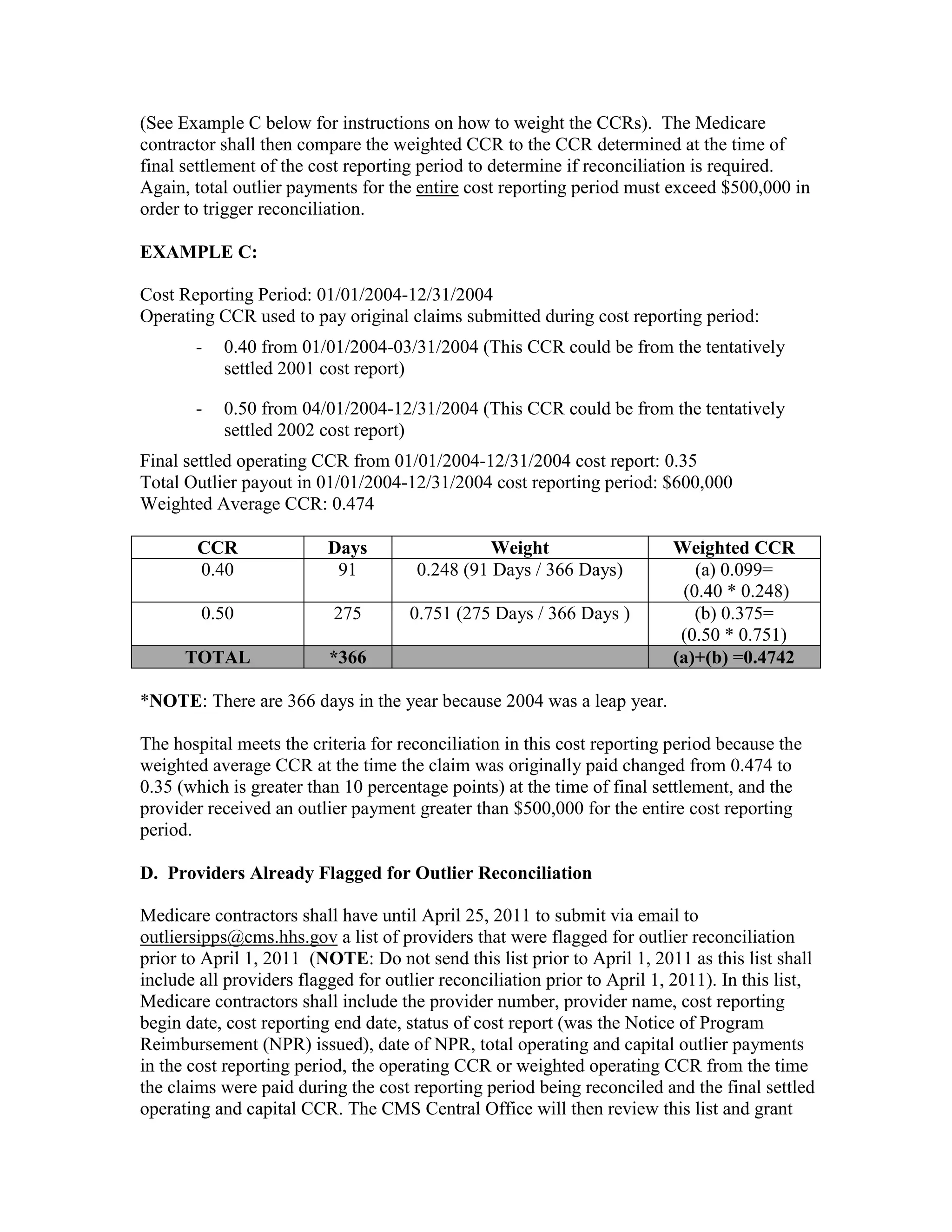
  • 54.
    A patient's dischargestatus is sometimes necessary for appropriate MS-DRG determination. Discharge status must be coded according to the Form CMS-1450 conventions. See Chapter 25. 17. Invalid Discharge Date An invalid discharge date is a discharge date that does not fall into the acceptable range of numbers to represent, either the month, day or year (e.g., 13/03/01, 12/32/01). If no discharge date is entered, it is also invalid. MCE reports when an invalid discharge date is entered. 18 – Limited Coverage Effective October 1, 2003, for certain procedures whose medical complexity and serious nature incur extraordinary associated costs, Medicare limits coverage. The edit message indicates the type of limited coverage (e.g., LVRS, heart transplant, etc). The procedures receiving limited coverage edits previously were listed as non-covered procedures, but were covered under Medicare in certain circumstances. The FIs/MACs will handle these procedures as they had previously. 19 - Procedure inconsistent with length of stay Effective October 1, 2012, the following procedure code should only be coded on claims with a length of stay of four days or greater. 9672 Continuous invasive mechanical ventilation for 96 consecutive hours or more 20.2.1.1 - Paying Claims Outside of the MCE (Rev. 1649; Issued: 12-18-08; Effective/Implementation Date: 11-25-08) All institutional inpatient claims are routed through the MCE before they are processed to payment. There may be special circumstances, however, when it is necessary to pay claims bypassing MCE edits. The CMS will notify the contractor of these instances. They include: • New coverage policies are enacted by Congress with effective dates that preclude making the necessary changes timely; and • Errors are discovered that cannot be corrected timely. A/B MACs and FIs are responsible for reporting problems timely. 20.2.1.1.1 - Requesting to Pay Claims Without MCE Approval (Rev. 1649; Issued: 12-18-08; Effective/Implementation Date: 11-25-08)
  • 55.
    The contractor mayalso request approval from the RO in specific situations to pay claims without first sending them through the MCE. Examples of such situations are: • A systems error cannot be corrected timely, and the provider's cash flow will be substantially impacted; and/or • Administrative Law Judge (ALJ) decisions, court decisions, and CMS instructions in particular cases may necessitate that payment be made outside the normal process. 20.2.1.1.2 - Procedures for Paying Claims Without Passing through the MCE (Rev. 2117, Issued: 12-10-10, Effective: 01-12-11, Implementation: 01-12-11) Before an inpatient claim may be paid without first going through the MCE, the contractor shall obtain approval from CMS Central Office or the RO. Note: In certain situations, contractors bypass the MCE through an established, CMSinstructed claim processing procedure (e.g., to verify a facility is certified to perform a specified service after a MCE limited coverage edit is applied). Such scenarios do not require approval from the RO as the approval for such a bypass was inherently implied when the established procedure was first implemented. In all instances involving payment outside the normal inpatient editing process, the contractor applies the following procedures: • Contractors shall submit the claim overriding the MCE using the appropriate field in FISS. • Pay interest accrued through the date payment is made on clean claims. Do not pay any additional interest. • Maintain a record of payment and implement controls to be sure that incorrect payment is not made, i.e., when the claim is paid without being subject to normal editing. • Monitor MCE software to determine when the impediment to processing is removed. • Consider the claim processed for workload and expenditure reports when it is paid. • Submit to the RO Consortium Contractor Manager (CCM) by the 20th of each month a report of all inpatient claims paid without processing through the MCE with the exception of override situations explained in the Note above (e.g., for limited coverage edits). The list of claims paid outside of the MCE is to include the following information:
  • 56.
    o o o o o o o o o o HIC DCN TOB DOS (From/Through) Provider Number MCE/OCEOVR (Claim/Line) Reimbursement Amount Receipt Date Process Date Paid Date Also, include summary data for each edit code showing claim volume and payment. Any override approvals received and/or relevant JSM references should be annotated on the reports. 20.2.2 - DRG GROUPER Program (Rev. 2028, Issued: 08-13-10, Effective: 01-01-11, Implementation: 01-03-11) The FI/MAC pays for inpatient hospital services on the basis of a rate per discharge that varies according to the MS-DRG to which a beneficiary's stay is assigned. Each MS-DRG represents the average resources required to care for a case in that particular MS-DRG relative to the national average of resources consumed per case. The MS-DRG weights used to calculate payment are in the Pricer DRGX file. The FI/MAC uses the GROUPER program to assign the MS-DRG number. GROUPER determines the MS-DRG from data elements reported by the hospital. This applies to all inpatient discharge/transfer bills received from both PPS and non-PPS facilities, including those from waiver States, long-term care hospitals, and excluded units. The Pricer (PPSMAIN) driver program calls the correct fiscal year GROUPER based upon the discharge date. If the FI/MAC or shared system writes its own driver program, it must access the GROUPER for the correct FY based on discharge date. GROUPER does not determine the MS-DRG price. GROUPER input/output are specified below. The FI/MAC determines the best place in its total system to place the GROUPER program. Grouper requires the following items: 1 - Principal and up to 24 other ICD-9-CM diagnoses 2 - Principal and up to 24 additional ICD-9-CM procedures 3 - Age at last birthday at admission 4 - Sex (1=male and 2=female)
  • 57.
    5 - Dischargedestination (patient status code from the claim) The claim sex coding is M for male and F for female while GROUPER is l for male and 2 for female. Discharge destination codes are similar to claim definitions for patient status except codes 20-29 are summarized as 20. The FI/MAC calculates age at admission. GROUPER needs age rather than date of birth. Grouper responds with the following information: 1 - Major diagnostic category 2 - MS-DRG number 3 - Grouper return code (a one position code indicating the action taken by the program) 4 - Procedure code used in determining the MS-DRG 5 - Diagnosis code used in determining the MS-DRG 6 - Secondary diagnosis code used in determining the MS-DRG, if applicable 20.2.3 - PPS Pricer Program (Rev. 1, 10-01-03) A3-3615.3, A3-3656.3 The CMS provides a Pricer program to determine the price upon which to base payment under prospective payment. A separate Pricer installation guide is provided. The FI uses the Pricer appropriate for the date of discharge. After GROUPER determines the DRG, the FI's system calls the Pricer program. Pricer determines the price to pay and prepares a report. Four data files are included. CMS maintains three: • DRGX file - contains DRG weights, average length of stay and outlier cutoff points. • MSAX file - contains urban and rural wage indexes used in calculating payment. CMS may request that the FI make interim changes to this file when index changes are issued for individual hospitals after issuance of Pricer for the period. • RATE file - contains census division values and updating amounts used in calculating payment.
  • 58.
    The FI maintainsthe provider-specific file, (PROV file). This contains information about the facts specific to the provider that affect computations, e.g., effective dates for PPS, type of provider (for application of special computation rules), census division, MSA, adjusted cost per discharge, disproportionate share adjustment percentage, and capital data. Pricer also calculates the disproportionate share adjustment and adds it to the DRG payment. Correct calculation depends upon the accuracy of related information the FI includes in the PRICER PROV file. The Pricer program applies the DRG relative weights, hospital urban or rural and census division location, provider-specific data, and beneficiary hospital data from the bill to determine the amount payable for each PPS discharge bill. Pricer uses the Intern-to-Bed ratio in calculating the indirect teaching adjustment for operating costs for the FI to accumulate and use in related payments. Pricer uses the intern-to-average daily census ratio to calculate the indirect teaching adjustment for capital costs. The FI ensures that these ratios are available for Pricer to compute payment for teaching hospitals. It includes the ratios in its PROV file to ensure that cost outliers are not overpaid to its teaching hospitals. Pricer does not calculate utilization days required for the PS&R, CWF, or cost report. It does not determine the amount to pay after deduction for deductible, coinsurance, or the primary payment where Medicare is secondary. The FI must calculate the price and make adjustments to the price furnished before making payment. The FIs use the Pricer implementation guide for information concerning Pricer processing reports, input parameters and data requirements. 20.2.3.1 - Provider-Specific File (Rev. 981, Issued: 06-15-06; Effective: 07-01-06; Implementation: 07-03-06) The PROV file contains needed information about each provider to enable the pricing software to calculate the payment amount. The FI maintains the accuracy of the data in accordance with the following criteria. Whenever the status of any element changes, the FI prepares an additional record showing the effective date. For example, when a hospital's FY beginning date changes as a result of a change in ownership or other "good cause," the FI makes an additional record showing the effective date of the change. The format and data required by the PRICER program and by the provider-specific file is found in Addendum A. The FIs submit a file of provider-specific payment data to CMS CO every three months for PPS and non-PPS hospitals, inpatient rehabilitation hospitals or units (referred to as
  • 59.
    IRFs), long termcare hospitals (LTCHs), inpatient psychiatric facilities (IPFs), SNFs, and hospices, including those in Maryland. Regional home health FIs (RHHIs) submit a file of provider specific data for all home health agencies. FIs serving as the audit FI for hospital based HHAs do not submit a file of provider specific data for HHAs. The FIs create a new record any time a change occurs for a provider. Data must be reported for the following periods: October 2 - January 1, January 2 - April 1, April 2 July 1, and July 2 - October 1. This file must be received in CO within seven business days after the end of the period being reported. NOTE: FIs submit the latest available provider-specific data for the entire reporting period to CO by the seven-business day deadline. If CO fails to issue applicable instructions concerning changes or additions to the file fields by 10 calendar days before the end of the reporting period, the FI may delay reporting of data related to the CO instructions until the next file due date. For example, if CO instructions changing a file field are issued on or after September 21 with an effective date of October 1, the FI may exclude the October 1 CO-required changes from the file submitted by October 9. The FI includes the October 1 CO-required changes, and all subsequent changes through January 1 in the file submitted in January. A. PPS Hospitals The FIs submit all records (past and current) for all PPS providers every three months. Duplicate the provider file used in the "PRICER" module of the claims processing system. B. Non-PPS Hospitals and Exempt Units The FIs create a provider specific history file using the listed data elements for each nonPPS hospital and exempt hospital unit. Submit the current and the preceding fiscal years every three months. Code Y in position 49 (waiver code) to maintain the record in the PRICER PROV file. C. Hospice The FIs create a provider specific history file using the following data elements for each hospice. Submit the current and the preceding fiscal years every three months. Data elements 3, 4, 5, 6, 9, 10, 13, and 17 are required. All other data elements are optional for this provider type. Effective October 1, 2005, data element 13 is no longer applicable to payment applications but is still required. Data element 35 is required for all hospices. Data elements 33 and 38 are optional and may be populated if needed. D. Skilled Nursing Facility (SNF)
  • 60.
    The FIs createa provider specific history file using the following data elements for each SNF beginning with their first cost reporting period that starts on or after July 1, 1998. The FIs submit the current and the preceding fiscal years every three months. For PPSexempt providers, code Y in position 49 (waiver code) to maintain the record in the PRICER PROV file. Data elements 3, 4, 5, 6, 9, 10, 13, 19, and 21 are required. All other data elements are optional for this provider type. Effective October 1, 2005, data element 13 is no longer applicable to payment applications but is still required. Data element 35 is required for all SNFs. Data elements 33 and 38 are required if there is a special wage index. Effective October 1, 2005, through September 30, 2006, data elements 33 and 38 are required since there is a special wage index. E. Home Health Agency (HHA) The FIs create a provider specific history file using the following data elements for each HHA. Regional home health FIs (RHHIs) submit the current and the preceding fiscal years every three months. Data elements 3, 4, 5, 6, 7, 8, 9, 10, 11, 13, and 19 are required. All other data elements are optional for this provider type. All fields must be zero filled if not completed. Update the effective date in data element 4 annually. Ensure that the current census division in data element 11 is not zero. Ensure that the waiver indicator in data element 8 is N. Ensure that the MSA code reported in data element 13 is a valid MSA code. F. Inpatient Rehabilitation Facilities (IRFs) The FIs create a provider specific history file using the following data elements for each IRF beginning with their first cost reporting period that starts on or after January 1, 2002. FIs submit the current and the preceding fiscal years every three months. For PPS-exempt providers, code Y in position 49 (waiver code) to maintain the record in the PRICER PROV file. Data elements 1, 2, 3, 4, 5, 6, 7, 8, 9, 10, 11, 13, 18, 19, 21, 25, 27, 28, and 42 are required. All other data elements are optional for this provider type. Effective October 1, 2005, data element 13 is no longer applicable to payment applications but is still required. Data element 35 is required for all IRFs. Data elements 17, 33, 38, and 49 are required if applicable to the IRF. G. Long Term Care Hospital (LTCH) The FIs create a provider specific history file using the following data elements for each LTCH beginning with their first cost reporting period that starts on or after October 1, 2002. FIs submit the current and the preceding fiscal years every three months. For PPSexempt providers, code Y in position 49 (waiver code) to maintain the record in the PRICER PROV file. Data elements 1, 2, 3, 4, 5, 6, 7, 8, 9, 10, 12, 13, 14, 18, 19, 21, 22, and 25 are the minimum required fields for entering a provider under LTCH PPS.
  • 61.
    Effective July 1,2005, data element 35 is required. Data elements 33 and 38 are optional and may be populated if needed. Data elements 12, 13, and 14 are no longer applicable. Effective July 1, 2006, data elements 23, 24, 27, 28, and 49 are required. H. Inpatient Psychiatric Facilities (IPF) The FIs create a provider specific history file using the following data elements for each IPF beginning with their first cost reporting period that starts on or after January 1, 2005. The FIs submit the current and the preceding fiscal years every three months. For PPSexempt providers, code Y in position 49 (waiver code) to maintain the record in the PRICER PROV file. Data elements 1, 2, 3, 4, 5, 6, 7, 8, 9, 10, 13, 17, 18, 19, 21, 22, 23, 25, 33, 35, 38, and 48 are required. All other data elements are optional for this provider type. Although data element 25 refers to the operating cost to charge ratio, ensure that both operating and capital cost-to-charge ratio are entered in data element 25 for IPFs. Ensure that data element 21 (Facility Specific Rate) will be determined using the same methodology to determine the interim payment per discharge under the TEFRA system. Effective July 1, 2006, data element 13 is no longer required. Data elements 33 and 38 are optional and may be populated if needed. NOTE: All data elements, whether required or optional, must have a default value of “0” (zero) if numerical, or a blank value if alphanumerical. The provider specific file (PSF) should be transferred to CO using the Network Data Mover (NDM) system, COPY TO and RUN JOB statements, which will notify CO of PSF file transfer. FIs must set up an NDM transfer from the FI's system for which it is responsible. It is critical that the provider specific data is copied to the CMS Data Center using the following input data set names ("99999" should be changed to the FI's 5-digit number): Data set Name ---COPY TO: --MU00.@FPA2175.intermediary99999 DCB=(HCFA1.MODEL,BLKSIZE=2400,LRECL=2400,RECFM=FB) Data set Name ---RUN JOB: --MU00.@FPA2175.CLIST(intermediary99999) See Addendum A for the Provider Specific File record layout and description. 20.3 - Additional Payment Amounts for Hospitals with Disproportionate Share of Low-Income Patients (Rev. 2393, Issued: 01-25-12, Effective: 10-01-11, Implementation: 07-02-12) The Consolidated Omnibus Budget Reconciliation Act (COBRA) of 1985, (Public Law: 99-272), provides for an additional payment to an urban hospital of 100 or more beds that serves a disproportionate share of low-income patients.
  • 62.
    Adjustments are madein the Federal portion of the operating cost DRG payment to increase payments to hospitals serving a disproportionate share of low-income patients. The additional payment equals the Federal portion of the operating cost DRG payment and outlier payments, but excludes any additional payments for the costs of indirect medical education multiplied by an adjustment percentage. If a hospital meets the disproportionate share hospital (DSH) definition, an additional operating cost payment will be made for discharges occurring on or after May 1, 1986. The DSH adjustment is applied only to the Federal portion of the operating cost DRG payment (including outlier payments). It is basically a year-end lump sum adjustment. However, the FI will identify hospitals that are eligible to receive the DSH adjustment and make interim payments subject to a year-end settlement based upon the hospital's DSH percentage for the cost reporting period. The DRG payment a hospital receives includes the interim operating cost DSH payment and an interim operating indirect medical education adjustment. For services on or after October 1, 1997, the DSH percentage is not applied to outlier payments. The Supplemental Security Income (SSI)/Medicare Beneficiary Data for IPPS hospitals is located at the following CMS web address: http://www.cms.hhs.gov/AcuteInpatientPPS/05_dsh.asp#TopOfPage The data is used for settlement purposes for hospitals. Note that CMS issues a Recurring Update Notification prior to the Federal Fiscal Year beginning date to provide contractors with the updated SSI file information. A. Regular Calculation of DSH Percentage The operating DSH percentage is the sum of: • The percentage of the hospital's total Medicare Part A patient days attributable to Medicare patients who are also SSI recipients (this percentage will be supplied to the FI by CMS). Since the SSI/Medicare percentages are determined by CMS on a fiscal year basis, hospitals will be afforded the option (for settlement purposes) of determining their SSI/Medicare percentage based upon data from their own cost reporting period. If a hospital avails itself of this option, it must furnish its FI, in a manner and format prescribed by CMS, data on its Medicare patients for the cost reporting period. CMS will match these data to data supplied by SSA to determine the patients dually entitled to Medicare Part A and SSI for the hospital's cost reporting period. The hospital bears the full cost of this process, including the cost of verification by SSA.
  • 63.
    Consistent with theregulations at 42 CFR 412.106(b)(2)(i) and 412.106(b)(2)(iii), patients who are enrolled in Medicare Advantage (administered through Medicare Part C) should also be included in the Medicare fraction. These days will be included in the Medicare/SSI fraction, but in order for them to be counted, the hospital must submit an informational only bill (TOB 111) which includes Condition Code 04 to their Medicare contractor. This will ensure that these days are included in the hospital’s SSI ratio for Fiscal Year 2007 and beyond. Acute Care hospitals that received DSH during FY 2006 are also required to submit informational only bills for their Medicare Advantage patients. For MA patients, Long Term Care Hospitals are also required to submit informational only bills (TOB 111) with Condition Code 04. For MA patients, Inpatient Rehabilitation Facilities are also required to submit informational only bills (TOB 111) with both Condition Code 04 and the Case Mix Group (CMG) from the IRF PAI. Refer to section 140.2.4.3 for the requirements for Inpatient Rehabilitation Facilities. (Teaching hospitals do not need to submit additional claims with Condition Code 04 as they already submit claims for Indirect Medical Education for MA beneficiaries with Condition Codes 04 and 69. We will capture SSI information from these claims.) • The percentage of total patient days attributable to patients entitled to Medicaid, but not to Medicare Part A. (Medicaid days and total days are available on the cost report.) For operating DSH payments: For discharges between May 1, 1986, and March 31, 1990, a hospital qualifies for an operating cost DSH adjustment if it has a DSH percentage of: • At least 15 percent for an urban hospital with 100 or more beds; • At least 40 percent for an urban hospital with less than 100 beds; or • At least 45 percent for a rural hospital, with fewer than 500 beds. For discharges on and after October 1, 1986, the hospital qualifies for an operating cost DSH adjustment if it has a DSH percentage of at least 15 percent, is located in a rural area, and has 500 or more beds. For discharges between April 1, 1990 and December 31, 1995, a hospital qualifies for an operating DSH adjustment if it has a DSH percentage of:
  • 64.
    • At least 15percent for an urban hospital with 100 or more beds, or a rural hospital with 500 or more beds; • At least 40 percent for an urban hospital with fewer than 100 beds; • At least 45 percent for a rural hospital with 100 beds or fewer, if it is not also classified as a sole community hospital; or • At least 30 percent for a rural hospital with more than 100 beds which is classified as a sole community hospital. A hospital qualifies for a capital DSH adjustment if it is located in a large urban or other urban area, has at least 100 beds, and has a DSH percentage greater than 0. For the DSH determination, the number of beds in a hospital is determined by counting the number of inpatient care bed days available during the cost reporting period, excluding beds assigned to newborns, custodial care, and PPS excluded distinct part hospital units, and dividing that number by the number of days in the cost reporting period. Inpatient care bed days available should be the same as Indirect Medical Education (IME) bed days. Available beds may not match the number of licensed beds. B. Determination of Operating DSH Adjustment Percentage Hospitals that meet the DSH percentage criteria are entitled to adjustments to the Federal portion of their operating cost DRG payments (including the Federal portion of outlier payments) as follows. For hospitals that qualify for DSH payment, Pricer calculates the DSH adjustment percentage. (See §20.2.3.) The following procedures are used to calculate the DSH adjustment. For the period May 1, 1986 - September 30, 1988: Urban hospitals with 100 or more beds and rural hospitals with 500 or more beds The lesser of 15 percent or the percentage determined by using the following formula: (DSH % - 15)(.5) + 2.5 EXAMPLES: Hospital A is an urban hospital with 200 beds and has a DSH percentage of 21. Its DSH payment factor is computed: (21 - 15)(.5) + 2.5 = 5.5% DSH adjustment factor = 5.5% (.0550)
  • 65.
    Hospital B isan urban hospital with 250 beds and has a DSH percentage of 45. Its DSH payment adjustment factor is computed: (45 - 15)(.5) + 2.5 = 17.5% DSH adjustment factor = 15% (.1500) (the maximum adjustment under the law) • Urban hospitals with fewer than 100 beds - 5 percent. • Rural hospitals with fewer than 500 beds - 4 percent. For the period October 1, 1988 - March 31, 1990: • Urban hospitals with 100 or more beds and rural hospitals with 500 or more beds - the following formula is used: (DSH % - 15) (.5) + 2.5 EXAMPLES: Hospital A is an urban hospital with 200 beds and has a DSH percentage of 21 percent. Its DSH payment factor is computed: (21-15)(.5) + 2.5 = 5.5% DSH adjustment factor = 5.5% (.0550) Hospital B is an urban hospital with 250 beds and has a DSH percentage of 45 percent. Its DSH payment adjustment factor is computed: (45-15) (.5) + 2.5 = 17.5% DSH adjustment factor = 17.5% (.1750, the limit was removed effective 10/1/88) • Urban hospitals with fewer than 100 beds - 5 percent. • Rural hospitals with fewer than 500 beds - 4 percent. For the period April 1, 1990 - December 31, 1995: • Urban hospitals with 100 or more beds and rural hospitals with 500 or more beds whose DSH percentage is greater than 20.2 - the following formula is used: Through December 31, 1990 - (DSH % - 20.2) (.65) + 5.62
  • 66.
    January 1, 1991,and later - (DSH % - 20.2) (.7) + 5.62 EXAMPLES: Hospital A is an urban hospital with 200 beds and has a DSH percentage of 21 percent. Its December 1990 DSH payment factor is computed: (21 - 20.2) (.65) + 5.62 = 6.14% DSH adjustment factor = 6.14% (.0614) Hospital B is an urban hospital with 250 beds and has a DSH percentage of 45 percent. Its December 1990 DSH payment adjustment factor is computed: (45 - 20.2) (.65) + 5.62% = 21.74% DSH adjustment factor = 21.74% (.2174) Urban hospitals with 100 or more beds and rural hospitals with 500 or more beds whose DSH percentage is equal to or less than 20.2 - the following formula is used: (DSH % - 15) (.6) + 2.5 • Urban hospitals with fewer than 100 beds - 5 percent. • Rural hospitals that are RRCs and sole community hospitals - the greater of 10 percent or the percentage determined using the following formula: (DSH % - 30) (.6) + 4.0 EXAMPLES: Hospital C is a rural hospital that is an RRC and a sole community hospital, and has a DSH percentage of 35 percent. Its DSH payment factor is computed: (35 - 30) (.6) + 4.0 = 7% DSH adjustment factor = 10% (.1000) Hospital D is a rural hospital which is a RRC and a sole community hospital. It has a DSH percentage of 45 percent. Its DSH payment factor is computed: (45 - 30) (.6) + 4.0 = 13% DSH adjustment factor is 13% (.1300)
  • 67.
    • Rural hospitals thatare RRCs, but are not sole community hospitals-the following formula is used: (DSH % - 30) (.6) + 4.0 • Rural hospitals that are sole community hospitals, but are not RRCs - 10 percent. • Rural hospitals not described above with 100 beds or less - 4 percent if DSH percentage is 45 percent or more. • Rural hospitals not described above with more than 100 beds but fewer than 500 beds - 4 percent if DSH percentage is 30 percent or more. • Urban hospitals with 100 or more beds whose DSH percentage is less than or equal to 20.2 - the following formula is used: (DSH % - 15) (.6) + 2.5 For the period October 1, 1993, through September 30, 1994: • Urban hospitals with 100 or more beds whose DSH percentage is greater than 20.2-the following formula is used: (DSH % - 20.2) (.8) + 5.88 • • Urban hospitals with 100 or more beds whose DSH percentage is less than or equal to 20.2 - the following formula is used: (DSH % - 15) (.6) + 2.5 Rural hospitals that are RRCs and sole community hospitals - the greater of 10 percent or the percentage determined using the following formula: (DSH % - 30) (.6) + 4.0 EXAMPLES: Hospital C is a rural hospital that is a RRC and a sole community hospital. It has a DSH percentage of 35 percent. The DSH payment factor is computed: (35 - 30) (.6) + 4.0 = 7% DSH adjustment factor = 10% (.1000), the greater payment
  • 68.
    Hospital D isa rural hospital that is a RRC and a sole community hospital. It has a DSH percentage of 45 percent. Its DSH payment factor is computed: (45 - 30) (.6) + 4.0 = 13% DSH adjustment factor = 13% (.1300) Rural hospitals that are RRCs and are not sole community hospitals - the percentage is determined using the following formula: (DSH % - 30) (.6) + 4.0 • Rural hospitals that are sole community hospitals and are not RRCs - 10 percent. • Rural hospitals not described above - 4 percent. For discharges after September 30, 1994: • Urban hospitals with 100 or more beds and rural hospitals with 500 or more beds whose DSH percentage is greater than 20.2 - the percentage is determined using the following formula: (DSH % - 20.2) (.825) + 5.88 • Urban hospitals with 100 or more beds whose DSH percentage is less than or equal to 20.2 - the following formula is used: (DSH % - 15) (.65) + 2.5 • Rural hospitals that are RRCs and sole community hospitals - the greater of 10 percent or the percentage determined with the following formula: (DSH % - 30) (.6) + 4.0 EXAMPLES: Hospital C is a rural hospital that is an RRC and a sole community hospital. It has a DSH percentage of 35 percent. Its October 1994 DSH payment factor is computed: (35 - 30) (.6) + 4.0 = 7% DSH adjustment factor = 10% (.1000), the greater rate Hospital D is a rural hospital that is an RRC and a sole community hospital. It has a DSH percentage of 45 percent. Its October 1994 DSH payment factor is computed:
  • 69.
    (45 - 30)(.6) + 4.0 = 13% DSH adjustment factor = 13% (.1300) • Rural hospitals that are RRCs, but not sole community hospitals - Use the following formula: (DSH % - 30) (.6) + 4.0 • Rural hospitals that are sole community hospitals and are not RRCs - 10 percent. • Rural hospitals not described above - 4 percent. The amount of the operating cost DSH adjustment is computed by multiplying the Federal portion of the hospital's operating cost DRG revenues by the appropriate DSH adjustment factor. EXAMPLE: Hospital A's DSH payment adjustment factor is 5.5 percent (.0550). The Federal portion of its DRG revenues including appropriate outlier payments, but excluding any payments for indirect medical education costs, equals $100,000. Federal DRG revenues x DSH adjustment factor = DSH adjustment amount $100,000 x .055 = $5,500 The FI will accumulate a record of the DSH amount paid, the Federal portion of the operating cost DRG and any outlier amount for hospital discharges after April 30, 1986, to use at cost settlement. C. Computation of DSH Adjustment Compute the amount of the DSH adjustment by multiplying the Federal portion of the hospital's DRG revenues by the appropriate DSH adjustment factor. EXAMPLE: Hospital A's DSH payment adjustment factor is 5.5 percent (or .0550). The Federal portion of its DRG revenues (including appropriate outlier payments, but excluding any payments for indirect medical education costs) equals $100,000. Federal DRG revenues x DSH adjustment factor = DSH adjustment amount $100,000 x .055 = $5,500 D. DSH Exception The law contains a provision whereby a hospital can qualify for an operating cost DSH adjustment of:
  • 70.
    • 15 percent fordischarges prior to October 1, 1988; • 25 percent for discharges between October 1, 1988, and April 1, 1990; • 30 percent for discharges from April 1, 1990, through September 31, 1991; • 35 percent for discharges on or after October 1, 1991, if: ° It is located in an urban area and has 100 or more beds; and ° It demonstrates that, during its cost reporting period, more than 30 percent of its total inpatient care revenues were derived from State and local government payments for indigent care furnished to patients not covered by Medicare or Medicaid. It is incumbent upon the hospital to demonstrate that more than 30 percent of its total inpatient care revenues are from State and local government sources and that they are specifically earmarked for the care of indigents (that is, none of the money may be used for any purpose other than indigent care). The following are the types of care that are not included as indigent care: • Free care furnished to satisfy a hospitals Hill-Burton obligation. • Free care or care a hospital furnished at reduced rates to its employees or by a government hospital to any category of public employee. • Funds furnished to a hospital to cover general operating deficits. • The adjustment is not automatic from year to year but must be applied for on an annual basis. Documentation to support the application includes the hospital's complete audited financial statements and their accompanying notes. The hospital must provide detailed schedules related to State and local revenue appropriations and outline their purpose. Unless the appropriations are specifically earmarked for indigent patient care, the FI and/or A/B MAC shall assume that a portion of the funds was intended to cover the costs of other uncompensated care, such as bad debts for non-indigent patients, free care to employees, etc., as well as to cover general operating deficits. The FI and/or A/B MAC shall calculate the percentage of charity care included in all uncompensated care and apply the percentage to the appropriate funds to determine the amount appropriated for charity care.
  • 71.
    Hospitals must submitdocumentation to support amounts claimed as indigent patient care. This includes a copy of their procedures for determining indigence, steps used to verify a patient's financial information, and methods used to distinguish bad debts from indigence. The FI and/or A/B MAC shall review the documentation submitted in support of the provider's request for a disproportionate share adjustment under 42 CFR 412.106(c)(2) of the regulations. Beginning with Federal Fiscal Year (FY) 2011 FIs and/or MACs shall submit to CMS annually by February 28 documentation for the hospitals they determine meet the qualifying standards for receiving disproportionate share hospital (DSH) payments under section 42 CFR 412.106(c)(2). This review can be accomplished in conjunction with the audit/settlement of the cost report for the period subject to the adjustment. At a minimum, the FI and/or A/B MAC shall: • Verify total inpatient revenues; • Verify that State and local government appropriations on the financial statements are consistent with amounts contained in governmental appropriations bills; • Review, on the basis of a sample of cases, the provider's implementation of procedures for identifying indigent patients. Ensure that amounts for "indigent" patients do not include charges associated with: ° Titles XIX and XVIII patient care; ° Hill-Burton care; ° Free care to employees; and ° Bad debts for patients who are not indigent. E. Reporting for PS&R and CWF The FI's PPS Pricer identifies the amount of the DSH adjustment on each bill. The FI reports this amount with value code 18 to its PS&R, and to CWF. 20.3.1 - Clarification of Allowable Medicaid Days in the Medicare Disproportionate Share Hospital (DSH) Adjustment Calculation (Rev. 1, 10-01-03) 20.3.1.1 - Clarification for Cost Reporting Periods Beginning On or After January 1, 2000 (Rev. 1, 10-01-03) PM A-01-03
  • 72.
    Under §1886(d)(5)(F) ofthe Social Security Act (the Act), the Medicare disproportionate share patient percentage is made up of two computations. The first computation includes patient days that were furnished to patients who, during a given month, were entitled to both Medicare Part A and Supplemental Security Income (SSI) (excluding State supplementation). This number is divided by the number of covered patient days utilized by patients under Medicare Part A for that same period. The second computation includes patient days associated with beneficiaries who were eligible for medical assistance (Medicaid) under a State plan approved under Title XIX but who were not entitled to Medicare Part A. (See 42 CFR 412.106(b)(4).) This number is divided by the total number of patient days for that same period. Included Days In calculating the number of Medicaid days, the hospital must determine whether the patient was eligible for Medicaid under a State plan approved under Title XIX on the day of service. If the patient was so eligible, the day counts in the Medicare disproportionate share adjustment calculation. The statutory formula for "Medicaid days" reflects several key concepts. First, the focus is on the patient's eligibility for Medicaid benefits as determined by the State, not the hospital's "eligibility" for some form of Medicaid payment. Second, the focus is on the patient's eligibility for medical assistance under an approved Title XIX State plan, not the patient's eligibility for general assistance under a State-only program. Third, the focus is on eligibility for medical assistance under an approved Title XIX State plan, not medical assistance under a State-only program or other program. Thus, for a day to be counted, the patient must be eligible on that day for medical assistance benefits under the Federal-State cooperative program known as Medicaid (under an approved Title XIX State plan). In other words, for purposes of the Medicare disproportionate share adjustment calculation, the term "Medicaid days" refers to days on which the patient is eligible for medical assistance benefits under an approved Title XIX State plan. The term "Medicaid days" does not refer to all days that have some relation to the Medicaid program, through a matching payment or otherwise; if a patient is not eligible for medical assistance benefits under an approved Title XIX State plan, the patient day cannot become a "Medicaid day" simply by virtue of some other association with the Medicaid program. Medicaid days, for purposes of the Medicare disproportionate share adjustment calculation, include all days during which a patient is eligible, under a State plan approved under Title XIX, for Medicaid benefits, even if Medicaid did not make payment for any services. Thus, Medicaid days include, but are not limited to, days that are determined to be medically necessary but for which payment is denied by Medicaid because the provider did not bill timely, days that are beyond the number of days for which a State will pay, days that are utilized by a Medicaid beneficiary prior to an admission approval but for which a valid enrollment is determined within the prescribed period, and days for which payment is made by a third party. In addition, we recognize in the calculation days that are utilized by a Medicaid beneficiary who is eligible for Medicaid under a State plan approved under Title XIX through a managed care organization (MCO) or health maintenance organization (HMO). However, in accordance with 42 CFR 412.106(b)(4), a
  • 73.
    day does notcount in the Medicare disproportionate share adjustment calculation if the patient was entitled to both Medicare Part A and Medicaid on that day. Therefore, once the eligibility of the patient for Medicaid under a State plan approved under Title XIX has been verified, the FI must determine whether any of the days are dual entitlement days and, to the extent that they are, subtract them from the other days in the calculation. Excluded Days Many States operate programs that include both State-only and Federal-State eligibility groups in an integrated program. For example, some States provide medical assistance to beneficiaries of State-funded income support programs. These beneficiaries, however, are not eligible for Medicaid under a State plan approved under Title XIX, and, therefore, days utilized by these beneficiaries do not count in the Medicare disproportionate share adjustment calculation. If a hospital is unable to distinguish between Medicaid beneficiaries and other medical assistance beneficiaries, then it must contact the State for assistance in doing so. In addition, if a given patient day affects the level of Medicaid DSH payments to the hospital but the patient is not eligible for Medicaid under a State plan approved under Title XIX on that day, the day is not included in the Medicare DSH calculation. It should be noted that the types of days discussed above are not necessarily the only types of excluded days. Please see the chart in 140.2.4.1, which summarizes some, but not necessarily all, of the types of days to be excluded from (or included in) the Medicare DSH adjustment calculation. To provide consistency in both components of the calculation, any days that are added to the Medicaid day count must also be added to the total day count, to the extent that they have not been previously so added. Regardless of the type of allowable Medicaid day, the hospital bears the burden of proof and must verify with the State that the patient was eligible under one of the allowable categories during each day of the patient's stay. The hospital is responsible for and must provide adequate documentation to substantiate the number of Medicaid days claimed. Days for patients that cannot be verified by State records to have fallen within a period wherein the patient was eligible for Medicaid as described in this memorandum cannot be counted. 20.3.1.2 - Hold Harmless for Cost Reporting Periods Beginning Before January 1, 2000 (Rev. 1, 10-01-03) In accordance with the hold harmless position communicated by CMS on October 15, 1999, for cost reporting periods beginning before January 1, 2000, hospitals are not to disallow, within the parameters discussed below, the portion of Medicare DSH adjustment payments previously made to hospitals attributable to the erroneous inclusion of general
  • 74.
    assistance or otherState-only health program, charity care, Medicaid DSH, and/or ineligible waiver or demonstration population days in the Medicaid days factor used in the Medicare DSH formula. This is consistent with CMS' determination that hospitals and FIs relied, for the most part, on Medicaid days data obtained from State Medicaid agencies to compute Medicare DSH payments and that some of those agencies commingled the types of otherwise ineligible days listed above with Medicaid Title XIX days in the data transmitted to hospitals and/or FIs. Although CMS has decided to allow the hospitals to be held harmless for receiving additional payments resulting from the erroneous inclusion of these types of otherwise ineligible days, this decision is not intended to hold hospitals harmless for any other aspect of the calculation of Medicare DSH payments or any other Medicare payments. Hospitals That Received Payments Reflecting the Erroneous Inclusion of Days at Issue In practical terms this means that the FI is not to reopen any cost reports for cost reporting periods beginning before January 1, 2000, to disallow the portions of Medicare DSH payments attributable to the erroneous inclusion of general assistance or other State-only health program charity care, Medicaid DSH, and/or ineligible waiver or demonstration population days if the hospital received payments for those days based on those cost reports. If, prior to the issuance of this Program Memorandum, a hospital reopened a settled cost report to disallow the portion of Medicare DSH payment attributable to the inclusion of these types of days, reopen that cost report again and refund the amounts (including interest) collected. Do not, however, pay the hospitals interest on the amounts previously recouped as result of the disallowance. Furthermore, on or after October 15, 1999, the FI is not to accept reopening requests for previously settled cost reports or amendments to previously submitted cost reports pertaining to the inclusion of these types of days in the Medicare DSH formula. For cost reporting periods beginning before January 1, 2000, hospitals are to continue to allow these types of days in the Medicare DSH calculation for all open cost reports only in accordance with the practice followed for the hospital at issue before October 15, 1999, (i.e., for open cost reports, the FI allows only those types of otherwise ineligible days that the hospital received payment for in previous cost reporting periods settled before October 15, 1999). For example, if, for a given hospital, a portion of Medicare DSH payment was attributable to the erroneous inclusion of general assistance days for only the out-of-State or HMO population in cost reports settled before October 15, 1999, the FI is to include the ineligible waiver days for only that population when settling open cost reports for cost reporting periods beginning before January 1, 2000. However, the actual number of general assistance and other State-only health program, charity care, Medicaid DSH, and/or ineligible waiver or demonstration days, as well as Medicaid Title XIX days, that the FI allows for the open cost reports must be supported by auditable documentation provided by the hospital. Hospitals That Did Not Receive Payments Reflecting the Erroneous Inclusion of Days at Issue
  • 75.
    If a hospitaldid not receive any payment based on the erroneous inclusion of general assistance or other State-only health program, charity care, Medicaid DSH, and/or waiver or demonstration population days for cost reports that were settled before October 15, 1999, and the hospital never filed a jurisdictionally proper appeal to the Provider Reimbursement Review Board (PRRB) on this issue, the FI is not to pay the hospital based on the inclusion of these types of days for any open cost reports for cost reporting periods beginning before January 1, 2000. Furthermore, on or after October 15, 1999, the FI is not to accept reopening requests for previously settled cost reports or amendments to previously submitted cost reports pertaining to the inclusion of these types of days in the Medicare DSH formula. If, for cost reporting periods beginning before January 1, 2000, a hospital that did not receive payments reflecting the erroneous inclusion of otherwise ineligible days filed a jurisdictionally proper appeal to the PRRB on the issue of the exclusion of these types of days from the Medicare DSH formula before October 15, 1999, the FI will reopen the cost report at issue and revise the Medicare DSH payment to reflect the inclusion of these types of days as Medicaid days. If there are any questions or concerns regarding the qualifications for a "jurisdictionally proper appeal," the FI submits them in writing before rendering a decision in a specific case to: Centers for Medicare & Medicaid Services 7500 Security Boulevard Office of Financial Management Financial Services Group Location C3-14-16 Baltimore, Maryland 21244-1850. Where, for cost reporting periods beginning before January 1, 2000, a hospital filed a jurisdictionally proper appeal to the PRRB on the issue of the exclusion of these types of days from the Medicare DSH formula on or after October 15, 1999, reopen the settled cost report at issue and revise the Medicare DSH payment to reflect the inclusion of these types of days as Medicaid days, but only if the hospital appealed, before October 15, 1999, the denial of payment for the days in question in previous cost reporting periods. The actual number of these types of days that are used in this revision must be properly supported by adequate documentation provided by the hospital. Do not reopen a cost report and revise the Medicare DSH payment to reflect the inclusion of these types of days as Medicaid days if, on or after October 15, 1999, a hospital added the issue of the exclusion of these types of days to a jurisdictionally proper appeal already pending before PRRB on other Medicare DSH issues or other unrelated issues. Continue to pay the Medicare DSH adjustment reflecting the inclusion of general assistance or other State-only health program, charity care, Medicaid DSH, and/or waiver or demonstration population days for all open cost reports for cost reporting periods beginning before January 1, 2000, to any hospital that, before October 15, 1999, filed a
  • 76.
    jurisdictionally proper appealto the PRRB specifically for this issue on previously settled cost reports. Finally, if a hospital has filed a jurisdictionally proper appeal with respect to the CMS 97-2 ruling and the hospital has otherwise received payment for the portion of Medicare DSH adjustment attributable to the inclusion of general assistance or other State-only health programs, charity care, Medicaid DSH, and/or ineligible waiver or demonstration population days based on its paid Medicaid days, include these types of unpaid days in the Medicare DSH formula when revising the cost reports affected by the CMS 97-2 appeal. TYPE OF DAY DESCRIPTION ELIGIBLE TITLE XIX DAY General Assistance Patient Days Days for patients covered under a State-only (or countyonly) general assistance program (whether or not any payment is available for health care services under the program). These patients are not Medicaid-eligible under the State plan. No. Other State-Only Health Program Patient Days Days for patients covered under a State-only health program. These patients are not Medicaid-eligible under the State plan. No. Charity Care Patient Days Days for patients not eligible for Medicaid or any other third-party payer, and claimed as uncompensated care by a hospital. These patients are not Medicaid-eligible under the State plan. No. Actual 1902(r)(2) and 1931(b) Days Days for patients eligible under a State plan based on a 1902(r)(2) or 1931(b) election. These patients are Medicaid-eligible under the Title XIX State plan under the authority of these provisions, which is exercised by the State in the context of the approved State plan. Yes. Medicaid Optional Targeted Low-Income Children (CHIP-related) Days Days for patients who are Title XIX-eligible and who meet the definition of "optional targeted low-income children" under §1905(u)(2). The difference between these children and other Title XIX children is the enhanced FMAP rate available to the State. These children are fully Medicaid-eligible under the State plan. Yes. Separate CHIP Days Days for patients who are eligible for benefits under a non-Medicaid State program furnishing child health assistance to targeted low-income children. These children are, by definition, not Medicaid-eligible under a State plan. No. §1915(c) Eligible Patient (the "217" group) Days Days for patients in the eligibility group under the State plan for individuals under a Home and Community Yes.
  • 77.
    TYPE OF DAY RetroactiveEligible Days Medicaid Managed Care Organization Days Medicaid DSH Days DESCRIPTION Based Services waiver. This group includes individuals who would be Medicaid-eligible if they were in a medical institution. Under this special eligibility group, they are Medicaid-eligible under the State plan. Days for patients not enrolled in the Medicaid program at the time of service, but found retroactively eligible for Medicaid benefits for the days at issue. These patients are Medicaid-eligible under the State plan. Days for patients who are eligible for Medicaid under a State plan when the payment to the hospital is made by an MCO for the service. An MCO is the financing mechanism for Medicaid benefits, and payment for the service through the MCO does not affect eligibility. Days for patients who are not eligible for Medicaid benefits, but are considered in the calculation of Medicaid DSH payments by the State. These patients are not Medicaid-eligible. ELIGIBLE TITLE XIX DAY Yes. Yes. No. Sometimes Medicaid State plans specify that Medicaid DSH payments are based upon a hospital's amount of charity care or general assistance days. This, however, is not "payment" for those days, and does not mean that the patient is eligible for Medicaid benefits or can be counted as such in the Medicare formula. 20.3.1.3 – Disproportionate Share Hospital (DSH) Policy Changes Effective for Cost Reporting Periods beginning on or after October 1, 2009 (Rev. 2627, Issued 01-04-13, Effective 10-01-12, Implementation 10-01-12) Observation Days For cost reporting periods beginning on or after October 1, 2009, observation days for patients later admitted as an inpatient will no longer be included in the Medicare disproportionate patient percentage (DPP). In addition, observation bed days for patients later admitted as an inpatient will no longer be counted towards a hospital’s available bed day count for DSH and IME. Between October 1, 2003, and October 1, 2009, hospitals had reported on their cost report the Medicaid observation patient days for admitted patients and total observation patient days for admitted patients for inclusion in the Medicaid fraction of the Medicare DPP, and for the determination of the available bed day count for DSH and IME. However, effective for cost reporting periods beginning on or after October 1, 2009, observation patient days are no longer included in the DPP, and observation bed days will no longer be counted towards the available bed day count for DSH or IME.
  • 78.
    Labor and DeliveryPatient Days For cost reporting periods beginning on or after October 1, 2009, we will include in the Medicare disproportionate patient percentage (DPP) patient days associated with maternity patients who were admitted as inpatients and were receiving ancillary labor and delivery services at the time the inpatient routine census is taken, regardless of whether the patient occupied a routine bed prior to occupying an ancillary labor and delivery bed and regardless of whether the patient occupies a “maternity suite” in which labor, delivery, recovery and postpartum care all take place in the same room. Prior to October 1, 2009, patient days associated with beds used for ancillary labor and deliver were not counted in the DPP. However, for cost reporting periods beginning on or after October 1, 2009, but before cost reporting periods beginning on or after October 1, 2012, if a patient, admitted to the hospital as an inpatient, occupies an ancillary bed for labor and delivery, the patient days associated with the ancillary labor/delivery services will be counted in the DPP. For cost reporting periods beginning on or after October 1, 2009 but before cost reporting periods beginning on or after October 1, 2012, this policy applies only to counting patient days, and does not change the policy of determining the number of available beds in 42 CFR 412.106(a). Beds associated with ancillary labor/delivery services are not included in the available bed day count. Reporting Inpatient Days in the Numerator of the Medicaid Fraction Hospitals can report days in the numerator of the Medicaid fraction by one of three methodologies. For cost reporting periods beginning on or after October 1, 2009, hospitals can report Medicaid-eligible days based on date of discharge, date of admission, or dates of service. A hospital is required to notify CMS (through the fiscal intermediary or MAC) in writing if the hospital chooses to change its methodology of counting days in the numerator of the Medicaid fraction. The written notification should be submitted at least 30 days prior to the beginning of the cost reporting period to which the change would apply. The written notification must specify the changed methodology the hospital wishes to use and the cost reporting period for which the methodology would apply. The change in methodology would be effective on the first day of the specified cost reporting period for the entire cost reporting period. The change would be effective for all future cost reporting periods unless the hospital submits a subsequent written notification to change its methodology. 20.3.1.4 – Disproportionate Share Hospital (DSH) Policy Changes Effective for Cost Reporting Periods beginning on or after October 1, 2012 (Rev. 2627, Issued 01-04-13, Effective 10-01-12, Implementation 10-01-12) Labor and Delivery Bed Days Effective for cost reporting periods beginning on or after October 1, 2012, we will include bed days associated with ancillary labor/delivery services to determine the number of beds in 42CFR412.105(b), which is cross-referenced in 42 CFR412.106(a)(1)(i) for the purposes of determining the DSH payment adjustment. Bed days associated with ancillary labor/delivery services will be included to determine the number of beds for DSH and
  • 79.
    IME. For costreporting periods beginning before October 1, 2012, bed days associated with ancillary labor and delivery services were not counted in the available bed day count for DSH and IME. 20.3.2 - Updates to the Federal Fiscal Year (FY) 2001 (Rev. 1, 10-01-03) PM A-01-47 20.3.2.1 - Inpatient Hospital Payments and Disproportionate Share Hospital (DSH) Thresholds and Adjustments (Rev. 1, 10-01-03) The new FY 2001 operating standardized amounts are effective April 1, 2001, as required by §301 of BIPA 2000 (P.L. 106-554), and the new DSH thresholds and adjustments are required by §211 of BIPA 2000. In conjunction with the new standardized amount, the new capital rates and outlier adjustment factor thresholds are effective April 1, 2001. The following standardized amounts effective for discharges occurring on or after April 1, 2001, and before October 1, 2001, are: Final FY 2001 Operating Rates +National National PR Puerto Rico SCHs Large Urban Areas LaborNonlaborRelated Related $2,925.82 $1,189.26 $2,900.64 $1,179.02 $1,402.79 $564.66 $2,895.02 $1,176.74 Other Areas LaborNonlaborRelated Related $2,879.51 $1,170.43 $2,900.64 $1,179.02 $1,380.58 $555.72 $2,849.20 $ 1,158.11 Final FY 2001 Capital Rates National Puerto Rico $380.85 $184.61 Due to the changes to the standardized amounts, CMS recalculated the fixed loss cost outlier threshold applicable for discharges on or after April 1, 2001, and before October 1, 2001. The new thresholds are equal to the prospective payment rate for the DRG plus the IME and DSH payments plus $16,350 ($14,940 for hospitals that have not yet entered the prospective payment system for capital-related costs). In addition, §211 of BIPA 2000 revised the thresholds by which certain classes of hospitals qualify for the disproportionate share adjustment, effective for discharges occurring on or after April 1, 2001. Section 211 also revised the adjustment computations for these hospitals.
  • 80.
    The specific changesare identified below. Urban Hospitals 0-99 Beds 100+ Beds (No Change in Law) Rural Hospitals Sole Community Hospitals (SCH) Rural Referral Centers (RRC) Both SCH and RRC Other Rural Hospitals 0-499Beds Qualifying DSH Percent ≥15%, <19.3% ≥19.3% ≥15%,<20.2% ≥20.2% Adjustment Computation ≥15%, <19.3% ≥19.3%,<30% ≥30% ≥15%,<19.3% ≥19.3%,<30% ≥30% ≥15% 2.5% + [.65 x (DSH pct.-15%)] 5.25% 10% 2.5% + [.65 x (DSH pct.-15%)] 5.25% 5.25% + [.6 x (DSH pct.-30%)] higher of SCH or RRC adjustment 2.5% + [.65 x (DSH pct.-15)] 5.25% 2.5% + [.65 x (DSH pct.-15%)] 5.88% + [.825 x (DSH pct.-20.2%)] ≥15%,<19.3% 2.5% + [.65 x (DSH pct.-15%)] ≥19.3% 5.25% 500+ Beds (No Change in ≥15%,<20.2% 2.5% + [.65 x (DSH pct.-15%)] Law) ≥20.2% 5.88% + [.825 x (DSH pct. -20.2%)] These new rates as well as changes to the DSH adjustments are incorporated into Pricer 01.2. The formulas are spelled out in the statute. 20.3.3 – Prospective Payment Changes for Fiscal Year (FY) 2003 (Rev. 1, 10-01-03) A-02-084 The PPS changes for FY2003 were published in the Federal Register on August 1, 2002. All changes are effective for hospital discharges occurring on or after October 1, 2002, unless otherwise noted. ICD-9-CM coding changes are effective October 1, 2002. The new ICD-9-CM codes are listed, along with their diagnosis-related group (DRG) classifications in Tables 6a and 6b in the final rule for PPS changes for FY 2003. The ICD-9-CM codes that have been replaced by expanded codes or other codes, or have been deleted are included in Tables 6c and 6d. The revised code titles are in Tables 6e and 6f of the same final rule. GROUPER 20.0 assigns each case into a DRG on the basis of the diagnosis and procedure codes and demographic information (that is age, sex, and discharge status) and is effective with discharges occurring on or after October 1, 2002. Medicare Code Editor (MCE) 19.0 and Outpatient Code Editor (OCE) versions 18.0 and 3.20 use the new ICD-9-CM codes to validate coding for discharges and outpatient services effective October 1, 2002. Additional changes for FY 2003 are:
  • 81.
    • The standardized amountupdate factor is 2.95 percent for all hospitals. • The hospital specific update factor is 2.95 percent for all hospitals. • The common fixed loss cost outlier threshold in FY 2003 is equal to the PPS rate for the DRG, Indirect Medical Education (IME), and Disproportionate Share Hospital (DSH) plus $33,560. • The marginal cost factor for cost outliers remains 80 percent. • The 2003 Federal capital rate is $407.01 and the Puerto Rico capital rate is $198.29. • The FY 2003 outlier adjustment factor is 0.948999 for the operating standardized amount. • The FY 2003 outlier adjustment factor for Puerto Rico is 0.981651 for the operating standardized amount. Also new for FY 03, there is an outlier adjustment factor of 0.965325 for operating national/Puerto Rican blend. • Payments under the DSH provision are not reduced in FY 2003. • The IME formula is 1.35*[(1+ resident-to-bed ratio)**. 405-1] for FY 2003. • The revised hospital wage indexes and geographic adjustment factors are contained in Tables 4a (urban areas), 4b (rural areas) and 4c (redesignated hospitals) of section VI of the addendum to the PPS final rule. • Grouper 20.0 and MCE 19.0 for discharges occurring on or after October 1, 2002 replace earlier versions of the software. See Addendum: Hospital Reclassifications and Redesignations by Individual Hospital – FY2003. 20.3.4 – Prospective Payment Changes for Fiscal Year (FY) 2004 and Beyond (Rev. 73, 01-23-04) The IPPS changes for FY 2004 were published in the Federal Register on August 1, 2003. All changes are effective for hospital discharges occurring on or after October 1, 2003. Additional changes were listed in a Correction Notice to the Federal Register on October 6, 2003, and a One Time Notification (Pub. 100-20, Transmittal 16, published on October 31, 2003). Changes to the inpatient prospective payment system occur every October. Specific
  • 82.
    instructions will bepublished shortly after the publication of the IPPS Final Rule each year. 20.4 - Hospital Capital Payments Under PPS (Rev. 1, 10-01-03) A3-3611 The Omnibus Budget Reconciliation Act of 1987 established an effective date of October 1, 1991, for capital PPS. Capital PPS will pay hospitals a fixed amount for each Medicare admission upon completion of a 10-year transition period. Hospitals and hospital distinct part units that are excluded from PPS for operating costs are also excluded from PPS for capital costs. They continue to be paid for capital-related costs on a reasonable cost basis. Capital payments are based on the same DRG designations and weights, outlier guidelines, geographic classifications, wage indexes, and disproportionate share percentages that apply to PPS for operating costs. The indirect teaching adjustment is based on the ratio of residents to average daily census. The hospital split bill, adjustment bill, waiver of liability and remaining guidelines in §§40, also apply to capital PPS payments. Outlier thresholds and computation methods have been combined effective with FY 1993 for operating and capital costs. Capital transfer cases are paid on a per diem basis analogous to the manner in which operating PPS payments are made for transfer cases. Beneficiary deductible and coinsurance obligations do not apply to capital costs. Ancillary costs paid under Part B do not impact capital PPS payments. The 10-year transition period was established to protect hospitals that had incurred capital obligations in excess of the standardized national rate from major disruption. These high capital cost hospitals are known as "hold harmless" hospitals. The transition period also provides for phase-in of the national rate for those hospitals with capital obligations that are less than the national rate. A combined payment is made for both operating costs and capital costs under PPS, but the value of the payment for each must be separately identified in the remittance advice for accounting purposes. 20.4.1 - Federal Rate (Rev. 1, 10-01-03) A3-3611.1 The standard Federal capital payment for FY 1992 and later years is based on the projected national average Medicare capital costs per discharge for each of the fiscal
  • 83.
    years. The Federalrate is adjusted for each hospital's case mix, day and cost outliers and wage index location. A hospital qualifies for a capital DSH adjustment if it is located in a large urban or other urban area, has at least 100 beds, and has a disproportionate share (DSH) percentage greater than 0. The Federal rate is adjusted annually to reflect changes in these factors. An adjustment is also provided to the Federal rate for indirect costs of medical education of interns and residents. The FI calculates the adjustment by dividing the hospital's fulltime equivalent total of interns and residents by the hospital's total patient days (line 8, column 6 of worksheet S3 of the CMS Form 2552-89, minus the total of the lines 1B, 1C, 1D, and 7, divided by the number of days in the cost reporting period.) It reviews the hospital's records and makes any needed changes in the count at the end of the cost reporting period. It enters the indirect medical education adjustment ratio in positions 184-188 of the provider-specific file for use by Pricer. 20.4.2 - Hold Harmless Payments (Rev. 1, 10-01-03) A3-3611.2 In FY 1992, hospitals with a hospital-specific rate for capital that is above the Federal PPS rate for the cost reporting period that ended in FY 1990 can receive the higher of: • The hold harmless-old capital rate, which is 100 percent of the reasonable costs of old capital for sole community hospitals, or 85 percent of the reasonable costs associated with old capital for all other hospitals, plus a payment for new capital (see §20.4.5 for the definitions of old and new capital); or • The hold harmless - 100 percent Federal rate. The FI adjusts the hospital-specific rate in the cost report for the period ending in FY 1990 for case mix. It updates the rate to FY 1992 levels using the projected increase in national average capital costs per discharge to initially determine whether a hospital should be paid under the hold harmless or the fully prospective methodology. The type of methodology is entered in the provider-specific file. (See §20.2.3.) Hospitals paid under the fully prospective methodology may change to the hold harmless methodology if justified by the addition of obligated capital and other changes in remaining old capital costs subsequent to the base period. This option is available through the later of a hospital's cost reporting period beginning in FY 94 or after obligated capital has been put in use. Hospitals must request an extension from the FI by the later of January 1, 1993, or within 180 days of the event causing the delay, if they will be unable to put an asset in use for inpatient care by October 1, 1996. The new hospital-specific rate reflects the disposal of old assets and the addition of obligated capital costs, but not new capital acquisitions. If the recalculated hospital-specific rate exceeds the Federal rate, the
  • 84.
    hospital will bepaid under the hold harmless methodology. The payment methodology in effect for FY 94 (or after the obligated capital has been put in use, if later) determines the payment methodology applicable for the remainder of the transition period under either transition payment methodology. The FI does not hold harmless a hospital for increased costs resulting from a lease arrangement entered into after December 31, 1990. If a hospital has such low Medicare utilization in its original capital base period that it is not required to file a cost report, its hospital-specific rate will be based on its old capital costs per discharge in the first 12-month cost reporting period for which a cost report is filed. The FI converts a reasonable cost/hold harmless hospital to the 100 percent Federal payment rate when: • Advantageous due to reductions in depreciation and/or the allowable percentage of old capital; • A hospital elects to be paid at 100 percent of the Federal rate; or • A hospital does not maintain adequate records to identify its old capital related costs. The FI enters the payment methodology change in the provider-specific file. An adjustment is also provided to the Federal rate for indirect costs of medical education of interns and residents. The FI calculates the adjustment by dividing the hospital's fulltime equivalent total of interns and residents by the hospital's total patient days (line 8, column 6 of worksheet S3 of the CMS Form 2552-89, minus the total of the lines 1B, 1C, 1D, and 7, divided by the number of days in the cost reporting period). It reviews the hospital's records and makes any needed changes in the count at the end of the cost reporting period. It enters the indirect medical education adjustment ratio in positions 184-188 of the provider-specific file for use by Pricer. 20.4.3 - Blended Payments (Rev. 1, 10-01-03) A3-3611.3 Hospitals with a FY 1990 hospital-specific rate for capital below the Federal rate are paid a fully prospective capital rate based on a blend of their hospital-specific rate and the Federal rate. The payment for discharges occurring during a cost-reporting period that began in FY 1992 is based on a blend of 90 percent of the hospital-specific rate and 10 percent of the Federal rate. The payment for discharges occurring during a cost-reporting period that began in FY 1993 is based on a blend of 80 percent of the hospital-specific rate
  • 85.
    and 20 percentof the Federal rate. The Federal portion of the payment increases by 10 percent each year and the hospital-specific portions decreases by 10 percent each year, culminating in payment at 100 percent of the Federal rate in the tenth year. 20.4.4 - Capital Payments in Puerto Rico (Rev. 1, 10-01-03) A3-3611.4 A special standard rate applies to Puerto Rico. It is a combination of 50 percent of the Federal capital amount and 50 percent of the Puerto Rican capital amount. It is used in lieu of the Federal rate to compute hold harmless and fully prospective payments for PPS hospitals in Puerto Rico. 20.4.5 - Old and New Capital (Rev. 1, 10-01-03) A3-3611.5 Old capital is a hospital asset that: • Has been put in use for patient care on or before December 31, 1990; or • Has been legally committed to by an enforceable contract entered into on or before December 31, 1990, and put in patient use before October 1, 1994. All other assets are considered new for Medicare purposes. 20.4.6 - New Hospitals (Rev. 1, 10-01-03) A3-3611.6 New hospitals that open during the national 10-year transition are exempt from capital PPS payment for their first two years of operation. A new hospital is one that does not have a 12-month cost reporting period that ended on or before September 30, 1990. The new hospital exemption does not apply to: • • • • A new acute care hospital that operated as a PPS excluded hospital for 2 or more years before its transition to PPS; A hospital which has been open more than 2 years, but has participated in Medicare fewer than 2 years; A hospital that closes and reopens within 2 years under the same or different ownership; or
  • 86.
    • A hospital thatbuilds a new or replacement facility at the same or a new location, even if a change of ownership or new leasing arrangements are involved. A new hospital is paid 85 percent of its reasonable costs for capital during the exemption period. The hospital's second year of operation is the base period for determination of the hospital-specific rate and old capital assets. Effective with its third year of operation, the hospital is paid: • The fully prospective methodology if the hospital-specific rate is less than the Federal rate. The FI uses the blend rate applicable to the Federal FY in which the base period begins. For example, a new hospital with a hospital-specific rate less than the Federal rate and a base year beginning in FY 1995 is paid 70 percent of its hospital-specific rate and 30 percent of the Federal rate; or • The hold harmless methodology if the hospital-specific rate is greater than the Federal rate. Hold harmless payments may continue for up to 8 years. They may continue beyond the first cost reporting period that begins on or after October 1, 2000. 20.4.7 - Capital PPS Exception Payments (Rev. 1, 10-01-03) A3-3611.7, 42 CFR 412.348 Exception payments are provided for hospitals with inordinately high levels of capital obligations. Payment is made to a hospital paid under either the fully prospective payment methodology, or the hold-harmless payment methodology. Exception payments will expire at the end of the 10-year transition period. Exception payments ensure that: • Sole community hospitals receive 90 percent of their Medicare inpatient capital costs; • Urban hospitals with 100 or more beds and a disproportionate share patient percentage of at least 20.2 percent receive 80 percent of their Medicare inpatient capital costs; and • All other hospitals receive 70 percent of their Medicare inpatient capital costs. Pricer adds interim exception payments to the basic capital payment, using the rate entered in positions 189-194 of the provider-specific file. The FI adjusts these interim payments, as needed, at cost report settlement. A hospital is entitled to an additional payment if its capital payments for the cost reporting period would otherwise be less than the applicable minimum payment level. The additional payment equals the difference between the applicable minimum payment level
  • 87.
    and the capitalpayments that the hospital would otherwise receive minus any offset amount. A limited exception is also provided during the 10-year transition period for hospitals that experience unanticipated extraordinary circumstances that require an unanticipated major capital expenditure. Events such as a tornado, earthquake, catastrophic fire, or a hurricane are examples of extraordinary circumstances. The capital project must cost at least $5 million (net of proceeds from other payment sources such as insurance, litigation decisions and other State, local or Federal government funding programs) to qualify for this exception. An eligible hospital's minimum payment level under this exception is 85 percent of costs associated with the unanticipated capital expenditure and the applicable minimum payment level for its other Medicare inpatient capital costs. Total estimated payments under the exception process may not exceed 10 percent of the total estimated capital prospective payments (exclusive of hold-harmless payments for old capital) for the same fiscal year. These limited exceptions must be approved by CMS prior to payment. If approved, the FI includes the limited exception payment amount per discharge in the exception field of the provider specific file. 20.4.8 - Capital Outliers (Rev. 1, 10-01-03) A3-3611.8 Total Federal PPS payments are reduced by an amount equal to anticipated outlier payments for the year to fund capital and operating outlier payments. Outlier payments apply only to the Federal portions of capital payments. Pricer calculates outlier payments. Pricer used a combined methodology to determine the day outlier payment rate for capital and operating day outliers (Day outliers were eliminated after FY 1997). A second combined methodology is used to determine the cost outlier payment rate for capital and operating costs. A capital or operating cost outlier is paid only if both capital and operating costs related to an admission exceed the combined outlier threshold. Pricer pays the higher of the combined total cost outlier payment or the total day outlier payment. An exception applies to a transferring hospital. A transferring hospital may be paid a cost outlier, but may not be paid a day outlier unless DRG 385 or 456 applies. The outlier computation methodology is contained in the FI Pricer installation guide. (See §20.7 for the common thresholds that apply to both operating and capital outliers.) 20.4.9 - Admission Prior to and Discharge After Capital PPS Implementation Date (Rev. 1, 10-01-03) A3-3611.9
  • 88.
    The capital paymentissued for an inpatient hospital stay that begins prior to and ends after the onset of capital PPS is the amount determined by Pricer for that DRG. No reasonable cost capital pass through payment is payable for the portion of the stay that pre-dates capital PPS. The FI may not split a bill for the periods before and after the onset of capital PPS that fall into the same billing period. It bases any outlier payment due on the entire stay, not only that portion of the stay that began after the start of capital PPS. 20.4.10 - Market Basket Update (Rev. 1, 10-01-03) A3-3611.10 For FY 1992 through FY 1995, the update to the Federal and the hospital-specific rates is based on actual increases in capital-related costs per discharge adjusted for case mix change. For example, FY 1993 rate updates are based on a comparison of inpatient capital costs per case in Medicare cost reports beginning in FY 1990 and the costs per case in the cost reports beginning in FY 1988. The update computation will be modified after FY 1995 to reflect the capital market basket index, changes in capital requirements and new technology. Annual updates for periods after FY 1992 will be effective October 1 for all PPS hospitals, rather than the start of cost report periods that begin during that FY. 20.5 - Rural Referral Centers (RRCs) (Rev. 1, 10-01-03) A3-3610.16, HO-415.17 Section 1886(d)(5)(C) of the Act provides for exceptions and adjustments to the standardized prospective payment amounts to take into account the special needs of RRCs. The adjustment allowed for approved RRCs is that they are paid based upon the urban, rather than rural, prospective payment rates as adjusted by the applicable DRG weighting factor and the rural area index. In addition, OBRA 89 (P.L. 101-239) extended RRC status through cost reporting periods beginning before October 1992 to any hospital classified as an RRC as of September 30, 1989. To retain status as an RRC effective with the cost reporting period beginning on or after October 1, 1992, a hospital must have met the criteria for classification as an RRC in at least two of the prior three years, or qualify on the basis of the requirements for initial RRC certification for the current year. The FI will not review the RRC status of a hospital before the end of its third full cost reporting year as an RRC. It will limit review of RRCs in operation more than three years at the beginning of FY 1993 to a hospital's most recent three years. RRCs that pass review as meeting RRC status for at least two of the last three years receive a 3-year extension of their RRC status.
  • 89.
    The rates inPricer include a reduction in the adjusted standardized amounts for all hospitals to ensure that total PPS payment neither increase nor decrease as a result of the increase in payments to RRCs. To qualify for initial RRC status for cost reporting periods beginning on or after October 1, 1992, a rural hospital must have had at least 275 beds, or the hospital must have met one of three criteria in 42 CFR 412.96(c) (3), (4) and (5), and both of the following requirements: • The hospital's case-mix index value for FY 91 must have been at least 1.2760, or equal to the median case-mix index value for urban hospitals (excluding hospitals with approved teaching programs) calculated by CMS for the census region in which the hospital is located, if fewer. • For its cost reporting period that began during FY 1991, the hospital must have had at least 5000 discharges, or equal to the median number of discharges for urban hospitals in that census region, if fewer, or if an osteopathic hospital, must have had at least 3000 discharges. The CMS publishes the median case-mix index value and the median number of discharges annually in the PPS update in the "Federal Register." 20.6 - Criteria and Payment for Sole Community Hospitals and for Medicare Dependent Hospitals (Rev. 1816; Issued: 09-17-09; Effective Date: Discharges on or after October 1, 2009; Implementation Date: 10-05-09) A. Criteria for Sole Community Hospitals (SCHs) A sole community hospital (SCH) is a hospital that is paid under the Medicare hospital inpatient prospective payment system (IPPS) and is either located more than 35 miles from other like hospitals or is located in a rural area, and meets the criteria for SCH status as specified at 42 CFR 412.92 (Title 42 of the Code of Federal Regulations, Section 412.92, Special treatment: Sole community hospitals). A hospital may be designated as an SCH effective with cost reporting periods beginning on or after October 1, 1990. B. Criteria for Medicare Dependent Hospitals (MDHs) A Medicare-dependent, small rural hospital (MDH) is a hospital that is paid under the Medicare hospital inpatient prospective payment system (IPPS) and meets the criteria for MDH status as specified at 42 CFR 412.108 (Title 42 of the Code of Federal Regulations, Section 412.108 Special treatment: Medicare-dependent, small rural hospitals). A hospital may be designated as an MDH effective with cost reporting periods beginning on or after April 1, 1990, and ending on or before March 31, 1993, and for discharges occurring on or after October 1, 1997, and before October 1, 2011.
  • 90.
    C. Payment toSCHs and MDHs SCHs and MDHs are paid based on either the Federal rate or their hospital-specific (HSP) rate, whichever will result in the greatest payment. The HSP rate is the hospital’s rate based on their updated costs per discharge for a particular fiscal year (FY) as specified in statute. Like all IPPS hospitals paid, SCHs and MDHs are paid for their discharges based on the diagnosis-related DRG classification and weights regardless of whether payment based on the Federal rate or the hospital’s HSP rate results in the greatest payment. SCHs will be paid based on their HSP rate for either FY 1982, 1987, 1996 (for cost reporting periods beginning on or after October 1, 2000) or 2006 (for cost reporting periods beginning on or after January 1, 2009) if this results in a greater payment than the Federal rate. For more detail, see 42 CFR 412.92(d) and 42 CFR 412.73, 412.75, 412.77, and 412.78, respectively, for determining the HSP rates for FYs 1982, 1987, 1996 and 2006. MDHs will be paid based on their HSP rate for either FY 1982, 1987, or 2002 (for cost reporting periods beginning on or after October 1, 2006) if this results in a greater payment than the Federal rate. For more detail, see 42 CFR 412.108(c) and 42 CFR 412.73, 412.75, and 412.79, respectively, for determining the HSP rates for FYs 1982, 1987, and 2002. In addition, qualifying SCHs and MDHs that experience a significant decrease in its number of discharges may receive an additional payment as specified at 42 CFR 412.92(e) and 42 CFR 412.108(d), respectively. In general, the HSP rates for both SCHs and MDHs are updated annually. The HSP rates are updated for inflation by the applicable market basket increase for each FY after the base period year, and are also adjusted by a budget neutrality factor to account for the annual DRG reclassification and recalibration for each year from FY 1993 forward, regardless of the year of the base period. (For reference purposes, the budget neutrality adjustment factors are listed below at the end of this section.) For the inflation update, beginning FY 2005, if the hospital did not submit quality data, the market basket update is reduced by a percentage specified in statute for the applicable FY consistent with section 1886(b)(3)(B)(viii) of the Act. Applicable Fiscal Year 1993 1994 1995 1996 1997 1998 1999 2000 2001 Budget Neutrality Adjustment Factors 0.999851 0.999003 0.998050 0.999306 0.998703 0.997731 0.998978 0.997808 0.997174
  • 91.
    2002 2003 2004 2005 2006 2007 2008 2009 2010 0.995821 0.993111 1.002608 0.999876 0.998993 0.997395 0.995743 0.998795 0.997941 D. Claims Processing TheFI/MAC uses the following provider type codes to enable Pricer to calculate the appropriate rates for these facilities: • 14 for a MDH that is not an RRC; • 15 for a MDH that is also an RRC; • 16 for a rebased SCH that is not an RRC; and • 17 for a rebased SCH that is also an RRC. The FI or A/B MAC calculates the HSP rate and determines the greatest HSP rate (for SCHs, FY 1982, 1987, 1996 or 2006; for MDHs, FY 1982, 1987 or 2002). Then the FI or A/B MAC updates the HSP rate to the applicable FY and enters that amount in the PPS Facility Specific Rate of the Provider-Specific File (PSF), for the applicable effective date. The HSP rate is to be entered even if the Federal rate is expected to result in higher payments than the applicable HSP rate. Preloading the applicable HSP rate before the effective date is acceptable as long as the correct effective date is used for the PSF record. The FI or A/B MAC leaves the field blank if the hospital was not in operation during any of the applicable HSP base years. Pricer will calculate the payment based on the higher of the Federal rate or the HSP rate. Where the HSP rate is higher, Pricer reports the amount of the difference in the hospitalspecific field. The FI or A/B MAC carries this amount forward in the hospital-specific payment field to its PS&R record for use at cost settlement. 20.7 - Billing Applicable to PPS (Rev. 1, 10-01-03) 20.7.1- Stays Prior to and Discharge After IPPS Implementation Date (Rev. 1, 10-01-03) A3-3610.4, HO-415.7
  • 92.
    When the admissionis before the hospital's PPS effective date and the discharge is later than that date (transition claims), the Medicare payment for the period before PPS is on a reasonable cost basis and the payment for the period after PPS is on a DRG basis. The hospital must submit two bills. The first bill is for the period before the PPS effective date and is processed and paid in accordance with requirements in effect before the hospital's PPS effective date. The second bill is processed under PPS but the amount of payment on the first bill is subtracted from it. FIs make the adjustment by subtracting the interim payment from the prospective payment (before any deduction for deductible or coinsurance) for the inpatient operating costs applicable to the days in the prior period. The interim payment applicable to the prior period is adjusted to exclude estimated costs related to capital and direct medical education, kidney acquisition costs, and for bad debts for uncollectible deductible and coinsurance. FIs will make an estimate if necessary. For hospitals previously receiving interim payment on the basis of an average cost per diem or under PIP, the FI determines and removes a per diem amount for the excluded costs for that period from the interim payments before reducing the prospective payment amount applicable to the discharge in the subsequent period under PPS. Similarly, for hospitals that received a percentage of billed charges, the portion of the percentage applicable to the excluded cost items is removed. The net percentage to the charges billed in the prior period (cut-off bill) is applied. The resulting amount is subtracted from the PPS payment applicable to the discharge in the subsequent period. For transition claims, payment must not exceed the higher of what would have been paid under PPS including the outlier adjustment or any earlier cost payment. The final amount is not reduced to less than zero. No further adjustments are appropriate. The interim payments used to reduce the prospective payment amounts are considered to represent fairly the inpatient operating costs incurred and fair payment for the portion of the stay occurring in the prior period. Therefore, the adjustment is final and not subject to further modification. On bills covering two cost reporting periods: • • Each bill includes charges and covered days that apply to the period covered. The cut-off bill for the cost period is completed per Chapter 25. • The PPS bill contains principal diagnosis and surgical procedures for the entire stay. • The PPS bill shows the admission date, but the period covered begins with the first day of the new accounting year. • Where discharge is on the first day of the new accounting year, a PPS bill is still due. Some payment may be due the provider, and the open admission must be closed on CMS' records. There are no accommodation charges on the day of
  • 93.
    discharge; the hospitalwill report ancillary charges for the day of discharge on the prior bill. • Coinsurance days and related amounts are applied separately to each bill, i.e., the proper deduction for coinsurance days reported on the second bill is taken from that bill. 20.7.2 - Split Bills (Rev. 1, 10-01-03) A3-3610.6, HO-415.9 Under PPS, split billing is not needed for cost reporting purposes; however, it is necessary to show on the bill the coinsurance days in each calendar year for proper application of the coinsurance amount. For admissions prior to the cost reporting year under IPPS with a discharge after the beginning of the prospective payment year, the DRG payment for the discharge is reduced by the cost of services furnished in the prior period. The hospital uses the day or charge statistics on the bill representing the portion of the stay in the prior period to determine the cost of the services furnished. Split bills are not needed at the end of the government's fiscal year or the calendar year as changes in DRG prices are determined by the date of discharge. This is shown in value codes 09 (first year coinsurance) and 11 (second year coinsurance). (See Chapter 25.) PPS days on the cost report are allocated to the year of the discharge. Hospitals not on IPPS, LTCHPPS, or IRFPPS continue to submit split bills at the end of their fiscal years and allocate the days to the hospital year in which they occurred. When split billing applies, DRG payments are made only on bills that show a discharge date and status. No DRG payment is made on PPS bills that show "still patient" status. The hospital may not split a bill for the periods before and after the onset of capital PPS that fall into the same billing period. Capital payment issued for an inpatient hospital stay that begins prior to and ends after the onset of capital PPS is the amount determined by Pricer for that DRG. No reasonable cost capital pass through payment is payable for the portion of the stay that pre-dates capital PPS. 20.7.3 - Payment for Blood Clotting Factor Administered to Hemophilia Inpatients (Rev. 2332, Issued: 10-28-11, Effective: 10-01-11, Implementation: 04-02-12) Section 6011 of Public Law (P.L.) 101-239 amended §1886(a)(4) of the Social Security Act (the Act) to provide that prospective payment system (PPS) hospitals receive an additional payment for the costs of administering blood clotting factor to Medicare
  • 94.
    hemophiliacs who arehospital inpatients. Section 6011(b) of P.L. 101.239 specified that the payment be based on a predetermined price per unit of clotting factor multiplied by the number of units provided. This add-on payment originally was effective for blood clotting factors furnished on or after June 19, 1990, and before December 19, 1991. Section 13505 of P. L. 103-66 amended §6011 (d) of P.L. 101-239 to extend the period covered by the add-on payment for blood clotting factors administered to Medicare inpatients with hemophilia through September 30, 1994. Section 4452 of P.L. 105-33 amended §6011(d) of P.L. 101-239 to reinstate the add-on payment for the costs of administering bloodclotting factor to Medicare beneficiaries who have hemophilia and who are hospital inpatients for discharges occurring on or after October 1, 1998. Local carriers shall process non-institutional blood clotting factor claims. The FIs shall process institutional blood clotting factor claims payable under either Part A or Part B. A. Inpatient Bills Under the Inpatient Prospective Payment System (IPPS), hospitals receive a special addon payment for the costs of furnishing blood clotting factors to Medicare beneficiaries with hemophilia, admitted as inpatients of PPS hospitals. The clotting factor add-on payment is calculated using the number of units (as defined in the HCPCS code long descriptor) billed by the provider under special instructions for units of service. The PPS Pricer software does not calculate the payment amount. The Fiscal Intermediary Shared System (FISS) calculates the payment amount and subtracts the charges from those submitted to Pricer so that the clotting factor charges are not included in cost outlier computations. Blood clotting factors not paid on a cost or PPS basis are priced as a drug/biological under the Medicare Part B Drug Pricing File effective for the specific date of service. As of January 1, 2005, the average sales price (ASP) plus 6 percent shall be used. If a beneficiary is in a covered Part A stay in a PPS hospital, the clotting factors are paid in addition to the DRG/HIPPS payment (For FY 2004, this payment is based on 95 percent of average wholesale price.) For a SNF subject to SNF/PPS, the payment is bundled into the SNF/PPS rate. For SNF inpatient Part A, there is no add-on payment for blood clotting factors. The codes for blood-clotting factors are found on the Medicare Part B Drug Pricing File. This file is distributed on a quarterly basis. For discharges occurring on or after October 1, 2000, and before December 31, 2005, report HCPCS Q0187 based on 1 billing unit per 1.2 mg. Effective January 1, 2006,
  • 95.
    HCPCS code J7189replaces Q0187 and is defined as 1 billing unit per 1 microgram (mcg). The examples below include the HCPCS code and indicate the dosage amount specified in the descriptor of that code. Facilities use the units field as a multiplier to arrive at the dosage amount. EXAMPLE 1 HCPCS J7189 Drug Factor VIIa Dosage 1 mcg Actual dosage: 13,365 mcg On the bill, the facility shows J7189 and 13,365 in the units field (13,365 mcg divided by 1 mcg = 13,365 units). NOTE: The process for dealing with one international unit (IU) is the same as the process of dealing with one microgram. EXAMPLE 2 HCPCS J9355 Actual dosage: 140 mg Drug Trastuzumab Dosage 10 mg On the bill, the facility shows J9355 and 14 in the units field (140 mg divided by 10mg = 14 units). When the dosage amount is greater than the amount indicated for the HCPCS code, the facility rounds up to determine units. When the dosage amount is less than the amount indicated for the HCPCS code, use 1 as the unit of measure. EXAMPLE 3 HCPCS J3100 Actual Dosage: 40 mg Drug Tenecteplase Dosage 50 mg The provider would bill for 1 unit, even though less than 1 full unit was furnished. At times, the facility provides less than the amount provided in a single use vial and there is waste, i.e.; some drugs may be available only in packaged amounts that exceed the needs of an individual patient. Once the drug is reconstituted in the hospital’s pharmacy, it may have a limited shelf life. Since an individual patient may receive less than the fully
  • 96.
    reconstituted amount, weencourage hospitals to schedule patients in such a way that the hospital can use the drug most efficiently. However, if the hospital must discard the remainder of a vial after administering part of it to a Medicare patient, the provider may bill for the amount of drug discarded plus the amount administered. Example 1: Drug X is available only in a 100-unit size. A hospital schedules three Medicare patients to receive drug X on the same day within the designated shelf life of the product. An appropriate hospital staff member administers 30 units to each patient. The remaining 10 units are billed to Medicare on the account of the last patient. Therefore, 30 units are billed on behalf of the first patient seen and 30 units are billed on behalf of the second patient seen. Forty units are billed on behalf of the last patient seen because the hospital had to discard 10 units at that point. Example 2: An appropriate hospital staff member must administer 30 units of drug X to a Medicare patient, and it is not practical to schedule another patient who requires the same drug. For example, the hospital has only one patient who requires drug X, or the hospital sees the patient for the first time and did not know the patient’s condition. The hospital bills for 100 units on behalf of the patient, and Medicare pays for 100 units. When the number of units of blood clotting factor administered to hemophiliac inpatients exceeds 99,999, the hospital reports the excess as a second line for revenue code 0636 and repeats the HCPCS code. One hundred thousand fifty (100,050) units are reported on one line as 99,999, and another line shows 1,051. Revenue Code 0636 is used. It requires HCPCS. Some other inpatient drugs continue to be billed without HCPCS codes under pharmacy. No changes in beneficiary notices are required. Coverage is applicable to hospital Part A claims only. Coverage is also applicable to inpatient Part B services in SNFs and all types of hospitals, including CAHs. Separate payment is not made to SNFs for beneficiaries in an inpatient Part A stay. B. FI/A/B MAC Action The contractor is responsible for the following: • It accepts HCPCS codes for inpatient services; • It edits to require HCPCS codes with Revenue Code 0636. Multiple iterations of the revenue code are possible with the same or different HCPCS codes. It does not edit units except to ensure a numeric value;
  • 97.
    • It reduces chargesforwarded to Pricer by the charges for hemophilia clotting factors in revenue code 0636. It retains the charges and revenue and HCPCS codes for CWF; and • It modifies data entry screens to accept HCPCS codes for hospital (including CAH) swing bed, and SNF inpatient claims (bill types 11X, 12X, 18x, 21x and, 22x). The September 1, 1993, IPPS final rule (58 FR 46304) states that payment will be made for the blood clotting factor only if an ICD-9-CM diagnosis code for hemophilia is included on the bill. Since inpatient blood-clotting factors are covered only for beneficiaries with hemophilia, contractors must ensure that one of the following hemophilia diagnosis codes is listed on the bill before payment is made: 286.0 286.1 286.2 286.3 286.4 Congenital factor VIII disorder Congenital factor IX disorder Congenital factor XI deficiency Congenital deficiency of other clotting factors von Willebrands' disease Effective for discharges on or after August 1, 2001, payment may also be made if one of the following diagnosis codes is reported: 286.5 286.7 Hemorrhagic disorder due to intrinsic circulating anticoagulants (terminate effective September 30, 2011) Acquired coagulation factor deficiency Effective for discharges on or after October 1, 2011, payment may also be made if one of the following diagnosis codes is reported: 286.52 Acquired hemophilia 286.59 Other hemorrhagic disorder due to intrinsic circulating anticoagulants, antibodies, or inhibitors 286.53 Antiphospholipid antibody with hemorrhagic disorder Effective for discharges on or after October 1, 2013, payment may also be made if the following ICD-10 diagnosis code is reported: D6831 Hemorrhagic disorder due to intrinsic circulating anticoagulants
  • 98.
    C. Part ARemittance Advice 1. X12.835 Ver. 003030M For remittance reporting PIP and/or non-PIP payments, the Hemophilia Add on will be reported in a claims level 2-090-CAS segment (CAS is the element identifier) exhibiting an “OA” Group Code and adjustment reason code “97” (payment is included in the allowance for the basic service/ procedure) followed by the associated dollar amount (POSITIVE) and units of service. For this version of the 835, “OA” group coded line level CAS segments are informational and are not included in the balancing routine. The Hemophilia Add On amount will always be included in the 2-010-CLP04 Claim Payment Amount. For remittance reporting PIP payments, the Hemophilia Add On will also be reported in the provider level adjustment (element identifier PLB) segment with the provider level adjustment reason code “CA” (Manual claims adjustment) followed by the associated dollar amount (NEGATIVE). NOTE: A data maintenance request will be submitted to ANSI ASC X12 for a new PLB adjustment reason code specifically for PIP payment Hemophilia Add On situations for future use. However, continue to use adjustment reason code “CA” until further notice. Contractors enter MA103 (Hemophilia Add On) in an open MIA (element identifier) remark code data element. This will alert the provider that the reason code 97 and PLB code “CA” adjustments are related to the Hemophilia Add On. 2. X12.835 Ver. 003051 For remittances reporting PIP and/or non-PIP payments, Hemophilia Add On information will be reported in the claim level 2-062-AMT and 2-064-QTY segments. The 2-062AMTO1 element will carry a “ZK” (Federal Medicare claim MANDATE - Category 1) qualifier code followed by the total claim level Hemophilia Add On amount (POSITIVE). The 2-064QTY01 element will carry a “FL” (Units) qualifier code followed by the number of units approved for the Hemophilia Add On for the claim. The Hemophilia Add On amount will always be included in the 2-010-CLP04 Claim Payment Amount. NOTE: A data maintenance request will be submitted to ANSI ASC X12 for a new AMT qualifier code specifically for the Hemophilia Add On for future use. However, continue to use adjustment reason code “ZK” until further notice. For remittances reporting PIP payments, the Hemophilia Add On will be reported in the provider level adjustment PLB segment with the provider level adjustment reason "ZZ" followed by the associated dollar amount (NEGATIVE).
  • 99.
    NOTE: A datamaintenance request will be submitted to ANSI ASC X12 for a new PLB, adjustment reason code specifically for the Hemophilia Add On for future use. However, continue to use PLB adjustment reason code "ZZ" until further notice. Contractors enter MA103 (Hemophilia Add On) in an open MIA remark code data element. This will alert the provider that the ZK, FL and ZZ entries are related to the Hemophilia Add On. (Effective with version 4010 of the 835, report ZK in lieu of FL in the QTY segment.) 3. Standard Hard Copy Remittance Advice For paper remittances reporting non-PIP payments involving Hemophilia Add On, add a "Hemophilia Add On" category to the end of the "Pass Thru Amounts" listings in the "Summary" section of the paper remittance. Enter the total of the Hemophilia Add On amounts due for the claims covered by this remittance next to the Hemophilia Add On heading. Contractors add the Remark Code “MA103” (Hemophilia Add On) to the remittance advice under the REM column for those claims that qualify for Hemophilia Add On payments. This will be the full extent of Hemophilia Add On reporting on paper remittance notices; providers wishing more detailed information must subscribe to the Medicare Part A specifications for the ANSI ASC X12N 835, where additional information is available. See chapter 22, for detailed instructions and definitions. 20.7.4 - Cost Outlier Bills With Benefits Exhausted (Rev. 1, 10-01-03) PM - A-99-17 (CR-749) Providers under IPPS, LTCH PPS, and IRF PPS follow this scenario when benefits are exhausted. The methodology for using benefit days and reimbursing cost outliers is based on the beneficiary having a lifetime reserve (LTR) benefit day which the beneficiary elects to use or a regular benefit (regular or coinsurance) day beginning the day after the day covered charges are incurred in an amount that results in a cost outlier payment for the provider. Additional charges are considered covered for every day thereafter for which a beneficiary has, and elects to use, an available benefit day. DRG claims with cost outlier payments with discharge dates on or after October 1, 1997, must have an Occurrence Code (OC) 47 on the claim unless there are enough full and/or coinsurance days to cover all the medically necessary days or the only available benefits are LTR days and there are enough LTR days to cover all the medically necessary days.
  • 100.
    DRG claims withoutcost outlier payments can never have regular benefit days combined with LTR benefit days. Once the cost outlier threshold is known, providers must add the daily covered charges for the claim until they determine the day that covered charges reach the cost outlier threshold. Providers must exclude days and covered charges during noncovered spans, e.g., during Occurrence Span Code (OSC) 74, 76, or 79 dates. Providers must then submit the date of the first full day of cost outlier status (the day after the day that covered charges reach the cost outlier threshold) on the bill using OC 47. The OC 47 date cannot be equal to or during OSC 74, 76, or 79 dates. Providers must determine the amount of regular, coinsurance, and LTR days the beneficiary has available per CWF inquiry or their FI. Any nonutilization days after the beneficiary exhausts coinsurance or LTR days before the OC 47 date will be identified using OSC 70. LTR days should be used as necessary and as elected by the beneficiary. If coinsurance days are exhausted during the inlier portion of the stay and there is a period of nonutilization indicated by the presence of OSC 70 and the beneficiary elects not to use LTR days, covered charges are limited to the exact amount of the cost outlier threshold and both OC A3, which shows the last covered day, and OC 47, which shows the following day which is the first full day of cost outlier status, must be shown. When coinsurance and/or LTR days are exhausted during the cost outlier portion of the stay, OC A3 should be used as appropriate to report the date benefits are exhausted. Covered charges should be accrued to reflect the entire period of the bill if the bill is fully covered or the entire period up to and including the date benefits were exhausted, if benefits were exhausted. Assumptions for all of the following examples: 1. Cost outlier threshold amount is $50,000. 2. Threshold amount is reached on the 25th day. 3. Billed charges are $1,000 each day thereafter. 4. Beneficiary elects to use any available LTR days. EXAMPLE 1: LTR Days Cover Cost Outlier Date of Service: 1/1 - 1/31 discharge Medically necessary days 30 Covered charges $55,000 Benefits available 30 LTR Covered days 30 Noncovered days 0 Cost report days 30 All charges for Medicare approved revenue codes billed as covered
  • 101.
    No OC 47needed Reimbursement: Full DRG plus cost outlier based on $55,000 covered charges EXAMPLE 2: LTR Days Exhaust in the Cost Outlier Dates of service: 1/1 - 2/10 discharge Medically necessary days: 40 Covered charges: $65,000 Benefits available: 30 LTR Covered days: 30 Noncovered days: 10 Cost report days: 30 30 days covered charges for Medicare approved revenue codes and 10 days noncovered charges. OC 47: 1/26 OC A3: 1/30 Reimbursement: Full DRG plus cost outlier based on $55,000 covered charges ($50,000 inlier and $5,000 outlier EXAMPLE 3: LTR Days Exhaust Prior to Cost Outlier Dates of service: 1/1 - 1/31 discharge Medically necessary days: 30 Covered charges: $55,000 Benefits available: 20 LTR Covered days: 20 Noncovered days: 10 Cost report days: 25 25 days covered charges for Medicare approved revenue codes and 5 days noncovered charges OC 47: 1/26 OC A3 1/25 OSC 70: 1/21 -1/25 Reimbursement: Full DRG payment, no cost outlier EXAMPLE 4: Coinsurance Days Exhaust Prior to Cost Outlier and No LTR Days Are Available Date of Service: Medically necessary days Covered charges Benefits available: Covered days: Noncovered days: Cost report days: 1/1 - 1/31 discharge 30 $55,000 20 coinsurance 20 10 25
  • 102.
    25 days coveredcharges for Medicare approved revenue codes and 5 days noncovered charges OC 47: 1/26 OC A3: 1/25 OSC 70: 1/21 - 1/25 Reimbursement: Full DRG payment, no cost outlier EXAMPLE 5: Coinsurance Days Exhaust Prior to Cost Outlier. LTR Days Exhausts in the Cost Outlier Date of Service: 1/1 - 2/10 discharge Medically necessary days 40 Covered charges $65,000 Benefits available: 20 coinsurance and 10 LTR Covered days: 30 Noncovered days: 10 Cost report days: 35 35 days covered charges for Medicare approved revenue codes and 5 days noncovered charges OC 47: 1/26 OC A3: 2/4 OSC 70: 1/21 - 1/25 Reimbursement: Full DRG payment, plus cost outlier based on $60,000 covered charges ($50,000 inlier, $10,000 outlier, $5,000 noncovered) EXAMPLE 6: Full and Coinsurance Days Cover Cost Outlier Date of Service: 1/1 - 1/31 discharge Medically necessary days 30 Covered charges $55,000 Benefits available: 10 full and 20 coinsurance Covered days: 30 Noncovered days: 0 Cost report days: 30 All charges for Medicare approved revenue codes billed as covered. OC 47: Not needed Reimbursement: Full DRG payment plus cost outlier based on $55,000 covered charges. EXAMPLE 7: Coinsurance Days and LTR Days Exhaust in the Cost Outlier Date of Service: Medically necessary days Covered charges Benefits available: 1/1 - 2/28 discharge 58 $83,000 10 full, 30 coinsurance and 10 LTR
  • 103.
    Covered days: 50 Noncovered days: 8 Costreport days: 50 50 days covered charges for Medicare approved revenue codes and 8 days noncovered charges OC 47: 1/26 OC A3: 2/19 Reimbursement: Full DRG payment, plus cost outlier based on $75,000 covered charges ($50,000 inlier, $25,000 outlier, $8,000 noncovered) EXAMPLE: 8: LTR Days Exhaust Prior to Cost Outlier and Noncovered Span(s) Present Dates of service: 1/1 - 1/31 discharge Medically necessary days: 28 OSC 76 1/10 - 1/11 Covered charges: $55,000 Benefits available: 20 LTR Covered days: 20 Noncovered days: 10 Cost report days: 25 25 days covered charges for Medicare approved revenue codes and 5 days noncovered charges OC 47: 1/28 OC A3 1/27 OSC 70: 1/23 -1/27 Reimbursement: Full DRG payment, no cost outlier 20.8 - Payment to Hospitals and Units Excluded from IPPS for Direct Graduate Medical Education (DGME) and Nursing and Allied Health (N&AH) Education for Medicare Advantage (MA) Enrollees (Rev. 1472, Issued: 03-06-08, Effective: 05-23-07, Implementation: 04-07-08) During the period January 1, 1998 through December 31, 1998, hospitals received 20 percent of the fee-for-service DGME and operating IME payment. This amount increased by 20 percentage points each consecutive year until it reached 100 percent in calendar year (CY) 2002. Non-IPPS hospitals and units may submit their MA claims to their respective FIs to be processed as no-pay bills so that the MA inpatient days can be accumulated on the Provider Statistics & Reimbursement Report (PS&R) (report type 118) for DGME payment purposes through the cost report. This applies to the following hospitals and units excluded from the IPPS:
  • 104.
    • Rehabilitation units • Psychiatric units • Rehabilitationhospitals • Psychiatric hospitals • Long-term Care hospitals • Children’s hospitals • Cancer hospitals In addition, this applies to all hospitals that operate a nursing or an allied health (N&AH) program and qualify for additional payments related to their MA enrollees under 42 CFR §413.87(e). These providers may similarly submit their MA claims to their respective FIs to be processed as no-pay bills so that the MA inpatient days can be accumulated on the PS&R (report type 118) for purposes of calculating the MA N&AH payment through the cost report. Non-IPPS hospitals, hospitals with rehabilitation and psychiatric units, and hospitals that operate an approved N&AH program must submit claims to their regular FI with condition codes 04 and 69. The provider uses Condition code 69 to indicate that the claim is being submitted as a no-pay bill to the PS&R report type 118 for MA enrollees in non-IPPS hospitals and non-IPPS units to capture MA inpatient days for purposes of calculating the DGME and/or N&AH payment through the cost report. The FI submits the claim to the Common Working File (CWF). The CWF determines if the beneficiary is a MA enrollee and what his/her plan number and effective dates are. The plan must be a MA plan, per 42 CFR §422.4. Upon verification from CWF that the beneficiary is a MA enrollee, the FI adds the MA plan number and an MA Pay Code of “0” to the claim. For fee-for-service claims that were previously paid and posted to history for the same period (due to late posting of MA enrollment data), an L-1002 Automatic Cancellation Adjustment Report will be sent to the FI when a DGME-only or a N&AH-only claim from a non-IPPS hospital or unit is accepted for payment by CWF. No deductible or coinsurance is to be applied against this claim nor is the beneficiary's utilization updated by CWF for this stay. If CWF enrollment records do not indicate that the beneficiary is a MA enrollee, CWF rejects the claim and the FI notifies the hospital of this reason. The hospital may resubmit the claim after 30 days to see if the enrollment data has been updated. No interim bills should be submitted for DGME-only or N&AHonly claims and no Medicare Summary Notices should be prepared for these claims. The DGME payments are made using the same interim payment calculation FIs currently employ. Specifically, FIs must calculate the additional DGME payments using the inpatient days attributable to MA enrollees. As with DGME and N&AH education
  • 105.
    payments made underfee-for-service, the sum of these interim payment amounts is subject to adjustment upon settlement of the cost report. Note that these DGME and/or N&AH payments apply both to IPPS and non-IPPS hospitals and units. Teaching hospitals that operate GME programs (see 42 CFR §413.86) and/or hospitals that operate approved N&AH education programs (see 42 CFR §413.87) must submit separate bills for payment for MA enrollees. The MA inpatient days are recorded on PS&R report type 118. For services provided to MA enrollees by hospitals that do not have a contract with the enrollee’s plan, non-IPPS hospitals and units are entitled to any applicable DGME and/or N&AH payments under these provisions. Therefore, such hospitals and units should submit bills to their FI for these cases in accordance with this section’s instructions. In addition to submitting the claims to the PS&R report type 118, hospitals must properly report MA inpatient days on the Medicare cost report, Form 255296, on worksheet S-3, Part I, line 2 column 4, and worksheet E-3, Part IV, lines 6.02 and 6.06. 30 - Medicare Rural Hospital Flexibility Program and Critical Access Hospitals (CAHs) (Rev. 68, 10-16-04) A3-3610.19, HO-415.19, A3-3610.20, HO-415.20 The Medicare law allows establishment of a Medicare rural hospital flexibility program by any State that has submitted the necessary assurances and complies with the statutory requirements for designation of hospitals as critical access hospitals (CAHs). To be eligible as a CAH, a facility must be a currently participating Medicare hospital, a hospital that ceased operations on or after November 29, 1989, or a health clinic or health center that previously operated as a hospital before being downsized to a health clinic or health center. The facility must be located in a rural area of a State that has established a Medicare rural hospital flexibility program, or must be located in a Metropolitan Statistical Area (MSA) of such a State and be treated as being located in a rural area based on a law or regulation of the State, as described in 42 CFR 412.103. It also must be located more than a 35-mile drive from any other hospital or critical access hospital unless it is designated by the State, prior to January 1, 2006, to be a "necessary provider". In mountainous terrain or in areas with only secondary roads available, the mileage criterion is 15 miles. In addition, the facility must make available 24-hour emergency care services, provide not more than 25 beds for acute (hospital-level) inpatient care or in the case of a CAH with a swing bed agreement, swing beds used for SNF-level care. The CAH maintains a length of stay, as determined on an annual average basis, of no longer than 96 hours. The facility is also required to meet the conditions of participation for CAHs (42 CFR Part 485, Subpart F). Designation by the State is not sufficient for CAH status. To participate and be paid as a CAH, a facility must be certified as a CAH by CMS.
  • 106.
    A. Grandfathering ExistingFacilities As of October 1, 1997, no new Essential Access Community Hospital (EACH) designations can be made. The EACHs designated by CMS before October 1, 1997, will continue to be paid as sole community hospitals for as long as they comply with the terms, conditions, and limitations under which they were designated as EACHs. 30.1 - Requirements for CAH Services, CAH Skilled Nursing Care Services and Distinct Part Units (Rev. 771, Issued: 12-02-05, Effective: 01-03-06, Implementation: 01-03-06) A CAH may provide acute inpatient care for a period that does not exceed, as determined on an annual average basis, 96 hours per patient. The CAH's length of stay will be calculated by their FI based on patient census data and reported to the CMS regional office (RO). If a CAH exceeds the length of stay limit, it will be required to develop and implement a corrective action plan acceptable to the CMS RO, or face termination of its Medicare provider agreement. Items and services that a CAH provides to its inpatients are covered if they are items and services of a type that would be covered if furnished by an acute care hospital to its inpatients. A CAH may use its inpatient facilities to provide post-hospital SNF care and be paid for SNF-level services if it meets the following requirements: 1. The facility has been certified as a CAH by CMS; 2. The facility operates up to 25 beds for either acute (CAH) care or SNF swing bed care (any bed of a unit of the facility that is licensed as a distinct-part SNF is not counted under paragraph (1) of this section); and 3. The facility has been granted swing-bed approval by CMS. A CAH that participated in Medicare as a rural primary care hospital (RPCH) on September 30, 1997, and on that date had in effect an approval from CMS to use its inpatient facilities to provide post-hospital SNF care, may continue in that status under the same terms, conditions, and limitations that were applicable at the time those approvals were granted. A CAH may establish psychiatric and rehabilitation distinct part units effective for cost reporting periods beginning on or after October 1, 2004. The CAH distinct part units must meet the following requirements: 1. The facility distinct part unit has been certified as a CAH by CMS; 2. The distinct part unit meets the conditions of participation requirements for hospitals;
  • 107.
    3. The distinctpart unit must also meet the requirements, other than conditions of participation requirements, that would apply if the unit were established in an acute care hospital; 4. Services provided in these distinct part units will be paid under the payment methodology that would apply if the unit was established in an acute care (non-CAH) hospital paid under the hospital inpatient PPS; Inpatient Rehabilitation Facilities in CAHs are paid under the Inpatient Rehabilitation Facility PPS (see Pub 100-04, Chapter 3, Section 140 for billing requirements) and the Inpatient Psychiatric Units in CAHs are paid on a reasonable cost basis until a prospective payment system is created (expected in 2005); 5. Beds in these distinct part units are excluded from the 25 bed count limit for CAHs; 6. The bed limitations for each distinct part unit is 10; and If a distinct part unit does not meet applicable requirements with respect to a cost reporting period, no payment may be made to the CAH for services furnished in the unit during that period. Payment may resume only after the CAH has demonstrated that the unit meets applicable requirements. 30.1.1 - Payment for Inpatient Services Furnished by a CAH (Rev. 530, Issued: 04-22-05; Effective: 01-05-04 - HPSA Bonus; 01-03-05 - Physician Scarcity; 07-01-01; Implementation: 07-05-05) For cost reporting periods beginning after October 1, 1997, payment for inpatient services of a CAH is the reasonable cost of providing the services. Effective for cost reporting periods beginning after January 1, 2004, payment for inpatient services of a CAH is 101 percent of the reasonable cost of providing the services, as determined under applicable Medicare principles of reimbursement, except the following principles do not apply: • The lesser of costs or charges (LCC) rule; • Ceilings on hospital operating costs; • The reasonable compensation equivalent (RCE) limits for physician services to hospitals; and • The payment window provisions for preadmission services treated as inpatient services under §40.3. (Because CAHs are exempt from the 1- and 3-day window provisions, services rendered by a CAH to a beneficiary who is an outpatient prior to that beneficiary’s admission to the CAH as an inpatient, are not bundled on the inpatient bill. Outpatient CAH services must be billed as such and on a separate bill (85x TOB) from inpatient services. CWF and the shared system shall bypass the CAH provider numbers when applying the edits that compare hospital outpatient and inpatient bills to apply the window provisions. Outpatient services
  • 108.
    rendered on thedate of admission to an inpatient setting are still billed and paid separately as outpatient services in a CAH.) Low Osmolar Contrast Material (LOCM) furnished as part of medically necessary imaging procedures for inpatients is paid for based on bill type 11X (for LOCM furnished during an inpatient stay covered under Part A), or 12X(for LOCM furnished to an inpatient where payment is under Part B because the stay is not covered under Part A). Bills must include revenue code 636 along with one of the following HCPCS codes as appropriate: A4644 Supply of low osmolar contrast material (100 – 199 mgs of iodine); A4645 Supply of low osmolar contrast material (200 – 299 mgs of iodine); or A4646 Supply of low osmolar contrast material (300 – 399 mgs of iodine). Payment for inpatient CAH services is subject to Part A deductible and coinsurance requirements. Inpatient services should be billed on an 11X type of bill. 30.1.1.1 - Payment for Inpatient Services Furnished by an Indian Health Service (IHS) or Tribal CAH (Rev. 231, Issued 07-23-04, Effective: 01-01-04, Implementation: 01-03-05) Reimbursement to IHS or Tribal CAHs for covered inpatient services is based on a facility specific per diem rate that is established on a yearly basis from the most recently filed cost report information. Payment for inpatient IHS or Tribal CAH services is at 100% of the facility specific per diem rate less applicable deductible and coinsurance. Inpatient services should be billed on an 11X type of bill. Beginning January 1, 2004, IHS or Tribal CAHs are paid 101% of the facility specific per diem rate. 30.1.2 - Payment for Post-Hospital SNF Care Furnished by a CAH (Rev. 771, Issued: 12-02-05, Effective: 01-03-06, Implementation: 01-03-06) The SNF-level services provided by a CAH, are paid at 101% of reasonable cost. Since this is consistent with the reasonable cost principles, FIs will now pay for those services at 101% reasonable cost. Hospitals must follow the rules for payment in §60 for swing-bed services. Coinsurance and deductible are applicable for inpatient CAH payment. All items on Form CMS-1450 are completed in accordance with Chapter 25.
  • 109.
    30.1.3 - Costsof Emergency Room On-Call Providers (Rev. 803, Issued: 01-03-06, Effective: 04-03-06, Implementation: 04-03-06) For dates of service on or after January 1, 2005, the reasonable costs of outpatient CAH services may include the reasonable compensation and related costs for an emergency room provider who is on call but not present at the premises of the CAH, if the provider is not otherwise furnishing provider services and is not on call at any other provider or facility. The costs are allowable only if they are incurred under a written contract that requires the provider to come to the CAH when the provider’s presence is medically required. An emergency room provider must be a doctor of medicine or osteopathy, physician assistant, nurse practitioner, or clinical nurse specialist who is immediately available by telephone or radio contact, and available on site, on a 24-hour a day basis, within 30 minutes, or within 60 minutes in areas described in 42 CFR 1395(g)(5). For dates of service from October 1, 2001, through December 31, 2004, this provision covers only emergency room physicians. An emergency room physician must be a doctor of medicine or osteopathy. 30.1.4 - Costs of Ambulance Services (Rev. 1, 10-01-03) Effective for services furnished on or after December 21, 2000, payment for ambulance services furnished by a CAH or by an entity that is owned and operated by a CAH is, under certain circumstances, the reasonable cost of the CAH or the entity in furnishing those services. Payment is made on this basis only if the CAH or the entity is the only provider or supplier of ambulance services located within a 35-mile drive of the CAH or the entity. Reasonable cost will be determined without regard to any per-trip limits or fee schedule that would otherwise apply. The distance between the CAH or entity and the other provider or supplier of ambulance services will be determined as the shortest distance in miles measured over improved roads between the CAH or the entity and the site at which the vehicles of the nearest provider or supplier of ambulance services are garaged. An improved road is any road that is maintained by a local, State, or Federal government entity and is available for use by the general public. An improved road includes the paved surface up to the front entrance of the CAH and the front entrance of the garage. 40 - Billing Coverage and Utilization Rules for PPS and Non-PPS Hospitals (Rev. 2388, Issued: 01-20-12, Effective: 04-22-12, Implementation: 04-22-12) A. General Days of utilization are charged based upon actual days of coverage including grace and waiver days. The number of covered days used are maintained by CMS to track the beneficiary's eligible days in a benefit period. The hospital collects the coinsurance, if
  • 110.
    applicable, for onlythe number of days charged against the beneficiary's utilization record maintained by CMS. For example, if the mean length of stay for a DRG is 10 days and the beneficiary is discharged after 3, only 3 days of utilization is charged. In a like situation, if the DRG mean length of stay is 10 days and the beneficiary is discharged after 15, the 15 days are charged against the utilization record. NOTE: There are some exceptions to this rule under LTCH PPS. See §150.4. Coinsurance, if applicable, is payable by the beneficiary for the number of days used. The hospital subtracts the coinsurance amount from the DRG payment. Days after benefits are exhausted are not charged against the beneficiary's utilization even though the hospital may receive the full DRG payment. The basic prospective payment amount will be paid if: • There is at least l day of utilization left at the time of admission and that day is also a day of entitlement (e.g., a day before the beneficiary discontinued voluntary Part A entitlement by not paying the premium). • There is at least l day for which payment may be made under the guarantee of payment. (If benefits are exhausted prior to admission and no payment may be made under guarantee of payment, only Part B benefits are available.) • The beneficiary becomes entitled after admission. The hospital may not bill the beneficiary or other persons for days of care preceding entitlement except for days in excess of the outlier threshold. Utilization is not counted for any days treated as noncovered, except as described below: • Utilization is not counted for any nonentitlement days, or days after benefits are exhausted (including guarantee of payment days), even if those days are treated as covered for outlier calculation or treated as Medicare patient days for the cost report. • The length of stay exceeds the day/cost outlier threshold (Day outliers were discontinued at the end of FY 1997), utilization is counted for medically unnecessary days which are noncovered but for which the hospital may not charge the beneficiary because the requirements of §40.2 were not met. See §40.2.2 for identification of these days. • If the adjusted cost of the stay exceeds the cost outlier threshold, utilization is counted for any medically unnecessary days on which all Part A services are treated as noncovered under §40.2.B and for which the hospital may not charge the beneficiary. (Where only ancillary services are denied, all days are counted as covered.)
  • 111.
    Lifetime reserve days(LTR) for an inpatient hospital stay for which prospective payment may be made is subject to the following: If the beneficiary had one or more regular benefit days (full or coinsurance days) remaining in the spell of illness when admitted, there is no advantage in using lifetime reserve days. The beneficiary is deemed to have elected not to use lifetime reserve days for the nonoutlier (Day outliers were discontinued at the end of FY 1997) portion of the stay. IPPS uses Occurrence Span code 70 for the covered non-utilization period after regular benefit days are exhausted or when only LTR days are exhausted. For example: EXAMPLE 1: No Cost Outlier, only LTR Days available and Exhaust prior to discharge Dates of Service: 01/05 – 01/16 Medically necessary days 11 Benefit days available VC 83: 1 LTR Covered days VC 80: 1 Noncovered days VC 81 10 Cost report days: 11 OC A3: 01/15(includes covered non-utilization period) OSC 70: 01/06 – 01/15 Room & Board revenue code 11 Total & Covered units Medicare approved revenue codes Charges in covered Reimbursement: Full DRG payment, no cost outlier Beneficiary Liability: LTR copayment amount EXAMPLE 2: No Cost Outlier, Coinsurance Days available and Exhaust prior to discharge Dates of Service: 01/05 – 01/16 Medically necessary days 11 Benefit days available VC 82: 3 Coinsurance Covered days VC 80: 3 Noncovered days VC 81 8 Cost report days: 11 OSC 70: 01/08 – 01/15 Room & Board revenue code 11 Total & Covered units Medicare approved revenue codes Charges in covered Reimbursement: Full DRG payment, no cost outlier Beneficiary Liability: Coinsurance copayment amount After regular benefits have been exhausted, lifetime reserve days will be used automatically for outlier days unless the beneficiary elects not to use them, or the average daily charges for outlier days to be reimbursed as lifetime reserve days do not exceed the lifetime reserve day coinsurance amount. (In the latter case the beneficiary is deemed to have elected not to use lifetime reserve days for outlier days.) An election not to use lifetime reserve for outlier days applies to all outlier days in an admission.
  • 112.
    • If the beneficiaryhad no regular benefit days remaining when admitted, available lifetime reserve days are used automatically for each day of the stay. Exceptions exist if the beneficiary elects not to use lifetime reserve days, or the charges for which the beneficiary is liable, if electing not use lifetime reserve days, do not exceed the charges for which the beneficiary would be liable if the lifetime reserve days were used. Using lifetime reserve days, the beneficiary would be responsible for the sum of the coinsurance amounts for the lifetime reserve days that would be used plus the total charges for outlier days, if any, for which no lifetime reserve days are available. (In the latter case the beneficiary will be deemed to have elected not to use any lifetime reserve days.) An election by the beneficiary not to use lifetime reserve days applies to the entire stay and precludes any payment for the stay. A deemed election not to use lifetime reserve days applies to the entire stay and precludes any payment for the stay unless payment may be made under the guarantee of payment. The number of days for which utilization is charged may be different from the number used in Pricer to compute outlier status or the number of Medicare patient days shown on the cost report. 40.1 - "Day Count" Rules for All Providers (Rev. 1, 10-01-03) A3-3620 See §40.2.A for general rules on counting days. A. Day of Admission For all hospitals, the FI counts the day of admission for the cost report and for utilization. For PPS hospitals, it counts the day of admission for Pricer purposes unless the rules for same day transfer apply. B. Day of Discharge, Death, or Beginning a Leave of Absence The FI does not count the day of discharge or death for cost report, utilization or Pricer purposes unless the admission and discharge day are the same day. Where admission and discharge occur on the same day, it counts one day for cost report, utilization and Pricer purposes. If the patient is admitted with the expectation that the patient will remain overnight, but is discharged or dies before midnight, it counts the day for the cost report, utilization and Pricer. It does not count any days in a leave of absence (occurrence span code 74), for cost report, utilization or Pricer purposes. C. Same Day Transfer From Participating Hospital to Nonparticipating Hospital or Nonparticipating Distinct Part of Hospital
  • 113.
    If the beneficiaryis admitted to a PPS hospital with the expectation that the beneficiary will remain overnight, but is transferred to a nonparticipating provider or a nonparticipating distinct part of the same provider before midnight, the FI counts the day for the cost report, utilization and Pricer. If the beneficiary is admitted to a non-PPS hospital with the expectation that the beneficiary will remain overnight, but is transferred to a nonparticipating hospital or a nonparticipating distinct part of a hospital before midnight, the FI counts the day for cost report and utilization purposes. D. Same Day Transfer From Participating Hospital to Participating Hospital If the beneficiary is transferred to a participating hospital or distinct part of a participating hospital, the FI counts the day, if it is determined to be covered, for the cost report and for Pricer at both hospitals. However, it charges utilization on the bill only for the later admission to avoid charging the beneficiary twice for the same day. The earlier admission, for which the FI does not charge utilization, can be recognized by condition code 40 (same day transfer), and the same date entered in the "From" and "Through" dates in CWF. E. Guarantee of Payment Days There can be up to fourteen guarantee of payment days (8 days plus weekends and Federal holidays) beginning with the date in occurrence code 20. The FI does not charge utilization, as the beneficiary has no days remaining, but counts guarantee of payment days for the cost report and Pricer. F. Provider Liability Issue When the FI or the QIO finds the provider liable, the FI or the QIO determines the cause for provider liability prior to making any decision regarding utilization. If the provider is technically liable, i.e., liable for reasons other than custodial care or medical necessity of the services, the FI shows the dates of provider liability in occurrence span code 77, and counts the days for utilization, but not for cost report or Pricer purposes. If the provider is liable because services were not medically necessary or were custodial care, the FI shows the dates of provider liability in occurrence span code 79 and does not count the days for cost report, utilization or Pricer purposes. G. Special Rules Which Differ for PPS and Other Providers If Part A payment may be made for a hospital stay under PPS (i.e., there is at least one Medicare patient day, guarantee of payment day, or day for which the program is liable to the hospital under the limitation of liability provision), the FI treats all days as covered for cost report purposes, except as provided below. It applies this same rule when per diem payments are made to a transferring PPS hospital, whether for all or part of a stay, or when a PPS hospital requests outlier payment, whether or not such payment is made.
  • 114.
    For non-PPS hospitals,PPS exempt units and SNFs, it counts the number of days available to the beneficiary for all purposes. Where outlier status is involved and there are either pre-entitlement days or days after benefits were exhausted, the FI reduces cost report days by the lesser of the number of pre-entitlement/post-benefits exhausted days or the number of days in the stay in excess of the outlier threshold. 1. Length of Stay Does Not Exceed the Day Outlier Threshold (Day outliers discontinued after FY 97) The FI counts all days (including day of admission, but not the day of discharge or death, unless it is also the day of admission) as covered for cost report and Pricer purposes. It does not count those medically unnecessary days for which the provider meets notice requirements and other conditions for charging the beneficiary. (See §40.2.2 C and D.) It does not count those medically unnecessary days for cost report or Pricer purposes. It counts the actual number of days available to the beneficiary for utilization. 2. Length of Stay Exceeds the Day Outlier Threshold (Day outliers discontinued after FY 97) The FI counts all days (including the day of admission, but not the day of discharge or death unless it is also the day of admission) in the stay for cost report and Pricer purposes except as follows: a. Pre-entitlement Days The FI does not count pre-entitlement days for the cost report or for utilization in non-PPS hospitals, exempt units or SNFs. For PPS hospitals, it does not count pre-entitlement days for utilization or for Pricer. The number of days counted as noncovered for the cost report is limited to the number of days in the stay in excess of the day outlier threshold. To determine which preentitlement days are counted as noncovered, the FI begins at the end of the stay (the day before the day of discharge, death, etc.) and working backward, counts off days identified as pre-entitlement days until it has counted all preentitlement days or, until the number of days counted equals the total number of days in excess of the outlier threshold. b. Post-Exhaustion of Benefit Days The FI treats post-exhaustion of benefit days exactly like pre-entitlement days. To resolve any Medicare Secondary Payor (MSP) issues, see the Medicare Secondary Payer Manual. 40.2 - Determining Covered/Noncovered Days and Charges (Rev. 1231; Issued: 04-27-07; Effective: 12-03-07; Implementation: 12-03-07)
  • 115.
    The CMS mustrecord a day or charge as either covered or noncovered because of the following: Beneficiary utilization is recorded based upon days during which the patient received hospital or SNF accommodations, including days paid by Medicare and days for which the provider was held liable for reasons other than medical necessity or custodial care. Days denied as not medically necessary or as custodial care are not charged against a beneficiary's utilization record when the provider is determined to be liable. The provider may claim credit on its cost report only for covered accommodations, days and charges for which actual payment is made, i.e., provider liable days and charges are not included. Data from the bill payment process are used in preparing the cost report. The number of days and charges provided to the Pricer program affects the day and cost outlier determinations and the DRG payment amount. Non-PPS provider days are excluded from Pricer consideration. It is possible to use a different number of days on a single bill for each of the above purposes, although the same number of days will generally apply in actual practice. For example, if the beneficiary had at least 1 day of eligibility remaining at admission, days that occur after benefits are exhausted up through the day outlier threshold for the applicable DRG are counted for cost reporting purposes under IPPS (see section190.12.1 for IPF and section 150.17 for LTCH benefits exhaust claims processing). A. General Rule on Counting of Days These following are general rules for counting days. However, these rules are also subject to special rules for determining day of admission, discharge, death, beginning a leave of absence, same day transfer, guarantee of payment days, provider liability issues and outlier days for PPS outliers. See §40.1 and §40.1.G for an explanation of these special rules. The provider calculates and enters on the bill the number of claimable Medicare patient days on the cost report. (Medicare patient days always refer to cost report days.) For PPS facilities the FI counts, for the cost report, utilization and Pricer purposes, all days for which Part A payment may be made to the hospital. This includes days for which the provider is not liable under the limitation of liability provision. It does not count days for which no Part A payment may be made for cost report, utilization or Pricer purposes. For non-PPS providers, the FI does not count the days for Pricer purposes, because DRG payment or outlier calculations are not made. B. Medically Unnecessary Days for Which the Provider May Charge the Beneficiary
  • 116.
    Days on whichthe hospital furnished no covered Part A services are not charged to utilization and are not counted as Medicare patient days. If the hospital or SNF stay includes any medically unnecessary days for which the provider has met the requirements of §§40.2.2 C or D for charging the beneficiary, the FI counts those days as noncovered under Part A for cost report, utilization and Pricer purposes. Since the provider may not be aware of the date benefits are exhausted or when the outlier threshold is reached, the FI verifies the provider's counts. If, for any reason, the FI or the QIO determines fewer days are claimable (e.g., if the FI or the QIO indicates that benefits are exhausted), the FI will adjust cost report days for its PS&R system. If the FI or the QIO determines fewer days are claimable for the cost report, it determines the proper number of days of utilization to charge the beneficiary and the proper number of days for the length of stay used by Pricer. It uses the factors in §40.1 and §40.1G to make these calculations. C. Medically Unnecessary Outlier Costs for Which the Hospital May Not Charge If the hospital requests payment for cost outlier, and the Medicare covered charges converted to cost exceed the cost outlier threshold, the services which are not reasonable and necessary (or constitute custodial care) which are noncovered, but for which the hospital may not charge the beneficiary are determined as follows: • The hospital determines the lesser of the following: ° The cost of the medically unnecessary services (converting the charges for the medically unnecessary services to cost); or ° The amount by which the adjusted cost of the stay exceeds the cost outlier threshold. Ancillary services, which are not required to be furnished on an inpatient basis, are treated as medically unnecessary, but nevertheless may be covered under Part B. • If the costs in excess of the outlier threshold exceed the cost of the medically unnecessary services, the cost of all of the medically unnecessary services are treated as noncovered costs. If these costs exceed the costs in excess of the cost outlier threshold, beginning with the cost of the last medically unnecessary service in the stay, the hospital must identify, and add on, in reverse order, the cost of other medically unnecessary services until the total cost of medically unnecessary services reaches the costs in excess of the cost outlier threshold. If the cost of the last service to be added on in this manner brings the cost of medically unnecessary services over the amount of costs in excess of the cost outlier threshold, only the portion of the cost of that last medically unnecessary service (in the order of the addition) needed to bring the total of the medically unnecessary costs up to the
  • 117.
    costs in excessof the cost outlier threshold is added on. In this case, the costs in excess of the cost outlier threshold are treated as the noncovered costs. • Once the costs of medically unnecessary services to be treated as noncovered are determined, convert them to charges for each applicable service/revenue category, e.g., accommodations, radiology, pharmacy, by dividing the costs treated as not medically necessary in each category by 72 percent. The medically unnecessary charges determined are treated as noncovered charges. Days for which all costs are found to be noncovered are treated as noncovered days. • The hospital determines which medically unnecessary services and days treated as noncovered are services and days for which the beneficiary can be charged under §40.2.2C or E. The remainder of the services and days are the medically unnecessary services and days treated as noncovered even though the hospital may not charge the beneficiary. However, the distinction between medically unnecessary services and days for which the hospital may charge, and those for which it may not, will not be reflected in the charges shown on the inpatient hospital billing. Both are combined and shown as noncovered services and days. The determination of medically unnecessary cost outliers is not affected by nonentitlement days or days after benefits are exhausted. If the stay is covered or treated as covered, the beneficiary is treated as entitled to Part A, and as having benefits available throughout the stay. 40.2.1 - Noncovered Admission Followed by Covered Level of Care (Rev. 1, 10-01-03) HO-415.16, A3-3610.12 Where a beneficiary receives noncovered care at admission, and is notified as such, but subsequently is furnished covered level of care during the same hospital stay, the admission is deemed to have occurred when covered services became medically needed and rendered. This is applicable to PPS and non-PPS billings. The following billing entries identify this situation: • Admission date (not the deemed date) in FLs 6 and 17. • Occurrence code "31" and the date the hospital provided notice to the beneficiary are in FLs 32 - 35. • Occurrence span code 76 indicates the noncovered span from admission date through the day before covered care started. • Value code 31 in FLs 39 - 41 is used to indicate the amount which was charged the beneficiary for noncovered services.
  • 118.
    • Noncovered charges relatedto the noncovered services. • The principal diagnosis is shown as the diagnosis that caused the covered level of care. • Only procedures performed during the covered level of care are shown on the bill. If a no payment bill for the noncovered level of care has been processed, the hospital prepares and forwards a new initial bill. 40.2.2 - Charges to Beneficiaries for Part A Services (Rev. 1495; Issued: 05-02-08; Effective Date: 10-01-08; Implementation Date: 1006-08) The hospital submits a bill even where the patient is responsible for a deductible which covers the entire amount of the charges for non-PPS hospitals, or in PPS hospitals, where the DRG payment amount will be less than the deductible. A hospital receiving payment for a covered hospital stay (or PPS hospital that includes at least one covered day, or one treated as covered under guarantee of payment or limitation on liability) may charge the beneficiary, or other person, for items and services furnished during the stay only as described in subsections A through H. If limitation of liability applies, a beneficiary's liability for payment is governed by the limitation on liability notification rules in Chapter 30 of this manual. For related notices for inpatient hospitals, see CMS Transmittal 594, Change Request3903, dated June 24, 2005. A. Deductible and Coinsurance The hospital may charge the beneficiary or other person for applicable deductible and coinsurance amounts. The deductible is satisfied only by charges for covered services. The FI deducts the deductible and coinsurance first from the PPS payment. Where the deductible exceeds the PPS amount, the excess will be applied to a subsequent payment to the hospital. (See Chapter 3 of the Medicare General Information, Eligibility, and Entitlement Manual for specific policies.) B. Blood Deductible The Part A blood deductible provision applies to whole blood and red blood cells, and reporting of the number of pints is applicable to both PPS and non-PPS hospitals. (See Chapter 3 of the Medicare General Information, Eligibility, and Entitlement Manual for specific policies.) Hospitals shall report charges for red blood cells using revenue code 381, and charges for whole blood using revenue code 382. C. Inpatient Care No Longer Required
  • 119.
    The hospital maycharge for services that are not reasonable and necessary or that constitute custodial care. Notification may be required under limitation of liability. See CMS Transmittal 594, Change Request3903, dated June 24, 2005, section V. of the attachment, for specific notification requirements. Note this transmittal will be placed in Chapter 30 of this manual at a future point. Chapter 1, section 150 of this manual also contains related billing information in addition to that provided below. In general, after proper notification has occurred, and assuming an expedited decision is received from a Quality Improvement Organization (QIO), the following entries are required on the bill the hospital prepares: • Occurrence code 3l (and date) to indicate the date the hospital notified the patient in accordance with the first bullet above; • Occurrence span code 76 (and dates) to indicate the period of noncovered care for which it is charging the beneficiary; • Occurrence span code 77 (and dates) to indicate the period of noncovered care for which the provider is liable, when it is aware of this prior to billing; and • Value code 3l (and amount) to indicate the amount of charges it may bill the beneficiary for days for which inpatient care was no longer required. They are included as noncovered charges on the bill. D. Change in the Beneficiary's Condition If the beneficiary remains in the hospital after receiving notice as described in subsection C, and the hospital, the physician who concurred in the hospital's determination, or the QIO, subsequently determines that the beneficiary again requires inpatient hospital care, the hospital may not charge the beneficiary or other person for services furnished after the beneficiary again required inpatient hospital care until proper notification occurs (see subsection C). If a patient who needs only a SNF level of care remains in the hospital after the SNF bed becomes available, and the bed ceases to be available, the hospital may continue to charge the beneficiary. It need not provide the beneficiary with another notice when the patient chose not to be discharged to the SNF bed. E. Admission Denied If the entire hospital admission is determined to be not reasonable or necessary, limitation of liability may apply. See 2005 CMS transmittal 594, section V. of the attachment, for specific notification requirements. NOTE: This transmittal will be placed in Chapter 30 of this manual at a future point.
  • 120.
    In such casesthe following entries are required on the bill: • Occurrence code 3l (and date) to indicate the date the hospital notified the beneficiary. • Occurrence span code 76 (and dates) to indicate the period of noncovered care for which the hospital is charging the beneficiary. • Occurrence span code 77 (and dates) to indicate any period of noncovered care for which the provider is liable (e.g., the period between issuing the notice and the time it may charge the beneficiary) when the provider is aware of this prior to billing. • Value code 3l (and amount) to indicate the amount of charges the hospital may bill the beneficiary for hospitalization that was not necessary or reasonable. They are included as noncovered charges on the bill. F. Procedures, Studies and Courses of Treatment That Are Not Reasonable or Necessary If diagnostic procedures, studies, therapeutic studies and courses of treatment are excluded from coverage as not reasonable and necessary (even though the beneficiary requires inpatient hospital care) the hospital may charge the beneficiary or other person for the services or care according the procedures given in CMS Transmittal 594, Change Request3903, dated June 24, 2005. The following bill entries apply to these circumstances: • Occurrence code 32 (and date) to indicate the date the hospital provided the notice to the beneficiary. • Value code 3l (and amount) to indicate the amount of such charges to be billed to the beneficiary. They are included as noncovered charges on the bill. G. Nonentitlement Days and Days after Benefits Exhausted If a hospital stay exceeds the day outlier threshold, the hospital may charge for some, or all, of the days on which the patient is not entitled to Medicare Part A, or after the Part A benefits are exhausted (i.e., the hospital may charge its customary charges for services furnished on those days). It may charge the beneficiary for the lesser of: • The number of days on which the patient was not entitled to benefits or after the benefits were exhausted; or • The number of outlier days. (Day outliers were discontinued at the end of FY 1997.)
  • 121.
    If the numberof outlier days exceeds the number of days on which the patient was not entitled to benefits, or after benefits were exhausted, the hospital may charge for all days on which the patient was not entitled to benefits or after benefits were exhausted. If the number of days on which the beneficiary was not entitled to benefits, or after benefits were exhausted, exceeds the number of outlier days, the hospital determines the days for which it may charge by starting with the last day of the stay (i.e., the day before the day of discharge) and identifying and counting off in reverse order, days on which the patient was not entitled to benefits or after the benefits were exhausted, until the number of days counted off equals the number of outlier days. The days counted off are the days for which the hospital may charge. H. Contractual Exclusions In addition to receiving the basic prospective payment, the hospital may charge the beneficiary for any services that are excluded from coverage for reasons other than, or in addition to, absence of medical necessity, provision of custodial care, non-entitlement to Part A, or exhaustion of benefits. For example, it may charge for most cosmetic and dental surgery. I. Private Room Care Payment for medically necessary private room care is included in the prospective payment. Where the beneficiary requests private room accommodations, the hospital must inform the beneficiary of the additional charge. (See the Medicare Benefit Policy Manual, Chapter 1.) When the beneficiary accepts the liability, the hospital will supply the service, and bill the beneficiary directly. If the beneficiary believes the private room was medically necessary, the beneficiary has a right to a determination and may initiate a Part A appeal. J. Deluxe Item or Service Where a beneficiary requests a deluxe item or service, i.e., an item or service which is more expensive than is medically required for the beneficiary's condition, the hospital may collect the additional charge if it informs the beneficiary of the additional charge. That charge is the difference between the customary charge for the item or service most commonly furnished by the hospital to private pay patients with the beneficiary's condition, and the charge for the more expensive item or service requested. If the beneficiary believes that the more expensive item or service was medically necessary, the beneficiary has a right to a determination and may initiate a Part A appeal. K – Inpatient Acute Care Hospital Admission Followed By a Death or Discharge Prior To Room Assignment A patient of an acute care hospital is considered an inpatient upon issuance of written doctor’s orders to that effect. If a patient either dies or is discharged prior to being
  • 122.
    assigned and/or occupyinga room, a hospital may enter an appropriate room and board charge on the claim. If a patient leaves of their own volition prior to being assigned and/or occupying a room, a hospital may enter an appropriate room and board charge on the claim as well as a patient status code 07 which indicates they left against medical advice. A hospital is not required to enter a room and board charge, but failure to do so may have a minimal impact on future DRG weight calculations. 40.2.3 - Determining Covered and Noncovered Charges - Pricer and PS&R (Rev. 1, 10-01-03) Accommodation charges for days covered by Medicare are covered charges. Ancillary charges incurred on these days are also covered charges as long as these services are covered under Medicare. The FI enters them into its PS&R unless it or the QIO denies them as exclusions from coverage or as medically unnecessary. For PPS hospitals, the FI counts these charges for Pricer unless the charges are included as pass-through costs. The FI does not count for Pricer or the PS&R: • Charges the provider has shown as noncovered. (If the provider has complied with the notice requirements in Chapter 30, it may bill the beneficiary.); • Services on noncovered days; • Charges for personal comfort and/or convenience items; • Accommodations and routine charges for the day of discharge, death, or beginning of a leave of absence, unless it is also the day of admission; and • Charges for ancillary services on the day of discharge, death, or beginning of a leave of absence if the preceding day is noncovered under §40.2.B. MSP Issues The FI resolves any MSP issues not handled by §40.1.G using the instructions in the Medicare Secondary Payer Manual specific for reasonable cost providers and the instructions in specifically for PPS providers. G. Determining Covered and Noncovered Charges - Part B The FI counts as covered under Part B, for cost report and deductible purposes, the charges for which Part B payment may be made, except as follows: • It counts as covered for deductible, but not cost report purposes, those charges for which the provider is liable for technical reasons; and
  • 123.
    • It does notcount charges for which the provider is liable because services are not medically necessary for either deductible or cost report purposes. 40.2.4 – IPPS Transfers Between Hospitals (Rev. 2060, Issued: 10-01-10, Effective: 10-01-10, Implementation: 10-04-10) A3-3610.5, HO-415.8 A discharge of a hospital inpatient is considered to be a transfer if the patient is admitted the same day to another hospital. A transfer between acute inpatient hospitals occurs when a patient is admitted to a hospital and is subsequently transferred from the hospital where the patient was admitted to another hospital for additional treatment once the patient's condition has stabilized or a diagnosis established. The following procedures apply. See §20.2.3 for proper Pricer coding to ensure that these requirements are met. Note: CMS established Common Working File Edits (CWF) edits in January 2004 to ensure accurate coding and payment for discharges and/or transfers. A – Transfers Between IPPS Prospective Payment Acute Care Hospitals For discharges occurring on or after October 1, 1983, when a hospital inpatient is discharged to another acute care hospital, as described in 42 CFR 412.4(b), payment to the transferring hospital is based upon a graduated per diem rate (i.e., the prospective payment rate divided by the geometric mean length of stay for the specific MS-DRG into which the case falls; hospitals receive twice the per diem rate for the first day of the stay and the per diem rate for every following day up to the full MS-DRG amount). If the stay is less than l day, l day is paid. A day is counted if the patient was admitted with the expectation of staying overnight. However, this day does not count against the patient's Medicare days (utilization days), since this Medicare day is applied at the receiving hospital. Deductible or coinsurance, where applicable, is also charged against days at the receiving hospital (see §40.1.D). If the patient is treated in the emergency room without being admitted and then transferred, only Part B billing is appropriate. Payment is made to the final discharging hospital at the full prospective payment rate. The prospective payment rate paid is the hospital's specific rate. Similarly, the wage index values and any other adjustments are those that are appropriate for each hospital. Where a transfer case results in treatment in the second hospital under a MS-DRG different than the MS-DRG in the transferring hospital, payment to each is based upon the MS-DRG under which the patient was treated. For transfers on or after October 1, 1984, the transferring hospital may be paid an outlier payment. For further information on outlier payments for transfer cases, see section 20.1.2.4 of this manual. An exception to the transfer policy applies to MS-DRG 789. The weighting factor for this MS-DRG assumes that the patient will be transferred, since a transfer is part of the definition. Therefore, a hospital that transfers a patient classified into this MS-DRG is
  • 124.
    paid the fullamount of the prospective payment rate associated with the DRG rather than the per diem rate, plus any outlier payment, if applicable. Effective for discharges on or after October 1, 2003, patients who leave against medical advice (LAMA), but are admitted to another inpatient PPS hospital on the same day as they left, will be treated as transfers and the transfer payment policy will apply. B – Transfers from an IPPS Acute Care Hospital to Hospitals or Hospital Units Excluded from the IPPS When patients are transferred to hospitals or units excluded from IPPS, the full inpatient prospective payment is made to the transferring hospital. The receiving hospital is paid on the basis of reasonable costs or is made at the rate of its respective payment system (see exceptions in paragraph C of this section). A transfer payment is made to the transferring hospital when patients are transferred to a hospital that would ordinarily be paid under prospective payment, but that is excluded because of participation in a state or area wide cost control program. Also, a transfer payment is made where a patient is transferred to a hospital or hospital unit that has not been officially determined as being excluded from PPS and certain hospitals that are excluded from IPPS. These include: • An acute care hospital that would otherwise be eligible to be paid under the IPPS, but does not have an agreement to participate in the Medicare program (Patient Status Code 02) • A critical access hospital (Patient Status Code 66) C – Postacute Care Transfers (Previously Special 10 DRG Rule) For discharges occurring on or after October 1, 1998, a discharge of a hospital inpatient is considered to be a transfer for purposes of this part when the patient's discharge is assigned, as described in 42 CFR 412.4(c), to one of the qualifying Postacute MS-DRGs referenced in paragraph (D) of this section and the discharge is made under any of the following circumstances: • To a hospital or distinct part hospital unit excluded from the inpatient prospective payment system (under subpart B of 42 CRF 412). Facilities excluded from IPPS are inpatient rehabilitation facilities and units (Patient Status Code 63), long term care hospitals (Patient Status Code 62), psychiatric hospitals and units (Patient Status Code 65), children’s hospitals, and cancer hospitals (Patient Status Code 05). • To a skilled nursing facility (Patient Status Code 03).
  • 125.
    • To home undera written plan of care for the provision of home health services from a home health agency and those services begin within 3 days after the date of discharge (Patient Status Code 06). Specific transfer cases under this paragraph qualify for payment under an alternative methodology. These include transfer cases in which the patient’s discharge is assigned, as described in 42 CFR 412.4(f)(2), (f)(5) and (f)(6), to one of the qualifying Special Pay MS-DRGs referenced in paragraph (D) of this section. For these cases, the transferring hospital is paid 50 percent of the appropriate inpatient prospective payment rate and 50 percent of the appropriate transfer payment. D – Qualifying MS-DRGs Refer to Table 5 of the applicable Fiscal Year IPPS Federal Register for the list of qualifying Postacute MS-DRGs and Special Pay Postacute MS-DRGs. 40.2.5 - Repeat Admissions (Rev. 2627, Issued 01-04-13, Effective 10-01-12, Implementation 10-01-12) A patient who requires follow-up care or elective surgery may be discharged and readmitted or may be placed on a leave of absence. Hospitals may place a patient on a leave of absence when readmission is expected and the patient does not require a hospital level of care during the interim period. Examples could include, but are not limited to, situations where surgery could not be scheduled immediately, a specific surgical team was not available, bilateral surgery was planned, or when further treatment is indicated following diagnostic tests but cannot begin immediately. Institutional providers must not use the leave of absence billing procedure when the second admission is unexpected. The A/B MACs or FIs may choose to review claims if data analysis deems it a priority. AB/MACs FIs will review the claim selected, based on the medical record associated with that claim and make a payment determination on that claim. They will then refer the claim to the QIO, in accordance with IOM 100-08, chapter 6, §6.5.7. The QIOs may review acute care hospital admissions occurring within 30 days of discharge from an acute care hospital if both hospitals are in the QIO’s jurisdiction and if it appears that the two confinements could be related. Two separate payments would be made for these cases unless the readmission or preceding admission is denied. NOTE: The QIO’s authority to review and to deny readmissions when appropriate is not limited to readmissions within 30 days. The QIO has the authority to deny the second admission to the same or another acute PPS hospital, no matter how many days elapsed since the patient's discharge.
  • 126.
    Placing a patienton a leave of absence will not generate two payments. Only one bill and one DRG payment is made. The A/B MAC or the FI do not consider leave of absence bills as two admissions. It may select such bills for review for other reasons. When a patient is discharged/transferred from an acute care Prospective Payment System (PPS) hospital, and is readmitted to the same acute care PPS hospital on the same day for symptoms related to, or for evaluation and management of, the prior stay’s medical condition, hospitals shall adjust the original claim generated by the original stay by combining the original and subsequent stay onto a single claim. Services rendered by other entities during a combined stay must be paid by the acute care PPS hospital. The acute care PPS hospital is responsible for the other entity’s services per common Medicare practice. NOTE: Medicare does not reimburse other entities for services performed during two inpatient acute care PPS stays that are combined onto a single claim. However, the other entity’s services may be considered and billed as covered services, when appropriate, by the acute care PPS hospital. When a patient is discharged/transferred from an acute care PPS hospital and is readmitted to the same acute care PPS hospital on the same day for symptoms unrelated to, and/or not for evaluation and management of, the prior stay’s medical condition, hospitals shall place condition code (CC) B4 on the claim that contains an admission date equal to the prior admissions discharge date. Upon the request of a A/B MACs or the FIs, hospitals must submit medical records pertaining to the readmission. For Non-PPS acute care hospitals, such as Maryland waiver hospitals, the readmission bill (if related to original admission) does not have to be combined with the original bill if the stay spans a month. However, the original bill would have to be adjusted to change the patient status code to a 30 (still a patient). Subsequent monthly bills for this admission would be billed as interim bills, 112, 113 or 114. 40.2.6 - Leave of Absence (Rev. 1, 10-01-03) HO-400.C Providers submit one bill for covered days and days of leave when the patient is ultimately discharged. The provider bills for covered days with days of leave included in FL 8, Noncovered Days. Noncovered charges for leave of absence days (holding a bed) may be omitted from the bill or may be shown under revenue code 018x. Providers will be instructed by their FI on which billing method to use. Occurrence span code 74 is used to report the
  • 127.
    dates the leavebegan and ended. Although the Medicare program may not be billed for days of leave, the provider is not permitted to charge a beneficiary for them. Where a patient on leave of absence from a non-PPS hospital who was shown as "Still Patient" (patient status code 30, FL 22) on an interim bill: • Has not returned within 60 days, including the day leave began, or • Has been admitted to another institution at any time during the leave of absence, submit an adjusted bill. The hospital shows the day the patient left the hospital as the date of discharge. (A beneficiary cannot be an inpatient of two institutions at the same time.) NOTE: Home health or outpatient services provided during a leave of absence do not affect the leave and no discharge bill is required unless the above events occur. 40.3 - Outpatient Services Treated as Inpatient Services (Rev. 2627, Issued 01-04-13, Effective 10-01-12, Implementation 10-01-12) A Outpatient Services Followed by Admission Before Midnight of the Following Day (Effective For Services Furnished Before October 1, 1991) When a beneficiary receives outpatient hospital services during the day immediately preceding the hospital admission, the outpatient hospital services are treated as inpatient services if the beneficiary has Part A coverage. Hospitals and FIs apply this provision only when the beneficiary is admitted to the hospital before midnight of the day following receipt of outpatient services. The day on which the patient is formally admitted as an inpatient is counted as the first inpatient day. When this provision applies, services are included in the applicable PPS payment and not billed separately. When this provision applies to hospitals and units excluded from the hospital PPS, services are shown on the bill and included in the Part A payment. See Chapter 1 for FI requirements for detecting duplicate claims in such cases. B Preadmission Diagnostic Services (Effective for Services Furnished On or After January 1, 1991) Diagnostic services (including clinical diagnostic laboratory tests) provided to a beneficiary by the admitting hospital, or by an entity wholly owned or wholly operated by the admitting hospital (or by another entity under arrangements with the admitting hospital), within 3 days prior to and including the date of the beneficiary's admission are deemed to be inpatient services and included in the inpatient payment, unless there is no Part A coverage. For example, if a patient is admitted on a Wednesday, outpatient services provided by the hospital on Sunday, Monday, Tuesday, or Wednesday are included in the inpatient Part A payment.
  • 128.
    This provision doesnot apply to ambulance services and maintenance renal dialysis services (see the Medicare Benefit Policy Manual, Chapters 10 and 11, respectively). Additionally, Part A services furnished by skilled nursing facilities, home health agencies, and hospices are excluded from the payment window provisions. For services provided before October 31, 1994, this provision applies to both hospitals subject to the hospital inpatient prospective payment system (IPPS) as well as those hospitals and units excluded from IPPS. For services provided on or after October 31, 1994, for hospitals and units excluded from IPPS, this provision applies only to services furnished within one day prior to and including the date of the beneficiary's admission. The hospitals and units that are excluded from IPPS are: psychiatric hospitals and units; inpatient rehabilitation facilities (IRF) and units; long-term care hospitals (LTCH); children’s hospitals; and cancer hospitals. The 3-day (or 1-day) payment window policy does not apply when the admitting hospital is a critical access hospital (CAH). Therefore outpatient diagnostic services rendered to a beneficiary by a CAH, or by an entity that is wholly owned or operated by a CAH, during the payment window, must not be bundled on the claim for the beneficiary’s inpatient admission at the CAH. However, outpatient diagnostic services rendered to a beneficiary at a CAH that is wholly owned or operated by a non-CAH hospital, during the payment window, are subject to the 3-day (or 1-day) payment window policy. The technical portion of any outpatient diagnostic service rendered to a beneficiary at a hospital-owned or hospital-operated physician clinic or practice during the payment window is subject to the 3-day (or 1-day) payment window policy (see MCPM, chapter 12, sections 90.7 and 90.7.1). The 3-day (or 1-day) payment window policy does not apply to outpatient diagnostic services included in the rural health clinic (RHC) or Federally qualified health center (FQHC) all-inclusive rate (see MCPM, chapter 19, section 20.1). Outpatient diagnostic services furnished to a beneficiary more than 3 days (for a nonsubsection (d) hospital, more than 1 day) preceding the date of the beneficiary’s admission to the hospital, by law, are not part of the payment window and must not be bundled on the inpatient bill with other outpatient services that were furnished during the span of the 3-day (or 1-day) payment window, even when all of the outpatient services were furnished during a single, continuous outpatient encounter. Instead, the outpatient diagnostic services that were furnished prior to the span of the payment window may be separately billed to Part B. An entity is considered to be "wholly owned or operated" by the hospital if the hospital is the sole owner or operator. A hospital need not exercise administrative control over a facility in order to operate it. A hospital is considered the sole operator of the facility if the
  • 129.
    hospital has exclusiveresponsibility for implementing facility policies (i.e., conducting or overseeing the facility's routine operations), regardless of whether it also has the authority to make the policies. For purposes of the 3-day (or 1-day) payment window policy, a “sponsorship” is treated the same as an “ownership”, and a “non-profit” or “not-for-profit” entity is treated the same as a “for-profit” entity. Thus, outpatient diagnostic services provided by the admitting not-for-profit hospital, or by an entity that is wholly sponsored or operated by the admitting not-for-profit hospital, to a beneficiary during the 3 days (or 1 day) immediately preceding and including the date of the beneficiary’s inpatient admission are deemed to be inpatient services and must be bundled on the claim for the beneficiary’s inpatient stay at the not-for-profit hospital. For this provision, diagnostic services are defined by the presence on the bill of the following revenue and/or CPT codes: 0254 0255 030X 031X 032X 0341, 0343 - 035X 0371 0372 040X 046X 0471 0481, 0489- 04820483- Drugs incident to other diagnostic services Drugs incident to radiology Laboratory Laboratory pathological Radiology diagnostic Nuclear medicine, diagnostic/Diagnostic Radiopharmaceuticals CT scan Anesthesia incident to Radiology Anesthesia incident to other diagnostic services Other imaging services Pulmonary function Audiology diagnostic Cardiology, Cardiac Catheter Lab/Other Cardiology with CPT codes 93451-93464, 93503, 93505, 9353093533, 93561-93568, 93571-93572, G0275, and G0278 diagnostic Cardiology, Stress Test Cardiology, Echocardiology
  • 130.
    053X 061X 062X- 073X 074X 0918092X - Osteopathic services MRT Medical/surgical supplies, incident to radiology or other diagnostic services EKG/ECG EEG Testing- Behavioral Health Other diagnostic services The CWF rejects services furnished January 1, 1991, or later when outpatient bills for diagnostic services with through dates or last date of service (occurrence span code 72) fall on the day of admission or any of the 3 days immediately prior to admission to an IPPS or IPPS-excluded hospital. This reject applies to the bill in process, regardless of whether the outpatient or inpatient bill is processed first. Hospitals must analyze the two bills and report appropriate corrections. For services on or after October 31, 1994, for hospitals and units excluded from IPPS, CWF will reject outpatient diagnostic bills that occur on the day of or one day before admission. For IPPS hospitals, CWF will continue to reject outpatient diagnostic bills for services that occur on the day of or any of the 3 days prior to admission. Effective for dates of service on or after July 1, 2008, CWF will reject diagnostic services when the line item date of service (LIDOS) falls on the day of admission or any of the 3 days immediately prior to an admission to an IPPS hospital or on the day of admission or one day prior to admission for hospitals excluded from IPPS. Hospitals in Maryland that are under the jurisdiction of the Health Services Cost Review Commission are subject to the 3-day payment window. C Other Preadmission Services (Effective for Services Furnished On or After October 1, 1991 and Before June 25, 2010) Nondiagnostic outpatient services that are related to a beneficiary’s hospital admission and that are provided by the admitting hospital, or by an entity that is wholly owned or wholly operated by the admitting hospital (or by another entity under arrangements with the admitting hospital), to the patient during the 3 days immediately preceding and including the date of the beneficiary’s admission are deemed to be inpatient services and are included in the inpatient payment. Effective March 13, 1998, we defined nondiagnostic preadmission services as being related to the admission only when there is an exact match (for all digits) between the ICD-9-CM principal diagnosis code assigned for both the preadmission services and the inpatient stay. Thus, whenever Part A covers an admission, the hospital may bill nondiagnostic preadmission services to Part B as outpatient services only if they are not related to the admission. The FI shall assume, in the absence of evidence to the contrary, that such bills are not admission related and, therefore, are not deemed to be inpatient (Part A) services. If there are both diagnostic and nondiagnostic
  • 131.
    preadmission services andthe nondiagnostic services are unrelated to the admission, the hospital may separately bill the nondiagnostic preadmission services to Part B. This provision applies only when the beneficiary has Part A coverage. This provision does not apply to ambulance services and maintenance renal dialysis. Additionally, Part A services furnished by skilled nursing facilities, home health agencies, and hospices are excluded from the payment window provisions. For services provided before October 31, 1994, this provision applies to both hospitals subject to IPPS as well as those hospitals and units excluded from IPPS (see section B above). For services provided on or after October 31, 1994, for hospitals and units excluded from IPPS, this provision applies only to services furnished within one day prior to and including the date of the beneficiary's admission. Hospitals must not include on a claim for an inpatient admission any outpatient nondiagnostic services that are not payable under Part B. For example, oral medications that are considered self-administered drugs under Part B are not payable under the outpatient prospective payment system (OPPS) and must not be bundled on an inpatient claim for purposes of the 3-day (or 1-day) payment window policy. The 3-day (or 1-day) payment window policy does not apply when the admitting hospital is a critical access hospital (CAH). Therefore, outpatient nondiagnostic services rendered to a beneficiary by a CAH, or by an entity that is wholly owned or operated by a CAH, during the payment window, must not be bundled on the claim for the beneficiary’s inpatient admission at the CAH. However, admission-related outpatient nondiagnostic services rendered to a beneficiary at a CAH that is wholly owned or operated by a nonCAH hospital, during the payment window, are subject to the 3-day (or 1-day) payment window policy. The technical portion of any admission-related outpatient nondiagnostic service rendered to a beneficiary at a hospital-owned or hospital-operated physician clinic or practice during the payment window is subject to the 3-day (or 1-day) payment window policy (see MCPM, chapter 12, sections 90.7 and 90.7.1). The 3-day (or 1-day) payment window policy does not apply to outpatient nondiagnostic services that are included in the rural health clinic (RHC) or Federally qualified health center (FQHC) all-inclusive rate (see MCPM, chapter 19, section 20.1). Outpatient nondiagnostic services furnished to a beneficiary more than 3 days (for a nonsubsection (d) hospital, more than 1 day) preceding the date of the beneficiary’s admission to the hospital, by law, are not part of the payment window and must not be bundled on the inpatient bill with other outpatient services that were furnished during the span of the 3-day (or 1-day) payment window, even when all of the outpatient services were furnished during a single, continuous outpatient encounter. Instead, the outpatient nondiagnostic
  • 132.
    services that werefurnished prior to the span of the payment window may be separately billed to Part B. An entity is considered to be "wholly owned or operated" by the hospital if the hospital is the sole owner or operator. A hospital need not exercise administrative control over a facility in order to operate it. A hospital is considered the sole operator of the facility if the hospital has exclusive responsibility for implementing facility policies (i.e., conducting or overseeing the facility's routine operations), regardless of whether it also has the authority to make the policies. For purposes of the 3-day (or 1-day) payment window policy, a “sponsorship” is treated the same as an “ownership”, and a “non-profit” or “not-for-profit” entity is treated the same as a “for-profit” entity. Thus, admission-related outpatient nondiagnostic services provided by the admitting not-for-profit hospital, or by an entity that is wholly sponsored or operated by the admitting not-for-profit hospital, to a beneficiary during the 3 days (or 1 day) immediately preceding and including the date of the beneficiary’s inpatient admission are deemed to be inpatient services and must be bundled on the claim for the beneficiary’s inpatient stay at the not-for-profit hospital. Hospitals in Maryland that are under the jurisdiction of the Health Services Cost Review Commission are subject to the 3-day payment window. Effective for dates of service on or after July 1, 2008 and before June 25, 2010, CWF will reject claims for nondiagnostic services when the following is met: 1) There is an exact match (for all digits) between the ICD-9-CM principal diagnosis code assigned for both the preadmission services and the inpatient stay, and 2) The line item date of service (LIDOS) falls on the day of admission or any of the 3 days immediately prior to an admission to an IPPS hospital (or on the day of admission or one day prior to admission for hospitals excluded from IPPS). D Other Preadmission Services (Effective for Services Furnished On or After June 25, 2010) Beginning on or after June 25, 2010, the definition of “other services related to the admission” (i.e., admission-related outpatient “nondiagnostic” services) is revised for purposes of the 3-day (or 1-day) payment window policy. Except for the following changes, the other requirements in section 40.3.C continue to be applicable. For outpatient nondiagnostic services furnished on or after June 25, 2010, all outpatient nondiagnostic services, other than ambulance and maintenance renal dialysis services, provided by the hospital (or an entity wholly owned or wholly operated by the hospital) on the date of a beneficiary’s inpatient admission are deemed related to the admission, and thus, must be billed with the inpatient stay. Also, outpatient nondiagnostic services, other
  • 133.
    than ambulance andmaintenance renal dialysis services, provided by the hospital (or an entity wholly owned or wholly operated by the hospital) on the first, second, and third calendar days for a subsection (d) hospital paid under the IPPS (first calendar day for nonsubsection (d) hospitals) preceding the date of a beneficiary’s inpatient admission are deemed related to the admission, and thus, must be billed with the inpatient stay, unless the hospital attests to specific nondiagnostic services as being unrelated to the hospital claim (that is, the preadmission nondiagnostic services are clinically distinct or independent from the reason for the beneficiary’s admission) by adding a condition code 51 (definition “51 - Attestation of Unrelated Outpatient Non-diagnostic Services”) to the separately billed outpatient non-diagnostic services claim. Beginning on or after April 1, 2011, providers may submit outpatient claims with condition code 51 for outpatient claims that have a date of service on or after June 25, 2010. Hospitals must include on a Medicare claim for a beneficiary’s inpatient stay the diagnoses, procedures, and charges for all preadmission outpatient diagnostic services and all preadmission outpatient nondiagnostic services that meet the above requirements. For purposes of the Present on Admission Indicator (POA), even if the outpatient services are bundled with the inpatient claim, hospitals shall code any conditions the patient has at the time of the order to admit as an inpatient as POA irrespective of whether or not the patient had the condition at the time of being registered as a hospital outpatient. In combining on the inpatient bill the diagnoses, procedures, and charges for the outpatient services, a hospital must convert CPT codes to ICD-9-CM codes and must only include outpatient diagnostic and admission-related nondiagnostic services that span the period of the payment window. Outpatient nondiagnostic services provided during the payment window that are unrelated to the admission and are covered by Part B may be separately billed to Part B. Hospitals must maintain documentation in the beneficiary’s medical record to support their claim that the preadmission outpatient nondiagnostic services are unrelated to the beneficiary’s inpatient admission. Effective for dates of service on or after June 25, 2010, CWF will reject outpatient claims for nondiagnostic services when the following occurs: 1) Condition code 51 (definition “51 - Attestation of Unrelated Outpatient Nondiagnostic Services”) is not included on the outpatient claim, and 2) The line item date of service (LIDOS) falls on the day of admission or any of the 3 days immediately prior to an admission to an IPPS hospital (or on the day of admission or one day prior to admission for hospitals excluded from IPPS). 40.3.1 - Billing Procedures to Avoid Duplicate Payments (Rev. 1, 10-01-03) HO-400H
  • 134.
    The hospital mustinstall adequate billing procedures to avoid submission of duplicate claims. This includes duplicate claims for the same service and outpatient bills for nonphysician services considered included in the DRG for a related inpatient admission in the facility or in another hospital. Where the hospital bills separately for nonphysician services provided to a patient either on the day before admission to a PPS hospital or during a patient's inpatient stay, the claim will be rejected by the FI as a duplicate and the hospital may be subject to sanction penalties per §1128A of the Act. 50 - Adjustment Bills (Rev. 1571; Issued: 08-07-08; Effective Date: 08-01-08; Implementation Date: 0815-08) Adjustment bills are the most common mechanism for changing a previously accepted bill. They are required to reflect the results of A/B MACs or the FIs medical review. Adjustments may also be requested by CMS via CWF if it discovers that bills have been accepted and posted in error other than the omission of a charge. Adjustments may be initiated as a result of OIG and MSP requests. The FI will ask the provider to submit an adjustment request for certain situations. For hard copy Form CMS-1450 adjustment requests, the provider places the ICN/DCN of the original bill for Payer A, B, or C. Where payment is handled through the cost reporting and settlement processes, the provider accumulates a log for those items not requiring an adjustment bill. For cost settlement, the FI pays on the basis of the log. This log must include: • Patient name; • HICN; • Dates of admission and discharge, or from and thru dates; • Adjustment in charges (broken out by ancillary or routine service); and • Any unique numbering or filing code necessary for the hospital to associate the adjustment charge with the original billing. Providers in Maryland, which are not paid under PPS or cost reports, submit an adjustment bill for inpatient care of $500 or more, and keep a log as described above for lesser amounts. Because there are no adjustment bills, the FI enters the payment amounts from the summary log into the PPS waiver simulation and annually pays the items on the log after the cost report is filed.
  • 135.
    NOTE: Information regardingthe claim form locators that correspond with these fields and a table to crosswalk the CMS-1450 form locators to the 837 transaction is found in chapter 25. An original bill does not have to be accepted by CMS prior to making related adjustments to the provider. However, for all adjustments other than QIO adjustments (e.g., provider submitted and/or those the FI initiates), the FI submits an adjustment bill to CWF following it's acceptance of the initial bill. To verify CMS' acceptance, it take ones or both of the following actions: A. General Rules for Submitting Adjustment Requests Adjustment requests that only recoup or cancel a prior payment are "credits" and must match the original in the following fields: • intermediary control number (ICN/DCN); • Surname; • HICN; When a definite match cannot be made on the 3 fields above, the provider's FI will use the fields below as needed. Note that for older claims, ICN/DCN probably will not match. • Date of birth; • Admission date (Start of Care Date for Home Health), unless changed by this adjustment requests; and • From/thru dates (Date of First Visit/Date of Last Visit for Home Health), unless changed by this adjustment request. Cancel-only adjustment requests must be submitted only in cases of incorrect provider identification numbers and incorrect HICNs. After the cancel-only request for the incorrect bill is resolved, the provider must submit correct information as a new bill. The provider must submit all other adjustment requests as debits only. It shows the ICN/DCN of the bill to be adjusted as described above, with the bill type shown as XX7. It submits adjustment requests to its FI either electronically or on hard copy. Electronic submission is preferred. The FI must enter the following bill types that relate to the entity generating the adjustment request: XX7 XX8 Provider (debit) Provider (cancel)
  • 136.
    XXF XXG XXH XXI XXM XXP XXJ XXK Beneficiary CWF CMS FI MSP QIO/QIO Other OIG The provider submitsadjustment requests as bill type XX7 or XX8. Since several different sources can initiate an adjustment for MSP purposes, the FI will change the bill type to XXM, which takes priority over any other source of an adjustment except OIG. These priorities refer only to the designation of the source of the adjustment. The difference between CWF generating the adjustment request and CMS generating the request is: An adjustment is CWF-generated if the FI receives a CWF alert or an CMS-L1002. The FI prepares an adjustment if instructed by CO or RO to make a change. Typically, the FI receives such direction from CMS when it decides to retroactively change payment for a class or other group of bills. Occasionally, CMS will discover an error in the processing of a single bill and direct the FI to correct it. If the FI furnished the Part B carrier a copy of the original bill which is being adjusted, it must furnish them a copy of the adjusted bill. If adjustment bills are rejected by CWF for additional corrections, they need to be corrected and resubmitted. Even if the adjustment action is requested by letter from CMS, the FI must submit the adjustment bill in its CWF record. If a rejected adjustment bill is determined to be unnecessary, the FI stops the adjustment action upon receipt of correction. Where an adjustment bill changes subsequent utilization, the FI notes this and processes adjustments to subsequent bills if it services the provider. If the FI does not service the provider, CMS will contact the FIs, which submitted bills with subsequent billing dates that are affected by the adjustments via an SSA-L389 or SSA-L1001 upon receipt of the adjusted bills in CWF. (An indicator is set by CMS on its records upon advising an FI of the appropriate adjustment actions.) B. Adjustment Bills Involving Time Limitation for Filing Claims If a provider fails to include a particular item or service on its initial bill, an adjustment bill(s) to include such an item(s) or service(s) is not permitted after the expiration of the time limitation for filing a claim. However, to the extent that an adjustment bill otherwise corrects or supplements information previously submitted on a timely claim about
  • 137.
    specified services oritems furnished to a specified individual, it is subject to the rules governing administrative finality, rather than the time limitation for filing. Under prospective payment, adjustment requests are required from the hospital where errors occur in diagnoses and procedure coding that change the DRG, or where the deductible or utilization is affected. A hospital is allowed 60 days from the date of the FI payment notice for adjustment bills where diagnostic or procedure coding was in error. Adjustments reported by the QIO have no corresponding time limit and are adjusted automatically by the FI without requiring the hospital to submit an adjustment bill. However, if diagnostic and procedure coding errors have no effect on the DRG, adjustment bills are not required. Under PPS, for long-stay cases, hospitals may bill 60 days after an admission and every 60 days thereafter if they choose. The FI processes the initial bill through Grouper and Pricer. The provider must submit an adjustment to cancel the original interim bill(s) and rebill the stay from the admission date through the discharge date. When the adjustment bill is received, it processes it as an adjustment. In this case, the 60-day requirement for correction does not apply. Where payment is handled through cost reporting and settlement processes, the provider accumulates a log for those items not requiring an adjustment bill. Maryland inpatient hospital providers also keep a log of late charges when the amount is under $500. They submit the log with their cost reports. After cost reports are filed, the FI makes a lump sum payment to cover these charges as shown on the summary log. The provider uses the summary log for late charges only under cost settlement (outpatient hospital), except in Maryland. Maryland and cost providers are required to meet the 27-month timeframe for timely filing of claims, including late charges. NOTE: Providers in Maryland which are not paid under PPS or cost reports, submit an adjustment bill for inpatient care of $500 or more, and submit a log for the lesser amounts. 50.1 - Tolerance Guidelines for Submitting Adjustment Requests (Rev. 1, 10-01-03) A3-3664.1.A When a bill is submitted and the hospital or the FI discovers an error, the hospital submits an adjustment request using the Form CMS-1450, if the error is a change in the: • Number of inpatient days (including a change in the length of stay, or a different allocation of covered/non-covered days; • Blood deductible;
  • 138.
    • Inpatient cash deductibleof more than $1; • Servicing provider; • Discharge status in a PPS hospital; • Diagnosis or Procedures that impact the assigned DRG code; or • Outlier payment amount. The provider submits most adjustment requests as debits, using bill type XX8. Also, it submits a debit-only adjustment request to the FI if the hospital previously submitted an interim bill for a PPS hospital stay or wishes to change the number of days in any inpatient stay. The FI then submits the adjustment to CWF. An adjustment from the QIO for any of the above also requires a submission to CMS via CWF. If PPS is involved and the DRG has been changed as a result of medical review after an original bill has been forwarded to CMS, adjustment debit/credit bills are required. The corrected bill must be an exact duplicate of the original, except for any changed fields including diagnostic and procedure codes. 50.2 - Claim Change Reasons (Rev. 1, 10-01-03) HO-411.2, HO-IM411.2, HH-445 A. Claim Change Reason Codes The provider submits one of the following claim change reason codes to its FI with each debit-only or cancel-only adjustment request: Bill Type XX7 XX7 XX7 XX7 XX7 Reason Code D0 (zero) D1 D2 D3 D4 XX8 D5 XX8 D6 Explanation Change to service dates Change in charges Change in revenue codes/HCPCS Second or subsequent interim PPS bill - inpatient only Change in GROUPER input (diagnoses or procedures) inpatient only Cancel-only to correct a HICN or provider identification number Cancel-only to repay a duplicate payment or OIG overpayment (includes cancellation of an outpatient bill containing services required to be included on the inpatient bill.)
  • 139.
    XX7 XX7 XX7 XX7 D7 D8 D9 E0 (zero) Change tomake Medicare the secondary payer Change to make Medicare the primary payer Any other change Change in patient status The provider may not submit more than one claim change reason code per adjustment request. It must choose the single reason that best describes the adjustment it is requesting. It should use claim change reason code D1 only when the charges are the only change on the claim. Other claim change reasons frequently change charges, but the provider may not "add" reason code D1 when this occurs. The claim change reason code is entered as a condition code on the hard copy Form CMS1450. For electronic CMS-1450, enter the claim change reason code as a condition code on record type 41 in fields 4-13. For reason codes D0-D4 and D7-D9, submit a debit-only adjustment request, bill type XX7. For reason codes D5 and D6, submit a cancel-only adjustment request, bill type XX8. B. Edits on Claim Change Reason Codes The following edits are based on the claim change reason code. The FI must apply them to each incoming adjustment request. • If the type of bill is equal to XX7 and the claim change reason code is not equal to D0-D4, D7-D9, or E0, the FI rejects the request back to the provider with the following error message, "Claim change reason code must be present and equal to D0-D4, D7-D9, or E0 for a debit-only adjustment request." • If the type of bill is equal to XX8 and the claim change reason code is not equal to D5-D6, the FI rejects the request back to the provider with the following error message, "Claim change reason code must be present and equal to D5-D6 for a cancel-only adjustment request." • If the type of bill is equal to XX7 or XX8 and the ICN/DCN of the claim being adjusted is not present, the FI rejects the request back to the provider with the following message, "ICN/DCN of the claim being adjusted is required for an adjustment request." • If more than one claim change reason code is present on the provider's request, the FI rejects the request back to the provider with the following message, "only one claim change reason code may apply to a single adjustment request from a provider. Choose the single claim change reason code that best describes the reason for the provider's request and resubmit." • If the provider submits an adjustment request as type of bill not equal to XX7 or XX8, the FI rejects the request back to the provider with the message, "Provider submitted adjustment request must use type of bill equal to XX7 or XX8."
  • 140.
    • If the claimchange reason code is equal to D0, the FI compares the beginning and ending dates on the provider's request to those on the claim to be adjusted on its history. If these dates are the same, it rejects the request back to the provider with the message, "Dates of service must change for claim change reason code D0." • If the claim change reason code is equal to D1, the FI compares the total and line item charges on the provider's request to those on the claim to be adjusted on its history. If these changes are the same, the FI rejects the request back to the provider with the message, "Charges must be changed for claim change reason code D1." • If the claim change reason code is equal to D2, the FI compares revenue codes/HCPCS on the provider's request to those on the claim to be adjusted on its history. If these codes are the same, it rejects the request back to the provider with the message, "Revenue codes/HCPCS must change for claim change reason code D2." • If the claim change reason code is equal to D3, the FI compares the ending date on the provider's request to that on the claim to be adjusted on its history. If these dates are the same, it rejects the request back to the provider with the message, "Thru dates must change for the claim change reason code D3." • If the claim change reason code is equal to D4, the FI compares diagnosis and procedure codes on the provider's request to those on the claim to be adjusted on its history. If these codes are the same and are in the same sequence, it rejects the request back to the provider with the message, "Diagnoses and/or procedures must change for claim change reason code D4." • If the claim change reason code is equal to D5 or D6, type of bill must be equal to XX8 on the provider's request. If type of bill is not equal to XX8, the FI rejects the request back to the provider with the message, "Type of bill must be equal to XX8 for claim change reason codes D5 or D6." • If the claim change reason code is equal to D7, an MSP value code (12-16, 41-43, or 47) must be present, if a value code, 12-16, 41-43, or 47, is not present, the FI rejects the request back to the provider with the message, "An MSP value code (12-16, 41-43, or 47) must be present for claim change reason code D7." • If the claim change reason code is equal to D7, and one or more of value codes 1216, 41-43, and/or 47 is present but each value amount is equal to 0 (zero) or spaces, the FI rejects the request back to the provider with the message, "invalid value amount for claim change reason code D7."
  • 141.
    • If the claimchange reason code is equal to D8, and a value code 12-16, 41-43, or 47 is present, the FI rejects the claim back to the provider with the message, "Invalid value code for claim change reason D8." • If the claim change reason code is equal to E0, the FI compares patient status on the provider's request to that on the claim to be adjusted. If patient status is the same, the FI rejects the request back to the provider with the message, "Patient status must change for claim change reason E0." If an adjustment the provider initiates results in a change to a higher weighted DRG, the FI edits the adjustment request to insure it was submitted within 60 days of the date of the remittance for the claim to be adjusted. If it is, the FI processes the claim for payment. If the remittance date is more than 60 days prior to the receipt date of the adjustment request and results in a change to a lower weighted DRG, the FI processes the claim for payment and forwards it to CWF. The FI must suspend for investigation all adjustment requests with claim change reason codes D4, D8, and D9. Providers that consistently use D9 will be investigated and, if a pattern of abuse is evident, may be reported to the OIG. C. Additional edits The FI must perform the following additional edits and investigate adjustment requests the provider submits: • A full denial once the bill is paid, except to accomplish retraction of a duplicate payment; • A change in DRG based on a change in age or sex; • A change in deductible; • An adjustment request that changes a previously submitted QIO adjustment request; • An adjustment of a bill due to a change in utilization or spell data on another bill; • A reopening to change a no-payment bill to a payment bill; • A reopening to pay a previously denied line item; • An adjustment request the provider initiates with a claim change reason code equal to D7, with the Medicare payment amount equal to or greater that the previously paid amount; or
  • 142.
    • An adjustment requestwith a claim change reason code equal to E0, and the claim is for a PPS provider. The FI must investigate if the change is from patient status 02, transferred to another acute care facility. 50.3 - Late Charges (Rev. 1, 10-01-03) HO-411.3, HO-IM411.3 Providers billing under Inpatient Hospital PPS, Outpatient PPS, SNF PPS, or HHA PPS may not bill late charges, nor will the contractor accept such bills, for any type of PPS service, inpatient or outpatient. Charges omitted from the original bill must be submitted on an adjustment bill that contains all pertinent charges including those billed earlier. When the provider submits late charges on bills to the FI as bill type XX5, these bills contain only additional charges. Adjustment requests and not late charge bills should be submitted for • Services on the same day as outpatient surgery subject to the ASC limit, • ESRD services paid under the composite rate, • All inpatient accommodation charges, and • All inpatient PPS ancillaries as adjustment requests. The provider may submit the following charges omitted from the original paid bill to the FI as late charges: • Any outpatient services other than the exceptions stated in this paragraph. This includes late charges for HHA services under either Part A or Part B, hospice services, hospital outpatient services except those on the day of ambulatory surgery subject to the ASC payment limitation, RHC services, OPT services, SNF outpatient services, CORF services, FQHC services, CHMC services, and ESRD services not included in the composite rate; and • Any inpatient SNF ancillaries or inpatient hospital ancillaries other than from PPS hospitals. The hospital may not submit late charges (XX5) for inpatient accommodations. The hospital must submit these as adjustments (bill type XX7). The FI has the capability to accept XX5 bill types electronically and process them as initial bills except as described in the following paragraph. The FI also performs the following edit routines on any XX5 type bills received: • Pass all initial bill edits, including duplicate checks.
  • 143.
    • Must not befor any of: Inpatient PPS ancillaries, inpatient accommodations in any facility, services on the same day as outpatient surgery subject to the ASC payment limitation, or ESRD services included in the composite rate. These are rejected back to the hospital with the message, “This change requires an XX7 debit-only or XX8 cancel-only request from you. Late charges are not acceptable for inpatient PPS ancillaries, inpatient accommodations in any facility, services on the same day as outpatient surgery subject to the ASC payment limitation, or ESRD services included in the composite rate.” • When an XX5 suspends as a duplicate, (dates of service equal or overlapping, provider ID equal, HICNs equal, and patient surname equal), the FI must determine the status of the original paid bill. If it is denied, the FI must deny the late charge bill. • If an xx5 does not suspend as a potential duplicate, the FI rejects it back to the provider with the message, “No original bill paid. Please combine and submit a single original bill (XX1).” • If the original bill was approved and paid, the FI compares the revenue codes on the original paid bill with the associated late charge bill: ° For all providers (any bill type), if any are the same, and are revenue codes 041x, 042x, 043x, 044x, 063x, 076x, or 091x, the FI rejects the bill back to the provider with the message, “You must submit an adjustment (7) to the original paid bill. Revenue codes subject to utilization review are duplicated on the late charge bill.” ° For HHAs (bill type 32X, 33X, or 34X), the FI must apply the same logic for the following additional revenue codes. If any are the same and are revenue codes 0291, 0293, 055x, 056x, 057x, 058x, 059x, 060x, 066x, the FI rejects the bill back to the provider with the message, "You must submit an adjustment (xx7) to the original paid bill. Revenue codes subject to utilization review are duplicated on the late charge bill." ° For hospital outpatient services (bill type 13X only), the FI must apply the same logic for the following additional revenue codes. If any are the same and are revenue codes 0255, 032x, 033x, 034x, 035x, 040x, 062x, 073x, 074x, 092x, or 0943, the FI rejects the bill back to the hospital with the message, "You must submit an adjustment (xx7) to the original paid bill. Revenue codes subject to utilization review are duplicated on the late charge bill." ° For RDFs (bill type 72X or 73X), the FI must apply the same logic for the following additional revenue codes; if any are the same and are revenue codes 0634, 0635, 082x, 083x, 084x, 085x, or 088x, the FI rejects the bill back to the provider with the message, “You must submit an adjustment
  • 144.
    (XX7) to theoriginal paid bill. Revenue codes subject to utilization review are duplicated on the late charge bill.” • If the late charges bill relates to two or more "original" paid bills, and one of these is denied, the FI must suspend and investigate the late charge bill. • The FI must compare total charges on the original paid bill with those on the associated late charge bill, and suspend and investigate any XX5 bill type with total charges in excess of those on the original paid bill. This edit suggests the provider may have rebilled the already paid services. The FI may decide to perform additional edits on late charge bills. 60 - Swing-Bed Services (Rev. 1105, Issued: 11-09-06, Effective: N/A, Implementation: 12-11-06) Swing-bed services must be billed separately from inpatient hospital services. Swing-bed hospitals use one provider number when billing for hospital services to identify hospital swing-bed SNF bills. The following alpha letters identify hospital swing-bed SNF bills (for CMS use only, effective May 23, 2007, providers are required to submit only their NPI. NOTE: The swing-bed NPI will be mapped to the 6-digit alpha-numeric legacy (OSCAR) number.): • "U" = short-term/acute care hospital swing-bed; • "W" = long-term hospital swing-bed; and • "Y" = rehabilitation hospital swing-bed. A. Inpatient Hospital Services in a Swing-Bed The patient status code of 03 is inserted on the claim in FL 22 when the beneficiary swings from acute to SNF level of care. (This constitutes a discharge for purposes of Medicare payment for inpatient hospital services under PPS.) The FI indicates in FL 6 the last day of care at the hospital level. If the beneficiary is discharged from a Medicare swing bed and remains in the hospital, there is no need for a no-pay bill. However, if a beneficiary continues to receive care after completing their stay in a SNF swing bed, in a NF swing bed, the hospital must submit covered claims to Medicare. B. SNF Services in a Swing-Bed Services are billed, in accordance with Chapter 25 with the following exceptions: • The date of admission on the swing-bed SNF bill is the date the patient began to receive SNF level of care services;
  • 145.
    • State levelagreements may call for varying types of bill coding in FL 4. CMS does not perform edits on type of bill coding on bills with 8 in the 2nd digit (bill classification), in FL 18 of the CWF inpatient record if the record is identified in FL 1 as hospital or SNF. Therefore, the FI accepts, with subsequent conversion, any bill type agreed to at the State level to identify swing-bed billing, i.e., 18X or 21X. It must be sure the record identification of CWF FL 1 is consistent with the provider number shown. 70 - All-Inclusive Rate Providers (Rev. 1, 10-01-03) A3-3660.4 70.1 - Providers Using All-Inclusive Rates for Inpatient Part A Charges (Rev. 1, 10-01-03) A3-3660.4 Some providers have been approved to bill a flat fee charge for inpatient services based on either a daily basis or total stay basis for services furnished. This is an "All-Inclusive Rate." These charges may cover room and board, including ancillary services, or room and board only. These instructions explain the essential data entries that must be made on the Form CMS-1450 by providers that use all-inclusive rates as charges. All-inclusive rate providers are identified by one of the following charge structures: • One total all-inclusive charge rate for both accommodations and ancillary services, including the cost of blood in the rate; • One total all-inclusive charge rate for both accommodations and ancillary services, not including the cost of blood in the rate; • One all-inclusive charge rate for accommodations and another for ancillary services, including the cost of blood in the all-inclusive rate; or • One all-inclusive charge rate for accommodations and another for ancillary services, not including the cost of blood in the all-inclusive rate. Providers follow these special instructions for completing FLs 42-48 of the billing form. A. Accommodations Revenue Codes - Codes that identify the accommodations furnished, ancillary services provided or billing calculation are entered in FL 42. The code indicates whether the rate includes charges for ancillary services or only room and board.
  • 146.
    If the patientwas furnished more than one type of accommodation, the lines for each type of accommodation are completed. This is necessary whether or not the provider charges an all-inclusive rate according to accommodations. Where the all-inclusive rate varies with the type of accommodation, FL 84 (Remarks) is annotated for a five-or-more bed accommodation showing the reason for the accommodation. Unit of Service - A quantitative measure for services furnished, by revenue category, to or for the patient which includes items such as the number of accommodation days, pints of blood, or renal dialysis treatments, is entered in FL 46. Total Charges - The total charges pertaining to the related revenue code for the current billing period is entered in FL 47. Noncovered Charges - The total non-covered charges pertaining to the related revenue code for the current billing period is entered in FL 48. B. Ancillary Services One All-Inclusive Charge Rate - Hospitals with one all-inclusive charge rate, including ancillary services, are reflected in the revenue code in FL 42. The total charge in FL 47 reflects the charge for both accommodations and ancillary services. Separate Ancillary All-Inclusive Rate - Some providers segregate charges for ancillary services for billing purposes. Where a separate flat rate charge for ancillary services is incurred either on a daily or total stay basis, the provider enters separate codes in FLs 4246 for the services. These codes indicate whether the total charge includes only ancillary cost or includes other costs (i.e., blood). If applicable, the following additional billing instructions are applied: • Blood Whenever whole blood is furnished the patient, FLs 39-41 are completed. If the all-inclusive rate does not include the charge for whole blood or packed cells, FL 42-46 are completed in the same way a provider not using all-inclusive rates would complete them. When the provider discounts its customary charges for unreplaced blood to which the deductible is applicable, it shows the charges before the discount. If the all-inclusive rate covers the cost of providing blood whenever a patient needs it, the number of pints furnished, replaced, not replaced, and the estimated cost per pint is entered in FLs 39-41. No amount can be shown in the Total Charges column since the rate includes the cost of blood. It is not necessary to show the cost for any replaced blood.
  • 147.
    • All-Inclusive Charges Accordingto Disease, Injury, or Type of Treatment Providers that have a charge system based on the patient's illness or injury or type of treatment complete the line(s) for type of accommodation furnished showing number of days, rate, and total charges. The rate amount and total amounts must be the same. Blood entries are indicated as above. • Physician's Component • As with providers having a schedule of charges for individual services, the amount of any physician's component included in the all-inclusive charge is removed from the total covered charges before applying the inpatient deductible or coinsurance. Combined Billing CMS does not encourage the all-inclusive rate provider to combine bill. However, if it does, it must develop the capability and indicate in FL 84, Remarks, the number and type of each service it is combined billing. To identify such cases, the remark "Combined Billing" must be written in FL 84, Remarks. NOTE: Combined billing was eliminated with Outpatient PPS. 80 - Hospitals That Do Not Charge (Rev. 1, 10-01-03) A3-3660.5 Participating hospitals that do not charge individuals and also meet the exceptions to the law that normally exclude payment for expenses paid for directly or indirectly by a governmental entity, may be reimbursed the reasonable cost of furnishing covered services to Medicare beneficiaries. The following special procedures apply to their bills. • Part A Services Computing Medicare Billing Rate The Medicare billing rate per day is determined by the following equation: Total allowable inpatient cost = cost per day per patient Total inpatient days Thus, the billing rate that appears is the average inpatient cost per day per inpatient as calculated from entries on the latest cost settlement report approved by Medicare. Where this is the provider's first year in the program, the FI determines this rate based on the provider's books and records the appropriate billing rate for services rendered to Medicare beneficiaries.
  • 148.
    Computing Medicare BillingRate (Inpatient) The Medicare billing rate is determined in the following manner: Total available inpatient cost = Cost per day per patient Total inpatient days The FI multiplies the cost per day per patient by 93 percent for short-term hospitals and by 98 percent for long-term hospitals. (See §2208.lE of the Provider Reimbursement Manual, Part I, for definitions of "short-term" and "long-term" hospitals.) Then it applies the following fixed percentages. The result is the Medicare billing rate. Computing Medicare Billing Rate (Outpatient) The Medicare billing rate is determined by the following equation: Total allowable outpatient cost = average cost per visit Total visits (occasions of service) Thus, the billing rate is the average cost per outpatient visit as calculated from entries on the latest cost settlement report approved by Medicare. Where this is the provider's first year in the program, the FI determines this rate based on the provider's books and records the appropriate billing rate for services rendered to Medicare beneficiaries. 80.1 - Medicare Summary Notice (MSN) for Services in Hospitals That Do Not Charge (Rev. 1, 10-01-03) A3-3660.5.A Where the hospital does not charge for outpatient services, the FI does not send the individual an MSN. This avoids confusion and the appearance that the beneficiary is liable for services received. 90 - Billing Transplant Services (Rev. 1571; Issued: 08-07-08; Effective Date: 08-01-08; Implementation Date: 0815-08) Medicare covers the following organ transplants: kidney, heart, lung, heart/lung, liver, pancreas, pancreas/kidney, and intestinal/multi-visceral. Medicare also covers stem cell transplants for certain conditions.
  • 149.
    On March 30,2007, the Department of Health and Human Services (DHHS) established a regulation authorizing the survey and certification of organ transplant programs. The Centers for Medicare & Medicaid Services (CMS) is the Federal agency responsible for monitoring compliance with the Medicare conditions of participation. All hospital transplant programs covered by the regulation (does not include stem cell transplants), whether currently approved by CMS or seeking initial approval, must submit a request for approval under the new regulations to CMS by December 26, 2007 (180 days from the effective date of the regulation.) http://www.cms.hhs.gov/CertificationandComplianc/20_Transplant.asp#TopOfPage Transplant hospitals should review the above Web site and send applications to the following address: Centers for Medicare and Medicaid Services Survey and Certification Group 7500 Security Blvd. Mailstop: S2-12-25 Baltimore, MD 21244 The A/B MACs or the FI may choose to review claims if data analysis deems it a priority. 90.1 - Kidney Transplant - General (Rev. 1341, Issued: 09-21-07, Effective: 06-28-07, Implementation: 10-22-07) A3-3612, HO-E414 A major treatment for patients with ESRD is kidney transplantation. This involves removing a kidney, usually from a living relative of the patient or from an unrelated person who has died, and surgically placing the kidney into the patient. After the beneficiary receives a kidney transplant, Medicare pays the transplant hospital for the transplant and appropriate standard acquisition charges. Special provisions apply to payment. For the list of approved Medicare certified transplant facilities, refer to the following Web site: http://www.cms.hhs.gov/CertificationandComplianc/20_Transplant.asp#TopOfPage A transplant hospital may acquire cadaver kidneys by: • Excising kidneys from cadavers in its own hospital; and • Arrangements with a freestanding organ procurement organization (OPO) that provides cadaver kidneys to any transplant hospital or by a hospital based OPO. A transplant hospital that is also a certified organ procurement organization may acquire cadaver kidneys by:
  • 150.
    • Having its organprocurement team excise kidneys from cadavers in other hospitals; • Arrangements with participating community hospitals, whether they excise kidneys on a regular or irregular basis; and • Arrangements with an organ procurement organization that services the transplant hospital as a member of a network. When the transplant hospital also excises the cadaver kidney, the cost of the procedure is included in its kidney acquisition costs and is considered in arriving at its standard cadaver kidney acquisition charge. When the transplant hospital excises a kidney to provide another hospital, it may use its standard cadaver kidney acquisition charge or its standard detailed departmental charges to bill that hospital. When the excising hospital is not a transplant hospital, it bills its customary charges for services used in excising the cadaver kidney to the transplant hospital or organ procurement agency. If the transplanting hospital's organ procurement team excises the cadaver kidney at another hospital, the cost of operating such a team is included in the transplanting hospital's kidney acquisition costs, along with the reasonable charges billed by the other hospital of its services. 90.1.1 - The Standard Kidney Acquisition Charge (Rev. 2008, Issued: 07-30-10, Effective: 01-01-11, Implementation: 01-03-11) There are two basic standard charges that must be developed by transplant hospitals from costs expected to be incurred in the acquisition of kidneys: • The standard charge for acquiring a live donor kidney; and • The standard charge for acquiring a cadaver kidney. The standard charge is not a charge representing the acquisition cost of a specific kidney; rather, it is a charge that reflects the average cost associated with each type of kidney acquisition. When the transplant hospital bills the program for the transplant, it shows its standard kidney acquisition charge on revenue code 081X. Such charges are not considered for the IPPS outlier calculation when a procedure code beginning with 556 is reported. Acquisition services are billed from the excising hospital to the transplant hospital. A billing form is not submitted from the excising hospital to the FI. The transplant hospital keeps an itemized statement that identifies the services furnished, the charges, the person receiving the service (donor/recipient), and whether this is a potential transplant donor or
  • 151.
    recipient. These chargesare reflected in the transplant hospital's kidney acquisition cost center and are used in determining the hospital's standard charge for acquiring a live donor's kidney or a cadaver's kidney. The standard charge is not a charge representing the acquisition cost of a specific kidney. Rather, it is a charge that reflects the average cost associated with each type of kidney acquisition. Also, it is an all-inclusive charge for all services required in acquisition of a kidney, i.e., tissue typing, post-operative evaluation. A. Billing For Blood And Tissue Typing of the Transplant Recipient Whether or Not Medicare Entitlement Is Established Tissue typing and pre-transplant evaluation can be reflected only through the kidney acquisition charge of the hospital where the transplant will take place. The transplant hospital includes in its kidney acquisition cost center the reasonable charges it pays to the independent laboratory or other hospital which typed the potential transplant recipient, either before or after his entitlement. It also includes reasonable charges paid for physician tissue typing services, applicable to live donors and recipients (during the preentitlement period and after entitlement, but prior to hospital admission for transplantation). B. Billing for Blood and Tissue Typing and Other Pre-Transplant Evaluation of Live Donors The entitlement date of the beneficiary who will receive the transplant is not a consideration in reimbursing for the services to donors, since no bill is submitted directly to Medicare. All charges for services to donors prior to admission into the hospital for excision are "billed" indirectly to Medicare through the live donor acquisition charge of transplanting hospitals. C. Billing Donor And Recipient Pre-Transplant Services (Performed by Transplant Hospitals or Other Providers) to the Kidney Acquisition Cost Center The transplant hospital prepares an itemized statement of the services rendered for submittal to its cost accounting department. Regular Medicare billing forms are not necessary for this purpose, since no bills are submitted to the FI at this point. The itemized statement should contain information that identifies the person receiving the service (donor/recipient), the health care insurance number, the service rendered and the charge for the service, as well as a statement as to whether this is a potential transplant donor or recipient. If it is a potential donor, the provider must identify the prospective recipient. EXAMPLE: Mary Jones Health care insurance number 200 Adams St.
  • 152.
    Anywhere, MS Transplant donorevaluation services for recipient: John Jones Health care insurance number 200 Adams St. Anywhere, MS Services performed in a hospital other than the potential transplant hospital or by an independent laboratory are billed by that facility to the potential transplant hospital. This holds true regardless of where in the United States the service is performed. For example, if the donor services are performed in a Florida hospital and the transplant is to take place in a California hospital, the Florida hospital bills the California hospital (as described in above). The Florida hospital is paid by the California hospital, which recoups the monies through the kidney acquisition cost center. D. Billing for Cadaveric Donor Services Normally, various tests are performed to determine the type and suitability of a cadaver kidney. Such tests may be performed by the excising hospital (which may also be a transplant hospital) or an independent laboratory. When the excising-only hospital performs the tests, it includes the related charges on its bill to the transplant hospital or to the organ procurement agency. When the tests are performed by the transplant hospital, it uses the related costs in establishing the standard charge for acquiring the cadaver kidney. The transplant hospital includes the costs and charges in the appropriate departments for final cost settlement purposes. When the tests are performed by an independent laboratory for the excising-only hospital or the transplant hospital, the laboratory bills the hospital that engages its services or the organ procurement agency. The excising-only hospital includes such charges in its charges to the transplant hospital, which then includes the charges in developing its standard charge for acquiring the cadaver kidney. It is the transplant hospitals' responsibility to assure that the independent laboratory does not bill both hospitals. The cost of these services cannot be billed directly to the program, since such tests and other procedures performed on a cadaver are not identifiable to a specific patient. E. Billing For Physicians' Services Prior to Transplantation Physicians' services applicable to kidney excisions involving live donors and recipients (during the pre-entitlement period and after entitlement, but prior to entrance into the hospital for transplantation) as well as all physicians' services applicable to cadavers are considered Part A hospital services (kidney acquisition costs).
  • 153.
    F. Billing forPhysicians' Services After Transplantation All physicians' services rendered to the living donor and all physicians' services rendered to the transplant recipient are billed to the Medicare program in the same manner as all Medicare Part B services are billed. All donor physicians' services must be billed to the account of the recipient (i.e., the recipient's Medicare number). Modifier Q3 (Live Kidney Donor and Related Services) appears on the claim. For services performed on or after January 1, 2011 CWF shall allow Edit 5211 to be overridden at the contractor level. Also, contractors shall override Edit 5211 when this modifier appears on claims for donor services it receives when the recipient is deceased (See Publication 100-02, Chapter 11, Section 80.4). NOTE: For institutional claims which do not require modifiers, contractors may manually override the CWF edit as necessary. G. Billing For Physicians' Renal Transplantation Services To ensure proper payment when submitting a Part B bill for the renal surgeon's services to the recipient, the appropriate HCPCS codes must be submitted, including HCPCS codes for concurrent surgery, as applicable. The bill must include all living donor physicians' services, e.g., Revenue Center code 081X. 90.1.2 - Billing for Kidney Transplant and Acquisition Services (Rev. 1816; Issued: 09-17-09; Effective Date: Discharges on or after October 1, 2009; Implementation Date: 10-05-09) Applicable standard kidney acquisition charges are identified separately in FL 42 by revenue code 0811 (Living Donor Kidney Acquisition) or 0812 (Cadaver Donor Kidney Acquisition). Where interim bills are submitted, the standard acquisition charge appears on the billing form for the period during which the transplant took place. This charge is in addition to the hospital's charges for services rendered directly to the Medicare recipient. The contractor deducts kidney acquisition charges for PPS hospitals for processing through Pricer. These costs, incurred by approved kidney transplant hospitals, are not included in the kidney transplant prospective payment. They are paid on a reasonable cost basis. Interim payment is paid as a "pass through" item. (See the Provider Reimbursement Manual, Part 1, §2802 B.8.) The contractor includes kidney acquisition charges under the appropriate revenue code in CWF. Bill Review Procedures The Medicare Code Editor (MCE) creates a Limited Coverage edit for procedure code 55.69 (kidney transplant). Where this procedure code is identified by MCE, the contractor
  • 154.
    checks the providernumber to determine if the provider is an approved transplant center, and checks the effective approval date. The contractor shall also determine if the facility is certified for adults and/or pediatric transplants dependent upon the patient’s age. If payment is appropriate (i.e., the center is approved and the service is on or after the approval date) it overrides the limited coverage edit. 90.1.3 - Billing for Donor Post-Kidney Transplant Complication Services (Rev. 2334, Issued: 10-28-11; Effective: Policy Effective date: November 28, 2011; Claims Processing Effective date: April 1, 2012; Implementation: April 2, 2012) Expenses incurred for complications that arise with respect to the donor are covered and separately billable only if they are directly attributable to the donation surgery. All covered services (both institutional and professional) for complications from a Medicare covered transplant that arise after the date of the donor’s transplant discharge will be billed under the recipient’s health insurance claim number and are billed to the Medicare program in the same manner as all Medicare Part B services are billed. • All covered donor post-kidney transplant complication services must be billed to the account of the recipient (i.e., the recipient's Medicare number) • Modifier Q3 (Live Kidney Donor and Related Services) appears on each covered line of the claim that contains a HCPCS code. Institutional claims will be required to also include: • Occurrence Code 36 (Date of Inpatient Hospital Discharge for covered transplant patients) • Patient Relationship Code 39 (Organ Donor) Contractors shall override Edit 5211 when modifier Q3 appears on claims for donor services it receives when the recipient is deceased (See Pub. 100-02, chapter 11, section 80.4). NOTE: For institutional claims which do not require modifiers, contractors may manually override the CWF edit as necessary. 90.2 - Heart Transplants (Rev. 1816; Issued: 09-17-09; Effective Date: Discharges on or after October 1, 2009; Implementation Date: 10-05-09) A3-3613, HO-416 Cardiac transplantation is covered under Medicare when performed in a facility which is approved by Medicare as meeting institutional coverage criteria. On April 6, 1987, CMS
  • 155.
    Ruling 87-1, "Criteriafor Medicare Coverage of Heart Transplants" was published in the "Federal Register." For Medicare coverage purposes, heart transplants are medically reasonable and necessary when performed in facilities that meet these criteria. If a hospital wishes to bill Medicare for heart transplants, it must submit an application and documentation, showing its ongoing compliance with each criterion. If a contractor has any questions concerning the effective or approval dates of its hospitals, it should contact its RO. For a complete list of approved transplant centers, visit: http://www.cms.hhs.gov/CertificationandComplianc/20_Transplant.asp#TopOfPage A. Effective Dates The effective date of coverage for heart transplants performed at facilities applying after July 6, 1987, is the date the facility receives approval as a heart transplant facility. Coverage is effective for discharges October 17, 1986 for facilities that would have qualified and that applied by July 6, 1987. All transplant hospitals will be recertified under the final rule, Federal Register / Vol. 72, No. 61 / Friday, March 30, 2007, / Rules and Regulations. The CMS informs each hospital of its effective date in an approval letter. B. Drugs Medicare Part B covers immunosuppressive drugs following a covered transplant in an approved facility. C. Noncovered Transplants Medicare will not cover transplants or re-transplants in facilities that have not been approved as meeting the facility criteria. If a beneficiary is admitted for and receives a heart transplant from a hospital that is not approved, physicians' services, and inpatient services associated with the transplantation procedure are not covered. If a beneficiary received a heart transplant from a hospital while it was not an approved facility and later requires services as a result of the noncovered transplant, the services are covered when they are reasonable and necessary in all other respects. D. Charges for Heart Acquisition Services The excising hospital bills the OPO, who in turn bills the transplant (implant) hospital for applicable services. It should not submit a bill to its contractor. The transplant hospital must keep an itemized statement that identifies the services rendered, the charges, the person receiving the service (donor/recipient), and whether this person is a potential transplant donor or recipient. These charges are reflected in the transplant hospital's heart
  • 156.
    acquisition cost centerand are used in determining its standard charge for acquiring a donor's heart. The standard charge is not a charge representing the acquisition cost of a specific heart; rather, it reflects the average cost associated with each type of heart acquisition. Also, it is an all inclusive charge for all services required in acquisition of a heart, i.e., tissue typing, post-operative evaluation, etc. Acquisition charges shall be billed on a 081X revenue code. Such charges are not considered for the IPPS outlier calculation when billed for a heart transplant. E. Bill Review Procedures The contractor takes the following actions to process heart transplant bills. It may accomplish them manually or modify its MCE and Grouper interface programs to handle the processing. 1. Change in MCE Interface The MCE creates a Limited Coverage edit for procedure code 37.51 (heart transplant). Where this procedure code is identified by MCE, the contractor checks the provider number to determine if the provider is an approved transplant center, and checks the effective approval date. The contractor shall also determine if the facility is certified for adults and/or pediatric transplants dependent upon the patient’s age. If payment is appropriate (i.e., the center is approved and the service is on or after the approval date) it overrides the limited coverage edit. 2. Handling Heart Transplant Billings From Nonapproved Hospitals Where a heart transplant and covered services are provided by a nonapproved hospital, the bill data processed through Grouper and Pricer must exclude transplant procedure codes and related charges. 90.2.1 - Artificial Hearts and Related Devices (Rev. 1592; Issued: 09-10-08; Effective Date: 05-01-08; Implementation Date: 1201-08) Effective for discharges before May 1, 2008, Medicare does not cover the use of artificial hearts, either as a permanent replacement for a human heart or as a temporary life-support system until a human heart becomes available for transplant (often referred to a "bridge to transplant"). Medicare does cover a Ventricular Assist Device (VAD). A VAD is used to assist a damaged or weakened heart in pumping blood. VADs are used as a bridge to a heart transplant, for support of blood circulation postcardiotomy or destination therapy. Refer to the NCD Manual, section 20.9 for coverage criteria.
  • 157.
    The MCE createsa Limited Coverage edit for procedure code 37.66. This procedure code has limited coverage due to the stringent conditions that must be met by hospitals. Where this procedure code is identified by MCE, the FI shall determine if coverage criteria is met and override the MCE if appropriate. Effective for discharges on or after May 1, 2008, the use of artificial hearts will be covered by Medicare under Coverage with Evidence Development when beneficiaries are enrolled in a clinical study that meets all of the criteria listed in Pub. 100-03, Medicare NCD Manual, section 20.9. 90.3 - Stem Cell Transplantation (Rev. 1571; Issued: 08-07-08; Effective Date: 08-01-08; Implementation Date: 0815-08) Stem cell transplantation is a process in which stem cells are harvested from either a patient's or donor's bone marrow or peripheral blood for intravenous infusion. Autologous stem cell transplants (AuSCT) must be used to effect hematopoietic reconstitution following severely myelotoxic doses of chemotherapy (HDCT) and/or radiotherapy used to treat various malignancies. Allogeneic stem cell transplant may also be used to restore function in recipients having an inherited or acquired deficiency or defect. Bone marrow and peripheral blood stem cell transplantation is a process which includes mobilization, harvesting, and transplant of bone marrow or peripheral blood stem cells and the administration of high dose chemotherapy or radiotherapy prior to the actual transplant. When bone marrow or peripheral blood stem cell transplantation is covered, all necessary steps are included in coverage. When bone marrow or peripheral blood stem cell transplantation is non-covered, none of the steps are covered. Allogeneic and autologous stem cell transplants are covered under Medicare for specific diagnoses. Effective October 1, 1990, these cases were assigned to MS-DRG 009, Bone Marrow Transplant. The FI's Medicare Code Editor (MCE) will edit stem cell transplant procedure codes 4101, 4102, 4103, 4104, 4105, 4107, 4108, and 4109 against diagnosis codes to determine which cases meet specified coverage criteria. Cases with a diagnosis code for a covered condition will pass (as covered) the MCE noncovered procedure edit. When a stem cell transplant case is selected for review based on the random selection of beneficiaries, the QIO will review the case on a post-payment basis to assure proper coverage decisions. Procedure code 41.00 (bone marrow transplant, not otherwise specified) will be classified as noncovered and the claim will be returned to the hospital for a more specific procedure code. The A/B MACs or the FI may choose to review if data analysis deems it a priority. 90.3.1 - Allogeneic Stem Cell Transplantation
  • 158.
    (Rev. 2062, Issued:10-08-10, Effective: 08-04-10, Implementation: 11-10-10) A. General Allogeneic stem cell transplantation (ICD-9-CM Procedure Codes 41.02, 41.03, 41.05, and 41.08, CPT-4 Code 38240) is a procedure in which a portion of a healthy donor's stem cells are obtained and prepared for intravenous infusion to restore normal hematopoietic function in recipients having an inherited or acquired hematopoietic deficiency or defect. See Pub. 100-03, National Coverage Determinations Manual, chapter 1, section 110.8.1, for more information. Expenses incurred by a donor are a covered benefit to the recipient/beneficiary but, except for physician services, are not paid separately. Services to the donor include physician services, hospital care in connection with screening the stem cell, and ordinary follow-up care. B. Covered Conditions 1. Effective for services performed on or after August 1, 1978: • For the treatment of leukemia, leukemia in remission (ICD-9-CM codes 204.00 through 208.91), or aplastic anemia (ICD-9-CM codes 284.0 through 284.9) when it is reasonable and necessary; and 2. Effective for services performed on or after June 3, 1985: • For the treatment of severe combined immunodeficiency disease (SCID) (ICD-9CM code 279.2), and for the treatment of Wiskott-Aldrich syndrome (ICD-9-CM 279.12). C. Non-Covered Conditions 3. Effective for services performed on or after May 24, 1996: • Allogeneic stem cell transplantation is not covered as treatment for multiple myeloma (ICD-9-CM codes 203.00 and 203.01). 4. Effective for services performed on or after August 4, 2010: The Centers for Medicare & Medicaid Services (CMS) issued an NCD stating that it believes the evidence does not demonstrate that the use of allogeneic hematopoietic stem cell transplantation (HSCT) improves health outcomes in Medicare beneficiaries with Myelodysplastic Syndrome (MDS). Therefore, allogeneic HSCT for MDS is not reasonable and necessary under §1862(a)(1)(A) of the Social Security Act (the Act). However, allogeneic HSCT for MDS is reasonable and necessary under §1862(a)(1)(E) of the Act and therefore covered by Medicare ONLY if provided pursuant to a Medicare-
  • 159.
    approved clinical studyunder Coverage with Evidence Development (CED). These services are covered in both the inpatient and outpatient hospital setting. Refer to Pub. 100-03, NCD Manual, chapter 1, section 110.8.1, for further information about this policy, and Pub. 100-04, MCP Manual, chapter 32, section 90.6, for information on CED. NOTE: Coverage for conditions other than these specifically designated as covered or non-covered in the CP or NCD Manuals are left to local Medicare contractor discretion. 90.3.2 - Autologous Stem Cell Transplantation (AuSCT) (Rev. 526, Issued: 04-15-05, Effective: 03-15-05, Implementation: 05-16-05) A. General Autologous stem cell transplantation (AuSCT) (ICD-9-CM procedure code 41.01, 41.04, 41.07, and 41.09 and CPT-4 code 38241) is a technique for restoring stem cells using the patient's own previously stored cells. AuSCT must be used to effect hematopoietic reconstitution following severely myelotoxic doses of chemotherapy (high dose chemotherapy (HDCT)) and/or radiotherapy used to treat various malignancies. B. Covered Conditions 1. Effective for services performed on or after April 28, 1989: • Acute leukemia in remission (ICD-9-CM codes 204.01, lymphoid; 205.01, myeloid; 206.01, monocytic; 207.01, acute erythremia and erythroleukemia; and 208.01 unspecified cell type) patients who have a high probability of relapse and who have no human leucocyte antigens (HLA)-matched; • Resistant non-Hodgkin's lymphomas (ICD-9-CM codes 200.00-200.08, 200.10-200.18, 200.20-200.28, 200.80-200.88, 202.00-202.08, 202.80-202.88, and 202.90-202.98) or those presenting with poor prognostic features following an initial response; • Recurrent or refractory neuroblastoma (see ICD-9-CM Neoplasm by site, malignant); or • Advanced Hodgkin's disease (ICD-9-CM codes 201.00-201.98) patients who have failed conventional therapy and have no HLA-matched donor. 2. Effective for services performed on or after October 1, 2000: • Durie-Salmon Stage II or III that fit the following requirement: Newly diagnosed or responsive multiple myeloma (ICD-9-CM codes 203.00 and 238.6). This includes those patients with previously untreated disease, those with at least a partial response to prior chemotherapy (defined as a 50% decrease either in measurable paraprotein [serum
  • 160.
    and/or urine] orin bone marrow infiltration, sustained for at least 1 month), and those in responsive relapse, and adequate cardiac, renal, pulmonary, and hepatic function. 3. Effective for services performed on or after March 15, 2005, when recognized clinical risk factors are employed to select patients for transplantation, high-dose melphalan (HDM), together with AuSCT, in treating Medicare beneficiaries of any age group with primary amyloid light-chain (AL) amyloidosis who meet the following criteria: 1. Amyloid deposition in 2 or fewer organs; and, 2. Cardiac left ventricular ejection fraction (EF) of 45% or greater. C. Noncovered Conditions Insufficient data exist to establish definite conclusions regarding the efficacy of autologous stem cell transplantation for the following conditions: • Acute leukemia not in remission (ICD-9-CM codes 204.00, 205.00, 206.00, 207.00 and 208.00); • Chronic granulocytic leukemia (ICD-9-CM codes 205.10 and 205.11); • Solid tumors (other than neuroblastoma) (ICD-9-CM codes 140.0-199.1); • Multiple myeloma (ICD-9-CM code 203.00 and 238.6), through September 30, 2000. • Tandem transplantation (multiple rounds of autologous stem cell transplantation) for patients with multiple myeloma (ICD-9-CM code 203.00 and 238.6) • Non-primary (AL) amyloidosis (ICD-9-CM code 277.3), effective October 1, 2000; or • Primary (AL) amyloidosis (ICD-9-CM code 277.3) for Medicare beneficiaries age 64 or older, effective October 1, 2000, through March 14, 2005. NOTE: Coverage for conditions other than these specifically designated as covered or non-covered is left to the FI's discretion. 90.3.3 - Billing for Stem Cell Transplantation (Rev. 1882, Issued: 12-21-09; Effective Date: 01-01-10; Implementation Date: 0104-10) A. Billing for Allogeneic Stem Cell Transplants
  • 161.
    1. Definition of AcquisitionCharges for Allogeneic Stem Cell Transplants Acquisition charges for allogeneic stem cell transplants include, but are not limited to, charges for the costs of the following services: • National Marrow Donor Program fees, if applicable, for stem cells from an unrelated donor; • Tissue typing of donor and recipient; • Donor evaluation; • Physician pre-admission/pre-procedure donor evaluation services; • Costs associated with harvesting procedure (e.g., general routine and special care services, procedure/operating room and other ancillary services, apheresis services, etc.); • Post-operative/post-procedure evaluation of donor; and • Preparation and processing of stem cells. Payment for these acquisition services is included in the MS-DRG payment for the allogeneic stem cell transplant when the transplant occurs in the inpatient setting, and in the OPPS APC payment for the allogeneic stem cell transplant when the transplant occurs in the outpatient setting. The Medicare contractor does not make separate payment for these acquisition services, because hospitals may bill and receive payment only for services provided to the Medicare beneficiary who is the recipient of the stem cell transplant and whose illness is being treated with the stem cell transplant. Unlike the acquisition costs of solid organs for transplant (e.g., hearts and kidneys), which are paid on a reasonable cost basis, acquisition costs for allogeneic stem cells are included in prospective payment. Acquisition charges for stem cell transplants apply only to allogeneic transplants, for which stem cells are obtained from a donor (other than the recipient himself or herself). Acquisition charges do not apply to autologous transplants (transplanted stem cells are obtained from the recipient himself or herself), because autologous transplants involve services provided to the beneficiary only (and not to a donor), for which the hospital may bill and receive payment (see Pub. 100-04, chapter 4, §231.10 and paragraph B of this section for information regarding billing for autologous stem cell transplants). 2. Billing for Acquisition Services The hospital bills and shows acquisition charges for allogeneic stem cell transplants based on the status of the patient (i.e., inpatient or outpatient) when the transplant is furnished.
  • 162.
    See Pub. 100-04,chapter 4, §231.11 for instructions regarding billing for acquisition services for allogeneic stem cell transplants that are performed in the outpatient setting. When the allogeneic stem cell transplant occurs in the inpatient setting, the hospital identifies stem cell acquisition charges for allogeneic bone marrow/stem cell transplants separately in FL 42 of Form CMS-1450 (or electronic equivalent) by using revenue code 0819 (Other Organ Acquisition). Revenue code 0819 charges should include all services required to acquire stem cells from a donor, as defined above. On the recipient’s transplant bill, the hospital reports the acquisition charges, cost report days, and utilization days for the donor’s hospital stay (if applicable) and/or charges for other encounters in which the stem cells were obtained from the donor. The donor is covered for medically necessary inpatient hospital days of care or outpatient care provided in connection with the allogeneic stem cell transplant under Part A. Expenses incurred for complications are paid only if they are directly and immediately attributable to the stem cell donation procedure. The hospital reports the acquisition charges on the billing form for the recipient, as described in the first paragraph of this section. It does not charge the donor's days of care against the recipient's utilization record. For cost reporting purposes, it includes the covered donor days and charges as Medicare days and charges. The transplant hospital keeps an itemized statement that identifies the services furnished, the charges, the person receiving the service (donor/recipient), and whether this is a potential transplant donor or recipient. These charges will be reflected in the transplant hospital's stem cell/bone marrow acquisition cost center. For allogeneic stem cell acquisition services in cases that do not result in transplant, due to death of the intended recipient or other causes, hospitals include the costs associated with the acquisition services on the Medicare cost report. The hospital shows charges for the transplant itself in revenue center code 0362 or another appropriate cost center. Selection of the cost center is up to the hospital. B. Billing for Autologous Stem Cell Transplants The hospital bills and shows all charges for autologous stem cell harvesting, processing, and transplant procedures based on the status of the patient (i.e., inpatient or outpatient) when the services are furnished. It shows charges for the actual transplant, described by the appropriate ICD-9-CM procedure or CPT codes, in revenue center code 0362 or another appropriate cost center. The CPT codes describing autologous stem cell harvesting procedures may be billed and are separately payable under the OPPS when provided in the hospital outpatient setting of care. Autologous harvesting procedures are distinct from the acquisition services described in Pub. 100-04, chapter 4, §231.11 and section A. above for allogeneic stem cell transplants, which include services provided when stem cells are obtained from a donor and not from the patient undergoing the stem cell transplant. The CPT codes describing
  • 163.
    autologous stem cellprocessing procedures also may be billed and are separately payable under the OPPS when provided to hospital outpatients. Payment for autologous stem cell harvesting procedures performed in the hospital inpatient setting of care, with transplant also occurring in the inpatient setting of care, is included in the MS-DRG payment for the autologous stem cell transplant. 90.4 - Liver Transplants (Rev. 2513, Issued: 08-03-12, Effective: 06-21-12, Implementation: 09-04-12) A. Background For Medicare coverage purposes, liver transplants are considered medically reasonable and necessary for specified conditions when performed in facilities that meet specific criteria. Coverage guidelines may be found in Publication 100-03, Section 260.1. Effective for claims with dates of service June 21, 2012 and later, contractors may, at their discretion cover adult liver transplantation for patients with extrahepatic unresectable cholangiocarcinoma (CCA), (2) liver metastases due to a neuroendocrine tumor (NET) or (3) hemangioendothelimo (HAE) when furnished in an approved Liver Transplant Center (below). All other nationally non-covered malignancies continue to remain nationally non-covered. To review the current list of approved Liver Transplant Centers, see http://www.cms.hhs.gov/CertificationandComplianc/20_Transplant.asp#TopOfPage 90.4.1 - Standard Liver Acquisition Charge (Rev. 1, 10-01-03) A3-3615.1, A3-3615.3 Each transplant facility must develop a standard charge for acquiring a cadaver liver from costs it expects to incur in the acquisition of livers. This standard charge is not a charge that represents the acquisition cost of a specific liver. Rather, it is a charge that reflects the average cost associated with a liver acquisition. Services associated with liver acquisition are billed from the organ procurement organization or, in some cases, the excising hospital to the transplant hospital. The excising hospital does not submit a billing form to the FI. The transplant hospital keeps an itemized statement that identifies the services furnished, the charges, the person receiving the service (donor/recipient), and the potential transplant donor. These charges are reflected in the transplant hospital's liver acquisition cost center and are used in determining the hospital's standard charge for acquiring a cadaver's liver. The standard charge is not a charge representing the acquisition cost of a specific liver. Rather, it is a charge that reflects the average cost associated with liver acquisition. Also, it is an all-
  • 164.
    inclusive charge forall services required in acquisition of a liver, e.g., tissue typing, transportation of organ, and surgeons' retrieval fees. 90.4.2 - Billing for Liver Transplant and Acquisition Services (Rev. 1816; Issued: 09-17-09; Effective Date: Discharges on or after October 1, 2009; Implementation Date: 10-05-09) Form CMS-1450 or its electronic equivalent is completed in accordance with instructions in chapter 25 for the beneficiary who receives a covered liver transplant. Applicable standard liver acquisition charges are identified separately in FL 42 by revenue code 081X. Where interim bills are submitted, the standard acquisition charge appears on the billing form for the period during which the transplant took place. This charge is in addition to the hospital's charge for services furnished directly to the Medicare recipient. The contractor deducts liver acquisition charges for IPPS hospitals prior to processing through Pricer. Costs of liver acquisition incurred by approved liver transplant facilities are not included in the liver transplant prospective payment. They are paid on a reasonable cost basis. This item is a "pass-through" cost for which interim payments are made. (See the Provider Reimbursement Manual, Part 1, §2802 B.8.) The contractor includes liver acquisition charges under revenue code 081X in the HUIP record that it sends to CWF and the QIO. A. Bill Review Procedures The contractor takes the following actions to process liver transplant bills. 1. Operative Report The contractor requires the operative report with all claims for liver transplants, or sends a development request to the hospital for each liver transplant with a diagnosis code for a covered condition. 2. MCE Interface Code 50.51 (Auxiliary liver transplant) is always a non-covered procedure. However, the MCE contains a limited coverage edit for procedure code 50.59 (liver transplant). Where procedure code 50.59 is identified by the MCE, the contractor shall check the provider number and effective date to determine if the provider is an approved liver transplant facility at the time of the transplant, and the contractor shall also determine if the facility is certified for adults and/or pediatric transplants dependent upon the patient’s age. If yes, the claim is suspended for review of the operative report to determine whether the beneficiary has at least one of the covered conditions when the diagnosis code is for a covered condition. If payment is appropriate (i.e., the facility is approved, the service is furnished on or after the approval date, and the beneficiary has a covered condition), the contractor sends the claim to Grouper and Pricer.
  • 165.
    If none ofthe diagnoses codes are for a covered condition, or if the provider is not an approved liver transplant facility, the contractor denies the claim. NOTE: Some non-covered conditions are included in the covered diagnostic codes. (The diagnostic codes are broader than the covered conditions. For example, primary biliary cirrhosis is a covered condition, secondary biliary cirrhosis is not a covered condition. Both primary and secondary biliary cirrhosis have the same diagnosis code ICD 9 571.6) Do not pay for noncovered conditions. 3. Grouper If the bill shows a discharge date before March 8, 1990, the liver transplant procedure is not covered. If the discharge date is March 8, 1990 or later, the contractor processes the bill through Grouper and Pricer. If the discharge date is after March 7, 1990, and before October 1, 1990, Grouper assigned CMS DRG 191 or 192. The contractor sent the bill to Pricer with review code 08. Pricer would then overlay CMS DRG 191 or 192 with CMS DRG 480 and the weights and thresholds for CMS DRG 480 to price the bill. If the discharge date is after September 30, 1990, Grouper assigns CMS DRG 480 and Pricer is able to price without using review code 08. If the discharge date is after September 30, 2007, Grouper assigns MS-DRG 005 or 006 (Liver transplant with MCC or Intestinal Transplant or Liver transplant without MCC, respectively) and Pricer is able to price without using review code 08. 4. Liver Transplant Billing From Non-approved Hospitals Where a liver transplant and covered services are provided by a non-approved hospital, the bill data processed through Grouper and Pricer must exclude transplant procedure codes and related charges. When CMS approves a hospital to furnish liver transplant services, it informs the hospital of the effective date in the approval letter. The contractor will receive a copy of the letter. 90.5 - Pancreas Transplants Kidney Transplants (Rev. 1816; Issued: 09-17-09; Effective Date: Discharges on or after October 1, 2009; Implementation Date: 10-05-09) A. Background Effective July 1, 1999, Medicare covered pancreas transplantation when performed simultaneously with or following a kidney transplant (ICD-9-CM procedure code 55.69). Pancreas transplantation is performed to induce an insulin independent, euglycemic state in diabetic patients. The procedure is generally limited to those patients with severe secondary complications of diabetes including kidney failure. However, pancreas transplantation is sometimes performed on patients with labile diabetes and hypoglycemic unawareness.
  • 166.
    Medicare has hada policy of not covering pancreas transplantation. The Office of Health Technology Assessment performed an assessment on pancreas-kidney transplantation in 1994. They found reasonable graft survival outcomes for patients receiving either simultaneous pancreas-kidney (SPK) transplantation or pancreas after kidney (PAK) transplantation. For a list of facilities approved to perform SPK or PAK, refer to the following Web site: http://www.cms.hhs.gov/CertificationandComplianc/20_Transplant.asp#TopOfPage B. Billing for Pancreas Transplants There are no special provisions related to managed care participants. Managed care plans are required to provide all Medicare covered services. Medicare does not restrict which hospitals or physicians may perform pancreas transplantation. The transplant procedure and revenue code 0360 for the operating room are paid under these codes. Procedures must be reported using the current ICD-9-CM procedure codes for pancreas and kidney transplants. Providers must place at least one of the following transplant procedure codes on the claim: 52.80 Transplant of pancreas 52.82 Homotransplant of pancreas The Medicare Code Editor (MCE) has been updated to include 52.80 and 52.82 as limited coverage procedures. The contractor must determine if the facility is approved for the transplant and certified for either pediatric or adult transplants dependent upon the age of the patient. Effective October 1, 2000, ICD-9-CM code 52.83 was moved in the MCE to non-covered. The contractor must override any deny edit on claims that came in with 52.82 prior to October 1, 2000 and adjust, as 52.82 is the correct code. If the discharge date is July 1, 1999, or later: the contractor processes the bill through Grouper and Pricer. Pancreas transplantation is reasonable and necessary for the following diagnosis codes. However, since this is not an all-inclusive list, the contractor is permitted to determine if any additional diagnosis codes will be covered for this procedure. Diabetes Diagnosis Codes 250.00 250.01 250.02 Diabetes mellitus without mention of complication, type II (non-insulin dependent) (NIDDM) (adult onset) or unspecified type, not stated as uncontrolled. Diabetes mellitus without mention of complication, type I (insulin dependent) (IDDM) (juvenile), not stated as uncontrolled. Diabetes mellitus without mention of complication, type II (non-insulin
  • 167.
    250.03 250.1X 250.2X 250.3X 250.4X 250.5X 250.6X 250.7X 250.8X 250.9X dependent) (NIDDM) (adultonset) or unspecified type, uncontrolled. Diabetes mellitus without mention of complication, type I (insulin dependent) (IDDM) (juvenile), uncontrolled. Diabetes with ketoacidosis Diabetes with hyperosmolarity Diabetes with coma Diabetes with renal manifestations Diabetes with ophthalmic manifestations Diabetes with neurological manifestations Diabetes with peripheral circulatory disorders Diabetes with other specified manifestations Diabetes with unspecified complication NOTE: X=0-3 • Hypertensive Renal Diagnosis Codes: 403.01 403.11 403.91 404.02 404.03 404.12 404.13 404.92 404.93 585.1 - 585.6, 585.9 Malignant hypertensive renal disease, with renal failure Benign hypertensive renal disease, with renal failure Unspecified hypertensive renal disease, with renal failure Malignant hypertensive heart and renal disease, with renal failure Malignant hypertensive heart and renal disease, with congestive heart failure or renal failure Benign hypertensive heart and renal disease, with renal failure Benign hypertensive heart and renal disease, with congestive heart failure or renal failure Unspecified hypertensive heart and renal disease, with renal failure Unspecified hypertensive heart and renal disease, with congestive heart failure or renal failure Chronic Renal Failure Code NOTE: If a patient had a kidney transplant that was successful, the patient no longer has chronic kidney failure, therefore it would be inappropriate for the provider to bill 585.1 585.6, 585.9 on such a patient. In these cases one of the following V-codes should be present on the claim or in the beneficiary's history. The provider uses the following V-codes only when a kidney transplant was performed before the pancreas transplant: V42.0 Organ or tissue replaced by transplant kidney V43.89 Organ tissue replaced by other means, kidney or pancreas NOTE: If a kidney and pancreas transplants are performed simultaneously, the claim should contain a diabetes diagnosis code and a renal failure code or one of the
  • 168.
    hypertensive renal failurediagnosis codes. The claim should also contain two transplant procedure codes. If the claim is for a pancreas transplant only, the claim should contain a diabetes diagnosis code and a V-code to indicate a previous kidney transplant. If the Vcode is not on the claim for the pancreas transplant, the contractor will search the beneficiary's claim history for a V-code. C. Drugs If the pancreas transplant occurs after the kidney transplant, immunosuppressive therapy will begin with the date of discharge from the inpatient stay for the pancreas transplant. D. Charges for Pancreas Acquisition Services A separate organ acquisition cost center has been established for pancreas transplantation. The Medicare cost report will include a separate line to account for pancreas transplantation costs. The 42 CFR 412.2(e)(4) was changed to include pancreas in the list of organ acquisition costs that are paid on a reasonable cost basis. Acquisition costs for pancreas transplantation as well as kidney transplants will occur in Revenue Center 081X. The contractor overrides any claims that suspend due to repetition of revenue code 081X on the same claim if the patient had a simultaneous kidney/pancreas transplant. It pays for acquisition costs for both kidney and pancreas organs if transplants are performed simultaneously. It will not pay for more than two organ acquisitions on the same claim. In addition, the contractor remove acquisition charges prior to sending the claims to Pricer so such charges are not included in the outlier calculation. E. Medicare Summary Notices (MSN) and Remittance Advice Messages If the provider submits a claim for simultaneous pancreas kidney transplantation or pancreas transplantation following a kidney transplant, and omits one of the appropriate diagnosis/procedure codes, the contractor rejects the claim, using the following MSN: • MSN 16.32, "Medicare does not pay separately for this service." • Use the following Remittance Advice Message: • Claim adjustment reason code B15, "Claim/service denied/reduced because this procedure or service is not paid separately." • If a claim is denied because no evidence of a prior kidney transplant is presented, use the following MSN message: • MSN 15.4, "The information provided does not support the need for this service or item." The contractor uses the following Remittance Advice Message:
  • 169.
    • Claim adjustment reasoncode 50, "These are non-covered services because this is not deemed a 'medical necessity’ by the payer." To further clarify the situation, the contractor should also use new claim level remark code MA 126, "Pancreas transplant not covered unless kidney transplant performed." 90.5.1 – Pancreas Transplants Alone (PA) (Rev. 1815; Issued: 09-09-09; Effective Date: Discharges on or after October 1, 2009; Implementation Date: 10-05-09) A. General Pancreas transplantation is performed to induce an insulin-independent, euglycemic state in diabetic patients. The procedure is generally limited to those patients with severe secondary complications of diabetes, including kidney failure. However, pancreas transplantation is sometimes performed on patients with labile diabetes and hypoglycemic unawareness. Medicare has had a long-standing policy of not covering pancreas transplantation, as the safety and effectiveness of the procedure had not been demonstrated. The Office of Health Technology Assessment performed an assessment of pancreas-kidney transplantation in 1994. It found reasonable graft survival outcomes for patients receiving either simultaneous pancreas-kidney transplantation or pancreas-afterkidney transplantation. B. Nationally Covered Indications CMS determines that whole organ pancreas transplantation will be nationally covered by Medicare when performed simultaneous with or after a kidney transplant. If the pancreas transplant occurs after the kidney transplant, immunosuppressive therapy will begin with the date of discharge from the inpatient stay for the pancreas transplant. C. Billing and Claims Processing Contractors shall pay for Pancreas Transplantation Alone (PA) effective for services on or after April 26, 2006 when performed in those facilities that are Medicare-approved for kidney transplantation. Approved facilities are located at the following address: http://www.cms.hhs.gov/CertificationandComplianc/20_Transplant.asp#TopOfPage Contractors who receive claims for PA services that were performed in an unapproved facility, should reject such claims. Contractors should use the following messages upon the reject or denial: Medicare Summary Notice MSN Message - MSN code 16.2 (This service cannot be paid when provided in this location/facility)
  • 170.
    Remittance Advice Message- Claim Adjustment Reason Code 58 (Payment adjusted because treatment was deemed by the payer to have been rendered in an inappropriate or invalid place of service) Payment will be made for a PA service performed in an approved facility, and which meets the coverage guidelines mentioned above for beneficiaries with type I diabetes. All-Inclusive List of Covered ICD-9 CM Diagnosis Codes for PA (NOTE: “X” = 1 and 3 only) 250.0X Diabetes mellitus without mention of complication, type I (insulin dependent) (IDDM) (juvenile), not stated as uncontrolled. Diabetes with ketoacidosis Diabetes with hyperosmolarity Diabetes with coma Diabetes with renal manifestations Diabetes with ophthalmic manifestations Diabetes with neurological manifestations Diabetes with peripheral circulatory disorders Diabetes with other specified manifestations Diabetes with unspecified complication 250.1X 250.2X 250.3X 250.4X 250.5X 250.6X 250.7X 250.8X 250.9X Procedure Codes ICD-9 CM 52.80 - Transplant of pancreas 52.82 - Homotransplant of pancreas Contractors who receive claims for PA that are not billed using the covered diagnosis/procedure codes listed above shall reject such claims. The MCE edits to ensure that the transplant is covered based on the diagnosis. The MCE also considers 52.80 and 52.82 as limited coverage dependent upon whether the facility is approved to perform the transplant and is certified for the age of the patient. Contractors should use the following messages upon the reject or denial: Medicare Summary Notice MSN Message - MSN code 15.4 (The information provided does not support the need for this service or item) Remittance Advice Message - Claim Adjustment Reason Code 50 (These are noncovered services because this is not deemed a 'medical necessity' by the payer).
  • 171.
    Contractors shall holdthe provider liable for deniedrejected claims unless the hospital issues a Hospital Issued Notice of Non-coverage (HINN) or a physician issues an Advanced Beneficiary Notice (ABN) for Part-B for physician services. D. Charges for Pancreas Alone Acquisition Services A separate organ acquisition cost center has been established for pancreas transplantation. The Medicare cost report will include a separate line to account for pancreas transplantation costs. The 42 CFR 412.2(e)(4) was changed to include PA in the list of organ acquisition costs that are paid on a reasonable cost basis. Acquisition costs for PA transplantation are billed in Revenue Code 081X. The contractor removes acquisition charges prior to sending the claims to Pricer so such charges are not included in the outlier calculation. 90.6 - Intestinal and Multi-Visceral Transplants (Rev. 1815; Issued: 09-09-09; Effective Date: Discharges on or after October 1, 2009; Implementation Date: 10-05-09) A. Background Effective for services on or after April 1, 2001, Medicare covers intestinal and multivisceral transplantation for the purpose of restoring intestinal function in patients with irreversible intestinal failure. Intestinal failure is defined as the loss of absorptive capacity of the small bowel secondary to severe primary gastrointestinal disease or surgically induced short bowel syndrome. Intestinal failure prevents oral nutrition and may be associated with both mortality and profound morbidity. Multi-Visceral transplantation includes organs in the digestive system (stomach, duodenum, liver, and intestine). See §260.5 of the National Coverage Determinations Manual for further information. B. Approved Transplant Facilities Medicare will cover intestinal transplantation if performed in an approved facility. The approved facilities are located at: http://www.cms.hhs.gov/CertificationandComplianc/20_Transplant.asp#TopOfPage C. Billing ICD-9-CM procedure code 46.97 is effective for discharges on or after April 1, 2001. The Medicare Code Editor (MCE) lists this code as a limited coverage procedure. The contractor shall override the MCE when this procedure code is listed and the coverage criteria are met in an approved transplant facility, and also determine if the facility is certified for adults and/or pediatric transplants dependent upon the patient’s age. For this procedure where the provider is approved as transplant facility and certified for the adult and/or pediatric population, and the service is performed on or after the
  • 172.
    transplant approval date,the contractor must suspend the claim for clerical review of the operative report to determine whether the beneficiary has at least one of the covered conditions listed when the diagnosis code is for a covered condition. This review is not part of the contractor's medical review workload. Instead, the contractor should complete this review as part of its claims processing workload. Charges for ICD-9-CM procedure code 46.97 should be billed under revenue code 0360, Operating Room Services. For discharge dates on or after October 1, 2001, acquisition charges are billed under revenue code 081X, Organ Acquisition. For discharge dates between April 1, 2001, and September 30, 2001, hospitals were to report the acquisition charges on the claim, but there was no interim pass-through payment made for these costs. Bill the procedure used to obtain the donor's organ on the same claim, using appropriate ICD-9-CM procedure codes. The 11X bill type should be used when billing for intestinal transplants. Immunosuppressive therapy for intestinal transplantation is covered and should be billed consistent with other organ transplants under the current rules. There is no specific ICD-9-CM diagnosis code for intestinal failure. Diagnosis codes exist to capture the causes of intestinal failure. Some examples of intestinal failure include, but are not limited to: • Volvulus 560.2, • Volvulus gastroschisis 756.79, other [congenital] anomalies of abdominal wall, • Volvulus gastroschisis 569.89, other specified disorders of intestine, • Necrotizing enterocolitis 777.5, necrotizing enterocolitis in fetus or newborn, • Necrotizing enterocolitis 014.8, other tuberculosis of intestines, peritoneum, and mesenteric, • Necrotizing enterocolitis and splanchnic vascular thrombosis 557.0, acute vascular insufficiency of intestine, • Inflammatory bowel disease 569.9, unspecified disorder of intestine, • Radiation enteritis 777.5, necrotizing enterocolitis in fetus or newborn, and • Radiation enteritis 558.1.
  • 173.
    D. Acquisition Costs Aseparate organ acquisition cost center was established for acquisition costs incurred on or after October 1, 2001. Therefore, acquisition charges billed on revenue code 081X are removed from the claim’s total covered charges so as to not be included in the IPPS outlier calculation. The Medicare Cost Report will include a separate line to account for these transplantation costs. For intestinal and multi-visceral transplants performed between April 1, 2001, and October 1, 2001, the DRG payment was payment in full for all hospital services related to this procedure. E. Medicare Summary Notices (MSN), Remittance Advice Messages, and Notice of Utilization Notices (NOU) If an intestinal transplant is billed by an unapproved facility after April 1, 2001, the contractor shall deny the claim and use MSN message 21.6, "This item or service is not covered when performed, referred, or ordered by this provider;" 21.18, "This item or service is not covered when performed or ordered by this provider;" or, 16.2, "This service cannot be paid when provided in this location/facility;" and Remittance Advice Message, Claim Adjustment Reason Code 52, "The referring/prescribing/rendering provider is not eligible to refer/prescribe/order/perform the service billed." 100 - Billing Instructions for Specific Situations (Rev. 1, 10-01-03) 100.1 - Billing for Abortion Services (Rev. 2397, Issued: 01-26-12, Effective: 10-01-02, Implementation: 07-02-12) Effective October 1, 1998, abortions are not covered under the Medicare program except for instances where the pregnancy is a result of an act of rape or incest; or the woman suffers from a physical disorder, physical injury, or physical illness, including a life endangering physical condition caused by the pregnancy itself that would, as certified by a physician, place the woman in danger of death unless an abortion is performed. A. "G" Modifier The "G7" modifier is defined as "the pregnancy resulted from rape or incest, or pregnancy certified by physician as life threatening." Beginning July 1, 1999, providers should bill for abortion services using the new Modifier G7. This modifier can be used on claims with dates of services October 1, 1998, and after. CWF will be able to recognize the modifier beginning July 1, 1999. B. FI Billing Instructions
  • 174.
    1. Hospital InpatientBilling Hospitals will bill the FI on Form CMS-1450 using bill type 11X. Medicare will pay only when condition codes: AA AB AD Abortion Performed due to Rape Abortion Performed due to Incest Abortion Performed due to life endangering physical condition in FLs 18-28 of UB04 along with an appropriate ICD-9-CM principal diagnosis code that will group to DRG 770 (Abortion W D&C, Aspiration Curettage Or Hysterotomy) or with an appropriate ICD-9-CM principal diagnosis code and one of the four appropriate ICD-9CM/ ICD-10-CM operating room procedure codes listed below that will group to DRG 779 (Abortion W/O D&C). ICD-9-CM 69.01 • • 69.02 • • 69.51 • • 74.91 • • • ICD-10-CM 10A07ZZ Abortion of Products of Conception, Via Natural or Artificial Opening 10A08ZZ Abortion of Products of Conception, Via Natural or Artificial Opening Endoscopic 10D17ZZ Extraction of Products of Conception, Retained, Via Natural or Artificial Opening 10D18ZZ Extraction of Products of Conception, Retained, Via Natural or Artificial Opening Endoscopic 10A07ZZ Abortion of Products of Conception, Via Natural or Artificial Opening 10A08ZZ Abortion of Products of Conception, Via Natural or Artificial Opening Endoscopic 10A00ZZ Abortion of Products of Conception, Open Approach 10A03ZZ Abortion of Products of Conception, Percutaneous Approach 10A04ZZ Abortion of Products of Conception, Percutaneous Endoscopic Approach Providers must use ICD-9-CM codes 69.01 and 69.02 or the related 1CD-10-CM codes to describe exactly the procedure or service performed. The FI must manually review claims with the above ICD-9-CM/ICD-10-CM procedure codes to verify that all of the above conditions are met. 2. Outpatient Billing Hospitals will bill the FI on Form CMS-1450 using bill type 13X, 83X and 85X. Medicare will pay only if one of the following CPT codes is used with the "G7" modifier. 59840 59851 59856
  • 175.
    59841 59850 59852 59855 59857 59866 C. Common WorkingFile (CWF) Edits For hospital outpatient claims, CWF will bypass its edits for a managed care beneficiary who is having an abortion outside their plan and the claim is submitted with the "G7" modifier and one of the above CPT codes. For hospital inpatient claims, CWF will bypass its edits for a managed care beneficiary who is having an abortion outside their plan and the claim is submitted with one of the above ICD-9-CM procedure codes. D. Medicare Summary Notices (MSN)/Explanation of Your Medicare Benefits Remittance Advice Message If a claim is submitted with one of the above CPT procedure codes but no "G7" modifier, the claim is denied. The FI states on the MSN the following message: This service was denied because Medicare covers this service only under certain circumstances." (MSN Message 21.21). For the remittance advice the FI uses existing American National Standard Institute (ANSI) X12-835 claim adjustment reason code B5, "Claim/service denied/reduced because coverage guidelines were not met or were exceeded." 100.2 - Payment for CRNA or AA Services (Rev. 2222, Issued: 05-20-11, Effective: 12-02-11, Implementation: 10-03-11) A3-3660.9 Anesthesia services furnished on or after January 1, 1989, and before January 1, 1990, at a rural hospital or CAH by a qualified hospital employed or contracted CRNA or AA can be paid on a reasonable cost basis. The FI determines the hospital's qualification using the following criteria: • The hospital or CAH must be located in a rural area (as defined for PPS purposes) to be considered. • As of January 1, 1988, the hospital or CAH employed or contracted with a CRNA or AA. The hospital or CAH may employ or contract with more than one CRNA or AA; however, the total number of hours of service furnished by the anesthetists may not exceed 2,080 hours per year.
  • 176.
    • The hospital orCAH must demonstrate that during the 1987 calendar year, its volume of surgical procedures (inpatient and outpatient) requiring anesthesia services did not exceed 250 procedures. • Each qualified CRNA or AA employed or under contract with the hospital or CAH must agree in writing not to bill on a reasonable charge basis for his or her patient care to Medicare beneficiaries in that hospital or CAH. To maintain eligibility for reasonable cost-based payment for services furnished on or after January 1, 1990, a hospital or CAH must demonstrate, in addition to the criteria noted above, prior to January 1 of each respective year that for the prior year its volume of surgical procedures requiring anesthesia services did not exceed 500 procedures; or effective October 1, 2002, did not exceed 800 procedures. Effective for calendar years beginning with January 1, 1991, the hospital or CAH must make its election after September 30, but before January 1. The FI determines the number of surgical procedures for the immediately preceding year by summing the number of surgical procedures for the 9-month period ending September 30, annualized for a 12-month period. If a hospital or CAH did not qualify for reasonable cost-based payment for CRNA or AA services in calendar year 1989, it can qualify in subsequent years if it demonstrates to the Medicare Contractor prior to the start of the calendar year that it met the three criteria noted below: • The hospital or CAH must be located in a rural area (as defined for PPS purposes) to be considered. • As of January 1, 1988, the hospital or CAH employed or contracted with a CRNA or AA. The hospital or CAH may employ or contract with more than one CRNA or AA; however, the total number of hours of service furnished by the anesthetists may not exceed 2,080 hours per year. • Each qualified CRNA or AA employed or under contract with the hospital or CAH has agreed in writing not to bill on a reasonable charge basis for his or her patient care to Medicare beneficiaries in that hospital or CAH. In addition, the hospital or CAH must provide data for its entire patient population to demonstrate that during calendar year 1987 and the year immediately preceding its election of reasonable cost payments, its volume of surgical procedures (inpatient and outpatient) requiring anesthesia services did not exceed 500 procedures. Effective October 1, 2002, it must demonstrate that it did not exceed 800 procedures. Effective December 2, 2010, in addition to a hospital or CAH that is located in a rural area (as defined for PPS purposes), a hospital or CAH may be eligible to be paid based on reasonable cost for CRNA or AA services if the hospital or CAH has reclassified as rural under 42 Code of Federal Regulations 412.103.
  • 177.
    To prevent duplicatepayments, the FI informs carriers of the names of CRNAs or AAs, the hospitals with which they have agreements, and the effective dates of the agreements. If the CRNA or AA bills Part B for anesthesia services furnished prior to the hospital's election of reasonable cost payments, the carrier must recover the overpayment from the CRNA or AA. 100.3 - Resident and Interns Not Under Approved Teaching Programs (Rev. 1, 10-01-03) A3-3669 A. General A provider's cost for the services furnished by residents and interns not under approved teaching programs (including physicians employed by the provider who are authorized to practice only in a provider setting) are covered under Part B. (Part A covers only the costs of services performed for inpatients by residents and interns who are under approved teaching programs.) See the Medicare Benefit Policy Manual, Chapter 6 for further information on the coverage of these services. The provider determines that part of the inpatient charges which represents the cost of the services of residents and interns who are not under approved teaching programs and bills these separately under Part B, using type of bill code 121 and revenue code 096X, 097X, or 098X as applicable. B. Provider Procedures The cost of Part B residents' and interns' services to inpatients is calculated on a per diem basis by the hospital in consultation with its FI. The FI apportions the total cost of such services (including fringe benefits, etc.) between inpatient and outpatient services on the basis of the time spent on each. It obtains the inpatient per diem figure by dividing the total annual inpatient cost for these services by the estimated annual number of inpatient days for all patients. For the patients who are enrolled under Part B, regardless of whether Part A benefits are payable, the provider is reimbursed for 80 percent of the cost of providing these services. The provider collects or bills the complementary insurer for 20 percent of the per diem rate for the services of residents and interns covered under Part B times the number of inpatient days provided. The administrative cost of determining Part B deductible status involving the cost of query, response, recording, and accounting on an individual basis in the aggregate, exceeds the potential patient deductible obligation. Therefore, as long as the patient is entitled to Part A benefits no determination of the patient's deductible liability need to be made for inpatient Part B interns' and residents' services. Patients not enrolled under Part B are liable for the entire cost of intern and resident services. The provider maintains a record of the inpatient days of these individuals so that
  • 178.
    this cost maybe excluded from the amount of program obligation at the time of final cost settlement. C. FI Procedures Its FI assists the provider in arriving at the inpatient per diem rate for the cost of services covered under Part B provided by residents and interns. (See the Provider Reimbursement Manual, Part I, §2120 for apportioning costs between inpatient and outpatient per diem and §2406 for establishing interim rates.) The normal interim reimbursement rate applied to other provider services applies to Part B residents' and interns' services. 100.4 - Billing for Services After Termination of Provider Agreement (Rev. 1, 10-01-03) HO-404, HH-433 An agreement with a hospital is not time-limited and has no fixed expiration date. A. Part A Billing A hospital whose provider agreement terminates (voluntarily or involuntarily), may be reimbursed for covered Part A inpatient services for up to 30 days for services furnished on or after the effective date of termination for beneficiaries who were admitted prior to the termination date. EXAMPLE: Termination date: 6/30/01 Beneficiary admitted on or before 6/29/01 Payment can be made: 6/30/01, up to and including 7/29/01 B. Assuring That Hospitals Continue to Bill for Covered Services Upon cessation of a hospital's participation in the program, it supplies the Regional Office the names and HICNs of Medicare beneficiaries entitled to have payment made on their behalf, and continues to bill for covered services in accordance with subsection A. It continues to submit "no-payment" death or discharge bills for Medicare beneficiaries admitted prior to the termination of the provider's agreement. C. Part B Billing Following termination of its agreement, a hospital is considered to be a "nonparticipating hospital." An inpatient of such a hospital who has Part B coverage, but for whom Part A benefits have been exhausted, or are otherwise not available, is entitled to reimbursement for those services that are covered in a nonparticipating institution. Services, if rendered,
  • 179.
    must be billedon Form CMS-1500 and sent to the Part B carrier. If a hospital has been billing on the CMS-1554 for physician services, it continues to do so. If a terminated hospital meets the necessary criteria, it may be certified to provide emergency services, and will be assigned an emergency provider number (E suffix). This procedure is not automatic, however, and hospitals which are terminated for Life Safety Code violations may never be able to qualify as emergency providers. Should a terminated hospital later qualify as an emergency provider, billings are handled by the designated emergency FI. 100.4.1 - Billing Procedures for a Provider Assigned Multiple Provider Numbers or a Change in Provider Number (Rev. 267, Issued 07-30-04, Effective: 10-01-04, Implementation: 01-03-05) Where a multiple-facility provider is assigned separate provider numbers for each component facility or where a provider is assigned a different number, it is required to use the new number for all notices of admission, start of care notices, bills, etc., beginning with the date the new number is effective. A. Inpatient The component provider to which the new number is assigned must apportion costs for all patients who are inpatients in that component as of the first day of the next fiscal period when the new provider number goes in effect. The hospital must submit a discharge bill with the old provider number and an admission notice with the new. The date of discharge and the date of admission are the same date, which is the first day of the new fiscal period. All subsequent billings are submitted under the new provider number. If a no-payment situation where the entire billing period represents charges for which no Part A payment can be made, it is not necessary to submit a discharge bill and admission notice. In this situation, only a final no-payment bill with a discharge date is submitted under the old provider number. Services furnished during the "no-payment" period may subsequently be determined to be covered. Where such covered services were furnished before the date of change in provider number, the hospital submits one corrected bill covering the entire period showing the old provider number. However, where services subsequently determined to be covered were furnished after the date of change, the hospital submits a corrected discharge bill with the old provider number and a new admission notice and billing with the new provider number. Effective October 1, 2004, there are new rules pertaining to long term care hospitals. (See section 150.14.1). B. Outpatient Services, Part B Ancillary Services and Home Health Agency Services For outpatient services and Part B ancillary services, and home health agency services, the provider uses the old provider number for services provided up through the day before the
  • 180.
    effective date ofthe new provider number. Thereafter, it uses the new number when submitting bills. 100.5 - Review of Hospital Admissions of Patients Who Have Elected Hospice Care (Rev. 1, 10-01-03) HO-418 Review of admissions to inpatient general hospitals of beneficiaries who have elected hospice care assures that: • Nonhospice Medicare coverage is provided to those beneficiaries only when the hospitalization was for a condition not related to the terminal illness, and • When inpatient hospital services were provided as a hospice benefit, the services rendered were stipulated in the individual's plan of care as established by the hospice's interdisciplinary group. A. Review for Nonrelated Hospital Admissions To assure that nonhospice Medicare coverage is provided to beneficiaries who have elected hospice care only when hospitalization was for a condition not related to the terminal illness, the medical review agent reviews all inpatient hospital claims for these beneficiaries. Appropriate medical records will be requested and a determination made as to whether or not services were related to the individual's terminal illness. Many illnesses may occur when an individual is terminally ill which are brought on by the patient's underlying condition. For example, it is not unusual for a terminally ill patient to develop pneumonia or some other illness as a result of a weakened condition. Similarly, the setting of bones after fractures which occur in a bone cancer patient would be treatment of a related condition. If the review reveals hospitalization to be unrelated to the individual's terminal illness, a determination as to the medical necessity and appropriateness of the admission is made. Payment will be totally denied or totally approved based on the finding. If, after review, the admission should have been totally denied, consideration under the limitation of liability provision (§1879 of the Act) applies. If the review of medical records reveals hospitalization to be related to the individual's terminal illness, the claim is denied as services waived through the hospice election. Limitation on liability provision does not apply. B. Review for Related Hospital Admissions
  • 181.
    To assure thatbeneficiaries who have elected hospice care are receiving services as provided in the plans of care established by the hospice's interdisciplinary groups, the medical review agent reviews all inpatient hospital claims submitted by the hospice for these beneficiaries. Appropriate medical records (including the plans of care) are requested and a determination made as to whether or not services provided were related to the individual's terminal illness and stipulated in the plan of care. If the review reveals that services provided were medically necessary and appropriate for the control of pain or acute or chronic symptom management as outlined in the individual's plan of care, the claim is approved. If the review reveals that services provided to the hospice beneficiary were not stipulated in the plan of care as established by the hospice's interdisciplinary group, the claim is denied. Limitation on liability does not apply. 100.6 - Inpatient Renal Services (Rev. 1, 10-01-03) HO-E400 Section 405.103l of Subpart J of Regulation 5 stipulates that only approved hospitals may bill for ESRD services. Hence, to allow hospitals to bill and be reimbursed for inpatient dialysis services furnished under arrangements, both facilities participating in the arrangement must meet the conditions of 405.2120 and 405.2160 of Subpart U of Regulation 5. In order for renal dialysis facilities to have a written arrangement with each other to provide inpatient dialysis care both facilities must meet the minimum utilization rate requirement, i.e., two dialysis stations with a performance capacity of at least four dialysis treatments per week. Dialysis may be billed by an SNF as a service if: (a) it is provided by a hospital with which the facility has a transfer agreement in effect, and that hospital is approved to provide staff-assisted dialysis for the Medicare program; or (b) it is furnished directly by an SNF meeting all nonhospital maintenance dialysis facility requirements, including minimum utilization requirements. (See §§1861(h)(6), 1861(h)(7), title XVIII.) 100.7 – Lung Volume Reduction Surgery (Rev. 768, Issued: 12-01-05; Effective: 11-17-05; Implementation: 03-02 06) Lung Volume Reduction Surgery (LVRS) (also known as reduction pneumoplasty, lung shaving, or lung contouring) is an invasive surgical procedure to reduce the volume of a hyperinflated lung in order to allow the underlying compressed lung to expand, and thus, establish improved respiratory function. Effective for discharges on or after January 1, 2004, Medicare will cover LVRS under certain conditions as described in §240 of Pub. 100-03, “National Coverage Determinations”.
  • 182.
    The Medicare CodeEditor (MCE) creates a Limited Coverage edit for procedure code 32.22. This procedure code has limited coverage due to the stringent conditions that must be met by hospitals. Where this procedure code is identified by MCE, the FI shall determine if coverage criteria is met and override the MCE if appropriate. The LVRS can only be performed in the facilities listed on the following Web site: www.cms.hhs.gov/coverage/lvrsfacility.pdf Medicare previously only covered LVRS as part of the National Emphysema Treatment Trial (NETT). The study was limited to 18 hospitals, and patients were randomized into two arms, either medical management and LVRS or medical management. The study was conducted by The National Heart, Lung, and Blood Institute of the National Institutes of Health and coordinated by Johns Hopkins University (JHU). Hospital claims for patients in the NETT were identified by the presence of Condition Code EY. The JHU instructed hospitals of the correct billing procedures for billing claims under the NETT. 100.8 – Replaced Devices Offered Without Cost or With a Credit (Rev. 2627, Issued 01-04-13, Effective 10-01-12, Implementation 10-01-12) Background To identify and track claims billed for replacement devices, CMS issued CR 4058 on November 4, 2005. This CR provided instructions for billing and processing claims with the following condition codes: • 49 Product Replacement within Product Lifecycle—Replacement of a product earlier than the anticipated lifecycle due to an indication that the product is not functioning properly. • 50 Product Replacement for Known Recall of a Product—Manufacturer or FDA has identified the product for recall and therefore replacement. Policy Beginning with discharges on or after October 1, 2008, CMS reduces Medicare payment when a replacement device is received by the hospital at a reduced cost or with a credit that is 50 percent or greater than the cost of the device, and when the assigned MS-DRG for the claim is one of the MS-DRGs applied to this policy. For a list of MS-DRGs for which this policy applies to, please see the IPPS Final Rule. This adjustment is consistent with section 1862(a)(2) of the Act, which excludes from Medicare coverage an item or service for which neither the beneficiary, nor anyone on his or her behalf, has an obligation to pay.
  • 183.
    Billing Procedures (Dischargeson or after October 1, 2008) To correctly bill for a replacement device that was provided with a credit or no cost, hospitals must use the combination of condition code 49 or 50, along with value code FD. The condition code 49 or 50 will identify a replacement device while value code FD will communicate to Medicare the amount of the credit, or cost reduction, received by the hospital for the replaced device. Payment (Discharges on or after October 1, 2008) Medicare deducts the partial/full credit amount, reported in the amount for value code FD, from the final IPPS reimbursement when the assigned MS-DRG is one of the MS-DRGs applied to this policy. Reminder about Charging for Recalled Devices As a reminder, section 2202.4 of the Provider Reimbursement Manual, Part I states, “charges should be related consistently to the cost of the services and uniformly applied to all patients whether inpatient or outpatient.” Accordingly, hospital charges with respect to medical devices must be reasonably related to the cost of the medical device. If a hospital receives a credit for a replacement medical device, the charges to Medicare should also be appropriately reduced. 110 - Emergency and Foreign Hospital Services (Rev. 1, 10-01-03) 110.1 - Services Rendered in Nonparticipating Providers (Rev. 1677; Issued: 02-13-09; Effective/Implementation Date: 03-13-09) A. Services in Nonparticipating Domestic Hospital Payment may be made for certain Part A inpatient and Part B outpatient hospital services provided in a nonparticipating U.S. hospital where they are necessary to prevent the death or serious impairment of the health of the individual. Because of the threat to the life or health of the individual, the use of the most accessible hospital equipped to furnish such services is necessary. Items and services furnished in a domestic nonparticipating hospital may be reimbursed if the following apply: • The hospital meets the definition of an emergency hospital. (See §110.3.) • The services meet the definition of emergency services. (See §110.2.) • The hospital is substantially more accessible from the site of the emergency than is the nearest participating hospital. (See §110.5.) B. Beneficiary Services Outside United States
  • 184.
    Items and servicesfurnished outside the United States are excluded from coverage except for the following services, and certain services rendered on board a ship: • Emergency inpatient hospital services where the emergency occurred: o While the beneficiary was physically present in the United States; or o In Canada while the beneficiary was traveling without reasonable delay and by the most direct route between Alaska and another State. See §110 for a description of claims processing procedures. • Emergency or nonemergency inpatient hospital services furnished by a hospital located outside the United States, if the hospital was closer to, or substantially more accessible from, the beneficiary’s United States residence than the nearest participating United States hospital which was adequately equipped to deal with and available to provide treatment of the illness or injury (see §110 for a description of claims processing procedures); • Physician and ambulance services furnished in connection with a covered foreign hospitalization. Program payment may not be made for any other Part B medical and other health services, including outpatient services furnished outside the United States (see Chapter 1, General Billing Requirements, §10.1.4.1 of this manual for a description of claims processing procedures); • Services rendered on board a ship in a United States port, or within 6 hours of when the ship arrived at, or departed from, a United States port, are considered to have been furnished in United States territorial waters. Services not furnished in a United States port, or within 6 hours of when the ship arrived at, or departed from, a United States port, are considered to have been furnished outside United States territorial waters, even if the ship is of United States registry (see Chapter 1, General Billing Requirements, §10.1.4.7 for a description of claims processing procedures). The term “United States” means the 50 States, the District of Columbia, the Commonwealth of Puerto Rico, the Virgin Islands, Guam, the Northern Mariana Islands, American Samoa and, for purposes of services rendered on a ship, includes the territorial waters adjoining the land areas of the United States. A hospital that is not physically situated in one of the above jurisdictions is considered to be outside the United States, even if it is owned or operated by the United States Government.
  • 185.
    Payment may notbe made for any item provided or delivered to the beneficiary outside the United States, even though the beneficiary may have contracted to purchase the item while they were within the United States or purchased the item from an American firm. Under the Railroad Retirement Act, payment is made to qualified railroad retirement beneficiaries (QRRBs) by the RRB for covered hospital services furnished in Canadian hospitals as well as in the U.S. Physician and ambulance services are not covered by the Railroad Retirement Act; however, under an agreement between CMS and RRB, if the QRRB claims payment for Part B services in connection with Canadian hospitalization, RRB processes the Part B claim. In such cases the RRB determines: • Whether the requirements are met for the inpatient services; and • Whether the physician and/or ambulance services were furnished in connection with the services. Services for an individual who has elected Religious Nonmedical Health Care status may be covered if the above requirements are met but this revokes the Religious Nonmedical Health Care Institution election. 110.2 - Establishing an Emergency (Rev. 1, 10-01-03) A3-3698.1, HO-490.1 Claims for emergency services must be accompanied by a physician's statement describing the nature of the emergency and stating that the services were necessary to prevent the death, or the serious impairment of, the beneficiary. A statement that an emergency existed is not sufficient. In addition, when inpatient services are involved, the statement must include the date when, in the physicians' judgment, the emergency ceased. The finding of whether the patient's condition required emergency diagnosis or treatment is ordinarily based upon the physician's evaluation of the patient's condition immediately upon the beneficiary's arrival at the hospital. However, the emergency nature of the situation may have been assessed by a physician who attended the patient where the incident resulting in hospitalization occurred (for example, a heart attack or an automobile accident). In these cases, the attending physician who ordered the hospitalization may substantiate the claim that emergency hospitalization was necessary. Most emergencies are of relatively short duration so that only one bill is submitted. Generally, only one physician's statement is necessary. However, in the rare situation where an emergency continued over an extended period, subsequent requests for payment must be accompanied by a physician's statement containing sufficient information to
  • 186.
    indicate clearly thatthe emergency situation still existed. A statement that the emergency continued to exist is not acceptable. Additional information to support a finding that the services were emergency services from the physician, the hospital, and others (e.g., the police department at the scene of an accident) may be requested. Medical necessity can be documented by the physician on a CMS-l77l, Attending Physician's Statement and Documentation of Medicare Emergency or by the beneficiary's medical records. The CMS-1771 can be obtained from: Centers for Medicare & Medicaid Services Forms Management Section 7500 Security Blvd. Baltimore, MD 21244-1850 Or, the form can be downloaded from http://www.cms.hhs.gov/forms/ 110.3 - Qualifications of an Emergency Services Hospital (Rev. 1, 10-01-03) A3-3698.2, HO-490.2 An emergency services hospital is a nonparticipating hospital that meets the requirements of the law's definition of a "hospital" relating to full-time nursing services and licensure under State or applicable local law. (A Federal hospital need not be licensed under State or local licensing laws to meet this definition.) In addition, the hospital must be primarily engaged in providing, under the supervision of doctors of medicine or osteopathy, services of the type described in defining the term hospital. The hospital must not be primarily engaged in providing skilled nursing care and related services for patients who require medical or nursing care. Psychiatric hospitals can qualify as emergency hospitals. 110.4 - Claims from Hospital-Leased Laboratories Not Meeting Conditions of Participation (Rev. 1, 10-01-03) A3-3698.3, HO-490.3 Services furnished by a laboratory that does not meet the hospital laboratory conditions of participation and is operated under a lease arrangement in a domestic emergency hospital are covered only if they are emergency inpatient services reimbursable under Part A. A carrier may send an FI a claim from such a laboratory and identify it as an "Emergency Lead." The FI checks its files to see if a claim for emergency services was filed and, if so,
  • 187.
    determines whether thelaboratory services were furnished during the period of emergency. If the emergency claim was forwarded to the appropriate FI for processing, it enters the date received on the laboratory claim. If no emergency claim was filed, or laboratory services were not furnished in the period covered by the emergency claim, the FI develops the claim as a possible emergency. It includes the laboratory claim with any subsequent claim. If no emergency is alleged, the FI records on the claim that no emergency existed and disallows it. 110.5 - Coverage Requirements for Emergency Hospital Services in Canada or Mexico (Rev. 654; Issued: 08-19-05; Effective and Implementation Dates: 11-17-05) The following requirements must be met for payment to be made for emergency services received by Medicare beneficiaries in foreign hospitals: • The hospital must meet the definition of an emergency hospital and be licensed or approved by the appropriate agency of the country in which it is located. • The services meet the criteria of emergency services. The foreign hospital must be closer to or substantially more accessible from the site of the emergency than the nearest U.S. hospital that was adequately equipped and available to treat the illness or injury. 1. Emergency Occurred in the U.S. (See §110.1.B for definition of the U.S.) If the individual was physically present in the U.S. at the time the emergency occurred, the individual's reason for departure from the U.S. must have been specifically to obtain treatment at the foreign hospital. Services are not covered where the person's departure from the U.S. is part of a trip abroad and the foreign hospital is more accessible simply because the individual was in the process of travel. For example, the airplane on which the individual was traveling could not readily return to permit the person's removal. 2. Emergency Occurred in Canada If the emergency occurred in Canada, the beneficiary must have been traveling, without unreasonable delay, by the most direct route between Alaska and another State. Benefits are not payable if the emergency occurred while a beneficiary was vacationing. The requirement of travel without unreasonable delay by the most direct route will be considered met if the emergency occurred while the beneficiary was enroute between Alaska and another State by the shortest practicable route, or while making a necessary stopover in connection with such travel.
  • 188.
    NOTE: An emergencyoccurring within the Canadian inland waterway between the States of Washington and Alaska is considered to have occurred in Canada. Ordinarily, the "shortest practicable route" is the one that results in the least amount of travel in Canada, consistent with the mode of travel used between the point of entry into Canada and the intended point of departure. The amount of travel in the U.S., prior to entering Canada is not pertinent. A route involving greater travel within Canada may be considered the "shortest practicable route" if the additional travel resulted in a saving of time or was necessary because of such factors as: • Road or weather conditions; • The age of the traveler; • Health, or physical condition of the traveler; • The need to make suitable travel arrangements; or • The need to obtain acceptable accommodations. However, the individual would be considered to have deviated from the "shortest practicable route" if the detour was unrelated to the purpose of reaching their destination (e.g., for the principal purpose of sightseeing or vacationing). The term "necessary stopover" means a routine stopover for rest, food, or servicing of the vehicle, and a non-routine stopover (even though of significant duration) caused by such factors as unsuitable road or weather conditions, the age, health, or physical condition of the traveler, the need to make suitable travel arrangements, or to obtain acceptable accommodations. 110.6 - Services Furnished in a Foreign Hospital Nearest to Beneficiary's U.S. Residence (Rev. 654; Issued: 08-19-05; Effective and Implementation Dates: 11-17-05) Coverage is provided for inpatient hospital services furnished in a foreign hospital that is closer to, or substantially more accessible from, the beneficiary's U.S. residence than the nearest available participating U.S. hospital that is adequately equipped to deal with the illness or injury, whether or not an emergency existed and without regard to where the illness or injury occurred. "Residence" means the beneficiary's fixed and permanent home to which they intend to return whenever they are away or a dwelling where the beneficiary periodically spends some time (e.g., a summer home). The foreign hospital must meet accreditation requirements equivalent to JCAHO standards. For example, the Canadian Council on Hospital Accreditation (CCHA) has
  • 189.
    equivalent requirements. Thus,Canadian hospitals accredited by the CCHA meet the qualifying requirements. In the case of Mexican hospitals, the Dallas or San Francisco RO makes the determination, depending upon the hospital's location. Claims for services provided in countries other than Canada or Mexico should be sent to the carrier that is responsible for the state or territory where the emergency arose. In other words, the foreign claim would be processed similarly to how claims are processed in the state or territory where the emergency arose. See §110.12.1 below for discussion of accessibility criteria. Some claims for services furnished in a foreign hospital nearest to the beneficiary's U.S. residence will not be "emergency." In these nonemergency situations, it may be necessary to deny payment in whole or part, (even though it has been approved with regard to accessibility) because the services are not medically reasonable and necessary or involve custodial care (i.e., exclusions under §§1862(a)(1) and (9)). Where a denial is made in a nonemergency foreign claim for reasons other than accessibility (e.g., cosmetic surgery benefits exhausted), the usual beneficiary denial notice procedures apply. However, in the case of denials under the medical necessity and custodial care exclusions, the FI applies the limitation on liability considerations under §1879 of the Act before issuing the denial notice. The FI examines claims involving medical necessity or custodial care denials to determine if there is any evidence that the beneficiary (or the person acting on behalf of the beneficiary) was aware that the beneficiary did not require, or no longer required, a covered level of care. The foreign hospital, since it is not participating, is not under any obligation to furnish a written notice of noncoverage to a beneficiary in order to protect itself from being held liable under the §1879 waiver of liability provision. However, there may be instances where the medical records of the denied foreign claim show that the beneficiary was advised that the beneficiary did not require, or no longer required, Medicare covered services, (e.g., written notice of noncoverage from the hospital's staff or a prior CMS denial notice). It will probably be rare where a finding is made that the beneficiary had knowledge of noncoverage, so that, generally, payments are made under the waiver of liability provision. The FI uses appropriate Medicare Summary Notice (MSN) and Remittance Advice denial messages for determinations involving the limitation on liability provision. See Chapter 21. 110.7 - Coverage of Physician and Ambulance Services Furnished Outside U.S. (Rev. 654; Issued: 08-19-05; Effective and Implementation Dates: 11-17-05) Physician and ambulance services which meet the coverage requirements of the Act and which are furnished in connection with inpatient services meeting the requirements of §§110.4 or 110.6 are covered under Part B. When these requirements are met, Part B payment is possible even though there may be no Part A payment because Part A benefits are exhausted or there is no Part A entitlement.
  • 190.
    Where inpatient servicesin a foreign hospital are covered, payment will be made for: • Physicians' services rendered to the beneficiary while an inpatient. • Physicians' services rendered to the beneficiary outside the hospital on the day of admission as an inpatient, provided the services were for the same condition for which the beneficiary was hospitalized. • Services of a foreign ship's physician who furnished emergency services in foreign waters on the day the beneficiary is admitted to a foreign hospital for a covered emergency stay. • Ambulance services, where necessary, for the trip to the hospital in conjunction with the beneficiary's admission. Return ambulance trips from a foreign hospital are not covered. In cases involving foreign ambulance services, the general requirements in Medicare Benefit Policy Manual, chapter 10, and this manual, chapter 15 are applicable, unless the foreign hospitalization was covered as emergency services, then necessity and destination requirements are met. The definition of "physician," for purposes of coverage of services furnished outside the U.S., includes a foreign practitioner, provided the practitioner is legally licensed to practice in the country in which the services were furnished. Only the beneficiary may file for Part B benefits. The assignment method may not be used. However, where the beneficiary is deceased, the rule for settling Part B underpayments is applicable, i.e., payment may be made to the foreign physician or ambulance company on the basis of an unpaid bill, provided the physician or ambulance company accepts the carrier's reasonable charge determination as the full charge. The regular deductible and coinsurance requirements apply to physicians' and ambulance services. 110.8 - Claims for Services Furnished in Canada to Qualified Railroad Retirement Beneficiaries (Rev. 654; Issued: 08-19-05; Effective and Implementation Dates: 11-17-05) A. Canadian Claims Under the Railroad Retirement Act, payment is made by the RRB to Qualified Railroad Retirement Beneficiaries (QRRB) for covered hospital services furnished in Canadian hospitals as well as in the U.S. The Railroad Retirement Act does not cover physician and ambulance services; however, under an agreement between CMS and RRB, if the QRRB
  • 191.
    claims payment forPart B services in connection with Canadian hospitalization, RRB processes the Part B claim. In such cases the RRB determines: • Whether the requirements in §§110.1.B and 110.7 are met in regard to the inpatient services; and • Whether the physician and/or ambulance services were furnished in connection with the services. If either is not met, RRB denies the claim and notifies the beneficiary. If met, RRB refers the claim to the RRB carrier, PGBA, to determine if the coverage criteria for physician and/or ambulance services are met. The hospital must forward all claims for services furnished QRRBs in Canada to: Railroad Retirement Board 844 Rush Street Chicago, IL 60611 If a QRRB is a resident of Canada, Medicare payments are reduced by the amount of payment made for the same services by the Canadian Provincial Health Insurance Plan. B. Claims for services furnished in other foreign countries The RRB does not pay for health care services furnished in foreign countries other than Canada. For services furnished to QRRB’s in foreign countries other than Canada, see §110.1, §110.5, §110.6, §110.7, and §110.10. 110.9 - Nonemergency Part B Medical and Other Health Services (Rev. 980, Issued: 06-14-06, Effective: 10-01-06, Implementation: 10-02-06) A Coverage Nonemergency services to Medicare beneficiaries may be paid for if the coverage requirements for the services are met, and are not covered as Part A emergency inpatient services. Program payment may be made for the following Part B medical and other health services furnished by a U.S. nonparticipating hospital on a nonemergency basis: • Diagnostic x-ray tests, diagnostic laboratory tests and other diagnostic tests. (The hospital must meet the applicable conditions of participation for the services.) • X-ray, radium, and radioactive isotope therapy, including materials and services of technicians. (The hospital must meet the applicable conditions of participation for these services.)
  • 192.
    • Services of residentsand interns, nurses, therapists, etc., which are directly related to the provision of x-ray or laboratory or other diagnostic tests, or the provisions of x-ray or radium therapy. • Prosthetic devices (other than dental) which replace all or part of an internal body organ (including contiguous tissue) or replace all or part of the functions of a permanently inoperative or malfunctioning internal body organ, including replacement of such devices. • Leg, arm, back, and neck braces, trusses and artificial legs, arms, and eyes, including replacement, if required, because of a change in the patient's physical condition. B Distinction Between Emergency and Nonemergency Medical and Other Health Services Emergency coverage, particularly Part B emergency outpatient coverage, is broader than the nonemergency Part B Medical and Other Health Services coverage provisions. When the emergency requirements are met, program payment may be made to the hospital for the full range of outpatient hospital services. In addition to the nonemergency coverage list, emergency coverage includes hospital services (including drugs and biologicals blood is a biological - which cannot be self-administered), "incident to physicians' services rendered to outpatients," and outpatient physical therapy and speech-language pathology. The latter two services are not covered under the nonemergency provisions. Payment for "incident to" services can be only under the emergency rather than the nonemergency provisions. Whether Part B payment is made under the emergency or nonemergency provisions, it may be made for diagnostic laboratory tests furnished by an emergency hospital only if the hospital meets the conditions of participation relating to hospital laboratories. It may be made only for radiology services furnished by an emergency hospital if the hospital meets the conditions of participation relating to radiology departments. Part B payment may be made for diagnostic laboratory tests furnished by a nonparticipating hospital which is not an emergency hospital only if the hospital laboratory meets the conditions of coverage of independent laboratories and for radiology services furnished by it, only if it meets the conditions of participation relating to radiology departments. C Claims Processing The hospital enters the annotation "nonemergency-hospital accepts assignment" in Remarks of the Form CMS-1450. If it is determined that some or all of the services are not covered under the nonemergency provisions, the claim is returned to it (if hospitalfiled) or to the beneficiary (if patient-filed) to determine whether the services might be covered as emergency services.
  • 193.
    110.11 - Electionsto Bill for Services Rendered Nonparticipating Hospitals (Rev. 654; Issued: 08-19-05; Effective and Implementation Dates: 11-17-05) A. Nonparticipating U.S. Hospitals As a nonparticipating U.S. hospital meeting emergency requirements, the hospital has the option to bill the program during a calendar year by filing an election with its FI. If it files an election, it should submit claims for the following services furnished all Medicare beneficiaries throughout the year: • Emergency inpatient services; and • Emergency outpatient services. In addition, the hospital may not bill any beneficiary beyond deductibles, coinsurance, and noncovered services in that calendar year. It must agree to refund any monies incorrectly collected. It may not file an election for the calendar year if it has already charged any beneficiary for covered services furnished in that year. If the hospital does not file a billing election, the beneficiary can file a claim. The beneficiary may request information from the hospital or the FI as appropriate. During November of each year, the FI will send the non-participating hospital a letter (see §120.3.1). Also, during November of each year, the FI will send a letter to each domestic hospital, giving it an opportunity to elect to bill Medicare if it has not been doing so (§120.3.2). If during the year the hospital requests to bill the program, its FI will send the model letter in §120.3.3. B. Billing for Services Furnished Prior to Certification The following rules apply if a bill is submitted for services rendered before and after a hospital's certification (participation) date: • PPS hospitals are paid the DRG, if the date of discharge is after the certification date. • Other hospitals are paid for services rendered after the certification date. However, the hospital must include services before certification date on its cost report. It should annotate in the upper right hand corner of the claim "Emergency Conversion." C. Foreign Hospitals
  • 194.
    Foreign hospitals maysubmit a statement to the appropriate FI stating that they will bill for all claims. If they do not, the beneficiary may claim the payment. When the FI is aware that a hospital is willing to bill the program for all covered services, it solicits the hospital's agreement to: • Bill for all covered services for the calendar year (except for deductible and coinsurance amounts); • Not bill the beneficiary for any amounts other than for deductible and coinsurance and charges for noncovered services; and • Refund to the beneficiary any monies incorrectly collected. A hospital may not file an election for a calendar year if it has charged any beneficiary for covered services during that year. D. Submitting Claims The beneficiary or the hospital that has elected to bill the program may submit emergency claims for payment to the appropriate FI for evaluation of accessibility or emergency factors. The hospital completes the claim (Form CMS-1450 or electronic equivalent) according to billing instructions in Chapter 25. It enters "hospital filed emergency admission" in Item 94 "Remarks." It sends the completed bill and the necessary emergency documentation (Form CMS-1771, Attending Physicians Statement and Documentation of Medicare Emergency) or medical records to substantiate the emergency to the appropriate FI. NOTE: See §120.2, "Designated FIs." If the hospital submits a claim but has not filed an election to bill the program, it will be contacted to determine if it is qualified and wish to bill the program. If it declines, the claim will be denied. A claim will be solicited from the beneficiary. If the hospital has filed a billing election and the beneficiary files a claim, the beneficiary's claim is denied and the hospital is contacted for the claim. 110.12 - Processing Claims (Rev. 654; Issued: 08-19-05; Effective and Implementation Dates: 11-17-05) All claims are subject to development to determine whether the Medicare secondary payer provisions apply. (See Pub. 100-05, Medicare Secondary Payer Manual.) A. Nonparticipating Hospitals
  • 195.
    The processing FIis responsible for making accessibility and medical emergency determinations for physician and ambulance services. 1. Claims Subject to Technical Denials The following claims are subject to technical denial: • Foreign nonemergency services claims if: ° The residence requirement is not met. (See §110.6.) ° The hospital rendering the service does not meet JCAHO or equivalent accreditation requirements set by a hospital approval program of the country in which it is located. ° The accessibility requirements are not met. (See §110.12.1.) • Canadian travel claims when the requirements in §110.5 are not met. • Emergency services claims for which the hospital does not meet the definition of an emergency hospital. • Claims for which the query response shows the beneficiary is not entitled to benefits. • Any foreign claim when Part A benefits are exhausted and Part B physician or ambulance claims are not involved. 2. Either the Accessibility or Medical Emergency Requirements are Not Met Claim is denied but retained in case of appeal. NOTE: Even though Part A or Part B emergency services furnished by U.S. hospitals are denied, Part B payment may be possible for Medical and Other Health Services specified in Pub. 100-02, Medicare Benefit Policy Manual, Chapter 6. Claim is retained in case of appeal. 3. Emergency Services Partially Denied When the medical emergency is approved but not for the entire period, the claim is processed and payment made for the covered period. B. Foreign Part B Physician and Ambulance Claims The hospital must attach any Part B claim for foreign physician and ambulance services to the corresponding Part A claim and forward to the FI.
  • 196.
    If the FIdetermines that the inpatient services were covered, it sends the physician and/or independent ambulance claim to the designated carrier for processing and payment. (See §110.7.) If the Part A claim is denied on the basis of accessibility of medical emergency, the FI denies the Part B claim, and sends a denial letter to the claimant. It retains copies in case of appeal. NOTE: Even though Part A benefits are totally or partially exhausted, payment may be made by the carrier for physician and independent ambulance services furnished if all coverage requirements are met. If a Part A claim was partially denied because the emergency terminated, the FI makes a decision on the claim and any provider-based ambulance claim. It sends copies to the appropriate carrier for processing. 110.12.1 - Accessibility Criteria (Rev. 1, 10-01-03) A3-3698.13, HO-490.13 A. Emergency Claims The FI uses the same criteria in domestic and foreign emergency claims. This includes services in a foreign religious non-medical health care institution and Canadian Travel claims. (See §110.5 and §110.9.) Emergency determinations take into account such matters as relative distances of a participating hospital, and road conditions. The FI considers whether the nature of the emergency required immediate transportation to the nearest available hospital (i.e., the nonparticipating hospital) or, without hazard to the patient, would have permitted the additional transportation time to take the patient to a more distant participating hospital in the same general area. The FI does not consider in its determination such factors involving selection of a hospital which reflect the personal preferences of the individual or physician, (e.g., physician does not have staff privileges at the participating hospital) nearness to beneficiary's residence, presence of previous medical records at the nonparticipating hospital, cost, or type of accommodations available. The following sections discuss documentation of the accessibility requirement and provide guidelines for making a determination where the participating hospital is: • Closer to the site of the emergency than is the admitting nonparticipating hospital;
  • 197.
    • Fifteen or fewermiles farther from the site of the emergency than is the nonparticipating hospital; or • Sixteen or more miles farther from the site of the emergency than is the admitting nonparticipating hospital. In urban and suburban areas, where both participating and nonparticipating hospitals are similarly available, it is presumed, in the absence of clear and convincing evidence to the contrary, that the services could have been provided in the participating hospital. 1. Participating Hospital Closer to Site of Emergency If there is an adequately equipped participating hospital with available beds closer to the site of the emergency than the nonparticipating hospital, accessibility is not met. Claim is denied unless extenuating circumstances were present that necessitated admission to the nonparticipating hospital, e.g., because of road or traffic conditions additional travel time would have been needed. 2. Participating Hospital 15 or Fewer Miles Farther From the Location of the Emergency Than the Admitting Nonparticipating Hospital In this situation the accessibility is provisionally not met. The claim is reviewed to determine if the nature of the emergency required the immediate transportation to the nonparticipating hospital. If the review indicates that the nature of the emergency would have allowed the additional transportation time needed to take the patient to the participating hospital without undue hazard, the accessibility requirement is not met. The claim is denied. 3. Participating Hospital More than 15 Miles Farther From the Location of the Emergency Than the Admitting Nonparticipating Hospital The accessibility requirement is deemed met. B. Foreign Nonemergency Claims The following presumptions are applied to the relative accessibility of the nearest participating U.S. and foreign hospitals. 1. Admitting Foreign Hospital is Closer to the Beneficiary's Residence Than the Nearest Participating U.S. Hospital The accessibility requirement is met. 2. Admitting Foreign Hospital is Farther From the Beneficiary's Residence Than the Nearest Participating U.S. Hospital
  • 198.
    The accessibility requirementis not met unless evidence establishes the practical necessity for the beneficiary's admission. This requirement is met if the use of a closer participating U.S. hospital was impractical, e.g., non-availability of beds, needed equipment or personnel, or transportation not available. In determining whether a foreign hospital is more accessible than a participating hospital, the FI does not consider the personal preference of the beneficiary, physician, or others in the selection of a hospital, the type of accommodations available, or the nonavailability of staff privileges to the attending physician. C. Documenting Accessibility for Emergency Claims The FI uses Form CMS-2628, Foreign HI Claim or Emergency Services Accessibility Documentation and Determination, to document accessibility in emergency claims. Access Form CMS-2628 from CMS at the following Web address: http://www.cms.hhs.gov/forms/ It checks the "met" block for claims that fall in the categories described in §§110.12.1A.2 or §110.12.1.A.3, and there are special circumstances of a nature not requiring medical judgment (e.g., Part I, Section C, Items 1, 2, and 5: bed unavailability, lack of transportation). It checks the "not met" block for claims that fall in the category described in §110.12.A.1, and there are no special circumstances. It checks the "not met-medical factors" for claims that fall in the category described in §110.12.A.1, and there are special circumstances requiring medical judgment (i.e., Part I, Section C, Items 4 and 6 unusual medical circumstances or nonavailability of needed equipment or personnel in the participating hospital). 110.12.2 - Medical Necessity (Rev. 1, 10-01-03) A3-3698.14, HO-490.14, A3-3698.15, HO-490.15 A. Emergency Services Reimbursement for emergency inpatient hospital services is permitted only for those periods during which the patient's state of injury or disease is such that a health or lifeendangering emergency existed and continued to exist, requiring immediate care that could be provided only in a hospital. The allegation that an emergency existed must be substantiated by sufficient medical information from the physician or hospital. If the physician's statement does not provide it, or is not supplemented by adequate clinical corroboration of this allegation, it does not constitute sufficient evidence. Death of the patient does not necessarily establish the existence of a medical emergency, since in some chronic, terminal illnesses, time is available to plan admission to a participating hospital. The lack of adequate care at home or lack of transportation to a
  • 199.
    participating hospital doesnot constitute a reason for emergency hospital admission, without an immediate threat to the life and health of the patient. Since the existence of medical necessity for emergency services is based upon the physician's assessment of the patient prior to admission, serious medical conditions developing after a non-emergency admission are not "emergencies" under the emergency services provisions of the Act. The emergency ceases when it becomes safe, from a medical standpoint, to move the individual to a participating hospital, another institution, or to discharge the individual. B. Criteria Since the decision that a medical emergency existed can be a matter of subjective medical judgment involving the entire gamut of disease and accident situations, it is impossible to provide arbitrary guidelines. 1. Diagnosis is Considered "Usually an Emergency" An emergency condition is an unanticipated deterioration of a beneficiary's health which requires the immediate provision of inpatient hospital services because the patient's chances of survival, or regaining prior health status, depends upon the speed with which medical or surgical procedures are, or can be, applied. While many diagnoses (e.g., myocardial infarction, acute appendicitis) are normally considered emergencies, the hospital must check medical documentation for internal consistencies (e.g., signs and symptoms upon admission, notations concerning changes in a preexisting condition, results of diagnostic tests). EXAMPLE: If the diagnosis is given as "coronary," the physician's statement is "coronary," without further explanatory remarks, and the statement of services rendered gives no indication that an electrocardiogram was taken, or that the patient required intensive care, etc., further information is required. On the other hand, if the diagnosis is one that ordinarily indicates a medical and/or surgical emergency, and the treatment, diagnostic procedures, and period of hospitalization are consistent with the diagnosis, further documentation may be unnecessary. An example is: admitting diagnosis appendicitis; discharge diagnosis - appendicitis; surgical procedures - appendectomy; period of inpatient stay - 7 days. 2. Patient Dies During Hospitalization If an emergency existed at the time of admission and the patient subsequently expires, the claim is allowed for emergency services if the period of coverage is reasonable. However, death of the patient is not prima facie evidence that an emergency existed; e.g., death can occur as a result of elective surgery or in the case of a chronically ill patient who has a long terminal hospitalization. Such claims are denied. 3. Patient's Physician Does Not Have Staff Privileges at a Participating Hospital
  • 200.
    The fact thatthe beneficiary's attending physician does not have staff privileges at a participating hospital has no bearing on the emergency services determination. If the lack of staff privileges in an accessible participating hospital is the governing factor in the decision to admit the beneficiary to an "emergency hospital," the claim is denied irrespective of the seriousness of the medical situation. 4. Beneficiary Chooses to be Admitted to a Nonparticipating Hospital The claim is denied if the beneficiary chooses to be admitted to a non-participating hospital as a personal preference (e.g., participating hospital is on the other side of town) when a bed for the required service is available in an accessible, participating hospital. 5. Beneficiary Cannot be Cared for Adequately at Home The patient who cannot be cared for adequately at home does not necessarily require emergency services. The claim is denied in the absence of an injury, the appearance of a disease or disorder, or an acute change in a pre-existing disease state which poses an immediate threat to the life or health of the individual and which necessitates the use of the most accessible hospital equipped to furnish emergency services. 6. Lack of Suitable Transportation to a Participating Hospital Lack of transportation to a participating hospital does not, in and of itself, constitute a reason for emergency services. The availability of suitable transportation can be considered only when the beneficiary's medical condition contraindicates taking the time to arrange transportation to a participating hospital. The claim is denied if there is no immediate threat to the life or health of the individual, and time could have been taken to arrange transportation to a participating hospital. 7. "Emergency Condition" Develops Subsequent to a Non-emergency Admission to a Nonparticipating Hospital Program payment cannot be made for emergency services furnished by a nonparticipating hospital when the emergency condition arises after a non-emergency admission. An example: treatment of postoperative complications following an elective surgical procedure or treatment of a myocardial infarction that occurred during a hospitalization for an elective surgical procedure. The existence of medical necessity for emergency services is based upon the physician's initial assessment of the apparent condition of the patient at the time of the patient's arrival at the hospital, i.e., prior to admission. 8. Additional "Emergency Condition" Develops Subsequent to an Emergency Admission to a Nonparticipating Hospital If the patient enters a nonparticipating hospital under an emergency situation and subsequently has other injuries, diseases or disorders, or acute changes in preexisting disease conditions, related or unrelated to the condition for which the patient entered,
  • 201.
    which pose animmediate threat to life or health, emergency services coverage continues. Emergency services coverage ends when it becomes safe from a medical standpoint to move the patient to an available bed in a participating institution or to discharge the patient, whichever occurs first. C. Documenting Medical Necessity 1. Physician's Supporting Statement Claims for emergency services by a non-participating hospital should be accompanied by an Attending Physician's Statement and Documentation of Medicare Emergency, Form CMS-l77l or its equivalent. This form describes the nature of the emergency, furnishing relevant clinical information about the patient, and certifying that the services rendered were required as emergency services. However, a copy of the patient's hospital records may be submitted instead. It should include history, physical, and admission notes, the medical record admission sheet, nurses' notes, doctors' orders, discharge summary, and all progress notes. A statement that an emergency existed, or the listing of diagnoses, without supporting information, is not sufficient. In addition, the statement must include the date, in the physician's judgment, the emergency ceased. The physician who attended the patient at the hospital makes the statement concerning emergency services. Only in exceptional situations, with appropriate justification, may another physician having full knowledge of the case, make the certification. 2. Beneficiary's Statement in Canadian Travel Claims In Canadian travel claims, the beneficiary's statement is considered in making a determination regarding medical necessity for emergency services; i.e., whether an emergency occurred while a beneficiary was traveling between Alaska and another State by the most direct route without unreasonable delay. (See §110.5.) 110.12.3 - Time Limitation on Emergency and Foreign Claims (Rev. 1, 10-01-03) A3-3698.16, HO-490.16 The regular time limits apply to requests and claims for payment for emergency hospital services and hospital services outside the U.S., for physician and ambulance services furnished in connection with foreign hospitalization, and for nonemergency services furnished by a domestic nonparticipating hospital. See Chapter 1 for a description of these requirements. A. Beneficiary Denial Notices Denial messages on RAs and MSNs are sent to the nonparticipating hospital and/or beneficiary, as appropriate, whenever a domestic emergency or foreign claim is fully or partially denied.
  • 202.
    B. Termination ofEmergency Services No payment will be made for inpatient or outpatient emergency services rendered after a reasonable period of medical care in relation to the emergency condition in question. Some services may be covered in a domestic nonparticipating hospital as Part B Medical and Other Health Services. (See the Medicare Benefit Policy Manual, Chapter 6.) If, based upon all information, the total period claimed for emergency services coverage does not exceed the time required for a reasonable period of emergency medical care, the entire inpatient stay is covered. The fact that a medical record or other information states that the patient showed definite improvement several days prior to discharge is not necessarily an indication that the need for emergency services ceased as of that date. The concept of a reasonable period of emergency medical care is most easily applied when relatively shortterm medical care is followed by the patient’s progressive improvement. There are situations or conditions in which the determination of the end of covered emergency services may be more difficult because the patient’s impairment is prolonged, there is no progressive improvement, or the patient’s course may be progressively downhill, even though the condition is not critical. The stroke patient may be in this category. In such cases the need for emergency medical care usually ceases before the need for medical care in an institutional setting (i.e., hospital or SNF) ceases. Thus, the reasonable period of emergency care does not include the entire hospital stay if the stay was prolonged beyond the point when major diagnostic evaluation and treatment were carried out. The FI will make the determination based upon all information available. As a general rule, if the period claimed for emergency services exceeds by more than 3 to 5 days the date on which the record definitely indicates that there was substantial improvement in the patient’s condition so that the patient could possibly have been moved to a participating facility or discharged without damage to health, the period beyond the 3 to 5 days is denied. If the total period claimed for emergency services exceeds by no more than 3 to 5 days the date on which the record indicates substantial improvement in the patient’s condition, the entire period is allowed. This rule is intended to screen out short stay emergency hospitalization cases in which the patient was either discharged or transferred to a participating provider within a reasonable time after the medical record definitely indicated substantial improvement in the patient’s condition. The reasonable period of emergency care is that period required to provide relief of acute symptoms or for initial management of the condition while arrangements are made for definitive treatment. Two examples: • Prostatic hypertrophy which results in acute urinary retention; and • Mental illness with suicidal and/or homicidal tendencies.
  • 203.
    In acute urinaryretention, the reasonable period of emergency medical care includes the period required for catheterization and stabilization of the patient. The patient could then be transferred to a participating hospital for surgery or other required treatment. For the suicidal or homicidal patient, a reasonable period of emergency medical care includes the time required for initial management of the case while arrangements are made for transfer (by commitment or otherwise) to a participating hospital. A period of 24 to 48 hours of emergency care is usually sufficient in both cases. 110.13 - Appeals on Claims for Emergency and Foreign Services (Rev. 654; Issued: 08-19-05; Effective and Implementation Dates: 11-17-05) A. Part A The FI will conduct reconsiderations on claims it processes and will notify the claimant of the decision. It will follow the guidelines in chapter 29. It will review the initial determination of the claim, including all documentation. It will prepare the necessary beneficiary notification and retain the file for 6 months after the month of the final determination. A reconsideration determination is a final and binding determination of the Secretary, unless it is reopened and revised, or unless a hearing revises an initial determination. NOTE: The RRB conducts reconsiderations for hospital services under the Railroad Retirement Act for services rendered in Canada. B. Part B Where the FI or carrier receives a request for review of an initial determination, it conducts the review and sends the determination. C. Appeal of Reconsideration All Part B hearing requests on claims for physician and independent ambulance services furnished in a foreign country are within the jurisdiction of a carrier hearing officer regardless of who made the review determination. However, a hearing request on an FI determination is normally in connection with the Part A claim and considered and processed as such. If the enrollee had a Part A hearing and then requests a hearing on the same issue for the Part B claim, all pertinent information regarding the initial and reconsideration determinations and the hearing request are forwarded to the carrier. The beneficiary is notified of the transfer. 120 - Payment for Services Received in Nonparticipating Providers (Rev. 1, 10-01-03) A3-3699.1, HO-491 The Form CMS-1450 or its electronic equivalent must be used. A. Hospital Filed Claims
  • 204.
    1. Inpatient Services Thepayment rate for inpatient claims is the lower of: 90 percent of the hospital’s average inpatient per diem cost for all patients, or 85 percent of its regular charge for the services rendered. Its average per diem cost is determined from the most recent calculation of the average per diem cost by a non-Governmental third-party payer. The cost of the services is adjusted by any applicable deductible and coinsurance amounts for which the beneficiary is responsible. Payment will be made to Federal hospitals that furnish emergency services, on an inpatient basis, to individuals entitled to hospital benefits. Payment will be based on the lower of the actual charges from the hospital or rates published for Federal hospitals in the “Federal Register” under Office of Management and Budget - Cost of Hospital and Medical Care and Treatment Furnished by the United States; Certain Rates Regarding Recovery from Tortiously Liable Third Persons. Medicare will not pay Federal hospitals for emergency items or services furnished to veterans, retired military personnel or eligible dependents. However, Medicare can pay for the inpatient deductible charged by VA hospitals, or credit that amount to the Medicare Part A deductible, for emergency services furnished to veterans. If a Part A claim is denied, a denial notice will be forwarded to the beneficiary from the fiscal FI. The beneficiary can use this notice to forward to their private insurer, if applicable. The VA or DOD hospital must file a statement of election for each calendar year to receive direct payment from Medicare for all claims filed that year. 2. Outpatient Services The amount paid by Medicare for emergency outpatient claims is obtained as follows: • Eighty-five percent of the total covered charges is the estimated cost figure. The applicable Part B deductible is subtracted. Coinsurance is subtracted from the remainder. • Subtracting the deductible from 85 percent of the total covered charges and applying the 20 percent coinsurance rate to the remainder obtains the patient’s coinsurance amount. The hospital will be paid cost (85 percent of covered charges) minus deductible and coinsurance. 3. Part B Medical and Other Health Services Part B medical and other health services, including hospital-based ambulance services whether hospital or beneficiary filed, may be covered and paid on a non-emergency basis.
  • 205.
    To calculate theamount paid by Medicare, the hospital subtracts the Part B deductible from the total covered charges and applies the 80 percent payment rate. 4. Special Letters for Partially or Totally Denied (Hospital-Filed) Claims for Emergency Inpatient Services The patient receives a notice from CMS covering the emergency payment of a partially denied claim. A denial letter and a Part B explanation of benefits is sent to the patient. The FI includes its address on this letter. B. Beneficiary Filed Claim 1. Emergency Inpatient Claims The payment computation follows: • Any noncovered accommodation charge is subtracted from the total accommodation charges. The amount of the inpatient deductible or coinsurance met on this bill is subtracted. Any remainder is multiplied by 60 percent. • The total noncovered ancillary charge is subtracted from the total ancillary charge. Any inpatient deductible or coinsurance that remains is subtracted. The remainder is multiplied by 80 percent. • The benefit amounts obtained are added. 2. Emergency Outpatient Services To calculate the amount paid by Medicare, the hospital must subtract any applicable Part B deductible from the total covered charges and apply the 80 percent payment rate. 3. Part B Medical and Other Health Services Part B medical and other health services furnished by nonparticipating hospitals, including hospital-based ambulance services, may be covered and paid on an non-emergency basis. To calculate the amount paid by Medicare, the hospital must subtract any applicable Part B deductible from the total covered charges and apply an 80 percent payment rate. 4. Special Letters for Patient-Filed Claims for Emergency Inpatient Services For emergency admissions to nonparticipating hospitals where direct payment is made to the patient, the FI sends the beneficiary one of the letters described below, as appropriate.
  • 206.
    The letter explainsthe Part A payments made. Part B payments are made for ancillary services not covered by Part A and are also explained in a letter. This letter also explains the beneficiary’s right of appeal. The FI retains a duplicate of all notices sent for documentation in any appeals process. It enters the date the notice is released on both copies of all notices. Sample paragraphs: • “Enclosed is a check for $______, which is the amount Medicare can pay for inpatient hospital services you received from (date of admission) to (date of discharge) in (hospital).” • “Medicare is able to pay 60 percent of the charges for your room and board plus 80 percent of the charges for all other covered services during the period (date emergency began) to (date payment ended).” “Medicare is able to pay 60 percent of the charges for your room and board, 80 percent of the charges for other separately identified charges, and 66 2/3 percent of the other charges which were not separately identified on the hospital bill.” • “Medicare does not pay (the first $ ____ of charges) (the first three pints of blood) ($ ____ a day after the 60th day) in a benefit period. (Select one or more, if applicable.)” • “If lifetime reserve days are used, add $ ___ a day from ________ to _________.” • “If you believe your Medicare hospital insurance should have covered all or more of your expenses, you may get in touch with us at the address shown on this letter.” • “If you believe that the determination is not correct, you may request a reconsideration for hospital insurance (or a review for medical insurance). You may make the request by mail to the address shown on this letter. If you come in person, please bring this notice with you.” • “This check includes a medical insurance payment for 80 percent of the charges for certain nonroutine hospital services which you received from _______ through _______. These services are listed on the enclosed form.” • “If a hospital bill is not itemized, Medicare can pay 66 2/3 percent of the total covered charges. Payment is being made at this rate for charges from (date emergency began) to (date payment ended).” • “We are enclosing a check for $ ______. This is your payment under Part B for 80 percent of the charges for the services which you received from (admission date)
  • 207.
    through (discharge date)while in (name of hospital). These services are listed on the enclosed form.” When payment cannot be made under hospital insurance, medical insurance covers some, but not all, of the hospital services. Room and board and certain other services are not covered by medical insurance. 120.1 - Payment for Services from Foreign Hospitals (Rev. 654; Issued: 08-19-05; Effective and Implementation Dates: 11-17-05) A. Hospital Filed Claim A foreign hospital that elects to bill the Medicare program receives 100 percent of its customary charges, subject to applicable deductible and coinsurance amounts. The hospital establishes its customary charges for the services by submitting an itemized bill with each claim. This eliminates the need to file a cost report. Regardless of the billing form used, the FI must: • Recode the bill using revenue codes for the Form CMS-1450; • Prepare an HUIP or HUOP input record for CWF; and • Send a Medicare Summary Notice (MSN) to the beneficiary. The foreign hospital must file a statement of election for each calendar year to receive direct payment from Medicare for all claims filed that year. Payment is subject to the official exchange rate on the date the patient is discharged. B. Beneficiary Filed Claim To calculate the amount paid by Medicare for Part B Hospital-Based Ambulance Claims, the hospital must subtract any unmet Part B deductible from the total covered charges and apply the 80 percent payment rate. Payment to the beneficiary is subject to the official exchange rate on the date of discharge. 120.1.1 - Attending Physician’s Statement and Documentation of Medicare Emergency (Rev. 1, 10-01-03) A3-3699.5, HO-491.4 Form CMS-1771 - go to http://www.cms.hhs.gov/forms/
  • 208.
    Form CMS-2628 -go to http://www.cms.hhs.gov/forms/ 120.2 - Designated Contractors (Rev. 2722, Issued: 06-11-13, Effective: 01-01-06, Implementation: 01-29-13) Per Contractor Statement of Work (SOW) all contractors are designated to process claims for physicians’ and ambulance services furnished in connection with a covered hospital stay in Canada and Mexico for their beneficiaries who reside in the states/areas for which they process claims. 120.3 - Model Letters, Nonparticipating Hospital and Emergency Claims (Rev. 1, 10-01-03) A3-3699.7, HO-491.5 120.3.1 - Model Letter to Nonparticipating Hospital That Elected to Bill For Current Year (Rev. 1, 10-01-03) DEPARTMENT OF HEALTH AND HUMAN SERVICES CENTERS FOR MEDICARE & MEDICAID SERVICES REFER TO: Identification Number: ___________________ Dear _________________: Your election to bill the Medicare program for emergency services furnished to Medicare beneficiaries will expire on December 31. Payment for emergency services can be made to a nonparticipating hospital only if the hospital elects to receive reimbursement from Medicare for all emergency services furnished to Medicare beneficiaries in a calendar year. If you elect to bill the program, please return to us in the enclosed self-addressed envelope a statement signed by an authorized official of your hospital stating that you elect to claim payment under the Medicare program. An election to bill cannot be withdrawn during the year. If a statement is not received by December 31, we will assume that you do not wish to continue to bill the program at this time. However, you still retain the right to elect to bill the program at any time during the coming year if, when you make your election, you have not yet charged any Medicare beneficiary in that year for emergency hospital services rendered to him. Hospitals electing to bill the program for emergency services may obtain information on reimbursement by contacting the FI serving nonparticipating hospitals in your State. If
  • 209.
    you do notelect to bill, the beneficiary may apply for reimbursement by submitting an itemized bill. Please contact us if you need any further information. In addition, if at any time you decide to request full participation as a provider of hospital services under the Medicare program, please contact your Medicare FI for complete particulars. Sincerely yours, 120.3.2 - Model Letter to Nonparticipating Hospital That Did Not Elect to Bill for Current Year (Rev. 1, 10-01-03) DEPARTMENT OF HEALTH AND HUMAN SERVICES CENTERS FOR MEDICARE & MEDICAID SERVICES REFER TO: Identification Number: ______________________ Dear ___________________: Under the Medicare program, hospital benefits ordinarily can be paid only for care furnished to patients of hospitals that are participating in the program. However, the program can also pay for hospital services furnished to a beneficiary who is admitted to a nonparticipating hospital in an emergency. To receive payments for emergency services, a nonparticipating hospital must meet certain conditions specified in the law. We have determined that your hospital meets these conditions. Payment for emergency services can be made to a nonparticipating hospital only if the hospital elects to receive reimbursement from Medicare for all emergency services furnished to Medicare beneficiaries in a calendar year. Although your hospital did not elect to bill the program for the current calendar year, you may wish to bill for the coming year. If you so choose, please have an authorized official of your hospital sign a statement to this effect and return in the enclosed self-addressed envelope. Retain a copy for your records. An election to bill cannot be withdrawn during the year. If we have not received a statement from you by December 31, we will assume that you do not wish to bill the program at this time. However, you still retain the right to elect to bill the program at any time during the coming year if, when you make your election, you have not yet charged any Medicare beneficiary in that year for emergency hospital services rendered to him.
  • 210.
    Hospitals electing tobill the program for emergency services may obtain information on reimbursement by contacting us. If a hospital does not elect to bill, the beneficiary may apply for reimbursement by submitting an itemized bill. If at any time you decide to request full participation as a provider of hospital services under the Medicare program, please contact your Medicare intermediary for complete particulars. Sincerely yours, 120.3.3 - Model Letter to Nonparticipating Hospital That Requests to Bill the Program (Rev. 1, 10-01-03) DEPARTMENT OF HEALTH AND HUMAN SERVICES CENTERS FOR MEDICARE & MEDICAID SERVICES REFER TO: Identification Number: ______________________ Dear ____________________: This refers to your inquiry concerning payment for emergency hospital services rendered to a Medicare beneficiary in a hospital which is not participating in the Medicare program. Under the Medicare program, hospital benefits ordinarily can be paid only for care furnished to patients of hospitals that are participating in the program. However, the program can also pay for hospital services furnished to a beneficiary who is admitted to a nonparticipating hospital in an emergency. To receive payments for emergency services, a nonparticipating hospital must meet certain conditions specified in the law. We have determined that your hospital meets these conditions. Payment for emergency services can be made to a nonparticipating hospital only if you elect to receive reimbursement from Medicare for all emergency services furnished to Medicare beneficiaries in a calendar year. Your hospital may now choose to bill the program for all emergency services furnished to Medicare beneficiaries during the current calendar year, if you have not yet charged any Medicare beneficiary this year for emergency hospital services rendered to him. If you so choose, please have an authorized official of your hospital sign a statement to this effect and return in the enclosed self-addressed envelope. Retain a copy for your records. An election to bill cannot be withdrawn during the year.
  • 211.
    Hospitals electing tobill the program for emergency services may obtain information on reimbursement by contacting us. If you do not elect to bill, the beneficiary may apply for reimbursement by submitting an itemized bill. If at any time you decide to request full participation as a provider of hospital services under the Medicare program, please contact your Medicare intermediary for complete particulars. Sincerely yours, 120.3.4 - Full Denial - Hospital-Filed or Beneficiary-Filed Emergency Claim (Rev. 1, 10-01-03) MODEL DENIAL NOTICE A (FI'S NAME AND ADDRESS) Date: ______________ DETERMINATION ON EMERGENCY HOSPITAL SERVICES Beneficiary: ____________________ Claim Number ________________ We are sorry, but payment cannot be made for your stay from _______ through _______ at (hospital). This is because the (hospital) does not participate in the Medicare program and it has been determined that your treatment there does not qualify as emergency care. Under the law, payment for services received in a nonparticipating hospital can be made only if you go, or are brought to, the hospital to receive emergency care. Emergency care under Medicare is defined as: a. Care which is necessary to prevent the death or serious impairment to the health of the individual; and b. Which, because of threat to the life or health of the individual, requires the use of the nearest hospital (in miles or travel time) that has a bed available and is equipped to handle the emergency. The medical facts of your hospital admission and stay have been carefully reviewed. Based upon this review, we have found that, although it was necessary for you to be hospitalized, a medical emergency did not exist. There would have been time for you to have been admitted to a hospital participating in Medicare.
  • 212.
    If you havequestions about this notice, or if you believe the determination is not correct, you may request a reconsideration for hospital insurance. You must file your request within 6 months from the date of this notice. You may make the request through us. 120.3.5 - Partial Denial - Hospital-Filed or Beneficiary-Filed Emergency Claim (Rev. 1, 10-01-03) MODEL DENIAL NOTICE A (FI'S NAME AND ADDRESS) Date: ______________ DETERMINATION ON EMERGENCY HOSPITAL SERVICES Beneficiary: ____________________ Claim Number ________________ This refers to your request for payment under Medicare for the services received while a patient at (hospital), from _______ through _______. Payment can be made under the hospital insurance part of Medicare only for the costs of your hospitalization from _______ to _______. The (hospital) does not participate in the Medicare program. Under the law, payment for services received in a nonparticipating hospital can be made only if you go, or are brought to, the hospital to receive emergency care. Emergency care under Medicare is defined as: a. Care which is necessary to prevent the death or serious impairment to the health of the individual; and b. Which, because of threat to the life or health of the individual, requires the use of the nearest hospital (in miles or travel time) which has a bed available and is equipped to handle the emergency. Payment for emergency services stops when the emergency ends and it is permissible, from a medical standpoint, either to transfer the patient to a participating hospital or to discharge him. The medical facts of your hospital admission and stay have been carefully reviewed. Based upon this review, we have found that an emergency condition existed when you were admitted. However, the medical information indicates that this emergency condition ended on ________. At that time, your condition had improved to the extent that you could have been transferred to a hospital participating in the Medicare program.
  • 213.
    If you havequestions about this notice, or you believe the determination is not correct, you may request a reconsideration. You must file your request within 6 months from the date of this notice. You may make the request through us. 120.3.6 - Denial - Military Personnel/Eligible Dependents (Rev. 1, 10-01-03) MODEL DENIAL NOTICE A (FI'S NAME AND ADDRESS) Date: ______________ DETERMINATION ON EMERGENCY HOSPITAL SERVICES Beneficiary: ____________________ Claim Number ________________ We are sorry, but payment cannot be made for your stay from________ through________ at (hospital). Under the law, medical services that have been furnished by a Federal hospital to retired members of the armed services, or their eligible dependents, are not covered under the Medicare program. If you have questions about this notice, or you believe the determination is not correct, you may request a reconsideration. You must file your request within 6 months from the date of this notice. You may make the request through us at the above address. Sincerely, 120.3.7 - Full Denial - Shipboard Claim - Beneficiary Filed (Rev. 1, 10-01-03) MODEL DENIAL NOTICE (FI’S NAME AND ADDRESS) Date: ____________________ Beneficiary: _________________________ Claim Number:__________________ DETERMINATION ON SHIPBOARD SERVICES
  • 214.
    We are sorry,but medical services provided on the (vessel/ship's name) cruise ship are not covered. The Medicare program can make payment for medically necessary shipboard services only if all of the following requirements are met: 1. The vessel is of American Registry; 2. The performing physician is registered with the Coast Guard to furnished professional medical services; and 3. The services are furnished while the ship is within the territorial waters of the United States (in a U.S. port, or within 6 hours of departure or arrival at a U.S. port). The vessels in the (name) line are not of American registry. For that reason, Medicare cannot make payment for the services in question. If you have a supplemental insurance policy, you should check with the company carrying that policy to see if they cover these services and what procedures you should follow in submitting your claim. If you have further questions concerning this issue, please send your correspondence to the above address. Sincerely, 120.3.8 - Full Denial - Foreign Claim - Beneficiary Filed (Rev. 654; Issued: 08-19-05; Effective and Implementation Dates: 11-17-05) MODEL DENIAL NOTICE (FI’S NAME AND ADDRESS) Date: ____________________ Beneficiary: _______________________ Claim Number:_______________ DETERMINATION ON FOREIGN HOSPITAL SERVICES We are sorry, but payment cannot be made for your stay from __________ through __________ at (hospital) in (country). Medicare law prohibits payment for items and services furnished outside the United States except for certain limited services.
  • 215.
    If you havea supplemental insurance policy, you should check with the company carrying that policy to see if they cover these services and what procedures you should follow in submitting your claim. If you have further questions concerning this issue, please send your correspondence to the above address. Sincerely, 130 - Coordination With the Quality Improvement Organization (QIO) (Rev. 632, Issued: 07-29-05, Effective: 01-03-06, Implementation: 01-03-06) Instructions regarding hospital interactions with QIOs have been relocated as follows: • Instructions regarding HINNs are found in CMS Transmittal 594, which precedes the placement of full instructions in Chapter 30. • Instructions regarding hospital billing for cases involving QIO review can be found in Chapter 1, section 150.2. • Related instructions for QIOs can be found in the Medicare Quality Improvement Organization Manual, Publication 100-10, Chapter 7. 140 - Inpatient Rehabilitation Facility Prospective Payment System (IRF PPS) (Rev. 2673, Issued: 03-14-13, Effective: 04-22-13, Implementation: 04-22-13) Section 1886(j) of the Social Security Act (the Act) authorizes the implementation of a per discharge prospective payment system (PPS) for inpatient rehabilitation hospitals and inpatient rehabilitation units of a hospital now jointly referred to as inpatient rehabilitation facilities (IRFs). The IRF PPS is effective for cost reporting periods beginning on or after January 1, 2002. IRF PPS payment rates include all costs of furnishing covered IRF services (routine, ancillary, and capital-related costs) other than costs associated with operating approved educational activities as defined in 42 CFR §§413.75 and 413.85, bad debts, and other costs not covered under the PPS. Effective for cost reporting periods beginning on or after October 1, 2004, the Medicare Modernization Act of 2003, Public Law 108-173, section 405(g) established that CAHs may open rehabilitation distinct part units. These IRFs will also be paid under the IRF PPS. 140.1 - Medicare IRF Classification Requirements (Rev. 2673, Issued: 03-14-13, Effective: 04-22-13, Implementation: 04-22-13)
  • 216.
    Section 1886(j) ofthe Social Security Act (the Act) provides for the implementation of a prospective payment system (PPS) under Medicare for inpatient hospital services furnished by a rehabilitation hospital or a rehabilitation unit of a hospital (referred to as an inpatient rehabilitation facility (IRF)). Section 1886(d)(1)(B)(ii) of the Act gives the Secretary the discretion to define an IRF. The regulations at 42 CFR §§ 412.25 and 412.29 specify the criteria for a provider to be excluded from the inpatient prospective payment system (IPPS) specified in 42 CFR §412.1(a)(1) and instead be paid under the IRF PPS. A facility paid under the IRF PPS is always subject to verification that it continues to meet the criteria for exclusion from the IPPS. The fiscal intermediary (FI) or the Part A/B Medicare Administrative Contractor (MAC) provides the Regional Office (RO) with data for determining the classification status of each facility and the RO reviews the IRF’s classification status each year. A determination that a facility either is or is not classified as an IRF takes effect only at the start of a facility’s cost reporting period and applies to that entire cost reporting period. If a facility fails to meet the criteria necessary to be paid under the IRF PPS, but meets the criteria to be paid under the IPPS, it may be paid under the IPPS. If a patient is admitted to a facility that is being paid under the IRF PPS, but is discharged from the facility when it is no longer being paid under the IRF PPS, then payment to the facility will be made from the applicable payment system that is in effect for the facility at the time the patient is discharged. IRFs that are being paid under the IRF PPS need not reapply to be classified for payment under the IRF PPS each year. However, under CMS’s new attestation process, an IRF must self-attest to meeting all of the criteria, except for the criteria specified below in §140.1.1B-D, for being excluded from the IPPS and paid under the IRF PPS every 3 years. The FIs/MACs are responsible for verifying annually that each IRF meets the criteria specified below in §140.1.1B-D. IRFs are notified in writing by the ROs of the required self-attestation procedures and the time-frames for submitting the required self-attestation forms. The ROs will also notify the IRFs in writing of any other procedures and requirements that apply to them. However, the FIs and MACs are not responsible for monitoring or enforcing the IRF self-attestation procedures, which are the responsibility of the State agencies. All IRFs must notify their FIs/MACs and ROs in writing before making any changes to their operations (i.e. increasing their bed size or square footage, moving to a new location, changing ownership, merging, or other similar changes to the ownership or operations of the facility). 140.1.1 - Criteria That Must Be Met By Inpatient Rehabilitation Facilities (Rev. 2673, Issued: 03-14-13, Effective: 04-22-13, Implementation: 04-22-13) An inpatient rehabilitation hospital or an inpatient rehabilitation unit of a hospital (otherwise referred to as an IRF) is excluded from the IPPS and is eligible for payment
  • 217.
    under the IRFPPS if it meets all of the criteria listed below. Note that in order for an individual IRF claim to receive Medicare payment under the IRF PPS, it must meet all of the IRF coverage requirements in 42 CFR 412.622(a)(3), (4), and (5), as further clarified in Chapter 1, Section 110 of the Medicare Benefit Policy Manual (Pub. 100-02). A. The IRF must have (or be part of a hospital that has) a provider agreement under 42 CFR Part 489 to participate in Medicare as a hospital. B. During the most recent, consecutive, and appropriate 12-month time period (as defined by CMS or the FI/MAC) the IRF must have treated an inpatient population that met or exceeded the following percentages: 1. For cost reporting periods beginning on or after July 1, 2004, and before July 1, 2005, the hospital must have served an inpatient population of whom at least 50 percent required intensive rehabilitative services for treatment of one or more of the medical conditions specified below at § 140.1.1C. 2. For cost reporting periods beginning on or after July 1, 2005, the IRF must have served an inpatient population of whom at least 60 percent required intensive rehabilitative services for treatment of one or more of the medical conditions specified below at § 140.1.1C. C. List of Medical Conditions: 1. Stroke. 2. Spinal cord injury. 3. Congenital deformity. 4. Amputation. 5. Major multiple trauma. 6. Fracture of femur (hip fracture). 7. Brain injury. 8. Neurological disorders, including multiple sclerosis, motor neuron diseases, polyneuropathy, muscular dystrophy, and Parkinson’s disease. 9. Burns. 10. Active, polyarticular rheumatoid arthritis, psoriatic arthritis, and seronegative arthropathies resulting in significant functional impairment of ambulation and other activities of daily living that have not improved after an appropriate, aggressive, and
  • 218.
    sustained course (asdefined below) of outpatient therapy services or services in other less intensive rehabilitation settings, but have the potential to improve with more intensive rehabilitation. 11. Systemic vasculidities with joint inflammation, resulting in significant functional impairment of ambulation and other activities of daily living that have not improved after an appropriate, aggressive, and sustained course (as defined below) of outpatient therapy services or services in other less intensive rehabilitation settings, but would have the potential to improve with more intensive rehabilitation. 12. Severe or advanced osteoarthritis (osteoarthrosis or degenerative joint disease) involving two or more major weight bearing joints (elbow, shoulders, hips, or knees, but not counting a joint with a prosthesis) with joint deformity and substantial loss of range of motion, atrophy of muscles surrounding the joint, significant functional impairment of ambulation and other activities of daily living that have not improved after the patient has participated in an appropriate, aggressive, and sustained course (as defined below) of outpatient therapy services or services in other less intensive rehabilitation settings, but would have the potential to improve with more intensive rehabilitation. (A joint replaced by a prosthesis no longer is considered to have osteoarthritis, or other arthritis, even though this condition was the reason for the joint replacement.) 13. Knee or hip joint replacement, or both, during a hospitalization immediately preceding the IRF stay and also meets one or more of the following specific criteria: a. The patient underwent bilateral knee or bilateral hip joint replacement surgery during the hospital admission immediately preceding the IRF admission. b. The patient is extremely obese with a Body Mass Index of at least 50 at the time of admission to the IRF. c. The patient is age 85 or older at the time of admission to the IRF. Definition of “an appropriate, aggressive, and sustained course of outpatient therapy services or services in other less intensive rehabilitation settings” For the medical conditions specified above in subsections 10, 11, and 12, an appropriate, aggressive, and sustained course of outpatient therapy services or services in other less intensive rehabilitation settings must consist of a course of rehabilitation therapy of at least 3 weeks minimum duration with at least two individual (non-group) therapy sessions per week targeting all clinically impaired joints supported by documentation in the medical record of all such services with periodic assessments for clinical functional improvement, within 20 calendar days of an acute hospitalization preceding immediately an IRF stay, or 20 calendar days immediately preceding an IRF admission. However, there may be cases when, in the FI/MAC’s judgment, the preceding interpretation of what is considered an appropriate, aggressive, and sustained course of outpatient therapy services or services in other less intensive rehabilitation settings should not be used. In these cases, the FI/MAC
  • 219.
    has the discretionto develop, document, and use another interpretation, which is based upon local practices and more current clinical information, that interprets or defines what the FI/MAC considers is an appropriate, aggressive, and sustained course of outpatient therapy services or services in other less intensive rehabilitation settings. Regardless of which interpretation or definition is used by the FI/MAC with respect to what is considered an appropriate, aggressive, and sustained course of outpatient therapy services or services in other less intensive rehabilitation settings, the course of therapy itself should have the goal of completing the rehabilitation, not preparing a patient for surgery. The outpatient therapy services (or services in other less intensive settings) must immediately precede the IRF admission or result from a systemic disease activation immediately before admission. The FI/MAC has the discretion to review documentation to assure that the patient has completed an appropriate, aggressive, and sustained course of therapy or services in less intensive rehabilitation settings. CMS expects that the IRF will obtain copies of the therapy notes from the outpatient therapy or from the therapy services provided in another less intensive setting and include these in the patient’s medical record at the IRF (in a section for prior records). CMS believes that these prior records will be used by therapists and others caring for the patient in the IRF, and will also be available to the FI/MAC staff who review the medical records for compliance with the requirements specified above in §140.1.1B-D. D. Comorbidities.—A comorbidity is a specific patient condition that is secondary to the patient’s principal diagnosis. A patient with a comorbidity may be counted as part of the inpatient population that counts towards the required applicable percentage specified above in §140.1.1B-D if: 1. The patient is admitted for inpatient rehabilitation for a medical condition that is not one of the conditions specified above in sub-section 140.1.1C. 2. The patient has a comorbidity that falls in one of the medical conditions specified above in sub-section 140.1.1C; and 3. The comorbidity has caused significant decline in functional ability in the individual such that, even in the absence of the admitting condition, the individual would require the intensive rehabilitation treatment that is unique to inpatient rehabilitation facilities paid under the IRF PPS. E. For the first cost reporting period during which a facility first begins being paid under the IRF PPS as a “new” IRF, a facility seeking to be paid under the IRF PPS must provide a written certification to the FI/MAC that the inpatient population it intends to serve meets the requirements specified above in §140.1.1B-D. However, if CMS discovers that the facility did not actually meet the requirements specified above in §140.1.1B-D during any cost reporting period for which the facility provided such written certification of its intent to meet the requirements in §140.1.1B-D, then CMS will adjust the payments associated with that cost reporting period as described below in §140.1.9.
  • 220.
    F. The IRFhas in effect a preadmission screening procedure under which each prospective patient's condition and medical history are reviewed to determine whether the patient is likely to benefit significantly from an intensive inpatient hospital rehabilitation program. This procedure must ensure that the preadmission screening is reviewed and approved by a rehabilitation physician prior to the patient’s admission to the IRF. G. The IRF has in effect a procedure to ensure that patients receive close medical supervision, as evidenced by at least 3 face-to-face visits per week by a licensed physician with specialized training and experience in inpatient rehabilitation to assess the patient both medically and functionally, as well as to modify the course of treatment as needed to maximize the patient’s capacity to benefit from the rehabilitation process. H. The IRF furnishes, through the use of qualified personnel, rehabilitation nursing, physical therapy, and occupational therapy, plus, as needed, speech-language pathology, social services, psychological services (including neuropsychological services), and orthotic and prosthetic services. I. The IRF has one physician who serves as director of rehabilitation and who— (1) Provides services to the IRF hospital or its inpatients on a full-time basis or, in the case of a rehabilitation unit, at least 20 hours per week; (2) Is a doctor of medicine or osteopathy; (3) Is licensed under State law to practice medicine or surgery; and (4) Has had, after completing a one-year hospital internship, at least 2 years of training or experience in the medical management of inpatients requiring rehabilitation services. If an IRF serves both inpatients and outpatients, the time spent by the director in performing administrative duties for the entire facility counts toward the direction requirement since it is not feasible to prorate this administrative time between inpatients and outpatients. However, any time spent in furnishing direct patient care can count toward the direction requirement only if the care is furnished to inpatients. J. The IRF has a plan of treatment for each inpatient that is established, reviewed, and revised, as needed, by a physician in consultation with other professional personnel who provide services to the patient. K. The IRF uses a coordinated interdisciplinary team approach in the rehabilitation of each inpatient, as documented by periodic clinical entries made in the patient's medical record to note the patient's status in relationship to goal attainment and discharge plans. The IRF must also ensure that team conferences are held at least once per week to determine the appropriateness of treatment.
  • 221.
    140.1.2 - AdditionalCriteria That Must Be Met By Inpatient Rehabilitation Units (Rev. 2673, Issued: 03-14-13, Effective: 04-22-13, Implementation: 04-22-13) In addition to the requirements specified above in §140.1.1, an inpatient rehabilitation unit must meet the additional criteria in paragraphs A through M below in order to be excluded from the IPPS and be paid instead under the IRF PPS. A. The inpatient rehabilitation unit must be a part of an institution that has in effect an agreement to participate as a hospital that is not excluded in its entirety from the IPPS. B. The inpatient rehabilitation unit must have written admission criteria that are applied uniformly to both Medicare and non-Medicare patients. C. The inpatient rehabilitation unit must have admission and discharge records that are separately identified from those of the hospital in which it is located and are readily retrievable. The record must indicate the dates of the admission and discharge for patients of the unit. The IRF must also have a process in place to ensure that each patient’s medical record at the IRF meets the hospital conditions of participation in 42 CFR Part 482 and all of the documentation requirements specified in 42 CFR §412.622 (a)(3), (4), and (5). Further guidance on the IRF documentation requirements is available in chapter 1, section 110 of the Medicare Benefit Policy Manual (Pub. 100-02). The inpatient rehabilitation unit's policies must provide that necessary clinical information is transferred to the unit when a patient of the hospital is admitted to the inpatient rehabilitation unit, as described further in chapter 1, section 110.1.1 of the Medicare Benefit Policy Manual (Pub. 100-02). D. If state law provides special licensing requirements for rehabilitation units, the inpatient rehabilitation unit must be licensed in accordance with the applicable requirements. E. The hospital's utilization review plan must include separate standards for the type of care offered by the inpatient rehabilitation unit. F. The beds assigned to the inpatient rehabilitation unit must be physically separate from (i.e., not co-mingled with) beds not included in the unit. This means that patients from other parts of the hospital may not be treated in the beds assigned to the inpatient rehabilitation unit. G. The hospital must have enough beds not excluded from the IPPS to permit the provision of adequate cost information. The FI/MAC has discretion as to how to apply generally accepted accounting principles when making this analysis. H. The inpatient rehabilitation unit and the hospital in which it is located must be serviced by the same FI/MAC. I. The inpatient rehabilitation unit must be treated as a separate cost center for cost finding and apportionment purposes.
  • 222.
    J. The accountingsystem of the hospital in which the inpatient rehabilitation unit is located must provide for the proper allocation of costs and maintain statistical data that are adequate to support the basis of allocation. Compliance with the criteria in items H, I, and J above may be determined based on the hospital's most recently filed cost report or, if necessary, by the hospital's presentation of evidence that shows, to the satisfaction of the FI/MAC, that the hospital has the accounting capability to meet these criteria for the cost reporting period for which the exclusion from the IPPS, if approved, applies. K. The cost report for the hospital must include the costs of the inpatient rehabilitation unit, covering the same fiscal period as the hospital, and use the same method of cost apportionment as the hospital. L. As of the first day of the first cost reporting period for which all other exclusion requirements are met, the inpatient rehabilitation unit must be fully equipped, staffed, and must be capable of providing hospital inpatient rehabilitation care regardless of whether there are any inpatients in the unit on that date. M. Each hospital may have only one unit of each type (psychiatric and rehabilitation) excluded from the IPPS. The criteria specified in paragraphs A through M above are used to determine whether a part of a hospital qualifies for exclusion from the IPPS. An excluded unit must be established as a separate cost entity for cost reporting purposes. If a hospital wishes to have a unit excluded from the IPPS for a cost reporting period, it must notify its FI/MAC, no later than 5 months prior to the start of that cost reporting period, of the following: (1) the particular areas that it has designated as the unit, and (2) the square footage and number of beds in the unit. The FI/MAC or RO will inform the IRF of the proper procedures. The hospital’s notification of its intent to have a unit excluded from the IPPS must be sent to the FI/MAC at the same time that it is sent to the RO, and it must identify the designated space for the excluded unit through the use of room numbers and/or bed numbers. The RO will then determine, based on information obtained from the State Survey Agency and the hospital’s FI/MAC, whether the unit qualifies for exclusion from the IPPS. If the RO rejects the hospital’s request to have the unit excluded from the IPPS, it will notify the FI/MAC, CMS, and the hospital prior to the start of the hospital’s next cost reporting period. If the RO approves the hospital’s request to have the unit excluded from the IPPS, it will notify the hospital prior to the start of the hospital’s next cost reporting period, and will also notify the FI/MAC of the unit’s exclusion from the IPPS and of the unit’s new provider identification number. The hospital must self-attest that it meets all of the applicable criteria for having a unit that is excluded from the IPPS. This self-attestation is subject to verification by the RO, the State Agency, and the FI/MAC.
  • 223.
    After the initialclassification as an IRF, changes in the amount of space occupied by the unit, or in the number of beds in the unit, are allowed to be made one time during a cost reporting period if the hospital notifies its Medicare contractor and the RO in writing of the planned change at least 30 days before the date of the change. A change in bed size or a change in square footage may occur at any time during a cost reporting period and must remain in effect for the remainder of that cost reporting period. 140.1.3 - Verification Process Used To Determine If The Inpatient Rehabilitation Facility Met The Classification Criteria (Rev. 2673, Issued: 03-14-13, Effective: 04-22-13, Implementation: 04-22-13) A. Determination of the Compliance Review Time Period. 1. General Guideline To Determine The Compliance Review Period. In general, the RO and FI/MAC will use data from the most recent, consecutive, and appropriate 12month time period (as defined by CMS) that starts on or after July 1, 2004, to determine if a facility is in compliance with all of the criteria used to classify a facility as an IRF. The RO and FI/MAC will notify the facility of the time period that will be used. The RO and FI/MAC will begin reviewing data 4 months prior to the start of the facility’s next cost reporting period. The compliance review periods are determined based on the following: 1. Guidelines for Determining Compliance Review Periods For IRFs With Cost Reporting Periods That Start Between July 1, 2004 and October 31, 2004. Data prior to July 1, 2004 will not be used to determine an IRF’s compliance with the requirements in §140.1.1B-D. Thus, for IRFs with cost reporting periods beginning on or after July 1, 2004 and before November 1, 2004, less than 12 months of data will be used in their first compliance review period after July 1, 2004. Refer to the first 5 rows of the Table of Compliance Review Periods (below) for an illustration of this. 2. Guidelines for Determining an IRF’s Compliance Percentage When the Required Compliance Percentage Threshold Differs Across Two Cost Reporting Periods When a cost reporting period starts on or after July 1, 2005, but not later than June 30, 2006, and the compliance review period spans two cost reporting periods, the compliance percentage is calculated using either of the following two methods. The IRF must have a patient population in each of the two portions of time in order to use either of the two methods described below. (A) The IRF must meet the applicable compliance percentage threshold in each of the two portions of the compliance review period separately, as illustrated in the example below.
  • 224.
    The following isan example of how this first method would be applied: The compliance review period for an IRF that has a cost reporting period from July 1, 2005 through June 30, 2006 is March 1, 2005 to February 28, 2006. The IRF must meet a compliance threshold of 50 percent for the cost reporting period of July 1, 2004 to June 30, 2005. The IRF must meet a compliance threshold of 60 percent for the cost reporting period of July 1, 2005 to June 30, 2006. In this example, the first portion of the compliance review period (from March 1, 2005 to June 30, 2005) is part of the IRF’s cost reporting period that started on July 1, 2004 and ends on June 30, 2005. The second portion of the compliance review period (from July 1, 2005 to February 28, 2006) is part of the IRF’s cost reporting period that starts on July 1, 2005 and ends on June 30, 2006. Therefore, For the portion of the compliance review period from March 1, 2005 to June 30, 2005, the compliance percentage threshold that the IRF must meet is 50 percent. For the portion of the compliance review period from July 1, 2005 to February 28, 2006, the compliance percentage threshold that the IRF must meet is 60 percent. If the IRF does not meet the compliance percentage threshold of 50 percent for the March 1, 2005 to June 30, 2005 portion of the compliance review time period, or the compliance percentage threshold of 60 percent for the July 1, 2005 to February 28, 2006 portion of the compliance review time period, it will be determined that the IRF failed to meet the compliance percentage threshold for the entire compliance review period consisting of March 1, 2005 to February 28, 2006. (B) The FI/MAC computes one weighted average compliance percentage for the entire 12-month compliance review period. The resulting weighted average compliance percentage will be used to determine if the facility met the compliance threshold requirements in §140.1.1B-D. The following is an example of how this second method would be applied: The compliance review period for an IRF that has a cost reporting period from August 1, 2005 to July 31, 2006 is April 1, 2005 to March 31, 2006. However, the compliance review period is divided into two portions: April 1, 2005 to July 31, 2005 and August 1, 2005 to March 31, 2006. In the following hypothetical example, 45 percent of the cases met at least one of the medical conditions listed above in §140.1.1C from April 1, 2005 to July 31,
  • 225.
    2005, and 80percent of the cases met at least one of the medical conditions listed in §140.1.1C from August 1, 2005 to March 31, 2006. The weighted average compliance percentage from the two portions of time must be calculated as follows for compliance review periods beginning on or after January 1, 2013. 4/12 = 0.333 which is rounded to 0.33 8/12 = 0.666 which is rounded to 0.67 0.33 X 45% = 0.1485 0.67 X 80% = 0.5360 0.1485 + 0.5360 = 0.6845 which is rounded to 68% Based on this result of 68 percent from the weighted average calculation, it will be determined that the IRF met the compliance percentage threshold for the compliance review period starting on April 1, 2005. 3. Guidelines for Determining an IRF’s Compliance Percentage When the Required Compliance Percentage Threshold Is the Same for the Entire Compliance Review Period To minimize the level of effort required by Medicare contractors and IRFs, contractors must review one continuous 12-month period if the compliance percentage threshold is the same throughout the entire compliance review period for all compliance review periods beginning on or after January 1, 2013. 4. Guidelines for Determining the Compliance Review Period of a Facility Classified as a New IRF. According to the regulations in §412.25(c), a new IRF can only begin being paid under the IRF PPS at the start of a cost reporting period. If the IRF begins treating patients prior to the start of a cost reporting period, it may receive payment under the IPPS until the start of the next cost reporting period, at which point it can begin receiving payment under the IRF PPS if it meets all of the applicable requirements in §412.25 and §412.29. A new IRF will have a compliance review period that starts immediately when its cost reporting period starts, and ends four months before the start of its next cost reporting period. For example, if a facility has a cost reporting period that starts on July 1, 2012 and is a new IRF, its compliance review period would start on July 1, 2012 and end on February 28, 2013. Thus, a facility classified as a new IRF will have an initial compliance review period that is 8 months in length, in order to allow the RO and FI/MAC a 4-month time period to make and administer a compliance determination. 5. Guidelines for Determining an IRF’s Compliance When the IRF Expands its Bed Capacity. Effective October 1, 2011, as long as an IRF meets all of the applicable requirements in §412.25(b) and 412.29(c)(2), it may add new beds one time, at any time, during a cost reporting period. The IRF must provide written certification that the inpatient population it intends to serve (including the patients served in the new
  • 226.
    beds) meets therequirements in §412.29(b). In addition, the new IRF beds will be included in the compliance review calculations under §412.29(b) from the time that they are added to the IRF. 6. Guidelines for Determining the Compliance Review Period of a Facility That Changes Its Cost Reporting Period. A facility that changes its cost reporting period will have a new compliance review period that is based on its new cost reporting period. For example, if an IRF changes the start of its cost reporting period from July 1, 2011 to October 1, 2011, then the start date of its compliance review period will also change from March 1, 2011 to June 1, 2011. Excessive changes to cost reporting periods are not permitted. The table below entitled “Table of Compliance Review Periods” provides examples of compliance review periods associated with various cost reporting periods. Examples of Compliance Review Periods. For a facility that has been classified as an IRF, but is not a “new” IRF as defined below in §140.1.4, the following table provides examples of the compliance review periods associated with different cost reporting periods. Examples of Compliance Review Periods Start Date of the Cost Compliance # of Reporting Period for Review Months Which a Facility Will Period: in (or Will Not) be (Admissions Review Classified (or Retain or Discharges Period Classification) as an During) IRF 07/01/2005 08/01/2005 09/01/2005 10/01/2005 11/01/2005 07/01/2006 08/01/2006 07/01/2004 02/28/2005 07/01/2004 03/31/2005 07/01/2004 04/30/2005 07/01/2004 05/31/2005 07/01/2004 06/30/2005 03/01/2005 02/28/2006 04/01/200503/31/2006 Compliance Percentage Threshold 8 50% 9 50% 10 50% 11 50% 12 50% 12 03/01/2005 to 06/30/2005: 07/01/2005 to 02/28/2006: 04/01/2005 to 07/31/2005: 08/01/2005 to 03/31/2006: 12 50 % 60 % 50 % 60 %
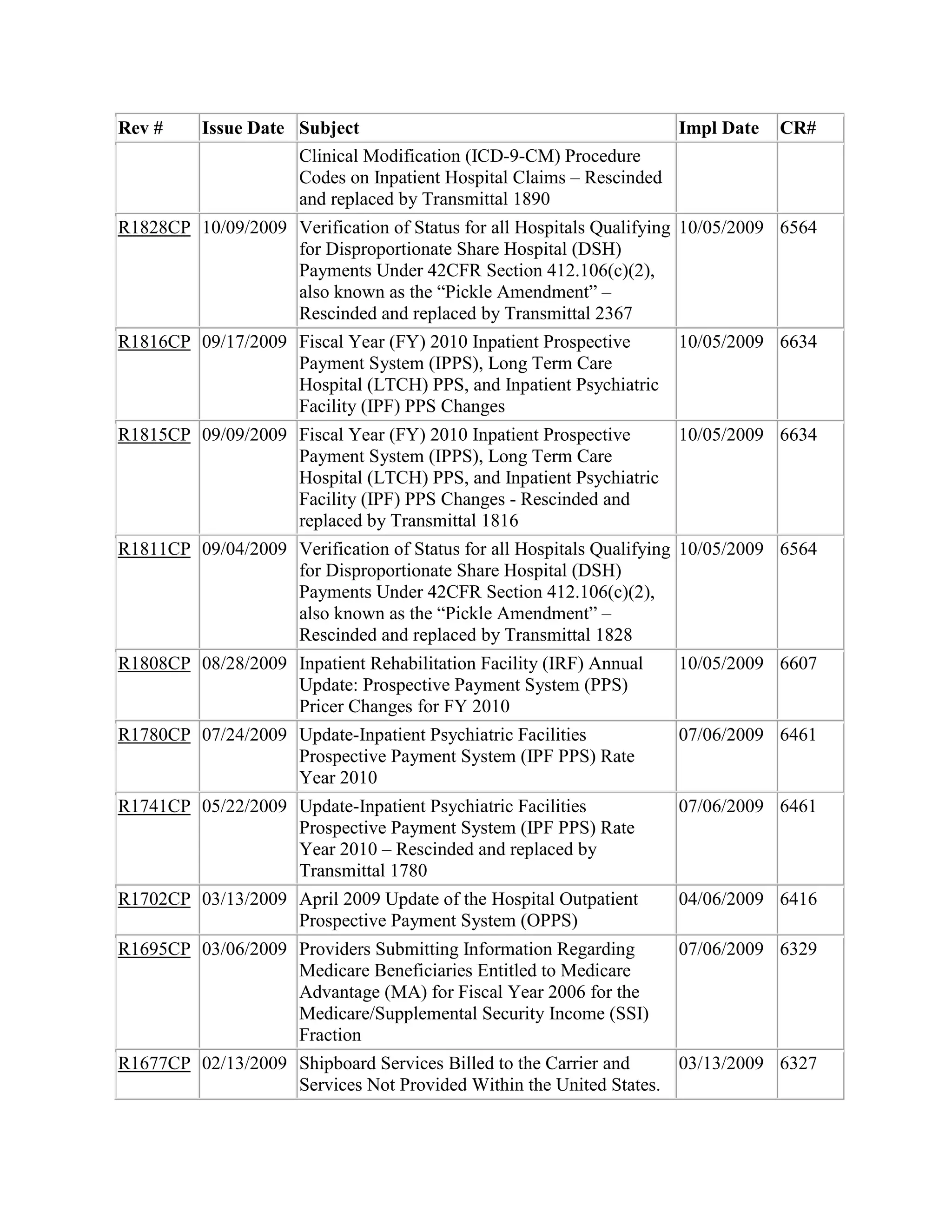
  • 227.
    09/01/2006 10/01/2006 11/01/2006 12/01/2006 05/01/200504/30/2006 06/01/200505/31/2006 07/01/200506/30/2006 08/01/200507/31/2006 12 12 12 12 05/01/2005 to 08/31/2005:50 % 09/01/2005 to 04/30/2006: 60 % 06/01/2005 to 09/30/2005: 50 % 10/01/2005 to 05/31/2006: 60 % 07/01/2005 to 10/31/2005: 50 % 11/01/2005 to 06/30/2006: 60 % 08/01/2005 to 11/30/2005: 50% 12/01/2005 to 07/31/2006: 60% For cost reporting periods beginning on or after July 1, 2005, the compliance threshold that must be met is 60 percent. Thus, for all compliance review periods beginning on or after January 1, 2013 (except in the case of new IRFs, as described in section 140.3.4 above), the compliance review period will be one continuous 12-month time period beginning 4 months before the start of a cost reporting period and ending 4 months before the beginning of the next cost reporting period. B. Types of Data Used to Determine Compliance with the Classification Criteria 1. Starting on July 1, 2004, the FI/MAC will use the verification procedures specified below in subsection C which is entitled “Verification of the Medical Condition Criterion Using the Inpatient Rehabilitation Facility-Patient Assessment Instrument (IRF-PAI) Data Records” or subsection D which is entitled “Verification of the Medical Condition Criterion Using the Inpatient Rehabilitation Facility’s Total Inpatient Population” to verify that an IRF has complied with the requirements specified above in §140.1.1B-D. 2. The verification procedure specified below in subsection C (that is, verification using the IRF-PAI data) will only be used if the FI/MAC has verified that the IRF’s Medicare Part A fee-for-service inpatient population is at least 50 percent of the IRF’s total inpatient population. Effective for compliance review periods beginning on or after October 1, 2009, FI/MACs must include the IRF’s Medicare Part C (Medicare Advantage) inpatient population, along with the IRF’s Medicare Part A fee-for-service inpatient population, in determining whether at least 50 percent of the IRF’s total inpatient population is made up of Medicare patients. 3. General Guideline Regarding Submission of a List of the Inpatients in Each IRF: In order to verify that an IRF’s Medicare Part A fee-for-service and Medicare Part C (Medicare Advantage) inpatient populations (combined) reflect the IRF’s total inpatient population, the FI/MAC in writing will instruct the IRF to send the FI/MAC, by a specific date, a list showing the hospital patient number of each inpatient IRF admission during the IRF’s 12-month compliance review period. Note that the term “hospital patient number” used throughout this section refers to a unique patient identifier used internally within the hospital for patient identification and recordkeeping purposes. For each inpatient on the list, the IRF must include the payer the IRF can bill, or has billed, for treatment and services furnished to the inpatient. If an inpatient on the list has multiple payers that the IRF can bill, or has billed, the IRF
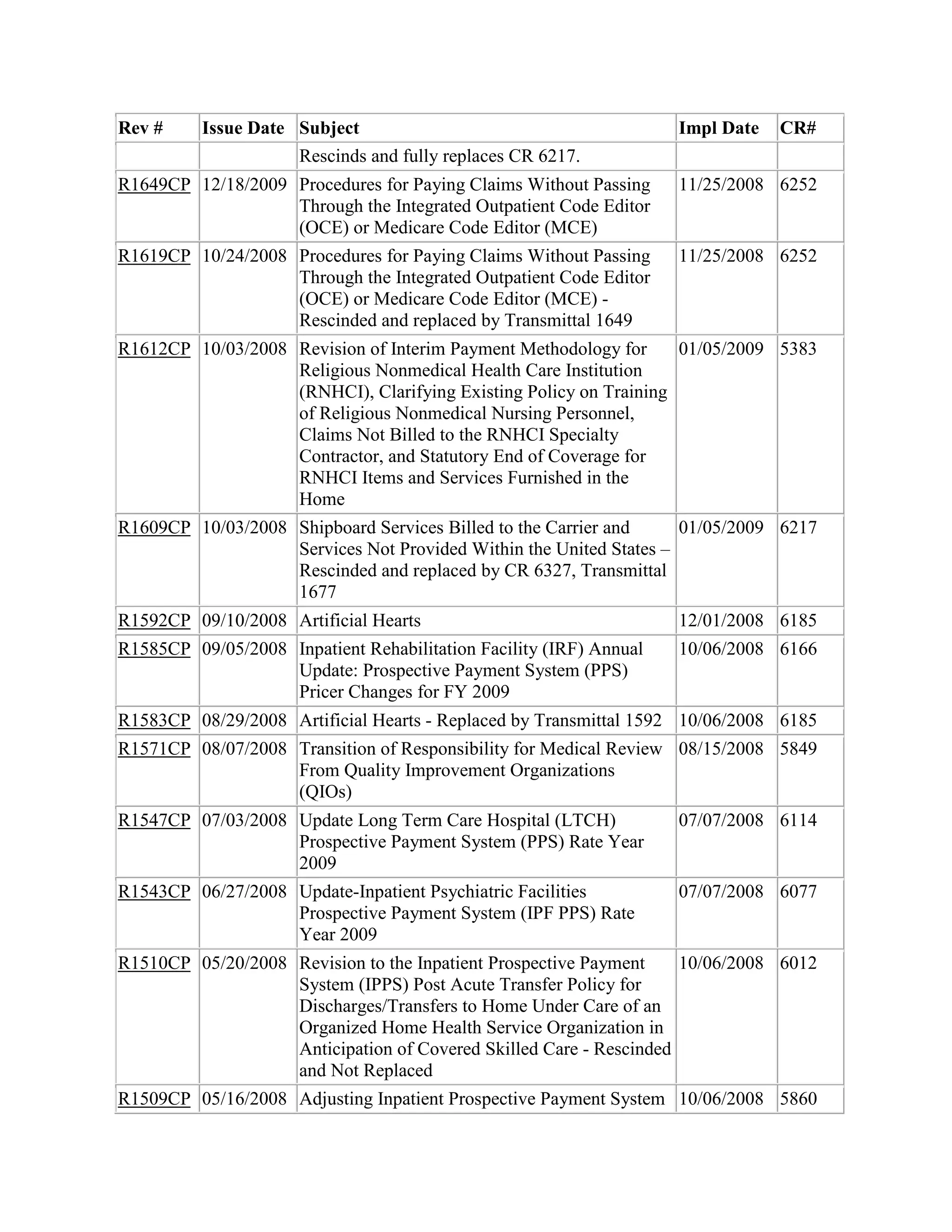
  • 228.
    must include andspecify each type of payer. In addition, for each inpatient on the list, the IRF must include the IRF admission and discharge dates. Exception to the General Guideline: The Secretary of Health and Human Services can declare a Public Health Emergency under section 319 of the Public Health Service Act or another appropriate statute, and the President can declare either a National Emergency under the National Emergencies Act or a Major Disaster under the Robert T. Stafford Disaster Relief and Emergency Assistance Act, or other appropriate law. In accordance with such declarations, certain regulations or operational policies may be waived in specific geographic areas for limited and defined periods of time. If applicable, in accordance with the waiver provisions, the IRF may be permitted to admit patients (referred to in this section as national emergency or disaster inpatients) who otherwise would be admitted to another inpatient setting. The national emergency or disaster inpatients will not be included as part of the IRF’s total inpatient population when the IRF’s compliance with the requirements specified in §140.1.1B-D is determined by the FI/MAC reading a sample of medical records. Therefore, when the IRF submits the list of hospital patient numbers stipulated above in section 140.1.3B3, the IRF will identify each national emergency or disaster inpatient by placing either the capital letter “E” or “D” after the patient’s unique internal hospital identification number. The FI/MAC will verify the information and, if appropriate, exclude these patients from the list of inpatients used to select a sample of medical records. The IRF should appropriately document in the medical record sufficient information to identify an inpatient as a national emergency or disaster inpatient. 4. The FI/MAC will use the list of hospital patient numbers to determine the IRF’s total inpatient population during the IRF’s compliance review period. The FI/MAC will then determine whether the compliance percentage threshold differs or is the same throughout the IRF’s compliance review period. If the compliance percentage threshold differs during the compliance review period (i.e., if it is 50 percent for one portion of the period and 60 percent for the other portion), then the FI/MAC must determine that at least 50 percent of the IRF’s total inpatient population consisted of Medicare Part A fee-for-service patients for both time periods. For example, the FI/MAC will consider the portion of the period in which the compliance percentage threshold is 50 percent and the portion of the period in which the compliance percentage threshold is 60 percent independently and determine if the IRF’s total inpatient population consists of at least 50 percent Medicare Part A fee-for-service patients in each of the two time periods. If, however, the compliance percentage threshold is the same throughout the IRF’s compliance review period (i.e., 60 percent throughout the period), then the FI/MAC must determine that at least 50 percent of the IRF’s total inpatient population consisted of Medicare Part A fee-for-service or Medicare Part C (Medicare Advantage) patients (beginning on or after October 1, 2009) for the entire 12-month period.
  • 229.
    In addition tothe above processes, the FI/MAC has the discretion to sample and compare other parameters (that is, diagnoses, procedures, length-of-stay, or any other relevant parameter) to determine that the Medicare Part A fee-for-service and Medicare Part C (Medicare Advantage) population (beginning on or after October 1, 2009) is representative of the IRF’s total inpatient population. A determination by the FI/MAC, in accordance with the preceding methodologies, that the IRF’s inpatient population for the compliance review period consisted of at least 50 percent Medicare Part A fee-for-service and Medicare Part C (Medicare Advantage) patients (beginning on or after October 1, 2009) means that the FI/MAC can use the procedure stipulated below in subsection C to presumptively determine if the IRF met the compliance threshold as specified above in §140.1.1B-D. 5. The FI/MAC will inform the RO if an IRF fails to send the list showing the hospital patient number associated with each inpatient IRF admission during the most recent, consecutive, and appropriate 12-month period, as defined by CMS. Further, the FI/MAC will inform the RO if the list of hospital patient numbers does not show the payer or payers or the admission and discharge dates for each hospital patient number on the list. The RO will notify the IRF that failure to send the FI/MAC the list within an additional 10 calendar days will result in a determination by the RO that the IRF has not met the requirements specified above in §140.1.1B-D and the facility will no longer be eligible for payment under the IRF PPS. C. Verification of the Medical Condition Criteria Using the Inpatient Rehabilitation Facility-Patient Assessment Instrument (IRF-PAI) Data Records (The Presumptive Methodology) 1. To determine if a facility has presumptively complied with the criteria specified above in §140.1.1B-D, the CMS will enable the FI/MAC to access the CMS' IRF-PAI data records. Specifically, each FI/MAC will be allowed to access only the IRF-PAI information submitted by IRFs that submit claims to that FI/MAC. In order to ensure that the software that matches each IRF to a particular FI/MAC is constantly updated, the FI/MAC must electronically send the RO a table that has at least the following title and column headings: FI/MAC List Of IRF Provider Numbers (Specify The FI/MAC’s Name) The Name of IRF Provider Each IRF That Number Submits Claims To This FI/MAC IRF Cost Reporting Period
  • 230.
    After checking theFI/MAC’s list of IRFs for completeness and, as necessary, communicating with the FI/MAC to ensure the accuracy of the information, the RO will forward the FI/MAC’s list of IRFs to the CMS contractor that maintains the IRFPAI database. The CMS contractor that maintains the IRF-PAI database will then, if necessary, update the IRF-PAI database software used to presumptively verify compliance with the requirements specified in §140.1.1B-D. The FI/MAC must coordinate with their CMS RO to obtain access to the software system. The FI/MAC will provide the RO with user information from all FI/MAC staff that are required to access the IRF-PAI data records. 2. When the FI/MAC accesses the IRF-PAI data records, the FI/MAC will be able to generate an IRF compliance review report using the IRF-PAI information from the IRFs on the FI/MAC’s list. The software that the FI/MAC uses to generate the IRF compliance review report will automatically use the specific ICD-9-CM and impairment group codes that are listed in Appendix B and Appendix C of the October 1, 2007 IRF Compliance Rule Specification Files, which can be downloaded from the IRF PPS website at http://www.cms.gov/Medicare/Medicare-Fee-for-ServicePayment/InpatientRehabFacPPS/Criteria.html, to determine if a particular IRF is presumptively in compliance with the requirements specified in §140.1.1B-D. Prior to generating the IRF compliance review report, the FI/MAC must allow the IRF to decide whether the IRF compliance review report will be generated using the IRF-PAI data records of patients who were admitted during the IRF’s compliance review period (even if they were discharged outside of the compliance review period), or the IRFPAI data records of patients who were discharged during the IRF’s compliance review period (even if they were admitted outside of the compliance review period). Below are the sections of the IRF compliance review report with example data: IRF Compliance Review Report State Provider Number Provider Name Cost Report Start Date Compliance Review Period Any State IRF Number Best Rehab 08/01/2008 04/01/2007 To 03/31/2008 Submitted Assessments Eligible Assessments Percent 100 60 60%
  • 231.
    The submitted assessmentssection identifies all of the IRF-PAI data records that the IRF submitted to the IRF-PAI database during the compliance review period. The eligible assessments are the assessments submitted during the compliance review period that match one of the codes in Appendix B and Appendix C of the October 1, 2007 IRF Compliance Rule Specification Files, which can be downloaded from the IRF PPS website at http://www.cms.gov/Medicare/Medicare-Fee-for-ServicePayment/InpatientRehabFacPPS/Criteria.html. The cost report start date shown is the start of the facility’s next cost reporting period. 3. If an IRF’s inpatient Medicare Part A fee-for-service and Medicare Part C (Medicare Advantage) populations (combined) (beginning on or after October 1, 2009) are at least 50 percent of its total inpatient population and the presumptive methodology (described above) indicates that the IRF met or exceeded the requirements specified in §140.1.1B-D, then the IRF is presumed to have met the requirements specified above in §140.1.1B-D. However, even when an IRF is presumed to have met the requirements specified above in §140.1.1B-D, the RO and FI/MAC still have the discretion to instruct the IRF to send to the RO or FI/MAC specific sections of the medical records of a random sample of inpatients, or specific sections of the medical records of inpatients identified by other means by the CMS or the FI/MAC. 4. Each FI/MAC must submit a report to the appropriate CMS RO (with a copy to the CMS Central Office) on at least a quarterly basis that shows each IRF’s status with respect to compliance with the requirements specified above in §140.1.1B-D. 5. Appendix B and Appendix C of the October 1, 2007 IRF Compliance Rule Specification Files, which can be downloaded from the IRF PPS website at http://www.cms.gov/Medicare/Medicare-Fee-for-ServicePayment/InpatientRehabFacPPS/Criteria.html, will be used to determine presumptive compliance with the requirements specified above in §140.1.1B-D. D. Verification of the Medical Condition Criteria Using the Inpatient Rehabilitation Facility’s Total Inpatient Population (Medical Review Methodology) 1. The FI/MAC must use the IRF’s total inpatient population to verify that the IRF has met the requirements specified above in §140.1.1B-D if: (i) the IRF’s Medicare population (including Medicare Part A fee-for-service and Medicare Part C (Medicare Advantage) patients, effective October 1, 2009) is not at least 50 percent of its total inpatient population; or (ii) the FI/MAC is unable to generate a valid IRF compliance review report using the IRF-PAI database methodology specified previously; or
  • 232.
    (iii) the FI/MACgenerates an IRF compliance review report, based on the use of the presumptive methodology, which demonstrates that the IRF has not met the requirements specified above in §140.1.1B-D. If the IRF’s Medicare Part A fee-for-service and Medicare Part C (Medicare Advantage) populations (combined, effective October 1, 2009) comprise less than 50 percent of the IRF’s total inpatient population, or the FI/MAC otherwise determines that the Medicare Part A fee-for-service and Medicare Part C (Medicare Advantage) populations (combined, effective October 1, 2009) are not representative of the overall IRF inpatient population, or the FI/MAC is unable to generate a valid report using the presumptive methodology, the presumptive determination is that the IRF did not meet the requirements specified above in §140.1.1B-D. 2. As previously stated above, the FI/MAC will instruct the IRF to send the FI/MAC a list showing the hospital patient number of each inpatient that the IRF admitted during the most recent, consecutive, and appropriate 12-month period, as defined by CMS. The list of hospital patient numbers must include the payer(s) and admission and discharge dates that correspond with the inpatients whose hospital patient numbers are shown on the list. The FI/MAC will then use generally accepted statistical sampling techniques to obtain a random sample of inpatients from the list. The random sample of inpatients drawn from the list must be sufficiently large to ensure that the FI/MAC can determine, with at least 95 percent confidence, whether the IRF’s compliance percentage is below the required compliance threshold (i.e., not in compliance) or at or above the required compliance threshold (i.e., in compliance). For example, suppose that the required compliance threshold for an IRF to be in compliance with the requirements specified above in §140.1.1B-D is 60 percent. The FI/MAC reviews a random sample of claims from IRF A and estimates that IRF A’s compliance percentage is 58 percent. Suppose that the standard deviation that the FI/MAC calculates for IRF A’s random sample of IRF claims is plus or minus 4 percentage points, so that the 95 percent confidence interval in this particular example is between 54 percent and 62 percent (with 58 percent as the midpoint). In this case, the IRF is considered to be in compliance with the 60 percent rule, since 60 percent is within the 95 percent confidence interval. To verify whether the IRF is in fact in compliance with the requirements specified above in §140.1.1B-D, the FI/MAC may need to draw a larger random sample of the IRF’s inpatients. For example, a larger random sample of IRF A’s inpatients might have reduced the standard deviation to plus or minus 1 percentage point, which would have led the 95 percent confidence interval to be between 57 percent and 59 percent. This would have demonstrated with 95 percent confidence that the IRF was not in compliance with the requirements specified above in §140.1.1B-D (because the entire 95 percent confidence interval was below the required compliance threshold of 60 percent). If the compliance percentage threshold differs within the compliance review period (i.e., is 50 percent for a portion of the compliance review period and 60 percent for the
  • 233.
    other portion ofthe period), then a random sample of inpatients will be drawn from each of the two time periods separately. The use of generally recognized statistical sampling principles may result in a determination that it would be inappropriate to use a sample to determine the facility’s compliance percentage. If a random sample is not appropriate in a particular case, then the FI/MAC will use the IRF’s entire inpatient population to determine the IRF’s compliance percentage. In addition, if the IRF had 100 or fewer inpatients during the compliance review period, then the FI/MAC must use the IRF’s total inpatient population (consisting of both Medicare and non-Medicare inpatients) to determine the IRF’s compliance percentage. Prior to selecting the random sample of inpatients, the FI/MAC must allow the IRF to decide if the IRF wants the sample to contain either the patients who were admitted during the IRF’s compliance review period (even if some of those patients were discharged outside of the compliance review period) or the patients discharged during the IRF’s compliance review period (even if some of those patients were admitted outside of the compliance review period). If the FI/MAC uses a random sample of the IRF’s inpatient population (rather than the IRF’s total inpatient population) to determine the IRF’s compliance percentage, then the FI/MAC must ensure that an adequate sample size is used to determine (with at least a 95 percent statistical level of confidence) whether or not the IRF has met the requirements in §140.1.1B-D. In some cases, this will require the FI/MAC to expand the size of the random sample of inpatients selected from a particular IRF. The FI/MAC will instruct the IRF to send it copies of specific sections of the medical records for all of the inpatients to be used in the compliance review. The FI/MAC has the discretion to decide which specific sections of the medical records to obtain, provided that the requested medical record sections contain enough information to allow the FI/MAC’s reviewers to determine the medical condition(s) for which each inpatient received treatment in the IRF. In addition to submitting the requested sections of the medical records, the IRF has the discretion to send the FI/MAC other clinical information regarding these same inpatients. 3. The FI/MAC will examine the medical record sections and any other information submitted by the IRF to determine if the IRF meets the requirements specified above in §140.1.1B-D. To determine if a specific inpatient matches one of the medical conditions specified in §140.1.1C, the FI may use the ICD-9-CM and impairment group codes specified in Appendix B and Appendix C of the most recent IRF Compliance Rule Specification Files (which can be downloaded from the IRF PPS website at http://www.cms.gov/Medicare/Medicare-Fee-for-ServicePayment/InpatientRehabFacPPS/Criteria.html) for general guidance. However, the FI/MAC is not permitted to use these codes to make a final determination as to whether or not the specific inpatient required intensive rehabilitation services for treatment of one or more of the medical conditions specified in §140.1.1C. The
  • 234.
    determination of whethera specific inpatient required intensive rehabilitation services for treatment of a condition can only be determined through careful review of that inpatient’s unique clinical characteristics and circumstances, as reflected in the inpatient’s medical record. 4. In general, when the FI/MAC is using a sample of medical records to determine compliance with the requirements in §140.1.1B-D, the FI/MAC always has the discretion to determine if a patient meets or does not meet any of the medical conditions listed in §140.1.1C based upon a review of the clinical record, regardless of the results of the presumptive methodology described previously. In other words, the compliance percentage that is determined using the medical review methodology described in this section will supersede the compliance percentage that was determined for the same compliance review period using the presumptive methodology. To ensure that the compliance review process is similar for all IRFs, the FI/MAC must have written policies that describe the reasons for using a random sample of medical records to determine an IRF’s compliance percentage when the presumptive methodology has shown that the IRF met the compliance threshold. 5. The FI/MAC will inform the RO if an IRF fails to provide information in accordance with the requirements specified above in subsection D2. The RO will notify the IRF that failure to provide the FI/MAC with the information in accordance with the requirements specified above in subsection D2 will result in a determination by the RO that the IRF has not met the requirements specified above in §140.1.1B-D. E. By the 15th day of each month, the FI/MAC responsible for determining the compliance percentage for each IRF using either of the methods specified above in §§140.1.3C or 140.1.3D will submit a report to CMS via e-mail. Instructions regarding the format of the report, how to complete the report, and where to send it are specified on the IRF PPS website at: http://www.cms.gov/Medicare/Medicare-Fee-for-ServicePayment/InpatientRehabFacPPS/Criteria.html. F. The FI/MAC must verify that the requirements specified above in §140.1.1B-E and §140.1.2 G-K were met. G. The State Agency will determine whether the criteria specified above in §140.1.1F-K and §140.1.2 Q were met. 140.1.4 - New IRFs (Rev. 2673, Issued: 03-14-13, Effective: 04-22-13, Implementation: 04-22-13) An IRF hospital or IRF unit is considered new if it has not been paid under the IRF PPS for at least 5 calendar years. A new IRF will be considered new from the point that it first participates in Medicare as an IRF until the end of its first full 12-month cost reporting period.
  • 235.
    A new IRFmust provide written certification that the inpatient population it intends to serve will meet the requirements in §140.1.1B-D above. The written certification is effective for the first full 12-month cost reporting period that occurs after the IRF begins being paid under the IRF PPS, and for any cost reporting period of not less than 1 month and not more than 11 months occurring between the date the IRF begins being paid under the IRF PPS and the start of the IRF’s first full 12-month cost reporting period. As described in section 140.1.9 below, retroactive adjustments may be made for any period during which the hospital has self-attested to meeting the requirements specified in §140.1.1B-D, but is shown not to have actually met these requirements during that period. 140.1.5 - Changes in the Status of an IRF Unit (Rev. 2673, Issued: 03-14-13, Effective: 04-22-13, Implementation: 04-22-13) For purposes of payment under the IRF PPS, the status of an IRF unit may be changed from not excluded from the IPPS to excluded from the IPPS only at the start of a cost reporting period. If an IRF unit is added to a hospital after the start of a cost reporting period, it cannot be excluded from the IPPS before the start of the hospital's next cost reporting period. The status of an IRF unit may be changed from excluded from the IPPS to not excluded from the IPPS at any time during a cost reporting period, but only if the hospital notifies the FI/MAC and the RO in writing of the change at least 30 days before the date of the change. In addition, the hospital must maintain the information needed to accurately determine which costs are and are not attributable to the IRF unit. A change in the status of a unit from excluded to not excluded that is made during a cost reporting period must remain in effect for the remainder of that cost reporting period. 140.1.6 - New IRF Beds (Rev. 2673, Issued: 03-14-13, Effective: 04-22-13, Implementation: 04-22-13) Any IRF beds that are added to an existing IRF must meet all applicable State Certificate of Need and State licensure laws. New IRF beds may be added one time at any time during a cost reporting period and will be considered new for the rest of that cost reporting period. A full 12-month cost reporting period must elapse between the delicensing or decertification of IRF beds in an IRF hospital or IRF unit and the addition of new IRF beds to that IRF hospital or IRF unit. Before an IRF can add new beds, it must receive written approval from the appropriate CMS RO, so that the CMS RO can verify that a full 12-month cost reporting period has elapsed since the IRF has had beds delicensed or decertified. New IRF beds are included in the compliance review calculations for determining compliance with §140.1.1B-D above from the time that they are added to the IRF.
  • 236.
    140.1.7 - Changeof Ownership or Leasing (Rev. 2673, Issued: 03-14-13, Effective: 04-22-13, Implementation: 04-22-13) If an IRF hospital (or a hospital that has an IRF unit) undergoes a change of ownership or leasing, as defined in 42 CFR §489.18, the IRF hospital (or IRF unit of a hospital) retains its excluded status and will continue to be paid under the IRF PPS before and after the change of ownership or leasing if the new owner(s) of the IRF hospital (or the hospital with an IRF unit) accept assignment of the previous owners’ Medicare provider agreement and the IRF continues to meet all of the requirements for payment under the IRF PPS. Note that an IRF’s payment status under the IRF PPS is a Medicare classification status, which cannot be separated from its host hospital and therefore cannot be purchased outside of the purchase of its host hospital. If the new owner(s) do not accept assignment of the previous owners’ Medicare provider agreement, the IRF is considered to be voluntarily terminated and the new owner(s) may re-apply to the Medicare program to operate a new IRF, under the requirements for new IRFs in §140.1.4 above. If, after the change of ownership or leasing, the IRF does not continue to meet all of the requirements for payment under the IRF PPS, then the IRF loses its excluded status and will be paid instead under the IPPS. 140.1.8 - Mergers (Rev. 2673, Issued: 03-14-13, Effective: 04-22-13, Implementation: 04-22-13) If an IRF hospital (or a hospital with an IRF unit) merges with another hospital and the owner(s) of the merged hospital accept assignment of the IRF hospital’s provider agreement (or the provider agreement of the hospital with the IRF unit), then the IRF hospital or IRF unit retains its excluded status and will continue to be paid under the IRF PPS before and after the merger, as long as the IRF hospital or IRF unit continues to meet all of the requirements for payment under the IRF PPS. Note that an IRF’s payment status under the IRF PPS is a Medicare classification status, which cannot be separated from its host hospital and therefore cannot be merged with another entity outside of the merger with its host hospital. If the owner(s) of the merged hospital do not accept assignment of the IRF hospital’s provider agreement (or the provider agreement of the hospital with the IRF unit), then the IRF hospital or IRF unit is considered voluntarily terminated and the owner(s) of the merged hospital may re-apply to the Medicare program to operate a new IRF under the requirements for new IRFs in §140.1.4 above. 140.1.9 - Retroactive Adjustments for Provisionally Excluded IRFs or IRF Beds (Rev. 2673, Issued: 03-14-13, Effective: 04-22-13, Implementation: 04-22-13)
  • 237.
    For cost reportingperiods beginning on or after October 1, 1991, if a new IRF (or new beds that are added to an existing IRF) are paid under the IRF PPS for an initial cost reporting period during which the hospital has self-attested to meeting the requirements specified above in §140.1.1B-D, but the inpatient population actually treated in the new unit or the beds added to the existing unit during that cost reporting period do not meet the requirements specified above in §140.1.1B-D, CMS adjusts payments to the hospital retroactively in accordance with the procedure specified below. A. If an IRF hospital, IRF unit, or group of new IRF beds is paid under the IRF PPS for a cost reporting period based on a written certification that it will meet the requirements specified above in §140.1.1B-D, but does not actually meet the requirement for that cost reporting period, CMS adjusts Medicare payments to the hospital retroactively in accordance with paragraph C below. B. In the case of a unit to which new beds have been added, the requirement in §140.1.1BD above is applied to the entire unit, including both new and existing beds. If the entire unit is able to meet the requirement, the previously existing unit and the added beds are presumed to meet the requirement separately and no payment adjustment as specified below in paragraph C is made. If the unit as a whole does not meet the requirement specified above in §140.1.1B-D, the hospital must furnish the FI/MAC or the State Agency, as specified by the RO, the information needed to determine whether the requirement specified in §140.1.1B-D above was met by the established portion of the unit (that is, the previously existing unit) and by the newly added beds, considered separately. If the hospital is not able to demonstrate that the established portion of the unit met the requirement, then that portion of the facility will not be classified as an IRF for the following cost reporting period. Retroactive adjustments may apply. If the added beds are shown to have met the requirement specified above in §140.1.1B-D, then those beds are eligible to be included as part of the unit’s classification as an IRF for the following cost reporting period. If the added beds did not meet the requirement, the FI/MAC adjusts its payment to the unit retroactively in accordance with paragraph C below and the added beds will not be included as part of the unit classified as an IRF for the following cost reporting period. If the hospital does not have the records needed to discriminate between the performance of the previously existing unit and that of the added beds, or for other reasons does not furnish the information requested by the FI/MAC or State Agency, neither the previously existing unit nor the added beds will be classified as an IRF for the following cost reporting period. In that case, the FI/MAC adjusts its payment to the entire unit retroactively in accordance with paragraph C below. C. The FI/MAC adjusts payment to the hospital by calculating the difference between the amount actually paid for services to Medicare patients in the IRF hospital, IRF unit, or new IRF beds during the period of provisional exclusion, and the amount that would have been paid if the IRF hospital, IRF unit, or new IRF beds had not been excluded from the
  • 238.
    IPPS. The FI/MACthen takes action to recover the resulting overpayment, or corrects the underpayment to the hospital. 140.2 - Payment Provisions Under IRF PPS (Rev. 2673, Issued: 03-14-13, Effective: 04-22-13, Implementation: 04-22-13) Section 1886(j) of the Social Security Act (the Act) provides for the implementation of a per discharge prospective payment system (PPS) for inpatient rehabilitation hospitals and inpatient rehabilitation units of a hospital (hereinafter referred to as IRFs). The IRF PPS incorporates per discharge federal rates based on average IRF costs in a base year updated for inflation to the first effective period of the system. IRF PPS providers are not subject to the 3-day payment widow (72-hour rule) for preadmission services that is described in section 40.3 of this chapter (Chapter 3 of the Medicare Claims Processing Manual (Pub. 100-04), but instead are subject to a 1-day payment window (24-hour rule) for pre- admission services. Beneficiary liability operates the same as under the current Tax Equity and Fiscal Responsibility Act of 1982 (TEFRA) payment system. Even if Medicare payments are below the cost of care for a patient under the IRF PPS, the patient cannot be billed for the difference. Below are the annual rate update Change Requests (CRs) for the applicable Fiscal Years (FYs): FY 2013 – CR 7901 FY 2012 – CR 7510 FY 2011 – CR 7076 FY 2010 – CR 7029 (legislative adjustment of FY 2010 market basket increase factor) FY 2010 – CR 6607 FY 2009 – CR 6166 FY 2008 – CR 5694 FY 2007 – CR 5273 FY 2006 – CR 4037 FY 2005 – CR 3378 FY 2004 – CR 2894 FY 2003 – CR 2250 Change Requests can be accessed through the following CMS Transmittals Web site: http://www.cms.hhs.gov/Transmittals/01_Overview.asp 140.2.1 - Phase-In Implementation (Rev. 2673, Issued: 03-14-13, Effective: 04-22-13, Implementation: 04-22-13) Under the BBA, the Federal fiscal year in which a facility's cost reporting period begins determines which transition period percentages apply. The first transition period
  • 239.
    percentages are applicablefor cost reporting periods beginning during Federal fiscal year 2001. The second transition period percentages are applicable to cost reporting periods beginning during Federal fiscal year 2002, that is, periods beginning on or after October 1, 2001, and before October 1, 2002. For cost reporting periods beginning during Federal fiscal year 2003 and after, payment is based on 100 percent of the adjusted Federal prospective payment. Since CMS is implementing the IRF PPS for discharges that occur during the IRF's cost reporting period that begins on or after January 1, 2002, IRFs are phased directly into the second transition period, where payment will be based on 66 2/3 percent of the PPS payment and 33 1/3 percent of the TEFRA payment. A facility will continue to be paid under the TEFRA (reasonable cost-based) system for its entire cost reporting period beginning prior to January 1, 2002. In addition, §305 of the BIPA 2000 states facilities may elect to be paid 100 percent PPS payment, rather than payment based on the transition method. If a facility chooses not to be paid under the transition method, they must notify their FI no later than 30 days prior to its first cost reporting period for which the IRF PPS applies to the facility. The request to make the election must be made in writing to the Medicare FI for the facility. The FI must receive the request on or before the 30th day before the applicable cost reporting period begins, regardless of any postmarks or anticipated delivery dates. Requests received, postmarked, or delivered by other means after the 30th day before the cost reporting period begins will not be approved. If the 30th day before the cost reporting period falls on a day that the postal service or other delivery sources are not open for business, the facility is responsible for allowing sufficient time for delivery of the request before the deadline. If a facility's request is not received or not approved, payment will be based on the transition method. 140.2.2 - Payment Adjustment Factors and Rates (Rev. 2673, Issued: 03-14-13, Effective: 04-22-13, Implementation: 04-22-13) Section 1886(j) of the Act sets forth the methodology for establishing the payment rates as well as the data on which they are based. In addition, this section prescribes adjustments to such rates based on geographic variation and case-mix and other factors the Secretary deems necessary to ensure that payment most accurately reflects cost. For the initial period of the IRF PPS, beginning on or after January 1, 2002, all payment rates and associated rules were published in the "Federal Register" on August 7, 2001. For each succeeding fiscal year, the rates will be published in the "Federal Register" on or before August 1 of the year preceding the affected fiscal year. 140.2.3 - Case-Mix Groups (Rev. 2673, Issued: 03-14-13, Effective: 04-22-13, Implementation: 04-22-13) In general, a case will be grouped into a Case-Mix Group (CMG) based on the clinical characteristics of the Medicare beneficiary. Rehabilitation Impairment Categories (RICs),
  • 240.
    functional measurements, age,and comorbidities were used to develop the CMGs. Specifically, RICs are used to group cases that are similar in clinical characteristics and resource use. The RICs are codes that indicate the primary cause of the rehabilitation hospitalization and are clinically homogeneous. In addition to the first two digits of the CMG indicating the RIC, the CMGs are further partitioned using functional measures of motor and cognitive scores. Age improves the explanatory power of the CMGs if some groups are split based on this variable. Lastly, comorbidites were found to substantially increase the average cost of a case in specific CMGs. The comorbidities are arrayed in three categories (or tiers) based on whether the costs are considered high, medium, or low. If a case has more than one comorbidity, the CMG payment rate will be based on the comorbidity that results in the highest payment. 140.2.4 - Case-Level Adjustments (Rev. 2673, Issued: 03-14-13, Effective: 04-22-13, Implementation: 04-22-13) Payment is based on the CMGs described above, as well as possible adjustments specific to the case and the facility characteristics. For case level adjustments, more than one case level adjustment may apply to the same case. For ease of understanding, the case level discussion is presented below in the same order that is used to assess whether or not they apply. For example, a case may be classified as a transfer, but may also receive additional payments because it meets the definition of an outlier case. Interrupted stays are defined as those cases in which a Medicare beneficiary is discharged from the inpatient rehabilitation facility and returns to the same inpatient rehabilitation facility within 3 consecutive calendar days. The 3 consecutive calendar days begin with the day of the discharge from the IRF and ends on midnight of the third day. The length of stay for these cases will be determined by the total length of the IRF stay including the days prior to the interruption and the days after the interruption. One CMG payment will be made for interrupted stay cases and the payment will be based on the initial assessment. For example, if a Medicare beneficiary is discharged on February 1, 2001, and is readmitted on February 3, the case would be considered an interrupted stay and only one CMG payment will be made based on the initial assessment. However, if the Medicare beneficiary was readmitted on February 4, then it would not be considered an interrupted stay. A separate DRG payment will not be made to the acute care hospital when the beneficiary is discharged and returns to the same IRF on the same day. However, a DRG payment can be made if the beneficiary does not return to the same IRF on the same day as they were discharged. If a case is determined to be an interrupted stay, other adjustments may apply to this payment amount. For example, the case still may meet the definition of a transfer case described below. For the IRF PPS, transfer cases are defined as those in which a Medicare beneficiary is transferred to either another rehabilitation facility, a long term care hospital, an inpatient hospital, or a nursing home that accepts payment under either the Medicare program and/or the Medicaid program AND the length of stay of the case is less than the average length of stay for a given CMG. The transfer policy consists of a per diem payment amount calculated by dividing the per discharge CMG payment rate by the average
  • 241.
    length of stayfor the CMG. Medicare will pay transfer cases a per diem amount and include an additional half day payment for the first day. Transfer payments will be calculated by first adding the length of stay of the case to 0.5 (to account for the addition of the half day payment for the first day) and then multiplying the result by the CMG per diem amount. The IRF PPS also includes a payment adjustment for certain cases, such as short-stay cases (for cases that do not meet the definition of a transfer case). A separate CMG payment (5001) will be made for cases with a length of stay of 3 days or less, without consideration of the clinical characteristics of the patient. Cases that expire with a length of stay of 3 days or less, will also be classified to CMG 5001. Separate CMGs will also be made for cases that expire with a length of stay greater than 3 days. To improve the explanatory power of the groups, four additional CMGs were created to account for cases that expire. CMG 5101 is used for short-stay, orthopedic, expired cases. This CMG includes those cases that would otherwise be grouped to RICs 07, 08, and 09 and the length of the stay is greater than 3 days, but less than or equal to 13 days. CMG 5102 will be used for orthopedic expired cases where the length of stay is greater than or equal to 14 days. CMG 5103 will be used for short-stay, non-orthopedic, expired cases. This CMG includes those cases that would not be grouped to the orthopedic RICs and the length of the stay is greater than 3 days, but less than or equal to 15 days. CMG 5104 will be used for non-orthopedic expired cases where the length of stay is greater than or equal to16 days. 140.2.5 - Facility-Level Adjustments (Rev. 2673, Issued: 03-14-13, Effective: 04-22-13, Implementation: 04-22-13) Facility-level adjustments apply to all cases and are based on the individual IRF characteristics. The facility-level adjustments include an area wage adjustment, an adjustment for facilities located in rural areas, an adjustment for treating low-income patients and an adjustment for teaching facilities. Outlier payments will also be discussed in this section. Although outlier payments are considered to be a case-level adjustment, a case can be determined to qualify for these additional payments only after all other facility-level adjustments are computed. Thus, for ease of understanding, the discussion of these facility-level and outlier adjustments are presented in the same order that is used to assess their applicability. 140.2.5.1 - Area Wage Adjustments (Rev. 2673, Issued: 03-14-13, Effective: 04-22-13, Implementation: 04-22-13) To adjust payments for area wage differences, CMS first identifies the labor-related portion of the prospective payment rates which is published annually in the Federal Register. The labor-related unadjusted Federal payment is multiplied by a wage index value to account for area wage differences. CMS uses the inpatient acute care hospital wage data to compute the wage indices on the basis of the labor market area in which the acute care hospital is located, but without taking into account geographic reclassification
  • 242.
    under §§1886(d)(8) or(d)(10) of the Act and without applying the “rural floor” under §4410 of the BBA. The wage data excludes the wages for services provided by teaching physicians, interns and residents, and nonphysician anesthetists under Medicare part B, because these services are not covered under the IRF PPS. For IRF PPS discharges occurring before October 1, 2005, IRFs are divided into labor market areas where urban areas are defined as a Metropolitan Statistical Area (MSA) or New England County Metropolitan Area, as defined by the Executive Office of Management and Budget. For IRF PPS discharges occurring on or after October 1, 2005, the IRF PPS adopts new labor market area definitions based upon the new statistical area definitions issued by the Office of Management and Budget (OMB) in OMB Bulletin No. 03-04, June 6, 2003. OMB Bulletin No. 03-04 includes new definitions of Metropolitan Statistical Areas, Micropolitan Statistical Areas, and Combined Statistical Areas, more commonly referred to as Core-Based Statistical Areas (CBSAs). CBSA-based designations reflect the most recent available geographic classifications and more accurately reflect current labor markets. The OMB also established New England City and Town Areas, which are similar to the previous New England MSAs. CMS uses the county-based areas for all MSAs in the Nation, including those in New England. Adopting county-based labor market areas for the entire country creates consistency and stability in the Medicare payment program because all of the labor market areas, including New England, are defined using the same system (that is, counties), rather than different systems in different areas of the country, and minimizes program complexity. CMS uses the Metropolitan Divisions where applicable under the new CBSA-based labor market area definitions to determine urban areas. Micropolitan Areas are treated as rural labor market areas under the IRF PPS. To calculate the statewide rural wage index for each State, CMS combines all of the counties in a State outside of designated urban areas along with all Micropolitan Areas. The wage indices applicable to IRF PPS discharges occurring on or after October 1, 2005 are published annually in the Federal Register. 140.2.5.2 - Rural Adjustment (Rev. 2673, Issued: 03-14-13, Effective: 04-22-13, Implementation: 04-22-13) Payments are adjusted for facilities located in rural areas. A facility is considered to be a rural IRF if they are located in a non-urban area. For FY 2006 and FY 2007, a hold harmless policy applies to IRFs that meet the definition of rural in FY 2005 in §412.602 and become urban under the FY 2006 CBSAbased designations. The IRFs that meet the criteria described in the previous sentence will qualify for an adjustment to their payments in FY 2006 and FY 2007 equal to some portion of the 19.14 percent rural adjustment effective in FY 2005. This adjustment is in addition to the one-year blended wage index described above for discharges occurring on or after October 1, 2005 and on or before September 30, 2006. 140.2.5.3 – Low-Income Patient (LIP) Adjustment: The Supplemental Security Income (SSI)/Medicare Beneficiary Data for Inpatient
  • 243.
    Rehabilitation Facilities (IRFs)Paid Under the Prospective Payment System (PPS) (Rev. 2673, Issued: 03-14-13, Effective: 04-22-13, Implementation: 04-22-13) The LIP adjustment accounts for differences in costs among IRFs associated with differences in the proportion of low-income patients treated. The LIP adjustment is calculated as (1 + disproportionate share hospital (DSH) patient percentage) raised to a power specified in the most recent IRF PPS final rule published in the Federal Register. To compute the DSH patient percentage the following formula is used: DSH = Medicare SSI Days Total Medicare Days + Medicaid, Non-Medicare Days Total Days This instruction provides the data for determining additional payment amounts for IRFs with low-income patients. An SSI data file below shows the latest available IRF-specific data to compute an IRF's SSI ratio for the associated specified fiscal year (FY). An IRF may use this ratio as part of the formula to estimate their LIP adjustment for a cost reporting period that begins subsequent to the FY specified by the data file. As appropriate, a file will be updated annually (usually each October/November). Patients who are enrolled in Medicare Advantage (administered through Medicare Part C) should also be included in the Medicare fraction. These days will be included in the Medicare/SSI fraction, but in order for them to be counted, the hospital must submit an informational only bill (TOB 111), which includes both Condition Code 04 and the CMG code from the IRF PAI, to their Medicare contractor. This will ensure that these days are included in the IRF’s SSI ratio for Fiscal Year 2007 and beyond. Teaching IRFs do not have to submit an additional bill with Condition Code 04. They already submit bills with Condition Codes 04 and 69 for Indirect Medical Education payments and CMS will use the information from these bills for the SSI ratio. IRFs that received LIP payments during FY 2006 are also required to submit informational only bills for their Medicare Advantage patients. Informational Only Claim Elements: • • • • • • Covered 111 TOB Condition Code 04 Medicare Fee-for-Service is the primary payer There is no MSP Beneficiary’s Medicare HICN For claims prior to October 1, 2011, report the Revenue Code 0024 line containing CMG A9999 and, instead of inputting the transmission date of the IRF-PAI in the service date field (as is required for FFS claims), input the discharge date as a default for these informational only claims. The discharge date is required on informational only claims to reduce reporting burden for IRFs who may be submitting “old” informational only claims.
  • 244.
    NOTE: Effective January1, 2011, do not report the service date for the revenue code 0024 line. Instead, use occurrence code 50 in place of the service date to report the default discharge date for informational only claims. • Effective October 1, 2011, report the Revenue Code 0024 line containing the CMG from the IRF-PAI and the transmission date of the IRF-PAI in the occurrence code 50 and date field (as is required for FFS claims). • All other required claim elements The SSI/Medicare beneficiary data for IRF PPS is available to FIs and MACs electronically and contains the name of the facility, provider number, SSI days, covered Medicare days, and the ratio of Medicare Part A patient days attributable to SSI recipients. FIs will use this information to update their provider specific file. The files are located at the following CMS Web site address: http://www.cms.gov/Medicare/Medicare-Fee-for-ServicePayment/InpatientRehabFacPPS/SSIData.html FIs use this data to determine an initial PPS payment amount, and if applicable, to determine a final outlier payment amount for IRFs whose discharges are during a specific cost reporting period. FIs make a determination of the amount of this percentage to compute the final LIP adjustment which allows the year-end settlement of a facility’s cost report. When the FI settles a cost report for a specific fiscal year, that settled cost report will determine the final SSI ratio that is associated with that cost report. The FI uses the most recently settled SSI ratio to settle the current cost report. Once the final SSI ratio is determined for the actual fiscal year the cost report corresponds to, a retrospective adjustment may be made to account for the difference between the actual lip adjustment amount and the initial PPS lip adjustment payment amount. A - Clarification of Allowable Medicaid Days in Calculating the Disproportionate Share Variable Background Under the IRF PPS, facilities receive additional payment amounts to account for the cost of furnishing care to low-income patients. This is done by making adjustments to the prospective payment rate. Under §1886(d)(5)(F) of the Act, the Medicare DSH percentage is made up of two computations. The results of these two computations are added together to determine the DSH percentage. First, the patient days of patients who, during a given month, were entitled to both Medicare Part A and SSI (excluding those patients who received only State supplementation) is divided by the number of covered patient days utilized by patients under Medicare Part A for that same period. Second, a determination is made regarding the patient days associated with beneficiaries who were eligible for medical assistance (Medicaid) under a State plan approved under Title XIX but who were not entitled to Medicare Part A (See 42 CFR 412.106(b)(4)) is determined.
  • 245.
    This number isdivided by the total number of patient days for that same period. The SSI data is updated on an annual basis and these data are one of the components used to determine the DSH variable that is part of the appropriate LIP adjustment for each IRF. Included Days In calculating the number of Medicaid days, the hospital must determine whether the patient was eligible for Medicaid under a State plan approved under Title XIX on the day of service. If the patient was so eligible, the day counts in the Medicare disproportionate share adjustment calculation. The statutory formula for "Medicaid days" reflects several key concepts. First, the focus is on the patient's eligibility for Medicaid benefits as determined by the State, not the hospital's "eligibility" for some form of Medicaid payment. Second, the focus is on the patient's eligibility for medical assistance under an approved Title XIX State plan, not the patient's eligibility for general assistance under a State-only program. Third, the focus is on eligibility for medical assistance under an approved Title XIX State plan, not medical assistance under a State-only program or other program. Thus, for a day to be counted, the patient must be eligible on that day for medical assistance benefits under the Federal-State cooperative program known as Medicaid (under an approved Title XIX State plan). In other words, for purposes of the Medicare disproportionate share adjustment calculation, the term "Medicaid days" refers to days on which the patient is eligible for medical assistance benefits under an approved Title XIX State plan. The term "Medicaid days" does not refer to all days that have some relation to the Medicaid program, through a matching payment or otherwise; if a patient is not eligible for medical assistance benefits under an approved Title XIX State plan, the patient day cannot become a "Medicaid day" simply by virtue of some other association with the Medicaid program. Medicaid days, for purposes of the Medicare disproportionate share adjustment calculation, include all days during which a patient is eligible, under a State plan approved under Title XIX, for Medicaid benefits, even if Medicaid did not make payment for any services. Thus, Medicaid days include, but are not limited to, days that are determined to be medically necessary but for which payment is denied by Medicaid because the provider did not bill timely, days that are beyond the number of days for which a State will pay, days that are utilized by a Medicaid beneficiary prior to an admission approval but for which a valid enrollment is determined within the prescribed period, and days for which payment is made by a third party. In addition, CMS recognizes the calculation days that are utilized by a Medicaid beneficiary who is eligible for Medicaid under a State plan approved under Title XIX through a managed care organization (MCO) or health maintenance organization (HMO). However, in accordance with 42 CFR 412.106(b)(4), a day does not count in the Medicare disproportionate share adjustment calculation if the patient was entitled to both Medicare Part A and Medicaid on that day. Therefore, once the eligibility of the patient for Medicaid under a State plan approved under Title XIX has been verified, the FI must determine whether any of the days are dual entitlement days and, to the extent that they are, subtract them from the other days in the calculation. Excluded Days
  • 246.
    Many States operateprograms that include both State-only and Federal-State eligibility groups in an integrated program. For example, some States provide medical assistance to beneficiaries of State-funded income support programs. These beneficiaries, however, are not eligible for Medicaid under a State plan approved under Title XIX, and, therefore, days utilized by these beneficiaries do not count in the Medicare disproportionate share adjustment calculation. If a hospital is unable to distinguish between Medicaid beneficiaries and other medical assistance beneficiaries, then it must contact the State for assistance in doing so. In addition, if a given patient day affects the level of Medicaid DSH payments to the hospital but the patient is not eligible for Medicaid under a State plan approved under Title XIX on that day, the day is not included in the Medicare DSH calculation. It should be noted that the types of days discussed above are not necessarily the only types of excluded days. See the chart below, which summarizes some, but not necessarily all, of the types of days to be excluded from (or included in) the Medicare DSH adjustment calculation. To provide consistency in both components of the calculation, any days that are added to the Medicaid day count must also be added to the total day count, to the extent that they have not been previously so added. Regardless of the type of allowable Medicaid day, the hospital bears the burden of proof and must verify with the State that the patient was eligible under one of the allowable categories during each day of the patient's stay. The hospital is responsible for and must provide adequate documentation to substantiate the number of Medicaid days claimed. Days for patients that cannot be verified by State records to have fallen within a period wherein the patient was eligible for Medicaid cannot be counted.
  • 247.
    Types of DaysIncluded/Excluded in the Medicare DSH Adjustment Calculation Type of Day Description General Assistance Patient Days Days for patients covered under a State-only (or county-only) general assistance program (whether or not any payment is available for health care services under the program). These patients are not Medicaideligible under the State plan Days for patients covered under a State-only health program. These patients are not Medicaid-eligible under the State plan Other StateOnly Health Program Patient Days Charity Care Patient Days Eligible Title XIX Day No No Days for patients not eligible for Medicaid or any other third-party payer, No and claimed as uncompensated care by a hospital. These patients are not Medicaid-eligible under the State plan. Actual 1902(r)(2) Days for patients eligible under a State plan based on a 1902(r)(2) or Yes and 1931(b) 1931(b) election. These patients are Medicaid-eligible under the Title Days XIX State plan under the authority of these provisions, which is exercised by the State in the context of the approved State plan. Type of Day Description Eligible Title XIX Day Medicaid Days for patients who are Title XIX-eligible and who meet the Yes Optional definition of "optional targeted low-income children" under Targeted Low§1905(u)(2). The difference between these children and other Title XIX Income children is the enhanced FMAP rate available to the State. These Children children are fully Medicaid-eligible under the State plan. (CHIP-related) Days No. Separate CHIP Days for patients who are eligible for benefits under a non-Medicaid Days State program furnishing child health assistance to targeted low-income children. These children are, by definition, not Medicaid-eligible under 140.2.5.4 - Teaching Status Adjustment (Rev. 2673, Issued: 03-14-13, Effective: 04-22-13, Implementation: 04-22-13) The teaching status adjustment is a facility level adjustment made to the Federal per discharge base rate to account for the higher indirect operating costs experienced by facilities that participate in graduate medical education. The adjustment is made on a claim basis as an interim payment, with final payment in full for the cost reporting period made through the cost report. Any difference between the interim payments and the actual teaching status adjustment amount computed in the cost report are adjusted through lump sum payments/recoupments when the cost report is filed and later settled. The adjustment is based on the IRF’s “teaching variable,” which is the ratio of the
  • 248.
    number of FTEresidents training in the IRF (subject to the FTE resident cap described below) to the IRF’s average daily census (ADC). 140.2.5.4.1 - FTE Resident Cap (Rev. 2673, Issued: 03-14-13, Effective: 04-22-13, Implementation: 04-22-13) There is a cap on the number of FTE residents that may be counted for purposes of calculating the teaching adjustment, not the number of residents teaching institutions can hire or train. The FTE resident cap is identical in freestanding teaching rehabilitation hospitals and in distinct part rehabilitation units with GME programs. The cap is the number of FTE residents that trained in the IRF during a “base year.” An IRF’s FTE resident cap is determined based on the final settlement of the IRF’s most recent cost reporting period ending on or before November 15, 2004. IRFs that first began training residents after November 15, 2004 will initially receive an FTE cap of zero. The FTE caps for new IRFs (as well as existing IRFs) that start training residents in a new GME program (as defined in §413.79(1)) may be subsequently adjusted in accordance with the policies that are being applied in the IPF PPS (as described in §412.424(d)(1)(iii)(B)(2)), which in turn are made in accordance with the policies described in 42 CFR 413.79(e). For other types of Medicare providers (including long-term care hospitals) that have been training residents and are currently converting to IRFs, the fiscal intermediary will determine an FTE resident cap for purposes of the IRF teaching status adjustment, applicable beginning with the new IRF’s payments under the IRF PPS based on the FTE count of residents during the predecessor facility’s most recent cost reporting period ending on or before November 15, 2004. If the predecessor facility did not begin training residents until after November 15, 2004, the facility would initially receive an FTE cap of zero. The FTE caps for new IRFs (as well as existing IRFs) that start training residents in a new GME program (as defined in §413.79(1)), may be subsequently adjusted in accordance with the policies that are being applied in the IPF PPS (as described in §412.424(d)(1)(iii)(B)(2)), which in turn are made in accordance with the policies described in 42 CFR 413.79(e). Once established, the FTE resident cap for the teaching status adjustment for the new IRF will be subject to the same rules and adjustments as any IRF’s FTE resident cap. CMS will monitor this policy closely to ensure that it is not being inappropriately manipulated. IRFs are not permitted to aggregate the FTE resident caps used to compute the IRF PPS teaching status adjustment through affiliation agreements. Residents with less than fulltime status and residents floating through the rehabilitation hospital or unit for less than a full year are counted in proportion to the time they spend in their assignment with the IRF (for example, a resident on a full-time, 3-month rotation to the IRF would be counted as 0.25 FTEs for purposes of counting residents to calculate the ratio). No FTE resident time counted for purposes of the IPPS IME adjustment is allowed to be counted for purposes of the teaching status adjustment for the IRF PPS.
  • 249.
    The denominator usedto calculate the teaching status adjustment under the IRF PPS is the IRF’s average daily census (ADC) from the current cost reporting period. If a rehabilitation hospital or unit has more FTE residents in a given year than in the base year (the base year being used to establish the cap) payments are based on the lower number (the cap amount) in that year. If a rehabilitation hospital or unit were to have fewer FTE residents in a given year than in the base year (that is, fewer residents than its FTE resident cap) an adjustment in payments in that year is based on the lower number (the actual number of FTE residents the facility hires and trains). Effective for cost reporting periods beginning on or after October 1, 2011, the IRF FTE resident caps may be temporarily adjusted to reflect interns and residents added because of another IRF’s closure or the closure of another IRF’s residency training program. An IRF is only eligible for the temporary cap adjustment if training the additional interns and residents would cause the IRF to exceed its FTE resident cap. In addition, an IRF that closes a medical residency training program must agree to temporarily reduce its FTE cap before other IRFs can receive temporary adjustments to their caps for training the IRF’s interns and residents. IRFs may qualify for the temporary cap adjustment for cost reporting periods beginning on or after October 1, 2011 if they are already training interns and residents displaced by IRF closures or residency training program closures that occurred prior to October 1, 2011. 140.2.5.5 - Outliers (Rev. 2673, Issued: 03-14-13, Effective: 04-22-13, Implementation: 04-22-13) Section 1886(j)(4) of the Act provides the Secretary with the authority to make payments in addition to the basic IRF prospective payments for cases incurring extraordinarily high cost. A case qualifies for outlier payment if the estimated cost of the case exceeds the adjusted outlier threshold. CMS calculates the adjusted outlier threshold by adding the IRF PPS payment for the case (that is, the CMG payment adjusted by all of the relevant facility-level adjustments) and the adjusted threshold amount (also adjusted by all of the relevant facility-level adjustments). Then, CMS calculates the estimated cost of the case by multiplying the IRF’s overall cost-to-charge ratio (CCR) by the Medicare allowable covered charge. If the estimated cost of the case is higher than the adjusted outlier threshold, CMS makes an outlier payment for the case equal to 80 percent of the difference between the estimated cost of the case and the outlier threshold. The adjusted threshold amount and upper threshold CCR are set forth annually in the IRF PPS notices published in the Federal Register. 140.2.6 - Cost-to-Charge Ratios (Rev. 2323, Issued: 10-26-11, Effective: 11-28-11, Implementation: 11-28-11) For discharges beginning on and after January 1, 2002 thru September 30, 2003, the Medicare contractor shall use the instructions for calculating the CCR for purposes of determining outlier payments under the IRF PPS set forth in Transmittal A-01-131.
  • 250.
    For discharges beginningon or after October 1, 2003, the Medicare contractor shall use a CCR from the most recent tentative settled cost report or the most recent settled cost report (whichever is the later period), specific to freestanding IRFs or for IRFs that are distinct part units of acute care hospitals in accordance with the formulas set forth below. Effective October 1, 2003, if an IRF’s CCR is above the applicable ceiling set forth annually in the IRF PPS notices published in the Federal Register it is considered to be statistically inaccurate. As a result, CMS will assign the IRF an appropriate national average CCR. CMS does not use a lower threshold; an IRF will receive their actual CCR, no matter how low their ratio falls. The IRF PPS covers operating and capital-related costs and excludes medical education and nurse anesthetist costs paid for on a reasonable cost basis. Therefore, total Medicare charges for IRFs will consist of the sum of the inpatient routine charges and the sum of inpatient ancillary charges (including capital). Total Medicare costs will consist of the sum of inpatient routine costs (net of private room differential and swingbed) plus the sum of ancillary costs plus capital-related pass-through costs only. The provider specific file (PSF) contains a field for the operating CCR (Field 25; file position 102-105) and for the capital CCR (Field 42; file position 203-206). Because the CCR computed for the IRF PPS includes routine, ancillary, and capital costs, the CCR for freestanding IRFs, units, and new providers described below will be entered on the provider specific file only in field 25; file position 102-105. Field 42; file position 203-206 of the provider specific file must be zero-filled. The Medicare contractor shall continue to update the IRF’s CCR each time a more recent cost report is settled (either final or tentative). Revised CCRs shall be entered into the PSF not later than 30 days after the date of the latest settlement used in calculating the CCR. A - Calculating Medicare CCRs for Freestanding IRFs 1) Identify total Medicare costs from Worksheet D-1, Part II, line 49 minus (Worksheet D, Part III, col. 8, lines 25 through 30 plus Worksheet D, Part IV, col. 7, line 101). 2) Identify total Medicare charges (the sum of routine and ancillary charges), from Worksheet D-4, Column 2, the sum of lines 25 through 30 and line 103 from the cost report; where possible, these charges should be confirmed with the PS&R data. 3) Divide the Medicare costs by the Medicare charges to compute the CCR. B - Calculating Medicare CCRs for IRF Distinct Part Units
  • 251.
    1) Identify totalMedicare costs from Worksheet D-1, Part II, line 49 minus (Worksheet D, Part III, col. 8, line 31 plus Worksheet D, Part IV, col. 7, line 101). 2) Identify total Medicare charges (the sum of routine and ancillary charges) from Worksheet D-4, Column 2, line 31 plus line 103 from the cost report; where possible, these charges should be confirmed with the PS&R data. 3) Divide the Medicare costs by the Medicare charges to compute the CCR. All references to Worksheets and specific line numbers shall correspond with the subprovider identified as the IRF unit that has the letter "T" or “R” in the third position of the Medicare provider number. C - Calculating Medicare CCRs for New IRFs In the case of a New IRF unit (defined in 42 C.F.R. 412.30) or a New Inpatient Rehabilitation Hospital (defined as a hospital that has never entered into a provider agreement with the Secretary), the Medicare contractor shall use a national average CCR based on the facility location of either urban or rural. The national average CCRs applicable to IRFs shall be found in each year’s annual notice of prospective payment rates published in the Federal Register. The national average CCR will be used until the IRF’s actual CCR can be computed using the first tentative settled or final settled cost report data, which will then be used for the subsequent cost report periods. We NOTE, the policies in §§ E and F below can be applied as an alternative to the national average CCR. For those IRFs assigned the national average CCR, the CCR must be updated every October 1 based on the latest national average CCRs published in each year’s IRF PPS annual notice of prospective payment rates until the IRF is assigned a CCR based on the latest tentative or final settled cost report or a CCR based on the policies of part E and F of this section. D- Mergers, Conversion and Errors with CCRs Effective April 1, 2011, in the case of a merger, the Medicare contractor shall use the CCR from the IRF with the surviving provider number. If a new provider number is issued (i.e., a new provider agreement is signed because the new owner refused assignment of the existing provider agreement), the Medicare contractor shall use the national CCR based on the facility location of either urban or rural. When errors related to CCRs and/or outlier payments are discovered, Medicare contractors shall contact the CMS Central Office to seek guidance. Likewise, when a cost report is reopened after final settlement and as a result of this reopening there is a change
  • 252.
    to the CCR;Medicare contractors should contact the CMS Central Office for further instructions. E – Alternative CCRs The CMS may direct the Medicare contractor to use an alternative CCR to the CCR from the later of the latest settled cost report or latest tentative settled cost report, if it believes this will result in a more accurate CCR. In addition, if the Medicare contractor finds evidence that using data from the latest settled or tentatively settled cost report would not result in the most accurate CCR, the Medicare contractor should contact the CMS Regional Office and CMS Central Office to seek approval to use a CCR based on alternative data. For example, CCRs may be revised more often if a change in an IRF’s operations occurs which materially affects the IRF’s costs and/or charges. Notification to the CMS Central Office shall be sent to the mailing address or email address provided in Part (f) below. The CMS Regional Office, in conjunction with CMS Central Office, will approve or deny any request by the Medicare contractor for use of an alternative CCR. Revised CCRs will be applied prospectively to all IRF PPS claims processed after the update. F – Request for Use of a Different CCR by the IRF Also, an IRF will have the opportunity to request that a different CCR be applied in the event it believes the CCR being applied is inaccurate. The IRF is required to present substantial evidence supporting its request. Such evidence should include documentation regarding its costs and charges that demonstrate its claim that an alternative ratio is more accurate. After the Medicare contractor has evaluated the evidence presented by the IRF, the Medicare contractor notifies the CMS Regional Office and CMS Central Office of such a request. The CMS Regional Office, in conjunction with CMS Central Office, will approve or deny any request by the IRF for use of a different CCR. Medicare contractors shall send requests to the CMS Central Office at the following address or email address: CMS C/O Division of Institutional Post Acute Care 7500 Security Blvd Mail Stop C5-06-27 Baltimore, MD 21244 irf_outlier_reconciliation@cms.hhs.gov Revised CCRs will be applied prospectively to all IRF PPS claims processed after the update. G - Notification to Facilities Under the IRF PPS The Medicare contractor shall notify an IRF whenever they make a change to its CCR. When a CCR is changed as a result of a tentative settlement or a final settlement, the
  • 253.
    change to theCCR should be included in the notice that is issued to each provider after a tentative or final settlement is completed. H – Maintaining a History of CCRs and Other Fields in the Provider Specific File When recalculating claims due to outlier reconciliation, Medicare contractors shall maintain an accurate history of certain fields in the PSF. This history is necessary to ensure that claims already processed (from prior cost reporting periods that have already been settled) will not be subject to a duplicate systems adjustment in the event that claims need to be reprocessed. As a result, the following fields in the PSF can only be altered on a prospective basis: 21 -Case Mix Adjusted Cost Per Discharge, 24 -Bed Size, 25 Operating Cost to Charge Ratio, 27 -SSI Ratio, -28 -Medicaid Ratio and 49 –Capital IME. A separate history outside of the PSF is not necessary. The only instances a Medicare contractor retroactively changes a field in the PSF is to update the CCR when using the FISS Lump Sum Utility for outlier reconciliation or otherwise specified by the CMS Regional Office or Central Office. 140.2.7 - Use of a National Average Cost-to-Charge Ratio (Rev. 2111, Issued: 12-03-10, Effective: 04-01-11, Implementation: 04-04-11) A national average CCR based on the facility location of either rural or urban is applied in the following situations: • New IRFs that have not yet submitted their first Medicare cost report. • IRFs whose overall CCR is in excess of the national CCR ceiling, as set forth annually in the IRF PPS notices published in the Federal Register. • Other IRFs for which accurate data to calculate an overall CCR are not available. However, the policies of §140.2.6 part E and F can be applied as an alternative to the national average CCR. The national urban and rural CCRs for IRFs are set forth annually in the Federal Register. 140.2.8 - Reconciling Outlier Payments for IRFs (Rev. 2111, Issued: 12-03-10, Effective: 04-01-11, Implementation: 04-04-11) A. General For discharges occurring in cost reporting periods beginning on or after October 1, 2003, Medicare contractors are to reconcile IRF PPS outlier payments at the time of cost report final settlement if:
  • 254.
    1) Actual CCRis found to be plus or minus 10 percentage points from the CCR used during that time period to make outlier payments, and 2) Outlier payments exceed $500,000 in that cost reporting period. The return codes from the PRICER software may be used to identify the cases for which outlier payments were made in a cost reporting period. In the event that these criteria do not identify facilities that are being overpaid (or underpaid) significantly for outliers, then, based on an analysis of the facility’s most recent cost and charge data that indicates that the CCR for those facilities are significantly inaccurate, Medicare contractors and the CMS Central Office also have the administrative discretion to reconcile cost reports of those IRFs. However, Medicare contractors must seek approval from the CMS Regional Office and CMS Central Office in the event they intend to reconcile outlier payments for an IRF that does not meet the above-specified criteria. To determine if an IRF meets the criteria for outlier reconciliation, the Medicare contractor shall perform the following steps: (1) incorporate all the adjustments from the cost report, (2) run the cost report, (3) calculate the revised CCR and (4) compute the actual CCR prior to issuing a Notice of Program Reimbursement (NPR). If the criteria are not met, the cost report can be finalized. If the criteria are met, Medicare contractors shall follow the instructions in §140.2.10. The NPR cannot be issued nor can the cost report be finalized until outlier reconciliation is complete. If a cost report is reopened after final settlement and as a result of this reopening there is a change to the CCR (which could trigger or affect IRF PPS outlier reconciliation and outlier payments), Medicare contractors shall notify the CMS Central and Regional Offices for further instructions. Notification to the CMS Central Office shall be sent to the mailing address or email address provided in §140.2.6(F) above. The following examples demonstrate how to apply the criteria for reconciliation: EXAMPLE A: Cost Reporting Period: 01/01/2010-12/31/2010 CCR used to pay original claims submitted during cost reporting period: 0.40 (In this example, this CCR is from the tentatively or final settled 2007 cost report) Final settled CCR from 01/01/2010-12/31/2010 cost report: 0.50 Total IRF PPS outlier payout in 01/01/2010-12/31/2010 cost reporting period: $600,000
  • 255.
    Because the CCRof 0.40 used at the time the claim was originally paid changed to 0.50 at the time of final settlement, and the provider received greater than $500,000 in IRF PPS outlier payments during that cost reporting period, the criteria are met for reconciliation, and therefore, the Medicare contractor notifies the CMS Central Office and the Regional Office. The provider’s IRF PPS outlier payments for this cost reporting period are reconciled using the correct CCR of 0.50. In the event that multiple CCRs are used in a given cost reporting period to calculate outlier payments, Medicare contractors should calculate a weighted average of the CCRs in that cost reporting period. Example B below shows how to weight the CCRs. The Medicare contractor shall then compare the weighted CCR to the CCR determined at the time of final settlement of the cost reporting period to determine if IRF PPS outlier reconciliation is required. Total IRF PPS outlier payments for the entire cost reporting period must exceed $500,000 in order to trigger reconciliation. EXAMPLE B: Cost reporting period: 01/01/2010-12/31/2010 CCR used to pay original claims submitted during cost reporting period: 0.40 from 01/01/2010 to 03/31/2010 (This CCR could be from the tentatively settled 2006 cost report.) 0.50 from 04/01/2010 to 12/31/2010 (This CCR could be from the tentatively settled 2007 cost report.) Final settled CCR from 01/01/2010 – 12/31/2010 cost report: 0.35 Total IRF outlier payout in 01/01/2010 -12/31/2010 cost reporting period: $600,000 Weighted average CCR: 0.476 CCR 0.40 DAYS 90 0.50 275 TOTAL 365 Weight 0.247 (90 Days / 365 Days) 0.753 (275 Days / 365 Days) 365 Weighted CCR (a) 0.099 = (0.40 * 0.247) (b) 0.377 = (0.50 * 0.753) (a)+(b) = 0.476 The IRF meets the criteria for IRF PPS outlier reconciliation in this cost reporting period because the variance from the weighted average CCR at the time the claim was originally paid compared to the CCR from the cost report at the time of settlement is greater than 10 percentage points (from 0.476 to 0.35) and the provider received total IRF outlier payments greater than $500,000 for the entire cost reporting period. B. Providers Already Flagged for Outlier Reconciliation
  • 256.
    Medicare contractors shallhave until April 25, 2011 to submit via email to irf_outlier_reconciliation@cms.hhs.gov a list of providers that were flagged for outlier reconciliation prior to April 1, 2011 (NOTE: Do not send this list prior to April 1, 2011 as this list shall include all providers flagged for outlier reconciliation prior to April 1, 2011). In this list, Medicare contractors shall include the provider number, provider name, cost reporting begin date, cost reporting end date, status of cost report (was the Notice of Program Reimbursement (NPR) issued), date of NPR, total outlier payments in the cost reporting period, the CCR or weighted CCR from the time the claims were paid during the cost reporting period being reconciled and the final settled CCR. The CMS Central Office will then review this list and grant formal approval via email for Medicare contractors to reprice and reconcile the claims of those hospitals that have been flagged for outlier reconciliation. Upon approval from the CMS Central Office, Medicare contractors shall follow the procedures in §140.2.10 and complete the reconciliation process by October 1, 2011. If a Medicare contractor cannot complete the reconciliation process by October 1, 2011, the Medicare contractor shall contact the CMS Central Office for further guidance. NOTE: Those Medicare contractors that do not have any providers flagged for outlier reconciliation prior to April 1, 2011, shall also send an email to the address above indicating that they have no providers flagged for outlier reconciliation prior to April 1, 2011. 140.2.9 - Time Value of Money (Rev. 2242, Issued: 06-17-11, Effective: 07-01-11, Implementation: 07-01-11) Effective for discharges occurring on or after September 30, 2003, at the time of any reconciliation under §140.2.9.10, outlier payment may be adjusted to account for the time value of money of any adjustments to outlier payments as a result of reconciliation. The time value of money is applied from the midpoint of the IRF’s cost reporting period being settled to the date on which the CMS Central Office receives notification from the Medicare contractor that reconciliation should be performed. If the IRF’s outlier payments have met the criteria for reconciliation, the Medicare contractor shall follow the process in §140.2.10. The index that will be used to calculate the time value of money is the monthly rate of return that the Medicare trust fund earns. This index can be found at http://www.ssa.gov/OACT/ProgData/newIssueRates.html. The following formula will be used to calculate the rate of the time value of money. (Rate from Web site as of the midpoint of the cost report being settled / 365) * # of days from that midpoint until date of reconciliation. NOTE: The time value of money can be a positive or negative amount depending if the provider is owed money by CMS or if the provider owes money to CMS. For purposes of calculating the time value of money, the “date of reconciliation” is the day on which the CMS Central Office receives notification. This date is either the postmark from the written notification sent to the CMS Central Office via mail by the Medicare
  • 257.
    contractor, or thedate an email was received from the Medicare contractor by the CMS Central Office, whichever is first. The following is an example of the procedures for reconciliation and computation of the adjustment to account for the time value of money: EXAMPLE C: Cost Reporting Period: 01/01/2004-12/31/2004 Midpoint of Cost Reporting Period: 07/01/2004 Date of Reconciliation: 12/31/2005 Number of days from Midpoint until date of Reconciliation: 549 Rate from Social Security Web site: 4.625% CCR used to pay actual original claims in cost reporting period: 0.40 (This CCR could be from the tentatively settled 2002 or 2003 cost report) Final settled CCR from 01/01/2004-12/31/2004 cost report: 0.50 Total outlier payout in 01/01/2004-12/31/2004 cost reporting period: $600,000. Because the CCR fluctuated from .40 at the time the claims were originally paid to 0.50 at the time of final settlement and the provider has an outlier payout greater than $500,000, the criteria have been met to trigger reconciliation. The Medicare contractor notifies the CMS Regional and Central Office. The Medicare contractor reprocesses and reconciles the claims. The reprocessing indicates the revised outlier payments are $700,000. Using the values above, determine the rate that will be used for the time value of money: (4.625 / 365) * 549 = 6.9565% Based on the claims reconciled, the provider is owed $100,000 ($700,000-$600,000) for the reconciled amount and $6,956.50 ($100,000 * 6.9565 %) for the time value of money. 140.2.10 - Procedure for Medicare Contractors to Perform and Record Outlier Reconciliation Adjustments for IRFs (Rev. 2111, Issued: 12-03-10, Effective: 04-01-11, Implementation: 04-04-11) The following is a step-by-step explanation of the procedures that Medicare contractors are to follow if an IRF is eligible for outlier reconciliation: 1) The Medicare contractor shall send notification to the CMS Central Office (not the IRF), via the street address or email address provided in §140.2.6 (F), and to the
  • 258.
    Regional Office thatan IRF has met the criteria for reconciliation. Medicare contractors shall include in their notification the provider number, provider name, cost reporting begin date, cost reporting end date, total outlier payments in the cost reporting period, the CCR or weighted average CCR from the time the claims were paid during the cost reporting period eligible for reconciliation and the final settled CCR. 2) If the Medicare contractor receives approval from the CMS Central Office that reconciliation is appropriate, the Medicare contractor shall follow steps 3-14 below. NOTE: Hospital cost reports will remain open until their claims have been processed for outlier reconciliation. 3) The Medicare contractor shall notify the IRF and copy the CMS Regional Office and Central Office in writing or via email (through the addresses provided in §140.2.6 (F)) that the IRF’s outlier claims are to be reconciled. 4) Prior to running claims in the *Lump Sum Utility, Medicare contractors shall update the applicable provider record in the Provider Specific File (PSF) by entering the final settled CCR from the cost report in the -25 -Operating Cost to Charge Ratio field. No other elements in the PSF shall be updated for the applicable provider records in the PSF that span the cost reporting period being reconciled aside from the CCR. *NOTE: The FISS Lump Sum Utility is a Medicare contractor tool that, depending on the elements that are input, will produce an extract that will calculate the difference between the original PPS payment amounts and revised PPS payment amounts into a Microsoft Access generated report. The Lump Sum Utility calculates the original and revised payments offline and will not affect the original claim payment amounts as displayed in various CMS systems (such as NCH). 5) Medicare contractors shall ensure that, prior to running claims through the FISS Lump Sum Utility, all pending claims (e.g., appeal adjustments) are finalized for the applicable provider. 6) Medicare contractors shall only run claims in the Lump Sum Utility that meet the following criteria: • • • Type of Bill (TOB) equals 11X Previous claim is in a paid status (P location) within FISS Cancel date is ‘blank’ 7) The Medicare contractor reconciles the claims through the IRF Pricer software and not through any editing or grouping software. 8) Upon completing steps 3 through 7 above, the Medicare contractor shall run the claims through the Lump Sum Utility. The Lump Sum Utility will produce an
  • 259.
    extract, according tothe elements in Table 1 below. NOTE: The extract must be importable by Microsoft Access or a similar software program (Microsoft Excel). 9) Medicare contractors shall upload the extract into Microsoft Access or a similar software program to generate a report that contains elements in Table 1. Medicare contractors shall ensure this report is retained with the cost report settlement work papers. 10) For facilities paid under the IRF PPS, the Lump Sum Utility will calculate the difference between the original outlier amount (value code 17) and the revised outlier amount (value code 17). If the difference between the original and revised outlier amount is positive, then a credit amount (addition) shall be issued to the provider. If the difference between the original and revised outlier amount is negative, then a debit amount (deduction) shall be issued to the provider. 11) Medicare contractors shall determine the applicable time value of money amount by using the calculation methodology in §140.2.8. If the difference between the original and revised outlier amount (calculated by the Lump Sum Utility) is a negative amount, then the time value of money is also a negative amount. If the difference between the original and revised outlier amount (calculated by the Lump Sum Utility) is a positive amount, then the time value of money is also a positive amount. Similar to step 10, if the time value of money is positive, then a credit amount (addition) shall be issued to the provider. If the time value of money is negative, then a debit amount (deduction) shall be issued to the provider. NOTE: The time value of money is applied to the difference between the original outlier amount (value code 17) and the revised outlier amount (value code 17). 12) For cost reporting periods beginning before May 1, 2010, under cost report 255296, the Medicare contractor shall record the original outlier amount from Worksheet E-3, Part 1 line 1.05, the outlier reconciliation adjustment amount (the difference between the original outlier amount (value code 17) and the revised outlier amount (value code 17) calculated by the Lump Sum Utility), the total time value of money and the rate used to calculate the time value of money on lines 5053, of Worksheet E-3, Part 1 of the cost report (NOTE: the amounts recorded on lines 50, 51 and 53 can be positive or negative amounts per the instructions above). The total outlier reconciliation amount (the difference between the original outlier amount (value code 17) and the revised outlier amount (value code 17) calculated by the Lump Sum Utility plus the time value of money) shall be recorded on line 15.99 of Worksheet E-3, Part 1. For complete instructions on how to fill out these lines, see §3633.1 of the Provider Reimbursement Manual, Part II. For cost reporting periods beginning on or after May 1, 2010, under cost report 2552-10, the Medicare contractor shall record the original outlier amount from Worksheet E-3, Part III, line 4, the outlier reconciliation adjustment amount (the difference between the original outlier amount (value code 17) and the revised outlier amount (value code 17) calculated by the Lump Sum Utility), the total time value of money and the rate used to calculate the time value of money on lines 50-
  • 260.
    53, of WorksheetE-3, Part III of the cost report (NOTE: the amounts recorded on lines 50, 51 and 53 can be positive or negative amounts per the instructions above). The total outlier reconciliation amount (the difference between the original outlier amount (value code 17) and the revised outlier amount (value code 17) calculated by the Lump Sum Utility plus the time value of money) shall be recorded on line 30 of Worksheet E-3, Part 3. 13) The Medicare contractor shall finalize the cost report, issue a NPR and make the necessary adjustment from or to the provider. 14) After determining the total outlier reconciliation amount and issuing a NPR, Medicare contractors shall restore the CCR(s) to their original values (that is, the CCR(s) used to pay the claims) in the applicable provider records in the PSF to ensure an accurate history is maintained. Specifically, for hospitals paid under the IRF PPS, Medicare contractors shall enter the original CCR(s) in PSF field 25 Operating Cost to Charge Ratio. Medicare contractors shall contact the CMS Central Office via the mailing address or email address provided in §140.2.6 (F) with any questions regarding this process. Table 1: Data Elements for FISS Extract List of Data Elements for FISS Extract Provider # Health Insurance Claim (HIC) Number Document Control Number (DCN) Type of Bill Original Paid Date Statement From Date Statement To Date Original Reimbursement Amount (claims page 10) Revised Reimbursement Amount (claim page 10) Difference between these amounts Original Deductible Amount, Payer A, B, C (Value Code A1, B1, C1) Revised Deductible Amount, Payer A, B, C (Value Code A1, B1, C1) Difference between these amounts Original Coinsurance Amount, Payer A, B, C (Value Code A2, B2, C2) Revised Coinsurance Amount, Payer A, B, C (Value Code A2, B2, C2) Difference between these amounts Original Outlier Amount (Value Code 17) Revised Outlier Amount (Value Code 17) Difference between these amounts Original DSH Amount (Value Code 18) Revised DSH Amount (Value Code 18) Difference between these amounts Original IME Amount (Value Code 19)
  • 261.
    Revised IME Amount(Value Code 19) Difference between these amounts Original New Tech Add-on (Value Code 77) Revised New Tech Add-on (Value Code 77) Difference between these amounts Original Device Reductions (Value Code D4) Revised Device Reductions (Value Code D4) Difference between these amounts Original Hospital Portion (claim page 14) Revised Hospital Portion (claim page 14) Difference between these amounts Original Federal Portion (claim page 14) Revised Federal Portion (claim page 14) Difference between these amounts Original C TOT PAY (claim page 14) Revised C TOT PAY (claim page 14) Difference between these amounts Original C FSP (claim page 14) Revised C FSP (claim page 14) Difference between these amounts Original C OUTLIER (claim page 14) Revised C OUTLIER (claim page 14) Difference between these amounts Original C DSH ADJ (claim page 14) Revised C DSH ADJ (claim page 14) Difference between these amounts Original C IME ADJ (claim page 14) Revised C IME ADJ (claim page 14) Difference between these amounts Original Pricer Amount Revised Pricer Amount Difference between these amounts Original PPS Payment (claim page 14) Revised PPS Payment (claim page 14) Difference between these amounts Original PPS Return Code (claim page 14) Revised PPS Return Code (claim page 14) DRG MSP Indicator (Value Codes 12-16 & 41-43 – indicator indicating the claim is MSP; ‘Y’ = MSP, ‘blank’ = no MSP Reason Code HMO-IME Indicator Filler 140.3 - Billing Requirements Under IRF PPS
  • 262.
    (Rev. 2026, Issued:08-13-10, Effective: 10-01-10, Implementation: 10-04-10) IRF PPS payment is contingent on the requirement that IRFs complete a patient assessment upon admission and discharge for Medicare patients. The August 7, 2001, Final Rule, and subsequent final rules contain detailed information regarding the assessment schedule for the patient assessment instrument (PAI) with respect to transmission requirements, encoding dates, and other pertinent information. Further, there is an item-by-item guide, which specifies detailed instructions regarding the manner in which each item on the assessment instrument needs to be completed. Effective with cost reporting periods beginning on or after January 1, 2002, IRFs are required to report billing data with a new revenue code and a Health Insurance PPS (HIPPS) Rate Code on Form 1450 (or electronic equivalent) for all Part A inpatient claims (Type of Bill 11X) to their FIs. The new revenue code, 0024, is used in conjunction with the HIPPS Rate Code to identify the CMG payment classification for the beneficiary. In addition to all entries previously required on a Part A claim, the following additional instructions must be followed to accurately price and pay a claim under the IRF PPS. These claims must be submitted on Type of Bill 11X. The last four digits of the provider number for rehabilitation hospitals is from 3025 to 3099, and for rehabilitation distinct part units the third digit will be a T if the unit is located in an acute care hospital or an R if the unit is located in a CAH. • The Revenue code must contain revenue code 0024. This code indicates that this claim is being paid under the PPS. This revenue code can appear on a claim only once. • The following Patient Discharge Status codes are applicable under the transfer policy for IRF PPS: 02, 03, 61, 62, 63, and 64. NOTE: IRFs that transfer a beneficiary to a nursing home that accepts payment under Medicare and/or Medicaid should use PS 03, discharged/transferred to a SNF. IRFs that transfer a beneficiary to a nursing facility that does not accept Medicare or Medicaid, should code PS 04, discharged/transferred to an ICF, until such time that a new PS code is established to differentiate between nursing facilities that do not accept Medicare and/or Medicaid and those that do. PS 04 does not constitute a transfer under the IRF PPS policy. • For typical cases, the HCPCS/Rates must contain a five digit HIPPS Rate/CMG Code (AXXYY-DXXYY). The first position of the code is an A, B, C, or D. The HIPPS rate code beginning with A in front of the CMG is defined as without comorbidity. The HIPPS rate code containing a B in front of the CMG is defined as with comorbidity for Tier 1. The HIPPS rate code containing a C in front of the CMG is defined as with comorbidity for Tier 2. The HIPPS rate code containing a D in front of the CMG is defined as with comorbidity for Tier 3. The (XX) in the HIPPS rate code is the Rehabilitation Impairment Category (RIC). The (YY) in
  • 263.
    the HIPPS ratecode is the sequential numbering system within the RIC. • For atypical cases effective January 1, 2010, the HCPCS/Rates must contain a five digit HIPPS Rate/CMG Code A5001. An atypical case occurs under the new IRF coverage requirements that became effective January 1, 2010, where an IRF is eligible to receive the IRF short stay payment for 3 days or less (HIPPS Rate/CMG A5001) if a patient’s thorough preadmission screening shows that the patient is an appropriate candidate for IRF care but then something unexpected happens between the preadmission screening and the IRF admission such that the patient is no longer an appropriate candidate for IRF care on admission and the day count is greater than 3. In this scenario only, if the patient is discharged/transferred on or after day 4, we are instructing IRFs to bill HIPPS Rate/CMG A5001. Thus, whether or not the IRF is able to discharge the patient to another setting of care within 3 days, the IRF will only be eligible for and receive the IRF short stay payment for 3 days or less (HIPPS Rate/CMG A5001). Covered Charges should contain zero covered charges when the revenue code is 0024. For accommodation revenue codes (010x-021x), covered charges must equal the rate times the units. The IRF Pricer will calculate and return the payment amount for the line item with revenue code 0024. Non-outlier payments will not be made based on the total charges shown in Revenue Code 0001. • IRF providers will submit one admit through discharge claim for the stay. Final PPS payment is based upon the discharge bill. • Should the patient's stay overlap the time in which the PPS applies to the facility, PPS payment will still be based on discharge. If the facility submitted an interim bill, a debit/credit adjustment must be made prior to PPS payment. If the facility submits multiple interim bills, the provider will need to submit cancels and then rebill once the cancels are accepted. • IRFs can submit adjustment bills (even to correct the CMG), but late charge bills will not be allowed (Type of bill 115). • If a beneficiary has 1 day of Medicare coverage during their IRF stay, an entire CMG payment will be made. • IRFs will be paid under the IRF PPS beginning on the first day of their cost reporting period that begins on or after January 1, 2002. Units established in a CAH will be paid under the IRF PPS beginning with CAH cost reporting periods on or after October 1, 2004. For interim bills, if the stay is greater than 60 days, the interim bill should include the lowest level of the HIPPS code from the admission assessment. The final claim will be adjusted to reflect data from the discharge assessment.
  • 264.
    When coding PPSbills for ancillary services associated with a Part A inpatient stay, the traditional revenue codes will continue to be shown, e.g., 0250 - Pharmacy, 042x Physical Therapy, in conjunction with the appropriate entries in Service Units and Total Charges. • IRFs are required to report the number of units based on the procedure or service. • IRFs are required to report the actual charge for each line item, in Total Charges. If a beneficiary's Part A benefits exhaust during the stay, code an occurrence code A3-C3. If benefits are exhausted prior to the stay, submit a no pay claim, which will be coded by the FI with no pay code B. Report any services that can be billed under the Part B benefit using 12X TOB. NOTE: For more information on outlier payments when benefits are exhausted, please see §20.7.4. Although this references an expired instruction specific to inpatient hospital PPS billing, the information presented provides important general information. Should this situation occur in an IRF, IRF providers may apply this same type of logic and an IRF PC Pricer will be made available for assistance. 140.3.1 - Shared Systems and CWF Edits (Rev. 1816; Issued: 09-17-09; Effective Date: Discharges on or after October 1, 2009; Implementation Date: 10-05-09) • To insure that revenue code 0024 is not reported more than once on bill type 11X; • To compare applicable inpatient claims with post-acute claims that will allow erroneous claims to be reviewed and appropriate adjustments to be made on an ongoing basis to the discharging hospital’s inpatient claim. • To check the incoming claims admission date to the history discharge date for the same provider except when patient status code is 30 (CWF); • To check the incoming claim’s discharge date to the history admission date for the same provider (CWF); • To reject subsequent claims with the same PPS provider on the same day (CWF); • Ensure accurate coding of patient status codes by checking the incoming claim’s admission date to the history discharge date; o CWF accepts the incoming claim and sends an informational unsolicited response to the FI on the history claim if the patient status code does not match the incoming provider number o The FI cancels the history claim to the provider
  • 265.
    • To check incomingclaim’s discharge date to the history admission date to ensure the appropriate use of the patient status code on the incoming claim; • CWF rejects the incoming claim if the patient status code does not match the provider number; • FI returns the incoming claim to the provider for correction of the patient status code. • To insure that revenue code 0024 is only on claims submitted by IRF providers. Bills submitted incorrectly will be returned to the provider. • To insure that a valid HIPPS/CMG rate code is always present with revenue code 0024; • Units entered on the 0024 must be accepted, but are not required. • To insure that revenue code total charges line 0001 must equal the sum of the individual total charges lines; • To insure that the length of stay in the statement covers period, from and through dates equals the total days for accommodations revenue codes 010x-021x, including revenue code 018x (leave of absence)/interrupted stay, • To insure that Occurrence Span Code 74 is present on the claim if there is an interrupted stay < 3 days. If the interruption is greater than 3 days, the bill should be considered a discharge. If the patient returns to the IRF by midnight of the 3rd day, the bill continues under the same CMG. CWF will need to edit to ensure that if another IRF bill comes in during the interrupted stay, it is rejected, as it should be associated with the original CMG; and • If HIPPS rate code is 5101, 5102, 5103, or 5104 patient status must be 20 (Expired)/ • The accommodation revenue code 018x (leave of absence) will continue to be used in the current manner including the appropriate occurrence span code 74 and date range. 140.3.2 - IRF PPS Pricer Software (Rev. 693, Issued: 09-30-05, Effective: 10-01-05, Implementation: 10-31-05) The CMS has developed an IRF Pricer Program that calculates the Medicare payment rate. Pricer will use a variety of inputs listed below to calculate the payment rate. A. Inputs to Pricer
  • 266.
    • Provider Specific Filedata (see section 20.2.3.1 and Addendum of this chapter for required elements) • Bill Data includes: ° Patient Status: ° Payment Modification Flag (if condition code is 66, set flag "Y" otherwise use "N."); ° Covered Charges; ° Discharge Date; ° HIPPS/CMG Rate Code; ° Length of Stay (LOS); ° Covered Days; ° Lifetime Reserve Days (LTR) B. Data Returned From Pricer Pricer returns the following information: • PPS Return Code • MSA /CBSA (effective October 1, 2005) • Wage Index • Average LOS • Relative Weight • Total Payment Amount • PPS Federal Payment Amount • Facility Specific Payment Amount • Outlier Payment Amount • Low-Income Payment (LIP) Amount
  • 267.
    • Teaching Amount (effectiveOctober 1, 2005) • LOS • Regular Days Used • LTR Days Used • Transfer Percentage • Facility Specific Rate pre-blend • Standard Payment Amount • PPS federal amount pre-blend • Facility costs • Outlier threshold • Submitted HIPPS/CMG code • PPS Pricer CMG code • Calculation version code The Pricer is available electronically to the Shared Systems. 140.3.3 - Remittance Advices (Rev. 1, 10-01-03) A new remittance advice remark code is used to notify an IRF when the CMG code was changed: N100 code corrected during adjudication. The FIs must notify IRF facilities of the new code and its definition prior to initial use. Existing reason and remark codes are used in remittance advice transactions to explain other adjustments made to the claim during adjudication. Providers receiving version 3051.4A.01 of the Electronic Remittance Advice (ERA) will receive the CMG code under which payment is made in the service level procedure code field, identified with qualifier HC. If the CMG is modified during adjudication, the paid under CMG (rather than the submitted CMG), will be reported at the service level. Providers receiving version 4010 of the ERA will have the CMG reported in the same location, but with qualifier ZZ. Providers that receive earlier versions of the ERA, or who receive only paper RAs, will not receive service level details.
  • 268.
    Existing Medicare SummaryNotices and Notices of Utilization for beneficiaries are appropriate for IRF PPS claims. 140.3.4 - Payment Adjustment for Late Transmission of Patient Assessment Data (Rev. 2011, Issued: 07-30-10, Effective: 01-01-11, Implementation: 01-03-11) In accordance with the regulations, Medicare (Part A fee-for-service) patient assessment data, collected through the inpatient rehabilitation facility patient assessment instrument (IRF-PAI), must be transmitted to the CMS National Assessment Collection Database by the 17th calendar day from the date of the patient's discharge. Under 412.614(d)(2), if the actual transmission date is later than 10 calendar days from the mandated transmission date, the patient assessment data is considered late and the IRF receives a payment rate that is 25 percent less than the payment rate associated with the case-mix group (CMG). Therefore, if the IRF transmits the patient assessment data 28 calendar days or more from the date of discharge, with the discharge date itself starting the counting sequence, the penalty is applied. A. How the penalty is determined. In accordance with the regulations, inpatient rehabilitation facility-patient assessment instrument (IRF-PAI) data collected on a Medicare Part A fee-for-service inpatient must be transmitted to the CMS National Assessment Collection Database by the 17th calendar day from the date of the inpatient's discharge. Under the IRF prospective payment system regulations, if the actual transmission date is later than 10 calendar days from the mandated transmission date, the IRF-PAI data is considered late and the IRF receives a payment rate that is 25 percent less than the payment rate associated with the case-mix group (CMG). Therefore, if the IRF transmits the patient assessment data 28 calendar days or more from the date of discharge, with the discharge date itself starting the counting sequence, the penalty is applied. B. Claim coding requirement: Effective for dates of service prior to January 1, 2011, when Medicare Part A fee-for-service is the primary payer revenue code line 0024, Field Locator 45 (or electronic equivalent), Service Date, when entered by the provider or CMS adjustment process, will equal the date on which the final assessment was transmitted to the CMS National Assessment Collection Database. This field is mandatory on all discharge IRF PPS claims, whether the IRF-PAI was transmitted late or not. Effective for dates of service on or after January 1, 2011, the service date for revenue code line 0024 shall no longer be billed to convey the date the assessment data was transmitted to the CMS National Assessment Collection Database. Instead, Occurrence Code 50 shall be billed to communicate the date on which the assessment was transmitted. Transmission of the IRF-PAI data record 28 or more calendar days after the discharge date specified on the claim will result in the claim incurring the 25 percent late IRF-PAI data transmission penalty. If the provider does not complete this field accurately and the IRFPAI data record is transmitted 28 calendar days or more from the date of discharge, CMS will utilize a post-payment review process to identify claims subject to the late penalty and
  • 269.
    institute an adjustmentprocess to correct payment. Complete details of the CMS postpayment review process will be determined at a later date. The following modifications were made to the IRF Pricer to account for the payment adjustment: Under the inputs to Pricer, the "payment modification flag" has been changed to "special payment indicator." This is an alpha-numeric field with valid entries of 0 - 3 currently. The shared systems will set the payment modification flag to: 1 = If the claim has Condition Code 66 entered 2 = If the IRF-PAI data record transmission date present on the revenue code line with 0024, or the date for occurrence code 50, is 28 calendar days or more from the date of discharge on this claim. (The transmission date shall be reported on the revenue code 0024 line when prior to January 1, 2011. The transmission date shall be reported for occurrence code 50 on or after January 1, 2011.) 3 = Both 1 and 2 above apply, or 0 = Default value Under Pricer outputs, Pricer returns a "penalty amount" field. When applicable, the amount in this field will equal 25 percent of the total payment amount computed by Pricer. The total payment amount field will be then be reduced by the penalty amount so that the final total payment amount output by Pricer will be 75 percent of the total payment amount due the provider. Return codes 10 - 17 identify claims where there was a penalty and mirror return codes 00 – 07. C. Waiver of the penalty. Under the regulations CMS may waive the penalty specified above in section A. The following describes when the penalty may be waived: (1) When CMS or the FI determines that a claim the IRF submitted should not be subject to the payment penalty specified above in section A because CMS or the FI has determined that due to an extraordinary situation the IRF could not comply with the requirement specified above in section A. Only CMS, or the FI acting on behalf of CMS, can determine if a situation encountered by an IRF is extraordinary and qualifies as a situation for waiver of the penalty. (2) When Medicare Part A fee-for-service is not the primary payer. 150 - Long Term Care Hospitals (LTCHs) PPS (Rev. 1, 10-01-03)
  • 270.
    PM A-02-093 150.1 -Background (Rev. 1, 10-01-03) LTCHs are certified under Medicare as short-term acutecare hospitals that have been excluded from the acute care hospital inpatient prospective payment system (PPS) under §1886(d)(1)(B)(iv) of the Act and, for Medicare payment purposes, are generally defined as having an average inpatient length of stay of greater than 25 days. This PPS replaced the previous reasonable cost-based payment system for LTCHs. 150.2 - Statutory Requirements (Rev. 1, 10-01-03) The Medicare, Medicaid, and SCHIP Balanced Budget Refinement Act of 1999 (BBRA), as amended by the Medicare, Medicaid, and SCHIP Benefits Improvement and Protection Act of 2000 (BIPA), required that a budget neutral, per discharge PPS for LTCHs based on diagnosis-related groups (DRGs) be implemented for cost reporting periods beginning on or after October 1, 2002. The CMS satisfied the statutory implementation requirement by establishing October 1, 2002 as the effective date of the LTCH PPS with systems changes to follow. Payments for LTCH services furnished for cost reporting periods beginning on or after October 1, 2002 are based on the policies set forth in the August 30, 2002 final rule (67 FR 55954). 150.3 - Affected Medicare Providers (Rev. 771, Issued: 12-02-05, Effective: 01-03-06, Implementation: 01-03-06) LTCHs are certified under Medicare as short-term acute care hospitals and, for Medicare payment purposes, are generally defined as having an average inpatient length of stay of greater than 25 days. Veterans Administration Hospitals, hospitals that are reimbursed under state cost control systems approved under 42 CFR Part 403, and hospitals that are reimbursed in accordance with demonstration projects authorized under §402(a) of Public Law 90-248 (42 U.S.C. 1395b-1) or §222(a) of Public Law 92-603 (42 U.S.C. 1395b-1) are not included in the LTCH PPS. (See 42 CFR §412.22(c).) Payment to foreign hospitals will be made in accordance with the provisions set forth in 42 CFR 413.74. Currently, two of the four Maryland LTCHs included on CMS' OSCAR database are presently paid in accordance with demonstration projects (i.e., the Maryland "Waiver") and therefore not subject to payments under the LTCH PPS: Levindale Hebrew Geriatric Center and Deaton Hospital and Medical Center (now known as University Specialty Hospital). 150.4 - Revision of the Qualification Criterion for LTCHs (Rev. 208, 06-18-04)
  • 271.
    Under the LTCHPPS, the greater than 25-day average length of stay (ALOS) calculation is based only on a hospital's Medicare inpatients, counting total medically necessary days, not only covered days. For cost reporting periods beginning on or after October 1, 2002, LTCHs are required to meet this revised criteria in order to qualify as LTCHs for Medicare payment purposes. The average Medicare length of stay is calculated by dividing the total number of covered and noncovered days of care provided to Medicare patients, by the Medicare discharges occurring during that period. If the days of a stay involve days of care furnished during two or more separate cost reporting periods, that is, an admission during one cost reporting period and a discharge during a future cost reporting period, the total number of days of the stay are considered to have occurred during the cost reporting period during which the patient was discharged. For cost reporting periods beginning on or after July 1, 2004, if a hospital fails to meet the ALOS requirement under this provision, the FI will determine the ALOS for cost reporting periods beginning on or after July 1, 2004 but before July 1, 2005 by dividing the applicable total days for Medicare inpatients during the cost reporting period when they occur, by the number of discharges occurring during the same cost reporting period. If the FI determines that the LTCH does not qualify, FIs are to follow the procedures already established in the Medicare General Information, Eligibility, and Entitlement Manual (CMS Pub. 100-01). The new manual can be found at http://cms.hhs.gov/manuals/cmsindex.asp. The CMS requires on-going monitoring of LTCH compliance with the above requirements as well as notification by FIs regarding this compliance. 150.5 - Payment Provisions Under LTCH PPS (Rev. 1, 10-01-03) Section 123 of Public Law 106-113(BBRA), as amended by §307 of Public Law 106554(BIPA), authorizes the establishment of Federal payment rates under PPS for LTCHs. The BIPA confers broad authority on the Secretary to determine what payment system adjustments should be included in the LTCH PPS, both on a facility level and on a caselevel, to ensure that payment most accurately reflects cost. The CMS has established a transition to full payments under the LTCH PPS: a 5-year phase-in during which a decreasing percentage of payments will based upon what payments would have been under the reasonable cost-based system. LTCHs may also elect to receive payment based on 100 percent of the "Federal payment rate." New LTCHs are to be paid based fully on 100 percent of the Federal rate (i.e. hospitals for which the first cost reporting period as an LTCH began on or after October 1, 2002). (See §150.10.1.) 150.5.1 - Budget Neutrality (Rev. 1, 10-01-03)
  • 272.
    The BBRA requiresthat total payments under the PPS must equal the amount that would have been paid if the PPS had not been implemented. 150.5.2 - Budget Neutrality Offset (Rev. 1, 10-01-03) A reduction factor to all Medicare payments during the transition to account for the monetary effect of the 5-year transition from the present cost-based payment system and the LTCH PPS, and the policy to permit LTCHs to elect payment solely under the PPS rather than based on the blend during the transition. (See §150.10.1.) If a LTCH is paid under the transition blend methodology, the budget neutrality offset will be applied to both the TEFRA Rate Percentage and the Federal Rate percentage. The budget neutrality offset equals 1 minus the ratio of the estimated TEFRA reasonable cost-based payments that would have been made had the LTCH PPS not been implemented to the projected total Medicare program payments that would be made under the transition methodology and the option to elect payment based on the 100 percent of the Federal rate. The per discharge Federal rates under the PPS are based on average LTCH costs in a base year updated for inflation to the first effective period of the system. The LTCH PPS is updated annually as is done with the inpatient, IRF, and SNF/Swing bed PPS systems. 150.6 - Beneficiary Liability (Rev. 1, 10-01-03) Beneficiary liability will operate the same as under the former TEFRA cost-based payment system, i.e., if Medicare payments are below the cost of care for a patient under prospective payment, the patient cannot be billed for the difference. As under the former TEFRA cost-based payment system, beneficiaries (or their Medigap insurers or other private insurers, such as an employer-sponsored plan, as applicable) are responsible for all noncovered days, where Medicare has not made a full LTC-DRG payment. For more detailed information regarding lifetime reserve days, refer to the Medicare Benefit Policy Manual, chapter 5. 150.7 - Patient Classification System (Rev. 1, 10-01-03)
  • 273.
    The BBRA requiredthe use of diagnostic-related groups (DRGs) for patient classification purposes in the PPS for LTCHs. In general, a case is grouped based on the clinical characteristics of the Medicare beneficiary. The patient classification system groupings are called LTC-DRGs, which are based on the existing CMS DRGs used under the acute care hospital inpatient PPS. Patient discharges are grouped using ICD-9- CM codes based on the principal diagnosis, up to eight additional diagnoses, and up to six procedures performed during the stay, as well as age, sex, and discharge status of the patient. The same GROUPER software developed by 3M for the acute care hospital inpatient PPS, is used but with LTCH-specific relative weights reflecting the resources used to treat the medically complex LTCH patients). 150.8 - Relative Weights (Rev. 1, 10-01-03) Payment weights assigning a specific value representing the relative resource use of each LTC DRG are determined by the hospital-specific relative value method. This methodology normalizes charges within each hospital and then compares them across hospitals. Relative weights are updated annually October 1 using the most recent available claims data. Relative weights and the geometric average length of stay are in the Pricer program. 150.9 - Payment Rate (Rev. 1547, Issued: 07-03-08; Effective: 07-01-08; Implementation: 07-07-08) Payments to LTCHs under the LTCH PPS are based on a single standard Federal rate for both the inpatient operating and capital-related costs (including routine and ancillary services), but not certain pass through costs (i.e., bad debts, direct medical education, new technologies, and blood clotting factors). This single standard Federal rate is updated annually by the excluded hospital with capital market basket index. The formula for an unadjusted LTCH PPS prospective payment is as follows: • Federal Prospective Payment = LTC-DRG Relative Weight * Standard Federal Rate Case-Level Adjustments Effective July 1, 2003, the annual update to the standard Federal rate is based on the “LTCH PPS rate year” of July 1 through June 30, rather than the Federal fiscal year (October 1 through September 30). July 1, 2008, is the final rate year; LTCH PPS is moving back to a Federal Fiscal Year effective October 1, 2009. 150.9.1 - Case-Level Adjustments (Rev. 1, 10-01-03)
  • 274.
    Payments are basedon the LTC-DRG described as well as possible adjustments specific to the case. Because LTCHs are distinguished from other inpatient hospital settings by an average length of stay of greater than 25 days, it was necessary to establish payment categories for certain cases that have stays of considerably less than the average length of stay. The following case-level adjustments are applied to cases that, based on length of stay at the LTCH, receive significantly less than the full course of treatment for a specific LTC-DRG. 150.9.1.1 - Short-Stay Outliers (Rev. 2060, Issued: 10-01-10, Effective: 10-01-10, Implementation: 10-04-10) • Generally, a short-stay outlier (SSO) is a case that has a covered length of stay between 1 day and up to and including 5/6 of the average length of stay for the LTCDRG to which the case is grouped. Effective for LTCH PPS discharges occurring on or before June 30, 2006, the adjusted payment for an SSO case is the least of: • 120 percent of the cost of the case (determined using the facility-specific cost to charge ratio (CCR) and covered charges from the bill); • 120 percent of the LTC-DRG specific per diem payment (determined using the LTC-DRG relative weight, the average length of stay of the LTC-DRG, and the length of stay of the case); or • The full LTC-DRG payment. To compute 120% of cost: • Charges x CCR = Cost ($13,870.33) x (0.8114) = $11,254.39 • 120% of cost = $11,254.39 x 1.2 = $13,505.27 To compute 120% of the specific LTC-DRG per diem: • Full LTC-DRG payment / ALOS LTC-DRG x LOS of the case x 1.2 Full LTC-DRG payment: $34,956.15 (FY 2003 standard Federal rate) x 0.72885 (labor %) $25,477.79 (labor share) x 1.0301 (1/5th wage index value for FY 2003) $26,244.67 (wage adjusted labor share)
  • 275.
    + 9,478.36 (non-laborshare=$34,956 x 0.27115) $35,723.03 (adjusted standard Federal rate) x 1.4103 (LTC-DRG 113 relative weight) $50,380.19 (full LTC-DRG payment Per Diem = $50,380.19 / 36.9 (ALOS LTC-DRG 113) = $1365.32 per day If LOS of case is 10 days, then 120% of per diem = $1365.32 per day x 10 days x 1.2 = $16,383.80. In this example, the case is paid 120% of cost ($13,505.27) since it is less than $120% of the specific LTC-DRG per diem ($16,383.80) and the full LTC-DRG payment ($50,380.19). For discharges occurring on or after August 8, 2003, short-stay outlier payments are to be reconciled upon cost report settlement to account for differences between the estimated cost-to-charge-ratio and the actual cost-to-charge ratio for the period during which the discharge occurs. For further information, refer to the June 9, 2003 High Cost Outlier final rule (68 FR 34506 – 34513). For RY 2007, the SSO policy was revised as follows: • Effective for LTCH PPS discharges occurring on or after July 1, 2006, the adjusted payment for a SSO case is equal the least of: o 100 percent of estimated cost of the case, o 120 percent of the LTC-DRG per diem amount, o the full LTC-DRG payment, or o a blend of an amount comparable to what would otherwise be paid under the IPPS, computed as a per diem and capped at the full IPPS DRG comparable amount, and the 120 percent LTC-DRG per diem amount. Under the blend alternative, the percentage of the 120 percent LTC-DRG per diem amount is based on the ratio of the (covered) length of stay of the case to the lesser of the SSO threshold for the LTC-DRG (i.e., 5/6ths of the geometric ALOS of the LTC-DRG) or 25 days. As the length of stay reaches the lower of the five-sixths SSO threshold or 25 days, the adjusted SSO payment is no longer be limited by this fourth option. This is because for SSO cases with a LOS of 25 days or more, the amount determined under the blend alternative is equal to 100 percent of the 120 percent of the LTC- DRG specific per diem
  • 276.
    amount and 0percent of the IPPS comparable per diem amount. In addition, the LOS in the numerator cannot exceed the number of days in the denominator (i.e., the percentage may not exceed 100 percent). The remaining percent of the blend alternative (that is, 100 percent minus the percentage applied to the 120 percent of the LTC-DRG per diem amount) is applied to the IPPS comparable per diem amount (capped at the full IPPS comparable amount). The following examples illustrate how the blend alternative is calculated when the LTCH patient is grouped to hypothetical DRG XYZ. For purposes of this example, for DRG XYZ, the full LTC DRG payment is $38,597.41, the LTCH PPS geometric ALOS is 33.6 days, the LTCH PPS SSO threshold (i.e., 5/6ths of the geometric ALOS) is 28.0 days, the full IPPS comparable amount is $8,019.82, and the IPPS geometric ALOS is 4.5 days. SSO Example #1 – LOS equals 11 Days: Step Number Description of Step 1a Determine 120 percent of the LTC-DRG per diem amount 1b* Calculate the percentage of the 120 percent of the LTC-DRG per diem amount 1c Determine the LTC-DRG per diem portion of the blend alternative 2a Calculate the IPPS comparable per diem amount Description of Example of Calculation Calculation Divide the full LTCDRG payment by the geometric ALOS of LTC-DRG XYZ and $38,597.41 x11 days x 1.2 multiply that per 33.6 days diem amount by both the covered LOS and 1.2 Divide the covered LOS by the lesser of 11 days ÷ 25 days the 5/6th ALOS of LTC-DRG XYZ or 25 days Multiply the percentage determined in step 0.44 x $15,163.28 (1-b) by the LTCDRG per diem amount in step (1-a) Divide the full IPPS comparable amount by the geometric $8,019.82 x 11 days ALOS of DRG XYZ 4.5 days and multiply by the covered LOS Result $15,163.27 0.44 $6,671.84 $19,604.00
  • 277.
    2b Determine the IPPS comparable perdiem amount to be used in the blend alternative 2c Calculate the percentage of the IPPS comparable per diem amount 2d Determine the IPPS comparable per diem portion of the blend alternative 3 Compute the blend alternative Compare the full IPPS comparable amount to the IPPS comparable per diem amount to determine which is the least amount Subtract the percentage determined in step (1-b) from 1 (i.e., 1 minus the covered LOS divided by the lesser of the 5/6th ALOS of LTC-DRG XYZ or 25 days) Multiply the percentage determined in step (2-c) by the IPPS comparable amount determined in step (2-b) Add the LTC-DRG per diem portion determined in step (1-c) and the IPPS comparable per diem portion determined in step (2-d) The full IPPS comparable amount ($8,019.82) is lower than the IPPS comparable per diem amount ($19,604.00) $8,019.82 1 – 0.44 0.56 0.56 x $8,019.82 $4,491.10 $6,671.84 + $4,491.10 $11,162.94 * In this example, 25 days was used in the denominator since the 5/6th ALOS of LTC DRG XYZ (28.0 days) is greater than 25 days. If the 5/6th ALOS of LTC-DRG XYZ was less than 25 days, that value would have been used in the denominator of this calculation. In addition, the LOS in the numerator may not exceed the number of days in the denominator (i.e., the percentage may not exceed 100 percent). SSO Example #2 – LOS equals 27 Days: Step Number Description of Step Description of Calculation Example of Calculation Result
  • 278.
    1a 1b* 1c 2a 2b 2c Divide the fullLTCDRG payment by the Determine 120 geometric ALOS of percent of the LTC-DRG XYZ and LTC-DRG per multiply that per diem diem amount amount by both the covered LOS and 1.2 Divide the covered LOS by the lesser of the 5/6th ALOS of Calculate the LTC-DRG XYZ or percentage of the 25 days; however, 120 percent of since the LOS in the the LTC-DRG numerator exceeds the per diem amount number of days in the denominator, the percentage equals 100 percent Determine the Multiply the 120 percent of percentage determined the LTC-DRG in step (1-b) by the per diem portion 120 percent of the of the blend LTC-DRG per diem alternative amount in step (1-a) Divide the full IPPS comparable amount by Calculate the the geometric ALOS IPPS comparable of DRG XYZ and per diem amount multiply by the covered LOS Compare the full IPPS Determine the comparable amount to IPPS comparable the IPPS comparable per diem amount per diem amount to to be used in the determine which is the blend alternative least amount Subtract the percentage determined Calculate the in step (1-b) from 1 percentage of the (i.e., 1 minus the IPPS comparable covered LOS divided per diem amount by the lesser of the 5/6th ALOS of LTCDRG XYZ or 25 days) $38,597.41 x 27 days 33.6 days $37,218. 93 x 1.2 27 days ÷ 25 days is > 1; therefore percent is 1.00 1.00 1.0 x $37,218.93 $37,218. 93 $8,019.82 x 11 days 4.5 days $48,118. 92 The full IPPS comparable amount ($8,019.82) is lower than the IPPS comparable per diem amount ($48,118.92) $8,019.8 2 1 – 1.00 0.00
  • 279.
    2d 3 Multiply the Determine the percentagedetermined IPPS comparable in step (2-c) by the per diem amount IPPS comparable per portion of the diem amount blend alternative determined in step (2b) Add the 120 percent of the LTC-DRG per diem portion Compute the determined in step (1blend alternative c) and the IPPS comparable per diem portion determined in step (2-d) 0.00 x $8,019.82 $0.00 $37,218.93 + $0.00 $37,218. 93** * In this example, 25 days was used in the denominator since the 5/6th ALOS of LTC DRG XYZ (28.0 days) is greater than 25 days. If the 5/6th ALOS of LTC-DRG XYZ was less than 25 days, that value would have been used in the denominator of this calculation. In addition, the LOS in the numerator may not exceed the number of days in the denominator (i.e., the percentage may not exceed 100 percent). ** Note that, since in this example the LOS of the SSO case exceeds 25 days, the blend percentage applicable to the 120 percent of the LTC-DRG specific per diem amount is 100 percent and the percentage applicable to the IPPS comparable per diem amount is 0 percent, therefore the amount computed under the blend option is equal to 120 percent of the LTC-DRG specific per diem amount. Under the blend alternative of the SSO payment formula, an amount comparable to what would otherwise be paid under the IPPS (i.e., full IPPS comparable amount) includes payment for the costs of inpatient operating services based on the standardized amount determined under §412.64(c), adjusted by the applicable DRG weighting factors determined under §412.60 as specified at §412.64(g). This amount is further adjusted to account for different area wage levels by geographic area using the applicable IPPS laborrelated share, based on the CBSA where the LTCH is physically located as set forth at §412.525(c) and using the IPPS wage index for non-reclassified hospitals published in the annual IPPS final rule. (In the RY 2006 LTCH PPS final rule (70 FR 24200), we discuss the inapplicability of geographic reclassification procedures for LTCHs.) For LTCHs located in Alaska and Hawaii, this amount is also adjusted by the applicable proposed COLA factor used under the IPPS published annually in the IPPS final rule. (Currently, the same COLA factors are used under both the IPPS and the LTCH PPS.) Additionally, an amount comparable to what would be paid under the IPPS for the case includes a disproportionate share (DSH) adjustment (see §412.106), if applicable, and includes an indirect medical education (IME) adjustment (see §412.105), if applicable. For the comparable IPPS DSH adjustment, provider specific file elements 24 (Bed Size),
  • 280.
    27 (Supplemental SecurityIncome Ratio (SSI)), and 28 (Medicaid Ratio) are required, as discussed below. In determining a LTCH’s SSI ratio and Medicaid ratio used in the calculation of the comparable IPPS DSH adjustment, refer to sections 20.3.1.1 and 20.3.1.2 of this manual. For the comparable IPPS IME adjustment, provider specific file elements 23 (Intern/Beds Ratio) and 49 (Capital Indirect Medical Education Ratio) are required, as discussed below. Furthermore, the IPPS comparable IME adjustment for a LTCH is determined by imputing a limit on the number of full-time equivalent (FTE) residents that may be counted for IME (IME cap) based on the LTCH’s direct GME cap as set forth at §413.79(c)(2) (which will already be established for a LTCH which had residency programs). In determining the IPPS comparable IME adjustment for a LTCH, if applicable, the use of a proxy for the IME cap is necessary because it would not be appropriate to apply the IPPS IME rules literally in the context of this LTCH PPS payment adjustment. The full IPPS comparable amount used under the blend alternative in the SSO payment adjustment, also includes payment for inpatient capital-related costs, based on the capital Federal rate at §412.308(c), which is adjusted by the applicable IPPS DRG weighting factors. This amount is further adjusted by the applicable geographic adjustment factors set forth at §412.316, including wage index (based on the CBSA where a LTCH is physically located and derived from the IPPS wage index for non-reclassified hospitals as published in the annual IPPS final rule), and large urban location, if applicable. A LTCH PPS payment amount comparable to what would be paid under the IPPS does not include additional payments for extraordinarily high cost cases under the IPPS outlier policy (§412.80(a)). Under existing LTCH PPS policy, a SSO case that meets the criteria for a LTCH PPS high cost outlier payment at §412.525(a)(1) (i.e., if the estimated costs of the case exceeds the adjusted LTCH PPS SSO payment plus the fixed-loss amount) will receive an additional payment under the LTCH PPS HCO high cost outlier at §412.525(a) (67 FR 56026; August 30, 2002). Under the revised SSO payment formula, we will continue to use the fixed-loss amount calculated under §412.525(a), and not a fixed-loss amount based on §412.80(a), to determine whether a SSO case receives an additional payment as a high cost outlier case. For RY 2008, the SSO policy was revised as follows: Effective for LTCH PPS discharges occurring on or after July 1, 2007, and on or before December 28, 2007*, the payment adjustment formula for SSO cases was revised for those cases where the patient’s LTCH covered LOS is less than, or equal to an “IPPScomparable” threshold. For cases falling within this “IPPS-comparable” threshold, Medicare payment under the SSO policy is subject to an additional adjustment. The IPPS-comparable threshold is defined as the geometric average length of stay for the same DRG under the IPPS plus one standard deviation (refer to Table 3 in the LTCH PPS RY 2008 final rule (72 FR 26870 at 27019- 27029)). If the covered LOS at the LTCH is less than or equal to the IPPS-comparable threshold for the LTC-DRG, Medicare payment is based on the IPPS comparable per diem amount,
  • 281.
    capped at thefull IPPS comparable amount. This option replaces the “blend” amount in the adjusted LTCH PPS SSO payment formula. Effective for discharges occurring on or after July 1, 2007 and on or before December 28, 2007*, therefore, the adjusted Medicare payment for an SSO case where the covered LOS at the LTCH is within the IPPS-comparable threshold, is equal the least of: o 100 percent of estimated cost of the case, o 120 percent of the LTC-DRG per diem amount, o the full LTC-DRG payment, or o the “IPPS comparable” per diem amount , capped at the full IPPS comparable amount The IPPS comparable amount is determined by the same methodology as the IPPS comparable portion of the blend alternative, specified above in the above examples at 2a. For SSO cases where the covered length of stay exceeds the “IPPS threshold,” payment is made under the SSO payment formula that became effective beginning in RY 2007, as specified above. * NOTE: On December 29, 2007, the Medicare, Medicaid, and SCHIP Extension Act of 2007 (MMSEA) was enacted that mandated a modification to the SSO payment adjustment formula for a 3-year period beginning on the date of enactment of the Act. Specifically, section 114(c)(3) of the MMSEA specifies that the revision to the SSO policy implemented in RY 2008 shall not apply for a 3-year period beginning with discharges occurring on or after December 29, 2007. Consequently, the fourth option in the SSO payment adjustment formula at §412.529(c)(3)(i) will not apply during this 3year period, and therefore, there will be no comparison of the covered LOS of the SSO case to the “IPPS threshold” in determining the payment adjustment for SSO cases. Therefore, for SSO discharges occurring on or after December 29, 2007, and before December 29, 2012, the adjusted payment for a SSO case is equal to the least of: o 100 percent of estimated cost of the case, o 120 percent of the LTC-DRG per diem amount, o the full LTC-DRG payment, or o a blend of an amount comparable to what would otherwise be paid under the IPPS, computed as a per diem and capped at the full IPPS DRG comparable amount, and the 120 percent LTC-DRG per diem amount.
  • 282.
    As noted above,during this 3-year period specified by the MMSEA, all SSO cases (including those where the covered LOS exceeds the “IPPS threshold”) are paid under the SSO payment formula that became effective beginning in RY 2007, as described above. Short Stay Outlier Policy for LTCHs qualifying under §1886(d)(1)(B)(II) A “subsection (II)” hospital: • Was excluded as a LTCH in 1986 • Has an average inpatient LOS of greater than 20 days, and • Demonstrates that 80 percent of its annual Medicare inpatient discharges in the 12month reporting period ending FFY 1997 have a principal finding of neoplastic disease. For a “subsection (II)” hospital there is a special short-stay outlier policy effective for the remainder of the transition period (i.e., discharges occurring on or after July 1, 2003 through December 31, 2006), where the lesser of 120 percent of cost or120 percent of the per diem LTC-DRG in the existing short-stay outlier policy is replaced with the follow percentages: • Effective for discharges occurring on or after July 1, 2003 through the first year of transition 195%; • Effective for discharges during the second year of the transition, 193%; • Effective for discharges during the third year of the transition, 165%; • Effective for discharges during the fourth year of the transition, 136%; and • Effective for discharges for the last year and thereafter, the percentage returns to 120%. 150.9.1.2 - Interrupted Stays (Rev. 1231; Issued: 04-27-07; Effective: 12-03-07; Implementation: 12-03-07) Beginning on July 1, 2004, there are two interruption of stay policies in effect under the LTCH PPS. A 3-day or less interruption of stay is a stay at an LTCH during which the beneficiary is discharged from the LTCH to an acute care hospital, IRF, SNF, or home and readmitted to the same LTCH within 3-days of the discharge. The 3-day or less period begins with the date of discharge from the LTCH and ends not later than midnight of the third day.
  • 283.
    Medicare payment forany test, procedure, or care provided on an outpatient basis or for any inpatient treatment during the “interruption" would be the responsibility of the LTCH “under arrangements” with one limited exception: for RY 2005 and RY 2006, if treatment at an inpatient acute care hospital would be grouped to a surgical DRG, a separate Medicare payment would be made under the IPPS for that care. Effective for dates of service on or after July 1, 2006 (RY 2007), this limited exception for surgical DRGs is no longer applicable. No further separate payment to an acute care hospital will be made. Any tests or procedures, that were administered to the patient during that period of time of interruption will be considered to be part of that single episode of LTCH care and bundled into the payment to the LTCH. The LTCH will be required to pay any other providers without additional Medicare program payment liability. If no additional Medicare services are delivered during the3-day or less interruption (e.g., the patient is home and doesn’t receive any outpatient or inpatient services at an acute care hospital or IRF or care at a SNF) prior to readmission to the LTCH, the number of days away from the LTCH will not be included in the total length of stay for that beneficiary stay. If care is delivered on any day during the interruption, however, that the LTCH pays for “under arrangements,” all the days of the interruption are included in the total length of stay for that beneficiary stay. Therefore, if a patient receives services on only one of the days of the interruption but is away from the LTCH for 3 days, all 3 days will be deemed a part of the total episode of care and counted towards the length of stay for that patient stay. If an interruption of stay exceeds 3-days, the original interrupted stay policy, below, governs payment. • The original interrupted stay policy is now defined as “a greater than 3-day interruption of stay” and is a stay in which a LTCH patient that is admitted upon discharge to an inpatient acute care hospital, an inpatient rehabilitation facility (IRF), a skilled nursing facility (SNF), or swing bed and returns to the same LTCH within a specified period of time. The day count begins on the day of discharge from the LTCH, which is also the admission day to the other provider, and ends on the day of readmission to the LTCH. o For an acute care hospital: between 4 and 9 consecutive days; o For an IRF: between 4 and 27 consecutive days; o For a SNF: between 4 and 45 consecutive days; and o For a Swing Bed: between 4 and 45 consecutive days or less. Note that although the greater than 3-day interruption of stay policy only governs when a patient is away from the LTCH for between 4 days and the applicable provider threshold, the day count for determining whether the threshold is met begins when the patient is discharged. So if a patient is discharged on 9/2/04, the 3-day or less interrupted stay policy will govern payment if the patient is readmitted to the LTCH on 9/2, 9/3, or 9/4. If the patient is readmitted to the LTCH on 9/5, payment will be paid to, for example, the
  • 284.
    acute care hospitalwhich provided treatment, but the day count for determining whether or not the stay is one interrupted stay or a whether the return to the LTCH is a separate admission starts on 9/2. For example, if the LTCH discharges a patient to an acute care hospital on 9/2/04, if they are readmitted to the LTCH by 9/10/04, this is an interrupted stay. If they are readmitted on 9/11/04, it counts as a separate admission. An interrupted stay case is treated as one discharge for the purposes of payment; only one LTCH PPS payment is made. (The bill generated by the original stay in the LTCH should be cancelled by the provider or they may do a debit/credit adjustment.) Multiple interrupted stays should be entered as one claim but each interrupted stay should be evaluated individually for the rule regarding the appropriate number of days at the intervening facility. If the length of stay at the "receiving" site of care exceeds the above- specified period of time, the return to the LTCH is a new admission. This means that the original discharge to that site is treated as a discharge for payment purposes. For the percentage of payments that are to be made under the TEFRA system during the 5year transition, the FI treats each segment of the interrupted stay as a separate discharge. (FIs are to follow the same procedure as provided under the IRF PPS in determining the amount of the payment under the blend that TEFRA would have paid.) 150.9.1.3 - Payments for Special Cases (Rev. 1816; Issued: 09-17-09; Effective Date: Discharges on or after October 1, 2009; Implementation Date: 10-05-09) Payments for short-stay outliers are determined in the Pricer logic. Payments for interrupted stays are based on properly submitted bills by the LTCHs, which are described in billing instructions. More than one case-level adjustment may apply to the same case. For example, a case may be a short-stay outlier and also be governed by either the 3-day or less or greater than 3-day interruption of stay policy and therefore only generate 1 LTC-DRG payment to the LTCH. 150.9.1.4 - Payment Policy for Co-Located Providers (Rev. 2060, Issued: 10-01-10, Effective: 10-01-10, Implementation: 10-04-10) Hospitals within hospitals (HwH), satellite facilities, and onsite SNFs: The LTCHs that are co-located with other Medicare providers (acute care hospitals, IRFs, SNFs) are subject to the interrupted stay policy (§150.9.1.2) but in addition, if such discharges and readmissions exceed 5 percent of the LTCH’s total discharges during a cost reporting period, all such readmissions during that cost reporting period are to be paid as one discharge, regardless of the time spent at the intervening facility.
  • 285.
    • One 5 percentcalculation is applied to discharges to and readmissions from onsite acute care hospitals and a separate 5 percent calculation is made for the combined discharges to, and readmissions to, the LTCH from onsite IRFs, SNFs, and psychiatric facilities.) • Prior to triggering either of the 5 percent thresholds, such cases are to be evaluated and paid under the interrupted stay policy. (Presently, there is no interrupted stay policy for psychiatric facilities, so in the case of a LTCH patient who is directly readmitted from a psychiatric facility, there will be two LTC-DRG payments unless, and until, the number of such readmissions (counted along with readmissions from an onsite IRF or SNF) reach the 5 percent threshold.) The LTCHs were required to notify their FIs about the providers with which they are colocated within 60 days of their first cost reporting period that began on or after October 1, 2002. A change in co-located status must be reported to the FIs within 60days of such a change. The implementation of the onsite policy is based on information maintained by FIs on other Medicare providers co-located with LTCHs. FIs notify the CMS RO of such arrangements. Payments under this policy are determined at cost report settlement. Beginning FY 2005, an additional payment adjustment was established for LTCH HwHs and satellites of HwHs relating to the percentage of patients discharged during a specific cost reporting period that were admitted from their host hospital. Effective for cost reporting periods beginning on or after July 1, 2007, the payment adjustment that governs LTCH HwHs and satellites of HwHs discharging patients from their host hospital was extended to govern discharges from all LTCHs (not already addressed by the existing policy) that are admitted from any referring hospital. This policy adjustment includes discharges from “grandfathered” LTCH HwHs and LTCH satellites that were admitted from their host hospitals; LTCH and LTCH satellite discharges from referring hospitals that are not co-located with the discharging facility; and discharges from “free-standing” LTCHs that were admitted from any referring hospital. Basic Payment Formula under the 25 Percent Threshold Payment Adjustment for Medicare Discharges from Referring Hospitals NOTE: On December 29, 2007, the Medicare, Medicaid, and SCHIP Extension Act of 2007 (MMSEA) was enacted with mandated several modifications to this policy for a 3year period beginning on the date of enactment of the Act. For clarity, each modification to the policy is specified in a bullet point immediately below the explanation of the particular aspect of the policy as it was effective on July 1, 2007. The bullet points below also include additional amendments made by the enactment of the American Recovery and Reinvestment Act (ARRA) of 2009 on February 17, 2009, to the 25 percent threshold payment adjustment. It is important to note that for those policies that operate on an October 1 cycle (i.e. pre-MMSEA regulations at 42 CFR §412.534), the ARRA has amended the MMSEA so that the MMSEA relief is effective for cost reporting periods
  • 286.
    beginning on orafter October 1, 2009, and before October 1, 2010. For policies that operate on a July 1 cycle, (e.g., pre-MMSEA regulations at 42 CFR 412.534(h) and §412. 536) the ARRA amendments to the MMSEA relief are effective for cost reporting periods beginning on or after July 1, 2007 and before July 1, 2010. With the passage of the Affordable Care Act of 2010, all provisions of MMSEA as amended by the ARRA affecting the LTCH PPS were extended an additional 2-years. Therefore, provisions due to sunset on July 1, 2010, and October 1, 2010, have been extended until July 1 2012, and October 1, 2012, respectively. The revisions to this section (below), indicate these new dates. • Admitted to co-located LTCHs and LTCH satellites from their host hospitals o This policy was finalized for FY 2005 • If a LTCH HwH or satellite admits from its host hospital in excess of 25 percent or the applicable percentage) of its discharges for the LTCH’s cost reporting period, an adjusted payment will be made of the lesser of the otherwise full payment under the LTCH PPS and an amount that would be equivalent to what Medicare would otherwise be paid under the IPPS. For LTCHs and LTCH satellites subject to the transition period described below, there is a 3-year transition to the full 25 percent threshold payment adjustment. As amended by the MMSEA of 2007 and further amended by the ARRA and the ACA: • The percentage threshold for “applicable” LTCHs and LTCH satellites (i.e., subject to the transition described below) is raised from 25 percent to 50 percent for LTCH cost reporting periods beginning on or after October1, 2007, and before October 1, 2012. “Grandfathered” LTCH satellites are also “applicable” for this increase, under the ARRA but on a July 1 cycle, as noted above. • For LTCHs with “special circumstances,” specified below, the 50 percent threshold is raised to 75 percent for the same 3-year period. o In determining whether a hospital meets the 25 percent criterion, patients transferred from the host hospital that have already qualified for outlier payments at the acute host would not count as part of the host’s allowable percentage and therefore the payment would not be subject to the adjustment. Those patients would be eligible for full payment under the LTCH PPS. (Cases admitted from the host before the LTCH crosses the 25 percent or applicable threshold would be paid under the LTCH PPS.) • Admitted to Grandfathered LTCH HwHs and LTCH Satellites from their Host Hospitals
  • 287.
    Prior to theenactment of the MMSEA and the ARRA, this policy was effective for cost reporting periods beginning on or after July 1, 2007. o Subject to the 3-year transition described below, if a grandfathered LTCH HwH or a grandfathered satellite of a LTCH has admitted from its host hospital in excess of 25 percent or the applicable percentage) of its discharges for the LTCH’s cost reporting period, an adjusted payment will be made of the lesser of the otherwise full payment under the LTCH PPS and an amount that would be equivalent to what Medicare would otherwise be paid under the IPPS. o In determining whether a hospital meets the 25 percent criterion, patients transferred from the host hospital that have already qualified for outlier payments at the acute host would not count as part of the host’s allowable percentage and therefore the payment would not be subject to the adjustment. Those patients would be eligible for full payment under the LTCH PPS. (Cases admitted from the host before the LTCH crosses the 25 percent or applicable threshold would be paid under the LTCH PPS.) • Admitted to all LTCHs and LTCH Satellites from Referring Hospitals other than those with which they are Co-located: ○ This policy is effective for cost reporting periods beginning on or after July 1, 2007. ○ Subject to the 3-year transition specified below, if a LTCH or LTCH satellite admits from its host hospital in excess of 25 percent or the applicable percentage) of its discharges for the HwH’s cost reporting period, an adjusted payment will be made of the lesser of the otherwise full payment under the LTCH PPS and an amount that would be equivalent to what Medicare would otherwise be paid under the IPPS. (See details of this payment adjustment below the discussion of the MMSEA and the ARRA changes.) ○ In determining whether a hospital meets the 25 percent criterion, patients transferred from the host hospital that have already qualified for outlier payments at the acute host would not count as part of the host’s allowable percentage and therefore the payment would not be subject to the adjustment. Those patients would be eligible for full payment under the LTCH PPS. (Cases admitted from the host before the LTCH crosses the 25 percent or applicable threshold would be paid under the LTCH PPS.) As amended by the MMSEA of 2007 and further amended by the ARRA and the ACA:
  • 288.
    • For cost reportingperiods beginning on or after July 1, 2007, and before July 1, 2012, grandfathered LTCH HwHs are exempted from the 25 percent threshold for admissions from co-located hospitals or referring hospitals with which they are not co-located. • “Freestanding” LTCHs, i.e., LTCHs not co-located with another hospital as a HwH or as a satellite are exempted from the 25 percent threshold for admissions from any referring hospital. As amended by the ARRA of 2009: • The ARRA amended the MMSEA changes to the 25 percent threshold policy by adding another category of LTCHs that would be subject to the 3year delay in application of the 25 percent payment provision, i.e., LTCHs or LTCH satellites that were co-located with provider-based locations of an IPPS hospital that did not deliver services payable under the IPPS at those campuses where the LTCHs or LTCH satellites were located. The 5-year delay in the application of the percentage threshold payment adjustment for each of the above categories is effective for cost reporting periods beginning on or after July 1, 2007 and before July 1, 2012. NOTE: For cost reporting periods beginning on or after July 1, 2007 and before July 1, 2012 or on or after October 1, 2007, and before October 1, 2012, as applicable (see explanation above), this payment adjustment continues to be applicable under the specific circumstances set forth in the MMSEA and the ARRA as amended by the ACA. Payment adjustment under the 25 percent threshold payment policy Under the LTCH PPS, payments for LTCH or LTCH discharges in excess of the specified threshold percentages are based on the lesser of an amount otherwise payable under the LTCH PPS or an amount that is equivalent to what would otherwise be paid under the IPPS for the costs of inpatient operating services would be based on the standardized amount adjusted by the applicable IPPS DRG weighting factors. This amount would be further adjusted for area wage levels using the applicable IPPS labor-related share based on the CBSA where the LTCH is physically located and the IPPS wage index for nonreclassified hospitals published in the annual IPPS final rule. For LTCHs located in Alaska and Hawaii, this amount would also be adjusted by the applicable COLA factors used under the IPPS. Furthermore, an amount equivalent to what would otherwise be paid under the IPPS for the costs of inpatient operating services would also include, where applicable, a DSH adjustment and where applicable, an IME adjustment. Additionally, to arrive at the payment amount equivalent to what would otherwise be payable under the IPPS, a LTCH would also be paid under the LTCH PPS for the costs of inpatient capital-related costs, using the capital Federal rate determined under adjusted by the applicable IPPS DRG weighting factors. This amount would be further adjusted by
  • 289.
    the applicable geographicadjustment factors set forth, including local cost variation (based on the IPPS wage index for non-reclassified hospitals published in the annual IPPS final rule), large urban location, and COLA, if applicable. For discharges governed by this payment, an amount that is equivalent to an amount that would otherwise be paid under the IPPS for the inpatient capital-related costs would also include a DSH adjustment if applicable, and an equivalent IME adjustment), if applicable. An amount equivalent to what would be paid under the IPPS would be determined based on the sum of the amount equivalent to what would be paid under the IPPS inpatient operating services and the amount equivalent to what would be paid under the IPPS for inpatient capital-related costs. This is necessary since, under the IPPS, there are separate Medicare rates for operating and capital costs to acute care hospitals, while under the LTCH PPS, there is a single payment rate for the operating and capital costs of the inpatient hospital’s services provided to LTCH Medicare patients. Note that there is a difference between the policy that we have codified for adjusted payments to LTCH HwHs and satellites of LTCHs, which is based on an amount “equivalent” under the existing payment, and the additional component to the SSO payment adjustment that is based on an amount “comparable” to what would otherwise be paid under the IPPS adjustment. The distinction is that if a SSO case also qualifies as a high cost outlier (HCO) case after the SSO payment amount is determined, the SSO payment formula uses the LTCH PPS fixed loss amount. In contrast, under the payment adjustment for LTCH HwHs and LTCH satellites if the amount payable by Medicare for a specific case is equivalent to what would be otherwise payable under the IPPS and the case also qualified as a HCO, the outlier payment for this case would be based on the IPPS HCO policy because the resulting payment would then be more equivalent to what would have been payable under the IPPS. Similarly, if under this payment adjustment the lesser amount resulted in an “otherwise payable amount under the LTCH PPS,” and the stay qualified as a HCO, Medicare would generate a HCO payment governed by the LTCH PPS fixed loss amount calculated under the LTCH PPS and if the estimated cost of the case exceeds the adjusted LTC-DRG plus a fixed loss amount under §412.525(a), the LTCH would receive an additional payment based on the LTCH PPS HCO policy. Specific Circumstances (applicable to all of the above scenarios) NOTE: MMSEA changes described above, as amended by the ARRA and further amended by the ACA, are applicable for cost reporting periods beginning on or after October 1, 2007, and before October 1, 2012, or on or after July 1 2007, and before July 1, 2012.. • For LTCHs and LTCH satellites located in rural areas, instead of the 25 percent threshold, we provide for a 50 percent threshold for patients from any individual referral hospital. In addition, in determining the percentage of patients admitted from that referring hospital, any patient that had been Medicare outliers at the host and then transferred to the HwH would be
  • 290.
    considered as ifthey were admitted from a non-host hospital. Under MMSEA, the 25 percentage threshold is increased to 50 percent for applicable LTCH HwHs, satellites, and grandfathered satellites. • For urban single or MSA dominant referring hospitals, we would allow the LTCH or LTCH satellite to admit from the host up to the referring hospital’s percentage of total Medicare discharges in the MSA. A floor of 25 percent and a ceiling of 51 percent applied to this variation. Under MMSEA, the 50 percentage threshold is increased to 75 percent. Transition Periods For Medicare discharges from referring hospitals: • Admitted to co-located LTCHs and LTCH satellites from their host hospitals o This policy was finalized for FY 2005. This payment adjustment will be phased-in over 4 years for existing LTCH HwHs and also for LTCHs-under-formation that satisfy the following two-prong requirement: o On or before October 1, 2004 they have certification as acute care hospitals, under Part 489; and o Before October 1, 2005 designation as a LTCH. For purposes of full payment under the LTCH PPS during the transition period, the percentage of discharges from the LTCH HwH originating from the host hospital for each applicable cost reporting period, may not exceed the percentage of discharges during the hospital’s cost reporting period during FY 2004 that were admitted from the host hospital. Year 1 -- (cost reporting periods beginning on or after October 1, 2004 through September 30, 2005) a “hold harmless” o Payments will be made under the LTCH PPS but the percentage of LTCH HwH discharges originating from the host may not exceed the percentage for such patients established for cost reporting periods during FY 2004. Year 2 -- (cost reporting periods beginning on or after October 1, 2005 through September 30, 2006) o LTCH HwHs will be paid under the otherwise unadjusted LTCH PPS for the percentage of discharges originating from their host hospital that do not exceed the lesser of the percentage of those patients for their FY 2004 cost reporting period or 75 percent.
  • 291.
    o For discharges inexcess of that threshold, the payments will be determined under “the basic payment formula” specified above. Year 3 -- (cost reporting periods beginning on or after October 1, 2006 through September 30, 2007) o LTCH HwHs will be paid under the otherwise unadjusted LTCH PPS for the percentage of discharges originating from their host hospital that do not exceed the lesser of the percentage of those patients for their FY 2004 cost reporting period or 50 percent. o For discharges in excess of that threshold, the payments will be determined under “the basic payment formula” specified above. Year 4 -- (cost reporting periods beginning on or after October 1, 2007 through September 30, 2008) o LTCH HwHs will be paid under the otherwise unadjusted LTCH PPS for the percentage of discharges originating from their host hospital that do not exceed the 25 percent or the applicable percentage described for “specific circumstances above.” o For discharges in excess of that threshold, the payments will be determined under “the basic payment formula” specified above. Transition Period for all LTCHs affected by the Above Described Regulations for cost reporting periods beginning on or after July 1, 2008. NOTE: MMSEA as amended by the ARRA and further amended by the ACA changes described above applicable for cost reporting periods beginning on or after July 1, 2007, and before July 1, 2012 for “grandfathered” LTCH HwHs and “freestanding” LTCHs. The full payment threshold adjustment will be phased in over 3-years as follows: Year 1 - (for cost reporting periods beginning on or after July 1, 2007 through June 30, 2008) o LTCHs and LTCH satellites will be paid under the otherwise unadjusted LTCH PPS for the percentage of discharges originating from a referring hospital that do not exceed the lesser of the percentage of those patients for their RY 2005 cost reporting period or 75 percent. o For discharges in excess of that threshold, the payments will be determined under “the basic payment formula” specified above.
  • 292.
    Year 2 -(for cost reporting periods on or after July 1, 2008 through June 30, 2009), o LTCHs and LTCH satellites will be paid under the otherwise unadjusted LTCH PPS for the percentage of discharges originating from a referring hospital that do not exceed the lesser of the percentage of those patients for their RY 2005 cost reporting period or 50 percent. o For discharges in excess of that threshold, the payments will be determined under “the basic payment formula” specified above. Year 3 - (for cost reporting periods on or after July 1, 2009) o All LTCHs and LTCH satellites subject to the payment threshold policy effective for RY 2008, will be subject to the 25 percent (or applicable percentage) threshold. o For discharges in excess of that threshold, the payments will be determined under “the basic payment formula” specified above. Implementation: • The payment threshold policy for discharges from co-located LTCH HwHs and LTCH satellites admitted from their hosts (including grandfathered LTCH HwHs and satellites) is determined based on a location-specific basis. • The payment threshold policy for discharges from LTCHs and LTCH satellites admitted from referring hospitals with which they are not colocated is determined based upon provider numbers for both the LTCH and the referring hospital. For LTCHs and LTCH satellites subject to both the FY 2005 and the RY 2008 threshold payment adjustment policies • If a co-located LTCH or a co-located referring hospital (host) shares a provider number with a hospital or satellite at another location, threshold determinations will continue to be location-specific for the co-located LTCH and host. The threshold percentage determinations will be applied to all other location or campus of either a LTCH or referring hospital in the aggregate. For example, when the policy finalized for RY 2008 is fully phased in, a co-located LTCH (LTCH A) and host (referring hospital A) will have a 25 percent threshold under the policy finalized for FY 2005. If referring hospital A shares a provider number with a remote location (RH A’), then another 25 percent threshold will be applied to patients discharged from LTCH A that were admitted RH A’.
  • 293.
    • We note thatfor cost reporting periods beginning on or after October 1, 2007, non-grandfathered co-located LTCHs, are fully phased-in to the full 25 percent (or applicable percentage threshold) for discharges admitted from their co-located hosts (under the initial 25 percent payment threshold established for FY 2005)s. • However, for discharges admitted from non-co-located referring hospitals, these LTCH HwHs and satellites are governed by the policy finalized for RY 2008. Therefore, for cost reporting periods beginning on or after July 1, 2007 through June 30, 2008, the 75 percent threshold will apply, and the 50 percent threshold will apply for cost reporting periods beginning on or after July 1, 2008 through June 30, 2009 as described above in this response.) • Furthermore, under our finalized policy for RY 2008, grandfathered LTCH HwHs and satellites will be subject to the 3-year transition that we are finalizing under this new policy for all their discharges, both admitted from their co-located host and from other non-co-located referring hospitals. When both policies apply: If a patient discharged from a LTCH HwH or satellite was originally admitted from the host hospital and immediately prior to that admission to the host, the patient was being treated at the same LTCH HwH or LTCH satellite, both of the policies described in this section, the 5 percent on-site policy as well as the 25 percent policy are applicable. In such a case, the following procedures should be followed keeping in mind that the 5 percent rule affects number of discharges and the 25 percent rule affects payment. • The on-site 5 percent computation is first in order to determine the real number of discharges. • Focusing on the relationship between an acute host and a LTCH HwH/satellite, if the number of revolving door discharges between these two facilities exceeds 5 percent during a CR period, this policy will collapse the number of discharges within that CR period, halving the # of revolving door LTCH stays where the intervening stay exceeded the threshold and eliminating from consideration those host stays that were bracketed by two LTCH stays. All such stays for the entire cost reporting period will be paid as one LTCH PPS stay. • The next issue is to determine which of these stays will be paid an unadjusted LTCH PPS rate and which will be paid an amount equivalent to what would otherwise be paid under the IPPS. Cases prior to tripping the 25 percent threshold will be paid the otherwise unadjusted LTCH PPS rate and those after the threshold that had not achieved outlier status at the host it will be paid based on the adjustment.
  • 294.
    • Because of the5 percent policy that collapsed the discharges from the LTCH, for purposes of the 25 percent policy, we are focusing on fewer discharges in total from the LTCH and we need to determine what percent of these discharges originated in the host so that we can apply the payment adjustment. BUT, in the event that the 5 percent is not tripped during that cost reporting period, each acute-->LTCH-->acute--> LTCH cycle, which will count as two LTCH discharges originating in the host for purposes of the 25 percent policy, since both the first and second LTCH admission were from the host. 150.9.1.5 - High Cost Outlier Cases (Rev. 1547, Issued: 07-03-08; Effective: 07-01-08; Implementation: 07-07-08) Additional payments are made for those cases that are considered high cost outliers. A case falls into this category if the estimated cost of the case exceeds the outlier threshold (the LTC-DRG payment plus a fixed loss amount). (Short-stay outliers, described above, are also eligible for outlier payments if their costs exceed the outlier threshold. The applicable short-stay outlier payment is used to determine the outlier threshold for shortstay outlier cases.) The fixed loss amount is determined annually on July 1 such that projected outlier payments are equal to 8 percent of total LTCH PPS payments. July 1, 2008, is the final rate year; LTCH PPS is moving back to a Federal Fiscal Year effective October 1, 2009. If the estimated cost of the case is greater than the outlier threshold an additional payment is added to the LTC-DRG payment amount. The outlier payment is 80 percent of the difference between the estimated cost of the case and the outlier threshold (the LTC-DRG payment plus a fixed loss amount). The estimated cost of the case is calculated by multiplying the Medicare allowable charge on the claim by the LTCH's overall cost-to-charge ratio obtained from the latest settled cost report. For discharges occurring on or after August 8, 2003, (high cost outlier payments may be reconciled upon cost report settlement to account for differences between the estimated cost-to-charge-ratio and the actual cost-to-charge ratio for the period during which the discharge occurs. For further information, refer to the June 9, 2003 High Cost Outlier final rule (68 FR 34506 – 34513). 150.10 - Facility-Level Adjustments (Rev. 1547, Issued: 07-03-08; Effective: 07-01-08; Implementation: 07-07-08) Facility-level adjustments are based on individual LTCH characteristics. The BIPA confers broad authority on the Secretary to include "appropriate adjustments to the longterm hospital payment system."
  • 295.
    Variables examined includean area wage adjustment, adjustment for geographic reclassification, disproportionate share patient (DSH) percentage, and an adjustment for indirect medical education (IME). • • The system includes an area wage adjustment that is being phased in over 5 years. The wage adjustment is made by multiplying the labor-related share of the standard Federal rate by the applicable wage index value. • A LTCH's wage index is based on the Metropolitan Statistical Area (MSA) or rural area in which the hospital is physically located, without regard to geographic reclassification under §§1886(d)(8) - (10) of the Act. Effective July 1, 2005, an LTCH wage index is based on the Core-Based Statistical Area (CBSA). • The phase-in of the wage index adjustment is as follows: Cost Reporting Periods Beginning During FY 2003 FY 2004 FY 2005 FY 2006 FY 2007 Applicable Wage Index Value 1/5th of the value of the applicable pre-reclassification, no floor hospital inpatient wage index 2/5ths of the value of the applicable pre-reclassification, no floor hospital inpatient wage index 3/5ths of the value of the applicable pre-reclassification, no floor hospital inpatient wage index 4/5ths of the value of the applicable pre-reclassification, no floor hospital inpatient wage index Full value (5/5ths) of the value of the applicable prereclassification, no floor hospital inpatient wage index Based on analyses of patient charge data from FYs 2000 and 2001 MedPAR data and cost report data from FY 1998 and 1999 HCRIS data, there is no empirical evidence to support other adjustments. Therefore, for the present, there are no adjustments for DSH, IME, or geographic reclassification. There is a cost-of-living adjustment (COLA) for LTCHs located in Alaska and Hawaii.
  • 296.
    • The adjustment ismade by multiplying the nonlabor-related portion of the unadjusted standard Federal rate by the applicable COLA factor from OPM based on the county that the LTCH is located (similar to the COLA under the acute care hospital inpatient PPS). • Annual updates for the LTCH PPS appear in Federal Register publications: for payment rates and associated adjustments, see the LTCH PPS final rule with an effective date of July 1. Annual updates of the LTC-DRGs are published in the IPPS final rule with an effective date of October 1. • The COLA factors effective July 1, 2004 are the same as under the acute care hospital inpatient PPS and are as follows: Area COLA Alaska: All Areas 1.25 Hawaii: Honolulu 1.25 Hawaii County 1.165 Kauai County 1.2325 Maui County 1.2375 Kalawao County 1.2375 Cost-of-Living Adjustment Factors: Alaska and Hawaii Hospitals Area Cost of Living Adjustment Factor effective for discharges on and after October 1, 2008. Alaska: City of Anchorage and 80-kilometer (50-mile) radius by road 1.24 City of Fairbanks and 80-kilometer (50-mile) radius by road 1.24 City of Juneau and 80-kilometer (50-mile) radius by road 1.24 Rest of Alaska 1.25 Hawaii: City and County of Honolulu 1.25 County of Hawaii 1.17 County of Kauai 1.25 County of Maui and County of Kalawao 1.25 150.10.1 - Phase-in Implementation (Rev. 1, 10-01-03)
  • 297.
    The PPS forLTCHs is to be phased-in over a five- year period from cost-based reimbursement to Federal prospective payment. During this transition period, payment is based on an increasing percentage of the LTCH prospective payment and a decreasing percentage of each LTCH's cost-based reimbursement rate for each discharge as follows: Cost Reporting Periods Beginning On or After October 1, 2002, through September 30, 2003 October 1, 2003, through September 30, 2004 October 1, 2004, through September 30, 2005 October 1, 2005, through September 30, 2006 October 1, 2006 LTCH PPS Federal Rate Percentage 20 40 60 80 100 TEFRA Rate Percentage 80 60 40 20 0 The LTCHs can exercise a one-time irrevocable option to elect payment based on 100 percent of the Federal rate rather than transition from cost-based reimbursement to prospective payment. To exercise this option, for cost reporting periods beginning on or after October 1, 2002, and before December 1, 2002, the LTCH was to notify its FI of this election in writing, and it was to be received by the FI no later than November 1, 2002. To exercise this option, for cost reporting periods beginning on or after December 1, 2002, the LTCH must notify its FI in writing 30 days prior to the start of the LTCH's next cost reporting period. Payments to new LTCHs, i.e., a hospital that has its first cost reporting period as a LTCH beginning on or after October 1, 2002, are made based on 100 percent of the standard Federal rate. NOTE: under the BIPA, during cost reporting periods beginning during FY 2001, target amounts under TEFRA were increased by 25 percent. This increase will continue to be in effect for the TEFRA portion of transitions payments. 150.11 - Requirements for Provider Education and Training (Rev. 1, 10-01-03) Training resources are available for FI staff to use in training providers about the Long Term Care Hospital Prospective Payment System (LTCH PPS). The train-the-trainer process for LTCH PPS does not include in- person instruction for FIs. Instead, CMS provides various educational resources for FIs to learn about LTCH PPS. The CMS provides the following LTCH PPS education resources for FIs: • A training guide is available on http://www.cms.hhs.gov/medlearn/ltchpps.asp; • A training video was mailed to FIs;
  • 298.
    • A PowerPoint presentationfor training providers is available on http://www.cms.hhs.gov/medlearn/ltchpps.asp; and • An e-mail mailbox was established to address questions. Send questions to: LTCHPPS@cms.hhs.gov. 150.12 - Claims Processing and Billing (Rev. 1, 10-01-03) 150.12.1 - Processing Bills Between October 1, 2002, and the Implementation Date (Rev. 1, 10-01-03) Claims submitted prior to implementation were processed under the current methodology. On or after January 1, 2003, submit mass adjust claims under the PPS payment methodology by April 30, 2003. The shared systems is creating a mass adjustment program. Beginning October 16, 2003, all LTCHs are required to comply with the HIPAA Administrative Simplification Standards, unless they have obtained an extension in compliance with the Administrative Compliance Act to submit claims in compliance with the standards at 42 CFR 162.1002 and 45 CFR 162.1192 using the ICD-9-CM coding. All ICD-9-CM coding must be used for LTCH providers with cost reporting period beginning on or after October 1, 2002. 150.13 - Billing Requirements Under LTCH PPS (Rev. 1231; Issued: 04-27-07; Effective: 12-03-07; Implementation: 12-03-07) Billing LTCH PPS Services Effective with cost reporting periods beginning on or after October 1, 2002, LTCHs are to incorporate the following so that FIs accurately price and pay a claim under the LTCH PPS. These claims must be submitted on Type of Bill 11X. This is a DRG- based payment system; therefore the LTCH DRG is determined by the grouping of ICD-9-CM codes based on the principal diagnosis, up to eight additional diagnoses, and up to six procedures performed during the stay, as well as age, sex, and discharge status of the patient on the claim. Grouper software will determine DRG assignment. Each bill from an LTCH must contain the complete diagnosis and procedure coding for purposes of the GROUPER software. Normal adjustments will be allowed. LTCH providers submit one admit through discharge claim for the stay. Final PPS payment is based upon the discharge bill (note that the day in which benefits exhaust is considered a “discharge” for payment purposes).
  • 299.
    Effective December 3,2007, once a patient’s Medicare benefit’s exhaust, the LTCH is allowed to submit no-pay bills until physical discharge or death. 150.14 - Stays Prior to and Discharge After PPS Implementation Date (Rev. 1, 10-01-03) If the patient's stay begins prior to and ends on or after the provider's first fiscal year begin date under LTCH PPS, payment to the facility is based on LTCH PPS rates and rules. There is no split billing. If the facility submitted an interim bill, a debit/credit adjustment must be made prior to PPS payment. If the facility submits multiple interim bills, the provider needs to submit cancels for all bills and then rebill once the cancels are accepted. 150.14.1 - Crossover Patients in New LTCHs (Rev. 267, Issued 07-30-04, Effective: 10-01-04, Implementation: 01-03-05) When a hospital undergoes a change in ownership or a change in classification from an acute care hospital to a LTCH, payment issues arise for “cross-over” patients who were admitted prior to the change in classification who are still hospitalized under the new provider number. Since all LTCHs are required to be certified as hospitals and generally be paid under the IPPS, for 6 months prior to designation as a LTCH, in 42 CFR 412.23(e), there are “cross-over patients,” at the creation of every LTCH, who were admitted to the facility when it was an acute care hospital. The policy was to discharge the patient under the acute provider number and readmit the patient under the new LTCH provider number (see section 100.4.1 of this chapter). Medicare paid twice for what was really one episode of care since separate payment would be made to both the acute hospital and the LTCH. Effective October 1, 2004, Medicare will issue one dischargebased payment to the LTCH that discharges the patient, under the applicable payment system. In the regulations at 42 CFR 412.521(e) we provide a payment methodology for such cases in which Medicare will consider all the days of the patient stay in the facility (both prior to and following the date of LTCH designation) to be a single episode of LTCH care. Payment for this single episode of care will include the day and cost data for that patient at both the acute care hospital and the LTCH in determining the payment to the LTCH under the LTCH PPS. Furthermore, the days of the patient’s stay both prior to and following designation as a LTCH are counted in determining the patient’s total length of stay at the LTCH both for payment purposes as well as for the LTCH’s average length of stay (ALOS) calculation under 42 CFR 412.23(e)(2) and (3). Bills paid to the facility for crossover patients when the facility was paid under IPPS must be canceled, so that the entire stay can be billed under the LTCH provider number and paid for under LTCH PPS. 150.15 - System Edits (Rev. 1472, Issued: 03-06-08, Effective: 05-23-07, Implementation: 04-07-08)
  • 300.
    The Shared systemsand/or Common Working File (CWF) must ensure: • That revenue code total charges line 0001 must equal the sum of the individual total charges lines; • That the length of stay in the statement covers period, from and through dates equals the total days for accommodations revenue codes 010x-021x, including revenue code 018x (leave of absence)/interrupted stay; • That Occurrence Span Code 74 is present on the claim when there is an interrupted stay (the beneficiary has returned to the LTCH in a specified amount of time). See section 150.9.1.2. If the interruption is greater than the specified number of days applicable to the specific provider, the bill is considered a discharge and two bills would exist if the beneficiary returns to the same LTCH, otherwise it is considered an interruption with one DRG payment associated. CWF will edit for both of these situations. Payments under the onsite discharge and readmittance policy are to be reconciled at cost report settlement, at which time it is possible to determine the total number of such cases that have occurred during that cost reporting period. The accommodation revenue code 018X, (leave of absence) continues to be used in the current manner in terms of Occurrence Span code 74 and date range. 150.16 - Billing Ancillary Services Under LTCH PPS (Rev. 1, 10-01-03) When coding PPS bills for ancillary services associated with a Part A inpatient stay, the traditional revenue codes continue to be shown in FL 42, in conjunction with the appropriate entries in Service Units, FL46 and Total Charges, FL47. • LTCHs are required to report the number of units in FL 46 based on the procedure or service. • LTCHs are required to report the actual charge for each line item, in Total Charges, FL 47. • In general the current policy applies for billing ancillary services and nothing changes with the implementation of this PPS. 150.17 - Benefits Exhausted (Rev. 1472, Issued: 03-06-08, Effective: 05-23-07, Implementation: 04-07-08) The day benefits exhaust is considered a “discharge” for payment purposes under LTCH PPS.
  • 301.
    If a beneficiary'sPart A benefits exhaust during the stay, providers code an Occurrence Code A3-C3. If benefits are exhausted prior to the stay, hospitals submit a no-pay claim that is to be coded by the FI with no pay code B. LTCH PPS uses Occurrence Code 47 to indicate the first full day of cost outlier status and also uses Occurrence Span Code 70 for covered non-utilization periods beyond the shortstay outlier threshold. There is an exception if there are not enough regular days to reach the short-stay outlier threshold point. For the beneficiary to continue coverage, LTR days must be utilized for the remainder of the entire stay, as available. Similarly, for the beneficiary to continue coverage, if only LTR days are available, they must be used on a continuous basis throughout the entire stay, as available. 150.17.1 – Assumptions for Use in Examples Below (Rev. 1, 10-01-03) 1. Cost outlier threshold amount is $50,000 2. Threshold amount is reached on the 25th day 3. The DRG ALOS equals 12 days, therefore, the Short Stay Threshold equals 10 days 4. Billed charges are $3,000 per day for the first 12 days, $2,000 on the 13th day and $1,000 each day thereafter 5. Beneficiary elects to use any available LTR days 150.17.1.1 - Example 1: Coinsurance Days < Short Stay Outlier Threshold (30 Day Stay) (Rev. 1, 10-01-03) 1a. Date of service: 1/1/03 - 1/31/03 Medically necessary days: 30 Covered charges: $55,000 Benefits available: 9 coinsurance and 60 LTR Covered days: 30 Noncovered days: 0 Coinsurance days used: 9
  • 302.
    LTR days used:21 Cost report days: 30 Reimbursement: Full DRG payment plus cost outlier based on $55,000 covered charges 1b. Date of service: 1/1/03 - 1/31/03 Medically necessary days: 30 Covered charges: $27,000 Benefits available: 9 coinsurance and 0 LTR Covered days: 9 Noncovered days: 21 Coinsurance days used: 9 LTR days used: 0 Cost report days: 9 OC A3: 1/09/03 Reimbursement: Short stay outlier 1c. Date of service: 1/1/03 - 1/31/03 Medically necessary days: 30 Covered charges: $50,000 Benefits available: 9 coinsurance and 10 LTR Covered days: 19 Noncovered days: 11
  • 303.
    Coinsurance days used:9 LTR days used: 10 Cost report days: 25 OC 47: 1/26/03 OC A3: 1/25/03 OSC 70: 1/20/03 - 1/25/03 Reimbursement: Full DRG payment 150.17.1.2 - Example 2: Coinsurance Days Greater Than or Equal to Short Stay Outlier Threshold (30 day stay) (Rev. 1, 10-01-03) 2a. Date of service: 1/1/03 - 1/31/03 Medically necessary days: 30 Covered charges: $55,000 Benefits available: 15 coinsurance and 60 LTR Covered days: 20 Noncovered days: 10 Coinsurance days used: 15 LTR days used: 5 Cost report days: 30 OC 47: 1/26/03 OSC 70: 1/16/03 - 1/25/03 Reimbursement: Full DRG payment plus cost outlier based on $55,000 covered charges
  • 304.
    2b. Date of service:1/1/03 - 1/31/03 Medically necessary days: 30 Covered charges: $53,000 Benefits available: 15 coinsurance and 3 LTR Covered days: 18 Noncovered days: 12 Coinsurance days used: 15 LTR days used: 3 Cost report days: 28 OC 47: 1/26/03 OC A3: 1/28/03 OSC 70: 1/16/03 - 1/25/03 Reimbursement: Full DRG payment plus cost outlier based on $53,000 covered charges 2c. Date of service: 1/1/03 - 1/31/03 Medically necessary days: 30 Covered charges: $50,000 Benefits available: 15 coinsurance and 0 LTR Covered days: 15 Noncovered days: 15 Coinsurance days used: 15 LTR days used:0
  • 305.
    Cost report days:25 OC 47: 1/26/03 OC A3: 1/25/03 OSC 70: 1/16/03 - 1/25/03 Reimbursement: Full DRG payment 150.17.1.3 - Example 3: Coinsurance Days Greater Than or Equal to Short Stay Outlier Threshold (20 day stay) (Rev. 1, 10-01-03) Date of service: 1/1/03 - 1/21/03 Medically necessary days: 20 Covered charges: $45,000 Benefits available: 15 coinsurance and 0 LTR Covered days: 15 Noncovered days: 5 Coinsurance days used: 15 LTR days used: 0 Cost report days: 20 OSC 70: 1/16/03 - 1/20/03 Reimbursement: Full DRG payment 150.17.1.4 - Example 4: Only LTR Days < Short Stay Outlier Threshold (30 day stay) (Rev. 1, 10-01-03) Date of service: 1/1/03 - 1/31/03 Medically necessary days: 30 Covered charges: $27,000
  • 306.
    Benefits available: 9LTR Covered days: 9 Noncovered days: 21 Coinsurance days used: 0 LTR days used: 9 Cost report days: 9 OC A3: 1/09/03 Reimbursement: Short stay outlier payment 150.17.1.5 - Example 5: Only LTR Greater Than or Equal to Short Stay Outlier Threshold (30 day stay) 5a. Date of service: 1/1/03 - 1/31/03 Medically necessary days: 30 Covered charges: $50,000 Benefits available: 12 LTR Covered days: 12 Noncovered days: 18 Coinsurance days used: 0 LTR days used: 12 Cost report days: 25 OC 47: 1/26/03 OC A3: 1/25/03 OSC 70: 1/13/03 - 1/25/03 Reimbursement: Full DRG payment
  • 307.
    5b. Date of service:1/1/03 - 1/31/03 Medically necessary days: 30 Covered charges: $55,000 Benefits available: 60 LTR Covered days: 30 Noncovered days: 0 Coinsurance days used: 0 LTR days used: 30 Cost report days: 30 Reimbursement: Full DRG payment plus cost outlier based on $55,000 covered charges 5c. Date of service: 1/1/03 - 1/31/03 Medically necessary days: 30 Covered charges: $53,000 Benefits available: 28 LTR Covered days: 28 Noncovered days: 2 Coinsurance days used: 0 LTR days used: 28 Cost report days: 28 OC 47: 1/26/03 OC A3: 1/28/03
  • 308.
    Reimbursement: Full DRGpayment plus cost outlier based on $53,000 covered charges 150.18 - Provider Interim Payment (PIP) (Rev. 1, 10-01-03) PIP applies to LTCH PPS. Outlier payments in regards to PIP are handled the way they currently are under other inpatient PPS systems. 150.19 - Interim Billing (Rev. 1231; Issued: 04-27-07; Effective: 12-03-07; Implementation: 12-03-07) Interim bills are allowed every 60 days. Refer to Chapter 1, section 50.2 for specifics on interim billing under PPS. Effective December 3, 2007, LTCHs are allowed to submit no-pay bills (TOB 110) once benefit’s exhaust, every 60 days. They do not have to continually adjust bills until physical discharge or death once benefit’s exhaust. The last bill shall contain a discharge patient status code. 150.20 – FI Benefit Payment Report (IBPR) (Rev. 1, 10-01-03) The IBPR report changes to reflect the payments for LTCHs going to PPS free-standing hospitals. 150.21 - Remittance Advices (RAs) (Rev. 1, 10-01-03) Reason and remark codes already in existence for inpatient hospital PPS apply under this PPS. 150.22 - Medicare Summary Notices (MSNs) (Rev. 1, 10-01-03) Use existing notices for inpatient hospital PPS for LTCH PPS. 150.23 - LTCH Pricer Software (Rev. 1, 10-01-03) The CMS developed a LTCH Pricer program that calculates the Medicare payment rate.
  • 309.
    Pricer software iselectronically supplied to the Shared systems. Pricer pays a short-stay outlier if the stay is between 1 day and up to and including 5/6 of the average length of stay for the LTC-DRG. • Pricer incorporates the five-year phase-in period for those providers that choose to be paid on the blended rate. 150.23.1 - Inputs/Outputs to Pricer (Rev. 1231; Issued: 04-27-07; Effective: 12-03-07; Implementation: 12-03-07) Inputs • Provider Specific File Data; Fields-1, 2, 3, 4, 5, 6, 7, 8, 9, 10, 12, 13, 14, 18, 19, 21, 22, and 25 (although this field refers to the operating cost/charge ratio, for LTCH, entered here will be a combined operating and capital cost/charge ratio). Effective July 1, 2005, FIs shall no longer populate fields 12, 13, or 14. Field 35 must be populated for all LTCHs. Fields 33 and 38 shall be populated if applicable. Effective July 1, 2006, data elements 23, 24, 27, 28, and 49 are required. See the section "Determining the Cost-to-Charge Ratio" below for determining the cost/charge ratio. • The facility-specific rate (Field 21) will be determined using the same methodology that would be used to determine the interim payment per discharge under the TEFRA system if the LTCH PPS were not being implemented. • Bill Data o Provider # o Patient Status o Covered Charges o Discharge Date (or benefit’s exhaust date if present (Occurrence Code A3, B3, or C3)) o Length of Stay (LOS) o Covered Days o Lifetime Reserve Days (LTR) o DRG (from Grouper) Outputs
  • 310.
    • PPS Return Code • MSA/CBSA(CBSAs will be returned for discharges on or after July 1, 2005). • Wage Index • Average LOS • Relative Weight • Final Payment Amount • DRG Adjusted Payment Amount • Federal Payment Amount • Outlier Payment Amount • Payment Amount • Facility Costs • LOS • Regular Days Used • LTR Days Used • Blend Year, 1-5 • Outlier Threshold • DRG • COLA • Calculation Version Code • National Labor Percent • National Non-Labor Percent • Standard Federal Rate
  • 311.
    • Budget Neutral Rate oNew Facility-specific Rate 150.24 - Determining the Cost-to-Charge Ratio (Rev. 2111, Issued: 12-03-10, Effective: 04-01-11, Implementation: 04-04-11) For all LTCHs, effective October 1, 2003, Medicare contractors are to use a CCR from the latest final settled cost report or from the latest tentative settled cost report (whichever is from the later period) to determine a LTCH’s CCR. A. Calculating an overall LTCH Medicare Cost-to-Charge Ratio For the LTCH PPS outlier calculations (short stay and high cost), Medicare’s portion of hospital costs are determined by using a hospital’s overall Medicare cost-to-charge ratio (CCR). At the end of the cost reporting period, the hospital prepares and submits a cost report to its Medicare contractor, which includes Medicare allowable costs and charges. The Medicare contractor completes a preliminary review of the as-submitted cost report and issues a tentative settlement. The cost report is later final settled, which may be based on a subsequent review, and a Notice of Program Reimbursement (NPR) is issued. The Medicare contractor shall update the PSF using the CCR calculated from the final settled cost report or from the latest tentative settled cost report (whichever is from the later period). Under the LTCH PPS, the following methodology shall be used to calculate a hospital’s overall Medicare cost-to-charge ratio: 1) Identify total Medicare inpatient costs from Worksheet D-1, Part II, line 49 minus (Worksheet D, Part III, col. 8, lines 25 through 30 plus Worksheet D, Part IV, col. 7, line 101) 2) Identify total Medicare inpatient charges obtained from Worksheet D-4, Column 2, lines 25 through 30 plus line 103 from the cost report (where possible, these charges should be confirmed with the PS&R data). 3) Determine the LTCH’s overall Medicare CCR by dividing the amount in step 1 by the amount in step 2. B. Use of Alternative Data in Determining CCRs For LTCHs Effective August 8, 2003, the CMS Central Office may direct Medicare contractors to use an alternative CCR if CMS believes this will result in a more accurate CCR. Also, if the Medicare contractor finds evidence that indicates that using data from the latest settled or tentatively settled cost report would not result in the most accurate CCR, then the Medicare contractor shall notify the CMS Regional Office and CMS Central Office to
  • 312.
    seek approval touse a CCR based on alternative data. For example, a CCR may be revised more often if a change in a LTCHs operations occurs which materially affects a LTCH’s costs and/or charges. The CMS Regional Office, in conjunction with the CMS Central Office, must approve the Medicare contractor’s request before the Medicare contractor may use a CCR based on alternative data. Revised CCRs will be applied prospectively to all LTCH claims processed after the update. Medicare contractors shall send notification to the CMS Central Office via the following address and email address: CMS C/O Division of Acute Care- LTCH Outlier Team 7500 Security Blvd Mail Stop C4-08-06 Baltimore, MD 21244 outliersIPPS@cms.hhs.gov C. Ongoing CCR Updates Using CCRs From Tentative Settlements For Hospitals Subject to the LTCH PPS Medicare contractors shall continue to update a LTCH’s CCR (in the Provider Specific File) each time a more recent cost report is settled (either final or tentative). A revised CCR shall be entered into the Provider Specific File not later than 30 days after the date of the latest settlement used in calculating the CCR. D. Request for use of a Different CCR by CMS, the Medicare Contractor or the LTCH Effective August 8, 2003, CMS (or the Medicare contractor) may specify an alternative CCR if it believes that the CCR being applied is inaccurate. In addition, a LTCH will have the opportunity to request that a different CCR be applied in the event it believes the CCR being applied is inaccurate. The LTCH is required to present substantial evidence supporting its request. Such evidence should include documentation regarding its costs and charges that demonstrate its claim that an alternative ratio is more accurate. After the Medicare contractor has evaluated the evidence presented by the LTCH, the Medicare contractor notifies the CMS Regional Office and CMS Central Office of any such request. The CMS Regional Office, in conjunction with the CMS Central Office, will approve or deny any request by the LTCH or Medicare contractor for use of a different CCR. Medicare contractors shall send requests to the CMS Central Office using the address and email address provided above. E. Notification to Hospitals Under the LTCH PPS of a Change in the CCR The Medicare contractor shall notify a LTCH whenever it makes a change to its CCR. When a CCR is changed as a result of a tentative settlement or a final settlement, the change to the CCR can be included in the notice that is issued to each provider after a
  • 313.
    tentative or finalsettlement is completed. Medicare contractors can also issue separate notification to a LTCH about a change to their CCR. F. Mergers, Conversions and Errors with CCRs Effective April 1, 2011, for LTCHs that merge, Medicare contractors shall continue to use the CCR from the LTCH with the surviving provider number. If a new provider number is issued, as explained in §150.25 below, Medicare contractors should use the Statewide average CCR because a new provider number indicates the creation of a new hospital (as stated in 42 CFR §§ 412.525(a)(4)(iv)(C)(1) and 412.529(c)(3)(iv)(C)(1), a new hospital is defined as an entity that has not accepted assignment of an existing hospital’s provider agreement). However, the policy of §150.24 part B and C can be applied to determine an alternative to the Statewide average CCR. For newly classified LTCHs, that is those hospitals (e.g., short term acute, psychiatric, or rehabilitation hospitals) that meet the requirements set forth in 42 CFR 412.23(e), or LTCHs that receive a new LTCH provider number, the Statewide average CCR should be used until a CCR can be computed from the LTCH’s cost report data, as described in part A of this section. However, as noted in part C above, the Medicare contractor or the LTCH may request use of a different CCR, such as a CCR based on the cost and charge data from the hospital’s cost report immediately preceding its classification as a LTCH or receiving a new LTCH provider number. The Medicare contractor must verify the cost and charge data from that cost report. Use of the alternative CCR is subject to the approval of the CMS Central and Regional Offices. NOTE: A newly classified LTCH must request an alternative CCR and receive approval from the CMS Central Office prior to the effective date of the hospital’s classification as a LTCH in order for that alternative CCR to be effective beginning on the date of classification (as a LTCH). If the request and approval for an alternative CCR occurs after the effective date of the LTCH classification, then the use of the alternative CCR will be effective prospectively beginning with the date of the approval of the alternative CCR request. In instances where errors related to CCRs and/or outlier payments are discovered, Medicare contractors shall contact the CMS Central Office to seek further guidance. Medicare contractors may contact the CMS Central Office via the address and email address listed in part B of this section. If a cost report is reopened after final settlement and as a result of this reopening there is a change to the CCR, Medicare contractors shall contact the CMS regional and Central Office for further instructions. Medicare contractors may contact the CMS Central Office via the address and email address listed in part B of this section. G. Maintaining a History of CCRs and Other Fields in the Provider Specific File When reprocessing claims due to outlier reconciliation, Medicare contractors shall maintain an accurate history of certain fields in the provider specific file (PSF). This history is necessary to ensure that claims already processed (from prior cost reporting
  • 314.
    periods that havealready been settled) will not be subject to a duplicate systems adjustment in the event that claims need to be reprocessed. As a result, the following fields in the PSF can only be altered on a prospective basis: 21 -Case Mix Adjusted Cost Per Discharge, 23 -Intern to Bed Ratio, 24 -Bed Size, 25 -Operating Cost to Charge Ratio, 27 -SSI Ratio and 28 -Medicaid Ratio. A separate history outside of the PSF is not necessary. (NOTE: PSF elements 23, 24, 27, 28 and 49 are only required for LTCHs effective 7/11/06.). The only instances a Medicare contractor retroactively changes a field in the PSF is to update the CCR when using the FISS Lump Sum Utility for outlier reconciliation or otherwise specified by the CMS Regional Office or Central Office. 150.25 - Statewide Average Cost-to-Charge Ratios (Rev. 2111, Issued: 12-03-10, Effective: 04-01-11, Implementation: 04-04-11) For discharges prior to August 8, 2003, the Statewide average CCR is used in those instances in which a LTCH’s CCR falls above or below reasonable parameters. CMS sets forth these parameters and the Statewide average CCRs in each year’s IPPS annual notice of prospective payment rates. For discharges occurring on or after August 8, 2003, the Medicare contractor should use a Statewide average CCR if it is unable to determine an accurate CCR for a LTCH in one of the following circumstances: 1. New hospitals that have not yet submitted their first Medicare cost report. (For this purpose, a new hospital is defined as an entity that has not accepted assignment of an existing hospital’s provider agreement in accordance with 42 CFR 489.18.) 2. LTCHs whose overall CCR is in excess of 3 standard deviations above the corresponding national geometric mean. Effective 10/1/2006, this mean is recalculated annually by CMS and published in the annual notice of prospective payment rates issued in accordance with §§412.525(a)(4)(iv)(c)(2) and 412.529(c)(3)(iv)(c)(2) of the CFR. 3. Other LTCHs for whom accurate data with which to calculate an overall CCR are not available. However, the policies of §150.24 part B and C can be applied as an alternative to the Statewide average CCR. For those LTCHs assigned the Statewide average CCR, the CCR must be updated every October 1 based on the latest Statewide average CCRs published in each year’s IPPS annual notice of prospective payment rates (Table 8C for LTCHs) until the hospital is assigned a CCR based on the latest tentative or final settled cost report or a CCR based on the policies of §150.24 part B and C of this manual. A hospital is not assigned the Statewide average CCR if its CCR falls below 3 standard deviations from the national mean CCR. In such a case, the LTCH CCR is used. 150.26 – Reconciliation
  • 315.
    (Rev. 2111, Issued:12-03-10, Effective: 04-01-11, Implementation: 04-04-11) A. General For all LTCHs, reconciliation is effective beginning with discharges occurring in a hospital’s first cost reporting period beginning on or after October 1, 2003. Subject to the approval of the CMS Central Office, Medicare contractors shall reconcile a LTCHs outlier claims at the time of cost report final settlement if they meet the following criteria: 1. The actual CCR is found to be plus or minus 10 percentage points from the CCR used during that cost reporting period to make outlier payments, and 2. High cost outlier payments made under 42 CFR §412.525 and short-stay outlier payments made under 42 CFR §412.529 combined exceed $500,000 in that cost reporting period. To determine if a LTCH meets the criteria above, the Medicare contractor shall incorporate all the adjustments from the cost report, run the cost report, calculate the revised CCR and compute the actual CCR prior to issuing a Notice of Program Reimbursement (NPR). If the criteria for reconciliation are not met, the cost report shall be finalized. If the criteria for reconciliation are met, Medicare contractors shall follow the instructions below in §150.28. The NPR cannot be issued nor can the cost report be finalized until outlier reconciliation is complete. The criteria above replaces the criteria published in §III of PM A-03-058. As stated above, if a cost report is reopened after final settlement and as a result of this reopening there is a change to the CCR (which could trigger or affect outlier reconciliation and outlier payments), Medicare contractors shall notify the CMS Regional and Central Office for further instructions. Notification to the CMS Central Office shall be sent to the address and email address provided in §150.24 (B). Even if a LTCH does not meet the criteria for reconciliation, subject to approval of the CMS Regional and Central Office, the Medicare contractor has the discretion to request that a LTCH’s outlier payments in a cost reporting period be reconciled if the LTCH’s most recent cost and charge data indicate that the outlier payments to the hospital were significantly inaccurate. The Medicare contractor sends notification to the CMS Central Office via the address and email address provided in §150.24 (B). Upon approval of the CMS regional and Central Office that a LTCH’s high cost and short stay outlier claims need to be reconciled, Medicare contractors shall follow the instructions in §§150.27 and 150.28. B. Providers Already Flagged for Outlier Reconciliation
  • 316.
    Medicare contractors shallhave until April 25, 2011 to submit via email to outliersipps@cms.hhs.gov a list of providers that were flagged for outlier reconciliation prior to April 1, 2011 (NOTE: Do not send this list prior to April 1, 2011 as this list shall include all providers flagged for outlier reconciliation prior to April 1, 2011). In this list, Medicare contractors shall include the provider number, provider name, cost reporting begin date, cost reporting end date, status of cost report (was the Notice of Program Reimbursement (NPR) issued), date of NPR, total short stay and high cost outlier payments in the cost reporting period, the CCR or weighted CCR from the time the claims were paid during the cost reporting period being reconciled and the final settled CCR. The CMS Central Office will then review this list and grant formal approval via email for Medicare contractors to reprice and reconcile the claims of those hospitals that have been flagged for outlier reconciliation.. Upon approval from the CMS Central Office, Medicare contractors shall follow the procedures in §150.28 and complete the reconciliation process by October 1, 2011. If a Medicare contractor cannot complete the reconciliation process by October 1, 2011, the Medicare contractor shall contact the CMS Central Office for further guidance. NOTE: Those Medicare contractors that do not have any providers flagged for outlier reconciliation prior to April 1, 2011, shall also send an email to the address above indicating that they have no providers flagged for outlier reconciliation prior to April 1, 2011. C. Reconciling Outlier Payments Beginning with the first cost reporting period starting on or after October 1, 2003, all LTCHs are subject to the reconciliation policies set forth in this section. If a LTCH meets the criteria in part A of this section, the Medicare contractor shall follow the instructions below in §150.28. Further instructions for Medicare contractors on reconciliation and the time value of money are provided below in §§150.27 and 150.28. The following examples demonstrate how to apply the criteria for reconciliation: Example A Cost Reporting Period: 01/01/2004-12/31/2004 CCR used to pay original claims submitted during cost reporting period: 0.40 (In this example, this CCR is from the tentatively settled 2002 cost report). Final settled CCR from 01/01/2004-12/31/2004 cost report: 0.50. Total outlier payments (short-stay and high cost outliers combined) in 01/01/200412/31/2004 cost reporting period: $600,000. Because the CCR of 0.40 used at the time the claim was originally paid changed to 0.50 (by more than 10 percentage points) at the time of final settlement, and the provider received greater than $500,000 in (short-stay and high cost) outlier payments during that cost reporting period, the criteria has been met to trigger reconciliation, and therefore, the Medicare contractor notifies the CMS Regional Office and CMS Central Office. The
  • 317.
    provider’s outlier paymentsfor this cost reporting period will be reconciled using the actual CCR of 0.50. In the event that multiple CCRs are used in a given cost reporting period, Medicare contractor shall calculate a weighted average of the CCRs in that cost reporting period. (See Example B below for instructions on how to weight the CCRs). The Medicare contractor shall then compare the weighted average CCR to the CCR determined at the time of final settlement of the cost reporting period to determine if reconciliation is required. Again, total (combined short- stay and high cost) outlier payments for the entire cost reporting period must exceed $500,000 in order to trigger reconciliation. Example B Cost Reporting Period: 01/01/2004-12/31/2004 CCR used to pay original claims submitted during cost reporting period: - 0.40 from 01/01/2004-03/31/2004 (This CCR is from the tentatively settled 2001 cost report) - 0.50 from 04/01/2004-12/31/2004 (This CCR is from the tentatively settled 2002 cost report) Final settled CCR from 01/01/2004-12/31/2004 cost report: 0.35 Total (short-stay and high cost) outlier payout in 01/01/2004-12/31/2004 cost reporting period: $600,000 Weighted Average CCR: 0.474, completed as follows: CCR 0.40 Days 91 Weight 0.248 (91 Days / 366 Days) Weighted CCR (a) 0.099= (0.40 * 0.248) 0.50 275 0.751 (275 Days / 366 Days ) (b) 0.375= (0.50 * 0.751) TOTAL *366 (a)+(b) =0.4742 *NOTE: There are 366 days in the year because 2004 was a leap year. The LTCH meets the criteria for reconciliation in this cost reporting period because the weighted average CCR at the time the claim was originally paid changed (by more than ten percentage points) from 0.474 to 0.35 at the time of final settlement, and the provider received (combined) outlier payments greater than $500,000 for the entire cost reporting period. 150.27 - Time Value of Money
  • 318.
    (Rev. 2242, Issued:06-17-11, Effective: 07-01-11, Implementation: 07-01-11) At the time of any reconciliation under §150.26, outlier payments may be adjusted to account for the time value of money of any adjustments to outlier payments as a result of reconciliation. The time value of money is applied from the midpoint of the LTCH’s cost reporting period being settled to the date on which the CMS Central Office receives notification from the Medicare contractor that reconciliation should be performed. If a LTCH’s outlier payments have met the criteria for reconciliation, the Medicare contractor shall follow the process in §150.28. The index that will be used to calculate the time value of money is the monthly rate of return that the Medicare trust fund earns. This index can be found at http://www.ssa.gov/OACT/ProgData/newIssueRates.html. The following formula will be used to calculate the rate of the time value of money. (Rate from Web site as of the midpoint of the cost report being settled / 365) * # of days from that midpoint until date of reconciliation. NOTE: The time value of money can be a positive or negative amount depending if the provider is owed money by CMS or if the provider owes money to CMS. For purposes of calculating the time value of money, the “date of reconciliation” is the day on which the CMS Central Office receives notification. This date is either the postmark from the written notification sent to the CMS Central Office via mail by the Medicare contractor, or the date an email was received from the Medicare contractor by the CMS Central Office, whichever is first. The following is an example of the procedures for reconciliation and computation of the adjustment to account for the time value of money: Example C Cost Reporting Period: 01/01/2004-12/31/2004 Midpoint of Cost Reporting Period: 07/01/2004 Date of Reconciliation: 12/31/2005 Number of days from Midpoint until date of Reconciliation: 549 Rate from Social Security Web site: 4.625% CCR used to pay actual original claims in cost reporting period: 0.40 (This CCR could be from the tentatively settled 2002 or 2003 cost report) Final settled CCR from 01/01/2004-12/31/2004 cost report: 0.50
  • 319.
    Total outlier payoutin 01/01/2004-12/31/2004 cost reporting period: $600,000. Because the CCR fluctuated from 0.40 at the time the claims were originally paid to 0.50 at the time of final settlement and the provider has total outlier payments greater than $500,000, the criteria have been met to trigger reconciliation. The Medicare contractor notifies the CMS Regional Office and CMS Central Office. The Medicare contractor reprices the claims in accordance with the process in §150.28 below. The repricing indicates the revised outlier payments are $700,000. Using the values above, determine the rate that will be used for the time value of money: (4.625 / 365) * 549 = 6.9565% Based on the claims reconciled, the provider is owed $100,000 ($700,000-$600,000) for the reconciled amount and $6,956.50 ($100,000 * 6.9565 %) for the time value of money. 150.28 - Procedure for Medicare Contractors to Perform and Record Outlier Reconciliation Adjustments (Rev. 2111, Issued: 12-03-10, Effective: 04-01-11, Implementation: 04-04-11) The following is a step-by-step explanation of the procedures that Medicare contractors are to follow if a LTCH is eligible for outlier reconciliation: 1) The Medicare contractor shall send notification to the CMS Central Office (not the hospital), via the street address and email address provided in §150.24 (B)) and CMS Regional Office that a hospital has met the criteria for reconciliation. Medicare contractors shall include in their notification the provider number, provider name, cost reporting begin date, cost reporting end date, total short stay and high cost outlier payments in the cost reporting period, the CCR or weighted average CCR from the time the claims were paid during the cost reporting period eligible for reconciliation and the final settled CCR. 2) If the Medicare contractor receives approval from the CMS Central Office that reconciliation is appropriate, the Medicare contractor shall follow steps 3-14 below. NOTE: Hospital cost reports will remain open until their claims have been processed for outlier reconciliation. 3) The Medicare contractor shall notify the hospital and copy the CMS Regional Office and Central Office in writing and via email (through the addresses provided in §150.24 (B)) that the hospital’s outlier claims are to be reconciled. 4) Prior to running claims in the *Lump Sum Utility, Medicare contractors shall update the applicable provider record in the Provider Specific File (PSF) by entering the final settled CCR from the cost report in the -25 -Operating Cost to Charge Ratio field. No
  • 320.
    other elements inthe PSF shall be updated for the applicable provider records in the PSF that span the cost reporting period being reconciled aside from the CCR. *NOTE: The FISS Lump Sum Utility is a Medicare contractor tool that, depending on the elements that are input, will produce an extract that will calculate the difference between the original PPS payment amounts and revised PPS payment amounts into a Microsoft Access generated report. The Lump Sum Utility calculates the original and revised payments offline and will not affect the original claim payment amounts as displayed in various CMS systems (such as NCH). 5) Medicare contractors shall ensure that, prior to running claims through the FISS Lump Sum Utility, all pending claims (e.g., appeal adjustments) are finalized for the applicable provider. 6) Medicare contractors shall only run claims in the Lump Sum Utility that meet the following criteria: • • • Type of Bill (TOB) equals 11X Previous claim is in a paid status (P location) within FISS Cancel date is ‘blank’ 7) The Medicare contractor reconciles the claims through the applicable LTCH Pricer software and not through any editing or grouping software. 8) Upon completing steps 3 through 7 above, the Medicare contractor shall run the claims through the Lump Sum Utility. The Lump Sum Utility will produce an extract, according to the elements in Table 1 below. NOTE: The extract must be importable by Microsoft Access or a similar software program (Microsoft Excel). 9) Medicare contractors shall upload the extract into Microsoft Access or a similar software program to generate a report that contains elements in Table 1. Medicare contractors shall ensure this report is retained with the cost report settlement work papers. 10) For hospitals paid under the LTCH PPS, the difference between the Original PPS Payment Amount and Revised PPS Payment Amount from the Lump Sum Utility will reflect the difference between the total original short-stay and high cost outlier payment amount and the revised short-stay and high cost outlier payment amount. If the difference between the original and revised PPS Payment Amount is positive, then a credit amount (addition) shall be issued to the provider. If the difference between the original and revised PPS Payment is negative, then a debit amount (deduction) shall be issued to the provider. 11) Medicare contractors shall determine the applicable time value of money amount by using the calculation methodology in §150.27. If the difference between the Original PPS Payment Amount and Revised PPS Payment Amount from the Lump Sum Utility
  • 321.
    is a negativeamount then the time value of money is also a negative amount. If the difference between the Original PPS Payment Amount and Revised PPS Payment Amount from the Lump Sum Utility is a positive amount then the time value of money is also a positive amount. Similar to step 10, if the time value of money is positive, then a credit amount (addition) shall be issued to the provider. If the time value of money is negative, then a debit amount (deduction) shall be issued to the provider. NOTE: The time value of money is applied to the difference between the original PPS Payment Amount and Revised PPS Payment Amount. 12) For cost reporting periods beginning before May 1, 2010, under cost report 2552-96, the Medicare contractor shall record the original PPS amount by summing lines 1.02 and 1.05 from Worksheet E-3, Part I, the outlier reconciliation adjustment amount (the difference between the Original PPS Payment Amount and Revised PPS Payment Amount from the Lump Sum Utility), the total time value of money and the rate used to calculate the time value of money on lines 50-53, of Worksheet E-3, Part I of the cost report (NOTE: the amounts recorded on lines 50, 51 and 53 can be positive or negative amounts per the instructions above). The total outlier reconciliation amount (the difference between the original PPS Payment Amount and Revised PPS Payment Amount (from the Lump Sum Utility) plus the time value of money) shall be recorded on line 15.99 of Worksheet E-3, Part I. For complete instructions on how to fill out these lines please see §3633.1 of the Provider Reimbursement Manual, Part II. For cost reporting periods beginning on or after May 1, 2010, under cost report 255210, the Medicare contractor shall record the original PPS amount from Worksheet E-3, Part IV line 3, the outlier reconciliation adjustment amount (the difference between the Original PPS Payment Amount and Revised PPS Payment Amount from the Lump Sum Utility), the total time value of money and the rate used to calculate the time value of money on lines 50-53, of Worksheet E-3, Part IV of the cost report (NOTE: the amounts recorded on lines 50, 51 and 53 can be positive or negative amounts per the instructions above). The total outlier reconciliation amount (the difference between the original PPS Payment Amount and Revised PPS Payment Amount (from the Lump Sum Utility) plus the time value of money) shall be recorded on line 20 of Worksheet E-3, Part IV. 13) The Medicare contractor shall finalize the cost report, issue a NPR and make the necessary adjustment from or to the provider. 14) After determining the total outlier reconciliation amount and issuing a NPR, Medicare contractors shall restore the CCR(s) to their original values (that is, the CCRs used to pay the claims) in the applicable provider records in the PSF to ensure an accurate history is maintained. Specifically, for hospitals paid under the LTCH PPS, Medicare contractors shall enter the original CCR(s) in PSF field 25 -Operating Cost to Charge Ratio. If the Medicare contractor has any questions regarding this process it should contact the Central Office, using the address and email address provided in §150.24 (B).
  • 322.
    Table 1: DataElements for FISS Extract List of Data Elements for FISS Extract Provider # Health Insurance Claim (HIC) Number Document Control Number (DCN) Type of Bill Original Paid Date Statement From Date Statement To Date Original Reimbursement Amount (claims page 10) Revised Reimbursement Amount (claim page 10) Difference between these amounts Original Deductible Amount, Payer A, B, C (Value Code A1, B1, C1) Revised Deductible Amount, Payer A, B, C (Value Code A1, B1, C1) Difference between these amounts Original Coinsurance Amount, Payer A, B, C (Value Code A2, B2, C2) Revised Coinsurance Amount, Payer A, B, C (Value Code A2, B2, C2) Difference between these amounts Original Outlier Amount (Value Code 17) Revised Outlier Amount (Value Code 17) Difference between these amounts Original DSH Amount (Value Code 18) Revised DSH Amount (Value Code 18) Difference between these amounts Original IME Amount (Value Code 19) Revised IME Amount (Value Code 19) Difference between these amounts Original New Tech Add-on (Value Code 77) Revised New Tech Add-on (Value Code 77) Difference between these amounts Original Device Reductions (Value Code D4) Revised Device Reductions (Value Code D4) Difference between these amounts Original Hospital Portion (claim page 14) Revised Hospital Portion (claim page 14) Difference between these amounts Original Federal Portion (claim page 14) Revised Federal Portion (claim page 14) Difference between these amounts Original C TOT PAY (claim page 14) Revised C TOT PAY (claim page 14) Difference between these amounts Original C FSP (claim page 14)
  • 323.
    Revised C FSP(claim page 14) Difference between these amounts Original C OUTLIER (claim page 14) Revised C OUTLIER (claim page 14) Difference between these amounts Original C DSH ADJ (claim page 14) Revised C DSH ADJ (claim page 14) Difference between these amounts Original C IME ADJ (claim page 14) Revised C IME ADJ (claim page 14) Difference between these amounts Original Pricer Amount Revised Pricer Amount Difference between these amounts Original PPS Payment (claim page 14) Revised PPS Payment (claim page 14) Difference between these amounts Original PPS Return Code (claim page 14) Revised PPS Return Code (claim page 14) DRG MSP Indicator (Value Codes 12-16 & 41-43 – indicator indicating the claim is MSP; ‘Y’ = MSP, ‘blank’ = no MSP Reason Code HMO-IME Indicator Filler 160 – Necessary Changes to Implement Special Add-On Payments for New Technologies (Rev. 1, 10-01-03) A-02-124 160.1 - Special Add-On Payments For New Technologies (Rev. 1, 10-01-03) Section 533(b) of the Medicare, Medicaid, and State Children's Health Insurance Program (SCHIP) Benefits Improvement and Protection Act of 2000 (BIPA) amended section 1886(d)(5) of the Act to add subparagraphs (K) and (L) and establish a process of identifying and ensuring adequate payment for new medical services and technologies under Medicare. In the September 7, 200l, final rule (66 FR 46902), CMS established that cases using approved new technology would be appropriate candidates for an additional payment when: the technology represents an advance in medical technology that substantially improves, relative to technologies previously available, the diagnosis or treatment of Medicare beneficiaries; the payment for such cases can be demonstrated to be inadequately paid otherwise under the diagnosis-related group (DRG) system; and data
  • 324.
    reflecting the costsof the technology would be unavailable to use to recalibrate the DRG weights. Under 42 CFR 412.88 of the regulations, an add-on payment is made for discharges involving approved new technologies, if the total covered costs of the discharge exceed the DRG payment for the case (including adjustments for indirect medical education (IME) and disproportionate share hospitals (DSH) but excluding outlier payments). PRICER calculates the total covered costs for this purpose by applying the cost-to-charge ratio (that is used for inpatient outlier purposes) to the total covered costs of the discharge. Payment for eligible cases is equal to: • The full DRG payment (see example 1 that follows); plus • The lesser of 1. 50 percent of the costs of the new medical service or technology (see example 2); or 2. 50 percent of the amount by which the total covered costs (as determined above) of the case exceed the DRG payment (see example 3); plus • Any applicable outlier payments if the costs of the case exceed the DRG, plus adjustments for IME and DSH, and any approved new technology payment for the case plus the fixed loss outlier threshold. The costs of the new technology are included in the determination of whether a case qualifies for outliers. This instruction implements the above payment mechanism into the claims processing systems. Below are three illustrative examples of this policy for cases involving an eligible technology estimated to cost $3,000 in a DRG that pays $20,000. Example One Applying the hospital’s cost-to-charge ratio to the total covered charges for the case, it is determined the total cost for the case is $19,000. Medicare would pay $20,000, the full DRG payment. Even though the case involved a new technology eligible for add-on payments, the total covered costs of the case did not exceed the DRG payment, therefore, no additional payment is made. Example Two: Applying the hospital’s cost-to-charge ratio to the total covered charges for the case, it is determined the total cost for the case is $25,000. Because, in this case, 50 percent of the costs of the new medical service or technology is less than 50 percent of the amount by which the total covered costs (as determined above) of the case exceed the DRG payment,
  • 325.
    Medicare would pay50 percent of the costs of the new technology (in addition to the DRG payment). Therefore, for this case, Medicare would pay $21,500 (the DRG payment of $20,000 plus one-half of $3,000, the estimated cost of the new technology). Example Three: Applying the hospital’s cost-to-charge ratio to the total covered charges for the case, it is determined the total cost for the case is $22,000. Medicare would pay one-half of the amount by which the costs of the case exceed the DRG payment, up to the estimated cost of the new technology. Therefore, for this case, Medicare would pay $21,000 (the DRG payment of $20,000 plus one-half of the costs above that amount). 160.1.1 - Identifying Claims Eligible for the Add-On Payment for New Technology (Rev. 2028, Issued: 08-13-10, Effective: 01-01-11, Implementation: 01-03-11) Technologies eligible for add-on payments are identified based on the applicable codes from the International Classification of Diseases, Ninth Revision, Clinical Modification (ICD-9-CM). Claims submitted with an ICD-9-CM code indicating that a new technology was involved in the treatment of the patient is then eligible for add-on payments as described above. The system maintainers pass (if present) the "principal" and up to twenty four "other procedure" codes to PRICER. If an eligible code is present, PRICER calculates an add-on payment if appropriate. Additionally, the National Uniform Billing Committee has approved value code 77 (FL 39-41 of the CMS-1450 or electronic equivalent) for FI use only, defined as “New Technology Add-On Payment.” This value code must be passed to CWF and the PS&R. The amount shown in this value code must be paid to PIP providers on a claim-by-claim basis the same as outlier payments are paid to PIP providers. 160.1.2 - Remittance Advice Impact (Rev. 1, 10-01-03) In order to process this special add-on payment for new technologies, and report in the Remittance Advice (electronic and paper), contractors: • Use reason code 94 with group code OA in the CAS segment • Use code ZL in the AMT segment. • Report Code ZL in the Flat File for reporting with X12 code CS in the composite data element of the 835 PLB segment.
  • 326.
    For PIP payment,the contractor includes only the add-on payment on a claim-by-claim basis. 170 - Billing and Processing Instructions for Religious Nonmedical Health Care Institution (RNHCI) Claims (Rev. 851, Issued: 02-10-06; Effective/Implementation Dates: 05-11-06) 170.1 - RNHCI Election Process (Rev. 851, Issued: 02-10-06; Effective/Implementation Dates: 05-11-06) See Chapter 5, Section 40 of Pub. 100-01, Medicare General Information, Eligibility, and Entitlement Manual for a definition of RNHCI providers. See Chapter 1, Section 130 of Pub. 100-02, Medicare Benefit Policy Manual for more information about the RNHCI benefit and coverage. 170.1.1 - Requirement for RNHCI Election (Rev. 2654, Issued: 02-08-13, Effective: 05-09-13, Implementation, 05-09-13) The RNHCI benefit provides only for Part A inpatient services. For an RNHCI to receive payment under the Medicare program, the beneficiary must make a written election to receive benefits under §1821 of the Act. To elect religious nonmedical health care services, the beneficiary or the beneficiary’s legal representative must attest that the individual is conscientiously opposed to acceptance of nonexcepted medical treatment, and the individual’s acceptance of such treatment would be inconsistent with the individual’s sincere religious beliefs. All submissions regarding RNHCI services are processed by a single Medicare contractor as a specialty workload. Currently, this specialty workload is part of Medicare Administrative Contractor Jurisdiction 10. The completed election form must be filed with the contractor and a copy retained by the RNHCI provider. See section 170.1.3 below for instructions on the submission of the election to the contractor. The RNHCI provider should question each beneficiary prior to executing the election statement to determine if the beneficiary has Medicare Part B coverage in effect via a health plan or has recently received care (services or items, including physician-ordered durable medical equipment) for which Medicare payment was sought. An affirmative answer will alert the RNHCI provider that subsequent claims under the election may be denied. 170.1.2 - Revocation of RNHCI Election (Rev. 2654, Issued: 02-08-13, Effective: 05-09-13, Implementation, 05-09-13) Under §1821(b)(3), a beneficiary may revoke an election in writing or by receiving nonexcepted medical care. Once an election has been revoked, Medicare payment cannot be made to an RNHCI unless a new valid election is filed. The RNHCI revocation does not interfere with the beneficiary’s ability to seek other Medicare services within the limits
  • 327.
    of his/her Medicarecoverage. Multiple revocations may affect the beneficiary’s ability to access the RNHCI benefit in the future (see Pub. 100-02, Medicare Benefit Policy Manual, Chapter 1, Section 130.2.2). Written revocations received from a beneficiary must be filed by the RHNCI with their Medicare contractor and a copy retained by the RNHCI provider. Revocations may be filed using the same format as elections, indicating a revocation in the type of bill code. See section 170.1.3 below for details. 170.1.3 - Completion of the Notice of Election for RNHCI (Rev. 2654, Issued: 02-08-13, Effective: 05-09-13, Implementation, 05-09-13) Elections, revocations and cancellations of elections may be submitted to the contractor via the paper UB-04 claim form or via the contractor’s Direct Data Entry (DDE) system. Election transactions are not covered transaction under the Health Insurance Portability and Accountability Act of 1996 (HIPAA) and therefore the HIPAA standard claim transaction is not required. Additionally, the HIPAA standard claim transaction (ANSI ASC X12 837 Institutional claim format) does not support the data requirements of these transactions. This section gives detailed information only for items required for the notice of election and related transactions. The RHNCI does not need to complete items not listed. Provider Name, Address, and Telephone Number Required - The minimum entry is the RNHCI’s name, city, State, and ZIP code. The post office box number or street name and number may be included. The State may be abbreviated using standard post office abbreviations. Five- or 9-digit ZIP codes are acceptable. The RNHCI uses the information to reconcile provider number discrepancies. Phone and/or FAX numbers are desirable. Type of Bill Required - The RNHCI enters the 3-digit numeric type of bill code. The first digit identifies the type of facility. The second digit classifies the type of care. The third digit (commonly referred to as a “frequency” code) indicates in this instance the nature of the election related transaction. The RNHCI enters type of bill 41A, 41B, or 41D as appropriate. Valid codes for RNHCI elections: 1st Digit - Type of Facility 4- Religious Nonmedical Health Care Institution
  • 328.
    2nd Digit -Classification (Special Facility) 1- Inpatient (Part A) 3rd Digit – Frequency A - RNHCI election notice B - RNHCI revocation notice D – Cancellation The RNHCI submits type of bill 41D to the specialty contractor as a cancellation of a previously submitted notice of election or notice of revocation, when it was submitted in error. In situations where the RNHCI is correcting a previously submitted date, they submit a new type of bill 41A to the contractor for processing. Patient’s Name Required - The RNHCI enters the patient’s name with the surname first, first name, and middle initial, if any. Patient’s Address Required - The RNHCI enters the patient’s full mailing address including street name and number, post office box number or RFD, city, State, and ZIP code. Patient’s Birth Date Required - (If available) The RNHCI enters the month, day, and year of birth. If the date of birth cannot be obtained after a reasonable effort, the field will be zero-filled. Patient’s Sex Required - The RNHCI enters an “M” for male or an “F” for female. Admission Date Required - The RNHCI enters the date of the election, revocation or cancellation. In no instance should the date be prior to July 1, 2000. National Provider Identifier Required – The RNHCI enters their National Provider Identifier (NPI). During Medicare processing, the NPI is matched to the RHNCI’s CMS Certification Number (CCN).
  • 329.
    RNHCI CCNs arecomposed of a 2-digit state code and a 4-digit provider identifier in the range 1990-99. Insured’s Name Required - The RNHCI enters the beneficiary’s name on line A if Medicare is the primary payer. The RNHCI enters the name as on the beneficiary’s Medicare card. If Medicare is the secondary payer, the RNHCI enters the beneficiary’s name on line B or C, as applicable, and enters the insured’s name on line A. Insured’s Unique Identification Required - On the same lettered line (A, B, or C) that corresponds to the line on which Medicare payer information is, the RNHCI enters the patient’s HICN. The RNHCI enters the number as it appears on the patient’s Medicare Card, Social Security Award Certificate, Utilization Notice, Medicare Summary Notice, Temporary Eligibility Notice, etc., or as reported by the Social Security Office. 170.1.4 - Common Working File (CWF) Processing of Elections, Revocations and Cancelled Elections (Rev. 2654, Issued: 02-08-13, Effective: 05-09-13, Implementation, 05-09-13) The Medicare contractor with RNHCI specialty workload submits all RNHCI election, revocations and cancelled elections to CWF for approval. The CWF will notify the contractor that these transactions were received and accepted. The CWF uses these records to maintain a beneficiary file of all RNHCI beneficiary elections and revocations. This file is used in processing claims for RNHCI services (see section 170.3 below) and for other Medicare services (see section 180). CWF rejects any notices of revocations or cancellations when: • CWF history shows no RNHCI elections are on file; • The submitted dates do not match the elections on file; • The revocation date is prior to the date of the election; • The election in question has already been revoked or cancelled; or • CWF history indicates an RNHCI claim has been processed during the election period to which the revocation or cancellation applies. If these claims were submitted in error, the RNHCI must cancel the claims prior to resubmitting the revocation or cancellation. 170.2 - Billing Process for RNHCI Services (Rev. 851, Issued: 02-10-06; Effective/Implementation Dates: 05-11-06)
  • 330.
    170.2.1 - Whento Bill for RNHCI Services (Rev. 2654, Issued: 02-08-13, Effective: 05-09-13, Implementation, 05-09-13) RNHCIs submit claims to their Medicare contractor in the following situations: • At the time of beneficiary's discharge, or death. • At the time the beneficiary's benefits are exhausted • On an interim basis monthly. RNHCIs submit a claim even where the charges do not exceed the beneficiary's deductible. See section 40 for instructions regarding reporting of utilization days. 170.2.2 - Required Data Elements on Claims for RNHCI Services (Rev. 2654, Issued: 02-08-13, Effective: 05-09-13, Implementation, 05-09-13) The Social Security Act at §1862 (a)(22) requires that all claims for Medicare payment must be submitted in an electronic form specified by the Secretary of Health and Human Services, unless an exception described at §1862 (h) applies. The electronic form required for billing RNHCI claims is the ANSI X12N 837 Institutional claim transaction. Since the data structure of the 837 transaction is difficult to express in narrative form and to provide assistance to small providers excepted from the electronic claim requirement, the instructions below are given relative to the UB-04 (Form CMS-1450) paper claim form. Both the electronic claim transaction and the paper claim form are suitable for use in billing multiple third party payers. This section details only those data elements required for Medicare billing. When RNHCIs are billing multiple third parties, they complete all items required by each payer who is to receive a claim for the services. Provider Name, Address, and Telephone Number Required - The RNHCI must enter their name, city, State, and ZIP Code. The post office box number or street name and number may be included. The State may be abbreviated using standard post office abbreviations. Five or 9-digit ZIP Codes are acceptable. This information is used in connection with the Medicare provider number to verify provider identity. Phone/Fax numbers are desirable. Patient Control Number/Medicare Record Number Optional - The RNHCI may report a beneficiary's control number if they assign one and need it for association and reference purposes. Type of Bill Required - This 3-digit alphanumeric code gives three specific pieces of information. The first digit identifies the type of facility. The second classifies the type of care. The third
  • 331.
    indicates the sequenceof this claim in this particular episode of care. It is a "frequency" code. Valid codes for RNHCI claims: 1st Digit-Type of Facility 4 - Religious Nonmedical Health Care Institution 2nd Digit Classification (Except Clinics and Special Facilities) 1 - Inpatient (Part A) 3rd Digit-Frequency Definition 0-Nonpayment/zero claims Use when you do not anticipate payment from the payer for the bill but are merely informing the payer about a period of nonpayable confinement or termination of care. The "Through" date of this bill is the discharge date for this confinement. Nonpayment bills are required only to extend the "spell of illness." See code 71 below. l-Admit Through Discharge Claims Use for a bill encompassing an entire inpatient confinement for which you expect payment from the payer or for which Medicare utilization is chargeable. 2-Interim-First Claim Use for the first of an expected series of payment bills for the same confinement or course of treatment for which Medicare utilization is chargeable. 3-Interim-Continuing Claim Use when a payment bill for the same confinement or course of treatment has been submitted, further bills are expected to be submitted and Medicare utilization is chargeable. 4-Interim-Last Claim Use for a payment bill which is the last of a series for this confinement or course of treatment when Medicare utilization is chargeable. The "Through" date of this
  • 332.
    bill is thedischarge date for this confinement. 7-Replacement of Prior Claim Use to correct (other than late charges) a previously submitted bill. This is the code applied to the corrected or "new" bill. 8-Void/Cancel of a Prior Claim This code indicates the bill is an exact duplicate of an incorrect bill previously submitted. Enter a code "7" (Replacement of Prior Claim) showing the correct information. Statement Covers Period (From - Through) Required - The RNHCI must enter the beginning and ending dates of the period covered by this bill. Enter the date of discharge or the date of death in the space provided under "Through." The statement covers period may not span 2 accounting years. Patient's Name Required - The RNHCI must enter the beneficiary's last name, first name, and middle initial, if any. Patient's Address Required - The RNHCI must enter the beneficiary's full mailing address, including street number and name, post office box number or RFD, City, State, and ZIP Code. Patient’s Birth Date Required - The RNHCI must enter the month, day, and year of birth (MM-DD-YYYY) of the beneficiary. Sex Required - The RNHCI must enter an “M” for male or an “F” for female. Admission Date Required - The RNHCI must enter the date the beneficiary was admitted for inpatient care. (MM-DD-YY). Type of Admission
  • 333.
    Required - TheRNHCI must enter the code indicating the priority of this admission. Valid codes for RNHCI claims: 3 Elective The beneficiary's condition permitted adequate time to schedule the availability of a suitable accommodation. 9 Information Not Available Self-explanatory Point of Origin for Admission Required - The RNHCI must enter the code indicating the beneficiary’s point of origin. The RNHCI may use any valid point of origin code that applies to the particular admission. Patient Discharge Status Required - The RNHCI must enter the code indicating the patient's status as of the "Through" date of the billing period. The RNHCI may use any valid patient status code that applies to the discharge. Condition Codes Conditional - The RNHCI may enter any number of condition codes to describe conditions that apply to the billing period. If the RNHCI is submitting an adjustment or a cancellation claim, an applicable condition code from the ‘claim change reason’ series (D0 through D9 or E0) must be used. If non-covered days are reported because the beneficiary’s inpatient benefits were exhausted, the RHNCI must indicate whether the beneficiary elects to use lifetime reserve days. The RNHCI must indicate lifetime reserve days are used on the claim by reporting condition code 68. If the beneficiary elects not to use lifetime reserve days, the RNHCI must report condition code 67. Occurrence Codes and Dates Conditional - The RNHCI may enter any number of occurrence codes and their associated dates to define specific event(s) relating to this billing period. Occurrence codes are 2 alphanumeric digits, and are reported with a corresponding date. If non-covered days are reported due to days not falling under the guarantee of payment provision, the RNHCI reports occurrence code 20.
  • 334.
    If non-covered daysare reported because the beneficiary’s inpatient benefits were exhausted, the RNHCI reports occurrence code A3. Occurrence Span Code and Dates Conditional - The RNHCI may enter any number of occurrence span codes and their associated dates to define specific event(s) relating to this billing period. Occurrence span codes are 2 alphanumeric digits, and are accompanied by from and through dates for the period described by the code. If non-covered days are reported because the beneficiary was on a leave of absence and was not in the RNHCI, the RNHCI reports occurrence span code 74. Document Control Number (DCN) Conditional - The RNHCI must complete this field on adjustment requests (Bill Type, FL 4 = 417). An RNHCI requesting an adjustment to a previously processed claim must insert the ICN/DCN of the claim to be adjusted. Value Codes and Amounts Required – The RNHCI must report utilization days using the value codes described below. Covered Days - The RNHCI must use value code 80 to enter the total number of covered days during the billing period, including lifetime reserve days elected for which Medicare payment is requested. Covered days exclude any days classified as non-covered, the day of discharge, and the day of death. Covered days are always in terms of whole days rather than fractional days. As a result, the covered days do not include the day of discharge, even where the discharge was late. The RNHCI does not deduct any days for payment made under workers' compensation, automobile medical, no-fault, liability insurance, or an EGHP for an ESRD beneficiary or employed beneficiaries and spouses age 65 or over. The specialty contractor will calculate utilization based upon the amount Medicare will pay and will make the necessary utilization adjustment. Non-covered Days - The RNHCI must use value code 81 to enter the total number of noncovered days in the billing period for which the beneficiary will not be charged utilization for Part A services. Non-covered days include: • Days not falling under the guarantee of payment provision. See section 40.1. E. • Days not approved by the utilization review committee when the beneficiary does not meet the need for Part A services;
  • 335.
    • Days for whichno Part A payment can be made because benefits are exhausted. This means that either lifetime reserve days were exhausted or the beneficiary elected not to use them. • Days for which no Part A payment can be made because the services were furnished without cost or will be paid for by the VA. (Pub. 100-02, Medicare Benefit Policy Manual, Chapter 16, Section 50.); • Days after the date covered services ended, such as non-covered level of care; • Days for which no Part A payment can be made because the beneficiary was on a leave of absence and was not in the RNHCI. See section 40.2.6.; • Days for which no Part A payment can be made because an RNHCI whose provider agreement has terminated may only be paid for covered inpatient services during the limited period following such termination. All days after the expiration of this period are non-covered. See Pub. 100-01, Medicare General Information, Eligibility and Entitlement Manual, Chapter 5, Section 10.6.4; The RNHCI enters in "Remarks" a brief explanation of any non-covered days not described in the occurrence codes. Show the number of days for each category of noncovered days (e.g., "5 leave days"). Day of discharge or death is not counted as a non-covered day. All hospital inpatient rules for billing non-covered days apply to RNHCI claims. Coinsurance Days - The RNHCI must use value code 82 to enter the number of covered inpatient days occurring after the 60th day and before the 9lst day for this billing period. Lifetime Reserve Days - The RNHCI must use value code 83 to enter the number of lifetime reserve days the beneficiary elected to use during this billing period. Lifetime reserve days are not charged where the average daily charge is less than the lifetime reserve coinsurance amount. The average daily charge consists of charges for all covered services furnished after the 90th day in the benefit period and through the end of the billing period. The RNHCI must notify the beneficiary of their right to elect not to use lifetime reserve days before billing Medicare for services furnished after the 90th day in the spell of illness. The determination to elect or withhold use of lifetime reserve days should be documented and kept on file at the provider. Conditional - The RNHCI may at their option enter any number of other value codes and related dollar amount(s) to identify data necessary for the processing of this claim. Value codes are 2 alphanumeric digits, and a corresponding value amount. Negative amounts
  • 336.
    are never shown.If more than one value code is shown for a billing period, the RNHCI must show codes in ascending numeric sequence. Revenue Code Required - The RNHCI must enter the appropriate revenue codes to identify specific accommodation and/or ancillary charges. This code takes the place of fixed line item descriptions. The 4-digit numeric revenue code on the adjacent line explains each charge. The following revenue codes and associated descriptions are used where there are charges billed as covered by Medicare: Code Description 0001 Total Charges 0120 Semi-Private Room 0270 Supplies (non-religious, as covered by Medicare) Any other revenue codes may be submitted with non-covered charges only. Additionally, there is no fixed "Total" line in the charge area. On paper claims, the RNHCI must enter revenue code "000l" to report a total of the charges on the claim. The RNHCI should list revenue codes other than revenue code “0001” in ascending numeric sequence and should not repeat revenue codes on the same claim to the extent possible. Units of Service Required - The RNHCI must enter the number of days for accommodations revenue codes. Accommodation days are always in terms of whole days rather than fractional days. The accommodation days do not include the day of discharge, even where the discharge was late. Where a charge was made because the beneficiary remained in the RNHCI after checkout time for his own convenience, it is a non-covered charge and you can bill the beneficiary if that is your usual practice and if the beneficiary is given proper notice of their liability. In this instance, the RNHCI will enter the additional charge in non-covered charges. Total Charges Required - The RHNCI must sum the total charges (covered and non-covered) for the billing period by revenue code and enter them on the adjacent line. On paper claims, the last revenue code entered in revenue code "000l" represents the grand total of all charges
  • 337.
    billed. For alllines, the total charges minus any associated non-covered charges represent the covered charges. Each line allows up to 9 numeric digits (0000000.00). When submitting charges (covered/non-covered): • Medicare is restricted by law and court order from paying for the religious portion of care or the training of personnel that provide that care. Additionally Medicare does not pay either based on charges or costs for training of nonmedical personnel. RNHCIs do not receive full Medicare payment for a beneficiary’s stay since the beneficiary is fiscally responsible for the religious aspects of care. Therefore, the original Medicare or Medicare health plan rate may be significantly lower than the RNHCI private pay rate that includes religious charges. • As medical procedures are not performed in a RNHCI, the use of high cost medical supplies are not separately payable. Supplies that require a physician order (e.g., specialty dressings, compression stockings, alternating pressure mattress pads) are not separately payable in a RNHCI. The use of diapers, incontinence pads, chux/underpads, feminine hygiene products, tissues, and the materials for simple dressings (cleansing and bandaging) are included in the daily room and board portion of the charges and should not be reported separately as supplies. • Medical equipment (e.g., wheelchair, walker, crutches) are institution inventory items for beneficiary use in the RNHCI. The use of these items during the beneficiary stay is part of the daily interim payment to the RNHCI. To receive Medicare payment for durable medical equipment (DME) following a RNHCI stay, a beneficiary would need to meet all of the criteria, including medical necessity, and obtain a physician order or prescription. A RNHCI is not authorized as a Medicare supplier and, therefore, may not offer DME items for purchase to beneficiaries. • Nonmedical nursing personnel, for Medicare payment purposes, perform services (e.g., serving meals, assisting with activities of daily living) that are strictly nonmedical/non-religious. The statute and court order mandates only the coverage and payment under Part A for reasonable and necessary nonmedical/non-religious care. • Medicare payment for religious/nonmedical nursing personnel in a RNHCI, as other inpatient facilities, is a component of the per diem rate and is not separately payable. Non-Covered Charges Required - The RHNCI must enter the total non-covered charges pertaining to the related revenue code, if any (e.g., religious items/services or religious activities performed by
  • 338.
    nurses or otherstaff, or convenience items that are not part of the Medicare daily interim payment rate.) Examples of non-covered charges: • Non-covered religious items include but are not limited to religious publications, religious recordings, any equipment for the use of those recordings, any reproduction costs for these materials, and attendance at religious meetings. • Religious sessions with RNHCI staff or outside associates. • Expenses related to student programs/subsistence, staff education/training, travel, or relocation to be factored into the development of charges for covered patient care services. • Stays, items, and services that are not substantiated by appropriate documentation in the beneficiary’s utilization review file or care record. • Convenience items (e.g., telephone, computer, beautician/barber). Payer Identification Required - If Medicare is the primary payer, the RNHCI must enter "Medicare" on line A. If Medicare is entered, this indicates that the RNHCI has developed for other insurance and has determined that Medicare is the primary payer. All additional entries across line A supply information needed by the payer named. If Medicare is the secondary or tertiary payer, the RNHCI may identify the primary payer on line A and enter Medicare information on line B or C as appropriate. National Provider Identifier Required – The RNHCI enters their National Provider Identifier (NPI). During Medicare processing, the NPI is matched to the RHNCI’s CMS Certification Number (CCN). RNHCI CCNs are composed of a 2-digit state code and a 4-digit provider identifier in the range 1990-99. Insured’s Unique Identification Required - On the same lettered line (A, B, or C) that corresponds to the line on which Medicare payer information is shown, the RNHCI must enter the beneficiary's Medicare Health Insurance Claim Number. The RNHCI must show the number as it appears on the beneficiary's Medicare Card, Certificate of Award, Utilization Notice, Medicare Summary Notice, Temporary Eligibility Notice, or as reported by the Social Security Office. Principal Diagnosis Code
  • 339.
    Required - Whilecoding of a principal diagnosis is not consistent with the nonmedical nature of RNHCI services, the presence of diagnosis codes is a requirement for claims transactions under HIPAA. To satisfy this requirement, the RNHCI may report ICD-9 code 799.9 (defined “other unknown and unspecified cause”). Other Diagnosis Codes Required - While coding of diagnoses is not consistent with the nonmedical nature of RNHCI services, the presence of diagnosis codes is a requirement for claims transactions under HIPAA. To satisfy this requirement, the RNHCI may report ICD-9 code V62.6 (defined “refusal of treatment for reasons of religion or conscience”). The RNHCI reports no additional diagnosis codes in the remaining fields. Similarly, RNHCIs do not use other fields relating to medical diagnoses and medical procedures. Attending Provider Required – While the participation of an attending provider is not consistent with the nonmedical nature of RNHCI services, reporting an attending provider is a requirement for claims transactions under HIPAA. To satisfy this requirement, the RNHCI must report the name and NPI of their director of nursing. Remarks Conditional - The RNHCI may enter any remarks needed to provide information that is not shown elsewhere on the bill but which is necessary for proper payment. Provider Representative Signature and Date Required – If using the hard copy claim, an RNHCI representative makes sure the claim record is complete and accurate before signing Form CMS-1450. A stamped signature is acceptable on Form CMS-1450. 170.3 - RNHCI Claims Processing By the Medicare Contractor with RNCHI Specialty Workload (Rev. 2654, Issued: 02-08-13, Effective: 05-09-13, Implementation, 05-09-13) Upon submission of a claim for RNHCI services, the contractor ensures that the submission contains the complete set of required data elements according to the instructions in §170.2. The specialty contractor ensures that the submission does not contain data that is invalid, internally inconsistent or is not otherwise submitted in error. If the submission is not found to be consistent with CMS instructions, it is returned to the RNHCI for correction. Once the claim is found to satisfy CMS instructions, the contractor ensures the claim is not a duplicate of previously paid RNHCI services or does not demonstrate grounds for
  • 340.
    Medicare denial forany other reason. If the claim appears appropriate for payment based on the specialty contractors initial processing, the claim is submitted to the CMS Common Working File (CWF) for approval. The CWF system compares the claim submitted by the contractor to the eligibility and utilization data for the beneficiary that received the services. The CWF ensures the beneficiary is eligible for Part A for the dates of service (since RNHCI services are exclusively a Part A benefit) and the beneficiary has utilization days remaining in their current inpatient spell of illness. The CWF also compares the RNHCI claim to the beneficiary’s file of RNHCI elections and claims. If CWF does not identify any error conditions on the RNHCI claim, an approval message is returned to the specialty contractor. An RNHCI claim may be rejected by CWF if: • No RNHCI election period is present for the dates of service of the claim; • The RNHCI election period to which the claim would apply has been revoked (see section 180 for procedures that lead to revocation of the election); • The RNHCI election period to which the claim would apply has been cancelled; or • The service dates on the claim overlap previously paid claims for RNCHI services or other inpatient services that were processed by a Medicare contractor other than the specialty contractor. Claims rejected for these reasons may not be corrected and returned by the RNHCI. If the error condition can be resolved (for instance, by the resubmission of an election period cancelled in error), the RNHCI may submit a new original claim for the services. Upon receipt of payment approval or rejection from CWF, the contractor may then process the claim to completion. RNHCI claims are paid a daily interim rate as established for each RNHCI provider under TEFRA payment rules (see Pub. 15-2, Provider Reimbursement Manual, chapter 30). The contractor makes RNHCI payments subject to the inpatient hospital cash deductible when applicable and, if services are for the 61st through 90th day of a benefit period or are for lifetime reserve days, subject to coinsurance (see Pub. 100-01, Medicare General Information, Eligibility and Entitlement Manual, Chapter 3, Sections 10.1 and 10.2). 170.3.1 – RNHCI Claims Not Billed to Original Medicare (Rev. 2654, Issued: 02-08-13, Effective: 05-09-13, Implementation, 05-09-13) Health Plans A beneficiary covered by a Medicare Advantage plan (e.g., Medicare health maintenance organization, preferred provider organization, competitive medical plan or other health
  • 341.
    care prepayment plans.)must have prior authorization from their plan before admission to a RNHCI to assure payment for a specified time period. Continued stay reviews must be performed, submitted, and approved at designated intervals identified by the plan to assure coverage by the Medicare health plan. In the case of billing a Medicare health plan, the RNHCI charges for inpatient services should not exceed the established interim TEFRA per diem payment amount available under Medicare Part A. The Medicare health plan may obtain the current TEFRA per diem rate information by calling the specialty contractor responsible for the involved RNHCI. Medicaid The State agency may obtain the current Medicare rate information by calling the Medicare contractor responsible for the RNHCI. 170.4 - Informing Beneficiaries of the Results of RNHCI Claims Processing (Rev. 2654, Issued: 02-08-13, Effective: 05-09-13, Implementation, 05-09-13) Beneficiaries are informed of all Medicare payment determinations, including those for RNHCI services, via their monthly Medicare Summary Notice (MSN). The complete set of messages used on the MSN can be found in chapter 21, section 50.42 of this manual. The Medicare contractor with RHNCI specialty workload uses special messages on MSNs to reflect determinations specific to the RNHCI benefit. • If an RNHCI claim is denied because CWF did not find record of an RNHCI election in the beneficiaries record, the contractor uses MSN message 42.3. This message reads: “This service is not covered since you did not elect to receive religious nonmedical health care services instead of regular Medicare services.” • If an RNHCI claim is denied because CWF found record of an RNHCI election in the beneficiary’s record that had been revoked in writing, the contractor uses MSN message 42.5. This message reads: “This service is not covered because you requested in writing that your election to religious nonmedical health care services be revoked.” • If an RNHCI claim is denied because CWF found record of an RNHCI election in the beneficiary’s record that had been revoked because the beneficiary received nonexcepted medical care, the contractor uses MSN message 42.4. This message reads: “This service is not covered because you received medical health care services which revoked your election to religious nonmedical health care services.” 180 - Processing Claims For Beneficiaries With RNHCI Elections by Contractors Without RNHCI Specialty Workloads (Rev. 2654, Issued: 02-08-13, Effective: 05-09-13, Implementation, 05-09-13)
  • 342.
    While elections andclaims for RNHCI services are processed by the Medicare contractor with RNHCI specialty workload, all Medicare contractors (below ‘non-specialty contractors’) must understand the nature and purpose of the RNHCI election and the definitions of excepted and non-excepted care defined in Pub. 100-02, Medicare Benefit Policy Manual, Chapter 1, Section 130. Non-specialty contractors may find it advisable to have an identified specialist (or specialists) familiar with excepted and nonexcepted care used in the review of beneficiaries with RNHCI elections, since this process is so unlike other Medicare claims processes. Beneficiaries may revoke their RNHCI election by submitting a written revocation request to Medicare, but this is rare. Far more commonly, beneficiaries revoke the election simply by receiving nonexcepted medical services and requesting Medicare payment for those services. Any non-specialty contractor may receive a claim for services for a beneficiary with an RNHCI election currently in place. This section provides instructions to non-specialty contractors for the handling of such claims. Upon receipt of a claim for payment, non-specialty contractors will not be aware that the beneficiary has an RNHCI election in place and will process the claim normally to the point of transmitting the claim to CWF. The CWF searches beneficiary records for all claims to determine whether an RNHCI election is found. If an election is found, CWF takes one of two actions on a claim for non-RNHCI services: • If the claim is for DME, or prosthetic/orthotic devices, CWF will accept the DMEPOS claim and revoke the RNHCI election. All DMEPOS claims are treated as nonexcepted medical care. • If the claim is for any other Medicare covered services, CWF initially rejects it to the non-specialty contractor. The non-specialty contractor must determine whether the care was excepted or nonexcepted. The claim must never be automatically denied. The RNHCI election revocation does not interfere with the beneficiary’s ability to seek other Medicare services within the limits of their Medicare coverage. The process for non-specialty contractors to follow in responding to this CWF edit is unique among Medicare claims processes. A determination must be made whether the beneficiary’s RNHCI election should be revoked. Therefore, unlike other CWF rejects which are processed in an automated fashion, claims rejected by CWF due to the presence of an RNHCI election must be suspended and developed to determine if the beneficiary received excepted care. At differing points in time, this review consisted of a request for medical records or a series of telephone contacts but these methods were found too workload intensive. In response to a CWF reject due to the presence of an RNHCI election, non-specialty contractors must issue a simple development letter asking the provider of services to respond in a yes or no fashion to three questions:
  • 343.
    • Whether the beneficiarypaid for the services out of pocket in lieu of requesting payment from Medicare; • Whether the beneficiary was unable to make his/her beliefs and wishes known before receiving the services that have been billed; and • Whether, for a vaccination service, the vaccination performed was required by a government jurisdiction. Each non-specialty contractor may develop the wording and format of this letter based on their experience effectively communicating with their community of providers. The purpose for this development letter is to determine whether the care received is excepted (leaving the election intact) or whether it is nonexcepted (causing a revocation of the RNHCI election). Provider responses of ‘No’ to all questions in the letter will determine that the services are found to be non-excepted care. Provider responses of ‘Yes’ to the questions regarding inability to make beliefs known or regarding required vaccinations will determine that the services are found to be excepted care. Unless reasons to deny these claims are found during the course of claims processing, these claim will normally be paid. A provider response of ‘Yes’ to the question regarding the beneficiary’s paying out of pocket will determine that the services are found to be excepted care, but the claim for payment for medical care must be denied. The claim must be denied because the beneficiary has not made a request for Medicare payment. The beneficiary has accepted liability for these services in order to protect their RNHCI election. Once the non-specialty contractor makes this determination of whether the care is excepted or nonexcepted, the claim record is annotated accordingly (see section 180.1 below) and returned to CWF. The claim will be approved for payment and if the care was found to be nonexcepted CWF will cause the beneficiary’s RNHCI election to be revoked. In the event that the provider does not reply timely to the development letter, non-specialty contractors must make an excepted/nonexcepted determination based on the evidence presented by the claim itself. Non-specialty contractors shall apply the same timeliness standard to these responses as to all other documentation requests. If the claim contains durable medical equipment or prosthetic/orthotic devices, the non-specialty contractor may make a determination of nonexcepted care on that basis alone. All such claims are treated as nonexcepted care. For all other claims, non-specialty contractor staff with a clinical background must make their best determination based on the diagnoses and procedures reported on the claim whether the services were excepted or nonexcepted care. In cases where the determination cannot be made with certainty but there is some reason to suspect services were nonexcepted care, the non-specialty contractor shall make a determination of nonexcepted care and annotate the claim record accordingly. Determinations must be made within the earlier of 30 days of receipt of the provider’s response or 30 days of the end of the timely response period.
  • 344.
    The importance ofthe development of these claims lies in its effect on the beneficiary. If the claim for medical care is denied improperly based on the presence of the RNHCI election, the beneficiary will incur liability in error and may experience financial hardship. Similarly, it is important that the review result in accurate determinations of nonexcepted care since repeated revocations of this benefit can have an impact on the beneficiary’s right to access the RNHCI benefit in the future. 180.1 - Recording Determinations of Excepted/Nonexcepted Care on Claim Records (Rev. 2654, Issued: 02-08-13, Effective: 05-09-13, Implementation, 05-09-13) Once the excepted/nonexcepted care determination is made, the non-specialty contractor resubmits the claim to CWF using the following indicators to record the determination: • Indicator “1” - for excepted care; or • Indicator “2” - for nonexcepted care. NOTE: Indicator 0 (zero) presents no entry. The following are the fields and locations for the excepted and nonexcepted indicators on the CWF record types: Record HUIP (IP hospital/SNF Claim) HUOP (Outpatient) HUHC (Hospice) HUHH (Home Health) HUBC (Carrier/Part B Claim) Location 84 Field 1 Size 823 64 1 778 64 1 778 64 1 778 13 1 57 The screen field corresponding to these CWF fields may vary depending on the Medicare shared system in use at a contractor’s location. Non-specialty contractors may contact their shared system maintainer if necessary to determine the correct screen location to use for excepted/nonexcepted care indicators. If a claim is resubmitted with a “0” excepted care indicator in error, CWF will again reject the claim. Upon receipt of the resubmitted claim with a valid “1” or “2” entry, CWF will approve it for payment and revoke the beneficiary’s election if the care received was nonexcepted. CWF will not notify either the specialty contractor or the non-specialty contractor of any revocations as a result of claims received for nonexcepted care. Any subsequent RNHCI claims processed at the contractor with RNHCI specialty workload
  • 345.
    will be notapproved for payment by CWF unless the beneficiary files a new election following the prescribed time intervals between elections. If development to make the excepted/nonexcepted care determination discovered that the beneficiary paid out of pocket for the services and the claim for payment for medical care must be denied as a result, annotate the claim and the associated remittance advice with the following codes: • Claim adjustment reason code 125, defined “Payment adjusted due to a submission/billing error(s). Additional information is supplied using the remittance advice remarks codes whenever appropriate.” • Remittance advice remark code MA47, defined “Our records show you have opted out of Medicare, agreeing with the patient not to bill Medicare for services/tests/supplies furnished. As result, we cannot pay this claim. The patient is responsible for payment.” 180.2 - Informing Beneficiaries of the Results of Excepted/Nonexcepted Care Determinations by the Non-specialty Contractor (Rev. 2654, Issued: 02-08-13, Effective: 05-09-13, Implementation, 05-09-13) Beneficiaries are informed of all Medicare payment determinations, including those for RNHCI services, via their monthly Medicare Summary Notice (MSN). The complete set of messages used on the MSN can be found in chapter 21, section 50.42 of this manual. Non-specialty contractors use special messages on MSNs to reflect determinations specific to excepted or nonexcepted care. • If a determination of excepted care is made, the non-specialty contractor uses MSN message 42.1. This message reads: “You received medical care at a facility other than a religious nonmedical health care institution but that care did not revoke your election to receive benefits for religious nonmedical health care.” • If a determination of nonexcepted care is made, the non-specialty contractor uses MSN message 42.2. This message reads: “Since you received medical care at a facility other than a religious nonmedical health care institution, benefits for religious nonmedical health care services has been revoked for these services unless you file a new election.” If development to make the excepted/nonexcepted care determination discovered that the beneficiary did not request Medicare payment, but instead paid for the services out of pocket, the non-specialty contractor uses MSN message 16.41. This message reads: “Payment is being denied because you refused to request reimbursement under your Medicare benefits.”
  • 346.
    190 - InpatientPsychiatric Facility Prospective Payment System (IPF PPS) (Rev. 1101, Issued: 11-03-06, Effective: 01-01-05, Implementation: 12-04-06) 190.1 - Background (Rev. 1101, Issued: 11-03-06, Effective: 01-01-05, Implementation: 12-04-06) This section and its subsections provide instructions about the IPF PPS. The IPF PPS replaces existing reasonable cost-based payments subject to Tax Equity and Fiscal Responsibility Act (TEFRA) limits under section 1886 (b) of the Social Security Act (the Act) for discharges occurring on and after the first day of the IPF's first cost reporting period beginning on or after January 1, 2005. The IPF PPS, codified at 42 CFR 412, Subpart N, provides payment for inpatient psychiatric treatment when provided to an inpatient in psychiatric hospitals and distinct part psychiatric units of acute care hospitals and critical access hospitals (CAHs). 190.2 - Statutory Requirements (Rev. 1101, Issued: 11-03-06, Effective: 01-01-05, Implementation: 12-04-06) Section 124 of the Medicare, Medicaid, and SCHIP (State Children's Health Insurance Program) Balanced Budget Refinement Act of 1999 (BBRA) (Pub. L.106-113), mandated that the Secretary—-(1) develop a per diem PPS for inpatient hospital services furnished in psychiatric hospitals and psychiatric units; (2) include in the PPS an adequate patient classification system that reflects the differences in patient resource use and costs among psychiatric hospitals and psychiatric units; (3) maintain budget neutrality; (4) permit the Secretary to require psychiatric hospitals and psychiatric units to submit information necessary for the development of the PPS; and (5) submit a report to the Congress describing the development of the PPS. Section 124 of the BBRA also required that the IPF PPS be implemented for cost reporting periods beginning on or after October 1, 2002. The Medicare Prescription Drug, Improvement, and Modernization Act of 2003 (Pub.L. 108-173), section 405(g) extended the IPF PPS to distinct part psychiatric units of CAHs, effective for cost reporting periods beginning on or after October 1, 2004. 190.3 - Affected Medicare Providers (Rev. 1101, Issued: 11-03-06, Effective: 01-01-05, Implementation: 12-04-06) Psychiatric hospitals and distinct part psychiatric units of acute care hospitals and CAHs are included in the IPF PPS and are referred to in these instructions as “inpatient psychiatric facilities” or “IPFs.” The regulations at 42 CFR 412.402 define an IPF as a hospital that meets the requirements specified in 42 CFR 412.22, 42 CFR 412.23(a), 42 CFR 482.60, 42 CFR 482.61, and 42 CFR 482.62, and units that meet the requirements specified in 42 CFR 412.22, 42 CFR 412.25, and 42 CFR 412.27.
  • 347.
    IPFs are certifiedunder Medicare as inpatient psychiatric hospitals, which means an institution that is primarily engaged in providing, by or under the supervision of a physician, psychiatric services for the diagnosis and treatment of mentally ill patients, maintains clinical records necessary to determine the degree and intensity of the treatment provided to mentally ill patients, and meets staffing requirements sufficient to carry out active programs of treatment for individuals who are furnished care in the institution. A distinct part psychiatric unit may also be certified if it meets the clinical record and staffing requirements in 42 CFR 412.27 which mirror the requirements for a psychiatric hospitals in 42 CFR 482.60, 42 CFR 482.61 and 42 CFR 482.62. The provider number ranges (OSCAR number) for IPFs are from xx-4000 through xx4499, xx-Sxxx, and xx-Mxxx. Note that this will change with the implementation of National Provider Identifiers (NPI). The following hospitals are not paid under the IPF PPS: • Veterans Administration hospitals; See 42 CFR 412.22 (c). • Hospitals that are reimbursed under state cost control systems approved under 42 CFR Part 403; Psychiatric Hospitals (provider numbers xx-4000 - xx-4499) in the State of Maryland are paid under the IPF PPS. Psychiatric distinct part units located in an acute care hospital in Maryland identified by ‘S’ in the third position of the OSCAR number are waived from the IPF PPS, as is the acute hospital in which they are located. Currently there are no CAHs in Maryland. • Hospitals that are reimbursed in accordance with demonstration projects authorized under §402(a) of Pub. L. 90-248 (42 U. S. C. 1395b-1) or §222(a) of Pub. L. 92-603 (42 U. S. C. 1395b-1); See 42 CFR 412.22 (c). IPFs in acute care hospitals that participate in demonstration projects are paid in accordance with the demonstration project; • Nonparticipating hospitals furnishing emergency services to Medicare beneficiaries are paid in accordance with 42 CFR 412. 22 (c). • Payment to foreign hospitals is made in accordance with the provisions set forth in 42 CFR 413.74. 190.4 - Federal Per Diem Base Rate (Rev. 1101, Issued: 11-03-06, Effective: 01-01-05, Implementation: 12-04-06) Payments to IPFs under the IPF PPS are based on a single Federal per diem base rate computed from both the inpatient operating and capital-related costs of IPFs (including routine and ancillary services), but not certain pass-through costs (i.e., bad debts, direct graduate medical education, and nursing and allied health education).
  • 348.
    The Federal perdiem payment under the IPF PPS is comprised of the Federal per diem base rate (which is broken into a labor-related share and a non-labor-related share) and applicable patient and facility adjustments that are described in §§190.5 and 190.6. The standardized Federal per diem base rates and adjustment factors are updated July 1 every year, beginning July 1, 2006. For the updated standardized Federal per diem base rates for subsequent years refer to the Federal Register rules and accompanying Recurring Update Notifications. See http://www.cms.hhs.gov/InpatientPsychFacilPPS/02_regulations.asp 190.4.1 - Standardization Factor (Rev. 1101, Issued: 11-03-06, Effective: 01-01-05, Implementation: 12-04-06) The CMS standardized the IPF PPS Federal per diem base rate in order to account for the overall positive effects of the IPF PPS payment adjustment factors. To standardize the IPF PPS payments, CMS compared the IPF PPS payment amounts calculated from the FY 2002 MedPAR file to the projected TEFRA payments from the FY 2002 cost report file updated to the midpoint of the IPF PPS implementation period (that is, October 2005). The standardization factor was calculated by dividing total estimated payments under the TEFRA payment system by estimated payments under the IPF PPS. CMS then applied this factor to the average per diem cost of an IPF stay. 190.4.2 - Budget Neutrality (Rev. 1101, Issued: 11-03-06, Effective: 01-01-05, Implementation: 12-04-06) The BBRA required that total payments under the PPS must equal the amount that would have been paid if the PPS had not been implemented. Therefore, in the November 2004 IPF PPS final rule, CMS calculated the budget neutrality factor by setting the total estimated IPF PPS payments to be equal to the total estimated payments that would have been made under the TEFRA methodology had the IPF PPS not been implemented. CMS calculated the final Federal per diem base rate to be budget neutral during the implementation period under the IPF PPS using a July 1 update cycle. The implementation period for the IPF PPS is the 18-month period of January 1, 2005 through June 30, 2006. 190.4.2.1 - Budget Neutrality Components (Rev. 1543; Issued: 06-27-08; Effective Date: 07-01-08; Implementation Date: 0707-08) The following are the three components of the budget neutrality adjustment: (1) Outlier Adjustment: Since the IPF PPS payment amount for each stay includes applicable outlier amounts, CMS reduced the standardized Federal per diem base rate to account for aggregate IPF PPS payments estimated to be made as outlier payments. The appropriate outlier amount was determined by comparing the adjusted prospective payment for the entire stay to the computed cost per case. If costs were above the
  • 349.
    prospective payment plusthe adjusted fixed dollar loss threshold amount, an outlier payment was computed using the applicable risk-sharing percentages. The outlier adjustment was calculated to be 2 percent of total IPF PPS. As a result, the standardized Federal per diem base rate was reduced by 2 percent to account for projected outlier payments; (2) Stop-Loss Adjustment: CMS provides a stop-loss payment to ensure that an IPF's total PPS payments are no less than a minimum percentage of their TEFRA payment, had the IPF PPS not been implemented. CMS reduced the standardized Federal per diem base rate by the percentage of aggregate IPF PPS payments estimated to be made for stop-loss payments. As a result, the standardized Federal per diem base rate was reduced by 0.39 percent to account for stop-loss payments. Since the transition will be completed for RY 2009, for cost reporting periods beginning on or after January 1, 2008, IPFs will be paid 100 percent PPS and, therefore, the stop loss provision will no longer be applicable. The CMS has previously stated that we would remove this 0.39 percent adjustment to the Federal per diem base rate after the transition. Therefore, for RY 2009, the Federal per diem base rate and ECT rates will be increased by 0.39 percent. (3) Behavioral Offset: The implementation of the IPF PPS may result in certain changes in IPF practices especially with respect to coding for comorbid medical conditions. As a result, Medicare may incur higher payments than assumed in the calculations. Accounting for these effects through an adjustment is commonly known as a behavioral offset. The behavioral offset for the IPF PPS was calculated to be 2.66 percent. As a result, CMS reduced the standardized Federal per diem base rate by 2.66 percent to account for behavioral changes. 190.4.3 - Annual Update (Rev. 2520, Issued: 08-17-12, Effective: 10-01-12, Implementation: 10-01-12) Prior to rate year (RY) 2012, the Inpatient Psychiatric Facility Prospective Payment System (IPF PPS) was on a July 1st – June 30th annual update cycle. The first update to the IPF PPS occurred on July 1, 2006, and every July 1 thereafter. Effective with RY 2012, the IPF PPS payment rate update period will switch from a rate year that begins on July 1st ending on June 30th to a period that coincides with a fiscal year (FY.) To transition from a RY to a FY, the IPF PPS RY 2012 will cover the15 month period from July 1st – September 30th. This change to the payment update period will allow one consolidated annual update to both the rates and the ICD-9-CM coding changes (MS-DRG and comorbidities). Coding and rate changes will continue to be effective October 1st – September 30th of each year thereafter. In accordance with 42 CFR 412.428, the annual update includes revisions to the Federal per diem base rate, the hospital wage index, ICD-9-CM coding and Diagnosis-Related Groups (DRGs) classification changes discussed in the annual update to the hospital IPPS regulations, the electroconvulsive therapy (ECT) rate, the fixed dollar loss threshold amount and the national urban and rural cost-to-charge medians and ceilings.
  • 350.
    Below are theChange Requests (CRs) for the applicable Rate Years (RYs) and Fiscal Years (FYs) which are issued via Recurring Update Notification. RY 2009 – CR 6077 RY 2010 – CR 6461 RY 2011 – CR 6986 RY 2012 – CR 7367 FY 2013 – CR 8000 Change Requests can be accessed through the following CMS Transmittals Web site: http://www.cms.gov/Medicare/Medicare-Fee-for-ServicePayment/InpatientPsychFacilPPS/Inpatient-Psychiatric-Facility-PPS-Transmittals.html 190.4.4 - Calculating the Federal Payment Rate (Rev. 1101, Issued: 11-03-06, Effective: 01-01-05, Implementation: 12-04-06) To calculate an IPF PPS payment, follow the steps below: 1 - Multiply the Federal per diem base rate by the labor share. 2 - Multiply the resulting amount by the appropriate wage index factor. 3 - Multiply the Federal per diem base rate by the non-labor share. 4 - Multiply the resulting amount from this by any applicable cost-of-living adjustment (COLA) (Alaska or Hawaii). 5 - Add the adjusted labor portion of the Rate to the adjusted non-labor portion of the Rate (Add the results of steps 2 and 4). This is the Federal rate. You must multiply this sum (step 5) by the all applicable facility and patient level adjustment factors described in §§190.5 and 190.6, to calculate the final payment. CMS furnishes and maintains a PRICER program for intermediaries, and provides a PC PRICER that may be downloaded from the CMS Web site. The Web site is www.cms.hhs.gov/pcPricer 190.5 - Patient-Level Adjustments (Rev. 1543; Issued: 06-27-08; Effective Date: 07-01-08; Implementation Date: 0707-08) Patient-level adjustments include a DRG, or MS-DRG, adjustment, comorbidity adjustment, an age adjustment, and a variable per diem adjustment. 190.5.1 - Diagnosis- Related Groups (DRGs) Adjustments
  • 351.
    (Rev. 1543; Issued:06-27-08; Effective Date: 07-01-08; Implementation Date: 0707-08) On claims with discharges before October 1, 2007, the IPF PPS provides adjustments for 15 designated DRGs. On claims with discharges on or after October 1, 2007, the IPF PPS provides adjustments for 17 designated MS-DRGs. Payment is made under the IPF PPS for claims with a principal diagnosis included in Chapter Five of the ICD-9-CM or the DSM-IV-TR. However, only those claims with diagnoses that group to a psychiatric DRG/MS-DRG will receive the DRG adjustment in addition to all other applicable adjustments. Although the IPF will not receive a DRG adjustment for a principal diagnosis not found in one of the following psychiatric DRGs/MS-DRGs, the IPF will receive the Federal per diem base rate and all other applicable adjustments. IPFs must submit claims providing the ICD-9-CM code of the principal diagnosis. To classify the case to the appropriate DRG/MS-DRG, the GROUPER software for the hospital IPPS is used and the IPF PRICER applies the appropriate adjustment factor to the Federal per diem base rate. Changes to the ICD-9-CM coding system are addressed annually in the IPPS proposed and final rules published each year. The updated codes are effective October 1 of each year and must be used to report diagnostic or procedure information. Further information concerning the Official Version of the ICD-9-CM can be found in the IPPS final regulation. Since the IPF PPS uses the same GROUPER as the IPPS, including the same diagnostic code set and DRG classification system, the IPF PPS is adopting IPPS’ new MS-DRG coding system in order to maintain that consistency. The updated codes are effective October 1 of each year. Although the code set is being updated, note that these are the same adjustment factors in place since implementation. Based on changes to the IPPS, the following changes are being made to the principal diagnosis DRGs under the IPF PPS. Below is the crosswalk of current DRGs to the new MS-DRGs which were effective October 1, 2007: (v24) DRG Prior to 10/01/07 12 (v25) MSDRG From 10/01/07 056 057 MS-DRG Descriptions Degenerative nervous system disorders w MCC 023 080 Degenerative nervous system disorders w/o MCC Nontraumatic stupor & coma w MCC 424 081 876 Nontraumatic stupor & coma w/o MCC O.R. procedure w principal diagnoses of Adjustment Factor 1.05 1.07 1.22
  • 352.
    425 880 426 427 428 881 882 883 429 884 430 431 432 433 885 886 887 894 521-522 895 523 896 897 mental illness Acute adjustmentreaction & psychosocial dysfunction Depressive neuroses Neuroses except depressive Disorders of personality & impulse control Organic disturbances & mental retardation Psychoses Behavioral & developmental disorders Other mental disorder diagnoses Alcohol/drug abuse or dependence, left AMA Alcohol/drug abuse or dependence w rehabilitation therapy Alcohol/drug abuse or dependence w/o rehabilitation therapy w MCC 1.05 0.99 1.02 1.02 1.03 1.00 0.99 0.92 0.97 1.02 0.88 Alcohol/drug abuse or dependence w/o rehabilitation therapy w/o MCC 190.5.2 - Application of Code First (Rev. 2193, Issued: 04-22-11, Effective: 07-23-11, Implementation: 7-23-11) According to the ICD-9-CM Official Guidelines for Coding and Reporting, when a principal diagnosis code has a Code First notation, the provider follows the applicable ICD-9-CM coding convention, which requires the underlying condition (etiology) to be sequenced first, followed by the manifestation due to the underlying condition. Therefore, CMS considers Code First diagnoses to be the principal diagnosis. The submitted claim goes through the IPF PPS claims processing system that identifies the principal diagnosis code as non-psychiatric and searches only the first “secondary” code for a psychiatric code to assign the DRG/MS-DRG in order to pay Code First claims properly. For more coding guidance, refer to the ICD-9-CM Official Guidelines for Coding and Reporting which can be located on the CMS Web site at http://www.cms.hhs.gov/ICD9ProviderDiagnosticCodes/. The most current Code First list is posted on the IPF PPS Web site at www.cms.hhs.gov/InpatientPsychFacilPPS Code First Example Diagnosis code 294.11 “Dementia in Conditions Classified Elsewhere with Behavioral Disturbances” is designated as “NOT ALLOWED AS PRINCIPAL DX” code.
  • 353.
    Four digit code294.1 “Dementia in Conditions Classified Elsewhere”, is designated as a Code First diagnosis indicating that all 5 digit diagnosis codes that fall under the 294.1 category (codes 294.10 and 294.11) must follow the Code First rule. The 3 digit code 294 “Persistent Mental Disorders Due to Conditions Classified Elsewhere” appears in the ICD9-CM as follows: 294 PERSISTENT MENTAL DISORDERS DUE TO CONDITIONS CLASSIFIED ELSEWHERE 294.1 Dementia in Conditions Classified Elsewhere Code First any underlying physical condition, as: Dementia in: Alzheimer’s disease (331.0) Cerebral lipidosis (330.1) Dementia with Lewy bodies (331.82) Dementia with Parkinsonism (331.81) Epilepsy (345.0 – 345.9) Frontal dementia (331.19) Frontotemporal dementia (331.19) General paresis [syphilis] (094.1) Hepatolenticular degeneration (275.1) Huntington’s chorea (333.4) Jacob-Creutzfeldt disease (046.1) Multiple sclerosis (340) Pick's disease of the brain (331.11) Polyarteritis nodosa (446.0) Syphilis (094.1) 294.10 Dementia in Conditions Classified Elsewhere Without Behavioral Disturbances NOT ALLOWED AS PRINCIPAL DX 294.11 Dementia in Conditions Classified Elsewhere With Behavioral Disturbances NOT ALLOWED AS PRINCIPAL DX According to Code First requirements, the provider would code the appropriate physical condition first, for example, 333.4 “Huntington’s Chorea” as the principal diagnosis code
  • 354.
    and 294.11 “DementiaIn Conditions Classified Elsewhere With Behavioral Disturbances” as a secondary diagnosis or comorbidity code on the patient claim. The purpose of this example is to demonstrate proper coding for a Code First situation. However, in this case, the principal diagnosis groups to one of the 15 DRGs, or 17 MSDRGs, for which CMS pays an adjustment. Had the diagnosis code grouped to a nonpsychiatric DRG/MS-DRG, the PRICER would search the first of the other diagnosis codes for a psychiatric code listed in the Code First list in order to assign a DRG adjustment. 190.5.3 - Comorbidity Adjustments (Rev. 2028, Issued: 08-13-10, Effective: 01-01-11, Implementation: 01-03-11) Comorbidities are specific patient conditions that are secondary to the patient's principal diagnosis and that require treatment during the stay. Diagnoses that relate to an earlier episode of care and have no bearing on the current hospital stay are excluded and not reported on IPF claims. Comorbid conditions must co-exist at the time of admission, develop subsequently, affect the treatment received, affect the length of stay or affect both treatment and the length of stay. IPFs enter the full ICD-9-CM codes for up to twenty four additional diagnoses if they co-exist at the time of admission or develop subsequently. The IPF PPS has 17 comorbidity categories, each containing ICD-9-CM codes of comorbid conditions. Each comorbidity grouping will receive a grouping-specific adjustment. Facilities can receive only one comorbidity adjustment per comorbidity category, but can receive an adjustment for more than one comorbidity category on the claim. The IPF PRICER then applies the appropriate adjustment factors to the Federal per diem base rate. A list of the ICD-9-CM codes that are associated with each category is on the IPF PPS Web site at www.cms.hhs.gov/inpatientpsychfacilpps . The 17 comorbidity categories and specific adjustments are as follows: Description of Comorbidity Adjustment Factor Developmental Disabilities 1.04 Coagulation Factor Deficits 1.13 Tracheostomy 1.06 Renal Failure, Acute 1.11 Renal Failure, Chronic 1.11 Oncology Treatment 1.07 Uncontrolled Diabetes-Mellitus with or without complications 1.05
  • 355.
    Description of Comorbidity AdjustmentFactor Severe Protein Calorie Malnutrition 1.13 Eating and Conduct Disorders 1.12 Infectious Disease 1.07 Drug and/or Alcohol Induced Mental Disorders 1.03 Cardiac Conditions 1.11 Gangrene 1.10 Chronic Obstructive Pulmonary Disease 1.12 Artificial Openings - Digestive and Urinary 1.08 Severe Musculoskeletal and Connective Tissue Diseases 1.09 Poisoning 1.11 190.5.4 - Age Adjustments (Rev. 1101, Issued: 11-03-06, Effective: 01-01-05, Implementation: 12-04-06) The IPF PPS has an age adjustment with 9 age categories; under 45, over 80, and categories in 5 year groupings in between. IPFs receive this adjustment for each day of the stay. The age adjustment is determined based on the age at admission and does not change regardless of the length of stay. Age Adjustment Factor Under 45 1.00 45 and under 50 1.01 50 and under 55 1.02 55 and under 60 1.04 60 and under 65 1.07 65 and under 70 1.10 70 and under 75 1.13 75 and under 80 1.15 80 and over 1.17 190.5.5 - Variable Per Diem Adjustments (Rev. 1101, Issued: 11-03-06, Effective: 01-01-05, Implementation: 12-04-06) The variable per diem adjustments account for the ancillary and certain administrative costs that occur disproportionately in the first days after admission to an IPF. The variable
  • 356.
    per diem adjustmentsdecline each day of the patient’s stay through day 21. After day 21, the adjustments remain the same each day for the remainder of the stay. Day-of-Stay Variable Per Diem Payment Adjustment* Day 1 - Facility Without a Qualifying Emergency Department 1.19 Day 1 - Facility With a Qualifying Emergency Department 1.31 Day 2 1.12 Day 3 1.08 Day 4 1.05 Day 5 1.04 Day 6 1.02 Day 7 1.01 Day 8 1.01 Day 9 1.00 Day 10 1.00 Day 11 0.99 Day 12 0.99 Day 13 0.99 Day 14 0.99 Day 15 0.98 Day 16 0.97 Day 17 0.97 Day 18 0.96 Day 19 0.95 Day 20 0.95 Day 21 0.95 Over 21 0.92 *The adjustment for day 1 would be 1.31 or 1.19 depending on whether the IPF has a qualifying emergency department or is a psychiatric unit in an acute care hospital or CAH with a qualifying emergency department (see §190.6.4). 190.6 - Facility-Level Adjustments (Rev. 1101, Issued: 11-03-06, Effective: 01-01-05, Implementation: 12-04-06)
  • 357.
    Facility-level adjustments includethe hospital wage index, a rural location adjustment, a teaching status adjustment, an emergency department adjustment for qualifying EDs, and a cost-of-living adjustment for IPFs located in Alaska and Hawaii. 190.6.1 - Wage Index (Rev. 1101, Issued: 11-03-06, Effective: 01-01-05, Implementation: 12-04-06) The wage index accounts for the geographic differences in labor costs. The IPF PPS uses the unadjusted, pre-floor, pre-reclassified hospital wage index in effect on July 1 of each year. The wage index is applied to the labor-related share of the Federal per diem base rate. Core-Based Statistical Area (CBSA) designations are used for assigning a wage index value for discharges occurring on or after July 1, 2006. Updates to the IPF PPS wage index are made in a budget neutral manner. CMS calculates a budget-neutral wage index adjustment factor by comparing estimated payments under the previous wage index to estimated payments under the updated wage index. This factor is applied in the update to the Federal per diem base rate. 190.6.2 - Rural Location Adjustment (Rev. 1101, Issued: 11-03-06, Effective: 01-01-05, Implementation: 12-04-06) There is a 17 percent adjustment if a facility is located in a rural area. The IPF PPS defines urban and rural areas at 42 CFR 412.402. 190.6.3 - Teaching Status Adjustment (Rev. 1101, Issued: 11-03-06, Effective: 01-01-05, Implementation: 12-04-06) IPFs that train interns and residents receive a facility-level adjustment to the Federal per diem base rate. The cost of direct graduate medical education (DGME) and nursing and allied health education are not paid through the IPF PPS. PRICER calculates the adjustment by adding 1 to the ratio of interns and residents to the average daily census (ADC), and then raising that sum to the 0.5150 power. The number of interns and residents is capped at the level indicated on the latest cost report submitted by the IPF prior to November 15, 2004. (See §190.6.3.1 for more detailed instructions for the FTE Resident Cap). For beneficiaries enrolled in a Medicare Advantage plan, IPFs may bill for DGME and nursing and allied health education costs. There is no authority to pay teaching status adjustment to IPFs for Medicare Advantage beneficiaries, as is done under the IPPS. 190.6.3.1 - Full-Time Equivalent (FTE) Resident Cap (Rev. 1101, Issued: 11-03-06, Effective: 01-01-05, Implementation: 12-04-06)
  • 358.
    There is acap on the number of FTE residents that may be counted for purposes of calculating the teaching adjustment. There is no limit to the number of residents teaching institutions can hire or train. There is only a limit to the number of residents who may be counted in calculation of the IPF PPS teaching adjustment. The cap is the number of FTE residents that trained in the IPF during a base year. An IPF’s FTE resident cap is determined based on the IPF’s most recently filed cost report, filed prior to November 15, 2004. IPFs that first began training residents after November 15, 2004, will initially receive an FTE cap of zero. The FTE caps for new IPFs (as well as existing IPFs) that start training residents in a new DGME program (as defined in 42 CFR 413.79(1)) may be subsequently adjusted in accordance with the policies that are being applied in the IPF PPS (as described in 42 CFR 412.424(d)(1)(iii)(B)(2)). IPFs are not permitted to aggregate the FTE resident caps used to compute the IPF PPS teaching status adjustment through affiliation agreements. Residents with less than fulltime status and residents rotating through the psychiatric hospital or unit for less than a full year are counted in proportion to the time they spend in their assignment with the IPF (for example, a resident on a full-time, 3-month rotation to the IPF would be counted as 0.25 FTEs for purposes of counting residents to calculate the ratio). No FTE resident time counted for purposes of the IPPS Indirect Medical Education (IME) adjustment is allowed to be counted for purposes of the teaching status adjustment under the IPF PPS. The denominator used to calculate the teaching status adjustment under the IPF PPS is the IPF’s ADC from the current cost reporting period. If IPFs have more FTE residents in a given year than in the base year (the base year being used to establish the cap) payments are based on the lower number (the cap amount) in that year. If an IPF were to have fewer FTE residents in a given year than in the base year (that is, fewer residents than its FTE resident cap) an adjustment in payments in that year is based on the lower number (the actual number of FTE residents the facility trains). 190.6.3.2 - Reconciliation of Teaching Adjustment on Cost Report (Rev. 1101, Issued: 11-03-06, Effective: 01-01-05, Implementation: 12-04-06) The teaching status adjustment is made on a claim basis as an interim payment and the final payment in full for the claim is made during the final settlement of the cost report. The difference between those interim payments and the actual teaching adjustment amount based on information from the cost report are adjusted through lump sum payments/recoupments when the cost report is settled. The teaching adjustment is calculated as follows: 1. Determine the product of the wage-adjusted Federal per diem base rate and the applicable teaching, rural, DRG, comorbidity, and age adjustments. 2. Determine the product of the wage adjusted base rate and the applicable rural, DRG, comorbidity, and age adjustments.
  • 359.
    3. Determine thedifference of these two products (Step 1 minus Step 2). 4. Calculate and sum the variable per diem amounts for the product in Step 2 to calculate the Federal payment net of the teaching adjustment amount. 5. Calculate and sum the variable per diem amounts for the difference in Step 3 to calculate the portion of the Federal payment attributable to the teaching adjustment. 6. To obtain the total Federal payment necessary for outlier calculations, etc., add Steps 4 and 5 together. Step 5 alone is the teaching adjustment portion of the Federal payment, and can be separately identified and reconciled on the cost report. 190.6.4 - Emergency Department (ED) Adjustment (Rev. 1101, Issued: 11-03-06, Effective: 01-01-05, Implementation: 12-04-06) An adjustment is provided for IPFs that maintain a qualifying ED. This is a facility-level adjustment that applies to all IPF admissions (with the one exception described below), regardless of whether a particular patient receives preadmission services in the hospital’s ED. The ED adjustment is incorporated into the variable per diem adjustment for the first day of each stay for IPFs with a qualifying ED. That is, IPFs with a qualifying ED receive a 31 percent adjustment as the variable per diem adjustment for day 1 of each stay. If an IPF does not have a qualifying ED, it receives a 19 percent adjustment as the variable per diem adjustment for day 1 of each patient stay. A qualifying ED means an ED of psychiatric units located in a hospital or CAH with EDs that are staffed and equipped to furnish a comprehensive array (medical as well as psychiatric) of emergency services and meets the definition of “provider-based status” (42 CFR 413.65) and meets the definition of a “dedicated emergency department” (42 CFR 489.24). o “Provider-based status means the relationship between a main provider and a provider-based entity or a department of a provider, remote location of a hospital, or satellite facility that complies with the provisions of this section.” 42 CFR 413.65 o “Dedicated emergency department means any department or facility of the hospital, regardless of whether it is located on or off the main hospital campus, that meets at least one of the following requirements: (1) It is licensed by the State in which it is located under applicable State law as an emergency room or emergency department;
  • 360.
    (2) It isheld out to the public (by name, posted signs, advertising, or other means) as a place that provides care for emergency medical conditions on an urgent basis without requiring a previously scheduled appointment; or (3) During the calendar year immediately preceding the calendar year in which a determination under this section is being made, based on a representative sample of patient visits that occurred during that calendar year, it provides at least one-third of all its outpatient visits for the treatment of emergency medical conditions on an urgent basis without requiring a previously scheduled appointment.” See 42 CFR 489.24. As specified in 42 CFR 412.424(d)(1)(v)(B), the ED adjustment is not made where a patient is discharged from an acute care hospital or CAH and admitted to the same hospital’s or CAH’s psychiatric unit. An ED adjustment is not made in these cases because the costs associated with ED services are reflected in the DRG payment to the acute care hospital or through the reasonable cost payment made to the CAH. Therefore, when patients are discharged from an acute care hospital or CAH and admitted to the same hospital’s or CAH’s psychiatric unit, the IPF receives the 1.19 adjustment factor as the variable per diem adjustment for the first day of the patient’s stay in the IPF. IPFs should notify their Medicare contractors 30 days before the beginning of their cost reporting period regarding if they have a qualifying ED. Medicare contractors have the discretion to determine how they wish to be notified and the documentation they require. Once the Medicare contractor is satisfied that the IPF has a qualifying ED, the Medicare contractor should enter the information in the provider-specific file within a reasonable timeframe so that the IPF can begin to receive the ED adjustment. Application of the ED adjustment is prospective. Medicare contractors may also use the date the documentation was received from the IPF to implement the ED adjustment. The provider-specific file can be updated from the date of the attestation and claims processed from that date will receive the ED adjustment. CMS does not intend that IPFs would have to wait until the beginning of their next cost report period to receive the ED adjustment. However, if an IPF no longer meets the definition of a qualified ED, the IPF must promptly notify their Medicare contractor. The Medicare contractor would immediately remove the flag from the provider-specific file and the provider will not receive the ED adjustment. If the provider should once again meet the definition of a qualified ED, they should contact their Medicare contractor immediately in order to update their file. 190.6.4.1 - Source of Admission for IPF PPS Claims for Payment of ED Adjustment (Rev. 1101, Issued: 11-03-06, Effective: 01-01-05, Implementation: 12-04-06)
  • 361.
    Source of admissioncode “D” is reported by IPFs to identify IPF patients who have been transferred to the IPF from the same hospital or CAH. Claims with source of admission code "D" do not receive the ED adjustment. See Pub. 100-04, Medicare Claims Processing Manual chapter 25, §60.1, FL 20 for additional instructions for completing the CMS-1450 data set. 190.6.5 - Cost-of-Living Adjustment (COLA) for Alaska and Hawaii (Rev. 1543; Issued: 06-27-08; Effective Date: 07-01-08; Implementation Date: 0707-08) The IPF PPS includes a payment adjustment for IPFs located in Alaska and Hawaii based upon the county in which the IPF is located. An adjustment for IPFs located in Alaska and Hawaii is made by multiplying the non-labor related share of the Federal per diem base rate and ECT rate by the applicable COLA factor. The CMS notes that the COLA areas for Alaska are not defined by county as are the COLA areas for Hawaii. In 5 CFR §591.207, the OPM established the following COLA areas: (a) City of Anchorage, and 80-kilometer (50-mile) radius by road, as measured from the Federal courthouse; (b) City of Fairbanks, and 80-kilometer (50-mile) radius by road, as measured from the Federal courthouse; (c) City of Juneau, and 80-kilometer (50-mile) radius by road, as measured from the Federal courthouse; (d) Rest of the State of Alaska. In the November 2004 and May 2006 IPF PPS final rules, the CMS showed only one COLA for Alaska because all four areas were the same amount (1.25). Effective September 1, 2006, the OPM updated the COLA amounts and there are now two different amounts for the Alaska COLA areas (1.24 and 1.25). Alaska Hawaii Location Anchorage Fairbanks Juneau Rest of Alaska Honolulu County Hawaii County Kauai County Maui County Kalawao County COLA 1.24 1.24 1.24 1.25 1.25 1.17 1.25 1.25 1.25
  • 362.
    190.7 - OtherPayment Policies (Rev. 1101, Issued: 11-03-06, Effective: 01-01-05, Implementation: 12-04-06) 190.7.1 - Interrupted Stays (Rev. 2083, Issued: 10-29-10, Effective: 01-01-11, Implementation: 01-03-11) An interrupted stay is a case in which a patient is discharged from an IPF and is readmitted to the same or another IPF before midnight on the third consecutive day following discharge from the original IPF stay. For a patient who is discharged and readmitted to the same IPF, interrupted stays are considered to be continuous for the purposes of applying the variable per diem adjustment and determining if the case qualifies for an outlier payment. In other words, an interrupted stay is treated as one stay and one discharge for the purpose of payment. Thus, the IPF should hold the claim for 3 days to ensure there is not a readmission that soon. In this way, the readmission is included on the original claim. For example, if a patient leaves the IPF on 1/1 and returns to the same IPF on 1/3, this is considered an interrupted stay and the Occurrence Span Code 74 will show 1/1 – 1/2. Should the patient return to the IPF on 1/4, two bills are allowed. For a patient who is discharged and readmitted to another IPF, interrupted stays are considered to be continuous for the purposes of applying the variable per diem adjustment. For example, if a patient is discharged from IPF “A” and within 3 days is readmitted to IPF “B,” this is considered an interrupted stay under IPF PPS. There will be no provider action. FISS will process the claim from IPF “B” with information received from CWF on covered days from the claim received from IPF “A”(this information will be displayed in FISS with a value code 75 on claim that is processed for IPF “B”). Medicare contractors should monitor trends to ensure IPFs are not consistently admitting, discharging, and readmitting patients in order to receive the larger variable per diem payments associated with the first days of a patient’s stay. 190.7.2 - Outlier Policy (Rev. 2111, Issued: 12-03-10, Effective: 04-01-11, Implementation: 04-04-11) §124 of the Medicare, Medicaid, and SCHIP, Balance Budget Refinement Act of 1999 (BBRA) (Pub.L.106-113), mandated the development of a per diem prospective payment system for inpatient psychiatric services furnished in hospitals and psychiatric distinct part units of acute care hospitals. §405 (g)(2) of the Medicare Prescription Drug, Improvement, and Modernization Act of 2003(MMA) (Pub. L. 108-173) extended the IPF PPS to distinct part psychiatric units of critical access hospitals (CAHs). §124 of the BBRA provides the Secretary discretion in establishing the payment methodology including payments for cases incurring extraordinarily high costs. This additional payment known as an “outlier” is designed to protect IPFs from large financial losses due to unusually expensive cases. If
  • 363.
    the estimated costof the case is greater than the adjusted fixed dollar loss threshold amount (the fixed dollar loss threshold amount multiplied by area wage index, rural location, teaching and COLA adjustment factors), an additional payment is added to the IPF PPS payment amount. The fixed dollar loss threshold amount is computed so that projected outlier payments equal 2 percent of total IPF PPS payments to ensure that IPFs treating unusually costly cases do not incur substantial losses and promote access to IPFs for patients who require expensive care. The fixed dollar loss threshold amount is published in the annual IPF PPS update notice or final rule. The specific regulations governing payments for outlier cases are located at 42 CFR 412.424(d) (3) (i). Under 42 CFR §412.424 (d)(3)(i), for discharges in cost reporting periods beginning on or after January 1, 2005, high cost outlier payments may be reconciled at cost report settlement to account for differences between the cost-to-charge ratio (CCR) used to pay the claim at its original submission by the provider, and the CCR determined at final settlement of the cost reporting period during which the discharge occurred. Medicare contractors will use either the most recent settled IPF cost report or the most recent tentatively settled IPF cost report, whichever is later, to obtain the applicable IPF CCR. In addition, under 42 CFR § 412.424 (d)(3)(i),effective for discharges in cost reporting periods beginning on or after January 1, 2005, at the time of reconciliation, outlier payments may be adjusted to account for the time value of any underpayments or overpayments based on the regulations in 42 CFR §412.84 (m), except that CMS calculates a single overall (combined operating and capital ) CCR for IPFs and national average IPF CCRs are used instead of statewide average CCRs. Once the threshold amount is met, CMS will share a declining percentage of the losses for a high cost case. The risk-sharing percentages would be 80 percent of the difference between the cost for the case minus payment and the adjusted threshold amount for days 1 through 9 of the stay and 60 percent of the difference after the 9th day. Medicare contractors will determine the total outlier amount and divide by the number of days, then pay 80 percent for days 1-9 and 60 percent for days beyond that. Outlier payments are not paid on interim bills, but they are calculated on a final discharge bill, a benefits exhaust bill, or if the patient falls below a covered level of care. For a more detailed explanation on the calculation of outlier payments, visit our Web site at http://www.cms.hhs.gov/inpatientpsychfacilpps Medicare contractors may choose to review outliers if data analysis deems it a priority. The Pricer program makes all outlier determinations except for the medical review determinations. 190.7.2.1 - How to Calculate Outlier Payments (Rev. 1101, Issued: 11-03-06, Effective: 01-01-05, Implementation: 12-04-06)
  • 364.
    1 - Calculatethe Adjusted Fixed Dollar Loss Threshold Amount • • Multiply the threshold amount by the labor share and the area wage index; Multiply the threshold amount by the non-labor share and any applicable COLA (Alaska or Hawaii); • Add these two products and then multiply by any applicable facility-level adjustments (teaching, rural); and • Add this amount to the sum of the Federal per diem payment and ECT payment to obtain the adjusted threshold amount. 2 - Calculate Eligible Outlier Costs • Multiply reported hospital charges by the cost-to-charge ratio to calculate cost. • Subtract the adjusted threshold amount from the cost. This is the amount subject to outlier payments. • Divide this amount by the length of stay to calculate the per diem outlier amount. • For days 1 through 9, multiply this per diem outlier amount by 0.80. For day 10 and thereafter, multiply the per diem outlier amount by 0.60. The sum of these amounts is the total outlier payment. 190.7.2.2 - Determining the Cost-to-Charge Ratio (Rev. 2323, Issued: 10-26-11, Effective: 11-28-11, Implementation: 11-28-11) For discharges in cost reporting periods beginning on or after January 1, 2005, Medicare contractors are to use a CCR from the latest settled cost report or from the latest tentative settled cost report (whichever is from the later period) to determine the IPF’s CCR. Costto-charge ratios are updated each time a subsequent cost report is settled or tentatively settled. Total Medicare charges consist of the sum of inpatient routine charges and the sum of inpatient ancillary charges including capital. Total Medicare costs consist of the sum of inpatient routine costs (net of private room differential and swing bed cost) plus the sum of ancillary costs plus capital-related pass-through costs only. Based on current Medicare cost reports and worksheets, specific instructions are described below. Hospitals For IPFs that are psychiatric hospitals: 1) Identify total Medicare costs from worksheet D-1, Part II, line 49, minus (Worksheet D, Part III, column 8, lines 25 through 30, plus Worksheet D, Part IV, column 7, line 101).
  • 365.
    2) Identify totalMedicare charges (the sum of routine and ancillary charges) from Worksheet D-4, column 2, the sum of lines 25 through 30 and line 103 from the cost report; where possible, these charges should be confirmed with the PS&R data. 3) Divide the Medicare costs by the Medicare charges to compute the CCR. Distinct Part Units For IPFs that are distinct part psychiatric units: 1) Identify total Medicare costs from Worksheet D-1, Part II, line 49 minus (Worksheet D, Part III, column 8, line 31 plus Worksheet D, Part IV, column 7, line 101). 2) Identify total Medicare charges (the sum of routine and ancillary charges) from Worksheet D-4, Column 2, line 31 plus line 103 from the cost report; where possible, these charges should be confirmed with the PS&R data. 3) Divide the Medicare costs by the Medicare charges to compute the CCR. All references to Worksheets and specific line numbers shall correspond with the subprovider identified as the IPF unit that has the letter "S" or “M” in the third position of the Medicare provider number. A. Use of Alternative Data in Determining CCRs For IPFs Subject to the IPF PPS Under 42 CFR 412.424( d)(3)(i,), for discharges in cost reporting periods beginning on or after January 1, 2005, CMS may direct Medicare contractors to use an alternative CCR to the CCRs from the latest settled cost report or latest tentatively settled cost report, if CMS believes this will result in a more accurate CCR. In addition, if the Medicare contractor finds evidence that indicates that using data from the latest settled or tentatively settled cost report would not result in the most accurate CCR, then the Medicare contractor shall contact the CMS Central Office to seek approval to use a CCR based on alternative data. B. Request by the IPF for use of a Different CCR For discharges in cost reporting periods beginning on or after January 1, 2005, an IPF may request that an alternative CCR be applied in the event it believes the CCR being applied is inaccurate. The IPF is required to present substantial evidence supporting its request. Such evidence should include documentation regarding its costs and charges that demonstrate its claim that an alternative ratio is more accurate. The CMS Regional Office, in conjunction with the CMS Central Office, will approve or deny any request after evaluation by the Medicare contractor of the evidence presented by the IPF. Revised
  • 366.
    CCRs are appliedprospectively to all IPF claims. Medicare contractors shall send notification to the CMS Central Office via the following address and e-mail address: CMS C/O Division of Chronic Care Management-IPF Outlier Team 7500 Security Blvd. Mail Stop C5-05-27 Baltimore, MD. 21244 outliersipf@cms.hhs.gov C. Application of National Average CCRs for IPFs For discharges in cost reporting periods occurring on or after January 1, 2005, the Medicare contractor may use the national CCRs for an IPF in one of the following circumstances: 1. New IPFs that have not yet submitted their first Medicare cost report. 2. IPFs whose CCR is in excess of 3 standard deviations above the corresponding national geometric mean (that is, above the ceiling). 3. Other IPFs for whom the Medicare contractor obtains inaccurate or incomplete data with which to calculate a CCR. For new IPFs, we are using the national CCRs until the facility’s actual CCR can be computed using the first tentatively settled or final settled cost report, which will then be used for the subsequent cost report period. NOTE: IPF PPS provides two national ceilings, one for IPFs located in rural areas and one for IPFs located in urban areas. We computed the ceilings by first calculating the national average and the standard deviation of the CCR for both urban and rural IPFs. The policies in section E below can be applied as an alternative to the national average CCR. For those IPFs assigned the national average CCR, the CCR must be updated every July 1 based on the latest national average CCRs published in each year’s IPF annual notice of prospective payment rates until the hospital is assigned a CCR based on the latest tentative or final settled cost report or a CCR based on the policies of part E and F of this section. D. Notification to IPFs Under the IPF PPS of a Change in the CCR The Medicare contractor shall notify an IPF whenever it makes a change to its CCR. When a CCR is changed as a result of a tentative settlement or a final settlement, the change to the CCR can be included in the notice that is issued to each provider after a tentative or final settlement is completed. Medicare contractors can also issue separate notification to an IPF about a change to their CCR(s).
  • 367.
    E. Ongoing CCRUpdates Using CCRs From Tentative Settlements For Entities Subject to the IPF PPS For discharges beginning on or after January 1, 2005, Medicare contractors are to use a CCR from the latest settled cost report or from the latest tentatively settled cost report (whichever is from the later period) to determine the IPF’s CCR. Under the IPF PPS, Medicare contractors must update the IPFs CCR on the Provider Specific File to reflect the IPFs CCR from the most recent tentative settlements or final settled cost reports, (whichever is the later period). Revised CCRs shall be entered into the Provider Specific File not later than 30 days after the date of the latest settlement used in calculating the CCR. Subject to the approval of CMS, an IPF’s CCR may be revised more often if a change in a hospital’s operations occurs which materially affects a hospital’s costs or charges. A revised CCR will be applied prospectively to all IPF PPS claims processed after the update. F. Alternative CCRs Effective for discharges in cost reporting periods beginning on or after January 1, 2005, the CMS Central Office may direct Medicare contractors to use an alternative CCR to the CCR from the later of the latest settled cost report or latest tentatively settled cost report, if CMS believes this will result in a more accurate CCR. In addition, if the Medicare contractor finds evidence that indicates that using data from the latest settled or tentatively settled cost report would not result in the most accurate CCR, the Medicare contractor shall contact the CMS Central Office to seek approval to use a CCR based on alternative data. Also, a facility will have the opportunity to request that a different CCR be applied in the event it believes the CCR being applied is inaccurate. The IPF is required to present substantial evidence supporting its request. Such evidence should include documentation regarding its costs and charges that demonstrate its claim that an alternative ratio is more accurate. The CMS Regional Office and CMS Central Office must approve any such request after evaluation by the Medicare contractor of the evidence presented by the IPF. G. IPF Mergers, Ownership Changes, and Errors with CCRs Effective April 1, 2011, in the case of a merger, the Medicare contractor shall use the CCR from the IPF with the surviving provider number. If a new provider number (i.e., a new provider agreement is signed because the new owner refused assignment of the existing provider agreement) is issued the Medicare contractor shall use the national CCR based on the facility location of either urban or rural. In instances where errors related to CCRs and/or outlier payments are discovered, Medicare contractors shall contact CMS Central Office to seek guidance. Medicare contractors may contact the CMS Central Office via the address and email address listed in part B of this section.
  • 368.
    If a costreport is reopened after final settlement and as a result of this reopening there is a change to the CCR, Contractors shall contact the CMS regional and Central Office for further instructions. Contractors may contact the CMS Central Office via the address and email address listed in part B of this section. H. Maintaining a History of CCRs and Other Fields in the Provider Specific File When reprocessing claims due to outlier reconciliation, Medicare contractors shall maintain an accurate history of certain fields in the provider specific file (PSF). This history is necessary to ensure that claims already processed (from prior cost reporting periods that have already been settled) will not be subject to a duplicate systems adjustment in the event that claims need to be reprocessed. As a result, the following fields in the PSF can only be altered on a prospective basis: -23 -Intern to Bed Ratio -24 --Bed Size -25 -Operating Cost to Charge Ratio and 21 -Case Mix Adjusted Cost Per Discharge. A separate history outside of the PSF is not necessary. The only instances a Medicare contractor retroactively changes a field in the PSF is to update the CCR when using the FISS Lump Sum Utility for outlier reconciliation or otherwise specified by the CMS Regional Office or Central Office. 190.7.2.3 - Outlier Reconciliation (Rev. 2242, Issued: 06-17-11, Effective: 07-01-11, Implementation: 07-01-11) A. General Under §412.424 (d) (3) (i), for IPF services furnished during cost reporting periods beginning on or after January 1, 2005, IPF outlier payments may be reconciled upon cost report settlement to account for differences between the overall ancillary CCR used to pay the claim at its original submission by the provider, and the CCR determined at final settlement of the cost reporting period during which the service was furnished. IPF PPS outlier payments are reconciled if the CMS Central Office and Regional Office confirm that reconciliation is appropriate. Effective for cost reporting periods beginning on or after April 1, 2011, subject to the approval of the CMS Central Office and Regional Office, the Medicare contractor shall reconcile an IPF’s outlier claims at the time of cost report final settlement if they meet the following criteria: 1. The actual CCR is found to be plus or minus 10 percentage points from the CCR used during that time period to make outlier payments, and 2. Total IPF outlier payments in that cost reporting period exceed $500,000. To determine if an IPF meets the criteria above, the Medicare contractor shall incorporate all the adjustments from the cost report, run the cost report, calculate the revised CCR, and compute the actual overall ancillary CCR prior to issuing a Notice of Program Reimbursement (NPR). If the criteria for IPF outlier reconciliation are not met, the cost
  • 369.
    report shall befinalized. If the criteria for reconciliation are met, Medicare contractors shall follow the instructions below in §190.7.2.5 of this chapter. The NPR cannot be issued nor can the cost report be finalized until IPF outlier reconciliation is complete. These IPF cost reports will remain open until their claims have been processed for IPF PPS outlier reconciliation. As stated above, if a cost report is reopened after final settlement and as a result of this reopening there is a change to the CCR (which could trigger or affect IPF PPS outlier reconciliation and outlier payments), Medicare contractors shall notify the CMS Central and Regional Offices for further instructions. Notification to the CMS Central Office shall be sent to the address and email address provided in §190.7.2.2(B) above. Medicare contractors shall notify the CMS Central Office and Regional Office if a cost report was final settled and meets the qualifications for IPF PPS outlier reconciliation. Notification to the CMS Central Office shall be sent to the address and email address provided in §190.7.2.2 (B). B. Reconciling Outlier Payments IPFs Beginning with the first cost reporting period starting on or after January 1, 2005, IPF outlier payments may be reconciled at cost report settlement to account for differences between the cost-to-charge ratio (CCR) used to pay the claim at its original submission by the provider, and the CCR determined at final settlement of the cost reporting period during which the discharge occurred. Effective for cost reporting periods beginning on or after April 1, 2011, if an IPF meets the criteria in part A of this section, the Medicare contractor shall follow the instructions below in §190.7.2.5. The following examples demonstrate how to apply the criteria for reconciliation (as discussed in part A above): EXAMPLE A: Cost Reporting Period: 01/01/2010-12/31/2010 Operating CCR used to pay original claims submitted during cost reporting period: 0.40 (In this example, this CCR is from the tentatively or final settled 2007 cost report) Final settled operating CCR from 01/01/2010-12/31/2010 cost report: 0.50 Total IPF PPS outlier payout in 01/01/2010-12/31/2010 cost reporting period: $600,000 Because the CCR of 0.40 used at the time the claim was originally paid changed to 0.50 at the time of final settlement, and the provider received greater than $500,000 in IPF PPS outlier payments during that cost reporting period, the criteria are met for reconciliation, and therefore, the Medicare contractor notifies the Central Office and the Regional Office. The provider’s IPF PPS outlier payments for this cost reporting period are reconciled using the correct CCR of 0.50.
  • 370.
    In the eventthat multiple CCRs are used in a given cost reporting period to calculate outlier payments, Medicare contractors should calculate a weighted average of the CCRs in that cost reporting period. Example B below shows how to weight the CCRs. The Medicare contractor shall then compare the weighted CCR to the CCR determined at the time of final settlement of the cost reporting period to determine if IPF PPS outlier reconciliation is required. Total IPF PPS outlier payments for the entire cost reporting period must exceed $500,000 in order to trigger reconciliation. EXAMPLE B: Cost reporting period: 01/01/2010-12/31/2010 Overall CCR used to pay original claims submitted during cost reporting period: 0.40 from 01/01/2010 to 03/31/2010 (This CCR could be from the tentatively settled 2006 cost report.) 0.50 from 04/01/2010 to 12/31/2010 (This CCR could be from the tentatively settled 2007 cost report.) Final settled operating CCR from 01/01/2010 – 12/31/2010 cost report: 0.35 Total IPF outlier payout in 01/01/2010 -12/31/2010 cost reporting period: $600,000 Weighted average CCR: 0.476 CCR 0.40 DAYS 90 0.50 275 TOTAL 365 Weight 0.247 (90 Days / 365 Days) 0.753 (275 Days / 365 Days) 365 Weighted CCR (a) 0.099 = (0.40 * 0.247) (b) 0.377 = (0.50 * 0.753) (a)+(b) = 0.476 The IPF meets the criteria for IPF PPS outlier reconciliation in this cost reporting period because the variance from the weighted average CCR at the time the claim was originally paid compared to the CCR from the cost report at the time of settlement is greater than 10 percentage points (from 0.476 to 0.35) and the provider received total IPF outlier payments greater than $500,000 for the entire cost reporting period. Even if the IPF does not meet the criteria for reconciliation in §190.7.2.3, subject to approval of the CMS Central and Regional Offices, the Medicare contractor has the discretion to request that IPF PPS outlier payments in a cost reporting period be reconciled if the IPF’s most recent cost and charge data indicate that the IPF PPS outlier payments to the IPF were significantly inaccurate. The Medicare contractor sends notification to the CMS Regional Office and Central Office via the address and email address provided in §190.7.2.2 (B). Upon approval of the CMS Central and Regional Office that IPF’s outlier
  • 371.
    claims need tobe reconciled, Medicare contractors should follow the instructions in §190.7.2.3. 190.7.2.4 - Time Value of Money (Rev. 2242, Issued: 06-17-11, Effective: 07-01-11, Implementation: 07-01-11) Effective for discharges occurring on or after January 1, 2005, at the time of any reconciliation under §190.7.2, IPF outlier payment may be adjusted to account for the time value of money of any adjustments to IPF outlier payments as a result of reconciliation. The time value of money is applied from the midpoint of the IPF’s cost reporting period being settled to the date on which the CMS Central Office receives notification from the Medicare contractor that reconciliation should be performed. If an IPF’s outlier payments have met the criteria for reconciliation, Medicare contractors will calculate the aggregate adjustment using the instructions below concerning reprocessing claims and determine the additional amount attributable to the time value of money of that adjustment. The index that will be used to calculate the time value of money is the monthly rate of return that the Medicare trust fund earns. This index can be found at http://www.ssa.gov/OACT/ProgData/newIssueRates.html. The following formula shall be used to calculate the rate of the time value of money. (Rate from Web site as of the midpoint of the cost report being settled / 365) * # of days from that midpoint until date of reconciliation. NOTE: The time value of money can be a positive or negative amount depending if the provider is owed money by CMS or if the provider owes money to CMS. For purposes of calculating the time value of money, the “date of reconciliation” is the day on which the CMS Central Office receives notification. This date is either the postmark from the written notification sent to the CMS Central Office via mail by the Medicare contractor, or the date an email was received from the Medicare contractor by the CMS Central Office, whichever is first. EXAMPLE C: Cost reporting period: 01/01/2010 – 12/31/2010 Midpoint of cost reporting period: 07/01/2010 Date of reconciliation: 12/31/2010 Number of days from midpoint until date of reconciliation: 547 Rate from Social Security Web site: 4.625% Overall ancillary CCR used to pay actual original claims in cost reporting period: 0.40 (This CCR could be from the tentatively settled 2006 or 2007 cost report.) Final settled operating CCR from 01/01/2009 – 12/31/2009 cost report: 0.50
  • 372.
    Total IPF outlierpayout in 01/01/2009 – 12/31/2009 cost reporting period: $600,000 Because the CCR fluctuated from 0.40 at the time the claims were originally paid to 0.50 at the time of final settlement and the provider has an IPF outlier payout greater than $500,000, the criteria have been met to trigger reconciliation. The Medicare contractor follows the procedures in §190.7.2.4. The reprocessing of claims indicates the revised IPF hospital outlier payments are $700,000. Using the values above, the rate that is used for the time value of money is determined: (4.625 / 365) * 548 = 6.9438% Based on the claims reconciled, the provider is owed $100,000 ($700,000 - $600,000) for the reconciled amount and $6,943.80 for the time value of money. 190.7.2.5 - Procedures for Medicare Contractors to Perform and Record Outlier Reconciliation Adjustments (Rev. 2111, Issued: 12-03-10, Effective: 04-01-11, Implementation: 04-04-11) The following is a step-by-step explanation of the procedures that Medicare contractors are to follow if an IPF is eligible for outlier reconciliation: 1) The Medicare contractor shall send notification to the CMS Central Office (not the hospital), via the street address and email address provided in §190.7.2.2 (B), and CMS Regional Office that a hospital has met the criteria for reconciliation. Medicare contractors shall include in their notification the provider number, provider name, cost reporting begin date, cost reporting end date, total outlier payments in the cost reporting period, the CCR or weighted average CCR from the time the claims were paid during the cost reporting period eligible for reconciliation and the final settled CCR. 2) If the Medicare contractor receives approval from the CMS Central Office that reconciliation is appropriate, the Medicare contractor shall follow steps 3-14 below. NOTE: Hospital cost reports will remain open until their claims have been processed for outlier reconciliation. 3) The Medicare contractor shall notify the hospital and copy the CMS Regional Office and Central Office in writing and via email (through the addresses provided in §190.7.2.2 (B)) that the hospital’s outlier claims are to be reconciled. 4) Prior to running claims in the *Lump Sum Utility, Medicare contractors shall update the applicable provider record in the Provider Specific File (PSF) by entering the final settled CCR from the cost report in the -25 -Operating Cost to Charge Ratio field. No other elements in the PSF shall be updated for the
  • 373.
    applicable provider recordsin the PSF that span the cost reporting period being reconciled aside from the CCR. *NOTE: The FISS Lump Sum Utility is a Medicare contractor tool that, depending on the elements that are input, will produce an extract that will calculate the difference between the original PPS payment amounts and revised PPS payment amounts into a Microsoft Access generated report. The Lump Sum Utility calculates the original and revised payments offline and will not affect the original claim payment amounts as displayed in various CMS systems (such as NCH). 5) Medicare contractors shall ensure that, prior to running claims through the FISS Lump Sum Utility, all pending claims (e.g., appeal adjustments) are finalized for the applicable provider. 6) Medicare contractors shall only run claims in the Lump Sum Utility that meet the following criteria: • • • Type of Bill (TOB) equals 11X Previous claim is in a paid status (P location) within FISS Cancel date is ‘blank’ 7) The Medicare contractor reconciles the claims through the IPF Pricer software and not through any editing or grouping software. 8) Upon completing steps 3 through 7 above, the Medicare contractor shall run the claims through the Lump Sum Utility. The Lump Sum Utility will produce an extract, according to the elements in Table 1 below. NOTE: The extract must be importable by Microsoft Access or a similar software program (Microsoft Excel). 9) Medicare contractors shall upload the extract into Microsoft Access or a similar software program to generate a report that contains elements in Table 1. Medicare contractors shall ensure this report is retained with the cost report settlement work papers. 10) For hospitals paid under the IPF PPS, the Lump Sum Utility will calculate the difference between the original outlier amount (value code 17) and the revised outlier amount (value code 17). If the difference between the original and revised outlier amount (calculated by the Lump Sum Utility) is positive, then a credit amount (addition) shall be issued to the provider. If the difference between the original and revised outlier amount (calculated by the Lump Sum Utility) is negative, then a debit amount (deduction) shall be issued to the provider. 11) Medicare contractors shall determine the applicable time value of money amount by using the calculation methodology in §190.7.2.4. If the difference between the original and revised outlier amount (calculated by the Lump Sum Utility) is a negative amount then the time value of money is also a negative amount. If the difference
  • 374.
    between the originaland revised outlier amount (calculated by the Lump Sum Utility) is a positive amount then the time value of money is also a positive amount. Similar to step 10, if the time value of money is positive, then a credit amount (addition) shall be issued to the provider. If the time value of money is negative, then a debit amount (deduction) shall be issued to the provider. NOTE: The time value of money is applied to the difference between the original outlier amount (value code 17) and the revised outlier amount (value code 17). 12) For cost reporting periods beginning before May 1, 2010, under cost report 255296, the Medicare contractor shall record the original outlier amount from Worksheet E-3, Part 1 line 1.09, the outlier reconciliation adjustment amount (the difference between the original outlier amount (value code 17) and the revised outlier amount (value code 17) calculated by Lump Sum Utility), the total time value of money and the rate used to calculate the time value of money on lines 5053, of Worksheet E-3, Part 1 of the cost report (NOTE: the amounts recorded on lines 50, 51 and 53 can be positive or negative amounts per the instructions above). The total outlier reconciliation amount (the difference between the original outlier amount (value code 17) and the revised outlier amount (value code 17) calculated by the Lump Sum Utility plus the time value of money) shall be recorded on line 15.99 of Worksheet E-3, Part 1. For complete instructions on how to fill out these lines please see § 3633.1 of the Provider Reimbursement Manual, Part II. For cost reporting periods beginning on or after May 1, 2010, under cost report 2552-10, the Medicare contractor shall record the original outlier amount from Worksheet E-3, Part II line 2, the outlier reconciliation adjustment amount (the difference between the original outlier amount (value code 17) and the revised outlier amount (value code 17) calculated by the Lump Sum Utility), the total time value of money and the rate used to calculate the time value of money on lines 5053, of Worksheet E-3, Part II of the cost report (NOTE: the amounts recorded on lines 50, 51 and 53 can be positive or negative amounts per the instructions above). The total outlier reconciliation amount (the difference between the original outlier amount (value code 17) and the revised outlier amount (value code 17) calculated by the Lump Sum Utility plus the time value of money) shall be recorded on line 29 of Worksheet E-3, Part II. 13) The Medicare contractor shall finalize the cost report, issue a NPR and make the necessary adjustment from or to the provider. 14) After determining the total outlier reconciliation amount and issuing a NPR, Medicare contractors shall restore the CCR(s) to their original values (that is, the CCRs used to pay the claims) in the applicable provider records in the PSF to ensure an accurate history is maintained. Specifically, for hospitals paid under the IPF PPS, Medicare contractors shall enter the original CCR in PSF field 25 -Operating Cost to Charge Ratio. Medicare contractors shall contact the CMS Central Office via the address and email address provided in §190.7.2.2 (B) with any questions regarding this process.
  • 375.
    Table 1: DataElements for FISS Extract List of Data Elements for FISS Extract Provider # Health Insurance Claim (HIC) Number Document Control Number (DCN) Type of Bill Original Paid Date Statement From Date Statement To Date Original Reimbursement Amount (claims page 10) Revised Reimbursement Amount (claim page 10) Difference between these amounts Original Deductible Amount, Payer A, B, C (Value Code A1, B1, C1) Revised Deductible Amount, Payer A, B, C (Value Code A1, B1, C1) Difference between these amounts Original Coinsurance Amount, Payer A, B, C (Value Code A2, B2, C2) Revised Coinsurance Amount, Payer A, B, C (Value Code A2, B2, C2) Difference between these amounts Original Outlier Amount (Value Code 17) Revised Outlier Amount (Value Code 17) Difference between these amounts Original DSH Amount (Value Code 18) Revised DSH Amount (Value Code 18) Difference between these amounts Original IME Amount (Value Code 19) Revised IME Amount (Value Code 19) Difference between these amounts Original New Tech Add-on (Value Code 77) Revised New Tech Add-on (Value Code 77) Difference between these amounts Original Device Reductions (Value Code D4) Revised Device Reductions (Value Code D4) Difference between these amounts Original Hospital Portion (claim page 14) Revised Hospital Portion (claim page 14) Difference between these amounts Original Federal Portion (claim page 14) Revised Federal Portion (claim page 14) Difference between these amounts Original C TOT PAY (claim page 14) Revised C TOT PAY (claim page 14) Difference between these amounts Original C FSP (claim page 14) Revised C FSP (claim page 14) Difference between these amounts
  • 376.
    Original C OUTLIER(claim page 14) Revised C OUTLIER (claim page 14) Difference between these amounts Original C DSH ADJ (claim page 14) Revised C DSH ADJ (claim page 14) Difference between these amounts Original C IME ADJ (claim page 14) Revised C IME ADJ (claim page 14) Difference between these amounts Original Pricer Amount Revised Pricer Amount Difference between these amounts Original PPS Payment (claim page 14) Revised PPS Payment (claim page 14) Difference between these amounts Original PPS Return Code (claim page 14) Revised PPS Return Code (claim page 14) DRG MSP Indicator (Value Codes 12-16 & 41-43 – indicator indicating the claim is MSP; ‘Y’ = MSP, ‘blank’ = no MSP Reason Code HMO-IME Indicator Filler 190.7.3 - Electroconvulsive Therapy (ECT) Payment (Rev. 1543; Issued: 06-27-08; Effective Date: 07-01-08; Implementation Date: 0707-08) IPFs receive an additional payment for each ECT treatment furnished during the IPF stay. The ECT base rate is based on the median hospital cost used to calculate the calendar year 2005 Outpatient Prospective Payment System amount for ECT and is updated annually by the market basket and wage budget neutrality factor. The ECT base rate is adjusted by the wage index and any applicable COLA factor. In order to receive the payment, an IPF must report revenue code 0901 along with the number of units of ECT on the claim. The units should reflect the number of ECT treatments provided to the patient during the IPF stay. In addition, IPFs must include the ICD-9-CM procedure code for ECT (94.27) in the procedure code field and use the date of the last ECT treatment the patient received during their IPF stay. It is important to note that since ECT treatment is a specialized procedure, not all providers are equipped to provide the treatment. Therefore, many patients who need ECT treatment during their IPF stay must be referred to other providers to receive the ECT treatments, and then return to the IPF. In accordance with 42 CFR 412.404(d)(3), in these cases where the IPF is not able to furnish necessary treatment directly, the IPF would furnish ECT under arrangements with another provider. While a patient is an inpatient of
  • 377.
    the IPF, theIPF is responsible for all services furnished, including those furnished under arrangements by another provider. As a result, the IPF claim for these cases should reflect the services furnished under arrangements by other providers. 190.7.4 - Stop Loss Provision (Transition Period Only) (Rev. 1543; Issued: 06-27-08; Effective Date: 07-01-08; Implementation Date: 0707-08) The IPF PPS includes a stop-loss provision during the 3-year transition. The purpose is to ensure each facility receives an average payment per case under the IPF PPS that is no less than 70 percent of its average payment under the TEFRA. It is calculated at cost report settlement. New providers are not eligible for stop-loss payments. See §190.9.1. Example of stop-loss calculation in year 3 of the transition: 1. Enter Total (100%) TEFRA payments for cases during cost reporting period 2. Enter Total (100%) PPS payments for cases during cost reporting period 3. Multiply Step 1 by 0.70. 4. If Step 3 is greater than Step 2, subtract Step 2 from Step 3. Otherwise, enter 0. 5. Add Steps 2 and 4 to calculate total PPS payments. 6. Multiply Step 1 by 0.25 to calculate the TEFRA portion. 7. Multiply Step 5 by 0.75 to calculate the PPS portion. 8. Add Steps 6 and 7 to calculate the IPF’s aggregate payments in the third year of the IPF PPS. Determine if this amount is at least 70 percent of what would have been paid under TEFRA, then pay the difference. NOTE: Since the transition will be completed for RY 2009, for cost reporting periods beginning on or after January 1, 2008, IPFs will be paid 100 percent PPS and, therefore, the stop loss provision will no longer be applicable. The CMS has previously stated that we would remove this 0.39 percent adjustment to the Federal per diem base rate after the transition. Therefore, for RY 2009, the Federal per diem base rate and ECT rates will be increased by 0.39 percent. 190.8 - Transition (Phase-In Implementation) (Rev. 1101, Issued: 11-03-06, Effective: 01-01-05, Implementation: 12-04-06) 190.8.1 - Implementation Date for Provider (Rev. 1101, Issued: 11-03-06, Effective: 01-01-05, Implementation: 12-04-06)
  • 378.
    The IPF PPSis phased-in over 3 years from the cost based reimbursement to the Federal prospective payment. All IPF providers must transition over the 3-year transition period. There is no election of 100 percent PPS in the first year. During the transition period, payment is based on an increasing percentage of the IPF prospective payment and a decreasing percentage of each IPF’s TEFRA-based reimbursement rate for each case as follows: Transition Cost Reporting Year Periods Beginning on or After 1 January 1, 2005 TEFRA Rate Percentage IPF PPS Federal Rate Percentage 75 25 2 3 50 25 0 50 75 100 January 1, 2006 January 1, 2007 January 1, 2008 The 3-year transition period is separate from the annual update cycle of the IPF PPS. The transition is effective according to cost reporting periods, but the updates to the rates take effect July 1 of each year. For more detailed information regarding the annual update cycle, refer to §190.4.3-Annual Update. Although the IPF PPS is effective January 1, 2005, an individual IPF's PPS transition year start date is the first day of the first cost reporting period that begins on or after that date. An IPF may begin the IPF PPS as early as January 1, 2005, or as late as December 31, 2005, should a cost reporting period begin on that date. The IPF PPS applies to claims for discharges occurring in the IPF's first cost reporting period beginning on or after January 1, 2005. Where the IPF has already billed interim claims for an inpatient that has benefit days remaining after the PPS implementation date, the provider must submit a cancel bill and re-bill under the IPF PPS so that payment for the entire stay is made under the IPF PPS. If the provider ever had a TEFRA limit, the IPF is not a new provider and therefore will receive the blended payment. This includes those providers that previously closed their psychiatric units and then re-opened the psychiatric units. If the provider had a TEFRA limit established, that TEFRA limit is updated using the rate of increase percentages in 42 CFR 413.40. For cost reporting periods beginning in FY 1999 through FY 2002, the applicable rate-ofincrease percentage is the market basket increase percentage minus a factor based on the percentage by which the hospital’s operating costs exceed the hospital’s ceiling for the most recently available cost reporting period. To update the TEFRA limit for IPFs that were closed during FY 1999 through FY 2002 and then re-opened (including CAHs that were statutorily precluded from having a distinct
  • 379.
    part unit), therate-of-increase for these years would be the full market basket up to the cap on the target amounts. 190.9 - Definition of New IPF Providers Versus TEFRA Providers (Rev. 1101, Issued: 11-03-06, Effective: 01-01-05, Implementation: 12-04-06) 190.9.1 - New Providers Defined (Rev. 1101, Issued: 11-03-06, Effective: 01-01-05, Implementation: 12-04-06) A new IPF provider is one that meets the definition of an IPF in 42 CFR 412.402, and under present or previous ownership or both, has not received payment under TEFRA for delivery of IPF services prior to the effective date of the IPF PPS, January 1, 2005. To be a new provider, the first cost reporting period as a psychiatric hospital, a distinct part unit in an acute care hospital or a CAH must have begun no earlier than January 1, 2005, coinciding with the effective date of the IPF PPS. Change of ownership has no impact on whether an IPF is considered a new IPF provider. 190.10 - Claims Processing Requirements Under IPF PPS (Rev. 1101, Issued: 11-03-06, Effective: 01-01-05, Implementation: 12-04-06) 190.10.1 - General Rules (Rev. 2028, Issued: 08-13-10, Effective: 01-01-11, Implementation: 01-03-11) Effective with cost reporting periods beginning on or after January 1, 2005, the following claim preparation requirements apply to IPFs: • Type of Bill (TOB) is 11X; • Medicare provider number ranges for IPFs are from xx-4000 – xx-4499, xx-Sxxx, and xx-Mxxx; (NOTE: Implementation of NPI will change this.) • The IPF must code diagnoses correctly; using ICD-9-CM codes for the principal diagnosis, and up to twenty four additional diagnoses, if applicable; • The IPF must code procedures correctly using ICD-9-CM Volume III codes for one principal procedure and up to twenty four additional procedures performed during the stay; • The IPF must also code age, sex, and patient (discharge) status of the patient on the claim, using standard inpatient coding rules; and • An IPF distinct part must code source of admission code "D" on incoming transfers from the acute care area of the same hospital to avoid overpayment of the emergency department adjustment when the acute area has billed or will be billing for covered services for the same inpatient admission.
  • 380.
    Other general requirementsfor processing Medicare Part A inpatient claims described in chapter 25 of this manual apply. CMS' hospital inpatient GROUPER applicable to the discharge date (or effective December 3, 2007, benefits exhaust date, if present) on the claim will determine the DRG/MS-DRG assignment. 190.10.2 - Billing Period (Rev. 1231; Issued: 04-27-07; Effective: 12-03-07; Implementation: 12-03-07) When the patient has Medicare benefits, IPF providers will submit one admit through discharge claim for the stay upon discharge. IPFs may interim bill in 60-day intervals following the instructions in chapter 1, §50.2 of this manual should the patient’s stay be exceptionally long. Final PPS payment is based upon the date of physical discharge or death, or the date benefits exhausted (effective December 3, 2007). IPFs can submit adjustment claims, but late charge claims will not be allowed, e.g., the adjustment claim must include all charges and services and must replace the earlier claim(s) instead of including only the additional charges and services. In situations when a patient falls below a skilled level of care, IPFs should submit a 112 TOB with both an Occurrence Code 22 (Date active care ended) and patient status code 30 (Still a patient). IPFs should then continue to submit subsequent interim 117 TOBs, as appropriate, with the patient status code 30 and the correct Occurrence Span Codes that identify payment liability (codes 76 or 77). Effective December 3, 2007, once the patient’s Medicare benefit’s exhaust, the IPF is allowed to submit no-pay bills (TOB 110), with a Patient Status Code of 30 every 60 days, until the patient is physically discharged or dies. The last bill shall contain a discharge patient status code. IPFs no longer need to continually adjust claims once benefits exhaust. 190.10.3 - Patient Status Coding (Rev. 1101, Issued: 11-03-06, Effective: 01-01-05, Implementation: 12-04-06) All patient status (i.e., discharge disposition) codes for 11X TOB are valid, but there are no special payment policies related to transfer codes; for example, discounted or per diem payments in transfer situations. The same patient status codes applicable under inpatient PPS for same day transfers (with Condition Code 40) are applicable under IPF PPS. 190.10.4 - Reporting ECT Treatments (Rev. 1101, Issued: 11-03-06, Effective: 01-01-05, Implementation: 12-04-06) IPFs must report on their claims under Revenue Code 0901, along with the total number of ECT treatments provided to the patient during their IPF stay listed under “Service
  • 381.
    Units.” Providers willcode ICD-9-CM procedure code 94.27 in the procedure code field and for the procedure date will use the date of the last ECT treatment the patient received during their IPF stay. 190.10.5 - Outpatient Services Treated as Inpatient Services (Rev. 1101, Issued: 11-03-06, Effective: 01-01-05, Implementation: 12-04-06) IPFs are subject to the 1-day payment window for outpatient bundling rules. Refer to chapter 3, §40.3 of this manual for more information on bundling rules. 190.10.6 - Patient is a Member of a Medicare Advantage Organization for Only a Portion of a Billing Period (Rev. 1101, Issued: 11-03-06, Effective: 01-01-05, Implementation: 12-04-06) The payer at the time of the patient’s admission to an IPF is responsible for the cost of the entire stay. This could occur for patients who move from traditional Medicare to a Medicare Advantage plan or vice versa. 190.10.7 - Billing for Interrupted Stays (Rev. 1101, Issued: 11-03-06, Effective: 01-01-05, Implementation: 12-04-06) IPFs shall bill for the interrupted stay using Occurrence Span Code 74. The Occurrence Span Code FROM date equals the day of discharge for the IPF and the THROUGH date is the last day the patient was not present in the IPF at midnight. For example, the patient leaves the IPF on 1/1 and returns to the IPF on 1/3. This is considered an interrupted stay and the Occurrence Span Code 74 will show 1/1 - 1/2. Should the patient return to the IPF on 1/4, two bills will be allowed. The accommodation Revenue Code 018X (RT 50, field 5), (SV 201), (leave of absence) will continue to be used in the current manner in terms of Occurrence Span Code 74 (RT 40, field 22 – 27) and date range. 190.10.8 - Grace Days (Rev. 1101, Issued: 11-03-06, Effective: 01-01-05, Implementation: 12-04-06) There are no grace days allowed under IPF PPS, therefore the date the beneficiary is notified of the provider's intent to bill (Occurrence Code 31) is the last covered day for that patient. 190.10.9 - Billing Stays Prior to and Discharge After PPS Implementation Date (Rev. 1101, Issued: 11-03-06, Effective: 01-01-05, Implementation: 12-04-06) If the patient’s stay begins prior to and ends on or after the provider’s first fiscal year begin date under IPF PPS, payment to the facility is based on IPF PPS rates and rules. There is no split billing. If the facility submitted an interim bill, a debit/credit adjustment must be made prior to PPS payment (see chapter 1, §50.2 of this manual). If the facility
  • 382.
    submitted multiple interimbills, the facility will need to submit cancels for all bills and then re-bill once the cancels are accepted. Exceptions: If the beneficiary’s benefits were exhausted or the beneficiary is in a non-covered level of care prior to implementation of IPF PPS, then IPF PPS is not applicable and the IPF will continue to submit no-pay bills (TOB 110) to Medicare. 190.10.10 - Billing Ancillary Services Under IPF PPS (Rev. 1101, Issued: 11-03-06, Effective: 01-01-05, Implementation: 12-04-06) There are no special rules for billing IPF inpatient ancillary services. 190.10.11 - Covered Costs Not Included in IPF PPS Amount (Rev. 1101, Issued: 11-03-06, Effective: 01-01-05, Implementation: 12-04-06) The following covered services are not included in the IPF PPS discharge payment amount: • Nursing and allied health education costs are pass-through costs paid outside the IPF PPS. • DGME and bad debts. 190.10.12 - Same Day Transfer Claims (Rev. 1101, Issued: 11-03-06, Effective: 01-01-05, Implementation: 12-04-06) A same day transfer occurs when a patient is admitted to an IPF and is subsequently transferred for acute care (or another type of inpatient facility care) on the same day. If the patient is admitted to an IPF with the expectation that the patient will remain overnight, but is discharged before midnight, the day is counted as a full day for the cost report, but is not counted as a Medicare covered day for purposes of charging the beneficiary utilization. IPFs should show the same day for admission and discharge, and report Condition Code 40 (Same Day Transfer). If the patient is admitted to an IPF and discharged (not transferred to another inpatient setting) the same day before midnight, the day is counted as a full day for the cost report, and is counted as a Medicare covered day for purposes of charging the beneficiary utilization. IPFs do not report Condition Code 40 on this case. The purpose for the variance in coding is to charge the beneficiary only 1 day utilization where two facilities are billing. Payment will be made for 1 day.
  • 383.
    190.10.13 - RemittanceAdvice - Reserved (Rev. 1101, Issued: 11-03-06, Effective: 01-01-05, Implementation: 12-04-06) Not yet available. 190.10.14 - Medicare Summary Notices and Explanation of Medicare Benefits (Rev. 1101, Issued: 11-03-06, Effective: 01-01-05, Implementation: 12-04-06) Existing notices for inpatient hospital PPS are used. 190.11 - Benefit Application and Limits-190 Days (Rev. 1101, Issued: 11-03-06, Effective: 01-01-05, Implementation: 12-04-06) The psychiatric benefit application (190 days) applies to freestanding psychiatric hospitals per 42 CFR 409.62. The 190-lifetime limitation does not apply to psychiatric certified distinct part units. Section 409.62 states, “There is a lifetime maximum of 190 days on inpatient psychiatric hospital services available to any beneficiary. Therefore, once an individual receives benefits for 190 days of care in a psychiatric hospital, no further benefits of that type are available to that individual.” The Benefit Period provisions described in Medicare Publication 100-01, Medicare General Information, Eligibility, and Entitlement, chapter 3, §§10.4-10.4.4 are applicable to inpatients in either a freestanding psychiatric hospital or a distinct part. Payment may not be made for more than a total of 190 days of inpatient psychiatric hospital services during the patient's lifetime. This limitation applies only to services furnished in a psychiatric hospital. This limitation does not apply to inpatient psychiatric services furnished in a hospital, a CAH or distinct part psychiatric unit. The period spent in a psychiatric hospital prior to entitlement does not count against the patient's lifetime limitation, even though pre-entitlement days may have been counted against the 150 days of eligibility in the first benefit period. The CWF keeps track of days paid for inpatient psychiatric services and informs the Medicare contractor on claims where the 190-day limit is reached. For a more detailed description see Pub. 100-02, Medicare Benefit Policy Manual, chapter 3, §30.C. and chapter 4, §50 for the 190-day lifetime limitation on payment for inpatient psychiatric hospital services. For details concerning the pre-entitlement inpatient psychiatric benefit reduction provision see Pub. 100-02, Medicare Benefit Policy Manual, chapter 4, §§10 - 50. 190.12 - Beneficiary Liability (Rev. 1101, Issued: 11-03-06, Effective: 01-01-05, Implementation: 12-04-06)
  • 384.
    Beneficiary liability willoperate the same as under the former TEFRA cost-based payment system. An IPF may not charge a beneficiary for any services for which payment is made by Medicare, even if the facility’s cost of furnishing services to that beneficiary are greater than the amount the facility is paid under the prospective payment system. An IPF receiving payment under this subpart for a covered hospital stay (that is, a stay that included at least 1 covered day) may charge the Medicare beneficiary or other person only the applicable deductible and coinsurance amounts under 42 CFR 409.82, 42 CFR 409.83, and 42 CFR 409.87 and for items or services as specified under 42 CFR 489.30. For more detailed information regarding lifetime reserve days, refer to Pub. 100-02 Medicare Benefit Policy Manual, chapter 5. 190.12.1 - Benefits Exhaust (Rev. 1231; Issued: 04-27-07; Effective: 12-03-07; Implementation: 12-03-07) Effective December 3, 2007, for payment purposes, an IPF discharge occurs when benefits exhaust and the date benefits exhaust (if present) will substitute for the ‘actual’ discharge date. The claim is paid based on the benefits exhaust date if present rather than the discharge date. The Pricer version used to price claims for the discharge is when the services actually were provided (i.e., when the Medicare beneficiary has Medicare benefits). No pay/110 TOBs are allowed instead of continually adjusting the claims (117 TOB) until actual discharge occurs once benefits exhaust. Under TEFRA, the PS&R report used the benefits exhaust date as the discharge date (if present). This changed when the IPF PPS was implemented, and the 'actual' discharge date was used. The days stay with the year they occurred, making it easier for the PS&R report (especially during the blend period) to settle the cost report. This means that: 1. Claims will now be settled on the appropriate cost report; 2. The appropriate PPS-TEFRA blend percentage will be paid; 3. Patients with long lengths of stay will be counted on the correct PS&R report; 4. The PRICER version used will be the one in effect at the time the services were provided (i.e., when the Medicare beneficiary actually has Medicare benefits). 190.13 - Periodic Interim Payments (PIP) (Rev. 1101, Issued: 11-03-06, Effective: 01-01-05, Implementation: 12-04-06) Medicare contractors shall pay PIP for providers who send a request to their Medicare contractor and qualify. Outlier payments, teaching adjustment, and ECT add-on payments are not included in the PIP payment amount but are paid on the discharge claim for ECT,
  • 385.
    and on adischarge, benefits exhaust, or last day of a Medicare covered level of care claim, for the teaching adjustment and outlier payment. 190.14 - Intermediary Benefit Payment Report (IBPR) (Rev. 1101, Issued: 11-03-06, Effective: 01-01-05, Implementation: 12-04-06) The IBPR report has been changed to reflect the payments for IPFs going to PPS psychiatric hospitals and units. 190.15 - Monitoring Implementation of IPF PPS Through Pulse (Rev. 1101, Issued: 11-03-06, Effective: 01-01-05, Implementation: 12-04-06) The FISS 620A and 620B reports will be modified to add an additional row for IPF monitoring. The report will be modified to include a separate reporting line titled “IPF PPS.” This entry will appear immediately below “IPF PPS” and report the total claim count and total reimbursement amount. IPF PPS totals will include all providers with the last four digits of the provider numbers in range 4000 – 4499, xx-Sxxx, and xx-Mxxx. 190.16 - IPF PPS System Edits (Rev. 2157, Issued: 02-11-11, Effective: 04-01-11, Implementation: 04-04-11) FISS shall ensure that: • Revenue Code total charges line 0001 must equal the sum of the individual total charges lines. • The length of stay in the statement covers period, from and through dates, equals the total days for accommodations Revenue Codes 010x-021x, including Revenue Code 018x (leave of absence)/interrupted stay. • Value Code 75 is allowed from contractor entry and not allowed from Provider entry. Also, Providers are not allowed to alter this information. • The ED adjustment is not made where a patient is discharged from an acute care hospital or CAH and admitted to the same hospital’s or CAH’s psychiatric unit with the application of the correct Point of Origin code “D” on the IPF PPS claim. FISS and CWF shall ensure that multiple Occurrence Span Code 74s are allowed. CWF shall ensure that: • Occurrence Span Code 74 is present on the claim when there is an interrupted stay (the beneficiary has returned to the same IPF within 3 days).
  • 386.
    • Value Code 75is present on claims when there is an interrupted stay resulting from a discharge at another IPF (the beneficiary has returned to the different IPF within 3 days). 190.17 - IPF PPS PRICER Software (Rev. 1101, Issued: 11-03-06, Effective: 01-01-05, Implementation: 12-04-06) CMS has developed an IPF PRICER program that calculates the Medicare payment rate. PRICER software will be electronically supplied to the Standard Systems. A Personal Computer (PC) version of this PRICER will be available on the CMS Web site in the future at http://www.cms.hhs.gov/PCPricer. PRICER will incorporate the 3-year phase-in period for all current IPFs. New IPFs will be paid completely under the new IPF PPS (i.e., there is no transition for new IPFs). 190.17.1 - Inputs/Outputs to PRICER (Rev. 2083, Issued: 10-29-10, Effective: 01-01-11, Implementation: 01-03-11) Provider Specific File Data Data Element 1 2 3 4 5 6 7 9 12 17 18 21 Title National Provider Identifier (not a mandatory entry at this time) Provider Oscar Number Effective Date Fiscal Year Begin Date Report Date Termination Date Waiver Indicator Provider Type (must be 03 or 06) Effective July 1, 2006, 06 is no longer valid. Contractors shall use 49. Actual Geographic ReclassificationMSA (no longer applicable effective July 1, 2006) Temporary Relief Indicator (For IPF PPS, code Y if there is an Emergency Department) Federal PPS Blend Indicator (must be 1, 2, 3, or 4) Case Mix Adjusted Cost Per Discharge/PPS Facility Specific Rate (This is determined using the same methodology that would be used to determine the interim payment per discharge under the TEFRA system if the
  • 387.
    22 23 25 33 35 38 48 IPF PPS werenot being implemented.) Cost of Living Adjustment (COLA) Intern/Bed Ratio Combined Capital and Operating Cost to Charge Ratio Special Wage Indicator (should be set to 1 if there is a change to the wage index.) Actual Geographic Location Core-Based Statistical Area (CBSA) (required July 1, 2006) Special Wage Index New Hospital Bill Data National Provider Identifier OSCAR Number Patient Age DRG Length of Stay Source of Admission Patient Status Code Covered Charges Discharge Date (or benefits exhaust date if present) Other Diagnosis Codes Other Procedure Codes Indicator for Occurrence Code 31, A3, B3, or C3 to apply outlier to this bill. ECT Units Claim Number Indicator for Value Code75 to apply variable per diem adjustment to this bill. Outputs In addition to returning the above bill data inputs, Pricer will return the following: Final Payment DRG/MS-DRG Adjusted Payment Federal Adjusted Payment Outlier Adjusted Payment Comorbidity Adjusted Payment Per Diem Adjusted Payment Facility Adjusted Payment Age Adjusted Payment Rural Adjusted Payment Teaching Adjusted Payment ED Adjusted Payment ECT Adjusted Payment Return Code MSA/CBSA Wage Index National Non-Labor Rate Federal Rate Budget Neutrality Rate Outlier Threshold Federal Per Diem Base Rate Standardized Factor Labor Share Non-Labor Share COLA Day of Stay Adjustment Age Adjustment Comorbidity Adjustment DRG Adjustment Rural Adjustment ECT Adjustment
  • 388.
    National Labor Rate BlendYear Calculation Version 200 - Electronic Health Record (EHR) Incentive Payments (Rev. 2066, Issued: 10-15-10, Effective: 10-01-10, Implementation: 01-03-11) The American Recovery and Reinvestment Act of 2009 (ARRA) (Pub. L. 111-5) provides incentive payments for acute care hospitals (subsection (d) hospitals) and critical access hospitals (CAHs) who are meaningful users of certified electronic health records (EHR) technology. 200.1 – Payment Calculation (Rev. 2066, Issued: 10-15-10, Effective: 10-01-10, Implementation: 01-03-11) A - Incentive Payment Calculation for Subsection (d) Hospitals [Initial Amount] x [Medicare Share] x [Transition Factor] • Initial Amount equals $2,000,000 + [$200 per discharge for the 1,150th – 23,000th discharge] • Medicare Share equals Medicare/(Total*Charges), whereas: o Medicare equals [number of Inpatient Bed Days for Part A Beneficiaries] plus [number of Inpatient Bed Days for MA Beneficiaries] o Total equals [number of Total Inpatient Bed Days] o Charges equals [Total Charges minus Charges for Charity Care*] divided by [Total Charges] • Transition Factor Fiscal Year Fiscal Year that Eligible Hospital First Receives the Incentive Payment 2011 2012 2013 2014 2011 1.00 2012 0.75 1.00 2013 0.50 0.75 1.00 2014 0.25 0.50 0.75 0.75 0.25 0.50 0.50 2015 2015 0.50
  • 389.
    2016 0.25 0.25 0.25 B – IncentivePayment Calculation for Critical Access Hospitals (CAHs) CAH Reasonable Cost x Medicare Share* * See Medicare Share computation in sub-section A above. 200.2 – Submission of Informational Only Bills for Maryland Waiver Hospitals and Critical Access Hospitals (CAHs) (Rev. 2066, Issued: 10-15-10, Effective: 10-01-10, Implementation: 01-03-11) Acute care hospitals already submit informational only bills for purposes of including Part C days in the Disproportionate Share (DSH) calculations, as explained in Section 20.3 above. However, Maryland waiver hospitals and CAHs do not currently submit informational only bills. In order for CMS to capture Part C days for purposes of calculating EHR payments, Maryland waiver hospitals and CAHs must submit informational only claims to Medicare, effective for discharges October 1, 2010. Informational only claims are claims billed for patients enrolled in a Medicare Advantage (MA) Plan and contain a condition the following elements: • • • • • • Covered 11X TOB (not 110) Condition Code 04 Medicare is the primary payer There is no MSP Beneficiary‘s Medicare HICN All other required claim elements
  • 390.
    Addendum A -Provider Specific File (Rev. 2627, Issued 01-04-13, Effective 10-01-12, Implementation 10-01-12) Data Element 1 File Position 1-10 Format Title Description X(10) Alpha-numeric 10 character NPI number. 2 11-16 X(6) National Provider Identifier (NPI) Provider Oscar No. Alpha-numeric 6 character provider number. Cross check to provider type. Positions 3 and 4 of: Provider # Provider Type 00-08 12 13 20-22 30 33 40-44 50-64 15-17 70-84, 90-99 Blanks, 00, 07-11, 13-17, 21-22; NOTE: 14 and 15 no longer valid, effective 10/1/12 18 23,37 02 04 05 03 32-34, 38 35 36 Codes for special units are in the third position of the OSCAR number and should correspond to the appropriate provider type, as shown below (NOTE: SB = swing bed): Special Unit Prov. Type M - Psych unit in CAH R - Rehab unit in CAH S - Psych Unit T - Rehab Unit U - SB for short-term hosp. W - SB for LTCH Y - SB for Rehab Z - SB for CAHs 49 50 49 50 51 52 53 54
  • 391.
    Data Element 3 File Position 17-24 Format Title Description 9(8) Effective Date 4 25-32 9(8) Fiscal Year BeginningDate 5 33-40 9(8) Report Date 6 41-48 9(8) Termination Date Must be numeric, CCYYMMDD. This is the effective date of the provider's first PPS period, or for subsequent PPS periods, the effective date of a change to the PROV file. If a termination date is present for this record, the effective date must be equal to or less than the termination date. Year: Greater than 82, but not greater than current year. Month: 01-12 Day: 01-31 Must be numeric, CCYYMMDD. Year: Greater than 81, but not greater than current year. Month: 01-12 Day: 01-31 Must be updated annually to show the current year for providers receiving a blended payment based on their FY begin date. Must be equal to or less than the effective date. Must be numeric, CCYYMMDD. Date file created/run date of the PROV report for submittal to CMS CO. Must be numeric, CCYYMMDD. Termination Date in this context is the date on which the reporting FI ceased servicing the provider. Must be zeros or contain a termination date. Must be equal to or greater than the effective date. If the provider is terminated or transferred to another FI, a termination date is placed in the file to reflect the last date the provider was serviced by the outgoing FI. Likewise, if the provider identification number changes, the FI must place a termination date in the PROV file transmitted to CO for the old provider identification number. 7 49 X(1) Waiver Indicator Enter a “Y” or “N.” Y = waived (Provider is not under PPS). N = not waived (Provider is under PPS).
  • 392.
    Data Element 8 File Position 50-54 Format Title Description 9(5) Assigned intermediary number. 9 55-56 X(2) Intermediary Number ProviderType This identifies providers that require special handling. Enter one of the following codes as appropriate. 00 or blanks = Short Term Facility 02 Long Term 03 Psychiatric 04 Rehabilitation Facility 05 Pediatric 06 Hospital Distinct Parts (Provider type “06” is effective until July 1, 2006. At that point, provider type “06” will no longer be used. Instead, FIs will assign a hospital distinct part as one of the following provider types: 49, 50, 51, 52, 53, or 54) 07 Rural Referral Center 08 Indian Health Service 13 Cancer Facility 14 Medicare Dependent Hospital (during cost reporting periods that began on or after April 1, 1990). Eff. 10/1/12, this provider type is no longer valid. 15 Medicare Dependent Hospital/Referral Center (during cost reporting periods that began on or after April 1, 1990. Invalid October 1, 1994 through September 30, 1997). Eff. 10/1/12, this provider type no longer valid. 16 Re-based Sole Community Hospital 17 Re-based Sole Community Hospital/ Referral Center 18 Medical Assistance Facility 21 Essential Access Community Hospital 22 Essential Access Community Hospital/Referral Center 23 Rural Primary Care Hospital 32 Nursing Home Case Mix Quality Demo Project – Phase II 33 Nursing Home Case Mix Quality Demo Project – Phase III – Step 1 34 Reserved 35 Hospice
  • 393.
    Data Element 10 File Position 57 Format 9(1) Title Current Census Division Description 36 HomeHealth Agency 37 Critical Access Hospital 38 Skilled Nursing Facility (SNF) – For non-demo PPS SNFs – effective for cost reporting periods beginning on or after July 1, 1998 40 Hospital Based ESRD Facility 41 Independent ESRD Facility 42 Federally Qualified Health Centers 43 Religious Non-Medical Health Care Institutions 44 Rural Health Clinics-Free Standing 45 Rural Health Clinics-Provider Based 46 Comprehensive Outpatient Rehab Facilities 47 Community Mental Health Centers 48 Outpatient Physical Therapy Services 49 Psychiatric Distinct Part 50 Rehabilitation Distinct Part 51 Short-Term Hospital – Swing Bed 52 Long-Term Care Hospital – Swing Bed 53 Rehabilitation Facility – Swing Bed 54 Critical Access Hospital – Swing Bed NOTE: Provider Type values 49-54 refer to special unit designations that are assigned to the third position of the OSCAR number (See field #2 for a special unit-to-provider type cross-walk). Must be numeric (1-9). Enter the Census division to which the facility belongs for payment purposes. When a facility is reclassified for the standardized amount, FIs must change the census division to reflect the new standardized amount location. Valid codes are: 1 New England 2 Middle Atlantic 3 South Atlantic 4 East North Central 5 East South Central
  • 394.
    Data Element File Position Format Title Description 6 7 X(1) Change Code Wage Index Reclassification 12 59-62 X(4) Actual Geographic Location- MSA 13 63-66 X(4) Wage Index Location - MSA 14 67-70 X(4) Standardized Amount MSA Location Mountain 9 58 West South Central 8 11 West North Central Pacific NOTE: When a facility is reclassified for purposes of the standard amount, the FI changes the census division to reflect the new standardized amount location. Enter "Y" if hospital's wage index location has been reclassified for the year. Enter "N" if it has not been reclassified for the year. Adjust annually. Enter the appropriate code for the MSA 0040-9965, or the rural area, (blank) (blank) 2 digit numeric State code such as _ _36 for Ohio, where the facility is physically located. Enter the appropriate code for the MSA, 0040-9965, or the rural area, (blank) (blank) (2 digit numeric State code) such as _ _ 3 6 for Ohio, to which a hospital has been reclassified due to its prevailing wage rates. Leave blank or enter the actual location MSA (field 13), if not reclassified. Pricer will automatically default to the actual location MSA if this field is left blank. Enter the appropriate code for the MSA, 0040-9965, or the rural area, (blank) (blank) (2 digit numeric State code) such as _ _ 3 6 for Ohio, to which a hospital has been reclassified for standardized amount. Leave blank or enter the actual location MSA (field 13) if not reclassified. Pricer will automatically default to the actual location MSA if this field is left blank.
  • 395.
    Data Element 15 File Position 71-72 Format Title Description X(2) Sole Community or Medicare Dependent Hospital– Base Year 16 73 X(1) Change Code for Lugar reclassification 17 74 X(1) Temporary Relief Indicator Leave blank if not a sole community hospital (SCH) or a Medicare dependent hospital (MDH) effective with cost reporting periods that begin on or after April 1, 1990. If an SCH or an MDH, show the base year for the operating hospital specific rate, the higher of either 82 or 87. See §20.6. Must be completed for any SCH or MDH that operated in 82 or 87, even if the hospital will be paid at the Federal rate. Eff. 10/1/12, MDHs are no longer valid provider types. Enter an "L" if the MSA has been reclassified for wage index purposes under §1886(d)(8)(B) of the Act. These are also known as Lugar reclassifications, and apply to ASC-approved services provided on an outpatient basis when a hospital qualifies for payment under an alternate wage index MSA. Leave blank for hospitals if there has not been a Lugar reclassification. Enter a “Y” if this provider qualifies for a payment update under the temporary relief provision, otherwise leave blank. IPPS: Effective October 1, 2004, code a “Y” if the provider is considered “low volume.” IPF PPS: Effective January 1, 2005, code a “Y” if the acute facility where the unit is located has an Emergency Department or if the freestanding psych facility has an Emergency Department. IRF PPS: Effective October 1, 2005, code a “Y” for IRFs located in the state and county in Table 2 of the Addendum of the August 15, 2005 Federal Register (70 FR 47880). The table can also be found at the following website: www.cms.hhs.gov/InpatientRehabFacPPS/07_ DataFiles.asp#TopOfPage 18 75 X(1) Federal PPS Blend Indicator HH PPS: Enter the code for the appropriate percentage payment to be made on HH PPS RAPs. Must be present for all HHA providers, effective on or after
  • 396.
    Data Element File Position Format Title Description 10/01/2000 0 = Paystandard percentages 1 = Pay zero percent IRF PPS: All IRFs are 100% Federal for cost reporting periods beginning on or after 10/01/2002. LTCH PPS: Enter the appropriate code for the blend ratio between federal and facility rates. Effective for all LTCH providers with cost reporting periods beginning on or after 10/01/2002. Federal % Facility% 1 20 80 2 40 60 3 60 40 4 80 20 5 100 00 IPF PPS: Enter the appropriate code for the blend ratio between federal and facility rates. Effective for all IPF providers with cost reporting periods beginning on or after 1/1/2005. Federal % Facility% 1 25 75 2 50 50 3 75 25 4 100 00 19 76-77 9(2) State Code 20 21 78-80 81-87 X(3) 9(5)V9(2) Filler Case Mix Adjusted Cost Per Discharge/PPS Facility Specific Rate Enter the 2-digit state where the provider is located. Enter only the first (lowest) code for a given state. For example, effective October 1, 2005, Florida has the following State Codes: 10, 68 and 69. FIs shall enter a “10” for Florida’s state code. List of valid state codes is located in Pub. 100-07, Chapter 2, Section 2779A1. Blank. For PPS hospitals and waiver state nonexcluded hospitals, enter the base year cost per discharge divided by the case mix index. Enter zero for new providers. See §20.1 for sole community and Medicaredependent hospitals on or after 04/01/90. For inpatient PPS hospitals, verify if figure
  • 397.
    Data Element File Position Format 22 88-91 9V9(3) 23 92-96 9V9(4) 24 97-101 9(5) Title Cost of Living Adjustment (COLA) Intern/Beds Ratio BedSize Description is greater than $10,000. For LTCH, verify if figure is greater than $35,000. Note that effective 10/1/12, MDHs are no longer valid provider types. Enter the COLA. All hospitals except Alaska and Hawaii use 1.000. Enter the provider's intern/resident to bed ratio. Calculate this by dividing the provider's full time equivalent residents by the number of available beds (as calculated in positions 97-101). Do not include residents in anesthesiology who are employed to replace anesthetists or those assigned to PPS excluded units. Base the count upon the average number of full-time equivalent residents assigned to the hospital during the fiscal year. Correct cases where there is reason to believe that the count is substantially in error for a particular facility. The FI is responsible for reviewing hospital records and making necessary changes in the count at the end of the cost reporting period. Enter zero for non-teaching hospitals. IPF PPS: Enter the ratio of residents/interns to the hospital’s average daily census. Enter the number of adult hospital beds and pediatric beds available for lodging inpatient. Must be greater than zero. (See the Provider Reimbursement Manual, §2405.3G.)
  • 398.
    Data Element 25 File Position 102-105 Format Title Description 9V9(3) Operating Cost to ChargeRatio 26 106-110 9V9(4) Case Mix Index 27 111-114 V9(4) Supplemental Security Income Ratio 28 115-118 V9(4) Medicaid Ratio Derived from the latest settled cost report and corresponding charge data from the billing file. Compute this amount by dividing the Medicare operating costs by Medicare covered charges. Obtain Medicare operating costs from the Medicare cost repot form CMS-2552-96, Supplemental Worksheet D-1, Part II, Line 53. Obtain Medicare covered charges from the FI billing file, i.e., PS&R record. For hospitals for which the FI is unable to compute a reasonable cost-to-charge ratio, they use the appropriate urban or rural statewide average cost-to-charge ratio calculated annually by CMS and published in the "Federal Register." These average ratios are used to calculate cost outlier payments for those hospitals where you compute cost-to-charge ratios that are not within the limits published in the "Federal Register." For LTCH and IRF PPS, a combined operating and capital cost-to-charge ratio is entered here. See below for a discussion of the use of more recent data for determining CCRs. The case mix index is used to compute positions 81-87 (field 21). Zero-fill for all others. In most cases, this is the case mix index that has been calculated and published by CMS for each hospital (based on 1981 cost and billing data) reflecting the relative cost of that hospital's mix of cases compared to the national average mix. Enter the SSI ratio used to determine if the hospital qualifies for a disproportionate share adjustment and to determine the size of the capital and operating DSH adjustments. Enter the Medicaid ratio used to determine if the hospital qualifies for a disproportionate share adjustment and to determine the size of the capital and operating DSH adjustments.
  • 399.
    Data Element 29 File Position 119 Format Title Description X(1) 30 120-125 9V9(5) 31 126-129 V9(4) Provider PPS Period Special Provider UpdateFactor Operating DSH 32 130-137 9(8) Fiscal Year End 33 138 X(1) Special Payment Indicator 34 139 X(1) Hospital Quality Indicator 35 140-144 X(5) 36 145-149 X(5) Actual Geographic Location Core-Based Statistical Area (CBSA) Wage Index Location CBSA This field is obsolete as of 4/1/91. Leave Blank for periods on or after 4/1/91. Zero-fill for all hospitals after FY91. This Field is obsolete as of FY92. Disproportionate share adjustment Percentage. Pricer calculates the Operating DSH effective 10/1/91 and bypasses this field. Zero-fill for all hospitals 10/1/91 and later. This field is no longer used. If present, must be CCYYMMDD. Enter the code that indicates the type of special payment provision that applies. Blank = not applicable Y = reclassified 1 = special wage index indicator 2 = both special wage index indicator and reclassified Enter code to indicate that hospital meets criteria to receive higher payment per MMA quality standards. Blank = hospital does not meet criteria 1 = hospital quality standards have been met Enter the appropriate code for the CBSA 00001-89999, or the rural area, (blank (blank) (blank) 2 digit numeric State code such as _ _ _ 36 for Ohio, where the facility is physically located. 37 150-154 X(5) Standardized Amount Location CBSA Enter the appropriate code for the CBSA, 00001-89999, or the rural area, (blank)(blank) (blank) (2 digit numeric State code) such as _ _ _ 3 6 for Ohio, to which a hospital has been reclassified due to its prevailing wage rates. Leave blank or enter the actual location CBSA (field 35), if not reclassified. Pricer will automatically default to the actual location CBSA if this field is left blank. Enter the appropriate code for the CBSA, 00001-89999 or the rural area, (blank) (blank)(blank) (2 digit numeric State code) such as _ _ _ 3 6 for Ohio, to which a
  • 400.
    Data Element File Position Format Title 38 155-160 9(2)V9(4) Special Wage Index 39 161-166 9(4)V9(2) Pass Through Amountfor Capital 40 167-172 9(4)V9(2) 41 173-178 9(4)V9(2) Pass Through Amount for Direct Medical Education Pass Through Amount for Organ Acquisition 42 179-184 9(4)V9(2) Total Pass Through Amount, Including Miscellaneous Description hospital has been reclassified. Leave blank or enter the actual location CBSA (field 35) if not reclassified. Pricer will automatically default to the actual location CBSA if this field is left blank Enter the special wage index that certain providers may be assigned. Enter zeroes unless the Special Payment Indicator field equals a “1” or “2.” Per diem amount based on the interim payments to the hospital. Must be zero if location 185 = A, B, or C (See the Provider Reimbursement Manual, §2405.2). Used for PPS hospitals prior to their cost reporting period beginning in FY 92, new hospitals during their first 2 years of operation FY 92 or later, and non-PPS hospitals or units. Zero-fill if this does not apply. Per diem amount based on the interim payments to the hospital (See the Provider, Reimbursement Manual, §2405.2.). Zerofill if this does not apply. Per diem amount based on the interim payments to the hospital. Include standard acquisition amounts for kidney, heart, lung, pancreas, intestine and liver transplants. Do not include acquisition costs for bone marrow transplants. (See the Provider Reimbursement Manual, §2405.2.) Zerofill if this does not apply. Per diem amount based on the interim payments to the hospital (See the Provider Reimbursement Manual §2405.2.) Must be at least equal to the three pass through amounts listed above. The following are included in total pass through amount in addition to the above pass through amounts. Certified Registered Nurse Anesthetists (CRNAs) are paid as part of Miscellaneous Pass Through for rural hospitals that perform fewer than 500 surgeries per year, and Nursing and Allied Health Professional Education when
  • 401.
    Data Element File Position Format 43 185 X(1) 44 186-191 9(4)V9(2) 45 192-197 9(4)V9(2) 46 198-202 9V9(4) 47 203-206 9V9(3) Title Description conducted by aprovider in an approved program. Do not include amounts paid for Indirect Medical Education, Hemophilia Clotting Factors, or DSH adjustments. Zero-fill if this does not apply. Capital PPS Enter the code to indicate the type of Payment Code capital payment methodology for hospitals: A = Hold Harmless – cost payment for old capital B = Hold Harmless – 100% Federal rate C = Fully prospective blended rate Hospital Specific Must be present unless: Capital Rate • A "Y" is entered in the Capital Indirect Medical Education Ratio field; or • A“08” is entered in the Provider Type field; or • A termination date is present in Termination Date field. Enter the hospital's allowable adjusted base year inpatient capital costs per discharge. This field is not used as of 10/1/02. Old Capital Hold Enter the hospital's allowable inpatient Harmless Rate "old" capital costs per discharge incurred for assets acquired before December 31, 1990, for capital PPS. Update annually. New CapitalEnter the ratio of the hospital's allowable Hold Harmless inpatient costs for new capital to the Ratio hospital's total allowable inpatient capital costs. Update annually. Capital Cost-to- Derived from the latest cost report and Charge Ratio corresponding charge data from the billing file. For hospitals for which the FI is unable to compute a reasonable cost-tocharge ratio, it uses the appropriate statewide average cost-to-charge ratio calculated annually by CMS and published in the "Federal Register." A provider may submit evidence to justify a capital cost-tocharge ratio that lies outside a 3 standard deviation band. The FI uses the hospital's ratio rather than the statewide average if it agrees the hospital's rate is justified. See below for a detailed description of the
  • 402.
    Data Element File Position Format 48 207 X(1) 49 208-212 9V9(4) 50 213-218 9(4)V9(2) 51 219-219 X 52 220-231 9V9(11) 53 232-232 X 54 233-236 V9(4) 55 237-238 V99 56 239-260 X(22) Title Description methodology to beused to determine the CCR for Acute Care Hospital Inpatient and LTCH Prospective Payment Systems. New Hospital Enter "Y" for the first 2 years that a new hospital is in operation. Leave blank if hospital is not within first 2 years of operation. Capital Indirect This is for IPPS hospitals and IRFs only. Medical Enter the ratio of residents/interns to the Education Ratio hospital's average daily census. Calculate by dividing the hospital's full-time equivalent total of residents during the fiscal year by the hospital's total inpatient days. (See §20.4.1 for inpatient acute hospital and §§140.2.4.3 and 140.2.4.5.1 for IRFs.) Zero-fill for a non-teaching hospital. Capital The per discharge exception payment to Exception which a hospital is entitled. (See §20.4.7 Payment Rate above.) VBP Participant Enter “Y” if participating in Hospital Value Based Purchasing. Enter “N” if not participating. Note if Data Element 34 (Hospital Quality Ind) is blank, then this field must = N. VBP Adjustment Enter VBP Adjustment Factor. If Data Element 51 = N, leave blank. HRR Indicator Enter “0” if not participating in Hospital Readmissions Reduction program. Enter “1” if participating in Hospital Readmissions Reduction program and payment adjustment is not 1.0000. Enter “2” if participating in Hospital Readmissions Reduction program and payment adjustment is equal to 1.0000. HRR Adjustment Enter HRR Adjustment Factor if “1” is entered in Data Element 53. Leave blank if ”0” or “2” is entered in Data Element 53. Bundle Model 1 Enter the discount % for hospitals Discount participating in Bundled Payments for Care Improvement Initiative (BPCI), Model 1 (demo code 61). Filler
  • 403.
    Appendix A--Verification ofCompliance Using ICD-9-CM and Impairment Group Codes (Rev. 938, Issued: 05-05-06; Effective/Implementation Date: 08-07-06) The following ICD-9-CM and impairment group codes from the IRF-PAI database will be used to presumptively verify compliance with the requirements specified above in §140.1.1B. The verification procedure the FI will use is specified above in §140.1.4C “Verification of the Medical Condition Criterion Using the Inpatient Rehabilitation Facility-Patient Assessment Instrument (IRF-PAI) Data Records.” The instructions specified above in §§140.1.4C and 140.1.4D, and in this Appendix, are to be used by the FI when the FI is verifying compliance with the requirements specified above in §140.1.1B. The instructions in §§140.1.4C and 140.1.4D, and this Appendix, are not intended to be used to complete the IRF-PAI. To complete the IRF-PAI, an IRF must use the instructions in the IRF-PAI manual, and any other CMS approved instructions that specifically state how to complete the IRF-PAI. The codes in this Appendix are not intended to be used as part of the instructions when completing the IRF-PAI. This Appendix is only to be used by the FI when it is determining if a facility meets the requirements to be classified as an IRF. An inpatient, as represented by an IRF-PAI assessment data record, is presumptively determined as being included in the count when the calculation is performed that determines if the compliance thresholds specified in §140.1.1B were met if, except as noted below, the IRF-PAI item number 21 "impairment group" code, or the IRF-PAI item number 22 "etiologic diagnosis" ICD-9-CM code, or the IRF-PAI item number 24a through 24j "comorbid conditions" ICD-9-CM code matches one of the codes listed in the table below. Specifically, in accordance with the verification procedure specified above in §140.1.4C, in order for the IRF-PAI assessment data record, and, thus, the inpatient, to be presumptively counted when calculating if the applicable compliance threshold specified in §140.1.1B was met, the data record must have an impairment group code that matches one of the codes specified in the table column below labeled “REHABILIATION IMPAIRMENT GROUP CODES*”, or an etiologic diagnosis or comorbid condition ICD9-CM code that matches one of the codes specified in the table column below labeled “ICD-9-CM CODES **.” However, as illustrated in the table below, if a specific impairment group code is paired with a specific etiologic diagnosis (IRF-PAI item 22) ICD-9-CM code within the same IRF-PAI data record, that pairing will result in that inpatient NOT being presumptively counted in the calculation when the determination is made regarding if the compliance threshold specified in §140.1.1B was met. For example, if an IRF-PAI data record specified both the impairment group code 05.2 (amputation, unilateral upper extremity below the elbow), and an etiologic diagnosis ICD-9-CM code that was either 885.0, or 885.1, or 886.0, or 886.1, then that inpatient is not presumptively counted when the calculation is made that determines if the compliance threshold specified in §140.1.1B was met.
  • 404.
    MEDICAL CONDITON AMPUTATION BRAIN INJURY REHABILIATION IMPAIRMENT GROUP CODES* 05.1 05.2,--BUT NOT INCLUDING ETIOLOGIC DIAGNOSIS CODES 885.0, 885.1, 886.0, 886.1 05.3 05.4, --BUT NOT INCLUDING ETIOLOGIC DIAGNOSIS CODES 895.0, 895.1, 896.0, 896.1, 896.2, 896.3 05.5 05.6 05.7 02.1, --BUT NOT INCLUDING ETIOLOGIC DIAGNOSIS CODES 331.0, 331.2, 215.0 02.21 02.22 ICD-9-CM CODES ** 887.0 887.1 887.2 887.3 887.4 887.5 887.6 887.7 897.0 897.1 897.2 897.3 897.4 897.5 897.6 897.7 905.9 997.60 997.61 997.62 997.69 V49.65 V49.66 V49.67 V49.73 V49.74 V49.75 V49.76 V49.77 V52.0 V52.1 003.21 006.5 013.00 013.01 013.02 013.03 013.04 013.05 013.06 036.0 036.1 047.0
  • 405.
  • 406.
  • 407.
  • 408.
    800.1x x=any lastdigit--see 800.0x 800.2x x=any last digit--see 800.0x 800.3x x=any last digit--see 800.0x 800.4x x=any last digit--see 800.0x 800.5x x=any last digit--see 800.0x 800.6x x=any last digit--see 800.0x 800.7x x=any last digit--see 800.0x 800.8x x=any last digit--see 800.0x 800.9x x=any last digit--see 800.0x 801.0x x=any last digit--see 800.0x 801.1x x=any last digit--see 800.0x 801.2x x=any last digit--see 800.0x 801.3x x=any last digit--see 800.0x 801.4x x=any last digit--see 800.0x 801.5x x=any last digit--see 800.0x 801.6x x=any last digit--see 800.0x 801.7x x=any last digit--see 800.0x 801.8x x=any last digit--see 800.0x 801.9x x=any last digit--see 800.0x 803.0x x=any last digit--see 800.0x 803.1x x=any last digit--see 800.0x 803.2x x=any last digit--see 800.0x 803.3x x=any last digit--see 800.0x
  • 409.
    803.4x x=any lastdigit--see 800.0x 803.5x x=any last digit--see 800.0x 803.6x x=any last digit--see 800.0x 803.7x x=any last digit--see 800.0x 803.8x x=any last digit--see 800.0x 803.9x x=any last digit--see 800.0x 804.1x x=any last digit--see 800.0x 804.2x x=any last digit--see 800.0x 804.3x x=any last digit--see 800.0x 804.4x x=any last digit--see 800.0x 804.6x x=any last digit--see 800.0x 804.7x x=any last digit--see 800.0x 804.8x x=any last digit--see 800.0x 804.9x x=any last digit--see 800.0x 851.1x x=5th digit as in 851.0x 851.2x x=5th digit as in 851.0x 851.3x x=5th digit as in 851.0x 851.4x x=5th digit as in 851.0x 851.5x x=5th digit as in 851.0x 851.6x x=5th digit as in 851.0x 851.7x x=5th digit as in 851.0x 851.8x x=5th digit as in 851.0x 852.0x x=5th digit as in 851.0x
  • 410.
    852.1x x=5th digitas in 851.0x 852.2x x=5th digit as in 851.0x 852.3x x=5th digit as in 851.0x 852.4x x=5th digit as in 851.0x 852.5x x=5th digit as in 851.0x 853.0x x=5th digit as in 851.0x 853.1x x=5th digit as in 851.0x 854.0x x=5th digit as in 851.0x 854.1x x=5th digit as in 851.0x MEDICAL CONDITON BURNS REHABILIATION IMPAIRMENT GROUP CODES* 11 ICD-9-CM CODES ** 906.5 906.7 906.8 941.00 941.02 941.09 941.30 941.32 941.39 946.2 946.3 946.4 946.5 948.1x 948.2x 948.3x 948.4x 948.5x 948.6x 948.7x 948.8x 948.9x 949.3 949.4
  • 411.
  • 412.
  • 413.
    CONDITON HIP FRACTURE MEDICAL CONDITON BILATERAL KNEE OR BILATERALHIP JOINT REPLACEMENTS JOINT REPLACEMENTS AND PATIENT AGE 85 OR MORE JOINT REPLACEMENTS AND PATIENT BODY MASS INDEX 50 OR MORE MEDICAL CONDITON IMPAIRMENT GROUP CODES* 8.11, 8.12 REHABILIATION IMPAIRMENT GROUP CODES* 08.52 08.62 08.72 08.51 plus age 85 or older 08.61 plus age 85 or older 08.71 plus age 85 or older Codes not applicable. Determination of matching this medical condition based on medical record review. REHABILIATION IMPAIRMENT 733.14 808.0 808.1 820.00 820.01 820.02 820.03 820.09 820.10 820.11 820.12 820.13 820.19 820.20 820.21 820.22 820.30 820.31 820.32 820.8 820.9 ICD-9-CM CODES ** None None Codes not applicable. Determination of matching this medical condition based on medical record review. ICD-9-CM CODES **
  • 414.
    MAJOR MULTIPLE TRAUMA MEDICAL CONDITON NEUROLOGICAL DISORDERS GROUP CODES* 14.1 14.2 14.3 14.9, --BUTNOT INCLUDING ETIOLOGIC DIAGNOSIS CODES 808.2. 808.3, 808.59, 808.8, 808.9 REHABILIATION IMPAIRMENT GROUP CODES* 03.1 03.2 03.5 03.8 808.43 808.53 819.0 819.1 828.0 828.1 ICD-9-CM CODES ** 053.13 094.0 094.82 138 332.0 332.1 333.0 334.0 335.19 335.20 335.21 335.22 335.23 335.24 335.29 335.8 335.9 340 341.0 341.1 341.8 341.9 344.31 344.32 344.5 344.89 353.0 353.1 353.2 353.3 353.4 353.5
  • 415.
    MEDICAL CONDITON OSTEOARTHRITIS Involving two or moremajor joints (hips, knees, shoulders, and elbows), not counting any joints with a prosthesis REHABILIATION IMPAIRMENT GROUP CODES* 353.8 354.5 356.0 356.1 356.2 356.3 356.4 356.8 357.0 357.1 357.3 357.4 357.5 357.6 357.7 357.81 357.82 358.00 358.01 358.1 358.2 358.8 359.0 359.1 359.2 359.3 359.4 359.5 359.6 359.81 359.89 710.3 710.4 ICD-9-CM CODES ** 715.11 715.12 715.15 715.16 715.21 715.22 715.25 715.26 715.31 715.32
  • 416.
    MEDICAL CONDITON RHEUMATOID ARTHRITIS MEDICAL CONDITON REHABILIATION IMPAIRMENT GROUP CODES* 06.1 06.9, --BUTNOT INCLUDING ETIOLOGIC DIAGNOSIS CODES 710.1, 711.0x, 716.-716.99 REHABILIATION IMPAIRMENT GROUP CODES* 715.35 715.36 716.01 716.02 716.05 716.06 716.11 716.12 716.15 716.16 716.2 716.22 716.25 716.26 716.51 716.52 716.55 716.56 ICD-9-CM CODES ** 099.3 136.1 711.2x 713.0 713.1 713.2 713.3 713.4 713.6 713.7 714.0 714.1 714.2 714.31 714.32 714.81 714.89 714.9 719.3x 720.0 720.81 720.89 ICD-9-CM CODES **
  • 417.
    SPINAL CORD INJURY 04.110, 04.111, 04.112,04.120, 04.1211, 04.1212, 04.1221, 04.1222, 04.130, --BUT NOT INCLUDING ETIOLOGIC DIAGNOSIS CODES 723.0, 724.00-724.09 04.210, 04.211, 04.212, 04.220, 04.2211, 04.2212, 04.2221, 04.2222, 04.230 -- BUT NOT INCLUDING ETIOLOGIC DIAGNOSIS CODES 953.0953.8 079.51 170.2 192.2 192.3 225.3 225.4 323.0 324.1 336.0 336.1 336.2 336.3 336.8 336.9 344.00 344.01 344.02 344.03 344.04 344.09 344.1 344.2 344.60 344.61 721.1 721.41 721.42 721.91 722.70 722.71 722.72 722.73 806.00 806.01 806.02 806.03 806.05 806.06 806.07 806.08 806.09 806.10 806.11 806.12 806.13 806.14
  • 418.
  • 419.
    MEDICAL CONDITON STROKE REHABILIATION IMPAIRMENT GROUP CODES* 01.1, 01.2,01.3, 01.4, 01.9 839.13 839.14 839.15 839.16 839.17 839.18 839.20 839.21 839.30 839.31 907.2 952.01 952.02 952.03 952.04 952.05 952.06 952.07 952.08 952.09 952.10 952.11 952.13 952.14 952.15 952.16 952.17 952.18 952.19 952.2 952.3 952.4 952.8 952.9 013.4x 013.5x 045.1x 952.1x ICD-9-CM CODES ** 342.00 342.01 342.02 342.10 342.11
  • 420.
    MEDICAL CONDITON 342.12 342.80 342.81 342.82 342.90 342.91 342.92 431 433.01 433.11 433.21 433.31 433.81 433.91 434.01 434.11 434.91 437.2 437.4 437.5 437.6 438.20 438.21 438.22 438.30 438.31 438.32 438.40 438.41 438.42 438.50 438.51 438.52 438.53 997.02 ICD-9-CM CODES ** REHABILIATION IMPAIRMENT GROUPCODES* SYSTEMIC 06.9-- BUT NOT 446.0 VASCULIDITIES INCLUDING 710.0 ETIOLOGIC DIAGNOSIS CODES 710.1, 711.0x, 716.xx * The Rehabilitation Impairment Group codes are from IRF-PAI item number 21. Either the admission or discharge impairment group code may be used.
  • 421.
    ** The ICD-9-CMcodes are from IRF-PAI item number 22 "Etiologic Diagnosis" and item number 24 “Comorbid Conditions." ***Starting on October 1, 2004, this ICD-9-CM code will no longer be one of the ICD-9CM codes used to determine if an IRF-PAI data record matches one of the medical conditions. ****Starting on October 1, 2004, this ICD-9-CM code will be one of the ICD-9-CM codes used to determine if an IRF-PAI data record matches one of the medical conditions.
  • 422.
    Transmittals Issued forthis Chapter Rev # Issue Date Subject Impl Date CR# R2722CP 06/11/2013 Changes to Contractor Designation in Processing 01/29/2012 8103 Foreign, Emergency and Shipboard Claims R2673CP 03/14/2013 Manual Updates to Clarify IRF Claims Processing 04/22/2013 8127 R2674CP 03/14/2013 Changes to Contractor Designation in Processing 01/29/2013 8103 Foreign, Emergency and Shipboard Claims – Rescinded and replaced by Transmittal 2722 R2654CP 02/08/2013 Updates to Claims Processing Instructions Regarding Religious Nonmedical Health Care Institutions (RNHCI) 05/09/2013 8186 R2638CP 01/18/2013 Manual Updates to Clarify IRF Claims Processing – Rescinded and replaced by Transmittal 2673 04/22/2013 8127 R2627CP 01/04/2013 Fiscal Year (FY) 2012 Inpatient Prospective Payment System (IPPS), Long Term Care Hospital (LTCH) PPS Changes 10/01/2012 8041 R2625CP 12/28/2012 Changes to Contractor Designation in Processing 01/29/2012 8103 Foreign, Emergency and Shipboard Claims – Rescinded and replaced by Transmittal 2674 R2576CP 11/01/2012 Affordable Care Act (ACA) Section 3025 Expansion of a Field in the Inpatient Provider Specific File) PSF) 04/01/2013 8067 R2539CP 08/31/2012 Fiscal Year (FY) 2012 Inpatient Prospective 10/01/2012 8041 Payment System (IPPS), Long Term Care Hospital (LTCH) PPS Changes – Rescinded and replaced by Transmittal 2627 R2520CP 08/17/2012 Update-Inpatient Psychiatric Facilities Prospective Payment System (IPF PPS) Fiscal Year (FY) 2013 10/01/2012 8000 R2518CP 08/10/2012 Inpatient Rehabilitation Facility (IRF) Annual Update: Prospective Payment System (PPS) Pricer Changes for FY 2013 10/01/2012 7901 R2513CP 08/03/2012 Liver Transplantation for Patients with Malignancies 09/04/2012 7908 R2489CP 06/22/2012 Attending Provider Identifiers on Religious Nonmedical Health Care Institution Claims 09/24/2012 7862 R2447CP 04/26/2012 Additional Fields Added to the Outlier Reconciliation Lump Sum Utility 10/01/2012 7789
  • 423.
    Rev # Issue DateSubject Impl Date CR# R2397CP 01/26/2012 Update to Abortion Condition Codes Associated 07/02/2012 7687 With Reason Code 32809 R2393CP 01/25/2012 Inpatient Rehabilitation Facility (IRF) No-Pay Billing for Medicare Advantage (MA) Patients Update 07/02/2012 7674 R2388CP 01/20/2012 Update to Pub. 100-04, Medicare Claims 04/22/2012 7706 Processing Manual, Chapter 3: Inpatient Hospital Billing R2367CP 12/09/2011 Verification of Status for all Hospitals Qualifying 10/05/2009 6564 for Disproportionate Share Hospital (DSH) Payments Under 42CFR Section 412.106(c)(2), also known as the “Pickle Amendment” – Rescinded and replaced by Transmittal 2367 R2334CP 10/28/2011 Billing for Donor Post-Kidney Transplant Complication Services 04/02/2011 7523 R2332CP 10/28/2011 Diagnosis Code Update for Add-on Payments for 04/02/2011 7553 Blood Clotting Factor Administered to Hemophilia Patients R2301CP 09/13/2011 Inpatient Rehabilitation Facility (IRF) Annual Update: Prospective Payment System (PPS) Pricer Changes for FY 2012 10/03/2011 7510 R2285CP 08/26/2011 Attending Physician Identifiers on Religious Nonmedical Health Care Institution Claims 11/28/2011 7542 R2275CP 08/12/2011 Inpatient Rehabilitation Facility (IRF) Annual Update: Prospective Payment System (PPS) Pricer Changes for FY 2012 – Rescinded and replaced by Transmittal 2301 10/03/2011 7510 R2242CP 6/17/2011 Revision to Formula to Compute the Time Value 07/01/2011 7464 of Money under the Inpatient Prospective Payment System (IPPS), Outpatient Prospective Payment System (OPPS), Inpatient Rehabilitation Facility (IRF PPS), Inpatient Psychiatric Facility (IPF PPS) and Long Term Care Hospital (LTCH PPS) R2222CP 05/20/2011 Pass-through Payment for Certified Registered Nurse Anesthetist Services 10/03/2011 7379 R2220CP 05/20/2011 Update - Inpatient Psychiatric Facilities Prospective Payment System (IPF PPS) Rate Year 2012 07/05/2011 7367 R2193CP 04/22/2011 Updates to Pub. 100-04, Medicare Claims 07/23/2011 7385 Processing Manual, Chapter 3, Inpatient Hospital
  • 424.
    Rev # Issue DateSubject Billing Impl Date CR# R2157CP 02/11/2011 Implementation of Edits for the Emergency Department (ED) Adjustment Policy Under the Inpatient Psychiatric Facility Prospective Payment System (IPF PPS) 04/04/2011 7072 R2117CP 12/10/2010 Revisions to the Medicare Code Editor (MCE) and Integrated Outpatient Code Editor(IOCE) Reporting Requirements 01/12/2011 7246 R2111CP 12/03/2010 Outlier Reconciliation and other Outlier Manual 04/04/2011 7192 Updates for the Inpatient Prospective Payment System (IPPS), Outpatient Prospective Payment System (OPPS), Inpatient Rehabilitation Facility (IRF) PPS, Inpatient Psychiatric Facility (IPF) PPS and Long Term Care Hospital (LTCH) PPS R2089CP 11/12/2010 Implementation of Edits for the Emergency Department (ED) Adjustment Policy Under the Inpatient Psychiatric Facility Prospective Payment System (IPF PPS) – Rescinded and replaced by Transmittal 2157 04/04/2011 7072 R2083CP 10/29/2010 Implementation of the Interrupted Stay Policy under the Inpatient Psychiatric Facility Prospective Payment System (IPF PPS) 01/03/2011 7044 R2066CP 10/15/2010 Submission of Informational Only Claims by 01/03/2011 7172 Maryland Waiver Hospitals and Critical Access Hospitals (CAHs) for Electronic Health Records (EHR) Purposes R2062CP 10/08/2010 Allogeneic Hematopoietic Stem Cell Transplantation (HSCT) for Myelodysplastic Syndrome (MDS) 11/10/2010 7137 R2060CP 10/01/2010 Fiscal Year (FY) 2011 Inpatient Prospective Payment System (IPPS), Long Term Care Hospital (LTCH) PPS and Inpatient Psychiatric Facility (IPF) PPS Changes 10/04/2010 7134 R2057CP 09/17/2010 Fiscal Year (FY) 2011 Inpatient Prospective Payment System (IPPS), Long Term Care Hospital (LTCH) PPS and Inpatient Psychiatric Facility (IPF) PPS Changes – Rescinded and replaced by Transmittal 2060 10/04/2010 7134 R2026CP 08/13/2010 Inpatient Rehabilitation Facility (IRF) Annual Update: Prospective Payment System (PPS) Pricer Changes for FY 2011 10/04/2010 7076
  • 425.
    Rev # Issue DateSubject R2028CP 08/13/2010 5010 Implementation--Processing Additional International Classification of Diseases, 9th Revision-Clinical Modification (ICD-9-CM) Diagnosis and Procedure Codes in Pricer, Grouper, and the Medicare Code Editor (MCE) Impl Date CR# 01/03/2011 7004 R2016CP 07/30/2010 5010 Implementation--Processing Additional 01/03/2011 7004 International Classification of Diseases, 9th Revision-Clinical Modification (ICD-9-CM) Diagnosis and Procedure Codes in Pricer, Grouper, and the Medicare Code Editor (MCE) Rescinded and replaced by Transmittal 2028 R2011CP 07/30/2010 Revised Instructions for Reporting Assessment 01/03/2011 7019 Dates under the Inpatient Rehabilitation Facility (IRF), Skilled Nursing Facility (SNF), and Swing Bed (SB) Prospective Payment Systems (PPS) R2009CP 07/29/2010 Implementation of the Interrupted Stay Policy under the Inpatient Psychiatric Facility Prospective Payment System (IPF PPS) – Rescinded and replaced by Transmittal 2083 01/03/2011 7044 R2008CP 07/30/2010 Common Working File (CWF) Override Edit for 01/03/2011 6978 Kidney Transplant Donor Claims When the Kidney Recipient is Deceased R1981CP -6/04/2010 Update-Inpatient Psychiatric Facilities Prospective Payment System (IPF PPS) Rate Year 2011 07/06/2010 6986 R1895CP 01/15/2010 Processing of Non-Covered International Classification of Diseases, Ninth Revision, Clinical Modification (ICD-9-CM) Procedure Codes on Inpatient Hospital Claims 04/05/2010 6547 R1890CP 01/08/2010 Processing of Non-Covered International 04/05/2010 6547 Classification of Diseases, Ninth Revision, Clinical Modification (ICD-9-CM) Procedure Codes on Inpatient Hospital Claims – Rescinded and replaced by Transmittal 1895 R1882CP 12/21/2009 January 2010 Update of the Hospital Outpatient Prospective Payment System (OPPS) 01/04/2010 6751 R1871CP 12/11/2009 January 2010 Update of the Hospital Outpatient 01/04/2010 6751 Prospective Payment System (OPPS) - Rescinded and replaced by Transmittal 1882 R1838CP 10/28/2009 Processing of Non-Covered International Classification of Diseases, Ninth Revision, 04/05/2010 6547
  • 426.
    Rev # Issue DateSubject Impl Date Clinical Modification (ICD-9-CM) Procedure Codes on Inpatient Hospital Claims – Rescinded and replaced by Transmittal 1890 CR# R1828CP 10/09/2009 Verification of Status for all Hospitals Qualifying 10/05/2009 6564 for Disproportionate Share Hospital (DSH) Payments Under 42CFR Section 412.106(c)(2), also known as the “Pickle Amendment” – Rescinded and replaced by Transmittal 2367 R1816CP 09/17/2009 Fiscal Year (FY) 2010 Inpatient Prospective Payment System (IPPS), Long Term Care Hospital (LTCH) PPS, and Inpatient Psychiatric Facility (IPF) PPS Changes 10/05/2009 6634 R1815CP 09/09/2009 Fiscal Year (FY) 2010 Inpatient Prospective Payment System (IPPS), Long Term Care Hospital (LTCH) PPS, and Inpatient Psychiatric Facility (IPF) PPS Changes - Rescinded and replaced by Transmittal 1816 10/05/2009 6634 R1811CP 09/04/2009 Verification of Status for all Hospitals Qualifying 10/05/2009 6564 for Disproportionate Share Hospital (DSH) Payments Under 42CFR Section 412.106(c)(2), also known as the “Pickle Amendment” – Rescinded and replaced by Transmittal 1828 R1808CP 08/28/2009 Inpatient Rehabilitation Facility (IRF) Annual Update: Prospective Payment System (PPS) Pricer Changes for FY 2010 10/05/2009 6607 R1780CP 07/24/2009 Update-Inpatient Psychiatric Facilities Prospective Payment System (IPF PPS) Rate Year 2010 07/06/2009 6461 R1741CP 05/22/2009 Update-Inpatient Psychiatric Facilities Prospective Payment System (IPF PPS) Rate Year 2010 – Rescinded and replaced by Transmittal 1780 07/06/2009 6461 R1702CP 03/13/2009 April 2009 Update of the Hospital Outpatient Prospective Payment System (OPPS) 04/06/2009 6416 R1695CP 03/06/2009 Providers Submitting Information Regarding Medicare Beneficiaries Entitled to Medicare Advantage (MA) for Fiscal Year 2006 for the Medicare/Supplemental Security Income (SSI) Fraction 07/06/2009 6329 R1677CP 02/13/2009 Shipboard Services Billed to the Carrier and 03/13/2009 6327 Services Not Provided Within the United States.
  • 427.
    Rev # Issue DateSubject Rescinds and fully replaces CR 6217. Impl Date CR# R1649CP 12/18/2009 Procedures for Paying Claims Without Passing Through the Integrated Outpatient Code Editor (OCE) or Medicare Code Editor (MCE) 11/25/2008 6252 R1619CP 10/24/2008 Procedures for Paying Claims Without Passing Through the Integrated Outpatient Code Editor (OCE) or Medicare Code Editor (MCE) Rescinded and replaced by Transmittal 1649 11/25/2008 6252 R1612CP 10/03/2008 Revision of Interim Payment Methodology for 01/05/2009 5383 Religious Nonmedical Health Care Institution (RNHCI), Clarifying Existing Policy on Training of Religious Nonmedical Nursing Personnel, Claims Not Billed to the RNHCI Specialty Contractor, and Statutory End of Coverage for RNHCI Items and Services Furnished in the Home R1609CP 10/03/2008 Shipboard Services Billed to the Carrier and 01/05/2009 6217 Services Not Provided Within the United States – Rescinded and replaced by CR 6327, Transmittal 1677 R1592CP 09/10/2008 Artificial Hearts 12/01/2008 6185 R1585CP 09/05/2008 Inpatient Rehabilitation Facility (IRF) Annual Update: Prospective Payment System (PPS) Pricer Changes for FY 2009 10/06/2008 6166 R1583CP 08/29/2008 Artificial Hearts - Replaced by Transmittal 1592 10/06/2008 6185 R1571CP 08/07/2008 Transition of Responsibility for Medical Review 08/15/2008 5849 From Quality Improvement Organizations (QIOs) R1547CP 07/03/2008 Update Long Term Care Hospital (LTCH) Prospective Payment System (PPS) Rate Year 2009 07/07/2008 6114 R1543CP 06/27/2008 Update-Inpatient Psychiatric Facilities Prospective Payment System (IPF PPS) Rate Year 2009 07/07/2008 6077 R1510CP 05/20/2008 Revision to the Inpatient Prospective Payment 10/06/2008 6012 System (IPPS) Post Acute Transfer Policy for Discharges/Transfers to Home Under Care of an Organized Home Health Service Organization in Anticipation of Covered Skilled Care - Rescinded and Not Replaced R1509CP 05/16/2008 Adjusting Inpatient Prospective Payment System 10/06/2008 5860
  • 428.
    Rev # Issue DateSubject (IPPS) Reimbursement for Replaced Devices Offered Without Cost or With a Credit Impl Date CR# R1498CP 05/02/2008 Adjusting Inpatient Prospective Payment System 10/06/2008 5860 (IPPS) Reimbursement for Replaced Devices Offered Without Cost or With a Credit – Replaced by Transmittal 1509 R1495CP 05/02/2008 Billing Blood and Blood Products 10/06/2008 5867 R1479CP 03/14/2008 April 2008 Inpatient Rehabilitation Facility (IRF) 04/07/2008 5965 Prospective Payment System (PPS) Pricer Changes R1472CP 03/06/2008 Update of Institutional Claims References 04/07/2008 5893 R1429CP 02/01/2008 Modification of Payment Window Edits in the Common Working File (CWF) to Look at Line Item Dates of Service (LIDOS) on Outpatient Claims 07/07/2008 5880 R1421CP 01/25/2008 Update of Institutional Claims References Rescinded and Replaced by Transmittal 1472 04/07/2008 5893 R1341CP 09/21/2007 New Web Site for Approved Transplant Centers 10/22/2007 5724 R1311CP 07/20/2007 Capturing Medicare Advantage (MA) Beneficiary Days in the Medicare Supplemental Security Income (SSI) Fraction for Disproportionate Share Hospital (DSH) Data 01/07/2008 5647 R1268CP 06/15/2007 Update – Long Term Care Hospital Prospective Payment System (LTCH PPS) Rate Year 2008 07/02/2007 5652 R1231CP 04/27/2007 The Use of Benefit's Exhaust (BE) Day as the 12/03/2007 5474 Day of Discharge for Payment Purposes for the Inpatient Psychiatric Facility Prospective Payment System (IPF PPS) and Clarification of Discharge for Long Term Care Hospitals (LTCH) and the Allowance of No-Pay Benefits Exhaust Bills (TOB 110) R1137CP 12/22/2006 Inpatient Rehabilitation Facility (IRF) Teaching Status Adjustment 01/22/2007 5325 R1135CP 12/22/2006 Correction of Instructions for Calculating IRF Compliance Percentage Threshold 03/22/2007 5303 R1105CP 11/09/2006 Swing Bed Hospital Updates 12/11/2006 5114 R1101CP 11/03/2006 Inpatient Psychiatric Facility Prospective Payment System (IPF PPS) 12/04/2006 5287 R1072CP 10/06/2006 Inpatient Prospective Payment System (IPPS) Outlier Reconciliation Technical Corrections 11/06/2006 5286
  • 429.
    Rev # R982CP Issue DateSubject 06/16/2006 New Use of Hospital Issued Notices of Noncoverage (HINNs) Impl Date CR# 09/18/2006 5070 R981CP 06/15/2006 Update-Long Term Care Hospital Prospective Payment System (LTCH PPS) Rate Year 2007 07/03/2006 5202 R980CP 06/14/2006 Changes Conforming to CR 3648 Instructions for 10/02/2006 4014 Therapy Services R966CP 05/26/2006 Intestinal and Multi-Visceral Transplantation 06/26/2006 5090 R957CP 05/19/2006 Pancreas Transplants Alone (PA) 07/03/2006 5093 R941CP 05/05/2006 Changes Conforming to CR 3648 Instructions for 10/02/2006 4014 Therapy Services R938CP 05/05/2006 The Inpatient Rehabilitation Facility Prospective 08/07/2006 5016 Payment System (IRF PPS) R903CP 04/14/2006 Payment for Blood Clotting Factors Administered to Hemophilia Inpatients 07/14/2006 4229 R851CP 02/10/2006 Revisions to Instructions for Contractors Other Than the Religious Nonmedical Health Care Institutions Specialty Contractor Regarding Claims for Beneficiaries with RNCHI Elections 05/11/2006 4218 R843CP 02/09/2006 Inpatient Admission Followed by Discharge or Death Prior to Room Assignment 07/03/2006 4202 R836CP 02/03/2006 Inpatient Admission Followed by Discharge or Death Prior to Room Assignment 07/03/2006 4202 R817CP 01/20/2006 Update to the Inpatient Provider specific File and 04/03/2006 4279 the Outpatient Provider Specific File to Retain Provider Information R803CP 01/03/2006 Administration of Drugs and Biologicals in a Method II Critical Access Hospital (CAH)Rescinds and Replaces CR 3911 04/03/2006 4234 R776CP 12/06/2005 Stem Cell Transplantation 01/03/2006 4173 R771CP 12/02/2005 Revisions to Pub. 100-04, Medicare Claims Processing Manual in Preparation for the National Provider Identifier 01/03/2006 4181 R768CP 12/02/2005 Lung Volume Reduction Surgery 03/02/2006 4149 R766CP 12/02/2005 Stem Cell Transplantation 01/03/2006 4173 R714CP 10/21/2005 Payment Window Edit Corrections within the Common Working File (CWF) 04/03/2006 4089 R707CP 10/12/2005 IPPS Outlier Reconciliation 11/07/2005 3966 R703CP 10/07/2005 IPPS Outlier Reconciliation 11/07/2005 3966
  • 430.
    Rev # R698CP Issue DateSubject 10/07/2005 The Supplemental Security Income (SSI) Medicare Beneficiary Data for Fiscal Year 2006 for the Inpatient Rehabilitation Facility Prospective Payment System (IRF PPS) Impl Date CR# 11/07/2005 4065 R693CP 09/30/2005 Updates to the IRF and SNF Provider Specific File and Changes in Inpatient Rehabilitation Facility Prospective Payment System For FY 2006 10/31/2005 4099 R668CP 09/02/2005 Enforcement of Hospital Inpatient Bundling: Carrier Denial of Ambulance Claims during an Inpatient Stay 01/03/2006 3933 R654CP 08/19/2005 Services Not Provided Within United States 11/17/2005 3781 R646CP 08/12/2005 Update to the Inpatient Provider Specific File 01/03/2006 3940 (PSF) and the Outpatient PSF to Retain Provider Information R632CP 07/29/2005 Billing and Claims Processing Instructions for Claims Subject to Expedited Determinations 01/03/2006 3949 R622CP 07/29/2005 Enforcement of Hospital Inpatient Bundling: Carrier Denial of Ambulance Claims during an Inpatient Stay 01/03/2006 3933 R619CP 07/29/2005 Late IRF-PAI Data Submission Penalty Protocol 01/03/2006 3885 Within the Inpatient Rehabilitation Facility Prospective Payment System R594CP 06/24/2005 Preliminary Instructions: Expedited Determinations/Reviews for Original Medicare 07/01/2005 3903 R577CP 06/03/2005 Preliminary Instructions: Expedited Determinations/Reviews for Original Medicare 07/01/2005 3903 R530CP 04/22/2005 Billing Requirements for Physician Services 07/05/2005 3800 Rendered in Method II Critical Access Hospitals (CAHs) R526CP 04/15/2005 Updated Requirements for Autologous Stem Cell 05/16/2005 3797 Transplantation (AuSCT) R478CP 02/18/2005 Clarification of the Verification Process to be 03/21/2005 3704 Used to Determine if the Inpatient Rehabilitation Facility Meets The IRF Classification Criteria R465CP 02/04/2005 Billing Requirements for Physician Services in Method II Critical Access Hospitals (CAHs) 07/05/2005 3559 R392CP 12/10/2004 The Supplemental Security Income (SSI) Medicare Beneficiary Data for Fiscal Year 2003 for Inpatient Rehabilitation Facility Prospective 01/10/2005 3567
  • 431.
    Rev # Issue DateSubject Payment System (IRF PPS) Impl Date CR# R384CP 12/01/2004 Inpatient Psychiatric Facility Prospective Payment System (IPF PPS) 04/04/2005 3541 R383CP 11/26/2004 Inpatient Psychiatric Facility Prospective Payment System (IPF PPS) Replaced by Transmittal 384. 04/04/2005 3541 R379CP 11/26/2004 Low Osmolar Contrast Material/Laboratory Tests/Payment for Inpatient Services Furnished by a Critical Access Hospital (CAH) 04/04/2005 3439 R357CP 11/05/2004 Implementation of Coverage of Religious Nonmedical Health Care Institution Items and Services Furnished in the Home, MMA section 706 04/04/2005 3529 R347CP 10/29/2004 Inpatient Rehabilitation Facility (IRF) Classification Requirements 11/29/2004 3503 R291CP 08/27/2004 Use of Transmission Date in the Service Date/Assessment Date Field for Inpatient Rehabilitation Facility Prospective Payment System (IRF PPS) Claims 01/03/2005 3433 R285CP 08/27/2004 Addition of Physician Assistants, Nurse 01/03/2005 3228 Practitioners and Clinical Nurse Specialists as Emergency On-Call Providers for Critical Access Hospitals (CAHs) R276CP 08/13/2004 Further Information Related to CR 3175, Distinct 01/03/2005 3399 Part Units of Critical Access Hospitals (CAHs) R267CP 07/30/2004 Crossover Patients in New Long Term Care Hospitals (LTCH) 01/03/2005 3391 R266CP 07/30/2004 Revision of Common Working File (CWF) Editing for Same-Day, Same- Provider Acute Care Readmissions 01/03/2005 3389 R263CP 07/30/2004 Inpatient Rehabilitation Facility (IRF) Annual Update: Prospective Payment System (PPS) Pricer for FY 2005 10/04/2004 3378 R231CP 07/23/2004 Indian Health Service or Tribal Critical Access Hospitals Billing for Professional Services 01/03/2005 3235 R221CP 06/25/2004 Medicare IRF Classification Requirements 07/01/2004 3334 R208CP 06/18/2004 Long Term Care Hospital Prospective Payment System (LTCH PPS) Fiscal Year 2005-Update 07/06/2004 3335 R161CP 04/30/2004 Informing Beneficiaries about which local Medical Review Policy (LMRP) and /or Local 10/04/2004 3089
  • 432.
    Rev # Issue DateSubject Impl Date Coverage Determination (LCD) and o/or National Coverage Determination (NCD) is associated with their claim denial - rescinded and replaced with Pub. 100-08, Transmittal 75. R156CP 04/30/2004 Clarification of payments and billing procedures 10/04/2004 3200 for hospitals subject to the Maryland waiver R152CP 04/30/2004 Inclusion of Core-Based Statistical Area (CBSA) 10/04/2004 3272 Data Elements to the Provider Specific Files R144CP 04/23/2004 Distinct Part Units for Critical Access Hospitals 10/04/2004 3175 R087CP 02/06/2004 Expansion of Transfer Policy Under Inpatient Payment Prospective System 07/06/2004 2934 R077CP 02/06/2004 Change in Methodology for Determining Payment for Outliers 03/08/2004 2998 R073CP 01/23/2004 MCE and IPPS Transfers Between Hospitals N/A R070CP 01/23/2004 Hospital Operating Payments Under PPS 02/23/2004 3038 R068CP 01/16/2004 New Requirements for Critical Access Hospitals. 04/05/2004 3052 These changes have been established with the "Medicare Prescription Drug, Improvement, and Modernization Act" (MPDIMA) of 2003, Pub.L. 108-173 R039CP 12/08/2003 Low-Income Provides Adjustment: The Supplemental Security Income Medicare Beneficiary Data for Fiscal Year 2002 for IRFs Paid Under the PPS 01/05/2004 2978 R026CP 11/04/2003 Lung Volume Reduction Surgery 01/05/2004 2688 R010CP 10/17/2003 Heart Transplants 10/01/2003 2958 R001CP 10/01/2003 Initial Publication of Manual NA Back to top of Chapter CR# 2716 & 2891 NA