Vol. 6, No. 12 December 2015 ISSN 2079-8407
Journal of Emerging Trends in Computing and Information Sciences
©2009-2015 CIS Journal. All rights reserved.
http://www.cisjournal.org
725
Implementing a New Intelligence Solution Using DMAIC Principles
1
Samir N Rishi, 2
Kennith G Hunter
1
Clinical Process Designer, Center for Health Information Services, BSRT, MHA, LEAN
2
Clinical Intelligence Consultant, Center for Health Information Services, DPA
ABSTRACT
The Readmission Prevention Solution, co-developed by Advocate Health Care and Cerner Corporation, has now been live at
Advocate since June 2013.This paper will detail how a new intelligence solution was developed and implemented.
Keywords: Intelligence solution, process, user feedback.
1. INTRODUCTION
In 2012, Advocate Health Care (AHC) and Cerner
Corporation formed the Advocate Cerner Collaboration
(ACC), a team focused on creating data driven models
designed to improve patient outcomes and safety.
Combining Cerner’s health care technology and data
management capability with AHC’s population risk and
clinical integration expertise, the collaboration aims to
develop predictive models and advanced analytic tools to
enhance patient care.
Recent reimbursement guidelines enacted by the
Centers for Medicare and Medicaid (CMS) are holding
hospitals accountable for unplanned, preventable hospital
readmissions as defined by CMS. Increasingly used as a
metric to gauge quality of care, hospitals with high rates of
readmissions are subject to financial penalties under the
guidelines. Hospital readmission rates in the Chicago
metropolitan area are consistently higher than the national
average according to a report from the Robert Wood
Johnson Foundation.
To address the issue of readmissions, ACC
developed the Readmission Risk Model, an algorithm for
predicting individual patient readmission. To maintain this
level of accuracy and predictability, the model can be
evaluated and updated periodically according to the latest
available data. The Readmission Prevention solution was
designed around this algorithm, piloted in two hospitals
within AHC in July 2012, and deployed to six additional
sites in the following months.
Section 2 describes the workflow assessment
performed. Section 3 summarizes the development and
implementation of a new solution, the ACC Readmission
Risk Model. Section 4 explains how user feedback drives
change in the model and the creation of an improved
solution. Section 5 concludes the assessment of
implementing a new solution usingDMAIC(define,
measure, analysis, improvement, control) principles.
2. WORKFLOW ASSESSMENT
The ACC team conducted site visits at eight of
the AHC hospitals with goals to better understand the
process used to identify readmission risk, and review site
specific tools/technologies used to evaluate readmission
risk in order to define the problem. Additional goals were
to, detect gaps in the readmission risk process, and gather
suggestions for improvement. These goals were guided by
LEAN process principles and DMAIC.Approximately 70
care managers (CM) were observed while conducting their
work and also interviews of Directors and Managers of
care management at the respective sites were conducted as
well.
The previous workflow for CMs at AHC was a
very time consuming, and wasteful process. In order to
determine anindividual’s risk for readmission, a CM would
first spend time looking in a patient’s chart, and then
manually assess factors that contribute to anindividual’s
risk. Second, a CM must thenlook through one of as many
as four electronic medical records to create their patient
roster. Third, a CM identifies new patients, or those who
may need to be assessed again. The CM participates in a
huddle with the RN assigned to the patient to learn more
about the patient’s current status. A CM takes this
information, and also searches through the patient’s chart
to find information that will be used to fill out a
Readmission Risk Tool Form (RRTF). After this process,
the CM would have created a patient risk score that was
valid at that point in time. The intensive effort around
creating the risk score put significant barriers to true
adoption and prevented the ability to get secondary
benefits by having the CMs place additional interventions
for high risk patients.
The RRTF was a manual questionnaire that a CM
completedto determine and individual’s risk of
readmission. The tool wasto be completed on all new
inpatients within 24-48 hours of admission. The
questionnaire consisted of check boxes with weighted risk
factors such as acute myocardial infarction, chronic
obstructive pulmonary disorder, etc. A CM checked off
boxes that they deemed appropriate for the patient. If the
1
samir.rishi@advocatehealth.com, 2
kennith.hunter@advocatehealth.com
Vol. 6, No. 12 December 2015 ISSN 2079-8407
Journal of Emerging Trends in Computing and Information Sciences
©2009-2015 CIS Journal. All rights reserved.
http://www.cisjournal.org
726
patient scored above an eight, the patient was deemed high
risk.
However, the RRTF had its limitations, including
there was a chance of error on the accuracy of the score,
and individuals could be scored lower or higher than
expected due to CM error when checking boxes.
Furthermore, the statistical weights assigned to factors
were subjective and they had no verifiable statistical
significance. The purpose of the RRTF was to assist in the
discharge planning process. However, use by CMs was
very infrequent, despite being mandatory to complete.
CMs view of the tool was that it did not truly
assist them in determining readmission risk, they would
still visit with the patient to assess and determine true risk.
Many CMs also felt the tool was incomplete; it either had
or was missing variables that did not truly paint a complete
picture of the patient’s illness. Due to these perceptions
and the time required to accurately complete the form, a
CM would often identify the individual’s risk from their
view and click the required fields to make the individual
the level regardless of relevance.
CMs quotes on the manual readmission risk tool:
 “Doesn’t paint a complete picture of the patient”
 “Doesn’t adequately identify a patient at risk”
 Seems more like a “task” than an indicator of who
is really at risk and who needs discharge
resources
 “Score doesn’t represent what drives decisions”
 Use “Spidey Senses” to determine high risk
patients
If an individual is deemed high risk and being
discharged home, a CM must set up a follow-up
appointment with the patient’s PCP within 48 business
hours. The documentation of the follow-up visit varies
from site to site and tracking compliance has been a
challenge at many of the sites. In addition to a follow-up
visit, a CM would set patients up with a transitional visit.
Transitional visits are offered to the patient at no
cost.This gives an individual an opportunity to speak with
a nurse regarding issues he/she may have about post
discharge. We identified a clear need not only to improve
the process, but to put a significant amount of education
around predictive analytics and what that number is really
telling them.
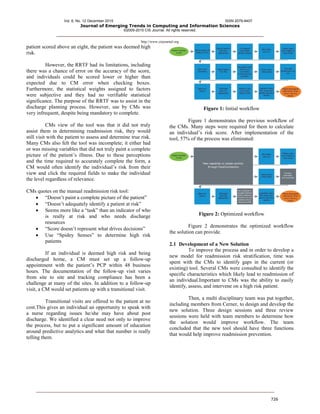
Figure 1: Initial workflow
Figure 1 demonstrates the previous workflow of
the CMs. Many steps were required for them to calculate
an individual’s risk score. After implementation of the
tool, 57% of the process was eliminated:
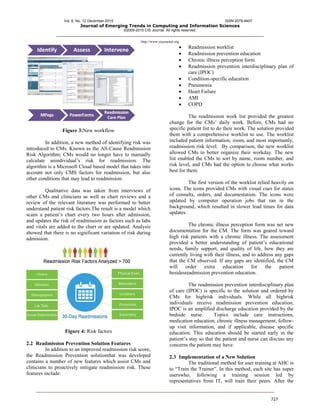
Figure 2: Optimized workflow
Figure 2 demonstrates the optimized workflow
the solution can provide.
2.1 Development of a New Solution
To improve the process and in order to develop a
new model for readmission risk stratification, time was
spent with the CMs to identify gaps in the current (or
existing) tool. Several CMs were consulted to identify the
specific characteristics which likely lead to readmission of
an individual.Important to CMs was the ability to easily
identify, assess, and intervene on a high risk patient.
Then, a multi disciplinary team was put together,
including members from Cerner, to design and develop the
new solution. Three design sessions and three review
sessions were held with team members to determine how
the solution would improve workflow. The team
concluded that the new tool should have three functions
that would help improve readmission prevention.
Vol. 6, No. 12 December 2015 ISSN 2079-8407
Journal of Emerging Trends in Computing and Information Sciences
©2009-2015 CIS Journal. All rights reserved.
http://www.cisjournal.org
727
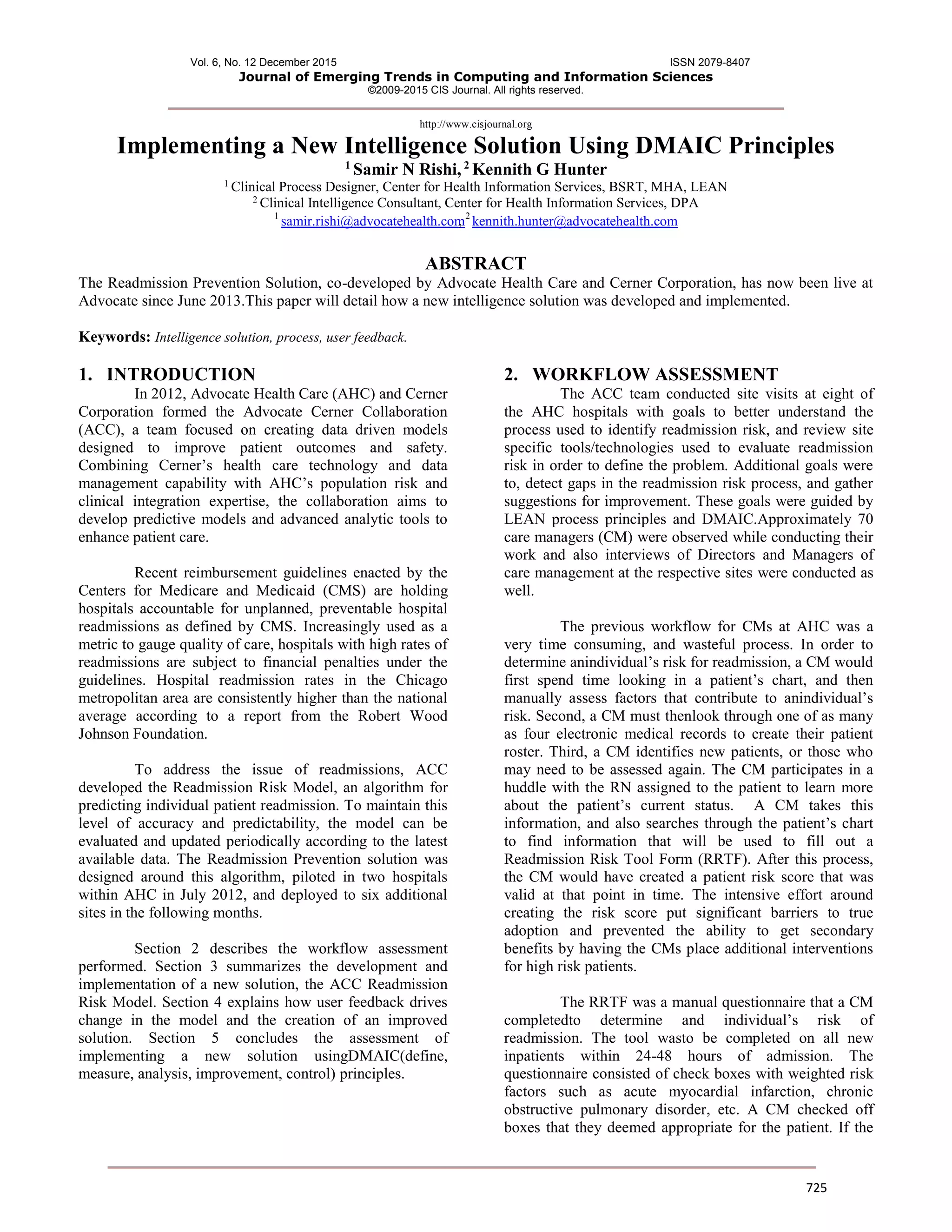
Figure 3:New workflow
In addition, a new method of identifying risk was
introduced to CMs. Known as the All-Cause Readmission
Risk Algorithm; CMs would no longer have to manually
calculate anindividual’s risk for readmission. The
algorithm is a Microsoft Cloud based model that takes into
account not only CMS factors for readmission, but also
other conditions that may lead to readmission.
Qualitative data was taken from interviews of
other CMs and clinicians as well as chart reviews and a
review of the relevant literature was performed to better
understand patient risk factors.The result is a model which
scans a patient’s chart every two hours after admission,
and updates the risk of readmission as factors such as labs
and vitals are added to the chart or are updated. Analysis
showed that there is no significant variation of risk during
admission.
Figure 4: Risk factors
2.2 Readmission Prevention Solution Features
In addition to an improved readmission risk score,
the Readmission Prevention solutionthat was developed
contains a number of new features which assist CMs and
clinicians to proactively mitigate readmission risk. These
features include:
 Readmission worklist
 Readmission prevention education
 Chronic illness perception form
 Readmission prevention interdisciplinary plan of
care (IPOC)
 Condition-specific education
 Pneumonia
 Heart Failure
 AMI
 COPD
The readmission work list provided the greatest
change for the CMs’ daily work. Before, CMs had no
specific patient list to do their work. The solution provided
them with a comprehensive worklist to use. The worklist
included patient information, room, and most importantly,
readmission risk level. By comparison, the new worklist
allowed CMs to better organize their workday. The new
list enabled the CMs to sort by name, room number, and
risk level, and CMs had the option to choose what works
best for them.
The first version of the worklist relied heavily on
icons. The icons provided CMs with visual cues for status
of consults, orders, and documentation. The icons were
updated by computer operation jobs that ran in the
background, which resulted in slower load times for data
updates.
The chronic illness perception form was net new
documentation for the CM. The form was geared toward
high risk patients with a chronic illness. The assessment
provided a better understanding of patient’s educational
needs, family support, and quality of life, how they are
currently living with their illness, and to address any gaps
that the CM observed. If any gaps are identified, the CM
will order extra education for the patient
besidesreadmission prevention education.
The readmission prevention interdisciplinary plan
of care (IPOC) is specific to the solution and ordered by
CMs for highrisk individuals. While all highrisk
individuals receive readmission prevention education,
IPOC is an amplified discharge education provided by the
bedside nurse. Topics include care instructions,
medication education, chronic illness management, follow-
up visit information, and if applicable, disease specific
education. This education should be started early in the
patient’s stay so that the patient and nurse can discuss any
concerns the patient may have.
2.3 Implementation of a New Solution
The traditional method for user training at AHC is
to “Train the Trainer”. In this method, each site has super
userswho, following a training session led by
representatives from IT, will train their peers. After the
Vol. 6, No. 12 December 2015 ISSN 2079-8407
Journal of Emerging Trends in Computing and Information Sciences
©2009-2015 CIS Journal. All rights reserved.
http://www.cisjournal.org
728
user training, the sites are supported by IT for the week of
go-live. After the first week of go-live, users are supported
by the IT Help Desk.
2.4 “Just in Time Training”
A team from ACC implemented two training
methods for the Version 1 pilot. One site requested “Train
the Trainer” while the second site was trained by ACC
Clinical Process Designers (CPD). The CPDs were heavily
involved in design and testing of the solution, so the
argument was training the end users would be not be a
difficult task. At both sites, support was provided by CPDs
and Cerner representatives during and after the period of
go-live.
A rolling “just in time training” methodology was
implemented at the non-pilot sites then implementation of
the solution. CMs were able to keep their training fresh in
their mind, which helped when they first used the new
solution. User guides, and other reference materials were
also available for use by the CMs.
2.5 Intelligence Training
The ACC team trained the CMs not only on the
features of the worklist, but also the new intelligence built
in to the solution. CPDs taught the importance of the new
intelligence, and to trust an algorithm that was still a
mystery to many CMs. There were numerous questions
about the new readmission risk score, and why it should be
trusted over how they were currently doing their job. CMs
eventually understood the features of the solution, and how
it improved their workflow.
2.6 User Feedback to Drive Change
Feedback was instantaneous because CPDs were
directly accessible by end-users.Furthermore, CPDs held
one-on-one sessions with CMs to help CMs understand the
new workflow, if the new workflow enhanced what they
did, and encourage direct feedback about the solution.
During these sessions, CPDs found that while waste was
removed by eliminating the manual risk score, there were
limitations of the solution.
One of the important concerns of the CMs was
speed to work through the solution. Since the worklist was
icon driven, there were computations that had to run in the
background for the page to load. At times users
experienced wait times of up to thirty seconds per page
load. This was far in excess of the time limited suggested
by a New York Times article [4] which contends that users
will abandon a website if it does not load within three
seconds.
Users stated that the icons were at times visually
overwhelming. Although they provided a visual cue, the
icons took over the entire page. Users complained that the
icons strained their eyes, and it was difficult at times to
differentiate the icons between individuals. The delays and
overall look of the worklist made using the solutionvery
frustrating, and some CMs stopped using the solution all
together. The processing of data in the background also
caused near monthly downtimes ranging from a day up to
one week. Feedback was given directly to Cerner, and the
Readmission team worked together to solve the issues of
Version 1 of the worklist.
In order to increase create a competitive
environment among users, rewards were given to CMs
who ordered all education and completed all chronic
illness perception forms. Creation of a competitive
environment among CMs spurred them to be ranked as the
top user at their site. A 75% compliance rate is the goal of
the solution.
Figure 5: Workflow comparison
2.7 Readmission Risk Solution Version 2
Because of feedback from users on what could
improve the solution, Cerner released Version 2 of the
worklist to AHC in October 2014. The redesigned worklist
removed background operations, which resulted in faster
load times. This also changed the perception of the CMs
about the process. For instance, during training many of
the CMs stated that the new version was a substantial
improvement over Version 1.
Version 2 contained a number of important
improvements over the previous version. For example, the
overall look of the worklist changed, with icons being
replaced by cards, and the worklist was more streamlined.
Tabs within the list held items such as consults,
documentation, and follow-up visit information. Load
times of the new version ranged from 3-5 seconds; a great
difference from the 30 second load times from the previous
version.
Because go-live of Version 2 contained numerous
enhancements, , a rolling go-live as done in with Version 1
was not possible. However, to help CMs understand and
work with the new solution, CPDs split time at all 8 sites,
with one covering the north, and the other covering the
Vol. 6, No. 12 December 2015 ISSN 2079-8407
Journal of Emerging Trends in Computing and Information Sciences
©2009-2015 CIS Journal. All rights reserved.
http://www.cisjournal.org
729
south. More time was spent at the larger sites; however one
on one time with CMs at all sites was provided.
Results of the new worklist showed greater
compliance of ordering readmission prevention education
and completion of the chronic illness perception form.
Feedback from CMs included such comments as:
 “This is nice”
 “Much, much faster”
 “Oooooo I like it”
 “Easier to use”
3. CONCLUSION
The implementation of a new solution to
eliminate waste and improve workflow suggests that a
partnership between a provider and vendor is vital in
driving change. By having CPDs on site, CPDs were able
to analyze the use of the tool, send requests to Cerner
directly, have the modifications made, and re-analyze the
solution faster than a traditional arrangement.
The use of train the trainer vs hands on training
was a good tactic for training CMs, however it would have
been useful to have more super users on site that could
answer questions instead of relying on CPDs. However,
having CPDs on site did allow for faster communication to
the development team for bug fixes and improvements.
3.1 Value to the End User
- Decreased “double documentation”
- Provided more effective time-management
- Focused on moderate/high risk patients
- Provided a visual aid for all disciplines
- Summary screen
- Promoted communication between disciplines
- Promoted continuity of care
Analysis is ongoing to measure success of the
tool. Improvements have been seen in the use of the
solution as time progresses.
REFERENCES
[1] Robert Wood Johnson Foundation, “The Revolving
Door: A Report on US Hospital Readmissions.
February 2013.
[2] R. Holden, B. Karsh, “The Technology Acceptance
Model: Its Past and its future in health care”,
Journal of Biomedical Informatics 43, 2010.
[3] R. Wears, M. Berg, “Computer Technology and
Clinical Work: Still Waiting for Godot”, Editorial,
JAMA, Vol 293, No 10, March 2005.
[4] S. Lohr, "For Impatient Web Users, an Eye Blink Is
Just Too Long to Wait." The New York Times.
February 29, 2012.
[5] R. Bush, I. Philibert, "Making Sense: Duty Hours,
Work Flow, and Waste in Graduate Medical
Education." Journal of Graduate Medical Education,
December, 2009.
[6] C. Kim, D. Spahlinger, J. Kin, J. Billi,"Lean Health
Care: What Can Hospitals Learn from a World-
Class Automaker?" Society of Hospital Medicine.
2006.
[7] K. O’Leary, D. Liebovitz, D. Baker, “How
Hospitalists Spend Their Time: Insights on
Efficiency and Safety.” Society of Hospital
Medicine. 2006.
[8] J. Donze, D. Aujesky, D. Williams, J. Schnipper,
“Potentially Avoidable 30-Day Hospital
Readmissions in Medical Patients.” JAMA Internal
Med. March 25, 2013.
[9] C. Ham, R. Kipping, H. McLeod, “Redesigning
Work Processes in Health Care: Lessons from the
National Health Service.” The Milbank Quarterly.
Vol. 81, No. 3, 2003.
[10] M. Godfrey, B. Andersson - Gare, E. Nelson, M.
Nilsson, G. Ahlstrom, “Coaching Inter professional
Health Care Improvement Teams: The Coachee,
The Coach, and the Leader Perspectives.” Journal of
Nursing Management. January 18, 2013.
AUTHOR PROFILES
Samir N Rishi received the degree in health care
administration from Saint Louis University, in 2005.
Currently, he is a Clinical Process Designer with Advocate
Health Care.
Kennith G Hunter received a doctorate in public
administration fromthe University of Oklahoma, in 1993.
Currently, he is a Clinical Intelligence Consultant with
Advocate Health Care.

vol6no12_11_Rishi

  • 1.
    Vol. 6, No.12 December 2015 ISSN 2079-8407 Journal of Emerging Trends in Computing and Information Sciences ©2009-2015 CIS Journal. All rights reserved. http://www.cisjournal.org 725 Implementing a New Intelligence Solution Using DMAIC Principles 1 Samir N Rishi, 2 Kennith G Hunter 1 Clinical Process Designer, Center for Health Information Services, BSRT, MHA, LEAN 2 Clinical Intelligence Consultant, Center for Health Information Services, DPA ABSTRACT The Readmission Prevention Solution, co-developed by Advocate Health Care and Cerner Corporation, has now been live at Advocate since June 2013.This paper will detail how a new intelligence solution was developed and implemented. Keywords: Intelligence solution, process, user feedback. 1. INTRODUCTION In 2012, Advocate Health Care (AHC) and Cerner Corporation formed the Advocate Cerner Collaboration (ACC), a team focused on creating data driven models designed to improve patient outcomes and safety. Combining Cerner’s health care technology and data management capability with AHC’s population risk and clinical integration expertise, the collaboration aims to develop predictive models and advanced analytic tools to enhance patient care. Recent reimbursement guidelines enacted by the Centers for Medicare and Medicaid (CMS) are holding hospitals accountable for unplanned, preventable hospital readmissions as defined by CMS. Increasingly used as a metric to gauge quality of care, hospitals with high rates of readmissions are subject to financial penalties under the guidelines. Hospital readmission rates in the Chicago metropolitan area are consistently higher than the national average according to a report from the Robert Wood Johnson Foundation. To address the issue of readmissions, ACC developed the Readmission Risk Model, an algorithm for predicting individual patient readmission. To maintain this level of accuracy and predictability, the model can be evaluated and updated periodically according to the latest available data. The Readmission Prevention solution was designed around this algorithm, piloted in two hospitals within AHC in July 2012, and deployed to six additional sites in the following months. Section 2 describes the workflow assessment performed. Section 3 summarizes the development and implementation of a new solution, the ACC Readmission Risk Model. Section 4 explains how user feedback drives change in the model and the creation of an improved solution. Section 5 concludes the assessment of implementing a new solution usingDMAIC(define, measure, analysis, improvement, control) principles. 2. WORKFLOW ASSESSMENT The ACC team conducted site visits at eight of the AHC hospitals with goals to better understand the process used to identify readmission risk, and review site specific tools/technologies used to evaluate readmission risk in order to define the problem. Additional goals were to, detect gaps in the readmission risk process, and gather suggestions for improvement. These goals were guided by LEAN process principles and DMAIC.Approximately 70 care managers (CM) were observed while conducting their work and also interviews of Directors and Managers of care management at the respective sites were conducted as well. The previous workflow for CMs at AHC was a very time consuming, and wasteful process. In order to determine anindividual’s risk for readmission, a CM would first spend time looking in a patient’s chart, and then manually assess factors that contribute to anindividual’s risk. Second, a CM must thenlook through one of as many as four electronic medical records to create their patient roster. Third, a CM identifies new patients, or those who may need to be assessed again. The CM participates in a huddle with the RN assigned to the patient to learn more about the patient’s current status. A CM takes this information, and also searches through the patient’s chart to find information that will be used to fill out a Readmission Risk Tool Form (RRTF). After this process, the CM would have created a patient risk score that was valid at that point in time. The intensive effort around creating the risk score put significant barriers to true adoption and prevented the ability to get secondary benefits by having the CMs place additional interventions for high risk patients. The RRTF was a manual questionnaire that a CM completedto determine and individual’s risk of readmission. The tool wasto be completed on all new inpatients within 24-48 hours of admission. The questionnaire consisted of check boxes with weighted risk factors such as acute myocardial infarction, chronic obstructive pulmonary disorder, etc. A CM checked off boxes that they deemed appropriate for the patient. If the 1 samir.rishi@advocatehealth.com, 2 kennith.hunter@advocatehealth.com
  • 2.
    Vol. 6, No.12 December 2015 ISSN 2079-8407 Journal of Emerging Trends in Computing and Information Sciences ©2009-2015 CIS Journal. All rights reserved. http://www.cisjournal.org 726 patient scored above an eight, the patient was deemed high risk. However, the RRTF had its limitations, including there was a chance of error on the accuracy of the score, and individuals could be scored lower or higher than expected due to CM error when checking boxes. Furthermore, the statistical weights assigned to factors were subjective and they had no verifiable statistical significance. The purpose of the RRTF was to assist in the discharge planning process. However, use by CMs was very infrequent, despite being mandatory to complete. CMs view of the tool was that it did not truly assist them in determining readmission risk, they would still visit with the patient to assess and determine true risk. Many CMs also felt the tool was incomplete; it either had or was missing variables that did not truly paint a complete picture of the patient’s illness. Due to these perceptions and the time required to accurately complete the form, a CM would often identify the individual’s risk from their view and click the required fields to make the individual the level regardless of relevance. CMs quotes on the manual readmission risk tool:  “Doesn’t paint a complete picture of the patient”  “Doesn’t adequately identify a patient at risk”  Seems more like a “task” than an indicator of who is really at risk and who needs discharge resources  “Score doesn’t represent what drives decisions”  Use “Spidey Senses” to determine high risk patients If an individual is deemed high risk and being discharged home, a CM must set up a follow-up appointment with the patient’s PCP within 48 business hours. The documentation of the follow-up visit varies from site to site and tracking compliance has been a challenge at many of the sites. In addition to a follow-up visit, a CM would set patients up with a transitional visit. Transitional visits are offered to the patient at no cost.This gives an individual an opportunity to speak with a nurse regarding issues he/she may have about post discharge. We identified a clear need not only to improve the process, but to put a significant amount of education around predictive analytics and what that number is really telling them. Figure 1: Initial workflow Figure 1 demonstrates the previous workflow of the CMs. Many steps were required for them to calculate an individual’s risk score. After implementation of the tool, 57% of the process was eliminated: Figure 2: Optimized workflow Figure 2 demonstrates the optimized workflow the solution can provide. 2.1 Development of a New Solution To improve the process and in order to develop a new model for readmission risk stratification, time was spent with the CMs to identify gaps in the current (or existing) tool. Several CMs were consulted to identify the specific characteristics which likely lead to readmission of an individual.Important to CMs was the ability to easily identify, assess, and intervene on a high risk patient. Then, a multi disciplinary team was put together, including members from Cerner, to design and develop the new solution. Three design sessions and three review sessions were held with team members to determine how the solution would improve workflow. The team concluded that the new tool should have three functions that would help improve readmission prevention.
  • 3.
    Vol. 6, No.12 December 2015 ISSN 2079-8407 Journal of Emerging Trends in Computing and Information Sciences ©2009-2015 CIS Journal. All rights reserved. http://www.cisjournal.org 727 Figure 3:New workflow In addition, a new method of identifying risk was introduced to CMs. Known as the All-Cause Readmission Risk Algorithm; CMs would no longer have to manually calculate anindividual’s risk for readmission. The algorithm is a Microsoft Cloud based model that takes into account not only CMS factors for readmission, but also other conditions that may lead to readmission. Qualitative data was taken from interviews of other CMs and clinicians as well as chart reviews and a review of the relevant literature was performed to better understand patient risk factors.The result is a model which scans a patient’s chart every two hours after admission, and updates the risk of readmission as factors such as labs and vitals are added to the chart or are updated. Analysis showed that there is no significant variation of risk during admission. Figure 4: Risk factors 2.2 Readmission Prevention Solution Features In addition to an improved readmission risk score, the Readmission Prevention solutionthat was developed contains a number of new features which assist CMs and clinicians to proactively mitigate readmission risk. These features include:  Readmission worklist  Readmission prevention education  Chronic illness perception form  Readmission prevention interdisciplinary plan of care (IPOC)  Condition-specific education  Pneumonia  Heart Failure  AMI  COPD The readmission work list provided the greatest change for the CMs’ daily work. Before, CMs had no specific patient list to do their work. The solution provided them with a comprehensive worklist to use. The worklist included patient information, room, and most importantly, readmission risk level. By comparison, the new worklist allowed CMs to better organize their workday. The new list enabled the CMs to sort by name, room number, and risk level, and CMs had the option to choose what works best for them. The first version of the worklist relied heavily on icons. The icons provided CMs with visual cues for status of consults, orders, and documentation. The icons were updated by computer operation jobs that ran in the background, which resulted in slower load times for data updates. The chronic illness perception form was net new documentation for the CM. The form was geared toward high risk patients with a chronic illness. The assessment provided a better understanding of patient’s educational needs, family support, and quality of life, how they are currently living with their illness, and to address any gaps that the CM observed. If any gaps are identified, the CM will order extra education for the patient besidesreadmission prevention education. The readmission prevention interdisciplinary plan of care (IPOC) is specific to the solution and ordered by CMs for highrisk individuals. While all highrisk individuals receive readmission prevention education, IPOC is an amplified discharge education provided by the bedside nurse. Topics include care instructions, medication education, chronic illness management, follow- up visit information, and if applicable, disease specific education. This education should be started early in the patient’s stay so that the patient and nurse can discuss any concerns the patient may have. 2.3 Implementation of a New Solution The traditional method for user training at AHC is to “Train the Trainer”. In this method, each site has super userswho, following a training session led by representatives from IT, will train their peers. After the
  • 4.
    Vol. 6, No.12 December 2015 ISSN 2079-8407 Journal of Emerging Trends in Computing and Information Sciences ©2009-2015 CIS Journal. All rights reserved. http://www.cisjournal.org 728 user training, the sites are supported by IT for the week of go-live. After the first week of go-live, users are supported by the IT Help Desk. 2.4 “Just in Time Training” A team from ACC implemented two training methods for the Version 1 pilot. One site requested “Train the Trainer” while the second site was trained by ACC Clinical Process Designers (CPD). The CPDs were heavily involved in design and testing of the solution, so the argument was training the end users would be not be a difficult task. At both sites, support was provided by CPDs and Cerner representatives during and after the period of go-live. A rolling “just in time training” methodology was implemented at the non-pilot sites then implementation of the solution. CMs were able to keep their training fresh in their mind, which helped when they first used the new solution. User guides, and other reference materials were also available for use by the CMs. 2.5 Intelligence Training The ACC team trained the CMs not only on the features of the worklist, but also the new intelligence built in to the solution. CPDs taught the importance of the new intelligence, and to trust an algorithm that was still a mystery to many CMs. There were numerous questions about the new readmission risk score, and why it should be trusted over how they were currently doing their job. CMs eventually understood the features of the solution, and how it improved their workflow. 2.6 User Feedback to Drive Change Feedback was instantaneous because CPDs were directly accessible by end-users.Furthermore, CPDs held one-on-one sessions with CMs to help CMs understand the new workflow, if the new workflow enhanced what they did, and encourage direct feedback about the solution. During these sessions, CPDs found that while waste was removed by eliminating the manual risk score, there were limitations of the solution. One of the important concerns of the CMs was speed to work through the solution. Since the worklist was icon driven, there were computations that had to run in the background for the page to load. At times users experienced wait times of up to thirty seconds per page load. This was far in excess of the time limited suggested by a New York Times article [4] which contends that users will abandon a website if it does not load within three seconds. Users stated that the icons were at times visually overwhelming. Although they provided a visual cue, the icons took over the entire page. Users complained that the icons strained their eyes, and it was difficult at times to differentiate the icons between individuals. The delays and overall look of the worklist made using the solutionvery frustrating, and some CMs stopped using the solution all together. The processing of data in the background also caused near monthly downtimes ranging from a day up to one week. Feedback was given directly to Cerner, and the Readmission team worked together to solve the issues of Version 1 of the worklist. In order to increase create a competitive environment among users, rewards were given to CMs who ordered all education and completed all chronic illness perception forms. Creation of a competitive environment among CMs spurred them to be ranked as the top user at their site. A 75% compliance rate is the goal of the solution. Figure 5: Workflow comparison 2.7 Readmission Risk Solution Version 2 Because of feedback from users on what could improve the solution, Cerner released Version 2 of the worklist to AHC in October 2014. The redesigned worklist removed background operations, which resulted in faster load times. This also changed the perception of the CMs about the process. For instance, during training many of the CMs stated that the new version was a substantial improvement over Version 1. Version 2 contained a number of important improvements over the previous version. For example, the overall look of the worklist changed, with icons being replaced by cards, and the worklist was more streamlined. Tabs within the list held items such as consults, documentation, and follow-up visit information. Load times of the new version ranged from 3-5 seconds; a great difference from the 30 second load times from the previous version. Because go-live of Version 2 contained numerous enhancements, , a rolling go-live as done in with Version 1 was not possible. However, to help CMs understand and work with the new solution, CPDs split time at all 8 sites, with one covering the north, and the other covering the
  • 5.
    Vol. 6, No.12 December 2015 ISSN 2079-8407 Journal of Emerging Trends in Computing and Information Sciences ©2009-2015 CIS Journal. All rights reserved. http://www.cisjournal.org 729 south. More time was spent at the larger sites; however one on one time with CMs at all sites was provided. Results of the new worklist showed greater compliance of ordering readmission prevention education and completion of the chronic illness perception form. Feedback from CMs included such comments as:  “This is nice”  “Much, much faster”  “Oooooo I like it”  “Easier to use” 3. CONCLUSION The implementation of a new solution to eliminate waste and improve workflow suggests that a partnership between a provider and vendor is vital in driving change. By having CPDs on site, CPDs were able to analyze the use of the tool, send requests to Cerner directly, have the modifications made, and re-analyze the solution faster than a traditional arrangement. The use of train the trainer vs hands on training was a good tactic for training CMs, however it would have been useful to have more super users on site that could answer questions instead of relying on CPDs. However, having CPDs on site did allow for faster communication to the development team for bug fixes and improvements. 3.1 Value to the End User - Decreased “double documentation” - Provided more effective time-management - Focused on moderate/high risk patients - Provided a visual aid for all disciplines - Summary screen - Promoted communication between disciplines - Promoted continuity of care Analysis is ongoing to measure success of the tool. Improvements have been seen in the use of the solution as time progresses. REFERENCES [1] Robert Wood Johnson Foundation, “The Revolving Door: A Report on US Hospital Readmissions. February 2013. [2] R. Holden, B. Karsh, “The Technology Acceptance Model: Its Past and its future in health care”, Journal of Biomedical Informatics 43, 2010. [3] R. Wears, M. Berg, “Computer Technology and Clinical Work: Still Waiting for Godot”, Editorial, JAMA, Vol 293, No 10, March 2005. [4] S. Lohr, "For Impatient Web Users, an Eye Blink Is Just Too Long to Wait." The New York Times. February 29, 2012. [5] R. Bush, I. Philibert, "Making Sense: Duty Hours, Work Flow, and Waste in Graduate Medical Education." Journal of Graduate Medical Education, December, 2009. [6] C. Kim, D. Spahlinger, J. Kin, J. Billi,"Lean Health Care: What Can Hospitals Learn from a World- Class Automaker?" Society of Hospital Medicine. 2006. [7] K. O’Leary, D. Liebovitz, D. Baker, “How Hospitalists Spend Their Time: Insights on Efficiency and Safety.” Society of Hospital Medicine. 2006. [8] J. Donze, D. Aujesky, D. Williams, J. Schnipper, “Potentially Avoidable 30-Day Hospital Readmissions in Medical Patients.” JAMA Internal Med. March 25, 2013. [9] C. Ham, R. Kipping, H. McLeod, “Redesigning Work Processes in Health Care: Lessons from the National Health Service.” The Milbank Quarterly. Vol. 81, No. 3, 2003. [10] M. Godfrey, B. Andersson - Gare, E. Nelson, M. Nilsson, G. Ahlstrom, “Coaching Inter professional Health Care Improvement Teams: The Coachee, The Coach, and the Leader Perspectives.” Journal of Nursing Management. January 18, 2013. AUTHOR PROFILES Samir N Rishi received the degree in health care administration from Saint Louis University, in 2005. Currently, he is a Clinical Process Designer with Advocate Health Care. Kennith G Hunter received a doctorate in public administration fromthe University of Oklahoma, in 1993. Currently, he is a Clinical Intelligence Consultant with Advocate Health Care.