Healthcare executives provide insights for
turning workforce data into balanced
outcomes
Industry Survey and Research Report
Survey Summary
API Healthcare and Becker’s Healthcare partnered to survey 127 healthcare
executives
Asked four questions:
• Two questions about Outcomes from Workforce Management Initiatives
• Two questions about Success Factors for Workforce Management Initiatives
Followed up with in-depth interviews of several survey respondents and API
Healthcare customers
2
Questions about Outcomes
QUESTION 1: IMPORTANCE
How important is it for a health system’s workforce management (WFM)
strategy to deliver measurable outcomes in the following areas?
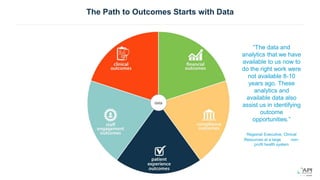
Answers were on a scale of 1 (Not Important) to 5 (Mission Critical)
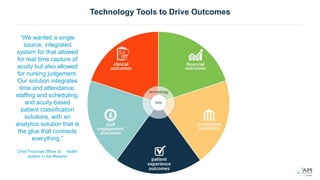
QUESTION 2: COMPETENCY
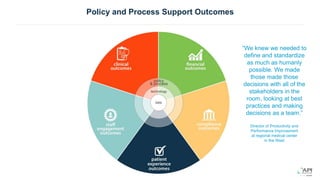
How successful is your organization’s WFM strategy delivering measurable
outcomes in these areas?
Answers were on a scale of 1 (Little or No Measurable Outcomes) to 5 (All the Measurable
Outcomes We Want)
3
4
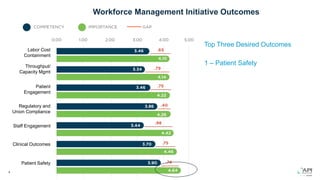
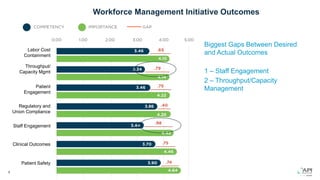
Workforce Management Initiative Outcomes
Top Three Desired Outcomes
1 – Patient Safety
Labor Cost
Containment
Throughput/
Capacity Mgmt
Patient
Engagement
Regulatory and
Union Compliance
Staff Engagement
Clinical Outcomes
Patient Safety
5
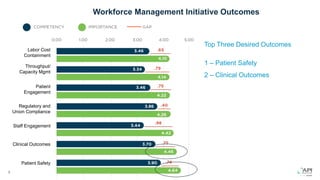
Workforce Management Initiative Outcomes
Top Three Desired Outcomes
1 – Patient Safety
2 – Clinical Outcomes
Labor Cost
Containment
Throughput/
Capacity Mgmt
Patient
Engagement
Regulatory and
Union Compliance
Staff Engagement
Clinical Outcomes
Patient Safety
6
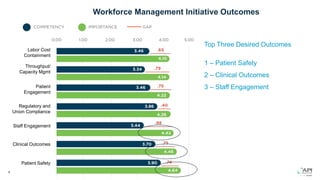
Workforce Management Initiative Outcomes
Top Three Desired Outcomes
1 – Patient Safety
2 – Clinical Outcomes
3 – Staff Engagement
Labor Cost
Containment
Throughput/
Capacity Mgmt
Patient
Engagement
Regulatory and
Union Compliance
Staff Engagement
Clinical Outcomes
Patient Safety
7
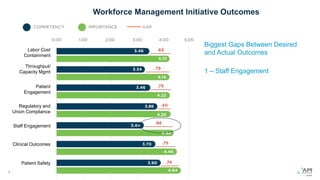
Workforce Management Initiative Outcomes
Biggest Gaps Between Desired
and Actual Outcomes
1 – Staff Engagement
Labor Cost
Containment
Throughput/
Capacity Mgmt
Patient
Engagement
Regulatory and
Union Compliance
Staff Engagement
Clinical Outcomes
Patient Safety
8
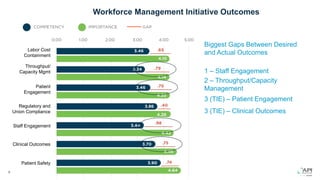
Workforce Management Initiative Outcomes
Biggest Gaps Between Desired
and Actual Outcomes
1 – Staff Engagement
2 – Throughput/Capacity
Management
Labor Cost
Containment
Throughput/
Capacity Mgmt
Patient
Engagement
Regulatory and
Union Compliance
Staff Engagement
Clinical Outcomes
Patient Safety
9
Workforce Management Initiative Outcomes
Biggest Gaps Between Desired
and Actual Outcomes
1 – Staff Engagement
2 – Throughput/Capacity
Management
3 (TIE) – Patient Engagement
3 (TIE) – Clinical Outcomes
Labor Cost
Containment
Throughput/
Capacity Mgmt
Patient
Engagement
Regulatory and
Union Compliance
Staff Engagement
Clinical Outcomes
Patient Safety
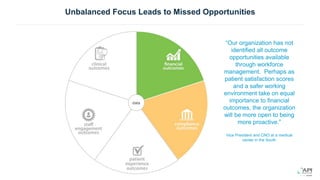
Unbalanced Focus Leads to Missed Opportunities
“Our organization has not
identified all outcome
opportunities available
through workforce
management. Perhaps as
patient satisfaction scores
and a safer working
environment take on equal
importance to financial
outcomes, the organization
will be more open to being
more proactive.”
Vice President and CNO at a medical
center in the South
data
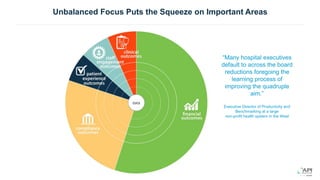
Unbalanced Focus Puts the Squeeze on Important Areas
“Many hospital executives
default to across the board
reductions foregoing the
learning process of
improving the quadruple
aim.”
Executive Director of Productivity and
Benchmarking at a large
non-profit health system in the West
data
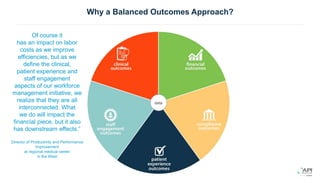
Why a Balanced Outcomes Approach?
data
Of course it
has an impact on labor
costs as we improve
efficiencies, but as we
define the clinical,
patient experience and
staff engagement
aspects of our workforce
management initiative, we
realize that they are all
interconnected. What
we do will impact the
financial piece, but it also
has downstream effects.”
Director of Productivity and Performance
Improvement
at regional medical center
in the West
Questions about Success Factors
QUESTION 1: IMPORTANCE
How important are the following factors to a successful workforce management
strategy?
Answers were on a scale of 1 (Not Important) to 5 (Mission Critical)
QUESTION 2: COMPETENCY
How well is your organization performing in these areas regarding your WFM
strategy?
Answers were on a scale of 1 (We Don’t Have This) to 5 (This is a Strength for Our Entire
Organization)
13
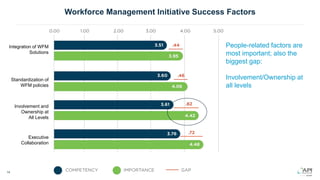
Workforce Management Initiative Success Factors
14
Integration of WFM
Solutions
Standardization of
WFM policies
Involvement and
Ownership at
All Levels
Executive
Collaboration
People-related factors are
most important; also the
biggest gap:
Involvement/Ownership at
all levels
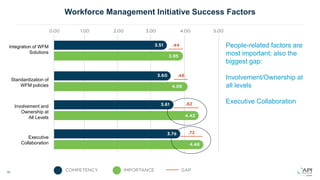
Workforce Management Initiative Success Factors
15
People-related factors are
most important; also the
biggest gap:
Involvement/Ownership at
all levels
Executive Collaboration
Integration of WFM
Solutions
Standardization of
WFM policies
Involvement and
Ownership at
All Levels
Executive
Collaboration
16
A Proven Methodology for
Achieving Balanced Outcomes
The Path to Outcomes Starts with Data
data
“The data and
analytics that we have
available to us now to
do the right work were
not available 8-10
years ago. These
analytics and
available data also
assist us in identifying
outcome
opportunities.”
Regional Executive, Clinical
Resources at a large non-
profit health system
Technology Tools to Drive Outcomes
data
technology
“We wanted a single
source, integrated
system for that allowed
for real time capture of
acuity but also allowed
for nursing judgement.
Our solution integrates
time and attendance,
staffing and scheduling,
and acuity-based
patient classification
solutions, with an
analytics solution that is
the glue that connects
everything.”
Chief Financial Officer at health
system in the Midwest
Policy and Process Support Outcomes
data
policy
& process
technology
“We knew we needed to
define and standardize
as much as humanly
possible. We made
those made those
decisions with all of the
stakeholders in the
room, looking at best
practices and making
decisions as a team.”
Director of Productivity and
Performance Improvement
at regional medical center
in the West
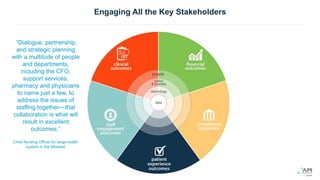
Engaging All the Key Stakeholders
people
data
policy
& process
technology
“Dialogue, partnership,
and strategic planning
with a multitude of people
and departments,
including the CFO,
support services,
pharmacy and physicians
to name just a few, to
address the issues of
staffing together—that
collaboration is what will
result in excellent
outcomes.”
Chief Nursing Officer for large health
system in the Midwest
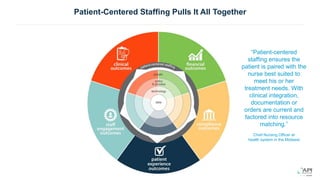
Patient-Centered Staffing Pulls It All Together
people
data
policy
& process
technology
“Patient-centered
staffing ensures the
patient is paired with the
nurse best suited to
meet his or her
treatment needs. With
clinical integration,
documentation or
orders are current and
factored into resource
matching.”
Chief Nursing Officer at
health system in the Midwest
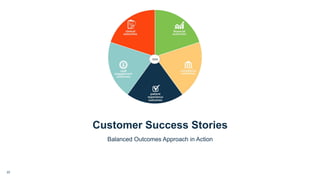
Customer Success Stories
Balanced Outcomes Approach in Action
22
data
• Moving to EPIC EMR led to a
review of how staffing was done
• Focus on patient-centered staffing:
clinical integration for better
resource matching
• Use strong nursing shared
governance model to own the
patient-centered staffing initiative
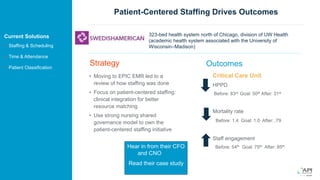
Strategy
Patient-Centered Staffing Drives Outcomes
Current Solutions
• Staffing & Scheduling
• Time & Attendance
• Patient Classification
323-bed health system north of Chicago, division of UW Health
(academic health system associated with the University of
Wisconsin–Madison)
Hear in from their CFO
and CNO here
Read their case study
here
Outcomes
Critical Care Unit
HPPD
Before: 83rd Goal: 50th After: 31st
Mortality rate
Before: 1.4 Goal: 1.0 After: .79
Staff engagement
Before: 54th Goal: 75th After: 85th
Challenges
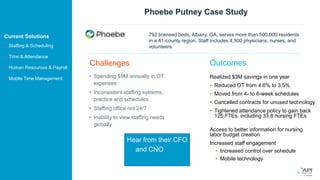
Phoebe Putney Case Study
Current Solutions
• Staffing & Scheduling
• Time & Attendance
• Human Resources & Payroll
• Mobile Time Management
792 licensed beds, Albany, GA, serves more than 500,000 residents
in a 41-county region. Staff includes 4,500 physicians, nurses, and
volunteers
Hear from their CFO
and CNO here
Outcomes
Realized $3M savings in one year
• Reduced OT from 4.6% to 3.5%
• Moved from 4- to 6-week schedules
• Cancelled contracts for unused technology
• Tightened attendance policy to gain back
125 FTEs, including 33.8 nursing FTEs
Access to better information for nursing
labor budget creation
Increased staff engagement
• Increased control over schedule
• Mobile technology
• Spending $9M annually in OT
expenses
• Inconsistent staffing systems,
practice and schedules
• Staffing office not 24/7
• Inability to view staffing needs
globally
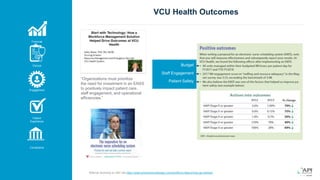
“Organizations must prioritize
the need for investment in an ENSS
to positively impact patient care,
staff engagement, and operational
efficiencies.”
Clinical
Staff
Engagement
Financial
Patient
Experience
Compliance
VCU Health Outcomes
Webinar recording on ANT site https://www.americannursetoday.com/workforce-data-priority-ge-webinar/
Staff Engagement
Patient Safety
Budget
26
Interested in more information?
Read the complete research report
Check out more customer success stories
Visit the API Healthcare website

REPORT: How healthcare systems are optimizing their workforce

  • 1.
    Healthcare executives provideinsights for turning workforce data into balanced outcomes Industry Survey and Research Report
  • 2.
    Survey Summary API Healthcareand Becker’s Healthcare partnered to survey 127 healthcare executives Asked four questions: • Two questions about Outcomes from Workforce Management Initiatives • Two questions about Success Factors for Workforce Management Initiatives Followed up with in-depth interviews of several survey respondents and API Healthcare customers 2
  • 3.
    Questions about Outcomes QUESTION1: IMPORTANCE How important is it for a health system’s workforce management (WFM) strategy to deliver measurable outcomes in the following areas? Answers were on a scale of 1 (Not Important) to 5 (Mission Critical) QUESTION 2: COMPETENCY How successful is your organization’s WFM strategy delivering measurable outcomes in these areas? Answers were on a scale of 1 (Little or No Measurable Outcomes) to 5 (All the Measurable Outcomes We Want) 3
  • 4.
    4 Workforce Management InitiativeOutcomes Top Three Desired Outcomes 1 – Patient Safety Labor Cost Containment Throughput/ Capacity Mgmt Patient Engagement Regulatory and Union Compliance Staff Engagement Clinical Outcomes Patient Safety
  • 5.
    5 Workforce Management InitiativeOutcomes Top Three Desired Outcomes 1 – Patient Safety 2 – Clinical Outcomes Labor Cost Containment Throughput/ Capacity Mgmt Patient Engagement Regulatory and Union Compliance Staff Engagement Clinical Outcomes Patient Safety
  • 6.
    6 Workforce Management InitiativeOutcomes Top Three Desired Outcomes 1 – Patient Safety 2 – Clinical Outcomes 3 – Staff Engagement Labor Cost Containment Throughput/ Capacity Mgmt Patient Engagement Regulatory and Union Compliance Staff Engagement Clinical Outcomes Patient Safety
  • 7.
    7 Workforce Management InitiativeOutcomes Biggest Gaps Between Desired and Actual Outcomes 1 – Staff Engagement Labor Cost Containment Throughput/ Capacity Mgmt Patient Engagement Regulatory and Union Compliance Staff Engagement Clinical Outcomes Patient Safety
  • 8.
    8 Workforce Management InitiativeOutcomes Biggest Gaps Between Desired and Actual Outcomes 1 – Staff Engagement 2 – Throughput/Capacity Management Labor Cost Containment Throughput/ Capacity Mgmt Patient Engagement Regulatory and Union Compliance Staff Engagement Clinical Outcomes Patient Safety
  • 9.
    9 Workforce Management InitiativeOutcomes Biggest Gaps Between Desired and Actual Outcomes 1 – Staff Engagement 2 – Throughput/Capacity Management 3 (TIE) – Patient Engagement 3 (TIE) – Clinical Outcomes Labor Cost Containment Throughput/ Capacity Mgmt Patient Engagement Regulatory and Union Compliance Staff Engagement Clinical Outcomes Patient Safety
  • 10.
    Unbalanced Focus Leadsto Missed Opportunities “Our organization has not identified all outcome opportunities available through workforce management. Perhaps as patient satisfaction scores and a safer working environment take on equal importance to financial outcomes, the organization will be more open to being more proactive.” Vice President and CNO at a medical center in the South data
  • 11.
    Unbalanced Focus Putsthe Squeeze on Important Areas “Many hospital executives default to across the board reductions foregoing the learning process of improving the quadruple aim.” Executive Director of Productivity and Benchmarking at a large non-profit health system in the West data
  • 12.
    Why a BalancedOutcomes Approach? data Of course it has an impact on labor costs as we improve efficiencies, but as we define the clinical, patient experience and staff engagement aspects of our workforce management initiative, we realize that they are all interconnected. What we do will impact the financial piece, but it also has downstream effects.” Director of Productivity and Performance Improvement at regional medical center in the West
  • 13.
    Questions about SuccessFactors QUESTION 1: IMPORTANCE How important are the following factors to a successful workforce management strategy? Answers were on a scale of 1 (Not Important) to 5 (Mission Critical) QUESTION 2: COMPETENCY How well is your organization performing in these areas regarding your WFM strategy? Answers were on a scale of 1 (We Don’t Have This) to 5 (This is a Strength for Our Entire Organization) 13
  • 14.
    Workforce Management InitiativeSuccess Factors 14 Integration of WFM Solutions Standardization of WFM policies Involvement and Ownership at All Levels Executive Collaboration People-related factors are most important; also the biggest gap: Involvement/Ownership at all levels
  • 15.
    Workforce Management InitiativeSuccess Factors 15 People-related factors are most important; also the biggest gap: Involvement/Ownership at all levels Executive Collaboration Integration of WFM Solutions Standardization of WFM policies Involvement and Ownership at All Levels Executive Collaboration
  • 16.
    16 A Proven Methodologyfor Achieving Balanced Outcomes
  • 17.
    The Path toOutcomes Starts with Data data “The data and analytics that we have available to us now to do the right work were not available 8-10 years ago. These analytics and available data also assist us in identifying outcome opportunities.” Regional Executive, Clinical Resources at a large non- profit health system
  • 18.
    Technology Tools toDrive Outcomes data technology “We wanted a single source, integrated system for that allowed for real time capture of acuity but also allowed for nursing judgement. Our solution integrates time and attendance, staffing and scheduling, and acuity-based patient classification solutions, with an analytics solution that is the glue that connects everything.” Chief Financial Officer at health system in the Midwest
  • 19.
    Policy and ProcessSupport Outcomes data policy & process technology “We knew we needed to define and standardize as much as humanly possible. We made those made those decisions with all of the stakeholders in the room, looking at best practices and making decisions as a team.” Director of Productivity and Performance Improvement at regional medical center in the West
  • 20.
    Engaging All theKey Stakeholders people data policy & process technology “Dialogue, partnership, and strategic planning with a multitude of people and departments, including the CFO, support services, pharmacy and physicians to name just a few, to address the issues of staffing together—that collaboration is what will result in excellent outcomes.” Chief Nursing Officer for large health system in the Midwest
  • 21.
    Patient-Centered Staffing PullsIt All Together people data policy & process technology “Patient-centered staffing ensures the patient is paired with the nurse best suited to meet his or her treatment needs. With clinical integration, documentation or orders are current and factored into resource matching.” Chief Nursing Officer at health system in the Midwest
  • 22.
    Customer Success Stories BalancedOutcomes Approach in Action 22 data
  • 23.
    • Moving toEPIC EMR led to a review of how staffing was done • Focus on patient-centered staffing: clinical integration for better resource matching • Use strong nursing shared governance model to own the patient-centered staffing initiative Strategy Patient-Centered Staffing Drives Outcomes Current Solutions • Staffing & Scheduling • Time & Attendance • Patient Classification 323-bed health system north of Chicago, division of UW Health (academic health system associated with the University of Wisconsin–Madison) Hear in from their CFO and CNO here Read their case study here Outcomes Critical Care Unit HPPD Before: 83rd Goal: 50th After: 31st Mortality rate Before: 1.4 Goal: 1.0 After: .79 Staff engagement Before: 54th Goal: 75th After: 85th
  • 24.
    Challenges Phoebe Putney CaseStudy Current Solutions • Staffing & Scheduling • Time & Attendance • Human Resources & Payroll • Mobile Time Management 792 licensed beds, Albany, GA, serves more than 500,000 residents in a 41-county region. Staff includes 4,500 physicians, nurses, and volunteers Hear from their CFO and CNO here Outcomes Realized $3M savings in one year • Reduced OT from 4.6% to 3.5% • Moved from 4- to 6-week schedules • Cancelled contracts for unused technology • Tightened attendance policy to gain back 125 FTEs, including 33.8 nursing FTEs Access to better information for nursing labor budget creation Increased staff engagement • Increased control over schedule • Mobile technology • Spending $9M annually in OT expenses • Inconsistent staffing systems, practice and schedules • Staffing office not 24/7 • Inability to view staffing needs globally
  • 25.
    “Organizations must prioritize theneed for investment in an ENSS to positively impact patient care, staff engagement, and operational efficiencies.” Clinical Staff Engagement Financial Patient Experience Compliance VCU Health Outcomes Webinar recording on ANT site https://www.americannursetoday.com/workforce-data-priority-ge-webinar/ Staff Engagement Patient Safety Budget
  • 26.
    26 Interested in moreinformation? Read the complete research report Check out more customer success stories Visit the API Healthcare website

Editor's Notes

  • #5 We know that outcomes are important, and to learn more, we worked in collaboration with Becker’s healthcare. Together, we conducted a survey of 127 healthcare executives, and then we followed up with some in depth interviews. Today, I want to share what we learned. First, that research confirmed that financial outcomes are not the only or even the top priority for health systems. The survey found: Top three outcomes desired: Patient safety Clinical outcomes Staff engagement We also learned that executives are seeing gaps between desired outcomes and the ability to achieve those outcomes, with the biggest gap by far found in the area of staff engagement, but with large gaps around the patient experience as well.
  • #6 We know that outcomes are important, and to learn more, we worked in collaboration with Becker’s healthcare. Together, we conducted a survey of 127 healthcare executives, and then we followed up with some in depth interviews. Today, I want to share what we learned. First, that research confirmed that financial outcomes are not the only or even the top priority for health systems. The survey found: Top three outcomes desired: Patient safety Clinical outcomes Staff engagement We also learned that executives are seeing gaps between desired outcomes and the ability to achieve those outcomes, with the biggest gap by far found in the area of staff engagement, but with large gaps around the patient experience as well.
  • #7 We know that outcomes are important, and to learn more, we worked in collaboration with Becker’s healthcare. Together, we conducted a survey of 127 healthcare executives, and then we followed up with some in depth interviews. Today, I want to share what we learned. First, that research confirmed that financial outcomes are not the only or even the top priority for health systems. The survey found: Top three outcomes desired: Patient safety Clinical outcomes Staff engagement We also learned that executives are seeing gaps between desired outcomes and the ability to achieve those outcomes, with the biggest gap by far found in the area of staff engagement, but with large gaps around the patient experience as well.
  • #8 We know that outcomes are important, and to learn more, we worked in collaboration with Becker’s healthcare. Together, we conducted a survey of 127 healthcare executives, and then we followed up with some in depth interviews. Today, I want to share what we learned. First, that research confirmed that financial outcomes are not the only or even the top priority for health systems. The survey found: Top three outcomes desired: Patient safety Clinical outcomes Staff engagement We also learned that executives are seeing gaps between desired outcomes and the ability to achieve those outcomes, with the biggest gap by far found in the area of staff engagement, but with large gaps around the patient experience as well.
  • #9 We know that outcomes are important, and to learn more, we worked in collaboration with Becker’s healthcare. Together, we conducted a survey of 127 healthcare executives, and then we followed up with some in depth interviews. Today, I want to share what we learned. First, that research confirmed that financial outcomes are not the only or even the top priority for health systems. The survey found: Top three outcomes desired: Patient safety Clinical outcomes Staff engagement We also learned that executives are seeing gaps between desired outcomes and the ability to achieve those outcomes, with the biggest gap by far found in the area of staff engagement, but with large gaps around the patient experience as well.
  • #10 We know that outcomes are important, and to learn more, we worked in collaboration with Becker’s healthcare. Together, we conducted a survey of 127 healthcare executives, and then we followed up with some in depth interviews. Today, I want to share what we learned. First, that research confirmed that financial outcomes are not the only or even the top priority for health systems. The survey found: Top three outcomes desired: Patient safety Clinical outcomes Staff engagement We also learned that executives are seeing gaps between desired outcomes and the ability to achieve those outcomes, with the biggest gap by far found in the area of staff engagement, but with large gaps around the patient experience as well.
  • #11 What’s causing those gaps? We learned that many of the gaps were caused by being out of balance. When health systems don’t focus on balanced outcomes, they miss out on critical opportunities to achieve outcomes that impact patients and staff. As the Vice President and CNO at a medical center in the South explains, they’re missing out on valuable opportunities because financial outcomes are given more priority than patient satisfaction and a safe working environment.
  • #12 We’ve also seen that an unbalanced focus on financial outcomes can put the squeeze on other areas, and that can have a negative impact on the patient experience, staff engagement or clinical outcomes.  
  • #13 Why is a balanced approach so important? Because all of the outcomes are connected and impact one another. So, as you make a change in one area, it’s critical to understand how that impacts other areas. With a balanced approach, you can focus your attention on initiatives that will deliver positive results across multiple areas.
  • #15 Next, we looked at success factors that enable health systems to achieve their desired outcomes. The executives identified the critical success factors as: Executive collaboration across the entire organization, staff engagement at all levels, standardization of policies and integrated workforce management solutions. We saw that there were gaps between how important they felt each factor was and how well their organization was performing in those areas. The largest gaps were related to people, including involvement at all levels across the organization and executive collaboration.
  • #16 Next, we looked at success factors that enable health systems to achieve their desired outcomes. The executives identified the critical success factors as: Executive collaboration across the entire organization, staff engagement at all levels, standardization of policies and integrated workforce management solutions. We saw that there were gaps between how important they felt each factor was and how well their organization was performing in those areas. The largest gaps were related to people, including involvement at all levels across the organization and executive collaboration.
  • #18 What can we do about those competency gaps? Based on both our research and our partnerships with customers across the country, our team at API Healthcare has developed a proven methodology to help our customers achieve balanced outcomes. The process starts with data. Today, we have so much more data available than we could access in the past, and that allows health systems to identify and achieve more outcomes. Critical data includes: Staff: availability, skill, credentials, patient mix, equitable assignments, continuity of care Patient: acuity, complexity, pain, communication, medication, family Operational: ADT, unit layout, unit flow, labor budget and costs
  • #19 Success requires more than data. To avoid being data rich and information poor, many health systems rely on technology to make the data visible and actionable. Key technology considerations include integration, mobile strategy and analytics tools. The Chief Financial Officer at a 320+ bed health system in the Midwest explains how using acuity data linked to nursing documentation from their EMR is part of their integrated workforce management technology strategy.
  • #20 Maximizing outcomes is dependent on having an enterprise-wide approach to staffing and workforce management. The key to that is standardizing policies and processes. With consistent labor management approaches implemented across the system, clinical decision teams can compare internally, find best practices and repeat their successes. The Director of Productivity and Performance Improvement the regional medical center in the West explains how they made decisions about standardization as a team.
  • #21 A workforce management strategy impacts every employee within the health system, and there are a lot of stakeholders. It’s clear that the people part of the workforce management strategy cannot be overlooked. Success strategies here include: shared governance and collaboration, executive support and engaging front line staff.
  • #22 A patient-centered staffing approach pulls everything together. Patient-centered staffing is as simple and as complex as having the right nurse with the right patient at the right time. With patient-centered staffing, staffing decisions are based on the unique care needs of each patient.
  • #23 We’ve seen our customers achieve amazing balanced outcomes using this methodology. I’d like to share some of their stories with you.
  • #24 SwedishAmerican is a strong example of how integrated workforce management solutions, collaboration between the CNO and CFO and meaningful engagement from frontline staff can deliver powerful outcomes. When SwedishAmerican moved to EPIC, they used that as a opportunity to review how staffing was done in their organization. They wanted to use integrated solutions that pulled clinical data from the EMR to drive their staffing decisions. They also engaged their shared governance nursing council, which is comprised of 85% staff nurses, to drive the project. Their results: In their critical care unit, they dropped their hours per patient day, lowered their mortality ratio and increased staff engagement considerably. Those weren’t their only outcomes. They were also able to: Decrease duplication of efforts Leverage proactive resource balancing based on actual patient needs Implement a structured, yet flexible budgeting process Build trust and collaboration between nursing and finance Determine workload on a shift basis and predict workload on upcoming shifts based on actual patient needs…all while taking charge nurse judgment into account