HOW TO DO RISK ASSESSMENTS AND DEMONSTRATE COMPLIANCE WITH FFIEC & BSA  RiskWatch for Financial Institutions
RiskWatch for Financial Institutions  Regulator-Approved Software to Self-Assess against FFIEC 2006 Guidelines & Pandemic Flu
Agenda for 45 Minute Webinar 1.  Intro to Risk Assessment and  RiskWatch 2.  Review of Risk Requirements Implication 3.  Actual Risk Software at Work 4.  Review of Actual Risk Report 5.  Inclusion of Detailed Working Papers 6.  Conclusion
The Environment Information Technology IT has become the important part of most organizations  New federal and international standards require more IT risk. Regulatory Compliance Sarbanes Oxley has increased the accountability of management New regulations for credit unions Pandemic Flu assessments now required.
A comprehensive and integrated enterprise software tool that automates the surveying,  data collection, compliance & risk assessment to meet self assessment requirements. R ISK W ATCH ®
RiskWatch Meets  & Exceeds the Action Summary from the FFIEC IT Examination Handbook, July 2006  “ Financial institutions must maintain an ongoing Information security risk assessment that: Gathers data  regarding the information and technology assets, vulnerabilities, existing security controls and processes, and the current security standards and requirements. Analyzes the probability and impact  associated with the known threats and vulnerabilities to its assets; and Prioritizes the risk  present due to threats and vulnerabilities to determine appropriate levels of training, controls and testing  necessary for mitigation”. FFIEC – July 2006
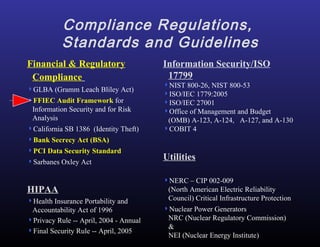
Compliance Regulations,  Standards and Guidelines Information Security/ISO 17799 NIST 800-26, NIST 800-53 ISO/IEC 1779:2005 ISO/IEC 27001 Office of Management and Budget (OMB) A-123, A-124,  A-127, and A-130 COBIT 4 Utilities NERC – CIP 002-009 ( North American Electric Reliability Council) Critical Infrastructure Protection Nuclear Power Generators  NRC (Nuclear Regulatory Commission) & NEI (Nuclear Energy Institute) Financial & Regulatory Compliance   GLBA (Gramm Leach Bliley Act) FFIEC Audit Framework  for Information Security and for Risk Analysis California SB 1386  (Identity Theft) Bank Secrecy Act (BSA) PCI Data Security Standard Sarbanes Oxley Act HIPAA Health Insurance Portability and Accountability Act of 1996 Privacy Rule -- April, 2004 - Annual Final Security Rule -- April, 2005
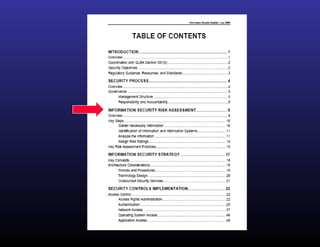
NEW FFIEC Guidance, July 27, 2006
 
RESPONSIBILITY AND ACCOUNTABILITY The board of directors, or an appropriate committee of the board, is responsible for overseeing the development, implementation, and maintenance of the institution’s information security program, and making senior management accountable for its actions. Oversight requires the board to provide management with guidance; approve information security plans, policies and programs; and review reports on the effectiveness of the information security program. The board should provide management with its expectations and requirements and hold management accountable for 􀂃  Central oversight and coordination, 􀂃  Assignment of responsibility, 􀂃  Risk assessment and measurement, 􀂃  Monitoring and testing, 􀂃  Reporting, and 􀂃  Acceptable residual risk.
Federal Reserve Bank Letter December 2007 requires Pandemic Flu Planning The Federal Reserve and the other FFIEC agencies believe the potentially significant effects a pandemic could have on an institution justify establishing plans to address how each institution will manage a pandemic event.   Accordingly, an institution’s business continuity plan should include: A preventive program  to reduce the likelihood that the institution’s operations will be significantly affected by a pandemic event;   A documented strategy  that provides for scaling pandemic efforts commensurate with the particular stages of a pandemic outbreak;   A comprehensive framework of facilities, systems, or procedures to continue critical operations  if large numbers of staff members are unavailable for prolonged periods;  A testing program  to ensure that the institution’s pandemic planning practices and capabilities are effective and will allow critical operations to continue; and   An oversight program  to ensure ongoing review and updates to the pandemic plan.
What  Is  Risk Assessment ? A process used to determine what controls are needed to protect critical or sensitive assets adequately & cost-effectively. The process examines  five  variable functions: 1. Specific Assets to be protected (value) 2. Potential Threats to the various assets 3. Vulnerabilities that would allow the threats  to materialize 4. Kinds of Losses that the threats could cause 5. Safeguards that would reduce the loss or   eliminate  the threats
WHAT’S RISKWATCH?   Since 1993, RiskWatch has been the Leader in  Security Risk Assessment Software NIST-CSE Model Builder’s Workshop on Risk  Assessment & the NSA Rating Model Workshops  1988 - 1995 Participated in the Working Group to Write DOD Directive on Risk Management under the Office of the Secretary of Defense, 1996-1998. Participated in Dept. of Justice Working Group on Vulnerability Assessment Models for Homeland Security, 2003 ASIS International, ITSC Council   - Caroline Hamilton IBM Data Governance Council  – Caroline Hamilton
RiskWatch is The First Choice in Security Risk Assessment Software Proven Methodology - Field Tested with   Users for over Ten Years and Guaranteed   to Meet Federal Risk Assessment Requirements Automated Survey Utility Completely Customizable by Users Favorable Gartner Group Rating  First Choice for Top Tier Consultants Based on the latest Federal and Audit Standards
RiskWatch Products 9.3 RiskWatch for Financial Institutions RiskWatch for ISO 17799 & 27001 RiskWatch for HIPAA RiskWatch for Sarbanes Oxley (SOX) RiskWatch for Federal Systems RiskWatch for Electrical Utilities (NERC) RiskWatch for Nuclear Power (NEI-NRC) RiskWatch for Physical & Homeland Security CASEWORKS
From the Gartner Group Report “ RiskWatch, Inc., is positioned as the leading "rescuer" of a massive private and public market constrained by fear of loss in terms of dollars and human life. Its unique form of rescue is in its before-the-fact nature. The RiskWatch tools credibly guide the users through a process to qualify its security situation concerning threats, assets, potential loss, vulnerabilities, and safeguards.  The client has the opportunity to establish its own image and foundation of security through RiskWatch's regulatory and quality compliance and accreditation tools and functions .  Through its quantitative methods and automated functions, RiskWatch arms the analysts and decision-makers with a solid risk management analysis based on the ALE balanced with the ROI. Once the client establishes the security policies—the plan is deployed and its life cycle managed within the framework of RiskWatch.  RiskWatch brings financially realized value to the client and the management vehicle and standards to follow”.
RISKWATCH ®  Value Reduces time  involved in performing a Risk Analysis by 70% Users are able to  customize software  to fit their own profile Meets audit requirements  for risk assessment Content is  frequently updated  and shipped to users. Web-based survey process  – involves management and user community. Quantifies risk  and  provides ROI  metrics  Automated report generation  including working papers and complete management-ready case summary report
Why RiskWatch Stays Number One “ What sets RiskWatch apart from its competitors is its focus on risk analysis for security management, its ability to handle large volumes of information, and its large number of customizable features”.     --  Gartner Group RiskWatch has Hundreds of Users Complete Technical Support –  Gold & Platinum Levels of Support  Ambassador Program for Extra Support Comprehensive Training Programs  Monthly On-Site Training Also Available by Request
RiskWatch Clients
RISKWATCH ®  Risk Assessment Process Automated Survey Management Process Management Data Aggregation &  Analysis Content (Rules & Data) Risk Analysis Customization Reporting Respondents Analyst(s)
ELEMENTS OF A METRICS-BASED  RISK ASSESSMENT APPROACH ASSETS THREATS VULNERABILITIES LOSSES SAFEGUARDS
Data Aggregation & Analysis Financial Data Software Automatically Analyses  Over 3 Million  Linking Relationships Risk = Asset    Loss    Threat    Vulnerability Loss Delays & Denials Fines Disclosure Modification Direct Loss Asset Applications Database Financial Data Hardware System Software Threat Disclosure Hackers Fraud Viruses Network Attack Loss of Data Embezzlement Vulnerability Acceptable Use Disaster Recovery Authentication Network Controls No Security Plan Accountability Privacy Access Control Fines Disclosure Modification Fraud Loss of Data Acceptable Use Authentication Privacy Access Control
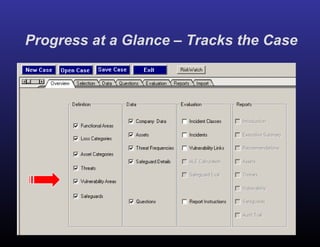
Progress at a Glance – Tracks the Case
Valuing Assets – RiskWatch Auto- Populates Asset Values
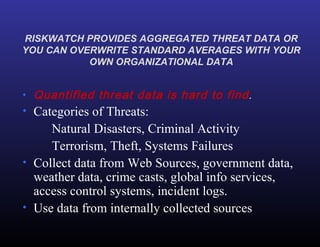
RISKWATCH PROVIDES AGGREGATED THREAT DATA OR YOU CAN OVERWRITE STANDARD AVERAGES WITH YOUR OWN ORGANIZATIONAL DATA Quantified threat data is hard to find . Categories of Threats: Natural Disasters, Criminal Activity Terrorism, Theft, Systems Failures Collect data from Web Sources, government data, weather data, crime casts, global info services, access control systems, incident logs. Use data from internally collected sources
THREAT FREQUENCIES ARE PROVIDED AND CAN ALSO BE TAILORED WITH CUSTOMER DATA SUCH AS PENETRATION TEST DATA
Web-Based Surveys Facilitate Respondent  Answers Automated Survey Management
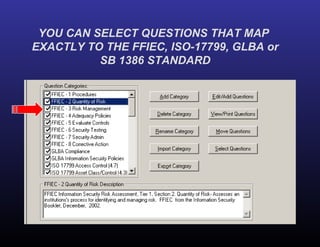
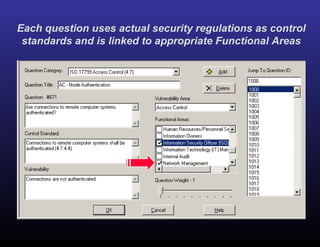
YOU CAN SELECT QUESTIONS THAT MAP  EXACTLY TO THE FFIEC, ISO-17799, GLBA or SB 1386 STANDARD
Each question uses actual security regulations as control standards and is linked to appropriate Functional Areas
Respondents Can Answer Questions over the Web with full ASP functionality
Fully Automated Web-based Surveys make it Easy to Involve Key Employees Over the web, via ASP link Questionnaire Diskettes E-mail Attach File On  a laptop with analyst present With Paper Questionnaires USERS DON’T HAVE TO HAVE RISKWATCH TO ANSWER ELECTRONIC SURVEYS
Pre-selects Appropriate Loss Categories Delays and Denials of Service Disclosure Direct Loss (Data Loss) Modification of Data Indirect Loss Intangibles (Reputation)
INCLUDES ALL IT-REQUIRED SAFEGUARD CATEGORIES
EACH POTENTIAL SAFEGUARD INCLUDES DEFAULT VALUES FOR COST, MAINTENANCE AND LIFE CYCLE
Reports Results From Dozens Of Employees Are Instantly Aggregated And Analyzed.
RESULTS FROM THE RISK ASSESSMENTS Measurable data which can be benchmarked  Prove validity of findings with full audit trails Standardized methodology meets regulator’s  standards Writes a variety of fully automated management reports, including working papers.
MITIGATION STRATEGIES 1.  Accept Risk 2.  Transfer Risk 2.  Mitigate Risk 3.  Better Risk Reactions 5.  Dealing with Residual Risk
The Case Summary Report Is  Pre-Written for Management
EASY TO UNDERSTAND  GRAPHS ILLUSTRATE OVERALL COMPLIANCE VS. NON-COMPLIANCE
Vulnerability Distribution Report Shows the Weak Compliance/ Security Areas
Track Compliance by Individual
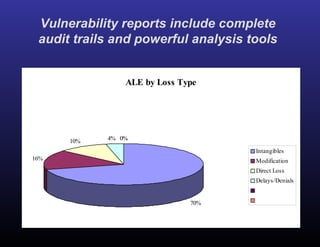
Vulnerability reports include complete audit trails and powerful analysis tools
Looking at Loss Expectancy by Type of Loss
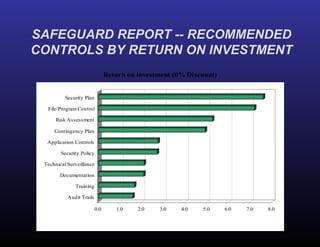
RiskWatch Calculates the Return on Investment &  Recommends Cost Effective Security Controls. In this example, finishing and updating the Disaster Recovery Plan  had a 2000-1 ROI – that means for every dollar spent on updating the plan  (estimated at $1000)– the organization saves $2,000,000   Finish Disaster Recovery Plan 2000:1 Finish the Security Plan  1200:1 Complete Security Training     943:1
SAFEGUARD REPORT -- RECOMMENDED CONTROLS BY RETURN ON INVESTMENT
Demonstrates Reduction in Loss Expectancy by  Applying Overlapping Layers of Protection from Implementing Top Recommended Controls
THE BOTTOM LINE Regulators are going to continue to push for more risk assessments to be performed annually. A RiskWatch risk assessment is the foundation of the IT security program, and Governance, Risk and Compliance program. RiskWatch is the  best  way to meet NCUA risk analysis requirements, and self-assess compliance by requirement. 4.  Get Special Pricing and Free Training in Annapolis by emailing  [email_address] .
www.riskwatch.com

RiskWatch for Financial Institutions™

  • 1.
    HOW TO DORISK ASSESSMENTS AND DEMONSTRATE COMPLIANCE WITH FFIEC & BSA RiskWatch for Financial Institutions
  • 2.
    RiskWatch for FinancialInstitutions Regulator-Approved Software to Self-Assess against FFIEC 2006 Guidelines & Pandemic Flu
  • 3.
    Agenda for 45Minute Webinar 1. Intro to Risk Assessment and RiskWatch 2. Review of Risk Requirements Implication 3. Actual Risk Software at Work 4. Review of Actual Risk Report 5. Inclusion of Detailed Working Papers 6. Conclusion
  • 4.
    The Environment InformationTechnology IT has become the important part of most organizations New federal and international standards require more IT risk. Regulatory Compliance Sarbanes Oxley has increased the accountability of management New regulations for credit unions Pandemic Flu assessments now required.
  • 5.
    A comprehensive andintegrated enterprise software tool that automates the surveying, data collection, compliance & risk assessment to meet self assessment requirements. R ISK W ATCH ®
  • 6.
    RiskWatch Meets & Exceeds the Action Summary from the FFIEC IT Examination Handbook, July 2006 “ Financial institutions must maintain an ongoing Information security risk assessment that: Gathers data regarding the information and technology assets, vulnerabilities, existing security controls and processes, and the current security standards and requirements. Analyzes the probability and impact associated with the known threats and vulnerabilities to its assets; and Prioritizes the risk present due to threats and vulnerabilities to determine appropriate levels of training, controls and testing necessary for mitigation”. FFIEC – July 2006
  • 7.
    Compliance Regulations, Standards and Guidelines Information Security/ISO 17799 NIST 800-26, NIST 800-53 ISO/IEC 1779:2005 ISO/IEC 27001 Office of Management and Budget (OMB) A-123, A-124, A-127, and A-130 COBIT 4 Utilities NERC – CIP 002-009 ( North American Electric Reliability Council) Critical Infrastructure Protection Nuclear Power Generators NRC (Nuclear Regulatory Commission) & NEI (Nuclear Energy Institute) Financial & Regulatory Compliance GLBA (Gramm Leach Bliley Act) FFIEC Audit Framework for Information Security and for Risk Analysis California SB 1386 (Identity Theft) Bank Secrecy Act (BSA) PCI Data Security Standard Sarbanes Oxley Act HIPAA Health Insurance Portability and Accountability Act of 1996 Privacy Rule -- April, 2004 - Annual Final Security Rule -- April, 2005
  • 8.
    NEW FFIEC Guidance,July 27, 2006
  • 9.
  • 10.
    RESPONSIBILITY AND ACCOUNTABILITYThe board of directors, or an appropriate committee of the board, is responsible for overseeing the development, implementation, and maintenance of the institution’s information security program, and making senior management accountable for its actions. Oversight requires the board to provide management with guidance; approve information security plans, policies and programs; and review reports on the effectiveness of the information security program. The board should provide management with its expectations and requirements and hold management accountable for 􀂃 Central oversight and coordination, 􀂃 Assignment of responsibility, 􀂃 Risk assessment and measurement, 􀂃 Monitoring and testing, 􀂃 Reporting, and 􀂃 Acceptable residual risk.
  • 11.
    Federal Reserve BankLetter December 2007 requires Pandemic Flu Planning The Federal Reserve and the other FFIEC agencies believe the potentially significant effects a pandemic could have on an institution justify establishing plans to address how each institution will manage a pandemic event. Accordingly, an institution’s business continuity plan should include: A preventive program to reduce the likelihood that the institution’s operations will be significantly affected by a pandemic event; A documented strategy that provides for scaling pandemic efforts commensurate with the particular stages of a pandemic outbreak; A comprehensive framework of facilities, systems, or procedures to continue critical operations if large numbers of staff members are unavailable for prolonged periods; A testing program to ensure that the institution’s pandemic planning practices and capabilities are effective and will allow critical operations to continue; and An oversight program to ensure ongoing review and updates to the pandemic plan.
  • 12.
    What Is Risk Assessment ? A process used to determine what controls are needed to protect critical or sensitive assets adequately & cost-effectively. The process examines five variable functions: 1. Specific Assets to be protected (value) 2. Potential Threats to the various assets 3. Vulnerabilities that would allow the threats to materialize 4. Kinds of Losses that the threats could cause 5. Safeguards that would reduce the loss or eliminate the threats
  • 13.
    WHAT’S RISKWATCH? Since 1993, RiskWatch has been the Leader in Security Risk Assessment Software NIST-CSE Model Builder’s Workshop on Risk Assessment & the NSA Rating Model Workshops 1988 - 1995 Participated in the Working Group to Write DOD Directive on Risk Management under the Office of the Secretary of Defense, 1996-1998. Participated in Dept. of Justice Working Group on Vulnerability Assessment Models for Homeland Security, 2003 ASIS International, ITSC Council - Caroline Hamilton IBM Data Governance Council – Caroline Hamilton
  • 14.
    RiskWatch is TheFirst Choice in Security Risk Assessment Software Proven Methodology - Field Tested with Users for over Ten Years and Guaranteed to Meet Federal Risk Assessment Requirements Automated Survey Utility Completely Customizable by Users Favorable Gartner Group Rating First Choice for Top Tier Consultants Based on the latest Federal and Audit Standards
  • 15.
    RiskWatch Products 9.3RiskWatch for Financial Institutions RiskWatch for ISO 17799 & 27001 RiskWatch for HIPAA RiskWatch for Sarbanes Oxley (SOX) RiskWatch for Federal Systems RiskWatch for Electrical Utilities (NERC) RiskWatch for Nuclear Power (NEI-NRC) RiskWatch for Physical & Homeland Security CASEWORKS
  • 16.
    From the GartnerGroup Report “ RiskWatch, Inc., is positioned as the leading "rescuer" of a massive private and public market constrained by fear of loss in terms of dollars and human life. Its unique form of rescue is in its before-the-fact nature. The RiskWatch tools credibly guide the users through a process to qualify its security situation concerning threats, assets, potential loss, vulnerabilities, and safeguards. The client has the opportunity to establish its own image and foundation of security through RiskWatch's regulatory and quality compliance and accreditation tools and functions . Through its quantitative methods and automated functions, RiskWatch arms the analysts and decision-makers with a solid risk management analysis based on the ALE balanced with the ROI. Once the client establishes the security policies—the plan is deployed and its life cycle managed within the framework of RiskWatch. RiskWatch brings financially realized value to the client and the management vehicle and standards to follow”.
  • 17.
    RISKWATCH ® Value Reduces time involved in performing a Risk Analysis by 70% Users are able to customize software to fit their own profile Meets audit requirements for risk assessment Content is frequently updated and shipped to users. Web-based survey process – involves management and user community. Quantifies risk and provides ROI metrics Automated report generation including working papers and complete management-ready case summary report
  • 18.
    Why RiskWatch StaysNumber One “ What sets RiskWatch apart from its competitors is its focus on risk analysis for security management, its ability to handle large volumes of information, and its large number of customizable features”. -- Gartner Group RiskWatch has Hundreds of Users Complete Technical Support – Gold & Platinum Levels of Support Ambassador Program for Extra Support Comprehensive Training Programs Monthly On-Site Training Also Available by Request
  • 19.
  • 20.
    RISKWATCH ® Risk Assessment Process Automated Survey Management Process Management Data Aggregation & Analysis Content (Rules & Data) Risk Analysis Customization Reporting Respondents Analyst(s)
  • 21.
    ELEMENTS OF AMETRICS-BASED RISK ASSESSMENT APPROACH ASSETS THREATS VULNERABILITIES LOSSES SAFEGUARDS
  • 22.
    Data Aggregation &Analysis Financial Data Software Automatically Analyses Over 3 Million Linking Relationships Risk = Asset  Loss  Threat  Vulnerability Loss Delays & Denials Fines Disclosure Modification Direct Loss Asset Applications Database Financial Data Hardware System Software Threat Disclosure Hackers Fraud Viruses Network Attack Loss of Data Embezzlement Vulnerability Acceptable Use Disaster Recovery Authentication Network Controls No Security Plan Accountability Privacy Access Control Fines Disclosure Modification Fraud Loss of Data Acceptable Use Authentication Privacy Access Control
  • 23.
    Progress at aGlance – Tracks the Case
  • 24.
    Valuing Assets –RiskWatch Auto- Populates Asset Values
  • 25.
    RISKWATCH PROVIDES AGGREGATEDTHREAT DATA OR YOU CAN OVERWRITE STANDARD AVERAGES WITH YOUR OWN ORGANIZATIONAL DATA Quantified threat data is hard to find . Categories of Threats: Natural Disasters, Criminal Activity Terrorism, Theft, Systems Failures Collect data from Web Sources, government data, weather data, crime casts, global info services, access control systems, incident logs. Use data from internally collected sources
  • 26.
    THREAT FREQUENCIES AREPROVIDED AND CAN ALSO BE TAILORED WITH CUSTOMER DATA SUCH AS PENETRATION TEST DATA
  • 27.
    Web-Based Surveys FacilitateRespondent Answers Automated Survey Management
  • 28.
    YOU CAN SELECTQUESTIONS THAT MAP EXACTLY TO THE FFIEC, ISO-17799, GLBA or SB 1386 STANDARD
  • 29.
    Each question usesactual security regulations as control standards and is linked to appropriate Functional Areas
  • 30.
    Respondents Can AnswerQuestions over the Web with full ASP functionality
  • 31.
    Fully Automated Web-basedSurveys make it Easy to Involve Key Employees Over the web, via ASP link Questionnaire Diskettes E-mail Attach File On a laptop with analyst present With Paper Questionnaires USERS DON’T HAVE TO HAVE RISKWATCH TO ANSWER ELECTRONIC SURVEYS
  • 32.
    Pre-selects Appropriate LossCategories Delays and Denials of Service Disclosure Direct Loss (Data Loss) Modification of Data Indirect Loss Intangibles (Reputation)
  • 33.
    INCLUDES ALL IT-REQUIREDSAFEGUARD CATEGORIES
  • 34.
    EACH POTENTIAL SAFEGUARDINCLUDES DEFAULT VALUES FOR COST, MAINTENANCE AND LIFE CYCLE
  • 35.
    Reports Results FromDozens Of Employees Are Instantly Aggregated And Analyzed.
  • 36.
    RESULTS FROM THERISK ASSESSMENTS Measurable data which can be benchmarked Prove validity of findings with full audit trails Standardized methodology meets regulator’s standards Writes a variety of fully automated management reports, including working papers.
  • 37.
    MITIGATION STRATEGIES 1. Accept Risk 2. Transfer Risk 2. Mitigate Risk 3. Better Risk Reactions 5. Dealing with Residual Risk
  • 38.
    The Case SummaryReport Is Pre-Written for Management
  • 39.
    EASY TO UNDERSTAND GRAPHS ILLUSTRATE OVERALL COMPLIANCE VS. NON-COMPLIANCE
  • 40.
    Vulnerability Distribution ReportShows the Weak Compliance/ Security Areas
  • 41.
    Vulnerability Distribution ReportShows the Weak Compliance/ Security Areas
  • 42.
  • 43.
    Vulnerability reports includecomplete audit trails and powerful analysis tools
  • 44.
    Looking at LossExpectancy by Type of Loss
  • 45.
    RiskWatch Calculates theReturn on Investment & Recommends Cost Effective Security Controls. In this example, finishing and updating the Disaster Recovery Plan had a 2000-1 ROI – that means for every dollar spent on updating the plan (estimated at $1000)– the organization saves $2,000,000 Finish Disaster Recovery Plan 2000:1 Finish the Security Plan 1200:1 Complete Security Training 943:1
  • 46.
    SAFEGUARD REPORT --RECOMMENDED CONTROLS BY RETURN ON INVESTMENT
  • 47.
    Demonstrates Reduction inLoss Expectancy by Applying Overlapping Layers of Protection from Implementing Top Recommended Controls
  • 48.
    THE BOTTOM LINERegulators are going to continue to push for more risk assessments to be performed annually. A RiskWatch risk assessment is the foundation of the IT security program, and Governance, Risk and Compliance program. RiskWatch is the best way to meet NCUA risk analysis requirements, and self-assess compliance by requirement. 4. Get Special Pricing and Free Training in Annapolis by emailing [email_address] .
  • 49.