
Meaningful Use and Security
      Risk Analysis
   Iowa CPSI User Group – October18th 2011
   Presented by Evan Francen, President – FRSecure, LLC
Introduction
Speaker – Evan Francen, CISSP CISM CCSK
•   President & Co-founder of FRSecure
•   20 years of information security experience
•   Security evangelist with more than 700 published articles
•   Experience with 150+ public & private organizations.
Introduction
                        Topics
                • Healthcare Regulation
            • Meaningful Use Requirements
     • Measure 14 of 14 – Protect Health Information
• “Conduct or review a security risk analysis” Fundamental
                          Concepts
         • Security Risk Analysis Best Practices
       • Security Risk Analysis Common Mistakes
Healthcare Regulation
                              In General:
      Health care regulation has gotten more officious and granular.


  With respect to security and privacy, HIPAA has always been aimed at
protecting sensitive health information. HIPAA has been ineffective in this
                 regard due to lack of focus and confusion.


“Navigating the Meaningful Use and Standards and Certification Criteria
              Final Rules can sometimes be a challenge.” –
               Source: U.S. Department of Health & Human Services
   (http://healthit.hhs.gov/portal/server.pt?open=512&mode=2&objID=3584)
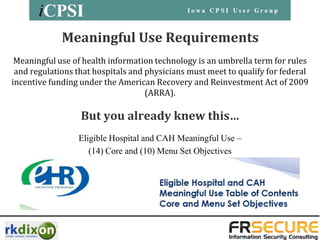
Meaningful Use Requirements
 Meaningful use of health information technology is an umbrella term for rules
 and regulations that hospitals and physicians must meet to qualify for federal
incentive funding under the American Recovery and Reinvestment Act of 2009
                                    (ARRA).

                  But you already knew this…
                 Eligible Hospital and CAH Meaningful Use –
                    (14) Core and (10) Menu Set Objectives
Measure 14 of 14 - Protect Electronic Health
                Information
Objective: Protect electronic health information created or maintained by the
certified EHR technology through the implementation of appropriate technical
                                  capabilities.
   Measure: Conduct or review a security risk analysis in accordance with the
 requirements under 45 CFR 164.308(a)(1) and implement security updates as
     necessary and correct identified security deficiencies as part of its risk
                            management process.
         Measure 14 of 14 is NOT A NEW REQUIREMENT!

The Final Rule on Security Standards was issued on February 20, 2003. It took effect on
 April 21, 2003 with a compliance date of April 21, 2005 for most covered entities and
                            April 21, 2006 for "small plans".
Measure 14 of 14 - Protect Electronic Health
               Information

45 CFR Section 164.308(a)(1)(ii)(A) of the HIPAA Security Rule requires that
   the organization "Conduct an accurate and thorough assessment of the
    potential risks and vulnerabilities to the confidentiality, integrity and
  availability of electronic protected health information [ePHI] held by the
                                covered entity.”

45 CFR Section 164.308(a)(1)(ii)(B) requires an organization to ―implement
security measures sufficient to reduce risks and vulnerabilities to a reasonable
and appropriate level to comply with CFR 45 164.306(a) which is the General
                     Requirements of the Security Rule.
“Conduct or review a security risk analysis”
          Fundamental Concepts


What is “security”?
      (question for you)
“Conduct or review a security risk analysis”
            Fundamental Concepts
Information Security is:
The application of Administrative, Physical and Technical controls in an effort to
protect the Confidentiality, Integrity, and Availability of Information.

Controls:
• Administrative – Policies, procedures, processes
• Physical – Locks, cameras, alarm systems
• Technical – Firewalls, anti-virus software, permissions

Protect:
• Confidentiality – Disclosure to authorized entities
• Integrity – Accuracy and completeness
• Availability – Accessible when required and authorized
“Conduct or review a security risk analysis”
          Fundamental Concepts

  What is “risk”?
“Conduct or review a security risk analysis”
               Fundamental Concepts
Risk is a function of two criteria:
1.    The likelihood of a threat exploiting a vulnerability, and
2.    The resulting impact it would have on the organization.

Threat - These are things that can go wrong or that can 'attack' the system.
Examples might include fire or fraud. Threats are ever present for every
system.
Vulnerability – A weakness in a system or gap in a control


                  Risk = Likelihood x Impact
“Conduct or review a security risk analysis”
           Fundamental Concepts
A “security risk analysis” is the process of identifying,
prioritizing, and estimating information security risks.

Risks (likelihood & impact) of unauthorized:
• Disclosure
• Alteration (or modification), and/or;
• Destruction

of information under the custodial care of an organization.
“Conduct or review a security risk analysis”
           Fundamental Concepts
Types of risk analysis:
      Quantitative Risk Analysis
      •   Uses hard metrics, such as dollars.
      •   Objective
      •   Difficult
      •   Costly
      Qualitative Risk Analysis
      •   Uses best estimates based on experience
      •   Subjective
      •   Less Difficult
      •   Less Expensive
      Gap Analysis
“Conduct or review a security risk analysis”
               Best Practices

 “The Security Rule does not prescribe a specific
          risk analysis methodology” -
http://www.hhs.gov/ocr/privacy/hipaa/administrative/securityrule/radraftguidance
                                      .pdf


     A “methodology” is nothing more than a way of doing
                         something.
“Conduct or review a security risk analysis”
              Best Practices
   For organizations with an informal risk
management program, an ideal approach may be
        a qualitative gap risk analysis.

   Qualitative – Subjective, best-effort criteria and metrics
      assigned based upon experience and knowledge.
    Gap – Assess the risks inherent in gaps with a chosen
              information security framework.
“Conduct or review a security risk analysis”
       Qualitative Gap Risk Analysis
1. Choose a well-known information security
   framework

• ISO 27002 (17799:2005)
• NIST
• COBIT

The information security framework is a reference to/from
which you will manage your information security efforts.
“Conduct or review a security risk analysis”
        Qualitative Gap Risk Analysis
2. Compare your existing information security
   controls against the information security
   framework you have chosen.

Example:
Control 5.1.2 in the ISO 27002 standard states:
“The information security policy should be reviewed at planned intervals or if
significant changes occur to ensure its continuing suitability, adequacy, and
effectiveness.”
Questions:
Does your organization review information security policy at planned intervals?
“Conduct or review a security risk analysis”
        Qualitative Gap Risk Analysis
3. Where there are gaps, assign best-effort metrics,
   based on experience (qualitative).

Example:
In the previous example, let’s assume that the answer is “Yes”, but the requirement to
review information security policies has not been documented.
Metrics:
Likelihood that the lack of documentation will lead to a compromise, on a scale of 1 -5
(5 being most likely). – 2
Impact that a potential compromise would have on the organization, on a scale of 1 – 5
(5 being most impactful/catastrophic) – 2
“Conduct or review a security risk analysis”
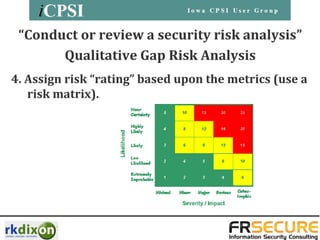
       Qualitative Gap Risk Analysis
4. Assign risk “rating” based upon the metrics (use a
   risk matrix).
“Conduct or review a security risk analysis”
          Qualitative Gap Risk Analysis
5. Define and document risk decision criteria.
When confronted with a risk, you have four choices:

•    Risk Avoidance
•    Risk Acceptance            What are the
•    Risk Transference          criteria for risk
                                decision making?
•    Risk Mitigation
Keep in mind…
A risk analysis is an integral part of an organization’s overall
risk management program.

Some “security risk analysis” best practices:
• The risk analysis methodology should be documented.
• The risk analysis methodology should be repeatable.
• The risk analysis methodology should be auditable
• Internal risk analyses should be conducted no less than
  annually.
• Independent risk analyses should be conducted periodically.
Common Mistakes
When conducting a security risk analysis:

•   Scope is too narrow
•   Too technically focused – People are the most significant risk
•   Convenience shouldn’t always trump security
•   Lack of documentation
•   Assessment is only done once
•   Lack of management buy-in or involvement
Common Mistakes
Common risks that are often overlooked:
• Physical risks
• Policies are hard to understand and follow
• Vendor risk management
• Inventory of assets is incomplete or informal
• Internal and external vulnerability scans are not regularly
  conducted.
• Incident management
• Disaster recovery planning
• Poor training and awareness
About RK Dixon & FRSecure
RK Dixon is a market leader when it comes to copiers, printers, networks, and
pure drinking water systems. Our products and services allow customers to
streamline operations while reducing costs at the same time. We serve thousands
of companies, organizations, and government entities in Iowa, Illinois, and
Wisconsin. Visit us online at http://www.rkdixon.com.

FRSecure LLC is a full-service information security consulting company; dedicated
to information security education, awareness, application, and improvement.
FRSecure helps our clients understand, design, implement, and manage best-in-
class information security solutions; thereby achieving optimal value for every
information security dollar spent. Visit us online at http://www.frsecure.com.

RK Dixon and FRSecure have partnered to offer services throughout Iowa, Illinois,
and Wisconsin.
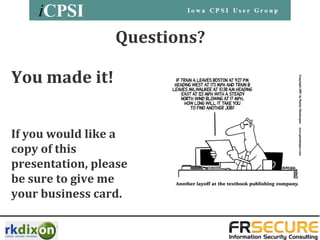
Questions?

You made it!


If you would like a
copy of this
presentation, please
be sure to give me
your business card.

Meaningful Use and Security Risk Analysis

  • 1.
    Meaningful Use andSecurity Risk Analysis Iowa CPSI User Group – October18th 2011 Presented by Evan Francen, President – FRSecure, LLC
  • 2.
    Introduction Speaker – EvanFrancen, CISSP CISM CCSK • President & Co-founder of FRSecure • 20 years of information security experience • Security evangelist with more than 700 published articles • Experience with 150+ public & private organizations.
  • 3.
    Introduction Topics • Healthcare Regulation • Meaningful Use Requirements • Measure 14 of 14 – Protect Health Information • “Conduct or review a security risk analysis” Fundamental Concepts • Security Risk Analysis Best Practices • Security Risk Analysis Common Mistakes
  • 4.
    Healthcare Regulation In General: Health care regulation has gotten more officious and granular. With respect to security and privacy, HIPAA has always been aimed at protecting sensitive health information. HIPAA has been ineffective in this regard due to lack of focus and confusion. “Navigating the Meaningful Use and Standards and Certification Criteria Final Rules can sometimes be a challenge.” – Source: U.S. Department of Health & Human Services (http://healthit.hhs.gov/portal/server.pt?open=512&mode=2&objID=3584)
  • 5.
    Meaningful Use Requirements Meaningful use of health information technology is an umbrella term for rules and regulations that hospitals and physicians must meet to qualify for federal incentive funding under the American Recovery and Reinvestment Act of 2009 (ARRA). But you already knew this… Eligible Hospital and CAH Meaningful Use – (14) Core and (10) Menu Set Objectives
  • 6.
    Measure 14 of14 - Protect Electronic Health Information Objective: Protect electronic health information created or maintained by the certified EHR technology through the implementation of appropriate technical capabilities. Measure: Conduct or review a security risk analysis in accordance with the requirements under 45 CFR 164.308(a)(1) and implement security updates as necessary and correct identified security deficiencies as part of its risk management process. Measure 14 of 14 is NOT A NEW REQUIREMENT! The Final Rule on Security Standards was issued on February 20, 2003. It took effect on April 21, 2003 with a compliance date of April 21, 2005 for most covered entities and April 21, 2006 for "small plans".
  • 7.
    Measure 14 of14 - Protect Electronic Health Information 45 CFR Section 164.308(a)(1)(ii)(A) of the HIPAA Security Rule requires that the organization "Conduct an accurate and thorough assessment of the potential risks and vulnerabilities to the confidentiality, integrity and availability of electronic protected health information [ePHI] held by the covered entity.” 45 CFR Section 164.308(a)(1)(ii)(B) requires an organization to ―implement security measures sufficient to reduce risks and vulnerabilities to a reasonable and appropriate level to comply with CFR 45 164.306(a) which is the General Requirements of the Security Rule.
  • 8.
    “Conduct or reviewa security risk analysis” Fundamental Concepts What is “security”? (question for you)
  • 9.
    “Conduct or reviewa security risk analysis” Fundamental Concepts Information Security is: The application of Administrative, Physical and Technical controls in an effort to protect the Confidentiality, Integrity, and Availability of Information. Controls: • Administrative – Policies, procedures, processes • Physical – Locks, cameras, alarm systems • Technical – Firewalls, anti-virus software, permissions Protect: • Confidentiality – Disclosure to authorized entities • Integrity – Accuracy and completeness • Availability – Accessible when required and authorized
  • 10.
    “Conduct or reviewa security risk analysis” Fundamental Concepts What is “risk”?
  • 11.
    “Conduct or reviewa security risk analysis” Fundamental Concepts Risk is a function of two criteria: 1. The likelihood of a threat exploiting a vulnerability, and 2. The resulting impact it would have on the organization. Threat - These are things that can go wrong or that can 'attack' the system. Examples might include fire or fraud. Threats are ever present for every system. Vulnerability – A weakness in a system or gap in a control Risk = Likelihood x Impact
  • 12.
    “Conduct or reviewa security risk analysis” Fundamental Concepts A “security risk analysis” is the process of identifying, prioritizing, and estimating information security risks. Risks (likelihood & impact) of unauthorized: • Disclosure • Alteration (or modification), and/or; • Destruction of information under the custodial care of an organization.
  • 13.
    “Conduct or reviewa security risk analysis” Fundamental Concepts Types of risk analysis: Quantitative Risk Analysis • Uses hard metrics, such as dollars. • Objective • Difficult • Costly Qualitative Risk Analysis • Uses best estimates based on experience • Subjective • Less Difficult • Less Expensive Gap Analysis
  • 14.
    “Conduct or reviewa security risk analysis” Best Practices “The Security Rule does not prescribe a specific risk analysis methodology” - http://www.hhs.gov/ocr/privacy/hipaa/administrative/securityrule/radraftguidance .pdf A “methodology” is nothing more than a way of doing something.
  • 15.
    “Conduct or reviewa security risk analysis” Best Practices For organizations with an informal risk management program, an ideal approach may be a qualitative gap risk analysis. Qualitative – Subjective, best-effort criteria and metrics assigned based upon experience and knowledge. Gap – Assess the risks inherent in gaps with a chosen information security framework.
  • 16.
    “Conduct or reviewa security risk analysis” Qualitative Gap Risk Analysis 1. Choose a well-known information security framework • ISO 27002 (17799:2005) • NIST • COBIT The information security framework is a reference to/from which you will manage your information security efforts.
  • 17.
    “Conduct or reviewa security risk analysis” Qualitative Gap Risk Analysis 2. Compare your existing information security controls against the information security framework you have chosen. Example: Control 5.1.2 in the ISO 27002 standard states: “The information security policy should be reviewed at planned intervals or if significant changes occur to ensure its continuing suitability, adequacy, and effectiveness.” Questions: Does your organization review information security policy at planned intervals?
  • 18.
    “Conduct or reviewa security risk analysis” Qualitative Gap Risk Analysis 3. Where there are gaps, assign best-effort metrics, based on experience (qualitative). Example: In the previous example, let’s assume that the answer is “Yes”, but the requirement to review information security policies has not been documented. Metrics: Likelihood that the lack of documentation will lead to a compromise, on a scale of 1 -5 (5 being most likely). – 2 Impact that a potential compromise would have on the organization, on a scale of 1 – 5 (5 being most impactful/catastrophic) – 2
  • 19.
    “Conduct or reviewa security risk analysis” Qualitative Gap Risk Analysis 4. Assign risk “rating” based upon the metrics (use a risk matrix).
  • 20.
    “Conduct or reviewa security risk analysis” Qualitative Gap Risk Analysis 5. Define and document risk decision criteria. When confronted with a risk, you have four choices: • Risk Avoidance • Risk Acceptance What are the • Risk Transference criteria for risk decision making? • Risk Mitigation
  • 21.
    Keep in mind… Arisk analysis is an integral part of an organization’s overall risk management program. Some “security risk analysis” best practices: • The risk analysis methodology should be documented. • The risk analysis methodology should be repeatable. • The risk analysis methodology should be auditable • Internal risk analyses should be conducted no less than annually. • Independent risk analyses should be conducted periodically.
  • 22.
    Common Mistakes When conductinga security risk analysis: • Scope is too narrow • Too technically focused – People are the most significant risk • Convenience shouldn’t always trump security • Lack of documentation • Assessment is only done once • Lack of management buy-in or involvement
  • 23.
    Common Mistakes Common risksthat are often overlooked: • Physical risks • Policies are hard to understand and follow • Vendor risk management • Inventory of assets is incomplete or informal • Internal and external vulnerability scans are not regularly conducted. • Incident management • Disaster recovery planning • Poor training and awareness
  • 24.
    About RK Dixon& FRSecure RK Dixon is a market leader when it comes to copiers, printers, networks, and pure drinking water systems. Our products and services allow customers to streamline operations while reducing costs at the same time. We serve thousands of companies, organizations, and government entities in Iowa, Illinois, and Wisconsin. Visit us online at http://www.rkdixon.com. FRSecure LLC is a full-service information security consulting company; dedicated to information security education, awareness, application, and improvement. FRSecure helps our clients understand, design, implement, and manage best-in- class information security solutions; thereby achieving optimal value for every information security dollar spent. Visit us online at http://www.frsecure.com. RK Dixon and FRSecure have partnered to offer services throughout Iowa, Illinois, and Wisconsin.
  • 25.
    Questions? You made it! Ifyou would like a copy of this presentation, please be sure to give me your business card.