HITRUST in the Cloud
Who, What, Why and How?
Agenda
• Introduction
• What Is HITRUST?
• How Can you Benefit from HITRUST?
• Challenges in Cloud Deployments
• How to Deploy Secure Cloud Infrastructure
• Best Practices
• Q&A
Speakers
Connect with Nikola on LinkedIn
Toby Owen
VP of Product Development
OnRamp
Nikola Todev
Head of Information Security
OnRamp
Connect with Toby on LinkedIn
Current Landscape
1 RightScale-2017-State-of-the-Cloud-Report; 2 PwC 2017 CEO
Survey; Ponemon Institute, 3 Cost of Data Breach Study: 2017
Global Analysis
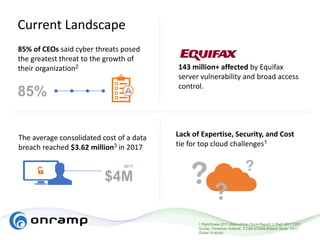
The average consolidated cost of a data
breach reached $3.62 million3 in 2017
143 million+ affected by Equifax
server vulnerability and broad access
control.
85%
85% of CEOs said cyber threats posed
the greatest threat to the growth of
their organization2
Lack of Expertise, Security, and Cost
tie for top cloud challenges1
$4M
2017
Audience Poll
What Is HITRUST CSF?
HITRUST CSF is a prescriptive and certifiable framework
specifically created in response to multiple compliance
requirements, many of which are subject to interpretation.
HITRUST Was Founded in 2007 to Solve Common Challenges:
• Significant regulatory oversight
• Constant evolving requirements
• Uncertain standards – what is reasonable and appropriate?
https://hitrustalliance.net
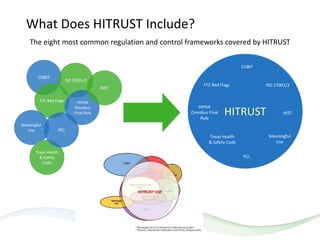
The eight most common regulation and control frameworks covered by HITRUST
COBIT
ISO 27001/2
FTC Red Flags HIPAA
Omnibus
Final Rule
NIST
Meaningful
Use
Texas Health
& Safety
Code
PCI
HITRUST
FTC Red Flags ISO 27001/2
COBIT
PCI
HIPAA
Omnibus Final
Rule
NIST
Meaningful
Use
Texas Health
& Safety Code
What Does HITRUST Include?
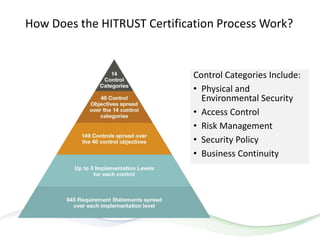
How Does the HITRUST Certification Process Work?
Control Categories Include:
• Physical and
Environmental Security
• Access Control
• Risk Management
• Security Policy
• Business Continuity
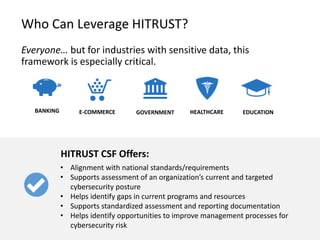
Who Can Leverage HITRUST?
E-COMMERCE HEALTHCAREBANKING GOVERNMENT EDUCATION
Everyone… but for industries with sensitive data, this
framework is especially critical.
• Alignment with national standards/requirements
• Supports assessment of an organization’s current and targeted
cybersecurity posture
• Helps identify gaps in current programs and resources
• Supports standardized assessment and reporting documentation
• Helps identify opportunities to improve management processes for
cybersecurity risk
HITRUST CSF Offers:
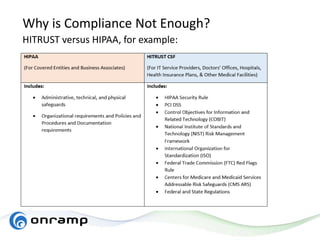
Why is Compliance Not Enough?
HITRUST versus HIPAA, for example:
Audience Poll
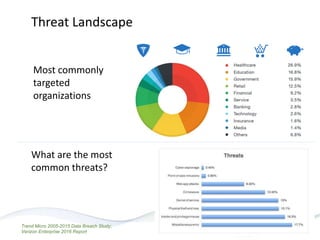
Threat Landscape
Trend Micro 2005-2015 Data Breach Study;
Verizon Enterprise 2016 Report
Most commonly
targeted
organizations
What are the most
common threats?
State of the Cloud 2017 and Beyond
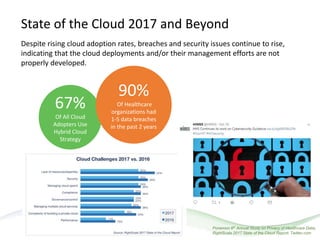
Despite rising cloud adoption rates, breaches and security issues continue to rise,
indicating that the cloud deployments and/or their management efforts are not
properly developed.
67%
Of All Cloud
Adopters Use
Hybrid Cloud
Strategy
90%
Of Healthcare
organizations had
1-5 data breaches
in the past 2 years
Ponemon 6th Annual Study on Privacy of Healthcare Data;
RightScale 2017 State of the Cloud Report; Twitter.com
Challenges in Secure Cloud Deployments
• Ambiguous Delegation of Responsibilities
(Internally and with Vendors)
• Lack of Data Governance & Security Practices
• Understand Risk Universe for Business Service and
Processed Data
• Insufficient Controls to Safeguard Data
• Ensuring Data Availability, Reliability, & Integrity
• Ability to Convey Auditable Compliance
(Transparency)
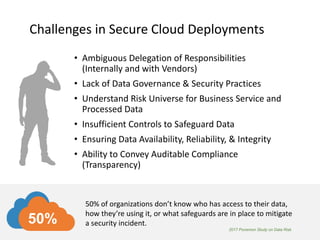
50% of organizations don’t know who has access to their data,
how they’re using it, or what safeguards are in place to mitigate
a security incident.
2017 Ponemon Study on Data Risk
50%
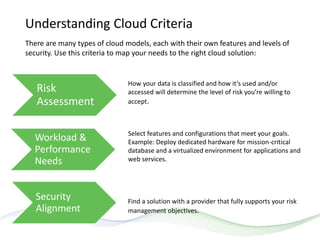
Understanding Cloud Criteria
There are many types of cloud models, each with their own features and levels of
security. Use this criteria to map your needs to the right cloud solution:
Risk
Assessment
Workload &
Performance
Needs
Security
Alignment
How your data is classified and how it’s used and/or
accessed will determine the level of risk you’re willing to
accept.
Select features and configurations that meet your goals.
Example: Deploy dedicated hardware for mission-critical
database and a virtualized environment for applications and
web services.
Find a solution with a provider that fully supports your risk
management objectives.
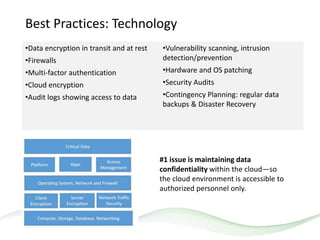
Best Practices: Technology
•Data encryption in transit and at rest
•Firewalls
•Multi-factor authentication
•Cloud encryption
•Audit logs showing access to data
•Vulnerability scanning, intrusion
detection/prevention
•Hardware and OS patching
•Security Audits
•Contingency Planning: regular data
backups & Disaster Recovery
#1 issue is maintaining data
confidentiality within the cloud—so
the cloud environment is accessible to
authorized personnel only.
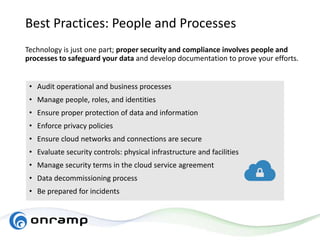
Best Practices: People and Processes
Technology is just one part; proper security and compliance involves people and
processes to safeguard your data and develop documentation to prove your efforts.
• Audit operational and business processes
• Manage people, roles, and identities
• Ensure proper protection of data and information
• Enforce privacy policies
• Ensure cloud networks and connections are secure
• Evaluate security controls: physical infrastructure and facilities
• Manage security terms in the cloud service agreement
• Data decommissioning process
• Be prepared for incidents
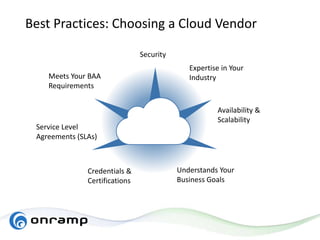
Best Practices: Choosing a Cloud Vendor
Security
Availability &
Scalability
Understands Your
Business Goals
Credentials &
Certifications
Service Level
Agreements (SLAs)
Meets Your BAA
Requirements
Expertise in Your
Industry
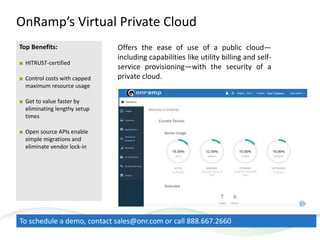
OnRamp’s Virtual Private Cloud
To schedule a demo, contact sales@onr.com or call 888.667.2660
Top Benefits:
■ HITRUST-certified
■ Control costs with capped
maximum resource usage
■ Get to value faster by
eliminating lengthy setup
times
■ Open source APIs enable
simple migrations and
eliminate vendor lock-in
Offers the ease of use of a public cloud—
including capabilities like utility billing and self-
service provisioning—with the security of a
private cloud.
Q&A
Thank you!!

HITRUST CSF in the Cloud

  • 1.
    HITRUST in theCloud Who, What, Why and How?
  • 2.
    Agenda • Introduction • WhatIs HITRUST? • How Can you Benefit from HITRUST? • Challenges in Cloud Deployments • How to Deploy Secure Cloud Infrastructure • Best Practices • Q&A
  • 3.
    Speakers Connect with Nikolaon LinkedIn Toby Owen VP of Product Development OnRamp Nikola Todev Head of Information Security OnRamp Connect with Toby on LinkedIn
  • 4.
    Current Landscape 1 RightScale-2017-State-of-the-Cloud-Report;2 PwC 2017 CEO Survey; Ponemon Institute, 3 Cost of Data Breach Study: 2017 Global Analysis The average consolidated cost of a data breach reached $3.62 million3 in 2017 143 million+ affected by Equifax server vulnerability and broad access control. 85% 85% of CEOs said cyber threats posed the greatest threat to the growth of their organization2 Lack of Expertise, Security, and Cost tie for top cloud challenges1 $4M 2017
  • 5.
  • 6.
    What Is HITRUSTCSF? HITRUST CSF is a prescriptive and certifiable framework specifically created in response to multiple compliance requirements, many of which are subject to interpretation. HITRUST Was Founded in 2007 to Solve Common Challenges: • Significant regulatory oversight • Constant evolving requirements • Uncertain standards – what is reasonable and appropriate? https://hitrustalliance.net
  • 7.
    The eight mostcommon regulation and control frameworks covered by HITRUST COBIT ISO 27001/2 FTC Red Flags HIPAA Omnibus Final Rule NIST Meaningful Use Texas Health & Safety Code PCI HITRUST FTC Red Flags ISO 27001/2 COBIT PCI HIPAA Omnibus Final Rule NIST Meaningful Use Texas Health & Safety Code What Does HITRUST Include?
  • 8.
    How Does theHITRUST Certification Process Work? Control Categories Include: • Physical and Environmental Security • Access Control • Risk Management • Security Policy • Business Continuity
  • 9.
    Who Can LeverageHITRUST? E-COMMERCE HEALTHCAREBANKING GOVERNMENT EDUCATION Everyone… but for industries with sensitive data, this framework is especially critical. • Alignment with national standards/requirements • Supports assessment of an organization’s current and targeted cybersecurity posture • Helps identify gaps in current programs and resources • Supports standardized assessment and reporting documentation • Helps identify opportunities to improve management processes for cybersecurity risk HITRUST CSF Offers:
  • 10.
    Why is ComplianceNot Enough? HITRUST versus HIPAA, for example:
  • 11.
  • 12.
    Threat Landscape Trend Micro2005-2015 Data Breach Study; Verizon Enterprise 2016 Report Most commonly targeted organizations What are the most common threats?
  • 13.
    State of theCloud 2017 and Beyond Despite rising cloud adoption rates, breaches and security issues continue to rise, indicating that the cloud deployments and/or their management efforts are not properly developed. 67% Of All Cloud Adopters Use Hybrid Cloud Strategy 90% Of Healthcare organizations had 1-5 data breaches in the past 2 years Ponemon 6th Annual Study on Privacy of Healthcare Data; RightScale 2017 State of the Cloud Report; Twitter.com
  • 14.
    Challenges in SecureCloud Deployments • Ambiguous Delegation of Responsibilities (Internally and with Vendors) • Lack of Data Governance & Security Practices • Understand Risk Universe for Business Service and Processed Data • Insufficient Controls to Safeguard Data • Ensuring Data Availability, Reliability, & Integrity • Ability to Convey Auditable Compliance (Transparency) 50% of organizations don’t know who has access to their data, how they’re using it, or what safeguards are in place to mitigate a security incident. 2017 Ponemon Study on Data Risk 50%
  • 15.
    Understanding Cloud Criteria Thereare many types of cloud models, each with their own features and levels of security. Use this criteria to map your needs to the right cloud solution: Risk Assessment Workload & Performance Needs Security Alignment How your data is classified and how it’s used and/or accessed will determine the level of risk you’re willing to accept. Select features and configurations that meet your goals. Example: Deploy dedicated hardware for mission-critical database and a virtualized environment for applications and web services. Find a solution with a provider that fully supports your risk management objectives.
  • 16.
    Best Practices: Technology •Dataencryption in transit and at rest •Firewalls •Multi-factor authentication •Cloud encryption •Audit logs showing access to data •Vulnerability scanning, intrusion detection/prevention •Hardware and OS patching •Security Audits •Contingency Planning: regular data backups & Disaster Recovery #1 issue is maintaining data confidentiality within the cloud—so the cloud environment is accessible to authorized personnel only.
  • 17.
    Best Practices: Peopleand Processes Technology is just one part; proper security and compliance involves people and processes to safeguard your data and develop documentation to prove your efforts. • Audit operational and business processes • Manage people, roles, and identities • Ensure proper protection of data and information • Enforce privacy policies • Ensure cloud networks and connections are secure • Evaluate security controls: physical infrastructure and facilities • Manage security terms in the cloud service agreement • Data decommissioning process • Be prepared for incidents
  • 18.
    Best Practices: Choosinga Cloud Vendor Security Availability & Scalability Understands Your Business Goals Credentials & Certifications Service Level Agreements (SLAs) Meets Your BAA Requirements Expertise in Your Industry
  • 19.
    OnRamp’s Virtual PrivateCloud To schedule a demo, contact sales@onr.com or call 888.667.2660 Top Benefits: ■ HITRUST-certified ■ Control costs with capped maximum resource usage ■ Get to value faster by eliminating lengthy setup times ■ Open source APIs enable simple migrations and eliminate vendor lock-in Offers the ease of use of a public cloud— including capabilities like utility billing and self- service provisioning—with the security of a private cloud.
  • 20.
  • 21.

Editor's Notes

  • #6 What are you most interested in learning about? What Is HITRUST? How Can you Benefit from HITRUST? How to Deploy Secure Cloud Infrastructure
  • #7 What is HITRUST? Who created it? Why was it developed? Objectives: Built specifically for the unique needs of healthcare Relevant ongoing updates of supporting authoritative sources and changes in the threat environment Scalable to various sizes and types of organizations or systems in a controlled manner Based on compliance with control baselines intended to manage risk to an industry-accepted level Capable of providing certifiable risk assurances to internal and external stakeholders, including regulators
  • #8 Highlight some of the most important frameworks and regulations HITRUST includes – like The National Institute of Standards and Technology (NIST).
  • #9 What kinds of organizations get certified and how does that process work? Address that the scope of the certification for each organization is different Discuss the levels of certification – must have level 3 Give examples of the control categories and examples of the controls. Discuss the difference between the self-assessment and the validated assessment.
  • #10 Discuss who should pay attention to HITRUST and why they should care What is HITRUSTs’ business impact? Alignment with national standards/requirements Supports assessment of an organization’s current and targeted cybersecurity posture Helps identify gaps in current programs and resources Supports standardized assessment and reporting documentation Helps identify opportunities to improve management processes for cybersecurity risk How can organizations gain benefits from choosing a HITRUST certified vendor? To protect their brand, critical assets, and customers/ patients
  • #11 Why is being compliant not enough? How does HITRUST compare? Discuss the maturity model--you must validate, evolve and analyze the outcome Differences between HIPAA Differences between PCI DSS, since there’s a certification for that, too
  • #12 What are your goals for IT moving into 2018? Is the cloud part of that plan?
  • #13 Trend Micro conducted a study over 10 years to find out which industries were the most targeted victims of data breaches. It’s no coincidence that those with valuable, sensitive data are top targets. As you can see, these are also the same industries that should leverage the HITRUST framework. Discuss top 3 threats
  • #14 Toby As organizations transition into the cloud, they should place workloads where they perform best – Results in hybrid cloud approach. 67% of all cloud users are currently adopting multiple clouds. Discuss challenges of multi-cloud management Nikola Regulatory organizations like the Office for Civil Rights, the Cloud Council are one-step behind hackers and malicious threats. So it’s really up to you and your vendors to be responsible for your compliance and security. In the healthcare industry for example, 90% of organizations have experienced 1-5 breaches in the past two years. Discuss learning curve associated with implementing security in a physical environment versus cloud and virtualization
  • #15 Ambiguous Delegation of Responsibilities (Internally and with Vendors) Limited time and resources makes it difficult for organizations to have a robust vendor management program to manage 3rd party relationships, including knowing if their security posture is sufficient to respond to a data breach  Lack of Data Governance & Security Practices Need to create policies AND enforce them Need ongoing training Insufficient Controls to Safeguard Data Ensuring Data Availability, Reliability, & Integrity Ability to Convey Auditable Compliance (Transparency) Documentation of your security and compliance efforts
  • #16 Discuss the process of choosing the right cloud for your workload needs. 1) Risk assessment – how valuable is the data? 2) Assess workload and performance needs. What features and functionality do you need/ want? 3) Security Alignment– some vendors have limitations on vulnerability and penetration testing, while others limit access to audit logs and monitoring. Ensure your cloud vendor is aligned with your risk management procedures.
  • #17 Discuss how technology plays a role in security and compliance best practices. Discuss how many of these controls match up to HITRUST. Discuss common misconceptions associated with security in the cloud.
  • #18 Discuss how people and process play a role in secure cloud deployments. Discuss how the requirements for HITRUST match up to the development and enforcement of these policies. Example – if your team needs to travel often, you must develop appropriate security practices.
  • #20 Introduce the VPC product, discuss how it’s HITRUST certified Discuss the use cases for the VPC cloud -- I.e. healthcare apps for medical devices, patient portal development, etc.