Cost Behaviors MGM624 Mari Glass, Faculty CTU Online
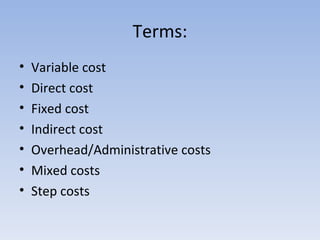
Terms: Variable cost Direct cost Fixed cost Indirect cost Overhead/Administrative costs Mixed costs Step costs
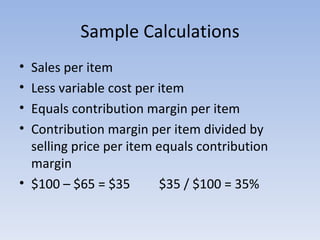
Sample Calculations Sales per item Less variable cost per item Equals contribution margin per item Contribution margin per item divided by selling price per item equals contribution margin $100 – $65 = $35  $35 / $100 = 35%
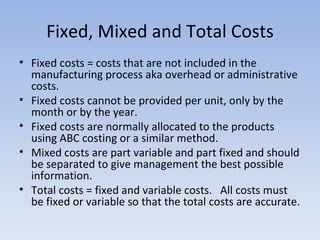
Fixed, Mixed and Total Costs Fixed costs = costs that are not included in the manufacturing process aka overhead or administrative costs. Fixed costs cannot be provided per unit, only by the month or by the year. Fixed costs are normally allocated to the products using ABC costing or a similar method. Mixed costs are part variable and part fixed and should be separated to give management the best possible information. Total costs = fixed and variable costs.  All costs must be fixed or variable so that the total costs are accurate.
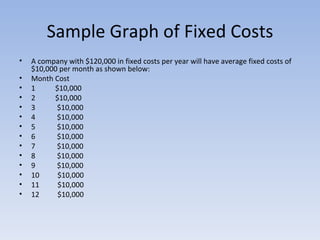
Sample Graph of Fixed Costs A company with $120,000 in fixed costs per year will have average fixed costs of $10,000 per month as shown below: Month Cost  1  $10,000  2  $10,000  3  $10,000  4  $10,000  5  $10,000  6  $10,000  7  $10,000  8  $10,000  9  $10,000  10  $10,000  11  $10,000  12  $10,000
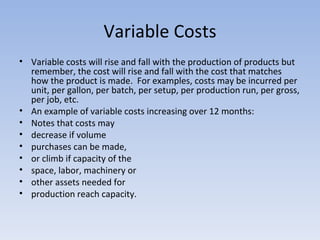
Variable Costs Variable costs will rise and fall with the production of products but remember, the cost will rise and fall with the cost that matches how the product is made.  For examples, costs may be incurred per unit, per gallon, per batch, per setup, per production run, per gross, per job, etc. An example of variable costs increasing over 12 months: Notes that costs may  decrease if volume  purchases can be made, or climb if capacity of the  space, labor, machinery or  other assets needed for  production reach capacity.
Sample Graphs Fixed and Variable costs
Outliers in the Data
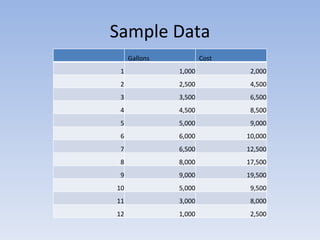
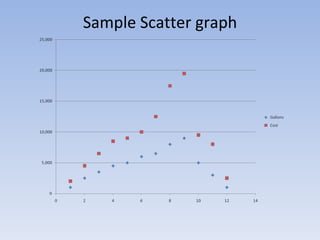
Sample Data   Gallons Cost 1 1,000 2,000 2 2,500 4,500 3 3,500 6,500 4 4,500 8,500 5 5,000 9,000 6 6,000 10,000 7 6,500 12,500 8 8,000 17,500 9 9,000 19,500 10 5,000 9,500 11 3,000 8,000 12 1,000 2,500
Sample Scatter graph
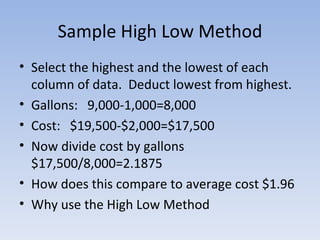
Sample High Low Method Select the highest and the lowest of each column of data.  Deduct lowest from highest.  Gallons:  9,000-1,000=8,000 Cost:  $19,500-$2,000=$17,500 Now divide cost by gallons $17,500/8,000=2.1875 How does this compare to average cost $1.96 Why use the High Low Method
References: 2004 Prentice Hall Business Publishing, Introduction to Management Accounting, 2e Werner/Jones Chapter 5

Cost Behaviors

  • 1.
    Cost Behaviors MGM624Mari Glass, Faculty CTU Online
  • 2.
    Terms: Variable costDirect cost Fixed cost Indirect cost Overhead/Administrative costs Mixed costs Step costs
  • 3.
    Sample Calculations Salesper item Less variable cost per item Equals contribution margin per item Contribution margin per item divided by selling price per item equals contribution margin $100 – $65 = $35 $35 / $100 = 35%
  • 4.
    Fixed, Mixed andTotal Costs Fixed costs = costs that are not included in the manufacturing process aka overhead or administrative costs. Fixed costs cannot be provided per unit, only by the month or by the year. Fixed costs are normally allocated to the products using ABC costing or a similar method. Mixed costs are part variable and part fixed and should be separated to give management the best possible information. Total costs = fixed and variable costs. All costs must be fixed or variable so that the total costs are accurate.
  • 5.
    Sample Graph ofFixed Costs A company with $120,000 in fixed costs per year will have average fixed costs of $10,000 per month as shown below: Month Cost 1 $10,000 2 $10,000 3 $10,000 4 $10,000 5 $10,000 6 $10,000 7 $10,000 8 $10,000 9 $10,000 10 $10,000 11 $10,000 12 $10,000
  • 6.
    Variable Costs Variablecosts will rise and fall with the production of products but remember, the cost will rise and fall with the cost that matches how the product is made. For examples, costs may be incurred per unit, per gallon, per batch, per setup, per production run, per gross, per job, etc. An example of variable costs increasing over 12 months: Notes that costs may decrease if volume purchases can be made, or climb if capacity of the space, labor, machinery or other assets needed for production reach capacity.
  • 7.
    Sample Graphs Fixedand Variable costs
  • 8.
  • 9.
    Sample Data  Gallons Cost 1 1,000 2,000 2 2,500 4,500 3 3,500 6,500 4 4,500 8,500 5 5,000 9,000 6 6,000 10,000 7 6,500 12,500 8 8,000 17,500 9 9,000 19,500 10 5,000 9,500 11 3,000 8,000 12 1,000 2,500
  • 10.
  • 11.
    Sample High LowMethod Select the highest and the lowest of each column of data. Deduct lowest from highest. Gallons: 9,000-1,000=8,000 Cost: $19,500-$2,000=$17,500 Now divide cost by gallons $17,500/8,000=2.1875 How does this compare to average cost $1.96 Why use the High Low Method
  • 12.
    References: 2004 PrenticeHall Business Publishing, Introduction to Management Accounting, 2e Werner/Jones Chapter 5