Civil War SOL US1.9b Viewpoints of the North and South Lisa Pennington Social Studies Instructional Specialist Portsmouth Public Schools
Essential Knowledge The South feared that the North would take control of Congress, and Southerners began to proclaim states’ rights as a means to self-protection. The North believed that the nation was a union and could not be divided.  While the Civil War did not begin as a war to abolish slavery, issues surrounding slavery deeply divided the nation.
Key Words Union:  all of the states in our nation Popular sovereignty:  people have the right to self-government and to choose the type of government they want  Secede:  to leave; to break away from a group
Issues that Divided the Nation An important issue separating the country related to the power of the federal government. Southerners believed that they had a right to declare any national law illegal. Northerners believed that the national governments power was supreme over that of the states, and that slavery should be abolished for moral reasons. Southerners felt that the abolition of slavery would destroy their region’s economy.
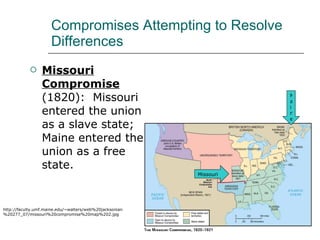
Compromises Attempting to Resolve Differences Missouri Compromise  (1820):  Missouri entered the union as a slave state; Maine entered the union as a free state.  http://faculty.umf.maine.edu/~walters/web%20jacksonian%20277_07/missouri%20compromise%20map%202.jpg Maine Missouri
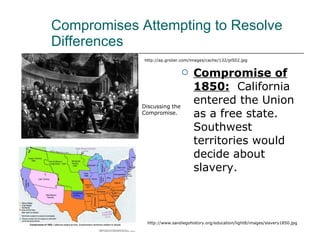
Compromises Attempting to Resolve Differences Compromise of 1850:   California entered the Union as a free state.  Southwest territories would decide about slavery. http://www.sandiegohistory.org/education/light8/images/slavery1850.jpg http://ap.grolier.com/images/cache/132/pl502.jpg Discussing the  Compromise.
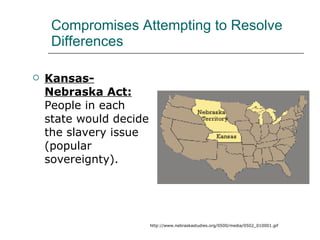
Compromises Attempting to Resolve Differences Kansas-Nebraska Act:   People in each state would decide the slavery issue (popular sovereignty). http://www.nebraskastudies.org/0500/media/0502_010001.gif
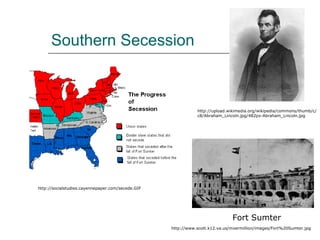
Southern Secession Following Lincoln’s election, the southern states seceded from the Union.  Confederate forces attacked Fort Sumter, in South Carolina, marking the beginning of the Civil War.
Southern Secession http://socialstudies.cayennepaper.com/secede.GIF http://upload.wikimedia.org/wikipedia/commons/thumb/c/c8/Abraham_Lincoln.jpg/482px-Abraham_Lincoln.jpg http://www.scott.k12.va.us/mvermillion/images/Fort%20Sumter.jpg Fort Sumter
Southern Secession Lincoln and many Northerners believed that the United States was one nation that could not be separated or divided.  Most Southerners believed that states had freely joined the union and could freely leave it.

9b increased tensions

  • 1.
    Civil War SOLUS1.9b Viewpoints of the North and South Lisa Pennington Social Studies Instructional Specialist Portsmouth Public Schools
  • 2.
    Essential Knowledge TheSouth feared that the North would take control of Congress, and Southerners began to proclaim states’ rights as a means to self-protection. The North believed that the nation was a union and could not be divided. While the Civil War did not begin as a war to abolish slavery, issues surrounding slavery deeply divided the nation.
  • 3.
    Key Words Union: all of the states in our nation Popular sovereignty: people have the right to self-government and to choose the type of government they want Secede: to leave; to break away from a group
  • 4.
    Issues that Dividedthe Nation An important issue separating the country related to the power of the federal government. Southerners believed that they had a right to declare any national law illegal. Northerners believed that the national governments power was supreme over that of the states, and that slavery should be abolished for moral reasons. Southerners felt that the abolition of slavery would destroy their region’s economy.
  • 5.
    Compromises Attempting toResolve Differences Missouri Compromise (1820): Missouri entered the union as a slave state; Maine entered the union as a free state. http://faculty.umf.maine.edu/~walters/web%20jacksonian%20277_07/missouri%20compromise%20map%202.jpg Maine Missouri
  • 6.
    Compromises Attempting toResolve Differences Compromise of 1850: California entered the Union as a free state. Southwest territories would decide about slavery. http://www.sandiegohistory.org/education/light8/images/slavery1850.jpg http://ap.grolier.com/images/cache/132/pl502.jpg Discussing the Compromise.
  • 7.
    Compromises Attempting toResolve Differences Kansas-Nebraska Act: People in each state would decide the slavery issue (popular sovereignty). http://www.nebraskastudies.org/0500/media/0502_010001.gif
  • 8.
    Southern Secession FollowingLincoln’s election, the southern states seceded from the Union. Confederate forces attacked Fort Sumter, in South Carolina, marking the beginning of the Civil War.
  • 9.
    Southern Secession http://socialstudies.cayennepaper.com/secede.GIFhttp://upload.wikimedia.org/wikipedia/commons/thumb/c/c8/Abraham_Lincoln.jpg/482px-Abraham_Lincoln.jpg http://www.scott.k12.va.us/mvermillion/images/Fort%20Sumter.jpg Fort Sumter
  • 10.
    Southern Secession Lincolnand many Northerners believed that the United States was one nation that could not be separated or divided. Most Southerners believed that states had freely joined the union and could freely leave it.