SOL USII.4a:  Westward Expansion Lisa Pennington Social Studies Instructional Specialist Portsmouth Public Schools
Vocabulary Manifest Destiny :  a popular American belief that the United States had the right and duty to expand across North America to the Pacific Ocean. Transcontinental Railroad :  a railroad that stretched across the American continent.  It was created by a Pacific Railway Act of 1862 and gave public land to railroad companies and promoted settlement on the Great Plains.   This act joined the Union Pacific and the Central Pacific Railroads in 1869 at Promontory Point, Utah.
Vocabulary Oppressive government :  limits or takes away the civil liberties of people.  Homestead Act :  an 1862 law that offered free farmland of 160 acres on the Great Plains to the head of a family that resided on and cultivated the land for 5 years.  Battle of the Little Big Horn :  Lakota tribe led by Chief Sitting Bull and Crazy Horse that killed General Custer and all of his men at the Little Big Horn River in Montana in 1876.
Vocabulary Chief Joseph :  leader of the Nez Perce Indians of Idaho who fought U.S. soldiers and then were moved to reservations in Oklahoma. Reservation :  public land set aside by the government for the use of a certain group of people. Nativist :  an American citizen who believes that immigrants are inferior.  American Protective Association :  made up of nativists who did not trust immigrants and disliked them for taking jobs away from them.
Essential Understandings New opportunities and technological advances led to westward expansion following the Civil War.
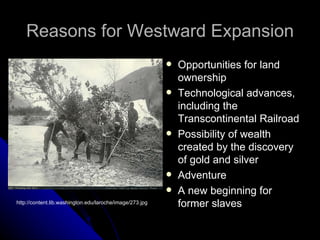
Reasons for Westward Expansion Opportunities for land ownership Technological advances, including the Transcontinental Railroad Possibility of wealth created by the discovery of gold and silver Adventure A new beginning for former slaves http://content.lib.washington.edu/laroche/image/273.jpg
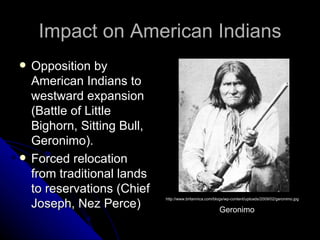
Impact on American Indians Opposition by American Indians to westward expansion (Battle of Little Bighorn, Sitting Bull, Geronimo). Forced relocation from traditional lands to reservations (Chief Joseph, Nez Perce) http://www.britannica.com/blogs/wp-content/uploads/2009/02/geronimo.jpg Geronimo
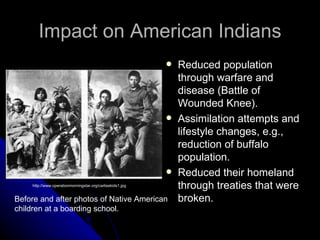
Impact on American Indians Reduced population through warfare and disease (Battle of Wounded Knee). Assimilation attempts and lifestyle changes, e.g., reduction of buffalo population. Reduced their homeland through treaties that were broken. http://www.operationmorningstar.org/carlisekids1.jpg Before and after photos of Native American children at a boarding school.
Think About It… Why did Westward Expansion occur? How did the lives of American Indians change with Westward Expansion?

Usii.4a notes

  • 1.
    SOL USII.4a: Westward Expansion Lisa Pennington Social Studies Instructional Specialist Portsmouth Public Schools
  • 2.
    Vocabulary Manifest Destiny: a popular American belief that the United States had the right and duty to expand across North America to the Pacific Ocean. Transcontinental Railroad : a railroad that stretched across the American continent. It was created by a Pacific Railway Act of 1862 and gave public land to railroad companies and promoted settlement on the Great Plains. This act joined the Union Pacific and the Central Pacific Railroads in 1869 at Promontory Point, Utah.
  • 3.
    Vocabulary Oppressive government: limits or takes away the civil liberties of people. Homestead Act : an 1862 law that offered free farmland of 160 acres on the Great Plains to the head of a family that resided on and cultivated the land for 5 years. Battle of the Little Big Horn : Lakota tribe led by Chief Sitting Bull and Crazy Horse that killed General Custer and all of his men at the Little Big Horn River in Montana in 1876.
  • 4.
    Vocabulary Chief Joseph: leader of the Nez Perce Indians of Idaho who fought U.S. soldiers and then were moved to reservations in Oklahoma. Reservation : public land set aside by the government for the use of a certain group of people. Nativist : an American citizen who believes that immigrants are inferior. American Protective Association : made up of nativists who did not trust immigrants and disliked them for taking jobs away from them.
  • 5.
    Essential Understandings Newopportunities and technological advances led to westward expansion following the Civil War.
  • 6.
    Reasons for WestwardExpansion Opportunities for land ownership Technological advances, including the Transcontinental Railroad Possibility of wealth created by the discovery of gold and silver Adventure A new beginning for former slaves http://content.lib.washington.edu/laroche/image/273.jpg
  • 7.
    Impact on AmericanIndians Opposition by American Indians to westward expansion (Battle of Little Bighorn, Sitting Bull, Geronimo). Forced relocation from traditional lands to reservations (Chief Joseph, Nez Perce) http://www.britannica.com/blogs/wp-content/uploads/2009/02/geronimo.jpg Geronimo
  • 8.
    Impact on AmericanIndians Reduced population through warfare and disease (Battle of Wounded Knee). Assimilation attempts and lifestyle changes, e.g., reduction of buffalo population. Reduced their homeland through treaties that were broken. http://www.operationmorningstar.org/carlisekids1.jpg Before and after photos of Native American children at a boarding school.
  • 9.
    Think About It…Why did Westward Expansion occur? How did the lives of American Indians change with Westward Expansion?