ZJ                                                                                   EMISSION CONTROL SYSTEMS                25 - 1

                                  EMISSION CONTROL SYSTEMS

                                                               CONTENTS

                                                                page                                                          page

COMPONENT REMOVAL/INSTALLATION . . . . . . 15                             EXHAUST EMISSION CONTROLS . . . . . . . . . . . 11
EVAPORATIVE EMISSION CONTROLS . . . . . . . . 5                           GENERAL INFORMATION . . . . . . . . . . . . . . . . . . 1


                                                  GENERAL INFORMATION


                                                                     INDEX
                                                                page                                                          page

DRB Scan Tool . . . . . . . . . . . . . . . . . . . . . . . . . . . . 4   Vacuum Hose Routing Schematics . . . . . . . . . . . . . 1
On-Board Diagnostics . . . . . . . . . . . . . . . . . . . . . . . 1      Vehicle Emission Control Information (VECI) Label . 1

VEHICLE EMISSION CONTROL INFORMATION                                      glish and French languages. These labels are perma-
(VECI) LABEL                                                              nently attached and cannot be removed without
  All vehicles are equipped with a combined VECI la-                      defacing information and destroying label.
bel. The label is located in the engine compartment                         The VECI label illustration (Fig. 2) is used as
(Fig. 1). The label contains the following:                               an example only. Refer to the VECI label located in
• Engine family and displacement                                          the engine compartment (Fig. 1) for actual emission
• Evaporative family                                                      information.
• Emission control system schematic
• Certification application
                                                                          VACUUM HOSE ROUTING SCHEMATICS
• Engine timing specifications (if adjustable)                              The vacuum hose routing schematics are used
• Idle speeds (if adjustable)                                             as examples only. If there are any differences be-
• Spark plug and plug gap                                                 tween these schematics and the Vehicle Emission
                                                                          Control Information (VECI) label schematics, those
                                                                          shown on the VECI label should be used.

                                                                          ON-BOARD DIAGNOSTICS
                                                                          FOR CERTAIN EMISSION SYSTEM
                                                                          COMPONENTS
                                                                            The powertrain control module (PCM) performs an
                                                                          On-Board Diagnostic (OBD) check for certain emis-
                                                                          sion system components on all vehicles. This is done
                                                                          by setting a diagnostic trouble code (DTC).
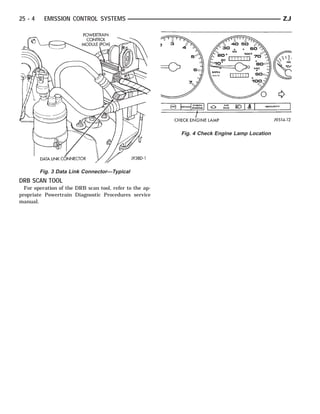
                                                                            A DTC can be obtained in two different ways. One
                                                                          of the ways is by connecting the DRB scan tool to the
                                                                          data link connector. This connector is located in the
                                                                          engine compartment (Fig. 3). Refer to the appropriate
                                                                          Powertrain Diagnostic Procedures service manual for
                                                                          operation of the DRB scan tool. The other way is to
           Fig. 1 VECI Label Location—Typical                             cycle the ignition key and observe the malfunction in-
  The label also contains an engine vacuum sche-                          dicator lamp (MIL). The MIL lamp is displayed on
matic. There are unique labels for vehicles built for                     the instrument panel as the CHECK ENGINE lamp
sale in the state of California and the country of                        (Fig. 4). This lamp will flash a numeric code. If a nu-
Canada. Canadian labels are written in both the En-                       meric code number 32 is observed, a problem has
25 - 2   EMISSION CONTROL SYSTEMS                                                                       ZJ


                                        Fig. 2 VECI Label—Typical
been found in the EGR system. If a numeric code        initially for approximately two seconds each time the
number 31 is observed, a problem has been found in     ignition key is turned to the ON position. This is
the EVAP system.                                       done for a bulb test.
  EGR System Check: The OBD check will activate          For a complete operational description of all
only during selected engine/driving conditions. When   DTC’s, for accessing a DTC and for erasing a
the conditions are met, the PCM energizes the EGR      DTC, refer to On-Board Diagnostics. This can
valve control solenoid to disable the EGR. The PCM     be found in the General Diagnosis sections of
checks for a change in the oxygen sensor signal. If    Group 14, Fuel System. For numeric flash lamp
the air-fuel mixture goes lean, the PCM will attempt   code charts for emission related components,
to enrichen the mixture. The PCM registers a diag-     refer to Diagnostic Trouble Code (DTC). This
nostic trouble code (DTC) if the EGR system has        can also be found in the General Diagnosis sec-
failed or degraded. After registering a DTC, the PCM   tions of Group 14, Fuel System.
turns the CHECK ENGINE lamp on. Illumination of
this lamp indicates the need for immediate service.
Note that the CHECK ENGINE lamp will illuminate

           VACUUM ROUTING SCHEMATIC—NON-CALIFORNIA 4.0L ENGINE—TYPICAL
ZJ                                      EMISSION CONTROL SYSTEMS   25 - 3

     VACUUM ROUTING SCHEMATIC—CALIFORNIA 4.0L ENGINE—TYPICAL


        VACUUM ROUTING SCHEMATIC—5.2L V-8 ENGINE—TYPICAL
25 - 4    EMISSION CONTROL SYSTEMS                                                           ZJ


                                                         Fig. 4 Check Engine Lamp Location


         Fig. 3 Data Link Connector—Typical
DRB SCAN TOOL
  For operation of the DRB scan tool, refer to the ap-
propriate Powertrain Diagnostic Procedures service
manual.
ZJ                                                                                         EMISSION CONTROL SYSTEMS                           25 - 5

                                         EVAPORATIVE EMISSION CONTROLS


                                                                        INDEX
                                                                   page                                                                         page

Crankcase Breather/Filter—5.2L Engines . . . . . . . . 10                    Fuel Tank Filler Tube Cap . . . . . . . . . . . . . . . . . . . . 7
Crankcase Ventilation System—4.0L 6-Cylinder                                 Positive Crankcase Ventilation System—5.2L V-8
  Engine . . . . . . . . . . . . . . . . . . . . . . . . . . . . . . . . 7     Engine . . . . . . . . . . . . . . . . . . . . . . . . . . . . . . . . 7
EVAP (Evaporation) Control System . . . . . . . . . . . . 5                  Pressure Relief/Rollover Valve . . . . . . . . . . . . . . . . 10

EVAP (EVAPORATION) CONTROL SYSTEM
GENERAL INFORMATION
  The function of the EVAP control system is to pre-
vent the emissions of gasoline vapors from the fuel
tank into the atmosphere. When fuel evaporates in
the fuel tank, the vapors pass through vent hoses or
tubes to a carbon filled EVAP canister. They are tem-
porarily held in the canister until they can be drawn
into the intake manifold when the engine is running.
  The EVAP canister is a feature on all models for
the storage of fuel vapors from the fuel tank. Refer to
the following EVAP Canister for information.
  Three different EVAP systems are used. These are
for:
• The 4.0L six-cylinder engine without the Califor-
nia emission package.
• The 4.0L six-cylinder engine with the California
emission package.
                                                                                  Fig. 1 Canister Location—All Engines—Non-
• The 5.2L V-8 engine.
                                                                                                    California
  Refer to the following System Operation sections
for information.                                                             SYSTEM OPERATION
  The hoses used in this system are specially
manufactured. If replacement becomes neces-                                  4.0L ENGINE WITHOUT CALIFORNIA EMISSION PACKAGE
sary, it is important to use only fuel resistant                                This is a non-electrical, vacuum operated system.
hose.                                                                           The EVAP canister is equipped with a vacuum con-
                                                                             trolled purge shutoff switch (orifice) (Fig. 3) that con-
EVAP CANISTER                                                                trols canister purge operation. The switch is open
   A sealed, maintenance free, EVAP canister is used                         when engine manifold vacuum is applied to it. When
on all vehicles. Depending on engine and emission                            the engine is operating, the EVAP canister purge
packages, two different types of canisters are used.                         function draws fresh air through the top of the can-
The EVAP canister is located in the left front corner                        ister. This causes the stored vapors to be drawn out
of the vehicle below the left front headlamp (Figs. 1                        of the canister and into the airstream in the air
or 2). The canister is filled with granules of an acti-                      cleaner housing snorkel (Fig. 3).
vated carbon mixture. Fuel vapors entering the can-                             The air cleaner contains a venturi in the air
ister are absorbed by the charcoal granules.                                 cleaner cover used as a purge line vacuum source
   A separate EVAP canister filter is used on 4.0L                           (Fig. 4). The venturi effect increases the speed of the
6-cylinder engines equipped with the California                              intake air flowing by the slots in the venturi wall.
Emission Package only. This filter is located in the                         This creates a low pressure area around the slots.
left front corner of the engine compartment behind                           When the purge shutoff switch is open, vapors from
the air cleaner housing. On the 5.2L V-8 engine, this                        the canister are drawn through slots and into the air-
filter is located at the end of the vacuum line harness                      stream flowing through the venturi (Fig. 4).
where the connection is made at the EVAP purge so-                              The fuel vapors then pass through the intake man-
lenoid. On the 4.0L engine without the California                            ifold and into the engine combustion chambers. Here
package, the engine air cleaner housing is used.                             they are consumed during engine combustion.
25 - 6   EMISSION CONTROL SYSTEMS                                                                       ZJ


                                                          Fig. 4 Air Cleaner Venturi—Non-California 4.0L
   Fig. 2 Canister Location—California Emission                           Engine—Typical
                Package—4.0L Only                      trol module (PCM) operates the purge solenoid by
                                                       controlling the ground circuit to it.


Fig. 3 EVAP System—Non-California 4.0L Engine—
                   Typical
                                                         Fig. 5 Purge Solenoid—4.0L Engine—California
SYSTEM OPERATION                                                       Emission Package
4.0L ENGINE WITH CALIFORNIA EMISSION PACKAGE             During the cold start warm-up period and the hot
  This is a combination electrical and vacuum oper-    start time delay, the PCM does not energize the sole-
ated system.                                           noid. When de-energized (pulse ground signal not
  The duty cycle EVAP canister purge solenoid (Fig.    supplied), no vapors are purged.
5) regulates the rate of vapor flow from the EVAP        The engine enters closed loop operation after it
canister to the intake manifold. The powertrain con-   reaches a specified temperature and the programmed
                                                       time delay ends. During closed loop operation, the
ZJ                                                                 EMISSION CONTROL SYSTEMS               25 - 7

PCM energizes and de-energizes the solenoid 5 to 10      into the engine combustion chambers. Here they are
times per second, depending upon operating condi-        consumed during engine combustion.
tions. The PCM varies the vapor flow rate by chang-        The EVAP canister purge solenoid will also be en-
ing the solenoid pulse width. Pulse width is the         ergized during certain idle conditions in order to up-
amount of time the solenoid is energized.                date the fuel delivery calibration.
  As the solenoid is energized, the fuel vapors then
pass through the intake manifold and into the engine     FUEL TANK FILLER TUBE CAP
combustion chambers. Here they are consumed dur-           The fuel tank filler tube cap (fuel tank cap) incor-
ing engine combustion.                                   porates a two-way relief valve that is closed to atmo-
                                                         sphere during normal operating conditions. The relief
SYSTEM OPERATION                                         valve used in fuel filler caps of all models is cali-
                                                         brated at a pressure of 10 kPa (1.5 psi) or a vacuum
5.2L V-8 ENGINE                                          of 6 kPa (1.8 in. Hg). When the pressure or vacuum
   This is a combination electrical and vacuum oper-     is relieved, the valve returns to the normally closed
ated system.                                             position.
   Fuel tank pressure vents into the EVAP canister.
                                                         CAUTION: The fuel filler cap must be removed prior
Fuel vapors are temporarily held in the canister until
                                                         to disconnecting any fuel system component.
they can be drawn into the intake manifold. The
EVAP canister purge solenoid allows the EVAP can-
ister to be purged at predetermined times and at cer-    CRANKCASE VENTILATION SYSTEM—4.0L
tain engine operating conditions.                        6-CYLINDER ENGINE
   Vacuum for the EVAP canister is controlled by the        The 4.0L engine is equipped with a Crankcase Ven-
EVAP canister purge solenoid (Fig. 6). The solenoid is   tilation (CCV) system (Fig. 7). The CCV system per-
operated by the powertrain control module (PCM).         forms the same function as a conventional PCV
The PCM regulates the solenoid by switching the          system, but does not use a vacuum controlled valve.
ground circuit on and off based on engine operating         A molded vacuum tube connects manifold vacuum
conditions. When energized (grounded), the solenoid      to top of cylinder head cover at dash panel end. The
prevents vacuum from reaching the EVAP canister.         vacuum tube contains a fixed orifice (Fig. 7) of a cal-
When not energized, the solenoid allows vacuum to        ibrated size. It meters the amount of crankcase va-
flow through to the EVAP canister.                       pors drawn out of the engine.
                                                            A fresh air supply hose from the air cleaner (Fig. 7)
                                                         is connected to front of cylinder head (valve) cover.
                                                         When the engine is operating, fresh air enters the
                                                         engine and mixes with crankcase vapors. Manifold
                                                         vacuum draws the vapor/air mixture through the
                                                         fixed orifice and into the intake manifold. The vapors
                                                         are then consumed during engine combustion.

                                                         POSITIVE CRANKCASE VENTILATION SYSTEM—
                                                         5.2L V-8 ENGINE
                                                         DESCRIPTION/OPERATION
                                                            The 5.2L V-8 engine is equipped with a closed pos-
                                                         itive crankcase ventilation (PCV) system (Fig. 8).
                                                            This system consists of a crankcase PCV valve
                                                         mounted on the cylinder head cover with a hose ex-
                                                         tending from the valve to the intake manifold.
     Fig. 6 Purge Solenoid—5.2L Engine—Typical              A closed engine crankcase breather/filter, with a
  During warm-up and for a specified time period af-     hose connecting it to the air cleaner housing, pro-
ter hot starts, the PCM grounds the EVAP canister        vides the source of air for system.
purge solenoid causing it to energize. This will pre-       The positive crankcase ventilation (PCV) system
vent vacuum from reaching the EVAP canister valve.       operates by engine intake manifold vacuum (Fig. 9).
When the engine reaches an operating temperature         Filtered air is routed into the crankcase through the
of approximately 60°C (140°F), the PCM removes the       air cleaner hose and crankcase breather/filter. This
ground to the solenoid. The de-energized solenoid        forces crankcase vapors through the PCV valve. It is
then allows vacuum to flow to the EVAP canister and      then drawn into the intake manifold. Here it be-
purge fuel vapors through the intake manifold and        comes part of the calibrated air/fuel mixture to be
25 - 8     EMISSION CONTROL SYSTEMS                                                                     ZJ


                      Fig. 7 CCV System—4.0L Engine—Non-California System Shown
consumed in the combustion chamber. The PCV sys-       POSITIVE CRANKCASE VENTILATION (PCV)
tem constantly ventilates the crankcase to help pre-   VALVE
vent sludge formation and vapors from entering the       The PCV valve contains a spring loaded plunger.
atmosphere.                                            This plunger meters the amount of crankcase vapors
                                                       routed into the combustion chamber based on intake
                                                       manifold vacuum.
                                                         When the engine is not operating, or during an en-
                                                       gine popback, the spring forces the plunger back
                                                       against the seat. This will prevent vapors from flow-
                                                       ing through the valve (Fig. 10).


         Fig. 8 PCV Valve/Hose—5.2L Engines            Fig. 9 Typical Closed Crankcase Ventilation System
ZJ                                                                    EMISSION CONTROL SYSTEMS             25 - 9


 Fig. 10 Engine Off or Engine PopBack—No Vapor
                        Flow
  During periods of high manifold vacuum, such as
idle or cruising speeds, vacuum is sufficient to com-
pletely compress spring. It will then pull the plunger
to the top of the valve (Fig. 11). In this position there
is minimal vapor flow through the valve.                       Fig. 13 Check Vacuum at PCV Valve—Typical
                                                            force. This will be after allowing approximately one
                                                            minute for crankcase pressure to reduce.


   Fig. 11 High Intake Manifold Vacuum—Minimal
                     Vapor Flow
  During periods of moderate manifold vacuum, the
plunger is only pulled part way back from inlet. This
results in maximum vapor flow through the valve
(Fig. 12).


     Fig. 12 Moderate Intake Manifold Vacuum—                  Fig. 14 Check Vacuum at Crankcase Breather
               Maximum Vapor Flow                                           Opening—Typical
INSPECTION AND SERVICE PROCEDURE                              (4) Turn engine off and remove PCV valve from
  (1) With engine idling, remove the PCV valve from         cylinder head (valve) cover. The valve should rattle
cylinder head cover. If the valve is not plugged, a         when shaken (Fig. 15).
hissing noise will be heard as air passes through the         Replace the PCV valve and retest the system if it
valve. Also, a strong vacuum should be felt at the          does not operate as described in the preceding tests.
valve inlet (Fig. 13).                                      Do not attempt to clean the old PCV valve.
  (2) Install the PCV valve. Remove the crankcase             (5) If the paper is not held against the opening in
breather/filter. Hold a piece of stiff paper, such as a     cylinder head (valve) cover after new valve is in-
parts tag, loosely over the opening of crankcase            stalled, the PCV valve hose may be restricted and
breather/filter at the cylinder head (valve) cover (Fig.    must be replaced. The passage in the intake manifold
14).                                                        must also be checked and cleaned.
  (3) The paper should be drawn against the opening           (6) To clean the intake manifold fitting, turn a 1/4
in the cylinder head (valve) cover with noticeable          inch drill (by hand) through the fitting to dislodge
25 - 10    EMISSION CONTROL SYSTEMS                                                                      ZJ


          Fig. 15 Shake PCV Valve—Typical                  Fig. 16 Typical Crankcase Breather/Filter—5.2L
                                                                               Engine
any solid particles. Blow out the fitting with shop air.
If necessary, use a smaller drill to avoid removing
any metal from the fitting.

CRANKCASE BREATHER/FILTER—5.2L ENGINES
   The crankcase breather/filter is used with the 5.2L
V-8 engine only.
   The crankcase breather/filter (Fig. 16) is located on
the engine valve cover. It must be kept clean and lu-
bricated. At the recommended interval, remove the
filter and wash it thoroughly in kerosene, or similar
solvent. Lubricate or wet the filter by inverting it
and filling with SAE 30 engine oil. Filter must then
be thoroughly drained. More frequent service may be
necessary for vehicles operated extensively on short
run, stop and go, or extended engine idle service.
                                                           Fig. 17 Pressure Relief/Rollover Valve Location
   The filter must be replaced at correct intervals. Re-
fer to Lubrication and Maintenance, Group 0.

PRESSURE RELIEF/ROLLOVER VALVE
  These vehicles are equipped with a combination
fuel tank pressure relief and rollover valve (Fig. 17).
This dual function valve will relieve fuel tank pres-
sure and also prevent fuel flow through the fuel tank
vent hoses in the event of an accidental vehicle roll-
over.
  The valve incorporates a pressure relief mechanism
(Fig. 18) that releases fuel tank pressure when the
pressure increases above the calibrated sealing value.
Refer to the Fuel Tank section of Group 14, Fuel Sys-
tems for removal and installation procedures.


                                                           Fig. 18 Pressure Relief/Rollover Valve Operation
ZJ                                                                                      EMISSION CONTROL SYSTEMS                     25 - 11

                                             EXHAUST EMISSION CONTROLS


                                                                        INDEX
                                                                   page                                                                  page

Catalytic Converter . . . . . . . . . . . . . . . . . . . . . . . . 11       Oxygen (O2S) Sensor . . . . . . . . . . . . . . . . . . . . . . 14
EGR (Exhaust Gas Recirculation) System—5.2L
 Engine . . . . . . . . . . . . . . . . . . . . . . . . . . . . . . . . 11

CATALYTIC CONVERTER
 Refer to Group 11, Exhaust System and Intake
manifold for information.

EGR (EXHAUST GAS RECIRCULATION) SYSTEM—
5.2L ENGINE
GENERAL INFORMATION
  The Exhaust Gas Recirculation (EGR) System is
used with the 5.2L V-8 engine only.
  The EGR system reduces oxides of nitrogen (NOx)
in the engine exhaust and helps prevent spark
knock. This is accomplished by allowing a predeter-
mined amount of hot exhaust gas to recirculate and
dilute the incoming fuel/air mixture. This dilution re-
duces peak flame temperature during combustion.
  A malfunctioning EGR system can cause engine
spark knock, sags or hesitation, rough idle, engine
stalling and poor driveability.

EGR SYSTEM OPERATION
  The system consists of:                                                           Fig. 1 EGR System Component Location
• An EGR valve assembly (Figs. 1 or 2) mounted to
the intake manifold.                                                           The EGR valve control also contains an internal
• An EGR valve control containing a combination                              pressure-type transducer (Fig. 2). This transducer
back-pressure transducer and an electric vacuum so-                          portion of the valve control is operated by exhaust
lenoid (Figs. 1 and 2).                                                      back-pressure from the EGR valve. Exhaust is deliv-
• The powertrain control module (PCM) to control                             ered to the EGR valve through the metal EGR tube
the electric solenoid portion of the valve control.                          (Fig. 3). This connects it to the rear of the right ex-
• An EGR tube (Fig. 3) connecting a passage in the                           haust manifold. A rubber hose connects the back-
intake manifold (near the EGR valve) to the rear of                          pressure fitting on the EGR valve to the back-
the right exhaust manifold.                                                  pressure fitting on the valve control (Fig. 2).
• Hoses to connect the various components.                                     When the ground signal is removed from the elec-
  When the PCM removes the ground signal to the                              tric portion of the valve control (solenoid is not ener-
electric solenoid portion of the valve control, EGR                          gized), and exhaust gas back-pressure entering the
system operation starts to occur. The PCM will mon-                          EGR valve inlet is high enough, back-pressure is sup-
itor and determine when to supply and remove this                            plied to the valve control. It then holds the bleed
ground signal depending on certain engine tempera-                           valve in the transducer closed. This allows engine
tures, throttle positions and other engine operating                         vacuum to flow through the EGR valve control to ac-
conditions.                                                                  tivate and operate the EGR valve for exhaust gas re-
  If the electrical connector to the EGR valve                               circulation. If back-pressure is not strong enough to
control (solenoid) is disconnected, or the elec-                             close the bleed valve in the transducer, the valve con-
trical signal is lost, the EGR valve will operate                            trol will bleed off engine vacuum preventing EGR
at all times. This may result in; poor engine perfor-                        valve operation.
mance, rough idle speed and reduced driveability                               The transducer measures and uses this exhaust
during certain operating conditions.                                         back-pressure signal from the EGR valve to regulate
25 - 12    EMISSION CONTROL SYSTEMS                                                                       ZJ

                                                       • The powertrain control module (PCM) determines
                                                       that EGR system operation is necessary.
                                                       • The electrical portion of the EGR valve control is
                                                       not energized (grounded) by the PCM.
                                                       • Exhaust back-pressure entering the transducer in
                                                       the EGR valve control is strong enough to close its
                                                       bleed valve.
                                                       • Engine vacuum is passed through the EGR valve
                                                       control to the EGR valve.
                                                       • The inlet seat (poppet valve) at the bottom of the
                                                       EGR valve opens to dilute and recirculate exhaust
                                                       gas back into the intake manifold.
                                                         For more information, also refer to Open Loop/
                                                       Closed Loop Modes of Operation in Group 14, Fuel
                                                       Systems.

                                                       EGR GAS FLOW TEST
                                                          Use the following test procedure to determine if ex-
                                                       haust gas is flowing through the EGR valve. It can
                                                       also be used to determine if the EGR tube is plugged,
                                                       or the system passages in the intake or exhaust man-
                                                       ifolds are plugged.
                                                          This is not to be used as a complete test of the
                                                       EGR system.
                                                          The engine must be started, running and warmed
                                                       to operating temperature for this test.
                                                          (1) All engines are equipped with two fittings lo-
     Fig. 2 EGR Valve and EGR Valve Control            cated on the EGR valve (Fig. 4). The upper fitting
                                                       (located on the vacuum motor) supplies engine vac-
                                                       uum to a diaphragm within the EGR valve for valve
                                                       operation. The lower fitting (located on the base of
                                                       the EGR valve) is used to supply exhaust back-pres-
                                                       sure to the EGR valve control.


                 Fig. 3 EGR Tube
and provide the correct amount of exhaust gas recir-
culation under all conditions.
  Exhaust gas recirculation will begin in this order
when:
                                                                     Fig. 4 Typical EGR Valve
ZJ                                                                 EMISSION CONTROL SYSTEMS               25 - 13

  (2) Disconnect the rubber hose at the vacuum mo-        nostic Procedures service manual for operation of the
tor fitting (Fig. 4) on the top of the EGR valve vac-     DRB scan tool when diagnosing the EGR system.
uum motor.
  (3) Connect a hand-held vacuum pump to this fit-
ting.
  (4) Start the engine.
  (5) Slowly apply 5 inches of vacuum to the fitting
on the EGR valve motor.
  (6) While applying vacuum, and with the engine
running at idle speed, the idle speed should drop or
the engine may even stall. This is indicating that ex-
haust gas is flowing through the EGR tube between
the intake and exhaust manifolds.
  (7) If the engine speed did not change, the EGR
valve may be defective, the EGR tube may be
plugged with carbon, or the passages in the intake
and exhaust manifolds may be plugged with carbon.
    (a) Remove EGR valve from engine. Refer to
  EGR Valve Removal in this group.
    (b) Apply vacuum to the vacuum motor fitting
  and observe the stem on the EGR valve. If the
  stem is moving, it can be assumed that the EGR
  valve is functioning correctly. The problem is in ei-
  ther a plugged EGR tube or plugged passages at
  the intake or exhaust manifolds. Refer to step (c).        Fig. 5 Data Link Connector—Typical Location
  If the stem will not move, replace the EGR valve.
                                                            (6) After checking the system with the DRB scan
  Note: The EGR valve, valve control and attaching
                                                          tool, proceed to the following: EGR Valve Leakage
  hoses are serviced as one unit. Refer to EGR Valve
                                                          Test, or EGR Valve Control Test and repair as neces-
  Removal/Installation in this group.
                                                          sary.
    (c) Remove the EGR tube between the intake
  and exhaust manifolds. Check and clean the EGR
                                                          EGR VALVE LEAKAGE TEST
  tube and its related openings on the manifolds. Re-
                                                            This is not to be used as a complete test of the
  fer to EGR Tube in this group for procedures.
                                                          EGR system.
  Do not attempt to clean the EGR valve. If the valve
                                                            If the engine will not idle, dies out on idle, or idle
shows evidence of heavy carbon build-up near the
                                                          is rough or slow, the poppet valve (Fig. 2) at the base
base, replace it.
                                                          of the EGR valve may be leaking in the closed posi-
EGR SYSTEM TEST                                           tion. The diaphragm (Fig. 2) within the EGR valve
                                                          may also be ruptured.
WARNING: APPLY PARKING BRAKE AND/OR                         (1) The engine should be off for the following test.
BLOCK WHEELS BEFORE TESTING THE EGR SYS-                    (2) Disconnect the rubber hose from the fitting
TEM.                                                      (Fig. 2) at the top (vacuum motor) side of the EGR
                                                          valve.
  (1) Warm up the engine and bring to operating                (a) Connect a hand-held vacuum pump to this
temperature before performing the proceeding tests.         fitting.
  (2) Check the condition of all EGR system hoses              (b) Apply 15 inches of vacuum to the pump.
and tubes for leaks, cracks, kinks and hardening of            (c) Observe the gauge reading on the pump.
rubber hoses. Repair and correct these conditions be-          (d) If vacuum falls off, the diaphragm in the
fore performing any tests.                                  EGR valve has ruptured.
  (3) Be sure the hoses at both the EGR valve and              (e) Replace the EGR valve. Note: The EGR valve,
EGR valve control are connected to the proper fit-          valve control and attaching hoses are serviced as
tings. Refer to figure 2.                                   one unit. Refer to EGR Valve Removal/Installation
  (4) Be sure the electrical connector is firmly con-       in this group.
nected at the valve control.                                   (f) If vacuum did not fall off, proceed to the next
  (5) To check EGR system operation, connect the            step.
DRB scan tool to the data link connector. The data          (3) A small metal fitting (back-pressure fitting) is
link connector is located in the engine compartment       located at the base of the EGR valve (Fig. 2). A rub-
(Fig. 5). Refer to the appropriate Powertrain Diag-       ber back-pressure hose connects it to the back-pres-
25 - 14    EMISSION CONTROL SYSTEMS                                                                            ZJ

sure fitting on the EGR valve control. Disconnect this       (7) Remove the rubber hose at the vacuum inlet
rubber hose at the EGR valve fitting.                     fitting (Fig. 2) on the EGR valve control.
  (4) Remove the air intake tube at the throttle body.       (8) Connect a vacuum gauge to this disconnected
  (5) Using compressed air, and using an air nozzle       hose.
with a rubber tip, apply approximately 50 psi of reg-        (9) Start the engine and bring to operating temper-
ulated shop air to the metal back-pressure fitting on     ature. Hold engine speed at approximately 1500 rpm.
the EGR valve.                                               (10) Check for steady engine vacuum (full-mani-
  (6) By hand, open the throttle to the wide open po-     fold) at this hose.
sition. Air should not be heard emitting from the            (11) If engine vacuum (full-manifold) is not
intake manifold while applying air pressure at the        present, check vacuum line to engine and repair as
back-pressure fitting.                                    necessary before proceeding to next step.
  (7) If air can be heard emitting from the intake
                                                             (12) Reconnect the rubber hose to the vacuum in-
manifold, the poppet valve (Fig. 2) is leaking at the
                                                          let fitting (Fig. 2) on the EGR valve control.
bottom of the EGR valve. Replace the EGR valve.
                                                             (13) Disconnect the rubber hose at the vacuum
Note: The EGR valve, valve control and attaching
                                                          outlet fitting (Fig. 2) on the EGR valve control.
hoses are serviced as one unit. Refer to EGR Valve
Removal/Installation in this group. Do not attempt           (14) Connect a vacuum gauge to this fitting.
clean the old EGR valve.                                     (15) Disconnect the electrical connector (Fig. 1) at
                                                          the valve control. This will simulate an open circuit
EGR VALVE CONTROL TEST                                    (no ground from the PCM) at the valve control.
                                                             (16) Start the engine and bring to operating tem-
TESTING ELECTRICAL SOLENOID PORTION OF VALVE              perature.
CONTROL                                                      Hold the engine speed to approximately 2000 rpm
  This is not to be used as a complete test of the        while checking for engine vacuum (full-manifold) at
EGR system.                                               this fitting. To allow full manifold vacuum to
  Electrical operation of the valve control should be     flow through the valve control, exhaust back-
checked with the DRB scan tool. Refer to the appro-
                                                          pressure must be present at valve control. It
priate Powertrain Diagnostic Procedures service
                                                          must be high enough to hold the bleed valve in
manual for operation of the DRB scan tool. Replace
                                                          the transducer portion of the valve control
solenoid (valve control) if necessary.
                                                          closed. Have a helper momentarily (a second or two)
TESTING VACUUM TRANSDUCER PORTION OF VALVE                hold a rag over the tailpipe opening to build some ex-
CONTROL                                                   haust back-pressure while observing the vacuum
   The first part of this test will determine if the      gauge. Heavy gloves should be worn. Do not cover
transducer diaphragm at the back-pressure side of         the tailpipe opening for an extended period of
the valve control has ruptured or is leaking. The sec-    time as damage to components or overheating
ond part of the test will determine if engine vacuum      may result.
(full-manifold) is flowing from the inlet to the outlet      As temporary back-pressure is built, full manifold
side of the valve control. This is not to be used as a    vacuum should be observed at the vacuum control
complete test of the EGR system.                          outlet fitting. Without back-pressure, and engine at
   (1) Electrical operation of the valve control should   approximately 2000 rpm, the gauge reading will be
first be checked with the DRB scan tool before pro-       low. This low reading is normal. At idle speed, the
ceeding with the vacuum test. Refer to the appropri-      gauge reading will be erratic. This is also normal.
ate Powertrain Diagnostic Procedures service manual          (17) If full manifold vacuum is not present at the
for operation of the DRB scan tool.                       outlet fitting, but was present at the inlet fitting, re-
   (2) Disconnect the rubber back-pressure hose from      place the valve control. Note: The EGR valve, valve
the fitting at the bottom of EGR valve control (Fig.
                                                          control and attaching hoses are serviced as one unit.
2).
                                                          Refer to EGR Valve Removal/Installation in this
   (3) Connect a hand-held vacuum pump to this fit-
                                                          group.
ting.
   (4) Apply 10 inches of vacuum to this fitting.
                                                          OXYGEN (O2S) SENSOR
   (5) If vacuum falls off, the valve control diaphragm
                                                            For description, operation, diagnosis and removal/
is leaking.
   (6) Replace the EGR valve control. Proceed to next     installation procedures of the O2S sensor, refer to
step for further testing.                                 Group 14, Fuel Systems.
ZJ                                                                                                        EMISSION CONTROL SYSTEMS                       25 - 15

                                  COMPONENT REMOVAL/INSTALLATION


                                                                                           INDEX
                                                                                       page                                                                          page

Air Cleaner Element . . . . . . . . . . .     ..   .   .   .   .   .   .   .   .   .   .   15   EVAP Canister Purge Solenoid . . . .        .....   ..   .   .   .   .   17
Air Cleaner Housing . . . . . . . . . . .     ..   .   .   .   .   .   .   .   .   .   .   15   EVAP Canister Purge Solenoid—Duty           Cycle    .   .   .   .   .   17
EGR Tube—5.2L Engine . . . . . . . .          ..   .   .   .   .   .   .   .   .   .   .   15   Fuel Tank Filler Tube Cap . . . . . . . .   .....   ..   .   .   .   .   18
EGR Valve Control . . . . . . . . . . . .     ..   .   .   .   .   .   .   .   .   .   .   16   Oxygen (O2S) Sensor . . . . . . . . . . .   .....   ..   .   .   .   .   18
EGR Valve—5.2L Engine . . . . . . .           ..   .   .   .   .   .   .   .   .   .   .   15   Powertrain Control Module (PCM) . .         .....   ..   .   .   .   .   18
Engine Coolant Temperature Sensor              .   .   .   .   .   .   .   .   .   .   .   15   Pressure Relief/Rollover Valve . . . . .    .....   ..   .   .   .   .   18
EVAP Canister . . . . . . . . . . . . . . .   ..   .   .   .   .   .   .   .   .   .   .   16

AIR CLEANER HOUSING
  Refer to either of the Component Removal/Installa-
tion sections of Group 14, Fuel System for proce-
dures.

AIR CLEANER ELEMENT
  Refer to either of the Component Removal/Installa-
tion sections of Group 14, Fuel System for proce-
dures.

ENGINE COOLANT TEMPERATURE SENSOR
  For description, operation, diagnosis and removal/
installation procedures, refer to the 4.0L or 5.2L sec-
tions of Group 14, Fuel Systems.

EGR VALVE—5.2L ENGINE
REMOVAL
  The EGR valve, EGR valve control (solenoid) and
attaching hoses are serviced as one unit on the 5.2L
engine.
  (1) Disconnect vacuum hoses to EGR valve and                                                        Fig. 1 EGR Valve Location—5.2L Engines
EGR valve control. Note position of hoses for easier
installation.                                                                                      (2) Remove the right exhaust manifold heat shield
  (2) Remove EGR mounting bolts (Figs. 1 or 2).                                                 nuts/bolts and remove heat shield (Fig. 3).
  (3) Remove EGR valve and gasket. Discard old                                                     (3) Disconnect 2 hoses at EGR valve. Note position
gasket. Clean intake manifold mating surface and                                                of hoses at EGR valve before removal.
check for cracks.                                                                                  (4) Disconnect electrical connector and hoses at
                                                                                                EGR valve control. Note position of hoses before re-
INSTALLATION                                                                                    moval.
  (1) Place new EGR gasket on intake manifold.                                                     (5) Remove 2 EGR valve mounting bolts (Fig. 2)
  (2) Install EGR valve. Tighten mounting bolts to                                              and remove EGR valve. Discard old EGR gasket.
23 N⅐m (200 in. lbs.) torque.                                                                      (6) Disconnect electrical connector at engine oil
  (3) Connect vacuum hoses to EGR valve and EGR                                                 pressure sending unit.
valve control.                                                                                     (7) To prevent damage to oil pressure sending unit,
                                                                                                a special tool, such as number C-4597 must be used
EGR TUBE—5.2L ENGINE                                                                            (Fig. 4). Remove sending unit from engine.
                                                                                                   (8) Loosen EGR tube mounting nut at intake man-
REMOVAL                                                                                         ifold (Fig. 2).
  (1) Remove the spark plug cable loom and spark                                                   (9) Remove 2 EGR tube mounting bolts at exhaust
plug cables from valve cover mounting stud at rear of                                           manifold (Fig. 2) and remove EGR tube. Discard old
right valve cover (Fig. 2). Position spark plug cables                                          gasket at exhaust manifold.
to top of valve cover.                                                                             (10) Remove EGR tube from vehicle.
25 - 16    EMISSION CONTROL SYSTEMS                                                                          ZJ


  Fig. 2 EGR Valve Mounting Bolts—5.2L Engines
                                                              Fig. 4 Oil Pressure Sending Unit—Removal/
                                                                        Installation—5.2 L Engine
                                                             (5) Install a new EGR valve gasket at intake man-
                                                          ifold.
                                                             (6) Install EGR valve to intake manifold. Tighten 2
                                                          EGR bolts to 23 N⅐m (200 in. lbs.) torque.
                                                             (7) Position EGR valve control and install its elec-
                                                          trical connector. Connect hoses between EGR valve
                                                          and EGR valve control.
                                                             (8) Install spark plug cable loom and spark plug
                                                          cables to valve cover mounting stud.
                                                             (9) Install heat shield at right exhaust manifold.

                                                          EGR VALVE CONTROL
                                                            The EGR valve, the EGR valve control (solenoid)
                                                          and the connecting hoses are serviced as one unit on
 Fig. 3 Exhaust Manifold Heat Shield—5.2L Engine          the 5.2L engine. Refer to EGR Valve Removal/Instal-
INSTALLATION                                              lation for procedures.
  (1) Clean the EGR tube and exhaust manifold (at
EGR tube mounting point) of any old gasket mate-
                                                          EVAP CANISTER
                                                            The EVAP canister is located in the left front cor-
rial.
                                                          ner of vehicle below the left front headlamp (Figs. 5
  (2) Install a new gasket to exhaust manifold end of
                                                          or 6).
EGR tube and install EGR tube to both manifolds.
Tighten tube mounting nut at intake manifold.             REMOVAL
Tighten 2 mounting bolts at exhaust manifold to 23          (1) Remove the grill. Refer to Group 23, Body.
N⅐m (204 in. lbs.) torque.                                  (2) Remove the front bumper/fascia assembly. Re-
  (3) Coat the threads of the oil pressure sending        fer to Group 23, Body.
unit with thread sealant. Do not allow any of the           (3) Disconnect vacuum lines at canister.
thread sealant to get into the sending unit opening,        (4) Remove the three canister mounting nuts (Figs.
or the opening at the engine. Install sending unit to     5 or 6).
engine and tighten to 14 N⅐m (130 in. lbs.) torque. In-     (5) Lower the canister through bottom of vehicle.
stall electrical connector to sending unit.
  (4) Clean the intake manifold and EGR valve of          INSTALLATION
any old gasket material.                                    (1) Position canister to body.
ZJ                                                               EMISSION CONTROL SYSTEMS              25 - 17


      Fig. 5 Canister Location—Non-California


                                                          Fig. 7 Purge Solenoid—4.0L Engine—California
                                                                        Emission Package
                                                        REMOVAL
                                                          (1) Disconnect the electrical connector at the sole-
                                                        noid (Fig. 7).
                                                          (2) Disconnect the vacuum lines at the solenoid.
                                                          (3) Remove the two bracket mounting nuts and re-
                                                        move solenoid.

                                                        INSTALLATION
                                                          (1) Position the solenoid to vehicle.
                                                          (2) Install and tighten the two bracket mounting
                                                        nuts.
                                                          (3) Connect the vacuum lines to the solenoid.
                                                          (4) Connect the electrical connector to the solenoid.

                                                        EVAP CANISTER PURGE SOLENOID
                                                        REMOVAL—5.2L ENGINE
                                                          (1) Remove air duct at throttle body.
   Fig. 6 Canister Location—California Emission
                                                          (2) Disconnect wiring connector at solenoid (Fig. 8).
                Package—4.0L Only
                                                          (3) Disconnect vacuum harness at solenoid (Fig. 8).
  (2) Install canister mounting nuts. Tighten nuts to     (4) Remove solenoid and its support bracket from
6 N⅐m (55 in. lbs.) torque.                             intake manifold.
  (3) Connect vacuum lines.                               (5) Remove EVAP canister purge solenoid from en-
  (4) Install the front bumper/fascia assembly and      gine.
grill. Refer to Group 23, Body.
                                                        INSTALLATION
EVAP CANISTER PURGE SOLENOID—DUTY CYCLE                   (1) Install EVAP canister purge solenoid and its
                                                        mounting bracket to intake manifold.
4.0L ENGINE—CALIFORNIA EMISSION                           (2) Connect vacuum harness and wiring connector.
PACKAGE ONLY                                              (3) Install air duct to throttle body.
  The solenoid is located near the front of the wind-
shield washer reservoir bottle (Fig. 7).
25 - 18    EMISSION CONTROL SYSTEMS                                                                       ZJ

                                                          OXYGEN (O2S) SENSOR
                                                            For description, operation, diagnosis and removal/
                                                          installation procedures of the O2S sensor, refer to
                                                          Group 14, Fuel Systems.

                                                          POWERTRAIN CONTROL MODULE (PCM)
                                                           For removal and installation procedures, refer to
                                                          Group 14, Fuel Systems.

                                                          PRESSURE RELIEF/ROLLOVER VALVE
                                                            For removal and installation procedures, refer to
                                                          the Fuel Tank section of Group 14, Fuel Systems.


Fig. 8 EVAP Canister Purge Solenoid—5.2L Engine
FUEL TANK FILLER TUBE CAP
  If replacement of the fuel tank filler tube cap (fuel
tank cap) is necessary, it must be replaced with an
identical cap to be sure of correct system operation.

95ZJ_25.PDF

  • 1.
    ZJ EMISSION CONTROL SYSTEMS 25 - 1 EMISSION CONTROL SYSTEMS CONTENTS page page COMPONENT REMOVAL/INSTALLATION . . . . . . 15 EXHAUST EMISSION CONTROLS . . . . . . . . . . . 11 EVAPORATIVE EMISSION CONTROLS . . . . . . . . 5 GENERAL INFORMATION . . . . . . . . . . . . . . . . . . 1 GENERAL INFORMATION INDEX page page DRB Scan Tool . . . . . . . . . . . . . . . . . . . . . . . . . . . . 4 Vacuum Hose Routing Schematics . . . . . . . . . . . . . 1 On-Board Diagnostics . . . . . . . . . . . . . . . . . . . . . . . 1 Vehicle Emission Control Information (VECI) Label . 1 VEHICLE EMISSION CONTROL INFORMATION glish and French languages. These labels are perma- (VECI) LABEL nently attached and cannot be removed without All vehicles are equipped with a combined VECI la- defacing information and destroying label. bel. The label is located in the engine compartment The VECI label illustration (Fig. 2) is used as (Fig. 1). The label contains the following: an example only. Refer to the VECI label located in • Engine family and displacement the engine compartment (Fig. 1) for actual emission • Evaporative family information. • Emission control system schematic • Certification application VACUUM HOSE ROUTING SCHEMATICS • Engine timing specifications (if adjustable) The vacuum hose routing schematics are used • Idle speeds (if adjustable) as examples only. If there are any differences be- • Spark plug and plug gap tween these schematics and the Vehicle Emission Control Information (VECI) label schematics, those shown on the VECI label should be used. ON-BOARD DIAGNOSTICS FOR CERTAIN EMISSION SYSTEM COMPONENTS The powertrain control module (PCM) performs an On-Board Diagnostic (OBD) check for certain emis- sion system components on all vehicles. This is done by setting a diagnostic trouble code (DTC). A DTC can be obtained in two different ways. One of the ways is by connecting the DRB scan tool to the data link connector. This connector is located in the engine compartment (Fig. 3). Refer to the appropriate Powertrain Diagnostic Procedures service manual for operation of the DRB scan tool. The other way is to Fig. 1 VECI Label Location—Typical cycle the ignition key and observe the malfunction in- The label also contains an engine vacuum sche- dicator lamp (MIL). The MIL lamp is displayed on matic. There are unique labels for vehicles built for the instrument panel as the CHECK ENGINE lamp sale in the state of California and the country of (Fig. 4). This lamp will flash a numeric code. If a nu- Canada. Canadian labels are written in both the En- meric code number 32 is observed, a problem has
  • 2.
    25 - 2 EMISSION CONTROL SYSTEMS ZJ Fig. 2 VECI Label—Typical been found in the EGR system. If a numeric code initially for approximately two seconds each time the number 31 is observed, a problem has been found in ignition key is turned to the ON position. This is the EVAP system. done for a bulb test. EGR System Check: The OBD check will activate For a complete operational description of all only during selected engine/driving conditions. When DTC’s, for accessing a DTC and for erasing a the conditions are met, the PCM energizes the EGR DTC, refer to On-Board Diagnostics. This can valve control solenoid to disable the EGR. The PCM be found in the General Diagnosis sections of checks for a change in the oxygen sensor signal. If Group 14, Fuel System. For numeric flash lamp the air-fuel mixture goes lean, the PCM will attempt code charts for emission related components, to enrichen the mixture. The PCM registers a diag- refer to Diagnostic Trouble Code (DTC). This nostic trouble code (DTC) if the EGR system has can also be found in the General Diagnosis sec- failed or degraded. After registering a DTC, the PCM tions of Group 14, Fuel System. turns the CHECK ENGINE lamp on. Illumination of this lamp indicates the need for immediate service. Note that the CHECK ENGINE lamp will illuminate VACUUM ROUTING SCHEMATIC—NON-CALIFORNIA 4.0L ENGINE—TYPICAL
  • 3.
    ZJ EMISSION CONTROL SYSTEMS 25 - 3 VACUUM ROUTING SCHEMATIC—CALIFORNIA 4.0L ENGINE—TYPICAL VACUUM ROUTING SCHEMATIC—5.2L V-8 ENGINE—TYPICAL
  • 4.
    25 - 4 EMISSION CONTROL SYSTEMS ZJ Fig. 4 Check Engine Lamp Location Fig. 3 Data Link Connector—Typical DRB SCAN TOOL For operation of the DRB scan tool, refer to the ap- propriate Powertrain Diagnostic Procedures service manual.
  • 5.
    ZJ EMISSION CONTROL SYSTEMS 25 - 5 EVAPORATIVE EMISSION CONTROLS INDEX page page Crankcase Breather/Filter—5.2L Engines . . . . . . . . 10 Fuel Tank Filler Tube Cap . . . . . . . . . . . . . . . . . . . . 7 Crankcase Ventilation System—4.0L 6-Cylinder Positive Crankcase Ventilation System—5.2L V-8 Engine . . . . . . . . . . . . . . . . . . . . . . . . . . . . . . . . 7 Engine . . . . . . . . . . . . . . . . . . . . . . . . . . . . . . . . 7 EVAP (Evaporation) Control System . . . . . . . . . . . . 5 Pressure Relief/Rollover Valve . . . . . . . . . . . . . . . . 10 EVAP (EVAPORATION) CONTROL SYSTEM GENERAL INFORMATION The function of the EVAP control system is to pre- vent the emissions of gasoline vapors from the fuel tank into the atmosphere. When fuel evaporates in the fuel tank, the vapors pass through vent hoses or tubes to a carbon filled EVAP canister. They are tem- porarily held in the canister until they can be drawn into the intake manifold when the engine is running. The EVAP canister is a feature on all models for the storage of fuel vapors from the fuel tank. Refer to the following EVAP Canister for information. Three different EVAP systems are used. These are for: • The 4.0L six-cylinder engine without the Califor- nia emission package. • The 4.0L six-cylinder engine with the California emission package. Fig. 1 Canister Location—All Engines—Non- • The 5.2L V-8 engine. California Refer to the following System Operation sections for information. SYSTEM OPERATION The hoses used in this system are specially manufactured. If replacement becomes neces- 4.0L ENGINE WITHOUT CALIFORNIA EMISSION PACKAGE sary, it is important to use only fuel resistant This is a non-electrical, vacuum operated system. hose. The EVAP canister is equipped with a vacuum con- trolled purge shutoff switch (orifice) (Fig. 3) that con- EVAP CANISTER trols canister purge operation. The switch is open A sealed, maintenance free, EVAP canister is used when engine manifold vacuum is applied to it. When on all vehicles. Depending on engine and emission the engine is operating, the EVAP canister purge packages, two different types of canisters are used. function draws fresh air through the top of the can- The EVAP canister is located in the left front corner ister. This causes the stored vapors to be drawn out of the vehicle below the left front headlamp (Figs. 1 of the canister and into the airstream in the air or 2). The canister is filled with granules of an acti- cleaner housing snorkel (Fig. 3). vated carbon mixture. Fuel vapors entering the can- The air cleaner contains a venturi in the air ister are absorbed by the charcoal granules. cleaner cover used as a purge line vacuum source A separate EVAP canister filter is used on 4.0L (Fig. 4). The venturi effect increases the speed of the 6-cylinder engines equipped with the California intake air flowing by the slots in the venturi wall. Emission Package only. This filter is located in the This creates a low pressure area around the slots. left front corner of the engine compartment behind When the purge shutoff switch is open, vapors from the air cleaner housing. On the 5.2L V-8 engine, this the canister are drawn through slots and into the air- filter is located at the end of the vacuum line harness stream flowing through the venturi (Fig. 4). where the connection is made at the EVAP purge so- The fuel vapors then pass through the intake man- lenoid. On the 4.0L engine without the California ifold and into the engine combustion chambers. Here package, the engine air cleaner housing is used. they are consumed during engine combustion.
  • 6.
    25 - 6 EMISSION CONTROL SYSTEMS ZJ Fig. 4 Air Cleaner Venturi—Non-California 4.0L Fig. 2 Canister Location—California Emission Engine—Typical Package—4.0L Only trol module (PCM) operates the purge solenoid by controlling the ground circuit to it. Fig. 3 EVAP System—Non-California 4.0L Engine— Typical Fig. 5 Purge Solenoid—4.0L Engine—California SYSTEM OPERATION Emission Package 4.0L ENGINE WITH CALIFORNIA EMISSION PACKAGE During the cold start warm-up period and the hot This is a combination electrical and vacuum oper- start time delay, the PCM does not energize the sole- ated system. noid. When de-energized (pulse ground signal not The duty cycle EVAP canister purge solenoid (Fig. supplied), no vapors are purged. 5) regulates the rate of vapor flow from the EVAP The engine enters closed loop operation after it canister to the intake manifold. The powertrain con- reaches a specified temperature and the programmed time delay ends. During closed loop operation, the
  • 7.
    ZJ EMISSION CONTROL SYSTEMS 25 - 7 PCM energizes and de-energizes the solenoid 5 to 10 into the engine combustion chambers. Here they are times per second, depending upon operating condi- consumed during engine combustion. tions. The PCM varies the vapor flow rate by chang- The EVAP canister purge solenoid will also be en- ing the solenoid pulse width. Pulse width is the ergized during certain idle conditions in order to up- amount of time the solenoid is energized. date the fuel delivery calibration. As the solenoid is energized, the fuel vapors then pass through the intake manifold and into the engine FUEL TANK FILLER TUBE CAP combustion chambers. Here they are consumed dur- The fuel tank filler tube cap (fuel tank cap) incor- ing engine combustion. porates a two-way relief valve that is closed to atmo- sphere during normal operating conditions. The relief SYSTEM OPERATION valve used in fuel filler caps of all models is cali- brated at a pressure of 10 kPa (1.5 psi) or a vacuum 5.2L V-8 ENGINE of 6 kPa (1.8 in. Hg). When the pressure or vacuum This is a combination electrical and vacuum oper- is relieved, the valve returns to the normally closed ated system. position. Fuel tank pressure vents into the EVAP canister. CAUTION: The fuel filler cap must be removed prior Fuel vapors are temporarily held in the canister until to disconnecting any fuel system component. they can be drawn into the intake manifold. The EVAP canister purge solenoid allows the EVAP can- ister to be purged at predetermined times and at cer- CRANKCASE VENTILATION SYSTEM—4.0L tain engine operating conditions. 6-CYLINDER ENGINE Vacuum for the EVAP canister is controlled by the The 4.0L engine is equipped with a Crankcase Ven- EVAP canister purge solenoid (Fig. 6). The solenoid is tilation (CCV) system (Fig. 7). The CCV system per- operated by the powertrain control module (PCM). forms the same function as a conventional PCV The PCM regulates the solenoid by switching the system, but does not use a vacuum controlled valve. ground circuit on and off based on engine operating A molded vacuum tube connects manifold vacuum conditions. When energized (grounded), the solenoid to top of cylinder head cover at dash panel end. The prevents vacuum from reaching the EVAP canister. vacuum tube contains a fixed orifice (Fig. 7) of a cal- When not energized, the solenoid allows vacuum to ibrated size. It meters the amount of crankcase va- flow through to the EVAP canister. pors drawn out of the engine. A fresh air supply hose from the air cleaner (Fig. 7) is connected to front of cylinder head (valve) cover. When the engine is operating, fresh air enters the engine and mixes with crankcase vapors. Manifold vacuum draws the vapor/air mixture through the fixed orifice and into the intake manifold. The vapors are then consumed during engine combustion. POSITIVE CRANKCASE VENTILATION SYSTEM— 5.2L V-8 ENGINE DESCRIPTION/OPERATION The 5.2L V-8 engine is equipped with a closed pos- itive crankcase ventilation (PCV) system (Fig. 8). This system consists of a crankcase PCV valve mounted on the cylinder head cover with a hose ex- tending from the valve to the intake manifold. Fig. 6 Purge Solenoid—5.2L Engine—Typical A closed engine crankcase breather/filter, with a During warm-up and for a specified time period af- hose connecting it to the air cleaner housing, pro- ter hot starts, the PCM grounds the EVAP canister vides the source of air for system. purge solenoid causing it to energize. This will pre- The positive crankcase ventilation (PCV) system vent vacuum from reaching the EVAP canister valve. operates by engine intake manifold vacuum (Fig. 9). When the engine reaches an operating temperature Filtered air is routed into the crankcase through the of approximately 60°C (140°F), the PCM removes the air cleaner hose and crankcase breather/filter. This ground to the solenoid. The de-energized solenoid forces crankcase vapors through the PCV valve. It is then allows vacuum to flow to the EVAP canister and then drawn into the intake manifold. Here it be- purge fuel vapors through the intake manifold and comes part of the calibrated air/fuel mixture to be
  • 8.
    25 - 8 EMISSION CONTROL SYSTEMS ZJ Fig. 7 CCV System—4.0L Engine—Non-California System Shown consumed in the combustion chamber. The PCV sys- POSITIVE CRANKCASE VENTILATION (PCV) tem constantly ventilates the crankcase to help pre- VALVE vent sludge formation and vapors from entering the The PCV valve contains a spring loaded plunger. atmosphere. This plunger meters the amount of crankcase vapors routed into the combustion chamber based on intake manifold vacuum. When the engine is not operating, or during an en- gine popback, the spring forces the plunger back against the seat. This will prevent vapors from flow- ing through the valve (Fig. 10). Fig. 8 PCV Valve/Hose—5.2L Engines Fig. 9 Typical Closed Crankcase Ventilation System
  • 9.
    ZJ EMISSION CONTROL SYSTEMS 25 - 9 Fig. 10 Engine Off or Engine PopBack—No Vapor Flow During periods of high manifold vacuum, such as idle or cruising speeds, vacuum is sufficient to com- pletely compress spring. It will then pull the plunger to the top of the valve (Fig. 11). In this position there is minimal vapor flow through the valve. Fig. 13 Check Vacuum at PCV Valve—Typical force. This will be after allowing approximately one minute for crankcase pressure to reduce. Fig. 11 High Intake Manifold Vacuum—Minimal Vapor Flow During periods of moderate manifold vacuum, the plunger is only pulled part way back from inlet. This results in maximum vapor flow through the valve (Fig. 12). Fig. 12 Moderate Intake Manifold Vacuum— Fig. 14 Check Vacuum at Crankcase Breather Maximum Vapor Flow Opening—Typical INSPECTION AND SERVICE PROCEDURE (4) Turn engine off and remove PCV valve from (1) With engine idling, remove the PCV valve from cylinder head (valve) cover. The valve should rattle cylinder head cover. If the valve is not plugged, a when shaken (Fig. 15). hissing noise will be heard as air passes through the Replace the PCV valve and retest the system if it valve. Also, a strong vacuum should be felt at the does not operate as described in the preceding tests. valve inlet (Fig. 13). Do not attempt to clean the old PCV valve. (2) Install the PCV valve. Remove the crankcase (5) If the paper is not held against the opening in breather/filter. Hold a piece of stiff paper, such as a cylinder head (valve) cover after new valve is in- parts tag, loosely over the opening of crankcase stalled, the PCV valve hose may be restricted and breather/filter at the cylinder head (valve) cover (Fig. must be replaced. The passage in the intake manifold 14). must also be checked and cleaned. (3) The paper should be drawn against the opening (6) To clean the intake manifold fitting, turn a 1/4 in the cylinder head (valve) cover with noticeable inch drill (by hand) through the fitting to dislodge
  • 10.
    25 - 10 EMISSION CONTROL SYSTEMS ZJ Fig. 15 Shake PCV Valve—Typical Fig. 16 Typical Crankcase Breather/Filter—5.2L Engine any solid particles. Blow out the fitting with shop air. If necessary, use a smaller drill to avoid removing any metal from the fitting. CRANKCASE BREATHER/FILTER—5.2L ENGINES The crankcase breather/filter is used with the 5.2L V-8 engine only. The crankcase breather/filter (Fig. 16) is located on the engine valve cover. It must be kept clean and lu- bricated. At the recommended interval, remove the filter and wash it thoroughly in kerosene, or similar solvent. Lubricate or wet the filter by inverting it and filling with SAE 30 engine oil. Filter must then be thoroughly drained. More frequent service may be necessary for vehicles operated extensively on short run, stop and go, or extended engine idle service. Fig. 17 Pressure Relief/Rollover Valve Location The filter must be replaced at correct intervals. Re- fer to Lubrication and Maintenance, Group 0. PRESSURE RELIEF/ROLLOVER VALVE These vehicles are equipped with a combination fuel tank pressure relief and rollover valve (Fig. 17). This dual function valve will relieve fuel tank pres- sure and also prevent fuel flow through the fuel tank vent hoses in the event of an accidental vehicle roll- over. The valve incorporates a pressure relief mechanism (Fig. 18) that releases fuel tank pressure when the pressure increases above the calibrated sealing value. Refer to the Fuel Tank section of Group 14, Fuel Sys- tems for removal and installation procedures. Fig. 18 Pressure Relief/Rollover Valve Operation
  • 11.
    ZJ EMISSION CONTROL SYSTEMS 25 - 11 EXHAUST EMISSION CONTROLS INDEX page page Catalytic Converter . . . . . . . . . . . . . . . . . . . . . . . . 11 Oxygen (O2S) Sensor . . . . . . . . . . . . . . . . . . . . . . 14 EGR (Exhaust Gas Recirculation) System—5.2L Engine . . . . . . . . . . . . . . . . . . . . . . . . . . . . . . . . 11 CATALYTIC CONVERTER Refer to Group 11, Exhaust System and Intake manifold for information. EGR (EXHAUST GAS RECIRCULATION) SYSTEM— 5.2L ENGINE GENERAL INFORMATION The Exhaust Gas Recirculation (EGR) System is used with the 5.2L V-8 engine only. The EGR system reduces oxides of nitrogen (NOx) in the engine exhaust and helps prevent spark knock. This is accomplished by allowing a predeter- mined amount of hot exhaust gas to recirculate and dilute the incoming fuel/air mixture. This dilution re- duces peak flame temperature during combustion. A malfunctioning EGR system can cause engine spark knock, sags or hesitation, rough idle, engine stalling and poor driveability. EGR SYSTEM OPERATION The system consists of: Fig. 1 EGR System Component Location • An EGR valve assembly (Figs. 1 or 2) mounted to the intake manifold. The EGR valve control also contains an internal • An EGR valve control containing a combination pressure-type transducer (Fig. 2). This transducer back-pressure transducer and an electric vacuum so- portion of the valve control is operated by exhaust lenoid (Figs. 1 and 2). back-pressure from the EGR valve. Exhaust is deliv- • The powertrain control module (PCM) to control ered to the EGR valve through the metal EGR tube the electric solenoid portion of the valve control. (Fig. 3). This connects it to the rear of the right ex- • An EGR tube (Fig. 3) connecting a passage in the haust manifold. A rubber hose connects the back- intake manifold (near the EGR valve) to the rear of pressure fitting on the EGR valve to the back- the right exhaust manifold. pressure fitting on the valve control (Fig. 2). • Hoses to connect the various components. When the ground signal is removed from the elec- When the PCM removes the ground signal to the tric portion of the valve control (solenoid is not ener- electric solenoid portion of the valve control, EGR gized), and exhaust gas back-pressure entering the system operation starts to occur. The PCM will mon- EGR valve inlet is high enough, back-pressure is sup- itor and determine when to supply and remove this plied to the valve control. It then holds the bleed ground signal depending on certain engine tempera- valve in the transducer closed. This allows engine tures, throttle positions and other engine operating vacuum to flow through the EGR valve control to ac- conditions. tivate and operate the EGR valve for exhaust gas re- If the electrical connector to the EGR valve circulation. If back-pressure is not strong enough to control (solenoid) is disconnected, or the elec- close the bleed valve in the transducer, the valve con- trical signal is lost, the EGR valve will operate trol will bleed off engine vacuum preventing EGR at all times. This may result in; poor engine perfor- valve operation. mance, rough idle speed and reduced driveability The transducer measures and uses this exhaust during certain operating conditions. back-pressure signal from the EGR valve to regulate
  • 12.
    25 - 12 EMISSION CONTROL SYSTEMS ZJ • The powertrain control module (PCM) determines that EGR system operation is necessary. • The electrical portion of the EGR valve control is not energized (grounded) by the PCM. • Exhaust back-pressure entering the transducer in the EGR valve control is strong enough to close its bleed valve. • Engine vacuum is passed through the EGR valve control to the EGR valve. • The inlet seat (poppet valve) at the bottom of the EGR valve opens to dilute and recirculate exhaust gas back into the intake manifold. For more information, also refer to Open Loop/ Closed Loop Modes of Operation in Group 14, Fuel Systems. EGR GAS FLOW TEST Use the following test procedure to determine if ex- haust gas is flowing through the EGR valve. It can also be used to determine if the EGR tube is plugged, or the system passages in the intake or exhaust man- ifolds are plugged. This is not to be used as a complete test of the EGR system. The engine must be started, running and warmed to operating temperature for this test. (1) All engines are equipped with two fittings lo- Fig. 2 EGR Valve and EGR Valve Control cated on the EGR valve (Fig. 4). The upper fitting (located on the vacuum motor) supplies engine vac- uum to a diaphragm within the EGR valve for valve operation. The lower fitting (located on the base of the EGR valve) is used to supply exhaust back-pres- sure to the EGR valve control. Fig. 3 EGR Tube and provide the correct amount of exhaust gas recir- culation under all conditions. Exhaust gas recirculation will begin in this order when: Fig. 4 Typical EGR Valve
  • 13.
    ZJ EMISSION CONTROL SYSTEMS 25 - 13 (2) Disconnect the rubber hose at the vacuum mo- nostic Procedures service manual for operation of the tor fitting (Fig. 4) on the top of the EGR valve vac- DRB scan tool when diagnosing the EGR system. uum motor. (3) Connect a hand-held vacuum pump to this fit- ting. (4) Start the engine. (5) Slowly apply 5 inches of vacuum to the fitting on the EGR valve motor. (6) While applying vacuum, and with the engine running at idle speed, the idle speed should drop or the engine may even stall. This is indicating that ex- haust gas is flowing through the EGR tube between the intake and exhaust manifolds. (7) If the engine speed did not change, the EGR valve may be defective, the EGR tube may be plugged with carbon, or the passages in the intake and exhaust manifolds may be plugged with carbon. (a) Remove EGR valve from engine. Refer to EGR Valve Removal in this group. (b) Apply vacuum to the vacuum motor fitting and observe the stem on the EGR valve. If the stem is moving, it can be assumed that the EGR valve is functioning correctly. The problem is in ei- ther a plugged EGR tube or plugged passages at the intake or exhaust manifolds. Refer to step (c). Fig. 5 Data Link Connector—Typical Location If the stem will not move, replace the EGR valve. (6) After checking the system with the DRB scan Note: The EGR valve, valve control and attaching tool, proceed to the following: EGR Valve Leakage hoses are serviced as one unit. Refer to EGR Valve Test, or EGR Valve Control Test and repair as neces- Removal/Installation in this group. sary. (c) Remove the EGR tube between the intake and exhaust manifolds. Check and clean the EGR EGR VALVE LEAKAGE TEST tube and its related openings on the manifolds. Re- This is not to be used as a complete test of the fer to EGR Tube in this group for procedures. EGR system. Do not attempt to clean the EGR valve. If the valve If the engine will not idle, dies out on idle, or idle shows evidence of heavy carbon build-up near the is rough or slow, the poppet valve (Fig. 2) at the base base, replace it. of the EGR valve may be leaking in the closed posi- EGR SYSTEM TEST tion. The diaphragm (Fig. 2) within the EGR valve may also be ruptured. WARNING: APPLY PARKING BRAKE AND/OR (1) The engine should be off for the following test. BLOCK WHEELS BEFORE TESTING THE EGR SYS- (2) Disconnect the rubber hose from the fitting TEM. (Fig. 2) at the top (vacuum motor) side of the EGR valve. (1) Warm up the engine and bring to operating (a) Connect a hand-held vacuum pump to this temperature before performing the proceeding tests. fitting. (2) Check the condition of all EGR system hoses (b) Apply 15 inches of vacuum to the pump. and tubes for leaks, cracks, kinks and hardening of (c) Observe the gauge reading on the pump. rubber hoses. Repair and correct these conditions be- (d) If vacuum falls off, the diaphragm in the fore performing any tests. EGR valve has ruptured. (3) Be sure the hoses at both the EGR valve and (e) Replace the EGR valve. Note: The EGR valve, EGR valve control are connected to the proper fit- valve control and attaching hoses are serviced as tings. Refer to figure 2. one unit. Refer to EGR Valve Removal/Installation (4) Be sure the electrical connector is firmly con- in this group. nected at the valve control. (f) If vacuum did not fall off, proceed to the next (5) To check EGR system operation, connect the step. DRB scan tool to the data link connector. The data (3) A small metal fitting (back-pressure fitting) is link connector is located in the engine compartment located at the base of the EGR valve (Fig. 2). A rub- (Fig. 5). Refer to the appropriate Powertrain Diag- ber back-pressure hose connects it to the back-pres-
  • 14.
    25 - 14 EMISSION CONTROL SYSTEMS ZJ sure fitting on the EGR valve control. Disconnect this (7) Remove the rubber hose at the vacuum inlet rubber hose at the EGR valve fitting. fitting (Fig. 2) on the EGR valve control. (4) Remove the air intake tube at the throttle body. (8) Connect a vacuum gauge to this disconnected (5) Using compressed air, and using an air nozzle hose. with a rubber tip, apply approximately 50 psi of reg- (9) Start the engine and bring to operating temper- ulated shop air to the metal back-pressure fitting on ature. Hold engine speed at approximately 1500 rpm. the EGR valve. (10) Check for steady engine vacuum (full-mani- (6) By hand, open the throttle to the wide open po- fold) at this hose. sition. Air should not be heard emitting from the (11) If engine vacuum (full-manifold) is not intake manifold while applying air pressure at the present, check vacuum line to engine and repair as back-pressure fitting. necessary before proceeding to next step. (7) If air can be heard emitting from the intake (12) Reconnect the rubber hose to the vacuum in- manifold, the poppet valve (Fig. 2) is leaking at the let fitting (Fig. 2) on the EGR valve control. bottom of the EGR valve. Replace the EGR valve. (13) Disconnect the rubber hose at the vacuum Note: The EGR valve, valve control and attaching outlet fitting (Fig. 2) on the EGR valve control. hoses are serviced as one unit. Refer to EGR Valve Removal/Installation in this group. Do not attempt (14) Connect a vacuum gauge to this fitting. clean the old EGR valve. (15) Disconnect the electrical connector (Fig. 1) at the valve control. This will simulate an open circuit EGR VALVE CONTROL TEST (no ground from the PCM) at the valve control. (16) Start the engine and bring to operating tem- TESTING ELECTRICAL SOLENOID PORTION OF VALVE perature. CONTROL Hold the engine speed to approximately 2000 rpm This is not to be used as a complete test of the while checking for engine vacuum (full-manifold) at EGR system. this fitting. To allow full manifold vacuum to Electrical operation of the valve control should be flow through the valve control, exhaust back- checked with the DRB scan tool. Refer to the appro- pressure must be present at valve control. It priate Powertrain Diagnostic Procedures service must be high enough to hold the bleed valve in manual for operation of the DRB scan tool. Replace the transducer portion of the valve control solenoid (valve control) if necessary. closed. Have a helper momentarily (a second or two) TESTING VACUUM TRANSDUCER PORTION OF VALVE hold a rag over the tailpipe opening to build some ex- CONTROL haust back-pressure while observing the vacuum The first part of this test will determine if the gauge. Heavy gloves should be worn. Do not cover transducer diaphragm at the back-pressure side of the tailpipe opening for an extended period of the valve control has ruptured or is leaking. The sec- time as damage to components or overheating ond part of the test will determine if engine vacuum may result. (full-manifold) is flowing from the inlet to the outlet As temporary back-pressure is built, full manifold side of the valve control. This is not to be used as a vacuum should be observed at the vacuum control complete test of the EGR system. outlet fitting. Without back-pressure, and engine at (1) Electrical operation of the valve control should approximately 2000 rpm, the gauge reading will be first be checked with the DRB scan tool before pro- low. This low reading is normal. At idle speed, the ceeding with the vacuum test. Refer to the appropri- gauge reading will be erratic. This is also normal. ate Powertrain Diagnostic Procedures service manual (17) If full manifold vacuum is not present at the for operation of the DRB scan tool. outlet fitting, but was present at the inlet fitting, re- (2) Disconnect the rubber back-pressure hose from place the valve control. Note: The EGR valve, valve the fitting at the bottom of EGR valve control (Fig. control and attaching hoses are serviced as one unit. 2). Refer to EGR Valve Removal/Installation in this (3) Connect a hand-held vacuum pump to this fit- group. ting. (4) Apply 10 inches of vacuum to this fitting. OXYGEN (O2S) SENSOR (5) If vacuum falls off, the valve control diaphragm For description, operation, diagnosis and removal/ is leaking. (6) Replace the EGR valve control. Proceed to next installation procedures of the O2S sensor, refer to step for further testing. Group 14, Fuel Systems.
  • 15.
    ZJ EMISSION CONTROL SYSTEMS 25 - 15 COMPONENT REMOVAL/INSTALLATION INDEX page page Air Cleaner Element . . . . . . . . . . . .. . . . . . . . . . . 15 EVAP Canister Purge Solenoid . . . . ..... .. . . . . 17 Air Cleaner Housing . . . . . . . . . . . .. . . . . . . . . . . 15 EVAP Canister Purge Solenoid—Duty Cycle . . . . . 17 EGR Tube—5.2L Engine . . . . . . . . .. . . . . . . . . . . 15 Fuel Tank Filler Tube Cap . . . . . . . . ..... .. . . . . 18 EGR Valve Control . . . . . . . . . . . . .. . . . . . . . . . . 16 Oxygen (O2S) Sensor . . . . . . . . . . . ..... .. . . . . 18 EGR Valve—5.2L Engine . . . . . . . .. . . . . . . . . . . 15 Powertrain Control Module (PCM) . . ..... .. . . . . 18 Engine Coolant Temperature Sensor . . . . . . . . . . . 15 Pressure Relief/Rollover Valve . . . . . ..... .. . . . . 18 EVAP Canister . . . . . . . . . . . . . . . .. . . . . . . . . . . 16 AIR CLEANER HOUSING Refer to either of the Component Removal/Installa- tion sections of Group 14, Fuel System for proce- dures. AIR CLEANER ELEMENT Refer to either of the Component Removal/Installa- tion sections of Group 14, Fuel System for proce- dures. ENGINE COOLANT TEMPERATURE SENSOR For description, operation, diagnosis and removal/ installation procedures, refer to the 4.0L or 5.2L sec- tions of Group 14, Fuel Systems. EGR VALVE—5.2L ENGINE REMOVAL The EGR valve, EGR valve control (solenoid) and attaching hoses are serviced as one unit on the 5.2L engine. (1) Disconnect vacuum hoses to EGR valve and Fig. 1 EGR Valve Location—5.2L Engines EGR valve control. Note position of hoses for easier installation. (2) Remove the right exhaust manifold heat shield (2) Remove EGR mounting bolts (Figs. 1 or 2). nuts/bolts and remove heat shield (Fig. 3). (3) Remove EGR valve and gasket. Discard old (3) Disconnect 2 hoses at EGR valve. Note position gasket. Clean intake manifold mating surface and of hoses at EGR valve before removal. check for cracks. (4) Disconnect electrical connector and hoses at EGR valve control. Note position of hoses before re- INSTALLATION moval. (1) Place new EGR gasket on intake manifold. (5) Remove 2 EGR valve mounting bolts (Fig. 2) (2) Install EGR valve. Tighten mounting bolts to and remove EGR valve. Discard old EGR gasket. 23 N⅐m (200 in. lbs.) torque. (6) Disconnect electrical connector at engine oil (3) Connect vacuum hoses to EGR valve and EGR pressure sending unit. valve control. (7) To prevent damage to oil pressure sending unit, a special tool, such as number C-4597 must be used EGR TUBE—5.2L ENGINE (Fig. 4). Remove sending unit from engine. (8) Loosen EGR tube mounting nut at intake man- REMOVAL ifold (Fig. 2). (1) Remove the spark plug cable loom and spark (9) Remove 2 EGR tube mounting bolts at exhaust plug cables from valve cover mounting stud at rear of manifold (Fig. 2) and remove EGR tube. Discard old right valve cover (Fig. 2). Position spark plug cables gasket at exhaust manifold. to top of valve cover. (10) Remove EGR tube from vehicle.
  • 16.
    25 - 16 EMISSION CONTROL SYSTEMS ZJ Fig. 2 EGR Valve Mounting Bolts—5.2L Engines Fig. 4 Oil Pressure Sending Unit—Removal/ Installation—5.2 L Engine (5) Install a new EGR valve gasket at intake man- ifold. (6) Install EGR valve to intake manifold. Tighten 2 EGR bolts to 23 N⅐m (200 in. lbs.) torque. (7) Position EGR valve control and install its elec- trical connector. Connect hoses between EGR valve and EGR valve control. (8) Install spark plug cable loom and spark plug cables to valve cover mounting stud. (9) Install heat shield at right exhaust manifold. EGR VALVE CONTROL The EGR valve, the EGR valve control (solenoid) and the connecting hoses are serviced as one unit on Fig. 3 Exhaust Manifold Heat Shield—5.2L Engine the 5.2L engine. Refer to EGR Valve Removal/Instal- INSTALLATION lation for procedures. (1) Clean the EGR tube and exhaust manifold (at EGR tube mounting point) of any old gasket mate- EVAP CANISTER The EVAP canister is located in the left front cor- rial. ner of vehicle below the left front headlamp (Figs. 5 (2) Install a new gasket to exhaust manifold end of or 6). EGR tube and install EGR tube to both manifolds. Tighten tube mounting nut at intake manifold. REMOVAL Tighten 2 mounting bolts at exhaust manifold to 23 (1) Remove the grill. Refer to Group 23, Body. N⅐m (204 in. lbs.) torque. (2) Remove the front bumper/fascia assembly. Re- (3) Coat the threads of the oil pressure sending fer to Group 23, Body. unit with thread sealant. Do not allow any of the (3) Disconnect vacuum lines at canister. thread sealant to get into the sending unit opening, (4) Remove the three canister mounting nuts (Figs. or the opening at the engine. Install sending unit to 5 or 6). engine and tighten to 14 N⅐m (130 in. lbs.) torque. In- (5) Lower the canister through bottom of vehicle. stall electrical connector to sending unit. (4) Clean the intake manifold and EGR valve of INSTALLATION any old gasket material. (1) Position canister to body.
  • 17.
    ZJ EMISSION CONTROL SYSTEMS 25 - 17 Fig. 5 Canister Location—Non-California Fig. 7 Purge Solenoid—4.0L Engine—California Emission Package REMOVAL (1) Disconnect the electrical connector at the sole- noid (Fig. 7). (2) Disconnect the vacuum lines at the solenoid. (3) Remove the two bracket mounting nuts and re- move solenoid. INSTALLATION (1) Position the solenoid to vehicle. (2) Install and tighten the two bracket mounting nuts. (3) Connect the vacuum lines to the solenoid. (4) Connect the electrical connector to the solenoid. EVAP CANISTER PURGE SOLENOID REMOVAL—5.2L ENGINE (1) Remove air duct at throttle body. Fig. 6 Canister Location—California Emission (2) Disconnect wiring connector at solenoid (Fig. 8). Package—4.0L Only (3) Disconnect vacuum harness at solenoid (Fig. 8). (2) Install canister mounting nuts. Tighten nuts to (4) Remove solenoid and its support bracket from 6 N⅐m (55 in. lbs.) torque. intake manifold. (3) Connect vacuum lines. (5) Remove EVAP canister purge solenoid from en- (4) Install the front bumper/fascia assembly and gine. grill. Refer to Group 23, Body. INSTALLATION EVAP CANISTER PURGE SOLENOID—DUTY CYCLE (1) Install EVAP canister purge solenoid and its mounting bracket to intake manifold. 4.0L ENGINE—CALIFORNIA EMISSION (2) Connect vacuum harness and wiring connector. PACKAGE ONLY (3) Install air duct to throttle body. The solenoid is located near the front of the wind- shield washer reservoir bottle (Fig. 7).
  • 18.
    25 - 18 EMISSION CONTROL SYSTEMS ZJ OXYGEN (O2S) SENSOR For description, operation, diagnosis and removal/ installation procedures of the O2S sensor, refer to Group 14, Fuel Systems. POWERTRAIN CONTROL MODULE (PCM) For removal and installation procedures, refer to Group 14, Fuel Systems. PRESSURE RELIEF/ROLLOVER VALVE For removal and installation procedures, refer to the Fuel Tank section of Group 14, Fuel Systems. Fig. 8 EVAP Canister Purge Solenoid—5.2L Engine FUEL TANK FILLER TUBE CAP If replacement of the fuel tank filler tube cap (fuel tank cap) is necessary, it must be replaced with an identical cap to be sure of correct system operation.