B ENGINE

                                                                                                                                                                        A


                                                                            ENGINE CONTROL SYSTEM
                                                                                                       SECTION                     EC                                   EC


                                                                                                                                                                        C


                                                                                                                                                                        D


                                                                                                                                                                        E
                                                                    CONTENTS
INDEX FOR DTC ....................................................... 8     .        NVIS (NISSAN VEHICLE IMMOBILIZER SYSTEM-                                           F
  DTC No. Index ........................................................ 8  .        NATS) ....................................................................... 47
                                                                                                                                                               .
  Alphabetical Index ................................................. 12   .         Description ............................................................. 47
                                                                                                                                                               .
PRECAUTIONS ....................................................... 16      .        ON BOARD DIAGNOSTIC (OBD) SYSTEM ........... 48                           .        G
  Precautions for Supplemental Restraint System                                       Introduction ............................................................ 48
                                                                                                                                                               .
  (SRS) “AIR BAG” and “SEAT BELT PRE-TEN-                                             Two Trip Detection Logic ....................................... 48      .
  SIONER” ............................................................... 16.         Emission-related Diagnostic Information ............... 49               .
                                                                                                                                                                        H
  On Board Diagnostic (OBD) System of Engine and                                      Malfunction Indicator Lamp (MIL) .......................... 63           .
  A/T ......................................................................... 16
                                                                            .         OBD System Operation Chart ............................... 65            .
  Precaution ............................................................. 16
                                                                            .        BASIC SERVICE PROCEDURE .............................. 71                 .
PREPARATION ........................................................ 20     .         Basic Inspection .................................................... 71 .         I
  Special Service Tools ............................................ 20     .         Idle Speed and Ignition Timing Check ................... 81              .
  Commercial Service Tools ..................................... 22         .         VIN Registration .................................................... 83 .
ENGINE CONTROL SYSTEM ................................. 23                  .         Accelerator Pedal Released Position Learning ..... 83                    .        J
  System Diagram .................................................... 23    .         Throttle Valve Closed Position Learning ................ 83              .
  Multiport Fuel Injection (MFI) System ................... 24              .         Ethanol Mixture Ratio Adaptation (Flexible Fuel
  Electronic Ignition (EI) System .............................. 26         .         Vehicle) .................................................................. 84
                                                                                                                                                               .
                                                                                                                                                                        K
  Fuel Cut Control (at No Load and High Engine                                        Idle Air Volume Learning ....................................... 85      .
  Speed) ................................................................... 27
                                                                            .         Fuel Pressure Check ............................................. 87     .
AIR CONDITIONING CUT CONTROL .................... 28                        .        TROUBLE DIAGNOSIS ........................................... 89          .
  Input/Output Signal Chart ...................................... 28       .         Trouble Diagnosis Introduction .............................. 89         .        L
  System Description ............................................... 28     .         DTC Inspection Priority Chart ................................ 95        .
AUTOMATIC SPEED CONTROL DEVICE (ASCD) 29                                    ...       Fail-safe Chart ....................................................... 97
                                                                                                                                                               .
  System Description ............................................... 29     .         Symptom Matrix Chart ........................................... 98      .        M
  Component Description ......................................... 30        .         Engine Control Component Parts Location ......... 102                    .
CAN COMMUNICATION ......................................... 31              .         Vacuum Hose Drawing ........................................ 108         .
  System Description ............................................... 31     .         Circuit Diagram .................................................... 109 .
EVAPORATIVE EMISSION SYSTEM ...................... 32                       .         ECM Harness Connector Terminal Layout ...........111                     .
  Description ............................................................ 32
                                                                            .         ECM Terminals and Reference Value ...................111                 .
  Component Inspection .......................................... 35        .         CONSULT-II Function (ENGINE) ......................... 120               .
  Removal and Installation ....................................... 36       .         Generic Scan Tool (GST) Function ...................... 133              .
  How to Detect Fuel Vapor Leakage ...................... 37                .         CONSULT-II Reference Value in Data Monitor .... 135                      .
ON BOARD REFUELING VAPOR RECOVERY                                                     Major Sensor Reference Graph in Data Monitor
(ORVR) ..................................................................... 39
                                                                            .         Mode .................................................................... 138
                                                                                                                                                               .
  System Description ............................................... 39     .        TROUBLE DIAGNOSIS - SPECIFICATION VALUE 140                               .
  Diagnostic Procedure ............................................ 40      .         Description ........................................................... 140
                                                                                                                                                               .
  Component Inspection .......................................... 43        .         Testing Condition ................................................. 140  .
POSITIVE CRANKCASE VENTILATION ................ 45                          .         Inspection Procedure ........................................... 140     .
  Description ............................................................ 45
                                                                            .         Diagnostic Procedure .......................................... 141      .
  Component Inspection .......................................... 45        .        TROUBLE DIAGNOSIS FOR INTERMITTENT INCI-


Revision: October 2006                                                         EC-1                                                                   2006 Titan
DENT ...................................................................... 150
                                                                          .        Component Inspection ......................................... 192.
 Description ........................................................... 150
                                                                          .        Removal and Installation ...................................... 193
                                                                                                                                                     .
 Diagnostic Procedure .......................................... 150      .       DTC P0112, P0113 IAT SENSOR ........................... 194        .
POWER SUPPLY AND GROUND CIRCUIT .......... 151                            .        Component Description ....................................... 194 .
 Wiring Diagram .................................................... 151  .        On Board Diagnosis Logic ................................... 194  .
 Diagnostic Procedure .......................................... 152      .        DTC Confirmation Procedure ............................... 194    .
 Ground Inspection ............................................... 156    .        Wiring Diagram .................................................... 195
                                                                                                                                                     .
DTC U1000, U1001 CAN COMMUNICATION LINE. 157                                       Diagnostic Procedure ........................................... 196
                                                                                                                                                     .
 Description ........................................................... 157
                                                                          .        Component Inspection ......................................... 197.
 On Board Diagnosis Logic ................................... 157         .        Removal and Installation ...................................... 197
                                                                                                                                                     .
 DTC Confirmation Procedure .............................. 157            .       DTC P0117, P0118 ECT SENSOR ......................... 198          .
 Wiring Diagram .................................................... 158  .        Component Description ....................................... 198 .
 Diagnostic Procedure .......................................... 159      .        On Board Diagnosis Logic ................................... 198  .
DTC U1010 CAN COMMUNICATION .................... 160                      .        DTC Confirmation Procedure ............................... 199    .
 Description ........................................................... 160
                                                                          .        Wiring Diagram .................................................... 200
                                                                                                                                                     .
 On Board Diagnosis Logic ................................... 160         .        Diagnostic Procedure ........................................... 201
                                                                                                                                                     .
 DTC Confirmation Procedure .............................. 160            .        Component Inspection ......................................... 202.
 Diagnostic Procedure .......................................... 161      .        Removal and Installation ...................................... 203
                                                                                                                                                     .
DTC P0031, P0032, P0051, P0052 A/F SENSOR 1                                       DTC P0122, P0123 TP SENSOR ........................... 204         .
HEATER ................................................................. 162
                                                                          .        Component Description ....................................... 204 .
 Description ........................................................... 162
                                                                          .        CONSULT-II Reference Value in Data Monitor Mode
 CONSULT-II Reference Value in Data Monitor Mode                                                                                                     .204
                                                                          . 162    On Board Diagnosis Logic ................................... 204  .
 On Board Diagnosis Logic ................................... 162         .        DTC Confirmation Procedure ............................... 205    .
 DTC Confirmation Procedure .............................. 162            .        Wiring Diagram .................................................... 206
                                                                                                                                                     .
 Wiring Diagram .................................................... 163  .        Diagnostic Procedure ........................................... 207
                                                                                                                                                     .
 Diagnostic Procedure .......................................... 166      .        Component Inspection ......................................... 210.
 Component Inspection ......................................... 168       .        Removal and Installation ...................................... 210
                                                                                                                                                     .
 Removal and Installation ..................................... 168       .       DTC P0125 ECT SENSOR ..................................... 211     .
DTC P0037, P0038, P0057, P0058 HO2S2 HEATER 169                           .        Component Description ....................................... 211 .
 Description ........................................................... 169
                                                                          .        On Board Diagnosis Logic ................................... 211  .
 CONSULT-II Reference Value in Data Monitor Mode                                   DTC Confirmation Procedure ............................... 212    .
                                                                          . 169    Diagnostic Procedure ........................................... 212
                                                                                                                                                     .
 On Board Diagnosis Logic ................................... 169         .        Component Inspection ......................................... 213.
 DTC Confirmation Procedure .............................. 170            .        Removal and Installation ...................................... 213
                                                                                                                                                     .
 Wiring Diagram .................................................... 171  .       DTC P0127 IAT SENSOR ....................................... 214   .
 Diagnostic Procedure .......................................... 174      .        Component Description ....................................... 214 .
 Component Inspection ......................................... 176       .        On Board Diagnosis Logic ................................... 214  .
 Removal and Installation ..................................... 176       .        DTC Confirmation Procedure ............................... 214    .
DTC P0101 MAF SENSOR .................................... 177             .        Diagnostic Procedure ........................................... 215
                                                                                                                                                     .
 Component Description ....................................... 177        .        Component Inspection ......................................... 216.
 CONSULT-II Reference Value in Data Monitor Mode                                   Removal and Installation ...................................... 216
                                                                                                                                                     .
                                                                          . 177   DTC P0128 THERMOSTAT FUNCTION ................ 217                 .
 On Board Diagnosis Logic ................................... 177         .        On Board Diagnosis Logic ................................... 217  .
 DTC Confirmation Procedure .............................. 178            .        DTC Confirmation Procedure ............................... 217    .
 Overall Function Check ....................................... 179       .        Diagnostic Procedure ........................................... 217
                                                                                                                                                     .
 Wiring Diagram .................................................... 180  .        Component Inspection ......................................... 218.
 Diagnostic Procedure .......................................... 181      .        Removal and Installation ...................................... 218
                                                                                                                                                     .
 Component Inspection ......................................... 184       .       DTC P0130, P0150 A/F SENSOR 1 ....................... 219          .
 Removal and Installation ..................................... 185       .        Component Description ....................................... 219 .
DTC P0102, P0103 MAF SENSOR ........................ 186                  .        CONSULT-II Reference Value in Data Monitor Mode
 Component Description ....................................... 186        .                                                                          .219
 CONSULT-II Reference Value in Data Monitor Mode                                   On Board Diagnosis Logic ................................... 219  .
                                                                          . 186    DTC Confirmation Procedure ............................... 219    .
 On Board Diagnosis Logic ................................... 186         .        Overall Function Check ........................................ 220
                                                                                                                                                     .
 DTC Confirmation Procedure .............................. 187            .        Wiring Diagram .................................................... 222
                                                                                                                                                     .
 Wiring Diagram .................................................... 188  .        Diagnostic Procedure ........................................... 225
                                                                                                                                                     .
 Diagnostic Procedure .......................................... 189      .        Removal and Installation ...................................... 228
                                                                                                                                                     .
                                                                                  DTC P0131, P0151 A/F SENSOR 1 ....................... 229          .

Revision: October 2006                                                       EC-2                                                            2006 Titan
Component Description ....................................... 229.       DTC P0171, P0174 FUEL INJECTION SYSTEM
 CONSULT-II Reference Value in Data Monitor Mode                          FUNCTION ............................................................. 294
                                                                                                                                               .       A
                                                                  . 229     On Board Diagnosis Logic ................................... 294   .
 On Board Diagnosis Logic .................................. 229  .         DTC Confirmation Procedure .............................. 294      .
 DTC Confirmation Procedure .............................. 229    .         Wiring Diagram .................................................... 296
                                                                                                                                               .       EC
 Wiring Diagram ................................................... 231
                                                                  .         Diagnostic Procedure .......................................... 300.
 Diagnostic Procedure .......................................... 234
                                                                  .       DTC P0172, P0175 FUEL INJECTION SYSTEM
 Removal and Installation ..................................... 237
                                                                  .       FUNCTION ............................................................. 305
                                                                                                                                               .
DTC P0132, P0152 A/F SENSOR 1 ...................... 238          .         On Board Diagnosis Logic ................................... 305   .       C
 Component Description ....................................... 238.         DTC Confirmation Procedure .............................. 305      .
 CONSULT-II Reference Value in Data Monitor Mode                            Wiring Diagram .................................................... 307
                                                                                                                                               .
                                                                  . 238     Diagnostic Procedure .......................................... 311.       D
 On Board Diagnosis Logic .................................. 238  .       DTC P0181 FTT SENSOR ..................................... 315       .
 DTC Confirmation Procedure .............................. 238    .         Component Description ....................................... 315  .
 Wiring Diagram ................................................... 240
                                                                  .         On Board Diagnosis Logic ................................... 315   .       E
 Diagnostic Procedure .......................................... 243
                                                                  .         DTC Confirmation Procedure .............................. 315      .
 Removal and Installation ..................................... 246
                                                                  .         Wiring Diagram .................................................... 317
                                                                                                                                               .
DTC P0133, P0153 A/F SENSOR 1 ...................... 247          .         Diagnostic Procedure .......................................... 318.
 Component Description ....................................... 247.         Component Inspection ......................................... 320 .       F
 CONSULT-II Reference Value in Data Monitor Mode                            Removal and Installation ..................................... 320 .
                                                                  . 247   DTC P0182, P0183 FTT SENSOR ......................... 321            .
 On Board Diagnosis Logic .................................. 247  .         Component Description ....................................... 321  .       G
 DTC Confirmation Procedure .............................. 248    .         On Board Diagnosis Logic ................................... 321   .
 Wiring Diagram ................................................... 250
                                                                  .         DTC Confirmation Procedure .............................. 321      .
 Diagnostic Procedure .......................................... 253
                                                                  .         Wiring Diagram .................................................... 322
                                                                                                                                               .       H
 Removal and Installation ..................................... 258
                                                                  .         Diagnostic Procedure .......................................... 323.
DTC P0137, P0157 HO2S2 ................................... 259    .         Component Inspection ......................................... 325 .
 Component Description ....................................... 259.         Removal and Installation ..................................... 325 .
                                                                                                                                                        I
 CONSULT-II Reference Value in Data Monitor Mode                          DTC P0222, P0223 TP SENSOR ........................... 326           .
                                                                  . 259     Component Description ....................................... 326  .
 On Board Diagnosis Logic .................................. 259  .         CONSULT-II Reference Value in Data Monitor Mode
 DTC Confirmation Procedure .............................. 260    .                                                                            . 326   J
 Overall Function Check ....................................... 260
                                                                  .         On Board Diagnosis Logic ................................... 326   .
 Wiring Diagram ................................................... 262
                                                                  .         DTC Confirmation Procedure .............................. 327      .
 Diagnostic Procedure .......................................... 265
                                                                  .         Wiring Diagram .................................................... 328
                                                                                                                                               .       K
 Component Inspection ........................................ 268.         Diagnostic Procedure .......................................... 329.
 Removal and Installation ..................................... 269
                                                                  .         Component Inspection ......................................... 332 .
DTC P0138, P0158 HO2S2 ................................... 270    .         Removal and Installation ..................................... 332 .
                                                                                                                                                       L
 Component Description ....................................... 270.       DTC P0300 - P0308 MULTIPLE CYLINDER MIS-
 CONSULT-II Reference Value in Data Monitor Mode                          FIRE, NO. 1 - 8 CYLINDER MISFIRE .................... 333            .
                                                                  . 270     On Board Diagnosis Logic ................................... 333   .
 On Board Diagnosis Logic .................................. 270  .         DTC Confirmation Procedure .............................. 333      .       M
 DTC Confirmation Procedure .............................. 271    .         Diagnostic Procedure .......................................... 334.
 Overall Function Check ....................................... 272
                                                                  .       DTC P0327, P0328, P0332, P0333 KS .................. 341             .
 Wiring Diagram ................................................... 273
                                                                  .         Component Description ....................................... 341  .
 Diagnostic Procedure .......................................... 276
                                                                  .         On Board Diagnosis Logic ................................... 341   .
 Component Inspection ........................................ 281.         DTC Confirmation Procedure .............................. 341      .
 Removal and Installation ..................................... 282
                                                                  .         Wiring Diagram .................................................... 342
                                                                                                                                               .
DTC P0139, P0159 HO2S2 ................................... 283    .         Diagnostic Procedure .......................................... 343.
 Component Description ....................................... 283.         Component Inspection ......................................... 345 .
 CONSULT-II Reference Value in Data Monitor Mode                            Removal and Installation ..................................... 345 .
                                                                  . 283   DTC P0335 CKP SENSOR (POS) ......................... 346             .
 On Board Diagnosis Logic .................................. 283  .         Component Description ....................................... 346  .
 DTC Confirmation Procedure .............................. 284    .         CONSULT-II Reference Value in Data Monitor Mode
 Overall Function Check ....................................... 284
                                                                  .                                                                            . 346
 Wiring Diagram ................................................... 286
                                                                  .         On Board Diagnosis Logic ................................... 346   .
 Diagnostic Procedure .......................................... 289
                                                                  .         DTC Confirmation Procedure .............................. 346      .
 Component Inspection ........................................ 292.         Wiring Diagram .................................................... 348
                                                                                                                                               .
 Removal and Installation ..................................... 293
                                                                  .         Diagnostic Procedure .......................................... 349.

Revision: October 2006                                               EC-3                                                             2006 Titan
Component Inspection ......................................... 352       .       VALVE ..................................................................... 401
                                                                                                                                                             .
  Removal and Installation ..................................... 352       .        Component Description ....................................... 401        .
DTC P0340 CMP SENSOR (PHASE) .................... 353                      .        CONSULT-II Reference Value in Data Monitor Mode
  Component Description ....................................... 353        .                                                                                 .401
  On Board Diagnosis Logic ................................... 353         .        On Board Diagnosis Logic ................................... 401         .
  DTC Confirmation Procedure .............................. 353            .        DTC Confirmation Procedure ............................... 402           .
  Wiring Diagram .................................................... 355  .        Wiring Diagram .................................................... 403  .
  Diagnostic Procedure .......................................... 356      .        Diagnostic Procedure ........................................... 404     .
  Component Inspection ......................................... 359       .        Component Inspection ......................................... 406       .
  Removal and Installation ..................................... 359       .       DTC P0451 EVAP CONTROL SYSTEM PRESSURE
DTC P0420, P0430 THREE WAY CATALYST FUNC-                                          SENSOR ................................................................. 408
                                                                                                                                                             .
TION ....................................................................... 360
                                                                           .        Component Description ....................................... 408        .
  On Board Diagnosis Logic ................................... 360         .        CONSULT-II Reference Value in Data Monitor Mode
  DTC Confirmation Procedure .............................. 360            .                                                                                 .408
  Overall Function Check ....................................... 361       .        On Board Diagnosis Logic ................................... 408         .
  Diagnostic Procedure .......................................... 362      .        DTC Confirmation Procedure ............................... 409           .
DTC P0441 EVAP CONTROL SYSTEM ................ 366                         .        Diagnostic Procedure ........................................... 409     .
  System Description .............................................. 366    .        Component Inspection ......................................... 410       .
  On Board Diagnosis Logic ................................... 366         .       DTC P0452 EVAP CONTROL SYSTEM PRESSURE
  DTC Confirmation Procedure .............................. 366            .       SENSOR ................................................................. 411
                                                                                                                                                             .
  Overall Function Check ....................................... 367       .        Component Description ....................................... 411        .
  Diagnostic Procedure .......................................... 368      .        CONSULT-II Reference Value in Data Monitor Mode
DTC P0442 EVAP CONTROL SYSTEM ................ 371                         .                                                                                 . 411
  On Board Diagnosis Logic ................................... 371         .        On Board Diagnosis Logic ................................... 411         .
  DTC Confirmation Procedure .............................. 372            .        DTC Confirmation Procedure ............................... 412           .
  Diagnostic Procedure .......................................... 373      .        Wiring Diagram .................................................... 413  .
DTC P0443 EVAP CANISTER PURGE VOLUME                                                Diagnostic Procedure ........................................... 414     .
CONTROL SOLENOID VALVE .............................. 379                  .        Component Inspection ......................................... 416       .
  Description ........................................................... 379
                                                                           .       DTC P0453 EVAP CONTROL SYSTEM PRESSURE
  CONSULT-II Reference Value in Data Monitor Mode                                  SENSOR ................................................................. 417
                                                                                                                                                             .
                                                                           . 379    Component Description ....................................... 417        .
  On Board Diagnosis Logic ................................... 380         .        CONSULT-II Reference Value in Data Monitor Mode
  DTC Confirmation Procedure .............................. 380            .                                                                                 .417
  Wiring Diagram .................................................... 381  .        On Board Diagnosis Logic ................................... 417         .
  Diagnostic Procedure .......................................... 383      .        DTC Confirmation Procedure ............................... 418           .
  Component Inspection ......................................... 386       .        Wiring Diagram .................................................... 419  .
  Removal and Installation ..................................... 386       .        Diagnostic Procedure ........................................... 420     .
DTC P0444, P0445 EVAP CANISTER PURGE VOL-                                           Component Inspection ......................................... 424       .
UME CONTROL SOLENOID VALVE ..................... 387                       .       DTC P0455 EVAP CONTROL SYSTEM ................ 425                        .
  Description ........................................................... 387
                                                                           .        On Board Diagnosis Logic ................................... 425         .
  CONSULT-II Reference Value in Data Monitor Mode                                   DTC Confirmation Procedure ............................... 426           .
                                                                           . 387    Diagnostic Procedure ........................................... 427     .
  On Board Diagnosis Logic ................................... 388         .       DTC P0456 EVAP CONTROL SYSTEM ................ 433                        .
  DTC Confirmation Procedure .............................. 388            .        On Board Diagnosis Logic ................................... 433         .
  Wiring Diagram .................................................... 389  .        DTC Confirmation Procedure ............................... 434           .
  Diagnostic Procedure .......................................... 391      .        Overall Function Check ........................................ 435      .
  Component Inspection ......................................... 392       .        Diagnostic Procedure ........................................... 436     .
  Removal and Installation ..................................... 393       .       DTC P0460 FUEL LEVEL SENSOR ...................... 442                    .
DTC P0447 EVAP CANISTER VENT CONTROL                                                Component Description ....................................... 442        .
VALVE .................................................................... 394
                                                                           .        On Board Diagnosis Logic ................................... 442         .
  Component Description ....................................... 394        .        DTC Confirmation Procedure ............................... 442           .
  CONSULT-II Reference Value in Data Monitor Mode                                   Diagnostic Procedure ........................................... 443     .
                                                                           . 394    Removal and Installation ...................................... 443      .
  On Board Diagnosis Logic ................................... 394         .       DTC P0461 FUEL LEVEL SENSOR ...................... 444                    .
  DTC Confirmation Procedure .............................. 395            .        Component Description ....................................... 444        .
  Wiring Diagram .................................................... 396  .        On Board Diagnosis Logic ................................... 444         .
  Diagnostic Procedure .......................................... 397      .        Overall Function Check ........................................ 444      .
  Component Inspection ......................................... 399       .        Diagnostic Procedure ........................................... 445     .
DTC P0448 EVAP CANISTER VENT CONTROL                                                Removal and Installation ...................................... 445      .

Revision: October 2006                                                        EC-4                                                                 2006 Titan
DTC P0462, P0463 FUEL LEVEL SENSOR CIR-                                            DTC P1148, P1168 CLOSED LOOP CONTROL ... 476                             .
CUIT ....................................................................... 446
                                                                           .         On Board Diagnosis Logic ................................... 476       .       A
 Component Description ....................................... 446         .       DTC P1211 TCS CONTROL UNIT ......................... 477                 .
 On Board Diagnosis Logic .................................. 446           .         Description ........................................................... 477
                                                                                                                                                            .
 DTC Confirmation Procedure .............................. 446             .         On Board Diagnosis Logic ................................... 477       .       EC
 Diagnostic Procedure .......................................... 447       .         DTC Confirmation Procedure .............................. 477          .
 Removal and Installation ..................................... 447        .         Diagnostic Procedure .......................................... 477    .
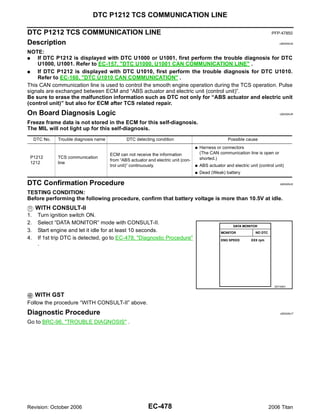
DTC P0500 VSS .................................................... 448     .       DTC P1212 TCS COMMUNICATION LINE ........... 478                         .
 Description .......................................................... 448.         Description ........................................................... 478
                                                                                                                                                            .       C
 On Board Diagnosis Logic .................................. 448           .         On Board Diagnosis Logic ................................... 478       .
 DTC Confirmation Procedure .............................. 448             .         DTC Confirmation Procedure .............................. 478          .
 Overall Function Check ....................................... 448        .         Diagnostic Procedure .......................................... 478    .       D
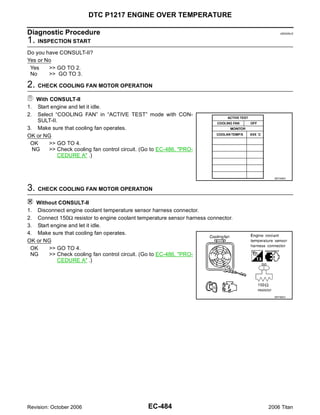
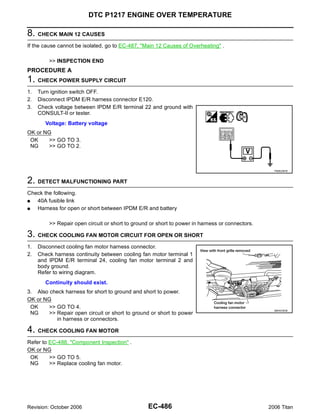
 Diagnostic Procedure .......................................... 449       .       DTC P1217 ENGINE OVER TEMPERATURE ....... 479                            .
DTC P0506 ISC SYSTEM ...................................... 450            .         Description ........................................................... 479
                                                                                                                                                            .
 Description .......................................................... 450.         CONSULT-II Reference Value in Data Monitor Mode                                E
 On Board Diagnosis Logic .................................. 450           .                                                                                . 479
 DTC Confirmation Procedure .............................. 450             .         On Board Diagnosis Logic ................................... 480       .
 Diagnostic Procedure .......................................... 451       .         Overall Function Check ....................................... 480     .
DTC P0507 ISC SYSTEM ...................................... 452            .         Wiring Diagram .................................................... 482.       F
 Description .......................................................... 452.         Diagnostic Procedure .......................................... 484    .
 On Board Diagnosis Logic .................................. 452           .         Main 12 Causes of Overheating .......................... 487           .
 DTC Confirmation Procedure .............................. 452             .         Component Inspection ......................................... 488     .       G
 Diagnostic Procedure .......................................... 453       .       DTC P1220 FUEL PUMP CONTROL MODULE
DTC P0550 PSP SENSOR .................................... 454              .       (FPCM) ................................................................... 489
                                                                                                                                                            .
 Component Description ....................................... 454         .         Description ........................................................... 489
                                                                                                                                                            .       H
 CONSULT-II Reference Value in Data Monitor Mode                                     CONSULT-II Reference Value in Data Monitor Mode
                                                                           . 454                                                                            . 489
 On Board Diagnosis Logic .................................. 454           .         On Board Diagnosis Logic ................................... 489       .
                                                                                                                                                                     I
 DTC Confirmation Procedure .............................. 454             .         DTC Confirmation Procedure .............................. 490          .
 Wiring Diagram ................................................... 455    .         Wiring Diagram .................................................... 491.
 Diagnostic Procedure .......................................... 456       .         Diagnostic Procedure .......................................... 492    .
 Component Inspection ........................................ 458         .         Component Inspection ......................................... 495     .       J
 Removal and Installation ..................................... 458        .       DTC P1225 TP SENSOR ....................................... 497          .
DTC P0603 ECM POWER SUPPLY ...................... 459                      .         Component Description ....................................... 497      .
 Component Description ....................................... 459         .         On Board Diagnosis Logic ................................... 497       .       K
 On Board Diagnosis Logic .................................. 459           .         DTC Confirmation Procedure .............................. 497          .
 DTC Confirmation Procedure .............................. 459             .         Diagnostic Procedure .......................................... 498    .
 Wiring Diagram ................................................... 460    .         Removal and Installation ..................................... 498     .
                                                                                                                                                                    L
 Diagnostic Procedure .......................................... 461       .       DTC P1226 TP SENSOR ....................................... 499          .
DTC P0605 ECM ................................................... 463      .         Component Description ....................................... 499      .
 Component Description ....................................... 463         .         On Board Diagnosis Logic ................................... 499       .
 On Board Diagnosis Logic .................................. 463           .         DTC Confirmation Procedure .............................. 499          .       M
 DTC Confirmation Procedure .............................. 463             .         Diagnostic Procedure .......................................... 500    .
 Diagnostic Procedure .......................................... 464       .         Removal and Installation ..................................... 500     .
DTC P0643 SENSOR POWER SUPPLY ............... 466                          .       DTC P1564 ASCD STEERING SWITCH ............... 501                       .
 On Board Diagnosis Logic .................................. 466           .         Component Description ....................................... 501      .
 DTC Confirmation Procedure .............................. 466             .         CONSULT-II Reference Value in Data Monitor Mode
 Wiring Diagram ................................................... 467    .                                                                                . 501
 Diagnostic Procedure .......................................... 469       .         On Board Diagnosis Logic ................................... 501       .
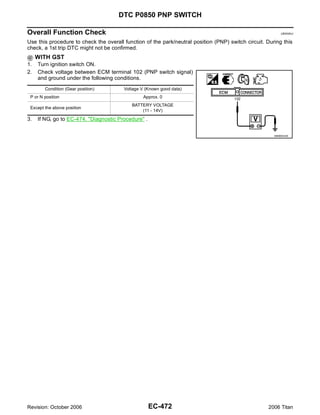
DTC P0850 PNP SWITCH ..................................... 471             .         DTC Confirmation Procedure .............................. 502          .
 Component Description ....................................... 471         .         Wiring Diagram .................................................... 503.
 CONSULT-II Reference Value in Data Monitor Mode                                     Diagnostic Procedure .......................................... 504    .
                                                                           . 471     Component Inspection ......................................... 507     .
 On Board Diagnosis Logic .................................. 471           .       DTC P1572 ASCD BRAKE SWITCH ..................... 508                    .
 DTC Confirmation Procedure .............................. 471             .         Component Description ....................................... 508      .
 Overall Function Check ....................................... 472        .         CONSULT-II Reference Value in Data Monitor Mode
 Wiring Diagram ................................................... 473    .                                                                                . 508
 Diagnostic Procedure .......................................... 474       .         On Board Diagnosis Logic ................................... 508       .
                                                                                     DTC confirmation Procedure ............................... 509         .

Revision: October 2006                                                       EC-5                                                                 2006 Titan
Wiring Diagram .................................................... 510 .       DTC P2127, P2128 APP SENSOR ........................ 548               .
 Diagnostic Procedure .......................................... 511     .        Component Description ....................................... 548     .
 Component Inspection ......................................... 515      .        CONSULT-II Reference Value in Data Monitor Mode
DTC P1574 ASCD VEHICLE SPEED SENSOR .... 516                             .                                                                              .548
 Component Description ....................................... 516       .        On Board Diagnosis Logic ................................... 548      .
 On Board Diagnosis Logic ................................... 516        .        DTC Confirmation Procedure ............................... 549        .
 DTC Confirmation Procedure .............................. 516           .        Wiring Diagram .................................................... 550
                                                                                                                                                        .
 Diagnostic Procedure .......................................... 517     .        Diagnostic Procedure ........................................... 551  .
DTC P1805 BRAKE SWITCH ................................ 518              .        Component Inspection ......................................... 554    .
 Description ........................................................... 518
                                                                         .        Removal and Installation ...................................... 554   .
 CONSULT-II Reference Value in Data Monitor Mode                                 DTC P2135 TP SENSOR ....................................... 555        .
                                                                         . 518    Component Description ....................................... 555     .
 On Board Diagnosis Logic ................................... 518        .        CONSULT-II Reference Value in Data Monitor Mode
 DTC Confirmation Procedure .............................. 518           .                                                                              .555
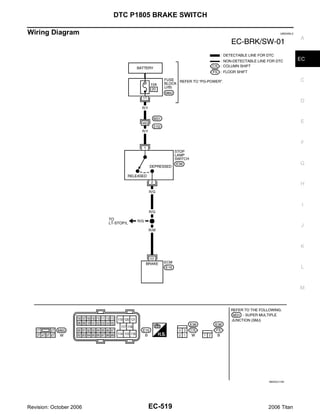
 Wiring Diagram .................................................... 519 .        On Board Diagnosis Logic ................................... 555      .
 Diagnostic Procedure .......................................... 520     .        DTC Confirmation Procedure ............................... 556        .
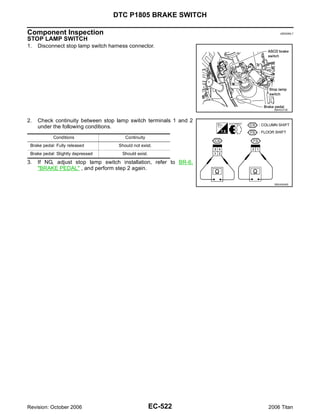
 Component Inspection ......................................... 522      .        Wiring Diagram .................................................... 557
                                                                                                                                                        .
DTC P2100, P2103 THROTTLE CONTROL MOTOR                                           Diagnostic Procedure ........................................... 558  .
RELAY .................................................................... 523
                                                                         .        Component Inspection ......................................... 561    .
 Component Description ....................................... 523       .        Removal and Installation ...................................... 561   .
 CONSULT-II Reference Value in Data Monitor Mode                                 DTC P2138 APP SENSOR ..................................... 562         .
                                                                         . 523    Component Description ....................................... 562     .
 On Board Diagnosis Logic ................................... 523        .        CONSULT-II Reference Value in Data Monitor Mode
 DTC Confirmation Procedure .............................. 523           .                                                                              .562
 Wiring Diagram .................................................... 525 .        On Board Diagnosis Logic ................................... 562      .
 Diagnostic Procedure .......................................... 526     .        DTC Confirmation Procedure ............................... 563        .
DTC P2101 ELECTRIC THROTTLE CONTROL                                               Wiring Diagram .................................................... 564
                                                                                                                                                        .
FUNCTION ............................................................. 529
                                                                         .        Diagnostic Procedure ........................................... 565  .
 Description ........................................................... 529
                                                                         .        Component Inspection ......................................... 569    .
 On Board Diagnosis Logic ................................... 529        .        Removal and Installation ...................................... 569   .
 DTC Confirmation Procedure .............................. 529           .       DTC P2A00, P2A03 A/F SENSOR 1 ...................... 570               .
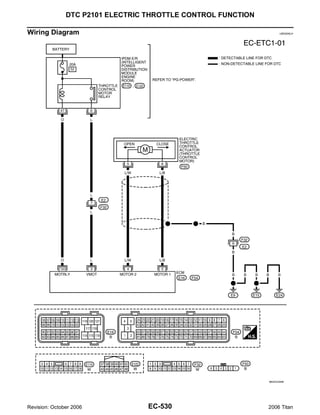
 Wiring Diagram .................................................... 530 .        Component Description ....................................... 570     .
 Diagnostic Procedure .......................................... 531     .        CONSULT-II Reference Value in Data Monitor Mode
 Component Inspection ......................................... 534      .                                                                              .570
 Removal and Installation ..................................... 534      .        On Board Diagnosis Logic ................................... 570      .
DTC P2118 THROTTLE CONTROL MOTOR ........ 535                            .        DTC Confirmation Procedure ............................... 570        .
 Component Description ....................................... 535       .        Wiring Diagram .................................................... 572
                                                                                                                                                        .
 On Board Diagnosis Logic ................................... 535        .        Diagnostic Procedure ........................................... 575  .
 DTC Confirmation Procedure .............................. 535           .        Removal and Installation ...................................... 580   .
 Wiring Diagram .................................................... 536 .       ASCD BRAKE SWITCH ......................................... 581        .
 Diagnostic Procedure .......................................... 537     .        Component Description ....................................... 581     .
 Component Inspection ......................................... 538      .        CONSULT-II Reference Value in Data Monitor Mode
 Removal and Installation ..................................... 539      .                                                                              .581
DTC P2119 ELECTRIC THROTTLE CONTROL                                               Wiring Diagram .................................................... 582
                                                                                                                                                        .
ACTUATOR ............................................................ 540.        Diagnostic Procedure ........................................... 583  .
 Component Description ....................................... 540       .        Component Inspection ......................................... 587    .
 On Board Diagnosis Logic ................................... 540        .       ASCD INDICATOR ................................................. 588   .
 DTC Confirmation Procedure .............................. 540           .        Component Description ....................................... 588     .
 Diagnostic Procedure .......................................... 541     .        CONSULT-II Reference Value in Data Monitor Mode
DTC P2122, P2123 APP SENSOR ........................ 542                 .                                                                              .588
 Component Description ....................................... 542       .        Wiring Diagram .................................................... 589
                                                                                                                                                        .
 CONSULT-II Reference Value in Data Monitor Mode                                  Diagnostic Procedure ........................................... 590  .
                                                                         . 542   ELECTRICAL LOAD SIGNAL ............................... 591             .
 On Board Diagnosis Logic ................................... 542        .        Description ........................................................... 591
                                                                                                                                                        .
 DTC Confirmation Procedure .............................. 543           .        CONSULT-II Reference Value in Data Monitor Mode
 Wiring Diagram .................................................... 544 .                                                                              .591
 Diagnostic Procedure .......................................... 545     .        Diagnostic Procedure ........................................... 591  .
 Component Inspection ......................................... 547      .       FUEL INJECTOR .................................................... 592 .
 Removal and Installation ..................................... 547      .        Component Description ....................................... 592     .

Revision: October 2006                                                      EC-6                                                               2006 Titan
CONSULT-II Reference Value in Data Monitor Mode                               Component Description ....................................... 623     .
                                                                       . 592    Wiring Diagram .................................................... 624
                                                                                                                                                      .       A
  Wiring Diagram ................................................... 593
                                                                       .        Diagnostic Procedure .......................................... 625   .
  Diagnostic Procedure .......................................... 594  .        Removal and Installation ..................................... 627    .
  Component Inspection ........................................ 597    .       MIL AND DATA LINK CONNECTOR ..................... 628                  .       EC
  Removal and Installation ..................................... 597   .        Wiring Diagram .................................................... 628
                                                                                                                                                      .
FUEL PUMP .......................................................... 598
                                                                       .       SERVICE DATA AND SPECIFICATIONS (SDS) ... 630                          .
  Description .......................................................... 598
                                                                       .        Fuel Pressure ...................................................... 630
                                                                                                                                                      .
  CONSULT-II Reference Value in Data Monitor Mode                               Idle Speed and Ignition Timing ............................ 630       .       C
                                                                       . 598    Calculated Load Value ......................................... 630   .
  Wiring Diagram ................................................... 599
                                                                       .        Mass Air Flow Sensor .......................................... 630   .
  Diagnostic Procedure .......................................... 602  .        Intake Air Temperature Sensor ............................ 630        .       D
  Component Inspection ........................................ 609    .        Engine Coolant Temperature Sensor .................. 630              .
  Removal and Installation ..................................... 610   .        A/F Sensor 1 Heater ............................................ 630  .
IGNITION SIGNAL ..................................................611  .        Heated Oxygen sensor 2 Heater ......................... 630           .       E
  Component Description ........................................611    .        Crankshaft Position Sensor (POS) ...................... 630           .
  Wiring Diagram ................................................... 612
                                                                       .        Camshaft Position Sensor (PHASE) ................... 630              .
  Diagnostic Procedure .......................................... 617  .        Throttle Control Motor .......................................... 630 .
  Component Inspection ........................................ 621    .        Fuel Injector ......................................................... 631
                                                                                                                                                      .       F
  Removal and Installation ..................................... 622   .        Fuel Pump ........................................................... 631
                                                                                                                                                      .
REFRIGERANT PRESSURE SENSOR ................ 623                       .
                                                                                                                                                              G


                                                                                                                                                              H


                                                                                                                                                               I


                                                                                                                                                              J


                                                                                                                                                              K


                                                                                                                                                              L


                                                                                                                                                              M


Revision: October 2006                                                   EC-7                                                               2006 Titan
INDEX FOR DTC

INDEX FOR DTC                                                                                  PFP:00024

DTC No. Index                                                                                     UBS00N9F


NOTE:
G  If DTC U1000 or U1001 is displayed with other DTC, first perform the trouble diagnosis for DTC
   U1000, U1001. Refer to EC-157, "DTC U1000, U1001 CAN COMMUNICATION LINE" .
G  If DTC U1010 is displayed with other DTC, first perform the trouble diagnosis for DTC U1010. Refer
   to EC-160, "DTC U1010 CAN COMMUNICATION" .

                  DTC*1
                                                           Items
     CONSULT-II                                                                     Reference page
                                                   (CONSULT-II screen terms)
                          ECM*3
        GST*2
        U1000             1000*4      CAN COMM CIRCUIT                                 EC-157

        U1001             1001*4      CAN COMM CIRCUIT                                 EC-157
        U1010             1010        CONTROL UNIT(CAN)                                EC-160
                                      NO DTC IS DETECTED.
        P0000             0000        FURTHER TESTING                                     —
                                      MAY BE REQUIRED.
        P0031             0031        A/F SEN1 HTR (B1)                                EC-162
        P0032             0032        A/F SEN1 HTR (B1)                                EC-162
        P0037             0037        HO2S2 HTR (B1)                                   EC-169
        P0038             0038        HO2S2 HTR (B1)                                   EC-169
        P0051             0051        A/F SEN1 HTR (B2)                                EC-162
        P0052             0052        A/F SEN1 HTR (B2)                                EC-162
        P0057             0057        HO2S2 HTR (B2)                                   EC-169
        P0058             0058        HO2S2 HTR (B2)                                   EC-169
        P0101             0101        MAF SEN/CIRCUIT                                  EC-177
        P0102             0102        MAF SEN/CIRCUIT                                  EC-186
        P0103             0103        MAF SEN/CIRCUIT                                  EC-186
        P0112             0112        IAT SEN/CIRCUIT                                  EC-194
        P0113             0113        IAT SEN/CIRCUIT                                  EC-194
        P0117             0117        ECT SEN/CIRC                                     EC-198
        P0118             0118        ECT SEN/CIRC                                     EC-198
        P0122             0122        TP SEN 2/CIRC                                    EC-204
        P0123             0123        TP SEN 2/CIRC                                    EC-204
        P0125             0125        ECT SENSOR                                       EC-211
        P0127             0127        IAT SENSOR                                       EC-214
        P0128             0128        THERMSTAT FNCTN                                  EC-217
        P0130             0130        A/F SENSOR1 (B1)                                 EC-219
        P0131             0131        A/F SENSOR1 (B1)                                 EC-229
        P0132             0132        A/F SENSOR1 (B1)                                 EC-238
        P0133             0133        A/F SENSOR1 (B1)                                 EC-247
        P0137             0137        HO2S2 (B2)                                       EC-259
        P0138             0138        HO2S2 (B1)                                       EC-270
        P0139             0139        HO2S2 (B1)                                       EC-283
        P0150             0150        A/F SENSOR1 (B2)                                 EC-219
        P0151             0151        A/F SENSOR1 (B2)                                 EC-229
        P0152             0152        A/F SENSOR1 (B2)                                 EC-238


Revision: October 2006                         EC-8                                           2006 Titan
INDEX FOR DTC

                  DTC*1
                                                       Items                                    A
     CONSULT-II                                                            Reference page
                                               (CONSULT-II screen terms)
                          ECM*3
        GST*2
        P0153             0153    A/F SENSOR1 (B2)                            EC-247            EC
        P0157             0157    HO2S2 (B2)                                  EC-259
        P0158             0158    HO2S2 (B2)                                  EC-270
        P0159             0159    HO2S2 (B2)                                  EC-283            C
        P0171             0171    FUEL SYS-LEAN-B1                            EC-294
        P0172             0172    FUEL SYS-RICH-B1                            EC-305
                                                                                                D
        P0174             0174    FUEL SYS-LEAN-B2                            EC-294
        P0175             0175    FUEL SYS-RICH-B2                            EC-305
        P0181             0181    FTT SENSOR                                  EC-315            E
        P0182             0182    FTT SEN/CIRCUIT                             EC-321
        P0183             0183    FTT SEN/CIRCUIT                             EC-321
                                                                                                F
        P0222             0222    TP SEN 1/CIRC                               EC-326
        P0223             0223    TP SEN 1/CIRC                               EC-326
        P0300             0300    MULTI CYL MISFIRE                           EC-333            G
        P0301             0301    CYL 1 MISFIRE                               EC-333
        P0302             0302    CYL 2 MISFIRE                               EC-333
                                                                                                H
        P0303             0303    CYL 3 MISFIRE                               EC-333
        P0304             0304    CYL 4 MISFIRE                               EC-333
        P0305             0305    CYL 5 MISFIRE                               EC-333             I
        P0306             0306    CYL 6 MISFIRE                               EC-333
        P0307             0307    CYL 7 MISFIRE                               EC-333
        P0308             0308    CYL 8 MISFIRE                               EC-333            J
        P0327             0327    KNOCK SEN/CIRC-B1                           EC-341
        P0328             0328    KNOCK SEN/CIRC-B1                           EC-341
                                                                                                K
        P0332             0332    KNOCK SEN/CIRC-B2                           EC-341
        P0333             0333    KNOCK SEN/CIRC-B2                           EC-341
        P0335             0335    CKP SEN/CIRCUIT                             EC-346            L
        P0340             0340    CMP SEN/CIRC-B1                             EC-353
        P0420             0420    TW CATALYST SYS-B1                          EC-360
                                                                                                M
        P0430             0430    TW CATALYST SYS-B2                          EC-360
        P0441             0441    EVAP PURG FLOW/MON                          EC-366
        P0442             0442    EVAP SMALL LEAK                             EC-371
        P0443             0443    PURG VOLUME CONT/V                          EC-379
        P0444             0444    PURG VOLUME CONT/V                          EC-387
        P0445             0445    PURG VOLUME CONT/V                          EC-387
        P0447             0447    VENT CONTROL VALVE                          EC-394
        P0448             0448    VENT CONTROL VALVE                          EC-401
        P0451             0451    EVAP SYS PRES SEN                           EC-408
        P0452             0452    EVAP SYS PRES SEN                           EC-411
        P0453             0453    EVAP SYS PRES SEN                           EC-417
        P0455             0455    EVAP GROSS LEAK                             EC-425
        P0456             0456    EVAP VERY SML LEAK                          EC-433


Revision: October 2006                     EC-9                                    2006 Titan
INDEX FOR DTC

                    DTC*1
                                                             Items
     CONSULT-II                                                                  Reference page
                                                     (CONSULT-II screen terms)
                              ECM*3
        GST*2
        P0460                  0460       FUEL LEV SEN SLOSH                        EC-442
        P0461                  0461       FUEL LEVEL SENSOR                         EC-444
        P0462                  0462       FUEL LEVL SEN/CIRC                        EC-446
        P0463                  0463       FUEL LEVL SEN/CIRC                        EC-446
        P0500                  0500       VEH SPEED SEN/CIRC*5                      EC-448
        P0506                  0506       ISC SYSTEM                                EC-450
        P0507                  0507       ISC SYSTEM                                EC-452
        P0550                  0550       PW ST P SEN/CIRC                          EC-454
        P0603                  0603       ECM BACK UP/CIRCUIT                       EC-459
        P0605                  0605       ECM                                       EC-463
        P0643                  0643       SENSOR POWER/CIRC                         EC-466
        P0700                  0700       TCM                                       AT-106
        P0705                  0705       PNP SW/CIRC                               AT-107
        P0710                  0710       ATF TEMP SEN/CIRC                         AT-129
        P0717                  0717       TURBINE REV S/CIRC                         AT-111

        P0720                  0720       VEH SPD SEN/CIR AT*5                      AT-113
        P0740                  0740       TCC SOLENOID/CIRC                         AT-120
        P0744                  0744       A/T TCC S/V FNCTN                         AT-122
        P0745                  0745       L/PRESS SOL/CIRC                          AT-124
        P0850                  0850       P-N POS SW/CIRCUIT                        EC-471
        P1148                  1148       CLOSED LOOP-B1                            EC-476
        P1168                  1168       CLOSED LOOP-B2                            EC-476
        P1211                  1211       TCS C/U FUNCTN                            EC-477
        P1212                  1212       TCS/CIRC                                  EC-478
        P1217                  1217       ENG OVER TEMP                             EC-479
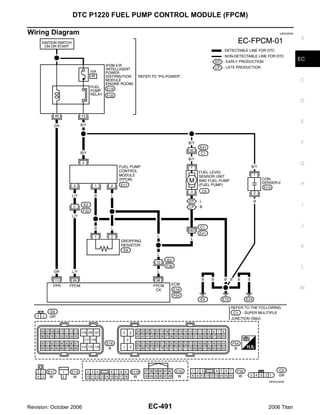
        P1220                  1220                      7                          EC-489
                                          FPCM/CIRCUIT*
        P1225                  1225       CTP LEARNING                              EC-497
        P1226                  1226       CTP LEARNING                              EC-499
        P1564                  1564       ASCD SW                                   EC-501
        P1572                  1572       ASCD BRAKE SW                             EC-508
        P1574                  1574                           6                     EC-516
                                          ASCD VHL SPD SEN*
    P1610 - P1615           1610 - 1615   NATS MALFUNCTION                          BL-139
        P1730                  1730       A/T INTERLOCK                             AT-136
        P1752                  1752       I/C SOLENOID/CIRC                         AT-141
        P1754                  1754       I/C SOLENOID FNCTN                        AT-143
        P1757                  1757       FR/B SOLENOID/CIRC                        AT-145
        P1759                  1759       FR/B SOLENOID FNCT                        AT-147
        P1762                  1762       D/C SOLENOID/CIRC                         AT-149
        P1764                  1764       D/C SOLENOID FNCTN                        AT-151
        P1767                  1767       HLR/C SOL/CIRC                            AT-153
        P1769                  1769       HLR/C SOL FNCTN                           AT-155
        P1772                  1772       LC/B SOLENOID/CIRC                        AT-157

Revision: October 2006                              EC-10                                2006 Titan
INDEX FOR DTC

                      DTC*1
                                                                          Items                                       A
       CONSULT-II                                                                                Reference page
                                                                  (CONSULT-II screen terms)
                                   ECM*3
          GST*2
          P1774                     1774            LC/B SOLENOID FNCT                              AT-159            EC
          P1805                     1805            BRAKE SW/CIRCUIT                                EC-518
          P2100                     2100            ETC MOT PWR                                     EC-523
          P2101                     2101             ETC FUNCTION/CIRC                              EC-529            C
          P2103                     2103            ETC MOT PWR                                     EC-523
          P2118                     2118            ETC MOT                                         EC-535
                                                                                                                      D
          P2119                     2119            ETC ACTR                                        EC-540
          P2122                     2122            APP SEN 1/CIRC                                  EC-542
          P2123                     2123            APP SEN 1/CIRC                                  EC-542            E
          P2127                     2127            APP SEN 2/CIRC                                  EC-548
          P2128                     2128            APP SEN 2/CIRC                                  EC-548
                                                                                                                      F
          P2135                     2135             TP SENSOR                                      EC-555
          P2138                     2138             APP SENSOR                                     EC-562
          P2A00                     2A00            A/F SENSOR1 (B1)                                EC-570            G
          P2A03                     2A03            A/F SENSOR1 (B2)                                EC-570
*1: 1st trip DTC No. is the same as DTC No.
*2: This number is prescribed by SAE J2012.                                                                           H
*3: In Diagnostic Test Mode II (Self-diagnostic results), this number is controlled by NISSAN.
*4: The troubleshooting for this DTC needs CONSULT-II.
*5: When the fail-safe operations for both self-diagnoses occur, the MIL illuminates.
                                                                                                                       I
*6: 2WD models
*7: Flexible fuel vehicle (FFV)

                                                                                                                      J


                                                                                                                      K


                                                                                                                      L


                                                                                                                      M


Revision: October 2006                                         EC-11                                     2006 Titan
INDEX FOR DTC

Alphabetical Index                                                                               UBS00N9G


NOTE:
G  If DTC U1000 or U1001 is displayed with other DTC, first perform the trouble diagnosis for DTC
   U1000, U1001. Refer to EC-157, "DTC U1000, U1001 CAN COMMUNICATION LINE" .
G  If DTC U1010 is displayed with other DTC, first perform the trouble diagnosis for DTC U1010. Refer
   to EC-160, "DTC U1010 CAN COMMUNICATION" .

                                                         DTC*1
                   Items
                                            CONSULT-II                              Reference page
           (CONSULT-II screen terms)
                                                     2            ECM*3
                                              GST*
 A/F SENSOR1 (B1)                             P0130                0130                EC-219
 A/F SENSOR1 (B1)                             P0131                0131                EC-229
 A/F SENSOR1 (B1)                             P0132                0132                EC-238
 A/F SENSOR1 (B1)                             P0133                0133                EC-247
 A/F SENSOR1 (B1)                             P2A00                2A00                EC-570
 A/F SENSOR1 (B2)                             P0150                0150                EC-219
 A/F SENSOR1 (B2)                             P0151                0151                EC-229
 A/F SENSOR1 (B2)                             P0152                0152                EC-238
 A/F SENSOR1 (B2)                             P0153                0153                EC-247
 A/F SENSOR1 (B2)                             P2A03                2A03                EC-570
 A/F SEN1 HTR (B1)                            P0031                0031                EC-162
 A/F SEN1 HTR (B1)                            P0032                0032                EC-162
 A/F SEN1 HTR (B2)                            P0051                0051                EC-162
 A/F SEN1 HTR (B2)                            P0052                0052                EC-162
 A/T INTERLOCK                                P1730                1730                AT-136
 A/T TCC S/V FNCTN                            P0744                0744                AT-122
 APP SEN 1/CIRC                               P2122                2122                EC-542
 APP SEN 1/CIRC                               P2123                2123                EC-542
 APP SEN 2/CIRC                               P2127                2127                EC-548
 APP SEN 2/CIRC                               P2128                2128                EC-548
 APP SENSOR                                   P2138                2138                EC-562
 ASCD BRAKE SW                                P1572                1572                EC-508
 ASCD SW                                      P1564                1564                EC-501

 ASCD VHL SPD SEN*6                           P1574                1574                EC-516

 ATF TEMP SEN/CIRC                            P0710                0710                AT-129
 BRAKE SW/CIRCUIT                             P1805                1805                EC-518
 CAN COMM CIRCUIT                             U1000               1000*4               EC-157

 CAN COMM CIRCUIT                             U1001               1001*4               EC-157

 CKP SEN/CIRCUIT                              P0335                0335                EC-346
 CLOSED LOOP-B1                               P1148                1148                EC-476
 CLOSED LOOP-B2                               P1168                1168                EC-476
 CMP SEN/CIRC-B1                              P0340                0340                EC-353
 CONTROL UNIT(CAN)                            U1010                1010                EC-160
 CTP LEARNING                                 P1225                1225                EC-497
 CTP LEARNING                                 P1226                1226                EC-499
 CYL 1 MISFIRE                                P0301                0301                EC-333


Revision: October 2006                        EC-12                                         2006 Titan
INDEX FOR DTC

                                                      DTC*1
                   Items                                                                   A
                                         CONSULT-II                   Reference page
           (CONSULT-II screen terms)
                                                              ECM*3
                                           GST*2
 CYL 2 MISFIRE                             P0302              0302       EC-333            EC
 CYL 3 MISFIRE                             P0303              0303       EC-333
 CYL 4 MISFIRE                             P0304              0304       EC-333
 CYL 5 MISFIRE                             P0305              0305       EC-333            C
 CYL 6 MISFIRE                             P0306              0306       EC-333
 CYL 7 MISFIRE                             P0307              0307       EC-333
                                                                                           D
 CYL 8 MISFIRE                             P0308              0308       EC-333
 D/C SOLENOID/CIRC                         P1762              1762       AT-149
 D/C SOLENOID FNCTN                        P1764              1764       AT-151            E
 ECM                                       P0605              0605       EC-463
 ECM BACK UP/CIRCUIT                       P0603              0603       EC-459
                                                                                           F
 ECT SEN/CIRC                              P0117              0117       EC-198
 ECT SEN/CIRC                              P0118              0118       EC-198
 ECT SENSOR                                P0125              0125       EC-211            G
 ENG OVER TEMP                             P1217              1217       EC-479
 ETC ACTR                                  P2119              2119       EC-540
                                                                                           H
 ETC FUNCTION/CIRC                         P2101              2101       EC-529
 ETC MOT                                   P2118              2118       EC-535
 ETC MOT PWR                               P2100              2100       EC-523             I
 ETC MOT PWR                               P2103              2103       EC-523
 EVAP GROSS LEAK                           P0455              0455       EC-425
 EVAP PURG FLOW/MON                        P0441              0441       EC-366            J
 EVAP SMALL LEAK                           P0442              0442       EC-371
 EVAP SYS PRES SEN                         P0451              0451       EC-408
                                                                                           K
 EVAP SYS PRES SEN                         P0452              0452       EC-411
 EVAP SYS PRES SEN                         P0453              0453       EC-417
 EVAP VERY SML LEAK                        P0456              0456       EC-433            L

 FPCM/CIRCUIT*7                            P1220              1220       EC-489
 FR/B SOLENOID/CIRC                        P1757              1757       AT-145
                                                                                           M
 FR/B SOLENOID FNCT                        P1759              1759       AT-147
 FTT SEN/CIRCUIT                           P0182              0182       EC-321
 FTT SEN/CIRCUIT                           P0183              0183       EC-321
 FTT SENSOR                                P0181              0181       EC-315
 FUEL LEV SEN SLOSH                        P0460              0460       EC-442
 FUEL LEVEL SENSOR                         P0461              0461       EC-444
 FUEL LEVL SEN/CIRC                        P0462              0462       EC-446
 FUEL LEVL SEN/CIRC                        P0463              0463       EC-446
 FUEL SYS-LEAN-B1                          P0171              0171       EC-294
 FUEL SYS-LEAN-B2                          P0174              0174       EC-294
 FUEL SYS-RICH-B1                          P0172              0172       EC-305
 FUEL SYS-RICH-B2                          P0175              0175       EC-305
 HLR/C SOL/CIRC                            P1767              1767       AT-153


Revision: October 2006                     EC-13                              2006 Titan
INDEX FOR DTC

                                                      DTC*1
                 Items
                                       CONSULT-II                           Reference page
         (CONSULT-II screen terms)
                                                2               ECM*3
                                         GST*
 HLR/C SOL FNCTN                         P1769                   1769          AT-155
 HO2S2 (B1)                              P0137                   0137          EC-259
 HO2S2 (B1)                              P0138                   0138          EC-270
 HO2S2 (B1)                              P0139                   0139          EC-283
 HO2S2 (B2)                              P0157                   0157          EC-259
 HO2S2 (B2)                              P0158                   0158          EC-270
 HO2S2 (B2)                              P0159                   0159          EC-283
 HO2S2 HTR (B1)                          P0037                   0037          EC-169
 HO2S2 HTR (B1)                          P0038                   0038          EC-169
 HO2S2 HTR (B2)                          P0057                   0057          EC-169
 HO2S2 HTR (B2)                          P0058                   0058          EC-169
 I/C SOLENOID/CIRC                       P1752                   1752          AT-141
 I/C SOLENOID FNCTN                      P1754                   1754          AT-143
 IAT SEN/CIRCUIT                         P0112                   0112          EC-194
 IAT SEN/CIRCUIT                         P0113                   0113          EC-194
 IAT SENSOR                              P0127                   0127          EC-214
 ISC SYSTEM                              P0506                   0506          EC-450
 ISC SYSTEM                              P0507                   0507          EC-452
 KNOCK SEN/CIRC-B1                       P0327                   0327          EC-341
 KNOCK SEN/CIRC-B1                       P0328                   0328          EC-341
 KNOCK SEN/CIRC-B2                       P0332                   0332          EC-341
 KNOCK SEN/CIRC-B2                       P0333                   0333          EC-341
 L/PRESS SOL/CIRC                        P0745                   0745          AT-124
 LC/B SOLENOID/CIRC                      P1772                   1772          AT-157
 LC/B SOLENOID FNCT                      P1774                   1774          AT-159
 MAF SEN/CIRCUIT                         P0101                   0101          EC-177
 MAF SEN/CIRCUIT                         P0102                   0102          EC-186
 MAF SEN/CIRCUIT                         P0103                   0103          EC-186
 MULTI CYL MISFIRE                       P0300                   0300          EC-333
 NATS MALFUNCTION                     P1610 - P1615           1610 - 1615      BL-139
 NO DTC IS DETECTED.
 FURTHER TESTING                         P0000                   0000            —
 MAY BE REQUIRED.
 P-N POS SW/CIRCUIT                      P0850                   0850          EC-471
 PNP SW/CIRC                             P0705                   0705          AT-107
 PURG VOLUME CONT/V                      P0443                   0443          EC-379
 PURG VOLUME CONT/V                      P0444                   0444          EC-387
 PURG VOLUME CONT/V                      P0445                   0445          EC-387
 PW ST P SEN/CIRC                        P0550                   0550          EC-454
 SENSOR POWER/CIRC                       P0643                   0643          EC-466
 TCC SOLENOID/CIRC                       P0740                   0740          AT-120
 TCM                                     P0700                   0700          AT-106
 TCS C/U FUNCTN                          P1211                   1211          EC-477


Revision: October 2006                    EC-14                                      2006 Titan
INDEX FOR DTC

                                                                             DTC*1
                    Items                                                                                               A
                                                            CONSULT-II                             Reference page
            (CONSULT-II screen terms)
                                                                                           ECM*3
                                                               GST*2
 TCS/CIRC                                                      P1212                        1212      EC-478            EC
 THERMSTAT FNCTN                                               P0128                        0128      EC-217
 TP SEN 1/CIRC                                                 P0222                        0222      EC-326
 TP SEN 1/CIRC                                                 P0223                        0223      EC-326            C
 TP SEN 2/CIRC                                                 P0122                        0122      EC-204
 TP SEN 2/CIRC                                                 P0123                        0123      EC-204
                                                                                                                        D
 TP SENSOR                                                     P2135                        2135      EC-555
 TURBINE REV S/CIRC                                            P0717                        0717       AT-111
 TW CATALYST SYS-B1                                            P0420                        0420      EC-360            E
 TW CATALYST SYS-B2                                            P0430                        0430      EC-360

 VEH SPD SEN/CIR AT*5                                          P0720                        0720      AT-113
                                                                                                                        F
                           5                                   P0500                        0500      EC-448
 VEH SPEED SEN/CIRC*
 VENT CONTROL VALVE                                            P0447                        0447      EC-394
 VENT CONTROL VALVE                                            P0448                        0448      EC-401            G
*1: 1st trip DTC No. is the same as DTC No.
*2: This number is prescribed by SAE J2012.
*3: In Diagnostic Test Mode II (Self-diagnostic results), this number is controlled by NISSAN.                          H
*4: The troubleshooting for this DTC needs CONSULT-II.
*5: When the fail-safe operations for both self-diagnoses occur, the MIL illuminates.
*6: 2WD models
                                                                                                                         I
*7: Flexible fuel vehicle (FFV)


                                                                                                                        J


                                                                                                                        K


                                                                                                                        L


                                                                                                                        M


Revision: October 2006                                         EC-15                                       2006 Titan
PRECAUTIONS

PRECAUTIONS                                                         PFP:00001

Precautions for Supplemental Restraint System (SRS) “AIR BAG” and “SEAT
BELT PRE-TENSIONER”                                                                                            UBS00N9H


The Supplemental Restraint System such as “AIR BAG” and “SEAT BELT PRE-TENSIONER”, used along
with a front seat belt, helps to reduce the risk or severity of injury to the driver and front passenger for certain
types of collision. This system includes seat belt switch inputs and dual stage front air bag modules. The SRS
system uses the seat belt switches to determine the front air bag deployment, and may only deploy one front
air bag, depending on the severity of a collision and whether the front occupants are belted or unbelted.
Information necessary to service the system safely is included in the SRS and SB section of this Service Man-
ual.
WARNING:
G    To avoid rendering the SRS inoperative, which could increase the risk of personal injury or death
     in the event of a collision which would result in air bag inflation, all maintenance must be per-
     formed by an authorized NISSAN/INFINITI dealer.
G    Improper maintenance, including incorrect removal and installation of the SRS, can lead to per-
     sonal injury caused by unintentional activation of the system. For removal of Spiral Cable and Air
     Bag Module, see the SRS section.
G    Do not use electrical test equipment on any circuit related to the SRS unless instructed to in this
     Service Manual. SRS wiring harnesses can be identified by yellow and/or orange harnesses or
     harness connectors.
On Board Diagnostic (OBD) System of Engine and A/T                                                             UBS00N9I


The ECM has an on board diagnostic system. It will light up the malfunction indicator lamp (MIL) to warn the
driver of a malfunction causing emission deterioration.
CAUTION:
G    Be sure to turn the ignition switch OFF and disconnect the negative battery cable before any
     repair or inspection work. The open/short circuit of related switches, sensors, solenoid valves,
     etc. will cause the MIL to light up.
G    Be sure to connect and lock the connectors securely after work. A loose (unlocked) connector will
     cause the MIL to light up due to the open circuit. (Be sure the connector is free from water, grease,
     dirt, bent terminals, etc.)
G    Certain systems and components, especially those related to OBD, may use a new style slide-
     locking type harness connector. For description and how to disconnect, refer to PG-72, "HAR-
     NESS CONNECTOR" .
G    Be sure to route and secure the harnesses properly after work. The interference of the harness
     with a bracket, etc. may cause the MIL to light up due to the short circuit.
G    Be sure to connect rubber tubes properly after work. A misconnected or disconnected rubber tube
     may cause the MIL to light up due to the malfunction of the EVAP system or fuel injection system,
     etc.
G    Be sure to erase the unnecessary malfunction information (repairs completed) from the ECM and
     TCM (Transmission control module) before returning the vehicle to the customer.
Precaution                                                                                                     UBS00N9J


G   Always use a 12 volt battery as power source.
G   Do not attempt to disconnect battery cables while engine is
    running.
G   Before connecting or disconnecting the ECM harness con-
    nector, turn ignition switch OFF and disconnect negative
    battery cable. Failure to do so may damage the ECM
    because battery voltage is applied to ECM even if ignition
    switch is turned OFF.
G   Before removing parts, turn ignition switch OFF and then
    disconnect negative battery cable.
                                                                                                            SEF289H


Revision: October 2006                               EC-16                                               2006 Titan
PRECAUTIONS

G   Do not disassemble ECM.
G   If a battery cable is disconnected, the memory will return to                                          A
    the ECM value.
    The ECM will now start to self-control at its initial value.
    Engine operation can vary slightly when the terminal is dis-                                           EC
    connected. However, this is not an indication of a malfunc-
    tion. Do not replace parts because of a slight variation.
G   If the battery is disconnected, the following emission-
                                                                                                           C
    related diagnostic information will be lost within 24 hours.
–   Diagnostic trouble codes
                                                                                               PBIB1164E
–   1st trip diagnostic trouble codes                                                                      D
–   Freeze frame data
–   1st trip freeze frame data
–   System readiness test (SRT) codes                                                                      E
–   Test values
–   <Flexible Fuel Vehicle>
    Presumed ethanol mixture ratio                                                                         F
G   When connecting ECM harness connector, fasten it
    securely with a lever as far as it will go as shown in the fig-
    ure.                                                                                                   G


                                                                                                           H


                                                                                                            I
                                                                                               BBIA0387E


G   When connecting or disconnecting pin connectors into or                                                J
    from ECM, take care not to damage pin terminals (bend or
    break).
    Make sure that there are not any bends or breaks on ECM
    pin terminal, when connecting pin connectors.                                                          K
G   Securely connect ECM harness connectors.
    A poor connection can cause an extremely high (surge)
    voltage to develop in coil and condenser, thus resulting in                                            L
    damage to ICs.
G   Keep engine control system harness at least 10 cm (4 in)
    away from adjacent harness, to prevent engine control sys-                              PBIB0090E      M
    tem malfunctions due to receiving external noise, degraded
    operation of ICs, etc.
G   Keep engine control system parts and harness dry.
G   Before replacing ECM, perform ECM Terminals and Refer-
    ence Value inspection and make sure ECM functions prop-
    erly. Refer to EC-111, "ECM Terminals and Reference Value"
    .
G   Handle mass air flow sensor carefully to avoid damage.
G   Do not disassemble mass air flow sensor.
G   Do not clean mass air flow sensor with any type of deter-
    gent.
G   Do not disassemble electric throttle control actuator.
G   Even a slight leak in the air intake system can cause seri-                             MEF040D
    ous incidents.
G   Do not shock or jar the camshaft position sensor (PHASE), crankshaft position sensor (POS).


Revision: October 2006                           EC-17                                       2006 Titan
PRECAUTIONS

G   After performing each TROUBLE DIAGNOSIS, perform DTC
    Confirmation Procedure or Overall Function Check.
    The DTC should not be displayed in the DTC Confirmation
    Procedure if the repair is completed. The Overall Function
    Check should be a good result if the repair is completed.


                                                                    SEF217U


G   When measuring ECM signals with a circuit tester, never
    allow the two tester probes to contact.
    Accidental contact of probes will cause a short circuit and
    damage the ECM power transistor.
G    Do not use ECM ground terminals when measuring input/
    output voltage. Doing so may result in damage to the ECM's
    transistor. Use a ground other than ECM terminals, such as
    the ground.


                                                                    SEF348N


G   B1 indicates the bank 1, B2 indicates the bank 2 as shown
    in the figure.


                                                                    PBIB1144E


Revision: October 2006                        EC-18               2006 Titan
PRECAUTIONS

G   Do not operate fuel pump when there is no fuel in lines.
G   Tighten fuel hose clamps to the specified torque.                                                       A


                                                                                                            EC


                                                                                                            C

                                                                                                BBIA0402E

                                                                                                            D
G   Do not depress accelerator pedal when starting.
G   Immediately after starting, do not rev up engine unneces-
    sarily.                                                                                                 E
G   Do not rev up engine just prior to shutdown.

                                                                                                            F


                                                                                                            G
                                                                                                SEF709Y


G   When installing C.B. ham radio or a mobile phone, be sure                                               H
    to observe the following as it may adversely affect elec-
    tronic control systems depending on installation location.
–   Keep the antenna as far as possible from the electronic                                                  I
    control units.
–   Keep the antenna feeder line more than 20 cm (8 in) away
    from the harness of electronic controls.                                                                J
    Do not let them run parallel for a long distance.
–   Adjust the antenna and feeder line so that the standing-
    wave radio can be kept smaller.                                                                         K
                                                                                                SEF708Y
–   Be sure to ground the radio to vehicle body.
G   <Flexible Fuel Vehicle>
    When replacing the ECM, there is a small possibility that engine does not start under cold weather.     L
    This is caused by the large difference between the actual and the presumed ethanol mixture ratio.
    In such a case, perform EC-84, "Ethanol Mixture Ratio Adaptation (Flexible Fuel Vehicle)" .
                                                                                                            M


Revision: October 2006                         EC-19                                         2006 Titan
PREPARATION

PREPARATION                                                                                                                     PFP:00002

Special Service Tools                                                                                                                UBS00N9L

The actual shapes of Kent-Moore tools may differ from those of special service tools illustrated here.
  Tool number
  (Kent-Moore No.)          Description
  Tool name
  EG17650301                                                                         Adapting radiator cap tester to radiator cap and ra-
  (J-33984-A)                                                                        diator filler neck
  Radiator cap tester                                                                a: 28 (1.10) dia.
  adapter                                                                            b: 31.4 (1.236) dia.
                                                                                     c: 41.3 (1.626) dia.
                                                                                     Unit: mm (in)

                                                              S-NT564


  KV10117100                                                                         Loosening or tightening heated oxygen sensors
  (J-36471-A)                                                                        with 22 mm (0.87 in) hexagon nut
  Heated oxygen sensor
  wrench


                                                               S-NT379


  KV10114400                                                                         Loosening or tightening heated oxygen sensors
  (J-38365)                                                                          a: 22 mm (0.87 in)
  Heated oxygen sensor
  wrench


                                                              S-NT636


  (J-44626)                                                                          Loosening or tightening air fuel ratio (A/F) sensor 1
  Air fuel ratio (A/F) sen-
  sor wrench


                                                              LEM054


  (J-44321)                                                                          Checking fuel pressure
  Fuel pressure gauge
  kit


                                                              LEC642


  (J-44321-6)                                                                        Connecting fuel pressure gauge to quick connec-
  Fuel pressure adapter                                                              tor type fuel lines.


                                                              LBIA0376E


  (J-45488)                                                                          Remove fuel tube quick connectors in engine
  Quick connector re-                                                                room.
  lease


                                                              PBIC0198E


Revision: October 2006                                         EC-20                                                           2006 Titan
PREPARATION

  Tool number
  (Kent-Moore No.)         Description                                                                      A
  Tool name
  KV109E0010                                            Measuring the ECM signals with a circuit tester
  (J-46209)                                                                                                 EC
  Break-out box


                                                                                                            C

                                            S-NT825


  KV109E0080                                            Measuring the ECM signals with a circuit tester
                                                                                                            D
  (J-45819)
  Y-cable adapter

                                                                                                            E

                                            S-NT826


  (J-23688)                                             Checking concentration of ethylene glycol in en-    F
  Engine coolant refrac-                                gine coolant
  tometer
                                                                                                            G


                                            WBIA0539E                                                       H


                                                                                                             I


                                                                                                            J


                                                                                                            K


                                                                                                            L


                                                                                                            M


Revision: October 2006                      EC-21                                              2006 Titan
PREPARATION

Commercial Service Tools                                                                            UBS00N9M


  Tool name
                            Description
  (Kent-Moore No.)
  Leak detector                                         Locating the EVAP leak
  i.e.: (J-41416)


                                             S-NT703


  EVAP service port                                     Applying positive pressure through EVAP service
  adapter                                               port
  i.e.: (J-41413-OBD)


                                             S-NT704


  Fuel filler cap adapter                               Checking fuel tank vacuum relief valve opening
  i.e.: (MLR-8382)                                      pressure


                                             S-NT815


  Socket wrench                                         Removing and installing engine coolant tempera-
                                                        ture sensor


                                             S-NT705


  Oxygen sensor thread                                  Reconditioning the exhaust system threads before
  cleaner                                               installing a new oxygen sensor. Use with anti-
  i.e.: (J-43897-18)                                    seize lubricant shown below.
  (J-43897-12)                                          a: 18 mm diameter with pitch 1.5 mm for Zirco-
                                                        nia Oxygen Sensor
                                                        b: 12 mm diameter with pitch 1.25 mm for Tita-
                                                        nia Oxygen Sensor
                                             AEM488


  Anti-seize lubricant                                  Lubricating oxygen sensor thread cleaning tool
  i.e.: (PermatexTM                                     when reconditioning exhaust system threads.
  133AR or equivalent
  meeting MIL specifica-
  tion MIL-A-907)


                                             S-NT779


Revision: October 2006                       EC-22                                            2006 Titan
ENGINE CONTROL SYSTEM

ENGINE CONTROL SYSTEM                             PFP:23710
                                                                  A
System Diagram                                         UBS00N9N


                                                                  EC


                                                                  C


                                                                  D


                                                                  E


                                                                  F


                                                                  G


                                                                  H


                                                                   I


                                                                  J


                                                                  K


                                                                  L


                                                                  M


                                                 PBIB2635E


Revision: October 2006           EC-23           2006 Titan
ENGINE CONTROL SYSTEM

Multiport Fuel Injection (MFI) System                                                                                              UBS00N9O

INPUT/OUTPUT SIGNAL CHART
                      Sensor                                 Input signal to ECM             ECM function               Actuator
 Crankshaft position sensor (POS)                   Engine speed*3
 Camshaft position sensor (PHASE)                   Piston position

 Mass air flow sensor                               Amount of intake air
 Engine coolant temperature sensor                  Engine coolant temperature
 Air fuel ratio (A/F) sensor 1                      Density of oxygen in exhaust gas
 Throttle position sensor                           Throttle position
 Accelerator pedal position sensor                  Accelerator pedal position
                                                                                             Fuel injection
 Park/neutral position (PNP) switch                 Gear position
                                                                                             & mixture ratio   Fuel injector
 Knock sensor                                       Engine knocking condition                control
 Battery                                            Battery voltage*3
 Power steering pressure sensor                     Power steering operation
 Heated oxygen sensor 2                             Density of oxygen in exhaust gas*1
 ABS actuator and electric unit (control unit)      VDC/TCS operation command*2
 Air conditioner switch                             Air conditioner operation*2
 Wheel sensor                                       Vehicle speed*2
*1: This sensor is not used to control the engine system. This is used only for the on board diagnosis.
*2: This signal is sent to the ECM through CAN communication line.
*3: ECM determines the start signal status by the signals of engine speed and battery voltage.

SYSTEM DESCRIPTION
The amount of fuel injected from the fuel injector is determined by the ECM. The ECM controls the length of
time the valve remains open (injection pulse duration). The amount of fuel injected is a program value in the
ECM memory. The program value is preset by engine operating conditions. These conditions are determined
by input signals (for engine speed and intake air) from both the crankshaft position sensor and the mass air
flow sensor.
VARIOUS FUEL INJECTION INCREASE/DECREASE COMPENSATION
In addition, the amount of fuel injected is compensated to improve engine performance under various operat-
ing conditions as listed below.
<Fuel increase>
G    During warm-up
G    When starting the engine
G    During acceleration
G    Hot-engine operation
G    When selector lever is changed from N to D
G    High-load, high-speed operation
<Fuel decrease>
G    During deceleration
G    During high engine speed operation


Revision: October 2006                                          EC-24                                                          2006 Titan
ENGINE CONTROL SYSTEM

MIXTURE RATIO FEEDBACK CONTROL (CLOSED LOOP CONTROL)
                                                                                                                           A


                                                                                                                           EC


                                                                                                                           C


                                                                                                             PBIB3020E     D
The mixture ratio feedback system provides the best air-fuel mixture ratio for driveability and emission control.
The three way catalyst (manifold) can then better reduce CO, HC and NOx emissions. This system uses air
fuel ratio (A/F) sensor 1 in the exhaust manifold to monitor whether the engine operation is rich or lean. The             E
ECM adjusts the injection pulse width according to the sensor voltage signal. For more information about air
fuel ratio (A/F) sensor 1, refer to EC-219, "DTC P0130, P0150 A/F SENSOR 1" . This maintains the mixture
ratio within the range of stoichiometric (ideal air-fuel mixture).
This stage is referred to as the closed loop control condition.                                                            F
Heated oxygen sensor 2 is located downstream of the three way catalyst (manifold). Even if the switching
characteristics of air fuel ratio (A/F) sensor 1 shift, the air-fuel ratio is controlled to stoichiometric by the signal
from heated oxygen sensor 2.                                                                                               G
Open Loop Control
The open loop system condition refers to when the ECM detects any of the following conditions. Feedback
control stops in order to maintain stabilized fuel combustion.                                                             H
G   Deceleration and acceleration
G   High-load, high-speed operation
G   Malfunction of A/F sensor 1 or its circuit                                                                              I
G   Insufficient activation of A/F sensor 1 at low engine coolant temperature
G   High engine coolant temperature
                                                                                                                           J
G   During warm-up
G   After shifting from N to D
G   When starting the engine                                                                                               K
MIXTURE RATIO SELF-LEARNING CONTROL
The mixture ratio feedback control system monitors the mixture ratio signal transmitted from A/F sensor 1.
This feedback signal is then sent to the ECM. The ECM controls the basic mixture ratio as close to the theoret-            L
ical mixture ratio as possible. However, the basic mixture ratio is not necessarily controlled as originally
designed. Both manufacturing differences (i.e., mass air flow sensor hot wire) and characteristic changes dur-
ing operation (i.e., injector clogging) directly affect mixture ratio.                                                     M
Accordingly, the difference between the basic and theoretical mixture ratios is monitored in this system. This is
then computed in terms of “injection pulse duration” to automatically compensate for the difference between
the two ratios.
“Fuel trim” refers to the feedback compensation value compared against the basic injection duration. Fuel trim
includes short term fuel trim and long term fuel trim.
“Short term fuel trim” is the short-term fuel compensation used to maintain the mixture ratio at its theoretical
value. The signal from A/F sensor 1 indicates whether the mixture ratio is RICH or LEAN compared to the the-
oretical value. The signal then triggers a reduction in fuel volume if the mixture ratio is rich, and an increase in
fuel volume if it is lean.
“Long term fuel trim” is overall fuel compensation carried out long-term to compensate for continual deviation
of the short term fuel trim from the central value. Such deviation will occur due to individual engine differences,
wear over time and changes in the usage environment.
<Flexible Fuel Vehicle>
The ECM also presumes the ethanol mixture ratio using the feedback signal from the A/F sensor 1 during the
vehicle is driving. Then the ECM controls the amount of fuel injected according to the presumed ethanol mix-
ture ratio.


Revision: October 2006                                 EC-25                                                2006 Titan
ENGINE CONTROL SYSTEM

FUEL INJECTION TIMING


                                                                                                                              PBIB0122E

Two types of systems are used.
Sequential Multiport Fuel Injection System
Fuel is injected into each cylinder during each engine cycle according to the firing order. This system is used
when the engine is running.
Simultaneous Multiport Fuel Injection System
Fuel is injected simultaneously into all eight cylinders twice each engine cycle. In other words, pulse signals of
the same width are simultaneously transmitted from the ECM.
The eight fuel injectors will then receive the signals two times for each engine cycle.
This system is used when the engine is being started and/or if the fail-safe system (CPU) is operating.
FUEL SHUT-OFF
Fuel to each cylinder is cut off during deceleration, operation of the engine at excessively high speeds or oper-
ation of the vehicle at excessively high speed.
Electronic Ignition (EI) System                                                                                                      UBS00N9P

INPUT/OUTPUT SIGNAL CHART
                    Sensor                               Input signal to ECM             ECM function                Actuator
 Crankshaft position sensor (POS)               Engine speed*2
 Camshaft position sensor (PHASE)               Piston position
 Mass air flow sensor                           Amount of intake air
 Engine coolant temperature sensor              Engine coolant temperature
 Throttle position sensor                       Throttle position
                                                                                         Ignition timing
                                                                                                           Power transistor
 Accelerator pedal position sensor              Accelerator pedal position               control
 Knock sensor                                   Engine knocking
 Park/neutral position (PNP) switch             Gear position
 Battery                                        Battery voltage*2

 Wheel sensor                                   Vehicle speed*1
*1: This signal is sent to the ECM through CAN communication line.
*2: ECM determines the start signal status by the signals of engine speed and battery voltage.

SYSTEM DESCRIPTION
Firing order: 1 - 8 - 7 - 3 - 6 - 5 - 4 -2
The ignition timing is controlled by the ECM to maintain the best air-fuel ratio for every running condition of the
engine. The ignition timing data is stored in the ECM.
The ECM receives information such as the injection pulse width and camshaft position sensor signal. Comput-
ing this information, ignition signals are transmitted to the power transistor.
During the following conditions, the ignition timing is revised by the ECM according to the other data stored in
the ECM.
G    At starting
G    During warm-up
G    At idle
G    At low battery voltage

Revision: October 2006                                          EC-26                                                         2006 Titan
ENGINE CONTROL SYSTEM

G   During acceleration
The knock sensor retard system is designed only for emergencies. The basic ignition timing is programmed A
within the anti-knocking zone, if recommended fuel is used under dry conditions. The retard system does not
operate under normal driving conditions. If engine knocking occurs, the knock sensor monitors the condition.
The signal is transmitted to the ECM. The ECM retards the ignition timing to eliminate the knocking condition. EC
Fuel Cut Control (at No Load and High Engine Speed)                                                                UBS00N9Q

INPUT/OUTPUT SIGNAL CHART
                   Sensor                               Input signal to ECM   ECM function              Actuator
                                                                                                                              C

 Park/neutral position (PNP) switch            Neutral position
 Accelerator pedal position sensor             Accelerator pedal position                                                     D
 Engine coolant temperature sensor             Engine coolant temperature     Fuel cut con-
                                                                                              Fuel injector
                                                                              trol
 Crankshaft position sensor (POS)
                                               Engine speed
 Camshaft position sensor (PHASE)                                                                                             E
 Wheel sensor                                  Vehicle speed*
*: This signal is sent to the ECM through CAN communication line.
                                                                                                                              F
SYSTEM DESCRIPTION
If the engine speed is above 1,800 rpm under no load (for example, the shift position is neutral and engine
speed over is 1,800 rpm) fuel will be cut off after some time. The exact time when the fuel is cut off varies
                                                                                                                              G
based on engine speed.
Fuel cut will be operated until the engine speed reaches 1,500 rpm, then fuel cut will be cancelled.
NOTE:
This function is different from deceleration control listed under EC-24, "Multiport Fuel Injection (MFI) System" .            H


                                                                                                                              I


                                                                                                                              J


                                                                                                                              K


                                                                                                                              L


                                                                                                                              M


Revision: October 2006                                        EC-27                                           2006 Titan
AIR CONDITIONING CUT CONTROL

AIR CONDITIONING CUT CONTROL                                                                                                 PFP:23710

Input/Output Signal Chart                                                                                                         UBS00N9R


                      Sensor                                 Input Signal to ECM                 ECM function          Actuator
 Air conditioner switch                              Air conditioner ON signal*1
 Accelerator pedal position sensor                   Accelerator pedal position
 Crankshaft position sensor (POS)
 Camshaft position sensor (PHASE)                    Engine speed*2

 Engine coolant temperature sensor                   Engine coolant temperature             Air conditioner
                                                                                                                Air conditioner relay
                                                                                            cut control
 Battery                                                                2
                                                     Battery voltage*
 Refrigerant pressure sensor                         Refrigerant pressure
 Power steering pressure sensor                      Power steering operation

 Wheel sensor                                        Vehicle speed*1
*1: This signal is sent to the ECM through CAN communication line.
*2: ECM determines the start signal status by the signals of engine speed and battery voltage.

System Description                                                                                                                UBS00N9S


This system improves engine operation when the air conditioner is used.
Under the following conditions, the air conditioner is turned OFF.
G   When the accelerator pedal is fully depressed.
G   When cranking the engine.
G   At high engine speeds.
G   When the engine coolant temperature becomes excessively high.
G   When operating power steering during low engine speed or low vehicle speed.
G   When engine speed is excessively low.
G   When refrigerant pressure is excessively low or high.


Revision: October 2006                                        EC-28                                                        2006 Titan
AUTOMATIC SPEED CONTROL DEVICE (ASCD)

AUTOMATIC SPEED CONTROL DEVICE (ASCD)                                                                                   PFP:18930
                                                                                                                                         A
System Description                                                                                                            UBS00N9T

INPUT/OUTPUT SIGNAL CHART
              Sensor                       Input signal to ECM              ECM function                     Actuator                    EC
 ASCD brake switch                  Brake pedal operation
 Stop lamp switch                   Brake pedal operation
 ASCD steering switch               ASCD steering switch operation                                                                       C
                                                                                                  Electric throttle control
 Park/Neutral position (PNP)                                         ASCD vehicle speed control
                                    Gear position                                                 actuator
 switch
                                                                                                                                         D
 Wheel sensor                       Vehicle speed*
 TCM                                Powertrain revolution*
*: This signal is sent to the ECM through CAN communication line                                                                         E
BASIC ASCD SYSTEM
Refer to Owner's Manual for ASCD operating instructions.
Automatic Speed Control Device (ASCD) allows a driver to keep vehicle at predetermined constant speed                                    F
without depressing accelerator pedal. Driver can set vehicle speed in advance between approximately 40 km/
h (25 MPH) and 144 km/h (89 MPH).
ECM controls throttle angle of electric throttle control actuator to regulate engine speed.                                              G
Operation status of ASCD is indicated by CRUISE indicator and SET indicator in combination meter. If any
malfunction occurs in ASCD system, it automatically deactivates control.
NOTE:                                                                                                                                    H
Always drive vehicle in safe manner according to traffic conditions and obey all traffic laws.
SET OPERATION
Press MAIN switch. (The CRUISE indicator in combination meter illuminates.)                                                               I
When vehicle speed reaches a desired speed between approximately 40 km/h (25 MPH) and 144 km/h (89
MPH), press SET/COAST switch. (Then SET indicator in combination meter illuminates.)
ACCELERATE OPERATION                                                                                                                     J
If the RESUME/ACCELERATE switch is pressed during cruise control driving, increase the vehicle speed until
the switch is released or vehicle speed reaches maximum speed controlled by the system.
And then ASCD will keep the new set speed.                                                                                               K
CANCEL OPERATION
When any of following conditions exist, cruise operation will be canceled.
                                                                                                                                         L
G   CANCEL switch is pressed
G   More than 2 switches at ASCD steering switch are pressed at the same time (Set speed will be cleared)
G   Brake pedal is depressed                                                                                                             M
G   Selector lever is changed to N, P, R position
G   Vehicle speed decreased to 13 km/h (8 MPH) lower than the set speed
G   VDC system is operated
When the ECM detects any of the following conditions, the ECM will cancel the cruise operation and inform
the driver by blinking indicator lamp.
G   Engine coolant temperature is slightly higher than the normal operating temperature, CRUISE lamp may
    blink slowly.
    When the engine coolant temperature decreases to the normal operating temperature, CRUISE lamp will
    stop blinking and the cruise operation will be able to work by pressing SET/COAST switch or RESUME/
    ACCELERATE switch.
G   Malfunction for some self-diagnoses regarding ASCD control: SET lamp will blink quickly.
If MAIN switch is turned to OFF during ASCD is activated, all of ASCD operations will be canceled and vehicle
speed memory will be erased.


Revision: October 2006                                       EC-29                                                    2006 Titan
AUTOMATIC SPEED CONTROL DEVICE (ASCD)

COAST OPERATION
When the SET/COAST switch is pressed during cruise control driving, decrease vehicle set speed until the
switch is released. And then ASCD will keep the new set speed.
RESUME OPERATION
When the RESUME/ACCELERATE switch is pressed after cancel operation other than pressing MAIN switch
is performed, vehicle speed will return to last set speed. To resume vehicle set speed, vehicle condition must
meet following conditions.
G    Brake pedal is released
G    A/T selector lever is in other than P and N positions
G    Vehicle speed is greater than 40 km/h (25 MPH) and less than 144 km/h (89 MPH)
Component Description                                                                                   UBS00N9U

ASCD STEERING SWITCH
Refer to EC-501 .
ASCD BRAKE SWITCH
Refer to EC-508 , and EC-581 .
STOP LAMP SWITCH
Refer to EC-508 , EC-518 and EC-581 .
ELECTRIC THROTTLE CONTROL ACTUATOR
Refer to EC-523 , EC-529 , EC-535 and EC-540 .
ASCD INDICATOR
Refer to EC-588 .


Revision: October 2006                            EC-30                                             2006 Titan
CAN COMMUNICATION

CAN COMMUNICATION                                                                                   PFP:23710
                                                                                                                  A
System Description                                                                                     UBS00N9V


CAN (Controller Area Network) is a serial communication line for real time application. It is an on-vehicle mul-
tiplex communication line with high data communication speed and excellent error detection ability. Many elec- EC
tronic control units are equipped onto a vehicle, and each control unit shares information and links with other
control units during operation (not independent). In CAN communication, control units are connected with 2
communication lines (CAN H line, CAN L line) allowing a high rate of information transmission with less wiring.
Each control unit transmits/receives data but selectively reads required data only.                              C
Refer to LAN-25, "CAN COMMUNICATION" , about CAN communication for detail.

                                                                                                                  D


                                                                                                                  E


                                                                                                                  F


                                                                                                                  G


                                                                                                                  H


                                                                                                                  I


                                                                                                                  J


                                                                                                                  K


                                                                                                                  L


                                                                                                                  M


Revision: October 2006                            EC-31                                            2006 Titan
EVAPORATIVE EMISSION SYSTEM

EVAPORATIVE EMISSION SYSTEM                                                                         PFP:14950

Description                                                                                              UBS00N9W

SYSTEM DESCRIPTION


                                                                                                   PBIB1631E

The evaporative emission system is used to reduce hydrocarbons emitted into the atmosphere from the fuel
system. This reduction of hydrocarbons is accomplished by activated charcoals in the EVAP canister.
The fuel vapor in the sealed fuel tank is led into the EVAP canister which contains activated carbon and the
vapor is stored there when the engine is not operating or when refueling to the fuel tank.
The vapor in the EVAP canister is purged by the air through the purge line to the intake manifold when the
engine is operating. EVAP canister purge volume control solenoid valve is controlled by ECM. When the
engine operates, the flow rate of vapor controlled by EVAP canister purge volume control solenoid valve is
proportionally regulated as the air flow increases.
EVAP canister purge volume control solenoid valve also shuts off the vapor purge line during decelerating and
idling.


Revision: October 2006                            EC-32                                            2006 Titan
EVAPORATIVE EMISSION SYSTEM

EVAPORATIVE EMISSION LINE DRAWING
                                                                    A


                                                                    EC


                                                                    C


                                                                    D


                                                                    E


                                                                    F


                                                                    G


                                                                    H


                                                                     I


                                                                    J


                                                                    K


                                                                    L


                                                                    M


                                                       PBIB2053E


Revision: October 2006              EC-33              2006 Titan
EVAPORATIVE EMISSION SYSTEM


                                                       BBIA0444E


Revision: October 2006              EC-34              2006 Titan
EVAPORATIVE EMISSION SYSTEM

Component Inspection                                                          UBS00N9X

EVAP CANISTER                                                                            A
Check EVAP canister as follows:
1. Block port B .
                                                                                         EC
2. Blow air into port A and check that it flows freely out of port C .
3. Release blocked port B .
4. Apply vacuum pressure to port B and check that vacuum pres-
                                                                                         C
   sure exists at the ports A and C .
5. Block port A and B .
6. Apply pressure to port C and check that there is no leakage.                          D
                                                                           PBIB1212E


FUEL TANK VACUUM RELIEF VALVE (BUILT INTO FUEL FULLER CAP)                               E
1.   Wipe clean valve housing.


                                                                                         F


                                                                                         G


                                                                                         H
                                                                           SEF445Y


2.   Check valve opening pressure and vacuum.
                                                                                          I
        Pressure:                                         2
                    15.3 - 20.0 kPa (0.156 - 0.204 kg/cm , 2.22
                    - 2.90 psi)
        Vacuum:                                                                          J
                    −6.0 to −3.3 kPa (−0.061 to −0.034 kg/cm2 ,
                    −0.87 to −0.48 psi)
3. If out of specification, replace fuel filler cap as an assembly.                      K
CAUTION:
Use only a genuine fuel filler cap as a replacement. If an incor-
rect fuel filler cap is used, the MIL may come on.                         SEF943S
                                                                                         L
EVAP CANISTER PURGE VOLUME CONTROL SOLENOID VALVE
Refer to EC-379 and EC-387 .
FUEL TANK TEMPERATURE SENSOR                                                             M
Refer to EC-315 and EC-321 .
EVAP CANISTER VENT CONTROL VALVE
Refer to EC-394 and EC-401 .
EVAP CONTROL SYSTEM PRESSURE SENSOR
Refer to EC-408 , EC-411 and EC-417 .


Revision: October 2006                             EC-35                 2006 Titan
EVAPORATIVE EMISSION SYSTEM

EVAP SERVICE PORT
Positive pressure is delivered to the EVAP system through the EVAP
service port. If fuel vapor leakage in the EVAP system occurs, use a
leak detector to locate the leak.


                                                                          BBIA0366E


Removal and Installation                                                      UBS00N9Y

EVAP CANISTER
Tighten EVAP canister as shown in the figure.


                                                                       BBIA0349E


      : N-·m (kg-m, in-lb)

EVAP CANISTER VENT CONTROL VALVE
1. Turn EVAP canister vent control valve counterclockwise.
2. Remove the EVAP canister vent control valve.
Always replace O-ring with a new one.


                                                                          BBIA0350E


Revision: October 2006                            EC-36                2006 Titan
EVAPORATIVE EMISSION SYSTEM

How to Detect Fuel Vapor Leakage                                                                       UBS00N9Z

                                                                                                                  A
CAUTION:
G  Never use compressed air or a high pressure pump.
G  Do not exceed 4.12 kPa (0.042 kg/cm2 , 0.6 psi) of pressure in EVAP system.                                    EC
NOTE:
G  Do not start engine.
G  Improper installation of EVAP service port adapter to the EVAP service port may cause a leak.                  C
     WITH CONSULT-II
1.   Attach the EVAP service port adapter securely to the EVAP service port.
2.   Also attach the pressure pump and hose to the EVAP service port adapter.                                     D
3.   Turn ignition switch ON.
4.   Select the “EVAP SYSTEM CLOSE” of “WORK SUPPORT
     MODE” with CONSULT-II.                                                                                       E
5.   Touch “START”. A bar graph (Pressure indicating display) will
     appear on the screen.
                                                                                                                  F


                                                                                                                  G


                                                                                                     PEF838U
                                                                                                                  H

6.   Apply positive pressure to the EVAP system until the pressure
     indicator reaches the middle of the bar graph.
                                                                                                                   I
7.   Remove EVAP service port adapter and hose with pressure
     pump.

                                                                                                                  J


                                                                                                                  K

                                                                                                     PEF917U


                                                                                                                  L
8.   Locate the leak using a leak detector. Refer to EC-33, "EVAPO-
     RATIVE EMISSION LINE DRAWING" .
                                                                                                                  M


                                                                                                     SEF200U


Revision: October 2006                           EC-37                                             2006 Titan
EVAPORATIVE EMISSION SYSTEM

     WITHOUT CONSULT-II
1.   Attach the EVAP service port adapter securely to the EVAP ser-
     vice port.


                                                                                                        BBIA0366E


2.   Also attach the pressure pump with pressure gauge to the EVAP
     service port adapter.


                                                                                                        SEF462UA


3.   Apply battery voltage between the terminals of EVAP canister vent control valve to make a closed EVAP
     system.


                                                                                                     BBIA0443E

4.   To locate the leak, deliver positive pressure to the EVAP system until pressure gauge points reach 1.38 to
     2.76 kPa (0.014 to 0.028 kg/cm2 , 0.2 to 0.4 psi).
5.   Remove EVAP service port adapter and hose with pressure pump.
6.   Locate the leak using a leak detector. Refer to EC-33, "EVAPORATIVE EMISSION LINE DRAWING"


Revision: October 2006                             EC-38                                             2006 Titan
ON BOARD REFUELING VAPOR RECOVERY (ORVR)

ON BOARD REFUELING VAPOR RECOVERY (ORVR)                                                               PFP:00032
                                                                                                                       A
System Description                                                                                          UBS00NA0


                                                                                                                       EC


                                                                                                                       C


                                                                                                                       D


                                                                                                                       E


                                                                                                                       F


                                                                                                     PBIB1068E
                                                                                                                       G
From the beginning of refueling, the air and vapor inside the fuel tank go through refueling EVAP vapor cut
valve and EVAP/ORVR line to the EVAP canister. The vapor is absorbed by the EVAP canister and the air is
released to the atmosphere.                                                                                            H
When the refueling has reached the full level of the fuel tank, the refueling EVAP vapor cut valve is closed and
refueling is stopped because of auto shut-off. The vapor which was absorbed by the EVAP canister is purged
during driving.
                                                                                                                        I
WARNING:
When conducting inspections below, be sure to observe the following:
G   Put a “CAUTION: INFLAMMABLE” sign in workshop.
                                                                                                                       J
G   Do not smoke while servicing fuel system. Keep open flames and sparks away from work area.
G   Be sure to furnish the workshop with a CO2 fire extinguisher.
CAUTION:                                                                                                               K
G   Before removing fuel line parts, carry out the following procedures:
–   Put drained fuel in an explosion-proof container and put lid on securely.
–   Release fuel pressure from fuel line. Refer to EC-87, "FUEL PRESSURE RELEASE" .                                    L
–   Disconnect battery ground cable.
G   Always replace O-ring when the fuel gauge retainer is removed.
G   Do not kink or twist hose and tube when they are installed.                                                        M
G   Do not tighten hose and clamps excessively to avoid damaging hoses.
G   After installation, run engine and check for fuel leaks at connection.
G   Do not attempt to top off the fuel tank after the fuel pump nozzle shuts off automatically.
    Continued refueling may cause fuel overflow, resulting in fuel spray and possibly a fire.


Revision: October 2006                             EC-39                                             2006 Titan
ON BOARD REFUELING VAPOR RECOVERY (ORVR)

Diagnostic Procedure                                                                                UBS00NA1

SYMPTOM: FUEL ODOR FROM EVAP CANISTER IS STRONG.
1. CHECK EVAP CANISTER
1. Remove EVAP canister with EVAP canister vent control valve and EVAP control system pressure sensor
   attached.
2. Weigh the EVAP canister with EVAP canister vent control valve and EVAP control system pressure sensor
   attached.
   The weight should be less than 2.5 kg (5.5 lb).
OK or NG
 OK     >> GO TO 2.
 NG     >> GO TO 3.

2. CHECK IF EVAP CANISTER SATURATED WITH WATER
Does water drain from the EVAP canister?
Yes or No
 Yes    >> GO TO 3.
 No     >> GO TO 5.


                                                                                                 BBIA0351E


3. REPLACE EVAP CANISTER
Replace EVAP canister with a new one.

        >> GO TO 4.

4. DETECT MALFUNCTIONING PART
Check the EVAP hose between EVAP canister and vehicle frame for clogging or poor connection.

        >> Repair or replace EVAP hose.

5. CHECK REFUELING EVAP VAPOR CUT VALVE
Refer to EC-43, "Component Inspection" .
OK or NG
 OK      >> INSPECTION END
 NG      >> Replace refueling EVAP vapor cut valve with fuel tank.


Revision: October 2006                            EC-40                                        2006 Titan
ON BOARD REFUELING VAPOR RECOVERY (ORVR)

SYMPTOM: CANNOT REFUEL/FUEL ODOR FROM THE FUEL FILLER OPENING IS STRONG
WHILE REFUELING.                                                                                             A
1. CHECK EVAP CANISTER
1. Remove EVAP canister with EVAP canister vent control valve and EVAP control system pressure sensor EC
   attached.
2. Weigh the EVAP canister with EVAP canister vent control valve and EVAP control system pressure sensor
   attached.                                                                                             C
   The weight should be less than 2.5 kg (5.5 lb).
OK or NG
 OK     >> GO TO 2.                                                                                      D
 NG     >> GO TO 3.

2. CHECK IF EVAP CANISTER SATURATED WITH WATER                                                               E
Does water drain from the EVAP canister?
Yes or No
 Yes    >> GO TO 3.                                                                                          F
 No     >> GO TO 5.

                                                                                                             G


                                                                                                             H
                                                                                                 BBIA0351E


3. REPLACE EVAP CANISTER                                                                                     I

Replace EVAP canister with a new one.
                                                                                                             J
         >> GO TO 4.

4. DETECT MALFUNCTIONING PART                                                                                K
Check the EVAP hose between EVAP canister and vehicle frame for clogging or poor connection.

                                                                                                             L
         >> Repair or replace EVAP hose.

5. CHECK VENT HOSES AND VENT TUBES
                                                                                                             M
Check hoses and tubes between EVAP canister and refueling EVAP vapor cut valve for clogging, kink, loose-
ness and improper connection.
OK or NG
 OK     >> GO TO 6.
 NG     >> Repair or replace hoses and tubes.

6. CHECK FILLER NECK TUBE
Check recirculation line for clogging, dents and cracks.
OK or NG
 OK     >> GO TO 7.
 NG     >> Replace filler neck tube.


Revision: October 2006                             EC-41                                       2006 Titan
ON BOARD REFUELING VAPOR RECOVERY (ORVR)

7. CHECK REFUELING EVAP VAPOR CUT VALVE
Refer to EC-43, "Component Inspection" .
OK or NG
 OK      >> GO TO 8.
 NG      >> Replace refueling EVAP vapor cut valve with fuel tank.

8. CHECK FUEL FILLER TUBE
Check filler neck tube and hose connected to the fuel tank for clogging, dents and cracks.
OK or NG
 OK       >> GO TO 9.
 NG       >> Replace fuel filler tube.

9. CHECK ONE-WAY FUEL VALVE-I
Check one-way valve for clogging.
OK or NG
 OK     >> GO TO 10.
 NG     >> Repair or replace one-way fuel valve with fuel tank.

10. CHECK ONE-WAY FUEL VALVE-II
1. Make sure that fuel is drained from the tank.
2. Remove fuel filler tube and hose.
3. Check one-way fuel valve for operation as follows.
   When a stick is inserted, the valve should open, when removing
   stick it should close.
   Do not drop any material into the tank.
OK or NG
 OK     >> INSPECTION END
 NG     >> Replace fuel filler tube or replace one-way fuel valve
             with fuel tank.


                                                                                               SEF665U


Revision: October 2006                             EC-42                                     2006 Titan
ON BOARD REFUELING VAPOR RECOVERY (ORVR)

Component Inspection                                                                                   UBS00NA2

REFUELING EVAP VAPOR CUT VALVE                                                                                    A
  With CONSULT-II
1.   Remove fuel tank. Refer to FL-11, "FUEL TANK" .
2.   Drain fuel from the tank as follows:                                                                   EC
a.   Remove fuel feed hose located on the fuel gauge retainer.
b.   Connect a spare fuel hose, one side to fuel gauge retainer where the hose was removed and the other
     side to a fuel container.                                                                               C
c.   Drain fuel using “FUEL PUMP RELAY” in “ACTIVE TEST” mode with CONSULT-II.
3.   Check refueling EVAP vapor cut valve for being stuck to close as follows.
                                                                                                             D
     Blow air into the refueling EVAP vapor cut valve (from the end of EVAP/ORVR line hose), and check that
     the air flows freely into the tank.
4.   Check refueling EVAP vapor cut valve for being stuck to open as follows.
                                                                                                             E
a.   Connect vacuum pump to hose end.
b.   Remove fuel gauge retainer with fuel gauge unit.
     Always replace O-ring with new one.
                                                                                                             F
c.   Put fuel tank upside down.
d.   Apply vacuum pressure to hose end [−13.3 kPa (−100 mmHg, −3.94 inHg)] with fuel gauge retainer
     remaining open and check that the pressure is applicable.
                                                                                                             G


                                                                                                                  H


                                                                                                                  I


                                                                                                                  J


                                                                                                                  K


                                                                                                 BBIA0401E
                                                                                                                  L

     Without CONSULT-II
1.   Remove fuel tank. Refer to FL-11, "FUEL TANK" .
                                                                                                                  M
2.   Drain fuel from the tank as follows:
a.   Remove fuel gauge retainer.
b.   Drain fuel from the tank using a handy pump into a fuel container.
3.   Check refueling EVAP vapor cut valve for being stuck to close as follows.
     Blow air into the refueling EVAP vapor cut valve (from the end of EVAP/ORVR line hose), and check that
     the air flows freely into the tank.
4.   Check refueling EVAP vapor cut valve for being stuck to open as follows.
a.   Connect vacuum pump to hose end.
b.   Remove fuel gauge retainer with fuel gauge unit.
     Always replace O-ring with new one.
c.   Put fuel tank upside down.


Revision: October 2006                           EC-43                                           2006 Titan
ON BOARD REFUELING VAPOR RECOVERY (ORVR)

d.   Apply vacuum pressure to hose end [−13.3 kPa (−100 mmHg, −3.94 inHg)] with fuel gauge retainer
     remaining open and check that the pressure is applicable.


                                                                                          BBIA0401E


Revision: October 2006                        EC-44                                       2006 Titan
POSITIVE CRANKCASE VENTILATION

POSITIVE CRANKCASE VENTILATION                                                                           PFP:11810
                                                                                                                         A
Description                                                                                                   UBS00NA3

SYSTEM DESCRIPTION
                                                                                                                         EC


                                                                                                                         C


                                                                                                                         D


                                                                                                                         E


                                                                                                                         F


                                                                                                                         G
                                                                                                       PBIB0062E

This system returns blow-by gas to the intake manifold.
The positive crankcase ventilation (PCV) valve is provided to conduct crankcase blow-by gas to the intake                H
manifold. During partial throttle operation of the engine, the intake manifold sucks the blow-by gas through the
PCV valve. Normally, the capacity of the valve is sufficient to handle any blow-by and a small amount of venti-
lating air. The ventilating air is then drawn from the air inlet tubes into the crankcase. In this process the air
passes through the hose connecting air inlet tubes to rocker cover. Under full-throttle condition, the manifold           I
vacuum is insufficient to draw the blow-by flow through the valve. The flow goes through the hose connection
in the reverse direction.
On vehicles with an excessively high blow-by, the valve does not                                                         J
meet the requirement. This is because some of the flow will go
through the hose connection to the air inlet tubes under all condi-
tions.
                                                                                                                         K


                                                                                                                         L


                                                                                                          PBIB1588E      M

Component Inspection                                                                                          UBS00NA4

PCV (POSITIVE CRANKCASE VENTILATION) VALVE
With engine running at idle, remove PCV valve from rocker cover. A
properly working valve makes a hissing noise as air passes through
it. A strong vacuum should be felt immediately when a finger is
placed over valve inlet.


                                                                                                          PBIB1589E


Revision: October 2006                              EC-45                                              2006 Titan
POSITIVE CRANKCASE VENTILATION

PCV VALVE VENTILATION HOSE
1.   Check hoses and hose connections for leaks.
2.   Disconnect all hoses and clean with compressed air. If any hose
     cannot be freed of obstructions, replace.


                                                                         S-ET277


Revision: October 2006                            EC-46                2006 Titan
NVIS (NISSAN VEHICLE IMMOBILIZER SYSTEM-NATS)

NVIS (NISSAN VEHICLE IMMOBILIZER SYSTEM-NATS)                                                  PFP:25386
                                                                                                             A
Description                                                                                       UBS00NA5


G   If the security indicator lights up with the ignition switch in
    the ON position or “NATS MALFUNCTION” is displayed on                                                 EC
    “SELF-DIAG RESULTS” screen, perform self-diagnostic
    results mode with CONSULT-II using NATS program card.
    Refer to BL-139, "NVIS(NISSAN Vehicle Immobilizer Sys-
    tem-NATS)" .                                                                                           C
G   Confirm no self-diagnostic results of NVIS (NATS) is dis-
    played before touching “ERASE” in “SELF-DIAG RESULTS”
    mode with CONSULT-II.                                                                                  D
G   When replacing ECM, initialization of NVIS (NATS) system
    and registration of all NVIS (NATS) ignition key IDs must be                                  SEF543X

    carried out with CONSULT-II using NATS program card.                                                   E
    Therefore, be sure to receive all keys from vehicle owner. Regarding the procedures of NVIS
    (NATS) initialization and all NVIS (NATS) ignition key ID registration, refer to CONSULT-II operation
    manual, IVIS/NVIS.
                                                                                                           F


                                                                                                             G


                                                                                                             H


                                                                                                             I


                                                                                                             J


                                                                                                             K


                                                                                                             L


                                                                                                             M


Revision: October 2006                         EC-47                                         2006 Titan
ON BOARD DIAGNOSTIC (OBD) SYSTEM

ON BOARD DIAGNOSTIC (OBD) SYSTEM                                                                                                                  PFP:00028

Introduction                                                                                                                                          UBS00NA6


The ECM has an on board diagnostic system, which detects malfunctions related to engine sensors or actua-
tors. The ECM also records various emission-related diagnostic information including:
                      Emission-related diagnostic information                                                          Diagnostic service
 Diagnostic Trouble Code (DTC)                                                                    Service $03 of SAE J1979
 Freeze Frame data                                                                                Service $02 of SAE J1979
 System Readiness Test (SRT) code                                                                 Service $01 of SAE J1979
 1st Trip Diagnostic Trouble Code (1st Trip DTC)                                                  Service $07 of SAE J1979
 1st Trip Freeze Frame data
 Test values and Test limits                                                                      Service $06 of SAE J1979
 Calibration ID                                                                                   Service $09 of SAE J1979

The above information can be checked using procedures listed in the table below.
                                                                                                                         ×: Applicable   —: Not applicable
                                                                      Freeze            1st trip Freeze
                                  DTC           1st trip DTC                                                  SRT code         SRT status        Test value
                                                                    Frame data           Frame data
 CONSULT-II                          ×               ×                     ×                      ×                ×                ×               —
 GST                                 ×               ×                     ×                      —                ×                ×                ×
 ECM                                 ×               ×*                   —                       —              —                  ×               —
*: When DTC and 1st trip DTC simultaneously appear on the display, they cannot be clearly distinguished from each other.

The malfunction indicator lamp (MIL) on the instrument panel lights up when the same malfunction is detected
in two consecutive trips (Two trip detection logic), or when the ECM enters fail-safe mode. (Refer to EC-97,
"Fail-safe Chart" .)
Two Trip Detection Logic                                                                                                                              UBS00NA7


When a malfunction is detected for the first time, 1st trip DTC and 1st trip Freeze Frame data are stored in the
ECM memory. The MIL will not light up at this stage. <1st trip>
If the same malfunction is detected again during the next drive, the DTC and Freeze Frame data are stored in
the ECM memory, and the MIL lights up. The MIL lights up at the same time when the DTC is stored. <2nd
trip> The “trip” in the “Two Trip Detection Logic” means a driving mode in which self-diagnosis is performed
during vehicle operation. Specific on board diagnostic items will cause the ECM to light up or blink the MIL,
and store DTC and Freeze Frame data, even in the 1st trip, as shown below.
                                                                                                                         ×: Applicable   —: Not applicable
                                                                    MIL                                         DTC                      1st trip DTC
                                                 1st trip                          2nd trip                                                        2nd trip
                  Items                                                                                 1st trip        2nd trip      1st trip
                                                         Lighting                        Lighting                                                  display-
                                         Blinking                         Blinking                    displaying       displaying   displaying
                                                            up                              up                                                        ing

 Misfire (Possible three way cata-
 lyst damage) — DTC: P0300 -                ×               —                  —              —           —                —             ×            —
 P0308 is being detected
 Misfire (Possible three way cata-
 lyst damage) — DTC: P0300 -               —                —                  ×              —           —                ×             —            —
 P0308 is being detected
 One trip detection diagnoses
 (Refer to EC-49, "EMISSION-
                                           —                ×                  —              —           ×                —             —            —
 RELATED DIAGNOSTIC INFOR-
 MATION ITEMS" .)
 Except above                              —                —                  —              ×           —                ×             ×            —

When there is an open circuit on MIL circuit, the ECM cannot warn the driver by lighting up MIL when there is
malfunction on engine control system.


Revision: October 2006                                                EC-48                                                                      2006 Titan
ON BOARD DIAGNOSTIC (OBD) SYSTEM

Therefore, when electrical controlled throttle and part of ECM related diagnoses are continuously detected as
NG for 5 trips, ECM warns the driver that engine control system malfunctions and MIL circuit is open by means                                    A
of operating fail-safe function.
The fail-safe function also operates when above diagnoses except MIL circuit are detected and demands the
driver to repair the malfunction.
                                                                                                                                                 EC
 Engine operating condition in fail-safe mode                   Engine speed will not rise more than 2,500 rpm due to the fuel cut

Emission-related Diagnostic Information                                                                                               UBS00NA8

EMISSION-RELATED DIAGNOSTIC INFORMATION ITEMS                                                                                                    C
                                                                                                              ×:Applicable —: Not applicable

                                                DTC*1                                Test value/
          Items
                                                                       SRT code       Test limit       Trip           MIL
                                                                                                                                   Refer-        D
  (CONSULT-II screen terms)       CONSULT-II                   3                                                                 ence page
                                                        ECM*                         (GST only)
                                     GST*2
 CAN COMM CIRCUIT                    U1000              1000*5             —             —              1               ×         EC-157         E
 CAN COMM CIRCUIT                    U1001                     5           —             —              2              —          EC-157
                                                        1001*
 CONTROL UNIT(CAN)                   U1010              1010               —             —              1               ×         EC-160
                                                                                                                                                 F
 NO DTC IS DETECTED.
 FURTHER TESTING                     P0000              0000               —             —              —          Flashing*7        EC-64
 MAY BE REQUIRED.
 A/F SEN1 HTR (B1)                   P0031              0031               —              ×             2               ×         EC-162         G
 A/F SEN1 HTR (B1)                   P0032              0032               —              ×             2               ×         EC-162
 HO2S2 HTR (B1)                      P0037              0037               —              ×             2               ×         EC-169
                                                                                                                                                 H
 HO2S2 HTR (B1)                      P0038              0038               —              ×             2               ×         EC-169
 A/F SEN1 HTR (B2)                   P0051              0051               —              ×             2               ×         EC-162
 A/F SEN1 HTR (B2)                   P0052              0052               —              ×             2               ×         EC-162          I
 HO2S2 HTR (B2)                      P0057              0057               —              ×             2               ×         EC-169
 HO2S2 HTR (B2)                      P0058              0058               —              ×             2               ×         EC-169
                                                                                                                                                 J
 MAF SEN/CIRCUIT                     P0101              0101               —             —              2               ×         EC-177
 MAF SEN/CIRCUIT                     P0102              0102               —             —              1               ×         EC-186
 MAF SEN/CIRCUIT                     P0103              0103               —             —              1               ×         EC-186         K
 IAT SEN/CIRCUIT                     P0112              0112               —             —              2               ×         EC-194
 IAT SEN/CIRCUIT                     P0113              0113               —             —              2               ×         EC-194
                                                                                                                                                 L
 ECT SEN/CIRC                        P0117              0117               —             —              1               ×         EC-198
 ECT SEN/CIRC                        P0118              0118               —             —              1               ×         EC-198
 TP SEN 2/CIRC                       P0122              0122               —             —              1               ×         EC-204         M
 TP SEN 2/CIRC                       P0123              0123               —             —              1               ×         EC-204
 ECT SENSOR                          P0125              0125               —             —              2               ×         EC-211
 IAT SENSOR                          P0127              0127               —             —              2               ×         EC-214
 THERMSTAT FNCTN                     P0128              0128               —             —              2               ×         EC-217
 A/F SENSOR1 (B1)                    P0130              0130               —              ×             2               ×         EC-219
 A/F SENSOR1 (B1)                    P0131              0131               —              ×             2               ×         EC-229
 A/F SENSOR1 (B1)                    P0132              0132               —              ×             2               ×         EC-238
 A/F SENSOR1 (B1)                    P0133              0133                ×             ×             2               ×         EC-247
 HO2S2 (B1)                          P0137              0137                ×             ×             2               ×         EC-259
 HO2S2 (B1)                          P0138              0138                ×             ×             2               ×         EC-270
 HO2S2 (B1)                          P0139              0139                ×             ×             2               ×         EC-283
 A/F SENSOR1 (B2)                    P0150              0150               —              ×             2               ×         EC-219
 A/F SENSOR1 (B2)                    P0151              0151               —              ×             2               ×         EC-229


Revision: October 2006                                             EC-49                                                        2006 Titan
ON BOARD DIAGNOSTIC (OBD) SYSTEM

                                         DTC*1                        Test value/
          Items                                                                                     Refer-
                               CONSULT-II                  SRT code    Test limit   Trip   MIL
  (CONSULT-II screen terms)                                                                       ence page
                                                 ECM*3                (GST only)
                                 GST*2
 A/F SENSOR1 (B2)                P0152           0152         —           ×          2      ×      EC-238
 A/F SENSOR1 (B2)                P0153           0153         ×           ×          2      ×      EC-247
 HO2S2 (B2)                      P0157           0157         ×           ×          2      ×
 HO2S2 (B2)                      P0158           0158         ×           ×          2      ×      EC-270
 HO2S2 (B2)                      P0159           0159         ×           ×          2      ×      EC-283
 FUEL SYS-LEAN-B1                P0171           0171         —           —          2      ×      EC-294
 FUEL SYS-RICH-B1                P0172           0172         —           —          2      ×      EC-305
 FUEL SYS-LEAN-B2                P0174           0174         —           —          2      ×      EC-294
 FUEL SYS-RICH-B2                P0175           0175         —           —          2      ×      EC-305
 FTT SENSOR                      P0181           0181         —           —          2      ×      EC-315
 FTT SEN/CIRCUIT                 P0182           0182         —           —          2      ×      EC-321
 FTT SEN/CIRCUIT                 P0183           0183         —           —          2      ×      EC-321
 TP SEN 1/CIRC                   P0222           0222         —           —          1      ×      EC-326
 TP SEN 1/CIRC                   P0223           0223         —           —          1      ×      EC-326
 MULTI CYL MISFIRE               P0300           0300         —           —          2      ×      EC-333
 CYL 1 MISFIRE                   P0301           0301         —           —          2      ×      EC-333
 CYL 2 MISFIRE                   P0302           0302         —           —          2      ×      EC-333
 CYL 3 MISFIRE                   P0303           0303         —           —          2      ×      EC-333
 CYL 4 MISFIRE                   P0304           0304         —           —          2      ×      EC-333
 CYL 5 MISFIRE                   P0305           0305         —           —          2      ×      EC-333
 CYL 6 MISFIRE                   P0306           0306         —           —          2      ×      EC-333
 CYL 7 MISFIRE                   P0307           0307         —           —          2      ×      EC-333
 CYL 8 MISFIRE                   P0308           0308         —           —          2      ×      EC-333
 KNOCK SEN/CIRC-B1               P0327           0327         —           —          2     —       EC-341
 KNOCK SEN/CIRC-B1               P0328           0328         —           —          2     —       EC-341
 KNOCK SEN/CIRC-B2               P0332           0332         —           —          2     —       EC-341
 KNOCK SEN/CIRC-B2               P0333           0333         —           —          2     —       EC-341
 CKP SEN/CIRCUIT                 P0335           0335         —           —          2      ×      EC-346
 CMP SEN/CIRC-B1                 P0340           0340         —           —          2      ×      EC-353
 TW CATALYST SYS-B1              P0420           0420         ×           ×          2      ×      EC-360
 TW CATALYST SYS-B2              P0430           0430         ×           ×          2      ×      EC-360
 EVAP PURG FLOW/MON              P0441           0441         ×           ×          2      ×      EC-366
 EVAP SMALL LEAK                 P0442           0442         ×           ×          2      ×      EC-371
 PURG VOLUME CONT/V              P0443           0443         —           —          2      ×      EC-379
 PURG VOLUME CONT/V              P0444           0444         —           —          2      ×      EC-387
 PURG VOLUME CONT/V              P0445           0445         —           —          2      ×      EC-387
 VENT CONTROL VALVE              P0447           0447         —           —          2      ×      EC-394
 VENT CONTROL VALVE              P0448           0448         —           —          2      ×      EC-401
 EVAP SYS PRES SEN               P0451           0451         —           —          2      ×      EC-408
 EVAP SYS PRES SEN               P0452           0452         —           —          2      ×      EC-411
 EVAP SYS PRES SEN               P0453           0453         —           —          2      ×      EC-417
 EVAP GROSS LEAK                 P0455           0455         —           —          2      ×      EC-425


Revision: October 2006                                   EC-50                                   2006 Titan
ON BOARD DIAGNOSTIC (OBD) SYSTEM

                                          DTC*1                        Test value/
          Items                                                                                           Refer-    A
                               CONSULT-II                   SRT code    Test limit    Trip     MIL
  (CONSULT-II screen terms)                                                                             ence page
                                                  ECM*3                (GST only)
                                 GST*2

 EVAP VERY SML LEAK              P0456            0456        ×*4          ×           2        ×        EC-433     EC
 FUEL LEV SEN SLOSH              P0460            0460         —           —           2        ×        EC-442
 FUEL LEVEL SENSOR               P0461            0461         —           —           2        ×        EC-444
                                                                                                                    C
 FUEL LEVL SEN/CIRC              P0462            0462         —           —           2        ×        EC-446
 FUEL LEVL SEN/CIRC              P0463            0463         —           —           2        ×        EC-446

 VEH SPEED SEN/CIRC*   6         P0500            0500         —           —           2        ×        EC-448     D
 ISC SYSTEM                      P0506            0506         —           —           2        ×        EC-450
 ISC SYSTEM                      P0507            0507         —           —           2        ×        EC-452
                                                                                                                    E
 PW ST P SEN/CIRC                P0550            0550         —           —           2        —        EC-454
 ECM BACK UP/CIRC                P0603            0603         —           —           2        ×        EC-459
 ECM                             P0605            0605         —           —         1 or 2   × or —     EC-463     F
 SENSOR POWER/CIRC               P0643            0643         —           —           1        ×        EC-466
 TCM                             P0700            0700         —           —           1        ×        AT-106
 PNP SW/CIRC                     P0705            0705         —           —           2        ×        AT-107     G
 ATF TEMP SEN/CIRC               P0710            0710         —           —           2        ×        AT-129
 TURBINE REV S/CIRC              P0717            0717         —           —           2        ×        AT-111
                                                                                                                    H
 VHCL SPD SEN/CIR AT*   6        P0720            0720         —           —           2        ×        AT-113
 TCC SOLENOID/CIRC               P0740            0740         —           —           2        ×        AT-120
 A/T TCC S/U FNCTN               P0744            0744         —           —           2        ×        AT-122      I
 L/PRESS SOL/CIRC                P0745            0745         —           —           2        ×        AT-124
 P-N POS SW/CIRCUIT              P0850            0850         —           —           2        ×        EC-471
                                                                                                                    J
 CLOSED LOOP-B1                  P1148            1148         —           —           1        ×        EC-476
 CLOSED LOOP-B2                  P1168            1168         —           —           1        ×        EC-476
 TCS C/U FUNCTN                  P1211            1211         —           —           2        —        EC-477     K
 TCS/CIRC                        P1212            1212         —           —           2        —        EC-478
 ENG OVER TEMP                   P1217            1217         —           —           1        ×        EC-479
                                                                                                                    L
 FPCM/CIRCUIT*9                  P1220            1220         —           —           2        ×        EC-489
 CTP LEARNING                    P1225            1225         —           —           2        —        EC-497
 CTP LEARNING                    P1226            1226         —           —           2        —        EC-499     M
 ASCD SW                         P1564            1564         —           —           1        —        EC-501
 ASCD BRAKE SW                   P1572            1572         —           —           1        —        EC-508

 ASCD VHL SPD SEN*8              P1574            1574         —           —           1        —        EC-516
                                P1610 -
 NATS MALFUNCTION                             1610 - 1615      —           —           2       —         BL-139
                                P1615
 A/T INTERLOCK                   P1730            1730         —           —           1        ×        AT-136
 I/C SOLENOID/CIRC               P1752            1752         —           —           1        ×        AT-141
 I/C SOLENOID FNCTN              P1754            1754         —           —           1        ×        AT-143
 FR/B SOLENOID/CIRC              P1757            1757         —           —           1        ×        AT-145
 FR/B SOLENOID FNCT              P1759            1759         —           —           1        ×        AT-147
 D/C SOLENOID/CIRC               P1762            1762         —           —           1        ×        AT-149
 D/C SOLENOID FNCTN              P1764            1764         —           —           1        ×        AT-151
 HLR/C SOL/CIRC                  P1767            1767         —           —           1        ×        AT-153


Revision: October 2006                                    EC-51                                        2006 Titan
ON BOARD DIAGNOSTIC (OBD) SYSTEM

                                              DTC*1                              Test value/
           Items                                                                                                              Refer-
                                   CONSULT-II                      SRT code       Test limit       Trip          MIL
   (CONSULT-II screen terms)                                                                                                ence page
                                                      ECM*3                      (GST only)
                                      GST*2
 HLR/C SOL FNCTN                      P1769           1769             —             —              1              ×         AT-155
 LC/B SOLENOID/CIRC                   P1772           1772             —             —              1              ×         AT-157
 LC/B SOLENOID FNCT                   P1774           1774             —             —              1              ×         AT-159
 BRAKE SW/CIRCUIT                     P1805           1805             —             —              2             —          EC-518
 ETC MOT PWR                          P2100           2100             —             —              1              ×         EC-523
 ETC FUNCTION/CIRC                    P2101           2101             —             —              1              ×         EC-529
 ETC MOT PWR                          P2103           2103             —             —              1              ×         EC-523
 ETC MOT                              P2118           2118             —             —              1              ×         EC-535
 ETC ACTR                             P2119           2119             —             —              1              ×         EC-540
 APP SEN 1/CIRC                       P2122           2122             —             —              1              ×         EC-542
 APP SEN 1/CIRC                       P2123           2123             —             —              1              ×         EC-542
 APP SEN 2/CIRC                       P2127           2127             —             —              1              ×         EC-548
 APP SEN 2/CIRC                       P2128           2128             —             —              1              ×         EC-548
 TP SENSOR                            P2135           2135             —             —              1              ×         EC-555
 APP SENSOR                           P2138           2138             —             —              1              ×         EC-562
 A/F SENSOR1 (B1)                    P2A00            2A00             —              ×             2              ×         EC-570
 A/F SENSOR1 (B2)                    P2A03            2A03             —              ×             2              ×         EC-570
*1: 1st trip DTC No. is the same as DTC No.
*2: This number is prescribed by SAE J2012.
*3: In Diagnostic Test Mode II (Self-diagnostic results), this number is controlled by NISSAN.
*4: SRT code will not be set if the self-diagnostic result is NG.
*5: The troubleshooting for this DTC needs CONSULT-II.
*6: When the fail-safe operations for both self-diagnoses occur at the same time, the MIL illuminates.
*7: When the ECM is in the mode of displaying SRT status, MIL may flash. For the details, refer to EC-56, "How to Display SRT Status" .
*8: 2WD models
*9: Flexible fuel vehicle (FFV)

DTC AND 1ST TRIP DTC
The 1st trip DTC (whose number is the same as the DTC number) is displayed for the latest self-diagnostic
result obtained. If the ECM memory was cleared previously, and the 1st trip DTC did not reoccur, the 1st trip
DTC will not be displayed.
If a malfunction is detected during the 1st trip, the 1st trip DTC is stored in the ECM memory. The MIL will not
light up (two trip detection logic). If the same malfunction is not detected in the 2nd trip (meeting the required
driving pattern), the 1st trip DTC is cleared from the ECM memory. If the same malfunction is detected in the
2nd trip, both the 1st trip DTC and DTC are stored in the ECM memory and the MIL lights up. In other words,
the DTC is stored in the ECM memory and the MIL lights up when the same malfunction occurs in two consec-
utive trips. If a 1st trip DTC is stored and a non-diagnostic operation is performed between the 1st and 2nd
trips, only the 1st trip DTC will continue to be stored. For malfunctions that blink or light up the MIL during the
1st trip, the DTC and 1st trip DTC are stored in the ECM memory.
Procedures for clearing the DTC and the 1st trip DTC from the ECM memory are described in EC-61, "HOW
TO ERASE EMISSION-RELATED DIAGNOSTIC INFORMATION" .
For malfunctions in which 1st trip DTCs are displayed, refer to EC-49, "EMISSION-RELATED DIAGNOSTIC
INFORMATION ITEMS" . These items are required by legal regulations to continuously monitor the system/
component. In addition, the items monitored non-continuously are also displayed on CONSULT-II.
1st trip DTC is specified in Service $07 of SAE J1979. 1st trip DTC detection occurs without lighting up the MIL
and therefore does not warn the driver of a malfunction. However, 1st trip DTC detection will not prevent the
vehicle from being tested, for example during Inspection/Maintenance (I/M) tests.
When a 1st trip DTC is detected, check, print out or write down and erase (1st trip) DTC and Freeze Frame
data as specified in Work Flow procedure Step 2, refer to EC-90, "WORK FLOW" . Then perform DTC Confir-
mation Procedure or Overall Function Check to try to duplicate the malfunction. If the malfunction is dupli-
cated, the item requires repair.

Revision: October 2006                                        EC-52                                                       2006 Titan
ON BOARD DIAGNOSTIC (OBD) SYSTEM

How to Read DTC and 1st Trip DTC
DTC and 1st trip DTC can be read by the following methods.                                                   A
    With CONSULT-II
    With GST
CONSULT-II or GST (Generic Scan Tool) Examples: P0340, P0850, P1148, etc.                                   EC
These DTCs are prescribed by SAE J2012.
(CONSULT-II also displays the malfunctioning component or system.)
    No Tools                                                                                                 C
The number of blinks of the MIL in the Diagnostic Test Mode II (Self-Diagnostic Results) indicates the DTC.
Example: 0340, 0850, 1148, etc.
These DTCs are controlled by NISSAN.
                                                                                                             D
G    1st trip DTC No. is the same as DTC No.
G    Output of a DTC indicates a malfunction. However, GST or the Diagnostic Test Mode II do not indi-
     cate whether the malfunction is still occurring or has occurred in the past and has returned to nor-
     mal. CONSULT-II can identify malfunction status as shown below. Therefore, using CONSULT-II (if E
     available) is recommended.
A sample of CONSULT-II display for DTC and 1st trip DTC is shown below. DTC or 1st trip DTC of a malfunc-
tion is displayed in SELF-DIAGNOSTIC RESULTS mode of CONSULT-II. Time data indicates how many times F
the vehicle was driven after the last detection of a DTC.
If the DTC is being detected currently, the time data will be [0].
If a 1st trip DTC is stored in the ECM, the time data will be [1t].                                          G


                                                                                                                     H


                                                                                                                     I


                                                                                                                     J
                                                                                                        PBIB0911E


FREEZE FRAME DATA AND 1ST TRIP FREEZE FRAME DATA
The ECM records the driving conditions such as fuel system status, calculated load value, engine coolant tem-        K
perature, short term fuel trim, long term fuel trim, engine speed, vehicle speed, absolute throttle position, base
fuel schedule and intake air temperature at the moment a malfunction is detected.
Data which are stored in the ECM memory, along with the 1st trip DTC, are called 1st trip freeze frame data.         L
The data, stored together with the DTC data, are called freeze frame data and displayed on CONSULT-II or
GST. The 1st trip freeze frame data can only be displayed on the CONSULT-II screen, not on the GST. For
details, see EC-124, "Freeze Frame Data and 1st Trip Freeze Frame Data" .
Only one set of freeze frame data (either 1st trip freeze frame data or freeze frame data) can be stored in the      M
ECM. 1st trip freeze frame data is stored in the ECM memory along with the 1st trip DTC. There is no priority
for 1st trip freeze frame data and it is updated each time a different 1st trip DTC is detected. However, once
freeze frame data (2nd trip detection/MIL on) is stored in the ECM memory, 1st trip freeze frame data is no
longer stored. Remember, only one set of freeze frame data can be stored in the ECM. The ECM has the fol-
lowing priorities to update the data.
  Priority                                                           Items
             Freeze frame data       Misfire — DTC: P0300 - P0308
     1
                                     Fuel Injection System Function — DTC: P0171, P0172, P0174, P0175
     2                               Except the above items (Includes A/T related items)
     3       1st trip freeze frame data

For example, the EGR malfunction (Priority: 2) was detected and the freeze frame data was stored in the 2nd
trip. After that when the misfire (Priority: 1) is detected in another trip, the freeze frame data will be updated
from the EGR malfunction to the misfire. The 1st trip freeze frame data is updated each time a different mal-
function is detected. There is no priority for 1st trip freeze frame data. However, once freeze frame data is
stored in the ECM memory, 1st trip freeze data is no longer stored (because only one freeze frame data or 1st

Revision: October 2006                                      EC-53                                       2006 Titan
ON BOARD DIAGNOSTIC (OBD) SYSTEM

trip freeze frame data can be stored in the ECM). If freeze frame data is stored in the ECM memory and freeze
frame data with the same priority occurs later, the first (original) freeze frame data remains unchanged in the
ECM memory.
Both 1st trip freeze frame data and freeze frame data (along with the DTCs) are cleared when the ECM mem-
ory is erased. Procedures for clearing the ECM memory are described in EC-61, "HOW TO ERASE EMIS-
SION-RELATED DIAGNOSTIC INFORMATION" .
SYSTEM READINESS TEST (SRT) CODE
System Readiness Test (SRT) code is specified in Service $01 of SAE J1979.
As part of an enhanced emissions test for Inspection & Maintenance (I/M), certain states require the status of
SRT be used to indicate whether the ECM has completed self-diagnosis of major emission systems and com-
ponents. Completion must be verified in order for the emissions inspection to proceed.
If a vehicle is rejected for a State emissions inspection due to one or more SRT items indicating “INCMP”, use
the information in this Service Manual to set the SRT to “CMPLT”.
In most cases the ECM will automatically complete its self-diagnosis cycle during normal usage, and the SRT
status will indicate “CMPLT” for each application system. Once set as “CMPLT”, the SRT status remains
“CMPLT” until the self-diagnosis memory is erased.
Occasionally, certain portions of the self-diagnostic test may not be completed as a result of the customer's
normal driving pattern; the SRT will indicate “INCMP” for these items.
NOTE:
The SRT will also indicate “INCMP” if the self-diagnosis memory is erased for any reason or if the ECM mem-
ory power supply is interrupted for several hours.
If, during the state emissions inspection, the SRT indicates “CMPLT” for all test items, the inspector will con-
tinue with the emissions test. However, if the SRT indicates “INCMP” for one or more of the SRT items the
vehicle is returned to the customer untested.
NOTE:
If MIL is ON during the state emissions inspection, the vehicle is also returned to the customer untested even
though the SRT indicates “CMPLT” for all test items. Therefore, it is important to check SRT (“CMPLT”) and
DTC (No DTCs) before the inspection.
SRT Item
The table below shows required self-diagnostic items to set the SRT to “CMPLT”.
       SRT item                  Performance                                                                           Corresponding
                                                      Required self-diagnostic items to set the SRT to “CMPLT”
  (CONSULT-II indication)          Priority*                                                                             DTC No.
 CATALYST                            2           Three way catalyst function                                         P0420, P0430
 EVAP SYSTEM                         2           EVAP control system purge flow monitoring                           P0441
                                     1           EVAP control system                                                 P0442
                                     2           EVAP control system                                                 P0456
 HO2S                                2           Air fuel ratio (A/F) sensor 1                                       P0133, P0153
                                                 Heated oxygen sensor 2                                              P0137, P0157
                                                 Heated oxygen sensor 2                                              P0138, P0158
                                                 Heated oxygen sensor 2                                              P0139, P0159
*: If completion of several SRTs is required, perform driving patterns (DTC confirmation procedure), one by one based on the priority for
models with CONSULT-II.

SRT Set Timing
SRT is set as “CMPLT” after self-diagnosis has been performed one or more times. Completion of SRT is
done regardless of whether the result is OK or NG. The set timing is different between OK and NG results and
is shown in the table below.
                                                                                       Example
         Self-diagnosis result                                                              Ignition cycle
                                               Diagnosis
                                                                   ← ON →        OFF   ← ON → OFF ← ON →           OFF    ← ON →


Revision: October 2006                                             EC-54                                                     2006 Titan
ON BOARD DIAGNOSTIC (OBD) SYSTEM

      All OK              Case 1              P0400         OK (1)        — (1)      OK (2)          — (2)
                                                                                                                   A
                                              P0402         OK (1)        — (1)       — (1)          OK (2)
                                              P1402         OK (1)       OK (2)       — (2)          — (2)
                                           SRT of EGR      “CMPLT”       “CMPLT”    “CMPLT”         “CMPLT”        EC
                          Case 2              P0400         OK (1)        — (1)       — (1)          — (1)
                                              P0402          — (0)        — (0)      OK (1)          — (1)
                                              P1402         OK (1)       OK (2)       — (2)          — (2)         C
                                           SRT of EGR      “INCMP”       “INCMP”    “CMPLT”         “CMPLT”
     NG exists            Case 3              P0400           OK           OK          —               —
                                                                                                                   D
                                              P0402           —            —           —               —
                                                                                                      NG
                                              P1402           NG           —           NG         (Consecutive     E
                                                                                                      NG)
                                             (1st trip)                                               DTC
                                                          1st trip DTC     —       1st trip DTC
                                               DTC                                                 (= MIL ON)
                                                                                                                   F
                                           SRT of EGR      “INCMP”       “INCMP”    “INCMP”         “CMPLT”
OK: Self-diagnosis is carried out and the result is OK.
NG: Self-diagnosis is carried out and the result is NG.
                                                                                                                   G
—: Self-diagnosis is not carried out.

When all SRT related self-diagnoses showed OK results in a single cycle (Ignition OFF-ON-OFF), the SRT will
indicate “CMPLT”. → Case 1 above                                                                                   H
When all SRT related self-diagnoses showed OK results through several different cycles, the SRT will indicate
“CMPLT” at the time the respective self-diagnoses have at least one OK result. → Case 2 above
If one or more SRT related self-diagnoses showed NG results in 2 consecutive cycles, the SRT will also indi-
cate “CMPLT”. → Case 3 above                                                                                        I
The table above shows that the minimum number of cycles for setting SRT as “INCMP” is one (1) for each
self-diagnosis (Case 1 & 2) or two (2) for one of self-diagnoses (Case 3). However, in preparation for the state
emissions inspection, it is unnecessary for each self-diagnosis to be executed twice (Case 3) for the following    J
reasons:
G    The SRT will indicate “CMPLT” at the time the respective self-diagnoses have one (1) OK result.
G    The emissions inspection requires “CMPLT” of the SRT only with OK self-diagnosis results.                     K
G    When, during SRT driving pattern, 1st trip DTC (NG) is detected prior to “CMPLT” of SRT, the self-diagno-
     sis memory must be erased from ECM after repair.
G    If the 1st trip DTC is erased, all the SRT will indicate “INCMP”.                                             L
     NOTE:
     SRT can be set as “CMPLT” together with the DTC(s). Therefore, DTC check must always be carried out
     prior to the state emission inspection even though the SRT indicates “CMPLT”.                                 M
SRT Service Procedure
If a vehicle has failed the state emissions inspection due to one or more SRT items indicating “INCMP”, review
the flowchart diagnostic sequence on the next page.


Revision: October 2006                                    EC-55                                      2006 Titan
ON BOARD DIAGNOSTIC (OBD) SYSTEM


                                                                                                               PBIB2320E

  *1   EC-53, "How to Read DTC and 1st   *2   EC-56, "How to Display SRT Status" *3   EC-57, "How to Set SRT Code"
       Trip DTC"

How to Display SRT Status
   WITH CONSULT-II
Selecting “SRT STATUS” in “DTC CONFIRMATION” mode with
CONSULT-II.
For items whose SRT codes are set, a “CMPLT” is displayed on the
CONSULT-II screen; for items whose SRT codes are not set,
“INCMP” is displayed.
A sample of CONSULT-II display for SRT code is shown in the fig-
ure.
“INCMP” means the self-diagnosis is incomplete and SRT is not set.
“CMPLT” means the self-diagnosis is complete and SRT is set.
                                                                                                                  SEF935Z


Revision: October 2006                                  EC-56                                                  2006 Titan
ON BOARD DIAGNOSTIC (OBD) SYSTEM

NOTE:
Though displayed on the CONSULT-II screen, “HO2S HTR” is not SRT item.                                         A
   WITH GST
Selecting Service $01 with GST (Generic Scan Tool)
   NO TOOLS                                                                                                    EC
A SRT code itself can not be displayed while only SRT status can be.
1. Turn ignition switch ON and wait 20 seconds.
2. SRT status is indicated as shown below.                                                                     C
    G When all SRT codes are set, MIL lights up continuously.

    G When any SRT codes are not set, MIL will flash periodically for 10 seconds.
                                                                                                               D


                                                                                                               E


                                                                                                               F


                                                                                                               G


                                                                                                               H


                                                                                                                I

                                                                                                  PBIB2317E


How to Set SRT Code                                                                                            J
To set all SRT codes, self-diagnosis for the items indicated above must be performed one or more times. Each
diagnosis may require a long period of actual driving under various conditions.
   WITH CONSULT-II                                                                                             K
Perform corresponding DTC Confirmation Procedure one by one based on Performance Priority in the table
on EC-54, "SRT Item" .
   WITHOUT CONSULT-II                                                                                          L
The most efficient driving pattern in which SRT codes can be properly set is explained on the next page. The
driving pattern should be performed one or more times to set all SRT codes.
                                                                                                               M


Revision: October 2006                           EC-57                                           2006 Titan
ON BOARD DIAGNOSTIC (OBD) SYSTEM

Driving Pattern


                                                            PBIB2906E


Revision: October 2006                EC-58                 2006 Titan
ON BOARD DIAGNOSTIC (OBD) SYSTEM

G    The time required for each diagnosis varies with road surface conditions, weather, altitude, individual driv-
     ing habits, etc.                                                                                                A
     Zone A refers to the range where the time, required for the diagnosis under normal conditions*, is the
     shortest.
     Zone B refers to the range where the diagnosis can still be performed if the diagnosis is not completed
                                                                                                                    EC
     within zone A.
*: Normal conditions refer to the following:
G    Sea level
                                                                                                                     C
G    Flat road
G    Ambient air temperature: 20 - 30°C (68 - 86°F)
G    Diagnosis is performed as quickly as possible under normal conditions.                                          D
     Under different conditions [For example: ambient air temperature other than 20 - 30°C (68 - 86°F)], diag-
     nosis may also be performed.
Pattern 1:                                                                                                           E
G    The engine is started at the engine coolant temperature of −10 to 35°C (14 to 95°F)
     (where the voltage between the ECM terminal 73 and ground is 3.0 - 4.3V).
G    The engine must be operated at idle speed until the engine coolant temperature is greater than F
     70°C (158°F) (where the voltage between the ECM terminal 73 and ground is lower than 1.4V).
G    The engine is started at the fuel tank temperature of warmer than 0°C (32°F) (where the voltage
     between the ECM terminal 107 and ground is less than 4.1V).
                                                                                                                     G
Pattern 2:
G    When steady-state driving is performed again even after it is interrupted, each diagnosis can be con-
     ducted. In this case, the time required for diagnosis may be extended.                                          H
Pattern 3:
G    Operate vehicle following the driving pattern shown in the figure.
G    Release the accelerator pedal during decelerating vehicle speed                                                 I
     from 90 km/h (56 MPH) to 0 km/h (0 MPH).
Pattern 4:
G    The accelerator pedal must be held very steady during steady-                                                   J
     state driving.
G    If the accelerator pedal is moved, the test must be conducted all
     over again.                                                                                                     K
*1: Depress the accelerator pedal until vehicle speed is 90 km/h (56
MPH), then release the accelerator pedal and keep it released for                                         PBIB2244E

more than 10 seconds. Depress the accelerator pedal until vehicle                                                    L
speed is 90 km/h (56 MPH) again.
*2: Checking the vehicle speed with GST is advised.

                                                                                                                    M
Suggested Transmission Gear Position
Set the selector lever in the D position with the overdrive switch turned ON.


Revision: October 2006                              EC-59                                             2006 Titan
ON BOARD DIAGNOSTIC (OBD) SYSTEM

TEST VALUE AND TEST LIMIT (GST ONLY — NOT APPLICABLE TO CONSULT-II)
The following is the information specified in Service $06 of SAE J1979.
The test value is a parameter used to determine whether a system/circuit diagnostic test is OK or NG while
being monitored by the ECM during self-diagnosis. The test limit is a reference value which is specified as the
maximum or minimum value and is compared with the test value being monitored.
These data (test value and test limit) are specified by Test ID (TID) and Component ID (CID) and can be dis-
played on the GST screen.
                                                                     Test value (GST display)
      Item                 Self-diagnostic test item          DTC                               Test limit    Conversion
                                                                        TID          CID
                                                             P0420      01H          01H          Max.          1/128
                 Three way catalyst function (Bank 1)
                                                             P0420      02H          81H          Min.            1
   CATALYST
                                                             P0430      03H          02H          Max.          1/128
                 Three way catalyst function (Bank 2)
                                                             P0430      04H          82H          Min.            1
                 EVAP control system (Small leak)            P0442      05H          03H          Max.        1/128 mm2
     EVAP
                 EVAP control system purge flow monitoring   P0441      06H          83H          Min.          20 mV
    SYSTEM
                 EVAP control system (Very small leak)       P0456      07H          03H          Max.        1/128 mm2
                                                             P0131      41H          8EH          Min.           5mV
                                                             P0132      42H          0EH          Max.           5mV
                                                             P2A00      43H          0EH          Max.          0.002
                                                             P2A00      44H          8EH          Min.          0.002
                 Air fuel ratio (A/F) sensor 1 (Bank 1)
                                                             P0133      45H          8EH          Min.          0.004
                                                             P0130      46H          0EH          Max.           5mV
                                                             P0130      47H          8EH          Min.           5mV
                                                             P0133      48H          8EH          Min.          0.004
                                                             P0151      4CH          8FH          Min.           5mV
                                                             P0152      4DH          0FH          Max.           5mV
                                                             P2A03      4EH          0FH          Max.          0.002
                                                             P2A03      4FH          8FH          Min.          0.002
      HO2S       Air fuel ratio (A/F) sensor 1 (Bank 2)
                                                             P0153      50H          8FH          Min.          0.004
                                                             P0150      51H          0FH          Max.           5mV
                                                             P0150      52H          8FH          Min.           5mV
                                                             P0153      53H          8FH          Min.          0.004
                                                             P0139      19H          86H          Min.       10mV/500 ms
                                                             P0137      1AH          86H          Min.          10 mV
                 Heated oxygen sensor 2 (Bank 1)
                                                             P0138      1BH          06H          Max.          10 mV
                                                             P0138      1CH          06H          Max.          10mV
                                                             P0159      21H          87H          Min.       10 mV/500 ms
                                                             P1167      22H          87H          Min.          10 mV
                 Heated oxygen sensor 2 (Bank 2)
                                                             P1166      23H          07H          Max.          10 mV
                                                             P0158      24H          07H          Max.          10mV


Revision: October 2006                                    EC-60                                                 2006 Titan
ON BOARD DIAGNOSTIC (OBD) SYSTEM

                                                                         Test value (GST display)
      Item                 Self-diagnostic test item              DTC                               Test limit   Conversion    A
                                                                            TID          CID
                                                                 P0032      57H          10H          Max.         5 mV
                 Air fuel ratio (A/F) sensor 1 heater (Bank 1)
                                                                 P0031      58H          90H          Min.         5 mV        EC
                                                                 P0052      59H          11H          Max.         5 mV
                 Air fuel ratio (A/F) sensor 1 heater (Bank 2)
     HO2S                                                        P0051      5AH          91H          Min.         5 mV
    HEATER                                                       P0038      2DH          0AH          Max.         20 mV       C
                  Heated oxygen sensor 2 heater (Bank 1)
                                                                 P0037      2EH          8AH          Min.         20 mV
                                                                 P0058      2FH          0BH          Max.         20 mV
                  Heated oxygen sensor 2 heater (Bank 2)                                                                       D
                                                                 P0057      30H          8BH          Min.         20 mV

HOW TO ERASE EMISSION-RELATED DIAGNOSTIC INFORMATION
                                                                                                                               E
How to Erase DTC
    WITH CONSULT-II
The emission related diagnostic information in the ECM can be erased by selecting “ERASE” in the “SELF-
DIAG RESULTS” mode with CONSULT-II.                                                                                            F
If DTCs are displayed for both ECM and TCM (Transmission control module), they need to be erased individu-
ally from the ECM and TCM (Transmission control module).
NOTE:                                                                                                                          G
If the DTC is not for A/T related items (see EC-8, "INDEX FOR DTC" ), skip steps 2 through 4.
1. If the ignition switch stays ON after repair work, be sure to turn ignition switch OFF once. Wait at least 10
     seconds and then turn it ON (engine stopped) again.                                                                       H
2. Turn CONSULT-II ON and touch “A/T”.
3. Touch “SELF-DIAG RESULTS”.
4. Touch “ERASE”. [The DTC in the TCM (Transmission control module) will be erased.] Then touch “BACK”                          I
     twice.
5. Touch “ENGINE”.
                                                                                                                               J
6. Touch “SELF-DIAG RESULTS”.
7. Touch “ERASE”. (The DTC in the ECM will be erased.)
                                                                                                                               K


                                                                                                                               L


                                                                                                                               M


Revision: October 2006                                      EC-61                                                 2006 Titan
ON BOARD DIAGNOSTIC (OBD) SYSTEM


                                                                                                      SCIA5671E

    WITH GST
The emission related diagnostic information in the ECM can be erased by selecting Service $04 with GST.
NOTE:
If the DTC is not for A/T related items (see EC-8, "INDEX FOR DTC" ), skip step 2.
1. If the ignition switch stays ON after repair work, be sure to turn ignition switch OFF once. Wait at least 10
     seconds and then turn it ON (engine stopped) again.
2. Perform AT-41, "OBD-II Diagnostic Trouble Code (DTC)" . (The DTC in TCM will be erased)
3. Select Service $04 with GST (Generic Scan Tool).
    No Tools
NOTE:
If the DTC is not for AT related items (see EC-8, "INDEX FOR DTC" ), skip step 2.
1. If the ignition switch stays ON after repair work, be sure to turn ignition switch OFF once.
     Wait at least 10 seconds and then turn it ON (engine stopped) again.
2. Perform AT-41, "OBD-II Diagnostic Trouble Code (DTC)" . (The DTC in the TCM will be erased.)
3. Change the diagnostic test mode from Mode II to Mode I by depressing the accelerator pedal. Refer to
     EC-64, "HOW TO SWITCH DIAGNOSTIC TEST MODE" .
G    If the battery is disconnected, the emission-related diagnostic information will be lost within 24
     hours.
G    The following data are cleared when the ECM memory is erased.
–    Diagnostic trouble codes
–    1st trip diagnostic trouble codes
–    Freeze frame data
–    1st trip freeze frame data
–    System readiness test (SRT) codes

Revision: October 2006                             EC-62                                             2006 Titan
ON BOARD DIAGNOSTIC (OBD) SYSTEM

–    Test values
–    Presumed ethanol mixture ratio                                                                                                          A
Actual work procedures are explained using a DTC as an example. Be careful so that not only the DTC, but all
of the data listed above, are cleared from the ECM memory during work procedures.
                                                                                                                                             EC
Malfunction Indicator Lamp (MIL)                                                                                                  UBS00NA9

DESCRIPTION
The MIL is located on the instrument panel.
                                                                                                                                             C
1. The MIL will light up when the ignition switch is turned ON with-
    out the engine running. This is a bulb check.
    If the MIL does not light up, refer to DI-30, "WARNING LAMPS" ,
    or see EC-628, "MIL AND DATA LINK CONNECTOR" .                                                                                           D
2. When the engine is started, the MIL should go off.
    If the MIL remains on, the on board diagnostic system has
    detected an engine system malfunction.                                                                                                   E


                                                                                                                                SEF217U
                                                                                                                                             F
ON BOARD DIAGNOSTIC SYSTEM FUNCTION
The on board diagnostic system has the following three functions.
    Diagnostic Test     KEY and ENG.         Function                      Explanation of Function                                           G
    Mode                Status
    Mode I              Ignition switch in   BULB CHECK                    This function checks the MIL bulb for damage (blown,
                        ON position                                        open circuit, etc.).                                              H
                                                                           If the MIL does not come on, check MIL circuit.


                                                                                                                                              I
                        Engine stopped


                                                                                                                                             J
                        Engine running       MALFUNCTION                   This is a usual driving condition. When a malfunction is
                                             WARNING                       detected twice in two consecutive driving cycles (two trip
                                                                           detection logic), the MIL will light up to inform the driver      K
                                                                           that a malfunction has been detected.
                                                                           The following malfunctions will light up or blink the MIL in
                                                                           the 1st trip.
                                                                                                                                             L
                                                                           G   Misfire (Possible three way catalyst damage)
                                                                           G   One trip detection diagnoses
    Mode II             Ignition switch in   SELF-DIAGNOSTIC               This function allows DTCs and 1st trip DTCs to be read.
                                                                                                                                             M
                        ON position          RESULTS


                        Engine stopped


When there is an open circuit on MIL circuit, the ECM cannot warn the driver by lighting up MIL when there is
malfunction on engine control system.
Therefore, when electrical controlled throttle and part of ECM related diagnoses are continuously detected as
NG for 5 trips, ECM warns the driver that engine control system malfunctions and MIL circuit is open by means
of operating fail-safe function.
The fail-safe function also operates when above diagnoses except MIL circuit are detected and demands the
driver to repair the malfunction.
    Engine operating condition in fail-safe mode           Engine speed will not rise more than 2,500 rpm due to the fuel cut


Revision: October 2006                                       EC-63                                                          2006 Titan
ON BOARD DIAGNOSTIC (OBD) SYSTEM

MIL Flashing Without DTC
When any SRT codes are not set, MIL may flash without DTC. For the details, refer to EC-56, "How to Display
SRT Status" .
HOW TO SWITCH DIAGNOSTIC TEST MODE
NOTE:
G  It is better to count the time accurately with a clock.
G  It is impossible to switch the diagnostic mode when an accelerator pedal position sensor circuit
   has a malfunction.
G  Always ECM returns to Diagnostic Test Mode I after ignition switch is turned OFF.
How to Set Diagnostic Test Mode II (Self-diagnostic Results)
1.   Confirm that accelerator pedal is fully released, turn ignition switch ON and wait 3 seconds.
2.   Repeat the following procedure quickly five times within 5 seconds.
a.   Fully depress the accelerator pedal.
b.   Fully release the accelerator pedal.
3.   Wait 7 seconds, fully depress the accelerator pedal and keep it for approx. 10 seconds until the MIL starts
     blinking.
     NOTE:
     Do not release the accelerator pedal for 10 seconds if MIL may start blinking on the halfway of this
     10 seconds. This blinking is displaying SRT status and is continued for another 10 seconds. For
     the details, refer to EC-56, "How to Display SRT Status" .
4.   Fully release the accelerator pedal.
     ECM has entered to Diagnostic Test Mode II (Self-diagnostic results).
     NOTE:
     Wait until the same DTC (or 1st trip DTC) appears to confirm all DTCs certainly.


                                                                                                      PBIB0092E


How to Erase Diagnostic Test Mode II (Self-diagnostic Results)
1.   Set ECM in Diagnostic Test Mode II (Self-diagnostic results). Refer to EC-64, "How to Set Diagnostic Test
     Mode II (Self-diagnostic Results)" .
2.   Fully depress the accelerator pedal and keep it for more than 10 seconds.
     The emission-related diagnostic information has been erased from the backup memory in the ECM.
3.   Fully release the accelerator pedal, and confirm the DTC 0000 is displayed.
DIAGNOSTIC TEST MODE I — BULB CHECK
In this mode, the MIL on the instrument panel should stay ON. If it remains OFF, check the bulb. Refer to DI-
30, "WARNING LAMPS" or see EC-628, "MIL AND DATA LINK CONNECTOR" .
DIAGNOSTIC TEST MODE I — MALFUNCTION WARNING
         MIL                                                        Condition
         ON            When the malfunction is detected.
         OFF           No malfunction.
This DTC number is clarified in Diagnostic Test Mode II (SELF-DIAGNOSTIC RESULTS)

DIAGNOSTIC TEST MODE II — SELF-DIAGNOSTIC RESULTS
In this mode, the DTC and 1st trip DTC are indicated by the number of blinks of the MIL as shown below.

Revision: October 2006                                     EC-64                                     2006 Titan
ON BOARD DIAGNOSTIC (OBD) SYSTEM

The DTC and 1st trip DTC are displayed at the same time. If the MIL does not illuminate in diagnostic test
mode I (Malfunction warning), all displayed items are 1st trip DTCs. If only one code is displayed when the MIL A
illuminates in diagnostic test mode II (SELF-DIAGNOSTIC RESULTS), it is a DTC; if two or more codes are
displayed, they may be either DTCs or 1st trip DTCs. DTC No. is same as that of 1st trip DTC. These uniden-
tified codes can be identified by using the CONSULT-II or GST. A DTC will be used as an example for how to
                                                                                                                EC
read a code.


                                                                                                                       C


                                                                                                                       D


                                                                                                                       E


                                                                                                                       F


                                                                                                                       G


                                                                                                                       H


                                                                                                                       I


                                                                                                                       J


                                                                                                                       K

                                                                                                      PBIB3005E

A particular trouble code can be identified by the number of four-digit numeral flashes. The “zero” is indicated       L
by the number of ten flashes. The “A” is indicated by the number of eleven flash. The length of time the
1,000th-digit numeral flashes on and off is 1.2 seconds consisting of an ON (0.6-second) - OFF (0.6-second)
cycle.                                                                                                                 M
The 100th-digit numeral and lower digit numerals consist of a 0.3-second ON and 0.3-second OFF cycle.
A change from one digit numeral to another occurs at an interval of 1.0-second OFF. In other words, the later
numeral appears on the display 1.3 seconds after the former numeral has disappeared.
A change from one trouble code to another occurs at an interval of 1.8-second OFF.
In this way, all the detected malfunctions are classified by their DTC numbers. The DTC 0000 refers to no mal-
function. (See EC-8, "INDEX FOR DTC" )
How to Erase Diagnostic Test Mode II (Self-diagnostic Results)
The DTC can be erased from the back up memory in the ECM by depressing accelerator pedal. Refer to EC-
64, "How to Erase Diagnostic Test Mode II (Self-diagnostic Results)" .
G    If the battery is disconnected, the DTC will be lost from the backup memory within 24 hours.
G    Be careful not to erase the stored memory before starting trouble diagnoses.
OBD System Operation Chart                                                                                  UBS00NAA

RELATIONSHIP BETWEEN MIL, 1ST TRIP DTC, DTC, AND DETECTABLE ITEMS
G   When a malfunction is detected for the first time, the 1st trip DTC and the 1st trip freeze frame data are
    stored in the ECM memory.


Revision: October 2006                             EC-65                                             2006 Titan
ON BOARD DIAGNOSTIC (OBD) SYSTEM

G      When the same malfunction is detected in two consecutive trips, the DTC and the freeze frame data are
       stored in the ECM memory, and the MIL will come on. For details, refer to EC-48, "Two Trip Detection
       Logic"
G      The MIL will go off after the vehicle is driven 3 times (driving pattern B) with no malfunction. The drive is
       counted only when the recorded driving pattern is met (as stored in the ECM). If another malfunction
       occurs while counting, the counter will reset.
G      The DTC and the freeze frame data will be stored until the vehicle is driven 40 times (driving pattern A)
       without the same malfunction recurring (except for Misfire and Fuel Injection System). For Misfire and
       Fuel Injection System, the DTC and freeze frame data will be stored until the vehicle is driven 80 times
       (driving pattern C) without the same malfunction recurring. The “TIME” in “SELF-DIAGNOSTIC
       RESULTS” mode of CONSULT-II will count the number of times the vehicle is driven.
G      The 1st trip DTC is not displayed when the self-diagnosis results in OK for the 2nd trip.
SUMMARY CHART
                 Items              Fuel Injection System                  Misfire                        Other
    MIL (goes off)                       3 (pattern B)                  3 (pattern B)                  3 (pattern B)
    DTC, Freeze Frame Data (no
                                        80 (pattern C)                 80 (pattern C)                 40 (pattern A)
    display)
    1st Trip DTC (clear)               1 (pattern C), *1              1 (pattern C), *1                1 (pattern B)
    1st Trip Freeze Frame Data
                                            *1, *2                         *1, *2                      1 (pattern B)
    (clear)
For details about patterns B and C under “Fuel Injection System” and “Misfire”, see EC-68, "EXPLANATION FOR DRIVING PATTERNS
FOR “MISFIRE <EXHAUST QUALITY DETERIORATION>”, “FUEL INJECTION SYSTEM”" .
For details about patterns A and B under Other, see EC-70, "EXPLANATION FOR DRIVING PATTERNS EXCEPT FOR “MISFIRE
<EXHAUST QUALITY DETERIORATION>”, “FUEL INJECTION SYSTEM”" .
*1: Clear timing is at the moment OK is detected.
*2: Clear timing is when the same malfunction is detected in the 2nd trip.


Revision: October 2006                                      EC-66                                                 2006 Titan
ON BOARD DIAGNOSTIC (OBD) SYSTEM

RELATIONSHIP BETWEEN MIL, DTC, 1ST TRIP DTC AND DRIVING PATTERNS FOR “MISFIRE
” <EXHAUST QUALITY DETERIORATION>, “FUEL INJECTION SYSTEM”                                                                                  A


                                                                                                                                            EC


                                                                                                                                            C


                                                                                                                                            D


                                                                                                                                            E


                                                                                                                                            F


                                                                                                                                            G


                                                                                                                                            H


                                                                                                                                             I


                                                                                                                                            J


                                                                                                                                            K


                                                                                                                                            L


                                                                                                                                            M


                                                                                                                                SEF392S

   *1: When the same malfunction is             *2: MIL will go off after vehicle is driven   *3: When the same malfunction is
       detected in two consecutive trips,           3 times (pattern B) without any mal-          detected in two consecutive trips, the
       MIL will light up.                           functions.                                    DTC and the freeze frame data will
                                                                                                  be stored in ECM.
   *4: The DTC and the freeze frame data *5: When a malfunction is detected for               *6: The 1st trip DTC and the 1st trip
       will not be displayed any longer after the first time, the 1st trip DTC and                freeze frame data will be cleared at
       vehicle is driven 80 times (pattern C) the 1st trip freeze frame data will be              the moment OK is detected.
       without the same malfunction. (The     stored in ECM.
       DTC and the freeze frame data still
       remain in ECM.)
   *7: When the same malfunction is             *8: 1st trip DTC will be cleared when
       detected in the 2nd trip, the 1st trip       vehicle is driven once (pattern C)
       freeze frame data will be cleared.           without the same malfunction after
                                                    DTC is stored in ECM.


Revision: October 2006                                          EC-67                                                          2006 Titan
ON BOARD DIAGNOSTIC (OBD) SYSTEM

EXPLANATION FOR DRIVING PATTERNS FOR “MISFIRE <EXHAUST QUALITY DETERIORA-
TION>”, “FUEL INJECTION SYSTEM”
<Driving Pattern B>
Driving pattern B means the vehicle operation as follows:
All components and systems should be monitored at least once by the OBD system.
G    The B counter will be cleared when the malfunction is detected once regardless of the driving pattern.
G    The B counter will be counted up when driving pattern B is satisfied without any malfunction.
G    The MIL will go off when the B counter reaches 3. (*2 in “OBD SYSTEM OPERATION CHART”)
<Driving Pattern C>
Driving pattern C means the vehicle operation as follows:
The following conditions should be satisfied at the same time:
Engine speed: (Engine speed in the freeze frame data) ±375 rpm
Calculated load value: (Calculated load value in the freeze frame data) x (1±0.1) [%]
Engine coolant temperature (T) condition:
G    When the freeze frame data shows lower than 70°C (158°F), T should be lower than 70°C (158°F).
G    When the freeze frame data shows higher than or equal to 70°C (158°F), T should be higher than or equal
     to 70°C (158°F).
Example:
If the stored freeze frame data is as follows:
Engine speed: 850 rpm, Calculated load value: 30%, Engine coolant temperature: 80°C (176°F)
To be satisfied with driving pattern C, the vehicle should run under the following conditions:
Engine speed: 475 - 1,225 rpm, Calculated load value: 27 - 33%, Engine coolant temperature: more than 70°C
(158°F)
G    The C counter will be cleared when the malfunction is detected regardless of vehicle conditions above.
G    The C counter will be counted up when vehicle conditions above is satisfied without the same malfunction.
G    The DTC will not be displayed after C counter reaches 80.
G    The 1st trip DTC will be cleared when C counter is counted once without the same malfunction after DTC
     is stored in ECM.


Revision: October 2006                             EC-68                                            2006 Titan
ON BOARD DIAGNOSTIC (OBD) SYSTEM

RELATIONSHIP BETWEEN MIL, DTC, 1ST TRIP DTC AND DRIVING PATTERNS EXCEPT FOR
“MISFIRE <EXHAUST QUALITY DETERIORATION>”, “FUEL INJECTION SYSTEM”                                                                          A


                                                                                                                                            EC


                                                                                                                                            C


                                                                                                                                            D


                                                                                                                                            E


                                                                                                                                            F


                                                                                                                                            G


                                                                                                                                            H


                                                                                                                                             I


                                                                                                                                            J


                                                                                                                                            K


                                                                                                                                            L


                                                                                                                                            M


                                                                                                                                SEF393SD

   *1: When the same malfunction is             *2: MIL will go off after vehicle is driven   *3: When the same malfunction is
       detected in two consecutive trips,           3 times (pattern B) without any mal-          detected in two consecutive trips, the
       MIL will light up.                           functions.                                    DTC and the freeze frame data will
                                                                                                  be stored in ECM.
   *4: The DTC and the freeze frame data        *5: When a malfunction is detected for        *6: 1st trip DTC will be cleared after
       will not be displayed any longer after       the first time, the 1st trip DTC and          vehicle is driven once (pattern B)
       vehicle is driven 40 times (pattern A)       the 1st trip freeze frame data will be        without the same malfunction.
       without the same malfunction.                stored in ECM.
       (The DTC and the freeze frame data
       still remain in ECM.)
   *7: When the same malfunction is
       detected in the 2nd trip, the 1st trip
       freeze frame data will be cleared.


Revision: October 2006                                          EC-69                                                          2006 Titan
ON BOARD DIAGNOSTIC (OBD) SYSTEM

EXPLANATION FOR DRIVING PATTERNS EXCEPT FOR “MISFIRE <EXHAUST QUALITY
DETERIORATION>”, “FUEL INJECTION SYSTEM”
<Driving Pattern A>


                                                                                                       AEC574

G   The A counter will be cleared when the malfunction is detected regardless of (1) - (4).
G   The A counter will be counted up when (1) - (4) are satisfied without the same malfunction.
G   The DTC will not be displayed after the A counter reaches 40.
<Driving Pattern B>
Driving pattern B means the vehicle operation as follows:
All components and systems should be monitored at least once by the OBD system.
G    The B counter will be cleared when the malfunction is detected once regardless of the driving pattern.
G    The B counter will be counted up when driving pattern B is satisfied without any malfunctions.
G    The MIL will go off when the B counter reaches 3 (*2 in OBD SYSTEM OPERATION CHART).


Revision: October 2006                             EC-70                                            2006 Titan
BASIC SERVICE PROCEDURE

BASIC SERVICE PROCEDURE                                                                                PFP:00018
                                                                                                                     A
Basic Inspection                                                                                          UBS00NAB

EXCEPT FLEXIBLE FUEL VEHICLE
1. INSPECTION START                                                                                                  EC

1.   Check service records for any recent repairs that may indicate a related malfunction, or a current need for
     scheduled maintenance.
                                                                                                                     C
2.   Open engine hood and check the following:
–    Harness connectors for improper connections
–    Wiring harness for improper connections, pinches and cut                                                        D
–    Vacuum hoses for splits, kinks and improper connections
–    Hoses and ducts for leaks
–    Air cleaner clogging                                                                                            E
–    Gasket
3.   Confirm that electrical or mechanical loads are not applied.
–    Headlamp switch is OFF.                                                                                         F
                                                                                                         SEF983U

–    Air conditioner switch is OFF.
–    Rear window defogger switch is OFF.
                                                                                                                     G
–    Steering wheel is in the straight-ahead position, etc.
4.   Start engine and warm it up until engine coolant temperature
     indicator points the middle of gauge.                                                                           H
     Ensure engine stays below 1,000 rpm.


                                                                                                                      I


                                                                                                                     J

                                                                                                        SEF976U


                                                                                                                     K
5. Run engine at about 2,000 rpm for about 2 minutes under no
   load.
6. Make sure that no DTC is displayed with CONSULT-II or GST.
                                                                                                                     L
OK or NG
 OK     >> GO TO 3.
 NG     >> GO TO 2.
                                                                                                                     M


                                                                                                        SEF977U


2. REPAIR OR REPLACE
Repair or replace components as necessary according to corresponding Diagnostic Procedure.

         >> GO TO 3.


Revision: October 2006                              EC-71                                            2006 Titan
BASIC SERVICE PROCEDURE

3. CHECK TARGET IDLE SPEED
     With CONSULT-II
1.    Run engine at about 2,000 rpm for about 2 minutes under no load.
2.    Rev engine (2,000 to 3,000 rpm) two or three times under no
      load, then run engine at idle speed for about 1 minute.


                                                                                                     PBIA8513J


3.    Read idle speed in “DATA MONITOR” mode with CONSULT-II.
      Refer to EC-81, "IDLE SPEED" .
         650 ± 50 rpm (in P or N position)


                                                                                                     SEF058Y


   Without CONSULT-II
1.  Run engine at about 2,000 rpm for about 2 minutes under no load.
2.  Rev engine (2,000 to 3,000 rpm) two or three times under no load, then run engine at idle speed for about
    1 minute.
3. Check idle speed.
    Refer to EC-81, "IDLE SPEED" .
         650 ± 50 rpm (in P or N position)
OK or NG
 OK    >> GO TO 11.
 NG    >> GO TO 4.

4. PERFORM ACCELERATOR PEDAL RELEASED POSITION LEARNING
1.    Stop engine.
2.    Perform EC-83, "Accelerator Pedal Released Position Learning" .

          >> GO TO 5.

5. PERFORM THROTTLE VALVE CLOSED POSITION LEARNING
Perform EC-83, "Throttle Valve Closed Position Learning" .

          >> GO TO 6.


Revision: October 2006                            EC-72                                            2006 Titan
BASIC SERVICE PROCEDURE

6. PERFORM IDLE AIR VOLUME LEARNING                                                                                A
Refer to EC-85, "Idle Air Volume Learning" .
Is Idle Air Volume Learning carried out successfully?
Yes or No                                                                                                          EC
 Yes     >> GO TO 7.
 No      >> 1. Follow the instruction of Idle Air Volume Learning.
             2. GO TO 4.                                                                                           C

7. CHECK TARGET IDLE SPEED AGAIN
                                                                                                                   D
   With CONSULT-II
1. Start engine and warm it up to normal operating temperature.
2. Read idle speed in “DATA MONITOR” mode with CONSULT-II.                                                         E
    Refer to EC-81, "IDLE SPEED" .
        650 ± 50 rpm (in P or N position)
                                                                                                                   F
   Without CONSULT-II
1. Start engine and warm it up to normal operating temperature.
2. Check idle speed.                                                                                               G
    Refer to EC-81, "IDLE SPEED" .
        650 ± 50 rpm (in P or N position)
                                                                                                                   H
OK or NG
 OK    >> GO TO 10.
 NG    >> GO TO 8.
                                                                                                                    I
8. DETECT MALFUNCTIONING PART
Check the following.                                                                                               J
G   Check camshaft position sensor (PHASE) and circuit. Refer to EC-353, "DTC P0340 CMP SENSOR
    (PHASE)" .
G   Check crankshaft position sensor (POS) and circuit. Refer to EC-346, "DTC P0335 CKP SENSOR (POS)"              K
    .
OK or NG
  OK    >> GO TO 9.                                                                                                L
  NG    >> 1. Repair or replace.
            2. GO TO 4.
                                                                                                                   M
9. CHECK ECM FUNCTION
1.   Substitute another known-good ECM to check ECM function. (ECM may be the cause of an incident, but
     this is a rare case.)
2.   Perform initialization of NVIS (NATS) system and registration of all NVIS (NATS) ignition key IDs. Refer to
     BL-141, "ECM Re-communicating Function" .

         >> GO TO 4.


Revision: October 2006                              EC-73                                            2006 Titan
BASIC SERVICE PROCEDURE

10. CHECK IGNITION TIMING
1.   Run engine at idle.
2.   Check ignition timing with a timing light.
     Refer to EC-81, "IGNITION TIMING" .
        15 ± 5° BTDC (in P or N position)
OK or NG
 OK    >> GO TO 19.
 NG    >> GO TO 11.


                                                                         BBIA0379E


11. PERFORM ACCELERATOR PEDAL RELEASED POSITION LEARNING
1.   Stop engine.
2.   Perform EC-83, "Accelerator Pedal Released Position Learning" .

          >> GO TO 12.

12. PERFORM THROTTLE VALVE CLOSED POSITION LEARNING
Perform EC-83, "Throttle Valve Closed Position Learning" .

          >> GO TO 13.

13. PERFORM IDLE AIR VOLUME LEARNING
Refer to EC-85, "Idle Air Volume Learning" .
Is Idle Air Volume Learning carried out successfully?
Yes or No
  Yes     >> GO TO 14.
  No      >> 1. Follow the instruction of Idle Air Volume Learning.
             2. GO TO 4.

14. CHECK TARGET IDLE SPEED AGAIN
   With CONSULT-II
1. Start engine and warm it up to normal operating temperature.
2. Read idle speed in “DATA MONITOR” mode with CONSULT-II.
    Refer to EC-81, "IDLE SPEED" .
        650 ± 50 rpm (in P or N position)
   Without CONSULT-II
1. Start engine and warm it up to normal operating temperature.
2. Check idle speed.
    Refer to EC-81, "IDLE SPEED" .
        650 ± 50 rpm (in P or N position)
OK or NG
 OK    >> GO TO 15.
 NG    >> GO TO 17.


Revision: October 2006                              EC-74              2006 Titan
BASIC SERVICE PROCEDURE

15. CHECK IGNITION TIMING AGAIN                                                                                     A
1.   Run engine at idle.
2.   Check ignition timing with a timing light.
     Refer to EC-81, "IGNITION TIMING" .                                                                            EC

        15 ± 5° BTDC (in P or N position)
OK or NG                                                                                                            C
 OK    >> GO TO 19.
 NG    >> GO TO 16.
                                                                                                                    D


                                                                                                        BBIA0379E
                                                                                                                    E
16. CHECK TIMING CHAIN INSTALLATION
Check timing chain installation. Refer to EM-37, "TIMING CHAIN" .
                                                                                                                    F
OK or NG
 OK     >> GO TO 17.
 NG     >> 1. Repair the timing chain installation.                                                                 G
           2. GO TO 4.

17. DETECT MALFUNCTIONING PART                                                                                      H
Check the following.
G   Check camshaft position sensor (PHASE) and circuit. Refer to EC-353, "DTC P0340 CMP SENSOR
    (PHASE)" .                                                                                                       I
G   Check crankshaft position sensor (POS) and circuit. Refer to EC-346, "DTC P0335 CKP SENSOR (POS)"
    .
OK or NG                                                                                                            J
  OK    >> GO TO 18.
  NG    >> 1. Repair or replace.
            2. GO TO 4.                                                                                             K

18. CHECK ECM FUNCTION
                                                                                                                    L
1.   Substitute another known-good ECM to check ECM function. (ECM may be the cause of an incident, but
     this is a rare case.)
2.   Perform initialization of NVIS (NATS) system and registration of all NVIS (NATS) ignition key IDs. Refer to
                                                                                                                    M
     BL-141, "ECM Re-communicating Function" .

          >> GO TO 4.

19. INSPECTION END
Did you replace ECM, referring this Basic Inspection procedure?
Yes or No
 Yes     >> 1. Perform EC-83, "VIN Registration" .
            2. INSPECTION END
 No      >> INSPECTION END


Revision: October 2006                              EC-75                                            2006 Titan
BASIC SERVICE PROCEDURE

FLEXIBLE FUEL VEHICLE
1. INSPECTION START
1.   Check service records for any recent repairs that may indicate a related malfunction, or a current need for
     scheduled maintenance.
2.   Open engine hood and check the following:
–    Harness connectors for improper connections
–    Wiring harness for improper connections, pinches and cut
–    Vacuum hoses for splits, kinks and improper connections
–    Hoses and ducts for leaks
–    Air cleaner clogging
–    Gasket
3.   Confirm that electrical or mechanical loads are not applied.
–    Headlamp switch is OFF.                                                                             SEF983U

–    Air conditioner switch is OFF.
–    Rear window defogger switch is OFF.
–    Steering wheel is in the straight-ahead position, etc.
4.   Start engine and warm it up until engine coolant temperature
     indicator points the middle of gauge.
     Ensure engine stays below 1,000 rpm.


                                                                                                        SEF976U


5. Run engine at about 2,000 rpm for about 2 minutes under no
   load.
6. Make sure that no DTC is displayed with CONSULT-II or GST.
OK or NG
 OK     >> GO TO 3.
 NG     >> GO TO 2.


                                                                                                        SEF977U


2. REPAIR OR REPLACE
Repair or replace components as necessary according to corresponding Diagnostic Procedure.

         >> GO TO 3.


Revision: October 2006                              EC-76                                            2006 Titan
BASIC SERVICE PROCEDURE

3. CHECK TARGET IDLE SPEED                                                                                      A
     With CONSULT-II
1.    Run engine at about 2,000 rpm for about 2 minutes under no load.
                                                                                                                EC
2.    Rev engine (2,000 to 3,000 rpm) two or three times under no
      load, then run engine at idle speed for about 1 minute.

                                                                                                                C


                                                                                                                D


                                                                                                                E
                                                                                                    PBIA8513J


3.    Read idle speed in “DATA MONITOR” mode with CONSULT-II.
      Refer to EC-81, "IDLE SPEED" .                                                                            F
         650 ± 50 rpm (in P or N position)

                                                                                                                G


                                                                                                                H


                                                                                                    SEF058Y

                                                                                                                 I
   Without CONSULT-II
1. Run engine at about 2,000 rpm for about 2 minutes under no load.
2. Rev engine (2,000 to 3,000 rpm) two or three times under no load, then run engine at idle speed for about    J
    1 minute.
3. Check idle speed.
    Refer to EC-81, "IDLE SPEED" .                                                                              K
         650 ± 50 rpm (in P or N position)
OK or NG                                                                                                        L
 OK    >> GO TO 11.
 NG    >> GO TO 4.

4. PERFORM ACCELERATOR PEDAL RELEASED POSITION LEARNING                                                         M

1.    Stop engine.
2.    Perform EC-83, "Accelerator Pedal Released Position Learning" .

          >> GO TO 5.

5. PERFORM THROTTLE VALVE CLOSED POSITION LEARNING
Perform EC-83, "Throttle Valve Closed Position Learning" .

 ECM is displayed refering this procedure>>GO TO 6.
 ECM is not displayed>>GO TO 7.


Revision: October 2006                            EC-77                                          2006 Titan
BASIC SERVICE PROCEDURE

6. PERFORM ETHANOL MIXTURE RATIO ADAPTATION
Perform EC-84, "Ethanol Mixture Ratio Adaptation (Flexible Fuel Vehicle)" .

          >> GO TO 7.

7. PERFORM IDLE AIR VOLUME LEARNING
Refer to EC-85, "Idle Air Volume Learning" .
Is Idle Air Volume Learning carried out successfully?
Yes or No
  Yes     >> GO TO 8.
  No      >> 1. Follow the instruction of Idle Air Volume Learning.
             2. GO TO 4.

8. CHECK TARGET IDLE SPEED AGAIN
     With CONSULT-II
1.    Start engine and warm it up to normal operating temperature.
2.    Read idle speed in “DATA MONITOR” mode with CONSULT-II.
      Refer to EC-81, "IDLE SPEED" .
         650 ± 50 rpm (in P or N position)
   Without CONSULT-II
1. Start engine and warm it up to normal operating temperature.
2. Check idle speed.
    Refer to EC-81, "IDLE SPEED" .
         650 ± 50 rpm (in P or N position)
OK or NG
 OK    >> GO TO 11.
 NG    >> GO TO 9.

9. DETECT MALFUNCTIONING PART
Check the following.
G   Check camshaft position sensor (PHASE) and circuit. Refer to EC-353, "DTC P0340 CMP SENSOR
    (PHASE)" .
G   Check crankshaft position sensor (POS) and circuit. Refer to EC-346, "DTC P0335 CKP SENSOR (POS)"
    .
OK or NG
  OK    >> GO TO 10.
  NG    >> 1. Repair or replace.
            2. GO TO 4.

10. CHECK ECM FUNCTION
1.    Substitute another known-good ECM to check ECM function. (ECM may be the cause of an incident, but
      this is a rare case.)
2.    Perform initialization of NVIS (NATS) system and registration of all NVIS (NATS) ignition key IDs. Refer to
      BL-141, "ECM Re-communicating Function" .

          >> GO TO 4.


Revision: October 2006                               EC-78                                            2006 Titan
BASIC SERVICE PROCEDURE

11. CHECK IGNITION TIMING                                                                   A
1.   Run engine at idle.
2.   Check ignition timing with a timing light.
     Refer to EC-81, "IGNITION TIMING" .                                                    EC

        15 ± 5° BTDC (in P or N position)
OK or NG                                                                                    C
 OK    >> GO TO 21.
 NG    >> GO TO 12.
                                                                                            D


                                                                                BBIA0379E
                                                                                            E
12. PERFORM ACCELERATOR PEDAL RELEASED POSITION LEARNING
1.   Stop engine.
                                                                                            F
2.   Perform EC-83, "Accelerator Pedal Released Position Learning" .

          >> GO TO 13.                                                                      G

13. PERFORM THROTTLE VALVE CLOSED POSITION LEARNING
Perform EC-83, "Throttle Valve Closed Position Learning" .                                  H


 ECM is displayed refering this procedure>>GO TO 14.
 ECM is not displayed>>GO TO 15.                                                             I

14. PERFORM ETHANOL MIXTURE RATIO ADAPTATION
                                                                                            J
Perform EC-84, "Ethanol Mixture Ratio Adaptation (Flexible Fuel Vehicle)" .

          >> GO TO 15.                                                                      K

15. PERFORM IDLE AIR VOLUME LEARNING
Refer to EC-85, "Idle Air Volume Learning" .                                                L
Is Idle Air Volume Learning carried out successfully?
Yes or No
 Yes     >> GO TO 16.                                                                       M
 No      >> 1. Follow the instruction of Idle Air Volume Learning.
             2. GO TO 4.


Revision: October 2006                             EC-79                      2006 Titan
BASIC SERVICE PROCEDURE

16. CHECK TARGET IDLE SPEED AGAIN
     With CONSULT-II
1.    Start engine and warm it up to normal operating temperature.
2.    Read idle speed in “DATA MONITOR” mode with CONSULT-II.
      Refer to EC-81, "IDLE SPEED" .
         650 ± 50 rpm (in P or N position)
   Without CONSULT-II
1. Start engine and warm it up to normal operating temperature.
2. Check idle speed.
    Refer to EC-81, "IDLE SPEED" .
         650 ± 50 rpm (in P or N position)
OK or NG
 OK    >> GO TO 17.
 NG    >> GO TO 19.

17. CHECK IGNITION TIMING AGAIN
1.    Run engine at idle.
2.    Check ignition timing with a timing light.
      Refer to EC-81, "IGNITION TIMING" .
         15 ± 5° BTDC (in P or N position)
OK or NG
 OK    >> GO TO 21.
 NG    >> GO TO 18.


                                                                                              BBIA0379E


18. CHECK TIMING CHAIN INSTALLATION
Check timing chain installation. Refer to EM-37, "TIMING CHAIN" .
OK or NG
 OK     >> GO TO 19.
 NG     >> 1. Repair the timing chain installation.
           2. GO TO 4.

19. DETECT MALFUNCTIONING PART
Check the following.
G   Check camshaft position sensor (PHASE) and circuit. Refer to EC-353, "DTC P0340 CMP SENSOR
    (PHASE)" .
G   Check crankshaft position sensor (POS) and circuit. Refer to EC-346, "DTC P0335 CKP SENSOR (POS)"
    .
OK or NG
  OK    >> GO TO 20.
  NG    >> 1. Repair or replace.
            2. GO TO 4.


Revision: October 2006                             EC-80                                   2006 Titan
BASIC SERVICE PROCEDURE

20. CHECK ECM FUNCTION                                                                                            A
1.   Substitute another known-good ECM to check ECM function. (ECM may be the cause of an incident, but
     this is a rare case.)
2.   Perform initialization of NVIS (NATS) system and registration of all NVIS (NATS) ignition key IDs. Refer to EC
     BL-141, "ECM Re-communicating Function" .

         >> GO TO 4.                                                                                               C

21. INSPECTION END
                                                                                                                   D
Did you replace ECM, referring this Basic Inspection procedure?
Yes or No
 Yes     >> 1. Perform EC-83, "VIN Registration" .                                                                 E
            2. INSPECTION END
 No      >> INSPECTION END
Idle Speed and Ignition Timing Check                                                                    UBS00NAC
                                                                                                                   F
IDLE SPEED
  With CONSULT-II
                                                                                                                   G
Check idle speed in “DATA MONITOR” mode with CONSULT-II.


                                                                                                                   H


                                                                                                                   I


                                                                                                                   J
                                                                                                      SEF058Y


     With GST
Check idle speed with GST.                                                                                         K
IGNITION TIMING
Any of following two methods may be used.
                                                                                                                   L
Method A
1.   Attach timing light to loop wire as shown.
                                                                                                                   M


                                                                                                      BBIA0377E


Revision: October 2006                             EC-81                                           2006 Titan
BASIC SERVICE PROCEDURE

2.   Check ignition timing.


                                                                            BBIA0379E


Method B
1.   Remove ignition coil No.1.


                                                                            BBIA0360E


2.   Connect ignition coil No.1 and spark plug with suitable high-ten-
     sion wire as shown, and attach timing light clamp to this wire.


                                                                            BBIA0378E


                                                                         SEF011V


Revision: October 2006                              EC-82                2006 Titan
BASIC SERVICE PROCEDURE

3.   Check ignition timing.
                                                                                                                        A


                                                                                                                        EC


                                                                                                                        C

                                                                                                           BBIA0379E

                                                                                                                        D
VIN Registration                                                                                             UBS00NAE

DESCRIPTION
VIN Registration is an operation to registering VIN in ECM. It must be performed each time ECM is replaced.
                                                                                                                        E
NOTE:
Accurate VIN which is registered in ECM may be required for Inspection & Maintenance (I/M).
OPERATION PROCEDURE                                                                                                     F
  With CONSULT-II
1.   Check the VIN of the vehicle and note it. Refer to GI-46, "IDENTIFICATION INFORMATION" .
2.   Turn ignition switch ON and engine stopped.                                                                        G
3.   Select “VIN REGISTRATION” in “WORK SUPPORT” mode.
4.   Follow the instruction of CONSULT-II display.
                                                                                                                        H


                                                                                                                         I


                                                                                                                        J
                                                                                                           PBIB2242E


Accelerator Pedal Released Position Learning                                                                 UBS00NAF
                                                                                                                        K
DESCRIPTION
Accelerator Pedal Released Position Learning is an operation to learn the fully released position of the accel-
erator pedal by monitoring the accelerator pedal position sensor output signal. It must be performed each time          L
harness connector of accelerator pedal position sensor or ECM is disconnected.
OPERATION PROCEDURE
1.   Make sure that accelerator pedal is fully released.                                                                M
2.   Turn ignition switch ON and wait at least 2 seconds.
3.   Turn ignition switch OFF and wait at least 10 seconds.
4.   Turn ignition switch ON and wait at least 2 seconds.
5.   Turn ignition switch OFF and wait at least 10 seconds.
Throttle Valve Closed Position Learning                                                                      UBS00NAG

DESCRIPTION
Throttle Valve Closed Position Learning is an operation to learn the fully closed position of the throttle valve by
monitoring the throttle position sensor output signal. It must be performed each time harness connector of
electric throttle control actuator or ECM is disconnected.
OPERATION PROCEDURE
1.   Make sure that accelerator pedal is fully released.
2.   Turn ignition switch ON.
3.   Turn ignition switch OFF wait at least 10 seconds.
     Make sure that throttle valve moves during above 10 seconds by confirming the operating sound.

Revision: October 2006                               EC-83                                              2006 Titan
BASIC SERVICE PROCEDURE

Ethanol Mixture Ratio Adaptation (Flexible Fuel Vehicle)                                                    UBS00NAH

DESCRIPTION
Ethanol mixture ratio adaptation is an operation to change the ethanol mixture ratio presumed by ECM. It must
be performed when engine does not start after replacing ECM. It is not necessary to be performed when
engine can start.
OPERATION PROCEDURE
  With CONSULT-II
1.   Turn ignition switch ON.
2.   Select “ETHANOL M/R ADJ” in “WORK SUPPORT” mode with
     CONSULT-II, then touch “START”.


                                                                                                        PBIB2853E


3.   Select “E35” and then touch “UPDATE”.


                                                                                                     PBIB2854E

4.   Crank engine and make sure that engine starts.
     If NG, go to next step.
5.   Select “E70” and then touch “UPDATE”.


                                                                                                     PBIB2855E

6.   Crank engine and make sure that engine starts.
     Without CONSULT-II
1.   Turn ignition switch ON.
2.   Fully depress the accelerator pedal.
3.   Repeat the following procedure quickly for 50 times.
a.   Turn ignition switch to START position and immediately return to ON position.
4.   Wait 7 seconds, fully depress the accelerator pedal and keep it for approx. 20 seconds until the MIL stops
     blinking and turned ON.
5.   Fully release the accelerator pedal.

Revision: October 2006                             EC-84                                             2006 Titan
BASIC SERVICE PROCEDURE

6.   Crank engine and make sure that engine starts.
                                                                                                                    A
Idle Air Volume Learning                                                                                 UBS00NAI

DESCRIPTION
Idle Air Volume Learning is an operation to learn the idle air volume that keeps each engine within the specific
                                                                                                                 EC
range. It must be performed under any of the following conditions:
G    Each time electric throttle control actuator or ECM is replaced.
G    Idle speed or ignition timing is out of specification.
                                                                                                                  C
PREPARATION
Before performing Idle Air Volume Learning, make sure that all of the following conditions are satisfied.
Learning will be cancelled if any of the following conditions are missed for even a moment.                         D
G   Battery voltage: More than 12.9V (At idle)
G   Engine coolant temperature: 70 - 100°C (158 - 212°F)
G   Park/Neutral position (PNP) switch: ON                                                                          E
G   Electric load switch: OFF
    (Air conditioner, headlamp)
    On vehicles equipped with daytime light systems, if the parking brake is applied before the engine              F
    is start the headlamp will not be illuminated.
G   Steering wheel: Neutral (Straight-ahead position)
G   Vehicle speed: Stopped                                                                                          G
G   Transmission: Warmed-up
–   With CONSULT-II: Drive vehicle until “ATF TEMP SE 1” in “DATA MONITOR” mode of “A/T” system indi-
    cates less than 0.9V.                                                                                           H
–   Without CONSULT-II: Drive vehicle for 10 minutes.
OPERATION PROCEDURE                                                                                                 I
  With CONSULT-II
1.   Perform EC-83, "Accelerator Pedal Released Position Learning" .
2.   Perform EC-83, "Throttle Valve Closed Position Learning" .                                                     J
3.   Start engine and warm it up to normal operating temperature.
4.   Check that all items listed under the topic PREPARATION (previously mentioned) are in good order.
5.   Select “IDLE AIR VOL LEARN” in “WORK SUPPORT” mode.                                                            K


                                                                                                                    L


                                                                                                                    M


                                                                                                      SEF217Z


6.   Touch “START” and wait 20 seconds.


                                                                                                      SEF454Y


Revision: October 2006                            EC-85                                            2006 Titan
BASIC SERVICE PROCEDURE

7.   Make sure that “CMPLT” is displayed on CONSULT-II screen. If
     “CMPLT” is not displayed, Idle Air Volume Learning will not be
     carried out successfully. In this case, find the cause of the inci-
     dent by referring to the DIAGNOSTIC PROCEDURE below.
8.   Rev up the engine two or three times and make sure that idle
     speed and ignition timing are within the specifications.
 ITEM                  SPECIFICATION
 Idle speed            650 ± 50 rpm (in P or N position)
 Ignition timing       15 ± 5° BTDC (in P or N position)
                                                                                                            MBIB0238E


     Without CONSULT-II
NOTE:
G   It is better to count the time accurately with a clock.
G   It is impossible to switch the diagnostic mode when an accelerator pedal position sensor circuit
    has a malfunction.
1. Perform EC-83, "Accelerator Pedal Released Position Learning" .
2. Perform EC-83, "Throttle Valve Closed Position Learning" .
3. Start engine and warm it up to normal operating temperature.
4. Check that all items listed under the topic PREPARATION (previously mentioned) are in good order.
5. Turn ignition switch OFF and wait at least 10 seconds.
6. Confirm that accelerator pedal is fully released, turn ignition switch ON and wait 3 seconds.
7. Repeat the following procedure quickly five times within 5 seconds.
a. Fully depress the accelerator pedal.
b. Fully release the accelerator pedal.
8. Wait 7 seconds, fully depress the accelerator pedal and keep it for approx. 20 seconds until the MIL stops
    blinking and turned ON.
9. Fully release the accelerator pedal within 3 seconds after the MIL turned ON.
10. Start engine and let it idle.
11. Wait 20 seconds.


                                                                                                         SEC897C

12. Rev up the engine two or three times and make sure that idle speed and ignition timing are within the
    specifications.
 ITEM                  SPECIFICATION
 Idle speed            650 ± 50 rpm (in P or N position)
 Ignition timing       15 ± 5° BTDC (in P or N position)

13. If idle speed and ignition timing are not within the specification, Idle Air Volume Learning will not be carried
    out successfully. In this case, find the cause of the incident by referring to the DIAGNOSTIC PROCE-
    DURE below.
DIAGNOSTIC PROCEDURE
If idle air volume learning cannot be performed successfully, proceed as follows:
1. Check that throttle valve is fully closed.


Revision: October 2006                                     EC-86                                         2006 Titan
BASIC SERVICE PROCEDURE

2.   Check PCV valve operation.
3.   Check that downstream of throttle valve is free from air leakage.                                  A
4.   When the above three items check out OK, engine component parts and their installation condi-
     tion are questionable. Check and eliminate the cause of the incident.
     It is useful to perform EC-140, "TROUBLE DIAGNOSIS - SPECIFICATION VALUE" .                       EC
5.   If any of the following conditions occur after the engine has started, eliminate the cause of the
     incident and perform Idle Air Volume Learning all over again:
     G Engine stalls.                                                                                   C
     G Erroneous idle.

Fuel Pressure Check                                                                             UBS00NAJ
                                                                                                           D
FUEL PRESSURE RELEASE
  With CONSULT-II
1.   Turn ignition switch ON.                                                                              E
2.   Perform “FUEL PRESSURE RELEASE” in “WORK SUPPORT”
     mode with CONSULT-II.
3.   Start engine.                                                                                         F
4.   After engine stalls, crank it two or three times to release all fuel
     pressure.
5.   Turn ignition switch OFF.                                                                             G


                                                                                                           H
                                                                                             SEF214Y


     Without CONSULT-II
1.   Remove fuel pump fuse located in IPDM E/R.                                                            I
2.   Start engine.
3.   After engine stalls, crank it two or three times to release all fuel
     pressure.                                                                                             J
4.   Turn ignition switch OFF.
5.   Reinstall fuel pump fuse after servicing fuel system.
                                                                                                           K


                                                                                             BBIA0380E
                                                                                                           L


                                                                                                           M


Revision: October 2006                                EC-87                                2006 Titan
BASIC SERVICE PROCEDURE

FUEL PRESSURE CHECK
CAUTION:
G   Before disconnecting fuel line, release fuel pressure from fuel line to eliminate danger.
G   Be careful not to scratch or get the fuel hose connection area dirty when servicing, so that the
    quick connector o-ring maintains sealability.
G   Use Fuel Pressure Gauge Kit J-44321 and Fuel Pressure Adapter J-44321-6 to check fuel pressure.
G   Do not perform fuel pressure check with electrical system operating (i.e. lights, rear defog, A/C,
    etc.). Fuel pressure gauge may indicate false readings due to varying engine loads and changes in
    manifold vacuum.
NOTE:
Prepare pans or saucers under the disconnected fuel line because the fuel may spill out. The fuel pres-
sure cannot be completely released because A60 models do not have fuel return system.
1. Release fuel pressure to zero. Refer to EC-87, "FUEL PRESSURE RELEASE" .
2. Remove engine cover.
3. Remove fuel hose using Quick Connector Release J-45488. Refer to EM-17, "INTAKE MANIFOLD" .
    G Do not twist or kink fuel hose because it is plastic hose.

    G Do not remove fuel hose from quick connector.

    G Keep fuel hose connections clean.

4. Install Fuel Pressure Adapter J-44321-6 and Fuel Pressure
    Gauge (from kit J-44321) as shown in figure.
    G Do not distort or bend fuel rail tube when installing fuel pres-
      sure gauge adapter.
    G When reconnecting fuel hose, check the original fuel hose for
      damage and abnormality.
5. Turn ignition switch ON (reactivate fuel pump), and check for
    fuel leakage.
6. Start engine and check for fuel leakage.
7. Read the indication of fuel pressure gauge.                                                 BBIA0390E

    G During fuel pressure check, check for fuel leakage from fuel
      connection every 3 minutes.

       At idling:   Approximately 350 kPa (3.57 kg/cm2 , 51 psi)
8.  If result is unsatisfactory, go to next step.
9.  Check the following.
    G Fuel hoses and fuel tubes for clogging

    G Fuel filter for clogging

    G Fuel pump

    G Fuel pressure regulator for clogging

    If OK, replace fuel pressure regulator.
    If NG, repair or replace.
10. Before disconnecting Fuel Pressure Gauge and Fuel Pressure Adapter J-44321-6, release fuel pressure
    to zero. Refer to EC-87, "FUEL PRESSURE RELEASE" .


Revision: October 2006                          EC-88                                         2006 Titan
TROUBLE DIAGNOSIS

TROUBLE DIAGNOSIS                                                          PFP:00004
                                                                                         A
Trouble Diagnosis Introduction                                                UBS00NAK

INTRODUCTION
The engine has an ECM to control major systems such as fuel con-                         EC
trol, ignition control, idle air control system, etc. The ECM accepts
input signals from sensors and instantly drives actuators. It is essen-
tial that both input and output signals are proper and stable. At the
same time, it is important that there are no malfunctions such as vac-                   C
uum leaks, fouled spark plugs, or other malfunctions with the engine.

                                                                                         D


                                                                            MEF036D
                                                                                         E

It is much more difficult to diagnose an incident that occurs intermit-
tently rather than continuously. Most intermittent incidents are                         F
caused by poor electric connections or improper wiring. In this case,
careful checking of suspected circuits may help prevent the replace-
ment of good parts.
                                                                                         G


                                                                                         H

                                                                            SEF233G


                                                                                          I
A visual check only may not find the cause of the incidents. A road
test with CONSULT-II (or GST) or a circuit tester connected should
be performed. Follow the Work Flow on EC-90, "WORK FLOW" .                               J
Before undertaking actual checks, take a few minutes to talk with a
customer who approaches with a driveability complaint. The cus-
tomer can supply good information about such incidents, especially
intermittent ones. Find out what symptoms are present and under                          K
what conditions they occur. A Diagnostic Worksheet like the example
on EC-94, "Worksheet Sample" should be used.
Start your diagnosis by looking for conventional malfunctions first.                     L
This will help troubleshoot driveability malfunctions on an electroni-
                                                                            SEF234G
cally controlled engine vehicle.
                                                                                         M


Revision: October 2006                              EC-89                 2006 Titan
TROUBLE DIAGNOSIS

WORK FLOW
Overall Sequence


                                             PBIB2267E


Revision: October 2006         EC-90         2006 Titan
TROUBLE DIAGNOSIS

Detailed Flow
                                                                                                         A
1. GET INFORMATION FOR SYMPTOM
Get the detailed information from the customer about the symptom (the condition and the environment when
the incident/malfunction occurred) using the EC-93, "DIAGNOSTIC WORKSHEET" .                             EC


           >> GO TO 2.
                                                                                                         C
2. CHECK      DTC*1

1.    Check DTC* 1 .                                                                                     D
                                                  1
2.    Perform the following procedure if DTC*         is displayed.
                    1                         2
–     Record DTC*       and freeze frame data* . (Print them out with CONSULT-II or GST.)
                                                                                                         E
–     Erase DTC*1 . (Refer to EC-61, "HOW TO ERASE EMISSION-RELATED DIAGNOSTIC INFORMATION"
      .)
–   Study the relationship between the cause detected by DTC* 1 and the symptom described by the cus-    F
    tomer. (Symptom Matrix Chart is useful. Refer to EC-98, "Symptom Matrix Chart" .)
3. Check related service bulletins for information.
Is any symptom described and any DTC detected?                                                           G
                                 1
    Symptom is described, DTC* is displayed>>GO TO 3.
    Symptom is described, DTC*1 is not displayed>>GO TO 4.
                                                                                                         H
    Symptom is not described, DTC*1 is displayed>>GO TO 5.

3. CONFIRM THE SYMPTOM
                                                                                                         I
Try to confirm the symptom described by the customer (except MIL ON).
DIAGNOSIS WORK SHEET is useful to verify the incident.
Connect CONSULT-II to the vehicle in “DATA MONITOR (AUTO TRIG)” mode and check real time diagnosis
                                                                                                         J
results.
Verify relation between the symptom and the condition when the symptom is detected.

                                                                                                         K
           >> GO TO 5.

4. CONFIRM THE SYMPTOM
                                                                                                         L
Try to confirm the symptom described by the customer.
DIAGNOSIS WORK SHEET is useful to verify the incident.
Connect CONSULT-II to the vehicle in “DATA MONITOR (AUTO TRIG)” mode and check real time diagnosis
                                                                                                         M
results.
Verify relation between the symptom and the condition when the symptom is detected.

           >> GO TO 6.


Revision: October 2006                                    EC-91                             2006 Titan
TROUBLE DIAGNOSIS

5. PERFORM DTC CONFIRMATION PROCEDURE
Perform DTC Confirmation Procedure for the displayed DTC*1 , and then make sure that DTC*1 is detected
again.
At this time, always connect CONSULT-II to the vehicle, and check diagnostic results in real time on “DATA
MONITOR (AUTO TRIG)”.
If two or more DTCs*1 are detected, refer to EC-95, "DTC Inspection Priority Chart" and determine trouble
diagnosis order.
NOTE:
G    Freeze frame data* 2 is useful if the DTC*1 is not detected.
G    Perform Overall Function Check if DTC Confirmation Procedure is not included on Service Manual. This
     simplified check procedure is an effective alternative though DTC*1 cannot be detected during this check.
     If the result of Overall Function Check is NG, it is the same as the detection of DTC*1 by DTC Confirma-
     tion Procedure.
Is DTC*1 detected?
  Yes   >> GO TO 10.
  No    >> Check according to EC-150, "TROUBLE DIAGNOSIS FOR INTERMITTENT INCIDENT" .

6. PERFORM BASIC INSPECTION
Perform EC-71, "Basic Inspection" .

 With CONSULT-II>>GO TO 7.
 Without CONSULT-II>>GO TO 9.

7. PERFORM DATA MONITOR (SPEC) MODE
   With CONSULT-II
Make sure that “MAS A/F SE-B1”, “B/FUEL SCHDL”, and “A/F
ALPHA-B1”, “A/F ALPHA-B2” are within the SP value using CON-
SULT-II “DATA MONITOR (SPEC)” mode. Refer to EC-140, "TROU-
BLE DIAGNOSIS - SPECIFICATION VALUE" .
Are they within the SP value?
 Yes     >> GO TO 9.
 No      >> GO TO 8.


                                                                                                      SEF601Z


8. DETECT MALFUNCTIONING PART BY TROUBLE DIAGNOSIS - SPECIFICATION VALUE
Detect malfunctioning part according to EC-141, "Diagnostic Procedure" .
Is malfunctioning part detected?
  Yes    >> GO TO 11.
  No     >> GO TO 9.

9. DETECT MALFUNCTIONING SYSTEM BY SYMPTOM MATRIX CHART
Detect malfunctioning system according to EC-98, "Symptom Matrix Chart" based on the confirmed symptom
in step 4, and determine the trouble diagnosis order based on possible causes and symptom.

         >> GO TO 10.


Revision: October 2006                            EC-92                                             2006 Titan
TROUBLE DIAGNOSIS

10. DETECT MALFUNCTIONING PART BY DIAGNOSTIC PROCEDURE                                                              A
Inspect according to Diagnostic Procedure of the system.
NOTE:
The Diagnostic Procedure in EC section described based on open circuit inspection. A short circuit inspection EC
is also required for the circuit check in the Diagnostic Procedure. For details, refer to Circuit Inspection in GI-
27, "How to Perform Efficient Diagnosis for an Electrical Incident" .
Is malfunctioning part detected?                                                                                    C
  Yes     >> GO TO 11.
  No      >> Monitor input data from related sensors or check voltage of related ECM terminals using CON-
             SULT-II. Refer to EC-111, "ECM Terminals and Reference Value" , EC-135, "CONSULT-II Refer- D
             ence Value in Data Monitor" .

11. REPAIR OR REPLACE THE MALFUNCTIONING PART
                                                                                                                     E
1.   Repair or replace the malfunctioning part.
2.   Reconnect parts or connectors disconnected during Diagnostic Procedure again after repair and replace-
     ment.                                                                                                           F
3.   Check DTC. If DTC is displayed, erase it, refer to EC-61, "HOW TO ERASE EMISSION-RELATED DIAG-
     NOSTIC INFORMATION" .
                                                                                                                     G
         >> GO TO 12.

12. FINAL CHECK                                                                                                      H
When DTC was detected in step 2, perform DTC Confirmation Procedure or Overall Function Check again,
and then make sure that the malfunction have been repaired securely.
When symptom was described from the customer, refer to confirmed symptom in step 3 or 4, and make sure               I
that the symptom is not detected.
OK or NG
                                                                                                                     J
 NG (DTC*1 is detected)>>GO TO 10.
 NG (Symptom remains)>>GO TO 6.
 OK       >> 1. Before returning the vehicle to the customer, make sure to erase unnecessary DTC*1 in ECM
                and TCM (Transmission Control Module). (Refer to EC-61, "HOW TO ERASE EMISSION-                      K
                RELATED DIAGNOSTIC INFORMATION" and AT-41, "OBD-II Diagnostic Trouble Code
                (DTC)" .)
             2. If the completion of SRT is needed, drive vehicle under the specific driving pattern. Refer to EC-   L
                58, "Driving Pattern" .
             3. INSPECTION END
*1: Include 1st trip DTC.                                                                                            M
*2: Include 1st trip freeze frame data.
DIAGNOSTIC WORKSHEET
Description
There are many operating conditions that lead to the malfunction of
engine components. A good grasp of such conditions can make trou-
bleshooting faster and more accurate.
In general, each customer feels differently about a incident. It is
important to fully understand the symptoms or conditions for a cus-
tomer complaint.
Utilize a diagnostic worksheet like the one on the next page in order
to organize all the information for troubleshooting.
Some conditions may cause the MIL to come on steady or blink and
DTC to be detected. Examples:
G    Vehicle ran out of fuel, which caused the engine to misfire.                                         SEF907L

G    Fuel filler cap was left off or incorrectly screwed on, allowing fuel
     to evaporate into the atmosphere.

Revision: October 2006                                EC-93                                            2006 Titan
TROUBLE DIAGNOSIS

Worksheet Sample


                                             MTBL0017


Revision: October 2006         EC-94         2006 Titan
TROUBLE DIAGNOSIS

DTC Inspection Priority Chart                                                                      UBS00NAL

                                                                                                            A
If some DTCs are displayed at the same time, perform inspections one by one based on the following priority
chart.
NOTE:
G    If DTC U1000 and/or U1001 is displayed with other DTC, first perform the trouble diagnosis for EC
     DTC U1000, U1001. Refer to EC-157, "DTC U1000, U1001 CAN COMMUNICATION LINE" .
G    If DTC U1010 is displayed with other DTC, first perform the trouble diagnosis for DTC U1010. Refer
     to EC-160, "DTC U1010 CAN COMMUNICATION" .                                                             C

   Priority                                                   Detected items (DTC)
      1       G   U1000 U1001 CAN communication line                                                          D
              G   U1010 CAN communication
              G   P0101 P0102 P0103 Mass air flow sensor
              G   P0112 P0113 P0127 Intake air temperature sensor                                             E
              G   P0117 P0118 P0125 Engine coolant temperature sensor
              G   P0122 P0123 P0222 P0223 P1225 P1226 P2135 Throttle position sensor
              G   P0128 Thermostat function                                                                   F
              G   P0181 P0182 P0183 Fuel tank temperature sensor
              G   P0327 P0328 P0332 P0333 Knock sensor
              G   P0335 Crankshaft position sensor (POS)                                                      G
              G   P0340 Camshaft position sensor (PHASE)
              G   P0460 P0461 P0462 P0463 Fuel level sensor
              G   P0500 Vehicle speed sensor                                                                  H
              G   P0605 ECM
              G   P0643 Sensor power supply
              G   P0705 Park/Neutral position (PNP) switch                                                    I
              G   P0850 Park/Neutral position (PNP) switch
              G   P1610 - P1615 NATS
              G   P2122 P2123 P2127 P2128 P2138 Accelerator pedal position sensor                             J


                                                                                                              K


                                                                                                              L


                                                                                                              M


Revision: October 2006                                       EC-95                            2006 Titan
TROUBLE DIAGNOSIS

   Priority                                                    Detected items (DTC)
      2       G   P0031 P0032 P0051 P0052 A/F sensor 1 heater
              G   P0037 P0038 P0057 P0058 Heated oxygen sensor 2 heater
              G   P0130 P0131 P0132 P0133 P0150 P0151 P0152 P0153 P2A00 P2A03 A/F sensor 1
              G   P0137 P0138 P0139 P0157 P0158 P0159 Heated oxygen sensor 2
              G   P0441 EVAP control system purge flow monitoring
              G   P0443 P0444 P0445 EVAP canister purge volume control solenoid valve
              G   P0447 P0448 EVAP canister vent control valve
              G   P0451 P0452 P0453 EVAP control system pressure sensor
              G   P0550 Power steering pressure sensor
              G   P0700 P0710 P0717 P0720 P0740 P0744 P0745 P1716 P1730 P1752 P1754 P1757 P1759 P1762 P1764 P1769
                  P1772 P1774 A/T related sensors and solenoid valves
              G   P0603 ECM power supply
              G   P1217 Engine over temperature (OVERHEAT)
              G   P1220 Fuel pump control module (FPCM)
              G   P1805 Brake switch
              G   P2100 P2103 P2118 Electric throttle control actuator
              G   P2101 Electric throttle control function
      3       G   P0171 P0172 P0174 P0175 Fuel injection system function
              G   P0300 - P0308 Misfire
              G   P0420 P0430 Three way catalyst function
              G   P0442 P0455 P0456 EVAP control system
              G   P0506 P0507 Idle speed control system
              G   P1148 P1168 Closed loop control
              G   P1211 TCS control unit
              G   P1212 TCS communication line
              G   P1564 ASCD steering switch
              G   P1572 ASCD brake switch
              G   P1574 ASCD vehicle speed sensor
              G   P2119 Electric throttle control actuator


Revision: October 2006                                       EC-96                                      2006 Titan
TROUBLE DIAGNOSIS

Fail-safe Chart                                                                                                                          UBS00NAM

                                                                                                                                                    A
When the DTC listed below is detected, the ECM enters fail-safe mode and the MIL lights up.
     DTC No.       Detected items                                           Engine operating condition in fail-safe mode
      P0102        Mass air flow sensor circuit    Engine speed will not rise more than 2,400 rpm due to the fuel cut.                              EC
      P0103
       P0117       Engine coolant tempera-         Engine coolant temperature will be determined by ECM based on the time after turning
       P0118       ture sensor circuit             ignition switch ON or START.
                                                                                                                                                    C
                                                   CONSULT-II displays the engine coolant temperature decided by ECM.
                                                                                                  Engine coolant temperature decided
                                                                Condition
                                                                                                        (CONSULT-II display)
                                                                                                                                                    D
                                                   Just as ignition switch is turned
                                                                                                              40°C (104°F)
                                                   ON or START
                                                   More than approx. 4 minutes after
                                                   ignition ON or START
                                                                                                              80°C (176°F)                          E

                                                                                                        40 - 80°C (104 - 176°F)
                                                   Except as shown above
                                                                                                        (Depends on the time)
                                                                                                                                                    F
                                                   When the fail-safe system for engine coolant temperature sensor is activated, the cooling
                                                   fan operates while engine is running.
      P0122        Throttle position sensor        The ECM controls the electric throttle control actuator in regulating the throttle opening in
      P0123                                        order for the idle position to be within +10 degrees.                                            G
      P0222                                        The ECM regulates the opening speed of the throttle valve to be slower than the normal
      P0223                                        condition.
      P2135                                        So, the acceleration will be poor.
                                                                                                                                                    H
      P0643        Sensor power supply             ECM stops the electric throttle control actuator control, throttle valve is maintained at a
                                                   fixed opening (approx. 5 degrees) by the return spring.
      P2100        Throttle control motor relay    ECM stops the electric throttle control actuator control, throttle valve is maintained at a       I
      P2103                                        fixed opening (approx. 5 degrees) by the return spring.
      P2101        Electric throttle control       ECM stops the electric throttle control actuator control, throttle valve is maintained at a
                   function                        fixed opening (approx. 5 degrees) by the return spring.
                                                                                                                                                    J
       P2118       Throttle control motor          ECM stops the electric throttle control actuator control, throttle valve is maintained at a
                                                   fixed opening (approx. 5 degrees) by the return spring.
       P2119       Electric throttle control       (When electric throttle control actuator does not function properly due to the return spring
                                                                                                                                                    K
                   actuator                        malfunction:)
                                                   ECM controls the electric throttle actuator by regulating the throttle opening around the
                                                   idle position. The engine speed will not rise more than 2,000 rpm.
                                                   (When throttle valve opening angle in fail-safe mode is not in specified range:)                 L
                                                   ECM controls the electric throttle control actuator by regulating the throttle opening to 20
                                                   degrees or less.
                                                   (When ECM detects the throttle valve is stuck open:)                                             M
                                                   While the vehicle is driving, it slows down gradually by fuel cut. After the vehicle stops,
                                                   the engine stalls.
                                                   The engine can restart in N or P position, and engine speed will not exceed 1,000 rpm or
                                                   more.
      P2122        Accelerator pedal position      The ECM controls the electric throttle control actuator in regulating the throttle opening in
      P2123        sensor                          order for the idle position to be within +10 degrees.
      P2127                                        The ECM regulates the opening speed of the throttle valve to be slower than the normal
      P2128                                        condition.
      P2138                                        So, the acceleration will be poor.

G      When there is an open circuit on MIL circuit, the ECM cannot warn the driver by lighting up MIL when
       there is malfunction on engine control system.
       Therefore, when electrical controlled throttle and part of ECM related diagnoses are continuously detected
       as NG for 5 trips, ECM warns the driver that engine control system malfunctions and MIL circuit is open by
       means of operating fail-safe function.
       The fail-safe function also operates when above diagnoses except MIL circuit are detected and demands
       the driver to repair the malfunction.
    Engine operating condition in fail-safe mode                 Engine speed will not rise more than 2,500 rpm due to the fuel cut

Revision: October 2006                                              EC-97                                                           2006 Titan
TROUBLE DIAGNOSIS

Symptom Matrix Chart                                                                                                                                                                                                                                                                                                                                                                                               UBS00NAN

SYSTEM — BASIC ENGINE CONTROL SYSTEM
                                                                                                                                                                                                           SYMPTOM


                                                                                                                                                                                                                                                                                     OVERHEATS/WATER TEMPERATURE HIGH
                                                                                                                                                             LACK OF POWER/POOR ACCELERATION
                                                   HARD/NO START/RESTART (EXCP. HA)


                                                                                                                                                                                                                                                                                                                                                                                 BATTERY DEAD (UNDER CHARGE)
                                                                                                     HESITATION/SURGING/FLAT SPOT


                                                                                                                                                                                                                                                                                                                        EXCESSIVE FUEL CONSUMPTION

                                                                                                                                                                                                                                                                                                                                                     EXCESSIVE OIL CONSUMPTION
                                                                                                                                    SPARK KNOCK/DETONATION


                                                                                                                                                                                                                                                            SLOW/NO RETURN TO IDLE
                                                                                                                                                                                                                                                                                                                                                                                                               Refer-


                                                                                                                                                                                                                    ROUGH IDLE/HUNTING
                                                                                                                                                                                               HIGH IDLE/LOW IDLE
                                                                                                                                                                                                                                                                                                                                                                                                               ence page


                                                                                                                                                                                                                                         IDLING VIBRATION
                                                                                      ENGINE STALL

 Warranty symptom code                             AA                                 AB             AC                             AD                       AE                                AF                   AG                   AH                   AJ                     AK                                  AL                          AM                          HA
 Fuel                                                                                                                                                                                                                                                                                                                                                                                                          EC-489,
            Fuel pump circuit                                  1                          1                     2                           3                            2                                                 2                   2                                                                                  3                                                        2
                                                                                                                                                                                                                                                                                                                                                                                                               EC-598
            Fuel pressure regulator system                     3                          3                     4                           4                            4                            4                    4                   4                    4                                                             4                                                                            EC-87
            Fuel injector circuit                              1                          1                     2                           3                            2                                                 2                   2                                                                                  2                                                                            EC-592
            Evaporative emission system                        3                          3                     4                           4                            4                            4                    4                   4                    4                                                             4                                                                            EC-32
 Air        Positive crankcase ventilation sys-
                                                                                                                4                           4                            4                            4                    4                   4                    4                                                             4                            1                                               EC-45
            tem                                                3                          3
            Incorrect idle speed adjustment                                                                                                                                                           1                    1                   1                    1                                                             1                                                                            EC-71
                                                                                                                                                                                                                                                                                                                                                                                                               EC-523,
                                                                                                                                                                                                                                                                                                                                                                                                               EC-529 ,
            Electric throttle control actuator                 1                          1                     2                           3                            3                            2                    2                   2                    2                                                             2                                                        2
                                                                                                                                                                                                                                                                                                                                                                                                               EC-535 ,
                                                                                                                                                                                                                                                                                                                                                                                                               EC-540
 Ignition   Incorrect ignition timing adjustment               3                          3                     1                           1                            1                                                 1                   1                                                                                  1                                                                            EC-71
            Ignition circuit                                   1                          1                     2                           2                            2                                                 2                   2                                                                                  2                                                                            EC-611
 Main power supply and ground circuit                          2                          2                     3                           3                            3                                                 3                   3                                                 2                                3                                                                            EC-151
                                                                                                                                                                                                                                                                                                                                                                                                               EC-177,
 Mass air flow sensor circuit                                                                                                               2
                                                                                                                                                                                                                                                                                                                                                                                                               EC-186
                                                               1
                                                                                                                                                                                                                                                                                                                                                                                                               EC-198,
 Engine coolant temperature sensor circuit                                                                                                                                                            3                                                             3
                                                                                                                                                                                                                                                                                                                                                                                                               EC-211
                                                                                                                                                                                                                                                                                                                                                                                                               EC-219,
                                                                                                                                            3                                                                                                                                                                                                                                                                  EC-229 ,
 Air fuel ratio (A/F) sensor 1 circuit                                                    1                     2                                                        2                                                 2                   2                                                                                  2                                                                            EC-238 ,
                                                                                                                                                                                                                                                                                                                                                                                                               EC-247 ,
                                                                                                                                                                                                                                                                                                                                                                                                               EC-570
                                                                                                                                                                                                                                                                                                                                                                                                               EC-204,
                                                                                                                                                                                                                                                                                                                                                                                                               EC-326 ,
 Throttle position sensor circuit                                                                                                                                                                                                                                                                                                                                                                              EC-497 ,
                                                                                                                                                                                                                                                                                                                                                                                                               EC-499 ,
                                                                                                                                                                                                      2                                                             2                                                                                                                                          EC-555
                                                                                                                                                                                                                                                                                                                                                                                                               EC-466,
                                                                                                                                                                                                                                                                                                                                                                                                               EC-542 ,
 Accelerator pedal position sensor circuit                                                                      3                           2                            1
                                                                                                                                                                                                                                                                                                                                                                                                               EC-548 ,
                                                                                                                                                                                                                                                                                                                                                                                                               EC-562
 Knock sensor circuit                                                                                           2                                                                                                                                                                                                                 3                                                                            EC-341
 Crankshaft position sensor (POS) circuit                      2                          2                                                                                                                                                                                                                                                                                                                    EC-346
 Camshaft position sensor (PHASE) circuit                      3                          2                                                                                                                                                                                                                                                                                                                    EC-353

Revision: October 2006                                                                                        EC-98                                                                                                                                                                                                                                                                                            2006 Titan
TROUBLE DIAGNOSIS

                                                                                                                                                                                                               SYMPTOM
                                                                                                                                                                                                                                                                                                                                                                                                                                A


                                                                                                                                                                                                                                                                                         OVERHEATS/WATER TEMPERATURE HIGH
                                                                                                                                                                 LACK OF POWER/POOR ACCELERATION
                                                       HARD/NO START/RESTART (EXCP. HA)


                                                                                                                                                                                                                                                                                                                                                                                     BATTERY DEAD (UNDER CHARGE)
                                                                                                                                                                                                                                                                                                                                                                                                                                EC


                                                                                                         HESITATION/SURGING/FLAT SPOT


                                                                                                                                                                                                                                                                                                                            EXCESSIVE FUEL CONSUMPTION

                                                                                                                                                                                                                                                                                                                                                         EXCESSIVE OIL CONSUMPTION
                                                                                                                                        SPARK KNOCK/DETONATION


                                                                                                                                                                                                                                                                SLOW/NO RETURN TO IDLE
                                                                                                                                                                                                                                                                                                                                                                                                                    Refer-      C


                                                                                                                                                                                                                        ROUGH IDLE/HUNTING
                                                                                                                                                                                                   HIGH IDLE/LOW IDLE
                                                                                                                                                                                                                                                                                                                                                                                                                    ence page


                                                                                                                                                                                                                                             IDLING VIBRATION
                                                                                                                                                                                                                                                                                                                                                                                                                                D


                                                                                          ENGINE STALL
                                                                                                                                                                                                                                                                                                                                                                                                                                E

 Warranty symptom code                             AA                                     AB             AC                             AD                       AE                                AF                   AG                   AH                  AJ                      AK                                 AL                           AM                          HA
 Vehicle speed signal circuit                                                                 2                     3                                                        3                                                                                                                                                        3                                                                             EC-448      F
 Power steering pressure sensor circuit                                                       2                                                                                                                                3                   3                                                                                                                                                                EC-454
                                                                                                                                                                                                                                                                                                                                                                                                                    EC-459,
 ECM                                                               2                          2                     3                           3                            3                            3                    3                   3                    3                            3                                3                                                                                         G
                                                                                                                                                                                                                                                                                                                                                                                                                    EC-463
 Park/neutral position (PNP) switch circuit                                                                         3                                                        3                                                 3                   3                                                                                  3                                                                             EC-471
 Refrigerant pressure sensor circuit                                                          2                                                                                                           3                                                             3                                                             4                                                                             EC-623      H
 Electrical load signal circuit                                                                                                                                                                                                3                                                                                                                                                                                    EC-591
 Air conditioner circuit                                           2                          2                     3                           3                            3                            3                    3                   3                    3                                                             3                                                        2                    MTC-29
                                                                                                                                                                                                                                                                                                                                                                                                                    EC-477,      I
                                                                                                                                                                                                                                                                                                                                                                                                                    EC-478
 ABS actuator and electric unit (control unit)                                                                      4
                                                                                                                                                                                                                                                                                                                                                                                                                    or BRC-
                                                                                                                                                                                                                                                                                                                                                                                                                    96          J
1 - 6: The numbers refer to the order of inspection.
(continued on next page)

                                                                                                                                                                                                                                                                                                                                                                                                                                K


                                                                                                                                                                                                                                                                                                                                                                                                                                L


                                                                                                                                                                                                                                                                                                                                                                                                                                M


Revision: October 2006                                                                                         EC-99                                                                                                                                                                                                                                                                                               2006 Titan
TROUBLE DIAGNOSIS

SYSTEM — ENGINE MECHANICAL & OTHER
                                                                                                                                                                                                         SYMPTOM


                                                                                                                                                                                                                                                                                   OVERHEATS/WATER TEMPERATURE HIGH
                                                                                                                                                           LACK OF POWER/POOR ACCELERATION
                                                 HARD/NO START/RESTART (EXCP. HA)


                                                                                                                                                                                                                                                                                                                                                                               BATTERY DEAD (UNDER CHARGE)
                                                                                                   HESITATION/SURGING/FLAT SPOT


                                                                                                                                                                                                                                                                                                                      EXCESSIVE FUEL CONSUMPTION

                                                                                                                                                                                                                                                                                                                                                   EXCESSIVE OIL CONSUMPTION
                                                                                                                                  SPARK KNOCK/DETONATION


                                                                                                                                                                                                                                                          SLOW/NO RETURN TO IDLE
                                                                                                                                                                                                                                                                                                                                                                                                             Reference


                                                                                                                                                                                                                  ROUGH IDLE/HUNTING
                                                                                                                                                                                             HIGH IDLE/LOW IDLE
                                                                                                                                                                                                                                                                                                                                                                                                             page


                                                                                                                                                                                                                                       IDLING VIBRATION
                                                                                    ENGINE STALL
 Warranty symptom code                           AA                                 AB             AC                             AD                       AE                                AF                   AG                   AH                  AJ                      AK                                 AL                           AM                          HA
 Fuel       Fuel tank                                                                                                                                                                                                                                                                                                                                                                                        FL-11
                                                             5
            Fuel piping                                                                                       5                            5                           5                                                 5                   5                                                                                  5                                                                            FL-4
            Vapor lock                                                                                                                                                                                                                                                                                                                                                                                              —
                                                                                         5
            Valve deposit                                                                                                                                                                                                                                                                                                                                                                                           —
            Poor fuel (Heavy weight gaso-                    5                                                5                            5                           5                                                 5                   5                                                                                  5
                                                                                                                                                                                                                                                                                                                                                                                                                    —
            line, Low octane)
 Air        Air duct                                                                                                                                                                                                                                                                                                                                                                                         EM-15
            Air cleaner                                                                                                                                                                                                                                                                                                                                                                                      EM-15
            Air leakage from air duct
            (Mass air flow sensor — electric                                                                                                                                                                                                                                                                                                                                                                 EM-15
                                                                                         5                    5                                                        5                                                 5                   5                                                                                  5
            throttle control actuator)
                                                             5                                                                             5                                                        5                                                             5
            Electric throttle control actuator                                                                                                                                                                                                                                                                                                                                                               EM-17
            Air leakage from intake manifold/
                                                                                                                                                                                                                                                                                                                                                                                                             EM-17
            Collector/Gasket
 Cranking   Battery                                                                                                                                                                                                                                                                                                                                                                                          SC-4
                                                             1                           1                    1                                                        1                                                 1                   1                                                                                                                                           1
            Generator circuit                                                                                                                                                                                                                                                                                                                                                                                SC-17
            Starter circuit                                  3                                                                                                                                                                                                                                                                                                                                               SC-10
                                                                                                                                                                                                                                                                                                                                1
            Signal plate                                     6                                                                                                                                                                                                                                                                                                                                               EM-78
            Park/neutral position (PNP)
                                                             4                                                                                                                                                                                                                                                                                                                                               AT-107
            switch
 Engine     Cylinder head
                                                             5                           5                    5                            5                           5                                                 5                   5                                                                                  5                                                                            EM-63
            Cylinder head gasket                                                                                                                                                                                                                                                                4                                                            3
            Cylinder block
            Piston                                                                                                                                                                                                                                                                                                                                           4
            Piston ring
                                                             6                           6                    6                            6                           6                                                 6                   6                                                                                  6                                                                            EM-78
            Connecting rod
            Bearing
            Crankshaft
 Valve      Timing chain                                                                                                                                                                                                                                                                                                                                                                                     EM-37
 mecha-
            Camshaft                                                                                                                                                                                                                                                                                                                                                                                         EM-46
 nism                                                        5                           5                    5                            5                           5                                                 5                   5                                                                                  5
            Intake valve
                                                                                                                                                                                                                                                                                                                                                             3                                               EM-63
            Exhaust valve


Revision: October 2006                                                                                    EC-100                                                                                                                                                                                                                                                                                             2006 Titan
TROUBLE DIAGNOSIS

                                                                                                                                                                                                          SYMPTOM
                                                                                                                                                                                                                                                                                                                                                                                                                             A


                                                                                                                                                                                                                                                                                    OVERHEATS/WATER TEMPERATURE HIGH
                                                                                                                                                            LACK OF POWER/POOR ACCELERATION
                                                  HARD/NO START/RESTART (EXCP. HA)


                                                                                                                                                                                                                                                                                                                                                                                BATTERY DEAD (UNDER CHARGE)
                                                                                                                                                                                                                                                                                                                                                                                                                             EC


                                                                                                    HESITATION/SURGING/FLAT SPOT


                                                                                                                                                                                                                                                                                                                       EXCESSIVE FUEL CONSUMPTION

                                                                                                                                                                                                                                                                                                                                                    EXCESSIVE OIL CONSUMPTION
                                                                                                                                   SPARK KNOCK/DETONATION


                                                                                                                                                                                                                                                           SLOW/NO RETURN TO IDLE
                                                                                                                                                                                                                                                                                                                                                                                                              Reference      C


                                                                                                                                                                                                                   ROUGH IDLE/HUNTING
                                                                                                                                                                                              HIGH IDLE/LOW IDLE
                                                                                                                                                                                                                                                                                                                                                                                                              page


                                                                                                                                                                                                                                        IDLING VIBRATION
                                                                                                                                                                                                                                                                                                                                                                                                                             D


                                                                                     ENGINE STALL
                                                                                                                                                                                                                                                                                                                                                                                                                             E

 Warranty symptom code                            AA                                 AB             AC                             AD                       AE                                AF                   AG                   AH                   AJ                     AK                                  AL                          AM                          HA
 Exhaust      Exhaust manifold/Tube/Muffler/                                                                                                                                                                                                                                                                                                                                                                                 F
              Gasket                                                                                                                                                                                                                                                                                                                                                                                          EM-21, EX-
                                                              5                          5                     5                           5                            5                                                 5                   5                                                                                  5
                                                                                                                                                                                                                                                                                                                                                                                                              3
              Three way catalyst
                                                                                                                                                                                                                                                                                                                                                                                                                             G
 Lubrica-                                                                                                                                                                                                                                                                                                                                                                                                     EM-24, LU-
              Oil pan/Oil strainer/Oil pump/Oil
 tion                                                                                                                                                                                                                                                                                                                                                                                                         13 , LU-10 ,
              filter/Oil gallery/Oil cooler                   5                          5                     5                           5                            5                                                 5                   5                                                                                  5                                                                            LU-11
              Oil level (Low)/Filthy oil                                                                                                                                                                                                                                                                                                                                                                      LU-7           H
 Cooling      Radiator/Hose/Radiator filler cap                                                                                                                                                                                                                                                                                                                                                               CO-14
              Thermostat                                                                                                                                                                                                                                           5                                                                                                                                          CO-21
                                                                                                                                                                                                                                                                                                                                                                                                                              I
              Water pump                                                                                                                                                                                                                                                                                                                                                                                      CO-19
              Water gallery                                   5                          5                     5                           5                            5                                                 5                   5                                                 4                                5                                                                            CO-8
              Cooling fan                                                                                                                                                                                                                                          5                                                                                                                                          CO-17          J
              Coolant level (Low)/Contami-
                                                                                                                                                                                                                                                                   5                                                                                                                                          CO-10
              nated coolant
 NVIS (NISSAN Vehicle Immobilizer System —                                                                                                                                                                                                                                                                                                                                                                                   K
                                                              1                          1                                                                                                                                                                                                                                                                                                                    BL-139
 NATS)
1 - 6: The numbers refer to the order of inspection.
                                                                                                                                                                                                                                                                                                                                                                                                                             L


                                                                                                                                                                                                                                                                                                                                                                                                                             M


Revision: October 2006                                                                                     EC-101                                                                                                                                                                                                                                                                                             2006 Titan
TROUBLE DIAGNOSIS

Engine Control Component Parts Location             UBS00NAO


                                              BBIA0452E


Revision: October 2006           EC-102       2006 Titan
TROUBLE DIAGNOSIS


                                                          A


                                                          EC


                                                          C


                                                          D


                                                          E


                                                          F


                                                          G


                                                          H


                                                           I


                                                          J


                                                          K


                                                          L


                                                          M


                                             BBIA0381E


Revision: October 2006        EC-103         2006 Titan
TROUBLE DIAGNOSIS


                                             BBIA0382E


Revision: October 2006        EC-104         2006 Titan
TROUBLE DIAGNOSIS


                                                          A


                                                          EC


                                                          C


                                                          D


                                                          E


                                                          F


                                                          G


                                                          H


                                                           I


                                                          J


                                                          K


                                                          L


                                                          M


                                             BBIA0600E


Revision: October 2006        EC-105         2006 Titan
TROUBLE DIAGNOSIS


                                             BBIA0384E


Revision: October 2006        EC-106         2006 Titan
TROUBLE DIAGNOSIS


                                                          A


                                                          EC


                                                          C


                                                          D


                                                          E


                                                          F


                                                          G


                                                          H


                                                           I


                                                          J


                                                          K


                                                          L


                                                          M


                                             PBIB2637E


Revision: October 2006        EC-107         2006 Titan
TROUBLE DIAGNOSIS

Vacuum Hose Drawing                                                 UBS00NAP


                                                              PBIB2052E

Refer to EC-23, "System Diagram" for Vacuum Control System.


Revision: October 2006                    EC-108              2006 Titan
TROUBLE DIAGNOSIS

Circuit Diagram                                   UBS00NAQ

                                                             A


                                                             EC


                                                             C


                                                             D


                                                             E


                                                             F


                                                             G


                                                             H


                                                              I


                                                             J


                                                             K


                                                             L


                                                             M


                                             BBWA2086E


Revision: October 2006        EC-109         2006 Titan
TROUBLE DIAGNOSIS


                                             BBWA2116E


Revision: October 2006        EC-110         2006 Titan
TROUBLE DIAGNOSIS

ECM Harness Connector Terminal Layout                                                             UBS00NAR

                                                                                                             A


                                                                                                             EC


                                                                                                             C


                                                                                           MBIB0045E         D

ECM Terminals and Reference Value                                                                 UBS00NAS

PREPARATION                                                                                                  E
1.   ECM is located in the engine room passenger side behind bat-
     tery.
2.   Remove ECM harness connector.
                                                                                                             F


                                                                                                             G


                                                                                                             H
                                                                                              BBIA0386E


3.   When disconnecting ECM harness connector, loosen it with
     levers as far as they will go as shown in the figure.                                                    I
4.   Connect a break-out box (SST) and Y-cable adapter (SST)
     between the ECM and ECM harness connector.
     G Use extreme care not to touch 2 pins at one time.
                                                                                                             J
     G Data is for comparison and may not be exact.


                                                                                                             K


                                                                                              BBIA0387E
                                                                                                             L
ECM INSPECTION TABLE
Specification data are reference values and are measured between each terminal and ground.
Pulse signal is measured by CONSULT-II.                                                                      M
CAUTION:
Do not use ECM ground terminals when measuring input/output voltage. Doing so may result in dam-
age to the ECMs transistor. Use a ground other than ECM terminals, such as the ground.
 TER-
          WIRE
 MINAL                      ITEM                          CONDITION           DATA (DC Voltage)
         COLOR
  NO.
                                         [Engine is running]
     1   B       ECM ground                                             Body ground
                                         G   Idle speed

                                                                        Approximately 5V

                                         [Engine is running]
                 A/F sensor 1 heater
     2   O/B                             G   Warm-up condition
                 (bank 1)
                                         G   Idle speed


                                                                                              PBIB1584E


Revision: October 2006                           EC-111                                    2006 Titan
TROUBLE DIAGNOSIS

 TER-
          WIRE
 MINAL                       ITEM                                   CONDITION                              DATA (DC Voltage)
         COLOR
  NO.
                 Throttle control motor relay                                                        BATTERY VOLTAGE
   3     L                                        [Ignition switch: ON]
                 power supply                                                                        (11 - 14V)

                                                                                                     0 - 14V

                                                  [Ignition switch: ON]
                                                  G   Engine: Stopped
   4     L/W     Throttle control motor (Close)
                                                  G   Selector lever: D
                                                  G   Accelerator pedal: Fully released

                                                                                                                           PBIB1104E


                                                                                                     0 - 14V

                                                  [Ignition switch: ON]
                                                  G   Engine: Stopped
   5     L/B     Throttle control motor (Open)
                                                  G   Selector lever: D
                                                  G   Accelerator pedal: Fully depressed

                                                                                                                           PBIB1105E


                                                  [Engine is running]
                                                  G   Engine speed: Below 3,600 rpm after the
                                                      following conditions are met.
                                                  –   Engine: After warming up                       0 - 1.0V
                                                  –   Keeping the engine speed between 3,500
                 Heated oxygen sensor 2               and 4,000 rpm for 1 minute and at idle for 1
   6     GR
                 heater (bank 1)                      minute under no load
                                                  [Ignition switch: ON]
                                                  G   Engine: Stopped                                BATTERY VOLTAGE
                                                  [Engine is running]                                (11 - 14V)
                                                  G   Engine speed: Above 3,600 rpm
                                                  [Engine is running]
                                                                                                     0.5 - 4.5V
                 Power steering pressure sen-     G   Steering wheel: Being turned
  12     R
                 sor                              [Engine is running]
                                                                                                     0.4 - 0.8V
                                                  G   Steering wheel: Not being turned

                                                                                                     Approximately 10V
                                                  [Engine is running]
                                                  G   Warm-up condition
                                                  G   Idle speed
                                                  NOTE:
                                                  The pulse cycle changes depending on rpm
                                                  at idle
                                                                                                                           PBIB1041E
                 Crankshaft position sensor
  13     O
                 (POS)
                                                                                                     Approximately 10V


                                                  [Engine is running]
                                                  G   Engine speed: 2,000 rpm


                                                                                                                           PBIB1042E


Revision: October 2006                                     EC-112                                                        2006 Titan
TROUBLE DIAGNOSIS

 TER-
          WIRE
 MINAL                       ITEM                              CONDITION                        DATA (DC Voltage)           A
         COLOR
  NO.

                                                                                         1.0 - 4.0V
                                              [Engine is running]                                                           EC
                                              G   Warm-up condition
                                              G   Idle speed
                                              NOTE:                                                                         C
                                              The pulse cycle changes depending on rpm
                                              at idle
                 Camshaft position sensor                                                                       PBIB1039E
   14    Y                                                                                                                  D
                 (PHASE)
                                                                                         1.0 - 4.0V


                                              [Engine is running]                                                           E
                                              G   Engine speed: 2,000 rpm


                                                                                                                            F
                                                                                                                PBIB1040E


                                              [Engine is running]
   15    W       Knock sensor (bank 1)                                                   Approximately 2.5V
                                              G   Idle speed                                                                G
   16    BR/R                                                                            Approximately 3.1V
                                              [Engine is running]
   35    BR/G                                                                            Approximately 2.6V
                 A/F sensor 1 (bank 1)        G   Warm-up condition                                                         H
   56    LG/B                                                                            Approximately 2.3V
                                              G   Idle speed
   75    P/B                                                                             Approximately 2.3V
                                                                                         BATTERY VOLTAGE
                                                                                                                             I
                                              [Engine is running]                        (11 - 14V)
                                              G   Warm-up condition
                                              G   Idle speed                                                                J
                                              NOTE:
                                              The pulse cycle changes depending on rpm
                                              at idle
   21    O/L     Fuel injector No. 5                                                                                        K
   22    BR      Fuel injector No. 3                                                                            SEC984C

   23    GR/W    Fuel injector No. 1                                                     BATTERY VOLTAGE
   44    O       Fuel injector No. 7
                                                                                         (11 - 14V)                         L
                                              [Engine is running]
                                              G   Warm-up condition
                                              G   Engine speed: 2,000 rpm
                                                                                                                            M


                                                                                                                SEC985C


                                                                                         Approximately 5V

                                              [Engine is running]
                 A/F sensor 1 heater
   24    BR/W                                 G   Warm-up condition
                 (bank 2)
                                              G   Idle speed


                                                                                                                PBIB1584E


Revision: October 2006                                EC-113                                                  2006 Titan
TROUBLE DIAGNOSIS

 TER-
          WIRE
 MINAL                       ITEM                                  CONDITION                                 DATA (DC Voltage)
         COLOR
  NO.
                                                 [Engine is running]
                                                 G   Engine speed: Below 3,600 rpm after the
                                                     following conditions are met.
                                                 –   Engine: After warming up                       0 - 1.0V
                                                 –   Keeping the engine speed between 3,500
                 Heated oxygen sensor 2              and 4,000 rpm for 1 minute and at idle for 1
  25     O/G
                 heater (bank 2)                     minute under no load
                                                 [Ignition switch: ON]
                                                 G   Engine: Stopped                                BATTERY VOLTAGE
                                                 [Engine is running]                                (11 - 14V)
                                                 G   Engine speed: Above 3,600 rpm
                 EVAP control system pres-
  32     L                                       [Ignition switch: ON]                              Approximately 1.8 - 4.8V
                 sure sensor
                                                                                                    Approximately 0 - 4.8V
  34     R/B     Intake air temperature sensor   [Engine is running]                                Output voltage varies with intake
                                                                                                    air temperature.
                                                 [Engine is running]
  36     W       Knock sensor (bank 2)                                                              Approximately 2.5V
                                                 G   Idle speed
                                                 [Ignition switch: ON]
                                                 G   More than a few seconds after turning igni-    Approximately 0V
                                                     tion switch ON
                                                 [Ignition switch: ON]
                 Fuel pump control module
  38     L                                       G   For a few seconds after turning ignition
                 (FPCM) check
                                                     switch ON
                                                                                                    4 - 6V
                                                 [Engine is running]
                                                 G   Warm-up condition
                                                 G   Idle speed
                                                 [When cranking engine]                             0 - 0.5V
                 Fuel pump control module        [Engine is running]
  39     L/Y
                 (FPCM)                          G   Warm-up condition                              8 - 12V
                                                 G   Idle speed
                                                                                                    BATTERY VOLTAGE
                                                 [Engine is running]                                (11 - 14V)
                                                 G   Warm-up condition
                                                 G   Idle speed
                                                 NOTE:
                                                 The pulse cycle changes depending on rpm
                                                 at idle
  40     Y/G     Fuel injector No. 6
  41     P       Fuel injector No. 4                                                                                        SEC984C

  42     L       Fuel injector No. 2                                                                BATTERY VOLTAGE
  63     G       Fuel injector No. 8
                                                                                                    (11 - 14V)

                                                 [Engine is running]
                                                 G   Warm-up condition
                                                 G   Engine speed: 2,000 rpm


                                                                                                                            SEC985C


Revision: October 2006                                    EC-114                                                         2006 Titan
TROUBLE DIAGNOSIS

 TER-
          WIRE
 MINAL                          ITEM                               CONDITION                           DATA (DC Voltage)        A
         COLOR
  NO.
                                                                                                BATTERY VOLTAGE
                                                                                                (11 - 14V)                      EC
                                                 [Engine is running]
                                                 G   Idle speed
                                                 G   Accelerator pedal: Not depressed even                                      C
                                                     slightly, after engine starting


                 EVAP canister purge volume                                                                           SEC990C   D
   45    L/Y
                 control solenoid valve                                                         BATTERY VOLTAGE
                                                                                                (11 - 14V)
                                                                                                                                E
                                                 [Engine is running]
                                                 G   Engine speed: About 2,000 rpm (More than
                                                     100 seconds after starting engine)
                                                                                                                                F

                                                                                                                      SEC991C

                                                                                                                                G
                                                                                                0 - 0.3V
                                                 [Engine is running]
                                                 G   Warm-up condition
                                                 G   Idle speed                                                                 H
                                                 NOTE:
                                                 The pulse cycle changes depending on rpm
   46    L/R     Ignition   signal No. 7         at idle                                                                         I
   60    GR/R    Ignition   signal No. 5                                                                              SEC986C

   61    O/W     Ignition   signal No. 3
                                                                                                0.1 - 0.6V
   62    Y/R     Ignition   signal No. 1
                                                                                                                                J
                                                 [Engine is running]
                                                 G   Warm-up condition
                                                 G   Engine speed: 2,500 rpm                                                    K

                                                                                                                      SEC987C


                 Sensor power supply                                                                                            L
   47    Y                                       [Ignition switch: ON]                          Approximately 5V
                 (Throttle position sensor)
                 Sensor power supply
   48    SB      (EVAP control system pres-      [Ignition switch: ON]                          Approximately 5V                M
                 sure sensor)
                 Sensor power supply
   49    R/Y                                     [Ignition switch: ON]                          Approximately 5V
                 (Refrigerant pressure sensor)
                                                 [Ignition switch: ON]
                                                 G   Engine: Stopped
                                                                                                More than 0.36V
                                                 G   Selector lever: D
                                                 G   Accelerator pedal: Fully released
   50    B       Throttle position sensor 1
                                                 [Ignition switch: ON]
                                                 G   Engine: Stopped
                                                                                                Less than 4.75V
                                                 G   Selector lever: D
                                                 G   Accelerator pedal: Fully depressed


Revision: October 2006                                    EC-115                                                   2006 Titan
TROUBLE DIAGNOSIS

 TER-
          WIRE
 MINAL                       ITEM                                 CONDITION                              DATA (DC Voltage)
         COLOR
  NO.
                                                [Engine is running]
                                                G   Warm-up condition                              1.0 - 1.3V
                                                G   Idle speed
  51     W       Mass air flow sensor
                                                [Engine is running]
                                                G   Warm-up condition                              1.7 - 2.1V
                                                G   Engine speed: 2,500 rpm
                                                [Engine is running]
                                                G   Revving engine from idle to 3,000 rpm
                                                    quickly after the following conditions are
                 Heated oxygen sensor 2             met.
  55     R                                                                                         0 - Approximately 1.0V
                 (bank 1)                       –   Engine: After warming up
                                                –   Keeping the engine speed between 3,500
                                                    and 4,000 rpm for 1 minute and at idle for 1
                                                    minute under no load
  57     L/P                                                                                       Approximately 2.6V
                                                [Engine is running]
  58     GR/G                                                                                      Approximately 2.3V
                 A/F sensor 1 (bank 2)          G   Warm-up condition
  76     G/L                                                                                       Approximately 3.1V
                                                G   Idle speed
  77     BR/B                                                                                      Approximately 2.3V

                                                                                                   0 - 0.3V
                                                [Engine is running]
                                                G   Warm-up condition
                                                G   Idle speed
                                                NOTE:
                                                The pulse cycle changes depending on rpm
  65     G/R     Ignition signal No. 8          at idle
  79     V/W     Ignition signal No. 6                                                                                      SEC986C

  80     W/R     Ignition signal No. 4
                                                                                                   0.1 - 0.6V
  81     W/G     Ignition signal No. 2

                                                [Engine is running]
                                                G   Warm-up condition
                                                G   Engine speed: 2,500 rpm


                                                                                                                            SEC987C


                                                [Engine is running]
                 Sensor ground
  66     R                                      G   Warm-up condition                              Approximately 0V
                 (Throttle position sensor)
                                                G   Idle speed
                                                [Engine is running]
  67     B       Sensor ground                  G   Warm-up condition                              Approximately 0V
                                                G   Idle speed
                 Sensor power supply
  68     W/L                                    [Ignition switch: ON]                              Approximately 5V
                 (PSP sensor)
                                                [Ignition switch: ON]
                                                G   Engine: Stopped
                                                                                                   Less than 4.75V
                                                G   Selector lever: D
                                                G   Accelerator pedal: Fully released
  69     W       Throttle position sensor 2
                                                [Ignition switch: ON]
                                                G   Engine: Stopped
                                                                                                   More than 0.36V
                                                G   Selector lever: D
                                                G   Accelerator pedal: Fully depressed


Revision: October 2006                                   EC-116                                                         2006 Titan
TROUBLE DIAGNOSIS

 TER-
          WIRE
 MINAL                       ITEM                                 CONDITION                               DATA (DC Voltage)           A
         COLOR
  NO.
                                                [Engine is running]
                                                G   Warm-up condition                                                                 EC
   70    B/W     Refrigerant pressure sensor                                                       1.0 - 4.0V
                                                G   Both A/C switch and blower switch: ON
                                                    (Compressor: Operates.)
                                                                                                   Approximately 0 - 4.8V             C
                 Engine coolant temperature
   73    Y/B                                    [Engine is running]                                Output voltage varies with
                 sensor
                                                                                                   engine coolant temperature.
                                                [Engine is running]                                                                   D
                                                G   Revving engine from idle to 3,000 rpm
                                                    quickly after the following conditions are
                 Heated oxygen sensor 2             met.
   74    L                                                                                         0 - Approximately 1.0V             E
                 (bank 2)                       –   Engine: After warming up
                                                –   Keeping the engine speed between 3,500
                                                    and 4,000 rpm for 1 minute and at idle for 1
                                                    minute under no load                                                              F
                                                [Engine is running]
                 Sensor ground
   78    B/W                                    G   Warm-up condition                              Approximately 0V
                 (Heated oxygen sensor 2)
                                                G   Idle speed                                                                        G
                                                [Engine is running]
                 Sensor ground
   82    B/R                                    G   Warm-up condition                              Approximately 0V
                 (APP sensor 1)                                                                                                       H
                                                G   Idle speed
                                                [Engine is running]
                 Sensor ground
   83    G/W                                    G   Warm-up condition                              Approximately 0V
                 (APP sensor 2)                                                                                                        I
                                                G   Idle speed
                                                [Ignition switch: ON]                              Approximately 5V - Battery volt-
   85    G/W     Data link connector
                                                G   CONSULT-II or GST: Disconnected                age (11 - 14V)                     J
                                                                                                   Approximately 1.1 - 2.3V
   86    P       CAN communication line         [Ignition switch: ON]                              Output voltage varies with the
                                                                                                   communication status
                                                                                                                                      K
                 Sensor power supply
   90    L                                      [Ignition switch: ON]                              Approximately 5V
                 (APP sensor 1)
                 Sensor power supply                                                                                                  L
   91    W/R                                    [Ignition switch: ON]                              Approximately 5V
                 (APP sensor 2)
                                                                                                   Approximately 2.6 - 3.2V
   94    L       CAN communication line         [Ignition switch: ON]                              Output voltage varies with the
                                                                                                   communication status.              M
                                                [Ignition switch: ON]
                                                G   Engine: Stopped                                0.25 - 0.50V
                 Accelerator pedal position     G   Accelerator pedal: Fully released
   98    G/R
                 sensor 2                       [Ignition switch: ON]
                                                G   Engine: Stopped                                2.0 - 2.5V
                                                G   Accelerator pedal: Fully depressed


Revision: October 2006                                   EC-117                                                         2006 Titan
TROUBLE DIAGNOSIS

 TER-
          WIRE
 MINAL                        ITEM                                CONDITION                             DATA (DC Voltage)
         COLOR
  NO.
                                                [Ignition switch: ON]
                                                                                                  Approximately 4V
                                                G   ASCD steering switch: OFF
                                                [Ignition switch: ON]
                                                                                                  Approximately 0V
                                                G   MAIN switch: Pressed
                                                [Ignition switch: ON]
  99     G/Y     ASCD steering switch                                                             Approximately 1V
                                                G   CANCEL switch: Pressed
                                                [Ignition switch: ON]
                                                                                                  Approximately 3V
                                                G   RESUME/ACCELERATE switch: Pressed
                                                [Ignition switch: ON]
                                                                                                  Approximately 2V
                                                G   SET/COAST switch: Pressed
                                                [Ignition switch: OFF]
                                                                                                  Approximately 0V
                                                G   Brake pedal: Fully released
  101    R/W     Stop lamp switch
                                                [Ignition switch: OFF]                            BATTERY VOLTAGE
                                                G   Brake pedal: Slightly depressed               (11 - 14V)

                                                [Ignition switch: ON]
                                                                                                  Approximately 0V
                                                G   Selector lever: P or N
  102    GR/R    PNP switch
                                                [Ignition switch: ON]                             BATTERY VOLTAGE
                                                G   Except the above gear position                (11 - 14V)

                                                                                                  BATTERY VOLTAGE
                                                [Ignition switch: OFF]
  104    O       Throttle control motor relay                                                     (11 - 14V)
                                                [Ignition switch: ON]                             0 - 1.0V
                                                [Ignition switch: ON]
                                                G   Engine: Stopped                               0.5 - 1.0V
                 Accelerator pedal position     G   Accelerator pedal: Fully released
  106    BR/W
                 sensor 1                       [Ignition switch: ON]
                                                G   Engine: Stopped                               4.2 - 4.8V
                                                G   Accelerator pedal: Fully depressed
                                                                                                  Approximately 0 - 4.8V
  107    V/R     Fuel tank temperature sensor   [Engine is running]                               Output voltage varies with fuel
                                                                                                  tank temperature.
                                                [Ignition switch: ON]
                                                                                                  Approximately 0V
                                                G   Brake pedal: Slightly depressed
  108    BR/W    ASCD brake switch
                                                [Ignition switch: ON]                             BATTERY VOLTAGE
                                                G   Brake pedal: Fully released                   (11 - 14V)

                                                [Ignition switch: OFF]                            0V
  109    L/W     Ignition switch                                                                  BATTERY VOLTAGE
                                                [Ignition switch: ON]
                                                                                                  (11 - 14V)
                                                [Engine is running]
                                                [Ignition switch: OFF]
                                                                                                  0 - 1.5V
                                                G   For a few seconds after turning ignition
                 ECM relay                          switch OFF
  111    W/B
                 (Self shut-off)
                                                [Ignition switch: OFF]
                                                                                                  BATTERY VOLTAGE
                                                G   More than a few seconds after turning igni-   (11 - 14V)
                                                    tion switch OFF


Revision: October 2006                                   EC-118                                                        2006 Titan
TROUBLE DIAGNOSIS

 TER-
           WIRE
 MINAL                            ITEM                                  CONDITION                            DATA (DC Voltage)        A
          COLOR
  NO.
                                                      [Ignition switch: ON]
                                                      G   For 1 second after turning ignition switch                                  EC
                                                                                                       0 - 1.5V
                                                          ON
  113     GR         Fuel pump relay                  [Engine is running]
                                                      [Ignition switch: ON]                                                           C
                                                                                                       BATTERY VOLTAGE
                                                      G   More than 1 second after turning ignition    (11 - 14V)
                                                          switch ON

  115     B                                           [Engine is running]                                                             D
                     ECM ground                                                                        Body ground
  116     B/W                                         G   Idle speed
                     EVAP canister vent control                                                        BATTERY VOLTAGE
  117     L/Y                                         [Ignition switch: ON]
                     valve                                                                             (11 - 14V)                     E
  119     BR                                                                                           BATTERY VOLTAGE
                     Power supply for ECM             [Ignition switch: ON]
  120     BR                                                                                           (11 - 14V)
                     Power supply for ECM                                                              BATTERY VOLTAGE                F
  121     W                                           [Ignition switch: OFF]
                     (Back-up)                                                                         (11 - 14V)

  : Average voltage for pulse signal (Actual pulse signal can be confirmed by oscilloscope.)
                                                                                                                                      G


                                                                                                                                      H


                                                                                                                                       I


                                                                                                                                      J


                                                                                                                                      K


                                                                                                                                      L


                                                                                                                                      M


Revision: October 2006                                         EC-119                                                    2006 Titan
TROUBLE DIAGNOSIS

CONSULT-II Function (ENGINE)                                                                                                        UBS00NAT

FUNCTION
        Diagnostic test mode                                                      Function
                                    This mode enables a technician to adjust some devices faster and more accurately by following the
    Work support
                                    indications on the CONSULT-II unit.
                                    Self-diagnostic results such as 1st trip DTC, DTCs and 1st trip freeze frame data or freeze frame data
    Self-diagnostic results
                                    can be read and erased quickly.*
    Data monitor                    Input/Output data in the ECM can be read.
                                    Input/Output of the specification for Basic fuel schedule, AFM, A/F feedback control value and the
    Data monitor (SPEC)
                                    other data monitor items can be read.
    CAN diagnostic support
                                    The results of transmit/receive diagnosis of CAN communication can be read.
    monitor
                                    Diagnostic Test Mode in which CONSULT-II drives some actuators apart from the ECMs and also
    Active test
                                    shifts some parameters in a specified range.
    DTC & SRT confirmation          The status of system monitoring tests and the self-diagnosis status/result can be confirmed.
    Function test                   This mode is used to inform customers when their vehicle condition requires periodic maintenance.
    ECM part number                 ECM part number can be read.
*: The following emission-related diagnostic information is cleared when the ECM memory is erased.
G    Diagnostic trouble codes
G    1st trip diagnostic trouble codes
G    Freeze frame data
G    1st trip freeze frame data
G    System readiness test (SRT) codes
G    Test values


Revision: October 2006                                          EC-120                                                         2006 Titan
TROUBLE DIAGNOSIS

ENGINE CONTROL COMPONENT PARTS/CONTROL SYSTEMS APPLICATION
                                                                                                    DIAGNOSTIC TEST MODE
                                                                                                                                                     A

                                                                                     SELF-DIAGNOSTIC                                DTC & SRT
                                                                                         RESULTS                 DATA             CONFIRMATION
                                                     Item                     WORK                      DATA                                         EC
                                                                                                                 MONI-   ACTIVE             DTC
                                                                              SUP-           FREEZE     MONI-
                                                                                                                  TOR     TEST      SRT    WORK
                                                                              PORT   DTC*1   FRAME       TOR
                                                                                                                (SPEC)            STATUS   SUP-
                                                                                             DATA*2
                                                                                                                                           PORT      C
                                         Crankshaft position sensor (POS)              ×        ×         ×       ×
                                         Camshaft position sensor (PHASE)              ×        ×         ×       ×
                                         Mass air flow sensor                          ×                  ×       ×
                                                                                                                                                     D

                                         Engine coolant temperature sensor             ×        ×         ×       ×        ×
                                         Air fuel ratio (A/F) sensor 1                 ×                  ×       ×                 ×        ×       E
                                         Heated oxygen sensor 2                        ×                  ×       ×                 ×        ×
                                         Wheel sensor                                  ×        ×         ×       ×
                                         Accelerator pedal position sensor             ×                  ×       ×                                  F
ENGINE CONTROL COMPONENT PARTS


                                         Throttle position sensor                      ×        ×         ×       ×
                                         Fuel tank temperature sensor                  ×                  ×       ×        ×
                                                                                                                                                     G
                                         EVAP control system pressure
                                                                                       ×                  ×       ×
                                         sensor
                                         Intake air temperature sensor                 ×        ×         ×       ×                                  H
                                 INPUT


                                         Knock sensor                                  ×
                                         Refrigerant pressure sensor                                      ×       ×
                                         Closed throttle position switch                                                                              I
                                         (accelerator pedal position sensor                               ×       ×
                                         signal)
                                         Air conditioner switch                                           ×       ×                                  J
                                         Park/neutral position (PNP) switch            ×                  ×       ×
                                         Stop lamp switch                              ×                  ×       ×
                                                                                                                                                     K
                                         Power steering pressure sensor                ×                  ×       ×
                                         Battery voltage                                                  ×       ×
                                         Load signal                                                      ×       ×                                  L
                                         Fuel level sensor                             ×                  ×       ×
                                         ASCD steering switch                          ×                  ×       ×
                                         ASCD brake switch                             ×                  ×       ×
                                                                                                                                                     M


Revision: October 2006                                                                EC-121                                            2006 Titan
TROUBLE DIAGNOSIS

                                                                                                       DIAGNOSTIC TEST MODE
                                                                                        SELF-DIAGNOSTIC                                DTC & SRT
                                                                                            RESULTS                 DATA             CONFIRMATION
                                                     Item                        WORK                      DATA
                                                                                                                    MONI-   ACTIVE              DTC
                                                                                 SUP-           FREEZE     MONI-
                                                                                                                     TOR     TEST      SRT     WORK
                                                                                 PORT   DTC*1   FRAME       TOR
                                                                                                                   (SPEC)            STATUS    SUP-
                                                                                                DATA*2
                                                                                                                                               PORT
                                          Fuel injector                                                      ×       ×        ×
                                          Power transistor (Ignition timing)                                 ×       ×        ×
ENGINE CONTROL COMPONENT PARTS


                                          Throttle control motor relay                    ×                  ×       ×
                                          Throttle control motor                          ×
                                          EVAP canister purge volume con-
                                                                                          ×                  ×       ×        ×                    ×
                                          trol solenoid valve
                                 OUTPUT


                                          FPCM*3                                          ×                  ×       ×        ×
                                          Air conditioner relay                                              ×       ×
                                          Fuel pump relay                         ×                          ×       ×        ×
                                          Cooling fan relay                               ×                  ×       ×        ×
                                          Air fuel ratio (A/F) sensor 1 heater            ×                  ×       ×                 ×
                                          Heated oxygen sensor 2 heater                   ×                  ×       ×                 ×
                                          EVAP canister vent control valve        ×       ×                  ×       ×        ×
                                          Calculated load value                                    ×         ×       ×
X: Applicable
*1: This item includes 1st trip DTCs.
*2: This mode includes 1st trip freeze frame data or freeze frame data. The items appear on CONSULT-II screen in freeze frame data
mode only if a 1st trip DTC or DTC is detected. For details, refer to EC-53, "FREEZE FRAME DATA AND 1ST TRIP FREEZE FRAME
DATA" .
*3: For Flexible Fuel Vehicle

INSPECTION PROCEDURE
CAUTION:
If CONSULT-II is used with no connection of CONSULT-II CONVERTER, malfunctions might be
detected in self-diagnosis depending on control unit which carry out CAN communication.
1. Turn ignition switch OFF.
2. Connect “CONSULT-II” and “CONSULT-II CONVERTER” to
    data link connector, which is located under LH dash panel near
    the hood opener handle.
3. Turn ignition switch ON.


                                                                                                                                              BBIA0369E


Revision: October 2006                                                                   EC-122                                            2006 Titan
TROUBLE DIAGNOSIS

4.   Touch “START (NISSAN BASED VHCL)”.
                                                                                                                       A


                                                                                                                       EC


                                                                                                                       C

                                                                                                           BCIA0029E

                                                                                                                       D
5.   Touch “ENGINE”.
     If “ENGINE” is not indicated, go to GI-39, "CONSULT-II Data
     Link Connector (DLC) Circuit" .
                                                                                                                       E


                                                                                                                       F


                                                                                                                       G
                                                                                                           BCIA0030E


6.  Perform each diagnostic test mode according to each service
                                                                                                                       H
    procedure.
For further information, see the CONSULT-II Operation Manual.

                                                                                                                        I


                                                                                                                       J


                                                                                                           BCIA0031E
                                                                                                                       K
WORK SUPPORT MODE
Work Item
                                                                                                                       L
          WORK ITEM                              CONDITION                                   USAGE
 FUEL PRESSURE RELEASE       G   FUEL PUMP WILL STOP BY TOUCHING “START” DUR-   When releasing fuel pressure
                                 ING IDLING.                                    from fuel line
                                 CRANK A FEW TIMES AFTER ENGINE STALLS.                                                M
 IDLE AIR VOL LEARN          G   THE IDLE AIR VOLUME THAT KEEPS THE ENGINE      When learning the idle air volume
                                 WITHIN THE SPECIFIED RANGE IS MEMORIZED IN
                                 ECM.
 SELF-LEARNING CONT          G   THE COEFFICIENT OF SELF-LEARNING CONTROL       When clearing the coefficient of
                                 MIXTURE RATIO RETURNS TO THE ORIGINAL COEF-    self-learning control value
                                 FICIENT.
                             G   THIS FUNCTION ALLOWS THE ETHANOL MIXTURE
                                 RATIO THAT THE ECM ESTIMATED TO BE CHANGED.
                                 IMPROPER USAGE OF THIS FUNCTION MAY CAUSE      When adjusting the ethanol mix-
 ETHANOL M/R ADJ*2               POOR DRIVEABILITY OR DECREASING FUEL ECON-     ture ratio to the specified value.
                                 OMY. FOLLOW THE INSTRUCTION OF SERVICE MAN-
                                 UAL.


Revision: October 2006                           EC-123                                                2006 Titan
TROUBLE DIAGNOSIS

            WORK ITEM                                           CONDITION                                            USAGE
 EVAP SYSTEM CLOSE                      CLOSE THE EVAP CANISTER VENT CONTROL VALVE IN                  When detecting EVAP vapor leak
                                        ORDER TO MAKE EVAP SYSTEM CLOSE UNDER THE                      point of EVAP system
                                        FOLLOWING CONDITIONS.
                                        G   IGN SW ON
                                        G   ENGINE NOT RUNNING
                                        G   AMBIENT TEMPERATURE IS ABOVE 0°C (32°F).
                                        G   NO VACUUM AND NO HIGH PRESSURE IN EVAP SYS-
                                            TEM
                                        G   FUEL TANK TEMP. IS MORE THAN 0°C (32°F).
                                        G   WITHIN 10 MINUTES AFTER STARTING “EVAP SYS-
                                            TEM CLOSE”
                                        G   WHEN TRYING TO EXECUTE “EVAP SYSTEM CLOSE”
                                            UNDER THE CONDITION EXCEPT ABOVE, CONSULT-
                                            II WILL DISCONTINUE IT AND DISPLAY APPROPRI-
                                            ATE INSTRUCTION.
                                            NOTE:
                                            WHEN STARTING ENGINE, CONSULT-II MAY DISPLAY
                                            “BATTERY VOLTAGE IS LOW. CHARGE BATTERY”,
                                            EVEN IN USING CHARGED BATTERY.
 VIN REGISTRATION                       G   IN THIS MODE, VIN IS REGISTERED IN ECM                     When registering VIN in ECM

 TARGET IDLE RPM ADJ*1                  G   IDLE CONDITION                                             When setting target idle speed

 TARGET IGN TIM ADJ*1                   G   IDLE CONDITION                                             When adjusting target ignition tim-
                                                                                                       ing
*1: This function is not necessary in the usual service procedure.
*2: For Flexible Fuel Vehicle

SELF-DIAG RESULTS MODE
Self Diagnostic Item
Regarding items of DTC and 1st trip DTC, refer to EC-49, "EMISSION-RELATED DIAGNOSTIC INFORMA-
TION ITEMS" .
Freeze Frame Data and 1st Trip Freeze Frame Data
   Freeze frame data
                                                                             Description
         item*
 DIAG TROUBLE
                          G   The engine control component part/control system has a trouble code, it is displayed as PXXXX. (Refer to
 CODE
                              EC-8, "INDEX FOR DTC" .)
 [PXXXX]
 FUEL SYS-B1              G   “Fuel injection system status” at the moment a malfunction is detected is displayed.
                          G   One mode in the following is displayed.
                              Mode2: Open loop due to detected system malfunction
 FUEL SYS-B2                  Mode3: Open loop due to driving conditions (power enrichment, deceleration enleanment)
                              Mode4: Closed loop - using oxygen sensor(s) as feedback for fuel control
                              Mode5: Open loop - has not yet satisfied condition to go to closed loop
 CAL/LD VALUE [%]         G   The calculated load value at the moment a malfunction is detected is displayed.
 COOLANT TEMP
                          G   The engine coolant temperature at the moment a malfunction is detected is displayed.
 [°C] or [°F]
 L-FUEL TRM-B1 [%]        G   “Long-term fuel trim” at the moment a malfunction is detected is displayed.
                          G   The long-term fuel trim indicates much more gradual feedback compensation to the base fuel schedule
 L-FUEL TRM-B2 [%]
                              than short-term fuel trim.
 S-FUEL TRM-B1 [%]        G   “Short-term fuel trim” at the moment a malfunction is detected is displayed.
                          G   The short-term fuel trim indicates dynamic or instantaneous feedback compensation to the base fuel
 S-FUEL TRM-B2 [%]            schedule.
 ENGINE SPEED
                          G   The engine speed at the moment a malfunction is detected is displayed.
 [rpm]


Revision: October 2006                                         EC-124                                                         2006 Titan
TROUBLE DIAGNOSIS

   Freeze frame data
                                                                                   Description
         item*                                                                                                                                      A
 VEHICL SPEED
                           G    The vehicle speed at the moment a malfunction is detected is displayed.
 [km/h] or [mph]
 ABSOL TH-P/S                                                                                                                                       EC
                           G    The throttle valve opening at the moment a malfunction is detected is displayed.
 [%]
 B/FUEL SCHDL
                           G    The base fuel schedule at the moment a malfunction is detected is displayed.
 [msec]                                                                                                                                             C
 INT/A TEMP SE
                           G    The intake air temperature at the moment a malfunction is detected is displayed.
 [°C] or [°F]
*: The item is the same as that of 1st trip freeze frame data.                                                                                      D
DATA MONITOR MODE
Monitored Item                                                                                                                                      E
                                                                                                                                    ×: Applicable
                         ECM
   Monitored item                       MAIN
                        INPUT                                        Description                                      Remarks
       [Unit]                         SIGNALS                                                                                                       F
                       SIGNALS
                                                                                                    G   Accuracy becomes poor if engine speed
                                                   G   Indicates the engine speed computed              drops below the idle rpm.
                                                       from the signal of the crankshaft position
 ENG SPEED [rpm]            ×              ×                                                        G   If the signal is interrupted while the      G
                                                       sensor (POS) and camshaft position
                                                       sensor (PHASE).                                  engine is running, an abnormal value
                                                                                                        may be indicated.

 MAS A/F SE-B1 [V]          ×              ×
                                                   G   The signal voltage of the mass air flow      G   When the engine is stopped, a certain       H
                                                       sensor is displayed.                             value is indicated.
                                                   G   Base fuel schedule indicates the fuel
 B/FUEL SCHDL                                          injection pulse width programmed into
                                           ×                                                                                                         I
 [msec]                                                ECM, prior to any learned on board cor-
                                                       rection.
 A/F ALPHA-B1 [%]                          ×                                                        G   When the engine is stopped, a certain
                                                   G   The mean value of the air-fuel ratio feed-       value is indicated.                         J
                                                       back correction factor per cycle is indi-
 A/F ALPHA-B2 [%]                          ×           cated.                                       G   This data also includes the data for the
                                                                                                        air-fuel ratio learning control.
                                                                                                    G   When the engine coolant temperature         K
                                                   G   The engine coolant temperature (deter-
                                                                                                        sensor is open or short-circuited, ECM
 COOLAN TEMP/S                                         mined by the signal voltage of the
                            ×              ×                                                            enters fail-safe mode. The engine cool-
 [°C] or [°F]                                          engine coolant temperature sensor) is
                                                                                                        ant temperature determined by the
                                                       displayed.                                                                                   L
                                                                                                        ECM is displayed.
 A/F SEN1 (B1) [V]          ×              ×       G   The A/F signal computed from the input
 A/F SEN1 (B2) [V]          ×                          signal of the A/F sensor 1 is displayed.
                                                                                                                                                    M
 HO2S2 (B1) [V]             ×                      G   The signal voltage of the heated oxygen
 HO2S2 (B2) [V]             ×                          sensor 2 is displayed.

 HO2S2 MNTR (B1)                                   G   Display of heated oxygen sensor 2 sig-
                            ×
 [RICH/LEAN]                                           nal:
                                                       RICH: means the amount of oxygen
                                                       after three way catalyst is relatively       G   When the engine is stopped, a certain
 HO2S2 MNTR (B2)                                       small.                                           value is indicated.
                            ×                          LEAN: means the amount of oxygen
 [RICH/LEAN]
                                                       after three way catalyst is relatively
                                                       large.
                                                   G   The vehicle speed computed from the
 VHCL SPEED SE
                            ×              ×           vehicle speed signal sent from combina-
 [km/h] or [mph]
                                                       tion meter is displayed.
 BATTERY VOLT                                      G   The power supply voltage of ECM is dis-
                            ×              ×
 [V]                                                   played.


Revision: October 2006                                             EC-125                                                           2006 Titan
TROUBLE DIAGNOSIS

                     ECM
  Monitored item               MAIN
                    INPUT                                Description                                     Remarks
      [Unit]                 SIGNALS
                   SIGNALS
ACCEL SEN 1 [V]       ×         ×                                                      G   ACCEL SEN 2 signal is converted by
                                       G   The accelerator pedal position sensor
                                                                                           ECM internally. Thus, it differs from
ACCEL SEN 2 [V]       ×                    signal voltage is displayed.
                                                                                           ECM terminal voltage signal.
THRTL SEN 1 [V]       ×         ×                                                      G   THRTL SEN 2 signal is converted by
                                       G   The throttle position sensor signal volt-
                                                                                           ECM internally. Thus, it differs from
THRTL SEN 2 [V]       ×                    age is displayed.
                                                                                           ECM terminal voltage signal.
                                       G   The fuel temperature (determined by the
FUEL T/TMP SE
                      ×                    signal voltage of the fuel tank tempera-
[°C] or [°F]
                                           ture sensor) is displayed.
                                       G   The intake air temperature (determined
INT/A TEMP SE
                      ×         ×          by the signal voltage of the intake air
[°C] or [°F]
                                           temperature sensor) is indicated.
EVAP SYS PRES                          G   The signal voltage of EVAP control sys-
                      ×
[V]                                        tem pressure sensor is displayed.
FPCM DR VOLT                           G   The voltage between fuel pump and
[V]*                                       FPCM is displayed.
FUEL LEVEL SE                          G   The signal voltage of the fuel level sen-
                      ×
[V]                                        sor is displayed.
                                       G   Indicates start signal status [ON/OFF]
START SIGNAL                               computed by the ECM according to the        G   After starting the engine, [OFF] is dis-
                      ×         ×
[ON/OFF]                                   signals of engine speed and battery volt-       played regardless of the starter signal.
                                           age.
                                       G   Indicates idle position [ON/OFF] com-
CLSD THL POS
                      ×         ×          puted by ECM according to the acceler-
[ON/OFF]
                                           ator pedal position sensor signal.
                                       G   Indicates [ON/OFF] condition of the air
AIR COND SIG
                      ×         ×          conditioner switch as determined by the
[ON/OFF]
                                           air conditioner signal.
                                       G   Indicates [ON/OFF] condition from the
P/N POSI SW
                      ×         ×          park/neutral position (PNP) switch sig-
[ON/OFF]
                                           nal.
                                       G   [ON/OFF] condition of the power steer-
PW/ST SIGNAL                               ing system (determined by the signal
                      ×         ×
[ON/OFF]                                   voltage of the power steering pressure
                                           sensor signal) is indicated.
                                       G   Indicates [ON/OFF] condition from the
LOAD SIGNAL                                electrical load signal.
                      ×         ×
[ON/OFF]                                   ON: Lighting switch is in 2nd position.
                                           OFF: Lighting switch is OFF.
IGNITION SW                            G   Indicates [ON/OFF] condition from igni-
                      ×
[ON/OFF]                                   tion switch signal.
HEATER FAN SW                          G   Indicates [ON/OFF] condition from
                      ×
[ON/OFF]                                   heater fan switch signal.
BRAKE SW                               G   Indicates [ON/OFF] condition from the
                      ×
[ON/OFF]                                   stop lamp switch signal.
INJ PULSE-B1
                                ×      G   Indicates the actual fuel injection pulse
[msec]                                                                                 G   When the engine is stopped, a certain
                                           width compensated by ECM according
INJ PULSE-B2                                                                               computed value is indicated.
                                           to the input signals.
[msec]
IGN TIMING                             G   Indicates the ignition timing computed      G   When the engine is stopped, a certain
                                ×
[BTDC]                                     by ECM according to the input signals.          value is indicated.
                                       G   “Calculated load value” indicates the
CAL/LD VALUE [%]                           value of the current air flow divided by
                                           peak air flow.


Revision: October 2006                                 EC-126                                                           2006 Titan
TROUBLE DIAGNOSIS

                      ECM
   Monitored item               MAIN
                     INPUT                                Description                    Remarks                A
       [Unit]                 SIGNALS
                    SIGNALS
                                        G   Indicates the mass air flow computed by
 MASS AIRFLOW
                                            ECM according to the signal voltage of                              EC
 [g·m/s]
                                            the mass air flow sensor.
                                        G   Indicates the EVAP canister purge vol-
                                            ume control solenoid valve control value
                                            computed by the ECM according to the
                                                                                                                C
 PURG VOL C/V
 [%]                                        input signals.
                                        G   The opening becomes larger as the
                                            value increases.                                                    D
                                        G   The air conditioner relay control condi-
 AIR COND RLY
                                 ×          tion (determined by ECM according to
 [ON/OFF]
                                            the input signals) is indicated.                                    E
                                        G   Indicates the fuel pump relay control
 FUEL PUMP RLY
                                 ×          condition determined by ECM according
 [ON/OFF]
                                            to the input signals.
                                                                                                                F
                                        G   The control condition of the fuel pump
 FPCM                                       control module (FPCM) (determined by
                                 ×
 [HI/LOW]*                                  the ECM according to the input signals)
                                            is indicated.                                                       G
                                        G   The control condition of the EVAP canis-
                                            ter vent control valve (determined by
 VENT CONT/V                                ECM according to the input signals) is                              H
 [ON/OFF]                                   indicated.
                                            ON: Closed
                                            OFF: Open
                                        G   Indicates the throttle control motor relay                           I
 THRTL RELAY
                                 ×          control condition determined by the
 [ON/OFF]
                                            ECM according to the input signals.
                                        G   The control condition of the cooling fan                            J
                                            (determined by ECM according to the
 COOLING FAN
                                 ×          input signals) is indicated.
 [HI/OFF]
                                            HI: High speed operation
                                            OFF: Stop                                                           K
 HO2S2 HTR (B1)
 [ON/OFF]                               G   Indicates [ON/OFF] condition of heated
                                            oxygen sensor 2 heater determined by                                L
 HO2S2 HTR (B2)                             ECM according to the input signals.
 [ON/OFF]
                                        G   Indicates the engine speed computed
 I/P PULLY SPD                                                                                                  M
                                            from the turbine revolution sensor sig-
 [rpm]
                                            nal.
 VEHICLE SPEED                          G   Indicates the vehicle speed computed
 [km/h] or [MPH]                            from the revolution sensor signal.
                                        G   Display the condition of idle air volume
                                            learning
 IDL A/V LEARN                              YET: Idle Air Volume Learning has not
 [YET/CMPLT]                                been performed yet.
                                            CMPLT: Idle Air Volume Learning has
                                            already been performed successfully.
 TRVL AFTER MIL
                                        G   Distance traveled while MIL is activated.
 [km] or [mile]
 A/F S1 HTR (B1)                        G   A/F sensor 1 heater control value com-
 [%]                                        puted by ECM according to the input sig-
                                            nals.
 A/F S1 HTR (B2)                        G   The current flow to the heater becomes
 [%]
                                            larger as the value increases.


Revision: October 2006                                  EC-127                                     2006 Titan
TROUBLE DIAGNOSIS

                          ECM
   Monitored item                   MAIN
                         INPUT                               Description                                     Remarks
       [Unit]                     SIGNALS
                        SIGNALS
 AC PRESS SEN                               G   The signal voltage from the refrigerant
 [V]                                            pressure sensor is displayed.
                                            G   The vehicle speed computed from the
 VHCL SPEED SE
                                                vehicle speed signal sent from combina-
 [km/h] or [mph]
                                                tion meter is displayed.
 SET VHCL SPD
                                            G   The preset vehicle speed is displayed.
 [km/h] or [mph]
 MAIN SW                                    G   Indicates [ON/OFF] condition from MAIN
 [ON/OFF]                                       switch signal.
 CANCEL SW                                  G   Indicates [ON/OFF] condition from CAN-
 [ON/OFF]                                       CEL switch signal.
 RESUME/ACC SW                              G   Indicates [ON/OFF] condition from
 [ON/OFF]                                       RESUME/ACCELERATE switch signal.
 SET SW                                     G   Indicates [ON/OFF] condition from SET/
 [ON/OFF]                                       COAST switch signal.
 BRAKE SW1                                  G   Indicates [ON/OFF] condition from
 [ON/OFF]                                       ASCD brake switch signal.
 BRAKE SW2                                  G   Indicates [ON/OFF] condition of stop
 [ON/OFF]                                       lamp switch signal.
                                            G   Indicates the vehicle cruise condition.
                                                NON: Vehicle speed is maintained at the
 VHCL SPD CUT                                   ASCD set speed.
 [NON/CUT]                                      CUT: Vehicle speed increased to exces-
                                                sively high compared with the ASCD set
                                                speed, and ASCD operation is cut off.
                                            G   Indicates the vehicle cruise condition.
                                                NON: Vehicle speed is maintained at the
 LO SPEED CUT                                   ASCD set speed.
 [NON/CUT]                                      CUT: Vehicle speed decreased to exces-
                                                sively low compared with the ASCD set
                                                speed, and ASCD operation is cut off.
                                            G   Indicates [ON/OFF] condition of A/T O/D
 AT OD MONITOR
                                                according to the input signal from the
 [ON/OFF]
                                                TCM.
 AT OD CANCEL                               G   Indicates [ON/OFF] condition of A/T O/D
 [ON/OFF]                                       cancel signal sent from the TCM.
                                            G   Indicates [ON/OFF] condition of
 CRUISE LAMP
                                                CRUISE lamp determined by the ECM
 [ON/OFF]
                                                according to the input signals.
                                            G   Indicates [ON/OFF] condition of SET
 SET LAMP
                                                lamp determined by the ECM according
 [ON/OFF]
                                                to the input signals.
                                            G   Ethanol mixture ratio presumed by the
 ETHANOL M/R
                                                ECM according to the input signals is
 [%]*
                                                displayed.
 Voltage [V]
 Frequency [msec],                                                                        G   Only # is displayed if item is unable to
 [Hz] or [%]                                                                                  be measured.
 DUTY-HI                                    G   Voltage, frequency, duty cycle or pulse   G   Figures with #s are temporary ones.
                                                width measured by the probe.                  They are the same figures as an actual
 DUTY-LOW                                                                                     piece of data which was just previously
 PLS WIDTH-HI                                                                                 measured.
 PLS WIDTH-LOW
*: For Flexible Fuel Vehicle

Revision: October 2006                                     EC-128                                                          2006 Titan
TROUBLE DIAGNOSIS

NOTE:
Any monitored item that does not match the vehicle being diagnosed is deleted from the display automatically.                                     A
DATA MONITOR (SPEC) MODE
Monitored Item
                                                                                                                                                  EC
                           ECM
   Monitored item                       MAIN
                          INPUT                                       Description                                       Remarks
       [Unit]                         SIGNALS
                         SIGNALS
                                                    G   Indicates the engine speed computed
                                                                                                                                                  C
                                                        from the signal of the crankshaft position
 ENG SPEED [rpm]             ×               ×
                                                        sensor (POS) and camshaft position
                                                        sensor (PHASE).                                                                           D
                                                    G   The signal voltage of the mass air flow      G   When engine is running specification
 MAS A/F SE-B1 [V]           ×               ×
                                                        sensor specification is displayed.               range is indicated.
                                                    G   Base fuel schedule indicates the fuel                                                     E
 B/FUEL SCHDL                                           injection pulse width programmed into        G   When engine is running specification
                                             ×
 [msec]                                                 ECM, prior to any learned on board cor-          range is indicated.
                                                        rection.
                                                                                                     G   When engine is running specification
                                                                                                                                                  F
                                                    G   The mean value of the air-fuel ratio feed-       range is indicated.
 A/F ALPHA-B1 [%]
                                             ×          back correction factor per cycle is indi-
 A/F ALPHA-B2 [%]                                                                                    G   This data also includes the data for
                                                        cated.
                                                                                                         the air-fuel ratio learning control.     G
NOTE:
Any monitored item that does not match the vehicle being diagnosed is deleted from the display automatically.
                                                                                                                                                  H
ACTIVE TEST MODE
Test Item
    TEST ITEM                     CONDITION                                JUDGEMENT                            CHECK ITEM (REMEDY)                I
                     G   Engine: Return to the original                                                  G   Harness and connectors
 FUEL INJEC-             trouble condition                      If trouble symptom disappears, see
                                                                                                         G   Fuel injector
 TION                G   Change the amount of fuel injec-       CHECK ITEM.
                                                                                                         G   Air fuel ratio (A/F) sensor 1        J
                         tion using CONSULT-II.
                     G   Engine: Return to the original
                         trouble condition
 IGNITION TIM-                                                  If trouble symptom disappears, see                                                K
                     G   Timing light: Set                                                               G   Perform Idle Air Volume Learning.
 ING                                                            CHECK ITEM.
                     G   Retard the ignition timing using
                         CONSULT-II.
                                                                                                                                                  L
                     G   Engine: After warming up, idle                                                  G   Harness and connectors
                         the engine.                                                                     G   Compression
 POWER BAL-          G   A/C switch: OFF                                                                 G   Fuel injector
                                                                Engine runs rough or dies.                                                        M
 ANCE                G   Selector lever: P or N                                                          G   Power transistor
                     G   Cut off each injector signal one at                                             G   Spark plug
                         a time using CONSULT-II.                                                        G   Ignition coil

                     G   Ignition switch: ON                                                             G   Harness and connectors
 COOLING    FAN*1    G   Turn the cooling fan HI and OFF        Cooling fan moves and stops.             G   Cooling fan motor
                         using CONSULT-II.                                                               G   IPDM E/R

                     G   Engine: Return to the original                                                  G   Harness and connectors
 ENG COOLANT             trouble condition                      If trouble symptom disappears, see       G   Engine coolant temperature sen-
 TEMP                G   Change the engine coolant tem-         CHECK ITEM.                                  sor
                         perature using CONSULT-II.                                                      G   Fuel injector
                     G   Ignition switch: ON
                         (Engine stopped)
 FUEL PUMP                                                      Fuel pump relay makes the operat-        G   Harness and connectors
 RELAY               G   Turn the fuel pump relay ON and        ing sound.                               G   Fuel pump relay
                         OFF using CONSULT-II and lis-
                         ten to operating sound.


Revision: October 2006                                           EC-129                                                              2006 Titan
TROUBLE DIAGNOSIS

    TEST ITEM                     CONDITION                             JUDGEMENT                         CHECK ITEM (REMEDY)
                     G   Engine: After warming up, run
                         engine at 1,500 rpm.
 PURG VOL            G   Change the EVAP canister purge       Engine speed changes according to     G   Harness and connectors
 CONT/V                  volume control solenoid valve        the opening percent.                  G   Solenoid valve
                         opening percent using CON-
                         SULT-II.
 FUEL/T TEMP
                     G   Change the fuel tank temperature using CONSULT-II.
 SEN
                     G   Ignition switch: ON
                         (Engine stopped)
 VENT CON-                                                    Solenoid valve makes an operating     G   Harness and connectors
 TROL/V              G   Turn solenoid valve ON and OFF       sound.                                G   Solenoid valve
                         with the CONSULT-II and listen
                         to operating sound.
                     G   Engine: Returns to the original
                         trouble condition                    If trouble symptom disappears, see    G   Harness and connectors
 FPCM*2                                                       CHECK ITEM.
                     G   Select “LOW” and “HI” with CON-                                            G   FPCM
                         SULT-II.
*1: Leaving cooling fan OFF with CONSULT-II while engine is running may cause the engine to overheat.
*2: For Flexible Fuel Vehicle

DTC & SRT CONFIRMATION MODE
SRT STATUS Mode
For details, refer to EC-54, "SYSTEM READINESS TEST (SRT) CODE" .
SRT WORK SUPPORT Mode
This mode enables a technician to drive a vehicle to set the SRT while monitoring the SRT status.
DTC WORK SUPPORT Mode
        Test mode                                 Test item                        Corresponding DTC No.             Reference page
                             PURG FLOW P0441                                                P0441                        EC-366
                                                                                            P0442                        EC-371
 EVAPORATIVE                 EVP SML LEAK P0442/P1442*
                                                                                            P0455                        EC-425
 SYSTEM
                             EVP V/S LEAK P0456/P1456*                                      P0456                        EC-433
                             PURG VOL CN/V P1444                                            P0443                        EC-379
                             A/F SEN1 (B1) P1276                                            P0130                        EC-219
                             A/F SEN1 (B1) P1278/P1279                                      P0133                        EC-247
 A/F SEN1
                             A/F SEN1 (B2) P1286                                            P0150                        EC-219
                             A/F SEN1 (B2) P1288/P1289                                      P0153                        EC-247
                             HO2S2 (B1) P0139                                               P0139                        EC-283
                             HO2S2 (B1) P1146                                               P0138                        EC-270
                             HO2S2 (B1) P1147                                               P0137                        EC-259
 HO2S2
                             HO2S2 (B2) P0159                                               P0159                        EC-283
                             HO2S2 (B2) P1166                                               P0158                        EC-270
                             HO2S2 (B2) P1167                                               P0157                        EC-259
*: DTC P1442 and P1456 does not apply to A60 models but appears in DTC Work Support Mode screens.


Revision: October 2006                                         EC-130                                                       2006 Titan
TROUBLE DIAGNOSIS

REAL TIME DIAGNOSIS IN DATA MONITOR MODE (RECORDING VEHICLE DATA)
Description                                                                                             A
CONSULT-II has two kinds of triggers and they can be selected by touching “SETTING” in “DATA MONITOR”
mode.
1. “AUTO TRIG” (Automatic trigger):                                                                    EC
   G The malfunction will be identified on the CONSULT-II screen
      in real time.
      In other words, DTC/1st trip DTC and malfunction item will be                                     C
      displayed if the malfunction is detected by ECM.
      At the moment a malfunction is detected by ECM, “MONI-
      TOR” in “DATA MONITOR” screen is changed to “Recording                                            D
      Data ... xx%” as shown in the figure, and the data after the
      malfunction detection is recorded. Then when the percentage
      reached 100%, “REAL-TIME DIAG” screen is displayed. If
      “STOP” is touched on the screen during “Recording Data ...                                        E
                                                                                               SEF705Y
      xx%”, “REAL-TIME DIAG” screen is also displayed.
      The recording time after the malfunction detection and the
      recording speed can be changed by “TRIGGER POINT” and                                             F
      “Recording Speed”. Refer to CONSULT-II Operation Manual.
2. “MANU TRIG” (Manual trigger):
   G DTC/1st trip DTC and malfunction item will not be displayed                                        G
      automatically on CONSULT-II screen even though a malfunc-
      tion is detected by ECM.
      DATA MONITOR can be performed continuously even though
      a malfunction is detected.                                                                        H

                                                                                             SEF707X

                                                                                                        I


                                                                                                        J


                                                                                                        K


                                                                                                        L


                                                                                                        M


Revision: October 2006                       EC-131                                        2006 Titan
TROUBLE DIAGNOSIS

Operation
1.   “AUTO TRIG”
     G While trying to detect the DTC/1st trip DTC by performing the DTC Confirmation Procedure, be sure to
       select to “DATA MONITOR (AUTO TRIG)” mode. You can confirm the malfunction at the moment it is
       detected.
     G While narrowing down the possible causes, CONSULT-II should be set in “DATA MONITOR (AUTO
       TRIG)” mode, especially in case the incident is intermittent.
       When you are inspecting the circuit by gently shaking (or twisting) the suspicious connectors, compo-
       nents and harness in the DTC Confirmation Procedure, the moment a malfunction is found the DTC/1st
       trip DTC will be displayed. (Refer to “INCIDENT SIMULATION TESTS” in GI-27, "How to Perform Effi-
       cient Diagnosis for an Electrical Incident" .)
2.   “MANU TRIG”
     G If the malfunction is displayed as soon as “DATA MONITOR” is selected, reset CONSULT-II to “MANU
       TRIG”. By selecting “MANU TRIG” you can monitor and store the data. The data can be utilized for fur-
       ther diagnosis, such as a comparison with the value for the normal operating condition.


                                                                                                  PBIB0197E


Revision: October 2006                           EC-132                                           2006 Titan
TROUBLE DIAGNOSIS

Generic Scan Tool (GST) Function                                                                                         UBS00NAU

DESCRIPTION                                                                                                                         A
Generic Scan Tool (OBDII scan tool) complying with SAE J1978 has
8 different functions explained below.
ISO9141 is used as the protocol.                                                                                                    EC
The name GST or Generic Scan Tool is used in this service manual.

                                                                                                                                    C


                                                                                                                                    D
                                                                                                                       SEF139P


FUNCTION                                                                                                                            E
          Diagnostic test mode                                                 Function
                                   This diagnostic service gains access to current emission-related data values, including
 Service $01   READINESS TESTS
                                   analog inputs and outputs, digital inputs and outputs, and system status information.            F
                                   This diagnostic service gains access to emission-related data value which were stored by
 Service $02   (FREEZE DATA)       ECM during the freeze frame. For details, refer to EC-53, "FREEZE FRAME DATA AND
                                   1ST TRIP FREEZE FRAME DATA" .
                                                                                                                                    G
                                   This diagnostic service gains access to emission-related power train trouble codes which
 Service $03   DTCs
                                   were stored by ECM.
                                   This diagnostic service can clear all emission-related diagnostic information. This              H
                                   includes:
                                   G   Clear number of diagnostic trouble codes (Service $01)
                                   G   Clear diagnostic trouble codes (Service $03)
 Service $04   CLEAR DIAG INFO                                                                                                       I
                                   G   Clear trouble code for freeze frame data (Service $01)
                                   G   Clear freeze frame data (Service $02)
                                   G   Reset status of system monitoring test (Service $01)
                                                                                                                                    J
                                   G   Clear on board monitoring test results (Service $06 and $07)
                                   This diagnostic service accesses the results of on board diagnostic monitoring tests of
 Service $06   (ON BOARD TESTS)
                                   specific components/systems that are not continuously monitored.
                                                                                                                                    K
                                   This diagnostic service enables the off board test drive to obtain test results for emission-
 Service $07   (ON BOARD TESTS)    related powertrain components/systems that are continuously monitored during normal
                                   driving conditions.
                                                                                                                                    L
                                   This diagnostic service can close EVAP system in ignition switch ON position (Engine
                                   stopped). When this diagnostic service is performed, the EVAP canister vent control
                                   valve can be closed.
                                   In the following conditions, this diagnostic service cannot function.                            M
                                   G   Low ambient temperature
 Service $08              —        G   Low battery voltage
                                   G   Engine running
                                   G   Ignition switch OFF
                                   G   Low fuel temperature
                                   G   Too much pressure is applied to EVAP system
                                   This diagnostic service enables the off-board test device to request specific vehicle infor-
 Service $09   (CALIBRATION ID)
                                   mation such as Vehicle Identification Number (VIN) and Calibration IDs.


Revision: October 2006                              EC-133                                                         2006 Titan
TROUBLE DIAGNOSIS

INSPECTION PROCEDURE
1.   Turn ignition switch OFF.
2.   Connect GST to data link connector, which is located under LH
     dash panel near the hood opener handle.


                                                                        BBIA0369E


3.   Turn ignition switch ON.
4.   Enter the program according to instruction on the screen or in
     the operation manual.
     (*: Regarding GST screens in this section, sample screens are
     shown.)


                                                                        SEF398S


5.   Perform each diagnostic service according to each service pro-
     cedure.
     For further information, see the GST Operation Manual of
     the tool maker.


                                                                        SEF416S


Revision: October 2006                           EC-134               2006 Titan
TROUBLE DIAGNOSIS

CONSULT-II Reference Value in Data Monitor                                                                                          UBS00NAV

Remarks:                                                                                                                                       A
G Specification data are reference values.
G Specification data are output/input values which are detected or supplied by the ECM at the connector.
  * Specification data may not be directly related to their components signals/values/operations.
  i.e. Adjust ignition timing with a timing light before monitoring IGN TIMING, because the monitor may show the specification data in         EC
spite of the ignition timing not being adjusted to the specification data. This IGN TIMING monitors the data calculated by the ECM
according to the signals input from the camshaft position sensor and other ignition timing related sensors.
    MONITOR ITEM                                           CONDITION                                        SPECIFICATION
                        G   Run engine and compare CONSULT-II value with the tachometer indica-           Almost the same speed as the         C
 ENG SPEED
                            tion.                                                                         tachometer indication.
 MAS A/F SE-B1          See EC-140, "TROUBLE DIAGNOSIS - SPECIFICATION VALUE" .
 B/FUEL SCHDL           See EC-140, "TROUBLE DIAGNOSIS - SPECIFICATION VALUE" .                                                                D
 A/F ALPHA-B1
                        See EC-140, "TROUBLE DIAGNOSIS - SPECIFICATION VALUE" .
 A/F ALPHA-B2
                                                                                                                                               E
 COOLAN TEMP/S          G   Engine: After warming up                                                      More than 70°C (158°F)
 A/F SEN1 (B1)                                                  Maintaining engine speed at 2,000
                        G   Engine: After warming up                                                      Fluctuates around 1.5 V
 A/F SEN1 (B2)                                                  rpm
                                                                                                                                               F
                        G   Revving engine from idle to 3,000 rpm quickly after thefollowing conditions
 HO2S2 (B1)                 are met.                                                                      0 - 0.3V ←→ Approx. 0.6 -
 HO2S2 (B2)             G   After keeping engine speed between 3,500 and 4,000 rpm for 1 minute           1.0V
                            and at idle for 1 minute under no load                                                                             G
                        G   Revving engine from idle to 3,000 rpm quickly after thefollowing conditions
                            are met.
 HO2S2 MNTR (B1)                                                                                                                               H
                        –   Engine: After warming up                                                      LEAN ←→ RICH
 HO2S2 MNTR (B2)
                        –   Keeping engine speed between 3,500 and 4,000 rpm for 1 minute and at
                            idle for 1 minute under no load
                        G   Turn drive wheels and compare CONSULT-II value with the speedometer           Almost the same speed as the          I
 VHCL SPEED SE
                            indication.                                                                   speedometer indication
 BATTERY VOLT           G   Ignition switch: ON (Engine stopped)                                          11 - 14V
                                                                Accelerator pedal: Fully released         0.5 - 1.0V                           J
                        G   Ignition switch: ON
 ACCEL SEN 1
                            (Engine stopped)                    Accelerator pedal: Fully depressed        4.2 - 4.8V

                        G   Ignition switch: ON                 Accelerator pedal: Fully released         0.5 - 1.0V
 ACCEL SEN 2*1                                                                                                                                 K
                            (Engine stopped)                    Accelerator pedal: Fully depressed        4.2 - 4.8V
                        G   Ignition switch: ON                 Accelerator pedal: Fully released         More than 0.36V
 THRTL SEN 1
                            (Engine stopped)                                                                                                   L
 THRTL SEN 2*1                                                  Accelerator pedal: Fully depressed        Less than 4.75V
                        G   Selector lever: D
 EVAP SYS PRES          G   Ignition switch: ON                                                           Approx. 1.8 - 4.8V
 START SIGNAL           G   Ignition switch: ON → START → ON                                              OFF → ON → OFF                       M
                        G   Ignition switch: ON                 Accelerator pedal: Fully released         ON
 CLSD THL POS
                            (Engine stopped)                    Accelerator pedal: Slightly depressed     OFF
                                                                Air conditioner switch: OFF               OFF
                        G   Engine: After warming up, idle
 AIR COND SIG                                                   Air conditioner switch: ON
                            the engine                                                                    ON
                                                                (Compressor: Operates.)
                                                                Shift lever: P or N                       ON
 P/N POSI SW            G   Ignition switch: ON
                                                                Shift lever: Except above                 OFF
                                                                Steering wheel: Not being turned
                        G   Engine: After warming up, idle                                                OFF
 PW/ST SIGNAL                                                   (Forward direction)
                            the engine
                                                                Steering wheel: Being turned              ON
                                                                Lighting switch: In 2nd position          ON
 LOAD SIGNAL            G   Ignition switch: ON
                                                                Lighting switch: OFF.                     OFF
 IGNITION SW            G   Ignition switch: ON → OFF → ON                                                ON → OFF → ON


Revision: October 2006                                         EC-135                                                          2006 Titan
TROUBLE DIAGNOSIS

  MONITOR ITEM                                       CONDITION                                            SPECIFICATION

                   G   Engine: After warming up, idle     Heater fan control switch: OFF           OFF
 HEATER FAN SW
                       the engine                         Heater fan control switch: ON            ON
                                                          Brake pedal: Fully released              OFF
 BRAKE SW          G   Ignition switch: ON
                                                          Brake pedal: Slightly depressed          ON
                   G   Engine: After warming up           Idle                                     2.0 - 2.8 msec
 INJ PULSE-B1      G   Selector lever: P or N
 INJ PULSE-B2      G   Air conditioner switch: OFF        2,000 rpm                                1.9 - 2.9 msec
                   G   No load
                   G   Engine: After warming up           Idle                                     10° - 20° BTDC
                   G   Selector lever: P or N
 IGN TIMING
                   G   Air conditioner switch: OFF        2,000 rpm                                25° - 45° BTDC
                   G   No load
                   G   Engine: After warming up           Idle                                     14% - 33%
                   G   Selector lever: P or N
 CAL/LD VALUE
                   G   Air conditioner switch: OFF        2,500 rpm                                12% - 25%
                   G   No load
                   G   Engine: After warming up           Idle                                     3.0 - 9.0 g·m/s
                   G   Selector lever: P or N
 MASS AIRFLOW
                   G   Air conditioner switch: OFF        2,500 rpm                                9.0 - 28.0 g·m/s
                   G   No load
                   G   Engine: After warming up           Idle
                   G   Selector lever: P or N             (Accelerator pedal: Not depressed        0%
 PURG VOL C/V                                             even slightly, after engine starting.)
                   G   Air conditioner switch: OFF
                   G   No load                            2,000 rpm                                —

                                                          Air conditioner switch: OFF              OFF
                   G   Engine: After warming up, idle
 AIR COND RLY                                             Air conditioner switch: ON
                       the engine                                                                  ON
                                                          (Compressor: Operates)
                   G   For 1 second after turning ignition switch ON
                                                                                                   ON
 FUEL PUMP RLY     G   Engine running or cranking
                   G   Except above conditions                                                     OFF
                   G   Engine: Cranking                                                            HI
         2             Engine: Idle
 FPCM*             G
                                                                                                   LOW
                   G   Engine coolant temperature: More than 10°C (50°F)
 VENT CONT/V       G   Ignition switch: ON                                                         OFF
 THRTL RELAY       G   Ignition switch: ON                                                         ON
                                                          Engine coolant temperature: 99°C
                   G   Engine: After warming up, idle                                              OFF
                                                          (210°F) or less
 COOLING FAN           the engine
                                                          Engine coolant temperature: 100°C
                   G   Air conditioner switch: OFF                                                 HI
                                                          (212°F) or more
                   G   Engine speed is below 3,600 rpm after the following conditions are met.
                   –   Engine: After warming up
 HO2S2 HTR (B1)                                                                                    ON
                   –   Keeping the engine speed between 3,500 and 4,000 rpm for 1 minute and
 HO2S2 HTR (B2)
                       at idle for 1 minute under no load
                   G   Engine speed: Above 3,600 rpm                                               OFF
                                                                                                   Almost the same speed as the
 I/P PULLY SPD     G   Vehicle speed: More than 20 km/h (12 MPH)
                                                                                                   tachometer indication
                   G   Turn drive wheels and compare CONSULT-II value with the speedometer         Almost the same speed as the
 VEHICLE SPEED
                       indication.                                                                 speedometer indication


Revision: October 2006                                    EC-136                                                      2006 Titan
TROUBLE DIAGNOSIS

   MONITOR ITEM                                           CONDITION                                              SPECIFICATION
                                                                                                                                              A
                                                                Vehicle has traveled after MIL has        0 - 65,535 km
 TRVL AFTER MIL          G   Ignition switch: ON
                                                                turned ON.                                (0 - 40,723 mile)
 A/F S1 HTR (B1)
                         G   Engine: After warming up, idle the engine                                    0 - 100%                            EC
 A/F S1 HTR (B2)
                         G   Engine: Idle
 AC PRESS SEN                                                                                             1.0 - 4.0V
                         G   Both A/C switch and blower fan switch: ON (Compressor operates.)
                                                                                                                                              C
                         G   Turn drive wheels and compare CONSULT-II value with the speedometer          Almost the same speed as the
 VHCL SPEED SE
                             indication.                                                                  speedometer indication
                                                                                                          The preset vehicle speed is
 SET VHCL SPD            G   Engine: Running                    ASCD: Operating.                                                              D
                                                                                                          displayed.
                                                                MAIN switch: Pressed                      ON
 MAIN SW                 G   Ignition switch: ON
                                                                MAIN switch: Released                     OFF
                                                                                                                                              E
                                                                CANCEL switch: Pressed                    ON
 CANCEL SW               G   Ignition switch: ON
                                                                CANCEL switch: Released                   OFF
                                                                RESUME/ACCELERATE switch:                                                     F
                                                                                                          ON
                                                                Pressed
 RESUME/ACC SW           G   Ignition switch: ON
                                                                RESUME/ACCELERATE switch:
                                                                                                          OFF
                                                                Released                                                                      G
                                                                SET/COAST switch: Pressed                 ON
 SET SW                  G   Ignition switch: ON
                                                                SET/COAST switch: Released                OFF
                                                                                                                                              H
                                                                Brake pedal: Fully released               ON
 BRAKE SW1               G   Ignition switch: ON
                                                                Brake pedal: Slightly depressed           OFF
                                                                Brake pedal: Fully released               OFF                                  I
 BRAKE SW2               G   Ignition switch: ON
                                                                Brake pedal: Slightly depressed           ON
                                                                MAIN switch: Pressed at the 1st time
 CRUISE LAMP             G   Ignition switch: ON                                                          ON → OFF
                                                                → at the 2nd time                                                             J
                         G   MAIN switch: ON                    ASCD: Operating                           ON

 SET LAMP                G   Vehicle speed: Between 40 km/h
                             (25 MPH) and 144 km/h (89          ASCD: Not operating                       OFF                                 K
                             MPH)

 ETHANOL M/R*2           G   Ignition switch: ON                                                          0 - 85%
*: Accelerator pedal position sensor 2 signal and throttle position sensor 2 signal are converted by ECM internally. Thus, they differ from   L
ECM terminals voltage signal.
*2: For Flexible Fuel Vehicle
                                                                                                                                              M


Revision: October 2006                                         EC-137                                                         2006 Titan
TROUBLE DIAGNOSIS

Major Sensor Reference Graph in Data Monitor Mode                                                    UBS00NAW


The following are the major sensor reference graphs in “DATA MONITOR” mode.
CLSD THL POS, ACCEL SEN 1, THRTL SEN 1
Below is the data for “CLSD THL POS”, “ACCEL SEN 1” and “THRTL SEN 1” when depressing the accelera-
tor pedal with the ignition switch ON and with selector lever in D position.
The signal of “ACCEL SEN 1” and “THRTL SEN 1” should rise gradually without any intermittent drop or rise
after “CLSD THL POS” is changed from ON to OFF.


                                                                                               PBIB0198E


ENG SPEED, MAS A/F SE-B1, THRTL SEN 1, HO2S2 (B1), INJ PULSE-B1
Below is the data for “ENG SPEED”, “MAS A/F SE-B1”, “THRTL SEN 1”, “HO2S2 (B1)” and “INJ PULSE-B1”
when revving engine quickly up to 4,800 rpm under no load after warming up engine sufficiently.
Each value is for reference, the exact value may vary.


                                                                                               PBIB2445E


Revision: October 2006                         EC-138                                          2006 Titan
TROUBLE DIAGNOSIS


                                                          A


                                                          EC


                                                          C


                                                          D


                                                          E


                                                          F


                                                          G


                                                          H


                                                           I


                                                          J


                                                          K


                                                          L


                                                          M


                                             PBIB2099E


Revision: October 2006        EC-139         2006 Titan
TROUBLE DIAGNOSIS - SPECIFICATION VALUE

TROUBLE DIAGNOSIS - SPECIFICATION VALUE                                                             PFP:00031

Description                                                                                             UBS00NAX


The specification (SP) value indicates the tolerance of the value that is displayed in “DATA MONITOR (SPEC)”
mode of CONSULT-II during normal operation of the Engine Control System. When the value in “DATA MONI-
TOR (SPEC)” mode is within the SP value, the Engine Control System is confirmed OK. When the value in
“DATA MONITOR (SPEC)” mode is NOT within the SP value, the Engine Control System may have one or
more malfunctions.
The SP value is used to detect malfunctions that may affect the Engine Control System, but will not light the
MIL.
The SP value will be displayed for the following three items:
G   B/FUEL SCHDL (The fuel injection pulse width programmed into ECM prior to any learned on board cor-
    rection)
G   A/F ALPHA-B1/B2 (The mean value of air-fuel ratio feedback correction factor per cycle)
G   MAS A/F SE-B1 (The signal voltage of the mass air flow sensor)
Testing Condition                                                                                       UBS00NAY


G   Vehicle driven distance: More than 5,000 km (3,107 miles)
G   Barometric pressure: 98.3 - 104.3 kPa (1.003 - 1.064 kg/cm2 , 14.25 - 15.12 psi)
G   Atmospheric temperature: 20 - 30°C (68 - 86°F)
G   Engine coolant temperature: 75 - 95°C (167 - 203°F)
G   Engine speed: Idle
G   Transmission: Warmed-up
–   After the engine is warmed up to normal operating temperature, drive vehicle until “ATF TEMP SE 1” (A/T
    fluid temperature sensor signal) indicates more than 60°C (140°F).
G   Electrical load: Not applied
–   Rear window defogger switch, air conditioner switch, lighting switch are OFF. Steering wheel is straight
    ahead.
Inspection Procedure                                                                                    UBS00NAZ


NOTE:
Perform “DATA MONITOR (SPEC)” mode in maximum scale display.
1. Perform EC-71, "Basic Inspection" .
2. Confirm that the testing conditions indicated above are met.
3. Select “B/FUEL SCHDL”, “A/F ALPHA-B1”, “A/F ALPHA-B2”
    and “MAS A/F SE-B1” in “DATA MONITOR (SPEC)” mode with
    CONSULT-II.
4. Make sure that monitor items are within the SP value.
5. If NG, go to EC-141, "Diagnostic Procedure" .

                                                                                                     SEF601Z


Revision: October 2006                           EC-140                                            2006 Titan
TROUBLE DIAGNOSIS - SPECIFICATION VALUE

Diagnostic Procedure                                                 UBS00NB0

OVERALL SEQUENCE                                                                A


                                                                                EC


                                                                                C


                                                                                D


                                                                                E


                                                                                F


                                                                                G


                                                                                H


                                                                                 I


                                                                                J


                                                                                K


                                                                                L


                                                                                M


                                                              PBIB2268E


Revision: October 2006              EC-141                    2006 Titan
TROUBLE DIAGNOSIS - SPECIFICATION VALUE


                                                              PBIB2548E


Revision: October 2006              EC-142                    2006 Titan
TROUBLE DIAGNOSIS - SPECIFICATION VALUE

DETAILED PROCEDURE
                                                                                                       A
1. CHECK “A/F ALPHA-B1”, “A/F ALPHA-B2”
1. Start engine.
2. Confirm that the testing conditions are met. Refer to EC-140, "Testing Condition" .                 EC
3. Select “A/F ALPHA-B1”, “A/F ALPHA-B2” in “DATA MONITOR
   (SPEC)” mode, and make sure that the each indication is within
   the SP value.                                                                                       C
   NOTE:
   Check “A/F ALPHA-B1”, “A/F ALPHA-B2” for approximately 1
   minute because they may fluctuate. It is NG if the indication is                                    D
   out of the SP value even a little.
OK or NG
 OK     >> GO TO 17.                                                                                   E
 NG (Less than the SP value)>>GO TO 2.
 NG (More than the SP value)>>GO TO 3.                                                     PBIB2369E


2. CHECK “B/FUEL SCHDL”                                                                                F

Select “B/FUEL SCHDL” in “DATA MONITOR (SPEC)” mode, and
make sure that the indication is within the SP value.                                                  G
OK or NG
 OK      >> GO TO 4.
 NG (More than the SP value)>>GO TO 19.                                                                H


                                                                                                        I

                                                                                           PBIB2332E

                                                                                                       J
3. CHECK “B/FUEL SCHDL”
Select “B/FUEL SCHDL” in “DATA MONITOR (SPEC)” mode, and
                                                                                                       K
make sure that the indication is within the SP value.
OK or NG
 OK      >> GO TO 6.                                                                                   L
 NG (More than the SP value)>>GO TO 6.
 NG (Less than the SP value)>>GO TO 25.

                                                                                                       M


                                                                                           PBIB2332E


4. CHECK “A/F ALPHA-B1”, “A/F ALPHA-B2”
1. Stop the engine.
2. Disconnect PCV hose, and then plug it.
3. Start engine.
4. Select “A/F ALPHA-B1”, “A/F ALPHA-B2” in “DATA MONITOR (SPEC)” mode, and make sure that the
   each indication is within the SP value.
OK or NG
 OK     >> GO TO 5.
 NG     >> GO TO 6.


Revision: October 2006                           EC-143                                  2006 Titan
TROUBLE DIAGNOSIS - SPECIFICATION VALUE

5. CHANGE ENGINE OIL
1.   Stop the engine.
2.   Change engine oil.
     NOTE:
     This symptom may occur when a large amount of gasoline is mixed with engine oil because of driving
     conditions (such as when engine oil temperature does not rise enough since a journey distance is too
     short during winter). The symptom will not be detected after changing engine oil or changing driving con-
     dition.

         >> INSPECTION END

6. CHECK FUEL PRESSURE
Check fuel pressure. (Refer to EC-87, "Fuel Pressure Check" .)
OK or NG
 OK     >> GO TO 9.
 NG (Fuel pressure is too high)>>Replace fuel pressure regulator, refer to EC-88, "FUEL PRESSURE
            CHECK" . GO TO 8.
 NG (Fuel pressure is too low)>>GO TO 7.

7. DETECT MALFUNCTIONING PART
1.   Check the following.
–    Clogged and bent fuel hose and fuel tube
–    Clogged fuel filter
–    Fuel pump and its circuit (Refer to EC-598, "FUEL PUMP" .)
2.   If NG, repair or replace the malfunctioning part. (Refer to EC-87, "Fuel Pressure Check" .)
     If OK, replace fuel pressure regulator.

         >> GO TO 8.

8. CHECK “A/F ALPHA-B1”, “A/F ALPHA-B2”
1. Start engine.
2. Select “A/F ALPHA-B1”, “A/F ALPHA-B2” in “DATA MONITOR (SPEC)” mode, and make sure that the
   each indication is within the SP value.
OK or NG
 OK     >> INSPECTION END
 NG     >> GO TO 9.

9. PERFORM POWER BALANCE TEST
1. Perform “POWER BALANCE” in “ACTIVE TEST” mode.
2. Make sure that the each cylinder produces a momentary engine
   speed drop.
OK or NG
 OK    >> GO TO 12.
 NG    >> GO TO 10.


                                                                                                      PBIB0133E


Revision: October 2006                             EC-144                                           2006 Titan
TROUBLE DIAGNOSIS - SPECIFICATION VALUE

10. DETECT MALFUNCTIONING PART                                                                                  A
1.   Check the following.
–    Ignition coil and its circuit (Refer to EC-611, "IGNITION SIGNAL" .)
–    Fuel injector and its circuit (Refer to EC-592, "FUEL INJECTOR" .)                                         EC
–    Intake air leakage
–    Low compression pressure (Refer to EM-63, "CHECKING COMPRESSION PRESSURE" .)
                                                                                                                C
2.   If NG, repair or replace the malfunctioning part.
     If OK, replace fuel injector. (It may be caused by leakage from fuel injector or clogging.)

                                                                                                                D
         >> GO TO 11.

11. CHECK “A/F ALPHA-B1”, “A/F ALPHA-B2”                                                                        E
1. Start engine.
2. Select “A/F ALPHA-B1”, “A/F ALPHA-B2” in “DATA MONITOR (SPEC)” mode, and make sure that the
   each indication is within the SP value.                                                                      F
OK or NG
 OK     >> INSPECTION END
 NG     >> GO TO 12.                                                                                            G

12. CHECK A/F SENSOR 1 FUNCTION
                                                                                                                H
Perform all DTC Confirmation Procedure related with A/F sensor 1.
G   For DTC P0130, P0150, refer to EC-219, "DTC Confirmation Procedure" .
G   For DTC P0131, P0151, refer to EC-229, "DTC Confirmation Procedure" .
                                                                                                                 I
G   For DTC P0132, P0152, refer to EC-238, "DTC Confirmation Procedure" .
G   For DTC P0133, P0153, refer to EC-248, "DTC Confirmation Procedure" .
G   For DTC P2A00, P2A03, refer to EC-570, "DTC Confirmation Procedure" .                                       J
OK or NG
  OK    >> GO TO 15.
  NG    >> GO TO 13.                                                                                            K

13. CHECK A/F SENSOR 1 CIRCUIT
Perform Diagnostic Procedure according to corresponding DTC.                                                    L


         >> GO TO 14.
                                                                                                                M
14. CHECK “A/F ALPHA-B1”, “A/F ALPHA-B2”
1. Start engine.
2. Select “A/F ALPHA-B1”, “A/F ALPHA-B2” in “DATA MONITOR (SPEC)” mode, and make sure that the
   each indication is within the SP value.
OK or NG
 OK     >> INSPECTION END
 NG     >> GO TO 15.

15. DISCONNECT AND RECONNECT ECM HARNESS CONNECTOR
1.   Stop the engine.
2.   Disconnect ECM harness connector. Check pin terminal and connector for damage, and then reconnect it.

         >> GO TO 16.


Revision: October 2006                            EC-145                                           2006 Titan
TROUBLE DIAGNOSIS - SPECIFICATION VALUE

16. CHECK “A/F ALPHA-B1”, “A/F ALPHA-B2”
1. Start engine.
2. Select “A/F ALPHA-B1”, “A/F ALPHA-B2” in “DATA MONITOR (SPEC)” mode, and make sure that the
   each indication is within the SP value.
OK or NG
 OK     >> INSPECTION END
 NG     >> Detect malfunctioning part according to EC-98, "Symptom Matrix Chart" .

17. CHECK “B/FUEL SCHDL”
Select “B/FUEL SCHDL” in “DATA MONITOR (SPEC)” mode, and
make sure that the indication is within the SP value.
OK or NG
 OK      >> INSPECTION END
 NG (More than the SP value)>>GO TO 18.
 NG (Less than the SP value)>>GO TO 25.


                                                                                                 PBIB2332E


18. DETECT MALFUNCTIONING PART
1.   Check for the cause of large engine friction. Refer to the following.
–    Engine oil level is too high
–    Engine oil viscosity
–    Belt tension of power steering, alternator, A/C compressor, etc. is excessive
–    Noise from engine
–    Noise from transmission, etc.
2.   Check for the cause of insufficient combustion. Refer to the following.
–    Valve clearance malfunction
–    Intake valve timing control function malfunction
–    Camshaft sprocket installation malfunction, etc.

         >> Repair or replace malfunctioning part, and then GO TO 30.

19. CHECK INTAKE SYSTEM
Check for the cause of uneven air flow through mass air flow sensor. Refer to the following.
G   Crushed air ducts
G   Malfunctioning seal of air cleaner element
G   Uneven dirt of air cleaner element
G   Improper specification of intake air system
OK or NG
  OK    >> GO TO 21.
  NG    >> Repair or replace malfunctioning part, and then GO TO 20.


Revision: October 2006                             EC-146                                      2006 Titan
TROUBLE DIAGNOSIS - SPECIFICATION VALUE

20. CHECK “A/F ALPHA-B1”, “A/F ALPHA-B2”, AND “B/FUEL SCHDL”                                        A
Select “A/F ALPHA-B1”, “A/F ALPHA-B2”, and “B/FUEL SCHDL” in “DATA MONITOR (SPEC)” mode, and
make sure that the each indication is within the SP value.
OK or NG                                                                                           EC
 OK      >> INSPECTION END
 NG (“B/FUEL SCHDL” is more, “A/F ALPHA-B1”, “A/F ALPHA-B2” are less than the SP value)>>GO TO 21.
                                                                                                    C
21.   DISCONNECT AND RECONNECT MASS AIR FLOW SENSOR HARNESS CONNECTOR

1.   Stop the engine.
                                                                                                                  D
2.   Disconnect mass air flow sensor harness connector. Check pin terminal and connector for damage and
     then reconnect it again.

                                                                                                                  E
         >> GO TO 22.

22. CHECK “A/F ALPHA-B1”, “A/F ALPHA-B2”
                                                                                                                  F
1. Start engine.
2. Select “A/F ALPHA-B1”, “A/F ALPHA-B2” in “DATA MONITOR (SPEC)” mode, and make sure that the
   each indication is within the SP value.                                                                        G
OK or NG
 OK     >> 1. Detect malfunctioning part of mass air flow sensor circuit and repair it. Refer to EC-186, "DTC
              P0102, P0103 MAF SENSOR" .                                                                          H
           2. GO TO 29.
 NG     >> GO TO 23.
                                                                                                                  I
23. CHECK “MAS A/F SE-B1”
Select “MAS A/F SE-B1” in “DATA MONITOR (SPEC)” mode, and
make sure that the indication is within the SP value.                                                             J
OK or NG
 OK      >> GO TO 24.
 NG (More than the SP value)>>Replace mass air flow sensor, and                                                   K
            then GO TO 29.

                                                                                                                  L


                                                                                                      PBIB2370E
                                                                                                                  M
24. REPLACE ECM
1.   Replace ECM.
2.   Perform initialization of NVIS(NATS) system and registration of all NVIS(NATS) ignition key IDs. Refer to
     BL-141, "ECM Re-communicating Function" .
3.   Perform EC-83, "VIN Registration" .
4.   Perform EC-83, "Accelerator Pedal Released Position Learning" .
5.   Perform EC-83, "Throttle Valve Closed Position Learning" .
6.   Perform EC-84, "Ethanol Mixture Ratio Adaptation (Flexible Fuel Vehicle)" .
7.   Perform EC-85, "Idle Air Volume Learning" .

         >> GO TO 29.


Revision: October 2006                            EC-147                                           2006 Titan
TROUBLE DIAGNOSIS - SPECIFICATION VALUE

25. CHECK INTAKE SYSTEM
Check for the cause of uneven air flow through mass air flow sensor. Refer to the following.
G   Crushed air ducts
G   Malfunctioning seal of air cleaner element
G   Uneven dirt of air cleaner element
G   Improper specification of intake air system
OK or NG
  OK    >> GO TO 27.
  NG    >> Repair or replace malfunctioning part, and then GO TO 26.

26. CHECK “B/FUEL SCHDL”
Select “B/FUEL SCHDL” in “DATA MONITOR (SPEC)” mode, and make sure that the indication is within the
SP value.
OK or NG
 OK      >> INSPECTION END
 NG (Less than the SP value)>>GO TO 27.

27. CHECK “MAS A/F SE-B1”
Select “MAS A/F SE-B1” in “DATA MONITOR (SPEC)” mode, and
make sure that the indication is within the SP value.
OK or NG
 OK      >> GO TO 28.
 NG (Less than the SP value)>>Replace mass air flow sensor, and
            then GO TO 30.


                                                                                                 PBIB2370E


28. CHECK INTAKE SYSTEM
Check for the cause of air leak after the mass air flow sensor. Refer to the following.
G  Disconnection, looseness, and cracks in air duct
G  Looseness of oil filler cap
G  Disconnection of oil level gauge
G  Open stuck, breakage, hose disconnection, or cracks of PCV valve
G  Disconnection or cracks of EVAP purge hose, open stuck of EVAP canister purge volume control solenoid
   valve
G  Malfunctioning seal of rocker cover gasket
G  Disconnection, looseness, or cracks of hoses, such as vacuum hose, connecting to intake air system
   parts
G  Malfunctioning seal of intake air system, etc.

         >> GO TO 30.

29. CHECK “A/F ALPHA-B1”, “A/F ALPHA-B2”, AND “B/FUEL SCHDL”
Select “A/F ALPHA-B1”, “A/F ALPHA-B2”, and “B/FUEL SCHDL” in “DATA MONITOR (SPEC)” mode, and
make sure that the each indication is within the SP value.
OK or NG
 OK      >> INSPECTION END
 NG      >> Detect malfunctioning part according to EC-98, "Symptom Matrix Chart" .

Revision: October 2006                            EC-148                                       2006 Titan
TROUBLE DIAGNOSIS - SPECIFICATION VALUE

30. CHECK “B/FUEL SCHDL”                                                                               A
Select “B/FUEL SCHDL” in “DATA MONITOR (SPEC)” mode, and then make sure that the indication is within
the SP value.
OK or NG                                                                                              EC
 OK      >> INSPECTION END
 NG      >> Detect malfunctioning part according to EC-98, "Symptom Matrix Chart" .
                                                                                                       C


                                                                                                       D


                                                                                                       E


                                                                                                       F


                                                                                                       G


                                                                                                       H


                                                                                                       I


                                                                                                       J


                                                                                                       K


                                                                                                       L


                                                                                                       M


Revision: October 2006                       EC-149                                       2006 Titan
TROUBLE DIAGNOSIS FOR INTERMITTENT INCIDENT

TROUBLE DIAGNOSIS FOR INTERMITTENT INCIDENT                                                                       PFP:00006

Description                                                                                                             UBS00NB1


Intermittent incidents may occur. In many cases, the malfunction resolves itself (the part or circuit function
returns to normal without intervention). It is important to realize that the symptoms described in the customer's
complaint often do not recur on (1st trip) DTC visits. Realize also that the most frequent cause of intermittent
incidents occurrences is poor electrical connections. Because of this, the conditions under which the incident
occurred may not be clear. Therefore, circuit checks made as part of the standard diagnostic procedure may
not indicate the specific malfunctioning area.
Common Intermittent Incidents Report Situations
   STEP in Work Flow                                                   Situation
           2             The CONSULT-II is used. The SELF-DIAG RESULTS screen shows time data other than [0] or [1t].
         3 or 4          The symptom described by the customer does not recur.
           5             (1st trip) DTC does not appear during the DTC Confirmation Procedure.
          10             The Diagnostic Procedure for PXXXX does not indicate the malfunctioning area.

Diagnostic Procedure                                                                                                    UBS00NB2


1. INSPECTION START
Erase (1st trip) DTCs. Refer to EC-61, "HOW TO ERASE EMISSION-RELATED DIAGNOSTIC INFORMA-
TION" .

         >> GO TO 2.

2. CHECK GROUND TERMINALS
Check ground terminals for corroding or loose connection.
Refer to EC-156, "Ground Inspection" .
OK or NG
 OK      >> GO TO 3.
 NG      >> Repair or replace.

3. SEARCH FOR ELECTRICAL INCIDENT
Perform GI-27, "How to Perform Efficient Diagnosis for an Electrical Incident" , “INCIDENT SIMULATION
TESTS”.
OK or NG
 OK     >> GO TO 4.
 NG     >> Repair or replace.

4. CHECK CONNECTOR TERMINALS
Refer to GI-24, "How to Check Terminal" , “HOW TO PROBE CONNECTORS”, “How to Check Enlarged Con-
tact Spring of Terminal”.
OK or NG
  OK      >> INSPECTION END
  NG      >> Repair or replace connector.


Revision: October 2006                                  EC-150                                                  2006 Titan
POWER SUPPLY AND GROUND CIRCUIT

POWER SUPPLY AND GROUND CIRCUIT                             PFP:24110
                                                                            A
Wiring Diagram                                                   UBS00NB3


                                                                            EC


                                                                            C


                                                                            D


                                                                            E


                                                                            F


                                                                            G


                                                                            H


                                                                             I


                                                                            J


                                                                            K


                                                                            L


                                                                            M


                                                           BBWA2088E


Revision: October 2006               EC-151                2006 Titan
POWER SUPPLY AND GROUND CIRCUIT

Specification data are reference values and are measured between each terminal and ground.
CAUTION:
Do not use ECM ground terminals when measuring input/output voltage. Doing so may result in dam-
age to the ECM's transistor. Use a ground other than ECM terminals, such as the ground.
 TER-
             WIRE
 MINAL                          ITEM                              CONDITION                            DATA (DC Voltage)
            COLOR
  NO.
                                               [Engine is running]
      1     B       ECM ground                                                                   Body ground
                                               G   Idle speed
                                               [Ignition switch: OFF]                            0V
     109    L/W     Ignition switch                                                              BATTERY VOLTAGE
                                               [Ignition switch: ON]
                                                                                                 (11 - 14V)
                                               [Engine is running]
                                               [Ignition switch: OFF]
                                                                                                 0 - 1.5V
                                               G   For a few seconds after turning ignition
                    ECM relay                      switch OFF
     111    W/B
                    (Self shut-off)
                                               [Ignition switch: OFF]
                                                                                                 BATTERY VOLTAGE
                                               G   More than a few seconds after turning igni-   (11 - 14V)
                                                   tion switch OFF

     115    B                                  [Engine is running]
                    ECM ground                                                                   Body ground
     116    B/W                                G   Idle speed
     119    BR                                                                                   BATTERY VOLTAGE
                    Power supply for ECM       [Ignition switch: ON]
     120    BR                                                                                   (11 - 14V)

Diagnostic Procedure                                                                                                       UBS00NB4


1. INSPECTION START
Start engine.
Is engine running?
Yes or No
  Yes    >> GO TO 8.
  No     >> GO TO 2.

2. CHECK ECM POWER SUPPLY CIRCUIT-I
1.    Turn ignition switch OFF and then ON.
2.    Check voltage between ECM terminal 109 and ground with
      CONSULT-II or tester.
           Voltage: Battery voltage
OK or NG
 OK    >> GO TO 4.
 NG    >> GO TO 3.


                                                                                                                      MBIB0015E


3. DETECT MALFUNCTIONING PART
Check the following.
G  10A fuse
G  Harness for open or short between ECM and fuse

            >> Repair harness or connectors.


Revision: October 2006                                   EC-152                                                    2006 Titan
POWER SUPPLY AND GROUND CIRCUIT

4. CHECK GROUND CONNECTIONS                                                                  A
1.   Turn ignition switch OFF.
2.   Loosen and retighten three ground screws on the body.
     Refer to EC-156, "Ground Inspection" .                                                  EC


                                                                                             C


                                                                                             D


                                                                                             E
                                                                              BBIA0354E

OK or NG
 OK    >> GO TO 5.                                                                           F
 NG    >> Repair or replace ground connections.

5. CHECK ECM GROUND CIRCUIT FOR OPEN AND SHORT-I                                             G
1.   Disconnect ECM harness connector.
2.   Check harness continuity between ECM terminals 1, 115, 116 and ground.                  H
     Refer to Wiring Diagram.
        Continuity should exist.
3. Also check harness for short to power.                                                     I
OK or NG
 OK    >> GO TO 7.
 NG    >> GO TO 6.                                                                           J

6. DETECT MALFUNCTIONING PART
                                                                                             K
Check the following.
G  Harness connectors F32, E2
G  Harness for open or short between ECM and ground                                          L

         >> Repair open circuit or short to power in harness or connectors.
                                                                                             M
7. CHECK ECM POWER SUPPLY CIRCUIT-II
1.   Reconnect ECM harness connector.
2.   Turn ignition switch ON.
3.   Check voltage between IPDM E/R terminal 4 and ground with
     CONSULT-II or tester.
        Voltage: Battery voltage
OK or NG
 OK    >> Go to EC-611, "IGNITION SIGNAL" .
 NG    >> GO TO 8.


                                                                                 PBIB2063E


Revision: October 2006                           EC-153                       2006 Titan
POWER SUPPLY AND GROUND CIRCUIT

8. CHECK ECM POWER SUPPLY CIRCUIT-III
1.   Turn ignition switch OFF and wait at least 10 seconds.
2.   Turn ignition switch ON and then OFF.
3.   Check voltage between ECM terminals 119, 120 and ground
     with CONSULT-II or tester.
       Voltage:    After turning ignition switch OFF, battery
                   voltage will exist for a few seconds, then
                   drop approximately 0V.
OK or NG
 OK    >> GO TO 13.
 NG (Battery voltage does not exist.)>>GO TO 9.
 NG (Battery voltage exists for more than a few seconds.)>>GO TO
           11.                                                                                    PBIB1630E


9. CHECK ECM POWER SUPPLY CIRCUIT-IV
1.   Turn ignition switch OFF and wait at least 10 seconds.
2.   Check voltage between ECM terminal 111 and ground with
     CONSULT-II or tester.
       Voltage: Battery voltage
OK or NG
 OK    >> GO TO 10.
 NG    >> GO TO 11.


                                                                                                  PBIB1191E


10. CHECK ECM POWER SUPPLY CIRCUIT-V
1.   Disconnect ECM harness connector.
2.   Disconnect IPDM E/R harness connector E119.
3.   Check harness continuity between ECM terminals 119, 120 and IPDM E/R terminal 3.
     Refer to Wiring Diagram.
       Continuity should exist.
4. Also check harness for short to ground and short to power.
OK or NG
 OK     >> GO TO 13.
 NG     >> Repair open circuit or short to ground or short to power in harness or connectors.

11. CHECK ECM POWER SUPPLY CIRCUIT-VI
1.   Disconnect ECM harness connector.
2.   Disconnect IPDM E/R harness connector E119.
3.   Check harness continuity between ECM terminal 111 and IPDM E/R terminal 7.
     Refer to Wiring Diagram.
       Continuity should exist.
4. Also check harness for short to ground and short to power.
OK or NG
 OK     >> GO TO 12.
 NG     >> Repair open circuit or short to ground or short to power in harness or connectors.


Revision: October 2006                           EC-154                                         2006 Titan
POWER SUPPLY AND GROUND CIRCUIT

12. CHECK 20A FUSE                                                                         A
Check 20A fuse (No. 53, located in IPDM E/R).
OK or NG
 OK     >> GO TO 16.                                                                       EC
 NG     >> Replace 20A fuse.

13. CHECK GROUND CONNECTIONS                                                               C

1.   Turn ignition switch OFF.
2.   Loosen and retighten three ground screws on the body.
                                                                                           D
     Refer to EC-156, "Ground Inspection" .


                                                                                           E


                                                                                           F


                                                                                           G

                                                                              BBIA0354E

OK or NG                                                                                   H
 OK    >> GO TO 14.
 NG    >> Repair or replace ground connections.

14. CHECK ECM GROUND CIRCUIT FOR OPEN AND SHORT-II                                          I

1.   Disconnect ECM harness connector.
2.   Check harness continuity between ECM terminals 1, 115, 116 and ground.                J
     Refer to Wiring Diagram.
       Continuity should exist.
                                                                                           K
3. Also check harness for short to power.
OK or NG
 OK    >> GO TO 16.                                                                        L
 NG    >> GO TO 15.

15. DETECT MALFUNCTIONING PART                                                             M
 Check the following.
G   Harness connectors F32, E2
G   Harness for open or short between ECM and ground

         >> Repair open circuit or short to power in harness or connectors.

16. CHECK INTERMITTENT INCIDENT
Refer to EC-150, "TROUBLE DIAGNOSIS FOR INTERMITTENT INCIDENT" .
OK or NG
 OK      >> Replace IPDM E/R.
 NG      >> Repair open circuit or short to power in harness or connectors.


Revision: October 2006                           EC-155                       2006 Titan
POWER SUPPLY AND GROUND CIRCUIT

Ground Inspection                                                                                            UBS00NB5


Ground connections are very important to the proper operation of electrical and electronic circuits. Ground
connections are often exposed to moisture, dirt and other corrosive elements. The corrosion (rust) can
become an unwanted resistance. This unwanted resistance can change the way a circuit works.
Electronically controlled circuits are very sensitive to proper grounding. A loose or corroded ground can drasti-
cally affect an electronically controlled circuit. A poor or corroded ground can easily affect the circuit. Even
when the ground connection looks clean, there can be a thin film of rust on the surface.
When inspecting a ground connection follow these rules:
G    Remove the ground bolt or screw.
G    Inspect all mating surfaces for tarnish, dirt, rust, etc.
G    Clean as required to assure good contact.
G    Reinstall bolt or screw securely.
G    Inspect for “add-on” accessories which may be interfering with the ground circuit.
G    If several wires are crimped into one ground eyelet terminal, check for proper crimps. Make sure all of the
     wires are clean, securely fastened and providing a good ground path. If multiple wires are cased in one
     eyelet make sure no ground wires have excess wire insulation.
For detailed ground distribution information, refer to PG-32, "Ground Distribution" .


                                                                                                      PBIB1870E


Revision: October 2006                             EC-156                                             2006 Titan
DTC U1000, U1001 CAN COMMUNICATION LINE

DTC U1000, U1001 CAN COMMUNICATION LINE                                                                                PFP:23710
                                                                                                                                     A
Description                                                                                                               UBS00NB6


CAN (Controller Area Network) is a serial communication line for real time application. It is an on-vehicle mul-
tiplex communication line with high data communication speed and excellent error detection ability. Many elec- EC
tronic control units are equipped onto a vehicle, and each control unit shares information and links with other
control units during operation (not independent). In CAN communication, control units are connected with 2
communication lines (CAN H line, CAN L line) allowing a high rate of information transmission with less wiring.
Each control unit transmits/receives data but selectively reads required data only.                              C

On Board Diagnosis Logic                                                                                                  UBS00NB7


                                                                                                                                     D
                 Trouble diagnosis
     DTC No.                                        DTC detecting condition                          Possible cause
                       name

 U1000*1                               G   ECM cannot communicate to other control                                                   E
 1000*1                                    units.                                     G   Harness or connectors
               CAN communication
                                                                                          (CAN communication line is open or
               line                    G   ECM cannot communicate for more than the
 U1001*2                                                                                  shorted)
        2                                  specified time.
 1001*                                                                                                                               F
*1: This self-diagnosis has the one trip detection logic.
*2: The MIL will not light up for this diagnosis.
                                                                                                                                     G
DTC Confirmation Procedure                                                                                                UBS00NB8


1.    Turn ignition switch ON and wait at least 3 seconds.
2.    Select “DATA MONITOR” mode with CONSULT-II.                                                                                    H
3.    If 1st trip DTC is detected, go to EC-159, "Diagnostic Procedure" .

                                                                                                                                     I


                                                                                                                                     J


                                                                                                                                     K


                                                                                                                                     L


                                                                                                                                     M


Revision: October 2006                                      EC-157                                                    2006 Titan
DTC U1000, U1001 CAN COMMUNICATION LINE

Wiring Diagram                                                       UBS00NB9


                                                               BBWA1671E


Revision: October 2006               EC-158                    2006 Titan
DTC U1000, U1001 CAN COMMUNICATION LINE

Diagnostic Procedure                                               UBS00NBA

                                                                              A
Go to LAN-3, "Precautions When Using CONSULT-II" .


                                                                              EC


                                                                              C


                                                                              D


                                                                              E


                                                                              F


                                                                              G


                                                                              H


                                                                               I


                                                                              J


                                                                              K


                                                                              L


                                                                              M


Revision: October 2006                       EC-159            2006 Titan
DTC U1010 CAN COMMUNICATION

DTC U1010 CAN COMMUNICATION                                                                                       PFP:23710

Description                                                                                                           UBS00NBB


CAN (Controller Area Network) is a serial communication line for real time application. It is an on-vehicle mul-
tiplex communication line with high data communication speed and excellent error detection ability. Many elec-
tronic control units are equipped onto a vehicle, and each control unit shares information and links with other
control units during operation (not independent). In CAN communication, control units are connected with 2
communication lines (CAN H line, CAN L line) allowing a high rate of information transmission with less wiring.
Each control unit transmits/receives data but selectively reads required data only.
On Board Diagnosis Logic                                                                                              UBS00NBC


This self-diagnosis has the one trip detection logic.
     DTC No.    Trouble diagnosis name              DTC detecting condition                     Possible cause
 U1010                                   Initializing CAN communication bus is mal-
               CAN communication bus                                                  G   ECM
 1010                                    functioning.

     DTC Confirmation Procedure                                                                                       UBS00NBD

     WITH CONSULT-II
1.    Turn ignition switch ON.
2.    Select “DATA MONITOR” mode with CONSULT-II.
3.    If DTC is detected, go to EC-161, "Diagnostic Procedure" .


                                                                                                                   SEF058Y


     WITH GST
Follow the procedure “WITH CONSULT-II” above.


Revision: October 2006                                  EC-160                                                   2006 Titan
DTC U1010 CAN COMMUNICATION

Diagnostic Procedure                                                                                      UBS00NBE


1. INSPECTION START                                                                                                  A

   With CONSULT-II
1.  Turn ignition switch ON.                                                                                         EC
2.  Select “SELF-DIAG RESULTS” mode with CONSULT-II.
3.  Touch “ERASE”.
                                                                                                                     C
4.  Perform DTC Confirmation Procedure.
    See EC-160, "DTC Confirmation Procedure" .
5. Is the DTC U1010 displayed again?
                                                                                                                     D
   With GST
1. Turn ignition switch ON.
2. Select Service $04 with GST.                                                                                      E
3. Perform DTC Confirmation Procedure.
    See EC-160, "DTC Confirmation Procedure" .
4. Is the DTC U1010 displayed again?                                                                                 F
Yes or No
 Yes    >> GO TO 2.
 No     >> INSPECTION END                                                                                            G

2. REPLACE ECM
                                                                                                                     H
1.   Replace ECM.
2.   Perform initialization of NVIS (NATS) system and registration of all NVIS (NATS) ignition key IDs. Refer to
     BL-141, "ECM Re-communicating Function" .
                                                                                                                      I
3.   Perform EC-83, "VIN Registration" .
4.   Perform EC-83, "Accelerator Pedal Released Position Learning" .
5.   Perform EC-83, "Throttle Valve Closed Position Learning" .                                                      J
6.   <Flexible Fuel Vehicle>
     Perform EC-84, "Ethanol Mixture Ratio Adaptation (Flexible Fuel Vehicle)" .
7.   Perform EC-85, "Idle Air Volume Learning" .                                                                     K

         >> INSPECTION END
                                                                                                                     L


                                                                                                                     M


Revision: October 2006                             EC-161                                            2006 Titan
DTC P0031, P0032, P0051, P0052 A/F SENSOR 1 HEATER

DTC P0031, P0032, P0051, P0052 A/F SENSOR 1 HEATER                                                                                   PFP:22693

Description                                                                                                                               UBS00NBF

SYSTEM DESCRIPTION
                 Sensor                             Input Signal to ECM                  ECM function                       Actuator
 Camshaft position sensor (PHASE)
                                             Engine speed                         Air fuel ratio (A/F) sensor 1   Air fuel ratio (A/F) sensor 1
 Crankshaft position sensor (POS)
                                                                                  heater control                  heater
 Mass air flow sensor                        Amount of intake air

The ECM performs ON/OFF duty control of the A/F sensor 1 heater corresponding to the engine operating
condition to keep the temperature of A/F sensor 1 element at the specified range.
CONSULT-II Reference Value in Data Monitor Mode                                                                                          UBS00NBG


Specification data are reference values.
          MONITOR ITEM                                              CONDITION                                         SPECIFICATION
 A/F S1 HTR (B1)
                                      G   Engine: After warming up, idle the engine                           0 - 100%
 A/F S1 HTR (B2)

On Board Diagnosis Logic                                                                                                                  UBS00NBH


     DTC No.   Trouble diagnosis name                       DTC detecting condition                                Possible cause
 P0031
 0031                                         The current amperage in the air fuel ratio (A/F)       G   Harness or connectors
 (Bank 1)      Air fuel ratio (A/F) sensor                                                               (The A/F sensor 1 heater circuit is
                                              sensor 1 heater circuit is out of the normal range.
               1 heater control circuit                                                                  open or shorted.)
 P0051                                        (An excessively low voltage signal is sent to ECM
               low
 0051                                         through the air fuel ratio (A/F) sensor 1 heater.)     G   A/F sensor 1 heater
 (Bank 2)
 P0032
 0032                                         The current amperage in the air fuel ratio (A/F)       G   Harness or connectors
 (Bank 1)      Air fuel ratio (A/F) sensor                                                               (The A/F sensor 1 heater circuit is
                                              sensor 1 heater circuit is out of the normal range.
               1 heater control circuit                                                                  shorted.)
 P0052                                        (An excessively high voltage signal is sent to ECM
               high
 0052                                         through the air fuel ratio (A/F) sensor 1 heater.)     G   A/F sensor 1 heater
 (Bank 2)

DTC Confirmation Procedure                                                                                                                UBS00NBI


NOTE:
If DTC Confirmation Procedure has been previously conducted, always turn ignition switch OFF and wait at
least 10 seconds before conducting the next test.
TESTING CONDITION:
Before performing the following procedure, confirm that battery voltage is between 10.5V and 16V at
idle.
      WITH CONSULT-II
1.     Turn ignition switch ON and select “DATA MONITOR” mode with
       CONSULT-II.
2.     Start engine and let it idle for at least 10 seconds.
3.     If 1st trip DTC is detected, go to EC-166, "Diagnostic Procedure"


                                                                                                                                       SEF058Y


      WITH GST
Follow the procedure “WITH CONSULT-II” above.


Revision: October 2006                                              EC-162                                                          2006 Titan
DTC P0031, P0032, P0051, P0052 A/F SENSOR 1 HEATER

Wiring Diagram                                                           UBS00NBJ

BANK 1                                                                              A


                                                                                    EC


                                                                                    C


                                                                                    D


                                                                                    E


                                                                                    F


                                                                                    G


                                                                                    H


                                                                                     I


                                                                                    J


                                                                                    K


                                                                                    L


                                                                                    M


                                                                   BBWA2113E


Revision: October 2006             EC-163                          2006 Titan
DTC P0031, P0032, P0051, P0052 A/F SENSOR 1 HEATER

Specification data are reference values and are measured between each terminal and ground.
Pulse signal is measured by CONSULT-II.
CAUTION:
Do not use ECM ground terminals when measuring input/output voltage. Doing so may result in dam-
age to the ECM's transistor. Use a ground other than ECM terminals, such as the ground.
 TER-
           WIRE
 MINAL                          ITEM                                 CONDITION                      DATA (DC Voltage)
          COLOR
  NO.

                                                                                              Approximately 5V

                                                    [Engine is running]
                     A/F sensor 1 heater
   2      O/B                                       G   Warm-up condition
                     (bank 1)
                                                    G   Idle speed


                                                                                                                     PBIB1584E


   16     BR/R                                                                                Approximately 3.1V
                                                    [Engine is running]
   35     BR/G                                                                                Approximately 2.6V
                     A/F sensor 1 (bank 1)          G   Warm-up condition
   56     LG/B                                                                                Approximately 2.3V
                                                    G   Idle speed
   75     P/B                                                                                 Approximately 2.3V

 : Average voltage for pulse signal (Actual pulse signal can be confirmed by oscilloscope.)


Revision: October 2006                                        EC-164                                               2006 Titan
DTC P0031, P0032, P0051, P0052 A/F SENSOR 1 HEATER

BANK 2
                                                                                A


                                                                                EC


                                                                                C


                                                                                D


                                                                                E


                                                                                F


                                                                                G


                                                                                H


                                                                                 I


                                                                                J


                                                                                K


                                                                                L


                                                                                M


                                                                   BBWA2114E


Revision: October 2006             EC-165                          2006 Titan
DTC P0031, P0032, P0051, P0052 A/F SENSOR 1 HEATER

Specification data are reference values and are measured between each terminal and ground.
Pulse signal is measured by CONSULT-II.
CAUTION:
Do not use ECM ground terminals when measuring input/output voltage. Doing so may result in dam-
age to the ECM's transistor. Use a ground other than ECM terminals, such as the ground.
 TER-
               WIRE
 MINAL                              ITEM                                 CONDITION                      DATA (DC Voltage)
              COLOR
  NO.

                                                                                                  Approximately 5V

                                                        [Engine is running]
                         A/F sensor 1 heater
      24      BR/W                                      G   Warm-up condition
                         (bank 2)
                                                        G   Idle speed


                                                                                                                          PBIB1584E


      57      L/P                                                                                 Approximately 2.6V
                                                        [Engine is running]
      58      GR/G                                                                                Approximately 2.3V
                         A/F sensor 1 (bank 2)          G   Warm-up condition
      76      G/L                                                                                 Approximately 3.1V
                                                        G   Idle speed
      77      BR/B                                                                                Approximately 2.3V

     : Average voltage for pulse signal (Actual pulse signal can be confirmed by oscilloscope.)

Diagnostic Procedure                                                                                                          UBS00NBK


1. CHECK GROUND CONNECTIONS
1.      Turn ignition switch OFF.
2.      Loosen and retighten three ground screws on the body.
        Refer to EC-156, "Ground Inspection" .


                                                                                                                       BBIA0354E

OK or NG
 OK    >> GO TO 2.
 NG    >> Repair or replace ground connections.


Revision: October 2006                                            EC-166                                               2006 Titan
DTC P0031, P0032, P0051, P0052 A/F SENSOR 1 HEATER

2. CHECK AIR FUEL RATIO (A/F) SENSOR 1 POWER SUPPLY CIRCUIT                                                     A
1.   Disconnect air fuel ratio (A/F) sensor 1 harness connector.

                                                                                                                EC


                                                                                                                C


                                                                                                                D

                                                                                                 BBIA0376E

2.   Turn ignition switch ON.                                                                                   E
3.   Check voltage between A/F sensor 1 terminal 3 and ground with
     CONSULT-II or tester.
                                                                                                                F
        Voltage: Battery voltage
OK or NG
 OK    >> GO TO 4.                                                                                              G
 NG    >> GO TO 3.

                                                                                                                H
                                                                                                    PBIB1683E


3. DETECT MALFUNCTIONING PART                                                                                    I

Check the following.
G  Harness connectors E5, F14                                                                                   J
G  IPDM E/R harness connector E119
G  10A fuse
G  Harness for open or short between A/F sensor 1 and fuse                                                      K


         >> Repair or replace harness or connectors.
                                                                                                                L
4. CHECK A/F SENSOR 1 HEATER OUTPUT SIGNAL CIRCUIT
1.   Turn ignition switch OFF.                                                                                  M
2.   Disconnect ECM harness connector.
3.   Check harness continuity between ECM terminal 2 (bank 1) or 24 (bank 2) and A/F sensor 1 terminal 4.
     Refer to Wiring Diagram.
        Continuity should exist.
4. Also check harness for short to ground and short to power.
OK or NG
 OK     >> GO TO 5.
 NG     >> Repair open circuit or short to ground or short to power in harness or connectors.

5. CHECK A/F SENSOR 1 HEATER
Refer to EC-168, "Component Inspection" .
OK or NG
 OK      >> GO TO 6.
 NG      >> GO TO 7.

Revision: October 2006                            EC-167                                        2006 Titan
DTC P0031, P0032, P0051, P0052 A/F SENSOR 1 HEATER

6. CHECK INTERMITTENT INCIDENT
Perform EC-150, "TROUBLE DIAGNOSIS FOR INTERMITTENT INCIDENT" .
OK or NG
 OK     >> GO TO 7.
 NG     >> Repair or replace.

7. REPLACE AIR FUEL RATIO (A/F) SENSOR 1
Replace air fuel ratio (A/F) sensor 1.
CAUTION:
G  Discard any air fuel ratio (A/F) sensor which has been dropped from a height of more than 0.5 m
   (19.7 in) onto a hard surface such as a concrete floor; use a new one.
G  Before installing new air fuel ratio (A/F) sensor, clean exhaust system threads (using Oxygen Sen-
   sor Thread Cleaner tool J-43897-18 or J-43897-12) and approved anti-seize lubricant.

        >> INSPECTION END
Component Inspection                                                                             UBS00NBL

AIR FUEL RATIO (A/F) SENSOR 1 HEATER
Check resistance between terminals 3 and 4.
       Resistance: 2.3 - 4.3Ω at 25°C (77°F)
Check continuity between terminals 3 and 1, 2, 5, 6, terminals 4 and
1, 2, 5, 6.
       Continuity should not exist.
If NG, replace the A/F sensor 1.
CAUTION:
G    Discard any A/F sensor which has been dropped from a
     height of more than 0.5 m (19.7 in) onto a hard surface such
     as a concrete floor; use a new one.
G    Before installing new A/F sensor, clean exhaust system
     threads using Heated Oxygen Sensor Thread Cleaner tool
     J-43897-18 or J-43897-12 and approved anti-seize lubricant.


                                                                                              PBIB1684E


Removal and Installation                                                                        UBS00NBM

AIR FUEL RATIO (A/F) SENSOR 1
Refer to EM-21, "EXHAUST MANIFOLD AND THREE WAY CATALYST" .


Revision: October 2006                           EC-168                                    2006 Titan
DTC P0037, P0038, P0057, P0058 HO2S2 HEATER

DTC P0037, P0038, P0057, P0058 HO2S2 HEATER                                                                                       PFP:226A0
                                                                                                                                                 A
Description                                                                                                                           UBS00NBN

SYSTEM DESCRIPTION
                 Sensor                          Input signal to ECM               ECM function                       Actuator                   EC
 Camshaft position sensor (PHASE)
                                             Engine speed
 Crankshaft position sensor (POS)
                                                                           Heated oxygen sensor 2
                                                                                                           Heated oxygen sensor 2 heater
 Engine coolant temperature sensor           Engine coolant temperature    heater control                                                        C
 Mass air flow sensor                        Amount of intake air

The ECM performs ON/OFF control of the heated oxygen sensor 2 heater corresponding to the engine speed,
                                                                                                                                                 D
amount of intake air and engine coolant temperature.
OPERATION
                          Engine speed rpm                                              Heated oxygen sensor 2 heater                            E
 Above 3,600                                                                                             OFF
 Below 3,600 rpm after the following conditions are met.
                                                                                                                                                 F
 G   Engine: After warming up
                                                                                                          ON
 G   Keeping the engine speed between 3,500 and 4,000 rpm for 1
     minute and at idle for 1 minute under no load
                                                                                                                                                 G
CONSULT-II Reference Value in Data Monitor Mode                                                                                       UBS00NBO


Specification data are reference values.
     MONITOR ITEM                                           CONDITION                                              SPECIFICATION
                                                                                                                                                 H

                          G   Engine speed is below 3,600 rpm after the following conditions are met.
                          –   Engine: After warming up
 HO2S2 HTR (B1)                                                                                              ON                                   I
                          –   Keeping the engine speed between 3,500 and 4,000 rpm for 1 minute and
 HO2S2 HTR (B2)
                              at idle for 1 minute under no load
                          G   Engine speed: Above 3,600 rpm                                                  OFF
                                                                                                                                                 J
On Board Diagnosis Logic                                                                                                              UBS00NBP


 DTC No.       Trouble diagnosis name                    DTC detecting condition                                Possible cause
                                                                                                                                                 K
 P0037
 0037                                       The current amperage in the heated oxygen sen-        G   Harness or connectors
 (Bank 1)     Heated oxygen sensor 2        sor 2 heater circuit is out of the normal range.          (The heated oxygen sensor 2 heater
              heater control circuit low    (An excessively low voltage signal is sent to ECM         circuit is open or shorted.)               L
 P0057
 0057                                       through the heated oxygen sensor 2 heater.)           G   Heater oxygen sensor 2 heater
 (Bank 2)
 P0038                                                                                                                                           M
 0038                                       The current amperage in the heated oxygen sen-        G   Harness or connectors
 (Bank 1)                                   sor 2 heater circuit is out of the normal range.          (The heated oxygen sensor 2 heater
              Heated oxygen sensor 2
                                            (An excessively high voltage signal is sent to            circuit is shorted.)
 P0058        heater control circuit high
                                            ECM through the heated oxygen sensor 2
 0058                                       heater.)                                              G   Heater oxygen sensor 2 heater
 (Bank 2)


Revision: October 2006                                          EC-169                                                           2006 Titan
DTC P0037, P0038, P0057, P0058 HO2S2 HEATER

DTC Confirmation Procedure                                                                        UBS00NBQ


NOTE:
If DTC Confirmation Procedure has been previously conducted, always turn ignition switch OFF and wait at
least 10 seconds before conducting the next test.
TESTING CONDITION:
Before performing the following procedure, confirm that battery voltage is between 10.5V and 16V at
idle.
     WITH CONSULT-II
1.   Turn ignition switch ON and select “DATA MONITOR” mode with CONSULT-II.
2.   Start engine and warm it up to the normal operating tempera-
     ture.
3.   Turn ignition switch OFF and wait at least 10 seconds.
4.   Start the engine and keep the engine speed between 3,500 rpm
     and 4,000 rpm for at least 1 minute under no load.
5.   Let engine idle for 1 minute.
6.   If 1st trip DTC is detected, go to EC-174, "Diagnostic Procedure"
     .

                                                                                                SEF174Y


     WITH GST
Follow the procedure “WITH CONSULT-II” above.


Revision: October 2006                          EC-170                                        2006 Titan
DTC P0037, P0038, P0057, P0058 HO2S2 HEATER

Wiring Diagram                                                          UBS00NBR

BANK 1                                                                             A


                                                                                   EC


                                                                                   C


                                                                                   D


                                                                                   E


                                                                                   F


                                                                                   G


                                                                                   H


                                                                                    I


                                                                                   J


                                                                                   K


                                                                                   L


                                                                                   M


                                                                  BBWA1672E


Revision: October 2006                EC-171                      2006 Titan
DTC P0037, P0038, P0057, P0058 HO2S2 HEATER

Specification data are reference values and are measured between each terminal and ground.
CAUTION:
Do not use ECM ground terminals when measuring input/output voltage. Doing so may result in dam-
age to the ECM's transistor. Use a ground other than ECM terminals, such as the ground.
 TER-
          WIRE
 MINAL                     ITEM                                CONDITION                             DATA (DC Voltage)
         COLOR
  NO.
                                            [Engine is running]
                                            G   Engine speed: Below 3,600 rpm after the
                                                following conditions are met.
                                            –   Engine: After warming up                       0 - 1.0V
                                            –   Keeping the engine speed between 3,500
                 Heated oxygen sensor 2         and 4,000 rpm for 1 minute and at idle for 1
   6     GR
                 heater (bank 1)                minute under no load
                                            [Ignition switch: ON]
                                            G   Engine: Stopped                                BATTERY VOLTAGE
                                            [Engine is running]                                (11 - 14V)
                                            G   Engine speed: Above 3,600 rpm.
                                            [Engine is running]
                                            G   Revving engine from idle to 3,000 rpm
                                                quickly after the following conditions are
                 Heated oxygen sensor 2         met.
   55    R                                                                                     0 - Approximately 1.0V
                 (bank 1)                   –   Engine: After warming up
                                            –   Keeping the engine speed between 3,500
                                                and 4,000 rpm for 1 minute and at idle for 1
                                                minute under no load
                                            [Engine is running]
                 Sensor ground
   78    B/W                                G   Warm-up condition                              Approximately 0V
                 (Heated oxygen sensor 2)
                                            G   Idle speed


Revision: October 2006                                EC-172                                                       2006 Titan
DTC P0037, P0038, P0057, P0058 HO2S2 HEATER

BANK 2
                                                                               A


                                                                               EC


                                                                               C


                                                                               D


                                                                               E


                                                                               F


                                                                               G


                                                                               H


                                                                                I


                                                                               J


                                                                               K


                                                                               L


                                                                               M


                                                                  BBWA1673E


Revision: October 2006                EC-173                      2006 Titan
DTC P0037, P0038, P0057, P0058 HO2S2 HEATER

Specification data are reference values and are measured between each terminal and ground.
CAUTION:
Do not use ECM ground terminals when measuring input/output voltage. Doing so may result in dam-
age to the ECM's transistor. Use a ground other than ECM terminals, such as the ground.
 TER-
           WIRE
 MINAL                       ITEM                                CONDITION                             DATA (DC Voltage)
          COLOR
  NO.
                                              [Engine is running]
                                              G   Engine speed: Below 3,600 rpm after the
                                                  following conditions are met.
                                              –   Engine: After warming up                       0 - 1.0V
                                              –   Keeping the engine speed between 3,500
                   Heated oxygen sensor 2         and 4,000 rpm for 1 minute and at idle for 1
     25   O/G
                   heater (bank 2)                minute under no load
                                              [Ignition switch: ON]
                                              G   Engine: Stopped                                BATTERY VOLTAGE
                                              [Engine is running]                                (11 - 14V)
                                              G   Engine speed: Above 3,600 rpm.
                                              [Engine is running]
                                              G   Revving engine from idle to 3,000 rpm
                                                  quickly after the following conditions are
                   Heated oxygen sensor 2         met.
     74   L                                                                                      0 - Approximately 1.0V
                   (bank 2)                   –   Engine: After warming up
                                              –   Keeping the engine speed between 3,500
                                                  and 4,000 rpm for 1 minute and at idle for 1
                                                  minute under no load
                                              [Engine is running]
                   Sensor ground
     78   B/W                                 G   Warm-up condition                              Approximately 0V
                   (Heated oxygen sensor 2)
                                              G   Idle speed

Diagnostic Procedure                                                                                                        UBS00NBS


1. CHECK GROUND CONNECTIONS
1.    Turn ignition switch OFF.
2.    Loosen and retighten three ground screws on the body.
      Refer to EC-156, "Ground Inspection" .


                                                                                                                     BBIA0354E

OK or NG
 OK    >> GO TO 2.
 NG    >> Repair or replace ground connections.


Revision: October 2006                                  EC-174                                                       2006 Titan
DTC P0037, P0038, P0057, P0058 HO2S2 HEATER

2. CHECK HO2S2 POWER SUPPLY CIRCUIT                                                                            A
1.     Disconnect heated oxygen sensor 2 harness connector.

                                                                                                               EC


                                                                                                               C


                                                                                                               D

                                                                                                BBIA0435E

2.     Turn ignition switch ON.                                                                                E
3.     Check voltage between HO2S2 terminal 3 and ground with
       CONSULT-II or tester.
                                                                                                               F
          Voltage: Battery voltage
OK or NG
 OK    >> GO TO 4.                                                                                             G
 NG    >> GO TO 3.

                                                                                                               H
                                                                                                   PBIB0112E


3. DETECT MALFUNCTIONING PART                                                                                   I

Check the following.
G  Harness connectors E5, F14                                                                                  J
G  IPDM E/R connector E119
G  10A fuse
G  Harness for open or short between heated oxygen sensor 2 and fuse                                           K


            >> Repair harness or connectors.
                                                                                                               L
4. CHECK HO2S2 OUTPUT SIGNAL CIRCUIT FOR OPEN AND SHORT
1.     Turn ignition switch OFF.                                                                               M
2.     Disconnect ECM harness connector.
3.     Check harness continuity between ECM terminal and HO2S2 terminal as follows.
       Refer to Wiring Diagram.
                             Terminals
         DTC                                       Bank
                       ECM               Sensor
     P0037, P0038        6                 2        1
     P0057, P0058       25                 2        2

          Continuity should exist.
4. Also check harness for short to ground and short to power.
OK or NG
 OK     >> GO TO 5.
 NG     >> Repair open circuit or short to ground or short to power in harness or connectors.


Revision: October 2006                            EC-175                                        2006 Titan
DTC P0037, P0038, P0057, P0058 HO2S2 HEATER

5. CHECK HEATED OXYGEN SENSOR 2 HEATER
Refer to EC-176, "Component Inspection" .
OK or NG
 OK      >> GO TO 6.
 NG      >> Replace malfunctioning heated oxygen sensor 2.

6. CHECK INTERMITTENT INCIDENT
Refer to EC-150, "TROUBLE DIAGNOSIS FOR INTERMITTENT INCIDENT" .

         >> INSPECTION END
Component Inspection                                                      UBS00NBT

HEATED OXYGEN SENSOR 2 HEATER
1.   Check resistance between HO2S2 terminals as follows.
          Terminal No.                       Resistance
            2 and 3                   5.0 - 7.0 Ω at 25°C (77°F)
          1 and 2, 3, 4                          ∞Ω
          4 and 1, 2, 3              (Continuity should not exist)

2. If NG, replace heated oxygen sensor 2.
CAUTION:
G  Discard any heated oxygen sensor which has been dropped
   from a height of more than 0.5 m (19.7 in) onto a hard sur-
   face such as a concrete floor; use a new one.
G  Before installing new oxygen sensor, clean exhaust system
   threads using Oxygen Sensor Thread Cleaner tool J-43897-
   18 or J-43897-12 and approved anti-seize lubricant.


                                                                       SEF249Y


Removal and Installation                                                  UBS00NBU

HEATED OXYGEN SENSOR 2
Refer to EM-21, "EXHAUST MANIFOLD AND THREE WAY CATALYST" .


Revision: October 2006                             EC-176            2006 Titan
DTC P0101 MAF SENSOR

DTC P0101 MAF SENSOR                                                                                                            PFP:22680
                                                                                                                                              A
Component Description                                                                                                              UBS00NBV


The mass air flow sensor is placed in the stream of intake air. It mea-
sures the intake flow rate by measuring a part of the entire intake                                                                           EC
flow. The mass air flow sensor controls the temperature of the hot
wire to a certain amount. The heat generated by the hot wire is
reduced as the intake air flows around it. The more air, the greater
the heat loss.                                                                                                                                C
Therefore, the electric current supplied to the hot wire is changed to
maintain the temperature of the hot wire as air flow increases. The
ECM detects the air flow by means of this current change.                                                                                     D

                                                                                                                                 BBIA0355E

                                                                                                                                              E
CONSULT-II Reference Value in Data Monitor Mode                                                                                    UBS00NBW


Specification data are reference values.
   MONITOR ITEM                                         CONDITION                                               SPECIFICATION                 F
 MAS A/F SE-B1        See EC-140, "TROUBLE DIAGNOSIS - SPECIFICATION VALUE" .
                      G   Engine: After warming up            Idle                                      14% - 33%
                      G   Air conditioner switch: OFF
                                                                                                                                              G
 CAL/LD VALUE
                      G   Selector lever: P or N              2,500 rpm                                 12% - 25%
                      G   No load
                                                                                                                                              H
                      G   Engine: After warming up            Idle                                      3.0 - 9.0 g·m/s
                      G   Air conditioner switch: OFF
 MASS AIRFLOW
                      G   Selector lever: P or N              2,500 rpm                                 9.0 - 28.0 g·m/s
                                                                                                                                               I
                      G   No load

On Board Diagnosis Logic                                                                                                           UBS00NBX

                                                                                                                                              J
 DTC No.     Trouble diagnosis name                       DTC detecting condition                              Possible cause
                                                                                                   G   Harness or connectors
                                                                                                       (The sensor circuit is open or         K
                                                                                                       shorted.)
                                                   A high voltage from the sensor is sent to ECM   G   Mass air flow sensor
                                           A)
                                                   under light load driving condition.
                                                                                                   G   EVAP control system pressure           L
                                                                                                       sensor
                                                                                                   G   Intake air temperature sensor
 P0101     Mass air flow sensor circuit
                                                                                                   G   Harness or connectors                  M
 0101      range/performance
                                                                                                       (The sensor circuit is open or
                                                                                                       shorted.)
                                                   A low voltage from the sensor is sent to ECM    G   Intake air leaks
                                           B)
                                                   under heavy load driving condition.             G   Mass air flow sensor
                                                                                                   G   EVAP control system pressure
                                                                                                       sensor
                                                                                                   G   Intake air temperature sensor


Revision: October 2006                                       EC-177                                                           2006 Titan
DTC P0101 MAF SENSOR

DTC Confirmation Procedure                                                                                  UBS00NBY


Perform PROCEDURE FOR MALFUNCTION A first.
If the DTC cannot be confirmed, perform PROCEDURE FOR MALFUNCTION B.
NOTE:
If DTC Confirmation Procedure has been previously conducted, always turn ignition switch OFF and wait at
least 10 seconds before conducting the next test.
PROCEDURE FOR MALFUNCTION A
NOTE:
If engine will not start or stops soon, wait at least 10 seconds with engine stopped (Ignition switch ON) instead
of running engine at idle speed.
     With CONSULT-II
1.   Turn ignition switch ON.
2.   Select “DATA MONITOR” mode with CONSULT-II.
3.   Start engine and warm it up to normal operating temperature.
4.   Run engine for at least 10 seconds at idle speed.
5.   If 1st trip DTC is detected, go to EC-181, "Diagnostic Procedure"
     .


                                                                                                         SEF174Y


     With GST
Follow the procedure “With CONSULT-II” above.
PROCEDURE FOR MALFUNCTION B
CAUTION:
Always drive vehicle at a safe speed.
     With CONSULT-II
1.   Turn ignition switch ON.
2.   Start engine and warm it up to normal operating temperature.
     If engine cannot be started, go to EC-181, "Diagnostic Procedure" .
3.   Select “DATA MONITOR” mode with CONSULT-II.
4.   Check the voltage of “MAS A/F SE-B1” with “DATA MONITOR”.
5.   Increases engine speed to about 4,000 rpm.
6.   Monitor the linear voltage rise in response to engine speed
     increases.
     If NG, go to EC-181, "Diagnostic Procedure" .
     If OK, go to following step.


                                                                                                         SEF243Y


Revision: October 2006                             EC-178                                             2006 Titan
DTC P0101 MAF SENSOR

7.   Maintain the following conditions for at least 10 consecutive sec-
     onds.                                                                                                              A

 ENG SPEED               More than 2,000 rpm
 THRTL SEN 1             More than 3V                                                                                   EC
 THRTL SEN 2             More than 3V
 Selector lever          Suitable position
                         Driving vehicle uphill (Increased engine load) will help
                                                                                                                        C
 Driving location
                         maintain the driving conditions required for this test.

8.   If 1st trip DTC is detected, go to EC-181, "Diagnostic Procedure"                                     PBIB0199E

     .                                                                                                                  D

Overall Function Check                                                                                       UBS00NBZ

PROCEDURE FOR MALFUNCTION B                                                                                             E
Use this procedure to check the overall function of the mass air flow sensor circuit. During this check, a 1st trip
DTC might not be confirmed.
     With GST                                                                                                           F
1.   Start engine and warm it up to normal operating temperature.
2.   Select Service $01 with GST.
3.   Check the mass air flow sensor signal with Service $01.                                                            G
4.   Check for linear mass air flow sensor signal value rise in
     response to increases to about 4,000 rpm in engine speed.
5.   If NG, go to EC-181, "Diagnostic Procedure" .                                                                      H


                                                                                                                         I


                                                                                                           SEF534P
                                                                                                                        J


                                                                                                                        K


                                                                                                                        L


                                                                                                                        M


Revision: October 2006                                    EC-179                                        2006 Titan
DTC P0101 MAF SENSOR

Wiring Diagram                                        UBS00NC0


                                                BBWA1674E


Revision: October 2006          EC-180          2006 Titan
DTC P0101 MAF SENSOR

Specification data are reference values and are measured between each terminal and ground.
CAUTION:                                                                                                                           A
Do not use ECM ground terminals when measuring input/output voltage. Doing so may result in dam-
age to the ECM's transistor. Use a ground other than ECM terminals, such as the ground.
 TER-                                                                                                                              EC
          WIRE
 MINAL                       ITEM                              CONDITION                            DATA (DC Voltage)
         COLOR
  NO.
                                            [Engine is running]                                                                    C
                                            G   Warm-up condition                             1.0 - 1.3V
                                            G   Idle speed
   51    W       Mass air flow sensor
                                            [Engine is running]                                                                    D
                                            G   Warm-up condition                             1.7 - 2.1V
                                            G   Engine speed: 2,500 rpm.
                                            [Engine is running]                                                                    E
   67    B       Sensor ground              G   Warm-up condition                             Approximately 0V
                                            G   Idle speed
                                                                                                                                   F
                                            [Engine is running]
                                            [Ignition switch: OFF]
                                                                                              0 - 1.5V
                                            G   For a few seconds after turning ignition
                 ECM relay                      switch OFF                                                                         G
   111   W/B
                 (Self shut-off)
                                            [Ignition switch: OFF]
                                                                                              BATTERY VOLTAGE
                                            G   More than a few seconds after turning igni-   (11 - 14V)
                                                tion switch OFF                                                                    H
  119    BR                                                                                   BATTERY VOLTAGE
                 Power supply for ECM       [Ignition switch: ON]
  120    BR                                                                                   (11 - 14V)
                                                                                                                                    I
Diagnostic Procedure                                                                                                    UBS00NC1


1. INSPECTION START
                                                                                                                                   J
Which malfunction (A or B) is duplicated?
A or B
 A     >> GO TO 3.                                                                                                                 K
 B     >> GO TO 2.

2. CHECK INTAKE SYSTEM
                                                                                                                                   L
Check the following for connection.
G   Air duct
G   Vacuum hoses                                                                                                                   M
G   Intake air passage between air duct to intake manifold
OK or NG
  OK     >> GO TO 3.
  NG     >> Reconnect the parts.


Revision: October 2006                                EC-181                                                     2006 Titan
DTC P0101 MAF SENSOR

3. RETIGHTEN GROUND SCREWS
1.   Turn ignition switch OFF.
2.   Loosen and retighten three ground screws on the body.
     Refer to EC-156, "Ground Inspection" .


                                                                         BBIA0354E

OK or NG
 OK    >> GO TO 4.
 NG    >> Repair or replace ground connections.

4. CHECK MAF SENSOR POWER SUPPLY CIRCUIT
1.   Disconnect mass air flow (MAF) sensor harness connector.
2.   Turn ignition switch ON.


                                                                            BBIA0368E


3.   Check voltage between MAF sensor terminal 2 and ground with
     CONSULT-II or tester.
        Voltage: Battery voltage
OK or NG
 OK    >> GO TO 6.
 NG    >> GO TO 5.


                                                                            PBIB1168E


5. DETECT MALFUNCTIONING PART
Check the following.
G  Harness connectors E2, F32
G  Harness for open or short between IPDM E/R and mass air flow sensor
G  Harness for open or short between mass air flow sensor and ECM

         >> Repair harness or connectors.


Revision: October 2006                          EC-182                   2006 Titan
DTC P0101 MAF SENSOR

6. CHECK MAF SENSOR GROUND CIRCUIT FOR OPEN AND SHORT                                                        A
1.   Turn ignition switch OFF.
2.   Disconnect ECM harness connector.
3.   Check harness continuity between MAF sensor terminal 3 and ECM terminal 67.                             EC
     Refer to Wiring Diagram.
       Continuity should exist.
                                                                                                             C
4. Also check harness for short to ground and short to power.
OK or NG
 OK     >> GO TO 7.                                                                                          D
 NG     >> Repair open circuit or short to ground or short to power in harness or connectors.

7. CHECK MAF SENSOR INPUT SIGNAL CIRCUIT FOR OPEN AND SHORT                                                  E
1.   Check harness continuity between MAF sensor terminal 4 and ECM terminal 51.
     Refer to Wiring Diagram.
                                                                                                             F
       Continuity should exist.
2. Also check harness for short to ground and short to power.
OK or NG                                                                                                     G
 OK     >> GO TO 8.
 NG     >> Repair open circuit or short to ground or short to power in harness or connectors.
                                                                                                             H
8. CHECK INTAKE AIR TEMPERATURE SENSOR
Refer to EC-197, "Component Inspection" .
                                                                                                              I
OK or NG
 OK      >> GO TO 9.
 NG      >> Replace intake air temperature sensor.
                                                                                                             J
9. CHECK EVAP CONTROL SYSTEM PRESSURE SENSOR
Refer to EC-410, "Component Inspection" .                                                                    K
OK or NG
 OK      >> GO TO 10.
 NG      >> Replace EVAP control system pressure sensor.                                                     L

10. CHECK MASS AIR FLOW SENSOR
Refer to EC-184, "Component Inspection" .                                                                    M
OK or NG
 OK      >> GO TO 11.
 NG      >> Replace mass air flow sensor.

11. CHECK INTERMITTENT INCIDENT
Refer to EC-150, "TROUBLE DIAGNOSIS FOR INTERMITTENT INCIDENT" .

         >> INSPECTION END


Revision: October 2006                           EC-183                                         2006 Titan
DTC P0101 MAF SENSOR

Component Inspection                                                                                 UBS00NC2

MASS AIR FLOW SENSOR
  With CONSULT-II
1.   Reconnect all harness connectors disconnected.
2.   Start engine and warm it up to normal operating temperature.
3.   Connect CONSULT-II and select “DATA MONITOR” mode.
4.   Select “MAS A/F SE-B1” and check indication under the follow-
     ing conditions.
               Condition                      MAS A/F SE-B1 (V)
 Ignition switch ON (Engine stopped.)             Approx. 0.4
 Idle (Engine is warmed-up to normal
                                                    1.0 - 1.3
 operating temperature.)
 2,500 rpm (Engine is warmed-up to
                                                    1.7 - 2.1
 normal operating temperature.)
 Idle to about 4,000 rpm                    1.0 - 1.3 to Approx. 2.4*
                                                                                                  PBIB2371E
     *: Check for linear voltage rise in response to engine being increased to about
     4,000 rpm.
5.   If the voltage is out of specification, proceed the following.
a.   Check for the cause of uneven air flow through mass air flow sensor. Refer to following.
     G Crushed air ducts

     G Malfunctioning seal of air cleaner element

     G Uneven dirt of air cleaner element

     G Improper specification of intake air system parts

b.   If NG, repair or replace malfunctioning part and perform step 2 to 4 again.
     If OK, go to next step.
6.   Turn ignition switch OFF.
7.   Disconnect mass air flow sensor harness connector and reconnect it again.
8.   Perform step 2 to 4 again.
9.   If NG, clean or replace mass air flow sensor.
     Without CONSULT-II
1.   Reconnect all harness connectors disconnected.
2.   Start engine and warm it up to normal operating temperature.
3.   Check voltage between ECM terminal 51 (Mass air flow sensor
     signal) and ground.
               Condition                      MAS A/F SE-B1 (V)
 Ignition switch ON (Engine stopped.)             Approx. 0.4
 Idle (Engine is warmed-up to normal
                                                    1.0 - 1.3
 operating temperature.)
 2,500 rpm (Engine is warmed-up to
                                                    1.7 - 2.1
 normal operating temperature.)
 Idle to about 4,000 rpm                    1.0 - 1.3 to Approx. 2.4*
                                                                                                  PBIB1106E
     *: Check for linear voltage rise in response to engine being increased to about
     4,000 rpm.
4.   If the voltage is out of specification, proceed the following.
a.   Check for the cause of uneven air flow through mass air flow sensor. Refer to following.
     G Crushed air ducts

     G Malfunctioning seal of air cleaner element

     G Uneven dirt of air cleaner element

     G Improper specification of intake air system parts


Revision: October 2006                                          EC-184                          2006 Titan
DTC P0101 MAF SENSOR

b.   If NG, repair or replace malfunctioning part and perform step 2 to 3 again.
     If OK, go to next step.                                                                      A
5.   Turn ignition switch OFF.
6.   Disconnect mass air flow sensor harness connector and reconnect it again.
7.   Perform step 2 and 3 again.                                                                  EC
8.   If NG, clean or replace mass air flow sensor.
Removal and Installation                                                               UBS00NC3
                                                                                                  C
MASS AIR FLOW SENSOR
Refer to EM-15, "AIR CLEANER AND AIR DUCT" .
                                                                                                  D


                                                                                                  E


                                                                                                  F


                                                                                                  G


                                                                                                  H


                                                                                                   I


                                                                                                  J


                                                                                                  K


                                                                                                  L


                                                                                                  M


Revision: October 2006                            EC-185                           2006 Titan
DTC P0102, P0103 MAF SENSOR

DTC P0102, P0103 MAF SENSOR                                                                                                       PFP:22680

Component Description                                                                                                                 UBS00NC4


The mass air flow sensor is placed in the stream of intake air. It mea-
sures the intake flow rate by measuring a part of the entire intake
flow. The mass air flow sensor controls the temperature of the hot
wire to a certain amount. The heat generated by the hot wire is
reduced as the intake air flows around it. The more air, the greater
the heat loss.
Therefore, the electric current supplied to the hot wire is changed to
maintain the temperature of the hot wire as air flow increases. The
ECM detects the air flow by means of this current change.

                                                                                                                                   BBIA0355E


CONSULT-II Reference Value in Data Monitor Mode                                                                                       UBS00NC5


Specification data are reference values.
   MONITOR ITEM                                            CONDITION                                               SPECIFICATION
 MAS A/F SE-B1          See EC-140, "TROUBLE DIAGNOSIS - SPECIFICATION VALUE" .
                        G   Engine: After warming up             Idle                                       14% - 33%
                        G   Air conditioner switch: OFF
 CAL/LD VALUE
                        G   Selector lever: P or N               2,500 rpm                                  12% - 25%
                        G   No load
                        G   Engine: After warming up             Idle                                       3.0 - 9.0 g·m/s
                        G   Air conditioner switch: OFF
 MASS AIRFLOW
                        G   Selector lever: P or N               2,500 rpm                                  9.0 - 28.0 g·m/s
                        G   No load

On Board Diagnosis Logic                                                                                                              UBS00NC6


These self-diagnoses have the one trip detection logic.
 DTC No.       Trouble diagnosis name                     DTC detecting condition                              Possible cause
                                                                                                G   Harness or connectors
 P0102      Mass air flow sensor circuit     An excessively low voltage from the sensor is          (The sensor circuit is open or shorted.)
 0102       low input                        sent to ECM.                                       G   Intake air leaks
                                                                                                G   Mass air flow sensor
                                                                                                G   Harness or connectors
 P0103      Mass air flow sensor circuit     An excessively high voltage from the sensor is         (The sensor circuit is open or shorted.)
 0103       high input                       sent to ECM.
                                                                                                G   Mass air flow sensor


FAIL-SAFE MODE
When the malfunction is detected, the ECM enters fail-safe mode and the MIL lights up.
                    Detected items                                           Engine operating condition in fail-safe mode
 Mass air flow sensor circuit                             Engine speed will not rise more than 2,400 rpm due to the fuel cut.


Revision: October 2006                                          EC-186                                                          2006 Titan
DTC P0102, P0103 MAF SENSOR

DTC Confirmation Procedure                                                                        UBS00NC7

                                                                                                             A
NOTE:
If DTC Confirmation Procedure has been previously conducted, always turn ignition switch OFF and wait at
least 10 seconds before conducting the next test.
                                                                                                             EC
PROCEDURE FOR DTC P0102
  With CONSULT-II
1.   Turn ignition switch ON.                                                                                C
2.   Select “DATA MONITOR” mode with CONSULT-II.
3.   Start engine and wait at least 5 seconds.
4.   If DTC is detected, go to EC-189, "Diagnostic Procedure" .                                              D


                                                                                                             E


                                                                                                             F
                                                                                                SEF058Y


     With GST
Follow the procedure “With CONSULT-II” above.                                                                G

PROCEDURE FOR DTC P0103
  With CONSULT-II                                                                                            H
1.   Turn ignition switch ON.
2.   Select “DATA MONITOR” mode with CONSULT-II.
3.   Wait at least 5 seconds.                                                                                 I
4.   If DTC is detected, go to EC-189, "Diagnostic Procedure" .
     If DTC is not detected, go to next step.
5.   Start engine and wait at least 5 seconds.                                                               J
6.   If DTC is detected, go to EC-189, "Diagnostic Procedure" .

                                                                                                             K

                                                                                                SEF058Y

                                                                                                             L
     With GST
Follow the procedure “With CONSULT-II” above.
                                                                                                             M


Revision: October 2006                            EC-187                                      2006 Titan
DTC P0102, P0103 MAF SENSOR

Wiring Diagram                                               UBS00NC8


                                                       BBWA1674E


Revision: October 2006             EC-188              2006 Titan
DTC P0102, P0103 MAF SENSOR

Specification data are reference values and are measured between each terminal and ground.
CAUTION:                                                                                                                         A
 Do not use ECM ground terminals when measuring input/output voltage. Doing so may result in dam-
age to the ECM's transistor. Use a ground other than ECM terminals, such as the ground.
 TER-                                                                                                                            EC
          WIRE
 MINAL                       ITEM                            CONDITION                            DATA (DC Voltage)
         COLOR
  NO.
                                          [Engine is running]                                                                    C
                                          G   Warm-up condition                             1.0 - 1.3V
                                          G   Idle speed
   51    W       Mass air flow sensor
                                          [Engine is running]                                                                    D
                                          G   Warm-up condition                             1.7 - 2.1V
                                          G   Engine speed: 2,500 rpm.
                                          [Engine is running]                                                                    E
   67    B       Sensor ground            G   Warm-up condition                             Approximately 0V
                                          G   Idle speed
                                                                                                                                 F
                                          [Engine is running]
                                           [Ignition switch: OFF]
                                                                                            0 - 1.5V
                                          G   For a few seconds after turning ignition
                 ECM relay                    switch OFF                                                                         G
   111   W/B
                 (Self shut-off)
                                          [Ignition switch: OFF]
                                                                                            BATTERY VOLTAGE
                                          G   More than a few seconds after turning igni-   (11 - 14V)
                                              tion switch OFF                                                                    H
  119    BR                                                                                 BATTERY VOLTAGE
                 Power supply for ECM     [Ignition switch: ON]
  120    BR                                                                                 (11 - 14V)
                                                                                                                                  I
Diagnostic Procedure                                                                                                  UBS00NC9


1. INSPECTION START
                                                                                                                                 J
Which malfunction (P0102 or P0103) is duplicated?
P0102 or P0103
 P0102 >> GO TO 2.                                                                                                               K
 P0103 >> GO TO 3.

2. CHECK INTAKE SYSTEM
                                                                                                                                 L
Check the following for connection.
G   Air duct
G   Vacuum hoses                                                                                                                 M
G   Intake air passage between air duct to intake manifold
OK or NG
  OK     >> GO TO 3.
  NG     >> Reconnect the parts.


Revision: October 2006                              EC-189                                                     2006 Titan
DTC P0102, P0103 MAF SENSOR

3. RETIGHTEN GROUND SCREWS
1.   Turn ignition switch OFF.
2.   Loosen and retighten three ground screws on the body.
     Refer to EC-156, "Ground Inspection" .


                                                                         BBIA0354E

OK or NG
 OK    >> GO TO 4.
 NG    >> Repair or replace ground connections.

4. CHECK MAF SENSOR POWER SUPPLY CIRCUIT
1.   Disconnect mass air flow (MAF) sensor harness connector.
2.   Turn ignition switch ON.


                                                                            BBIA0368E


3.   Check voltage between MAF sensor terminal 2 and ground with
     CONSULT-II or tester.
        Voltage: Battery voltage
OK or NG
 OK    >> GO TO 6.
 NG    >> GO TO 5.


                                                                            PBIB1168E


5. DETECT MALFUNCTIONING PART
Check the following.
G  Harness connectors E2, F32
G  Harness for open or short between IPDM E/R and mass air flow sensor
G  Harness for open or short between mass air flow sensor and ECM

         >> Repair harness or connectors.


Revision: October 2006                          EC-190                   2006 Titan
DTC P0102, P0103 MAF SENSOR

6. CHECK MAF SENSOR GROUND CIRCUIT FOR OPEN AND SHORT                                                        A
1.   Turn ignition switch OFF.
2.   Disconnect ECM harness connector.
3.   Check harness continuity between MAF sensor terminal 3 and ECM terminal 67.                             EC
     Refer to Wiring Diagram.
       Continuity should exist.
                                                                                                             C
4. Also check harness for short to ground and short to power.
OK or NG
 OK     >> GO TO 7.                                                                                          D
 NG     >> Repair open circuit or short to ground or short to power in harness or connectors.

7. CHECK MAF SENSOR INPUT SIGNAL CIRCUIT FOR OPEN AND SHORT                                                  E
1.   Check harness continuity between MAF sensor terminal 4 and ECM terminal 51.
     Refer to Wiring Diagram.
                                                                                                             F
       Continuity should exist.
2. Also check harness for short to ground and short to power.
OK or NG                                                                                                     G
 OK     >> GO TO 8.
 NG     >> Repair open circuit or short to ground or short to power in harness or connectors.
                                                                                                             H
8. CHECK MASS AIR FLOW SENSOR
Refer to EC-192, "Component Inspection" .
                                                                                                              I
OK or NG
 OK      >> GO TO 9.
 NG      >> Replace mass air flow sensor.
                                                                                                             J
9. CHECK INTERMITTENT INCIDENT
Refer to EC-150, "TROUBLE DIAGNOSIS FOR INTERMITTENT INCIDENT" .                                             K

         >> INSPECTION END
                                                                                                             L


                                                                                                             M


Revision: October 2006                           EC-191                                         2006 Titan
DTC P0102, P0103 MAF SENSOR

Component Inspection                                                                                 UBS00NCA

MASS AIR FLOW SENSOR
  With CONSULT-II
1.   Reconnect all harness connectors disconnected.
2.   Start engine and warm it up to normal operating temperature.
3.   Connect CONSULT-II and select “DATA MONITOR” mode.
4.   Select “MAS A/F SE-B1” and check indication under the follow-
     ing conditions.
               Condition                      MAS A/F SE-B1 (V)
 Ignition switch ON (Engine stopped.)             Approx. 0.4
 Idle (Engine is warmed-up to normal
                                                    1.0 - 1.3
 operating temperature.)
 2,500 rpm (Engine is warmed-up to
                                                    1.7 - 2.1
 normal operating temperature.)
 Idle to about 4,000 rpm                    1.0 - 1.3 to Approx. 2.4*
                                                                                                  PBIB2371E
     *: Check for linear voltage rise in response to engine being increased to about
     4,000 rpm.
5.   If the voltage is out of specification, proceed the following.
a.   Check for the cause of uneven air flow through mass air flow sensor. Refer to following.
     G Crushed air ducts

     G Malfunctioning seal of air cleaner element

     G Uneven dirt of air cleaner element

     G Improper specification of intake air system parts

b.   If NG, repair or replace malfunctioning part and perform step 2 to 4 again.
     If OK, go to next step.
6.   Turn ignition switch OFF.
7.   Disconnect mass air flow sensor harness connector and reconnect it again.
8.   Perform step 2 to 4 again.
9.   If NG, clean or replace mass air flow sensor.
     Without CONSULT-II
1.   Reconnect all harness connectors disconnected.
2.   Start engine and warm it up to normal operating temperature.
3.   Check voltage between ECM terminal 51 (Mass air flow sensor
     signal) and ground.
               Condition                      MAS A/F SE-B1 (V)
 Ignition switch ON (Engine stopped.)             Approx. 0.4
 Idle (Engine is warmed-up to normal
                                                    1.0 - 1.3
 operating temperature.)
 2,500 rpm (Engine is warmed-up to
                                                    1.7 - 2.1
 normal operating temperature.)
 Idle to about 4,000 rpm                    1.0 - 1.3 to Approx. 2.4*
                                                                                                  PBIB1106E
     *: Check for linear voltage rise in response to engine being increased to about
     4,000 rpm.
4.   If the voltage is out of specification, proceed the following.
a.   Check for the cause of uneven air flow through mass air flow sensor. Refer to following.
     G Crushed air ducts

     G Malfunctioning seal of air cleaner element

     G Uneven dirt of air cleaner element

     G Improper specification of intake air system parts


Revision: October 2006                                          EC-192                          2006 Titan
DTC P0102, P0103 MAF SENSOR

b.   If NG, repair or replace malfunctioning part and perform step 2 to 3 again.
     If OK, go to next step.                                                                      A
5.   Turn ignition switch OFF.
6.   Disconnect mass air flow sensor harness connector and reconnect it again.
7.   Perform step 2 and 3 again.                                                                  EC
8.   If NG, clean or replace mass air flow sensor.
Removal and Installation                                                               UBS00NCB
                                                                                                  C
MASS AIR FLOW SENSOR
Refer to EM-15, "AIR CLEANER AND AIR DUCT" .
                                                                                                  D


                                                                                                  E


                                                                                                  F


                                                                                                  G


                                                                                                  H


                                                                                                   I


                                                                                                  J


                                                                                                  K


                                                                                                  L


                                                                                                  M


Revision: October 2006                            EC-193                           2006 Titan
DTC P0112, P0113 IAT SENSOR

DTC P0112, P0113 IAT SENSOR                                                                                                        PFP:22630

Component Description                                                                                                                  UBS00NOA


The intake air temperature sensor is built-into mass air flow sensor.
The sensor detects intake air temperature and transmits a signal to
the ECM.
The temperature sensing unit uses a thermistor which is sensitive to
the change in temperature. Electrical resistance of the thermistor
decreases in response to the temperature rise.


                                                                                                                                    BBIA0355E


<Reference data>
     Intake air temperature
                                          Voltage* V               Resistance   kΩ
              °C (°F)
            25 (77)                          3.3                    1.800 - 2.200
           80 (176)                          1.2                    0.283 - 0.359
*: This data is reference value and is measured between ECM terminal 34 (Intake air
temperature sensor) and ground.

CAUTION:
Do not use ECM ground terminals when measuring input/output                                                                         SEF012P

voltage. Doing so may result in damage to the ECM's transistor.
Use a ground other than ECM terminals, such as the ground.
On Board Diagnosis Logic                                                                                                               UBS00NOB


 DTC No.       Trouble diagnosis name                    DTC detecting condition                              Possible cause
 P0112        Intake air temperature          An excessively low voltage from the sensor is
                                                                                               G   Harness or connectors
 0112         sensor circuit low input        sent to ECM.
                                                                                                   (The sensor circuit is open or shorted.)
 P0113        Intake air temperature          An excessively high voltage from the sensor is   G   Intake air temperature sensor
 0113         sensor circuit high input       sent to ECM.

DTC Confirmation Procedure                                                                                                            UBS00NOC


NOTE:
If DTC Confirmation Procedure has been previously conducted, always turn ignition switch OFF and wait at
least 10 seconds before conducting the next test.
     WITH CONSULT-II
1.    Turn ignition switch ON.
2.    Select “DATA MONITOR” mode with CONSULT-II.
3.    Wait at least 5 seconds.
4.    If 1st trip DTC is detected, go to EC-196, "Diagnostic Procedure"
      .


                                                                                                                                    SEF058Y


     WITH GST
Follow the procedure “WITH CONSULT-II” above.


Revision: October 2006                                           EC-194                                                         2006 Titan
DTC P0112, P0113 IAT SENSOR

Wiring Diagram                                              UBS00NOD

                                                                       A


                                                                       EC


                                                                       C


                                                                       D


                                                                       E


                                                                       F


                                                                       G


                                                                       H


                                                                        I


                                                                       J


                                                                       K


                                                                       L


                                                                       M


                                                       BBWA0879E


Revision: October 2006             EC-195              2006 Titan
DTC P0112, P0113 IAT SENSOR

Diagnostic Procedure                                                        UBS00NOE


1. CHECK GROUND CONNECTIONS
1.   Turn ignition switch OFF.
2.   Loosen and retighten three ground screws on the body.
     Refer to EC-156, "Ground Inspection" .


                                                                      BBIA0354E

OK or NG
 OK    >> GO TO 2.
 NG    >> Repair or replace ground connections.

2. CHECK INTAKE AIR TEMPERATURE SENSOR POWER SUPPLY CIRCUIT
1.   Disconnect mass air flow sensor (intake air temperature sensor
     is built-into) harness connector.
2.   Turn ignition switch ON.


                                                                         BBIA0368E


3.   Check voltage between mass air flow sensor terminal 5 and
     ground.
        Voltage: Approximately 5V
OK or NG
 OK    >> GO TO 3.
 NG    >> Repair harness or connectors.


                                                                         PBIB1169E


Revision: October 2006                           EC-196               2006 Titan
DTC P0112, P0113 IAT SENSOR

3. CHECK INTAKE AIR TEMPERATURE SENSOR GROUND CIRCUIT FOR OPEN AND SHORT                                       A
1.    Turn ignition switch OFF.
2.    Disconnect ECM harness connector.
3.    Check harness continuity between mass air flow sensor terminal 6 and ECM terminal 67.                    EC
      Refer to Wiring Diagram.
          Continuity should exist.
                                                                                                               C
4. Also check harness for short to ground and short to power.
OK or NG
 OK     >> GO TO 4.                                                                                            D
 NG     >> Repair open circuit or short to ground or short to power in harness or connectors.

4. CHECK INTAKE AIR TEMPERATURE SENSOR                                                                         E
Refer to EC-197, "Component Inspection" .
OK or NG
                                                                                                               F
 OK      >> GO TO 5.
 NG      >> Replace mass air flow sensor (with intake air temperature sensor).

5. CHECK INTERMITTENT INCIDENT                                                                                 G

Refer to EC-150, "TROUBLE DIAGNOSIS FOR INTERMITTENT INCIDENT" .
                                                                                                               H
            >> INSPECTION END
Component Inspection                                                                                UBS00NOF

INTAKE AIR TEMPERATURE SENSOR                                                                                   I
1.    Check resistance between mass air flow sensor terminals 5 and
      6 under the following conditions.
                                                                                                               J
     Intake air temperature °C (°F)    Resistance kΩ
                25 (77)                1.800 - 2.200

2.    If NG, replace mass air flow sensor (with intake air temperature                                         K
      sensor).

                                                                                                               L
                                                                                                  BBIA0355E


                                                                                                               M


                                                                                                  SEF012P


Removal and Installation                                                                            UBS00NOG

MASS AIR FLOW SENSOR
Refer to EM-15, "AIR CLEANER AND AIR DUCT" .


Revision: October 2006                                 EC-197                                   2006 Titan
DTC P0117, P0118 ECT SENSOR

DTC P0117, P0118 ECT SENSOR                                                                                                    PFP:22630

Component Description                                                                                                              UBS00NOH


The engine coolant temperature sensor is used to detect the engine
coolant temperature. The sensor modifies a voltage signal from the
ECM. The modified signal returns to the ECM as the engine coolant
temperature input. The sensor uses a thermistor which is sensitive to
the change in temperature. The electrical resistance of the ther-
mistor decreases as temperature increases.


                                                                                                                                SEF594K


<Reference data>
 Engine coolant temperature
                                    Voltage*   V               Resistance      kΩ
          °C (°F)
          –10 (14)                      4.4                       7.0 - 11.4
           20 (68)                      3.5                        2.1 - 2.9
          50 (122)                      2.2                      0.68 - 1.00
          90 (194)                      0.9                     0.236 - 0.260
*: This data is reference value and is measured between ECM terminal 73 (Engine
coolant temperature sensor) and ground.                                                                                         SEF012P


CAUTION:
Do not use ECM ground terminals when measuring input/output voltage. Doing so may result in dam-
age to the ECM's transistor. Use a ground other than ECM terminals, such as the ground.
On Board Diagnosis Logic                                                                                                           UBS00NOI


These self-diagnoses have the one trip detection logic.
   DTC
             Trouble Diagnosis Name                 DTC Detecting Condition                                 Possible Cause
   No.
 P0117     Engine coolant temperature     An excessively low voltage from the sensor is
 0117      sensor circuit low input       sent to ECM.                                       G   Harness or connectors
                                                                                                 (The sensor circuit is open or shorted.)
 P0118     Engine coolant temperature     An excessively high voltage from the sensor is
                                                                                             G   Engine coolant temperature sensor
 0118      sensor circuit high input      sent to ECM.


FAIL-SAFE MODE
When the malfunction is detected, the ECM enters fail-safe mode and the MIL lights up.
     Detected items                                        Engine operating condition in fail-safe mode
                          Engine coolant temperature will be determined by ECM based on the time after turning ignition switch ON
                          or START.
                          CONSULT-II displays the engine coolant temperature decided by ECM.
                                                                                           Engine coolant temperature decided
                                               Condition
                                                                                                 (CONSULT-II display)

 Engine coolant temper-   Just as ignition switch is turned ON or START                                40°C (104°F)
  ature sensor circuit    More than approx. 4 minutes after ignition ON or
                                                                                                       80°C (176°F)
                          START
                                                                                                  40 - 80°C (104 - 176°F)
                          Except as shown above
                                                                                                  (Depends on the time)
                          When the fail-safe system for engine coolant temperature sensor is activated, the cooling fan operates
                          while engine is running.


Revision: October 2006                                       EC-198                                                          2006 Titan
DTC P0117, P0118 ECT SENSOR

DTC Confirmation Procedure                                                                        UBS00NOJ

                                                                                                             A
NOTE:
If DTC Confirmation Procedure has been previously conducted, always turn ignition switch OFF and wait at
least 10 seconds before conducting the next test.
                                                                                                             EC
     WITH CONSULT-II
1.   Turn ignition switch ON.
2.   Select “DATA MONITOR” mode with CONSULT-II.                                                             C
3.   Wait at least 5 seconds.
4.   If DTC is detected, go to EC-201, "Diagnostic Procedure" .
                                                                                                             D


                                                                                                             E


                                                                                                             F
                                                                                                SEF058Y


     WITH GST
Follow the procedure “WITH CONSULT-II” above.                                                                G


                                                                                                             H


                                                                                                              I


                                                                                                             J


                                                                                                             K


                                                                                                             L


                                                                                                             M


Revision: October 2006                            EC-199                                      2006 Titan
DTC P0117, P0118 ECT SENSOR

Wiring Diagram                                               UBS00NOK


                                                       BBWA1676E


Revision: October 2006             EC-200              2006 Titan
DTC P0117, P0118 ECT SENSOR

Diagnostic Procedure                                                                                   UBS00NOL


1. CHECK GROUND CONNECTIONS                                                                                       A

1.   Turn ignition switch OFF.
2.   Loosen and retighten three ground screws on the body.                                                        EC
     Refer to EC-156, "Ground Inspection" .

                                                                                                                  C


                                                                                                                  D


                                                                                                                  E

                                                                                                 BBIA0354E

OK or NG                                                                                                          F
 OK    >> GO TO 2.
 NG    >> Repair or replace ground connections.
                                                                                                                  G
2. CHECK ECT SENSOR POWER SUPPLY CIRCUIT
1.   Disconnect engine coolant temperature (ECT) sensor harness connector.
                                                                                                                  H


                                                                                                                   I


                                                                                                                  J


                                                                                                                  K
                                                                                                 BBIA0370E

2.   Turn ignition switch ON.
3.   Check voltage between ECT sensor terminal 1 and ground with                                                  L
     CONSULT-II or tester.
        Voltage: Approximately 5V
                                                                                                                  M
OK or NG
 OK    >> GO TO 4.
 NG    >> GO TO 3.


                                                                                                    PBIB0080E


3. DETECT MALFUNCTIONING RART
Check the following.
G  Harness connector F26, F101
G  Harness for open or short between ECM and engine coolant temperature sensor

         >> Repair open circuit or short to ground or short to power in harness or connectors.


Revision: October 2006                            EC-201                                         2006 Titan
DTC P0117, P0118 ECT SENSOR

4. CHECK ECT SENSOR GROUND CIRCUIT FOR OPEN AND SHORT
1.   Turn ignition switch OFF.
2.   Disconnect ECM harness connector.
3.   Check harness continuity between ECT sensor terminal 2 and ECM terminal 67.
     Refer to Wiring Diagram.
       Continuity should exist.
4. Also check harness for short to ground and short to power.
OK or NG
  OK    >> GO TO 6.
 NG     >> GO TO 5.

5. DETECT MALFUNCTIONING PART
Check the following.
G  Harness connector F26, F101
G  Harness for open and short between ECT sensor and ECM

         >> Repair open circuit or short to ground or short to power in harness or connectors.

6. CHECK ENGINE COOLANT TEMPERATURE SENSOR
Refer to EC-202, "Component Inspection" .
OK or NG
 OK      >> GO TO 7.
 NG      >> Replace engine coolant temperature sensor.

7. CHECK INTERMITTENT INCIDENT
Refer to EC-150, "TROUBLE DIAGNOSIS FOR INTERMITTENT INCIDENT" .

         >> INSPECTION END
Component Inspection                                                                                 UBS00NOM

ENGINE COOLANT TEMPERATURE SENSOR
1.   Check resistance between engine coolant temperature sensor
     terminals 1 and 2 as shown in the figure.


                                                                                                   PBIB2005E


Revision: October 2006                            EC-202                                         2006 Titan
DTC P0117, P0118 ECT SENSOR

       <Reference data>
                                                                                         A
     Engine coolant temperature   °C (°F)         Resistance     kΩ
                  20 (68)                            2.1 - 2.9
                  50 (122)                          0.68 - 1.00                          EC
                  90 (194)                         0.236 - 0.260

2.     If NG, replace engine coolant temperature sensor.
                                                                                         C

                                                                            SEF012P

                                                                                         D
Removal and Installation                                                      UBS00NON

ENGINE COOLANT TEMPERATURE SENSOR
Refer to EM-63, "CYLINDER HEAD" .
                                                                                         E


                                                                                         F


                                                                                         G


                                                                                         H


                                                                                          I


                                                                                         J


                                                                                         K


                                                                                         L


                                                                                         M


Revision: October 2006                                  EC-203            2006 Titan
DTC P0122, P0123 TP SENSOR

DTC P0122, P0123 TP SENSOR                                                                                                             PFP:16119

Component Description                                                                                                                         UBS00NCC


Electric throttle control actuator consists of throttle control motor,
throttle position sensor, etc. The throttle position sensor responds to
the throttle valve movement.
The throttle position sensor has the two sensors. These sensors are
a kind of potentiometers which transform the throttle valve position
into output voltage, and emit the voltage signal to the ECM. In addi-
tion, these sensors detect the opening and closing speed of the
throttle valve and feed the voltage signals to the ECM. The ECM
judges the current opening angle of the throttle valve from these sig-
nals and the ECM controls the throttle control motor to make the
throttle valve opening angle properly in response to driving condi-
                                                                                                                                           PBIB0145E
tion.
CONSULT-II Reference Value in Data Monitor Mode                                                                                               UBS00NCD


Specification data are reference values.
   MONITOR ITEM                                              CONDITION                                                 SPECIFICATION
                         G   Ignition switch: ON                   Accelerator pedal: Fully released            More than 0.36V
 THRTL SEN 1                 (Engine stopped)
 THRTL SEN 2*                                                      Accelerator pedal: Fully depressed           Less than 4.75V
                         G   Selector lever: D
*: Throttle position sensor 2 signal is converted by ECM internally. Thus, it differs from ECM terminal voltage signal.

On Board Diagnosis Logic                                                                                                                      UBS00NCE


These self-diagnoses have the one trip detection logic.
   DTC No.      Trouble diagnosis name                    DTC detecting condition                                 Possible cause
 P0122          Throttle position sensor    An excessively low voltage from the TP sensor         G   Harness or connectors
 0122           2 circuit low input         2 is sent to ECM.                                         (TP sensor 2 circuit is open or shorted.)
                                                                                                      (APP sensor 2 circuit is shorted.)
                                                                                                  G   Electric throttle control actuator
 P0123          Throttle position sensor    An excessively high voltage from the TP sen-              (TP sensor 2)
 0123           2 circuit high input        sor 2 is sent to ECM.
                                                                                                  G   Accelerator pedal position sensor
                                                                                                      (APP sensor 2)


FAIL-SAFE MODE
When the malfunction is detected, ECM enters fail-safe mode and the MIL lights up.
                                                   Engine operation condition in fail-safe mode
 The ECM controls the electric throttle control actuator in regulating the throttle opening in order for the idle position to be within +10
 degrees.
 The ECM regulates the opening speed of the throttle valve to be slower than the normal condition.
 So, the acceleration will be poor.


Revision: October 2006                                            EC-204                                                             2006 Titan
DTC P0122, P0123 TP SENSOR

DTC Confirmation Procedure                                                                       UBS00NCF

                                                                                                          A
NOTE:
If DTC Confirmation Procedure has been previously conducted, always turn ignition switch OFF and wait at
least 10 seconds before conducting the next test.
TESTING CONDITION:                                                                                       EC
Before performing the following procedure, confirm that battery voltage is more than 8V at idle.
     WITH CONSULT-II
1.   Turn ignition switch ON.                                                                               C
2.    Select “DATA MONITOR” mode with CONSULT-II.
3.   Start engine and let it idle for 1 second.
                                                                                                            D
4.   If DTC is detected, go to EC-207, "Diagnostic Procedure" .

                                                                                                            E


                                                                                                            F

                                                                                               SEF058Y


     WITH GST                                                                                               G
Follow the procedure “WITH CONSULT-II” above.

                                                                                                            H


                                                                                                            I


                                                                                                            J


                                                                                                            K


                                                                                                            L


                                                                                                            M


Revision: October 2006                            EC-205                                    2006 Titan
DTC P0122, P0123 TP SENSOR

Wiring Diagram                                             UBS00NCG


                                                      BBWA1677E


Revision: October 2006             EC-206             2006 Titan
DTC P0122, P0123 TP SENSOR

Specification data are reference values and are measured between each terminal and ground.
CAUTION:                                                                                                                      A
Do not use ECM ground terminals when measuring input/output voltage. Doing so may result in dam-
age to the ECM's transistor. Use a ground other than ECM terminals, such as the ground.
 TER-                                                                                                                         EC
           WIRE
 MINAL                        ITEM                                CONDITION                    DATA (DC Voltage)
          COLOR
  NO.
                   Sensor power supply                                                                                        C
     47   Y                                     [Ignition switch: ON]                    Approximately 5V
                   (Throttle position sensor)
                                                [Ignition switch: ON]
                                                G   Engine: Stopped                                                           D
                                                                                         More than 0.36V
                                                G   Selector lever: D
                                                G   Accelerator pedal: Fully released
     50   B        Throttle position sensor 1
                                                [Ignition switch: ON]                                                         E
                                                G   Engine: Stopped
                                                                                         Less than 4.75V
                                                G   Selector lever: D
                                                G   Accelerator pedal: Fully depressed                                        F
                                                [Engine is running]
                   Sensor ground
     66   R                                     G   Warm-up condition                    Approximately 0V
                   (Throttle position sensor)
                                                G   Idle speed                                                                G
                                                [Ignition switch: ON]
                                                G   Engine: Stopped
                                                                                         Less than 4.75V                      H
                                                G   Selector lever: D
                                                G   Accelerator pedal: Fully released
     69   W        Throttle position sensor 2
                                                [Ignition switch: ON]                                                          I
                                                G   Engine: Stopped
                                                                                         More than 0.36V
                                                G   Selector lever: D
                                                G   Accelerator pedal: Fully depressed                                        J
                   Sensor power supply
     91   W/R                                   [Ignition switch: ON]                    Approximately 5V
                   (APP sensor 2)

Diagnostic Procedure                                                                                               UBS00NCH
                                                                                                                              K

1. CHECK GROUND CONNECTIONS
1.    Turn ignition switch OFF.                                                                                               L
2.    Loosen and retighten three ground screws on the body.
      Refer to EC-156, "Ground Inspection" .
                                                                                                                              M


                                                                                                            BBIA0354E

OK or NG
 OK    >> GO TO 2.
 NG    >> Repair or replace ground connections.


Revision: October 2006                                    EC-207                                            2006 Titan
DTC P0122, P0123 TP SENSOR

2. CHECK THROTTLE POSITION SENSOR 2 POWER SUPPLY CIRCUIT-I
1.   Disconnect electric throttle control actuator harness connector.
2.   Turn ignition switch ON.


                                                                                                      PBIB1480E


3.   Check voltage between electric throttle control actuator terminal
     2 and ground with CONSULT-II or tester.
        Voltage: Approximately 5V
OK or NG
 OK    >> GO TO 7.
 NG    >> GO TO 3.


                                                                                                      PBIB2065E


3. CHECK THROTTLE POSITION SENSOR 2 POWER SUPPLY CIRCUIT-II
1.   Turn ignition switch OFF.
2.   Disconnect ECM harness connector.
3.   Check harness continuity between electric throttle control actuator terminal 2 and ECM terminal 47.
     Refer to Wiring Diagram.
        Continuity should exist.
OK or NG
 OK    >> GO TO 4.
 NG    >> Repair open circuit.

4. CHECK THROTTLE POSITION SENSOR 2 POWER SUPPLY CIRCUIT-III
Check harness for short to power and short to ground, between the following terminals.
      ECM terminal                        Sensor terminal                Reference Wiring Diagram
           47            Electric throttle control actuator terminal 2           EC-206
           91            APP sensor terminal 6                                   EC-564

OK or NG
 OK    >> GO TO 5.
 NG    >> Repair short to ground or short to power in harness or connectors.

5.   CHECK ACCELERATOR PEDAL POSITION SENSOR

Refer to EC-569, "Component Inspection" .
OK or NG
 OK      >> GO TO 11.
 NG      >> GO TO 6.


Revision: October 2006                                      EC-208                                  2006 Titan
DTC P0122, P0123 TP SENSOR

6. REPLACE ACCELERATOR PEDAL ASSEMBLY                                                                           A
1.   Replace the accelerator pedal assembly.
2.   Perform EC-83, "Accelerator Pedal Released Position Learning" .
3.   Perform EC-83, "Throttle Valve Closed Position Learning" .                                                 EC
4.   Perform EC-85, "Idle Air Volume Learning" .

                                                                                                                C
         >> INSPECTION END

7. CHECK THROTTLE POSITION SENSOR 2 GROUND CIRCUIT FOR OPEN AND SHORT
                                                                                                                D
1.   Turn ignition switch OFF.
2.   Disconnect ECM harness connector.
3.   Check harness continuity between electric throttle control actuator terminal 4 and ECM terminal 66.        E
     Refer to Wiring Diagram.
        Continuity should exist.
                                                                                                                F
4. Also check harness for short to ground and short to power.
OK or NG
 OK     >> GO TO 8.                                                                                             G
 NG     >> Repair open circuit or short to ground or short to power in harness or connectors.

8. CHECK THROTTLE POSITION SENSOR 2 INPUT SIGNAL CIRCUIT FOR OPEN AND SHORT                                     H
1.   Check harness continuity between ECM terminal 69 and electric throttle control actuator terminal 3.
     Refer to Wiring Diagram.
                                                                                                                 I
        Continuity should exist.
2. Also check harness for short to ground and short to power.
OK or NG                                                                                                        J
 OK     >> GO TO 9.
 NG     >> Repair open circuit or short to ground or short to power in harness or connectors.
                                                                                                                K
9. CHECK THROTTLE POSITION SENSOR
Refer to EC-210, "Component Inspection" .
                                                                                                                L
OK or NG
 OK      >> GO TO 11.
 NG      >> GO TO 10.
                                                                                                                M
10. REPLACE ELECTRIC THROTTLE CONTROL ACTUATOR
1.   Replace the electric throttle control actuator.
2.   Perform EC-83, "Throttle Valve Closed Position Learning" .
3.   Perform EC-85, "Idle Air Volume Learning" .

         >> INSPECTION END

11. CHECK INTERMITTENT INCIDENT
Refer to EC-150, "TROUBLE DIAGNOSIS FOR INTERMITTENT INCIDENT" .

         >> INSPECTION END


Revision: October 2006                            EC-209                                           2006 Titan
DTC P0122, P0123 TP SENSOR

Component Inspection                                                             UBS00NCI

THROTTLE POSITION SENSOR
1.   Reconnect all harness connectors disconnected.
2.   Perform EC-83, "Throttle Valve Closed Position Learning" .
3.   Turn ignition switch ON
4.   Set selector lever to D position.
5.   Check voltage between ECM terminals 50 (TP sensor 1 signal),
     69 (TP sensor 2 signal) and ground under the following condi-
     tions.
           Terminal              Accelerator pedal        Voltage

 50                               Fully released      More than 0.36V
 (Throttle position sensor 1)    Fully depressed      Less than 4.75V

 69                               Fully released      Less than 4.75V
  (Throttle position sensor 2)   Fully depressed      More than 0.36V
6.   If NG, replace electric throttle control actuator and go to the next     PBIB1530E

     step.
7.   Perform EC-83, "Throttle Valve Closed Position Learning" .
8.   Perform EC-85, "Idle Air Volume Learning" .
Removal and Installation                                                         UBS00NCJ

ELECTRIC THROTTLE CONTROL ACTUATOR
Refer to EM-17, "INTAKE MANIFOLD" .


Revision: October 2006                               EC-210                 2006 Titan
DTC P0125 ECT SENSOR

DTC P0125 ECT SENSOR                                                                                                                PFP:22630
                                                                                                                                                     A
Component Description                                                                                                                     UBS00NCK


NOTE:
If DTC P0125 is displayed with P0117 or P0118, first perform the trouble diagnosis for DTC P0117 or EC
P0118. Refer to EC-198, "DTC P0117, P0118 ECT SENSOR" .
The engine coolant temperature sensor is used to detect the engine
coolant temperature. The sensor modifies a voltage signal from the
ECM. The modified signal returns to the ECM as the engine coolant                                    C
temperature input. The sensor uses a thermistor which is sensitive to
the change in temperature. The electrical resistance of the ther-
mistor decreases as temperature increases.                                                           D


                                                                                                                                                     E

                                                                                                                                      SEF594K


                                                                                                                                                     F
<Reference data>
      Engine coolant
                                   Voltage*       V              Resistance       kΩ
   temperature °C (°F)                                                                                                                               G
         –10 (14)                      4.4                           7.0 - 11.4
          20 (68)                      3.5                            2.1 - 2.9
                                                                                                                                                     H
         50 (122)                      2.2                          0.68 - 1.00
         90 (194)                      0.9                         0.236 - 0.260
*: This data is reference value and is measured between ECM terminal 73 (Engine                                                                      I
coolant temperature sensor) and ground.                                                                                               SEF012P


CAUTION:
Do not use ECM ground terminals when measuring input/output voltage. Doing so may result in dam-                                                     J
age to the ECM's transistor. Use a ground other than ECM terminals, such as the ground.
On Board Diagnosis Logic                                                                                                                  UBS00NCL
                                                                                                                                                     K
  DTC No.       Trouble diagnosis name                     DTC detecting condition                               Possible cause
                                              G   Voltage sent to ECM from the sensor is not       G   Harness or connectors
              Insufficient engine coolant         practical, even when some time has passed                                                          L
 P0125                                                                                                 (High resistance in the circuit)
              temperature for closed loop         after starting the engine.
 0125                                                                                              G   Engine coolant temperature sensor
              fuel control                    G   Engine coolant temperature is insufficient for
                                                  closed loop fuel control.                        G   Thermostat
                                                                                                                                                     M


Revision: October 2006                                          EC-211                                                            2006 Titan
DTC P0125 ECT SENSOR

DTC Confirmation Procedure                                                                          UBS00NCM


CAUTION:
Be careful not to overheat engine.
NOTE:
If DTC Confirmation Procedure has been previously conducted, always turn ignition switch OFF and wait at
least 10 seconds before conducting the next test.
     WITH CONSULT-II
1.   Turn ignition switch ON.
2.   Select “DATA MONITOR” mode with CONSULT-II.
3.   Check that “COOLAN TEMP/S” is above 10°C (50°F).
     If it is above 10°C (50°F), the test result will be OK.
     If it is below 10°C (50°F), go to following step.
4.   Start engine and run it for 65 minutes at idle speed.
     If “COOLAN TEMP/S” increases to more than 10°C (50°F)
     within 65 minutes, stop engine because the test result will
     be OK.
5.   If 1st trip DTC is detected, go to EC-212, "Diagnostic Procedure"
     .


                                                                                                 SEF174Y


     WITH GST
Follow the procedure “WITH CONSULT-II” above.
Diagnostic Procedure                                                                                UBS00NCN


1. CHECK GROUND CONNECTIONS
1.   Turn ignition switch OFF.
2.   Loosen and retighten three ground screws on the body.
     Refer to EC-156, "Ground Inspection" .


                                                                                              BBIA0354E

OK or NG
 OK    >> GO TO 2.
 NG    >> Repair or replace ground connections.

2. CHECK ENGINE COOLANT TEMPERATURE SENSOR
Refer to EC-213, "Component Inspection" .
OK or NG
 OK      >> GO TO 3.
 NG      >> Replace engine coolant temperature sensor.


Revision: October 2006                             EC-212                                     2006 Titan
DTC P0125 ECT SENSOR

3. CHECK THERMOSTAT OPERATION                                                                                  A
When the engine is cold [lower than 70°C (158°F)] condition, grasp lower radiator hose and confirm the engine
coolant does not flow.
OK or NG                                                                                                      EC
 OK      >> GO TO 4.
 NG      >> Repair or replace thermostat. Refer to CO-21, "THERMOSTAT AND WATER PIPING" .
                                                                                                               C
4.  CHECK INTERMITTENT INCIDENT

Refer to EC-150, "TROUBLE DIAGNOSIS FOR INTERMITTENT INCIDENT" .
For Wiring Diagram, refer to EC-200, "Wiring Diagram" .                                                          D


         >> INSPECTION END
                                                                                                                 E
Component Inspection                                                                                  UBS00NCO

ENGINE COOLANT TEMPERATURE SENSOR
1.   Check resistance between engine coolant temperature sensor                                                  F
     terminals 1 and 2 as shown in the figure.


                                                                                                                 G


                                                                                                                 H


                                                                                                    PBIB2005E    I

     <Reference data>
                                                                                                                 J
 Engine coolant temperature   °C (°F)      Resistance     kΩ
              20 (68)                         2.1 - 2.9
              50 (122)                       0.68 - 1.00                                                         K
              90 (194)                      0.236 - 0.260
2.   If NG, replace engine coolant temperature sensor.
                                                                                                                 L

                                                                                                    SEF012P

                                                                                                                 M
Removal and Installation                                                                              UBS00NCP

ENGINE COOLANT TEMPERATURE SENSOR
Refer to CO-21, "THERMOSTAT AND WATER PIPING" .


Revision: October 2006                             EC-213                                        2006 Titan
DTC P0127 IAT SENSOR

DTC P0127 IAT SENSOR                                                                                                            PFP:22630

Component Description                                                                                                              UBS00NCQ


The intake air temperature sensor is built into mass air flow sensor.
The sensor detects intake air temperature and transmits a signal to
the ECM.
The temperature sensing unit uses a thermistor which is sensitive to
the change in temperature. Electrical resistance of the thermistor
decreases in response to the temperature rise.


                                                                                                                                 BBIA0355E


<Reference data>
     Intake air temperature
                                      Voltage* V               Resistance   kΩ
              °C (°F)
            25 (77)                       3.3                   1.800- 2.200
           80 (176)                       1.2                   0.283 - 0.359
*: This data is reference value and is measured between ECM terminal 34 (Intake air
temperature sensor) and ground.

CAUTION:
Do not use ECM ground terminals when measuring input/output                                                                      SEF012P

voltage. Doing so may result in damage to the ECM's transistor.
Use a ground other than ECM terminals, such as the ground.
On Board Diagnosis Logic                                                                                                            UBS00NCR


     DTC No.     Trouble diagnosis name              DTC detecting condition                               Possible cause

                                          Rationally incorrect voltage from the sensor is   G   Harness or connectors
 P0127           Intake air temperature                                                         (The sensor circuit is open or shorted)
                                          sent to ECM, compared with the voltage signal
 0127            too high
                                          from engine coolant temperature sensor.           G   Intake air temperature sensor

DTC Confirmation Procedure                                                                                                          UBS00NCS


NOTE:
If DTC Confirmation Procedure has been previously conducted, always turn ignition switch OFF and wait at
least 10 seconds before conducting the next test.
CAUTION:
Always drive vehicle at a safe speed.
TESTING CONDITION:
This test may be conducted with the drive wheels lifted in the shop or by driving the vehicle. If a road
test is expected to be easier, it is unnecessary to lift the vehicle.
     WITH CONSULT-II
1.    Wait until engine coolant temperature is less than 90°C (194°F)
a.    Turn ignition switch ON.


Revision: October 2006                                       EC-214                                                           2006 Titan
DTC P0127 IAT SENSOR

b.   Select “DATA MONITOR” mode with CONSULT-II.
c.   Check the engine coolant temperature.                                                        A
d.   If the engine coolant temperature is not less than 90°C (194°F),
     turn ignition switch OFF and cool down engine.
     G Perform the following steps before engine coolant tempera-                                 EC
         ture is above 90°C (194°F).
2.   Turn ignition switch ON.
3.   Select “DATA MONITOR” mode with CONSULT-II.                                                  C
4.   Start engine.
5.   Hold vehicle speed at more than 70 km/h (43 MPH) for 100 con-                  SEF189Y


     secutive seconds.                                                                            D
6.   If 1st trip DTC is detected, go to EC-215, "Diagnostic Procedure" .
     WITH GST                                                                                     E
Follow the procedure “WITH CONSULT-II” above.
Diagnostic Procedure                                                                   UBS00NCT
                                                                                                  F
1. CHECK GROUND CONNECTIONS
1.   Turn ignition switch OFF.
2.   Loosen and retighten three ground screws on the body.                                        G
     Refer to EC-156, "Ground Inspection" .

                                                                                                  H


                                                                                                   I


                                                                                                  J


                                                                                 BBIA0354E
                                                                                                  K
OK or NG
 OK    >> GO TO 2.
 NG    >> Repair or replace ground connections.
                                                                                                  L
2. CHECK INTAKE AIR TEMPERATURE SENSOR
Refer to EC-216, "Component Inspection" .                                                         M
OK or NG
 OK      >> GO TO 3.
 NG      >> Replace mass air flow sensor (with intake air temperature sensor).

3. CHECK INTERMITTENT INCIDENT
Refer to EC-150, "TROUBLE DIAGNOSIS FOR INTERMITTENT INCIDENT" .
For wiring diagram, refer to EC-195, "Wiring Diagram" .

         >> INSPECTION END


Revision: October 2006                             EC-215                        2006 Titan
DTC P0127 IAT SENSOR

Component Inspection                                                          UBS00NCU

INTAKE AIR TEMPERATURE SENSOR
1.    Check resistance between intake air temperature sensor termi-
      nals 5 and 6 under the following conditions.
     Intake air temperature °C (°F)   Resistance kΩ
                25 (77)               1.800 - 2.200

2.    If NG, replace mass air flow sensor (with intake air temperature
      sensor).


                                                                           BBIA0355E


                                                                           SEF012P


Removal and Installation                                                      UBS00NCV

MASS AIR FLOW SENSOR
Refer to EM-15, "AIR CLEANER AND AIR DUCT" .


Revision: October 2006                                EC-216             2006 Titan
DTC P0128 THERMOSTAT FUNCTION

DTC P0128 THERMOSTAT FUNCTION                                                                                              PFP:21200
                                                                                                                                          A
On Board Diagnosis Logic                                                                                                       UBS00NCW


Engine coolant temperature has not risen enough to open the thermostat even though the engine has run long
enough.                                                                                                    EC
This is due to a leak in the seal or the thermostat stuck open.
     DTC No.   Trouble diagnosis name               DTC detecting condition                             Possible cause
                                                                                                                                          C
                                          The engine coolant temperature does not      G   Thermostat
 P0128
               Thermostat function        reach to specified temperature even though   G   Leakage from sealing portion of thermostat
 0128
                                          the engine has run long enough.              G   Engine coolant temperature sensor
                                                                                                                                          D
DTC Confirmation Procedure                                                                                                     UBS00NCX


NOTE:
If DTC Confirmation Procedure has been previously conducted, always turn ignition switch OFF and wait at                                  E
least 10 seconds before conducting the next test.
TESTING CONDITION:
G   For best results, perform at ambient temperature of –10°C (14°F) or higher.                                                           F
G   For best results, perform at engine coolant temperature of –10°C (14°F) to 60°C (140°F).
      WITH CONSULT-II
                                                                                                                                          G
1.    Replace thermostat with new one. Refer to CO-21, "THERMOSTAT AND WATER PIPING" . Use only a
      genuine NISSAN thermostat as a replacement. If an incorrect thermostat is used, the MIL may come on.
2.    Turn ignition switch ON.                                                                                                            H
3.    Select “COOLAN TEMP/S” in “DATA MONITOR” mode with CONSULT-II.
4.    Check that the “COOLAN TEMP/S” is above 60°C (140°F).
      If it is below 60°C (140°F), go to following step.                                                                                  I
      If it is above 60°C (140°F), cool down the engine to less than 60°C (140°F), then retry from step 1.
5.    Drive vehicle for 10 consecutive minutes under the following conditions.
 VHCL SPEED SE                       80 - 120 km/h (50 - 75 MPH)                                                                          J

      If 1st trip DTC is detected, go to EC-217, "Diagnostic Procedure" .
      WITH GST                                                                                                                            K
1.    Follow the procedure “WITH CONSULT-II” above.
Diagnostic Procedure                                                                                                           UBS00NCY
                                                                                                                                          L
1. CHECK ENGINE COOLANT TEMPERATURE SENSOR
Refer to EC-218, "Component Inspection" .                                                                                                 M
OK or NG
 OK      >> INSPECTION END
 NG      >> Replace engine coolant temperature sensor.


Revision: October 2006                                       EC-217                                                      2006 Titan
DTC P0128 THERMOSTAT FUNCTION

Component Inspection                                                   UBS00NCZ

ENGINE COOLANT TEMPERATURE SENSOR
1.   Check resistance between engine coolant temperature sensor
     terminals 1 and 2 as shown in the figure.


                                                                    PBIB2005E


     <Reference data>
 Engine coolant temperature   °C (°F)     Resistance     kΩ
              20 (68)                        2.1 - 2.9
              50 (122)                      0.68 - 1.00
              90 (194)                     0.236 - 0.260
2.   If NG, replace engine coolant temperature sensor.


                                                                    SEF012P


Removal and Installation                                               UBS00ND0

ENGINE COOLANT TEMPERATURE SENSOR
Refer to CO-21, "THERMOSTAT AND WATER PIPING" .


Revision: October 2006                            EC-218          2006 Titan
DTC P0130, P0150 A/F SENSOR 1

DTC P0130, P0150 A/F SENSOR 1                                                                                                   PFP:22693
                                                                                                                                                A
Component Description                                                                                                                UBS00ND1


The air fuel ratio (A/F) sensor 1 is a planar dual-cell limit current sen-
sor. The sensor element of the A/F sensor 1 is the combination of a                                                                             EC
Nernst concentration cell (sensor cell) with an oxygen-pump cell,
which transports ions. It has a heater in the element.
The sensor is capable of precise measurement = 1, but also in the
                                                                                                                                                C
lean and rich range. Together with its control electronics, the sensor
outputs a clear, continuous signal throughout a wide range (0.7 <
  < air).
The exhaust gas components diffuse through the diffusion gap at the                                                                             D
electrode of the oxygen pump and Nernst concentration cell, where
they are brought to thermodynamic balance.                                                                                       SEF579Z

                                                                                                                                                E
An electronic circuit controls the pump current through the oxygen-
pump cell so that the composition of the exhaust gas in the diffusion
gap remains constant at = 1. Therefore, the A/F sensor 1 is able to                                                                             F
indicate air/fuel ratio by this pumping of current. In addition, a heater
is integrated in the sensor to ensure the required operating tempera-
ture of 700 - 800°C (1,292 - 1,472°F).
                                                                                                                                                G


                                                                                                                                                H
                                                                                                                                 SEF580Z


CONSULT-II Reference Value in Data Monitor Mode                                                                                      UBS00ND2
                                                                                                                                                 I
Specification data are reference values.
         MONITOR ITEM                                           CONDITION                                       SPECIFICATION
                                                                                                                                                J
 A/F SEN1 (B1)                                                         Maintaining engine speed at
                                    G   Engine: After warming up                                         Fluctuates around 1.5V
 A/F SEN1 (B2)                                                         2,000 rpm

On Board Diagnosis Logic                                                                                                             UBS00ND3
                                                                                                                                                K
To judge the malfunction, the diagnosis checks that the A/F signal computed by ECM from the A/F sensor 1
signal fluctuates according to fuel feedback control.
     DTC No.     Trouble diagnosis name                     DTC detecting condition                           Possible Cause                    L
 P0130                                                                                           G   Harness or connectors
 0130                                                                                                (The A/F sensor 1 circuit is open or
 (Bank 1)      Air fuel ratio (A/F) sensor 1   G   The A/F signal computed by ECM from the A/F       shorted.)                                  M
 P0150         circuit                             sensor 1 signal is constantly approx. 1.5V.   G   Air fuel ratio (A/F) sensor 1
 0150
 (Bank 2)

DTC Confirmation Procedure                                                                                                           UBS00ND4


CAUTION:
Always drive vehicle at a safe speed.
NOTE:
If DTC Confirmation Procedure has been previously conducted, always turn ignition switch OFF and wait at
least 10 seconds before conducting the next test.
TESTING CONDITION:
Before performing the following procedure, confirm that battery voltage is more than 11V at idle.
      WITH CONSULT-II
1.    Start engine and warm it up to normal operating temperature.
2.    Select “A/F SEN1 (B1)” or “A/F SEN1 (B2)” in “DATA MONITOR” mode with CONSULT-II.
3.    Check “A/F SEN1 (B1)” or “A/F SEN1 (B2)” indication.
Revision: October 2006                                          EC-219                                                        2006 Titan
DTC P0130, P0150 A/F SENSOR 1

     If the indication is constantly approx. 1.5V and does not fluctuates, go to EC-225, "Diagnostic Procedure" .
     If the indication fluctuates around 1.5V, go to next step.
4.   Select “A/F SEN1 (B1) P1276” (for DTC P0130) or “A/F SEN1 (B2) P1286” (for DTC P0150) of “A/F
     SEN1” in “DTC WORK SUPPORT” mode with CONSULT-II.
5.   Touch “START”.
6.   When the following conditions are met, “TESTING” will be dis-
     played on the CONSULT-II screen.
 ENG SPEED                    850 - 3,200 rpm
 Vehicle speed                More than 64 km/h (40 MPH)
 B/FUEL SCHDL                 1.0 - 8.0 msec
 Selector lever               D position

     If “TESTING” is not displayed after 20 seconds, retry from
     step 2.
                                                                                                         SEF576Z


7.   Release accelerator pedal fully.
     NOTE:
     Never apply brake during releasing the accelerator pedal.


                                                                                                         SEF577Z


8.   Make sure that “TESTING” changes to “COMPLETED”.
     If “TESTING” changed to “OUT OF CONDITION”, retry from
     step 6.
9.   Make sure that “OK” is displayed after touching “SELF-DIAG
     RESULT”.
     If “NG” is displayed, go to EC-225, "Diagnostic Procedure" .


                                                                                                         SEF578Z


Overall Function Check                                                                                      UBS00ND5


Use this procedure to check the overall function of the A/F sensor 1 circuit. During this check, a 1st trip DTC
might not be confirmed.
     WITH GST
1.   Start engine and warm it up to normal operating temperature.
2.   Drive the vehicle at a speed of 80 km/h (50 MPH) for a few minutes in the suitable gear position.
3.   Set D position, then release the accelerator pedal fully until the vehicle speed decreases to 50 km/h (30
     MPH).
     NOTE:
     Never apply brake during releasing the accelerator pedal.
4.   Repeat steps 2 to 3 for five times.
5.   Stop the vehicle and turn ignition switch OFF.
6.   Wait at least 10 seconds and restart engine.
7.   Repeat steps 2 to 3 for five times.

Revision: October 2006                               EC-220                                           2006 Titan
DTC P0130, P0150 A/F SENSOR 1

8.   Stop the vehicle and connect GST to the vehicle.
9.   Make sure that no DTC is displayed.                                            A
     If the DTC is displayed, go to EC-225, "Diagnostic Procedure" .

                                                                                    EC


                                                                                    C


                                                                                    D


                                                                                    E


                                                                                    F


                                                                                    G


                                                                                    H


                                                                                     I


                                                                                    J


                                                                                    K


                                                                                    L


                                                                                    M


Revision: October 2006                            EC-221               2006 Titan
DTC P0130, P0150 A/F SENSOR 1

Wiring Diagram                                                 UBS00ND6

BANK 1


                                                         BBWA2111E


Revision: October 2006              EC-222               2006 Titan
DTC P0130, P0150 A/F SENSOR 1

Specification data are reference values and are measured between each terminal and ground.
Pulse signal is measured by CONSULT-II.                                                           A
CAUTION:
Do not use ECM ground terminals when measuring input/output voltage. Doing so may result in dam-
age to the ECM's transistor. Use a ground other than ECM terminals, such as the ground.          EC
 TER-
            WIRE
 MINAL                           ITEM                                 CONDITION                      DATA (DC Voltage)
           COLOR
  NO.
                                                                                                                                  C
                                                                                               Approximately 5V

                                                     [Engine is running]                                                          D
                      A/F sensor 1 heater
    2      O/B                                       G   Warm-up condition
                      (bank 1)
                                                     G   Idle speed
                                                                                                                                  E
                                                                                                                      PBIB1584E


   16      BR/R                                                                                Approximately 3.1V
                                                     [Engine is running]                                                          F
   35      BR/G                                                                                Approximately 2.6V
                      A/F sensor 1 (bank 1)          G   Warm-up condition
   56      LG/B                                                                                Approximately 2.3V
                                                     G   Idle speed
   75      P/B                                                                                 Approximately 2.3V
                                                                                                                                  G
  : Average voltage for pulse signal (Actual pulse signal can be confirmed by oscilloscope.)


                                                                                                                                  H


                                                                                                                                  I


                                                                                                                                  J


                                                                                                                                  K


                                                                                                                                  L


                                                                                                                                  M


Revision: October 2006                                         EC-223                                               2006 Titan
DTC P0130, P0150 A/F SENSOR 1

BANK 2


                                                         BBWA2112E


Revision: October 2006              EC-224               2006 Titan
DTC P0130, P0150 A/F SENSOR 1

Specification data are reference values and are measured between each terminal and ground.
Pulse signal is measured by CONSULT-II.                                                           A
CAUTION:
Do not use ECM ground terminals when measuring input/output voltage. Doing so may result in dam-
age to the ECM's transistor. Use a ground other than ECM terminals, such as the ground.          EC
 TER-
            WIRE
 MINAL                           ITEM                                 CONDITION                      DATA (DC Voltage)
           COLOR
  NO.
                                                                                                                                     C
                                                                                               Approximately 5V

                                                     [Engine is running]                                                             D
                      A/F sensor 1 heater
     24    BR/W                                      G   Warm-up condition
                      (bank 2)
                                                     G   Idle speed
                                                                                                                                     E
                                                                                                                       PBIB1584E


     57    L/P                                                                                 Approximately 2.6V
                                                     [Engine is running]                                                             F
     58    GR/G                                                                                Approximately 2.3V
                      A/F sensor 1 (bank 2)          G   Warm-up condition
     76    G/L                                                                                 Approximately 3.1V
                                                     G   Idle speed
     77    BR/B                                                                                Approximately 2.3V
                                                                                                                                     G
  : Average voltage for pulse signal (Actual pulse signal can be confirmed by oscilloscope.)

Diagnostic Procedure                                                                                                      UBS00ND7
                                                                                                                                     H
1. CHECK GROUND CONNECTIONS
1.    Turn ignition switch OFF.
                                                                                                                                     I
2.    Loosen and retighten three ground screws on the body.
      Refer to EC-156, "Ground Inspection" .

                                                                                                                                     J


                                                                                                                                     K


                                                                                                                                     L


                                                                                                                    BBIA0354E
                                                                                                                                     M
OK or NG
 OK    >> GO TO 2.
 NG    >> Repair or replace ground connections.


Revision: October 2006                                         EC-225                                               2006 Titan
DTC P0130, P0150 A/F SENSOR 1

2. CHECK AIR FUEL RATIO (A/F) SENSOR 1 POWER SUPPLY CIRCUIT
1.   Disconnect A/F sensor 1 harness connector.


                                                                     BBIA0376E

2.   Turn ignition switch ON.
3.   Check voltage between A/F sensor 1 terminal 3 and ground with
     CONSULT-II or tester.
        Voltage: Battery voltage
OK or NG
 OK    >> GO TO 4.
 NG    >> GO TO 3.


                                                                        PBIB1683E


3. DETECT MALFUNCTIONING PART
Check the following.
G  Harness connectors E5, F14
G  IPDM E/R harness connector E119
G  10A fuse
G  Harness for open or short between A/F sensor 1 and fuse

         >> Repair or replace harness or connectors.


Revision: October 2006                            EC-226             2006 Titan
DTC P0130, P0150 A/F SENSOR 1

4. CHECK A/F SENSOR 1 INPUT SIGNAL CIRCUIT FOR OPEN AND SHORT                                                    A
1.    Turn ignition switch OFF.
2.    Disconnect ECM harness connector.
3.    Check harness continuity between A/F sensor 1 terminal and ECM terminal as follows.                        EC
      Refer to Wiring Diagram.
                             A/F sensor 1 terminal                ECM terminal
                                                                                                                 C
                                      1                                16
                                      2                                75
      Bank1
                                      5                                35                                        D
                                      6                                56
                                      1                                76
                                                                                                                 E
                                      2                                77
      Bank 2
                                      5                                57
                                      6                                58                                        F

          Continuity should exist.
4.    Check harness continuity between the following terminals and ground.                                       G
      Refer to Wiring Diagram.
                         Bank 1                                             Bank 2
                                                                                                                 H
     A/F sensor 1 terminal            ECM terminal   A/F sensor 1 terminal           ECM terminal
               1                           16                 1                          76
               2                           75                 2                          77                       I
               5                           35                 5                          57
               6                           56                 6                          58
                                                                                                                 J
          Continuity should not exist.
5. Also check harness for short to power.                                                                        K
OK or NG
 OK    >> GO TO 5.
 NG    >> Repair open circuit or short to ground or short to power in harness or connectors.                     L
5. CHECK INTERMITTENT INCIDENT
Perform EC-150, "TROUBLE DIAGNOSIS FOR INTERMITTENT INCIDENT" .                                                  M
OK or NG
 OK     >> GO TO 6.
 NG     >> Repair or replace.

6. REPLACE AIR FUEL RATIO (A/F) SENSOR 1
Replace air fuel ratio (A/F) sensor 1.
CAUTION:
G  Discard any air fuel ratio (A/F) sensor which has been dropped from a height of more than 0.5 m
   (19.7 in) onto a hard surface such as a concrete floor; use a new one.
G  Before installing new air fuel ratio (A/F) sensor, clean exhaust system threads (using Oxygen Sen-
   sor Thread Cleaner tool J-43897-18 or J-43897-12) and approved anti-seize lubricant.

            >> INSPECTION END


Revision: October 2006                                EC-227                                        2006 Titan
DTC P0130, P0150 A/F SENSOR 1

Removal and Installation                                          UBS00ND8

AIR FUEL RATIO (A/F) SENSOR 1
Refer to EM-21, "EXHAUST MANIFOLD AND THREE WAY CATALYST" .


Revision: October 2006                  EC-228                2006 Titan
DTC P0131, P0151 A/F SENSOR 1

DTC P0131, P0151 A/F SENSOR 1                                                                                                       PFP:22693
                                                                                                                                                    A
Component Description                                                                                                                    UBS00ND9


The air fuel ratio (A/F) sensor 1 is a planar dual-cell limit current sen-
sor. The sensor element of the A/F sensor 1 is the combination of a                                                                                 EC
Nernst concentration cell (sensor cell) with an oxygen-pump cell,
which transports ions. It has a heater in the element.
The sensor is capable of precise measurement = 1, but also in the
                                                                                                                                                    C
lean and rich range. Together with its control electronics, the sensor
outputs a clear, continuous signal throughout a wide range (0.7 <
  < air).
The exhaust gas components diffuse through the diffusion gap at the                                                                                 D
electrode of the oxygen pump and Nernst concentration cell, where
they are brought to thermodynamic balance.                                                                                           SEF579Z

                                                                                                                                                    E
An electronic circuit controls the pump current through the oxygen-
pump cell so that the composition of the exhaust gas in the diffusion
gap remains constant at = 1. Therefore, the A/F sensor 1 is able to                                                                                 F
indicate air/fuel ratio by this pumping of current. In addition, a heater
is integrated in the sensor to ensure the required operating tempera-
ture of 700 - 800°C (1,292 - 1,472°F).
                                                                                                                                                    G


                                                                                                                                                    H
                                                                                                                                     SEF580Z


CONSULT-II Reference Value in Data Monitor Mode                                                                                          UBS00NDA
                                                                                                                                                     I
Specification data are reference values.
        MONITOR ITEM                                            CONDITION                                           SPECIFICATION
                                                                                                                                                    J
 A/F SEN1 (B1)                                                          Maintaining engine speed at
                                   G   Engine: After warming up                                              Fluctuates around 1.5V
 A/F SEN1 (B2)                                                          2,000 rpm

On Board Diagnosis Logic                                                                                                                 UBS00NDB
                                                                                                                                                    K
To judge the malfunction, the diagnosis checks that the A/F signal computed by ECM from the A/F sensor 1
signal is not inordinately low.
     DTC No.       Trouble diagnosis name                     DTC detecting condition                             Possible Cause                    L
 P0131
 0131                                                                                                G   Harness or connectors
 (Bank 1)        Air fuel ratio (A/F) sensor 1   G   The A/F signal computed by ECM from the             (The A/F sensor 1 circuit is open or       M
 P0151           circuit low voltage                 A/F sensor 1 signal is constantly approx. 0V.       shorted.)
 0151                                                                                                G   Air fuel ratio (A/F) sensor 1
 (Bank 2)

DTC Confirmation Procedure                                                                                                               UBS00NDC


NOTE:
If DTC Confirmation Procedure has been previously conducted, always turn ignition switch OFF and wait at
least 10 seconds before conducting the next test.
TESTING CONDITION:
Before performing the following procedure, confirm that battery voltage is more than 10.5V at idle.
     WITH CONSULT-II
1.    Start engine and warm it up to normal operating temperature.
2.    Select “A/F SEN1 (B1)” or “A/F SEN1 (B2)” in “DATA MONITOR” mode with CONSULT-II.


Revision: October 2006                                          EC-229                                                            2006 Titan
DTC P0131, P0151 A/F SENSOR 1

3.   Check “A/F SEN1 (B1)” or “A/F SEN1 (B2)” indication.
     If the indication is constantly approx. 0V, go to EC-234, "Diag-
     nostic Procedure" .
     If the indication is not constantly approx. 0V, go to next step.
4.   Turn ignition switch OFF, wait at least 10 seconds and then
     restart engine.
5.   Drive and accelerate vehicle to more than 40 km/h (25 MPH)
     within 20 seconds after restarting engine.
6.   Maintain the following conditions for about 20 consecutive sec-
     onds.
                                                                                                   SEF581Z

 ENG SPEED                   1,000 - 3,200 rpm
 VHCL SPEED SE               More than 40 km/h (25 MPH)
 B/FUEL SCHDL                1.5 - 9.0 msec
 Gear position               Suitable position

     NOTE:
     G  Keep the accelerator pedal as steady as possible during the cruising.
     G If this procedure is not completed within 1 minute after restarting engine at step 4, return to step
        4.
7.   If 1st trip DTC is displayed, go to EC-234, "Diagnostic Procedure" .
     WITH GST
Follow the procedure “WITH CONSULT-II” above.


Revision: October 2006                              EC-230                                       2006 Titan
DTC P0131, P0151 A/F SENSOR 1

Wiring Diagram                                                 UBS00NDD

BANK 1                                                                    A


                                                                          EC


                                                                          C


                                                                          D


                                                                          E


                                                                          F


                                                                          G


                                                                          H


                                                                           I


                                                                          J


                                                                          K


                                                                          L


                                                                          M


                                                         BBWA2111E


Revision: October 2006              EC-231               2006 Titan
DTC P0131, P0151 A/F SENSOR 1

Specification data are reference values and are measured between each terminal and ground.
Pulse signal is measured by CONSULT-II.
CAUTION:
Do not use ECM ground terminals when measuring input/output voltage. Doing so may result in dam-
age to the ECM's transistor. Use a ground other than ECM terminals, such as the ground.
 TER-
           WIRE
 MINAL                          ITEM                                 CONDITION                      DATA (DC Voltage)
          COLOR
  NO.

                                                                                              Approximately 5V

                                                    [Engine is running]
                     A/F sensor 1 heater
   2      O/B                                       G   Warm-up condition
                     (bank 1)
                                                    G   Idle speed


                                                                                                                     PBIB1584E


   16     BR/R                                                                                Approximately 3.1V
                                                    [Engine is running]
   35     BR/G                                                                                Approximately 2.6V
                     A/F sensor 1 (bank 1)          G   Warm-up condition
   56     LG/B                                                                                Approximately 2.3V
                                                    G   Idle speed
   75     P/B                                                                                 Approximately 2.3V

 : Average voltage for pulse signal (Actual pulse signal can be confirmed by oscilloscope.)


Revision: October 2006                                        EC-232                                               2006 Titan
DTC P0131, P0151 A/F SENSOR 1

BANK 2
                                                                      A


                                                                      EC


                                                                      C


                                                                      D


                                                                      E


                                                                      F


                                                                      G


                                                                      H


                                                                       I


                                                                      J


                                                                      K


                                                                      L


                                                                      M


                                                         BBWA2112E


Revision: October 2006              EC-233               2006 Titan
DTC P0131, P0151 A/F SENSOR 1

Specification data are reference values and are measured between each terminal and ground.
Pulse signal is measured by CONSULT-II.
CAUTION:
Do not use ECM ground terminals when measuring input/output voltage. Doing so may result in dam-
age to the ECM's transistor. Use a ground other than ECM terminals, such as the ground.
 TER-
               WIRE
 MINAL                              ITEM                                 CONDITION                      DATA (DC Voltage)
              COLOR
  NO.

                                                                                                  Approximately 5V

                                                        [Engine is running]
                         A/F sensor 1 heater
      24      BR/W                                      G   Warm-up condition
                         (bank 2)
                                                        G   Idle speed


                                                                                                                          PBIB1584E


      57      L/P                                                                                 Approximately 2.6V
                                                        [Engine is running]
      58      GR/G                                                                                Approximately 2.3V
                         A/F sensor 1 (bank 2)          G   Warm-up condition
      76      G/L                                                                                 Approximately 3.1V
                                                        G   Idle speed
      77      BR/B                                                                                Approximately 2.3V

     : Average voltage for pulse signal (Actual pulse signal can be confirmed by oscilloscope.)

Diagnostic Procedure                                                                                                          UBS00NDE


1. CHECK GROUND CONNECTIONS
1.      Turn ignition switch OFF.
2.      Loosen and retighten three ground screws on the body.
        Refer to EC-156, "Ground Inspection" .


                                                                                                                       BBIA0354E

OK or NG
 OK    >> GO TO 2.
 NG    >> Repair or replace ground connections.


Revision: October 2006                                            EC-234                                               2006 Titan
DTC P0131, P0151 A/F SENSOR 1

2. CHECK AIR FUEL RATIO (A/F) SENSOR 1 POWER SUPPLY CIRCUIT                         A
1.   Disconnect A/F sensor 1 harness connector.

                                                                                    EC


                                                                                    C


                                                                                    D

                                                                     BBIA0376E

2.   Turn ignition switch ON.                                                       E
3.   Check voltage between A/F sensor 1 terminal 3 and ground with
     CONSULT-II or tester.
                                                                                    F
        Voltage: Battery voltage
OK or NG
 OK    >> GO TO 4.                                                                  G
 NG    >> GO TO 3.

                                                                                    H
                                                                        PBIB1683E


3. DETECT MALFUNCTIONING PART                                                        I

Check the following.
G  Harness connectors E5, F14                                                       J
G  IPDM E/R harness connector E119
G  10A fuse
G  Harness for open or short between A/F sensor 1 and fuse                          K


         >> Repair or replace harness or connectors.
                                                                                    L


                                                                                    M


Revision: October 2006                            EC-235             2006 Titan
DTC P0131, P0151 A/F SENSOR 1

4. CHECK A/F SENSOR 1 INPUT SIGNAL CIRCUIT FOR OPEN AND SHORT
1.    Turn ignition switch OFF.
2.    Disconnect ECM harness connector.
3.    Check harness continuity between A/F sensor 1 terminal and ECM terminal as follows.
      Refer to Wiring Diagram.
                             A/F sensor 1 terminal                ECM terminal
                                      1                                16
                                      2                                75
      Bank1
                                      5                                35
                                      6                                56
                                      1                                76
                                      2                                77
      Bank 2
                                      5                                57
                                      6                                58

          Continuity should exist.
4.    Check harness continuity between the following terminals and ground.
      Refer to Wiring Diagram.
                         Bank 1                                             Bank 2
     A/F sensor 1 terminal            ECM terminal   A/F sensor 1 terminal           ECM terminal
               1                           16                 1                          76
               2                           75                 2                          77
               5                           35                 5                          57
               6                           56                 6                          58

          Continuity should not exist.
5. Also check harness for short to power.
OK or NG
 OK     >> GO TO 5.
 NG     >> Repair open circuit or short to ground or short to power in harness or connectors.

5. CHECK INTERMITTENT INCIDENT
Perform EC-150, "TROUBLE DIAGNOSIS FOR INTERMITTENT INCIDENT" .
OK or NG
 OK     >> GO TO 6.
 NG     >> Repair or replace.

6. REPLACE AIR FUEL RATIO (A/F) SENSOR 1
Replace air fuel ratio (A/F) sensor 1.
CAUTION:
G  Discard any air fuel ratio (A/F) sensor which has been dropped from a height of more than 0.5 m
   (19.7 in) onto a hard surface such as a concrete floor; use a new one.
G  Before installing new air fuel ratio (A/F) sensor, clean exhaust system threads (using Oxygen Sen-
   sor Thread Cleaner tool J-43897-18 or J-43897-12) and approved anti-seize lubricant.

            >> INSPECTION END


Revision: October 2006                                EC-236                                        2006 Titan
DTC P0131, P0151 A/F SENSOR 1

Removal and Installation                                          UBS00NDF

AIR FUEL RATIO (A/F) SENSOR 1                                                A
Refer to EM-21, "EXHAUST MANIFOLD AND THREE WAY CATALYST" .

                                                                             EC


                                                                             C


                                                                             D


                                                                             E


                                                                             F


                                                                             G


                                                                             H


                                                                              I


                                                                             J


                                                                             K


                                                                             L


                                                                             M


Revision: October 2006                 EC-237                 2006 Titan
DTC P0132, P0152 A/F SENSOR 1

DTC P0132, P0152 A/F SENSOR 1                                                                                                    PFP:22693

Component Description                                                                                                                 UBS00NDG


The air fuel ratio (A/F) sensor 1 is a planar dual-cell limit current sen-
sor. The sensor element of the A/F sensor 1 is the combination of a
Nernst concentration cell (sensor cell) with an oxygen-pump cell,
which transports ions. It has a heater in the element.
The sensor is capable of precise measurement = 1, but also in the
lean and rich range. Together with its control electronics, the sensor
outputs a clear, continuous signal throughout a wide range (0.7 <
  < air).
The exhaust gas components diffuse through the diffusion gap at the
electrode of the oxygen pump and Nernst concentration cell, where
they are brought to thermodynamic balance.                                                                                        SEF579Z


An electronic circuit controls the pump current through the oxygen-
pump cell so that the composition of the exhaust gas in the diffusion
gap remains constant at = 1. Therefore, the A/F sensor 1 is able to
indicate air/fuel ratio by this pumping of current. In addition, a heater
is integrated in the sensor to ensure the required operating tempera-
ture of 700 - 800°C (1,292 - 1,472°F).


                                                                                                                                  SEF580Z


CONSULT-II Reference Value in Data Monitor Mode                                                                                       UBS00NDH


Specification data are reference values.
          MONITOR ITEM                                           CONDITION                                        SPECIFICATION
 A/F SEN1 (B1)                                                         Maintaining engine speed at
                                     G   Engine: After warming up                                         Fluctuates around 1.5V
 A/F SEN1 (B2)                                                         2,000 rpm

On Board Diagnosis Logic                                                                                                              UBS00NDI


To judge the malfunction, the diagnosis checks that the A/F signal computed by ECM from the A/F sensor 1
signal is not inordinately high.
     DTC No.     Trouble diagnosis name                      DTC detecting condition                           Possible Cause
 P0132
 0132                                                                                             G   Harness or connectors
 (Bank 1)      Air fuel ratio (A/F) sensor 1    G   The A/F signal computed by ECM from the A/F       (The A/F sensor 1 circuit is open or
 P0152         circuit high voltage                 sensor 1 signal is constantly approx. 5V.         shorted.)
 0152                                                                                             G   Air fuel ratio (A/F) sensor 1
 (Bank 2)

DTC Confirmation Procedure                                                                                                            UBS00NDJ


NOTE:
If DTC Confirmation Procedure has been previously conducted, always turn ignition switch OFF and wait at
least 10 seconds before conducting the next test.
TESTING CONDITION:
Before performing the following procedure, confirm that battery voltage is more than 10.5V at idle.
      WITH CONSULT-II
1.     Start engine and warm it up to normal operating temperature.
2.     Select “A/F SEN1 (B1)” or “A/F SEN1 (B2)” in “DATA MONITOR” mode with CONSULT-II.


Revision: October 2006                                          EC-238                                                         2006 Titan
DTC P0132, P0152 A/F SENSOR 1

3.   Check “A/F SEN1 (B1)” or “A/F SEN1 (B2)” indication.
     If the indication is constantly approx. 5V, go to EC-243, "Diag-                                         A
     nostic Procedure" .
     If the indication is not constantly approx. 5V, go to next step.
4.   Turn ignition switch OFF, wait at least 10 seconds and then                                              EC
     restart engine.
5.   Drive and accelerate vehicle to more than 40 km/h (25 MPH)
     within 20 seconds after restarting engine.
                                                                                                              C
6.   Maintain the following conditions for about 20 consecutive sec-
     onds.
                                                                                                   SEF581Z

 ENG SPEED                   1,000 - 3,200 rpm                                                                D
 VHCL SPEED SE               More than 40 km/h (25 MPH)
 B/FUEL SCHDL                1.5 - 9.0 msec
                                                                                                              E
 Gear position               Suitable position

     NOTE:
     G  Keep the accelerator pedal as steady as possible during the cruising.                                 F
     G If this procedure is not completed within 1 minute after restarting engine at step 4, return to step
        4.
7.   If 1st trip DTC is displayed, go to EC-243, "Diagnostic Procedure" .                                     G
     WITH GST
Follow the procedure “WITH CONSULT-II” above.                                                                 H


                                                                                                               I


                                                                                                              J


                                                                                                              K


                                                                                                              L


                                                                                                              M


Revision: October 2006                             EC-239                                        2006 Titan
DTC P0132, P0152 A/F SENSOR 1

Wiring Diagram                                                 UBS00NDK

BANK 1


                                                         BBWA2111E


Revision: October 2006              EC-240               2006 Titan
DTC P0132, P0152 A/F SENSOR 1

Specification data are reference values and are measured between each terminal and ground.
Pulse signal is measured by CONSULT-II.                                                           A
CAUTION:
Do not use ECM ground terminals when measuring input/output voltage. Doing so may result in dam-
age to the ECM's transistor. Use a ground other than ECM terminals, such as the ground.          EC
 TER-
            WIRE
 MINAL                           ITEM                                 CONDITION                      DATA (DC Voltage)
           COLOR
  NO.
                                                                                                                                  C
                                                                                               Approximately 5V

                                                     [Engine is running]                                                          D
                      A/F sensor 1 heater
    2      O/B                                       G   Warm-up condition
                      (bank 1)
                                                     G   Idle speed
                                                                                                                                  E
                                                                                                                      PBIB1584E


   16      BR/R                                                                                Approximately 3.1V
                                                     [Engine is running]                                                          F
   35      BR/G                                                                                Approximately 2.6V
                      A/F sensor 1 (bank 1)          G   Warm-up condition
   56      LG/B                                                                                Approximately 2.3V
                                                     G   Idle speed
   75      P/B                                                                                 Approximately 2.3V
                                                                                                                                  G
  : Average voltage for pulse signal (Actual pulse signal can be confirmed by oscilloscope.)


                                                                                                                                  H


                                                                                                                                  I


                                                                                                                                  J


                                                                                                                                  K


                                                                                                                                  L


                                                                                                                                  M


Revision: October 2006                                         EC-241                                               2006 Titan
DTC P0132, P0152 A/F SENSOR 1

BANK 2


                                                         BBWA2112E


Revision: October 2006              EC-242               2006 Titan
DTC P0132, P0152 A/F SENSOR 1

Specification data are reference values and are measured between each terminal and ground.
Pulse signal is measured by CONSULT-II.                                                           A
CAUTION:
Do not use ECM ground terminals when measuring input/output voltage. Doing so may result in dam-
age to the ECM's transistor. Use a ground other than ECM terminals, such as the ground.          EC
 TER-
            WIRE
 MINAL                           ITEM                                 CONDITION                      DATA (DC Voltage)
           COLOR
  NO.
                                                                                                                                     C
                                                                                               Approximately 5V

                                                     [Engine is running]                                                             D
                      A/F sensor 1 heater
     24    BR/W                                      G   Warm-up condition
                      (bank 2)
                                                     G   Idle speed
                                                                                                                                     E
                                                                                                                       PBIB1584E


     57    L/P                                                                                 Approximately 2.6V
                                                     [Engine is running]                                                             F
     58    GR/G                                                                                Approximately 2.3V
                      A/F sensor 1 (bank 2)          G   Warm-up condition
     76    G/L                                                                                 Approximately 3.1V
                                                     G   Idle speed
     77    BR/B                                                                                Approximately 2.3V
                                                                                                                                     G
  : Average voltage for pulse signal (Actual pulse signal can be confirmed by oscilloscope.)

Diagnostic Procedure                                                                                                      UBS00NDL
                                                                                                                                     H
1. CHECK GROUND CONNECTIONS
1.    Turn ignition switch OFF.
                                                                                                                                     I
2.    Loosen and retighten three ground screws on the body.
      Refer to EC-156, "Ground Inspection" .

                                                                                                                                     J


                                                                                                                                     K


                                                                                                                                     L


                                                                                                                    BBIA0354E
                                                                                                                                     M
OK or NG
 OK    >> GO TO 2.
 NG    >> Repair or replace ground connections.


Revision: October 2006                                         EC-243                                               2006 Titan
DTC P0132, P0152 A/F SENSOR 1

2. CHECK AIR FUEL RATIO (A/F) SENSOR 1 POWER SUPPLY CIRCUIT
1.   Disconnect A/F sensor 1 harness connector.


                                                                     BBIA0376E

2.   Turn ignition switch ON.
3.   Check voltage between A/F sensor 1 terminal 3 and ground with
     CONSULT-II or tester.
        Voltage: Battery voltage
OK or NG
 OK    >> GO TO 4.
 NG    >> GO TO 3.


                                                                        PBIB1683E


3. DETECT MALFUNCTIONING PART
Check the following.
G  Harness connectors E5, F14
G  IPDM E/R harness connector E119
G  10A fuse
G  Harness for open or short between A/F sensor 1 and fuse

         >> Repair or replace harness or connectors.


Revision: October 2006                            EC-244             2006 Titan
DTC P0132, P0152 A/F SENSOR 1

4. CHECK A/F SENSOR 1 INPUT SIGNAL CIRCUIT FOR OPEN AND SHORT                                                    A
1.    Turn ignition switch OFF.
2.    Disconnect ECM harness connector.
3.    Check harness continuity between A/F sensor 1 terminal and ECM terminal as follows.                        EC
      Refer to Wiring Diagram.
                             A/F sensor 1 terminal                ECM terminal
                                                                                                                 C
                                      1                                16
                                      2                                75
      Bank1
                                      5                                35                                        D
                                      6                                56
                                      1                                76
                                                                                                                 E
                                      2                                77
      Bank 2
                                      5                                57
                                      6                                58                                        F

          Continuity should exist.
4.    Check harness continuity between the following terminals and ground.                                       G
      Refer to Wiring Diagram.
                         Bank 1                                             Bank 2
                                                                                                                 H
     A/F sensor 1 terminal            ECM terminal   A/F sensor 1 terminal           ECM terminal
               1                           16                 1                          76
               2                           75                 2                          77                       I
               5                           35                 5                          57
               6                           56                 6                          58
                                                                                                                 J
          Continuity should not exist.
5. Also check harness for short to power.                                                                        K
OK or NG
 OK    >> GO TO 5.
 NG    >> Repair open circuit or short to ground or short to power in harness or connectors.                     L
5. CHECK INTERMITTENT INCIDENT
Perform EC-150, "TROUBLE DIAGNOSIS FOR INTERMITTENT INCIDENT" .                                                  M
OK or NG
 OK     >> GO TO 6.
 NG     >> Repair or replace.

6. REPLACE AIR FUEL RATIO (A/F) SENSOR 1
Replace air fuel ratio (A/F) sensor 1.
CAUTION:
G  Discard any air fuel ratio (A/F) sensor which has been dropped from a height of more than 0.5 m
   (19.7 in) onto a hard surface such as a concrete floor; use a new one.
G  Before installing new air fuel ratio (A/F) sensor, clean exhaust system threads (using Oxygen Sen-
   sor Thread Cleaner tool J-43897-18 or J-43897-12) and approved anti-seize lubricant.

            >> INSPECTION END


Revision: October 2006                                EC-245                                        2006 Titan
DTC P0132, P0152 A/F SENSOR 1

Removal and Installation                                          UBS00NDM

AIR FUEL RATIO (A/F) SENSOR 1
Refer to EM-21, "EXHAUST MANIFOLD AND THREE WAY CATALYST" .


Revision: October 2006                  EC-246                2006 Titan
DTC P0133, P0153 A/F SENSOR 1

DTC P0133, P0153 A/F SENSOR 1                                                                                                 PFP:22693
                                                                                                                                            A
Component Description                                                                                                            UBS00NDN


The air fuel ratio (A/F) sensor 1 is a planar dual-cell limit current sen-
sor. The sensor element of the A/F sensor 1 is the combination of a                                                                         EC
Nernst concentration cell (sensor cell) with an oxygen-pump cell,
which transports ions. It has a heater in the element.
The sensor is capable of precise measurement = 1, but also in the
                                                                                                                                            C
lean and rich range. Together with its control electronics, the sensor
outputs a clear, continuous signal throughout a wide range (0.7 <
  < air).
The exhaust gas components diffuse through the diffusion gap at the                                                                         D
electrode of the oxygen pump and Nernst concentration cell, where
they are brought to thermodynamic balance.                                                                                     SEF579Z

                                                                                                                                            E
An electronic circuit controls the pump current through the oxygen-
pump cell so that the composition of the exhaust gas in the diffusion
gap remains constant at = 1. Therefore, the A/F sensor 1 is able to                                                                         F
indicate air/fuel ratio by this pumping of current. In addition, a heater
is integrated in the sensor to ensure the required operating tempera-
ture of 700 - 800°C (1,292 - 1,472°F).
                                                                                                                                            G


                                                                                                                                            H
                                                                                                                               SEF580Z


CONSULT-II Reference Value in Data Monitor Mode                                                                                  UBS00NDO
                                                                                                                                             I
Specification data are reference values.
   MONITOR ITEM                                           CONDITION                                                 SPECIFICATION
                                                                                                                                            J
 A/F SEN1 (B1)
                       G   Engine: After warming up           Maintaining engine speed at 2,000 rpm       Fluctuates around 1.5 V
 A/F SEN1 (B2)

On Board Diagnosis Logic                                                                                                         UBS00NDP
                                                                                                                                            K
To judge the malfunction of A/F sensor 1, this diagnosis measures response time of the A/F signal computed
by ECM from the A/F sensor 1 signal. The time is compensated by engine operating (speed and load), fuel
feedback control constant, and the A/F sensor 1 temperature index. Judgment is based on whether the com-                                    L
pensated time (the A/F signal cycling time index) is inordinately long or not.
  DTC No.        Trouble diagnosis name                   DTC detecting condition                            Possible Cause
 P0133                                                                                          G   Harness or connectors                   M
 0133                                                                                               (The A/F sensor 1 circuit is open or
 (Bank 1)                                                                                           shorted.)
                                                                                                G   A/F sensor 1
                                                                                                G   A/F sensor 1 heater
                                             G   The response of the A/F signal computed by
             Air fuel ratio (A/F) sensor 1                                                      G   Fuel pressure
                                                 ECM from A/F sensor 1 signal takes more than
 P0153       circuit slow response
                                                 the specified time.                            G   Fuel injector
 0153
                                                                                                G   Intake air leaks
 (Bank 2)
                                                                                                G   Exhaust gas leaks
                                                                                                G   PCV
                                                                                                G   Mass air flow sensor


Revision: October 2006                                        EC-247                                                        2006 Titan
DTC P0133, P0153 A/F SENSOR 1

DTC Confirmation Procedure                                                                            UBS00NDQ


NOTE:
If DTC Confirmation Procedure has been previously conducted, always turn ignition switch OFF and wait at
least 10 seconds before conducting the next test.
TESTING CONDITION:
Before performing the following procedure, confirm that battery voltage is more than 11V at idle.
     WITH CONSULT-II
1.   Start engine and warm it up to normal operating temperature.
2.   Turn ignition switch OFF and wait at least 10 seconds.
3.   Start engine and keep the engine speed between 3,500 and 4,000 rpm for at least 1minute under no load.
4.   Let engine idle for 1 minute.
5.   Select “A/F SEN1(B1) P1278/P1279” (for DTC P0133) or “A/F SEN1(B1) P1288/P1289” (for DTC P0153)
     of “A/F SEN1” in “DTC WORK SUPPORT” mode with CONSULT-II.
6.   Touch “START”.
     If “COMPLETED” appears on CONSULT-II screen, go to step
     10.
     If “COMPLETED” does not appear on CONSULT-II screen, go to
     the following step.


                                                                                                    PBIB0756E


7.   After perform the following procedure, “TESTING” will be dis-
     played on the CONSULT-II screen.
a.   Increase the engine speed up to 4,000 to 5,000 rpm and keep it
     for 10 seconds.
b.   Fully release accelerator pedal and then let engine idle for about
     10 seconds.
     If “TESTING” is not displayed after 10 seconds, refer to EC-
     630, "SERVICE DATA AND SPECIFICATIONS (SDS)"
8.   Wait for about 20 seconds at idle at under the condition that
     “TESTING” is displayed on the CONSULT-II screen.
                                                                                                    PBIB1925E


9.  Make sure that “TESTING” changes to “COMPLETED”.
    If “TESTING” changed to “OUT OF CONDITION”, refer to
    EC-630, "SERVICE DATA AND SPECIFICATIONS (SDS)" .
10. Make sure that “OK” is displayed after touching “SELF-DIAG
    RESULT”.
    If “NG” is displayed, go to EC-253, "Diagnostic Procedure" .


                                                                                                    PBIB0758E


     WITH GST
1.   Start engine and warm it up to normal operating temperature.
2.   Select Service $01 with GST.
3.   Calculate the total value of “Short term fuel trim” and “Long term fuel trim” indications.
     Make sure that the total percentage should be within ±15%.
     If OK, go to the following step.
     If NG, check the following.

Revision: October 2006                               EC-248                                       2006 Titan
DTC P0133, P0153 A/F SENSOR 1

     G   Intake air leaks
     G Exhaust gas leaks                                                                                     A
     G Incorrect fuel pressure

     G Lack of fuel
                                                                                                            EC
     G Fuel injector

     G Incorrect PCV hose connection

     G PCV valve
                                                                                                             C
     G Mass air flow sensor

4.   Turn ignition switch OFF and wait at least 10 seconds.
5.   Start engine and keep the engine speed between 3,500 and 4,000 rpm for at least 1minute under no load. D
6.   Let engine idle for 1 minute.
7.   Increase the engine speed up to 4,000 to 5,000 rpm and keep it for 10 seconds.
8.   Fully release accelerator pedal and then let engine idle for about 1 minute.                            E
9.   Select Service $07 with GST.
     If the 1st trip DTC is displayed, go to EC-253, "Diagnostic Procedure" .
                                                                                                             F


                                                                                                            G


                                                                                                            H


                                                                                                            I


                                                                                                            J


                                                                                                            K


                                                                                                            L


                                                                                                            M


Revision: October 2006                          EC-249                                         2006 Titan
DTC P0133, P0153 A/F SENSOR 1

Wiring Diagram                                                 UBS00NDR

BANK 1


                                                         BBWA2111E


Revision: October 2006              EC-250               2006 Titan
DTC P0133, P0153 A/F SENSOR 1

Specification data are reference values and are measured between each terminal and ground.
Pulse signal is measured by CONSULT-II.                                                           A
CAUTION:
Do not use ECM ground terminals when measuring input/output voltage. Doing so may result in dam-
age to the ECM's transistor. Use a ground other than ECM terminals, such as the ground.          EC
 TER-
            WIRE
 MINAL                           ITEM                                 CONDITION                      DATA (DC Voltage)
           COLOR
  NO.
                                                                                                                                  C
                                                                                               Approximately 5V

                                                     [Engine is running]                                                          D
                      A/F sensor 1 heater
    2      O/B                                       G   Warm-up condition
                      (bank 1)
                                                     G   Idle speed
                                                                                                                                  E
                                                                                                                      PBIB1584E


   16      BR/R                                                                                Approximately 3.1V
                                                     [Engine is running]                                                          F
   35      BR/G                                                                                Approximately 2.6V
                      A/F sensor 1 (bank 1)          G   Warm-up condition
   56      LG/B                                                                                Approximately 2.3V
                                                     G   Idle speed
   75      P/B                                                                                 Approximately 2.3V
                                                                                                                                  G
  : Average voltage for pulse signal (Actual pulse signal can be confirmed by oscilloscope.)


                                                                                                                                  H


                                                                                                                                  I


                                                                                                                                  J


                                                                                                                                  K


                                                                                                                                  L


                                                                                                                                  M


Revision: October 2006                                         EC-251                                               2006 Titan
DTC P0133, P0153 A/F SENSOR 1

BANK 2


                                                         BBWA2112E


Revision: October 2006              EC-252               2006 Titan
DTC P0133, P0153 A/F SENSOR 1

Specification data are reference values and are measured between each terminal and ground.
Pulse signal is measured by CONSULT-II.                                                           A
CAUTION:
Do not use ECM ground terminals when measuring input/output voltage. Doing so may result in dam-
age to the ECM's transistor. Use a ground other than ECM terminals, such as the ground.          EC
 TER-
            WIRE
 MINAL                           ITEM                                 CONDITION                      DATA (DC Voltage)
           COLOR
  NO.
                                                                                                                                     C
                                                                                               Approximately 5V

                                                     [Engine is running]                                                             D
                      A/F sensor 1 heater
     24    BR/W                                      G   Warm-up condition
                      (bank 2)
                                                     G   Idle speed
                                                                                                                                     E
                                                                                                                       PBIB1584E


     57    L/P                                                                                 Approximately 2.6V
                                                     [Engine is running]                                                             F
     58    GR/G                                                                                Approximately 2.3V
                      A/F sensor 1 (bank 2)          G   Warm-up condition
     76    G/L                                                                                 Approximately 3.1V
                                                     G   Idle speed
     77    BR/B                                                                                Approximately 2.3V
                                                                                                                                     G
  : Average voltage for pulse signal (Actual pulse signal can be confirmed by oscilloscope.)

Diagnostic Procedure                                                                                                      UBS00NDS
                                                                                                                                     H
1. CHECK GROUND CONNECTIONS
1.    Turn ignition switch OFF.
                                                                                                                                     I
2.    Loosen and retighten three ground screws on the body.
      Refer to EC-156, "Ground Inspection" .

                                                                                                                                     J


                                                                                                                                     K


                                                                                                                                     L


                                                                                                                    BBIA0354E
                                                                                                                                     M
OK or NG
 OK    >> GO TO 2.
 NG    >> Repair or replace ground connections.


Revision: October 2006                                         EC-253                                               2006 Titan
DTC P0133, P0153 A/F SENSOR 1

2. RETIGHTEN A/F SENSOR 1
Loosen and retighten the A/F sensor 1.


                                                                            BBIA0375E


        Tightening torque: 50 N-m (5.1 kg-m, 37 ft-lb)


         >> GO TO 3.

3. CHECK EXHAUST GAS LEAK
1.   Start engine and run it at idle.
2.   Listen for an exhaust gas leak before three way catalyst (manifold).


                                                                            PBIB1216E

OK or NG
 OK    >> GO TO 4.
 NG    >> Repair or replace.

4. CHECK FOR INTAKE AIR LEAK
Listen for an intake air leak after the mass air flow sensor.
OK or NG
 OK       >> GO TO 5.
 NG       >> Repair or replace.


Revision: October 2006                              EC-254                  2006 Titan
DTC P0133, P0153 A/F SENSOR 1

5. CLEAR THE SELF-LEARNING DATA                                                                         A
     With CONSULT-II
1.   Start engine and warm it up to normal operating temperature.
                                                                                                        EC
2.   Select “SELF-LEARNING CONT” in “WORK SUPPORT” mode with CONSULT-II.
3.   Clear the self-learning control coefficient by touching “CLEAR”
     or “START”.
                                                                                                        C
4.   Run engine for at least 10 minutes at idle speed.
     Is the 1st trip DTC P0171, P172, P0174 or P0175 detected?
     Is it difficult to start engine?
                                                                                                        D


                                                                                                        E

                                                                                              SEF968Y


                                                                                                        F
   Without CONSULT-II
1. Start engine and warm it up to normal operating temperature.
2. Turn ignition switch OFF.                                                                            G
3. Disconnect mass air flow sensor harness connector.
4. Restart engine and let it idle for at least 5 seconds.
                                                                                                        H
5. Stop engine and reconnect mass air flow sensor harness con-
    nector.
6. Make sure DTC P0102 is displayed.
                                                                                                         I
7. Erase the DTC memory. Refer to EC-61, "HOW TO ERASE
    EMISSION-RELATED DIAGNOSTIC INFORMATION" .
8. Make sure DTC P0000 is displayed.                                                                    J
9. Run engine for at least 10 minutes at idle speed.
    Is the 1st trip DTC P0171, P0172, P0174 or P0175 detected?                              BBIA0368E

    Is it difficult to start engine?
                                                                                                        K
Yes or No
 Yes      >> Perform trouble diagnosis for DTC P0171, P0174 or P0172, P0175. Refer to EC-294, "DTC
              P0171, P0174 FUEL INJECTION SYSTEM FUNCTION" or EC-305, "DTC P0172, P0175 FUEL
                                                                                                        L
              INJECTION SYSTEM FUNCTION" .
 No       >> GO TO 6.

                                                                                                        M


Revision: October 2006                       EC-255                                        2006 Titan
DTC P0133, P0153 A/F SENSOR 1

6. CHECK A/F SENSOR 1 POWER SUPPLY CIRCUIT
1.   Turn ignition switch OFF.
2.   Disconnect A/F sensor 1 harness connector.


                                                                     BBIA0376E

3.   Turn ignition switch ON.
4.   Check voltage between A/F sensor 1 terminal 3 and ground with
     CONSULT-II or tester.
        Voltage: Battery voltage
OK or NG
 OK    >> GO TO 8.
 NG    >> GO TO 7.


                                                                        PBIB1683E


7. DETECT MALFUNCTIONING PART
Check the following.
G  Harness connectors E5, F14
G  IPDM E/R harness connector E119
G  10A fuse
G  Harness for open or short between A/F sensor 1 and fuse

         >> Repair or replace harness or connectors.


Revision: October 2006                            EC-256             2006 Titan
DTC P0133, P0153 A/F SENSOR 1

8. CHECK A/F SENSOR 1 INPUT SIGNAL CIRCUIT FOR OPEN AND SHORT                                                    A
1.    Turn ignition switch OFF.
2.    Disconnect ECM harness connector.
3.    Check harness continuity between A/F sensor 1 terminal and ECM terminal as follows.                        EC
      Refer to Wiring Diagram.
                             A/F sensor 1 terminal                ECM terminal
                                                                                                                 C
                                      1                                16
                                      2                                75
      Bank1
                                      5                                35                                        D
                                      6                                56
                                      1                                76
                                                                                                                 E
                                      2                                77
      Bank 2
                                      5                                57
                                      6                                58                                        F

          Continuity should exist.
4.    Check harness continuity between the following terminals and ground.                                       G
      Refer to Wiring Diagram.
                         Bank 1                                             Bank 2
                                                                                                                 H
     A/F sensor 1 terminal            ECM terminal   A/F sensor 1 terminal           ECM terminal
               1                           16                 1                          76
               2                           75                 2                          77                       I
               5                           35                 5                          57
               6                           56                 6                          58
                                                                                                                 J
          Continuity should not exist.
5. Also check harness for short to power.                                                                        K
OK or NG
 OK    >> GO TO 9.
 NG    >> Repair open circuit or short to ground or short to power in harness or connectors.                     L
9. CHECK AIR FUEL RATIO (A/F) SENSOR 1 HEATER
Refer to EC-168, "Component Inspection" .                                                                        M
OK or NG
 OK      >> GO TO 10.
 NG      >> GO TO 13.

10. CHECK MASS AIR FLOW SENSOR
Refer to EC-192, "Component Inspection" .
OK or NG
 OK      >> GO TO 11.
 NG      >> Replace mass air flow sensor.


Revision: October 2006                                EC-257                                        2006 Titan
DTC P0133, P0153 A/F SENSOR 1

11. CHECK PCV VALVE
Refer to EC-45, "Component Inspection" .
OK or NG
 OK      >> GO TO 12.
 NG      >> Repair or replace PCV valve.

12. CHECK INTERMITTENT INCIDENT
Perform EC-150, "TROUBLE DIAGNOSIS FOR INTERMITTENT INCIDENT" .
OK or NG
 OK     >> GO TO 13.
 NG     >> Repair or replace.

13. REPLACE AIR FUEL RATIO (A/F) SENSOR 1
Replace air fuel ratio (A/F) sensor 1.
CAUTION:
G  Discard any air fuel ratio (A/F) sensor which has been dropped from a height of more than 0.5 m
   (19.7 in) onto a hard surface such as a concrete floor; use a new one.
G  Before installing new air fuel ratio (A/F) sensor, clean exhaust system threads (using Oxygen Sen-
   sor Thread Cleaner tool J-43897-18 or J-43897-12) and approved anti-seize lubricant.

        >> INSPECTION END
Removal and Installation                                                                        UBS00NDT

AIR FUEL RATIO (A/F) SENSOR 1
Refer to EM-21, "EXHAUST MANIFOLD AND THREE WAY CATALYST" .


Revision: October 2006                        EC-258                                       2006 Titan
DTC P0137, P0157 HO2S2

DTC P0137, P0157 HO2S2                                                                                                        PFP:226A0
                                                                                                                                             A
Component Description                                                                                                             UBS00NDU


The heated oxygen sensor 2, after three way catalyst (manifold),
monitors the oxygen level in the exhaust gas on each bank.                                                                                   EC
Even if switching characteristics of the air fuel ratio (A/F) sensor 1
are shifted, the air-fuel ratio is controlled to stoichiometric, by the sig-
nal from the heated oxygen sensor 2.
This sensor is made of ceramic zirconia. The zirconia generates volt-                                                                        C
age from approximately 1V in richer conditions to 0V in leaner condi-
tions.
Under normal conditions the heated oxygen sensor 2 is not used for                                                                           D
engine control operation.
                                                                                                                                SEF327R

                                                                                                                                             E
CONSULT-II Reference Value in Data Monitor Mode                                                                                   UBS00NDV


Specification data are reference values.
   MONITOR ITEM                                        CONDITION                                                  SPECIFICATION              F
 HO2S2 (B1)           G   Revving engine from idle to 3,000 rpm quickly after the following condi-       0 - 0.3V ←→ Approx. 0.6 -
 HO2S2 (B2)               tions are met.                                                                 1.0V
                      –   Warm-up condition                                                                                                  G
 HO2S2 MNTR (B1)
                      –   After keeping engine speed between 3,500 and 4,000 rpm for 1 minute            LEAN ←→ RICH
 HO2S2 MNTR (B2)
                          and at idle for 1 minute under no load.
                                                                                                                                             H
On Board Diagnosis Logic                                                                                                          UBS00NDW


The heated oxygen sensor 2 has a much longer switching time
between rich and lean than the air fuel ratio (A/F) sensor 1. The oxy-
                                                                                                                                              I
gen storage capacity of the three way catalyst (manifold) causes the
longer switching time. To judge the malfunctions of heated oxygen
sensor 2, ECM monitors whether the maximum voltage of the sensor
is sufficiently high during the various driving condition such as fuel-                                                                      J
cut.

                                                                                                                                             K

                                                                                                                                PBIB1154E


                                                                                                                                             L

  DTC No.     Trouble diagnosis name                DTC detecting condition                                Possible cause
 P0137                                                                                     G   Harness or connectors                         M
 0137                                                                                          (The sensor circuit is open or shorted)
 (Bank 1)                                                                                  G   Heated oxygen sensor 2
              Heated oxygen sensor       The maximum voltage from the sensor is not
 P0157        2 circuit low voltage      reached to the specified voltage.                 G   Fuel pressure
 0157                                                                                      G   Fuel injector
 (Bank 2)                                                                                  G   Intake air leaks


Revision: October 2006                                      EC-259                                                          2006 Titan
DTC P0137, P0157 HO2S2

DTC Confirmation Procedure                                                                                   UBS00NDX


NOTE:
If DTC confirmation Procedure has been previously conducted, always turn ignition switch OFF and wait at
least 10 seconds before conducting the next test.
     WITH CONSULT-II
TESTING CONDITION:
For better results, perform “DTC WORK SUPPORT” at a temperature of 0 to 30 °C (32 to 86 °F).
1. Turn ignition switch ON and select “DATA MONITOR” mode with
    CONSULT-II.
2. Start engine and warm it up to the normal operating tempera-
    ture.
3. Turn ignition switch OFF and wait at least 10 seconds.
4. Start engine and keep the engine speed between 3,500 and
    4,000 rpm for at least 1 minute under no load.
5. Let engine idle for 1 minute.
6. Make sure that “COOLAN TEMP/S” indicates more than 70°C
    (158°F).                                                                                 SEF174Y
    If not, warm up engine and go to next step when “COOLAN
    TEMP/S” indication reaches to 70°C (158°F).
7. Open engine hood.
8. Select “HO2S2 (B1) P1147” (for DTC P0137) or “HO2S2 (B2) P1167” (for DTC P0157) of “HO2S2” in
    “DTC WORK SUPPORT” mode with CONSULT-II.
9. Start engine and following the instruction of CONSULT-II.


                                                                                                      PBIB2373E

    NOTE:
    It will take at most 10 minutes until “COMPLETED” is displayed.
10. Make sure that “OK” is displayed after touching “SELF-DIAG RESULTS”.
    If “NG” is displayed, refer to EC-265, "Diagnostic Procedure" .
    If “CAN NOT BE DIAGNOSED” is displayed, perform the following.
a. Turn ignition switch OFF and leave the vehicle in a cool place (soak the vehicle).
b. Return to step 1.
Overall Function Check                                                                                       UBS00NDY


Use this procedure to check the overall function of the heated oxygen sensor 2 circuit. During this check, a 1st
trip DTC might not be confirmed.
     WITH GST
1.   Start engine and warm it up to the normal operating temperature.
2.   Turn ignition switch OFF and wait at least 10 seconds.
3.   Start engine and keep the engine speed between 3,500 and 4,000 rpm for at least 1 minute under no load.
4.   Let engine idle for 1 minute.
5.   Set voltmeter probes between ECM terminal 55 [HO2S2 (B1) signal] or 74 [HO2S2 (B2) signal] and
     ground.


Revision: October 2006                             EC-260                                            2006 Titan
DTC P0137, P0157 HO2S2

6.   Check the voltage when revving up to 4,000 rpm under no load
     at least 10 times.                                                                A
     (Depress and release accelerator pedal as soon as possible.)
     The voltage should be above 0.58V at least once during this
     procedure.
                                                                                       EC
     If the voltage can be confirmed in step 6, step 7 is not nec-
     essary.
7.   Keep vehicle at idling for 10 minutes, then check the voltage. Or
     check the voltage when coasting from 80 km/h (50 MPH) in D                        C
     position.
     The voltage should be above 0.58V at least once during this           PBIB2054E
     procedure.                                                                        D
8.   If NG, go to EC-265, "Diagnostic Procedure" .

                                                                                       E


                                                                                       F


                                                                                       G


                                                                                       H


                                                                                        I


                                                                                       J


                                                                                       K


                                                                                       L


                                                                                       M


Revision: October 2006                             EC-261                2006 Titan
DTC P0137, P0157 HO2S2

Wiring Diagram                                          UBS00NDZ

BANK 1


                                                  BBWA1678E


Revision: October 2006          EC-262            2006 Titan
DTC P0137, P0157 HO2S2

Specification data are reference values and are measured between each terminal and ground.
CAUTION:                                                                                                                        A
Do not use ECM ground terminals when measuring input/output voltage. Doing so may result in dam-
age to the ECM's transistor. Use a ground other than ECM terminals, such as the ground.
 TER-                                                                                                                           EC
          WIRE
 MINAL                     ITEM                                CONDITION                             DATA (DC Voltage)
         COLOR
  NO.
                                            [Engine is running]                                                                 C
                                            G   Engine speed: Below 3,600 rpm after the
                                                following conditions are met.
                                            –   Engine: After warming up                       0 - 1.0V
                                                                                                                                D
                                            –   Keeping the engine speed between 3,500
                 Heated oxygen sensor 2         and 4,000 rpm for 1 minute and at idle for 1
   6     GR
                 heater (bank 1)                minute under no load
                                                                                                                                E
                                            [Ignition switch: ON]
                                            G   Engine: Stopped                                BATTERY VOLTAGE
                                            [Engine is running]                                (11 - 14V)
                                                                                                                                F
                                            G   Engine speed: Above 3,600 rpm.
                                            [Engine is running]
                                            G   Revving engine from idle to 3,000 rpm
                                                                                                                                G
                                                quickly after the following conditions are
                 Heated oxygen sensor 2         met.
   55    R                                                                                     0 - Approximately 1.0V
                 (bank 1)                   –   Engine: After warming up
                                            –   Keeping the engine speed between 3,500
                                                                                                                                H
                                                and 4,000 rpm for 1 minute and at idle for 1
                                                minute under no load
                                            [Engine is running]                                                                  I
                 Sensor ground
   78    B/W                                G   Warm-up condition                              Approximately 0V
                 (Heated oxygen sensor 2)
                                            G   Idle speed
                                                                                                                                J


                                                                                                                                K


                                                                                                                                L


                                                                                                                                M


Revision: October 2006                                EC-263                                                       2006 Titan
DTC P0137, P0157 HO2S2

BANK 2


                                                  BBWA1679E


Revision: October 2006          EC-264            2006 Titan
DTC P0137, P0157 HO2S2

Specification data are reference values and are measured between each terminal and ground.
CAUTION:                                                                                                                              A
Do not use ECM ground terminals when measuring input/output voltage. Doing so may result in dam-
age to the ECM's transistor. Use a ground other than ECM terminals, such as the ground.
 TER-                                                                                                                                 EC
           WIRE
 MINAL                       ITEM                                CONDITION                             DATA (DC Voltage)
          COLOR
  NO.
                                              [Engine is running]                                                                     C
                                              G   Engine speed: Below 3,600 rpm after the
                                                  following conditions are met.
                                              –   Engine: After warming up                       0 - 1.0V
                                                                                                                                      D
                                              –   Keeping the engine speed between 3,500
                   Heated oxygen sensor 2         and 4,000 rpm for 1 minute and at idle for 1
     25   O/G
                   heater (bank 2)                minute under no load
                                                                                                                                      E
                                              [Ignition switch: ON]
                                              G   Engine: Stopped                                BATTERY VOLTAGE
                                              [Engine is running]                                (11 - 14V)
                                                                                                                                      F
                                              G   Engine speed: Above 3,600 rpm.
                                              [Engine is running]
                                              G   Revving engine from idle to 3,000 rpm
                                                                                                                                      G
                                                  quickly after the following conditions are
                   Heated oxygen sensor 2         met.
     74   L                                                                                      0 - Approximately 1.0V
                   (bank 2)                   –   Engine: After warming up
                                              –   Keeping the engine speed between 3,500
                                                                                                                                      H
                                                  and 4,000 rpm for 1 minute and at idle for 1
                                                  minute under no load
                                              [Engine is running]                                                                      I
                   Sensor ground
     78   B/W                                 G   Warm-up condition                              Approximately 0V
                   (Heated oxygen sensor 2)
                                              G   Idle speed
                                                                                                                                      J
Diagnostic Procedure                                                                                                       UBS00NE0


1. CHECK GROUND CONNECTIONS
                                                                                                                                      K
1.    Turn ignition switch OFF.
2.    Loosen and retighten three ground screws on the body.
      Refer to EC-156, "Ground Inspection" .
                                                                                                                                      L


                                                                                                                                      M


                                                                                                                     BBIA0354E

OK or NG
 OK    >> GO TO 2.
 NG    >> Repair or replace ground connections.


Revision: October 2006                                  EC-265                                                       2006 Titan
DTC P0137, P0157 HO2S2

2. CLEAR THE SELF-LEARNING DATA
   With CONSULT-II
1.  Start engine and warm it up to normal operating temperature.
2.  Select “SELF-LEARNING CONT” in “WORK SUPPORT” mode
    with CONSULT-II.
3. Clear the self-learning control coefficient by touching “CLEAR”.
4. Run engine for at least 10 minutes at idle speed.
    Is the 1st trip DTC P0171 or P0174 detected?
    Is it difficult to start engine?


                                                                                                SEF968Y


   Without CONSULT-II
1.  Start engine and warm it up to normal operating temperature.
2.  Turn ignition switch OFF.
3.  Disconnect mass air flow sensor harness connector, and restart
    and run engine for at least 5 seconds at idle speed.
4. Stop engine and reconnect mass air flow sensor harness con-
    nector.
5. Make sure DTC P0102 is displayed.
6. Erase the DTC memory. Refer to EC-61, "HOW TO ERASE
    EMISSION-RELATED DIAGNOSTIC INFORMATION" .
7. Make sure DTC P0000 is displayed.
8. Run engine for at least 10 minutes at idle speed.
    Is the 1st trip DTC P0171 or P0174 detected?                                               BBIA0368E
    Is it difficult to start engine?
Yes or No
 Yes      >> Perform trouble diagnosis for DTC P0171or P0174. Refer to EC-294, "DTC P0171, P0174 FUEL
              INJECTION SYSTEM FUNCTION" .
 No       >> GO TO 3.


Revision: October 2006                          EC-266                                        2006 Titan
DTC P0137, P0157 HO2S2

3. CHECK HO2S2 GROUND CIRCUIT FOR OPEN AND SHORT                                                            A
1.   Turn ignition switch OFF.
2.   Disconnect heated oxygen sensor 2 harness connector.
                                                                                                            EC


                                                                                                            C


                                                                                                            D


                                                                                               BBIA0435E
                                                                                                            E
3.   Disconnect ECM harness connector.
4.   Check harness continuity between ECM terminal 78 and HO2S2 terminal 4.
     Refer to Wiring Diagram.                                                                               F

        Continuity should exist.
5. Also check harness for short to power.                                                                   G
OK or NG
 OK    >> GO TO 4.
 NG    >> Repair open circuit or short to ground or short to power in harness or connectors.                H

4.   CHECK HO2S2 INPUT SIGNAL CIRCUIT FOR OPEN AND SHORT
                                                                                                             I
1.   Check harness continuity between ECM terminal and HO2S2 terminal as follows.
     Refer to Wiring Diagram.
                           Terminals                                                                        J
      DTC                                         Bank
                     ECM               Sensor
     P0137            55                 1          1
                                                                                                            K
     P0157            74                 1          2

        Continuity should exist.
                                                                                                            L
2.   Check harness continuity between the following terminals and ground.
     Refer to Wiring Diagram.
                           Terminals                                                                        M
      DTC                                         Bank
                     ECM               Sensor
     P0137            55                 1          1
     P0157            74                 1          2

        Continuity should not exist.
3. Also check harness for short to power.
OK or NG
 OK    >> GO TO 5.
 NG    >> Repair open circuit or short to ground or short to power in harness or connectors.


Revision: October 2006                           EC-267                                        2006 Titan
DTC P0137, P0157 HO2S2

5. CHECK HEATED OXYGEN SENSOR 2
Refer to EC-268, "Component Inspection" .
OK or NG
 OK      >> GO TO 6.
 NG      >> Replace malfunctioning heated oxygen sensor 2.

6. CHECK INTERMITTENT INCIDENT
Refer to EC-150, "TROUBLE DIAGNOSIS FOR INTERMITTENT INCIDENT" .

         >> INSPECTION END
Component Inspection                                                                           UBS00NE1

HEATED OXYGEN SENSOR 2
  With CONSULT-II
1.   Turn ignition switch ON and select “DATA MONITOR” mode with
     CONSULT-II.
2.   Start engine and warm it up to the normal operating tempera-
     ture.
3.   Turn ignition switch OFF and wait at least 10 seconds.
4.   Start engine and keep the engine speed between 3,500 and
     4,000 rpm for at least 1 minute under no load.
5.   Let engine idle for 1 minute.

                                                                                           SEF174Y


6.   Select “FUEL INJECTION” in “ACTIVE TEST” mode, and select
     “HO2S2 (B1)/(B2)” as the monitor item with CONSULT-II.


                                                                                           PBIB1672E


7.   Check “HO2S2 (B1)/(B2)” at idle speed when adjusting “FUEL INJECTION” to ±25%.


                                                                                        PBIB2636E

   “HO2S2 (B1)/(B2)” should be above 0.58V at least once when the “FUEL INJECTION” is +25%.
   “HO2S2 (B1)/(B2)” should be below 0.18V at least once when the “FUEL INJECTION” is −25%.
CAUTION:
G  Discard any heated oxygen sensor which has been dropped from a height of more than 0.5 m (19.7
   in) onto a hard surface such as a concrete floor; use a new one.

Revision: October 2006                         EC-268                                   2006 Titan
DTC P0137, P0157 HO2S2

G    Before installing new oxygen sensor, clean exhaust system threads using Oxygen Sensor Thread
     Cleaner tool J-43897-18 or J-43897-12 and approved anti-seize lubricant.                                  A
     Without CONSULT-II
1. Start engine and warm it up to the normal operating temperature.
                                                                                                            EC
2. Turn ignition switch OFF and wait at least 10 seconds.
3. Start engine and keep the engine speed between 3,500 and 4,000 rpm for at least 1 minute under no load.
4. Let engine idle for 1 minute.
                                                                                                             C
5. Set voltmeter probes between ECM terminal 55 [HO2S2 (B1) signal] or 74 [HO2S2 (B2) signal] and
   ground.
6. Check the voltage when revving up to 4,000 rpm under no load                                              D
   at least 10 times.
   (Depress and release accelerator pedal as soon as possible.)
   The voltage should be above 0.58V at least once during this
   procedure.                                                                                                E
   If the voltage is above 0.58V at step 6, step 7 is not neces-
   sary.
7. Keep vehicle at idling for 10 minutes, then check voltage. Or                                             F
   check the voltage when coasting from 80 km/h (50 MPH) in D
   position.
   The voltage should be below 0.18V at least once during this                                    PBIB2054E
                                                                                                             G
   procedure.
8. If NG, replace heated oxygen sensor 2.
CAUTION:                                                                                                     H
G  Discard any heated oxygen sensor which has been dropped from a height of more than 0.5 m (19.7
   in) onto a hard surface such as a concrete floor; use a new one.
G  Before installing new oxygen sensor, clean exhaust system threads using Oxygen Sensor Thread
   Cleaner tool J-43897-18 or J-43897-12 and approved anti-seize lubricant.                                  I

Removal and Installation                                                                            UBS00NE2

HEATED OXYGEN SENSOR 2                                                                                         J
Refer to EM-21, "EXHAUST MANIFOLD AND THREE WAY CATALYST" .

                                                                                                               K


                                                                                                               L


                                                                                                               M


Revision: October 2006                         EC-269                                          2006 Titan
DTC P0138, P0158 HO2S2

DTC P0138, P0158 HO2S2                                                                                                  PFP:226A0

Component Description                                                                                                        UBS00NE3


The heated oxygen sensor 2, after three way catalyst (manifold),
monitors the oxygen level in the exhaust gas on each bank.
Even if switching characteristics of the air fuel ratio (A/F) sensor 1
are shifted, the air-fuel ratio is controlled to stoichiometric, by the sig-
nal from the heated oxygen sensor 2.
This sensor is made of ceramic zirconia. The zirconia generates volt-
age from approximately 1V in richer conditions to 0V in leaner condi-
tions.
Under normal conditions the heated oxygen sensor 2 is not used for
engine control operation.
                                                                                                                          SEF327R


CONSULT-II Reference Value in Data Monitor Mode                                                                              UBS00NE4


Specification data are reference values.
   MONITOR ITEM                                         CONDITION                                          SPECIFICATION
 HO2S2 (B1)           G   Revving engine from idle to 3,000 rpm quickly after the following condi-   0 - 0.3V ←→ Approx. 0.6 -
 HO2S2 (B2)               tions are met.                                                             1.0V
                      –   Warm-up condition
 HO2S2 MNTR (B1)
                      –   After keeping engine speed between 3,500 and 4,000 rpm for 1 minute        LEAN ←→ RICH
 HO2S2 MNTR (B2)
                          and at idle for 1 minute under no load.

On Board Diagnosis Logic                                                                                                     UBS00NE5


The heated oxygen sensor 2 has a much longer switching time between rich and lean than the air fuel ratio (A/
F) sensor 1. The oxygen storage capacity of the three way catalyst (manifold) causes the longer switching
time.
MALFUNCTION A
To judge the malfunctions of heated oxygen sensor 2, ECM monitors
whether the voltage is unusually high during the various driving con-
dition such as fuel-cut.


                                                                                                                          PBIB1848E


MALFUNCTION B
To judge the malfunctions of heated oxygen sensor 2, ECM monitors
whether the minimum voltage of sensor is sufficiently low during the
various driving condition such as fuel-cut.


                                                                                                                          PBIB2376E


Revision: October 2006                                       EC-270                                                    2006 Titan
DTC P0138, P0158 HO2S2

     DTC No.   Trouble diagnosis name               DTC detecting condition                              Possible cause                   A
 P0138                                                                                    G   Harness or connectors
                                              An excessively high voltage from the sen-       (The sensor circuit is open or shorted)
 0138                                   A)
                                              sor is sent to ECM.
 (Bank 1)                                                                                 G   Heated oxygen sensor 2                      EC
               Heated oxygen sensor                                                       G   Harness or connectors
               2 circuit high voltage                                                         (The sensor circuit is open or shorted)
 P0158
                                              The minimum voltage from the sensor is      G   Heated oxygen sensor 2
 0158                                   B)                                                                                                C
                                              not reached to the specified voltage.
 (Bank 2)                                                                                 G   Fuel pressure
                                                                                          G   Fuel injector

DTC Confirmation Procedure                                                                                                     UBS00NE6
                                                                                                                                          D

Perform PROCEDURE FOR MALFUNCTION A first.
If DTC cannot be confirmed, perform PROCEDURE FOR MALFUNCTION B.
                                                                                                                                          E
NOTE:
If DTC Confirmation Procedure has been previously conducted, always turn ignition switch OFF and wait at
least 10 seconds before conducting the next test.
                                                                                                                                          F
PROCEDURE FOR MALFUNCTION A
  With CONSULT-II
1.    Turn ignition switch ON and select “DATA MONITOR” mode with                                                                         G
      CONSULT-II.
2.    Start engine and warm it up to the normal operating tempera-
      ture.                                                                                                                               H
3.    Turn ignition switch OFF and wait at least 10 seconds.
4.    Start engine and keep the engine speed between 3,500 and
      4,000 rpm for at least 1 minute under no load.                                                                                       I
5.    Let engine idle for 2 minutes.
6.    If 1st trip DTC is detected, go to EC-276, "PROCEDURE FOR
      MALFUNCTION A" .                                                                                                       SEF174Y      J
     With GST
Follow the procedure “With CONSULT-II” above.
                                                                                                                                          K
PROCEDURE FOR MALFUNCTION B
  With CONSULT-II
TESTING CONDITION:                                                                                                                        L
For better results, perform “DTC WORK SUPPORT” at a temperature of 0 to 30 °C (32 to 86 °F).
1. Turn ignition switch ON and select “DATA MONITOR” mode with
    CONSULT-II.                                                                                                                           M
2. Start engine and warm it up to the normal operating tempera-
    ture.
3. Turn ignition switch OFF and wait at least 10 seconds.
4. Start engine and keep the engine speed between 3,500 and
    4,000 rpm for at least 1 minute under no load.
5. Let engine idle for 1 minute.
6. Make sure that “COOLAN TEMP/S” indicates more than 70°C
    (158°F).                                                                                 SEF174Y
    If not, warm up engine and go to next step when “COOLAN
    TEMP/S” indication reaches to 70°C (158°F).
7. Open engine hood.
8. Select “HO2S2 (B1) P1146” (for DTC P0138) or “HO2S2 (B2) P1166” (for DTC P0158) of “HO2S2” in
    “DTC WORK SUPPORT” mode with CONSULT-II.


Revision: October 2006                                    EC-271                                                          2006 Titan
DTC P0138, P0158 HO2S2

9.   Start engine and following the instruction of CONSULT-II.


                                                                                                      PBIB2372E

    NOTE:
    It will take at most 10 minutes until “COMPLETED” is displayed.
10. Make sure that “OK” is displayed after touching “SELF-DIAG RESULTS”.
    If “NG” is displayed, refer to EC-278, "PROCEDURE FOR MALFUNCTION B" .
    If “CAN NOT BE DIAGNOSED” is displayed, perform the following.
a. Turn ignition switch OFF and leave the vehicle in a cool place (soak the vehicle).
b. Return to step 1.
Overall Function Check                                                                                       UBS00NE7

PROCEDURE FOR MALFUNCTION B
Use this procedure to check the overall function of the heated oxygen sensor 2 circuit. During this check, a 1st
trip DTC might not be confirmed.
     With GST
1.   Start engine and warm it up to the normal operating temperature.
2.   Turn ignition switch OFF and wait at least 10 seconds.
3.   Start engine and keep the engine speed between 3,500 and 4,000 rpm for at least 1 minute under no load.
4.   Let engine idle for 1 minute.
5.   Set voltmeter probes between ECM terminal 55 [HO2S2 (B2) signal] or 74 [HO2S2 (B1) signal] and
     ground.
6.   Check the voltage when revving up to 4,000 rpm under no load
     at least 10 times.
     (Depress and release accelerator pedal as soon as possible.)
     The voltage should be below 0.18V at least once during this
     procedure.
     If the voltage can be confirmed in step 6, step 7 is not nec-
     essary.
7.   Keep vehicle at idling for 10 minutes, then check the voltage. Or
     check the voltage when coasting from 80 km/h (50 MPH) in D
     position.
     The voltage should be below 0.18V at least once during this                                    PBIB2054E
     procedure.
8.   If NG, go to EC-278, "PROCEDURE FOR MALFUNCTION B" .


Revision: October 2006                             EC-272                                            2006 Titan
DTC P0138, P0158 HO2S2

Wiring Diagram                                          UBS00NE8

BANK 1                                                             A


                                                                   EC


                                                                   C


                                                                   D


                                                                   E


                                                                   F


                                                                   G


                                                                   H


                                                                    I


                                                                   J


                                                                   K


                                                                   L


                                                                   M


                                                  BBWA1678E


Revision: October 2006          EC-273            2006 Titan
DTC P0138, P0158 HO2S2

Specification data are reference values and are measured between each terminal and ground.
CAUTION:
Do not use ECM ground terminals when measuring input/output voltage. Doing so may result in dam-
age to the ECM's transistor. Use a ground other than ECM terminals, such as the ground.
 TER-
          WIRE
 MINAL                     ITEM                                CONDITION                             DATA (DC Voltage)
         COLOR
  NO.
                                            [Engine is running]
                                            G   Engine speed: Below 3,600 rpm after the
                                                following conditions are met.
                                            –   Engine: After warming up                       0 - 1.0V
                                            –   Keeping the engine speed between 3,500
                 Heated oxygen sensor 2         and 4,000 rpm for 1 minute and at idle for 1
   6     GR
                 heater (bank 1)                minute under no load
                                            [Ignition switch: ON]
                                            G   Engine: Stopped                                BATTERY VOLTAGE
                                            [Engine is running]                                (11 - 14V)
                                            G   Engine speed: Above 3,600 rpm.
                                            [Engine is running]
                                            G   Revving engine from idle to 3,000 rpm
                                                quickly after the following conditions are
                 Heated oxygen sensor 2         met.
   55    R                                                                                     0 - Approximately 1.0V
                 (bank 1)                   –   Engine: After warming up
                                            –   Keeping the engine speed between 3,500
                                                and 4,000 rpm for 1 minute and at idle for 1
                                                minute under no load
                                            [Engine is running]
                 Sensor ground
   78    B/W                                G   Warm-up condition                              Approximately 0V
                 (Heated oxygen sensor 2)
                                            G   Idle speed


Revision: October 2006                                EC-274                                                       2006 Titan
DTC P0138, P0158 HO2S2

BANK 2
                                                               A


                                                               EC


                                                               C


                                                               D


                                                               E


                                                               F


                                                               G


                                                               H


                                                                I


                                                               J


                                                               K


                                                               L


                                                               M


                                                  BBWA1679E


Revision: October 2006          EC-275            2006 Titan
DTC P0138, P0158 HO2S2

Specification data are reference values and are measured between each terminal and ground.
CAUTION:
Do not use ECM ground terminals when measuring input/output voltage. Doing so may result in dam-
age to the ECM's transistor. Use a ground other than ECM terminals, such as the ground.
 TER-
           WIRE
 MINAL                       ITEM                                CONDITION                             DATA (DC Voltage)
          COLOR
  NO.
                                              [Engine is running]
                                              G   Engine speed: Below 3,600 rpm after the
                                                  following conditions are met.
                                              –   Engine: After warming up                       0 - 1.0V
                                              –   Keeping the engine speed between 3,500
                   Heated oxygen sensor 2         and 4,000 rpm for 1 minute and at idle for 1
     25   O/G
                   heater (bank 2)                minute under no load
                                              [Ignition switch: ON]
                                              G   Engine: Stopped                                BATTERY VOLTAGE
                                              [Engine is running]                                (11 - 14V)
                                              G   Engine speed: Above 3,600 rpm.
                                              [Engine is running]
                                              G   Revving engine from idle to 3,000 rpm
                                                  quickly after the following conditions are
                   Heated oxygen sensor 2         met.
     74   L                                                                                      0 - Approximately 1.0V
                   (bank 2)                   –   Engine: After warming up
                                              –   Keeping the engine speed between 3,500
                                                  and 4,000 rpm for 1 minute and at idle for 1
                                                  minute under no load
                                              [Engine is running]
                   Sensor ground
     78   B/W                                 G   Warm-up condition                              Approximately 0V
                   (Heated oxygen sensor 2)
                                              G   Idle speed

Diagnostic Procedure                                                                                                        UBS00NE9

PROCEDURE FOR MALFUNCTION A
1. CHECK GROUND CONNECTIONS
1.    Turn ignition switch OFF.
2.    Loosen and retighten two ground screws on the body.
      Refer to EC-156, "Ground Inspection" .


                                                                                                                     BBIA0354E

OK or NG
 OK    >> GO TO 2.
 NG    >> Repair or replace ground connections.


Revision: October 2006                                  EC-276                                                       2006 Titan
DTC P0138, P0158 HO2S2

2. CHECK HO2S2 GROUND CIRCUIT FOR OPEN AND SHORT                                                             A
1.   Disconnect heated oxygen sensor 2 harness connector.

                                                                                                             EC


                                                                                                             C


                                                                                                             D

                                                                                                BBIA0435E

2.   Disconnect ECM harness connector.                                                                       E
3.   Check harness continuity between ECM terminal 78 and HO2S2 terminal 4.
     Refer to Wiring Diagram.
                                                                                                             F
        Continuity should exist.
4. Also check harness for short to ground and short to power.
OK or NG                                                                                                     G
 OK     >> GO TO 3.
 NG     >> Repair open circuit or short to ground or short to power in harness or connectors.
                                                                                                             H
3. CHECK HO2S2 INPUT SIGNAL CIRCUIT FOR OPEN AND SHORT
1.   Check harness continuity between ECM terminal and HO2S2 terminal as follows.
     Refer to Wiring Diagram.                                                                                 I

                           Terminals
      DTC                                          Bank
                     ECM               Sensor                                                                J
     P0138            55                 1          1
     P0158            74                 1          2
                                                                                                             K
        Continuity should exist.
2.   Check harness continuity between the following terminals and ground.
                                                                                                             L
     Refer to Wiring Diagram.
                           Terminals
      DTC                                          Bank
                     ECM               Sensor                                                                M
     P0138            55                 1          1
     P0158            74                 1          2

        Continuity should not exist.
3. Also check harness for short to power.
OK or NG
 OK    >> GO TO 4.
 NG    >> Repair open circuit or short to ground or short to power in harness or connectors.


Revision: October 2006                           EC-277                                         2006 Titan
DTC P0138, P0158 HO2S2

4. CHECK HO2S2 CONNECTOR FOR WATER
Check connectors for water.
        Water should not exist.
OK or NG
 OK    >> GO TO 5.
 NG    >> Repair or replace harness or connectors.

5. CHECK HEATED OXYGEN SENSOR 2
Refer to EC-281, "Component Inspection" .
OK or NG
 OK      >> GO TO 6.
 NG      >> Replace malfunctioning heated oxygen sensor 2.

6. CHECK INTERMITTENT INCIDENT
Refer to EC-150, "TROUBLE DIAGNOSIS FOR INTERMITTENT INCIDENT" .

         >> INSPECTION END
PROCEDURE FOR MALFUNCTION B
1. CHECK GROUND CONNECTIONS
1.   Turn ignition switch OFF.
2.   Loosen and retighten two ground screws on the body.
     Refer to EC-156, "Ground Inspection" .


                                                                   BBIA0354E

OK or NG
 OK    >> GO TO 2.
 NG    >> Repair or replace ground connections.


Revision: October 2006                          EC-278             2006 Titan
DTC P0138, P0158 HO2S2

2. CLEAR THE SELF-LEARNING DATA                                                                           A
   With CONSULT-II
1.  Start engine and warm it up to normal operating temperature.
                                                                                                          EC
2.  Select “SELF-LEARNING CONT” in “WORK SUPPORT” mode
    with CONSULT-II.
3. Clear the self-learning control coefficient by touching “CLEAR”.
                                                                                                          C
4. Run engine for at least 10 minutes at idle speed.
    Is the 1st trip DTC P0172 or P0175 detected?
    Is it difficult to start engine?
                                                                                                          D


                                                                                                          E
                                                                                                SEF968Y


   Without CONSULT-II
1.  Start engine and warm it up to normal operating temperature.                                          F
2.  Turn ignition switch OFF.
3.  Disconnect mass air flow sensor harness connector, and restart
                                                                                                          G
    and run engine for at least 5 seconds at idle speed.
4. Stop engine and reconnect mass air flow sensor harness con-
    nector.
                                                                                                          H
5. Make sure DTC P0102 is displayed.
6. Erase the DTC memory. Refer to EC-61, "HOW TO ERASE
    EMISSION-RELATED DIAGNOSTIC INFORMATION" .
                                                                                                           I
7. Make sure DTC P0000 is displayed.
8. Run engine for at least 10 minutes at idle speed.
    Is the 1st trip DTC P0172 or P0175 detected?                                              BBIA0368E
                                                                                                          J
    Is it difficult to start engine?
Yes or No
 Yes      >> Perform trouble diagnosis for DTC P0172, P0175. Refer to EC-305, "DTC P0172, P0175 FUEL
                                                                                                          K
              INJECTION SYSTEM FUNCTION" .
 No       >> GO TO 3.

                                                                                                          L


                                                                                                          M


Revision: October 2006                          EC-279                                       2006 Titan
DTC P0138, P0158 HO2S2

3. CHECK HO2S2 GROUND CIRCUIT FOR OPEN AND SHORT
1.   Turn ignition switch OFF.
2.   Disconnect heated oxygen sensor 2 harness connector.


                                                                                                BBIA0435E

3.   Disconnect ECM harness connector.
4.   Check harness continuity between ECM terminal 78 and HO2S2 terminal 4.
     Refer to Wiring Diagram.
        Continuity should exist.
5. Also check harness for short to ground and short to power.
OK or NG
 OK     >> GO TO 4.
 NG     >> Repair open circuit or short to ground or short to power in harness or connectors.

4. CHECK HO2S2 INPUT SIGNAL CIRCUIT FOR OPEN AND SHORT
1.   Check harness continuity between ECM terminal and HO2S2 terminal as follows.
     Refer to Wiring Diagram.
                           Terminals
      DTC                                          Bank
                     ECM               Sensor
     P0138            55                 1          1
     P0158            74                 1          2

        Continuity should exist.
2.   Check harness continuity between the following terminals and ground.
     Refer to Wiring Diagram.
                           Terminals
      DTC                                          Bank
                     ECM               Sensor
     P0138            55                 1          1
     P0158            74                 1          2

        Continuity should not exist.
3. Also check harness for short to power.
OK or NG
 OK     >> GO TO 5.
 NG     >> Repair open circuit or short to ground or short to power in harness or connectors.


Revision: October 2006                           EC-280                                         2006 Titan
DTC P0138, P0158 HO2S2

5. CHECK HEATED OXYGEN SENSOR 2                                                                          A
Refer to EC-281, "Component Inspection" .
OK or NG
 OK      >> GO TO 6.                                                                                     EC
 NG      >> Replace malfunctioning heated oxygen sensor 2.

6. CHECK INTERMITTENT INCIDENT                                                                           C

Refer to EC-150, "TROUBLE DIAGNOSIS FOR INTERMITTENT INCIDENT" .
                                                                                                         D
         >> INSPECTION END
Component Inspection                                                                          UBS00NEA

HEATED OXYGEN SENSOR 2                                                                                   E
  With CONSULT-II
1.   Turn ignition switch ON and select “DATA MONITOR” mode with
     CONSULT-II.                                                                                         F
2.   Start engine and warm it up to the normal operating tempera-
     ture.
3.   Turn ignition switch OFF and wait at least 10 seconds.                                              G
4.   Start engine and keep the engine speed between 3,500 and
     4,000 rpm for at least 1 minute under no load.
5.   Let engine idle for 1 minute.                                                                       H


                                                                                           SEF174Y

                                                                                                          I
6.   Select “FUEL INJECTION” in “ACTIVE TEST” mode, and select
     “HO2S2 (B1)/(B2)” as the monitor item with CONSULT-II.
                                                                                                         J


                                                                                                         K


                                                                                                         L
                                                                                           PBIB1672E


7.   Check “HO2S2 (B1)/(B2)” at idle speed when adjusting “FUEL INJECTION” to ±25%.                      M


                                                                                        PBIB2636E

   “HO2S2 (B1)/(B2)” should be above 0.58V at least once when the “FUEL INJECTION” is +25%.
   “HO2S2 (B1)/(B2)” should be below 0.18V at least once when the “FUEL INJECTION” is −25%.
CAUTION:
G  Discard any heated oxygen sensor which has been dropped from a height of more than 0.5 m (19.7
   in) onto a hard surface such as a concrete floor; use a new one.

Revision: October 2006                         EC-281                                  2006 Titan
DTC P0138, P0158 HO2S2

G    Before installing new oxygen sensor, clean exhaust system threads using Oxygen Sensor Thread
     Cleaner tool J-43897-18 or J-43897-12 and approved anti-seize lubricant.
     Without CONSULT-II
1. Start engine and warm it up to the normal operating temperature.
2. Turn ignition switch OFF and wait at least 10 seconds.
3. Start engine and keep the engine speed between 3,500 and 4,000 rpm for at least 1 minute under no load.
4. Let engine idle for 1 minute.
5. Set voltmeter probes between ECM terminal 55 [HO2S2 (B1) signal] or 74 [HO2S2 (B2) signal] and
   ground.
6. Check the voltage when revving up to 4,000 rpm under no load
   at least 10 times.
   (Depress and release accelerator pedal as soon as possible.)
   The voltage should be above 0.58V at least once during this
   procedure.
   If the voltage is above 0.58V at step 6, step 7 is not neces-
   sary.
7. Keep vehicle at idling for 10 minutes, then check voltage. Or
   check the voltage when coasting from 80 km/h (50 MPH) in D
   position.
   The voltage should be below 0.18V at least once during this                                    PBIB2054E
   procedure.
8. If NG, replace heated oxygen sensor 2.
CAUTION:
G  Discard any heated oxygen sensor which has been dropped from a height of more than 0.5 m (19.7
   in) onto a hard surface such as a concrete floor; use a new one.
G  Before installing new oxygen sensor, clean exhaust system threads (using Oxygen Sensor Thread
   Cleaner tool J-43897-18 or J-43897-12) and approved anti-seize lubricant.
Removal and Installation                                                                             UBS00NEB

HEATED OXYGEN SENSOR 2
Refer to EM-21, "EXHAUST MANIFOLD AND THREE WAY CATALYST" .


Revision: October 2006                          EC-282                                           2006 Titan
DTC P0139, P0159 HO2S2

DTC P0139, P0159 HO2S2                                                                                                       PFP:226A0
                                                                                                                                            A
Component Description                                                                                                            UBS00NEC


The heated oxygen sensor 2, after three way catalyst (manifold),
monitors the oxygen level in the exhaust gas on each bank.                                                                                  EC
Even if switching characteristics of the air fuel ratio (A/F) sensor 1
are shifted, the air-fuel ratio is controlled to stoichiometric, by the sig-
nal from the heated oxygen sensor 2.
This sensor is made of ceramic zirconia. The zirconia generates volt-                                                                       C
age from approximately 1V in richer conditions to 0V in leaner condi-
tions.
Under normal conditions the heated oxygen sensor 2 is not used for                                                                          D
engine control operation.
                                                                                                                               SEF327R

                                                                                                                                            E
CONSULT-II Reference Value in Data Monitor Mode                                                                                  UBS00NED


Specification data are reference values.
   MONITOR ITEM                                        CONDITION                                                 SPECIFICATION              F
 HO2S2 (B1)            Revving engine from idle to 3,000 rpm quickly after the following conditions     0 - 0.3V ←→ Approx. 0.6 -
 HO2S2 (B2)            are met.                                                                         1.0V
                       G   Warm-up condition                                                                                                G
 HO2S2 MNTR (B1)
                       G   After keeping engine speed between 3,500 and 4,000 rpm for 1 minute          LEAN ←→ RICH
 HO2S2 MNTR (B2)
                           and at idle for 1 minute under no load.
                                                                                                                                            H
On Board Diagnosis Logic                                                                                                         UBS00NEE


The heated oxygen sensor 2 has a much longer switching time
between rich and lean than the air fuel ratio (A/F) sensor 1. The oxy-
                                                                                                                                             I
gen storage capacity of the three way catalyst (manifold) causes the
longer switching time. To judge the malfunctions of heated oxygen
sensor 2, ECM monitors whether the switching response of the sen-
sor's voltage is faster than specified during the various driving condi-                                                                    J
tion such as fuel-cut.

                                                                                                                                            K

                                                                                                                               SEF302U


                                                                                                                                            L

  DTC No.     Trouble diagnosis name                DTC detecting condition                               Possible cause
 P0139                                                                                    G   Harness or connectors                         M
 0139                                                                                         (The sensor circuit is open or shorted)
 (Bank 1)                                                                                 G   Heated oxygen sensor 2
              Heated oxygen sensor       It takes more time for the sensor to respond
 P0159        2 circuit slow response    between rich and lean than the specified time.   G   Fuel pressure
 0159                                                                                     G   Fuel injector
 (Bank 2)                                                                                 G   Intake air leaks


Revision: October 2006                                      EC-283                                                         2006 Titan
DTC P0139, P0159 HO2S2

DTC Confirmation Procedure                                                                                   UBS00NEF


NOTE:
If DTC Confirmation Procedure has been previously conducted, always turn ignition switch OFF and wait at
least 10 seconds before conducting the next test.
     WITH CONSULT-II
TESTING CONDITION:
For better results, perform “DTC WORK SUPPORT” at a temperature of 0 to 30 °C (32 to 86 °F).
1. Turn ignition switch ON and select “DATA MONITOR” mode with
    CONSULT-II.
2. Start engine and warm it up to the normal operating tempera-
    ture.
3. Turn ignition switch OFF and wait at least 10 seconds.
4. Start engine and keep the engine speed between 3,500 and
    4,000 rpm for at least 1 minute under no load.
5. Let engine idle for 1 minute.
6. Make sure that “COOLAN TEMP/S” indicates more than 70°C
    (158°F).                                                                                 SEF174Y
    If not, warm up engine and go to next step when “COOLAN
    TEMP/S” indication reaches to 70°C (158°F).
7. Open engine hood.
8. Select “HO2S2 (B1) P0139” or “HO2S2 (B2) P0159” of “HO2S2” in “DTC WORK SUPPORT” mode with
    CONSULT-II.
9. Start engine and following the instruction of CONSULT-II.


                                                                                                      PBIB2374E

    NOTE:
    It will take at most 10 minutes until “COMPLETED is displayed.
10. Make sure that “OK” is displayed after touching “SELF-DIAG RESULTS”.
    If “NG” is displayed, refer to EC-289, "Diagnostic Procedure" .
    If “CAN NOT BE DIAGNOSED” is displayed, perform the following.
a. Turn ignition switch OFF and leave the vehicle in a cool place (soak the vehicle).
b. Return to step 1.
Overall Function Check                                                                                      UBS00NEG


Use this procedure to check the overall function of the heated oxygen sensor 2 circuit. During this check, a 1st
trip DTC might not be confirmed.
     WITH GST
1.   Start engine and warm it up to the normal operating temperature.
2.   Turn ignition switch OFF and wait at least 10 seconds.
3.   Start engine and keep the engine speed between 3,500 and 4,000 rpm for at least 1 minute under no load.
4.   Let engine idle for 1 minute.
5.   Set voltmeter probes between ECM terminal 55 [HO2S2 (B1) signal] or 74 [HO2S2 (B2) signal] and
     ground.


Revision: October 2006                             EC-284                                            2006 Titan
DTC P0139, P0159 HO2S2

6.   Check the voltage when revving up to 4,000 rpm under no load
     at least 10 times.                                                                A
     (Depress and release accelerator pedal as soon as possible.)
     A change of voltage should be more than 0.06V for 1 sec-
     ond during this procedure.
                                                                                       EC
     If the voltage can be confirmed in step 6, step 7 is not nec-
     essary.
7.   Keep vehicle at idling for 10 minutes, then check the voltage. Or
     check the voltage when coasting from 80 km/h (50 MPH) in D                        C
     position.
     A change of voltage should be more than 0.06V for 1 sec-              PBIB2054E
     ond during this procedure.                                                        D
8.   If NG, go to EC-289, "Diagnostic Procedure" .

                                                                                       E


                                                                                       F


                                                                                       G


                                                                                       H


                                                                                        I


                                                                                       J


                                                                                       K


                                                                                       L


                                                                                       M


Revision: October 2006                             EC-285                2006 Titan
DTC P0139, P0159 HO2S2

Wiring Diagram                                          UBS00NEH

BANK 1


                                                  BBWA1678E


Revision: October 2006          EC-286            2006 Titan
DTC P0139, P0159 HO2S2

Specification data are reference values and are measured between each terminal and ground.
CAUTION:                                                                                                                        A
Do not use ECM ground terminals when measuring input/output voltage. Doing so may result in dam-
age to the ECM's transistor. Use a ground other than ECM terminals, such as the ground.
 TER-                                                                                                                           EC
          WIRE
 MINAL                     ITEM                                CONDITION                             DATA (DC Voltage)
         COLOR
  NO.
                                            [Engine is running]                                                                 C
                                            G   Engine speed: Below 3,600 rpm after the
                                                following conditions are met.
                                            –   Engine: After warming up                       0 - 1.0V
                                                                                                                                D
                                            –   Keeping the engine speed between 3,500
                 Heated oxygen sensor 2         and 4,000 rpm for 1 minute and at idle for 1
   6     GR
                 heater (bank 1)                minute under no load
                                                                                                                                E
                                            [Ignition switch: ON]
                                            G   Engine: Stopped                                BATTERY VOLTAGE
                                            [Engine is running]                                (11 - 14V)
                                                                                                                                F
                                            G   Engine speed: Above 3,600 rpm.
                                            [Engine is running]
                                            G   Revving engine from idle to 3,000 rpm
                                                                                                                                G
                                                quickly after the following conditions are
                 Heated oxygen sensor 2         met.
   55    R                                                                                     0 - Approximately 1.0V
                 (bank 1)                   –   Engine: After warming up
                                            –   Keeping the engine speed between 3,500
                                                                                                                                H
                                                and 4,000 rpm for 1 minute and at idle for 1
                                                minute under no load
                                            [Engine is running]                                                                  I
                 Sensor ground
   78    B/W                                G   Warm-up condition                              Approximately 0V
                 (Heated oxygen sensor 2)
                                            G   Idle speed
                                                                                                                                J


                                                                                                                                K


                                                                                                                                L


                                                                                                                                M


Revision: October 2006                                EC-287                                                       2006 Titan
DTC P0139, P0159 HO2S2

BANK 2


                                                  BBWA1679E


Revision: October 2006          EC-288            2006 Titan
DTC P0139, P0159 HO2S2

Specification data are reference values and are measured between each terminal and ground.
CAUTION:                                                                                                                               A
Do not use ECM ground terminals when measuring input/output voltage. Doing so may result in dam-
age to the ECM's transistor. Use a ground other than ECM terminals, such as the ground.
 TER-                                                                                                                                  EC
           WIRE
 MINAL                       ITEM                                CONDITION                             DATA (DC Voltage)
          COLOR
  NO.
                                              [Engine is running]                                                                      C
                                              G   Engine speed: Below 3,600 rpm after the
                                                  following conditions are met.
                                              –   Engine: After warming up                       0 - 1.0V
                                                                                                                                       D
                                              –   Keeping the engine speed between 3,500
                   Heated oxygen sensor 2         and 4,000 rpm for 1 minute and at idle for 1
     25   O/G
                   heater (bank 2)                minute under no load
                                                                                                                                       E
                                              [Ignition switch: ON]
                                              G   Engine: Stopped                                BATTERY VOLTAGE
                                              [Engine is running]                                (11 - 14V)
                                                                                                                                       F
                                              G   Engine speed: Above 3,600 rpm.
                                              [Engine is running]
                                              G   Revving engine from idle to 3,000 rpm
                                                                                                                                       G
                                                  quickly after the following conditions are
                   Heated oxygen sensor 2         met.
     74   L                                                                                      0 - Approximately 1.0V
                   (bank 2)                   –   Engine: After warming up
                                              –   Keeping the engine speed between 3,500
                                                                                                                                       H
                                                  and 4,000 rpm for 1 minute and at idle for 1
                                                  minute under no load
                                              [Engine is running]                                                                       I
                   Sensor ground
     78   B/W                                 G   Warm-up condition                              Approximately 0V
                   (Heated oxygen sensor 2)
                                              G   Idle speed
                                                                                                                                       J
Diagnostic Procedure                                                                                                        UBS00NEI


1. CHECK GROUND CONNECTIONS
                                                                                                                                       K
1.    Turn ignition switch OFF.
2.    Loosen and retighten three ground screws on the body.
      Refer to EC-156, "Ground Inspection" .
                                                                                                                                       L


                                                                                                                                       M


                                                                                                                     BBIA0354E

OK or NG
 OK    >> GO TO 2.
 NG    >> Repair or replace ground connections.


Revision: October 2006                                  EC-289                                                       2006 Titan
DTC P0139, P0159 HO2S2

2. CLEAR THE SELF-LEARNING DATA
   With CONSULT-II
1.  Start engine and warm it up to normal operating temperature.
2.  Select “SELF-LEARNING CONT” in “WORK SUPPORT” mode
    with CONSULT-II.
3. Clear the self-learning control coefficient by touching “CLEAR”.
4. Run engine for at least 10 minutes at idle speed.
    Is the 1st trip DTC P0171, P0172, P0174 or P0175 detected?
    Is it difficult to start engine?


                                                                                              SEF968Y


   Without CONSULT-II
1.  Start engine and warm it up to normal operating temperature.
2.  Turn ignition switch OFF.
3.  Disconnect mass air flow sensor harness connector, and restart
    and run engine for at least 5 seconds at idle speed.
4. Stop engine and reconnect mass air flow sensor harness con-
    nector.
5. Make sure DTC P0102 is displayed.
6. Erase the DTC memory. Refer to EC-61, "HOW TO ERASE
    EMISSION-RELATED DIAGNOSTIC INFORMATION" .
7. Make sure DTC P0000 is displayed.
8. Run engine for at least 10 minutes at idle speed.
    Is the 1st trip DTC P0171, P0172, P0174 or P0175 detected?                              BBIA0368E
    Is it difficult to start engine?
Yes or No
 Yes      >> Perform trouble diagnosis for DTC P0171, P0174 or P0172, P0175. Refer to EC-294, "DTC
              P0171, P0174 FUEL INJECTION SYSTEM FUNCTION" or EC-305, "DTC P0172, P0175 FUEL
              INJECTION SYSTEM FUNCTION" .
 No       >> GO TO 3.


Revision: October 2006                          EC-290                                     2006 Titan
DTC P0139, P0159 HO2S2

3. CHECK HO2S2 GROUND CIRCUIT FOR OPEN AND SHORT                                                             A
1.   Turn ignition switch OFF.
2.   Disconnect heated oxygen sensor 2 harness connector.
                                                                                                             EC


                                                                                                             C


                                                                                                             D


                                                                                                BBIA0435E
                                                                                                             E
3.   Disconnect ECM harness connector.
4.   Check harness continuity between ECM terminal 78 and HO2S2 terminal 4.
     Refer to Wiring Diagram.                                                                                F

        Continuity should exist.
5. Also check harness for short to ground and short to power.                                                G
OK or NG
 OK     >> GO TO 4.
 NG     >> Repair open circuit or short to ground or short to power in harness or connectors.                H

4. CHECK HO2S2 INPUT SIGNAL CIRCUIT FOR OPEN AND SHORT
                                                                                                              I
1.   Check harness continuity between ECM terminal and HO2S2 terminal as follows.
     Refer to Wiring Diagram.
                           Terminals                                                                         J
      DTC                                          Bank
                     ECM               Sensor
     P0139            55                 1          1
                                                                                                             K
     P0159            74                 1          2

        Continuity should exist.
                                                                                                             L
2.   Check harness continuity between the following terminals and ground.
     Refer to Wiring Diagram.
                           Terminals                                                                         M
      DTC                                          Bank
                     ECM               Sensor
     P0139            55                 1          1
     P0159            74                 1          2

        Continuity should not exist.
3. Also check harness for short to power.
OK or NG
 OK    >> GO TO 5.
 NG    >> Repair open circuit or short to ground or short to power in harness or connectors.


Revision: October 2006                           EC-291                                         2006 Titan
DTC P0139, P0159 HO2S2

5. CHECK HEATED OXYGEN SENSOR 2
Refer to EC-292, "Component Inspection" .
OK or NG
 OK      >> GO TO 6.
 NG      >> Replace malfunctioning heated oxygen sensor 2.

6. CHECK INTERMITTENT INCIDENT
Refer to EC-150, "TROUBLE DIAGNOSIS FOR INTERMITTENT INCIDENT" .

         >> INSPECTION END
Component Inspection                                                                           UBS00NEJ

HEATED OXYGEN SENSOR 2
  With CONSULT-II
1.   Turn ignition switch ON and select “DATA MONITOR” mode with
     CONSULT-II.
2.   Start engine and warm it up to the normal operating tempera-
     ture.
3.   Turn ignition switch OFF and wait at least 10 seconds.
4.   Start engine and keep the engine speed between 3,500 and
     4,000 rpm for at least 1 minute under no load.
5.   Let engine idle for 1 minute.

                                                                                           SEF174Y


6.   Select “FUEL INJECTION” in “ACTIVE TEST” mode, and select
     “HO2S2 (B1)/(B2)” as the monitor item with CONSULT-II.


                                                                                           PBIB1672E


7.   Check “HO2S2 (B1)/(B2)” at idle speed when adjusting “FUEL INJECTION” to ±25%.


                                                                                        PBIB2636E

   “HO2S2 (B1)/(B2)” should be above 0.58V at least once when the “FUEL INJECTION” is +25%.
   “HO2S2 (B1)/(B2)” should be below 0.18V at least once when the “FUEL INJECTION” is −25%.
CAUTION:
G  Discard any heated oxygen sensor which has been dropped from a height of more than 0.5 m (19.7
   in) onto a hard surface such as a concrete floor; use a new one.

Revision: October 2006                         EC-292                                   2006 Titan
DTC P0139, P0159 HO2S2

G    Before installing new oxygen sensor, clean exhaust system threads using Oxygen Sensor Thread
     Cleaner tool J-43897-18 or J-43897-12 and approved anti-seize lubricant.                                 A
     Without CONSULT-II
1. Start engine and warm it up to the normal operating temperature.
                                                                                                            EC
2. Turn ignition switch “OFF” and wait at least 10 seconds.
3. Start engine and keep the engine speed between 3,500 and 4,000 rpm for at least 1 minute under no load.
4. Let engine idle for 1 minute.
                                                                                                             C
5. Set voltmeter probes between ECM terminal 55 [HO2S2 (B1) signal] or 74 [HO2S2 (B2) signal] and
   ground.
6. Check the voltage when revving up to 4,000 rpm under no load                                              D
   at least 10 times.
   (Depress and release accelerator pedal as soon as possible.)
   The voltage should be above 0.58V at least once during this
   procedure.                                                                                                E
   If the voltage is above 0.58V at step 6, step 7 is not neces-
   sary.
7. Keep vehicle at idling for 10 minutes, then check voltage. Or                                             F
   check the voltage when coasting from 80 km/h (50 MPH) in D
   position.
   The voltage should be below 0.18V at least once during this                                    PBIB2054E
                                                                                                             G
   procedure.
8. If NG, replace heated oxygen sensor 2.
CAUTION:                                                                                                     H
G  Discard any heated oxygen sensor which has been dropped from a height of more than 0.5 m (19.7
   in) onto a hard surface such as a concrete floor; use a new one.
G  Before installing new oxygen sensor, clean exhaust system threads using Oxygen Sensor Thread
   Cleaner tool J-43897-18 or J-43897-12 and approved anti-seize lubricant.                                  I

Removal and Installation                                                                           UBS00NEK

HEATED OXYGEN SENSOR 2                                                                                        J
Refer to EM-21, "EXHAUST MANIFOLD AND THREE WAY CATALYST" .

                                                                                                              K


                                                                                                              L


                                                                                                              M


Revision: October 2006                         EC-293                                          2006 Titan
DTC P0171, P0174 FUEL INJECTION SYSTEM FUNCTION

DTC P0171, P0174 FUEL INJECTION SYSTEM FUNCTION                                                                                   PFP:16600

On Board Diagnosis Logic                                                                                                             UBS00NEL


With the Air/Fuel Mixture Ratio Self-Learning Control, the actual mixture ratio can be brought closely to the
theoretical mixture ratio based on the mixture ratio feedback signal from the A/F sensors 1. The ECM calcu-
lates the necessary compensation to correct the offset between the actual and the theoretical ratios.
In case the amount of the compensation value is extremely large (The actual mixture ratio is too lean.), the
ECM judges the condition as the fuel injection system malfunction and lights up the MIL (2 trip detection logic).
                Sensor                            Input signal to ECM                  ECM function                       Actuator
                                        Density of oxygen in exhaust gas
 A/F sensor 1                                                                    Fuel injection control        Fuel injector
                                        (Mixture ratio feedback signal)


 DTC No.        Trouble diagnosis name                    DTC detecting condition                               Possible cause
 P0171                                                                                            G   Intake air leaks
 0171                                                                                             G   A/F sensor 1
 (Bank 1)
                                                                                                  G   Fuel injector
                                           G   Fuel injection system does not operate properly.
            Fuel injection system too                                                             G   Exhaust gas leaks
            lean                           G   The amount of mixture ratio compensation is too
 P0174                                                                                            G   Incorrect fuel pressure
                                               large. (The mixture ratio is too lean.)
 0174                                                                                             G   Lack of fuel
 (Bank 2)
                                                                                                  G   Mass air flow sensor
                                                                                                  G   Incorrect PCV hose connection

DTC Confirmation Procedure                                                                                                           UBS00NEM


NOTE:
If DTC Confirmation Procedure has been previously conducted, always turn ignition switch OFF and wait at
least 10 seconds before conducting the next test.
     WITH CONSULT-II
1.   Start engine and warm it up to normal operating temperature.
2.   Turn ignition switch OFF and wait at least 10 seconds.
3.   Turn ignition switch ON and select “SELF-LEARNING CONT” in “WORK SUPPORT” mode with CON-
     SULT-II.
4.   Clear the self-learning control coefficient by touching “CLEAR”.
5.   Select “DATA MONITOR” mode with CONSULT-II.
6.   Start engine again and let it idle for at least 10 minutes.
     The 1st trip DTC P0171 or P0174 should be detected at this
     stage, if a malfunction exists. If so, go to EC-300, "Diagnostic
     Procedure" .
     NOTE:
     If 1st trip DTC is not detected during above procedure, perform-
     ing the following procedure is advised.
a.   Turn ignition switch OFF and wait at least 10 seconds.                            SEF968Y
b.   Start engine and drive the vehicle under the similar conditions to
     (1st trip) Freeze Frame Data for 10 minutes. Refer to the table below.
     Hold the accelerator pedal as steady as possible.

     The similar conditions to (1st trip) Freeze Frame Data means the vehicle operation that the following con-
     ditions should be satisfied at the same time.
 Engine speed                     Engine speed in the freeze frame data ± 400 rpm
 Vehicle speed                    Vehicle speed in the freeze frame data ± 10 km/h (6 MPH)
                                  When the freeze frame data shows lower than 70 °C (158 °F),
 Engine coolant temperature       T should be lower than 70 °C (158 °F).
 (T) condition                    When the freeze frame data shows higher than or equal to 70 °C (158 °F),
                                  T should be higher than or equal to 70 °C (158 °F).


Revision: October 2006                                         EC-294                                                            2006 Titan
DTC P0171, P0174 FUEL INJECTION SYSTEM FUNCTION

7.   If it is difficult to start engine at step 6, the fuel injection system has a malfunction, too.
8.   Crank engine while depressing accelerator pedal. If engine starts, go to EC-300, "Diagnostic Procedure" .        A
     If engine does not start, check exhaust and intake air leak visually.
     WITH GST
                                                                                                                      EC
1.   Start engine and warm it up to normal operating temperature.
2.   Turn ignition switch OFF and wait at least 10 seconds.
3.   Disconnect mass air flow sensor harness connector.
                                                                                                                      C
4.   Restart engine and let it idle for at least 5 seconds.
5.   Stop engine and reconnect mass air flow sensor harness con-
     nector.                                                                                                          D
6.   Select Service $03 with GST. Make sure DTC P0102 is
     detected.
7.   Select Service $04 with GST and erase the DTC P0102.                                                             E
8.   Start engine again and let it idle for at least 10 minutes.
9.   Select Service $07 with GST. The 1st trip DTC P0171 or P0174
     should be detected at this stage, if a malfunction exists. If so, go                                BBIA0368E
                                                                                                                      F
     to EC-300, "Diagnostic Procedure" .
     NOTE:
     If 1st trip DTC is not detected during above procedure, performing the following procedure is advised.
                                                                                                                      G
a.   Turn ignition switch OFF and wait at least 10 seconds.
b.   Start engine and drive the vehicle under the similar conditions to (1st trip) Freeze Frame Data for 10 min-
     utes. Refer to the table below.                                                                                  H
     Hold the accelerator pedal as steady as possible.

     The similar conditions to (1st trip) Freeze Frame Data means the vehicle operation that the following con-
                                                                                                                       I
     ditions should be satisfied at the same time.
 Engine speed                 Engine speed in the freeze frame data ± 400 rpm
 Vehicle speed                Vehicle speed in the freeze frame data ± 10 km/h (6 MPH)                                J
                              When the freeze frame data shows lower than 70 °C (158 °F),
 Engine coolant temperature   T should be lower than 70 °C (158 °F).
 (T) condition                When the freeze frame data shows higher than or equal to 70 °C (158 °F),                K
                              T should be higher than or equal to 70 °C (158 °F).

10. If it is difficult to start engine at step 8, the fuel injection system has a malfunction.
                                                                                                                      L
11. Crank engine while depressing accelerator pedal. If engine starts, go to EC-300, "Diagnostic Procedure" .
    If engine does not start, check exhaust and intake air leak visually.

                                                                                                                      M


Revision: October 2006                                 EC-295                                            2006 Titan
DTC P0171, P0174 FUEL INJECTION SYSTEM FUNCTION

Wiring Diagram                                                         UBS00NEN

BANK 1


                                                                 BBWA2090E


Revision: October 2006             EC-296                        2006 Titan
DTC P0171, P0174 FUEL INJECTION SYSTEM FUNCTION

Specification data are reference values and are measured between each terminal and ground.
Pulse signal is measured by CONSULT-II.                                                           A
CAUTION:
Do not use ECM ground terminals when measuring input/output voltage. Doing so may result in dam-
age to the ECM's transistor. Use a ground other than ECM terminals, such as the ground.          EC
 TER-
            WIRE
 MINAL                           ITEM                                 CONDITION                          DATA (DC Voltage)
           COLOR
  NO.
                                                                                                                                      C
                                                                                                   Approximately 5V

                                                     [Engine is running]                                                              D
                      A/F sensor 1 heater
    2      O/B                                       G   Warm-up condition
                      (bank 1)
                                                     G   Idle speed
                                                                                                                                      E
                                                                                                                          PBIB1584E


   16      BR/R                                                                                    Approximately 3.1V
                                                     [Engine is running]                                                              F
   35      BR/G                                                                                    Approximately 2.6V
                      A/F sensor 1 (bank 1)          G   Warm-up condition
   56      LG/B                                                                                    Approximately 2.3V
                                                     G   Idle speed
   75      P/B                                                                                     Approximately 2.3V
                                                                                                                                      G
                                                                                                   BATTERY VOLTAGE
                                                     [Engine is running]                           (11 - 14V)
                                                     G   Warm-up condition                                                            H
                                                     G   Idle speed
                                                     NOTE:
                                                     The pulse cycle changes depending on rpm at                                      I
           O/L        Fuel injector No. 5            idle.
   21
           BR         Fuel injector No. 3
   22                                                                                                                     PBIB0042E
           GR/W       Fuel injector No. 1
   23                                                                                              BATTERY VOLTAGE                    J
           O          Fuel injector No. 7
   44
                                                                                                   (11 - 14V)

                                                     [Engine is running]
                                                                                                                                      K
                                                     G   Warm-up condition
                                                     G   Engine speed: 2,000 rpm

                                                                                                                                      L
                                                                                                                          PBIB0043E


  : Average voltage for pulse signal (Actual pulse signal can be confirmed by oscilloscope.)
                                                                                                                                      M


Revision: October 2006                                         EC-297                                                   2006 Titan
DTC P0171, P0174 FUEL INJECTION SYSTEM FUNCTION

BANK 2


                                                                 BBWA2091E


Revision: October 2006             EC-298                        2006 Titan
DTC P0171, P0174 FUEL INJECTION SYSTEM FUNCTION

Specification data are reference values and are measured between each terminal and ground.
Pulse signal is measured by CONSULT-II.                                                           A
CAUTION:
Do not use ECM ground terminals when measuring input/output voltage. Doing so may result in dam-
age to the ECM's transistor. Use a ground other than ECM terminals, such as the ground.          EC
 TER-
            WIRE
 MINAL                           ITEM                                 CONDITION                          DATA (DC Voltage)
           COLOR
  NO.
                                                                                                                                      C
                                                                                                   BATTERY VOLTAGE
                                                     [Engine is running]                           (11 - 14V)
                                                     G   Warm-up condition                                                            D
                                                     G   Idle speed
                                                     NOTE:
                                                     The pulse cycle changes depending on rpm at                                      E
                                                     idle.
   40      Y/G        Fuel injector No. 6
   41      P          Fuel injector No. 4                                                                                 PBIB0042E

   42      L          Fuel injector No. 2                                                          BATTERY VOLTAGE                    F
   63      G          Fuel injector No. 8
                                                                                                   (11 - 14V)

                                                     [Engine is running]
                                                     G   Warm-up condition
                                                                                                                                      G
                                                     G   Engine speed: 2,000 rpm

                                                                                                                                      H
                                                                                                                          PBIB0043E


                                                                                                   Approximately 5V
                                                                                                                                      I
                                                     [Engine is running]
                      A/F sensor 1 heater
   24      BR/W                                      G   Warm-up condition
                      (bank 2)
                                                     G   Idle speed                                                                   J


                                                                                                                          PBIB1584E

                                                                                                                                      K
   57      L/P                                                                                     Approximately 2.6V
                                                     [Engine is running]
   58      GR/G                                                                                    Approximately 2.3V
                      A/F sensor 1 (bank 2)          G   Warm-up condition
   76      G/L                                                                                     Approximately 3.1V                 L
                                                     G   Idle speed
   77      BR/B                                                                                    Approximately 2.3V

  : Average voltage for pulse signal (Actual pulse signal can be confirmed by oscilloscope.)
                                                                                                                                      M


Revision: October 2006                                         EC-299                                                   2006 Titan
DTC P0171, P0174 FUEL INJECTION SYSTEM FUNCTION

Diagnostic Procedure                                                              UBS00NEO


1. CHECK EXHAUST GAS LEAK
1.   Start engine and run it at idle.
2.   Listen for an exhaust gas leak before three way catalyst (manifold).


                                                                            PBIB1216E

OK or NG
 OK    >> GO TO 2.
 NG    >> Repair or replace.

2. CHECK FOR INTAKE AIR LEAK
1. Listen for an intake air leak after the mass air flow sensor.
2. Check PCV hose connection.
OK or NG
 OK     >> GO TO 3.
 NG     >> Repair or replace.


Revision: October 2006                             EC-300                   2006 Titan
DTC P0171, P0174 FUEL INJECTION SYSTEM FUNCTION

3. CHECK A/F SENSOR 1 INPUT SIGNAL CIRCUIT                                                                     A
1.    Turn ignition switch OFF.
2.    Disconnect corresponding A/F sensor 1 harness connector.
                                                                                                               EC


                                                                                                               C


                                                                                                               D


                                                                                                  BBIA0376E
                                                                                                               E
3.    Disconnect ECM harness connector.
4.    Check harness continuity between the following terminals.
      Refer to Wiring Diagram.                                                                                 F

                             A/F sensor 1 terminal                  ECM terminal
                                      1                                  16                                    G
                                      2                                  75
      Bank 1
                                      5                                  35
                                                                                                               H
                                      6                                  56
                                      1                                  76
                                      2                                  77                                     I
      Bank 2
                                      5                                  57
                                      6                                  58
                                                                                                               J
          Continuity should exist.
5.    Check harness continuity between the following terminals and ground.
      Refer to Wiring Diagram.                                                                                 K

                         Bank 1                                          Bank 2
     A/F sensor 1 terminal         ECM terminal      A/F sensor 1 terminal         ECM terminal                L
               1                          16                  1                        76
               2                          75                  2                        77
                                                                                                               M
               5                          35                  5                        57
               6                          56                  6                        58

          Continuity should not exist.
6. Also check harness for short to power.
OK or NG
 OK    >> GO TO 4.
 NG    >> Repair open circuit or short to ground or short to power in harness or connectors.


Revision: October 2006                                EC-301                                      2006 Titan
DTC P0171, P0174 FUEL INJECTION SYSTEM FUNCTION

4. CHECK FUEL PRESSURE
1.    Release fuel pressure to zero. Refer to EC-87, "FUEL PRESSURE RELEASE" .
2.    Install fuel pressure gauge and check fuel pressure. Refer to EC-88, "FUEL PRESSURE CHECK" .

         At idling: Approximately 350 kPa (3.57 kg/cm2 , 51 psi)
OK or NG
 OK    >> GO TO 6.
 NG    >> GO TO 5.

5. DETECT MALFUNCTIONING PART
Check the following.
G  Fuel pump and circuit (Refer to EC-598, "FUEL PUMP" .)
G  <Flexible Fuel Vehicle>
   FPCM and circuit (Refer to EC-489, "DTC P1220 FUEL PUMP CONTROL MODULE (FPCM)" .)
G  Fuel pressure regulator (Refer to EC-88, "FUEL PRESSURE CHECK" .)
G  Fuel lines
G  Fuel filter for clogging

          >> Repair or replace.

6. CHECK MASS AIR FLOW SENSOR
   With CONSULT-II
1. Install all removed parts.
2. Check “MASS AIR FLOW” in “DATA MONITOR” mode with CONSULT-II.
         3.0 - 9.0 g·m/sec:       at idling
         9.0 - 28.0 g·m/sec:      at 2,500 rpm
     With GST
1.    Install all removed parts.
2.    Check mass air flow sensor signal in Service $01 with GST.
         3.0 - 9.0 g·m/sec:       at idling
         97.0 - 28.0 g·m/sec:     at 2,500 rpm
OK or NG
 OK    >> GO TO 7.
 NG    >> Check connectors for rusted terminals or loose connections in the mass air flow sensor circuit or
          grounds. Refer to EC-177, "DTC P0101 MAF SENSOR" .


Revision: October 2006                            EC-302                                         2006 Titan
DTC P0171, P0174 FUEL INJECTION SYSTEM FUNCTION

7. CHECK FUNCTION OF FUEL INJECTOR                                                                          A
   With CONSULT-II
1.  Start engine.
                                                                                                            EC
2.  Perform “POWER BALANCE” in “ACTIVE TEST” mode with
    CONSULT-II.
3. Make sure that each circuit produces a momentary engine
    speed drop.                                                                                             C


                                                                                                            D


                                                                                                            E
                                                                                                PBIB0133E


   Without CONSULT-II
                                                                                                            F
1. Start engine.
2. Listen to each fuel injector operating sound.
       Clicking noise should be heard.                                                                      G

OK or NG
 OK    >> GO TO 8.                                                                                          H
 NG    >> Perform trouble diagnosis for FUEL INJECTOR, refer to
          EC-592, "FUEL INJECTOR" .
                                                                                                             I

                                                                                                PBIB1986E

                                                                                                            J
8. CHECK FUEL INJECTOR
1.   Confirm that the engine is cooled down and there are no fire hazards near the vehicle.
2.   Turn ignition switch OFF.                                                                              K
3.   Disconnect all fuel injector harness connectors.
4.   Remove fuel injector gallery assembly. Refer to EM-31, "FUEL INJECTOR AND FUEL TUBE" .
                                                                                                            L
     Keep fuel hose and all fuel injectors connected to fuel injector gallery.
5.   For DTC P0171, reconnect fuel injector harness connectors on bank 1.
     For DTC P0174, reconnect fuel injector harness connectors on bank 2.
                                                                                                            M
6.   Disconnect all ignition coil harness connectors.
7.   Prepare pans or saucers under each fuel injector.
8.   Crank engine for about 3 seconds.
     For DTC P0171, make sure that fuel sprays out from fuel injec-
     tors on bank 1.
     For DTC P0174, make sure that fuel sprays out from fuel injec-
     tors on bank 2.
       Fuel should be sprayed evenly for each fuel injector.
OK or NG
 OK    >> GO TO 9.
 NG    >> Replace fuel injectors from which fuel does not spray
          out. Always replace O-ring with new ones.                                             PBIB1726E


Revision: October 2006                             EC-303                                     2006 Titan
DTC P0171, P0174 FUEL INJECTION SYSTEM FUNCTION

9. CHECK INTERMITTENT INCIDENT
Refer to EC-150, "TROUBLE DIAGNOSIS FOR INTERMITTENT INCIDENT" .

        >> INSPECTION END


Revision: October 2006                  EC-304                     2006 Titan
DTC P0172, P0175 FUEL INJECTION SYSTEM FUNCTION

DTC P0172, P0175 FUEL INJECTION SYSTEM FUNCTION                                                                                   PFP:16600
                                                                                                                                                A
On Board Diagnosis Logic                                                                                                             UBS00NEP


With the Air/Fuel Mixture Ratio Self-Learning Control, the actual mixture ratio can be brought closely to the
theoretical mixture ratio based on the mixture ratio feedback signal from the A/F sensors 1. The ECM calcu- EC
lates the necessary compensation to correct the offset between the actual and the theoretical ratios.
In case the amount of the compensation value is extremely large (The actual mixture ratio is too rich.), the
ECM judges the condition as the fuel injection system malfunction and lights up the MIL (2 trip detection logic).
                                                                                                                  C
             Sensor                          Input signal to ECM                   ECM function                        Actuator
                                   Density of oxygen in exhaust gas
 A/F sensor 1                                                               Fuel injection control          Fuel injector
                                   (Mixture ratio feedback signal)
                                                                                                                                                D

 DTC No.     Trouble diagnosis name                    DTC detecting condition                               Possible cause
 P0172                                                                                         G   A/F sensor 1                                 E
 0172
                                        G   Fuel injection system does not operate properly.   G   Fuel injector
 (Bank 1)   Fuel injection system too
                                        G   The amount of mixture ratio compensation is too    G   Exhaust gas leaks
 P0175      rich
                                            large. (The mixture ratio is too rich.)            G   Incorrect fuel pressure                      F
 0175
 (Bank 2)                                                                                      G   Mass air flow sensor

DTC Confirmation Procedure                                                                                                           UBS00NEQ
                                                                                                                                                G
NOTE:
If DTC Confirmation Procedure has been previously conducted, always turn ignition switch OFF and wait at
least 10 seconds before conducting the next test.                                                                                               H
     WITH CONSULT-II
1.   Start engine and warm it up to normal operating temperature.
2.   Turn ignition switch OFF and wait at least 10 seconds.                                                                                     I
3.   Turn ignition switch ON and select “SELF-LEARNING CONT” in “WORK SUPPORT” mode with CON-
     SULT-II.
                                                                                                                                                J
4.   Clear the self-learning control coefficient by touching “CLEAR”.
5.   Select “DATA MONITOR” mode with CONSULT-II.
6.   Start engine again and let it idle for at least 10 minutes.
                                                                                                                                                K
     The 1st trip DTC P0172, P0175 should be detected at this stage,
     if a malfunction exists. If so, go to EC-311, "Diagnostic Proce-
     dure" .
     NOTE:                                                                                                                                      L
     If 1st trip DTC is not detected during above procedure, perform-
     ing the following procedure is advised.
a.   Turn ignition switch OFF and wait at least 10 seconds.                                                                                     M
                                                                                       SEF968Y
b.   Start engine and drive the vehicle under the similar conditions to
     (1st trip) Freeze Frame Data for 10 minutes. Refer to the table below.
     Hold the accelerator pedal as steady as possible.

     The similar conditions to (1st trip) Freeze Frame Data means the vehicle operation that the following con-
     ditions should be satisfied at the same time.
 Engine speed                    Engine speed in the freeze frame data ± 400 rpm
 Vehicle speed                   Vehicle speed in the freeze frame data ± 10 km/h (6 MPH)
                                 When the freeze frame data shows lower than 70 °C (158 °F),
 Engine coolant temperature      T should be lower than 70 °C (158 °F).
 (T) condition                   When the freeze frame data shows higher than or equal to 70 °C (158 °F),
                                 T should be higher than or equal to 70 °C (158 °F).
7.   If it is difficult to start engine at step 6, the fuel injection system has a malfunction, too.
8.   Crank engine while depressing accelerator pedal.


Revision: October 2006                                      EC-305                                                            2006 Titan
DTC P0172, P0175 FUEL INJECTION SYSTEM FUNCTION

     If engine starts, go to EC-311, "Diagnostic Procedure" . If engine does not start, remove spark plugs and
     check for fouling, etc.

     WITH GST
1.   Start engine and warm it up to normal operating temperature.
2.   Turn ignition switch OFF and wait at least 10 seconds.
3.   Disconnect mass air flow sensor harness connector. Then
     restart and run engine for at least 5 seconds at idle speed.
4.   Stop engine and reconnect mass air flow sensor harness con-
     nector.
5.   Select Service $03 with GST. Make sure DTC P0102 is
     detected.
6.   Select Service $04 with GST and erase the DTC P0102.
7.   Start engine again and let it idle for at least 10 minutes.
8.   Select Service $07 with GST. The 1st trip DTC P0172 or P0175
     should be detected at this stage, if a malfunction exists. If so, go                                BBIA0368E

     to EC-311, "Diagnostic Procedure" .
     NOTE:
     If 1st trip DTC is not detected during above procedure, performing the following procedure is advised.
a.   Turn ignition switch OFF and wait at least 10 seconds.
b.   Start engine and drive the vehicle under the similar conditions to (1st trip) Freeze Frame Data for 10 min-
     utes. Refer to the table below.
     Hold the accelerator pedal as steady as possible.

     The similar conditions to (1st trip) Freeze Frame Data means the vehicle operation that the following con-
     ditions should be satisfied at the same time.
 Engine speed                 Engine speed in the freeze frame data ± 400 rpm
 Vehicle speed                Vehicle speed in the freeze frame data ± 10 km/h (6 MPH)
                              When the freeze frame data shows lower than 70 °C (158 °F),
 Engine coolant temperature   T should be lower than 70 °C (158 °F).
 (T) condition                When the freeze frame data shows higher than or equal to 70 °C (158 °F),
                              T should be higher than or equal to 70 °C (158 °F).

9. If it is difficult to start engine at step 7, the fuel injection system has a malfunction.
10. Crank engine while depressing accelerator pedal.
    If engine starts, go to EC-311, "Diagnostic Procedure" . If engine does not start, remove spark plugs and
    check for fouling, etc.


Revision: October 2006                                  EC-306                                           2006 Titan
DTC P0172, P0175 FUEL INJECTION SYSTEM FUNCTION

Wiring Diagram                                                         UBS00NER

BANK 1                                                                            A


                                                                                  EC


                                                                                  C


                                                                                  D


                                                                                  E


                                                                                  F


                                                                                  G


                                                                                  H


                                                                                   I


                                                                                  J


                                                                                  K


                                                                                  L


                                                                                  M


                                                                 BBWA2090E


Revision: October 2006             EC-307                        2006 Titan
DTC P0172, P0175 FUEL INJECTION SYSTEM FUNCTION

Specification data are reference values and are measured between each terminal and ground.
Pulse signal is measured by CONSULT-II.
CAUTION:
Do not use ECM ground terminals when measuring input/output voltage. Doing so may result in dam-
age to the ECM's transistor. Use a ground other than ECM terminals, such as the ground.
 TER-
           WIRE
 MINAL                          ITEM                                 CONDITION                          DATA (DC Voltage)
          COLOR
  NO.

                                                                                                  Approximately 5V

                                                    [Engine is running]
                     A/F sensor 1 heater
   2      O/B                                       G   Warm-up condition
                     (bank 1)
                                                    G   Idle speed


                                                                                                                         PBIB1584E


   16     BR/R                                                                                    Approximately 3.1V
                                                    [Engine is running]
   35     BR/G                                                                                    Approximately 2.6V
                     A/F sensor 1 (bank 1)          G   Warm-up condition
   56     LG/B                                                                                    Approximately 2.3V
                                                    G   Idle speed
   75     P/B                                                                                     Approximately 2.3V
                                                                                                  BATTERY VOLTAGE
                                                    [Engine is running]                           (11 - 14V)
                                                    G   Warm-up condition
                                                    G   Idle speed
                                                    NOTE:
                                                    The pulse cycle changes depending on rpm at
          O/L        Fuel injector No. 5            idle.
   21
          BR         Fuel injector No. 3
   22                                                                                                                    PBIB0042E
          GR/W       Fuel injector No. 1
   23                                                                                             BATTERY VOLTAGE
          O          Fuel injector No. 7
   44
                                                                                                  (11 - 14V)

                                                    [Engine is running]
                                                    G   Warm-up condition
                                                    G   Engine speed: 2,000 rpm


                                                                                                                         PBIB0043E


 : Average voltage for pulse signal (Actual pulse signal can be confirmed by oscilloscope.)


Revision: October 2006                                        EC-308                                                   2006 Titan
DTC P0172, P0175 FUEL INJECTION SYSTEM FUNCTION

BANK 2
                                                                              A


                                                                              EC


                                                                              C


                                                                              D


                                                                              E


                                                                              F


                                                                              G


                                                                              H


                                                                               I


                                                                              J


                                                                              K


                                                                              L


                                                                              M


                                                                 BBWA2091E


Revision: October 2006             EC-309                        2006 Titan
DTC P0172, P0175 FUEL INJECTION SYSTEM FUNCTION

Specification data are reference values and are measured between each terminal and ground.
Pulse signal is measured by CONSULT-II.
CAUTION:
Do not use ECM ground terminals when measuring input/output voltage. Doing so may result in dam-
age to the ECM's transistor. Use a ground other than ECM terminals, such as the ground.
 TER-
           WIRE
 MINAL                          ITEM                                 CONDITION                          DATA (DC Voltage)
          COLOR
  NO.
                                                                                                  BATTERY VOLTAGE
                                                    [Engine is running]                           (11 - 14V)
                                                    G   Warm-up condition
                                                    G   Idle speed
                                                    NOTE:
                                                    The pulse cycle changes depending on rpm at
                                                    idle.
   40     Y/G        Fuel injector No. 6
   41     P          Fuel injector No. 4                                                                                 PBIB0042E

   42     L          Fuel injector No. 2                                                          BATTERY VOLTAGE
   63     G          Fuel injector No. 8
                                                                                                  (11 - 14V)

                                                    [Engine is running]
                                                    G   Warm-up condition
                                                    G   Engine speed: 2,000 rpm


                                                                                                                         PBIB0043E


                                                                                                  Approximately 5V

                                                    [Engine is running]
                     A/F sensor 1 heater
   24     BR/W                                      G   Warm-up condition
                     (bank 2)
                                                    G   Idle speed


                                                                                                                         PBIB1584E


   57     L/P                                                                                     Approximately 2.6V
                                                    [Engine is running]
   58     GR/G                                                                                    Approximately 2.3V
                     A/F sensor 1 (bank 2)          G   Warm-up condition
   76     G/L                                                                                     Approximately 3.1V
                                                    G   Idle speed
   77     BR/B                                                                                    Approximately 2.3V

 : Average voltage for pulse signal (Actual pulse signal can be confirmed by oscilloscope.)


Revision: October 2006                                        EC-310                                                   2006 Titan
DTC P0172, P0175 FUEL INJECTION SYSTEM FUNCTION

Diagnostic Procedure                                                              UBS00NES


1. CHECK EXHAUST GAS LEAK                                                                    A

1.   Start engine and run it at idle.
2.   Listen for an exhaust gas leak before three way catalyst (manifold).                    EC


                                                                                             C


                                                                                             D


                                                                                             E
                                                                            PBIB1216E

OK or NG
                                                                                             F
 OK    >> GO TO 2.
 NG    >> Repair or replace.

2. CHECK FOR INTAKE AIR LEAK                                                                 G

Listen for an intake air leak after the mass air flow sensor.
OK or NG                                                                                     H
 OK       >> GO TO 3.
 NG       >> Repair or replace.
                                                                                              I


                                                                                             J


                                                                                             K


                                                                                             L


                                                                                             M


Revision: October 2006                              EC-311                  2006 Titan
DTC P0172, P0175 FUEL INJECTION SYSTEM FUNCTION

3. CHECK A/F SENSOR 1 INPUT SIGNAL CIRCUIT
1.    Turn ignition switch OFF.
2.    Disconnect corresponding A/F sensor 1 harness connector.


                                                                                                  BBIA0376E

3.    Disconnect ECM harness connector.
4.    Check harness continuity between the following terminals.
      Refer to Wiring Diagram.
                             A/F sensor 1 terminal                  ECM terminal
                                      1                                  16
                                      2                                  75
      Bank 1
                                      5                                  35
                                      6                                  56
                                      1                                  76
                                      2                                  77
      Bank 2
                                      5                                  57
                                      6                                  58

          Continuity should exist.
5.    Check harness continuity between the following terminals and ground.
      Refer to Wiring Diagram.
                         Bank 1                                          Bank 2
     A/F sensor 1 terminal         ECM terminal      A/F sensor 1 terminal         ECM terminal
               1                          16                  1                        76
               2                          75                  2                        77
               5                          35                  5                        57
               6                          56                  6                        58

          Continuity should not exist.
6. Also check harness for short to power.
OK or NG
 OK     >> GO TO 4.
 NG     >> Repair open circuit or short to ground or short to power in harness or connectors.


Revision: October 2006                                EC-312                                      2006 Titan
DTC P0172, P0175 FUEL INJECTION SYSTEM FUNCTION

4. CHECK FUEL PRESSURE                                                                                        A
1.    Release fuel pressure to zero. Refer to EC-87, "FUEL PRESSURE RELEASE" .
2.    Install fuel pressure gauge and check fuel pressure. Refer to EC-88, "FUEL PRESSURE CHECK" .
                                                                                                              EC
         At idling: Approximately 350 kPa (3.57 kg/cm2 , 51 psi)
OK or NG
 OK    >> GO TO 6.                                                                                            C
 NG    >> GO TO 5.

5. DETECT MALFUNCTIONING PART                                                                                 D

Check the following.
G  Fuel pump and circuit (Refer to EC-598, "FUEL PUMP" .)                                                     E
G  <Flexible Fuel Vehicle>
   FPCM and circuit (Refer to EC-489, "DTC P1220 FUEL PUMP CONTROL MODULE (FPCM)" .)
G  Fuel pressure regulator (Refer to EC-88, "FUEL PRESSURE CHECK" .)                                          F

          >> Repair or replace.
                                                                                                              G
6. CHECK MASS AIR FLOW SENSOR
     With CONSULT-II
                                                                                                              H
1.    Install all removed parts.
2.    Check “MASS AIR FLOW” in “DATA MONITOR” mode with CONSULT-II.
         3.0 - 9.0 g·m/sec:       at idling                                                                    I
         9.0 - 28.0 g·m/sec:      at 2,500 rpm
     With GST                                                                                                 J
1.    Install all removed parts.
2.    Check mass air flow sensor signal in Service $01 with GST.
         3.0 - 9.0 g·m/sec:       at idling                                                                   K
         9.0 - 28.0 g·m/sec:      at 2,500 rpm
OK or NG                                                                                                      L
 OK    >> GO TO 7.
 NG    >> Check connectors for rusted terminals or loose connections in the mass air flow sensor circuit or
          grounds. Refer to EC-177, "DTC P0101 MAF SENSOR" .
                                                                                                              M


Revision: October 2006                            EC-313                                         2006 Titan
DTC P0172, P0175 FUEL INJECTION SYSTEM FUNCTION

7. CHECK FUNCTION OF FUEL INJECTOR
   With CONSULT-II
1.  Start engine.
2.  Perform “POWER BALANCE” in “ACTIVE TEST” mode with
    CONSULT-II.
3. Make sure that each circuit produces a momentary engine
    speed drop.


                                                                                                     PBIB0133E


     Without CONSULT-II
1.    Start engine.
2.    Listen to each fuel injector operating sound.
         Clicking noise should be heard.
OK or NG
 OK    >> GO TO 8.
 NG    >> Perform trouble diagnosis for FUEL INJECTOR, refer to
          EC-592, "FUEL INJECTOR" .


                                                                                                     PBIB1986E


8. CHECK FUEL INJECTOR
1. Remove fuel injector assembly. Refer to EM-31, "FUEL INJECTOR AND FUEL TUBE" .
   Keep fuel hose and all fuel injectors connected to fuel injector gallery.
2. Confirm that the engine is cooled down and there are no fire hazards near the vehicle.
3. Disconnect all fuel injector harness connectors.
4. Disconnect all ignition coil harness connectors.
5. Prepare pans or saucers under each fuel injectors.
6. Crank engine for about 3 seconds.
   Make sure fuel does not drip from fuel injector.
OK or NG
 OK (Does not drip.)>>GO TO 9.
 NG (Drips.)>>Replace the fuel injectors from which fuel is dripping. Always replace O-ring with new one.

9. CHECK INTERMITTENT INCIDENT
Refer to EC-150, "TROUBLE DIAGNOSIS FOR INTERMITTENT INCIDENT" .

           >> INSPECTION END


Revision: October 2006                                EC-314                                       2006 Titan
DTC P0181 FTT SENSOR

DTC P0181 FTT SENSOR                                                                                                            PFP:22630
                                                                                                                                               A
Component Description                                                                                                               UBS00NET


The fuel tank temperature sensor is used to detect the fuel tempera-
ture inside the fuel tank. The sensor modifies a voltage signal from                                                                           EC
the ECM. The modified signal returns to the ECM as the fuel temper-
ature input. The sensor uses a thermistor which is sensitive to the
change in temperature. The electrical resistance of the thermistor
decreases as temperature increases.                                                                                                            C


                                                                                                                                               D

                                                                                                                                  BBIA0442E

                                                                                                                                               E
<Reference data>
       Fluid temperature                Voltage*                   Resistance
                                                                                                                                               F
             °C (°F)                       V                          kΩ
            20 (68)                       3.5                       2.3 - 2.7
           50 (122)                       2.2                      0.79 - 0.90                                                                 G
*: This data is reference value and is measured between ECM terminal 107 (Fuel
tank temperature sensor) and ground.

CAUTION:                                                                                                                                       H
Do not use ECM ground terminals when measuring input/output                                                                       SEF012P

voltage. Doing so may result in damage to the ECM's transistor.
Use a ground other than ECM terminals, such as the ground.                                                                                      I
On Board Diagnosis Logic                                                                                                            UBS00NEU


     DTC No.    Trouble diagnosis name                DTC detecting condition                                Possible cause                    J
                                           Rationally incorrect voltage from the sensor is   G   Harness or connectors
                Fuel tank temperature
 P0181                                     sent to ECM, compared with the voltage sig-           (The sensor circuit is open or shorted)
                sensor circuit range/
 0181                                      nals from engine coolant temperature sensor                                                         K
                performance                                                                  G   Fuel tank temperature sensor
                                           and intake air temperature sensor.

DTC Confirmation Procedure                                                                                                          UBS00NEV

                                                                                                                                               L
NOTE:
If DTC Confirmation Procedure has been previously conducted, always turn ignition switch OFF and wait at
least 10 seconds before conducting the next test.
                                                                                                                                               M
     WITH CONSULT-II
1.    Turn ignition switch ON.
2.    Select “DATA MONITOR” mode with CONSULT-II.
3.    Wait at least 10 seconds.
      If the result is NG, go to EC-318, "Diagnostic Procedure" .
      If the result is OK, go to following step.
4.    Check “COOLAN TEMP/S” value.
      If “COOLAN TEMP/S” is less than 60°C (140°F), the result will
      be OK.
      If “COOLAN TEMP/S” is above 60°C (140°F), go to the following
      step.
                                                                                                                                  SEF174Y
5.    Cool engine down until “COOLAN TEMP/S” is less than 60°C
      (140°F).
6.    Wait at least 10 seconds.
7.    If 1st trip DTC is detected, go to EC-318, "Diagnostic Procedure" .


Revision: October 2006                                        EC-315                                                          2006 Titan
DTC P0181 FTT SENSOR

   WITH GST
Follow the procedure “WITH CONSULT-II” above.


Revision: October 2006                          EC-316   2006 Titan
DTC P0181 FTT SENSOR

Wiring Diagram                                       UBS00NEW

                                                                A


                                                                EC


                                                                C


                                                                D


                                                                E


                                                                F


                                                                G


                                                                H


                                                                 I


                                                                J


                                                                K


                                                                L


                                                                M


                                                BBWA2092E


Revision: October 2006          EC-317          2006 Titan
DTC P0181 FTT SENSOR

Diagnostic Procedure                                                         UBS00NEX


1. CHECK COMBINATION METER FUNCTION
Refer to DI-5, "COMBINATION METERS" .
OK or NG
 OK      >> GO TO 2.
 NG      >> Go to DI-22, "Fuel Level Sensor Unit Inspection" .

2. CHECK GROUND CONNECTIONS
1.   Turn ignition switch OFF.
2.   Loosen and retighten three ground screws on the body.
     Refer to EC-156, "Ground Inspection" .


                                                                      BBIA0354E

OK or NG
 OK    >> GO TO 3.
 NG    >> Repair or replace ground connections.

3. CHECK FUEL TANK TEMPERATURE SENSOR POWER SUPPLY CIRCUIT
1.   Disconnect “fuel level sensor unit and fuel pump” harness con-
     nector.
2.   Turn ignition switch ON.


                                                                         BBIA0442E


3.   Check voltage between “fuel level sensor unit and fuel pump”
     terminal 4 and ground with CONSULT-II or tester.
        Voltage: Approximately 5V
OK or NG
 OK    >> GO TO 5.
 NG    >> GO TO 4.


                                                                         PBIB0932E


Revision: October 2006                           EC-318               2006 Titan
DTC P0181 FTT SENSOR

4. DETECT MALFUNCTIONING PART                                                                                  A
Check the following.
G  Harness connectors C1, E41
G  Harness for open or short between ECM and “fuel level sensor unit and fuel pump”                            EC


         >> Repair harness or connector.
                                                                                                               C
5. CHECK FUEL TANK TEMPERATURE SENSOR GROUND CIRCUIT FOR OPEN AND SHORT
1.   Turn ignition switch OFF.                                                                                 D
2.   Check harness continuity between “fuel level sensor unit and fuel pump” terminal 3 and ground.
     Refer to Wiring Diagram.
        Continuity should exist.                                                                               E

3. Also check harness for short to power.
OK or NG                                                                                                       F
 OK    >> GO TO 7.
 NG    >> GO TO 6.

6. DETECT MALFUNCTIONING PART                                                                                  G

Check the following.
G  Harness connectors C1, E41                                                                                  H
G  Harness for open or short between “fuel level sensor unit and fuel pump” and ground

         >> Repair open circuit or short to power in harness or connector.                                      I

7. CHECK FUEL TANK TEMPERATURE SENSOR
                                                                                                               J
Refer to EC-320, "Component Inspection" .
OK or NG
 OK      >> GO TO 8.                                                                                           K
 NG      >> Replace “fuel level sensor unit fuel pump”.

8. CHECK INTERMITTENT INCIDENT                                                                                 L
Refer to EC-150, "TROUBLE DIAGNOSIS FOR INTERMITTENT INCIDENT" .

         >> INSPECTION END                                                                                     M


Revision: October 2006                            EC-319                                          2006 Titan
DTC P0181 FTT SENSOR

Component Inspection                                                                 UBS00NEY

FUEL TANK TEMPERATURE SENSOR
1.   Remove fuel level sensor unit.
2.   Check resistance between “fuel level sensor unit and fuel pump”
     terminals 3 and 4 by heating with hot water or heat gun as
     shown in the figure.
     Temperature °C (°F)      Resistance kΩ
           20 (68)              2.3 - 2.7
          50 (122)             0.79 - 0.90


                                                                                  SEF476YA


Removal and Installation                                                             UBS00NEZ

FUEL TANK TEMPERATURE SENSOR
Refer to FL-6, "FUEL LEVEL SENSOR UNIT, FUEL FILTER AND FUEL PUMP ASSEMBLY" .


Revision: October 2006                           EC-320                         2006 Titan
DTC P0182, P0183 FTT SENSOR

DTC P0182, P0183 FTT SENSOR                                                                                                       PFP:22630
                                                                                                                                                  A
Component Description                                                                                                                  UBS00NF0


The fuel tank temperature sensor is used to detect the fuel tempera-
ture inside the fuel tank. The sensor modifies a voltage signal from                                                                              EC
the ECM. The modified signal returns to the ECM as the fuel temper-
ature input. The sensor uses a thermistor which is sensitive to the
change in temperature. The electrical resistance of the thermistor
decreases as temperature increases.                                                                                                               C


                                                                                                                                                  D

                                                                                                                                    BBIA0442E

                                                                                                                                                  E
<Reference data>
       Fluid temperature                   Voltage*                 Resistance
                                                                                                                                                  F
             °C (°F)                          V                        kΩ
            20 (68)                          3.5                      2.3 - 2.7
           50 (122)                          2.2                     0.79 - 0.90                                                                  G
*: These data are reference values and are measured between ECM terminal 107
(Fuel tank temperature sensor) and ground.

CAUTION:                                                                                                                                          H
Do not use ECM ground terminals when measuring input/output                                                                         SEF012P

voltage. Doing so may result in damage to the ECM's transistor.
Use a ground other than ECM terminals, such as the ground.                                                                                         I
On Board Diagnosis Logic                                                                                                               UBS00NF1


     DTC No.    Trouble diagnosis name                   DTC detecting condition                              Possible cause                      J
 P0182          Fuel tank temperature         An excessively low voltage from the sensor is
                                                                                               G   Harness or connectors
 0182           sensor circuit low input      sent to ECM.
                                                                                                   (The sensor circuit is open or shorted.)
 P0183          Fuel tank temperature         An excessively high voltage from the sensor is                                                      K
                                                                                               G   Fuel tank temperature sensor
 0183           sensor circuit high input     sent to ECM.

DTC Confirmation Procedure                                                                                                             UBS00NF2
                                                                                                                                                  L
NOTE:
If DTC Confirmation Procedure has been previously conducted, always turn ignition switch OFF and wait at
least 10 seconds before conducting the next test.                                                                                                 M
     WITH CONSULT-II
1.    Turn ignition switch ON.
2.    Select “DATA MONITOR” mode with CONSULT-II.
3.    Wait at least 5 seconds.
4.    If 1st trip DTC is detected, go to EC-323, "Diagnostic Procedure"
      .


                                                                                                                                    SEF174Y


     WITH GST
Follow the procedure “WITH CONSULT-II” above.


Revision: October 2006                                          EC-321                                                          2006 Titan
DTC P0182, P0183 FTT SENSOR

Wiring Diagram                                               UBS00NF3


                                                       BBWA2092E


Revision: October 2006             EC-322              2006 Titan
DTC P0182, P0183 FTT SENSOR

Diagnostic Procedure                                                         UBS00NF4


1. CHECK COMBINATION METER FUNCTION                                                     A

Refer to DI-5, "COMBINATION METERS" .
OK or NG                                                                                EC
 OK      >> GO TO 2.
 NG      >> Go to DI-22, "Fuel Level Sensor Unit Inspection" .
                                                                                        C
2. CHECK GROUND CONNECTIONS
1.   Turn ignition switch OFF.
                                                                                        D
2.   Loosen and retighten three ground screws on the body.
     Refer to EC-156, "Ground Inspection" .
                                                                                        E


                                                                                        F


                                                                                        G


                                                                      BBIA0354E
                                                                                        H
OK or NG
 OK    >> GO TO 3.
 NG    >> Repair or replace ground connections.
                                                                                         I
3. CHECK FUEL TANK TEMPERATURE SENSOR POWER SUPPLY CIRCUIT
1.   Disconnect “fuel level sensor unit and fuel pump” harness con-                     J
     nector.
2.   Turn ignition switch ON.
                                                                                        K


                                                                                        L


                                                                         BBIA0442E      M

3.   Check voltage between “fuel level sensor unit and fuel pump”
     terminal 4 and ground with CONSULT-II or tester.
        Voltage: Approximately 5V
OK or NG
 OK    >> GO TO 5.
 NG    >> GO TO 4.


                                                                         PBIB0932E


Revision: October 2006                           EC-323               2006 Titan
DTC P0182, P0183 FTT SENSOR

4. DETECT MALFUNCTIONING PART
Check the following.
G  Harness connectors C1, E41
G  Harness for open or short between ECM and “fuel level sensor unit and fuel pump”

         >> Repair harness or connector.

5. CHECK FUEL TANK TEMPERATURE SENSOR GROUND CIRCUIT FOR OPEN AND SHORT
1.   Turn ignition switch OFF.
2.   Check harness continuity between “fuel level sensor unit and fuel pump” terminal 3 and ground.
     Refer to Wiring Diagram.
        Continuity should exist.
3. Also check harness for short to ground and short to power.
OK or NG
 OK     >> GO TO 7.
 NG     >> GO TO 6.

6. DETECT MALFUNCTIONING PART
Check the following.
G  Harness connectors C1, E41
G  Harness for open or short between “fuel level sensor unit and fuel pump” and ground

         >> Repair open circuit or short to ground or short to power in harness or connector.

7. CHECK FUEL TANK TEMPERATURE SENSOR
Refer to EC-325, "Component Inspection" .
OK or NG
 OK      >> GO TO 8.
 NG      >> Replace “fuel level sensor unit fuel pump”.

8. CHECK INTERMITTENT INCIDENT
Refer to EC-150, "TROUBLE DIAGNOSIS FOR INTERMITTENT INCIDENT" .

         >> INSPECTION END


Revision: October 2006                            EC-324                                          2006 Titan
DTC P0182, P0183 FTT SENSOR

Component Inspection                                                                 UBS00NF5

FUEL TANK TEMPERATURE SENSOR                                                                    A
1.   Remove fuel level sensor unit.
2.   Check resistance between “fuel level sensor unit and fuel pump”
     terminals 3 and 4 by heating with hot water or heat gun as                                 EC
     shown in the figure.
     Temperature °C (°F)      Resistance kΩ
                                                                                                C
           20 (68)              2.3 - 2.7
          50 (122)             0.79 - 0.90
                                                                                                D


                                                                                  SEF476YA
                                                                                                E
Removal and Installation                                                             UBS00NF6

FUEL TANK TEMPERATURE SENSOR
Refer to FL-6, "FUEL LEVEL SENSOR UNIT, FUEL FILTER AND FUEL PUMP ASSEMBLY" .                   F


                                                                                                G


                                                                                                H


                                                                                                 I


                                                                                                J


                                                                                                K


                                                                                                L


                                                                                                M


Revision: October 2006                           EC-325                         2006 Titan
DTC P0222, P0223 TP SENSOR

DTC P0222, P0223 TP SENSOR                                                                                                             PFP:16119

Component Description                                                                                                                         UBS00NF7


Electric throttle control actuator consists of throttle control motor,
throttle position sensor, etc. The throttle position sensor responds to
the throttle valve movement.
The throttle position sensor has the two sensors. These sensors are
a kind of potentiometers which transform the throttle valve position
into output voltage, and emit the voltage signal to the ECM. In addi-
tion, these sensors detect the opening and closing speed of the
throttle valve and feed the voltage signals to the ECM. The ECM
judges the current opening angle of the throttle valve from these sig-
nals and the ECM controls the throttle control motor to make the
throttle valve opening angle properly in response to driving condi-
                                                                                                                                           PBIB0145E
tion.
CONSULT-II Reference Value in Data Monitor Mode                                                                                               UBS00NF8


Specification data are reference values.
   MONITOR ITEM                                              CONDITION                                                 SPECIFICATION
                         G   Ignition switch: ON                   Accelerator pedal: Fully released            More than 0.36V
 THRTL SEN 1                 (Engine stopped)
 THRTL SEN 2*                                                      Accelerator pedal: Fully depressed           Less than 4.75V
                         G   Selector lever: D
*: Throttle position sensor 2 signal is converted by ECM internally. Thus, it differs from ECM terminal voltage signal.

On Board Diagnosis Logic                                                                                                                      UBS00NF9


These self-diagnoses have the one trip detection logic.
   DTC No.      Trouble diagnosis name                    DTC detecting condition                                 Possible cause
 P0222          Throttle position sensor    An excessively low voltage from the TP sensor         G   Harness or connectors
 0222           1 circuit low input         1 is sent to ECM.                                         (TP sensor 1 circuit is open or shorted.)
                                                                                                      (APP sensor 2 circuit is shorted.)
                                                                                                  G   Electric throttle control actuator
 P0223          Throttle position sensor    An excessively high voltage from the TP sen-              (TP sensor 1)
 0223           1 circuit high input        sor 1 is sent to ECM.
                                                                                                  G   Accelerator pedal position sensor
                                                                                                      (APP sensor 2)


FAIL-SAFE MODE
When the malfunction is detected, ECM enters fail-safe mode and the MIL lights up.
                                                   Engine operation condition in fail-safe mode
 The ECM controls the electric throttle control actuator in regulating the throttle opening in order for the idle position to be within +10
 degrees.
 The ECM regulates the opening speed of the throttle valve to be slower than the normal condition.
 So, the acceleration will be poor.


Revision: October 2006                                            EC-326                                                             2006 Titan
DTC P0222, P0223 TP SENSOR

DTC Confirmation Procedure                                                                       UBS00NFA

                                                                                                          A
NOTE:
If DTC Confirmation Procedure has been previously conducted, always turn ignition switch OFF and wait at
least 10 seconds before conducting the next test.
TESTING CONDITION:                                                                                       EC
Before performing the following procedure, confirm that battery voltage is more than 8V at idle.
     WITH CONSULT-II
1.   Turn ignition switch ON.                                                                               C
2.   Select “DATA MONITOR” mode with CONSULT-II.
3.   Start engine and let it idle for 1 second.
                                                                                                            D
4.   If DTC is detected, go to EC-329, "Diagnostic Procedure" .

                                                                                                            E


                                                                                                            F

                                                                                               SEF058Y


     WITH GST                                                                                               G
Follow the procedure “WITH CONSULT-II” above.

                                                                                                            H


                                                                                                            I


                                                                                                            J


                                                                                                            K


                                                                                                            L


                                                                                                            M


Revision: October 2006                            EC-327                                    2006 Titan
DTC P0222, P0223 TP SENSOR

Wiring Diagram                                              UBS00NFB


                                                      BBWA1683E


Revision: October 2006             EC-328             2006 Titan
DTC P0222, P0223 TP SENSOR

Specification data are reference values and are measured between each terminal and ground.
CAUTION:                                                                                                                      A
Do not use ECM ground terminals when measuring input/output voltage. Doing so may result in dam-
age to the ECM's transistor. Use a ground other than ECM terminals, such as the ground.
 TER-                                                                                                                         EC
           WIRE
 MINAL                        ITEM                                CONDITION                    DATA (DC Voltage)
          COLOR
  NO.
                   Sensor power supply                                                                                        C
     47   Y                                     [Ignition switch: ON]                    Approximately 5V
                   (Throttle position sensor)
                                                [Ignition switch: ON]
                                                G   Engine: Stopped                                                           D
                                                                                         More than 0.36V
                                                G   Selector lever: D
                                                G   Accelerator pedal: Fully released
     50   B        Throttle position sensor 1
                                                [Ignition switch: ON]                                                         E
                                                G   Engine: Stopped
                                                                                         Less than 4.75V
                                                G   Selector lever: D
                                                G   Accelerator pedal: Fully depressed                                        F
                                                [Engine is running]
                   Sensor ground
     66   R                                     G   Warm-up condition                    Approximately 0V
                   (Throttle position sensor)
                                                G   Idle speed                                                                G
                                                [Ignition switch: ON]
                                                G   Engine: Stopped
                                                                                         Less than 4.75V                      H
                                                G   Selector lever: D
                                                G   Accelerator pedal: Fully released
     69   W        Throttle position sensor 2
                                                [Ignition switch: ON]                                                          I
                                                G   Engine: Stopped
                                                                                         More than 0.36V
                                                G   Selector lever: D
                                                G   Accelerator pedal: Fully depressed                                        J
                   Sensor power supply
     91   W/R                                   [Ignition switch: ON]                    Approximately 5V
                   (APP sensor 2)

Diagnostic Procedure                                                                                               UBS00NFC
                                                                                                                              K

1. CHECK GROUND CONNECTIONS
1.    Turn ignition switch OFF.                                                                                               L
2.    Loosen and retighten three ground screws on the body.
      Refer to EC-156, "Ground Inspection" .
                                                                                                                              M


                                                                                                            BBIA0354E

OK or NG
 OK    >> GO TO 2.
 NG    >> Repair or replace ground connections.


Revision: October 2006                                    EC-329                                            2006 Titan
DTC P0222, P0223 TP SENSOR

2. CHECK THROTTLE POSITION SENSOR 1 POWER SUPPLY CIRCUIT-I
1.   Disconnect electric throttle control actuator harness connector.
2.   Turn ignition switch ON.


                                                                                                      BBIA0371E


3.   Check voltage between electric throttle control actuator terminal
     2 and ground with CONSULT-II or tester.
        Voltage: Approximately 5V
OK or NG
 OK    >> GO TO 7.
 NG    >> GO TO 3.


                                                                                                      PBIB2065E


3. CHECK THROTTLE POSITION SENSOR 1 POWER SUPPLY CIRCUIT-II
1.   Turn ignition switch OFF.
2.   Disconnect ECM harness connector.
3.   Check harness continuity between electric throttle control actuator terminal 2 and ECM terminal 47.
     Refer to Wiring Diagram.
        Continuity should exist.
OK or NG
 OK    >> GO TO 4.
 NG    >> Repair open circuit.

4. CHECK THROTTLE POSITION SENSOR 1 POWER SUPPLY CIRCUIT-III
Check harness for short to power and short to ground, between the following terminals.
      ECM terminal                        Sensor terminal                Reference Wiring Diagram
           47            Electric throttle control actuator terminal 2           EC-328
           91            APP sensor terminal 6                                   EC-564

OK or NG
 OK    >> GO TO 5.
 NG    >> Repair short to ground or short to power in harness or connectors.

5. CHECK ACCELERATOR PEDAL POSITION SENSOR
Refer to EC-569, "Component Inspection" .
OK or NG
 OK      >> GO TO 11.
 NG      >> GO TO 6.


Revision: October 2006                                      EC-330                                  2006 Titan
DTC P0222, P0223 TP SENSOR

6. REPLACE ACCELERATOR PEDAL ASSEMBLY                                                                           A
1.   Replace the accelerator pedal assembly.
2.   Perform EC-83, "Accelerator Pedal Released Position Learning" .
3.   Perform EC-83, "Throttle Valve Closed Position Learning" .                                                 EC
4.   Perform EC-85, "Idle Air Volume Learning" .

                                                                                                                C
         >> INSPECTION END

7. CHECK THROTTLE POSITION SENSOR 1 GROUND CIRCUIT FOR OPEN AND SHORT
                                                                                                                D
1.   Turn ignition switch OFF.
2.   Disconnect ECM harness connector.
3.   Check harness continuity between electric throttle control actuator terminal 4 and ECM terminal 66.        E
     Refer to Wiring Diagram.
        Continuity should exist.
                                                                                                                F
4. Also check harness for short to ground and short to power.
OK or NG
 OK     >> GO TO 8.                                                                                             G
 NG     >> Repair open circuit or short to ground or short to power in harness or connectors.

8. CHECK THROTTLE POSITION SENSOR 1 INPUT SIGNAL CIRCUIT FOR OPEN AND SHORT                                     H
1.   Check harness continuity between ECM terminal 50 and electric throttle control actuator terminal 1.
     Refer to Wiring Diagram.
                                                                                                                 I
        Continuity should exist.
2. Also check harness for short to ground and short to power.
OK or NG                                                                                                        J
 OK     >> GO TO 9.
 NG     >> Repair open circuit or short to ground or short to power in harness or connectors.
                                                                                                                K
9. CHECK THROTTLE POSITION SENSOR
Refer to EC-332, "Component Inspection" .
                                                                                                                L
OK or NG
 OK      >> GO TO 11.
 NG      >> GO TO 10.
                                                                                                                M
10. REPLACE ELECTRIC THROTTLE CONTROL ACTUATOR
1.   Replace the electric throttle control actuator.
2.   Perform EC-83, "Throttle Valve Closed Position Learning" .
3.   Perform EC-85, "Idle Air Volume Learning" .

         >> INSPECTION END

11. CHECK INTERMITTENT INCIDENT
Refer to EC-150, "TROUBLE DIAGNOSIS FOR INTERMITTENT INCIDENT" .

         >> INSPECTION END


Revision: October 2006                            EC-331                                           2006 Titan
DTC P0222, P0223 TP SENSOR

Component Inspection                                                             UBS00NFD

THROTTLE POSITION SENSOR
1.   Reconnect all harness connectors disconnected.
2.   Perform EC-83, "Throttle Valve Closed Position Learning" .
3.   Turn ignition switch ON.
4.   Set selector lever to D position.
5.   Check voltage between ECM terminals 50 (TP sensor 1 signal),
     69 (TP sensor 2 signal) and ground under the following condi-
     tions.
           Terminal              Accelerator pedal        Voltage

 50                               Fully released      More than 0.36V
 (Throttle position sensor 1)    Fully depressed      Less than 4.75V

 69                               Fully released      Less than 4.75V
  (Throttle position sensor 2)   Fully depressed      More than 0.36V
6.   If NG, replace electric throttle control actuator and go to the next     PBIB1530E

     step.
7.   Perform EC-83, "Throttle Valve Closed Position Learning" .
8.   Perform EC-85, "Idle Air Volume Learning" .
Removal and Installation                                                         UBS00NFE

ELECTRIC THROTTLE CONTROL ACTUATOR
Refer to EM-17, "INTAKE MANIFOLD" .


Revision: October 2006                               EC-332                 2006 Titan
DTC P0300 - P0308 MULTIPLE CYLINDER MISFIRE, NO. 1 - 8 CYLINDER MIS-
                                FIRE

DTC P0300 - P0308 MULTIPLE CYLINDER MISFIRE, NO. 1 - 8 CYLINDER MIS-
FIRE                                                          PFP:00000                                                                 A

On Board Diagnosis Logic                                                                                                     UBS00NFF


When a misfire occurs, engine speed will fluctuate. If the engine speed fluctuates enough to cause the crank- EC
shaft position (CKP) sensor (POS) signal to vary, ECM can determine that a misfire is occurring.
                  Sensor                                  Input signal to ECM                     ECM function
 Crankshaft position sensor (POS)               Engine speed                    On board diagnosis of misfire                           C

The misfire detection logic consists of the following two conditions.
1. One Trip Detection Logic (Three Way Catalyst Damage)                                                                                 D
    On the 1st trip that a misfire condition occurs that can damage the three way catalyst (TWC) due to over-
    heating, the MIL will blink.
    When a misfire condition occurs, the ECM monitors the CKP sensor signal every 200 engine revolutions
    for a change.                                                                                                                       E
    When the misfire condition decreases to a level that will not damage the TWC, the MIL will turn off.
    If another misfire condition occurs that can damage the TWC on a second trip, the MIL will blink.
    When the misfire condition decreases to a level that will not damage the TWC, the MIL will remain on.                               F
    If another misfire condition occurs that can damage the TWC, the MIL will begin to blink again.
2. Two Trip Detection Logic (Exhaust quality deterioration)
    For misfire conditions that will not damage the TWC (but will affect vehicle emissions), the MIL will only                          G
    light when the misfire is detected on a second trip. During this condition, the ECM monitors the CKP sen-
    sor signal every 1,000 engine revolutions.
    A misfire malfunction can be detected on any one cylinder or on multiple cylinders.
                                                                                                                                        H
  DTC No.     Trouble diagnosis name                  DTC detecting condition                        Possible cause
 P0300        Multiple cylinder misfire
                                          Multiple cylinder misfire.                                                                    I
 0300         detected
 P0301        No.1 cylinder misfire
                                          No. 1 cylinder misfires.                G   Improper spark plug
 0301         detected
                                                                                  G   Insufficient compression                          J
 P0302        No. 2 cylinder misfire
                                          No. 2 cylinder misfires.                G   Incorrect fuel pressure
 0302         detected
                                                                                  G   The fuel injector circuit is open or
 P0303        No. 3 cylinder misfire
                                          No. 3 cylinder misfires.                    shorted
 0303         detected                                                                                                                  K
                                                                                  G   Fuel injector
 P0304        No. 4 cylinder misfire
                                          No. 4 cylinder misfires.                G   Intake air leak
 0304         detected
                                                                                  G   The ignition signal circuit is open or
 P0305        No. 5 cylinder misfire                                                                                                    L
                                          No. 5 cylinder misfires.                    shorted
 0305         detected
                                                                                  G   Lack of fuel
 P0306        No. 6 cylinder misfire                                              G   Signal plate
                                          No. 6 cylinder misfires.
 0306         detected                                                                                                                  M
                                                                                  G   Air fuel ratio (A/F) sensor 1
 P0307        No. 7 cylinder misfire
                                          No. 7 cylinder misfires.                G   Incorrect PCV hose connection
 0307         detected
 P0308        No. 8 cylinder misfire
                                          No. 8 cylinder misfires.
 0308         detected

DTC Confirmation Procedure                                                                                                   UBS00NFG


CAUTION:
Always drive vehicle in safe manner according to traffic conditions and obey all traffic laws when driv-
ing.
NOTE:
If DTC Confirmation Procedure has been previously conducted, always turn ignition switch OFF and wait at
least 10 seconds before conducting the next test.


Revision: October 2006                                        EC-333                                                  2006 Titan
DTC P0300 - P0308 MULTIPLE CYLINDER MISFIRE, NO. 1 - 8 CYLINDER MIS-
                                    FIRE

     WITH CONSULT-II
1.    Turn ignition switch ON, and select “DATA MONITOR” mode
      with CONSULT-II.
2.    Start engine and warm it up to normal operating temperature.
3.    Turn ignition switch OFF and wait at least 10 seconds.
4.      Restart engine and let it idle for about 15 minutes.
5.    If 1st trip DTC is detected, go to EC-334, "Diagnostic Procedure"
      .
      NOTE:
      If 1st trip DTC is not detected during above procedure, perform-
      ing the following procedure is advised.                                                              PBIB0164E

a.    Turn ignition switch OFF and wait at least 10 seconds.
b.    Start engine and drive the vehicle under the similar conditions to (1st trip) Freeze Frame Data for a certain
      time. Refer to the table below.
      Hold the accelerator pedal as steady as possible.

      The similar conditions to (1st trip) Freeze Frame Data means the vehicle operation that the following con-
      ditions should be satisfied at the same time.
 Engine speed                  Engine speed in the freeze frame data ± 400 rpm
 Vehicle speed                 Vehicle speed in the freeze frame data ± 10 km/h (6 MPH)
                               When the freeze frame data shows lower than 70 °C (158 °F),
 Engine coolant temperature    T should be lower than 70 °C (158 °F).
 (T) condition                 When the freeze frame data shows higher than or equal to 70 °C (158 °F),
                               T should be higher than or equal to 70 °C (158 °F).

      The time to driving varies according to the engine speed in the freeze frame data.
          Engine speed                        Time
 Around 1,000 rpm              Approximately 10 minutes
 Around 2,000 rpm              Approximately 5 minutes
 More than 3,000 rpm           Approximately 3.5 minutes

     WITH GST
Follow the procedure “WITH CONSULT-II” above.
Diagnostic Procedure                                                                                          UBS00NFH


1. CHECK FOR INTAKE AIR LEAK AND PCV HOSE
1. Start engine and run it at idle speed.
2. Listen for the sound of the intake air leak.
3. Check PCV hose connection.
OK or NG
 OK     >> GO TO 2.
 NG     >> Discover air leak location and repair.

2. CHECK FOR EXHAUST SYSTEM CLOGGING
Stop engine and visually check exhaust tube, three way catalyst and muffler for dents.
OK or NG
 OK     >> GO TO 3.
 NG     >> Repair or replace it.


Revision: October 2006                                     EC-334                                         2006 Titan
DTC P0300 - P0308 MULTIPLE CYLINDER MISFIRE, NO. 1 - 8 CYLINDER MIS-
                                FIRE

3. PERFORM POWER BALANCE TEST                                                                                   A
     With CONSULT-II
1.    Perform “POWER BALANCE” in “ACTIVE TEST” mode.
                                                                                                                EC
2.    Is there any cylinder which does not produce a momentary
      engine speed drop?

                                                                                                                C


                                                                                                                D


                                                                                                    PBIB0133E
                                                                                                                E
   Without CONSULT-II
When disconnecting each fuel injector harness connector one at a time, is there any cylinder which does not
produce a momentary engine speed drop?                                                                          F


                                                                                                                G


                                                                                                                H


                                                                                                                 I
                                                                                                 BBIA0374E

Yes or No
 Yes    >> GO TO 4.                                                                                             J
 No     >> GO TO 7.

4. CHECK FUEL INJECTOR                                                                                          K
Does each fuel injector make an operating sound at idle?
Yes or No
                                                                                                                L
 Yes    >> GO TO 5.
 No     >> Check fuel injector(s) and circuit(s). Refer to EC-592,
           "FUEL INJECTOR" .
                                                                                                                M


                                                                                                    PBIB1986E


Revision: October 2006                          EC-335                                           2006 Titan
DTC P0300 - P0308 MULTIPLE CYLINDER MISFIRE, NO. 1 - 8 CYLINDER MIS-
                                    FIRE

5. CHECK FUNCTION OF IGNITION COIL-I
CAUTION:
Do the following procedure in the place where ventilation is good without the combustible.
1. Turn ignition switch OFF.
2. Remove fuel pump fuse in IPDM E/R to release fuel pressure.
    NOTE:
    Do not use CONSULT-II to release fuel pressure, or fuel pres-
    sure applies again during the following procedure.
3. Start engine.
4. After engine stalls, crank it two or three times to release all fuel
    pressure.
5. Turn ignition switch OFF.
6. Remove all ignition coil harness connectors to avoid the electri-
    cal discharge from the ignition coils.                                                          BBIA0380E

7. Remove ignition coil and spark plug of the cylinder to be
    checked.
8. Crank engine for 5 seconds or more to remove combustion gas in the cylinder.
9. Connect spark plug and harness connector to ignition coil.
10. Fix ignition coil using a rope etc. with gap of 13 - 17 mm
    between the edge of the spark plug and grounded metal portion
    as shown in the figure.
11. Crank engine for about 3 seconds, and check whether spark is
    generated between the spark plug and the grounded metal por-
    tion.
        Spark should be generated.
   CAUTION:
   G Do not approach to the spark plug and the ignition coil
      within 50cm. Be careful not to get an electrical shock                                  PBIB2325E
      while checking, because the electrical discharge voltage
      becomes 20kV or more.
   G It might cause to damage the ignition coil if the gap of more than 17 mm is taken.

   NOTE:
   When the gap is less than 13 mm, the spark might be generated even if the coil is malfunctioning.
OK or NG
 OK     >> GO TO 9.
 NG     >> GO TO 6.

6. CHECK FUNCTION OF IGNITION COIL-II
1.    Turn ignition switch OFF.
2.    Disconnect spark plug and connect a known-good spark plug.
3.    Crank engine for about 3 seconds, and recheck whether spark is generated between the spark plug and
      the grounded metal portion.
        Spark should be generated.
OK or NG
 OK    >> GO TO 7.
 NG    >> Check ignition coil, power transistor and their circuits. Refer to EC-611, "IGNITION SIGNAL" .


Revision: October 2006                           EC-336                                           2006 Titan
DTC P0300 - P0308 MULTIPLE CYLINDER MISFIRE, NO. 1 - 8 CYLINDER MIS-
                                FIRE

7. CHECK SPARK PLUG                                                                                        A
Check the initial spark plug for fouling, etc.
OK or NG
 OK     >> Replace spark plug(s) with standard type one(s). For                                            EC
            spark plug type, refer to EM-29, "SPARK PLUG (PLATI-
            NUM-TIPPED TYPE)" .
 NG     >> 1. Repair or clean spark plug.                                                                  C
            2. GO TO 8.

                                                                                                           D
                                                                                                 SEF156I


8. CHECK FUNCTION OF IGNITION COIL-III                                                                     E

1.   Reconnect the initial spark plugs.
2.   Crank engine for about 3 seconds, and recheck whether spark is generated between the spark plug and
                                                                                                           F
     the grounded portion.
       Spark should be generated.
OK or NG                                                                                                   G
 OK    >> INSPECTION END
 NG    >> Replace spark plug(s) with standard type one(s). For spark plug type, refer to EM-29, "SPARK
          PLUG (PLATINUM-TIPPED TYPE)" .                                                                   H

9. CHECK COMPRESSION PRESSURE
                                                                                                            I
Check compression pressure. Refer to EM-63, "CHECKING COMPRESSION PRESSURE" .
OK or NG
 OK     >> GO TO 10.                                                                                       J
 NG     >> Check pistons, piston rings, valves, valve seats and cylinder head gaskets.

10. CHECK FUEL PRESSURE
                                                                                                           K
1.   Install all removed parts.
2.   Release fuel pressure to zero. Refer to EC-87, "FUEL PRESSURE RELEASE" .
3.   Install fuel pressure gauge and check fuel pressure. Refer to EC-88, "FUEL PRESSURE CHECK" .          L

       At idle: Approx. 350 kPa (3.57 kg/cm2 , 51 psi)
OK or NG                                                                                                   M
 OK    >> GO TO 12.
 NG    >> GO TO 11.

11. DETECT MALFUNCTIONING PART
Check the following.
G  Fuel pump and circuit (Refer to EC-598, "FUEL PUMP" .)
G  <Flexible Fuel Vehicle>
   FPCM and circuit (Refer to EC-489, "DTC P1220 FUEL PUMP CONTROL MODULE (FPCM)" .)
G  Fuel pressure regulator (Refer to EC-88, "FUEL PRESSURE CHECK" .)
G  Fuel lines
G  Fuel filter for clogging

         >> Repair or replace.


Revision: October 2006                         EC-337                                         2006 Titan
DTC P0300 - P0308 MULTIPLE CYLINDER MISFIRE, NO. 1 - 8 CYLINDER MIS-
                                FIRE

12. CHECK IGNITION TIMING
Check the following items. Refer to EC-71, "Basic Inspection" .
            Items                          Specifications
 Target idle speed       650 ± 50 rpm (in P or N position)
 Ignition timing         15 ± 5° BTDC (in P or N position)

OK or NG
 OK    >> GO TO 13.
 NG    >> Follow the EC-71, "Basic Inspection" .


Revision: October 2006                                   EC-338   2006 Titan
DTC P0300 - P0308 MULTIPLE CYLINDER MISFIRE, NO. 1 - 8 CYLINDER MIS-
                                FIRE

13. CHECK A/F SENSOR 1 INPUT SIGNAL                                                                            A
1.    Turn ignition switch OFF.
2.    Disconnect A/F sensor 1 harness connector.
                                                                                                               EC


                                                                                                               C


                                                                                                               D


                                                                                                  BBIA0376E
                                                                                                               E
3.    Disconnect ECM harness connector.
4.    Check harness continuity between the following terminals.
      Refer to Wiring Diagram.                                                                                 F

                             A/F sensor 1 terminal                  ECM terminal
                                      1                                  16                                    G
                                      2                                  75
      Bank 1
                                      5                                  35
                                                                                                               H
                                      6                                  56
                                      1                                  76
                                      2                                  77                                     I
      Bank 2
                                      5                                  57
                                      6                                  58
                                                                                                               J
          Continuity should exist.
5.    Check harness continuity between the following terminals and ground.
      Refer to Wiring Diagram.                                                                                 K

                         Bank 1                                          Bank 2
     A/F sensor 1 terminal         ECM terminal      A/F sensor 1 terminal         ECM terminal                L
               1                          16                  1                        76
               2                          75                  2                        77
                                                                                                               M
               5                          35                  5                        57
               6                          56                  6                        58

          Continuity should not exist.
6. Also check harness for short to power.
OK or NG
 OK    >> GO TO 14.
 NG    >> Repair open circuit or short to ground or short to power in harness or connectors.

14. CHECK A/F SENSOR 1 HEATER
Refer to EC-168, "Component Inspection" .
OK or NG
 OK      >> GO TO 16.
 NG      >> GO TO 15.


Revision: October 2006                                EC-339                                      2006 Titan
DTC P0300 - P0308 MULTIPLE CYLINDER MISFIRE, NO. 1 - 8 CYLINDER MIS-
                                FIRE

15. REPLACE AIR FUEL RATIO (A/F) SENSOR 1
Replace air fuel ratio (A/F) sensor 1.
CAUTION:
G  Discard any air fuel ratio (A/F) sensor which has been dropped from a height of more than 0.5 m
   (19.7 in) onto a hard surface such as a concrete floor; use a new one.
G  Before installing new air fuel ratio (A/F) sensor, clean exhaust system threads (using Oxygen Sen-
   sor Thread Cleaner tool J-43897-18 or J-43897-12) and approved anti-seize lubricant.

        >> INSPECTION END

16. CHECK MASS AIR FLOW SENSOR
  With CONSULT-II
Check mass air flow sensor signal in “DATA MONITOR” mode with CONSULT-II.
       3.0 - 9.0 g·m/sec:     at idling
       9.0 - 28.0 g·m/sec:    at 2,500 rpm
  With GST
Check mass air flow sensor signal in Service $01 with GST.
       3.0 - 9.0 g·m/sec:     at idling
       9.0 - 28.0 g·m/sec:    at 2,500 rpm
OK or NG
 OK    >> GO TO 17.
 NG    >> Check connectors for rusted terminals or loose connections in the mass air flow sensor circuit or
          ground. Refer to EC-177, "DTC P0101 MAF SENSOR" .

17. CHECK SYMPTOM MATRIX CHART
Check items on the rough idle symptom in EC-98, "Symptom Matrix Chart" .
OK or NG
 OK      >> GO TO 18.
 NG      >> Repair or replace.

18. ERASE THE 1ST TRIP DTC
Some tests may cause a 1st trip DTC to be set.
Erase the 1st trip DTC from the ECM memory after performing the tests. Refer to EC-61, "HOW TO ERASE
EMISSION-RELATED DIAGNOSTIC INFORMATION" .

        >> GO TO 19.

19. CHECK INTERMITTENT INCIDENT
Refer to EC-150, "TROUBLE DIAGNOSIS FOR INTERMITTENT INCIDENT" .

        >> INSPECTION END


Revision: October 2006                          EC-340                                           2006 Titan
DTC P0327, P0328, P0332, P0333 KS

DTC P0327, P0328, P0332, P0333 KS                                                                                           PFP:22060
                                                                                                                                            A
Component Description                                                                                                            UBS00NFI


The knock sensor is attached to the cylinder block. It senses engine
knocking using a piezoelectric element. A knocking vibration from                                                                           EC
the cylinder block is sensed as vibrational pressure. This pressure is
converted into a voltage signal and sent to the ECM.
                                                                                                                                            C


                                                                                                                                            D

                                                                                                                              PBIB0021E

                                                                                                                                            E
On Board Diagnosis Logic                                                                                                         UBS00NFJ


The MIL will not light up for these diagnoses.
     DTC No.    Trouble diagnosis name              DTC detecting condition                             Possible cause                      F
 P0327
 0327
 (bank 1)      Knock sensor circuit low    An excessively low voltage from the sensor
               input                       is sent to ECM.
                                                                                                                                            G
 P0332
 0332                                                                                    G   Harness or connectors
 (bank 2)                                                                                    (The sensor circuit is open or shorted.)
                                                                                                                                            H
 P0328                                                                                   G   Knock sensor
 0328
 (bank 1)      Knock sensor circuit high   An excessively high voltage from the sensor
               input                       is sent to ECM.                                                                                   I
 P0333
 0333
 (bank 2)
                                                                                                                                            J
DTC Confirmation Procedure                                                                                                      UBS00NFK


NOTE:
If DTC Confirmation Procedure has been previously conducted, always turn ignition switch OFF and wait at                                    K
least 10 seconds before conducting the next test.
TESTING CONDITION:
Before performing the following procedure, confirm that battery voltage is more than 10V at idle.
                                                                                                                                            L
     WITH CONSULT-II
1.     Turn ignition switch ON and select “DATA MONITOR” mode with
       CONSULT-II.                                                                                                                          M
2.     Start engine and run it for at least 5 seconds at idle speed.
3.     If 1st trip DTC is detected, go to EC-343, "Diagnostic Procedure"
       .


                                                                                                                              SEF058Y


     WITH GST
Follow the procedure “WITH CONSULT-II” above.


Revision: October 2006                                     EC-341                                                         2006 Titan
DTC P0327, P0328, P0332, P0333 KS

Wiring Diagram                                                     UBS00NFL


                                                             BBWA2094E


Revision: October 2006                EC-342                 2006 Titan
DTC P0327, P0328, P0332, P0333 KS

Specification data are reference values and are measured between each terminal and ground.
CAUTION:                                                                                                                 A
Do not use ECM ground terminals when measuring input/output voltage. Doing so may result in dam-
age to the ECM's transistor. Use a ground other than ECM terminals, such as the ground.
 TER-                                                                                                                    EC
            WIRE
 MINAL                        ITEM                            CONDITION                   DATA (DC Voltage)
           COLOR
  NO.

     15    W        Knock sensor (bank 1)    [Engine is running]                                                         C
                                                                                    Approximately 2.5V
     36    W        Knock sensor (bank 2)    G   Idle speed

Diagnostic Procedure                                                                                          UBS00NFM
                                                                                                                         D
1. CHECK KNOCK SENSOR INPUT SIGNAL CIRCUIT FOR OPEN AND SHORT-I
1.    Turn ignition switch OFF.
                                                                                                                         E
2.    Disconnect ECM harness connector.
3.    Check resistance between ECM terminals 15, 36 and ground. Refer to Wiring Diagram.
      NOTE:                                                                                                              F
      It is necessary to use an ohmmeter which can measure more than 10 MΩ.
          Resistance: Approximately 532 - 588 kΩ [at 20°C (68°F)]
4. Also check harness for short to ground and short to power.                                                            G
OK or NG
 OK     >> GO TO 5.
                                                                                                                         H
 NG     >> GO TO 2.

2. CHECK KNOCK SENSOR INPUT SIGNAL CIRCUIT FOR OPEN AND SHORT-II
                                                                                                                          I
1.    Disconnect knock sensor harness connector.
2.    Check harness continuity between ECM terminal 15 and knock
      sensor (bank1) terminal 1, ECM terminal 36 and knock sensor                                                        J
      (bank 2) terminal 1.
      Refer to Wiring Diagram.
          Continuity should exist.                                                                                       K
3. Also check harness for short to ground and short to power.
OK or NG
                                                                                                                         L
 OK     >> GO TO 4.
                                                                                                           PBIB0021E
 NG     >> GO TO 3.

3. DETECT MALFUNCTIONING PART                                                                                            M

Check the following.
G  Harness connectors F26, F101
G  Harness for open or short between ECM and knock sensor

           >> Repair open circuit or short to ground or short to power in harness or connectors.

4. CHECK KNOCK SENSOR
Refer to EC-345, "Component Inspection" .
OK or NG
 OK      >> GO TO 5.
 NG      >> Replace knock sensor.


Revision: October 2006                                 EC-343                                            2006 Titan
DTC P0327, P0328, P0332, P0333 KS

5. CHECK GROUND CONNECTIONS
Loosen and retighten three ground screws on the body.
Refer to EC-156, "Ground Inspection" .


                                                                                                BBIA0354E

OK or NG
 OK    >> GO TO 6.
 NG    >> Repair or replace ground connections.

6. CHECK KNOCK SENSOR SHIELD CIRCUIT FOR OPEN AND SHORT
1.   Disconnect knock sensor harness connector.
2.   Check harness continuity between knock sensor terminal 2 and ground. Refer to Wiring Diagram.
        Continuity should exist.
3. Also check harness for short to power.
OK or NG
 OK     >> GO TO 8.
 NG     >> GO TO 7.

7. DETECT MALFUNCTIONING PART
Check the following.
G  Harness connectors F26, F101
G  Harness connectors F14, E5
G  Harness for open or short between knock sensor terminal 2 and ground

         >> Repair open circuit or short power in harness or connectors.

8. CHECK INTERMITTENT INCIDENT
Refer to EC-150, "TROUBLE DIAGNOSIS FOR INTERMITTENT INCIDENT" .

         >> INSPECTION END


Revision: October 2006                           EC-344                                         2006 Titan
DTC P0327, P0328, P0332, P0333 KS

Component Inspection                                                 UBS00NFN

KNOCK SENSOR                                                                    A
Check resistance between knock sensor terminal 1 and ground.
NOTE:
It is necessary to use an ohmmeter which can measure more                       EC
than 10 MΩ.
       Resistance: Approximately 532 - 588 kΩ [at 20°C (68°F)]
                                                                                C
CAUTION:
Do not use any knock sensors that have been dropped or phys-
ically damaged. Use only new ones.
                                                                                D
                                                                   SEF227W


Removal and Installation                                             UBS00NFO
                                                                                E
KNOCK SENSOR
Refer to EM-78, "CYLINDER BLOCK" .
                                                                                F


                                                                                G


                                                                                H


                                                                                 I


                                                                                J


                                                                                K


                                                                                L


                                                                                M


Revision: October 2006                        EC-345             2006 Titan
DTC P0335 CKP SENSOR (POS)

DTC P0335 CKP SENSOR (POS)                                                                                                  PFP:23731

Component Description                                                                                                             UBS00NFP


The crankshaft position sensor (POS) is located on the A/T assem-
bly facing the gear teeth (cogs) of the signal plate. It detects the fluc-
tuation of the engine revolution.
The sensor consists of a permanent magnet and Hall IC.
When the engine is running, the high and low parts of the teeth
cause the gap with the sensor to change.
The changing gap causes the magnetic field near the sensor to
change.
Due to the changing magnetic field, the voltage from the sensor
changes.
The ECM receives the voltage signal and detects the fluctuation of
                                                                                                                              PBIB0562E
the engine revolution.
ECM receives the signals as shown in the figure.


                                                                                                                           PBIB2448E


CONSULT-II Reference Value in Data Monitor Mode                                                                                   UBS00NFQ


Specification data are reference values.
 MONITOR ITEM                                      CONDITION                                                SPECIFICATION
                                                                                                    Almost the same speed as the
 ENG SPEED        G   Run engine and compare CONSULT-II value with the tachometer indication.
                                                                                                    tachometer indication.

On Board Diagnosis Logic                                                                                                          UBS00NFR


  DTC No.    Trouble diagnosis name                DTC detecting condition                              Possible cause
                                       G   The crankshaft position sensor (POS) signal
                                           is not detected by the ECM during the first
                                           few seconds of engine cranking.
                                                                                         G   Harness or connectors
                                       G   The proper pulse signal from the crankshaft       (The sensor circuit is open or shorted)
 P0335       Crankshaft position
                                           position sensor (POS) is not sent to ECM
 0335        sensor (POS) circuit                                                        G   Crankshaft position sensor (POS)
                                           while the engine is running.
                                                                                         G   Signal plate
                                       G   The crankshaft position sensor (POS) signal
                                           is not in the normal pattern during engine
                                           running.

DTC Confirmation Procedure                                                                                                        UBS00NFS


NOTE:
If DTC Confirmation Procedure has been previously conducted, always turn ignition switch OFF and wait at
least 10 seconds before conducting the next test.
TESTING CONDITION:
Before performing the following procedure, confirm that battery voltage is more than 10.5V with igni-
tion switch ON.


Revision: October 2006                                     EC-346                                                          2006 Titan
DTC P0335 CKP SENSOR (POS)

     WITH CONSULT-II
1.   Turn ignition switch ON and select “DATA MONITOR” mode with                         A
     CONSULT-II.
2.     Crank engine for at least 2 seconds and run it for at least 5 sec-
     onds at idle speed.                                                                 EC
3.   If 1st trip DTC is detected, go to EC-349, "Diagnostic Procedure"
     .
                                                                                         C


                                                                              SEF058Y
                                                                                         D

     WITH GST
Follow the procedure “WITH CONSULT-II” above.                                            E


                                                                                         F


                                                                                         G


                                                                                         H


                                                                                          I


                                                                                         J


                                                                                         K


                                                                                         L


                                                                                         M


Revision: October 2006                               EC-347                 2006 Titan
DTC P0335 CKP SENSOR (POS)

Wiring Diagram                                              UBS00NFT


                                                      BBWA1685E


Revision: October 2006             EC-348             2006 Titan
DTC P0335 CKP SENSOR (POS)

Specification data are reference values and are measured between each terminal and ground.
Pulse signal is measured by CONSULT-II.                                                           A
CAUTION:
Do not use ECM ground terminals when measuring input/output voltage. Doing so may result in dam-
age to the ECM's transistor. Use a ground other than ECM terminals, such as the ground.          EC
 TER-
            WIRE
 MINAL                           ITEM                                 CONDITION                                DATA (DC Voltage)
           COLOR
  NO.
                                                                                                                                              C
                                                                                                         1.0 - 2.0V
                                                   [Engine is running]
                                                   G   Warm-up condition
                                                                                                                                              D
                                                   G   Idle speed
                                                   NOTE:
                                                   The pulse cycle changes depending on rpm at
                                                   idle.                                                                                      E
                                                                                                                               PBIB1041E
                     Crankshaft position sensor
     13    O
                     (POS)
                                                                                                         1.0 - 2.0V
                                                                                                                                              F

                                                   [Engine is running]
                                                   G   Engine speed: 2,000 rpm.                                                               G


                                                                                                                               PBIB1042E
                                                                                                                                              H
                                                   [Engine is running]
                                                   [Ignition switch: OFF]
                                                                                                         0 - 1.5V
                                                   G   For a few seconds after turning ignition switch
                     ECM relay                         OFF                                                                                    I
     111   W/B
                     (Self shut-off)
                                                   [Ignition switch: OFF]
                                                                                                         BATTERY VOLTAGE
                                                   G   More than a few seconds after turning ignition    (11 - 14V)
                                                       switch OFF                                                                             J
     119   BR                                                                                            BATTERY VOLTAGE
                     Power supply for ECM          [Ignition switch: ON]
     120   BR                                                                                            (11 - 14V)
                                                                                                                                              K
  : Average voltage for pulse signal (Actual pulse signal can be confirmed by oscilloscope.)

Diagnostic Procedure                                                                                                               UBS00NFU


1. CHECK GROUND CONNECTIONS                                                                                                                   L

1.    Turn ignition switch OFF.
2.    Loosen and retighten three ground screws on the body.                                                                                   M
      Refer to EC-156, "Ground Inspection" .


                                                                                                                            BBIA0354E

OK or NG
 OK    >> GO TO 2.
 NG    >> Repair or replace ground connections.


Revision: October 2006                                         EC-349                                                      2006 Titan
DTC P0335 CKP SENSOR (POS)

2. CHECK CRANKSHAFT POSITION (CKP) SENSOR (POS) POWER SUPPLY CIRCUIT
1.   Disconnect crankshaft position (CKP) sensor (POS) harness
     connector.
2.   Turn ignition switch ON.


                                                                                                   BBIA0367E


3.   Check voltage between CKP sensor (POS) terminal 3 and
     ground with CONSULT-II or tester.
        Voltage: Battery voltage
OK or NG
 OK    >> GO TO 4.
 NG    >> GO TO 3.


                                                                                                   SEF481Y


3. DETECT MALFUNCTIONING PART
Check the following.
G  Harness connectors F32, E2
G  Harness for open or short between crankshaft position sensor (POS) and ECM
G  Harness for open or short between crankshaft position sensor (POS) and IPDM E/R

         >> Repair open circuit or short to ground or short to power in harness or connectors.

4. CHECK CKP SENSOR (POS) GROUND CIRCUIT FOR OPEN AND SHORT
1.   Turn ignition switch OFF.
2.   Check harness continuity between CKP sensor (POS) terminal 1 and ground.
     Refer to Wiring Diagram.
       Continuity should exist.
3. Also check harness for short to power.
OK or NG
 OK     >> GO TO 6.
 NG     >> GO TO 5.

5. DETECT MALFUNCTIONING PART
Check the following.
G  Harness connectors F32, E2
G  Harness for open or short between crankshaft position sensor (POS) and ground

         >> Repair open circuit or short to power in harness or connectors.


Revision: October 2006                            EC-350                                         2006 Titan
DTC P0335 CKP SENSOR (POS)

6. CHECK CKP SENSOR (POS) INPUT SIGNAL CIRCUIT FOR OPEN AND SHORT                                            A
1.   Disconnect ECM harness connector.
2.   Check harness continuity between ECM terminal 13 and CKP sensor (POS) terminal 2.
     Refer to Wiring Diagram.                                                                                EC

       Continuity should exist.
3. Also check harness for short to ground and short to power.                                                C
OK or NG
 OK     >> GO TO 7.
 NG     >> Repair open circuit or short to ground or short to power in harness or connectors.                D

7. CHECK CRANKSHAFT POSITION SENSOR (POS)
Refer to EC-352, "Component Inspection" .                                                                    E
OK or NG
 OK      >> GO TO 8.
 NG      >> Replace crankshaft position sensor (POS).                                                        F

8. CHECK GEAR TOOTH
                                                                                                             G
Visually check for chipping signal plate gear tooth.
OK or NG
 OK       >> GO TO 9.                                                                                        H
 NG       >> Replace the signal plate.

9. CHECK INTERMITTENT INCIDENT                                                                                I
Refer to EC-150, "TROUBLE DIAGNOSIS FOR INTERMITTENT INCIDENT" .

         >> INSPECTION END                                                                                   J


                                                                                                             K


                                                                                                             L


                                                                                                             M


Revision: October 2006                             EC-351                                       2006 Titan
DTC P0335 CKP SENSOR (POS)

Component Inspection                                                       UBS00NFV

CRANKSHAFT POSITION SENSOR (POS)
1.   Loosen the fixing bolt of the sensor.
2.   Disconnect crankshaft position sensor (POS) harness connector.
3.   Remove the sensor.
4.   Visually check the sensor for chipping.


                                                                        PBIB0563E


5.   Check resistance as shown in the figure.
      Terminal No. (Polarity)      Resistance Ω [at 25°C (77°F)]
           1 (+) - 2 (-)
           1 (+) - 3 (-)                  Except 0 or ∞
           2 (+) - 3 (-)


                                                                        PBIB0564E


Removal and Installation                                                  UBS00NFW

CRANKSHAFT POSITION SENSOR (POS)
Refer to AT-264, "TRANSMISSION ASSEMBLY" .


Revision: October 2006                              EC-352            2006 Titan
DTC P0340 CMP SENSOR (PHASE)

DTC P0340 CMP SENSOR (PHASE)                                                                                                  PFP:23731
                                                                                                                                              A
Component Description                                                                                                              UBS00NFX


The camshaft position sensor (PHASE) senses the protrusion of
exhaust valve cam sprocket to identify a particular cylinder. The                                                                             EC
camshaft position sensor (PHASE) senses the piston position.
When the crankshaft position sensor (POS) system becomes inoper-
ative, the camshaft position sensor (PHASE) provides various con-
trols of engine parts instead, utilizing timing of cylinder identification                                                                    C
signals.
The sensor consists of a permanent magnet and Hall IC.
When engine is running, the high and low parts of the teeth cause                                                                             D
the gap with the sensor to change.
The changing gap causes the magnetic field near the sensor to
                                                                                                                                PBIB0562E
change.
                                                                                                                                              E
Due to the changing magnetic field, the voltage from the sensor changes.
ECM receives the signals as shown in the figure.

                                                                                                                                              F


                                                                                                                                              G


                                                                                                                                              H


                                                                                                                             PBIB2448E
                                                                                                                                               I
On Board Diagnosis Logic                                                                                                           UBS00NFY


     DTC No.   Trouble diagnosis name                DTC detecting condition                               Possible cause
                                                                                                                                              J
                                                                                           G   Harness or connectors
                                                                                               (The sensor circuit is open or shorted)
                                        G   The cylinder No. signal is not sent to ECM
                                            for the first few seconds during engine        G   Camshaft position sensor (PHASE)
                                                                                                                                              K
                                            cranking.                                      G   Camshaft (Exhaust)
 P0340         Camshaft position sen-
                                        G   The cylinder No. signal is not sent to ECM     G   Starter motor (Refer to SC-10, "START-
 0340          sor (PHASE) circuit
                                            during engine running.                             ING SYSTEM" .)
                                        G   The cylinder No. signal is not in the normal                                                      L
                                                                                           G   Starting system circuit (Refer to SC-10,
                                            pattern during engine running.                     "STARTING SYSTEM" .)
                                                                                           G   Dead (Weak) battery
                                                                                                                                              M
DTC Confirmation Procedure                                                                                                         UBS00NFZ


NOTE:
If DTC Confirmation Procedure has been previously conducted, always turn ignition switch OFF and wait at
least 10 seconds before conducting the next test.
TESTING CONDITION:
Before performing the following procedure, confirm that battery voltage is more than 10.5V with igni-
tion switch ON.
     WITH CONSULT-II
1.    Turn ignition switch ON.


Revision: October 2006                                       EC-353                                                         2006 Titan
DTC P0340 CMP SENSOR (PHASE)

2.   Select “DATA MONITOR” mode with CONSULT-II.
3.   Crank engine for at least 2 seconds and run it for at least 5 sec-
     onds at idle speed.
4.   If 1st trip DTC is detected, go to EC-356, "Diagnostic Procedure"
     .
     If 1st trip DTC is not detected, go to next step.
5.   Maintaining engine speed at more than 800 rpm for at least 5
     seconds.
6.   If 1st trip DTC is detected, go to EC-356, "Diagnostic Procedure"
     .                                                                      SEF058Y


     WITH GST
Follow the procedure “WITH CONSULT-II” above.


Revision: October 2006                              EC-354                2006 Titan
DTC P0340 CMP SENSOR (PHASE)

Wiring Diagram                                                UBS00NG0

                                                                         A


                                                                         EC


                                                                         C


                                                                         D


                                                                         E


                                                                         F


                                                                         G


                                                                         H


                                                                          I


                                                                         J


                                                                         K


                                                                         L


                                                                         M


                                                        BBWA1686E


Revision: October 2006              EC-355              2006 Titan
DTC P0340 CMP SENSOR (PHASE)

Specification data are reference values and are measured between each terminal and ground.
Pulse signal is measured by CONSULT-II.
CAUTION:
Do not use ECM ground terminals when measuring input/output voltage. Doing so may result in dam-
age to the ECM's transistor. Use a ground other than ECM terminals, such as the ground.
 TER-
           WIRE
 MINAL                           ITEM                                  CONDITION                             DATA (DC Voltage)
          COLOR
  NO.

                                                                                                      1.0 - 4.0V
                                                    [Engine is running]
                                                    G   Warm-up condition
                                                    G   Idle speed
                                                    NOTE:
                                                    The pulse cycle changes depending on rpm at
                                                    idle.
                                                                                                                            PBIB1039E
                     Camshaft position sensor
   14     Y
                     (PHASE)
                                                                                                      1.0 - 4.0V


                                                    [Engine is running]
                                                    G   Engine speed: 2,000 rpm.


                                                                                                                            PBIB1040E


                                                    [Engine is running]
                                                    [Ignition switch: OFF]
                                                                                                      0 - 1.5V
                                                    G   For a few seconds after turning ignition
                     ECM relay                          switch OFF
  111     W/B
                     (Self shut-off)
                                                    [Ignition switch: OFF]
                                                                                                      BATTERY VOLTAGE
                                                    G   More than a few seconds after turning igni-   (11 - 14V)
                                                        tion switch OFF
  119     BR                                                                                          BATTERY VOLTAGE
                     Power supply for ECM           [Ignition switch: ON]
  120     BR                                                                                          (11 - 14V)

 : Average voltage for pulse signal (Actual pulse signal can be confirmed by oscilloscope.)

Diagnostic Procedure                                                                                                             UBS00NG1


1. CHECK STARTING SYSTEM
Turn ignition switch to START position.
         Does the engine turn over?
         Does the starter motor operate?
Yes or No
 Yes    >> GO TO 2.
 No     >> Check starting system. (Refer to SC-10, "STARTING SYSTEM" .)


Revision: October 2006                                        EC-356                                                     2006 Titan
DTC P0340 CMP SENSOR (PHASE)

2. CHECK GROUND CONNECTIONS                                                                                     A
1.   Turn ignition switch OFF.
2.   Loosen and retighten three ground screws on the body.
     Refer to EC-156, "Ground Inspection" .                                                                     EC


                                                                                                                C


                                                                                                                D


                                                                                                                E
                                                                                                 BBIA0354E

OK or NG
 OK    >> GO TO 3.                                                                                              F
 NG    >> Repair or replace ground connections.

3. CHECK CAMSHAFT POSITION (CMP) SENSOR (PHASE) POWER SUPPLY CIRCUIT                                            G
1.   Disconnect camshaft position (CMP) sensor (PHASE) harness
     connector.
                                                                                                                H
2.   Turn ignition switch ON.


                                                                                                                 I


                                                                                                                J

                                                                                                    BBIA0372E


                                                                                                                K
3.   Check voltage between CMP sensor (PHASE) terminal 3 and
     ground with CONSULT-II or tester.
        Voltage: Battery voltage                                                                                L
OK or NG
 OK    >> GO TO 5.
 NG    >> GO TO 4.                                                                                              M


                                                                                                    SEF481Y


4. DETECT MALFUNCTIONING PART
Check the following.
G  Harness connectors F32, E2
G  Harness for open or short between camshaft position sensor (PHASE) and ECM
G  Harness for open or short between camshaft position sensor (PHASE) and IPDM E/R

         >> Repair open circuit or short to ground or short to power in harness or connectors.


Revision: October 2006                            EC-357                                         2006 Titan
DTC P0340 CMP SENSOR (PHASE)

5. CHECK CMP SENSOR (PHASE) GROUND CIRCUIT FOR OPEN AND SHORT
1.   Turn ignition switch OFF.
2.   Check harness continuity between CMP sensor (PHASE) terminal 1 and ground.
     Refer to Wiring Diagram.
       Continuity should exist.
3. Also check harness for short to power.
OK or NG
 OK     >> GO TO 7.
 NG     >> GO TO 6.

6. DETECT MALFUNCTIONING PART
Check the following.
G  Harness connectors F32, E2
G  Harness for open or short between CMP sensor (PHASE) and ground

         >> Repair open circuit or short to power in harness or connectors.

7. CHECK CMP SENSOR (PHASE) INPUT SIGNAL CIRCUIT FOR OPEN AND SHORT
1.   Disconnect ECM harness connector.
2.   Check harness continuity between ECM terminal 14 and CMP sensor (PHASE) terminal 2.
     Refer to Wiring Diagram.
       Continuity should exist.
3. Also check harness for short to ground and short to power.
OK or NG
 OK     >> GO TO 8.
 NG     >> Repair open circuit or short to ground or short to power in harness or connectors.

8. CHECK CAMSHAFT POSITION SENSOR (PHASE)
Refer to EC-359, "Component Inspection" .
OK or NG
 OK      >> GO TO 9.
 NG      >> Replace camshaft position sensor (PHASE).

9. CHECK INTERMITTENT INCIDENT
Refer to EC-150, "TROUBLE DIAGNOSIS FOR INTERMITTENT INCIDENT" .

         >> INSPECTION END


Revision: October 2006                            EC-358                                        2006 Titan
DTC P0340 CMP SENSOR (PHASE)

Component Inspection                                                      UBS00NG2

CAMSHAFT POSITION SENSOR (PHASE)                                                     A
1.   Loosen the fixing bolt of the sensor.
2.   Disconnect camshaft position sensor (PHASE) harness connector.
3.   Remove the sensor.                                                              EC
4.   Visually check the sensor for chipping.

                                                                                     C


                                                                                     D


                                                                                     E

                                                                        PBIB0563E


                                                                                     F
5.   Check resistance as shown in the figure.
      Terminal No. (Polarity)      Resistance Ω [at 25°C (77°F)]
            3(+) - 1 (-)                                                             G
           2 (+) - 1 (-)                  Except 0 or ∞
           3 (+) - 2 (-)
                                                                                     H


                                                                                      I
                                                                        PBIB0564E


Removal and Installation                                                  UBS00NG3

CAMSHAFT POSITION SENSOR (PHASE)                                                     J
Refer to EM-46, "CAMSHAFT" .

                                                                                     K


                                                                                     L


                                                                                     M


Revision: October 2006                              EC-359            2006 Titan
DTC P0420, P0430 THREE WAY CATALYST FUNCTION

DTC P0420, P0430 THREE WAY CATALYST FUNCTION                                                                                PFP:20905

On Board Diagnosis Logic                                                                                                        UBS00NG4


The ECM monitors the switching frequency ratio of air fuel sensor
(A/F) sensor 1 and heated oxygen sensor 2.
A three way catalyst (manifold) with high oxygen storage capacity
will indicate a low switching frequency of heated oxygen sensor 2.
As oxygen storage capacity decreases, the heated oxygen sensor 2
switching frequency will increase.
When the frequency ratio of air fuel ratio (A/F) sensor 1 and heated
oxygen sensor 2 approaches a specified limit value, the three way
catalyst (manifold) malfunction is diagnosed.

                                                                                                                             PBIB2055E


  DTC No.   Trouble diagnosis name               DTC detecting condition                                 Possible cause
 P0420                                                                                  G   Three way catalyst (manifold)
 0420                                                                                   G   Exhaust tube
 (Bank 1)                            G   Three way catalyst (manifold) does not oper-   G   Intake air leaks
            Catalyst system effi-        ate properly.
                                                                                        G   Fuel injector
 P0430      ciency below threshold   G   Three way catalyst (manifold) does not have
                                         enough oxygen storage capacity.                G   Fuel injector leaks
 0430
 (Bank 2)                                                                               G   Spark plug
                                                                                        G   Improper ignition timing

DTC Confirmation Procedure                                                                                                      UBS00NG5


NOTE:
If DTC Confirmation Procedure has been previously conducted, always turn ignition switch OFF and wait at
least 10 seconds before conducting the next test.
   WITH CONSULT-II
TESTING CONDITION:
Do not hold engine speed for more than the specified minutes below.
1. Turn ignition switch ON and select “DATA MONITOR” mode with
   CONSULT-II.
2. Start engine and warm it up to the normal operating tempera-
   ture.
3. Turn ignition switch OFF and wait at least 10 seconds.
4. Start engine and keep the engine speed between 3,500 and
   4,000 rpm for at least 1 minute under no load.
5. Let engine idle for 1 minute.
6. Make sure that “COOLAN TEMP/S” indicates more than 70°C
   (158°F).                                                                                                                  SEF189Y
   If not, warm up engine and go to next step when “COOLAN
   TEMP/S” indication reaches to 70°C (158°F).
7. Open engine hood.


Revision: October 2006                                   EC-360                                                           2006 Titan
DTC P0420, P0430 THREE WAY CATALYST FUNCTION

8.  Select “DTC & SRT CONFIRMATION” then “SRT WORK SUP-
    PORT” mode with CONSULT-II.                                                                                     A
9. Rev engine up to 2,000 to 3,000 rpm and hold it for 3 consecu-
    tive minutes then release the accelerator pedal completely.
    If “INCMP” of “CATALYST” changed to “CMPLT”, go to step 12.                                                     EC
10. Wait 5 seconds at idle.

                                                                                                                    C

                                                                                                       PBIB1784E

                                                                                                                    D
11. Rev engine up to 2,000 to 3,000 rpm and maintain it until
    “INCMP” of “CATALYST” changes to “CMPLT” (It will take
    approximately 5 minutes).                                                                                       E
    If not “CMPLT”, stop engine and cool it down to less than 70°C
    (158°F) and then retest from step 1.
                                                                                                                    F


                                                                                                                    G
                                                                                                       PBIB1785E


12. Select “SELF-DIAG RESULTS” mode with CONSULT-II.                                                                H
13. Confirm that the 1st trip DTC is not detected.
    If the 1st trip DTC is detected, go to EC-362, "Diagnostic Proce-
    dure" .                                                                                                          I


                                                                                                                    J


                                                                                                       SEF535Z      K
Overall Function Check                                                                                   UBS00NG6


Use this procedure to check the overall function of the three way catalyst (manifold). During this check, a 1st     L
trip DTC might not be confirmed.
     WITH GST
1.   Start engine and warm it up to the normal operating temperature.                                               M
2.   Turn ignition switch OFF and wait at least 10 seconds.
3.   Start engine and keep the engine speed between 3,500 and 4,000 rpm for at least 1 minute under no load.
4.   Let engine idle for 1 minute.
5.   Open engine hood.
6.   Set voltmeter probe between ECM terminals ECM terminals 55
     [HO2S2 (bank 1) signal], 74 [HO2S2 (bank 2) signal] and
     ground.
7.   Keep engine speed at 2,500 rpm constant under no load.
8.   Make sure that the voltage does not vary for more than 5 sec-
     onds.
     If the voltage fluctuation cycle takes less than 5 seconds, go to
     EC-362, "Diagnostic Procedure" .
     G 1 cycle: 0.6 - 1.0 → 0 - 0.3 → 0.6 - 1.0

                                                                                                       PBIB2056E


Revision: October 2006                            EC-361                                            2006 Titan
DTC P0420, P0430 THREE WAY CATALYST FUNCTION

Diagnostic Procedure                                                                   UBS00NG7


1. CHECK EXHAUST SYSTEM
Visually check exhaust tubes and muffler for dent.
OK or NG
 OK       >> GO TO 2.
 NG       >> Repair or replace.

2. CHECK EXHAUST GAS LEAK
1.   Start engine and run it at idle.
2.   Listen for an exhaust gas leak before the three way catalyst (manifold).


                                                                                PBIB1216E

OK or NG
 OK    >> GO TO 3.
 NG    >> Repair or replace.

3. CHECK INTAKE AIR LEAK
Listen for an intake air leak after the mass air flow sensor.
OK or NG
 OK       >> GO TO 4.
 NG       >> Repair or replace.

4. CHECK IGNITION TIMING
Check the following items. Refer to EC-71, "Basic Inspection" .
            Items                              Specifications
 Target idle speed                    650 ± 50 rpm (in P or N position)
 Ignition timing                      15 ± 5° BTDC (in P or N position)

OK or NG
 OK    >> GO TO 5.
 NG    >> Follow the EC-71, "Basic Inspection" .


Revision: October 2006                                EC-362                    2006 Titan
DTC P0420, P0430 THREE WAY CATALYST FUNCTION

5. CHECK FUEL INJECTOR                                                                                      A
1.   Stop engine and then turn ignition switch ON.
2.   Check voltage between ECM terminals 21, 22, 23, 40, 41, 42,
     44, 63 and ground with CONSULT-II or tester.                                                           EC
     Refer to Wiring Diagram for fuel injectors, EC-593, "Wiring Dia-
     gram" .
         Battery voltage should exist.                                                                      C

OK or NG
 OK    >> GO TO 6.                                                                                          D
 NG    >> Perform EC-594, "Diagnostic Procedure" .

                                                                                                PBIB1527E
                                                                                                            E
6. CHECK FUNCTION OF IGNITION COIL-I
CAUTION:
                                                                                                            F
Do the following procedure in the place where ventilation is good without the combustible.
1. Turn ignition switch OFF.
2. Remove fuel pump fuse in IPDM E/R to release fuel pressure.                                              G
    NOTE:
    Do not use CONSULT-II to release fuel pressure, or fuel pres-
    sure applies again during the following procedure.
                                                                                                            H
3. Start engine.
4. After engine stalls, crank it two or three times to release all fuel
    pressure.
                                                                                                             I
5. Turn ignition switch OFF.
6. Remove all ignition coil harness connectors to avoid the electri-
    cal discharge from the ignition coils.                                                      BBIA0380E
                                                                                                            J
7. Remove ignition coil and spark plug of the cylinder to be
    checked.
8. Crank engine for 5 seconds or more to remove combustion gas in the cylinder.                             K
9. Connect spark plug and harness connector to ignition coil.
10. Fix ignition coil using a rope etc. with gap of 13 - 17 mm
    between the edge of the spark plug and grounded metal portion                                           L
    as shown in the figure.
11. Crank engine for about 3 seconds, and check whether spark is
    generated between the spark plug and the grounded metal por-
                                                                                                            M
    tion.
         Spark should be generated.
   CAUTION:
     GDo not approach to the spark plug and the ignition coil
      within 50cm. Be careful not to get an electrical shock                                  PBIB2325E
      while checking, because the electrical discharge voltage
      becomes 20kV or more.
   G It might cause to damage the ignition coil if the gap of more than 17 mm is taken.

   NOTE:
   When the gap is less than 13 mm, the spark might be generated even if the coil is malfunctioning.
OK or NG
 OK     >> GO TO 10.
 NG     >> GO TO 7.


Revision: October 2006                            EC-363                                     2006 Titan
DTC P0420, P0430 THREE WAY CATALYST FUNCTION

7. CHECK FUNCTION OF IGNITION COIL-II
1.   Turn ignition switch OFF.
2.   Disconnect spark plug and connect a known-good spark plug.
3.   Crank engine for about 3 seconds, and recheck whether spark is generated between the spark plug and
     the grounded metal portion.
       Spark should be generated.
OK or NG
 OK    >> GO TO 8.
 NG    >> Check ignition coil, power transistor and their circuits. Refer to EC-611, "IGNITION SIGNAL" .

8. CHECK SPARK PLUG
Check the initial spark plug for fouling, etc.
OK or NG
 OK     >> Replace spark plug(s) with standard type one(s). For
            spark plug type, refer to EM-29, "SPARK PLUG (PLATI-
            NUM-TIPPED TYPE)" .
 NG     >> 1. Repair or clean spark plug.
            2. GO TO 9.


                                                                                                    SEF156I


9. CHECK FUNCTION OF IGNITION COIL-III
1.   Reconnect the initial spark plugs.
2.   Crank engine for about 3 seconds, and recheck whether spark is generated between the spark plug and
     the grounded portion.
       Spark should be generated.
OK or NG
 OK    >> INSPECTION END
 NG    >> Replace spark plug(s) with standard type one(s). For spark plug type, refer to EM-29, "SPARK
          PLUG (PLATINUM-TIPPED TYPE)" .

10. CHECK FUEL INJECTOR
1. Turn ignition switch OFF.
2. Remove fuel injector assembly.
   Refer to EM-31, "FUEL INJECTOR AND FUEL TUBE" .
   Keep fuel hose and all fuel injectors connected to fuel injector gallery.
3. Disconnect all ignition coil harness connectors.
4. Reconnect all fuel injector harness connector disconnected.
5. Turn ignition switch ON.
   Make sure fuel does not drip from fuel injector.
OK or NG
 OK (Does not drip.)>>GO TO 11.
 NG (Drips.)>>Replace the fuel injector(s) from which fuel is dripping.


Revision: October 2006                             EC-364                                         2006 Titan
DTC P0420, P0430 THREE WAY CATALYST FUNCTION

11. CHECK INTERMITTENT INCIDENT                                                 A
Refer to EC-150, "TROUBLE DIAGNOSIS FOR INTERMITTENT INCIDENT" .

 Trouble is fixed.>>INSPECTION END                                              EC
 Trouble is not fixed.>>Replace three way catalyst assembly.

                                                                                C


                                                                                D


                                                                                E


                                                                                F


                                                                                G


                                                                                H


                                                                                 I


                                                                                J


                                                                                K


                                                                                L


                                                                                M


Revision: October 2006                          EC-365             2006 Titan
DTC P0441 EVAP CONTROL SYSTEM

DTC P0441 EVAP CONTROL SYSTEM                                                                                          PFP:14950

System Description                                                                                                           UBS00NG8


NOTE:
If DTC P0441 is displayed with other DTC such as P2122, P2123, P2127, P2128 or P2138, first perform
trouble diagnosis for other DTC.


                                                                                                                      PBIB1026E

In this evaporative emission (EVAP) control system, purge flow occurs during non-closed throttle conditions.
Purge volume is related to air intake volume. Under normal purge conditions (non-closed throttle), the EVAP
canister purge volume control solenoid valve is open to admit purge flow. Purge flow exposes the EVAP con-
trol system pressure sensor to intake manifold vacuum.
On Board Diagnosis Logic                                                                                                     UBS00NG9


Under normal conditions (non-closed throttle), sensor output voltage indicates if pressure drop and purge flow
are adequate. If not, a malfunction is determined.
  DTC No.   Trouble diagnosis name             DTC detecting condition                              Possible cause
                                                                                     G   EVAP canister purge volume control
                                                                                         solenoid valve stuck closed
                                                                                     G   EVAP control system pressure sensor
                                                                                         and the circuit
                                                                                     G   Loose, disconnected or improper con-
                                     EVAP control system does not operate prop-          nection of rubber tube
 P0441      EVAP control system      erly, EVAP control system has a leak between    G   Blocked rubber tube
 0441       incorrect purge flow     intake manifold and EVAP control system pres-
                                                                                     G   Cracked EVAP canister
                                     sure sensor.
                                                                                     G   EVAP canister purge volume control
                                                                                         solenoid valve circuit
                                                                                     G   Accelerator pedal position sensor
                                                                                     G   Blocked purge port
                                                                                     G   EVAP canister vent control valve

DTC Confirmation Procedure                                                                                                   UBS00NGA


CAUTION:
Always drive vehicle at a safe speed.
NOTE:
If DTC Confirmation Procedure has been previously conducted, always turn ignition switch OFF and wait at
least 10 seconds before conducting the next test.
TESTING CONDITION:
Always perform test at a temperature of 5°C (41°F) or more.

Revision: October 2006                                 EC-366                                                        2006 Titan
DTC P0441 EVAP CONTROL SYSTEM

     WITH CONSULT-II
1.   Start engine and warm it up to normal operating temperature.                                             A
2.   Turn ignition switch OFF and wait at least 10 seconds.
3.   Start engine and let it idle for at least 70 seconds.
                                                                                                             EC
4.   Select “PURG FLOW P0441” of “EVAPORATIVE SYSTEM” in “DTC CONFIRMATION” mode with CON-
     SULT-II.
5.   Touch “START”.
     If “COMPLETED” is displayed, go to step 7.                                                               C
6.   When the following conditions are met, “TESTING” will be displayed on the CONSULT-II screen. Maintain
     the conditions continuously until “TESTING” changes to “COMPLETED”. (It will take at least 35 seconds.)
                                                                                                              D
 Selector lever                       Suitable position
 VHCL SPEED SE                        32 - 120 km/h (20 - 75 MPH)
 ENG SPEED                            500 - 3,000 rpm                                                               E
 B/FUEL SCHDL                         1.0 - 12.0 msec
 COOLAN TEMP/S                        70 - 100°C (158 - 212°F)
                                                                                                                    F


                                                                                                                    G


                                                                                                                    H


                                                                                                                    I
                                                                                                   PBIB0826E

     If “TESTING” is not changed for a long time, retry from step 2.
7.   Make sure that “OK” is displayed after touching “SELF-DIAG RESULTS”. If “NG” is displayed, refer to EC-        J
     368, "Diagnostic Procedure" .
Overall Function Check                                                                                   UBS00NGB
                                                                                                                    K
Use this procedure to check the overall monitoring function of the EVAP control system purge flow monitoring.
During this check, a 1st trip DTC might not be confirmed.
     WITH GST                                                                                                       L
1.   Lift up drive wheels.
2.   Start engine (VDC switch OFF) and warm it up to normal operating temperature.
3.   Turn ignition switch OFF, wait at least 10 seconds.                                                            M
4.   Start engine and wait at least 70 seconds.
5.   Set voltmeter probes to ECM terminals 32 (EVAP control system
     pressure sensor signal) and ground.
6.   Check EVAP control system pressure sensor value at idle speed
     and note it.
7.   Establish and maintain the following conditions for at least 1
     minute.
 Air conditioner switch      ON
 Headlamp switch             ON
 Engine speed                Approx. 3,000 rpm
                                                                                                      PBIB1109E
 Gear position               Any position other than P, N or R
8.   Verify that EVAP control system pressure sensor value stays 0.1V less than the value at idle speed (mea-
     sured at step 6) for at least 1 second.
9.   If NG, go to EC-368, "Diagnostic Procedure" .

Revision: October 2006                                  EC-367                                    2006 Titan
DTC P0441 EVAP CONTROL SYSTEM

Diagnostic Procedure                                                                                   UBS00NGC


1. CHECK EVAP CANISTER
1. Turn ignition switch OFF.
2. Check EVAP canister for cracks.
OK or NG
 OK (With CONSULT-II)>>GO TO 2.
 OK (Without CONSULT-II)>>GO TO 3.
 NG     >> Replace EVAP canister.

2. CHECK PURGE FLOW
     With CONSULT-II
1.    Disconnect vacuum hose connected to EVAP canister purge volume control solenoid valve at EVAP ser-
      vice port and install vacuum gauge. For the location of EVAP service port, refer to EC-33, "EVAPORATIVE
      EMISSION LINE DRAWING" .
2.    Start engine and let it idle.
3.    Select “PURG VOL CONT/V” in “ACTIVE TEST” mode with CONSULT-II.
4.    Rev engine up to 2,000 rpm.
5.    Touch “Qd” and “Qu” on CONSULT-II screen to adjust “PURG
      VOL CONT/V” opening and check vacuum existence.
        PURG VOL CONT/V                       Vacuum
              100%                          Should exist.
               0%                         Should not exist.

OK or NG
 OK    >> GO TO 7.
 NG    >> GO TO 4.
                                                                                                     PBIB1678E


3. CHECK PURGE FLOW
   Without CONSULT-II
1.  Start engine and warm it up to normal operating temperature.
2.  Stop engine.
3.  Disconnect vacuum hose connected to EVAP canister purge volume control solenoid valve at EVAP ser-
    vice port and install vacuum gauge. For the location of EVAP service port, refer to EC-33, "EVAPORATIVE
    EMISSION LINE DRAWING" .
4. Start engine and let it idle.
    Do not depress accelerator pedal even slightly.
5. Check vacuum gauge indication before 60 seconds passed after starting engine.
         Vacuum should not exist.
6.    Revving engine up to 2,000 rpm after 100 seconds passed after starting engine.
         Vacuum should exist.
OK or NG
 OK    >> GO TO 7.
 NG    >> GO TO 4.


Revision: October 2006                              EC-368                                         2006 Titan
DTC P0441 EVAP CONTROL SYSTEM

4. CHECK EVAP PURGE LINE                                                               A
1. Turn ignition switch OFF.
2. Check EVAP purge line for improper connection or disconnection.
   Refer to EC-33, "EVAPORATIVE EMISSION LINE DRAWING" .                               EC
OK or NG
 OK    >> GO TO 5.
 NG    >> Repair it.                                                                   C

5. CHECK EVAP PURGE HOSE AND PURGE PORT
                                                                                       D
1.   Disconnect purge hoses connected to EVAP service port A and
     EVAP canister purge volume control solenoid valve B .
2.   Blow air into each hose and EVAP purge port C .
                                                                                       E


                                                                                       F


                                                                                       G
                                                                           SEF367U


3. Check that air flows freely.                                                        H
OK or NG
 OK (With CONSULT-II)>>GO TO 6.
 OK (Without CONSULT-II)>>GO TO 7.                                                      I
 NG     >> Repair or clean hoses and/or purge port.


                                                                                       J


                                                                           SEF368U
                                                                                       K
6. CHECK EVAP CANISTER PURGE VOLUME CONTROL SOLENOID VALVE
   With CONSULT-II                                                                     L
1. Start engine.
2. Perform “PURG VOL CONT/V” in “ACTIVE TEST” mode with
    CONSULT-II. Check that engine speed varies according to the                        M
    valve opening.
OK or NG
 OK      >> GO TO 8.
 NG      >> GO TO 7.


                                                                           PBIB1678E


7. CHECK EVAP CANISTER PURGE VOLUME CONTROL SOLENOID VALVE
Refer to EC-392, "Component Inspection" .
OK or NG
 OK      >> GO TO 8.
 NG      >> Replace EVAP canister purge volume control solenoid valve.


Revision: October 2006                         EC-369                    2006 Titan
DTC P0441 EVAP CONTROL SYSTEM

8. CHECK EVAP CONTROL SYSTEM PRESSURE SENSOR CONNECTOR
1.   Disconnect EVAP control system pressure sensor harness connector.
2.   Check connectors for water.
       Water should not exist.
OK or NG
 OK    >> GO TO 9.
 NG    >> Replace EVAP control system pressure sensor.

9. CHECK EVAP CONTROL SYSTEM PRESSURE SENSOR FUNCTION
Refer to DTC Confirmation Procedure for DTC P0452, EC-412, "DTC Confirmation Procedure" and P0453,
EC-418, "DTC Confirmation Procedure" .
OK or NG
 OK      >> GO TO 10.
 NG      >> Replace EVAP control system pressure sensor.

10. CHECK RUBBER TUBE FOR CLOGGING
1. Disconnect rubber tube connected to EVAP canister vent control valve.
2. Check the rubber tube for clogging.
OK or NG
 OK    >> GO TO 11.
 NG    >> Clean the rubber tube using an air blower.

11. CHECK EVAP CANISTER VENT CONTROL VALVE
Refer to EC-399, "Component Inspection" .
OK or NG
 OK      >> GO TO 12.
 NG      >> Replace EVAP canister vent control valve.

12. CHECK EVAP PURGE LINE
Inspect EVAP purge line (pipe and rubber tube). Check for evidence of leaks.
Refer to EC-33, "EVAPORATIVE EMISSION LINE DRAWING" .
OK or NG
  OK     >> GO TO 13.
  NG     >> Replace it.

13. CLEAN EVAP PURGE LINE
Clean EVAP purge line (pipe and rubber tube) using air blower.

         >> GO TO 14.

14. CHECK INTERMITTENT INCIDENT
Refer to EC-150, "TROUBLE DIAGNOSIS FOR INTERMITTENT INCIDENT" .

         >> INSPECTION END


Revision: October 2006                           EC-370                                  2006 Titan
DTC P0442 EVAP CONTROL SYSTEM

DTC P0442 EVAP CONTROL SYSTEM                                                                                                PFP:14950
                                                                                                                                          A
On Board Diagnosis Logic                                                                                                       UBS00NGD


This diagnosis detects leaks in the EVAP purge line using engine intake manifold vacuum.
If pressure does not increase, the ECM will check for leaks in the line between the fuel tank and EVAP canister EC
purge volume control solenoid valve, under the following “Vacuum test” conditions.
The EVAP canister vent control valve is closed to shut the EVAP purge line off. The EVAP canister purge vol-
ume control solenoid valve will then be opened to depressurize the EVAP purge line using intake manifold
vacuum. After this occurs, the EVAP canister purge volume control solenoid valve will be closed.                 C


                                                                                                                                          D


                                                                                                                                          E


                                                                                                                                          F


                                                                                                                                          G


                                                                                                                                          H


                                                                                                                        PBIB1026E         I

  DTC No.   Trouble diagnosis name          DTC detecting condition                              Possible cause
                                                                             G   Incorrect fuel tank vacuum relief valve                  J
                                                                             G   Incorrect fuel filler cap used
                                                                             G   Fuel filler cap remains open or fails to close.
                                                                             G   Foreign matter caught in fuel filler cap.                K
                                                                             G   Leak is in line between intake manifold and
                                                                                 EVAP canister purge volume control solenoid
                                                                                 valve.                                                   L
                                                                             G   Foreign matter caught in EVAP canister vent
                                                                                 control valve.
                                                                             G   EVAP canister or fuel tank leaks
                                                                                                                                          M
                                                                             G   EVAP purge line (pipe and rubber tube) leaks
            EVAP control system      EVAP control system has a leak, EVAP    G   EVAP purge line rubber tube bent
 P0442
            small leak detected      control system does not operate prop-
 0442                                                                        G   Loose or disconnected rubber tube
            (negative pressure)      erly.
                                                                             G   EVAP canister vent control valve and the circuit
                                                                             G   EVAP canister purge volume control solenoid
                                                                                 valve and the circuit
                                                                             G   Fuel tank temperature sensor
                                                                             G   O-ring of EVAP canister vent control valve is
                                                                                 missing or damaged
                                                                             G   EVAP canister is saturated with water
                                                                             G   EVAP control system pressure sensor
                                                                             G   Fuel level sensor and the circuit
                                                                             G   Refueling EVAP vapor cut valve
                                                                             G   ORVR system leaks


Revision: October 2006                                 EC-371                                                           2006 Titan
DTC P0442 EVAP CONTROL SYSTEM

CAUTION:
G  Use only a genuine NISSAN fuel filler cap as a replacement. If an incorrect fuel filler cap is used,
   the MIL may come on.
G  If the fuel filler cap is not tightened properly, the MIL may come on.
G  Use only a genuine NISSAN rubber tube as a replacement.
DTC Confirmation Procedure                                                                          UBS00NGE


NOTE:
G  If DTC Confirmation Procedure has been previously conducted, always turn ignition switch OFF and wait
   at least 10 seconds before conducting the next test.
TESTING CONDITION:
G  Perform “DTC WORK SUPPORT” when the fuel level is between 1/4 and 3/4 full, and vehicle is
   placed on flat level surface.
G  Always perform test at a temperature of 0 to 30°C (32 to 86°F).
     WITH CONSULT-II
1.   Turn ignition switch ON.
2.   Turn ignition switch OFF and wait at least 10 seconds.
3.   Turn ignition switch ON and select “DATA MONITOR” mode with CONSULT-II.
4.   Make sure that the following conditions are met.
     COOLAN TEMP/S: 0 - 70°C (32 - 158°F)
     INT/A TEMP SE: 0 - 30°C (32 - 86°F)
5.   Select “EVP SML LEAK P0442/P1442” of “EVAPORATIVE SYSTEM” in “DTC WORK SUPPORT” mode
     with CONSULT-II.
     Follow the instruction displayed.


                                                                                              PBIB0829E

     NOTE:
     If the engine speed cannot be maintained within the range displayed on the CONSULT-II screen, go to
     EC-71, "Basic Inspection" .

6.   Make sure that “OK” is displayed.
     If “NG” is displayed, refer to EC-373, "Diagnostic Procedure" .
     NOTE:
     Make sure that EVAP hoses are connected to EVAP canister
     purge volume control solenoid valve properly.


                                                                                                 SEC763C


     WITH GST
NOTE:
Be sure to read the explanation of EC-58, "Driving Pattern" before driving vehicle.
1. Start engine.
2. Drive vehicle according to EC-58, "Driving Pattern" .

Revision: October 2006                            EC-372                                      2006 Titan
DTC P0442 EVAP CONTROL SYSTEM

3.   Stop vehicle.
4.   Turn ignition switch OFF, wait at least 10 seconds and then turn ON.                                          A
5.   Select Service $07 with GST.
–    If P0442 is displayed on the screen, go to EC-373, "Diagnostic Procedure" .
                                                                                                                   EC
–    If P0441 is displayed on the screen, go to EC-368, "Diagnostic Procedure" .
Diagnostic Procedure                                                                                    UBS00NGF


1. CHECK FUEL FILLER CAP DESIGN                                                                                    C

1. Turn ignition switch OFF.
2. Check for genuine NISSAN fuel filler cap design.                                                                D
OK or NG
 OK    >> GO TO 2.
 NG    >> Replace with genuine NISSAN fuel filler cap.                                                             E


                                                                                                                   F


                                                                                                      SEF915U      G

2. CHECK FUEL FILLER CAP INSTALLATION
Check that the cap is tightened properly by rotating the cap clockwise.                                            H
OK or NG
 OK     >> GO TO 3.
 NG     >> 1. Open fuel filler cap, then clean cap and fuel filler neck threads using air blower.                   I
            2. Retighten until ratcheting sound is heard.

3. CHECK FUEL FILLER CAP FUNCTION                                                                                  J

Check for air releasing sound while opening the fuel filler cap.
OK or NG                                                                                                           K
 OK     >> GO TO 5.
 NG     >> GO TO 4.
                                                                                                                   L
4. CHECK FUEL TANK VACUUM RELIEF VALVE
Refer to EC-35, "FUEL TANK VACUUM RELIEF VALVE (BUILT INTO FUEL FULLER CAP)" .
OK or NG                                                                                                           M
 OK      >> GO TO 5.
 NG      >> Replace fuel filler cap with a genuine one.


Revision: October 2006                             EC-373                                           2006 Titan
DTC P0442 EVAP CONTROL SYSTEM

5. INSTALL THE PRESSURE PUMP
To locate the EVAP leak, install EVAP service port adapter and pres-
sure pump to EVAP service port securely.
NOTE:
Improper installation of the EVAP service port adapter to the
EVAP service port may cause leaking.


                                                                          BBIA0366E


                                                                          SEF916U


 With CONSULT-II>>GO TO 6.
 Without CONSULT-II>>GO TO 7.

6. CHECK FOR EVAP LEAK
   With CONSULT-II
1. Turn ignition switch ON.
2. Select “EVAP SYSTEM CLOSE” of “WORK SUPPORT” mode with CONSULT-II.
3. Touch “START” and apply pressure into the EVAP line until the
    pressure indicator reaches the middle of the bar graph.
    CAUTION:
    G Never use compressed air or a high pressure pump.

     G   Do not exceed 4.12 kPa (0.042 kg/cm2 , 0.6 psi) of pres-
         sure in the system.


                                                                          PEF917U


4. Using EVAP leak detector, locate the EVAP leak. For the leak
   detector, refer to the instruction manual for more details.
   Refer to EC-33, "EVAPORATIVE EMISSION LINE DRAWING" .
OK or NG
 OK    >> GO TO 8.
 NG    >> Repair or replace.


                                                                          SEF200U


Revision: October 2006                           EC-374                 2006 Titan
DTC P0442 EVAP CONTROL SYSTEM

7. CHECK FOR EVAP LEAK                                                                                         A
     Without CONSULT-II
1.    Turn ignition switch OFF.
                                                                                                               EC
2.    Apply 12 volts DC to EVAP canister vent control valve. The valve will close. (Continue to apply 12 volts
      until the end of test.)

                                                                                                               C


                                                                                                               D


                                                                                                               E


                                                                                                  BBIA0443E
                                                                                                               F
3.    Pressurize the EVAP line using pressure pump with 1.3 to 2.7 kPa (10 to 20 mmHg, 0.39 to 0.79 inHg),
      then remove pump and EVAP service port adapter.
      CAUTION:
      G Never use compressed air or a high pressure pump.                                                      G

      Do not exceed 4.12 kPa (0.042 kg/cm2 , 0.6 psi) of pressure in the system.
      G

4. Using EVAP leak detector, locate the EVAP leak. For the leak                                                H
   detector, refer to the instruction manual for more details. Refer
   to EC-33, "EVAPORATIVE EMISSION LINE DRAWING" .
OK or NG
                                                                                                               I
 OK    >> GO TO 8.
 NG    >> Repair or replace.
                                                                                                               J


                                                                                                     SEF200U
                                                                                                               K
8. CHECK EVAP CANISTER VENT CONTROL VALVE
Check the following.                                                                                           L
G   EVAP canister vent control valve is installed properly.
    Refer to EC-36, "Removal and Installation" .
G   EVAP canister vent control valve.                                                                          M
    Refer to EC-399, "Component Inspection" .
OK or NG
  OK    >> GO TO 9.
  NG    >> Repair or replace EVAP canister vent control valve and O-ring.


Revision: October 2006                            EC-375                                          2006 Titan
DTC P0442 EVAP CONTROL SYSTEM

9. CHECK IF EVAP CANISTER SATURATED WITH WATER
1.  Remove EVAP canister with EVAP canister vent control valve and EVAP control system pressure sensor
    attached.
2. Does water drain from the EVAP canister?
Yes or No
 Yes     >> GO TO 10.
 No (With CONSULT-II)>>GO TO 12.
 No (Without CONSULT-II)>>GO TO 13.


                                                                                                 BBIA0351E


10. CHECK EVAP CANISTER
Weigh the EVAP canister with the EVAP canister vent control valve and EVAP control system pressure sensor
attached.
The weight should be less than 2.5 kg (5.5 lb).
OK or NG
 OK (With CONSULT-II)>>GO TO 12.
 OK (Without CONSULT-II)>>GO TO 13.
 NG      >> GO TO 11.

11. DETECT MALFUNCTIONING PART
Check the following.
G  EVAP canister for damage
G  EVAP hose between EVAP canister and vehicle frame for clogging or poor connection

        >> Repair hose or replace EVAP canister.

12. CHECK EVAP CANISTER PURGE VOLUME CONTROL SOLENOID VALVE OPERATION
   With CONSULT-II
1. Disconnect vacuum hose to EVAP canister purge volume control solenoid valve at EVAP service port.
2. Start engine.
3. Perform “PURG VOL CONT/V” in “ACTIVE TEST” mode.
4. Touch “Qu” on CONSULT-II screen to increase “PURG VOL
    CONT/V” opening to 100%.
5. Check vacuum hose for vacuum when revving engine up to
    2,000 rpm.
OK or NG
 OK     >> GO TO 15.
 NG     >> GO TO 14.

                                                                                                 PBIB1678E


Revision: October 2006                         EC-376                                          2006 Titan
DTC P0442 EVAP CONTROL SYSTEM

13. CHECK EVAP CANISTER PURGE VOLUME CONTROL SOLENOID VALVE OPERATION                                         A
     Without CONSULT-II
1.    Start engine and warm it up to normal operating temperature.
                                                                                                              EC
2.    Stop engine.
3.    Disconnect vacuum hose to EVAP canister purge volume control solenoid valve at EVAP service port.
4.    Start engine and let it idle for at least 80 seconds.
                                                                                                              C
5.    Check vacuum hose for vacuum when revving engine up to 2,000 rpm.
         Vacuum should exist.
                                                                                                              D
OK or NG
 OK    >> GO TO 16.
 NG    >> GO TO 14.
                                                                                                              E
14. CHECK VACUUM HOSE
Check vacuum hoses for clogging or disconnection. Refer to EC-108, "Vacuum Hose Drawing" .                    F
OK or NG
 OK     >> GO TO 15.
 NG     >> Repair or reconnect the hose.                                                                      G

15. CHECK EVAP CANISTER PURGE VOLUME CONTROL SOLENOID VALVE
Refer to EC-392, "Component Inspection" .                                                                     H
OK or NG
 OK      >> GO TO 16.
 NG      >> Replace EVAP canister purge volume control solenoid valve.                                         I

16. CHECK FUEL TANK TEMPERATURE SENSOR
                                                                                                              J
Refer to EC-320, "Component Inspection" .
OK or NG
 OK      >> GO TO 17.                                                                                         K
 NG      >> Replace fuel level sensor unit.

17. CHECK EVAP CONTROL SYSTEM PRESSURE SENSOR                                                                 L
Refer to EC-410, "Component Inspection" .
OK or NG
 OK      >> GO TO 18.                                                                                         M
 NG      >> Replace EVAP control system pressure sensor.

18. CHECK EVAP PURGE LINE
Check EVAP purge line (pipe, rubber tube, fuel tank and EVAP canister) for cracks or improper connection.
Refer to EC-33, "EVAPORATIVE EMISSION LINE DRAWING" .
OK or NG
 OK      >> GO TO 19.
 NG      >> Repair or reconnect the hose.

19. CLEAN EVAP PURGE LINE
Clean EVAP purge line (pipe and rubber tube) using air blower.

          >> GO TO 20.


Revision: October 2006                           EC-377                                          2006 Titan
DTC P0442 EVAP CONTROL SYSTEM

20. CHECK EVAP/ORVR LINE
Check EVAP/ORVR line between EVAP canister and fuel tank for clogging, kink, looseness and improper con-
nection. For location, refer to EC-39, "ON BOARD REFUELING VAPOR RECOVERY (ORVR)" .
OK or NG
 OK      >> GO TO 21.
 NG      >> Repair or replace hoses and tubes.

21. CHECK RECIRCULATION LINE
Check recirculation line between filler neck tube and fuel tank for clogging, kink, cracks, looseness and
improper connection.
OK or NG
 OK     >> GO TO 22.
 NG     >> Repair or replace hose, tube or filler neck tube.

22. CHECK REFUELING EVAP VAPOR CUT VALVE
Refer to EC-43, "Component Inspection" .
OK or NG
 OK      >> GO TO 23.
 NG      >> Replace refueling EVAP vapor cut valve with fuel tank.

23. CHECK FUEL LEVEL SENSOR
Refer to DI-22, "Fuel Level Sensor Unit Inspection" .
OK or NG
 OK      >> GO TO 24.
 NG      >> Replace fuel level sensor unit.

24. CHECK INTERMITTENT INCIDENT
Refer to EC-150, "TROUBLE DIAGNOSIS FOR INTERMITTENT INCIDENT" .

         >> INSPECTION END


Revision: October 2006                            EC-378                                       2006 Titan
DTC P0443 EVAP CANISTER PURGE VOLUME CONTROL SOLENOID VALVE

DTC P0443 EVAP CANISTER PURGE VOLUME CONTROL SOLENOID VALVE
                                                                                                                                  PFP:14920        A
Description                                                                                                                             UBS00NGG

SYSTEM DESCRIPTION
                                                                                                                                                   EC
                     Sensor                                 Input signal to ECM               ECM function                 Actuator
 Crankshaft position sensor (POS)
 Camshaft position sensor (PHASE)                  Engine speed*1
                                                                                                                                                   C
 Mass air flow sensor                              Amount of intake air
 Engine coolant temperature sensor                 Engine coolant temperature

 Battery                                           Battery voltage*1                                                                               D
                                                                                            EVAP canister         EVAP canister purge vol-
 Throttle position sensor                          Throttle position
                                                                                            purge flow control    ume control solenoid valve
 Accelerator pedal position sensor                 Accelerator pedal position
                                                                                                                                                   E
                                                   Density of oxygen in exhaust gas
 Air fuel ratio (A/F) sensor 1
                                                   (Mixture ratio feedback signal)
 Fuel tank temperature sensor                      Fuel temperature in fuel tank
                                                                                                                                                   F
 Wheel sensor                                      Vehicle speed*2
*1: ECM determines the start signal status by the signals of engine speed and battery voltage.
*2: This signal is sent to the ECM through CAN communication line.                                                                                 G
This system controls flow rate of fuel vapor from the EVAP canister. The opening of the vapor by-pass pas-
sage in the EVAP canister purge volume control solenoid valve changes to control the flow rate. The EVAP
canister purge volume control solenoid valve repeats ON/OFF operation according to the signal sent from the                                        H
ECM. The opening of the valve varies for optimum engine control. The optimum value stored in the ECM is
determined by considering various engine conditions. When the engine is operating, the flow rate of fuel vapor
from the EVAP canister is regulated as the air flow changes.                                                                                        I
COMPONENT DESCRIPTION
The EVAP canister purge volume control solenoid valve uses a ON/
OFF duty to control the flow rate of fuel vapor from the EVAP canis-                                                                               J
ter. The EVAP canister purge volume control solenoid valve is
moved by ON/OFF pulses from the ECM. The longer the ON pulse,
the greater the amount of fuel vapor that will flow through the valve.                                                                             K


                                                                                                                                                   L


                                                                                                                                      PBIB2057E
                                                                                                                                                   M
CONSULT-II Reference Value in Data Monitor Mode                                                                                         UBS00NGH


Specification data are reference values.
   MONITOR ITEM                                             CONDITION                                               SPECIFICATION
                          G   Engine: After warming up            Idle
                          G   Air conditioner switch: OFF         (Accelerator pedal: Not depressed          0%
 PURG VOL C/V                                                     even slightly, after starting engine)
                          G   Selector lever: P or N
                          G   No load                             2,000 rpm                                  —


Revision: October 2006                                           EC-379                                                         2006 Titan
DTC P0443 EVAP CANISTER PURGE VOLUME CONTROL SOLENOID VALVE

On Board Diagnosis Logic                                                                                                          UBS00NGI


     DTC No.   Trouble diagnosis name               DTC detecting condition                               Possible cause
                                                                                           G   EVAP control system pressure sensor
                                                                                           G   EVAP canister purge volume control
                                                                                               solenoid valve
                                         The canister purge flow is detected during the        (The valve is stuck open.)
               EVAP canister purge
 P0443                                   specified driving conditions, even when EVAP
               volume control solenoid                                                     G   EVAP canister vent control valve
 0443                                    canister purge volume control solenoid valve is
               valve                                                                       G   EVAP canister
                                         completely closed.
                                                                                           G   Hoses
                                                                                               (Hoses are connected incorrectly or
                                                                                               clogged.)

DTC Confirmation Procedure                                                                                                        UBS00NGJ


NOTE:
If DTC Confirmation Procedure has been previously conducted, always turn ignition switch OFF and wait at
least 10 seconds before conducting the next test.
TESTING CONDITION:
Always perform test at a temperature of 5°C (41°F) or more.
     WITH CONSULT-II
1.    Start engine and warm it up to normal operating temperature.
2.    Turn ignition switch OFF and wait at least 10 seconds.
3.    Turn ignition switch ON.
4.    Select “PURG VOL CN/V P1444” of “EVAPORATIVE SYSTEM” in “DTC WORK SUPPORT” mode with
      CONSULT-II.
5.    Touch “START”.


                                                                                                                           PBIB0839E


6.    Start engine and let it idle until “TESTING” on CONSULT-II changes to “COMPLETED”. (It will take
      approximately 10 seconds.)
      If “TESTING” is not displayed after 5 minutes, retry from step 2.
7.    Make sure that “OK” is displayed after touching “SELF-DIAG RESULTS”. If “NG” is displayed, refer to EC-
      383, "Diagnostic Procedure" .
     WITH GST
1.    Start engine and warm it up to normal operating temperature.
2.    Turn ignition switch OFF and wait at least 10 seconds.
3.    Start engine and let it idle for at least 20 seconds.
4.    Select Service $07 with GST.
5.    If 1st trip DTC is detected, go to EC-383, "Diagnostic Procedure" .


Revision: October 2006                                      EC-380                                                         2006 Titan
DTC P0443 EVAP CANISTER PURGE VOLUME CONTROL SOLENOID VALVE

Wiring Diagram                                              UBS00NGK

                                                                       A


                                                                       EC


                                                                       C


                                                                       D


                                                                       E


                                                                       F


                                                                       G


                                                                       H


                                                                        I


                                                                       J


                                                                       K


                                                                       L


                                                                       M


                                                       BBWA1687E


Revision: October 2006     EC-381                      2006 Titan
DTC P0443 EVAP CANISTER PURGE VOLUME CONTROL SOLENOID VALVE

Specification data are reference values and are measured between each terminal and ground.
Pulse signal is measured by CONSULT-II.
CAUTION:
Do not use ECM ground terminals when measuring input/output voltage. Doing so may result in dam-
age to the ECM's transistor. Use a ground other than ECM terminals, such as the ground.
 TER-
           WIRE
 MINAL                           ITEM                                  CONDITION                            DATA (DC Voltage)
          COLOR
  NO.
                                                                                                      BATTERY VOLTAGE
                                                                                                      (11 - 14V)
                                                    [Engine is running]
                                                    G   Idle speed
                                                    G   Accelerator pedal: Not depressed even
                                                        slightly, after starting engine

                     EVAP canister purge vol-
   45     L/Y                                                                                                              PBIB0050E
                     ume control solenoid valve
                                                                                                      11 - 14V


                                                    [Engine is running]
                                                    G   Engine speed: About 2,000 rpm (More than
                                                        100 seconds after starting engine).


                                                                                                                           PBIB0051E


                                                    [Engine is running]
                                                    [Ignition switch: OFF]
                                                                                                      0 - 1.5V
                                                    G   For a few seconds after turning ignition
                     ECM relay                          switch OFF
  111     W/B
                     (Self shut-off)
                                                    [Ignition switch: OFF]
                                                                                                      BATTERY VOLTAGE
                                                    G   More than a few seconds after turning igni-   (11 - 14V)
                                                        tion switch OFF
  119     BR                                                                                          BATTERY VOLTAGE
                     Power supply for ECM           [Ignition switch: ON]
  120     BR                                                                                          (11 - 14V)

 : Average voltage for pulse signal (Actual pulse signal can be confirmed by oscilloscope.)


Revision: October 2006                                        EC-382                                                    2006 Titan
DTC P0443 EVAP CANISTER PURGE VOLUME CONTROL SOLENOID VALVE

Diagnostic Procedure                                                                                UBS00NGL


1. CHECK EVAP CANISTER PURGE VOLUME CONTROL SOLENOID VALVE POWER SUPPLY CIR-                                   A
CUIT
1.   Turn ignition switch OFF.                                                                                 EC
2.   Disconnect EVAP canister purge volume control solenoid valve
     harness connector.
3.   Turn ignition switch ON.                                                                                  C


                                                                                                               D


                                                                                                               E
                                                                                                  BBIA0366E


4.   Check voltage between EVAP canister purge volume control                                                  F
     solenoid valve terminal 1 and ground with CONSULT-II or tester.
        Voltage: Battery voltage
                                                                                                               G
OK or NG
 OK    >> GO TO 3.
 NG    >> GO TO 2.                                                                                             H


                                                                                                  PBIB2245E
                                                                                                                I

2. DETECT MALFUNCTIONING PART
                                                                                                               J
Check the following.
G  Harness connectors E2, F32
G  Harness for open or short between EVAP canister purge volume control solenoid valve and IPDM E/R            K
G  Harness for open or short between EVAP canister purge volume control solenoid valve and ECM

         >> Repair harness or connectors.                                                                      L

3. CHECK EVAP CANISTER PURGE VOLUME CONTROL SOLENOID VALVE OUTPUT SIGNAL CIR-
CUIT FOR OPEN AND SHORT                                                                                        M
1.   Turn ignition switch OFF.
2.   Disconnect ECM harness connector.
3.   Check harness continuity between ECM terminal 45 and EVAP canister purge volume control solenoid
     valve terminal 2. Refer to Wiring Diagram.
        Continuity should exist.
4. Also check harness for short to ground and short to power.
OK or NG
 OK     >> GO TO 4.
 NG     >> Repair open circuit or short to ground or short to power in harness or connectors.


Revision: October 2006                           EC-383                                         2006 Titan
DTC P0443 EVAP CANISTER PURGE VOLUME CONTROL SOLENOID VALVE

4. CHECK EVAP CONTROL SYSTEM PRESSURE SENSOR CONNECTOR
1.    Disconnect EVAP control system pressure sensor harness connector.
2.    Check connectors for water.
        Water should not exist.
OK or NG
 OK    >> GO TO 5.
 NG    >> Replace EVAP control system pressure sensor.

5. CHECK EVAP CONTROL SYSTEM PRESSURE SENSOR
Refer to EC-410, "Component Inspection" .
OK or NG
 OK (With CONSULT-II)>>GO TO 6.
 OK (Without CONSULT-II)>>GO TO 7.
 NG      >> Replace EVAP control system pressure sensor.

6. CHECK EVAP CANISTER PURGE VOLUME CONTROL SOLENOID VALVE
   With CONSULT-II
1. Turn ignition switch OFF.
2. Reconnect all harness connectors disconnected.
3. Start engine.
4. Perform “PURG VOL CONT/V” in “ACTIVE TEST” mode with
    CONSULT-II. Check that engine speed varies according to the
    valve opening.
OK or NG
 OK      >> GO TO 8.
 NG      >> GO TO 7.


                                                                             PBIB1678E


7. CHECK EVAP CANISTER PURGE VOLUME CONTROL SOLENOID VALVE
Refer to EC-386, "Component Inspection" .
OK or NG
 OK      >> GO TO 8.
 NG      >> Replace EVAP canister purge volume control solenoid valve.

8. CHECK RUBBER TUBE FOR CLOGGING
1. Disconnect rubber tube connected to EVAP canister vent control valve.
2. Check the rubber tube for clogging.
OK or NG
 OK    >> GO TO 9.
 NG    >> Clean the rubber tube using an air blower.

9. CHECK EVAP CANISTER VENT CONTROL VALVE
Refer to EC-399, "Component Inspection" .
OK or NG
 OK      >> GO TO 10.
 NG      >> Replace EVAP canister vent control valve.

Revision: October 2006                          EC-384                     2006 Titan
DTC P0443 EVAP CANISTER PURGE VOLUME CONTROL SOLENOID VALVE

10. CHECK IF EVAP CANISTER SATURATED WITH WATER                                                         A
1.  Remove EVAP canister with EVAP canister vent control valve and EVAP control system pressure sensor
    attached.
2. Check if water will drain from the EVAP canister.                                                   EC
Yes or No
 Yes     >> GO TO 11.
 No      >> GO TO 13.                                                                                   C


                                                                                                             D


                                                                                                 BBIA0351E   E

11. CHECK EVAP CANISTER
                                                                                                             F
Weigh the EVAP canister with the EVAP canister vent control valve and EVAP control system pressure sensor
attached.
The weight should be less than 2.5 kg (5.5 lb).
OK or NG                                                                                                     G
 OK      >> GO TO 13.
 NG      >> GO TO 12.
                                                                                                             H
12. DETECT MALFUNCTIONING PART
Check the following.
                                                                                                             I
G  EVAP canister for damage
G  EVAP hose between EVAP canister and vehicle frame for clogging or poor connection
                                                                                                             J
         >> Repair hose or replace EVAP canister.

13. CHECK INTERMITTENT INCIDENT                                                                              K
Refer to EC-150, "TROUBLE DIAGNOSIS FOR INTERMITTENT INCIDENT" .

                                                                                                             L
         >> INSPECTION END


                                                                                                             M


Revision: October 2006                          EC-385                                         2006 Titan
DTC P0443 EVAP CANISTER PURGE VOLUME CONTROL SOLENOID VALVE

Component Inspection                                                     UBS00NGM

EVAP CANISTER PURGE VOLUME CONTROL SOLENOID VALVE
  With CONSULT-II
Check air passage continuity of EVAP canister purge volume control
solenoid valve under the following conditions.
            Condition                Air passage continuity
     (PURG VOL CONT/V value)            between A and B
                100%                          Yes
                 0%                           No


                                                                       PBIB2058E


   Without CONSULT-II
Check air passage continuity of EVAP canister purge volume control
solenoid valve under the following conditions.
                                     Air passage continuity
              Condition
                                        between A and B
 12V direct current supply between
                                              Yes
 terminals 1 and 2
 No supply                                    No


                                                                       PBIB2059E


Removal and Installation                                                 UBS00NGN

EVAP CANISTER PURGE VOLUME CONTROL SOLENOID VALVE
Refer to EM-17, "INTAKE MANIFOLD" .


Revision: October 2006                              EC-386           2006 Titan
DTC P0444, P0445 EVAP CANISTER PURGE VOLUME CONTROL SOLENOID
                               VALVE

DTC P0444, P0445 EVAP CANISTER PURGE VOLUME CONTROL SOLENOID
VALVE                                                  PFP:14920                                                                                   A

Description                                                                                                                             UBS00NGO

SYSTEM DESCRIPTION                                                                                                                                 EC
                     Sensor                                 Input signal to ECM               ECM function                 Actuator
 Crankshaft position sensor (POS)
 Camshaft position sensor (PHASE)                  Engine speed*1
                                                                                                                                                   C
 Mass air flow sensor                              Amount of intake air
 Engine coolant temperature sensor                 Engine coolant temperature
                                                                                                                                                   D
 Battery                                           Battery voltage*1
                                                                                            EVAP canister         EVAP canister purge vol-
 Throttle position sensor                          Throttle position
                                                                                            purge flow control    ume control solenoid valve
 Accelerator pedal position sensor                 Accelerator pedal position                                                                      E
                                                   Density of oxygen in exhaust gas
 Air fuel ratio (A/F) sensor 1
                                                   (Mixture ratio feedback signal)
 Fuel tank temperature sensor                      Fuel temperature in fuel tank                                                                   F
 Wheel sensor                                      Vehicle speed*2
*1: ECM determines the start signal status by the signals of engine speed and battery voltage.
*2: This signal is sent to the ECM through CAN communication line.                                                                                 G

This system controls flow rate of fuel vapor from the EVAP canister. The opening of the vapor by-pass pas-
sage in the EVAP canister purge volume control solenoid valve changes to control the flow rate. The EVAP                                           H
canister purge volume control solenoid valve repeats ON/OFF operation according to the signal sent from the
ECM. The opening of the valve varies for optimum engine control. The optimum value stored in the ECM is
determined by considering various engine conditions. When the engine is operating, the flow rate of fuel vapor
from the EVAP canister is regulated as the air flow changes.                                                                                        I
COMPONENT DESCRIPTION
The EVAP canister purge volume control solenoid valve uses a ON/
                                                                                                                                                   J
OFF duty to control the flow rate of fuel vapor from the EVAP canis-
ter. The EVAP canister purge volume control solenoid valve is
moved by ON/OFF pulses from the ECM. The longer the ON pulse,
the greater the amount of fuel vapor that will flow through the valve.                                                                             K


                                                                                                                                                   L


                                                                                                                                      PBIB2057E
                                                                                                                                                   M
CONSULT-II Reference Value in Data Monitor Mode                                                                                         UBS00NGP


Specification data are reference values.
   MONITOR ITEM                                             CONDITION                                               SPECIFICATION
                          G   Engine: After warming up            Idle
                          G   Air conditioner switch: OFF         (Accelerator pedal: Not depressed          0%
 PURG VOL C/V                                                     even slightly, after starting engine)
                          G   Selector lever: P or N
                          G   No load                             2,000 rpm                                  —


Revision: October 2006                                           EC-387                                                         2006 Titan
DTC P0444, P0445 EVAP CANISTER PURGE VOLUME CONTROL SOLENOID
                                  VALVE

On Board Diagnosis Logic                                                                                                           UBS00NGQ


     DTC No.       Trouble diagnosis name               DTC detecting condition                             Possible cause
                                                                                             G   Harness or connectors
               EVAP canister purge volume                                                        (The solenoid valve circuit is open or
 P0444                                          An excessively low voltage signal is sent        shorted.)
               control solenoid valve circuit
 0444                                           to ECM through the valve
               open                                                                          G   EVAP canister purge volume control
                                                                                                 solenoid valve
                                                                                             G   Harness or connectors
               EVAP canister purge volume                                                        (The solenoid valve circuit is shorted.)
 P0445                                          An excessively high voltage signal is sent
               control solenoid valve circuit
 0445                                           to ECM through the valve                     G   EVAP canister purge volume control
               shorted
                                                                                                 solenoid valve

DTC Confirmation Procedure                                                                                                         UBS00NGR


NOTE:
If DTC Confirmation Procedure has been previously conducted, always turn ignition switch OFF and wait at
least 10 seconds before conducting the next test.
TESTING CONDITION:
Before performing the following procedure, confirm battery voltage is more than 11V at idle.
     WITH CONSULT-II
1.    Turn ignition switch ON.
2.    Select “DATA MONITOR” mode with CONSULT-II.
3.    Start engine and let it idle for at least 13 seconds.
4.    If 1st trip DTC is detected, go to EC-391, "Diagnostic Procedure"
      .


                                                                                                                                 SEF058Y


     WITH GST
Follow the procedure “WITH CONSULT-II” above.


Revision: October 2006                                      EC-388                                                            2006 Titan
DTC P0444, P0445 EVAP CANISTER PURGE VOLUME CONTROL SOLENOID
                               VALVE

Wiring Diagram                                                UBS00NGS

                                                                         A


                                                                         EC


                                                                         C


                                                                         D


                                                                         E


                                                                         F


                                                                         G


                                                                         H


                                                                          I


                                                                         J


                                                                         K


                                                                         L


                                                                         M


                                                         BBWA1687E


Revision: October 2006       EC-389                      2006 Titan
DTC P0444, P0445 EVAP CANISTER PURGE VOLUME CONTROL SOLENOID
                               VALVE

Specification data are reference values and are measured between each terminal and ground.
Pulse signal is measured by CONSULT-II.
CAUTION:
Do not use ECM ground terminals when measuring input/output voltage. Doing so may result in dam-
age to the ECM's transistor. Use a ground other than ECM terminals, such as the ground.
 TER-
           WIRE
 MINAL                           ITEM                                  CONDITION                            DATA (DC Voltage)
          COLOR
  NO.
                                                                                                      BATTERY VOLTAGE
                                                                                                      (11 - 14V)
                                                    [Engine is running]
                                                    G   Idle speed
                                                    G   Accelerator pedal: Not depressed even
                                                        slightly, after starting engine.

                     EVAP canister purge vol-
   45     L/Y                                                                                                              PBIB0050E
                     ume control solenoid valve
                                                                                                      11 - 14V


                                                    [Engine is running]
                                                    G   Engine speed: About 2,000 rpm (More than
                                                        100 seconds after starting engine)


                                                                                                                           PBIB0051E


                                                    [Engine is running]
                                                    [Ignition switch: OFF]
                                                                                                      0 - 1.5V
                                                    G   For a few seconds after turning ignition
                     ECM relay                          switch OFF
  111     W/B
                     (Self shut-off)
                                                    [Ignition switch: OFF]
                                                                                                      BATTERY VOLTAGE
                                                    G   More than a few seconds after turning igni-   (11 - 14V)
                                                        tion switch OFF
  119     BR                                                                                          BATTERY VOLTAGE
                     Power supply for ECM           [Ignition switch: ON]
  120     BR                                                                                          (11 - 14V)

 : Average voltage for pulse signal (Actual pulse signal can be confirmed by oscilloscope.)


Revision: October 2006                                        EC-390                                                    2006 Titan
DTC P0444, P0445 EVAP CANISTER PURGE VOLUME CONTROL SOLENOID
                                  VALVE

Diagnostic Procedure                                                                                UBS00NGT


1. CHECK EVAP CANISTER PURGE VOLUME CONTROL SOLENOID VALVE POWER SUPPLY CIR-                                   A
CUIT
1.    Turn ignition switch OFF.                                                                                EC
2.    Disconnect EVAP canister purge volume control solenoid valve
      harness connector.
3.    Turn ignition switch ON.                                                                                 C


                                                                                                               D


                                                                                                               E
                                                                                                  BBIA0366E


4.    Check voltage between EVAP canister purge volume control                                                 F
      solenoid valve terminal 1 and ground with CONSULT-II or tester.
         Voltage: Battery voltage
                                                                                                               G
OK or NG
 OK    >> GO TO 3.
 NG    >> GO TO 2.                                                                                             H


                                                                                                  PBIB2245E
                                                                                                                I

2. DETECT MALFUNCTIONING PART
                                                                                                               J
Check the following.
G  Harness connectors E2, F32
G  Harness for open or short between EVAP canister purge volume control solenoid valve and IPDM E/R            K
G  Harness for open or short between EVAP canister purge volume control solenoid valve and ECM

          >> Repair harness or connectors.                                                                     L

3. CHECK EVAP CANISTER PURGE VOLUME CONTROL SOLENOID VALVE OUTPUT SIGNAL CIR-
CUIT FOR OPEN AND SHORT                                                                                        M
1.    Turn ignition switch OFF.
2.    Disconnect ECM harness connector.
3.    Check harness continuity between ECM terminal 45 and EVAP canister purge volume control solenoid
      valve terminal 2. Refer to Wiring Diagram.
         Continuity should exist.
4. Also check harness for short to ground and short to power.
OK or NG
 OK (With CONSULT-II)>>GO TO 4.
 OK (Without CONSULT-II)>>GO TO 5.
 NG     >> Repair open circuit or short to ground or short to power in harness or connectors.


Revision: October 2006                            EC-391                                        2006 Titan
DTC P0444, P0445 EVAP CANISTER PURGE VOLUME CONTROL SOLENOID
                                  VALVE

4. CHECK EVAP CANISTER PURGE VOLUME CONTROL SOLENOID VALVE OPERATION
  With CONSULT-II
1. Reconnect all harness connectors disconnected.
2. Start engine.
3. Perform “PURG VOL CONT/V” in “ACTIVE TEST” mode with
   CONSULT-II. Check that engine speed varies according to the
   valve opening.
OK or NG
 OK     >> GO TO 6.
 NG     >> GO TO 5.


                                                                           PBIB1678E


5. CHECK EVAP CANISTER PURGE VOLUME CONTROL SOLENOID VALVE
Refer to EC-392, "Component Inspection" .
OK or NG
 OK      >> GO TO 6.
 NG      >> Replace EVAP canister purge volume control solenoid valve.

6. CHECK INTERMITTENT INCIDENT
Refer to EC-150, "TROUBLE DIAGNOSIS FOR INTERMITTENT INCIDENT" .

          >> INSPECTION END
Component Inspection                                                         UBS00NGU

EVAP CANISTER PURGE VOLUME CONTROL SOLENOID VALVE
  With CONSULT-II
Check air passage continuity of EVAP canister purge volume control
solenoid valve under the following conditions.
             Condition               Air passage continuity
      (PURG VOL CONT/V value)           between A and B
                100%                          Yes
                 0%                           No


                                                                           PBIB2058E


     Without CONSULT-II
Check air passage continuity of EVAP canister purge volume control
solenoid valve under the following conditions.
                                     Air passage continuity
              Condition
                                        between A and B
 12V direct current supply between
                                              Yes
 terminals 1 and 2
 No supply                                    No


                                                                           PBIB2059E


Revision: October 2006                              EC-392               2006 Titan
DTC P0444, P0445 EVAP CANISTER PURGE VOLUME CONTROL SOLENOID
                               VALVE

Removal and Installation                                     UBS00NGV

EVAP CANISTER PURGE VOLUME CONTROL SOLENOID VALVE                       A
Refer to EM-17, "INTAKE MANIFOLD" .

                                                                        EC


                                                                        C


                                                                        D


                                                                        E


                                                                        F


                                                                        G


                                                                        H


                                                                         I


                                                                        J


                                                                        K


                                                                        L


                                                                        M


Revision: October 2006                EC-393             2006 Titan
DTC P0447 EVAP CANISTER VENT CONTROL VALVE

DTC P0447 EVAP CANISTER VENT CONTROL VALVE                                                                              PFP:14935

Component Description                                                                                                        UBS00NGW


The EVAP canister vent control valve is located on the EVAP canis-
ter and is used to seal the canister vent.
This solenoid valve responds to signals from the ECM. When the
ECM sends an ON signal, the coil in the solenoid valve is energized.
A plunger will then move to seal the canister vent. The ability to seal
the vent is necessary for the on board diagnosis of other evaporative
emission control system components.
This solenoid valve is used only for diagnosis, and usually remains
opened.
When the vent is closed, under normal purge conditions, the evapo-
rative emission control system is depressurized and allows “EVAP
                                                                                                                          PBIB1263E
Control System” diagnosis.


                                                                                                                       BBIA0443E


CONSULT-II Reference Value in Data Monitor Mode                                                                              UBS00NGX


Specification data are reference values.
   MONITOR ITEM                                      CONDITION                                           SPECIFICATION
 VENT CONT/V         G   Ignition switch: ON                                                      OFF

On Board Diagnosis Logic                                                                                                     UBS00NGY


  DTC No.    Trouble diagnosis name                DTC detecting condition                          Possible cause
                                                                                    G   Harness or connectors
 P0447       EVAP canister vent con-    An improper voltage signal is sent to ECM       (The valve circuit is open or shorted.)
 0447        trol valve circuit open    through EVAP canister vent control valve.
                                                                                    G   EVAP canister vent control valve


Revision: October 2006                                    EC-394                                                      2006 Titan
DTC P0447 EVAP CANISTER VENT CONTROL VALVE

DTC Confirmation Procedure                                                                       UBS00NGZ

                                                                                                          A
NOTE:
If DTC Confirmation Procedure has been previously conducted, always turn ignition switch OFF and wait at
least 10 seconds before conducting the next test.
TESTING CONDITION:                                                                                       EC
Before performing the following procedure, confirm battery voltage is more than 11V at idle.
     WITH CONSULT-II
1.   Turn ignition switch ON.                                                                               C
2.   Select “DATA MONITOR” mode with CONSULT-II.
3.   Start engine and wait at least 8 seconds.
                                                                                                            D
4.   If 1st trip DTC is detected, go to EC-397, "Diagnostic Procedure"
     .
                                                                                                            E


                                                                                                            F


                                                                                               SEF058Y
                                                                                                            G
     WITH GST
Follow the procedure “WITH CONSULT-II” above.
                                                                                                            H


                                                                                                            I


                                                                                                            J


                                                                                                            K


                                                                                                            L


                                                                                                            M


Revision: October 2006                             EC-395                                   2006 Titan
DTC P0447 EVAP CANISTER VENT CONTROL VALVE

Wiring Diagram                                                      UBS00NH0


                                                              BBWA2095E


Revision: October 2006             EC-396                     2006 Titan
DTC P0447 EVAP CANISTER VENT CONTROL VALVE

Specification data are reference values and are measured between each terminal and ground.
CAUTION:                                                                                                                             A
Do not use ECM ground terminals when measuring input/output voltage. Doing so may result in dam-
age to the ECM's transistor. Use a ground other than ECM terminals, such as the ground.
 TER-                                                                                                                                EC
          WIRE
 MINAL                       ITEM                                CONDITION                            DATA (DC Voltage)
         COLOR
  NO.
                                              [Engine is running]                                                                    C
                                              [Ignition switch: OFF]
                                                                                                0 - 1.5V
                                              G   For a few seconds after turning ignition
                 ECM relay                        switch OFF
   111   W/B
                 (Self shut-off)                                                                                                     D
                                              [Ignition switch: OFF]
                                                                                                BATTERY VOLTAGE
                                              G   More than a few seconds after turning igni-   (11 - 14V)
                                                  tion switch OFF
                                                                                                                                     E
                 EVAP canister vent control                                                     BATTERY VOLTAGE
  117    L/Y                                  [Ignition switch: ON]
                 valve                                                                          (11 - 14V)

Diagnostic Procedure                                                                                                      UBS00NH1   F
1. INSPECTION START
Do you have CONSULT-II?                                                                                                              G
Yes or No
 Yes    >> GO TO 2.
 No     >> GO TO 3.                                                                                                                  H

2. CHECK EVAP CANISTER VENT CONTROL VALVE CIRCUIT
                                                                                                                                      I
   With CONSULT-II
1. Turn ignition switch OFF and then turn ON.
2. Select “VENT CONTROL/V” in “ACTIVE TEST” mode with CONSULT-II.                                                                    J
3. Touch “ON/OFF” on CONSULT-II screen.
4. Check for operating sound of the valve.
    Clicking noise should be heard.                                                                                                  K
OK or NG
 OK     >> GO TO 7.
 NG     >> GO TO 3.                                                                                                                  L


                                                                                                                                     M
                                                                                                                     PBIB1679E


Revision: October 2006                                  EC-397                                                    2006 Titan
DTC P0447 EVAP CANISTER VENT CONTROL VALVE

3. CHECK EVAP CANISTER VENT CONTROL VALVE POWER SUPPLY CIRCUIT
1.   Turn ignition switch OFF.
2.   Disconnect EVAP canister vent control valve harness connector.


                                                                                                BBIA0443E

3.   Turn ignition switch ON.
4.   Check voltage between EVAP canister vent control valve termi-
     nal 1 and ground with CONSULT-II or tester.
        Voltage: Battery voltage
OK or NG
 OK    >> GO TO 5.
 NG    >> GO TO 4.


                                                                                                   PBIB0152E


4. DETECT MALFUNCTIONING PART
Check the following.
G  Harness connectors E41, C1
G  Harness for open or short between EVAP canister vent control valve and IPDM E/R

         >> Repair harness or connectors.

5. CHECK EVAP CANISTER VENT CONTROL VALVE OUTPUT SIGNAL CIRCUIT FOR OPEN AND
SHORT
1.   Turn ignition switch OFF.
2.   Disconnect ECM harness connector.
3.   Check harness continuity between ECM terminal 117 and EVAP canister vent control valve terminal 2.
     Refer to Wiring Diagram.
        Continuity should exist.
4. Also check harness for short to ground and short to power.
OK or NG
 OK     >> GO TO 7.
 NG     >> GO TO 6.


Revision: October 2006                           EC-398                                         2006 Titan
DTC P0447 EVAP CANISTER VENT CONTROL VALVE

6. DETECT MALFUNCTIONING PART                                                                                        A
Check the following.
G  Harness connectors E41, C1
G  Harness for open or short between EVAP canister vent control valve and ECM                                        EC


          >> Repair open circuit or short to ground or short to power in harness or connectors.
                                                                                                                     C
7. CHECK RUBBER TUBE FOR CLOGGING
1. Disconnect rubber tube connected to EVAP canister vent control valve.                                             D
2. Check the rubber tube for clogging.
OK or NG
 OK    >> GO TO 8.                                                                                                   E
 NG    >> Clean the rubber tube using an air blower.

8. CHECK EVAP CANISTER VENT CONTROL VALVE                                                                            F
Refer to EC-399, "Component Inspection" .
OK or NG
                                                                                                                     G
 OK      >> GO TO 9.
 NG      >> Replace EVAP canister vent control valve.

9. CHECK INTERMITTENT INCIDENT                                                                                       H

Refer to EC-150, "TROUBLE DIAGNOSIS FOR INTERMITTENT INCIDENT" .
                                                                                                                      I
          >> INSPECTION END
Component Inspection                                                                                      UBS00NH2

EVAP CANISTER VENT CONTROL VALVE                                                                                     J
  With CONSULT-II
1.   Remove EVAP canister vent control valve from EVAP canister.
                                                                                                                     K
2.   Check portion B of EVAP canister vent control valve for being
     rusted.
     If NG, replace EVAP canister vent control valve.
     If OK, go to next step.                                                                                         L
3.   Reconnect harness connectors disconnected.
4.   Turn ignition switch ON.
                                                                                                                     M


                                                                                                        PBIB1033E


5.   Perform “VENT CONTROL/V” in “ACTIVE TEST” mode.
6.   Check air passage continuity and operation delay time.
     Make sure new O-ring is installed properly.
      Condition VENT CONTROL/V             Air passage continuity between A and B
                  ON                                        No
                 OFF                                        Yes
     Operation takes less than 1 second.

     If NG, replace EVAP canister vent control valve.
     If OK, go to next step.                                                                            PBIB1679E


7.   Clean the air passage (portion A to B ) of EVAP canister vent control valve using an air blower.
Revision: October 2006                                     EC-399                                   2006 Titan
DTC P0447 EVAP CANISTER VENT CONTROL VALVE

8.   Perform step 6 again.
     Without CONSULT-II
1.   Remove EVAP canister vent control valve from EVAP canister.
2.   Check portion B of EVAP canister vent control valve for being
     rusted.


                                                                                                          PBIB1033E


3.   Check air passage continuity and operation delay time under the
     following conditions.
     Make sure new O-ring is installed properly.
               Condition                   Air passage continuity between A and B
 12V direct current supply between
                                                            No
  terminals 1 and 2
 OFF                                                        Yes
     Operation takes less than 1 second.

     If NG, replace EVAP canister vent control valve.                                                     PBIB1034E

     If OK, go to next step.
4.   Clean the air passage (portion A to B ) of EVAP canister vent control valve using an air blower.
5.   Perform step 3 again.


Revision: October 2006                                     EC-400                                       2006 Titan
DTC P0448 EVAP CANISTER VENT CONTROL VALVE

DTC P0448 EVAP CANISTER VENT CONTROL VALVE                                                                             PFP:16935
                                                                                                                                       A
Component Description                                                                                                       UBS00NH3


The EVAP canister vent control valve is located on the EVAP canis-
ter and is used to seal the canister vent.                                                                                             EC
This solenoid valve responds to signals from the ECM. When the
ECM sends an ON signal, the coil in the solenoid valve is energized.
A plunger will then move to seal the canister vent. The ability to seal
the vent is necessary for the on board diagnosis of other evaporative                                                                  C
emission control system components.
This solenoid valve is used only for diagnosis, and usually remains
opened.                                                                                                                                D
When the vent is closed, under normal purge conditions, the evapo-
rative emission control system is depressurized and allows EVAP
                                                                                                                         PBIB1263E
Control System diagnosis.
                                                                                                                                       E


                                                                                                                                       F


                                                                                                                                       G


                                                                                                                                       H
                                                                                                                      BBIA0443E


CONSULT-II Reference Value in Data Monitor Mode                                                                             UBS00NH4
                                                                                                                                        I
Specification data are reference values.
   MONITOR ITEM                                       CONDITION                                          SPECIFICATION
 VENT CONT/V         G   Ignition switch: ON                                                      OFF
                                                                                                                                       J

On Board Diagnosis Logic                                                                                                    UBS00NH5


                                                                                                                                       K
  DTC No.    Trouble diagnosis name                DTC detecting condition                          Possible cause
                                                                                     G   EVAP canister vent control valve
                                                                                     G   EVAP control system pressure sensor           L
 P0448       EVAP canister vent con-    EVAP canister vent control valve remains         and the circuit
 0448        trol valve close           closed under specified driving conditions.   G   Blocked rubber tube to EVAP canister
                                                                                         vent control valve
                                                                                                                                       M
                                                                                     G   EVAP canister is saturated with water


Revision: October 2006                                     EC-401                                                    2006 Titan
DTC P0448 EVAP CANISTER VENT CONTROL VALVE

DTC Confirmation Procedure                                                                                  UBS00NH6


NOTE:
If DTC Confirmation Procedure has been previously conducted, always turn ignition switch OFF and wait at
least 10 seconds before conducting the next test.
     WITH CONSULT-II
1.   Turn ignition switch ON and wait at least 5 seconds.
2.   Turn ignition switch OFF and wait at least 10 seconds.
3.   Turn ignition switch ON and select “DATA MONITOR” mode with
     CONSULT-II.
4.   Start engine and let it idle for at least 1 minute.
5.   Repeat next procedures 3 times.
a.   Increase the engine speed up to 3,000 to 3,500 rpm and keep it
     for 2 minutes and 50 seconds to 3 minutes.
     Never exceed 3 minutes.
b.   Fully released accelerator pedal and keep engine idle for about
     5 seconds.
6.   If 1st trip DTC is detected, go to EC-404, "Diagnostic Procedure"                               SEF058Y
     .
     If 1st trip DTC is not detected, go to the next step.
7.   Repeat next procedure 20 times.
a.   Quickly increase the engine speed up to 4,000 to 4,500 rpm or more and keep it for 25 to 30 seconds.
b.   Fully released accelerator pedal and keep engine idle for at least 35 seconds.


                                                                                                     PBIB0972E

8.   If 1st trip DTC is detected, go to EC-404, "Diagnostic Procedure" .
     WITH GST
Follow the procedure “WITH CONSULT-II” above.


Revision: October 2006                             EC-402                                           2006 Titan
DTC P0448 EVAP CANISTER VENT CONTROL VALVE

Wiring Diagram                                                      UBS00NH7

                                                                               A


                                                                               EC


                                                                               C


                                                                               D


                                                                               E


                                                                               F


                                                                               G


                                                                               H


                                                                                I


                                                                               J


                                                                               K


                                                                               L


                                                                               M


                                                              BBWA2095E


Revision: October 2006             EC-403                     2006 Titan
DTC P0448 EVAP CANISTER VENT CONTROL VALVE

Specification data are reference values and are measured between each terminal and ground.
CAUTION:
Do not use ECM ground terminals when measuring input/output voltage. Doing so may result in dam-
age to the ECM's transistor. Use a ground other than ECM terminals, such as the ground.
 TER-
            WIRE
 MINAL                         ITEM                                CONDITION                            DATA (DC Voltage)
           COLOR
  NO.
                                                [Engine is running]
                                                [Ignition switch: OFF]
                                                                                                  0 - 1.5V
                                                G   For a few seconds after turning ignition
                   ECM relay                        switch OFF
     111   W/B
                   (Self shut-off)
                                                [Ignition switch: OFF]
                                                                                                  BATTERY VOLTAGE
                                                G   More than a few seconds after turning igni-   (11 - 14V)
                                                    tion switch OFF
                   EVAP canister vent control                                                     BATTERY VOLTAGE
     117   L/Y                                  [Ignition switch: ON]
                   valve                                                                          (11 - 14V)

Diagnostic Procedure                                                                                                        UBS00NH8


1. CHECK RUBBER TUBE
1.    Turn ignition switch OFF.
2.    Disconnect rubber tube connected to EVAP canister vent control valve.


                                                                                                                     BBIA0443E

3. Check the rubber tube for clogging.
OK or NG
 OK    >> GO TO 2.
 NG    >> Clean rubber tube using an air blower.

2. CHECK EVAP CANISTER VENT CONTROL VALVE
Refer to EC-406, "Component Inspection" .
OK or NG
 OK      >> GO TO 3.
 NG      >> Replace EVAP canister vent control valve.


Revision: October 2006                                    EC-404                                                    2006 Titan
DTC P0448 EVAP CANISTER VENT CONTROL VALVE

3. CHECK IF EVAP CANISTER SATURATED WITH WATER                                                          A
1.  Remove EVAP canister with EVAP canister vent control valve and EVAP control system pressure sensor
    attached.
2. Check if water will drain from the EVAP canister.                                                   EC
Yes or No
 Yes     >> GO TO 4.
 No      >> GO TO 6.                                                                                    C


                                                                                                             D


                                                                                                 BBIA0351E   E

4. CHECK EVAP CANISTER
                                                                                                             F
Weigh the EVAP canister with the EVAP canister vent control valve and EVAP control system pressure sensor
attached.
The weight should be less than 2.5 kg (5.5 lb).
OK or NG                                                                                                     G
 OK      >> GO TO 6.
 NG      >> GO TO 5.
                                                                                                             H
5. DETECT MALFUNCTIONING PART
Check the following.
                                                                                                             I
G  EVAP canister for damage
G  EVAP hose between EVAP canister and vehicle frame for clogging or poor connection
                                                                                                             J
         >> Repair hose or replace EVAP canister.

6. CHECK EVAP CONTROL SYSTEM PRESSURE SENSOR CONNECTOR                                                       K
1.   Disconnect EVAP control system pressure sensor harness connector.
2.   Check connectors for water.
                                                                                                             L
       Water should not exist.
OK or NG
 OK    >> GO TO 7.                                                                                           M
 NG    >> Replace EVAP control system pressure sensor.

7. CHECK EVAP CONTROL SYSTEM PRESSURE SENSOR
Refer to EC-410, "Component Inspection" .
OK or NG
 OK      >> GO TO 8.
 NG      >> Replace EVAP control system pressure sensor.

8. CHECK INTERMITTENT INCIDENT
Refer to EC-150, "TROUBLE DIAGNOSIS FOR INTERMITTENT INCIDENT" .

         >> INSPECTION END


Revision: October 2006                          EC-405                                         2006 Titan
DTC P0448 EVAP CANISTER VENT CONTROL VALVE

Component Inspection                                                                                       UBS00NH9

EVAP CANISTER VENT CONTROL VALVE
  With CONSULT-II
1.   Remove EVAP canister vent control valve from EVAP canister.
2.   Check portion B of EVAP canister vent control valve for being
     rusted.
     If NG, replace EVAP canister vent control valve.
     If OK, go to next step.
3.   Reconnect harness connectors disconnected.
4.   Turn ignition switch ON.


                                                                                                        PBIB1033E


5.   Perform “VENT CONTROL/V” in “ACTIVE TEST” mode.
6.   Check air passage continuity and operation delay time.
     Make sure that new O-ring is installed properly.
       Condition VENT CONTROL/V            Air passage continuity between A and B
                  ON                                        No
                  OFF                                       Yes
     Operation takes less than 1 second.

     If NG, replace EVAP canister vent control valve.
     If OK, go to next step.                                                                            PBIB1679E


7.   Clean the air passage (Portion A to B ) of EVAP canister vent control valve using an air blower.
8.   Perform step 6 again.
     Without CONSULT-II
1.   Remove EVAP canister vent control valve from EVAP canister.
2.   Check portion B of EVAP canister vent control valve for being
     rusted.


                                                                                                        PBIB1033E


3.   Check air passage continuity and operation delay time under the
     following conditions.
     Make sure that new O-ring is installed properly.
               Condition                   Air passage continuity between A and B
 12V direct current supply between
                                                            No
  terminals 1 and 2
 OFF                                                        Yes
     Operation takes less than 1 second.

     If NG, replace EVAP canister vent control valve.                                                   PBIB1034E

     If OK, go to next step.
4.   Clean the air passage (Portion A to B ) of EVAP canister vent control valve using an air blower.


Revision: October 2006                                     EC-406                                   2006 Titan
DTC P0448 EVAP CANISTER VENT CONTROL VALVE

5.   Perform step 3 again.
                                                                           A


                                                                           EC


                                                                           C


                                                                           D


                                                                           E


                                                                           F


                                                                           G


                                                                           H


                                                                            I


                                                                           J


                                                                           K


                                                                           L


                                                                           M


Revision: October 2006             EC-407                     2006 Titan
DTC P0451 EVAP CONTROL SYSTEM PRESSURE SENSOR

DTC P0451 EVAP CONTROL SYSTEM PRESSURE SENSOR                                                                            PFP:22365

Component Description                                                                                                          UBS00NHA


The EVAP control system pressure sensor detects pressure in the purge line. The sensor output voltage to the
ECM increases as pressure increases.


                                                                                                                        BBIA0443E


                                                                                                                            PBIB1207E


CONSULT-II Reference Value in Data Monitor Mode                                                                                UBS00NHB


Specification data are reference values.
  MONITOR ITEM                                       CONDITION                                            SPECIFICATION
 EVAP SYS PRES      G   Ignition switch: ON                                                        Approx. 1.8 - 4.8V

On Board Diagnosis Logic                                                                                                      UBS00NHC


NOTE:
If DTC P0451 is displayed with DTC P0643, first perform the trouble diagnosis for DTC P0643. Refer to
EC-466, "DTC P0643 SENSOR POWER SUPPLY" .
 DTC No.      Trouble diagnosis name                 DTC detecting condition                         Possible cause

 P0451     EVAP control system pressure       ECM detects a sloshing signal from the   G   Harness or connectors
 0451      sensor performance                 EVAP control system pressure sensor      G   EVAP control system pressure sensor


Revision: October 2006                                    EC-408                                                        2006 Titan
DTC P0451 EVAP CONTROL SYSTEM PRESSURE SENSOR

DTC Confirmation Procedure                                                                          UBS00NHD

                                                                                                               A
NOTE:
If DTC Confirmation Procedure has been previously conducted, always turn ignition switch OFF and wait at
least 10 seconds before conducting the next test.
                                                                                                               EC
     WITH CONSULT-II
1.   Turn ignition switch OFF and wait at least 10 seconds.
2.   Turn ignition switch ON and select “DATA MONITOR” mode with                                               C
     CONSULT-II.
3.   Start engine and wait at least 40 seconds.
     NOTE:                                                                                                     D
     Do not depress accelerator pedal even slightly.
     If 1st trip DTC is detected, go to EC-409, "Diagnostic Procedure"
     .
                                                                                                               E


                                                                                                 SEF194Y
                                                                                                               F

     WITH GST
Follow the procedure “WITH CONSULT-II” above.                                                                  G
Diagnostic Procedure                                                                                UBS00NHE


1. CHECK GROUND CONNECTIONS                                                                                    H
1.   Turn ignition switch OFF.
2.   Loosen and retighten three ground screws on the body.
     Refer to EC-156, "Ground Inspection" .                                                                     I


                                                                                                               J


                                                                                                               K


                                                                                                               L
                                                                                              BBIA0354E

OK or NG
                                                                                                               M
 OK    >> GO TO 2.
 NG    >> Repair or replace ground connections.


Revision: October 2006                             EC-409                                     2006 Titan
DTC P0451 EVAP CONTROL SYSTEM PRESSURE SENSOR

2. CHECK EVAP CONTROL SYSTEM PRESSURE SENSOR CONNECTOR FOR WATER
1.   Disconnect EVAP control system pressure sensor harness connector.


                                                                                              BBIA0443E

2.   Check sensor harness connector for water.
        Water should not exist.
OK or NG
 OK    >> GO TO 3.
 NG    >> Repair or replace harness connector.

3. CHECK EVAP CONTROL SYSTEM PRESSURE SENSOR
Refer to EC-410, "Component Inspection" .
OK or NG
 OK      >> GO TO 4.
 NG      >> Replace EVAP control system pressure sensor.

4. CHECK INTERMITTENT INCIDENT
Refer to EC-150, "TROUBLE DIAGNOSIS FOR INTERMITTENT INCIDENT" .
For wiring diagram, refer to EC-413, "Wiring Diagram" .

         >> INSPECTION END
Component Inspection                                                                                 UBS00NHF

EVAP CONTROL SYSTEM PRESSURE SENSOR
1.   Remove EVAP control system pressure sensor with its harness connector connected from EVAP canister.
     Always replace O-ring with a new one.
2.   Install a vacuum pump to EVAP control system pressure sensor.
3.   Turn ignition switch ON and check output voltage between ECM
     terminal 32 and ground under the following conditions.
        Applied vacuum kPa
                                              Voltage V
          (mmHg, inHg)
            Not applied                       1.8 - 4.8
         -26.7 (-200, -7.87)      2.1 to 2.5V lower than above value

     CAUTION:
     G Always calibrate the vacuum pump gauge when using it.

     G Do not apply below -93.3 kPa (-700 mmHg, -27.56 inHg) or                                  PBIB1173E

        pressure over 101.3 kPa (760 mmHg, 29.92 inHg).
4.   If NG, replace EVAP control system pressure sensor.


Revision: October 2006                             EC-410                                     2006 Titan
DTC P0452 EVAP CONTROL SYSTEM PRESSURE SENSOR

DTC P0452 EVAP CONTROL SYSTEM PRESSURE SENSOR                                                                            PFP:25085
                                                                                                                                          A
Component Description                                                                                                         UBS00NHG


The EVAP control system pressure sensor detects pressure in the purge line. The sensor output voltage to the
ECM increases as pressure increases.                                                                         EC


                                                                                                                                          C


                                                                                                                                          D


                                                                                                                                          E
                                                                                                                        BBIA0443E


                                                                                                                                          F


                                                                                                                                          G


                                                                                                                                          H


                                                                                                                           PBIB1207E      I

CONSULT-II Reference Value in Data Monitor Mode                                                                               UBS00NHH


Specification data are reference values.                                                                                                  J
   MONITOR ITEM                                       CONDITION                                           SPECIFICATION
 EVAP SYS PRES      G   Ignition switch: ON                                                        Approx. 1.8 - 4.8V
                                                                                                                                          K
On Board Diagnosis Logic                                                                                                       UBS00NHI


NOTE:
If DTC P0452 is displayed with DTC P0643, first perform the trouble diagnosis for DTC P0643. Refer to                                     L
EC-466, "DTC P0643 SENSOR POWER SUPPLY" .
  DTC No.      Trouble diagnosis name                DTC detecting condition                        Possible cause                        M
                                                                                    G   Harness or connectors
 P0452      EVAP control system pressure      An excessively low voltage from the       (The sensor circuit is open or shorted.)
 0452       sensor low input                  sensor is sent to ECM.
                                                                                    G   EVAP control system pressure sensor


Revision: October 2006                                    EC-411                                                        2006 Titan
DTC P0452 EVAP CONTROL SYSTEM PRESSURE SENSOR

DTC Confirmation Procedure                                                                         UBS00NHJ


NOTE:
If DTC Confirmation Procedure has been previously conducted, always turn ignition switch OFF and wait at
least 10 seconds before conducting the next test.
TESTING CONDITION:
Always perform test at a temperature of 5°C (41°F) or more.
     WITH CONSULT-II
1.   Start engine and warm it up to normal operating temperature.
2.   Turn ignition switch OFF and wait at least 10 seconds.
3.   Turn ignition switch ON.
4.   Select “DATA MONITOR” mode with CONSULT-II.
5.   Make sure that “FUEL T/TMP SE” is more than 0°C (32°F).
6.   Start engine and wait at least 20 seconds.
     If 1st trip DTC is detected, go to EC-414, "Diagnostic Procedure"
     .


                                                                                                SEF194Y


     WITH GST
1.   Start engine and warm it up to normal operating temperature.
2.   Check that voltage between ECM terminal 107 (Fuel tank tem-
     perature sensor signal) and ground is less than 4.2V.
3.   Turn ignition switch OFF and wait at least 10 seconds.
4.   Start engine and wait at least 20 seconds.
5.   Select Service $07 with GST.
     If 1st trip DTC is detected, go to EC-414, "Diagnostic Procedure"
     .


                                                                                                PBIB1110E


Revision: October 2006                             EC-412                                     2006 Titan
DTC P0452 EVAP CONTROL SYSTEM PRESSURE SENSOR

Wiring Diagram                                                     UBS00NHK

                                                                              A


                                                                              EC


                                                                              C


                                                                              D


                                                                              E


                                                                              F


                                                                              G


                                                                              H


                                                                               I


                                                                              J


                                                                              K


                                                                              L


                                                                              M


                                                             BBWA2096E


Revision: October 2006          EC-413                       2006 Titan
DTC P0452 EVAP CONTROL SYSTEM PRESSURE SENSOR

Specification data are reference values and are measured between each terminal and ground.
CAUTION:
Do not use ECM ground terminals when measuring input/output voltage. Doing so may result in dam-
age to the ECM's transistor. Use a ground other than ECM terminals, such as the ground.
 TER-
            WIRE
 MINAL                         ITEM                                 CONDITION         DATA (DC Voltage)
           COLOR
  NO.
                   EVAP control system pressure
     32    L                                       [Ignition switch: ON]        Approximately 1.8 - 4.8V
                   sensor
                   Sensor power supply
     48    SB      (EVAP control system pressure   [Ignition switch: ON]        Approximately 5V
                   sensor)
                                                   [Engine is running]
     67    B       Sensor ground                   G   Warm-up condition        Approximately 0V
                                                   G   Idle speed

Diagnostic Procedure                                                                                       UBS00NHL


1. CHECK GROUND CONNECTIONS
1.    Turn ignition switch OFF.
2.    Loosen and retighten three ground screws on the body.
      Refer to EC-156, "Ground Inspection" .


                                                                                                    BBIA0354E

OK or NG
 OK    >> GO TO 2.
 NG    >> Repair or replace ground connections.

2. CHECK CONNECTOR
1.    Disconnect EVAP control system pressure sensor harness connector.


                                                                                                    BBIA0443E

2.    Check sensor harness connector for water.
          Water should not exist.
OK or NG
 OK    >> GO TO 3.
 NG    >> Repair or replace harness connector.

Revision: October 2006                                   EC-414                                     2006 Titan
DTC P0452 EVAP CONTROL SYSTEM PRESSURE SENSOR

3. CHECK EVAP CONTROL SYSTEM PRESSURE SENSOR POWER SUPPLY CIRCUIT                                              A
1.   Turn ignition switch ON.
2.   Check voltage between EVAP control system pressure sensor
     terminal 3 and ground with CONSULT-II or tester.                                                          EC
       Voltage: Approximately 5V
OK or NG
                                                                                                               C
 OK    >> GO TO 5.
 NG    >> GO TO 4.
                                                                                                               D


                                                                                                   PBIB0138E
                                                                                                               E
4. DETECT MALFUNCTIONING PART
Check the following.
                                                                                                               F
G  Harness connectors C1, E41
G  Harness connectors E5, F14
G  Harness for open or short between EVAP control system pressure sensor and ECM                               G

         >> Repair open circuit or short to ground or short to power in harness or connectors.
                                                                                                               H
5. CHECK EVAP CONTROL SYSTEM PRESSURE SENSOR GROUND CIRCUIT FOR OPEN AND
SHORT
1.   Turn ignition switch OFF.                                                                                  I
2.   Disconnect ECM harness connector.
3.   Check harness continuity between EVAP control system pressure sensor terminal 1 and ECM terminal
                                                                                                               J
     67.
     Refer to Wiring Diagram.
       Continuity should exist.                                                                                K
4. Also check harness for short to ground and short to power.
OK or NG
 OK     >> GO TO 7.                                                                                            L
 NG     >> GO TO 6.

6. DETECT MALFUNCTIONING PART                                                                                  M
Check the following.
G  Harness connectors C1, E41
G  Harness connectors E5, F14
G  Harness for open or short between EVAP control system pressure sensor and ECM

         >> Repair open circuit or short to ground or short to power in harness or connectors.


Revision: October 2006                            EC-415                                         2006 Titan
DTC P0452 EVAP CONTROL SYSTEM PRESSURE SENSOR

7. CHECK EVAP CONTROL SYSTEM PRESSURE SENSOR INPUT SIGNAL CIRCUIT FOR OPEN AND
SHORT
1.   Check harness continuity between ECM terminal 32 and EVAP control system pressure sensor terminal
     2.
     Refer to Wiring Diagram.
       Continuity should exist.
2. Also check harness for short to ground and short to power.
OK or NG
 OK     >> GO TO 9.
 NG     >> GO TO 8.

8. DETECT MALFUNCTIONING PART
Check the following.
G  Harness connectors C1, E41
G  Harness connectors E5, F14
G  Harness for open or short between EVAP control system pressure sensor and ECM

         >> Repair open circuit or short to ground or short to power in harness or connectors.

9. CHECK EVAP CONTROL SYSTEM PRESSURE SENSOR
Refer to EC-416, "Component Inspection" .
OK or NG
 OK      >> GO TO 10.
 NG      >> Replace EVAP control system pressure sensor.

10. CHECK INTERMITTENT INCIDENT
Refer to EC-150, "TROUBLE DIAGNOSIS FOR INTERMITTENT INCIDENT" .

         >> INSPECTION END
Component Inspection                                                                                 UBS00NHM

EVAP CONTROL SYSTEM PRESSURE SENSOR
1.   Remove EVAP control system pressure sensor with its harness connector connected from EVAP canister.
     Always replace O-ring with a new one.
2.   Install a vacuum pump to EVAP control system pressure sensor.
3.   Turn ignition switch ON and check output voltage between ECM
     terminal 32 and ground under the following conditions.
        Applied vacuum kPa
                                               Voltage V
          (mmHg, inHg)
            Not applied                        1.8 - 4.8
         -26.7 (-200, -7.87)       2.1 to 2.5V lower than above value

     CAUTION:
     G Always calibrate the vacuum pump gauge when using it.

     G Do not apply below -93.3 kPa (-700 mmHg, -27.56 inHg) or                                    PBIB1173E

        pressure over 101.3 kPa (760 mmHg, 29.92 inHg).
4.   If NG, replace EVAP control system pressure sensor.


Revision: October 2006                              EC-416                                       2006 Titan
DTC P0453 EVAP CONTROL SYSTEM PRESSURE SENSOR

DTC P0453 EVAP CONTROL SYSTEM PRESSURE SENSOR                                                                             PFP:25085
                                                                                                                                          A
Component Description                                                                                                          UBS00NHN


The EVAP control system pressure sensor detects pressure in the purge line. The sensor output voltage to the
ECM increases as pressure increases.                                                                         EC


                                                                                                                                          C


                                                                                                                                          D


                                                                                                                                          E
                                                                                                                         BBIA0443E


                                                                                                                                          F


                                                                                                                                          G


                                                                                                                                          H


                                                                                                                            PBIB1207E     I

CONSULT-II Reference Value in Data Monitor Mode                                                                                UBS00NHO


Specification data are reference values.                                                                                                  J
   MONITOR ITEM                                      CONDITION                                             SPECIFICATION
 EVAP SYS PRES       G   Ignition switch: ON                                                        Approx. 1.8 - 4.8V
                                                                                                                                          K
On Board Diagnosis Logic                                                                                                       UBS00NHP


NOTE:
If DTC P0451 is displayed with DTC P0643, first perform the trouble diagnosis for DTC P0643. Refer to                                     L
EC-466, "DTC P0643 SENSOR POWER SUPPLY" .
  DTC No.        Trouble diagnosis name               DTC detecting condition                         Possible cause                      M
                                                                                      G   Harness or connectors
                                                                                          (The sensor circuit is open or shorted.)
                                                                                      G   EVAP control system pressure sensor
 P0453      EVAP control system pressure       An excessively high voltage from the
                                                                                      G   EVAP canister vent control valve
 0453       sensor high input                  sensor is sent to ECM.
                                                                                      G   EVAP canister
                                                                                      G   Rubber hose from EVAP canister vent
                                                                                          control valve to vehicle frame


Revision: October 2006                                    EC-417                                                         2006 Titan
DTC P0453 EVAP CONTROL SYSTEM PRESSURE SENSOR

DTC Confirmation Procedure                                                                         UBS00NHQ


NOTE:
If DTC Confirmation Procedure has been previously conducted, always turn ignition switch OFF and wait at
least 10 seconds before conducting the next test.
TESTING CONDITION:
 Always perform test at a temperature of 5°C (41°F) or more.
     WITH CONSULT-II
1.   Start engine and warm it up to normal operating temperature.
2.   Turn ignition switch OFF and wait at least 10 seconds.
3.   Turn ignition switch ON.
4.   Select “DATA MONITOR” mode with CONSULT-II.
5.   Make sure that “FUEL T/TMP SE” is more than 0°C (32°F).
6.   Start engine and wait at least 20 seconds.
7.   If 1st trip DTC is detected, go to EC-420, "Diagnostic Procedure"
     .


                                                                                                SEF194Y


     WITH GST
1.   Start engine and warm it up to normal operating temperature.
2.   Check that voltage between ECM terminal 107 (Fuel tank tem-
     perature sensor signal) and ground is less than 4.2V.
3.   Turn ignition switch OFF and wait at least 10 seconds.
4.   Start engine and wait at least 20 seconds.
5.   Select Service $07 with GST.
     If 1st trip DTC is detected, go to EC-420, "Diagnostic Procedure"
     .


                                                                                                PBIB1110E


Revision: October 2006                             EC-418                                     2006 Titan
DTC P0453 EVAP CONTROL SYSTEM PRESSURE SENSOR

Wiring Diagram                                                    UBS00NHR

                                                                             A


                                                                             EC


                                                                             C


                                                                             D


                                                                             E


                                                                             F


                                                                             G


                                                                             H


                                                                              I


                                                                             J


                                                                             K


                                                                             L


                                                                             M


                                                             BBWA2096E


Revision: October 2006          EC-419                       2006 Titan
DTC P0453 EVAP CONTROL SYSTEM PRESSURE SENSOR

Specification data are reference values and are measured between each terminal and ground.
CAUTION:
Do not use ECM ground terminals when measuring input/output voltage. Doing so may result in dam-
age to the ECM's transistor. Use a ground other than ECM terminals, such as the ground.
 TER-
            WIRE
 MINAL                         ITEM                                 CONDITION         DATA (DC Voltage)
           COLOR
  NO.
                   EVAP control system pressure
     32    L                                       [Ignition switch: ON]        Approximately 1.8 - 4.8V
                   sensor
                   Sensor power supply
     48    SB      (EVAP control system pressure   [Ignition switch: ON]        Approximately 5V
                   sensor)
                                                   [Engine is running]
     67    B       Sensor ground                   G   Warm-up condition        Approximately 0V
                                                   G   Idle speed

Diagnostic Procedure                                                                                       UBS00NHS


1. CHECK GROUND CONNECTIONS
1.    Turn ignition switch OFF.
2.    Loosen and retighten three ground screws on the body.
      Refer to EC-156, "Ground Inspection" .


                                                                                                    BBIA0354E

OK or NG
 OK    >> GO TO 2.
 NG    >> Repair or replace ground connections.

2. CHECK CONNECTOR
1.    Disconnect EVAP control system pressure sensor harness connector.


                                                                                                    BBIA0443E

2.    Check sensor harness connector for water.
          Water should not exist.
OK or NG
 OK    >> GO TO 3.
 NG    >> Repair or replace harness connector.

Revision: October 2006                                   EC-420                                     2006 Titan
DTC P0453 EVAP CONTROL SYSTEM PRESSURE SENSOR

3. CHECK EVAP CONTROL SYSTEM PRESSURE SENSOR POWER SUPPLY CIRCUIT                                              A
1.   Turn ignition switch ON.
2.   Check voltage between EVAP control system pressure sensor
     terminal 3 and ground with CONSULT-II or tester.                                                          EC
       Voltage: Approximately 5V
OK or NG
                                                                                                               C
 OK    >> GO TO 5.
 NG    >> GO TO 4.
                                                                                                               D


                                                                                                   PBIB0138E
                                                                                                               E
4. DETECT MALFUNCTIONING PART
Check the following.
                                                                                                               F
G  Harness connectors C1, E41
G  Harness connectors E5, F14
G  Harness for open or short between EVAP control system pressure sensor and ECM                               G

         >> Repair open circuit or short to ground or short to power in harness or connectors.
                                                                                                               H
5. CHECK EVAP CONTROL SYSTEM PRESSURE SENSOR GROUND CIRCUIT FOR OPEN AND
SHORT
1.   Turn ignition switch OFF.                                                                                  I
2.   Disconnect ECM harness connector.
3.   Check harness continuity between EVAP control system pressure sensor terminal 1 and ECM terminal
                                                                                                               J
     67.
     Refer to Wiring Diagram.
       Continuity should exist.                                                                                K
4. Also check harness for short to ground and short to power.
OK or NG
 OK     >> GO TO 7.                                                                                            L
 NG     >> GO TO 6.

6. DETECT MALFUNCTIONING PART                                                                                  M
Check the following.
G  Harness connectors C1, E41
G  Harness connectors E5, F14
G  Harness for open or short between EVAP control system pressure sensor and ECM

         >> Repair open circuit or short to ground or short to power in harness or connectors.


Revision: October 2006                            EC-421                                         2006 Titan
DTC P0453 EVAP CONTROL SYSTEM PRESSURE SENSOR

7. CHECK EVAP CONTROL SYSTEM PRESSURE SENSOR INPUT SIGNAL CIRCUIT FOR OPEN AND
SHORT
1.   Check harness continuity between ECM terminal 32 and EVAP control system pressure sensor terminal
     2.
     Refer to Wiring Diagram.
       Continuity should exist.
2. Also check harness for short to ground and short to power.
OK or NG
 OK     >> GO TO 9.
 NG     >> GO TO 8.

8. DETECT MALFUNCTIONING PART
Check the following.
G  Harness connectors C1, E41
G  Harness connectors E5, F14
G  Harness for open or short between EVAP control system pressure sensor and ECM

         >> Repair open circuit or short to ground or short to power in harness or connectors.

9. CHECK RUBBER TUBE
1. Disconnect rubber tube connected to EVAP canister vent control valve.
2. Check the rubber tube for clogging, vent or kinked.
OK or NG
 OK    >> GO TO 10.
 NG    >> Clean the rubber tube using an air blower, repair or replace rubber tube.

10. CHECK EVAP CANISTER VENT CONTROL VALVE
Refer to EC-399, "Component Inspection" .
OK or NG
 OK      >> GO TO 11.
 NG      >> Replace EVAP canister vent control valve.

11. CHECK EVAP CONTROL SYSTEM PRESSURE SENSOR
Refer to EC-424, "Component Inspection" .
OK or NG
 OK      >> GO TO 12.
 NG      >> Replace EVAP control system pressure sensor.


Revision: October 2006                            EC-422                                         2006 Titan
DTC P0453 EVAP CONTROL SYSTEM PRESSURE SENSOR

12. CHECK IF EVAP CANISTER SATURATED WITH WATER                                                         A
1.  Remove EVAP canister with EVAP canister vent control valve and EVAP control system pressure sensor
    attached.
2. Check if water will drain from the EVAP canister.                                                   EC
Yes or No
 Yes     >> GO TO 13.
 No      >> GO TO 15.                                                                                   C


                                                                                                             D


                                                                                                 BBIA0351E   E

13. CHECK EVAP CANISTER
                                                                                                             F
Weigh the EVAP canister with the EVAP canister vent control valve and EVAP control system pressure sensor
attached.
The weight should be less than 2.5 kg (5.5 lb).
OK or NG                                                                                                     G
 OK      >> GO TO 15.
 NG      >> GO TO 14.
                                                                                                             H
14. DETECT MALFUNCTIONING PART
Check the following.
                                                                                                             I
G  EVAP canister for damage
G  EVAP hose between EVAP canister and vehicle frame for clogging or poor connection
                                                                                                             J
         >> Repair hose or replace EVAP canister.

15. CHECK INTERMITTENT INCIDENT                                                                              K
Refer to EC-150, "TROUBLE DIAGNOSIS FOR INTERMITTENT INCIDENT" .

                                                                                                             L
         >> INSPECTION END


                                                                                                             M


Revision: October 2006                          EC-423                                         2006 Titan
DTC P0453 EVAP CONTROL SYSTEM PRESSURE SENSOR

Component Inspection                                                                                UBS00NHT

EVAP CONTROL SYSTEM PRESSURE SENSOR
1.   Remove EVAP control system pressure sensor with its harness connector connected from EVAP canister.
     Always replace O-ring with a new one.
2.   Install a vacuum pump to EVAP control system pressure sensor.
3.   Turn ignition switch ON and check output voltage between ECM
     terminal 32 and ground under the following conditions.
        Applied vacuum kPa
                                              Voltage V
          (mmHg, inHg)
            Not applied                       1.8 - 4.8
         -26.7 (-200, -7.87)      2.1 to 2.5V lower than above value

     CAUTION:
     G Always calibrate the vacuum pump gauge when using it.

     G Do not apply below -93.3 kPa (-700 mmHg, -27.56 inHg) or                                  PBIB1173E

        pressure over 101.3 kPa (760 mmHg, 29.92 inHg).
4.   If NG, replace EVAP control system pressure sensor.


Revision: October 2006                             EC-424                                     2006 Titan
DTC P0455 EVAP CONTROL SYSTEM

DTC P0455 EVAP CONTROL SYSTEM                                                                                                 PFP:14950
                                                                                                                                              A
On Board Diagnosis Logic                                                                                                           UBS00NHU


This diagnosis detects a very large leak (fuel filler cap fell off etc.) in EVAP system between the fuel tank and
EVAP canister purge volume control solenoid valve.                                                                EC


                                                                                                                                              C


                                                                                                                                              D


                                                                                                                                              E


                                                                                                                                              F


                                                                                                                                              G


                                                                                                                             PBIB1026E
                                                                                                                                              H

  DTC No.   Trouble diagnosis name             DTC detecting condition                                  Possible cause
                                                                                      G   Fuel filler cap remains open or fails to
                                                                                                                                              I
                                                                                          close.
                                                                                      G   Incorrect fuel tank vacuum relief valve
                                                                                      G   Incorrect fuel filler cap used
                                                                                                                                              J
                                                                                      G   Foreign matter caught in fuel filler cap.
                                                                                      G   Leak is in line between intake manifold and
                                                                                          EVAP canister purge volume control sole-
                                                                                          noid valve.                                         K
                                                                                      G   Foreign matter caught in EVAP canister
                                                                                          vent control valve.
                                                                                      G   EVAP canister or fuel tank leaks                    L
                                     EVAP control system has a very large leak        G   EVAP purge line (pipe and rubber tube)
 P0455      EVAP control system                                                           leaks
                                     such as fuel filler cap fell off, EVAP control
 0455       gross leak detected
                                     system does not operate properly.                G   EVAP purge line rubber tube bent.                   M
                                                                                      G   Loose or disconnected rubber tube
                                                                                      G   EVAP canister vent control valve and the
                                                                                          circuit
                                                                                      G   EVAP canister purge volume control sole-
                                                                                          noid valve and the circuit
                                                                                      G   Fuel tank temperature sensor
                                                                                      G   O-ring of EVAP canister vent control valve
                                                                                          is missing or damaged.
                                                                                      G   EVAP control system pressure sensor
                                                                                      G   Refueling EVAP vapor cut valve
                                                                                      G   ORVR system leaks

CAUTION:
G  Use only a genuine NISSAN fuel filler cap as a replacement. If an incorrect fuel filler cap is used,
   the MIL may come on.
G  If the fuel filler cap is not tightened properly, the MIL may come on.
G  Use only a genuine NISSAN rubber tube as a replacement.
Revision: October 2006                                    EC-425                                                           2006 Titan
DTC P0455 EVAP CONTROL SYSTEM

DTC Confirmation Procedure                                                                           UBS00NHV


CAUTION:
Never remove fuel filler cap during the DTC Confirmation Procedure.
NOTE:
G  Make sure that EVAP hoses are connected to EVAP canister purge volume control solenoid valve
   properly.
G  If DTC Confirmation Procedure has been previously conducted, always turn ignition switch OFF and wait
   at least 10 seconds before conducting the next test.
TESTING CONDITION:
G  Perform “DTC WORK SUPPORT” when the fuel level is between 1/4 and 3/4 full, and vehicle is
   placed on flat level surface.
G  Open engine hood before conducting the following procedures.
     WITH CONSULT-II
1.   Tighten fuel filler cap securely until ratcheting sound is heard.
2.   Turn ignition switch ON.
3.   Turn ignition switch OFF and wait at least 10 seconds.
4.   Turn ignition switch ON and select “DATA MONITOR” mode with CONSULT-II.
5.   Make sure that the following conditions are met.
     COOLAN TEMP/S: 0 - 70°C (32 - 158°F)
     INT/A TEMP SE: 0 - 60°C (32 - 140°F)
6.   Select “EVP SML LEAK P0442/P1442” of “EVAPORATIVE SYSTEM” in “DTC WORK SUPPORT” mode
     with CONSULT-II.
     Follow the instruction displayed.


                                                                                              PBIB0829E

     NOTE:
     If the engine speed cannot be maintained within the range displayed on the CONSULT-II screen, go to
     EC-71, "Basic Inspection" .
7.   Make sure that “OK” is displayed.
     If “NG” is displayed, select “SELF-DIAG RESULTS” mode and
     make sure that “EVAP GROSS LEAK [P0455]” is displayed. If it
     is displayed, refer to EC-427, "Diagnostic Procedure" .
     If P0442 is displayed, perform Diagnostic Procedure for DTC
     P0442, EC-373, "Diagnostic Procedure" .


                                                                                                 SEC763C


Revision: October 2006                         EC-426                                         2006 Titan
DTC P0455 EVAP CONTROL SYSTEM

   WITH GST
NOTE:                                                                                                              A
Be sure to read the explanation of EC-58, "Driving Pattern" before driving vehicle.
1. Start engine.
2. Drive vehicle according to EC-58, "Driving Pattern" .                                                           EC
3. Stop vehicle.
4. Turn ignition switch OFF, wait at least 10 seconds and then turn ON.
                                                                                                                   C
5. Select Service $07 with GST.
    G If P0455 is displayed on the screen, go to EC-427, "Diagnostic Procedure" .

    G If P0442 is displayed on the screen, go to EC-373, "Diagnostic Procedure" .                                  D
    G If P0441 is displayed on the screen, go to EC-368, "Diagnostic Procedure" .

Diagnostic Procedure                                                                                    UBS00NHW
                                                                                                                   E
1. CHECK FUEL FILLER CAP DESIGN
1. Turn ignition switch OFF.
2. Check for genuine NISSAN fuel filler cap design.                                                                F
OK or NG
 OK    >> GO TO 2.
 NG    >> Replace with genuine NISSAN fuel filler cap.                                                             G


                                                                                                                   H


                                                                                                                    I
                                                                                                      SEF915U


2. CHECK FUEL FILLER CAP INSTALLATION
                                                                                                                   J
Check that the cap is tightened properly by rotating the cap clockwise.
OK or NG
 OK     >> GO TO 3.                                                                                                K
 NG     >> 1. Open fuel filler cap, then clean cap and fuel filler neck threads using air blower.
            2. Retighten until ratcheting sound is heard.
                                                                                                                   L
3. CHECK FUEL FILLER CAP FUNCTION
Check for air releasing sound while opening the fuel filler cap.
OK or NG                                                                                                           M
 OK     >> GO TO 5.
 NG     >> GO TO 4.

4. CHECK FUEL TANK VACUUM RELIEF VALVE
Refer to EC-35, "FUEL TANK VACUUM RELIEF VALVE (BUILT INTO FUEL FULLER CAP)" .
OK or NG
 OK      >> GO TO 5.
 NG      >> Replace fuel filler cap with a genuine one.


Revision: October 2006                             EC-427                                           2006 Titan
DTC P0455 EVAP CONTROL SYSTEM

5. CHECK EVAP PURGE LINE
Check EVAP purge line (pipe, rubber tube, fuel tank and EVAP canister) for cracks, improper connection or
disconnection.
Refer to EC-33, "EVAPORATIVE EMISSION LINE DRAWING" .
OK or NG
 OK      >> GO TO 6.
 NG      >> Repair or reconnect the hose.

6. CLEAN EVAP PURGE LINE
Clean EVAP purge line (pipe and rubber tube) using air blower.

        >> GO TO 7.

7. CHECK EVAP CANISTER VENT CONTROL VALVE
Check the following.
G   EVAP canister vent control valve is installed properly.
    Refer to EC-36, "Removal and Installation" .
G   EVAP canister vent control valve.
    Refer to EC-399, "Component Inspection" .
OK or NG
  OK    >> GO TO 8.
  NG    >> Repair or replace EVAP canister vent control valve and O-ring.

8. INSTALL THE PRESSURE PUMP
To locate the EVAP leak, install EVAP service port adapter and pres-
sure pump to EVAP service port securely.
NOTE:
Improper installation of the EVAP service port adapter to the
EVAP service port may cause leaking.


                                                                                                 BBIA0366E


                                                                                                  SEF916U


 With CONSULT-II>>GO TO 9.
 Without CONSULT-II>>GO TO 10.


Revision: October 2006                           EC-428                                        2006 Titan
DTC P0455 EVAP CONTROL SYSTEM

9. CHECK FOR EVAP LEAK                                                           A
   With CONSULT-II
1.  Turn ignition switch ON.
                                                                                 EC
2.  Select “EVAP SYSTEM CLOSE” of “WORK SUPPORT” mode
    with CONSULT-II.
3. Touch “START” and apply pressure into the EVAP line until the
    pressure indicator reaches the middle of the bar graph.                      C
    CAUTION:
    G Do not use compressed air or a high pressure pump.
                                                                                 D
     G   Do not exceed 4.12 kPa (0.042 kg/cm2 , 0.6 psi) of pres-
         sure in the system.

                                                                                 E
                                                                      PEF917U


4. Using EVAP leak detector, locate the EVAP leak. For the leak
   detector, refer to the instruction manual for more details.                   F
   Refer to EC-33, "EVAPORATIVE EMISSION LINE DRAWING" .
OK or NG
 OK    >> GO TO 11.                                                              G
 NG    >> Repair or replace.

                                                                                 H


                                                                      SEF200U

                                                                                  I


                                                                                 J


                                                                                 K


                                                                                 L


                                                                                 M


Revision: October 2006                          EC-429              2006 Titan
DTC P0455 EVAP CONTROL SYSTEM

10. CHECK FOR EVAP LEAK
     Without CONSULT-II
1.    Turn ignition switch OFF.
2.    Apply 12 volts DC to EVAP canister vent control valve. The valve will close. (Continue to apply 12 volts
      until the end of test.)


                                                                                                    BBIA0443E

3.    Pressurize the EVAP line using pressure pump with 1.3 to 2.7 kPa (10 to 20 mmHg, 0.39 to 0.79 inHg),
      then remove pump and EVAP service port adapter.
      CAUTION:
      G Do not use compressed air or a high pressure pump.

      Do not exceed 4.12 kPa (0.042 kg/cm2 , 0.6 psi) of pressure in the system.
      G

4. Using EVAP leak detector, locate the EVAP leak. For the leak
   detector, refer to the instruction manual for more details. Refer
   to EC-33, "EVAPORATIVE EMISSION LINE DRAWING" .
OK or NG
 OK    >> GO TO 12.
 NG    >> Repair or replace.


                                                                                                       SEF200U


11. CHECK EVAP CANISTER PURGE VOLUME CONTROL SOLENOID VALVE OPERATION
   With CONSULT-II
1. Disconnect vacuum hose to EVAP canister purge volume control solenoid valve at EVAP service port.
2. Start engine.
3. Perform “PURG VOL CONT/V” in “ACTIVE TEST” mode.
4. Touch “Qu” on CONSULT-II screen to increase “PURG VOL
    CONT/V” opening to 100%.
5. Check vacuum hose for vacuum when revving engine up to
    2,000 rpm.
OK or NG
 OK     >> GO TO 14.
 NG     >> GO TO 13.

                                                                                                       PBIB1678E


Revision: October 2006                             EC-430                                           2006 Titan
DTC P0455 EVAP CONTROL SYSTEM

12. CHECK EVAP CANISTER PURGE VOLUME CONTROL SOLENOID VALVE OPERATION                                          A
     Without CONSULT-II
1.    Start engine and warm it up to normal operating temperature.
                                                                                                               EC
2.    Stop engine.
3.    Disconnect vacuum hose to EVAP canister purge volume control solenoid valve at EVAP service port.
4.    Start engine and let it idle for at least 80 seconds.
                                                                                                               C
5.    Check vacuum hose for vacuum when revving engine up to 2,000 rpm.
         Vacuum should exist.
                                                                                                               D
OK or NG
 OK    >> GO TO 15.
 NG    >> GO TO 13.
                                                                                                               E
13. CHECK VACUUM HOSE
Check vacuum hoses for clogging or disconnection. Refer to EC-108, "Vacuum Hose Drawing" .                     F
OK or NG
 OK (With CONSULT-II)>>GO TO 14.
 OK (Without CONSULT-II)>>GO TO 15.                                                                            G
 NG     >> Repair or reconnect the hose.

14. CHECK EVAP CANISTER PURGE VOLUME CONTROL SOLENOID VALVE                                                    H
   With CONSULT-II
1. Start engine.
2. Perform “PURG VOL CONT/V” in “ACTIVE TEST” mode with                                                         I
    CONSULT-II. Check that engine speed varies according to the
    valve opening.
OK or NG                                                                                                       J
 OK      >> GO TO 16.
 NG      >> GO TO 15.
                                                                                                               K


                                                                                                               L
                                                                                                   PBIB1678E


15. CHECK EVAP CANISTER PURGE VOLUME CONTROL SOLENOID VALVE
                                                                                                               M
Refer to EC-392, "Component Inspection" .
OK or NG
 OK      >> GO TO 16.
 NG      >> Replace EVAP canister purge volume control solenoid valve.

16. CHECK FUEL TANK TEMPERATURE SENSOR
Refer to EC-320, "Component Inspection" .
OK or NG
 OK      >> GO TO 17.
 NG      >> Replace fuel level sensor unit.


Revision: October 2006                           EC-431                                         2006 Titan
DTC P0455 EVAP CONTROL SYSTEM

17. CHECK EVAP CONTROL SYSTEM PRESSURE SENSOR
Refer to EC-410, "Component Inspection" .
OK or NG
 OK      >> GO TO 18.
 NG      >> Replace EVAP control system pressure sensor.

18. CHECK EVAP/ORVR LINE
Check EVAP/ORVR line between EVAP canister and fuel tank for clogging, kink, looseness and improper con-
nection. For location, refer to EC-39, "ON BOARD REFUELING VAPOR RECOVERY (ORVR)" .
OK or NG
 OK      >> GO TO 19.
 NG      >> Repair or replace hoses and tubes.

19. CHECK RECIRCULATION LINE
Check recirculation line between filler neck tube and fuel tank for clogging, kink, cracks, looseness and
improper connection.
OK or NG
 OK     >> GO TO 20.
 NG     >> Repair or replace hose, tube or filler neck tube.

20. CHECK REFUELING EVAP VAPOR CUT VALVE
Refer to EC-43, "Component Inspection" .
OK or NG
 OK      >> GO TO 21.
 NG      >> Replace refueling EVAP vapor cut valve with fuel tank.

21. CHECK INTERMITTENT INCIDENT
Refer to EC-150, "TROUBLE DIAGNOSIS FOR INTERMITTENT INCIDENT" .

        >> INSPECTION END


Revision: October 2006                           EC-432                                        2006 Titan
DTC P0456 EVAP CONTROL SYSTEM

DTC P0456 EVAP CONTROL SYSTEM                                                                                                 PFP:14950
                                                                                                                                              A
On Board Diagnosis Logic                                                                                                           UBS00NHX


This diagnosis detects very small leaks in the EVAP line between fuel tank and EVAP canister purge volume
control solenoid valve, using the intake manifold vacuum in the same way as conventional EVAP small leak EC
diagnosis.
If ECM judges a leak which corresponds to a very small leak, the very small leak P0456 will be detected.
If ECM judges a leak equivalent to a small leak, EVAP small leak P0442 will be detected.
If ECM judges there are no leaks, the diagnosis will be OK.                                               C


                                                                                                                                              D


                                                                                                                                              E


                                                                                                                                              F


                                                                                                                                              G


                                                                                                                                              H


                                                                                                                             PBIB1026E        I

 DTC No.   Trouble diagnosis name           DTC detecting condition                               Possible cause
                                                                             G   Incorrect fuel tank vacuum relief valve                      J
                                                                             G   Incorrect fuel filler cap used
                                                                             G   Fuel filler cap remains open or fails to close.
                                                                             G   Foreign matter caught in fuel filler cap.                    K
                                                                             G   Leak is in line between intake manifold and EVAP
                                                                                 canister purge volume control solenoid valve.
                                                                             G   Foreign matter caught in EVAP canister vent con-             L
                                                                                 trol valve.
                                                                             G   EVAP canister or fuel tank leaks
                                                                             G   EVAP purge line (pipe and rubber tube) leaks                 M
                                                                             G   EVAP purge line rubber tube bent
           Evaporative emission     G   EVAP system has a very small leak.   G   Loose or disconnected rubber tube
 P0456     control system very
 0456      small leak (negative     G   EVAP system does not operate prop-   G   EVAP canister vent control valve and the circuit
           pressure check)              erly.                                G   EVAP canister purge volume control solenoid
                                                                                 valve and the circuit
                                                                             G   Fuel tank temperature sensor
                                                                             G   O-ring of EVAP canister vent control valve is miss-
                                                                                 ing or damaged
                                                                             G   EVAP canister is saturated with water
                                                                             G   EVAP control system pressure sensor
                                                                             G   Refueling EVAP vapor cut valve
                                                                             G   ORVR system leaks
                                                                             G   Fuel level sensor and the circuit
                                                                             G   Foreign matter caught in EVAP canister purge vol-
                                                                                 ume control solenoid valve


Revision: October 2006                                   EC-433                                                              2006 Titan
DTC P0456 EVAP CONTROL SYSTEM

CAUTION:
G  Use only a genuine NISSAN fuel filler cap as a replacement. If an incorrect fuel filler cap is used,
   the MIL may come on.
G  If the fuel filler cap is not tightened properly, the MIL may come on.
G  Use only a genuine NISSAN rubber tube as a replacement.
DTC Confirmation Procedure                                                                                     UBS00NHY


NOTE:
G  If DTC P0456 is displayed with P0442, first perform trouble diagnosis for DTC P0456.
G  After repair, make sure that the hoses and clips are installed properly.
G  If DTC Confirmation Procedure has been previously conducted, always turn ignition switch OFF and wait
   at least 10 seconds before conducting the next test.
TESTING CONDITION:
G  Open engine hood before conducting following procedure.
G  If any of following conditions are met just before the DTC confirmation procedure, leave the vehi-
   cle for more than 1 hour.
–  Fuel filler cap is removed.
–  Fuel is refilled or drained.
–  EVAP component parts is/are removed.
G  Before performing the following procedure, confirm that battery voltage is more than 11V at idle.
     WITH CONSULT-II
1.   Turn ignition switch ON and select “DATA MONITOR” mode with CONSULT-II.
2.   Make sure the following conditions are met.
     FUEL LEVEL SE: 0.25 - 1.4V
     COOLAN TEMP/S: 0 - 32°C (32 - 90°F)
     FUEL T/TMP SE: 0 - 35°C (32 - 95°F)
     INT/A TEMP SE: More than 0°C (32°F)
     If NG, turn ignition switch OFF and leave the vehicle in a cool place (soak the vehicle) or refilling/draining
     fuel until the output voltage condition of the “FUEL LEVEL SE” meets within the range above and leave
     the vehicle for more than 1 hour. Then start from step 1).
3.   Turn ignition switch OFF, wait at least 10 seconds and then turn ON.
4.   Select “EVP V/S LEAK P0456/P1456” of “EVAPORATIVE SYSTEM” in “DTC WORK SUPPORT” mode
     with CONSULT-II.
     Follow the instruction displayed.


                                                                                                        PBIB0837E


5.   Make sure that “OK” is displayed.
     If “NG” is displayed, refer to EC-436, "Diagnostic Procedure" .
     NOTE:
     G If the engine speed cannot be maintained within the range displayed on CONSULT-II screen, go
         to EC-71, "Basic Inspection" .
     G Make sure that EVAP hoses are connected to EVAP canister purge volume control solenoid
         valve properly.


Revision: October 2006                              EC-434                                              2006 Titan
DTC P0456 EVAP CONTROL SYSTEM

     Overall Function Check                                                                            UBS00NHZ

     WITH GST                                                                                                     A
Use this procedure to check the overall function of the EVAP very small leak function. During this check, a 1st
trip DTC might not be confirmed.
CAUTION:                                                                                                        EC
G    Do not use compressed air, doing so may damage the EVAP system.
G    Do not start engine.
                                                                                                                 C
G    Do not exceeded 4.12 kPa (0.042 kg/cm2 , 0.6 psi).
1. Attach the EVAP service port adapter securely to the EVAP ser-
     vice port.
                                                                                                                 D


                                                                                                                  E


                                                                                                                  F

                                                                                                     BBIA0366E


2.    Set the pressure pump and a hose.                                                                           G
3.    Also set a vacuum gauge via 3-way connector and a hose.
4.    Turn ignition switch ON.
                                                                                                                  H
5.    Connect GST and select Service $08.
6.     Using Service $08, control the EVAP canister vent control valve
      (close).
                                                                                                                  I
7.    Apply pressure and make sure the following conditions are sat-
      isfied.
      Pressure to be applied: 2.7 kPa (20 mmHg, 0.79 inHg)
      Time to be waited after the pressure drawn in to the EVAP                                                   J
                                                                                                     SEF462UI
      system and the pressure to be dropped: 60 seconds and
      the pressure should not be dropped more than 0.4 kPa (3 mmHg, 0.12 inHg).
      If NG, go to EC-436, "Diagnostic Procedure" .                                                               K
      If OK, go to next step.
8.    Disconnect GST.
9.    Start engine and warm it up to normal operating temperature.                                                L
10.   Turn ignition switch OFF and wait at least 10 seconds.
11.   Restart engine and let it idle for 90 seconds.
12.   Keep engine speed at 2,000 rpm for 30 seconds.                                                              M
13.   Turn ignition switch OFF.
      NOTE:
      For more information, refer to GST Instruction Manual.


Revision: October 2006                           EC-435                                            2006 Titan
DTC P0456 EVAP CONTROL SYSTEM

Diagnostic Procedure                                                                                     UBS00NI0


1. CHECK FUEL FILLER CAP DESIGN
1. Turn ignition switch OFF.
2. Check for genuine NISSAN fuel filler cap design.
OK or NG
 OK    >> GO TO 2.
 NG    >> Replace with genuine NISSAN fuel filler cap.


                                                                                                      SEF915U


2. CHECK FUEL FILLER CAP INSTALLATION
Check that the cap is tightened properly by rotating the cap clockwise.
OK or NG
 OK     >> GO TO 3.
 NG     >> 1. Open fuel filler cap, then clean cap and fuel filler neck threads using air blower.
            2. Retighten until ratcheting sound is heard.

3. CHECK FUEL FILLER CAP FUNCTION
Check for air releasing sound while opening the fuel filler cap.
OK or NG
 OK     >> GO TO 5.
 NG     >> GO TO 4.

4. CHECK FUEL TANK VACUUM RELIEF VALVE
Refer to EC-35, "FUEL TANK VACUUM RELIEF VALVE (BUILT INTO FUEL FULLER CAP)" .
OK or NG
 OK      >> GO TO 5.
 NG      >> Replace fuel filler cap with a genuine one.


Revision: October 2006                             EC-436                                           2006 Titan
DTC P0456 EVAP CONTROL SYSTEM

5. INSTALL THE PRESSURE PUMP                                                          A
To locate the EVAP leak, install EVAP service port adapter and pres-
sure pump to EVAP service port securely.
NOTE:                                                                                 EC
Improper installation of the EVAP service port adapter to the
EVAP service port may cause leaking.
                                                                                      C


                                                                                      D
                                                                          BBIA0366E


                                                                                      E


                                                                                      F


                                                                                      G


                                                                          SEF916U
                                                                                      H

 With CONSULT-II>>GO TO 6.
 Without CONSULT-II>>GO TO 7.                                                          I

6. CHECK FOR EVAP LEAK
                                                                                      J
   With CONSULT-II
1. Turn ignition switch ON.
2. Select “EVAP SYSTEM CLOSE” of “WORK SUPPORT” mode with CONSULT-II.
                                                                                      K
3. Touch “START” and apply pressure into the EVAP line until the
    pressure indicator reaches the middle of the bar graph.
    CAUTION:                                                                          L
    G Do not use compressed air or a high pressure pump.

     G   Do not exceed 4.12 kPa (0.042 kg/cm2 , 0.6 psi) of pres-
         sure in the system.                                                          M


                                                                          PEF917U


4. Using EVAP leak detector, locate the EVAP leak. For the leak
   detector, refer to the instruction manual for more details.
   Refer to EC-33, "EVAPORATIVE EMISSION LINE DRAWING" .
OK or NG
 OK    >> GO TO 8.
 NG    >> Repair or replace.


                                                                          SEF200U


Revision: October 2006                           EC-437                 2006 Titan
DTC P0456 EVAP CONTROL SYSTEM

7. CHECK FOR EVAP LEAK
     Without CONSULT-II
1.    Turn ignition switch OFF.
2.    Apply 12 volts DC to EVAP canister vent control valve. The valve will close. (Continue to apply 12 volts
      until the end of test.)


                                                                                                    BBIA0443E

3.    Pressurize the EVAP line using pressure pump with 1.3 to 2.7 kPa (10 to 20 mmHg, 0.39 to 0.79 inHg),
      then remove pump and EVAP service port adapter.
      CAUTION:
      G Do not use compressed air or a high pressure pump.

      Do not exceed 4.12 kPa (0.042 kg/cm2 , 0.6 psi) of pressure in the system.
      G

4. Using EVAP leak detector, locate the EVAP leak. For the leak
   detector, refer to the instruction manual for more details. Refer
   to EC-33, "EVAPORATIVE EMISSION LINE DRAWING" .
OK or NG
 OK    >> GO TO 8.
 NG    >> Repair or replace.


                                                                                                       SEF200U


8. CHECK EVAP CANISTER VENT CONTROL VALVE
Check the following.
G   EVAP canister vent control valve is installed properly.
    Refer to EC-36, "Removal and Installation" .
G   EVAP canister vent control valve.
    Refer to EC-399, "Component Inspection" .
OK or NG
  OK    >> GO TO 9.
  NG    >> Repair or replace EVAP canister vent control valve and O-ring.


Revision: October 2006                             EC-438                                           2006 Titan
DTC P0456 EVAP CONTROL SYSTEM

9. CHECK IF EVAP CANISTER SATURATED WITH WATER                                                          A
1.  Remove EVAP canister with EVAP canister vent control valve and EVAP control system pressure sensor
    attached.
2. Does water drain from the EVAP canister?                                                            EC
Yes or No
 Yes     >> GO TO 10.
 No (With CONSULT-II)>>GO TO 12.                                                                        C
 No (Without CONSULT-II)>>GO TO 13.

                                                                                                             D


                                                                                                 BBIA0351E   E

10. CHECK EVAP CANISTER
                                                                                                             F
Weigh the EVAP canister with the EVAP canister vent control valve and EVAP control system pressure sensor
attached.
The weight should be less than 2.5 kg (5.5 lb).
OK or NG                                                                                                     G
 OK (With CONSULT-II)>>GO TO 12.
 OK (Without CONSULT-II)>>GO TO 13.
 NG      >> GO TO 11.                                                                                        H

11. DETECT MALFUNCTIONING PART
                                                                                                             I
Check the following.
G  EVAP canister for damage
G  EVAP hose between EVAP canister and vehicle frame for clogging or poor connection                         J

         >> Repair hose or replace EVAP canister.
                                                                                                             K
12. CHECK EVAP CANISTER PURGE VOLUME CONTROL SOLENOID VALVE OPERATION
   With CONSULT-II
                                                                                                             L
1. Disconnect vacuum hose to EVAP canister purge volume control solenoid valve at EVAP service port.
2. Start engine.
3. Perform “PURG VOL CONT/V” in “ACTIVE TEST” mode.                                                          M
4. Touch “Qu” on CONSULT-II screen to increase “PURG VOL
    CONT/V” opening to 100%.
5. Check vacuum hose for vacuum when revving engine up to
    2,000 rpm.
OK or NG
 OK     >> GO TO 15.
 NG     >> GO TO 14.

                                                                                                 PBIB1678E


Revision: October 2006                          EC-439                                         2006 Titan
DTC P0456 EVAP CONTROL SYSTEM

13. CHECK EVAP CANISTER PURGE VOLUME CONTROL SOLENOID VALVE OPERATION
     Without CONSULT-II
1.    Start engine and warm it up to normal operating temperature.
2.    Stop engine.
3.    Disconnect vacuum hose to EVAP canister purge volume control solenoid valve at EVAP service port.
4.    Start engine and let it idle for at least 80 seconds.
5.    Check vacuum hose for vacuum when revving engine up to 2,000 rpm.
         Vacuum should exist.
OK or NG
 OK    >> GO TO 16.
 NG    >> GO TO 14.

14. CHECK VACUUM HOSE
Check vacuum hoses for clogging or disconnection. Refer to EC-108, "Vacuum Hose Drawing" .
OK or NG
 OK     >> GO TO 15.
 NG     >> Repair or reconnect the hose.

15. CHECK EVAP CANISTER PURGE VOLUME CONTROL SOLENOID VALVE
Refer to EC-392, "Component Inspection" .
OK or NG
 OK      >> GO TO 16.
 NG      >> Replace EVAP canister purge volume control solenoid valve.

16. CHECK FUEL TANK TEMPERATURE SENSOR
Refer to EC-320, "Component Inspection" .
OK or NG
 OK      >> GO TO 17.
 NG      >> Replace fuel level sensor unit.

17. CHECK EVAP CONTROL SYSTEM PRESSURE SENSOR
Refer to EC-410, "Component Inspection" .
OK or NG
 OK      >> GO TO 18.
 NG      >> Replace EVAP control system pressure sensor.

18. CHECK EVAP PURGE LINE
Check EVAP purge line (pipe, rubber tube, fuel tank and EVAP canister) for cracks or improper connection.
Refer to EC-33, "EVAPORATIVE EMISSION LINE DRAWING" .
OK or NG
 OK      >> GO TO 19.
 NG      >> Repair or reconnect the hose.

19. CLEAN EVAP PURGE LINE
Clean EVAP purge line (pipe and rubber tube) using air blower.

          >> GO TO 20.


Revision: October 2006                           EC-440                                          2006 Titan
DTC P0456 EVAP CONTROL SYSTEM

20. CHECK EVAP/ORVR LINE                                                                                  A
Check EVAP/ORVR line between EVAP canister and fuel tank for clogging, kink, looseness and improper con-
nection. For location, refer to EC-39, "ON BOARD REFUELING VAPOR RECOVERY (ORVR)" .
OK or NG                                                                                                 EC
 OK      >> GO TO 21.
 NG      >> Repair or replace hoses and tubes.
                                                                                                          C
21.   CHECK RECIRCULATION LINE

Check recirculation line between filler neck tube and fuel tank for clogging, kink, cracks, looseness and
improper connection.                                                                                        D
OK or NG
 OK     >> GO TO 22.
 NG     >> Repair or replace hose, tube or filler neck tube.                                                E

22. CHECK REFUELING EVAP VAPOR CUT VALVE
                                                                                                            F
Refer to EC-43, "Component Inspection" .
OK or NG
 OK      >> GO TO 23.                                                                                       G
 NG      >> Replace refueling EVAP vapor cut valve with fuel tank.

23. CHECK FUEL LEVEL SENSOR                                                                                 H
Refer to DI-22, "Fuel Level Sensor Unit Inspection" .
OK or NG
 OK      >> GO TO 24.                                                                                       I
 NG      >> Replace fuel level sensor unit.

24. CHECK INTERMITTENT INCIDENT                                                                             J
Refer to EC-150, "TROUBLE DIAGNOSIS FOR INTERMITTENT INCIDENT" .
                                                                                                            K
         >> INSPECTION END

                                                                                                            L


                                                                                                            M


Revision: October 2006                            EC-441                                       2006 Titan
DTC P0460 FUEL LEVEL SENSOR

DTC P0460 FUEL LEVEL SENSOR                                                                                                     PFP:25060

Component Description                                                                                                                 UBS00NI1


The fuel level sensor is mounted in the fuel level sensor unit. The
sensor detects a fuel level in the fuel tank and transmits a signal to
the combination meter. The combination meter sends the fuel level
sensor signal to the ECM through CAN communication line.
It consists of two parts, one is mechanical float and the other is vari-
able resistor. Fuel level sensor output voltage changes depending on
the movement of the fuel mechanical float.


                                                                                                                                  BBIA0402E


On Board Diagnosis Logic                                                                                                              UBS00NI2


NOTE:
G    If DTC P0460 is displayed with DTC U1000 or U1001, first perform the trouble diagnosis for DTC
     U1000, U1001. Refer to EC-157, "DTC U1000, U1001 CAN COMMUNICATION LINE" .
G    If DTC P0460 is displayed with DTC U1010, first perform the trouble diagnosis for DTC U1010.
     Refer to EC-160, "DTC U1010 CAN COMMUNICATION" .
When the vehicle is parked, naturally the fuel level in the fuel tank is stable. It means that output signal of the
fuel level sensor does not change. If ECM senses sloshing signal from the sensor, fuel level sensor malfunc-
tion is detected.
     DTC No.   Trouble diagnosis name                 DTC detecting condition                               Possible cause
                                                                                             G   Harness or connectors
                                                                                                 (The CAN communication line is open or
                                                                                                 shorted)
                                           Even though the vehicle is parked, a signal
 P0460         Fuel level sensor circuit                                                     G   Harness or connectors
                                           being varied is sent from the fuel level sensor
 0460          noise                                                                             (The sensor circuit is open or shorted)
                                           to ECM.
                                                                                             G   Combination meter
                                                                                             G   Fuel level sensor

DTC Confirmation Procedure                                                                                                            UBS00NI3


NOTE:
If DTC Confirmation Procedure has been previously conducted, always turn ignition switch OFF and wait at
least 10 seconds before conducting the next test.
     WITH CONSULT-II
1.    Turn ignition switch ON.
2.    Select “DATA MONITOR” mode with CONSULT-II.
3.    Start engine and wait maximum of 2 consecutive minutes.
4.    If 1st trip DTC is detected, go to EC-443, "Diagnostic Procedure"
      .


                                                                                                                                  SEF195Y


     WITH GST
Follow the procedure “WITH CONSULT-II” above.


Revision: October 2006                                         EC-442                                                          2006 Titan
DTC P0460 FUEL LEVEL SENSOR

Diagnostic Procedure                                                                 UBS00NI4


1. CHECK COMBINATION METER FUNCTION                                                             A

Refer to DI-5, "COMBINATION METERS" .
OK or NG                                                                                        EC
 OK      >> GO TO 2.
 NG      >> Go to DI-22, "Fuel Level Sensor Unit Inspection" .
                                                                                                C
2. CHECK INTERMITTENT INCIDENT
Refer to EC-150, "TROUBLE DIAGNOSIS FOR INTERMITTENT INCIDENT" .
                                                                                                D

         >> INSPECTION END
Removal and Installation                                                             UBS00NI5   E
FUEL LEVEL SENSOR
Refer to FL-6, "FUEL LEVEL SENSOR UNIT, FUEL FILTER AND FUEL PUMP ASSEMBLY" .
                                                                                                F


                                                                                                G


                                                                                                H


                                                                                                 I


                                                                                                J


                                                                                                K


                                                                                                L


                                                                                                M


Revision: October 2006                           EC-443                         2006 Titan
DTC P0461 FUEL LEVEL SENSOR

DTC P0461 FUEL LEVEL SENSOR                                                                                                PFP:25060

Component Description                                                                                                            UBS00NI6


The fuel level sensor is mounted in the fuel level sensor unit. The
sensor detects a fuel level in the fuel tank and transmits a signal to
the combination meter. The combination meter sends the fuel level
sensor signal to the ECM through CAN communication line.
It consists of two parts, one is mechanical float and the other is vari-
able resistor. Fuel level sensor output voltage changes depending on
the movement of the fuel mechanical float.


                                                                                                                             BBIA0402E


On Board Diagnosis Logic                                                                                                         UBS00NI7


NOTE:
G    If DTC P0461 is displayed with DTC U1000 or U1001, first perform the trouble diagnosis for DTC
     U1000, U1001. Refer to EC-157, "DTC U1000, U1001 CAN COMMUNICATION LINE" .
G    If DTC P0461 is displayed with DTC U1010, first perform the trouble diagnosis for DTC U1010.
     Refer to EC-160, "DTC U1010 CAN COMMUNICATION" .
Driving long distances naturally affect fuel gauge level.
This diagnosis detects the fuel gauge malfunction of the gauge not moving even after a long distance has
been driven.
  DTC No.    Trouble diagnosis name                DTC detecting condition                             Possible cause
                                                                                      G   Harness or connectors
                                                                                          (The CAN communication line is open or
                                         The output signal of the fuel level sensor       shorted)
 P0461       Fuel level sensor circuit   does not change within the specified range   G   Harness or connectors
 0461        range/performance           even though the vehicle has been driven a        (The sensor circuit is open or shorted)
                                         long distance.
                                                                                      G   Combination meter
                                                                                      G   Fuel level sensor

Overall Function Check                                                                                                           UBS00NI8


Use this procedure to check the overall function of the fuel level sensor function. During this check, a 1st trip
DTC might not be confirmed.
WARNING:
When performing following procedure, be sure to observe the handling of the fuel. Refer to FL-11,
"FUEL TANK" .
TESTING CONDITION:
Before starting overall function check, preparation of draining fuel and refilling fuel is required.
   WITH CONSULT-II
NOTE:
Start from step 10, if it is possible to confirm that the fuel cannot be drained by 30 (7-7/8 US gal, 6-5/
8 Imp gal) in advance.
1. Prepare a fuel container and a spare hose.
2. Release fuel pressure from fuel line, refer to EC-87, "FUEL PRESSURE RELEASE" .
3. Remove the fuel feed hose on the fuel level sensor unit.
4. Connect a spare fuel hose where the fuel feed hose was removed.
5. Turn ignition switch OFF and wait at least 10 seconds then turn ON.


Revision: October 2006                                      EC-444                                                        2006 Titan
DTC P0461 FUEL LEVEL SENSOR

6.    Select “FUEL LEVEL SE” in “DATA MONITOR” mode with CON-
      SULT-II.                                                                                                  A
7.    Check “FUEL LEVEL SE” output voltage and note it.
8.    Select “FUEL PUMP” in “ACTIVE TEST” mode with CONSULT-
      II.                                                                                                       EC
9.    Touch “ON” and drain fuel approximately 30 (7-7/8 US gal, 6-
      5/8 Imp gal) and stop it.
10.   Check “FUEL LEVEL SE” output voltage and note it.                                                         C
11.   Fill fuel into the fuel tank for 30 (7-7/8 US gal, 6-5/8 Imp gal).
12.   Check “FUEL LEVEL SE” output voltage and note it.                                           SEF195Y

                                                                                                                D
13.   Confirm whether the voltage changes more than 0.03V during step 7 to 10 and 10 to 12.
      If NG, go to EC-445, "Diagnostic Procedure" .
     WITH GST                                                                                                   E
NOTE:
Start from step 8, if it is possible to confirm that the fuel cannot be drained by 30 (7-7/8 US gal, 6-5/8
Imp gal) in advance.
                                                                                                                F
1. Prepare a fuel container and a spare hose.
2. Release fuel pressure from fuel line. Refer to EC-87, "FUEL PRESSURE RELEASE" .
3. Remove the fuel feed hose on the fuel level sensor unit.                                                     G
4. Connect a spare fuel hose where the fuel feed hose was removed.
5. Turn ignition switch ON.
6. Drain fuel by 30 (7-7/8 US gal, 6-5/8 Imp gal) from the fuel tank using proper equipment.                    H
7. Confirm that the fuel gauge indication varies.
8. Fill fuel into the fuel tank for 30 (7-7/8 US gal, 6-5/8 Imp gal).
                                                                                                                 I
9. Confirm that the fuel gauge indication varies.
10. If NG, go to EC-445, "Diagnostic Procedure" .
Diagnostic Procedure                                                                                 UBS00NI9   J
1. CHECK DTC WITH COMBINATION METER
Refer to DI-5, "COMBINATION METERS" .                                                                           K
OK or NG
 OK      >> GO TO 2.
 NG      >> Go to DI-22, "Fuel Level Sensor Unit Inspection" .                                                  L

2. CHECK INTERMITTENT INCIDENT
Refer to EC-150, "TROUBLE DIAGNOSIS FOR INTERMITTENT INCIDENT" .                                                M


          >> INSPECTION END
Removal and Installation                                                                             UBS00NIA

FUEL LEVEL SENSOR
Refer to FL-6, "FUEL LEVEL SENSOR UNIT, FUEL FILTER AND FUEL PUMP ASSEMBLY" .


Revision: October 2006                           EC-445                                         2006 Titan
DTC P0462, P0463 FUEL LEVEL SENSOR CIRCUIT

DTC P0462, P0463 FUEL LEVEL SENSOR CIRCUIT                                                                                     PFP:25060

Component Description                                                                                                               UBS00NIB


The fuel level sensor is mounted in the fuel level sensor unit. The
sensor detects a fuel level in the fuel tank and transmits a signal to
the combination meter. The combination meter sends the fuel level
sensor signal to the ECM through CAN communication line.
It consists of two parts, one is mechanical float and the other is vari-
able resistor. Fuel level sensor output voltage changes depending on
the movement of the fuel mechanical float.


                                                                                                                                BBIA0402E


On Board Diagnosis Logic                                                                                                           UBS00NIC


NOTE:
G   If DTC P0462 or P0463 is displayed with DTC U1000 or U1001, first perform the trouble diagnosis
    for DTC U1000, U1001. Refer to EC-157, "DTC U1000, U1001 CAN COMMUNICATION LINE" .
G   If DTC P0462 or P0463 is displayed with DTC U1010, first perform the trouble diagnosis for DTC
    U1010. Refer to EC-160, "DTC U1010 CAN COMMUNICATION" .
This diagnosis indicates the former, to detect open or short circuit malfunction.
     DTC No.   Trouble diagnosis name                 DTC detecting condition                              Possible cause
 P0462         Fuel level sensor circuit   An excessively low voltage from the sensor is    G   Harness or connectors
 0462          low input                   sent to ECM.                                         (The CAN communication line is open or
                                                                                                shorted)
                                                                                            G   Harness or connectors
 P0463         Fuel level sensor circuit   An excessively high voltage from the sensor is       (The sensor circuit is open or shorted)
 0463          high input                  sent to ECM.
                                                                                            G   Combination meter
                                                                                            G   Fuel level sensor

DTC Confirmation Procedure                                                                                                         UBS00NID


NOTE:
If DTC Confirmation Procedure has been previously conducted, always turn ignition switch OFF and wait at
least 10 seconds before conducting the next test.
TESTING CONDITION:
Before performing the following procedure, confirm that battery voltage is more than 11V at ignition
switch ON.
     WITH CONSULT-II
1.    Turn ignition switch ON.
2.    Select “DATA MONITOR” mode with CONSULT-II.
3.    Wait at least 5 seconds.
4.    If 1st trip DTC is detected, go to EC-447, "Diagnostic Procedure"


                                                                                                                                SEF195Y


     WITH GST
Follow the procedure “WITH CONSULT-II” above.


Revision: October 2006                                        EC-446                                                         2006 Titan
DTC P0462, P0463 FUEL LEVEL SENSOR CIRCUIT

Diagnostic Procedure                                                                UBS00NIE


1. CHECK COMBINATION METER FUNCTION                                                            A

Refer to DI-5, "COMBINATION METERS" .
OK or NG                                                                                       EC
 OK      >> GO TO 2.
 NG      >> Go to DI-22, "Fuel Level Sensor Unit Inspection" .
                                                                                               C
2. CHECK INTERMITTENT INCIDENT
Refer to EC-150, "TROUBLE DIAGNOSIS FOR INTERMITTENT INCIDENT" .
                                                                                               D

         >> INSPECTION END
Removal and Installation                                                            UBS00NIF   E
FUEL LEVEL SENSOR
Refer to FL-6, "FUEL LEVEL SENSOR UNIT, FUEL FILTER AND FUEL PUMP ASSEMBLY" .
                                                                                               F


                                                                                               G


                                                                                               H


                                                                                                I


                                                                                               J


                                                                                               K


                                                                                               L


                                                                                               M


Revision: October 2006                           EC-447                         2006 Titan
DTC P0500 VSS

DTC P0500 VSS                                                                                                                PFP:32702

Description                                                                                                                      UBS00NIG


NOTE:
G    If DTC P0500 is displayed with DTC U1000 or U1001, first perform the trouble diagnosis for DTC
     U1000, U1001. Refer to EC-157, "DTC U1000, U1001 CAN COMMUNICATION LINE" .
G    If DTC P0500 is displayed with DTC U1010, first perform the trouble diagnosis for DTC U1010.
     Refer to EC-160, "DTC U1010 CAN COMMUNICATION" .
The vehicle speed signal is sent to the combination meter from the “ABS actuator and electric unit (control
unit)” by CAN communication line. The c combination meter then sends a signal to the ECM by CAN commu-
nication line.
On Board Diagnosis Logic                                                                                                         UBS00NIH


     DTC No.      Trouble diagnosis name           DTC detecting condition                            Possible cause
                                                                                   G   Harness or connectors
                                                                                       (The CAN communication line is open or
                                                                                       shorted)
                                           The almost 0 km/h (0 MPH) signal from   G   Harness or connectors
 P0500                                                                                 (The vehicle speed signal circuit is open or
                  Vehicle speed sensor     vehicle speed sensor is sent to ECM
 0500                                                                                  shorted)
                                           even when vehicle is being driven.
                                                                                   G   Wheel sensor
                                                                                   G   Combination meter
                                                                                   G   ABS actuator and electric unit (control unit)

DTC Confirmation Procedure                                                                                                        UBS00NII


CAUTION:
Always drive vehicle at a safe speed.
NOTE:
If DTC Confirmation Procedure has been previously conducted, always turn ignition switch OFF and wait at
least 10 seconds before conducting the next test.
TESTING CONDITION:
Steps 1 and 2 may be conducted with the drive wheels lifted in the shop or by driving the vehicle. If a
road test is expected to be easier, it is unnecessary to lift the vehicle.
     WITH CONSULT-II
1.    Start engine (VDC switch OFF).
2.    Read “VHCL SPEED SE” in “DATA MONITOR” mode with CONSULT-II. The vehicle speed on CONSULT-
      II should exceed 10 km/h (6 MPH) when rotating wheels with suitable gear position.
      If NG, go to EC-449, "Diagnostic Procedure" .
      If OK, go to following step.
3.    Select “DATA MONITOR” mode with CONSULT-II.
4.    Warm engine up to normal operating temperature.
5.    Maintain the following conditions for at least 60 consecutive sec-
      onds.
 ENG SPEED                                  More than 1,600 rpm
 COOLAN TEMP/S                              More than 70°C (158°F)
 B/FUEL SCHDL                               More than 6.9 msec
 Selector lever                             Except P or N position
 PW/ST SIGNAL                               OFF

6.    If 1st trip DTC is detected, go to EC-449, "Diagnostic Procedure"
      .                                                                                                                       SEF196Y


Overall Function Check                                                                                                            UBS00NIJ


Use this procedure to check the overall function of the vehicle speed sensor circuit. During this check, a 1st
trip DTC might not be confirmed.

Revision: October 2006                                       EC-448                                                        2006 Titan
DTC P0500 VSS

     WITH GST
1.   Lift up drive wheels.                                                                               A
2.   Start engine.
3.   Read vehicle speed sensor signal in Service $01 with GST.
     The vehicle speed sensor on GST should be able to exceed 10 km/h (6 MPH) when rotating wheels with EC
     suitable gear position.
4.   If NG, go to EC-449, "Diagnostic Procedure" .
                                                                                                         C
Diagnostic Procedure                                                                            UBS00NIK


1. CHECK DTC WITH ABS ACTUATOR AND ELECTRIC UNIT (CONTROL UNIT)
                                                                                                           D
Refer to BRC-10, "TROUBLE DIAGNOSIS" , BRC-49, "TROUBLE DIAGNOSIS" or BRC-96, "TROUBLE
DIAGNOSIS" .
OK or NG
                                                                                                           E
 OK      >> GO TO 2.
 NG      >> Repair or replace.

2. CHECK COMBINATION METER FUNCTION                                                                        F

Refer to DI-5, "COMBINATION METERS" .
                                                                                                           G
         >> INSPECTION END

                                                                                                           H


                                                                                                           I


                                                                                                           J


                                                                                                           K


                                                                                                           L


                                                                                                           M


Revision: October 2006                        EC-449                                        2006 Titan
DTC P0506 ISC SYSTEM

DTC P0506 ISC SYSTEM                                                                                                      PFP:23781

Description                                                                                                                       UBS00NIL


NOTE:
If DTC P0506 is displayed with other DTC, first perform the trouble diagnosis for the other DTC.
The ECM controls the engine idle speed to a specified level through the fine adjustment of the air, which is let
into the intake manifold, by operating the electric throttle control actuator. The operating of the throttle valve is
varied to allow for optimum control of the engine idling speed. The crankshaft position sensor (POS) detects
the actual engine speed and sends a signal to the ECM.
The ECM controls the electric throttle control actuator so that the engine speed coincides with the target value
memorized in the ECM. The target engine speed is the lowest speed at which the engine can operate steadily.
The optimum value stored in the ECM is determined by taking into consideration various engine conditions,
such as during warming up, deceleration, and engine load (air conditioner, power steering and cooling fan
operation, etc.).
On Board Diagnosis Logic                                                                                                          UBS00NIM


     DTC No.    Trouble diagnosis name                DTC detecting condition                          Possible cause
 P0506         Idle speed control system   The idle speed is less than the target idle   G   Electric throttle control actuator
 0506          RPM lower than expected     speed by 100 rpm or more.                     G   Intake air leak

DTC Confirmation Procedure                                                                                                        UBS00NIN


NOTE:
G  If DTC Confirmation Procedure has been previously conducted, always turn ignition switch OFF and wait
   at least 10 seconds before conducting the next test.
G  If the target idle speed is out of the specified value, perform EC-85, "Idle Air Volume Learning" ,
   before conducting DTC Confirmation Procedure. For the target idle speed, refer to the EC-630,
   "SERVICE DATA AND SPECIFICATIONS (SDS)" .
TESTING CONDITION:
G  Before performing the following procedure, confirm that battery voltage is more than 11V at idle.
G  Always perform the test at a temperature above −10°C (14°F).
     WITH CONSULT-II
1.    Open engine hood.
2.    Start engine and warm it up to normal operating temperature.
3.    Turn ignition switch OFF and wait at least 10 seconds.
4.    Turn ignition switch ON again and select “DATA MONITOR”
      mode with CONSULT-II.
5.    Start engine and run it for at least 1 minute at idle speed.
6.    If 1st trip DTC is detected, go to EC-451, "Diagnostic Procedure"
      .


                                                                                                                            SEF174Y


     WITH GST
Follow the procedure “WITH CONSULT-II” above.


Revision: October 2006                                     EC-450                                                       2006 Titan
DTC P0506 ISC SYSTEM

Diagnostic Procedure                                                                                    UBS00NIO


1. CHECK INTAKE AIR LEAK                                                                                           A

1. Start engine and let it idle.
2. Listen for an intake air leak after the mass air flow sensor.                                                   EC
OK or NG
 OK     >> GO TO 2.
 NG     >> Discover air leak location and repair.                                                                  C

2. REPLACE ECM
                                                                                                                   D
1.   Stop engine.
2.   Replace ECM.
3.   Perform initialization of NVIS(NATS) system and registration of all NVIS(NATS) ignition key IDs. Refer to     E
     BL-141, "ECM Re-communicating Function" .
4.   Perform EC-83, "VIN Registration" .
5.   Perform EC-83, "Accelerator Pedal Released Position Learning" .                                               F
6.   Perform EC-83, "Throttle Valve Closed Position Learning" .
7.   <Flexible Fuel Vehicle>
     Perform EC-84, "Ethanol Mixture Ratio Adaptation (Flexible Fuel Vehicle)" .                                   G
8.   Perform EC-85, "Idle Air Volume Learning" .

         >> INSPECTION END                                                                                         H


                                                                                                                    I


                                                                                                                   J


                                                                                                                   K


                                                                                                                   L


                                                                                                                   M


Revision: October 2006                             EC-451                                          2006 Titan
DTC P0507 ISC SYSTEM

DTC P0507 ISC SYSTEM                                                                                                      PFP:23781

Description                                                                                                                       UBS00NIP


NOTE:
If DTC P0507 is displayed with other DTC, first perform the trouble diagnosis for the other DTC.
The ECM controls the engine idle speed to a specified level through the fine adjustment of the air, which is let
into the intake manifold, by operating the electric throttle control actuator. The operating of the throttle valve is
varied to allow for optimum control of the engine idling speed. The crankshaft position sensor (POS) detects
the actual engine speed and sends a signal to the ECM.
The ECM controls the electric throttle control actuator so that the engine speed coincides with the target value
memorized in the ECM. The target engine speed is the lowest speed at which the engine can operate steadily.
The optimum value stored in the ECM is determined by taking into consideration various engine conditions,
such as during warming up, deceleration, and engine load (air conditioner, power steering and cooling fan
operation, etc.).
On Board Diagnosis Logic                                                                                                      UBS00NIQ


     DTC No.     Trouble diagnosis name               DTC detecting condition                          Possible cause
                                                                                         G   Electric throttle control actuator
 P0507         Idle speed control system   The idle speed is more than the target idle
                                                                                         G   Intake air leak
 0507          RPM higher than expected    speed by 200 rpm or more.
                                                                                         G   PCV system

DTC Confirmation Procedure                                                                                                        UBS00NIR


NOTE:
G  If DTC Confirmation Procedure has been previously conducted, always turn ignition switch OFF and wait
   at least 10 seconds before conducting the next test.
G  If the target idle speed is out of the specified value, perform EC-85, "Idle Air Volume Learning" ,
   before conducting DTC Confirmation Procedure. For the target idle speed, refer to the EC-630,
   "SERVICE DATA AND SPECIFICATIONS (SDS)" .
TESTING CONDITION:
G  Before performing the following procedure, confirm that battery voltage is more than 11V at idle.
G  Always perform the test at a temperature above −10°C (14°F).
     WITH CONSULT-II
1.    Open engine hood.
2.    Start engine and warm it up to normal operating temperature.
3.    Turn ignition switch OFF and wait at least 10 seconds.
4.    Turn ignition switch ON again and select “DATA MONITOR”
      mode with CONSULT-II.
5.    Start engine and run it for at least 1 minute at idle speed.
6.    If 1st trip DTC is detected, go to EC-453, "Diagnostic Procedure"
      .


                                                                                                                           SEF174Y


     WITH GST
Follow the procedure “WITH CONSULT-II” above.


Revision: October 2006                                    EC-452                                                        2006 Titan
DTC P0507 ISC SYSTEM

Diagnostic Procedure                                                                                    UBS00NIS


1. CHECK PCV HOSE CONNECTION                                                                                       A

Confirm that PCV hose is connected correctly.
OK or NG                                                                                                           EC
 OK      >> GO TO 2.
 NG      >> Repair or replace.
                                                                                                                   C
2. CHECK INTAKE AIR LEAK
1. Start engine and let it idle.
                                                                                                                   D
2. Listen for an intake air leak after the mass air flow sensor.
OK or NG
 OK     >> GO TO 3.                                                                                                E
 NG     >> Discover air leak location and repair.

3. REPLACE ECM
                                                                                                                   F
1.   Stop engine.
2.   Replace ECM.
3.   Perform initialization of NVIS(NATS) system and registration of all NVIS(NATS) ignition key IDs. Refer to     G
     BL-141, "ECM Re-communicating Function" .
4.   Perform EC-83, "VIN Registration" .
5.   Perform EC-83, "Accelerator Pedal Released Position Learning" .                                               H
6.   Perform EC-83, "Throttle Valve Closed Position Learning" .
7.   <Flexible Fuel Vehicle>
     Perform EC-84, "Ethanol Mixture Ratio Adaptation (Flexible Fuel Vehicle)" .                                    I
8.   Perform EC-85, "Idle Air Volume Learning" .

                                                                                                                   J
         >> INSPECTION END


                                                                                                                   K


                                                                                                                   L


                                                                                                                   M


Revision: October 2006                             EC-453                                          2006 Titan
DTC P0550 PSP SENSOR

DTC P0550 PSP SENSOR                                                                                                         PFP:49763

Component Description                                                                                                              UBS00NIT


Power steering pressure (PSP) sensor is installed to the power
steering high-pressure tube and detects a power steering load. This
sensor is a potentiometer which transforms the power steering load
into output voltage, and emits the voltage signal to the ECM. The
ECM controls the electric throttle control actuator and adjusts the
throttle valve opening angle to increase the engine speed and
adjusts the idle speed for the increased load.


                                                                                                                               BBIA0365E


CONSULT-II Reference Value in Data Monitor Mode                                                                                   UBS00NIU


Specification data are reference values.
     MONITOR ITEM                                       CONDITION                                             SPECIFICATION
                                                              Steering wheel: Not being turned
                       G   Engine: After warming up, idle                                              OFF
 PW/ST SIGNAL                                                 (Forward direction)
                           the engine
                                                              Steering wheel: Being turned             ON

On Board Diagnosis Logic                                                                                                          UBS00NIV


The MIL will not light up for this diagnosis.
NOTE:
If DTC P0550 is displayed with DTC P0643, first perform the trouble diagnosis for DTC P0643. Refer to
EC-466, "DTC P0643 SENSOR POWER SUPPLY" .
     DTC No.    Trouble diagnosis name                DTC detecting condition                            Possible cause
                                                                                          G   Harness or connectors
 P0550         Power steering pressure      An excessively low or high voltage from the       (The sensor circuit is open or shorted)
 0550          sensor circuit               sensor is sent to ECM.
                                                                                          G   Power steering pressure sensor

DTC Confirmation Procedure                                                                                                        UBS00NIW


NOTE:
If DTC Confirmation Procedure has been previously conducted, always turn ignition switch OFF and wait at
least 10 seconds before conducting the next test.
     WITH CONSULT-II
1.    Turn ignition switch ON.
2.    Select “DATA MONITOR” mode with CONSULT-II.
3.    Start engine and let it idle for at least 5 seconds.
4.    If 1st trip DTC is detected, go to EC-456, "Diagnostic Procedure"
      .


                                                                                                                               SEF058Y


     WITH GST
Follow the procedure “WITH CONSULT-II” above.


Revision: October 2006                                       EC-454                                                        2006 Titan
DTC P0550 PSP SENSOR

Wiring Diagram                                        UBS00NIX

                                                                 A


                                                                 EC


                                                                 C


                                                                 D


                                                                 E


                                                                 F


                                                                 G


                                                                 H


                                                                  I


                                                                 J


                                                                 K


                                                                 L


                                                                 M


                                                BBWA2097E


Revision: October 2006          EC-455          2006 Titan
DTC P0550 PSP SENSOR

Specification data are reference values and are measured between each terminal and ground.
CAUTION:
Do not use ECM ground terminals when measuring input/output voltage. Doing so may result in dam-
age to the ECM's transistor. Use a ground other than ECM terminals, such as the ground.
 TER-
           WIRE
 MINAL                       ITEM                               CONDITION                    DATA (DC Voltage)
          COLOR
  NO.
                                              [Engine is running]
                                                                                      0.5 - 4.5V
                   Power steering pressure    G   Steering wheel: Being turned.
     12   R
                   sensor                     [Engine is running]
                                                                                      0.4 - 0.8V
                                              G   Steering wheel: Not being turned.
                                              [Engine is running]
     67   B        Sensor ground              G   Warm-up condition                   Approximately 0V
                                              G   Idle speed
                   Sensor power supply
     68   W/L      (Power steering pressure   [Ignition switch: ON]                   Approximately 5V
                   sensor)

Diagnostic Procedure                                                                                             UBS00NIY


1. CHECK GROUND CONNECTIONS
1.    Turn ignition switch OFF.
2.    Loosen and retighten three ground screws on the body.
      Refer to EC-156, "Ground Inspection" .


                                                                                                          BBIA0354E

OK or NG
 OK    >> GO TO 2.
 NG    >> Repair or replace ground connections.


Revision: October 2006                                  EC-456                                           2006 Titan
DTC P0550 PSP SENSOR

2. CHECK PSP SENSOR POWER SUPPLY CIRCUIT                                                                      A
1.   Disconnect power steering pressure (PSP) sensor harness con-
     nector.
2.   Turn ignition switch ON.                                                                                 EC


                                                                                                              C


                                                                                                              D
                                                                                                  BBIA0365E


3.   Check voltage between PSP sensor terminal 1 and ground with                                              E
     CONSULT-II or tester.
       Voltage: Approximately 5V
                                                                                                              F
OK or NG
 OK    >> GO TO 3.
 NG    >> Repair harness or connectors.
                                                                                                              G


                                                                                                  PBIB0188E   H

3. CHECK PSP SENSOR GROUND CIRCUIT FOR OPEN AND SHORT
1.   Turn ignition switch OFF.                                                                                 I
2.   Disconnect ECM harness connector.
3.   Check harness continuity between PSP sensor terminal 3 and ECM terminal 67.
     Refer to Wiring Diagram.                                                                                 J

       Continuity should exist.
4. Also check harness for short to ground and short to power.                                                 K
OK or NG
 OK     >> GO TO 4.
 NG     >> Repair open circuit or short to ground or short to power in harness or connectors.                 L

4. CHECK PSP SENSOR INPUT SIGNAL CIRCUIT FOR OPEN AND SHORT
                                                                                                              M
1.   Check harness continuity between ECM terminal 12 and PSP sensor terminal 2.
       Continuity should exist.
2. Also check harness for short to ground and short to power.
OK or NG
 OK     >> GO TO 5.
 NG     >> Repair open circuit or short to ground or short to power in harness or connectors.

5. CHECK PSP SENSOR
Refer to EC-458, "Component Inspection" .
OK or NG
 OK      >> GO TO 6.
 NG      >> Replace PSP sensor.


Revision: October 2006                           EC-457                                         2006 Titan
DTC P0550 PSP SENSOR

6. CHECK INTERMITTENT INCIDENT
Refer to EC-150, "TROUBLE DIAGNOSIS FOR INTERMITTENT INCIDENT" .

          >> INSPECTION END
Component Inspection                                                    UBS00NIZ

POWER STEERING PRESSURE SENSOR
1.   Reconnect all harness connectors disconnected.
2.   Start engine and let it idle.
3.   Check voltage between ECM terminal 12 and ground under the
     following conditions.

               Condition                  Voltage
 Steering wheel: Being turned            0.5 - 4.5V
 Steering wheel: Not being turned        0.4 - 0.8V


                                                                     MBIB0126E


Removal and Installation                                                UBS00NJ0

POWER STEERING PRESSURE SENSOR
Refer to PS-24, "HYDRAULIC LINE" .


Revision: October 2006                         EC-458              2006 Titan
DTC P0603 ECM POWER SUPPLY

DTC P0603 ECM POWER SUPPLY                                                                                            PFP:23710
                                                                                                                                     A
Component Description                                                                                                     UBS00NJ1


Battery voltage is supplied to the ECM even when the ignition switch
is turned OFF for the ECM memory function of the DTC memory, the                                                                     EC
air-fuel ratio feedback compensation value memory, the idle air vol-
ume learning value memory, etc.
                                                                                                                                     C


                                                                                                                                     D

                                                                                                                       PBIB1164E

                                                                                                                                     E
On Board Diagnosis Logic                                                                                                  UBS00NJ2


     DTC No.    Trouble diagnosis name             DTC detecting condition                         Possible cause
                                                                                                                                     F
                                                                                     G   Harness or connectors
 P0603                                    ECM back-up RAM system does not function       [ECM power supply (back-up) circuit is
               ECM power supply circuit                                                  open or shorted.]
 0603                                     properly.
                                                                                     G   ECM                                         G

DTC Confirmation Procedure                                                                                                UBS00NJ3


NOTE:                                                                                                                                H
If DTC Confirmation Procedure has been previously conducted, always turn ignition switch OFF and wait at
least 10 seconds before conducting the next test.
     WITH CONSULT-II                                                                                                                  I
1.    Turn ignition switch ON and wait at least 1 second.
2.    Select “DATA MONITOR” mode with CONSULT-II.
3.    Start engine and let it idle for 1 second.                                                                                     J
4.    Turn ignition switch OFF, wait at least 10 seconds and then turn
      ON.
5.    Repeat steps 3 and 4 for 4 times.                                                                                              K
6.    If 1st trip DTC is detected, go to EC-461, "Diagnostic Procedure"
      .
                                                                                                                                     L


                                                                                                                       SEF058Y

                                                                                                                                     M
     WITH GST
Follow the procedure “WITH CONSULT-II” above.


Revision: October 2006                                  EC-459                                                      2006 Titan
DTC P0603 ECM POWER SUPPLY

Wiring Diagram                                              UBS00NJ4


                                                      BBWA2098E


Revision: October 2006             EC-460             2006 Titan
DTC P0603 ECM POWER SUPPLY

Specification data are reference values and are measured between each terminal and ground.
CAUTION:                                                                                                   A
Do not use ECM ground terminals when measuring input/output voltage. Doing so may result in dam-
age to the ECM's transistor. Use a ground other than ECM terminals, such as the ground.
    TER-                                                                                                   EC
              WIRE
    MINAL                      ITEM                         CONDITION       DATA (DC Voltage)
             COLOR
     NO.
                     Power supply for ECM                               BATTERY VOLTAGE                    C
     121     W                               [Ignition switch: OFF]
                     (Back-up)                                          (11 - 14V)

Diagnostic Procedure                                                                            UBS00NJ5

                                                                                                           D
1. CHECK ECM POWER SUPPLY
1.    Turn ignition switch OFF.
2.    Disconnect ECM harness connector.                                                                    E
3.    Check voltage between ECM terminal 121 and ground with
      CONSULT-II or tester.
                                                                                                           F
            Voltage: Battery voltage
OK or NG
 OK    >> GO TO 3.                                                                                         G
 NG    >> GO TO 2.

                                                                                                           H
                                                                                           MBIB0026E


2. DETECT MALFUNCTIONING PART                                                                               I

Check the following.
G  IPDM E/R connector E121                                                                                 J
G   20A fuse
G  Harness for open or short between ECM and battery
                                                                                                           K
             >> Repair or replace harness or connectors.

3. CHECK INTERMITTENT INCIDENT                                                                             L

Refer to EC-150, "TROUBLE DIAGNOSIS FOR INTERMITTENT INCIDENT" .
OK or NG                                                                                                   M
 OK      >> GO TO 4.
 NG      >> Repair or replace harness or connectors.


Revision: October 2006                               EC-461                             2006 Titan
DTC P0603 ECM POWER SUPPLY

4. PERFORM DTC CONFIRMATION PROCEDURE
   With CONSULT-II
1.  Turn ignition switch ON.
2.  Select “SELF DIAG RESULTS” mode with CONSULT-II.
3.  Touch “ERASE”.
4.  Perform DTC Confirmation Procedure.
    See EC-459, "DTC Confirmation Procedure" .
5. Is the 1st trip DTC P0603 displayed again?
   With GST
1.  Turn ignition switch ON.
2.  Select Service $04 with GST.
3.  Perform DTC Confirmation Procedure.
    See EC-459, "DTC Confirmation Procedure" .
4. Is the 1st trip DTC P0603 displayed again?
Yes or No
 Yes    >> GO TO 5.
 No     >> INSPECTION END

5. REPLACE ECM
1.   Replace ECM.
2.   Perform initialization of NVIS(NATS) system and registration of all NVIS(NATS) ignition key IDs. Refer to
     BL-141, "ECM Re-communicating Function" .
3.   Perform EC-83, "VIN Registration" .
4.   Perform EC-83, "Accelerator Pedal Released Position Learning" .
5.   Perform EC-83, "Throttle Valve Closed Position Learning" .
6.   <Flexible Fuel Vehicle>
     Perform EC-84, "Ethanol Mixture Ratio Adaptation (Flexible Fuel Vehicle)" .
7.   Perform EC-85, "Idle Air Volume Learning" .

         >> INSPECTION END


Revision: October 2006                            EC-462                                            2006 Titan
DTC P0605 ECM

DTC P0605 ECM                                                                                                                        PFP:23710
                                                                                                                                                    A
Component Description                                                                                                                    UBS00NJ6


The ECM consists of a microcomputer and connectors for signal
input and output and for power supply. The ECM controls the engine.                                                                                 EC


                                                                                                                                                    C


                                                                                                                                                    D

                                                                                                                                      PBIB1164E

                                                                                                                                                    E
On Board Diagnosis Logic                                                                                                                 UBS00NJ7


This self-diagnosis has one or two trip detection logic.
     DTC No.     Trouble diagnosis name                      DTC detecting condition                                Possible cause                  F
                                             A)     ECM calculation function is malfunctioning.
 P0605
                 Engine control module       B)     ECM EEP-ROM system is malfunctioning.                G   ECM
 0605                                                                                                                                               G
                                             C)     ECM self shut-off function is malfunctioning.


FAIL-SAFE MODE                                                                                                                                      H
ECM enters fail-safe mode when the malfunction A is detected.
     Detected items                                          Engine operation condition in fail-safe mode
                                                                                                                                                     I
                        G   ECM stops the electric throttle control actuator control, throttle valve is maintained at a fixed opening (approx.
 Malfunction A              5 degrees) by the return spring.
                        G   ECM deactivates ASCD operation.
                                                                                                                                                    J
DTC Confirmation Procedure                                                                                                               UBS00NJ8


Perform PROCEDURE FOR MALFUNCTION A first. If the 1st trip DTC cannot be confirmed, perform
PROCEDURE FOR MALFUNCTION B. If there is no malfunction on PROCEDURE FOR MALFUNCTION                                                                K
B, perform PROCEDURE FOR MALFUNCTION C.
NOTE:
If DTC Confirmation Procedure has been previously conducted, always turn ignition switch OFF and wait at                                            L
least 10 seconds before conducting the next test.
PROCEDURE FOR MALFUNCTION A
  With CONSULT-II                                                                                                                                   M
1.    Turn ignition switch ON.
2.    Select “DATA MONITOR” mode with CONSULT-II.
3.    If 1st trip DTC is detected, go to EC-464, "Diagnostic Procedure"
      .


                                                                                                                                      SEF058Y


     With GST
Follow the procedure “With CONSULT-II” above.


Revision: October 2006                                            EC-463                                                          2006 Titan
DTC P0605 ECM

PROCEDURE FOR MALFUNCTION B
  With CONSULT-II
1.   Turn ignition switch ON and wait at least 1 second.
2.   Select “DATA MONITOR” mode with CONSULT-II.
3.   Turn ignition switch OFF, wait at least 10 seconds and then turn
     ON.
4.   If 1st trip DTC is detected, go to EC-464, "Diagnostic Procedure"
     .


                                                                           SEF058Y


     With GST
Follow the procedure “With CONSULT-II” above.
PROCEDURE FOR MALFUNCTION C
  With CONSULT-II
1.   Turn ignition switch ON and wait at least 1 second.
2.   Select “DATA MONITOR” mode with CONSULT-II.
3.   Turn ignition switch OFF, wait at least 10 seconds and then turn
     ON.
4.   Repeat step 3 for 32 times.
5.   If 1st trip DTC is detected, go to EC-464, "Diagnostic Procedure"
     .


                                                                           SEF058Y


     With GST
Follow the procedure “With CONSULT-II” above.
Diagnostic Procedure                                                          UBS00NJ9


1. INSPECTION START
   With CONSULT-II
1.  Turn ignition switch ON.
2.  Select “SELF DIAG RESULTS” mode with CONSULT-II.
3.  Touch “ERASE”.
4.  Perform DTC Confirmation Procedure.
    See EC-463, "DTC Confirmation Procedure" .
5. Is the 1st trip DTC P0605 displayed again?
   With GST
1.  Turn ignition switch ON.
2.  Select Service $04 with GST.
3.  Perform DTC Confirmation Procedure.
    See EC-463, "DTC Confirmation Procedure" .
4. Is the 1st trip DTC P0605 displayed again?
Yes or No
 Yes    >> GO TO 2.
 No     >> INSPECTION END


Revision: October 2006                             EC-464                2006 Titan
DTC P0605 ECM

2. REPLACE ECM                                                                                                  A
1.   Replace ECM.
2.   Perform initialization of NVIS(NATS) system and registration of all NVIS(NATS) ignition key IDs. Refer to
     BL-141, "ECM Re-communicating Function" .                                                                 EC
3.   Perform EC-83, "VIN Registration" .
4.   Perform EC-83, "Accelerator Pedal Released Position Learning" .
5.   Perform EC-83, "Throttle Valve Closed Position Learning" .                                                 C
6.   <Flexible Fuel Vehicle>
     Perform EC-84, "Ethanol Mixture Ratio Adaptation (Flexible Fuel Vehicle)" .
                                                                                                                D
7.   Perform EC-85, "Idle Air Volume Learning" .

         >> INSPECTION END
                                                                                                               E


                                                                                                               F


                                                                                                               G


                                                                                                               H


                                                                                                               I


                                                                                                               J


                                                                                                               K


                                                                                                               L


                                                                                                               M


Revision: October 2006                           EC-465                                           2006 Titan
DTC P0643 SENSOR POWER SUPPLY

DTC P0643 SENSOR POWER SUPPLY                                                                                                      PFP:18919

On Board Diagnosis Logic                                                                                                               UBS00NJA


This self-diagnosis has the one trip detection logic.
 DTC No.        Trouble diagnosis name                DTC detecting condition                              Possible cause
                                                                                          G   Harness or connectors
                                                                                              (APP sensor 1 circuit is shorted.)
                                                                                              (PSP sensor circuit is shorted.)
                                                                                              (Refrigerant pressure sensor circuit is
                                                                                              shorted.)
 P0643       Sensor power supply circuit      ECM detects a voltage of power source           (EVAP control system pressure sensor circuit
 0643        short                            for sensor is excessively low or high.          is shorted.)
                                                                                          G   Accelerator pedal position sensor
                                                                                          G   Power steering pressure sensor
                                                                                          G   Refrigerant pressure sensor
                                                                                          G   EVAP control system pressure sensor


FAIL-SAFE MODE
When the malfunction is detected, ECM enters fail-safe mode and the MIL lights up.
                                               Engine operation condition in fail-safe mode
 ECM stops the electric throttle control actuator control, throttle valve is maintained at a fixed opening (approx. 5 degrees) by the return
 spring.

DTC Confirmation Procedure                                                                                                             UBS00NJB


NOTE:
If DTC Confirmation Procedure has been previously conducted, always turn ignition switch OFF and wait at
least 10 seconds before conducting the next test.
TESTING CONDITION:
Before performing the following procedure, confirm that battery voltage is more than 10V at idle.
     WITH CONSULT-II
1.   Turn ignition switch ON.
2.    Select “DATA MONITOR” mode with CONSULT-II.
3.   Start engine and let it idle for 1 second.
4.   If DTC is detected, go to EC-469, "Diagnostic Procedure" .


                                                                                                                                    SEF058Y


     WITH GST
Follow the procedure “WITH CONSULT-II” above.


Revision: October 2006                                          EC-466                                                            2006 Titan
DTC P0643 SENSOR POWER SUPPLY

Wiring Diagram                                                 UBS00NJC

                                                                          A


                                                                          EC


                                                                          C


                                                                          D


                                                                          E


                                                                          F


                                                                          G


                                                                          H


                                                                           I


                                                                          J


                                                                          K


                                                                          L


                                                                          M


                                                         BBWA2123E


Revision: October 2006              EC-467               2006 Titan
DTC P0643 SENSOR POWER SUPPLY

Specification data are reference values and are measured between each terminal and ground.
CAUTION:
Do not use ECM ground terminals when measuring input/output voltage. Doing so may result in dam-
age to the ECM's transistor. Use a ground other than ECM terminals, such as the ground.
 TER-
          WIRE
 MINAL                     ITEM                                 CONDITION                     DATA (DC Voltage)
         COLOR
  NO.
                 Sensor power supply
   48    SB      (EVAP control system         [Ignition switch: ON]                    Approximately 5V
                 pressure sensor)
                 Sensor power supply
   49    R/Y     (Refrigerant pressure        [Ignition switch: ON]                    Approximately 5V
                 sensor)
                 Sensor power supply
   68    W/L     (Power steering pressure     [Ignition switch: ON]                    Approximately 5V
                 sensor)
                                              [Engine is running]
                 Sensor ground
   82    B/R                                  G   Warm-up condition                    Approximately 0V
                 (APP sensor 1)
                                              G   Idle speed
                                              [Engine is running]
                 Sensor ground
   83    G/W                                  G   Warm-up condition                    Approximately 0V
                 (APP sensor 2)
                                              G   Idle speed
                 Sensor power supply
   90    L                                    [Ignition switch: ON]                    Approximately 5V
                 (APP sensor 1)
                 Sensor power supply
   91    W/R                                  [Ignition switch: ON]                    Approximately 5V
                 (APP sensor 2)
                                              [Ignition switch: ON]
                                              G   Engine: Stopped                      0.25 - 0.50V
                 Accelerator pedal position   G   Accelerator pedal: Fully released
   98    G/R
                 sensor 2                     [Ignition switch: ON]
                                              G   Engine: Stopped                      2.0 - 2.5V
                                              G   Accelerator pedal: Fully depressed
                                              [Ignition switch: ON]
                                              G   Engine: Stopped                      0.5 - 1.0V
                 Accelerator pedal position   G   Accelerator pedal: Fully released
  106    BR/W
                 sensor 1                     [Ignition switch: ON]
                                              G   Engine: Stopped                      4.2 - 4.8V
                                              G   Accelerator pedal: Fully depressed


Revision: October 2006                                    EC-468                                           2006 Titan
DTC P0643 SENSOR POWER SUPPLY

Diagnostic Procedure                                                     UBS00NJD


1. CHECK GROUND CONNECTIONS                                                         A

1.   Turn ignition switch OFF.
2.   Loosen and retighten three ground screws on the body.                          EC
     Refer to EC-156, "Ground Inspection" .

                                                                                    C


                                                                                    D


                                                                                    E

                                                                   BBIA0354E

OK or NG                                                                            F
 OK    >> GO TO 2.
 NG    >> Repair or replace ground connections.
                                                                                    G
2. CHECK APP SENSOR 1 POWER SUPPLY CIRCUIT
1.   Disconnect accelerator pedal position (APP) sensor harness
                                                                                    H
     connector.
2.   Turn ignition switch ON.
                                                                                     I


                                                                                    J


                                                                      BBIA0361E
                                                                                    K
3.   Check voltage between APP sensor terminal 7 and ground with
     CONSULT-II or tester.
                                                                                    L
        Voltage: Approximately 5V
OK or NG
 OK    >> GO TO 5.                                                                  M
 NG    >> GO TO 3.


                                                                      PBIB2070E


Revision: October 2006                          EC-469             2006 Titan
DTC P0643 SENSOR POWER SUPPLY

3. CHECK SENSOR POWER SUPPLY CIRCUITS
Check harness for short to power and short to ground, between the following terminals
      ECM terminal                        Sensor terminal                 Reference Wiring Diagram
           48            EVAP control system pressure sensor terminal 3           EC-413
           49            Refrigerant pressure sensor terminal 1                   EC-624
           68            Power steering pressure sensor terminal 1                EC-455
           90            APP sensor terminal 7                                    EC-467

OK or NG
 OK    >> GO TO 4.
 NG    >> Repair short to ground or short to power in harness or connectors.

4. CHECK COMPONENTS
Check the following.
G   EVAP control system pressure sensor (Refer to EC-416, "Component Inspection" .)
G   Power steering pressure sensor (Refer to EC-458, "Component Inspection" .)
G   Refrigerant pressure sensor.
OK or NG
  OK     >> GO TO 7.
  NG     >> Replace malfunctioning components.

5. CHECK ACCELERATOR PEEDAL POSITION SENSOR
Refer to EC-569, "Component Inspection" .
OK or NG
 OK      >> GO TO 7.
 NG      >> GO TO 6.

6. REPLACE ACCELERATOR PEDAL ASSEMBLY
1.   Replace accelerator pedal position assembly.
2.   Perform EC-83, "Accelerator Pedal Released Position Learning" .
3.   Perform EC-83, "Throttle Valve Closed Position Learning" .
4.   Perform EC-85, "Idle Air Volume Learning" .

         >> INSPECTION END

7. CHECK INTERMITTENT INCIDENT
Refer to EC-150, "TROUBLE DIAGNOSIS FOR INTERMITTENT INCIDENT" .

         >> INSPECTION END


Revision: October 2006                                  EC-470                                       2006 Titan
DTC P0850 PNP SWITCH

DTC P0850 PNP SWITCH                                                                                                             PFP:23006
                                                                                                                                                   A
Component Description                                                                                                                   UBS00NJE


When the gear position is P or N, park/neutral position (PNP) switch is ON.
TCM detects the position because the continuity of the line (the ON signal) exists.                                                                EC
Then the TCM sends the PNP switch signal to the ECM via combination meter.
CONSULT-II Reference Value in Data Monitor Mode                                                                                         UBS00NJF

                                                                                                                                                   C
Specification data are reference values.
     MONITOR ITEM                                            CONDITION                                             SPECIFICATION
                                                                   Selector lever: P or N                   ON                                     D
 P/N POSI SW               G   Ignition switch: ON
                                                                   Selector lever: Except above             OFF

On Board Diagnosis Logic                                                                                                                UBS00NJG
                                                                                                                                                   E
     DTC No.      Trouble diagnosis name                   DTC detecting condition                            Possible cause
                                                                                               G   Harness or connectors
                                                                                                   [The park/neutral position (PNP) switch
                                                                                                                                                   F
                                              The signal of the park/neutral position (PNP)        circuit is open or shorted.]
 P0850            Park/neutral position
                                              switch is not changed in the process of engine   G   Park/neutral position (PNP) switch
 0850             switch
                                              starting and driving.
                                                                                               G   Combination meter                               G
                                                                                               G   TCM

DTC Confirmation Procedure                                                                                                              UBS00NJH   H
CAUTION:
Always drive vehicle at a safe speed.
NOTE:                                                                                                                                               I
If DTC Confirmation Procedure has been previously conducted, always turn ignition switch OFF and wait at
least 10 seconds before conducting the next test.
     WITH CONSULT-II                                                                                                                               J
1.    Turn ignition switch ON.
2.    Select “P/N POSI SW” in “DATA MONITOR” mode with CON-
      SULT-II. Then check the “P/N POSI SW” signal under the follow-                                                                               K
      ing conditions.
          Position (Selector lever)                        Known-good signal
                                                                                                                                                   L
 N or P position                                                   ON
 Except the above position                                        OFF
                                                                                                                                                   M
      If NG, go to EC-474, "Diagnostic Procedure" .
      If OK, go to following step.
                                                                                                                                   SEF212Y


3.    Select “DATA MONITOR” mode with CONSULT-II.
4.    Start engine and warm it up to normal operating temperature.
5.    Maintain the following conditions for at least 60 consecutive sec-
      onds.
 ENG SPEED                             More than 1,000 rpm
 COOLAN TEMP/S                         More than 70°C (158°F)
 B/FUEL SCHDL                          More than 2.0 msec
 VHCL SPEED SE                         More than 64 km/h (40 MPH)
 Selector lever                        Suitable position                                                                           SEF213Y


6.    If 1st trip DTC is detected, go to EC-474, "Diagnostic Procedure" .


Revision: October 2006                                            EC-471                                                       2006 Titan
DTC P0850 PNP SWITCH

Overall Function Check                                                                                     UBS00NJI


Use this procedure to check the overall function of the park/neutral position (PNP) switch circuit. During this
check, a 1st trip DTC might not be confirmed.
     WITH GST
1.   Turn ignition switch ON.
2.   Check voltage between ECM terminal 102 (PNP switch signal)
     and ground under the following conditions.
        Condition (Gear position)       Voltage V (Known good data)
 P or N position                                 Approx. 0
                                           BATTERY VOLTAGE
 Except the above position
                                               (11 - 14V)

3.   If NG, go to EC-474, "Diagnostic Procedure" .

                                                                                                       MBIB0043E


Revision: October 2006                               EC-472                                         2006 Titan
DTC P0850 PNP SWITCH

Wiring Diagram                                        UBS00NJJ

                                                                 A


                                                                 EC


                                                                 C


                                                                 D


                                                                 E


                                                                 F


                                                                 G


                                                                 H


                                                                  I


                                                                 J


                                                                 K


                                                                 L


                                                                 M


                                                BBWA2105E


Revision: October 2006          EC-473          2006 Titan
DTC P0850 PNP SWITCH

Specification data are reference values and are measured between each terminal and ground.
CAUTION:
Do not use ECM ground terminals when measuring input/output voltage. Doing so may result in dam-
age to the ECM's transistor. Use a ground other than ECM terminals, such as the ground.
 TER-
             WIRE
 MINAL                        ITEM                               CONDITION                 DATA (DC Voltage)
            COLOR
  NO.
                                              [Ignition switch: ON]
                                                                                     Approximately 0V
                                              G   Selector lever: P or N
     102    GR/R     PNP switch
                                              [Ignition switch: ON]                  BATTERY VOLTAGE
                                              G   Except the above gear position     (11 - 14V)

Diagnostic Procedure                                                                                           UBS00NJK


1. CHECK DTC WITH TCM
Refer to AT-41, "OBD-II Diagnostic Trouble Code (DTC)" .
OK or NG
 OK      >> GO TO 2.
 NG      >> Repair or replace.

2. CHECK STARTING SYSTEM
Turn ignition switch OFF, then turn it to START.
Does starter motor operate?
Yes or No
 Yes      >> GO TO 3.
 No       >> Refer to SC-10, "STARTING SYSTEM" .

3. CHECK PNP SWITCH INPUT SIGNAL CIRCUIT FOR OPEN AND SHORT-I
1.    Turn ignition switch OFF.
2.    Disconnect A/T assembly harness connector.
3.    Disconnect combination meter harness connector.
4.    Check harness continuity between A/T assembly terminal 9 and combination meter terminal 39.
      Refer to Wiring Diagram.
           Continuity should exist.
5. Also check harness for short to ground and short to power.
OK or NG
 OK     >> GO TO 5.
 NG     >> GO TO 4.

4. DETECT MALFUNCTIONING PART
Check the following.
G  Harness connectors F14, E5
G  Harness connectors E152, M31
G  Harness for open or short between A/T assembly and combination meter

            >> Repair open circuit or short to ground or short to power in harness or connectors.


Revision: October 2006                                  EC-474                                          2006 Titan
DTC P0850 PNP SWITCH

5. CHECK PNP SWITCH INPUT SIGNAL CIRCUIT FOR OPEN AND SHORT-II                                                A
1.   Disconnect ECM harness connector.
2.   Check harness continuity between ECM terminal 102 and combination meter terminal 40.
     Refer to Wiring Diagram.                                                                                 EC

       Continuity should exist.
3. Also check harness for short to ground and short to power.                                                 C
OK or NG
 OK     >> GO TO 7.
 NG     >> GO TO 6.                                                                                           D

6.   DETECT MALFUNCTIONING PART

Check the following.                                                                                          E
G  Harness connectors M31, E152
G  Harness for open or short between ECM and combination meter
                                                                                                              F

         >> Repair open circuit or short to ground or short to power in harness or connectors.

7. CHECK PNP SWITCH INPUT SIGNAL CIRCUIT FOR OPEN AND SHORT-III                                               G

1.   Disconnect TCM harness connector.
2.   Check harness continuity between TCM terminal 8 and A/T assembly terminal 9.                             H
     Refer to Wiring Diagram.
       Continuity should exist.
                                                                                                               I
3. Also check harness for short to ground and short to power.
OK or NG
 OK     >> GO TO 8.                                                                                           J
 NG     >> Repair open circuit or short to ground or short to power in harness or connectors.

8. CHECK INTERMITTENT INCIDENT                                                                                K
Refer to EC-150, "TROUBLE DIAGNOSIS FOR INTERMITTENT INCIDENT" .
OK or NG
                                                                                                              L
 OK      >> GO TO 9.
 NG      >> Repair or replace.

9. REPLACE COMBINATION METER FUNCTION                                                                         M

Refer to DI-5, "COMBINATION METERS" .

         >> INSPECTION END


Revision: October 2006                            EC-475                                         2006 Titan
DTC P1148, P1168 CLOSED LOOP CONTROL

DTC P1148, P1168 CLOSED LOOP CONTROL                                                                                       PFP:22690

On Board Diagnosis Logic                                                                                                        UBS00NJL


These self-diagnoses have the one trip detection logic.
  DTC No.   Trouble diagnosis name              DTC detecting condition                               Possible cause
 P1148                               The closed loop control function for bank 1
                                                                                     G   Harness or connectors
 1148                                does not operate even when vehicle is driving
                                                                                         [The air fuel ratio (A/F) sensor 1 circuit is
 (Bank 1)   Closed loop control      in the specified condition.
                                                                                         open or shorted.]
 P1168      function                 The closed loop control function for bank 2     G   Air fuel ratio (A/F) sensor 1
 1168                                does not operate even when vehicle is driving
                                                                                     G   Air fuel ratio (A/F) sensor 1 heater
 (Bank 2)                            in the specified condition.

DTC P1148 or P1168 is displayed with another DTC for air fuel ratio (A/F) sensor 1.
Perform the trouble diagnosis for the corresponding DTC.


Revision: October 2006                                  EC-476                                                           2006 Titan
DTC P1211 TCS CONTROL UNIT

DTC P1211 TCS CONTROL UNIT                                                                                                PFP:47850
                                                                                                                                          A
Description                                                                                                                   UBS00NJM


The malfunction information related to TCS is transferred through the CAN communication line from “ABS
actuator and electric unit (control unit)” to ECM.                                                     EC
Be sure to erase the malfunction information such as DTC not only for “ABS actuator and electric unit
(control unit)” but also for ECM after TCS related repair.
On Board Diagnosis Logic                                                                                                      UBS00NJN    C
Freeze frame data is not stored in the ECM for this self-diagnosis.
The MIL will not light up for this self-diagnosis.
                                                                                                                                          D
     DTC No.   Trouble diagnosis name              DTC detecting condition                             Possible cause
                                                                                       G   ABS actuator and electric unit (control
 P1211                                   ECM receives a malfunction information from       unit)
               TCS control unit                                                                                                           E
 1211                                    “ABS actuator electric unit (control unit)”
                                                                                       G   TCS related parts

DTC Confirmation Procedure                                                                                                    UBS00NJO
                                                                                                                                          F
TESTING CONDITION:
Before performing the following procedure, confirm that battery voltage is more than 10.5V at idle.
     WITH CONSULT-II                                                                                                                      G
1.    Turn ignition switch ON.
2.    Select “DATA MONITOR” mode with CONSULT-II.
3.    Start engine and let it idle for at least 60 seconds.                                                                               H
4.    If 1st trip DTC is detected, go to EC-477, "Diagnostic Procedure"
      .
                                                                                                                                          I


                                                                                                                                          J


                                                                                                                            SEF058Y
                                                                                                                                          K

     WITH GST
Follow the procedure “WITH CONSULT-II” above.                                                                                             L
Diagnostic Procedure                                                                                                           UBS00NJP


Go to BRC-96, "TROUBLE DIAGNOSIS" .
                                                                                                                                          M


Revision: October 2006                                     EC-477                                                       2006 Titan
DTC P1212 TCS COMMUNICATION LINE

DTC P1212 TCS COMMUNICATION LINE                                                                                               PFP:47850

Description                                                                                                                         UBS00NJQ


NOTE:
G   If DTC P1212 is displayed with DTC U1000 or U1001, first perform the trouble diagnosis for DTC
    U1000, U1001. Refer to EC-157, "DTC U1000, U1001 CAN COMMUNICATION LINE" .
G   If DTC P1212 is displayed with DTC U1010, first perform the trouble diagnosis for DTC U1010.
    Refer to EC-160, "DTC U1010 CAN COMMUNICATION" .
This CAN communication line is used to control the smooth engine operation during the TCS operation. Pulse
signals are exchanged between ECM and “ABS actuator and electric unit (control unit)”.
Be sure to erase the malfunction information such as DTC not only for “ABS actuator and electric unit
(control unit)” but also for ECM after TCS related repair.
On Board Diagnosis Logic                                                                                                            UBS00NJR


Freeze frame data is not stored in the ECM for this self-diagnosis.
The MIL will not light up for this self-diagnosis.
     DTC No.   Trouble diagnosis name           DTC detecting condition                                 Possible cause
                                                                                     G   Harness or connectors
                                        ECM can not receive the information              (The CAN communication line is open or
 P1212         TCS communication                                                         shorted.)
                                        from “ABS actuator and electric unit (con-
 1212          line
                                        trol unit)” continuously.                    G   ABS actuator and electric unit (control unit)
                                                                                     G   Dead (Weak) battery

DTC Confirmation Procedure                                                                                                          UBS00NJS


TESTING CONDITION:
Before performing the following procedure, confirm that battery voltage is more than 10.5V at idle.
     WITH CONSULT-II
1.    Turn ignition switch ON.
2.    Select “DATA MONITOR” mode with CONSULT-II.
3.    Start engine and let it idle for at least 10 seconds.
4.    If 1st trip DTC is detected, go to EC-478, "Diagnostic Procedure"
      .


                                                                                                                                 SEF058Y


     WITH GST
Follow the procedure “WITH CONSULT-II” above.
Diagnostic Procedure                                                                                                                UBS00NJT


Go to BRC-96, "TROUBLE DIAGNOSIS" .


Revision: October 2006                                     EC-478                                                            2006 Titan
DTC P1217 ENGINE OVER TEMPERATURE

DTC P1217 ENGINE OVER TEMPERATURE                                                                                               PFP:00000
                                                                                                                                                A
Description                                                                                                                          UBS00NJU

SYSTEM DESCRIPTION
NOTE:                                                                                             EC
G  If DTC P1217 is displayed with DTC U1000 or U1001, first perform the trouble diagnosis for DTC
   U1000, U1001. Refer to EC-157, "DTC U1000, U1001 CAN COMMUNICATION LINE" .
G  If DTC P1217 is displayed with DTC U1010, first perform the trouble diagnosis for DTC U1010.
   Refer to EC-160, "DTC U1010 CAN COMMUNICATION" .                                                C

Cooling Fan Control
                    Sensor                                     Input signal to ECM           ECM function               Actuator                D
 Crankshaft position sensor (POS)
 Camshaft position sensor (PHASE)                  Engine speed*1

 Battery                                           Battery voltage*1                                                                            E

 Wheel sensor                                      Vehicle speed*2                          Cooling fan        IPDM E/R
                                                                                            control            (Cooling fan relay)
 Engine coolant temperature sensor                 Engine coolant temperature                                                                   F
 Air conditioner switch                                                         2
                                                   Air conditioner ON signal*
 Refrigerant pressure sensor                       Refrigerant pressure
                                                                                                                                                G
*1: The ECM determines the start signal status by the signals of engine speed and battery voltage.
*2: This signal is sent to ECM through CAN communication line.

The ECM controls the cooling fan corresponding to the vehicle speed, engine coolant temperature, refrigerant                                    H
pressure, and air conditioner ON signal. The control system has 2-step control [HI/OFF].
Cooling Fan Operation
                                                                                                                                                I


                                                                                                                                                J


                                                                                                                                                K


                                                                                                                                                L


                                                                                                                                                M


                                                                                                                              PBIB2060E


CONSULT-II Reference Value in Data Monitor Mode                                                                                      UBS00NJV


Specification data are reference values.
   MONITOR ITEM                                            CONDITION                                             SPECIFICATION
                                                                   Engine coolant temperature: 99°C
                                                                                                          OFF
                          G   Engine: After warming up, idle       (210°F) or less
 COOLING FAN
                              the engine                           Engine coolant temperature: 100°C
                                                                                                          HI
                                                                   (212°F) or more


Revision: October 2006                                            EC-479                                                      2006 Titan
DTC P1217 ENGINE OVER TEMPERATURE

On Board Diagnosis Logic                                                                                                             UBS00NJW


If the cooling fan or another component in the cooling system malfunctions, engine coolant temperature will
rise.
When the engine coolant temperature reaches an abnormally high temperature condition, a malfunction is
indicated.
This self-diagnosis has the one trip detection logic.
     DTC No.   Trouble diagnosis name                DTC detecting condition                                 Possible cause
                                                                                           G   Harness or connectors
                                                                                               (The cooling fan circuit is open or
                                                                                               shorted.)
                                                                                           G   Cooling fan
                                        G   Cooling fan does not operate properly (Over-
                                                                                           G   IPDM E/R (Cooling fan relay)
                                            heat).
                                                                                           G   Radiator hose
                                        G   Cooling fan system does not operate prop-
 P1217         Engine over tempera-         erly (Overheat).                               G   Radiator
 1217          ture (Overheat)          G   Engine coolant was not added to the system     G   Radiator cap
                                            using the proper filling method.               G   Reservoir tank
                                        G   Engine coolant is not within the specified     G   Reservoir tank cap
                                            range.
                                                                                           G   Water pump
                                                                                           G   Thermostat
                                                                                           For more information, refer to EC-487,
                                                                                           "Main 12 Causes of Overheating" .

CAUTION:
When a malfunction is indicated, be sure to replace the coolant. Refer to MA-13, "Changing Engine
Coolant" . Also, replace the engine oil. Refer to MA-17, "Changing Engine Oil" .
1. Fill radiator with coolant up to specified level with a filling speed of 2 liters per minute. Be sure to
   use coolant with the proper mixture ratio. Refer to MA-12, "ANTI-FREEZE COOLANT MIXTURE
   RATIO" .
2. After refilling coolant, run engine to ensure that no water-flow noise is emitted.
Overall Function Check                                                                                                               UBS00NJX


Use this procedure to check the overall function of the cooling fan. During this check, a DTC might not be con-
firmed.
WARNING:
Never remove the radiator cap and/or reservoir tank cap when the engine is hot. Serious burns could
be caused by high pressure fluid escaping from the radiator and/or reservoir tank.
Wrap a thick cloth around cap. Carefully remove the cap by turning it a quarter turn to allow built-up
pressure to escape. Then turn the cap all the way off.
     WITH CONSULT-II
1.    Check the coolant level in the reservoir tank and radiator.
      Allow engine to cool before checking coolant level.
      If the coolant level in the reservoir tank and/or radiator is below
      the proper range, skip the following steps and go to EC-484,
      "Diagnostic Procedure" .
2.    Confirm whether customer filled the coolant or not. If customer
      filled the coolant, skip the following steps and go to EC-484,
      "Diagnostic Procedure" .
3.    Turn ignition switch ON.

                                                                                                                                 SEF621W


Revision: October 2006                                       EC-480                                                           2006 Titan
DTC P1217 ENGINE OVER TEMPERATURE

4.   Perform “COOLING FAN” in “ACTIVE TEST” mode with CON-
     SULT-II.                                                                           A
5.   If the results are NG, go to EC-484, "Diagnostic Procedure" .

                                                                                        EC


                                                                                        C

                                                                             SEF646X

                                                                                        D
     WITH GST
1.   Check the coolant level in the reservoir tank and radiator.
     Allow engine to cool before checking coolant level.
     If the coolant level in the reservoir tank and/or radiator is below                E
     the proper range, skip the following steps and go to EC-484,
     "Diagnostic Procedure" .
2.   Confirm whether customer filled the coolant or not. If customer                    F
     filled the coolant, skip the following steps and go to EC-484,
     "Diagnostic Procedure" .
3.   Disconnect engine coolant temperature sensor harness connec-                       G
     tor.
4.   Connect 150Ω resistor to engine coolant temperature sensor              SEF621W


     harness connector.                                                                 H
5.   Start engine and make sure that cooling fan operates.
     CAUTION:
                                                                                         I
     Be careful not to overheat engine.
6.   If NG, go to EC-484, "Diagnostic Procedure" .
                                                                                        J


                                                                                        K

                                                                             SEF882V


                                                                                        L


                                                                                        M


Revision: October 2006                              EC-481                 2006 Titan
DTC P1217 ENGINE OVER TEMPERATURE

Wiring Diagram                                                     UBS00NJY


                                                             BBWA2102E


Revision: October 2006                EC-482                 2006 Titan
DTC P1217 ENGINE OVER TEMPERATURE


                                                                          A


                                                                          EC


                                                                          C


                                                                          D


                                                                          E


                                                                          F


                                                                          G


                                                                          H


                                                                           I


                                                                          J


                                                                          K


                                                                          L


                                                                          M


                                                             BBWA2103E


Revision: October 2006                EC-483                 2006 Titan
DTC P1217 ENGINE OVER TEMPERATURE

Diagnostic Procedure                                                                    UBS00NJZ


1. INSPECTION START
Do you have CONSULT-II?
Yes or No
 Yes    >> GO TO 2.
 No     >> GO TO 3.

2. CHECK COOLING FAN MOTOR OPERATION
   With CONSULT-II
1. Start engine and let it idle.
2. Select “COOLING FAN” in “ACTIVE TEST” mode with CON-
   SULT-II.
3. Make sure that cooling fan operates.
OK or NG
 OK     >> GO TO 4.
  NG    >> Check cooling fan control circuit. (Go to EC-486, "PRO-
           CEDURE A" .)


                                                                                     SEF646X


3. CHECK COOLING FAN MOTOR OPERATION
   Without CONSULT-II
1. Disconnect engine coolant temperature sensor harness connector.
2. Connect 150Ω resistor to engine coolant temperature sensor harness connector.
3. Start engine and let it idle.
4. Make sure that cooling fan operates.
OK or NG
 OK     >> GO TO 4.
 NG     >> Check cooling fan control circuit. (Go to EC-486, "PRO-
           CEDURE A" .)


                                                                                     SEF882V


Revision: October 2006                          EC-484                             2006 Titan
DTC P1217 ENGINE OVER TEMPERATURE

4. CHECK COOLING SYSTEM FOR LEAK                                                     A
Apply pressure to the cooling system with a tester, and check if the
pressure drops.
                                                                                     EC
        Testing pressure: 157 kPa (1.6 kg/cm2 , 23 psi)
CAUTION:
Higher than the specified pressure may cause radiator damage.
                                                                                     C
Pressure should not drop.
OK or NG
 OK     >> GO TO 5.                                                                  D
 NG     >> Check the following for leak. Refer to CO-10, "CHECK-
           ING COOLING SYSTEM FOR LEAKS" .                               PBIC1528E


           G Hose
                                                                                     E
           G Radiator

           G Radiator cap

           G Water pump                                                              F
           G Reservoir tank


5.   CHECK RESERVOIR TANK CAP
                                                                                     G
Apply pressure to cap with a tester.
        Reservoir tank cap    95 - 125 kPa (0.97 - 1.28 kg/cm2 ,                     H
        relief pressure:      14 - 18 psi)
OK or NG
 OK    >> GO TO 6.                                                                    I
 NG    >> Replace radiator cap.

                                                                                     J
                                                                         SLC755A


6. CHECK THERMOSTAT                                                                  K

1.   Check valve seating condition at normal room temperatures.
     It should seat tightly.
                                                                                     L
2.   Check valve opening temperature and valve lift.
        Valve opening temperature:     82°C (180°F) [standard]
        Valve lift:                    More than 10.0 mm/95°C                        M
                                       (0.394 in/203°F)
3. Check if valve is closed at 5°C (9°F) below valve opening tem-
   perature.
   For details, refer to CO-21, "THERMOSTAT AND WATER PIP-
   ING" .
OK or NG
                                                                         SLC343
 OK    >> GO TO 7.
 NG    >> Replace thermostat

7. CHECK ENGINE COOLANT TEMPERATURE SENSOR
Refer to EC-202, "Component Inspection" .
OK or NG
 OK      >> GO TO 8.
 NG      >> Replace engine coolant temperature sensor.


Revision: October 2006                           EC-485                2006 Titan
DTC P1217 ENGINE OVER TEMPERATURE

8. CHECK MAIN 12 CAUSES
If the cause cannot be isolated, go to EC-487, "Main 12 Causes of Overheating" .

         >> INSPECTION END
PROCEDURE A
1. CHECK POWER SUPPLY CIRCUIT
1.   Turn ignition switch OFF.
2.   Disconnect IPDM E/R harness connector E120.
3.   Check voltage between IPDM E/R terminal 22 and ground with
     CONSULT-II or tester.
        Voltage: Battery voltage
OK or NG
 OK    >> GO TO 3.
 NG    >> GO TO 2.


                                                                                                   PBIB2067E


2. DETECT MALFUNCTIONING PART
Check the following.
G  40A fusible link
G  Harness for open or short between IPDM E/R and battery

         >> Repair open circuit or short to ground or short to power in harness or connectors.

3. CHECK COOLING FAN MOTOR CIRCUIT FOR OPEN OR SHORT
1.   Disconnect cooling fan motor harness connector.
2.   Check harness continuity between cooling fan motor terminal 1
     and IPDM E/R terminal 24, cooling fan motor terminal 2 and
     body ground.
     Refer to wiring diagram.
        Continuity should exist.
3. Also check harness for short to ground and short to power.
OK or NG
 OK     >> GO TO 4.
                                                                                                   BBIA0363E
 NG     >> Repair open circuit or short to ground or short to power
           in harness or connectors.

4. CHECK COOLING FAN MOTOR
Refer to EC-488, "Component Inspection" .
OK or NG
 OK      >> GO TO 5.
 NG      >> Replace cooling fan motor.


Revision: October 2006                            EC-486                                         2006 Titan
DTC P1217 ENGINE OVER TEMPERATURE

5. CHECK INTERMITTENT INCIDENT                                                               A
Perform EC-150, "TROUBLE DIAGNOSIS FOR INTERMITTENT INCIDENT" .
OK or NG
 OK     >> Replace IPDM E/R. Refer to PG-18, "IPDM E/R (INTELLIGENT POWER DISTRIBUTION MOD- EC
           ULE ENGINE ROOM)" .
 NG     >> Repair or replace harness connectors.
                                                                                             C
Main 12 Causes of Overheating                                                                                                        UBS00NK0


  Engine       Step            Inspection item                  Equipment                    Standard                 Reference page
   OFF          1       G   Blocked radiator           G   Visual                   No blocking                              —                  D
                        G   Blocked condenser
                        G   Blocked radiator grille
                        G   Blocked bumper                                                                                                      E
                2       G   Coolant mixture            G   Coolant tester           50 - 50% coolant mixture      MA-11, "RECOM-
                                                                                                                  MENDED FLUIDS AND
                                                                                                                  LUBRICANTS"                   F
                3       G   Coolant level              G   Visual                   Coolant up to MAX level       MA-13, "Changing
                                                                                    in reservoir tank and radi-   Engine Coolant"
                                                                                    ator filler neck
                                                                                                                                                G
                4       G   Reservoir tank cap         G   Pressure tester          95 - 125 kPa                  CO-10, "CHECKING
                                                                                    (0.97 - 1.28 kg/cm2 , 14 -    RESERVOIR CAP"
                                                                                    18 psi) (Limit)
                                                                                                                                                H
   ON*2         5       G   Coolant leaks              G   Visual                   No leaks                      CO-10, "CHECKING
                                                                                                                  COOLING SYSTEM FOR
                                                                                                                  LEAKS"
                                                                                                                                                I
   ON*2         6       G   Thermostat                 G   Touch the upper and      Both hoses should be hot      CO-21, "THERMOSTAT
                                                           lower radiator hoses                                   AND WATER PIPING"

   ON*1         7       G   Cooling fan                G   CONSULT-II               Operating                     See trouble diagnosis for
                                                                                                                  DTC P1217 (EC-479,            J
                                                                                                                  "DTC P1217 ENGINE
                                                                                                                  OVER TEMPERATURE"
                                                                                                                  ).
                                                                                                                                                K
   OFF          8       G   Combustion gas leak        G   Color checker chemical   Negative                                 —
                                                           tester 4 Gas analyzer

   ON*3         9       G   Coolant temperature        G   Visual                   Gauge less than 3/4                      —                  L
                            gauge                                                   when driving
                        G   Coolant overflow to        G   Visual                   No overflow during driving    MA-13, "Changing
                            reservoir tank                                          and idling                    Engine Coolant"
                                                                                                                                                M
  OFF*4         10      G   Coolant return from        G   Visual                   Should be initial level in    MA-13, "Changing
                            reservoir tank to radia-                                reservoir tank                Engine Coolant"
                            tor
   OFF          11      G   Cylinder head              G   Straight gauge feeler    0.1 mm (0.004 in) Maxi-       EM-68, "Inspection After
                                                           gauge                    mum distortion (warping)      Disassembly"
                12      G   Cylinder block and pis-    G   Visual                   No scuffing on cylinder       EM-94, "Inspection After
                            tons                                                    walls or piston               Disassembly"
*1: Turn the ignition switch ON.
*2: Engine running at 3,000 rpm for 10 minutes.
*3: Drive at 90 km/h (55 MPH) for 30 minutes and then let idle for 10 minutes.
*4: After 60 minutes of cool down time.
For more information, refer to CO-6, "OVERHEATING CAUSE ANALYSIS" .


Revision: October 2006                                              EC-487                                                     2006 Titan
DTC P1217 ENGINE OVER TEMPERATURE

Component Inspection                                                    UBS00NK1

COOLING FAN MOTOR
1.   Disconnect cooling fan motor harness connector.
2.   Supply cooling fan motor terminals with battery voltage and
     check operation.
     Cooling fan motor should operate.
     If NG, replace cooling fan motor.


                                                                     SEF888V


Revision: October 2006                         EC-488              2006 Titan
DTC P1220 FUEL PUMP CONTROL MODULE (FPCM)

DTC P1220 FUEL PUMP CONTROL MODULE (FPCM)                                                                                           PFP:17001
                                                                                                                                                     A
Description                                                                                                                               UBS00NK2

SYSTEM DESCRIPTION
                   Sensor                                Input Signal to ECM                  ECM function                  Actuator                 EC
 Crankshaft position sensor (POS)
                                                Engine speed*
 Camshaft position sensor (PHASE)
 Mass air flow sensor                           Amount of intake air                                             Fuel pump control module            C
                                                                                         Fuel pump control
                                                                                                                 (FPCM)
 Engine coolant temperature sensor              Engine coolant temperature
 Battery                                        Battery voltage*
                                                                                                                                                     D
*: ECM determines the start signal status by the signals of engine speed and battery voltage.

This system controls the fuel pump operation. The amount of fuel flow delivered from the fuel pump is altered
between two flow rates by the FPCM operation. The FPCM determines the voltage supplied to the fuel pump                                              E
(and therefore fuel flow) according to the following conditions.
                                 Conditions                                    Amount of fuel flow                 Supplied voltage
 G   Engine cranking                                                                                                                                 F
                                                                                                          Battery voltage
 G   Engine coolant temperature is below 10°C (50°F).                                  high
                                                                                                          (11 - 14V)
 G   Engine is running under heavy load and high speed conditions
                                                                                                                                                     G
 Except the above                                                                      low                Approximately 8V

COMPONENT DESCRIPTION
The FPCM adjusts the voltage supplied to the fuel pump to control                                                                                    H
the amount of fuel flow. When the FPCM increases the voltage sup-
plied to the fuel pump, the fuel flow is increased. When the FPCM
decreases the voltage, the fuel flow is decreased.                                                                                                    I


                                                                                                                                                     J


                                                                                                                                       BBIA0601E
                                                                                                                                                     K

CONSULT-II Reference Value in Data Monitor Mode                                                                                           UBS00NK3


Specification data are reference values.                                                                                                             L
     MONITOR ITEM                                           CONDITION                                                SPECIFICATION
                         G   Engine: Cranking                                                                 HI
                                                                                                                                                     M
 FPCM                    G   Engine: Idle
                                                                                                              LOW
                         G   Engine coolant temperature: More than 10°C (50°F)

On Board Diagnosis Logic                                                                                                                  UBS00NK4


 DTC No.         Trouble diagnosis name                      DTC detecting condition                               Possible cause
                                                                                                      G   Harness or connectors
                                                An improper voltage signal from the FPCM, which           (FPCM circuit is shorted.)
 P1220        Fuel pump control module
                                                is supplied to a point between the fuel pump and
 1220         (FPCM)                                                                                  G   Dropping resistor
                                                the dropping resistor, is detected by ECM.
                                                                                                      G   FPCM


Revision: October 2006                                             EC-489                                                        2006 Titan
DTC P1220 FUEL PUMP CONTROL MODULE (FPCM)

DTC Confirmation Procedure                                                                         UBS00NK5


CAUTION:
Always drive vehicle at a safe speed.
NOTE:
If DTC Confirmation Procedure has been previously conducted, always turn ignition switch OFF and wait at
least 10 seconds before conducting the next test.
TESTING CONDITION:
Before performing the following procedure, confirm that battery voltage is more than 10V with ignition
switch ON.
     WITH CONSULT-II
1.   Turn ignition switch ON and select “DATA MONITOR” mode with
     CONSULT-II.
2.   Make sure that “COOLAN TEMP/S” indicates less than 70°C
     (158°F). If not, cool down the engine.
3.   Start engine.
4.   Hold vehicle at the following conditions for 12 seconds.
 ENG SPEED                  1,100 - 2,450 rpm
 VHCL SPEED SE              More than 70 km/h (43 MPH)
 B/FUEL SCHDL               1 - 10 msec                                                         SEF189Y

 Selector lever             Suitable position
5.   If 1st trip DTC is detected, go to EC-492, "Diagnostic Procedure" .
     WITH GST
Follow the procedure WITH CONSULT-II above.


Revision: October 2006                              EC-490                                    2006 Titan
DTC P1220 FUEL PUMP CONTROL MODULE (FPCM)

Wiring Diagram                                                      UBS00NK6

                                                                               A


                                                                               EC


                                                                               C


                                                                               D


                                                                               E


                                                                               F


                                                                               G


                                                                               H


                                                                                I


                                                                               J


                                                                               K


                                                                               L


                                                                               M


                                                              BBWA2995E


Revision: October 2006             EC-491                     2006 Titan
DTC P1220 FUEL PUMP CONTROL MODULE (FPCM)

Specification data are reference values and are measured between each terminal and ground.
CAUTION:
Do not use ECM ground terminals when measuring input/output voltage. Doing so may result in dam-
age to the ECM's transistor. Use a ground other than ECM terminals, such as the ground.
 TER-
            WIRE
 MINAL                       ITEM                                CONDITION                                 DATA (DC Voltage)
           COLOR
  NO.
                                              [Ignition switch: ON]
                                              G   More than a few seconds after turning igni-     Approximately 0V
                                                  tion switch ON
                                              [Ignition switch: ON]
                   Fuel pump control module
     38    L                                  G   For a few seconds after turning ignition
                   (FPCM) check
                                                  switch ON
                                                                                                  4 - 6V
                                              [Engine is running]
                                              G   Warm-up condition
                                              G   Idle speed
                                              [When cranking engine]                              0 - 0.5V
                   Fuel pump control module   [Engine is running]
     39    L/Y
                   (FPCM)                     G   Warm-up condition                               8 - 12V
                                              G   Idle speed
                                              [Ignition switch: ON]
                                              G   For 1 second after turning ignition switch ON   0 - 1.5V
                                              [Engine is running]
     113   GR      Fuel pump relay
                                              [Ignition switch: ON]
                                                                                                  BATTERY VOLTAGE
                                              G   More than 1 second after turning ignition       (11 - 14V)
                                                  switch ON

Diagnostic Procedure                                                                                                           UBS00NK7


1. CHECK GROUND CONNECTIONS
1.    Turn ignition switch OFF.
2.    Loosen and retighten three ground screws on the body.
      Refer to EC-156, "Ground Inspection" .


                                                                                                                        BBIA0354E

OK or NG
 OK    >> GO TO 2.
 NG    >> Repair or replace ground connections.


Revision: October 2006                                  EC-492                                                         2006 Titan
DTC P1220 FUEL PUMP CONTROL MODULE (FPCM)

2. CHECK FPCM POWER SUPPLY CIRCUIT                                                                              A
1.   Disconnect fuel pump control module (FPCM) harness connector.

                                                                                                                EC


                                                                                                                C


                                                                                                                D

                                                                                                 BBIA0599E

2.   Turn ignition switch ON.                                                                                   E
3.   Check voltage between FPCM terminal 4 and ground with CON-
     SULT-II or tester.
                                                                                                                F
       Voltage: Battery voltage
OK or NG
 OK    >> GO TO 4.                                                                                              G
 NG    >> GO TO 3.

                                                                                                                H
                                                                                                    PBIB2754E


3. DETECT MALFUNCTIONING PART                                                                                    I

Check the following.
G  IPDM E/R connector E119                                                                                      J
G  Harness for open or short between FPCM and harness connector E119

         >> Repair open circuit or short to ground or short to power in harness or connectors.                  K

4. CHECK FPCM GROUND CIRCUIT-I FOR OPEN AND SHORT
                                                                                                                L
1.   Turn ignition switch OFF.
2.   Check harness continuity between FPCM terminal 1 and ground.
     Refer to Wiring Diagram.
                                                                                                                M
       Continuity should exist.
3. Also check harness for short to power.
OK or NG
 OK    >> GO TO 5.
 NG    >> Repair open circuit or short to power in harness or connectors.


Revision: October 2006                            EC-493                                         2006 Titan
DTC P1220 FUEL PUMP CONTROL MODULE (FPCM)

5. CHECK FPCM GROUND CIRCUIT-II FOR OPEN AND SHORT
1.   Disconnect “fuel level sensor unit and fuel pump” harness con-
     nector.
2.   Disconnect dropping resistor harness connector.
3.   Check harness continuity between the following;
     “fuel level sensor unit and fuel pump” terminal 3 and dropping
     resistor terminal 2,
     FPCM terminal 2 and dropping resister terminal 2.
     Refer to Wiring Diagram.
        Continuity should exist.
4.   Check harness continuity between the following;                                                  BBIA0442E


     FPCM terminal 2 and ground,
     “fuel level sensor and fuel pump” terminal 3 and ground.
     Refer to Wiring Diagram.
        Continuity should not exist.
5. Also check harness for short to power.
OK or NG
 OK     >> GO TO 7.
 NG     >> GO TO 6.

6. DETECT MALFUNCTIONING PART
Check the following.
G  Harness for open or short between “fuel level sensor unit and fuel pump” and dropping resistor
G  Harness for open or short between FPCM and dropping resistor
G  Harness for short between “fuel level sensor unit and fuel pump” and ground
G  Harness for short between FPCM and ground

         >> Repair open circuit or short to ground or short to power in harness or connectors.

7. CHECK FPCM INPUT SIGNAL CIRCUIT FOR OPEN AND SHORT
1.   Disconnect ECM harness connector.
2.   Check harness continuity between ECM terminal 38 and FPCM terminal 2.
     Refer to Wiring Diagram.
        Continuity should exist.
3.   Check harness continuity between ECM terminal 38 and ground.
     Refer to Wiring Diagram.
        Continuity should not exist.
4. Also check harness for short to power.
OK or NG
 OK     >> GO TO 9.
 NG     >> GO TO 8.

8. DETECT MALFUNCTIONING PART
Check the following.
G  Harness connectors F32, E2
G  Harness for open or short between ECM and FPCM

         >> Repair open circuit or short to ground or short to power in harness or connectors.

Revision: October 2006                            EC-494                                            2006 Titan
DTC P1220 FUEL PUMP CONTROL MODULE (FPCM)

9. CHECK FPCM OUTPUT SIGNAL CIRCUIT FOR OPEN AND SHORT                                                             A
1.   Check harness continuity between ECM terminal 39 and FPCM terminal 3.
     Refer to Wiring Diagram.
                                                                                                                   EC
        Continuity should exist.
2. Also check harness for short to ground and short to power.
OK or NG                                                                                                           C
 OK     >> GO TO 11.
 NG     >> GO TO 10.
                                                                                                                   D
10. DETECT MALFUNCTIONING PART
Check the following.
G  Harness connectors F32, E2                                                                                      E
G  Harness for open or short between ECM and FPCM

                                                                                                                   F
         >> Repair open circuit or short to ground or short to power in harness or connectors.

11. CHECK FPCM
                                                                                                                   G
Refer to EC-495, "Component Inspection" .
OK or NG
 OK      >> GO TO 12.                                                                                              H
 NG      >> Replace FPCM.

12. CHECK INTERMITTENT INCIDENT                                                                                     I
Refer to EC-150, "TROUBLE DIAGNOSIS FOR INTERMITTENT INCIDENT" .

                                                                                                                   J
         >> INSPECTION END
Component Inspection                                                                                    UBS00NK8

FUEL PUMP CONTROL MODULE (FPCM)                                                                                    K


                                                                                                                   L


                                                                                                                   M


                                                                                                 BBIA0599E

1.   Start engine and warm it up to normal operating temperature.
2.   Turn ignition switch OFF and wait at least 10 seconds.


Revision: October 2006                            EC-495                                         2006 Titan
DTC P1220 FUEL PUMP CONTROL MODULE (FPCM)

3.   Check voltage between FPCM terminal 2 and ground under the
     following conditions.
              Condition                          Voltage
        When engine cranking                    Approx. 0V
         After starting engine                  Approx. 5V

4.   If NG, replace fuel pump control module.


                                                                    PBIB2755E


Revision: October 2006                               EC-496       2006 Titan
DTC P1225 TP SENSOR

DTC P1225 TP SENSOR                                                                                                             PFP:16119
                                                                                                                                                   A
Component Description                                                                                                                   UBS00NK9


Electric throttle control actuator consists of throttle control motor,
throttle position sensor, etc. The throttle position sensor responds to                                                                            EC
the throttle valve movement.
The throttle position sensor has the two sensors. These sensors are
a kind of potentiometers which transform the throttle valve position
into output voltage, and emit the voltage signal to the ECM. In addi-                                                                              C
tion, these sensors detect the opening and closing speed of the
throttle valve and feed the voltage signals to the ECM. The ECM
judges the current opening angle of the throttle valve from these sig-                                                                             D
nals and the ECM controls the throttle control motor to make the
throttle valve opening angle properly in response to driving condi-
                                                                                                                                     PBIB0145E
tion.
                                                                                                                                                   E
On Board Diagnosis Logic                                                                                                               UBS00NKA


The MIL will not light up for this diagnosis.
                                                                                                                                                   F
 DTC No.       Trouble diagnosis name                   DTC detecting condition                             Possible cause
 P1225     Closed throttle position learning   Closed throttle position learning value is   G   Electric throttle control actuator
 1225      performance                         excessively low.                                 (TP sensor 1 and 2)                                G
DTC Confirmation Procedure                                                                                                             UBS00NKB


NOTE:                                                                                                                                              H
If DTC Confirmation Procedure has been previously conducted, always turn ignition switch OFF and wait at
least 10 seconds before conducting the next test.
TESTING CONDITION:
Before performing the following procedure, confirm that battery voltage is more than 10V at idle.                                                   I

     WITH CONSULT-II
1.   Turn ignition switch ON.
                                                                                                                                                   J
2.   Select “DATA MONITOR” mode with CONSULT-II.
3.   Turn ignition switch OFF and wait at least 10 seconds.
4.   Turn ignition switch ON.                                                                                                                      K
5.   If 1st trip DTC is detected, go to EC-498, "Diagnostic Procedure"
     .
                                                                                                                                                   L


                                                                                                                                                   M

                                                                                                                                     SEF058Y


     WITH GST
Follow the procedure “WITH CONSULT-II” above.


Revision: October 2006                                       EC-497                                                           2006 Titan
DTC P1225 TP SENSOR

Diagnostic Procedure                                                        UBS00NKC


1. CHECK ELECTRIC THROTTLE CONTROL ACTUATOR VISUALLY
1. Turn ignition switch OFF.
2. Remove the intake air duct.
3. Check if foreign matter is caught between the throttle valve and
   the housing.
OK or NG
 OK     >> GO TO 2.
 NG     >> Remove the foreign matter and clean the electric throttle
           control actuator inside.


                                                                         BBIA0364E


2. REPLACE ELECTRIC THROTTLE CONTROL ACTUATOR
1.   Replace the electric throttle control actuator.
2.   Perform EC-83, "Throttle Valve Closed Position Learning" .
3.   Perform EC-85, "Idle Air Volume Learning" .

         >> INSPECTION END
Removal and Installation                                                    UBS00NKD

ELECTRIC THROTTLE CONTROL ACTUATOR
Refer to EM-17, "INTAKE MANIFOLD" .


Revision: October 2006                           EC-498                2006 Titan
DTC P1226 TP SENSOR

DTC P1226 TP SENSOR                                                                                                             PFP:16119
                                                                                                                                               A
Component Description                                                                                                               UBS00NKE


Electric throttle control actuator consists of throttle control motor,
throttle position sensor, etc. The throttle position sensor responds to                                                                        EC
the throttle valve movement.
The throttle position sensor has the two sensors. These sensors are
a kind of potentiometers which transform the throttle valve position
into output voltage, and emit the voltage signal to the ECM. In addi-                                                                          C
tion, these sensors detect the opening and closing speed of the
throttle valve and feed the voltage signals to the ECM. The ECM
judges the current opening angle of the throttle valve from these sig-                                                                         D
nals and the ECM controls the throttle control motor to make the
throttle valve opening angle properly in response to driving condi-
                                                                                                                                 PBIB0145E
tion.
                                                                                                                                               E
On Board Diagnosis Logic                                                                                                            UBS00NKF


The MIL will not light up for this diagnosis.
                                                                                                                                               F
 DTC No.       Trouble diagnosis name                      DTC detecting condition                              Possible cause
 P1226     Closed throttle position learning   Closed throttle position learning is not performed   G   Electric throttle control actuator
 1226      performance                         successfully, repeatedly.                                (TP sensor 1 and 2)                    G
DTC Confirmation Procedure                                                                                                          UBS00NKG


NOTE:                                                                                                                                          H
If DTC Confirmation Procedure has been previously conducted, always turn ignition switch OFF and wait at
least 10 seconds before conducting the next test.
TESTING CONDITION:
Before performing the following procedure, confirm that battery voltage is more than 10V at idle.                                               I
     WITH CONSULT-II
1.   Turn ignition switch ON.
                                                                                                                                               J
2.   Select “DATA MONITOR” mode with CONSULT-II.
3.   Turn ignition switch OFF and wait at least 10 seconds.
4.   Turn ignition switch ON.                                                                                                                  K
5.   Repeat steps 3 and 4 for 32 times.
6.   If 1st trip DTC is detected, go to EC-500, "Diagnostic Procedure"
     .                                                                                                                                         L


                                                                                                                                               M
                                                                                                                                 SEF058Y


     WITH GST
Follow the procedure “WITH CONSULT-II” above.


Revision: October 2006                                      EC-499                                                            2006 Titan
DTC P1226 TP SENSOR

Diagnostic Procedure                                                        UBS00NKH


1. CHECK ELECTRIC THROTTLE CONTROL ACTUATOR VISUALLY
1. Turn ignition switch OFF.
2. Remove the intake air duct.
3. Check if foreign matter is caught between the throttle valve and
   the housing.
OK or NG
 OK     >> GO TO 2.
 NG     >> Remove the foreign matter and clean the electric throttle
           control actuator inside.


                                                                         BBIA0364E


2. REPLACE ELECTRIC THROTTLE CONTROL ACTUATOR
1.   Replace the electric throttle control actuator.
2.   Perform EC-83, "Throttle Valve Closed Position Learning" .
3.   Perform EC-85, "Idle Air Volume Learning" .

         >> INSPECTION END
Removal and Installation                                                    UBS00NKI

ELECTRIC THROTTLE CONTROL ACTUATOR
Refer to EM-17, "INTAKE MANIFOLD" .


Revision: October 2006                           EC-500                2006 Titan
DTC P1564 ASCD STEERING SWITCH

DTC P1564 ASCD STEERING SWITCH                                                                                              PFP:25551
                                                                                                                                            A
Component Description                                                                                                            UBS00NKJ


ASCD steering switch has variant values of electrical resistance for each button. ECM reads voltage variation
of switch, and determines which button is operated.                                                           EC


                                                                                                                                            C


                                                                                                                                            D


                                                                                                                                            E
                                                                                                                          PBIB2638E

Refer to EC-29, "AUTOMATIC SPEED CONTROL DEVICE (ASCD)" for the ASCD function.
                                                                                                                                            F
CONSULT-II Reference Value in Data Monitor Mode                                                                                 UBS00NKK


Specification data are reference values.
  MONITOR ITEM                                           CONDITION                                               SPECIFICATION              G
                                                             MAIN switch: Pressed                          ON
 MAIN SW            G   Ignition switch: ON
                                                             MAIN switch: Released                         OFF
                                                                                                                                            H
                                                             CANCEL switch: Pressed                        ON
 CANCEL SW          G   Ignition switch: ON
                                                             CANCEL switch: Released                       OFF
                                                             RESUME/ACCELERATE switch: Pressed             ON                               I
 RESUME/ACC SW      G   Ignition switch: ON
                                                             RESUME/ACCELERATE switch: Released            OFF
                                                             SET/COAST switch: Pressed                     ON
 SET SW             G   Ignition switch: ON                                                                                                 J
                                                             SET/COAST switch: Released                    OFF

On Board Diagnosis Logic                                                                                                        UBS00NKL


This self-diagnosis has the one trip detection logic.                                                                                       K
The MIL will not light up for this diagnosis.
NOTE:
If DTC P1564 is displayed with DTC P0605, first perform the trouble diagnosis for DTC P0605. Refer to                                       L
EC-463, "DTC P0605 ECM".
 DTC No.     Trouble Diagnosis Name                      DTC Detecting Condition                            Possible Cause
                                                                                                 G   Harness or connectors
                                                                                                                                            M
                                          G   An excessively high voltage signal from the ASCD       (The switch circuit is open or
                                              steering switch is sent to ECM.                        shorted.)
 P1564                                    G   ECM detects that input signal from the ASCD        G   ASCD steering switch
           ASCD steering switch
 1564                                         steering switch is out of the specified range.
                                                                                                 G   Combination switch (spiral
                                          G   ECM detects that the ASCD steering switch is           cable)
                                              stuck ON.
                                                                                                 G   ECM


Revision: October 2006                                      EC-501                                                        2006 Titan
DTC P1564 ASCD STEERING SWITCH

DTC Confirmation Procedure                                                                        UBS00NKM


NOTE:
If DTC Confirmation Procedure has been previously conducted, always turn ignition switch OFF and wait at
least 10 seconds before conducting the next test.
     WITH CONSULT-II
1.   Turn ignition switch ON.
2.   Select “DATA MONITOR” mode with CONSULT-II.
3.   Wait at least 10 seconds.
4.   Press MAIN switch for at least 10 seconds, then release it and wait at least 10 seconds.
5.   Press CANCEL switch for at least 10 seconds, then release it and wait at least 10 seconds.
6.   Press RESUME/ACCELERATE switch for at least 10 seconds, then release it and wait at least 10 sec-
     onds.
7.   Press SET/COAST switch for at least 10 seconds, then release it and wait at least 10 seconds.
8.   If DTC is detected, go to EC-504, "Diagnostic Procedure" .
     WITH GST
Follow the procedure “WITH CONSULT-II” above.


Revision: October 2006                          EC-502                                        2006 Titan
DTC P1564 ASCD STEERING SWITCH

Wiring Diagram                                                  UBS00NKN

                                                                           A


                                                                           EC


                                                                           C


                                                                           D


                                                                           E


                                                                           F


                                                                           G


                                                                           H


                                                                            I


                                                                           J


                                                                           K


                                                                           L


                                                                           M


                                                          BBWA2104E


Revision: October 2006               EC-503               2006 Titan
DTC P1564 ASCD STEERING SWITCH

Specification data are reference values and are measured between each terminal and ground.
CAUTION:
Do not use ECM ground terminals when measuring input/output voltage. Doing so may result in dam-
age to the ECM's transistor. Use a ground other than ECM terminals, such as the ground.
 TER-
           WIRE
 MINAL                       ITEM                          CONDITION                 DATA (DC Voltage)
          COLOR
  NO.
                                          [Engine is running]
     67   B        Sensor ground          G   Warm-up condition                Approximately 0V
                                          G   Idle speed
                                          [Ignition switch: ON]
                                                                               Approximately 4V
                                          G   ASCD steering switch: OFF
                                          [Ignition switch: ON]
                                                                               Approximately 0V
                                          G   MAIN switch: ON
                                          [Ignition switch: ON]
     99   G/Y      ASCD steering switch                                        Approximately 1V
                                          G   CANCEL switch: ON
                                          [Ignition switch: ON]
                                                                               Approximately 3V
                                          G   RESUME/ACCELERATTTE switch: ON
                                          [Ignition switch: ON]
                                                                               Approximately 2V
                                          G   SET/COAST switch: ON

Diagnostic Procedure                                                                                     UBS00NKO


1. CHECK GROUND CONNECTIONS
1.    Turn ignition switch OFF.
2.    Loosen and retighten three ground screws on the body.
      Refer to EC-156, "Ground Inspection" .


                                                                                                  BBIA0354E

OK or NG
 OK    >> GO TO 2.
 NG    >> Repair or replace ground connections.


Revision: October 2006                              EC-504                                        2006 Titan
DTC P1564 ASCD STEERING SWITCH

2. CHECK ASCD STEERING SWITCH CIRCUIT                                                          A
   With CONSULT-II
1.  Turn ignition switch ON.
                                                                                            EC
2.  Select “MAIN SW”, “CANCEL SW”, “RESUME/ACC SW” and “SET SW” in “DATA MONITOR” mode with
    CONSULT-II.
3. Check each item indication under the following conditions.
                                                                                             C
         Switch             Monitor item    Condition       Indication
                                            Pressed               ON
 MAIN switch             MAIN SW
                                            Released              OFF                          D
                                            Pressed               ON
 CANCEL switch           CANCEL SW
                                            Released              OFF
                                                                                               E
 RESUME/ACCELERATE                          Pressed               ON
                         RESUME/ACC SW
 switch                                     Released              OFF
                                                                                   SEC006D
                                            Pressed               ON                           F
 SET/COAST switch        SET SW
                                            Released              OFF


   Without CONSULT-II                                                                          G
1. Turn ignition switch ON.
2. Check voltage between ECM terminal 99 and ground with press-
                                                                                               H
    ing each button.
          Switch               Condition            Voltage [V]
                               Pressed                Approx. 0                                I
 MAIN switch
                               Released               Approx. 4
                               Pressed                Approx. 1
 CANCEL switch                                                                                 J
                               Released               Approx. 4

 RESUME/ACCELERATE             Pressed                Approx. 3
 switch                        Released               Approx. 4                    PBIB0311E
                                                                                               K
                               Pressed                Approx. 2
 SET/COAST switch
                               Released               Approx. 4
                                                                                               L
OK or NG
 OK    >> GO TO 8.
 NG    >> GO TO 3.
                                                                                               M
3. CHECK ASCD STEERING SWITCH GROUND CIRCUIT FOR OPEN AND SHORT
1.   Turn ignition switch OFF.
2.   Disconnect combination switch harness connector M102.
3.   Disconnect ECM harness connector.
4.   Check harness continuity between combination switch terminal
     15 and ECM terminal 67.
     Refer to Wiring Diagram.
       Continuity should exist.
5. Also check harness for short to ground and short to power.
OK or NG
 OK     >> GO TO 5.                                                                BBIA0362E
 NG     >> GO TO 4.


Revision: October 2006                          EC-505                           2006 Titan
DTC P1564 ASCD STEERING SWITCH

4. DETECT MALFUNCTIONING PART
Check the following.
G  Harness connectors M31, E152
G  Harness connectors E5, F14
G  Combination switch (spiral cable)
G  Harness for open and short between ECM and combination switch

         >> Repair open circuit or short to ground or short to power in harness or connectors.

5. CHECK ASCD STEERING SWITCH INPUT SIGNAL CIRCUIT FOR OPEN AND SHORT
1.   Check harness continuity between ECM terminal 99 and combination switch terminal 14.
     Refer to Wiring Diagram.
        Continuity should exist.
2. Also check harness for short to ground and short to power.
OK or NG
 OK     >> GO TO 7.
 NG     >> GO TO 6.

6. DETECT MALFUNCTIONING PART
Check the following.
G  Harness connectors M31, E152
G  Combination switch (spiral cable)
G  Harness for open and short between ECM and combination switch

         >> Repair open circuit or short to ground or short to power in harness or connectors.

7. CHECK ASCD STEERING SWITCH
Refer to EC-507, "Component Inspection" .
OK or NG
 OK      >> GO TO 8.
 NG      >> Replace ASCD steering switch. Refer to AV-78, "STEERING WHEEL AUDIO CONTROL
            SWITCHES" .

8. CHECK INTERMITTENT INCIDENT
Refer to EC-150, "TROUBLE DIAGNOSIS FOR INTERMITTENT INCIDENT" .

         >> INSPECTION END


Revision: October 2006                            EC-506                                         2006 Titan
DTC P1564 ASCD STEERING SWITCH

Component Inspection                                                            UBS00NKP

ASCD STEERING SWITCH                                                                       A
1.   Disconnect combination switch (spiral cable) harness connector M102.
2.   Check continuity between combination switch (spiral cable) ter-
     minals 14 and 15 with pushing each switch.                                            EC

         Switch               Condition           Resistance [Ω]
                              Pressed               Approx. 0                              C
 MAIN switch
                              Released            Approx. 4,000
                              Pressed              Approx. 250
 CANCEL switch                                                                             D
                              Released            Approx. 4,000

 RESUME/ACCELERATE            Pressed             Approx. 1,480
 switch                       Released            Approx. 4,000               PBIB1673E
                                                                                           E
                              Pressed              Approx. 660
 SET/COAST switch
                              Released            Approx. 4,000
                                                                                           F


                                                                                           G


                                                                                           H


                                                                                            I


                                                                                           J


                                                                                           K


                                                                                           L


                                                                                           M


Revision: October 2006                          EC-507                      2006 Titan
DTC P1572 ASCD BRAKE SWITCH

DTC P1572 ASCD BRAKE SWITCH                                                                                                   PFP:25320

Component Description                                                                                                               UBS00NKQ


When the brake pedal is depressed, ASCD brake switch is turned
OFF and stop lamp switch is turned ON. ECM detects the state of
the brake pedal by this input of two kinds (ON/OFF signal).
Refer to EC-29, "AUTOMATIC SPEED CONTROL DEVICE (ASCD)"
for the ASCD function.


                                                                                                                                 BBIA0373E


CONSULT-II Reference Value in Data Monitor Mode                                                                                     UBS00NKR


Specification data are reference values.
    MONITOR ITEM                                              CONDITION                                             SPECIFICATION

 BRAKE SW 1                                          Brake pedal: Fully released                                           ON
                         G   Ignition switch: ON
 (ASCD brake switch)                                 Brake pedal: Slightly depressed                                       OFF

 BRAKE SW 2                                          Brake pedal: Fully released                                           OFF
                         G   Ignition switch: ON
 (Stop lamp switch)                                  Brake pedal: Slightly depressed                                       ON

On Board Diagnosis Logic                                                                                                            UBS00NKS


This self-diagnosis has the one trip detection logic.
The MIL will not light up for this diagnosis.
NOTE:
G   If DTC P 1572 is displayed with DTC P0605, first perform the trouble diagnosis for DTC P0605.
    Refer to EC-463, "DTC P0605 ECM" .
G   This self-diagnosis has the one trip detection logic. When malfunction A is detected, DTC is not
    stored in ECM memory. And in that case, 1st trip DTC and 1st trip freeze frame data are displayed.
    1st trip DTC is erased when ignition switch OFF. And even when malfunction A is detected in two
    consecutive trips, DTC is not stored in ECM memory.
              Trouble Diagnosis
 DTC No.                                           DTC Detecting Condition                               Possible Cause
                   Name
                                          When the vehicle speed is above 30km/h        G   Harness or connectors
                                          (19 MPH), ON signals from the stop lamp           (The stop lamp switch circuit is shorted.)
                                    A)
                                          switch and the ASCD brake switch are sent     G   Harness or connectors
                                          to ECM at the same time.                          (The ASCD brake switch circuit is shorted.)
P1572                                                                                   G   Stop lamp switch
            ASCD brake switch
1572
                                          ASCD brake switch signal is not sent to       G   ASCD brake switch
                                    B)    ECM for extremely long time while the vehi-   G   Incorrect stop lamp switch installation
                                          cle is driving                                G   Incorrect ASCD brake switch installation
                                                                                        G   ECM


Revision: October 2006                                        EC-508                                                         2006 Titan
DTC P1572 ASCD BRAKE SWITCH

DTC confirmation Procedure                                                                           UBS00NKT

                                                                                                              A
CAUTION:
Always drive vehicle at a safe speed.
NOTE:
G   If DTC Confirmation Procedure has been previously conducted, always turn ignition switch OFF and wait EC
    at least 10 seconds before conducting the next test.
G   Procedure for malfunction B is not described here. It takes extremely long time to complete procedure for
    malfunction B. By performing procedure for malfunction A, the incident that causes malfunction B can be C
    detected.
TESTING CONDITION:
Steps 4 and 5 may be conducted with the drive wheels lifted in the shop or by driving the vehicle. If a D
road test is expected to be easier, it is unnecessary to lift the vehicle.
     WITH CONSULT-II
1.   Start engine (VDC switch OFF).                                                                             E
2.   Select “DATA MONITOR” mode with CONSULT-II.
3.   Press MAIN switch and make sure that CRUISE indicator lights
     up.                                                                                                        F
4.   Drive the vehicle for at least 5 consecutive seconds under the
     following condition.
                                                                                                                G
 VHCL SPEED SE                      More than 30 km/h (19 MPH)
 Selector lever                     Suitable position
                                                                                                                H
     If DTC is detected, go to EC-511, "Diagnostic Procedure" .
     If DTC is not detected, go to the following step.                                             PBIB2386E

5.   Drive the vehicle for at least 5 consecutive seconds under the
     following condition.                                                                                       I

 VHCL SPEED SE                      More than 30 km/h (19 MPH)
 Selector lever                     Suitable position                                                           J
                                    Depress the brake pedal for more than
 Driving location                   five seconds so as not to come off from
                                    the above-mentioned condition.                                              K
6.   If DTC is detected, go to EC-511, "Diagnostic Procedure" .
     WITH GST
                                                                                                                L
Follow the procedure “WITH CONSULT-II” above.


                                                                                                                M


Revision: October 2006                                  EC-509                                  2006 Titan
DTC P1572 ASCD BRAKE SWITCH

Wiring Diagram                                               UBS00NKU


                                                       BBWA2121E


Revision: October 2006             EC-510              2006 Titan
DTC P1572 ASCD BRAKE SWITCH

Specification data are reference values and are measured between each terminal and ground.
CAUTION:                                                                                                               A
Do not use ECM ground terminals when measuring input/output voltage. Doing so may result in dam-
age to the ECM's transistor. Use a ground other than ECM terminals, such as the ground.
 TER-                                                                                                                  EC
           WIRE
 MINAL                             ITEM                       CONDITION                 DATA (DC Voltage)
          COLOR
  NO.
                                            [Ignition switch: OFF]                                                     C
                                                                                  Approximately 0V
                                            G   Brake pedal: Fully released
 101      R/W        Stop lamp switch
                                            [Ignition switch: OFF]                BATTERY VOLTAGE
                                            G   Brake pedal: Slightly depressed   (11 - 14V)                           D
                                            [Ignition switch: ON]                 BATTERY VOLTAGE
                                            G   Brake pedal: Fully released       (11 - 14V)
 108      BR/W       ASCD brake switch                                                                                 E
                                            [Ignition switch: ON]
                                                                                  Approximately 0V
                                            G   Brake pedal: Slightly depressed

Diagnostic Procedure                                                                                        UBS00NKV   F
1. CHECK OVERALL FUNCTION-I
   With CONSULT-II                                                                                                     G
1. Turn ignition switch ON.
2. Select “BRAKE SW1” in “DATA MONITOR” mode with CONSULT-II.
3. Check “BRAKE SW1” indication under the following conditions.                                                        H

                      CONDITION                          INDICATION
 Brake pedal: Slightly depressed                              OFF                                                       I
 Brake pedal: Fully released                                  ON

                                                                                                                       J


                                                                                                                       K
                                                                                                       SEC011D


     Without CONSULT-II
                                                                                                                       L
1.    Turn ignition switch ON.
2.    Check voltage between ECM terminal 108 and ground under the
      following conditions.
                                                                                                                       M
                     CONDITION                            VOLTAGE
 Brake pedal: Slightly depressed                       Approximately 0V
 Brake pedal: Fully released                            Battery voltage


                                                                                                       MBIB0061E


OK or NG
 OK    >> GO TO 2.
 NG    >> GO TO 3.


Revision: October 2006                                EC-511                                         2006 Titan
DTC P1572 ASCD BRAKE SWITCH

2. CHECK OVERALL FUNCTION-II
  With CONSULT-II
Check “BRAKE SW2” indication in “DATA MONITOR” mode.
                  CONDITION                    INDICATION
 Brake pedal: Fully released                       OFF
 Brake pedal: Slightly depressed                   ON


                                                                                      SEC013D


  Without CONSULT-II
Check voltage between ECM terminal 101 and ground under the following conditions.
                  CONDITION                     VOLTAGE
 Brake pedal: Fully released                 Approximately 0V
 Brake pedal: Slightly depressed              Battery voltage


                                                                                      PBIB1537E


OK or NG
 OK    >> GO TO 11.
 NG    >> GO TO 7.


Revision: October 2006                         EC-512                               2006 Titan
DTC P1572 ASCD BRAKE SWITCH

3. CHECK ASCD BRAKE SWITCH POWER SUPPLY CIRCUIT                                                                A
1.   Turn ignition switch OFF.
2.   Disconnect ASCD brake switch harness connector.
3.   Turn ignition switch ON.                                                                                  EC


                                                                                                               C


                                                                                                               D


                                                                                                   BBIA0373E
                                                                                                               E
4.   Check voltage between ASCD brake switch terminal 1 and
     ground with CONSULT-II or tester.
                                                                                                               F
       Voltage: Battery voltage
OK or NG
 OK    >> GO TO 5.                                                                                             G
 NG    >> GO TO 4.

                                                                                                               H
                                                                                                   PBIB0857E


4. DETECT MALFUNCTIONING PART                                                                                   I

Check the following.
G  Harness connectors M31, E152                                                                                J
G  Fuse block (J/B) connector M4
G  10A fuse
G  Harness for open or short between ASCD brake switch and fuse                                                K


         >> Repair open circuit or short to ground or short to power in harness or connectors.
                                                                                                               L
5. CHECK ASCD BRAKE SWITCH INPUT SIGNAL CIRCUIT FOR OPEN AND SHORT
1.   Turn ignition switch OFF.                                                                                 M
2.   Disconnect ECM harness connector.
3.   Check harness continuity between ECM terminal 108 and ASCD brake switch terminal 2.
     Refer to Wiring Diagram.
       Continuity should exist.
4. Also check harness for short to ground and short to power.
OK or NG
 OK     >> GO TO 6.
 NG     >> Repair open circuit or short to ground or short to power in harness or connectors.

6. CHECK ASCD BRAKE SWITCH
Refer to EC-515, "Component Inspection" .
OK or NG
 OK      >> GO TO 11.
 NG      >> Replace ASCD brake switch.

Revision: October 2006                            EC-513                                         2006 Titan
DTC P1572 ASCD BRAKE SWITCH

7. CHECK STOP LAMP SWITCH POWER SUPPLY CIRCUIT
1.   Turn ignition switch OFF.
2.   Disconnect stop lamp switch harness connector.


                                                                                                   BBIA0373E


3.   Check voltage between stop lamp switch terminal 1 and ground
     with CONSULT-II or tester.
        Voltage: Battery voltage
OK or NG
 OK    >> GO TO 9.
 NG    >> GO TO 8.


                                                                                                   WBIA0545E


8. DETECT MALFUNCTIONING PART
Check the following.
G  Harness connectors M31, E152
G  Fuse block (J/B) connector M60
G  10A fuse
G  Harness for open or short between stop lamp switch and battery

         >> Repair open circuit or short to ground or short to power in harness or connectors.

9. CHECK STOP LAMP SWITCH INPUT SIGNAL CIRCUIT FOR OPEN AND SHORT
1.   Disconnect ECM harness connector.
2.   Check harness continuity between ECM terminal 101 and stop lamp switch terminal 2.
     Refer to Wiring Diagram.
        Continuity should exist.
3. Also check harness for short to ground and short to power.
OK or NG
 OK     >> GO TO 10.
 NG     >> Repair open circuit or short to ground or short to power in harness or connectors.

10. CHECK STOP LAMP SWITCH
Refer to EC-515, "Component Inspection" .
OK or NG
 OK      >> GO TO 11.
 NG      >> Replace stop lamp switch.


Revision: October 2006                            EC-514                                         2006 Titan
DTC P1572 ASCD BRAKE SWITCH

11. CHECK INTERMITTENT INCIDENT                                                     A
Refer to EC-150, "TROUBLE DIAGNOSIS FOR INTERMITTENT INCIDENT" .

          >> INSPECTION END                                                         EC

Component Inspection                                                     UBS00NKW

ASCD BRAKE SWITCH                                                                   C
1.   Turn ignition switch OFF.
2.   Disconnect ASCD brake switch harness connector.
3.   Check harness continuity between ASCD brake switch terminals                   D
     1 and 2 under the following conditions.
                 Condition                    Continuity
                                                                                    E
 Brake pedal: Fully released                Should exist.
 Brake pedal: Slightly depressed           Should not exist.

     If NG, adjust ASCD brake switch installation, refer to BR-6,                   F
     "BRAKE PEDAL" , and perform step 3 again.

                                                                       SEC023D      G
STOP LAMP SWITCH
1.   Turn ignition switch OFF.
                                                                                    H
2.   Disconnect stop lamp switch harness connector.
3.   Check harness continuity between stop lamp switch terminals 1
     and 2 under the following conditions.
                                                                                     I
                 Condition                    Continuity
 Brake pedal: Fully released               Should not exist.
 Brake pedal: Slightly depressed            Should exist.                           J

     If NG, adjust stop lamp switch installation, refer to BR-6,
     "BRAKE PEDAL" , and perform step 3 again.
                                                                                    K

                                                                       WBIA0546E


                                                                                    L


                                                                                    M


Revision: October 2006                           EC-515              2006 Titan
DTC P1574 ASCD VEHICLE SPEED SENSOR

DTC P1574 ASCD VEHICLE SPEED SENSOR                                                                                         PFP:31036

Component Description                                                                                                           UBS00NKX


The ECM receives two vehicle speed sensor signals via CAN communication line. One is sent from combina-
tion meter and the other is from TCM (Transmission control module). The ECM uses these signals for ASCD
control. Refer to EC-29, "AUTOMATIC SPEED CONTROL DEVICE (ASCD)" for ASCD functions.
On Board Diagnosis Logic                                                                                                        UBS00NKY


This self-diagnosis has the one trip detection logic.
The MIL will not light up for this diagnosis.
NOTE:
G   If DTC P1574 is displayed with DTC U1000, U1001, first perform the trouble diagnosis for DTC
    U1000, U1001. Refer to EC-157, "DTC U1000, U1001 CAN COMMUNICATION LINE" .
G   If DTC P1574 is displayed with DTC U1010, first perform the trouble diagnosis for DTC U1010.
    Refer to EC-160, "DTC U1010 CAN COMMUNICATION" .
G   If DTC P1574 is displayed with DTC P0500, first perform the trouble diagnosis for DTC P0500.
    Refer to EC-448, "DTC P0500 VSS".
G   If DTC P1574 is displayed with DTC P0605, first perform the trouble diagnosis for DTC P0605.
    Refer to EC-463, "DTC P0605 ECM".
                Trouble Diagnosis
     DTC No.                                  DTC Detecting Condition                                 Possible Cause
                      Name
                                                                                   G   Harness or connectors
                                                                                       (The CAN communication line is open or
                                                                                       shorted.)
                                                                                   G   Combination meter
 P1574         ASCD vehicle speed   ECM detects a difference between two vehicle
 1574          sensor               speed signals is out of the specified range.   G   ABS actuator and electric unit (control unit)
                                                                                   G   Wheel sensor
                                                                                   G   TCM
                                                                                   G   ECM

DTC Confirmation Procedure                                                                                                      UBS00NKZ


CAUTION:
Always drive vehicle at a safe speed.
NOTE:
If DTC Confirmation Procedure has been previously conducted, always turn ignition switch OFF and wait at
least 10 seconds before conducting the next test.
TESTING CONDITION:
Step 3 may be conducted with the drive wheels lifted in the shop or by driving the vehicle. If a road test
is expected to be easier, it is unnecessary to lift the vehicle.
      WITH CONSULT-II
1.     Start engine (VDC switch OFF).
2.     Select “DATA MONITOR” mode with CONSULT-II.
3.     Drive the vehicle at more than 40 km/h (25 MPH).
4.     If DTC is detected, go to EC-517, "Diagnostic Procedure" .


                                                                                                                             SEF058Y


      WITH GST
Follow the procedure “WITH CONSULT-II” above.


Revision: October 2006                                    EC-516                                                          2006 Titan
DTC P1574 ASCD VEHICLE SPEED SENSOR

Diagnostic Procedure                                                               UBS00NL0


1. CHECK DTC WITH TCM                                                                         A

Check DTC with TCM. Refer to AT-41, "OBD-II Diagnostic Trouble Code (DTC)" .
OK or NG                                                                                      EC
 OK    >> GO TO 2.
 NG    >> Perform trouble shooting relevant to DTC indicated.
                                                                                              C
2. CHECK DTC WITH ABS ACTUATOR AND ELECTRIC UNIT (CONTROL UNIT)
Refer to BRC-10, "TROUBLE DIAGNOSIS" , BRC-49, "TROUBLE DIAGNOSIS" or BRC-96, "TROUBLE
DIAGNOSIS" .                                                                                  D
OK or NG
 OK      >> GO TO 3.
                                                                                              E
 NG      >> Repair or replace.

3. CHECK COMBINATION METER FUNCTION
                                                                                              F
Check combination meter function.
Refer to DI-5, "COMBINATION METERS" .
                                                                                              G
         >> INSPECTION END

                                                                                              H


                                                                                               I


                                                                                              J


                                                                                              K


                                                                                              L


                                                                                              M


Revision: October 2006                        EC-517                           2006 Titan
DTC P1805 BRAKE SWITCH

DTC P1805 BRAKE SWITCH                                                                                                              PFP:25320

Description                                                                                                                                 UBS00NL1


Brake switch signal is applied to the ECM through the stop lamp switch when the brake pedal is depressed.
This signal is used mainly to decrease the engine speed when the vehicle is driving.
CONSULT-II Reference Value in Data Monitor Mode                                                                                             UBS00NL2


Specification data are reference values.
     MONITOR ITEM                                           CONDITION                                                    SPECIFICATION
                                                                  Brake pedal: Fully released                  OFF
 BRAKE SW               G   Ignition switch: ON
                                                                  Brake pedal: Slightly depressed              ON

On Board Diagnosis Logic                                                                                                                    UBS00NL3


The MIL will not light up for this diagnosis.
     DTC No.   Trouble diagnosis name                    DTC detecting condition                                 Possible cause
                                                                                                 G   Harness or connectors
 P1805                                     A brake switch signal is not sent to ECM for              (Stop lamp switch circuit is open or
               Brake switch                                                                          shorted.)
 1805                                      extremely long time while the vehicle is driving.
                                                                                                 G   Stop lamp switch


FAIL-SAFE MODE
When the malfunction is detected, the ECM enters fail-safe mode.
                                                  Engine operating condition in fail-safe mode
 ECM controls the electric throttle control actuator by regulating the throttle opening to a small range.
 Therefore, acceleration will be poor.
                          Vehicle condition                                                          Driving condition
                       When engine is idling                                                             Normal
                         When accelerating                                                           Poor acceleration

     DTC Confirmation Procedure                                                                                                             UBS00NL4

     WITH CONSULT-II
1.    Turn ignition switch ON.
2.    Fully depress the brake pedal for at least 5 seconds.
3.    Erase the DTC with CONSULT-II.
4.    Select “DATA MONITOR” mode with CONSULT-II.
5.    If 1st trip DTC is detected, go to EC-520, "Diagnostic Procedure"
      .


                                                                                                                                      SEF058Y


     WITH GST
Follow the procedure “WITH CONSULT-II” above.


Revision: October 2006                                           EC-518                                                            2006 Titan
DTC P1805 BRAKE SWITCH

Wiring Diagram                                          UBS00NL5

                                                                   A


                                                                   EC


                                                                   C


                                                                   D


                                                                   E


                                                                   F


                                                                   G


                                                                   H


                                                                    I


                                                                   J


                                                                   K


                                                                   L


                                                                   M


                                                  BBWA2119E


Revision: October 2006           EC-519           2006 Titan
DTC P1805 BRAKE SWITCH

Specification data are reference values and are measured between each terminal and ground.
CAUTION:
Do not use ECM ground terminals when measuring input/output voltage. Doing so may result in dam-
age to the ECM's transistor. Use a ground other than ECM terminals, such as the ground.
 TER-
                WIRE
 MINAL                                ITEM                                  CONDITION                 DATA (DC Voltage)
               COLOR
  NO.
                                                          [Ignition switch: OFF]
                                                                                                Approximately 0V
                                                          G   Brake pedal: Fully released
     101      R/W           Stop lamp switch
                                                          [Ignition switch: OFF]                BATTERY VOLTAGE
                                                          G   Brake pedal: Slightly depressed   (11 - 14V)

Diagnostic Procedure                                                                                                      UBS00NL6


1. CHECK STOP LAMP SWITCH CIRCUIT
1.    Turn ignition switch OFF.
2.    Check the stop lamp when depressing and releasing the brake pedal.
            Brake pedal                   Stop lamp
           Fully released               Not illuminated
            Depressed                     Illuminated

OK or NG
 OK    >> GO TO 4.
 NG    >> GO TO 2.

2. CHECK STOP LAMP SWITCH POWER SUPPLY CIRCUIT
1.    Disconnect stop lamp switch harness connector.


                                                                                                                     BBIA0373E


2.    Check voltage between stop lamp switch terminal 1 and ground
      with CONSULT-II or tester.
            Voltage: Battery voltage
OK or NG
 OK    >> GO TO 4.
 NG    >> GO TO 3.


                                                                                                                     WBIA0545E


Revision: October 2006                                              EC-520                                         2006 Titan
DTC P1805 BRAKE SWITCH

3. DETECT MALFUNCTIONING PART                                                                                 A
Check the following.
G  Harness connectors M31, E152
G  Fuse block (J/B) connector M60                                                                             EC
G  10A fuse
G  Harness for open and short between stop lamp switch and fuse
                                                                                                              C

         >> Repair open circuit or short to ground or short to power in harness or connectors.

4. CHECK STOP LAMP SWITCH INPUT SIGNAL CIRCUIT FOR OPEN AND SHORT                                             D

1.   Turn ignition switch OFF.
2.   Disconnect ECM harness connector.                                                                        E
3.   Check harness continuity between ECM terminal 101 and stop lamp switch terminal 2.
     Refer to Wiring Diagram.
                                                                                                              F
        Continuity should exist.
4. Also check harness for short to ground and short to power.
OK or NG                                                                                                      G
 OK     >> GO TO 5.
 NG     >> Repair open circuit or short to ground or short to power in harness or connectors.
                                                                                                              H
5. CHECK STOP LAMP SWITCH
Refer to EC-522, "Component Inspection" .
OK or NG                                                                                                       I
 OK      >> GO TO 6.
 NG      >> Replace stop lamp switch.
                                                                                                              J
6. CHECK INTERMITTENT INCIDENT
Refer to EC-150, "TROUBLE DIAGNOSIS FOR INTERMITTENT INCIDENT" .                                              K

         >> INSPECTION END
                                                                                                              L


                                                                                                              M


Revision: October 2006                            EC-521                                         2006 Titan
DTC P1805 BRAKE SWITCH

Component Inspection                                                    UBS00NL7

STOP LAMP SWITCH
1.   Disconnect stop lamp switch harness connector.


                                                                     BBIA0373E


2.   Check continuity between stop lamp switch terminals 1 and 2
     under the following conditions.
            Conditions                 Continuity
 Brake pedal: Fully released        Should not exist.
 Brake pedal: Slightly depressed      Should exist.

3.   If NG, adjust stop lamp switch installation, refer to BR-6,
     "BRAKE PEDAL" , and perform step 2 again.

                                                                     WBIA0546E


Revision: October 2006                                EC-522       2006 Titan
DTC P2100, P2103 THROTTLE CONTROL MOTOR RELAY

DTC P2100, P2103 THROTTLE CONTROL MOTOR RELAY                                                                                       PFP:16119
                                                                                                                                                    A
Component Description                                                                                                                    UBS00NL8


Power supply for the throttle control motor is provided to the ECM via throttle control motor relay. The throttle
control motor relay is ON/OFF controlled by the ECM. When the ignition switch is turned ON, the ECM sends EC
an ON signal to throttle control motor relay and battery voltage is provided to the ECM. When the ignition
switch is turned OFF, the ECM sends an OFF signal to throttle control motor relay and battery voltage is not
provided to the ECM.
                                                                                                                  C
CONSULT-II Reference Value in Data Monitor Mode                                                                                          UBS00NL9


Specification data are reference values.
                                                                                                                                                    D
     MONITOR ITEM                                         CONDITION                                                 SPECIFICATION
 THRTL RELAY              G   Ignition switch: ON                                                          ON

On Board Diagnosis Logic                                                                                                                UBS00NLA
                                                                                                                                                    E

These self-diagnoses have the one trip detection logic.
     DTC No.    Trouble diagnosis name              DTC detecting condition                                 Possible cause                          F
                                            ECM detects a voltage of power source        G   Harness or connectors
 P2100          Throttle control motor                                                       (Throttle control motor relay circuit is open)
                                            for throttle control motor is excessively
 2100           relay circuit open
                                            low.                                         G   Throttle control motor relay                           G
                                                                                         G   Harness or connectors
 P2103          Throttle control motor      ECM detect the throttle control motor            (Throttle control motor relay circuit is shorted)
 2103           relay circuit short         relay is stuck ON.
                                                                                         G   Throttle control motor relay                           H

FAIL-SAFE MODE
When the malfunction is detected, ECM enters fail-safe mode and the MIL lights up.                                                                  I

                                               Engine operating condition in fail-safe mode
 ECM stops the electric throttle control actuator control, throttle valve is maintained at a fixed opening (approx. 5 degrees) by the return        J
 spring.

DTC Confirmation Procedure                                                                                                              UBS00NLB

                                                                                                                                                    K
NOTE:
If DTC Confirmation Procedure has been previously conducted, always turn ignition switch OFF and wait at
least 10 seconds before conducting the next test.
                                                                                                                                                    L
PROCEDURE FOR DTC P2100
  With CONSULT-II
1.    Turn ignition switch ON and wait at least 2 seconds.                                                                                          M
2.    Select “DATA MONITOR””mode with CONSULT-II.
3.    Start engine and let it idle for 5 seconds.
4.    If DTC is detected, go to EC-526, "Diagnostic Procedure" .


                                                                                                                                      SEF058Y


     With GST
Follow the procedure “With CONSULT-II” above.
PROCEDURE FOR DTC P2103
TESTING CONDITION:
Before performing the following procedure, confirm that battery voltage is more than 8V.

Revision: October 2006                                          EC-523                                                            2006 Titan
DTC P2100, P2103 THROTTLE CONTROL MOTOR RELAY

     With CONSULT-II
1.   Turn ignition switch ON and wait at least 1 second.
2.   Select “DATA MONITOR” mode with CONSULT-II.
3.   If DTC is detected, go to EC-526, "Diagnostic Procedure" .


                                                                    SEF058Y


     With GST
Follow the procedure “With CONSULT-II” above.


Revision: October 2006                            EC-524          2006 Titan
DTC P2100, P2103 THROTTLE CONTROL MOTOR RELAY

Wiring Diagram                                                      UBS00NLC

                                                                               A


                                                                               EC


                                                                               C


                                                                               D


                                                                               E


                                                                               F


                                                                               G


                                                                               H


                                                                                I


                                                                               J


                                                                               K


                                                                               L


                                                                               M


                                                              BBWA2100E


Revision: October 2006           EC-525                       2006 Titan
DTC P2100, P2103 THROTTLE CONTROL MOTOR RELAY

Specification data are reference values and are measured between each terminal and ground.
Pulse signal is measured by CONSULT-II.
CAUTION:
Do not use ECM ground terminals when measuring input/output voltage. Doing so may result in dam-
age to the ECM's transistor. Use a ground other than ECM terminals, such as the ground.
 TER-
               WIRE
 MINAL                              ITEM                                  CONDITION                     DATA (DC Voltage)
              COLOR
  NO.
                         Throttle control motor relay                                             BATTERY VOLTAGE
       3      L                                         [Ignition switch: ON]
                         power supply                                                             (11 - 14V)

                                                                                                  0 - 14V

                                                        [Ignition switch: ON]
                         Throttle control motor         G   Engine: Stopped
       4      L/W
                         (Close)                        G   Selector lever: D
                                                        G   Accelerator pedal: Fully released

                                                                                                                       PBIB1104E


                                                                                                  0 - 14V

                                                        [Ignition switch: ON]
                         Throttle control motor         G   Engine: Stopped
       5      L/B
                         (Open)                         G   Selector lever: D
                                                        G   Accelerator pedal: Fully depressed

                                                                                                                       PBIB1105E


                                                                                                  BATTERY VOLTAGE
      104     O          Throttle control motor relay   [Ignition switch: OFF]
                                                                                                  (11 - 14V)
                                                        [Ignition switch: ON]                     0 - 1.0V

     : Average voltage for pulse signal (Actual pulse signal can be confirmed by oscilloscope.)

Diagnostic Procedure                                                                                                        UBS00NLD


1. CHECK THROTTLE CONTROL MOTOR RELAY POWER SUPPLY CIRCUIT-I
1.      Turn ignition switch OFF.
2.      Check voltage between ECM terminal 104 and ground with
        CONSULT-II or tester.
            Voltage: Battery voltage
OK or NG
 OK    >> GO TO 4.
 NG    >> GO TO 2.


                                                                                                                       PBIB1171E


Revision: October 2006                                            EC-526                                            2006 Titan
DTC P2100, P2103 THROTTLE CONTROL MOTOR RELAY

2. CHECK THROTTLE CONTROL MOTOR RELAY POWER SUPPLY CIRCUIT-II                                                  A
1.   Disconnect ECM harness connector.
2.   Disconnect IPDM E/R harness connector E122.
3.   Check continuity between ECM terminal 104 and IPDM E/R terminal 47.                                       EC
     Refer to Wiring Diagram.
       Continuity should exist.
                                                                                                               C
4. Also check harness for short to ground and short to power.
OK or NG
 OK     >> GO TO 3.                                                                                            D
 NG     >> Repair open circuit or short to ground or short to power in harness or connectors.

3. CHECK FUSE                                                                                                  E
1. Disconnect 20A fuse.
2. Check 20A fuse for blown.
                                                                                                               F
OK or NG
 OK    >> GO TO 7.
 NG    >> Replace 20A fuse.
                                                                                                               G
4. CHECK THROTTLE CONTROL MOTOR RELAY INPUT SIGNAL CIRCUIT-I
Check voltage between ECM terminal 3 and ground under the fol-                                                 H
lowing conditions with CONSULT-II or tester.
           Ignition switch                       Voltage
                                                                                                                I
                OFF                         Approximately 0V
                                              Battery voltage
                ON
                                                (11 - 14V)
                                                                                                               J
OK or NG
 OK    >> GO TO 7.
 NG    >> GO TO 5.                                                                                 MBIB0028E   K

5. CHECK THROTTLE CONTROL MOTOR RELAY INPUT SIGNAL CIRCUIT-II
1.   Turn ignition switch OFF.                                                                                 L
2.   Disconnect ECM harness connector.
3.   Disconnect IPDM E/R harness connector E119.
                                                                                                               M
4.   Check continuity between ECM terminal 3 and IPDM E/R terminal 6.
     Refer to Wiring Diagram.
       Continuity should exist.
5. Also check harness for short to ground and short to power.
OK or NG
 OK     >> GO TO 7.
 NG     >> GO TO 6.

6. DETECT MALFUNCTIONING PART
Check the following.
G  Harness connectors E2, F32
G  Harness for open or short between ECM and IPDM E/R

         >> Repair open circuit or short to ground or short to power in harness or connectors.

Revision: October 2006                            EC-527                                         2006 Titan
DTC P2100, P2103 THROTTLE CONTROL MOTOR RELAY

7. CHECK INTERMITTENT INCIDENT
Refer to EC-150, "TROUBLE DIAGNOSIS FOR INTERMITTENT INCIDENT" .
OK or NG
 OK      >> Replace IPDM E/R. Refer to PG-18, "IPDM E/R (INTELLIGENT POWER DISTRIBUTION MOD-
            ULE ENGINE ROOM)" .
 NG      >> Repair or replace harness or connectors.


Revision: October 2006                   EC-528                                    2006 Titan
DTC P2101 ELECTRIC THROTTLE CONTROL FUNCTION

DTC P2101 ELECTRIC THROTTLE CONTROL FUNCTION                                                                                        PFP:16119
                                                                                                                                                      A
Description                                                                                                                               UBS00NLE


NOTE:
If DTC P2101 is displayed with DTC P2100 or 2119, first perform the trouble diagnosis for DTC P2100 EC
or P2119. Refer to EC-523, "DTC P2100, P2103 THROTTLE CONTROL MOTOR RELAY" or EC-540,
"DTC P2119 ELECTRIC THROTTLE CONTROL ACTUATOR" .
Electric throttle control actuator consists of throttle control motor, throttle position sensor, etc.
The throttle control motor is operated by the ECM and it opens and closes the throttle valve.                     C
The current opening angle of the throttle valve is detected by the throttle position sensor and it provides feed-
back to the ECM to control the throttle control motor to make the throttle valve opening angle properly in
response to driving condition.                                                                                    D
On Board Diagnosis Logic                                                                                                                   UBS00NLF


This self-diagnosis has the one trip detection logic.                                                                                                 E
     DTC No.   Trouble diagnosis name                  DTC detecting condition                                 Possible cause
                                                                                               G   Harness or connectors
 P2101         Electric throttle control   Electric throttle control function does not oper-       (Throttle control motor circuit is open or         F
 2101          performance                 ate properly.                                           shorted)
                                                                                               G   Electric throttle control actuator
                                                                                                                                                      G
FAIL-SAFE MODE
When the malfunction is detected, ECM enters fail-safe mode and the MIL lights up.
                                              Engine operating condition in fail-safe mode                                                            H
ECM stops the electric throttle control actuator control, throttle valve is maintained at a fixed opening (approx. 5 degrees) by the return
spring.
                                                                                                                                                      I
DTC Confirmation Procedure                                                                                                                UBS00NLG


NOTE:
If DTC Confirmation Procedure has been previously conducted, always turn ignition switch OFF and wait at                                              J
least 10 seconds before conducting the next test.
TESTING CONDITION:
Before performing the following procedure, confirm that battery voltage is more than 11V when engine
                                                                                                                                                      K
is running.
     WITH CONSULT-II
1.    Turn ignition switch ON and wait at least 2 seconds.                                                                                            L
2.    Select “DATA MONITOR” mode with CONSULT-II.
3.    Start engine and let it idle for 5 seconds.
4.    If DTC is detected, go to EC-531, "Diagnostic Procedure" .                                                                                      M


                                                                                                                                        SEF058Y


     WITH GST
Follow the procedure “WITH CONSULT-II” above.


Revision: October 2006                                         EC-529                                                             2006 Titan
DTC P2101 ELECTRIC THROTTLE CONTROL FUNCTION

Wiring Diagram                                                      UBS00NLH


                                                              BBWA2099E


Revision: October 2006            EC-530                      2006 Titan
DTC P2101 ELECTRIC THROTTLE CONTROL FUNCTION

Specification data are reference values and are measured between each terminal and ground.
Pulse signal is measured by CONSULT-II.                                                           A
CAUTION:
Do not use ECM ground terminals when measuring input/output voltage. Doing so may result in dam-
age to the ECM's transistor. Use a ground other than ECM terminals, such as the ground.          EC
 TER-
            WIRE
 MINAL                           ITEM                                  CONDITION                     DATA (DC Voltage)
           COLOR
  NO.
                                                                                                                                    C
                      Throttle control motor relay                                             BATTERY VOLTAGE
      3    L                                         [Ignition switch: ON]
                      power supply                                                             (11 - 14V)

                                                                                               0 - 14V                              D
                                                     [Ignition switch: ON]
                      Throttle control motor         G   Engine: Stopped
      4    L/W                                                                                                                      E
                      (Close)                        G   Selector lever: D
                                                     G   Accelerator pedal: Fully released

                                                                                                                     PBIB1104E      F
                                                                                               0 - 14V

                                                     [Ignition switch: ON]
                                                                                                                                    G
                      Throttle control motor         G   Engine: Stopped
      5    L/B
                      (Open)                         G   Selector lever: D
                                                     G   Accelerator pedal: Fully depressed                                         H
                                                                                                                     PBIB1105E


                                                                                               BATTERY VOLTAGE
     104   O          Throttle control motor relay   [Ignition switch: OFF]                                                         I
                                                                                               (11 - 14V)
                                                     [Ignition switch: ON]                     0 - 1.0V

  : Average voltage for pulse signal (Actual pulse signal can be confirmed by oscilloscope.)                                        J
Diagnostic Procedure                                                                                                     UBS00NLI


1. CHECK GROUND CONNECTIONS                                                                                                         K
1.    Turn ignition switch OFF.
2.    Loosen and retighten three ground screws on the body.
      Refer to EC-156, "Ground Inspection" .                                                                                        L


                                                                                                                                    M


                                                                                                                  BBIA0354E

OK or NG
 OK    >> GO TO 2.
 NG    >> Repair or replace ground connections.


Revision: October 2006                                         EC-531                                            2006 Titan
DTC P2101 ELECTRIC THROTTLE CONTROL FUNCTION

2. CHECK THROTTLE CONTROL MOTOR RELAY INPUT SIGNAL CIRCUIT-I
1.   Check voltage between ECM terminal 3 and ground under the
     following conditions with CONSULT-II or tester.
           Ignition switch                      Voltage
                OFF                         Approximately 0V
                                             Battery voltage
                ON
                                               (11 - 14V)

OK or NG
 OK    >> GO TO 9.
 NG    >> GO TO 3.                                                                                MBIB0028E


3. CHECK THROTTLE CONTROL MOTOR RELAY POWER SUPPLY CIRCUIT-I
1.   Turn ignition switch OFF.
2.   Check voltage between ECM terminal 104 and ground with
     CONSULT-II or tester.
       Voltage: Battery voltage
OK or NG
 OK    >> GO TO 6.
 NG    >> GO TO 4.


                                                                                                  PBIB1171E


4. CHECK THROTTLE CONTROL MOTOR RELAY POWER SUPPLY CIRCUIT-II
1.   Disconnect ECM harness connector.
2.   Disconnect IPDM E/R harness connector E122.
3.   Check harness continuity between ECM terminal 104 and IPDM E/R terminal 47.
     Refer to Wiring Diagram.
       Continuity should exist.
4. Also check harness for short to ground and short to power.
OK or NG
 OK     >> GO TO 5.
 NG     >> Repair open circuit or short to ground or short to power in harness or connectors.

5. CHECK FUSE
1. Disconnect 20A fuse.
2. Check 20A fuse for blown.
OK or NG
 OK    >> GO TO 8.
 NG    >> Replace 20A fuse.


Revision: October 2006                            EC-532                                        2006 Titan
DTC P2101 ELECTRIC THROTTLE CONTROL FUNCTION

6. CHECK THROTTLE CONTROL MOTOR RELAY INPUT SIGNAL CIRCUIT-II                                                       A
1.     Disconnect ECM harness connector.
2.     Disconnect IPDM E/R harness connector E119.
3.     Check harness continuity between ECM terminal 3 and IPDM E/R terminal 6.                                     EC
       Refer to Wiring Diagram.
           Continuity should exist.
                                                                                                                    C
4. Also check harness for short to ground and short to power.
OK or NG
 OK     >> GO TO 8.                                                                                                 D
 NG     >> GO TO 7.

7. DETECT MALFUNCTIONING PART                                                                                       E
Check the following.
G  Harness connectors E2, F32
                                                                                                                    F
G  Harness for open or short between ECM and IPDM E/R

              >> Repair open circuit or short to ground or short to power in harness or connectors.                 G
8. CHECK INTERMITTENT INCIDENT
Refer to EC-150, "TROUBLE DIAGNOSIS FOR INTERMITTENT INCIDENT" .                                                    H
OK or NG
 OK      >> Replace IPDM E/R. Refer to PG-18, "IPDM E/R (INTELLIGENT POWER DISTRIBUTION MOD-
            ULE ENGINE ROOM)" .                                                                                      I
 NG      >> Repair or replace harness or connectors.

9. CHECK THROTTLE CONTROL MOTOR OUTPUT SIGNAL CIRCUIT FOR OPEN OR SHORT                                             J
1.     Turn ignition switch OFF.
2.     Disconnect electric throttle control actuator harness connector.
                                                                                                                    K
3.     Disconnect ECM harness connector.
4.     Check harness continuity between the following terminals.
       Refer to Wiring Diagram.
                                                                                                                    L
     Electric throttle control
                                 ECM terminal           Continuity
        actuator terminal
                                      5         Should not exist                                                    M
                5
                                      4         Should exist
                                      5         Should exist                                            PBIB1480E
                6
                                      4         Should not exist

5. Also check harness for short to ground and short to power.
OK or NG
 OK     >> GO TO 10.
 NG     >> Repair or replace.


Revision: October 2006                                   EC-533                                       2006 Titan
DTC P2101 ELECTRIC THROTTLE CONTROL FUNCTION

10. CHECK ELECTRIC THROTTLE CONTROL ACTUATOR VISUALLY
1. Remove the intake air duct.
2. Check if foreign matter is caught between the throttle valve and
   the housing.
OK or NG
 OK     >> GO TO 11.
 NG     >> Remove the foreign matter and clean the electric throttle
           control actuator inside.


                                                                          BBIA0364E


11. CHECK THROTTLE CONTROL MOTOR
Refer to EC-534, "Component Inspection" .
OK or NG
 OK      >> GO TO 12.
 NG      >> GO TO 13.

12. CHECK INTERMITTENT INCIDENT
Refer to EC-150, "TROUBLE DIAGNOSIS FOR INTERMITTENT INCIDENT" .
OK or NG
 OK      >> GO TO 13.
 NG      >> Repair or replace harness or connectors.

13. REPLACE ELECTRIC THROTTLE CONTROL ACTUATOR
1.   Replace the electric throttle control actuator.
2.   Perform EC-83, "Throttle Valve Closed Position Learning" .
3.   Perform EC-85, "Idle Air Volume Learning" .

         >> INSPECTION END
Component Inspection                                                         UBS00NLJ

THROTTLE CONTROL MOTOR
1.   Disconnect electric throttle control actuator harness connector.
2.   Check resistance between terminals 5 and 6.
        Resistance: Approximately 1 - 15 Ω [at 25 °C (77°F)]
3.   If NG, replace electric throttle control actuator and go to next
     step.
4.   Perform EC-83, "Throttle Valve Closed Position Learning" .
5.   Perform EC-85, "Idle Air Volume Learning" .


                                                                          PBIB2066E


Removal and Installation                                                     UBS00NLK

ELECTRIC THROTTLE CONTROL ACTUATOR
Refer to EM-17, "INTAKE MANIFOLD" .


Revision: October 2006                             EC-534               2006 Titan
DTC P2118 THROTTLE CONTROL MOTOR

DTC P2118 THROTTLE CONTROL MOTOR                                                                                                    PFP:16119
                                                                                                                                                      A
Component Description                                                                                                                      UBS00NLL


The throttle control motor is operated by the ECM and it opens and closes the throttle valve.
The current opening angle of the throttle valve is detected by the throttle position sensor and it provides feed- EC
back to the ECM to control the throttle control motor to make the throttle valve opening angle properly in
response to driving condition.
On Board Diagnosis Logic                                                                                                                  UBS00NLM    C
This self-diagnosis has the one trip detection logic.
     DTC No.    Trouble diagnosis name                 DTC detecting condition                                 Possible cause                         D
                                                                                               G   Harness or connectors
 P2118          Throttle control motor     ECM detects short in both circuits between              (Throttle control motor circuit is shorted.)
 2118           circuit short              ECM and throttle control motor.                     G   Electric throttle control actuator                 E
                                                                                                   (Throttle control motor)


FAIL-SAFE MODE
                                                                                                                                                      F
When the malfunction is detected, the ECM enters fail-safe mode and the MIL lights up.
                                               Engine operating condition in fail-safe mode
 ECM stops the electric throttle control actuator control, throttle valve is maintained at a fixed opening (approx. 5 degrees) by the return          G
 spring.

DTC Confirmation Procedure                                                                                                                UBS00NLN
                                                                                                                                                      H
NOTE:
If DTC Confirmation Procedure has been previously conducted, always turn ignition switch OFF and wait at
least 10 seconds before conducting the next test.
                                                                                                                                                      I
     WITH CONSULT-II
1.    Turn ignition switch ON and wait at least 2 seconds.
2.    Select “DATA MONITOR” mode with CONSULT-II.                                                                                                     J
3.    Start engine and let it idle for 5 seconds.
4.    If DTC is detected, go to EC-537, "Diagnostic Procedure" .
                                                                                                                                                      K


                                                                                                                                                      L


                                                                                                                                        SEF058Y       M
     WITH GST
Follow the procedure “WITH CONSULT-II” above.


Revision: October 2006                                         EC-535                                                             2006 Titan
DTC P2118 THROTTLE CONTROL MOTOR

Wiring Diagram                                                    UBS00NLO


                                                            BBWA2101E


Revision: October 2006                EC-536                2006 Titan
DTC P2118 THROTTLE CONTROL MOTOR

Specification data are reference values and are measured between each terminal and ground.
Pulse signal is measured by CONSULT-II.                                                           A
CAUTION:
Do not use ECM ground terminals when measuring input/output voltage. Doing so may result in dam-
age to the ECM's transistor. Use a ground other than ECM terminals, such as the ground.          EC
 TER-
            WIRE
 MINAL                           ITEM                                  CONDITION                     DATA (DC Voltage)
           COLOR
  NO.
                                                                                                                                    C
                      Throttle control motor relay                                             BATTERY VOLTAGE
      3    L                                         [Ignition switch: ON]
                      power supply                                                             (11 - 14V)

                                                                                               0 - 14V                              D
                                                     [Ignition switch: ON]
                      Throttle control motor         G   Engine: Stopped
      4    L/W                                                                                                                      E
                      (Close)                        G   Selector lever: D
                                                     G   Accelerator pedal: Fully released

                                                                                                                     PBIB1104E      F
                                                                                               0 - 14V

                                                     [Ignition switch: ON]
                                                                                                                                    G
                      Throttle control motor         G   Engine: Stopped
      5    L/B
                      (Open)                         G   Selector lever: D
                                                     G   Accelerator pedal: Fully depressed                                         H
                                                                                                                     PBIB1105E


                                                                                               BATTERY VOLTAGE
     104   O          Throttle control motor relay   [Ignition switch: OFF]                                                         I
                                                                                               (11 - 14V)
                                                     [Ignition switch: ON]                     0 - 1.0V

  : Average voltage for pulse signal (Actual pulse signal can be confirmed by oscilloscope.)                                        J
Diagnostic Procedure                                                                                                     UBS00NLP


1. CHECK GROUND CONNECTIONS                                                                                                         K
1.    Turn ignition switch OFF.
2.    Loosen and retighten three ground screws on the body.
      Refer to EC-156, "Ground Inspection" .                                                                                        L


                                                                                                                                    M


                                                                                                                  BBIA0354E

OK or NG
 OK    >> GO TO 2.
 NG    >> Repair or replace ground connections.


Revision: October 2006                                         EC-537                                            2006 Titan
DTC P2118 THROTTLE CONTROL MOTOR

2. CHECK THROTTLE CONTROL MOTOR OUTPUT SIGNAL CIRCUIT FOR OPEN OR SHORT
1.     Disconnect electric throttle control actuator harness connector.
2.     Disconnect ECM harness connector.
3.     Check harness continuity between the following terminals.
       Refer to Wiring Diagram.
     Electric throttle control
                                 ECM terminal           Continuity
        actuator terminal
                                      5         Should not exist
                5
                                      4         Should exist
                                      5         Should exist                BBIA0371E
                6
                                      4         Should not exist

4. Also check harness for short to ground and short to power.
OK or NG
 OK     >> GO TO 3.
 NG     >> Repair or replace.

3. CHECK THROTTLE CONTROL MOTOR
Refer to EC-538, "Component Inspection" .
OK or NG
 OK      >> GO TO 4.
 NG      >> GO TO 5.

4. CHECK INTERMITTENT INCIDENT
Refer to EC-150, "TROUBLE DIAGNOSIS FOR INTERMITTENT INCIDENT" .
OK or NG
 OK      >> GO TO 5.
 NG      >> Repair or replace harness or connectors.

5. REPLACE ELECTRIC THROTTLE CONTROL ACTUATOR
1.     Replace the electric throttle control actuator.
2.     Perform EC-83, "Throttle Valve Closed Position Learning" .
3.     Perform EC-85, "Idle Air Volume Learning" .

              >> INSPECTION END
Component Inspection                                                           UBS00NLQ

THROTTLE CONTROL MOTOR
1.     Disconnect electric throttle control actuator harness connector.
2.     Check resistance between terminals 5 and 6.
           Resistance: Approximately 1 - 15 Ω [at 25 °C (77°F)]
3.     If NG, replace electric throttle control actuator and go to next
       step.
4.     Perform EC-83, "Throttle Valve Closed Position Learning" .
5.     Perform EC-85, "Idle Air Volume Learning" .


                                                                            PBIB2066E


Revision: October 2006                                   EC-538           2006 Titan
DTC P2118 THROTTLE CONTROL MOTOR

Removal and Installation                                        UBS00NLR

ELECTRIC THROTTLE CONTROL ACTUATOR                                         A
Refer to EM-17, "INTAKE MANIFOLD" .

                                                                           EC


                                                                           C


                                                                           D


                                                                           E


                                                                           F


                                                                           G


                                                                           H


                                                                            I


                                                                           J


                                                                           K


                                                                           L


                                                                           M


Revision: October 2006                EC-539                2006 Titan
DTC P2119 ELECTRIC THROTTLE CONTROL ACTUATOR

DTC P2119 ELECTRIC THROTTLE CONTROL ACTUATOR                                                                                          PFP:16119

Component Description                                                                                                                      UBS00NLS


Electric throttle control actuator consists of throttle control motor, throttle position sensor, etc.
The throttle control motor is operated by the ECM and it opens and closes the throttle valve.
The throttle position sensor detects the throttle valve position, and the opening and closing speed of the throt-
tle valve and feeds the voltage signals to the ECM. The ECM judges the current opening angle of the throttle
valve from these signals and the ECM controls the throttle control motor to make the throttle valve opening
angle properly in response to driving condition.
On Board Diagnosis Logic                                                                                                                   UBS00NLT


This self-diagnosis has one trip detection logic.
     DTC No.     Trouble diagnosis name                      DTC detecting condition                                 Possible cause
                                                    Electric throttle control actuator does not func-
                                             A)     tion properly due to the return spring malfunc-
                                                    tion.
 P2119           Electric throttle control
                                                                                                         G   Electric throttle control actuator
 2119            actuator                           Throttle valve opening angle in fail-safe mode is
                                             B)
                                                    not in specified range.
                                             C)     ECM detect the throttle valve is stuck open.


FAIL-SAFE MODE
When the malfunction is detected, ECM enters fail-safe mode and the MIL lights up.
        Detected items                                          Engine operating condition in fail-safe mode
                                The ECM controls the electric throttle actuator by regulating the throttle opening around the idle position.
 Malfunction A
                                The engine speed will not rise more than 2,000 rpm.
 Malfunction B                  ECM controls the electric throttle control actuator by regulating the throttle opening to 20 degrees or less.
                                While the vehicle is driving, it slows down gradually by fuel cut. After the vehicle stops, the engine stalls.
 Malfunction C
                                The engine can restart in N or P position, and engine speed will not exceed 1,000 rpm or more.

DTC Confirmation Procedure                                                                                                                 UBS00NLU


NOTE:
G  Perform PROCEDURE FOR MALFUNCTION A AND B first. If the DTC cannot be confirmed, perform
   PROCEDURE FOR MALFUNCTION C.
G  If DTC Confirmation Procedure has been previously conducted, always turn ignition switch OFF and wait
   at least 10 seconds before conducting the next test.
PROCEDURE FOR MALFUNCTION A AND B
  With CONSULT-II
1.  Turn ignition switch ON and wait at least 1 second.
2.  Select “DATA MONITOR” mode with CONSULT-II.
3.  Shift selector lever to D position and wait at least 3 seconds.
4.  Shift selector lever to P position.
5.  Turn ignition switch OFF and wait at least 10 seconds.
6.  Turn ignition switch ON and wait at least 1 second.
7.  Shift selector lever to D position and wait at least 3 seconds.
8.  Shift selector lever to P position.
9.  Turn ignition switch OFF, wait at least 10 seconds and then turn
    ON.
                                                                                                                                        SEF058Y
10. If DTC is detected, go to EC-541, "Diagnostic Procedure" .
     With GST
Follow the procedure “With CONSULT-II” above.


Revision: October 2006                                           EC-540                                                             2006 Titan
DTC P2119 ELECTRIC THROTTLE CONTROL ACTUATOR

PROCEDURE FOR MALFUNCTION C
  With CONSULT-II                                                                      A
1.   Turn ignition switch ON and wait at least 1 second.
2.   Select “DATA MONITOR” mode with CONSULT-II.
                                                                                       EC
3.   Shift selector lever to D position and wait at least 3 seconds.
4.   Shift selector lever to P position.
5.   Start engine and let it idle for 3 seconds.
                                                                                       C
6.   If DTC is detected, go to EC-541, "Diagnostic Procedure" .

                                                                                       D


                                                                         SEF058Y
                                                                                       E
     With GST
Follow the procedure “With CONSULT-II” above.
Diagnostic Procedure                                                        UBS00NLV
                                                                                       F

1. CHECK ELECTRIC THROTTLE CONTROL ACTUATOR VISUALLY
1. Remove the intake air duct.                                                         G
2. Check if a foreign matter is caught between the throttle valve
   and the housing.
OK or NG                                                                               H
 OK    >> GO TO 2.
 NG    >> Remove the foreign matter and clean the electric throttle
           control actuator inside.                                                     I


                                                                                       J
                                                                         BBIA0364E


2. REPLACE ELECTRIC THROTTLE CONTROL ACTUATOR                                          K

1.   Replace the electric throttle control actuator.
2.   Perform EC-83, "Throttle Valve Closed Position Learning" .                        L
3.   Perform EC-85, "Idle Air Volume Learning" .

         >> INSPECTION END                                                             M


Revision: October 2006                              EC-541             2006 Titan
DTC P2122, P2123 APP SENSOR

DTC P2122, P2123 APP SENSOR                                                                                                        PFP:18002

Component Description                                                                                                                  UBS00NLW


The accelerator pedal position sensor is installed on the upper end
of the accelerator pedal assembly. The sensor detects the accelera-
tor position and sends a signal to the ECM.
Accelerator pedal position sensor has two sensors. These sensors
are a kind of potentiometers which transform the accelerator pedal
position into output voltage, and emit the voltage signal to the ECM.
In addition, these sensors detect the opening and closing speed of
the accelerator pedal and feed the voltage signals to the ECM. The
ECM judges the current opening angle of the accelerator pedal from
these signals and controls the throttle control motor based on these
signals.
                                                                                                       PBIB1741E
Idle position of the accelerator pedal is determined by the ECM
receiving the signal from the accelerator pedal position sensor. The ECM uses this signal for the engine oper-
ation such as fuel cut.
CONSULT-II Reference Value in Data Monitor Mode                                                                                        UBS00NLX


Specification data are reference values.
   MONITOR ITEM                                              CONDITION                                               SPECIFICATION

                         G   Ignition switch: ON                   Accelerator pedal: Fully released          0.5 - 1.0V
 ACCEL SEN 1
                             (Engine stopped)                      Accelerator pedal: Fully depressed         4.2 - 4.8V

                         G   Ignition switch: ON                   Accelerator pedal: Fully released          0.5 - 1.0V
 ACCEL SEN 2*
                             (Engine stopped)                      Accelerator pedal: Fully depressed         4.2 - 4.8V

                         G   Ignition switch: ON                   Accelerator pedal: Fully released          ON
 CLSD THL POS
                             (Engine stopped)                      Accelerator pedal: Slightly depressed      OFF
*: Accelerator pedal position sensor 2 signal is converted by ECM internally. Thus, it differ from ECM terminal voltage.

On Board Diagnosis Logic                                                                                                                UBS00NLY


These self-diagnoses have the one trip detection logic.
NOTE:
If DTC P2122 or P2123 is displayed with DTC P0643, first perform the trouble diagnosis for DTC P0643.
Refer to EC-466, "DTC P0643 SENSOR POWER SUPPLY" .
   DTC No.       Trouble diagnosis name                     DTC detecting condition                              Possible cause
 P2122          Accelerator pedal position    An excessively low voltage from the APP sen-        G    Harness or connectors
 2122           sensor 1 circuit low input    sor 1 is sent to ECM.                                     (The APP sensor 1 circuit is open or
                                                                                                       shorted.)
 P2123          Accelerator pedal position    An excessively high voltage from the APP sen-
                                                                                                  G    Accelerator pedal position sensor
 2123           sensor 1 circuit high input   sor 1 is sent to ECM.                                    (Accelerator pedal position sensor 1)


FAIL-SAFE MODE
When the malfunction is detected, ECM enters fail-safe mode and the MIL lights up.
                                                   Engine operating condition in fail-safe mode
 The ECM controls the electric throttle control actuator in regulating the throttle opening in order for the idle position to be within +10
 degrees.
 The ECM regulates the opening speed of the throttle valve to be slower than the normal condition.
 So, the acceleration will be poor.


Revision: October 2006                                            EC-542                                                          2006 Titan
DTC P2122, P2123 APP SENSOR

DTC Confirmation Procedure                                                                        UBS00NLZ

                                                                                                          A
NOTE:
If DTC Confirmation Procedure has been previously conducted, always turn ignition switch OFF and wait at
least 10 seconds before conducting the next test.
TESTING CONDITION:                                                                                       EC
Before performing the following procedure, confirm that battery voltage is more than 8V at idle.
     WITH CONSULT-II
1.   Turn ignition switch ON.                                                                                C
2.   Select “DATA MONITOR” mode with CONSULT-II.
3.   Start engine and let it idle for 1 second.
                                                                                                             D
4.   If DTC is detected, go to EC-545, "Diagnostic Procedure" .

                                                                                                             E


                                                                                                             F

                                                                                               SEF058Y


     WITH GST                                                                                                G
Follow the procedure “WITH CONSULT-II” above.

                                                                                                             H


                                                                                                             I


                                                                                                             J


                                                                                                             K


                                                                                                             L


                                                                                                             M


Revision: October 2006                            EC-543                                    2006 Titan
DTC P2122, P2123 APP SENSOR

Wiring Diagram                                               UBS00NM0


                                                       BBWA1706E


Revision: October 2006             EC-544              2006 Titan
DTC P2122, P2123 APP SENSOR

Specification data are reference values and are measured between each terminal and ground.
CAUTION:                                                                                                                      A
Do not use ECM ground terminals when measuring input/output voltage. Doing so may result in dam-
age to the ECM's transistor. Use a ground other than ECM terminals, such as the ground.
 TER-                                                                                                                         EC
            WIRE
 MINAL                        ITEM                                CONDITION                    DATA (DC Voltage)
           COLOR
  NO.
                                                [Engine is running]                                                           C
                   Sensor ground
     82    B/R                                  G   Warm-up condition                    Approximately 0V
                   (APP sensor 1)
                                                G   Idle speed
                                                [Engine is running]                                                           D
                   Sensor ground
     83    G/W                                  G   Warm-up condition                    Approximately 0V
                   (APP sensor 2)
                                                G   Idle speed
                   Sensor power supply                                                                                        E
     90    L                                    [Ignition switch: ON]                    Approximately 5V
                   (APP sensor 1)
                   Sensor power supply
     91    W/R                                  [Ignition switch: ON]                    Approximately 5V
                   (APP sensor 2)                                                                                             F
                                                [Ignition switch: ON]
                                                G   Engine: Stopped                      0.25 - 0.50V
                                                G   Accelerator pedal: Fully released                                         G
                   Accelerator pedal position
     98    G/R
                   sensor 2                     [Ignition switch: ON]
                                                G   Engine: Stopped                      2.0 - 2.5V
                                                                                                                              H
                                                G   Accelerator pedal: Fully depressed
                                                [Ignition switch: ON]
                                                G   Engine: Stopped                      0.5 - 1.0V
                                                                                                                               I
                   Accelerator pedal position   G   Accelerator pedal: Fully released
     106   BR/W
                   sensor 1                     [Ignition switch: ON]
                                                G   Engine: Stopped                      4.2 - 4.8V                           J
                                                G   Accelerator pedal: Fully depressed

Diagnostic Procedure                                                                                               UBS00NM1
                                                                                                                              K
1. CHECK GROUND CONNECTIONS
1.    Turn ignition switch OFF.
                                                                                                                              L
2.    Loosen and retighten three ground screws on the body.
      Refer to EC-156, "Ground Inspection" .

                                                                                                                              M


                                                                                                            BBIA0354E

OK or NG
 OK    >> GO TO 2.
 NG    >> Repair or replace ground connections.


Revision: October 2006                                    EC-545                                            2006 Titan
DTC P2122, P2123 APP SENSOR

2. CHECK APP SENSOR 1 POWER SUPPLY CIRCUIT
1.   Disconnect accelerator pedal position (APP) sensor harness
     connector.
2.   Turn ignition switch ON.


                                                                                                  BBIA0361E


3.   Check voltage between APP sensor terminal 7 and ground with
     CONSULT-II or tester.
       Voltage: Approximately 5V
OK or NG
 OK    >> GO TO 3.
 NG    >> Repair open circuit or short to ground or short to power
          in harness or connectors.


                                                                                                  PBIB2070E


3. CHECK APP SENSOR 1 GROUND CIRCUIT FOR OPEN AND SHORT
1.   Turn ignition switch OFF.
2.   Disconnect ECM harness connector.
3.   Check harness continuity between ECM terminal 82 and APP sensor terminal 1.
     Refer to Wiring Diagram.
       Continuity should exist.
4. Also check harness for short to ground and short to power.
OK or NG
 OK     >> GO TO 4.
 NG     >> Repair open circuit or short to ground or short to power in harness or connectors.

4. CHECK APP SENSOR INPUT SIGNAL CIRCUIT FOR OPEN AND SHORT
1.   Check harness continuity between ECM terminal 106 and APP sensor terminal 2.
     Refer to Wiring Diagram.
       Continuity should exist.
2. Also check harness for short to ground and short to power.
OK or NG
 OK     >> GO TO 5.
 NG     >> Repair open circuit or short to ground or short to power in harness or connectors.

5. CHECK APP SENSOR
Refer to EC-547, "Component Inspection" .
OK or NG
 OK      >> GO TO 7.
 NG      >> GO TO 6.


Revision: October 2006                           EC-546                                         2006 Titan
DTC P2122, P2123 APP SENSOR

6. REPLACE ACCELERATOR PEDAL ASSEMBLY                                                 A
1.   Replace the accelerator pedal assembly.
2.   Perform EC-83, "Accelerator Pedal Released Position Learning" .
3.   Perform EC-83, "Throttle Valve Closed Position Learning" .                       EC
4.   Perform EC-85, "Idle Air Volume Learning" .

                                                                                      C
          >> INSPECTION END

7. CHECK INTERMITTENT INCIDENT
                                                                                      D
Refer to EC-150, "TROUBLE DIAGNOSIS FOR INTERMITTENT INCIDENT" .

          >> INSPECTION END                                                           E

Component Inspection                                                       UBS00NM2

ACCELERATOR PEDAL POSITION SENSOR
                                                                                      F
1.   Reconnect all harness connectors disconnected.
2.   Turn ignition switch ON.
3.   Check voltage between ECM terminals 106 (APP sensor 1 sig-                       G
     nal), 98 (APP sensor 2 signal) and ground under the following
     conditions.
           Terminal             Accelerator pedal      Voltage                        H
 106                             Fully released       0.5 - 1.0V
  (Accelerator pedal position
 sensor 1)                      Fully depressed       4.2 - 4.8V
                                                                                       I
 98                              Fully released       0.25 - 0.5V
 (Accelerator pedal position
 sensor 2)                      Fully depressed       2.0 - 2.5V
                                                                         MBIB0023E
                                                                                      J
4.   If NG, replace accelerator pedal assembly and go to next step.
5.   Perform EC-83, "Accelerator Pedal Released Position Learning" .
6.   Perform EC-83, "Throttle Valve Closed Position Learning" .                       K
7.   Perform EC-85, "Idle Air Volume Learning" .
Removal and Installation                                                   UBS00NM3
                                                                                      L
ACCELERATOR PEDAL
Refer to ACC-3, "ACCELERATOR CONTROL SYSTEM" .
                                                                                      M


Revision: October 2006                              EC-547             2006 Titan
DTC P2127, P2128 APP SENSOR

DTC P2127, P2128 APP SENSOR                                                                                                                PFP:18002

Component Description                                                                                                                         UBS00NM4


The accelerator pedal position sensor is installed on the upper end
of the accelerator pedal assembly. The sensor detects the accelera-
tor position and sends a signal to the ECM.
Accelerator pedal position sensor has two sensors. These sensors
are a kind of potentiometers which transform the accelerator pedal
position into output voltage, and emit the voltage signal to the ECM.
In addition, these sensors detect the opening and closing speed of
the accelerator pedal and feed the voltage signals to the ECM. The
ECM judges the current opening angle of the accelerator pedal from
these signals and controls the throttle control motor based on these
signals.
                                                                                                       PBIB1741E
Idle position of the accelerator pedal is determined by the ECM
receiving the signal from the accelerator pedal position sensor. The ECM uses this signal for the engine oper-
ation such as fuel cut.
CONSULT-II Reference Value in Data Monitor Mode                                                                                               UBS00NM5


Specification data are reference values.
   MONITOR ITEM                                              CONDITION                                                  SPECIFICATION

                         G   Ignition switch: ON                   Accelerator pedal: Fully released             0.5 - 1.0V
 ACCEL SEN 1
                             (Engine stopped)                      Accelerator pedal: Fully depressed            4.2 - 4.8V

                         G   Ignition switch: ON                   Accelerator pedal: Fully released             0.5 - 1.0V
 ACCEL SEN 2*
                             (Engine stopped)                      Accelerator pedal: Fully depressed            4.2 - 4.8V

                         G   Ignition switch: ON                   Accelerator pedal: Fully released             ON
 CLSD THL POS
                             (Engine stopped)                      Accelerator pedal: Slightly depressed         OFF
*: Accelerator pedal position sensor 2 signal is converted by ECM internally. Thus, it differ from ECM terminal voltage.

On Board Diagnosis Logic                                                                                                                      UBS00NM6


These self-diagnoses have the one trip detection logic.
  DTC No.       Trouble diagnosis name                     DTC detecting condition                                 Possible cause
 P2127        Accelerator pedal position      An excessively low voltage from the APP             G   Harness or connectors
 2127         sensor 2 circuit low input      sensor 2 is sent to ECM.                                (APP sensor 2 circuit is open or shorted.)
                                                                                                      (TP sensor circuit is shorted.)
                                                                                                  G   Accelerator pedal position sensor
 P2128        Accelerator pedal position      An excessively high voltage from the APP                (Accelerator pedal position sensor 2)
 2128         sensor 2 circuit high input     sensor 2 is sent to ECM.
                                                                                                  G   Electric throttle control actuator
                                                                                                      (TP sensor)


FAIL-SAFE MODE
When the malfunction is detected, ECM enters fail-safe mode and the MIL lights up.
                                                   Engine operating condition in fail-safe mode
 The ECM controls the electric throttle control actuator in regulating the throttle opening in order for the idle position to be within +10
 degrees.
 The ECM regulates the opening speed of the throttle valve to be slower than the normal condition.
 So, the acceleration will be poor.


Revision: October 2006                                            EC-548                                                              2006 Titan
DTC P2127, P2128 APP SENSOR

DTC Confirmation Procedure                                                                       UBS00NM7

                                                                                                          A
NOTE:
If DTC Confirmation Procedure has been previously conducted, always turn ignition switch OFF and wait at
least 10 seconds before conducting the next test.
TESTING CONDITION:                                                                                       EC
Before performing the following procedure, confirm that battery voltage is more than 8V at idle.
     WITH CONSULT-II
1.   Turn ignition switch ON.                                                                               C
2.   Select “DATA MONITOR” mode with CONSULT-II.
3.   Start engine and let it idle for 1 second.
                                                                                                            D
4.   If DTC is detected, go to EC-551, "Diagnostic Procedure" .

                                                                                                            E


                                                                                                            F

                                                                                               SEF058Y


     WITH GST                                                                                               G
Follow the procedure “WITH CONSULT-II” above.

                                                                                                            H


                                                                                                            I


                                                                                                            J


                                                                                                            K


                                                                                                            L


                                                                                                            M


Revision: October 2006                            EC-549                                    2006 Titan
DTC P2127, P2128 APP SENSOR

Wiring Diagram                                               UBS00NM8


                                                       BBWA1707E


Revision: October 2006             EC-550              2006 Titan
DTC P2127, P2128 APP SENSOR

Specification data are reference values and are measured between each terminal and ground.
CAUTION:                                                                                                                      A
Do not use ECM ground terminals when measuring input/output voltage. Doing so may result in dam-
age to the ECM's transistor. Use a ground other than ECM terminals, such as the ground.
 TER-                                                                                                                         EC
            WIRE
 MINAL                        ITEM                                CONDITION                    DATA (DC Voltage)
           COLOR
  NO.
                   Sensor power supply                                                                                        C
     47    Y                                    [Ignition switch: ON]                    Approximately 5V
                   (TP sensor)
                                                [Engine is running]
                   Sensor ground
     82    B/R                                  G   Warm-up condition                    Approximately 0V                     D
                   (APP sensor 1)
                                                G   Idle speed
                                                [Engine is running]
                   Sensor ground
     83    G/W                                  G   Warm-up condition                    Approximately 0V                     E
                   (APP sensor 2)
                                                G   Idle speed
                   Sensor power supply
     90    L                                    [Ignition switch: ON]                    Approximately 5V
                   (APP sensor 1)                                                                                             F
                   Sensor power supply
     91    W/R                                  [Ignition switch: ON]                    Approximately 5V
                   (APP sensor 2)
                                                [Ignition switch: ON]                                                         G
                                                G   Engine: Stopped                      0.25 - 0.50V
                   Accelerator pedal position   G   Accelerator pedal: Fully released
     98    G/R                                                                                                                H
                   sensor 2                     [Ignition switch: ON]
                                                G   Engine: Stopped                      2.0 - 2.5V
                                                G   Accelerator pedal: Fully depressed
                                                                                                                               I
                                                [Ignition switch: ON]
                                                G   Engine: Stopped                      0.5 - 1.0V
                   Accelerator pedal position   G   Accelerator pedal: Fully released
     106   BR/W                                                                                                               J
                   sensor 1                     [Ignition switch: ON]
                                                G   Engine: Stopped                      4.2 - 4.8V
                                                G   Accelerator pedal: Fully depressed                                        K
Diagnostic Procedure                                                                                               UBS00NM9


1. CHECK GROUND CONNECTIONS                                                                                                   L
1.    Turn ignition switch OFF.
2.    Loosen and retighten three ground screws on the body.
      Refer to EC-156, "Ground Inspection" .                                                                                  M


                                                                                                            BBIA0354E

OK or NG
 OK    >> GO TO 2.
 NG    >> Repair or replace ground connections.


Revision: October 2006                                    EC-551                                            2006 Titan
DTC P2127, P2128 APP SENSOR

2. CHECK APP SENSOR 2 POWER SUPPLY CIRCUIT-I
1.   Disconnect accelerator pedal position (APP) sensor harness
     connector.
2.   Turn ignition switch ON.


                                                                                                      BBIA0361E


3.   Check voltage between APP sensor terminal 6 and ground with
     CONSULT-II or tester.
       Voltage: Approximately 5V
OK or NG
 OK    >> GO TO 7.
 NG    >> GO TO 3.


                                                                                                      PBIB2069E


3. CHECK APP SENSOR 2 POWER SUPPLY CIRCUIT-II
1.   Turn ignition switch OFF.
2.   Disconnect ECM harness connector.
3.   Check harness continuity between APP sensor terminal 6 and ECM terminal 91.
     Refer to Wiring Diagram.
       Continuity should exist.
OK or NG
 OK    >> GO TO 4.
 NG    >> Repair open circuit.

4. CHECK APP SENSOR 2 POWER SUPPLY CIRCUIT-III
Check harness for short to power and short to ground, between the following terminals
      ECM terminal                        Sensor terminal                Reference Wiring Diagram
           47            Electric throttle control actuator terminal 2           EC-557
           91            APP sensor terminal 6                                   EC-550

OK or NG
 OK    >> GO TO 5.
 NG    >> Repair short to ground or short to power in harness or connectors.

5. CHECK THROTTLE POSITION SENSOR
Refer to EC-561, "Component Inspection" .
OK or NG
 OK      >> GO TO 11.
 NG      >> GO TO 6.


Revision: October 2006                                      EC-552                                  2006 Titan
DTC P2127, P2128 APP SENSOR

6. REPLACE ELECTRIC THROTTLE CONTROL ACTUATOR                                                                A
1.   Replace the electric throttle control actuator.
2.   Perform EC-83, "Throttle Valve Closed Position Learning" .
3.   Perform EC-85, "Idle Air Volume Learning" .                                                             EC


         >> INSPECTION END
                                                                                                             C
7. CHECK APP SENSOR 2 GROUND CIRCUIT FOR OPEN AND SHORT
1.   Turn ignition switch OFF.                                                                               D
2.   Disconnect ECM harness connector.
3.   Check harness continuity between ECM terminal 83 and APP sensor terminal 3.
     Refer to Wiring Diagram.                                                                                E
        Continuity should exist.
4. Also check harness for short to ground and short to power.                                                F
OK or NG
 OK     >> GO TO 8.
 NG     >> Repair open circuit or short to ground or short to power in harness or connectors.                G
8. CHECK APP SENSOR 2 INPUT SIGNAL CIRCUIT FOR OPEN AND SHORT
1.   Check harness continuity between ECM terminal 98 and APP sensor terminal 5.                             H
     Refer to Wiring Diagram.
        Continuity should exist.
                                                                                                              I
2. Also check harness for short to ground and short to power.
OK or NG
 OK     >> GO TO 9.                                                                                          J
 NG     >> Repair open circuit or short to ground or short to power in harness or connectors.

9. CHECK APP SENSOR                                                                                          K
Refer to EC-554, "Component Inspection" .
OK or NG
                                                                                                             L
 OK      >> GO TO 11.
 NG      >> GO TO 10.

10. REPLACE ACCELERATOR PEDAL ASSEMBLY                                                                       M

1.   Replace the accelerator pedal assembly.
2.   Perform EC-83, "Accelerator Pedal Released Position Learning" .
3.   Perform EC-83, "Throttle Valve Closed Position Learning" .
4.   Perform EC-85, "Idle Air Volume Learning" .

         >> INSPECTION END

11. CHECK INTERMITTENT INCIDENT
Refer to EC-150, "TROUBLE DIAGNOSIS FOR INTERMITTENT INCIDENT" .

         >> INSPECTION END


Revision: October 2006                           EC-553                                         2006 Titan
DTC P2127, P2128 APP SENSOR

Component Inspection                                                       UBS00NMA

ACCELERATOR PEDAL POSITION SENSOR
1.   Reconnect all harness connectors disconnected.
2.   Turn ignition switch ON.
3.   Check voltage between ECM terminals 106 (APP sensor 1 sig-
     nal), 98 (APP sensor 2 signal) and ground under the following
     conditions.
           Terminal             Accelerator pedal      Voltage
 106                             Fully released       0.5 - 1.0V
  (Accelerator pedal position
 sensor 1)                      Fully depressed       4.2 - 4.8V

 98                              Fully released      0.25 - 0.5V
 (Accelerator pedal position
 sensor 2)                      Fully depressed       2.0 - 2.5V
                                                                         MBIB0023E

4.   If NG, replace accelerator pedal assembly and go to next step.
5.   Perform EC-83, "Accelerator Pedal Released Position Learning" .
6.   Perform EC-83, "Throttle Valve Closed Position Learning" .
7.   Perform EC-85, "Idle Air Volume Learning" .
Removal and Installation                                                   UBS00NMB

ACCELERATOR PEDAL
Refer to ACC-3, "ACCELERATOR CONTROL SYSTEM" .


Revision: October 2006                              EC-554             2006 Titan
DTC P2135 TP SENSOR

DTC P2135 TP SENSOR                                                                                                                   PFP:16119
                                                                                                                                                        A
Component Description                                                                                                                        UBS00NMC


Electric throttle control actuator consists of throttle control motor,
throttle position sensor, etc. The throttle position sensor responds to                                                                                 EC
the throttle valve movement.
The throttle position sensor has the two sensors. These sensors are
a kind of potentiometers which transform the throttle valve position
into output voltage, and emit the voltage signal to the ECM. In addi-                                                                                   C
tion, these sensors detect the opening and closing speed of the
throttle valve and feed the voltage signals to the ECM. The ECM
judges the current opening angle of the throttle valve from these sig-                                                                                  D
nals and the ECM controls the throttle control motor to make the
throttle valve opening angle properly in response to driving condi-
                                                                                                                                           PBIB0145E
tion.
                                                                                                                                                        E
CONSULT-II Reference Value in Data Monitor Mode                                                                                              UBS00NMD


Specification data are reference values.
                                                                                                                                                        F
   MONITOR ITEM                                              CONDITION                                                 SPECIFICATION
                         G   Ignition switch: ON                   Accelerator pedal: Fully released           More than 0.36V
 THRTL SEN 1                 (Engine stopped)
 THRTL SEN 2*                                                      Accelerator pedal: Fully depressed          Less than 4.75V                          G
                         G   Selector lever: D
*: Throttle position sensor 2 signal is converted by ECM internally. Thus, it differs from ECM terminal voltage signal.

On Board Diagnosis Logic                                                                                                                     UBS00NME
                                                                                                                                                        H

This self-diagnosis has the one trip detection logic.
  DTC No.       Trouble diagnosis name                     DTC detecting condition                                Possible cause                         I
                                                                                                  G   Harness or connector
                                                                                                      (TP sensor 1 and 2 circuit is open or
                                                                                                      shorted.)                                         J
                                             Rationally incorrect voltage is sent to ECM              (APP sensor 2 circuit is shorted.)
 P2135        Throttle position sensor
                                             compared with the signals from TP sensor 1
 2135         circuit range/performance                                                           G   Electric throttle control actuator
                                             and TP sensor 2.
                                                                                                      (TP sensor 1 and 2)
                                                                                                                                                        K
                                                                                                  G   Accelerator pedal position sensor
                                                                                                      (APP sensor 2)


FAIL-SAFE MODE                                                                                                                                          L
When the malfunction is detected, the ECM enters fail-safe mode and the MIL lights up.
                                                   Engine operation condition in fail-safe mode                                                         M
 The ECM controls the electric throttle control actuator in regulating the throttle opening in order for the idle position to be within +10
 degrees.
 The ECM regulates the opening speed of the throttle valve to be slower than the normal condition.
 So, the acceleration will be poor.


Revision: October 2006                                            EC-555                                                            2006 Titan
DTC P2135 TP SENSOR

DTC Confirmation Procedure                                                                        UBS00NMF


NOTE:
If DTC Confirmation Procedure has been previously conducted, always turn ignition switch OFF and wait at
least 10 seconds before conducting the next test.
TESTING CONDITION:
Before performing the following procedure, confirm that battery voltage is more than 8V at idle.
     WITH CONSULT-II
1.   Turn ignition switch ON.
2.   Select “DATA MONITOR” mode with CONSULT-II.
3.   Start engine and let it idle for 1 second.
4.   If DTC is detected, go to EC-558, "Diagnostic Procedure" .


                                                                                                SEF058Y


     WITH GST
Follow the procedure “WITH CONSULT-II” above.


Revision: October 2006                            EC-556                                      2006 Titan
DTC P2135 TP SENSOR

Wiring Diagram                                      UBS00NMG

                                                               A


                                                               EC


                                                               C


                                                               D


                                                               E


                                                               F


                                                               G


                                                               H


                                                                I


                                                               J


                                                               K


                                                               L


                                                               M


                                               BBWA2093E


Revision: October 2006         EC-557          2006 Titan
DTC P2135 TP SENSOR

Specification data are reference values and are measured between each terminal and ground.
CAUTION:
Do not use ECM ground terminals when measuring input/output voltage. Doing so may result in dam-
age to the ECM's transistor. Use a ground other than ECM terminals, such as the ground.
 TER-
           WIRE
 MINAL                        ITEM                                  CONDITION                    DATA (DC Voltage)
          COLOR
  NO.
                   Sensor power supply
     47   Y                                       [Ignition switch: ON]                    Approximately 5V
                   (Throttle position sensor)
                                                  [Ignition switch: ON]
                                                  G   Engine: Stopped
                                                                                           More than 0.36V
                                                  G   Selector lever: D
                                                  G   Accelerator pedal: Fully released
     50   B        Throttle position sensor 1
                                                  [Ignition switch: ON]
                                                  G   Engine: Stopped
                                                                                           Less than 4.75V
                                                  G   Selector lever: D
                                                  G   Accelerator pedal: Fully depressed
                                                  [Engine is running]
                   Sensor ground
     66   R                                       G   Warm-up condition                    Approximately 0V
                   (Throttle position sensor)
                                                  G   Idle speed
                                                  [Ignition switch: ON]
                                                  G   Engine: Stopped
                                                                                           Less than 4.75V
                                                  G   Selector lever: D
                                                  G   Accelerator pedal: Fully released
     69   W        Throttle position sensor 2
                                                  [Ignition switch: ON]
                                                  G   Engine: Stopped
                                                                                           More than 0.36V
                                                  G   Selector lever: D
                                                  G   Accelerator pedal: Fully depressed
                   Sensor power supply
     91   W/R                                     [Ignition switch: ON]                    Approximately 5V
                   (APP sensor 2)

Diagnostic Procedure                                                                                                 UBS00NMH


1. CHECK GROUND CONNECTIONS
1.    Turn ignition switch OFF.
2.    Loosen and retighten three ground screws on the body.
      Refer to EC-156, "Ground Inspection" .


                                                                                                              BBIA0354E

OK or NG
 OK    >> GO TO 2.
 NG    >> Repair or replace ground connections.


Revision: October 2006                                      EC-558                                            2006 Titan
DTC P2135 TP SENSOR

2. CHECK THROTTLE POSITION SENSOR POWER SUPPLY CIRCUIT-I                                                          A
1.   Disconnect electric throttle control actuator harness connector.
2.   Turn ignition switch ON.
                                                                                                                  EC


                                                                                                                  C


                                                                                                                  D
                                                                                                      BBIA0371E


3.   Check voltage between electric throttle control actuator terminal                                            E
     2 and ground with CONSULT-II or tester.
        Voltage: Approximately 5V
                                                                                                                  F
OK or NG
 OK    >> GO TO 7.
 NG    >> GO TO 3.
                                                                                                                  G


                                                                                                      PBIB2065E   H

3. CHECK THROTTLE POSITION SENSOR POWER SUPPLY CIRCUIT-II
1.   Turn ignition switch OFF.                                                                                     I
2.   Disconnect ECM harness connector.
3.   Check harness continuity between electric throttle control actuator terminal 2 and ECM terminal 47.
     Refer to Wiring Diagram.                                                                                     J

        Continuity should exist.
OK or NG                                                                                                          K
 OK    >> GO TO 4.
 NG    >> Repair open circuit.
                                                                                                                  L
4. CHECK THROTTLE POSITION SENSOR POWER SUPPLY CIRCUIT-III
Check harness for short to power and short to ground, between the following terminals.
                                                                                                                  M
      ECM terminal                        Sensor terminal                Reference Wiring Diagram
           47            Electric throttle control actuator terminal 2           EC-557
           91            APP sensor terminal 6                                   EC-564

OK or NG
 OK    >> GO TO 5.
 NG    >> Repair short to ground or short to power in harness or connectors.

5. CHECK ACCELERATOR PEDAL POSITION SENSOR
Refer to EC-569, "Component Inspection" .
OK or NG
 OK      >> GO TO 11.
 NG      >> GO TO 6.


Revision: October 2006                                     EC-559                                   2006 Titan
DTC P2135 TP SENSOR

6. REPLACE ACCELERATOR PEDAL ASSEMBLY
1.   Replace the accelerator pedal assembly.
2.   Perform EC-83, "Accelerator Pedal Released Position Learning" .
3.   Perform EC-83, "Throttle Valve Closed Position Learning" .
4.   Perform EC-85, "Idle Air Volume Learning" .

         >> INSPECTION END

7. CHECK THROTTLE POSITION SENSOR GROUND CIRCUIT FOR OPEN AND SHORT
1.   Turn ignition switch OFF.
2.   Disconnect ECM harness connector.
3.   Check harness continuity between electric throttle control actuator terminal 4 and ECM terminal 66.
     Refer to Wiring Diagram.
        Continuity should exist.
4. Also check harness for short to ground and short to power.
OK or NG
 OK     >> GO TO 8.
 NG     >> Repair open circuit or short to ground or short to power in harness or connectors.

8. CHECK THROTTLE POSITION SENSOR INPUT SIGNAL CIRCUIT FOR OPEN AND SHORT
1.   Check harness continuity between ECM terminal 50 and electric throttle control actuator terminal 1, ECM
     terminal 69 and electric throttle control actuator terminal 3.
     Refer to Wiring Diagram.
        Continuity should exist.
2. Also check harness for short to ground and short to power.
OK or NG
 OK     >> GO TO 9.
 NG     >> Repair open circuit or short to ground or short to power in harness or connectors.

9. CHECK THROTTLE POSITION SENSOR
Refer to EC-561, "Component Inspection" .
OK or NG
 OK      >> GO TO 11.
 NG      >> GO TO 10.

10. REPLACE ELECTRIC THROTTLE CONTROL ACTUATOR
1.   Replace the electric throttle control actuator.
2.   Perform EC-83, "Throttle Valve Closed Position Learning" .
3.   Perform EC-85, "Idle Air Volume Learning" .

         >> INSPECTION END

11. CHECK INTERMITTENT INCIDENT
Refer to EC-150, "TROUBLE DIAGNOSIS FOR INTERMITTENT INCIDENT" .

         >> INSPECTION END


Revision: October 2006                            EC-560                                            2006 Titan
DTC P2135 TP SENSOR

Component Inspection                                                             UBS00NMI

THROTTLE POSITION SENSOR                                                                    A
1.   Reconnect all harness connectors disconnected.
2.   Perform EC-83, "Throttle Valve Closed Position Learning" .
3.   Turn ignition switch ON.                                                               EC
4.   Set selector lever to D position.
5.    Check voltage between ECM terminals 50 (TP sensor 1 signal),
     69 (TP sensor 2 signal) and ground under the following condi-                          C
     tions.
           Terminal              Accelerator pedal        Voltage                           D
 50                               Fully released      More than 0.36V
 (Throttle position sensor 1)    Fully depressed      Less than 4.75V
                                  Fully released      Less than 4.75V                       E
 69
  (Throttle position sensor 2)   Fully depressed      More than 0.36V
6.   If NG, replace electric throttle control actuator and go to the next     PBIB1530E
                                                                                            F
     step.
7.   Perform EC-83, "Throttle Valve Closed Position Learning" .
8.   Perform EC-85, "Idle Air Volume Learning" .                                            G
Removal and Installation                                                        UBS00NMJ

ELECTRIC THROTTLE CONTROL ACTUATOR
Refer to EM-17, "INTAKE MANIFOLD" .                                                         H


                                                                                             I


                                                                                            J


                                                                                            K


                                                                                            L


                                                                                            M


Revision: October 2006                               EC-561                 2006 Titan
DTC P2138 APP SENSOR

DTC P2138 APP SENSOR                                                                                                                       PFP:18002

Component Description                                                                                                                         UBS00NMK


The accelerator pedal position sensor is installed on the upper end
of the accelerator pedal assembly. The sensor detects the accelera-
tor position and sends a signal to the ECM.
Accelerator pedal position sensor has two sensors. These sensors
are a kind of potentiometers which transform the accelerator pedal
position into output voltage, and emit the voltage signal to the ECM.
In addition, these sensors detect the opening and closing speed of
the accelerator pedal and feed the voltage signals to the ECM. The
ECM judges the current opening angle of the accelerator pedal from
these signals and controls the throttle control motor based on these
signals.
                                                                                                       PBIB1741E
Idle position of the accelerator pedal is determined by the ECM
receiving the signal from the accelerator pedal position sensor. The ECM uses this signal for the engine oper-
ation such as fuel cut.
CONSULT-II Reference Value in Data Monitor Mode                                                                                               UBS00NML


Specification data are reference values.
   MONITOR ITEM                                              CONDITION                                                  SPECIFICATION

                         G   Ignition switch: ON                   Accelerator pedal: Fully released            0.5 - 1.0V
 ACCEL SEN 1
                             (Engine stopped)                      Accelerator pedal: Fully depressed           4.2 - 4.8V

                         G   Ignition switch: ON                   Accelerator pedal: Fully released            0.5 - 1.0V
 ACCEL SEN 2*
                             (Engine stopped)                      Accelerator pedal: Fully depressed           4.2 - 4.8V

                         G   Ignition switch: ON                   Accelerator pedal: Fully released            ON
 CLSD THL POS
                             (Engine stopped)                      Accelerator pedal: Slightly depressed        OFF
*: Accelerator pedal position sensor 2 signal is converted by ECM internally. Thus, it differ from ECM terminal voltage.

On Board Diagnosis Logic                                                                                                                     UBS00NMM


This self-diagnosis has the one trip detection logic.
NOTE:
If DTC P2138 is displayed with DTC P0643, first perform the trouble diagnosis for DTC P0643. Refer to
EC-466, "DTC P0643 SENSOR POWER SUPPLY" .
 DTC No.      Trouble diagnosis name                      DTC detecting condition                                  Possible cause
                                                                                                  G   Harness or connector
                                                                                                      (APP sensor 1 and 2 circuit is open or
             Accelerator pedal position     Rationally incorrect voltage is sent to ECM               shorted.)
 P2138                                                                                                (TP sensor circuit is shorted.)
             sensor circuit range/per-      compared with the signals from APP sensor 1
 2138
             formance                       and APP sensor 2.                                     G   Accelerator pedal position sensor 1 and 2
                                                                                                  G   Electric throttle control actuator
                                                                                                      (TP sensor)


FAIL-SAFE MODE
When the malfunction is detected, ECM enters fail-safe mode and the MIL lights up.
                                                   Engine operating condition in fail-safe mode
 The ECM controls the electric throttle control actuator in regulating the throttle opening in order for the idle position to be within +10
 degrees.
 The ECM regulates the opening speed of the throttle valve to be slower than the normal condition.
 So, the acceleration will be poor.


Revision: October 2006                                            EC-562                                                              2006 Titan
DTC P2138 APP SENSOR

DTC Confirmation Procedure                                                                       UBS00NMN

                                                                                                          A
NOTE:
If DTC Confirmation Procedure has been previously conducted, always turn ignition switch OFF and wait at
least 10 seconds before conducting the next test.
TESTING CONDITION:                                                                                       EC
Before performing the following procedure, confirm that battery voltage is more than 8V at idle.
     WITH CONSULT-II
1.   Turn ignition switch ON.                                                                               C
2.   Select “DATA MONITOR” mode with CONSULT-II.
3.   Start engine and let it idle for 1 second.
                                                                                                            D
4.   If DTC is detected, go to EC-565, "Diagnostic Procedure" .

                                                                                                            E


                                                                                                            F

                                                                                               SEF058Y


     WITH GST                                                                                               G
Follow the procedure “WITH CONSULT-II” above.

                                                                                                            H


                                                                                                            I


                                                                                                            J


                                                                                                            K


                                                                                                            L


                                                                                                            M


Revision: October 2006                            EC-563                                    2006 Titan
DTC P2138 APP SENSOR

Wiring Diagram                                       UBS00NMO


                                                BBWA1709E


Revision: October 2006          EC-564          2006 Titan
DTC P2138 APP SENSOR

Specification data are reference values and are measured between each terminal and ground.
CAUTION:                                                                                                                      A
Do not use ECM ground terminals when measuring input/output voltage. Doing so may result in dam-
age to the ECM's transistor. Use a ground other than ECM terminals, such as the ground.
 TER-                                                                                                                         EC
            WIRE
 MINAL                        ITEM                                CONDITION                    DATA (DC Voltage)
           COLOR
  NO.
                   Sensor power supply                                                                                        C
     47    Y                                    [Ignition switch: ON]                    Approximately 5V
                   (TP sensor)
                                                [Engine is running]
                   Sensor ground
     82    B/R                                  G   Warm-up condition                    Approximately 0V                     D
                   (APP sensor 1)
                                                G   Idle speed
                                                [Engine is running]
                   Sensor ground
     83    G/W                                  G   Warm-up condition                    Approximately 0V                     E
                   (APP sensor 2)
                                                G   Idle speed
                   Sensor power supply
     90    L                                    [Ignition switch: ON]                    Approximately 5V
                   (APP sensor 1)                                                                                             F
                   Sensor power supply
     91    W/R                                  [Ignition switch: ON]                    Approximately 5V
                   (APP sensor 2)
                                                [Ignition switch: ON]                                                         G
                                                G   Engine: Stopped                      0.25 - 0.50V
                   Accelerator pedal position   G   Accelerator pedal: Fully released
     98    G/R                                                                                                                H
                   sensor 2                     [Ignition switch: ON]
                                                G   Engine: Stopped                      2.0 - 2.5V
                                                G   Accelerator pedal: Fully depressed
                                                                                                                               I
                                                [Ignition switch: ON]
                                                G   Engine: Stopped                      0.5 - 1.0V
                   Accelerator pedal position   G   Accelerator pedal: Fully released
     106   BR/W                                                                                                               J
                   sensor 1                     [Ignition switch: ON]
                                                G   Engine: Stopped                      4.2 - 4.8V
                                                G   Accelerator pedal: Fully depressed                                        K
Diagnostic Procedure                                                                                               UBS00NMP


1. CHECK GROUND CONNECTIONS                                                                                                   L
1.    Turn ignition switch OFF.
2.    Loosen and retighten three ground screws on the body.
      Refer to EC-156, "Ground Inspection" .                                                                                  M


                                                                                                            BBIA0354E

OK or NG
 OK    >> GO TO 2.
 NG    >> Repair or replace ground connections.


Revision: October 2006                                    EC-565                                            2006 Titan
DTC P2138 APP SENSOR

2. CHECK APP SENSOR 1 POWER SUPPLY CIRCUIT
1.   Disconnect accelerator pedal position (APP) sensor harness
     connector.
2.   Turn ignition switch ON.


                                                                                     BBIA0361E


3.   Check voltage between APP sensor terminal 7 and ground with
     CONSULT-II or tester.
       Voltage: Approximately 5V
OK or NG
 OK    >> GO TO 3.
 NG    >> Repair open circuit or short to ground or short to power
          in harness or connectors.


                                                                                     PBIB2070E


3. CHECK APP SENSOR 2 POWER SUPPLY CIRCUIT-I
1.   Turn ignition switch ON.
2.   Check voltage between APP sensor terminal 6 and ground with
     CONSULT-II or tester.
       Voltage: Approximately 5V
OK or NG
 OK    >> GO TO 8.
 NG    >> GO TO 4.


                                                                                     PBIB2069E


4. CHECK APP SENSOR 2 POWER SUPPLY CIRCUIT-II
1.   Turn ignition switch OFF.
2.   Disconnect ECM harness connector.
3.   Check harness continuity between APP sensor terminal 6 and ECM terminal 91.
     Refer to Wiring Diagram.
       Continuity should exist.
OK or NG
 OK    >> GO TO 5.
 NG    >> Repair open circuit in harness or connectors.


Revision: October 2006                          EC-566                             2006 Titan
DTC P2138 APP SENSOR

5. CHECK APP SENSOR 2 POWER SUPPLY CIRCUIT-III                                                                   A
Check harness for short to power and short to ground, between the following terminals
      ECM terminal                        Sensor terminal                Reference Wiring Diagram
                                                                                                                 EC
           47            Electric throttle control actuator terminal 2           EC-557
           91            APP sensor terminal 6                                   EC-564

OK or NG                                                                                                         C
 OK    >> GO TO 6.
 NG    >> Repair short to ground or short to power in harness connectors.
                                                                                                                 D
6. CHECK THROTTLE POSITION SENSOR
Refer to EC-569, "Component Inspection" .
                                                                                                                 E
OK or NG
 OK      >> GO TO 12.
 NG      >> GO TO 7.
                                                                                                                 F
7. REPLACE ELECTRIC THROTTLE CONTROL ACTUATOR
1.   Replace the electric throttle control actuator.                                                             G
2.   Perform EC-83, "Throttle Valve Closed Position Learning" .
3.   Perform EC-85, "Idle Air Volume Learning" .
                                                                                                                 H
         >> INSPECTION END

8. CHECK APP SENSOR GROUND CIRCUIT FOR OPEN AND SHORT                                                             I

1.   Turn ignition switch OFF.
2.   Disconnect ECM harness connector.                                                                           J
3.   Check harness continuity between ECM terminal 82 and APP sensor terminal 1, ECM terminal 83 and
     APP sensor terminal 3.
     Refer to Wiring Diagram.
                                                                                                                 K
        Continuity should exist.
4. Also check harness for short to ground and short to power.
                                                                                                                 L
OK or NG
 OK     >> GO TO 9.
 NG     >> Repair open circuit or short to ground or short to power in harness or connectors.
                                                                                                                 M
9. CHECK APP SENSOR INPUT SIGNAL CIRCUIT FOR OPEN AND SHORT
1.   Check harness continuity between ECM terminal 106 and APP sensor terminal 2, ECM terminal 98 and
     APP sensor terminal 5.
     Refer to Wiring Diagram.
        Continuity should exist.
2. Also check harness for short to ground and short to power.
OK or NG
 OK     >> GO TO 10.
 NG     >> Repair open circuit or short to ground or short to power in harness or connectors.


Revision: October 2006                                     EC-567                                   2006 Titan
DTC P2138 APP SENSOR

10. CHECK ACCELERATOR PEDAL POSITION SENSOR
Refer to EC-569, "Component Inspection" .
OK or NG
 OK      >> GO TO 12.
 NG      >> GO TO 11.

11. REPLACE ACCELERATOR PEDAL ASSEMBLY
1.   Replace the accelerator pedal assembly.
2.   Perform EC-83, "Accelerator Pedal Released Position Learning" .
3.   Perform EC-83, "Throttle Valve Closed Position Learning" .
4.   Perform EC-85, "Idle Air Volume Learning" .

         >> INSPECTION END

12. CHECK INTERMITTENT INCIDENT
Refer to EC-150, "TROUBLE DIAGNOSIS FOR INTERMITTENT INCIDENT" .

         >> INSPECTION END


Revision: October 2006                          EC-568                 2006 Titan
DTC P2138 APP SENSOR

Component Inspection                                                       UBS00NMQ

ACCELERATOR PEDAL POSITION SENSOR                                                     A
1.   Reconnect all harness connectors disconnected.
2.   Turn ignition switch ON.
3.   Check voltage between ECM terminals 106 (APP sensor 1 sig-                       EC
     nal), 98 (APP sensor 2 signal) and ground under the following
     conditions.
                                                                                      C
           Terminal             Accelerator pedal      Voltage
 106                             Fully released       0.5 - 1.0V
  (Accelerator pedal position
 sensor 1)                      Fully depressed       4.2 - 4.8V                      D
 98                              Fully released       0.25 - 0.5V
 (Accelerator pedal position
 sensor 2)                      Fully depressed       2.0 - 2.5V                      E
                                                                         MBIB0023E

4.   If NG, replace accelerator pedal assembly and go to next step.
5.   Perform EC-83, "Accelerator Pedal Released Position Learning" .
                                                                                      F
6.   Perform EC-83, "Throttle Valve Closed Position Learning" .
7.   Perform EC-85, "Idle Air Volume Learning" .
Removal and Installation                                                   UBS00NMR   G
ACCELERATOR PEDAL
Refer to ACC-3, "ACCELERATOR CONTROL SYSTEM" .
                                                                                      H


                                                                                       I


                                                                                      J


                                                                                      K


                                                                                      L


                                                                                      M


Revision: October 2006                              EC-569             2006 Titan
DTC P2A00, P2A03 A/F SENSOR 1

DTC P2A00, P2A03 A/F SENSOR 1                                                                                                       PFP:22693

Component Description                                                                                                                  UBS00NMS


The air fuel ratio (A/F) sensor 1 is a planar dual-cell limit current sen-
sor. The sensor element of the A/F sensor 1 is the combination of a
Nernst concentration cell (sensor cell) with an oxygen-pump cell,
which transports ions. It has a heater in the element.
The sensor is capable of precise measurement = 1, but also in the
lean and rich range. Together with its control electronics, the sensor
outputs a clear, continuous signal throughout a wide range (0.7 <
  < air).
The exhaust gas components diffuse through the diffusion gap at the
electrode of the oxygen pump and Nernst concentration cell, where
they are brought to thermodynamic balance.                                                                                           SEF579Z


An electronic circuit controls the pump current through the oxygen-
pump cell so that the composition of the exhaust gas in the diffusion
gap remains constant at = 1. Therefore, the A/F sensor 1 is able to
indicate air/fuel ratio by this pumping of current. In addition, a heater
is integrated in the sensor to ensure the required operating tempera-
ture of 700 - 800°C (1,292 - 1,472°F).


                                                                                                                                     SEF580Z


CONSULT-II Reference Value in Data Monitor Mode                                                                                        UBS00NMT


Specification data are reference values.
     MONITOR ITEM                                           CONDITION                                                 SPECIFICATION
 A/F SEN1 (B1)
                        G   Engine: After warming up             Maintaining engine speed at 2,000 rpm          Fluctuates around 1.5 V
 A/F SEN1 (B2)

On Board Diagnosis Logic                                                                                                               UBS00NMU


To judge the malfunction, the A/F signal computed by ECM from the A/F sensor 1 signal is monitored not to be
shifted to LEAN side or RICH side.
     DTC No.     Trouble diagnosis name                      DTC detecting condition                               Possible Cause
 P2A00                                         G   The output voltage computed by ECM from the         G   A/F sensor 1
 2A00                                              A/F sensor 1 signal is shifted to the lean side     G   A/F sensor 1 heater
 (Bank 1)      Air fuel ratio (A/F) sensor 1       for a specified period.
                                                                                                       G   Fuel pressure
 P2A03         circuit range/performance       G   The A/F signal computed by ECM from the A/F
                                                   sensor 1 signal is shifted to the rich side for a   G   Fuel injector
 2A03
 (Bank 2)                                          specified period.                                   G   Intake air leaks

DTC Confirmation Procedure                                                                                                             UBS00NMV


NOTE:
If DTC Confirmation Procedure has been previously conducted, always turn ignition switch OFF and wait at
least 10 seconds before conducting the next test.
TESTING CONDITION:
Before performing the following procedure, confirm that battery voltage is more than 11V at idle.
      WITH CONSULT-II
1.    Start engine and warm it up to normal operating temperature.
2.    Turn ignition switch OFF and wait at least 10 seconds.
3.    Turn ignition switch ON and select “SELF-LEARNING CONT” in “WORK SUPPORT” mode with CON-
      SULT-II.


Revision: October 2006                                          EC-570                                                           2006 Titan
DTC P2A00, P2A03 A/F SENSOR 1

4.   Clear the self-learning coefficient by touching “CLEAR”.
5.   Turn ignition switch OFF and wait at least 10 seconds.                             A
6.   Start engine and keep the engine speed between 3,500 and
     4,000 rpm for 1 minute under no load.
7.   Let engine idle for 1 minute.                                                      EC
8.   Keep engine speed between 2,500 and 3,000 rpm for 20 min-
     utes.
9.   If 1st trip DTC is detected, go to EC-575, "Diagnostic Procedure"                  C
     .
                                                                            SEF968Y

                                                                                        D
     WITH GST
1.  Start engine and warm it up to normal operating temperature.
2.  Turn ignition switch OFF and wait at least 10 seconds.                              E
3.  Disconnect mass air flow sensor harness connector.
4.  Start engine and let it idle for at least 5 seconds.
5.  Stop engine and reconnect mass air flow sensor harness con-                         F
    nector.
6. Select Service $03 with GST and make sure that DTC P0102 is
    detected.                                                                           G
7. Select Service $04 with GST and erase the DTC P0102.
8. Start engine and keep the engine speed between 3,500 and
    4,000 rpm for 1 minute under no load.                                               H
9. Let engine idle for 1 minute.                                            BBIA0368E


10. Keep engine speed between 2,500 and 3,000 rpm for 20 min-
    utes.                                                                                I
11. Select Service $07 with GST.
    If 1st trip DTC is detected, go to EC-575, "Diagnostic Procedure" .
                                                                                        J


                                                                                        K


                                                                                        L


                                                                                        M


Revision: October 2006                             EC-571                 2006 Titan
DTC P2A00, P2A03 A/F SENSOR 1

Wiring Diagram                                                UBS00NMW

BANK 1


                                                         BBWA2111E


Revision: October 2006              EC-572               2006 Titan
DTC P2A00, P2A03 A/F SENSOR 1

Specification data are reference values and are measured between each terminal and ground.
Pulse signal is measured by CONSULT-II.                                                           A
CAUTION:
Do not use ECM ground terminals when measuring input/output voltage. Doing so may result in dam-
age to the ECM's transistor. Use a ground other than ECM terminals, such as the ground.          EC
 TER-
            WIRE
 MINAL                           ITEM                                 CONDITION                      DATA (DC Voltage)
           COLOR
  NO.
                                                                                                                                  C
                                                                                               Approximately 5V

                                                     [Engine is running]                                                          D
                      A/F sensor 1 heater
    2      O/B                                       G   Warm-up condition
                      (bank 1)
                                                     G   Idle speed
                                                                                                                                  E
                                                                                                                      PBIB1584E


   16      BR/R                                                                                Approximately 3.1V
                                                     [Engine is running]                                                          F
   35      BR/G                                                                                Approximately 2.6V
                      A/F sensor 1 (bank 1)          G   Warm-up condition
   56      LG/B                                                                                Approximately 2.3V
                                                     G   Idle speed
   75      P/B                                                                                 Approximately 2.3V
                                                                                                                                  G
  : Average voltage for pulse signal (Actual pulse signal can be confirmed by oscilloscope.)


                                                                                                                                  H


                                                                                                                                  I


                                                                                                                                  J


                                                                                                                                  K


                                                                                                                                  L


                                                                                                                                  M


Revision: October 2006                                         EC-573                                               2006 Titan
DTC P2A00, P2A03 A/F SENSOR 1

BANK 2


                                                         BBWA2112E


Revision: October 2006              EC-574               2006 Titan
DTC P2A00, P2A03 A/F SENSOR 1

Specification data are reference values and are measured between each terminal and ground.
Pulse signal is measured by CONSULT-II.                                                           A
CAUTION:
Do not use ECM ground terminals when measuring input/output voltage. Doing so may result in dam-
age to the ECM's transistor. Use a ground other than ECM terminals, such as the ground.          EC
 TER-
            WIRE
 MINAL                           ITEM                                 CONDITION                      DATA (DC Voltage)
           COLOR
  NO.
                                                                                                                                     C
                                                                                               Approximately 5V

                                                     [Engine is running]                                                             D
                      A/F sensor 1 heater
     24    BR/W                                      G   Warm-up condition
                      (bank 2)
                                                     G   Idle speed
                                                                                                                                     E
                                                                                                                       PBIB1584E


     57    L/P                                                                                 Approximately 2.6V
                                                     [Engine is running]                                                             F
     58    GR/G                                                                                Approximately 2.3V
                      A/F sensor 1 (bank 2)          G   Warm-up condition
     76    G/L                                                                                 Approximately 3.1V
                                                     G   Idle speed
     77    BR/B                                                                                Approximately 2.3V
                                                                                                                                     G
  : Average voltage for pulse signal (Actual pulse signal can be confirmed by oscilloscope.)

Diagnostic Procedure                                                                                                      UBS00NMX
                                                                                                                                     H
1. CHECK GROUND CONNECTIONS
1.    Turn ignition switch OFF.
                                                                                                                                     I
2.    Loosen and retighten two ground screws on the body.
      Refer to EC-156, "Ground Inspection" .

                                                                                                                                     J


                                                                                                                                     K


                                                                                                                                     L


                                                                                                                    BBIA0354E
                                                                                                                                     M
OK or NG
 OK    >> GO TO 2.
 NG    >> Repair or replace ground connections.


Revision: October 2006                                         EC-575                                               2006 Titan
DTC P2A00, P2A03 A/F SENSOR 1

2. RETIGHTEN A/F SENSOR 1
1.   Loosen and retighten the A/F sensor 1.


                                                                   BBIA0375E


        Tightening torque: 50 N-m (5.1 kg-m, 37 ft-lb)


         >> GO TO 3.

3. CHECK FOR INTAKE AIR LEAK
1. Start engine and run it at idle.
2. Listen for an intake air leak after the mass air flow sensor.
OK or NG
 OK     >> GO TO 4.
 NG     >> Repair or replace.


Revision: October 2006                             EC-576          2006 Titan
DTC P2A00, P2A03 A/F SENSOR 1

4. CLEAR THE SELF-LEARNING DATA                                                                         A
     With CONSULT-II
1.   Start engine and warm it up to normal operating temperature.
                                                                                                        EC
2.   Select “SELF-LEARNING CONT” in “WORK SUPPORT” mode with CONSULT-II.
3.   Clear the self-learning control coefficient by touching “CLEAR”.
4.   Run engine for at least 10 minutes at idle speed.                                                  C
     Is the 1st trip DTC P0171, P0172, P0174 or P0175 detected?
     Is it difficult to start engine?
                                                                                                        D


                                                                                                        E

                                                                                              SEF968Y


                                                                                                        F
   Without CONSULT-II
1. Start engine and warm it up to normal operating temperature.
2. Turn ignition switch OFF.                                                                            G
3. Disconnect mass air flow sensor harness connector.
4. Restart engine and let it idle for at least 5 seconds.
                                                                                                        H
5. Stop engine and reconnect mass air flow sensor harness con-
    nector.
6. Make sure DTC P0102 is displayed.
                                                                                                         I
7. Erase the DTC memory. Refer to EC-61, "HOW TO ERASE
    EMISSION-RELATED DIAGNOSTIC INFORMATION" .
8. Make sure DTC P0000 is displayed.                                                                    J
9. Run engine for at least 10 minutes at idle speed.
    Is the 1st trip DTC P0171, P0172, P0174 or P0175 detected?                              BBIA0368E

    Is it difficult to start engine?
                                                                                                        K
Yes or No
 Yes      >> Perform trouble diagnosis for DTC P0171, P0174 or P0172, P0175. Refer to EC-294, "DTC
              P0171, P0174 FUEL INJECTION SYSTEM FUNCTION" or EC-305, "DTC P0172, P0175 FUEL
                                                                                                        L
              INJECTION SYSTEM FUNCTION" .
 No       >> GO TO 5.

                                                                                                        M


Revision: October 2006                       EC-577                                        2006 Titan
DTC P2A00, P2A03 A/F SENSOR 1

5. CHECK HARNESS CONNECTOR
1.   Turn ignition switch OFF.
2.   Disconnect A/F sensor 1 harness connector.


                                                                     BBIA0376E

3.   Check harness connector for water.
        Water should not exit.
OK or NG
 OK    >> GO TO 6.
 NG    >> Repair or replace harness connector.

6. CHECK A/F SENSOR 1 POWER SUPPLY CIRCUIT
1.   Turn ignition switch ON.
2.   Check voltage between A/F sensor 1 terminal 3 and ground with
     CONSULT-II or tester.
        Voltage: Battery voltage
OK or NG
 OK    >> GO TO 8.
 NG    >> GO TO 7.


                                                                        PBIB1683E


7. DETECT MALFUNCTIONING PART
Check the following.
G  Harness connectors E5, F14
G  IPDM E/R harness connector E119
G  10A fuse
G  Harness for open or short between A/F sensor 1 and fuse

         >> Repair or replace harness or connectors.


Revision: October 2006                            EC-578             2006 Titan
DTC P2A00, P2A03 A/F SENSOR 1

8. CHECK A/F SENSOR 1 INPUT SIGNAL CIRCUIT FOR OPEN AND SHORT                                                    A
1.    Turn ignition switch OFF.
2.    Disconnect ECM harness connector.
3.    Check harness continuity between A/F sensor 1 terminal and ECM terminal as follows.                        EC
      Refer to Wiring Diagram.
                             A/F sensor 1 terminal                ECM terminal
                                                                                                                 C
                                      1                                16
                                      2                                75
      Bank1
                                      5                                35                                        D
                                      6                                56
                                      1                                76
                                                                                                                 E
                                      2                                77
      Bank 2
                                      5                                57
                                      6                                58                                        F

          Continuity should exist.
4.    Check harness continuity between the following terminals and ground.                                       G
      Refer to Wiring Diagram.
                         Bank 1                                             Bank 2
                                                                                                                 H
     A/F sensor 1 terminal            ECM terminal   A/F sensor 1 terminal           ECM terminal
               1                           16                 1                          76
               2                           75                 2                          77                       I
               5                           35                 5                          57
               6                           56                 6                          58
                                                                                                                 J
          Continuity should not exist.
5. Also check harness for short to power.                                                                        K
OK or NG
 OK    >> GO TO 9.
 NG    >> Repair open circuit or short to ground or short to power in harness or connectors.                     L
9. CHECK A/F SENSOR 1 HEATER
Refer to EC-168, "Component Inspection" .                                                                        M
OK or NG
 OK      >> GO TO 10.
 NG      >> GO TO 11.

10. CHECK INTERMITTENT INCIDENT
Perform EC-150, "TROUBLE DIAGNOSIS FOR INTERMITTENT INCIDENT" .
OK or NG
 OK     >> GO TO 11.
 NG     >> Repair or replace.


Revision: October 2006                                EC-579                                        2006 Titan
DTC P2A00, P2A03 A/F SENSOR 1

11. REPLACE AIR FUEL RATIO (A/F) SENSOR 1
Replace air fuel ratio (A/F) sensor 1.
CAUTION:
G  Discard any A/F sensor which has been dropped from a height of more than 0.5 m (19.7 in) onto a
   hard surface such as a concrete floor; use a new one.
G  Before installing new A/F sensor, clean exhaust system threads using Oxygen Sensor Thread
   Cleaner tool J-43897-18 or J-43897-12 and approved anti-seize lubricant.

        >> INSPECTION END
Removal and Installation                                                                     UBS00NMY

AIR FUEL RATIO (A/F) SENSOR 1
Refer to EM-21, "EXHAUST MANIFOLD AND THREE WAY CATALYST" .


Revision: October 2006                      EC-580                                       2006 Titan
ASCD BRAKE SWITCH

ASCD BRAKE SWITCH                                                                          PFP:25320
                                                                                                           A
Component Description                                                                           UBS00NMZ


When the brake pedal is depressed, ASCD brake switch is turned
OFF and stop lamp switch is turned ON. ECM detects the state of                                            EC
the brake pedal by this input of two kinds (ON/OFF signal).
Refer to EC-29, "AUTOMATIC SPEED CONTROL DEVICE (ASCD)"
for the ASCD function.
                                                                                                           C


                                                                                                           D

                                                                                              BBIA0087E

                                                                                                           E
CONSULT-II Reference Value in Data Monitor Mode                                                 UBS00NN0


Specification data are reference values.
    MONITOR ITEM                                           CONDITION                SPECIFICATION          F
 BRAKE SW 1                                       Brake pedal: Fully released            ON
                       G   Ignition switch: ON
 (ASCD brake switch)                              Brake pedal: Slightly depressed       OFF
                                                                                                           G
 BRAKE SW 2                                       Brake pedal: Fully released           OFF
                       G   Ignition switch: ON
 (Stop lamp switch)                               Brake pedal: Slightly depressed        ON

                                                                                                           H


                                                                                                            I


                                                                                                           J


                                                                                                           K


                                                                                                           L


                                                                                                           M


Revision: October 2006                                     EC-581                         2006 Titan
ASCD BRAKE SWITCH

Wiring Diagram                                     UBS00NN1


                                             BBWA2120E


Revision: October 2006        EC-582         2006 Titan
ASCD BRAKE SWITCH

Specification data are reference values and are measured between each terminal and ground.
CAUTION:                                                                                                             A
Do not use ECM ground terminals when measuring input/output voltage. Doing so may result in dam-
age to the ECM's transistor. Use a ground other than ECM terminals, such as the ground.
 TER-                                                                                                                EC
           WIRE
 MINAL                             ITEM                       CONDITION               DATA (DC Voltage)
          COLOR
  NO.
                                           [Ignition switch: OFF]                                                    C
                                                                                 Approximately 0V
                                           G   Brake pedal: Fully released
 101      R/WL       Stop lamp switch
                                           [Ignition switch: OFF]                BATTERY VOLTAGE
                                           G   Brake pedal: Slightly depressed   (11 - 14V)                          D
                                           [Ignition switch: ON]                 BATTERY VOLTAGE
                                           G   Brake pedal: Fully released       (11 - 14V)
 108      BR/W       ASCD brake switch                                                                               E
                                            [Ignition switch: ON]
                                                                                 Approximately 0V
                                           G   Brake pedal: Slightly depressed

Diagnostic Procedure                                                                                      UBS00NN2   F
1. CHECK OVERALL FUNCTION-I
   With CONSULT-II                                                                                                   G
1. Turn ignition switch ON.
2. Select “BRAKE SW 1” in “DATA MONITOR” mode with CONSULT-II.
3. Check “BRAKE SW 1” indication under the following conditions.                                                     H

                      CONDITION                          INDICATION
 Brake pedal: Slightly depressed                             OFF                                                      I
 Brake pedal: Fully released                                  ON

                                                                                                                     J


                                                                                                                     K
                                                                                                      SEC011D


     Without CONSULT-II
                                                                                                                     L
1.    Turn ignition switch ON.
2.    Check voltage between ECM terminal 108 and ground under the
      following conditions.
                                                                                                                     M
                     CONDITION                            VOLTAGE
 Brake pedal: Slightly depressed                      Approximately 0V
 Brake pedal: Fully released                           Battery voltage


                                                                                                      MBIB0061E


OK or NG
 OK    >> GO TO 2.
 NG    >> GO TO 3.


Revision: October 2006                               EC-583                                         2006 Titan
ASCD BRAKE SWITCH

2. CHECK OVERALL FUNCTION-II
  With CONSULT-II
Check “BRAKE SW 2” indication in “DATA MONITOR” mode.
                  CONDITION                    INDICATION
 Brake pedal: Fully released                       OFF
 Brake pedal: Slightly depressed                   ON


                                                                                      SEC013D


  Without CONSULT-II
Check voltage between ECM terminal 101 and ground under the following conditions.
                  CONDITION                     VOLTAGE
 Brake pedal: Fully released                 Approximately 0V
 Brake pedal: Slightly depressed              Battery voltage


                                                                                      PBIB1537E


OK or NG
 OK    >> INSPECTION END
 NG    >> GO TO 7.


Revision: October 2006                         EC-584                               2006 Titan
ASCD BRAKE SWITCH

3. CHECK ASCD BRAKE SWITCH POWER SUPPLY CIRCUIT                                                                A
1.   Turn ignition switch OFF.
2.   Disconnect ASCD brake switch harness connector.
3.   Turn ignition switch ON.                                                                                  EC


                                                                                                               C


                                                                                                               D


                                                                                                   BBIA0373E
                                                                                                               E
4.   Check voltage between ASCD brake switch terminal 1 and
     ground with CONSULT-II or tester.
                                                                                                               F
       Voltage: Battery voltage
OK or NG
 OK    >> GO TO 5.                                                                                             G
 NG    >> GO TO 4.

                                                                                                               H
                                                                                                   PBIB0857E


4. DETECT MALFUNCTIONING PART                                                                                   I

Check the following.
G  Harness connectors M31, E152                                                                                J
G  Fuse block (J/B) connector M4
G  10A fuse
G  Harness for open or short between ASCD brake switch and fuse                                                K


         >> Repair open circuit or short to ground or short to power in harness or connectors.
                                                                                                               L
5. CHECK ASCD BRAKE SWITCH INPUT SIGNAL CIRCUIT FOR OPEN AND SHORT
1.   Turn ignition switch OFF.                                                                                 M
2.   Disconnect ECM harness connector.
3.   Check harness continuity between ECM terminal 108 and ASCD brake switch terminal 2.
     Refer to Wiring Diagram.
       Continuity should exist.
4. Also check harness for short to ground and short to power.
OK or NG
 OK     >> GO TO 6.
 NG     >> Repair open circuit or short to ground or short to power in harness or connectors.

6. CHECK ASCD BRAKE SWITCH
Refer to EC-587, "Component Inspection" .
OK or NG
 OK      >> GO TO 11.
 NG      >> Replace ASCD brake switch.

Revision: October 2006                            EC-585                                         2006 Titan
ASCD BRAKE SWITCH

7. CHECK STOP LAMP SWITCH POWER SUPPLY CIRCUIT
1.   Turn ignition switch OFF.
2.   Disconnect stop lamp switch harness connector.


                                                                                                   BBIA0373E


3.   Check voltage between stop lamp switch terminal 1 and ground
     with CONSULT -II or tester.
        Voltage: Battery voltage
OK or NG
 OK    >> GO TO 9.
 NG    >> GO TO 8.


                                                                                                   WBIA0545E


8. DETECT MALFUNCTIONING PART
Check the following.
G  Harness connectors M31, E152
G  Fuse block (J/B) connector M60
G  10A fuse
G  Harness for open or short between stop lamp switch and battery

         >> Repair open circuit or short to ground or short to power in harness or connectors.

9. CHECK STOP LAMP SWITCH INPUT SIGNAL CIRCUIT FOR OPEN AND SHORT
1.   Disconnect ECM harness connector.
2.   Check harness continuity between ECM terminal 101 and stop lamp switch terminal 2.
     Refer to Wiring Diagram.
        Continuity should exist.
3. Also check harness for short to ground and short to power.
OK or NG
 OK     >> GO TO 10.
 NG     >> Repair open circuit or short to ground or short to power in harness or connectors.

10. CHECK STOP LAMP SWITCH
Refer to EC-587, "Component Inspection" .
OK or NG
 OK      >> GO TO 11.
 NG      >> Replace stop lamp switch.


Revision: October 2006                            EC-586                                         2006 Titan
ASCD BRAKE SWITCH

11. CHECK INTERMITTENT INCIDENT                                                     A
Refer to EC-150, "TROUBLE DIAGNOSIS FOR INTERMITTENT INCIDENT" .

          >> INSPECTION END                                                         EC

Component Inspection                                                     UBS00NN3

ASCD BRAKE SWITCH                                                                   C
1.   Turn ignition switch OFF.
2.   Disconnect ASCD brake switch harness connector.
3.   Check harness continuity between ASCD brake switch terminals                   D
     1 and 2 under the following conditions.
                  Condition                   Continuity
                                                                                    E
 Brake pedal: Fully released.               Should exist.
 Brake pedal: Slightly depressed.          Should not exist.

     If NG, adjust ASCD brake switch installation, refer to BR-6,                   F
     "BRAKE PEDAL" , and perform step 3 again.

                                                                       SEC023D      G
STOP LAMP SWITCH
1.   Turn ignition switch OFF.
                                                                                    H
2.   Disconnect stop lamp switch harness connector.
3.   Check harness continuity between stop lamp switch terminals 1
     and 2 under the following conditions.
                                                                                     I
                  Condition                   Continuity
 Brake pedal: Fully released.              Should not exist.
 Brake pedal: Slightly depressed.           Should exist.                           J

     If NG, adjust stop lamp switch installation, refer to BR-6,
     "BRAKE PEDAL" , and perform step 3 again.
                                                                                    K

                                                                       WBIA0546E


                                                                                    L


                                                                                    M


Revision: October 2006                           EC-587              2006 Titan
ASCD INDICATOR

ASCD INDICATOR                                                                                              PFP:24814

Component Description                                                                                          UBS00NN4


ASCD indicator lamp illuminates to indicate ASCD operation status. Lamp has two indicators, CRUISE and
SET, and is integrated in combination meter.
CRUISE indicator illuminates when MAIN switch on ASCD steering switch is turned ON to indicate that ASCD
system is ready for operation.
SET indicator illuminates when following conditions are met.
G   CRUISE indicator is illuminated.
G   SET/COAST switch on ASCD steering switch is turned ON while vehicle speed is within the range of
    ASCD setting.
SET indicator remains lit during ASCD control.
Refer to EC-29, "AUTOMATIC SPEED CONTROL DEVICE (ASCD)" for the ASCD function.
CONSULT-II Reference Value in Data Monitor Mode                                                                UBS00NN5


Specification data are reference value.
       MONITOR ITEM                                   CONDITION                                  SPECIFICATION
                                                           G   MAIN switch: Pressed at the 1st
 CRUISE LAMP                G   Ignition switch: ON                                                ON → OFF
                                                               time → at the 2nd time
                            G   MAIN switch: ON            G   ASCD: Operating                        ON

 SET LAMP                   G   When vehicle speed is
                                between 40 km/h (25 MPH)   G   ASCD: Not operating                   OFF
                                and 144 km/h (89 MPH)


Revision: October 2006                                EC-588                                               2006 Titan
ASCD INDICATOR

Wiring Diagram                                  UBS00NN6

                                                           A


                                                           EC


                                                           C


                                                           D


                                                           E


                                                           F


                                                           G


                                                           H


                                                            I


                                                           J


                                                           K


                                                           L


                                                           M


                                          BBWA2109E


Revision: October 2006       EC-589       2006 Titan
ASCD INDICATOR

Diagnostic Procedure                                                                                         UBS00NN7


1. CHECK OVERALL FUNCTION
Check ASCD indicator under the following conditions.
  ASCD INDICATOR                                 CONDITION                                   SPECIFICATION
                                                       G   MAIN switch: Pressed at the 1st
 CRUISE LAMP       G   Ignition switch: ON                                                     ON → OFF
                                                           time → at the 2nd time
                   G   MAIN switch: ON                 G   ASCD: Operating                        ON

 SET LAMP          G   When vehicle speed is between
                       40 km/h (25 MPH) and 144 km/h   G   ASCD: Not operating                   OFF
                       (89 MPH)

OK or NG
 OK    >> INSPECTION END
 NG    >> GO TO 2.

2. CHECK DTC
Check that DTC U1000 or U1001 is not displayed.
OK or NG
 OK     >> GO TO 3.
 NG     >> Perform trouble diagnosis for DTC U1000, U1001. Refer to EC-157, "DTC U1000, U1001 CAN
            COMMUNICATION LINE" .

3.   CHECK COMBINATION METER FUNCTION

Refer to DI-5, "COMBINATION METERS" .
OK or NG
 OK      >> GO TO 4.
 NG      >> Go to DI-5, "COMBINATION METERS" .

4. CHECK INTERMITTENT INCIDENT
Refer to EC-150, "TROUBLE DIAGNOSIS FOR INTERMITTENT INCIDENT" .

        >> INSPECTION END


Revision: October 2006                                 EC-590                                          2006 Titan
ELECTRICAL LOAD SIGNAL

ELECTRICAL LOAD SIGNAL                                                                                                PFP:25350
                                                                                                                                       A
Description                                                                                                                 UBS00NN8


The electrical load signal (Headlamp switch signal, etc.) is transferred through the CAN communication line
from BCM to ECM via IPDM E/R.                                                                               EC
CONSULT-II Reference Value in Data Monitor Mode                                                                             UBS00NN9


Specification data are reference values.
                                                                                                                                       C
     MONITOR ITEM                                        CONDITION                                          SPECIFICATION
                                                                   Lighting switch: In 2nd position   ON
 LOAD SIGNAL            G   Ignition switch: ON
                                                                   Lighting switch: OFF               OFF                              D

                        G   Engine: After warming up, idle         Heater fan control switch: ON      ON
 HEATER FAN SW
                            the engine                             Heater fan control switch: OFF     OFF
                                                                                                                                       E
Diagnostic Procedure                                                                                                        UBS00NNA


1. CHECK LOAD SIGNAL CIRCUIT OVERALL FUNCTION-I
                                                                                                                                       F
1.    Turn ignition switch ON.
2.    Connect CONSULT-II and select “DATA MONITOR” mode.
3.    Select “LOAD SIGNAL” and check indication under the following                                                                    G
      conditions.
                  Condition                             Indication
                                                                                                                                       H
      Lighting switch: ON at 2nd position                    ON
             Lighting switch: OFF                            OFF
OK or NG                                                                                                                               I
 OK    >> GO TO 2.
 NG    >> GO TO 3.
                                                                                                                       PBIB0103E
                                                                                                                                       J

2. CHECK HEATER FAN SIGNAL CIRCUIT OVERALL FUNCTION
                                                                                                                                       K
Select “HEATER FAN SW” and check indication under the following
conditions.
                  Condition                             Indication                                                                     L
 Heater fan control switch: ON                               ON
 Heater fan control switch: OFF                              OFF
                                                                                                                                       M
OK or NG
 OK    >> INSPECTION END
 NG    >> GO TO 4.
                                                                                                                       PBIB0103E


3. CHECK HEADLAMP SYSTEM
Refer to LT-5, "HEADLAMP (FOR USA)" , or LT-33, "HEADLAMP (FOR CANADA) - DAYTIME LIGHT SYS-
TEM -" .

           >> INSPECTION END

4. CHECK HEATER FAN CONTROL SYSTEM
Refer to MTC-29, "TROUBLE DIAGNOSIS" .

           >> INSPECTION END

Revision: October 2006                                         EC-591                                                2006 Titan
FUEL INJECTOR

FUEL INJECTOR                                                                                    PFP:16600

Component Description                                                                                UBS00NNB


The fuel injector is a small, precise solenoid valve. When the ECM
supplies a ground to the fuel injector circuit, the coil in the fuel injec-
tor is energized. The energized coil pulls the ball valve back and
allows fuel to flow through the fuel injector into the intake manifold.
The amount of fuel injected depends upon the injection pulse dura-
tion. Pulse duration is the length of time the fuel injector remains
open. The ECM controls the injection pulse duration based on
engine fuel needs.


                                                                                                  SEF375Z


CONSULT-II Reference Value in Data Monitor Mode                                                      UBS00NNC


Specification data are reference values.
   MONITOR ITEM                                        CONDITION                     SPECIFICATION
 B/FUEL SCHDL        See EC-140, "TROUBLE DIAGNOSIS - SPECIFICATION VALUE" .
                     G   Engine: After warming up          Idle                2.0 - 2.8 msec
 INJ PULSE-B1        G   Air conditioner switch: OFF
 INJ PULSE-B2        G   Selector lever: P or N            2,000 rpm           1.9 - 2.9 msec
                     G   No load


Revision: October 2006                                    EC-592                                2006 Titan
FUEL INJECTOR

Wiring Diagram                                UBS00NND

                                                         A


                                                         EC


                                                         C


                                                         D


                                                         E


                                                         F


                                                         G


                                                         H


                                                          I


                                                         J


                                                         K


                                                         L


                                                         M


                                         BBWA2124E


Revision: October 2006      EC-593       2006 Titan
FUEL INJECTOR

Specification data are reference values and are measured between each terminal and ground.
Pulse signal is measured by CONSULT-II.
CAUTION:
Do not use ECM ground terminals when measuring input/output voltage. Doing so may result in dam-
age to the ECM's transistor. Use a ground other than ECM terminals, such as the ground.
 TER-
           WIRE
 MINAL                        ITEM                                 CONDITION                             DATA (DC Voltage)
          COLOR
  NO.
                                                                                                   BATTERY VOLTAGE
                                                                                                   (11 - 14V)
                                               [Engine is running]
                                               G   Warm-up condition
                                               G   Idle speed
   21     O/L        Fuel injector No. 5       NOTE:
   22     BR         Fuel injector No. 3       The pulse cycle changes depending on rpm at idle.
   23     GR/W       Fuel injector No. 1
   40     Y/G        Fuel injector No. 6                                                                                PBIB0042E

   41     P          Fuel injector No. 4                                                           BATTERY VOLTAGE
   42     L          Fuel injector No. 2
                                                                                                   (11 - 14V)
   44     O          Fuel injector No. 7
   63     G          Fuel injector No. 8       [Engine is running]
                                               G   Warm-up condition
                                               G   Engine speed: 2,000 rpm


                                                                                                                        PBIB0043E


 : Average voltage for pulse signal (Actual pulse signal can be confirmed by oscilloscope.)

Diagnostic Procedure                                                                                                         UBS00NNE


1. INSPECTION START
Turn ignition switch to START.
Is any cylinder ignited?
Yes or No
 Yes      >> GO TO 2.
 No       >> GO TO 3.


Revision: October 2006                                          EC-594                                               2006 Titan
FUEL INJECTOR

2. CHECK OVERALL FUNCTION                                                  A
   With CONSULT-II
1.   Start engine.
                                                                           EC
2.  Perform “POWER BALANCE” in “ACTIVE TEST” mode with
    CONSULT-II.
3. Make sure that each circuit produces a momentary engine
    speed drop.                                                            C


                                                                           D


                                                                           E
                                                               PBIB0133E


   Without CONSULT-II
                                                                           F
1. Start engine.
2. Listen to each fuel injector operating sound.
    Clicking noise should be heard.                                        G


                                                                           H


                                                                            I

                                                               PBIB1986E

                                                                           J
OK or NG
 OK    >> INSPECTION END
 NG    >> GO TO 3.
                                                                           K


                                                                           L


                                                                           M


Revision: October 2006                             EC-595    2006 Titan
FUEL INJECTOR

3. CHECK FUEL INJECTOR POWER SUPPLY CIRCUIT
1.   Turn ignition switch OFF.
2.   Disconnect fuel injector harness connector.


                                                                                                  BBIA0374E

3.   Turn ignition switch ON.
4.   Check voltage between fuel injector terminal 1 and ground with
     CONSULT-II or tester.
        Voltage: Battery voltage
OK or NG
 OK    >> GO TO 5.
 NG    >> GO TO 4.


                                                                                                     PBIB0582E


4. DETECT MALFUNCTIONING PART
 Check the following.
G   Harness connectors E2, F32
G   IPDM E/R connector E119
G   15A fuse
G   Harness for open or short between fuel injector and fuse

         >> Repair harness or connectors.

5. CHECK FUEL INJECTOR OUTPUT SIGNAL CIRCUIT FOR OPEN AND SHORT
1.   Turn ignition switch OFF.
2.   Disconnect ECM harness connector.
3.   Check harness continuity between fuel injector terminal 2 and ECM terminals 21, 22, 23, 40, 41, 42, 44,
     63.
     Refer to Wiring Diagram.
        Continuity should exist.
4. Also check harness for short to ground and short to power.
OK or NG
 OK     >> GO TO 6.
 NG     >> Repair open circuit or short to ground or short to power in harness or connectors.


Revision: October 2006                             EC-596                                         2006 Titan
FUEL INJECTOR

6. CHECK FUEL INJECTOR                                                            A
Refer to EC-594, "Diagnostic Procedure" .
OK or NG
 OK      >> GO TO 7.                                                              EC
 NG      >> Replace fuel injector.

7. CHECK INTERMITTENT INCIDENT                                                    C

Refer to EC-150, "TROUBLE DIAGNOSIS FOR INTERMITTENT INCIDENT" .
                                                                                  D
         >> INSPECTION END
Component Inspection                                                   UBS00NNF

FUEL INJECTOR                                                                     E
1.   Disconnect fuel injector harness connector.
2.   Check resistance between terminals as shown in the figure.
        Resistance: 11.1 - 14.5Ω [at 10 - 60°C (50 - 140°F)]                      F


                                                                                  G


                                                                                  H


                                                                     PBIB1727E

                                                                                   I
Removal and Installation                                               UBS00NNG

FUEL INJECTOR
Refer to EM-31, "FUEL INJECTOR AND FUEL TUBE" .                                   J


                                                                                  K


                                                                                  L


                                                                                  M


Revision: October 2006                           EC-597            2006 Titan
FUEL PUMP

FUEL PUMP                                                                                                                     PFP:17042

Description                                                                                                                       UBS00NNH

SYSTEM DESCRIPTION
                  Sensor                                 Input signal to ECM            ECM Function                Actuator
 Crankshaft position sensor (POS)
                                              Engine speed*
 Camshaft position sensor (PHASE)                                                    Fuel pump control      Fuel pump relay
 Battery                                      Battery voltage*
*: ECM determines the start signal status by the signals of engine speed and battery voltage.

The ECM activates the fuel pump for several seconds after the ignition switch is turned ON to improve engine
startability. If the ECM receives a engine speed signal from the camshaft position sensor (PHASE), it knows
that the engine is rotating, and causes the pump to operate. If the engine speed signal is not received when
the ignition switch is ON, the engine stalls. The ECM stops pump operation and prevents battery discharging,
thereby improving safety. The ECM does not directly drive the fuel pump. It controls the ON/OFF fuel pump
relay, which in turn controls the fuel pump.
                                     Condition                                                   Fuel pump operation
 Ignition switch is turned to ON                                                                Operates for 1 second.
 Engine running and cranking                                                                           Operates.
 When engine is stopped                                                                         Stops in 1.5 seconds.
 Except as shown above                                                                                   Stops.

COMPONENT DESCRIPTION
A turbine type design fuel pump is used in the fuel tank.


                                                                                                                               BBIA0402E


CONSULT-II Reference Value in Data Monitor Mode                                                                                   UBS00NNI


Specification data are reference values.
   MONITOR ITEM                                            CONDITION                                          SPECIFICATION
                        G   For 1 second after turning ignition switch ON
                                                                                                       ON
 FUEL PUMP RLY          G   Engine running or cranking
                        G   Except above conditions                                                    OFF


Revision: October 2006                                           EC-598                                                   2006 Titan
FUEL PUMP

Wiring Diagram                                   UBS00NNJ

EXCEPT FLEXIBLE FUEL VEHICLE                                A


                                                            EC


                                                            C


                                                            D


                                                            E


                                                            F


                                                            G


                                                            H


                                                             I


                                                            J


                                                            K


                                                            L


                                                            M


                                           BBWA2117E


Revision: October 2006          EC-599     2006 Titan
FUEL PUMP

Specification data are reference values and are measured between each terminal and ground.
CAUTION:
Do not use ECM ground terminals when measuring input/output voltage. Doing so may result in dam-
age to the ECM's transistor. Use a ground other than ECM terminals, such as the ground.
 TER-
          WIRE
 MINAL                     ITEM                        CONDITION                               DATA (DC Voltage)
         COLOR
  NO.
                                     [Ignition switch: ON]
                                     G   For 1 second after turning ignition switch ON   0 - 1.5V
                                     [Engine is running]
  113    GR      Fuel pump relay
                                     [Ignition switch: ON]
                                                                                         BATTERY VOLTAGE
                                     G   More than 1 second after turning ignition       (11 - 14V)
                                         switch ON.


Revision: October 2006                         EC-600                                                      2006 Titan
FUEL PUMP

FLEXIBLE FUEL VEHICLE
                                                                                                          A


                                                                                                          EC


                                                                                                          C


                                                                                                          D


                                                                                                          E


                                                                                                          F


                                                                                                          G


                                                                                                          H


                                                                                                           I


                                                                                                          J


                                                                                                          K


                                                                                                          L


                                                                                                          M


                                                                                             BBWA2118E


Specification data are reference values and are measured between each terminal and ground.

Revision: October 2006                         EC-601                                        2006 Titan
FUEL PUMP

CAUTION:
Do not use ECM ground terminals when measuring input/output voltage. Doing so may result in dam-
age to the ECM's transistor. Use a ground other than ECM terminals, such as the ground.
 TER-
             WIRE
 MINAL                         ITEM                                CONDITION                                 DATA (DC Voltage)
            COLOR
  NO.
                                                [Ignition switch: ON]
                                                G   More than a few seconds after turning igni-     Approximately 0V
                                                    tion switch ON
                                                [Ignition switch: ON]
                     Fuel pump control module
     38     L                                   G   For a few seconds after turning ignition
                     (FPCM) check
                                                    switch ON
                                                                                                    4 - 6V
                                                [Engine is running]
                                                G   Warm-up condition
                                                G   Idle speed
                                                [When cranking engine]                              0 - 0.5V
                     Fuel pump control module   [Engine is running]
     39     L/Y
                     (FPCM)                     G   Warm-up condition                               8 - 12V
                                                G   Idle speed
                                                [Ignition switch: ON]
                                                G   For 1 second after turning ignition switch ON   0 - 1.5V
                                                [Engine is running]
     113    GR       Fuel pump relay
                                                [Ignition switch: ON]
                                                                                                    BATTERY VOLTAGE
                                                G   More than 1 second after turning ignition       (11 - 14V)
                                                    switch ON.

Diagnostic Procedure                                                                                                             UBS00NNK

EXCEPT FLEXIBLE FUEL VEHICLE
1. CHECK OVERALL FUNCTION
1.    Turn ignition switch ON.
2.    Pinch fuel feed hose with two fingers.
           Fuel pressure pulsation should be felt on the fuel feed
           hose for 1 second after ignition switch is turned ON.
OK or NG
 OK    >> INSPECTION END
 NG    >> GO TO 2.


                                                                                                                            BBIA0357E


Revision: October 2006                                    EC-602                                                         2006 Titan
FUEL PUMP

2. CHECK FUEL PUMP POWER SUPPLY CIRCUIT-I                                   A
1.   Turn ignition switch OFF.
2.   Disconnect ECM harness connector.
3.   Turn ignition switch ON.                                               EC
4.   Check voltage between ECM terminal 113 and ground with
     CONSULT-II or tester.
                                                                            C
       Voltage: Battery voltage
OK or NG
 OK    >> GO TO 5.                                                          D
 NG    >> GO TO 3.

                                                                            E

                                                                PBIB1187E


3. CHECK FUEL PUMP POWER SUPPLY CIRCUIT-II                                  F

Check voltage between IPDM E/R terminal 46 and ground with
CONSULT-II or tester.                                                       G
       Voltage: Battery voltage
OK or NG
 OK    >> GO TO 4.                                                          H
 NG    >> GO TO 13.

                                                                             I

                                                                PBIB2656E


                                                                            J
4. DETECT MALFUNCTIONING PART
Check harness for open or short between IPDM E/R and ECM.
                                                                            K
         >> Repair harness or connectors.

                                                                            L


                                                                            M


Revision: October 2006                       EC-603           2006 Titan
FUEL PUMP

5. CHECK CONDENSER-2 POWER SUPPLY CIRCUIT
1.   Turn ignition switch OFF.
2.   Reconnect all harness connectors disconnected.
3.   Disconnect condenser-2 harness connector.
4.   Turn ignition switch ON.


                                                                                                  BBIA0388E


5.   Check voltage between condenser-2 terminal 1 and ground with
     CONSULT-II or tester.
       Voltage:     Battery voltage should exist for 1 sec-
                    ond after ignition switch is turned ON.
6. Also check harness for short to ground and short to power.
OK or NG
 OK     >> GO TO 8.
 NG     >> GO TO 6.
                                                                                                  PBIB0624E


6. CHECK 15A FUSE
1. Turn ignition switch OFF.
2. Disconnect 15A fuse.
3. Check 15A fuse.
OK or NG
 OK    >> GO TO 7.
 NG    >> Replace fuse.

7. CHECK CONDENSER-2 POWER SUPPLY CIRCUIT-II FOR OPEN AND SHORT
1.   Disconnect IPDM E/R harness connector E119.
2.   Check harness continuity between IPDM E/R terminal 13 and condenser-2 terminal 1.
     Refer to Wiring Diagram.
       Continuity should exist.
3. Also check harness for short to ground and short to power.
OK or NG
 OK     >> GO TO 13.
 NG     >> Repair open circuit or short to ground or short to power in harness or connectors.


Revision: October 2006                           EC-604                                         2006 Titan
FUEL PUMP

8. CHECK CONDENSER-2 GROUND CIRCUIT FOR OPEN AND SHORT                                                         A
1.   Check harness continuity between condenser-2

     + terminal 2 and ground.                                                                                  EC
     Refer to Wiring Diagram.
        Continuity should exist.
                                                                                                               C
2. Also check harness for short to power.
OK or NG
 OK    >> GO TO 9.                                                                                             D
 NG    >> Repair open circuit or short to power in harness or connectors.

9. CHECK CONDENSER-2
                                                                                                               E
Refer to EC-609, "Component Inspection" .
OK or NG
 OK      >> GO TO 10.                                                                                          F
 NG      >> Replace condenser-2.

10. CHECK FUEL PUMP POWER SUPPLY AND GROUND CIRCUIT FOR OPEN AND SHORT                                         G
1.   Turn ignition switch OFF.
2.   Disconnect “fuel level sensor unit and fuel pump” harness con-
     nector.                                                                                                   H
3.   Disconnect IPDM E/R harness connector E119.
4.   Check harness continuity between IPDM E/R terminal 13 and
     “fuel level sensor unit and fuel pump” terminal 1, “fuel level sen-                                        I
     sor unit and fuel pump” terminal 3 and ground.
     Refer to Wiring Diagram.
                                                                                                               J
        Continuity should exist.
5. Also check harness for short to ground and short to power.
                                                                                                   BBIA0583E
OK or NG                                                                                                       K
 OK     >> GO TO 12.
 NG     >> GO TO 11.
                                                                                                               L
11. DETECT MALFUNCTIONING PART
Check the following.
                                                                                                               M
G  Harness connectors E41, C1
G  Harness for open or short between fuel pump and IPDM E/R
G  Harness for open or short between fuel pump and ground

         >> Repair open circuit or short to ground or short to power in harness or connectors.

12. CHECK FUEL PUMP
Refer to EC-609, "Component Inspection" .
OK or NG
 OK      >> GO TO 13.
 NG      >> Replace “fuel level sensor unit and fuel pump”.


Revision: October 2006                              EC-605                                       2006 Titan
FUEL PUMP

13. CHECK INTERMITTENT INCIDENT
Refer to EC-150, "TROUBLE DIAGNOSIS FOR INTERMITTENT INCIDENT" .

OK or NG
 OK    >> Replace IPDM E/R.
 NG    >> Repair or replace harness or connectors.
FLEXIBLE FUEL VEHICLE
1. CHECK OVERALL FUNCTION
1.   Turn ignition switch ON.
2.   Pinch fuel feed hose with two fingers.
        Fuel pressure pulsation should be felt on the fuel feed
        hose for 1 second after ignition switch is turned ON.
OK or NG
 OK    >> INSPECTION END
 NG    >> GO TO 2.


                                                                     BBIA0357E


2. CHECK FUEL PUMP POWER SUPPLY CIRCUIT-I
1.   Turn ignition switch OFF.
2.   Disconnect ECM harness connector.
3.   Turn ignition switch ON.
4.   Check voltage between ECM terminal 113 and ground with
     CONSULT-II or tester.
        Voltage: Battery voltage
OK or NG
 OK    >> GO TO 5.
 NG    >> GO TO 3.


                                                                     PBIB1187E


3. CHECK FUEL PUMP POWER SUPPLY CIRCUIT-II
Check voltage between IPDM E/R terminal 46 and ground with
CONSULT-II or tester.
        Voltage: Battery voltage
OK or NG
 OK    >> GO TO 4.
 NG    >> GO TO 14.


                                                                     PBIB2656E


Revision: October 2006                          EC-606             2006 Titan
FUEL PUMP

4. DETECT MALFUNCTIONING PART                                                                                 A
Check harness for open or short between IPDM E/R and ECM

         >> Repair harness or connectors.                                                                     EC

5. CHECK CONDENSER-2 POWER SUPPLY CIRCUIT
                                                                                                              C
1.   Turn ignition switch OFF.
2.   Reconnect all harness connectors disconnected.
3.   Disconnect condenser-2 harness connector.                                                                D
4.   Turn ignition switch ON.

                                                                                                              E


                                                                                                              F


                                                                                                  BBIA0388E   G

5.   Check voltage between condenser-2 terminal 1 and ground with
     CONSULT-II or tester.                                                                                    H
       Voltage:    Battery voltage should exist for 1 sec-
                   ond after ignition switch is turned ON.
                                                                                                               I
6. Also check harness for short to ground and short to power.
OK or NG
 OK     >> GO TO 8.                                                                                           J
 NG     >> GO TO 6.
                                                                                                  PBIB0624E

                                                                                                              K
6. CHECK 15A FUSE
1. Turn ignition switch OFF.
                                                                                                              L
2. Disconnect 15A fuse.
3. Check 15A fuse.
OK or NG                                                                                                      M
 OK    >> GO TO 7.
 NG    >> Replace fuse.

7. CHECK CONDENSER-2 POWER SUPPLY CIRCUIT-II FOR OPEN AND SHORT
1.   Disconnect IPDM E/R harness connector E119.
2.   Check harness continuity between IPDM E/R terminal 13 and condenser-2 terminal 1.
     Refer to Wiring Diagram.
       Continuity should exist.
3. Also check harness for short to ground and short to power.
OK or NG
 OK     >> GO TO 14.
 NG     >> Repair open circuit or short to ground or short to power in harness or connectors.


Revision: October 2006                           EC-607                                         2006 Titan
FUEL PUMP

8. CHECK CONDENSER-2 GROUND CIRCUIT FOR OPEN AND SHORT
1.   Check harness continuity between condenser-2 terminal 2 and ground.
     Refer to Wiring Diagram.
        Continuity should exist.
2. Also check harness for short to power.
OK or NG
 OK     >> GO TO 9.
 NG     >> Repair open circuit or short to power in harness or connectors.

9. CHECK CONDENSER-2
Refer to EC-609, "Component Inspection" .
OK or NG
 OK      >> GO TO 10.
 NG      >> Replace condenser-2.

10. CHECK FUEL PUMP POWER SUPPLY AND GROUND CIRCUIT FOR OPEN AND SHORT
1.   Turn ignition switch OFF.
2.   Disconnect “fuel level sensor unit and fuel pump” harness con-
     nector.
3.   Disconnect IPDM E/R harness connector E119.
4.   Disconnect dropping resistor harness connector.
5.   Check harness continuity between IPDM E/R terminal 13 and
     “fuel level sensor unit and fuel pump” terminal 1, “fuel level sen-
     sor unit and fuel pump” terminal 2 and dropping resistor terminal
     2, dropping resistor terminal 1 and ground.
     Refer to Wiring Diagram.
        Continuity should exist.                                                                   BBIA0442E


6. Also check harness for short to ground and short to power.
OK or NG
 OK     >> GO TO 12.
 NG     >> GO TO 11.

11. DETECT MALFUNCTIONING PART
Check the following.
G  Harness connectors E41, C1
G  Harness for open or short between fuel pump and IPDM E/R
G  Harness for open or short between fuel pump and dropping resistor
G  Harness for open or short between dropping resistor and ground

         >> Repair open circuit or short to ground or short to power in harness or connectors.

12. CHECK DROPPING RESISTOR
Refer to EC-609, "Component Inspection" .
OK or NG
 OK      >> GO TO 13.
 NG      >> Replace dropping resistor.


Revision: October 2006                              EC-608                                       2006 Titan
FUEL PUMP

13. CHECK FUEL PUMP                                                                        A
Refer to EC-609, "Component Inspection" .
OK or NG
 OK      >> GO TO 14.                                                                      EC
 NG      >> Replace “fuel level sensor unit and fuel pump”.

14. CHECK INTERMITTENT INCIDENT                                                            C

Refer to EC-150, "TROUBLE DIAGNOSIS FOR INTERMITTENT INCIDENT" .
                                                                                           D
OK or NG
 OK    >> Replace IPDM E/R.
 NG    >> Repair or replace harness or connectors.
                                                                                           E
Component Inspection                                                            UBS00NNL

FUEL PUMP
1.   Disconnect “fuel level sensor unit and fuel pump” harness connector.                  F
2.   Check resistance between fuel level sensor unit and fuel pump
     terminals 1 and 3.
        Resistance: 0.2 - 5.0Ω [at 25°C (77°F)]                                            G


                                                                                           H


                                                                                            I
                                                                              SEC918C


DROPPING RESISTOR
                                                                                           J
1.   Turn ignition switch OFF.
2.   Disconnect dropping resistor harness connector.
3.   Check resistance between dropping resistor terminals as 1 and
                                                                                           K
     2.
            Resistance                 Above 1 MΩ at 25°C (77°F)
                                                                                           L


                                                                                           M


                                                                              PBIB0131E


CONDENSER-2
1.   Turn ignition switch OFF.
2.   Disconnect condenser-2 harness connector.


Revision: October 2006                            EC-609                    2006 Titan
FUEL PUMP

3.   Check resistance between condenser-2 terminals as 1 and 2.
           Resistance                 Above 1 MΩ at 25°C (77°F)


                                                                                  PBIB0794E


Removal and Installation                                                            UBS00NNM

FUEL PUMP
Refer to FL-6, "FUEL LEVEL SENSOR UNIT, FUEL FILTER AND FUEL PUMP ASSEMBLY" .


Revision: October 2006                           EC-610                         2006 Titan
IGNITION SIGNAL

IGNITION SIGNAL                                                                                   PFP:22448
                                                                                                                  A
Component Description                                                                                  UBS00NNN

IGNITION COIL & POWER TRANSISTOR
The ignition signal from the ECM is sent to and amplified by the power transistor. The power transistor turns EC
ON and OFF the ignition coil primary circuit. This ON/OFF operation induces the proper high voltage in the coil
secondary circuit.

                                                                                                                  C


                                                                                                                  D


                                                                                                                  E


                                                                                                 BBIA0359E
                                                                                                                  F


                                                                                                                  G


                                                                                                                  H


                                                                                                                  I


                                                                                                                  J


                                                                                                                  K


                                                                                                                  L


                                                                                                                  M


Revision: October 2006                          EC-611                                           2006 Titan
IGNITION SIGNAL

Wiring Diagram                                  UBS00NNO


                                           BBWA2107E


Revision: October 2006       EC-612        2006 Titan
IGNITION SIGNAL

Specification data are reference values and are measured between each terminal and ground.
CAUTION:                                                                                                                 A
Do not use ECM ground terminals when measuring input/output voltage. Doing so may result in dam-
age to the ECM's transistor. Use a ground other than ECM terminals, such as the ground.
 TER-                                                                                                                    EC
          WIRE
 MINAL                       ITEM                          CONDITION                            DATA (DC Voltage)
         COLOR
  NO.
                                        [Engine is running]                                                              C
                                        [Ignition switch: OFF]
                                                                                          0 - 1.5V
                                        G   For a few seconds after turning ignition
                 ECM relay                  switch OFF
   111   W/B
                 (Self shut-off)                                                                                         D
                                        [Ignition switch: OFF]
                                                                                          BATTERY VOLTAGE
                                        G   More than a few seconds after turning igni-   (11 - 14V)
                                            tion switch OFF
                                                                                                                         E
  119    BR                                                                               BATTERY VOLTAGE
                 Power supply for ECM   [Ignition switch: ON]
  120    BR                                                                               (11 - 14V)

                                                                                                                         F


                                                                                                                         G


                                                                                                                         H


                                                                                                                          I


                                                                                                                         J


                                                                                                                         K


                                                                                                                         L


                                                                                                                         M


Revision: October 2006                            EC-613                                                    2006 Titan
IGNITION SIGNAL


                                           BBWA1871E


Revision: October 2006       EC-614        2006 Titan
IGNITION SIGNAL

Specification data are reference values and are measured between each terminal and ground.
Pulse signal is measured by CONSULT-II.                                                           A
CAUTION:
Do not use ECM ground terminals when measuring input/output voltage. Doing so may result in dam-
age to the ECM's transistor. Use a ground other than ECM terminals, such as the ground.          EC
 TER-
            WIRE
 MINAL                            ITEM                                CONDITION                          DATA (DC Voltage)
           COLOR
  NO.
                                                                                                                                    C
                                                                                                   0 - 0.2V
                                                     [Engine is running]
                                                     G   Warm-up condition
                                                                                                                                    D
                                                     G   Idle speed
                                                     NOTE:
                                                     The pulse cycle changes depending on rpm at
   46      L/R        Ignition signal No. 7          idle.                                                                          E
                                                                                                                        PBIB0044E
   60      GR/R       Ignition signal No. 5
   61      O/W        Ignition signal No. 3
                                                                                                   0.1 - 0.4V
   62      Y/R        Ignition signal No. 1
                                                                                                                                    F
                                                     [Engine is running]
                                                     G   Warm-up condition
                                                     G   Engine speed: 2,000 rpm.                                                   G


                                                                                                                        PBIB0045E
                                                                                                                                    H
  : Average voltage for pulse signal (Actual pulse signal can be confirmed by oscilloscope.)


                                                                                                                                    I


                                                                                                                                    J


                                                                                                                                    K


                                                                                                                                    L


                                                                                                                                    M


Revision: October 2006                                         EC-615                                                2006 Titan
IGNITION SIGNAL


                                           BBWA1712E


Revision: October 2006       EC-616        2006 Titan
IGNITION SIGNAL

Specification data are reference values and are measured between each terminal and ground.
Pulse signal is measured by CONSULT-II.                                                           A
CAUTION:
Do not use ECM ground terminals when measuring input/output voltage. Doing so may result in dam-
age to the ECM's transistor. Use a ground other than ECM terminals, such as the ground.          EC
 TER-
            WIRE
 MINAL                            ITEM                                CONDITION                          DATA (DC Voltage)
           COLOR
  NO.
                                                                                                                                        C
                                                                                                   0 - 0.2V
                                                     [Engine is running]
                                                     G   Warm-up condition
                                                                                                                                        D
                                                     G   Idle speed
                                                     NOTE:
                                                     The pulse cycle changes depending on rpm at
   65      G/R        Ignition signal No. 8          idle.                                                                              E
                                                                                                                        PBIB0044E
   79      V/W        Ignition signal No. 6
   80      W/R        Ignition signal No. 4
                                                                                                   0.1 - 0.4V
   81      W/G        Ignition signal No. 2
                                                                                                                                        F
                                                     [Engine is running]
                                                     G   Warm-up condition
                                                     G   Engine speed: 2,000 rpm.                                                       G


                                                                                                                        PBIB0045E
                                                                                                                                        H
  : Average voltage for pulse signal (Actual pulse signal can be confirmed by oscilloscope.)

Diagnostic Procedure                                                                                                         UBS00NNP

                                                                                                                                        I
1. CHECK ENGINE START
Turn ignition switch OFF, and restart engine.
Is engine running?                                                                                                                      J
Yes or No
 Yes (With CONSULT-II)>>GO TO 2.
 Yes (Without CONSULT-II)>>GO TO 3.                                                                                                     K
 No      >> GO TO 4.

2. CHECK OVERALL FUNCTION                                                                                                               L
   With CONSULT-II
1. Perform “POWER BALANCE” in “ACTIVE TEST” mode with
    CONSULT-II.                                                                                                                         M
2. Make sure that each circuit produces a momentary engine
    speed drop.
OK or NG
 OK     >> INSPECTION END
 NG     >> GO TO 10.


                                                                                                                        PBIB0133E


Revision: October 2006                                         EC-617                                                2006 Titan
IGNITION SIGNAL

3. CHECK OVERALL FUNCTION
   Without CONSULT-II
1.  Let engine idle.
2.  Read the voltage signal between ECM terminals 46, 60, 61, 62,
    65, 79, 80, 81 and ground with an oscilloscope.
3. Verify that the oscilloscope screen shows the signal wave as
    shown below.
    NOTE:
    The pulse cycle changes depending on rpm at idle.


                                                                              PBIB2094E


                                         PBIB0044E

OK or NG
 OK    >> INSPECTION END
 NG    >> GO TO 10.

4. CHECK IGNITION COIL POWER SUPPLY CIRCUIT-I
1.   Turn ignition switch OFF, wait at least 10 seconds and then turn ON.
2.   Check voltage between ECM terminals 119, 120 and ground
     with CONSULT-II or tester.
        Voltage: Battery voltage
OK or NG
 OK    >> GO TO 5.
 NG    >> Go to EC-151, "POWER SUPPLY AND GROUND CIR-
          CUIT" .


                                                                              MBIB0034E


Revision: October 2006                               EC-618                 2006 Titan
IGNITION SIGNAL

5. CHECK IGNITION COIL POWER SUPPLY CIRCUIT-II                                                                 A
1.   Turn ignition switch OFF.
2.   Disconnect condenser-1 harness connector.
3.   Turn ignition switch ON.                                                                                  EC


                                                                                                               C


                                                                                                               D


                                                                                                   BBIA0358E
                                                                                                               E
4.   Check voltage between condenser-1 terminal 1 and ground with
     CONSULT-II or tester.
       Voltage: Battery voltage                                                                                F

OK or NG
 OK    >> GO TO 8.                                                                                             G
 NG    >> GO TO 6.


                                                                                                               H
                                                                                                   PBIB0624E


6. CHECK IGNITION COIL POWER SUPPLY CIRCUIT-III                                                                 I
1.   Turn ignition switch OFF.
2.   Disconnect IPDM E/R connector E119.
                                                                                                               J
3.   Check harness continuity between IPDM E/R terminal 4 and condenser-1 terminal 1.
     Refer to Wiring Diagram.
       Continuity should exist.                                                                                K
4. Also check harness for short to ground and short to power.
OK or NG
                                                                                                               L
 OK     >> Go to EC-151, "POWER SUPPLY AND GROUND CIRCUIT" .
 NG     >> GO TO 7.

7. DETECT MALFUNCTIONING PART                                                                                  M

Check the following.
G  Harness connectors E2, F32
G  Harness for open or short between ignition coil and IPDM E/R

         >> Repair open circuit or short to ground or short to power in harness or connectors.


Revision: October 2006                            EC-619                                         2006 Titan
IGNITION SIGNAL

8. CHECK CONDENSER-1 GROUND CIRCUIT FOR OPEN AND SHORT
1.   Turn ignition switch OFF.
2.   Check harness continuity between condenser-1 terminal 2 and ground.
     Refer to Wiring Diagram.
        Continuity should exist.
3. Also check harness for short to power.
OK or NG
 OK     >> GO TO 9.
 NG     >> Repair open circuit or short to power in harness or connectors.

9. CHECK CONDENSER-1
Refer to EC-621, "Component Inspection" .
OK or NG
 OK      >> GO TO 10.
 NG      >> Replace condenser-1.

10. CHECK IGNITION COIL POWER SUPPLY CIRCUIT-IV
1.   Turn ignition switch OFF.
2.   Reconnect all harness connectors disconnected.
3.   Disconnect ignition coil harness connector.


                                                                               BBIA0359E

4.   Turn ignition switch ON.
5.   Check voltage between ignition coil terminal 3 and ground with
     CONSULT-II or tester.
        Voltage: Battery voltage
OK or NG
 OK    >> GO TO 12.
 NG    >> GO TO 11.


                                                                                  PBIB0138E


11. DETECT MALFUNCTIONING PART
Check the following.
G  Harness connectors E2, F32
G  Harness for open or short between ignition coil and harness connector F32

         >> Repair or replace harness or connectors.


Revision: October 2006                           EC-620                        2006 Titan
IGNITION SIGNAL

12. CHECK IGNITION COIL GROUND CIRCUIT FOR OPEN AND SHORT                                                         A
1.   Turn ignition switch OFF.
2.   Check harness continuity between ignition coil terminal 2 and ground.
     Refer to Wiring Diagram.                                                                                     EC

        Continuity should exist.
3. Also check harness for short to power.                                                                         C
OK or NG
 OK    >> GO TO 13.
 NG    >> Repair open circuit or short to power in harness or connectors.                                         D

13. CHECK IGNITION COIL OUTPUT SIGNAL CIRCUIT FOR OPEN AND SHORT
1.   Disconnect ECM harness connector.                                                                            E
2.   Check harness continuity between ECM terminals 46, 60, 61, 62, 65, 79, 80, 81 and ignition coil terminal
     1.
     Refer to Wiring Diagram.                                                                                     F

        Continuity should exist.
3. Also check harness for short to ground and short to power.                                                     G
OK or NG
 OK     >> GO TO 14.
 NG     >> Repair open circuit or short to ground or short to power in harness or connectors.                     H

14. CHECK IGNITION COIL WITH POWER TRANSISTOR
Refer to EC-621, "Component Inspection" .                                                                          I
OK or NG
 OK      >> GO TO 15.
                                                                                                                  J
 NG      >> Replace ignition coil with power transistor.

15. CHECK INTERMITTENT INCIDENT
                                                                                                                  K
Refer to EC-150, "TROUBLE DIAGNOSIS FOR INTERMITTENT INCIDENT" .

          >> INSPECTION END                                                                                       L
Component Inspection                                                                                   UBS00NNQ

IGNITION COIL WITH POWER TRANSISTOR
                                                                                                                  M
CAUTION:
Do the following procedure in the place where ventilation is good without the combustible.
1. Turn ignition switch OFF.
2. Disconnect ignition coil harness connector.
3. Check resistance between ignition coil terminals as follows.
      Terminal No. (Polarity)      Resistance Ω [at 25°C (77°F)]
             1 and 2                      Except 0 or ∞
             1 and 3
                                             Except 0
             2 and 3
4.   If NG, replace ignition coil with power transistor.
     If OK, go to next step.
5.   Turn ignition switch OFF.
6.   Reconnect all harness connectors disconnected.                                                  PBIB0847E


Revision: October 2006                                  EC-621                                    2006 Titan
IGNITION SIGNAL

7.    Remove fuel pump fuse in fuse block No. 1 to release fuel pres-
      sure.
      NOTE:
      Do not use CONSULT-II to release fuel pressure, or fuel pres-
      sure applies again during the following procedure.
8.    Start engine.
9.    After engine stalls, crank it two or three times to release all fuel
      pressure.
10.   Turn ignition switch OFF.
11.   Remove all ignition coil harness connectors to avoid the electri-                          BBIA0380E
      cal discharge from the ignition coils.
12.   Remove ignition coil and spark plug of the cylinder to be checked.
13.   Crank engine for 5 seconds or more to remove combustion gas in the cylinder.
14.   Connect spark plug and harness connector to ignition coil.
15.   Fix ignition coil using a rope etc. with gap of 13 - 17 mm
      between the edge of the spark plug and grounded metal portion
      as shown in the figure.
16.   Crank engine for about 3 seconds, and check whether spark is
      generated between the spark plug and the grounded metal por-
      tion.
         Spark should be generated.
    CAUTION:
    G Do not approach to the spark plug and the ignition coil
       within 50cm. Be careful not to get an electrical shock                                  PBIB2325E
       while checking, because the electrical discharge voltage
       becomes 20kV or more.
    G It might cause to damage the ignition coil if the gap of more than 17 mm is taken.

    NOTE:
    When the gap is less than 13 mm, the spark might be generated even if the coil is malfunctioning.
17. If NG, replace ignition coil with power transistor.
CONDENSER-1
1.    Turn ignition switch OFF.
2.    Disconnect condenser-1 harness connector.
3.    Check resistance between condenser-1 terminals 1 and 2.
           Resistance              Above 1 MΩ at 25°C (77°F)


                                                                                                 PBIB0794E


Removal and Installation                                                                            UBS00NNR

IGNITION COIL WITH POWER TRANSISTOR
Refer to EM-28, "IGNITION COIL" .


Revision: October 2006                             EC-622                                      2006 Titan
REFRIGERANT PRESSURE SENSOR

REFRIGERANT PRESSURE SENSOR                                             PFP:92136
                                                                                        A
Component Description                                                        UBS00NNS


The refrigerant pressure sensor is installed at the condenser of the
air conditioner system. The sensor uses an electrostatic volume                         EC
pressure transducer to convert refrigerant pressure to voltage. The
voltage signal is sent to ECM, and ECM controls cooling fan system.
                                                                                        C


                                                                                        D

                                                                          BBIA0356E

                                                                                        E


                                                                                        F


                                                                                        G


                                                                                        H
                                                                       PBIB2657E


                                                                                         I


                                                                                        J


                                                                                        K


                                                                                        L


                                                                                        M


Revision: October 2006                           EC-623                2006 Titan
REFRIGERANT PRESSURE SENSOR

Wiring Diagram                                               UBS00NNT


                                                       BBWA1715E


Revision: October 2006             EC-624              2006 Titan
REFRIGERANT PRESSURE SENSOR

Specification data are reference values and are measured between each terminal and ground.
CAUTION:                                                                                                                           A
Do not use ECM ground terminals when measuring input/output voltage. Doing so may result in dam-
age to the ECM's transistor. Use a ground other than ECM terminals, such as the ground.
 TER-                                                                                                                              EC
            WIRE
 MINAL                          ITEM                               CONDITION                        DATA (DC Voltage)
           COLOR
  NO.
                    Sensor power supply                                                                                            C
     49    R/Y      (Refrigerant pressure sen-    [Ignition switch: ON]                       Approximately 5V
                    sor)
                                                  [Engine is running]
                                                                                                                                   D
     67    B        Sensor ground                 G   Warm-up condition                       Approximately 0V
                                                  G   Idle speed
                                                  [Engine is running]                                                              E
                                                  G   Warm-up condition
     70    B/W      Refrigerant pressure sensor                                               1.0 - 4.0V
                                                  G   Both A/C switch and blower switch: ON
                                                      (Compressor: Operates.)
                                                                                                                                   F
Diagnostic Procedure                                                                                                    UBS00NNU


1. CHECK REFRIGERANT PRESSURE SENSOR OVERALL FUNCTION                                                                              G
1.    Start engine and warm it up to normal operating temperature.
2.    Turn A/C switch and blower switch ON.
3.    Check voltage between ECM terminal 70 and ground with CON-                                                                   H
      SULT-II or tester.
          Voltage: 1.0 - 4.0V                                                                                                       I
OK or NG
 OK    >> INSPECTION END
 NG    >> GO TO 2.                                                                                                                 J


                                                                                                                                   K
                                                                                                                    PBIB1188E


2. CHECK GROUND CONNECTIONS
                                                                                                                                   L
1.    Turn A/C switch and blower switch OFF.
2.    Turn ignition switch OFF.
3.    Loosen and retighten three ground screws on the body.                                                                        M
      Refer to EC-156, "Ground Inspection" .


                                                                                                                 BBIA0354E

OK or NG
 OK    >> GO TO 3.
 NG    >> Repair or replace ground connections.


Revision: October 2006                                      EC-625                                               2006 Titan
REFRIGERANT PRESSURE SENSOR

3. CHECK REFRIGERANT PRESSURE SENSOR POWER SUPPLY CIRCUIT
1.   Disconnect refrigerant pressure sensor harness connector.
2.   Turn ignition switch ON.


                                                                                                    BBIA0356E


3.   Check voltage between refrigerant pressure sensor terminal 1
     and ground with CONSULT-II or tester.
        Voltage: Approximately 5V
OK or NG
 OK    >> GO TO 5.
 NG    >> GO TO 4.


                                                                                                    PBIB0188E


4. DETECT MALFUNCTIONING PART
Check the following.
G  Harness connectors E5, F14
G  Harness for open or short between ECM and refrigerant pressure sensor

         >> Repair harness or connectors.

5. CHECK REFRIGERANT PRESSURE SENSOR GROUND CIRCUIT FOR OPEN AND SHORT
1.   Turn ignition switch OFF.
2.   Disconnect ECM harness connector.
3.   Check harness continuity between refrigerant pressure sensor terminal 3 and ECM terminal 67.
     Refer to Wiring Diagram.
        Continuity should exist.
4. Also check harness for short to ground and short to power.
OK or NG
 OK     >> GO TO 7.
 NG     >> GO TO 6.

6. DETECT MALFUNCTIONING PART
Check the following.
G  Harness connectors E5, F14
G  Harness for open or short between ECM and refrigerant pressure sensor

         >> Repair open circuit or short to ground or short to power in harness or connectors.


Revision: October 2006                            EC-626                                         2006 Titan
REFRIGERANT PRESSURE SENSOR

7. CHECK REFRIGERANT PRESSURE SENSOR INPUT SIGNAL CIRCUIT FOR OPEN AND SHORT                                    A
1.   Check harness continuity between ECM terminal 70 and refrigerant pressure sensor terminal 2.
     Refer to Wiring Diagram.
                                                                                                                EC
        Continuity should exist.
2. Also check harness for short to ground and short to power.
OK or NG                                                                                                        C
 OK     >> GO TO 9.
 NG     >> GO TO 8.
                                                                                                                D
8. DETECT MALFUNCTIONING PART
Check the following.
G  Harness connectors E5, F14                                                                                   E
G  Harness for open or short between ECM and refrigerant pressure sensor

                                                                                                                F
         >> Repair open circuit or short to ground or short to power in harness or connectors.

9. CHECK INTERMITTENT INCIDENT
                                                                                                                G
Refer to EC-150, "TROUBLE DIAGNOSIS FOR INTERMITTENT INCIDENT" .
OK or NG
 OK      >> Replace refrigerant pressure sensor.                                                                H
 NG      >> Repair or replace.
Removal and Installation                                                                             UBS00NNV

REFRIGERANT PRESSURE SENSOR                                                                                      I
Refer to MTC-120, "Removal and Installation for Refrigerant Pressure Sensor" .

                                                                                                                J


                                                                                                                K


                                                                                                                L


                                                                                                                M


Revision: October 2006                            EC-627                                         2006 Titan
MIL AND DATA LINK CONNECTOR

MIL AND DATA LINK CONNECTOR                             PFP:24814

Wiring Diagram                                              UBS00NNW


                                                       BBWA2110E


Revision: October 2006             EC-628              2006 Titan
MIL AND DATA LINK CONNECTOR


                                                                    A


                                                                    EC


                                                                    C


                                                                    D


                                                                    E


                                                                    F


                                                                    G


                                                                    H


                                                                     I


                                                                    J


                                                                    K


                                                                    L


                                                                    M


                                                       BBWA1719E


Revision: October 2006             EC-629              2006 Titan
SERVICE DATA AND SPECIFICATIONS (SDS)

SERVICE DATA AND SPECIFICATIONS (SDS)                                                                                           PFP:00030

Fuel Pressure                                                                                                                      UBS00NNX


    Fuel pressure at idling kPa (kg/cm2 , psi)                                              Approximately 350 (3.57, 51)

Idle Speed and Ignition Timing                                                                                                     UBS00NNY


    Target idle speed                            No-load* (in P or N position)                                    650±50 rpm
    Air conditioner: ON                          In P or N position                                          700 rpm or more
    Ignition timing                              In P or N position                                           15° ± 5° BTDC
*: Under the following conditions:
G    Air conditioner switch: OFF
G    Electric load: OFF (Lights and heater fan)
G    Steering wheel: Kept in straight-ahead position

Calculated Load Value                                                                                                                UBS00NNZ


                                  Condition                                      Calculated load value % (Using CONSULT-II or GST)
    At idle                                                                                         14.0 - 33.0
    At 2,500 rpm                                                                                    12.0 - 25.0

Mass Air Flow Sensor                                                                                                                 UBS00NO0


                               Supply voltage                                                Battery voltage (11 - 14V)
    Output voltage at idle                                                                          1.0 - 1.3V*
                                                                                              3.0 - 9.0 g·m/sec at idle*
    Mass air flow (Using CONSULT-II or GST)
                                                                                          9.0 - 28.0 g·m/sec at 2,500 rpm*
*: Engine is warmed up to normal operating temperature and running under no load.

Intake Air Temperature Sensor                                                                                                        UBS00NO1


                             Temperature °C (°F)                                                  Resistance kΩ
    25 (77)                                                                                        1.800 - 2.200

Engine Coolant Temperature Sensor                                                                                                    UBS00NO2


                             Temperature °C (°F)                                                  Resistance kΩ
    20 (68)                                                                                           2.1 - 2.9
    50 (122)                                                                                        0.68 - 1.00
    90 (194)                                                                                       0.236 - 0.260

A/F Sensor 1 Heater                                                                                                                  UBS00NO3


    Resistance [at 25°C (77°F)]                                                                      2.3 - 4.3Ω

Heated Oxygen sensor 2 Heater                                                                                                        UBS00NO4


    Resistance [at 25°C (77°F)]                                                                      5.0 - 7.0Ω

Crankshaft Position Sensor (POS)                                                                                                     UBS00NO5


Refer to EC-352, "Component Inspection" .
Camshaft Position Sensor (PHASE)                                                                                                     UBS00NO6


Refer to EC-359, "Component Inspection" .
Throttle Control Motor                                                                                                               UBS00NO7


    Resistance [at 25°C (77°F)]                                                                Approximately 1 - 15Ω


Revision: October 2006                                                EC-630                                                   2006 Titan
SERVICE DATA AND SPECIFICATIONS (SDS)

Fuel Injector                                                                 UBS00NO8

                                                                                         A
 Resistance [at 10 - 60°C (50 - 140°F)]                    11.1 - 14.5Ω

Fuel Pump                                                                     UBS00NO9

                                                                                         EC
 Resistance [at 25°C (77°F)]                                0.2 - 5.0Ω


                                                                                         C


                                                                                         D


                                                                                         E


                                                                                         F


                                                                                         G


                                                                                         H


                                                                                          I


                                                                                         J


                                                                                         K


                                                                                         L


                                                                                         M


Revision: October 2006                     EC-631                         2006 Titan
SERVICE DATA AND SPECIFICATIONS (SDS)


Revision: October 2006                  EC-632                   2006 Titan

Ec

  • 1.
    B ENGINE A ENGINE CONTROL SYSTEM SECTION EC EC C D E CONTENTS INDEX FOR DTC ....................................................... 8 . NVIS (NISSAN VEHICLE IMMOBILIZER SYSTEM- F DTC No. Index ........................................................ 8 . NATS) ....................................................................... 47 . Alphabetical Index ................................................. 12 . Description ............................................................. 47 . PRECAUTIONS ....................................................... 16 . ON BOARD DIAGNOSTIC (OBD) SYSTEM ........... 48 . G Precautions for Supplemental Restraint System Introduction ............................................................ 48 . (SRS) “AIR BAG” and “SEAT BELT PRE-TEN- Two Trip Detection Logic ....................................... 48 . SIONER” ............................................................... 16. Emission-related Diagnostic Information ............... 49 . H On Board Diagnostic (OBD) System of Engine and Malfunction Indicator Lamp (MIL) .......................... 63 . A/T ......................................................................... 16 . OBD System Operation Chart ............................... 65 . Precaution ............................................................. 16 . BASIC SERVICE PROCEDURE .............................. 71 . PREPARATION ........................................................ 20 . Basic Inspection .................................................... 71 . I Special Service Tools ............................................ 20 . Idle Speed and Ignition Timing Check ................... 81 . Commercial Service Tools ..................................... 22 . VIN Registration .................................................... 83 . ENGINE CONTROL SYSTEM ................................. 23 . Accelerator Pedal Released Position Learning ..... 83 . J System Diagram .................................................... 23 . Throttle Valve Closed Position Learning ................ 83 . Multiport Fuel Injection (MFI) System ................... 24 . Ethanol Mixture Ratio Adaptation (Flexible Fuel Electronic Ignition (EI) System .............................. 26 . Vehicle) .................................................................. 84 . K Fuel Cut Control (at No Load and High Engine Idle Air Volume Learning ....................................... 85 . Speed) ................................................................... 27 . Fuel Pressure Check ............................................. 87 . AIR CONDITIONING CUT CONTROL .................... 28 . TROUBLE DIAGNOSIS ........................................... 89 . Input/Output Signal Chart ...................................... 28 . Trouble Diagnosis Introduction .............................. 89 . L System Description ............................................... 28 . DTC Inspection Priority Chart ................................ 95 . AUTOMATIC SPEED CONTROL DEVICE (ASCD) 29 ... Fail-safe Chart ....................................................... 97 . System Description ............................................... 29 . Symptom Matrix Chart ........................................... 98 . M Component Description ......................................... 30 . Engine Control Component Parts Location ......... 102 . CAN COMMUNICATION ......................................... 31 . Vacuum Hose Drawing ........................................ 108 . System Description ............................................... 31 . Circuit Diagram .................................................... 109 . EVAPORATIVE EMISSION SYSTEM ...................... 32 . ECM Harness Connector Terminal Layout ...........111 . Description ............................................................ 32 . ECM Terminals and Reference Value ...................111 . Component Inspection .......................................... 35 . CONSULT-II Function (ENGINE) ......................... 120 . Removal and Installation ....................................... 36 . Generic Scan Tool (GST) Function ...................... 133 . How to Detect Fuel Vapor Leakage ...................... 37 . CONSULT-II Reference Value in Data Monitor .... 135 . ON BOARD REFUELING VAPOR RECOVERY Major Sensor Reference Graph in Data Monitor (ORVR) ..................................................................... 39 . Mode .................................................................... 138 . System Description ............................................... 39 . TROUBLE DIAGNOSIS - SPECIFICATION VALUE 140 . Diagnostic Procedure ............................................ 40 . Description ........................................................... 140 . Component Inspection .......................................... 43 . Testing Condition ................................................. 140 . POSITIVE CRANKCASE VENTILATION ................ 45 . Inspection Procedure ........................................... 140 . Description ............................................................ 45 . Diagnostic Procedure .......................................... 141 . Component Inspection .......................................... 45 . TROUBLE DIAGNOSIS FOR INTERMITTENT INCI- Revision: October 2006 EC-1 2006 Titan
  • 2.
    DENT ...................................................................... 150 . Component Inspection ......................................... 192. Description ........................................................... 150 . Removal and Installation ...................................... 193 . Diagnostic Procedure .......................................... 150 . DTC P0112, P0113 IAT SENSOR ........................... 194 . POWER SUPPLY AND GROUND CIRCUIT .......... 151 . Component Description ....................................... 194 . Wiring Diagram .................................................... 151 . On Board Diagnosis Logic ................................... 194 . Diagnostic Procedure .......................................... 152 . DTC Confirmation Procedure ............................... 194 . Ground Inspection ............................................... 156 . Wiring Diagram .................................................... 195 . DTC U1000, U1001 CAN COMMUNICATION LINE. 157 Diagnostic Procedure ........................................... 196 . Description ........................................................... 157 . Component Inspection ......................................... 197. On Board Diagnosis Logic ................................... 157 . Removal and Installation ...................................... 197 . DTC Confirmation Procedure .............................. 157 . DTC P0117, P0118 ECT SENSOR ......................... 198 . Wiring Diagram .................................................... 158 . Component Description ....................................... 198 . Diagnostic Procedure .......................................... 159 . On Board Diagnosis Logic ................................... 198 . DTC U1010 CAN COMMUNICATION .................... 160 . DTC Confirmation Procedure ............................... 199 . Description ........................................................... 160 . Wiring Diagram .................................................... 200 . On Board Diagnosis Logic ................................... 160 . Diagnostic Procedure ........................................... 201 . DTC Confirmation Procedure .............................. 160 . Component Inspection ......................................... 202. Diagnostic Procedure .......................................... 161 . Removal and Installation ...................................... 203 . DTC P0031, P0032, P0051, P0052 A/F SENSOR 1 DTC P0122, P0123 TP SENSOR ........................... 204 . HEATER ................................................................. 162 . Component Description ....................................... 204 . Description ........................................................... 162 . CONSULT-II Reference Value in Data Monitor Mode CONSULT-II Reference Value in Data Monitor Mode .204 . 162 On Board Diagnosis Logic ................................... 204 . On Board Diagnosis Logic ................................... 162 . DTC Confirmation Procedure ............................... 205 . DTC Confirmation Procedure .............................. 162 . Wiring Diagram .................................................... 206 . Wiring Diagram .................................................... 163 . Diagnostic Procedure ........................................... 207 . Diagnostic Procedure .......................................... 166 . Component Inspection ......................................... 210. Component Inspection ......................................... 168 . Removal and Installation ...................................... 210 . Removal and Installation ..................................... 168 . DTC P0125 ECT SENSOR ..................................... 211 . DTC P0037, P0038, P0057, P0058 HO2S2 HEATER 169 . Component Description ....................................... 211 . Description ........................................................... 169 . On Board Diagnosis Logic ................................... 211 . CONSULT-II Reference Value in Data Monitor Mode DTC Confirmation Procedure ............................... 212 . . 169 Diagnostic Procedure ........................................... 212 . On Board Diagnosis Logic ................................... 169 . Component Inspection ......................................... 213. DTC Confirmation Procedure .............................. 170 . Removal and Installation ...................................... 213 . Wiring Diagram .................................................... 171 . DTC P0127 IAT SENSOR ....................................... 214 . Diagnostic Procedure .......................................... 174 . Component Description ....................................... 214 . Component Inspection ......................................... 176 . On Board Diagnosis Logic ................................... 214 . Removal and Installation ..................................... 176 . DTC Confirmation Procedure ............................... 214 . DTC P0101 MAF SENSOR .................................... 177 . Diagnostic Procedure ........................................... 215 . Component Description ....................................... 177 . Component Inspection ......................................... 216. CONSULT-II Reference Value in Data Monitor Mode Removal and Installation ...................................... 216 . . 177 DTC P0128 THERMOSTAT FUNCTION ................ 217 . On Board Diagnosis Logic ................................... 177 . On Board Diagnosis Logic ................................... 217 . DTC Confirmation Procedure .............................. 178 . DTC Confirmation Procedure ............................... 217 . Overall Function Check ....................................... 179 . Diagnostic Procedure ........................................... 217 . Wiring Diagram .................................................... 180 . Component Inspection ......................................... 218. Diagnostic Procedure .......................................... 181 . Removal and Installation ...................................... 218 . Component Inspection ......................................... 184 . DTC P0130, P0150 A/F SENSOR 1 ....................... 219 . Removal and Installation ..................................... 185 . Component Description ....................................... 219 . DTC P0102, P0103 MAF SENSOR ........................ 186 . CONSULT-II Reference Value in Data Monitor Mode Component Description ....................................... 186 . .219 CONSULT-II Reference Value in Data Monitor Mode On Board Diagnosis Logic ................................... 219 . . 186 DTC Confirmation Procedure ............................... 219 . On Board Diagnosis Logic ................................... 186 . Overall Function Check ........................................ 220 . DTC Confirmation Procedure .............................. 187 . Wiring Diagram .................................................... 222 . Wiring Diagram .................................................... 188 . Diagnostic Procedure ........................................... 225 . Diagnostic Procedure .......................................... 189 . Removal and Installation ...................................... 228 . DTC P0131, P0151 A/F SENSOR 1 ....................... 229 . Revision: October 2006 EC-2 2006 Titan
  • 3.
    Component Description .......................................229. DTC P0171, P0174 FUEL INJECTION SYSTEM CONSULT-II Reference Value in Data Monitor Mode FUNCTION ............................................................. 294 . A . 229 On Board Diagnosis Logic ................................... 294 . On Board Diagnosis Logic .................................. 229 . DTC Confirmation Procedure .............................. 294 . DTC Confirmation Procedure .............................. 229 . Wiring Diagram .................................................... 296 . EC Wiring Diagram ................................................... 231 . Diagnostic Procedure .......................................... 300. Diagnostic Procedure .......................................... 234 . DTC P0172, P0175 FUEL INJECTION SYSTEM Removal and Installation ..................................... 237 . FUNCTION ............................................................. 305 . DTC P0132, P0152 A/F SENSOR 1 ...................... 238 . On Board Diagnosis Logic ................................... 305 . C Component Description ....................................... 238. DTC Confirmation Procedure .............................. 305 . CONSULT-II Reference Value in Data Monitor Mode Wiring Diagram .................................................... 307 . . 238 Diagnostic Procedure .......................................... 311. D On Board Diagnosis Logic .................................. 238 . DTC P0181 FTT SENSOR ..................................... 315 . DTC Confirmation Procedure .............................. 238 . Component Description ....................................... 315 . Wiring Diagram ................................................... 240 . On Board Diagnosis Logic ................................... 315 . E Diagnostic Procedure .......................................... 243 . DTC Confirmation Procedure .............................. 315 . Removal and Installation ..................................... 246 . Wiring Diagram .................................................... 317 . DTC P0133, P0153 A/F SENSOR 1 ...................... 247 . Diagnostic Procedure .......................................... 318. Component Description ....................................... 247. Component Inspection ......................................... 320 . F CONSULT-II Reference Value in Data Monitor Mode Removal and Installation ..................................... 320 . . 247 DTC P0182, P0183 FTT SENSOR ......................... 321 . On Board Diagnosis Logic .................................. 247 . Component Description ....................................... 321 . G DTC Confirmation Procedure .............................. 248 . On Board Diagnosis Logic ................................... 321 . Wiring Diagram ................................................... 250 . DTC Confirmation Procedure .............................. 321 . Diagnostic Procedure .......................................... 253 . Wiring Diagram .................................................... 322 . H Removal and Installation ..................................... 258 . Diagnostic Procedure .......................................... 323. DTC P0137, P0157 HO2S2 ................................... 259 . Component Inspection ......................................... 325 . Component Description ....................................... 259. Removal and Installation ..................................... 325 . I CONSULT-II Reference Value in Data Monitor Mode DTC P0222, P0223 TP SENSOR ........................... 326 . . 259 Component Description ....................................... 326 . On Board Diagnosis Logic .................................. 259 . CONSULT-II Reference Value in Data Monitor Mode DTC Confirmation Procedure .............................. 260 . . 326 J Overall Function Check ....................................... 260 . On Board Diagnosis Logic ................................... 326 . Wiring Diagram ................................................... 262 . DTC Confirmation Procedure .............................. 327 . Diagnostic Procedure .......................................... 265 . Wiring Diagram .................................................... 328 . K Component Inspection ........................................ 268. Diagnostic Procedure .......................................... 329. Removal and Installation ..................................... 269 . Component Inspection ......................................... 332 . DTC P0138, P0158 HO2S2 ................................... 270 . Removal and Installation ..................................... 332 . L Component Description ....................................... 270. DTC P0300 - P0308 MULTIPLE CYLINDER MIS- CONSULT-II Reference Value in Data Monitor Mode FIRE, NO. 1 - 8 CYLINDER MISFIRE .................... 333 . . 270 On Board Diagnosis Logic ................................... 333 . On Board Diagnosis Logic .................................. 270 . DTC Confirmation Procedure .............................. 333 . M DTC Confirmation Procedure .............................. 271 . Diagnostic Procedure .......................................... 334. Overall Function Check ....................................... 272 . DTC P0327, P0328, P0332, P0333 KS .................. 341 . Wiring Diagram ................................................... 273 . Component Description ....................................... 341 . Diagnostic Procedure .......................................... 276 . On Board Diagnosis Logic ................................... 341 . Component Inspection ........................................ 281. DTC Confirmation Procedure .............................. 341 . Removal and Installation ..................................... 282 . Wiring Diagram .................................................... 342 . DTC P0139, P0159 HO2S2 ................................... 283 . Diagnostic Procedure .......................................... 343. Component Description ....................................... 283. Component Inspection ......................................... 345 . CONSULT-II Reference Value in Data Monitor Mode Removal and Installation ..................................... 345 . . 283 DTC P0335 CKP SENSOR (POS) ......................... 346 . On Board Diagnosis Logic .................................. 283 . Component Description ....................................... 346 . DTC Confirmation Procedure .............................. 284 . CONSULT-II Reference Value in Data Monitor Mode Overall Function Check ....................................... 284 . . 346 Wiring Diagram ................................................... 286 . On Board Diagnosis Logic ................................... 346 . Diagnostic Procedure .......................................... 289 . DTC Confirmation Procedure .............................. 346 . Component Inspection ........................................ 292. Wiring Diagram .................................................... 348 . Removal and Installation ..................................... 293 . Diagnostic Procedure .......................................... 349. Revision: October 2006 EC-3 2006 Titan
  • 4.
    Component Inspection .........................................352 . VALVE ..................................................................... 401 . Removal and Installation ..................................... 352 . Component Description ....................................... 401 . DTC P0340 CMP SENSOR (PHASE) .................... 353 . CONSULT-II Reference Value in Data Monitor Mode Component Description ....................................... 353 . .401 On Board Diagnosis Logic ................................... 353 . On Board Diagnosis Logic ................................... 401 . DTC Confirmation Procedure .............................. 353 . DTC Confirmation Procedure ............................... 402 . Wiring Diagram .................................................... 355 . Wiring Diagram .................................................... 403 . Diagnostic Procedure .......................................... 356 . Diagnostic Procedure ........................................... 404 . Component Inspection ......................................... 359 . Component Inspection ......................................... 406 . Removal and Installation ..................................... 359 . DTC P0451 EVAP CONTROL SYSTEM PRESSURE DTC P0420, P0430 THREE WAY CATALYST FUNC- SENSOR ................................................................. 408 . TION ....................................................................... 360 . Component Description ....................................... 408 . On Board Diagnosis Logic ................................... 360 . CONSULT-II Reference Value in Data Monitor Mode DTC Confirmation Procedure .............................. 360 . .408 Overall Function Check ....................................... 361 . On Board Diagnosis Logic ................................... 408 . Diagnostic Procedure .......................................... 362 . DTC Confirmation Procedure ............................... 409 . DTC P0441 EVAP CONTROL SYSTEM ................ 366 . Diagnostic Procedure ........................................... 409 . System Description .............................................. 366 . Component Inspection ......................................... 410 . On Board Diagnosis Logic ................................... 366 . DTC P0452 EVAP CONTROL SYSTEM PRESSURE DTC Confirmation Procedure .............................. 366 . SENSOR ................................................................. 411 . Overall Function Check ....................................... 367 . Component Description ....................................... 411 . Diagnostic Procedure .......................................... 368 . CONSULT-II Reference Value in Data Monitor Mode DTC P0442 EVAP CONTROL SYSTEM ................ 371 . . 411 On Board Diagnosis Logic ................................... 371 . On Board Diagnosis Logic ................................... 411 . DTC Confirmation Procedure .............................. 372 . DTC Confirmation Procedure ............................... 412 . Diagnostic Procedure .......................................... 373 . Wiring Diagram .................................................... 413 . DTC P0443 EVAP CANISTER PURGE VOLUME Diagnostic Procedure ........................................... 414 . CONTROL SOLENOID VALVE .............................. 379 . Component Inspection ......................................... 416 . Description ........................................................... 379 . DTC P0453 EVAP CONTROL SYSTEM PRESSURE CONSULT-II Reference Value in Data Monitor Mode SENSOR ................................................................. 417 . . 379 Component Description ....................................... 417 . On Board Diagnosis Logic ................................... 380 . CONSULT-II Reference Value in Data Monitor Mode DTC Confirmation Procedure .............................. 380 . .417 Wiring Diagram .................................................... 381 . On Board Diagnosis Logic ................................... 417 . Diagnostic Procedure .......................................... 383 . DTC Confirmation Procedure ............................... 418 . Component Inspection ......................................... 386 . Wiring Diagram .................................................... 419 . Removal and Installation ..................................... 386 . Diagnostic Procedure ........................................... 420 . DTC P0444, P0445 EVAP CANISTER PURGE VOL- Component Inspection ......................................... 424 . UME CONTROL SOLENOID VALVE ..................... 387 . DTC P0455 EVAP CONTROL SYSTEM ................ 425 . Description ........................................................... 387 . On Board Diagnosis Logic ................................... 425 . CONSULT-II Reference Value in Data Monitor Mode DTC Confirmation Procedure ............................... 426 . . 387 Diagnostic Procedure ........................................... 427 . On Board Diagnosis Logic ................................... 388 . DTC P0456 EVAP CONTROL SYSTEM ................ 433 . DTC Confirmation Procedure .............................. 388 . On Board Diagnosis Logic ................................... 433 . Wiring Diagram .................................................... 389 . DTC Confirmation Procedure ............................... 434 . Diagnostic Procedure .......................................... 391 . Overall Function Check ........................................ 435 . Component Inspection ......................................... 392 . Diagnostic Procedure ........................................... 436 . Removal and Installation ..................................... 393 . DTC P0460 FUEL LEVEL SENSOR ...................... 442 . DTC P0447 EVAP CANISTER VENT CONTROL Component Description ....................................... 442 . VALVE .................................................................... 394 . On Board Diagnosis Logic ................................... 442 . Component Description ....................................... 394 . DTC Confirmation Procedure ............................... 442 . CONSULT-II Reference Value in Data Monitor Mode Diagnostic Procedure ........................................... 443 . . 394 Removal and Installation ...................................... 443 . On Board Diagnosis Logic ................................... 394 . DTC P0461 FUEL LEVEL SENSOR ...................... 444 . DTC Confirmation Procedure .............................. 395 . Component Description ....................................... 444 . Wiring Diagram .................................................... 396 . On Board Diagnosis Logic ................................... 444 . Diagnostic Procedure .......................................... 397 . Overall Function Check ........................................ 444 . Component Inspection ......................................... 399 . Diagnostic Procedure ........................................... 445 . DTC P0448 EVAP CANISTER VENT CONTROL Removal and Installation ...................................... 445 . Revision: October 2006 EC-4 2006 Titan
  • 5.
    DTC P0462, P0463FUEL LEVEL SENSOR CIR- DTC P1148, P1168 CLOSED LOOP CONTROL ... 476 . CUIT ....................................................................... 446 . On Board Diagnosis Logic ................................... 476 . A Component Description ....................................... 446 . DTC P1211 TCS CONTROL UNIT ......................... 477 . On Board Diagnosis Logic .................................. 446 . Description ........................................................... 477 . DTC Confirmation Procedure .............................. 446 . On Board Diagnosis Logic ................................... 477 . EC Diagnostic Procedure .......................................... 447 . DTC Confirmation Procedure .............................. 477 . Removal and Installation ..................................... 447 . Diagnostic Procedure .......................................... 477 . DTC P0500 VSS .................................................... 448 . DTC P1212 TCS COMMUNICATION LINE ........... 478 . Description .......................................................... 448. Description ........................................................... 478 . C On Board Diagnosis Logic .................................. 448 . On Board Diagnosis Logic ................................... 478 . DTC Confirmation Procedure .............................. 448 . DTC Confirmation Procedure .............................. 478 . Overall Function Check ....................................... 448 . Diagnostic Procedure .......................................... 478 . D Diagnostic Procedure .......................................... 449 . DTC P1217 ENGINE OVER TEMPERATURE ....... 479 . DTC P0506 ISC SYSTEM ...................................... 450 . Description ........................................................... 479 . Description .......................................................... 450. CONSULT-II Reference Value in Data Monitor Mode E On Board Diagnosis Logic .................................. 450 . . 479 DTC Confirmation Procedure .............................. 450 . On Board Diagnosis Logic ................................... 480 . Diagnostic Procedure .......................................... 451 . Overall Function Check ....................................... 480 . DTC P0507 ISC SYSTEM ...................................... 452 . Wiring Diagram .................................................... 482. F Description .......................................................... 452. Diagnostic Procedure .......................................... 484 . On Board Diagnosis Logic .................................. 452 . Main 12 Causes of Overheating .......................... 487 . DTC Confirmation Procedure .............................. 452 . Component Inspection ......................................... 488 . G Diagnostic Procedure .......................................... 453 . DTC P1220 FUEL PUMP CONTROL MODULE DTC P0550 PSP SENSOR .................................... 454 . (FPCM) ................................................................... 489 . Component Description ....................................... 454 . Description ........................................................... 489 . H CONSULT-II Reference Value in Data Monitor Mode CONSULT-II Reference Value in Data Monitor Mode . 454 . 489 On Board Diagnosis Logic .................................. 454 . On Board Diagnosis Logic ................................... 489 . I DTC Confirmation Procedure .............................. 454 . DTC Confirmation Procedure .............................. 490 . Wiring Diagram ................................................... 455 . Wiring Diagram .................................................... 491. Diagnostic Procedure .......................................... 456 . Diagnostic Procedure .......................................... 492 . Component Inspection ........................................ 458 . Component Inspection ......................................... 495 . J Removal and Installation ..................................... 458 . DTC P1225 TP SENSOR ....................................... 497 . DTC P0603 ECM POWER SUPPLY ...................... 459 . Component Description ....................................... 497 . Component Description ....................................... 459 . On Board Diagnosis Logic ................................... 497 . K On Board Diagnosis Logic .................................. 459 . DTC Confirmation Procedure .............................. 497 . DTC Confirmation Procedure .............................. 459 . Diagnostic Procedure .......................................... 498 . Wiring Diagram ................................................... 460 . Removal and Installation ..................................... 498 . L Diagnostic Procedure .......................................... 461 . DTC P1226 TP SENSOR ....................................... 499 . DTC P0605 ECM ................................................... 463 . Component Description ....................................... 499 . Component Description ....................................... 463 . On Board Diagnosis Logic ................................... 499 . On Board Diagnosis Logic .................................. 463 . DTC Confirmation Procedure .............................. 499 . M DTC Confirmation Procedure .............................. 463 . Diagnostic Procedure .......................................... 500 . Diagnostic Procedure .......................................... 464 . Removal and Installation ..................................... 500 . DTC P0643 SENSOR POWER SUPPLY ............... 466 . DTC P1564 ASCD STEERING SWITCH ............... 501 . On Board Diagnosis Logic .................................. 466 . Component Description ....................................... 501 . DTC Confirmation Procedure .............................. 466 . CONSULT-II Reference Value in Data Monitor Mode Wiring Diagram ................................................... 467 . . 501 Diagnostic Procedure .......................................... 469 . On Board Diagnosis Logic ................................... 501 . DTC P0850 PNP SWITCH ..................................... 471 . DTC Confirmation Procedure .............................. 502 . Component Description ....................................... 471 . Wiring Diagram .................................................... 503. CONSULT-II Reference Value in Data Monitor Mode Diagnostic Procedure .......................................... 504 . . 471 Component Inspection ......................................... 507 . On Board Diagnosis Logic .................................. 471 . DTC P1572 ASCD BRAKE SWITCH ..................... 508 . DTC Confirmation Procedure .............................. 471 . Component Description ....................................... 508 . Overall Function Check ....................................... 472 . CONSULT-II Reference Value in Data Monitor Mode Wiring Diagram ................................................... 473 . . 508 Diagnostic Procedure .......................................... 474 . On Board Diagnosis Logic ................................... 508 . DTC confirmation Procedure ............................... 509 . Revision: October 2006 EC-5 2006 Titan
  • 6.
    Wiring Diagram ....................................................510 . DTC P2127, P2128 APP SENSOR ........................ 548 . Diagnostic Procedure .......................................... 511 . Component Description ....................................... 548 . Component Inspection ......................................... 515 . CONSULT-II Reference Value in Data Monitor Mode DTC P1574 ASCD VEHICLE SPEED SENSOR .... 516 . .548 Component Description ....................................... 516 . On Board Diagnosis Logic ................................... 548 . On Board Diagnosis Logic ................................... 516 . DTC Confirmation Procedure ............................... 549 . DTC Confirmation Procedure .............................. 516 . Wiring Diagram .................................................... 550 . Diagnostic Procedure .......................................... 517 . Diagnostic Procedure ........................................... 551 . DTC P1805 BRAKE SWITCH ................................ 518 . Component Inspection ......................................... 554 . Description ........................................................... 518 . Removal and Installation ...................................... 554 . CONSULT-II Reference Value in Data Monitor Mode DTC P2135 TP SENSOR ....................................... 555 . . 518 Component Description ....................................... 555 . On Board Diagnosis Logic ................................... 518 . CONSULT-II Reference Value in Data Monitor Mode DTC Confirmation Procedure .............................. 518 . .555 Wiring Diagram .................................................... 519 . On Board Diagnosis Logic ................................... 555 . Diagnostic Procedure .......................................... 520 . DTC Confirmation Procedure ............................... 556 . Component Inspection ......................................... 522 . Wiring Diagram .................................................... 557 . DTC P2100, P2103 THROTTLE CONTROL MOTOR Diagnostic Procedure ........................................... 558 . RELAY .................................................................... 523 . Component Inspection ......................................... 561 . Component Description ....................................... 523 . Removal and Installation ...................................... 561 . CONSULT-II Reference Value in Data Monitor Mode DTC P2138 APP SENSOR ..................................... 562 . . 523 Component Description ....................................... 562 . On Board Diagnosis Logic ................................... 523 . CONSULT-II Reference Value in Data Monitor Mode DTC Confirmation Procedure .............................. 523 . .562 Wiring Diagram .................................................... 525 . On Board Diagnosis Logic ................................... 562 . Diagnostic Procedure .......................................... 526 . DTC Confirmation Procedure ............................... 563 . DTC P2101 ELECTRIC THROTTLE CONTROL Wiring Diagram .................................................... 564 . FUNCTION ............................................................. 529 . Diagnostic Procedure ........................................... 565 . Description ........................................................... 529 . Component Inspection ......................................... 569 . On Board Diagnosis Logic ................................... 529 . Removal and Installation ...................................... 569 . DTC Confirmation Procedure .............................. 529 . DTC P2A00, P2A03 A/F SENSOR 1 ...................... 570 . Wiring Diagram .................................................... 530 . Component Description ....................................... 570 . Diagnostic Procedure .......................................... 531 . CONSULT-II Reference Value in Data Monitor Mode Component Inspection ......................................... 534 . .570 Removal and Installation ..................................... 534 . On Board Diagnosis Logic ................................... 570 . DTC P2118 THROTTLE CONTROL MOTOR ........ 535 . DTC Confirmation Procedure ............................... 570 . Component Description ....................................... 535 . Wiring Diagram .................................................... 572 . On Board Diagnosis Logic ................................... 535 . Diagnostic Procedure ........................................... 575 . DTC Confirmation Procedure .............................. 535 . Removal and Installation ...................................... 580 . Wiring Diagram .................................................... 536 . ASCD BRAKE SWITCH ......................................... 581 . Diagnostic Procedure .......................................... 537 . Component Description ....................................... 581 . Component Inspection ......................................... 538 . CONSULT-II Reference Value in Data Monitor Mode Removal and Installation ..................................... 539 . .581 DTC P2119 ELECTRIC THROTTLE CONTROL Wiring Diagram .................................................... 582 . ACTUATOR ............................................................ 540. Diagnostic Procedure ........................................... 583 . Component Description ....................................... 540 . Component Inspection ......................................... 587 . On Board Diagnosis Logic ................................... 540 . ASCD INDICATOR ................................................. 588 . DTC Confirmation Procedure .............................. 540 . Component Description ....................................... 588 . Diagnostic Procedure .......................................... 541 . CONSULT-II Reference Value in Data Monitor Mode DTC P2122, P2123 APP SENSOR ........................ 542 . .588 Component Description ....................................... 542 . Wiring Diagram .................................................... 589 . CONSULT-II Reference Value in Data Monitor Mode Diagnostic Procedure ........................................... 590 . . 542 ELECTRICAL LOAD SIGNAL ............................... 591 . On Board Diagnosis Logic ................................... 542 . Description ........................................................... 591 . DTC Confirmation Procedure .............................. 543 . CONSULT-II Reference Value in Data Monitor Mode Wiring Diagram .................................................... 544 . .591 Diagnostic Procedure .......................................... 545 . Diagnostic Procedure ........................................... 591 . Component Inspection ......................................... 547 . FUEL INJECTOR .................................................... 592 . Removal and Installation ..................................... 547 . Component Description ....................................... 592 . Revision: October 2006 EC-6 2006 Titan
  • 7.
    CONSULT-II Reference Valuein Data Monitor Mode Component Description ....................................... 623 . . 592 Wiring Diagram .................................................... 624 . A Wiring Diagram ................................................... 593 . Diagnostic Procedure .......................................... 625 . Diagnostic Procedure .......................................... 594 . Removal and Installation ..................................... 627 . Component Inspection ........................................ 597 . MIL AND DATA LINK CONNECTOR ..................... 628 . EC Removal and Installation ..................................... 597 . Wiring Diagram .................................................... 628 . FUEL PUMP .......................................................... 598 . SERVICE DATA AND SPECIFICATIONS (SDS) ... 630 . Description .......................................................... 598 . Fuel Pressure ...................................................... 630 . CONSULT-II Reference Value in Data Monitor Mode Idle Speed and Ignition Timing ............................ 630 . C . 598 Calculated Load Value ......................................... 630 . Wiring Diagram ................................................... 599 . Mass Air Flow Sensor .......................................... 630 . Diagnostic Procedure .......................................... 602 . Intake Air Temperature Sensor ............................ 630 . D Component Inspection ........................................ 609 . Engine Coolant Temperature Sensor .................. 630 . Removal and Installation ..................................... 610 . A/F Sensor 1 Heater ............................................ 630 . IGNITION SIGNAL ..................................................611 . Heated Oxygen sensor 2 Heater ......................... 630 . E Component Description ........................................611 . Crankshaft Position Sensor (POS) ...................... 630 . Wiring Diagram ................................................... 612 . Camshaft Position Sensor (PHASE) ................... 630 . Diagnostic Procedure .......................................... 617 . Throttle Control Motor .......................................... 630 . Component Inspection ........................................ 621 . Fuel Injector ......................................................... 631 . F Removal and Installation ..................................... 622 . Fuel Pump ........................................................... 631 . REFRIGERANT PRESSURE SENSOR ................ 623 . G H I J K L M Revision: October 2006 EC-7 2006 Titan
  • 8.
    INDEX FOR DTC INDEXFOR DTC PFP:00024 DTC No. Index UBS00N9F NOTE: G If DTC U1000 or U1001 is displayed with other DTC, first perform the trouble diagnosis for DTC U1000, U1001. Refer to EC-157, "DTC U1000, U1001 CAN COMMUNICATION LINE" . G If DTC U1010 is displayed with other DTC, first perform the trouble diagnosis for DTC U1010. Refer to EC-160, "DTC U1010 CAN COMMUNICATION" . DTC*1 Items CONSULT-II Reference page (CONSULT-II screen terms) ECM*3 GST*2 U1000 1000*4 CAN COMM CIRCUIT EC-157 U1001 1001*4 CAN COMM CIRCUIT EC-157 U1010 1010 CONTROL UNIT(CAN) EC-160 NO DTC IS DETECTED. P0000 0000 FURTHER TESTING — MAY BE REQUIRED. P0031 0031 A/F SEN1 HTR (B1) EC-162 P0032 0032 A/F SEN1 HTR (B1) EC-162 P0037 0037 HO2S2 HTR (B1) EC-169 P0038 0038 HO2S2 HTR (B1) EC-169 P0051 0051 A/F SEN1 HTR (B2) EC-162 P0052 0052 A/F SEN1 HTR (B2) EC-162 P0057 0057 HO2S2 HTR (B2) EC-169 P0058 0058 HO2S2 HTR (B2) EC-169 P0101 0101 MAF SEN/CIRCUIT EC-177 P0102 0102 MAF SEN/CIRCUIT EC-186 P0103 0103 MAF SEN/CIRCUIT EC-186 P0112 0112 IAT SEN/CIRCUIT EC-194 P0113 0113 IAT SEN/CIRCUIT EC-194 P0117 0117 ECT SEN/CIRC EC-198 P0118 0118 ECT SEN/CIRC EC-198 P0122 0122 TP SEN 2/CIRC EC-204 P0123 0123 TP SEN 2/CIRC EC-204 P0125 0125 ECT SENSOR EC-211 P0127 0127 IAT SENSOR EC-214 P0128 0128 THERMSTAT FNCTN EC-217 P0130 0130 A/F SENSOR1 (B1) EC-219 P0131 0131 A/F SENSOR1 (B1) EC-229 P0132 0132 A/F SENSOR1 (B1) EC-238 P0133 0133 A/F SENSOR1 (B1) EC-247 P0137 0137 HO2S2 (B2) EC-259 P0138 0138 HO2S2 (B1) EC-270 P0139 0139 HO2S2 (B1) EC-283 P0150 0150 A/F SENSOR1 (B2) EC-219 P0151 0151 A/F SENSOR1 (B2) EC-229 P0152 0152 A/F SENSOR1 (B2) EC-238 Revision: October 2006 EC-8 2006 Titan
  • 9.
    INDEX FOR DTC DTC*1 Items A CONSULT-II Reference page (CONSULT-II screen terms) ECM*3 GST*2 P0153 0153 A/F SENSOR1 (B2) EC-247 EC P0157 0157 HO2S2 (B2) EC-259 P0158 0158 HO2S2 (B2) EC-270 P0159 0159 HO2S2 (B2) EC-283 C P0171 0171 FUEL SYS-LEAN-B1 EC-294 P0172 0172 FUEL SYS-RICH-B1 EC-305 D P0174 0174 FUEL SYS-LEAN-B2 EC-294 P0175 0175 FUEL SYS-RICH-B2 EC-305 P0181 0181 FTT SENSOR EC-315 E P0182 0182 FTT SEN/CIRCUIT EC-321 P0183 0183 FTT SEN/CIRCUIT EC-321 F P0222 0222 TP SEN 1/CIRC EC-326 P0223 0223 TP SEN 1/CIRC EC-326 P0300 0300 MULTI CYL MISFIRE EC-333 G P0301 0301 CYL 1 MISFIRE EC-333 P0302 0302 CYL 2 MISFIRE EC-333 H P0303 0303 CYL 3 MISFIRE EC-333 P0304 0304 CYL 4 MISFIRE EC-333 P0305 0305 CYL 5 MISFIRE EC-333 I P0306 0306 CYL 6 MISFIRE EC-333 P0307 0307 CYL 7 MISFIRE EC-333 P0308 0308 CYL 8 MISFIRE EC-333 J P0327 0327 KNOCK SEN/CIRC-B1 EC-341 P0328 0328 KNOCK SEN/CIRC-B1 EC-341 K P0332 0332 KNOCK SEN/CIRC-B2 EC-341 P0333 0333 KNOCK SEN/CIRC-B2 EC-341 P0335 0335 CKP SEN/CIRCUIT EC-346 L P0340 0340 CMP SEN/CIRC-B1 EC-353 P0420 0420 TW CATALYST SYS-B1 EC-360 M P0430 0430 TW CATALYST SYS-B2 EC-360 P0441 0441 EVAP PURG FLOW/MON EC-366 P0442 0442 EVAP SMALL LEAK EC-371 P0443 0443 PURG VOLUME CONT/V EC-379 P0444 0444 PURG VOLUME CONT/V EC-387 P0445 0445 PURG VOLUME CONT/V EC-387 P0447 0447 VENT CONTROL VALVE EC-394 P0448 0448 VENT CONTROL VALVE EC-401 P0451 0451 EVAP SYS PRES SEN EC-408 P0452 0452 EVAP SYS PRES SEN EC-411 P0453 0453 EVAP SYS PRES SEN EC-417 P0455 0455 EVAP GROSS LEAK EC-425 P0456 0456 EVAP VERY SML LEAK EC-433 Revision: October 2006 EC-9 2006 Titan
  • 10.
    INDEX FOR DTC DTC*1 Items CONSULT-II Reference page (CONSULT-II screen terms) ECM*3 GST*2 P0460 0460 FUEL LEV SEN SLOSH EC-442 P0461 0461 FUEL LEVEL SENSOR EC-444 P0462 0462 FUEL LEVL SEN/CIRC EC-446 P0463 0463 FUEL LEVL SEN/CIRC EC-446 P0500 0500 VEH SPEED SEN/CIRC*5 EC-448 P0506 0506 ISC SYSTEM EC-450 P0507 0507 ISC SYSTEM EC-452 P0550 0550 PW ST P SEN/CIRC EC-454 P0603 0603 ECM BACK UP/CIRCUIT EC-459 P0605 0605 ECM EC-463 P0643 0643 SENSOR POWER/CIRC EC-466 P0700 0700 TCM AT-106 P0705 0705 PNP SW/CIRC AT-107 P0710 0710 ATF TEMP SEN/CIRC AT-129 P0717 0717 TURBINE REV S/CIRC AT-111 P0720 0720 VEH SPD SEN/CIR AT*5 AT-113 P0740 0740 TCC SOLENOID/CIRC AT-120 P0744 0744 A/T TCC S/V FNCTN AT-122 P0745 0745 L/PRESS SOL/CIRC AT-124 P0850 0850 P-N POS SW/CIRCUIT EC-471 P1148 1148 CLOSED LOOP-B1 EC-476 P1168 1168 CLOSED LOOP-B2 EC-476 P1211 1211 TCS C/U FUNCTN EC-477 P1212 1212 TCS/CIRC EC-478 P1217 1217 ENG OVER TEMP EC-479 P1220 1220 7 EC-489 FPCM/CIRCUIT* P1225 1225 CTP LEARNING EC-497 P1226 1226 CTP LEARNING EC-499 P1564 1564 ASCD SW EC-501 P1572 1572 ASCD BRAKE SW EC-508 P1574 1574 6 EC-516 ASCD VHL SPD SEN* P1610 - P1615 1610 - 1615 NATS MALFUNCTION BL-139 P1730 1730 A/T INTERLOCK AT-136 P1752 1752 I/C SOLENOID/CIRC AT-141 P1754 1754 I/C SOLENOID FNCTN AT-143 P1757 1757 FR/B SOLENOID/CIRC AT-145 P1759 1759 FR/B SOLENOID FNCT AT-147 P1762 1762 D/C SOLENOID/CIRC AT-149 P1764 1764 D/C SOLENOID FNCTN AT-151 P1767 1767 HLR/C SOL/CIRC AT-153 P1769 1769 HLR/C SOL FNCTN AT-155 P1772 1772 LC/B SOLENOID/CIRC AT-157 Revision: October 2006 EC-10 2006 Titan
  • 11.
    INDEX FOR DTC DTC*1 Items A CONSULT-II Reference page (CONSULT-II screen terms) ECM*3 GST*2 P1774 1774 LC/B SOLENOID FNCT AT-159 EC P1805 1805 BRAKE SW/CIRCUIT EC-518 P2100 2100 ETC MOT PWR EC-523 P2101 2101 ETC FUNCTION/CIRC EC-529 C P2103 2103 ETC MOT PWR EC-523 P2118 2118 ETC MOT EC-535 D P2119 2119 ETC ACTR EC-540 P2122 2122 APP SEN 1/CIRC EC-542 P2123 2123 APP SEN 1/CIRC EC-542 E P2127 2127 APP SEN 2/CIRC EC-548 P2128 2128 APP SEN 2/CIRC EC-548 F P2135 2135 TP SENSOR EC-555 P2138 2138 APP SENSOR EC-562 P2A00 2A00 A/F SENSOR1 (B1) EC-570 G P2A03 2A03 A/F SENSOR1 (B2) EC-570 *1: 1st trip DTC No. is the same as DTC No. *2: This number is prescribed by SAE J2012. H *3: In Diagnostic Test Mode II (Self-diagnostic results), this number is controlled by NISSAN. *4: The troubleshooting for this DTC needs CONSULT-II. *5: When the fail-safe operations for both self-diagnoses occur, the MIL illuminates. I *6: 2WD models *7: Flexible fuel vehicle (FFV) J K L M Revision: October 2006 EC-11 2006 Titan
  • 12.
    INDEX FOR DTC AlphabeticalIndex UBS00N9G NOTE: G If DTC U1000 or U1001 is displayed with other DTC, first perform the trouble diagnosis for DTC U1000, U1001. Refer to EC-157, "DTC U1000, U1001 CAN COMMUNICATION LINE" . G If DTC U1010 is displayed with other DTC, first perform the trouble diagnosis for DTC U1010. Refer to EC-160, "DTC U1010 CAN COMMUNICATION" . DTC*1 Items CONSULT-II Reference page (CONSULT-II screen terms) 2 ECM*3 GST* A/F SENSOR1 (B1) P0130 0130 EC-219 A/F SENSOR1 (B1) P0131 0131 EC-229 A/F SENSOR1 (B1) P0132 0132 EC-238 A/F SENSOR1 (B1) P0133 0133 EC-247 A/F SENSOR1 (B1) P2A00 2A00 EC-570 A/F SENSOR1 (B2) P0150 0150 EC-219 A/F SENSOR1 (B2) P0151 0151 EC-229 A/F SENSOR1 (B2) P0152 0152 EC-238 A/F SENSOR1 (B2) P0153 0153 EC-247 A/F SENSOR1 (B2) P2A03 2A03 EC-570 A/F SEN1 HTR (B1) P0031 0031 EC-162 A/F SEN1 HTR (B1) P0032 0032 EC-162 A/F SEN1 HTR (B2) P0051 0051 EC-162 A/F SEN1 HTR (B2) P0052 0052 EC-162 A/T INTERLOCK P1730 1730 AT-136 A/T TCC S/V FNCTN P0744 0744 AT-122 APP SEN 1/CIRC P2122 2122 EC-542 APP SEN 1/CIRC P2123 2123 EC-542 APP SEN 2/CIRC P2127 2127 EC-548 APP SEN 2/CIRC P2128 2128 EC-548 APP SENSOR P2138 2138 EC-562 ASCD BRAKE SW P1572 1572 EC-508 ASCD SW P1564 1564 EC-501 ASCD VHL SPD SEN*6 P1574 1574 EC-516 ATF TEMP SEN/CIRC P0710 0710 AT-129 BRAKE SW/CIRCUIT P1805 1805 EC-518 CAN COMM CIRCUIT U1000 1000*4 EC-157 CAN COMM CIRCUIT U1001 1001*4 EC-157 CKP SEN/CIRCUIT P0335 0335 EC-346 CLOSED LOOP-B1 P1148 1148 EC-476 CLOSED LOOP-B2 P1168 1168 EC-476 CMP SEN/CIRC-B1 P0340 0340 EC-353 CONTROL UNIT(CAN) U1010 1010 EC-160 CTP LEARNING P1225 1225 EC-497 CTP LEARNING P1226 1226 EC-499 CYL 1 MISFIRE P0301 0301 EC-333 Revision: October 2006 EC-12 2006 Titan
  • 13.
    INDEX FOR DTC DTC*1 Items A CONSULT-II Reference page (CONSULT-II screen terms) ECM*3 GST*2 CYL 2 MISFIRE P0302 0302 EC-333 EC CYL 3 MISFIRE P0303 0303 EC-333 CYL 4 MISFIRE P0304 0304 EC-333 CYL 5 MISFIRE P0305 0305 EC-333 C CYL 6 MISFIRE P0306 0306 EC-333 CYL 7 MISFIRE P0307 0307 EC-333 D CYL 8 MISFIRE P0308 0308 EC-333 D/C SOLENOID/CIRC P1762 1762 AT-149 D/C SOLENOID FNCTN P1764 1764 AT-151 E ECM P0605 0605 EC-463 ECM BACK UP/CIRCUIT P0603 0603 EC-459 F ECT SEN/CIRC P0117 0117 EC-198 ECT SEN/CIRC P0118 0118 EC-198 ECT SENSOR P0125 0125 EC-211 G ENG OVER TEMP P1217 1217 EC-479 ETC ACTR P2119 2119 EC-540 H ETC FUNCTION/CIRC P2101 2101 EC-529 ETC MOT P2118 2118 EC-535 ETC MOT PWR P2100 2100 EC-523 I ETC MOT PWR P2103 2103 EC-523 EVAP GROSS LEAK P0455 0455 EC-425 EVAP PURG FLOW/MON P0441 0441 EC-366 J EVAP SMALL LEAK P0442 0442 EC-371 EVAP SYS PRES SEN P0451 0451 EC-408 K EVAP SYS PRES SEN P0452 0452 EC-411 EVAP SYS PRES SEN P0453 0453 EC-417 EVAP VERY SML LEAK P0456 0456 EC-433 L FPCM/CIRCUIT*7 P1220 1220 EC-489 FR/B SOLENOID/CIRC P1757 1757 AT-145 M FR/B SOLENOID FNCT P1759 1759 AT-147 FTT SEN/CIRCUIT P0182 0182 EC-321 FTT SEN/CIRCUIT P0183 0183 EC-321 FTT SENSOR P0181 0181 EC-315 FUEL LEV SEN SLOSH P0460 0460 EC-442 FUEL LEVEL SENSOR P0461 0461 EC-444 FUEL LEVL SEN/CIRC P0462 0462 EC-446 FUEL LEVL SEN/CIRC P0463 0463 EC-446 FUEL SYS-LEAN-B1 P0171 0171 EC-294 FUEL SYS-LEAN-B2 P0174 0174 EC-294 FUEL SYS-RICH-B1 P0172 0172 EC-305 FUEL SYS-RICH-B2 P0175 0175 EC-305 HLR/C SOL/CIRC P1767 1767 AT-153 Revision: October 2006 EC-13 2006 Titan
  • 14.
    INDEX FOR DTC DTC*1 Items CONSULT-II Reference page (CONSULT-II screen terms) 2 ECM*3 GST* HLR/C SOL FNCTN P1769 1769 AT-155 HO2S2 (B1) P0137 0137 EC-259 HO2S2 (B1) P0138 0138 EC-270 HO2S2 (B1) P0139 0139 EC-283 HO2S2 (B2) P0157 0157 EC-259 HO2S2 (B2) P0158 0158 EC-270 HO2S2 (B2) P0159 0159 EC-283 HO2S2 HTR (B1) P0037 0037 EC-169 HO2S2 HTR (B1) P0038 0038 EC-169 HO2S2 HTR (B2) P0057 0057 EC-169 HO2S2 HTR (B2) P0058 0058 EC-169 I/C SOLENOID/CIRC P1752 1752 AT-141 I/C SOLENOID FNCTN P1754 1754 AT-143 IAT SEN/CIRCUIT P0112 0112 EC-194 IAT SEN/CIRCUIT P0113 0113 EC-194 IAT SENSOR P0127 0127 EC-214 ISC SYSTEM P0506 0506 EC-450 ISC SYSTEM P0507 0507 EC-452 KNOCK SEN/CIRC-B1 P0327 0327 EC-341 KNOCK SEN/CIRC-B1 P0328 0328 EC-341 KNOCK SEN/CIRC-B2 P0332 0332 EC-341 KNOCK SEN/CIRC-B2 P0333 0333 EC-341 L/PRESS SOL/CIRC P0745 0745 AT-124 LC/B SOLENOID/CIRC P1772 1772 AT-157 LC/B SOLENOID FNCT P1774 1774 AT-159 MAF SEN/CIRCUIT P0101 0101 EC-177 MAF SEN/CIRCUIT P0102 0102 EC-186 MAF SEN/CIRCUIT P0103 0103 EC-186 MULTI CYL MISFIRE P0300 0300 EC-333 NATS MALFUNCTION P1610 - P1615 1610 - 1615 BL-139 NO DTC IS DETECTED. FURTHER TESTING P0000 0000 — MAY BE REQUIRED. P-N POS SW/CIRCUIT P0850 0850 EC-471 PNP SW/CIRC P0705 0705 AT-107 PURG VOLUME CONT/V P0443 0443 EC-379 PURG VOLUME CONT/V P0444 0444 EC-387 PURG VOLUME CONT/V P0445 0445 EC-387 PW ST P SEN/CIRC P0550 0550 EC-454 SENSOR POWER/CIRC P0643 0643 EC-466 TCC SOLENOID/CIRC P0740 0740 AT-120 TCM P0700 0700 AT-106 TCS C/U FUNCTN P1211 1211 EC-477 Revision: October 2006 EC-14 2006 Titan
  • 15.
    INDEX FOR DTC DTC*1 Items A CONSULT-II Reference page (CONSULT-II screen terms) ECM*3 GST*2 TCS/CIRC P1212 1212 EC-478 EC THERMSTAT FNCTN P0128 0128 EC-217 TP SEN 1/CIRC P0222 0222 EC-326 TP SEN 1/CIRC P0223 0223 EC-326 C TP SEN 2/CIRC P0122 0122 EC-204 TP SEN 2/CIRC P0123 0123 EC-204 D TP SENSOR P2135 2135 EC-555 TURBINE REV S/CIRC P0717 0717 AT-111 TW CATALYST SYS-B1 P0420 0420 EC-360 E TW CATALYST SYS-B2 P0430 0430 EC-360 VEH SPD SEN/CIR AT*5 P0720 0720 AT-113 F 5 P0500 0500 EC-448 VEH SPEED SEN/CIRC* VENT CONTROL VALVE P0447 0447 EC-394 VENT CONTROL VALVE P0448 0448 EC-401 G *1: 1st trip DTC No. is the same as DTC No. *2: This number is prescribed by SAE J2012. *3: In Diagnostic Test Mode II (Self-diagnostic results), this number is controlled by NISSAN. H *4: The troubleshooting for this DTC needs CONSULT-II. *5: When the fail-safe operations for both self-diagnoses occur, the MIL illuminates. *6: 2WD models I *7: Flexible fuel vehicle (FFV) J K L M Revision: October 2006 EC-15 2006 Titan
  • 16.
    PRECAUTIONS PRECAUTIONS PFP:00001 Precautions for Supplemental Restraint System (SRS) “AIR BAG” and “SEAT BELT PRE-TENSIONER” UBS00N9H The Supplemental Restraint System such as “AIR BAG” and “SEAT BELT PRE-TENSIONER”, used along with a front seat belt, helps to reduce the risk or severity of injury to the driver and front passenger for certain types of collision. This system includes seat belt switch inputs and dual stage front air bag modules. The SRS system uses the seat belt switches to determine the front air bag deployment, and may only deploy one front air bag, depending on the severity of a collision and whether the front occupants are belted or unbelted. Information necessary to service the system safely is included in the SRS and SB section of this Service Man- ual. WARNING: G To avoid rendering the SRS inoperative, which could increase the risk of personal injury or death in the event of a collision which would result in air bag inflation, all maintenance must be per- formed by an authorized NISSAN/INFINITI dealer. G Improper maintenance, including incorrect removal and installation of the SRS, can lead to per- sonal injury caused by unintentional activation of the system. For removal of Spiral Cable and Air Bag Module, see the SRS section. G Do not use electrical test equipment on any circuit related to the SRS unless instructed to in this Service Manual. SRS wiring harnesses can be identified by yellow and/or orange harnesses or harness connectors. On Board Diagnostic (OBD) System of Engine and A/T UBS00N9I The ECM has an on board diagnostic system. It will light up the malfunction indicator lamp (MIL) to warn the driver of a malfunction causing emission deterioration. CAUTION: G Be sure to turn the ignition switch OFF and disconnect the negative battery cable before any repair or inspection work. The open/short circuit of related switches, sensors, solenoid valves, etc. will cause the MIL to light up. G Be sure to connect and lock the connectors securely after work. A loose (unlocked) connector will cause the MIL to light up due to the open circuit. (Be sure the connector is free from water, grease, dirt, bent terminals, etc.) G Certain systems and components, especially those related to OBD, may use a new style slide- locking type harness connector. For description and how to disconnect, refer to PG-72, "HAR- NESS CONNECTOR" . G Be sure to route and secure the harnesses properly after work. The interference of the harness with a bracket, etc. may cause the MIL to light up due to the short circuit. G Be sure to connect rubber tubes properly after work. A misconnected or disconnected rubber tube may cause the MIL to light up due to the malfunction of the EVAP system or fuel injection system, etc. G Be sure to erase the unnecessary malfunction information (repairs completed) from the ECM and TCM (Transmission control module) before returning the vehicle to the customer. Precaution UBS00N9J G Always use a 12 volt battery as power source. G Do not attempt to disconnect battery cables while engine is running. G Before connecting or disconnecting the ECM harness con- nector, turn ignition switch OFF and disconnect negative battery cable. Failure to do so may damage the ECM because battery voltage is applied to ECM even if ignition switch is turned OFF. G Before removing parts, turn ignition switch OFF and then disconnect negative battery cable. SEF289H Revision: October 2006 EC-16 2006 Titan
  • 17.
    PRECAUTIONS G Do not disassemble ECM. G If a battery cable is disconnected, the memory will return to A the ECM value. The ECM will now start to self-control at its initial value. Engine operation can vary slightly when the terminal is dis- EC connected. However, this is not an indication of a malfunc- tion. Do not replace parts because of a slight variation. G If the battery is disconnected, the following emission- C related diagnostic information will be lost within 24 hours. – Diagnostic trouble codes PBIB1164E – 1st trip diagnostic trouble codes D – Freeze frame data – 1st trip freeze frame data – System readiness test (SRT) codes E – Test values – <Flexible Fuel Vehicle> Presumed ethanol mixture ratio F G When connecting ECM harness connector, fasten it securely with a lever as far as it will go as shown in the fig- ure. G H I BBIA0387E G When connecting or disconnecting pin connectors into or J from ECM, take care not to damage pin terminals (bend or break). Make sure that there are not any bends or breaks on ECM pin terminal, when connecting pin connectors. K G Securely connect ECM harness connectors. A poor connection can cause an extremely high (surge) voltage to develop in coil and condenser, thus resulting in L damage to ICs. G Keep engine control system harness at least 10 cm (4 in) away from adjacent harness, to prevent engine control sys- PBIB0090E M tem malfunctions due to receiving external noise, degraded operation of ICs, etc. G Keep engine control system parts and harness dry. G Before replacing ECM, perform ECM Terminals and Refer- ence Value inspection and make sure ECM functions prop- erly. Refer to EC-111, "ECM Terminals and Reference Value" . G Handle mass air flow sensor carefully to avoid damage. G Do not disassemble mass air flow sensor. G Do not clean mass air flow sensor with any type of deter- gent. G Do not disassemble electric throttle control actuator. G Even a slight leak in the air intake system can cause seri- MEF040D ous incidents. G Do not shock or jar the camshaft position sensor (PHASE), crankshaft position sensor (POS). Revision: October 2006 EC-17 2006 Titan
  • 18.
    PRECAUTIONS G After performing each TROUBLE DIAGNOSIS, perform DTC Confirmation Procedure or Overall Function Check. The DTC should not be displayed in the DTC Confirmation Procedure if the repair is completed. The Overall Function Check should be a good result if the repair is completed. SEF217U G When measuring ECM signals with a circuit tester, never allow the two tester probes to contact. Accidental contact of probes will cause a short circuit and damage the ECM power transistor. G Do not use ECM ground terminals when measuring input/ output voltage. Doing so may result in damage to the ECM's transistor. Use a ground other than ECM terminals, such as the ground. SEF348N G B1 indicates the bank 1, B2 indicates the bank 2 as shown in the figure. PBIB1144E Revision: October 2006 EC-18 2006 Titan
  • 19.
    PRECAUTIONS G Do not operate fuel pump when there is no fuel in lines. G Tighten fuel hose clamps to the specified torque. A EC C BBIA0402E D G Do not depress accelerator pedal when starting. G Immediately after starting, do not rev up engine unneces- sarily. E G Do not rev up engine just prior to shutdown. F G SEF709Y G When installing C.B. ham radio or a mobile phone, be sure H to observe the following as it may adversely affect elec- tronic control systems depending on installation location. – Keep the antenna as far as possible from the electronic I control units. – Keep the antenna feeder line more than 20 cm (8 in) away from the harness of electronic controls. J Do not let them run parallel for a long distance. – Adjust the antenna and feeder line so that the standing- wave radio can be kept smaller. K SEF708Y – Be sure to ground the radio to vehicle body. G <Flexible Fuel Vehicle> When replacing the ECM, there is a small possibility that engine does not start under cold weather. L This is caused by the large difference between the actual and the presumed ethanol mixture ratio. In such a case, perform EC-84, "Ethanol Mixture Ratio Adaptation (Flexible Fuel Vehicle)" . M Revision: October 2006 EC-19 2006 Titan
  • 20.
    PREPARATION PREPARATION PFP:00002 Special Service Tools UBS00N9L The actual shapes of Kent-Moore tools may differ from those of special service tools illustrated here. Tool number (Kent-Moore No.) Description Tool name EG17650301 Adapting radiator cap tester to radiator cap and ra- (J-33984-A) diator filler neck Radiator cap tester a: 28 (1.10) dia. adapter b: 31.4 (1.236) dia. c: 41.3 (1.626) dia. Unit: mm (in) S-NT564 KV10117100 Loosening or tightening heated oxygen sensors (J-36471-A) with 22 mm (0.87 in) hexagon nut Heated oxygen sensor wrench S-NT379 KV10114400 Loosening or tightening heated oxygen sensors (J-38365) a: 22 mm (0.87 in) Heated oxygen sensor wrench S-NT636 (J-44626) Loosening or tightening air fuel ratio (A/F) sensor 1 Air fuel ratio (A/F) sen- sor wrench LEM054 (J-44321) Checking fuel pressure Fuel pressure gauge kit LEC642 (J-44321-6) Connecting fuel pressure gauge to quick connec- Fuel pressure adapter tor type fuel lines. LBIA0376E (J-45488) Remove fuel tube quick connectors in engine Quick connector re- room. lease PBIC0198E Revision: October 2006 EC-20 2006 Titan
  • 21.
    PREPARATION Toolnumber (Kent-Moore No.) Description A Tool name KV109E0010 Measuring the ECM signals with a circuit tester (J-46209) EC Break-out box C S-NT825 KV109E0080 Measuring the ECM signals with a circuit tester D (J-45819) Y-cable adapter E S-NT826 (J-23688) Checking concentration of ethylene glycol in en- F Engine coolant refrac- gine coolant tometer G WBIA0539E H I J K L M Revision: October 2006 EC-21 2006 Titan
  • 22.
    PREPARATION Commercial Service Tools UBS00N9M Tool name Description (Kent-Moore No.) Leak detector Locating the EVAP leak i.e.: (J-41416) S-NT703 EVAP service port Applying positive pressure through EVAP service adapter port i.e.: (J-41413-OBD) S-NT704 Fuel filler cap adapter Checking fuel tank vacuum relief valve opening i.e.: (MLR-8382) pressure S-NT815 Socket wrench Removing and installing engine coolant tempera- ture sensor S-NT705 Oxygen sensor thread Reconditioning the exhaust system threads before cleaner installing a new oxygen sensor. Use with anti- i.e.: (J-43897-18) seize lubricant shown below. (J-43897-12) a: 18 mm diameter with pitch 1.5 mm for Zirco- nia Oxygen Sensor b: 12 mm diameter with pitch 1.25 mm for Tita- nia Oxygen Sensor AEM488 Anti-seize lubricant Lubricating oxygen sensor thread cleaning tool i.e.: (PermatexTM when reconditioning exhaust system threads. 133AR or equivalent meeting MIL specifica- tion MIL-A-907) S-NT779 Revision: October 2006 EC-22 2006 Titan
  • 23.
    ENGINE CONTROL SYSTEM ENGINECONTROL SYSTEM PFP:23710 A System Diagram UBS00N9N EC C D E F G H I J K L M PBIB2635E Revision: October 2006 EC-23 2006 Titan
  • 24.
    ENGINE CONTROL SYSTEM MultiportFuel Injection (MFI) System UBS00N9O INPUT/OUTPUT SIGNAL CHART Sensor Input signal to ECM ECM function Actuator Crankshaft position sensor (POS) Engine speed*3 Camshaft position sensor (PHASE) Piston position Mass air flow sensor Amount of intake air Engine coolant temperature sensor Engine coolant temperature Air fuel ratio (A/F) sensor 1 Density of oxygen in exhaust gas Throttle position sensor Throttle position Accelerator pedal position sensor Accelerator pedal position Fuel injection Park/neutral position (PNP) switch Gear position & mixture ratio Fuel injector Knock sensor Engine knocking condition control Battery Battery voltage*3 Power steering pressure sensor Power steering operation Heated oxygen sensor 2 Density of oxygen in exhaust gas*1 ABS actuator and electric unit (control unit) VDC/TCS operation command*2 Air conditioner switch Air conditioner operation*2 Wheel sensor Vehicle speed*2 *1: This sensor is not used to control the engine system. This is used only for the on board diagnosis. *2: This signal is sent to the ECM through CAN communication line. *3: ECM determines the start signal status by the signals of engine speed and battery voltage. SYSTEM DESCRIPTION The amount of fuel injected from the fuel injector is determined by the ECM. The ECM controls the length of time the valve remains open (injection pulse duration). The amount of fuel injected is a program value in the ECM memory. The program value is preset by engine operating conditions. These conditions are determined by input signals (for engine speed and intake air) from both the crankshaft position sensor and the mass air flow sensor. VARIOUS FUEL INJECTION INCREASE/DECREASE COMPENSATION In addition, the amount of fuel injected is compensated to improve engine performance under various operat- ing conditions as listed below. <Fuel increase> G During warm-up G When starting the engine G During acceleration G Hot-engine operation G When selector lever is changed from N to D G High-load, high-speed operation <Fuel decrease> G During deceleration G During high engine speed operation Revision: October 2006 EC-24 2006 Titan
  • 25.
    ENGINE CONTROL SYSTEM MIXTURERATIO FEEDBACK CONTROL (CLOSED LOOP CONTROL) A EC C PBIB3020E D The mixture ratio feedback system provides the best air-fuel mixture ratio for driveability and emission control. The three way catalyst (manifold) can then better reduce CO, HC and NOx emissions. This system uses air fuel ratio (A/F) sensor 1 in the exhaust manifold to monitor whether the engine operation is rich or lean. The E ECM adjusts the injection pulse width according to the sensor voltage signal. For more information about air fuel ratio (A/F) sensor 1, refer to EC-219, "DTC P0130, P0150 A/F SENSOR 1" . This maintains the mixture ratio within the range of stoichiometric (ideal air-fuel mixture). This stage is referred to as the closed loop control condition. F Heated oxygen sensor 2 is located downstream of the three way catalyst (manifold). Even if the switching characteristics of air fuel ratio (A/F) sensor 1 shift, the air-fuel ratio is controlled to stoichiometric by the signal from heated oxygen sensor 2. G Open Loop Control The open loop system condition refers to when the ECM detects any of the following conditions. Feedback control stops in order to maintain stabilized fuel combustion. H G Deceleration and acceleration G High-load, high-speed operation G Malfunction of A/F sensor 1 or its circuit I G Insufficient activation of A/F sensor 1 at low engine coolant temperature G High engine coolant temperature J G During warm-up G After shifting from N to D G When starting the engine K MIXTURE RATIO SELF-LEARNING CONTROL The mixture ratio feedback control system monitors the mixture ratio signal transmitted from A/F sensor 1. This feedback signal is then sent to the ECM. The ECM controls the basic mixture ratio as close to the theoret- L ical mixture ratio as possible. However, the basic mixture ratio is not necessarily controlled as originally designed. Both manufacturing differences (i.e., mass air flow sensor hot wire) and characteristic changes dur- ing operation (i.e., injector clogging) directly affect mixture ratio. M Accordingly, the difference between the basic and theoretical mixture ratios is monitored in this system. This is then computed in terms of “injection pulse duration” to automatically compensate for the difference between the two ratios. “Fuel trim” refers to the feedback compensation value compared against the basic injection duration. Fuel trim includes short term fuel trim and long term fuel trim. “Short term fuel trim” is the short-term fuel compensation used to maintain the mixture ratio at its theoretical value. The signal from A/F sensor 1 indicates whether the mixture ratio is RICH or LEAN compared to the the- oretical value. The signal then triggers a reduction in fuel volume if the mixture ratio is rich, and an increase in fuel volume if it is lean. “Long term fuel trim” is overall fuel compensation carried out long-term to compensate for continual deviation of the short term fuel trim from the central value. Such deviation will occur due to individual engine differences, wear over time and changes in the usage environment. <Flexible Fuel Vehicle> The ECM also presumes the ethanol mixture ratio using the feedback signal from the A/F sensor 1 during the vehicle is driving. Then the ECM controls the amount of fuel injected according to the presumed ethanol mix- ture ratio. Revision: October 2006 EC-25 2006 Titan
  • 26.
    ENGINE CONTROL SYSTEM FUELINJECTION TIMING PBIB0122E Two types of systems are used. Sequential Multiport Fuel Injection System Fuel is injected into each cylinder during each engine cycle according to the firing order. This system is used when the engine is running. Simultaneous Multiport Fuel Injection System Fuel is injected simultaneously into all eight cylinders twice each engine cycle. In other words, pulse signals of the same width are simultaneously transmitted from the ECM. The eight fuel injectors will then receive the signals two times for each engine cycle. This system is used when the engine is being started and/or if the fail-safe system (CPU) is operating. FUEL SHUT-OFF Fuel to each cylinder is cut off during deceleration, operation of the engine at excessively high speeds or oper- ation of the vehicle at excessively high speed. Electronic Ignition (EI) System UBS00N9P INPUT/OUTPUT SIGNAL CHART Sensor Input signal to ECM ECM function Actuator Crankshaft position sensor (POS) Engine speed*2 Camshaft position sensor (PHASE) Piston position Mass air flow sensor Amount of intake air Engine coolant temperature sensor Engine coolant temperature Throttle position sensor Throttle position Ignition timing Power transistor Accelerator pedal position sensor Accelerator pedal position control Knock sensor Engine knocking Park/neutral position (PNP) switch Gear position Battery Battery voltage*2 Wheel sensor Vehicle speed*1 *1: This signal is sent to the ECM through CAN communication line. *2: ECM determines the start signal status by the signals of engine speed and battery voltage. SYSTEM DESCRIPTION Firing order: 1 - 8 - 7 - 3 - 6 - 5 - 4 -2 The ignition timing is controlled by the ECM to maintain the best air-fuel ratio for every running condition of the engine. The ignition timing data is stored in the ECM. The ECM receives information such as the injection pulse width and camshaft position sensor signal. Comput- ing this information, ignition signals are transmitted to the power transistor. During the following conditions, the ignition timing is revised by the ECM according to the other data stored in the ECM. G At starting G During warm-up G At idle G At low battery voltage Revision: October 2006 EC-26 2006 Titan
  • 27.
    ENGINE CONTROL SYSTEM G During acceleration The knock sensor retard system is designed only for emergencies. The basic ignition timing is programmed A within the anti-knocking zone, if recommended fuel is used under dry conditions. The retard system does not operate under normal driving conditions. If engine knocking occurs, the knock sensor monitors the condition. The signal is transmitted to the ECM. The ECM retards the ignition timing to eliminate the knocking condition. EC Fuel Cut Control (at No Load and High Engine Speed) UBS00N9Q INPUT/OUTPUT SIGNAL CHART Sensor Input signal to ECM ECM function Actuator C Park/neutral position (PNP) switch Neutral position Accelerator pedal position sensor Accelerator pedal position D Engine coolant temperature sensor Engine coolant temperature Fuel cut con- Fuel injector trol Crankshaft position sensor (POS) Engine speed Camshaft position sensor (PHASE) E Wheel sensor Vehicle speed* *: This signal is sent to the ECM through CAN communication line. F SYSTEM DESCRIPTION If the engine speed is above 1,800 rpm under no load (for example, the shift position is neutral and engine speed over is 1,800 rpm) fuel will be cut off after some time. The exact time when the fuel is cut off varies G based on engine speed. Fuel cut will be operated until the engine speed reaches 1,500 rpm, then fuel cut will be cancelled. NOTE: This function is different from deceleration control listed under EC-24, "Multiport Fuel Injection (MFI) System" . H I J K L M Revision: October 2006 EC-27 2006 Titan
  • 28.
    AIR CONDITIONING CUTCONTROL AIR CONDITIONING CUT CONTROL PFP:23710 Input/Output Signal Chart UBS00N9R Sensor Input Signal to ECM ECM function Actuator Air conditioner switch Air conditioner ON signal*1 Accelerator pedal position sensor Accelerator pedal position Crankshaft position sensor (POS) Camshaft position sensor (PHASE) Engine speed*2 Engine coolant temperature sensor Engine coolant temperature Air conditioner Air conditioner relay cut control Battery 2 Battery voltage* Refrigerant pressure sensor Refrigerant pressure Power steering pressure sensor Power steering operation Wheel sensor Vehicle speed*1 *1: This signal is sent to the ECM through CAN communication line. *2: ECM determines the start signal status by the signals of engine speed and battery voltage. System Description UBS00N9S This system improves engine operation when the air conditioner is used. Under the following conditions, the air conditioner is turned OFF. G When the accelerator pedal is fully depressed. G When cranking the engine. G At high engine speeds. G When the engine coolant temperature becomes excessively high. G When operating power steering during low engine speed or low vehicle speed. G When engine speed is excessively low. G When refrigerant pressure is excessively low or high. Revision: October 2006 EC-28 2006 Titan
  • 29.
    AUTOMATIC SPEED CONTROLDEVICE (ASCD) AUTOMATIC SPEED CONTROL DEVICE (ASCD) PFP:18930 A System Description UBS00N9T INPUT/OUTPUT SIGNAL CHART Sensor Input signal to ECM ECM function Actuator EC ASCD brake switch Brake pedal operation Stop lamp switch Brake pedal operation ASCD steering switch ASCD steering switch operation C Electric throttle control Park/Neutral position (PNP) ASCD vehicle speed control Gear position actuator switch D Wheel sensor Vehicle speed* TCM Powertrain revolution* *: This signal is sent to the ECM through CAN communication line E BASIC ASCD SYSTEM Refer to Owner's Manual for ASCD operating instructions. Automatic Speed Control Device (ASCD) allows a driver to keep vehicle at predetermined constant speed F without depressing accelerator pedal. Driver can set vehicle speed in advance between approximately 40 km/ h (25 MPH) and 144 km/h (89 MPH). ECM controls throttle angle of electric throttle control actuator to regulate engine speed. G Operation status of ASCD is indicated by CRUISE indicator and SET indicator in combination meter. If any malfunction occurs in ASCD system, it automatically deactivates control. NOTE: H Always drive vehicle in safe manner according to traffic conditions and obey all traffic laws. SET OPERATION Press MAIN switch. (The CRUISE indicator in combination meter illuminates.) I When vehicle speed reaches a desired speed between approximately 40 km/h (25 MPH) and 144 km/h (89 MPH), press SET/COAST switch. (Then SET indicator in combination meter illuminates.) ACCELERATE OPERATION J If the RESUME/ACCELERATE switch is pressed during cruise control driving, increase the vehicle speed until the switch is released or vehicle speed reaches maximum speed controlled by the system. And then ASCD will keep the new set speed. K CANCEL OPERATION When any of following conditions exist, cruise operation will be canceled. L G CANCEL switch is pressed G More than 2 switches at ASCD steering switch are pressed at the same time (Set speed will be cleared) G Brake pedal is depressed M G Selector lever is changed to N, P, R position G Vehicle speed decreased to 13 km/h (8 MPH) lower than the set speed G VDC system is operated When the ECM detects any of the following conditions, the ECM will cancel the cruise operation and inform the driver by blinking indicator lamp. G Engine coolant temperature is slightly higher than the normal operating temperature, CRUISE lamp may blink slowly. When the engine coolant temperature decreases to the normal operating temperature, CRUISE lamp will stop blinking and the cruise operation will be able to work by pressing SET/COAST switch or RESUME/ ACCELERATE switch. G Malfunction for some self-diagnoses regarding ASCD control: SET lamp will blink quickly. If MAIN switch is turned to OFF during ASCD is activated, all of ASCD operations will be canceled and vehicle speed memory will be erased. Revision: October 2006 EC-29 2006 Titan
  • 30.
    AUTOMATIC SPEED CONTROLDEVICE (ASCD) COAST OPERATION When the SET/COAST switch is pressed during cruise control driving, decrease vehicle set speed until the switch is released. And then ASCD will keep the new set speed. RESUME OPERATION When the RESUME/ACCELERATE switch is pressed after cancel operation other than pressing MAIN switch is performed, vehicle speed will return to last set speed. To resume vehicle set speed, vehicle condition must meet following conditions. G Brake pedal is released G A/T selector lever is in other than P and N positions G Vehicle speed is greater than 40 km/h (25 MPH) and less than 144 km/h (89 MPH) Component Description UBS00N9U ASCD STEERING SWITCH Refer to EC-501 . ASCD BRAKE SWITCH Refer to EC-508 , and EC-581 . STOP LAMP SWITCH Refer to EC-508 , EC-518 and EC-581 . ELECTRIC THROTTLE CONTROL ACTUATOR Refer to EC-523 , EC-529 , EC-535 and EC-540 . ASCD INDICATOR Refer to EC-588 . Revision: October 2006 EC-30 2006 Titan
  • 31.
    CAN COMMUNICATION CAN COMMUNICATION PFP:23710 A System Description UBS00N9V CAN (Controller Area Network) is a serial communication line for real time application. It is an on-vehicle mul- tiplex communication line with high data communication speed and excellent error detection ability. Many elec- EC tronic control units are equipped onto a vehicle, and each control unit shares information and links with other control units during operation (not independent). In CAN communication, control units are connected with 2 communication lines (CAN H line, CAN L line) allowing a high rate of information transmission with less wiring. Each control unit transmits/receives data but selectively reads required data only. C Refer to LAN-25, "CAN COMMUNICATION" , about CAN communication for detail. D E F G H I J K L M Revision: October 2006 EC-31 2006 Titan
  • 32.
    EVAPORATIVE EMISSION SYSTEM EVAPORATIVEEMISSION SYSTEM PFP:14950 Description UBS00N9W SYSTEM DESCRIPTION PBIB1631E The evaporative emission system is used to reduce hydrocarbons emitted into the atmosphere from the fuel system. This reduction of hydrocarbons is accomplished by activated charcoals in the EVAP canister. The fuel vapor in the sealed fuel tank is led into the EVAP canister which contains activated carbon and the vapor is stored there when the engine is not operating or when refueling to the fuel tank. The vapor in the EVAP canister is purged by the air through the purge line to the intake manifold when the engine is operating. EVAP canister purge volume control solenoid valve is controlled by ECM. When the engine operates, the flow rate of vapor controlled by EVAP canister purge volume control solenoid valve is proportionally regulated as the air flow increases. EVAP canister purge volume control solenoid valve also shuts off the vapor purge line during decelerating and idling. Revision: October 2006 EC-32 2006 Titan
  • 33.
    EVAPORATIVE EMISSION SYSTEM EVAPORATIVEEMISSION LINE DRAWING A EC C D E F G H I J K L M PBIB2053E Revision: October 2006 EC-33 2006 Titan
  • 34.
    EVAPORATIVE EMISSION SYSTEM BBIA0444E Revision: October 2006 EC-34 2006 Titan
  • 35.
    EVAPORATIVE EMISSION SYSTEM ComponentInspection UBS00N9X EVAP CANISTER A Check EVAP canister as follows: 1. Block port B . EC 2. Blow air into port A and check that it flows freely out of port C . 3. Release blocked port B . 4. Apply vacuum pressure to port B and check that vacuum pres- C sure exists at the ports A and C . 5. Block port A and B . 6. Apply pressure to port C and check that there is no leakage. D PBIB1212E FUEL TANK VACUUM RELIEF VALVE (BUILT INTO FUEL FULLER CAP) E 1. Wipe clean valve housing. F G H SEF445Y 2. Check valve opening pressure and vacuum. I Pressure: 2 15.3 - 20.0 kPa (0.156 - 0.204 kg/cm , 2.22 - 2.90 psi) Vacuum: J −6.0 to −3.3 kPa (−0.061 to −0.034 kg/cm2 , −0.87 to −0.48 psi) 3. If out of specification, replace fuel filler cap as an assembly. K CAUTION: Use only a genuine fuel filler cap as a replacement. If an incor- rect fuel filler cap is used, the MIL may come on. SEF943S L EVAP CANISTER PURGE VOLUME CONTROL SOLENOID VALVE Refer to EC-379 and EC-387 . FUEL TANK TEMPERATURE SENSOR M Refer to EC-315 and EC-321 . EVAP CANISTER VENT CONTROL VALVE Refer to EC-394 and EC-401 . EVAP CONTROL SYSTEM PRESSURE SENSOR Refer to EC-408 , EC-411 and EC-417 . Revision: October 2006 EC-35 2006 Titan
  • 36.
    EVAPORATIVE EMISSION SYSTEM EVAPSERVICE PORT Positive pressure is delivered to the EVAP system through the EVAP service port. If fuel vapor leakage in the EVAP system occurs, use a leak detector to locate the leak. BBIA0366E Removal and Installation UBS00N9Y EVAP CANISTER Tighten EVAP canister as shown in the figure. BBIA0349E : N-·m (kg-m, in-lb) EVAP CANISTER VENT CONTROL VALVE 1. Turn EVAP canister vent control valve counterclockwise. 2. Remove the EVAP canister vent control valve. Always replace O-ring with a new one. BBIA0350E Revision: October 2006 EC-36 2006 Titan
  • 37.
    EVAPORATIVE EMISSION SYSTEM Howto Detect Fuel Vapor Leakage UBS00N9Z A CAUTION: G Never use compressed air or a high pressure pump. G Do not exceed 4.12 kPa (0.042 kg/cm2 , 0.6 psi) of pressure in EVAP system. EC NOTE: G Do not start engine. G Improper installation of EVAP service port adapter to the EVAP service port may cause a leak. C WITH CONSULT-II 1. Attach the EVAP service port adapter securely to the EVAP service port. 2. Also attach the pressure pump and hose to the EVAP service port adapter. D 3. Turn ignition switch ON. 4. Select the “EVAP SYSTEM CLOSE” of “WORK SUPPORT MODE” with CONSULT-II. E 5. Touch “START”. A bar graph (Pressure indicating display) will appear on the screen. F G PEF838U H 6. Apply positive pressure to the EVAP system until the pressure indicator reaches the middle of the bar graph. I 7. Remove EVAP service port adapter and hose with pressure pump. J K PEF917U L 8. Locate the leak using a leak detector. Refer to EC-33, "EVAPO- RATIVE EMISSION LINE DRAWING" . M SEF200U Revision: October 2006 EC-37 2006 Titan
  • 38.
    EVAPORATIVE EMISSION SYSTEM WITHOUT CONSULT-II 1. Attach the EVAP service port adapter securely to the EVAP ser- vice port. BBIA0366E 2. Also attach the pressure pump with pressure gauge to the EVAP service port adapter. SEF462UA 3. Apply battery voltage between the terminals of EVAP canister vent control valve to make a closed EVAP system. BBIA0443E 4. To locate the leak, deliver positive pressure to the EVAP system until pressure gauge points reach 1.38 to 2.76 kPa (0.014 to 0.028 kg/cm2 , 0.2 to 0.4 psi). 5. Remove EVAP service port adapter and hose with pressure pump. 6. Locate the leak using a leak detector. Refer to EC-33, "EVAPORATIVE EMISSION LINE DRAWING" Revision: October 2006 EC-38 2006 Titan
  • 39.
    ON BOARD REFUELINGVAPOR RECOVERY (ORVR) ON BOARD REFUELING VAPOR RECOVERY (ORVR) PFP:00032 A System Description UBS00NA0 EC C D E F PBIB1068E G From the beginning of refueling, the air and vapor inside the fuel tank go through refueling EVAP vapor cut valve and EVAP/ORVR line to the EVAP canister. The vapor is absorbed by the EVAP canister and the air is released to the atmosphere. H When the refueling has reached the full level of the fuel tank, the refueling EVAP vapor cut valve is closed and refueling is stopped because of auto shut-off. The vapor which was absorbed by the EVAP canister is purged during driving. I WARNING: When conducting inspections below, be sure to observe the following: G Put a “CAUTION: INFLAMMABLE” sign in workshop. J G Do not smoke while servicing fuel system. Keep open flames and sparks away from work area. G Be sure to furnish the workshop with a CO2 fire extinguisher. CAUTION: K G Before removing fuel line parts, carry out the following procedures: – Put drained fuel in an explosion-proof container and put lid on securely. – Release fuel pressure from fuel line. Refer to EC-87, "FUEL PRESSURE RELEASE" . L – Disconnect battery ground cable. G Always replace O-ring when the fuel gauge retainer is removed. G Do not kink or twist hose and tube when they are installed. M G Do not tighten hose and clamps excessively to avoid damaging hoses. G After installation, run engine and check for fuel leaks at connection. G Do not attempt to top off the fuel tank after the fuel pump nozzle shuts off automatically. Continued refueling may cause fuel overflow, resulting in fuel spray and possibly a fire. Revision: October 2006 EC-39 2006 Titan
  • 40.
    ON BOARD REFUELINGVAPOR RECOVERY (ORVR) Diagnostic Procedure UBS00NA1 SYMPTOM: FUEL ODOR FROM EVAP CANISTER IS STRONG. 1. CHECK EVAP CANISTER 1. Remove EVAP canister with EVAP canister vent control valve and EVAP control system pressure sensor attached. 2. Weigh the EVAP canister with EVAP canister vent control valve and EVAP control system pressure sensor attached. The weight should be less than 2.5 kg (5.5 lb). OK or NG OK >> GO TO 2. NG >> GO TO 3. 2. CHECK IF EVAP CANISTER SATURATED WITH WATER Does water drain from the EVAP canister? Yes or No Yes >> GO TO 3. No >> GO TO 5. BBIA0351E 3. REPLACE EVAP CANISTER Replace EVAP canister with a new one. >> GO TO 4. 4. DETECT MALFUNCTIONING PART Check the EVAP hose between EVAP canister and vehicle frame for clogging or poor connection. >> Repair or replace EVAP hose. 5. CHECK REFUELING EVAP VAPOR CUT VALVE Refer to EC-43, "Component Inspection" . OK or NG OK >> INSPECTION END NG >> Replace refueling EVAP vapor cut valve with fuel tank. Revision: October 2006 EC-40 2006 Titan
  • 41.
    ON BOARD REFUELINGVAPOR RECOVERY (ORVR) SYMPTOM: CANNOT REFUEL/FUEL ODOR FROM THE FUEL FILLER OPENING IS STRONG WHILE REFUELING. A 1. CHECK EVAP CANISTER 1. Remove EVAP canister with EVAP canister vent control valve and EVAP control system pressure sensor EC attached. 2. Weigh the EVAP canister with EVAP canister vent control valve and EVAP control system pressure sensor attached. C The weight should be less than 2.5 kg (5.5 lb). OK or NG OK >> GO TO 2. D NG >> GO TO 3. 2. CHECK IF EVAP CANISTER SATURATED WITH WATER E Does water drain from the EVAP canister? Yes or No Yes >> GO TO 3. F No >> GO TO 5. G H BBIA0351E 3. REPLACE EVAP CANISTER I Replace EVAP canister with a new one. J >> GO TO 4. 4. DETECT MALFUNCTIONING PART K Check the EVAP hose between EVAP canister and vehicle frame for clogging or poor connection. L >> Repair or replace EVAP hose. 5. CHECK VENT HOSES AND VENT TUBES M Check hoses and tubes between EVAP canister and refueling EVAP vapor cut valve for clogging, kink, loose- ness and improper connection. OK or NG OK >> GO TO 6. NG >> Repair or replace hoses and tubes. 6. CHECK FILLER NECK TUBE Check recirculation line for clogging, dents and cracks. OK or NG OK >> GO TO 7. NG >> Replace filler neck tube. Revision: October 2006 EC-41 2006 Titan
  • 42.
    ON BOARD REFUELINGVAPOR RECOVERY (ORVR) 7. CHECK REFUELING EVAP VAPOR CUT VALVE Refer to EC-43, "Component Inspection" . OK or NG OK >> GO TO 8. NG >> Replace refueling EVAP vapor cut valve with fuel tank. 8. CHECK FUEL FILLER TUBE Check filler neck tube and hose connected to the fuel tank for clogging, dents and cracks. OK or NG OK >> GO TO 9. NG >> Replace fuel filler tube. 9. CHECK ONE-WAY FUEL VALVE-I Check one-way valve for clogging. OK or NG OK >> GO TO 10. NG >> Repair or replace one-way fuel valve with fuel tank. 10. CHECK ONE-WAY FUEL VALVE-II 1. Make sure that fuel is drained from the tank. 2. Remove fuel filler tube and hose. 3. Check one-way fuel valve for operation as follows. When a stick is inserted, the valve should open, when removing stick it should close. Do not drop any material into the tank. OK or NG OK >> INSPECTION END NG >> Replace fuel filler tube or replace one-way fuel valve with fuel tank. SEF665U Revision: October 2006 EC-42 2006 Titan
  • 43.
    ON BOARD REFUELINGVAPOR RECOVERY (ORVR) Component Inspection UBS00NA2 REFUELING EVAP VAPOR CUT VALVE A With CONSULT-II 1. Remove fuel tank. Refer to FL-11, "FUEL TANK" . 2. Drain fuel from the tank as follows: EC a. Remove fuel feed hose located on the fuel gauge retainer. b. Connect a spare fuel hose, one side to fuel gauge retainer where the hose was removed and the other side to a fuel container. C c. Drain fuel using “FUEL PUMP RELAY” in “ACTIVE TEST” mode with CONSULT-II. 3. Check refueling EVAP vapor cut valve for being stuck to close as follows. D Blow air into the refueling EVAP vapor cut valve (from the end of EVAP/ORVR line hose), and check that the air flows freely into the tank. 4. Check refueling EVAP vapor cut valve for being stuck to open as follows. E a. Connect vacuum pump to hose end. b. Remove fuel gauge retainer with fuel gauge unit. Always replace O-ring with new one. F c. Put fuel tank upside down. d. Apply vacuum pressure to hose end [−13.3 kPa (−100 mmHg, −3.94 inHg)] with fuel gauge retainer remaining open and check that the pressure is applicable. G H I J K BBIA0401E L Without CONSULT-II 1. Remove fuel tank. Refer to FL-11, "FUEL TANK" . M 2. Drain fuel from the tank as follows: a. Remove fuel gauge retainer. b. Drain fuel from the tank using a handy pump into a fuel container. 3. Check refueling EVAP vapor cut valve for being stuck to close as follows. Blow air into the refueling EVAP vapor cut valve (from the end of EVAP/ORVR line hose), and check that the air flows freely into the tank. 4. Check refueling EVAP vapor cut valve for being stuck to open as follows. a. Connect vacuum pump to hose end. b. Remove fuel gauge retainer with fuel gauge unit. Always replace O-ring with new one. c. Put fuel tank upside down. Revision: October 2006 EC-43 2006 Titan
  • 44.
    ON BOARD REFUELINGVAPOR RECOVERY (ORVR) d. Apply vacuum pressure to hose end [−13.3 kPa (−100 mmHg, −3.94 inHg)] with fuel gauge retainer remaining open and check that the pressure is applicable. BBIA0401E Revision: October 2006 EC-44 2006 Titan
  • 45.
    POSITIVE CRANKCASE VENTILATION POSITIVECRANKCASE VENTILATION PFP:11810 A Description UBS00NA3 SYSTEM DESCRIPTION EC C D E F G PBIB0062E This system returns blow-by gas to the intake manifold. The positive crankcase ventilation (PCV) valve is provided to conduct crankcase blow-by gas to the intake H manifold. During partial throttle operation of the engine, the intake manifold sucks the blow-by gas through the PCV valve. Normally, the capacity of the valve is sufficient to handle any blow-by and a small amount of venti- lating air. The ventilating air is then drawn from the air inlet tubes into the crankcase. In this process the air passes through the hose connecting air inlet tubes to rocker cover. Under full-throttle condition, the manifold I vacuum is insufficient to draw the blow-by flow through the valve. The flow goes through the hose connection in the reverse direction. On vehicles with an excessively high blow-by, the valve does not J meet the requirement. This is because some of the flow will go through the hose connection to the air inlet tubes under all condi- tions. K L PBIB1588E M Component Inspection UBS00NA4 PCV (POSITIVE CRANKCASE VENTILATION) VALVE With engine running at idle, remove PCV valve from rocker cover. A properly working valve makes a hissing noise as air passes through it. A strong vacuum should be felt immediately when a finger is placed over valve inlet. PBIB1589E Revision: October 2006 EC-45 2006 Titan
  • 46.
    POSITIVE CRANKCASE VENTILATION PCVVALVE VENTILATION HOSE 1. Check hoses and hose connections for leaks. 2. Disconnect all hoses and clean with compressed air. If any hose cannot be freed of obstructions, replace. S-ET277 Revision: October 2006 EC-46 2006 Titan
  • 47.
    NVIS (NISSAN VEHICLEIMMOBILIZER SYSTEM-NATS) NVIS (NISSAN VEHICLE IMMOBILIZER SYSTEM-NATS) PFP:25386 A Description UBS00NA5 G If the security indicator lights up with the ignition switch in the ON position or “NATS MALFUNCTION” is displayed on EC “SELF-DIAG RESULTS” screen, perform self-diagnostic results mode with CONSULT-II using NATS program card. Refer to BL-139, "NVIS(NISSAN Vehicle Immobilizer Sys- tem-NATS)" . C G Confirm no self-diagnostic results of NVIS (NATS) is dis- played before touching “ERASE” in “SELF-DIAG RESULTS” mode with CONSULT-II. D G When replacing ECM, initialization of NVIS (NATS) system and registration of all NVIS (NATS) ignition key IDs must be SEF543X carried out with CONSULT-II using NATS program card. E Therefore, be sure to receive all keys from vehicle owner. Regarding the procedures of NVIS (NATS) initialization and all NVIS (NATS) ignition key ID registration, refer to CONSULT-II operation manual, IVIS/NVIS. F G H I J K L M Revision: October 2006 EC-47 2006 Titan
  • 48.
    ON BOARD DIAGNOSTIC(OBD) SYSTEM ON BOARD DIAGNOSTIC (OBD) SYSTEM PFP:00028 Introduction UBS00NA6 The ECM has an on board diagnostic system, which detects malfunctions related to engine sensors or actua- tors. The ECM also records various emission-related diagnostic information including: Emission-related diagnostic information Diagnostic service Diagnostic Trouble Code (DTC) Service $03 of SAE J1979 Freeze Frame data Service $02 of SAE J1979 System Readiness Test (SRT) code Service $01 of SAE J1979 1st Trip Diagnostic Trouble Code (1st Trip DTC) Service $07 of SAE J1979 1st Trip Freeze Frame data Test values and Test limits Service $06 of SAE J1979 Calibration ID Service $09 of SAE J1979 The above information can be checked using procedures listed in the table below. ×: Applicable —: Not applicable Freeze 1st trip Freeze DTC 1st trip DTC SRT code SRT status Test value Frame data Frame data CONSULT-II × × × × × × — GST × × × — × × × ECM × ×* — — — × — *: When DTC and 1st trip DTC simultaneously appear on the display, they cannot be clearly distinguished from each other. The malfunction indicator lamp (MIL) on the instrument panel lights up when the same malfunction is detected in two consecutive trips (Two trip detection logic), or when the ECM enters fail-safe mode. (Refer to EC-97, "Fail-safe Chart" .) Two Trip Detection Logic UBS00NA7 When a malfunction is detected for the first time, 1st trip DTC and 1st trip Freeze Frame data are stored in the ECM memory. The MIL will not light up at this stage. <1st trip> If the same malfunction is detected again during the next drive, the DTC and Freeze Frame data are stored in the ECM memory, and the MIL lights up. The MIL lights up at the same time when the DTC is stored. <2nd trip> The “trip” in the “Two Trip Detection Logic” means a driving mode in which self-diagnosis is performed during vehicle operation. Specific on board diagnostic items will cause the ECM to light up or blink the MIL, and store DTC and Freeze Frame data, even in the 1st trip, as shown below. ×: Applicable —: Not applicable MIL DTC 1st trip DTC 1st trip 2nd trip 2nd trip Items 1st trip 2nd trip 1st trip Lighting Lighting display- Blinking Blinking displaying displaying displaying up up ing Misfire (Possible three way cata- lyst damage) — DTC: P0300 - × — — — — — × — P0308 is being detected Misfire (Possible three way cata- lyst damage) — DTC: P0300 - — — × — — × — — P0308 is being detected One trip detection diagnoses (Refer to EC-49, "EMISSION- — × — — × — — — RELATED DIAGNOSTIC INFOR- MATION ITEMS" .) Except above — — — × — × × — When there is an open circuit on MIL circuit, the ECM cannot warn the driver by lighting up MIL when there is malfunction on engine control system. Revision: October 2006 EC-48 2006 Titan
  • 49.
    ON BOARD DIAGNOSTIC(OBD) SYSTEM Therefore, when electrical controlled throttle and part of ECM related diagnoses are continuously detected as NG for 5 trips, ECM warns the driver that engine control system malfunctions and MIL circuit is open by means A of operating fail-safe function. The fail-safe function also operates when above diagnoses except MIL circuit are detected and demands the driver to repair the malfunction. EC Engine operating condition in fail-safe mode Engine speed will not rise more than 2,500 rpm due to the fuel cut Emission-related Diagnostic Information UBS00NA8 EMISSION-RELATED DIAGNOSTIC INFORMATION ITEMS C ×:Applicable —: Not applicable DTC*1 Test value/ Items SRT code Test limit Trip MIL Refer- D (CONSULT-II screen terms) CONSULT-II 3 ence page ECM* (GST only) GST*2 CAN COMM CIRCUIT U1000 1000*5 — — 1 × EC-157 E CAN COMM CIRCUIT U1001 5 — — 2 — EC-157 1001* CONTROL UNIT(CAN) U1010 1010 — — 1 × EC-160 F NO DTC IS DETECTED. FURTHER TESTING P0000 0000 — — — Flashing*7 EC-64 MAY BE REQUIRED. A/F SEN1 HTR (B1) P0031 0031 — × 2 × EC-162 G A/F SEN1 HTR (B1) P0032 0032 — × 2 × EC-162 HO2S2 HTR (B1) P0037 0037 — × 2 × EC-169 H HO2S2 HTR (B1) P0038 0038 — × 2 × EC-169 A/F SEN1 HTR (B2) P0051 0051 — × 2 × EC-162 A/F SEN1 HTR (B2) P0052 0052 — × 2 × EC-162 I HO2S2 HTR (B2) P0057 0057 — × 2 × EC-169 HO2S2 HTR (B2) P0058 0058 — × 2 × EC-169 J MAF SEN/CIRCUIT P0101 0101 — — 2 × EC-177 MAF SEN/CIRCUIT P0102 0102 — — 1 × EC-186 MAF SEN/CIRCUIT P0103 0103 — — 1 × EC-186 K IAT SEN/CIRCUIT P0112 0112 — — 2 × EC-194 IAT SEN/CIRCUIT P0113 0113 — — 2 × EC-194 L ECT SEN/CIRC P0117 0117 — — 1 × EC-198 ECT SEN/CIRC P0118 0118 — — 1 × EC-198 TP SEN 2/CIRC P0122 0122 — — 1 × EC-204 M TP SEN 2/CIRC P0123 0123 — — 1 × EC-204 ECT SENSOR P0125 0125 — — 2 × EC-211 IAT SENSOR P0127 0127 — — 2 × EC-214 THERMSTAT FNCTN P0128 0128 — — 2 × EC-217 A/F SENSOR1 (B1) P0130 0130 — × 2 × EC-219 A/F SENSOR1 (B1) P0131 0131 — × 2 × EC-229 A/F SENSOR1 (B1) P0132 0132 — × 2 × EC-238 A/F SENSOR1 (B1) P0133 0133 × × 2 × EC-247 HO2S2 (B1) P0137 0137 × × 2 × EC-259 HO2S2 (B1) P0138 0138 × × 2 × EC-270 HO2S2 (B1) P0139 0139 × × 2 × EC-283 A/F SENSOR1 (B2) P0150 0150 — × 2 × EC-219 A/F SENSOR1 (B2) P0151 0151 — × 2 × EC-229 Revision: October 2006 EC-49 2006 Titan
  • 50.
    ON BOARD DIAGNOSTIC(OBD) SYSTEM DTC*1 Test value/ Items Refer- CONSULT-II SRT code Test limit Trip MIL (CONSULT-II screen terms) ence page ECM*3 (GST only) GST*2 A/F SENSOR1 (B2) P0152 0152 — × 2 × EC-238 A/F SENSOR1 (B2) P0153 0153 × × 2 × EC-247 HO2S2 (B2) P0157 0157 × × 2 × HO2S2 (B2) P0158 0158 × × 2 × EC-270 HO2S2 (B2) P0159 0159 × × 2 × EC-283 FUEL SYS-LEAN-B1 P0171 0171 — — 2 × EC-294 FUEL SYS-RICH-B1 P0172 0172 — — 2 × EC-305 FUEL SYS-LEAN-B2 P0174 0174 — — 2 × EC-294 FUEL SYS-RICH-B2 P0175 0175 — — 2 × EC-305 FTT SENSOR P0181 0181 — — 2 × EC-315 FTT SEN/CIRCUIT P0182 0182 — — 2 × EC-321 FTT SEN/CIRCUIT P0183 0183 — — 2 × EC-321 TP SEN 1/CIRC P0222 0222 — — 1 × EC-326 TP SEN 1/CIRC P0223 0223 — — 1 × EC-326 MULTI CYL MISFIRE P0300 0300 — — 2 × EC-333 CYL 1 MISFIRE P0301 0301 — — 2 × EC-333 CYL 2 MISFIRE P0302 0302 — — 2 × EC-333 CYL 3 MISFIRE P0303 0303 — — 2 × EC-333 CYL 4 MISFIRE P0304 0304 — — 2 × EC-333 CYL 5 MISFIRE P0305 0305 — — 2 × EC-333 CYL 6 MISFIRE P0306 0306 — — 2 × EC-333 CYL 7 MISFIRE P0307 0307 — — 2 × EC-333 CYL 8 MISFIRE P0308 0308 — — 2 × EC-333 KNOCK SEN/CIRC-B1 P0327 0327 — — 2 — EC-341 KNOCK SEN/CIRC-B1 P0328 0328 — — 2 — EC-341 KNOCK SEN/CIRC-B2 P0332 0332 — — 2 — EC-341 KNOCK SEN/CIRC-B2 P0333 0333 — — 2 — EC-341 CKP SEN/CIRCUIT P0335 0335 — — 2 × EC-346 CMP SEN/CIRC-B1 P0340 0340 — — 2 × EC-353 TW CATALYST SYS-B1 P0420 0420 × × 2 × EC-360 TW CATALYST SYS-B2 P0430 0430 × × 2 × EC-360 EVAP PURG FLOW/MON P0441 0441 × × 2 × EC-366 EVAP SMALL LEAK P0442 0442 × × 2 × EC-371 PURG VOLUME CONT/V P0443 0443 — — 2 × EC-379 PURG VOLUME CONT/V P0444 0444 — — 2 × EC-387 PURG VOLUME CONT/V P0445 0445 — — 2 × EC-387 VENT CONTROL VALVE P0447 0447 — — 2 × EC-394 VENT CONTROL VALVE P0448 0448 — — 2 × EC-401 EVAP SYS PRES SEN P0451 0451 — — 2 × EC-408 EVAP SYS PRES SEN P0452 0452 — — 2 × EC-411 EVAP SYS PRES SEN P0453 0453 — — 2 × EC-417 EVAP GROSS LEAK P0455 0455 — — 2 × EC-425 Revision: October 2006 EC-50 2006 Titan
  • 51.
    ON BOARD DIAGNOSTIC(OBD) SYSTEM DTC*1 Test value/ Items Refer- A CONSULT-II SRT code Test limit Trip MIL (CONSULT-II screen terms) ence page ECM*3 (GST only) GST*2 EVAP VERY SML LEAK P0456 0456 ×*4 × 2 × EC-433 EC FUEL LEV SEN SLOSH P0460 0460 — — 2 × EC-442 FUEL LEVEL SENSOR P0461 0461 — — 2 × EC-444 C FUEL LEVL SEN/CIRC P0462 0462 — — 2 × EC-446 FUEL LEVL SEN/CIRC P0463 0463 — — 2 × EC-446 VEH SPEED SEN/CIRC* 6 P0500 0500 — — 2 × EC-448 D ISC SYSTEM P0506 0506 — — 2 × EC-450 ISC SYSTEM P0507 0507 — — 2 × EC-452 E PW ST P SEN/CIRC P0550 0550 — — 2 — EC-454 ECM BACK UP/CIRC P0603 0603 — — 2 × EC-459 ECM P0605 0605 — — 1 or 2 × or — EC-463 F SENSOR POWER/CIRC P0643 0643 — — 1 × EC-466 TCM P0700 0700 — — 1 × AT-106 PNP SW/CIRC P0705 0705 — — 2 × AT-107 G ATF TEMP SEN/CIRC P0710 0710 — — 2 × AT-129 TURBINE REV S/CIRC P0717 0717 — — 2 × AT-111 H VHCL SPD SEN/CIR AT* 6 P0720 0720 — — 2 × AT-113 TCC SOLENOID/CIRC P0740 0740 — — 2 × AT-120 A/T TCC S/U FNCTN P0744 0744 — — 2 × AT-122 I L/PRESS SOL/CIRC P0745 0745 — — 2 × AT-124 P-N POS SW/CIRCUIT P0850 0850 — — 2 × EC-471 J CLOSED LOOP-B1 P1148 1148 — — 1 × EC-476 CLOSED LOOP-B2 P1168 1168 — — 1 × EC-476 TCS C/U FUNCTN P1211 1211 — — 2 — EC-477 K TCS/CIRC P1212 1212 — — 2 — EC-478 ENG OVER TEMP P1217 1217 — — 1 × EC-479 L FPCM/CIRCUIT*9 P1220 1220 — — 2 × EC-489 CTP LEARNING P1225 1225 — — 2 — EC-497 CTP LEARNING P1226 1226 — — 2 — EC-499 M ASCD SW P1564 1564 — — 1 — EC-501 ASCD BRAKE SW P1572 1572 — — 1 — EC-508 ASCD VHL SPD SEN*8 P1574 1574 — — 1 — EC-516 P1610 - NATS MALFUNCTION 1610 - 1615 — — 2 — BL-139 P1615 A/T INTERLOCK P1730 1730 — — 1 × AT-136 I/C SOLENOID/CIRC P1752 1752 — — 1 × AT-141 I/C SOLENOID FNCTN P1754 1754 — — 1 × AT-143 FR/B SOLENOID/CIRC P1757 1757 — — 1 × AT-145 FR/B SOLENOID FNCT P1759 1759 — — 1 × AT-147 D/C SOLENOID/CIRC P1762 1762 — — 1 × AT-149 D/C SOLENOID FNCTN P1764 1764 — — 1 × AT-151 HLR/C SOL/CIRC P1767 1767 — — 1 × AT-153 Revision: October 2006 EC-51 2006 Titan
  • 52.
    ON BOARD DIAGNOSTIC(OBD) SYSTEM DTC*1 Test value/ Items Refer- CONSULT-II SRT code Test limit Trip MIL (CONSULT-II screen terms) ence page ECM*3 (GST only) GST*2 HLR/C SOL FNCTN P1769 1769 — — 1 × AT-155 LC/B SOLENOID/CIRC P1772 1772 — — 1 × AT-157 LC/B SOLENOID FNCT P1774 1774 — — 1 × AT-159 BRAKE SW/CIRCUIT P1805 1805 — — 2 — EC-518 ETC MOT PWR P2100 2100 — — 1 × EC-523 ETC FUNCTION/CIRC P2101 2101 — — 1 × EC-529 ETC MOT PWR P2103 2103 — — 1 × EC-523 ETC MOT P2118 2118 — — 1 × EC-535 ETC ACTR P2119 2119 — — 1 × EC-540 APP SEN 1/CIRC P2122 2122 — — 1 × EC-542 APP SEN 1/CIRC P2123 2123 — — 1 × EC-542 APP SEN 2/CIRC P2127 2127 — — 1 × EC-548 APP SEN 2/CIRC P2128 2128 — — 1 × EC-548 TP SENSOR P2135 2135 — — 1 × EC-555 APP SENSOR P2138 2138 — — 1 × EC-562 A/F SENSOR1 (B1) P2A00 2A00 — × 2 × EC-570 A/F SENSOR1 (B2) P2A03 2A03 — × 2 × EC-570 *1: 1st trip DTC No. is the same as DTC No. *2: This number is prescribed by SAE J2012. *3: In Diagnostic Test Mode II (Self-diagnostic results), this number is controlled by NISSAN. *4: SRT code will not be set if the self-diagnostic result is NG. *5: The troubleshooting for this DTC needs CONSULT-II. *6: When the fail-safe operations for both self-diagnoses occur at the same time, the MIL illuminates. *7: When the ECM is in the mode of displaying SRT status, MIL may flash. For the details, refer to EC-56, "How to Display SRT Status" . *8: 2WD models *9: Flexible fuel vehicle (FFV) DTC AND 1ST TRIP DTC The 1st trip DTC (whose number is the same as the DTC number) is displayed for the latest self-diagnostic result obtained. If the ECM memory was cleared previously, and the 1st trip DTC did not reoccur, the 1st trip DTC will not be displayed. If a malfunction is detected during the 1st trip, the 1st trip DTC is stored in the ECM memory. The MIL will not light up (two trip detection logic). If the same malfunction is not detected in the 2nd trip (meeting the required driving pattern), the 1st trip DTC is cleared from the ECM memory. If the same malfunction is detected in the 2nd trip, both the 1st trip DTC and DTC are stored in the ECM memory and the MIL lights up. In other words, the DTC is stored in the ECM memory and the MIL lights up when the same malfunction occurs in two consec- utive trips. If a 1st trip DTC is stored and a non-diagnostic operation is performed between the 1st and 2nd trips, only the 1st trip DTC will continue to be stored. For malfunctions that blink or light up the MIL during the 1st trip, the DTC and 1st trip DTC are stored in the ECM memory. Procedures for clearing the DTC and the 1st trip DTC from the ECM memory are described in EC-61, "HOW TO ERASE EMISSION-RELATED DIAGNOSTIC INFORMATION" . For malfunctions in which 1st trip DTCs are displayed, refer to EC-49, "EMISSION-RELATED DIAGNOSTIC INFORMATION ITEMS" . These items are required by legal regulations to continuously monitor the system/ component. In addition, the items monitored non-continuously are also displayed on CONSULT-II. 1st trip DTC is specified in Service $07 of SAE J1979. 1st trip DTC detection occurs without lighting up the MIL and therefore does not warn the driver of a malfunction. However, 1st trip DTC detection will not prevent the vehicle from being tested, for example during Inspection/Maintenance (I/M) tests. When a 1st trip DTC is detected, check, print out or write down and erase (1st trip) DTC and Freeze Frame data as specified in Work Flow procedure Step 2, refer to EC-90, "WORK FLOW" . Then perform DTC Confir- mation Procedure or Overall Function Check to try to duplicate the malfunction. If the malfunction is dupli- cated, the item requires repair. Revision: October 2006 EC-52 2006 Titan
  • 53.
    ON BOARD DIAGNOSTIC(OBD) SYSTEM How to Read DTC and 1st Trip DTC DTC and 1st trip DTC can be read by the following methods. A With CONSULT-II With GST CONSULT-II or GST (Generic Scan Tool) Examples: P0340, P0850, P1148, etc. EC These DTCs are prescribed by SAE J2012. (CONSULT-II also displays the malfunctioning component or system.) No Tools C The number of blinks of the MIL in the Diagnostic Test Mode II (Self-Diagnostic Results) indicates the DTC. Example: 0340, 0850, 1148, etc. These DTCs are controlled by NISSAN. D G 1st trip DTC No. is the same as DTC No. G Output of a DTC indicates a malfunction. However, GST or the Diagnostic Test Mode II do not indi- cate whether the malfunction is still occurring or has occurred in the past and has returned to nor- mal. CONSULT-II can identify malfunction status as shown below. Therefore, using CONSULT-II (if E available) is recommended. A sample of CONSULT-II display for DTC and 1st trip DTC is shown below. DTC or 1st trip DTC of a malfunc- tion is displayed in SELF-DIAGNOSTIC RESULTS mode of CONSULT-II. Time data indicates how many times F the vehicle was driven after the last detection of a DTC. If the DTC is being detected currently, the time data will be [0]. If a 1st trip DTC is stored in the ECM, the time data will be [1t]. G H I J PBIB0911E FREEZE FRAME DATA AND 1ST TRIP FREEZE FRAME DATA The ECM records the driving conditions such as fuel system status, calculated load value, engine coolant tem- K perature, short term fuel trim, long term fuel trim, engine speed, vehicle speed, absolute throttle position, base fuel schedule and intake air temperature at the moment a malfunction is detected. Data which are stored in the ECM memory, along with the 1st trip DTC, are called 1st trip freeze frame data. L The data, stored together with the DTC data, are called freeze frame data and displayed on CONSULT-II or GST. The 1st trip freeze frame data can only be displayed on the CONSULT-II screen, not on the GST. For details, see EC-124, "Freeze Frame Data and 1st Trip Freeze Frame Data" . Only one set of freeze frame data (either 1st trip freeze frame data or freeze frame data) can be stored in the M ECM. 1st trip freeze frame data is stored in the ECM memory along with the 1st trip DTC. There is no priority for 1st trip freeze frame data and it is updated each time a different 1st trip DTC is detected. However, once freeze frame data (2nd trip detection/MIL on) is stored in the ECM memory, 1st trip freeze frame data is no longer stored. Remember, only one set of freeze frame data can be stored in the ECM. The ECM has the fol- lowing priorities to update the data. Priority Items Freeze frame data Misfire — DTC: P0300 - P0308 1 Fuel Injection System Function — DTC: P0171, P0172, P0174, P0175 2 Except the above items (Includes A/T related items) 3 1st trip freeze frame data For example, the EGR malfunction (Priority: 2) was detected and the freeze frame data was stored in the 2nd trip. After that when the misfire (Priority: 1) is detected in another trip, the freeze frame data will be updated from the EGR malfunction to the misfire. The 1st trip freeze frame data is updated each time a different mal- function is detected. There is no priority for 1st trip freeze frame data. However, once freeze frame data is stored in the ECM memory, 1st trip freeze data is no longer stored (because only one freeze frame data or 1st Revision: October 2006 EC-53 2006 Titan
  • 54.
    ON BOARD DIAGNOSTIC(OBD) SYSTEM trip freeze frame data can be stored in the ECM). If freeze frame data is stored in the ECM memory and freeze frame data with the same priority occurs later, the first (original) freeze frame data remains unchanged in the ECM memory. Both 1st trip freeze frame data and freeze frame data (along with the DTCs) are cleared when the ECM mem- ory is erased. Procedures for clearing the ECM memory are described in EC-61, "HOW TO ERASE EMIS- SION-RELATED DIAGNOSTIC INFORMATION" . SYSTEM READINESS TEST (SRT) CODE System Readiness Test (SRT) code is specified in Service $01 of SAE J1979. As part of an enhanced emissions test for Inspection & Maintenance (I/M), certain states require the status of SRT be used to indicate whether the ECM has completed self-diagnosis of major emission systems and com- ponents. Completion must be verified in order for the emissions inspection to proceed. If a vehicle is rejected for a State emissions inspection due to one or more SRT items indicating “INCMP”, use the information in this Service Manual to set the SRT to “CMPLT”. In most cases the ECM will automatically complete its self-diagnosis cycle during normal usage, and the SRT status will indicate “CMPLT” for each application system. Once set as “CMPLT”, the SRT status remains “CMPLT” until the self-diagnosis memory is erased. Occasionally, certain portions of the self-diagnostic test may not be completed as a result of the customer's normal driving pattern; the SRT will indicate “INCMP” for these items. NOTE: The SRT will also indicate “INCMP” if the self-diagnosis memory is erased for any reason or if the ECM mem- ory power supply is interrupted for several hours. If, during the state emissions inspection, the SRT indicates “CMPLT” for all test items, the inspector will con- tinue with the emissions test. However, if the SRT indicates “INCMP” for one or more of the SRT items the vehicle is returned to the customer untested. NOTE: If MIL is ON during the state emissions inspection, the vehicle is also returned to the customer untested even though the SRT indicates “CMPLT” for all test items. Therefore, it is important to check SRT (“CMPLT”) and DTC (No DTCs) before the inspection. SRT Item The table below shows required self-diagnostic items to set the SRT to “CMPLT”. SRT item Performance Corresponding Required self-diagnostic items to set the SRT to “CMPLT” (CONSULT-II indication) Priority* DTC No. CATALYST 2 Three way catalyst function P0420, P0430 EVAP SYSTEM 2 EVAP control system purge flow monitoring P0441 1 EVAP control system P0442 2 EVAP control system P0456 HO2S 2 Air fuel ratio (A/F) sensor 1 P0133, P0153 Heated oxygen sensor 2 P0137, P0157 Heated oxygen sensor 2 P0138, P0158 Heated oxygen sensor 2 P0139, P0159 *: If completion of several SRTs is required, perform driving patterns (DTC confirmation procedure), one by one based on the priority for models with CONSULT-II. SRT Set Timing SRT is set as “CMPLT” after self-diagnosis has been performed one or more times. Completion of SRT is done regardless of whether the result is OK or NG. The set timing is different between OK and NG results and is shown in the table below. Example Self-diagnosis result Ignition cycle Diagnosis ← ON → OFF ← ON → OFF ← ON → OFF ← ON → Revision: October 2006 EC-54 2006 Titan
  • 55.
    ON BOARD DIAGNOSTIC(OBD) SYSTEM All OK Case 1 P0400 OK (1) — (1) OK (2) — (2) A P0402 OK (1) — (1) — (1) OK (2) P1402 OK (1) OK (2) — (2) — (2) SRT of EGR “CMPLT” “CMPLT” “CMPLT” “CMPLT” EC Case 2 P0400 OK (1) — (1) — (1) — (1) P0402 — (0) — (0) OK (1) — (1) P1402 OK (1) OK (2) — (2) — (2) C SRT of EGR “INCMP” “INCMP” “CMPLT” “CMPLT” NG exists Case 3 P0400 OK OK — — D P0402 — — — — NG P1402 NG — NG (Consecutive E NG) (1st trip) DTC 1st trip DTC — 1st trip DTC DTC (= MIL ON) F SRT of EGR “INCMP” “INCMP” “INCMP” “CMPLT” OK: Self-diagnosis is carried out and the result is OK. NG: Self-diagnosis is carried out and the result is NG. G —: Self-diagnosis is not carried out. When all SRT related self-diagnoses showed OK results in a single cycle (Ignition OFF-ON-OFF), the SRT will indicate “CMPLT”. → Case 1 above H When all SRT related self-diagnoses showed OK results through several different cycles, the SRT will indicate “CMPLT” at the time the respective self-diagnoses have at least one OK result. → Case 2 above If one or more SRT related self-diagnoses showed NG results in 2 consecutive cycles, the SRT will also indi- cate “CMPLT”. → Case 3 above I The table above shows that the minimum number of cycles for setting SRT as “INCMP” is one (1) for each self-diagnosis (Case 1 & 2) or two (2) for one of self-diagnoses (Case 3). However, in preparation for the state emissions inspection, it is unnecessary for each self-diagnosis to be executed twice (Case 3) for the following J reasons: G The SRT will indicate “CMPLT” at the time the respective self-diagnoses have one (1) OK result. G The emissions inspection requires “CMPLT” of the SRT only with OK self-diagnosis results. K G When, during SRT driving pattern, 1st trip DTC (NG) is detected prior to “CMPLT” of SRT, the self-diagno- sis memory must be erased from ECM after repair. G If the 1st trip DTC is erased, all the SRT will indicate “INCMP”. L NOTE: SRT can be set as “CMPLT” together with the DTC(s). Therefore, DTC check must always be carried out prior to the state emission inspection even though the SRT indicates “CMPLT”. M SRT Service Procedure If a vehicle has failed the state emissions inspection due to one or more SRT items indicating “INCMP”, review the flowchart diagnostic sequence on the next page. Revision: October 2006 EC-55 2006 Titan
  • 56.
    ON BOARD DIAGNOSTIC(OBD) SYSTEM PBIB2320E *1 EC-53, "How to Read DTC and 1st *2 EC-56, "How to Display SRT Status" *3 EC-57, "How to Set SRT Code" Trip DTC" How to Display SRT Status WITH CONSULT-II Selecting “SRT STATUS” in “DTC CONFIRMATION” mode with CONSULT-II. For items whose SRT codes are set, a “CMPLT” is displayed on the CONSULT-II screen; for items whose SRT codes are not set, “INCMP” is displayed. A sample of CONSULT-II display for SRT code is shown in the fig- ure. “INCMP” means the self-diagnosis is incomplete and SRT is not set. “CMPLT” means the self-diagnosis is complete and SRT is set. SEF935Z Revision: October 2006 EC-56 2006 Titan
  • 57.
    ON BOARD DIAGNOSTIC(OBD) SYSTEM NOTE: Though displayed on the CONSULT-II screen, “HO2S HTR” is not SRT item. A WITH GST Selecting Service $01 with GST (Generic Scan Tool) NO TOOLS EC A SRT code itself can not be displayed while only SRT status can be. 1. Turn ignition switch ON and wait 20 seconds. 2. SRT status is indicated as shown below. C G When all SRT codes are set, MIL lights up continuously. G When any SRT codes are not set, MIL will flash periodically for 10 seconds. D E F G H I PBIB2317E How to Set SRT Code J To set all SRT codes, self-diagnosis for the items indicated above must be performed one or more times. Each diagnosis may require a long period of actual driving under various conditions. WITH CONSULT-II K Perform corresponding DTC Confirmation Procedure one by one based on Performance Priority in the table on EC-54, "SRT Item" . WITHOUT CONSULT-II L The most efficient driving pattern in which SRT codes can be properly set is explained on the next page. The driving pattern should be performed one or more times to set all SRT codes. M Revision: October 2006 EC-57 2006 Titan
  • 58.
    ON BOARD DIAGNOSTIC(OBD) SYSTEM Driving Pattern PBIB2906E Revision: October 2006 EC-58 2006 Titan
  • 59.
    ON BOARD DIAGNOSTIC(OBD) SYSTEM G The time required for each diagnosis varies with road surface conditions, weather, altitude, individual driv- ing habits, etc. A Zone A refers to the range where the time, required for the diagnosis under normal conditions*, is the shortest. Zone B refers to the range where the diagnosis can still be performed if the diagnosis is not completed EC within zone A. *: Normal conditions refer to the following: G Sea level C G Flat road G Ambient air temperature: 20 - 30°C (68 - 86°F) G Diagnosis is performed as quickly as possible under normal conditions. D Under different conditions [For example: ambient air temperature other than 20 - 30°C (68 - 86°F)], diag- nosis may also be performed. Pattern 1: E G The engine is started at the engine coolant temperature of −10 to 35°C (14 to 95°F) (where the voltage between the ECM terminal 73 and ground is 3.0 - 4.3V). G The engine must be operated at idle speed until the engine coolant temperature is greater than F 70°C (158°F) (where the voltage between the ECM terminal 73 and ground is lower than 1.4V). G The engine is started at the fuel tank temperature of warmer than 0°C (32°F) (where the voltage between the ECM terminal 107 and ground is less than 4.1V). G Pattern 2: G When steady-state driving is performed again even after it is interrupted, each diagnosis can be con- ducted. In this case, the time required for diagnosis may be extended. H Pattern 3: G Operate vehicle following the driving pattern shown in the figure. G Release the accelerator pedal during decelerating vehicle speed I from 90 km/h (56 MPH) to 0 km/h (0 MPH). Pattern 4: G The accelerator pedal must be held very steady during steady- J state driving. G If the accelerator pedal is moved, the test must be conducted all over again. K *1: Depress the accelerator pedal until vehicle speed is 90 km/h (56 MPH), then release the accelerator pedal and keep it released for PBIB2244E more than 10 seconds. Depress the accelerator pedal until vehicle L speed is 90 km/h (56 MPH) again. *2: Checking the vehicle speed with GST is advised. M Suggested Transmission Gear Position Set the selector lever in the D position with the overdrive switch turned ON. Revision: October 2006 EC-59 2006 Titan
  • 60.
    ON BOARD DIAGNOSTIC(OBD) SYSTEM TEST VALUE AND TEST LIMIT (GST ONLY — NOT APPLICABLE TO CONSULT-II) The following is the information specified in Service $06 of SAE J1979. The test value is a parameter used to determine whether a system/circuit diagnostic test is OK or NG while being monitored by the ECM during self-diagnosis. The test limit is a reference value which is specified as the maximum or minimum value and is compared with the test value being monitored. These data (test value and test limit) are specified by Test ID (TID) and Component ID (CID) and can be dis- played on the GST screen. Test value (GST display) Item Self-diagnostic test item DTC Test limit Conversion TID CID P0420 01H 01H Max. 1/128 Three way catalyst function (Bank 1) P0420 02H 81H Min. 1 CATALYST P0430 03H 02H Max. 1/128 Three way catalyst function (Bank 2) P0430 04H 82H Min. 1 EVAP control system (Small leak) P0442 05H 03H Max. 1/128 mm2 EVAP EVAP control system purge flow monitoring P0441 06H 83H Min. 20 mV SYSTEM EVAP control system (Very small leak) P0456 07H 03H Max. 1/128 mm2 P0131 41H 8EH Min. 5mV P0132 42H 0EH Max. 5mV P2A00 43H 0EH Max. 0.002 P2A00 44H 8EH Min. 0.002 Air fuel ratio (A/F) sensor 1 (Bank 1) P0133 45H 8EH Min. 0.004 P0130 46H 0EH Max. 5mV P0130 47H 8EH Min. 5mV P0133 48H 8EH Min. 0.004 P0151 4CH 8FH Min. 5mV P0152 4DH 0FH Max. 5mV P2A03 4EH 0FH Max. 0.002 P2A03 4FH 8FH Min. 0.002 HO2S Air fuel ratio (A/F) sensor 1 (Bank 2) P0153 50H 8FH Min. 0.004 P0150 51H 0FH Max. 5mV P0150 52H 8FH Min. 5mV P0153 53H 8FH Min. 0.004 P0139 19H 86H Min. 10mV/500 ms P0137 1AH 86H Min. 10 mV Heated oxygen sensor 2 (Bank 1) P0138 1BH 06H Max. 10 mV P0138 1CH 06H Max. 10mV P0159 21H 87H Min. 10 mV/500 ms P1167 22H 87H Min. 10 mV Heated oxygen sensor 2 (Bank 2) P1166 23H 07H Max. 10 mV P0158 24H 07H Max. 10mV Revision: October 2006 EC-60 2006 Titan
  • 61.
    ON BOARD DIAGNOSTIC(OBD) SYSTEM Test value (GST display) Item Self-diagnostic test item DTC Test limit Conversion A TID CID P0032 57H 10H Max. 5 mV Air fuel ratio (A/F) sensor 1 heater (Bank 1) P0031 58H 90H Min. 5 mV EC P0052 59H 11H Max. 5 mV Air fuel ratio (A/F) sensor 1 heater (Bank 2) HO2S P0051 5AH 91H Min. 5 mV HEATER P0038 2DH 0AH Max. 20 mV C Heated oxygen sensor 2 heater (Bank 1) P0037 2EH 8AH Min. 20 mV P0058 2FH 0BH Max. 20 mV Heated oxygen sensor 2 heater (Bank 2) D P0057 30H 8BH Min. 20 mV HOW TO ERASE EMISSION-RELATED DIAGNOSTIC INFORMATION E How to Erase DTC WITH CONSULT-II The emission related diagnostic information in the ECM can be erased by selecting “ERASE” in the “SELF- DIAG RESULTS” mode with CONSULT-II. F If DTCs are displayed for both ECM and TCM (Transmission control module), they need to be erased individu- ally from the ECM and TCM (Transmission control module). NOTE: G If the DTC is not for A/T related items (see EC-8, "INDEX FOR DTC" ), skip steps 2 through 4. 1. If the ignition switch stays ON after repair work, be sure to turn ignition switch OFF once. Wait at least 10 seconds and then turn it ON (engine stopped) again. H 2. Turn CONSULT-II ON and touch “A/T”. 3. Touch “SELF-DIAG RESULTS”. 4. Touch “ERASE”. [The DTC in the TCM (Transmission control module) will be erased.] Then touch “BACK” I twice. 5. Touch “ENGINE”. J 6. Touch “SELF-DIAG RESULTS”. 7. Touch “ERASE”. (The DTC in the ECM will be erased.) K L M Revision: October 2006 EC-61 2006 Titan
  • 62.
    ON BOARD DIAGNOSTIC(OBD) SYSTEM SCIA5671E WITH GST The emission related diagnostic information in the ECM can be erased by selecting Service $04 with GST. NOTE: If the DTC is not for A/T related items (see EC-8, "INDEX FOR DTC" ), skip step 2. 1. If the ignition switch stays ON after repair work, be sure to turn ignition switch OFF once. Wait at least 10 seconds and then turn it ON (engine stopped) again. 2. Perform AT-41, "OBD-II Diagnostic Trouble Code (DTC)" . (The DTC in TCM will be erased) 3. Select Service $04 with GST (Generic Scan Tool). No Tools NOTE: If the DTC is not for AT related items (see EC-8, "INDEX FOR DTC" ), skip step 2. 1. If the ignition switch stays ON after repair work, be sure to turn ignition switch OFF once. Wait at least 10 seconds and then turn it ON (engine stopped) again. 2. Perform AT-41, "OBD-II Diagnostic Trouble Code (DTC)" . (The DTC in the TCM will be erased.) 3. Change the diagnostic test mode from Mode II to Mode I by depressing the accelerator pedal. Refer to EC-64, "HOW TO SWITCH DIAGNOSTIC TEST MODE" . G If the battery is disconnected, the emission-related diagnostic information will be lost within 24 hours. G The following data are cleared when the ECM memory is erased. – Diagnostic trouble codes – 1st trip diagnostic trouble codes – Freeze frame data – 1st trip freeze frame data – System readiness test (SRT) codes Revision: October 2006 EC-62 2006 Titan
  • 63.
    ON BOARD DIAGNOSTIC(OBD) SYSTEM – Test values – Presumed ethanol mixture ratio A Actual work procedures are explained using a DTC as an example. Be careful so that not only the DTC, but all of the data listed above, are cleared from the ECM memory during work procedures. EC Malfunction Indicator Lamp (MIL) UBS00NA9 DESCRIPTION The MIL is located on the instrument panel. C 1. The MIL will light up when the ignition switch is turned ON with- out the engine running. This is a bulb check. If the MIL does not light up, refer to DI-30, "WARNING LAMPS" , or see EC-628, "MIL AND DATA LINK CONNECTOR" . D 2. When the engine is started, the MIL should go off. If the MIL remains on, the on board diagnostic system has detected an engine system malfunction. E SEF217U F ON BOARD DIAGNOSTIC SYSTEM FUNCTION The on board diagnostic system has the following three functions. Diagnostic Test KEY and ENG. Function Explanation of Function G Mode Status Mode I Ignition switch in BULB CHECK This function checks the MIL bulb for damage (blown, ON position open circuit, etc.). H If the MIL does not come on, check MIL circuit. I Engine stopped J Engine running MALFUNCTION This is a usual driving condition. When a malfunction is WARNING detected twice in two consecutive driving cycles (two trip detection logic), the MIL will light up to inform the driver K that a malfunction has been detected. The following malfunctions will light up or blink the MIL in the 1st trip. L G Misfire (Possible three way catalyst damage) G One trip detection diagnoses Mode II Ignition switch in SELF-DIAGNOSTIC This function allows DTCs and 1st trip DTCs to be read. M ON position RESULTS Engine stopped When there is an open circuit on MIL circuit, the ECM cannot warn the driver by lighting up MIL when there is malfunction on engine control system. Therefore, when electrical controlled throttle and part of ECM related diagnoses are continuously detected as NG for 5 trips, ECM warns the driver that engine control system malfunctions and MIL circuit is open by means of operating fail-safe function. The fail-safe function also operates when above diagnoses except MIL circuit are detected and demands the driver to repair the malfunction. Engine operating condition in fail-safe mode Engine speed will not rise more than 2,500 rpm due to the fuel cut Revision: October 2006 EC-63 2006 Titan
  • 64.
    ON BOARD DIAGNOSTIC(OBD) SYSTEM MIL Flashing Without DTC When any SRT codes are not set, MIL may flash without DTC. For the details, refer to EC-56, "How to Display SRT Status" . HOW TO SWITCH DIAGNOSTIC TEST MODE NOTE: G It is better to count the time accurately with a clock. G It is impossible to switch the diagnostic mode when an accelerator pedal position sensor circuit has a malfunction. G Always ECM returns to Diagnostic Test Mode I after ignition switch is turned OFF. How to Set Diagnostic Test Mode II (Self-diagnostic Results) 1. Confirm that accelerator pedal is fully released, turn ignition switch ON and wait 3 seconds. 2. Repeat the following procedure quickly five times within 5 seconds. a. Fully depress the accelerator pedal. b. Fully release the accelerator pedal. 3. Wait 7 seconds, fully depress the accelerator pedal and keep it for approx. 10 seconds until the MIL starts blinking. NOTE: Do not release the accelerator pedal for 10 seconds if MIL may start blinking on the halfway of this 10 seconds. This blinking is displaying SRT status and is continued for another 10 seconds. For the details, refer to EC-56, "How to Display SRT Status" . 4. Fully release the accelerator pedal. ECM has entered to Diagnostic Test Mode II (Self-diagnostic results). NOTE: Wait until the same DTC (or 1st trip DTC) appears to confirm all DTCs certainly. PBIB0092E How to Erase Diagnostic Test Mode II (Self-diagnostic Results) 1. Set ECM in Diagnostic Test Mode II (Self-diagnostic results). Refer to EC-64, "How to Set Diagnostic Test Mode II (Self-diagnostic Results)" . 2. Fully depress the accelerator pedal and keep it for more than 10 seconds. The emission-related diagnostic information has been erased from the backup memory in the ECM. 3. Fully release the accelerator pedal, and confirm the DTC 0000 is displayed. DIAGNOSTIC TEST MODE I — BULB CHECK In this mode, the MIL on the instrument panel should stay ON. If it remains OFF, check the bulb. Refer to DI- 30, "WARNING LAMPS" or see EC-628, "MIL AND DATA LINK CONNECTOR" . DIAGNOSTIC TEST MODE I — MALFUNCTION WARNING MIL Condition ON When the malfunction is detected. OFF No malfunction. This DTC number is clarified in Diagnostic Test Mode II (SELF-DIAGNOSTIC RESULTS) DIAGNOSTIC TEST MODE II — SELF-DIAGNOSTIC RESULTS In this mode, the DTC and 1st trip DTC are indicated by the number of blinks of the MIL as shown below. Revision: October 2006 EC-64 2006 Titan
  • 65.
    ON BOARD DIAGNOSTIC(OBD) SYSTEM The DTC and 1st trip DTC are displayed at the same time. If the MIL does not illuminate in diagnostic test mode I (Malfunction warning), all displayed items are 1st trip DTCs. If only one code is displayed when the MIL A illuminates in diagnostic test mode II (SELF-DIAGNOSTIC RESULTS), it is a DTC; if two or more codes are displayed, they may be either DTCs or 1st trip DTCs. DTC No. is same as that of 1st trip DTC. These uniden- tified codes can be identified by using the CONSULT-II or GST. A DTC will be used as an example for how to EC read a code. C D E F G H I J K PBIB3005E A particular trouble code can be identified by the number of four-digit numeral flashes. The “zero” is indicated L by the number of ten flashes. The “A” is indicated by the number of eleven flash. The length of time the 1,000th-digit numeral flashes on and off is 1.2 seconds consisting of an ON (0.6-second) - OFF (0.6-second) cycle. M The 100th-digit numeral and lower digit numerals consist of a 0.3-second ON and 0.3-second OFF cycle. A change from one digit numeral to another occurs at an interval of 1.0-second OFF. In other words, the later numeral appears on the display 1.3 seconds after the former numeral has disappeared. A change from one trouble code to another occurs at an interval of 1.8-second OFF. In this way, all the detected malfunctions are classified by their DTC numbers. The DTC 0000 refers to no mal- function. (See EC-8, "INDEX FOR DTC" ) How to Erase Diagnostic Test Mode II (Self-diagnostic Results) The DTC can be erased from the back up memory in the ECM by depressing accelerator pedal. Refer to EC- 64, "How to Erase Diagnostic Test Mode II (Self-diagnostic Results)" . G If the battery is disconnected, the DTC will be lost from the backup memory within 24 hours. G Be careful not to erase the stored memory before starting trouble diagnoses. OBD System Operation Chart UBS00NAA RELATIONSHIP BETWEEN MIL, 1ST TRIP DTC, DTC, AND DETECTABLE ITEMS G When a malfunction is detected for the first time, the 1st trip DTC and the 1st trip freeze frame data are stored in the ECM memory. Revision: October 2006 EC-65 2006 Titan
  • 66.
    ON BOARD DIAGNOSTIC(OBD) SYSTEM G When the same malfunction is detected in two consecutive trips, the DTC and the freeze frame data are stored in the ECM memory, and the MIL will come on. For details, refer to EC-48, "Two Trip Detection Logic" G The MIL will go off after the vehicle is driven 3 times (driving pattern B) with no malfunction. The drive is counted only when the recorded driving pattern is met (as stored in the ECM). If another malfunction occurs while counting, the counter will reset. G The DTC and the freeze frame data will be stored until the vehicle is driven 40 times (driving pattern A) without the same malfunction recurring (except for Misfire and Fuel Injection System). For Misfire and Fuel Injection System, the DTC and freeze frame data will be stored until the vehicle is driven 80 times (driving pattern C) without the same malfunction recurring. The “TIME” in “SELF-DIAGNOSTIC RESULTS” mode of CONSULT-II will count the number of times the vehicle is driven. G The 1st trip DTC is not displayed when the self-diagnosis results in OK for the 2nd trip. SUMMARY CHART Items Fuel Injection System Misfire Other MIL (goes off) 3 (pattern B) 3 (pattern B) 3 (pattern B) DTC, Freeze Frame Data (no 80 (pattern C) 80 (pattern C) 40 (pattern A) display) 1st Trip DTC (clear) 1 (pattern C), *1 1 (pattern C), *1 1 (pattern B) 1st Trip Freeze Frame Data *1, *2 *1, *2 1 (pattern B) (clear) For details about patterns B and C under “Fuel Injection System” and “Misfire”, see EC-68, "EXPLANATION FOR DRIVING PATTERNS FOR “MISFIRE <EXHAUST QUALITY DETERIORATION>”, “FUEL INJECTION SYSTEM”" . For details about patterns A and B under Other, see EC-70, "EXPLANATION FOR DRIVING PATTERNS EXCEPT FOR “MISFIRE <EXHAUST QUALITY DETERIORATION>”, “FUEL INJECTION SYSTEM”" . *1: Clear timing is at the moment OK is detected. *2: Clear timing is when the same malfunction is detected in the 2nd trip. Revision: October 2006 EC-66 2006 Titan
  • 67.
    ON BOARD DIAGNOSTIC(OBD) SYSTEM RELATIONSHIP BETWEEN MIL, DTC, 1ST TRIP DTC AND DRIVING PATTERNS FOR “MISFIRE ” <EXHAUST QUALITY DETERIORATION>, “FUEL INJECTION SYSTEM” A EC C D E F G H I J K L M SEF392S *1: When the same malfunction is *2: MIL will go off after vehicle is driven *3: When the same malfunction is detected in two consecutive trips, 3 times (pattern B) without any mal- detected in two consecutive trips, the MIL will light up. functions. DTC and the freeze frame data will be stored in ECM. *4: The DTC and the freeze frame data *5: When a malfunction is detected for *6: The 1st trip DTC and the 1st trip will not be displayed any longer after the first time, the 1st trip DTC and freeze frame data will be cleared at vehicle is driven 80 times (pattern C) the 1st trip freeze frame data will be the moment OK is detected. without the same malfunction. (The stored in ECM. DTC and the freeze frame data still remain in ECM.) *7: When the same malfunction is *8: 1st trip DTC will be cleared when detected in the 2nd trip, the 1st trip vehicle is driven once (pattern C) freeze frame data will be cleared. without the same malfunction after DTC is stored in ECM. Revision: October 2006 EC-67 2006 Titan
  • 68.
    ON BOARD DIAGNOSTIC(OBD) SYSTEM EXPLANATION FOR DRIVING PATTERNS FOR “MISFIRE <EXHAUST QUALITY DETERIORA- TION>”, “FUEL INJECTION SYSTEM” <Driving Pattern B> Driving pattern B means the vehicle operation as follows: All components and systems should be monitored at least once by the OBD system. G The B counter will be cleared when the malfunction is detected once regardless of the driving pattern. G The B counter will be counted up when driving pattern B is satisfied without any malfunction. G The MIL will go off when the B counter reaches 3. (*2 in “OBD SYSTEM OPERATION CHART”) <Driving Pattern C> Driving pattern C means the vehicle operation as follows: The following conditions should be satisfied at the same time: Engine speed: (Engine speed in the freeze frame data) ±375 rpm Calculated load value: (Calculated load value in the freeze frame data) x (1±0.1) [%] Engine coolant temperature (T) condition: G When the freeze frame data shows lower than 70°C (158°F), T should be lower than 70°C (158°F). G When the freeze frame data shows higher than or equal to 70°C (158°F), T should be higher than or equal to 70°C (158°F). Example: If the stored freeze frame data is as follows: Engine speed: 850 rpm, Calculated load value: 30%, Engine coolant temperature: 80°C (176°F) To be satisfied with driving pattern C, the vehicle should run under the following conditions: Engine speed: 475 - 1,225 rpm, Calculated load value: 27 - 33%, Engine coolant temperature: more than 70°C (158°F) G The C counter will be cleared when the malfunction is detected regardless of vehicle conditions above. G The C counter will be counted up when vehicle conditions above is satisfied without the same malfunction. G The DTC will not be displayed after C counter reaches 80. G The 1st trip DTC will be cleared when C counter is counted once without the same malfunction after DTC is stored in ECM. Revision: October 2006 EC-68 2006 Titan
  • 69.
    ON BOARD DIAGNOSTIC(OBD) SYSTEM RELATIONSHIP BETWEEN MIL, DTC, 1ST TRIP DTC AND DRIVING PATTERNS EXCEPT FOR “MISFIRE <EXHAUST QUALITY DETERIORATION>”, “FUEL INJECTION SYSTEM” A EC C D E F G H I J K L M SEF393SD *1: When the same malfunction is *2: MIL will go off after vehicle is driven *3: When the same malfunction is detected in two consecutive trips, 3 times (pattern B) without any mal- detected in two consecutive trips, the MIL will light up. functions. DTC and the freeze frame data will be stored in ECM. *4: The DTC and the freeze frame data *5: When a malfunction is detected for *6: 1st trip DTC will be cleared after will not be displayed any longer after the first time, the 1st trip DTC and vehicle is driven once (pattern B) vehicle is driven 40 times (pattern A) the 1st trip freeze frame data will be without the same malfunction. without the same malfunction. stored in ECM. (The DTC and the freeze frame data still remain in ECM.) *7: When the same malfunction is detected in the 2nd trip, the 1st trip freeze frame data will be cleared. Revision: October 2006 EC-69 2006 Titan
  • 70.
    ON BOARD DIAGNOSTIC(OBD) SYSTEM EXPLANATION FOR DRIVING PATTERNS EXCEPT FOR “MISFIRE <EXHAUST QUALITY DETERIORATION>”, “FUEL INJECTION SYSTEM” <Driving Pattern A> AEC574 G The A counter will be cleared when the malfunction is detected regardless of (1) - (4). G The A counter will be counted up when (1) - (4) are satisfied without the same malfunction. G The DTC will not be displayed after the A counter reaches 40. <Driving Pattern B> Driving pattern B means the vehicle operation as follows: All components and systems should be monitored at least once by the OBD system. G The B counter will be cleared when the malfunction is detected once regardless of the driving pattern. G The B counter will be counted up when driving pattern B is satisfied without any malfunctions. G The MIL will go off when the B counter reaches 3 (*2 in OBD SYSTEM OPERATION CHART). Revision: October 2006 EC-70 2006 Titan
  • 71.
    BASIC SERVICE PROCEDURE BASICSERVICE PROCEDURE PFP:00018 A Basic Inspection UBS00NAB EXCEPT FLEXIBLE FUEL VEHICLE 1. INSPECTION START EC 1. Check service records for any recent repairs that may indicate a related malfunction, or a current need for scheduled maintenance. C 2. Open engine hood and check the following: – Harness connectors for improper connections – Wiring harness for improper connections, pinches and cut D – Vacuum hoses for splits, kinks and improper connections – Hoses and ducts for leaks – Air cleaner clogging E – Gasket 3. Confirm that electrical or mechanical loads are not applied. – Headlamp switch is OFF. F SEF983U – Air conditioner switch is OFF. – Rear window defogger switch is OFF. G – Steering wheel is in the straight-ahead position, etc. 4. Start engine and warm it up until engine coolant temperature indicator points the middle of gauge. H Ensure engine stays below 1,000 rpm. I J SEF976U K 5. Run engine at about 2,000 rpm for about 2 minutes under no load. 6. Make sure that no DTC is displayed with CONSULT-II or GST. L OK or NG OK >> GO TO 3. NG >> GO TO 2. M SEF977U 2. REPAIR OR REPLACE Repair or replace components as necessary according to corresponding Diagnostic Procedure. >> GO TO 3. Revision: October 2006 EC-71 2006 Titan
  • 72.
    BASIC SERVICE PROCEDURE 3.CHECK TARGET IDLE SPEED With CONSULT-II 1. Run engine at about 2,000 rpm for about 2 minutes under no load. 2. Rev engine (2,000 to 3,000 rpm) two or three times under no load, then run engine at idle speed for about 1 minute. PBIA8513J 3. Read idle speed in “DATA MONITOR” mode with CONSULT-II. Refer to EC-81, "IDLE SPEED" . 650 ± 50 rpm (in P or N position) SEF058Y Without CONSULT-II 1. Run engine at about 2,000 rpm for about 2 minutes under no load. 2. Rev engine (2,000 to 3,000 rpm) two or three times under no load, then run engine at idle speed for about 1 minute. 3. Check idle speed. Refer to EC-81, "IDLE SPEED" . 650 ± 50 rpm (in P or N position) OK or NG OK >> GO TO 11. NG >> GO TO 4. 4. PERFORM ACCELERATOR PEDAL RELEASED POSITION LEARNING 1. Stop engine. 2. Perform EC-83, "Accelerator Pedal Released Position Learning" . >> GO TO 5. 5. PERFORM THROTTLE VALVE CLOSED POSITION LEARNING Perform EC-83, "Throttle Valve Closed Position Learning" . >> GO TO 6. Revision: October 2006 EC-72 2006 Titan
  • 73.
    BASIC SERVICE PROCEDURE 6.PERFORM IDLE AIR VOLUME LEARNING A Refer to EC-85, "Idle Air Volume Learning" . Is Idle Air Volume Learning carried out successfully? Yes or No EC Yes >> GO TO 7. No >> 1. Follow the instruction of Idle Air Volume Learning. 2. GO TO 4. C 7. CHECK TARGET IDLE SPEED AGAIN D With CONSULT-II 1. Start engine and warm it up to normal operating temperature. 2. Read idle speed in “DATA MONITOR” mode with CONSULT-II. E Refer to EC-81, "IDLE SPEED" . 650 ± 50 rpm (in P or N position) F Without CONSULT-II 1. Start engine and warm it up to normal operating temperature. 2. Check idle speed. G Refer to EC-81, "IDLE SPEED" . 650 ± 50 rpm (in P or N position) H OK or NG OK >> GO TO 10. NG >> GO TO 8. I 8. DETECT MALFUNCTIONING PART Check the following. J G Check camshaft position sensor (PHASE) and circuit. Refer to EC-353, "DTC P0340 CMP SENSOR (PHASE)" . G Check crankshaft position sensor (POS) and circuit. Refer to EC-346, "DTC P0335 CKP SENSOR (POS)" K . OK or NG OK >> GO TO 9. L NG >> 1. Repair or replace. 2. GO TO 4. M 9. CHECK ECM FUNCTION 1. Substitute another known-good ECM to check ECM function. (ECM may be the cause of an incident, but this is a rare case.) 2. Perform initialization of NVIS (NATS) system and registration of all NVIS (NATS) ignition key IDs. Refer to BL-141, "ECM Re-communicating Function" . >> GO TO 4. Revision: October 2006 EC-73 2006 Titan
  • 74.
    BASIC SERVICE PROCEDURE 10.CHECK IGNITION TIMING 1. Run engine at idle. 2. Check ignition timing with a timing light. Refer to EC-81, "IGNITION TIMING" . 15 ± 5° BTDC (in P or N position) OK or NG OK >> GO TO 19. NG >> GO TO 11. BBIA0379E 11. PERFORM ACCELERATOR PEDAL RELEASED POSITION LEARNING 1. Stop engine. 2. Perform EC-83, "Accelerator Pedal Released Position Learning" . >> GO TO 12. 12. PERFORM THROTTLE VALVE CLOSED POSITION LEARNING Perform EC-83, "Throttle Valve Closed Position Learning" . >> GO TO 13. 13. PERFORM IDLE AIR VOLUME LEARNING Refer to EC-85, "Idle Air Volume Learning" . Is Idle Air Volume Learning carried out successfully? Yes or No Yes >> GO TO 14. No >> 1. Follow the instruction of Idle Air Volume Learning. 2. GO TO 4. 14. CHECK TARGET IDLE SPEED AGAIN With CONSULT-II 1. Start engine and warm it up to normal operating temperature. 2. Read idle speed in “DATA MONITOR” mode with CONSULT-II. Refer to EC-81, "IDLE SPEED" . 650 ± 50 rpm (in P or N position) Without CONSULT-II 1. Start engine and warm it up to normal operating temperature. 2. Check idle speed. Refer to EC-81, "IDLE SPEED" . 650 ± 50 rpm (in P or N position) OK or NG OK >> GO TO 15. NG >> GO TO 17. Revision: October 2006 EC-74 2006 Titan
  • 75.
    BASIC SERVICE PROCEDURE 15.CHECK IGNITION TIMING AGAIN A 1. Run engine at idle. 2. Check ignition timing with a timing light. Refer to EC-81, "IGNITION TIMING" . EC 15 ± 5° BTDC (in P or N position) OK or NG C OK >> GO TO 19. NG >> GO TO 16. D BBIA0379E E 16. CHECK TIMING CHAIN INSTALLATION Check timing chain installation. Refer to EM-37, "TIMING CHAIN" . F OK or NG OK >> GO TO 17. NG >> 1. Repair the timing chain installation. G 2. GO TO 4. 17. DETECT MALFUNCTIONING PART H Check the following. G Check camshaft position sensor (PHASE) and circuit. Refer to EC-353, "DTC P0340 CMP SENSOR (PHASE)" . I G Check crankshaft position sensor (POS) and circuit. Refer to EC-346, "DTC P0335 CKP SENSOR (POS)" . OK or NG J OK >> GO TO 18. NG >> 1. Repair or replace. 2. GO TO 4. K 18. CHECK ECM FUNCTION L 1. Substitute another known-good ECM to check ECM function. (ECM may be the cause of an incident, but this is a rare case.) 2. Perform initialization of NVIS (NATS) system and registration of all NVIS (NATS) ignition key IDs. Refer to M BL-141, "ECM Re-communicating Function" . >> GO TO 4. 19. INSPECTION END Did you replace ECM, referring this Basic Inspection procedure? Yes or No Yes >> 1. Perform EC-83, "VIN Registration" . 2. INSPECTION END No >> INSPECTION END Revision: October 2006 EC-75 2006 Titan
  • 76.
    BASIC SERVICE PROCEDURE FLEXIBLEFUEL VEHICLE 1. INSPECTION START 1. Check service records for any recent repairs that may indicate a related malfunction, or a current need for scheduled maintenance. 2. Open engine hood and check the following: – Harness connectors for improper connections – Wiring harness for improper connections, pinches and cut – Vacuum hoses for splits, kinks and improper connections – Hoses and ducts for leaks – Air cleaner clogging – Gasket 3. Confirm that electrical or mechanical loads are not applied. – Headlamp switch is OFF. SEF983U – Air conditioner switch is OFF. – Rear window defogger switch is OFF. – Steering wheel is in the straight-ahead position, etc. 4. Start engine and warm it up until engine coolant temperature indicator points the middle of gauge. Ensure engine stays below 1,000 rpm. SEF976U 5. Run engine at about 2,000 rpm for about 2 minutes under no load. 6. Make sure that no DTC is displayed with CONSULT-II or GST. OK or NG OK >> GO TO 3. NG >> GO TO 2. SEF977U 2. REPAIR OR REPLACE Repair or replace components as necessary according to corresponding Diagnostic Procedure. >> GO TO 3. Revision: October 2006 EC-76 2006 Titan
  • 77.
    BASIC SERVICE PROCEDURE 3.CHECK TARGET IDLE SPEED A With CONSULT-II 1. Run engine at about 2,000 rpm for about 2 minutes under no load. EC 2. Rev engine (2,000 to 3,000 rpm) two or three times under no load, then run engine at idle speed for about 1 minute. C D E PBIA8513J 3. Read idle speed in “DATA MONITOR” mode with CONSULT-II. Refer to EC-81, "IDLE SPEED" . F 650 ± 50 rpm (in P or N position) G H SEF058Y I Without CONSULT-II 1. Run engine at about 2,000 rpm for about 2 minutes under no load. 2. Rev engine (2,000 to 3,000 rpm) two or three times under no load, then run engine at idle speed for about J 1 minute. 3. Check idle speed. Refer to EC-81, "IDLE SPEED" . K 650 ± 50 rpm (in P or N position) OK or NG L OK >> GO TO 11. NG >> GO TO 4. 4. PERFORM ACCELERATOR PEDAL RELEASED POSITION LEARNING M 1. Stop engine. 2. Perform EC-83, "Accelerator Pedal Released Position Learning" . >> GO TO 5. 5. PERFORM THROTTLE VALVE CLOSED POSITION LEARNING Perform EC-83, "Throttle Valve Closed Position Learning" . ECM is displayed refering this procedure>>GO TO 6. ECM is not displayed>>GO TO 7. Revision: October 2006 EC-77 2006 Titan
  • 78.
    BASIC SERVICE PROCEDURE 6.PERFORM ETHANOL MIXTURE RATIO ADAPTATION Perform EC-84, "Ethanol Mixture Ratio Adaptation (Flexible Fuel Vehicle)" . >> GO TO 7. 7. PERFORM IDLE AIR VOLUME LEARNING Refer to EC-85, "Idle Air Volume Learning" . Is Idle Air Volume Learning carried out successfully? Yes or No Yes >> GO TO 8. No >> 1. Follow the instruction of Idle Air Volume Learning. 2. GO TO 4. 8. CHECK TARGET IDLE SPEED AGAIN With CONSULT-II 1. Start engine and warm it up to normal operating temperature. 2. Read idle speed in “DATA MONITOR” mode with CONSULT-II. Refer to EC-81, "IDLE SPEED" . 650 ± 50 rpm (in P or N position) Without CONSULT-II 1. Start engine and warm it up to normal operating temperature. 2. Check idle speed. Refer to EC-81, "IDLE SPEED" . 650 ± 50 rpm (in P or N position) OK or NG OK >> GO TO 11. NG >> GO TO 9. 9. DETECT MALFUNCTIONING PART Check the following. G Check camshaft position sensor (PHASE) and circuit. Refer to EC-353, "DTC P0340 CMP SENSOR (PHASE)" . G Check crankshaft position sensor (POS) and circuit. Refer to EC-346, "DTC P0335 CKP SENSOR (POS)" . OK or NG OK >> GO TO 10. NG >> 1. Repair or replace. 2. GO TO 4. 10. CHECK ECM FUNCTION 1. Substitute another known-good ECM to check ECM function. (ECM may be the cause of an incident, but this is a rare case.) 2. Perform initialization of NVIS (NATS) system and registration of all NVIS (NATS) ignition key IDs. Refer to BL-141, "ECM Re-communicating Function" . >> GO TO 4. Revision: October 2006 EC-78 2006 Titan
  • 79.
    BASIC SERVICE PROCEDURE 11.CHECK IGNITION TIMING A 1. Run engine at idle. 2. Check ignition timing with a timing light. Refer to EC-81, "IGNITION TIMING" . EC 15 ± 5° BTDC (in P or N position) OK or NG C OK >> GO TO 21. NG >> GO TO 12. D BBIA0379E E 12. PERFORM ACCELERATOR PEDAL RELEASED POSITION LEARNING 1. Stop engine. F 2. Perform EC-83, "Accelerator Pedal Released Position Learning" . >> GO TO 13. G 13. PERFORM THROTTLE VALVE CLOSED POSITION LEARNING Perform EC-83, "Throttle Valve Closed Position Learning" . H ECM is displayed refering this procedure>>GO TO 14. ECM is not displayed>>GO TO 15. I 14. PERFORM ETHANOL MIXTURE RATIO ADAPTATION J Perform EC-84, "Ethanol Mixture Ratio Adaptation (Flexible Fuel Vehicle)" . >> GO TO 15. K 15. PERFORM IDLE AIR VOLUME LEARNING Refer to EC-85, "Idle Air Volume Learning" . L Is Idle Air Volume Learning carried out successfully? Yes or No Yes >> GO TO 16. M No >> 1. Follow the instruction of Idle Air Volume Learning. 2. GO TO 4. Revision: October 2006 EC-79 2006 Titan
  • 80.
    BASIC SERVICE PROCEDURE 16.CHECK TARGET IDLE SPEED AGAIN With CONSULT-II 1. Start engine and warm it up to normal operating temperature. 2. Read idle speed in “DATA MONITOR” mode with CONSULT-II. Refer to EC-81, "IDLE SPEED" . 650 ± 50 rpm (in P or N position) Without CONSULT-II 1. Start engine and warm it up to normal operating temperature. 2. Check idle speed. Refer to EC-81, "IDLE SPEED" . 650 ± 50 rpm (in P or N position) OK or NG OK >> GO TO 17. NG >> GO TO 19. 17. CHECK IGNITION TIMING AGAIN 1. Run engine at idle. 2. Check ignition timing with a timing light. Refer to EC-81, "IGNITION TIMING" . 15 ± 5° BTDC (in P or N position) OK or NG OK >> GO TO 21. NG >> GO TO 18. BBIA0379E 18. CHECK TIMING CHAIN INSTALLATION Check timing chain installation. Refer to EM-37, "TIMING CHAIN" . OK or NG OK >> GO TO 19. NG >> 1. Repair the timing chain installation. 2. GO TO 4. 19. DETECT MALFUNCTIONING PART Check the following. G Check camshaft position sensor (PHASE) and circuit. Refer to EC-353, "DTC P0340 CMP SENSOR (PHASE)" . G Check crankshaft position sensor (POS) and circuit. Refer to EC-346, "DTC P0335 CKP SENSOR (POS)" . OK or NG OK >> GO TO 20. NG >> 1. Repair or replace. 2. GO TO 4. Revision: October 2006 EC-80 2006 Titan
  • 81.
    BASIC SERVICE PROCEDURE 20.CHECK ECM FUNCTION A 1. Substitute another known-good ECM to check ECM function. (ECM may be the cause of an incident, but this is a rare case.) 2. Perform initialization of NVIS (NATS) system and registration of all NVIS (NATS) ignition key IDs. Refer to EC BL-141, "ECM Re-communicating Function" . >> GO TO 4. C 21. INSPECTION END D Did you replace ECM, referring this Basic Inspection procedure? Yes or No Yes >> 1. Perform EC-83, "VIN Registration" . E 2. INSPECTION END No >> INSPECTION END Idle Speed and Ignition Timing Check UBS00NAC F IDLE SPEED With CONSULT-II G Check idle speed in “DATA MONITOR” mode with CONSULT-II. H I J SEF058Y With GST Check idle speed with GST. K IGNITION TIMING Any of following two methods may be used. L Method A 1. Attach timing light to loop wire as shown. M BBIA0377E Revision: October 2006 EC-81 2006 Titan
  • 82.
    BASIC SERVICE PROCEDURE 2. Check ignition timing. BBIA0379E Method B 1. Remove ignition coil No.1. BBIA0360E 2. Connect ignition coil No.1 and spark plug with suitable high-ten- sion wire as shown, and attach timing light clamp to this wire. BBIA0378E SEF011V Revision: October 2006 EC-82 2006 Titan
  • 83.
    BASIC SERVICE PROCEDURE 3. Check ignition timing. A EC C BBIA0379E D VIN Registration UBS00NAE DESCRIPTION VIN Registration is an operation to registering VIN in ECM. It must be performed each time ECM is replaced. E NOTE: Accurate VIN which is registered in ECM may be required for Inspection & Maintenance (I/M). OPERATION PROCEDURE F With CONSULT-II 1. Check the VIN of the vehicle and note it. Refer to GI-46, "IDENTIFICATION INFORMATION" . 2. Turn ignition switch ON and engine stopped. G 3. Select “VIN REGISTRATION” in “WORK SUPPORT” mode. 4. Follow the instruction of CONSULT-II display. H I J PBIB2242E Accelerator Pedal Released Position Learning UBS00NAF K DESCRIPTION Accelerator Pedal Released Position Learning is an operation to learn the fully released position of the accel- erator pedal by monitoring the accelerator pedal position sensor output signal. It must be performed each time L harness connector of accelerator pedal position sensor or ECM is disconnected. OPERATION PROCEDURE 1. Make sure that accelerator pedal is fully released. M 2. Turn ignition switch ON and wait at least 2 seconds. 3. Turn ignition switch OFF and wait at least 10 seconds. 4. Turn ignition switch ON and wait at least 2 seconds. 5. Turn ignition switch OFF and wait at least 10 seconds. Throttle Valve Closed Position Learning UBS00NAG DESCRIPTION Throttle Valve Closed Position Learning is an operation to learn the fully closed position of the throttle valve by monitoring the throttle position sensor output signal. It must be performed each time harness connector of electric throttle control actuator or ECM is disconnected. OPERATION PROCEDURE 1. Make sure that accelerator pedal is fully released. 2. Turn ignition switch ON. 3. Turn ignition switch OFF wait at least 10 seconds. Make sure that throttle valve moves during above 10 seconds by confirming the operating sound. Revision: October 2006 EC-83 2006 Titan
  • 84.
    BASIC SERVICE PROCEDURE EthanolMixture Ratio Adaptation (Flexible Fuel Vehicle) UBS00NAH DESCRIPTION Ethanol mixture ratio adaptation is an operation to change the ethanol mixture ratio presumed by ECM. It must be performed when engine does not start after replacing ECM. It is not necessary to be performed when engine can start. OPERATION PROCEDURE With CONSULT-II 1. Turn ignition switch ON. 2. Select “ETHANOL M/R ADJ” in “WORK SUPPORT” mode with CONSULT-II, then touch “START”. PBIB2853E 3. Select “E35” and then touch “UPDATE”. PBIB2854E 4. Crank engine and make sure that engine starts. If NG, go to next step. 5. Select “E70” and then touch “UPDATE”. PBIB2855E 6. Crank engine and make sure that engine starts. Without CONSULT-II 1. Turn ignition switch ON. 2. Fully depress the accelerator pedal. 3. Repeat the following procedure quickly for 50 times. a. Turn ignition switch to START position and immediately return to ON position. 4. Wait 7 seconds, fully depress the accelerator pedal and keep it for approx. 20 seconds until the MIL stops blinking and turned ON. 5. Fully release the accelerator pedal. Revision: October 2006 EC-84 2006 Titan
  • 85.
    BASIC SERVICE PROCEDURE 6. Crank engine and make sure that engine starts. A Idle Air Volume Learning UBS00NAI DESCRIPTION Idle Air Volume Learning is an operation to learn the idle air volume that keeps each engine within the specific EC range. It must be performed under any of the following conditions: G Each time electric throttle control actuator or ECM is replaced. G Idle speed or ignition timing is out of specification. C PREPARATION Before performing Idle Air Volume Learning, make sure that all of the following conditions are satisfied. Learning will be cancelled if any of the following conditions are missed for even a moment. D G Battery voltage: More than 12.9V (At idle) G Engine coolant temperature: 70 - 100°C (158 - 212°F) G Park/Neutral position (PNP) switch: ON E G Electric load switch: OFF (Air conditioner, headlamp) On vehicles equipped with daytime light systems, if the parking brake is applied before the engine F is start the headlamp will not be illuminated. G Steering wheel: Neutral (Straight-ahead position) G Vehicle speed: Stopped G G Transmission: Warmed-up – With CONSULT-II: Drive vehicle until “ATF TEMP SE 1” in “DATA MONITOR” mode of “A/T” system indi- cates less than 0.9V. H – Without CONSULT-II: Drive vehicle for 10 minutes. OPERATION PROCEDURE I With CONSULT-II 1. Perform EC-83, "Accelerator Pedal Released Position Learning" . 2. Perform EC-83, "Throttle Valve Closed Position Learning" . J 3. Start engine and warm it up to normal operating temperature. 4. Check that all items listed under the topic PREPARATION (previously mentioned) are in good order. 5. Select “IDLE AIR VOL LEARN” in “WORK SUPPORT” mode. K L M SEF217Z 6. Touch “START” and wait 20 seconds. SEF454Y Revision: October 2006 EC-85 2006 Titan
  • 86.
    BASIC SERVICE PROCEDURE 7. Make sure that “CMPLT” is displayed on CONSULT-II screen. If “CMPLT” is not displayed, Idle Air Volume Learning will not be carried out successfully. In this case, find the cause of the inci- dent by referring to the DIAGNOSTIC PROCEDURE below. 8. Rev up the engine two or three times and make sure that idle speed and ignition timing are within the specifications. ITEM SPECIFICATION Idle speed 650 ± 50 rpm (in P or N position) Ignition timing 15 ± 5° BTDC (in P or N position) MBIB0238E Without CONSULT-II NOTE: G It is better to count the time accurately with a clock. G It is impossible to switch the diagnostic mode when an accelerator pedal position sensor circuit has a malfunction. 1. Perform EC-83, "Accelerator Pedal Released Position Learning" . 2. Perform EC-83, "Throttle Valve Closed Position Learning" . 3. Start engine and warm it up to normal operating temperature. 4. Check that all items listed under the topic PREPARATION (previously mentioned) are in good order. 5. Turn ignition switch OFF and wait at least 10 seconds. 6. Confirm that accelerator pedal is fully released, turn ignition switch ON and wait 3 seconds. 7. Repeat the following procedure quickly five times within 5 seconds. a. Fully depress the accelerator pedal. b. Fully release the accelerator pedal. 8. Wait 7 seconds, fully depress the accelerator pedal and keep it for approx. 20 seconds until the MIL stops blinking and turned ON. 9. Fully release the accelerator pedal within 3 seconds after the MIL turned ON. 10. Start engine and let it idle. 11. Wait 20 seconds. SEC897C 12. Rev up the engine two or three times and make sure that idle speed and ignition timing are within the specifications. ITEM SPECIFICATION Idle speed 650 ± 50 rpm (in P or N position) Ignition timing 15 ± 5° BTDC (in P or N position) 13. If idle speed and ignition timing are not within the specification, Idle Air Volume Learning will not be carried out successfully. In this case, find the cause of the incident by referring to the DIAGNOSTIC PROCE- DURE below. DIAGNOSTIC PROCEDURE If idle air volume learning cannot be performed successfully, proceed as follows: 1. Check that throttle valve is fully closed. Revision: October 2006 EC-86 2006 Titan
  • 87.
    BASIC SERVICE PROCEDURE 2. Check PCV valve operation. 3. Check that downstream of throttle valve is free from air leakage. A 4. When the above three items check out OK, engine component parts and their installation condi- tion are questionable. Check and eliminate the cause of the incident. It is useful to perform EC-140, "TROUBLE DIAGNOSIS - SPECIFICATION VALUE" . EC 5. If any of the following conditions occur after the engine has started, eliminate the cause of the incident and perform Idle Air Volume Learning all over again: G Engine stalls. C G Erroneous idle. Fuel Pressure Check UBS00NAJ D FUEL PRESSURE RELEASE With CONSULT-II 1. Turn ignition switch ON. E 2. Perform “FUEL PRESSURE RELEASE” in “WORK SUPPORT” mode with CONSULT-II. 3. Start engine. F 4. After engine stalls, crank it two or three times to release all fuel pressure. 5. Turn ignition switch OFF. G H SEF214Y Without CONSULT-II 1. Remove fuel pump fuse located in IPDM E/R. I 2. Start engine. 3. After engine stalls, crank it two or three times to release all fuel pressure. J 4. Turn ignition switch OFF. 5. Reinstall fuel pump fuse after servicing fuel system. K BBIA0380E L M Revision: October 2006 EC-87 2006 Titan
  • 88.
    BASIC SERVICE PROCEDURE FUELPRESSURE CHECK CAUTION: G Before disconnecting fuel line, release fuel pressure from fuel line to eliminate danger. G Be careful not to scratch or get the fuel hose connection area dirty when servicing, so that the quick connector o-ring maintains sealability. G Use Fuel Pressure Gauge Kit J-44321 and Fuel Pressure Adapter J-44321-6 to check fuel pressure. G Do not perform fuel pressure check with electrical system operating (i.e. lights, rear defog, A/C, etc.). Fuel pressure gauge may indicate false readings due to varying engine loads and changes in manifold vacuum. NOTE: Prepare pans or saucers under the disconnected fuel line because the fuel may spill out. The fuel pres- sure cannot be completely released because A60 models do not have fuel return system. 1. Release fuel pressure to zero. Refer to EC-87, "FUEL PRESSURE RELEASE" . 2. Remove engine cover. 3. Remove fuel hose using Quick Connector Release J-45488. Refer to EM-17, "INTAKE MANIFOLD" . G Do not twist or kink fuel hose because it is plastic hose. G Do not remove fuel hose from quick connector. G Keep fuel hose connections clean. 4. Install Fuel Pressure Adapter J-44321-6 and Fuel Pressure Gauge (from kit J-44321) as shown in figure. G Do not distort or bend fuel rail tube when installing fuel pres- sure gauge adapter. G When reconnecting fuel hose, check the original fuel hose for damage and abnormality. 5. Turn ignition switch ON (reactivate fuel pump), and check for fuel leakage. 6. Start engine and check for fuel leakage. 7. Read the indication of fuel pressure gauge. BBIA0390E G During fuel pressure check, check for fuel leakage from fuel connection every 3 minutes. At idling: Approximately 350 kPa (3.57 kg/cm2 , 51 psi) 8. If result is unsatisfactory, go to next step. 9. Check the following. G Fuel hoses and fuel tubes for clogging G Fuel filter for clogging G Fuel pump G Fuel pressure regulator for clogging If OK, replace fuel pressure regulator. If NG, repair or replace. 10. Before disconnecting Fuel Pressure Gauge and Fuel Pressure Adapter J-44321-6, release fuel pressure to zero. Refer to EC-87, "FUEL PRESSURE RELEASE" . Revision: October 2006 EC-88 2006 Titan
  • 89.
    TROUBLE DIAGNOSIS TROUBLE DIAGNOSIS PFP:00004 A Trouble Diagnosis Introduction UBS00NAK INTRODUCTION The engine has an ECM to control major systems such as fuel con- EC trol, ignition control, idle air control system, etc. The ECM accepts input signals from sensors and instantly drives actuators. It is essen- tial that both input and output signals are proper and stable. At the same time, it is important that there are no malfunctions such as vac- C uum leaks, fouled spark plugs, or other malfunctions with the engine. D MEF036D E It is much more difficult to diagnose an incident that occurs intermit- tently rather than continuously. Most intermittent incidents are F caused by poor electric connections or improper wiring. In this case, careful checking of suspected circuits may help prevent the replace- ment of good parts. G H SEF233G I A visual check only may not find the cause of the incidents. A road test with CONSULT-II (or GST) or a circuit tester connected should be performed. Follow the Work Flow on EC-90, "WORK FLOW" . J Before undertaking actual checks, take a few minutes to talk with a customer who approaches with a driveability complaint. The cus- tomer can supply good information about such incidents, especially intermittent ones. Find out what symptoms are present and under K what conditions they occur. A Diagnostic Worksheet like the example on EC-94, "Worksheet Sample" should be used. Start your diagnosis by looking for conventional malfunctions first. L This will help troubleshoot driveability malfunctions on an electroni- SEF234G cally controlled engine vehicle. M Revision: October 2006 EC-89 2006 Titan
  • 90.
    TROUBLE DIAGNOSIS WORK FLOW OverallSequence PBIB2267E Revision: October 2006 EC-90 2006 Titan
  • 91.
    TROUBLE DIAGNOSIS Detailed Flow A 1. GET INFORMATION FOR SYMPTOM Get the detailed information from the customer about the symptom (the condition and the environment when the incident/malfunction occurred) using the EC-93, "DIAGNOSTIC WORKSHEET" . EC >> GO TO 2. C 2. CHECK DTC*1 1. Check DTC* 1 . D 1 2. Perform the following procedure if DTC* is displayed. 1 2 – Record DTC* and freeze frame data* . (Print them out with CONSULT-II or GST.) E – Erase DTC*1 . (Refer to EC-61, "HOW TO ERASE EMISSION-RELATED DIAGNOSTIC INFORMATION" .) – Study the relationship between the cause detected by DTC* 1 and the symptom described by the cus- F tomer. (Symptom Matrix Chart is useful. Refer to EC-98, "Symptom Matrix Chart" .) 3. Check related service bulletins for information. Is any symptom described and any DTC detected? G 1 Symptom is described, DTC* is displayed>>GO TO 3. Symptom is described, DTC*1 is not displayed>>GO TO 4. H Symptom is not described, DTC*1 is displayed>>GO TO 5. 3. CONFIRM THE SYMPTOM I Try to confirm the symptom described by the customer (except MIL ON). DIAGNOSIS WORK SHEET is useful to verify the incident. Connect CONSULT-II to the vehicle in “DATA MONITOR (AUTO TRIG)” mode and check real time diagnosis J results. Verify relation between the symptom and the condition when the symptom is detected. K >> GO TO 5. 4. CONFIRM THE SYMPTOM L Try to confirm the symptom described by the customer. DIAGNOSIS WORK SHEET is useful to verify the incident. Connect CONSULT-II to the vehicle in “DATA MONITOR (AUTO TRIG)” mode and check real time diagnosis M results. Verify relation between the symptom and the condition when the symptom is detected. >> GO TO 6. Revision: October 2006 EC-91 2006 Titan
  • 92.
    TROUBLE DIAGNOSIS 5. PERFORMDTC CONFIRMATION PROCEDURE Perform DTC Confirmation Procedure for the displayed DTC*1 , and then make sure that DTC*1 is detected again. At this time, always connect CONSULT-II to the vehicle, and check diagnostic results in real time on “DATA MONITOR (AUTO TRIG)”. If two or more DTCs*1 are detected, refer to EC-95, "DTC Inspection Priority Chart" and determine trouble diagnosis order. NOTE: G Freeze frame data* 2 is useful if the DTC*1 is not detected. G Perform Overall Function Check if DTC Confirmation Procedure is not included on Service Manual. This simplified check procedure is an effective alternative though DTC*1 cannot be detected during this check. If the result of Overall Function Check is NG, it is the same as the detection of DTC*1 by DTC Confirma- tion Procedure. Is DTC*1 detected? Yes >> GO TO 10. No >> Check according to EC-150, "TROUBLE DIAGNOSIS FOR INTERMITTENT INCIDENT" . 6. PERFORM BASIC INSPECTION Perform EC-71, "Basic Inspection" . With CONSULT-II>>GO TO 7. Without CONSULT-II>>GO TO 9. 7. PERFORM DATA MONITOR (SPEC) MODE With CONSULT-II Make sure that “MAS A/F SE-B1”, “B/FUEL SCHDL”, and “A/F ALPHA-B1”, “A/F ALPHA-B2” are within the SP value using CON- SULT-II “DATA MONITOR (SPEC)” mode. Refer to EC-140, "TROU- BLE DIAGNOSIS - SPECIFICATION VALUE" . Are they within the SP value? Yes >> GO TO 9. No >> GO TO 8. SEF601Z 8. DETECT MALFUNCTIONING PART BY TROUBLE DIAGNOSIS - SPECIFICATION VALUE Detect malfunctioning part according to EC-141, "Diagnostic Procedure" . Is malfunctioning part detected? Yes >> GO TO 11. No >> GO TO 9. 9. DETECT MALFUNCTIONING SYSTEM BY SYMPTOM MATRIX CHART Detect malfunctioning system according to EC-98, "Symptom Matrix Chart" based on the confirmed symptom in step 4, and determine the trouble diagnosis order based on possible causes and symptom. >> GO TO 10. Revision: October 2006 EC-92 2006 Titan
  • 93.
    TROUBLE DIAGNOSIS 10. DETECTMALFUNCTIONING PART BY DIAGNOSTIC PROCEDURE A Inspect according to Diagnostic Procedure of the system. NOTE: The Diagnostic Procedure in EC section described based on open circuit inspection. A short circuit inspection EC is also required for the circuit check in the Diagnostic Procedure. For details, refer to Circuit Inspection in GI- 27, "How to Perform Efficient Diagnosis for an Electrical Incident" . Is malfunctioning part detected? C Yes >> GO TO 11. No >> Monitor input data from related sensors or check voltage of related ECM terminals using CON- SULT-II. Refer to EC-111, "ECM Terminals and Reference Value" , EC-135, "CONSULT-II Refer- D ence Value in Data Monitor" . 11. REPAIR OR REPLACE THE MALFUNCTIONING PART E 1. Repair or replace the malfunctioning part. 2. Reconnect parts or connectors disconnected during Diagnostic Procedure again after repair and replace- ment. F 3. Check DTC. If DTC is displayed, erase it, refer to EC-61, "HOW TO ERASE EMISSION-RELATED DIAG- NOSTIC INFORMATION" . G >> GO TO 12. 12. FINAL CHECK H When DTC was detected in step 2, perform DTC Confirmation Procedure or Overall Function Check again, and then make sure that the malfunction have been repaired securely. When symptom was described from the customer, refer to confirmed symptom in step 3 or 4, and make sure I that the symptom is not detected. OK or NG J NG (DTC*1 is detected)>>GO TO 10. NG (Symptom remains)>>GO TO 6. OK >> 1. Before returning the vehicle to the customer, make sure to erase unnecessary DTC*1 in ECM and TCM (Transmission Control Module). (Refer to EC-61, "HOW TO ERASE EMISSION- K RELATED DIAGNOSTIC INFORMATION" and AT-41, "OBD-II Diagnostic Trouble Code (DTC)" .) 2. If the completion of SRT is needed, drive vehicle under the specific driving pattern. Refer to EC- L 58, "Driving Pattern" . 3. INSPECTION END *1: Include 1st trip DTC. M *2: Include 1st trip freeze frame data. DIAGNOSTIC WORKSHEET Description There are many operating conditions that lead to the malfunction of engine components. A good grasp of such conditions can make trou- bleshooting faster and more accurate. In general, each customer feels differently about a incident. It is important to fully understand the symptoms or conditions for a cus- tomer complaint. Utilize a diagnostic worksheet like the one on the next page in order to organize all the information for troubleshooting. Some conditions may cause the MIL to come on steady or blink and DTC to be detected. Examples: G Vehicle ran out of fuel, which caused the engine to misfire. SEF907L G Fuel filler cap was left off or incorrectly screwed on, allowing fuel to evaporate into the atmosphere. Revision: October 2006 EC-93 2006 Titan
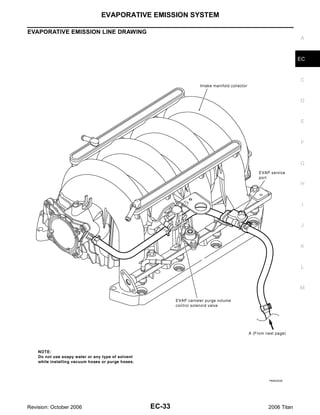
  • 94.
    TROUBLE DIAGNOSIS Worksheet Sample MTBL0017 Revision: October 2006 EC-94 2006 Titan
  • 95.
    TROUBLE DIAGNOSIS DTC InspectionPriority Chart UBS00NAL A If some DTCs are displayed at the same time, perform inspections one by one based on the following priority chart. NOTE: G If DTC U1000 and/or U1001 is displayed with other DTC, first perform the trouble diagnosis for EC DTC U1000, U1001. Refer to EC-157, "DTC U1000, U1001 CAN COMMUNICATION LINE" . G If DTC U1010 is displayed with other DTC, first perform the trouble diagnosis for DTC U1010. Refer to EC-160, "DTC U1010 CAN COMMUNICATION" . C Priority Detected items (DTC) 1 G U1000 U1001 CAN communication line D G U1010 CAN communication G P0101 P0102 P0103 Mass air flow sensor G P0112 P0113 P0127 Intake air temperature sensor E G P0117 P0118 P0125 Engine coolant temperature sensor G P0122 P0123 P0222 P0223 P1225 P1226 P2135 Throttle position sensor G P0128 Thermostat function F G P0181 P0182 P0183 Fuel tank temperature sensor G P0327 P0328 P0332 P0333 Knock sensor G P0335 Crankshaft position sensor (POS) G G P0340 Camshaft position sensor (PHASE) G P0460 P0461 P0462 P0463 Fuel level sensor G P0500 Vehicle speed sensor H G P0605 ECM G P0643 Sensor power supply G P0705 Park/Neutral position (PNP) switch I G P0850 Park/Neutral position (PNP) switch G P1610 - P1615 NATS G P2122 P2123 P2127 P2128 P2138 Accelerator pedal position sensor J K L M Revision: October 2006 EC-95 2006 Titan
  • 96.
    TROUBLE DIAGNOSIS Priority Detected items (DTC) 2 G P0031 P0032 P0051 P0052 A/F sensor 1 heater G P0037 P0038 P0057 P0058 Heated oxygen sensor 2 heater G P0130 P0131 P0132 P0133 P0150 P0151 P0152 P0153 P2A00 P2A03 A/F sensor 1 G P0137 P0138 P0139 P0157 P0158 P0159 Heated oxygen sensor 2 G P0441 EVAP control system purge flow monitoring G P0443 P0444 P0445 EVAP canister purge volume control solenoid valve G P0447 P0448 EVAP canister vent control valve G P0451 P0452 P0453 EVAP control system pressure sensor G P0550 Power steering pressure sensor G P0700 P0710 P0717 P0720 P0740 P0744 P0745 P1716 P1730 P1752 P1754 P1757 P1759 P1762 P1764 P1769 P1772 P1774 A/T related sensors and solenoid valves G P0603 ECM power supply G P1217 Engine over temperature (OVERHEAT) G P1220 Fuel pump control module (FPCM) G P1805 Brake switch G P2100 P2103 P2118 Electric throttle control actuator G P2101 Electric throttle control function 3 G P0171 P0172 P0174 P0175 Fuel injection system function G P0300 - P0308 Misfire G P0420 P0430 Three way catalyst function G P0442 P0455 P0456 EVAP control system G P0506 P0507 Idle speed control system G P1148 P1168 Closed loop control G P1211 TCS control unit G P1212 TCS communication line G P1564 ASCD steering switch G P1572 ASCD brake switch G P1574 ASCD vehicle speed sensor G P2119 Electric throttle control actuator Revision: October 2006 EC-96 2006 Titan
  • 97.
    TROUBLE DIAGNOSIS Fail-safe Chart UBS00NAM A When the DTC listed below is detected, the ECM enters fail-safe mode and the MIL lights up. DTC No. Detected items Engine operating condition in fail-safe mode P0102 Mass air flow sensor circuit Engine speed will not rise more than 2,400 rpm due to the fuel cut. EC P0103 P0117 Engine coolant tempera- Engine coolant temperature will be determined by ECM based on the time after turning P0118 ture sensor circuit ignition switch ON or START. C CONSULT-II displays the engine coolant temperature decided by ECM. Engine coolant temperature decided Condition (CONSULT-II display) D Just as ignition switch is turned 40°C (104°F) ON or START More than approx. 4 minutes after ignition ON or START 80°C (176°F) E 40 - 80°C (104 - 176°F) Except as shown above (Depends on the time) F When the fail-safe system for engine coolant temperature sensor is activated, the cooling fan operates while engine is running. P0122 Throttle position sensor The ECM controls the electric throttle control actuator in regulating the throttle opening in P0123 order for the idle position to be within +10 degrees. G P0222 The ECM regulates the opening speed of the throttle valve to be slower than the normal P0223 condition. P2135 So, the acceleration will be poor. H P0643 Sensor power supply ECM stops the electric throttle control actuator control, throttle valve is maintained at a fixed opening (approx. 5 degrees) by the return spring. P2100 Throttle control motor relay ECM stops the electric throttle control actuator control, throttle valve is maintained at a I P2103 fixed opening (approx. 5 degrees) by the return spring. P2101 Electric throttle control ECM stops the electric throttle control actuator control, throttle valve is maintained at a function fixed opening (approx. 5 degrees) by the return spring. J P2118 Throttle control motor ECM stops the electric throttle control actuator control, throttle valve is maintained at a fixed opening (approx. 5 degrees) by the return spring. P2119 Electric throttle control (When electric throttle control actuator does not function properly due to the return spring K actuator malfunction:) ECM controls the electric throttle actuator by regulating the throttle opening around the idle position. The engine speed will not rise more than 2,000 rpm. (When throttle valve opening angle in fail-safe mode is not in specified range:) L ECM controls the electric throttle control actuator by regulating the throttle opening to 20 degrees or less. (When ECM detects the throttle valve is stuck open:) M While the vehicle is driving, it slows down gradually by fuel cut. After the vehicle stops, the engine stalls. The engine can restart in N or P position, and engine speed will not exceed 1,000 rpm or more. P2122 Accelerator pedal position The ECM controls the electric throttle control actuator in regulating the throttle opening in P2123 sensor order for the idle position to be within +10 degrees. P2127 The ECM regulates the opening speed of the throttle valve to be slower than the normal P2128 condition. P2138 So, the acceleration will be poor. G When there is an open circuit on MIL circuit, the ECM cannot warn the driver by lighting up MIL when there is malfunction on engine control system. Therefore, when electrical controlled throttle and part of ECM related diagnoses are continuously detected as NG for 5 trips, ECM warns the driver that engine control system malfunctions and MIL circuit is open by means of operating fail-safe function. The fail-safe function also operates when above diagnoses except MIL circuit are detected and demands the driver to repair the malfunction. Engine operating condition in fail-safe mode Engine speed will not rise more than 2,500 rpm due to the fuel cut Revision: October 2006 EC-97 2006 Titan
  • 98.
    TROUBLE DIAGNOSIS Symptom MatrixChart UBS00NAN SYSTEM — BASIC ENGINE CONTROL SYSTEM SYMPTOM OVERHEATS/WATER TEMPERATURE HIGH LACK OF POWER/POOR ACCELERATION HARD/NO START/RESTART (EXCP. HA) BATTERY DEAD (UNDER CHARGE) HESITATION/SURGING/FLAT SPOT EXCESSIVE FUEL CONSUMPTION EXCESSIVE OIL CONSUMPTION SPARK KNOCK/DETONATION SLOW/NO RETURN TO IDLE Refer- ROUGH IDLE/HUNTING HIGH IDLE/LOW IDLE ence page IDLING VIBRATION ENGINE STALL Warranty symptom code AA AB AC AD AE AF AG AH AJ AK AL AM HA Fuel EC-489, Fuel pump circuit 1 1 2 3 2 2 2 3 2 EC-598 Fuel pressure regulator system 3 3 4 4 4 4 4 4 4 4 EC-87 Fuel injector circuit 1 1 2 3 2 2 2 2 EC-592 Evaporative emission system 3 3 4 4 4 4 4 4 4 4 EC-32 Air Positive crankcase ventilation sys- 4 4 4 4 4 4 4 4 1 EC-45 tem 3 3 Incorrect idle speed adjustment 1 1 1 1 1 EC-71 EC-523, EC-529 , Electric throttle control actuator 1 1 2 3 3 2 2 2 2 2 2 EC-535 , EC-540 Ignition Incorrect ignition timing adjustment 3 3 1 1 1 1 1 1 EC-71 Ignition circuit 1 1 2 2 2 2 2 2 EC-611 Main power supply and ground circuit 2 2 3 3 3 3 3 2 3 EC-151 EC-177, Mass air flow sensor circuit 2 EC-186 1 EC-198, Engine coolant temperature sensor circuit 3 3 EC-211 EC-219, 3 EC-229 , Air fuel ratio (A/F) sensor 1 circuit 1 2 2 2 2 2 EC-238 , EC-247 , EC-570 EC-204, EC-326 , Throttle position sensor circuit EC-497 , EC-499 , 2 2 EC-555 EC-466, EC-542 , Accelerator pedal position sensor circuit 3 2 1 EC-548 , EC-562 Knock sensor circuit 2 3 EC-341 Crankshaft position sensor (POS) circuit 2 2 EC-346 Camshaft position sensor (PHASE) circuit 3 2 EC-353 Revision: October 2006 EC-98 2006 Titan
  • 99.
    TROUBLE DIAGNOSIS SYMPTOM A OVERHEATS/WATER TEMPERATURE HIGH LACK OF POWER/POOR ACCELERATION HARD/NO START/RESTART (EXCP. HA) BATTERY DEAD (UNDER CHARGE) EC HESITATION/SURGING/FLAT SPOT EXCESSIVE FUEL CONSUMPTION EXCESSIVE OIL CONSUMPTION SPARK KNOCK/DETONATION SLOW/NO RETURN TO IDLE Refer- C ROUGH IDLE/HUNTING HIGH IDLE/LOW IDLE ence page IDLING VIBRATION D ENGINE STALL E Warranty symptom code AA AB AC AD AE AF AG AH AJ AK AL AM HA Vehicle speed signal circuit 2 3 3 3 EC-448 F Power steering pressure sensor circuit 2 3 3 EC-454 EC-459, ECM 2 2 3 3 3 3 3 3 3 3 3 G EC-463 Park/neutral position (PNP) switch circuit 3 3 3 3 3 EC-471 Refrigerant pressure sensor circuit 2 3 3 4 EC-623 H Electrical load signal circuit 3 EC-591 Air conditioner circuit 2 2 3 3 3 3 3 3 3 3 2 MTC-29 EC-477, I EC-478 ABS actuator and electric unit (control unit) 4 or BRC- 96 J 1 - 6: The numbers refer to the order of inspection. (continued on next page) K L M Revision: October 2006 EC-99 2006 Titan
  • 100.
    TROUBLE DIAGNOSIS SYSTEM —ENGINE MECHANICAL & OTHER SYMPTOM OVERHEATS/WATER TEMPERATURE HIGH LACK OF POWER/POOR ACCELERATION HARD/NO START/RESTART (EXCP. HA) BATTERY DEAD (UNDER CHARGE) HESITATION/SURGING/FLAT SPOT EXCESSIVE FUEL CONSUMPTION EXCESSIVE OIL CONSUMPTION SPARK KNOCK/DETONATION SLOW/NO RETURN TO IDLE Reference ROUGH IDLE/HUNTING HIGH IDLE/LOW IDLE page IDLING VIBRATION ENGINE STALL Warranty symptom code AA AB AC AD AE AF AG AH AJ AK AL AM HA Fuel Fuel tank FL-11 5 Fuel piping 5 5 5 5 5 5 FL-4 Vapor lock — 5 Valve deposit — Poor fuel (Heavy weight gaso- 5 5 5 5 5 5 5 — line, Low octane) Air Air duct EM-15 Air cleaner EM-15 Air leakage from air duct (Mass air flow sensor — electric EM-15 5 5 5 5 5 5 throttle control actuator) 5 5 5 5 Electric throttle control actuator EM-17 Air leakage from intake manifold/ EM-17 Collector/Gasket Cranking Battery SC-4 1 1 1 1 1 1 1 Generator circuit SC-17 Starter circuit 3 SC-10 1 Signal plate 6 EM-78 Park/neutral position (PNP) 4 AT-107 switch Engine Cylinder head 5 5 5 5 5 5 5 5 EM-63 Cylinder head gasket 4 3 Cylinder block Piston 4 Piston ring 6 6 6 6 6 6 6 6 EM-78 Connecting rod Bearing Crankshaft Valve Timing chain EM-37 mecha- Camshaft EM-46 nism 5 5 5 5 5 5 5 5 Intake valve 3 EM-63 Exhaust valve Revision: October 2006 EC-100 2006 Titan
  • 101.
    TROUBLE DIAGNOSIS SYMPTOM A OVERHEATS/WATER TEMPERATURE HIGH LACK OF POWER/POOR ACCELERATION HARD/NO START/RESTART (EXCP. HA) BATTERY DEAD (UNDER CHARGE) EC HESITATION/SURGING/FLAT SPOT EXCESSIVE FUEL CONSUMPTION EXCESSIVE OIL CONSUMPTION SPARK KNOCK/DETONATION SLOW/NO RETURN TO IDLE Reference C ROUGH IDLE/HUNTING HIGH IDLE/LOW IDLE page IDLING VIBRATION D ENGINE STALL E Warranty symptom code AA AB AC AD AE AF AG AH AJ AK AL AM HA Exhaust Exhaust manifold/Tube/Muffler/ F Gasket EM-21, EX- 5 5 5 5 5 5 5 5 3 Three way catalyst G Lubrica- EM-24, LU- Oil pan/Oil strainer/Oil pump/Oil tion 13 , LU-10 , filter/Oil gallery/Oil cooler 5 5 5 5 5 5 5 5 LU-11 Oil level (Low)/Filthy oil LU-7 H Cooling Radiator/Hose/Radiator filler cap CO-14 Thermostat 5 CO-21 I Water pump CO-19 Water gallery 5 5 5 5 5 5 5 4 5 CO-8 Cooling fan 5 CO-17 J Coolant level (Low)/Contami- 5 CO-10 nated coolant NVIS (NISSAN Vehicle Immobilizer System — K 1 1 BL-139 NATS) 1 - 6: The numbers refer to the order of inspection. L M Revision: October 2006 EC-101 2006 Titan
  • 102.
    TROUBLE DIAGNOSIS Engine ControlComponent Parts Location UBS00NAO BBIA0452E Revision: October 2006 EC-102 2006 Titan
  • 103.
    TROUBLE DIAGNOSIS A EC C D E F G H I J K L M BBIA0381E Revision: October 2006 EC-103 2006 Titan
  • 104.
    TROUBLE DIAGNOSIS BBIA0382E Revision: October 2006 EC-104 2006 Titan
  • 105.
    TROUBLE DIAGNOSIS A EC C D E F G H I J K L M BBIA0600E Revision: October 2006 EC-105 2006 Titan
  • 106.
    TROUBLE DIAGNOSIS BBIA0384E Revision: October 2006 EC-106 2006 Titan
  • 107.
    TROUBLE DIAGNOSIS A EC C D E F G H I J K L M PBIB2637E Revision: October 2006 EC-107 2006 Titan
  • 108.
    TROUBLE DIAGNOSIS Vacuum HoseDrawing UBS00NAP PBIB2052E Refer to EC-23, "System Diagram" for Vacuum Control System. Revision: October 2006 EC-108 2006 Titan
  • 109.
    TROUBLE DIAGNOSIS Circuit Diagram UBS00NAQ A EC C D E F G H I J K L M BBWA2086E Revision: October 2006 EC-109 2006 Titan
  • 110.
    TROUBLE DIAGNOSIS BBWA2116E Revision: October 2006 EC-110 2006 Titan
  • 111.
    TROUBLE DIAGNOSIS ECM HarnessConnector Terminal Layout UBS00NAR A EC C MBIB0045E D ECM Terminals and Reference Value UBS00NAS PREPARATION E 1. ECM is located in the engine room passenger side behind bat- tery. 2. Remove ECM harness connector. F G H BBIA0386E 3. When disconnecting ECM harness connector, loosen it with levers as far as they will go as shown in the figure. I 4. Connect a break-out box (SST) and Y-cable adapter (SST) between the ECM and ECM harness connector. G Use extreme care not to touch 2 pins at one time. J G Data is for comparison and may not be exact. K BBIA0387E L ECM INSPECTION TABLE Specification data are reference values and are measured between each terminal and ground. Pulse signal is measured by CONSULT-II. M CAUTION: Do not use ECM ground terminals when measuring input/output voltage. Doing so may result in dam- age to the ECMs transistor. Use a ground other than ECM terminals, such as the ground. TER- WIRE MINAL ITEM CONDITION DATA (DC Voltage) COLOR NO. [Engine is running] 1 B ECM ground Body ground G Idle speed Approximately 5V [Engine is running] A/F sensor 1 heater 2 O/B G Warm-up condition (bank 1) G Idle speed PBIB1584E Revision: October 2006 EC-111 2006 Titan
  • 112.
    TROUBLE DIAGNOSIS TER- WIRE MINAL ITEM CONDITION DATA (DC Voltage) COLOR NO. Throttle control motor relay BATTERY VOLTAGE 3 L [Ignition switch: ON] power supply (11 - 14V) 0 - 14V [Ignition switch: ON] G Engine: Stopped 4 L/W Throttle control motor (Close) G Selector lever: D G Accelerator pedal: Fully released PBIB1104E 0 - 14V [Ignition switch: ON] G Engine: Stopped 5 L/B Throttle control motor (Open) G Selector lever: D G Accelerator pedal: Fully depressed PBIB1105E [Engine is running] G Engine speed: Below 3,600 rpm after the following conditions are met. – Engine: After warming up 0 - 1.0V – Keeping the engine speed between 3,500 Heated oxygen sensor 2 and 4,000 rpm for 1 minute and at idle for 1 6 GR heater (bank 1) minute under no load [Ignition switch: ON] G Engine: Stopped BATTERY VOLTAGE [Engine is running] (11 - 14V) G Engine speed: Above 3,600 rpm [Engine is running] 0.5 - 4.5V Power steering pressure sen- G Steering wheel: Being turned 12 R sor [Engine is running] 0.4 - 0.8V G Steering wheel: Not being turned Approximately 10V [Engine is running] G Warm-up condition G Idle speed NOTE: The pulse cycle changes depending on rpm at idle PBIB1041E Crankshaft position sensor 13 O (POS) Approximately 10V [Engine is running] G Engine speed: 2,000 rpm PBIB1042E Revision: October 2006 EC-112 2006 Titan
  • 113.
    TROUBLE DIAGNOSIS TER- WIRE MINAL ITEM CONDITION DATA (DC Voltage) A COLOR NO. 1.0 - 4.0V [Engine is running] EC G Warm-up condition G Idle speed NOTE: C The pulse cycle changes depending on rpm at idle Camshaft position sensor PBIB1039E 14 Y D (PHASE) 1.0 - 4.0V [Engine is running] E G Engine speed: 2,000 rpm F PBIB1040E [Engine is running] 15 W Knock sensor (bank 1) Approximately 2.5V G Idle speed G 16 BR/R Approximately 3.1V [Engine is running] 35 BR/G Approximately 2.6V A/F sensor 1 (bank 1) G Warm-up condition H 56 LG/B Approximately 2.3V G Idle speed 75 P/B Approximately 2.3V BATTERY VOLTAGE I [Engine is running] (11 - 14V) G Warm-up condition G Idle speed J NOTE: The pulse cycle changes depending on rpm at idle 21 O/L Fuel injector No. 5 K 22 BR Fuel injector No. 3 SEC984C 23 GR/W Fuel injector No. 1 BATTERY VOLTAGE 44 O Fuel injector No. 7 (11 - 14V) L [Engine is running] G Warm-up condition G Engine speed: 2,000 rpm M SEC985C Approximately 5V [Engine is running] A/F sensor 1 heater 24 BR/W G Warm-up condition (bank 2) G Idle speed PBIB1584E Revision: October 2006 EC-113 2006 Titan
  • 114.
    TROUBLE DIAGNOSIS TER- WIRE MINAL ITEM CONDITION DATA (DC Voltage) COLOR NO. [Engine is running] G Engine speed: Below 3,600 rpm after the following conditions are met. – Engine: After warming up 0 - 1.0V – Keeping the engine speed between 3,500 Heated oxygen sensor 2 and 4,000 rpm for 1 minute and at idle for 1 25 O/G heater (bank 2) minute under no load [Ignition switch: ON] G Engine: Stopped BATTERY VOLTAGE [Engine is running] (11 - 14V) G Engine speed: Above 3,600 rpm EVAP control system pres- 32 L [Ignition switch: ON] Approximately 1.8 - 4.8V sure sensor Approximately 0 - 4.8V 34 R/B Intake air temperature sensor [Engine is running] Output voltage varies with intake air temperature. [Engine is running] 36 W Knock sensor (bank 2) Approximately 2.5V G Idle speed [Ignition switch: ON] G More than a few seconds after turning igni- Approximately 0V tion switch ON [Ignition switch: ON] Fuel pump control module 38 L G For a few seconds after turning ignition (FPCM) check switch ON 4 - 6V [Engine is running] G Warm-up condition G Idle speed [When cranking engine] 0 - 0.5V Fuel pump control module [Engine is running] 39 L/Y (FPCM) G Warm-up condition 8 - 12V G Idle speed BATTERY VOLTAGE [Engine is running] (11 - 14V) G Warm-up condition G Idle speed NOTE: The pulse cycle changes depending on rpm at idle 40 Y/G Fuel injector No. 6 41 P Fuel injector No. 4 SEC984C 42 L Fuel injector No. 2 BATTERY VOLTAGE 63 G Fuel injector No. 8 (11 - 14V) [Engine is running] G Warm-up condition G Engine speed: 2,000 rpm SEC985C Revision: October 2006 EC-114 2006 Titan
  • 115.
    TROUBLE DIAGNOSIS TER- WIRE MINAL ITEM CONDITION DATA (DC Voltage) A COLOR NO. BATTERY VOLTAGE (11 - 14V) EC [Engine is running] G Idle speed G Accelerator pedal: Not depressed even C slightly, after engine starting EVAP canister purge volume SEC990C D 45 L/Y control solenoid valve BATTERY VOLTAGE (11 - 14V) E [Engine is running] G Engine speed: About 2,000 rpm (More than 100 seconds after starting engine) F SEC991C G 0 - 0.3V [Engine is running] G Warm-up condition G Idle speed H NOTE: The pulse cycle changes depending on rpm 46 L/R Ignition signal No. 7 at idle I 60 GR/R Ignition signal No. 5 SEC986C 61 O/W Ignition signal No. 3 0.1 - 0.6V 62 Y/R Ignition signal No. 1 J [Engine is running] G Warm-up condition G Engine speed: 2,500 rpm K SEC987C Sensor power supply L 47 Y [Ignition switch: ON] Approximately 5V (Throttle position sensor) Sensor power supply 48 SB (EVAP control system pres- [Ignition switch: ON] Approximately 5V M sure sensor) Sensor power supply 49 R/Y [Ignition switch: ON] Approximately 5V (Refrigerant pressure sensor) [Ignition switch: ON] G Engine: Stopped More than 0.36V G Selector lever: D G Accelerator pedal: Fully released 50 B Throttle position sensor 1 [Ignition switch: ON] G Engine: Stopped Less than 4.75V G Selector lever: D G Accelerator pedal: Fully depressed Revision: October 2006 EC-115 2006 Titan
  • 116.
    TROUBLE DIAGNOSIS TER- WIRE MINAL ITEM CONDITION DATA (DC Voltage) COLOR NO. [Engine is running] G Warm-up condition 1.0 - 1.3V G Idle speed 51 W Mass air flow sensor [Engine is running] G Warm-up condition 1.7 - 2.1V G Engine speed: 2,500 rpm [Engine is running] G Revving engine from idle to 3,000 rpm quickly after the following conditions are Heated oxygen sensor 2 met. 55 R 0 - Approximately 1.0V (bank 1) – Engine: After warming up – Keeping the engine speed between 3,500 and 4,000 rpm for 1 minute and at idle for 1 minute under no load 57 L/P Approximately 2.6V [Engine is running] 58 GR/G Approximately 2.3V A/F sensor 1 (bank 2) G Warm-up condition 76 G/L Approximately 3.1V G Idle speed 77 BR/B Approximately 2.3V 0 - 0.3V [Engine is running] G Warm-up condition G Idle speed NOTE: The pulse cycle changes depending on rpm 65 G/R Ignition signal No. 8 at idle 79 V/W Ignition signal No. 6 SEC986C 80 W/R Ignition signal No. 4 0.1 - 0.6V 81 W/G Ignition signal No. 2 [Engine is running] G Warm-up condition G Engine speed: 2,500 rpm SEC987C [Engine is running] Sensor ground 66 R G Warm-up condition Approximately 0V (Throttle position sensor) G Idle speed [Engine is running] 67 B Sensor ground G Warm-up condition Approximately 0V G Idle speed Sensor power supply 68 W/L [Ignition switch: ON] Approximately 5V (PSP sensor) [Ignition switch: ON] G Engine: Stopped Less than 4.75V G Selector lever: D G Accelerator pedal: Fully released 69 W Throttle position sensor 2 [Ignition switch: ON] G Engine: Stopped More than 0.36V G Selector lever: D G Accelerator pedal: Fully depressed Revision: October 2006 EC-116 2006 Titan
  • 117.
    TROUBLE DIAGNOSIS TER- WIRE MINAL ITEM CONDITION DATA (DC Voltage) A COLOR NO. [Engine is running] G Warm-up condition EC 70 B/W Refrigerant pressure sensor 1.0 - 4.0V G Both A/C switch and blower switch: ON (Compressor: Operates.) Approximately 0 - 4.8V C Engine coolant temperature 73 Y/B [Engine is running] Output voltage varies with sensor engine coolant temperature. [Engine is running] D G Revving engine from idle to 3,000 rpm quickly after the following conditions are Heated oxygen sensor 2 met. 74 L 0 - Approximately 1.0V E (bank 2) – Engine: After warming up – Keeping the engine speed between 3,500 and 4,000 rpm for 1 minute and at idle for 1 minute under no load F [Engine is running] Sensor ground 78 B/W G Warm-up condition Approximately 0V (Heated oxygen sensor 2) G Idle speed G [Engine is running] Sensor ground 82 B/R G Warm-up condition Approximately 0V (APP sensor 1) H G Idle speed [Engine is running] Sensor ground 83 G/W G Warm-up condition Approximately 0V (APP sensor 2) I G Idle speed [Ignition switch: ON] Approximately 5V - Battery volt- 85 G/W Data link connector G CONSULT-II or GST: Disconnected age (11 - 14V) J Approximately 1.1 - 2.3V 86 P CAN communication line [Ignition switch: ON] Output voltage varies with the communication status K Sensor power supply 90 L [Ignition switch: ON] Approximately 5V (APP sensor 1) Sensor power supply L 91 W/R [Ignition switch: ON] Approximately 5V (APP sensor 2) Approximately 2.6 - 3.2V 94 L CAN communication line [Ignition switch: ON] Output voltage varies with the communication status. M [Ignition switch: ON] G Engine: Stopped 0.25 - 0.50V Accelerator pedal position G Accelerator pedal: Fully released 98 G/R sensor 2 [Ignition switch: ON] G Engine: Stopped 2.0 - 2.5V G Accelerator pedal: Fully depressed Revision: October 2006 EC-117 2006 Titan
  • 118.
    TROUBLE DIAGNOSIS TER- WIRE MINAL ITEM CONDITION DATA (DC Voltage) COLOR NO. [Ignition switch: ON] Approximately 4V G ASCD steering switch: OFF [Ignition switch: ON] Approximately 0V G MAIN switch: Pressed [Ignition switch: ON] 99 G/Y ASCD steering switch Approximately 1V G CANCEL switch: Pressed [Ignition switch: ON] Approximately 3V G RESUME/ACCELERATE switch: Pressed [Ignition switch: ON] Approximately 2V G SET/COAST switch: Pressed [Ignition switch: OFF] Approximately 0V G Brake pedal: Fully released 101 R/W Stop lamp switch [Ignition switch: OFF] BATTERY VOLTAGE G Brake pedal: Slightly depressed (11 - 14V) [Ignition switch: ON] Approximately 0V G Selector lever: P or N 102 GR/R PNP switch [Ignition switch: ON] BATTERY VOLTAGE G Except the above gear position (11 - 14V) BATTERY VOLTAGE [Ignition switch: OFF] 104 O Throttle control motor relay (11 - 14V) [Ignition switch: ON] 0 - 1.0V [Ignition switch: ON] G Engine: Stopped 0.5 - 1.0V Accelerator pedal position G Accelerator pedal: Fully released 106 BR/W sensor 1 [Ignition switch: ON] G Engine: Stopped 4.2 - 4.8V G Accelerator pedal: Fully depressed Approximately 0 - 4.8V 107 V/R Fuel tank temperature sensor [Engine is running] Output voltage varies with fuel tank temperature. [Ignition switch: ON] Approximately 0V G Brake pedal: Slightly depressed 108 BR/W ASCD brake switch [Ignition switch: ON] BATTERY VOLTAGE G Brake pedal: Fully released (11 - 14V) [Ignition switch: OFF] 0V 109 L/W Ignition switch BATTERY VOLTAGE [Ignition switch: ON] (11 - 14V) [Engine is running] [Ignition switch: OFF] 0 - 1.5V G For a few seconds after turning ignition ECM relay switch OFF 111 W/B (Self shut-off) [Ignition switch: OFF] BATTERY VOLTAGE G More than a few seconds after turning igni- (11 - 14V) tion switch OFF Revision: October 2006 EC-118 2006 Titan
  • 119.
    TROUBLE DIAGNOSIS TER- WIRE MINAL ITEM CONDITION DATA (DC Voltage) A COLOR NO. [Ignition switch: ON] G For 1 second after turning ignition switch EC 0 - 1.5V ON 113 GR Fuel pump relay [Engine is running] [Ignition switch: ON] C BATTERY VOLTAGE G More than 1 second after turning ignition (11 - 14V) switch ON 115 B [Engine is running] D ECM ground Body ground 116 B/W G Idle speed EVAP canister vent control BATTERY VOLTAGE 117 L/Y [Ignition switch: ON] valve (11 - 14V) E 119 BR BATTERY VOLTAGE Power supply for ECM [Ignition switch: ON] 120 BR (11 - 14V) Power supply for ECM BATTERY VOLTAGE F 121 W [Ignition switch: OFF] (Back-up) (11 - 14V) : Average voltage for pulse signal (Actual pulse signal can be confirmed by oscilloscope.) G H I J K L M Revision: October 2006 EC-119 2006 Titan
  • 120.
    TROUBLE DIAGNOSIS CONSULT-II Function(ENGINE) UBS00NAT FUNCTION Diagnostic test mode Function This mode enables a technician to adjust some devices faster and more accurately by following the Work support indications on the CONSULT-II unit. Self-diagnostic results such as 1st trip DTC, DTCs and 1st trip freeze frame data or freeze frame data Self-diagnostic results can be read and erased quickly.* Data monitor Input/Output data in the ECM can be read. Input/Output of the specification for Basic fuel schedule, AFM, A/F feedback control value and the Data monitor (SPEC) other data monitor items can be read. CAN diagnostic support The results of transmit/receive diagnosis of CAN communication can be read. monitor Diagnostic Test Mode in which CONSULT-II drives some actuators apart from the ECMs and also Active test shifts some parameters in a specified range. DTC & SRT confirmation The status of system monitoring tests and the self-diagnosis status/result can be confirmed. Function test This mode is used to inform customers when their vehicle condition requires periodic maintenance. ECM part number ECM part number can be read. *: The following emission-related diagnostic information is cleared when the ECM memory is erased. G Diagnostic trouble codes G 1st trip diagnostic trouble codes G Freeze frame data G 1st trip freeze frame data G System readiness test (SRT) codes G Test values Revision: October 2006 EC-120 2006 Titan
  • 121.
    TROUBLE DIAGNOSIS ENGINE CONTROLCOMPONENT PARTS/CONTROL SYSTEMS APPLICATION DIAGNOSTIC TEST MODE A SELF-DIAGNOSTIC DTC & SRT RESULTS DATA CONFIRMATION Item WORK DATA EC MONI- ACTIVE DTC SUP- FREEZE MONI- TOR TEST SRT WORK PORT DTC*1 FRAME TOR (SPEC) STATUS SUP- DATA*2 PORT C Crankshaft position sensor (POS) × × × × Camshaft position sensor (PHASE) × × × × Mass air flow sensor × × × D Engine coolant temperature sensor × × × × × Air fuel ratio (A/F) sensor 1 × × × × × E Heated oxygen sensor 2 × × × × × Wheel sensor × × × × Accelerator pedal position sensor × × × F ENGINE CONTROL COMPONENT PARTS Throttle position sensor × × × × Fuel tank temperature sensor × × × × G EVAP control system pressure × × × sensor Intake air temperature sensor × × × × H INPUT Knock sensor × Refrigerant pressure sensor × × Closed throttle position switch I (accelerator pedal position sensor × × signal) Air conditioner switch × × J Park/neutral position (PNP) switch × × × Stop lamp switch × × × K Power steering pressure sensor × × × Battery voltage × × Load signal × × L Fuel level sensor × × × ASCD steering switch × × × ASCD brake switch × × × M Revision: October 2006 EC-121 2006 Titan
  • 122.
    TROUBLE DIAGNOSIS DIAGNOSTIC TEST MODE SELF-DIAGNOSTIC DTC & SRT RESULTS DATA CONFIRMATION Item WORK DATA MONI- ACTIVE DTC SUP- FREEZE MONI- TOR TEST SRT WORK PORT DTC*1 FRAME TOR (SPEC) STATUS SUP- DATA*2 PORT Fuel injector × × × Power transistor (Ignition timing) × × × ENGINE CONTROL COMPONENT PARTS Throttle control motor relay × × × Throttle control motor × EVAP canister purge volume con- × × × × × trol solenoid valve OUTPUT FPCM*3 × × × × Air conditioner relay × × Fuel pump relay × × × × Cooling fan relay × × × × Air fuel ratio (A/F) sensor 1 heater × × × × Heated oxygen sensor 2 heater × × × × EVAP canister vent control valve × × × × × Calculated load value × × × X: Applicable *1: This item includes 1st trip DTCs. *2: This mode includes 1st trip freeze frame data or freeze frame data. The items appear on CONSULT-II screen in freeze frame data mode only if a 1st trip DTC or DTC is detected. For details, refer to EC-53, "FREEZE FRAME DATA AND 1ST TRIP FREEZE FRAME DATA" . *3: For Flexible Fuel Vehicle INSPECTION PROCEDURE CAUTION: If CONSULT-II is used with no connection of CONSULT-II CONVERTER, malfunctions might be detected in self-diagnosis depending on control unit which carry out CAN communication. 1. Turn ignition switch OFF. 2. Connect “CONSULT-II” and “CONSULT-II CONVERTER” to data link connector, which is located under LH dash panel near the hood opener handle. 3. Turn ignition switch ON. BBIA0369E Revision: October 2006 EC-122 2006 Titan
  • 123.
    TROUBLE DIAGNOSIS 4. Touch “START (NISSAN BASED VHCL)”. A EC C BCIA0029E D 5. Touch “ENGINE”. If “ENGINE” is not indicated, go to GI-39, "CONSULT-II Data Link Connector (DLC) Circuit" . E F G BCIA0030E 6. Perform each diagnostic test mode according to each service H procedure. For further information, see the CONSULT-II Operation Manual. I J BCIA0031E K WORK SUPPORT MODE Work Item L WORK ITEM CONDITION USAGE FUEL PRESSURE RELEASE G FUEL PUMP WILL STOP BY TOUCHING “START” DUR- When releasing fuel pressure ING IDLING. from fuel line CRANK A FEW TIMES AFTER ENGINE STALLS. M IDLE AIR VOL LEARN G THE IDLE AIR VOLUME THAT KEEPS THE ENGINE When learning the idle air volume WITHIN THE SPECIFIED RANGE IS MEMORIZED IN ECM. SELF-LEARNING CONT G THE COEFFICIENT OF SELF-LEARNING CONTROL When clearing the coefficient of MIXTURE RATIO RETURNS TO THE ORIGINAL COEF- self-learning control value FICIENT. G THIS FUNCTION ALLOWS THE ETHANOL MIXTURE RATIO THAT THE ECM ESTIMATED TO BE CHANGED. IMPROPER USAGE OF THIS FUNCTION MAY CAUSE When adjusting the ethanol mix- ETHANOL M/R ADJ*2 POOR DRIVEABILITY OR DECREASING FUEL ECON- ture ratio to the specified value. OMY. FOLLOW THE INSTRUCTION OF SERVICE MAN- UAL. Revision: October 2006 EC-123 2006 Titan
  • 124.
    TROUBLE DIAGNOSIS WORK ITEM CONDITION USAGE EVAP SYSTEM CLOSE CLOSE THE EVAP CANISTER VENT CONTROL VALVE IN When detecting EVAP vapor leak ORDER TO MAKE EVAP SYSTEM CLOSE UNDER THE point of EVAP system FOLLOWING CONDITIONS. G IGN SW ON G ENGINE NOT RUNNING G AMBIENT TEMPERATURE IS ABOVE 0°C (32°F). G NO VACUUM AND NO HIGH PRESSURE IN EVAP SYS- TEM G FUEL TANK TEMP. IS MORE THAN 0°C (32°F). G WITHIN 10 MINUTES AFTER STARTING “EVAP SYS- TEM CLOSE” G WHEN TRYING TO EXECUTE “EVAP SYSTEM CLOSE” UNDER THE CONDITION EXCEPT ABOVE, CONSULT- II WILL DISCONTINUE IT AND DISPLAY APPROPRI- ATE INSTRUCTION. NOTE: WHEN STARTING ENGINE, CONSULT-II MAY DISPLAY “BATTERY VOLTAGE IS LOW. CHARGE BATTERY”, EVEN IN USING CHARGED BATTERY. VIN REGISTRATION G IN THIS MODE, VIN IS REGISTERED IN ECM When registering VIN in ECM TARGET IDLE RPM ADJ*1 G IDLE CONDITION When setting target idle speed TARGET IGN TIM ADJ*1 G IDLE CONDITION When adjusting target ignition tim- ing *1: This function is not necessary in the usual service procedure. *2: For Flexible Fuel Vehicle SELF-DIAG RESULTS MODE Self Diagnostic Item Regarding items of DTC and 1st trip DTC, refer to EC-49, "EMISSION-RELATED DIAGNOSTIC INFORMA- TION ITEMS" . Freeze Frame Data and 1st Trip Freeze Frame Data Freeze frame data Description item* DIAG TROUBLE G The engine control component part/control system has a trouble code, it is displayed as PXXXX. (Refer to CODE EC-8, "INDEX FOR DTC" .) [PXXXX] FUEL SYS-B1 G “Fuel injection system status” at the moment a malfunction is detected is displayed. G One mode in the following is displayed. Mode2: Open loop due to detected system malfunction FUEL SYS-B2 Mode3: Open loop due to driving conditions (power enrichment, deceleration enleanment) Mode4: Closed loop - using oxygen sensor(s) as feedback for fuel control Mode5: Open loop - has not yet satisfied condition to go to closed loop CAL/LD VALUE [%] G The calculated load value at the moment a malfunction is detected is displayed. COOLANT TEMP G The engine coolant temperature at the moment a malfunction is detected is displayed. [°C] or [°F] L-FUEL TRM-B1 [%] G “Long-term fuel trim” at the moment a malfunction is detected is displayed. G The long-term fuel trim indicates much more gradual feedback compensation to the base fuel schedule L-FUEL TRM-B2 [%] than short-term fuel trim. S-FUEL TRM-B1 [%] G “Short-term fuel trim” at the moment a malfunction is detected is displayed. G The short-term fuel trim indicates dynamic or instantaneous feedback compensation to the base fuel S-FUEL TRM-B2 [%] schedule. ENGINE SPEED G The engine speed at the moment a malfunction is detected is displayed. [rpm] Revision: October 2006 EC-124 2006 Titan
  • 125.
    TROUBLE DIAGNOSIS Freeze frame data Description item* A VEHICL SPEED G The vehicle speed at the moment a malfunction is detected is displayed. [km/h] or [mph] ABSOL TH-P/S EC G The throttle valve opening at the moment a malfunction is detected is displayed. [%] B/FUEL SCHDL G The base fuel schedule at the moment a malfunction is detected is displayed. [msec] C INT/A TEMP SE G The intake air temperature at the moment a malfunction is detected is displayed. [°C] or [°F] *: The item is the same as that of 1st trip freeze frame data. D DATA MONITOR MODE Monitored Item E ×: Applicable ECM Monitored item MAIN INPUT Description Remarks [Unit] SIGNALS F SIGNALS G Accuracy becomes poor if engine speed G Indicates the engine speed computed drops below the idle rpm. from the signal of the crankshaft position ENG SPEED [rpm] × × G If the signal is interrupted while the G sensor (POS) and camshaft position sensor (PHASE). engine is running, an abnormal value may be indicated. MAS A/F SE-B1 [V] × × G The signal voltage of the mass air flow G When the engine is stopped, a certain H sensor is displayed. value is indicated. G Base fuel schedule indicates the fuel B/FUEL SCHDL injection pulse width programmed into × I [msec] ECM, prior to any learned on board cor- rection. A/F ALPHA-B1 [%] × G When the engine is stopped, a certain G The mean value of the air-fuel ratio feed- value is indicated. J back correction factor per cycle is indi- A/F ALPHA-B2 [%] × cated. G This data also includes the data for the air-fuel ratio learning control. G When the engine coolant temperature K G The engine coolant temperature (deter- sensor is open or short-circuited, ECM COOLAN TEMP/S mined by the signal voltage of the × × enters fail-safe mode. The engine cool- [°C] or [°F] engine coolant temperature sensor) is ant temperature determined by the displayed. L ECM is displayed. A/F SEN1 (B1) [V] × × G The A/F signal computed from the input A/F SEN1 (B2) [V] × signal of the A/F sensor 1 is displayed. M HO2S2 (B1) [V] × G The signal voltage of the heated oxygen HO2S2 (B2) [V] × sensor 2 is displayed. HO2S2 MNTR (B1) G Display of heated oxygen sensor 2 sig- × [RICH/LEAN] nal: RICH: means the amount of oxygen after three way catalyst is relatively G When the engine is stopped, a certain HO2S2 MNTR (B2) small. value is indicated. × LEAN: means the amount of oxygen [RICH/LEAN] after three way catalyst is relatively large. G The vehicle speed computed from the VHCL SPEED SE × × vehicle speed signal sent from combina- [km/h] or [mph] tion meter is displayed. BATTERY VOLT G The power supply voltage of ECM is dis- × × [V] played. Revision: October 2006 EC-125 2006 Titan
  • 126.
    TROUBLE DIAGNOSIS ECM Monitored item MAIN INPUT Description Remarks [Unit] SIGNALS SIGNALS ACCEL SEN 1 [V] × × G ACCEL SEN 2 signal is converted by G The accelerator pedal position sensor ECM internally. Thus, it differs from ACCEL SEN 2 [V] × signal voltage is displayed. ECM terminal voltage signal. THRTL SEN 1 [V] × × G THRTL SEN 2 signal is converted by G The throttle position sensor signal volt- ECM internally. Thus, it differs from THRTL SEN 2 [V] × age is displayed. ECM terminal voltage signal. G The fuel temperature (determined by the FUEL T/TMP SE × signal voltage of the fuel tank tempera- [°C] or [°F] ture sensor) is displayed. G The intake air temperature (determined INT/A TEMP SE × × by the signal voltage of the intake air [°C] or [°F] temperature sensor) is indicated. EVAP SYS PRES G The signal voltage of EVAP control sys- × [V] tem pressure sensor is displayed. FPCM DR VOLT G The voltage between fuel pump and [V]* FPCM is displayed. FUEL LEVEL SE G The signal voltage of the fuel level sen- × [V] sor is displayed. G Indicates start signal status [ON/OFF] START SIGNAL computed by the ECM according to the G After starting the engine, [OFF] is dis- × × [ON/OFF] signals of engine speed and battery volt- played regardless of the starter signal. age. G Indicates idle position [ON/OFF] com- CLSD THL POS × × puted by ECM according to the acceler- [ON/OFF] ator pedal position sensor signal. G Indicates [ON/OFF] condition of the air AIR COND SIG × × conditioner switch as determined by the [ON/OFF] air conditioner signal. G Indicates [ON/OFF] condition from the P/N POSI SW × × park/neutral position (PNP) switch sig- [ON/OFF] nal. G [ON/OFF] condition of the power steer- PW/ST SIGNAL ing system (determined by the signal × × [ON/OFF] voltage of the power steering pressure sensor signal) is indicated. G Indicates [ON/OFF] condition from the LOAD SIGNAL electrical load signal. × × [ON/OFF] ON: Lighting switch is in 2nd position. OFF: Lighting switch is OFF. IGNITION SW G Indicates [ON/OFF] condition from igni- × [ON/OFF] tion switch signal. HEATER FAN SW G Indicates [ON/OFF] condition from × [ON/OFF] heater fan switch signal. BRAKE SW G Indicates [ON/OFF] condition from the × [ON/OFF] stop lamp switch signal. INJ PULSE-B1 × G Indicates the actual fuel injection pulse [msec] G When the engine is stopped, a certain width compensated by ECM according INJ PULSE-B2 computed value is indicated. to the input signals. [msec] IGN TIMING G Indicates the ignition timing computed G When the engine is stopped, a certain × [BTDC] by ECM according to the input signals. value is indicated. G “Calculated load value” indicates the CAL/LD VALUE [%] value of the current air flow divided by peak air flow. Revision: October 2006 EC-126 2006 Titan
  • 127.
    TROUBLE DIAGNOSIS ECM Monitored item MAIN INPUT Description Remarks A [Unit] SIGNALS SIGNALS G Indicates the mass air flow computed by MASS AIRFLOW ECM according to the signal voltage of EC [g·m/s] the mass air flow sensor. G Indicates the EVAP canister purge vol- ume control solenoid valve control value computed by the ECM according to the C PURG VOL C/V [%] input signals. G The opening becomes larger as the value increases. D G The air conditioner relay control condi- AIR COND RLY × tion (determined by ECM according to [ON/OFF] the input signals) is indicated. E G Indicates the fuel pump relay control FUEL PUMP RLY × condition determined by ECM according [ON/OFF] to the input signals. F G The control condition of the fuel pump FPCM control module (FPCM) (determined by × [HI/LOW]* the ECM according to the input signals) is indicated. G G The control condition of the EVAP canis- ter vent control valve (determined by VENT CONT/V ECM according to the input signals) is H [ON/OFF] indicated. ON: Closed OFF: Open G Indicates the throttle control motor relay I THRTL RELAY × control condition determined by the [ON/OFF] ECM according to the input signals. G The control condition of the cooling fan J (determined by ECM according to the COOLING FAN × input signals) is indicated. [HI/OFF] HI: High speed operation OFF: Stop K HO2S2 HTR (B1) [ON/OFF] G Indicates [ON/OFF] condition of heated oxygen sensor 2 heater determined by L HO2S2 HTR (B2) ECM according to the input signals. [ON/OFF] G Indicates the engine speed computed I/P PULLY SPD M from the turbine revolution sensor sig- [rpm] nal. VEHICLE SPEED G Indicates the vehicle speed computed [km/h] or [MPH] from the revolution sensor signal. G Display the condition of idle air volume learning IDL A/V LEARN YET: Idle Air Volume Learning has not [YET/CMPLT] been performed yet. CMPLT: Idle Air Volume Learning has already been performed successfully. TRVL AFTER MIL G Distance traveled while MIL is activated. [km] or [mile] A/F S1 HTR (B1) G A/F sensor 1 heater control value com- [%] puted by ECM according to the input sig- nals. A/F S1 HTR (B2) G The current flow to the heater becomes [%] larger as the value increases. Revision: October 2006 EC-127 2006 Titan
  • 128.
    TROUBLE DIAGNOSIS ECM Monitored item MAIN INPUT Description Remarks [Unit] SIGNALS SIGNALS AC PRESS SEN G The signal voltage from the refrigerant [V] pressure sensor is displayed. G The vehicle speed computed from the VHCL SPEED SE vehicle speed signal sent from combina- [km/h] or [mph] tion meter is displayed. SET VHCL SPD G The preset vehicle speed is displayed. [km/h] or [mph] MAIN SW G Indicates [ON/OFF] condition from MAIN [ON/OFF] switch signal. CANCEL SW G Indicates [ON/OFF] condition from CAN- [ON/OFF] CEL switch signal. RESUME/ACC SW G Indicates [ON/OFF] condition from [ON/OFF] RESUME/ACCELERATE switch signal. SET SW G Indicates [ON/OFF] condition from SET/ [ON/OFF] COAST switch signal. BRAKE SW1 G Indicates [ON/OFF] condition from [ON/OFF] ASCD brake switch signal. BRAKE SW2 G Indicates [ON/OFF] condition of stop [ON/OFF] lamp switch signal. G Indicates the vehicle cruise condition. NON: Vehicle speed is maintained at the VHCL SPD CUT ASCD set speed. [NON/CUT] CUT: Vehicle speed increased to exces- sively high compared with the ASCD set speed, and ASCD operation is cut off. G Indicates the vehicle cruise condition. NON: Vehicle speed is maintained at the LO SPEED CUT ASCD set speed. [NON/CUT] CUT: Vehicle speed decreased to exces- sively low compared with the ASCD set speed, and ASCD operation is cut off. G Indicates [ON/OFF] condition of A/T O/D AT OD MONITOR according to the input signal from the [ON/OFF] TCM. AT OD CANCEL G Indicates [ON/OFF] condition of A/T O/D [ON/OFF] cancel signal sent from the TCM. G Indicates [ON/OFF] condition of CRUISE LAMP CRUISE lamp determined by the ECM [ON/OFF] according to the input signals. G Indicates [ON/OFF] condition of SET SET LAMP lamp determined by the ECM according [ON/OFF] to the input signals. G Ethanol mixture ratio presumed by the ETHANOL M/R ECM according to the input signals is [%]* displayed. Voltage [V] Frequency [msec], G Only # is displayed if item is unable to [Hz] or [%] be measured. DUTY-HI G Voltage, frequency, duty cycle or pulse G Figures with #s are temporary ones. width measured by the probe. They are the same figures as an actual DUTY-LOW piece of data which was just previously PLS WIDTH-HI measured. PLS WIDTH-LOW *: For Flexible Fuel Vehicle Revision: October 2006 EC-128 2006 Titan
  • 129.
    TROUBLE DIAGNOSIS NOTE: Any monitoreditem that does not match the vehicle being diagnosed is deleted from the display automatically. A DATA MONITOR (SPEC) MODE Monitored Item EC ECM Monitored item MAIN INPUT Description Remarks [Unit] SIGNALS SIGNALS G Indicates the engine speed computed C from the signal of the crankshaft position ENG SPEED [rpm] × × sensor (POS) and camshaft position sensor (PHASE). D G The signal voltage of the mass air flow G When engine is running specification MAS A/F SE-B1 [V] × × sensor specification is displayed. range is indicated. G Base fuel schedule indicates the fuel E B/FUEL SCHDL injection pulse width programmed into G When engine is running specification × [msec] ECM, prior to any learned on board cor- range is indicated. rection. G When engine is running specification F G The mean value of the air-fuel ratio feed- range is indicated. A/F ALPHA-B1 [%] × back correction factor per cycle is indi- A/F ALPHA-B2 [%] G This data also includes the data for cated. the air-fuel ratio learning control. G NOTE: Any monitored item that does not match the vehicle being diagnosed is deleted from the display automatically. H ACTIVE TEST MODE Test Item TEST ITEM CONDITION JUDGEMENT CHECK ITEM (REMEDY) I G Engine: Return to the original G Harness and connectors FUEL INJEC- trouble condition If trouble symptom disappears, see G Fuel injector TION G Change the amount of fuel injec- CHECK ITEM. G Air fuel ratio (A/F) sensor 1 J tion using CONSULT-II. G Engine: Return to the original trouble condition IGNITION TIM- If trouble symptom disappears, see K G Timing light: Set G Perform Idle Air Volume Learning. ING CHECK ITEM. G Retard the ignition timing using CONSULT-II. L G Engine: After warming up, idle G Harness and connectors the engine. G Compression POWER BAL- G A/C switch: OFF G Fuel injector Engine runs rough or dies. M ANCE G Selector lever: P or N G Power transistor G Cut off each injector signal one at G Spark plug a time using CONSULT-II. G Ignition coil G Ignition switch: ON G Harness and connectors COOLING FAN*1 G Turn the cooling fan HI and OFF Cooling fan moves and stops. G Cooling fan motor using CONSULT-II. G IPDM E/R G Engine: Return to the original G Harness and connectors ENG COOLANT trouble condition If trouble symptom disappears, see G Engine coolant temperature sen- TEMP G Change the engine coolant tem- CHECK ITEM. sor perature using CONSULT-II. G Fuel injector G Ignition switch: ON (Engine stopped) FUEL PUMP Fuel pump relay makes the operat- G Harness and connectors RELAY G Turn the fuel pump relay ON and ing sound. G Fuel pump relay OFF using CONSULT-II and lis- ten to operating sound. Revision: October 2006 EC-129 2006 Titan
  • 130.
    TROUBLE DIAGNOSIS TEST ITEM CONDITION JUDGEMENT CHECK ITEM (REMEDY) G Engine: After warming up, run engine at 1,500 rpm. PURG VOL G Change the EVAP canister purge Engine speed changes according to G Harness and connectors CONT/V volume control solenoid valve the opening percent. G Solenoid valve opening percent using CON- SULT-II. FUEL/T TEMP G Change the fuel tank temperature using CONSULT-II. SEN G Ignition switch: ON (Engine stopped) VENT CON- Solenoid valve makes an operating G Harness and connectors TROL/V G Turn solenoid valve ON and OFF sound. G Solenoid valve with the CONSULT-II and listen to operating sound. G Engine: Returns to the original trouble condition If trouble symptom disappears, see G Harness and connectors FPCM*2 CHECK ITEM. G Select “LOW” and “HI” with CON- G FPCM SULT-II. *1: Leaving cooling fan OFF with CONSULT-II while engine is running may cause the engine to overheat. *2: For Flexible Fuel Vehicle DTC & SRT CONFIRMATION MODE SRT STATUS Mode For details, refer to EC-54, "SYSTEM READINESS TEST (SRT) CODE" . SRT WORK SUPPORT Mode This mode enables a technician to drive a vehicle to set the SRT while monitoring the SRT status. DTC WORK SUPPORT Mode Test mode Test item Corresponding DTC No. Reference page PURG FLOW P0441 P0441 EC-366 P0442 EC-371 EVAPORATIVE EVP SML LEAK P0442/P1442* P0455 EC-425 SYSTEM EVP V/S LEAK P0456/P1456* P0456 EC-433 PURG VOL CN/V P1444 P0443 EC-379 A/F SEN1 (B1) P1276 P0130 EC-219 A/F SEN1 (B1) P1278/P1279 P0133 EC-247 A/F SEN1 A/F SEN1 (B2) P1286 P0150 EC-219 A/F SEN1 (B2) P1288/P1289 P0153 EC-247 HO2S2 (B1) P0139 P0139 EC-283 HO2S2 (B1) P1146 P0138 EC-270 HO2S2 (B1) P1147 P0137 EC-259 HO2S2 HO2S2 (B2) P0159 P0159 EC-283 HO2S2 (B2) P1166 P0158 EC-270 HO2S2 (B2) P1167 P0157 EC-259 *: DTC P1442 and P1456 does not apply to A60 models but appears in DTC Work Support Mode screens. Revision: October 2006 EC-130 2006 Titan
  • 131.
    TROUBLE DIAGNOSIS REAL TIMEDIAGNOSIS IN DATA MONITOR MODE (RECORDING VEHICLE DATA) Description A CONSULT-II has two kinds of triggers and they can be selected by touching “SETTING” in “DATA MONITOR” mode. 1. “AUTO TRIG” (Automatic trigger): EC G The malfunction will be identified on the CONSULT-II screen in real time. In other words, DTC/1st trip DTC and malfunction item will be C displayed if the malfunction is detected by ECM. At the moment a malfunction is detected by ECM, “MONI- TOR” in “DATA MONITOR” screen is changed to “Recording D Data ... xx%” as shown in the figure, and the data after the malfunction detection is recorded. Then when the percentage reached 100%, “REAL-TIME DIAG” screen is displayed. If “STOP” is touched on the screen during “Recording Data ... E SEF705Y xx%”, “REAL-TIME DIAG” screen is also displayed. The recording time after the malfunction detection and the recording speed can be changed by “TRIGGER POINT” and F “Recording Speed”. Refer to CONSULT-II Operation Manual. 2. “MANU TRIG” (Manual trigger): G DTC/1st trip DTC and malfunction item will not be displayed G automatically on CONSULT-II screen even though a malfunc- tion is detected by ECM. DATA MONITOR can be performed continuously even though a malfunction is detected. H SEF707X I J K L M Revision: October 2006 EC-131 2006 Titan
  • 132.
    TROUBLE DIAGNOSIS Operation 1. “AUTO TRIG” G While trying to detect the DTC/1st trip DTC by performing the DTC Confirmation Procedure, be sure to select to “DATA MONITOR (AUTO TRIG)” mode. You can confirm the malfunction at the moment it is detected. G While narrowing down the possible causes, CONSULT-II should be set in “DATA MONITOR (AUTO TRIG)” mode, especially in case the incident is intermittent. When you are inspecting the circuit by gently shaking (or twisting) the suspicious connectors, compo- nents and harness in the DTC Confirmation Procedure, the moment a malfunction is found the DTC/1st trip DTC will be displayed. (Refer to “INCIDENT SIMULATION TESTS” in GI-27, "How to Perform Effi- cient Diagnosis for an Electrical Incident" .) 2. “MANU TRIG” G If the malfunction is displayed as soon as “DATA MONITOR” is selected, reset CONSULT-II to “MANU TRIG”. By selecting “MANU TRIG” you can monitor and store the data. The data can be utilized for fur- ther diagnosis, such as a comparison with the value for the normal operating condition. PBIB0197E Revision: October 2006 EC-132 2006 Titan
  • 133.
    TROUBLE DIAGNOSIS Generic ScanTool (GST) Function UBS00NAU DESCRIPTION A Generic Scan Tool (OBDII scan tool) complying with SAE J1978 has 8 different functions explained below. ISO9141 is used as the protocol. EC The name GST or Generic Scan Tool is used in this service manual. C D SEF139P FUNCTION E Diagnostic test mode Function This diagnostic service gains access to current emission-related data values, including Service $01 READINESS TESTS analog inputs and outputs, digital inputs and outputs, and system status information. F This diagnostic service gains access to emission-related data value which were stored by Service $02 (FREEZE DATA) ECM during the freeze frame. For details, refer to EC-53, "FREEZE FRAME DATA AND 1ST TRIP FREEZE FRAME DATA" . G This diagnostic service gains access to emission-related power train trouble codes which Service $03 DTCs were stored by ECM. This diagnostic service can clear all emission-related diagnostic information. This H includes: G Clear number of diagnostic trouble codes (Service $01) G Clear diagnostic trouble codes (Service $03) Service $04 CLEAR DIAG INFO I G Clear trouble code for freeze frame data (Service $01) G Clear freeze frame data (Service $02) G Reset status of system monitoring test (Service $01) J G Clear on board monitoring test results (Service $06 and $07) This diagnostic service accesses the results of on board diagnostic monitoring tests of Service $06 (ON BOARD TESTS) specific components/systems that are not continuously monitored. K This diagnostic service enables the off board test drive to obtain test results for emission- Service $07 (ON BOARD TESTS) related powertrain components/systems that are continuously monitored during normal driving conditions. L This diagnostic service can close EVAP system in ignition switch ON position (Engine stopped). When this diagnostic service is performed, the EVAP canister vent control valve can be closed. In the following conditions, this diagnostic service cannot function. M G Low ambient temperature Service $08 — G Low battery voltage G Engine running G Ignition switch OFF G Low fuel temperature G Too much pressure is applied to EVAP system This diagnostic service enables the off-board test device to request specific vehicle infor- Service $09 (CALIBRATION ID) mation such as Vehicle Identification Number (VIN) and Calibration IDs. Revision: October 2006 EC-133 2006 Titan
  • 134.
    TROUBLE DIAGNOSIS INSPECTION PROCEDURE 1. Turn ignition switch OFF. 2. Connect GST to data link connector, which is located under LH dash panel near the hood opener handle. BBIA0369E 3. Turn ignition switch ON. 4. Enter the program according to instruction on the screen or in the operation manual. (*: Regarding GST screens in this section, sample screens are shown.) SEF398S 5. Perform each diagnostic service according to each service pro- cedure. For further information, see the GST Operation Manual of the tool maker. SEF416S Revision: October 2006 EC-134 2006 Titan
  • 135.
    TROUBLE DIAGNOSIS CONSULT-II ReferenceValue in Data Monitor UBS00NAV Remarks: A G Specification data are reference values. G Specification data are output/input values which are detected or supplied by the ECM at the connector. * Specification data may not be directly related to their components signals/values/operations. i.e. Adjust ignition timing with a timing light before monitoring IGN TIMING, because the monitor may show the specification data in EC spite of the ignition timing not being adjusted to the specification data. This IGN TIMING monitors the data calculated by the ECM according to the signals input from the camshaft position sensor and other ignition timing related sensors. MONITOR ITEM CONDITION SPECIFICATION G Run engine and compare CONSULT-II value with the tachometer indica- Almost the same speed as the C ENG SPEED tion. tachometer indication. MAS A/F SE-B1 See EC-140, "TROUBLE DIAGNOSIS - SPECIFICATION VALUE" . B/FUEL SCHDL See EC-140, "TROUBLE DIAGNOSIS - SPECIFICATION VALUE" . D A/F ALPHA-B1 See EC-140, "TROUBLE DIAGNOSIS - SPECIFICATION VALUE" . A/F ALPHA-B2 E COOLAN TEMP/S G Engine: After warming up More than 70°C (158°F) A/F SEN1 (B1) Maintaining engine speed at 2,000 G Engine: After warming up Fluctuates around 1.5 V A/F SEN1 (B2) rpm F G Revving engine from idle to 3,000 rpm quickly after thefollowing conditions HO2S2 (B1) are met. 0 - 0.3V ←→ Approx. 0.6 - HO2S2 (B2) G After keeping engine speed between 3,500 and 4,000 rpm for 1 minute 1.0V and at idle for 1 minute under no load G G Revving engine from idle to 3,000 rpm quickly after thefollowing conditions are met. HO2S2 MNTR (B1) H – Engine: After warming up LEAN ←→ RICH HO2S2 MNTR (B2) – Keeping engine speed between 3,500 and 4,000 rpm for 1 minute and at idle for 1 minute under no load G Turn drive wheels and compare CONSULT-II value with the speedometer Almost the same speed as the I VHCL SPEED SE indication. speedometer indication BATTERY VOLT G Ignition switch: ON (Engine stopped) 11 - 14V Accelerator pedal: Fully released 0.5 - 1.0V J G Ignition switch: ON ACCEL SEN 1 (Engine stopped) Accelerator pedal: Fully depressed 4.2 - 4.8V G Ignition switch: ON Accelerator pedal: Fully released 0.5 - 1.0V ACCEL SEN 2*1 K (Engine stopped) Accelerator pedal: Fully depressed 4.2 - 4.8V G Ignition switch: ON Accelerator pedal: Fully released More than 0.36V THRTL SEN 1 (Engine stopped) L THRTL SEN 2*1 Accelerator pedal: Fully depressed Less than 4.75V G Selector lever: D EVAP SYS PRES G Ignition switch: ON Approx. 1.8 - 4.8V START SIGNAL G Ignition switch: ON → START → ON OFF → ON → OFF M G Ignition switch: ON Accelerator pedal: Fully released ON CLSD THL POS (Engine stopped) Accelerator pedal: Slightly depressed OFF Air conditioner switch: OFF OFF G Engine: After warming up, idle AIR COND SIG Air conditioner switch: ON the engine ON (Compressor: Operates.) Shift lever: P or N ON P/N POSI SW G Ignition switch: ON Shift lever: Except above OFF Steering wheel: Not being turned G Engine: After warming up, idle OFF PW/ST SIGNAL (Forward direction) the engine Steering wheel: Being turned ON Lighting switch: In 2nd position ON LOAD SIGNAL G Ignition switch: ON Lighting switch: OFF. OFF IGNITION SW G Ignition switch: ON → OFF → ON ON → OFF → ON Revision: October 2006 EC-135 2006 Titan
  • 136.
    TROUBLE DIAGNOSIS MONITOR ITEM CONDITION SPECIFICATION G Engine: After warming up, idle Heater fan control switch: OFF OFF HEATER FAN SW the engine Heater fan control switch: ON ON Brake pedal: Fully released OFF BRAKE SW G Ignition switch: ON Brake pedal: Slightly depressed ON G Engine: After warming up Idle 2.0 - 2.8 msec INJ PULSE-B1 G Selector lever: P or N INJ PULSE-B2 G Air conditioner switch: OFF 2,000 rpm 1.9 - 2.9 msec G No load G Engine: After warming up Idle 10° - 20° BTDC G Selector lever: P or N IGN TIMING G Air conditioner switch: OFF 2,000 rpm 25° - 45° BTDC G No load G Engine: After warming up Idle 14% - 33% G Selector lever: P or N CAL/LD VALUE G Air conditioner switch: OFF 2,500 rpm 12% - 25% G No load G Engine: After warming up Idle 3.0 - 9.0 g·m/s G Selector lever: P or N MASS AIRFLOW G Air conditioner switch: OFF 2,500 rpm 9.0 - 28.0 g·m/s G No load G Engine: After warming up Idle G Selector lever: P or N (Accelerator pedal: Not depressed 0% PURG VOL C/V even slightly, after engine starting.) G Air conditioner switch: OFF G No load 2,000 rpm — Air conditioner switch: OFF OFF G Engine: After warming up, idle AIR COND RLY Air conditioner switch: ON the engine ON (Compressor: Operates) G For 1 second after turning ignition switch ON ON FUEL PUMP RLY G Engine running or cranking G Except above conditions OFF G Engine: Cranking HI 2 Engine: Idle FPCM* G LOW G Engine coolant temperature: More than 10°C (50°F) VENT CONT/V G Ignition switch: ON OFF THRTL RELAY G Ignition switch: ON ON Engine coolant temperature: 99°C G Engine: After warming up, idle OFF (210°F) or less COOLING FAN the engine Engine coolant temperature: 100°C G Air conditioner switch: OFF HI (212°F) or more G Engine speed is below 3,600 rpm after the following conditions are met. – Engine: After warming up HO2S2 HTR (B1) ON – Keeping the engine speed between 3,500 and 4,000 rpm for 1 minute and HO2S2 HTR (B2) at idle for 1 minute under no load G Engine speed: Above 3,600 rpm OFF Almost the same speed as the I/P PULLY SPD G Vehicle speed: More than 20 km/h (12 MPH) tachometer indication G Turn drive wheels and compare CONSULT-II value with the speedometer Almost the same speed as the VEHICLE SPEED indication. speedometer indication Revision: October 2006 EC-136 2006 Titan
  • 137.
    TROUBLE DIAGNOSIS MONITOR ITEM CONDITION SPECIFICATION A Vehicle has traveled after MIL has 0 - 65,535 km TRVL AFTER MIL G Ignition switch: ON turned ON. (0 - 40,723 mile) A/F S1 HTR (B1) G Engine: After warming up, idle the engine 0 - 100% EC A/F S1 HTR (B2) G Engine: Idle AC PRESS SEN 1.0 - 4.0V G Both A/C switch and blower fan switch: ON (Compressor operates.) C G Turn drive wheels and compare CONSULT-II value with the speedometer Almost the same speed as the VHCL SPEED SE indication. speedometer indication The preset vehicle speed is SET VHCL SPD G Engine: Running ASCD: Operating. D displayed. MAIN switch: Pressed ON MAIN SW G Ignition switch: ON MAIN switch: Released OFF E CANCEL switch: Pressed ON CANCEL SW G Ignition switch: ON CANCEL switch: Released OFF RESUME/ACCELERATE switch: F ON Pressed RESUME/ACC SW G Ignition switch: ON RESUME/ACCELERATE switch: OFF Released G SET/COAST switch: Pressed ON SET SW G Ignition switch: ON SET/COAST switch: Released OFF H Brake pedal: Fully released ON BRAKE SW1 G Ignition switch: ON Brake pedal: Slightly depressed OFF Brake pedal: Fully released OFF I BRAKE SW2 G Ignition switch: ON Brake pedal: Slightly depressed ON MAIN switch: Pressed at the 1st time CRUISE LAMP G Ignition switch: ON ON → OFF → at the 2nd time J G MAIN switch: ON ASCD: Operating ON SET LAMP G Vehicle speed: Between 40 km/h (25 MPH) and 144 km/h (89 ASCD: Not operating OFF K MPH) ETHANOL M/R*2 G Ignition switch: ON 0 - 85% *: Accelerator pedal position sensor 2 signal and throttle position sensor 2 signal are converted by ECM internally. Thus, they differ from L ECM terminals voltage signal. *2: For Flexible Fuel Vehicle M Revision: October 2006 EC-137 2006 Titan
  • 138.
    TROUBLE DIAGNOSIS Major SensorReference Graph in Data Monitor Mode UBS00NAW The following are the major sensor reference graphs in “DATA MONITOR” mode. CLSD THL POS, ACCEL SEN 1, THRTL SEN 1 Below is the data for “CLSD THL POS”, “ACCEL SEN 1” and “THRTL SEN 1” when depressing the accelera- tor pedal with the ignition switch ON and with selector lever in D position. The signal of “ACCEL SEN 1” and “THRTL SEN 1” should rise gradually without any intermittent drop or rise after “CLSD THL POS” is changed from ON to OFF. PBIB0198E ENG SPEED, MAS A/F SE-B1, THRTL SEN 1, HO2S2 (B1), INJ PULSE-B1 Below is the data for “ENG SPEED”, “MAS A/F SE-B1”, “THRTL SEN 1”, “HO2S2 (B1)” and “INJ PULSE-B1” when revving engine quickly up to 4,800 rpm under no load after warming up engine sufficiently. Each value is for reference, the exact value may vary. PBIB2445E Revision: October 2006 EC-138 2006 Titan
  • 139.
    TROUBLE DIAGNOSIS A EC C D E F G H I J K L M PBIB2099E Revision: October 2006 EC-139 2006 Titan
  • 140.
    TROUBLE DIAGNOSIS -SPECIFICATION VALUE TROUBLE DIAGNOSIS - SPECIFICATION VALUE PFP:00031 Description UBS00NAX The specification (SP) value indicates the tolerance of the value that is displayed in “DATA MONITOR (SPEC)” mode of CONSULT-II during normal operation of the Engine Control System. When the value in “DATA MONI- TOR (SPEC)” mode is within the SP value, the Engine Control System is confirmed OK. When the value in “DATA MONITOR (SPEC)” mode is NOT within the SP value, the Engine Control System may have one or more malfunctions. The SP value is used to detect malfunctions that may affect the Engine Control System, but will not light the MIL. The SP value will be displayed for the following three items: G B/FUEL SCHDL (The fuel injection pulse width programmed into ECM prior to any learned on board cor- rection) G A/F ALPHA-B1/B2 (The mean value of air-fuel ratio feedback correction factor per cycle) G MAS A/F SE-B1 (The signal voltage of the mass air flow sensor) Testing Condition UBS00NAY G Vehicle driven distance: More than 5,000 km (3,107 miles) G Barometric pressure: 98.3 - 104.3 kPa (1.003 - 1.064 kg/cm2 , 14.25 - 15.12 psi) G Atmospheric temperature: 20 - 30°C (68 - 86°F) G Engine coolant temperature: 75 - 95°C (167 - 203°F) G Engine speed: Idle G Transmission: Warmed-up – After the engine is warmed up to normal operating temperature, drive vehicle until “ATF TEMP SE 1” (A/T fluid temperature sensor signal) indicates more than 60°C (140°F). G Electrical load: Not applied – Rear window defogger switch, air conditioner switch, lighting switch are OFF. Steering wheel is straight ahead. Inspection Procedure UBS00NAZ NOTE: Perform “DATA MONITOR (SPEC)” mode in maximum scale display. 1. Perform EC-71, "Basic Inspection" . 2. Confirm that the testing conditions indicated above are met. 3. Select “B/FUEL SCHDL”, “A/F ALPHA-B1”, “A/F ALPHA-B2” and “MAS A/F SE-B1” in “DATA MONITOR (SPEC)” mode with CONSULT-II. 4. Make sure that monitor items are within the SP value. 5. If NG, go to EC-141, "Diagnostic Procedure" . SEF601Z Revision: October 2006 EC-140 2006 Titan
  • 141.
    TROUBLE DIAGNOSIS -SPECIFICATION VALUE Diagnostic Procedure UBS00NB0 OVERALL SEQUENCE A EC C D E F G H I J K L M PBIB2268E Revision: October 2006 EC-141 2006 Titan
  • 142.
    TROUBLE DIAGNOSIS -SPECIFICATION VALUE PBIB2548E Revision: October 2006 EC-142 2006 Titan
  • 143.
    TROUBLE DIAGNOSIS -SPECIFICATION VALUE DETAILED PROCEDURE A 1. CHECK “A/F ALPHA-B1”, “A/F ALPHA-B2” 1. Start engine. 2. Confirm that the testing conditions are met. Refer to EC-140, "Testing Condition" . EC 3. Select “A/F ALPHA-B1”, “A/F ALPHA-B2” in “DATA MONITOR (SPEC)” mode, and make sure that the each indication is within the SP value. C NOTE: Check “A/F ALPHA-B1”, “A/F ALPHA-B2” for approximately 1 minute because they may fluctuate. It is NG if the indication is D out of the SP value even a little. OK or NG OK >> GO TO 17. E NG (Less than the SP value)>>GO TO 2. NG (More than the SP value)>>GO TO 3. PBIB2369E 2. CHECK “B/FUEL SCHDL” F Select “B/FUEL SCHDL” in “DATA MONITOR (SPEC)” mode, and make sure that the indication is within the SP value. G OK or NG OK >> GO TO 4. NG (More than the SP value)>>GO TO 19. H I PBIB2332E J 3. CHECK “B/FUEL SCHDL” Select “B/FUEL SCHDL” in “DATA MONITOR (SPEC)” mode, and K make sure that the indication is within the SP value. OK or NG OK >> GO TO 6. L NG (More than the SP value)>>GO TO 6. NG (Less than the SP value)>>GO TO 25. M PBIB2332E 4. CHECK “A/F ALPHA-B1”, “A/F ALPHA-B2” 1. Stop the engine. 2. Disconnect PCV hose, and then plug it. 3. Start engine. 4. Select “A/F ALPHA-B1”, “A/F ALPHA-B2” in “DATA MONITOR (SPEC)” mode, and make sure that the each indication is within the SP value. OK or NG OK >> GO TO 5. NG >> GO TO 6. Revision: October 2006 EC-143 2006 Titan
  • 144.
    TROUBLE DIAGNOSIS -SPECIFICATION VALUE 5. CHANGE ENGINE OIL 1. Stop the engine. 2. Change engine oil. NOTE: This symptom may occur when a large amount of gasoline is mixed with engine oil because of driving conditions (such as when engine oil temperature does not rise enough since a journey distance is too short during winter). The symptom will not be detected after changing engine oil or changing driving con- dition. >> INSPECTION END 6. CHECK FUEL PRESSURE Check fuel pressure. (Refer to EC-87, "Fuel Pressure Check" .) OK or NG OK >> GO TO 9. NG (Fuel pressure is too high)>>Replace fuel pressure regulator, refer to EC-88, "FUEL PRESSURE CHECK" . GO TO 8. NG (Fuel pressure is too low)>>GO TO 7. 7. DETECT MALFUNCTIONING PART 1. Check the following. – Clogged and bent fuel hose and fuel tube – Clogged fuel filter – Fuel pump and its circuit (Refer to EC-598, "FUEL PUMP" .) 2. If NG, repair or replace the malfunctioning part. (Refer to EC-87, "Fuel Pressure Check" .) If OK, replace fuel pressure regulator. >> GO TO 8. 8. CHECK “A/F ALPHA-B1”, “A/F ALPHA-B2” 1. Start engine. 2. Select “A/F ALPHA-B1”, “A/F ALPHA-B2” in “DATA MONITOR (SPEC)” mode, and make sure that the each indication is within the SP value. OK or NG OK >> INSPECTION END NG >> GO TO 9. 9. PERFORM POWER BALANCE TEST 1. Perform “POWER BALANCE” in “ACTIVE TEST” mode. 2. Make sure that the each cylinder produces a momentary engine speed drop. OK or NG OK >> GO TO 12. NG >> GO TO 10. PBIB0133E Revision: October 2006 EC-144 2006 Titan
  • 145.
    TROUBLE DIAGNOSIS -SPECIFICATION VALUE 10. DETECT MALFUNCTIONING PART A 1. Check the following. – Ignition coil and its circuit (Refer to EC-611, "IGNITION SIGNAL" .) – Fuel injector and its circuit (Refer to EC-592, "FUEL INJECTOR" .) EC – Intake air leakage – Low compression pressure (Refer to EM-63, "CHECKING COMPRESSION PRESSURE" .) C 2. If NG, repair or replace the malfunctioning part. If OK, replace fuel injector. (It may be caused by leakage from fuel injector or clogging.) D >> GO TO 11. 11. CHECK “A/F ALPHA-B1”, “A/F ALPHA-B2” E 1. Start engine. 2. Select “A/F ALPHA-B1”, “A/F ALPHA-B2” in “DATA MONITOR (SPEC)” mode, and make sure that the each indication is within the SP value. F OK or NG OK >> INSPECTION END NG >> GO TO 12. G 12. CHECK A/F SENSOR 1 FUNCTION H Perform all DTC Confirmation Procedure related with A/F sensor 1. G For DTC P0130, P0150, refer to EC-219, "DTC Confirmation Procedure" . G For DTC P0131, P0151, refer to EC-229, "DTC Confirmation Procedure" . I G For DTC P0132, P0152, refer to EC-238, "DTC Confirmation Procedure" . G For DTC P0133, P0153, refer to EC-248, "DTC Confirmation Procedure" . G For DTC P2A00, P2A03, refer to EC-570, "DTC Confirmation Procedure" . J OK or NG OK >> GO TO 15. NG >> GO TO 13. K 13. CHECK A/F SENSOR 1 CIRCUIT Perform Diagnostic Procedure according to corresponding DTC. L >> GO TO 14. M 14. CHECK “A/F ALPHA-B1”, “A/F ALPHA-B2” 1. Start engine. 2. Select “A/F ALPHA-B1”, “A/F ALPHA-B2” in “DATA MONITOR (SPEC)” mode, and make sure that the each indication is within the SP value. OK or NG OK >> INSPECTION END NG >> GO TO 15. 15. DISCONNECT AND RECONNECT ECM HARNESS CONNECTOR 1. Stop the engine. 2. Disconnect ECM harness connector. Check pin terminal and connector for damage, and then reconnect it. >> GO TO 16. Revision: October 2006 EC-145 2006 Titan
  • 146.
    TROUBLE DIAGNOSIS -SPECIFICATION VALUE 16. CHECK “A/F ALPHA-B1”, “A/F ALPHA-B2” 1. Start engine. 2. Select “A/F ALPHA-B1”, “A/F ALPHA-B2” in “DATA MONITOR (SPEC)” mode, and make sure that the each indication is within the SP value. OK or NG OK >> INSPECTION END NG >> Detect malfunctioning part according to EC-98, "Symptom Matrix Chart" . 17. CHECK “B/FUEL SCHDL” Select “B/FUEL SCHDL” in “DATA MONITOR (SPEC)” mode, and make sure that the indication is within the SP value. OK or NG OK >> INSPECTION END NG (More than the SP value)>>GO TO 18. NG (Less than the SP value)>>GO TO 25. PBIB2332E 18. DETECT MALFUNCTIONING PART 1. Check for the cause of large engine friction. Refer to the following. – Engine oil level is too high – Engine oil viscosity – Belt tension of power steering, alternator, A/C compressor, etc. is excessive – Noise from engine – Noise from transmission, etc. 2. Check for the cause of insufficient combustion. Refer to the following. – Valve clearance malfunction – Intake valve timing control function malfunction – Camshaft sprocket installation malfunction, etc. >> Repair or replace malfunctioning part, and then GO TO 30. 19. CHECK INTAKE SYSTEM Check for the cause of uneven air flow through mass air flow sensor. Refer to the following. G Crushed air ducts G Malfunctioning seal of air cleaner element G Uneven dirt of air cleaner element G Improper specification of intake air system OK or NG OK >> GO TO 21. NG >> Repair or replace malfunctioning part, and then GO TO 20. Revision: October 2006 EC-146 2006 Titan
  • 147.
    TROUBLE DIAGNOSIS -SPECIFICATION VALUE 20. CHECK “A/F ALPHA-B1”, “A/F ALPHA-B2”, AND “B/FUEL SCHDL” A Select “A/F ALPHA-B1”, “A/F ALPHA-B2”, and “B/FUEL SCHDL” in “DATA MONITOR (SPEC)” mode, and make sure that the each indication is within the SP value. OK or NG EC OK >> INSPECTION END NG (“B/FUEL SCHDL” is more, “A/F ALPHA-B1”, “A/F ALPHA-B2” are less than the SP value)>>GO TO 21. C 21. DISCONNECT AND RECONNECT MASS AIR FLOW SENSOR HARNESS CONNECTOR 1. Stop the engine. D 2. Disconnect mass air flow sensor harness connector. Check pin terminal and connector for damage and then reconnect it again. E >> GO TO 22. 22. CHECK “A/F ALPHA-B1”, “A/F ALPHA-B2” F 1. Start engine. 2. Select “A/F ALPHA-B1”, “A/F ALPHA-B2” in “DATA MONITOR (SPEC)” mode, and make sure that the each indication is within the SP value. G OK or NG OK >> 1. Detect malfunctioning part of mass air flow sensor circuit and repair it. Refer to EC-186, "DTC P0102, P0103 MAF SENSOR" . H 2. GO TO 29. NG >> GO TO 23. I 23. CHECK “MAS A/F SE-B1” Select “MAS A/F SE-B1” in “DATA MONITOR (SPEC)” mode, and make sure that the indication is within the SP value. J OK or NG OK >> GO TO 24. NG (More than the SP value)>>Replace mass air flow sensor, and K then GO TO 29. L PBIB2370E M 24. REPLACE ECM 1. Replace ECM. 2. Perform initialization of NVIS(NATS) system and registration of all NVIS(NATS) ignition key IDs. Refer to BL-141, "ECM Re-communicating Function" . 3. Perform EC-83, "VIN Registration" . 4. Perform EC-83, "Accelerator Pedal Released Position Learning" . 5. Perform EC-83, "Throttle Valve Closed Position Learning" . 6. Perform EC-84, "Ethanol Mixture Ratio Adaptation (Flexible Fuel Vehicle)" . 7. Perform EC-85, "Idle Air Volume Learning" . >> GO TO 29. Revision: October 2006 EC-147 2006 Titan
  • 148.
    TROUBLE DIAGNOSIS -SPECIFICATION VALUE 25. CHECK INTAKE SYSTEM Check for the cause of uneven air flow through mass air flow sensor. Refer to the following. G Crushed air ducts G Malfunctioning seal of air cleaner element G Uneven dirt of air cleaner element G Improper specification of intake air system OK or NG OK >> GO TO 27. NG >> Repair or replace malfunctioning part, and then GO TO 26. 26. CHECK “B/FUEL SCHDL” Select “B/FUEL SCHDL” in “DATA MONITOR (SPEC)” mode, and make sure that the indication is within the SP value. OK or NG OK >> INSPECTION END NG (Less than the SP value)>>GO TO 27. 27. CHECK “MAS A/F SE-B1” Select “MAS A/F SE-B1” in “DATA MONITOR (SPEC)” mode, and make sure that the indication is within the SP value. OK or NG OK >> GO TO 28. NG (Less than the SP value)>>Replace mass air flow sensor, and then GO TO 30. PBIB2370E 28. CHECK INTAKE SYSTEM Check for the cause of air leak after the mass air flow sensor. Refer to the following. G Disconnection, looseness, and cracks in air duct G Looseness of oil filler cap G Disconnection of oil level gauge G Open stuck, breakage, hose disconnection, or cracks of PCV valve G Disconnection or cracks of EVAP purge hose, open stuck of EVAP canister purge volume control solenoid valve G Malfunctioning seal of rocker cover gasket G Disconnection, looseness, or cracks of hoses, such as vacuum hose, connecting to intake air system parts G Malfunctioning seal of intake air system, etc. >> GO TO 30. 29. CHECK “A/F ALPHA-B1”, “A/F ALPHA-B2”, AND “B/FUEL SCHDL” Select “A/F ALPHA-B1”, “A/F ALPHA-B2”, and “B/FUEL SCHDL” in “DATA MONITOR (SPEC)” mode, and make sure that the each indication is within the SP value. OK or NG OK >> INSPECTION END NG >> Detect malfunctioning part according to EC-98, "Symptom Matrix Chart" . Revision: October 2006 EC-148 2006 Titan
  • 149.
    TROUBLE DIAGNOSIS -SPECIFICATION VALUE 30. CHECK “B/FUEL SCHDL” A Select “B/FUEL SCHDL” in “DATA MONITOR (SPEC)” mode, and then make sure that the indication is within the SP value. OK or NG EC OK >> INSPECTION END NG >> Detect malfunctioning part according to EC-98, "Symptom Matrix Chart" . C D E F G H I J K L M Revision: October 2006 EC-149 2006 Titan
  • 150.
    TROUBLE DIAGNOSIS FORINTERMITTENT INCIDENT TROUBLE DIAGNOSIS FOR INTERMITTENT INCIDENT PFP:00006 Description UBS00NB1 Intermittent incidents may occur. In many cases, the malfunction resolves itself (the part or circuit function returns to normal without intervention). It is important to realize that the symptoms described in the customer's complaint often do not recur on (1st trip) DTC visits. Realize also that the most frequent cause of intermittent incidents occurrences is poor electrical connections. Because of this, the conditions under which the incident occurred may not be clear. Therefore, circuit checks made as part of the standard diagnostic procedure may not indicate the specific malfunctioning area. Common Intermittent Incidents Report Situations STEP in Work Flow Situation 2 The CONSULT-II is used. The SELF-DIAG RESULTS screen shows time data other than [0] or [1t]. 3 or 4 The symptom described by the customer does not recur. 5 (1st trip) DTC does not appear during the DTC Confirmation Procedure. 10 The Diagnostic Procedure for PXXXX does not indicate the malfunctioning area. Diagnostic Procedure UBS00NB2 1. INSPECTION START Erase (1st trip) DTCs. Refer to EC-61, "HOW TO ERASE EMISSION-RELATED DIAGNOSTIC INFORMA- TION" . >> GO TO 2. 2. CHECK GROUND TERMINALS Check ground terminals for corroding or loose connection. Refer to EC-156, "Ground Inspection" . OK or NG OK >> GO TO 3. NG >> Repair or replace. 3. SEARCH FOR ELECTRICAL INCIDENT Perform GI-27, "How to Perform Efficient Diagnosis for an Electrical Incident" , “INCIDENT SIMULATION TESTS”. OK or NG OK >> GO TO 4. NG >> Repair or replace. 4. CHECK CONNECTOR TERMINALS Refer to GI-24, "How to Check Terminal" , “HOW TO PROBE CONNECTORS”, “How to Check Enlarged Con- tact Spring of Terminal”. OK or NG OK >> INSPECTION END NG >> Repair or replace connector. Revision: October 2006 EC-150 2006 Titan
  • 151.
    POWER SUPPLY ANDGROUND CIRCUIT POWER SUPPLY AND GROUND CIRCUIT PFP:24110 A Wiring Diagram UBS00NB3 EC C D E F G H I J K L M BBWA2088E Revision: October 2006 EC-151 2006 Titan
  • 152.
    POWER SUPPLY ANDGROUND CIRCUIT Specification data are reference values and are measured between each terminal and ground. CAUTION: Do not use ECM ground terminals when measuring input/output voltage. Doing so may result in dam- age to the ECM's transistor. Use a ground other than ECM terminals, such as the ground. TER- WIRE MINAL ITEM CONDITION DATA (DC Voltage) COLOR NO. [Engine is running] 1 B ECM ground Body ground G Idle speed [Ignition switch: OFF] 0V 109 L/W Ignition switch BATTERY VOLTAGE [Ignition switch: ON] (11 - 14V) [Engine is running] [Ignition switch: OFF] 0 - 1.5V G For a few seconds after turning ignition ECM relay switch OFF 111 W/B (Self shut-off) [Ignition switch: OFF] BATTERY VOLTAGE G More than a few seconds after turning igni- (11 - 14V) tion switch OFF 115 B [Engine is running] ECM ground Body ground 116 B/W G Idle speed 119 BR BATTERY VOLTAGE Power supply for ECM [Ignition switch: ON] 120 BR (11 - 14V) Diagnostic Procedure UBS00NB4 1. INSPECTION START Start engine. Is engine running? Yes or No Yes >> GO TO 8. No >> GO TO 2. 2. CHECK ECM POWER SUPPLY CIRCUIT-I 1. Turn ignition switch OFF and then ON. 2. Check voltage between ECM terminal 109 and ground with CONSULT-II or tester. Voltage: Battery voltage OK or NG OK >> GO TO 4. NG >> GO TO 3. MBIB0015E 3. DETECT MALFUNCTIONING PART Check the following. G 10A fuse G Harness for open or short between ECM and fuse >> Repair harness or connectors. Revision: October 2006 EC-152 2006 Titan
  • 153.
    POWER SUPPLY ANDGROUND CIRCUIT 4. CHECK GROUND CONNECTIONS A 1. Turn ignition switch OFF. 2. Loosen and retighten three ground screws on the body. Refer to EC-156, "Ground Inspection" . EC C D E BBIA0354E OK or NG OK >> GO TO 5. F NG >> Repair or replace ground connections. 5. CHECK ECM GROUND CIRCUIT FOR OPEN AND SHORT-I G 1. Disconnect ECM harness connector. 2. Check harness continuity between ECM terminals 1, 115, 116 and ground. H Refer to Wiring Diagram. Continuity should exist. 3. Also check harness for short to power. I OK or NG OK >> GO TO 7. NG >> GO TO 6. J 6. DETECT MALFUNCTIONING PART K Check the following. G Harness connectors F32, E2 G Harness for open or short between ECM and ground L >> Repair open circuit or short to power in harness or connectors. M 7. CHECK ECM POWER SUPPLY CIRCUIT-II 1. Reconnect ECM harness connector. 2. Turn ignition switch ON. 3. Check voltage between IPDM E/R terminal 4 and ground with CONSULT-II or tester. Voltage: Battery voltage OK or NG OK >> Go to EC-611, "IGNITION SIGNAL" . NG >> GO TO 8. PBIB2063E Revision: October 2006 EC-153 2006 Titan
  • 154.
    POWER SUPPLY ANDGROUND CIRCUIT 8. CHECK ECM POWER SUPPLY CIRCUIT-III 1. Turn ignition switch OFF and wait at least 10 seconds. 2. Turn ignition switch ON and then OFF. 3. Check voltage between ECM terminals 119, 120 and ground with CONSULT-II or tester. Voltage: After turning ignition switch OFF, battery voltage will exist for a few seconds, then drop approximately 0V. OK or NG OK >> GO TO 13. NG (Battery voltage does not exist.)>>GO TO 9. NG (Battery voltage exists for more than a few seconds.)>>GO TO 11. PBIB1630E 9. CHECK ECM POWER SUPPLY CIRCUIT-IV 1. Turn ignition switch OFF and wait at least 10 seconds. 2. Check voltage between ECM terminal 111 and ground with CONSULT-II or tester. Voltage: Battery voltage OK or NG OK >> GO TO 10. NG >> GO TO 11. PBIB1191E 10. CHECK ECM POWER SUPPLY CIRCUIT-V 1. Disconnect ECM harness connector. 2. Disconnect IPDM E/R harness connector E119. 3. Check harness continuity between ECM terminals 119, 120 and IPDM E/R terminal 3. Refer to Wiring Diagram. Continuity should exist. 4. Also check harness for short to ground and short to power. OK or NG OK >> GO TO 13. NG >> Repair open circuit or short to ground or short to power in harness or connectors. 11. CHECK ECM POWER SUPPLY CIRCUIT-VI 1. Disconnect ECM harness connector. 2. Disconnect IPDM E/R harness connector E119. 3. Check harness continuity between ECM terminal 111 and IPDM E/R terminal 7. Refer to Wiring Diagram. Continuity should exist. 4. Also check harness for short to ground and short to power. OK or NG OK >> GO TO 12. NG >> Repair open circuit or short to ground or short to power in harness or connectors. Revision: October 2006 EC-154 2006 Titan
  • 155.
    POWER SUPPLY ANDGROUND CIRCUIT 12. CHECK 20A FUSE A Check 20A fuse (No. 53, located in IPDM E/R). OK or NG OK >> GO TO 16. EC NG >> Replace 20A fuse. 13. CHECK GROUND CONNECTIONS C 1. Turn ignition switch OFF. 2. Loosen and retighten three ground screws on the body. D Refer to EC-156, "Ground Inspection" . E F G BBIA0354E OK or NG H OK >> GO TO 14. NG >> Repair or replace ground connections. 14. CHECK ECM GROUND CIRCUIT FOR OPEN AND SHORT-II I 1. Disconnect ECM harness connector. 2. Check harness continuity between ECM terminals 1, 115, 116 and ground. J Refer to Wiring Diagram. Continuity should exist. K 3. Also check harness for short to power. OK or NG OK >> GO TO 16. L NG >> GO TO 15. 15. DETECT MALFUNCTIONING PART M Check the following. G Harness connectors F32, E2 G Harness for open or short between ECM and ground >> Repair open circuit or short to power in harness or connectors. 16. CHECK INTERMITTENT INCIDENT Refer to EC-150, "TROUBLE DIAGNOSIS FOR INTERMITTENT INCIDENT" . OK or NG OK >> Replace IPDM E/R. NG >> Repair open circuit or short to power in harness or connectors. Revision: October 2006 EC-155 2006 Titan
  • 156.
    POWER SUPPLY ANDGROUND CIRCUIT Ground Inspection UBS00NB5 Ground connections are very important to the proper operation of electrical and electronic circuits. Ground connections are often exposed to moisture, dirt and other corrosive elements. The corrosion (rust) can become an unwanted resistance. This unwanted resistance can change the way a circuit works. Electronically controlled circuits are very sensitive to proper grounding. A loose or corroded ground can drasti- cally affect an electronically controlled circuit. A poor or corroded ground can easily affect the circuit. Even when the ground connection looks clean, there can be a thin film of rust on the surface. When inspecting a ground connection follow these rules: G Remove the ground bolt or screw. G Inspect all mating surfaces for tarnish, dirt, rust, etc. G Clean as required to assure good contact. G Reinstall bolt or screw securely. G Inspect for “add-on” accessories which may be interfering with the ground circuit. G If several wires are crimped into one ground eyelet terminal, check for proper crimps. Make sure all of the wires are clean, securely fastened and providing a good ground path. If multiple wires are cased in one eyelet make sure no ground wires have excess wire insulation. For detailed ground distribution information, refer to PG-32, "Ground Distribution" . PBIB1870E Revision: October 2006 EC-156 2006 Titan
  • 157.
    DTC U1000, U1001CAN COMMUNICATION LINE DTC U1000, U1001 CAN COMMUNICATION LINE PFP:23710 A Description UBS00NB6 CAN (Controller Area Network) is a serial communication line for real time application. It is an on-vehicle mul- tiplex communication line with high data communication speed and excellent error detection ability. Many elec- EC tronic control units are equipped onto a vehicle, and each control unit shares information and links with other control units during operation (not independent). In CAN communication, control units are connected with 2 communication lines (CAN H line, CAN L line) allowing a high rate of information transmission with less wiring. Each control unit transmits/receives data but selectively reads required data only. C On Board Diagnosis Logic UBS00NB7 D Trouble diagnosis DTC No. DTC detecting condition Possible cause name U1000*1 G ECM cannot communicate to other control E 1000*1 units. G Harness or connectors CAN communication (CAN communication line is open or line G ECM cannot communicate for more than the U1001*2 shorted) 2 specified time. 1001* F *1: This self-diagnosis has the one trip detection logic. *2: The MIL will not light up for this diagnosis. G DTC Confirmation Procedure UBS00NB8 1. Turn ignition switch ON and wait at least 3 seconds. 2. Select “DATA MONITOR” mode with CONSULT-II. H 3. If 1st trip DTC is detected, go to EC-159, "Diagnostic Procedure" . I J K L M Revision: October 2006 EC-157 2006 Titan
  • 158.
    DTC U1000, U1001CAN COMMUNICATION LINE Wiring Diagram UBS00NB9 BBWA1671E Revision: October 2006 EC-158 2006 Titan
  • 159.
    DTC U1000, U1001CAN COMMUNICATION LINE Diagnostic Procedure UBS00NBA A Go to LAN-3, "Precautions When Using CONSULT-II" . EC C D E F G H I J K L M Revision: October 2006 EC-159 2006 Titan
  • 160.
    DTC U1010 CANCOMMUNICATION DTC U1010 CAN COMMUNICATION PFP:23710 Description UBS00NBB CAN (Controller Area Network) is a serial communication line for real time application. It is an on-vehicle mul- tiplex communication line with high data communication speed and excellent error detection ability. Many elec- tronic control units are equipped onto a vehicle, and each control unit shares information and links with other control units during operation (not independent). In CAN communication, control units are connected with 2 communication lines (CAN H line, CAN L line) allowing a high rate of information transmission with less wiring. Each control unit transmits/receives data but selectively reads required data only. On Board Diagnosis Logic UBS00NBC This self-diagnosis has the one trip detection logic. DTC No. Trouble diagnosis name DTC detecting condition Possible cause U1010 Initializing CAN communication bus is mal- CAN communication bus G ECM 1010 functioning. DTC Confirmation Procedure UBS00NBD WITH CONSULT-II 1. Turn ignition switch ON. 2. Select “DATA MONITOR” mode with CONSULT-II. 3. If DTC is detected, go to EC-161, "Diagnostic Procedure" . SEF058Y WITH GST Follow the procedure “WITH CONSULT-II” above. Revision: October 2006 EC-160 2006 Titan
  • 161.
    DTC U1010 CANCOMMUNICATION Diagnostic Procedure UBS00NBE 1. INSPECTION START A With CONSULT-II 1. Turn ignition switch ON. EC 2. Select “SELF-DIAG RESULTS” mode with CONSULT-II. 3. Touch “ERASE”. C 4. Perform DTC Confirmation Procedure. See EC-160, "DTC Confirmation Procedure" . 5. Is the DTC U1010 displayed again? D With GST 1. Turn ignition switch ON. 2. Select Service $04 with GST. E 3. Perform DTC Confirmation Procedure. See EC-160, "DTC Confirmation Procedure" . 4. Is the DTC U1010 displayed again? F Yes or No Yes >> GO TO 2. No >> INSPECTION END G 2. REPLACE ECM H 1. Replace ECM. 2. Perform initialization of NVIS (NATS) system and registration of all NVIS (NATS) ignition key IDs. Refer to BL-141, "ECM Re-communicating Function" . I 3. Perform EC-83, "VIN Registration" . 4. Perform EC-83, "Accelerator Pedal Released Position Learning" . 5. Perform EC-83, "Throttle Valve Closed Position Learning" . J 6. <Flexible Fuel Vehicle> Perform EC-84, "Ethanol Mixture Ratio Adaptation (Flexible Fuel Vehicle)" . 7. Perform EC-85, "Idle Air Volume Learning" . K >> INSPECTION END L M Revision: October 2006 EC-161 2006 Titan
  • 162.
    DTC P0031, P0032,P0051, P0052 A/F SENSOR 1 HEATER DTC P0031, P0032, P0051, P0052 A/F SENSOR 1 HEATER PFP:22693 Description UBS00NBF SYSTEM DESCRIPTION Sensor Input Signal to ECM ECM function Actuator Camshaft position sensor (PHASE) Engine speed Air fuel ratio (A/F) sensor 1 Air fuel ratio (A/F) sensor 1 Crankshaft position sensor (POS) heater control heater Mass air flow sensor Amount of intake air The ECM performs ON/OFF duty control of the A/F sensor 1 heater corresponding to the engine operating condition to keep the temperature of A/F sensor 1 element at the specified range. CONSULT-II Reference Value in Data Monitor Mode UBS00NBG Specification data are reference values. MONITOR ITEM CONDITION SPECIFICATION A/F S1 HTR (B1) G Engine: After warming up, idle the engine 0 - 100% A/F S1 HTR (B2) On Board Diagnosis Logic UBS00NBH DTC No. Trouble diagnosis name DTC detecting condition Possible cause P0031 0031 The current amperage in the air fuel ratio (A/F) G Harness or connectors (Bank 1) Air fuel ratio (A/F) sensor (The A/F sensor 1 heater circuit is sensor 1 heater circuit is out of the normal range. 1 heater control circuit open or shorted.) P0051 (An excessively low voltage signal is sent to ECM low 0051 through the air fuel ratio (A/F) sensor 1 heater.) G A/F sensor 1 heater (Bank 2) P0032 0032 The current amperage in the air fuel ratio (A/F) G Harness or connectors (Bank 1) Air fuel ratio (A/F) sensor (The A/F sensor 1 heater circuit is sensor 1 heater circuit is out of the normal range. 1 heater control circuit shorted.) P0052 (An excessively high voltage signal is sent to ECM high 0052 through the air fuel ratio (A/F) sensor 1 heater.) G A/F sensor 1 heater (Bank 2) DTC Confirmation Procedure UBS00NBI NOTE: If DTC Confirmation Procedure has been previously conducted, always turn ignition switch OFF and wait at least 10 seconds before conducting the next test. TESTING CONDITION: Before performing the following procedure, confirm that battery voltage is between 10.5V and 16V at idle. WITH CONSULT-II 1. Turn ignition switch ON and select “DATA MONITOR” mode with CONSULT-II. 2. Start engine and let it idle for at least 10 seconds. 3. If 1st trip DTC is detected, go to EC-166, "Diagnostic Procedure" SEF058Y WITH GST Follow the procedure “WITH CONSULT-II” above. Revision: October 2006 EC-162 2006 Titan
  • 163.
    DTC P0031, P0032,P0051, P0052 A/F SENSOR 1 HEATER Wiring Diagram UBS00NBJ BANK 1 A EC C D E F G H I J K L M BBWA2113E Revision: October 2006 EC-163 2006 Titan
  • 164.
    DTC P0031, P0032,P0051, P0052 A/F SENSOR 1 HEATER Specification data are reference values and are measured between each terminal and ground. Pulse signal is measured by CONSULT-II. CAUTION: Do not use ECM ground terminals when measuring input/output voltage. Doing so may result in dam- age to the ECM's transistor. Use a ground other than ECM terminals, such as the ground. TER- WIRE MINAL ITEM CONDITION DATA (DC Voltage) COLOR NO. Approximately 5V [Engine is running] A/F sensor 1 heater 2 O/B G Warm-up condition (bank 1) G Idle speed PBIB1584E 16 BR/R Approximately 3.1V [Engine is running] 35 BR/G Approximately 2.6V A/F sensor 1 (bank 1) G Warm-up condition 56 LG/B Approximately 2.3V G Idle speed 75 P/B Approximately 2.3V : Average voltage for pulse signal (Actual pulse signal can be confirmed by oscilloscope.) Revision: October 2006 EC-164 2006 Titan
  • 165.
    DTC P0031, P0032,P0051, P0052 A/F SENSOR 1 HEATER BANK 2 A EC C D E F G H I J K L M BBWA2114E Revision: October 2006 EC-165 2006 Titan
  • 166.
    DTC P0031, P0032,P0051, P0052 A/F SENSOR 1 HEATER Specification data are reference values and are measured between each terminal and ground. Pulse signal is measured by CONSULT-II. CAUTION: Do not use ECM ground terminals when measuring input/output voltage. Doing so may result in dam- age to the ECM's transistor. Use a ground other than ECM terminals, such as the ground. TER- WIRE MINAL ITEM CONDITION DATA (DC Voltage) COLOR NO. Approximately 5V [Engine is running] A/F sensor 1 heater 24 BR/W G Warm-up condition (bank 2) G Idle speed PBIB1584E 57 L/P Approximately 2.6V [Engine is running] 58 GR/G Approximately 2.3V A/F sensor 1 (bank 2) G Warm-up condition 76 G/L Approximately 3.1V G Idle speed 77 BR/B Approximately 2.3V : Average voltage for pulse signal (Actual pulse signal can be confirmed by oscilloscope.) Diagnostic Procedure UBS00NBK 1. CHECK GROUND CONNECTIONS 1. Turn ignition switch OFF. 2. Loosen and retighten three ground screws on the body. Refer to EC-156, "Ground Inspection" . BBIA0354E OK or NG OK >> GO TO 2. NG >> Repair or replace ground connections. Revision: October 2006 EC-166 2006 Titan
  • 167.
    DTC P0031, P0032,P0051, P0052 A/F SENSOR 1 HEATER 2. CHECK AIR FUEL RATIO (A/F) SENSOR 1 POWER SUPPLY CIRCUIT A 1. Disconnect air fuel ratio (A/F) sensor 1 harness connector. EC C D BBIA0376E 2. Turn ignition switch ON. E 3. Check voltage between A/F sensor 1 terminal 3 and ground with CONSULT-II or tester. F Voltage: Battery voltage OK or NG OK >> GO TO 4. G NG >> GO TO 3. H PBIB1683E 3. DETECT MALFUNCTIONING PART I Check the following. G Harness connectors E5, F14 J G IPDM E/R harness connector E119 G 10A fuse G Harness for open or short between A/F sensor 1 and fuse K >> Repair or replace harness or connectors. L 4. CHECK A/F SENSOR 1 HEATER OUTPUT SIGNAL CIRCUIT 1. Turn ignition switch OFF. M 2. Disconnect ECM harness connector. 3. Check harness continuity between ECM terminal 2 (bank 1) or 24 (bank 2) and A/F sensor 1 terminal 4. Refer to Wiring Diagram. Continuity should exist. 4. Also check harness for short to ground and short to power. OK or NG OK >> GO TO 5. NG >> Repair open circuit or short to ground or short to power in harness or connectors. 5. CHECK A/F SENSOR 1 HEATER Refer to EC-168, "Component Inspection" . OK or NG OK >> GO TO 6. NG >> GO TO 7. Revision: October 2006 EC-167 2006 Titan
  • 168.
    DTC P0031, P0032,P0051, P0052 A/F SENSOR 1 HEATER 6. CHECK INTERMITTENT INCIDENT Perform EC-150, "TROUBLE DIAGNOSIS FOR INTERMITTENT INCIDENT" . OK or NG OK >> GO TO 7. NG >> Repair or replace. 7. REPLACE AIR FUEL RATIO (A/F) SENSOR 1 Replace air fuel ratio (A/F) sensor 1. CAUTION: G Discard any air fuel ratio (A/F) sensor which has been dropped from a height of more than 0.5 m (19.7 in) onto a hard surface such as a concrete floor; use a new one. G Before installing new air fuel ratio (A/F) sensor, clean exhaust system threads (using Oxygen Sen- sor Thread Cleaner tool J-43897-18 or J-43897-12) and approved anti-seize lubricant. >> INSPECTION END Component Inspection UBS00NBL AIR FUEL RATIO (A/F) SENSOR 1 HEATER Check resistance between terminals 3 and 4. Resistance: 2.3 - 4.3Ω at 25°C (77°F) Check continuity between terminals 3 and 1, 2, 5, 6, terminals 4 and 1, 2, 5, 6. Continuity should not exist. If NG, replace the A/F sensor 1. CAUTION: G Discard any A/F sensor which has been dropped from a height of more than 0.5 m (19.7 in) onto a hard surface such as a concrete floor; use a new one. G Before installing new A/F sensor, clean exhaust system threads using Heated Oxygen Sensor Thread Cleaner tool J-43897-18 or J-43897-12 and approved anti-seize lubricant. PBIB1684E Removal and Installation UBS00NBM AIR FUEL RATIO (A/F) SENSOR 1 Refer to EM-21, "EXHAUST MANIFOLD AND THREE WAY CATALYST" . Revision: October 2006 EC-168 2006 Titan
  • 169.
    DTC P0037, P0038,P0057, P0058 HO2S2 HEATER DTC P0037, P0038, P0057, P0058 HO2S2 HEATER PFP:226A0 A Description UBS00NBN SYSTEM DESCRIPTION Sensor Input signal to ECM ECM function Actuator EC Camshaft position sensor (PHASE) Engine speed Crankshaft position sensor (POS) Heated oxygen sensor 2 Heated oxygen sensor 2 heater Engine coolant temperature sensor Engine coolant temperature heater control C Mass air flow sensor Amount of intake air The ECM performs ON/OFF control of the heated oxygen sensor 2 heater corresponding to the engine speed, D amount of intake air and engine coolant temperature. OPERATION Engine speed rpm Heated oxygen sensor 2 heater E Above 3,600 OFF Below 3,600 rpm after the following conditions are met. F G Engine: After warming up ON G Keeping the engine speed between 3,500 and 4,000 rpm for 1 minute and at idle for 1 minute under no load G CONSULT-II Reference Value in Data Monitor Mode UBS00NBO Specification data are reference values. MONITOR ITEM CONDITION SPECIFICATION H G Engine speed is below 3,600 rpm after the following conditions are met. – Engine: After warming up HO2S2 HTR (B1) ON I – Keeping the engine speed between 3,500 and 4,000 rpm for 1 minute and HO2S2 HTR (B2) at idle for 1 minute under no load G Engine speed: Above 3,600 rpm OFF J On Board Diagnosis Logic UBS00NBP DTC No. Trouble diagnosis name DTC detecting condition Possible cause K P0037 0037 The current amperage in the heated oxygen sen- G Harness or connectors (Bank 1) Heated oxygen sensor 2 sor 2 heater circuit is out of the normal range. (The heated oxygen sensor 2 heater heater control circuit low (An excessively low voltage signal is sent to ECM circuit is open or shorted.) L P0057 0057 through the heated oxygen sensor 2 heater.) G Heater oxygen sensor 2 heater (Bank 2) P0038 M 0038 The current amperage in the heated oxygen sen- G Harness or connectors (Bank 1) sor 2 heater circuit is out of the normal range. (The heated oxygen sensor 2 heater Heated oxygen sensor 2 (An excessively high voltage signal is sent to circuit is shorted.) P0058 heater control circuit high ECM through the heated oxygen sensor 2 0058 heater.) G Heater oxygen sensor 2 heater (Bank 2) Revision: October 2006 EC-169 2006 Titan
  • 170.
    DTC P0037, P0038,P0057, P0058 HO2S2 HEATER DTC Confirmation Procedure UBS00NBQ NOTE: If DTC Confirmation Procedure has been previously conducted, always turn ignition switch OFF and wait at least 10 seconds before conducting the next test. TESTING CONDITION: Before performing the following procedure, confirm that battery voltage is between 10.5V and 16V at idle. WITH CONSULT-II 1. Turn ignition switch ON and select “DATA MONITOR” mode with CONSULT-II. 2. Start engine and warm it up to the normal operating tempera- ture. 3. Turn ignition switch OFF and wait at least 10 seconds. 4. Start the engine and keep the engine speed between 3,500 rpm and 4,000 rpm for at least 1 minute under no load. 5. Let engine idle for 1 minute. 6. If 1st trip DTC is detected, go to EC-174, "Diagnostic Procedure" . SEF174Y WITH GST Follow the procedure “WITH CONSULT-II” above. Revision: October 2006 EC-170 2006 Titan
  • 171.
    DTC P0037, P0038,P0057, P0058 HO2S2 HEATER Wiring Diagram UBS00NBR BANK 1 A EC C D E F G H I J K L M BBWA1672E Revision: October 2006 EC-171 2006 Titan
  • 172.
    DTC P0037, P0038,P0057, P0058 HO2S2 HEATER Specification data are reference values and are measured between each terminal and ground. CAUTION: Do not use ECM ground terminals when measuring input/output voltage. Doing so may result in dam- age to the ECM's transistor. Use a ground other than ECM terminals, such as the ground. TER- WIRE MINAL ITEM CONDITION DATA (DC Voltage) COLOR NO. [Engine is running] G Engine speed: Below 3,600 rpm after the following conditions are met. – Engine: After warming up 0 - 1.0V – Keeping the engine speed between 3,500 Heated oxygen sensor 2 and 4,000 rpm for 1 minute and at idle for 1 6 GR heater (bank 1) minute under no load [Ignition switch: ON] G Engine: Stopped BATTERY VOLTAGE [Engine is running] (11 - 14V) G Engine speed: Above 3,600 rpm. [Engine is running] G Revving engine from idle to 3,000 rpm quickly after the following conditions are Heated oxygen sensor 2 met. 55 R 0 - Approximately 1.0V (bank 1) – Engine: After warming up – Keeping the engine speed between 3,500 and 4,000 rpm for 1 minute and at idle for 1 minute under no load [Engine is running] Sensor ground 78 B/W G Warm-up condition Approximately 0V (Heated oxygen sensor 2) G Idle speed Revision: October 2006 EC-172 2006 Titan
  • 173.
    DTC P0037, P0038,P0057, P0058 HO2S2 HEATER BANK 2 A EC C D E F G H I J K L M BBWA1673E Revision: October 2006 EC-173 2006 Titan
  • 174.
    DTC P0037, P0038,P0057, P0058 HO2S2 HEATER Specification data are reference values and are measured between each terminal and ground. CAUTION: Do not use ECM ground terminals when measuring input/output voltage. Doing so may result in dam- age to the ECM's transistor. Use a ground other than ECM terminals, such as the ground. TER- WIRE MINAL ITEM CONDITION DATA (DC Voltage) COLOR NO. [Engine is running] G Engine speed: Below 3,600 rpm after the following conditions are met. – Engine: After warming up 0 - 1.0V – Keeping the engine speed between 3,500 Heated oxygen sensor 2 and 4,000 rpm for 1 minute and at idle for 1 25 O/G heater (bank 2) minute under no load [Ignition switch: ON] G Engine: Stopped BATTERY VOLTAGE [Engine is running] (11 - 14V) G Engine speed: Above 3,600 rpm. [Engine is running] G Revving engine from idle to 3,000 rpm quickly after the following conditions are Heated oxygen sensor 2 met. 74 L 0 - Approximately 1.0V (bank 2) – Engine: After warming up – Keeping the engine speed between 3,500 and 4,000 rpm for 1 minute and at idle for 1 minute under no load [Engine is running] Sensor ground 78 B/W G Warm-up condition Approximately 0V (Heated oxygen sensor 2) G Idle speed Diagnostic Procedure UBS00NBS 1. CHECK GROUND CONNECTIONS 1. Turn ignition switch OFF. 2. Loosen and retighten three ground screws on the body. Refer to EC-156, "Ground Inspection" . BBIA0354E OK or NG OK >> GO TO 2. NG >> Repair or replace ground connections. Revision: October 2006 EC-174 2006 Titan
  • 175.
    DTC P0037, P0038,P0057, P0058 HO2S2 HEATER 2. CHECK HO2S2 POWER SUPPLY CIRCUIT A 1. Disconnect heated oxygen sensor 2 harness connector. EC C D BBIA0435E 2. Turn ignition switch ON. E 3. Check voltage between HO2S2 terminal 3 and ground with CONSULT-II or tester. F Voltage: Battery voltage OK or NG OK >> GO TO 4. G NG >> GO TO 3. H PBIB0112E 3. DETECT MALFUNCTIONING PART I Check the following. G Harness connectors E5, F14 J G IPDM E/R connector E119 G 10A fuse G Harness for open or short between heated oxygen sensor 2 and fuse K >> Repair harness or connectors. L 4. CHECK HO2S2 OUTPUT SIGNAL CIRCUIT FOR OPEN AND SHORT 1. Turn ignition switch OFF. M 2. Disconnect ECM harness connector. 3. Check harness continuity between ECM terminal and HO2S2 terminal as follows. Refer to Wiring Diagram. Terminals DTC Bank ECM Sensor P0037, P0038 6 2 1 P0057, P0058 25 2 2 Continuity should exist. 4. Also check harness for short to ground and short to power. OK or NG OK >> GO TO 5. NG >> Repair open circuit or short to ground or short to power in harness or connectors. Revision: October 2006 EC-175 2006 Titan
  • 176.
    DTC P0037, P0038,P0057, P0058 HO2S2 HEATER 5. CHECK HEATED OXYGEN SENSOR 2 HEATER Refer to EC-176, "Component Inspection" . OK or NG OK >> GO TO 6. NG >> Replace malfunctioning heated oxygen sensor 2. 6. CHECK INTERMITTENT INCIDENT Refer to EC-150, "TROUBLE DIAGNOSIS FOR INTERMITTENT INCIDENT" . >> INSPECTION END Component Inspection UBS00NBT HEATED OXYGEN SENSOR 2 HEATER 1. Check resistance between HO2S2 terminals as follows. Terminal No. Resistance 2 and 3 5.0 - 7.0 Ω at 25°C (77°F) 1 and 2, 3, 4 ∞Ω 4 and 1, 2, 3 (Continuity should not exist) 2. If NG, replace heated oxygen sensor 2. CAUTION: G Discard any heated oxygen sensor which has been dropped from a height of more than 0.5 m (19.7 in) onto a hard sur- face such as a concrete floor; use a new one. G Before installing new oxygen sensor, clean exhaust system threads using Oxygen Sensor Thread Cleaner tool J-43897- 18 or J-43897-12 and approved anti-seize lubricant. SEF249Y Removal and Installation UBS00NBU HEATED OXYGEN SENSOR 2 Refer to EM-21, "EXHAUST MANIFOLD AND THREE WAY CATALYST" . Revision: October 2006 EC-176 2006 Titan
  • 177.
    DTC P0101 MAFSENSOR DTC P0101 MAF SENSOR PFP:22680 A Component Description UBS00NBV The mass air flow sensor is placed in the stream of intake air. It mea- sures the intake flow rate by measuring a part of the entire intake EC flow. The mass air flow sensor controls the temperature of the hot wire to a certain amount. The heat generated by the hot wire is reduced as the intake air flows around it. The more air, the greater the heat loss. C Therefore, the electric current supplied to the hot wire is changed to maintain the temperature of the hot wire as air flow increases. The ECM detects the air flow by means of this current change. D BBIA0355E E CONSULT-II Reference Value in Data Monitor Mode UBS00NBW Specification data are reference values. MONITOR ITEM CONDITION SPECIFICATION F MAS A/F SE-B1 See EC-140, "TROUBLE DIAGNOSIS - SPECIFICATION VALUE" . G Engine: After warming up Idle 14% - 33% G Air conditioner switch: OFF G CAL/LD VALUE G Selector lever: P or N 2,500 rpm 12% - 25% G No load H G Engine: After warming up Idle 3.0 - 9.0 g·m/s G Air conditioner switch: OFF MASS AIRFLOW G Selector lever: P or N 2,500 rpm 9.0 - 28.0 g·m/s I G No load On Board Diagnosis Logic UBS00NBX J DTC No. Trouble diagnosis name DTC detecting condition Possible cause G Harness or connectors (The sensor circuit is open or K shorted.) A high voltage from the sensor is sent to ECM G Mass air flow sensor A) under light load driving condition. G EVAP control system pressure L sensor G Intake air temperature sensor P0101 Mass air flow sensor circuit G Harness or connectors M 0101 range/performance (The sensor circuit is open or shorted.) A low voltage from the sensor is sent to ECM G Intake air leaks B) under heavy load driving condition. G Mass air flow sensor G EVAP control system pressure sensor G Intake air temperature sensor Revision: October 2006 EC-177 2006 Titan
  • 178.
    DTC P0101 MAFSENSOR DTC Confirmation Procedure UBS00NBY Perform PROCEDURE FOR MALFUNCTION A first. If the DTC cannot be confirmed, perform PROCEDURE FOR MALFUNCTION B. NOTE: If DTC Confirmation Procedure has been previously conducted, always turn ignition switch OFF and wait at least 10 seconds before conducting the next test. PROCEDURE FOR MALFUNCTION A NOTE: If engine will not start or stops soon, wait at least 10 seconds with engine stopped (Ignition switch ON) instead of running engine at idle speed. With CONSULT-II 1. Turn ignition switch ON. 2. Select “DATA MONITOR” mode with CONSULT-II. 3. Start engine and warm it up to normal operating temperature. 4. Run engine for at least 10 seconds at idle speed. 5. If 1st trip DTC is detected, go to EC-181, "Diagnostic Procedure" . SEF174Y With GST Follow the procedure “With CONSULT-II” above. PROCEDURE FOR MALFUNCTION B CAUTION: Always drive vehicle at a safe speed. With CONSULT-II 1. Turn ignition switch ON. 2. Start engine and warm it up to normal operating temperature. If engine cannot be started, go to EC-181, "Diagnostic Procedure" . 3. Select “DATA MONITOR” mode with CONSULT-II. 4. Check the voltage of “MAS A/F SE-B1” with “DATA MONITOR”. 5. Increases engine speed to about 4,000 rpm. 6. Monitor the linear voltage rise in response to engine speed increases. If NG, go to EC-181, "Diagnostic Procedure" . If OK, go to following step. SEF243Y Revision: October 2006 EC-178 2006 Titan
  • 179.
    DTC P0101 MAFSENSOR 7. Maintain the following conditions for at least 10 consecutive sec- onds. A ENG SPEED More than 2,000 rpm THRTL SEN 1 More than 3V EC THRTL SEN 2 More than 3V Selector lever Suitable position Driving vehicle uphill (Increased engine load) will help C Driving location maintain the driving conditions required for this test. 8. If 1st trip DTC is detected, go to EC-181, "Diagnostic Procedure" PBIB0199E . D Overall Function Check UBS00NBZ PROCEDURE FOR MALFUNCTION B E Use this procedure to check the overall function of the mass air flow sensor circuit. During this check, a 1st trip DTC might not be confirmed. With GST F 1. Start engine and warm it up to normal operating temperature. 2. Select Service $01 with GST. 3. Check the mass air flow sensor signal with Service $01. G 4. Check for linear mass air flow sensor signal value rise in response to increases to about 4,000 rpm in engine speed. 5. If NG, go to EC-181, "Diagnostic Procedure" . H I SEF534P J K L M Revision: October 2006 EC-179 2006 Titan
  • 180.
    DTC P0101 MAFSENSOR Wiring Diagram UBS00NC0 BBWA1674E Revision: October 2006 EC-180 2006 Titan
  • 181.
    DTC P0101 MAFSENSOR Specification data are reference values and are measured between each terminal and ground. CAUTION: A Do not use ECM ground terminals when measuring input/output voltage. Doing so may result in dam- age to the ECM's transistor. Use a ground other than ECM terminals, such as the ground. TER- EC WIRE MINAL ITEM CONDITION DATA (DC Voltage) COLOR NO. [Engine is running] C G Warm-up condition 1.0 - 1.3V G Idle speed 51 W Mass air flow sensor [Engine is running] D G Warm-up condition 1.7 - 2.1V G Engine speed: 2,500 rpm. [Engine is running] E 67 B Sensor ground G Warm-up condition Approximately 0V G Idle speed F [Engine is running] [Ignition switch: OFF] 0 - 1.5V G For a few seconds after turning ignition ECM relay switch OFF G 111 W/B (Self shut-off) [Ignition switch: OFF] BATTERY VOLTAGE G More than a few seconds after turning igni- (11 - 14V) tion switch OFF H 119 BR BATTERY VOLTAGE Power supply for ECM [Ignition switch: ON] 120 BR (11 - 14V) I Diagnostic Procedure UBS00NC1 1. INSPECTION START J Which malfunction (A or B) is duplicated? A or B A >> GO TO 3. K B >> GO TO 2. 2. CHECK INTAKE SYSTEM L Check the following for connection. G Air duct G Vacuum hoses M G Intake air passage between air duct to intake manifold OK or NG OK >> GO TO 3. NG >> Reconnect the parts. Revision: October 2006 EC-181 2006 Titan
  • 182.
    DTC P0101 MAFSENSOR 3. RETIGHTEN GROUND SCREWS 1. Turn ignition switch OFF. 2. Loosen and retighten three ground screws on the body. Refer to EC-156, "Ground Inspection" . BBIA0354E OK or NG OK >> GO TO 4. NG >> Repair or replace ground connections. 4. CHECK MAF SENSOR POWER SUPPLY CIRCUIT 1. Disconnect mass air flow (MAF) sensor harness connector. 2. Turn ignition switch ON. BBIA0368E 3. Check voltage between MAF sensor terminal 2 and ground with CONSULT-II or tester. Voltage: Battery voltage OK or NG OK >> GO TO 6. NG >> GO TO 5. PBIB1168E 5. DETECT MALFUNCTIONING PART Check the following. G Harness connectors E2, F32 G Harness for open or short between IPDM E/R and mass air flow sensor G Harness for open or short between mass air flow sensor and ECM >> Repair harness or connectors. Revision: October 2006 EC-182 2006 Titan
  • 183.
    DTC P0101 MAFSENSOR 6. CHECK MAF SENSOR GROUND CIRCUIT FOR OPEN AND SHORT A 1. Turn ignition switch OFF. 2. Disconnect ECM harness connector. 3. Check harness continuity between MAF sensor terminal 3 and ECM terminal 67. EC Refer to Wiring Diagram. Continuity should exist. C 4. Also check harness for short to ground and short to power. OK or NG OK >> GO TO 7. D NG >> Repair open circuit or short to ground or short to power in harness or connectors. 7. CHECK MAF SENSOR INPUT SIGNAL CIRCUIT FOR OPEN AND SHORT E 1. Check harness continuity between MAF sensor terminal 4 and ECM terminal 51. Refer to Wiring Diagram. F Continuity should exist. 2. Also check harness for short to ground and short to power. OK or NG G OK >> GO TO 8. NG >> Repair open circuit or short to ground or short to power in harness or connectors. H 8. CHECK INTAKE AIR TEMPERATURE SENSOR Refer to EC-197, "Component Inspection" . I OK or NG OK >> GO TO 9. NG >> Replace intake air temperature sensor. J 9. CHECK EVAP CONTROL SYSTEM PRESSURE SENSOR Refer to EC-410, "Component Inspection" . K OK or NG OK >> GO TO 10. NG >> Replace EVAP control system pressure sensor. L 10. CHECK MASS AIR FLOW SENSOR Refer to EC-184, "Component Inspection" . M OK or NG OK >> GO TO 11. NG >> Replace mass air flow sensor. 11. CHECK INTERMITTENT INCIDENT Refer to EC-150, "TROUBLE DIAGNOSIS FOR INTERMITTENT INCIDENT" . >> INSPECTION END Revision: October 2006 EC-183 2006 Titan
  • 184.
    DTC P0101 MAFSENSOR Component Inspection UBS00NC2 MASS AIR FLOW SENSOR With CONSULT-II 1. Reconnect all harness connectors disconnected. 2. Start engine and warm it up to normal operating temperature. 3. Connect CONSULT-II and select “DATA MONITOR” mode. 4. Select “MAS A/F SE-B1” and check indication under the follow- ing conditions. Condition MAS A/F SE-B1 (V) Ignition switch ON (Engine stopped.) Approx. 0.4 Idle (Engine is warmed-up to normal 1.0 - 1.3 operating temperature.) 2,500 rpm (Engine is warmed-up to 1.7 - 2.1 normal operating temperature.) Idle to about 4,000 rpm 1.0 - 1.3 to Approx. 2.4* PBIB2371E *: Check for linear voltage rise in response to engine being increased to about 4,000 rpm. 5. If the voltage is out of specification, proceed the following. a. Check for the cause of uneven air flow through mass air flow sensor. Refer to following. G Crushed air ducts G Malfunctioning seal of air cleaner element G Uneven dirt of air cleaner element G Improper specification of intake air system parts b. If NG, repair or replace malfunctioning part and perform step 2 to 4 again. If OK, go to next step. 6. Turn ignition switch OFF. 7. Disconnect mass air flow sensor harness connector and reconnect it again. 8. Perform step 2 to 4 again. 9. If NG, clean or replace mass air flow sensor. Without CONSULT-II 1. Reconnect all harness connectors disconnected. 2. Start engine and warm it up to normal operating temperature. 3. Check voltage between ECM terminal 51 (Mass air flow sensor signal) and ground. Condition MAS A/F SE-B1 (V) Ignition switch ON (Engine stopped.) Approx. 0.4 Idle (Engine is warmed-up to normal 1.0 - 1.3 operating temperature.) 2,500 rpm (Engine is warmed-up to 1.7 - 2.1 normal operating temperature.) Idle to about 4,000 rpm 1.0 - 1.3 to Approx. 2.4* PBIB1106E *: Check for linear voltage rise in response to engine being increased to about 4,000 rpm. 4. If the voltage is out of specification, proceed the following. a. Check for the cause of uneven air flow through mass air flow sensor. Refer to following. G Crushed air ducts G Malfunctioning seal of air cleaner element G Uneven dirt of air cleaner element G Improper specification of intake air system parts Revision: October 2006 EC-184 2006 Titan
  • 185.
    DTC P0101 MAFSENSOR b. If NG, repair or replace malfunctioning part and perform step 2 to 3 again. If OK, go to next step. A 5. Turn ignition switch OFF. 6. Disconnect mass air flow sensor harness connector and reconnect it again. 7. Perform step 2 and 3 again. EC 8. If NG, clean or replace mass air flow sensor. Removal and Installation UBS00NC3 C MASS AIR FLOW SENSOR Refer to EM-15, "AIR CLEANER AND AIR DUCT" . D E F G H I J K L M Revision: October 2006 EC-185 2006 Titan
  • 186.
    DTC P0102, P0103MAF SENSOR DTC P0102, P0103 MAF SENSOR PFP:22680 Component Description UBS00NC4 The mass air flow sensor is placed in the stream of intake air. It mea- sures the intake flow rate by measuring a part of the entire intake flow. The mass air flow sensor controls the temperature of the hot wire to a certain amount. The heat generated by the hot wire is reduced as the intake air flows around it. The more air, the greater the heat loss. Therefore, the electric current supplied to the hot wire is changed to maintain the temperature of the hot wire as air flow increases. The ECM detects the air flow by means of this current change. BBIA0355E CONSULT-II Reference Value in Data Monitor Mode UBS00NC5 Specification data are reference values. MONITOR ITEM CONDITION SPECIFICATION MAS A/F SE-B1 See EC-140, "TROUBLE DIAGNOSIS - SPECIFICATION VALUE" . G Engine: After warming up Idle 14% - 33% G Air conditioner switch: OFF CAL/LD VALUE G Selector lever: P or N 2,500 rpm 12% - 25% G No load G Engine: After warming up Idle 3.0 - 9.0 g·m/s G Air conditioner switch: OFF MASS AIRFLOW G Selector lever: P or N 2,500 rpm 9.0 - 28.0 g·m/s G No load On Board Diagnosis Logic UBS00NC6 These self-diagnoses have the one trip detection logic. DTC No. Trouble diagnosis name DTC detecting condition Possible cause G Harness or connectors P0102 Mass air flow sensor circuit An excessively low voltage from the sensor is (The sensor circuit is open or shorted.) 0102 low input sent to ECM. G Intake air leaks G Mass air flow sensor G Harness or connectors P0103 Mass air flow sensor circuit An excessively high voltage from the sensor is (The sensor circuit is open or shorted.) 0103 high input sent to ECM. G Mass air flow sensor FAIL-SAFE MODE When the malfunction is detected, the ECM enters fail-safe mode and the MIL lights up. Detected items Engine operating condition in fail-safe mode Mass air flow sensor circuit Engine speed will not rise more than 2,400 rpm due to the fuel cut. Revision: October 2006 EC-186 2006 Titan
  • 187.
    DTC P0102, P0103MAF SENSOR DTC Confirmation Procedure UBS00NC7 A NOTE: If DTC Confirmation Procedure has been previously conducted, always turn ignition switch OFF and wait at least 10 seconds before conducting the next test. EC PROCEDURE FOR DTC P0102 With CONSULT-II 1. Turn ignition switch ON. C 2. Select “DATA MONITOR” mode with CONSULT-II. 3. Start engine and wait at least 5 seconds. 4. If DTC is detected, go to EC-189, "Diagnostic Procedure" . D E F SEF058Y With GST Follow the procedure “With CONSULT-II” above. G PROCEDURE FOR DTC P0103 With CONSULT-II H 1. Turn ignition switch ON. 2. Select “DATA MONITOR” mode with CONSULT-II. 3. Wait at least 5 seconds. I 4. If DTC is detected, go to EC-189, "Diagnostic Procedure" . If DTC is not detected, go to next step. 5. Start engine and wait at least 5 seconds. J 6. If DTC is detected, go to EC-189, "Diagnostic Procedure" . K SEF058Y L With GST Follow the procedure “With CONSULT-II” above. M Revision: October 2006 EC-187 2006 Titan
  • 188.
    DTC P0102, P0103MAF SENSOR Wiring Diagram UBS00NC8 BBWA1674E Revision: October 2006 EC-188 2006 Titan
  • 189.
    DTC P0102, P0103MAF SENSOR Specification data are reference values and are measured between each terminal and ground. CAUTION: A Do not use ECM ground terminals when measuring input/output voltage. Doing so may result in dam- age to the ECM's transistor. Use a ground other than ECM terminals, such as the ground. TER- EC WIRE MINAL ITEM CONDITION DATA (DC Voltage) COLOR NO. [Engine is running] C G Warm-up condition 1.0 - 1.3V G Idle speed 51 W Mass air flow sensor [Engine is running] D G Warm-up condition 1.7 - 2.1V G Engine speed: 2,500 rpm. [Engine is running] E 67 B Sensor ground G Warm-up condition Approximately 0V G Idle speed F [Engine is running] [Ignition switch: OFF] 0 - 1.5V G For a few seconds after turning ignition ECM relay switch OFF G 111 W/B (Self shut-off) [Ignition switch: OFF] BATTERY VOLTAGE G More than a few seconds after turning igni- (11 - 14V) tion switch OFF H 119 BR BATTERY VOLTAGE Power supply for ECM [Ignition switch: ON] 120 BR (11 - 14V) I Diagnostic Procedure UBS00NC9 1. INSPECTION START J Which malfunction (P0102 or P0103) is duplicated? P0102 or P0103 P0102 >> GO TO 2. K P0103 >> GO TO 3. 2. CHECK INTAKE SYSTEM L Check the following for connection. G Air duct G Vacuum hoses M G Intake air passage between air duct to intake manifold OK or NG OK >> GO TO 3. NG >> Reconnect the parts. Revision: October 2006 EC-189 2006 Titan
  • 190.
    DTC P0102, P0103MAF SENSOR 3. RETIGHTEN GROUND SCREWS 1. Turn ignition switch OFF. 2. Loosen and retighten three ground screws on the body. Refer to EC-156, "Ground Inspection" . BBIA0354E OK or NG OK >> GO TO 4. NG >> Repair or replace ground connections. 4. CHECK MAF SENSOR POWER SUPPLY CIRCUIT 1. Disconnect mass air flow (MAF) sensor harness connector. 2. Turn ignition switch ON. BBIA0368E 3. Check voltage between MAF sensor terminal 2 and ground with CONSULT-II or tester. Voltage: Battery voltage OK or NG OK >> GO TO 6. NG >> GO TO 5. PBIB1168E 5. DETECT MALFUNCTIONING PART Check the following. G Harness connectors E2, F32 G Harness for open or short between IPDM E/R and mass air flow sensor G Harness for open or short between mass air flow sensor and ECM >> Repair harness or connectors. Revision: October 2006 EC-190 2006 Titan
  • 191.
    DTC P0102, P0103MAF SENSOR 6. CHECK MAF SENSOR GROUND CIRCUIT FOR OPEN AND SHORT A 1. Turn ignition switch OFF. 2. Disconnect ECM harness connector. 3. Check harness continuity between MAF sensor terminal 3 and ECM terminal 67. EC Refer to Wiring Diagram. Continuity should exist. C 4. Also check harness for short to ground and short to power. OK or NG OK >> GO TO 7. D NG >> Repair open circuit or short to ground or short to power in harness or connectors. 7. CHECK MAF SENSOR INPUT SIGNAL CIRCUIT FOR OPEN AND SHORT E 1. Check harness continuity between MAF sensor terminal 4 and ECM terminal 51. Refer to Wiring Diagram. F Continuity should exist. 2. Also check harness for short to ground and short to power. OK or NG G OK >> GO TO 8. NG >> Repair open circuit or short to ground or short to power in harness or connectors. H 8. CHECK MASS AIR FLOW SENSOR Refer to EC-192, "Component Inspection" . I OK or NG OK >> GO TO 9. NG >> Replace mass air flow sensor. J 9. CHECK INTERMITTENT INCIDENT Refer to EC-150, "TROUBLE DIAGNOSIS FOR INTERMITTENT INCIDENT" . K >> INSPECTION END L M Revision: October 2006 EC-191 2006 Titan
  • 192.
    DTC P0102, P0103MAF SENSOR Component Inspection UBS00NCA MASS AIR FLOW SENSOR With CONSULT-II 1. Reconnect all harness connectors disconnected. 2. Start engine and warm it up to normal operating temperature. 3. Connect CONSULT-II and select “DATA MONITOR” mode. 4. Select “MAS A/F SE-B1” and check indication under the follow- ing conditions. Condition MAS A/F SE-B1 (V) Ignition switch ON (Engine stopped.) Approx. 0.4 Idle (Engine is warmed-up to normal 1.0 - 1.3 operating temperature.) 2,500 rpm (Engine is warmed-up to 1.7 - 2.1 normal operating temperature.) Idle to about 4,000 rpm 1.0 - 1.3 to Approx. 2.4* PBIB2371E *: Check for linear voltage rise in response to engine being increased to about 4,000 rpm. 5. If the voltage is out of specification, proceed the following. a. Check for the cause of uneven air flow through mass air flow sensor. Refer to following. G Crushed air ducts G Malfunctioning seal of air cleaner element G Uneven dirt of air cleaner element G Improper specification of intake air system parts b. If NG, repair or replace malfunctioning part and perform step 2 to 4 again. If OK, go to next step. 6. Turn ignition switch OFF. 7. Disconnect mass air flow sensor harness connector and reconnect it again. 8. Perform step 2 to 4 again. 9. If NG, clean or replace mass air flow sensor. Without CONSULT-II 1. Reconnect all harness connectors disconnected. 2. Start engine and warm it up to normal operating temperature. 3. Check voltage between ECM terminal 51 (Mass air flow sensor signal) and ground. Condition MAS A/F SE-B1 (V) Ignition switch ON (Engine stopped.) Approx. 0.4 Idle (Engine is warmed-up to normal 1.0 - 1.3 operating temperature.) 2,500 rpm (Engine is warmed-up to 1.7 - 2.1 normal operating temperature.) Idle to about 4,000 rpm 1.0 - 1.3 to Approx. 2.4* PBIB1106E *: Check for linear voltage rise in response to engine being increased to about 4,000 rpm. 4. If the voltage is out of specification, proceed the following. a. Check for the cause of uneven air flow through mass air flow sensor. Refer to following. G Crushed air ducts G Malfunctioning seal of air cleaner element G Uneven dirt of air cleaner element G Improper specification of intake air system parts Revision: October 2006 EC-192 2006 Titan
  • 193.
    DTC P0102, P0103MAF SENSOR b. If NG, repair or replace malfunctioning part and perform step 2 to 3 again. If OK, go to next step. A 5. Turn ignition switch OFF. 6. Disconnect mass air flow sensor harness connector and reconnect it again. 7. Perform step 2 and 3 again. EC 8. If NG, clean or replace mass air flow sensor. Removal and Installation UBS00NCB C MASS AIR FLOW SENSOR Refer to EM-15, "AIR CLEANER AND AIR DUCT" . D E F G H I J K L M Revision: October 2006 EC-193 2006 Titan
  • 194.
    DTC P0112, P0113IAT SENSOR DTC P0112, P0113 IAT SENSOR PFP:22630 Component Description UBS00NOA The intake air temperature sensor is built-into mass air flow sensor. The sensor detects intake air temperature and transmits a signal to the ECM. The temperature sensing unit uses a thermistor which is sensitive to the change in temperature. Electrical resistance of the thermistor decreases in response to the temperature rise. BBIA0355E <Reference data> Intake air temperature Voltage* V Resistance kΩ °C (°F) 25 (77) 3.3 1.800 - 2.200 80 (176) 1.2 0.283 - 0.359 *: This data is reference value and is measured between ECM terminal 34 (Intake air temperature sensor) and ground. CAUTION: Do not use ECM ground terminals when measuring input/output SEF012P voltage. Doing so may result in damage to the ECM's transistor. Use a ground other than ECM terminals, such as the ground. On Board Diagnosis Logic UBS00NOB DTC No. Trouble diagnosis name DTC detecting condition Possible cause P0112 Intake air temperature An excessively low voltage from the sensor is G Harness or connectors 0112 sensor circuit low input sent to ECM. (The sensor circuit is open or shorted.) P0113 Intake air temperature An excessively high voltage from the sensor is G Intake air temperature sensor 0113 sensor circuit high input sent to ECM. DTC Confirmation Procedure UBS00NOC NOTE: If DTC Confirmation Procedure has been previously conducted, always turn ignition switch OFF and wait at least 10 seconds before conducting the next test. WITH CONSULT-II 1. Turn ignition switch ON. 2. Select “DATA MONITOR” mode with CONSULT-II. 3. Wait at least 5 seconds. 4. If 1st trip DTC is detected, go to EC-196, "Diagnostic Procedure" . SEF058Y WITH GST Follow the procedure “WITH CONSULT-II” above. Revision: October 2006 EC-194 2006 Titan
  • 195.
    DTC P0112, P0113IAT SENSOR Wiring Diagram UBS00NOD A EC C D E F G H I J K L M BBWA0879E Revision: October 2006 EC-195 2006 Titan
  • 196.
    DTC P0112, P0113IAT SENSOR Diagnostic Procedure UBS00NOE 1. CHECK GROUND CONNECTIONS 1. Turn ignition switch OFF. 2. Loosen and retighten three ground screws on the body. Refer to EC-156, "Ground Inspection" . BBIA0354E OK or NG OK >> GO TO 2. NG >> Repair or replace ground connections. 2. CHECK INTAKE AIR TEMPERATURE SENSOR POWER SUPPLY CIRCUIT 1. Disconnect mass air flow sensor (intake air temperature sensor is built-into) harness connector. 2. Turn ignition switch ON. BBIA0368E 3. Check voltage between mass air flow sensor terminal 5 and ground. Voltage: Approximately 5V OK or NG OK >> GO TO 3. NG >> Repair harness or connectors. PBIB1169E Revision: October 2006 EC-196 2006 Titan
  • 197.
    DTC P0112, P0113IAT SENSOR 3. CHECK INTAKE AIR TEMPERATURE SENSOR GROUND CIRCUIT FOR OPEN AND SHORT A 1. Turn ignition switch OFF. 2. Disconnect ECM harness connector. 3. Check harness continuity between mass air flow sensor terminal 6 and ECM terminal 67. EC Refer to Wiring Diagram. Continuity should exist. C 4. Also check harness for short to ground and short to power. OK or NG OK >> GO TO 4. D NG >> Repair open circuit or short to ground or short to power in harness or connectors. 4. CHECK INTAKE AIR TEMPERATURE SENSOR E Refer to EC-197, "Component Inspection" . OK or NG F OK >> GO TO 5. NG >> Replace mass air flow sensor (with intake air temperature sensor). 5. CHECK INTERMITTENT INCIDENT G Refer to EC-150, "TROUBLE DIAGNOSIS FOR INTERMITTENT INCIDENT" . H >> INSPECTION END Component Inspection UBS00NOF INTAKE AIR TEMPERATURE SENSOR I 1. Check resistance between mass air flow sensor terminals 5 and 6 under the following conditions. J Intake air temperature °C (°F) Resistance kΩ 25 (77) 1.800 - 2.200 2. If NG, replace mass air flow sensor (with intake air temperature K sensor). L BBIA0355E M SEF012P Removal and Installation UBS00NOG MASS AIR FLOW SENSOR Refer to EM-15, "AIR CLEANER AND AIR DUCT" . Revision: October 2006 EC-197 2006 Titan
  • 198.
    DTC P0117, P0118ECT SENSOR DTC P0117, P0118 ECT SENSOR PFP:22630 Component Description UBS00NOH The engine coolant temperature sensor is used to detect the engine coolant temperature. The sensor modifies a voltage signal from the ECM. The modified signal returns to the ECM as the engine coolant temperature input. The sensor uses a thermistor which is sensitive to the change in temperature. The electrical resistance of the ther- mistor decreases as temperature increases. SEF594K <Reference data> Engine coolant temperature Voltage* V Resistance kΩ °C (°F) –10 (14) 4.4 7.0 - 11.4 20 (68) 3.5 2.1 - 2.9 50 (122) 2.2 0.68 - 1.00 90 (194) 0.9 0.236 - 0.260 *: This data is reference value and is measured between ECM terminal 73 (Engine coolant temperature sensor) and ground. SEF012P CAUTION: Do not use ECM ground terminals when measuring input/output voltage. Doing so may result in dam- age to the ECM's transistor. Use a ground other than ECM terminals, such as the ground. On Board Diagnosis Logic UBS00NOI These self-diagnoses have the one trip detection logic. DTC Trouble Diagnosis Name DTC Detecting Condition Possible Cause No. P0117 Engine coolant temperature An excessively low voltage from the sensor is 0117 sensor circuit low input sent to ECM. G Harness or connectors (The sensor circuit is open or shorted.) P0118 Engine coolant temperature An excessively high voltage from the sensor is G Engine coolant temperature sensor 0118 sensor circuit high input sent to ECM. FAIL-SAFE MODE When the malfunction is detected, the ECM enters fail-safe mode and the MIL lights up. Detected items Engine operating condition in fail-safe mode Engine coolant temperature will be determined by ECM based on the time after turning ignition switch ON or START. CONSULT-II displays the engine coolant temperature decided by ECM. Engine coolant temperature decided Condition (CONSULT-II display) Engine coolant temper- Just as ignition switch is turned ON or START 40°C (104°F) ature sensor circuit More than approx. 4 minutes after ignition ON or 80°C (176°F) START 40 - 80°C (104 - 176°F) Except as shown above (Depends on the time) When the fail-safe system for engine coolant temperature sensor is activated, the cooling fan operates while engine is running. Revision: October 2006 EC-198 2006 Titan
  • 199.
    DTC P0117, P0118ECT SENSOR DTC Confirmation Procedure UBS00NOJ A NOTE: If DTC Confirmation Procedure has been previously conducted, always turn ignition switch OFF and wait at least 10 seconds before conducting the next test. EC WITH CONSULT-II 1. Turn ignition switch ON. 2. Select “DATA MONITOR” mode with CONSULT-II. C 3. Wait at least 5 seconds. 4. If DTC is detected, go to EC-201, "Diagnostic Procedure" . D E F SEF058Y WITH GST Follow the procedure “WITH CONSULT-II” above. G H I J K L M Revision: October 2006 EC-199 2006 Titan
  • 200.
    DTC P0117, P0118ECT SENSOR Wiring Diagram UBS00NOK BBWA1676E Revision: October 2006 EC-200 2006 Titan
  • 201.
    DTC P0117, P0118ECT SENSOR Diagnostic Procedure UBS00NOL 1. CHECK GROUND CONNECTIONS A 1. Turn ignition switch OFF. 2. Loosen and retighten three ground screws on the body. EC Refer to EC-156, "Ground Inspection" . C D E BBIA0354E OK or NG F OK >> GO TO 2. NG >> Repair or replace ground connections. G 2. CHECK ECT SENSOR POWER SUPPLY CIRCUIT 1. Disconnect engine coolant temperature (ECT) sensor harness connector. H I J K BBIA0370E 2. Turn ignition switch ON. 3. Check voltage between ECT sensor terminal 1 and ground with L CONSULT-II or tester. Voltage: Approximately 5V M OK or NG OK >> GO TO 4. NG >> GO TO 3. PBIB0080E 3. DETECT MALFUNCTIONING RART Check the following. G Harness connector F26, F101 G Harness for open or short between ECM and engine coolant temperature sensor >> Repair open circuit or short to ground or short to power in harness or connectors. Revision: October 2006 EC-201 2006 Titan
  • 202.
    DTC P0117, P0118ECT SENSOR 4. CHECK ECT SENSOR GROUND CIRCUIT FOR OPEN AND SHORT 1. Turn ignition switch OFF. 2. Disconnect ECM harness connector. 3. Check harness continuity between ECT sensor terminal 2 and ECM terminal 67. Refer to Wiring Diagram. Continuity should exist. 4. Also check harness for short to ground and short to power. OK or NG OK >> GO TO 6. NG >> GO TO 5. 5. DETECT MALFUNCTIONING PART Check the following. G Harness connector F26, F101 G Harness for open and short between ECT sensor and ECM >> Repair open circuit or short to ground or short to power in harness or connectors. 6. CHECK ENGINE COOLANT TEMPERATURE SENSOR Refer to EC-202, "Component Inspection" . OK or NG OK >> GO TO 7. NG >> Replace engine coolant temperature sensor. 7. CHECK INTERMITTENT INCIDENT Refer to EC-150, "TROUBLE DIAGNOSIS FOR INTERMITTENT INCIDENT" . >> INSPECTION END Component Inspection UBS00NOM ENGINE COOLANT TEMPERATURE SENSOR 1. Check resistance between engine coolant temperature sensor terminals 1 and 2 as shown in the figure. PBIB2005E Revision: October 2006 EC-202 2006 Titan
  • 203.
    DTC P0117, P0118ECT SENSOR <Reference data> A Engine coolant temperature °C (°F) Resistance kΩ 20 (68) 2.1 - 2.9 50 (122) 0.68 - 1.00 EC 90 (194) 0.236 - 0.260 2. If NG, replace engine coolant temperature sensor. C SEF012P D Removal and Installation UBS00NON ENGINE COOLANT TEMPERATURE SENSOR Refer to EM-63, "CYLINDER HEAD" . E F G H I J K L M Revision: October 2006 EC-203 2006 Titan
  • 204.
    DTC P0122, P0123TP SENSOR DTC P0122, P0123 TP SENSOR PFP:16119 Component Description UBS00NCC Electric throttle control actuator consists of throttle control motor, throttle position sensor, etc. The throttle position sensor responds to the throttle valve movement. The throttle position sensor has the two sensors. These sensors are a kind of potentiometers which transform the throttle valve position into output voltage, and emit the voltage signal to the ECM. In addi- tion, these sensors detect the opening and closing speed of the throttle valve and feed the voltage signals to the ECM. The ECM judges the current opening angle of the throttle valve from these sig- nals and the ECM controls the throttle control motor to make the throttle valve opening angle properly in response to driving condi- PBIB0145E tion. CONSULT-II Reference Value in Data Monitor Mode UBS00NCD Specification data are reference values. MONITOR ITEM CONDITION SPECIFICATION G Ignition switch: ON Accelerator pedal: Fully released More than 0.36V THRTL SEN 1 (Engine stopped) THRTL SEN 2* Accelerator pedal: Fully depressed Less than 4.75V G Selector lever: D *: Throttle position sensor 2 signal is converted by ECM internally. Thus, it differs from ECM terminal voltage signal. On Board Diagnosis Logic UBS00NCE These self-diagnoses have the one trip detection logic. DTC No. Trouble diagnosis name DTC detecting condition Possible cause P0122 Throttle position sensor An excessively low voltage from the TP sensor G Harness or connectors 0122 2 circuit low input 2 is sent to ECM. (TP sensor 2 circuit is open or shorted.) (APP sensor 2 circuit is shorted.) G Electric throttle control actuator P0123 Throttle position sensor An excessively high voltage from the TP sen- (TP sensor 2) 0123 2 circuit high input sor 2 is sent to ECM. G Accelerator pedal position sensor (APP sensor 2) FAIL-SAFE MODE When the malfunction is detected, ECM enters fail-safe mode and the MIL lights up. Engine operation condition in fail-safe mode The ECM controls the electric throttle control actuator in regulating the throttle opening in order for the idle position to be within +10 degrees. The ECM regulates the opening speed of the throttle valve to be slower than the normal condition. So, the acceleration will be poor. Revision: October 2006 EC-204 2006 Titan
  • 205.
    DTC P0122, P0123TP SENSOR DTC Confirmation Procedure UBS00NCF A NOTE: If DTC Confirmation Procedure has been previously conducted, always turn ignition switch OFF and wait at least 10 seconds before conducting the next test. TESTING CONDITION: EC Before performing the following procedure, confirm that battery voltage is more than 8V at idle. WITH CONSULT-II 1. Turn ignition switch ON. C 2. Select “DATA MONITOR” mode with CONSULT-II. 3. Start engine and let it idle for 1 second. D 4. If DTC is detected, go to EC-207, "Diagnostic Procedure" . E F SEF058Y WITH GST G Follow the procedure “WITH CONSULT-II” above. H I J K L M Revision: October 2006 EC-205 2006 Titan
  • 206.
    DTC P0122, P0123TP SENSOR Wiring Diagram UBS00NCG BBWA1677E Revision: October 2006 EC-206 2006 Titan
  • 207.
    DTC P0122, P0123TP SENSOR Specification data are reference values and are measured between each terminal and ground. CAUTION: A Do not use ECM ground terminals when measuring input/output voltage. Doing so may result in dam- age to the ECM's transistor. Use a ground other than ECM terminals, such as the ground. TER- EC WIRE MINAL ITEM CONDITION DATA (DC Voltage) COLOR NO. Sensor power supply C 47 Y [Ignition switch: ON] Approximately 5V (Throttle position sensor) [Ignition switch: ON] G Engine: Stopped D More than 0.36V G Selector lever: D G Accelerator pedal: Fully released 50 B Throttle position sensor 1 [Ignition switch: ON] E G Engine: Stopped Less than 4.75V G Selector lever: D G Accelerator pedal: Fully depressed F [Engine is running] Sensor ground 66 R G Warm-up condition Approximately 0V (Throttle position sensor) G Idle speed G [Ignition switch: ON] G Engine: Stopped Less than 4.75V H G Selector lever: D G Accelerator pedal: Fully released 69 W Throttle position sensor 2 [Ignition switch: ON] I G Engine: Stopped More than 0.36V G Selector lever: D G Accelerator pedal: Fully depressed J Sensor power supply 91 W/R [Ignition switch: ON] Approximately 5V (APP sensor 2) Diagnostic Procedure UBS00NCH K 1. CHECK GROUND CONNECTIONS 1. Turn ignition switch OFF. L 2. Loosen and retighten three ground screws on the body. Refer to EC-156, "Ground Inspection" . M BBIA0354E OK or NG OK >> GO TO 2. NG >> Repair or replace ground connections. Revision: October 2006 EC-207 2006 Titan
  • 208.
    DTC P0122, P0123TP SENSOR 2. CHECK THROTTLE POSITION SENSOR 2 POWER SUPPLY CIRCUIT-I 1. Disconnect electric throttle control actuator harness connector. 2. Turn ignition switch ON. PBIB1480E 3. Check voltage between electric throttle control actuator terminal 2 and ground with CONSULT-II or tester. Voltage: Approximately 5V OK or NG OK >> GO TO 7. NG >> GO TO 3. PBIB2065E 3. CHECK THROTTLE POSITION SENSOR 2 POWER SUPPLY CIRCUIT-II 1. Turn ignition switch OFF. 2. Disconnect ECM harness connector. 3. Check harness continuity between electric throttle control actuator terminal 2 and ECM terminal 47. Refer to Wiring Diagram. Continuity should exist. OK or NG OK >> GO TO 4. NG >> Repair open circuit. 4. CHECK THROTTLE POSITION SENSOR 2 POWER SUPPLY CIRCUIT-III Check harness for short to power and short to ground, between the following terminals. ECM terminal Sensor terminal Reference Wiring Diagram 47 Electric throttle control actuator terminal 2 EC-206 91 APP sensor terminal 6 EC-564 OK or NG OK >> GO TO 5. NG >> Repair short to ground or short to power in harness or connectors. 5. CHECK ACCELERATOR PEDAL POSITION SENSOR Refer to EC-569, "Component Inspection" . OK or NG OK >> GO TO 11. NG >> GO TO 6. Revision: October 2006 EC-208 2006 Titan
  • 209.
    DTC P0122, P0123TP SENSOR 6. REPLACE ACCELERATOR PEDAL ASSEMBLY A 1. Replace the accelerator pedal assembly. 2. Perform EC-83, "Accelerator Pedal Released Position Learning" . 3. Perform EC-83, "Throttle Valve Closed Position Learning" . EC 4. Perform EC-85, "Idle Air Volume Learning" . C >> INSPECTION END 7. CHECK THROTTLE POSITION SENSOR 2 GROUND CIRCUIT FOR OPEN AND SHORT D 1. Turn ignition switch OFF. 2. Disconnect ECM harness connector. 3. Check harness continuity between electric throttle control actuator terminal 4 and ECM terminal 66. E Refer to Wiring Diagram. Continuity should exist. F 4. Also check harness for short to ground and short to power. OK or NG OK >> GO TO 8. G NG >> Repair open circuit or short to ground or short to power in harness or connectors. 8. CHECK THROTTLE POSITION SENSOR 2 INPUT SIGNAL CIRCUIT FOR OPEN AND SHORT H 1. Check harness continuity between ECM terminal 69 and electric throttle control actuator terminal 3. Refer to Wiring Diagram. I Continuity should exist. 2. Also check harness for short to ground and short to power. OK or NG J OK >> GO TO 9. NG >> Repair open circuit or short to ground or short to power in harness or connectors. K 9. CHECK THROTTLE POSITION SENSOR Refer to EC-210, "Component Inspection" . L OK or NG OK >> GO TO 11. NG >> GO TO 10. M 10. REPLACE ELECTRIC THROTTLE CONTROL ACTUATOR 1. Replace the electric throttle control actuator. 2. Perform EC-83, "Throttle Valve Closed Position Learning" . 3. Perform EC-85, "Idle Air Volume Learning" . >> INSPECTION END 11. CHECK INTERMITTENT INCIDENT Refer to EC-150, "TROUBLE DIAGNOSIS FOR INTERMITTENT INCIDENT" . >> INSPECTION END Revision: October 2006 EC-209 2006 Titan
  • 210.
    DTC P0122, P0123TP SENSOR Component Inspection UBS00NCI THROTTLE POSITION SENSOR 1. Reconnect all harness connectors disconnected. 2. Perform EC-83, "Throttle Valve Closed Position Learning" . 3. Turn ignition switch ON 4. Set selector lever to D position. 5. Check voltage between ECM terminals 50 (TP sensor 1 signal), 69 (TP sensor 2 signal) and ground under the following condi- tions. Terminal Accelerator pedal Voltage 50 Fully released More than 0.36V (Throttle position sensor 1) Fully depressed Less than 4.75V 69 Fully released Less than 4.75V (Throttle position sensor 2) Fully depressed More than 0.36V 6. If NG, replace electric throttle control actuator and go to the next PBIB1530E step. 7. Perform EC-83, "Throttle Valve Closed Position Learning" . 8. Perform EC-85, "Idle Air Volume Learning" . Removal and Installation UBS00NCJ ELECTRIC THROTTLE CONTROL ACTUATOR Refer to EM-17, "INTAKE MANIFOLD" . Revision: October 2006 EC-210 2006 Titan
  • 211.
    DTC P0125 ECTSENSOR DTC P0125 ECT SENSOR PFP:22630 A Component Description UBS00NCK NOTE: If DTC P0125 is displayed with P0117 or P0118, first perform the trouble diagnosis for DTC P0117 or EC P0118. Refer to EC-198, "DTC P0117, P0118 ECT SENSOR" . The engine coolant temperature sensor is used to detect the engine coolant temperature. The sensor modifies a voltage signal from the ECM. The modified signal returns to the ECM as the engine coolant C temperature input. The sensor uses a thermistor which is sensitive to the change in temperature. The electrical resistance of the ther- mistor decreases as temperature increases. D E SEF594K F <Reference data> Engine coolant Voltage* V Resistance kΩ temperature °C (°F) G –10 (14) 4.4 7.0 - 11.4 20 (68) 3.5 2.1 - 2.9 H 50 (122) 2.2 0.68 - 1.00 90 (194) 0.9 0.236 - 0.260 *: This data is reference value and is measured between ECM terminal 73 (Engine I coolant temperature sensor) and ground. SEF012P CAUTION: Do not use ECM ground terminals when measuring input/output voltage. Doing so may result in dam- J age to the ECM's transistor. Use a ground other than ECM terminals, such as the ground. On Board Diagnosis Logic UBS00NCL K DTC No. Trouble diagnosis name DTC detecting condition Possible cause G Voltage sent to ECM from the sensor is not G Harness or connectors Insufficient engine coolant practical, even when some time has passed L P0125 (High resistance in the circuit) temperature for closed loop after starting the engine. 0125 G Engine coolant temperature sensor fuel control G Engine coolant temperature is insufficient for closed loop fuel control. G Thermostat M Revision: October 2006 EC-211 2006 Titan
  • 212.
    DTC P0125 ECTSENSOR DTC Confirmation Procedure UBS00NCM CAUTION: Be careful not to overheat engine. NOTE: If DTC Confirmation Procedure has been previously conducted, always turn ignition switch OFF and wait at least 10 seconds before conducting the next test. WITH CONSULT-II 1. Turn ignition switch ON. 2. Select “DATA MONITOR” mode with CONSULT-II. 3. Check that “COOLAN TEMP/S” is above 10°C (50°F). If it is above 10°C (50°F), the test result will be OK. If it is below 10°C (50°F), go to following step. 4. Start engine and run it for 65 minutes at idle speed. If “COOLAN TEMP/S” increases to more than 10°C (50°F) within 65 minutes, stop engine because the test result will be OK. 5. If 1st trip DTC is detected, go to EC-212, "Diagnostic Procedure" . SEF174Y WITH GST Follow the procedure “WITH CONSULT-II” above. Diagnostic Procedure UBS00NCN 1. CHECK GROUND CONNECTIONS 1. Turn ignition switch OFF. 2. Loosen and retighten three ground screws on the body. Refer to EC-156, "Ground Inspection" . BBIA0354E OK or NG OK >> GO TO 2. NG >> Repair or replace ground connections. 2. CHECK ENGINE COOLANT TEMPERATURE SENSOR Refer to EC-213, "Component Inspection" . OK or NG OK >> GO TO 3. NG >> Replace engine coolant temperature sensor. Revision: October 2006 EC-212 2006 Titan
  • 213.
    DTC P0125 ECTSENSOR 3. CHECK THERMOSTAT OPERATION A When the engine is cold [lower than 70°C (158°F)] condition, grasp lower radiator hose and confirm the engine coolant does not flow. OK or NG EC OK >> GO TO 4. NG >> Repair or replace thermostat. Refer to CO-21, "THERMOSTAT AND WATER PIPING" . C 4. CHECK INTERMITTENT INCIDENT Refer to EC-150, "TROUBLE DIAGNOSIS FOR INTERMITTENT INCIDENT" . For Wiring Diagram, refer to EC-200, "Wiring Diagram" . D >> INSPECTION END E Component Inspection UBS00NCO ENGINE COOLANT TEMPERATURE SENSOR 1. Check resistance between engine coolant temperature sensor F terminals 1 and 2 as shown in the figure. G H PBIB2005E I <Reference data> J Engine coolant temperature °C (°F) Resistance kΩ 20 (68) 2.1 - 2.9 50 (122) 0.68 - 1.00 K 90 (194) 0.236 - 0.260 2. If NG, replace engine coolant temperature sensor. L SEF012P M Removal and Installation UBS00NCP ENGINE COOLANT TEMPERATURE SENSOR Refer to CO-21, "THERMOSTAT AND WATER PIPING" . Revision: October 2006 EC-213 2006 Titan
  • 214.
    DTC P0127 IATSENSOR DTC P0127 IAT SENSOR PFP:22630 Component Description UBS00NCQ The intake air temperature sensor is built into mass air flow sensor. The sensor detects intake air temperature and transmits a signal to the ECM. The temperature sensing unit uses a thermistor which is sensitive to the change in temperature. Electrical resistance of the thermistor decreases in response to the temperature rise. BBIA0355E <Reference data> Intake air temperature Voltage* V Resistance kΩ °C (°F) 25 (77) 3.3 1.800- 2.200 80 (176) 1.2 0.283 - 0.359 *: This data is reference value and is measured between ECM terminal 34 (Intake air temperature sensor) and ground. CAUTION: Do not use ECM ground terminals when measuring input/output SEF012P voltage. Doing so may result in damage to the ECM's transistor. Use a ground other than ECM terminals, such as the ground. On Board Diagnosis Logic UBS00NCR DTC No. Trouble diagnosis name DTC detecting condition Possible cause Rationally incorrect voltage from the sensor is G Harness or connectors P0127 Intake air temperature (The sensor circuit is open or shorted) sent to ECM, compared with the voltage signal 0127 too high from engine coolant temperature sensor. G Intake air temperature sensor DTC Confirmation Procedure UBS00NCS NOTE: If DTC Confirmation Procedure has been previously conducted, always turn ignition switch OFF and wait at least 10 seconds before conducting the next test. CAUTION: Always drive vehicle at a safe speed. TESTING CONDITION: This test may be conducted with the drive wheels lifted in the shop or by driving the vehicle. If a road test is expected to be easier, it is unnecessary to lift the vehicle. WITH CONSULT-II 1. Wait until engine coolant temperature is less than 90°C (194°F) a. Turn ignition switch ON. Revision: October 2006 EC-214 2006 Titan
  • 215.
    DTC P0127 IATSENSOR b. Select “DATA MONITOR” mode with CONSULT-II. c. Check the engine coolant temperature. A d. If the engine coolant temperature is not less than 90°C (194°F), turn ignition switch OFF and cool down engine. G Perform the following steps before engine coolant tempera- EC ture is above 90°C (194°F). 2. Turn ignition switch ON. 3. Select “DATA MONITOR” mode with CONSULT-II. C 4. Start engine. 5. Hold vehicle speed at more than 70 km/h (43 MPH) for 100 con- SEF189Y secutive seconds. D 6. If 1st trip DTC is detected, go to EC-215, "Diagnostic Procedure" . WITH GST E Follow the procedure “WITH CONSULT-II” above. Diagnostic Procedure UBS00NCT F 1. CHECK GROUND CONNECTIONS 1. Turn ignition switch OFF. 2. Loosen and retighten three ground screws on the body. G Refer to EC-156, "Ground Inspection" . H I J BBIA0354E K OK or NG OK >> GO TO 2. NG >> Repair or replace ground connections. L 2. CHECK INTAKE AIR TEMPERATURE SENSOR Refer to EC-216, "Component Inspection" . M OK or NG OK >> GO TO 3. NG >> Replace mass air flow sensor (with intake air temperature sensor). 3. CHECK INTERMITTENT INCIDENT Refer to EC-150, "TROUBLE DIAGNOSIS FOR INTERMITTENT INCIDENT" . For wiring diagram, refer to EC-195, "Wiring Diagram" . >> INSPECTION END Revision: October 2006 EC-215 2006 Titan
  • 216.
    DTC P0127 IATSENSOR Component Inspection UBS00NCU INTAKE AIR TEMPERATURE SENSOR 1. Check resistance between intake air temperature sensor termi- nals 5 and 6 under the following conditions. Intake air temperature °C (°F) Resistance kΩ 25 (77) 1.800 - 2.200 2. If NG, replace mass air flow sensor (with intake air temperature sensor). BBIA0355E SEF012P Removal and Installation UBS00NCV MASS AIR FLOW SENSOR Refer to EM-15, "AIR CLEANER AND AIR DUCT" . Revision: October 2006 EC-216 2006 Titan
  • 217.
    DTC P0128 THERMOSTATFUNCTION DTC P0128 THERMOSTAT FUNCTION PFP:21200 A On Board Diagnosis Logic UBS00NCW Engine coolant temperature has not risen enough to open the thermostat even though the engine has run long enough. EC This is due to a leak in the seal or the thermostat stuck open. DTC No. Trouble diagnosis name DTC detecting condition Possible cause C The engine coolant temperature does not G Thermostat P0128 Thermostat function reach to specified temperature even though G Leakage from sealing portion of thermostat 0128 the engine has run long enough. G Engine coolant temperature sensor D DTC Confirmation Procedure UBS00NCX NOTE: If DTC Confirmation Procedure has been previously conducted, always turn ignition switch OFF and wait at E least 10 seconds before conducting the next test. TESTING CONDITION: G For best results, perform at ambient temperature of –10°C (14°F) or higher. F G For best results, perform at engine coolant temperature of –10°C (14°F) to 60°C (140°F). WITH CONSULT-II G 1. Replace thermostat with new one. Refer to CO-21, "THERMOSTAT AND WATER PIPING" . Use only a genuine NISSAN thermostat as a replacement. If an incorrect thermostat is used, the MIL may come on. 2. Turn ignition switch ON. H 3. Select “COOLAN TEMP/S” in “DATA MONITOR” mode with CONSULT-II. 4. Check that the “COOLAN TEMP/S” is above 60°C (140°F). If it is below 60°C (140°F), go to following step. I If it is above 60°C (140°F), cool down the engine to less than 60°C (140°F), then retry from step 1. 5. Drive vehicle for 10 consecutive minutes under the following conditions. VHCL SPEED SE 80 - 120 km/h (50 - 75 MPH) J If 1st trip DTC is detected, go to EC-217, "Diagnostic Procedure" . WITH GST K 1. Follow the procedure “WITH CONSULT-II” above. Diagnostic Procedure UBS00NCY L 1. CHECK ENGINE COOLANT TEMPERATURE SENSOR Refer to EC-218, "Component Inspection" . M OK or NG OK >> INSPECTION END NG >> Replace engine coolant temperature sensor. Revision: October 2006 EC-217 2006 Titan
  • 218.
    DTC P0128 THERMOSTATFUNCTION Component Inspection UBS00NCZ ENGINE COOLANT TEMPERATURE SENSOR 1. Check resistance between engine coolant temperature sensor terminals 1 and 2 as shown in the figure. PBIB2005E <Reference data> Engine coolant temperature °C (°F) Resistance kΩ 20 (68) 2.1 - 2.9 50 (122) 0.68 - 1.00 90 (194) 0.236 - 0.260 2. If NG, replace engine coolant temperature sensor. SEF012P Removal and Installation UBS00ND0 ENGINE COOLANT TEMPERATURE SENSOR Refer to CO-21, "THERMOSTAT AND WATER PIPING" . Revision: October 2006 EC-218 2006 Titan
  • 219.
    DTC P0130, P0150A/F SENSOR 1 DTC P0130, P0150 A/F SENSOR 1 PFP:22693 A Component Description UBS00ND1 The air fuel ratio (A/F) sensor 1 is a planar dual-cell limit current sen- sor. The sensor element of the A/F sensor 1 is the combination of a EC Nernst concentration cell (sensor cell) with an oxygen-pump cell, which transports ions. It has a heater in the element. The sensor is capable of precise measurement = 1, but also in the C lean and rich range. Together with its control electronics, the sensor outputs a clear, continuous signal throughout a wide range (0.7 < < air). The exhaust gas components diffuse through the diffusion gap at the D electrode of the oxygen pump and Nernst concentration cell, where they are brought to thermodynamic balance. SEF579Z E An electronic circuit controls the pump current through the oxygen- pump cell so that the composition of the exhaust gas in the diffusion gap remains constant at = 1. Therefore, the A/F sensor 1 is able to F indicate air/fuel ratio by this pumping of current. In addition, a heater is integrated in the sensor to ensure the required operating tempera- ture of 700 - 800°C (1,292 - 1,472°F). G H SEF580Z CONSULT-II Reference Value in Data Monitor Mode UBS00ND2 I Specification data are reference values. MONITOR ITEM CONDITION SPECIFICATION J A/F SEN1 (B1) Maintaining engine speed at G Engine: After warming up Fluctuates around 1.5V A/F SEN1 (B2) 2,000 rpm On Board Diagnosis Logic UBS00ND3 K To judge the malfunction, the diagnosis checks that the A/F signal computed by ECM from the A/F sensor 1 signal fluctuates according to fuel feedback control. DTC No. Trouble diagnosis name DTC detecting condition Possible Cause L P0130 G Harness or connectors 0130 (The A/F sensor 1 circuit is open or (Bank 1) Air fuel ratio (A/F) sensor 1 G The A/F signal computed by ECM from the A/F shorted.) M P0150 circuit sensor 1 signal is constantly approx. 1.5V. G Air fuel ratio (A/F) sensor 1 0150 (Bank 2) DTC Confirmation Procedure UBS00ND4 CAUTION: Always drive vehicle at a safe speed. NOTE: If DTC Confirmation Procedure has been previously conducted, always turn ignition switch OFF and wait at least 10 seconds before conducting the next test. TESTING CONDITION: Before performing the following procedure, confirm that battery voltage is more than 11V at idle. WITH CONSULT-II 1. Start engine and warm it up to normal operating temperature. 2. Select “A/F SEN1 (B1)” or “A/F SEN1 (B2)” in “DATA MONITOR” mode with CONSULT-II. 3. Check “A/F SEN1 (B1)” or “A/F SEN1 (B2)” indication. Revision: October 2006 EC-219 2006 Titan
  • 220.
    DTC P0130, P0150A/F SENSOR 1 If the indication is constantly approx. 1.5V and does not fluctuates, go to EC-225, "Diagnostic Procedure" . If the indication fluctuates around 1.5V, go to next step. 4. Select “A/F SEN1 (B1) P1276” (for DTC P0130) or “A/F SEN1 (B2) P1286” (for DTC P0150) of “A/F SEN1” in “DTC WORK SUPPORT” mode with CONSULT-II. 5. Touch “START”. 6. When the following conditions are met, “TESTING” will be dis- played on the CONSULT-II screen. ENG SPEED 850 - 3,200 rpm Vehicle speed More than 64 km/h (40 MPH) B/FUEL SCHDL 1.0 - 8.0 msec Selector lever D position If “TESTING” is not displayed after 20 seconds, retry from step 2. SEF576Z 7. Release accelerator pedal fully. NOTE: Never apply brake during releasing the accelerator pedal. SEF577Z 8. Make sure that “TESTING” changes to “COMPLETED”. If “TESTING” changed to “OUT OF CONDITION”, retry from step 6. 9. Make sure that “OK” is displayed after touching “SELF-DIAG RESULT”. If “NG” is displayed, go to EC-225, "Diagnostic Procedure" . SEF578Z Overall Function Check UBS00ND5 Use this procedure to check the overall function of the A/F sensor 1 circuit. During this check, a 1st trip DTC might not be confirmed. WITH GST 1. Start engine and warm it up to normal operating temperature. 2. Drive the vehicle at a speed of 80 km/h (50 MPH) for a few minutes in the suitable gear position. 3. Set D position, then release the accelerator pedal fully until the vehicle speed decreases to 50 km/h (30 MPH). NOTE: Never apply brake during releasing the accelerator pedal. 4. Repeat steps 2 to 3 for five times. 5. Stop the vehicle and turn ignition switch OFF. 6. Wait at least 10 seconds and restart engine. 7. Repeat steps 2 to 3 for five times. Revision: October 2006 EC-220 2006 Titan
  • 221.
    DTC P0130, P0150A/F SENSOR 1 8. Stop the vehicle and connect GST to the vehicle. 9. Make sure that no DTC is displayed. A If the DTC is displayed, go to EC-225, "Diagnostic Procedure" . EC C D E F G H I J K L M Revision: October 2006 EC-221 2006 Titan
  • 222.
    DTC P0130, P0150A/F SENSOR 1 Wiring Diagram UBS00ND6 BANK 1 BBWA2111E Revision: October 2006 EC-222 2006 Titan
  • 223.
    DTC P0130, P0150A/F SENSOR 1 Specification data are reference values and are measured between each terminal and ground. Pulse signal is measured by CONSULT-II. A CAUTION: Do not use ECM ground terminals when measuring input/output voltage. Doing so may result in dam- age to the ECM's transistor. Use a ground other than ECM terminals, such as the ground. EC TER- WIRE MINAL ITEM CONDITION DATA (DC Voltage) COLOR NO. C Approximately 5V [Engine is running] D A/F sensor 1 heater 2 O/B G Warm-up condition (bank 1) G Idle speed E PBIB1584E 16 BR/R Approximately 3.1V [Engine is running] F 35 BR/G Approximately 2.6V A/F sensor 1 (bank 1) G Warm-up condition 56 LG/B Approximately 2.3V G Idle speed 75 P/B Approximately 2.3V G : Average voltage for pulse signal (Actual pulse signal can be confirmed by oscilloscope.) H I J K L M Revision: October 2006 EC-223 2006 Titan
  • 224.
    DTC P0130, P0150A/F SENSOR 1 BANK 2 BBWA2112E Revision: October 2006 EC-224 2006 Titan
  • 225.
    DTC P0130, P0150A/F SENSOR 1 Specification data are reference values and are measured between each terminal and ground. Pulse signal is measured by CONSULT-II. A CAUTION: Do not use ECM ground terminals when measuring input/output voltage. Doing so may result in dam- age to the ECM's transistor. Use a ground other than ECM terminals, such as the ground. EC TER- WIRE MINAL ITEM CONDITION DATA (DC Voltage) COLOR NO. C Approximately 5V [Engine is running] D A/F sensor 1 heater 24 BR/W G Warm-up condition (bank 2) G Idle speed E PBIB1584E 57 L/P Approximately 2.6V [Engine is running] F 58 GR/G Approximately 2.3V A/F sensor 1 (bank 2) G Warm-up condition 76 G/L Approximately 3.1V G Idle speed 77 BR/B Approximately 2.3V G : Average voltage for pulse signal (Actual pulse signal can be confirmed by oscilloscope.) Diagnostic Procedure UBS00ND7 H 1. CHECK GROUND CONNECTIONS 1. Turn ignition switch OFF. I 2. Loosen and retighten three ground screws on the body. Refer to EC-156, "Ground Inspection" . J K L BBIA0354E M OK or NG OK >> GO TO 2. NG >> Repair or replace ground connections. Revision: October 2006 EC-225 2006 Titan
  • 226.
    DTC P0130, P0150A/F SENSOR 1 2. CHECK AIR FUEL RATIO (A/F) SENSOR 1 POWER SUPPLY CIRCUIT 1. Disconnect A/F sensor 1 harness connector. BBIA0376E 2. Turn ignition switch ON. 3. Check voltage between A/F sensor 1 terminal 3 and ground with CONSULT-II or tester. Voltage: Battery voltage OK or NG OK >> GO TO 4. NG >> GO TO 3. PBIB1683E 3. DETECT MALFUNCTIONING PART Check the following. G Harness connectors E5, F14 G IPDM E/R harness connector E119 G 10A fuse G Harness for open or short between A/F sensor 1 and fuse >> Repair or replace harness or connectors. Revision: October 2006 EC-226 2006 Titan
  • 227.
    DTC P0130, P0150A/F SENSOR 1 4. CHECK A/F SENSOR 1 INPUT SIGNAL CIRCUIT FOR OPEN AND SHORT A 1. Turn ignition switch OFF. 2. Disconnect ECM harness connector. 3. Check harness continuity between A/F sensor 1 terminal and ECM terminal as follows. EC Refer to Wiring Diagram. A/F sensor 1 terminal ECM terminal C 1 16 2 75 Bank1 5 35 D 6 56 1 76 E 2 77 Bank 2 5 57 6 58 F Continuity should exist. 4. Check harness continuity between the following terminals and ground. G Refer to Wiring Diagram. Bank 1 Bank 2 H A/F sensor 1 terminal ECM terminal A/F sensor 1 terminal ECM terminal 1 16 1 76 2 75 2 77 I 5 35 5 57 6 56 6 58 J Continuity should not exist. 5. Also check harness for short to power. K OK or NG OK >> GO TO 5. NG >> Repair open circuit or short to ground or short to power in harness or connectors. L 5. CHECK INTERMITTENT INCIDENT Perform EC-150, "TROUBLE DIAGNOSIS FOR INTERMITTENT INCIDENT" . M OK or NG OK >> GO TO 6. NG >> Repair or replace. 6. REPLACE AIR FUEL RATIO (A/F) SENSOR 1 Replace air fuel ratio (A/F) sensor 1. CAUTION: G Discard any air fuel ratio (A/F) sensor which has been dropped from a height of more than 0.5 m (19.7 in) onto a hard surface such as a concrete floor; use a new one. G Before installing new air fuel ratio (A/F) sensor, clean exhaust system threads (using Oxygen Sen- sor Thread Cleaner tool J-43897-18 or J-43897-12) and approved anti-seize lubricant. >> INSPECTION END Revision: October 2006 EC-227 2006 Titan
  • 228.
    DTC P0130, P0150A/F SENSOR 1 Removal and Installation UBS00ND8 AIR FUEL RATIO (A/F) SENSOR 1 Refer to EM-21, "EXHAUST MANIFOLD AND THREE WAY CATALYST" . Revision: October 2006 EC-228 2006 Titan
  • 229.
    DTC P0131, P0151A/F SENSOR 1 DTC P0131, P0151 A/F SENSOR 1 PFP:22693 A Component Description UBS00ND9 The air fuel ratio (A/F) sensor 1 is a planar dual-cell limit current sen- sor. The sensor element of the A/F sensor 1 is the combination of a EC Nernst concentration cell (sensor cell) with an oxygen-pump cell, which transports ions. It has a heater in the element. The sensor is capable of precise measurement = 1, but also in the C lean and rich range. Together with its control electronics, the sensor outputs a clear, continuous signal throughout a wide range (0.7 < < air). The exhaust gas components diffuse through the diffusion gap at the D electrode of the oxygen pump and Nernst concentration cell, where they are brought to thermodynamic balance. SEF579Z E An electronic circuit controls the pump current through the oxygen- pump cell so that the composition of the exhaust gas in the diffusion gap remains constant at = 1. Therefore, the A/F sensor 1 is able to F indicate air/fuel ratio by this pumping of current. In addition, a heater is integrated in the sensor to ensure the required operating tempera- ture of 700 - 800°C (1,292 - 1,472°F). G H SEF580Z CONSULT-II Reference Value in Data Monitor Mode UBS00NDA I Specification data are reference values. MONITOR ITEM CONDITION SPECIFICATION J A/F SEN1 (B1) Maintaining engine speed at G Engine: After warming up Fluctuates around 1.5V A/F SEN1 (B2) 2,000 rpm On Board Diagnosis Logic UBS00NDB K To judge the malfunction, the diagnosis checks that the A/F signal computed by ECM from the A/F sensor 1 signal is not inordinately low. DTC No. Trouble diagnosis name DTC detecting condition Possible Cause L P0131 0131 G Harness or connectors (Bank 1) Air fuel ratio (A/F) sensor 1 G The A/F signal computed by ECM from the (The A/F sensor 1 circuit is open or M P0151 circuit low voltage A/F sensor 1 signal is constantly approx. 0V. shorted.) 0151 G Air fuel ratio (A/F) sensor 1 (Bank 2) DTC Confirmation Procedure UBS00NDC NOTE: If DTC Confirmation Procedure has been previously conducted, always turn ignition switch OFF and wait at least 10 seconds before conducting the next test. TESTING CONDITION: Before performing the following procedure, confirm that battery voltage is more than 10.5V at idle. WITH CONSULT-II 1. Start engine and warm it up to normal operating temperature. 2. Select “A/F SEN1 (B1)” or “A/F SEN1 (B2)” in “DATA MONITOR” mode with CONSULT-II. Revision: October 2006 EC-229 2006 Titan
  • 230.
    DTC P0131, P0151A/F SENSOR 1 3. Check “A/F SEN1 (B1)” or “A/F SEN1 (B2)” indication. If the indication is constantly approx. 0V, go to EC-234, "Diag- nostic Procedure" . If the indication is not constantly approx. 0V, go to next step. 4. Turn ignition switch OFF, wait at least 10 seconds and then restart engine. 5. Drive and accelerate vehicle to more than 40 km/h (25 MPH) within 20 seconds after restarting engine. 6. Maintain the following conditions for about 20 consecutive sec- onds. SEF581Z ENG SPEED 1,000 - 3,200 rpm VHCL SPEED SE More than 40 km/h (25 MPH) B/FUEL SCHDL 1.5 - 9.0 msec Gear position Suitable position NOTE: G Keep the accelerator pedal as steady as possible during the cruising. G If this procedure is not completed within 1 minute after restarting engine at step 4, return to step 4. 7. If 1st trip DTC is displayed, go to EC-234, "Diagnostic Procedure" . WITH GST Follow the procedure “WITH CONSULT-II” above. Revision: October 2006 EC-230 2006 Titan
  • 231.
    DTC P0131, P0151A/F SENSOR 1 Wiring Diagram UBS00NDD BANK 1 A EC C D E F G H I J K L M BBWA2111E Revision: October 2006 EC-231 2006 Titan
  • 232.
    DTC P0131, P0151A/F SENSOR 1 Specification data are reference values and are measured between each terminal and ground. Pulse signal is measured by CONSULT-II. CAUTION: Do not use ECM ground terminals when measuring input/output voltage. Doing so may result in dam- age to the ECM's transistor. Use a ground other than ECM terminals, such as the ground. TER- WIRE MINAL ITEM CONDITION DATA (DC Voltage) COLOR NO. Approximately 5V [Engine is running] A/F sensor 1 heater 2 O/B G Warm-up condition (bank 1) G Idle speed PBIB1584E 16 BR/R Approximately 3.1V [Engine is running] 35 BR/G Approximately 2.6V A/F sensor 1 (bank 1) G Warm-up condition 56 LG/B Approximately 2.3V G Idle speed 75 P/B Approximately 2.3V : Average voltage for pulse signal (Actual pulse signal can be confirmed by oscilloscope.) Revision: October 2006 EC-232 2006 Titan
  • 233.
    DTC P0131, P0151A/F SENSOR 1 BANK 2 A EC C D E F G H I J K L M BBWA2112E Revision: October 2006 EC-233 2006 Titan
  • 234.
    DTC P0131, P0151A/F SENSOR 1 Specification data are reference values and are measured between each terminal and ground. Pulse signal is measured by CONSULT-II. CAUTION: Do not use ECM ground terminals when measuring input/output voltage. Doing so may result in dam- age to the ECM's transistor. Use a ground other than ECM terminals, such as the ground. TER- WIRE MINAL ITEM CONDITION DATA (DC Voltage) COLOR NO. Approximately 5V [Engine is running] A/F sensor 1 heater 24 BR/W G Warm-up condition (bank 2) G Idle speed PBIB1584E 57 L/P Approximately 2.6V [Engine is running] 58 GR/G Approximately 2.3V A/F sensor 1 (bank 2) G Warm-up condition 76 G/L Approximately 3.1V G Idle speed 77 BR/B Approximately 2.3V : Average voltage for pulse signal (Actual pulse signal can be confirmed by oscilloscope.) Diagnostic Procedure UBS00NDE 1. CHECK GROUND CONNECTIONS 1. Turn ignition switch OFF. 2. Loosen and retighten three ground screws on the body. Refer to EC-156, "Ground Inspection" . BBIA0354E OK or NG OK >> GO TO 2. NG >> Repair or replace ground connections. Revision: October 2006 EC-234 2006 Titan
  • 235.
    DTC P0131, P0151A/F SENSOR 1 2. CHECK AIR FUEL RATIO (A/F) SENSOR 1 POWER SUPPLY CIRCUIT A 1. Disconnect A/F sensor 1 harness connector. EC C D BBIA0376E 2. Turn ignition switch ON. E 3. Check voltage between A/F sensor 1 terminal 3 and ground with CONSULT-II or tester. F Voltage: Battery voltage OK or NG OK >> GO TO 4. G NG >> GO TO 3. H PBIB1683E 3. DETECT MALFUNCTIONING PART I Check the following. G Harness connectors E5, F14 J G IPDM E/R harness connector E119 G 10A fuse G Harness for open or short between A/F sensor 1 and fuse K >> Repair or replace harness or connectors. L M Revision: October 2006 EC-235 2006 Titan
  • 236.
    DTC P0131, P0151A/F SENSOR 1 4. CHECK A/F SENSOR 1 INPUT SIGNAL CIRCUIT FOR OPEN AND SHORT 1. Turn ignition switch OFF. 2. Disconnect ECM harness connector. 3. Check harness continuity between A/F sensor 1 terminal and ECM terminal as follows. Refer to Wiring Diagram. A/F sensor 1 terminal ECM terminal 1 16 2 75 Bank1 5 35 6 56 1 76 2 77 Bank 2 5 57 6 58 Continuity should exist. 4. Check harness continuity between the following terminals and ground. Refer to Wiring Diagram. Bank 1 Bank 2 A/F sensor 1 terminal ECM terminal A/F sensor 1 terminal ECM terminal 1 16 1 76 2 75 2 77 5 35 5 57 6 56 6 58 Continuity should not exist. 5. Also check harness for short to power. OK or NG OK >> GO TO 5. NG >> Repair open circuit or short to ground or short to power in harness or connectors. 5. CHECK INTERMITTENT INCIDENT Perform EC-150, "TROUBLE DIAGNOSIS FOR INTERMITTENT INCIDENT" . OK or NG OK >> GO TO 6. NG >> Repair or replace. 6. REPLACE AIR FUEL RATIO (A/F) SENSOR 1 Replace air fuel ratio (A/F) sensor 1. CAUTION: G Discard any air fuel ratio (A/F) sensor which has been dropped from a height of more than 0.5 m (19.7 in) onto a hard surface such as a concrete floor; use a new one. G Before installing new air fuel ratio (A/F) sensor, clean exhaust system threads (using Oxygen Sen- sor Thread Cleaner tool J-43897-18 or J-43897-12) and approved anti-seize lubricant. >> INSPECTION END Revision: October 2006 EC-236 2006 Titan
  • 237.
    DTC P0131, P0151A/F SENSOR 1 Removal and Installation UBS00NDF AIR FUEL RATIO (A/F) SENSOR 1 A Refer to EM-21, "EXHAUST MANIFOLD AND THREE WAY CATALYST" . EC C D E F G H I J K L M Revision: October 2006 EC-237 2006 Titan
  • 238.
    DTC P0132, P0152A/F SENSOR 1 DTC P0132, P0152 A/F SENSOR 1 PFP:22693 Component Description UBS00NDG The air fuel ratio (A/F) sensor 1 is a planar dual-cell limit current sen- sor. The sensor element of the A/F sensor 1 is the combination of a Nernst concentration cell (sensor cell) with an oxygen-pump cell, which transports ions. It has a heater in the element. The sensor is capable of precise measurement = 1, but also in the lean and rich range. Together with its control electronics, the sensor outputs a clear, continuous signal throughout a wide range (0.7 < < air). The exhaust gas components diffuse through the diffusion gap at the electrode of the oxygen pump and Nernst concentration cell, where they are brought to thermodynamic balance. SEF579Z An electronic circuit controls the pump current through the oxygen- pump cell so that the composition of the exhaust gas in the diffusion gap remains constant at = 1. Therefore, the A/F sensor 1 is able to indicate air/fuel ratio by this pumping of current. In addition, a heater is integrated in the sensor to ensure the required operating tempera- ture of 700 - 800°C (1,292 - 1,472°F). SEF580Z CONSULT-II Reference Value in Data Monitor Mode UBS00NDH Specification data are reference values. MONITOR ITEM CONDITION SPECIFICATION A/F SEN1 (B1) Maintaining engine speed at G Engine: After warming up Fluctuates around 1.5V A/F SEN1 (B2) 2,000 rpm On Board Diagnosis Logic UBS00NDI To judge the malfunction, the diagnosis checks that the A/F signal computed by ECM from the A/F sensor 1 signal is not inordinately high. DTC No. Trouble diagnosis name DTC detecting condition Possible Cause P0132 0132 G Harness or connectors (Bank 1) Air fuel ratio (A/F) sensor 1 G The A/F signal computed by ECM from the A/F (The A/F sensor 1 circuit is open or P0152 circuit high voltage sensor 1 signal is constantly approx. 5V. shorted.) 0152 G Air fuel ratio (A/F) sensor 1 (Bank 2) DTC Confirmation Procedure UBS00NDJ NOTE: If DTC Confirmation Procedure has been previously conducted, always turn ignition switch OFF and wait at least 10 seconds before conducting the next test. TESTING CONDITION: Before performing the following procedure, confirm that battery voltage is more than 10.5V at idle. WITH CONSULT-II 1. Start engine and warm it up to normal operating temperature. 2. Select “A/F SEN1 (B1)” or “A/F SEN1 (B2)” in “DATA MONITOR” mode with CONSULT-II. Revision: October 2006 EC-238 2006 Titan
  • 239.
    DTC P0132, P0152A/F SENSOR 1 3. Check “A/F SEN1 (B1)” or “A/F SEN1 (B2)” indication. If the indication is constantly approx. 5V, go to EC-243, "Diag- A nostic Procedure" . If the indication is not constantly approx. 5V, go to next step. 4. Turn ignition switch OFF, wait at least 10 seconds and then EC restart engine. 5. Drive and accelerate vehicle to more than 40 km/h (25 MPH) within 20 seconds after restarting engine. C 6. Maintain the following conditions for about 20 consecutive sec- onds. SEF581Z ENG SPEED 1,000 - 3,200 rpm D VHCL SPEED SE More than 40 km/h (25 MPH) B/FUEL SCHDL 1.5 - 9.0 msec E Gear position Suitable position NOTE: G Keep the accelerator pedal as steady as possible during the cruising. F G If this procedure is not completed within 1 minute after restarting engine at step 4, return to step 4. 7. If 1st trip DTC is displayed, go to EC-243, "Diagnostic Procedure" . G WITH GST Follow the procedure “WITH CONSULT-II” above. H I J K L M Revision: October 2006 EC-239 2006 Titan
  • 240.
    DTC P0132, P0152A/F SENSOR 1 Wiring Diagram UBS00NDK BANK 1 BBWA2111E Revision: October 2006 EC-240 2006 Titan
  • 241.
    DTC P0132, P0152A/F SENSOR 1 Specification data are reference values and are measured between each terminal and ground. Pulse signal is measured by CONSULT-II. A CAUTION: Do not use ECM ground terminals when measuring input/output voltage. Doing so may result in dam- age to the ECM's transistor. Use a ground other than ECM terminals, such as the ground. EC TER- WIRE MINAL ITEM CONDITION DATA (DC Voltage) COLOR NO. C Approximately 5V [Engine is running] D A/F sensor 1 heater 2 O/B G Warm-up condition (bank 1) G Idle speed E PBIB1584E 16 BR/R Approximately 3.1V [Engine is running] F 35 BR/G Approximately 2.6V A/F sensor 1 (bank 1) G Warm-up condition 56 LG/B Approximately 2.3V G Idle speed 75 P/B Approximately 2.3V G : Average voltage for pulse signal (Actual pulse signal can be confirmed by oscilloscope.) H I J K L M Revision: October 2006 EC-241 2006 Titan
  • 242.
    DTC P0132, P0152A/F SENSOR 1 BANK 2 BBWA2112E Revision: October 2006 EC-242 2006 Titan
  • 243.
    DTC P0132, P0152A/F SENSOR 1 Specification data are reference values and are measured between each terminal and ground. Pulse signal is measured by CONSULT-II. A CAUTION: Do not use ECM ground terminals when measuring input/output voltage. Doing so may result in dam- age to the ECM's transistor. Use a ground other than ECM terminals, such as the ground. EC TER- WIRE MINAL ITEM CONDITION DATA (DC Voltage) COLOR NO. C Approximately 5V [Engine is running] D A/F sensor 1 heater 24 BR/W G Warm-up condition (bank 2) G Idle speed E PBIB1584E 57 L/P Approximately 2.6V [Engine is running] F 58 GR/G Approximately 2.3V A/F sensor 1 (bank 2) G Warm-up condition 76 G/L Approximately 3.1V G Idle speed 77 BR/B Approximately 2.3V G : Average voltage for pulse signal (Actual pulse signal can be confirmed by oscilloscope.) Diagnostic Procedure UBS00NDL H 1. CHECK GROUND CONNECTIONS 1. Turn ignition switch OFF. I 2. Loosen and retighten three ground screws on the body. Refer to EC-156, "Ground Inspection" . J K L BBIA0354E M OK or NG OK >> GO TO 2. NG >> Repair or replace ground connections. Revision: October 2006 EC-243 2006 Titan
  • 244.
    DTC P0132, P0152A/F SENSOR 1 2. CHECK AIR FUEL RATIO (A/F) SENSOR 1 POWER SUPPLY CIRCUIT 1. Disconnect A/F sensor 1 harness connector. BBIA0376E 2. Turn ignition switch ON. 3. Check voltage between A/F sensor 1 terminal 3 and ground with CONSULT-II or tester. Voltage: Battery voltage OK or NG OK >> GO TO 4. NG >> GO TO 3. PBIB1683E 3. DETECT MALFUNCTIONING PART Check the following. G Harness connectors E5, F14 G IPDM E/R harness connector E119 G 10A fuse G Harness for open or short between A/F sensor 1 and fuse >> Repair or replace harness or connectors. Revision: October 2006 EC-244 2006 Titan
  • 245.
    DTC P0132, P0152A/F SENSOR 1 4. CHECK A/F SENSOR 1 INPUT SIGNAL CIRCUIT FOR OPEN AND SHORT A 1. Turn ignition switch OFF. 2. Disconnect ECM harness connector. 3. Check harness continuity between A/F sensor 1 terminal and ECM terminal as follows. EC Refer to Wiring Diagram. A/F sensor 1 terminal ECM terminal C 1 16 2 75 Bank1 5 35 D 6 56 1 76 E 2 77 Bank 2 5 57 6 58 F Continuity should exist. 4. Check harness continuity between the following terminals and ground. G Refer to Wiring Diagram. Bank 1 Bank 2 H A/F sensor 1 terminal ECM terminal A/F sensor 1 terminal ECM terminal 1 16 1 76 2 75 2 77 I 5 35 5 57 6 56 6 58 J Continuity should not exist. 5. Also check harness for short to power. K OK or NG OK >> GO TO 5. NG >> Repair open circuit or short to ground or short to power in harness or connectors. L 5. CHECK INTERMITTENT INCIDENT Perform EC-150, "TROUBLE DIAGNOSIS FOR INTERMITTENT INCIDENT" . M OK or NG OK >> GO TO 6. NG >> Repair or replace. 6. REPLACE AIR FUEL RATIO (A/F) SENSOR 1 Replace air fuel ratio (A/F) sensor 1. CAUTION: G Discard any air fuel ratio (A/F) sensor which has been dropped from a height of more than 0.5 m (19.7 in) onto a hard surface such as a concrete floor; use a new one. G Before installing new air fuel ratio (A/F) sensor, clean exhaust system threads (using Oxygen Sen- sor Thread Cleaner tool J-43897-18 or J-43897-12) and approved anti-seize lubricant. >> INSPECTION END Revision: October 2006 EC-245 2006 Titan
  • 246.
    DTC P0132, P0152A/F SENSOR 1 Removal and Installation UBS00NDM AIR FUEL RATIO (A/F) SENSOR 1 Refer to EM-21, "EXHAUST MANIFOLD AND THREE WAY CATALYST" . Revision: October 2006 EC-246 2006 Titan
  • 247.
    DTC P0133, P0153A/F SENSOR 1 DTC P0133, P0153 A/F SENSOR 1 PFP:22693 A Component Description UBS00NDN The air fuel ratio (A/F) sensor 1 is a planar dual-cell limit current sen- sor. The sensor element of the A/F sensor 1 is the combination of a EC Nernst concentration cell (sensor cell) with an oxygen-pump cell, which transports ions. It has a heater in the element. The sensor is capable of precise measurement = 1, but also in the C lean and rich range. Together with its control electronics, the sensor outputs a clear, continuous signal throughout a wide range (0.7 < < air). The exhaust gas components diffuse through the diffusion gap at the D electrode of the oxygen pump and Nernst concentration cell, where they are brought to thermodynamic balance. SEF579Z E An electronic circuit controls the pump current through the oxygen- pump cell so that the composition of the exhaust gas in the diffusion gap remains constant at = 1. Therefore, the A/F sensor 1 is able to F indicate air/fuel ratio by this pumping of current. In addition, a heater is integrated in the sensor to ensure the required operating tempera- ture of 700 - 800°C (1,292 - 1,472°F). G H SEF580Z CONSULT-II Reference Value in Data Monitor Mode UBS00NDO I Specification data are reference values. MONITOR ITEM CONDITION SPECIFICATION J A/F SEN1 (B1) G Engine: After warming up Maintaining engine speed at 2,000 rpm Fluctuates around 1.5 V A/F SEN1 (B2) On Board Diagnosis Logic UBS00NDP K To judge the malfunction of A/F sensor 1, this diagnosis measures response time of the A/F signal computed by ECM from the A/F sensor 1 signal. The time is compensated by engine operating (speed and load), fuel feedback control constant, and the A/F sensor 1 temperature index. Judgment is based on whether the com- L pensated time (the A/F signal cycling time index) is inordinately long or not. DTC No. Trouble diagnosis name DTC detecting condition Possible Cause P0133 G Harness or connectors M 0133 (The A/F sensor 1 circuit is open or (Bank 1) shorted.) G A/F sensor 1 G A/F sensor 1 heater G The response of the A/F signal computed by Air fuel ratio (A/F) sensor 1 G Fuel pressure ECM from A/F sensor 1 signal takes more than P0153 circuit slow response the specified time. G Fuel injector 0153 G Intake air leaks (Bank 2) G Exhaust gas leaks G PCV G Mass air flow sensor Revision: October 2006 EC-247 2006 Titan
  • 248.
    DTC P0133, P0153A/F SENSOR 1 DTC Confirmation Procedure UBS00NDQ NOTE: If DTC Confirmation Procedure has been previously conducted, always turn ignition switch OFF and wait at least 10 seconds before conducting the next test. TESTING CONDITION: Before performing the following procedure, confirm that battery voltage is more than 11V at idle. WITH CONSULT-II 1. Start engine and warm it up to normal operating temperature. 2. Turn ignition switch OFF and wait at least 10 seconds. 3. Start engine and keep the engine speed between 3,500 and 4,000 rpm for at least 1minute under no load. 4. Let engine idle for 1 minute. 5. Select “A/F SEN1(B1) P1278/P1279” (for DTC P0133) or “A/F SEN1(B1) P1288/P1289” (for DTC P0153) of “A/F SEN1” in “DTC WORK SUPPORT” mode with CONSULT-II. 6. Touch “START”. If “COMPLETED” appears on CONSULT-II screen, go to step 10. If “COMPLETED” does not appear on CONSULT-II screen, go to the following step. PBIB0756E 7. After perform the following procedure, “TESTING” will be dis- played on the CONSULT-II screen. a. Increase the engine speed up to 4,000 to 5,000 rpm and keep it for 10 seconds. b. Fully release accelerator pedal and then let engine idle for about 10 seconds. If “TESTING” is not displayed after 10 seconds, refer to EC- 630, "SERVICE DATA AND SPECIFICATIONS (SDS)" 8. Wait for about 20 seconds at idle at under the condition that “TESTING” is displayed on the CONSULT-II screen. PBIB1925E 9. Make sure that “TESTING” changes to “COMPLETED”. If “TESTING” changed to “OUT OF CONDITION”, refer to EC-630, "SERVICE DATA AND SPECIFICATIONS (SDS)" . 10. Make sure that “OK” is displayed after touching “SELF-DIAG RESULT”. If “NG” is displayed, go to EC-253, "Diagnostic Procedure" . PBIB0758E WITH GST 1. Start engine and warm it up to normal operating temperature. 2. Select Service $01 with GST. 3. Calculate the total value of “Short term fuel trim” and “Long term fuel trim” indications. Make sure that the total percentage should be within ±15%. If OK, go to the following step. If NG, check the following. Revision: October 2006 EC-248 2006 Titan
  • 249.
    DTC P0133, P0153A/F SENSOR 1 G Intake air leaks G Exhaust gas leaks A G Incorrect fuel pressure G Lack of fuel EC G Fuel injector G Incorrect PCV hose connection G PCV valve C G Mass air flow sensor 4. Turn ignition switch OFF and wait at least 10 seconds. 5. Start engine and keep the engine speed between 3,500 and 4,000 rpm for at least 1minute under no load. D 6. Let engine idle for 1 minute. 7. Increase the engine speed up to 4,000 to 5,000 rpm and keep it for 10 seconds. 8. Fully release accelerator pedal and then let engine idle for about 1 minute. E 9. Select Service $07 with GST. If the 1st trip DTC is displayed, go to EC-253, "Diagnostic Procedure" . F G H I J K L M Revision: October 2006 EC-249 2006 Titan
  • 250.
    DTC P0133, P0153A/F SENSOR 1 Wiring Diagram UBS00NDR BANK 1 BBWA2111E Revision: October 2006 EC-250 2006 Titan
  • 251.
    DTC P0133, P0153A/F SENSOR 1 Specification data are reference values and are measured between each terminal and ground. Pulse signal is measured by CONSULT-II. A CAUTION: Do not use ECM ground terminals when measuring input/output voltage. Doing so may result in dam- age to the ECM's transistor. Use a ground other than ECM terminals, such as the ground. EC TER- WIRE MINAL ITEM CONDITION DATA (DC Voltage) COLOR NO. C Approximately 5V [Engine is running] D A/F sensor 1 heater 2 O/B G Warm-up condition (bank 1) G Idle speed E PBIB1584E 16 BR/R Approximately 3.1V [Engine is running] F 35 BR/G Approximately 2.6V A/F sensor 1 (bank 1) G Warm-up condition 56 LG/B Approximately 2.3V G Idle speed 75 P/B Approximately 2.3V G : Average voltage for pulse signal (Actual pulse signal can be confirmed by oscilloscope.) H I J K L M Revision: October 2006 EC-251 2006 Titan
  • 252.
    DTC P0133, P0153A/F SENSOR 1 BANK 2 BBWA2112E Revision: October 2006 EC-252 2006 Titan
  • 253.
    DTC P0133, P0153A/F SENSOR 1 Specification data are reference values and are measured between each terminal and ground. Pulse signal is measured by CONSULT-II. A CAUTION: Do not use ECM ground terminals when measuring input/output voltage. Doing so may result in dam- age to the ECM's transistor. Use a ground other than ECM terminals, such as the ground. EC TER- WIRE MINAL ITEM CONDITION DATA (DC Voltage) COLOR NO. C Approximately 5V [Engine is running] D A/F sensor 1 heater 24 BR/W G Warm-up condition (bank 2) G Idle speed E PBIB1584E 57 L/P Approximately 2.6V [Engine is running] F 58 GR/G Approximately 2.3V A/F sensor 1 (bank 2) G Warm-up condition 76 G/L Approximately 3.1V G Idle speed 77 BR/B Approximately 2.3V G : Average voltage for pulse signal (Actual pulse signal can be confirmed by oscilloscope.) Diagnostic Procedure UBS00NDS H 1. CHECK GROUND CONNECTIONS 1. Turn ignition switch OFF. I 2. Loosen and retighten three ground screws on the body. Refer to EC-156, "Ground Inspection" . J K L BBIA0354E M OK or NG OK >> GO TO 2. NG >> Repair or replace ground connections. Revision: October 2006 EC-253 2006 Titan
  • 254.
    DTC P0133, P0153A/F SENSOR 1 2. RETIGHTEN A/F SENSOR 1 Loosen and retighten the A/F sensor 1. BBIA0375E Tightening torque: 50 N-m (5.1 kg-m, 37 ft-lb) >> GO TO 3. 3. CHECK EXHAUST GAS LEAK 1. Start engine and run it at idle. 2. Listen for an exhaust gas leak before three way catalyst (manifold). PBIB1216E OK or NG OK >> GO TO 4. NG >> Repair or replace. 4. CHECK FOR INTAKE AIR LEAK Listen for an intake air leak after the mass air flow sensor. OK or NG OK >> GO TO 5. NG >> Repair or replace. Revision: October 2006 EC-254 2006 Titan
  • 255.
    DTC P0133, P0153A/F SENSOR 1 5. CLEAR THE SELF-LEARNING DATA A With CONSULT-II 1. Start engine and warm it up to normal operating temperature. EC 2. Select “SELF-LEARNING CONT” in “WORK SUPPORT” mode with CONSULT-II. 3. Clear the self-learning control coefficient by touching “CLEAR” or “START”. C 4. Run engine for at least 10 minutes at idle speed. Is the 1st trip DTC P0171, P172, P0174 or P0175 detected? Is it difficult to start engine? D E SEF968Y F Without CONSULT-II 1. Start engine and warm it up to normal operating temperature. 2. Turn ignition switch OFF. G 3. Disconnect mass air flow sensor harness connector. 4. Restart engine and let it idle for at least 5 seconds. H 5. Stop engine and reconnect mass air flow sensor harness con- nector. 6. Make sure DTC P0102 is displayed. I 7. Erase the DTC memory. Refer to EC-61, "HOW TO ERASE EMISSION-RELATED DIAGNOSTIC INFORMATION" . 8. Make sure DTC P0000 is displayed. J 9. Run engine for at least 10 minutes at idle speed. Is the 1st trip DTC P0171, P0172, P0174 or P0175 detected? BBIA0368E Is it difficult to start engine? K Yes or No Yes >> Perform trouble diagnosis for DTC P0171, P0174 or P0172, P0175. Refer to EC-294, "DTC P0171, P0174 FUEL INJECTION SYSTEM FUNCTION" or EC-305, "DTC P0172, P0175 FUEL L INJECTION SYSTEM FUNCTION" . No >> GO TO 6. M Revision: October 2006 EC-255 2006 Titan
  • 256.
    DTC P0133, P0153A/F SENSOR 1 6. CHECK A/F SENSOR 1 POWER SUPPLY CIRCUIT 1. Turn ignition switch OFF. 2. Disconnect A/F sensor 1 harness connector. BBIA0376E 3. Turn ignition switch ON. 4. Check voltage between A/F sensor 1 terminal 3 and ground with CONSULT-II or tester. Voltage: Battery voltage OK or NG OK >> GO TO 8. NG >> GO TO 7. PBIB1683E 7. DETECT MALFUNCTIONING PART Check the following. G Harness connectors E5, F14 G IPDM E/R harness connector E119 G 10A fuse G Harness for open or short between A/F sensor 1 and fuse >> Repair or replace harness or connectors. Revision: October 2006 EC-256 2006 Titan
  • 257.
    DTC P0133, P0153A/F SENSOR 1 8. CHECK A/F SENSOR 1 INPUT SIGNAL CIRCUIT FOR OPEN AND SHORT A 1. Turn ignition switch OFF. 2. Disconnect ECM harness connector. 3. Check harness continuity between A/F sensor 1 terminal and ECM terminal as follows. EC Refer to Wiring Diagram. A/F sensor 1 terminal ECM terminal C 1 16 2 75 Bank1 5 35 D 6 56 1 76 E 2 77 Bank 2 5 57 6 58 F Continuity should exist. 4. Check harness continuity between the following terminals and ground. G Refer to Wiring Diagram. Bank 1 Bank 2 H A/F sensor 1 terminal ECM terminal A/F sensor 1 terminal ECM terminal 1 16 1 76 2 75 2 77 I 5 35 5 57 6 56 6 58 J Continuity should not exist. 5. Also check harness for short to power. K OK or NG OK >> GO TO 9. NG >> Repair open circuit or short to ground or short to power in harness or connectors. L 9. CHECK AIR FUEL RATIO (A/F) SENSOR 1 HEATER Refer to EC-168, "Component Inspection" . M OK or NG OK >> GO TO 10. NG >> GO TO 13. 10. CHECK MASS AIR FLOW SENSOR Refer to EC-192, "Component Inspection" . OK or NG OK >> GO TO 11. NG >> Replace mass air flow sensor. Revision: October 2006 EC-257 2006 Titan
  • 258.
    DTC P0133, P0153A/F SENSOR 1 11. CHECK PCV VALVE Refer to EC-45, "Component Inspection" . OK or NG OK >> GO TO 12. NG >> Repair or replace PCV valve. 12. CHECK INTERMITTENT INCIDENT Perform EC-150, "TROUBLE DIAGNOSIS FOR INTERMITTENT INCIDENT" . OK or NG OK >> GO TO 13. NG >> Repair or replace. 13. REPLACE AIR FUEL RATIO (A/F) SENSOR 1 Replace air fuel ratio (A/F) sensor 1. CAUTION: G Discard any air fuel ratio (A/F) sensor which has been dropped from a height of more than 0.5 m (19.7 in) onto a hard surface such as a concrete floor; use a new one. G Before installing new air fuel ratio (A/F) sensor, clean exhaust system threads (using Oxygen Sen- sor Thread Cleaner tool J-43897-18 or J-43897-12) and approved anti-seize lubricant. >> INSPECTION END Removal and Installation UBS00NDT AIR FUEL RATIO (A/F) SENSOR 1 Refer to EM-21, "EXHAUST MANIFOLD AND THREE WAY CATALYST" . Revision: October 2006 EC-258 2006 Titan
  • 259.
    DTC P0137, P0157HO2S2 DTC P0137, P0157 HO2S2 PFP:226A0 A Component Description UBS00NDU The heated oxygen sensor 2, after three way catalyst (manifold), monitors the oxygen level in the exhaust gas on each bank. EC Even if switching characteristics of the air fuel ratio (A/F) sensor 1 are shifted, the air-fuel ratio is controlled to stoichiometric, by the sig- nal from the heated oxygen sensor 2. This sensor is made of ceramic zirconia. The zirconia generates volt- C age from approximately 1V in richer conditions to 0V in leaner condi- tions. Under normal conditions the heated oxygen sensor 2 is not used for D engine control operation. SEF327R E CONSULT-II Reference Value in Data Monitor Mode UBS00NDV Specification data are reference values. MONITOR ITEM CONDITION SPECIFICATION F HO2S2 (B1) G Revving engine from idle to 3,000 rpm quickly after the following condi- 0 - 0.3V ←→ Approx. 0.6 - HO2S2 (B2) tions are met. 1.0V – Warm-up condition G HO2S2 MNTR (B1) – After keeping engine speed between 3,500 and 4,000 rpm for 1 minute LEAN ←→ RICH HO2S2 MNTR (B2) and at idle for 1 minute under no load. H On Board Diagnosis Logic UBS00NDW The heated oxygen sensor 2 has a much longer switching time between rich and lean than the air fuel ratio (A/F) sensor 1. The oxy- I gen storage capacity of the three way catalyst (manifold) causes the longer switching time. To judge the malfunctions of heated oxygen sensor 2, ECM monitors whether the maximum voltage of the sensor is sufficiently high during the various driving condition such as fuel- J cut. K PBIB1154E L DTC No. Trouble diagnosis name DTC detecting condition Possible cause P0137 G Harness or connectors M 0137 (The sensor circuit is open or shorted) (Bank 1) G Heated oxygen sensor 2 Heated oxygen sensor The maximum voltage from the sensor is not P0157 2 circuit low voltage reached to the specified voltage. G Fuel pressure 0157 G Fuel injector (Bank 2) G Intake air leaks Revision: October 2006 EC-259 2006 Titan
  • 260.
    DTC P0137, P0157HO2S2 DTC Confirmation Procedure UBS00NDX NOTE: If DTC confirmation Procedure has been previously conducted, always turn ignition switch OFF and wait at least 10 seconds before conducting the next test. WITH CONSULT-II TESTING CONDITION: For better results, perform “DTC WORK SUPPORT” at a temperature of 0 to 30 °C (32 to 86 °F). 1. Turn ignition switch ON and select “DATA MONITOR” mode with CONSULT-II. 2. Start engine and warm it up to the normal operating tempera- ture. 3. Turn ignition switch OFF and wait at least 10 seconds. 4. Start engine and keep the engine speed between 3,500 and 4,000 rpm for at least 1 minute under no load. 5. Let engine idle for 1 minute. 6. Make sure that “COOLAN TEMP/S” indicates more than 70°C (158°F). SEF174Y If not, warm up engine and go to next step when “COOLAN TEMP/S” indication reaches to 70°C (158°F). 7. Open engine hood. 8. Select “HO2S2 (B1) P1147” (for DTC P0137) or “HO2S2 (B2) P1167” (for DTC P0157) of “HO2S2” in “DTC WORK SUPPORT” mode with CONSULT-II. 9. Start engine and following the instruction of CONSULT-II. PBIB2373E NOTE: It will take at most 10 minutes until “COMPLETED” is displayed. 10. Make sure that “OK” is displayed after touching “SELF-DIAG RESULTS”. If “NG” is displayed, refer to EC-265, "Diagnostic Procedure" . If “CAN NOT BE DIAGNOSED” is displayed, perform the following. a. Turn ignition switch OFF and leave the vehicle in a cool place (soak the vehicle). b. Return to step 1. Overall Function Check UBS00NDY Use this procedure to check the overall function of the heated oxygen sensor 2 circuit. During this check, a 1st trip DTC might not be confirmed. WITH GST 1. Start engine and warm it up to the normal operating temperature. 2. Turn ignition switch OFF and wait at least 10 seconds. 3. Start engine and keep the engine speed between 3,500 and 4,000 rpm for at least 1 minute under no load. 4. Let engine idle for 1 minute. 5. Set voltmeter probes between ECM terminal 55 [HO2S2 (B1) signal] or 74 [HO2S2 (B2) signal] and ground. Revision: October 2006 EC-260 2006 Titan
  • 261.
    DTC P0137, P0157HO2S2 6. Check the voltage when revving up to 4,000 rpm under no load at least 10 times. A (Depress and release accelerator pedal as soon as possible.) The voltage should be above 0.58V at least once during this procedure. EC If the voltage can be confirmed in step 6, step 7 is not nec- essary. 7. Keep vehicle at idling for 10 minutes, then check the voltage. Or check the voltage when coasting from 80 km/h (50 MPH) in D C position. The voltage should be above 0.58V at least once during this PBIB2054E procedure. D 8. If NG, go to EC-265, "Diagnostic Procedure" . E F G H I J K L M Revision: October 2006 EC-261 2006 Titan
  • 262.
    DTC P0137, P0157HO2S2 Wiring Diagram UBS00NDZ BANK 1 BBWA1678E Revision: October 2006 EC-262 2006 Titan
  • 263.
    DTC P0137, P0157HO2S2 Specification data are reference values and are measured between each terminal and ground. CAUTION: A Do not use ECM ground terminals when measuring input/output voltage. Doing so may result in dam- age to the ECM's transistor. Use a ground other than ECM terminals, such as the ground. TER- EC WIRE MINAL ITEM CONDITION DATA (DC Voltage) COLOR NO. [Engine is running] C G Engine speed: Below 3,600 rpm after the following conditions are met. – Engine: After warming up 0 - 1.0V D – Keeping the engine speed between 3,500 Heated oxygen sensor 2 and 4,000 rpm for 1 minute and at idle for 1 6 GR heater (bank 1) minute under no load E [Ignition switch: ON] G Engine: Stopped BATTERY VOLTAGE [Engine is running] (11 - 14V) F G Engine speed: Above 3,600 rpm. [Engine is running] G Revving engine from idle to 3,000 rpm G quickly after the following conditions are Heated oxygen sensor 2 met. 55 R 0 - Approximately 1.0V (bank 1) – Engine: After warming up – Keeping the engine speed between 3,500 H and 4,000 rpm for 1 minute and at idle for 1 minute under no load [Engine is running] I Sensor ground 78 B/W G Warm-up condition Approximately 0V (Heated oxygen sensor 2) G Idle speed J K L M Revision: October 2006 EC-263 2006 Titan
  • 264.
    DTC P0137, P0157HO2S2 BANK 2 BBWA1679E Revision: October 2006 EC-264 2006 Titan
  • 265.
    DTC P0137, P0157HO2S2 Specification data are reference values and are measured between each terminal and ground. CAUTION: A Do not use ECM ground terminals when measuring input/output voltage. Doing so may result in dam- age to the ECM's transistor. Use a ground other than ECM terminals, such as the ground. TER- EC WIRE MINAL ITEM CONDITION DATA (DC Voltage) COLOR NO. [Engine is running] C G Engine speed: Below 3,600 rpm after the following conditions are met. – Engine: After warming up 0 - 1.0V D – Keeping the engine speed between 3,500 Heated oxygen sensor 2 and 4,000 rpm for 1 minute and at idle for 1 25 O/G heater (bank 2) minute under no load E [Ignition switch: ON] G Engine: Stopped BATTERY VOLTAGE [Engine is running] (11 - 14V) F G Engine speed: Above 3,600 rpm. [Engine is running] G Revving engine from idle to 3,000 rpm G quickly after the following conditions are Heated oxygen sensor 2 met. 74 L 0 - Approximately 1.0V (bank 2) – Engine: After warming up – Keeping the engine speed between 3,500 H and 4,000 rpm for 1 minute and at idle for 1 minute under no load [Engine is running] I Sensor ground 78 B/W G Warm-up condition Approximately 0V (Heated oxygen sensor 2) G Idle speed J Diagnostic Procedure UBS00NE0 1. CHECK GROUND CONNECTIONS K 1. Turn ignition switch OFF. 2. Loosen and retighten three ground screws on the body. Refer to EC-156, "Ground Inspection" . L M BBIA0354E OK or NG OK >> GO TO 2. NG >> Repair or replace ground connections. Revision: October 2006 EC-265 2006 Titan
  • 266.
    DTC P0137, P0157HO2S2 2. CLEAR THE SELF-LEARNING DATA With CONSULT-II 1. Start engine and warm it up to normal operating temperature. 2. Select “SELF-LEARNING CONT” in “WORK SUPPORT” mode with CONSULT-II. 3. Clear the self-learning control coefficient by touching “CLEAR”. 4. Run engine for at least 10 minutes at idle speed. Is the 1st trip DTC P0171 or P0174 detected? Is it difficult to start engine? SEF968Y Without CONSULT-II 1. Start engine and warm it up to normal operating temperature. 2. Turn ignition switch OFF. 3. Disconnect mass air flow sensor harness connector, and restart and run engine for at least 5 seconds at idle speed. 4. Stop engine and reconnect mass air flow sensor harness con- nector. 5. Make sure DTC P0102 is displayed. 6. Erase the DTC memory. Refer to EC-61, "HOW TO ERASE EMISSION-RELATED DIAGNOSTIC INFORMATION" . 7. Make sure DTC P0000 is displayed. 8. Run engine for at least 10 minutes at idle speed. Is the 1st trip DTC P0171 or P0174 detected? BBIA0368E Is it difficult to start engine? Yes or No Yes >> Perform trouble diagnosis for DTC P0171or P0174. Refer to EC-294, "DTC P0171, P0174 FUEL INJECTION SYSTEM FUNCTION" . No >> GO TO 3. Revision: October 2006 EC-266 2006 Titan
  • 267.
    DTC P0137, P0157HO2S2 3. CHECK HO2S2 GROUND CIRCUIT FOR OPEN AND SHORT A 1. Turn ignition switch OFF. 2. Disconnect heated oxygen sensor 2 harness connector. EC C D BBIA0435E E 3. Disconnect ECM harness connector. 4. Check harness continuity between ECM terminal 78 and HO2S2 terminal 4. Refer to Wiring Diagram. F Continuity should exist. 5. Also check harness for short to power. G OK or NG OK >> GO TO 4. NG >> Repair open circuit or short to ground or short to power in harness or connectors. H 4. CHECK HO2S2 INPUT SIGNAL CIRCUIT FOR OPEN AND SHORT I 1. Check harness continuity between ECM terminal and HO2S2 terminal as follows. Refer to Wiring Diagram. Terminals J DTC Bank ECM Sensor P0137 55 1 1 K P0157 74 1 2 Continuity should exist. L 2. Check harness continuity between the following terminals and ground. Refer to Wiring Diagram. Terminals M DTC Bank ECM Sensor P0137 55 1 1 P0157 74 1 2 Continuity should not exist. 3. Also check harness for short to power. OK or NG OK >> GO TO 5. NG >> Repair open circuit or short to ground or short to power in harness or connectors. Revision: October 2006 EC-267 2006 Titan
  • 268.
    DTC P0137, P0157HO2S2 5. CHECK HEATED OXYGEN SENSOR 2 Refer to EC-268, "Component Inspection" . OK or NG OK >> GO TO 6. NG >> Replace malfunctioning heated oxygen sensor 2. 6. CHECK INTERMITTENT INCIDENT Refer to EC-150, "TROUBLE DIAGNOSIS FOR INTERMITTENT INCIDENT" . >> INSPECTION END Component Inspection UBS00NE1 HEATED OXYGEN SENSOR 2 With CONSULT-II 1. Turn ignition switch ON and select “DATA MONITOR” mode with CONSULT-II. 2. Start engine and warm it up to the normal operating tempera- ture. 3. Turn ignition switch OFF and wait at least 10 seconds. 4. Start engine and keep the engine speed between 3,500 and 4,000 rpm for at least 1 minute under no load. 5. Let engine idle for 1 minute. SEF174Y 6. Select “FUEL INJECTION” in “ACTIVE TEST” mode, and select “HO2S2 (B1)/(B2)” as the monitor item with CONSULT-II. PBIB1672E 7. Check “HO2S2 (B1)/(B2)” at idle speed when adjusting “FUEL INJECTION” to ±25%. PBIB2636E “HO2S2 (B1)/(B2)” should be above 0.58V at least once when the “FUEL INJECTION” is +25%. “HO2S2 (B1)/(B2)” should be below 0.18V at least once when the “FUEL INJECTION” is −25%. CAUTION: G Discard any heated oxygen sensor which has been dropped from a height of more than 0.5 m (19.7 in) onto a hard surface such as a concrete floor; use a new one. Revision: October 2006 EC-268 2006 Titan
  • 269.
    DTC P0137, P0157HO2S2 G Before installing new oxygen sensor, clean exhaust system threads using Oxygen Sensor Thread Cleaner tool J-43897-18 or J-43897-12 and approved anti-seize lubricant. A Without CONSULT-II 1. Start engine and warm it up to the normal operating temperature. EC 2. Turn ignition switch OFF and wait at least 10 seconds. 3. Start engine and keep the engine speed between 3,500 and 4,000 rpm for at least 1 minute under no load. 4. Let engine idle for 1 minute. C 5. Set voltmeter probes between ECM terminal 55 [HO2S2 (B1) signal] or 74 [HO2S2 (B2) signal] and ground. 6. Check the voltage when revving up to 4,000 rpm under no load D at least 10 times. (Depress and release accelerator pedal as soon as possible.) The voltage should be above 0.58V at least once during this procedure. E If the voltage is above 0.58V at step 6, step 7 is not neces- sary. 7. Keep vehicle at idling for 10 minutes, then check voltage. Or F check the voltage when coasting from 80 km/h (50 MPH) in D position. The voltage should be below 0.18V at least once during this PBIB2054E G procedure. 8. If NG, replace heated oxygen sensor 2. CAUTION: H G Discard any heated oxygen sensor which has been dropped from a height of more than 0.5 m (19.7 in) onto a hard surface such as a concrete floor; use a new one. G Before installing new oxygen sensor, clean exhaust system threads using Oxygen Sensor Thread Cleaner tool J-43897-18 or J-43897-12 and approved anti-seize lubricant. I Removal and Installation UBS00NE2 HEATED OXYGEN SENSOR 2 J Refer to EM-21, "EXHAUST MANIFOLD AND THREE WAY CATALYST" . K L M Revision: October 2006 EC-269 2006 Titan
  • 270.
    DTC P0138, P0158HO2S2 DTC P0138, P0158 HO2S2 PFP:226A0 Component Description UBS00NE3 The heated oxygen sensor 2, after three way catalyst (manifold), monitors the oxygen level in the exhaust gas on each bank. Even if switching characteristics of the air fuel ratio (A/F) sensor 1 are shifted, the air-fuel ratio is controlled to stoichiometric, by the sig- nal from the heated oxygen sensor 2. This sensor is made of ceramic zirconia. The zirconia generates volt- age from approximately 1V in richer conditions to 0V in leaner condi- tions. Under normal conditions the heated oxygen sensor 2 is not used for engine control operation. SEF327R CONSULT-II Reference Value in Data Monitor Mode UBS00NE4 Specification data are reference values. MONITOR ITEM CONDITION SPECIFICATION HO2S2 (B1) G Revving engine from idle to 3,000 rpm quickly after the following condi- 0 - 0.3V ←→ Approx. 0.6 - HO2S2 (B2) tions are met. 1.0V – Warm-up condition HO2S2 MNTR (B1) – After keeping engine speed between 3,500 and 4,000 rpm for 1 minute LEAN ←→ RICH HO2S2 MNTR (B2) and at idle for 1 minute under no load. On Board Diagnosis Logic UBS00NE5 The heated oxygen sensor 2 has a much longer switching time between rich and lean than the air fuel ratio (A/ F) sensor 1. The oxygen storage capacity of the three way catalyst (manifold) causes the longer switching time. MALFUNCTION A To judge the malfunctions of heated oxygen sensor 2, ECM monitors whether the voltage is unusually high during the various driving con- dition such as fuel-cut. PBIB1848E MALFUNCTION B To judge the malfunctions of heated oxygen sensor 2, ECM monitors whether the minimum voltage of sensor is sufficiently low during the various driving condition such as fuel-cut. PBIB2376E Revision: October 2006 EC-270 2006 Titan
  • 271.
    DTC P0138, P0158HO2S2 DTC No. Trouble diagnosis name DTC detecting condition Possible cause A P0138 G Harness or connectors An excessively high voltage from the sen- (The sensor circuit is open or shorted) 0138 A) sor is sent to ECM. (Bank 1) G Heated oxygen sensor 2 EC Heated oxygen sensor G Harness or connectors 2 circuit high voltage (The sensor circuit is open or shorted) P0158 The minimum voltage from the sensor is G Heated oxygen sensor 2 0158 B) C not reached to the specified voltage. (Bank 2) G Fuel pressure G Fuel injector DTC Confirmation Procedure UBS00NE6 D Perform PROCEDURE FOR MALFUNCTION A first. If DTC cannot be confirmed, perform PROCEDURE FOR MALFUNCTION B. E NOTE: If DTC Confirmation Procedure has been previously conducted, always turn ignition switch OFF and wait at least 10 seconds before conducting the next test. F PROCEDURE FOR MALFUNCTION A With CONSULT-II 1. Turn ignition switch ON and select “DATA MONITOR” mode with G CONSULT-II. 2. Start engine and warm it up to the normal operating tempera- ture. H 3. Turn ignition switch OFF and wait at least 10 seconds. 4. Start engine and keep the engine speed between 3,500 and 4,000 rpm for at least 1 minute under no load. I 5. Let engine idle for 2 minutes. 6. If 1st trip DTC is detected, go to EC-276, "PROCEDURE FOR MALFUNCTION A" . SEF174Y J With GST Follow the procedure “With CONSULT-II” above. K PROCEDURE FOR MALFUNCTION B With CONSULT-II TESTING CONDITION: L For better results, perform “DTC WORK SUPPORT” at a temperature of 0 to 30 °C (32 to 86 °F). 1. Turn ignition switch ON and select “DATA MONITOR” mode with CONSULT-II. M 2. Start engine and warm it up to the normal operating tempera- ture. 3. Turn ignition switch OFF and wait at least 10 seconds. 4. Start engine and keep the engine speed between 3,500 and 4,000 rpm for at least 1 minute under no load. 5. Let engine idle for 1 minute. 6. Make sure that “COOLAN TEMP/S” indicates more than 70°C (158°F). SEF174Y If not, warm up engine and go to next step when “COOLAN TEMP/S” indication reaches to 70°C (158°F). 7. Open engine hood. 8. Select “HO2S2 (B1) P1146” (for DTC P0138) or “HO2S2 (B2) P1166” (for DTC P0158) of “HO2S2” in “DTC WORK SUPPORT” mode with CONSULT-II. Revision: October 2006 EC-271 2006 Titan
  • 272.
    DTC P0138, P0158HO2S2 9. Start engine and following the instruction of CONSULT-II. PBIB2372E NOTE: It will take at most 10 minutes until “COMPLETED” is displayed. 10. Make sure that “OK” is displayed after touching “SELF-DIAG RESULTS”. If “NG” is displayed, refer to EC-278, "PROCEDURE FOR MALFUNCTION B" . If “CAN NOT BE DIAGNOSED” is displayed, perform the following. a. Turn ignition switch OFF and leave the vehicle in a cool place (soak the vehicle). b. Return to step 1. Overall Function Check UBS00NE7 PROCEDURE FOR MALFUNCTION B Use this procedure to check the overall function of the heated oxygen sensor 2 circuit. During this check, a 1st trip DTC might not be confirmed. With GST 1. Start engine and warm it up to the normal operating temperature. 2. Turn ignition switch OFF and wait at least 10 seconds. 3. Start engine and keep the engine speed between 3,500 and 4,000 rpm for at least 1 minute under no load. 4. Let engine idle for 1 minute. 5. Set voltmeter probes between ECM terminal 55 [HO2S2 (B2) signal] or 74 [HO2S2 (B1) signal] and ground. 6. Check the voltage when revving up to 4,000 rpm under no load at least 10 times. (Depress and release accelerator pedal as soon as possible.) The voltage should be below 0.18V at least once during this procedure. If the voltage can be confirmed in step 6, step 7 is not nec- essary. 7. Keep vehicle at idling for 10 minutes, then check the voltage. Or check the voltage when coasting from 80 km/h (50 MPH) in D position. The voltage should be below 0.18V at least once during this PBIB2054E procedure. 8. If NG, go to EC-278, "PROCEDURE FOR MALFUNCTION B" . Revision: October 2006 EC-272 2006 Titan
  • 273.
    DTC P0138, P0158HO2S2 Wiring Diagram UBS00NE8 BANK 1 A EC C D E F G H I J K L M BBWA1678E Revision: October 2006 EC-273 2006 Titan
  • 274.
    DTC P0138, P0158HO2S2 Specification data are reference values and are measured between each terminal and ground. CAUTION: Do not use ECM ground terminals when measuring input/output voltage. Doing so may result in dam- age to the ECM's transistor. Use a ground other than ECM terminals, such as the ground. TER- WIRE MINAL ITEM CONDITION DATA (DC Voltage) COLOR NO. [Engine is running] G Engine speed: Below 3,600 rpm after the following conditions are met. – Engine: After warming up 0 - 1.0V – Keeping the engine speed between 3,500 Heated oxygen sensor 2 and 4,000 rpm for 1 minute and at idle for 1 6 GR heater (bank 1) minute under no load [Ignition switch: ON] G Engine: Stopped BATTERY VOLTAGE [Engine is running] (11 - 14V) G Engine speed: Above 3,600 rpm. [Engine is running] G Revving engine from idle to 3,000 rpm quickly after the following conditions are Heated oxygen sensor 2 met. 55 R 0 - Approximately 1.0V (bank 1) – Engine: After warming up – Keeping the engine speed between 3,500 and 4,000 rpm for 1 minute and at idle for 1 minute under no load [Engine is running] Sensor ground 78 B/W G Warm-up condition Approximately 0V (Heated oxygen sensor 2) G Idle speed Revision: October 2006 EC-274 2006 Titan
  • 275.
    DTC P0138, P0158HO2S2 BANK 2 A EC C D E F G H I J K L M BBWA1679E Revision: October 2006 EC-275 2006 Titan
  • 276.
    DTC P0138, P0158HO2S2 Specification data are reference values and are measured between each terminal and ground. CAUTION: Do not use ECM ground terminals when measuring input/output voltage. Doing so may result in dam- age to the ECM's transistor. Use a ground other than ECM terminals, such as the ground. TER- WIRE MINAL ITEM CONDITION DATA (DC Voltage) COLOR NO. [Engine is running] G Engine speed: Below 3,600 rpm after the following conditions are met. – Engine: After warming up 0 - 1.0V – Keeping the engine speed between 3,500 Heated oxygen sensor 2 and 4,000 rpm for 1 minute and at idle for 1 25 O/G heater (bank 2) minute under no load [Ignition switch: ON] G Engine: Stopped BATTERY VOLTAGE [Engine is running] (11 - 14V) G Engine speed: Above 3,600 rpm. [Engine is running] G Revving engine from idle to 3,000 rpm quickly after the following conditions are Heated oxygen sensor 2 met. 74 L 0 - Approximately 1.0V (bank 2) – Engine: After warming up – Keeping the engine speed between 3,500 and 4,000 rpm for 1 minute and at idle for 1 minute under no load [Engine is running] Sensor ground 78 B/W G Warm-up condition Approximately 0V (Heated oxygen sensor 2) G Idle speed Diagnostic Procedure UBS00NE9 PROCEDURE FOR MALFUNCTION A 1. CHECK GROUND CONNECTIONS 1. Turn ignition switch OFF. 2. Loosen and retighten two ground screws on the body. Refer to EC-156, "Ground Inspection" . BBIA0354E OK or NG OK >> GO TO 2. NG >> Repair or replace ground connections. Revision: October 2006 EC-276 2006 Titan
  • 277.
    DTC P0138, P0158HO2S2 2. CHECK HO2S2 GROUND CIRCUIT FOR OPEN AND SHORT A 1. Disconnect heated oxygen sensor 2 harness connector. EC C D BBIA0435E 2. Disconnect ECM harness connector. E 3. Check harness continuity between ECM terminal 78 and HO2S2 terminal 4. Refer to Wiring Diagram. F Continuity should exist. 4. Also check harness for short to ground and short to power. OK or NG G OK >> GO TO 3. NG >> Repair open circuit or short to ground or short to power in harness or connectors. H 3. CHECK HO2S2 INPUT SIGNAL CIRCUIT FOR OPEN AND SHORT 1. Check harness continuity between ECM terminal and HO2S2 terminal as follows. Refer to Wiring Diagram. I Terminals DTC Bank ECM Sensor J P0138 55 1 1 P0158 74 1 2 K Continuity should exist. 2. Check harness continuity between the following terminals and ground. L Refer to Wiring Diagram. Terminals DTC Bank ECM Sensor M P0138 55 1 1 P0158 74 1 2 Continuity should not exist. 3. Also check harness for short to power. OK or NG OK >> GO TO 4. NG >> Repair open circuit or short to ground or short to power in harness or connectors. Revision: October 2006 EC-277 2006 Titan
  • 278.
    DTC P0138, P0158HO2S2 4. CHECK HO2S2 CONNECTOR FOR WATER Check connectors for water. Water should not exist. OK or NG OK >> GO TO 5. NG >> Repair or replace harness or connectors. 5. CHECK HEATED OXYGEN SENSOR 2 Refer to EC-281, "Component Inspection" . OK or NG OK >> GO TO 6. NG >> Replace malfunctioning heated oxygen sensor 2. 6. CHECK INTERMITTENT INCIDENT Refer to EC-150, "TROUBLE DIAGNOSIS FOR INTERMITTENT INCIDENT" . >> INSPECTION END PROCEDURE FOR MALFUNCTION B 1. CHECK GROUND CONNECTIONS 1. Turn ignition switch OFF. 2. Loosen and retighten two ground screws on the body. Refer to EC-156, "Ground Inspection" . BBIA0354E OK or NG OK >> GO TO 2. NG >> Repair or replace ground connections. Revision: October 2006 EC-278 2006 Titan
  • 279.
    DTC P0138, P0158HO2S2 2. CLEAR THE SELF-LEARNING DATA A With CONSULT-II 1. Start engine and warm it up to normal operating temperature. EC 2. Select “SELF-LEARNING CONT” in “WORK SUPPORT” mode with CONSULT-II. 3. Clear the self-learning control coefficient by touching “CLEAR”. C 4. Run engine for at least 10 minutes at idle speed. Is the 1st trip DTC P0172 or P0175 detected? Is it difficult to start engine? D E SEF968Y Without CONSULT-II 1. Start engine and warm it up to normal operating temperature. F 2. Turn ignition switch OFF. 3. Disconnect mass air flow sensor harness connector, and restart G and run engine for at least 5 seconds at idle speed. 4. Stop engine and reconnect mass air flow sensor harness con- nector. H 5. Make sure DTC P0102 is displayed. 6. Erase the DTC memory. Refer to EC-61, "HOW TO ERASE EMISSION-RELATED DIAGNOSTIC INFORMATION" . I 7. Make sure DTC P0000 is displayed. 8. Run engine for at least 10 minutes at idle speed. Is the 1st trip DTC P0172 or P0175 detected? BBIA0368E J Is it difficult to start engine? Yes or No Yes >> Perform trouble diagnosis for DTC P0172, P0175. Refer to EC-305, "DTC P0172, P0175 FUEL K INJECTION SYSTEM FUNCTION" . No >> GO TO 3. L M Revision: October 2006 EC-279 2006 Titan
  • 280.
    DTC P0138, P0158HO2S2 3. CHECK HO2S2 GROUND CIRCUIT FOR OPEN AND SHORT 1. Turn ignition switch OFF. 2. Disconnect heated oxygen sensor 2 harness connector. BBIA0435E 3. Disconnect ECM harness connector. 4. Check harness continuity between ECM terminal 78 and HO2S2 terminal 4. Refer to Wiring Diagram. Continuity should exist. 5. Also check harness for short to ground and short to power. OK or NG OK >> GO TO 4. NG >> Repair open circuit or short to ground or short to power in harness or connectors. 4. CHECK HO2S2 INPUT SIGNAL CIRCUIT FOR OPEN AND SHORT 1. Check harness continuity between ECM terminal and HO2S2 terminal as follows. Refer to Wiring Diagram. Terminals DTC Bank ECM Sensor P0138 55 1 1 P0158 74 1 2 Continuity should exist. 2. Check harness continuity between the following terminals and ground. Refer to Wiring Diagram. Terminals DTC Bank ECM Sensor P0138 55 1 1 P0158 74 1 2 Continuity should not exist. 3. Also check harness for short to power. OK or NG OK >> GO TO 5. NG >> Repair open circuit or short to ground or short to power in harness or connectors. Revision: October 2006 EC-280 2006 Titan
  • 281.
    DTC P0138, P0158HO2S2 5. CHECK HEATED OXYGEN SENSOR 2 A Refer to EC-281, "Component Inspection" . OK or NG OK >> GO TO 6. EC NG >> Replace malfunctioning heated oxygen sensor 2. 6. CHECK INTERMITTENT INCIDENT C Refer to EC-150, "TROUBLE DIAGNOSIS FOR INTERMITTENT INCIDENT" . D >> INSPECTION END Component Inspection UBS00NEA HEATED OXYGEN SENSOR 2 E With CONSULT-II 1. Turn ignition switch ON and select “DATA MONITOR” mode with CONSULT-II. F 2. Start engine and warm it up to the normal operating tempera- ture. 3. Turn ignition switch OFF and wait at least 10 seconds. G 4. Start engine and keep the engine speed between 3,500 and 4,000 rpm for at least 1 minute under no load. 5. Let engine idle for 1 minute. H SEF174Y I 6. Select “FUEL INJECTION” in “ACTIVE TEST” mode, and select “HO2S2 (B1)/(B2)” as the monitor item with CONSULT-II. J K L PBIB1672E 7. Check “HO2S2 (B1)/(B2)” at idle speed when adjusting “FUEL INJECTION” to ±25%. M PBIB2636E “HO2S2 (B1)/(B2)” should be above 0.58V at least once when the “FUEL INJECTION” is +25%. “HO2S2 (B1)/(B2)” should be below 0.18V at least once when the “FUEL INJECTION” is −25%. CAUTION: G Discard any heated oxygen sensor which has been dropped from a height of more than 0.5 m (19.7 in) onto a hard surface such as a concrete floor; use a new one. Revision: October 2006 EC-281 2006 Titan
  • 282.
    DTC P0138, P0158HO2S2 G Before installing new oxygen sensor, clean exhaust system threads using Oxygen Sensor Thread Cleaner tool J-43897-18 or J-43897-12 and approved anti-seize lubricant. Without CONSULT-II 1. Start engine and warm it up to the normal operating temperature. 2. Turn ignition switch OFF and wait at least 10 seconds. 3. Start engine and keep the engine speed between 3,500 and 4,000 rpm for at least 1 minute under no load. 4. Let engine idle for 1 minute. 5. Set voltmeter probes between ECM terminal 55 [HO2S2 (B1) signal] or 74 [HO2S2 (B2) signal] and ground. 6. Check the voltage when revving up to 4,000 rpm under no load at least 10 times. (Depress and release accelerator pedal as soon as possible.) The voltage should be above 0.58V at least once during this procedure. If the voltage is above 0.58V at step 6, step 7 is not neces- sary. 7. Keep vehicle at idling for 10 minutes, then check voltage. Or check the voltage when coasting from 80 km/h (50 MPH) in D position. The voltage should be below 0.18V at least once during this PBIB2054E procedure. 8. If NG, replace heated oxygen sensor 2. CAUTION: G Discard any heated oxygen sensor which has been dropped from a height of more than 0.5 m (19.7 in) onto a hard surface such as a concrete floor; use a new one. G Before installing new oxygen sensor, clean exhaust system threads (using Oxygen Sensor Thread Cleaner tool J-43897-18 or J-43897-12) and approved anti-seize lubricant. Removal and Installation UBS00NEB HEATED OXYGEN SENSOR 2 Refer to EM-21, "EXHAUST MANIFOLD AND THREE WAY CATALYST" . Revision: October 2006 EC-282 2006 Titan
  • 283.
    DTC P0139, P0159HO2S2 DTC P0139, P0159 HO2S2 PFP:226A0 A Component Description UBS00NEC The heated oxygen sensor 2, after three way catalyst (manifold), monitors the oxygen level in the exhaust gas on each bank. EC Even if switching characteristics of the air fuel ratio (A/F) sensor 1 are shifted, the air-fuel ratio is controlled to stoichiometric, by the sig- nal from the heated oxygen sensor 2. This sensor is made of ceramic zirconia. The zirconia generates volt- C age from approximately 1V in richer conditions to 0V in leaner condi- tions. Under normal conditions the heated oxygen sensor 2 is not used for D engine control operation. SEF327R E CONSULT-II Reference Value in Data Monitor Mode UBS00NED Specification data are reference values. MONITOR ITEM CONDITION SPECIFICATION F HO2S2 (B1) Revving engine from idle to 3,000 rpm quickly after the following conditions 0 - 0.3V ←→ Approx. 0.6 - HO2S2 (B2) are met. 1.0V G Warm-up condition G HO2S2 MNTR (B1) G After keeping engine speed between 3,500 and 4,000 rpm for 1 minute LEAN ←→ RICH HO2S2 MNTR (B2) and at idle for 1 minute under no load. H On Board Diagnosis Logic UBS00NEE The heated oxygen sensor 2 has a much longer switching time between rich and lean than the air fuel ratio (A/F) sensor 1. The oxy- I gen storage capacity of the three way catalyst (manifold) causes the longer switching time. To judge the malfunctions of heated oxygen sensor 2, ECM monitors whether the switching response of the sen- sor's voltage is faster than specified during the various driving condi- J tion such as fuel-cut. K SEF302U L DTC No. Trouble diagnosis name DTC detecting condition Possible cause P0139 G Harness or connectors M 0139 (The sensor circuit is open or shorted) (Bank 1) G Heated oxygen sensor 2 Heated oxygen sensor It takes more time for the sensor to respond P0159 2 circuit slow response between rich and lean than the specified time. G Fuel pressure 0159 G Fuel injector (Bank 2) G Intake air leaks Revision: October 2006 EC-283 2006 Titan
  • 284.
    DTC P0139, P0159HO2S2 DTC Confirmation Procedure UBS00NEF NOTE: If DTC Confirmation Procedure has been previously conducted, always turn ignition switch OFF and wait at least 10 seconds before conducting the next test. WITH CONSULT-II TESTING CONDITION: For better results, perform “DTC WORK SUPPORT” at a temperature of 0 to 30 °C (32 to 86 °F). 1. Turn ignition switch ON and select “DATA MONITOR” mode with CONSULT-II. 2. Start engine and warm it up to the normal operating tempera- ture. 3. Turn ignition switch OFF and wait at least 10 seconds. 4. Start engine and keep the engine speed between 3,500 and 4,000 rpm for at least 1 minute under no load. 5. Let engine idle for 1 minute. 6. Make sure that “COOLAN TEMP/S” indicates more than 70°C (158°F). SEF174Y If not, warm up engine and go to next step when “COOLAN TEMP/S” indication reaches to 70°C (158°F). 7. Open engine hood. 8. Select “HO2S2 (B1) P0139” or “HO2S2 (B2) P0159” of “HO2S2” in “DTC WORK SUPPORT” mode with CONSULT-II. 9. Start engine and following the instruction of CONSULT-II. PBIB2374E NOTE: It will take at most 10 minutes until “COMPLETED is displayed. 10. Make sure that “OK” is displayed after touching “SELF-DIAG RESULTS”. If “NG” is displayed, refer to EC-289, "Diagnostic Procedure" . If “CAN NOT BE DIAGNOSED” is displayed, perform the following. a. Turn ignition switch OFF and leave the vehicle in a cool place (soak the vehicle). b. Return to step 1. Overall Function Check UBS00NEG Use this procedure to check the overall function of the heated oxygen sensor 2 circuit. During this check, a 1st trip DTC might not be confirmed. WITH GST 1. Start engine and warm it up to the normal operating temperature. 2. Turn ignition switch OFF and wait at least 10 seconds. 3. Start engine and keep the engine speed between 3,500 and 4,000 rpm for at least 1 minute under no load. 4. Let engine idle for 1 minute. 5. Set voltmeter probes between ECM terminal 55 [HO2S2 (B1) signal] or 74 [HO2S2 (B2) signal] and ground. Revision: October 2006 EC-284 2006 Titan
  • 285.
    DTC P0139, P0159HO2S2 6. Check the voltage when revving up to 4,000 rpm under no load at least 10 times. A (Depress and release accelerator pedal as soon as possible.) A change of voltage should be more than 0.06V for 1 sec- ond during this procedure. EC If the voltage can be confirmed in step 6, step 7 is not nec- essary. 7. Keep vehicle at idling for 10 minutes, then check the voltage. Or check the voltage when coasting from 80 km/h (50 MPH) in D C position. A change of voltage should be more than 0.06V for 1 sec- PBIB2054E ond during this procedure. D 8. If NG, go to EC-289, "Diagnostic Procedure" . E F G H I J K L M Revision: October 2006 EC-285 2006 Titan
  • 286.
    DTC P0139, P0159HO2S2 Wiring Diagram UBS00NEH BANK 1 BBWA1678E Revision: October 2006 EC-286 2006 Titan
  • 287.
    DTC P0139, P0159HO2S2 Specification data are reference values and are measured between each terminal and ground. CAUTION: A Do not use ECM ground terminals when measuring input/output voltage. Doing so may result in dam- age to the ECM's transistor. Use a ground other than ECM terminals, such as the ground. TER- EC WIRE MINAL ITEM CONDITION DATA (DC Voltage) COLOR NO. [Engine is running] C G Engine speed: Below 3,600 rpm after the following conditions are met. – Engine: After warming up 0 - 1.0V D – Keeping the engine speed between 3,500 Heated oxygen sensor 2 and 4,000 rpm for 1 minute and at idle for 1 6 GR heater (bank 1) minute under no load E [Ignition switch: ON] G Engine: Stopped BATTERY VOLTAGE [Engine is running] (11 - 14V) F G Engine speed: Above 3,600 rpm. [Engine is running] G Revving engine from idle to 3,000 rpm G quickly after the following conditions are Heated oxygen sensor 2 met. 55 R 0 - Approximately 1.0V (bank 1) – Engine: After warming up – Keeping the engine speed between 3,500 H and 4,000 rpm for 1 minute and at idle for 1 minute under no load [Engine is running] I Sensor ground 78 B/W G Warm-up condition Approximately 0V (Heated oxygen sensor 2) G Idle speed J K L M Revision: October 2006 EC-287 2006 Titan
  • 288.
    DTC P0139, P0159HO2S2 BANK 2 BBWA1679E Revision: October 2006 EC-288 2006 Titan
  • 289.
    DTC P0139, P0159HO2S2 Specification data are reference values and are measured between each terminal and ground. CAUTION: A Do not use ECM ground terminals when measuring input/output voltage. Doing so may result in dam- age to the ECM's transistor. Use a ground other than ECM terminals, such as the ground. TER- EC WIRE MINAL ITEM CONDITION DATA (DC Voltage) COLOR NO. [Engine is running] C G Engine speed: Below 3,600 rpm after the following conditions are met. – Engine: After warming up 0 - 1.0V D – Keeping the engine speed between 3,500 Heated oxygen sensor 2 and 4,000 rpm for 1 minute and at idle for 1 25 O/G heater (bank 2) minute under no load E [Ignition switch: ON] G Engine: Stopped BATTERY VOLTAGE [Engine is running] (11 - 14V) F G Engine speed: Above 3,600 rpm. [Engine is running] G Revving engine from idle to 3,000 rpm G quickly after the following conditions are Heated oxygen sensor 2 met. 74 L 0 - Approximately 1.0V (bank 2) – Engine: After warming up – Keeping the engine speed between 3,500 H and 4,000 rpm for 1 minute and at idle for 1 minute under no load [Engine is running] I Sensor ground 78 B/W G Warm-up condition Approximately 0V (Heated oxygen sensor 2) G Idle speed J Diagnostic Procedure UBS00NEI 1. CHECK GROUND CONNECTIONS K 1. Turn ignition switch OFF. 2. Loosen and retighten three ground screws on the body. Refer to EC-156, "Ground Inspection" . L M BBIA0354E OK or NG OK >> GO TO 2. NG >> Repair or replace ground connections. Revision: October 2006 EC-289 2006 Titan
  • 290.
    DTC P0139, P0159HO2S2 2. CLEAR THE SELF-LEARNING DATA With CONSULT-II 1. Start engine and warm it up to normal operating temperature. 2. Select “SELF-LEARNING CONT” in “WORK SUPPORT” mode with CONSULT-II. 3. Clear the self-learning control coefficient by touching “CLEAR”. 4. Run engine for at least 10 minutes at idle speed. Is the 1st trip DTC P0171, P0172, P0174 or P0175 detected? Is it difficult to start engine? SEF968Y Without CONSULT-II 1. Start engine and warm it up to normal operating temperature. 2. Turn ignition switch OFF. 3. Disconnect mass air flow sensor harness connector, and restart and run engine for at least 5 seconds at idle speed. 4. Stop engine and reconnect mass air flow sensor harness con- nector. 5. Make sure DTC P0102 is displayed. 6. Erase the DTC memory. Refer to EC-61, "HOW TO ERASE EMISSION-RELATED DIAGNOSTIC INFORMATION" . 7. Make sure DTC P0000 is displayed. 8. Run engine for at least 10 minutes at idle speed. Is the 1st trip DTC P0171, P0172, P0174 or P0175 detected? BBIA0368E Is it difficult to start engine? Yes or No Yes >> Perform trouble diagnosis for DTC P0171, P0174 or P0172, P0175. Refer to EC-294, "DTC P0171, P0174 FUEL INJECTION SYSTEM FUNCTION" or EC-305, "DTC P0172, P0175 FUEL INJECTION SYSTEM FUNCTION" . No >> GO TO 3. Revision: October 2006 EC-290 2006 Titan
  • 291.
    DTC P0139, P0159HO2S2 3. CHECK HO2S2 GROUND CIRCUIT FOR OPEN AND SHORT A 1. Turn ignition switch OFF. 2. Disconnect heated oxygen sensor 2 harness connector. EC C D BBIA0435E E 3. Disconnect ECM harness connector. 4. Check harness continuity between ECM terminal 78 and HO2S2 terminal 4. Refer to Wiring Diagram. F Continuity should exist. 5. Also check harness for short to ground and short to power. G OK or NG OK >> GO TO 4. NG >> Repair open circuit or short to ground or short to power in harness or connectors. H 4. CHECK HO2S2 INPUT SIGNAL CIRCUIT FOR OPEN AND SHORT I 1. Check harness continuity between ECM terminal and HO2S2 terminal as follows. Refer to Wiring Diagram. Terminals J DTC Bank ECM Sensor P0139 55 1 1 K P0159 74 1 2 Continuity should exist. L 2. Check harness continuity between the following terminals and ground. Refer to Wiring Diagram. Terminals M DTC Bank ECM Sensor P0139 55 1 1 P0159 74 1 2 Continuity should not exist. 3. Also check harness for short to power. OK or NG OK >> GO TO 5. NG >> Repair open circuit or short to ground or short to power in harness or connectors. Revision: October 2006 EC-291 2006 Titan
  • 292.
    DTC P0139, P0159HO2S2 5. CHECK HEATED OXYGEN SENSOR 2 Refer to EC-292, "Component Inspection" . OK or NG OK >> GO TO 6. NG >> Replace malfunctioning heated oxygen sensor 2. 6. CHECK INTERMITTENT INCIDENT Refer to EC-150, "TROUBLE DIAGNOSIS FOR INTERMITTENT INCIDENT" . >> INSPECTION END Component Inspection UBS00NEJ HEATED OXYGEN SENSOR 2 With CONSULT-II 1. Turn ignition switch ON and select “DATA MONITOR” mode with CONSULT-II. 2. Start engine and warm it up to the normal operating tempera- ture. 3. Turn ignition switch OFF and wait at least 10 seconds. 4. Start engine and keep the engine speed between 3,500 and 4,000 rpm for at least 1 minute under no load. 5. Let engine idle for 1 minute. SEF174Y 6. Select “FUEL INJECTION” in “ACTIVE TEST” mode, and select “HO2S2 (B1)/(B2)” as the monitor item with CONSULT-II. PBIB1672E 7. Check “HO2S2 (B1)/(B2)” at idle speed when adjusting “FUEL INJECTION” to ±25%. PBIB2636E “HO2S2 (B1)/(B2)” should be above 0.58V at least once when the “FUEL INJECTION” is +25%. “HO2S2 (B1)/(B2)” should be below 0.18V at least once when the “FUEL INJECTION” is −25%. CAUTION: G Discard any heated oxygen sensor which has been dropped from a height of more than 0.5 m (19.7 in) onto a hard surface such as a concrete floor; use a new one. Revision: October 2006 EC-292 2006 Titan
  • 293.
    DTC P0139, P0159HO2S2 G Before installing new oxygen sensor, clean exhaust system threads using Oxygen Sensor Thread Cleaner tool J-43897-18 or J-43897-12 and approved anti-seize lubricant. A Without CONSULT-II 1. Start engine and warm it up to the normal operating temperature. EC 2. Turn ignition switch “OFF” and wait at least 10 seconds. 3. Start engine and keep the engine speed between 3,500 and 4,000 rpm for at least 1 minute under no load. 4. Let engine idle for 1 minute. C 5. Set voltmeter probes between ECM terminal 55 [HO2S2 (B1) signal] or 74 [HO2S2 (B2) signal] and ground. 6. Check the voltage when revving up to 4,000 rpm under no load D at least 10 times. (Depress and release accelerator pedal as soon as possible.) The voltage should be above 0.58V at least once during this procedure. E If the voltage is above 0.58V at step 6, step 7 is not neces- sary. 7. Keep vehicle at idling for 10 minutes, then check voltage. Or F check the voltage when coasting from 80 km/h (50 MPH) in D position. The voltage should be below 0.18V at least once during this PBIB2054E G procedure. 8. If NG, replace heated oxygen sensor 2. CAUTION: H G Discard any heated oxygen sensor which has been dropped from a height of more than 0.5 m (19.7 in) onto a hard surface such as a concrete floor; use a new one. G Before installing new oxygen sensor, clean exhaust system threads using Oxygen Sensor Thread Cleaner tool J-43897-18 or J-43897-12 and approved anti-seize lubricant. I Removal and Installation UBS00NEK HEATED OXYGEN SENSOR 2 J Refer to EM-21, "EXHAUST MANIFOLD AND THREE WAY CATALYST" . K L M Revision: October 2006 EC-293 2006 Titan
  • 294.
    DTC P0171, P0174FUEL INJECTION SYSTEM FUNCTION DTC P0171, P0174 FUEL INJECTION SYSTEM FUNCTION PFP:16600 On Board Diagnosis Logic UBS00NEL With the Air/Fuel Mixture Ratio Self-Learning Control, the actual mixture ratio can be brought closely to the theoretical mixture ratio based on the mixture ratio feedback signal from the A/F sensors 1. The ECM calcu- lates the necessary compensation to correct the offset between the actual and the theoretical ratios. In case the amount of the compensation value is extremely large (The actual mixture ratio is too lean.), the ECM judges the condition as the fuel injection system malfunction and lights up the MIL (2 trip detection logic). Sensor Input signal to ECM ECM function Actuator Density of oxygen in exhaust gas A/F sensor 1 Fuel injection control Fuel injector (Mixture ratio feedback signal) DTC No. Trouble diagnosis name DTC detecting condition Possible cause P0171 G Intake air leaks 0171 G A/F sensor 1 (Bank 1) G Fuel injector G Fuel injection system does not operate properly. Fuel injection system too G Exhaust gas leaks lean G The amount of mixture ratio compensation is too P0174 G Incorrect fuel pressure large. (The mixture ratio is too lean.) 0174 G Lack of fuel (Bank 2) G Mass air flow sensor G Incorrect PCV hose connection DTC Confirmation Procedure UBS00NEM NOTE: If DTC Confirmation Procedure has been previously conducted, always turn ignition switch OFF and wait at least 10 seconds before conducting the next test. WITH CONSULT-II 1. Start engine and warm it up to normal operating temperature. 2. Turn ignition switch OFF and wait at least 10 seconds. 3. Turn ignition switch ON and select “SELF-LEARNING CONT” in “WORK SUPPORT” mode with CON- SULT-II. 4. Clear the self-learning control coefficient by touching “CLEAR”. 5. Select “DATA MONITOR” mode with CONSULT-II. 6. Start engine again and let it idle for at least 10 minutes. The 1st trip DTC P0171 or P0174 should be detected at this stage, if a malfunction exists. If so, go to EC-300, "Diagnostic Procedure" . NOTE: If 1st trip DTC is not detected during above procedure, perform- ing the following procedure is advised. a. Turn ignition switch OFF and wait at least 10 seconds. SEF968Y b. Start engine and drive the vehicle under the similar conditions to (1st trip) Freeze Frame Data for 10 minutes. Refer to the table below. Hold the accelerator pedal as steady as possible. The similar conditions to (1st trip) Freeze Frame Data means the vehicle operation that the following con- ditions should be satisfied at the same time. Engine speed Engine speed in the freeze frame data ± 400 rpm Vehicle speed Vehicle speed in the freeze frame data ± 10 km/h (6 MPH) When the freeze frame data shows lower than 70 °C (158 °F), Engine coolant temperature T should be lower than 70 °C (158 °F). (T) condition When the freeze frame data shows higher than or equal to 70 °C (158 °F), T should be higher than or equal to 70 °C (158 °F). Revision: October 2006 EC-294 2006 Titan
  • 295.
    DTC P0171, P0174FUEL INJECTION SYSTEM FUNCTION 7. If it is difficult to start engine at step 6, the fuel injection system has a malfunction, too. 8. Crank engine while depressing accelerator pedal. If engine starts, go to EC-300, "Diagnostic Procedure" . A If engine does not start, check exhaust and intake air leak visually. WITH GST EC 1. Start engine and warm it up to normal operating temperature. 2. Turn ignition switch OFF and wait at least 10 seconds. 3. Disconnect mass air flow sensor harness connector. C 4. Restart engine and let it idle for at least 5 seconds. 5. Stop engine and reconnect mass air flow sensor harness con- nector. D 6. Select Service $03 with GST. Make sure DTC P0102 is detected. 7. Select Service $04 with GST and erase the DTC P0102. E 8. Start engine again and let it idle for at least 10 minutes. 9. Select Service $07 with GST. The 1st trip DTC P0171 or P0174 should be detected at this stage, if a malfunction exists. If so, go BBIA0368E F to EC-300, "Diagnostic Procedure" . NOTE: If 1st trip DTC is not detected during above procedure, performing the following procedure is advised. G a. Turn ignition switch OFF and wait at least 10 seconds. b. Start engine and drive the vehicle under the similar conditions to (1st trip) Freeze Frame Data for 10 min- utes. Refer to the table below. H Hold the accelerator pedal as steady as possible. The similar conditions to (1st trip) Freeze Frame Data means the vehicle operation that the following con- I ditions should be satisfied at the same time. Engine speed Engine speed in the freeze frame data ± 400 rpm Vehicle speed Vehicle speed in the freeze frame data ± 10 km/h (6 MPH) J When the freeze frame data shows lower than 70 °C (158 °F), Engine coolant temperature T should be lower than 70 °C (158 °F). (T) condition When the freeze frame data shows higher than or equal to 70 °C (158 °F), K T should be higher than or equal to 70 °C (158 °F). 10. If it is difficult to start engine at step 8, the fuel injection system has a malfunction. L 11. Crank engine while depressing accelerator pedal. If engine starts, go to EC-300, "Diagnostic Procedure" . If engine does not start, check exhaust and intake air leak visually. M Revision: October 2006 EC-295 2006 Titan
  • 296.
    DTC P0171, P0174FUEL INJECTION SYSTEM FUNCTION Wiring Diagram UBS00NEN BANK 1 BBWA2090E Revision: October 2006 EC-296 2006 Titan
  • 297.
    DTC P0171, P0174FUEL INJECTION SYSTEM FUNCTION Specification data are reference values and are measured between each terminal and ground. Pulse signal is measured by CONSULT-II. A CAUTION: Do not use ECM ground terminals when measuring input/output voltage. Doing so may result in dam- age to the ECM's transistor. Use a ground other than ECM terminals, such as the ground. EC TER- WIRE MINAL ITEM CONDITION DATA (DC Voltage) COLOR NO. C Approximately 5V [Engine is running] D A/F sensor 1 heater 2 O/B G Warm-up condition (bank 1) G Idle speed E PBIB1584E 16 BR/R Approximately 3.1V [Engine is running] F 35 BR/G Approximately 2.6V A/F sensor 1 (bank 1) G Warm-up condition 56 LG/B Approximately 2.3V G Idle speed 75 P/B Approximately 2.3V G BATTERY VOLTAGE [Engine is running] (11 - 14V) G Warm-up condition H G Idle speed NOTE: The pulse cycle changes depending on rpm at I O/L Fuel injector No. 5 idle. 21 BR Fuel injector No. 3 22 PBIB0042E GR/W Fuel injector No. 1 23 BATTERY VOLTAGE J O Fuel injector No. 7 44 (11 - 14V) [Engine is running] K G Warm-up condition G Engine speed: 2,000 rpm L PBIB0043E : Average voltage for pulse signal (Actual pulse signal can be confirmed by oscilloscope.) M Revision: October 2006 EC-297 2006 Titan
  • 298.
    DTC P0171, P0174FUEL INJECTION SYSTEM FUNCTION BANK 2 BBWA2091E Revision: October 2006 EC-298 2006 Titan
  • 299.
    DTC P0171, P0174FUEL INJECTION SYSTEM FUNCTION Specification data are reference values and are measured between each terminal and ground. Pulse signal is measured by CONSULT-II. A CAUTION: Do not use ECM ground terminals when measuring input/output voltage. Doing so may result in dam- age to the ECM's transistor. Use a ground other than ECM terminals, such as the ground. EC TER- WIRE MINAL ITEM CONDITION DATA (DC Voltage) COLOR NO. C BATTERY VOLTAGE [Engine is running] (11 - 14V) G Warm-up condition D G Idle speed NOTE: The pulse cycle changes depending on rpm at E idle. 40 Y/G Fuel injector No. 6 41 P Fuel injector No. 4 PBIB0042E 42 L Fuel injector No. 2 BATTERY VOLTAGE F 63 G Fuel injector No. 8 (11 - 14V) [Engine is running] G Warm-up condition G G Engine speed: 2,000 rpm H PBIB0043E Approximately 5V I [Engine is running] A/F sensor 1 heater 24 BR/W G Warm-up condition (bank 2) G Idle speed J PBIB1584E K 57 L/P Approximately 2.6V [Engine is running] 58 GR/G Approximately 2.3V A/F sensor 1 (bank 2) G Warm-up condition 76 G/L Approximately 3.1V L G Idle speed 77 BR/B Approximately 2.3V : Average voltage for pulse signal (Actual pulse signal can be confirmed by oscilloscope.) M Revision: October 2006 EC-299 2006 Titan
  • 300.
    DTC P0171, P0174FUEL INJECTION SYSTEM FUNCTION Diagnostic Procedure UBS00NEO 1. CHECK EXHAUST GAS LEAK 1. Start engine and run it at idle. 2. Listen for an exhaust gas leak before three way catalyst (manifold). PBIB1216E OK or NG OK >> GO TO 2. NG >> Repair or replace. 2. CHECK FOR INTAKE AIR LEAK 1. Listen for an intake air leak after the mass air flow sensor. 2. Check PCV hose connection. OK or NG OK >> GO TO 3. NG >> Repair or replace. Revision: October 2006 EC-300 2006 Titan
  • 301.
    DTC P0171, P0174FUEL INJECTION SYSTEM FUNCTION 3. CHECK A/F SENSOR 1 INPUT SIGNAL CIRCUIT A 1. Turn ignition switch OFF. 2. Disconnect corresponding A/F sensor 1 harness connector. EC C D BBIA0376E E 3. Disconnect ECM harness connector. 4. Check harness continuity between the following terminals. Refer to Wiring Diagram. F A/F sensor 1 terminal ECM terminal 1 16 G 2 75 Bank 1 5 35 H 6 56 1 76 2 77 I Bank 2 5 57 6 58 J Continuity should exist. 5. Check harness continuity between the following terminals and ground. Refer to Wiring Diagram. K Bank 1 Bank 2 A/F sensor 1 terminal ECM terminal A/F sensor 1 terminal ECM terminal L 1 16 1 76 2 75 2 77 M 5 35 5 57 6 56 6 58 Continuity should not exist. 6. Also check harness for short to power. OK or NG OK >> GO TO 4. NG >> Repair open circuit or short to ground or short to power in harness or connectors. Revision: October 2006 EC-301 2006 Titan
  • 302.
    DTC P0171, P0174FUEL INJECTION SYSTEM FUNCTION 4. CHECK FUEL PRESSURE 1. Release fuel pressure to zero. Refer to EC-87, "FUEL PRESSURE RELEASE" . 2. Install fuel pressure gauge and check fuel pressure. Refer to EC-88, "FUEL PRESSURE CHECK" . At idling: Approximately 350 kPa (3.57 kg/cm2 , 51 psi) OK or NG OK >> GO TO 6. NG >> GO TO 5. 5. DETECT MALFUNCTIONING PART Check the following. G Fuel pump and circuit (Refer to EC-598, "FUEL PUMP" .) G <Flexible Fuel Vehicle> FPCM and circuit (Refer to EC-489, "DTC P1220 FUEL PUMP CONTROL MODULE (FPCM)" .) G Fuel pressure regulator (Refer to EC-88, "FUEL PRESSURE CHECK" .) G Fuel lines G Fuel filter for clogging >> Repair or replace. 6. CHECK MASS AIR FLOW SENSOR With CONSULT-II 1. Install all removed parts. 2. Check “MASS AIR FLOW” in “DATA MONITOR” mode with CONSULT-II. 3.0 - 9.0 g·m/sec: at idling 9.0 - 28.0 g·m/sec: at 2,500 rpm With GST 1. Install all removed parts. 2. Check mass air flow sensor signal in Service $01 with GST. 3.0 - 9.0 g·m/sec: at idling 97.0 - 28.0 g·m/sec: at 2,500 rpm OK or NG OK >> GO TO 7. NG >> Check connectors for rusted terminals or loose connections in the mass air flow sensor circuit or grounds. Refer to EC-177, "DTC P0101 MAF SENSOR" . Revision: October 2006 EC-302 2006 Titan
  • 303.
    DTC P0171, P0174FUEL INJECTION SYSTEM FUNCTION 7. CHECK FUNCTION OF FUEL INJECTOR A With CONSULT-II 1. Start engine. EC 2. Perform “POWER BALANCE” in “ACTIVE TEST” mode with CONSULT-II. 3. Make sure that each circuit produces a momentary engine speed drop. C D E PBIB0133E Without CONSULT-II F 1. Start engine. 2. Listen to each fuel injector operating sound. Clicking noise should be heard. G OK or NG OK >> GO TO 8. H NG >> Perform trouble diagnosis for FUEL INJECTOR, refer to EC-592, "FUEL INJECTOR" . I PBIB1986E J 8. CHECK FUEL INJECTOR 1. Confirm that the engine is cooled down and there are no fire hazards near the vehicle. 2. Turn ignition switch OFF. K 3. Disconnect all fuel injector harness connectors. 4. Remove fuel injector gallery assembly. Refer to EM-31, "FUEL INJECTOR AND FUEL TUBE" . L Keep fuel hose and all fuel injectors connected to fuel injector gallery. 5. For DTC P0171, reconnect fuel injector harness connectors on bank 1. For DTC P0174, reconnect fuel injector harness connectors on bank 2. M 6. Disconnect all ignition coil harness connectors. 7. Prepare pans or saucers under each fuel injector. 8. Crank engine for about 3 seconds. For DTC P0171, make sure that fuel sprays out from fuel injec- tors on bank 1. For DTC P0174, make sure that fuel sprays out from fuel injec- tors on bank 2. Fuel should be sprayed evenly for each fuel injector. OK or NG OK >> GO TO 9. NG >> Replace fuel injectors from which fuel does not spray out. Always replace O-ring with new ones. PBIB1726E Revision: October 2006 EC-303 2006 Titan
  • 304.
    DTC P0171, P0174FUEL INJECTION SYSTEM FUNCTION 9. CHECK INTERMITTENT INCIDENT Refer to EC-150, "TROUBLE DIAGNOSIS FOR INTERMITTENT INCIDENT" . >> INSPECTION END Revision: October 2006 EC-304 2006 Titan
  • 305.
    DTC P0172, P0175FUEL INJECTION SYSTEM FUNCTION DTC P0172, P0175 FUEL INJECTION SYSTEM FUNCTION PFP:16600 A On Board Diagnosis Logic UBS00NEP With the Air/Fuel Mixture Ratio Self-Learning Control, the actual mixture ratio can be brought closely to the theoretical mixture ratio based on the mixture ratio feedback signal from the A/F sensors 1. The ECM calcu- EC lates the necessary compensation to correct the offset between the actual and the theoretical ratios. In case the amount of the compensation value is extremely large (The actual mixture ratio is too rich.), the ECM judges the condition as the fuel injection system malfunction and lights up the MIL (2 trip detection logic). C Sensor Input signal to ECM ECM function Actuator Density of oxygen in exhaust gas A/F sensor 1 Fuel injection control Fuel injector (Mixture ratio feedback signal) D DTC No. Trouble diagnosis name DTC detecting condition Possible cause P0172 G A/F sensor 1 E 0172 G Fuel injection system does not operate properly. G Fuel injector (Bank 1) Fuel injection system too G The amount of mixture ratio compensation is too G Exhaust gas leaks P0175 rich large. (The mixture ratio is too rich.) G Incorrect fuel pressure F 0175 (Bank 2) G Mass air flow sensor DTC Confirmation Procedure UBS00NEQ G NOTE: If DTC Confirmation Procedure has been previously conducted, always turn ignition switch OFF and wait at least 10 seconds before conducting the next test. H WITH CONSULT-II 1. Start engine and warm it up to normal operating temperature. 2. Turn ignition switch OFF and wait at least 10 seconds. I 3. Turn ignition switch ON and select “SELF-LEARNING CONT” in “WORK SUPPORT” mode with CON- SULT-II. J 4. Clear the self-learning control coefficient by touching “CLEAR”. 5. Select “DATA MONITOR” mode with CONSULT-II. 6. Start engine again and let it idle for at least 10 minutes. K The 1st trip DTC P0172, P0175 should be detected at this stage, if a malfunction exists. If so, go to EC-311, "Diagnostic Proce- dure" . NOTE: L If 1st trip DTC is not detected during above procedure, perform- ing the following procedure is advised. a. Turn ignition switch OFF and wait at least 10 seconds. M SEF968Y b. Start engine and drive the vehicle under the similar conditions to (1st trip) Freeze Frame Data for 10 minutes. Refer to the table below. Hold the accelerator pedal as steady as possible. The similar conditions to (1st trip) Freeze Frame Data means the vehicle operation that the following con- ditions should be satisfied at the same time. Engine speed Engine speed in the freeze frame data ± 400 rpm Vehicle speed Vehicle speed in the freeze frame data ± 10 km/h (6 MPH) When the freeze frame data shows lower than 70 °C (158 °F), Engine coolant temperature T should be lower than 70 °C (158 °F). (T) condition When the freeze frame data shows higher than or equal to 70 °C (158 °F), T should be higher than or equal to 70 °C (158 °F). 7. If it is difficult to start engine at step 6, the fuel injection system has a malfunction, too. 8. Crank engine while depressing accelerator pedal. Revision: October 2006 EC-305 2006 Titan
  • 306.
    DTC P0172, P0175FUEL INJECTION SYSTEM FUNCTION If engine starts, go to EC-311, "Diagnostic Procedure" . If engine does not start, remove spark plugs and check for fouling, etc. WITH GST 1. Start engine and warm it up to normal operating temperature. 2. Turn ignition switch OFF and wait at least 10 seconds. 3. Disconnect mass air flow sensor harness connector. Then restart and run engine for at least 5 seconds at idle speed. 4. Stop engine and reconnect mass air flow sensor harness con- nector. 5. Select Service $03 with GST. Make sure DTC P0102 is detected. 6. Select Service $04 with GST and erase the DTC P0102. 7. Start engine again and let it idle for at least 10 minutes. 8. Select Service $07 with GST. The 1st trip DTC P0172 or P0175 should be detected at this stage, if a malfunction exists. If so, go BBIA0368E to EC-311, "Diagnostic Procedure" . NOTE: If 1st trip DTC is not detected during above procedure, performing the following procedure is advised. a. Turn ignition switch OFF and wait at least 10 seconds. b. Start engine and drive the vehicle under the similar conditions to (1st trip) Freeze Frame Data for 10 min- utes. Refer to the table below. Hold the accelerator pedal as steady as possible. The similar conditions to (1st trip) Freeze Frame Data means the vehicle operation that the following con- ditions should be satisfied at the same time. Engine speed Engine speed in the freeze frame data ± 400 rpm Vehicle speed Vehicle speed in the freeze frame data ± 10 km/h (6 MPH) When the freeze frame data shows lower than 70 °C (158 °F), Engine coolant temperature T should be lower than 70 °C (158 °F). (T) condition When the freeze frame data shows higher than or equal to 70 °C (158 °F), T should be higher than or equal to 70 °C (158 °F). 9. If it is difficult to start engine at step 7, the fuel injection system has a malfunction. 10. Crank engine while depressing accelerator pedal. If engine starts, go to EC-311, "Diagnostic Procedure" . If engine does not start, remove spark plugs and check for fouling, etc. Revision: October 2006 EC-306 2006 Titan
  • 307.
    DTC P0172, P0175FUEL INJECTION SYSTEM FUNCTION Wiring Diagram UBS00NER BANK 1 A EC C D E F G H I J K L M BBWA2090E Revision: October 2006 EC-307 2006 Titan
  • 308.
    DTC P0172, P0175FUEL INJECTION SYSTEM FUNCTION Specification data are reference values and are measured between each terminal and ground. Pulse signal is measured by CONSULT-II. CAUTION: Do not use ECM ground terminals when measuring input/output voltage. Doing so may result in dam- age to the ECM's transistor. Use a ground other than ECM terminals, such as the ground. TER- WIRE MINAL ITEM CONDITION DATA (DC Voltage) COLOR NO. Approximately 5V [Engine is running] A/F sensor 1 heater 2 O/B G Warm-up condition (bank 1) G Idle speed PBIB1584E 16 BR/R Approximately 3.1V [Engine is running] 35 BR/G Approximately 2.6V A/F sensor 1 (bank 1) G Warm-up condition 56 LG/B Approximately 2.3V G Idle speed 75 P/B Approximately 2.3V BATTERY VOLTAGE [Engine is running] (11 - 14V) G Warm-up condition G Idle speed NOTE: The pulse cycle changes depending on rpm at O/L Fuel injector No. 5 idle. 21 BR Fuel injector No. 3 22 PBIB0042E GR/W Fuel injector No. 1 23 BATTERY VOLTAGE O Fuel injector No. 7 44 (11 - 14V) [Engine is running] G Warm-up condition G Engine speed: 2,000 rpm PBIB0043E : Average voltage for pulse signal (Actual pulse signal can be confirmed by oscilloscope.) Revision: October 2006 EC-308 2006 Titan
  • 309.
    DTC P0172, P0175FUEL INJECTION SYSTEM FUNCTION BANK 2 A EC C D E F G H I J K L M BBWA2091E Revision: October 2006 EC-309 2006 Titan
  • 310.
    DTC P0172, P0175FUEL INJECTION SYSTEM FUNCTION Specification data are reference values and are measured between each terminal and ground. Pulse signal is measured by CONSULT-II. CAUTION: Do not use ECM ground terminals when measuring input/output voltage. Doing so may result in dam- age to the ECM's transistor. Use a ground other than ECM terminals, such as the ground. TER- WIRE MINAL ITEM CONDITION DATA (DC Voltage) COLOR NO. BATTERY VOLTAGE [Engine is running] (11 - 14V) G Warm-up condition G Idle speed NOTE: The pulse cycle changes depending on rpm at idle. 40 Y/G Fuel injector No. 6 41 P Fuel injector No. 4 PBIB0042E 42 L Fuel injector No. 2 BATTERY VOLTAGE 63 G Fuel injector No. 8 (11 - 14V) [Engine is running] G Warm-up condition G Engine speed: 2,000 rpm PBIB0043E Approximately 5V [Engine is running] A/F sensor 1 heater 24 BR/W G Warm-up condition (bank 2) G Idle speed PBIB1584E 57 L/P Approximately 2.6V [Engine is running] 58 GR/G Approximately 2.3V A/F sensor 1 (bank 2) G Warm-up condition 76 G/L Approximately 3.1V G Idle speed 77 BR/B Approximately 2.3V : Average voltage for pulse signal (Actual pulse signal can be confirmed by oscilloscope.) Revision: October 2006 EC-310 2006 Titan
  • 311.
    DTC P0172, P0175FUEL INJECTION SYSTEM FUNCTION Diagnostic Procedure UBS00NES 1. CHECK EXHAUST GAS LEAK A 1. Start engine and run it at idle. 2. Listen for an exhaust gas leak before three way catalyst (manifold). EC C D E PBIB1216E OK or NG F OK >> GO TO 2. NG >> Repair or replace. 2. CHECK FOR INTAKE AIR LEAK G Listen for an intake air leak after the mass air flow sensor. OK or NG H OK >> GO TO 3. NG >> Repair or replace. I J K L M Revision: October 2006 EC-311 2006 Titan
  • 312.
    DTC P0172, P0175FUEL INJECTION SYSTEM FUNCTION 3. CHECK A/F SENSOR 1 INPUT SIGNAL CIRCUIT 1. Turn ignition switch OFF. 2. Disconnect corresponding A/F sensor 1 harness connector. BBIA0376E 3. Disconnect ECM harness connector. 4. Check harness continuity between the following terminals. Refer to Wiring Diagram. A/F sensor 1 terminal ECM terminal 1 16 2 75 Bank 1 5 35 6 56 1 76 2 77 Bank 2 5 57 6 58 Continuity should exist. 5. Check harness continuity between the following terminals and ground. Refer to Wiring Diagram. Bank 1 Bank 2 A/F sensor 1 terminal ECM terminal A/F sensor 1 terminal ECM terminal 1 16 1 76 2 75 2 77 5 35 5 57 6 56 6 58 Continuity should not exist. 6. Also check harness for short to power. OK or NG OK >> GO TO 4. NG >> Repair open circuit or short to ground or short to power in harness or connectors. Revision: October 2006 EC-312 2006 Titan
  • 313.
    DTC P0172, P0175FUEL INJECTION SYSTEM FUNCTION 4. CHECK FUEL PRESSURE A 1. Release fuel pressure to zero. Refer to EC-87, "FUEL PRESSURE RELEASE" . 2. Install fuel pressure gauge and check fuel pressure. Refer to EC-88, "FUEL PRESSURE CHECK" . EC At idling: Approximately 350 kPa (3.57 kg/cm2 , 51 psi) OK or NG OK >> GO TO 6. C NG >> GO TO 5. 5. DETECT MALFUNCTIONING PART D Check the following. G Fuel pump and circuit (Refer to EC-598, "FUEL PUMP" .) E G <Flexible Fuel Vehicle> FPCM and circuit (Refer to EC-489, "DTC P1220 FUEL PUMP CONTROL MODULE (FPCM)" .) G Fuel pressure regulator (Refer to EC-88, "FUEL PRESSURE CHECK" .) F >> Repair or replace. G 6. CHECK MASS AIR FLOW SENSOR With CONSULT-II H 1. Install all removed parts. 2. Check “MASS AIR FLOW” in “DATA MONITOR” mode with CONSULT-II. 3.0 - 9.0 g·m/sec: at idling I 9.0 - 28.0 g·m/sec: at 2,500 rpm With GST J 1. Install all removed parts. 2. Check mass air flow sensor signal in Service $01 with GST. 3.0 - 9.0 g·m/sec: at idling K 9.0 - 28.0 g·m/sec: at 2,500 rpm OK or NG L OK >> GO TO 7. NG >> Check connectors for rusted terminals or loose connections in the mass air flow sensor circuit or grounds. Refer to EC-177, "DTC P0101 MAF SENSOR" . M Revision: October 2006 EC-313 2006 Titan
  • 314.
    DTC P0172, P0175FUEL INJECTION SYSTEM FUNCTION 7. CHECK FUNCTION OF FUEL INJECTOR With CONSULT-II 1. Start engine. 2. Perform “POWER BALANCE” in “ACTIVE TEST” mode with CONSULT-II. 3. Make sure that each circuit produces a momentary engine speed drop. PBIB0133E Without CONSULT-II 1. Start engine. 2. Listen to each fuel injector operating sound. Clicking noise should be heard. OK or NG OK >> GO TO 8. NG >> Perform trouble diagnosis for FUEL INJECTOR, refer to EC-592, "FUEL INJECTOR" . PBIB1986E 8. CHECK FUEL INJECTOR 1. Remove fuel injector assembly. Refer to EM-31, "FUEL INJECTOR AND FUEL TUBE" . Keep fuel hose and all fuel injectors connected to fuel injector gallery. 2. Confirm that the engine is cooled down and there are no fire hazards near the vehicle. 3. Disconnect all fuel injector harness connectors. 4. Disconnect all ignition coil harness connectors. 5. Prepare pans or saucers under each fuel injectors. 6. Crank engine for about 3 seconds. Make sure fuel does not drip from fuel injector. OK or NG OK (Does not drip.)>>GO TO 9. NG (Drips.)>>Replace the fuel injectors from which fuel is dripping. Always replace O-ring with new one. 9. CHECK INTERMITTENT INCIDENT Refer to EC-150, "TROUBLE DIAGNOSIS FOR INTERMITTENT INCIDENT" . >> INSPECTION END Revision: October 2006 EC-314 2006 Titan
  • 315.
    DTC P0181 FTTSENSOR DTC P0181 FTT SENSOR PFP:22630 A Component Description UBS00NET The fuel tank temperature sensor is used to detect the fuel tempera- ture inside the fuel tank. The sensor modifies a voltage signal from EC the ECM. The modified signal returns to the ECM as the fuel temper- ature input. The sensor uses a thermistor which is sensitive to the change in temperature. The electrical resistance of the thermistor decreases as temperature increases. C D BBIA0442E E <Reference data> Fluid temperature Voltage* Resistance F °C (°F) V kΩ 20 (68) 3.5 2.3 - 2.7 50 (122) 2.2 0.79 - 0.90 G *: This data is reference value and is measured between ECM terminal 107 (Fuel tank temperature sensor) and ground. CAUTION: H Do not use ECM ground terminals when measuring input/output SEF012P voltage. Doing so may result in damage to the ECM's transistor. Use a ground other than ECM terminals, such as the ground. I On Board Diagnosis Logic UBS00NEU DTC No. Trouble diagnosis name DTC detecting condition Possible cause J Rationally incorrect voltage from the sensor is G Harness or connectors Fuel tank temperature P0181 sent to ECM, compared with the voltage sig- (The sensor circuit is open or shorted) sensor circuit range/ 0181 nals from engine coolant temperature sensor K performance G Fuel tank temperature sensor and intake air temperature sensor. DTC Confirmation Procedure UBS00NEV L NOTE: If DTC Confirmation Procedure has been previously conducted, always turn ignition switch OFF and wait at least 10 seconds before conducting the next test. M WITH CONSULT-II 1. Turn ignition switch ON. 2. Select “DATA MONITOR” mode with CONSULT-II. 3. Wait at least 10 seconds. If the result is NG, go to EC-318, "Diagnostic Procedure" . If the result is OK, go to following step. 4. Check “COOLAN TEMP/S” value. If “COOLAN TEMP/S” is less than 60°C (140°F), the result will be OK. If “COOLAN TEMP/S” is above 60°C (140°F), go to the following step. SEF174Y 5. Cool engine down until “COOLAN TEMP/S” is less than 60°C (140°F). 6. Wait at least 10 seconds. 7. If 1st trip DTC is detected, go to EC-318, "Diagnostic Procedure" . Revision: October 2006 EC-315 2006 Titan
  • 316.
    DTC P0181 FTTSENSOR WITH GST Follow the procedure “WITH CONSULT-II” above. Revision: October 2006 EC-316 2006 Titan
  • 317.
    DTC P0181 FTTSENSOR Wiring Diagram UBS00NEW A EC C D E F G H I J K L M BBWA2092E Revision: October 2006 EC-317 2006 Titan
  • 318.
    DTC P0181 FTTSENSOR Diagnostic Procedure UBS00NEX 1. CHECK COMBINATION METER FUNCTION Refer to DI-5, "COMBINATION METERS" . OK or NG OK >> GO TO 2. NG >> Go to DI-22, "Fuel Level Sensor Unit Inspection" . 2. CHECK GROUND CONNECTIONS 1. Turn ignition switch OFF. 2. Loosen and retighten three ground screws on the body. Refer to EC-156, "Ground Inspection" . BBIA0354E OK or NG OK >> GO TO 3. NG >> Repair or replace ground connections. 3. CHECK FUEL TANK TEMPERATURE SENSOR POWER SUPPLY CIRCUIT 1. Disconnect “fuel level sensor unit and fuel pump” harness con- nector. 2. Turn ignition switch ON. BBIA0442E 3. Check voltage between “fuel level sensor unit and fuel pump” terminal 4 and ground with CONSULT-II or tester. Voltage: Approximately 5V OK or NG OK >> GO TO 5. NG >> GO TO 4. PBIB0932E Revision: October 2006 EC-318 2006 Titan
  • 319.
    DTC P0181 FTTSENSOR 4. DETECT MALFUNCTIONING PART A Check the following. G Harness connectors C1, E41 G Harness for open or short between ECM and “fuel level sensor unit and fuel pump” EC >> Repair harness or connector. C 5. CHECK FUEL TANK TEMPERATURE SENSOR GROUND CIRCUIT FOR OPEN AND SHORT 1. Turn ignition switch OFF. D 2. Check harness continuity between “fuel level sensor unit and fuel pump” terminal 3 and ground. Refer to Wiring Diagram. Continuity should exist. E 3. Also check harness for short to power. OK or NG F OK >> GO TO 7. NG >> GO TO 6. 6. DETECT MALFUNCTIONING PART G Check the following. G Harness connectors C1, E41 H G Harness for open or short between “fuel level sensor unit and fuel pump” and ground >> Repair open circuit or short to power in harness or connector. I 7. CHECK FUEL TANK TEMPERATURE SENSOR J Refer to EC-320, "Component Inspection" . OK or NG OK >> GO TO 8. K NG >> Replace “fuel level sensor unit fuel pump”. 8. CHECK INTERMITTENT INCIDENT L Refer to EC-150, "TROUBLE DIAGNOSIS FOR INTERMITTENT INCIDENT" . >> INSPECTION END M Revision: October 2006 EC-319 2006 Titan
  • 320.
    DTC P0181 FTTSENSOR Component Inspection UBS00NEY FUEL TANK TEMPERATURE SENSOR 1. Remove fuel level sensor unit. 2. Check resistance between “fuel level sensor unit and fuel pump” terminals 3 and 4 by heating with hot water or heat gun as shown in the figure. Temperature °C (°F) Resistance kΩ 20 (68) 2.3 - 2.7 50 (122) 0.79 - 0.90 SEF476YA Removal and Installation UBS00NEZ FUEL TANK TEMPERATURE SENSOR Refer to FL-6, "FUEL LEVEL SENSOR UNIT, FUEL FILTER AND FUEL PUMP ASSEMBLY" . Revision: October 2006 EC-320 2006 Titan
  • 321.
    DTC P0182, P0183FTT SENSOR DTC P0182, P0183 FTT SENSOR PFP:22630 A Component Description UBS00NF0 The fuel tank temperature sensor is used to detect the fuel tempera- ture inside the fuel tank. The sensor modifies a voltage signal from EC the ECM. The modified signal returns to the ECM as the fuel temper- ature input. The sensor uses a thermistor which is sensitive to the change in temperature. The electrical resistance of the thermistor decreases as temperature increases. C D BBIA0442E E <Reference data> Fluid temperature Voltage* Resistance F °C (°F) V kΩ 20 (68) 3.5 2.3 - 2.7 50 (122) 2.2 0.79 - 0.90 G *: These data are reference values and are measured between ECM terminal 107 (Fuel tank temperature sensor) and ground. CAUTION: H Do not use ECM ground terminals when measuring input/output SEF012P voltage. Doing so may result in damage to the ECM's transistor. Use a ground other than ECM terminals, such as the ground. I On Board Diagnosis Logic UBS00NF1 DTC No. Trouble diagnosis name DTC detecting condition Possible cause J P0182 Fuel tank temperature An excessively low voltage from the sensor is G Harness or connectors 0182 sensor circuit low input sent to ECM. (The sensor circuit is open or shorted.) P0183 Fuel tank temperature An excessively high voltage from the sensor is K G Fuel tank temperature sensor 0183 sensor circuit high input sent to ECM. DTC Confirmation Procedure UBS00NF2 L NOTE: If DTC Confirmation Procedure has been previously conducted, always turn ignition switch OFF and wait at least 10 seconds before conducting the next test. M WITH CONSULT-II 1. Turn ignition switch ON. 2. Select “DATA MONITOR” mode with CONSULT-II. 3. Wait at least 5 seconds. 4. If 1st trip DTC is detected, go to EC-323, "Diagnostic Procedure" . SEF174Y WITH GST Follow the procedure “WITH CONSULT-II” above. Revision: October 2006 EC-321 2006 Titan
  • 322.
    DTC P0182, P0183FTT SENSOR Wiring Diagram UBS00NF3 BBWA2092E Revision: October 2006 EC-322 2006 Titan
  • 323.
    DTC P0182, P0183FTT SENSOR Diagnostic Procedure UBS00NF4 1. CHECK COMBINATION METER FUNCTION A Refer to DI-5, "COMBINATION METERS" . OK or NG EC OK >> GO TO 2. NG >> Go to DI-22, "Fuel Level Sensor Unit Inspection" . C 2. CHECK GROUND CONNECTIONS 1. Turn ignition switch OFF. D 2. Loosen and retighten three ground screws on the body. Refer to EC-156, "Ground Inspection" . E F G BBIA0354E H OK or NG OK >> GO TO 3. NG >> Repair or replace ground connections. I 3. CHECK FUEL TANK TEMPERATURE SENSOR POWER SUPPLY CIRCUIT 1. Disconnect “fuel level sensor unit and fuel pump” harness con- J nector. 2. Turn ignition switch ON. K L BBIA0442E M 3. Check voltage between “fuel level sensor unit and fuel pump” terminal 4 and ground with CONSULT-II or tester. Voltage: Approximately 5V OK or NG OK >> GO TO 5. NG >> GO TO 4. PBIB0932E Revision: October 2006 EC-323 2006 Titan
  • 324.
    DTC P0182, P0183FTT SENSOR 4. DETECT MALFUNCTIONING PART Check the following. G Harness connectors C1, E41 G Harness for open or short between ECM and “fuel level sensor unit and fuel pump” >> Repair harness or connector. 5. CHECK FUEL TANK TEMPERATURE SENSOR GROUND CIRCUIT FOR OPEN AND SHORT 1. Turn ignition switch OFF. 2. Check harness continuity between “fuel level sensor unit and fuel pump” terminal 3 and ground. Refer to Wiring Diagram. Continuity should exist. 3. Also check harness for short to ground and short to power. OK or NG OK >> GO TO 7. NG >> GO TO 6. 6. DETECT MALFUNCTIONING PART Check the following. G Harness connectors C1, E41 G Harness for open or short between “fuel level sensor unit and fuel pump” and ground >> Repair open circuit or short to ground or short to power in harness or connector. 7. CHECK FUEL TANK TEMPERATURE SENSOR Refer to EC-325, "Component Inspection" . OK or NG OK >> GO TO 8. NG >> Replace “fuel level sensor unit fuel pump”. 8. CHECK INTERMITTENT INCIDENT Refer to EC-150, "TROUBLE DIAGNOSIS FOR INTERMITTENT INCIDENT" . >> INSPECTION END Revision: October 2006 EC-324 2006 Titan
  • 325.
    DTC P0182, P0183FTT SENSOR Component Inspection UBS00NF5 FUEL TANK TEMPERATURE SENSOR A 1. Remove fuel level sensor unit. 2. Check resistance between “fuel level sensor unit and fuel pump” terminals 3 and 4 by heating with hot water or heat gun as EC shown in the figure. Temperature °C (°F) Resistance kΩ C 20 (68) 2.3 - 2.7 50 (122) 0.79 - 0.90 D SEF476YA E Removal and Installation UBS00NF6 FUEL TANK TEMPERATURE SENSOR Refer to FL-6, "FUEL LEVEL SENSOR UNIT, FUEL FILTER AND FUEL PUMP ASSEMBLY" . F G H I J K L M Revision: October 2006 EC-325 2006 Titan
  • 326.
    DTC P0222, P0223TP SENSOR DTC P0222, P0223 TP SENSOR PFP:16119 Component Description UBS00NF7 Electric throttle control actuator consists of throttle control motor, throttle position sensor, etc. The throttle position sensor responds to the throttle valve movement. The throttle position sensor has the two sensors. These sensors are a kind of potentiometers which transform the throttle valve position into output voltage, and emit the voltage signal to the ECM. In addi- tion, these sensors detect the opening and closing speed of the throttle valve and feed the voltage signals to the ECM. The ECM judges the current opening angle of the throttle valve from these sig- nals and the ECM controls the throttle control motor to make the throttle valve opening angle properly in response to driving condi- PBIB0145E tion. CONSULT-II Reference Value in Data Monitor Mode UBS00NF8 Specification data are reference values. MONITOR ITEM CONDITION SPECIFICATION G Ignition switch: ON Accelerator pedal: Fully released More than 0.36V THRTL SEN 1 (Engine stopped) THRTL SEN 2* Accelerator pedal: Fully depressed Less than 4.75V G Selector lever: D *: Throttle position sensor 2 signal is converted by ECM internally. Thus, it differs from ECM terminal voltage signal. On Board Diagnosis Logic UBS00NF9 These self-diagnoses have the one trip detection logic. DTC No. Trouble diagnosis name DTC detecting condition Possible cause P0222 Throttle position sensor An excessively low voltage from the TP sensor G Harness or connectors 0222 1 circuit low input 1 is sent to ECM. (TP sensor 1 circuit is open or shorted.) (APP sensor 2 circuit is shorted.) G Electric throttle control actuator P0223 Throttle position sensor An excessively high voltage from the TP sen- (TP sensor 1) 0223 1 circuit high input sor 1 is sent to ECM. G Accelerator pedal position sensor (APP sensor 2) FAIL-SAFE MODE When the malfunction is detected, ECM enters fail-safe mode and the MIL lights up. Engine operation condition in fail-safe mode The ECM controls the electric throttle control actuator in regulating the throttle opening in order for the idle position to be within +10 degrees. The ECM regulates the opening speed of the throttle valve to be slower than the normal condition. So, the acceleration will be poor. Revision: October 2006 EC-326 2006 Titan
  • 327.
    DTC P0222, P0223TP SENSOR DTC Confirmation Procedure UBS00NFA A NOTE: If DTC Confirmation Procedure has been previously conducted, always turn ignition switch OFF and wait at least 10 seconds before conducting the next test. TESTING CONDITION: EC Before performing the following procedure, confirm that battery voltage is more than 8V at idle. WITH CONSULT-II 1. Turn ignition switch ON. C 2. Select “DATA MONITOR” mode with CONSULT-II. 3. Start engine and let it idle for 1 second. D 4. If DTC is detected, go to EC-329, "Diagnostic Procedure" . E F SEF058Y WITH GST G Follow the procedure “WITH CONSULT-II” above. H I J K L M Revision: October 2006 EC-327 2006 Titan
  • 328.
    DTC P0222, P0223TP SENSOR Wiring Diagram UBS00NFB BBWA1683E Revision: October 2006 EC-328 2006 Titan
  • 329.
    DTC P0222, P0223TP SENSOR Specification data are reference values and are measured between each terminal and ground. CAUTION: A Do not use ECM ground terminals when measuring input/output voltage. Doing so may result in dam- age to the ECM's transistor. Use a ground other than ECM terminals, such as the ground. TER- EC WIRE MINAL ITEM CONDITION DATA (DC Voltage) COLOR NO. Sensor power supply C 47 Y [Ignition switch: ON] Approximately 5V (Throttle position sensor) [Ignition switch: ON] G Engine: Stopped D More than 0.36V G Selector lever: D G Accelerator pedal: Fully released 50 B Throttle position sensor 1 [Ignition switch: ON] E G Engine: Stopped Less than 4.75V G Selector lever: D G Accelerator pedal: Fully depressed F [Engine is running] Sensor ground 66 R G Warm-up condition Approximately 0V (Throttle position sensor) G Idle speed G [Ignition switch: ON] G Engine: Stopped Less than 4.75V H G Selector lever: D G Accelerator pedal: Fully released 69 W Throttle position sensor 2 [Ignition switch: ON] I G Engine: Stopped More than 0.36V G Selector lever: D G Accelerator pedal: Fully depressed J Sensor power supply 91 W/R [Ignition switch: ON] Approximately 5V (APP sensor 2) Diagnostic Procedure UBS00NFC K 1. CHECK GROUND CONNECTIONS 1. Turn ignition switch OFF. L 2. Loosen and retighten three ground screws on the body. Refer to EC-156, "Ground Inspection" . M BBIA0354E OK or NG OK >> GO TO 2. NG >> Repair or replace ground connections. Revision: October 2006 EC-329 2006 Titan
  • 330.
    DTC P0222, P0223TP SENSOR 2. CHECK THROTTLE POSITION SENSOR 1 POWER SUPPLY CIRCUIT-I 1. Disconnect electric throttle control actuator harness connector. 2. Turn ignition switch ON. BBIA0371E 3. Check voltage between electric throttle control actuator terminal 2 and ground with CONSULT-II or tester. Voltage: Approximately 5V OK or NG OK >> GO TO 7. NG >> GO TO 3. PBIB2065E 3. CHECK THROTTLE POSITION SENSOR 1 POWER SUPPLY CIRCUIT-II 1. Turn ignition switch OFF. 2. Disconnect ECM harness connector. 3. Check harness continuity between electric throttle control actuator terminal 2 and ECM terminal 47. Refer to Wiring Diagram. Continuity should exist. OK or NG OK >> GO TO 4. NG >> Repair open circuit. 4. CHECK THROTTLE POSITION SENSOR 1 POWER SUPPLY CIRCUIT-III Check harness for short to power and short to ground, between the following terminals. ECM terminal Sensor terminal Reference Wiring Diagram 47 Electric throttle control actuator terminal 2 EC-328 91 APP sensor terminal 6 EC-564 OK or NG OK >> GO TO 5. NG >> Repair short to ground or short to power in harness or connectors. 5. CHECK ACCELERATOR PEDAL POSITION SENSOR Refer to EC-569, "Component Inspection" . OK or NG OK >> GO TO 11. NG >> GO TO 6. Revision: October 2006 EC-330 2006 Titan
  • 331.
    DTC P0222, P0223TP SENSOR 6. REPLACE ACCELERATOR PEDAL ASSEMBLY A 1. Replace the accelerator pedal assembly. 2. Perform EC-83, "Accelerator Pedal Released Position Learning" . 3. Perform EC-83, "Throttle Valve Closed Position Learning" . EC 4. Perform EC-85, "Idle Air Volume Learning" . C >> INSPECTION END 7. CHECK THROTTLE POSITION SENSOR 1 GROUND CIRCUIT FOR OPEN AND SHORT D 1. Turn ignition switch OFF. 2. Disconnect ECM harness connector. 3. Check harness continuity between electric throttle control actuator terminal 4 and ECM terminal 66. E Refer to Wiring Diagram. Continuity should exist. F 4. Also check harness for short to ground and short to power. OK or NG OK >> GO TO 8. G NG >> Repair open circuit or short to ground or short to power in harness or connectors. 8. CHECK THROTTLE POSITION SENSOR 1 INPUT SIGNAL CIRCUIT FOR OPEN AND SHORT H 1. Check harness continuity between ECM terminal 50 and electric throttle control actuator terminal 1. Refer to Wiring Diagram. I Continuity should exist. 2. Also check harness for short to ground and short to power. OK or NG J OK >> GO TO 9. NG >> Repair open circuit or short to ground or short to power in harness or connectors. K 9. CHECK THROTTLE POSITION SENSOR Refer to EC-332, "Component Inspection" . L OK or NG OK >> GO TO 11. NG >> GO TO 10. M 10. REPLACE ELECTRIC THROTTLE CONTROL ACTUATOR 1. Replace the electric throttle control actuator. 2. Perform EC-83, "Throttle Valve Closed Position Learning" . 3. Perform EC-85, "Idle Air Volume Learning" . >> INSPECTION END 11. CHECK INTERMITTENT INCIDENT Refer to EC-150, "TROUBLE DIAGNOSIS FOR INTERMITTENT INCIDENT" . >> INSPECTION END Revision: October 2006 EC-331 2006 Titan
  • 332.
    DTC P0222, P0223TP SENSOR Component Inspection UBS00NFD THROTTLE POSITION SENSOR 1. Reconnect all harness connectors disconnected. 2. Perform EC-83, "Throttle Valve Closed Position Learning" . 3. Turn ignition switch ON. 4. Set selector lever to D position. 5. Check voltage between ECM terminals 50 (TP sensor 1 signal), 69 (TP sensor 2 signal) and ground under the following condi- tions. Terminal Accelerator pedal Voltage 50 Fully released More than 0.36V (Throttle position sensor 1) Fully depressed Less than 4.75V 69 Fully released Less than 4.75V (Throttle position sensor 2) Fully depressed More than 0.36V 6. If NG, replace electric throttle control actuator and go to the next PBIB1530E step. 7. Perform EC-83, "Throttle Valve Closed Position Learning" . 8. Perform EC-85, "Idle Air Volume Learning" . Removal and Installation UBS00NFE ELECTRIC THROTTLE CONTROL ACTUATOR Refer to EM-17, "INTAKE MANIFOLD" . Revision: October 2006 EC-332 2006 Titan
  • 333.
    DTC P0300 -P0308 MULTIPLE CYLINDER MISFIRE, NO. 1 - 8 CYLINDER MIS- FIRE DTC P0300 - P0308 MULTIPLE CYLINDER MISFIRE, NO. 1 - 8 CYLINDER MIS- FIRE PFP:00000 A On Board Diagnosis Logic UBS00NFF When a misfire occurs, engine speed will fluctuate. If the engine speed fluctuates enough to cause the crank- EC shaft position (CKP) sensor (POS) signal to vary, ECM can determine that a misfire is occurring. Sensor Input signal to ECM ECM function Crankshaft position sensor (POS) Engine speed On board diagnosis of misfire C The misfire detection logic consists of the following two conditions. 1. One Trip Detection Logic (Three Way Catalyst Damage) D On the 1st trip that a misfire condition occurs that can damage the three way catalyst (TWC) due to over- heating, the MIL will blink. When a misfire condition occurs, the ECM monitors the CKP sensor signal every 200 engine revolutions for a change. E When the misfire condition decreases to a level that will not damage the TWC, the MIL will turn off. If another misfire condition occurs that can damage the TWC on a second trip, the MIL will blink. When the misfire condition decreases to a level that will not damage the TWC, the MIL will remain on. F If another misfire condition occurs that can damage the TWC, the MIL will begin to blink again. 2. Two Trip Detection Logic (Exhaust quality deterioration) For misfire conditions that will not damage the TWC (but will affect vehicle emissions), the MIL will only G light when the misfire is detected on a second trip. During this condition, the ECM monitors the CKP sen- sor signal every 1,000 engine revolutions. A misfire malfunction can be detected on any one cylinder or on multiple cylinders. H DTC No. Trouble diagnosis name DTC detecting condition Possible cause P0300 Multiple cylinder misfire Multiple cylinder misfire. I 0300 detected P0301 No.1 cylinder misfire No. 1 cylinder misfires. G Improper spark plug 0301 detected G Insufficient compression J P0302 No. 2 cylinder misfire No. 2 cylinder misfires. G Incorrect fuel pressure 0302 detected G The fuel injector circuit is open or P0303 No. 3 cylinder misfire No. 3 cylinder misfires. shorted 0303 detected K G Fuel injector P0304 No. 4 cylinder misfire No. 4 cylinder misfires. G Intake air leak 0304 detected G The ignition signal circuit is open or P0305 No. 5 cylinder misfire L No. 5 cylinder misfires. shorted 0305 detected G Lack of fuel P0306 No. 6 cylinder misfire G Signal plate No. 6 cylinder misfires. 0306 detected M G Air fuel ratio (A/F) sensor 1 P0307 No. 7 cylinder misfire No. 7 cylinder misfires. G Incorrect PCV hose connection 0307 detected P0308 No. 8 cylinder misfire No. 8 cylinder misfires. 0308 detected DTC Confirmation Procedure UBS00NFG CAUTION: Always drive vehicle in safe manner according to traffic conditions and obey all traffic laws when driv- ing. NOTE: If DTC Confirmation Procedure has been previously conducted, always turn ignition switch OFF and wait at least 10 seconds before conducting the next test. Revision: October 2006 EC-333 2006 Titan
  • 334.
    DTC P0300 -P0308 MULTIPLE CYLINDER MISFIRE, NO. 1 - 8 CYLINDER MIS- FIRE WITH CONSULT-II 1. Turn ignition switch ON, and select “DATA MONITOR” mode with CONSULT-II. 2. Start engine and warm it up to normal operating temperature. 3. Turn ignition switch OFF and wait at least 10 seconds. 4. Restart engine and let it idle for about 15 minutes. 5. If 1st trip DTC is detected, go to EC-334, "Diagnostic Procedure" . NOTE: If 1st trip DTC is not detected during above procedure, perform- ing the following procedure is advised. PBIB0164E a. Turn ignition switch OFF and wait at least 10 seconds. b. Start engine and drive the vehicle under the similar conditions to (1st trip) Freeze Frame Data for a certain time. Refer to the table below. Hold the accelerator pedal as steady as possible. The similar conditions to (1st trip) Freeze Frame Data means the vehicle operation that the following con- ditions should be satisfied at the same time. Engine speed Engine speed in the freeze frame data ± 400 rpm Vehicle speed Vehicle speed in the freeze frame data ± 10 km/h (6 MPH) When the freeze frame data shows lower than 70 °C (158 °F), Engine coolant temperature T should be lower than 70 °C (158 °F). (T) condition When the freeze frame data shows higher than or equal to 70 °C (158 °F), T should be higher than or equal to 70 °C (158 °F). The time to driving varies according to the engine speed in the freeze frame data. Engine speed Time Around 1,000 rpm Approximately 10 minutes Around 2,000 rpm Approximately 5 minutes More than 3,000 rpm Approximately 3.5 minutes WITH GST Follow the procedure “WITH CONSULT-II” above. Diagnostic Procedure UBS00NFH 1. CHECK FOR INTAKE AIR LEAK AND PCV HOSE 1. Start engine and run it at idle speed. 2. Listen for the sound of the intake air leak. 3. Check PCV hose connection. OK or NG OK >> GO TO 2. NG >> Discover air leak location and repair. 2. CHECK FOR EXHAUST SYSTEM CLOGGING Stop engine and visually check exhaust tube, three way catalyst and muffler for dents. OK or NG OK >> GO TO 3. NG >> Repair or replace it. Revision: October 2006 EC-334 2006 Titan
  • 335.
    DTC P0300 -P0308 MULTIPLE CYLINDER MISFIRE, NO. 1 - 8 CYLINDER MIS- FIRE 3. PERFORM POWER BALANCE TEST A With CONSULT-II 1. Perform “POWER BALANCE” in “ACTIVE TEST” mode. EC 2. Is there any cylinder which does not produce a momentary engine speed drop? C D PBIB0133E E Without CONSULT-II When disconnecting each fuel injector harness connector one at a time, is there any cylinder which does not produce a momentary engine speed drop? F G H I BBIA0374E Yes or No Yes >> GO TO 4. J No >> GO TO 7. 4. CHECK FUEL INJECTOR K Does each fuel injector make an operating sound at idle? Yes or No L Yes >> GO TO 5. No >> Check fuel injector(s) and circuit(s). Refer to EC-592, "FUEL INJECTOR" . M PBIB1986E Revision: October 2006 EC-335 2006 Titan
  • 336.
    DTC P0300 -P0308 MULTIPLE CYLINDER MISFIRE, NO. 1 - 8 CYLINDER MIS- FIRE 5. CHECK FUNCTION OF IGNITION COIL-I CAUTION: Do the following procedure in the place where ventilation is good without the combustible. 1. Turn ignition switch OFF. 2. Remove fuel pump fuse in IPDM E/R to release fuel pressure. NOTE: Do not use CONSULT-II to release fuel pressure, or fuel pres- sure applies again during the following procedure. 3. Start engine. 4. After engine stalls, crank it two or three times to release all fuel pressure. 5. Turn ignition switch OFF. 6. Remove all ignition coil harness connectors to avoid the electri- cal discharge from the ignition coils. BBIA0380E 7. Remove ignition coil and spark plug of the cylinder to be checked. 8. Crank engine for 5 seconds or more to remove combustion gas in the cylinder. 9. Connect spark plug and harness connector to ignition coil. 10. Fix ignition coil using a rope etc. with gap of 13 - 17 mm between the edge of the spark plug and grounded metal portion as shown in the figure. 11. Crank engine for about 3 seconds, and check whether spark is generated between the spark plug and the grounded metal por- tion. Spark should be generated. CAUTION: G Do not approach to the spark plug and the ignition coil within 50cm. Be careful not to get an electrical shock PBIB2325E while checking, because the electrical discharge voltage becomes 20kV or more. G It might cause to damage the ignition coil if the gap of more than 17 mm is taken. NOTE: When the gap is less than 13 mm, the spark might be generated even if the coil is malfunctioning. OK or NG OK >> GO TO 9. NG >> GO TO 6. 6. CHECK FUNCTION OF IGNITION COIL-II 1. Turn ignition switch OFF. 2. Disconnect spark plug and connect a known-good spark plug. 3. Crank engine for about 3 seconds, and recheck whether spark is generated between the spark plug and the grounded metal portion. Spark should be generated. OK or NG OK >> GO TO 7. NG >> Check ignition coil, power transistor and their circuits. Refer to EC-611, "IGNITION SIGNAL" . Revision: October 2006 EC-336 2006 Titan
  • 337.
    DTC P0300 -P0308 MULTIPLE CYLINDER MISFIRE, NO. 1 - 8 CYLINDER MIS- FIRE 7. CHECK SPARK PLUG A Check the initial spark plug for fouling, etc. OK or NG OK >> Replace spark plug(s) with standard type one(s). For EC spark plug type, refer to EM-29, "SPARK PLUG (PLATI- NUM-TIPPED TYPE)" . NG >> 1. Repair or clean spark plug. C 2. GO TO 8. D SEF156I 8. CHECK FUNCTION OF IGNITION COIL-III E 1. Reconnect the initial spark plugs. 2. Crank engine for about 3 seconds, and recheck whether spark is generated between the spark plug and F the grounded portion. Spark should be generated. OK or NG G OK >> INSPECTION END NG >> Replace spark plug(s) with standard type one(s). For spark plug type, refer to EM-29, "SPARK PLUG (PLATINUM-TIPPED TYPE)" . H 9. CHECK COMPRESSION PRESSURE I Check compression pressure. Refer to EM-63, "CHECKING COMPRESSION PRESSURE" . OK or NG OK >> GO TO 10. J NG >> Check pistons, piston rings, valves, valve seats and cylinder head gaskets. 10. CHECK FUEL PRESSURE K 1. Install all removed parts. 2. Release fuel pressure to zero. Refer to EC-87, "FUEL PRESSURE RELEASE" . 3. Install fuel pressure gauge and check fuel pressure. Refer to EC-88, "FUEL PRESSURE CHECK" . L At idle: Approx. 350 kPa (3.57 kg/cm2 , 51 psi) OK or NG M OK >> GO TO 12. NG >> GO TO 11. 11. DETECT MALFUNCTIONING PART Check the following. G Fuel pump and circuit (Refer to EC-598, "FUEL PUMP" .) G <Flexible Fuel Vehicle> FPCM and circuit (Refer to EC-489, "DTC P1220 FUEL PUMP CONTROL MODULE (FPCM)" .) G Fuel pressure regulator (Refer to EC-88, "FUEL PRESSURE CHECK" .) G Fuel lines G Fuel filter for clogging >> Repair or replace. Revision: October 2006 EC-337 2006 Titan
  • 338.
    DTC P0300 -P0308 MULTIPLE CYLINDER MISFIRE, NO. 1 - 8 CYLINDER MIS- FIRE 12. CHECK IGNITION TIMING Check the following items. Refer to EC-71, "Basic Inspection" . Items Specifications Target idle speed 650 ± 50 rpm (in P or N position) Ignition timing 15 ± 5° BTDC (in P or N position) OK or NG OK >> GO TO 13. NG >> Follow the EC-71, "Basic Inspection" . Revision: October 2006 EC-338 2006 Titan
  • 339.
    DTC P0300 -P0308 MULTIPLE CYLINDER MISFIRE, NO. 1 - 8 CYLINDER MIS- FIRE 13. CHECK A/F SENSOR 1 INPUT SIGNAL A 1. Turn ignition switch OFF. 2. Disconnect A/F sensor 1 harness connector. EC C D BBIA0376E E 3. Disconnect ECM harness connector. 4. Check harness continuity between the following terminals. Refer to Wiring Diagram. F A/F sensor 1 terminal ECM terminal 1 16 G 2 75 Bank 1 5 35 H 6 56 1 76 2 77 I Bank 2 5 57 6 58 J Continuity should exist. 5. Check harness continuity between the following terminals and ground. Refer to Wiring Diagram. K Bank 1 Bank 2 A/F sensor 1 terminal ECM terminal A/F sensor 1 terminal ECM terminal L 1 16 1 76 2 75 2 77 M 5 35 5 57 6 56 6 58 Continuity should not exist. 6. Also check harness for short to power. OK or NG OK >> GO TO 14. NG >> Repair open circuit or short to ground or short to power in harness or connectors. 14. CHECK A/F SENSOR 1 HEATER Refer to EC-168, "Component Inspection" . OK or NG OK >> GO TO 16. NG >> GO TO 15. Revision: October 2006 EC-339 2006 Titan
  • 340.
    DTC P0300 -P0308 MULTIPLE CYLINDER MISFIRE, NO. 1 - 8 CYLINDER MIS- FIRE 15. REPLACE AIR FUEL RATIO (A/F) SENSOR 1 Replace air fuel ratio (A/F) sensor 1. CAUTION: G Discard any air fuel ratio (A/F) sensor which has been dropped from a height of more than 0.5 m (19.7 in) onto a hard surface such as a concrete floor; use a new one. G Before installing new air fuel ratio (A/F) sensor, clean exhaust system threads (using Oxygen Sen- sor Thread Cleaner tool J-43897-18 or J-43897-12) and approved anti-seize lubricant. >> INSPECTION END 16. CHECK MASS AIR FLOW SENSOR With CONSULT-II Check mass air flow sensor signal in “DATA MONITOR” mode with CONSULT-II. 3.0 - 9.0 g·m/sec: at idling 9.0 - 28.0 g·m/sec: at 2,500 rpm With GST Check mass air flow sensor signal in Service $01 with GST. 3.0 - 9.0 g·m/sec: at idling 9.0 - 28.0 g·m/sec: at 2,500 rpm OK or NG OK >> GO TO 17. NG >> Check connectors for rusted terminals or loose connections in the mass air flow sensor circuit or ground. Refer to EC-177, "DTC P0101 MAF SENSOR" . 17. CHECK SYMPTOM MATRIX CHART Check items on the rough idle symptom in EC-98, "Symptom Matrix Chart" . OK or NG OK >> GO TO 18. NG >> Repair or replace. 18. ERASE THE 1ST TRIP DTC Some tests may cause a 1st trip DTC to be set. Erase the 1st trip DTC from the ECM memory after performing the tests. Refer to EC-61, "HOW TO ERASE EMISSION-RELATED DIAGNOSTIC INFORMATION" . >> GO TO 19. 19. CHECK INTERMITTENT INCIDENT Refer to EC-150, "TROUBLE DIAGNOSIS FOR INTERMITTENT INCIDENT" . >> INSPECTION END Revision: October 2006 EC-340 2006 Titan
  • 341.
    DTC P0327, P0328,P0332, P0333 KS DTC P0327, P0328, P0332, P0333 KS PFP:22060 A Component Description UBS00NFI The knock sensor is attached to the cylinder block. It senses engine knocking using a piezoelectric element. A knocking vibration from EC the cylinder block is sensed as vibrational pressure. This pressure is converted into a voltage signal and sent to the ECM. C D PBIB0021E E On Board Diagnosis Logic UBS00NFJ The MIL will not light up for these diagnoses. DTC No. Trouble diagnosis name DTC detecting condition Possible cause F P0327 0327 (bank 1) Knock sensor circuit low An excessively low voltage from the sensor input is sent to ECM. G P0332 0332 G Harness or connectors (bank 2) (The sensor circuit is open or shorted.) H P0328 G Knock sensor 0328 (bank 1) Knock sensor circuit high An excessively high voltage from the sensor input is sent to ECM. I P0333 0333 (bank 2) J DTC Confirmation Procedure UBS00NFK NOTE: If DTC Confirmation Procedure has been previously conducted, always turn ignition switch OFF and wait at K least 10 seconds before conducting the next test. TESTING CONDITION: Before performing the following procedure, confirm that battery voltage is more than 10V at idle. L WITH CONSULT-II 1. Turn ignition switch ON and select “DATA MONITOR” mode with CONSULT-II. M 2. Start engine and run it for at least 5 seconds at idle speed. 3. If 1st trip DTC is detected, go to EC-343, "Diagnostic Procedure" . SEF058Y WITH GST Follow the procedure “WITH CONSULT-II” above. Revision: October 2006 EC-341 2006 Titan
  • 342.
    DTC P0327, P0328,P0332, P0333 KS Wiring Diagram UBS00NFL BBWA2094E Revision: October 2006 EC-342 2006 Titan
  • 343.
    DTC P0327, P0328,P0332, P0333 KS Specification data are reference values and are measured between each terminal and ground. CAUTION: A Do not use ECM ground terminals when measuring input/output voltage. Doing so may result in dam- age to the ECM's transistor. Use a ground other than ECM terminals, such as the ground. TER- EC WIRE MINAL ITEM CONDITION DATA (DC Voltage) COLOR NO. 15 W Knock sensor (bank 1) [Engine is running] C Approximately 2.5V 36 W Knock sensor (bank 2) G Idle speed Diagnostic Procedure UBS00NFM D 1. CHECK KNOCK SENSOR INPUT SIGNAL CIRCUIT FOR OPEN AND SHORT-I 1. Turn ignition switch OFF. E 2. Disconnect ECM harness connector. 3. Check resistance between ECM terminals 15, 36 and ground. Refer to Wiring Diagram. NOTE: F It is necessary to use an ohmmeter which can measure more than 10 MΩ. Resistance: Approximately 532 - 588 kΩ [at 20°C (68°F)] 4. Also check harness for short to ground and short to power. G OK or NG OK >> GO TO 5. H NG >> GO TO 2. 2. CHECK KNOCK SENSOR INPUT SIGNAL CIRCUIT FOR OPEN AND SHORT-II I 1. Disconnect knock sensor harness connector. 2. Check harness continuity between ECM terminal 15 and knock sensor (bank1) terminal 1, ECM terminal 36 and knock sensor J (bank 2) terminal 1. Refer to Wiring Diagram. Continuity should exist. K 3. Also check harness for short to ground and short to power. OK or NG L OK >> GO TO 4. PBIB0021E NG >> GO TO 3. 3. DETECT MALFUNCTIONING PART M Check the following. G Harness connectors F26, F101 G Harness for open or short between ECM and knock sensor >> Repair open circuit or short to ground or short to power in harness or connectors. 4. CHECK KNOCK SENSOR Refer to EC-345, "Component Inspection" . OK or NG OK >> GO TO 5. NG >> Replace knock sensor. Revision: October 2006 EC-343 2006 Titan
  • 344.
    DTC P0327, P0328,P0332, P0333 KS 5. CHECK GROUND CONNECTIONS Loosen and retighten three ground screws on the body. Refer to EC-156, "Ground Inspection" . BBIA0354E OK or NG OK >> GO TO 6. NG >> Repair or replace ground connections. 6. CHECK KNOCK SENSOR SHIELD CIRCUIT FOR OPEN AND SHORT 1. Disconnect knock sensor harness connector. 2. Check harness continuity between knock sensor terminal 2 and ground. Refer to Wiring Diagram. Continuity should exist. 3. Also check harness for short to power. OK or NG OK >> GO TO 8. NG >> GO TO 7. 7. DETECT MALFUNCTIONING PART Check the following. G Harness connectors F26, F101 G Harness connectors F14, E5 G Harness for open or short between knock sensor terminal 2 and ground >> Repair open circuit or short power in harness or connectors. 8. CHECK INTERMITTENT INCIDENT Refer to EC-150, "TROUBLE DIAGNOSIS FOR INTERMITTENT INCIDENT" . >> INSPECTION END Revision: October 2006 EC-344 2006 Titan
  • 345.
    DTC P0327, P0328,P0332, P0333 KS Component Inspection UBS00NFN KNOCK SENSOR A Check resistance between knock sensor terminal 1 and ground. NOTE: It is necessary to use an ohmmeter which can measure more EC than 10 MΩ. Resistance: Approximately 532 - 588 kΩ [at 20°C (68°F)] C CAUTION: Do not use any knock sensors that have been dropped or phys- ically damaged. Use only new ones. D SEF227W Removal and Installation UBS00NFO E KNOCK SENSOR Refer to EM-78, "CYLINDER BLOCK" . F G H I J K L M Revision: October 2006 EC-345 2006 Titan
  • 346.
    DTC P0335 CKPSENSOR (POS) DTC P0335 CKP SENSOR (POS) PFP:23731 Component Description UBS00NFP The crankshaft position sensor (POS) is located on the A/T assem- bly facing the gear teeth (cogs) of the signal plate. It detects the fluc- tuation of the engine revolution. The sensor consists of a permanent magnet and Hall IC. When the engine is running, the high and low parts of the teeth cause the gap with the sensor to change. The changing gap causes the magnetic field near the sensor to change. Due to the changing magnetic field, the voltage from the sensor changes. The ECM receives the voltage signal and detects the fluctuation of PBIB0562E the engine revolution. ECM receives the signals as shown in the figure. PBIB2448E CONSULT-II Reference Value in Data Monitor Mode UBS00NFQ Specification data are reference values. MONITOR ITEM CONDITION SPECIFICATION Almost the same speed as the ENG SPEED G Run engine and compare CONSULT-II value with the tachometer indication. tachometer indication. On Board Diagnosis Logic UBS00NFR DTC No. Trouble diagnosis name DTC detecting condition Possible cause G The crankshaft position sensor (POS) signal is not detected by the ECM during the first few seconds of engine cranking. G Harness or connectors G The proper pulse signal from the crankshaft (The sensor circuit is open or shorted) P0335 Crankshaft position position sensor (POS) is not sent to ECM 0335 sensor (POS) circuit G Crankshaft position sensor (POS) while the engine is running. G Signal plate G The crankshaft position sensor (POS) signal is not in the normal pattern during engine running. DTC Confirmation Procedure UBS00NFS NOTE: If DTC Confirmation Procedure has been previously conducted, always turn ignition switch OFF and wait at least 10 seconds before conducting the next test. TESTING CONDITION: Before performing the following procedure, confirm that battery voltage is more than 10.5V with igni- tion switch ON. Revision: October 2006 EC-346 2006 Titan
  • 347.
    DTC P0335 CKPSENSOR (POS) WITH CONSULT-II 1. Turn ignition switch ON and select “DATA MONITOR” mode with A CONSULT-II. 2. Crank engine for at least 2 seconds and run it for at least 5 sec- onds at idle speed. EC 3. If 1st trip DTC is detected, go to EC-349, "Diagnostic Procedure" . C SEF058Y D WITH GST Follow the procedure “WITH CONSULT-II” above. E F G H I J K L M Revision: October 2006 EC-347 2006 Titan
  • 348.
    DTC P0335 CKPSENSOR (POS) Wiring Diagram UBS00NFT BBWA1685E Revision: October 2006 EC-348 2006 Titan
  • 349.
    DTC P0335 CKPSENSOR (POS) Specification data are reference values and are measured between each terminal and ground. Pulse signal is measured by CONSULT-II. A CAUTION: Do not use ECM ground terminals when measuring input/output voltage. Doing so may result in dam- age to the ECM's transistor. Use a ground other than ECM terminals, such as the ground. EC TER- WIRE MINAL ITEM CONDITION DATA (DC Voltage) COLOR NO. C 1.0 - 2.0V [Engine is running] G Warm-up condition D G Idle speed NOTE: The pulse cycle changes depending on rpm at idle. E PBIB1041E Crankshaft position sensor 13 O (POS) 1.0 - 2.0V F [Engine is running] G Engine speed: 2,000 rpm. G PBIB1042E H [Engine is running] [Ignition switch: OFF] 0 - 1.5V G For a few seconds after turning ignition switch ECM relay OFF I 111 W/B (Self shut-off) [Ignition switch: OFF] BATTERY VOLTAGE G More than a few seconds after turning ignition (11 - 14V) switch OFF J 119 BR BATTERY VOLTAGE Power supply for ECM [Ignition switch: ON] 120 BR (11 - 14V) K : Average voltage for pulse signal (Actual pulse signal can be confirmed by oscilloscope.) Diagnostic Procedure UBS00NFU 1. CHECK GROUND CONNECTIONS L 1. Turn ignition switch OFF. 2. Loosen and retighten three ground screws on the body. M Refer to EC-156, "Ground Inspection" . BBIA0354E OK or NG OK >> GO TO 2. NG >> Repair or replace ground connections. Revision: October 2006 EC-349 2006 Titan
  • 350.
    DTC P0335 CKPSENSOR (POS) 2. CHECK CRANKSHAFT POSITION (CKP) SENSOR (POS) POWER SUPPLY CIRCUIT 1. Disconnect crankshaft position (CKP) sensor (POS) harness connector. 2. Turn ignition switch ON. BBIA0367E 3. Check voltage between CKP sensor (POS) terminal 3 and ground with CONSULT-II or tester. Voltage: Battery voltage OK or NG OK >> GO TO 4. NG >> GO TO 3. SEF481Y 3. DETECT MALFUNCTIONING PART Check the following. G Harness connectors F32, E2 G Harness for open or short between crankshaft position sensor (POS) and ECM G Harness for open or short between crankshaft position sensor (POS) and IPDM E/R >> Repair open circuit or short to ground or short to power in harness or connectors. 4. CHECK CKP SENSOR (POS) GROUND CIRCUIT FOR OPEN AND SHORT 1. Turn ignition switch OFF. 2. Check harness continuity between CKP sensor (POS) terminal 1 and ground. Refer to Wiring Diagram. Continuity should exist. 3. Also check harness for short to power. OK or NG OK >> GO TO 6. NG >> GO TO 5. 5. DETECT MALFUNCTIONING PART Check the following. G Harness connectors F32, E2 G Harness for open or short between crankshaft position sensor (POS) and ground >> Repair open circuit or short to power in harness or connectors. Revision: October 2006 EC-350 2006 Titan
  • 351.
    DTC P0335 CKPSENSOR (POS) 6. CHECK CKP SENSOR (POS) INPUT SIGNAL CIRCUIT FOR OPEN AND SHORT A 1. Disconnect ECM harness connector. 2. Check harness continuity between ECM terminal 13 and CKP sensor (POS) terminal 2. Refer to Wiring Diagram. EC Continuity should exist. 3. Also check harness for short to ground and short to power. C OK or NG OK >> GO TO 7. NG >> Repair open circuit or short to ground or short to power in harness or connectors. D 7. CHECK CRANKSHAFT POSITION SENSOR (POS) Refer to EC-352, "Component Inspection" . E OK or NG OK >> GO TO 8. NG >> Replace crankshaft position sensor (POS). F 8. CHECK GEAR TOOTH G Visually check for chipping signal plate gear tooth. OK or NG OK >> GO TO 9. H NG >> Replace the signal plate. 9. CHECK INTERMITTENT INCIDENT I Refer to EC-150, "TROUBLE DIAGNOSIS FOR INTERMITTENT INCIDENT" . >> INSPECTION END J K L M Revision: October 2006 EC-351 2006 Titan
  • 352.
    DTC P0335 CKPSENSOR (POS) Component Inspection UBS00NFV CRANKSHAFT POSITION SENSOR (POS) 1. Loosen the fixing bolt of the sensor. 2. Disconnect crankshaft position sensor (POS) harness connector. 3. Remove the sensor. 4. Visually check the sensor for chipping. PBIB0563E 5. Check resistance as shown in the figure. Terminal No. (Polarity) Resistance Ω [at 25°C (77°F)] 1 (+) - 2 (-) 1 (+) - 3 (-) Except 0 or ∞ 2 (+) - 3 (-) PBIB0564E Removal and Installation UBS00NFW CRANKSHAFT POSITION SENSOR (POS) Refer to AT-264, "TRANSMISSION ASSEMBLY" . Revision: October 2006 EC-352 2006 Titan
  • 353.
    DTC P0340 CMPSENSOR (PHASE) DTC P0340 CMP SENSOR (PHASE) PFP:23731 A Component Description UBS00NFX The camshaft position sensor (PHASE) senses the protrusion of exhaust valve cam sprocket to identify a particular cylinder. The EC camshaft position sensor (PHASE) senses the piston position. When the crankshaft position sensor (POS) system becomes inoper- ative, the camshaft position sensor (PHASE) provides various con- trols of engine parts instead, utilizing timing of cylinder identification C signals. The sensor consists of a permanent magnet and Hall IC. When engine is running, the high and low parts of the teeth cause D the gap with the sensor to change. The changing gap causes the magnetic field near the sensor to PBIB0562E change. E Due to the changing magnetic field, the voltage from the sensor changes. ECM receives the signals as shown in the figure. F G H PBIB2448E I On Board Diagnosis Logic UBS00NFY DTC No. Trouble diagnosis name DTC detecting condition Possible cause J G Harness or connectors (The sensor circuit is open or shorted) G The cylinder No. signal is not sent to ECM for the first few seconds during engine G Camshaft position sensor (PHASE) K cranking. G Camshaft (Exhaust) P0340 Camshaft position sen- G The cylinder No. signal is not sent to ECM G Starter motor (Refer to SC-10, "START- 0340 sor (PHASE) circuit during engine running. ING SYSTEM" .) G The cylinder No. signal is not in the normal L G Starting system circuit (Refer to SC-10, pattern during engine running. "STARTING SYSTEM" .) G Dead (Weak) battery M DTC Confirmation Procedure UBS00NFZ NOTE: If DTC Confirmation Procedure has been previously conducted, always turn ignition switch OFF and wait at least 10 seconds before conducting the next test. TESTING CONDITION: Before performing the following procedure, confirm that battery voltage is more than 10.5V with igni- tion switch ON. WITH CONSULT-II 1. Turn ignition switch ON. Revision: October 2006 EC-353 2006 Titan
  • 354.
    DTC P0340 CMPSENSOR (PHASE) 2. Select “DATA MONITOR” mode with CONSULT-II. 3. Crank engine for at least 2 seconds and run it for at least 5 sec- onds at idle speed. 4. If 1st trip DTC is detected, go to EC-356, "Diagnostic Procedure" . If 1st trip DTC is not detected, go to next step. 5. Maintaining engine speed at more than 800 rpm for at least 5 seconds. 6. If 1st trip DTC is detected, go to EC-356, "Diagnostic Procedure" . SEF058Y WITH GST Follow the procedure “WITH CONSULT-II” above. Revision: October 2006 EC-354 2006 Titan
  • 355.
    DTC P0340 CMPSENSOR (PHASE) Wiring Diagram UBS00NG0 A EC C D E F G H I J K L M BBWA1686E Revision: October 2006 EC-355 2006 Titan
  • 356.
    DTC P0340 CMPSENSOR (PHASE) Specification data are reference values and are measured between each terminal and ground. Pulse signal is measured by CONSULT-II. CAUTION: Do not use ECM ground terminals when measuring input/output voltage. Doing so may result in dam- age to the ECM's transistor. Use a ground other than ECM terminals, such as the ground. TER- WIRE MINAL ITEM CONDITION DATA (DC Voltage) COLOR NO. 1.0 - 4.0V [Engine is running] G Warm-up condition G Idle speed NOTE: The pulse cycle changes depending on rpm at idle. PBIB1039E Camshaft position sensor 14 Y (PHASE) 1.0 - 4.0V [Engine is running] G Engine speed: 2,000 rpm. PBIB1040E [Engine is running] [Ignition switch: OFF] 0 - 1.5V G For a few seconds after turning ignition ECM relay switch OFF 111 W/B (Self shut-off) [Ignition switch: OFF] BATTERY VOLTAGE G More than a few seconds after turning igni- (11 - 14V) tion switch OFF 119 BR BATTERY VOLTAGE Power supply for ECM [Ignition switch: ON] 120 BR (11 - 14V) : Average voltage for pulse signal (Actual pulse signal can be confirmed by oscilloscope.) Diagnostic Procedure UBS00NG1 1. CHECK STARTING SYSTEM Turn ignition switch to START position. Does the engine turn over? Does the starter motor operate? Yes or No Yes >> GO TO 2. No >> Check starting system. (Refer to SC-10, "STARTING SYSTEM" .) Revision: October 2006 EC-356 2006 Titan
  • 357.
    DTC P0340 CMPSENSOR (PHASE) 2. CHECK GROUND CONNECTIONS A 1. Turn ignition switch OFF. 2. Loosen and retighten three ground screws on the body. Refer to EC-156, "Ground Inspection" . EC C D E BBIA0354E OK or NG OK >> GO TO 3. F NG >> Repair or replace ground connections. 3. CHECK CAMSHAFT POSITION (CMP) SENSOR (PHASE) POWER SUPPLY CIRCUIT G 1. Disconnect camshaft position (CMP) sensor (PHASE) harness connector. H 2. Turn ignition switch ON. I J BBIA0372E K 3. Check voltage between CMP sensor (PHASE) terminal 3 and ground with CONSULT-II or tester. Voltage: Battery voltage L OK or NG OK >> GO TO 5. NG >> GO TO 4. M SEF481Y 4. DETECT MALFUNCTIONING PART Check the following. G Harness connectors F32, E2 G Harness for open or short between camshaft position sensor (PHASE) and ECM G Harness for open or short between camshaft position sensor (PHASE) and IPDM E/R >> Repair open circuit or short to ground or short to power in harness or connectors. Revision: October 2006 EC-357 2006 Titan
  • 358.
    DTC P0340 CMPSENSOR (PHASE) 5. CHECK CMP SENSOR (PHASE) GROUND CIRCUIT FOR OPEN AND SHORT 1. Turn ignition switch OFF. 2. Check harness continuity between CMP sensor (PHASE) terminal 1 and ground. Refer to Wiring Diagram. Continuity should exist. 3. Also check harness for short to power. OK or NG OK >> GO TO 7. NG >> GO TO 6. 6. DETECT MALFUNCTIONING PART Check the following. G Harness connectors F32, E2 G Harness for open or short between CMP sensor (PHASE) and ground >> Repair open circuit or short to power in harness or connectors. 7. CHECK CMP SENSOR (PHASE) INPUT SIGNAL CIRCUIT FOR OPEN AND SHORT 1. Disconnect ECM harness connector. 2. Check harness continuity between ECM terminal 14 and CMP sensor (PHASE) terminal 2. Refer to Wiring Diagram. Continuity should exist. 3. Also check harness for short to ground and short to power. OK or NG OK >> GO TO 8. NG >> Repair open circuit or short to ground or short to power in harness or connectors. 8. CHECK CAMSHAFT POSITION SENSOR (PHASE) Refer to EC-359, "Component Inspection" . OK or NG OK >> GO TO 9. NG >> Replace camshaft position sensor (PHASE). 9. CHECK INTERMITTENT INCIDENT Refer to EC-150, "TROUBLE DIAGNOSIS FOR INTERMITTENT INCIDENT" . >> INSPECTION END Revision: October 2006 EC-358 2006 Titan
  • 359.
    DTC P0340 CMPSENSOR (PHASE) Component Inspection UBS00NG2 CAMSHAFT POSITION SENSOR (PHASE) A 1. Loosen the fixing bolt of the sensor. 2. Disconnect camshaft position sensor (PHASE) harness connector. 3. Remove the sensor. EC 4. Visually check the sensor for chipping. C D E PBIB0563E F 5. Check resistance as shown in the figure. Terminal No. (Polarity) Resistance Ω [at 25°C (77°F)] 3(+) - 1 (-) G 2 (+) - 1 (-) Except 0 or ∞ 3 (+) - 2 (-) H I PBIB0564E Removal and Installation UBS00NG3 CAMSHAFT POSITION SENSOR (PHASE) J Refer to EM-46, "CAMSHAFT" . K L M Revision: October 2006 EC-359 2006 Titan
  • 360.
    DTC P0420, P0430THREE WAY CATALYST FUNCTION DTC P0420, P0430 THREE WAY CATALYST FUNCTION PFP:20905 On Board Diagnosis Logic UBS00NG4 The ECM monitors the switching frequency ratio of air fuel sensor (A/F) sensor 1 and heated oxygen sensor 2. A three way catalyst (manifold) with high oxygen storage capacity will indicate a low switching frequency of heated oxygen sensor 2. As oxygen storage capacity decreases, the heated oxygen sensor 2 switching frequency will increase. When the frequency ratio of air fuel ratio (A/F) sensor 1 and heated oxygen sensor 2 approaches a specified limit value, the three way catalyst (manifold) malfunction is diagnosed. PBIB2055E DTC No. Trouble diagnosis name DTC detecting condition Possible cause P0420 G Three way catalyst (manifold) 0420 G Exhaust tube (Bank 1) G Three way catalyst (manifold) does not oper- G Intake air leaks Catalyst system effi- ate properly. G Fuel injector P0430 ciency below threshold G Three way catalyst (manifold) does not have enough oxygen storage capacity. G Fuel injector leaks 0430 (Bank 2) G Spark plug G Improper ignition timing DTC Confirmation Procedure UBS00NG5 NOTE: If DTC Confirmation Procedure has been previously conducted, always turn ignition switch OFF and wait at least 10 seconds before conducting the next test. WITH CONSULT-II TESTING CONDITION: Do not hold engine speed for more than the specified minutes below. 1. Turn ignition switch ON and select “DATA MONITOR” mode with CONSULT-II. 2. Start engine and warm it up to the normal operating tempera- ture. 3. Turn ignition switch OFF and wait at least 10 seconds. 4. Start engine and keep the engine speed between 3,500 and 4,000 rpm for at least 1 minute under no load. 5. Let engine idle for 1 minute. 6. Make sure that “COOLAN TEMP/S” indicates more than 70°C (158°F). SEF189Y If not, warm up engine and go to next step when “COOLAN TEMP/S” indication reaches to 70°C (158°F). 7. Open engine hood. Revision: October 2006 EC-360 2006 Titan
  • 361.
    DTC P0420, P0430THREE WAY CATALYST FUNCTION 8. Select “DTC & SRT CONFIRMATION” then “SRT WORK SUP- PORT” mode with CONSULT-II. A 9. Rev engine up to 2,000 to 3,000 rpm and hold it for 3 consecu- tive minutes then release the accelerator pedal completely. If “INCMP” of “CATALYST” changed to “CMPLT”, go to step 12. EC 10. Wait 5 seconds at idle. C PBIB1784E D 11. Rev engine up to 2,000 to 3,000 rpm and maintain it until “INCMP” of “CATALYST” changes to “CMPLT” (It will take approximately 5 minutes). E If not “CMPLT”, stop engine and cool it down to less than 70°C (158°F) and then retest from step 1. F G PBIB1785E 12. Select “SELF-DIAG RESULTS” mode with CONSULT-II. H 13. Confirm that the 1st trip DTC is not detected. If the 1st trip DTC is detected, go to EC-362, "Diagnostic Proce- dure" . I J SEF535Z K Overall Function Check UBS00NG6 Use this procedure to check the overall function of the three way catalyst (manifold). During this check, a 1st L trip DTC might not be confirmed. WITH GST 1. Start engine and warm it up to the normal operating temperature. M 2. Turn ignition switch OFF and wait at least 10 seconds. 3. Start engine and keep the engine speed between 3,500 and 4,000 rpm for at least 1 minute under no load. 4. Let engine idle for 1 minute. 5. Open engine hood. 6. Set voltmeter probe between ECM terminals ECM terminals 55 [HO2S2 (bank 1) signal], 74 [HO2S2 (bank 2) signal] and ground. 7. Keep engine speed at 2,500 rpm constant under no load. 8. Make sure that the voltage does not vary for more than 5 sec- onds. If the voltage fluctuation cycle takes less than 5 seconds, go to EC-362, "Diagnostic Procedure" . G 1 cycle: 0.6 - 1.0 → 0 - 0.3 → 0.6 - 1.0 PBIB2056E Revision: October 2006 EC-361 2006 Titan
  • 362.
    DTC P0420, P0430THREE WAY CATALYST FUNCTION Diagnostic Procedure UBS00NG7 1. CHECK EXHAUST SYSTEM Visually check exhaust tubes and muffler for dent. OK or NG OK >> GO TO 2. NG >> Repair or replace. 2. CHECK EXHAUST GAS LEAK 1. Start engine and run it at idle. 2. Listen for an exhaust gas leak before the three way catalyst (manifold). PBIB1216E OK or NG OK >> GO TO 3. NG >> Repair or replace. 3. CHECK INTAKE AIR LEAK Listen for an intake air leak after the mass air flow sensor. OK or NG OK >> GO TO 4. NG >> Repair or replace. 4. CHECK IGNITION TIMING Check the following items. Refer to EC-71, "Basic Inspection" . Items Specifications Target idle speed 650 ± 50 rpm (in P or N position) Ignition timing 15 ± 5° BTDC (in P or N position) OK or NG OK >> GO TO 5. NG >> Follow the EC-71, "Basic Inspection" . Revision: October 2006 EC-362 2006 Titan
  • 363.
    DTC P0420, P0430THREE WAY CATALYST FUNCTION 5. CHECK FUEL INJECTOR A 1. Stop engine and then turn ignition switch ON. 2. Check voltage between ECM terminals 21, 22, 23, 40, 41, 42, 44, 63 and ground with CONSULT-II or tester. EC Refer to Wiring Diagram for fuel injectors, EC-593, "Wiring Dia- gram" . Battery voltage should exist. C OK or NG OK >> GO TO 6. D NG >> Perform EC-594, "Diagnostic Procedure" . PBIB1527E E 6. CHECK FUNCTION OF IGNITION COIL-I CAUTION: F Do the following procedure in the place where ventilation is good without the combustible. 1. Turn ignition switch OFF. 2. Remove fuel pump fuse in IPDM E/R to release fuel pressure. G NOTE: Do not use CONSULT-II to release fuel pressure, or fuel pres- sure applies again during the following procedure. H 3. Start engine. 4. After engine stalls, crank it two or three times to release all fuel pressure. I 5. Turn ignition switch OFF. 6. Remove all ignition coil harness connectors to avoid the electri- cal discharge from the ignition coils. BBIA0380E J 7. Remove ignition coil and spark plug of the cylinder to be checked. 8. Crank engine for 5 seconds or more to remove combustion gas in the cylinder. K 9. Connect spark plug and harness connector to ignition coil. 10. Fix ignition coil using a rope etc. with gap of 13 - 17 mm between the edge of the spark plug and grounded metal portion L as shown in the figure. 11. Crank engine for about 3 seconds, and check whether spark is generated between the spark plug and the grounded metal por- M tion. Spark should be generated. CAUTION: GDo not approach to the spark plug and the ignition coil within 50cm. Be careful not to get an electrical shock PBIB2325E while checking, because the electrical discharge voltage becomes 20kV or more. G It might cause to damage the ignition coil if the gap of more than 17 mm is taken. NOTE: When the gap is less than 13 mm, the spark might be generated even if the coil is malfunctioning. OK or NG OK >> GO TO 10. NG >> GO TO 7. Revision: October 2006 EC-363 2006 Titan
  • 364.
    DTC P0420, P0430THREE WAY CATALYST FUNCTION 7. CHECK FUNCTION OF IGNITION COIL-II 1. Turn ignition switch OFF. 2. Disconnect spark plug and connect a known-good spark plug. 3. Crank engine for about 3 seconds, and recheck whether spark is generated between the spark plug and the grounded metal portion. Spark should be generated. OK or NG OK >> GO TO 8. NG >> Check ignition coil, power transistor and their circuits. Refer to EC-611, "IGNITION SIGNAL" . 8. CHECK SPARK PLUG Check the initial spark plug for fouling, etc. OK or NG OK >> Replace spark plug(s) with standard type one(s). For spark plug type, refer to EM-29, "SPARK PLUG (PLATI- NUM-TIPPED TYPE)" . NG >> 1. Repair or clean spark plug. 2. GO TO 9. SEF156I 9. CHECK FUNCTION OF IGNITION COIL-III 1. Reconnect the initial spark plugs. 2. Crank engine for about 3 seconds, and recheck whether spark is generated between the spark plug and the grounded portion. Spark should be generated. OK or NG OK >> INSPECTION END NG >> Replace spark plug(s) with standard type one(s). For spark plug type, refer to EM-29, "SPARK PLUG (PLATINUM-TIPPED TYPE)" . 10. CHECK FUEL INJECTOR 1. Turn ignition switch OFF. 2. Remove fuel injector assembly. Refer to EM-31, "FUEL INJECTOR AND FUEL TUBE" . Keep fuel hose and all fuel injectors connected to fuel injector gallery. 3. Disconnect all ignition coil harness connectors. 4. Reconnect all fuel injector harness connector disconnected. 5. Turn ignition switch ON. Make sure fuel does not drip from fuel injector. OK or NG OK (Does not drip.)>>GO TO 11. NG (Drips.)>>Replace the fuel injector(s) from which fuel is dripping. Revision: October 2006 EC-364 2006 Titan
  • 365.
    DTC P0420, P0430THREE WAY CATALYST FUNCTION 11. CHECK INTERMITTENT INCIDENT A Refer to EC-150, "TROUBLE DIAGNOSIS FOR INTERMITTENT INCIDENT" . Trouble is fixed.>>INSPECTION END EC Trouble is not fixed.>>Replace three way catalyst assembly. C D E F G H I J K L M Revision: October 2006 EC-365 2006 Titan
  • 366.
    DTC P0441 EVAPCONTROL SYSTEM DTC P0441 EVAP CONTROL SYSTEM PFP:14950 System Description UBS00NG8 NOTE: If DTC P0441 is displayed with other DTC such as P2122, P2123, P2127, P2128 or P2138, first perform trouble diagnosis for other DTC. PBIB1026E In this evaporative emission (EVAP) control system, purge flow occurs during non-closed throttle conditions. Purge volume is related to air intake volume. Under normal purge conditions (non-closed throttle), the EVAP canister purge volume control solenoid valve is open to admit purge flow. Purge flow exposes the EVAP con- trol system pressure sensor to intake manifold vacuum. On Board Diagnosis Logic UBS00NG9 Under normal conditions (non-closed throttle), sensor output voltage indicates if pressure drop and purge flow are adequate. If not, a malfunction is determined. DTC No. Trouble diagnosis name DTC detecting condition Possible cause G EVAP canister purge volume control solenoid valve stuck closed G EVAP control system pressure sensor and the circuit G Loose, disconnected or improper con- EVAP control system does not operate prop- nection of rubber tube P0441 EVAP control system erly, EVAP control system has a leak between G Blocked rubber tube 0441 incorrect purge flow intake manifold and EVAP control system pres- G Cracked EVAP canister sure sensor. G EVAP canister purge volume control solenoid valve circuit G Accelerator pedal position sensor G Blocked purge port G EVAP canister vent control valve DTC Confirmation Procedure UBS00NGA CAUTION: Always drive vehicle at a safe speed. NOTE: If DTC Confirmation Procedure has been previously conducted, always turn ignition switch OFF and wait at least 10 seconds before conducting the next test. TESTING CONDITION: Always perform test at a temperature of 5°C (41°F) or more. Revision: October 2006 EC-366 2006 Titan
  • 367.
    DTC P0441 EVAPCONTROL SYSTEM WITH CONSULT-II 1. Start engine and warm it up to normal operating temperature. A 2. Turn ignition switch OFF and wait at least 10 seconds. 3. Start engine and let it idle for at least 70 seconds. EC 4. Select “PURG FLOW P0441” of “EVAPORATIVE SYSTEM” in “DTC CONFIRMATION” mode with CON- SULT-II. 5. Touch “START”. If “COMPLETED” is displayed, go to step 7. C 6. When the following conditions are met, “TESTING” will be displayed on the CONSULT-II screen. Maintain the conditions continuously until “TESTING” changes to “COMPLETED”. (It will take at least 35 seconds.) D Selector lever Suitable position VHCL SPEED SE 32 - 120 km/h (20 - 75 MPH) ENG SPEED 500 - 3,000 rpm E B/FUEL SCHDL 1.0 - 12.0 msec COOLAN TEMP/S 70 - 100°C (158 - 212°F) F G H I PBIB0826E If “TESTING” is not changed for a long time, retry from step 2. 7. Make sure that “OK” is displayed after touching “SELF-DIAG RESULTS”. If “NG” is displayed, refer to EC- J 368, "Diagnostic Procedure" . Overall Function Check UBS00NGB K Use this procedure to check the overall monitoring function of the EVAP control system purge flow monitoring. During this check, a 1st trip DTC might not be confirmed. WITH GST L 1. Lift up drive wheels. 2. Start engine (VDC switch OFF) and warm it up to normal operating temperature. 3. Turn ignition switch OFF, wait at least 10 seconds. M 4. Start engine and wait at least 70 seconds. 5. Set voltmeter probes to ECM terminals 32 (EVAP control system pressure sensor signal) and ground. 6. Check EVAP control system pressure sensor value at idle speed and note it. 7. Establish and maintain the following conditions for at least 1 minute. Air conditioner switch ON Headlamp switch ON Engine speed Approx. 3,000 rpm PBIB1109E Gear position Any position other than P, N or R 8. Verify that EVAP control system pressure sensor value stays 0.1V less than the value at idle speed (mea- sured at step 6) for at least 1 second. 9. If NG, go to EC-368, "Diagnostic Procedure" . Revision: October 2006 EC-367 2006 Titan
  • 368.
    DTC P0441 EVAPCONTROL SYSTEM Diagnostic Procedure UBS00NGC 1. CHECK EVAP CANISTER 1. Turn ignition switch OFF. 2. Check EVAP canister for cracks. OK or NG OK (With CONSULT-II)>>GO TO 2. OK (Without CONSULT-II)>>GO TO 3. NG >> Replace EVAP canister. 2. CHECK PURGE FLOW With CONSULT-II 1. Disconnect vacuum hose connected to EVAP canister purge volume control solenoid valve at EVAP ser- vice port and install vacuum gauge. For the location of EVAP service port, refer to EC-33, "EVAPORATIVE EMISSION LINE DRAWING" . 2. Start engine and let it idle. 3. Select “PURG VOL CONT/V” in “ACTIVE TEST” mode with CONSULT-II. 4. Rev engine up to 2,000 rpm. 5. Touch “Qd” and “Qu” on CONSULT-II screen to adjust “PURG VOL CONT/V” opening and check vacuum existence. PURG VOL CONT/V Vacuum 100% Should exist. 0% Should not exist. OK or NG OK >> GO TO 7. NG >> GO TO 4. PBIB1678E 3. CHECK PURGE FLOW Without CONSULT-II 1. Start engine and warm it up to normal operating temperature. 2. Stop engine. 3. Disconnect vacuum hose connected to EVAP canister purge volume control solenoid valve at EVAP ser- vice port and install vacuum gauge. For the location of EVAP service port, refer to EC-33, "EVAPORATIVE EMISSION LINE DRAWING" . 4. Start engine and let it idle. Do not depress accelerator pedal even slightly. 5. Check vacuum gauge indication before 60 seconds passed after starting engine. Vacuum should not exist. 6. Revving engine up to 2,000 rpm after 100 seconds passed after starting engine. Vacuum should exist. OK or NG OK >> GO TO 7. NG >> GO TO 4. Revision: October 2006 EC-368 2006 Titan
  • 369.
    DTC P0441 EVAPCONTROL SYSTEM 4. CHECK EVAP PURGE LINE A 1. Turn ignition switch OFF. 2. Check EVAP purge line for improper connection or disconnection. Refer to EC-33, "EVAPORATIVE EMISSION LINE DRAWING" . EC OK or NG OK >> GO TO 5. NG >> Repair it. C 5. CHECK EVAP PURGE HOSE AND PURGE PORT D 1. Disconnect purge hoses connected to EVAP service port A and EVAP canister purge volume control solenoid valve B . 2. Blow air into each hose and EVAP purge port C . E F G SEF367U 3. Check that air flows freely. H OK or NG OK (With CONSULT-II)>>GO TO 6. OK (Without CONSULT-II)>>GO TO 7. I NG >> Repair or clean hoses and/or purge port. J SEF368U K 6. CHECK EVAP CANISTER PURGE VOLUME CONTROL SOLENOID VALVE With CONSULT-II L 1. Start engine. 2. Perform “PURG VOL CONT/V” in “ACTIVE TEST” mode with CONSULT-II. Check that engine speed varies according to the M valve opening. OK or NG OK >> GO TO 8. NG >> GO TO 7. PBIB1678E 7. CHECK EVAP CANISTER PURGE VOLUME CONTROL SOLENOID VALVE Refer to EC-392, "Component Inspection" . OK or NG OK >> GO TO 8. NG >> Replace EVAP canister purge volume control solenoid valve. Revision: October 2006 EC-369 2006 Titan
  • 370.
    DTC P0441 EVAPCONTROL SYSTEM 8. CHECK EVAP CONTROL SYSTEM PRESSURE SENSOR CONNECTOR 1. Disconnect EVAP control system pressure sensor harness connector. 2. Check connectors for water. Water should not exist. OK or NG OK >> GO TO 9. NG >> Replace EVAP control system pressure sensor. 9. CHECK EVAP CONTROL SYSTEM PRESSURE SENSOR FUNCTION Refer to DTC Confirmation Procedure for DTC P0452, EC-412, "DTC Confirmation Procedure" and P0453, EC-418, "DTC Confirmation Procedure" . OK or NG OK >> GO TO 10. NG >> Replace EVAP control system pressure sensor. 10. CHECK RUBBER TUBE FOR CLOGGING 1. Disconnect rubber tube connected to EVAP canister vent control valve. 2. Check the rubber tube for clogging. OK or NG OK >> GO TO 11. NG >> Clean the rubber tube using an air blower. 11. CHECK EVAP CANISTER VENT CONTROL VALVE Refer to EC-399, "Component Inspection" . OK or NG OK >> GO TO 12. NG >> Replace EVAP canister vent control valve. 12. CHECK EVAP PURGE LINE Inspect EVAP purge line (pipe and rubber tube). Check for evidence of leaks. Refer to EC-33, "EVAPORATIVE EMISSION LINE DRAWING" . OK or NG OK >> GO TO 13. NG >> Replace it. 13. CLEAN EVAP PURGE LINE Clean EVAP purge line (pipe and rubber tube) using air blower. >> GO TO 14. 14. CHECK INTERMITTENT INCIDENT Refer to EC-150, "TROUBLE DIAGNOSIS FOR INTERMITTENT INCIDENT" . >> INSPECTION END Revision: October 2006 EC-370 2006 Titan
  • 371.
    DTC P0442 EVAPCONTROL SYSTEM DTC P0442 EVAP CONTROL SYSTEM PFP:14950 A On Board Diagnosis Logic UBS00NGD This diagnosis detects leaks in the EVAP purge line using engine intake manifold vacuum. If pressure does not increase, the ECM will check for leaks in the line between the fuel tank and EVAP canister EC purge volume control solenoid valve, under the following “Vacuum test” conditions. The EVAP canister vent control valve is closed to shut the EVAP purge line off. The EVAP canister purge vol- ume control solenoid valve will then be opened to depressurize the EVAP purge line using intake manifold vacuum. After this occurs, the EVAP canister purge volume control solenoid valve will be closed. C D E F G H PBIB1026E I DTC No. Trouble diagnosis name DTC detecting condition Possible cause G Incorrect fuel tank vacuum relief valve J G Incorrect fuel filler cap used G Fuel filler cap remains open or fails to close. G Foreign matter caught in fuel filler cap. K G Leak is in line between intake manifold and EVAP canister purge volume control solenoid valve. L G Foreign matter caught in EVAP canister vent control valve. G EVAP canister or fuel tank leaks M G EVAP purge line (pipe and rubber tube) leaks EVAP control system EVAP control system has a leak, EVAP G EVAP purge line rubber tube bent P0442 small leak detected control system does not operate prop- 0442 G Loose or disconnected rubber tube (negative pressure) erly. G EVAP canister vent control valve and the circuit G EVAP canister purge volume control solenoid valve and the circuit G Fuel tank temperature sensor G O-ring of EVAP canister vent control valve is missing or damaged G EVAP canister is saturated with water G EVAP control system pressure sensor G Fuel level sensor and the circuit G Refueling EVAP vapor cut valve G ORVR system leaks Revision: October 2006 EC-371 2006 Titan
  • 372.
    DTC P0442 EVAPCONTROL SYSTEM CAUTION: G Use only a genuine NISSAN fuel filler cap as a replacement. If an incorrect fuel filler cap is used, the MIL may come on. G If the fuel filler cap is not tightened properly, the MIL may come on. G Use only a genuine NISSAN rubber tube as a replacement. DTC Confirmation Procedure UBS00NGE NOTE: G If DTC Confirmation Procedure has been previously conducted, always turn ignition switch OFF and wait at least 10 seconds before conducting the next test. TESTING CONDITION: G Perform “DTC WORK SUPPORT” when the fuel level is between 1/4 and 3/4 full, and vehicle is placed on flat level surface. G Always perform test at a temperature of 0 to 30°C (32 to 86°F). WITH CONSULT-II 1. Turn ignition switch ON. 2. Turn ignition switch OFF and wait at least 10 seconds. 3. Turn ignition switch ON and select “DATA MONITOR” mode with CONSULT-II. 4. Make sure that the following conditions are met. COOLAN TEMP/S: 0 - 70°C (32 - 158°F) INT/A TEMP SE: 0 - 30°C (32 - 86°F) 5. Select “EVP SML LEAK P0442/P1442” of “EVAPORATIVE SYSTEM” in “DTC WORK SUPPORT” mode with CONSULT-II. Follow the instruction displayed. PBIB0829E NOTE: If the engine speed cannot be maintained within the range displayed on the CONSULT-II screen, go to EC-71, "Basic Inspection" . 6. Make sure that “OK” is displayed. If “NG” is displayed, refer to EC-373, "Diagnostic Procedure" . NOTE: Make sure that EVAP hoses are connected to EVAP canister purge volume control solenoid valve properly. SEC763C WITH GST NOTE: Be sure to read the explanation of EC-58, "Driving Pattern" before driving vehicle. 1. Start engine. 2. Drive vehicle according to EC-58, "Driving Pattern" . Revision: October 2006 EC-372 2006 Titan
  • 373.
    DTC P0442 EVAPCONTROL SYSTEM 3. Stop vehicle. 4. Turn ignition switch OFF, wait at least 10 seconds and then turn ON. A 5. Select Service $07 with GST. – If P0442 is displayed on the screen, go to EC-373, "Diagnostic Procedure" . EC – If P0441 is displayed on the screen, go to EC-368, "Diagnostic Procedure" . Diagnostic Procedure UBS00NGF 1. CHECK FUEL FILLER CAP DESIGN C 1. Turn ignition switch OFF. 2. Check for genuine NISSAN fuel filler cap design. D OK or NG OK >> GO TO 2. NG >> Replace with genuine NISSAN fuel filler cap. E F SEF915U G 2. CHECK FUEL FILLER CAP INSTALLATION Check that the cap is tightened properly by rotating the cap clockwise. H OK or NG OK >> GO TO 3. NG >> 1. Open fuel filler cap, then clean cap and fuel filler neck threads using air blower. I 2. Retighten until ratcheting sound is heard. 3. CHECK FUEL FILLER CAP FUNCTION J Check for air releasing sound while opening the fuel filler cap. OK or NG K OK >> GO TO 5. NG >> GO TO 4. L 4. CHECK FUEL TANK VACUUM RELIEF VALVE Refer to EC-35, "FUEL TANK VACUUM RELIEF VALVE (BUILT INTO FUEL FULLER CAP)" . OK or NG M OK >> GO TO 5. NG >> Replace fuel filler cap with a genuine one. Revision: October 2006 EC-373 2006 Titan
  • 374.
    DTC P0442 EVAPCONTROL SYSTEM 5. INSTALL THE PRESSURE PUMP To locate the EVAP leak, install EVAP service port adapter and pres- sure pump to EVAP service port securely. NOTE: Improper installation of the EVAP service port adapter to the EVAP service port may cause leaking. BBIA0366E SEF916U With CONSULT-II>>GO TO 6. Without CONSULT-II>>GO TO 7. 6. CHECK FOR EVAP LEAK With CONSULT-II 1. Turn ignition switch ON. 2. Select “EVAP SYSTEM CLOSE” of “WORK SUPPORT” mode with CONSULT-II. 3. Touch “START” and apply pressure into the EVAP line until the pressure indicator reaches the middle of the bar graph. CAUTION: G Never use compressed air or a high pressure pump. G Do not exceed 4.12 kPa (0.042 kg/cm2 , 0.6 psi) of pres- sure in the system. PEF917U 4. Using EVAP leak detector, locate the EVAP leak. For the leak detector, refer to the instruction manual for more details. Refer to EC-33, "EVAPORATIVE EMISSION LINE DRAWING" . OK or NG OK >> GO TO 8. NG >> Repair or replace. SEF200U Revision: October 2006 EC-374 2006 Titan
  • 375.
    DTC P0442 EVAPCONTROL SYSTEM 7. CHECK FOR EVAP LEAK A Without CONSULT-II 1. Turn ignition switch OFF. EC 2. Apply 12 volts DC to EVAP canister vent control valve. The valve will close. (Continue to apply 12 volts until the end of test.) C D E BBIA0443E F 3. Pressurize the EVAP line using pressure pump with 1.3 to 2.7 kPa (10 to 20 mmHg, 0.39 to 0.79 inHg), then remove pump and EVAP service port adapter. CAUTION: G Never use compressed air or a high pressure pump. G Do not exceed 4.12 kPa (0.042 kg/cm2 , 0.6 psi) of pressure in the system. G 4. Using EVAP leak detector, locate the EVAP leak. For the leak H detector, refer to the instruction manual for more details. Refer to EC-33, "EVAPORATIVE EMISSION LINE DRAWING" . OK or NG I OK >> GO TO 8. NG >> Repair or replace. J SEF200U K 8. CHECK EVAP CANISTER VENT CONTROL VALVE Check the following. L G EVAP canister vent control valve is installed properly. Refer to EC-36, "Removal and Installation" . G EVAP canister vent control valve. M Refer to EC-399, "Component Inspection" . OK or NG OK >> GO TO 9. NG >> Repair or replace EVAP canister vent control valve and O-ring. Revision: October 2006 EC-375 2006 Titan
  • 376.
    DTC P0442 EVAPCONTROL SYSTEM 9. CHECK IF EVAP CANISTER SATURATED WITH WATER 1. Remove EVAP canister with EVAP canister vent control valve and EVAP control system pressure sensor attached. 2. Does water drain from the EVAP canister? Yes or No Yes >> GO TO 10. No (With CONSULT-II)>>GO TO 12. No (Without CONSULT-II)>>GO TO 13. BBIA0351E 10. CHECK EVAP CANISTER Weigh the EVAP canister with the EVAP canister vent control valve and EVAP control system pressure sensor attached. The weight should be less than 2.5 kg (5.5 lb). OK or NG OK (With CONSULT-II)>>GO TO 12. OK (Without CONSULT-II)>>GO TO 13. NG >> GO TO 11. 11. DETECT MALFUNCTIONING PART Check the following. G EVAP canister for damage G EVAP hose between EVAP canister and vehicle frame for clogging or poor connection >> Repair hose or replace EVAP canister. 12. CHECK EVAP CANISTER PURGE VOLUME CONTROL SOLENOID VALVE OPERATION With CONSULT-II 1. Disconnect vacuum hose to EVAP canister purge volume control solenoid valve at EVAP service port. 2. Start engine. 3. Perform “PURG VOL CONT/V” in “ACTIVE TEST” mode. 4. Touch “Qu” on CONSULT-II screen to increase “PURG VOL CONT/V” opening to 100%. 5. Check vacuum hose for vacuum when revving engine up to 2,000 rpm. OK or NG OK >> GO TO 15. NG >> GO TO 14. PBIB1678E Revision: October 2006 EC-376 2006 Titan
  • 377.
    DTC P0442 EVAPCONTROL SYSTEM 13. CHECK EVAP CANISTER PURGE VOLUME CONTROL SOLENOID VALVE OPERATION A Without CONSULT-II 1. Start engine and warm it up to normal operating temperature. EC 2. Stop engine. 3. Disconnect vacuum hose to EVAP canister purge volume control solenoid valve at EVAP service port. 4. Start engine and let it idle for at least 80 seconds. C 5. Check vacuum hose for vacuum when revving engine up to 2,000 rpm. Vacuum should exist. D OK or NG OK >> GO TO 16. NG >> GO TO 14. E 14. CHECK VACUUM HOSE Check vacuum hoses for clogging or disconnection. Refer to EC-108, "Vacuum Hose Drawing" . F OK or NG OK >> GO TO 15. NG >> Repair or reconnect the hose. G 15. CHECK EVAP CANISTER PURGE VOLUME CONTROL SOLENOID VALVE Refer to EC-392, "Component Inspection" . H OK or NG OK >> GO TO 16. NG >> Replace EVAP canister purge volume control solenoid valve. I 16. CHECK FUEL TANK TEMPERATURE SENSOR J Refer to EC-320, "Component Inspection" . OK or NG OK >> GO TO 17. K NG >> Replace fuel level sensor unit. 17. CHECK EVAP CONTROL SYSTEM PRESSURE SENSOR L Refer to EC-410, "Component Inspection" . OK or NG OK >> GO TO 18. M NG >> Replace EVAP control system pressure sensor. 18. CHECK EVAP PURGE LINE Check EVAP purge line (pipe, rubber tube, fuel tank and EVAP canister) for cracks or improper connection. Refer to EC-33, "EVAPORATIVE EMISSION LINE DRAWING" . OK or NG OK >> GO TO 19. NG >> Repair or reconnect the hose. 19. CLEAN EVAP PURGE LINE Clean EVAP purge line (pipe and rubber tube) using air blower. >> GO TO 20. Revision: October 2006 EC-377 2006 Titan
  • 378.
    DTC P0442 EVAPCONTROL SYSTEM 20. CHECK EVAP/ORVR LINE Check EVAP/ORVR line between EVAP canister and fuel tank for clogging, kink, looseness and improper con- nection. For location, refer to EC-39, "ON BOARD REFUELING VAPOR RECOVERY (ORVR)" . OK or NG OK >> GO TO 21. NG >> Repair or replace hoses and tubes. 21. CHECK RECIRCULATION LINE Check recirculation line between filler neck tube and fuel tank for clogging, kink, cracks, looseness and improper connection. OK or NG OK >> GO TO 22. NG >> Repair or replace hose, tube or filler neck tube. 22. CHECK REFUELING EVAP VAPOR CUT VALVE Refer to EC-43, "Component Inspection" . OK or NG OK >> GO TO 23. NG >> Replace refueling EVAP vapor cut valve with fuel tank. 23. CHECK FUEL LEVEL SENSOR Refer to DI-22, "Fuel Level Sensor Unit Inspection" . OK or NG OK >> GO TO 24. NG >> Replace fuel level sensor unit. 24. CHECK INTERMITTENT INCIDENT Refer to EC-150, "TROUBLE DIAGNOSIS FOR INTERMITTENT INCIDENT" . >> INSPECTION END Revision: October 2006 EC-378 2006 Titan
  • 379.
    DTC P0443 EVAPCANISTER PURGE VOLUME CONTROL SOLENOID VALVE DTC P0443 EVAP CANISTER PURGE VOLUME CONTROL SOLENOID VALVE PFP:14920 A Description UBS00NGG SYSTEM DESCRIPTION EC Sensor Input signal to ECM ECM function Actuator Crankshaft position sensor (POS) Camshaft position sensor (PHASE) Engine speed*1 C Mass air flow sensor Amount of intake air Engine coolant temperature sensor Engine coolant temperature Battery Battery voltage*1 D EVAP canister EVAP canister purge vol- Throttle position sensor Throttle position purge flow control ume control solenoid valve Accelerator pedal position sensor Accelerator pedal position E Density of oxygen in exhaust gas Air fuel ratio (A/F) sensor 1 (Mixture ratio feedback signal) Fuel tank temperature sensor Fuel temperature in fuel tank F Wheel sensor Vehicle speed*2 *1: ECM determines the start signal status by the signals of engine speed and battery voltage. *2: This signal is sent to the ECM through CAN communication line. G This system controls flow rate of fuel vapor from the EVAP canister. The opening of the vapor by-pass pas- sage in the EVAP canister purge volume control solenoid valve changes to control the flow rate. The EVAP canister purge volume control solenoid valve repeats ON/OFF operation according to the signal sent from the H ECM. The opening of the valve varies for optimum engine control. The optimum value stored in the ECM is determined by considering various engine conditions. When the engine is operating, the flow rate of fuel vapor from the EVAP canister is regulated as the air flow changes. I COMPONENT DESCRIPTION The EVAP canister purge volume control solenoid valve uses a ON/ OFF duty to control the flow rate of fuel vapor from the EVAP canis- J ter. The EVAP canister purge volume control solenoid valve is moved by ON/OFF pulses from the ECM. The longer the ON pulse, the greater the amount of fuel vapor that will flow through the valve. K L PBIB2057E M CONSULT-II Reference Value in Data Monitor Mode UBS00NGH Specification data are reference values. MONITOR ITEM CONDITION SPECIFICATION G Engine: After warming up Idle G Air conditioner switch: OFF (Accelerator pedal: Not depressed 0% PURG VOL C/V even slightly, after starting engine) G Selector lever: P or N G No load 2,000 rpm — Revision: October 2006 EC-379 2006 Titan
  • 380.
    DTC P0443 EVAPCANISTER PURGE VOLUME CONTROL SOLENOID VALVE On Board Diagnosis Logic UBS00NGI DTC No. Trouble diagnosis name DTC detecting condition Possible cause G EVAP control system pressure sensor G EVAP canister purge volume control solenoid valve The canister purge flow is detected during the (The valve is stuck open.) EVAP canister purge P0443 specified driving conditions, even when EVAP volume control solenoid G EVAP canister vent control valve 0443 canister purge volume control solenoid valve is valve G EVAP canister completely closed. G Hoses (Hoses are connected incorrectly or clogged.) DTC Confirmation Procedure UBS00NGJ NOTE: If DTC Confirmation Procedure has been previously conducted, always turn ignition switch OFF and wait at least 10 seconds before conducting the next test. TESTING CONDITION: Always perform test at a temperature of 5°C (41°F) or more. WITH CONSULT-II 1. Start engine and warm it up to normal operating temperature. 2. Turn ignition switch OFF and wait at least 10 seconds. 3. Turn ignition switch ON. 4. Select “PURG VOL CN/V P1444” of “EVAPORATIVE SYSTEM” in “DTC WORK SUPPORT” mode with CONSULT-II. 5. Touch “START”. PBIB0839E 6. Start engine and let it idle until “TESTING” on CONSULT-II changes to “COMPLETED”. (It will take approximately 10 seconds.) If “TESTING” is not displayed after 5 minutes, retry from step 2. 7. Make sure that “OK” is displayed after touching “SELF-DIAG RESULTS”. If “NG” is displayed, refer to EC- 383, "Diagnostic Procedure" . WITH GST 1. Start engine and warm it up to normal operating temperature. 2. Turn ignition switch OFF and wait at least 10 seconds. 3. Start engine and let it idle for at least 20 seconds. 4. Select Service $07 with GST. 5. If 1st trip DTC is detected, go to EC-383, "Diagnostic Procedure" . Revision: October 2006 EC-380 2006 Titan
  • 381.
    DTC P0443 EVAPCANISTER PURGE VOLUME CONTROL SOLENOID VALVE Wiring Diagram UBS00NGK A EC C D E F G H I J K L M BBWA1687E Revision: October 2006 EC-381 2006 Titan
  • 382.
    DTC P0443 EVAPCANISTER PURGE VOLUME CONTROL SOLENOID VALVE Specification data are reference values and are measured between each terminal and ground. Pulse signal is measured by CONSULT-II. CAUTION: Do not use ECM ground terminals when measuring input/output voltage. Doing so may result in dam- age to the ECM's transistor. Use a ground other than ECM terminals, such as the ground. TER- WIRE MINAL ITEM CONDITION DATA (DC Voltage) COLOR NO. BATTERY VOLTAGE (11 - 14V) [Engine is running] G Idle speed G Accelerator pedal: Not depressed even slightly, after starting engine EVAP canister purge vol- 45 L/Y PBIB0050E ume control solenoid valve 11 - 14V [Engine is running] G Engine speed: About 2,000 rpm (More than 100 seconds after starting engine). PBIB0051E [Engine is running] [Ignition switch: OFF] 0 - 1.5V G For a few seconds after turning ignition ECM relay switch OFF 111 W/B (Self shut-off) [Ignition switch: OFF] BATTERY VOLTAGE G More than a few seconds after turning igni- (11 - 14V) tion switch OFF 119 BR BATTERY VOLTAGE Power supply for ECM [Ignition switch: ON] 120 BR (11 - 14V) : Average voltage for pulse signal (Actual pulse signal can be confirmed by oscilloscope.) Revision: October 2006 EC-382 2006 Titan
  • 383.
    DTC P0443 EVAPCANISTER PURGE VOLUME CONTROL SOLENOID VALVE Diagnostic Procedure UBS00NGL 1. CHECK EVAP CANISTER PURGE VOLUME CONTROL SOLENOID VALVE POWER SUPPLY CIR- A CUIT 1. Turn ignition switch OFF. EC 2. Disconnect EVAP canister purge volume control solenoid valve harness connector. 3. Turn ignition switch ON. C D E BBIA0366E 4. Check voltage between EVAP canister purge volume control F solenoid valve terminal 1 and ground with CONSULT-II or tester. Voltage: Battery voltage G OK or NG OK >> GO TO 3. NG >> GO TO 2. H PBIB2245E I 2. DETECT MALFUNCTIONING PART J Check the following. G Harness connectors E2, F32 G Harness for open or short between EVAP canister purge volume control solenoid valve and IPDM E/R K G Harness for open or short between EVAP canister purge volume control solenoid valve and ECM >> Repair harness or connectors. L 3. CHECK EVAP CANISTER PURGE VOLUME CONTROL SOLENOID VALVE OUTPUT SIGNAL CIR- CUIT FOR OPEN AND SHORT M 1. Turn ignition switch OFF. 2. Disconnect ECM harness connector. 3. Check harness continuity between ECM terminal 45 and EVAP canister purge volume control solenoid valve terminal 2. Refer to Wiring Diagram. Continuity should exist. 4. Also check harness for short to ground and short to power. OK or NG OK >> GO TO 4. NG >> Repair open circuit or short to ground or short to power in harness or connectors. Revision: October 2006 EC-383 2006 Titan
  • 384.
    DTC P0443 EVAPCANISTER PURGE VOLUME CONTROL SOLENOID VALVE 4. CHECK EVAP CONTROL SYSTEM PRESSURE SENSOR CONNECTOR 1. Disconnect EVAP control system pressure sensor harness connector. 2. Check connectors for water. Water should not exist. OK or NG OK >> GO TO 5. NG >> Replace EVAP control system pressure sensor. 5. CHECK EVAP CONTROL SYSTEM PRESSURE SENSOR Refer to EC-410, "Component Inspection" . OK or NG OK (With CONSULT-II)>>GO TO 6. OK (Without CONSULT-II)>>GO TO 7. NG >> Replace EVAP control system pressure sensor. 6. CHECK EVAP CANISTER PURGE VOLUME CONTROL SOLENOID VALVE With CONSULT-II 1. Turn ignition switch OFF. 2. Reconnect all harness connectors disconnected. 3. Start engine. 4. Perform “PURG VOL CONT/V” in “ACTIVE TEST” mode with CONSULT-II. Check that engine speed varies according to the valve opening. OK or NG OK >> GO TO 8. NG >> GO TO 7. PBIB1678E 7. CHECK EVAP CANISTER PURGE VOLUME CONTROL SOLENOID VALVE Refer to EC-386, "Component Inspection" . OK or NG OK >> GO TO 8. NG >> Replace EVAP canister purge volume control solenoid valve. 8. CHECK RUBBER TUBE FOR CLOGGING 1. Disconnect rubber tube connected to EVAP canister vent control valve. 2. Check the rubber tube for clogging. OK or NG OK >> GO TO 9. NG >> Clean the rubber tube using an air blower. 9. CHECK EVAP CANISTER VENT CONTROL VALVE Refer to EC-399, "Component Inspection" . OK or NG OK >> GO TO 10. NG >> Replace EVAP canister vent control valve. Revision: October 2006 EC-384 2006 Titan
  • 385.
    DTC P0443 EVAPCANISTER PURGE VOLUME CONTROL SOLENOID VALVE 10. CHECK IF EVAP CANISTER SATURATED WITH WATER A 1. Remove EVAP canister with EVAP canister vent control valve and EVAP control system pressure sensor attached. 2. Check if water will drain from the EVAP canister. EC Yes or No Yes >> GO TO 11. No >> GO TO 13. C D BBIA0351E E 11. CHECK EVAP CANISTER F Weigh the EVAP canister with the EVAP canister vent control valve and EVAP control system pressure sensor attached. The weight should be less than 2.5 kg (5.5 lb). OK or NG G OK >> GO TO 13. NG >> GO TO 12. H 12. DETECT MALFUNCTIONING PART Check the following. I G EVAP canister for damage G EVAP hose between EVAP canister and vehicle frame for clogging or poor connection J >> Repair hose or replace EVAP canister. 13. CHECK INTERMITTENT INCIDENT K Refer to EC-150, "TROUBLE DIAGNOSIS FOR INTERMITTENT INCIDENT" . L >> INSPECTION END M Revision: October 2006 EC-385 2006 Titan
  • 386.
    DTC P0443 EVAPCANISTER PURGE VOLUME CONTROL SOLENOID VALVE Component Inspection UBS00NGM EVAP CANISTER PURGE VOLUME CONTROL SOLENOID VALVE With CONSULT-II Check air passage continuity of EVAP canister purge volume control solenoid valve under the following conditions. Condition Air passage continuity (PURG VOL CONT/V value) between A and B 100% Yes 0% No PBIB2058E Without CONSULT-II Check air passage continuity of EVAP canister purge volume control solenoid valve under the following conditions. Air passage continuity Condition between A and B 12V direct current supply between Yes terminals 1 and 2 No supply No PBIB2059E Removal and Installation UBS00NGN EVAP CANISTER PURGE VOLUME CONTROL SOLENOID VALVE Refer to EM-17, "INTAKE MANIFOLD" . Revision: October 2006 EC-386 2006 Titan
  • 387.
    DTC P0444, P0445EVAP CANISTER PURGE VOLUME CONTROL SOLENOID VALVE DTC P0444, P0445 EVAP CANISTER PURGE VOLUME CONTROL SOLENOID VALVE PFP:14920 A Description UBS00NGO SYSTEM DESCRIPTION EC Sensor Input signal to ECM ECM function Actuator Crankshaft position sensor (POS) Camshaft position sensor (PHASE) Engine speed*1 C Mass air flow sensor Amount of intake air Engine coolant temperature sensor Engine coolant temperature D Battery Battery voltage*1 EVAP canister EVAP canister purge vol- Throttle position sensor Throttle position purge flow control ume control solenoid valve Accelerator pedal position sensor Accelerator pedal position E Density of oxygen in exhaust gas Air fuel ratio (A/F) sensor 1 (Mixture ratio feedback signal) Fuel tank temperature sensor Fuel temperature in fuel tank F Wheel sensor Vehicle speed*2 *1: ECM determines the start signal status by the signals of engine speed and battery voltage. *2: This signal is sent to the ECM through CAN communication line. G This system controls flow rate of fuel vapor from the EVAP canister. The opening of the vapor by-pass pas- sage in the EVAP canister purge volume control solenoid valve changes to control the flow rate. The EVAP H canister purge volume control solenoid valve repeats ON/OFF operation according to the signal sent from the ECM. The opening of the valve varies for optimum engine control. The optimum value stored in the ECM is determined by considering various engine conditions. When the engine is operating, the flow rate of fuel vapor from the EVAP canister is regulated as the air flow changes. I COMPONENT DESCRIPTION The EVAP canister purge volume control solenoid valve uses a ON/ J OFF duty to control the flow rate of fuel vapor from the EVAP canis- ter. The EVAP canister purge volume control solenoid valve is moved by ON/OFF pulses from the ECM. The longer the ON pulse, the greater the amount of fuel vapor that will flow through the valve. K L PBIB2057E M CONSULT-II Reference Value in Data Monitor Mode UBS00NGP Specification data are reference values. MONITOR ITEM CONDITION SPECIFICATION G Engine: After warming up Idle G Air conditioner switch: OFF (Accelerator pedal: Not depressed 0% PURG VOL C/V even slightly, after starting engine) G Selector lever: P or N G No load 2,000 rpm — Revision: October 2006 EC-387 2006 Titan
  • 388.
    DTC P0444, P0445EVAP CANISTER PURGE VOLUME CONTROL SOLENOID VALVE On Board Diagnosis Logic UBS00NGQ DTC No. Trouble diagnosis name DTC detecting condition Possible cause G Harness or connectors EVAP canister purge volume (The solenoid valve circuit is open or P0444 An excessively low voltage signal is sent shorted.) control solenoid valve circuit 0444 to ECM through the valve open G EVAP canister purge volume control solenoid valve G Harness or connectors EVAP canister purge volume (The solenoid valve circuit is shorted.) P0445 An excessively high voltage signal is sent control solenoid valve circuit 0445 to ECM through the valve G EVAP canister purge volume control shorted solenoid valve DTC Confirmation Procedure UBS00NGR NOTE: If DTC Confirmation Procedure has been previously conducted, always turn ignition switch OFF and wait at least 10 seconds before conducting the next test. TESTING CONDITION: Before performing the following procedure, confirm battery voltage is more than 11V at idle. WITH CONSULT-II 1. Turn ignition switch ON. 2. Select “DATA MONITOR” mode with CONSULT-II. 3. Start engine and let it idle for at least 13 seconds. 4. If 1st trip DTC is detected, go to EC-391, "Diagnostic Procedure" . SEF058Y WITH GST Follow the procedure “WITH CONSULT-II” above. Revision: October 2006 EC-388 2006 Titan
  • 389.
    DTC P0444, P0445EVAP CANISTER PURGE VOLUME CONTROL SOLENOID VALVE Wiring Diagram UBS00NGS A EC C D E F G H I J K L M BBWA1687E Revision: October 2006 EC-389 2006 Titan
  • 390.
    DTC P0444, P0445EVAP CANISTER PURGE VOLUME CONTROL SOLENOID VALVE Specification data are reference values and are measured between each terminal and ground. Pulse signal is measured by CONSULT-II. CAUTION: Do not use ECM ground terminals when measuring input/output voltage. Doing so may result in dam- age to the ECM's transistor. Use a ground other than ECM terminals, such as the ground. TER- WIRE MINAL ITEM CONDITION DATA (DC Voltage) COLOR NO. BATTERY VOLTAGE (11 - 14V) [Engine is running] G Idle speed G Accelerator pedal: Not depressed even slightly, after starting engine. EVAP canister purge vol- 45 L/Y PBIB0050E ume control solenoid valve 11 - 14V [Engine is running] G Engine speed: About 2,000 rpm (More than 100 seconds after starting engine) PBIB0051E [Engine is running] [Ignition switch: OFF] 0 - 1.5V G For a few seconds after turning ignition ECM relay switch OFF 111 W/B (Self shut-off) [Ignition switch: OFF] BATTERY VOLTAGE G More than a few seconds after turning igni- (11 - 14V) tion switch OFF 119 BR BATTERY VOLTAGE Power supply for ECM [Ignition switch: ON] 120 BR (11 - 14V) : Average voltage for pulse signal (Actual pulse signal can be confirmed by oscilloscope.) Revision: October 2006 EC-390 2006 Titan
  • 391.
    DTC P0444, P0445EVAP CANISTER PURGE VOLUME CONTROL SOLENOID VALVE Diagnostic Procedure UBS00NGT 1. CHECK EVAP CANISTER PURGE VOLUME CONTROL SOLENOID VALVE POWER SUPPLY CIR- A CUIT 1. Turn ignition switch OFF. EC 2. Disconnect EVAP canister purge volume control solenoid valve harness connector. 3. Turn ignition switch ON. C D E BBIA0366E 4. Check voltage between EVAP canister purge volume control F solenoid valve terminal 1 and ground with CONSULT-II or tester. Voltage: Battery voltage G OK or NG OK >> GO TO 3. NG >> GO TO 2. H PBIB2245E I 2. DETECT MALFUNCTIONING PART J Check the following. G Harness connectors E2, F32 G Harness for open or short between EVAP canister purge volume control solenoid valve and IPDM E/R K G Harness for open or short between EVAP canister purge volume control solenoid valve and ECM >> Repair harness or connectors. L 3. CHECK EVAP CANISTER PURGE VOLUME CONTROL SOLENOID VALVE OUTPUT SIGNAL CIR- CUIT FOR OPEN AND SHORT M 1. Turn ignition switch OFF. 2. Disconnect ECM harness connector. 3. Check harness continuity between ECM terminal 45 and EVAP canister purge volume control solenoid valve terminal 2. Refer to Wiring Diagram. Continuity should exist. 4. Also check harness for short to ground and short to power. OK or NG OK (With CONSULT-II)>>GO TO 4. OK (Without CONSULT-II)>>GO TO 5. NG >> Repair open circuit or short to ground or short to power in harness or connectors. Revision: October 2006 EC-391 2006 Titan
  • 392.
    DTC P0444, P0445EVAP CANISTER PURGE VOLUME CONTROL SOLENOID VALVE 4. CHECK EVAP CANISTER PURGE VOLUME CONTROL SOLENOID VALVE OPERATION With CONSULT-II 1. Reconnect all harness connectors disconnected. 2. Start engine. 3. Perform “PURG VOL CONT/V” in “ACTIVE TEST” mode with CONSULT-II. Check that engine speed varies according to the valve opening. OK or NG OK >> GO TO 6. NG >> GO TO 5. PBIB1678E 5. CHECK EVAP CANISTER PURGE VOLUME CONTROL SOLENOID VALVE Refer to EC-392, "Component Inspection" . OK or NG OK >> GO TO 6. NG >> Replace EVAP canister purge volume control solenoid valve. 6. CHECK INTERMITTENT INCIDENT Refer to EC-150, "TROUBLE DIAGNOSIS FOR INTERMITTENT INCIDENT" . >> INSPECTION END Component Inspection UBS00NGU EVAP CANISTER PURGE VOLUME CONTROL SOLENOID VALVE With CONSULT-II Check air passage continuity of EVAP canister purge volume control solenoid valve under the following conditions. Condition Air passage continuity (PURG VOL CONT/V value) between A and B 100% Yes 0% No PBIB2058E Without CONSULT-II Check air passage continuity of EVAP canister purge volume control solenoid valve under the following conditions. Air passage continuity Condition between A and B 12V direct current supply between Yes terminals 1 and 2 No supply No PBIB2059E Revision: October 2006 EC-392 2006 Titan
  • 393.
    DTC P0444, P0445EVAP CANISTER PURGE VOLUME CONTROL SOLENOID VALVE Removal and Installation UBS00NGV EVAP CANISTER PURGE VOLUME CONTROL SOLENOID VALVE A Refer to EM-17, "INTAKE MANIFOLD" . EC C D E F G H I J K L M Revision: October 2006 EC-393 2006 Titan
  • 394.
    DTC P0447 EVAPCANISTER VENT CONTROL VALVE DTC P0447 EVAP CANISTER VENT CONTROL VALVE PFP:14935 Component Description UBS00NGW The EVAP canister vent control valve is located on the EVAP canis- ter and is used to seal the canister vent. This solenoid valve responds to signals from the ECM. When the ECM sends an ON signal, the coil in the solenoid valve is energized. A plunger will then move to seal the canister vent. The ability to seal the vent is necessary for the on board diagnosis of other evaporative emission control system components. This solenoid valve is used only for diagnosis, and usually remains opened. When the vent is closed, under normal purge conditions, the evapo- rative emission control system is depressurized and allows “EVAP PBIB1263E Control System” diagnosis. BBIA0443E CONSULT-II Reference Value in Data Monitor Mode UBS00NGX Specification data are reference values. MONITOR ITEM CONDITION SPECIFICATION VENT CONT/V G Ignition switch: ON OFF On Board Diagnosis Logic UBS00NGY DTC No. Trouble diagnosis name DTC detecting condition Possible cause G Harness or connectors P0447 EVAP canister vent con- An improper voltage signal is sent to ECM (The valve circuit is open or shorted.) 0447 trol valve circuit open through EVAP canister vent control valve. G EVAP canister vent control valve Revision: October 2006 EC-394 2006 Titan
  • 395.
    DTC P0447 EVAPCANISTER VENT CONTROL VALVE DTC Confirmation Procedure UBS00NGZ A NOTE: If DTC Confirmation Procedure has been previously conducted, always turn ignition switch OFF and wait at least 10 seconds before conducting the next test. TESTING CONDITION: EC Before performing the following procedure, confirm battery voltage is more than 11V at idle. WITH CONSULT-II 1. Turn ignition switch ON. C 2. Select “DATA MONITOR” mode with CONSULT-II. 3. Start engine and wait at least 8 seconds. D 4. If 1st trip DTC is detected, go to EC-397, "Diagnostic Procedure" . E F SEF058Y G WITH GST Follow the procedure “WITH CONSULT-II” above. H I J K L M Revision: October 2006 EC-395 2006 Titan
  • 396.
    DTC P0447 EVAPCANISTER VENT CONTROL VALVE Wiring Diagram UBS00NH0 BBWA2095E Revision: October 2006 EC-396 2006 Titan
  • 397.
    DTC P0447 EVAPCANISTER VENT CONTROL VALVE Specification data are reference values and are measured between each terminal and ground. CAUTION: A Do not use ECM ground terminals when measuring input/output voltage. Doing so may result in dam- age to the ECM's transistor. Use a ground other than ECM terminals, such as the ground. TER- EC WIRE MINAL ITEM CONDITION DATA (DC Voltage) COLOR NO. [Engine is running] C [Ignition switch: OFF] 0 - 1.5V G For a few seconds after turning ignition ECM relay switch OFF 111 W/B (Self shut-off) D [Ignition switch: OFF] BATTERY VOLTAGE G More than a few seconds after turning igni- (11 - 14V) tion switch OFF E EVAP canister vent control BATTERY VOLTAGE 117 L/Y [Ignition switch: ON] valve (11 - 14V) Diagnostic Procedure UBS00NH1 F 1. INSPECTION START Do you have CONSULT-II? G Yes or No Yes >> GO TO 2. No >> GO TO 3. H 2. CHECK EVAP CANISTER VENT CONTROL VALVE CIRCUIT I With CONSULT-II 1. Turn ignition switch OFF and then turn ON. 2. Select “VENT CONTROL/V” in “ACTIVE TEST” mode with CONSULT-II. J 3. Touch “ON/OFF” on CONSULT-II screen. 4. Check for operating sound of the valve. Clicking noise should be heard. K OK or NG OK >> GO TO 7. NG >> GO TO 3. L M PBIB1679E Revision: October 2006 EC-397 2006 Titan
  • 398.
    DTC P0447 EVAPCANISTER VENT CONTROL VALVE 3. CHECK EVAP CANISTER VENT CONTROL VALVE POWER SUPPLY CIRCUIT 1. Turn ignition switch OFF. 2. Disconnect EVAP canister vent control valve harness connector. BBIA0443E 3. Turn ignition switch ON. 4. Check voltage between EVAP canister vent control valve termi- nal 1 and ground with CONSULT-II or tester. Voltage: Battery voltage OK or NG OK >> GO TO 5. NG >> GO TO 4. PBIB0152E 4. DETECT MALFUNCTIONING PART Check the following. G Harness connectors E41, C1 G Harness for open or short between EVAP canister vent control valve and IPDM E/R >> Repair harness or connectors. 5. CHECK EVAP CANISTER VENT CONTROL VALVE OUTPUT SIGNAL CIRCUIT FOR OPEN AND SHORT 1. Turn ignition switch OFF. 2. Disconnect ECM harness connector. 3. Check harness continuity between ECM terminal 117 and EVAP canister vent control valve terminal 2. Refer to Wiring Diagram. Continuity should exist. 4. Also check harness for short to ground and short to power. OK or NG OK >> GO TO 7. NG >> GO TO 6. Revision: October 2006 EC-398 2006 Titan
  • 399.
    DTC P0447 EVAPCANISTER VENT CONTROL VALVE 6. DETECT MALFUNCTIONING PART A Check the following. G Harness connectors E41, C1 G Harness for open or short between EVAP canister vent control valve and ECM EC >> Repair open circuit or short to ground or short to power in harness or connectors. C 7. CHECK RUBBER TUBE FOR CLOGGING 1. Disconnect rubber tube connected to EVAP canister vent control valve. D 2. Check the rubber tube for clogging. OK or NG OK >> GO TO 8. E NG >> Clean the rubber tube using an air blower. 8. CHECK EVAP CANISTER VENT CONTROL VALVE F Refer to EC-399, "Component Inspection" . OK or NG G OK >> GO TO 9. NG >> Replace EVAP canister vent control valve. 9. CHECK INTERMITTENT INCIDENT H Refer to EC-150, "TROUBLE DIAGNOSIS FOR INTERMITTENT INCIDENT" . I >> INSPECTION END Component Inspection UBS00NH2 EVAP CANISTER VENT CONTROL VALVE J With CONSULT-II 1. Remove EVAP canister vent control valve from EVAP canister. K 2. Check portion B of EVAP canister vent control valve for being rusted. If NG, replace EVAP canister vent control valve. If OK, go to next step. L 3. Reconnect harness connectors disconnected. 4. Turn ignition switch ON. M PBIB1033E 5. Perform “VENT CONTROL/V” in “ACTIVE TEST” mode. 6. Check air passage continuity and operation delay time. Make sure new O-ring is installed properly. Condition VENT CONTROL/V Air passage continuity between A and B ON No OFF Yes Operation takes less than 1 second. If NG, replace EVAP canister vent control valve. If OK, go to next step. PBIB1679E 7. Clean the air passage (portion A to B ) of EVAP canister vent control valve using an air blower. Revision: October 2006 EC-399 2006 Titan
  • 400.
    DTC P0447 EVAPCANISTER VENT CONTROL VALVE 8. Perform step 6 again. Without CONSULT-II 1. Remove EVAP canister vent control valve from EVAP canister. 2. Check portion B of EVAP canister vent control valve for being rusted. PBIB1033E 3. Check air passage continuity and operation delay time under the following conditions. Make sure new O-ring is installed properly. Condition Air passage continuity between A and B 12V direct current supply between No terminals 1 and 2 OFF Yes Operation takes less than 1 second. If NG, replace EVAP canister vent control valve. PBIB1034E If OK, go to next step. 4. Clean the air passage (portion A to B ) of EVAP canister vent control valve using an air blower. 5. Perform step 3 again. Revision: October 2006 EC-400 2006 Titan
  • 401.
    DTC P0448 EVAPCANISTER VENT CONTROL VALVE DTC P0448 EVAP CANISTER VENT CONTROL VALVE PFP:16935 A Component Description UBS00NH3 The EVAP canister vent control valve is located on the EVAP canis- ter and is used to seal the canister vent. EC This solenoid valve responds to signals from the ECM. When the ECM sends an ON signal, the coil in the solenoid valve is energized. A plunger will then move to seal the canister vent. The ability to seal the vent is necessary for the on board diagnosis of other evaporative C emission control system components. This solenoid valve is used only for diagnosis, and usually remains opened. D When the vent is closed, under normal purge conditions, the evapo- rative emission control system is depressurized and allows EVAP PBIB1263E Control System diagnosis. E F G H BBIA0443E CONSULT-II Reference Value in Data Monitor Mode UBS00NH4 I Specification data are reference values. MONITOR ITEM CONDITION SPECIFICATION VENT CONT/V G Ignition switch: ON OFF J On Board Diagnosis Logic UBS00NH5 K DTC No. Trouble diagnosis name DTC detecting condition Possible cause G EVAP canister vent control valve G EVAP control system pressure sensor L P0448 EVAP canister vent con- EVAP canister vent control valve remains and the circuit 0448 trol valve close closed under specified driving conditions. G Blocked rubber tube to EVAP canister vent control valve M G EVAP canister is saturated with water Revision: October 2006 EC-401 2006 Titan
  • 402.
    DTC P0448 EVAPCANISTER VENT CONTROL VALVE DTC Confirmation Procedure UBS00NH6 NOTE: If DTC Confirmation Procedure has been previously conducted, always turn ignition switch OFF and wait at least 10 seconds before conducting the next test. WITH CONSULT-II 1. Turn ignition switch ON and wait at least 5 seconds. 2. Turn ignition switch OFF and wait at least 10 seconds. 3. Turn ignition switch ON and select “DATA MONITOR” mode with CONSULT-II. 4. Start engine and let it idle for at least 1 minute. 5. Repeat next procedures 3 times. a. Increase the engine speed up to 3,000 to 3,500 rpm and keep it for 2 minutes and 50 seconds to 3 minutes. Never exceed 3 minutes. b. Fully released accelerator pedal and keep engine idle for about 5 seconds. 6. If 1st trip DTC is detected, go to EC-404, "Diagnostic Procedure" SEF058Y . If 1st trip DTC is not detected, go to the next step. 7. Repeat next procedure 20 times. a. Quickly increase the engine speed up to 4,000 to 4,500 rpm or more and keep it for 25 to 30 seconds. b. Fully released accelerator pedal and keep engine idle for at least 35 seconds. PBIB0972E 8. If 1st trip DTC is detected, go to EC-404, "Diagnostic Procedure" . WITH GST Follow the procedure “WITH CONSULT-II” above. Revision: October 2006 EC-402 2006 Titan
  • 403.
    DTC P0448 EVAPCANISTER VENT CONTROL VALVE Wiring Diagram UBS00NH7 A EC C D E F G H I J K L M BBWA2095E Revision: October 2006 EC-403 2006 Titan
  • 404.
    DTC P0448 EVAPCANISTER VENT CONTROL VALVE Specification data are reference values and are measured between each terminal and ground. CAUTION: Do not use ECM ground terminals when measuring input/output voltage. Doing so may result in dam- age to the ECM's transistor. Use a ground other than ECM terminals, such as the ground. TER- WIRE MINAL ITEM CONDITION DATA (DC Voltage) COLOR NO. [Engine is running] [Ignition switch: OFF] 0 - 1.5V G For a few seconds after turning ignition ECM relay switch OFF 111 W/B (Self shut-off) [Ignition switch: OFF] BATTERY VOLTAGE G More than a few seconds after turning igni- (11 - 14V) tion switch OFF EVAP canister vent control BATTERY VOLTAGE 117 L/Y [Ignition switch: ON] valve (11 - 14V) Diagnostic Procedure UBS00NH8 1. CHECK RUBBER TUBE 1. Turn ignition switch OFF. 2. Disconnect rubber tube connected to EVAP canister vent control valve. BBIA0443E 3. Check the rubber tube for clogging. OK or NG OK >> GO TO 2. NG >> Clean rubber tube using an air blower. 2. CHECK EVAP CANISTER VENT CONTROL VALVE Refer to EC-406, "Component Inspection" . OK or NG OK >> GO TO 3. NG >> Replace EVAP canister vent control valve. Revision: October 2006 EC-404 2006 Titan
  • 405.
    DTC P0448 EVAPCANISTER VENT CONTROL VALVE 3. CHECK IF EVAP CANISTER SATURATED WITH WATER A 1. Remove EVAP canister with EVAP canister vent control valve and EVAP control system pressure sensor attached. 2. Check if water will drain from the EVAP canister. EC Yes or No Yes >> GO TO 4. No >> GO TO 6. C D BBIA0351E E 4. CHECK EVAP CANISTER F Weigh the EVAP canister with the EVAP canister vent control valve and EVAP control system pressure sensor attached. The weight should be less than 2.5 kg (5.5 lb). OK or NG G OK >> GO TO 6. NG >> GO TO 5. H 5. DETECT MALFUNCTIONING PART Check the following. I G EVAP canister for damage G EVAP hose between EVAP canister and vehicle frame for clogging or poor connection J >> Repair hose or replace EVAP canister. 6. CHECK EVAP CONTROL SYSTEM PRESSURE SENSOR CONNECTOR K 1. Disconnect EVAP control system pressure sensor harness connector. 2. Check connectors for water. L Water should not exist. OK or NG OK >> GO TO 7. M NG >> Replace EVAP control system pressure sensor. 7. CHECK EVAP CONTROL SYSTEM PRESSURE SENSOR Refer to EC-410, "Component Inspection" . OK or NG OK >> GO TO 8. NG >> Replace EVAP control system pressure sensor. 8. CHECK INTERMITTENT INCIDENT Refer to EC-150, "TROUBLE DIAGNOSIS FOR INTERMITTENT INCIDENT" . >> INSPECTION END Revision: October 2006 EC-405 2006 Titan
  • 406.
    DTC P0448 EVAPCANISTER VENT CONTROL VALVE Component Inspection UBS00NH9 EVAP CANISTER VENT CONTROL VALVE With CONSULT-II 1. Remove EVAP canister vent control valve from EVAP canister. 2. Check portion B of EVAP canister vent control valve for being rusted. If NG, replace EVAP canister vent control valve. If OK, go to next step. 3. Reconnect harness connectors disconnected. 4. Turn ignition switch ON. PBIB1033E 5. Perform “VENT CONTROL/V” in “ACTIVE TEST” mode. 6. Check air passage continuity and operation delay time. Make sure that new O-ring is installed properly. Condition VENT CONTROL/V Air passage continuity between A and B ON No OFF Yes Operation takes less than 1 second. If NG, replace EVAP canister vent control valve. If OK, go to next step. PBIB1679E 7. Clean the air passage (Portion A to B ) of EVAP canister vent control valve using an air blower. 8. Perform step 6 again. Without CONSULT-II 1. Remove EVAP canister vent control valve from EVAP canister. 2. Check portion B of EVAP canister vent control valve for being rusted. PBIB1033E 3. Check air passage continuity and operation delay time under the following conditions. Make sure that new O-ring is installed properly. Condition Air passage continuity between A and B 12V direct current supply between No terminals 1 and 2 OFF Yes Operation takes less than 1 second. If NG, replace EVAP canister vent control valve. PBIB1034E If OK, go to next step. 4. Clean the air passage (Portion A to B ) of EVAP canister vent control valve using an air blower. Revision: October 2006 EC-406 2006 Titan
  • 407.
    DTC P0448 EVAPCANISTER VENT CONTROL VALVE 5. Perform step 3 again. A EC C D E F G H I J K L M Revision: October 2006 EC-407 2006 Titan
  • 408.
    DTC P0451 EVAPCONTROL SYSTEM PRESSURE SENSOR DTC P0451 EVAP CONTROL SYSTEM PRESSURE SENSOR PFP:22365 Component Description UBS00NHA The EVAP control system pressure sensor detects pressure in the purge line. The sensor output voltage to the ECM increases as pressure increases. BBIA0443E PBIB1207E CONSULT-II Reference Value in Data Monitor Mode UBS00NHB Specification data are reference values. MONITOR ITEM CONDITION SPECIFICATION EVAP SYS PRES G Ignition switch: ON Approx. 1.8 - 4.8V On Board Diagnosis Logic UBS00NHC NOTE: If DTC P0451 is displayed with DTC P0643, first perform the trouble diagnosis for DTC P0643. Refer to EC-466, "DTC P0643 SENSOR POWER SUPPLY" . DTC No. Trouble diagnosis name DTC detecting condition Possible cause P0451 EVAP control system pressure ECM detects a sloshing signal from the G Harness or connectors 0451 sensor performance EVAP control system pressure sensor G EVAP control system pressure sensor Revision: October 2006 EC-408 2006 Titan
  • 409.
    DTC P0451 EVAPCONTROL SYSTEM PRESSURE SENSOR DTC Confirmation Procedure UBS00NHD A NOTE: If DTC Confirmation Procedure has been previously conducted, always turn ignition switch OFF and wait at least 10 seconds before conducting the next test. EC WITH CONSULT-II 1. Turn ignition switch OFF and wait at least 10 seconds. 2. Turn ignition switch ON and select “DATA MONITOR” mode with C CONSULT-II. 3. Start engine and wait at least 40 seconds. NOTE: D Do not depress accelerator pedal even slightly. If 1st trip DTC is detected, go to EC-409, "Diagnostic Procedure" . E SEF194Y F WITH GST Follow the procedure “WITH CONSULT-II” above. G Diagnostic Procedure UBS00NHE 1. CHECK GROUND CONNECTIONS H 1. Turn ignition switch OFF. 2. Loosen and retighten three ground screws on the body. Refer to EC-156, "Ground Inspection" . I J K L BBIA0354E OK or NG M OK >> GO TO 2. NG >> Repair or replace ground connections. Revision: October 2006 EC-409 2006 Titan
  • 410.
    DTC P0451 EVAPCONTROL SYSTEM PRESSURE SENSOR 2. CHECK EVAP CONTROL SYSTEM PRESSURE SENSOR CONNECTOR FOR WATER 1. Disconnect EVAP control system pressure sensor harness connector. BBIA0443E 2. Check sensor harness connector for water. Water should not exist. OK or NG OK >> GO TO 3. NG >> Repair or replace harness connector. 3. CHECK EVAP CONTROL SYSTEM PRESSURE SENSOR Refer to EC-410, "Component Inspection" . OK or NG OK >> GO TO 4. NG >> Replace EVAP control system pressure sensor. 4. CHECK INTERMITTENT INCIDENT Refer to EC-150, "TROUBLE DIAGNOSIS FOR INTERMITTENT INCIDENT" . For wiring diagram, refer to EC-413, "Wiring Diagram" . >> INSPECTION END Component Inspection UBS00NHF EVAP CONTROL SYSTEM PRESSURE SENSOR 1. Remove EVAP control system pressure sensor with its harness connector connected from EVAP canister. Always replace O-ring with a new one. 2. Install a vacuum pump to EVAP control system pressure sensor. 3. Turn ignition switch ON and check output voltage between ECM terminal 32 and ground under the following conditions. Applied vacuum kPa Voltage V (mmHg, inHg) Not applied 1.8 - 4.8 -26.7 (-200, -7.87) 2.1 to 2.5V lower than above value CAUTION: G Always calibrate the vacuum pump gauge when using it. G Do not apply below -93.3 kPa (-700 mmHg, -27.56 inHg) or PBIB1173E pressure over 101.3 kPa (760 mmHg, 29.92 inHg). 4. If NG, replace EVAP control system pressure sensor. Revision: October 2006 EC-410 2006 Titan
  • 411.
    DTC P0452 EVAPCONTROL SYSTEM PRESSURE SENSOR DTC P0452 EVAP CONTROL SYSTEM PRESSURE SENSOR PFP:25085 A Component Description UBS00NHG The EVAP control system pressure sensor detects pressure in the purge line. The sensor output voltage to the ECM increases as pressure increases. EC C D E BBIA0443E F G H PBIB1207E I CONSULT-II Reference Value in Data Monitor Mode UBS00NHH Specification data are reference values. J MONITOR ITEM CONDITION SPECIFICATION EVAP SYS PRES G Ignition switch: ON Approx. 1.8 - 4.8V K On Board Diagnosis Logic UBS00NHI NOTE: If DTC P0452 is displayed with DTC P0643, first perform the trouble diagnosis for DTC P0643. Refer to L EC-466, "DTC P0643 SENSOR POWER SUPPLY" . DTC No. Trouble diagnosis name DTC detecting condition Possible cause M G Harness or connectors P0452 EVAP control system pressure An excessively low voltage from the (The sensor circuit is open or shorted.) 0452 sensor low input sensor is sent to ECM. G EVAP control system pressure sensor Revision: October 2006 EC-411 2006 Titan
  • 412.
    DTC P0452 EVAPCONTROL SYSTEM PRESSURE SENSOR DTC Confirmation Procedure UBS00NHJ NOTE: If DTC Confirmation Procedure has been previously conducted, always turn ignition switch OFF and wait at least 10 seconds before conducting the next test. TESTING CONDITION: Always perform test at a temperature of 5°C (41°F) or more. WITH CONSULT-II 1. Start engine and warm it up to normal operating temperature. 2. Turn ignition switch OFF and wait at least 10 seconds. 3. Turn ignition switch ON. 4. Select “DATA MONITOR” mode with CONSULT-II. 5. Make sure that “FUEL T/TMP SE” is more than 0°C (32°F). 6. Start engine and wait at least 20 seconds. If 1st trip DTC is detected, go to EC-414, "Diagnostic Procedure" . SEF194Y WITH GST 1. Start engine and warm it up to normal operating temperature. 2. Check that voltage between ECM terminal 107 (Fuel tank tem- perature sensor signal) and ground is less than 4.2V. 3. Turn ignition switch OFF and wait at least 10 seconds. 4. Start engine and wait at least 20 seconds. 5. Select Service $07 with GST. If 1st trip DTC is detected, go to EC-414, "Diagnostic Procedure" . PBIB1110E Revision: October 2006 EC-412 2006 Titan
  • 413.
    DTC P0452 EVAPCONTROL SYSTEM PRESSURE SENSOR Wiring Diagram UBS00NHK A EC C D E F G H I J K L M BBWA2096E Revision: October 2006 EC-413 2006 Titan
  • 414.
    DTC P0452 EVAPCONTROL SYSTEM PRESSURE SENSOR Specification data are reference values and are measured between each terminal and ground. CAUTION: Do not use ECM ground terminals when measuring input/output voltage. Doing so may result in dam- age to the ECM's transistor. Use a ground other than ECM terminals, such as the ground. TER- WIRE MINAL ITEM CONDITION DATA (DC Voltage) COLOR NO. EVAP control system pressure 32 L [Ignition switch: ON] Approximately 1.8 - 4.8V sensor Sensor power supply 48 SB (EVAP control system pressure [Ignition switch: ON] Approximately 5V sensor) [Engine is running] 67 B Sensor ground G Warm-up condition Approximately 0V G Idle speed Diagnostic Procedure UBS00NHL 1. CHECK GROUND CONNECTIONS 1. Turn ignition switch OFF. 2. Loosen and retighten three ground screws on the body. Refer to EC-156, "Ground Inspection" . BBIA0354E OK or NG OK >> GO TO 2. NG >> Repair or replace ground connections. 2. CHECK CONNECTOR 1. Disconnect EVAP control system pressure sensor harness connector. BBIA0443E 2. Check sensor harness connector for water. Water should not exist. OK or NG OK >> GO TO 3. NG >> Repair or replace harness connector. Revision: October 2006 EC-414 2006 Titan
  • 415.
    DTC P0452 EVAPCONTROL SYSTEM PRESSURE SENSOR 3. CHECK EVAP CONTROL SYSTEM PRESSURE SENSOR POWER SUPPLY CIRCUIT A 1. Turn ignition switch ON. 2. Check voltage between EVAP control system pressure sensor terminal 3 and ground with CONSULT-II or tester. EC Voltage: Approximately 5V OK or NG C OK >> GO TO 5. NG >> GO TO 4. D PBIB0138E E 4. DETECT MALFUNCTIONING PART Check the following. F G Harness connectors C1, E41 G Harness connectors E5, F14 G Harness for open or short between EVAP control system pressure sensor and ECM G >> Repair open circuit or short to ground or short to power in harness or connectors. H 5. CHECK EVAP CONTROL SYSTEM PRESSURE SENSOR GROUND CIRCUIT FOR OPEN AND SHORT 1. Turn ignition switch OFF. I 2. Disconnect ECM harness connector. 3. Check harness continuity between EVAP control system pressure sensor terminal 1 and ECM terminal J 67. Refer to Wiring Diagram. Continuity should exist. K 4. Also check harness for short to ground and short to power. OK or NG OK >> GO TO 7. L NG >> GO TO 6. 6. DETECT MALFUNCTIONING PART M Check the following. G Harness connectors C1, E41 G Harness connectors E5, F14 G Harness for open or short between EVAP control system pressure sensor and ECM >> Repair open circuit or short to ground or short to power in harness or connectors. Revision: October 2006 EC-415 2006 Titan
  • 416.
    DTC P0452 EVAPCONTROL SYSTEM PRESSURE SENSOR 7. CHECK EVAP CONTROL SYSTEM PRESSURE SENSOR INPUT SIGNAL CIRCUIT FOR OPEN AND SHORT 1. Check harness continuity between ECM terminal 32 and EVAP control system pressure sensor terminal 2. Refer to Wiring Diagram. Continuity should exist. 2. Also check harness for short to ground and short to power. OK or NG OK >> GO TO 9. NG >> GO TO 8. 8. DETECT MALFUNCTIONING PART Check the following. G Harness connectors C1, E41 G Harness connectors E5, F14 G Harness for open or short between EVAP control system pressure sensor and ECM >> Repair open circuit or short to ground or short to power in harness or connectors. 9. CHECK EVAP CONTROL SYSTEM PRESSURE SENSOR Refer to EC-416, "Component Inspection" . OK or NG OK >> GO TO 10. NG >> Replace EVAP control system pressure sensor. 10. CHECK INTERMITTENT INCIDENT Refer to EC-150, "TROUBLE DIAGNOSIS FOR INTERMITTENT INCIDENT" . >> INSPECTION END Component Inspection UBS00NHM EVAP CONTROL SYSTEM PRESSURE SENSOR 1. Remove EVAP control system pressure sensor with its harness connector connected from EVAP canister. Always replace O-ring with a new one. 2. Install a vacuum pump to EVAP control system pressure sensor. 3. Turn ignition switch ON and check output voltage between ECM terminal 32 and ground under the following conditions. Applied vacuum kPa Voltage V (mmHg, inHg) Not applied 1.8 - 4.8 -26.7 (-200, -7.87) 2.1 to 2.5V lower than above value CAUTION: G Always calibrate the vacuum pump gauge when using it. G Do not apply below -93.3 kPa (-700 mmHg, -27.56 inHg) or PBIB1173E pressure over 101.3 kPa (760 mmHg, 29.92 inHg). 4. If NG, replace EVAP control system pressure sensor. Revision: October 2006 EC-416 2006 Titan
  • 417.
    DTC P0453 EVAPCONTROL SYSTEM PRESSURE SENSOR DTC P0453 EVAP CONTROL SYSTEM PRESSURE SENSOR PFP:25085 A Component Description UBS00NHN The EVAP control system pressure sensor detects pressure in the purge line. The sensor output voltage to the ECM increases as pressure increases. EC C D E BBIA0443E F G H PBIB1207E I CONSULT-II Reference Value in Data Monitor Mode UBS00NHO Specification data are reference values. J MONITOR ITEM CONDITION SPECIFICATION EVAP SYS PRES G Ignition switch: ON Approx. 1.8 - 4.8V K On Board Diagnosis Logic UBS00NHP NOTE: If DTC P0451 is displayed with DTC P0643, first perform the trouble diagnosis for DTC P0643. Refer to L EC-466, "DTC P0643 SENSOR POWER SUPPLY" . DTC No. Trouble diagnosis name DTC detecting condition Possible cause M G Harness or connectors (The sensor circuit is open or shorted.) G EVAP control system pressure sensor P0453 EVAP control system pressure An excessively high voltage from the G EVAP canister vent control valve 0453 sensor high input sensor is sent to ECM. G EVAP canister G Rubber hose from EVAP canister vent control valve to vehicle frame Revision: October 2006 EC-417 2006 Titan
  • 418.
    DTC P0453 EVAPCONTROL SYSTEM PRESSURE SENSOR DTC Confirmation Procedure UBS00NHQ NOTE: If DTC Confirmation Procedure has been previously conducted, always turn ignition switch OFF and wait at least 10 seconds before conducting the next test. TESTING CONDITION: Always perform test at a temperature of 5°C (41°F) or more. WITH CONSULT-II 1. Start engine and warm it up to normal operating temperature. 2. Turn ignition switch OFF and wait at least 10 seconds. 3. Turn ignition switch ON. 4. Select “DATA MONITOR” mode with CONSULT-II. 5. Make sure that “FUEL T/TMP SE” is more than 0°C (32°F). 6. Start engine and wait at least 20 seconds. 7. If 1st trip DTC is detected, go to EC-420, "Diagnostic Procedure" . SEF194Y WITH GST 1. Start engine and warm it up to normal operating temperature. 2. Check that voltage between ECM terminal 107 (Fuel tank tem- perature sensor signal) and ground is less than 4.2V. 3. Turn ignition switch OFF and wait at least 10 seconds. 4. Start engine and wait at least 20 seconds. 5. Select Service $07 with GST. If 1st trip DTC is detected, go to EC-420, "Diagnostic Procedure" . PBIB1110E Revision: October 2006 EC-418 2006 Titan
  • 419.
    DTC P0453 EVAPCONTROL SYSTEM PRESSURE SENSOR Wiring Diagram UBS00NHR A EC C D E F G H I J K L M BBWA2096E Revision: October 2006 EC-419 2006 Titan
  • 420.
    DTC P0453 EVAPCONTROL SYSTEM PRESSURE SENSOR Specification data are reference values and are measured between each terminal and ground. CAUTION: Do not use ECM ground terminals when measuring input/output voltage. Doing so may result in dam- age to the ECM's transistor. Use a ground other than ECM terminals, such as the ground. TER- WIRE MINAL ITEM CONDITION DATA (DC Voltage) COLOR NO. EVAP control system pressure 32 L [Ignition switch: ON] Approximately 1.8 - 4.8V sensor Sensor power supply 48 SB (EVAP control system pressure [Ignition switch: ON] Approximately 5V sensor) [Engine is running] 67 B Sensor ground G Warm-up condition Approximately 0V G Idle speed Diagnostic Procedure UBS00NHS 1. CHECK GROUND CONNECTIONS 1. Turn ignition switch OFF. 2. Loosen and retighten three ground screws on the body. Refer to EC-156, "Ground Inspection" . BBIA0354E OK or NG OK >> GO TO 2. NG >> Repair or replace ground connections. 2. CHECK CONNECTOR 1. Disconnect EVAP control system pressure sensor harness connector. BBIA0443E 2. Check sensor harness connector for water. Water should not exist. OK or NG OK >> GO TO 3. NG >> Repair or replace harness connector. Revision: October 2006 EC-420 2006 Titan
  • 421.
    DTC P0453 EVAPCONTROL SYSTEM PRESSURE SENSOR 3. CHECK EVAP CONTROL SYSTEM PRESSURE SENSOR POWER SUPPLY CIRCUIT A 1. Turn ignition switch ON. 2. Check voltage between EVAP control system pressure sensor terminal 3 and ground with CONSULT-II or tester. EC Voltage: Approximately 5V OK or NG C OK >> GO TO 5. NG >> GO TO 4. D PBIB0138E E 4. DETECT MALFUNCTIONING PART Check the following. F G Harness connectors C1, E41 G Harness connectors E5, F14 G Harness for open or short between EVAP control system pressure sensor and ECM G >> Repair open circuit or short to ground or short to power in harness or connectors. H 5. CHECK EVAP CONTROL SYSTEM PRESSURE SENSOR GROUND CIRCUIT FOR OPEN AND SHORT 1. Turn ignition switch OFF. I 2. Disconnect ECM harness connector. 3. Check harness continuity between EVAP control system pressure sensor terminal 1 and ECM terminal J 67. Refer to Wiring Diagram. Continuity should exist. K 4. Also check harness for short to ground and short to power. OK or NG OK >> GO TO 7. L NG >> GO TO 6. 6. DETECT MALFUNCTIONING PART M Check the following. G Harness connectors C1, E41 G Harness connectors E5, F14 G Harness for open or short between EVAP control system pressure sensor and ECM >> Repair open circuit or short to ground or short to power in harness or connectors. Revision: October 2006 EC-421 2006 Titan
  • 422.
    DTC P0453 EVAPCONTROL SYSTEM PRESSURE SENSOR 7. CHECK EVAP CONTROL SYSTEM PRESSURE SENSOR INPUT SIGNAL CIRCUIT FOR OPEN AND SHORT 1. Check harness continuity between ECM terminal 32 and EVAP control system pressure sensor terminal 2. Refer to Wiring Diagram. Continuity should exist. 2. Also check harness for short to ground and short to power. OK or NG OK >> GO TO 9. NG >> GO TO 8. 8. DETECT MALFUNCTIONING PART Check the following. G Harness connectors C1, E41 G Harness connectors E5, F14 G Harness for open or short between EVAP control system pressure sensor and ECM >> Repair open circuit or short to ground or short to power in harness or connectors. 9. CHECK RUBBER TUBE 1. Disconnect rubber tube connected to EVAP canister vent control valve. 2. Check the rubber tube for clogging, vent or kinked. OK or NG OK >> GO TO 10. NG >> Clean the rubber tube using an air blower, repair or replace rubber tube. 10. CHECK EVAP CANISTER VENT CONTROL VALVE Refer to EC-399, "Component Inspection" . OK or NG OK >> GO TO 11. NG >> Replace EVAP canister vent control valve. 11. CHECK EVAP CONTROL SYSTEM PRESSURE SENSOR Refer to EC-424, "Component Inspection" . OK or NG OK >> GO TO 12. NG >> Replace EVAP control system pressure sensor. Revision: October 2006 EC-422 2006 Titan
  • 423.
    DTC P0453 EVAPCONTROL SYSTEM PRESSURE SENSOR 12. CHECK IF EVAP CANISTER SATURATED WITH WATER A 1. Remove EVAP canister with EVAP canister vent control valve and EVAP control system pressure sensor attached. 2. Check if water will drain from the EVAP canister. EC Yes or No Yes >> GO TO 13. No >> GO TO 15. C D BBIA0351E E 13. CHECK EVAP CANISTER F Weigh the EVAP canister with the EVAP canister vent control valve and EVAP control system pressure sensor attached. The weight should be less than 2.5 kg (5.5 lb). OK or NG G OK >> GO TO 15. NG >> GO TO 14. H 14. DETECT MALFUNCTIONING PART Check the following. I G EVAP canister for damage G EVAP hose between EVAP canister and vehicle frame for clogging or poor connection J >> Repair hose or replace EVAP canister. 15. CHECK INTERMITTENT INCIDENT K Refer to EC-150, "TROUBLE DIAGNOSIS FOR INTERMITTENT INCIDENT" . L >> INSPECTION END M Revision: October 2006 EC-423 2006 Titan
  • 424.
    DTC P0453 EVAPCONTROL SYSTEM PRESSURE SENSOR Component Inspection UBS00NHT EVAP CONTROL SYSTEM PRESSURE SENSOR 1. Remove EVAP control system pressure sensor with its harness connector connected from EVAP canister. Always replace O-ring with a new one. 2. Install a vacuum pump to EVAP control system pressure sensor. 3. Turn ignition switch ON and check output voltage between ECM terminal 32 and ground under the following conditions. Applied vacuum kPa Voltage V (mmHg, inHg) Not applied 1.8 - 4.8 -26.7 (-200, -7.87) 2.1 to 2.5V lower than above value CAUTION: G Always calibrate the vacuum pump gauge when using it. G Do not apply below -93.3 kPa (-700 mmHg, -27.56 inHg) or PBIB1173E pressure over 101.3 kPa (760 mmHg, 29.92 inHg). 4. If NG, replace EVAP control system pressure sensor. Revision: October 2006 EC-424 2006 Titan
  • 425.
    DTC P0455 EVAPCONTROL SYSTEM DTC P0455 EVAP CONTROL SYSTEM PFP:14950 A On Board Diagnosis Logic UBS00NHU This diagnosis detects a very large leak (fuel filler cap fell off etc.) in EVAP system between the fuel tank and EVAP canister purge volume control solenoid valve. EC C D E F G PBIB1026E H DTC No. Trouble diagnosis name DTC detecting condition Possible cause G Fuel filler cap remains open or fails to I close. G Incorrect fuel tank vacuum relief valve G Incorrect fuel filler cap used J G Foreign matter caught in fuel filler cap. G Leak is in line between intake manifold and EVAP canister purge volume control sole- noid valve. K G Foreign matter caught in EVAP canister vent control valve. G EVAP canister or fuel tank leaks L EVAP control system has a very large leak G EVAP purge line (pipe and rubber tube) P0455 EVAP control system leaks such as fuel filler cap fell off, EVAP control 0455 gross leak detected system does not operate properly. G EVAP purge line rubber tube bent. M G Loose or disconnected rubber tube G EVAP canister vent control valve and the circuit G EVAP canister purge volume control sole- noid valve and the circuit G Fuel tank temperature sensor G O-ring of EVAP canister vent control valve is missing or damaged. G EVAP control system pressure sensor G Refueling EVAP vapor cut valve G ORVR system leaks CAUTION: G Use only a genuine NISSAN fuel filler cap as a replacement. If an incorrect fuel filler cap is used, the MIL may come on. G If the fuel filler cap is not tightened properly, the MIL may come on. G Use only a genuine NISSAN rubber tube as a replacement. Revision: October 2006 EC-425 2006 Titan
  • 426.
    DTC P0455 EVAPCONTROL SYSTEM DTC Confirmation Procedure UBS00NHV CAUTION: Never remove fuel filler cap during the DTC Confirmation Procedure. NOTE: G Make sure that EVAP hoses are connected to EVAP canister purge volume control solenoid valve properly. G If DTC Confirmation Procedure has been previously conducted, always turn ignition switch OFF and wait at least 10 seconds before conducting the next test. TESTING CONDITION: G Perform “DTC WORK SUPPORT” when the fuel level is between 1/4 and 3/4 full, and vehicle is placed on flat level surface. G Open engine hood before conducting the following procedures. WITH CONSULT-II 1. Tighten fuel filler cap securely until ratcheting sound is heard. 2. Turn ignition switch ON. 3. Turn ignition switch OFF and wait at least 10 seconds. 4. Turn ignition switch ON and select “DATA MONITOR” mode with CONSULT-II. 5. Make sure that the following conditions are met. COOLAN TEMP/S: 0 - 70°C (32 - 158°F) INT/A TEMP SE: 0 - 60°C (32 - 140°F) 6. Select “EVP SML LEAK P0442/P1442” of “EVAPORATIVE SYSTEM” in “DTC WORK SUPPORT” mode with CONSULT-II. Follow the instruction displayed. PBIB0829E NOTE: If the engine speed cannot be maintained within the range displayed on the CONSULT-II screen, go to EC-71, "Basic Inspection" . 7. Make sure that “OK” is displayed. If “NG” is displayed, select “SELF-DIAG RESULTS” mode and make sure that “EVAP GROSS LEAK [P0455]” is displayed. If it is displayed, refer to EC-427, "Diagnostic Procedure" . If P0442 is displayed, perform Diagnostic Procedure for DTC P0442, EC-373, "Diagnostic Procedure" . SEC763C Revision: October 2006 EC-426 2006 Titan
  • 427.
    DTC P0455 EVAPCONTROL SYSTEM WITH GST NOTE: A Be sure to read the explanation of EC-58, "Driving Pattern" before driving vehicle. 1. Start engine. 2. Drive vehicle according to EC-58, "Driving Pattern" . EC 3. Stop vehicle. 4. Turn ignition switch OFF, wait at least 10 seconds and then turn ON. C 5. Select Service $07 with GST. G If P0455 is displayed on the screen, go to EC-427, "Diagnostic Procedure" . G If P0442 is displayed on the screen, go to EC-373, "Diagnostic Procedure" . D G If P0441 is displayed on the screen, go to EC-368, "Diagnostic Procedure" . Diagnostic Procedure UBS00NHW E 1. CHECK FUEL FILLER CAP DESIGN 1. Turn ignition switch OFF. 2. Check for genuine NISSAN fuel filler cap design. F OK or NG OK >> GO TO 2. NG >> Replace with genuine NISSAN fuel filler cap. G H I SEF915U 2. CHECK FUEL FILLER CAP INSTALLATION J Check that the cap is tightened properly by rotating the cap clockwise. OK or NG OK >> GO TO 3. K NG >> 1. Open fuel filler cap, then clean cap and fuel filler neck threads using air blower. 2. Retighten until ratcheting sound is heard. L 3. CHECK FUEL FILLER CAP FUNCTION Check for air releasing sound while opening the fuel filler cap. OK or NG M OK >> GO TO 5. NG >> GO TO 4. 4. CHECK FUEL TANK VACUUM RELIEF VALVE Refer to EC-35, "FUEL TANK VACUUM RELIEF VALVE (BUILT INTO FUEL FULLER CAP)" . OK or NG OK >> GO TO 5. NG >> Replace fuel filler cap with a genuine one. Revision: October 2006 EC-427 2006 Titan
  • 428.
    DTC P0455 EVAPCONTROL SYSTEM 5. CHECK EVAP PURGE LINE Check EVAP purge line (pipe, rubber tube, fuel tank and EVAP canister) for cracks, improper connection or disconnection. Refer to EC-33, "EVAPORATIVE EMISSION LINE DRAWING" . OK or NG OK >> GO TO 6. NG >> Repair or reconnect the hose. 6. CLEAN EVAP PURGE LINE Clean EVAP purge line (pipe and rubber tube) using air blower. >> GO TO 7. 7. CHECK EVAP CANISTER VENT CONTROL VALVE Check the following. G EVAP canister vent control valve is installed properly. Refer to EC-36, "Removal and Installation" . G EVAP canister vent control valve. Refer to EC-399, "Component Inspection" . OK or NG OK >> GO TO 8. NG >> Repair or replace EVAP canister vent control valve and O-ring. 8. INSTALL THE PRESSURE PUMP To locate the EVAP leak, install EVAP service port adapter and pres- sure pump to EVAP service port securely. NOTE: Improper installation of the EVAP service port adapter to the EVAP service port may cause leaking. BBIA0366E SEF916U With CONSULT-II>>GO TO 9. Without CONSULT-II>>GO TO 10. Revision: October 2006 EC-428 2006 Titan
  • 429.
    DTC P0455 EVAPCONTROL SYSTEM 9. CHECK FOR EVAP LEAK A With CONSULT-II 1. Turn ignition switch ON. EC 2. Select “EVAP SYSTEM CLOSE” of “WORK SUPPORT” mode with CONSULT-II. 3. Touch “START” and apply pressure into the EVAP line until the pressure indicator reaches the middle of the bar graph. C CAUTION: G Do not use compressed air or a high pressure pump. D G Do not exceed 4.12 kPa (0.042 kg/cm2 , 0.6 psi) of pres- sure in the system. E PEF917U 4. Using EVAP leak detector, locate the EVAP leak. For the leak detector, refer to the instruction manual for more details. F Refer to EC-33, "EVAPORATIVE EMISSION LINE DRAWING" . OK or NG OK >> GO TO 11. G NG >> Repair or replace. H SEF200U I J K L M Revision: October 2006 EC-429 2006 Titan
  • 430.
    DTC P0455 EVAPCONTROL SYSTEM 10. CHECK FOR EVAP LEAK Without CONSULT-II 1. Turn ignition switch OFF. 2. Apply 12 volts DC to EVAP canister vent control valve. The valve will close. (Continue to apply 12 volts until the end of test.) BBIA0443E 3. Pressurize the EVAP line using pressure pump with 1.3 to 2.7 kPa (10 to 20 mmHg, 0.39 to 0.79 inHg), then remove pump and EVAP service port adapter. CAUTION: G Do not use compressed air or a high pressure pump. Do not exceed 4.12 kPa (0.042 kg/cm2 , 0.6 psi) of pressure in the system. G 4. Using EVAP leak detector, locate the EVAP leak. For the leak detector, refer to the instruction manual for more details. Refer to EC-33, "EVAPORATIVE EMISSION LINE DRAWING" . OK or NG OK >> GO TO 12. NG >> Repair or replace. SEF200U 11. CHECK EVAP CANISTER PURGE VOLUME CONTROL SOLENOID VALVE OPERATION With CONSULT-II 1. Disconnect vacuum hose to EVAP canister purge volume control solenoid valve at EVAP service port. 2. Start engine. 3. Perform “PURG VOL CONT/V” in “ACTIVE TEST” mode. 4. Touch “Qu” on CONSULT-II screen to increase “PURG VOL CONT/V” opening to 100%. 5. Check vacuum hose for vacuum when revving engine up to 2,000 rpm. OK or NG OK >> GO TO 14. NG >> GO TO 13. PBIB1678E Revision: October 2006 EC-430 2006 Titan
  • 431.
    DTC P0455 EVAPCONTROL SYSTEM 12. CHECK EVAP CANISTER PURGE VOLUME CONTROL SOLENOID VALVE OPERATION A Without CONSULT-II 1. Start engine and warm it up to normal operating temperature. EC 2. Stop engine. 3. Disconnect vacuum hose to EVAP canister purge volume control solenoid valve at EVAP service port. 4. Start engine and let it idle for at least 80 seconds. C 5. Check vacuum hose for vacuum when revving engine up to 2,000 rpm. Vacuum should exist. D OK or NG OK >> GO TO 15. NG >> GO TO 13. E 13. CHECK VACUUM HOSE Check vacuum hoses for clogging or disconnection. Refer to EC-108, "Vacuum Hose Drawing" . F OK or NG OK (With CONSULT-II)>>GO TO 14. OK (Without CONSULT-II)>>GO TO 15. G NG >> Repair or reconnect the hose. 14. CHECK EVAP CANISTER PURGE VOLUME CONTROL SOLENOID VALVE H With CONSULT-II 1. Start engine. 2. Perform “PURG VOL CONT/V” in “ACTIVE TEST” mode with I CONSULT-II. Check that engine speed varies according to the valve opening. OK or NG J OK >> GO TO 16. NG >> GO TO 15. K L PBIB1678E 15. CHECK EVAP CANISTER PURGE VOLUME CONTROL SOLENOID VALVE M Refer to EC-392, "Component Inspection" . OK or NG OK >> GO TO 16. NG >> Replace EVAP canister purge volume control solenoid valve. 16. CHECK FUEL TANK TEMPERATURE SENSOR Refer to EC-320, "Component Inspection" . OK or NG OK >> GO TO 17. NG >> Replace fuel level sensor unit. Revision: October 2006 EC-431 2006 Titan
  • 432.
    DTC P0455 EVAPCONTROL SYSTEM 17. CHECK EVAP CONTROL SYSTEM PRESSURE SENSOR Refer to EC-410, "Component Inspection" . OK or NG OK >> GO TO 18. NG >> Replace EVAP control system pressure sensor. 18. CHECK EVAP/ORVR LINE Check EVAP/ORVR line between EVAP canister and fuel tank for clogging, kink, looseness and improper con- nection. For location, refer to EC-39, "ON BOARD REFUELING VAPOR RECOVERY (ORVR)" . OK or NG OK >> GO TO 19. NG >> Repair or replace hoses and tubes. 19. CHECK RECIRCULATION LINE Check recirculation line between filler neck tube and fuel tank for clogging, kink, cracks, looseness and improper connection. OK or NG OK >> GO TO 20. NG >> Repair or replace hose, tube or filler neck tube. 20. CHECK REFUELING EVAP VAPOR CUT VALVE Refer to EC-43, "Component Inspection" . OK or NG OK >> GO TO 21. NG >> Replace refueling EVAP vapor cut valve with fuel tank. 21. CHECK INTERMITTENT INCIDENT Refer to EC-150, "TROUBLE DIAGNOSIS FOR INTERMITTENT INCIDENT" . >> INSPECTION END Revision: October 2006 EC-432 2006 Titan
  • 433.
    DTC P0456 EVAPCONTROL SYSTEM DTC P0456 EVAP CONTROL SYSTEM PFP:14950 A On Board Diagnosis Logic UBS00NHX This diagnosis detects very small leaks in the EVAP line between fuel tank and EVAP canister purge volume control solenoid valve, using the intake manifold vacuum in the same way as conventional EVAP small leak EC diagnosis. If ECM judges a leak which corresponds to a very small leak, the very small leak P0456 will be detected. If ECM judges a leak equivalent to a small leak, EVAP small leak P0442 will be detected. If ECM judges there are no leaks, the diagnosis will be OK. C D E F G H PBIB1026E I DTC No. Trouble diagnosis name DTC detecting condition Possible cause G Incorrect fuel tank vacuum relief valve J G Incorrect fuel filler cap used G Fuel filler cap remains open or fails to close. G Foreign matter caught in fuel filler cap. K G Leak is in line between intake manifold and EVAP canister purge volume control solenoid valve. G Foreign matter caught in EVAP canister vent con- L trol valve. G EVAP canister or fuel tank leaks G EVAP purge line (pipe and rubber tube) leaks M G EVAP purge line rubber tube bent Evaporative emission G EVAP system has a very small leak. G Loose or disconnected rubber tube P0456 control system very 0456 small leak (negative G EVAP system does not operate prop- G EVAP canister vent control valve and the circuit pressure check) erly. G EVAP canister purge volume control solenoid valve and the circuit G Fuel tank temperature sensor G O-ring of EVAP canister vent control valve is miss- ing or damaged G EVAP canister is saturated with water G EVAP control system pressure sensor G Refueling EVAP vapor cut valve G ORVR system leaks G Fuel level sensor and the circuit G Foreign matter caught in EVAP canister purge vol- ume control solenoid valve Revision: October 2006 EC-433 2006 Titan
  • 434.
    DTC P0456 EVAPCONTROL SYSTEM CAUTION: G Use only a genuine NISSAN fuel filler cap as a replacement. If an incorrect fuel filler cap is used, the MIL may come on. G If the fuel filler cap is not tightened properly, the MIL may come on. G Use only a genuine NISSAN rubber tube as a replacement. DTC Confirmation Procedure UBS00NHY NOTE: G If DTC P0456 is displayed with P0442, first perform trouble diagnosis for DTC P0456. G After repair, make sure that the hoses and clips are installed properly. G If DTC Confirmation Procedure has been previously conducted, always turn ignition switch OFF and wait at least 10 seconds before conducting the next test. TESTING CONDITION: G Open engine hood before conducting following procedure. G If any of following conditions are met just before the DTC confirmation procedure, leave the vehi- cle for more than 1 hour. – Fuel filler cap is removed. – Fuel is refilled or drained. – EVAP component parts is/are removed. G Before performing the following procedure, confirm that battery voltage is more than 11V at idle. WITH CONSULT-II 1. Turn ignition switch ON and select “DATA MONITOR” mode with CONSULT-II. 2. Make sure the following conditions are met. FUEL LEVEL SE: 0.25 - 1.4V COOLAN TEMP/S: 0 - 32°C (32 - 90°F) FUEL T/TMP SE: 0 - 35°C (32 - 95°F) INT/A TEMP SE: More than 0°C (32°F) If NG, turn ignition switch OFF and leave the vehicle in a cool place (soak the vehicle) or refilling/draining fuel until the output voltage condition of the “FUEL LEVEL SE” meets within the range above and leave the vehicle for more than 1 hour. Then start from step 1). 3. Turn ignition switch OFF, wait at least 10 seconds and then turn ON. 4. Select “EVP V/S LEAK P0456/P1456” of “EVAPORATIVE SYSTEM” in “DTC WORK SUPPORT” mode with CONSULT-II. Follow the instruction displayed. PBIB0837E 5. Make sure that “OK” is displayed. If “NG” is displayed, refer to EC-436, "Diagnostic Procedure" . NOTE: G If the engine speed cannot be maintained within the range displayed on CONSULT-II screen, go to EC-71, "Basic Inspection" . G Make sure that EVAP hoses are connected to EVAP canister purge volume control solenoid valve properly. Revision: October 2006 EC-434 2006 Titan
  • 435.
    DTC P0456 EVAPCONTROL SYSTEM Overall Function Check UBS00NHZ WITH GST A Use this procedure to check the overall function of the EVAP very small leak function. During this check, a 1st trip DTC might not be confirmed. CAUTION: EC G Do not use compressed air, doing so may damage the EVAP system. G Do not start engine. C G Do not exceeded 4.12 kPa (0.042 kg/cm2 , 0.6 psi). 1. Attach the EVAP service port adapter securely to the EVAP ser- vice port. D E F BBIA0366E 2. Set the pressure pump and a hose. G 3. Also set a vacuum gauge via 3-way connector and a hose. 4. Turn ignition switch ON. H 5. Connect GST and select Service $08. 6. Using Service $08, control the EVAP canister vent control valve (close). I 7. Apply pressure and make sure the following conditions are sat- isfied. Pressure to be applied: 2.7 kPa (20 mmHg, 0.79 inHg) Time to be waited after the pressure drawn in to the EVAP J SEF462UI system and the pressure to be dropped: 60 seconds and the pressure should not be dropped more than 0.4 kPa (3 mmHg, 0.12 inHg). If NG, go to EC-436, "Diagnostic Procedure" . K If OK, go to next step. 8. Disconnect GST. 9. Start engine and warm it up to normal operating temperature. L 10. Turn ignition switch OFF and wait at least 10 seconds. 11. Restart engine and let it idle for 90 seconds. 12. Keep engine speed at 2,000 rpm for 30 seconds. M 13. Turn ignition switch OFF. NOTE: For more information, refer to GST Instruction Manual. Revision: October 2006 EC-435 2006 Titan
  • 436.
    DTC P0456 EVAPCONTROL SYSTEM Diagnostic Procedure UBS00NI0 1. CHECK FUEL FILLER CAP DESIGN 1. Turn ignition switch OFF. 2. Check for genuine NISSAN fuel filler cap design. OK or NG OK >> GO TO 2. NG >> Replace with genuine NISSAN fuel filler cap. SEF915U 2. CHECK FUEL FILLER CAP INSTALLATION Check that the cap is tightened properly by rotating the cap clockwise. OK or NG OK >> GO TO 3. NG >> 1. Open fuel filler cap, then clean cap and fuel filler neck threads using air blower. 2. Retighten until ratcheting sound is heard. 3. CHECK FUEL FILLER CAP FUNCTION Check for air releasing sound while opening the fuel filler cap. OK or NG OK >> GO TO 5. NG >> GO TO 4. 4. CHECK FUEL TANK VACUUM RELIEF VALVE Refer to EC-35, "FUEL TANK VACUUM RELIEF VALVE (BUILT INTO FUEL FULLER CAP)" . OK or NG OK >> GO TO 5. NG >> Replace fuel filler cap with a genuine one. Revision: October 2006 EC-436 2006 Titan
  • 437.
    DTC P0456 EVAPCONTROL SYSTEM 5. INSTALL THE PRESSURE PUMP A To locate the EVAP leak, install EVAP service port adapter and pres- sure pump to EVAP service port securely. NOTE: EC Improper installation of the EVAP service port adapter to the EVAP service port may cause leaking. C D BBIA0366E E F G SEF916U H With CONSULT-II>>GO TO 6. Without CONSULT-II>>GO TO 7. I 6. CHECK FOR EVAP LEAK J With CONSULT-II 1. Turn ignition switch ON. 2. Select “EVAP SYSTEM CLOSE” of “WORK SUPPORT” mode with CONSULT-II. K 3. Touch “START” and apply pressure into the EVAP line until the pressure indicator reaches the middle of the bar graph. CAUTION: L G Do not use compressed air or a high pressure pump. G Do not exceed 4.12 kPa (0.042 kg/cm2 , 0.6 psi) of pres- sure in the system. M PEF917U 4. Using EVAP leak detector, locate the EVAP leak. For the leak detector, refer to the instruction manual for more details. Refer to EC-33, "EVAPORATIVE EMISSION LINE DRAWING" . OK or NG OK >> GO TO 8. NG >> Repair or replace. SEF200U Revision: October 2006 EC-437 2006 Titan
  • 438.
    DTC P0456 EVAPCONTROL SYSTEM 7. CHECK FOR EVAP LEAK Without CONSULT-II 1. Turn ignition switch OFF. 2. Apply 12 volts DC to EVAP canister vent control valve. The valve will close. (Continue to apply 12 volts until the end of test.) BBIA0443E 3. Pressurize the EVAP line using pressure pump with 1.3 to 2.7 kPa (10 to 20 mmHg, 0.39 to 0.79 inHg), then remove pump and EVAP service port adapter. CAUTION: G Do not use compressed air or a high pressure pump. Do not exceed 4.12 kPa (0.042 kg/cm2 , 0.6 psi) of pressure in the system. G 4. Using EVAP leak detector, locate the EVAP leak. For the leak detector, refer to the instruction manual for more details. Refer to EC-33, "EVAPORATIVE EMISSION LINE DRAWING" . OK or NG OK >> GO TO 8. NG >> Repair or replace. SEF200U 8. CHECK EVAP CANISTER VENT CONTROL VALVE Check the following. G EVAP canister vent control valve is installed properly. Refer to EC-36, "Removal and Installation" . G EVAP canister vent control valve. Refer to EC-399, "Component Inspection" . OK or NG OK >> GO TO 9. NG >> Repair or replace EVAP canister vent control valve and O-ring. Revision: October 2006 EC-438 2006 Titan
  • 439.
    DTC P0456 EVAPCONTROL SYSTEM 9. CHECK IF EVAP CANISTER SATURATED WITH WATER A 1. Remove EVAP canister with EVAP canister vent control valve and EVAP control system pressure sensor attached. 2. Does water drain from the EVAP canister? EC Yes or No Yes >> GO TO 10. No (With CONSULT-II)>>GO TO 12. C No (Without CONSULT-II)>>GO TO 13. D BBIA0351E E 10. CHECK EVAP CANISTER F Weigh the EVAP canister with the EVAP canister vent control valve and EVAP control system pressure sensor attached. The weight should be less than 2.5 kg (5.5 lb). OK or NG G OK (With CONSULT-II)>>GO TO 12. OK (Without CONSULT-II)>>GO TO 13. NG >> GO TO 11. H 11. DETECT MALFUNCTIONING PART I Check the following. G EVAP canister for damage G EVAP hose between EVAP canister and vehicle frame for clogging or poor connection J >> Repair hose or replace EVAP canister. K 12. CHECK EVAP CANISTER PURGE VOLUME CONTROL SOLENOID VALVE OPERATION With CONSULT-II L 1. Disconnect vacuum hose to EVAP canister purge volume control solenoid valve at EVAP service port. 2. Start engine. 3. Perform “PURG VOL CONT/V” in “ACTIVE TEST” mode. M 4. Touch “Qu” on CONSULT-II screen to increase “PURG VOL CONT/V” opening to 100%. 5. Check vacuum hose for vacuum when revving engine up to 2,000 rpm. OK or NG OK >> GO TO 15. NG >> GO TO 14. PBIB1678E Revision: October 2006 EC-439 2006 Titan
  • 440.
    DTC P0456 EVAPCONTROL SYSTEM 13. CHECK EVAP CANISTER PURGE VOLUME CONTROL SOLENOID VALVE OPERATION Without CONSULT-II 1. Start engine and warm it up to normal operating temperature. 2. Stop engine. 3. Disconnect vacuum hose to EVAP canister purge volume control solenoid valve at EVAP service port. 4. Start engine and let it idle for at least 80 seconds. 5. Check vacuum hose for vacuum when revving engine up to 2,000 rpm. Vacuum should exist. OK or NG OK >> GO TO 16. NG >> GO TO 14. 14. CHECK VACUUM HOSE Check vacuum hoses for clogging or disconnection. Refer to EC-108, "Vacuum Hose Drawing" . OK or NG OK >> GO TO 15. NG >> Repair or reconnect the hose. 15. CHECK EVAP CANISTER PURGE VOLUME CONTROL SOLENOID VALVE Refer to EC-392, "Component Inspection" . OK or NG OK >> GO TO 16. NG >> Replace EVAP canister purge volume control solenoid valve. 16. CHECK FUEL TANK TEMPERATURE SENSOR Refer to EC-320, "Component Inspection" . OK or NG OK >> GO TO 17. NG >> Replace fuel level sensor unit. 17. CHECK EVAP CONTROL SYSTEM PRESSURE SENSOR Refer to EC-410, "Component Inspection" . OK or NG OK >> GO TO 18. NG >> Replace EVAP control system pressure sensor. 18. CHECK EVAP PURGE LINE Check EVAP purge line (pipe, rubber tube, fuel tank and EVAP canister) for cracks or improper connection. Refer to EC-33, "EVAPORATIVE EMISSION LINE DRAWING" . OK or NG OK >> GO TO 19. NG >> Repair or reconnect the hose. 19. CLEAN EVAP PURGE LINE Clean EVAP purge line (pipe and rubber tube) using air blower. >> GO TO 20. Revision: October 2006 EC-440 2006 Titan
  • 441.
    DTC P0456 EVAPCONTROL SYSTEM 20. CHECK EVAP/ORVR LINE A Check EVAP/ORVR line between EVAP canister and fuel tank for clogging, kink, looseness and improper con- nection. For location, refer to EC-39, "ON BOARD REFUELING VAPOR RECOVERY (ORVR)" . OK or NG EC OK >> GO TO 21. NG >> Repair or replace hoses and tubes. C 21. CHECK RECIRCULATION LINE Check recirculation line between filler neck tube and fuel tank for clogging, kink, cracks, looseness and improper connection. D OK or NG OK >> GO TO 22. NG >> Repair or replace hose, tube or filler neck tube. E 22. CHECK REFUELING EVAP VAPOR CUT VALVE F Refer to EC-43, "Component Inspection" . OK or NG OK >> GO TO 23. G NG >> Replace refueling EVAP vapor cut valve with fuel tank. 23. CHECK FUEL LEVEL SENSOR H Refer to DI-22, "Fuel Level Sensor Unit Inspection" . OK or NG OK >> GO TO 24. I NG >> Replace fuel level sensor unit. 24. CHECK INTERMITTENT INCIDENT J Refer to EC-150, "TROUBLE DIAGNOSIS FOR INTERMITTENT INCIDENT" . K >> INSPECTION END L M Revision: October 2006 EC-441 2006 Titan
  • 442.
    DTC P0460 FUELLEVEL SENSOR DTC P0460 FUEL LEVEL SENSOR PFP:25060 Component Description UBS00NI1 The fuel level sensor is mounted in the fuel level sensor unit. The sensor detects a fuel level in the fuel tank and transmits a signal to the combination meter. The combination meter sends the fuel level sensor signal to the ECM through CAN communication line. It consists of two parts, one is mechanical float and the other is vari- able resistor. Fuel level sensor output voltage changes depending on the movement of the fuel mechanical float. BBIA0402E On Board Diagnosis Logic UBS00NI2 NOTE: G If DTC P0460 is displayed with DTC U1000 or U1001, first perform the trouble diagnosis for DTC U1000, U1001. Refer to EC-157, "DTC U1000, U1001 CAN COMMUNICATION LINE" . G If DTC P0460 is displayed with DTC U1010, first perform the trouble diagnosis for DTC U1010. Refer to EC-160, "DTC U1010 CAN COMMUNICATION" . When the vehicle is parked, naturally the fuel level in the fuel tank is stable. It means that output signal of the fuel level sensor does not change. If ECM senses sloshing signal from the sensor, fuel level sensor malfunc- tion is detected. DTC No. Trouble diagnosis name DTC detecting condition Possible cause G Harness or connectors (The CAN communication line is open or shorted) Even though the vehicle is parked, a signal P0460 Fuel level sensor circuit G Harness or connectors being varied is sent from the fuel level sensor 0460 noise (The sensor circuit is open or shorted) to ECM. G Combination meter G Fuel level sensor DTC Confirmation Procedure UBS00NI3 NOTE: If DTC Confirmation Procedure has been previously conducted, always turn ignition switch OFF and wait at least 10 seconds before conducting the next test. WITH CONSULT-II 1. Turn ignition switch ON. 2. Select “DATA MONITOR” mode with CONSULT-II. 3. Start engine and wait maximum of 2 consecutive minutes. 4. If 1st trip DTC is detected, go to EC-443, "Diagnostic Procedure" . SEF195Y WITH GST Follow the procedure “WITH CONSULT-II” above. Revision: October 2006 EC-442 2006 Titan
  • 443.
    DTC P0460 FUELLEVEL SENSOR Diagnostic Procedure UBS00NI4 1. CHECK COMBINATION METER FUNCTION A Refer to DI-5, "COMBINATION METERS" . OK or NG EC OK >> GO TO 2. NG >> Go to DI-22, "Fuel Level Sensor Unit Inspection" . C 2. CHECK INTERMITTENT INCIDENT Refer to EC-150, "TROUBLE DIAGNOSIS FOR INTERMITTENT INCIDENT" . D >> INSPECTION END Removal and Installation UBS00NI5 E FUEL LEVEL SENSOR Refer to FL-6, "FUEL LEVEL SENSOR UNIT, FUEL FILTER AND FUEL PUMP ASSEMBLY" . F G H I J K L M Revision: October 2006 EC-443 2006 Titan
  • 444.
    DTC P0461 FUELLEVEL SENSOR DTC P0461 FUEL LEVEL SENSOR PFP:25060 Component Description UBS00NI6 The fuel level sensor is mounted in the fuel level sensor unit. The sensor detects a fuel level in the fuel tank and transmits a signal to the combination meter. The combination meter sends the fuel level sensor signal to the ECM through CAN communication line. It consists of two parts, one is mechanical float and the other is vari- able resistor. Fuel level sensor output voltage changes depending on the movement of the fuel mechanical float. BBIA0402E On Board Diagnosis Logic UBS00NI7 NOTE: G If DTC P0461 is displayed with DTC U1000 or U1001, first perform the trouble diagnosis for DTC U1000, U1001. Refer to EC-157, "DTC U1000, U1001 CAN COMMUNICATION LINE" . G If DTC P0461 is displayed with DTC U1010, first perform the trouble diagnosis for DTC U1010. Refer to EC-160, "DTC U1010 CAN COMMUNICATION" . Driving long distances naturally affect fuel gauge level. This diagnosis detects the fuel gauge malfunction of the gauge not moving even after a long distance has been driven. DTC No. Trouble diagnosis name DTC detecting condition Possible cause G Harness or connectors (The CAN communication line is open or The output signal of the fuel level sensor shorted) P0461 Fuel level sensor circuit does not change within the specified range G Harness or connectors 0461 range/performance even though the vehicle has been driven a (The sensor circuit is open or shorted) long distance. G Combination meter G Fuel level sensor Overall Function Check UBS00NI8 Use this procedure to check the overall function of the fuel level sensor function. During this check, a 1st trip DTC might not be confirmed. WARNING: When performing following procedure, be sure to observe the handling of the fuel. Refer to FL-11, "FUEL TANK" . TESTING CONDITION: Before starting overall function check, preparation of draining fuel and refilling fuel is required. WITH CONSULT-II NOTE: Start from step 10, if it is possible to confirm that the fuel cannot be drained by 30 (7-7/8 US gal, 6-5/ 8 Imp gal) in advance. 1. Prepare a fuel container and a spare hose. 2. Release fuel pressure from fuel line, refer to EC-87, "FUEL PRESSURE RELEASE" . 3. Remove the fuel feed hose on the fuel level sensor unit. 4. Connect a spare fuel hose where the fuel feed hose was removed. 5. Turn ignition switch OFF and wait at least 10 seconds then turn ON. Revision: October 2006 EC-444 2006 Titan
  • 445.
    DTC P0461 FUELLEVEL SENSOR 6. Select “FUEL LEVEL SE” in “DATA MONITOR” mode with CON- SULT-II. A 7. Check “FUEL LEVEL SE” output voltage and note it. 8. Select “FUEL PUMP” in “ACTIVE TEST” mode with CONSULT- II. EC 9. Touch “ON” and drain fuel approximately 30 (7-7/8 US gal, 6- 5/8 Imp gal) and stop it. 10. Check “FUEL LEVEL SE” output voltage and note it. C 11. Fill fuel into the fuel tank for 30 (7-7/8 US gal, 6-5/8 Imp gal). 12. Check “FUEL LEVEL SE” output voltage and note it. SEF195Y D 13. Confirm whether the voltage changes more than 0.03V during step 7 to 10 and 10 to 12. If NG, go to EC-445, "Diagnostic Procedure" . WITH GST E NOTE: Start from step 8, if it is possible to confirm that the fuel cannot be drained by 30 (7-7/8 US gal, 6-5/8 Imp gal) in advance. F 1. Prepare a fuel container and a spare hose. 2. Release fuel pressure from fuel line. Refer to EC-87, "FUEL PRESSURE RELEASE" . 3. Remove the fuel feed hose on the fuel level sensor unit. G 4. Connect a spare fuel hose where the fuel feed hose was removed. 5. Turn ignition switch ON. 6. Drain fuel by 30 (7-7/8 US gal, 6-5/8 Imp gal) from the fuel tank using proper equipment. H 7. Confirm that the fuel gauge indication varies. 8. Fill fuel into the fuel tank for 30 (7-7/8 US gal, 6-5/8 Imp gal). I 9. Confirm that the fuel gauge indication varies. 10. If NG, go to EC-445, "Diagnostic Procedure" . Diagnostic Procedure UBS00NI9 J 1. CHECK DTC WITH COMBINATION METER Refer to DI-5, "COMBINATION METERS" . K OK or NG OK >> GO TO 2. NG >> Go to DI-22, "Fuel Level Sensor Unit Inspection" . L 2. CHECK INTERMITTENT INCIDENT Refer to EC-150, "TROUBLE DIAGNOSIS FOR INTERMITTENT INCIDENT" . M >> INSPECTION END Removal and Installation UBS00NIA FUEL LEVEL SENSOR Refer to FL-6, "FUEL LEVEL SENSOR UNIT, FUEL FILTER AND FUEL PUMP ASSEMBLY" . Revision: October 2006 EC-445 2006 Titan
  • 446.
    DTC P0462, P0463FUEL LEVEL SENSOR CIRCUIT DTC P0462, P0463 FUEL LEVEL SENSOR CIRCUIT PFP:25060 Component Description UBS00NIB The fuel level sensor is mounted in the fuel level sensor unit. The sensor detects a fuel level in the fuel tank and transmits a signal to the combination meter. The combination meter sends the fuel level sensor signal to the ECM through CAN communication line. It consists of two parts, one is mechanical float and the other is vari- able resistor. Fuel level sensor output voltage changes depending on the movement of the fuel mechanical float. BBIA0402E On Board Diagnosis Logic UBS00NIC NOTE: G If DTC P0462 or P0463 is displayed with DTC U1000 or U1001, first perform the trouble diagnosis for DTC U1000, U1001. Refer to EC-157, "DTC U1000, U1001 CAN COMMUNICATION LINE" . G If DTC P0462 or P0463 is displayed with DTC U1010, first perform the trouble diagnosis for DTC U1010. Refer to EC-160, "DTC U1010 CAN COMMUNICATION" . This diagnosis indicates the former, to detect open or short circuit malfunction. DTC No. Trouble diagnosis name DTC detecting condition Possible cause P0462 Fuel level sensor circuit An excessively low voltage from the sensor is G Harness or connectors 0462 low input sent to ECM. (The CAN communication line is open or shorted) G Harness or connectors P0463 Fuel level sensor circuit An excessively high voltage from the sensor is (The sensor circuit is open or shorted) 0463 high input sent to ECM. G Combination meter G Fuel level sensor DTC Confirmation Procedure UBS00NID NOTE: If DTC Confirmation Procedure has been previously conducted, always turn ignition switch OFF and wait at least 10 seconds before conducting the next test. TESTING CONDITION: Before performing the following procedure, confirm that battery voltage is more than 11V at ignition switch ON. WITH CONSULT-II 1. Turn ignition switch ON. 2. Select “DATA MONITOR” mode with CONSULT-II. 3. Wait at least 5 seconds. 4. If 1st trip DTC is detected, go to EC-447, "Diagnostic Procedure" SEF195Y WITH GST Follow the procedure “WITH CONSULT-II” above. Revision: October 2006 EC-446 2006 Titan
  • 447.
    DTC P0462, P0463FUEL LEVEL SENSOR CIRCUIT Diagnostic Procedure UBS00NIE 1. CHECK COMBINATION METER FUNCTION A Refer to DI-5, "COMBINATION METERS" . OK or NG EC OK >> GO TO 2. NG >> Go to DI-22, "Fuel Level Sensor Unit Inspection" . C 2. CHECK INTERMITTENT INCIDENT Refer to EC-150, "TROUBLE DIAGNOSIS FOR INTERMITTENT INCIDENT" . D >> INSPECTION END Removal and Installation UBS00NIF E FUEL LEVEL SENSOR Refer to FL-6, "FUEL LEVEL SENSOR UNIT, FUEL FILTER AND FUEL PUMP ASSEMBLY" . F G H I J K L M Revision: October 2006 EC-447 2006 Titan
  • 448.
    DTC P0500 VSS DTCP0500 VSS PFP:32702 Description UBS00NIG NOTE: G If DTC P0500 is displayed with DTC U1000 or U1001, first perform the trouble diagnosis for DTC U1000, U1001. Refer to EC-157, "DTC U1000, U1001 CAN COMMUNICATION LINE" . G If DTC P0500 is displayed with DTC U1010, first perform the trouble diagnosis for DTC U1010. Refer to EC-160, "DTC U1010 CAN COMMUNICATION" . The vehicle speed signal is sent to the combination meter from the “ABS actuator and electric unit (control unit)” by CAN communication line. The c combination meter then sends a signal to the ECM by CAN commu- nication line. On Board Diagnosis Logic UBS00NIH DTC No. Trouble diagnosis name DTC detecting condition Possible cause G Harness or connectors (The CAN communication line is open or shorted) The almost 0 km/h (0 MPH) signal from G Harness or connectors P0500 (The vehicle speed signal circuit is open or Vehicle speed sensor vehicle speed sensor is sent to ECM 0500 shorted) even when vehicle is being driven. G Wheel sensor G Combination meter G ABS actuator and electric unit (control unit) DTC Confirmation Procedure UBS00NII CAUTION: Always drive vehicle at a safe speed. NOTE: If DTC Confirmation Procedure has been previously conducted, always turn ignition switch OFF and wait at least 10 seconds before conducting the next test. TESTING CONDITION: Steps 1 and 2 may be conducted with the drive wheels lifted in the shop or by driving the vehicle. If a road test is expected to be easier, it is unnecessary to lift the vehicle. WITH CONSULT-II 1. Start engine (VDC switch OFF). 2. Read “VHCL SPEED SE” in “DATA MONITOR” mode with CONSULT-II. The vehicle speed on CONSULT- II should exceed 10 km/h (6 MPH) when rotating wheels with suitable gear position. If NG, go to EC-449, "Diagnostic Procedure" . If OK, go to following step. 3. Select “DATA MONITOR” mode with CONSULT-II. 4. Warm engine up to normal operating temperature. 5. Maintain the following conditions for at least 60 consecutive sec- onds. ENG SPEED More than 1,600 rpm COOLAN TEMP/S More than 70°C (158°F) B/FUEL SCHDL More than 6.9 msec Selector lever Except P or N position PW/ST SIGNAL OFF 6. If 1st trip DTC is detected, go to EC-449, "Diagnostic Procedure" . SEF196Y Overall Function Check UBS00NIJ Use this procedure to check the overall function of the vehicle speed sensor circuit. During this check, a 1st trip DTC might not be confirmed. Revision: October 2006 EC-448 2006 Titan
  • 449.
    DTC P0500 VSS WITH GST 1. Lift up drive wheels. A 2. Start engine. 3. Read vehicle speed sensor signal in Service $01 with GST. The vehicle speed sensor on GST should be able to exceed 10 km/h (6 MPH) when rotating wheels with EC suitable gear position. 4. If NG, go to EC-449, "Diagnostic Procedure" . C Diagnostic Procedure UBS00NIK 1. CHECK DTC WITH ABS ACTUATOR AND ELECTRIC UNIT (CONTROL UNIT) D Refer to BRC-10, "TROUBLE DIAGNOSIS" , BRC-49, "TROUBLE DIAGNOSIS" or BRC-96, "TROUBLE DIAGNOSIS" . OK or NG E OK >> GO TO 2. NG >> Repair or replace. 2. CHECK COMBINATION METER FUNCTION F Refer to DI-5, "COMBINATION METERS" . G >> INSPECTION END H I J K L M Revision: October 2006 EC-449 2006 Titan
  • 450.
    DTC P0506 ISCSYSTEM DTC P0506 ISC SYSTEM PFP:23781 Description UBS00NIL NOTE: If DTC P0506 is displayed with other DTC, first perform the trouble diagnosis for the other DTC. The ECM controls the engine idle speed to a specified level through the fine adjustment of the air, which is let into the intake manifold, by operating the electric throttle control actuator. The operating of the throttle valve is varied to allow for optimum control of the engine idling speed. The crankshaft position sensor (POS) detects the actual engine speed and sends a signal to the ECM. The ECM controls the electric throttle control actuator so that the engine speed coincides with the target value memorized in the ECM. The target engine speed is the lowest speed at which the engine can operate steadily. The optimum value stored in the ECM is determined by taking into consideration various engine conditions, such as during warming up, deceleration, and engine load (air conditioner, power steering and cooling fan operation, etc.). On Board Diagnosis Logic UBS00NIM DTC No. Trouble diagnosis name DTC detecting condition Possible cause P0506 Idle speed control system The idle speed is less than the target idle G Electric throttle control actuator 0506 RPM lower than expected speed by 100 rpm or more. G Intake air leak DTC Confirmation Procedure UBS00NIN NOTE: G If DTC Confirmation Procedure has been previously conducted, always turn ignition switch OFF and wait at least 10 seconds before conducting the next test. G If the target idle speed is out of the specified value, perform EC-85, "Idle Air Volume Learning" , before conducting DTC Confirmation Procedure. For the target idle speed, refer to the EC-630, "SERVICE DATA AND SPECIFICATIONS (SDS)" . TESTING CONDITION: G Before performing the following procedure, confirm that battery voltage is more than 11V at idle. G Always perform the test at a temperature above −10°C (14°F). WITH CONSULT-II 1. Open engine hood. 2. Start engine and warm it up to normal operating temperature. 3. Turn ignition switch OFF and wait at least 10 seconds. 4. Turn ignition switch ON again and select “DATA MONITOR” mode with CONSULT-II. 5. Start engine and run it for at least 1 minute at idle speed. 6. If 1st trip DTC is detected, go to EC-451, "Diagnostic Procedure" . SEF174Y WITH GST Follow the procedure “WITH CONSULT-II” above. Revision: October 2006 EC-450 2006 Titan
  • 451.
    DTC P0506 ISCSYSTEM Diagnostic Procedure UBS00NIO 1. CHECK INTAKE AIR LEAK A 1. Start engine and let it idle. 2. Listen for an intake air leak after the mass air flow sensor. EC OK or NG OK >> GO TO 2. NG >> Discover air leak location and repair. C 2. REPLACE ECM D 1. Stop engine. 2. Replace ECM. 3. Perform initialization of NVIS(NATS) system and registration of all NVIS(NATS) ignition key IDs. Refer to E BL-141, "ECM Re-communicating Function" . 4. Perform EC-83, "VIN Registration" . 5. Perform EC-83, "Accelerator Pedal Released Position Learning" . F 6. Perform EC-83, "Throttle Valve Closed Position Learning" . 7. <Flexible Fuel Vehicle> Perform EC-84, "Ethanol Mixture Ratio Adaptation (Flexible Fuel Vehicle)" . G 8. Perform EC-85, "Idle Air Volume Learning" . >> INSPECTION END H I J K L M Revision: October 2006 EC-451 2006 Titan
  • 452.
    DTC P0507 ISCSYSTEM DTC P0507 ISC SYSTEM PFP:23781 Description UBS00NIP NOTE: If DTC P0507 is displayed with other DTC, first perform the trouble diagnosis for the other DTC. The ECM controls the engine idle speed to a specified level through the fine adjustment of the air, which is let into the intake manifold, by operating the electric throttle control actuator. The operating of the throttle valve is varied to allow for optimum control of the engine idling speed. The crankshaft position sensor (POS) detects the actual engine speed and sends a signal to the ECM. The ECM controls the electric throttle control actuator so that the engine speed coincides with the target value memorized in the ECM. The target engine speed is the lowest speed at which the engine can operate steadily. The optimum value stored in the ECM is determined by taking into consideration various engine conditions, such as during warming up, deceleration, and engine load (air conditioner, power steering and cooling fan operation, etc.). On Board Diagnosis Logic UBS00NIQ DTC No. Trouble diagnosis name DTC detecting condition Possible cause G Electric throttle control actuator P0507 Idle speed control system The idle speed is more than the target idle G Intake air leak 0507 RPM higher than expected speed by 200 rpm or more. G PCV system DTC Confirmation Procedure UBS00NIR NOTE: G If DTC Confirmation Procedure has been previously conducted, always turn ignition switch OFF and wait at least 10 seconds before conducting the next test. G If the target idle speed is out of the specified value, perform EC-85, "Idle Air Volume Learning" , before conducting DTC Confirmation Procedure. For the target idle speed, refer to the EC-630, "SERVICE DATA AND SPECIFICATIONS (SDS)" . TESTING CONDITION: G Before performing the following procedure, confirm that battery voltage is more than 11V at idle. G Always perform the test at a temperature above −10°C (14°F). WITH CONSULT-II 1. Open engine hood. 2. Start engine and warm it up to normal operating temperature. 3. Turn ignition switch OFF and wait at least 10 seconds. 4. Turn ignition switch ON again and select “DATA MONITOR” mode with CONSULT-II. 5. Start engine and run it for at least 1 minute at idle speed. 6. If 1st trip DTC is detected, go to EC-453, "Diagnostic Procedure" . SEF174Y WITH GST Follow the procedure “WITH CONSULT-II” above. Revision: October 2006 EC-452 2006 Titan
  • 453.
    DTC P0507 ISCSYSTEM Diagnostic Procedure UBS00NIS 1. CHECK PCV HOSE CONNECTION A Confirm that PCV hose is connected correctly. OK or NG EC OK >> GO TO 2. NG >> Repair or replace. C 2. CHECK INTAKE AIR LEAK 1. Start engine and let it idle. D 2. Listen for an intake air leak after the mass air flow sensor. OK or NG OK >> GO TO 3. E NG >> Discover air leak location and repair. 3. REPLACE ECM F 1. Stop engine. 2. Replace ECM. 3. Perform initialization of NVIS(NATS) system and registration of all NVIS(NATS) ignition key IDs. Refer to G BL-141, "ECM Re-communicating Function" . 4. Perform EC-83, "VIN Registration" . 5. Perform EC-83, "Accelerator Pedal Released Position Learning" . H 6. Perform EC-83, "Throttle Valve Closed Position Learning" . 7. <Flexible Fuel Vehicle> Perform EC-84, "Ethanol Mixture Ratio Adaptation (Flexible Fuel Vehicle)" . I 8. Perform EC-85, "Idle Air Volume Learning" . J >> INSPECTION END K L M Revision: October 2006 EC-453 2006 Titan
  • 454.
    DTC P0550 PSPSENSOR DTC P0550 PSP SENSOR PFP:49763 Component Description UBS00NIT Power steering pressure (PSP) sensor is installed to the power steering high-pressure tube and detects a power steering load. This sensor is a potentiometer which transforms the power steering load into output voltage, and emits the voltage signal to the ECM. The ECM controls the electric throttle control actuator and adjusts the throttle valve opening angle to increase the engine speed and adjusts the idle speed for the increased load. BBIA0365E CONSULT-II Reference Value in Data Monitor Mode UBS00NIU Specification data are reference values. MONITOR ITEM CONDITION SPECIFICATION Steering wheel: Not being turned G Engine: After warming up, idle OFF PW/ST SIGNAL (Forward direction) the engine Steering wheel: Being turned ON On Board Diagnosis Logic UBS00NIV The MIL will not light up for this diagnosis. NOTE: If DTC P0550 is displayed with DTC P0643, first perform the trouble diagnosis for DTC P0643. Refer to EC-466, "DTC P0643 SENSOR POWER SUPPLY" . DTC No. Trouble diagnosis name DTC detecting condition Possible cause G Harness or connectors P0550 Power steering pressure An excessively low or high voltage from the (The sensor circuit is open or shorted) 0550 sensor circuit sensor is sent to ECM. G Power steering pressure sensor DTC Confirmation Procedure UBS00NIW NOTE: If DTC Confirmation Procedure has been previously conducted, always turn ignition switch OFF and wait at least 10 seconds before conducting the next test. WITH CONSULT-II 1. Turn ignition switch ON. 2. Select “DATA MONITOR” mode with CONSULT-II. 3. Start engine and let it idle for at least 5 seconds. 4. If 1st trip DTC is detected, go to EC-456, "Diagnostic Procedure" . SEF058Y WITH GST Follow the procedure “WITH CONSULT-II” above. Revision: October 2006 EC-454 2006 Titan
  • 455.
    DTC P0550 PSPSENSOR Wiring Diagram UBS00NIX A EC C D E F G H I J K L M BBWA2097E Revision: October 2006 EC-455 2006 Titan
  • 456.
    DTC P0550 PSPSENSOR Specification data are reference values and are measured between each terminal and ground. CAUTION: Do not use ECM ground terminals when measuring input/output voltage. Doing so may result in dam- age to the ECM's transistor. Use a ground other than ECM terminals, such as the ground. TER- WIRE MINAL ITEM CONDITION DATA (DC Voltage) COLOR NO. [Engine is running] 0.5 - 4.5V Power steering pressure G Steering wheel: Being turned. 12 R sensor [Engine is running] 0.4 - 0.8V G Steering wheel: Not being turned. [Engine is running] 67 B Sensor ground G Warm-up condition Approximately 0V G Idle speed Sensor power supply 68 W/L (Power steering pressure [Ignition switch: ON] Approximately 5V sensor) Diagnostic Procedure UBS00NIY 1. CHECK GROUND CONNECTIONS 1. Turn ignition switch OFF. 2. Loosen and retighten three ground screws on the body. Refer to EC-156, "Ground Inspection" . BBIA0354E OK or NG OK >> GO TO 2. NG >> Repair or replace ground connections. Revision: October 2006 EC-456 2006 Titan
  • 457.
    DTC P0550 PSPSENSOR 2. CHECK PSP SENSOR POWER SUPPLY CIRCUIT A 1. Disconnect power steering pressure (PSP) sensor harness con- nector. 2. Turn ignition switch ON. EC C D BBIA0365E 3. Check voltage between PSP sensor terminal 1 and ground with E CONSULT-II or tester. Voltage: Approximately 5V F OK or NG OK >> GO TO 3. NG >> Repair harness or connectors. G PBIB0188E H 3. CHECK PSP SENSOR GROUND CIRCUIT FOR OPEN AND SHORT 1. Turn ignition switch OFF. I 2. Disconnect ECM harness connector. 3. Check harness continuity between PSP sensor terminal 3 and ECM terminal 67. Refer to Wiring Diagram. J Continuity should exist. 4. Also check harness for short to ground and short to power. K OK or NG OK >> GO TO 4. NG >> Repair open circuit or short to ground or short to power in harness or connectors. L 4. CHECK PSP SENSOR INPUT SIGNAL CIRCUIT FOR OPEN AND SHORT M 1. Check harness continuity between ECM terminal 12 and PSP sensor terminal 2. Continuity should exist. 2. Also check harness for short to ground and short to power. OK or NG OK >> GO TO 5. NG >> Repair open circuit or short to ground or short to power in harness or connectors. 5. CHECK PSP SENSOR Refer to EC-458, "Component Inspection" . OK or NG OK >> GO TO 6. NG >> Replace PSP sensor. Revision: October 2006 EC-457 2006 Titan
  • 458.
    DTC P0550 PSPSENSOR 6. CHECK INTERMITTENT INCIDENT Refer to EC-150, "TROUBLE DIAGNOSIS FOR INTERMITTENT INCIDENT" . >> INSPECTION END Component Inspection UBS00NIZ POWER STEERING PRESSURE SENSOR 1. Reconnect all harness connectors disconnected. 2. Start engine and let it idle. 3. Check voltage between ECM terminal 12 and ground under the following conditions. Condition Voltage Steering wheel: Being turned 0.5 - 4.5V Steering wheel: Not being turned 0.4 - 0.8V MBIB0126E Removal and Installation UBS00NJ0 POWER STEERING PRESSURE SENSOR Refer to PS-24, "HYDRAULIC LINE" . Revision: October 2006 EC-458 2006 Titan
  • 459.
    DTC P0603 ECMPOWER SUPPLY DTC P0603 ECM POWER SUPPLY PFP:23710 A Component Description UBS00NJ1 Battery voltage is supplied to the ECM even when the ignition switch is turned OFF for the ECM memory function of the DTC memory, the EC air-fuel ratio feedback compensation value memory, the idle air vol- ume learning value memory, etc. C D PBIB1164E E On Board Diagnosis Logic UBS00NJ2 DTC No. Trouble diagnosis name DTC detecting condition Possible cause F G Harness or connectors P0603 ECM back-up RAM system does not function [ECM power supply (back-up) circuit is ECM power supply circuit open or shorted.] 0603 properly. G ECM G DTC Confirmation Procedure UBS00NJ3 NOTE: H If DTC Confirmation Procedure has been previously conducted, always turn ignition switch OFF and wait at least 10 seconds before conducting the next test. WITH CONSULT-II I 1. Turn ignition switch ON and wait at least 1 second. 2. Select “DATA MONITOR” mode with CONSULT-II. 3. Start engine and let it idle for 1 second. J 4. Turn ignition switch OFF, wait at least 10 seconds and then turn ON. 5. Repeat steps 3 and 4 for 4 times. K 6. If 1st trip DTC is detected, go to EC-461, "Diagnostic Procedure" . L SEF058Y M WITH GST Follow the procedure “WITH CONSULT-II” above. Revision: October 2006 EC-459 2006 Titan
  • 460.
    DTC P0603 ECMPOWER SUPPLY Wiring Diagram UBS00NJ4 BBWA2098E Revision: October 2006 EC-460 2006 Titan
  • 461.
    DTC P0603 ECMPOWER SUPPLY Specification data are reference values and are measured between each terminal and ground. CAUTION: A Do not use ECM ground terminals when measuring input/output voltage. Doing so may result in dam- age to the ECM's transistor. Use a ground other than ECM terminals, such as the ground. TER- EC WIRE MINAL ITEM CONDITION DATA (DC Voltage) COLOR NO. Power supply for ECM BATTERY VOLTAGE C 121 W [Ignition switch: OFF] (Back-up) (11 - 14V) Diagnostic Procedure UBS00NJ5 D 1. CHECK ECM POWER SUPPLY 1. Turn ignition switch OFF. 2. Disconnect ECM harness connector. E 3. Check voltage between ECM terminal 121 and ground with CONSULT-II or tester. F Voltage: Battery voltage OK or NG OK >> GO TO 3. G NG >> GO TO 2. H MBIB0026E 2. DETECT MALFUNCTIONING PART I Check the following. G IPDM E/R connector E121 J G 20A fuse G Harness for open or short between ECM and battery K >> Repair or replace harness or connectors. 3. CHECK INTERMITTENT INCIDENT L Refer to EC-150, "TROUBLE DIAGNOSIS FOR INTERMITTENT INCIDENT" . OK or NG M OK >> GO TO 4. NG >> Repair or replace harness or connectors. Revision: October 2006 EC-461 2006 Titan
  • 462.
    DTC P0603 ECMPOWER SUPPLY 4. PERFORM DTC CONFIRMATION PROCEDURE With CONSULT-II 1. Turn ignition switch ON. 2. Select “SELF DIAG RESULTS” mode with CONSULT-II. 3. Touch “ERASE”. 4. Perform DTC Confirmation Procedure. See EC-459, "DTC Confirmation Procedure" . 5. Is the 1st trip DTC P0603 displayed again? With GST 1. Turn ignition switch ON. 2. Select Service $04 with GST. 3. Perform DTC Confirmation Procedure. See EC-459, "DTC Confirmation Procedure" . 4. Is the 1st trip DTC P0603 displayed again? Yes or No Yes >> GO TO 5. No >> INSPECTION END 5. REPLACE ECM 1. Replace ECM. 2. Perform initialization of NVIS(NATS) system and registration of all NVIS(NATS) ignition key IDs. Refer to BL-141, "ECM Re-communicating Function" . 3. Perform EC-83, "VIN Registration" . 4. Perform EC-83, "Accelerator Pedal Released Position Learning" . 5. Perform EC-83, "Throttle Valve Closed Position Learning" . 6. <Flexible Fuel Vehicle> Perform EC-84, "Ethanol Mixture Ratio Adaptation (Flexible Fuel Vehicle)" . 7. Perform EC-85, "Idle Air Volume Learning" . >> INSPECTION END Revision: October 2006 EC-462 2006 Titan
  • 463.
    DTC P0605 ECM DTCP0605 ECM PFP:23710 A Component Description UBS00NJ6 The ECM consists of a microcomputer and connectors for signal input and output and for power supply. The ECM controls the engine. EC C D PBIB1164E E On Board Diagnosis Logic UBS00NJ7 This self-diagnosis has one or two trip detection logic. DTC No. Trouble diagnosis name DTC detecting condition Possible cause F A) ECM calculation function is malfunctioning. P0605 Engine control module B) ECM EEP-ROM system is malfunctioning. G ECM 0605 G C) ECM self shut-off function is malfunctioning. FAIL-SAFE MODE H ECM enters fail-safe mode when the malfunction A is detected. Detected items Engine operation condition in fail-safe mode I G ECM stops the electric throttle control actuator control, throttle valve is maintained at a fixed opening (approx. Malfunction A 5 degrees) by the return spring. G ECM deactivates ASCD operation. J DTC Confirmation Procedure UBS00NJ8 Perform PROCEDURE FOR MALFUNCTION A first. If the 1st trip DTC cannot be confirmed, perform PROCEDURE FOR MALFUNCTION B. If there is no malfunction on PROCEDURE FOR MALFUNCTION K B, perform PROCEDURE FOR MALFUNCTION C. NOTE: If DTC Confirmation Procedure has been previously conducted, always turn ignition switch OFF and wait at L least 10 seconds before conducting the next test. PROCEDURE FOR MALFUNCTION A With CONSULT-II M 1. Turn ignition switch ON. 2. Select “DATA MONITOR” mode with CONSULT-II. 3. If 1st trip DTC is detected, go to EC-464, "Diagnostic Procedure" . SEF058Y With GST Follow the procedure “With CONSULT-II” above. Revision: October 2006 EC-463 2006 Titan
  • 464.
    DTC P0605 ECM PROCEDUREFOR MALFUNCTION B With CONSULT-II 1. Turn ignition switch ON and wait at least 1 second. 2. Select “DATA MONITOR” mode with CONSULT-II. 3. Turn ignition switch OFF, wait at least 10 seconds and then turn ON. 4. If 1st trip DTC is detected, go to EC-464, "Diagnostic Procedure" . SEF058Y With GST Follow the procedure “With CONSULT-II” above. PROCEDURE FOR MALFUNCTION C With CONSULT-II 1. Turn ignition switch ON and wait at least 1 second. 2. Select “DATA MONITOR” mode with CONSULT-II. 3. Turn ignition switch OFF, wait at least 10 seconds and then turn ON. 4. Repeat step 3 for 32 times. 5. If 1st trip DTC is detected, go to EC-464, "Diagnostic Procedure" . SEF058Y With GST Follow the procedure “With CONSULT-II” above. Diagnostic Procedure UBS00NJ9 1. INSPECTION START With CONSULT-II 1. Turn ignition switch ON. 2. Select “SELF DIAG RESULTS” mode with CONSULT-II. 3. Touch “ERASE”. 4. Perform DTC Confirmation Procedure. See EC-463, "DTC Confirmation Procedure" . 5. Is the 1st trip DTC P0605 displayed again? With GST 1. Turn ignition switch ON. 2. Select Service $04 with GST. 3. Perform DTC Confirmation Procedure. See EC-463, "DTC Confirmation Procedure" . 4. Is the 1st trip DTC P0605 displayed again? Yes or No Yes >> GO TO 2. No >> INSPECTION END Revision: October 2006 EC-464 2006 Titan
  • 465.
    DTC P0605 ECM 2.REPLACE ECM A 1. Replace ECM. 2. Perform initialization of NVIS(NATS) system and registration of all NVIS(NATS) ignition key IDs. Refer to BL-141, "ECM Re-communicating Function" . EC 3. Perform EC-83, "VIN Registration" . 4. Perform EC-83, "Accelerator Pedal Released Position Learning" . 5. Perform EC-83, "Throttle Valve Closed Position Learning" . C 6. <Flexible Fuel Vehicle> Perform EC-84, "Ethanol Mixture Ratio Adaptation (Flexible Fuel Vehicle)" . D 7. Perform EC-85, "Idle Air Volume Learning" . >> INSPECTION END E F G H I J K L M Revision: October 2006 EC-465 2006 Titan
  • 466.
    DTC P0643 SENSORPOWER SUPPLY DTC P0643 SENSOR POWER SUPPLY PFP:18919 On Board Diagnosis Logic UBS00NJA This self-diagnosis has the one trip detection logic. DTC No. Trouble diagnosis name DTC detecting condition Possible cause G Harness or connectors (APP sensor 1 circuit is shorted.) (PSP sensor circuit is shorted.) (Refrigerant pressure sensor circuit is shorted.) P0643 Sensor power supply circuit ECM detects a voltage of power source (EVAP control system pressure sensor circuit 0643 short for sensor is excessively low or high. is shorted.) G Accelerator pedal position sensor G Power steering pressure sensor G Refrigerant pressure sensor G EVAP control system pressure sensor FAIL-SAFE MODE When the malfunction is detected, ECM enters fail-safe mode and the MIL lights up. Engine operation condition in fail-safe mode ECM stops the electric throttle control actuator control, throttle valve is maintained at a fixed opening (approx. 5 degrees) by the return spring. DTC Confirmation Procedure UBS00NJB NOTE: If DTC Confirmation Procedure has been previously conducted, always turn ignition switch OFF and wait at least 10 seconds before conducting the next test. TESTING CONDITION: Before performing the following procedure, confirm that battery voltage is more than 10V at idle. WITH CONSULT-II 1. Turn ignition switch ON. 2. Select “DATA MONITOR” mode with CONSULT-II. 3. Start engine and let it idle for 1 second. 4. If DTC is detected, go to EC-469, "Diagnostic Procedure" . SEF058Y WITH GST Follow the procedure “WITH CONSULT-II” above. Revision: October 2006 EC-466 2006 Titan
  • 467.
    DTC P0643 SENSORPOWER SUPPLY Wiring Diagram UBS00NJC A EC C D E F G H I J K L M BBWA2123E Revision: October 2006 EC-467 2006 Titan
  • 468.
    DTC P0643 SENSORPOWER SUPPLY Specification data are reference values and are measured between each terminal and ground. CAUTION: Do not use ECM ground terminals when measuring input/output voltage. Doing so may result in dam- age to the ECM's transistor. Use a ground other than ECM terminals, such as the ground. TER- WIRE MINAL ITEM CONDITION DATA (DC Voltage) COLOR NO. Sensor power supply 48 SB (EVAP control system [Ignition switch: ON] Approximately 5V pressure sensor) Sensor power supply 49 R/Y (Refrigerant pressure [Ignition switch: ON] Approximately 5V sensor) Sensor power supply 68 W/L (Power steering pressure [Ignition switch: ON] Approximately 5V sensor) [Engine is running] Sensor ground 82 B/R G Warm-up condition Approximately 0V (APP sensor 1) G Idle speed [Engine is running] Sensor ground 83 G/W G Warm-up condition Approximately 0V (APP sensor 2) G Idle speed Sensor power supply 90 L [Ignition switch: ON] Approximately 5V (APP sensor 1) Sensor power supply 91 W/R [Ignition switch: ON] Approximately 5V (APP sensor 2) [Ignition switch: ON] G Engine: Stopped 0.25 - 0.50V Accelerator pedal position G Accelerator pedal: Fully released 98 G/R sensor 2 [Ignition switch: ON] G Engine: Stopped 2.0 - 2.5V G Accelerator pedal: Fully depressed [Ignition switch: ON] G Engine: Stopped 0.5 - 1.0V Accelerator pedal position G Accelerator pedal: Fully released 106 BR/W sensor 1 [Ignition switch: ON] G Engine: Stopped 4.2 - 4.8V G Accelerator pedal: Fully depressed Revision: October 2006 EC-468 2006 Titan
  • 469.
    DTC P0643 SENSORPOWER SUPPLY Diagnostic Procedure UBS00NJD 1. CHECK GROUND CONNECTIONS A 1. Turn ignition switch OFF. 2. Loosen and retighten three ground screws on the body. EC Refer to EC-156, "Ground Inspection" . C D E BBIA0354E OK or NG F OK >> GO TO 2. NG >> Repair or replace ground connections. G 2. CHECK APP SENSOR 1 POWER SUPPLY CIRCUIT 1. Disconnect accelerator pedal position (APP) sensor harness H connector. 2. Turn ignition switch ON. I J BBIA0361E K 3. Check voltage between APP sensor terminal 7 and ground with CONSULT-II or tester. L Voltage: Approximately 5V OK or NG OK >> GO TO 5. M NG >> GO TO 3. PBIB2070E Revision: October 2006 EC-469 2006 Titan
  • 470.
    DTC P0643 SENSORPOWER SUPPLY 3. CHECK SENSOR POWER SUPPLY CIRCUITS Check harness for short to power and short to ground, between the following terminals ECM terminal Sensor terminal Reference Wiring Diagram 48 EVAP control system pressure sensor terminal 3 EC-413 49 Refrigerant pressure sensor terminal 1 EC-624 68 Power steering pressure sensor terminal 1 EC-455 90 APP sensor terminal 7 EC-467 OK or NG OK >> GO TO 4. NG >> Repair short to ground or short to power in harness or connectors. 4. CHECK COMPONENTS Check the following. G EVAP control system pressure sensor (Refer to EC-416, "Component Inspection" .) G Power steering pressure sensor (Refer to EC-458, "Component Inspection" .) G Refrigerant pressure sensor. OK or NG OK >> GO TO 7. NG >> Replace malfunctioning components. 5. CHECK ACCELERATOR PEEDAL POSITION SENSOR Refer to EC-569, "Component Inspection" . OK or NG OK >> GO TO 7. NG >> GO TO 6. 6. REPLACE ACCELERATOR PEDAL ASSEMBLY 1. Replace accelerator pedal position assembly. 2. Perform EC-83, "Accelerator Pedal Released Position Learning" . 3. Perform EC-83, "Throttle Valve Closed Position Learning" . 4. Perform EC-85, "Idle Air Volume Learning" . >> INSPECTION END 7. CHECK INTERMITTENT INCIDENT Refer to EC-150, "TROUBLE DIAGNOSIS FOR INTERMITTENT INCIDENT" . >> INSPECTION END Revision: October 2006 EC-470 2006 Titan
  • 471.
    DTC P0850 PNPSWITCH DTC P0850 PNP SWITCH PFP:23006 A Component Description UBS00NJE When the gear position is P or N, park/neutral position (PNP) switch is ON. TCM detects the position because the continuity of the line (the ON signal) exists. EC Then the TCM sends the PNP switch signal to the ECM via combination meter. CONSULT-II Reference Value in Data Monitor Mode UBS00NJF C Specification data are reference values. MONITOR ITEM CONDITION SPECIFICATION Selector lever: P or N ON D P/N POSI SW G Ignition switch: ON Selector lever: Except above OFF On Board Diagnosis Logic UBS00NJG E DTC No. Trouble diagnosis name DTC detecting condition Possible cause G Harness or connectors [The park/neutral position (PNP) switch F The signal of the park/neutral position (PNP) circuit is open or shorted.] P0850 Park/neutral position switch is not changed in the process of engine G Park/neutral position (PNP) switch 0850 switch starting and driving. G Combination meter G G TCM DTC Confirmation Procedure UBS00NJH H CAUTION: Always drive vehicle at a safe speed. NOTE: I If DTC Confirmation Procedure has been previously conducted, always turn ignition switch OFF and wait at least 10 seconds before conducting the next test. WITH CONSULT-II J 1. Turn ignition switch ON. 2. Select “P/N POSI SW” in “DATA MONITOR” mode with CON- SULT-II. Then check the “P/N POSI SW” signal under the follow- K ing conditions. Position (Selector lever) Known-good signal L N or P position ON Except the above position OFF M If NG, go to EC-474, "Diagnostic Procedure" . If OK, go to following step. SEF212Y 3. Select “DATA MONITOR” mode with CONSULT-II. 4. Start engine and warm it up to normal operating temperature. 5. Maintain the following conditions for at least 60 consecutive sec- onds. ENG SPEED More than 1,000 rpm COOLAN TEMP/S More than 70°C (158°F) B/FUEL SCHDL More than 2.0 msec VHCL SPEED SE More than 64 km/h (40 MPH) Selector lever Suitable position SEF213Y 6. If 1st trip DTC is detected, go to EC-474, "Diagnostic Procedure" . Revision: October 2006 EC-471 2006 Titan
  • 472.
    DTC P0850 PNPSWITCH Overall Function Check UBS00NJI Use this procedure to check the overall function of the park/neutral position (PNP) switch circuit. During this check, a 1st trip DTC might not be confirmed. WITH GST 1. Turn ignition switch ON. 2. Check voltage between ECM terminal 102 (PNP switch signal) and ground under the following conditions. Condition (Gear position) Voltage V (Known good data) P or N position Approx. 0 BATTERY VOLTAGE Except the above position (11 - 14V) 3. If NG, go to EC-474, "Diagnostic Procedure" . MBIB0043E Revision: October 2006 EC-472 2006 Titan
  • 473.
    DTC P0850 PNPSWITCH Wiring Diagram UBS00NJJ A EC C D E F G H I J K L M BBWA2105E Revision: October 2006 EC-473 2006 Titan
  • 474.
    DTC P0850 PNPSWITCH Specification data are reference values and are measured between each terminal and ground. CAUTION: Do not use ECM ground terminals when measuring input/output voltage. Doing so may result in dam- age to the ECM's transistor. Use a ground other than ECM terminals, such as the ground. TER- WIRE MINAL ITEM CONDITION DATA (DC Voltage) COLOR NO. [Ignition switch: ON] Approximately 0V G Selector lever: P or N 102 GR/R PNP switch [Ignition switch: ON] BATTERY VOLTAGE G Except the above gear position (11 - 14V) Diagnostic Procedure UBS00NJK 1. CHECK DTC WITH TCM Refer to AT-41, "OBD-II Diagnostic Trouble Code (DTC)" . OK or NG OK >> GO TO 2. NG >> Repair or replace. 2. CHECK STARTING SYSTEM Turn ignition switch OFF, then turn it to START. Does starter motor operate? Yes or No Yes >> GO TO 3. No >> Refer to SC-10, "STARTING SYSTEM" . 3. CHECK PNP SWITCH INPUT SIGNAL CIRCUIT FOR OPEN AND SHORT-I 1. Turn ignition switch OFF. 2. Disconnect A/T assembly harness connector. 3. Disconnect combination meter harness connector. 4. Check harness continuity between A/T assembly terminal 9 and combination meter terminal 39. Refer to Wiring Diagram. Continuity should exist. 5. Also check harness for short to ground and short to power. OK or NG OK >> GO TO 5. NG >> GO TO 4. 4. DETECT MALFUNCTIONING PART Check the following. G Harness connectors F14, E5 G Harness connectors E152, M31 G Harness for open or short between A/T assembly and combination meter >> Repair open circuit or short to ground or short to power in harness or connectors. Revision: October 2006 EC-474 2006 Titan
  • 475.
    DTC P0850 PNPSWITCH 5. CHECK PNP SWITCH INPUT SIGNAL CIRCUIT FOR OPEN AND SHORT-II A 1. Disconnect ECM harness connector. 2. Check harness continuity between ECM terminal 102 and combination meter terminal 40. Refer to Wiring Diagram. EC Continuity should exist. 3. Also check harness for short to ground and short to power. C OK or NG OK >> GO TO 7. NG >> GO TO 6. D 6. DETECT MALFUNCTIONING PART Check the following. E G Harness connectors M31, E152 G Harness for open or short between ECM and combination meter F >> Repair open circuit or short to ground or short to power in harness or connectors. 7. CHECK PNP SWITCH INPUT SIGNAL CIRCUIT FOR OPEN AND SHORT-III G 1. Disconnect TCM harness connector. 2. Check harness continuity between TCM terminal 8 and A/T assembly terminal 9. H Refer to Wiring Diagram. Continuity should exist. I 3. Also check harness for short to ground and short to power. OK or NG OK >> GO TO 8. J NG >> Repair open circuit or short to ground or short to power in harness or connectors. 8. CHECK INTERMITTENT INCIDENT K Refer to EC-150, "TROUBLE DIAGNOSIS FOR INTERMITTENT INCIDENT" . OK or NG L OK >> GO TO 9. NG >> Repair or replace. 9. REPLACE COMBINATION METER FUNCTION M Refer to DI-5, "COMBINATION METERS" . >> INSPECTION END Revision: October 2006 EC-475 2006 Titan
  • 476.
    DTC P1148, P1168CLOSED LOOP CONTROL DTC P1148, P1168 CLOSED LOOP CONTROL PFP:22690 On Board Diagnosis Logic UBS00NJL These self-diagnoses have the one trip detection logic. DTC No. Trouble diagnosis name DTC detecting condition Possible cause P1148 The closed loop control function for bank 1 G Harness or connectors 1148 does not operate even when vehicle is driving [The air fuel ratio (A/F) sensor 1 circuit is (Bank 1) Closed loop control in the specified condition. open or shorted.] P1168 function The closed loop control function for bank 2 G Air fuel ratio (A/F) sensor 1 1168 does not operate even when vehicle is driving G Air fuel ratio (A/F) sensor 1 heater (Bank 2) in the specified condition. DTC P1148 or P1168 is displayed with another DTC for air fuel ratio (A/F) sensor 1. Perform the trouble diagnosis for the corresponding DTC. Revision: October 2006 EC-476 2006 Titan
  • 477.
    DTC P1211 TCSCONTROL UNIT DTC P1211 TCS CONTROL UNIT PFP:47850 A Description UBS00NJM The malfunction information related to TCS is transferred through the CAN communication line from “ABS actuator and electric unit (control unit)” to ECM. EC Be sure to erase the malfunction information such as DTC not only for “ABS actuator and electric unit (control unit)” but also for ECM after TCS related repair. On Board Diagnosis Logic UBS00NJN C Freeze frame data is not stored in the ECM for this self-diagnosis. The MIL will not light up for this self-diagnosis. D DTC No. Trouble diagnosis name DTC detecting condition Possible cause G ABS actuator and electric unit (control P1211 ECM receives a malfunction information from unit) TCS control unit E 1211 “ABS actuator electric unit (control unit)” G TCS related parts DTC Confirmation Procedure UBS00NJO F TESTING CONDITION: Before performing the following procedure, confirm that battery voltage is more than 10.5V at idle. WITH CONSULT-II G 1. Turn ignition switch ON. 2. Select “DATA MONITOR” mode with CONSULT-II. 3. Start engine and let it idle for at least 60 seconds. H 4. If 1st trip DTC is detected, go to EC-477, "Diagnostic Procedure" . I J SEF058Y K WITH GST Follow the procedure “WITH CONSULT-II” above. L Diagnostic Procedure UBS00NJP Go to BRC-96, "TROUBLE DIAGNOSIS" . M Revision: October 2006 EC-477 2006 Titan
  • 478.
    DTC P1212 TCSCOMMUNICATION LINE DTC P1212 TCS COMMUNICATION LINE PFP:47850 Description UBS00NJQ NOTE: G If DTC P1212 is displayed with DTC U1000 or U1001, first perform the trouble diagnosis for DTC U1000, U1001. Refer to EC-157, "DTC U1000, U1001 CAN COMMUNICATION LINE" . G If DTC P1212 is displayed with DTC U1010, first perform the trouble diagnosis for DTC U1010. Refer to EC-160, "DTC U1010 CAN COMMUNICATION" . This CAN communication line is used to control the smooth engine operation during the TCS operation. Pulse signals are exchanged between ECM and “ABS actuator and electric unit (control unit)”. Be sure to erase the malfunction information such as DTC not only for “ABS actuator and electric unit (control unit)” but also for ECM after TCS related repair. On Board Diagnosis Logic UBS00NJR Freeze frame data is not stored in the ECM for this self-diagnosis. The MIL will not light up for this self-diagnosis. DTC No. Trouble diagnosis name DTC detecting condition Possible cause G Harness or connectors ECM can not receive the information (The CAN communication line is open or P1212 TCS communication shorted.) from “ABS actuator and electric unit (con- 1212 line trol unit)” continuously. G ABS actuator and electric unit (control unit) G Dead (Weak) battery DTC Confirmation Procedure UBS00NJS TESTING CONDITION: Before performing the following procedure, confirm that battery voltage is more than 10.5V at idle. WITH CONSULT-II 1. Turn ignition switch ON. 2. Select “DATA MONITOR” mode with CONSULT-II. 3. Start engine and let it idle for at least 10 seconds. 4. If 1st trip DTC is detected, go to EC-478, "Diagnostic Procedure" . SEF058Y WITH GST Follow the procedure “WITH CONSULT-II” above. Diagnostic Procedure UBS00NJT Go to BRC-96, "TROUBLE DIAGNOSIS" . Revision: October 2006 EC-478 2006 Titan
  • 479.
    DTC P1217 ENGINEOVER TEMPERATURE DTC P1217 ENGINE OVER TEMPERATURE PFP:00000 A Description UBS00NJU SYSTEM DESCRIPTION NOTE: EC G If DTC P1217 is displayed with DTC U1000 or U1001, first perform the trouble diagnosis for DTC U1000, U1001. Refer to EC-157, "DTC U1000, U1001 CAN COMMUNICATION LINE" . G If DTC P1217 is displayed with DTC U1010, first perform the trouble diagnosis for DTC U1010. Refer to EC-160, "DTC U1010 CAN COMMUNICATION" . C Cooling Fan Control Sensor Input signal to ECM ECM function Actuator D Crankshaft position sensor (POS) Camshaft position sensor (PHASE) Engine speed*1 Battery Battery voltage*1 E Wheel sensor Vehicle speed*2 Cooling fan IPDM E/R control (Cooling fan relay) Engine coolant temperature sensor Engine coolant temperature F Air conditioner switch 2 Air conditioner ON signal* Refrigerant pressure sensor Refrigerant pressure G *1: The ECM determines the start signal status by the signals of engine speed and battery voltage. *2: This signal is sent to ECM through CAN communication line. The ECM controls the cooling fan corresponding to the vehicle speed, engine coolant temperature, refrigerant H pressure, and air conditioner ON signal. The control system has 2-step control [HI/OFF]. Cooling Fan Operation I J K L M PBIB2060E CONSULT-II Reference Value in Data Monitor Mode UBS00NJV Specification data are reference values. MONITOR ITEM CONDITION SPECIFICATION Engine coolant temperature: 99°C OFF G Engine: After warming up, idle (210°F) or less COOLING FAN the engine Engine coolant temperature: 100°C HI (212°F) or more Revision: October 2006 EC-479 2006 Titan
  • 480.
    DTC P1217 ENGINEOVER TEMPERATURE On Board Diagnosis Logic UBS00NJW If the cooling fan or another component in the cooling system malfunctions, engine coolant temperature will rise. When the engine coolant temperature reaches an abnormally high temperature condition, a malfunction is indicated. This self-diagnosis has the one trip detection logic. DTC No. Trouble diagnosis name DTC detecting condition Possible cause G Harness or connectors (The cooling fan circuit is open or shorted.) G Cooling fan G Cooling fan does not operate properly (Over- G IPDM E/R (Cooling fan relay) heat). G Radiator hose G Cooling fan system does not operate prop- P1217 Engine over tempera- erly (Overheat). G Radiator 1217 ture (Overheat) G Engine coolant was not added to the system G Radiator cap using the proper filling method. G Reservoir tank G Engine coolant is not within the specified G Reservoir tank cap range. G Water pump G Thermostat For more information, refer to EC-487, "Main 12 Causes of Overheating" . CAUTION: When a malfunction is indicated, be sure to replace the coolant. Refer to MA-13, "Changing Engine Coolant" . Also, replace the engine oil. Refer to MA-17, "Changing Engine Oil" . 1. Fill radiator with coolant up to specified level with a filling speed of 2 liters per minute. Be sure to use coolant with the proper mixture ratio. Refer to MA-12, "ANTI-FREEZE COOLANT MIXTURE RATIO" . 2. After refilling coolant, run engine to ensure that no water-flow noise is emitted. Overall Function Check UBS00NJX Use this procedure to check the overall function of the cooling fan. During this check, a DTC might not be con- firmed. WARNING: Never remove the radiator cap and/or reservoir tank cap when the engine is hot. Serious burns could be caused by high pressure fluid escaping from the radiator and/or reservoir tank. Wrap a thick cloth around cap. Carefully remove the cap by turning it a quarter turn to allow built-up pressure to escape. Then turn the cap all the way off. WITH CONSULT-II 1. Check the coolant level in the reservoir tank and radiator. Allow engine to cool before checking coolant level. If the coolant level in the reservoir tank and/or radiator is below the proper range, skip the following steps and go to EC-484, "Diagnostic Procedure" . 2. Confirm whether customer filled the coolant or not. If customer filled the coolant, skip the following steps and go to EC-484, "Diagnostic Procedure" . 3. Turn ignition switch ON. SEF621W Revision: October 2006 EC-480 2006 Titan
  • 481.
    DTC P1217 ENGINEOVER TEMPERATURE 4. Perform “COOLING FAN” in “ACTIVE TEST” mode with CON- SULT-II. A 5. If the results are NG, go to EC-484, "Diagnostic Procedure" . EC C SEF646X D WITH GST 1. Check the coolant level in the reservoir tank and radiator. Allow engine to cool before checking coolant level. If the coolant level in the reservoir tank and/or radiator is below E the proper range, skip the following steps and go to EC-484, "Diagnostic Procedure" . 2. Confirm whether customer filled the coolant or not. If customer F filled the coolant, skip the following steps and go to EC-484, "Diagnostic Procedure" . 3. Disconnect engine coolant temperature sensor harness connec- G tor. 4. Connect 150Ω resistor to engine coolant temperature sensor SEF621W harness connector. H 5. Start engine and make sure that cooling fan operates. CAUTION: I Be careful not to overheat engine. 6. If NG, go to EC-484, "Diagnostic Procedure" . J K SEF882V L M Revision: October 2006 EC-481 2006 Titan
  • 482.
    DTC P1217 ENGINEOVER TEMPERATURE Wiring Diagram UBS00NJY BBWA2102E Revision: October 2006 EC-482 2006 Titan
  • 483.
    DTC P1217 ENGINEOVER TEMPERATURE A EC C D E F G H I J K L M BBWA2103E Revision: October 2006 EC-483 2006 Titan
  • 484.
    DTC P1217 ENGINEOVER TEMPERATURE Diagnostic Procedure UBS00NJZ 1. INSPECTION START Do you have CONSULT-II? Yes or No Yes >> GO TO 2. No >> GO TO 3. 2. CHECK COOLING FAN MOTOR OPERATION With CONSULT-II 1. Start engine and let it idle. 2. Select “COOLING FAN” in “ACTIVE TEST” mode with CON- SULT-II. 3. Make sure that cooling fan operates. OK or NG OK >> GO TO 4. NG >> Check cooling fan control circuit. (Go to EC-486, "PRO- CEDURE A" .) SEF646X 3. CHECK COOLING FAN MOTOR OPERATION Without CONSULT-II 1. Disconnect engine coolant temperature sensor harness connector. 2. Connect 150Ω resistor to engine coolant temperature sensor harness connector. 3. Start engine and let it idle. 4. Make sure that cooling fan operates. OK or NG OK >> GO TO 4. NG >> Check cooling fan control circuit. (Go to EC-486, "PRO- CEDURE A" .) SEF882V Revision: October 2006 EC-484 2006 Titan
  • 485.
    DTC P1217 ENGINEOVER TEMPERATURE 4. CHECK COOLING SYSTEM FOR LEAK A Apply pressure to the cooling system with a tester, and check if the pressure drops. EC Testing pressure: 157 kPa (1.6 kg/cm2 , 23 psi) CAUTION: Higher than the specified pressure may cause radiator damage. C Pressure should not drop. OK or NG OK >> GO TO 5. D NG >> Check the following for leak. Refer to CO-10, "CHECK- ING COOLING SYSTEM FOR LEAKS" . PBIC1528E G Hose E G Radiator G Radiator cap G Water pump F G Reservoir tank 5. CHECK RESERVOIR TANK CAP G Apply pressure to cap with a tester. Reservoir tank cap 95 - 125 kPa (0.97 - 1.28 kg/cm2 , H relief pressure: 14 - 18 psi) OK or NG OK >> GO TO 6. I NG >> Replace radiator cap. J SLC755A 6. CHECK THERMOSTAT K 1. Check valve seating condition at normal room temperatures. It should seat tightly. L 2. Check valve opening temperature and valve lift. Valve opening temperature: 82°C (180°F) [standard] Valve lift: More than 10.0 mm/95°C M (0.394 in/203°F) 3. Check if valve is closed at 5°C (9°F) below valve opening tem- perature. For details, refer to CO-21, "THERMOSTAT AND WATER PIP- ING" . OK or NG SLC343 OK >> GO TO 7. NG >> Replace thermostat 7. CHECK ENGINE COOLANT TEMPERATURE SENSOR Refer to EC-202, "Component Inspection" . OK or NG OK >> GO TO 8. NG >> Replace engine coolant temperature sensor. Revision: October 2006 EC-485 2006 Titan
  • 486.
    DTC P1217 ENGINEOVER TEMPERATURE 8. CHECK MAIN 12 CAUSES If the cause cannot be isolated, go to EC-487, "Main 12 Causes of Overheating" . >> INSPECTION END PROCEDURE A 1. CHECK POWER SUPPLY CIRCUIT 1. Turn ignition switch OFF. 2. Disconnect IPDM E/R harness connector E120. 3. Check voltage between IPDM E/R terminal 22 and ground with CONSULT-II or tester. Voltage: Battery voltage OK or NG OK >> GO TO 3. NG >> GO TO 2. PBIB2067E 2. DETECT MALFUNCTIONING PART Check the following. G 40A fusible link G Harness for open or short between IPDM E/R and battery >> Repair open circuit or short to ground or short to power in harness or connectors. 3. CHECK COOLING FAN MOTOR CIRCUIT FOR OPEN OR SHORT 1. Disconnect cooling fan motor harness connector. 2. Check harness continuity between cooling fan motor terminal 1 and IPDM E/R terminal 24, cooling fan motor terminal 2 and body ground. Refer to wiring diagram. Continuity should exist. 3. Also check harness for short to ground and short to power. OK or NG OK >> GO TO 4. BBIA0363E NG >> Repair open circuit or short to ground or short to power in harness or connectors. 4. CHECK COOLING FAN MOTOR Refer to EC-488, "Component Inspection" . OK or NG OK >> GO TO 5. NG >> Replace cooling fan motor. Revision: October 2006 EC-486 2006 Titan
  • 487.
    DTC P1217 ENGINEOVER TEMPERATURE 5. CHECK INTERMITTENT INCIDENT A Perform EC-150, "TROUBLE DIAGNOSIS FOR INTERMITTENT INCIDENT" . OK or NG OK >> Replace IPDM E/R. Refer to PG-18, "IPDM E/R (INTELLIGENT POWER DISTRIBUTION MOD- EC ULE ENGINE ROOM)" . NG >> Repair or replace harness connectors. C Main 12 Causes of Overheating UBS00NK0 Engine Step Inspection item Equipment Standard Reference page OFF 1 G Blocked radiator G Visual No blocking — D G Blocked condenser G Blocked radiator grille G Blocked bumper E 2 G Coolant mixture G Coolant tester 50 - 50% coolant mixture MA-11, "RECOM- MENDED FLUIDS AND LUBRICANTS" F 3 G Coolant level G Visual Coolant up to MAX level MA-13, "Changing in reservoir tank and radi- Engine Coolant" ator filler neck G 4 G Reservoir tank cap G Pressure tester 95 - 125 kPa CO-10, "CHECKING (0.97 - 1.28 kg/cm2 , 14 - RESERVOIR CAP" 18 psi) (Limit) H ON*2 5 G Coolant leaks G Visual No leaks CO-10, "CHECKING COOLING SYSTEM FOR LEAKS" I ON*2 6 G Thermostat G Touch the upper and Both hoses should be hot CO-21, "THERMOSTAT lower radiator hoses AND WATER PIPING" ON*1 7 G Cooling fan G CONSULT-II Operating See trouble diagnosis for DTC P1217 (EC-479, J "DTC P1217 ENGINE OVER TEMPERATURE" ). K OFF 8 G Combustion gas leak G Color checker chemical Negative — tester 4 Gas analyzer ON*3 9 G Coolant temperature G Visual Gauge less than 3/4 — L gauge when driving G Coolant overflow to G Visual No overflow during driving MA-13, "Changing reservoir tank and idling Engine Coolant" M OFF*4 10 G Coolant return from G Visual Should be initial level in MA-13, "Changing reservoir tank to radia- reservoir tank Engine Coolant" tor OFF 11 G Cylinder head G Straight gauge feeler 0.1 mm (0.004 in) Maxi- EM-68, "Inspection After gauge mum distortion (warping) Disassembly" 12 G Cylinder block and pis- G Visual No scuffing on cylinder EM-94, "Inspection After tons walls or piston Disassembly" *1: Turn the ignition switch ON. *2: Engine running at 3,000 rpm for 10 minutes. *3: Drive at 90 km/h (55 MPH) for 30 minutes and then let idle for 10 minutes. *4: After 60 minutes of cool down time. For more information, refer to CO-6, "OVERHEATING CAUSE ANALYSIS" . Revision: October 2006 EC-487 2006 Titan
  • 488.
    DTC P1217 ENGINEOVER TEMPERATURE Component Inspection UBS00NK1 COOLING FAN MOTOR 1. Disconnect cooling fan motor harness connector. 2. Supply cooling fan motor terminals with battery voltage and check operation. Cooling fan motor should operate. If NG, replace cooling fan motor. SEF888V Revision: October 2006 EC-488 2006 Titan
  • 489.
    DTC P1220 FUELPUMP CONTROL MODULE (FPCM) DTC P1220 FUEL PUMP CONTROL MODULE (FPCM) PFP:17001 A Description UBS00NK2 SYSTEM DESCRIPTION Sensor Input Signal to ECM ECM function Actuator EC Crankshaft position sensor (POS) Engine speed* Camshaft position sensor (PHASE) Mass air flow sensor Amount of intake air Fuel pump control module C Fuel pump control (FPCM) Engine coolant temperature sensor Engine coolant temperature Battery Battery voltage* D *: ECM determines the start signal status by the signals of engine speed and battery voltage. This system controls the fuel pump operation. The amount of fuel flow delivered from the fuel pump is altered between two flow rates by the FPCM operation. The FPCM determines the voltage supplied to the fuel pump E (and therefore fuel flow) according to the following conditions. Conditions Amount of fuel flow Supplied voltage G Engine cranking F Battery voltage G Engine coolant temperature is below 10°C (50°F). high (11 - 14V) G Engine is running under heavy load and high speed conditions G Except the above low Approximately 8V COMPONENT DESCRIPTION The FPCM adjusts the voltage supplied to the fuel pump to control H the amount of fuel flow. When the FPCM increases the voltage sup- plied to the fuel pump, the fuel flow is increased. When the FPCM decreases the voltage, the fuel flow is decreased. I J BBIA0601E K CONSULT-II Reference Value in Data Monitor Mode UBS00NK3 Specification data are reference values. L MONITOR ITEM CONDITION SPECIFICATION G Engine: Cranking HI M FPCM G Engine: Idle LOW G Engine coolant temperature: More than 10°C (50°F) On Board Diagnosis Logic UBS00NK4 DTC No. Trouble diagnosis name DTC detecting condition Possible cause G Harness or connectors An improper voltage signal from the FPCM, which (FPCM circuit is shorted.) P1220 Fuel pump control module is supplied to a point between the fuel pump and 1220 (FPCM) G Dropping resistor the dropping resistor, is detected by ECM. G FPCM Revision: October 2006 EC-489 2006 Titan
  • 490.
    DTC P1220 FUELPUMP CONTROL MODULE (FPCM) DTC Confirmation Procedure UBS00NK5 CAUTION: Always drive vehicle at a safe speed. NOTE: If DTC Confirmation Procedure has been previously conducted, always turn ignition switch OFF and wait at least 10 seconds before conducting the next test. TESTING CONDITION: Before performing the following procedure, confirm that battery voltage is more than 10V with ignition switch ON. WITH CONSULT-II 1. Turn ignition switch ON and select “DATA MONITOR” mode with CONSULT-II. 2. Make sure that “COOLAN TEMP/S” indicates less than 70°C (158°F). If not, cool down the engine. 3. Start engine. 4. Hold vehicle at the following conditions for 12 seconds. ENG SPEED 1,100 - 2,450 rpm VHCL SPEED SE More than 70 km/h (43 MPH) B/FUEL SCHDL 1 - 10 msec SEF189Y Selector lever Suitable position 5. If 1st trip DTC is detected, go to EC-492, "Diagnostic Procedure" . WITH GST Follow the procedure WITH CONSULT-II above. Revision: October 2006 EC-490 2006 Titan
  • 491.
    DTC P1220 FUELPUMP CONTROL MODULE (FPCM) Wiring Diagram UBS00NK6 A EC C D E F G H I J K L M BBWA2995E Revision: October 2006 EC-491 2006 Titan
  • 492.
    DTC P1220 FUELPUMP CONTROL MODULE (FPCM) Specification data are reference values and are measured between each terminal and ground. CAUTION: Do not use ECM ground terminals when measuring input/output voltage. Doing so may result in dam- age to the ECM's transistor. Use a ground other than ECM terminals, such as the ground. TER- WIRE MINAL ITEM CONDITION DATA (DC Voltage) COLOR NO. [Ignition switch: ON] G More than a few seconds after turning igni- Approximately 0V tion switch ON [Ignition switch: ON] Fuel pump control module 38 L G For a few seconds after turning ignition (FPCM) check switch ON 4 - 6V [Engine is running] G Warm-up condition G Idle speed [When cranking engine] 0 - 0.5V Fuel pump control module [Engine is running] 39 L/Y (FPCM) G Warm-up condition 8 - 12V G Idle speed [Ignition switch: ON] G For 1 second after turning ignition switch ON 0 - 1.5V [Engine is running] 113 GR Fuel pump relay [Ignition switch: ON] BATTERY VOLTAGE G More than 1 second after turning ignition (11 - 14V) switch ON Diagnostic Procedure UBS00NK7 1. CHECK GROUND CONNECTIONS 1. Turn ignition switch OFF. 2. Loosen and retighten three ground screws on the body. Refer to EC-156, "Ground Inspection" . BBIA0354E OK or NG OK >> GO TO 2. NG >> Repair or replace ground connections. Revision: October 2006 EC-492 2006 Titan
  • 493.
    DTC P1220 FUELPUMP CONTROL MODULE (FPCM) 2. CHECK FPCM POWER SUPPLY CIRCUIT A 1. Disconnect fuel pump control module (FPCM) harness connector. EC C D BBIA0599E 2. Turn ignition switch ON. E 3. Check voltage between FPCM terminal 4 and ground with CON- SULT-II or tester. F Voltage: Battery voltage OK or NG OK >> GO TO 4. G NG >> GO TO 3. H PBIB2754E 3. DETECT MALFUNCTIONING PART I Check the following. G IPDM E/R connector E119 J G Harness for open or short between FPCM and harness connector E119 >> Repair open circuit or short to ground or short to power in harness or connectors. K 4. CHECK FPCM GROUND CIRCUIT-I FOR OPEN AND SHORT L 1. Turn ignition switch OFF. 2. Check harness continuity between FPCM terminal 1 and ground. Refer to Wiring Diagram. M Continuity should exist. 3. Also check harness for short to power. OK or NG OK >> GO TO 5. NG >> Repair open circuit or short to power in harness or connectors. Revision: October 2006 EC-493 2006 Titan
  • 494.
    DTC P1220 FUELPUMP CONTROL MODULE (FPCM) 5. CHECK FPCM GROUND CIRCUIT-II FOR OPEN AND SHORT 1. Disconnect “fuel level sensor unit and fuel pump” harness con- nector. 2. Disconnect dropping resistor harness connector. 3. Check harness continuity between the following; “fuel level sensor unit and fuel pump” terminal 3 and dropping resistor terminal 2, FPCM terminal 2 and dropping resister terminal 2. Refer to Wiring Diagram. Continuity should exist. 4. Check harness continuity between the following; BBIA0442E FPCM terminal 2 and ground, “fuel level sensor and fuel pump” terminal 3 and ground. Refer to Wiring Diagram. Continuity should not exist. 5. Also check harness for short to power. OK or NG OK >> GO TO 7. NG >> GO TO 6. 6. DETECT MALFUNCTIONING PART Check the following. G Harness for open or short between “fuel level sensor unit and fuel pump” and dropping resistor G Harness for open or short between FPCM and dropping resistor G Harness for short between “fuel level sensor unit and fuel pump” and ground G Harness for short between FPCM and ground >> Repair open circuit or short to ground or short to power in harness or connectors. 7. CHECK FPCM INPUT SIGNAL CIRCUIT FOR OPEN AND SHORT 1. Disconnect ECM harness connector. 2. Check harness continuity between ECM terminal 38 and FPCM terminal 2. Refer to Wiring Diagram. Continuity should exist. 3. Check harness continuity between ECM terminal 38 and ground. Refer to Wiring Diagram. Continuity should not exist. 4. Also check harness for short to power. OK or NG OK >> GO TO 9. NG >> GO TO 8. 8. DETECT MALFUNCTIONING PART Check the following. G Harness connectors F32, E2 G Harness for open or short between ECM and FPCM >> Repair open circuit or short to ground or short to power in harness or connectors. Revision: October 2006 EC-494 2006 Titan
  • 495.
    DTC P1220 FUELPUMP CONTROL MODULE (FPCM) 9. CHECK FPCM OUTPUT SIGNAL CIRCUIT FOR OPEN AND SHORT A 1. Check harness continuity between ECM terminal 39 and FPCM terminal 3. Refer to Wiring Diagram. EC Continuity should exist. 2. Also check harness for short to ground and short to power. OK or NG C OK >> GO TO 11. NG >> GO TO 10. D 10. DETECT MALFUNCTIONING PART Check the following. G Harness connectors F32, E2 E G Harness for open or short between ECM and FPCM F >> Repair open circuit or short to ground or short to power in harness or connectors. 11. CHECK FPCM G Refer to EC-495, "Component Inspection" . OK or NG OK >> GO TO 12. H NG >> Replace FPCM. 12. CHECK INTERMITTENT INCIDENT I Refer to EC-150, "TROUBLE DIAGNOSIS FOR INTERMITTENT INCIDENT" . J >> INSPECTION END Component Inspection UBS00NK8 FUEL PUMP CONTROL MODULE (FPCM) K L M BBIA0599E 1. Start engine and warm it up to normal operating temperature. 2. Turn ignition switch OFF and wait at least 10 seconds. Revision: October 2006 EC-495 2006 Titan
  • 496.
    DTC P1220 FUELPUMP CONTROL MODULE (FPCM) 3. Check voltage between FPCM terminal 2 and ground under the following conditions. Condition Voltage When engine cranking Approx. 0V After starting engine Approx. 5V 4. If NG, replace fuel pump control module. PBIB2755E Revision: October 2006 EC-496 2006 Titan
  • 497.
    DTC P1225 TPSENSOR DTC P1225 TP SENSOR PFP:16119 A Component Description UBS00NK9 Electric throttle control actuator consists of throttle control motor, throttle position sensor, etc. The throttle position sensor responds to EC the throttle valve movement. The throttle position sensor has the two sensors. These sensors are a kind of potentiometers which transform the throttle valve position into output voltage, and emit the voltage signal to the ECM. In addi- C tion, these sensors detect the opening and closing speed of the throttle valve and feed the voltage signals to the ECM. The ECM judges the current opening angle of the throttle valve from these sig- D nals and the ECM controls the throttle control motor to make the throttle valve opening angle properly in response to driving condi- PBIB0145E tion. E On Board Diagnosis Logic UBS00NKA The MIL will not light up for this diagnosis. F DTC No. Trouble diagnosis name DTC detecting condition Possible cause P1225 Closed throttle position learning Closed throttle position learning value is G Electric throttle control actuator 1225 performance excessively low. (TP sensor 1 and 2) G DTC Confirmation Procedure UBS00NKB NOTE: H If DTC Confirmation Procedure has been previously conducted, always turn ignition switch OFF and wait at least 10 seconds before conducting the next test. TESTING CONDITION: Before performing the following procedure, confirm that battery voltage is more than 10V at idle. I WITH CONSULT-II 1. Turn ignition switch ON. J 2. Select “DATA MONITOR” mode with CONSULT-II. 3. Turn ignition switch OFF and wait at least 10 seconds. 4. Turn ignition switch ON. K 5. If 1st trip DTC is detected, go to EC-498, "Diagnostic Procedure" . L M SEF058Y WITH GST Follow the procedure “WITH CONSULT-II” above. Revision: October 2006 EC-497 2006 Titan
  • 498.
    DTC P1225 TPSENSOR Diagnostic Procedure UBS00NKC 1. CHECK ELECTRIC THROTTLE CONTROL ACTUATOR VISUALLY 1. Turn ignition switch OFF. 2. Remove the intake air duct. 3. Check if foreign matter is caught between the throttle valve and the housing. OK or NG OK >> GO TO 2. NG >> Remove the foreign matter and clean the electric throttle control actuator inside. BBIA0364E 2. REPLACE ELECTRIC THROTTLE CONTROL ACTUATOR 1. Replace the electric throttle control actuator. 2. Perform EC-83, "Throttle Valve Closed Position Learning" . 3. Perform EC-85, "Idle Air Volume Learning" . >> INSPECTION END Removal and Installation UBS00NKD ELECTRIC THROTTLE CONTROL ACTUATOR Refer to EM-17, "INTAKE MANIFOLD" . Revision: October 2006 EC-498 2006 Titan
  • 499.
    DTC P1226 TPSENSOR DTC P1226 TP SENSOR PFP:16119 A Component Description UBS00NKE Electric throttle control actuator consists of throttle control motor, throttle position sensor, etc. The throttle position sensor responds to EC the throttle valve movement. The throttle position sensor has the two sensors. These sensors are a kind of potentiometers which transform the throttle valve position into output voltage, and emit the voltage signal to the ECM. In addi- C tion, these sensors detect the opening and closing speed of the throttle valve and feed the voltage signals to the ECM. The ECM judges the current opening angle of the throttle valve from these sig- D nals and the ECM controls the throttle control motor to make the throttle valve opening angle properly in response to driving condi- PBIB0145E tion. E On Board Diagnosis Logic UBS00NKF The MIL will not light up for this diagnosis. F DTC No. Trouble diagnosis name DTC detecting condition Possible cause P1226 Closed throttle position learning Closed throttle position learning is not performed G Electric throttle control actuator 1226 performance successfully, repeatedly. (TP sensor 1 and 2) G DTC Confirmation Procedure UBS00NKG NOTE: H If DTC Confirmation Procedure has been previously conducted, always turn ignition switch OFF and wait at least 10 seconds before conducting the next test. TESTING CONDITION: Before performing the following procedure, confirm that battery voltage is more than 10V at idle. I WITH CONSULT-II 1. Turn ignition switch ON. J 2. Select “DATA MONITOR” mode with CONSULT-II. 3. Turn ignition switch OFF and wait at least 10 seconds. 4. Turn ignition switch ON. K 5. Repeat steps 3 and 4 for 32 times. 6. If 1st trip DTC is detected, go to EC-500, "Diagnostic Procedure" . L M SEF058Y WITH GST Follow the procedure “WITH CONSULT-II” above. Revision: October 2006 EC-499 2006 Titan
  • 500.
    DTC P1226 TPSENSOR Diagnostic Procedure UBS00NKH 1. CHECK ELECTRIC THROTTLE CONTROL ACTUATOR VISUALLY 1. Turn ignition switch OFF. 2. Remove the intake air duct. 3. Check if foreign matter is caught between the throttle valve and the housing. OK or NG OK >> GO TO 2. NG >> Remove the foreign matter and clean the electric throttle control actuator inside. BBIA0364E 2. REPLACE ELECTRIC THROTTLE CONTROL ACTUATOR 1. Replace the electric throttle control actuator. 2. Perform EC-83, "Throttle Valve Closed Position Learning" . 3. Perform EC-85, "Idle Air Volume Learning" . >> INSPECTION END Removal and Installation UBS00NKI ELECTRIC THROTTLE CONTROL ACTUATOR Refer to EM-17, "INTAKE MANIFOLD" . Revision: October 2006 EC-500 2006 Titan
  • 501.
    DTC P1564 ASCDSTEERING SWITCH DTC P1564 ASCD STEERING SWITCH PFP:25551 A Component Description UBS00NKJ ASCD steering switch has variant values of electrical resistance for each button. ECM reads voltage variation of switch, and determines which button is operated. EC C D E PBIB2638E Refer to EC-29, "AUTOMATIC SPEED CONTROL DEVICE (ASCD)" for the ASCD function. F CONSULT-II Reference Value in Data Monitor Mode UBS00NKK Specification data are reference values. MONITOR ITEM CONDITION SPECIFICATION G MAIN switch: Pressed ON MAIN SW G Ignition switch: ON MAIN switch: Released OFF H CANCEL switch: Pressed ON CANCEL SW G Ignition switch: ON CANCEL switch: Released OFF RESUME/ACCELERATE switch: Pressed ON I RESUME/ACC SW G Ignition switch: ON RESUME/ACCELERATE switch: Released OFF SET/COAST switch: Pressed ON SET SW G Ignition switch: ON J SET/COAST switch: Released OFF On Board Diagnosis Logic UBS00NKL This self-diagnosis has the one trip detection logic. K The MIL will not light up for this diagnosis. NOTE: If DTC P1564 is displayed with DTC P0605, first perform the trouble diagnosis for DTC P0605. Refer to L EC-463, "DTC P0605 ECM". DTC No. Trouble Diagnosis Name DTC Detecting Condition Possible Cause G Harness or connectors M G An excessively high voltage signal from the ASCD (The switch circuit is open or steering switch is sent to ECM. shorted.) P1564 G ECM detects that input signal from the ASCD G ASCD steering switch ASCD steering switch 1564 steering switch is out of the specified range. G Combination switch (spiral G ECM detects that the ASCD steering switch is cable) stuck ON. G ECM Revision: October 2006 EC-501 2006 Titan
  • 502.
    DTC P1564 ASCDSTEERING SWITCH DTC Confirmation Procedure UBS00NKM NOTE: If DTC Confirmation Procedure has been previously conducted, always turn ignition switch OFF and wait at least 10 seconds before conducting the next test. WITH CONSULT-II 1. Turn ignition switch ON. 2. Select “DATA MONITOR” mode with CONSULT-II. 3. Wait at least 10 seconds. 4. Press MAIN switch for at least 10 seconds, then release it and wait at least 10 seconds. 5. Press CANCEL switch for at least 10 seconds, then release it and wait at least 10 seconds. 6. Press RESUME/ACCELERATE switch for at least 10 seconds, then release it and wait at least 10 sec- onds. 7. Press SET/COAST switch for at least 10 seconds, then release it and wait at least 10 seconds. 8. If DTC is detected, go to EC-504, "Diagnostic Procedure" . WITH GST Follow the procedure “WITH CONSULT-II” above. Revision: October 2006 EC-502 2006 Titan
  • 503.
    DTC P1564 ASCDSTEERING SWITCH Wiring Diagram UBS00NKN A EC C D E F G H I J K L M BBWA2104E Revision: October 2006 EC-503 2006 Titan
  • 504.
    DTC P1564 ASCDSTEERING SWITCH Specification data are reference values and are measured between each terminal and ground. CAUTION: Do not use ECM ground terminals when measuring input/output voltage. Doing so may result in dam- age to the ECM's transistor. Use a ground other than ECM terminals, such as the ground. TER- WIRE MINAL ITEM CONDITION DATA (DC Voltage) COLOR NO. [Engine is running] 67 B Sensor ground G Warm-up condition Approximately 0V G Idle speed [Ignition switch: ON] Approximately 4V G ASCD steering switch: OFF [Ignition switch: ON] Approximately 0V G MAIN switch: ON [Ignition switch: ON] 99 G/Y ASCD steering switch Approximately 1V G CANCEL switch: ON [Ignition switch: ON] Approximately 3V G RESUME/ACCELERATTTE switch: ON [Ignition switch: ON] Approximately 2V G SET/COAST switch: ON Diagnostic Procedure UBS00NKO 1. CHECK GROUND CONNECTIONS 1. Turn ignition switch OFF. 2. Loosen and retighten three ground screws on the body. Refer to EC-156, "Ground Inspection" . BBIA0354E OK or NG OK >> GO TO 2. NG >> Repair or replace ground connections. Revision: October 2006 EC-504 2006 Titan
  • 505.
    DTC P1564 ASCDSTEERING SWITCH 2. CHECK ASCD STEERING SWITCH CIRCUIT A With CONSULT-II 1. Turn ignition switch ON. EC 2. Select “MAIN SW”, “CANCEL SW”, “RESUME/ACC SW” and “SET SW” in “DATA MONITOR” mode with CONSULT-II. 3. Check each item indication under the following conditions. C Switch Monitor item Condition Indication Pressed ON MAIN switch MAIN SW Released OFF D Pressed ON CANCEL switch CANCEL SW Released OFF E RESUME/ACCELERATE Pressed ON RESUME/ACC SW switch Released OFF SEC006D Pressed ON F SET/COAST switch SET SW Released OFF Without CONSULT-II G 1. Turn ignition switch ON. 2. Check voltage between ECM terminal 99 and ground with press- H ing each button. Switch Condition Voltage [V] Pressed Approx. 0 I MAIN switch Released Approx. 4 Pressed Approx. 1 CANCEL switch J Released Approx. 4 RESUME/ACCELERATE Pressed Approx. 3 switch Released Approx. 4 PBIB0311E K Pressed Approx. 2 SET/COAST switch Released Approx. 4 L OK or NG OK >> GO TO 8. NG >> GO TO 3. M 3. CHECK ASCD STEERING SWITCH GROUND CIRCUIT FOR OPEN AND SHORT 1. Turn ignition switch OFF. 2. Disconnect combination switch harness connector M102. 3. Disconnect ECM harness connector. 4. Check harness continuity between combination switch terminal 15 and ECM terminal 67. Refer to Wiring Diagram. Continuity should exist. 5. Also check harness for short to ground and short to power. OK or NG OK >> GO TO 5. BBIA0362E NG >> GO TO 4. Revision: October 2006 EC-505 2006 Titan
  • 506.
    DTC P1564 ASCDSTEERING SWITCH 4. DETECT MALFUNCTIONING PART Check the following. G Harness connectors M31, E152 G Harness connectors E5, F14 G Combination switch (spiral cable) G Harness for open and short between ECM and combination switch >> Repair open circuit or short to ground or short to power in harness or connectors. 5. CHECK ASCD STEERING SWITCH INPUT SIGNAL CIRCUIT FOR OPEN AND SHORT 1. Check harness continuity between ECM terminal 99 and combination switch terminal 14. Refer to Wiring Diagram. Continuity should exist. 2. Also check harness for short to ground and short to power. OK or NG OK >> GO TO 7. NG >> GO TO 6. 6. DETECT MALFUNCTIONING PART Check the following. G Harness connectors M31, E152 G Combination switch (spiral cable) G Harness for open and short between ECM and combination switch >> Repair open circuit or short to ground or short to power in harness or connectors. 7. CHECK ASCD STEERING SWITCH Refer to EC-507, "Component Inspection" . OK or NG OK >> GO TO 8. NG >> Replace ASCD steering switch. Refer to AV-78, "STEERING WHEEL AUDIO CONTROL SWITCHES" . 8. CHECK INTERMITTENT INCIDENT Refer to EC-150, "TROUBLE DIAGNOSIS FOR INTERMITTENT INCIDENT" . >> INSPECTION END Revision: October 2006 EC-506 2006 Titan
  • 507.
    DTC P1564 ASCDSTEERING SWITCH Component Inspection UBS00NKP ASCD STEERING SWITCH A 1. Disconnect combination switch (spiral cable) harness connector M102. 2. Check continuity between combination switch (spiral cable) ter- minals 14 and 15 with pushing each switch. EC Switch Condition Resistance [Ω] Pressed Approx. 0 C MAIN switch Released Approx. 4,000 Pressed Approx. 250 CANCEL switch D Released Approx. 4,000 RESUME/ACCELERATE Pressed Approx. 1,480 switch Released Approx. 4,000 PBIB1673E E Pressed Approx. 660 SET/COAST switch Released Approx. 4,000 F G H I J K L M Revision: October 2006 EC-507 2006 Titan
  • 508.
    DTC P1572 ASCDBRAKE SWITCH DTC P1572 ASCD BRAKE SWITCH PFP:25320 Component Description UBS00NKQ When the brake pedal is depressed, ASCD brake switch is turned OFF and stop lamp switch is turned ON. ECM detects the state of the brake pedal by this input of two kinds (ON/OFF signal). Refer to EC-29, "AUTOMATIC SPEED CONTROL DEVICE (ASCD)" for the ASCD function. BBIA0373E CONSULT-II Reference Value in Data Monitor Mode UBS00NKR Specification data are reference values. MONITOR ITEM CONDITION SPECIFICATION BRAKE SW 1 Brake pedal: Fully released ON G Ignition switch: ON (ASCD brake switch) Brake pedal: Slightly depressed OFF BRAKE SW 2 Brake pedal: Fully released OFF G Ignition switch: ON (Stop lamp switch) Brake pedal: Slightly depressed ON On Board Diagnosis Logic UBS00NKS This self-diagnosis has the one trip detection logic. The MIL will not light up for this diagnosis. NOTE: G If DTC P 1572 is displayed with DTC P0605, first perform the trouble diagnosis for DTC P0605. Refer to EC-463, "DTC P0605 ECM" . G This self-diagnosis has the one trip detection logic. When malfunction A is detected, DTC is not stored in ECM memory. And in that case, 1st trip DTC and 1st trip freeze frame data are displayed. 1st trip DTC is erased when ignition switch OFF. And even when malfunction A is detected in two consecutive trips, DTC is not stored in ECM memory. Trouble Diagnosis DTC No. DTC Detecting Condition Possible Cause Name When the vehicle speed is above 30km/h G Harness or connectors (19 MPH), ON signals from the stop lamp (The stop lamp switch circuit is shorted.) A) switch and the ASCD brake switch are sent G Harness or connectors to ECM at the same time. (The ASCD brake switch circuit is shorted.) P1572 G Stop lamp switch ASCD brake switch 1572 ASCD brake switch signal is not sent to G ASCD brake switch B) ECM for extremely long time while the vehi- G Incorrect stop lamp switch installation cle is driving G Incorrect ASCD brake switch installation G ECM Revision: October 2006 EC-508 2006 Titan
  • 509.
    DTC P1572 ASCDBRAKE SWITCH DTC confirmation Procedure UBS00NKT A CAUTION: Always drive vehicle at a safe speed. NOTE: G If DTC Confirmation Procedure has been previously conducted, always turn ignition switch OFF and wait EC at least 10 seconds before conducting the next test. G Procedure for malfunction B is not described here. It takes extremely long time to complete procedure for malfunction B. By performing procedure for malfunction A, the incident that causes malfunction B can be C detected. TESTING CONDITION: Steps 4 and 5 may be conducted with the drive wheels lifted in the shop or by driving the vehicle. If a D road test is expected to be easier, it is unnecessary to lift the vehicle. WITH CONSULT-II 1. Start engine (VDC switch OFF). E 2. Select “DATA MONITOR” mode with CONSULT-II. 3. Press MAIN switch and make sure that CRUISE indicator lights up. F 4. Drive the vehicle for at least 5 consecutive seconds under the following condition. G VHCL SPEED SE More than 30 km/h (19 MPH) Selector lever Suitable position H If DTC is detected, go to EC-511, "Diagnostic Procedure" . If DTC is not detected, go to the following step. PBIB2386E 5. Drive the vehicle for at least 5 consecutive seconds under the following condition. I VHCL SPEED SE More than 30 km/h (19 MPH) Selector lever Suitable position J Depress the brake pedal for more than Driving location five seconds so as not to come off from the above-mentioned condition. K 6. If DTC is detected, go to EC-511, "Diagnostic Procedure" . WITH GST L Follow the procedure “WITH CONSULT-II” above. M Revision: October 2006 EC-509 2006 Titan
  • 510.
    DTC P1572 ASCDBRAKE SWITCH Wiring Diagram UBS00NKU BBWA2121E Revision: October 2006 EC-510 2006 Titan
  • 511.
    DTC P1572 ASCDBRAKE SWITCH Specification data are reference values and are measured between each terminal and ground. CAUTION: A Do not use ECM ground terminals when measuring input/output voltage. Doing so may result in dam- age to the ECM's transistor. Use a ground other than ECM terminals, such as the ground. TER- EC WIRE MINAL ITEM CONDITION DATA (DC Voltage) COLOR NO. [Ignition switch: OFF] C Approximately 0V G Brake pedal: Fully released 101 R/W Stop lamp switch [Ignition switch: OFF] BATTERY VOLTAGE G Brake pedal: Slightly depressed (11 - 14V) D [Ignition switch: ON] BATTERY VOLTAGE G Brake pedal: Fully released (11 - 14V) 108 BR/W ASCD brake switch E [Ignition switch: ON] Approximately 0V G Brake pedal: Slightly depressed Diagnostic Procedure UBS00NKV F 1. CHECK OVERALL FUNCTION-I With CONSULT-II G 1. Turn ignition switch ON. 2. Select “BRAKE SW1” in “DATA MONITOR” mode with CONSULT-II. 3. Check “BRAKE SW1” indication under the following conditions. H CONDITION INDICATION Brake pedal: Slightly depressed OFF I Brake pedal: Fully released ON J K SEC011D Without CONSULT-II L 1. Turn ignition switch ON. 2. Check voltage between ECM terminal 108 and ground under the following conditions. M CONDITION VOLTAGE Brake pedal: Slightly depressed Approximately 0V Brake pedal: Fully released Battery voltage MBIB0061E OK or NG OK >> GO TO 2. NG >> GO TO 3. Revision: October 2006 EC-511 2006 Titan
  • 512.
    DTC P1572 ASCDBRAKE SWITCH 2. CHECK OVERALL FUNCTION-II With CONSULT-II Check “BRAKE SW2” indication in “DATA MONITOR” mode. CONDITION INDICATION Brake pedal: Fully released OFF Brake pedal: Slightly depressed ON SEC013D Without CONSULT-II Check voltage between ECM terminal 101 and ground under the following conditions. CONDITION VOLTAGE Brake pedal: Fully released Approximately 0V Brake pedal: Slightly depressed Battery voltage PBIB1537E OK or NG OK >> GO TO 11. NG >> GO TO 7. Revision: October 2006 EC-512 2006 Titan
  • 513.
    DTC P1572 ASCDBRAKE SWITCH 3. CHECK ASCD BRAKE SWITCH POWER SUPPLY CIRCUIT A 1. Turn ignition switch OFF. 2. Disconnect ASCD brake switch harness connector. 3. Turn ignition switch ON. EC C D BBIA0373E E 4. Check voltage between ASCD brake switch terminal 1 and ground with CONSULT-II or tester. F Voltage: Battery voltage OK or NG OK >> GO TO 5. G NG >> GO TO 4. H PBIB0857E 4. DETECT MALFUNCTIONING PART I Check the following. G Harness connectors M31, E152 J G Fuse block (J/B) connector M4 G 10A fuse G Harness for open or short between ASCD brake switch and fuse K >> Repair open circuit or short to ground or short to power in harness or connectors. L 5. CHECK ASCD BRAKE SWITCH INPUT SIGNAL CIRCUIT FOR OPEN AND SHORT 1. Turn ignition switch OFF. M 2. Disconnect ECM harness connector. 3. Check harness continuity between ECM terminal 108 and ASCD brake switch terminal 2. Refer to Wiring Diagram. Continuity should exist. 4. Also check harness for short to ground and short to power. OK or NG OK >> GO TO 6. NG >> Repair open circuit or short to ground or short to power in harness or connectors. 6. CHECK ASCD BRAKE SWITCH Refer to EC-515, "Component Inspection" . OK or NG OK >> GO TO 11. NG >> Replace ASCD brake switch. Revision: October 2006 EC-513 2006 Titan
  • 514.
    DTC P1572 ASCDBRAKE SWITCH 7. CHECK STOP LAMP SWITCH POWER SUPPLY CIRCUIT 1. Turn ignition switch OFF. 2. Disconnect stop lamp switch harness connector. BBIA0373E 3. Check voltage between stop lamp switch terminal 1 and ground with CONSULT-II or tester. Voltage: Battery voltage OK or NG OK >> GO TO 9. NG >> GO TO 8. WBIA0545E 8. DETECT MALFUNCTIONING PART Check the following. G Harness connectors M31, E152 G Fuse block (J/B) connector M60 G 10A fuse G Harness for open or short between stop lamp switch and battery >> Repair open circuit or short to ground or short to power in harness or connectors. 9. CHECK STOP LAMP SWITCH INPUT SIGNAL CIRCUIT FOR OPEN AND SHORT 1. Disconnect ECM harness connector. 2. Check harness continuity between ECM terminal 101 and stop lamp switch terminal 2. Refer to Wiring Diagram. Continuity should exist. 3. Also check harness for short to ground and short to power. OK or NG OK >> GO TO 10. NG >> Repair open circuit or short to ground or short to power in harness or connectors. 10. CHECK STOP LAMP SWITCH Refer to EC-515, "Component Inspection" . OK or NG OK >> GO TO 11. NG >> Replace stop lamp switch. Revision: October 2006 EC-514 2006 Titan
  • 515.
    DTC P1572 ASCDBRAKE SWITCH 11. CHECK INTERMITTENT INCIDENT A Refer to EC-150, "TROUBLE DIAGNOSIS FOR INTERMITTENT INCIDENT" . >> INSPECTION END EC Component Inspection UBS00NKW ASCD BRAKE SWITCH C 1. Turn ignition switch OFF. 2. Disconnect ASCD brake switch harness connector. 3. Check harness continuity between ASCD brake switch terminals D 1 and 2 under the following conditions. Condition Continuity E Brake pedal: Fully released Should exist. Brake pedal: Slightly depressed Should not exist. If NG, adjust ASCD brake switch installation, refer to BR-6, F "BRAKE PEDAL" , and perform step 3 again. SEC023D G STOP LAMP SWITCH 1. Turn ignition switch OFF. H 2. Disconnect stop lamp switch harness connector. 3. Check harness continuity between stop lamp switch terminals 1 and 2 under the following conditions. I Condition Continuity Brake pedal: Fully released Should not exist. Brake pedal: Slightly depressed Should exist. J If NG, adjust stop lamp switch installation, refer to BR-6, "BRAKE PEDAL" , and perform step 3 again. K WBIA0546E L M Revision: October 2006 EC-515 2006 Titan
  • 516.
    DTC P1574 ASCDVEHICLE SPEED SENSOR DTC P1574 ASCD VEHICLE SPEED SENSOR PFP:31036 Component Description UBS00NKX The ECM receives two vehicle speed sensor signals via CAN communication line. One is sent from combina- tion meter and the other is from TCM (Transmission control module). The ECM uses these signals for ASCD control. Refer to EC-29, "AUTOMATIC SPEED CONTROL DEVICE (ASCD)" for ASCD functions. On Board Diagnosis Logic UBS00NKY This self-diagnosis has the one trip detection logic. The MIL will not light up for this diagnosis. NOTE: G If DTC P1574 is displayed with DTC U1000, U1001, first perform the trouble diagnosis for DTC U1000, U1001. Refer to EC-157, "DTC U1000, U1001 CAN COMMUNICATION LINE" . G If DTC P1574 is displayed with DTC U1010, first perform the trouble diagnosis for DTC U1010. Refer to EC-160, "DTC U1010 CAN COMMUNICATION" . G If DTC P1574 is displayed with DTC P0500, first perform the trouble diagnosis for DTC P0500. Refer to EC-448, "DTC P0500 VSS". G If DTC P1574 is displayed with DTC P0605, first perform the trouble diagnosis for DTC P0605. Refer to EC-463, "DTC P0605 ECM". Trouble Diagnosis DTC No. DTC Detecting Condition Possible Cause Name G Harness or connectors (The CAN communication line is open or shorted.) G Combination meter P1574 ASCD vehicle speed ECM detects a difference between two vehicle 1574 sensor speed signals is out of the specified range. G ABS actuator and electric unit (control unit) G Wheel sensor G TCM G ECM DTC Confirmation Procedure UBS00NKZ CAUTION: Always drive vehicle at a safe speed. NOTE: If DTC Confirmation Procedure has been previously conducted, always turn ignition switch OFF and wait at least 10 seconds before conducting the next test. TESTING CONDITION: Step 3 may be conducted with the drive wheels lifted in the shop or by driving the vehicle. If a road test is expected to be easier, it is unnecessary to lift the vehicle. WITH CONSULT-II 1. Start engine (VDC switch OFF). 2. Select “DATA MONITOR” mode with CONSULT-II. 3. Drive the vehicle at more than 40 km/h (25 MPH). 4. If DTC is detected, go to EC-517, "Diagnostic Procedure" . SEF058Y WITH GST Follow the procedure “WITH CONSULT-II” above. Revision: October 2006 EC-516 2006 Titan
  • 517.
    DTC P1574 ASCDVEHICLE SPEED SENSOR Diagnostic Procedure UBS00NL0 1. CHECK DTC WITH TCM A Check DTC with TCM. Refer to AT-41, "OBD-II Diagnostic Trouble Code (DTC)" . OK or NG EC OK >> GO TO 2. NG >> Perform trouble shooting relevant to DTC indicated. C 2. CHECK DTC WITH ABS ACTUATOR AND ELECTRIC UNIT (CONTROL UNIT) Refer to BRC-10, "TROUBLE DIAGNOSIS" , BRC-49, "TROUBLE DIAGNOSIS" or BRC-96, "TROUBLE DIAGNOSIS" . D OK or NG OK >> GO TO 3. E NG >> Repair or replace. 3. CHECK COMBINATION METER FUNCTION F Check combination meter function. Refer to DI-5, "COMBINATION METERS" . G >> INSPECTION END H I J K L M Revision: October 2006 EC-517 2006 Titan
  • 518.
    DTC P1805 BRAKESWITCH DTC P1805 BRAKE SWITCH PFP:25320 Description UBS00NL1 Brake switch signal is applied to the ECM through the stop lamp switch when the brake pedal is depressed. This signal is used mainly to decrease the engine speed when the vehicle is driving. CONSULT-II Reference Value in Data Monitor Mode UBS00NL2 Specification data are reference values. MONITOR ITEM CONDITION SPECIFICATION Brake pedal: Fully released OFF BRAKE SW G Ignition switch: ON Brake pedal: Slightly depressed ON On Board Diagnosis Logic UBS00NL3 The MIL will not light up for this diagnosis. DTC No. Trouble diagnosis name DTC detecting condition Possible cause G Harness or connectors P1805 A brake switch signal is not sent to ECM for (Stop lamp switch circuit is open or Brake switch shorted.) 1805 extremely long time while the vehicle is driving. G Stop lamp switch FAIL-SAFE MODE When the malfunction is detected, the ECM enters fail-safe mode. Engine operating condition in fail-safe mode ECM controls the electric throttle control actuator by regulating the throttle opening to a small range. Therefore, acceleration will be poor. Vehicle condition Driving condition When engine is idling Normal When accelerating Poor acceleration DTC Confirmation Procedure UBS00NL4 WITH CONSULT-II 1. Turn ignition switch ON. 2. Fully depress the brake pedal for at least 5 seconds. 3. Erase the DTC with CONSULT-II. 4. Select “DATA MONITOR” mode with CONSULT-II. 5. If 1st trip DTC is detected, go to EC-520, "Diagnostic Procedure" . SEF058Y WITH GST Follow the procedure “WITH CONSULT-II” above. Revision: October 2006 EC-518 2006 Titan
  • 519.
    DTC P1805 BRAKESWITCH Wiring Diagram UBS00NL5 A EC C D E F G H I J K L M BBWA2119E Revision: October 2006 EC-519 2006 Titan
  • 520.
    DTC P1805 BRAKESWITCH Specification data are reference values and are measured between each terminal and ground. CAUTION: Do not use ECM ground terminals when measuring input/output voltage. Doing so may result in dam- age to the ECM's transistor. Use a ground other than ECM terminals, such as the ground. TER- WIRE MINAL ITEM CONDITION DATA (DC Voltage) COLOR NO. [Ignition switch: OFF] Approximately 0V G Brake pedal: Fully released 101 R/W Stop lamp switch [Ignition switch: OFF] BATTERY VOLTAGE G Brake pedal: Slightly depressed (11 - 14V) Diagnostic Procedure UBS00NL6 1. CHECK STOP LAMP SWITCH CIRCUIT 1. Turn ignition switch OFF. 2. Check the stop lamp when depressing and releasing the brake pedal. Brake pedal Stop lamp Fully released Not illuminated Depressed Illuminated OK or NG OK >> GO TO 4. NG >> GO TO 2. 2. CHECK STOP LAMP SWITCH POWER SUPPLY CIRCUIT 1. Disconnect stop lamp switch harness connector. BBIA0373E 2. Check voltage between stop lamp switch terminal 1 and ground with CONSULT-II or tester. Voltage: Battery voltage OK or NG OK >> GO TO 4. NG >> GO TO 3. WBIA0545E Revision: October 2006 EC-520 2006 Titan
  • 521.
    DTC P1805 BRAKESWITCH 3. DETECT MALFUNCTIONING PART A Check the following. G Harness connectors M31, E152 G Fuse block (J/B) connector M60 EC G 10A fuse G Harness for open and short between stop lamp switch and fuse C >> Repair open circuit or short to ground or short to power in harness or connectors. 4. CHECK STOP LAMP SWITCH INPUT SIGNAL CIRCUIT FOR OPEN AND SHORT D 1. Turn ignition switch OFF. 2. Disconnect ECM harness connector. E 3. Check harness continuity between ECM terminal 101 and stop lamp switch terminal 2. Refer to Wiring Diagram. F Continuity should exist. 4. Also check harness for short to ground and short to power. OK or NG G OK >> GO TO 5. NG >> Repair open circuit or short to ground or short to power in harness or connectors. H 5. CHECK STOP LAMP SWITCH Refer to EC-522, "Component Inspection" . OK or NG I OK >> GO TO 6. NG >> Replace stop lamp switch. J 6. CHECK INTERMITTENT INCIDENT Refer to EC-150, "TROUBLE DIAGNOSIS FOR INTERMITTENT INCIDENT" . K >> INSPECTION END L M Revision: October 2006 EC-521 2006 Titan
  • 522.
    DTC P1805 BRAKESWITCH Component Inspection UBS00NL7 STOP LAMP SWITCH 1. Disconnect stop lamp switch harness connector. BBIA0373E 2. Check continuity between stop lamp switch terminals 1 and 2 under the following conditions. Conditions Continuity Brake pedal: Fully released Should not exist. Brake pedal: Slightly depressed Should exist. 3. If NG, adjust stop lamp switch installation, refer to BR-6, "BRAKE PEDAL" , and perform step 2 again. WBIA0546E Revision: October 2006 EC-522 2006 Titan
  • 523.
    DTC P2100, P2103THROTTLE CONTROL MOTOR RELAY DTC P2100, P2103 THROTTLE CONTROL MOTOR RELAY PFP:16119 A Component Description UBS00NL8 Power supply for the throttle control motor is provided to the ECM via throttle control motor relay. The throttle control motor relay is ON/OFF controlled by the ECM. When the ignition switch is turned ON, the ECM sends EC an ON signal to throttle control motor relay and battery voltage is provided to the ECM. When the ignition switch is turned OFF, the ECM sends an OFF signal to throttle control motor relay and battery voltage is not provided to the ECM. C CONSULT-II Reference Value in Data Monitor Mode UBS00NL9 Specification data are reference values. D MONITOR ITEM CONDITION SPECIFICATION THRTL RELAY G Ignition switch: ON ON On Board Diagnosis Logic UBS00NLA E These self-diagnoses have the one trip detection logic. DTC No. Trouble diagnosis name DTC detecting condition Possible cause F ECM detects a voltage of power source G Harness or connectors P2100 Throttle control motor (Throttle control motor relay circuit is open) for throttle control motor is excessively 2100 relay circuit open low. G Throttle control motor relay G G Harness or connectors P2103 Throttle control motor ECM detect the throttle control motor (Throttle control motor relay circuit is shorted) 2103 relay circuit short relay is stuck ON. G Throttle control motor relay H FAIL-SAFE MODE When the malfunction is detected, ECM enters fail-safe mode and the MIL lights up. I Engine operating condition in fail-safe mode ECM stops the electric throttle control actuator control, throttle valve is maintained at a fixed opening (approx. 5 degrees) by the return J spring. DTC Confirmation Procedure UBS00NLB K NOTE: If DTC Confirmation Procedure has been previously conducted, always turn ignition switch OFF and wait at least 10 seconds before conducting the next test. L PROCEDURE FOR DTC P2100 With CONSULT-II 1. Turn ignition switch ON and wait at least 2 seconds. M 2. Select “DATA MONITOR””mode with CONSULT-II. 3. Start engine and let it idle for 5 seconds. 4. If DTC is detected, go to EC-526, "Diagnostic Procedure" . SEF058Y With GST Follow the procedure “With CONSULT-II” above. PROCEDURE FOR DTC P2103 TESTING CONDITION: Before performing the following procedure, confirm that battery voltage is more than 8V. Revision: October 2006 EC-523 2006 Titan
  • 524.
    DTC P2100, P2103THROTTLE CONTROL MOTOR RELAY With CONSULT-II 1. Turn ignition switch ON and wait at least 1 second. 2. Select “DATA MONITOR” mode with CONSULT-II. 3. If DTC is detected, go to EC-526, "Diagnostic Procedure" . SEF058Y With GST Follow the procedure “With CONSULT-II” above. Revision: October 2006 EC-524 2006 Titan
  • 525.
    DTC P2100, P2103THROTTLE CONTROL MOTOR RELAY Wiring Diagram UBS00NLC A EC C D E F G H I J K L M BBWA2100E Revision: October 2006 EC-525 2006 Titan
  • 526.
    DTC P2100, P2103THROTTLE CONTROL MOTOR RELAY Specification data are reference values and are measured between each terminal and ground. Pulse signal is measured by CONSULT-II. CAUTION: Do not use ECM ground terminals when measuring input/output voltage. Doing so may result in dam- age to the ECM's transistor. Use a ground other than ECM terminals, such as the ground. TER- WIRE MINAL ITEM CONDITION DATA (DC Voltage) COLOR NO. Throttle control motor relay BATTERY VOLTAGE 3 L [Ignition switch: ON] power supply (11 - 14V) 0 - 14V [Ignition switch: ON] Throttle control motor G Engine: Stopped 4 L/W (Close) G Selector lever: D G Accelerator pedal: Fully released PBIB1104E 0 - 14V [Ignition switch: ON] Throttle control motor G Engine: Stopped 5 L/B (Open) G Selector lever: D G Accelerator pedal: Fully depressed PBIB1105E BATTERY VOLTAGE 104 O Throttle control motor relay [Ignition switch: OFF] (11 - 14V) [Ignition switch: ON] 0 - 1.0V : Average voltage for pulse signal (Actual pulse signal can be confirmed by oscilloscope.) Diagnostic Procedure UBS00NLD 1. CHECK THROTTLE CONTROL MOTOR RELAY POWER SUPPLY CIRCUIT-I 1. Turn ignition switch OFF. 2. Check voltage between ECM terminal 104 and ground with CONSULT-II or tester. Voltage: Battery voltage OK or NG OK >> GO TO 4. NG >> GO TO 2. PBIB1171E Revision: October 2006 EC-526 2006 Titan
  • 527.
    DTC P2100, P2103THROTTLE CONTROL MOTOR RELAY 2. CHECK THROTTLE CONTROL MOTOR RELAY POWER SUPPLY CIRCUIT-II A 1. Disconnect ECM harness connector. 2. Disconnect IPDM E/R harness connector E122. 3. Check continuity between ECM terminal 104 and IPDM E/R terminal 47. EC Refer to Wiring Diagram. Continuity should exist. C 4. Also check harness for short to ground and short to power. OK or NG OK >> GO TO 3. D NG >> Repair open circuit or short to ground or short to power in harness or connectors. 3. CHECK FUSE E 1. Disconnect 20A fuse. 2. Check 20A fuse for blown. F OK or NG OK >> GO TO 7. NG >> Replace 20A fuse. G 4. CHECK THROTTLE CONTROL MOTOR RELAY INPUT SIGNAL CIRCUIT-I Check voltage between ECM terminal 3 and ground under the fol- H lowing conditions with CONSULT-II or tester. Ignition switch Voltage I OFF Approximately 0V Battery voltage ON (11 - 14V) J OK or NG OK >> GO TO 7. NG >> GO TO 5. MBIB0028E K 5. CHECK THROTTLE CONTROL MOTOR RELAY INPUT SIGNAL CIRCUIT-II 1. Turn ignition switch OFF. L 2. Disconnect ECM harness connector. 3. Disconnect IPDM E/R harness connector E119. M 4. Check continuity between ECM terminal 3 and IPDM E/R terminal 6. Refer to Wiring Diagram. Continuity should exist. 5. Also check harness for short to ground and short to power. OK or NG OK >> GO TO 7. NG >> GO TO 6. 6. DETECT MALFUNCTIONING PART Check the following. G Harness connectors E2, F32 G Harness for open or short between ECM and IPDM E/R >> Repair open circuit or short to ground or short to power in harness or connectors. Revision: October 2006 EC-527 2006 Titan
  • 528.
    DTC P2100, P2103THROTTLE CONTROL MOTOR RELAY 7. CHECK INTERMITTENT INCIDENT Refer to EC-150, "TROUBLE DIAGNOSIS FOR INTERMITTENT INCIDENT" . OK or NG OK >> Replace IPDM E/R. Refer to PG-18, "IPDM E/R (INTELLIGENT POWER DISTRIBUTION MOD- ULE ENGINE ROOM)" . NG >> Repair or replace harness or connectors. Revision: October 2006 EC-528 2006 Titan
  • 529.
    DTC P2101 ELECTRICTHROTTLE CONTROL FUNCTION DTC P2101 ELECTRIC THROTTLE CONTROL FUNCTION PFP:16119 A Description UBS00NLE NOTE: If DTC P2101 is displayed with DTC P2100 or 2119, first perform the trouble diagnosis for DTC P2100 EC or P2119. Refer to EC-523, "DTC P2100, P2103 THROTTLE CONTROL MOTOR RELAY" or EC-540, "DTC P2119 ELECTRIC THROTTLE CONTROL ACTUATOR" . Electric throttle control actuator consists of throttle control motor, throttle position sensor, etc. The throttle control motor is operated by the ECM and it opens and closes the throttle valve. C The current opening angle of the throttle valve is detected by the throttle position sensor and it provides feed- back to the ECM to control the throttle control motor to make the throttle valve opening angle properly in response to driving condition. D On Board Diagnosis Logic UBS00NLF This self-diagnosis has the one trip detection logic. E DTC No. Trouble diagnosis name DTC detecting condition Possible cause G Harness or connectors P2101 Electric throttle control Electric throttle control function does not oper- (Throttle control motor circuit is open or F 2101 performance ate properly. shorted) G Electric throttle control actuator G FAIL-SAFE MODE When the malfunction is detected, ECM enters fail-safe mode and the MIL lights up. Engine operating condition in fail-safe mode H ECM stops the electric throttle control actuator control, throttle valve is maintained at a fixed opening (approx. 5 degrees) by the return spring. I DTC Confirmation Procedure UBS00NLG NOTE: If DTC Confirmation Procedure has been previously conducted, always turn ignition switch OFF and wait at J least 10 seconds before conducting the next test. TESTING CONDITION: Before performing the following procedure, confirm that battery voltage is more than 11V when engine K is running. WITH CONSULT-II 1. Turn ignition switch ON and wait at least 2 seconds. L 2. Select “DATA MONITOR” mode with CONSULT-II. 3. Start engine and let it idle for 5 seconds. 4. If DTC is detected, go to EC-531, "Diagnostic Procedure" . M SEF058Y WITH GST Follow the procedure “WITH CONSULT-II” above. Revision: October 2006 EC-529 2006 Titan
  • 530.
    DTC P2101 ELECTRICTHROTTLE CONTROL FUNCTION Wiring Diagram UBS00NLH BBWA2099E Revision: October 2006 EC-530 2006 Titan
  • 531.
    DTC P2101 ELECTRICTHROTTLE CONTROL FUNCTION Specification data are reference values and are measured between each terminal and ground. Pulse signal is measured by CONSULT-II. A CAUTION: Do not use ECM ground terminals when measuring input/output voltage. Doing so may result in dam- age to the ECM's transistor. Use a ground other than ECM terminals, such as the ground. EC TER- WIRE MINAL ITEM CONDITION DATA (DC Voltage) COLOR NO. C Throttle control motor relay BATTERY VOLTAGE 3 L [Ignition switch: ON] power supply (11 - 14V) 0 - 14V D [Ignition switch: ON] Throttle control motor G Engine: Stopped 4 L/W E (Close) G Selector lever: D G Accelerator pedal: Fully released PBIB1104E F 0 - 14V [Ignition switch: ON] G Throttle control motor G Engine: Stopped 5 L/B (Open) G Selector lever: D G Accelerator pedal: Fully depressed H PBIB1105E BATTERY VOLTAGE 104 O Throttle control motor relay [Ignition switch: OFF] I (11 - 14V) [Ignition switch: ON] 0 - 1.0V : Average voltage for pulse signal (Actual pulse signal can be confirmed by oscilloscope.) J Diagnostic Procedure UBS00NLI 1. CHECK GROUND CONNECTIONS K 1. Turn ignition switch OFF. 2. Loosen and retighten three ground screws on the body. Refer to EC-156, "Ground Inspection" . L M BBIA0354E OK or NG OK >> GO TO 2. NG >> Repair or replace ground connections. Revision: October 2006 EC-531 2006 Titan
  • 532.
    DTC P2101 ELECTRICTHROTTLE CONTROL FUNCTION 2. CHECK THROTTLE CONTROL MOTOR RELAY INPUT SIGNAL CIRCUIT-I 1. Check voltage between ECM terminal 3 and ground under the following conditions with CONSULT-II or tester. Ignition switch Voltage OFF Approximately 0V Battery voltage ON (11 - 14V) OK or NG OK >> GO TO 9. NG >> GO TO 3. MBIB0028E 3. CHECK THROTTLE CONTROL MOTOR RELAY POWER SUPPLY CIRCUIT-I 1. Turn ignition switch OFF. 2. Check voltage between ECM terminal 104 and ground with CONSULT-II or tester. Voltage: Battery voltage OK or NG OK >> GO TO 6. NG >> GO TO 4. PBIB1171E 4. CHECK THROTTLE CONTROL MOTOR RELAY POWER SUPPLY CIRCUIT-II 1. Disconnect ECM harness connector. 2. Disconnect IPDM E/R harness connector E122. 3. Check harness continuity between ECM terminal 104 and IPDM E/R terminal 47. Refer to Wiring Diagram. Continuity should exist. 4. Also check harness for short to ground and short to power. OK or NG OK >> GO TO 5. NG >> Repair open circuit or short to ground or short to power in harness or connectors. 5. CHECK FUSE 1. Disconnect 20A fuse. 2. Check 20A fuse for blown. OK or NG OK >> GO TO 8. NG >> Replace 20A fuse. Revision: October 2006 EC-532 2006 Titan
  • 533.
    DTC P2101 ELECTRICTHROTTLE CONTROL FUNCTION 6. CHECK THROTTLE CONTROL MOTOR RELAY INPUT SIGNAL CIRCUIT-II A 1. Disconnect ECM harness connector. 2. Disconnect IPDM E/R harness connector E119. 3. Check harness continuity between ECM terminal 3 and IPDM E/R terminal 6. EC Refer to Wiring Diagram. Continuity should exist. C 4. Also check harness for short to ground and short to power. OK or NG OK >> GO TO 8. D NG >> GO TO 7. 7. DETECT MALFUNCTIONING PART E Check the following. G Harness connectors E2, F32 F G Harness for open or short between ECM and IPDM E/R >> Repair open circuit or short to ground or short to power in harness or connectors. G 8. CHECK INTERMITTENT INCIDENT Refer to EC-150, "TROUBLE DIAGNOSIS FOR INTERMITTENT INCIDENT" . H OK or NG OK >> Replace IPDM E/R. Refer to PG-18, "IPDM E/R (INTELLIGENT POWER DISTRIBUTION MOD- ULE ENGINE ROOM)" . I NG >> Repair or replace harness or connectors. 9. CHECK THROTTLE CONTROL MOTOR OUTPUT SIGNAL CIRCUIT FOR OPEN OR SHORT J 1. Turn ignition switch OFF. 2. Disconnect electric throttle control actuator harness connector. K 3. Disconnect ECM harness connector. 4. Check harness continuity between the following terminals. Refer to Wiring Diagram. L Electric throttle control ECM terminal Continuity actuator terminal 5 Should not exist M 5 4 Should exist 5 Should exist PBIB1480E 6 4 Should not exist 5. Also check harness for short to ground and short to power. OK or NG OK >> GO TO 10. NG >> Repair or replace. Revision: October 2006 EC-533 2006 Titan
  • 534.
    DTC P2101 ELECTRICTHROTTLE CONTROL FUNCTION 10. CHECK ELECTRIC THROTTLE CONTROL ACTUATOR VISUALLY 1. Remove the intake air duct. 2. Check if foreign matter is caught between the throttle valve and the housing. OK or NG OK >> GO TO 11. NG >> Remove the foreign matter and clean the electric throttle control actuator inside. BBIA0364E 11. CHECK THROTTLE CONTROL MOTOR Refer to EC-534, "Component Inspection" . OK or NG OK >> GO TO 12. NG >> GO TO 13. 12. CHECK INTERMITTENT INCIDENT Refer to EC-150, "TROUBLE DIAGNOSIS FOR INTERMITTENT INCIDENT" . OK or NG OK >> GO TO 13. NG >> Repair or replace harness or connectors. 13. REPLACE ELECTRIC THROTTLE CONTROL ACTUATOR 1. Replace the electric throttle control actuator. 2. Perform EC-83, "Throttle Valve Closed Position Learning" . 3. Perform EC-85, "Idle Air Volume Learning" . >> INSPECTION END Component Inspection UBS00NLJ THROTTLE CONTROL MOTOR 1. Disconnect electric throttle control actuator harness connector. 2. Check resistance between terminals 5 and 6. Resistance: Approximately 1 - 15 Ω [at 25 °C (77°F)] 3. If NG, replace electric throttle control actuator and go to next step. 4. Perform EC-83, "Throttle Valve Closed Position Learning" . 5. Perform EC-85, "Idle Air Volume Learning" . PBIB2066E Removal and Installation UBS00NLK ELECTRIC THROTTLE CONTROL ACTUATOR Refer to EM-17, "INTAKE MANIFOLD" . Revision: October 2006 EC-534 2006 Titan
  • 535.
    DTC P2118 THROTTLECONTROL MOTOR DTC P2118 THROTTLE CONTROL MOTOR PFP:16119 A Component Description UBS00NLL The throttle control motor is operated by the ECM and it opens and closes the throttle valve. The current opening angle of the throttle valve is detected by the throttle position sensor and it provides feed- EC back to the ECM to control the throttle control motor to make the throttle valve opening angle properly in response to driving condition. On Board Diagnosis Logic UBS00NLM C This self-diagnosis has the one trip detection logic. DTC No. Trouble diagnosis name DTC detecting condition Possible cause D G Harness or connectors P2118 Throttle control motor ECM detects short in both circuits between (Throttle control motor circuit is shorted.) 2118 circuit short ECM and throttle control motor. G Electric throttle control actuator E (Throttle control motor) FAIL-SAFE MODE F When the malfunction is detected, the ECM enters fail-safe mode and the MIL lights up. Engine operating condition in fail-safe mode ECM stops the electric throttle control actuator control, throttle valve is maintained at a fixed opening (approx. 5 degrees) by the return G spring. DTC Confirmation Procedure UBS00NLN H NOTE: If DTC Confirmation Procedure has been previously conducted, always turn ignition switch OFF and wait at least 10 seconds before conducting the next test. I WITH CONSULT-II 1. Turn ignition switch ON and wait at least 2 seconds. 2. Select “DATA MONITOR” mode with CONSULT-II. J 3. Start engine and let it idle for 5 seconds. 4. If DTC is detected, go to EC-537, "Diagnostic Procedure" . K L SEF058Y M WITH GST Follow the procedure “WITH CONSULT-II” above. Revision: October 2006 EC-535 2006 Titan
  • 536.
    DTC P2118 THROTTLECONTROL MOTOR Wiring Diagram UBS00NLO BBWA2101E Revision: October 2006 EC-536 2006 Titan
  • 537.
    DTC P2118 THROTTLECONTROL MOTOR Specification data are reference values and are measured between each terminal and ground. Pulse signal is measured by CONSULT-II. A CAUTION: Do not use ECM ground terminals when measuring input/output voltage. Doing so may result in dam- age to the ECM's transistor. Use a ground other than ECM terminals, such as the ground. EC TER- WIRE MINAL ITEM CONDITION DATA (DC Voltage) COLOR NO. C Throttle control motor relay BATTERY VOLTAGE 3 L [Ignition switch: ON] power supply (11 - 14V) 0 - 14V D [Ignition switch: ON] Throttle control motor G Engine: Stopped 4 L/W E (Close) G Selector lever: D G Accelerator pedal: Fully released PBIB1104E F 0 - 14V [Ignition switch: ON] G Throttle control motor G Engine: Stopped 5 L/B (Open) G Selector lever: D G Accelerator pedal: Fully depressed H PBIB1105E BATTERY VOLTAGE 104 O Throttle control motor relay [Ignition switch: OFF] I (11 - 14V) [Ignition switch: ON] 0 - 1.0V : Average voltage for pulse signal (Actual pulse signal can be confirmed by oscilloscope.) J Diagnostic Procedure UBS00NLP 1. CHECK GROUND CONNECTIONS K 1. Turn ignition switch OFF. 2. Loosen and retighten three ground screws on the body. Refer to EC-156, "Ground Inspection" . L M BBIA0354E OK or NG OK >> GO TO 2. NG >> Repair or replace ground connections. Revision: October 2006 EC-537 2006 Titan
  • 538.
    DTC P2118 THROTTLECONTROL MOTOR 2. CHECK THROTTLE CONTROL MOTOR OUTPUT SIGNAL CIRCUIT FOR OPEN OR SHORT 1. Disconnect electric throttle control actuator harness connector. 2. Disconnect ECM harness connector. 3. Check harness continuity between the following terminals. Refer to Wiring Diagram. Electric throttle control ECM terminal Continuity actuator terminal 5 Should not exist 5 4 Should exist 5 Should exist BBIA0371E 6 4 Should not exist 4. Also check harness for short to ground and short to power. OK or NG OK >> GO TO 3. NG >> Repair or replace. 3. CHECK THROTTLE CONTROL MOTOR Refer to EC-538, "Component Inspection" . OK or NG OK >> GO TO 4. NG >> GO TO 5. 4. CHECK INTERMITTENT INCIDENT Refer to EC-150, "TROUBLE DIAGNOSIS FOR INTERMITTENT INCIDENT" . OK or NG OK >> GO TO 5. NG >> Repair or replace harness or connectors. 5. REPLACE ELECTRIC THROTTLE CONTROL ACTUATOR 1. Replace the electric throttle control actuator. 2. Perform EC-83, "Throttle Valve Closed Position Learning" . 3. Perform EC-85, "Idle Air Volume Learning" . >> INSPECTION END Component Inspection UBS00NLQ THROTTLE CONTROL MOTOR 1. Disconnect electric throttle control actuator harness connector. 2. Check resistance between terminals 5 and 6. Resistance: Approximately 1 - 15 Ω [at 25 °C (77°F)] 3. If NG, replace electric throttle control actuator and go to next step. 4. Perform EC-83, "Throttle Valve Closed Position Learning" . 5. Perform EC-85, "Idle Air Volume Learning" . PBIB2066E Revision: October 2006 EC-538 2006 Titan
  • 539.
    DTC P2118 THROTTLECONTROL MOTOR Removal and Installation UBS00NLR ELECTRIC THROTTLE CONTROL ACTUATOR A Refer to EM-17, "INTAKE MANIFOLD" . EC C D E F G H I J K L M Revision: October 2006 EC-539 2006 Titan
  • 540.
    DTC P2119 ELECTRICTHROTTLE CONTROL ACTUATOR DTC P2119 ELECTRIC THROTTLE CONTROL ACTUATOR PFP:16119 Component Description UBS00NLS Electric throttle control actuator consists of throttle control motor, throttle position sensor, etc. The throttle control motor is operated by the ECM and it opens and closes the throttle valve. The throttle position sensor detects the throttle valve position, and the opening and closing speed of the throt- tle valve and feeds the voltage signals to the ECM. The ECM judges the current opening angle of the throttle valve from these signals and the ECM controls the throttle control motor to make the throttle valve opening angle properly in response to driving condition. On Board Diagnosis Logic UBS00NLT This self-diagnosis has one trip detection logic. DTC No. Trouble diagnosis name DTC detecting condition Possible cause Electric throttle control actuator does not func- A) tion properly due to the return spring malfunc- tion. P2119 Electric throttle control G Electric throttle control actuator 2119 actuator Throttle valve opening angle in fail-safe mode is B) not in specified range. C) ECM detect the throttle valve is stuck open. FAIL-SAFE MODE When the malfunction is detected, ECM enters fail-safe mode and the MIL lights up. Detected items Engine operating condition in fail-safe mode The ECM controls the electric throttle actuator by regulating the throttle opening around the idle position. Malfunction A The engine speed will not rise more than 2,000 rpm. Malfunction B ECM controls the electric throttle control actuator by regulating the throttle opening to 20 degrees or less. While the vehicle is driving, it slows down gradually by fuel cut. After the vehicle stops, the engine stalls. Malfunction C The engine can restart in N or P position, and engine speed will not exceed 1,000 rpm or more. DTC Confirmation Procedure UBS00NLU NOTE: G Perform PROCEDURE FOR MALFUNCTION A AND B first. If the DTC cannot be confirmed, perform PROCEDURE FOR MALFUNCTION C. G If DTC Confirmation Procedure has been previously conducted, always turn ignition switch OFF and wait at least 10 seconds before conducting the next test. PROCEDURE FOR MALFUNCTION A AND B With CONSULT-II 1. Turn ignition switch ON and wait at least 1 second. 2. Select “DATA MONITOR” mode with CONSULT-II. 3. Shift selector lever to D position and wait at least 3 seconds. 4. Shift selector lever to P position. 5. Turn ignition switch OFF and wait at least 10 seconds. 6. Turn ignition switch ON and wait at least 1 second. 7. Shift selector lever to D position and wait at least 3 seconds. 8. Shift selector lever to P position. 9. Turn ignition switch OFF, wait at least 10 seconds and then turn ON. SEF058Y 10. If DTC is detected, go to EC-541, "Diagnostic Procedure" . With GST Follow the procedure “With CONSULT-II” above. Revision: October 2006 EC-540 2006 Titan
  • 541.
    DTC P2119 ELECTRICTHROTTLE CONTROL ACTUATOR PROCEDURE FOR MALFUNCTION C With CONSULT-II A 1. Turn ignition switch ON and wait at least 1 second. 2. Select “DATA MONITOR” mode with CONSULT-II. EC 3. Shift selector lever to D position and wait at least 3 seconds. 4. Shift selector lever to P position. 5. Start engine and let it idle for 3 seconds. C 6. If DTC is detected, go to EC-541, "Diagnostic Procedure" . D SEF058Y E With GST Follow the procedure “With CONSULT-II” above. Diagnostic Procedure UBS00NLV F 1. CHECK ELECTRIC THROTTLE CONTROL ACTUATOR VISUALLY 1. Remove the intake air duct. G 2. Check if a foreign matter is caught between the throttle valve and the housing. OK or NG H OK >> GO TO 2. NG >> Remove the foreign matter and clean the electric throttle control actuator inside. I J BBIA0364E 2. REPLACE ELECTRIC THROTTLE CONTROL ACTUATOR K 1. Replace the electric throttle control actuator. 2. Perform EC-83, "Throttle Valve Closed Position Learning" . L 3. Perform EC-85, "Idle Air Volume Learning" . >> INSPECTION END M Revision: October 2006 EC-541 2006 Titan
  • 542.
    DTC P2122, P2123APP SENSOR DTC P2122, P2123 APP SENSOR PFP:18002 Component Description UBS00NLW The accelerator pedal position sensor is installed on the upper end of the accelerator pedal assembly. The sensor detects the accelera- tor position and sends a signal to the ECM. Accelerator pedal position sensor has two sensors. These sensors are a kind of potentiometers which transform the accelerator pedal position into output voltage, and emit the voltage signal to the ECM. In addition, these sensors detect the opening and closing speed of the accelerator pedal and feed the voltage signals to the ECM. The ECM judges the current opening angle of the accelerator pedal from these signals and controls the throttle control motor based on these signals. PBIB1741E Idle position of the accelerator pedal is determined by the ECM receiving the signal from the accelerator pedal position sensor. The ECM uses this signal for the engine oper- ation such as fuel cut. CONSULT-II Reference Value in Data Monitor Mode UBS00NLX Specification data are reference values. MONITOR ITEM CONDITION SPECIFICATION G Ignition switch: ON Accelerator pedal: Fully released 0.5 - 1.0V ACCEL SEN 1 (Engine stopped) Accelerator pedal: Fully depressed 4.2 - 4.8V G Ignition switch: ON Accelerator pedal: Fully released 0.5 - 1.0V ACCEL SEN 2* (Engine stopped) Accelerator pedal: Fully depressed 4.2 - 4.8V G Ignition switch: ON Accelerator pedal: Fully released ON CLSD THL POS (Engine stopped) Accelerator pedal: Slightly depressed OFF *: Accelerator pedal position sensor 2 signal is converted by ECM internally. Thus, it differ from ECM terminal voltage. On Board Diagnosis Logic UBS00NLY These self-diagnoses have the one trip detection logic. NOTE: If DTC P2122 or P2123 is displayed with DTC P0643, first perform the trouble diagnosis for DTC P0643. Refer to EC-466, "DTC P0643 SENSOR POWER SUPPLY" . DTC No. Trouble diagnosis name DTC detecting condition Possible cause P2122 Accelerator pedal position An excessively low voltage from the APP sen- G Harness or connectors 2122 sensor 1 circuit low input sor 1 is sent to ECM. (The APP sensor 1 circuit is open or shorted.) P2123 Accelerator pedal position An excessively high voltage from the APP sen- G Accelerator pedal position sensor 2123 sensor 1 circuit high input sor 1 is sent to ECM. (Accelerator pedal position sensor 1) FAIL-SAFE MODE When the malfunction is detected, ECM enters fail-safe mode and the MIL lights up. Engine operating condition in fail-safe mode The ECM controls the electric throttle control actuator in regulating the throttle opening in order for the idle position to be within +10 degrees. The ECM regulates the opening speed of the throttle valve to be slower than the normal condition. So, the acceleration will be poor. Revision: October 2006 EC-542 2006 Titan
  • 543.
    DTC P2122, P2123APP SENSOR DTC Confirmation Procedure UBS00NLZ A NOTE: If DTC Confirmation Procedure has been previously conducted, always turn ignition switch OFF and wait at least 10 seconds before conducting the next test. TESTING CONDITION: EC Before performing the following procedure, confirm that battery voltage is more than 8V at idle. WITH CONSULT-II 1. Turn ignition switch ON. C 2. Select “DATA MONITOR” mode with CONSULT-II. 3. Start engine and let it idle for 1 second. D 4. If DTC is detected, go to EC-545, "Diagnostic Procedure" . E F SEF058Y WITH GST G Follow the procedure “WITH CONSULT-II” above. H I J K L M Revision: October 2006 EC-543 2006 Titan
  • 544.
    DTC P2122, P2123APP SENSOR Wiring Diagram UBS00NM0 BBWA1706E Revision: October 2006 EC-544 2006 Titan
  • 545.
    DTC P2122, P2123APP SENSOR Specification data are reference values and are measured between each terminal and ground. CAUTION: A Do not use ECM ground terminals when measuring input/output voltage. Doing so may result in dam- age to the ECM's transistor. Use a ground other than ECM terminals, such as the ground. TER- EC WIRE MINAL ITEM CONDITION DATA (DC Voltage) COLOR NO. [Engine is running] C Sensor ground 82 B/R G Warm-up condition Approximately 0V (APP sensor 1) G Idle speed [Engine is running] D Sensor ground 83 G/W G Warm-up condition Approximately 0V (APP sensor 2) G Idle speed Sensor power supply E 90 L [Ignition switch: ON] Approximately 5V (APP sensor 1) Sensor power supply 91 W/R [Ignition switch: ON] Approximately 5V (APP sensor 2) F [Ignition switch: ON] G Engine: Stopped 0.25 - 0.50V G Accelerator pedal: Fully released G Accelerator pedal position 98 G/R sensor 2 [Ignition switch: ON] G Engine: Stopped 2.0 - 2.5V H G Accelerator pedal: Fully depressed [Ignition switch: ON] G Engine: Stopped 0.5 - 1.0V I Accelerator pedal position G Accelerator pedal: Fully released 106 BR/W sensor 1 [Ignition switch: ON] G Engine: Stopped 4.2 - 4.8V J G Accelerator pedal: Fully depressed Diagnostic Procedure UBS00NM1 K 1. CHECK GROUND CONNECTIONS 1. Turn ignition switch OFF. L 2. Loosen and retighten three ground screws on the body. Refer to EC-156, "Ground Inspection" . M BBIA0354E OK or NG OK >> GO TO 2. NG >> Repair or replace ground connections. Revision: October 2006 EC-545 2006 Titan
  • 546.
    DTC P2122, P2123APP SENSOR 2. CHECK APP SENSOR 1 POWER SUPPLY CIRCUIT 1. Disconnect accelerator pedal position (APP) sensor harness connector. 2. Turn ignition switch ON. BBIA0361E 3. Check voltage between APP sensor terminal 7 and ground with CONSULT-II or tester. Voltage: Approximately 5V OK or NG OK >> GO TO 3. NG >> Repair open circuit or short to ground or short to power in harness or connectors. PBIB2070E 3. CHECK APP SENSOR 1 GROUND CIRCUIT FOR OPEN AND SHORT 1. Turn ignition switch OFF. 2. Disconnect ECM harness connector. 3. Check harness continuity between ECM terminal 82 and APP sensor terminal 1. Refer to Wiring Diagram. Continuity should exist. 4. Also check harness for short to ground and short to power. OK or NG OK >> GO TO 4. NG >> Repair open circuit or short to ground or short to power in harness or connectors. 4. CHECK APP SENSOR INPUT SIGNAL CIRCUIT FOR OPEN AND SHORT 1. Check harness continuity between ECM terminal 106 and APP sensor terminal 2. Refer to Wiring Diagram. Continuity should exist. 2. Also check harness for short to ground and short to power. OK or NG OK >> GO TO 5. NG >> Repair open circuit or short to ground or short to power in harness or connectors. 5. CHECK APP SENSOR Refer to EC-547, "Component Inspection" . OK or NG OK >> GO TO 7. NG >> GO TO 6. Revision: October 2006 EC-546 2006 Titan
  • 547.
    DTC P2122, P2123APP SENSOR 6. REPLACE ACCELERATOR PEDAL ASSEMBLY A 1. Replace the accelerator pedal assembly. 2. Perform EC-83, "Accelerator Pedal Released Position Learning" . 3. Perform EC-83, "Throttle Valve Closed Position Learning" . EC 4. Perform EC-85, "Idle Air Volume Learning" . C >> INSPECTION END 7. CHECK INTERMITTENT INCIDENT D Refer to EC-150, "TROUBLE DIAGNOSIS FOR INTERMITTENT INCIDENT" . >> INSPECTION END E Component Inspection UBS00NM2 ACCELERATOR PEDAL POSITION SENSOR F 1. Reconnect all harness connectors disconnected. 2. Turn ignition switch ON. 3. Check voltage between ECM terminals 106 (APP sensor 1 sig- G nal), 98 (APP sensor 2 signal) and ground under the following conditions. Terminal Accelerator pedal Voltage H 106 Fully released 0.5 - 1.0V (Accelerator pedal position sensor 1) Fully depressed 4.2 - 4.8V I 98 Fully released 0.25 - 0.5V (Accelerator pedal position sensor 2) Fully depressed 2.0 - 2.5V MBIB0023E J 4. If NG, replace accelerator pedal assembly and go to next step. 5. Perform EC-83, "Accelerator Pedal Released Position Learning" . 6. Perform EC-83, "Throttle Valve Closed Position Learning" . K 7. Perform EC-85, "Idle Air Volume Learning" . Removal and Installation UBS00NM3 L ACCELERATOR PEDAL Refer to ACC-3, "ACCELERATOR CONTROL SYSTEM" . M Revision: October 2006 EC-547 2006 Titan
  • 548.
    DTC P2127, P2128APP SENSOR DTC P2127, P2128 APP SENSOR PFP:18002 Component Description UBS00NM4 The accelerator pedal position sensor is installed on the upper end of the accelerator pedal assembly. The sensor detects the accelera- tor position and sends a signal to the ECM. Accelerator pedal position sensor has two sensors. These sensors are a kind of potentiometers which transform the accelerator pedal position into output voltage, and emit the voltage signal to the ECM. In addition, these sensors detect the opening and closing speed of the accelerator pedal and feed the voltage signals to the ECM. The ECM judges the current opening angle of the accelerator pedal from these signals and controls the throttle control motor based on these signals. PBIB1741E Idle position of the accelerator pedal is determined by the ECM receiving the signal from the accelerator pedal position sensor. The ECM uses this signal for the engine oper- ation such as fuel cut. CONSULT-II Reference Value in Data Monitor Mode UBS00NM5 Specification data are reference values. MONITOR ITEM CONDITION SPECIFICATION G Ignition switch: ON Accelerator pedal: Fully released 0.5 - 1.0V ACCEL SEN 1 (Engine stopped) Accelerator pedal: Fully depressed 4.2 - 4.8V G Ignition switch: ON Accelerator pedal: Fully released 0.5 - 1.0V ACCEL SEN 2* (Engine stopped) Accelerator pedal: Fully depressed 4.2 - 4.8V G Ignition switch: ON Accelerator pedal: Fully released ON CLSD THL POS (Engine stopped) Accelerator pedal: Slightly depressed OFF *: Accelerator pedal position sensor 2 signal is converted by ECM internally. Thus, it differ from ECM terminal voltage. On Board Diagnosis Logic UBS00NM6 These self-diagnoses have the one trip detection logic. DTC No. Trouble diagnosis name DTC detecting condition Possible cause P2127 Accelerator pedal position An excessively low voltage from the APP G Harness or connectors 2127 sensor 2 circuit low input sensor 2 is sent to ECM. (APP sensor 2 circuit is open or shorted.) (TP sensor circuit is shorted.) G Accelerator pedal position sensor P2128 Accelerator pedal position An excessively high voltage from the APP (Accelerator pedal position sensor 2) 2128 sensor 2 circuit high input sensor 2 is sent to ECM. G Electric throttle control actuator (TP sensor) FAIL-SAFE MODE When the malfunction is detected, ECM enters fail-safe mode and the MIL lights up. Engine operating condition in fail-safe mode The ECM controls the electric throttle control actuator in regulating the throttle opening in order for the idle position to be within +10 degrees. The ECM regulates the opening speed of the throttle valve to be slower than the normal condition. So, the acceleration will be poor. Revision: October 2006 EC-548 2006 Titan
  • 549.
    DTC P2127, P2128APP SENSOR DTC Confirmation Procedure UBS00NM7 A NOTE: If DTC Confirmation Procedure has been previously conducted, always turn ignition switch OFF and wait at least 10 seconds before conducting the next test. TESTING CONDITION: EC Before performing the following procedure, confirm that battery voltage is more than 8V at idle. WITH CONSULT-II 1. Turn ignition switch ON. C 2. Select “DATA MONITOR” mode with CONSULT-II. 3. Start engine and let it idle for 1 second. D 4. If DTC is detected, go to EC-551, "Diagnostic Procedure" . E F SEF058Y WITH GST G Follow the procedure “WITH CONSULT-II” above. H I J K L M Revision: October 2006 EC-549 2006 Titan
  • 550.
    DTC P2127, P2128APP SENSOR Wiring Diagram UBS00NM8 BBWA1707E Revision: October 2006 EC-550 2006 Titan
  • 551.
    DTC P2127, P2128APP SENSOR Specification data are reference values and are measured between each terminal and ground. CAUTION: A Do not use ECM ground terminals when measuring input/output voltage. Doing so may result in dam- age to the ECM's transistor. Use a ground other than ECM terminals, such as the ground. TER- EC WIRE MINAL ITEM CONDITION DATA (DC Voltage) COLOR NO. Sensor power supply C 47 Y [Ignition switch: ON] Approximately 5V (TP sensor) [Engine is running] Sensor ground 82 B/R G Warm-up condition Approximately 0V D (APP sensor 1) G Idle speed [Engine is running] Sensor ground 83 G/W G Warm-up condition Approximately 0V E (APP sensor 2) G Idle speed Sensor power supply 90 L [Ignition switch: ON] Approximately 5V (APP sensor 1) F Sensor power supply 91 W/R [Ignition switch: ON] Approximately 5V (APP sensor 2) [Ignition switch: ON] G G Engine: Stopped 0.25 - 0.50V Accelerator pedal position G Accelerator pedal: Fully released 98 G/R H sensor 2 [Ignition switch: ON] G Engine: Stopped 2.0 - 2.5V G Accelerator pedal: Fully depressed I [Ignition switch: ON] G Engine: Stopped 0.5 - 1.0V Accelerator pedal position G Accelerator pedal: Fully released 106 BR/W J sensor 1 [Ignition switch: ON] G Engine: Stopped 4.2 - 4.8V G Accelerator pedal: Fully depressed K Diagnostic Procedure UBS00NM9 1. CHECK GROUND CONNECTIONS L 1. Turn ignition switch OFF. 2. Loosen and retighten three ground screws on the body. Refer to EC-156, "Ground Inspection" . M BBIA0354E OK or NG OK >> GO TO 2. NG >> Repair or replace ground connections. Revision: October 2006 EC-551 2006 Titan
  • 552.
    DTC P2127, P2128APP SENSOR 2. CHECK APP SENSOR 2 POWER SUPPLY CIRCUIT-I 1. Disconnect accelerator pedal position (APP) sensor harness connector. 2. Turn ignition switch ON. BBIA0361E 3. Check voltage between APP sensor terminal 6 and ground with CONSULT-II or tester. Voltage: Approximately 5V OK or NG OK >> GO TO 7. NG >> GO TO 3. PBIB2069E 3. CHECK APP SENSOR 2 POWER SUPPLY CIRCUIT-II 1. Turn ignition switch OFF. 2. Disconnect ECM harness connector. 3. Check harness continuity between APP sensor terminal 6 and ECM terminal 91. Refer to Wiring Diagram. Continuity should exist. OK or NG OK >> GO TO 4. NG >> Repair open circuit. 4. CHECK APP SENSOR 2 POWER SUPPLY CIRCUIT-III Check harness for short to power and short to ground, between the following terminals ECM terminal Sensor terminal Reference Wiring Diagram 47 Electric throttle control actuator terminal 2 EC-557 91 APP sensor terminal 6 EC-550 OK or NG OK >> GO TO 5. NG >> Repair short to ground or short to power in harness or connectors. 5. CHECK THROTTLE POSITION SENSOR Refer to EC-561, "Component Inspection" . OK or NG OK >> GO TO 11. NG >> GO TO 6. Revision: October 2006 EC-552 2006 Titan
  • 553.
    DTC P2127, P2128APP SENSOR 6. REPLACE ELECTRIC THROTTLE CONTROL ACTUATOR A 1. Replace the electric throttle control actuator. 2. Perform EC-83, "Throttle Valve Closed Position Learning" . 3. Perform EC-85, "Idle Air Volume Learning" . EC >> INSPECTION END C 7. CHECK APP SENSOR 2 GROUND CIRCUIT FOR OPEN AND SHORT 1. Turn ignition switch OFF. D 2. Disconnect ECM harness connector. 3. Check harness continuity between ECM terminal 83 and APP sensor terminal 3. Refer to Wiring Diagram. E Continuity should exist. 4. Also check harness for short to ground and short to power. F OK or NG OK >> GO TO 8. NG >> Repair open circuit or short to ground or short to power in harness or connectors. G 8. CHECK APP SENSOR 2 INPUT SIGNAL CIRCUIT FOR OPEN AND SHORT 1. Check harness continuity between ECM terminal 98 and APP sensor terminal 5. H Refer to Wiring Diagram. Continuity should exist. I 2. Also check harness for short to ground and short to power. OK or NG OK >> GO TO 9. J NG >> Repair open circuit or short to ground or short to power in harness or connectors. 9. CHECK APP SENSOR K Refer to EC-554, "Component Inspection" . OK or NG L OK >> GO TO 11. NG >> GO TO 10. 10. REPLACE ACCELERATOR PEDAL ASSEMBLY M 1. Replace the accelerator pedal assembly. 2. Perform EC-83, "Accelerator Pedal Released Position Learning" . 3. Perform EC-83, "Throttle Valve Closed Position Learning" . 4. Perform EC-85, "Idle Air Volume Learning" . >> INSPECTION END 11. CHECK INTERMITTENT INCIDENT Refer to EC-150, "TROUBLE DIAGNOSIS FOR INTERMITTENT INCIDENT" . >> INSPECTION END Revision: October 2006 EC-553 2006 Titan
  • 554.
    DTC P2127, P2128APP SENSOR Component Inspection UBS00NMA ACCELERATOR PEDAL POSITION SENSOR 1. Reconnect all harness connectors disconnected. 2. Turn ignition switch ON. 3. Check voltage between ECM terminals 106 (APP sensor 1 sig- nal), 98 (APP sensor 2 signal) and ground under the following conditions. Terminal Accelerator pedal Voltage 106 Fully released 0.5 - 1.0V (Accelerator pedal position sensor 1) Fully depressed 4.2 - 4.8V 98 Fully released 0.25 - 0.5V (Accelerator pedal position sensor 2) Fully depressed 2.0 - 2.5V MBIB0023E 4. If NG, replace accelerator pedal assembly and go to next step. 5. Perform EC-83, "Accelerator Pedal Released Position Learning" . 6. Perform EC-83, "Throttle Valve Closed Position Learning" . 7. Perform EC-85, "Idle Air Volume Learning" . Removal and Installation UBS00NMB ACCELERATOR PEDAL Refer to ACC-3, "ACCELERATOR CONTROL SYSTEM" . Revision: October 2006 EC-554 2006 Titan
  • 555.
    DTC P2135 TPSENSOR DTC P2135 TP SENSOR PFP:16119 A Component Description UBS00NMC Electric throttle control actuator consists of throttle control motor, throttle position sensor, etc. The throttle position sensor responds to EC the throttle valve movement. The throttle position sensor has the two sensors. These sensors are a kind of potentiometers which transform the throttle valve position into output voltage, and emit the voltage signal to the ECM. In addi- C tion, these sensors detect the opening and closing speed of the throttle valve and feed the voltage signals to the ECM. The ECM judges the current opening angle of the throttle valve from these sig- D nals and the ECM controls the throttle control motor to make the throttle valve opening angle properly in response to driving condi- PBIB0145E tion. E CONSULT-II Reference Value in Data Monitor Mode UBS00NMD Specification data are reference values. F MONITOR ITEM CONDITION SPECIFICATION G Ignition switch: ON Accelerator pedal: Fully released More than 0.36V THRTL SEN 1 (Engine stopped) THRTL SEN 2* Accelerator pedal: Fully depressed Less than 4.75V G G Selector lever: D *: Throttle position sensor 2 signal is converted by ECM internally. Thus, it differs from ECM terminal voltage signal. On Board Diagnosis Logic UBS00NME H This self-diagnosis has the one trip detection logic. DTC No. Trouble diagnosis name DTC detecting condition Possible cause I G Harness or connector (TP sensor 1 and 2 circuit is open or shorted.) J Rationally incorrect voltage is sent to ECM (APP sensor 2 circuit is shorted.) P2135 Throttle position sensor compared with the signals from TP sensor 1 2135 circuit range/performance G Electric throttle control actuator and TP sensor 2. (TP sensor 1 and 2) K G Accelerator pedal position sensor (APP sensor 2) FAIL-SAFE MODE L When the malfunction is detected, the ECM enters fail-safe mode and the MIL lights up. Engine operation condition in fail-safe mode M The ECM controls the electric throttle control actuator in regulating the throttle opening in order for the idle position to be within +10 degrees. The ECM regulates the opening speed of the throttle valve to be slower than the normal condition. So, the acceleration will be poor. Revision: October 2006 EC-555 2006 Titan
  • 556.
    DTC P2135 TPSENSOR DTC Confirmation Procedure UBS00NMF NOTE: If DTC Confirmation Procedure has been previously conducted, always turn ignition switch OFF and wait at least 10 seconds before conducting the next test. TESTING CONDITION: Before performing the following procedure, confirm that battery voltage is more than 8V at idle. WITH CONSULT-II 1. Turn ignition switch ON. 2. Select “DATA MONITOR” mode with CONSULT-II. 3. Start engine and let it idle for 1 second. 4. If DTC is detected, go to EC-558, "Diagnostic Procedure" . SEF058Y WITH GST Follow the procedure “WITH CONSULT-II” above. Revision: October 2006 EC-556 2006 Titan
  • 557.
    DTC P2135 TPSENSOR Wiring Diagram UBS00NMG A EC C D E F G H I J K L M BBWA2093E Revision: October 2006 EC-557 2006 Titan
  • 558.
    DTC P2135 TPSENSOR Specification data are reference values and are measured between each terminal and ground. CAUTION: Do not use ECM ground terminals when measuring input/output voltage. Doing so may result in dam- age to the ECM's transistor. Use a ground other than ECM terminals, such as the ground. TER- WIRE MINAL ITEM CONDITION DATA (DC Voltage) COLOR NO. Sensor power supply 47 Y [Ignition switch: ON] Approximately 5V (Throttle position sensor) [Ignition switch: ON] G Engine: Stopped More than 0.36V G Selector lever: D G Accelerator pedal: Fully released 50 B Throttle position sensor 1 [Ignition switch: ON] G Engine: Stopped Less than 4.75V G Selector lever: D G Accelerator pedal: Fully depressed [Engine is running] Sensor ground 66 R G Warm-up condition Approximately 0V (Throttle position sensor) G Idle speed [Ignition switch: ON] G Engine: Stopped Less than 4.75V G Selector lever: D G Accelerator pedal: Fully released 69 W Throttle position sensor 2 [Ignition switch: ON] G Engine: Stopped More than 0.36V G Selector lever: D G Accelerator pedal: Fully depressed Sensor power supply 91 W/R [Ignition switch: ON] Approximately 5V (APP sensor 2) Diagnostic Procedure UBS00NMH 1. CHECK GROUND CONNECTIONS 1. Turn ignition switch OFF. 2. Loosen and retighten three ground screws on the body. Refer to EC-156, "Ground Inspection" . BBIA0354E OK or NG OK >> GO TO 2. NG >> Repair or replace ground connections. Revision: October 2006 EC-558 2006 Titan
  • 559.
    DTC P2135 TPSENSOR 2. CHECK THROTTLE POSITION SENSOR POWER SUPPLY CIRCUIT-I A 1. Disconnect electric throttle control actuator harness connector. 2. Turn ignition switch ON. EC C D BBIA0371E 3. Check voltage between electric throttle control actuator terminal E 2 and ground with CONSULT-II or tester. Voltage: Approximately 5V F OK or NG OK >> GO TO 7. NG >> GO TO 3. G PBIB2065E H 3. CHECK THROTTLE POSITION SENSOR POWER SUPPLY CIRCUIT-II 1. Turn ignition switch OFF. I 2. Disconnect ECM harness connector. 3. Check harness continuity between electric throttle control actuator terminal 2 and ECM terminal 47. Refer to Wiring Diagram. J Continuity should exist. OK or NG K OK >> GO TO 4. NG >> Repair open circuit. L 4. CHECK THROTTLE POSITION SENSOR POWER SUPPLY CIRCUIT-III Check harness for short to power and short to ground, between the following terminals. M ECM terminal Sensor terminal Reference Wiring Diagram 47 Electric throttle control actuator terminal 2 EC-557 91 APP sensor terminal 6 EC-564 OK or NG OK >> GO TO 5. NG >> Repair short to ground or short to power in harness or connectors. 5. CHECK ACCELERATOR PEDAL POSITION SENSOR Refer to EC-569, "Component Inspection" . OK or NG OK >> GO TO 11. NG >> GO TO 6. Revision: October 2006 EC-559 2006 Titan
  • 560.
    DTC P2135 TPSENSOR 6. REPLACE ACCELERATOR PEDAL ASSEMBLY 1. Replace the accelerator pedal assembly. 2. Perform EC-83, "Accelerator Pedal Released Position Learning" . 3. Perform EC-83, "Throttle Valve Closed Position Learning" . 4. Perform EC-85, "Idle Air Volume Learning" . >> INSPECTION END 7. CHECK THROTTLE POSITION SENSOR GROUND CIRCUIT FOR OPEN AND SHORT 1. Turn ignition switch OFF. 2. Disconnect ECM harness connector. 3. Check harness continuity between electric throttle control actuator terminal 4 and ECM terminal 66. Refer to Wiring Diagram. Continuity should exist. 4. Also check harness for short to ground and short to power. OK or NG OK >> GO TO 8. NG >> Repair open circuit or short to ground or short to power in harness or connectors. 8. CHECK THROTTLE POSITION SENSOR INPUT SIGNAL CIRCUIT FOR OPEN AND SHORT 1. Check harness continuity between ECM terminal 50 and electric throttle control actuator terminal 1, ECM terminal 69 and electric throttle control actuator terminal 3. Refer to Wiring Diagram. Continuity should exist. 2. Also check harness for short to ground and short to power. OK or NG OK >> GO TO 9. NG >> Repair open circuit or short to ground or short to power in harness or connectors. 9. CHECK THROTTLE POSITION SENSOR Refer to EC-561, "Component Inspection" . OK or NG OK >> GO TO 11. NG >> GO TO 10. 10. REPLACE ELECTRIC THROTTLE CONTROL ACTUATOR 1. Replace the electric throttle control actuator. 2. Perform EC-83, "Throttle Valve Closed Position Learning" . 3. Perform EC-85, "Idle Air Volume Learning" . >> INSPECTION END 11. CHECK INTERMITTENT INCIDENT Refer to EC-150, "TROUBLE DIAGNOSIS FOR INTERMITTENT INCIDENT" . >> INSPECTION END Revision: October 2006 EC-560 2006 Titan
  • 561.
    DTC P2135 TPSENSOR Component Inspection UBS00NMI THROTTLE POSITION SENSOR A 1. Reconnect all harness connectors disconnected. 2. Perform EC-83, "Throttle Valve Closed Position Learning" . 3. Turn ignition switch ON. EC 4. Set selector lever to D position. 5. Check voltage between ECM terminals 50 (TP sensor 1 signal), 69 (TP sensor 2 signal) and ground under the following condi- C tions. Terminal Accelerator pedal Voltage D 50 Fully released More than 0.36V (Throttle position sensor 1) Fully depressed Less than 4.75V Fully released Less than 4.75V E 69 (Throttle position sensor 2) Fully depressed More than 0.36V 6. If NG, replace electric throttle control actuator and go to the next PBIB1530E F step. 7. Perform EC-83, "Throttle Valve Closed Position Learning" . 8. Perform EC-85, "Idle Air Volume Learning" . G Removal and Installation UBS00NMJ ELECTRIC THROTTLE CONTROL ACTUATOR Refer to EM-17, "INTAKE MANIFOLD" . H I J K L M Revision: October 2006 EC-561 2006 Titan
  • 562.
    DTC P2138 APPSENSOR DTC P2138 APP SENSOR PFP:18002 Component Description UBS00NMK The accelerator pedal position sensor is installed on the upper end of the accelerator pedal assembly. The sensor detects the accelera- tor position and sends a signal to the ECM. Accelerator pedal position sensor has two sensors. These sensors are a kind of potentiometers which transform the accelerator pedal position into output voltage, and emit the voltage signal to the ECM. In addition, these sensors detect the opening and closing speed of the accelerator pedal and feed the voltage signals to the ECM. The ECM judges the current opening angle of the accelerator pedal from these signals and controls the throttle control motor based on these signals. PBIB1741E Idle position of the accelerator pedal is determined by the ECM receiving the signal from the accelerator pedal position sensor. The ECM uses this signal for the engine oper- ation such as fuel cut. CONSULT-II Reference Value in Data Monitor Mode UBS00NML Specification data are reference values. MONITOR ITEM CONDITION SPECIFICATION G Ignition switch: ON Accelerator pedal: Fully released 0.5 - 1.0V ACCEL SEN 1 (Engine stopped) Accelerator pedal: Fully depressed 4.2 - 4.8V G Ignition switch: ON Accelerator pedal: Fully released 0.5 - 1.0V ACCEL SEN 2* (Engine stopped) Accelerator pedal: Fully depressed 4.2 - 4.8V G Ignition switch: ON Accelerator pedal: Fully released ON CLSD THL POS (Engine stopped) Accelerator pedal: Slightly depressed OFF *: Accelerator pedal position sensor 2 signal is converted by ECM internally. Thus, it differ from ECM terminal voltage. On Board Diagnosis Logic UBS00NMM This self-diagnosis has the one trip detection logic. NOTE: If DTC P2138 is displayed with DTC P0643, first perform the trouble diagnosis for DTC P0643. Refer to EC-466, "DTC P0643 SENSOR POWER SUPPLY" . DTC No. Trouble diagnosis name DTC detecting condition Possible cause G Harness or connector (APP sensor 1 and 2 circuit is open or Accelerator pedal position Rationally incorrect voltage is sent to ECM shorted.) P2138 (TP sensor circuit is shorted.) sensor circuit range/per- compared with the signals from APP sensor 1 2138 formance and APP sensor 2. G Accelerator pedal position sensor 1 and 2 G Electric throttle control actuator (TP sensor) FAIL-SAFE MODE When the malfunction is detected, ECM enters fail-safe mode and the MIL lights up. Engine operating condition in fail-safe mode The ECM controls the electric throttle control actuator in regulating the throttle opening in order for the idle position to be within +10 degrees. The ECM regulates the opening speed of the throttle valve to be slower than the normal condition. So, the acceleration will be poor. Revision: October 2006 EC-562 2006 Titan
  • 563.
    DTC P2138 APPSENSOR DTC Confirmation Procedure UBS00NMN A NOTE: If DTC Confirmation Procedure has been previously conducted, always turn ignition switch OFF and wait at least 10 seconds before conducting the next test. TESTING CONDITION: EC Before performing the following procedure, confirm that battery voltage is more than 8V at idle. WITH CONSULT-II 1. Turn ignition switch ON. C 2. Select “DATA MONITOR” mode with CONSULT-II. 3. Start engine and let it idle for 1 second. D 4. If DTC is detected, go to EC-565, "Diagnostic Procedure" . E F SEF058Y WITH GST G Follow the procedure “WITH CONSULT-II” above. H I J K L M Revision: October 2006 EC-563 2006 Titan
  • 564.
    DTC P2138 APPSENSOR Wiring Diagram UBS00NMO BBWA1709E Revision: October 2006 EC-564 2006 Titan
  • 565.
    DTC P2138 APPSENSOR Specification data are reference values and are measured between each terminal and ground. CAUTION: A Do not use ECM ground terminals when measuring input/output voltage. Doing so may result in dam- age to the ECM's transistor. Use a ground other than ECM terminals, such as the ground. TER- EC WIRE MINAL ITEM CONDITION DATA (DC Voltage) COLOR NO. Sensor power supply C 47 Y [Ignition switch: ON] Approximately 5V (TP sensor) [Engine is running] Sensor ground 82 B/R G Warm-up condition Approximately 0V D (APP sensor 1) G Idle speed [Engine is running] Sensor ground 83 G/W G Warm-up condition Approximately 0V E (APP sensor 2) G Idle speed Sensor power supply 90 L [Ignition switch: ON] Approximately 5V (APP sensor 1) F Sensor power supply 91 W/R [Ignition switch: ON] Approximately 5V (APP sensor 2) [Ignition switch: ON] G G Engine: Stopped 0.25 - 0.50V Accelerator pedal position G Accelerator pedal: Fully released 98 G/R H sensor 2 [Ignition switch: ON] G Engine: Stopped 2.0 - 2.5V G Accelerator pedal: Fully depressed I [Ignition switch: ON] G Engine: Stopped 0.5 - 1.0V Accelerator pedal position G Accelerator pedal: Fully released 106 BR/W J sensor 1 [Ignition switch: ON] G Engine: Stopped 4.2 - 4.8V G Accelerator pedal: Fully depressed K Diagnostic Procedure UBS00NMP 1. CHECK GROUND CONNECTIONS L 1. Turn ignition switch OFF. 2. Loosen and retighten three ground screws on the body. Refer to EC-156, "Ground Inspection" . M BBIA0354E OK or NG OK >> GO TO 2. NG >> Repair or replace ground connections. Revision: October 2006 EC-565 2006 Titan
  • 566.
    DTC P2138 APPSENSOR 2. CHECK APP SENSOR 1 POWER SUPPLY CIRCUIT 1. Disconnect accelerator pedal position (APP) sensor harness connector. 2. Turn ignition switch ON. BBIA0361E 3. Check voltage between APP sensor terminal 7 and ground with CONSULT-II or tester. Voltage: Approximately 5V OK or NG OK >> GO TO 3. NG >> Repair open circuit or short to ground or short to power in harness or connectors. PBIB2070E 3. CHECK APP SENSOR 2 POWER SUPPLY CIRCUIT-I 1. Turn ignition switch ON. 2. Check voltage between APP sensor terminal 6 and ground with CONSULT-II or tester. Voltage: Approximately 5V OK or NG OK >> GO TO 8. NG >> GO TO 4. PBIB2069E 4. CHECK APP SENSOR 2 POWER SUPPLY CIRCUIT-II 1. Turn ignition switch OFF. 2. Disconnect ECM harness connector. 3. Check harness continuity between APP sensor terminal 6 and ECM terminal 91. Refer to Wiring Diagram. Continuity should exist. OK or NG OK >> GO TO 5. NG >> Repair open circuit in harness or connectors. Revision: October 2006 EC-566 2006 Titan
  • 567.
    DTC P2138 APPSENSOR 5. CHECK APP SENSOR 2 POWER SUPPLY CIRCUIT-III A Check harness for short to power and short to ground, between the following terminals ECM terminal Sensor terminal Reference Wiring Diagram EC 47 Electric throttle control actuator terminal 2 EC-557 91 APP sensor terminal 6 EC-564 OK or NG C OK >> GO TO 6. NG >> Repair short to ground or short to power in harness connectors. D 6. CHECK THROTTLE POSITION SENSOR Refer to EC-569, "Component Inspection" . E OK or NG OK >> GO TO 12. NG >> GO TO 7. F 7. REPLACE ELECTRIC THROTTLE CONTROL ACTUATOR 1. Replace the electric throttle control actuator. G 2. Perform EC-83, "Throttle Valve Closed Position Learning" . 3. Perform EC-85, "Idle Air Volume Learning" . H >> INSPECTION END 8. CHECK APP SENSOR GROUND CIRCUIT FOR OPEN AND SHORT I 1. Turn ignition switch OFF. 2. Disconnect ECM harness connector. J 3. Check harness continuity between ECM terminal 82 and APP sensor terminal 1, ECM terminal 83 and APP sensor terminal 3. Refer to Wiring Diagram. K Continuity should exist. 4. Also check harness for short to ground and short to power. L OK or NG OK >> GO TO 9. NG >> Repair open circuit or short to ground or short to power in harness or connectors. M 9. CHECK APP SENSOR INPUT SIGNAL CIRCUIT FOR OPEN AND SHORT 1. Check harness continuity between ECM terminal 106 and APP sensor terminal 2, ECM terminal 98 and APP sensor terminal 5. Refer to Wiring Diagram. Continuity should exist. 2. Also check harness for short to ground and short to power. OK or NG OK >> GO TO 10. NG >> Repair open circuit or short to ground or short to power in harness or connectors. Revision: October 2006 EC-567 2006 Titan
  • 568.
    DTC P2138 APPSENSOR 10. CHECK ACCELERATOR PEDAL POSITION SENSOR Refer to EC-569, "Component Inspection" . OK or NG OK >> GO TO 12. NG >> GO TO 11. 11. REPLACE ACCELERATOR PEDAL ASSEMBLY 1. Replace the accelerator pedal assembly. 2. Perform EC-83, "Accelerator Pedal Released Position Learning" . 3. Perform EC-83, "Throttle Valve Closed Position Learning" . 4. Perform EC-85, "Idle Air Volume Learning" . >> INSPECTION END 12. CHECK INTERMITTENT INCIDENT Refer to EC-150, "TROUBLE DIAGNOSIS FOR INTERMITTENT INCIDENT" . >> INSPECTION END Revision: October 2006 EC-568 2006 Titan
  • 569.
    DTC P2138 APPSENSOR Component Inspection UBS00NMQ ACCELERATOR PEDAL POSITION SENSOR A 1. Reconnect all harness connectors disconnected. 2. Turn ignition switch ON. 3. Check voltage between ECM terminals 106 (APP sensor 1 sig- EC nal), 98 (APP sensor 2 signal) and ground under the following conditions. C Terminal Accelerator pedal Voltage 106 Fully released 0.5 - 1.0V (Accelerator pedal position sensor 1) Fully depressed 4.2 - 4.8V D 98 Fully released 0.25 - 0.5V (Accelerator pedal position sensor 2) Fully depressed 2.0 - 2.5V E MBIB0023E 4. If NG, replace accelerator pedal assembly and go to next step. 5. Perform EC-83, "Accelerator Pedal Released Position Learning" . F 6. Perform EC-83, "Throttle Valve Closed Position Learning" . 7. Perform EC-85, "Idle Air Volume Learning" . Removal and Installation UBS00NMR G ACCELERATOR PEDAL Refer to ACC-3, "ACCELERATOR CONTROL SYSTEM" . H I J K L M Revision: October 2006 EC-569 2006 Titan
  • 570.
    DTC P2A00, P2A03A/F SENSOR 1 DTC P2A00, P2A03 A/F SENSOR 1 PFP:22693 Component Description UBS00NMS The air fuel ratio (A/F) sensor 1 is a planar dual-cell limit current sen- sor. The sensor element of the A/F sensor 1 is the combination of a Nernst concentration cell (sensor cell) with an oxygen-pump cell, which transports ions. It has a heater in the element. The sensor is capable of precise measurement = 1, but also in the lean and rich range. Together with its control electronics, the sensor outputs a clear, continuous signal throughout a wide range (0.7 < < air). The exhaust gas components diffuse through the diffusion gap at the electrode of the oxygen pump and Nernst concentration cell, where they are brought to thermodynamic balance. SEF579Z An electronic circuit controls the pump current through the oxygen- pump cell so that the composition of the exhaust gas in the diffusion gap remains constant at = 1. Therefore, the A/F sensor 1 is able to indicate air/fuel ratio by this pumping of current. In addition, a heater is integrated in the sensor to ensure the required operating tempera- ture of 700 - 800°C (1,292 - 1,472°F). SEF580Z CONSULT-II Reference Value in Data Monitor Mode UBS00NMT Specification data are reference values. MONITOR ITEM CONDITION SPECIFICATION A/F SEN1 (B1) G Engine: After warming up Maintaining engine speed at 2,000 rpm Fluctuates around 1.5 V A/F SEN1 (B2) On Board Diagnosis Logic UBS00NMU To judge the malfunction, the A/F signal computed by ECM from the A/F sensor 1 signal is monitored not to be shifted to LEAN side or RICH side. DTC No. Trouble diagnosis name DTC detecting condition Possible Cause P2A00 G The output voltage computed by ECM from the G A/F sensor 1 2A00 A/F sensor 1 signal is shifted to the lean side G A/F sensor 1 heater (Bank 1) Air fuel ratio (A/F) sensor 1 for a specified period. G Fuel pressure P2A03 circuit range/performance G The A/F signal computed by ECM from the A/F sensor 1 signal is shifted to the rich side for a G Fuel injector 2A03 (Bank 2) specified period. G Intake air leaks DTC Confirmation Procedure UBS00NMV NOTE: If DTC Confirmation Procedure has been previously conducted, always turn ignition switch OFF and wait at least 10 seconds before conducting the next test. TESTING CONDITION: Before performing the following procedure, confirm that battery voltage is more than 11V at idle. WITH CONSULT-II 1. Start engine and warm it up to normal operating temperature. 2. Turn ignition switch OFF and wait at least 10 seconds. 3. Turn ignition switch ON and select “SELF-LEARNING CONT” in “WORK SUPPORT” mode with CON- SULT-II. Revision: October 2006 EC-570 2006 Titan
  • 571.
    DTC P2A00, P2A03A/F SENSOR 1 4. Clear the self-learning coefficient by touching “CLEAR”. 5. Turn ignition switch OFF and wait at least 10 seconds. A 6. Start engine and keep the engine speed between 3,500 and 4,000 rpm for 1 minute under no load. 7. Let engine idle for 1 minute. EC 8. Keep engine speed between 2,500 and 3,000 rpm for 20 min- utes. 9. If 1st trip DTC is detected, go to EC-575, "Diagnostic Procedure" C . SEF968Y D WITH GST 1. Start engine and warm it up to normal operating temperature. 2. Turn ignition switch OFF and wait at least 10 seconds. E 3. Disconnect mass air flow sensor harness connector. 4. Start engine and let it idle for at least 5 seconds. 5. Stop engine and reconnect mass air flow sensor harness con- F nector. 6. Select Service $03 with GST and make sure that DTC P0102 is detected. G 7. Select Service $04 with GST and erase the DTC P0102. 8. Start engine and keep the engine speed between 3,500 and 4,000 rpm for 1 minute under no load. H 9. Let engine idle for 1 minute. BBIA0368E 10. Keep engine speed between 2,500 and 3,000 rpm for 20 min- utes. I 11. Select Service $07 with GST. If 1st trip DTC is detected, go to EC-575, "Diagnostic Procedure" . J K L M Revision: October 2006 EC-571 2006 Titan
  • 572.
    DTC P2A00, P2A03A/F SENSOR 1 Wiring Diagram UBS00NMW BANK 1 BBWA2111E Revision: October 2006 EC-572 2006 Titan
  • 573.
    DTC P2A00, P2A03A/F SENSOR 1 Specification data are reference values and are measured between each terminal and ground. Pulse signal is measured by CONSULT-II. A CAUTION: Do not use ECM ground terminals when measuring input/output voltage. Doing so may result in dam- age to the ECM's transistor. Use a ground other than ECM terminals, such as the ground. EC TER- WIRE MINAL ITEM CONDITION DATA (DC Voltage) COLOR NO. C Approximately 5V [Engine is running] D A/F sensor 1 heater 2 O/B G Warm-up condition (bank 1) G Idle speed E PBIB1584E 16 BR/R Approximately 3.1V [Engine is running] F 35 BR/G Approximately 2.6V A/F sensor 1 (bank 1) G Warm-up condition 56 LG/B Approximately 2.3V G Idle speed 75 P/B Approximately 2.3V G : Average voltage for pulse signal (Actual pulse signal can be confirmed by oscilloscope.) H I J K L M Revision: October 2006 EC-573 2006 Titan
  • 574.
    DTC P2A00, P2A03A/F SENSOR 1 BANK 2 BBWA2112E Revision: October 2006 EC-574 2006 Titan
  • 575.
    DTC P2A00, P2A03A/F SENSOR 1 Specification data are reference values and are measured between each terminal and ground. Pulse signal is measured by CONSULT-II. A CAUTION: Do not use ECM ground terminals when measuring input/output voltage. Doing so may result in dam- age to the ECM's transistor. Use a ground other than ECM terminals, such as the ground. EC TER- WIRE MINAL ITEM CONDITION DATA (DC Voltage) COLOR NO. C Approximately 5V [Engine is running] D A/F sensor 1 heater 24 BR/W G Warm-up condition (bank 2) G Idle speed E PBIB1584E 57 L/P Approximately 2.6V [Engine is running] F 58 GR/G Approximately 2.3V A/F sensor 1 (bank 2) G Warm-up condition 76 G/L Approximately 3.1V G Idle speed 77 BR/B Approximately 2.3V G : Average voltage for pulse signal (Actual pulse signal can be confirmed by oscilloscope.) Diagnostic Procedure UBS00NMX H 1. CHECK GROUND CONNECTIONS 1. Turn ignition switch OFF. I 2. Loosen and retighten two ground screws on the body. Refer to EC-156, "Ground Inspection" . J K L BBIA0354E M OK or NG OK >> GO TO 2. NG >> Repair or replace ground connections. Revision: October 2006 EC-575 2006 Titan
  • 576.
    DTC P2A00, P2A03A/F SENSOR 1 2. RETIGHTEN A/F SENSOR 1 1. Loosen and retighten the A/F sensor 1. BBIA0375E Tightening torque: 50 N-m (5.1 kg-m, 37 ft-lb) >> GO TO 3. 3. CHECK FOR INTAKE AIR LEAK 1. Start engine and run it at idle. 2. Listen for an intake air leak after the mass air flow sensor. OK or NG OK >> GO TO 4. NG >> Repair or replace. Revision: October 2006 EC-576 2006 Titan
  • 577.
    DTC P2A00, P2A03A/F SENSOR 1 4. CLEAR THE SELF-LEARNING DATA A With CONSULT-II 1. Start engine and warm it up to normal operating temperature. EC 2. Select “SELF-LEARNING CONT” in “WORK SUPPORT” mode with CONSULT-II. 3. Clear the self-learning control coefficient by touching “CLEAR”. 4. Run engine for at least 10 minutes at idle speed. C Is the 1st trip DTC P0171, P0172, P0174 or P0175 detected? Is it difficult to start engine? D E SEF968Y F Without CONSULT-II 1. Start engine and warm it up to normal operating temperature. 2. Turn ignition switch OFF. G 3. Disconnect mass air flow sensor harness connector. 4. Restart engine and let it idle for at least 5 seconds. H 5. Stop engine and reconnect mass air flow sensor harness con- nector. 6. Make sure DTC P0102 is displayed. I 7. Erase the DTC memory. Refer to EC-61, "HOW TO ERASE EMISSION-RELATED DIAGNOSTIC INFORMATION" . 8. Make sure DTC P0000 is displayed. J 9. Run engine for at least 10 minutes at idle speed. Is the 1st trip DTC P0171, P0172, P0174 or P0175 detected? BBIA0368E Is it difficult to start engine? K Yes or No Yes >> Perform trouble diagnosis for DTC P0171, P0174 or P0172, P0175. Refer to EC-294, "DTC P0171, P0174 FUEL INJECTION SYSTEM FUNCTION" or EC-305, "DTC P0172, P0175 FUEL L INJECTION SYSTEM FUNCTION" . No >> GO TO 5. M Revision: October 2006 EC-577 2006 Titan
  • 578.
    DTC P2A00, P2A03A/F SENSOR 1 5. CHECK HARNESS CONNECTOR 1. Turn ignition switch OFF. 2. Disconnect A/F sensor 1 harness connector. BBIA0376E 3. Check harness connector for water. Water should not exit. OK or NG OK >> GO TO 6. NG >> Repair or replace harness connector. 6. CHECK A/F SENSOR 1 POWER SUPPLY CIRCUIT 1. Turn ignition switch ON. 2. Check voltage between A/F sensor 1 terminal 3 and ground with CONSULT-II or tester. Voltage: Battery voltage OK or NG OK >> GO TO 8. NG >> GO TO 7. PBIB1683E 7. DETECT MALFUNCTIONING PART Check the following. G Harness connectors E5, F14 G IPDM E/R harness connector E119 G 10A fuse G Harness for open or short between A/F sensor 1 and fuse >> Repair or replace harness or connectors. Revision: October 2006 EC-578 2006 Titan
  • 579.
    DTC P2A00, P2A03A/F SENSOR 1 8. CHECK A/F SENSOR 1 INPUT SIGNAL CIRCUIT FOR OPEN AND SHORT A 1. Turn ignition switch OFF. 2. Disconnect ECM harness connector. 3. Check harness continuity between A/F sensor 1 terminal and ECM terminal as follows. EC Refer to Wiring Diagram. A/F sensor 1 terminal ECM terminal C 1 16 2 75 Bank1 5 35 D 6 56 1 76 E 2 77 Bank 2 5 57 6 58 F Continuity should exist. 4. Check harness continuity between the following terminals and ground. G Refer to Wiring Diagram. Bank 1 Bank 2 H A/F sensor 1 terminal ECM terminal A/F sensor 1 terminal ECM terminal 1 16 1 76 2 75 2 77 I 5 35 5 57 6 56 6 58 J Continuity should not exist. 5. Also check harness for short to power. K OK or NG OK >> GO TO 9. NG >> Repair open circuit or short to ground or short to power in harness or connectors. L 9. CHECK A/F SENSOR 1 HEATER Refer to EC-168, "Component Inspection" . M OK or NG OK >> GO TO 10. NG >> GO TO 11. 10. CHECK INTERMITTENT INCIDENT Perform EC-150, "TROUBLE DIAGNOSIS FOR INTERMITTENT INCIDENT" . OK or NG OK >> GO TO 11. NG >> Repair or replace. Revision: October 2006 EC-579 2006 Titan
  • 580.
    DTC P2A00, P2A03A/F SENSOR 1 11. REPLACE AIR FUEL RATIO (A/F) SENSOR 1 Replace air fuel ratio (A/F) sensor 1. CAUTION: G Discard any A/F sensor which has been dropped from a height of more than 0.5 m (19.7 in) onto a hard surface such as a concrete floor; use a new one. G Before installing new A/F sensor, clean exhaust system threads using Oxygen Sensor Thread Cleaner tool J-43897-18 or J-43897-12 and approved anti-seize lubricant. >> INSPECTION END Removal and Installation UBS00NMY AIR FUEL RATIO (A/F) SENSOR 1 Refer to EM-21, "EXHAUST MANIFOLD AND THREE WAY CATALYST" . Revision: October 2006 EC-580 2006 Titan
  • 581.
    ASCD BRAKE SWITCH ASCDBRAKE SWITCH PFP:25320 A Component Description UBS00NMZ When the brake pedal is depressed, ASCD brake switch is turned OFF and stop lamp switch is turned ON. ECM detects the state of EC the brake pedal by this input of two kinds (ON/OFF signal). Refer to EC-29, "AUTOMATIC SPEED CONTROL DEVICE (ASCD)" for the ASCD function. C D BBIA0087E E CONSULT-II Reference Value in Data Monitor Mode UBS00NN0 Specification data are reference values. MONITOR ITEM CONDITION SPECIFICATION F BRAKE SW 1 Brake pedal: Fully released ON G Ignition switch: ON (ASCD brake switch) Brake pedal: Slightly depressed OFF G BRAKE SW 2 Brake pedal: Fully released OFF G Ignition switch: ON (Stop lamp switch) Brake pedal: Slightly depressed ON H I J K L M Revision: October 2006 EC-581 2006 Titan
  • 582.
    ASCD BRAKE SWITCH WiringDiagram UBS00NN1 BBWA2120E Revision: October 2006 EC-582 2006 Titan
  • 583.
    ASCD BRAKE SWITCH Specificationdata are reference values and are measured between each terminal and ground. CAUTION: A Do not use ECM ground terminals when measuring input/output voltage. Doing so may result in dam- age to the ECM's transistor. Use a ground other than ECM terminals, such as the ground. TER- EC WIRE MINAL ITEM CONDITION DATA (DC Voltage) COLOR NO. [Ignition switch: OFF] C Approximately 0V G Brake pedal: Fully released 101 R/WL Stop lamp switch [Ignition switch: OFF] BATTERY VOLTAGE G Brake pedal: Slightly depressed (11 - 14V) D [Ignition switch: ON] BATTERY VOLTAGE G Brake pedal: Fully released (11 - 14V) 108 BR/W ASCD brake switch E [Ignition switch: ON] Approximately 0V G Brake pedal: Slightly depressed Diagnostic Procedure UBS00NN2 F 1. CHECK OVERALL FUNCTION-I With CONSULT-II G 1. Turn ignition switch ON. 2. Select “BRAKE SW 1” in “DATA MONITOR” mode with CONSULT-II. 3. Check “BRAKE SW 1” indication under the following conditions. H CONDITION INDICATION Brake pedal: Slightly depressed OFF I Brake pedal: Fully released ON J K SEC011D Without CONSULT-II L 1. Turn ignition switch ON. 2. Check voltage between ECM terminal 108 and ground under the following conditions. M CONDITION VOLTAGE Brake pedal: Slightly depressed Approximately 0V Brake pedal: Fully released Battery voltage MBIB0061E OK or NG OK >> GO TO 2. NG >> GO TO 3. Revision: October 2006 EC-583 2006 Titan
  • 584.
    ASCD BRAKE SWITCH 2.CHECK OVERALL FUNCTION-II With CONSULT-II Check “BRAKE SW 2” indication in “DATA MONITOR” mode. CONDITION INDICATION Brake pedal: Fully released OFF Brake pedal: Slightly depressed ON SEC013D Without CONSULT-II Check voltage between ECM terminal 101 and ground under the following conditions. CONDITION VOLTAGE Brake pedal: Fully released Approximately 0V Brake pedal: Slightly depressed Battery voltage PBIB1537E OK or NG OK >> INSPECTION END NG >> GO TO 7. Revision: October 2006 EC-584 2006 Titan
  • 585.
    ASCD BRAKE SWITCH 3.CHECK ASCD BRAKE SWITCH POWER SUPPLY CIRCUIT A 1. Turn ignition switch OFF. 2. Disconnect ASCD brake switch harness connector. 3. Turn ignition switch ON. EC C D BBIA0373E E 4. Check voltage between ASCD brake switch terminal 1 and ground with CONSULT-II or tester. F Voltage: Battery voltage OK or NG OK >> GO TO 5. G NG >> GO TO 4. H PBIB0857E 4. DETECT MALFUNCTIONING PART I Check the following. G Harness connectors M31, E152 J G Fuse block (J/B) connector M4 G 10A fuse G Harness for open or short between ASCD brake switch and fuse K >> Repair open circuit or short to ground or short to power in harness or connectors. L 5. CHECK ASCD BRAKE SWITCH INPUT SIGNAL CIRCUIT FOR OPEN AND SHORT 1. Turn ignition switch OFF. M 2. Disconnect ECM harness connector. 3. Check harness continuity between ECM terminal 108 and ASCD brake switch terminal 2. Refer to Wiring Diagram. Continuity should exist. 4. Also check harness for short to ground and short to power. OK or NG OK >> GO TO 6. NG >> Repair open circuit or short to ground or short to power in harness or connectors. 6. CHECK ASCD BRAKE SWITCH Refer to EC-587, "Component Inspection" . OK or NG OK >> GO TO 11. NG >> Replace ASCD brake switch. Revision: October 2006 EC-585 2006 Titan
  • 586.
    ASCD BRAKE SWITCH 7.CHECK STOP LAMP SWITCH POWER SUPPLY CIRCUIT 1. Turn ignition switch OFF. 2. Disconnect stop lamp switch harness connector. BBIA0373E 3. Check voltage between stop lamp switch terminal 1 and ground with CONSULT -II or tester. Voltage: Battery voltage OK or NG OK >> GO TO 9. NG >> GO TO 8. WBIA0545E 8. DETECT MALFUNCTIONING PART Check the following. G Harness connectors M31, E152 G Fuse block (J/B) connector M60 G 10A fuse G Harness for open or short between stop lamp switch and battery >> Repair open circuit or short to ground or short to power in harness or connectors. 9. CHECK STOP LAMP SWITCH INPUT SIGNAL CIRCUIT FOR OPEN AND SHORT 1. Disconnect ECM harness connector. 2. Check harness continuity between ECM terminal 101 and stop lamp switch terminal 2. Refer to Wiring Diagram. Continuity should exist. 3. Also check harness for short to ground and short to power. OK or NG OK >> GO TO 10. NG >> Repair open circuit or short to ground or short to power in harness or connectors. 10. CHECK STOP LAMP SWITCH Refer to EC-587, "Component Inspection" . OK or NG OK >> GO TO 11. NG >> Replace stop lamp switch. Revision: October 2006 EC-586 2006 Titan
  • 587.
    ASCD BRAKE SWITCH 11.CHECK INTERMITTENT INCIDENT A Refer to EC-150, "TROUBLE DIAGNOSIS FOR INTERMITTENT INCIDENT" . >> INSPECTION END EC Component Inspection UBS00NN3 ASCD BRAKE SWITCH C 1. Turn ignition switch OFF. 2. Disconnect ASCD brake switch harness connector. 3. Check harness continuity between ASCD brake switch terminals D 1 and 2 under the following conditions. Condition Continuity E Brake pedal: Fully released. Should exist. Brake pedal: Slightly depressed. Should not exist. If NG, adjust ASCD brake switch installation, refer to BR-6, F "BRAKE PEDAL" , and perform step 3 again. SEC023D G STOP LAMP SWITCH 1. Turn ignition switch OFF. H 2. Disconnect stop lamp switch harness connector. 3. Check harness continuity between stop lamp switch terminals 1 and 2 under the following conditions. I Condition Continuity Brake pedal: Fully released. Should not exist. Brake pedal: Slightly depressed. Should exist. J If NG, adjust stop lamp switch installation, refer to BR-6, "BRAKE PEDAL" , and perform step 3 again. K WBIA0546E L M Revision: October 2006 EC-587 2006 Titan
  • 588.
    ASCD INDICATOR ASCD INDICATOR PFP:24814 Component Description UBS00NN4 ASCD indicator lamp illuminates to indicate ASCD operation status. Lamp has two indicators, CRUISE and SET, and is integrated in combination meter. CRUISE indicator illuminates when MAIN switch on ASCD steering switch is turned ON to indicate that ASCD system is ready for operation. SET indicator illuminates when following conditions are met. G CRUISE indicator is illuminated. G SET/COAST switch on ASCD steering switch is turned ON while vehicle speed is within the range of ASCD setting. SET indicator remains lit during ASCD control. Refer to EC-29, "AUTOMATIC SPEED CONTROL DEVICE (ASCD)" for the ASCD function. CONSULT-II Reference Value in Data Monitor Mode UBS00NN5 Specification data are reference value. MONITOR ITEM CONDITION SPECIFICATION G MAIN switch: Pressed at the 1st CRUISE LAMP G Ignition switch: ON ON → OFF time → at the 2nd time G MAIN switch: ON G ASCD: Operating ON SET LAMP G When vehicle speed is between 40 km/h (25 MPH) G ASCD: Not operating OFF and 144 km/h (89 MPH) Revision: October 2006 EC-588 2006 Titan
  • 589.
    ASCD INDICATOR Wiring Diagram UBS00NN6 A EC C D E F G H I J K L M BBWA2109E Revision: October 2006 EC-589 2006 Titan
  • 590.
    ASCD INDICATOR Diagnostic Procedure UBS00NN7 1. CHECK OVERALL FUNCTION Check ASCD indicator under the following conditions. ASCD INDICATOR CONDITION SPECIFICATION G MAIN switch: Pressed at the 1st CRUISE LAMP G Ignition switch: ON ON → OFF time → at the 2nd time G MAIN switch: ON G ASCD: Operating ON SET LAMP G When vehicle speed is between 40 km/h (25 MPH) and 144 km/h G ASCD: Not operating OFF (89 MPH) OK or NG OK >> INSPECTION END NG >> GO TO 2. 2. CHECK DTC Check that DTC U1000 or U1001 is not displayed. OK or NG OK >> GO TO 3. NG >> Perform trouble diagnosis for DTC U1000, U1001. Refer to EC-157, "DTC U1000, U1001 CAN COMMUNICATION LINE" . 3. CHECK COMBINATION METER FUNCTION Refer to DI-5, "COMBINATION METERS" . OK or NG OK >> GO TO 4. NG >> Go to DI-5, "COMBINATION METERS" . 4. CHECK INTERMITTENT INCIDENT Refer to EC-150, "TROUBLE DIAGNOSIS FOR INTERMITTENT INCIDENT" . >> INSPECTION END Revision: October 2006 EC-590 2006 Titan
  • 591.
    ELECTRICAL LOAD SIGNAL ELECTRICALLOAD SIGNAL PFP:25350 A Description UBS00NN8 The electrical load signal (Headlamp switch signal, etc.) is transferred through the CAN communication line from BCM to ECM via IPDM E/R. EC CONSULT-II Reference Value in Data Monitor Mode UBS00NN9 Specification data are reference values. C MONITOR ITEM CONDITION SPECIFICATION Lighting switch: In 2nd position ON LOAD SIGNAL G Ignition switch: ON Lighting switch: OFF OFF D G Engine: After warming up, idle Heater fan control switch: ON ON HEATER FAN SW the engine Heater fan control switch: OFF OFF E Diagnostic Procedure UBS00NNA 1. CHECK LOAD SIGNAL CIRCUIT OVERALL FUNCTION-I F 1. Turn ignition switch ON. 2. Connect CONSULT-II and select “DATA MONITOR” mode. 3. Select “LOAD SIGNAL” and check indication under the following G conditions. Condition Indication H Lighting switch: ON at 2nd position ON Lighting switch: OFF OFF OK or NG I OK >> GO TO 2. NG >> GO TO 3. PBIB0103E J 2. CHECK HEATER FAN SIGNAL CIRCUIT OVERALL FUNCTION K Select “HEATER FAN SW” and check indication under the following conditions. Condition Indication L Heater fan control switch: ON ON Heater fan control switch: OFF OFF M OK or NG OK >> INSPECTION END NG >> GO TO 4. PBIB0103E 3. CHECK HEADLAMP SYSTEM Refer to LT-5, "HEADLAMP (FOR USA)" , or LT-33, "HEADLAMP (FOR CANADA) - DAYTIME LIGHT SYS- TEM -" . >> INSPECTION END 4. CHECK HEATER FAN CONTROL SYSTEM Refer to MTC-29, "TROUBLE DIAGNOSIS" . >> INSPECTION END Revision: October 2006 EC-591 2006 Titan
  • 592.
    FUEL INJECTOR FUEL INJECTOR PFP:16600 Component Description UBS00NNB The fuel injector is a small, precise solenoid valve. When the ECM supplies a ground to the fuel injector circuit, the coil in the fuel injec- tor is energized. The energized coil pulls the ball valve back and allows fuel to flow through the fuel injector into the intake manifold. The amount of fuel injected depends upon the injection pulse dura- tion. Pulse duration is the length of time the fuel injector remains open. The ECM controls the injection pulse duration based on engine fuel needs. SEF375Z CONSULT-II Reference Value in Data Monitor Mode UBS00NNC Specification data are reference values. MONITOR ITEM CONDITION SPECIFICATION B/FUEL SCHDL See EC-140, "TROUBLE DIAGNOSIS - SPECIFICATION VALUE" . G Engine: After warming up Idle 2.0 - 2.8 msec INJ PULSE-B1 G Air conditioner switch: OFF INJ PULSE-B2 G Selector lever: P or N 2,000 rpm 1.9 - 2.9 msec G No load Revision: October 2006 EC-592 2006 Titan
  • 593.
    FUEL INJECTOR Wiring Diagram UBS00NND A EC C D E F G H I J K L M BBWA2124E Revision: October 2006 EC-593 2006 Titan
  • 594.
    FUEL INJECTOR Specification dataare reference values and are measured between each terminal and ground. Pulse signal is measured by CONSULT-II. CAUTION: Do not use ECM ground terminals when measuring input/output voltage. Doing so may result in dam- age to the ECM's transistor. Use a ground other than ECM terminals, such as the ground. TER- WIRE MINAL ITEM CONDITION DATA (DC Voltage) COLOR NO. BATTERY VOLTAGE (11 - 14V) [Engine is running] G Warm-up condition G Idle speed 21 O/L Fuel injector No. 5 NOTE: 22 BR Fuel injector No. 3 The pulse cycle changes depending on rpm at idle. 23 GR/W Fuel injector No. 1 40 Y/G Fuel injector No. 6 PBIB0042E 41 P Fuel injector No. 4 BATTERY VOLTAGE 42 L Fuel injector No. 2 (11 - 14V) 44 O Fuel injector No. 7 63 G Fuel injector No. 8 [Engine is running] G Warm-up condition G Engine speed: 2,000 rpm PBIB0043E : Average voltage for pulse signal (Actual pulse signal can be confirmed by oscilloscope.) Diagnostic Procedure UBS00NNE 1. INSPECTION START Turn ignition switch to START. Is any cylinder ignited? Yes or No Yes >> GO TO 2. No >> GO TO 3. Revision: October 2006 EC-594 2006 Titan
  • 595.
    FUEL INJECTOR 2. CHECKOVERALL FUNCTION A With CONSULT-II 1. Start engine. EC 2. Perform “POWER BALANCE” in “ACTIVE TEST” mode with CONSULT-II. 3. Make sure that each circuit produces a momentary engine speed drop. C D E PBIB0133E Without CONSULT-II F 1. Start engine. 2. Listen to each fuel injector operating sound. Clicking noise should be heard. G H I PBIB1986E J OK or NG OK >> INSPECTION END NG >> GO TO 3. K L M Revision: October 2006 EC-595 2006 Titan
  • 596.
    FUEL INJECTOR 3. CHECKFUEL INJECTOR POWER SUPPLY CIRCUIT 1. Turn ignition switch OFF. 2. Disconnect fuel injector harness connector. BBIA0374E 3. Turn ignition switch ON. 4. Check voltage between fuel injector terminal 1 and ground with CONSULT-II or tester. Voltage: Battery voltage OK or NG OK >> GO TO 5. NG >> GO TO 4. PBIB0582E 4. DETECT MALFUNCTIONING PART Check the following. G Harness connectors E2, F32 G IPDM E/R connector E119 G 15A fuse G Harness for open or short between fuel injector and fuse >> Repair harness or connectors. 5. CHECK FUEL INJECTOR OUTPUT SIGNAL CIRCUIT FOR OPEN AND SHORT 1. Turn ignition switch OFF. 2. Disconnect ECM harness connector. 3. Check harness continuity between fuel injector terminal 2 and ECM terminals 21, 22, 23, 40, 41, 42, 44, 63. Refer to Wiring Diagram. Continuity should exist. 4. Also check harness for short to ground and short to power. OK or NG OK >> GO TO 6. NG >> Repair open circuit or short to ground or short to power in harness or connectors. Revision: October 2006 EC-596 2006 Titan
  • 597.
    FUEL INJECTOR 6. CHECKFUEL INJECTOR A Refer to EC-594, "Diagnostic Procedure" . OK or NG OK >> GO TO 7. EC NG >> Replace fuel injector. 7. CHECK INTERMITTENT INCIDENT C Refer to EC-150, "TROUBLE DIAGNOSIS FOR INTERMITTENT INCIDENT" . D >> INSPECTION END Component Inspection UBS00NNF FUEL INJECTOR E 1. Disconnect fuel injector harness connector. 2. Check resistance between terminals as shown in the figure. Resistance: 11.1 - 14.5Ω [at 10 - 60°C (50 - 140°F)] F G H PBIB1727E I Removal and Installation UBS00NNG FUEL INJECTOR Refer to EM-31, "FUEL INJECTOR AND FUEL TUBE" . J K L M Revision: October 2006 EC-597 2006 Titan
  • 598.
    FUEL PUMP FUEL PUMP PFP:17042 Description UBS00NNH SYSTEM DESCRIPTION Sensor Input signal to ECM ECM Function Actuator Crankshaft position sensor (POS) Engine speed* Camshaft position sensor (PHASE) Fuel pump control Fuel pump relay Battery Battery voltage* *: ECM determines the start signal status by the signals of engine speed and battery voltage. The ECM activates the fuel pump for several seconds after the ignition switch is turned ON to improve engine startability. If the ECM receives a engine speed signal from the camshaft position sensor (PHASE), it knows that the engine is rotating, and causes the pump to operate. If the engine speed signal is not received when the ignition switch is ON, the engine stalls. The ECM stops pump operation and prevents battery discharging, thereby improving safety. The ECM does not directly drive the fuel pump. It controls the ON/OFF fuel pump relay, which in turn controls the fuel pump. Condition Fuel pump operation Ignition switch is turned to ON Operates for 1 second. Engine running and cranking Operates. When engine is stopped Stops in 1.5 seconds. Except as shown above Stops. COMPONENT DESCRIPTION A turbine type design fuel pump is used in the fuel tank. BBIA0402E CONSULT-II Reference Value in Data Monitor Mode UBS00NNI Specification data are reference values. MONITOR ITEM CONDITION SPECIFICATION G For 1 second after turning ignition switch ON ON FUEL PUMP RLY G Engine running or cranking G Except above conditions OFF Revision: October 2006 EC-598 2006 Titan
  • 599.
    FUEL PUMP Wiring Diagram UBS00NNJ EXCEPT FLEXIBLE FUEL VEHICLE A EC C D E F G H I J K L M BBWA2117E Revision: October 2006 EC-599 2006 Titan
  • 600.
    FUEL PUMP Specification dataare reference values and are measured between each terminal and ground. CAUTION: Do not use ECM ground terminals when measuring input/output voltage. Doing so may result in dam- age to the ECM's transistor. Use a ground other than ECM terminals, such as the ground. TER- WIRE MINAL ITEM CONDITION DATA (DC Voltage) COLOR NO. [Ignition switch: ON] G For 1 second after turning ignition switch ON 0 - 1.5V [Engine is running] 113 GR Fuel pump relay [Ignition switch: ON] BATTERY VOLTAGE G More than 1 second after turning ignition (11 - 14V) switch ON. Revision: October 2006 EC-600 2006 Titan
  • 601.
    FUEL PUMP FLEXIBLE FUELVEHICLE A EC C D E F G H I J K L M BBWA2118E Specification data are reference values and are measured between each terminal and ground. Revision: October 2006 EC-601 2006 Titan
  • 602.
    FUEL PUMP CAUTION: Do notuse ECM ground terminals when measuring input/output voltage. Doing so may result in dam- age to the ECM's transistor. Use a ground other than ECM terminals, such as the ground. TER- WIRE MINAL ITEM CONDITION DATA (DC Voltage) COLOR NO. [Ignition switch: ON] G More than a few seconds after turning igni- Approximately 0V tion switch ON [Ignition switch: ON] Fuel pump control module 38 L G For a few seconds after turning ignition (FPCM) check switch ON 4 - 6V [Engine is running] G Warm-up condition G Idle speed [When cranking engine] 0 - 0.5V Fuel pump control module [Engine is running] 39 L/Y (FPCM) G Warm-up condition 8 - 12V G Idle speed [Ignition switch: ON] G For 1 second after turning ignition switch ON 0 - 1.5V [Engine is running] 113 GR Fuel pump relay [Ignition switch: ON] BATTERY VOLTAGE G More than 1 second after turning ignition (11 - 14V) switch ON. Diagnostic Procedure UBS00NNK EXCEPT FLEXIBLE FUEL VEHICLE 1. CHECK OVERALL FUNCTION 1. Turn ignition switch ON. 2. Pinch fuel feed hose with two fingers. Fuel pressure pulsation should be felt on the fuel feed hose for 1 second after ignition switch is turned ON. OK or NG OK >> INSPECTION END NG >> GO TO 2. BBIA0357E Revision: October 2006 EC-602 2006 Titan
  • 603.
    FUEL PUMP 2. CHECKFUEL PUMP POWER SUPPLY CIRCUIT-I A 1. Turn ignition switch OFF. 2. Disconnect ECM harness connector. 3. Turn ignition switch ON. EC 4. Check voltage between ECM terminal 113 and ground with CONSULT-II or tester. C Voltage: Battery voltage OK or NG OK >> GO TO 5. D NG >> GO TO 3. E PBIB1187E 3. CHECK FUEL PUMP POWER SUPPLY CIRCUIT-II F Check voltage between IPDM E/R terminal 46 and ground with CONSULT-II or tester. G Voltage: Battery voltage OK or NG OK >> GO TO 4. H NG >> GO TO 13. I PBIB2656E J 4. DETECT MALFUNCTIONING PART Check harness for open or short between IPDM E/R and ECM. K >> Repair harness or connectors. L M Revision: October 2006 EC-603 2006 Titan
  • 604.
    FUEL PUMP 5. CHECKCONDENSER-2 POWER SUPPLY CIRCUIT 1. Turn ignition switch OFF. 2. Reconnect all harness connectors disconnected. 3. Disconnect condenser-2 harness connector. 4. Turn ignition switch ON. BBIA0388E 5. Check voltage between condenser-2 terminal 1 and ground with CONSULT-II or tester. Voltage: Battery voltage should exist for 1 sec- ond after ignition switch is turned ON. 6. Also check harness for short to ground and short to power. OK or NG OK >> GO TO 8. NG >> GO TO 6. PBIB0624E 6. CHECK 15A FUSE 1. Turn ignition switch OFF. 2. Disconnect 15A fuse. 3. Check 15A fuse. OK or NG OK >> GO TO 7. NG >> Replace fuse. 7. CHECK CONDENSER-2 POWER SUPPLY CIRCUIT-II FOR OPEN AND SHORT 1. Disconnect IPDM E/R harness connector E119. 2. Check harness continuity between IPDM E/R terminal 13 and condenser-2 terminal 1. Refer to Wiring Diagram. Continuity should exist. 3. Also check harness for short to ground and short to power. OK or NG OK >> GO TO 13. NG >> Repair open circuit or short to ground or short to power in harness or connectors. Revision: October 2006 EC-604 2006 Titan
  • 605.
    FUEL PUMP 8. CHECKCONDENSER-2 GROUND CIRCUIT FOR OPEN AND SHORT A 1. Check harness continuity between condenser-2 + terminal 2 and ground. EC Refer to Wiring Diagram. Continuity should exist. C 2. Also check harness for short to power. OK or NG OK >> GO TO 9. D NG >> Repair open circuit or short to power in harness or connectors. 9. CHECK CONDENSER-2 E Refer to EC-609, "Component Inspection" . OK or NG OK >> GO TO 10. F NG >> Replace condenser-2. 10. CHECK FUEL PUMP POWER SUPPLY AND GROUND CIRCUIT FOR OPEN AND SHORT G 1. Turn ignition switch OFF. 2. Disconnect “fuel level sensor unit and fuel pump” harness con- nector. H 3. Disconnect IPDM E/R harness connector E119. 4. Check harness continuity between IPDM E/R terminal 13 and “fuel level sensor unit and fuel pump” terminal 1, “fuel level sen- I sor unit and fuel pump” terminal 3 and ground. Refer to Wiring Diagram. J Continuity should exist. 5. Also check harness for short to ground and short to power. BBIA0583E OK or NG K OK >> GO TO 12. NG >> GO TO 11. L 11. DETECT MALFUNCTIONING PART Check the following. M G Harness connectors E41, C1 G Harness for open or short between fuel pump and IPDM E/R G Harness for open or short between fuel pump and ground >> Repair open circuit or short to ground or short to power in harness or connectors. 12. CHECK FUEL PUMP Refer to EC-609, "Component Inspection" . OK or NG OK >> GO TO 13. NG >> Replace “fuel level sensor unit and fuel pump”. Revision: October 2006 EC-605 2006 Titan
  • 606.
    FUEL PUMP 13. CHECKINTERMITTENT INCIDENT Refer to EC-150, "TROUBLE DIAGNOSIS FOR INTERMITTENT INCIDENT" . OK or NG OK >> Replace IPDM E/R. NG >> Repair or replace harness or connectors. FLEXIBLE FUEL VEHICLE 1. CHECK OVERALL FUNCTION 1. Turn ignition switch ON. 2. Pinch fuel feed hose with two fingers. Fuel pressure pulsation should be felt on the fuel feed hose for 1 second after ignition switch is turned ON. OK or NG OK >> INSPECTION END NG >> GO TO 2. BBIA0357E 2. CHECK FUEL PUMP POWER SUPPLY CIRCUIT-I 1. Turn ignition switch OFF. 2. Disconnect ECM harness connector. 3. Turn ignition switch ON. 4. Check voltage between ECM terminal 113 and ground with CONSULT-II or tester. Voltage: Battery voltage OK or NG OK >> GO TO 5. NG >> GO TO 3. PBIB1187E 3. CHECK FUEL PUMP POWER SUPPLY CIRCUIT-II Check voltage between IPDM E/R terminal 46 and ground with CONSULT-II or tester. Voltage: Battery voltage OK or NG OK >> GO TO 4. NG >> GO TO 14. PBIB2656E Revision: October 2006 EC-606 2006 Titan
  • 607.
    FUEL PUMP 4. DETECTMALFUNCTIONING PART A Check harness for open or short between IPDM E/R and ECM >> Repair harness or connectors. EC 5. CHECK CONDENSER-2 POWER SUPPLY CIRCUIT C 1. Turn ignition switch OFF. 2. Reconnect all harness connectors disconnected. 3. Disconnect condenser-2 harness connector. D 4. Turn ignition switch ON. E F BBIA0388E G 5. Check voltage between condenser-2 terminal 1 and ground with CONSULT-II or tester. H Voltage: Battery voltage should exist for 1 sec- ond after ignition switch is turned ON. I 6. Also check harness for short to ground and short to power. OK or NG OK >> GO TO 8. J NG >> GO TO 6. PBIB0624E K 6. CHECK 15A FUSE 1. Turn ignition switch OFF. L 2. Disconnect 15A fuse. 3. Check 15A fuse. OK or NG M OK >> GO TO 7. NG >> Replace fuse. 7. CHECK CONDENSER-2 POWER SUPPLY CIRCUIT-II FOR OPEN AND SHORT 1. Disconnect IPDM E/R harness connector E119. 2. Check harness continuity between IPDM E/R terminal 13 and condenser-2 terminal 1. Refer to Wiring Diagram. Continuity should exist. 3. Also check harness for short to ground and short to power. OK or NG OK >> GO TO 14. NG >> Repair open circuit or short to ground or short to power in harness or connectors. Revision: October 2006 EC-607 2006 Titan
  • 608.
    FUEL PUMP 8. CHECKCONDENSER-2 GROUND CIRCUIT FOR OPEN AND SHORT 1. Check harness continuity between condenser-2 terminal 2 and ground. Refer to Wiring Diagram. Continuity should exist. 2. Also check harness for short to power. OK or NG OK >> GO TO 9. NG >> Repair open circuit or short to power in harness or connectors. 9. CHECK CONDENSER-2 Refer to EC-609, "Component Inspection" . OK or NG OK >> GO TO 10. NG >> Replace condenser-2. 10. CHECK FUEL PUMP POWER SUPPLY AND GROUND CIRCUIT FOR OPEN AND SHORT 1. Turn ignition switch OFF. 2. Disconnect “fuel level sensor unit and fuel pump” harness con- nector. 3. Disconnect IPDM E/R harness connector E119. 4. Disconnect dropping resistor harness connector. 5. Check harness continuity between IPDM E/R terminal 13 and “fuel level sensor unit and fuel pump” terminal 1, “fuel level sen- sor unit and fuel pump” terminal 2 and dropping resistor terminal 2, dropping resistor terminal 1 and ground. Refer to Wiring Diagram. Continuity should exist. BBIA0442E 6. Also check harness for short to ground and short to power. OK or NG OK >> GO TO 12. NG >> GO TO 11. 11. DETECT MALFUNCTIONING PART Check the following. G Harness connectors E41, C1 G Harness for open or short between fuel pump and IPDM E/R G Harness for open or short between fuel pump and dropping resistor G Harness for open or short between dropping resistor and ground >> Repair open circuit or short to ground or short to power in harness or connectors. 12. CHECK DROPPING RESISTOR Refer to EC-609, "Component Inspection" . OK or NG OK >> GO TO 13. NG >> Replace dropping resistor. Revision: October 2006 EC-608 2006 Titan
  • 609.
    FUEL PUMP 13. CHECKFUEL PUMP A Refer to EC-609, "Component Inspection" . OK or NG OK >> GO TO 14. EC NG >> Replace “fuel level sensor unit and fuel pump”. 14. CHECK INTERMITTENT INCIDENT C Refer to EC-150, "TROUBLE DIAGNOSIS FOR INTERMITTENT INCIDENT" . D OK or NG OK >> Replace IPDM E/R. NG >> Repair or replace harness or connectors. E Component Inspection UBS00NNL FUEL PUMP 1. Disconnect “fuel level sensor unit and fuel pump” harness connector. F 2. Check resistance between fuel level sensor unit and fuel pump terminals 1 and 3. Resistance: 0.2 - 5.0Ω [at 25°C (77°F)] G H I SEC918C DROPPING RESISTOR J 1. Turn ignition switch OFF. 2. Disconnect dropping resistor harness connector. 3. Check resistance between dropping resistor terminals as 1 and K 2. Resistance Above 1 MΩ at 25°C (77°F) L M PBIB0131E CONDENSER-2 1. Turn ignition switch OFF. 2. Disconnect condenser-2 harness connector. Revision: October 2006 EC-609 2006 Titan
  • 610.
    FUEL PUMP 3. Check resistance between condenser-2 terminals as 1 and 2. Resistance Above 1 MΩ at 25°C (77°F) PBIB0794E Removal and Installation UBS00NNM FUEL PUMP Refer to FL-6, "FUEL LEVEL SENSOR UNIT, FUEL FILTER AND FUEL PUMP ASSEMBLY" . Revision: October 2006 EC-610 2006 Titan
  • 611.
    IGNITION SIGNAL IGNITION SIGNAL PFP:22448 A Component Description UBS00NNN IGNITION COIL & POWER TRANSISTOR The ignition signal from the ECM is sent to and amplified by the power transistor. The power transistor turns EC ON and OFF the ignition coil primary circuit. This ON/OFF operation induces the proper high voltage in the coil secondary circuit. C D E BBIA0359E F G H I J K L M Revision: October 2006 EC-611 2006 Titan
  • 612.
    IGNITION SIGNAL Wiring Diagram UBS00NNO BBWA2107E Revision: October 2006 EC-612 2006 Titan
  • 613.
    IGNITION SIGNAL Specification dataare reference values and are measured between each terminal and ground. CAUTION: A Do not use ECM ground terminals when measuring input/output voltage. Doing so may result in dam- age to the ECM's transistor. Use a ground other than ECM terminals, such as the ground. TER- EC WIRE MINAL ITEM CONDITION DATA (DC Voltage) COLOR NO. [Engine is running] C [Ignition switch: OFF] 0 - 1.5V G For a few seconds after turning ignition ECM relay switch OFF 111 W/B (Self shut-off) D [Ignition switch: OFF] BATTERY VOLTAGE G More than a few seconds after turning igni- (11 - 14V) tion switch OFF E 119 BR BATTERY VOLTAGE Power supply for ECM [Ignition switch: ON] 120 BR (11 - 14V) F G H I J K L M Revision: October 2006 EC-613 2006 Titan
  • 614.
    IGNITION SIGNAL BBWA1871E Revision: October 2006 EC-614 2006 Titan
  • 615.
    IGNITION SIGNAL Specification dataare reference values and are measured between each terminal and ground. Pulse signal is measured by CONSULT-II. A CAUTION: Do not use ECM ground terminals when measuring input/output voltage. Doing so may result in dam- age to the ECM's transistor. Use a ground other than ECM terminals, such as the ground. EC TER- WIRE MINAL ITEM CONDITION DATA (DC Voltage) COLOR NO. C 0 - 0.2V [Engine is running] G Warm-up condition D G Idle speed NOTE: The pulse cycle changes depending on rpm at 46 L/R Ignition signal No. 7 idle. E PBIB0044E 60 GR/R Ignition signal No. 5 61 O/W Ignition signal No. 3 0.1 - 0.4V 62 Y/R Ignition signal No. 1 F [Engine is running] G Warm-up condition G Engine speed: 2,000 rpm. G PBIB0045E H : Average voltage for pulse signal (Actual pulse signal can be confirmed by oscilloscope.) I J K L M Revision: October 2006 EC-615 2006 Titan
  • 616.
    IGNITION SIGNAL BBWA1712E Revision: October 2006 EC-616 2006 Titan
  • 617.
    IGNITION SIGNAL Specification dataare reference values and are measured between each terminal and ground. Pulse signal is measured by CONSULT-II. A CAUTION: Do not use ECM ground terminals when measuring input/output voltage. Doing so may result in dam- age to the ECM's transistor. Use a ground other than ECM terminals, such as the ground. EC TER- WIRE MINAL ITEM CONDITION DATA (DC Voltage) COLOR NO. C 0 - 0.2V [Engine is running] G Warm-up condition D G Idle speed NOTE: The pulse cycle changes depending on rpm at 65 G/R Ignition signal No. 8 idle. E PBIB0044E 79 V/W Ignition signal No. 6 80 W/R Ignition signal No. 4 0.1 - 0.4V 81 W/G Ignition signal No. 2 F [Engine is running] G Warm-up condition G Engine speed: 2,000 rpm. G PBIB0045E H : Average voltage for pulse signal (Actual pulse signal can be confirmed by oscilloscope.) Diagnostic Procedure UBS00NNP I 1. CHECK ENGINE START Turn ignition switch OFF, and restart engine. Is engine running? J Yes or No Yes (With CONSULT-II)>>GO TO 2. Yes (Without CONSULT-II)>>GO TO 3. K No >> GO TO 4. 2. CHECK OVERALL FUNCTION L With CONSULT-II 1. Perform “POWER BALANCE” in “ACTIVE TEST” mode with CONSULT-II. M 2. Make sure that each circuit produces a momentary engine speed drop. OK or NG OK >> INSPECTION END NG >> GO TO 10. PBIB0133E Revision: October 2006 EC-617 2006 Titan
  • 618.
    IGNITION SIGNAL 3. CHECKOVERALL FUNCTION Without CONSULT-II 1. Let engine idle. 2. Read the voltage signal between ECM terminals 46, 60, 61, 62, 65, 79, 80, 81 and ground with an oscilloscope. 3. Verify that the oscilloscope screen shows the signal wave as shown below. NOTE: The pulse cycle changes depending on rpm at idle. PBIB2094E PBIB0044E OK or NG OK >> INSPECTION END NG >> GO TO 10. 4. CHECK IGNITION COIL POWER SUPPLY CIRCUIT-I 1. Turn ignition switch OFF, wait at least 10 seconds and then turn ON. 2. Check voltage between ECM terminals 119, 120 and ground with CONSULT-II or tester. Voltage: Battery voltage OK or NG OK >> GO TO 5. NG >> Go to EC-151, "POWER SUPPLY AND GROUND CIR- CUIT" . MBIB0034E Revision: October 2006 EC-618 2006 Titan
  • 619.
    IGNITION SIGNAL 5. CHECKIGNITION COIL POWER SUPPLY CIRCUIT-II A 1. Turn ignition switch OFF. 2. Disconnect condenser-1 harness connector. 3. Turn ignition switch ON. EC C D BBIA0358E E 4. Check voltage between condenser-1 terminal 1 and ground with CONSULT-II or tester. Voltage: Battery voltage F OK or NG OK >> GO TO 8. G NG >> GO TO 6. H PBIB0624E 6. CHECK IGNITION COIL POWER SUPPLY CIRCUIT-III I 1. Turn ignition switch OFF. 2. Disconnect IPDM E/R connector E119. J 3. Check harness continuity between IPDM E/R terminal 4 and condenser-1 terminal 1. Refer to Wiring Diagram. Continuity should exist. K 4. Also check harness for short to ground and short to power. OK or NG L OK >> Go to EC-151, "POWER SUPPLY AND GROUND CIRCUIT" . NG >> GO TO 7. 7. DETECT MALFUNCTIONING PART M Check the following. G Harness connectors E2, F32 G Harness for open or short between ignition coil and IPDM E/R >> Repair open circuit or short to ground or short to power in harness or connectors. Revision: October 2006 EC-619 2006 Titan
  • 620.
    IGNITION SIGNAL 8. CHECKCONDENSER-1 GROUND CIRCUIT FOR OPEN AND SHORT 1. Turn ignition switch OFF. 2. Check harness continuity between condenser-1 terminal 2 and ground. Refer to Wiring Diagram. Continuity should exist. 3. Also check harness for short to power. OK or NG OK >> GO TO 9. NG >> Repair open circuit or short to power in harness or connectors. 9. CHECK CONDENSER-1 Refer to EC-621, "Component Inspection" . OK or NG OK >> GO TO 10. NG >> Replace condenser-1. 10. CHECK IGNITION COIL POWER SUPPLY CIRCUIT-IV 1. Turn ignition switch OFF. 2. Reconnect all harness connectors disconnected. 3. Disconnect ignition coil harness connector. BBIA0359E 4. Turn ignition switch ON. 5. Check voltage between ignition coil terminal 3 and ground with CONSULT-II or tester. Voltage: Battery voltage OK or NG OK >> GO TO 12. NG >> GO TO 11. PBIB0138E 11. DETECT MALFUNCTIONING PART Check the following. G Harness connectors E2, F32 G Harness for open or short between ignition coil and harness connector F32 >> Repair or replace harness or connectors. Revision: October 2006 EC-620 2006 Titan
  • 621.
    IGNITION SIGNAL 12. CHECKIGNITION COIL GROUND CIRCUIT FOR OPEN AND SHORT A 1. Turn ignition switch OFF. 2. Check harness continuity between ignition coil terminal 2 and ground. Refer to Wiring Diagram. EC Continuity should exist. 3. Also check harness for short to power. C OK or NG OK >> GO TO 13. NG >> Repair open circuit or short to power in harness or connectors. D 13. CHECK IGNITION COIL OUTPUT SIGNAL CIRCUIT FOR OPEN AND SHORT 1. Disconnect ECM harness connector. E 2. Check harness continuity between ECM terminals 46, 60, 61, 62, 65, 79, 80, 81 and ignition coil terminal 1. Refer to Wiring Diagram. F Continuity should exist. 3. Also check harness for short to ground and short to power. G OK or NG OK >> GO TO 14. NG >> Repair open circuit or short to ground or short to power in harness or connectors. H 14. CHECK IGNITION COIL WITH POWER TRANSISTOR Refer to EC-621, "Component Inspection" . I OK or NG OK >> GO TO 15. J NG >> Replace ignition coil with power transistor. 15. CHECK INTERMITTENT INCIDENT K Refer to EC-150, "TROUBLE DIAGNOSIS FOR INTERMITTENT INCIDENT" . >> INSPECTION END L Component Inspection UBS00NNQ IGNITION COIL WITH POWER TRANSISTOR M CAUTION: Do the following procedure in the place where ventilation is good without the combustible. 1. Turn ignition switch OFF. 2. Disconnect ignition coil harness connector. 3. Check resistance between ignition coil terminals as follows. Terminal No. (Polarity) Resistance Ω [at 25°C (77°F)] 1 and 2 Except 0 or ∞ 1 and 3 Except 0 2 and 3 4. If NG, replace ignition coil with power transistor. If OK, go to next step. 5. Turn ignition switch OFF. 6. Reconnect all harness connectors disconnected. PBIB0847E Revision: October 2006 EC-621 2006 Titan
  • 622.
    IGNITION SIGNAL 7. Remove fuel pump fuse in fuse block No. 1 to release fuel pres- sure. NOTE: Do not use CONSULT-II to release fuel pressure, or fuel pres- sure applies again during the following procedure. 8. Start engine. 9. After engine stalls, crank it two or three times to release all fuel pressure. 10. Turn ignition switch OFF. 11. Remove all ignition coil harness connectors to avoid the electri- BBIA0380E cal discharge from the ignition coils. 12. Remove ignition coil and spark plug of the cylinder to be checked. 13. Crank engine for 5 seconds or more to remove combustion gas in the cylinder. 14. Connect spark plug and harness connector to ignition coil. 15. Fix ignition coil using a rope etc. with gap of 13 - 17 mm between the edge of the spark plug and grounded metal portion as shown in the figure. 16. Crank engine for about 3 seconds, and check whether spark is generated between the spark plug and the grounded metal por- tion. Spark should be generated. CAUTION: G Do not approach to the spark plug and the ignition coil within 50cm. Be careful not to get an electrical shock PBIB2325E while checking, because the electrical discharge voltage becomes 20kV or more. G It might cause to damage the ignition coil if the gap of more than 17 mm is taken. NOTE: When the gap is less than 13 mm, the spark might be generated even if the coil is malfunctioning. 17. If NG, replace ignition coil with power transistor. CONDENSER-1 1. Turn ignition switch OFF. 2. Disconnect condenser-1 harness connector. 3. Check resistance between condenser-1 terminals 1 and 2. Resistance Above 1 MΩ at 25°C (77°F) PBIB0794E Removal and Installation UBS00NNR IGNITION COIL WITH POWER TRANSISTOR Refer to EM-28, "IGNITION COIL" . Revision: October 2006 EC-622 2006 Titan
  • 623.
    REFRIGERANT PRESSURE SENSOR REFRIGERANTPRESSURE SENSOR PFP:92136 A Component Description UBS00NNS The refrigerant pressure sensor is installed at the condenser of the air conditioner system. The sensor uses an electrostatic volume EC pressure transducer to convert refrigerant pressure to voltage. The voltage signal is sent to ECM, and ECM controls cooling fan system. C D BBIA0356E E F G H PBIB2657E I J K L M Revision: October 2006 EC-623 2006 Titan
  • 624.
    REFRIGERANT PRESSURE SENSOR WiringDiagram UBS00NNT BBWA1715E Revision: October 2006 EC-624 2006 Titan
  • 625.
    REFRIGERANT PRESSURE SENSOR Specificationdata are reference values and are measured between each terminal and ground. CAUTION: A Do not use ECM ground terminals when measuring input/output voltage. Doing so may result in dam- age to the ECM's transistor. Use a ground other than ECM terminals, such as the ground. TER- EC WIRE MINAL ITEM CONDITION DATA (DC Voltage) COLOR NO. Sensor power supply C 49 R/Y (Refrigerant pressure sen- [Ignition switch: ON] Approximately 5V sor) [Engine is running] D 67 B Sensor ground G Warm-up condition Approximately 0V G Idle speed [Engine is running] E G Warm-up condition 70 B/W Refrigerant pressure sensor 1.0 - 4.0V G Both A/C switch and blower switch: ON (Compressor: Operates.) F Diagnostic Procedure UBS00NNU 1. CHECK REFRIGERANT PRESSURE SENSOR OVERALL FUNCTION G 1. Start engine and warm it up to normal operating temperature. 2. Turn A/C switch and blower switch ON. 3. Check voltage between ECM terminal 70 and ground with CON- H SULT-II or tester. Voltage: 1.0 - 4.0V I OK or NG OK >> INSPECTION END NG >> GO TO 2. J K PBIB1188E 2. CHECK GROUND CONNECTIONS L 1. Turn A/C switch and blower switch OFF. 2. Turn ignition switch OFF. 3. Loosen and retighten three ground screws on the body. M Refer to EC-156, "Ground Inspection" . BBIA0354E OK or NG OK >> GO TO 3. NG >> Repair or replace ground connections. Revision: October 2006 EC-625 2006 Titan
  • 626.
    REFRIGERANT PRESSURE SENSOR 3.CHECK REFRIGERANT PRESSURE SENSOR POWER SUPPLY CIRCUIT 1. Disconnect refrigerant pressure sensor harness connector. 2. Turn ignition switch ON. BBIA0356E 3. Check voltage between refrigerant pressure sensor terminal 1 and ground with CONSULT-II or tester. Voltage: Approximately 5V OK or NG OK >> GO TO 5. NG >> GO TO 4. PBIB0188E 4. DETECT MALFUNCTIONING PART Check the following. G Harness connectors E5, F14 G Harness for open or short between ECM and refrigerant pressure sensor >> Repair harness or connectors. 5. CHECK REFRIGERANT PRESSURE SENSOR GROUND CIRCUIT FOR OPEN AND SHORT 1. Turn ignition switch OFF. 2. Disconnect ECM harness connector. 3. Check harness continuity between refrigerant pressure sensor terminal 3 and ECM terminal 67. Refer to Wiring Diagram. Continuity should exist. 4. Also check harness for short to ground and short to power. OK or NG OK >> GO TO 7. NG >> GO TO 6. 6. DETECT MALFUNCTIONING PART Check the following. G Harness connectors E5, F14 G Harness for open or short between ECM and refrigerant pressure sensor >> Repair open circuit or short to ground or short to power in harness or connectors. Revision: October 2006 EC-626 2006 Titan
  • 627.
    REFRIGERANT PRESSURE SENSOR 7.CHECK REFRIGERANT PRESSURE SENSOR INPUT SIGNAL CIRCUIT FOR OPEN AND SHORT A 1. Check harness continuity between ECM terminal 70 and refrigerant pressure sensor terminal 2. Refer to Wiring Diagram. EC Continuity should exist. 2. Also check harness for short to ground and short to power. OK or NG C OK >> GO TO 9. NG >> GO TO 8. D 8. DETECT MALFUNCTIONING PART Check the following. G Harness connectors E5, F14 E G Harness for open or short between ECM and refrigerant pressure sensor F >> Repair open circuit or short to ground or short to power in harness or connectors. 9. CHECK INTERMITTENT INCIDENT G Refer to EC-150, "TROUBLE DIAGNOSIS FOR INTERMITTENT INCIDENT" . OK or NG OK >> Replace refrigerant pressure sensor. H NG >> Repair or replace. Removal and Installation UBS00NNV REFRIGERANT PRESSURE SENSOR I Refer to MTC-120, "Removal and Installation for Refrigerant Pressure Sensor" . J K L M Revision: October 2006 EC-627 2006 Titan
  • 628.
    MIL AND DATALINK CONNECTOR MIL AND DATA LINK CONNECTOR PFP:24814 Wiring Diagram UBS00NNW BBWA2110E Revision: October 2006 EC-628 2006 Titan
  • 629.
    MIL AND DATALINK CONNECTOR A EC C D E F G H I J K L M BBWA1719E Revision: October 2006 EC-629 2006 Titan
  • 630.
    SERVICE DATA ANDSPECIFICATIONS (SDS) SERVICE DATA AND SPECIFICATIONS (SDS) PFP:00030 Fuel Pressure UBS00NNX Fuel pressure at idling kPa (kg/cm2 , psi) Approximately 350 (3.57, 51) Idle Speed and Ignition Timing UBS00NNY Target idle speed No-load* (in P or N position) 650±50 rpm Air conditioner: ON In P or N position 700 rpm or more Ignition timing In P or N position 15° ± 5° BTDC *: Under the following conditions: G Air conditioner switch: OFF G Electric load: OFF (Lights and heater fan) G Steering wheel: Kept in straight-ahead position Calculated Load Value UBS00NNZ Condition Calculated load value % (Using CONSULT-II or GST) At idle 14.0 - 33.0 At 2,500 rpm 12.0 - 25.0 Mass Air Flow Sensor UBS00NO0 Supply voltage Battery voltage (11 - 14V) Output voltage at idle 1.0 - 1.3V* 3.0 - 9.0 g·m/sec at idle* Mass air flow (Using CONSULT-II or GST) 9.0 - 28.0 g·m/sec at 2,500 rpm* *: Engine is warmed up to normal operating temperature and running under no load. Intake Air Temperature Sensor UBS00NO1 Temperature °C (°F) Resistance kΩ 25 (77) 1.800 - 2.200 Engine Coolant Temperature Sensor UBS00NO2 Temperature °C (°F) Resistance kΩ 20 (68) 2.1 - 2.9 50 (122) 0.68 - 1.00 90 (194) 0.236 - 0.260 A/F Sensor 1 Heater UBS00NO3 Resistance [at 25°C (77°F)] 2.3 - 4.3Ω Heated Oxygen sensor 2 Heater UBS00NO4 Resistance [at 25°C (77°F)] 5.0 - 7.0Ω Crankshaft Position Sensor (POS) UBS00NO5 Refer to EC-352, "Component Inspection" . Camshaft Position Sensor (PHASE) UBS00NO6 Refer to EC-359, "Component Inspection" . Throttle Control Motor UBS00NO7 Resistance [at 25°C (77°F)] Approximately 1 - 15Ω Revision: October 2006 EC-630 2006 Titan
  • 631.
    SERVICE DATA ANDSPECIFICATIONS (SDS) Fuel Injector UBS00NO8 A Resistance [at 10 - 60°C (50 - 140°F)] 11.1 - 14.5Ω Fuel Pump UBS00NO9 EC Resistance [at 25°C (77°F)] 0.2 - 5.0Ω C D E F G H I J K L M Revision: October 2006 EC-631 2006 Titan
  • 632.
    SERVICE DATA ANDSPECIFICATIONS (SDS) Revision: October 2006 EC-632 2006 Titan