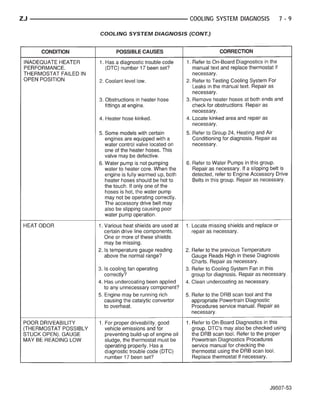
ZJ                                                                                                    COOLING SYSTEM              7-1

                                                 COOLING SYSTEM

                                                             CONTENTS

                                                              page                                                                 page

DIAGNOSIS . . . . . . . . . . . . . . . . . . . . . . . . . . . . . 3   SERVICE PROCEDURES . . . . . . . . . . . . . . . . . . 11
ENGINE ACCESSORY DRIVE BELTS . . . . . . . . . 40                       SPECIFICATIONS . . . . . . . . . . . . . . . . . . . . . . . . 50
ENGINE BLOCK HEATER . . . . . . . . . . . . . . . . . . 48

GENERAL INFORMATION                                                     matic transmission fluid (if equipped). The cooling
  Throughout this group, references are made to par-                    system is pressurized and uses a centrifugal water
ticular vehicle models by alphabetical designation or                   pump to circulate coolant throughout the system.
by the particular vehicle nameplate. A chart showing                      An optional factory installed maximum duty cool-
a breakdown of alphabetical designations is included                    ing package is available on most models. This pack-
in the Introduction section at the beginning of this                    age will provide additional cooling capacity for
manual.                                                                 vehicles used under extreme conditions such as
                                                                        trailer towing in high ambient temperatures.
COOLING SYSTEM
  The cooling system regulates engine operating tem-                    COOLING SYSTEM COMPONENTS
perature. It allows the engine to reach normal oper-                        The cooling system consists of:
ating temperature as quickly as possible. It also                       •   A radiator
maintains normal operating temperature and pre-                         •   Cooling fan
vents overheating.                                                      •   Thermal viscous fan drive
  The cooling system also provides a means of heat-                     •   Fan shroud
ing the passenger compartment and cooling the auto-                     •   Radiator pressure cap


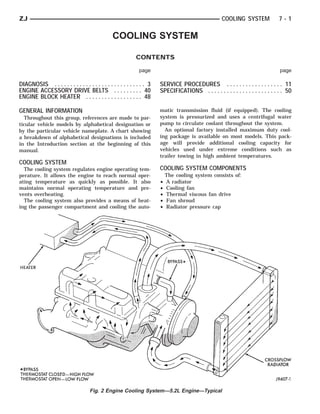
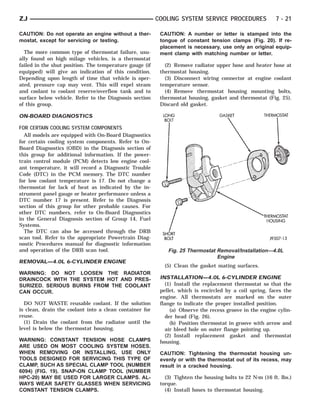
                                     Fig. 2 Engine Cooling System—5.2L Engine—Typical
7-2     COOLING SYSTEM                                                                          ZJ

• Thermostat
• Coolant reserve/overflow system
• Transmission oil cooler (if equipped with an auto-
matic transmission)
• Coolant
• Water pump
• Hoses and hose clamps

SYSTEM COOLANT ROUTING
 For cooling system routings refer to (Figs. 1 or 2).


                                                        Fig. 1 Engine Cooling System—4.0L Engine—
                                                                           Typical
ZJ                                                                                       COOLING SYSTEM DIAGNOSIS                        7-3

                                                              DIAGNOSIS


                                                                     INDEX
                                                                page                                                                     page

DRB Scan Tool . . . . . . . . . . . . . . . . . . . . . . . . . . . . 4   Preliminary Checks . . . . . . . . . . . . . . . . . . . . . . . . . 4
On-Board Diagnostics (OBD) . . . . . . . . . . . . . . . . . . 3

ON-BOARD DIAGNOSTICS (OBD)                                                  It is possible that a DTC for a monitored circuit
                                                                          may not be entered into memory even though a mal-
FOR CERTAIN COOLING SYSTEM                                                function has occurred. Refer to On-Board Diagnostics
COMPONENTS                                                                (OBD) in Group 14, Fuel Systems for additional in-
  The powertrain control module (PCM) has been                            formation.
programmed to monitor certain cooling system com-
                                                                          ACCESSING DIAGNOSTIC TROUBLE CODES
ponents:
                                                                            A stored Diagnostic Trouble Code (DTC) can be dis-
• If the engine has remained cool for too long a pe-                      played by cycling the ignition key On-Off-On-Off-On
riod, such as with a stuck open thermostat, a Diag-                       within three seconds and observing the malfunction
nostic Trouble Code (DTC) number 17 can be                                indicator lamp. This lamp is displayed on the instru-
observed at the malfunction indicator lamp. This                          ment panel as the CHECK ENGINE lamp (Fig. 3).
lamp is displayed on the instrument panel as the                            They can also be displayed through the use of the
CHECK ENGINE lamp (Fig. 3).                                               Diagnostic Readout Box (DRB) scan tool. The DRB
                                                                          connects to the data link connector in the engine
                                                                          compartment (Fig. 4). For operation of the DRB, refer
                                                                          to the appropriate Powertrain Diagnostic Procedures
                                                                          service manual.


           Fig. 3 Check Engine Lamp Location
   If the problem is sensed in a monitored circuit of-
ten enough to indicate an actual problem, a DTC is
stored. The DTC will be stored in the PCM memory
for eventual display to the service technician. If the
problem is repaired or ceases to exist, the PCM can-
cels the DTC after 51 engine starts.
   Certain criteria must be met for a DTC to be en-
tered into PCM memory. The criteria may be a spe-
cific range of engine rpm, engine temperature and/or                          Fig. 4 Data Link Connector Location—Typical
input voltage to the PCM.                                                 EXAMPLES:
   A DTC indicates that the PCM has recognized an                         • If the lamp (Fig. 3) flashes 1 time, pauses and
abnormal signal in a circuit or the system. A DTC                         flashes 2 more times, a flashing Diagnostic Trouble
may indicate the result of a failure, but never iden-                     Code (DTC) number 12 is indicated. If this code is
tify the failed component directly.                                       observed, it is indicating that the battery has been
                                                                          disconnected within the last 50 key-on cycles. It
7-4      COOLING SYSTEM DIAGNOSIS                                                                          ZJ

could also indicate that battery voltage has been dis-    • Increasing engine speed for more air flow is recom-
connected to the PCM. In either case, other DTC’s         mended.
may have been erased.                                       2. TRAILER TOWING:
• If the lamp flashes 1 time, pauses and flashes 7          Consult Trailer Towing section of owners manual.
more times, a flashing Diagnostic Trouble Code            Do not exceed limits.
(DTC) number 17 is indicated.                               3. AIR CONDITIONING; ADD-ON OR AFTER
  After any stored DTC information has been ob-           MARKET:
served, the display will end with a flashing DTC            A maximum cooling package should have been or-
number 55. This will indicate the end of all stored in-   dered with vehicle if add-on or after market A/C is
formation.                                                installed. If not, maximum cooling system compo-
                                                          nents should be installed for model involved per
ERASING TROUBLE CODES
  After the problem has been repaired, use the DRB        manufacturer’s specifications.
scan tool to erase a DTC. Refer to the appropriate          4. RECENT SERVICE OR ACCIDENT REPAIR:
Powertrain Diagnostic Procedures service manual for         Determine if any recent service has been performed
operation of the DRB scan tool.                           on vehicle that may effect cooling system. This may
                                                          be:
DRB SCAN TOOL                                             • Engine adjustments (incorrect timing)
  For operation of the DRB scan tool, refer to the ap-    • Slipping engine accessory drive belt(s)
propriate Powertrain Diagnostic Procedures service        • Brakes (possibly dragging)
manual.                                                   • Changed parts (incorrect water pump rotating in
                                                          wrong direction)
PRELIMINARY CHECKS                                        • Reconditioned radiator or cooling system refilling
                                                          (possibly under-filled or air trapped in system).
ENGINE COOLING SYSTEM OVERHEATING                         • Rubber and foam air seals not properly installed to
  Establish what driving conditions caused the com-       radiator or A/C condenser after a repair.
plaint. Abnormal loads on the cooling system such as      • Upper and lower portions of radiator fan shroud
the following may be the cause.                           not tightly connected. All air must flow through the
  1. PROLONGED IDLE, VERY HIGH AMBIENT                    radiator.
TEMPERATURE, SLIGHT TAIL WIND AT IDLE,                      If investigation reveals none of the previous
SLOW TRAFFIC, TRAFFIC JAMS, HIGH                          items as a cause for an engine overheating com-
SPEED, OR STEEP GRADES:                                   plaint, refer to following Cooling System Diag-
  Driving techniques that avoid overheating are:          nosis charts.
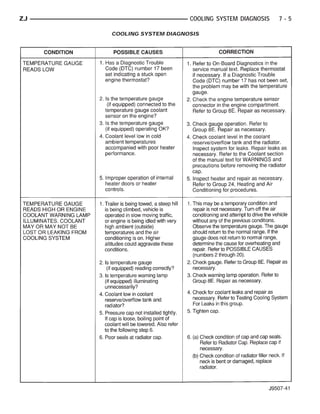
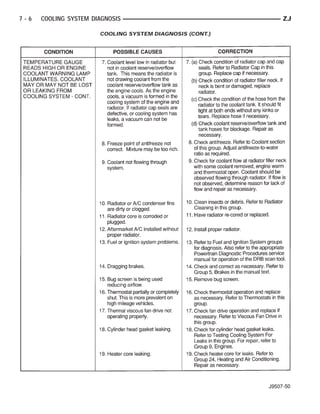
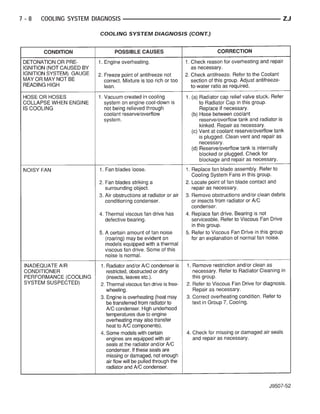
• Idle with A/C off when temperature gauge is at            These charts are to be used as a quick-reference
end of normal range.                                      only. Refer to the group text for information.
ZJ                        COOLING SYSTEM DIAGNOSIS   7-5

     COOLING SYSTEM DIAGNOSIS
7-6   COOLING SYSTEM DIAGNOSIS                            ZJ

                       COOLING SYSTEM DIAGNOSIS (CONT.)
ZJ                             COOLING SYSTEM DIAGNOSIS   7-7

     COOLING SYSTEM DIAGNOSIS (CONT.)
7-8   COOLING SYSTEM DIAGNOSIS                            ZJ

                       COOLING SYSTEM DIAGNOSIS (CONT.)
ZJ                             COOLING SYSTEM DIAGNOSIS   7-9

     COOLING SYSTEM DIAGNOSIS (CONT.)
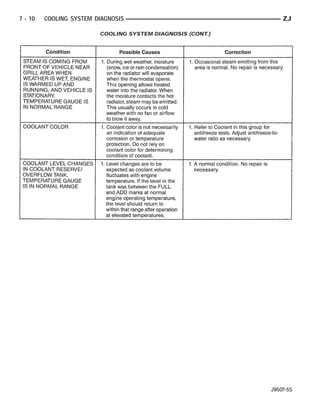
7 - 10   COOLING SYSTEM DIAGNOSIS                           ZJ

                         COOLING SYSTEM DIAGNOSIS (CONT.)
ZJ                                                                                           COOLING SYSTEM SERVICE PROCEDURES                                 7 - 11

                                                        SERVICE PROCEDURES


                                                                                        INDEX
                                                                                    page                                                                          page

Automatic Transmission Oil Coolers . . . . . .                  .   .   .   .   .   .   38    Refilling Cooling System . . . . . . . . . . . . . . . . . . . .         26
Coolant . . . . . . . . . . . . . . . . . . . . . . . . . . .   .   .   .   .   .   .   23    Testing Cooling System for Leaks . . . . . . . . . . . . .               26
Coolant Reserve/Overflow System . . . . . . .                   .   .   .   .   .   .   28    Thermostat . . . . . . . . . . . . . . . . . . . . . . . . . . . . . .   20
Cooling System Cleaning/Reverse Flushing                        .   .   .   .   .   .   26    Viscous Fan Drive—All Engines . . . . . . . . . . . . . .                36
Cooling System Fan . . . . . . . . . . . . . . . . .            .   .   .   .   .   .   35    Water Pump Bypass Hose—5.2L V-8 Engine . . . . .                         18
Cooling System Hoses . . . . . . . . . . . . . . .              .   .   .   .   .   .   34    Water Pump Tests . . . . . . . . . . . . . . . . . . . . . . . . .       11
Draining Cooling System . . . . . . . . . . . . . .             .   .   .   .   .   .   25    Water Pumps—General Information . . . . . . . . . . . .                  11
Radiator . . . . . . . . . . . . . . . . . . . . . . . . . .    .   .   .   .   .   .   30    Water Pumps—Removal/Installation . . . . . . . . . . .                   12
Radiator Pressure Cap . . . . . . . . . . . . . . .             .   .   .   .   .   .   28

WATER PUMPS—GENERAL INFORMATION
  A centrifugal water pump circulates coolant
through the water jackets, passages, intake manifold,
radiator core, cooling system hoses and heater core.
The pump is driven from the engine crankshaft by a
single serpentine drive belt on all engines.
  The water pump impeller is pressed onto the rear
of a shaft that rotates in bearings pressed into the
housing. The housing has two small holes to allow
seepage to escape. The water pump seals are lubri-
cated by the antifreeze in the coolant mixture. No ad-
ditional lubrication is necessary.

CAUTION: All 4.0L 6-cylinder engines are equipped
with a reverse (counterclockwise) rotating water
pump and thermal viscous fan drive assembly. RE-
VERSE is stamped or imprinted on the cover of the
viscous fan drive and inner side of the fan. The let-
ter R is stamped into the back of the water pump
impeller (Fig. 1). Engines from previous model
years, depending upon application, may have been
equipped with a forward (clockwise) rotating water                                                   Fig. 1 Reverse Rotating Water Pump—4.0L
pump. Installation of the wrong water pump or vis-                                                                   6-Cylinder
cous fan drive will cause engine over heating.                                                DRAINCOCK WITH THE SYSTEM HOT AND UNDER
                                                                                              PRESSURE. SERIOUS BURNS FROM THE COOL-
  A quick test to determine if the pump is working is
to check if the heater warms properly. A defective wa-                                        ANT CAN OCCUR.
ter pump will not be able to circulate heated coolant
                                                                                                (1) Drain the cooling system. Refer to Draining
through the long heater hose to the heater core.
                                                                                              Cooling System in this group.
  5.2L ENGINE: One of the heater hoses is con-
                                                                                                (2) Loosen the fan belt. Refer to Belt Service in the
nected to the water pump with a metal coolant re-
turn tube (Fig. 2). A rubber o-ring forms a seal at the                                       Engine Accessory Drive Belt section of this group.
water pump end of the tube.                                                                     (3) Disconnect the lower radiator hose from the
                                                                                              water pump.
WATER PUMP TESTS                                                                                (4) Bend a stiff welding rod or similar device as
                                                                                              shown in (Fig. 3). To prevent breakage of rod, mini-
LOOSE IMPELLER                                                                                mum thickness should be 3/16 inch (.187 inches).
  DO NOT WASTE reusable coolant. If solution is                                                 (5) Position the rod in the water pump inlet and
clean, drain coolant into a clean container for reuse.                                        attempt to hold the impeller while turning the fan
                                                                                              pulley. If equipped with a thermal viscous fan drive,
WARNING: DO NOT REMOVE THE CYLINDER                                                           rotate the water pump shaft with a wrench attached
BLOCK DRAIN PLUGS OR LOOSEN THE RADIATOR                                                      to one of the fan pulley mounting nuts. If the impel-
7 - 12    COOLING SYSTEM SERVICE PROCEDURES                                                                ZJ

                                                          DO NOT WASTE reusable coolant. If solution is
                                                        clean, drain the coolant into a clean container for re-
                                                        use.

                                                        WARNING: DO NOT LOOSEN THE RADIATOR
                                                        DRAINCOCK WITH THE SYSTEM HOT AND UNDER
                                                        PRESSURE. SERIOUS BURNS FROM THE COOL-
                                                        ANT CAN OCCUR.

                                                          (1) Drain sufficient coolant from the radiator to de-
                                                        crease the level below the water pump heater hose
                                                        inlet.
                                                          (2) Remove the heater hose.
                                                          (3) Inspect the inlet for metal casting flash or
                                                        other restrictions.
                                                          Remove the pump from the engine before re-
                                                        moving restriction to prevent contamination of
                                                        the coolant with debris. Refer to Water Pump
                                                        Removal in this group.

                                                        WATER PUMPS—REMOVAL/INSTALLATION
   Fig. 2 Coolant Return Tube—5.2L V-8 Engine           REMOVAL—4.0L 6-CYL. ENGINE
ler is loose and can be held with the rod while the       The water pump on all models can be removed
fan blades are turning, the pump is defective. Do not   without discharging the air conditioning system (if
use excessive force when rotating pump shaft. If the    equipped).
impeller turns, the pump is OK.
                                                        CAUTION: All 4.0L 6-cylinder engines have a re-
                                                        verse (counter-clockwise) rotating water pump. The
                                                        letter R is stamped into the back of the water pump
                                                        impeller (Fig. 1) to identify. Engines from previous
                                                        model years, depending upon application, may be
                                                        equipped with a forward (clockwise) rotating water
                                                        pump. Installation of the wrong water pump will
                                                        cause engine over heating.

                                                          The water pump impeller is pressed on the rear of
                                                        the pump shaft and bearing assembly. The water
                                                        pump is serviced only as a complete assembly.

                                                        WARNING: DO NOT REMOVE THE BLOCK DRAIN
                                                        PLUG(S) OR LOOSEN RADIATOR DRAINCOCK
                                                        WITH THE SYSTEM HOT AND UNDER PRESSURE.
                                                        SERIOUS BURNS FROM COOLANT CAN OCCUR.

                                                          DO NOT WASTE reusable coolant. If the solution
                                                        is clean, drain coolant into a clean container for re-
                                                        use.
                                                          (1) Disconnect negative battery cable at battery.
                                                          (2) Drain the cooling system. Refer to Cooling Sys-
            Fig. 3 Impeller Test—Typical                tem Draining in this group.
 Connect the hose and install the coolant, or proceed     (3) Loosen (but do not remove at this time) the
with repairs.                                           four fan hub-to-water pump pulley mounting nuts.
                                                          The engine accessory drive belt must be removed
INSPECTING FOR INLET RESTRICTIONS                       prior to removing the fan.
  Inadequate heater performance may be caused by a        (4) Remove engine drive belt as follows:
metal casting restriction in the water pump heater          (a) Loosen two rear power steering pump mount-
hose inlet.                                               ing bolts A (Fig. 4).
ZJ                                                      COOLING SYSTEM SERVICE PROCEDURES              7 - 13


                                                             Fig. 6 Bracket Mounting Bolts—4.0L Engine
                                                         E. Bracket mounting bolt E is located behind the
                                                         power steering pump (Fig. 6).
                                                           (7) Remove two bolts A (Fig. 4).
                                                           (8) Remove locknut C and belt adjustment bolt D
Fig. 4 P.S. Pump Rear Mounting Bolts—4.0L Engine         (Figs. 5 or 6).
                                                           (9) Remove bolt B (Fig. 5). Position power steering
   (b) Loosen upper pump pivot bolt B and lower
                                                         pump to the side. Hold pump in position with wire.
 lock nut C (Figs. 5 or 6).
                                                         Do not disconnect hydraulic lines from pump.
                                                           (10) Remove bolts E, F and G (Fig. 6) and remove
                                                         pump mounting bracket.
                                                           (11) Remove idler pulley mounting bolt and remove
                                                         idler pulley. This must be done to gain clearance for
                                                         the water pump mounted heater hose fitting when
                                                         water pump is being removed.

                                                         WARNING: CONSTANT TENSION HOSE CLAMPS
                                                         ARE USED ON MOST COOLING SYSTEM HOSES.
                                                         WHEN REMOVING OR INSTALLING, USE ONLY
                                                         TOOLS DESIGNED FOR SERVICING THIS TYPE OF
                                                         CLAMP, SUCH AS SPECIAL CLAMP TOOL (NUMBER
                                                         6094) (FIG. 7). SNAP-ON CLAMP TOOL (NUMBER
                                                         HPC-20) MAY BE USED FOR LARGER CLAMPS. AL-
                                                         WAYS WEAR SAFETY GLASSES WHEN SERVICING
                                                         CONSTANT TENSION CLAMPS.


                                                         CAUTION: A number or letter is stamped into the
                                                         tongue of constant tension clamps (Fig. 8). If re-
                                                         placement is necessary, use only an original equip-
                                                         ment clamp with matching number or letter.
Fig. 5 P.S. Pump Front Mounting Bolt/Locknut—4.0L
                      Engine                               (12) Remove lower radiator hose from water pump.
    (c) Loosen pump adjusting bolt D (Fig. 4) until      Remove heater hose from water pump fitting.
  belt can be removed.                                     (13) Remove the four fan hub-to-water pump pul-
    (d) Remove belt.                                     ley mounting nuts.
  (5) Check condition of all pulleys.                      (14) Remove the two fan shroud-to-upper radiator
  (6) The power steering pump must be removed            crossmember attaching nuts (Fig. 9).
from its cast mounting bracket to gain access to bolt      (15) Remove the fan assembly and fan shroud (to-
                                                         gether as one unit) from the vehicle.
7 - 14     COOLING SYSTEM SERVICE PROCEDURES                                                             ZJ


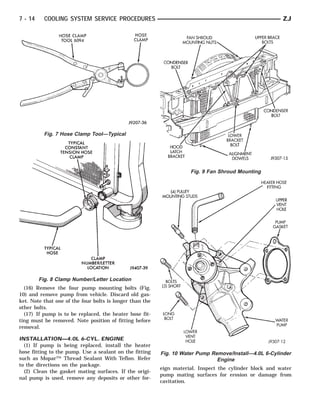
           Fig. 7 Hose Clamp Tool—Typical


                                                                     Fig. 9 Fan Shroud Mounting


         Fig. 8 Clamp Number/Letter Location
  (16) Remove the four pump mounting bolts (Fig.
10) and remove pump from vehicle. Discard old gas-
ket. Note that one of the four bolts is longer than the
other bolts.
  (17) If pump is to be replaced, the heater hose fit-
ting must be removed. Note position of fitting before
removal.

INSTALLATION—4.0L 6-CYL. ENGINE
  (1) If pump is being replaced, install the heater
hose fitting to the pump. Use a sealant on the fitting    Fig. 10 Water Pump Remove/Install—4.0L 6-Cylinder
such as Mopar™ Thread Sealant With Teflon. Refer                               Engine
to the directions on the package.
                                                          eign material. Inspect the cylinder block and water
  (2) Clean the gasket mating surfaces. If the origi-
                                                          pump mating surfaces for erosion or damage from
nal pump is used, remove any deposits or other for-
                                                          cavitation.
ZJ                                                         COOLING SYSTEM SERVICE PROCEDURES                7 - 15

  (3) Install the gasket and water pump (the gasket           (12) Position drive belt to pulleys.
is installed dry). Tighten mounting bolts to 30 N⅐m           (13) Tighten belt adjustment bolt D (Fig. 4) to the
(22 ft. lbs.) torque. Rotate the shaft by hand to be        proper tension. Refer to the Specifications section at
sure it turns freely.                                       the end of this group for belt tension.
  (4) Connect the radiator and heater hoses to the            (14) Tighten bolts A (Fig. 4) to 27 N⅐m (20 ft. lbs.)
water pump.                                                 torque.
  (5) Position the fan assembly and fan shroud (to-           (15) Tighten pivot bolt B (Fig. 5) to 27 N⅐m (20 ft.
gether as one unit) to the engine.                          lbs.) torque.
  (6) Position fan shroud to radiator. Be sure the            (16) Tighten locknut C (Fig. 5) to 27 N⅐m (20 ft.
alignment tabs at the lower part of shroud are placed       lbs.) torque.
into the slots near lower part of radiator. Install and
                                                              (17) After the power steering pump has been tight-
tighten the two fan shroud mounting nuts.
                                                            ened, recheck belt tension.
  (7) Install fan assembly to water pump hub.
                                                              (18) Fill cooling system with coolant and check for
Tighten fan drive mounting nuts to 24 N⅐m (18 ft.
                                                            leaks. Refer to Refilling Cooling System in this
lbs.) torque. Be sure of at least 25 mm (1.0 inches)
between tips of fan blades and fan shroud.                  group.
  (8) Position power steering pump bracket to en-             (19) Connect battery cable to battery.
gine. Install bolts E, F and G (Fig. 6). Tighten bolts F      (20) Start and warm the engine. Check for leaks.
and G to 38 N⅐m (28 ft. lbs.) torque. Tighten bolt E to
                                                            REMOVAL—5.2L V-8 ENGINE
27 N⅐m (20 ft. lbs.) torque.
                                                              The water pump on 5.2L engines is bolted directly
  (9) Position power steering pump to mounting
bracket. Install pivot bolt B (Fig. 5) finger tight. In-    to the engine timing chain case/cover.
stall locknut C and adjustment bolt D (Figs. 5 or 6)          A gasket is used as a seal between the water pump
finger tight.                                               and timing chain case/cover.
  (10) Install two adjustment bolts A (Fig. 4) finger         If water pump is replaced because of bearing/shaft
tight.                                                      damage, or leaking shaft seal, the mechanical cooling
  (11) Install idler pulley.                                fan assembly should also be inspected. Inspect for fa-
                                                            tigue cracks, loose blades, or loose rivets that could
CAUTION: When installing the serpentine engine              have resulted from excessive vibration. Replace fan if
accessory drive belt, the belt MUST be routed cor-          any of these conditions are found. Also check condi-
rectly. If not, the engine may overheat due to the          tion of the thermal viscous fan drive. Refer to Viscous
water pump rotating in the wrong direction. Refer to        Fan Drive in this group.
figure 11 for appropriate belt routing. Or, refer to the      The water pump on all models can be removed
Belt Routing Label located in the engine compartment.       without discharging the air conditioning system (if
                                                            equipped).
                                                              (1) Disconnect negative battery cable from battery.
                                                              (2) Drain cooling system. Refer to Draining Cooling
                                                            System in this group.
                                                              Do not waste reusable coolant. If solution is clean,
                                                            drain coolant into a clean container for reuse.
                                                              (3) The thermal viscous fan drive is attached
                                                            (threaded) to the water pump hub shaft (Fig. 12). Re-
                                                            move fan/viscous fan drive assembly from water
                                                            pump by turning mounting nut counterclockwise as
                                                            viewed from front. Threads on viscous fan drive are
                                                            RIGHT HAND. A Snap-On 36 MM Fan Wrench
                                                            (number SP346 from Snap-On Cummins Diesel Tool
                                                            Set number 2017DSP) can be used. Place a bar or
                                                            screwdriver between water pump pulley bolts (Fig.
                                                            12) to prevent pulley from rotating. Do not attempt
                                                            to remove fan/viscous fan drive assembly from vehi-
                                                            cle at this time.


     Fig. 11 Belt Routing—4.0L 6-Cylinder Engine
7 - 16     COOLING SYSTEM SERVICE PROCEDURES                                                                   ZJ


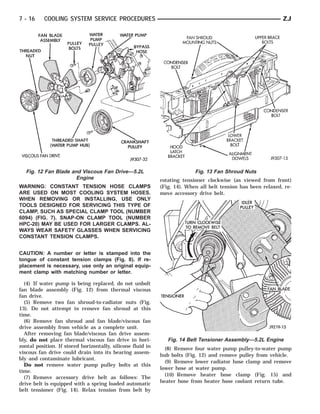
   Fig. 12 Fan Blade and Viscous Fan Drive—5.2L                            Fig. 13 Fan Shroud Nuts
                       Engine                                rotating tensioner clockwise (as viewed from front)
WARNING: CONSTANT TENSION HOSE CLAMPS                        (Fig. 14). When all belt tension has been relaxed, re-
ARE USED ON MOST COOLING SYSTEM HOSES.                       move accessory drive belt.
WHEN REMOVING OR INSTALLING, USE ONLY
TOOLS DESIGNED FOR SERVICING THIS TYPE OF
CLAMP, SUCH AS SPECIAL CLAMP TOOL (NUMBER
6094) (FIG. 7). SNAP-ON CLAMP TOOL (NUMBER
HPC-20) MAY BE USED FOR LARGER CLAMPS. AL-
WAYS WEAR SAFETY GLASSES WHEN SERVICING
CONSTANT TENSION CLAMPS.


CAUTION: A number or letter is stamped into the
tongue of constant tension clamps (Fig. 8). If re-
placement is necessary, use only an original equip-
ment clamp with matching number or letter.

  (4) If water pump is being replaced, do not unbolt
fan blade assembly (Fig. 12) from thermal viscous
fan drive.
  (5) Remove two fan shroud-to-radiator nuts (Fig.
13). Do not attempt to remove fan shroud at this
time.
  (6) Remove fan shroud and fan blade/viscous fan
drive assembly from vehicle as a complete unit.
  After removing fan blade/viscous fan drive assem-
bly, do not place thermal viscous fan drive in hori-            Fig. 14 Belt Tensioner Assembly—5.2L Engine
zontal position. If stored horizontally, silicone fluid in     (8) Remove four water pump pulley-to-water pump
viscous fan drive could drain into its bearing assem-
                                                             hub bolts (Fig. 12) and remove pulley from vehicle.
bly and contaminate lubricant.
                                                               (9) Remove lower radiator hose clamp and remove
  Do not remove water pump pulley bolts at this
                                                             lower hose at water pump.
time.
                                                               (10) Remove heater hose clamp (Fig. 15) and
  (7) Remove accessory drive belt as follows: The
drive belt is equipped with a spring loaded automatic        heater hose from heater hose coolant return tube.
belt tensioner (Fig. 14). Relax tension from belt by
ZJ                                                     COOLING SYSTEM SERVICE PROCEDURES                7 - 17

  (11) Loosen heater hose coolant return tube mount-    INSPECTION
ing bolt and nut (Fig. 15) and remove tube from wa-       Replace water pump assembly if it has any of the
ter pump. Discard the old tube o-ring.                  following conditions:
                                                        • The body is cracked or damaged
                                                        • Water leaks from shaft seal. This is evident by
                                                        traces of coolant below vent hole
                                                        • Loose or rough turning bearing. Also inspect vis-
                                                        cous fan drive
                                                        • Impeller rubs either the pump body or timing
                                                        chain case/cover

                                                        INSTALLATION—5.2L V-8 ENGINE
                                                          (1) Clean gasket mating surfaces.
                                                          (2) Using a new gasket, install water pump to en-
                                                        gine as follows: Guide water pump nipple into bypass
                                                        hose as pump is being installed. Install water pump
                                                        bolts (Fig. 16). Tighten water pump mounting bolts
                                                        to 40 N⅐m (30 ft. lbs.) torque.
                                                          (3) Position bypass hose clamp to bypass hose.
                                                          (4) Spin water pump to be sure that pump impeller
                                                        does not rub against timing chain case/cover.
                                                          (5) Install a new o-ring to the heater hose coolant
                                                        return tube (Fig. 15). Coat the new o-ring with anti-
                                                        freeze before installation.
     Fig. 15 Coolant Return Tube—5.2L Engine              (6) Install coolant return tube to engine (Fig. 15).
                                                        Be sure the slot in tube bracket is bottomed to the
  (12) Remove seven water pump mounting bolts           mounting bolt. This will properly position return
(Fig. 16).                                              tube.
                                                          (7) Connect radiator lower hose to water pump.
                                                          (8) Connect heater hose and hose clamp to coolant
                                                        return tube.
                                                          (9) Install water pump pulley. Tighten bolts to 27
                                                        N⅐m (20 ft. lbs.) torque. Place a bar or screwdriver
                                                        between water pump pulley bolts (Fig. 12) to prevent
                                                        pulley from rotating.
                                                          (10) Relax tension from belt tensioner (Fig. 14). In-
                                                        stall drive belt.

                                                        CAUTION: When installing the serpentine accessory
                                                        drive belt, belt must be routed correctly. If not, en-
                                                        gine may overheat due to water pump rotating in
                                                        wrong direction. Refer to (Fig. 17) for correct belt
                                                        routing. Or, refer to the Belt Routing Label located
                                                        in the engine compartment. The correct belt with
 Fig. 16 Water Pump Bolts—5.2L Engine—Typical           correct length must be used.
  (13) Loosen clamp at water pump end of bypass           (11) Position fan shroud and fan blade/viscous fan
hose (Fig. 12). Slip bypass hose from water pump        drive assembly to vehicle as a complete unit.
while removing pump from vehicle. Discard old gas-        Be sure the upper and lower portions of the fan
ket.                                                    shroud are firmly connected. All air must flow
                                                        through the radiator.
CAUTION: Do not pry water pump at timing chain            (12) Install two fan shroud-to-radiator nuts (Fig.
case/cover. The machined surfaces may be dam-           13).
aged resulting in leaks.                                  Be sure of at least 25 mm (1.0 inches) between tips
                                                        of fan blades and fan shroud.
                                                          (13) Install fan blade/viscous fan drive assembly to
                                                        water pump shaft.
7 - 18    COOLING SYSTEM SERVICE PROCEDURES                                                                   ZJ

                                                           WITHOUT AIR CONDITIONING (A/C)

                                                           REMOVAL
                                                             (1) Partially drain cooling system. Refer to Drain-
                                                           ing Cooling System in this group.
                                                             Do not waste reusable coolant. If solution is clean,
                                                           drain coolant into a clean container for reuse.

                                                           WARNING: CONSTANT TENSION HOSE CLAMPS
                                                           ARE USED ON MOST COOLING SYSTEM HOSES.
                                                           WHEN REMOVING OR INSTALLING, USE ONLY
                                                           TOOLS DESIGNED FOR SERVICING THIS TYPE OF
                                                           CLAMP, SUCH AS SPECIAL CLAMP TOOL (NUMBER
                                                           6094) (FIG. 19). SNAP-ON CLAMP TOOL (NUMBER
                                                           HPC-20) MAY BE USED FOR LARGER CLAMPS. AL-
                                                           WAYS WEAR SAFETY GLASSES WHEN SERVICING
                                                           CONSTANT TENSION CLAMPS.


                                                           CAUTION: A number or letter is stamped into the
                                                           tongue of constant tension clamps (Fig. 20). If re-
                                                           placement is necessary, use only an original equip-
         Fig. 17 Belt Routing—5.2L Engine                  ment clamp with matching number or letter.
  (14) Fill cooling system. Refer to Refilling the Cool-
ing System in this group.
  (15) Connect negative battery cable.
  (16) Start and warm the engine. Check for leaks.

WATER PUMP BYPASS HOSE—5.2L V-8 ENGINE
  A water pump bypass hose (Fig. 18) is used be-
tween the intake manifold and water pump on all
5.2L V-8 engines. To test for leaks, refer to Testing
Cooling System for Leaks in this group.


                                                                    Fig. 19 Hose Clamp Tool—Typical
                                                             (2) Loosen both bypass hose clamps (Fig. 19) and
                                                           position to center of hose. Remove hose from vehicle.

                                                           INSTALLATION
                                                             (1) Position bypass hose clamps (Fig. 19) to center
                                                           of hose.
                                                             (2) Install bypass hose to engine.
                                                             (3) Secure both hose clamps (Fig. 19).
                                                             (4) Fill cooling system. Refer to Refilling the Cool-
                                                           ing System in this group.
                                                             (5) Start and warm the engine. Check for leaks.

                                                           WITH AIR CONDITIONING (A/C)

                                                           REMOVAL
  Fig. 18 Water Pump Bypass Hose—5.2L Engine                 If equipped with A/C, the generator and A/C com-
                                                           pressor along with their common mounting bracket
ZJ                                                      COOLING SYSTEM SERVICE PROCEDURES               7 - 19

                                                           (1) Disconnect negative battery cable from battery.
                                                           (2) Partially drain cooling system. Refer to Drain-
                                                         ing Cooling System in this group.
                                                           Do not waste reusable coolant. If solution is clean,
                                                         drain coolant into a clean container for reuse.
                                                           (3) Remove upper radiator hose clamp (Fig. 19)
                                                         and hose at radiator.
                                                           (4) Unplug wiring harness from A/C compressor.
                                                           (5) Remove air duct at throttle body.
                                                           (6) Disconnect A/C lines from clip at intake mani-
                                                         fold.
                                                           (7) Remove heater hose coolant return tube mount-
                                                         ing bolt and nut (Fig. 22). Remove tube from engine
                                                         and discard the old tube o-ring.


       Fig. 20 Clamp Number/Letter Location
(Fig. 21) must be partially removed. Removing gener-
ator or A/C compressor from their mounting bracket
is not necessary. Also, discharging A/C system is not
necessary. Do not remove any refrigerant lines from
A/C compressor.


                                                              Fig. 22 Coolant Return Tube—5.2L Engine
                                                           (8) Remove accessory drive belt as follows: The
                                                         drive belt is equipped with a spring loaded automatic
                                                         belt tensioner (Fig. 23). Relax tension from belt by
                                                         rotating tensioner clockwise (as viewed from front)
                                                         (Fig. 23). When all belt tension has been relaxed, re-
                                                         move accessory drive belt.
                                                           (9) The drive belt idler pulley must be removed to
                                                         gain access to one of A/C compressor/generator
                                                         bracket mounting bolts. Remove idler pulley bolt and
                                                         remove idler pulley (Fig. 21).
                                                           (10) Remove oil dipstick tube mounting bolt at side
                                                         of A/C-generator mounting bracket.
 Fig. 21 Generator and A/C Compressor Mounting             (11) Disconnect speed control cable and throttle ca-
              Bracket—5.2L Engine                        ble at throttle body. Refer to Accelerator Pedal and
                                                         Throttle Cable in Group 14, Fuel System for throttle
WARNING: THE A/C SYSTEM IS UNDER PRESSURE                cable removal and installation. Refer to Group 8H for
EVEN WITH ENGINE OFF. REFER TO REFRIGER-                 removal and installation of speed control cable.
ANT WARNINGS IN GROUP 24, HEATING AND AIR                  (12) Remove bracket-to-intake manifold bolts
CONDITIONING.                                            (number 1 and 2—figure 21).
7 - 20    COOLING SYSTEM SERVICE PROCEDURES                                                                   ZJ

                                                          wrong direction. Refer to figure 24 for correct belt
                                                          routing. Or, refer to the Belt Routing Label located
                                                          in the engine compartment. The correct belt with
                                                          correct length must be used.


   Fig. 23 Belt Tensioner Assembly—5.2L Engine
  (13) Remove six bracket bolts (number 3—figure
21).
  (14) Lift and position generator and A/C compres-
sor (along with their common mounting bracket) to                  Fig. 24 Belt Routing—5.2L Engine
gain access to bypass hose. A block of wood may be          (11) Install air duct to throttle body.
used to hold assembly in position.                          (12) Install upper radiator hose to radiator.
  (15) Loosen and position both hose clamps to cen-         (13) Connect wiring harness to A/C compressor.
ter of bypass hose. Remove hose from vehicle.               (14) Connect A/C lines to clip at intake manifold.
                                                            (15) Fill cooling system. Refer to Refilling the Cool-
INSTALLATION
                                                          ing System in this group.
  (1) Position bypass hose clamps to center of hose.        (16) Start and warm the engine. Check for leaks.
  (2) Install bypass hose to engine.
  (3) Secure both hose clamps (Fig. 19).                  THERMOSTAT
  (4) Install generator-A/C mounting bracket assem-
bly to engine. Tighten bolts (number 1 and 2—figure       DESCRIPTION AND OPERATION
21) to 54 N⅐m (40 ft. lbs.) torque. Tighten bolts (num-     A pellet-type thermostat controls the operating
ber 3—figure 21) to 40 N⅐m (30 ft. lbs.) torque.          temperature of the engine by controlling the amount
  (5) Install a new o-ring to the heater hose coolant     of coolant flow to the radiator. On all engines the
return tube (Fig. 22). Coat the new o-ring with anti-     thermostat is closed below 195°F (90°C). Above this
freeze before installation.                               temperature, coolant is allowed to flow to the radia-
  (6) Install coolant return tube to engine (Fig. 22).    tor. This provides quick engine warm up and overall
  Be sure the slot in tube bracket is bottomed to the     temperature control.
mounting bolt. This will properly position return           An arrow, plus the word UP is stamped on the
tube.                                                     front flange next to the air bleed. The words TO
  (7) Connect throttle body control cables.               RAD are stamped on one arm of the thermostat.
  (8) Install oil dipstick mounting bolt.                 They indicate the proper installed position.
  (9) Install idler pulley. Tighten pulley bolt to 54       The same thermostat is used for winter and sum-
N⅐m (40 ft. lbs.) torque.                                 mer seasons. An engine should not be operated with-
  (10) Relax tension from belt tensioner (Fig. 23). In-   out a thermostat, except for servicing or testing.
stall drive belt.                                         Operating without a thermostat causes other prob-
                                                          lems. These are: longer engine warmup time, unreli-
CAUTION: When installing serpentine accessory             able warmup performance, increased exhaust
drive belt, belt must be routed correctly. If not, en-    emissions and crankcase condensation. This conden-
gine may overheat due to water pump rotating in           sation can result in sludge formation.
ZJ                                                       COOLING SYSTEM SERVICE PROCEDURES                7 - 21

CAUTION: Do not operate an engine without a ther-         CAUTION: A number or letter is stamped into the
mostat, except for servicing or testing.                  tongue of constant tension clamps (Fig. 20). If re-
                                                          placement is necessary, use only an original equip-
  The more common type of thermostat failure, usu-        ment clamp with matching number or letter.
ally found on high milage vehicles, is a thermostat
failed in the shut position. The temperature gauge (if      (2) Remove radiator upper hose and heater hose at
equipped) will give an indication of this condition.      thermostat housing.
Depending upon length of time that vehicle is oper-         (3) Disconnect wiring connector at engine coolant
ated, pressure cap may vent. This will expel steam        temperature sensor.
and coolant to coolant reserve/overflow tank and to         (4) Remove thermostat housing mounting bolts,
surface below vehicle. Refer to the Diagnosis section     thermostat housing, gasket and thermostat (Fig. 25).
of this group.                                            Discard old gasket.

ON-BOARD DIAGNOSTICS

FOR CERTAIN COOLING SYSTEM COMPONENTS
  All models are equipped with On-Board Diagnostics
for certain cooling system components. Refer to On-
Board Diagnostics (OBD) in the Diagnosis section of
this group for additional information. If the power-
train control module (PCM) detects low engine cool-
ant temperature, it will record a Diagnostic Trouble
Code (DTC) in the PCM memory. The DTC number
for low coolant temperature is 17. Do not change a
thermostat for lack of heat as indicated by the in-
strument panel gauge or heater performance unless a
DTC number 17 is present. Refer to the Diagnosis
section of this group for other probable causes. For
other DTC numbers, refer to On-Board Diagnostics
in the General Diagnosis section of Group 14, Fuel
Systems.
  The DTC can also be accessed through the DRB
scan tool. Refer to the appropriate Powertrain Diag-
nostic Procedures manual for diagnostic information
and operation of the DRB scan tool.                          Fig. 25 Thermostat Removal/Installation—4.0L
                                                                                Engine
REMOVAL—4.0L 6-CYLINDER ENGINE
                                                           (5) Clean the gasket mating surfaces.
WARNING: DO NOT LOOSEN THE RADIATOR
DRAINCOCK WITH THE SYSTEM HOT AND PRES-                   INSTALLATION—4.0L 6-CYLINDER ENGINE
SURIZED. SERIOUS BURNS FROM THE COOLANT                     (1) Install the replacement thermostat so that the
CAN OCCUR.                                                pellet, which is encircled by a coil spring, faces the
                                                          engine. All thermostats are marked on the outer
  DO NOT WASTE reusable coolant. If the solution          flange to indicate the proper installed position.
is clean, drain the coolant into a clean container for        (a) Observe the recess groove in the engine cylin-
reuse.                                                      der head (Fig. 26).
  (1) Drain the coolant from the radiator until the           (b) Position thermostat in groove with arrow and
level is below the thermostat housing.                      air bleed hole on outer flange pointing up.
                                                            (2) Install replacement gasket and thermostat
WARNING: CONSTANT TENSION HOSE CLAMPS                     housing.
ARE USED ON MOST COOLING SYSTEM HOSES.
WHEN REMOVING OR INSTALLING, USE ONLY                     CAUTION: Tightening the thermostat housing un-
TOOLS DESIGNED FOR SERVICING THIS TYPE OF                 evenly or with the thermostat out of its recess, may
CLAMP, SUCH AS SPECIAL CLAMP TOOL (NUMBER                 result in a cracked housing.
6094) (FIG. 19). SNAP-ON CLAMP TOOL (NUMBER
HPC-20) MAY BE USED FOR LARGER CLAMPS. AL-                  (3) Tighten the housing bolts to 22 N⅐m (16 ft. lbs.)
WAYS WEAR SAFETY GLASSES WHEN SERVICING                   torque.
CONSTANT TENSION CLAMPS.                                    (4) Install hoses to thermostat housing.
7 - 22    COOLING SYSTEM SERVICE PROCEDURES                                                            ZJ


      Fig. 26 Thermostat Recess—4.0L Engine              Fig. 27 Generator Support Bracket—5.2L Engine
  (5) Install electrical connector to coolant tempera-   bolt of automatic belt tensioner (Fig. 28).
ture sensor.                                               (c) Rotate tensioner assembly clockwise (as
  (6) Be sure that the radiator draincock is tightly     viewed from front) until tension has been relieved
closed. Fill the cooling system to the correct level     from belt.
with the required coolant mixture. Refer to Refilling
Cooling System in this group.
  (7) Start and warm the engine. Check for leaks.

REMOVAL—5.2L V-8 ENGINE

WARNING: DO NOT LOOSEN RADIATOR DRAIN-
COCK WITH SYSTEM HOT AND PRESSURIZED. SE-
RIOUS BURNS FROM COOLANT CAN OCCUR.

  Do not waste reusable coolant. If solution is clean,
drain coolant into a clean container for reuse.
  If thermostat is being replaced, be sure that re-
placement is specified thermostat for vehicle model
and engine type.
  Factory installed thermostat housings on 5.2L en-
gines are installed on a gasket with an anti-stick
coating. This will aid in gasket removal and clean-up.
  (1) Disconnect negative battery cable at battery.
  (2) Drain cooling system until coolant level is be-
low thermostat. Refer to Draining Cooling System in
this group.
  (3) Air Conditioned vehicles: Remove support
bracket (generator mounting bracket-to-intake mani-       Fig. 28 Automatic Belt Tensioner—5.2L Engine
fold) located near rear of generator (Fig. 27).
  (4) On air conditioning equipped vehicles, the gen-       (d) Remove belt from vehicle.
erator must be partially removed.                           (e) Remove two generator mounting bolts. Do not
    (a) Remove generator drive belt as follows: Drive    remove any wiring at generator. If equipped with
  belts on the 5.2L engine are equipped with a spring    4WD, unplug 4WD indicator lamp wiring harness
  loaded automatic belt tensioner (Fig. 28).             (located near rear of generator).
    (b) Attach a socket/wrench to pulley mounting
ZJ                                                       COOLING SYSTEM SERVICE PROCEDURES               7 - 23

    (f) Remove generator. Position generator to gain
  access for thermostat gasket removal.
  (5) Remove upper radiator hose clamp (Fig. 19)
and upper radiator hose at thermostat housing.
  (6) Position wiring harness (behind thermostat
housing) to gain access to thermostat housing.
  (7) Remove thermostat housing mounting bolts,
thermostat housing, gasket and thermostat (Fig. 29).
Discard old gasket.


                                                               Fig. 30 Thermostat Position—5.2L Engine
                                                              (a) Install generator. Tighten bolts to 41 N⅐m (30
                                                           ft. lbs.) torque.
                                                              (b) Install support bracket (generator mounting
                                                           bracket-to-intake manifold) (Fig. 27). Tighten bolts
                                                           to 54 N⅐m (40 ft. lbs.) torque.

                                                          CAUTION: When installing the serpentine accessory
                                                          drive belt, belt must be routed correctly. If not, en-
          Fig. 29 Thermostat—5.2L Engine                  gine may overheat due to water pump rotating in
                                                          wrong direction. Refer to (Fig. 31) for correct 5.2L
INSTALLATION—5.2L V-8 ENGINE
                                                          engine belt routing. Or, refer to the Belt Routing La-
  (1) Clean mating areas of intake manifold and
                                                          bel located in the engine compartment. The correct
thermostat housing.
                                                          belt with correct length must be used.
  (2) Install thermostat (spring side down) into re-
cessed machined groove on intake manifold (Fig. 29).          (c) Position drive belt over all pulleys except
  (3) Install gasket on intake manifold and over            idler pulley (located between generator and A/C
thermostat (Fig. 29).                                       compressor).
  (4) Position thermostat housing to intake manifold.         (d) Attach a socket/wrench to pulley mounting
Note the word FRONT stamped on housing (Fig. 30).           bolt of automatic belt tensioner (Fig. 28).
For adequate clearance, this must be placed towards           (e) Rotate socket/wrench clockwise. Place belt
front of vehicle. The housing is slightly angled for-       over idler pulley. Let tensioner rotate back into
ward after installation to intake manifold.                 place. Remove wrench. Be sure belt is properly
  (5) Install two housing-to-intake manifold bolts.         seated on all pulleys.
Tighten bolts to 23 N⅐m (200 in. lbs.) torque.              (8) Fill cooling system. Refer to Refilling Cooling
                                                          System in this group.
CAUTION: Housing must be tightened evenly and               (9) Connect negative battery cable to battery.
thermostat must be centered into recessed groove            (10) Start and warm the engine. Check for leaks.
in intake manifold. If not, it may result in a cracked
housing, damaged intake manifold threads or cool-         COOLANT
ant leak.
                                                          GENERAL INFORMATION
  (6) Install upper radiator hose to thermostat hous-       The cooling system is designed around the coolant.
ing.                                                      Coolant flows through the engine water jackets ab-
  (7) Air Conditioned vehicles:                           sorbing heat produced during engine operation. The
7 - 24    COOLING SYSTEM SERVICE PROCEDURES                                                                 ZJ

                                                          centage of antifreeze can cause the engine to over-
                                                          heat because specific heat of antifreeze is lower than
                                                          that of water.

                                                          CAUTION: Richer antifreeze mixtures cannot be
                                                          measured with normal field equipment and can
                                                          cause problems associated with 100 percent ethyl-
                                                          ene-glycol.


                                                          COOLANT SELECTION-ADDITIVES
                                                            Coolant should be maintained at the specified level
                                                          with a mixture of ethylene glycol-based antifreeze
                                                          and low mineral content water. Only use an anti-
                                                          freeze containing ALUGARD 340-2 ™.

                                                          CAUTION: Do not use coolant additives that are
                                                          claimed to improve engine cooling.


                                                          COOLANT SERVICE
                                                            It is recommended that the cooling system be
         Fig. 31 Belt Routing—5.2L Engine                 drained and flushed at 84,000 kilometers (52,500
                                                          miles), or 3 years, whichever occurs first. Then every
coolant carries heat to the radiator and heater core.     two years, or 48,000 kilometers (30,000 miles),
Here it is transferred to ambient air passing through     whichever occurs first.
the radiator and heater core fins. The coolant also re-
moves heat from the automatic transmission fluid in       COOLANT LEVEL CHECK-ROUTINE
vehicles equipped with an automatic transmission.           Do not remove radiator cap for routine cool-
                                                          ant level inspections. The coolant level can be
COOLANT PERFORMANCE                                       checked at coolant reserve/overflow tank.
  The required ethylene-glycol (antifreeze) and water       The coolant reserve/overflow system provides a
mixture depends upon climate and vehicle operating        quick visual method for determining coolant level
conditions. The coolant performance of various mix-       without removing radiator pressure cap. With engine
tures follows:                                            idling and at normal operating temperature, observe
  Pure Water-Water can absorb more heat than a            coolant level in reserve/overflow tank. The coolant
mixture of water and ethylene-glycol. This is for pur-    level should be between ADD and FULL marks.
pose of heat transfer only. Water also freezes at a
higher temperature and allows corrosion.                  ADDING ADDITIONAL COOLANT-ROUTINE
  100% Ethylene-Glycol-The corrosion inhibiting             Do not remove radiator cap to add coolant to
                                                          system. When adding coolant to maintain correct
additives in ethylene-glycol need the presence of wa-
                                                          level, do so at coolant reserve/overflow tank. Use a
ter to dissolve. Without water, additives form depos-
                                                          50/50 mixture of ethylene-glycol antifreeze containing
its in system. These act as insulation causing
                                                          Alugard 340-2 ™ and low mineral content water. Re-
temperature to rise to as high as 149°C (300°F). This
                                                          move radiator cap only for testing or when refilling
temperature is hot enough to melt plastic and soften
                                                          system after service. Removing cap unnecessarily can
solder. The increased temperature can result in en-
                                                          cause loss of coolant and allow air to enter system,
gine detonation. In addition, 100 percent ethylene-
                                                          which produces corrosion.
glycol freezes at -22°C (-8°F).
  50/50 Ethylene-Glycol and Water-Is the recom-           COOLANT LEVEL CHECK-SERVICE
mended mixture, it provides protection against freez-       The cooling system is closed and designed to main-
ing to -37°C (-35°F). The antifreeze concentration        tain coolant level to top of radiator.
must always be a minimum of 44 percent, year-
round in all climates. If percentage is lower, engine     WARNING: DO NOT OPEN RADIATOR DRAINCOCK
parts may be eroded by cavitation. Maximum protec-        WITH ENGINE RUNNING OR WHILE ENGINE IS HOT
tion against freezing is provided with a 68 percent       AND COOLING SYSTEM IS UNDER PRESSURE.
antifreeze concentration, which prevents freezing
down to -67.7°C (-90°F). A higher percentage will           When vehicle servicing requires a coolant level
freeze at a warmer temperature. Also, a higher per-       check in radiator, drain several ounces of coolant
ZJ                                                        COOLING SYSTEM SERVICE PROCEDURES                7 - 25

from radiator drain cock. Do this while observing            (2) Attach one end of a hose to the draincock. Put
coolant reserve/overflow system tank. The coolant          the other end into a clean container. Open draincock
level in reserve/overflow tank should drop slightly. If    and drain coolant from radiator. This will empty the
not, inspect for a leak between radiator and coolant       coolant reserve/overflow tank. The coolant does not
reserve/overflow system connection. Remove radiator        have to be removed from the tank unless the system
cap. The coolant level should be to top of radiator. If    is being refilled with a fresh mixture. When tank is
not and if coolant level in reserve/overflow tank is at    empty, remove radiator cap and continue draining
ADD mark, check for:                                       cooling system.
• An air leak in coolant reserve/overflow tank or its        To drain the 4.0L 6-cylinder engine of coolant, re-
hose                                                       move the cylinder block drain plug located on the
• An air leak in radiator filler neck                      side of cylinder block (Fig. 32).
• Leak in pressure cap seal to radiator filler neck          To drain the 5.2L V-8 engine of coolant, remove the
                                                           cylinder block drain plugs located on the sides of cyl-
LOW COOLANT LEVEL-AERATION                                 inder block above the oil pan rail (Fig. 33).
  If the coolant level in radiator drops below top of
radiator core tubes, air will enter cooling system.
  Low coolant level can cause thermostat pellet to be
suspended in air instead of coolant. This will cause
thermostat to open later, which in turn causes higher
coolant temperature. Air trapped in cooling system
also reduces amount of coolant circulating in heater
core resulting in low heat output.

DEAERATION
  As the engine operates, any air trapped in cooling
system gathers under the radiator cap. The next time
the engine is operated, thermal expansion of coolant
will push any trapped air past radiator cap into the
coolant reserve/overflow tank. Here it escapes to the
atmosphere into the tank. When the engine cools
down the coolant, it will be drawn from the reserve/
overflow tank into the radiator to replace any re-
moved air.

DRAINING COOLING SYSTEM
WARNING: DO NOT REMOVE THE CYLINDER                             Fig. 32 Drain Plug—4.0L 6-Cylinder Engine
BLOCK DRAIN PLUGS OR LOOSEN THE RADIATOR
DRAINCOCK WITH SYSTEM HOT AND UNDER
PRESSURE. SERIOUS BURNS FROM COOLANT
CAN OCCUR.

  DO NOT WASTE reusable coolant. If the solution
is clean, drain the coolant into a clean container for
reuse.

DRAINING ENTIRE SYSTEM
  Use this procedure if the entire cooling system is to
be drained, such as for engine removal.
  (1) DO NOT remove radiator cap first. With engine
cold, raise vehicle on a hoist and locate radiator
draincock.
• 4.0L 6-cyl. Engine: Radiator draincock is located
on the right/lower side of radiator facing to rear of              Fig. 33 Drain Plugs—5.2L V-8 Engine
vehicle.
• 5.2L V-8 Engine: Radiator draincock is located on        PARTIAL DRAINING
the left/lower side of radiator facing to rear of vehi-      Use this procedure if the coolant is to be partially
cle.                                                       drained, such as for engine thermostat removal.
7 - 26    COOLING SYSTEM SERVICE PROCEDURES                                                                    ZJ

  (1) With engine cold, slowly remove the radiator        REVERSE FLUSHING RADIATOR
cap. Raise vehicle on a hoist and locate radiator           Disconnect the radiator hoses from the radiator fit-
draincock.                                                tings. Attach a section of radiator hose to the radia-
• 4.0L Engine: Radiator draincock is located on the       tor bottom outlet fitting and insert the flushing gun.
right/lower side of radiator facing to rear of vehicle.   Connect a water supply hose and air supply hose to
• 5.2L Engine: Radiator draincock is located on the       the flushing gun.
left/lower side of radiator facing to rear of vehicle.
                                                          CAUTION: The cooling system normally operates at
  (2) Attach one end of a hose to the draincock. Put
                                                          97-to-124 kPa (14-to-18 psi) pressure. Exceeding
the other end into a clean container.
                                                          this pressure may damage the radiator or hoses.
  (3) Open draincock and drain desired amount of
coolant from radiator.                                      Allow the radiator to fill with water. When radiator
                                                          is filled, apply air in short blasts allowing radiator to
REFILLING COOLING SYSTEM                                  refill between blasts. Continue this reverse flushing
  (1) Tighten the radiator draincock and the cylinder     until clean water flows out through rear of radiator
block drain plug(s) (if removed).                         cooling tube passages. For more information, refer to
  (2) Fill system using a 50/50 mixture of water and      operating instructions supplied with flushing equip-
antifreeze as described in the Coolant Section of this    ment. Have radiator cleaned more extensively by a
group. Fill radiator to top and install radiator cap.     radiator repair shop.
Add sufficient coolant to the reserve/overflow tank to
raise level to FULL mark.                                 REVERSE FLUSHING ENGINE
  (3) With heater control unit in the HEAT position,         Drain the cooling system. Remove the thermostat
operate engine with radiator cap in place.                housing and thermostat. Install the thermostat hous-
  (4) After engine has reached normal operating           ing. Disconnect the radiator upper hose from the ra-
temperature, shut engine off and allow it to cool.        diator and attach the flushing gun to the hose.
                                                          Disconnect the radiator lower hose from the water
When engine is cooling down, coolant will be drawn
                                                          pump. Attach a lead away hose to the water pump
into the radiator from the reserve/overflow tank.
                                                          inlet fitting.
  (5) Add coolant to reserve/overflow tank as neces-
                                                             Connect the water supply hose and air supply hose
sary. Only add coolant to the reserve/overflow
                                                          to the flushing gun. Allow the engine to fill with wa-
tank when the engine is cold. Coolant level in a          ter. When the engine is filled, apply air in short
warm engine will be higher due to thermal ex-             blasts, allowing the system to fill between air blasts.
pansion. To purge the cooling system of all air, this     Continue until clean water flows through the lead
heat up/cool down cycle (adding coolant to cold en-       away hose. For more information, refer to operating
gine) must be performed three times. Add necessary        instructions supplied with flushing equipment.
coolant to raise tank level to the FULL mark after           Remove the lead away hose, flushing gun, water
each cool down period.                                    supply hose and air supply hose. Remove the thermo-
                                                          stat housing and install thermostat. Install the ther-
COOLING SYSTEM CLEANING/REVERSE FLUSHING                  mostat housing with a replacement gasket. Refer to
                                                          Thermostat Replacement. Connect the radiator
CAUTION: The cooling system normally operates at          hoses. Refill the cooling system with the correct an-
97-to-124 kPa (14-to-18 psi) pressure. Exceeding          tifreeze/water mixture.
this pressure may damage the radiator or hoses.
                                                          CHEMICAL CLEANING
                                                            In some instances, use a radiator cleaner (Mopar
CLEANING                                                  Radiator Kleen or equivalent) before flushing. This
  Drain cooling system and refill with water. Run en-     will soften scale and other deposits and aid the flush-
gine with radiator cap installed until upper radiator     ing operation.
hose is hot. Stop engine and drain water from sys-
tem. If water is dirty, fill system with water, run en-   CAUTION: Be sure instructions on the container are
gine and drain system. Repeat until water drains          followed.
clean.

REVERSE FLUSHING                                          TESTING COOLING SYSTEM FOR LEAKS
  Reverse flushing of the cooling system is the forc-
ing of water through the cooling system. This is done     ULTRAVIOLET LIGHT METHOD
using air pressure in the opposite direction of normal      All Jeep models have a leak detection additive
coolant flow. It is usually only necessary with very      added to the cooling system before they leave the fac-
dirty systems with evidence of partial plugging.          tory. The additive is highly visible under ultraviolet
ZJ                                                         COOLING SYSTEM SERVICE PROCEDURES                7 - 27

light (black light). If the factory original coolant has      Attach pressure tester 7700 (or an equivalent) to
been drained, pour one ounce of additive into the           the radiator filler neck (Fig. 35).
cooling system. The additive is available through the
part’s department. Place the heater control unit in
HEAT position. Start and operate the engine until
the radiator upper hose is warm to the touch. Aim
the commercially available black light tool at the
components to be checked. If leaks are present, the
black light will cause the additive to glow a bright
green color.
   The black light can be used along with a pressure
tester to determine if any external leaks exist (Fig.
34).


                                                                    Fig. 35 Pressurizing System—Typical
                                                              Operate the tester pump to apply 124 kPa (18 psi)
                                                            pressure to the system. If the hoses enlarge exces-
                                                            sively or bulge while testing, replace as necessary.
                                                            Observe the gauge pointer and determine the condi-
                                                            tion of the cooling system according to the following
                                                            criteria:
                                                            • Holds Steady: If the pointer remains steady for
                                                            two minutes, there are no serious coolant leaks in
                                                            the system. However, there could be an internal leak
                                                            that does not appear with normal system test pres-
                                                            sure. Inspect for interior leakage or do the Internal
                                                            Leakage Test. Do this if it is certain that coolant is
                                                            being lost and no leaks can be detected.
                                                            • Drops Slowly: Shows a small leak or seepage is oc-
                                                            curring. Examine all connections for seepage or slight
 Fig. 34 Leak Detection Using Black Light—Typical           leakage with a flashlight. Inspect the radiator, hoses,
                                                            gasket edges and heater. Seal any small leak holes
PRESSURE TESTER METHOD                                      with a Sealer Lubricant or equivalent. Repair leak
  The engine should be at the normal operating tem-         holes and reinspect the system with pressure ap-
perature. Recheck the system cold if the cause of           plied.
coolant loss is not located during warm engine exam-
                                                            • Drops Quickly: Shows that a serious leakage is oc-
ination.
                                                            curring. Examine the system for serious external
WARNING: HOT, PRESSURIZED COOLANT CAN                       leakage. If no leaks are visible, inspect for internal
CAUSE INJURY BY SCALDING.                                   leakage. Large radiator leak holes should be repaired
                                                            by a reputable radiator repair shop.
  Carefully remove the radiator pressure cap from
the filler neck and check the coolant level. Push           INTERNAL LEAKAGE INSPECTION
down on the cap to disengage it from the stop tabs.           Remove the oil pan drain plug and drain a small
Wipe the inner part of the filler neck and examine          amount of engine oil. Coolant, being heavier, will
the lower inside sealing seat for nicks, cracks, paint,     drain first, or operate engine to churn oil, then exam-
dirt and solder residue. Inspect the reserve/overflow       ine dipstick for water globules. Inspect the transmis-
tank tube for internal obstructions. Insert a wire          sion dipstick for water globules. Inspect the
through the tube to be sure it is not obstructed.           transmission fluid cooler for leakage. Operate the en-
  Inspect the cams on the outside part of the filler        gine without the pressure cap on the radiator until
neck. If the cams are bent, seating of pressure cap         thermostat opens.
valve and tester seal will be affected. Replace cap if
cams are bent.
7 - 28    COOLING SYSTEM SERVICE PROCEDURES                                                                 ZJ

  Attach a Pressure Tester to the filler neck. If pres-     Start the engine and accelerate rapidly three times
sure builds up quickly, a leak exists as result of a      (to approximately 3000 rpm) while observing the
faulty cylinder head gasket or crack in the engine.       coolant. If internal engine combustion gases are leak-
Repair as necessary.                                      ing into the cooling system, bubbles will appear in
                                                          the coolant. If bubbles do not appear, there is no in-
WARNING: DO NOT ALLOW PRESSURE TO EX-                     ternal combustion gas leakage.
CEED 124 KPA (18 PSI). TURN THE ENGINE OFF.
TO RELEASE THE PRESSURE, ROCK THE TESTER                  COOLANT RESERVE/OVERFLOW SYSTEM
FROM SIDE TO SIDE. WHEN REMOVING THE                        This system works along with the radiator pressure
TESTER, DO NOT TURN THE TESTER MORE THAN                  cap. This is done by using thermal expansion and
1/2 TURN IF THE SYSTEM IS UNDER PRESSURE.                 contraction of the coolant to keep the coolant free of
                                                          trapped air. It provides:
  If there is no immediate pressure increase, pump        • A volume for coolant expansion and contraction.
the Pressure Tester until the indicated pressure is       • A convenient and safe method for checking/adjust-
within the system range. Vibration of the gauge           ing coolant level at atmospheric pressure. This is
pointer indicates compression or combustion leakage       done without removing the radiator pressure cap.
into the cooling system.                                  • Some reserve coolant to the radiator to cover mi-
                                                          nor leaks and evaporation or boiling losses.
WARNING: DO NOT DISCONNECT THE SPARK                        As the engine cools, a vacuum is formed in the
PLUG WIRES WHILE THE ENGINE IS OPERATING.                 cooling system of both the radiator and engine. Cool-
                                                          ant will then be drawn from the coolant tank and re-
CAUTION: Do not operate the engine with a spark           turned to a proper level in the radiator.
plug shorted for more than a minute. The catalytic          The coolant reserve/overflow system has a radiator
                                                          mounted pressurized cap, an overflow tube and a
converter may be damaged.
                                                          plastic coolant reserve/overflow tank (Fig. 36)
  Isolate the compression leak by shorting each           mounted to the right inner fender.
spark plug to the cylinder block. The gauge pointer
should stop or decrease vibration when spark plug
for leaking cylinder is shorted. This happens because
of the absence of combustion pressure.

COMBUSTION LEAKAGE TEST (WITHOUT
PRESSURE TESTER)
  DO NOT WASTE reusable coolant. If the solution
is clean, drain the coolant into a clean container for
reuse.

WARNING: DO NOT REMOVE THE CYLINDER
BLOCK DRAIN PLUGS OR LOOSEN THE RADIATOR
DRAINCOCK WITH THE SYSTEM HOT AND UNDER
PRESSURE. SERIOUS BURNS FROM COOLANT
CAN OCCUR.

  Drain sufficient coolant to allow for thermostat re-
moval. Refer to Thermostat Replacement. Disconnect
the water pump drive belt.
  Disconnect the upper radiator hose from the ther-         Fig. 36 Coolant Reserve/Overflow Tank—Typical
mostat housing. Remove the housing and thermostat.
Install the thermostat housing.                           RADIATOR PRESSURE CAP
  Add coolant to the radiator to bring the level to         All radiators are equipped with a pressure cap.
within 6.3 mm (1/4 in) of the top of the thermostat       This cap releases pressure at some point within a
housing.                                                  range of 97-to-124 kPa (14-to-18 psi). The pressure
                                                          relief point (in pounds) is engraved on top of the cap
CAUTION: Avoid overheating. Do not operate the            (Fig. 37).
engine for an excessive period of time. Open the            The cooling system will operate at pressures
draincock immediately after the test to eliminate         slightly above atmospheric pressure. This results in a
boil over of coolant.                                     higher coolant boiling point allowing increased radi-
ZJ                                                        COOLING SYSTEM SERVICE PROCEDURES                7 - 29

ator cooling capacity. The cap (Fig. 37) contains a        WARNING: THE WARNING WORDS —DO NOT
spring-loaded pressure relief valve. This valve opens      OPEN HOT— ON THE RADIATOR PRESSURE CAP
when system pressure reaches the release range of          (FIG. 37) ARE A SAFETY PRECAUTION. WHEN HOT,
97-to-124 kPa (14-to-18 psi).                              PRESSURE BUILDS UP IN COOLING SYSTEM. TO
                                                           PREVENT SCALDING OR INJURY, THE RADIATOR
                                                           CAP SHOULD NOT BE REMOVED WHILE THE SYS-
                                                           TEM IS HOT AND/OR UNDER PRESSURE.

                                                             There is no need to remove the radiator cap ex-
                                                           cept for the following purposes:
                                                           • To check and adjust antifreeze freeze point.
                                                           • To refill system with new antifreeze.
                                                           • For conducting service procedures.
                                                           • When checking for vacuum leaks.

                                                           WARNING: IF VEHICLE HAS BEEN RUN RECENTLY,
                                                           WAIT AT LEAST 15 MINUTES BEFORE REMOVING
                                                           RADIATOR CAP. WITH A RAG, SQUEEZE RADIATOR
                                                           UPPER HOSE TO CHECK IF SYSTEM IS UNDER
                                                           PRESSURE. PLACE A RAG OVER THE CAP AND
                                                           WITHOUT    PUSHING    DOWN,   ROTATE   CAP
                                                           COUNTER-CLOCKWISE TO THE FIRST STOP. AL-
                                                           LOW FLUID TO ESCAPE THROUGH OVERFLOW
                                                           HOSE INTO COOLANT RESERVE/OVERFLOW
                                                           TANK. SQUEEZE RADIATOR UPPER HOSE TO DE-
                                                           TERMINE WHEN PRESSURE HAS BEEN RE-
                                                           LEASED. WHEN COOLANT AND STEAM STOP
                                                           BEING PUSHED INTO TANK AND SYSTEM PRES-
                                                           SURE DROPS, REMOVE RADIATOR CAP COM-
                                                           PLETELY.


      Fig. 37 Radiator Pressure Cap—Typical                PRESSURE TESTING RADIATOR CAPS
                                                             Remove cap from radiator. Be sure that sealing
  A vent valve in the center of the cap allows a small
                                                           surfaces are clean. Moisten rubber gasket with water
coolant flow through the cap when coolant is below         and install the cap on pressure tester (tool 7700 or
boiling temperature. The valve is completely closed        an equivalent) (Fig. 38).
when boiling point is reached. As the coolant cools, it      Operate the tester pump and observe the gauge
contracts and creates a vacuum in cooling system.          pointer at its highest point. The cap release pressure
This causes the vacuum valve to open and coolant in        should be 97-to-124 kPa (14-to-18 psi). The cap is
reserve/overflow tank to be drawn through connect-         satisfactory when the pressure holds steady. It is also
ing hose into radiator. If the vacuum valve is stuck       good if it holds pressure within the 97-to-124 kPa
shut, radiator hoses will collapse on cool-down.           (14-to-18 psi) range for 30 seconds or more. If the
  A rubber gasket seals the radiator filler neck. This     pointer drops quickly, replace the cap.
is done to maintain vacuum during coolant cool-down
and to prevent leakage when system is under pres-          CAUTION: Radiator pressure testing tools are very
sure.                                                      sensitive to small air leaks, which will not cause
                                                           cooling system problems. A pressure cap that does
RADIATOR CAP-TO-FILLER NECK SEAL—                          not have a history of coolant loss should not be re-
PRESSURE RELIEF CHECK                                      placed just because it leaks slowly when tested
   With radiator cap installed on filler neck, remove      with this tool. Add water to tool. Turn tool upside
coolant reserve/overflow tank hose from nipple on          down and recheck pressure cap to confirm that cap
filler neck. Connect a hand operated vacuum pump           needs replacement.
to nipple. Operate pump until a reading of 47-to-61
kPa (14-to-18 in. Hg) appears on gauge. If the read-
ing stays steady, or drops slightly and then remains       INSPECTION
steady, the pressure valve seal is good. Replace radi-       Visually inspect the pressure valve gasket on the
ator cap if reading does not hold.                         cap. Replace cap if the gasket is swollen, torn or
7 - 30    COOLING SYSTEM SERVICE PROCEDURES                                                               ZJ

                                                           WARNING: CONSTANT TENSION HOSE CLAMPS
                                                           ARE USED ON MOST COOLING SYSTEM HOSES.
                                                           WHEN REMOVING OR INSTALLING, USE ONLY
                                                           TOOLS DESIGNED FOR SERVICING THIS TYPE OF
                                                           CLAMP, SUCH AS SPECIAL CLAMP TOOL (NUMBER
                                                           6094) (FIG. 39). SNAP-ON CLAMP TOOL (NUMBER
                                                           HPC-20) MAY BE USED FOR LARGER CLAMPS. AL-
                                                           WAYS WEAR SAFETY GLASSES WHEN SERVICING
                                                           CONSTANT TENSION CLAMPS.


                                                           CAUTION: A number or letter is stamped into the
                                                           tongue of constant tension clamps (Fig. 40). If re-
                                                           placement is necessary, use only an original equip-
                                                           ment clamp with matching number or letter.


     Fig. 38 Pressure Testing Radiator Pressure
                    Cap—Typical
worn. Inspect the area around radiator filler neck for
white deposits that indicate a leaking cap.

RADIATOR
GENERAL INFORMATION
  All vehicles are equipped with a cross flow type ra-
diator with plastic side tanks.                                     Fig. 39 Hose Clamp Tool—Typical
  Plastic tanks, while stronger than brass, are sub-
ject to damage by impact, such as from tools or
wrenches. Handle radiator with care.

RADIATOR COOLANT FLOW CHECK
   The following procedure will determine if coolant is
flowing through the cooling system.
   If engine is cold, idle engine until normal operating
temperature is reached. Then feel the upper radiator
hose. If hose is hot, the thermostat is open and water
is circulating through cooling system.

RADIATOR REMOVAL

WARNING: DO NOT REMOVE THE CYLINDER
BLOCK DRAIN PLUGS OR LOOSEN THE RADIATOR
DRAINCOCK WITH THE SYSTEM HOT AND UNDER
PRESSURE. SERIOUS BURNS FROM COOLANT
CAN OCCUR. REFER TO COOLING SYSTEM DRAIN-
ING IN THIS GROUP.

  Do not waste reusable coolant. If the solution is
clean, drain the coolant into a clean container for re-
                                                                  Fig. 40 Clamp Number/Letter Location
use.
ZJ                                                      COOLING SYSTEM SERVICE PROCEDURES           7 - 31


                                         Fig. 41 Air Seals—Typical
CAUTION: When removing the radiator or A/C con-
denser for any reason, note the location of all radi-
ator-to-body and radiator-to-A/C condenser rubber
air seals (Fig. 41). These are used at the top, bot-
tom and sides of the radiator and A/C condenser.
To prevent overheating, these seals must be in-
stalled to their original positions.

  (1) Disconnect the negative battery cable at bat-
tery.
  (2) Observe the previous WARNINGS and CAU-
TIONS.
  (3) Drain coolant from radiator. Refer to Draining
Cooling System in this group.
  (4) 4.0L Engine: Remove the four fan hub-to-wa-
ter pump pulley mounting nuts (Fig. 42). Carefully
remove the fan assembly from the water pump pulley
and position to center of fan shroud. Fan belt re-
moval is not necessary as the water pump studs will
hold the pump pulley in position.
  Do not remove fan/viscous fan drive assembly from
vehicle at this time.
  5.2L Engine: The thermal viscous fan drive is at-        Fig. 42 Fan Mounting Nuts—4.0L 6-Cyl. Engine
tached (threaded) to the water pump hub shaft (Fig.
                                                         (number SP346 from Snap-On Cummins Diesel Tool
43). Remove fan/viscous fan drive assembly from wa-
                                                         Set number 2017DSP) can be used. Place a bar or
ter pump by turning mounting nut counterclockwise
                                                         screwdriver between water pump pulley bolts (Fig.
as viewed from front. Threads on viscous fan drive
are RIGHT HAND. A Snap-On 36 MM Fan Wrench
7 - 32   COOLING SYSTEM SERVICE PROCEDURES                                                                 ZJ

43) to prevent pulley from rotating. Drive belt re-      (7) Special quick-connect fittings are used to join
moval is not necessary for removal of fan drive.       the transmission cooling lines to the radiator. Re-
  Do not attempt to remove fan/viscous fan drive as-   moval procedures are different between the 4.0L and
sembly from vehicle at this time.                      5.2L engine. Disconnect the cooling lines from the ra-
                                                       diator. Refer to Group 21 for transmission cooling
                                                       line removal and installation.
                                                         (8) The radiator upper crossmember (Fig. 45) can
                                                       be adjusted left or right through the use of slotted
                                                       holes. Before removal, mark the original position of
                                                       the crossmember.


Fig. 43 Fan Blade and Viscous Fan Drive—5.2L V-8
                     Engine
  (5) Remove the two fan shroud-to-upper radiator
crossmember mounting nuts (Fig. 44).

                                                          Fig. 45 Radiator Upper Crossmember—Typical
                                                         (9) Eight clips are used to retain a rubber seal
                                                       (Fig. 45) to the body and upper radiator crossmem-
                                                       ber. Gently pry up the outboard clips (two per side)
                                                       until rubber seal can be removed. Do not remove the
                                                       clips entirely. Fold back the seal on both sides for ac-
                                                       cess to (the hidden) grille opening reinforcement
                                                       mounting bolts (Fig. 45). Remove these two bolts.
                                                         (10) Remove the grill. Refer to group 23, Body.
                                                         (11) Remove the upper brace bolt from each of the
                                                       two radiator braces (Fig. 44).
                                                         (12) Remove the two crossmember-to-radiator
                                                       mounting nuts (Fig. 45).
                                                         (13) Working through grill opening, remove the
                                                       lower bracket bolt securing lower part of hood latch
                                                       support bracket to lower frame crossmember (Fig.
                                                       44).
                                                         (14) Remove the remaining four bolts securing the
                                                       radiator upper crossmember to the body. Do not re-
                                                       move the hood latch or hood latch cable from the
                                                       crossmember. Lift the crossmember straight up and
   Fig. 44 Radiator and A/C Condenser Mounting
                                                       lay to the side.
  (6) Remove the fan assembly and fan shroud (as         (15) Equipped with air conditioning: Remove the
one unit) from vehicle.                                two A/C condenser-to-radiator mounting bolts (Fig.
                                                       44). These two bolts are also used to retain the side
ZJ                                                          COOLING SYSTEM SERVICE PROCEDURES              7 - 33

mounted rubber air seals (Fig. 41). These seals are
compressed between the A/C condenser and the radi-
ator. The lower part of the air seals are compressed
between the radiator and the A/C condenser mount-
ing brackets (Fig. 46).
  Not equipped with air conditioning: Remove the
two bolts retaining the side mounted rubber air seals
(Fig. 41) to the radiator. The lower part of the air
seals are compressed between the radiator and the
radiator lower crossmember.

CAUTION: Note the location of all rubber air seals
(Fig. 41). To prevent overheating, they must be in-
stalled back to their original positions.

  (16) Disconnect the coolant reserve/overflow tank
hose (Fig. 45) at radiator.
  (17) Remove upper radiator hose at radiator. A spe-
cial clamp tool (Fig. 39) must be used to remove the
constant tension hose clamps.
  (18) 4.0L Engine Only: Remove the lower radiator
hose at the water pump end.
  (19) To gain access to lower radiator hose clamp at
radiator, gently lift the radiator a slight amount. Re-
move hose clamp and hose.
  The lower part of radiator is equipped with two
alignment dowel pins (Figs. 44 or 46). They are lo-
cated on the bottom of radiator tank and fit into rub-                Fig. 46 Radiator Alignment Dowels
ber grommets. These rubber grommets are pressed
                                                               (1) Equipped with air conditioning: Gently lower
into the radiator lower crossmember.
                                                             the radiator into the vehicle. Guide the two radiator
WARNING: THE AIR CONDITIONING SYSTEM (IF                     alignment dowels through the holes in the rubber air
EQUIPPED) IS UNDER A CONSTANT PRESSURE                       seals first and then through the A/C support brackets
EVEN WITH THE ENGINE OFF. REFER TO REFRIG-                   (Fig. 46). Continue to guide the alignment dowels
ERANT WARNINGS IN GROUP 24, HEATING AND                      into the rubber grommets located in lower radiator
AIR CONDITIONING BEFORE HANDLING ANY AIR                     crossmember (Fig. 46). The holes in the L-shaped
CONDITIONING COMPONENT.                                      brackets (located on bottom of A/C condenser) must
                                                             be positioned between bottom of rubber air seals and
  (20) If equipped with an auxiliary automatic trans-        top of rubber grommets.
mission oil cooler, use caution when removing radia-           Not equipped with air conditioning: Gently lower
tor. The oil cooler lines are routed through a rubber        the radiator into the vehicle. Guide the two radiator
air seal on the left side of radiator. Do not cut or tear    alignment dowels through the holes in the rubber air
this seal.                                                   seals. Continue to guide the alignment dowels into
  (21) Gently lift up and remove radiator from vehi-         the rubber grommets located in lower radiator cross-
cle. Be careful not to scrape the radiator fins against
                                                             member.
any other component. Also be careful not to disturb
                                                               (2) Connect the lower radiator hose and hose
the air conditioning condenser (if equipped).
                                                             clamp to radiator.
INSTALLATION
                                                             CAUTION: The tangs on the hose clamp must be
CAUTION: Before installing the radiator or A/C con-          positioned straight down.
denser, be sure the radiator-to-body and radiator-to-
A/C condenser rubber air seals (Fig. 41) are                   (3) 4.0L Engine: Connect the lower radiator hose
properly fastened to their original positions. These         at the water pump.
are used at the top, bottom and sides of the radia-            (4) Connect the upper radiator hose at the radia-
tor and A/C condenser. To prevent overheating,               tor.
these seals must be installed to their original posi-          (5) Equipped with air conditioning: Install the two
tions.                                                       A/C condenser-to-radiator mounting bolts (Fig. 44).
7 - 34    COOLING SYSTEM SERVICE PROCEDURES                                                                 ZJ

These two bolts are also used to retain the rubber air    water and compressed air to the back (engine side) of
seal (Fig. 41) to the sides of radiator.                  the radiator to flush the radiator and/or A/C con-
  Not equipped with A/C: Install the two bolts retain-    denser of debris.
ing the rubber air seal (Fig. 41) to sides of radiator.
  (6) Install coolant reserve/overflow tank hose at ra-   COOLING SYSTEM HOSES
diator.                                                     Rubber hoses route coolant to and from the radia-
  (7) If radiator-to-upper crossmember rubber isola-      tor, intake manifold and heater core.
tors were removed from radiator, install them.              The lower radiator hose is spring-reinforced to pre-
Tighten mounting nuts to 3 N⅐m (24-36 in. lbs.)           vent collapse from water pump suction at moderate
torque. Position upper radiator crossmember to radi-      and high engine speeds.
ator.
  (8) Working through grill opening, install and          WARNING: CONSTANT TENSION HOSE CLAMPS
tighten the hood latch support bracket-to-lower frame     ARE USED ON MOST COOLING SYSTEM HOSES.
crossmember bolt (Fig. 44).                               WHEN REMOVING OR INSTALLING, USE ONLY
  (9) Install the four bolts securing the radiator up-    TOOLS DESIGNED FOR SERVICING THIS TYPE OF
per crossmember to the body (Fig. 45).                    CLAMP, SUCH AS SPECIAL CLAMP TOOL (NUMBER
  (10) Install two nuts securing the radiator to the      6094) (FIG. 47). SNAP-ON CLAMP TOOL (NUMBER
upper radiator crossmember (Fig. 45). Tighten nuts        HPC-20) MAY BE USED FOR LARGER CLAMPS. AL-
to 2 N⅐m (18-21 in. lbs.) torque.                         WAYS WEAR SAFETY GLASSES WHEN SERVICING
  (11) Install the upper bolt to each radiator brace      CONSTANT TENSION CLAMPS.
(Fig. 44).
  (12) Install the grill. Refer to group 23, Body.        CAUTION: A number or letter is stamped into the
  (13) Install the rubber seal (Fig. 45) to the four      tongue of constant tension clamps (Fig. 48). If re-
(outer) seal mounting clips on vehicle body. Press        placement is necessary, use only an original equip-
down on clips until seated.                               ment clamp with matching number or letter.
  (14) Install the transmission cooler lines to radia-
tor. Refer to Group 21 for installation.
  (15) Position the fan assembly and fan shroud (as
one unit) to the vehicle.
  (16) Position fan shroud to radiator. Be sure the
alignment tabs at the lower part of shroud are placed
into the slots near lower part of radiator.
  Be sure the upper and lower portions of the fan
shroud are firmly connected. All air must flow
through the radiator.
  (17) Install the two nuts securing the fan shroud
to the upper radiator crossmember (Fig. 44).
  (18) 4.0L Engine: Install the four nuts securing the
fan assembly to the water pump (Fig. 42). Tighten
nuts to 27 N⅐m (20 ft. lbs.) torque.
  5.2L Engine: Install the fan/viscous fan drive as-
sembly to the water pump.                                          Fig. 47 Hose Clamp Tool—Typical
  (19) Rotate the fan blades (by hand) and check for        Inspect the hoses at regular intervals. Replace
interference at fan shroud.                               hoses that are cracked, feel brittle when squeezed, or
  Be sure of at least 25 mm (1.0 inches) between tips     swell excessively when the system is pressurized.
of fan blades and fan shroud.                               For all vehicles: In areas where specific routing
  (20) Fill cooling system. Refer to Refilling Cooling    clamps are not provided, be sure that hoses are posi-
System in this group.                                     tioned with sufficient clearance. Check clearance
  (21) Connect battery cable at battery.                  from exhaust manifolds and pipe, fan blades, drive
  (22) Start and warm engine. Check for leaks.            belts and sway bars. Improperly positioned hoses can
                                                          be damaged, resulting in coolant loss and engine
RADIATOR CLEANING                                         overheating.
  The radiator and air conditioning fins should be          Ordinary worm gear type hose clamps (when
cleaned when an accumulation of bugs, leaves etc.         equipped) can be removed with a straight screw-
has occurred. Clean radiator fins are necessary for       driver or a hex socket. To prevent damage to
good heat transfer. With the engine cold, apply cold      hoses or clamps, the hose clamps should be
ZJ                                                       COOLING SYSTEM SERVICE PROCEDURES              7 - 35


       Fig. 48 Clamp Number/Letter Location                 Fig. 49 Fan Mounting Nuts—4.0L 6-Cyl. Engine
tightened to 4 N⅐m (34 in. lbs.) torque. Do not
over tighten hose clamps.
  When performing a hose inspection, inspect the ra-
diator lower hose for proper position and condition of
the internal spring.

COOLING SYSTEM FAN
 For additional information, also refer to Viscous
Fan Drive in this group.

REMOVAL—4.0L 6-CYLINDER ENGINE
  (1) Remove the four fan hub-to-water pump pulley
mounting nuts (Fig. 49). Carefully remove the fan as-
sembly from the water pump pulley and position to
center of fan shroud. Fan belt removal is not neces-
sary as the water pump studs will hold the pump
pulley in position. Do not remove fan assembly from
vehicle at this time.
  (2) Remove the two fan shroud-to-upper radiator
crossmember mounting nuts (Fig. 50).
  (3) Remove fan, viscous fan drive and fan shroud
as an assembly from the vehicle.
  (4) Remove the four fan blade-to-viscous fan drive               Fig. 50 Fan Shroud Mounting Nuts
mounting bolts. Remove viscous fan drive from fan
blades.                                                   to the engine as one assembly.
  After removing fan blade/fan drive assembly do            (3) Position fan shroud to radiator. Be sure the
not place the thermal viscous fan drive in the hori-      alignment tabs at the lower part of shroud are placed
zontal position. If stored horizontally, the silicone     into the slots near lower part of radiator.
fluid in the viscous fan drive could drain into the         Be sure the upper and lower portions of the fan
bearing assembly and contaminate the lubricant.           shroud are firmly connected. All air must flow
                                                          through the radiator.
INSTALLATION—4.0L 6-CYLINDER ENGINE                         (4) Position mounting flange of fan/viscous fan
  (1) Assemble fan blades to viscous fan drive.           drive assembly onto water pump pulley. Install four
Tighten mounting bolts to 24 N⅐m (18 ft. lbs.) torque.    nuts and tighten to 24 N⅐m (18 ft. lbs.) torque.
  (2) Position fan, viscous fan drive and fan shroud        (5) Install two fan shroud mounting nuts.
7 - 36    COOLING SYSTEM SERVICE PROCEDURES                                                                 ZJ

  Be sure of at least 25 mm (1.0 inches) between tips      (5) Remove four bolts securing fan blade assembly
of fan blades and fan shroud.                            to viscous fan drive (Fig. 51).

REMOVAL—5.2L V-8 ENGINE                                  INSTALLATION—5.2L V-8 ENGINE
  (1) Disconnect negative battery cable from battery.      (1) Install fan blade assembly to viscous fan drive.
  (2) The thermal viscous fan drive/fan blade assem-     Tighten bolts (Fig. 51) to 23 N⅐m (17 ft. lbs.) torque.
bly is attached (threaded) to water pump hub shaft         (2) Position fan shroud and fan blade/viscous fan
(Fig. 51). Remove fan blade/viscous fan drive assem-     drive assembly to vehicle as a complete unit.
bly from water pump by turning mounting nut coun-          (3) Position fan shroud to radiator. Be sure the
terclockwise as viewed from front. Threads on            alignment tabs at the lower part of shroud are placed
viscous fan drive are RIGHT HAND. A Snap-On 36           into the slots near lower part of radiator. Install and
MM Fan Wrench (number SP346 from Snap-On                 tighten the two fan shroud-to-upper crossmember
Cummins Diesel Tool Set number 2017DSP) can be           mounting nuts.
used. Place a bar or screwdriver between water             Be sure of at least 25 mm (1.0 inches) between tips
pump pulley bolts (Fig. 51) to prevent pulley from ro-   of fan blades and fan shroud.
tating.                                                    (4) Install fan blade/viscous fan drive assembly to
  Do not attempt to remove fan/viscous fan drive as-     water pump shaft.
sembly from vehicle at this time.                          (5) Connect negative battery cable.

                                                         FAN BLADE INSPECTION—ALL ENGINES
                                                           The fan blades cannot be repaired. If the fan is
                                                         damaged, it must be replaced. Inspect the fan blades
                                                         as follows:
                                                           Lay fan blade assembly on a flat surface with lead-
                                                         ing edge facing down. With tip of blade touching flat
                                                         surface, replace fan if clearance between opposite
                                                         blade and surface is greater than 2.0 mm (.090 inch).
                                                         Rocking motion of opposite blades should not exceed
                                                         2.0 mm (.090 inch). Test all blades in this manner.

                                                         WARNING: IF FAN IS NOT WITHIN SPECIFICA-
                                                         TIONS, DO NOT ATTEMPT TO BEND OR
                                                         STRAIGHTEN FAN.

                                                           Inspect fan assembly for cracks, bends, loose rivets
                                                         or broken welds. Replace fan if any damage is found.

                                                         CAUTION: If the fan blade assembly is replaced be-
                                                         cause of mechanical damage, the water pump and
                                                         viscous fan drive should also be inspected. These
                                                         components could have been damaged due to ex-
   Fig. 51 Fan Blade/Viscous Fan Drive—5.2L V-8
                                                         cessive vibration.
                       Engine
  Do not unbolt fan blade assembly (Fig. 51) from
viscous fan drive at this time.                          VISCOUS FAN DRIVE—ALL ENGINES
  (3) Remove two fan shroud-to-upper crossmember
nuts (Fig. 50).                                          DESCRIPTION AND OPERATION
  (4) Remove fan shroud and fan blade/viscous fan          Also refer to the previous Cooling System Fan sec-
drive assembly as a complete unit from vehicle.          tion.
  After removing fan blade/viscous fan drive assem-        The thermal viscous fan drive (Fig. 52 or 53) is a
bly, do not place viscous fan drive in horizontal po-    silicone-fluid-filled coupling used to connect the fan
sition. If stored horizontally, silicone fluid in the    blades to the water pump shaft. The coupling allows
viscous fan drive could drain into its bearing assem-    the fan to be driven in a normal manner. This is
bly and contaminate lubricant.                           done at low engine speeds while limiting the top
                                                         speed of the fan to a predetermined maximum level
CAUTION: Do not remove water pump pulley-to-wa-          at higher engine speeds.
ter pump bolts (Fig. 51). This pulley is under spring      A thermostatic bimetallic spring coil is located on
tension.                                                 the front face of the viscous fan drive unit (a typical
ZJ                                                       COOLING SYSTEM SERVICE PROCEDURES               7 - 37

viscous unit is shown in figure 52 and 52). This          designate their usage. Installation of the wrong fan
spring coil reacts to the temperature of the radiator     or viscous fan drive can result in engine overheat-
discharge air. It engages the viscous fan drive for       ing.
higher fan speed if the air temperature from the ra-
diator rises above a certain point. Until additional
engine cooling is necessary, the fan will remain at a     CAUTION: If the viscous fan drive is replaced be-
                                                          cause of mechanical damage, the cooling fan
reduced rpm regardless of engine speed.
                                                          blades should also be inspected. Inspect for fatigue
                                                          cracks, loose blades, or loose rivets that could
                                                          have resulted from excessive vibration. Replace fan
                                                          blade assembly if any of these conditions are
                                                          found. Also inspect water pump bearing and shaft
                                                          assembly for any related damage due to a viscous
                                                          fan drive malfunction.


                                                          NOISE
                                                            It is normal for fan noise to be louder (roar-
                                                          ing) when:
                                                          • The underhood temperature is above the engage-
                                                          ment point for the viscous drive coupling. This may
                                                          occur when ambient (outside air temperature) is very
                                                          high.
 Fig. 52 Viscous Fan Drive—4.0L Engine—Typical            • Engine loads and temperatures are high such as
                                                          when towing a trailer.
                                                          • Cool silicone fluid within the fan drive unit is be-
                                                          ing redistributed back to its normal disengaged
                                                          (warm) position. This can occur during the first 15
                                                          seconds to one minute after engine start-up on a cold
                                                          engine.

                                                          LEAKS
                                                            Viscous fan drive operation is not affected by small
                                                          oil stains near the drive bearing. If leakage appears
                                                          excessive, replace the fan drive unit.

                                                          TESTING
                                                            If the fan assembly free-wheels without drag (the
                                                          fan blades will revolve more than five turns when
                                                          spun by hand), replace the fan drive. This spin test
                                                          must be performed when the engine is cool.
 Fig. 53 Viscous Fan Drive—5.2L Engine—Typical              For the following test, the cooling system must be
  Only when sufficient heat is present, will the vis-     in good condition. It also will ensure against exces-
cous fan drive engage. This is when the air flowing       sively high coolant temperature.
through the radiator core causes a reaction to the bi-
                                                          WARNING: BE SURE THAT THERE IS ADEQUATE
metallic coil. It then increases fan speed to provide
                                                          FAN BLADE CLEARANCE BEFORE DRILLING.
the necessary additional engine cooling.
  Once the engine has cooled, the radiator discharge         (1) Drill a 3.18-mm (1/8-in) diameter hole in the
temperature will drop. The bimetallic coil again re-      top center of the fan shroud.
acts and the fan speed is reduced to the previous dis-       (2) Obtain a dial thermometer with an 8 inch stem
engaged speed.                                            (or equivalent). It should have a range of -18°-to-
                                                          105°C (0°-to-220° F). Insert thermometer through the
CAUTION: Engines equipped with serpentine drive           hole in the shroud. Be sure that there is adequate
belts have reverse rotating fans and viscous fan          clearance from the fan blades.
drives. They are marked with the word REVERSE to             (3) Connect a tachometer and an engine ignition
                                                          timing light (timing light is to be used as a strobe
                                                          light).
7 - 38    COOLING SYSTEM SERVICE PROCEDURES                                                                   ZJ

  (4) Block the air flow through the radiator. Secure
a sheet of plastic in front of the radiator (or air con-
ditioner condenser). Use tape at the top to secure the
plastic and be sure that the air flow is blocked.
  (5) Be sure that the air conditioner (if equipped) is
turned off.

WARNING: USE EXTREME CAUTION WHEN THE
ENGINE IS OPERATING. DO NOT STAND IN A DI-
RECT LINE WITH THE FAN. DO NOT PUT YOUR
HANDS NEAR THE PULLEYS, BELTS OR FAN. DO
NOT WEAR LOOSE CLOTHING.

   (6) Start the engine and operate at 2400 rpm.
Within ten minutes the air temperature (indicated on
the dial thermometer) should be up to 88° C (190° F).
Fan drive engagement should have started to occur
at between 74° to 82° C (165° to 180° F). Engage-
ment is distinguishable by a definite increase in fan
flow noise (roaring). The timing light also will indi-
cate an increase in the speed of the fan.                     Fig. 54 Oil Cooler Mounting Brackets—Typical
   (7) When the air temperature reaches 88° C (190°
F), remove the plastic sheet. Fan drive disengage-
ment should have started to occur at between 57° to
79° C (135° to 175° F). A definite decrease of fan
flow noise (roaring) should be noticed. If not, replace
the defective viscous fan drive unit.

VISCOUS FAN DRIVE REMOVAL/
INSTALLATION
  Refer to the previous Cooling System Fan section
for removal and installation procedures of the viscous
drive unit.
  Viscous Fan Drive Fluid Pump Out Require-
ment: After installing a new viscous fan drive, bring
the engine speed up to approximately 2000 rpm and
hold for approximately two minutes. This will ensure
proper fluid distribution within the drive.

AUTOMATIC TRANSMISSION OIL COOLERS
  There are two types of automatic transmission oil
coolers:
• An oil-to-coolant type. This is supplied as standard
equipment on vehicles with an automatic transmis-                   Fig. 55 Oil Cooler Hoses—Typical
sion. It is mounted in the radiator outlet tank.             (5) Remove two bracket bolts and three brace bolts
• An external auxiliary oil-to-air cooler. This is sup-    (Fig. 54).
plied as optional equipment. It is mounted in front of       (6) Remove the retaining clip from the cooler lines
the radiator and air conditioning condenser and be-        (Fig. 54).
hind the grille (Fig. 54).                                   (7) Place a drain pan under the cooler.
REMOVAL                                                      (8) Disconnect the upper hose clamp at cooler line
 (1) Disconnect negative battery cable at battery.         (Fig. 55). Separate the line from the rubber hose.
 (2) Remove the grill. Refer to Group 23, Body.              (9) Position the cooler to gain access to lower hose.
 (3) Remove the bumper fascia. Refer to Group 23,          The cooler lines are routed through a rubber seal lo-
Body.                                                      cated on the side of radiator. Be careful not to cut or
 (4) Remove the grill opening reinforcement panel.         tear this seal when positioning cooler for lower hose
Refer to Group 23, Body.                                   removal.
ZJ                                                      COOLING SYSTEM SERVICE PROCEDURES             7 - 39

  (10) Remove lower hose clamp and hose from               (4) Install brace and mounting bracket bolts (Fig.
cooler.                                                  54).
  (11) Remove cooler from vehicle.                         (5) Connect negative battery cable to battery.
                                                           (6) Add necessary transmission fluid. Refer to
INSTALLATION                                             Group 21, Transmissions. Start engine and check for
  (1) Position cooler to vehicle.                        leaks.
  (2) Install lower hose and hose clamp to cooler.         (7) Install grill opening reinforcement panel,
Hose clamp screws must be facing towards rear of
                                                         bumper fascia and grill. Refer to Group 23, Body.
vehicle. Tighten clamp to 2 N⅐m (18 in. lbs.) torque.
  (3) Install upper hose and hose clamp at cooler.
Hose clamp screws must be facing towards rear of
vehicle. Tighten clamp to 2 N⅐m (18 in. lbs.) torque.
7 - 40       ENGINE ACCESSORY DRIVE BELTS                                                                                                                                       ZJ

                                         ENGINE ACCESSORY DRIVE BELTS


                                                                                    INDEX
                                                                                page                                                                                        page

Automatic Belt Tensioner—5.2L Engine                  ...   .   .   .   .   .   .   46   Belt Tension Specifications . . . . . . .     ..   .   .   .   .   .   .   .   .   .   44
Belt Diagnosis . . . . . . . . . . . . . . . . . .   ....   .   .   .   .   .   .   40   Belt Tension—4.0L 6-Cylinder Engine            .   .   .   .   .   .   .   .   .   .   44
Belt Schematics . . . . . . . . . . . . . . . .      ....   .   .   .   .   .   .   44   Belt Tension—5.2L 8-Cylinder Engine            .   .   .   .   .   .   .   .   .   .   44
Belt Service . . . . . . . . . . . . . . . . . . .   ....   .   .   .   .   .   .   44   General Information . . . . . . . . . . . .   ..   .   .   .   .   .   .   .   .   .   40

GENERAL INFORMATION
CAUTION: When installing a serpentine accessory
drive belt, the belt MUST be routed correctly. If not,
the engine may overheat due to water pump rotat-
ing in wrong direction. Refer to the appropriate en-
gine Belt Schematic in this Group for the correct
belt routing. Or, refer to the Belt Routing Label lo-
cated in the engine compartment.


BELT DIAGNOSIS
  When diagnosing serpentine accessory drive belts,
small cracks that run across the ribbed surface of the
belt from rib to rib (Fig. 1), are considered normal.
These are not a reason to replace the belt. However,
cracks running along a rib (not across) are not nor-
mal. Any belt with cracks running along a rib must
be replaced (Fig. 1). Also replace the belt if it has ex-
cessive wear, frayed cords or severe glazing.
  Refer to the Serpentine Accessory Drive Belt Diag-                                              Fig. 1 Serpentine Belt Wear Patterns
nosis charts for further belt diagnosis.
ZJ                                        ENGINE ACCESSORY DRIVE BELTS   7 - 41

     SERPENTINE ACCESSORY DRIVE BELT DIAGNOSIS—4.0L 6-CYLINDER ENGINE
7 - 42   ENGINE ACCESSORY DRIVE BELTS                                      ZJ

         SERPENTINE ACCESSORY DRIVE BELT DIAGNOSIS—4.0L ENGINE—CONTINUED
ZJ                                        ENGINE ACCESSORY DRIVE BELTS   7 - 43

     SERPENTINE ACCESSORY DRIVE BELT DIAGNOSIS—5.2L 8-CYLINDER ENGINE
7 - 44    ENGINE ACCESSORY DRIVE BELTS                                                                     ZJ

BELT TENSION—4.0L 6-CYLINDER ENGINE
  Correct drive belt tension is required to ensure op-
timum performance of the belt driven engine accesso-
ries. There are different types of adjustment gauges
for checking either a serpentine or a V-type belt. Re-
fer to the instructions supplied with the gauge. Use
the correct gauge when checking belt tension. Place
gauge in the middle of the section of belt being tested
(between two pulleys) to check tension (Fig. 2). Do
not allow the gauge (or gauge adapter) to contact
anything but the belt.


                                                           Fig. 3 Automatic Belt Tensioner—5.2L V-8 Engine


    Fig. 2 Belt Routing—4.0L 6-Cylinder Engine
BELT TENSION—5.2L 8-CYLINDER ENGINE
  It is not necessary to adjust belt tension on the
5.2L (V-8) engine. The engine is equipped with an au-
tomatic belt tensioner (Fig. 3). The tensioner main-
tains correct belt tension at all times. For other
tensioner information and removal/installation proce-
dures, refer to Automatic Belt Tensioner—5.2L En-
gine proceeding in this group. Due to use of this belt
tensioner, do not attempt to use a belt tension gauge
on 5.2L (V-8) engines.

BELT TENSION SPECIFICATIONS                                       Fig. 4 Belt Routing—5.2 V-8 Engine
4.0L ENGINE                                               BELT SERVICE
  Proper belt tension for a new serpentine accessory
drive belt is 800-900 N (180-200 lbs. force). For a       REPLACEMENT/ADJUSTMENT—4.0L ENGINE
used belt, the belt tension is 623-712 N (140-160 lbs.      Belt tension is adjusted at the power steering
force). Belt tension is not adjustable on the 5.2L en-    pump (or idler pulley if not equipped with power
gine.                                                     steering). To adjust belt tension or to replace belt:
                                                            (1) Loosen two rear power steering pump mounting
BELT SCHEMATICS                                           bolts A (Fig. 5).
  Refer to figures 2 or 4 for proper belt routing. Or,      (2) Loosen upper pump pivot bolt B and lower lock
refer to the Belt Routing Label located in the vehicle    nut C (Fig. 6).
engine compartment.                                         (3) Loosen pump adjusting bolt D (Fig. 5).
ZJ                                                                ENGINE ACCESSORY DRIVE BELTS               7 - 45

                                                            correct belt routing. Or, refer to the Belt Routing La-
                                                            bel located in the vehicle engine compartment.

                                                              (6) Install new belt. Refer to the end of this group
                                                            for Drive Belt Tension specifications.
                                                              (7) Tighten pump adjusting bolt D (Fig. 5) to at-
                                                            tain proper belt tension.
                                                              (8) Tighten rear pump mounting bolts, pivot bolt
                                                            and lock nut to 27 N⅐m (20 ft. lbs.) torque.
                                                              (9) After power steering pump has been tightened
                                                            into position, recheck belt tension. Adjust if neces-
                                                            sary.

                                                            REPLACEMENT—5.2L V-8 ENGINE

                                                            REMOVAL
                                                              Drive belts on the 5.2L V-8 engine are equipped
                                                            with a spring loaded automatic belt tensioner (Fig.
                                                            7). This belt tensioner will be used on all belt config-
                                                            urations, such as with or without power steering or
                                                            air conditioning. For more information, refer to Auto-
                                                            matic Belt Tensioner—5.2L Engines, proceeding in
Fig. 5 P.S. Pump Rear Mounting Bolts—4.0L Engine            this group.


Fig. 6 P.S. Pump Front Mounting Bolt/Locknut—4.0L
                                                             Fig. 7 Belt Tensioner—Belt Removal/Installation—
                      Engine
                                                                               5.2L V-8 Engine
  (4) If belt is to be adjusted, refer to Drive Belt Ten-
                                                              (1) Attach a socket/wrench to pulley mounting bolt
sion specifications at the end of this group for correct
                                                            of automatic belt tensioner (Fig. 7).
tension and proceed to step 7.
                                                              (2) Rotate tensioner assembly clockwise (as viewed
  If belt is to be replaced, remove belt.
                                                            from front) until tension has been relieved from belt.
  (5) Check condition of all pulleys.
                                                              (3) Remove belt from idler pulley first.
CAUTION: When installing the serpentine accessory             (4) Remove belt from vehicle.
drive belt, the belt MUST be routed correctly. If not,
the engine may overheat due to the water pump ro-
tating in the wrong direction. Refer to (Fig. 4) for
7 - 46    ENGINE ACCESSORY DRIVE BELTS                                                                         ZJ

INSTALLATION

CAUTION: When installing serpentine accessory
drive belt, belt must be routed correctly. If not, en-
gine may overheat due to water pump rotating in
wrong direction. Refer to (Fig. 4) for correct 5.2L V-8
engine belt routing. Or, refer to the Belt Routing La-
bel located in the vehicle engine compartment. The
correct belt with correct length must be used.

  (1) Position drive belt over all pulleys except idler
pulley. This pulley is located between generator and
A/C compressor.
  (2) Attach a socket/wrench to pulley mounting bolt
of automatic belt tensioner (Fig. 7).
  (3) Rotate socket/wrench clockwise. Place belt over
idler pulley. Let tensioner rotate back into place. Re-
move wrench. Be sure belt is properly seated on all
pulleys.
  (4) Check belt indexing marks. Refer to the pro-
ceeding Automatic Belt Tensioner—5.2L Engine for
more belt information.

AUTOMATIC BELT TENSIONER—5.2L ENGINE
  Drive belts on the 5.2L engine are equipped with a
spring loaded automatic belt tensioner (Figs. 7 and
8). This belt tensioner will be used with all belt con-
figurations. Such as with or without power steering         Fig. 8 Belt Tensioner/Pulley Assembly—5.2L V-8
or air conditioning.                                                             Engine
  The tensioner is equipped with an indexing arrow
                                                            (6) Remove ignition coil from coil mounting bracket
(Fig. 8) on back of tensioner and an indexing mark
                                                          (two bolts). Do not remove coil mounting bracket
on tensioner housing. If a new belt is being installed,
                                                          from cylinder head.
arrow must be within approximately 3 mm (1/8 in.)
                                                            (7) Remove tensioner assembly from mounting
of indexing mark (Point B—figure 8). Belt is consid-
                                                          bracket (one nut) (Fig. 8).
ered new if it has been used 15 minutes or less. If
this specification cannot be met, check for:              WARNING: BECAUSE OF HIGH SPRING PRES-
• The wrong belt being installed (incorrect length/       SURE, DO NOT ATTEMPT TO DISASSEMBLE AUTO-
width)                                                    MATIC BELT TENSIONER. UNIT IS SERVICED AS AN
• Worn bearings on an engine accessory (A/C com-          ASSEMBLY (EXCEPT FOR PULLEY).
pressor, power steering pump, water pump, idler pul-
ley or generator)                                           (8) Remove pulley bolt. Remove pulley from ten-
• A pulley on an engine accessory being loose             sioner.
• Misalignment of an engine accessory
• Belt incorrectly routed. Refer to (Fig. 4)              INSTALLATION
  A used belt should be replaced if tensioner indexing      (1) Install pulley and pulley bolt to tensioner.
arrow has moved beyond point A—figure 8.                  Tighten bolt to 61 N⅐m (45 ft. lbs.) torque.
                                                            (2) Install tensioner assembly to mounting bracket.
REMOVAL                                                   An indexing tab is located on back of tensioner. Align
  (1) Attach a socket/wrench to mounting bolt of au-      this tab to slot in mounting bracket. Tighten nut to
tomatic belt tensioner pulley bolt (Fig. 7).              67 N⅐m (50 ft. lbs.) torque.
  (2) Rotate tensioner assembly clockwise (as viewed        (3) Connect all wiring to ignition coil.
from front) until tension has been relieved from belt.      (4) Install coil to coil bracket. If nuts and bolts are
  (3) Remove belt from idler pulley first.                used to secure coil to coil bracket, tighten to 11 N⅐m
  (4) Remove belt from other pulleys.                     (100 in. lbs.) torque. If coil mounting bracket has
  (5) Disconnect wiring and secondary cable from ig-      been tapped for coil mounting bolts, tighten bolts to 5
nition coil.                                              N⅐m (50 in. lbs.) torque.
ZJ                                                              ENGINE ACCESSORY DRIVE BELTS              7 - 47

CAUTION: To prevent damage to coil case, coil             located in the vehicle engine compartment. The cor-
mounting bolts must be torqued.                           rect belt with correct length must be used.

  (5) Position drive belt over all pulleys except idler     (6) Attach a socket/wrench to pulley mounting bolt
pulley (located between generator and A/C compres-        of automatic belt tensioner (Fig. 7).
sor).                                                       (7) Rotate socket/wrench clockwise. Place belt over
                                                          idler pulley. Let tensioner rotate back into place. Re-
CAUTION: When installing serpentine accessory
                                                          move wrench. Be sure belt is properly seated on all
drive belt, belt must be routed correctly. If not, en-
                                                          pulleys.
gine may overheat due to water pump rotating in
                                                            (8) Check belt indexing marks.
wrong direction. Refer to (Fig. 4) for correct 5.2L en-
gine belt routing. Or, refer to the Belt Routing Label
7 - 48      ENGINE BLOCK HEATER                                                                            ZJ

                                       ENGINE BLOCK HEATER

DESCRIPTION AND OPERATION                                FROM POWER SOURCE AND SECURED IN PLACE.
  An optional engine block heater (Figs. 1 or 2) is      THE POWER CORD MUST BE SECURED IN ITS RE-
available with for all models. The heater is equipped    TAINING CLIPS AND ROUTED AWAY FROM EX-
with a power cord. The cord is attached to an engine     HAUST MANIFOLDS AND MOVING PARTS.
compartment component with tie-straps. The heater
warms the engine providing easier engine starting
                                                         REMOVAL
and faster warm-up in low temperatures. The heater
                                                           (1) Disconnect negative battery cable from battery.
is mounted in a core hole of the engine cylinder block
                                                           (2) Drain coolant from radiator. Refer to Draining
in place of a freeze plug with the heating element im-
                                                         Cooling System in this group.
mersed in engine coolant. Connect power cord to a
                                                           (3) Raise vehicle.
grounded 110-120 volt AC electrical outlet with a
                                                           (4) Remove engine cylinder block drain plug(s) lo-
grounded, three wire extension cord.
                                                         cated on the sides of cylinder block above the oil pan
                                                         rail (Figs. 3 or 4).


         Fig. 1 Block Heater—4.0L 6-Cyl. Engine


                                                              Fig. 3 Drain Plug—4.0L 6-Cylinder Engine


          Fig. 2 Block Heater—5.2L V-8 Engine
                                                                 Fig. 4 Drain Plugs—5.2L V-8 Engine
WARNING: DO NOT OPERATE ENGINE UNLESS
BLOCK HEATER CORD HAS BEEN DISCONNECTED
ZJ                                                                      ENGINE BLOCK HEATER         7 - 49

  (5) Remove power cord from block heater (Figs. 1       (3) With block heater fully seated, tighten center
or 2).                                                 screw to 2 N⅐m (17 in. lbs.) torque.
  (6) Loosen screw at center of block heater. Remove     (4) Fill cooling system with recommended coolant.
heater assembly.                                       Refer to Refilling Cooling System section in this
                                                       group.
INSTALLATION                                             (5) Start and warm the engine. Check for leaks.
  (1) Thoroughly clean cylinder block core hole and
block heater seat.
  (2) Insert block heater assembly with element loop
pointing down.
7 - 50    COOLING SYSTEM SPECIFICATIONS                                                              ZJ

                                           SPECIFICATIONS

GENERAL INFORMATION                                     ment. Refer to Group 25, Emission System for more
  The following specifications are published from the   information on the VECI label.
latest information available at the time of publica-
tion. If anything differs between the specifica-
tions found on the Vehicle Emission Control                          DRIVE BELT TENSION
Information (VECI) label and the following
specifications, use specifications on VECI label.
The VECI label is located in the engine compart-


         COOLING SYSTEM CAPACITIES


                                                                            TORQUE

95ZJ_7.PDF

  • 1.
    ZJ COOLING SYSTEM 7-1 COOLING SYSTEM CONTENTS page page DIAGNOSIS . . . . . . . . . . . . . . . . . . . . . . . . . . . . . 3 SERVICE PROCEDURES . . . . . . . . . . . . . . . . . . 11 ENGINE ACCESSORY DRIVE BELTS . . . . . . . . . 40 SPECIFICATIONS . . . . . . . . . . . . . . . . . . . . . . . . 50 ENGINE BLOCK HEATER . . . . . . . . . . . . . . . . . . 48 GENERAL INFORMATION matic transmission fluid (if equipped). The cooling Throughout this group, references are made to par- system is pressurized and uses a centrifugal water ticular vehicle models by alphabetical designation or pump to circulate coolant throughout the system. by the particular vehicle nameplate. A chart showing An optional factory installed maximum duty cool- a breakdown of alphabetical designations is included ing package is available on most models. This pack- in the Introduction section at the beginning of this age will provide additional cooling capacity for manual. vehicles used under extreme conditions such as trailer towing in high ambient temperatures. COOLING SYSTEM The cooling system regulates engine operating tem- COOLING SYSTEM COMPONENTS perature. It allows the engine to reach normal oper- The cooling system consists of: ating temperature as quickly as possible. It also • A radiator maintains normal operating temperature and pre- • Cooling fan vents overheating. • Thermal viscous fan drive The cooling system also provides a means of heat- • Fan shroud ing the passenger compartment and cooling the auto- • Radiator pressure cap Fig. 2 Engine Cooling System—5.2L Engine—Typical
  • 2.
    7-2 COOLING SYSTEM ZJ • Thermostat • Coolant reserve/overflow system • Transmission oil cooler (if equipped with an auto- matic transmission) • Coolant • Water pump • Hoses and hose clamps SYSTEM COOLANT ROUTING For cooling system routings refer to (Figs. 1 or 2). Fig. 1 Engine Cooling System—4.0L Engine— Typical
  • 3.
    ZJ COOLING SYSTEM DIAGNOSIS 7-3 DIAGNOSIS INDEX page page DRB Scan Tool . . . . . . . . . . . . . . . . . . . . . . . . . . . . 4 Preliminary Checks . . . . . . . . . . . . . . . . . . . . . . . . . 4 On-Board Diagnostics (OBD) . . . . . . . . . . . . . . . . . . 3 ON-BOARD DIAGNOSTICS (OBD) It is possible that a DTC for a monitored circuit may not be entered into memory even though a mal- FOR CERTAIN COOLING SYSTEM function has occurred. Refer to On-Board Diagnostics COMPONENTS (OBD) in Group 14, Fuel Systems for additional in- The powertrain control module (PCM) has been formation. programmed to monitor certain cooling system com- ACCESSING DIAGNOSTIC TROUBLE CODES ponents: A stored Diagnostic Trouble Code (DTC) can be dis- • If the engine has remained cool for too long a pe- played by cycling the ignition key On-Off-On-Off-On riod, such as with a stuck open thermostat, a Diag- within three seconds and observing the malfunction nostic Trouble Code (DTC) number 17 can be indicator lamp. This lamp is displayed on the instru- observed at the malfunction indicator lamp. This ment panel as the CHECK ENGINE lamp (Fig. 3). lamp is displayed on the instrument panel as the They can also be displayed through the use of the CHECK ENGINE lamp (Fig. 3). Diagnostic Readout Box (DRB) scan tool. The DRB connects to the data link connector in the engine compartment (Fig. 4). For operation of the DRB, refer to the appropriate Powertrain Diagnostic Procedures service manual. Fig. 3 Check Engine Lamp Location If the problem is sensed in a monitored circuit of- ten enough to indicate an actual problem, a DTC is stored. The DTC will be stored in the PCM memory for eventual display to the service technician. If the problem is repaired or ceases to exist, the PCM can- cels the DTC after 51 engine starts. Certain criteria must be met for a DTC to be en- tered into PCM memory. The criteria may be a spe- cific range of engine rpm, engine temperature and/or Fig. 4 Data Link Connector Location—Typical input voltage to the PCM. EXAMPLES: A DTC indicates that the PCM has recognized an • If the lamp (Fig. 3) flashes 1 time, pauses and abnormal signal in a circuit or the system. A DTC flashes 2 more times, a flashing Diagnostic Trouble may indicate the result of a failure, but never iden- Code (DTC) number 12 is indicated. If this code is tify the failed component directly. observed, it is indicating that the battery has been disconnected within the last 50 key-on cycles. It
  • 4.
    7-4 COOLING SYSTEM DIAGNOSIS ZJ could also indicate that battery voltage has been dis- • Increasing engine speed for more air flow is recom- connected to the PCM. In either case, other DTC’s mended. may have been erased. 2. TRAILER TOWING: • If the lamp flashes 1 time, pauses and flashes 7 Consult Trailer Towing section of owners manual. more times, a flashing Diagnostic Trouble Code Do not exceed limits. (DTC) number 17 is indicated. 3. AIR CONDITIONING; ADD-ON OR AFTER After any stored DTC information has been ob- MARKET: served, the display will end with a flashing DTC A maximum cooling package should have been or- number 55. This will indicate the end of all stored in- dered with vehicle if add-on or after market A/C is formation. installed. If not, maximum cooling system compo- nents should be installed for model involved per ERASING TROUBLE CODES After the problem has been repaired, use the DRB manufacturer’s specifications. scan tool to erase a DTC. Refer to the appropriate 4. RECENT SERVICE OR ACCIDENT REPAIR: Powertrain Diagnostic Procedures service manual for Determine if any recent service has been performed operation of the DRB scan tool. on vehicle that may effect cooling system. This may be: DRB SCAN TOOL • Engine adjustments (incorrect timing) For operation of the DRB scan tool, refer to the ap- • Slipping engine accessory drive belt(s) propriate Powertrain Diagnostic Procedures service • Brakes (possibly dragging) manual. • Changed parts (incorrect water pump rotating in wrong direction) PRELIMINARY CHECKS • Reconditioned radiator or cooling system refilling (possibly under-filled or air trapped in system). ENGINE COOLING SYSTEM OVERHEATING • Rubber and foam air seals not properly installed to Establish what driving conditions caused the com- radiator or A/C condenser after a repair. plaint. Abnormal loads on the cooling system such as • Upper and lower portions of radiator fan shroud the following may be the cause. not tightly connected. All air must flow through the 1. PROLONGED IDLE, VERY HIGH AMBIENT radiator. TEMPERATURE, SLIGHT TAIL WIND AT IDLE, If investigation reveals none of the previous SLOW TRAFFIC, TRAFFIC JAMS, HIGH items as a cause for an engine overheating com- SPEED, OR STEEP GRADES: plaint, refer to following Cooling System Diag- Driving techniques that avoid overheating are: nosis charts. • Idle with A/C off when temperature gauge is at These charts are to be used as a quick-reference end of normal range. only. Refer to the group text for information.
  • 5.
    ZJ COOLING SYSTEM DIAGNOSIS 7-5 COOLING SYSTEM DIAGNOSIS
  • 6.
    7-6 COOLING SYSTEM DIAGNOSIS ZJ COOLING SYSTEM DIAGNOSIS (CONT.)
  • 7.
    ZJ COOLING SYSTEM DIAGNOSIS 7-7 COOLING SYSTEM DIAGNOSIS (CONT.)
  • 8.
    7-8 COOLING SYSTEM DIAGNOSIS ZJ COOLING SYSTEM DIAGNOSIS (CONT.)
  • 9.
    ZJ COOLING SYSTEM DIAGNOSIS 7-9 COOLING SYSTEM DIAGNOSIS (CONT.)
  • 10.
    7 - 10 COOLING SYSTEM DIAGNOSIS ZJ COOLING SYSTEM DIAGNOSIS (CONT.)
  • 11.
    ZJ COOLING SYSTEM SERVICE PROCEDURES 7 - 11 SERVICE PROCEDURES INDEX page page Automatic Transmission Oil Coolers . . . . . . . . . . . . 38 Refilling Cooling System . . . . . . . . . . . . . . . . . . . . 26 Coolant . . . . . . . . . . . . . . . . . . . . . . . . . . . . . . . . . 23 Testing Cooling System for Leaks . . . . . . . . . . . . . 26 Coolant Reserve/Overflow System . . . . . . . . . . . . . 28 Thermostat . . . . . . . . . . . . . . . . . . . . . . . . . . . . . . 20 Cooling System Cleaning/Reverse Flushing . . . . . . 26 Viscous Fan Drive—All Engines . . . . . . . . . . . . . . 36 Cooling System Fan . . . . . . . . . . . . . . . . . . . . . . . 35 Water Pump Bypass Hose—5.2L V-8 Engine . . . . . 18 Cooling System Hoses . . . . . . . . . . . . . . . . . . . . . 34 Water Pump Tests . . . . . . . . . . . . . . . . . . . . . . . . . 11 Draining Cooling System . . . . . . . . . . . . . . . . . . . . 25 Water Pumps—General Information . . . . . . . . . . . . 11 Radiator . . . . . . . . . . . . . . . . . . . . . . . . . . . . . . . . 30 Water Pumps—Removal/Installation . . . . . . . . . . . 12 Radiator Pressure Cap . . . . . . . . . . . . . . . . . . . . . 28 WATER PUMPS—GENERAL INFORMATION A centrifugal water pump circulates coolant through the water jackets, passages, intake manifold, radiator core, cooling system hoses and heater core. The pump is driven from the engine crankshaft by a single serpentine drive belt on all engines. The water pump impeller is pressed onto the rear of a shaft that rotates in bearings pressed into the housing. The housing has two small holes to allow seepage to escape. The water pump seals are lubri- cated by the antifreeze in the coolant mixture. No ad- ditional lubrication is necessary. CAUTION: All 4.0L 6-cylinder engines are equipped with a reverse (counterclockwise) rotating water pump and thermal viscous fan drive assembly. RE- VERSE is stamped or imprinted on the cover of the viscous fan drive and inner side of the fan. The let- ter R is stamped into the back of the water pump impeller (Fig. 1). Engines from previous model years, depending upon application, may have been equipped with a forward (clockwise) rotating water Fig. 1 Reverse Rotating Water Pump—4.0L pump. Installation of the wrong water pump or vis- 6-Cylinder cous fan drive will cause engine over heating. DRAINCOCK WITH THE SYSTEM HOT AND UNDER PRESSURE. SERIOUS BURNS FROM THE COOL- A quick test to determine if the pump is working is to check if the heater warms properly. A defective wa- ANT CAN OCCUR. ter pump will not be able to circulate heated coolant (1) Drain the cooling system. Refer to Draining through the long heater hose to the heater core. Cooling System in this group. 5.2L ENGINE: One of the heater hoses is con- (2) Loosen the fan belt. Refer to Belt Service in the nected to the water pump with a metal coolant re- turn tube (Fig. 2). A rubber o-ring forms a seal at the Engine Accessory Drive Belt section of this group. water pump end of the tube. (3) Disconnect the lower radiator hose from the water pump. WATER PUMP TESTS (4) Bend a stiff welding rod or similar device as shown in (Fig. 3). To prevent breakage of rod, mini- LOOSE IMPELLER mum thickness should be 3/16 inch (.187 inches). DO NOT WASTE reusable coolant. If solution is (5) Position the rod in the water pump inlet and clean, drain coolant into a clean container for reuse. attempt to hold the impeller while turning the fan pulley. If equipped with a thermal viscous fan drive, WARNING: DO NOT REMOVE THE CYLINDER rotate the water pump shaft with a wrench attached BLOCK DRAIN PLUGS OR LOOSEN THE RADIATOR to one of the fan pulley mounting nuts. If the impel-
  • 12.
    7 - 12 COOLING SYSTEM SERVICE PROCEDURES ZJ DO NOT WASTE reusable coolant. If solution is clean, drain the coolant into a clean container for re- use. WARNING: DO NOT LOOSEN THE RADIATOR DRAINCOCK WITH THE SYSTEM HOT AND UNDER PRESSURE. SERIOUS BURNS FROM THE COOL- ANT CAN OCCUR. (1) Drain sufficient coolant from the radiator to de- crease the level below the water pump heater hose inlet. (2) Remove the heater hose. (3) Inspect the inlet for metal casting flash or other restrictions. Remove the pump from the engine before re- moving restriction to prevent contamination of the coolant with debris. Refer to Water Pump Removal in this group. WATER PUMPS—REMOVAL/INSTALLATION Fig. 2 Coolant Return Tube—5.2L V-8 Engine REMOVAL—4.0L 6-CYL. ENGINE ler is loose and can be held with the rod while the The water pump on all models can be removed fan blades are turning, the pump is defective. Do not without discharging the air conditioning system (if use excessive force when rotating pump shaft. If the equipped). impeller turns, the pump is OK. CAUTION: All 4.0L 6-cylinder engines have a re- verse (counter-clockwise) rotating water pump. The letter R is stamped into the back of the water pump impeller (Fig. 1) to identify. Engines from previous model years, depending upon application, may be equipped with a forward (clockwise) rotating water pump. Installation of the wrong water pump will cause engine over heating. The water pump impeller is pressed on the rear of the pump shaft and bearing assembly. The water pump is serviced only as a complete assembly. WARNING: DO NOT REMOVE THE BLOCK DRAIN PLUG(S) OR LOOSEN RADIATOR DRAINCOCK WITH THE SYSTEM HOT AND UNDER PRESSURE. SERIOUS BURNS FROM COOLANT CAN OCCUR. DO NOT WASTE reusable coolant. If the solution is clean, drain coolant into a clean container for re- use. (1) Disconnect negative battery cable at battery. (2) Drain the cooling system. Refer to Cooling Sys- Fig. 3 Impeller Test—Typical tem Draining in this group. Connect the hose and install the coolant, or proceed (3) Loosen (but do not remove at this time) the with repairs. four fan hub-to-water pump pulley mounting nuts. The engine accessory drive belt must be removed INSPECTING FOR INLET RESTRICTIONS prior to removing the fan. Inadequate heater performance may be caused by a (4) Remove engine drive belt as follows: metal casting restriction in the water pump heater (a) Loosen two rear power steering pump mount- hose inlet. ing bolts A (Fig. 4).
  • 13.
    ZJ COOLING SYSTEM SERVICE PROCEDURES 7 - 13 Fig. 6 Bracket Mounting Bolts—4.0L Engine E. Bracket mounting bolt E is located behind the power steering pump (Fig. 6). (7) Remove two bolts A (Fig. 4). (8) Remove locknut C and belt adjustment bolt D Fig. 4 P.S. Pump Rear Mounting Bolts—4.0L Engine (Figs. 5 or 6). (9) Remove bolt B (Fig. 5). Position power steering (b) Loosen upper pump pivot bolt B and lower pump to the side. Hold pump in position with wire. lock nut C (Figs. 5 or 6). Do not disconnect hydraulic lines from pump. (10) Remove bolts E, F and G (Fig. 6) and remove pump mounting bracket. (11) Remove idler pulley mounting bolt and remove idler pulley. This must be done to gain clearance for the water pump mounted heater hose fitting when water pump is being removed. WARNING: CONSTANT TENSION HOSE CLAMPS ARE USED ON MOST COOLING SYSTEM HOSES. WHEN REMOVING OR INSTALLING, USE ONLY TOOLS DESIGNED FOR SERVICING THIS TYPE OF CLAMP, SUCH AS SPECIAL CLAMP TOOL (NUMBER 6094) (FIG. 7). SNAP-ON CLAMP TOOL (NUMBER HPC-20) MAY BE USED FOR LARGER CLAMPS. AL- WAYS WEAR SAFETY GLASSES WHEN SERVICING CONSTANT TENSION CLAMPS. CAUTION: A number or letter is stamped into the tongue of constant tension clamps (Fig. 8). If re- placement is necessary, use only an original equip- ment clamp with matching number or letter. Fig. 5 P.S. Pump Front Mounting Bolt/Locknut—4.0L Engine (12) Remove lower radiator hose from water pump. (c) Loosen pump adjusting bolt D (Fig. 4) until Remove heater hose from water pump fitting. belt can be removed. (13) Remove the four fan hub-to-water pump pul- (d) Remove belt. ley mounting nuts. (5) Check condition of all pulleys. (14) Remove the two fan shroud-to-upper radiator (6) The power steering pump must be removed crossmember attaching nuts (Fig. 9). from its cast mounting bracket to gain access to bolt (15) Remove the fan assembly and fan shroud (to- gether as one unit) from the vehicle.
  • 14.
    7 - 14 COOLING SYSTEM SERVICE PROCEDURES ZJ Fig. 7 Hose Clamp Tool—Typical Fig. 9 Fan Shroud Mounting Fig. 8 Clamp Number/Letter Location (16) Remove the four pump mounting bolts (Fig. 10) and remove pump from vehicle. Discard old gas- ket. Note that one of the four bolts is longer than the other bolts. (17) If pump is to be replaced, the heater hose fit- ting must be removed. Note position of fitting before removal. INSTALLATION—4.0L 6-CYL. ENGINE (1) If pump is being replaced, install the heater hose fitting to the pump. Use a sealant on the fitting Fig. 10 Water Pump Remove/Install—4.0L 6-Cylinder such as Mopar™ Thread Sealant With Teflon. Refer Engine to the directions on the package. eign material. Inspect the cylinder block and water (2) Clean the gasket mating surfaces. If the origi- pump mating surfaces for erosion or damage from nal pump is used, remove any deposits or other for- cavitation.
  • 15.
    ZJ COOLING SYSTEM SERVICE PROCEDURES 7 - 15 (3) Install the gasket and water pump (the gasket (12) Position drive belt to pulleys. is installed dry). Tighten mounting bolts to 30 N⅐m (13) Tighten belt adjustment bolt D (Fig. 4) to the (22 ft. lbs.) torque. Rotate the shaft by hand to be proper tension. Refer to the Specifications section at sure it turns freely. the end of this group for belt tension. (4) Connect the radiator and heater hoses to the (14) Tighten bolts A (Fig. 4) to 27 N⅐m (20 ft. lbs.) water pump. torque. (5) Position the fan assembly and fan shroud (to- (15) Tighten pivot bolt B (Fig. 5) to 27 N⅐m (20 ft. gether as one unit) to the engine. lbs.) torque. (6) Position fan shroud to radiator. Be sure the (16) Tighten locknut C (Fig. 5) to 27 N⅐m (20 ft. alignment tabs at the lower part of shroud are placed lbs.) torque. into the slots near lower part of radiator. Install and (17) After the power steering pump has been tight- tighten the two fan shroud mounting nuts. ened, recheck belt tension. (7) Install fan assembly to water pump hub. (18) Fill cooling system with coolant and check for Tighten fan drive mounting nuts to 24 N⅐m (18 ft. leaks. Refer to Refilling Cooling System in this lbs.) torque. Be sure of at least 25 mm (1.0 inches) between tips of fan blades and fan shroud. group. (8) Position power steering pump bracket to en- (19) Connect battery cable to battery. gine. Install bolts E, F and G (Fig. 6). Tighten bolts F (20) Start and warm the engine. Check for leaks. and G to 38 N⅐m (28 ft. lbs.) torque. Tighten bolt E to REMOVAL—5.2L V-8 ENGINE 27 N⅐m (20 ft. lbs.) torque. The water pump on 5.2L engines is bolted directly (9) Position power steering pump to mounting bracket. Install pivot bolt B (Fig. 5) finger tight. In- to the engine timing chain case/cover. stall locknut C and adjustment bolt D (Figs. 5 or 6) A gasket is used as a seal between the water pump finger tight. and timing chain case/cover. (10) Install two adjustment bolts A (Fig. 4) finger If water pump is replaced because of bearing/shaft tight. damage, or leaking shaft seal, the mechanical cooling (11) Install idler pulley. fan assembly should also be inspected. Inspect for fa- tigue cracks, loose blades, or loose rivets that could CAUTION: When installing the serpentine engine have resulted from excessive vibration. Replace fan if accessory drive belt, the belt MUST be routed cor- any of these conditions are found. Also check condi- rectly. If not, the engine may overheat due to the tion of the thermal viscous fan drive. Refer to Viscous water pump rotating in the wrong direction. Refer to Fan Drive in this group. figure 11 for appropriate belt routing. Or, refer to the The water pump on all models can be removed Belt Routing Label located in the engine compartment. without discharging the air conditioning system (if equipped). (1) Disconnect negative battery cable from battery. (2) Drain cooling system. Refer to Draining Cooling System in this group. Do not waste reusable coolant. If solution is clean, drain coolant into a clean container for reuse. (3) The thermal viscous fan drive is attached (threaded) to the water pump hub shaft (Fig. 12). Re- move fan/viscous fan drive assembly from water pump by turning mounting nut counterclockwise as viewed from front. Threads on viscous fan drive are RIGHT HAND. A Snap-On 36 MM Fan Wrench (number SP346 from Snap-On Cummins Diesel Tool Set number 2017DSP) can be used. Place a bar or screwdriver between water pump pulley bolts (Fig. 12) to prevent pulley from rotating. Do not attempt to remove fan/viscous fan drive assembly from vehi- cle at this time. Fig. 11 Belt Routing—4.0L 6-Cylinder Engine
  • 16.
    7 - 16 COOLING SYSTEM SERVICE PROCEDURES ZJ Fig. 12 Fan Blade and Viscous Fan Drive—5.2L Fig. 13 Fan Shroud Nuts Engine rotating tensioner clockwise (as viewed from front) WARNING: CONSTANT TENSION HOSE CLAMPS (Fig. 14). When all belt tension has been relaxed, re- ARE USED ON MOST COOLING SYSTEM HOSES. move accessory drive belt. WHEN REMOVING OR INSTALLING, USE ONLY TOOLS DESIGNED FOR SERVICING THIS TYPE OF CLAMP, SUCH AS SPECIAL CLAMP TOOL (NUMBER 6094) (FIG. 7). SNAP-ON CLAMP TOOL (NUMBER HPC-20) MAY BE USED FOR LARGER CLAMPS. AL- WAYS WEAR SAFETY GLASSES WHEN SERVICING CONSTANT TENSION CLAMPS. CAUTION: A number or letter is stamped into the tongue of constant tension clamps (Fig. 8). If re- placement is necessary, use only an original equip- ment clamp with matching number or letter. (4) If water pump is being replaced, do not unbolt fan blade assembly (Fig. 12) from thermal viscous fan drive. (5) Remove two fan shroud-to-radiator nuts (Fig. 13). Do not attempt to remove fan shroud at this time. (6) Remove fan shroud and fan blade/viscous fan drive assembly from vehicle as a complete unit. After removing fan blade/viscous fan drive assem- bly, do not place thermal viscous fan drive in hori- Fig. 14 Belt Tensioner Assembly—5.2L Engine zontal position. If stored horizontally, silicone fluid in (8) Remove four water pump pulley-to-water pump viscous fan drive could drain into its bearing assem- hub bolts (Fig. 12) and remove pulley from vehicle. bly and contaminate lubricant. (9) Remove lower radiator hose clamp and remove Do not remove water pump pulley bolts at this lower hose at water pump. time. (10) Remove heater hose clamp (Fig. 15) and (7) Remove accessory drive belt as follows: The drive belt is equipped with a spring loaded automatic heater hose from heater hose coolant return tube. belt tensioner (Fig. 14). Relax tension from belt by
  • 17.
    ZJ COOLING SYSTEM SERVICE PROCEDURES 7 - 17 (11) Loosen heater hose coolant return tube mount- INSPECTION ing bolt and nut (Fig. 15) and remove tube from wa- Replace water pump assembly if it has any of the ter pump. Discard the old tube o-ring. following conditions: • The body is cracked or damaged • Water leaks from shaft seal. This is evident by traces of coolant below vent hole • Loose or rough turning bearing. Also inspect vis- cous fan drive • Impeller rubs either the pump body or timing chain case/cover INSTALLATION—5.2L V-8 ENGINE (1) Clean gasket mating surfaces. (2) Using a new gasket, install water pump to en- gine as follows: Guide water pump nipple into bypass hose as pump is being installed. Install water pump bolts (Fig. 16). Tighten water pump mounting bolts to 40 N⅐m (30 ft. lbs.) torque. (3) Position bypass hose clamp to bypass hose. (4) Spin water pump to be sure that pump impeller does not rub against timing chain case/cover. (5) Install a new o-ring to the heater hose coolant return tube (Fig. 15). Coat the new o-ring with anti- freeze before installation. Fig. 15 Coolant Return Tube—5.2L Engine (6) Install coolant return tube to engine (Fig. 15). Be sure the slot in tube bracket is bottomed to the (12) Remove seven water pump mounting bolts mounting bolt. This will properly position return (Fig. 16). tube. (7) Connect radiator lower hose to water pump. (8) Connect heater hose and hose clamp to coolant return tube. (9) Install water pump pulley. Tighten bolts to 27 N⅐m (20 ft. lbs.) torque. Place a bar or screwdriver between water pump pulley bolts (Fig. 12) to prevent pulley from rotating. (10) Relax tension from belt tensioner (Fig. 14). In- stall drive belt. CAUTION: When installing the serpentine accessory drive belt, belt must be routed correctly. If not, en- gine may overheat due to water pump rotating in wrong direction. Refer to (Fig. 17) for correct belt routing. Or, refer to the Belt Routing Label located in the engine compartment. The correct belt with Fig. 16 Water Pump Bolts—5.2L Engine—Typical correct length must be used. (13) Loosen clamp at water pump end of bypass (11) Position fan shroud and fan blade/viscous fan hose (Fig. 12). Slip bypass hose from water pump drive assembly to vehicle as a complete unit. while removing pump from vehicle. Discard old gas- Be sure the upper and lower portions of the fan ket. shroud are firmly connected. All air must flow through the radiator. CAUTION: Do not pry water pump at timing chain (12) Install two fan shroud-to-radiator nuts (Fig. case/cover. The machined surfaces may be dam- 13). aged resulting in leaks. Be sure of at least 25 mm (1.0 inches) between tips of fan blades and fan shroud. (13) Install fan blade/viscous fan drive assembly to water pump shaft.
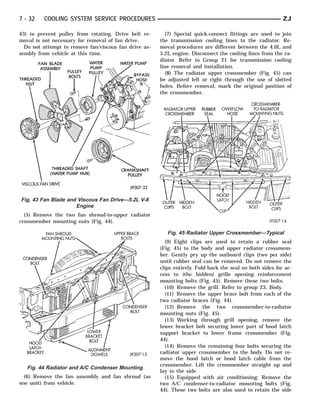
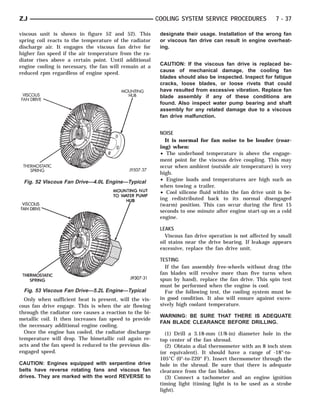
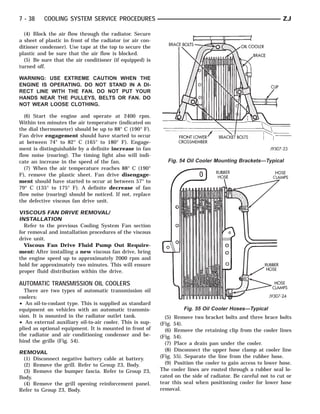
  • 18.
    7 - 18 COOLING SYSTEM SERVICE PROCEDURES ZJ WITHOUT AIR CONDITIONING (A/C) REMOVAL (1) Partially drain cooling system. Refer to Drain- ing Cooling System in this group. Do not waste reusable coolant. If solution is clean, drain coolant into a clean container for reuse. WARNING: CONSTANT TENSION HOSE CLAMPS ARE USED ON MOST COOLING SYSTEM HOSES. WHEN REMOVING OR INSTALLING, USE ONLY TOOLS DESIGNED FOR SERVICING THIS TYPE OF CLAMP, SUCH AS SPECIAL CLAMP TOOL (NUMBER 6094) (FIG. 19). SNAP-ON CLAMP TOOL (NUMBER HPC-20) MAY BE USED FOR LARGER CLAMPS. AL- WAYS WEAR SAFETY GLASSES WHEN SERVICING CONSTANT TENSION CLAMPS. CAUTION: A number or letter is stamped into the tongue of constant tension clamps (Fig. 20). If re- placement is necessary, use only an original equip- Fig. 17 Belt Routing—5.2L Engine ment clamp with matching number or letter. (14) Fill cooling system. Refer to Refilling the Cool- ing System in this group. (15) Connect negative battery cable. (16) Start and warm the engine. Check for leaks. WATER PUMP BYPASS HOSE—5.2L V-8 ENGINE A water pump bypass hose (Fig. 18) is used be- tween the intake manifold and water pump on all 5.2L V-8 engines. To test for leaks, refer to Testing Cooling System for Leaks in this group. Fig. 19 Hose Clamp Tool—Typical (2) Loosen both bypass hose clamps (Fig. 19) and position to center of hose. Remove hose from vehicle. INSTALLATION (1) Position bypass hose clamps (Fig. 19) to center of hose. (2) Install bypass hose to engine. (3) Secure both hose clamps (Fig. 19). (4) Fill cooling system. Refer to Refilling the Cool- ing System in this group. (5) Start and warm the engine. Check for leaks. WITH AIR CONDITIONING (A/C) REMOVAL Fig. 18 Water Pump Bypass Hose—5.2L Engine If equipped with A/C, the generator and A/C com- pressor along with their common mounting bracket
  • 19.
    ZJ COOLING SYSTEM SERVICE PROCEDURES 7 - 19 (1) Disconnect negative battery cable from battery. (2) Partially drain cooling system. Refer to Drain- ing Cooling System in this group. Do not waste reusable coolant. If solution is clean, drain coolant into a clean container for reuse. (3) Remove upper radiator hose clamp (Fig. 19) and hose at radiator. (4) Unplug wiring harness from A/C compressor. (5) Remove air duct at throttle body. (6) Disconnect A/C lines from clip at intake mani- fold. (7) Remove heater hose coolant return tube mount- ing bolt and nut (Fig. 22). Remove tube from engine and discard the old tube o-ring. Fig. 20 Clamp Number/Letter Location (Fig. 21) must be partially removed. Removing gener- ator or A/C compressor from their mounting bracket is not necessary. Also, discharging A/C system is not necessary. Do not remove any refrigerant lines from A/C compressor. Fig. 22 Coolant Return Tube—5.2L Engine (8) Remove accessory drive belt as follows: The drive belt is equipped with a spring loaded automatic belt tensioner (Fig. 23). Relax tension from belt by rotating tensioner clockwise (as viewed from front) (Fig. 23). When all belt tension has been relaxed, re- move accessory drive belt. (9) The drive belt idler pulley must be removed to gain access to one of A/C compressor/generator bracket mounting bolts. Remove idler pulley bolt and remove idler pulley (Fig. 21). (10) Remove oil dipstick tube mounting bolt at side of A/C-generator mounting bracket. Fig. 21 Generator and A/C Compressor Mounting (11) Disconnect speed control cable and throttle ca- Bracket—5.2L Engine ble at throttle body. Refer to Accelerator Pedal and Throttle Cable in Group 14, Fuel System for throttle WARNING: THE A/C SYSTEM IS UNDER PRESSURE cable removal and installation. Refer to Group 8H for EVEN WITH ENGINE OFF. REFER TO REFRIGER- removal and installation of speed control cable. ANT WARNINGS IN GROUP 24, HEATING AND AIR (12) Remove bracket-to-intake manifold bolts CONDITIONING. (number 1 and 2—figure 21).
  • 20.
    7 - 20 COOLING SYSTEM SERVICE PROCEDURES ZJ wrong direction. Refer to figure 24 for correct belt routing. Or, refer to the Belt Routing Label located in the engine compartment. The correct belt with correct length must be used. Fig. 23 Belt Tensioner Assembly—5.2L Engine (13) Remove six bracket bolts (number 3—figure 21). (14) Lift and position generator and A/C compres- sor (along with their common mounting bracket) to Fig. 24 Belt Routing—5.2L Engine gain access to bypass hose. A block of wood may be (11) Install air duct to throttle body. used to hold assembly in position. (12) Install upper radiator hose to radiator. (15) Loosen and position both hose clamps to cen- (13) Connect wiring harness to A/C compressor. ter of bypass hose. Remove hose from vehicle. (14) Connect A/C lines to clip at intake manifold. (15) Fill cooling system. Refer to Refilling the Cool- INSTALLATION ing System in this group. (1) Position bypass hose clamps to center of hose. (16) Start and warm the engine. Check for leaks. (2) Install bypass hose to engine. (3) Secure both hose clamps (Fig. 19). THERMOSTAT (4) Install generator-A/C mounting bracket assem- bly to engine. Tighten bolts (number 1 and 2—figure DESCRIPTION AND OPERATION 21) to 54 N⅐m (40 ft. lbs.) torque. Tighten bolts (num- A pellet-type thermostat controls the operating ber 3—figure 21) to 40 N⅐m (30 ft. lbs.) torque. temperature of the engine by controlling the amount (5) Install a new o-ring to the heater hose coolant of coolant flow to the radiator. On all engines the return tube (Fig. 22). Coat the new o-ring with anti- thermostat is closed below 195°F (90°C). Above this freeze before installation. temperature, coolant is allowed to flow to the radia- (6) Install coolant return tube to engine (Fig. 22). tor. This provides quick engine warm up and overall Be sure the slot in tube bracket is bottomed to the temperature control. mounting bolt. This will properly position return An arrow, plus the word UP is stamped on the tube. front flange next to the air bleed. The words TO (7) Connect throttle body control cables. RAD are stamped on one arm of the thermostat. (8) Install oil dipstick mounting bolt. They indicate the proper installed position. (9) Install idler pulley. Tighten pulley bolt to 54 The same thermostat is used for winter and sum- N⅐m (40 ft. lbs.) torque. mer seasons. An engine should not be operated with- (10) Relax tension from belt tensioner (Fig. 23). In- out a thermostat, except for servicing or testing. stall drive belt. Operating without a thermostat causes other prob- lems. These are: longer engine warmup time, unreli- CAUTION: When installing serpentine accessory able warmup performance, increased exhaust drive belt, belt must be routed correctly. If not, en- emissions and crankcase condensation. This conden- gine may overheat due to water pump rotating in sation can result in sludge formation.
  • 21.
    ZJ COOLING SYSTEM SERVICE PROCEDURES 7 - 21 CAUTION: Do not operate an engine without a ther- CAUTION: A number or letter is stamped into the mostat, except for servicing or testing. tongue of constant tension clamps (Fig. 20). If re- placement is necessary, use only an original equip- The more common type of thermostat failure, usu- ment clamp with matching number or letter. ally found on high milage vehicles, is a thermostat failed in the shut position. The temperature gauge (if (2) Remove radiator upper hose and heater hose at equipped) will give an indication of this condition. thermostat housing. Depending upon length of time that vehicle is oper- (3) Disconnect wiring connector at engine coolant ated, pressure cap may vent. This will expel steam temperature sensor. and coolant to coolant reserve/overflow tank and to (4) Remove thermostat housing mounting bolts, surface below vehicle. Refer to the Diagnosis section thermostat housing, gasket and thermostat (Fig. 25). of this group. Discard old gasket. ON-BOARD DIAGNOSTICS FOR CERTAIN COOLING SYSTEM COMPONENTS All models are equipped with On-Board Diagnostics for certain cooling system components. Refer to On- Board Diagnostics (OBD) in the Diagnosis section of this group for additional information. If the power- train control module (PCM) detects low engine cool- ant temperature, it will record a Diagnostic Trouble Code (DTC) in the PCM memory. The DTC number for low coolant temperature is 17. Do not change a thermostat for lack of heat as indicated by the in- strument panel gauge or heater performance unless a DTC number 17 is present. Refer to the Diagnosis section of this group for other probable causes. For other DTC numbers, refer to On-Board Diagnostics in the General Diagnosis section of Group 14, Fuel Systems. The DTC can also be accessed through the DRB scan tool. Refer to the appropriate Powertrain Diag- nostic Procedures manual for diagnostic information and operation of the DRB scan tool. Fig. 25 Thermostat Removal/Installation—4.0L Engine REMOVAL—4.0L 6-CYLINDER ENGINE (5) Clean the gasket mating surfaces. WARNING: DO NOT LOOSEN THE RADIATOR DRAINCOCK WITH THE SYSTEM HOT AND PRES- INSTALLATION—4.0L 6-CYLINDER ENGINE SURIZED. SERIOUS BURNS FROM THE COOLANT (1) Install the replacement thermostat so that the CAN OCCUR. pellet, which is encircled by a coil spring, faces the engine. All thermostats are marked on the outer DO NOT WASTE reusable coolant. If the solution flange to indicate the proper installed position. is clean, drain the coolant into a clean container for (a) Observe the recess groove in the engine cylin- reuse. der head (Fig. 26). (1) Drain the coolant from the radiator until the (b) Position thermostat in groove with arrow and level is below the thermostat housing. air bleed hole on outer flange pointing up. (2) Install replacement gasket and thermostat WARNING: CONSTANT TENSION HOSE CLAMPS housing. ARE USED ON MOST COOLING SYSTEM HOSES. WHEN REMOVING OR INSTALLING, USE ONLY CAUTION: Tightening the thermostat housing un- TOOLS DESIGNED FOR SERVICING THIS TYPE OF evenly or with the thermostat out of its recess, may CLAMP, SUCH AS SPECIAL CLAMP TOOL (NUMBER result in a cracked housing. 6094) (FIG. 19). SNAP-ON CLAMP TOOL (NUMBER HPC-20) MAY BE USED FOR LARGER CLAMPS. AL- (3) Tighten the housing bolts to 22 N⅐m (16 ft. lbs.) WAYS WEAR SAFETY GLASSES WHEN SERVICING torque. CONSTANT TENSION CLAMPS. (4) Install hoses to thermostat housing.
  • 22.
    7 - 22 COOLING SYSTEM SERVICE PROCEDURES ZJ Fig. 26 Thermostat Recess—4.0L Engine Fig. 27 Generator Support Bracket—5.2L Engine (5) Install electrical connector to coolant tempera- bolt of automatic belt tensioner (Fig. 28). ture sensor. (c) Rotate tensioner assembly clockwise (as (6) Be sure that the radiator draincock is tightly viewed from front) until tension has been relieved closed. Fill the cooling system to the correct level from belt. with the required coolant mixture. Refer to Refilling Cooling System in this group. (7) Start and warm the engine. Check for leaks. REMOVAL—5.2L V-8 ENGINE WARNING: DO NOT LOOSEN RADIATOR DRAIN- COCK WITH SYSTEM HOT AND PRESSURIZED. SE- RIOUS BURNS FROM COOLANT CAN OCCUR. Do not waste reusable coolant. If solution is clean, drain coolant into a clean container for reuse. If thermostat is being replaced, be sure that re- placement is specified thermostat for vehicle model and engine type. Factory installed thermostat housings on 5.2L en- gines are installed on a gasket with an anti-stick coating. This will aid in gasket removal and clean-up. (1) Disconnect negative battery cable at battery. (2) Drain cooling system until coolant level is be- low thermostat. Refer to Draining Cooling System in this group. (3) Air Conditioned vehicles: Remove support bracket (generator mounting bracket-to-intake mani- Fig. 28 Automatic Belt Tensioner—5.2L Engine fold) located near rear of generator (Fig. 27). (4) On air conditioning equipped vehicles, the gen- (d) Remove belt from vehicle. erator must be partially removed. (e) Remove two generator mounting bolts. Do not (a) Remove generator drive belt as follows: Drive remove any wiring at generator. If equipped with belts on the 5.2L engine are equipped with a spring 4WD, unplug 4WD indicator lamp wiring harness loaded automatic belt tensioner (Fig. 28). (located near rear of generator). (b) Attach a socket/wrench to pulley mounting
  • 23.
    ZJ COOLING SYSTEM SERVICE PROCEDURES 7 - 23 (f) Remove generator. Position generator to gain access for thermostat gasket removal. (5) Remove upper radiator hose clamp (Fig. 19) and upper radiator hose at thermostat housing. (6) Position wiring harness (behind thermostat housing) to gain access to thermostat housing. (7) Remove thermostat housing mounting bolts, thermostat housing, gasket and thermostat (Fig. 29). Discard old gasket. Fig. 30 Thermostat Position—5.2L Engine (a) Install generator. Tighten bolts to 41 N⅐m (30 ft. lbs.) torque. (b) Install support bracket (generator mounting bracket-to-intake manifold) (Fig. 27). Tighten bolts to 54 N⅐m (40 ft. lbs.) torque. CAUTION: When installing the serpentine accessory drive belt, belt must be routed correctly. If not, en- Fig. 29 Thermostat—5.2L Engine gine may overheat due to water pump rotating in wrong direction. Refer to (Fig. 31) for correct 5.2L INSTALLATION—5.2L V-8 ENGINE engine belt routing. Or, refer to the Belt Routing La- (1) Clean mating areas of intake manifold and bel located in the engine compartment. The correct thermostat housing. belt with correct length must be used. (2) Install thermostat (spring side down) into re- cessed machined groove on intake manifold (Fig. 29). (c) Position drive belt over all pulleys except (3) Install gasket on intake manifold and over idler pulley (located between generator and A/C thermostat (Fig. 29). compressor). (4) Position thermostat housing to intake manifold. (d) Attach a socket/wrench to pulley mounting Note the word FRONT stamped on housing (Fig. 30). bolt of automatic belt tensioner (Fig. 28). For adequate clearance, this must be placed towards (e) Rotate socket/wrench clockwise. Place belt front of vehicle. The housing is slightly angled for- over idler pulley. Let tensioner rotate back into ward after installation to intake manifold. place. Remove wrench. Be sure belt is properly (5) Install two housing-to-intake manifold bolts. seated on all pulleys. Tighten bolts to 23 N⅐m (200 in. lbs.) torque. (8) Fill cooling system. Refer to Refilling Cooling System in this group. CAUTION: Housing must be tightened evenly and (9) Connect negative battery cable to battery. thermostat must be centered into recessed groove (10) Start and warm the engine. Check for leaks. in intake manifold. If not, it may result in a cracked housing, damaged intake manifold threads or cool- COOLANT ant leak. GENERAL INFORMATION (6) Install upper radiator hose to thermostat hous- The cooling system is designed around the coolant. ing. Coolant flows through the engine water jackets ab- (7) Air Conditioned vehicles: sorbing heat produced during engine operation. The
  • 24.
    7 - 24 COOLING SYSTEM SERVICE PROCEDURES ZJ centage of antifreeze can cause the engine to over- heat because specific heat of antifreeze is lower than that of water. CAUTION: Richer antifreeze mixtures cannot be measured with normal field equipment and can cause problems associated with 100 percent ethyl- ene-glycol. COOLANT SELECTION-ADDITIVES Coolant should be maintained at the specified level with a mixture of ethylene glycol-based antifreeze and low mineral content water. Only use an anti- freeze containing ALUGARD 340-2 ™. CAUTION: Do not use coolant additives that are claimed to improve engine cooling. COOLANT SERVICE It is recommended that the cooling system be Fig. 31 Belt Routing—5.2L Engine drained and flushed at 84,000 kilometers (52,500 miles), or 3 years, whichever occurs first. Then every coolant carries heat to the radiator and heater core. two years, or 48,000 kilometers (30,000 miles), Here it is transferred to ambient air passing through whichever occurs first. the radiator and heater core fins. The coolant also re- moves heat from the automatic transmission fluid in COOLANT LEVEL CHECK-ROUTINE vehicles equipped with an automatic transmission. Do not remove radiator cap for routine cool- ant level inspections. The coolant level can be COOLANT PERFORMANCE checked at coolant reserve/overflow tank. The required ethylene-glycol (antifreeze) and water The coolant reserve/overflow system provides a mixture depends upon climate and vehicle operating quick visual method for determining coolant level conditions. The coolant performance of various mix- without removing radiator pressure cap. With engine tures follows: idling and at normal operating temperature, observe Pure Water-Water can absorb more heat than a coolant level in reserve/overflow tank. The coolant mixture of water and ethylene-glycol. This is for pur- level should be between ADD and FULL marks. pose of heat transfer only. Water also freezes at a higher temperature and allows corrosion. ADDING ADDITIONAL COOLANT-ROUTINE 100% Ethylene-Glycol-The corrosion inhibiting Do not remove radiator cap to add coolant to system. When adding coolant to maintain correct additives in ethylene-glycol need the presence of wa- level, do so at coolant reserve/overflow tank. Use a ter to dissolve. Without water, additives form depos- 50/50 mixture of ethylene-glycol antifreeze containing its in system. These act as insulation causing Alugard 340-2 ™ and low mineral content water. Re- temperature to rise to as high as 149°C (300°F). This move radiator cap only for testing or when refilling temperature is hot enough to melt plastic and soften system after service. Removing cap unnecessarily can solder. The increased temperature can result in en- cause loss of coolant and allow air to enter system, gine detonation. In addition, 100 percent ethylene- which produces corrosion. glycol freezes at -22°C (-8°F). 50/50 Ethylene-Glycol and Water-Is the recom- COOLANT LEVEL CHECK-SERVICE mended mixture, it provides protection against freez- The cooling system is closed and designed to main- ing to -37°C (-35°F). The antifreeze concentration tain coolant level to top of radiator. must always be a minimum of 44 percent, year- round in all climates. If percentage is lower, engine WARNING: DO NOT OPEN RADIATOR DRAINCOCK parts may be eroded by cavitation. Maximum protec- WITH ENGINE RUNNING OR WHILE ENGINE IS HOT tion against freezing is provided with a 68 percent AND COOLING SYSTEM IS UNDER PRESSURE. antifreeze concentration, which prevents freezing down to -67.7°C (-90°F). A higher percentage will When vehicle servicing requires a coolant level freeze at a warmer temperature. Also, a higher per- check in radiator, drain several ounces of coolant
  • 25.
    ZJ COOLING SYSTEM SERVICE PROCEDURES 7 - 25 from radiator drain cock. Do this while observing (2) Attach one end of a hose to the draincock. Put coolant reserve/overflow system tank. The coolant the other end into a clean container. Open draincock level in reserve/overflow tank should drop slightly. If and drain coolant from radiator. This will empty the not, inspect for a leak between radiator and coolant coolant reserve/overflow tank. The coolant does not reserve/overflow system connection. Remove radiator have to be removed from the tank unless the system cap. The coolant level should be to top of radiator. If is being refilled with a fresh mixture. When tank is not and if coolant level in reserve/overflow tank is at empty, remove radiator cap and continue draining ADD mark, check for: cooling system. • An air leak in coolant reserve/overflow tank or its To drain the 4.0L 6-cylinder engine of coolant, re- hose move the cylinder block drain plug located on the • An air leak in radiator filler neck side of cylinder block (Fig. 32). • Leak in pressure cap seal to radiator filler neck To drain the 5.2L V-8 engine of coolant, remove the cylinder block drain plugs located on the sides of cyl- LOW COOLANT LEVEL-AERATION inder block above the oil pan rail (Fig. 33). If the coolant level in radiator drops below top of radiator core tubes, air will enter cooling system. Low coolant level can cause thermostat pellet to be suspended in air instead of coolant. This will cause thermostat to open later, which in turn causes higher coolant temperature. Air trapped in cooling system also reduces amount of coolant circulating in heater core resulting in low heat output. DEAERATION As the engine operates, any air trapped in cooling system gathers under the radiator cap. The next time the engine is operated, thermal expansion of coolant will push any trapped air past radiator cap into the coolant reserve/overflow tank. Here it escapes to the atmosphere into the tank. When the engine cools down the coolant, it will be drawn from the reserve/ overflow tank into the radiator to replace any re- moved air. DRAINING COOLING SYSTEM WARNING: DO NOT REMOVE THE CYLINDER Fig. 32 Drain Plug—4.0L 6-Cylinder Engine BLOCK DRAIN PLUGS OR LOOSEN THE RADIATOR DRAINCOCK WITH SYSTEM HOT AND UNDER PRESSURE. SERIOUS BURNS FROM COOLANT CAN OCCUR. DO NOT WASTE reusable coolant. If the solution is clean, drain the coolant into a clean container for reuse. DRAINING ENTIRE SYSTEM Use this procedure if the entire cooling system is to be drained, such as for engine removal. (1) DO NOT remove radiator cap first. With engine cold, raise vehicle on a hoist and locate radiator draincock. • 4.0L 6-cyl. Engine: Radiator draincock is located on the right/lower side of radiator facing to rear of Fig. 33 Drain Plugs—5.2L V-8 Engine vehicle. • 5.2L V-8 Engine: Radiator draincock is located on PARTIAL DRAINING the left/lower side of radiator facing to rear of vehi- Use this procedure if the coolant is to be partially cle. drained, such as for engine thermostat removal.
  • 26.
    7 - 26 COOLING SYSTEM SERVICE PROCEDURES ZJ (1) With engine cold, slowly remove the radiator REVERSE FLUSHING RADIATOR cap. Raise vehicle on a hoist and locate radiator Disconnect the radiator hoses from the radiator fit- draincock. tings. Attach a section of radiator hose to the radia- • 4.0L Engine: Radiator draincock is located on the tor bottom outlet fitting and insert the flushing gun. right/lower side of radiator facing to rear of vehicle. Connect a water supply hose and air supply hose to • 5.2L Engine: Radiator draincock is located on the the flushing gun. left/lower side of radiator facing to rear of vehicle. CAUTION: The cooling system normally operates at (2) Attach one end of a hose to the draincock. Put 97-to-124 kPa (14-to-18 psi) pressure. Exceeding the other end into a clean container. this pressure may damage the radiator or hoses. (3) Open draincock and drain desired amount of coolant from radiator. Allow the radiator to fill with water. When radiator is filled, apply air in short blasts allowing radiator to REFILLING COOLING SYSTEM refill between blasts. Continue this reverse flushing (1) Tighten the radiator draincock and the cylinder until clean water flows out through rear of radiator block drain plug(s) (if removed). cooling tube passages. For more information, refer to (2) Fill system using a 50/50 mixture of water and operating instructions supplied with flushing equip- antifreeze as described in the Coolant Section of this ment. Have radiator cleaned more extensively by a group. Fill radiator to top and install radiator cap. radiator repair shop. Add sufficient coolant to the reserve/overflow tank to raise level to FULL mark. REVERSE FLUSHING ENGINE (3) With heater control unit in the HEAT position, Drain the cooling system. Remove the thermostat operate engine with radiator cap in place. housing and thermostat. Install the thermostat hous- (4) After engine has reached normal operating ing. Disconnect the radiator upper hose from the ra- temperature, shut engine off and allow it to cool. diator and attach the flushing gun to the hose. Disconnect the radiator lower hose from the water When engine is cooling down, coolant will be drawn pump. Attach a lead away hose to the water pump into the radiator from the reserve/overflow tank. inlet fitting. (5) Add coolant to reserve/overflow tank as neces- Connect the water supply hose and air supply hose sary. Only add coolant to the reserve/overflow to the flushing gun. Allow the engine to fill with wa- tank when the engine is cold. Coolant level in a ter. When the engine is filled, apply air in short warm engine will be higher due to thermal ex- blasts, allowing the system to fill between air blasts. pansion. To purge the cooling system of all air, this Continue until clean water flows through the lead heat up/cool down cycle (adding coolant to cold en- away hose. For more information, refer to operating gine) must be performed three times. Add necessary instructions supplied with flushing equipment. coolant to raise tank level to the FULL mark after Remove the lead away hose, flushing gun, water each cool down period. supply hose and air supply hose. Remove the thermo- stat housing and install thermostat. Install the ther- COOLING SYSTEM CLEANING/REVERSE FLUSHING mostat housing with a replacement gasket. Refer to Thermostat Replacement. Connect the radiator CAUTION: The cooling system normally operates at hoses. Refill the cooling system with the correct an- 97-to-124 kPa (14-to-18 psi) pressure. Exceeding tifreeze/water mixture. this pressure may damage the radiator or hoses. CHEMICAL CLEANING In some instances, use a radiator cleaner (Mopar CLEANING Radiator Kleen or equivalent) before flushing. This Drain cooling system and refill with water. Run en- will soften scale and other deposits and aid the flush- gine with radiator cap installed until upper radiator ing operation. hose is hot. Stop engine and drain water from sys- tem. If water is dirty, fill system with water, run en- CAUTION: Be sure instructions on the container are gine and drain system. Repeat until water drains followed. clean. REVERSE FLUSHING TESTING COOLING SYSTEM FOR LEAKS Reverse flushing of the cooling system is the forc- ing of water through the cooling system. This is done ULTRAVIOLET LIGHT METHOD using air pressure in the opposite direction of normal All Jeep models have a leak detection additive coolant flow. It is usually only necessary with very added to the cooling system before they leave the fac- dirty systems with evidence of partial plugging. tory. The additive is highly visible under ultraviolet
  • 27.
    ZJ COOLING SYSTEM SERVICE PROCEDURES 7 - 27 light (black light). If the factory original coolant has Attach pressure tester 7700 (or an equivalent) to been drained, pour one ounce of additive into the the radiator filler neck (Fig. 35). cooling system. The additive is available through the part’s department. Place the heater control unit in HEAT position. Start and operate the engine until the radiator upper hose is warm to the touch. Aim the commercially available black light tool at the components to be checked. If leaks are present, the black light will cause the additive to glow a bright green color. The black light can be used along with a pressure tester to determine if any external leaks exist (Fig. 34). Fig. 35 Pressurizing System—Typical Operate the tester pump to apply 124 kPa (18 psi) pressure to the system. If the hoses enlarge exces- sively or bulge while testing, replace as necessary. Observe the gauge pointer and determine the condi- tion of the cooling system according to the following criteria: • Holds Steady: If the pointer remains steady for two minutes, there are no serious coolant leaks in the system. However, there could be an internal leak that does not appear with normal system test pres- sure. Inspect for interior leakage or do the Internal Leakage Test. Do this if it is certain that coolant is being lost and no leaks can be detected. • Drops Slowly: Shows a small leak or seepage is oc- curring. Examine all connections for seepage or slight Fig. 34 Leak Detection Using Black Light—Typical leakage with a flashlight. Inspect the radiator, hoses, gasket edges and heater. Seal any small leak holes PRESSURE TESTER METHOD with a Sealer Lubricant or equivalent. Repair leak The engine should be at the normal operating tem- holes and reinspect the system with pressure ap- perature. Recheck the system cold if the cause of plied. coolant loss is not located during warm engine exam- • Drops Quickly: Shows that a serious leakage is oc- ination. curring. Examine the system for serious external WARNING: HOT, PRESSURIZED COOLANT CAN leakage. If no leaks are visible, inspect for internal CAUSE INJURY BY SCALDING. leakage. Large radiator leak holes should be repaired by a reputable radiator repair shop. Carefully remove the radiator pressure cap from the filler neck and check the coolant level. Push INTERNAL LEAKAGE INSPECTION down on the cap to disengage it from the stop tabs. Remove the oil pan drain plug and drain a small Wipe the inner part of the filler neck and examine amount of engine oil. Coolant, being heavier, will the lower inside sealing seat for nicks, cracks, paint, drain first, or operate engine to churn oil, then exam- dirt and solder residue. Inspect the reserve/overflow ine dipstick for water globules. Inspect the transmis- tank tube for internal obstructions. Insert a wire sion dipstick for water globules. Inspect the through the tube to be sure it is not obstructed. transmission fluid cooler for leakage. Operate the en- Inspect the cams on the outside part of the filler gine without the pressure cap on the radiator until neck. If the cams are bent, seating of pressure cap thermostat opens. valve and tester seal will be affected. Replace cap if cams are bent.
  • 28.
    7 - 28 COOLING SYSTEM SERVICE PROCEDURES ZJ Attach a Pressure Tester to the filler neck. If pres- Start the engine and accelerate rapidly three times sure builds up quickly, a leak exists as result of a (to approximately 3000 rpm) while observing the faulty cylinder head gasket or crack in the engine. coolant. If internal engine combustion gases are leak- Repair as necessary. ing into the cooling system, bubbles will appear in the coolant. If bubbles do not appear, there is no in- WARNING: DO NOT ALLOW PRESSURE TO EX- ternal combustion gas leakage. CEED 124 KPA (18 PSI). TURN THE ENGINE OFF. TO RELEASE THE PRESSURE, ROCK THE TESTER COOLANT RESERVE/OVERFLOW SYSTEM FROM SIDE TO SIDE. WHEN REMOVING THE This system works along with the radiator pressure TESTER, DO NOT TURN THE TESTER MORE THAN cap. This is done by using thermal expansion and 1/2 TURN IF THE SYSTEM IS UNDER PRESSURE. contraction of the coolant to keep the coolant free of trapped air. It provides: If there is no immediate pressure increase, pump • A volume for coolant expansion and contraction. the Pressure Tester until the indicated pressure is • A convenient and safe method for checking/adjust- within the system range. Vibration of the gauge ing coolant level at atmospheric pressure. This is pointer indicates compression or combustion leakage done without removing the radiator pressure cap. into the cooling system. • Some reserve coolant to the radiator to cover mi- nor leaks and evaporation or boiling losses. WARNING: DO NOT DISCONNECT THE SPARK As the engine cools, a vacuum is formed in the PLUG WIRES WHILE THE ENGINE IS OPERATING. cooling system of both the radiator and engine. Cool- ant will then be drawn from the coolant tank and re- CAUTION: Do not operate the engine with a spark turned to a proper level in the radiator. plug shorted for more than a minute. The catalytic The coolant reserve/overflow system has a radiator mounted pressurized cap, an overflow tube and a converter may be damaged. plastic coolant reserve/overflow tank (Fig. 36) Isolate the compression leak by shorting each mounted to the right inner fender. spark plug to the cylinder block. The gauge pointer should stop or decrease vibration when spark plug for leaking cylinder is shorted. This happens because of the absence of combustion pressure. COMBUSTION LEAKAGE TEST (WITHOUT PRESSURE TESTER) DO NOT WASTE reusable coolant. If the solution is clean, drain the coolant into a clean container for reuse. WARNING: DO NOT REMOVE THE CYLINDER BLOCK DRAIN PLUGS OR LOOSEN THE RADIATOR DRAINCOCK WITH THE SYSTEM HOT AND UNDER PRESSURE. SERIOUS BURNS FROM COOLANT CAN OCCUR. Drain sufficient coolant to allow for thermostat re- moval. Refer to Thermostat Replacement. Disconnect the water pump drive belt. Disconnect the upper radiator hose from the ther- Fig. 36 Coolant Reserve/Overflow Tank—Typical mostat housing. Remove the housing and thermostat. Install the thermostat housing. RADIATOR PRESSURE CAP Add coolant to the radiator to bring the level to All radiators are equipped with a pressure cap. within 6.3 mm (1/4 in) of the top of the thermostat This cap releases pressure at some point within a housing. range of 97-to-124 kPa (14-to-18 psi). The pressure relief point (in pounds) is engraved on top of the cap CAUTION: Avoid overheating. Do not operate the (Fig. 37). engine for an excessive period of time. Open the The cooling system will operate at pressures draincock immediately after the test to eliminate slightly above atmospheric pressure. This results in a boil over of coolant. higher coolant boiling point allowing increased radi-
  • 29.
    ZJ COOLING SYSTEM SERVICE PROCEDURES 7 - 29 ator cooling capacity. The cap (Fig. 37) contains a WARNING: THE WARNING WORDS —DO NOT spring-loaded pressure relief valve. This valve opens OPEN HOT— ON THE RADIATOR PRESSURE CAP when system pressure reaches the release range of (FIG. 37) ARE A SAFETY PRECAUTION. WHEN HOT, 97-to-124 kPa (14-to-18 psi). PRESSURE BUILDS UP IN COOLING SYSTEM. TO PREVENT SCALDING OR INJURY, THE RADIATOR CAP SHOULD NOT BE REMOVED WHILE THE SYS- TEM IS HOT AND/OR UNDER PRESSURE. There is no need to remove the radiator cap ex- cept for the following purposes: • To check and adjust antifreeze freeze point. • To refill system with new antifreeze. • For conducting service procedures. • When checking for vacuum leaks. WARNING: IF VEHICLE HAS BEEN RUN RECENTLY, WAIT AT LEAST 15 MINUTES BEFORE REMOVING RADIATOR CAP. WITH A RAG, SQUEEZE RADIATOR UPPER HOSE TO CHECK IF SYSTEM IS UNDER PRESSURE. PLACE A RAG OVER THE CAP AND WITHOUT PUSHING DOWN, ROTATE CAP COUNTER-CLOCKWISE TO THE FIRST STOP. AL- LOW FLUID TO ESCAPE THROUGH OVERFLOW HOSE INTO COOLANT RESERVE/OVERFLOW TANK. SQUEEZE RADIATOR UPPER HOSE TO DE- TERMINE WHEN PRESSURE HAS BEEN RE- LEASED. WHEN COOLANT AND STEAM STOP BEING PUSHED INTO TANK AND SYSTEM PRES- SURE DROPS, REMOVE RADIATOR CAP COM- PLETELY. Fig. 37 Radiator Pressure Cap—Typical PRESSURE TESTING RADIATOR CAPS Remove cap from radiator. Be sure that sealing A vent valve in the center of the cap allows a small surfaces are clean. Moisten rubber gasket with water coolant flow through the cap when coolant is below and install the cap on pressure tester (tool 7700 or boiling temperature. The valve is completely closed an equivalent) (Fig. 38). when boiling point is reached. As the coolant cools, it Operate the tester pump and observe the gauge contracts and creates a vacuum in cooling system. pointer at its highest point. The cap release pressure This causes the vacuum valve to open and coolant in should be 97-to-124 kPa (14-to-18 psi). The cap is reserve/overflow tank to be drawn through connect- satisfactory when the pressure holds steady. It is also ing hose into radiator. If the vacuum valve is stuck good if it holds pressure within the 97-to-124 kPa shut, radiator hoses will collapse on cool-down. (14-to-18 psi) range for 30 seconds or more. If the A rubber gasket seals the radiator filler neck. This pointer drops quickly, replace the cap. is done to maintain vacuum during coolant cool-down and to prevent leakage when system is under pres- CAUTION: Radiator pressure testing tools are very sure. sensitive to small air leaks, which will not cause cooling system problems. A pressure cap that does RADIATOR CAP-TO-FILLER NECK SEAL— not have a history of coolant loss should not be re- PRESSURE RELIEF CHECK placed just because it leaks slowly when tested With radiator cap installed on filler neck, remove with this tool. Add water to tool. Turn tool upside coolant reserve/overflow tank hose from nipple on down and recheck pressure cap to confirm that cap filler neck. Connect a hand operated vacuum pump needs replacement. to nipple. Operate pump until a reading of 47-to-61 kPa (14-to-18 in. Hg) appears on gauge. If the read- ing stays steady, or drops slightly and then remains INSPECTION steady, the pressure valve seal is good. Replace radi- Visually inspect the pressure valve gasket on the ator cap if reading does not hold. cap. Replace cap if the gasket is swollen, torn or
  • 30.
    7 - 30 COOLING SYSTEM SERVICE PROCEDURES ZJ WARNING: CONSTANT TENSION HOSE CLAMPS ARE USED ON MOST COOLING SYSTEM HOSES. WHEN REMOVING OR INSTALLING, USE ONLY TOOLS DESIGNED FOR SERVICING THIS TYPE OF CLAMP, SUCH AS SPECIAL CLAMP TOOL (NUMBER 6094) (FIG. 39). SNAP-ON CLAMP TOOL (NUMBER HPC-20) MAY BE USED FOR LARGER CLAMPS. AL- WAYS WEAR SAFETY GLASSES WHEN SERVICING CONSTANT TENSION CLAMPS. CAUTION: A number or letter is stamped into the tongue of constant tension clamps (Fig. 40). If re- placement is necessary, use only an original equip- ment clamp with matching number or letter. Fig. 38 Pressure Testing Radiator Pressure Cap—Typical worn. Inspect the area around radiator filler neck for white deposits that indicate a leaking cap. RADIATOR GENERAL INFORMATION All vehicles are equipped with a cross flow type ra- diator with plastic side tanks. Fig. 39 Hose Clamp Tool—Typical Plastic tanks, while stronger than brass, are sub- ject to damage by impact, such as from tools or wrenches. Handle radiator with care. RADIATOR COOLANT FLOW CHECK The following procedure will determine if coolant is flowing through the cooling system. If engine is cold, idle engine until normal operating temperature is reached. Then feel the upper radiator hose. If hose is hot, the thermostat is open and water is circulating through cooling system. RADIATOR REMOVAL WARNING: DO NOT REMOVE THE CYLINDER BLOCK DRAIN PLUGS OR LOOSEN THE RADIATOR DRAINCOCK WITH THE SYSTEM HOT AND UNDER PRESSURE. SERIOUS BURNS FROM COOLANT CAN OCCUR. REFER TO COOLING SYSTEM DRAIN- ING IN THIS GROUP. Do not waste reusable coolant. If the solution is clean, drain the coolant into a clean container for re- Fig. 40 Clamp Number/Letter Location use.
  • 31.
    ZJ COOLING SYSTEM SERVICE PROCEDURES 7 - 31 Fig. 41 Air Seals—Typical CAUTION: When removing the radiator or A/C con- denser for any reason, note the location of all radi- ator-to-body and radiator-to-A/C condenser rubber air seals (Fig. 41). These are used at the top, bot- tom and sides of the radiator and A/C condenser. To prevent overheating, these seals must be in- stalled to their original positions. (1) Disconnect the negative battery cable at bat- tery. (2) Observe the previous WARNINGS and CAU- TIONS. (3) Drain coolant from radiator. Refer to Draining Cooling System in this group. (4) 4.0L Engine: Remove the four fan hub-to-wa- ter pump pulley mounting nuts (Fig. 42). Carefully remove the fan assembly from the water pump pulley and position to center of fan shroud. Fan belt re- moval is not necessary as the water pump studs will hold the pump pulley in position. Do not remove fan/viscous fan drive assembly from vehicle at this time. 5.2L Engine: The thermal viscous fan drive is at- Fig. 42 Fan Mounting Nuts—4.0L 6-Cyl. Engine tached (threaded) to the water pump hub shaft (Fig. (number SP346 from Snap-On Cummins Diesel Tool 43). Remove fan/viscous fan drive assembly from wa- Set number 2017DSP) can be used. Place a bar or ter pump by turning mounting nut counterclockwise screwdriver between water pump pulley bolts (Fig. as viewed from front. Threads on viscous fan drive are RIGHT HAND. A Snap-On 36 MM Fan Wrench
  • 32.
    7 - 32 COOLING SYSTEM SERVICE PROCEDURES ZJ 43) to prevent pulley from rotating. Drive belt re- (7) Special quick-connect fittings are used to join moval is not necessary for removal of fan drive. the transmission cooling lines to the radiator. Re- Do not attempt to remove fan/viscous fan drive as- moval procedures are different between the 4.0L and sembly from vehicle at this time. 5.2L engine. Disconnect the cooling lines from the ra- diator. Refer to Group 21 for transmission cooling line removal and installation. (8) The radiator upper crossmember (Fig. 45) can be adjusted left or right through the use of slotted holes. Before removal, mark the original position of the crossmember. Fig. 43 Fan Blade and Viscous Fan Drive—5.2L V-8 Engine (5) Remove the two fan shroud-to-upper radiator crossmember mounting nuts (Fig. 44). Fig. 45 Radiator Upper Crossmember—Typical (9) Eight clips are used to retain a rubber seal (Fig. 45) to the body and upper radiator crossmem- ber. Gently pry up the outboard clips (two per side) until rubber seal can be removed. Do not remove the clips entirely. Fold back the seal on both sides for ac- cess to (the hidden) grille opening reinforcement mounting bolts (Fig. 45). Remove these two bolts. (10) Remove the grill. Refer to group 23, Body. (11) Remove the upper brace bolt from each of the two radiator braces (Fig. 44). (12) Remove the two crossmember-to-radiator mounting nuts (Fig. 45). (13) Working through grill opening, remove the lower bracket bolt securing lower part of hood latch support bracket to lower frame crossmember (Fig. 44). (14) Remove the remaining four bolts securing the radiator upper crossmember to the body. Do not re- move the hood latch or hood latch cable from the crossmember. Lift the crossmember straight up and Fig. 44 Radiator and A/C Condenser Mounting lay to the side. (6) Remove the fan assembly and fan shroud (as (15) Equipped with air conditioning: Remove the one unit) from vehicle. two A/C condenser-to-radiator mounting bolts (Fig. 44). These two bolts are also used to retain the side
  • 33.
    ZJ COOLING SYSTEM SERVICE PROCEDURES 7 - 33 mounted rubber air seals (Fig. 41). These seals are compressed between the A/C condenser and the radi- ator. The lower part of the air seals are compressed between the radiator and the A/C condenser mount- ing brackets (Fig. 46). Not equipped with air conditioning: Remove the two bolts retaining the side mounted rubber air seals (Fig. 41) to the radiator. The lower part of the air seals are compressed between the radiator and the radiator lower crossmember. CAUTION: Note the location of all rubber air seals (Fig. 41). To prevent overheating, they must be in- stalled back to their original positions. (16) Disconnect the coolant reserve/overflow tank hose (Fig. 45) at radiator. (17) Remove upper radiator hose at radiator. A spe- cial clamp tool (Fig. 39) must be used to remove the constant tension hose clamps. (18) 4.0L Engine Only: Remove the lower radiator hose at the water pump end. (19) To gain access to lower radiator hose clamp at radiator, gently lift the radiator a slight amount. Re- move hose clamp and hose. The lower part of radiator is equipped with two alignment dowel pins (Figs. 44 or 46). They are lo- cated on the bottom of radiator tank and fit into rub- Fig. 46 Radiator Alignment Dowels ber grommets. These rubber grommets are pressed (1) Equipped with air conditioning: Gently lower into the radiator lower crossmember. the radiator into the vehicle. Guide the two radiator WARNING: THE AIR CONDITIONING SYSTEM (IF alignment dowels through the holes in the rubber air EQUIPPED) IS UNDER A CONSTANT PRESSURE seals first and then through the A/C support brackets EVEN WITH THE ENGINE OFF. REFER TO REFRIG- (Fig. 46). Continue to guide the alignment dowels ERANT WARNINGS IN GROUP 24, HEATING AND into the rubber grommets located in lower radiator AIR CONDITIONING BEFORE HANDLING ANY AIR crossmember (Fig. 46). The holes in the L-shaped CONDITIONING COMPONENT. brackets (located on bottom of A/C condenser) must be positioned between bottom of rubber air seals and (20) If equipped with an auxiliary automatic trans- top of rubber grommets. mission oil cooler, use caution when removing radia- Not equipped with air conditioning: Gently lower tor. The oil cooler lines are routed through a rubber the radiator into the vehicle. Guide the two radiator air seal on the left side of radiator. Do not cut or tear alignment dowels through the holes in the rubber air this seal. seals. Continue to guide the alignment dowels into (21) Gently lift up and remove radiator from vehi- the rubber grommets located in lower radiator cross- cle. Be careful not to scrape the radiator fins against member. any other component. Also be careful not to disturb (2) Connect the lower radiator hose and hose the air conditioning condenser (if equipped). clamp to radiator. INSTALLATION CAUTION: The tangs on the hose clamp must be CAUTION: Before installing the radiator or A/C con- positioned straight down. denser, be sure the radiator-to-body and radiator-to- A/C condenser rubber air seals (Fig. 41) are (3) 4.0L Engine: Connect the lower radiator hose properly fastened to their original positions. These at the water pump. are used at the top, bottom and sides of the radia- (4) Connect the upper radiator hose at the radia- tor and A/C condenser. To prevent overheating, tor. these seals must be installed to their original posi- (5) Equipped with air conditioning: Install the two tions. A/C condenser-to-radiator mounting bolts (Fig. 44).
  • 34.
    7 - 34 COOLING SYSTEM SERVICE PROCEDURES ZJ These two bolts are also used to retain the rubber air water and compressed air to the back (engine side) of seal (Fig. 41) to the sides of radiator. the radiator to flush the radiator and/or A/C con- Not equipped with A/C: Install the two bolts retain- denser of debris. ing the rubber air seal (Fig. 41) to sides of radiator. (6) Install coolant reserve/overflow tank hose at ra- COOLING SYSTEM HOSES diator. Rubber hoses route coolant to and from the radia- (7) If radiator-to-upper crossmember rubber isola- tor, intake manifold and heater core. tors were removed from radiator, install them. The lower radiator hose is spring-reinforced to pre- Tighten mounting nuts to 3 N⅐m (24-36 in. lbs.) vent collapse from water pump suction at moderate torque. Position upper radiator crossmember to radi- and high engine speeds. ator. (8) Working through grill opening, install and WARNING: CONSTANT TENSION HOSE CLAMPS tighten the hood latch support bracket-to-lower frame ARE USED ON MOST COOLING SYSTEM HOSES. crossmember bolt (Fig. 44). WHEN REMOVING OR INSTALLING, USE ONLY (9) Install the four bolts securing the radiator up- TOOLS DESIGNED FOR SERVICING THIS TYPE OF per crossmember to the body (Fig. 45). CLAMP, SUCH AS SPECIAL CLAMP TOOL (NUMBER (10) Install two nuts securing the radiator to the 6094) (FIG. 47). SNAP-ON CLAMP TOOL (NUMBER upper radiator crossmember (Fig. 45). Tighten nuts HPC-20) MAY BE USED FOR LARGER CLAMPS. AL- to 2 N⅐m (18-21 in. lbs.) torque. WAYS WEAR SAFETY GLASSES WHEN SERVICING (11) Install the upper bolt to each radiator brace CONSTANT TENSION CLAMPS. (Fig. 44). (12) Install the grill. Refer to group 23, Body. CAUTION: A number or letter is stamped into the (13) Install the rubber seal (Fig. 45) to the four tongue of constant tension clamps (Fig. 48). If re- (outer) seal mounting clips on vehicle body. Press placement is necessary, use only an original equip- down on clips until seated. ment clamp with matching number or letter. (14) Install the transmission cooler lines to radia- tor. Refer to Group 21 for installation. (15) Position the fan assembly and fan shroud (as one unit) to the vehicle. (16) Position fan shroud to radiator. Be sure the alignment tabs at the lower part of shroud are placed into the slots near lower part of radiator. Be sure the upper and lower portions of the fan shroud are firmly connected. All air must flow through the radiator. (17) Install the two nuts securing the fan shroud to the upper radiator crossmember (Fig. 44). (18) 4.0L Engine: Install the four nuts securing the fan assembly to the water pump (Fig. 42). Tighten nuts to 27 N⅐m (20 ft. lbs.) torque. 5.2L Engine: Install the fan/viscous fan drive as- sembly to the water pump. Fig. 47 Hose Clamp Tool—Typical (19) Rotate the fan blades (by hand) and check for Inspect the hoses at regular intervals. Replace interference at fan shroud. hoses that are cracked, feel brittle when squeezed, or Be sure of at least 25 mm (1.0 inches) between tips swell excessively when the system is pressurized. of fan blades and fan shroud. For all vehicles: In areas where specific routing (20) Fill cooling system. Refer to Refilling Cooling clamps are not provided, be sure that hoses are posi- System in this group. tioned with sufficient clearance. Check clearance (21) Connect battery cable at battery. from exhaust manifolds and pipe, fan blades, drive (22) Start and warm engine. Check for leaks. belts and sway bars. Improperly positioned hoses can be damaged, resulting in coolant loss and engine RADIATOR CLEANING overheating. The radiator and air conditioning fins should be Ordinary worm gear type hose clamps (when cleaned when an accumulation of bugs, leaves etc. equipped) can be removed with a straight screw- has occurred. Clean radiator fins are necessary for driver or a hex socket. To prevent damage to good heat transfer. With the engine cold, apply cold hoses or clamps, the hose clamps should be
  • 35.
    ZJ COOLING SYSTEM SERVICE PROCEDURES 7 - 35 Fig. 48 Clamp Number/Letter Location Fig. 49 Fan Mounting Nuts—4.0L 6-Cyl. Engine tightened to 4 N⅐m (34 in. lbs.) torque. Do not over tighten hose clamps. When performing a hose inspection, inspect the ra- diator lower hose for proper position and condition of the internal spring. COOLING SYSTEM FAN For additional information, also refer to Viscous Fan Drive in this group. REMOVAL—4.0L 6-CYLINDER ENGINE (1) Remove the four fan hub-to-water pump pulley mounting nuts (Fig. 49). Carefully remove the fan as- sembly from the water pump pulley and position to center of fan shroud. Fan belt removal is not neces- sary as the water pump studs will hold the pump pulley in position. Do not remove fan assembly from vehicle at this time. (2) Remove the two fan shroud-to-upper radiator crossmember mounting nuts (Fig. 50). (3) Remove fan, viscous fan drive and fan shroud as an assembly from the vehicle. (4) Remove the four fan blade-to-viscous fan drive Fig. 50 Fan Shroud Mounting Nuts mounting bolts. Remove viscous fan drive from fan blades. to the engine as one assembly. After removing fan blade/fan drive assembly do (3) Position fan shroud to radiator. Be sure the not place the thermal viscous fan drive in the hori- alignment tabs at the lower part of shroud are placed zontal position. If stored horizontally, the silicone into the slots near lower part of radiator. fluid in the viscous fan drive could drain into the Be sure the upper and lower portions of the fan bearing assembly and contaminate the lubricant. shroud are firmly connected. All air must flow through the radiator. INSTALLATION—4.0L 6-CYLINDER ENGINE (4) Position mounting flange of fan/viscous fan (1) Assemble fan blades to viscous fan drive. drive assembly onto water pump pulley. Install four Tighten mounting bolts to 24 N⅐m (18 ft. lbs.) torque. nuts and tighten to 24 N⅐m (18 ft. lbs.) torque. (2) Position fan, viscous fan drive and fan shroud (5) Install two fan shroud mounting nuts.
  • 36.
    7 - 36 COOLING SYSTEM SERVICE PROCEDURES ZJ Be sure of at least 25 mm (1.0 inches) between tips (5) Remove four bolts securing fan blade assembly of fan blades and fan shroud. to viscous fan drive (Fig. 51). REMOVAL—5.2L V-8 ENGINE INSTALLATION—5.2L V-8 ENGINE (1) Disconnect negative battery cable from battery. (1) Install fan blade assembly to viscous fan drive. (2) The thermal viscous fan drive/fan blade assem- Tighten bolts (Fig. 51) to 23 N⅐m (17 ft. lbs.) torque. bly is attached (threaded) to water pump hub shaft (2) Position fan shroud and fan blade/viscous fan (Fig. 51). Remove fan blade/viscous fan drive assem- drive assembly to vehicle as a complete unit. bly from water pump by turning mounting nut coun- (3) Position fan shroud to radiator. Be sure the terclockwise as viewed from front. Threads on alignment tabs at the lower part of shroud are placed viscous fan drive are RIGHT HAND. A Snap-On 36 into the slots near lower part of radiator. Install and MM Fan Wrench (number SP346 from Snap-On tighten the two fan shroud-to-upper crossmember Cummins Diesel Tool Set number 2017DSP) can be mounting nuts. used. Place a bar or screwdriver between water Be sure of at least 25 mm (1.0 inches) between tips pump pulley bolts (Fig. 51) to prevent pulley from ro- of fan blades and fan shroud. tating. (4) Install fan blade/viscous fan drive assembly to Do not attempt to remove fan/viscous fan drive as- water pump shaft. sembly from vehicle at this time. (5) Connect negative battery cable. FAN BLADE INSPECTION—ALL ENGINES The fan blades cannot be repaired. If the fan is damaged, it must be replaced. Inspect the fan blades as follows: Lay fan blade assembly on a flat surface with lead- ing edge facing down. With tip of blade touching flat surface, replace fan if clearance between opposite blade and surface is greater than 2.0 mm (.090 inch). Rocking motion of opposite blades should not exceed 2.0 mm (.090 inch). Test all blades in this manner. WARNING: IF FAN IS NOT WITHIN SPECIFICA- TIONS, DO NOT ATTEMPT TO BEND OR STRAIGHTEN FAN. Inspect fan assembly for cracks, bends, loose rivets or broken welds. Replace fan if any damage is found. CAUTION: If the fan blade assembly is replaced be- cause of mechanical damage, the water pump and viscous fan drive should also be inspected. These components could have been damaged due to ex- Fig. 51 Fan Blade/Viscous Fan Drive—5.2L V-8 cessive vibration. Engine Do not unbolt fan blade assembly (Fig. 51) from viscous fan drive at this time. VISCOUS FAN DRIVE—ALL ENGINES (3) Remove two fan shroud-to-upper crossmember nuts (Fig. 50). DESCRIPTION AND OPERATION (4) Remove fan shroud and fan blade/viscous fan Also refer to the previous Cooling System Fan sec- drive assembly as a complete unit from vehicle. tion. After removing fan blade/viscous fan drive assem- The thermal viscous fan drive (Fig. 52 or 53) is a bly, do not place viscous fan drive in horizontal po- silicone-fluid-filled coupling used to connect the fan sition. If stored horizontally, silicone fluid in the blades to the water pump shaft. The coupling allows viscous fan drive could drain into its bearing assem- the fan to be driven in a normal manner. This is bly and contaminate lubricant. done at low engine speeds while limiting the top speed of the fan to a predetermined maximum level CAUTION: Do not remove water pump pulley-to-wa- at higher engine speeds. ter pump bolts (Fig. 51). This pulley is under spring A thermostatic bimetallic spring coil is located on tension. the front face of the viscous fan drive unit (a typical
  • 37.
    ZJ COOLING SYSTEM SERVICE PROCEDURES 7 - 37 viscous unit is shown in figure 52 and 52). This designate their usage. Installation of the wrong fan spring coil reacts to the temperature of the radiator or viscous fan drive can result in engine overheat- discharge air. It engages the viscous fan drive for ing. higher fan speed if the air temperature from the ra- diator rises above a certain point. Until additional engine cooling is necessary, the fan will remain at a CAUTION: If the viscous fan drive is replaced be- cause of mechanical damage, the cooling fan reduced rpm regardless of engine speed. blades should also be inspected. Inspect for fatigue cracks, loose blades, or loose rivets that could have resulted from excessive vibration. Replace fan blade assembly if any of these conditions are found. Also inspect water pump bearing and shaft assembly for any related damage due to a viscous fan drive malfunction. NOISE It is normal for fan noise to be louder (roar- ing) when: • The underhood temperature is above the engage- ment point for the viscous drive coupling. This may occur when ambient (outside air temperature) is very high. Fig. 52 Viscous Fan Drive—4.0L Engine—Typical • Engine loads and temperatures are high such as when towing a trailer. • Cool silicone fluid within the fan drive unit is be- ing redistributed back to its normal disengaged (warm) position. This can occur during the first 15 seconds to one minute after engine start-up on a cold engine. LEAKS Viscous fan drive operation is not affected by small oil stains near the drive bearing. If leakage appears excessive, replace the fan drive unit. TESTING If the fan assembly free-wheels without drag (the fan blades will revolve more than five turns when spun by hand), replace the fan drive. This spin test must be performed when the engine is cool. Fig. 53 Viscous Fan Drive—5.2L Engine—Typical For the following test, the cooling system must be Only when sufficient heat is present, will the vis- in good condition. It also will ensure against exces- cous fan drive engage. This is when the air flowing sively high coolant temperature. through the radiator core causes a reaction to the bi- WARNING: BE SURE THAT THERE IS ADEQUATE metallic coil. It then increases fan speed to provide FAN BLADE CLEARANCE BEFORE DRILLING. the necessary additional engine cooling. Once the engine has cooled, the radiator discharge (1) Drill a 3.18-mm (1/8-in) diameter hole in the temperature will drop. The bimetallic coil again re- top center of the fan shroud. acts and the fan speed is reduced to the previous dis- (2) Obtain a dial thermometer with an 8 inch stem engaged speed. (or equivalent). It should have a range of -18°-to- 105°C (0°-to-220° F). Insert thermometer through the CAUTION: Engines equipped with serpentine drive hole in the shroud. Be sure that there is adequate belts have reverse rotating fans and viscous fan clearance from the fan blades. drives. They are marked with the word REVERSE to (3) Connect a tachometer and an engine ignition timing light (timing light is to be used as a strobe light).
  • 38.
    7 - 38 COOLING SYSTEM SERVICE PROCEDURES ZJ (4) Block the air flow through the radiator. Secure a sheet of plastic in front of the radiator (or air con- ditioner condenser). Use tape at the top to secure the plastic and be sure that the air flow is blocked. (5) Be sure that the air conditioner (if equipped) is turned off. WARNING: USE EXTREME CAUTION WHEN THE ENGINE IS OPERATING. DO NOT STAND IN A DI- RECT LINE WITH THE FAN. DO NOT PUT YOUR HANDS NEAR THE PULLEYS, BELTS OR FAN. DO NOT WEAR LOOSE CLOTHING. (6) Start the engine and operate at 2400 rpm. Within ten minutes the air temperature (indicated on the dial thermometer) should be up to 88° C (190° F). Fan drive engagement should have started to occur at between 74° to 82° C (165° to 180° F). Engage- ment is distinguishable by a definite increase in fan flow noise (roaring). The timing light also will indi- cate an increase in the speed of the fan. Fig. 54 Oil Cooler Mounting Brackets—Typical (7) When the air temperature reaches 88° C (190° F), remove the plastic sheet. Fan drive disengage- ment should have started to occur at between 57° to 79° C (135° to 175° F). A definite decrease of fan flow noise (roaring) should be noticed. If not, replace the defective viscous fan drive unit. VISCOUS FAN DRIVE REMOVAL/ INSTALLATION Refer to the previous Cooling System Fan section for removal and installation procedures of the viscous drive unit. Viscous Fan Drive Fluid Pump Out Require- ment: After installing a new viscous fan drive, bring the engine speed up to approximately 2000 rpm and hold for approximately two minutes. This will ensure proper fluid distribution within the drive. AUTOMATIC TRANSMISSION OIL COOLERS There are two types of automatic transmission oil coolers: • An oil-to-coolant type. This is supplied as standard equipment on vehicles with an automatic transmis- Fig. 55 Oil Cooler Hoses—Typical sion. It is mounted in the radiator outlet tank. (5) Remove two bracket bolts and three brace bolts • An external auxiliary oil-to-air cooler. This is sup- (Fig. 54). plied as optional equipment. It is mounted in front of (6) Remove the retaining clip from the cooler lines the radiator and air conditioning condenser and be- (Fig. 54). hind the grille (Fig. 54). (7) Place a drain pan under the cooler. REMOVAL (8) Disconnect the upper hose clamp at cooler line (1) Disconnect negative battery cable at battery. (Fig. 55). Separate the line from the rubber hose. (2) Remove the grill. Refer to Group 23, Body. (9) Position the cooler to gain access to lower hose. (3) Remove the bumper fascia. Refer to Group 23, The cooler lines are routed through a rubber seal lo- Body. cated on the side of radiator. Be careful not to cut or (4) Remove the grill opening reinforcement panel. tear this seal when positioning cooler for lower hose Refer to Group 23, Body. removal.
  • 39.
    ZJ COOLING SYSTEM SERVICE PROCEDURES 7 - 39 (10) Remove lower hose clamp and hose from (4) Install brace and mounting bracket bolts (Fig. cooler. 54). (11) Remove cooler from vehicle. (5) Connect negative battery cable to battery. (6) Add necessary transmission fluid. Refer to INSTALLATION Group 21, Transmissions. Start engine and check for (1) Position cooler to vehicle. leaks. (2) Install lower hose and hose clamp to cooler. (7) Install grill opening reinforcement panel, Hose clamp screws must be facing towards rear of bumper fascia and grill. Refer to Group 23, Body. vehicle. Tighten clamp to 2 N⅐m (18 in. lbs.) torque. (3) Install upper hose and hose clamp at cooler. Hose clamp screws must be facing towards rear of vehicle. Tighten clamp to 2 N⅐m (18 in. lbs.) torque.
  • 40.
    7 - 40 ENGINE ACCESSORY DRIVE BELTS ZJ ENGINE ACCESSORY DRIVE BELTS INDEX page page Automatic Belt Tensioner—5.2L Engine ... . . . . . . 46 Belt Tension Specifications . . . . . . . .. . . . . . . . . . 44 Belt Diagnosis . . . . . . . . . . . . . . . . . . .... . . . . . . 40 Belt Tension—4.0L 6-Cylinder Engine . . . . . . . . . . 44 Belt Schematics . . . . . . . . . . . . . . . . .... . . . . . . 44 Belt Tension—5.2L 8-Cylinder Engine . . . . . . . . . . 44 Belt Service . . . . . . . . . . . . . . . . . . . .... . . . . . . 44 General Information . . . . . . . . . . . . .. . . . . . . . . . 40 GENERAL INFORMATION CAUTION: When installing a serpentine accessory drive belt, the belt MUST be routed correctly. If not, the engine may overheat due to water pump rotat- ing in wrong direction. Refer to the appropriate en- gine Belt Schematic in this Group for the correct belt routing. Or, refer to the Belt Routing Label lo- cated in the engine compartment. BELT DIAGNOSIS When diagnosing serpentine accessory drive belts, small cracks that run across the ribbed surface of the belt from rib to rib (Fig. 1), are considered normal. These are not a reason to replace the belt. However, cracks running along a rib (not across) are not nor- mal. Any belt with cracks running along a rib must be replaced (Fig. 1). Also replace the belt if it has ex- cessive wear, frayed cords or severe glazing. Refer to the Serpentine Accessory Drive Belt Diag- Fig. 1 Serpentine Belt Wear Patterns nosis charts for further belt diagnosis.
  • 41.
    ZJ ENGINE ACCESSORY DRIVE BELTS 7 - 41 SERPENTINE ACCESSORY DRIVE BELT DIAGNOSIS—4.0L 6-CYLINDER ENGINE
  • 42.
    7 - 42 ENGINE ACCESSORY DRIVE BELTS ZJ SERPENTINE ACCESSORY DRIVE BELT DIAGNOSIS—4.0L ENGINE—CONTINUED
  • 43.
    ZJ ENGINE ACCESSORY DRIVE BELTS 7 - 43 SERPENTINE ACCESSORY DRIVE BELT DIAGNOSIS—5.2L 8-CYLINDER ENGINE
  • 44.
    7 - 44 ENGINE ACCESSORY DRIVE BELTS ZJ BELT TENSION—4.0L 6-CYLINDER ENGINE Correct drive belt tension is required to ensure op- timum performance of the belt driven engine accesso- ries. There are different types of adjustment gauges for checking either a serpentine or a V-type belt. Re- fer to the instructions supplied with the gauge. Use the correct gauge when checking belt tension. Place gauge in the middle of the section of belt being tested (between two pulleys) to check tension (Fig. 2). Do not allow the gauge (or gauge adapter) to contact anything but the belt. Fig. 3 Automatic Belt Tensioner—5.2L V-8 Engine Fig. 2 Belt Routing—4.0L 6-Cylinder Engine BELT TENSION—5.2L 8-CYLINDER ENGINE It is not necessary to adjust belt tension on the 5.2L (V-8) engine. The engine is equipped with an au- tomatic belt tensioner (Fig. 3). The tensioner main- tains correct belt tension at all times. For other tensioner information and removal/installation proce- dures, refer to Automatic Belt Tensioner—5.2L En- gine proceeding in this group. Due to use of this belt tensioner, do not attempt to use a belt tension gauge on 5.2L (V-8) engines. BELT TENSION SPECIFICATIONS Fig. 4 Belt Routing—5.2 V-8 Engine 4.0L ENGINE BELT SERVICE Proper belt tension for a new serpentine accessory drive belt is 800-900 N (180-200 lbs. force). For a REPLACEMENT/ADJUSTMENT—4.0L ENGINE used belt, the belt tension is 623-712 N (140-160 lbs. Belt tension is adjusted at the power steering force). Belt tension is not adjustable on the 5.2L en- pump (or idler pulley if not equipped with power gine. steering). To adjust belt tension or to replace belt: (1) Loosen two rear power steering pump mounting BELT SCHEMATICS bolts A (Fig. 5). Refer to figures 2 or 4 for proper belt routing. Or, (2) Loosen upper pump pivot bolt B and lower lock refer to the Belt Routing Label located in the vehicle nut C (Fig. 6). engine compartment. (3) Loosen pump adjusting bolt D (Fig. 5).
  • 45.
    ZJ ENGINE ACCESSORY DRIVE BELTS 7 - 45 correct belt routing. Or, refer to the Belt Routing La- bel located in the vehicle engine compartment. (6) Install new belt. Refer to the end of this group for Drive Belt Tension specifications. (7) Tighten pump adjusting bolt D (Fig. 5) to at- tain proper belt tension. (8) Tighten rear pump mounting bolts, pivot bolt and lock nut to 27 N⅐m (20 ft. lbs.) torque. (9) After power steering pump has been tightened into position, recheck belt tension. Adjust if neces- sary. REPLACEMENT—5.2L V-8 ENGINE REMOVAL Drive belts on the 5.2L V-8 engine are equipped with a spring loaded automatic belt tensioner (Fig. 7). This belt tensioner will be used on all belt config- urations, such as with or without power steering or air conditioning. For more information, refer to Auto- matic Belt Tensioner—5.2L Engines, proceeding in Fig. 5 P.S. Pump Rear Mounting Bolts—4.0L Engine this group. Fig. 6 P.S. Pump Front Mounting Bolt/Locknut—4.0L Fig. 7 Belt Tensioner—Belt Removal/Installation— Engine 5.2L V-8 Engine (4) If belt is to be adjusted, refer to Drive Belt Ten- (1) Attach a socket/wrench to pulley mounting bolt sion specifications at the end of this group for correct of automatic belt tensioner (Fig. 7). tension and proceed to step 7. (2) Rotate tensioner assembly clockwise (as viewed If belt is to be replaced, remove belt. from front) until tension has been relieved from belt. (5) Check condition of all pulleys. (3) Remove belt from idler pulley first. CAUTION: When installing the serpentine accessory (4) Remove belt from vehicle. drive belt, the belt MUST be routed correctly. If not, the engine may overheat due to the water pump ro- tating in the wrong direction. Refer to (Fig. 4) for
  • 46.
    7 - 46 ENGINE ACCESSORY DRIVE BELTS ZJ INSTALLATION CAUTION: When installing serpentine accessory drive belt, belt must be routed correctly. If not, en- gine may overheat due to water pump rotating in wrong direction. Refer to (Fig. 4) for correct 5.2L V-8 engine belt routing. Or, refer to the Belt Routing La- bel located in the vehicle engine compartment. The correct belt with correct length must be used. (1) Position drive belt over all pulleys except idler pulley. This pulley is located between generator and A/C compressor. (2) Attach a socket/wrench to pulley mounting bolt of automatic belt tensioner (Fig. 7). (3) Rotate socket/wrench clockwise. Place belt over idler pulley. Let tensioner rotate back into place. Re- move wrench. Be sure belt is properly seated on all pulleys. (4) Check belt indexing marks. Refer to the pro- ceeding Automatic Belt Tensioner—5.2L Engine for more belt information. AUTOMATIC BELT TENSIONER—5.2L ENGINE Drive belts on the 5.2L engine are equipped with a spring loaded automatic belt tensioner (Figs. 7 and 8). This belt tensioner will be used with all belt con- figurations. Such as with or without power steering Fig. 8 Belt Tensioner/Pulley Assembly—5.2L V-8 or air conditioning. Engine The tensioner is equipped with an indexing arrow (6) Remove ignition coil from coil mounting bracket (Fig. 8) on back of tensioner and an indexing mark (two bolts). Do not remove coil mounting bracket on tensioner housing. If a new belt is being installed, from cylinder head. arrow must be within approximately 3 mm (1/8 in.) (7) Remove tensioner assembly from mounting of indexing mark (Point B—figure 8). Belt is consid- bracket (one nut) (Fig. 8). ered new if it has been used 15 minutes or less. If this specification cannot be met, check for: WARNING: BECAUSE OF HIGH SPRING PRES- • The wrong belt being installed (incorrect length/ SURE, DO NOT ATTEMPT TO DISASSEMBLE AUTO- width) MATIC BELT TENSIONER. UNIT IS SERVICED AS AN • Worn bearings on an engine accessory (A/C com- ASSEMBLY (EXCEPT FOR PULLEY). pressor, power steering pump, water pump, idler pul- ley or generator) (8) Remove pulley bolt. Remove pulley from ten- • A pulley on an engine accessory being loose sioner. • Misalignment of an engine accessory • Belt incorrectly routed. Refer to (Fig. 4) INSTALLATION A used belt should be replaced if tensioner indexing (1) Install pulley and pulley bolt to tensioner. arrow has moved beyond point A—figure 8. Tighten bolt to 61 N⅐m (45 ft. lbs.) torque. (2) Install tensioner assembly to mounting bracket. REMOVAL An indexing tab is located on back of tensioner. Align (1) Attach a socket/wrench to mounting bolt of au- this tab to slot in mounting bracket. Tighten nut to tomatic belt tensioner pulley bolt (Fig. 7). 67 N⅐m (50 ft. lbs.) torque. (2) Rotate tensioner assembly clockwise (as viewed (3) Connect all wiring to ignition coil. from front) until tension has been relieved from belt. (4) Install coil to coil bracket. If nuts and bolts are (3) Remove belt from idler pulley first. used to secure coil to coil bracket, tighten to 11 N⅐m (4) Remove belt from other pulleys. (100 in. lbs.) torque. If coil mounting bracket has (5) Disconnect wiring and secondary cable from ig- been tapped for coil mounting bolts, tighten bolts to 5 nition coil. N⅐m (50 in. lbs.) torque.
  • 47.
    ZJ ENGINE ACCESSORY DRIVE BELTS 7 - 47 CAUTION: To prevent damage to coil case, coil located in the vehicle engine compartment. The cor- mounting bolts must be torqued. rect belt with correct length must be used. (5) Position drive belt over all pulleys except idler (6) Attach a socket/wrench to pulley mounting bolt pulley (located between generator and A/C compres- of automatic belt tensioner (Fig. 7). sor). (7) Rotate socket/wrench clockwise. Place belt over idler pulley. Let tensioner rotate back into place. Re- CAUTION: When installing serpentine accessory move wrench. Be sure belt is properly seated on all drive belt, belt must be routed correctly. If not, en- pulleys. gine may overheat due to water pump rotating in (8) Check belt indexing marks. wrong direction. Refer to (Fig. 4) for correct 5.2L en- gine belt routing. Or, refer to the Belt Routing Label
  • 48.
    7 - 48 ENGINE BLOCK HEATER ZJ ENGINE BLOCK HEATER DESCRIPTION AND OPERATION FROM POWER SOURCE AND SECURED IN PLACE. An optional engine block heater (Figs. 1 or 2) is THE POWER CORD MUST BE SECURED IN ITS RE- available with for all models. The heater is equipped TAINING CLIPS AND ROUTED AWAY FROM EX- with a power cord. The cord is attached to an engine HAUST MANIFOLDS AND MOVING PARTS. compartment component with tie-straps. The heater warms the engine providing easier engine starting REMOVAL and faster warm-up in low temperatures. The heater (1) Disconnect negative battery cable from battery. is mounted in a core hole of the engine cylinder block (2) Drain coolant from radiator. Refer to Draining in place of a freeze plug with the heating element im- Cooling System in this group. mersed in engine coolant. Connect power cord to a (3) Raise vehicle. grounded 110-120 volt AC electrical outlet with a (4) Remove engine cylinder block drain plug(s) lo- grounded, three wire extension cord. cated on the sides of cylinder block above the oil pan rail (Figs. 3 or 4). Fig. 1 Block Heater—4.0L 6-Cyl. Engine Fig. 3 Drain Plug—4.0L 6-Cylinder Engine Fig. 2 Block Heater—5.2L V-8 Engine Fig. 4 Drain Plugs—5.2L V-8 Engine WARNING: DO NOT OPERATE ENGINE UNLESS BLOCK HEATER CORD HAS BEEN DISCONNECTED
  • 49.
    ZJ ENGINE BLOCK HEATER 7 - 49 (5) Remove power cord from block heater (Figs. 1 (3) With block heater fully seated, tighten center or 2). screw to 2 N⅐m (17 in. lbs.) torque. (6) Loosen screw at center of block heater. Remove (4) Fill cooling system with recommended coolant. heater assembly. Refer to Refilling Cooling System section in this group. INSTALLATION (5) Start and warm the engine. Check for leaks. (1) Thoroughly clean cylinder block core hole and block heater seat. (2) Insert block heater assembly with element loop pointing down.
  • 50.
    7 - 50 COOLING SYSTEM SPECIFICATIONS ZJ SPECIFICATIONS GENERAL INFORMATION ment. Refer to Group 25, Emission System for more The following specifications are published from the information on the VECI label. latest information available at the time of publica- tion. If anything differs between the specifica- tions found on the Vehicle Emission Control DRIVE BELT TENSION Information (VECI) label and the following specifications, use specifications on VECI label. The VECI label is located in the engine compart- COOLING SYSTEM CAPACITIES TORQUE