Maths curriculum in Polish
   lower-secondary school


    GIMNAZJUM   IM.   ANNY WAZÓWNY,   GOLUB-DOBRZYŃ
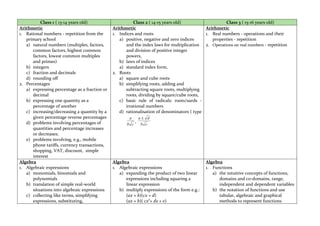
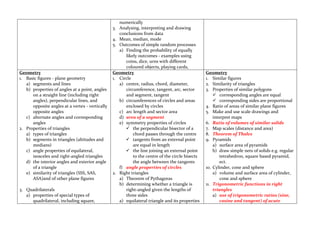
Class 1 ( 13-14 years old)                     Class 2 ( 14-15 years old)                   Class 3 ( 15-16 years old)
Arithmetic                                     Arithmetic                                   Arithmetic
1. Rational numbers - repetition from the      1. Indices and roots                         1. Real numbers - operations and their
   primary school                                 a) positive, negative and zero indices       properties - repetition
   a) natural numbers (multiples, factors,           and the index laws for multiplication 2. Operations on real numbers - repetition
      common factors, highest common                 and division of positive integer
      factors, lowest common multiples               powers,
      and primes)                                 b) laws of indices
   b) integers                                    a) standard index form,
   c) fraction and decimals                    2. Roots
   d) rounding off                                a) square and cube roots
2. Percentages                                    b) simplifying roots, adding and
   a) expressing percentage as a fraction or         subtracting square roots, multiplying
      decimal                                        roots, dividing by square/cube roots,
   b) expressing one quantity as a                c) basic rule of radicals: roots/surds -
      percentage of another                          irrational numbers
   c) increasing/decreasing a quantity by a       d) rationalisation of denominators ( type
      given percentage reverse percentages             a        a d
   d) problems involving percentages of                     ,
                                                      b c        b c
      quantities and percentage increases
      or decreases;
   e) problems involving, e.g., mobile
      phone tariffs, currency transactions,
      shopping, VAT, discount, simple
      interest
Algebra                                        Algebra                                        Algebra
1. Algebraic expressions                       1. Algebraic expressions                       1. Functions
   a) monomials, binomials and                    a) expanding the product of two linear         a) the intuitive concepts of functions,
      polynomials                                    expressions including squaring a               domains and co-domains, range,
   b) translation of simple real-world               linear expression                              independent and dependent variables
      situations into algebraic expressions       b) multiply expressions of the form e.g.:      b) the notation of functions and use
   c) collecting like terms, simplifying             (ax + b)(cx + d)                               tabular, algebraic and graphical
      expressions, substituting,                     (ax + b)( cx2+ dx + e)                         methods to represent functions
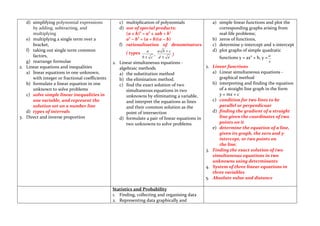
d) simplifying polynomial expressions           c) multiplication of polynomials                a) simple linear functions and plot the
      by adding, subtracting, and                  d) use of special products:                        corresponding graphs arising from
      multiplying                                     (a ± b)2 = a2 ± 2ab + b2                        real-life problems;
   e) multiplying a single term over a                a2 − b2 = (a + b)(a − b)                     b) zeros of functions,
      bracket,                                     f) rationalisation of denominators              c) determine y-intercept and x-intercept
   f) taking out single term common
                                                      ( types     a   a b c                       d) plot graphs of simple quadratic
      factors,                                                      ,        )
                                                                b c d  e                            functions y = ax2 + b, y = a
   g) rearrange formulae                        2. Linear simultaneous equations -                                               x
2. Linear equations and inequalities               algebraic methods                            2. Linear functions
   a) linear equations in one unknown,             a) the substitution method                      a) Linear simultaneous equations -
      with integer or fractional coefficients      b) the elimination method.                         graphical method
   b) formulate a linear equation in one           c) find the exact solution of two               b) interpreting and finding the equation
      unknown to solve problems                       simultaneous equations in two                   of a straight line graph in the form
   c) solve simple linear inequalities in             unknowns by eliminating a variable,             y = mx + c
      one variable, and represent the                 and interpret the equations as lines         c) condition for two lines to be
      solution set on a number line                   and their common solution as the                parallel or perpendicuar
   d) types of intervals                              point of intersection                        d) finding the gradient of a straight
3. Direct and inverse proportion                   d) formulate a pair of linear equations in         line given the coordinates of two
                                                      two unknowns to solve problems                  points on it
                                                                                                   e) determine the equation of a line,
                                                                                                      given its graph, the zero and y-
                                                                                                      intercept, or two points on
                                                                                                      the line.
                                                                                                3. Finding the exact solution of two
                                                                                                   simultaneous equations in two
                                                                                                   unknowns using determinants
                                                                                                4. System of three linear equations in
                                                                                                   three variables
                                                                                                5. Absolute value and distance

                                                Statistics and Probability
                                                1. Finding, collecting and organising data
                                                2. Representing data graphically and
numerically
                                                 3. Analysing, interpreting and drawing
                                                    conclusions from data
                                                 4. Mean, median, mode
                                                 5. Outcomes of simple random processes
                                                    a) Finding the probability of equally
                                                       likely outcomes - examples using
                                                       coins, dice, urns with different
                                                       coloured objects, playing cards,
Geometry                                         Geometry                                        Geometry
1. Basic figures - plane geometry                1. Circle                                       1. Similar figures
   a) segments and lines                            a) centre, radius, chord, diameter,          2. Similarity of triangles
   b) properties of angles at a point, angles          circumference, tangent, arc, sector       3. Properties of similar polygons
      on a straight line (including right              and segment, tangent                           corresponding angles are equal
      angles), perpendicular lines, and             b) circumferences of circles and areas            corresponding sides are proportional
      opposite angles at a vertex - vertically         enclosed by circles                       4. Ratio of areas of similar plane figures
      opposite angles                               c) arc length and sector area                5. Make and use scale drawings and
   c) alternate angles and corresponding            d) area of a segment                             interpret maps
      angles                                        e) symmetry properties of circles            6. Ratio of volumes of similar solids
2. Properties of triangles                              the perpendicular bisector of a         7. Map scales (distance and area)
   a) types of triangles                                   chord passes through the centre       8. Theorem of Thales
   b) segments in triangles (altitudes and              tangents from an external point         9. Pyramids
      medians)                                             are equal in length                       a) surface area of pyramids
   c) angle properties of equilateral,                  the line joining an external point          b) draw simple nets of solids e.g. regular
      isosceles and right-angled triangles                 to the centre of the circle bisects           tetrahedron, square based pyramid,
   d) the interior angles and exterior angle               the angle between the tangents                ect.
      of a triangle                                 f) angle properties of circles               10. Cylinder, cone and sphere
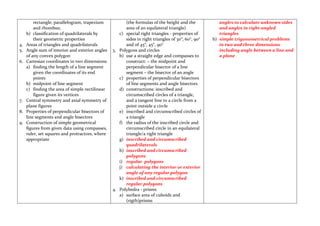
   e) similarity of triangles (SSS, SAS,         2. Right triangles                                  a) volume and surface area of cylinder,
      ASA)and of other plane figures                a) Theorem of Pythagoras                             cone and sphere
                                                    b) determining whether a triangle is         11. Trigonometric functions in right
3. Quadrilaterals                                      right-angled given the lengths of             triangles
   a) properties of special types of                   three sides                                   a) use of trigonometric ratios (sine,
      quadrilateral, including square,              a) equilateral triangle and its properties           cosine and tangent) of acute
rectangle, parallelogram, trapezium           (the formulas of the height and the            angles to calculate unknown sides
         and rhombus;                                  area of an equilateral triangle)               and angles in right-angled
     b) classification of quadrilaterals by         c) special right triangles - properties of        triangles
         their geometric properties                    sides in right triangles of 30°, 60°, 90°   b) simple trigonometrical problems
4.   Areas of triangles and quadrilaterals             and of 45°, 45°, 90°                           in two and three dimensions
5.   Angle sum of interior and exterior angles   3. Polygons and circles                              including angle between a line and
     of any convex polygon                          b) use a straight edge and compasses to           a plane
6.   Cartesian coordinates in two dimensions           construct: – the midpoint and
     a) finding the length of a line segment           perpendicular bisector of a line
         given the coordinates of its end              segment – the bisector of an angle
         points                                     c) properties of perpendicular bisectors
     b) midpoint of line segment                       of line segments and angle bisectors
     c) finding the area of simple rectilinear      d) constructions: inscribed and
         figure given its vertices                     circumscribed circles of a triangle,
7.   Central symmetry and axial symmetry of            and a tangent line to a circle from a
     plane figures                                     point outside a circle
8.   Properties of perpendicular bisectors of       e) inscribed and circumscribed circles of
     line segments and angle bisectors                 a triangle
9.   Construction of simple geometrical             f) the radius of the inscribed circle and
     figures from given data using compasses,          circumscribed circle in an equilateral
     ruler, set squares and protractors, where         triangle/a right triangle
     appropriate                                    g) inscribed and circumscribed
                                                       quadrilaterals
                                                    h) inscribed and circumscribed
                                                       polygons
                                                    i) regular polygons
                                                    j) calculating the interior or exterior
                                                       angle of any regular polygon
                                                    k) inscribed and circumscribed
                                                       regular polygons
                                                 4. Polyhedra - prisms
                                                    a) surface area of cuboids and
                                                       (rigth)prisms
b) volumes cuboids and (rigth)prisms
                                               c) draw simple nets of solids, e.g.
                                                  cuboid, triangular prism etc.


The topics in red are out of the curriculum but I am usually able to introduce these topics to my students because I prepare them to
different Maths contests.

Maths curriculum Poland

  • 1.
    Maths curriculum inPolish lower-secondary school GIMNAZJUM IM. ANNY WAZÓWNY, GOLUB-DOBRZYŃ
  • 2.
    Class 1 (13-14 years old) Class 2 ( 14-15 years old) Class 3 ( 15-16 years old) Arithmetic Arithmetic Arithmetic 1. Rational numbers - repetition from the 1. Indices and roots 1. Real numbers - operations and their primary school a) positive, negative and zero indices properties - repetition a) natural numbers (multiples, factors, and the index laws for multiplication 2. Operations on real numbers - repetition common factors, highest common and division of positive integer factors, lowest common multiples powers, and primes) b) laws of indices b) integers a) standard index form, c) fraction and decimals 2. Roots d) rounding off a) square and cube roots 2. Percentages b) simplifying roots, adding and a) expressing percentage as a fraction or subtracting square roots, multiplying decimal roots, dividing by square/cube roots, b) expressing one quantity as a c) basic rule of radicals: roots/surds - percentage of another irrational numbers c) increasing/decreasing a quantity by a d) rationalisation of denominators ( type given percentage reverse percentages a a d d) problems involving percentages of , b c b c quantities and percentage increases or decreases; e) problems involving, e.g., mobile phone tariffs, currency transactions, shopping, VAT, discount, simple interest Algebra Algebra Algebra 1. Algebraic expressions 1. Algebraic expressions 1. Functions a) monomials, binomials and a) expanding the product of two linear a) the intuitive concepts of functions, polynomials expressions including squaring a domains and co-domains, range, b) translation of simple real-world linear expression independent and dependent variables situations into algebraic expressions b) multiply expressions of the form e.g.: b) the notation of functions and use c) collecting like terms, simplifying (ax + b)(cx + d) tabular, algebraic and graphical expressions, substituting, (ax + b)( cx2+ dx + e) methods to represent functions
  • 3.
    d) simplifying polynomialexpressions c) multiplication of polynomials a) simple linear functions and plot the by adding, subtracting, and d) use of special products: corresponding graphs arising from multiplying (a ± b)2 = a2 ± 2ab + b2 real-life problems; e) multiplying a single term over a a2 − b2 = (a + b)(a − b) b) zeros of functions, bracket, f) rationalisation of denominators c) determine y-intercept and x-intercept f) taking out single term common ( types a a b c d) plot graphs of simple quadratic factors, , ) b c d  e functions y = ax2 + b, y = a g) rearrange formulae 2. Linear simultaneous equations - x 2. Linear equations and inequalities algebraic methods 2. Linear functions a) linear equations in one unknown, a) the substitution method a) Linear simultaneous equations - with integer or fractional coefficients b) the elimination method. graphical method b) formulate a linear equation in one c) find the exact solution of two b) interpreting and finding the equation unknown to solve problems simultaneous equations in two of a straight line graph in the form c) solve simple linear inequalities in unknowns by eliminating a variable, y = mx + c one variable, and represent the and interpret the equations as lines c) condition for two lines to be solution set on a number line and their common solution as the parallel or perpendicuar d) types of intervals point of intersection d) finding the gradient of a straight 3. Direct and inverse proportion d) formulate a pair of linear equations in line given the coordinates of two two unknowns to solve problems points on it e) determine the equation of a line, given its graph, the zero and y- intercept, or two points on the line. 3. Finding the exact solution of two simultaneous equations in two unknowns using determinants 4. System of three linear equations in three variables 5. Absolute value and distance Statistics and Probability 1. Finding, collecting and organising data 2. Representing data graphically and
  • 4.
    numerically 3. Analysing, interpreting and drawing conclusions from data 4. Mean, median, mode 5. Outcomes of simple random processes a) Finding the probability of equally likely outcomes - examples using coins, dice, urns with different coloured objects, playing cards, Geometry Geometry Geometry 1. Basic figures - plane geometry 1. Circle 1. Similar figures a) segments and lines a) centre, radius, chord, diameter, 2. Similarity of triangles b) properties of angles at a point, angles circumference, tangent, arc, sector 3. Properties of similar polygons on a straight line (including right and segment, tangent  corresponding angles are equal angles), perpendicular lines, and b) circumferences of circles and areas  corresponding sides are proportional opposite angles at a vertex - vertically enclosed by circles 4. Ratio of areas of similar plane figures opposite angles c) arc length and sector area 5. Make and use scale drawings and c) alternate angles and corresponding d) area of a segment interpret maps angles e) symmetry properties of circles 6. Ratio of volumes of similar solids 2. Properties of triangles  the perpendicular bisector of a 7. Map scales (distance and area) a) types of triangles chord passes through the centre 8. Theorem of Thales b) segments in triangles (altitudes and  tangents from an external point 9. Pyramids medians) are equal in length a) surface area of pyramids c) angle properties of equilateral,  the line joining an external point b) draw simple nets of solids e.g. regular isosceles and right-angled triangles to the centre of the circle bisects tetrahedron, square based pyramid, d) the interior angles and exterior angle the angle between the tangents ect. of a triangle f) angle properties of circles 10. Cylinder, cone and sphere e) similarity of triangles (SSS, SAS, 2. Right triangles a) volume and surface area of cylinder, ASA)and of other plane figures a) Theorem of Pythagoras cone and sphere b) determining whether a triangle is 11. Trigonometric functions in right 3. Quadrilaterals right-angled given the lengths of triangles a) properties of special types of three sides a) use of trigonometric ratios (sine, quadrilateral, including square, a) equilateral triangle and its properties cosine and tangent) of acute
  • 5.
    rectangle, parallelogram, trapezium (the formulas of the height and the angles to calculate unknown sides and rhombus; area of an equilateral triangle) and angles in right-angled b) classification of quadrilaterals by c) special right triangles - properties of triangles their geometric properties sides in right triangles of 30°, 60°, 90° b) simple trigonometrical problems 4. Areas of triangles and quadrilaterals and of 45°, 45°, 90° in two and three dimensions 5. Angle sum of interior and exterior angles 3. Polygons and circles including angle between a line and of any convex polygon b) use a straight edge and compasses to a plane 6. Cartesian coordinates in two dimensions construct: – the midpoint and a) finding the length of a line segment perpendicular bisector of a line given the coordinates of its end segment – the bisector of an angle points c) properties of perpendicular bisectors b) midpoint of line segment of line segments and angle bisectors c) finding the area of simple rectilinear d) constructions: inscribed and figure given its vertices circumscribed circles of a triangle, 7. Central symmetry and axial symmetry of and a tangent line to a circle from a plane figures point outside a circle 8. Properties of perpendicular bisectors of e) inscribed and circumscribed circles of line segments and angle bisectors a triangle 9. Construction of simple geometrical f) the radius of the inscribed circle and figures from given data using compasses, circumscribed circle in an equilateral ruler, set squares and protractors, where triangle/a right triangle appropriate g) inscribed and circumscribed quadrilaterals h) inscribed and circumscribed polygons i) regular polygons j) calculating the interior or exterior angle of any regular polygon k) inscribed and circumscribed regular polygons 4. Polyhedra - prisms a) surface area of cuboids and (rigth)prisms
  • 6.
    b) volumes cuboidsand (rigth)prisms c) draw simple nets of solids, e.g. cuboid, triangular prism etc. The topics in red are out of the curriculum but I am usually able to introduce these topics to my students because I prepare them to different Maths contests.