Algebra 1: An Open Course
                                                             Coming Summer 2010


Goal: To offer a multi-modal approach to Algebra I that incorporates cutting edge online learning
methods and technologies and is delivered to the world as an Open Educational Resource.

Curriculum. Offering a scope and sequence of a two-semester Algebra 1 course that is traditionally a student’s
first exposure to Algebra in middle or high school, this course will be correlated to national common core
standards and to standards across the 50 states.

Approach. Designed to be a flexible, learner-centered experience, this project takes into account learning theory,
research in mathematics education, and new research in technology, media and learning. The design process is
informed by a rigorous study of current and proposed curriculum standards and products, including textbooks,
software, web applications and tools. The evolving design concepts were further refined by an advisory panel of
math experts, educational membership organizations, practitioners, and a series of focus groups around the
country with administrators, instructors, and students. We will continue to collaborate with a full range of
stakeholders throughout the development process.

Flexible Design. The learning experience integrates a broad range of approaches designed to open the door to
mathematics concepts, procedures, mathematical reasoning and critical thinking for teachers and learners. The
Learning Object architecture allows institutions and instructors to adapt the content to different programs and
learners' needs.

Components. The portfolio of learning objects includes dynamic audio and video presentations, active and
collaborative learning activities, problem sets, self-tests with feedback, and formative and summative
assessment. Students work through activities in the sequence that leverages their own successful learning
                                   st
strategies while building their 21 century skills. Components include:

        • Warm-ups: a series of problems to assess prior knowledge and recommend review.
        • Presentations: the new media equivalent of a session with a teacher explaining the topic.
        • Text: a textbook-style explanation that reinforces the concepts being taught.
        • Worked Examples: narrated step-by-step presentations of a problem being solved.
        • Problems: questions designed in adaptive sets, giving students practice and feedback.
        • Review: self-test mastery before moving to the next lesson.
        • Projects: promote collaboration in the project-based learning tradition to solve real-world problems.
        • Study Group Simulations: put students in a virtual study group to help fellow students solve problems.
        • Simple Games: give learners a chance to practice what they have learned in a no-fault environment.
        • Assessment: formative and summative assessment designed to guide a learner's progress.

Distribution. Course content will be distributed to educational institutions through the National Repository of
Online Courses (NROC), MITE’s highly respected library of learning objects and courses, and will be accessible to
individual learners and teachers free of charge online at Hippocampus (www.hippocampus.org ).


            A project of the Monterey Institute for Technology and Education (MITE) with
            support from The William and Flora Hewlett Foundation. NROC is an Open
            Educational Resource, part of a movement fueled by the belief that everyone is
            entitled to an education, regardless of their financial or social circumstances.
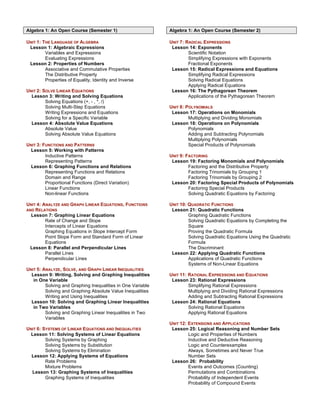
Algebra 1: An Open Course (Semester 1)                       Algebra 1: An Open Course (Semester 2)

UNIT 1: THE LANGUAGE OF ALGEBRA                              UNIT 7: RADICAL EXPRESSIONS
 Lesson 1: Algebraic Expressions                              Lesson 14: Exponents
         Variables and Expressions                                    Scientific Notation
         Evaluating Expressions                                       Simplifying Expressions with Exponents
 Lesson 2: Properties of Numbers                                      Fractional Exponents
         Associative and Commutative Properties               Lesson 15: Radical Expressions and Equations
         The Distributive Property                                    Simplifying Radical Expressions
         Properties of Equality, Identity and Inverse                 Solving Radical Equations
                                                                      Applying Radical Equations
UNIT 2: SOLVE LINEAR EQUATIONS                                Lesson 16: The Pythagorean Theorem
  Lesson 3: Writing and Solving Equations                             Applications of the Pythagorean Theorem
         Solving Equations (+, - , *, /)
         Solving Multi-Step Equations                        UNIT 8: POLYNOMIALS
         Writing Expressions and Equations                    Lesson 17: Operations on Monomials
         Solving for a Specific Variable                              Multiplying and Dividing Monomials
  Lesson 4: Absolute Value Equations                          Lesson 18: Operations on Polynomials
         Absolute Value                                               Polynomials
         Solving Absolute Value Equations                             Adding and Subtracting Polynomials
                                                                      Multiplying Polynomials
UNIT 3: FUNCTIONS AND PATTERNS                                        Special Products of Polynomials
 Lesson 5: Working with Patterns
         Inductive Patterns                                  UNIT 9: FACTORING
         Representing Patterns                                Lesson 19: Factoring Monomials and Polynomials
 Lesson 6: Graphing Functions and Relations                           Factoring and the Distributive Property
         Representing Functions and Relations                         Factoring Trinomials by Grouping 1
         Domain and Range                                             Factoring Trinomials by Grouping 2
         Proportional Functions (Direct Variation)            Lesson 20: Factoring Special Products of Polynomials
         Linear Functions                                             Factoring Special Products
         Non-linear Functions                                         Solving Quadratic Equations by Factoring

UNIT 4: ANALYZE AND GRAPH LINEAR EQUATIONS, FUNCTIONS        UNIT 10: QUADRATIC FUNCTIONS
AND RELATIONS                                                 Lesson 21: Quadratic Functions
  Lesson 7: Graphing Linear Equations                                 Graphing Quadratic Functions
         Rate of Change and Slope                                     Solving Quadratic Equations by Completing the
         Intercepts of Linear Equations                               Square
         Graphing Equations in Slope Intercept Form                   Proving the Quadratic Formula
         Point Slope Form and Standard Form of Linear                 Solving Quadratic Equations Using the Quadratic
         Equations                                                    Formula
 Lesson 8: Parallel and Perpendicular Lines                           The Discriminant
         Parallel Lines                                       Lesson 22: Applying Quadratic Functions
         Perpendicular Lines                                          Applications of Quadratic Functions
                                                                      Systems of Non-Linear Equations
UNIT 5: ANALYZE, SOLVE, AND GRAPH LINEAR INEQUALITIES
  Lesson 9: Writing, Solving and Graphing Inequalities       UNIT 11: RATIONAL EXPRESSIONS AND EQUATIONS
   in One Variable                                            Lesson 23: Rational Expressions
         Solving and Graphing Inequalities in One Variable            Simplifying Rational Expressions
         Solving and Graphing Absolute Value Inequalities             Multiplying and Dividing Rational Expressions
         Writing and Using Inequalities                               Adding and Subtracting Rational Expressions
  Lesson 10: Solving and Graphing Linear Inequalities         Lesson 24: Rational Equations
   in Two Variables                                                   Solving Rational Equations
         Solving and Graphing Linear Inequalities in Two              Applying Rational Equations
         Variables
                                                             UNIT 12: EXTENSIONS AND APPLICATIONS
UNIT 6: SYSTEMS OF LINEAR EQUATIONS AND INEQUALITIES          Lesson 25: Logical Reasoning and Number Sets
 Lesson 11: Solving Systems of Linear Equations                       Logic and Properties of Numbers
         Solving Systems by Graphing                                  Inductive and Deductive Reasoning
         Solving Systems by Substitution                              Logic and Counterexamples
         Solving Systems by Elimination                               Always, Sometimes and Never True
  Lesson 12: Applying Systems of Equations                            Number Sets
         Rate Problems                                        Lesson 26: Probability
         Mixture Problems                                             Events and Outcomes (Counting)
  Lesson 13: Graphing Systems of Inequalities                         Permutations and Combinations
         Graphing Systems of Inequalities                             Probability of Independent Events
                                                                      Probability of Compound Events

Datasheet NROC Algebra 1: An Open Course

  • 1.
    Algebra 1: AnOpen Course Coming Summer 2010 Goal: To offer a multi-modal approach to Algebra I that incorporates cutting edge online learning methods and technologies and is delivered to the world as an Open Educational Resource. Curriculum. Offering a scope and sequence of a two-semester Algebra 1 course that is traditionally a student’s first exposure to Algebra in middle or high school, this course will be correlated to national common core standards and to standards across the 50 states. Approach. Designed to be a flexible, learner-centered experience, this project takes into account learning theory, research in mathematics education, and new research in technology, media and learning. The design process is informed by a rigorous study of current and proposed curriculum standards and products, including textbooks, software, web applications and tools. The evolving design concepts were further refined by an advisory panel of math experts, educational membership organizations, practitioners, and a series of focus groups around the country with administrators, instructors, and students. We will continue to collaborate with a full range of stakeholders throughout the development process. Flexible Design. The learning experience integrates a broad range of approaches designed to open the door to mathematics concepts, procedures, mathematical reasoning and critical thinking for teachers and learners. The Learning Object architecture allows institutions and instructors to adapt the content to different programs and learners' needs. Components. The portfolio of learning objects includes dynamic audio and video presentations, active and collaborative learning activities, problem sets, self-tests with feedback, and formative and summative assessment. Students work through activities in the sequence that leverages their own successful learning st strategies while building their 21 century skills. Components include: • Warm-ups: a series of problems to assess prior knowledge and recommend review. • Presentations: the new media equivalent of a session with a teacher explaining the topic. • Text: a textbook-style explanation that reinforces the concepts being taught. • Worked Examples: narrated step-by-step presentations of a problem being solved. • Problems: questions designed in adaptive sets, giving students practice and feedback. • Review: self-test mastery before moving to the next lesson. • Projects: promote collaboration in the project-based learning tradition to solve real-world problems. • Study Group Simulations: put students in a virtual study group to help fellow students solve problems. • Simple Games: give learners a chance to practice what they have learned in a no-fault environment. • Assessment: formative and summative assessment designed to guide a learner's progress. Distribution. Course content will be distributed to educational institutions through the National Repository of Online Courses (NROC), MITE’s highly respected library of learning objects and courses, and will be accessible to individual learners and teachers free of charge online at Hippocampus (www.hippocampus.org ). A project of the Monterey Institute for Technology and Education (MITE) with support from The William and Flora Hewlett Foundation. NROC is an Open Educational Resource, part of a movement fueled by the belief that everyone is entitled to an education, regardless of their financial or social circumstances.
  • 2.
    Algebra 1: AnOpen Course (Semester 1) Algebra 1: An Open Course (Semester 2) UNIT 1: THE LANGUAGE OF ALGEBRA UNIT 7: RADICAL EXPRESSIONS Lesson 1: Algebraic Expressions Lesson 14: Exponents Variables and Expressions Scientific Notation Evaluating Expressions Simplifying Expressions with Exponents Lesson 2: Properties of Numbers Fractional Exponents Associative and Commutative Properties Lesson 15: Radical Expressions and Equations The Distributive Property Simplifying Radical Expressions Properties of Equality, Identity and Inverse Solving Radical Equations Applying Radical Equations UNIT 2: SOLVE LINEAR EQUATIONS Lesson 16: The Pythagorean Theorem Lesson 3: Writing and Solving Equations Applications of the Pythagorean Theorem Solving Equations (+, - , *, /) Solving Multi-Step Equations UNIT 8: POLYNOMIALS Writing Expressions and Equations Lesson 17: Operations on Monomials Solving for a Specific Variable Multiplying and Dividing Monomials Lesson 4: Absolute Value Equations Lesson 18: Operations on Polynomials Absolute Value Polynomials Solving Absolute Value Equations Adding and Subtracting Polynomials Multiplying Polynomials UNIT 3: FUNCTIONS AND PATTERNS Special Products of Polynomials Lesson 5: Working with Patterns Inductive Patterns UNIT 9: FACTORING Representing Patterns Lesson 19: Factoring Monomials and Polynomials Lesson 6: Graphing Functions and Relations Factoring and the Distributive Property Representing Functions and Relations Factoring Trinomials by Grouping 1 Domain and Range Factoring Trinomials by Grouping 2 Proportional Functions (Direct Variation) Lesson 20: Factoring Special Products of Polynomials Linear Functions Factoring Special Products Non-linear Functions Solving Quadratic Equations by Factoring UNIT 4: ANALYZE AND GRAPH LINEAR EQUATIONS, FUNCTIONS UNIT 10: QUADRATIC FUNCTIONS AND RELATIONS Lesson 21: Quadratic Functions Lesson 7: Graphing Linear Equations Graphing Quadratic Functions Rate of Change and Slope Solving Quadratic Equations by Completing the Intercepts of Linear Equations Square Graphing Equations in Slope Intercept Form Proving the Quadratic Formula Point Slope Form and Standard Form of Linear Solving Quadratic Equations Using the Quadratic Equations Formula Lesson 8: Parallel and Perpendicular Lines The Discriminant Parallel Lines Lesson 22: Applying Quadratic Functions Perpendicular Lines Applications of Quadratic Functions Systems of Non-Linear Equations UNIT 5: ANALYZE, SOLVE, AND GRAPH LINEAR INEQUALITIES Lesson 9: Writing, Solving and Graphing Inequalities UNIT 11: RATIONAL EXPRESSIONS AND EQUATIONS in One Variable Lesson 23: Rational Expressions Solving and Graphing Inequalities in One Variable Simplifying Rational Expressions Solving and Graphing Absolute Value Inequalities Multiplying and Dividing Rational Expressions Writing and Using Inequalities Adding and Subtracting Rational Expressions Lesson 10: Solving and Graphing Linear Inequalities Lesson 24: Rational Equations in Two Variables Solving Rational Equations Solving and Graphing Linear Inequalities in Two Applying Rational Equations Variables UNIT 12: EXTENSIONS AND APPLICATIONS UNIT 6: SYSTEMS OF LINEAR EQUATIONS AND INEQUALITIES Lesson 25: Logical Reasoning and Number Sets Lesson 11: Solving Systems of Linear Equations Logic and Properties of Numbers Solving Systems by Graphing Inductive and Deductive Reasoning Solving Systems by Substitution Logic and Counterexamples Solving Systems by Elimination Always, Sometimes and Never True Lesson 12: Applying Systems of Equations Number Sets Rate Problems Lesson 26: Probability Mixture Problems Events and Outcomes (Counting) Lesson 13: Graphing Systems of Inequalities Permutations and Combinations Graphing Systems of Inequalities Probability of Independent Events Probability of Compound Events