Objectives
Objectives
• Define the terms normal, angle of
incidence and angle of reflection
• State the angle of incidence is equal
to the angle of reflection and use
this principle in construction,
measurements and calculations.
Nature of light
Nature of light
• A form of energy which enables us to see
• It travels in straight line
• It travels at a very high speed
(3.0 x 10⁸
ms-1
) in vacuum.
• It is emitted by luminous sources such as
SUN, STARS, CANDLES,
LAMPS,
LAMPS, etc.
etc.
Nature of light
Nature of light
• White light is a mixture of seven
White light is a mixture of seven
different colours namely Red,
Orange , Yellow, Green, Blue,
Indigo, Violet.
Indigo, Violet.
• Light is a transverse wave and
Light is a transverse wave and
forms part of the electromagnetic
spectrum
spectrum.
.
Light ray
Light ray
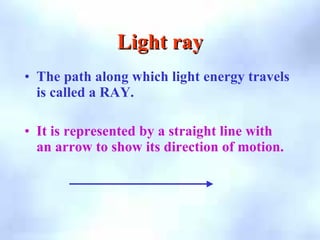
• The path along which light energy travels
is called a RAY.
• It is represented by a straight line with
an arrow to show its direction of motion.
Beam of Light
Beam of Light
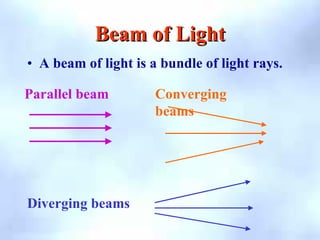
• A beam of light is a bundle of light rays.
Parallel beam Converging
beams
Diverging beams
The abrupt change in the
direction of propagation of
light rays that strike the
boundary between different
.
medium
Reflection of light
Reflection of light
plane
p
normal
u
normal
center
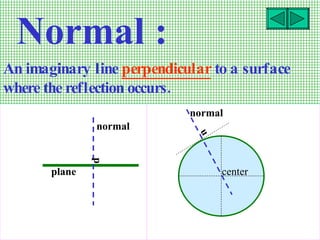
An imaginary line perpendicular to a surface
.
where the reflection occurs
Normal :
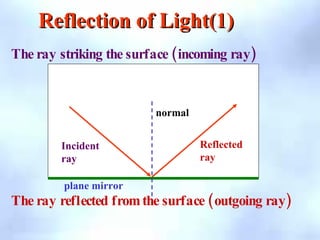
Reflection of Light(1)
i r
Incident
ray
normal
plane mirror
( )
The ray striking the surface incoming ray
( )
The ray reflected fromthe surface outgoing ray
Reflected
ray
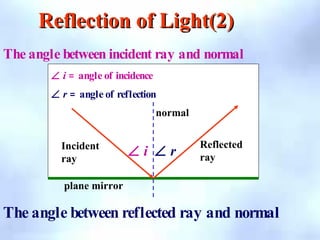
Reflection of Light(2)
The angle between incident ray and normal
The angle between reflected ray and normal
i r
Incident
ray
normal
plane mirror
Reflected
ray
∠ i = angle of incidence
∠ r = angle of reflection
∠ i ∠ r
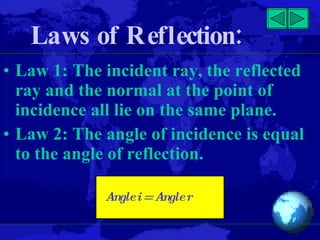
:
Laws of Reflection
• Law 1: The incident ray, the reflected
ray and the normal at the point of
incidence all lie on the same plane.
• Law 2: The angle of incidence is equal
to the angle of reflection.
Anglei=Angler
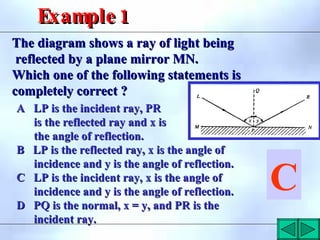
The diagram shows a ray of light being
reflected by a plane mirror MN.
Which one of the following statements is
completely correct ?
A LP is the incident ray, PR
is the reflected ray and x is
the angle of reflection.
B LP is the reflected ray, x is the angle of
incidence and y is the angle of reflection.
C LP is the incident ray, x is the angle of
incidence and y is the angle of reflection.
D PQ is the normal, x = y, and PR is the
incident ray.
incident ray.
C
1
Example1
Example
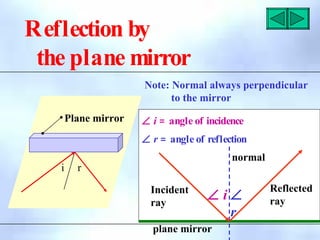
Reflection by
the plane mirror
i r
Plane mirror
Note: Normal always perpendicular
to the mirror
i r
Incident
ray
normal
plane mirror
Reflected
ray
∠ i = angle of incidence
∠ r = angle of reflection
∠ i ∠
r
2
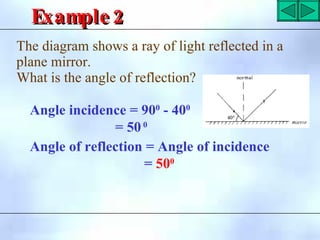
Example2
Example
Angle incidence = 900
- 400
= 500
Angle of reflection = Angle of incidence
= 500
The diagram shows a ray of light reflected in a
plane mirror.
What is the angle of reflection?
3
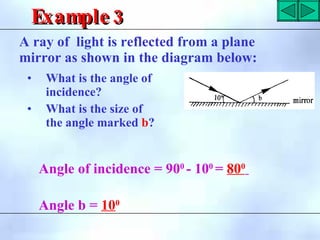
Example3
Example
Angle of incidence = 900
- 100
= 800
Angle b = 100
A ray of light is reflected from a plane
mirror as shown in the diagram below:
• What is the angle of
incidence?
• What is the size of
the angle marked b?
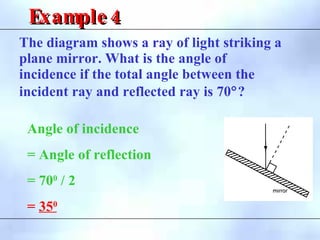
The diagram shows a ray of light striking a
plane mirror. What is the angle of
incidence if the total angle between the
incident ray and reflected ray is 70°?
4
Example4
Example
Angle of incidence
= Angle of reflection
= 700
/ 2
= 350
5
Example5
Example
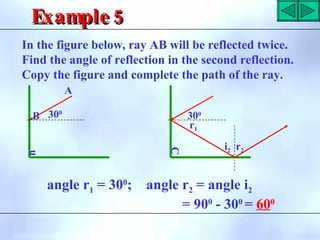
In the figure below, ray AB will be reflected twice.
Find the angle of reflection in the second reflection.
Copy the figure and complete the path of the ray.
C
300
r1
i2 r2
angle r1 = 300
; angle r2 = angle i2
= 900
- 300
= 600
u
300
A
B
MIRROR IMAGE(1)
BIKE
BOOK
BOX
CHOKE
DECIDE
CHICK
MIRROR IMAGE(1)
BIKE
BOOK
BOX
CHOKE
DECIDE
CHICK
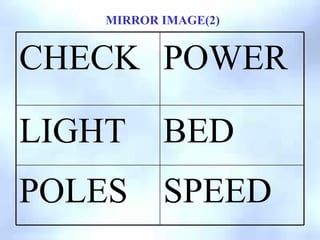
MIRROR IMAGE(2)
SPEED
POLES
BED
LIGHT
POWER
CHECK
MIRROR IMAGE(2)
SPEED
POLES
BED
LIGHT
POWER
CHECK
Formation of images on a
:
plane mirror
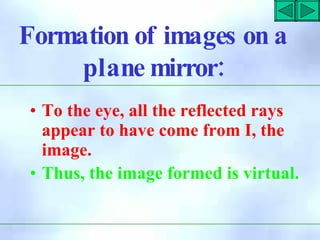
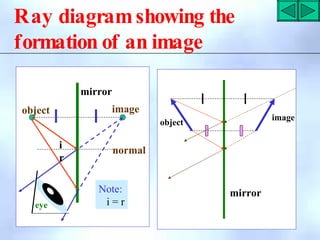
• To the eye, all the reflected rays
appear to have come from I, the
image.
• Thus, the image formed is virtual.
Real and Virtual I mages
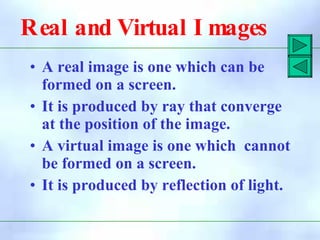
• A real image is one which can be
formed on a screen.
• It is produced by ray that converge
at the position of the image.
• A virtual image is one which cannot
be formed on a screen.
• It is produced by reflection of light.
I mage formed by
:
Plane Mirror
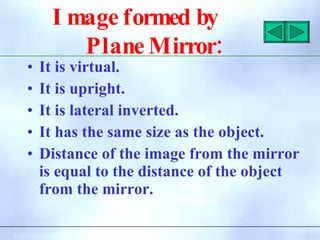
• It is virtual.
• It is upright.
• It is lateral inverted.
• It has the same size as the object.
• Distance of the image from the mirror
is equal to the distance of the object
from the mirror.
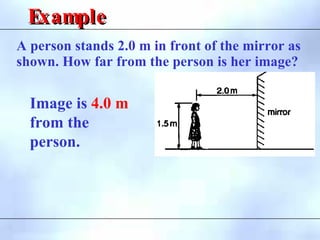
A person stands 2.0 m in front of the mirror as
shown. How far from the person is her image?
Example
Example
Image is 4.0 m
from the
person.
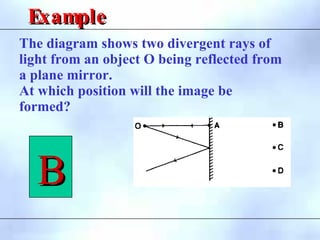
The diagram shows two divergent rays of
light from an object O being reflected from
a plane mirror.
At which position will the image be
formed?
Example
Example
B
B
i
r
Note:
i = r
object image
normal
eye
object
image
mirror
mirror
Ray diagramshowing the
formation of an image
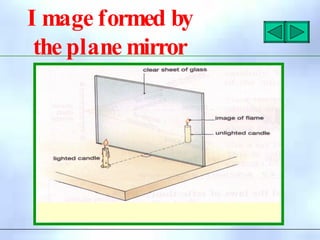
I mage formed by
the plane mirror
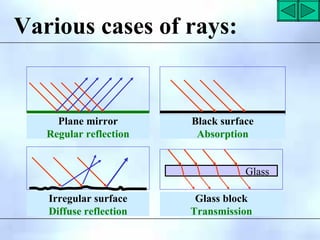
Plane mirror
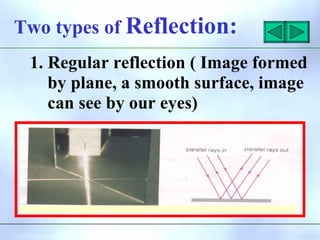
Regular reflection
Black surface
Absorption
Irregular surface
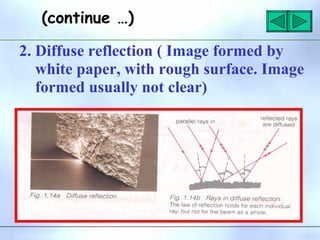
Diffuse reflection
Glass block
Transmission
Glass
Various cases of rays:
Two types of Reflection:
1. Regular reflection ( Image formed
by plane, a smooth surface, image
can see by our eyes)
2. Diffuse reflection ( Image formed by
white paper, with rough surface. Image
formed usually not clear)
(continue …)
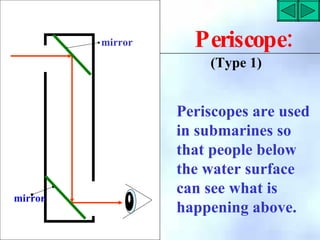
mirror
mirror
:
Periscope
Periscopes are used
in submarines so
that people below
the water surface
can see what is
happening above.
(Type 1)
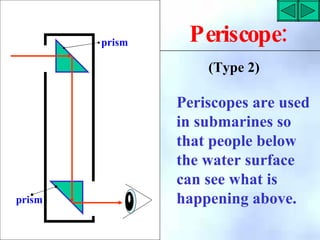
prism
prism
Periscopes are used
in submarines so
that people below
the water surface
can see what is
happening above.
:
Periscope
(Type 2)
Pe
ris
c
o
p
e
:[Co
nt.]
• The periscope consists of two parallel plane
mirrors (or prism) .
• Could you guess at what angle should each
mirror (or prism) be placed ?
• Why ?
• Which type of periscope is better ? Mirror or
prism ? Why ?
GCE O-Level
GCE O-Level
Past Examination Paper
Science (Physics)
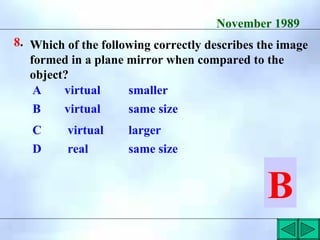
November 1989
8. Which of the following correctly describes the image
formed in a plane mirror when compared to the
object?
A virtual smaller
B virtual same size
C virtual larger
D real same size
B
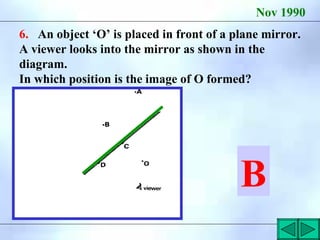
Nov 1990
6. An object ‘O’ is placed in front of a plane mirror.
A viewer looks into the mirror as shown in the
diagram.
In which position is the image of O formed?
B
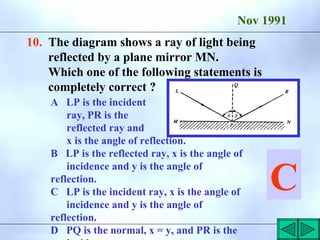
Nov 1991
10. The diagram shows a ray of light being
reflected by a plane mirror MN.
Which one of the following statements is
completely correct ?
A LP is the incident
ray, PR is the
reflected ray and
x is the angle of reflection.
B LP is the reflected ray, x is the angle of
incidence and y is the angle of
reflection.
C LP is the incident ray, x is the angle of
incidence and y is the angle of
reflection.
D PQ is the normal, x = y, and PR is the
C
4. The diagram below shows the position I of the image
formed by a plane mirror of an object O.
(a) Continue the two rays drawn leaving O to show
how they would be reflected at the mirror. [2]
GCE ‘O’ LEVEL Nov 1995
I O
4.(b) I is a virtual image. Explain the meaning of
this. [2]
(Cont. …) Q. 4 Nov 1995
Since the image, I, is produced by the reflection
of light and cannot project on a screen, there-
fore it is a virtual image.

reflectionoflight-100829070425-phpapp02 (1).pdf

  • 2.
    Objectives Objectives • Define theterms normal, angle of incidence and angle of reflection • State the angle of incidence is equal to the angle of reflection and use this principle in construction, measurements and calculations.
  • 3.
    Nature of light Natureof light • A form of energy which enables us to see • It travels in straight line • It travels at a very high speed (3.0 x 10⁸ ms-1 ) in vacuum. • It is emitted by luminous sources such as SUN, STARS, CANDLES, SUN, STARS, CANDLES, LAMPS, LAMPS, etc. etc.
  • 4.
    Nature of light Natureof light • White light is a mixture of seven White light is a mixture of seven different colours namely Red, different colours namely Red, Orange , Yellow, Green, Blue, Orange , Yellow, Green, Blue, Indigo, Violet. Indigo, Violet. • Light is a transverse wave and Light is a transverse wave and forms part of the electromagnetic forms part of the electromagnetic spectrum spectrum. .
  • 5.
    Light ray Light ray •The path along which light energy travels is called a RAY. • It is represented by a straight line with an arrow to show its direction of motion.
  • 6.
    Beam of Light Beamof Light • A beam of light is a bundle of light rays. Parallel beam Converging beams Diverging beams
  • 7.
    The abrupt changein the direction of propagation of light rays that strike the boundary between different . medium Reflection of light Reflection of light
  • 8.
    plane p normal u normal center An imaginary lineperpendicular to a surface . where the reflection occurs Normal :
  • 9.
    Reflection of Light(1) Reflectionof Light(1) i r Incident ray normal plane mirror ( ) The ray striking the surface incoming ray ( ) The ray reflected fromthe surface outgoing ray Reflected ray
  • 10.
    Reflection of Light(2) Reflectionof Light(2) The angle between incident ray and normal The angle between reflected ray and normal i r Incident ray normal plane mirror Reflected ray ∠ i = angle of incidence ∠ r = angle of reflection ∠ i ∠ r
  • 11.
    : Laws of Reflection •Law 1: The incident ray, the reflected ray and the normal at the point of incidence all lie on the same plane. • Law 2: The angle of incidence is equal to the angle of reflection. Anglei=Angler
  • 12.
    The diagram showsa ray of light being The diagram shows a ray of light being reflected by a plane mirror MN. reflected by a plane mirror MN. Which one of the following statements is Which one of the following statements is completely correct ? completely correct ? A LP is the incident ray, PR A LP is the incident ray, PR is the reflected ray and x is is the reflected ray and x is the angle of reflection. the angle of reflection. B LP is the reflected ray, x is the angle of B LP is the reflected ray, x is the angle of incidence and y is the angle of reflection. incidence and y is the angle of reflection. C LP is the incident ray, x is the angle of C LP is the incident ray, x is the angle of incidence and y is the angle of reflection. incidence and y is the angle of reflection. D PQ is the normal, x = y, and PR is the D PQ is the normal, x = y, and PR is the incident ray. incident ray. C 1 Example1 Example
  • 13.
    Reflection by the planemirror i r Plane mirror Note: Normal always perpendicular to the mirror i r Incident ray normal plane mirror Reflected ray ∠ i = angle of incidence ∠ r = angle of reflection ∠ i ∠ r
  • 14.
    2 Example2 Example Angle incidence =900 - 400 = 500 Angle of reflection = Angle of incidence = 500 The diagram shows a ray of light reflected in a plane mirror. What is the angle of reflection?
  • 15.
    3 Example3 Example Angle of incidence= 900 - 100 = 800 Angle b = 100 A ray of light is reflected from a plane mirror as shown in the diagram below: • What is the angle of incidence? • What is the size of the angle marked b?
  • 16.
    The diagram showsa ray of light striking a plane mirror. What is the angle of incidence if the total angle between the incident ray and reflected ray is 70°? 4 Example4 Example Angle of incidence = Angle of reflection = 700 / 2 = 350
  • 17.
    5 Example5 Example In the figurebelow, ray AB will be reflected twice. Find the angle of reflection in the second reflection. Copy the figure and complete the path of the ray. C 300 r1 i2 r2 angle r1 = 300 ; angle r2 = angle i2 = 900 - 300 = 600 u 300 A B
  • 18.
  • 19.
  • 20.
  • 21.
  • 22.
    Formation of imageson a : plane mirror • To the eye, all the reflected rays appear to have come from I, the image. • Thus, the image formed is virtual.
  • 23.
    Real and VirtualI mages • A real image is one which can be formed on a screen. • It is produced by ray that converge at the position of the image. • A virtual image is one which cannot be formed on a screen. • It is produced by reflection of light.
  • 24.
    I mage formedby : Plane Mirror • It is virtual. • It is upright. • It is lateral inverted. • It has the same size as the object. • Distance of the image from the mirror is equal to the distance of the object from the mirror.
  • 25.
    A person stands2.0 m in front of the mirror as shown. How far from the person is her image? Example Example Image is 4.0 m from the person.
  • 26.
    The diagram showstwo divergent rays of light from an object O being reflected from a plane mirror. At which position will the image be formed? Example Example B B
  • 27.
    i r Note: i = r objectimage normal eye object image mirror mirror Ray diagramshowing the formation of an image
  • 28.
    I mage formedby the plane mirror
  • 29.
    Plane mirror Regular reflection Blacksurface Absorption Irregular surface Diffuse reflection Glass block Transmission Glass Various cases of rays:
  • 30.
    Two types ofReflection: 1. Regular reflection ( Image formed by plane, a smooth surface, image can see by our eyes)
  • 31.
    2. Diffuse reflection( Image formed by white paper, with rough surface. Image formed usually not clear) (continue …)
  • 32.
    mirror mirror : Periscope Periscopes are used insubmarines so that people below the water surface can see what is happening above. (Type 1)
  • 33.
    prism prism Periscopes are used insubmarines so that people below the water surface can see what is happening above. : Periscope (Type 2)
  • 34.
    Pe ris c o p e :[Co nt.] • The periscopeconsists of two parallel plane mirrors (or prism) . • Could you guess at what angle should each mirror (or prism) be placed ? • Why ? • Which type of periscope is better ? Mirror or prism ? Why ?
  • 35.
    GCE O-Level GCE O-Level PastExamination Paper Past Examination Paper Science (Physics)
  • 36.
    November 1989 8. Whichof the following correctly describes the image formed in a plane mirror when compared to the object? A virtual smaller B virtual same size C virtual larger D real same size B
  • 37.
    Nov 1990 6. Anobject ‘O’ is placed in front of a plane mirror. A viewer looks into the mirror as shown in the diagram. In which position is the image of O formed? B
  • 38.
    Nov 1991 10. Thediagram shows a ray of light being reflected by a plane mirror MN. Which one of the following statements is completely correct ? A LP is the incident ray, PR is the reflected ray and x is the angle of reflection. B LP is the reflected ray, x is the angle of incidence and y is the angle of reflection. C LP is the incident ray, x is the angle of incidence and y is the angle of reflection. D PQ is the normal, x = y, and PR is the C
  • 39.
    4. The diagrambelow shows the position I of the image formed by a plane mirror of an object O. (a) Continue the two rays drawn leaving O to show how they would be reflected at the mirror. [2] GCE ‘O’ LEVEL Nov 1995 I O
  • 40.
    4.(b) I isa virtual image. Explain the meaning of this. [2] (Cont. …) Q. 4 Nov 1995 Since the image, I, is produced by the reflection of light and cannot project on a screen, there- fore it is a virtual image.