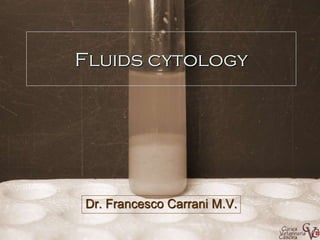
Fluids cytology

Dr. Francesco Carrani M.V.
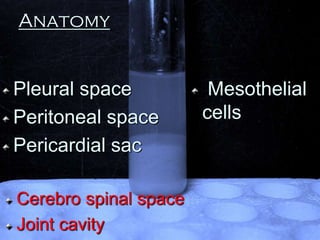
Anatomy

Pleural space
Peritoneal space
Pericardial sac
Cerebro spinal space
Joint cavity

Mesothelial
cells
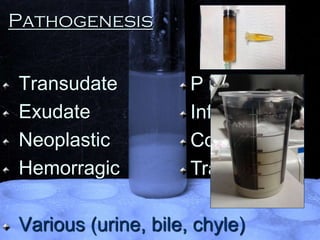
Pathogenesis
Transudate
Exudate
Neoplastic
Hemorragic

P imbalance
Inflammation
Compression
Trauma

Various (urine, bile, chyle)
Pleural space
Clinical signs
dyspnea

30 – 60 ml/kg
Clinical
emergency
Pleural space
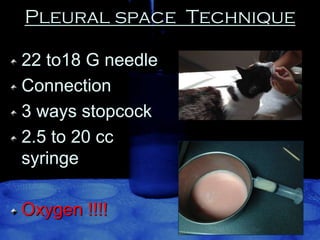
Pleural space Technique
22 to18 G needle
Connection
3 ways stopcock
2.5 to 20 cc
syringe
Oxygen !!!!
Pleural space Technique
22 to18 G needle
Connection
3 ways stopcock
2.5 to 20 cc
syringe
Oxygen !!!!
Peritoneal space
Ascites
High volume
Cells dilution
Etiology
Heart failure
Hepatic failure
Tumors
Trauma
Peritoneal space
Technique
Peritoneal space
Technique
22 to18 G needle
Connection
3 ways stopcock
5 to 20 cc syringe
Pericardial sac
Idiopathic hemopericardium
Neoplastic effusion
Hemangiosarcoma
Chemodectoma
Lymphoma

Transudate
Exudate (septic)
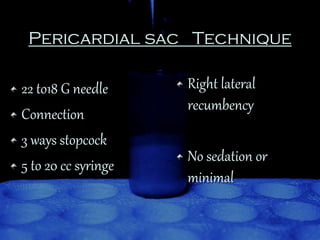
Pericardial sac Technique

22 to18 G needle
Connection
3 ways stopcock
5 to 20 cc syringe

Right lateral
recumbency
No sedation or
minimal
Pericardial sac
Technique
Sample management
EDTA tube
Direct smear
Sedimentation or low rpm
centrifugation
Fixation and rapid stain
Immunocytochemical staining
Cytological examination

It is the only test
allowing
Cells evaluation

HISTO
Cytology The cells

Mesothelial cells
Macrophages
Red cells
Neutrophils
Lymphocytes
Eosinophils
Mast cells
Mesothelial cells
Flat ephitelium
Large cells
Central and round
nucleus
More peripheral in
activated cells
Binucleated
Prominent nucleolus
Basophilic cytoplasm
Pinkish cytoplasmic
expansion
Mesothelial cells

Basophilic mesothelial, binucleated, with mitosis
Clear mesothelial, vacuolated and sometimes
granulated cytoplasm (macrophages)
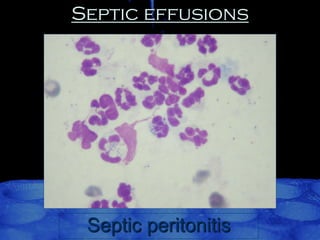
Septic effusions

Septic peritonitis
Feline infectious peritonitis
FIP
Yellow, viscous
Some neutrophils
Activated
macrophages
Red cells
Some lymphocytes
Mesothelial cells
No Bacteria
Septic effusions

Septic pleuritis
Septic effusions

Septic pleuritis from actinomices bacteria
Chylous and pseudochylous
effusion

Milky
Triglycerides (chyle > serum)
Cholesterol (chyle < serum)
Chylous and pseudochylous
effusion

Chyle

Pseudochyle

Heart disease
Trauma
Inflammation
Hernia
Venous thrombosis

Inflammation
Neoplasia
Chylous and pseudochylous
effusion

Chyle

Pseudochyle

Triglycerides
Cells

Cholesterol
Necrotic debris
Cells
Cells
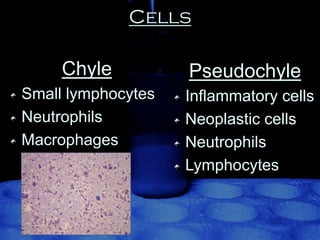
Chyle

Pseudochyle

Small lymphocytes
Neutrophils
Macrophages

Inflammatory cells
Neoplastic cells
Neutrophils
Lymphocytes
Chylous effusion
Eosinophilic
background
Small
lymphocytes
Neutrophils
Macrophages
Lipid droplets
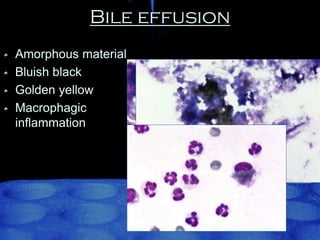
Bile effusion
Amorphous material
Bluish black
Golden yellow
Macrophagic
inflammation
Neoplastic effusion

Not all neoplasia produce
effusion
Not all neoplastic effusion
carries diagnostic cells
Neoplastic effusion

Non inflammatory cells
Different from mesothelial
cells
Neoplastic effusion
False positive – non neoplastic
mesothelial reactivity

False negative – no exfoliation
Distinction between
Mesothelioma and Carcinoma
Neoplastic effusion

Mesothelioma
Large group
Cytoplasmic
vacuolation
Visible junctions
Central nucleus

Carcinoma
Large group
Cytoplasmic
vacuolation
Tight junctions
Eccentric nucleus
Neoplastic effusion
Mesothelioma (rare)
Pleural
Pericardial

Lymphoma
Carcinoma
Mast cell
Sarcoma (exfoliation rare)
Heart base hemangiosarcoma

Poor prognosis
Carcinoma

Pulmonary metastasis from mammary carcinoma
Carcinoma

Peritoneal effusion, Intestinal Carcinoma
Sarcoma

Pulmonary artery hemangiosarcoma
Mesothelioma
Questions ?
F.Carrani 2008

(9) body fluids