Values and Virtues
2
 To identify, define and differentiate
values and virtues
Learning Objective
3
 Infer that values create meaning and
purpose in a person’s life.
 What values are important to you?
 What values do Filipinos commonly
adhere to?
Key Understanding
Key Questions
4
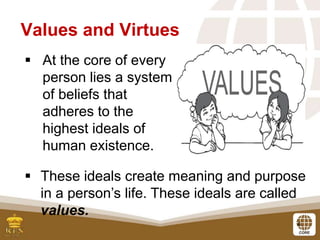
 At the core of every
person lies a system
of beliefs that
adheres to the
highest ideals of
human existence.
Values and Virtues
 These ideals create meaning and purpose
in a person’s life. These ideals are called
values.
5
• Peace
• Freedom
• Social progress
• Equal rights
• Human dignity
Universal Values (UN)
6
• Integrity
• Accountability
• Diligence
• Perseverance
• Discipline
5 Core Values for the Workplace
Source: http://www.huffingtonpost.com/robert-l-
dilenschneider/
business-advice_b_3829655.html
7
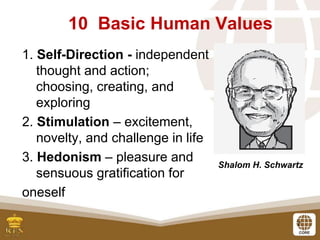
1. Self-Direction - independent
thought and action;
choosing, creating, and
exploring
2. Stimulation – excitement,
novelty, and challenge in life
3. Hedonism – pleasure and
sensuous gratification for
oneself
10 Basic Human Values
Shalom H. Schwartz
8
4. Achievement – personal success through
demonstrating competence according to social
standards
5. Power – social status and prestige, and
control or dominance over people and
resources
6. Security – safety, harmony, and stability of
society, of relationships, and of self
7. Conformity – restraint of actions, inclinations,
and impulses that are likely to upset or harm
others and violate social expectations or
norms
10 Basic Human Values
9
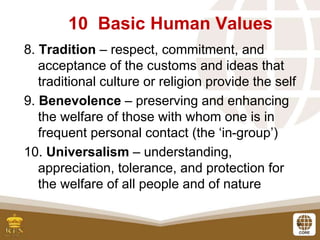
8. Tradition – respect, commitment, and
acceptance of the customs and ideas that
traditional culture or religion provide the self
9. Benevolence – preserving and enhancing
the welfare of those with whom one is in
frequent personal contact (the ‘in-group’)
10. Universalism – understanding,
appreciation, tolerance, and protection for
the welfare of all people and of nature
10 Basic Human Values
10
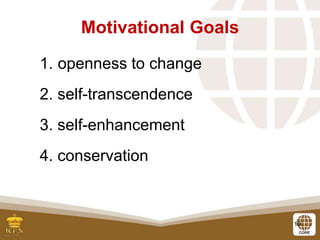
1. openness to change
2. self-transcendence
3. self-enhancement
4. conservation
Motivational Goals
11
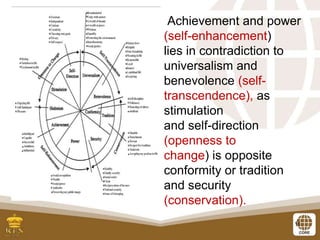
Achievement and power
(self-enhancement)
lies in contradiction to
universalism and
benevolence (self-
transcendence), as
stimulation
and self-direction
(openness to
change) is opposite
conformity or tradition
and security
(conservation).
12
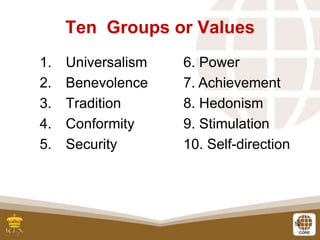
1. Universalism
2. Benevolence
3. Tradition
4. Conformity
5. Security
Ten Groups or Values
6. Power
7. Achievement
8. Hedonism
9. Stimulation
10. Self-direction
13
• Gender
• Age
• Social background
• Educational attainment
Values are influenced by:
14
1. Right conduct
2. Peace
3. Truth
4. Love
5. Non-violence
Five Values Four Basic
Universal
Values
1.Life
2.Respect
3.Love
4.Integrity
15
1. Watch this video: Ted Talks- Rick Warren, On a
Life of Purpose (http://www.ted.com/talks/rick_
warren_on_a_life_of_purpose)
2. Answer the following questions:
• What things are important to you? Are these things
worthy enough for you to risk your future, your
relationships, your career, or even your own life?
• What are the things that are important to you that when
taken away from you, or were not honored by other
people, will make you angry or feel hurt?
Activity
16
Virtues - are adjectives that describe
positive and desirable qualities which
usually mirror a value it represents.
17
Identify some behaviors (positive or
negative, pleasant or unpleasant) that you
see every day around you. Describe the
behavior and figure out what could
possibly be the attitude behind the
behavior. What value/s do you think is/are
being projected or is/are lacking in the
behavior?
Exercise

8_Values_and_Virtues.ppt

  • 1.
  • 2.
    2  To identify,define and differentiate values and virtues Learning Objective
  • 3.
    3  Infer thatvalues create meaning and purpose in a person’s life.  What values are important to you?  What values do Filipinos commonly adhere to? Key Understanding Key Questions
  • 4.
    4  At thecore of every person lies a system of beliefs that adheres to the highest ideals of human existence. Values and Virtues  These ideals create meaning and purpose in a person’s life. These ideals are called values.
  • 5.
    5 • Peace • Freedom •Social progress • Equal rights • Human dignity Universal Values (UN)
  • 6.
    6 • Integrity • Accountability •Diligence • Perseverance • Discipline 5 Core Values for the Workplace Source: http://www.huffingtonpost.com/robert-l- dilenschneider/ business-advice_b_3829655.html
  • 7.
    7 1. Self-Direction -independent thought and action; choosing, creating, and exploring 2. Stimulation – excitement, novelty, and challenge in life 3. Hedonism – pleasure and sensuous gratification for oneself 10 Basic Human Values Shalom H. Schwartz
  • 8.
    8 4. Achievement –personal success through demonstrating competence according to social standards 5. Power – social status and prestige, and control or dominance over people and resources 6. Security – safety, harmony, and stability of society, of relationships, and of self 7. Conformity – restraint of actions, inclinations, and impulses that are likely to upset or harm others and violate social expectations or norms 10 Basic Human Values
  • 9.
    9 8. Tradition –respect, commitment, and acceptance of the customs and ideas that traditional culture or religion provide the self 9. Benevolence – preserving and enhancing the welfare of those with whom one is in frequent personal contact (the ‘in-group’) 10. Universalism – understanding, appreciation, tolerance, and protection for the welfare of all people and of nature 10 Basic Human Values
  • 10.
    10 1. openness tochange 2. self-transcendence 3. self-enhancement 4. conservation Motivational Goals
  • 11.
    11 Achievement and power (self-enhancement) liesin contradiction to universalism and benevolence (self- transcendence), as stimulation and self-direction (openness to change) is opposite conformity or tradition and security (conservation).
  • 12.
    12 1. Universalism 2. Benevolence 3.Tradition 4. Conformity 5. Security Ten Groups or Values 6. Power 7. Achievement 8. Hedonism 9. Stimulation 10. Self-direction
  • 13.
    13 • Gender • Age •Social background • Educational attainment Values are influenced by:
  • 14.
    14 1. Right conduct 2.Peace 3. Truth 4. Love 5. Non-violence Five Values Four Basic Universal Values 1.Life 2.Respect 3.Love 4.Integrity
  • 15.
    15 1. Watch thisvideo: Ted Talks- Rick Warren, On a Life of Purpose (http://www.ted.com/talks/rick_ warren_on_a_life_of_purpose) 2. Answer the following questions: • What things are important to you? Are these things worthy enough for you to risk your future, your relationships, your career, or even your own life? • What are the things that are important to you that when taken away from you, or were not honored by other people, will make you angry or feel hurt? Activity
  • 16.
    16 Virtues - areadjectives that describe positive and desirable qualities which usually mirror a value it represents.
  • 17.
    17 Identify some behaviors(positive or negative, pleasant or unpleasant) that you see every day around you. Describe the behavior and figure out what could possibly be the attitude behind the behavior. What value/s do you think is/are being projected or is/are lacking in the behavior? Exercise

Editor's Notes

  • #2 This lesson will teach students about values and virtues.
  • #3 Discuss the learning objective.
  • #4 Tell the students that at the end of the lesson, they need to be able to understand that values create meaning and purpose in a person’s life. Moreover, at the end of the lesson they should be able to answer these key questions. You will go back to the key understanding and key questions before the lesson ends.
  • #5 Tell the students that at the core of every person lies a system of beliefs that adheres to the highest ideals of human existence. These ideals create meaning and purpose in a person’s life. These ideals are called values. Moreover, tell them that you will refer to values in this chapter as the universal human values that transcend culture and race. There are different sets of values identified by different people and organizations, depending on what their order of priorities are, and what they intend to achieve. These are not in conflict with each other, but rather, a ranking in the order of importance over what set of values they prioritize.
  • #6 Tell the students that the United Nations listed the following universal values: peace, freedom, social progress, equal rights, and human dignity. These values are enshrined in the Charter of the United Nations and in the Universal Declaration of Human Rights.
  • #7 Discuss with the students another example of values, this time for corporations and organizations, borrowed from Robert L. Dilenschneider, founder of Dilenschneider Group. Tell them that, in an article he wrote for Huffington Post titled Five Core Values for the Workplace, Dilenschneider listed the following corporate values: Integrity, Accountability, Diligence, Perseverance, and Discipline. Explain further the meaning of each and provide examples when needed.
  • #8 Introduce to the students the 10 Basic Human Values identified by Shalom H. Schwartz, a psychologist and cross-cultural researcher from the Hebrew University of Jerusalem. Explain that he conducted a research which covered many different peoples and cultures to identify the ten common values people have regardless of their racial and cultural backgrounds. Schwartz wrote in his report, Basic Human Values: Theories, Methods and Applications, the findings of his research, which identified the ten basic values that can be characterized by describing their central motivational goals. These 10 basic values are: self-direction, stimulation, hedonism, achievement, power, security, conformity, tradition, benevolence, and universalism.
  • #11 Discuss further to the students the motivational goals that characterize the 10 values as identified by Schwartz.
  • #12 Discuss further to the students that in the diagram shown above, Schwartz illustrated how certain values may contradict others when motivations are considered. Achievement and power (self-enhancement) lies in contradiction to universalism and benevolence (self-transcendence), as stimulation and self-direction (openness to change) is opposite conformity or tradition and security (conservation). Give this as an example. A person who has identified power as an important personal value will most likely put social justice in equal importance. Schwartz explains that the contradiction may have been the result of the various circumstances in life of the respondents of the research study.
  • #13 Discuss with the students the 10 Groups or Values. These are: Universalism (understanding, appreciation, tolerance and protection for the welfare of all); Benevolence (preservation and enhancement of the welfare of people with whom one is in frequent personal contact); Tradition (respect, commitment and acceptance of the customs and ideas that traditional culture or religion provide the self); Conformity (restraint of actions, inclinations and impulses likely to upset or harm others and violate social expectations or norms); Security (safety, harmony, and stability of society, of relationships and of self); Power (social status and prestige, control or dominance over people and resources); Achievement (personal success through demonstrating competence according to social standards); Hedonism (pleasure and sensuous gratification for oneself). Stimulation (Excitement, novelty and challenge in life); Self-direction (independent thought and action-choosing, creating, exploring).
  • #14 Tell the students that values are influenced by: gender, age, social background, and educational attainment. Explain further why these factors influence values.
  • #15 The 10 values were simplified into just five values: right conduct, peace, truth, love, and non-violence. Others shorten their list to just four basic universal values: life, respect, love, and integrity.
  • #16 Ask the students to watch this video: Ted Talks- Rick Warren, On a Life of Purpose (http://www.ted.com/talks/rick_warren_on_a_life_of_purpose). This could be done as a class activity (inside your classroom) or be given as assignment. Then tell the students to answer some questions to help clarify their values.
  • #17 Tell the students that values are influenced by: gender, age, social background, and educational attainment. Explain further why these factors influence values.
  • #18 To end the lesson, instruct the students to do this exercise.