The
HUMAN
Person
By Jiv N. Codera
HUMAN Person
- Is the subject of
education: he is a
human person
learning and being
taught.
2
- Is also the object
of education: he is a
the center of the
curriculum and the
entire program.
3
Think of this!
What is a human person?
What is the nature of the
human person?
“Don’t dream of being a good
person, be a human being who
is valuable and gives value to
life.
4
Albert Einstein
1.
Important Realities
of the Human Person
THE SELF-IMAGE
6
the SELF-IMAGE
Self-image refers to the
person’s understanding of
himself or herself.
▫ It is responsible in influencing
people’s way of living. The
formation of self-image is
derived from two sources: others
and the experiences of the self.
7
Three Kinds of Self-Image
1. Negative self-image – delves on
limitation rather than assets
2. Overrated self-image – stresses on
the positive traits
3. Realistic self-image – based on the
real self.
8
the OTHERS
These are the people
or groups whom one
consider as important and
thus are given the right to
influence one’s self.
9
▫ It is the mainspring or a
motivating force in the
human person.
the BEING
It is the wellspring, a fountainhead
of one’s identity, one’s essential
action, and one’s essential bonds.
10
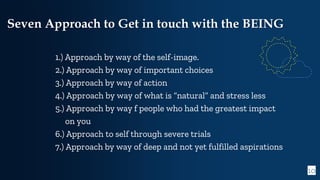
Seven Approach to Get in touch with the BEING
1.) Approach by way of the self-image.
2.) Approach by way of important choices
3.) Approach by way of action
4.) Approach by way of what is “natural” and stress less
5.) Approach by way f people who had the greatest impact
on you
6.) Approach to self through severe trials
7.) Approach by way of deep and not yet fulfilled aspirations
11
The “I” has three
different aspects.
These are the
intellect, the freedom,
and the will.
the I
12
the Sensibility and the
Body
These are the
important
realities of the
Human Person.
2.
Five Pivotal Centers as
the Components of the
Human Person
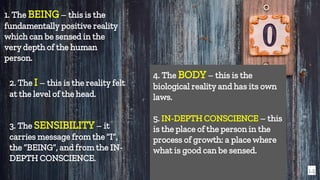
1. The BEING – this is the
fundamentally positive reality
which can be sensed in the
very depth of the human
person.
14
2. The I – this is the reality felt
at the level of the head.
3. The SENSIBILITY – it
carries message from the “I”,
the “BEING”, and from the IN-
DEPTH CONSCIENCE.
4. The BODY – this is the
biological reality and has its own
laws.
5. IN-DEPTH CONSCIENCE – this
is the place of the person in the
process of growth: a place where
what is good can be sensed.
BEHAVIOR
15
-is the manner of conducting oneself. It is a
manner in which a person behaves.
ATTITUDE
-is a position assumed for a specific purpose.
Human attitude affects much of a person’s behavior,
and human behavior depends on the kind of environment
one is interacting with.
3.
Characteristics of a
Human Person
Characteristics of a Person
17
Rational
Every person is a
rational being.
As rational being, a
person is free to think
and has the capacity to
reason. He can
distinguish what is right
and what is wrong
because he has intellect.
Characteristics of a Person
18
Free
All human beings are
born free.
A person has the freedom to
do or not to do a specific
action. However, every
person must be responsible
for his own action. A person
can do whatever he pleases,
but not to the extent of doing
harm to his fellow.
Characteristics of a Person
19
Social Being
Every person is
intrinsically a social
being.
A person cannot detach his
“being” from others and all
other creatures. Human
nature is characterized by his
togetherness and
relationship towards other
creatures.
Characteristics of a Person
20
Unique
Every person is unique.
Every person has his own
identity such that no two
persons are the same.
Human beings have the same
characteristics, and but no
two persons are the same
because every person has its
own perception, sets of
values and priorities in life.
Characteristics of a Person
21
Sexual
All created living things are
sexual in nature but the
uniqueness of expression of
a peron’s sexuality makes it
all different.
The expression of a person’s
emotions, attitudes, feelings,
actions and thoughts in sexual
activity best exemplifies his
uniqueness from animals.
4.
Core and Related
Values
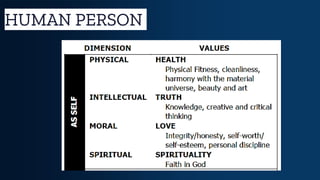
HUMAN PERSON
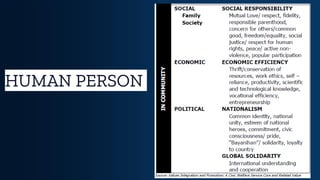
HUMAN PERSON
5.
The Essence of a Person
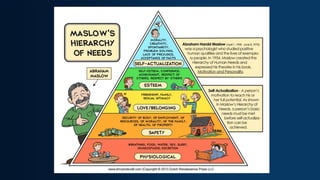
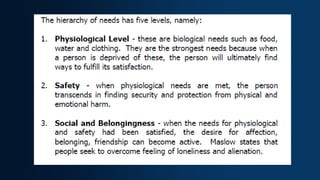
Maslow’s Hierarchy of Needs
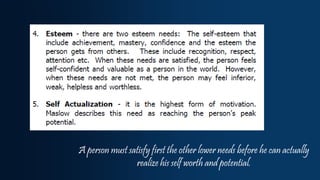
A person must satisfy first the other lower needs before he can actually
realize his self worth and potential.
6.
Ten Commandments of
Human Relations
1. Speak to people.
30
There’s nothing as nice as a cheerful
word of greeting.
2. Smile at people.
It takes 65 muscles to frown and only 15
to smile.
3. Call people by name.
31
The sweetest music to anyone’s ear is the
sound of his/her own name.
4. Be friendly and helpful.
If you have friends, be friendly.
5. Be cordial.
32
Speak and act as if everything you do
were a genuine pleasure.
6. Be genuinely interested in people.
You can like everybody if you try.
7. Be generous with praise.
33
Take caution against criticizing others.
8. Be considerate with the
feelings of others.
It will be appreciated.
9. Be thoughtful of the opinion of others.
34
There are three sides to a controversy –
yours, the other fellow’s, and the right one.
10. Be alert to give service.
What counts most in life is what we do for
others.
7.
Mission Possible Team
I CAN WIN
36
I CAN WIN
1.Successful people have
a positive mental
attitude.
2.Successful people are
courageous people who
take risks.
3.Successful people
choose well
37
I CAN WIN
4.Successful people
persist.
5.Successful people
adhere to the power of
prayer.
6.Successful people
know how to peace
themselves and journey
through life with
enthusiasm.
38
I CAN WIN
7.Successful people govern
themselves with
discipline.
8.Successful people give the
best to whatever they do.
9.Successful people align
their sense of purpose
with the common good.
39
I CAN WIN
10. Successful people keep
a positive count by
responding positively
to any person r
situation
11. Successful people
harmonize with
encouragement.
12. Successful people are
decisive people who
make things happen.
40
41
42
43
End of Chapter 1 !

Chapter 1: The Human Person

  • 1.
  • 2.
    HUMAN Person - Isthe subject of education: he is a human person learning and being taught. 2 - Is also the object of education: he is a the center of the curriculum and the entire program.
  • 3.
    3 Think of this! Whatis a human person? What is the nature of the human person?
  • 4.
    “Don’t dream ofbeing a good person, be a human being who is valuable and gives value to life. 4 Albert Einstein
  • 5.
    1. Important Realities of theHuman Person THE SELF-IMAGE
  • 6.
    6 the SELF-IMAGE Self-image refersto the person’s understanding of himself or herself. ▫ It is responsible in influencing people’s way of living. The formation of self-image is derived from two sources: others and the experiences of the self.
  • 7.
    7 Three Kinds ofSelf-Image 1. Negative self-image – delves on limitation rather than assets 2. Overrated self-image – stresses on the positive traits 3. Realistic self-image – based on the real self.
  • 8.
    8 the OTHERS These arethe people or groups whom one consider as important and thus are given the right to influence one’s self.
  • 9.
    9 ▫ It isthe mainspring or a motivating force in the human person. the BEING It is the wellspring, a fountainhead of one’s identity, one’s essential action, and one’s essential bonds.
  • 10.
    10 Seven Approach toGet in touch with the BEING 1.) Approach by way of the self-image. 2.) Approach by way of important choices 3.) Approach by way of action 4.) Approach by way of what is “natural” and stress less 5.) Approach by way f people who had the greatest impact on you 6.) Approach to self through severe trials 7.) Approach by way of deep and not yet fulfilled aspirations
  • 11.
    11 The “I” hasthree different aspects. These are the intellect, the freedom, and the will. the I
  • 12.
    12 the Sensibility andthe Body These are the important realities of the Human Person.
  • 13.
    2. Five Pivotal Centersas the Components of the Human Person
  • 14.
    1. The BEING– this is the fundamentally positive reality which can be sensed in the very depth of the human person. 14 2. The I – this is the reality felt at the level of the head. 3. The SENSIBILITY – it carries message from the “I”, the “BEING”, and from the IN- DEPTH CONSCIENCE. 4. The BODY – this is the biological reality and has its own laws. 5. IN-DEPTH CONSCIENCE – this is the place of the person in the process of growth: a place where what is good can be sensed.
  • 15.
    BEHAVIOR 15 -is the mannerof conducting oneself. It is a manner in which a person behaves. ATTITUDE -is a position assumed for a specific purpose. Human attitude affects much of a person’s behavior, and human behavior depends on the kind of environment one is interacting with.
  • 16.
  • 17.
    Characteristics of aPerson 17 Rational Every person is a rational being. As rational being, a person is free to think and has the capacity to reason. He can distinguish what is right and what is wrong because he has intellect.
  • 18.
    Characteristics of aPerson 18 Free All human beings are born free. A person has the freedom to do or not to do a specific action. However, every person must be responsible for his own action. A person can do whatever he pleases, but not to the extent of doing harm to his fellow.
  • 19.
    Characteristics of aPerson 19 Social Being Every person is intrinsically a social being. A person cannot detach his “being” from others and all other creatures. Human nature is characterized by his togetherness and relationship towards other creatures.
  • 20.
    Characteristics of aPerson 20 Unique Every person is unique. Every person has his own identity such that no two persons are the same. Human beings have the same characteristics, and but no two persons are the same because every person has its own perception, sets of values and priorities in life.
  • 21.
    Characteristics of aPerson 21 Sexual All created living things are sexual in nature but the uniqueness of expression of a peron’s sexuality makes it all different. The expression of a person’s emotions, attitudes, feelings, actions and thoughts in sexual activity best exemplifies his uniqueness from animals.
  • 22.
  • 23.
  • 24.
  • 25.
    5. The Essence ofa Person Maslow’s Hierarchy of Needs
  • 28.
    A person mustsatisfy first the other lower needs before he can actually realize his self worth and potential.
  • 29.
  • 30.
    1. Speak topeople. 30 There’s nothing as nice as a cheerful word of greeting. 2. Smile at people. It takes 65 muscles to frown and only 15 to smile.
  • 31.
    3. Call peopleby name. 31 The sweetest music to anyone’s ear is the sound of his/her own name. 4. Be friendly and helpful. If you have friends, be friendly.
  • 32.
    5. Be cordial. 32 Speakand act as if everything you do were a genuine pleasure. 6. Be genuinely interested in people. You can like everybody if you try.
  • 33.
    7. Be generouswith praise. 33 Take caution against criticizing others. 8. Be considerate with the feelings of others. It will be appreciated.
  • 34.
    9. Be thoughtfulof the opinion of others. 34 There are three sides to a controversy – yours, the other fellow’s, and the right one. 10. Be alert to give service. What counts most in life is what we do for others.
  • 35.
  • 36.
    36 I CAN WIN 1.Successfulpeople have a positive mental attitude. 2.Successful people are courageous people who take risks. 3.Successful people choose well

  • 37.
    37 I CAN WIN 4.Successfulpeople persist. 5.Successful people adhere to the power of prayer. 6.Successful people know how to peace themselves and journey through life with enthusiasm.
  • 38.
    38 I CAN WIN 7.Successfulpeople govern themselves with discipline. 8.Successful people give the best to whatever they do. 9.Successful people align their sense of purpose with the common good.


  • 39.
    39 I CAN WIN 10.Successful people keep a positive count by responding positively to any person r situation 11. Successful people harmonize with encouragement. 12. Successful people are decisive people who make things happen.
  • 40.
  • 41.
  • 42.
  • 43.