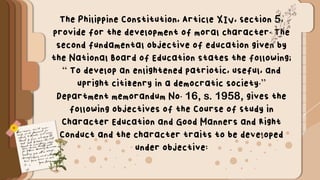
The Philippine Constitution, Article XIV, Section 5,
provide for the development of moral character. The
second fundamental objective of education given by
the National Board of Education states the following;
“ To develop an enlightened patriotic, useful, and
upright citizenry in a democratic society.”
Department memorandum No. 16, s. 1958, gives the
following objectives of the Course of Study in
Character Education and Good Manners and Right
Conduct and the character traits to be developed
under objective:
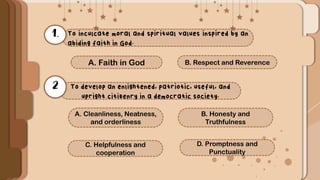
To inculcate moral and spiritual values inspired by an
abiding faith in God.
1.
To develop an enlightened, patriotic, useful, and
upright citizenry in a democratic society.
2
A. Cleanliness, Neatness,
and orderliness
C. Helpfulness and
cooperation
B. Honesty and
Truthfulness
D. Promptness and
Punctuality
A. Faith in God B. Respect and Reverence
Teaching Elementary
School Subjects
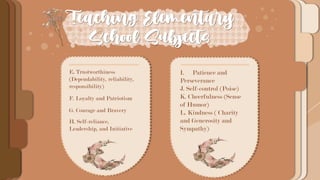
E. Trustworthiness
(Dependability, reliability,
responsibility)
F. Loyalty and Patriotism
G. Courage and Bravery
H. Self-reliance,
Leadership, and Initiative
I. Patience and
Perseverance
J. Self-control (Poise)
K. Cheerfulness (Sense
of Humor)
L. Kindness ( Charity
and Generosity and
Sympathy)
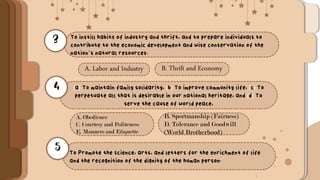
To instill habits of industry and thrift, and to prepare individuals to
contribute to the economic development and wise conservation of the
nation’s natural resources.
3
(a) To maintain family solidarity, (b) To improve community life, (c) To
perpetuate all that is desirable in our national heritage, and (d) To
serve the cause of world peace,
4
To Promote the Science, arts, and letters for the enrichment of life
and the recognition of the dignity of the human person.
5
B. Sportmanship (Fairness)
D. Tolerance and Goodwill
(World Brotherhood)
A. Labor and Industry B. Thrift and Economy
A. Obedience
C. Courtesy and Politeness
E. Manners and Etiquette
The Bureau of Public
Schools have outlined
other general objectives
of character Education
and Good Manners and
Right Conduct, which are
as follows;
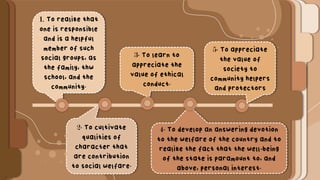
1. To realize that
one is responsible
and is a helpful
member of such
social groups, as
the family, thw
school, and the
community.
3. To learn to
appreciate the
value of ethical
conduct.
2. To cultivate
qualities of
character that
are contribution
to social welfare.
4. To develop an answering devotion
to the welfare of the country and to
realize the fact that the well-being
of the state is paramount to, and
above, personal interest.
5. To appreciate
the value of
society to
community helpers
and protectors
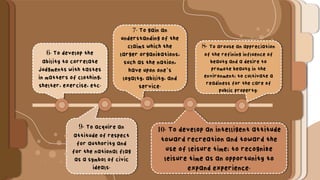
6. To develop the
ability to correlate
judgments with tastes
in matters of clothing,
shelter, exercise, etc.
7. To gain an
understanding of the
claims which the
larger organizations,
such as the nation,
have upon one’s
loyalty, ability, and
service.
9. To acquire an
attitude of respect
for authority and
for the national flag
as a symbol of civic
ideals.
10. To develop an intelligent attitude
toward recreation and toward the
use of leisure time; to recognize
leisure time as an opportunity to
expand experience.
8. To arouse an appreciation
of the refining influence of
beauty and a desire to
promote beauty in the
environment; to cultivate a
readiness for the care of
public property.
Presented by:
Sky D. Cruzada BEED- 11

PPT GMRC.pptx

  • 2.
    The Philippine Constitution,Article XIV, Section 5, provide for the development of moral character. The second fundamental objective of education given by the National Board of Education states the following; “ To develop an enlightened patriotic, useful, and upright citizenry in a democratic society.” Department memorandum No. 16, s. 1958, gives the following objectives of the Course of Study in Character Education and Good Manners and Right Conduct and the character traits to be developed under objective:
  • 3.
    To inculcate moraland spiritual values inspired by an abiding faith in God. 1. To develop an enlightened, patriotic, useful, and upright citizenry in a democratic society. 2 A. Cleanliness, Neatness, and orderliness C. Helpfulness and cooperation B. Honesty and Truthfulness D. Promptness and Punctuality A. Faith in God B. Respect and Reverence
  • 4.
    Teaching Elementary School Subjects E.Trustworthiness (Dependability, reliability, responsibility) F. Loyalty and Patriotism G. Courage and Bravery H. Self-reliance, Leadership, and Initiative I. Patience and Perseverance J. Self-control (Poise) K. Cheerfulness (Sense of Humor) L. Kindness ( Charity and Generosity and Sympathy)
  • 5.
    To instill habitsof industry and thrift, and to prepare individuals to contribute to the economic development and wise conservation of the nation’s natural resources. 3 (a) To maintain family solidarity, (b) To improve community life, (c) To perpetuate all that is desirable in our national heritage, and (d) To serve the cause of world peace, 4 To Promote the Science, arts, and letters for the enrichment of life and the recognition of the dignity of the human person. 5 B. Sportmanship (Fairness) D. Tolerance and Goodwill (World Brotherhood) A. Labor and Industry B. Thrift and Economy A. Obedience C. Courtesy and Politeness E. Manners and Etiquette
  • 6.
    The Bureau ofPublic Schools have outlined other general objectives of character Education and Good Manners and Right Conduct, which are as follows;
  • 7.
    1. To realizethat one is responsible and is a helpful member of such social groups, as the family, thw school, and the community. 3. To learn to appreciate the value of ethical conduct. 2. To cultivate qualities of character that are contribution to social welfare. 4. To develop an answering devotion to the welfare of the country and to realize the fact that the well-being of the state is paramount to, and above, personal interest. 5. To appreciate the value of society to community helpers and protectors
  • 8.
    6. To developthe ability to correlate judgments with tastes in matters of clothing, shelter, exercise, etc. 7. To gain an understanding of the claims which the larger organizations, such as the nation, have upon one’s loyalty, ability, and service. 9. To acquire an attitude of respect for authority and for the national flag as a symbol of civic ideals. 10. To develop an intelligent attitude toward recreation and toward the use of leisure time; to recognize leisure time as an opportunity to expand experience. 8. To arouse an appreciation of the refining influence of beauty and a desire to promote beauty in the environment; to cultivate a readiness for the care of public property.
  • 9.
    Presented by: Sky D.Cruzada BEED- 11