Optical Illusions
By Miguel Cortinas and Ryan Longo
Main Objective

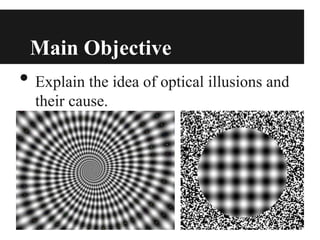
• Explain the idea of optical illusions and
their cause.
Introduction to Optical
Illusions
•
•
•

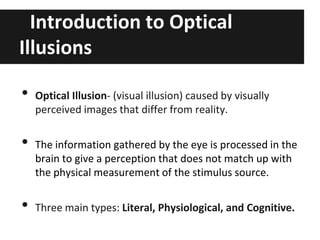
Optical Illusion- (visual illusion) caused by visually
perceived images that differ from reality.
The information gathered by the eye is processed in the
brain to give a perception that does not match up with
the physical measurement of the stimulus source.

Three main types: Literal, Physiological, and Cognitive.
Literal Illusions
•

•

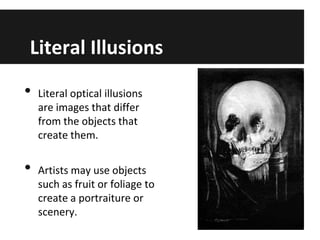
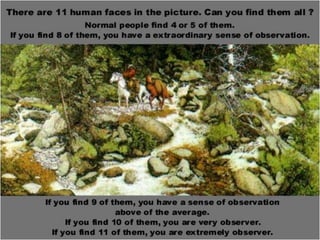
Literal optical illusions
are images that differ
from the objects that
create them.
Artists may use objects
such as fruit or foliage to
create a portraiture or
scenery.
Physiological Illusions
•

•

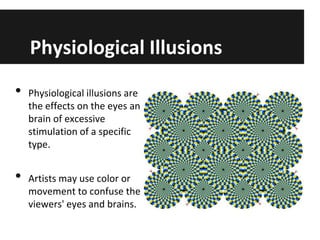
Physiological illusions are
the effects on the eyes and
brain of excessive
stimulation of a specific
type.
Artists may use color or
movement to confuse the
viewers' eyes and brains.
Cognitive Illusions
•

•
•

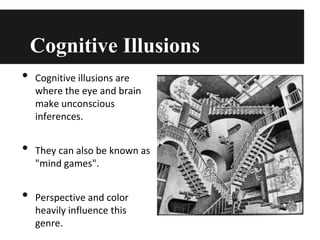
Cognitive illusions are
where the eye and brain
make unconscious
inferences.

They can also be known as
"mind games".
Perspective and color
heavily influence this
genre.
Idea of Optical Illusions
•
•
•

When we witness an illusion, we perceive something that
does not correspond to what is actually out there—what
exists in the real world.
Illusions fool us! They convince us of things that are not true.
Dictionary definitions of illusion usually state that an illusion
is a sensory perception that causes a false or distorted
impression, or a misrepresentation of a "real" sensory
stimulus.
Illusions
•
•
•
•

Illusion is a kind of wrong perception.
In an illusion, an external stimulus is always present. In other
words, illusions are caused by external stimulations.
Illusions are almost universal.
The same situation arouses the same type of illusion in most
people.
Hallucinations
•
•

•
•
•
•
•

Hallucination is a false perception.
During hallucinations, no external stimulus is present.
Hallucinations are caused by internal stimulations.
A hallucination is seeing, hearing, tasting, smelling or feeling
things that do not really exist.
Certain drugs can cause hallucinations.
Certain mental illnesses can cause hallucinations.
People who have hallucinations are not necessarily ill.
Lack of sleep can also cause hallucinations.
Don’t Believe Your Eyes
•

•
•

Illusions are misperceptions that are perceived by most
people, and are based on a specific stimulus received under
certain conditions.
Some experiments with animals indicate that several species
of mammals and birds are "fooled" by illusions in much the
same way we are.

Illusions are different from both hallucinations and
delusions.
Examples
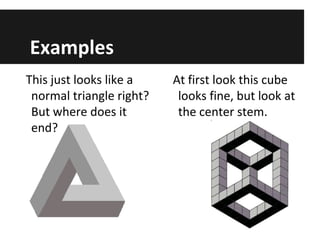
This just looks like a
normal triangle right?
But where does it
end?

At first look this cube
looks fine, but look at
the center stem.
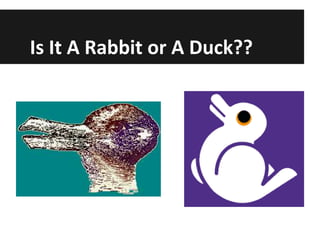
Is It A Rabbit or A Duck??
Evaluation Questions
1. What is an optical illusion?
2.

What are the causes of optical illusions?

3.

What are the 3 types of illusions?

4. How do optical illusions differ from hallucinations and
delusions?
Any Questions???
Bibliography
•
•
•

Block, J. (n.d.). What is an Illusion?.sandlotscience.com.
Retrieved October 29, 2013, from
http://www.sandlotscience.com/EyeonIllusions/whatisanillu
sion.htm
Nierenberg, C. (n.d.). Optical Illusions: When Your Brain Can't
Believe Your Eyes. ABC News. Retrieved October 29, 2013,
from http://abcnews.go.com/Health/EyeHealth/opticalillusions-eye-brain-agree/story?id=8455573
Nin, A. (n.d.). Causes of Optical Illusions.buzzle.com.
Retrieved October 29, 2013, from
http://www.buzzle.com/articles/causes-of-opticalillusions.html

Optical Illusions

  • 1.
    Optical Illusions By MiguelCortinas and Ryan Longo
  • 2.
    Main Objective • Explainthe idea of optical illusions and their cause.
  • 3.
    Introduction to Optical Illusions • • • OpticalIllusion- (visual illusion) caused by visually perceived images that differ from reality. The information gathered by the eye is processed in the brain to give a perception that does not match up with the physical measurement of the stimulus source. Three main types: Literal, Physiological, and Cognitive.
  • 4.
    Literal Illusions • • Literal opticalillusions are images that differ from the objects that create them. Artists may use objects such as fruit or foliage to create a portraiture or scenery.
  • 5.
    Physiological Illusions • • Physiological illusionsare the effects on the eyes and brain of excessive stimulation of a specific type. Artists may use color or movement to confuse the viewers' eyes and brains.
  • 6.
    Cognitive Illusions • • • Cognitive illusionsare where the eye and brain make unconscious inferences. They can also be known as "mind games". Perspective and color heavily influence this genre.
  • 7.
    Idea of OpticalIllusions • • • When we witness an illusion, we perceive something that does not correspond to what is actually out there—what exists in the real world. Illusions fool us! They convince us of things that are not true. Dictionary definitions of illusion usually state that an illusion is a sensory perception that causes a false or distorted impression, or a misrepresentation of a "real" sensory stimulus.
  • 8.
    Illusions • • • • Illusion is akind of wrong perception. In an illusion, an external stimulus is always present. In other words, illusions are caused by external stimulations. Illusions are almost universal. The same situation arouses the same type of illusion in most people.
  • 9.
    Hallucinations • • • • • • • Hallucination is afalse perception. During hallucinations, no external stimulus is present. Hallucinations are caused by internal stimulations. A hallucination is seeing, hearing, tasting, smelling or feeling things that do not really exist. Certain drugs can cause hallucinations. Certain mental illnesses can cause hallucinations. People who have hallucinations are not necessarily ill. Lack of sleep can also cause hallucinations.
  • 11.
    Don’t Believe YourEyes • • • Illusions are misperceptions that are perceived by most people, and are based on a specific stimulus received under certain conditions. Some experiments with animals indicate that several species of mammals and birds are "fooled" by illusions in much the same way we are. Illusions are different from both hallucinations and delusions.
  • 12.
    Examples This just lookslike a normal triangle right? But where does it end? At first look this cube looks fine, but look at the center stem.
  • 13.
    Is It ARabbit or A Duck??
  • 14.
    Evaluation Questions 1. Whatis an optical illusion? 2. What are the causes of optical illusions? 3. What are the 3 types of illusions? 4. How do optical illusions differ from hallucinations and delusions?
  • 15.
  • 16.
    Bibliography • • • Block, J. (n.d.).What is an Illusion?.sandlotscience.com. Retrieved October 29, 2013, from http://www.sandlotscience.com/EyeonIllusions/whatisanillu sion.htm Nierenberg, C. (n.d.). Optical Illusions: When Your Brain Can't Believe Your Eyes. ABC News. Retrieved October 29, 2013, from http://abcnews.go.com/Health/EyeHealth/opticalillusions-eye-brain-agree/story?id=8455573 Nin, A. (n.d.). Causes of Optical Illusions.buzzle.com. Retrieved October 29, 2013, from http://www.buzzle.com/articles/causes-of-opticalillusions.html