Why
Does Our
Mind See
Illusions?
The Human brain put images together
because it has learned to expect things;
sometimes the data might get a little
confused.
We may see an illusion because we
know what we are expected to see, even
though part of a picture or design may not
be completely there. The basis of this is in
how we perceive things.
One example of optical illusion is the
television. The television just shows us a
continuous flow of still pictures, one right after
the other. Your eyes, along with your brain, fill
in all of the empty spots.
Our brain has learned to expect
movement. As a result, our brain can fill in all
of the missing pieces and the pictures on the
television appear to be moving, even though
they really aren’t!
Optical illusions just trick you into
seeing something else.
They are an error in our perception of
the illusion.
Visual illusions occur due to
properties of the visual areas of the
brain as they receive and process
information.
In other words, your perception of
an illusion has more to do with how
your brain works -- and less to
do with the optics of your eye.
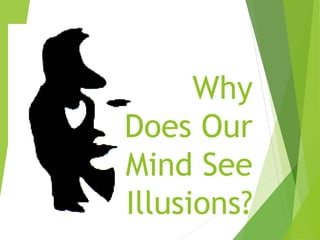
There's a face... and the word
What do
What do you see?
No, they're both the same
size
Is the left center circle bigger?
It's a spiral, right?
No, these are a bunch of independent
circles
Keep staring at the black dot. After a while
the gray haze around it will appear to
shrink.
Can you find the dog?
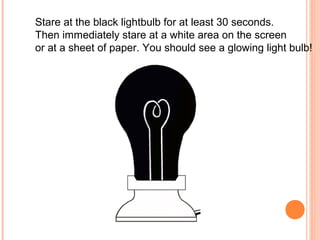
Stare at the black lightbulb for at least 30 seconds.
Then immediately stare at a white area on the screen
or at a sheet of paper. You should see a glowing light bulb!
How many colors do you see?
There are only 3 colors: White, green, and pink.
There seem to be two different shades of pink,
but there is only one pink.
Do you see a couple or a skull?
Count the black dots! :o)
Are the horizontal lines parallel or do they slope?
How many legs does this elephant have?
Do you see the three faces?
What does the sign say? Are you
sure?
Do you see the face? Or an Eskimo?
Do you see a musician or a girl's face?
Look at the words below from left to right. Say out loud the
COLOR not the word.
This is a left to right conflict. The right side of your brain tries to
say the color while the left insists on reading the word.
Stare at the blue circles and move your
head back and forth from the screen. Do
the outer circles move?
Can you believe that this is a picture and
not an animation? To check, just focus on
one leaf for 5 seconds.
Do you see one woman or two women
looking at the candle?
What word do you see?

Optical illusions

  • 1.
  • 2.
    The Human brainput images together because it has learned to expect things; sometimes the data might get a little confused. We may see an illusion because we know what we are expected to see, even though part of a picture or design may not be completely there. The basis of this is in how we perceive things.
  • 3.
    One example ofoptical illusion is the television. The television just shows us a continuous flow of still pictures, one right after the other. Your eyes, along with your brain, fill in all of the empty spots. Our brain has learned to expect movement. As a result, our brain can fill in all of the missing pieces and the pictures on the television appear to be moving, even though they really aren’t!
  • 4.
    Optical illusions justtrick you into seeing something else. They are an error in our perception of the illusion.
  • 5.
    Visual illusions occur due to propertiesof the visual areas of the brain as they receive and process information. In other words, your perception of an illusion has more to do with how your brain works -- and less to do with the optics of your eye.
  • 6.
    There's a face...and the word What do What do you see?
  • 7.
    No, they're boththe same size Is the left center circle bigger?
  • 8.
    It's a spiral,right? No, these are a bunch of independent circles
  • 9.
    Keep staring atthe black dot. After a while the gray haze around it will appear to shrink.
  • 10.
    Can you findthe dog?
  • 11.
    Stare at theblack lightbulb for at least 30 seconds. Then immediately stare at a white area on the screen or at a sheet of paper. You should see a glowing light bulb!
  • 12.
    How many colorsdo you see? There are only 3 colors: White, green, and pink. There seem to be two different shades of pink, but there is only one pink.
  • 14.
    Do you seea couple or a skull?
  • 15.
    Count the blackdots! :o)
  • 16.
    Are the horizontallines parallel or do they slope?
  • 17.
    How many legsdoes this elephant have?
  • 18.
    Do you seethe three faces?
  • 19.
    What does thesign say? Are you sure?
  • 20.
    Do you seethe face? Or an Eskimo?
  • 21.
    Do you seea musician or a girl's face?
  • 28.
    Look at thewords below from left to right. Say out loud the COLOR not the word. This is a left to right conflict. The right side of your brain tries to say the color while the left insists on reading the word.
  • 29.
    Stare at theblue circles and move your head back and forth from the screen. Do the outer circles move?
  • 30.
    Can you believethat this is a picture and not an animation? To check, just focus on one leaf for 5 seconds.
  • 31.
    Do you seeone woman or two women looking at the candle?
  • 32.
    What word doyou see?