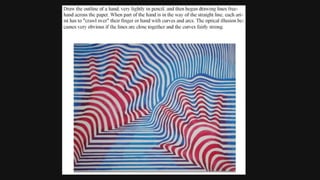
and visual phenomena
Optical
Illusions
Learning Target:
I will learn about WHY optical illusions “trick” our brains.
Success Criteria:
Mindmap Notes, discussion, participation, hand drawing
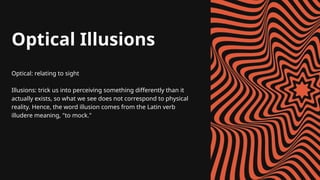
Optical Illusions
Optical: relating to sight
Illusions: trick us into perceiving something differently than it
actually exists, so what we see does not correspond to physical
reality. Hence, the word illusion comes from the Latin verb
illudere meaning, "to mock."
Phenomena:
Phenomena can be defined as “observable
events that occur in a natural or designed
system.” They are everywhere around us, but
some are easier to notice than others.
“We’re seeing a story that’s being created for us.” - Research professor at
Dartmouth College
Most of the time, the story our brains generate matches the real, physical world
— but not always. Our brains also unconsciously bend our perception of reality to
meet our desires or expectations. And they fill in gaps using our past
experiences.
Rather than showing us how our brains are broken, illusions give us the chance
to reveal how they work.
ology: subject of study lin
k
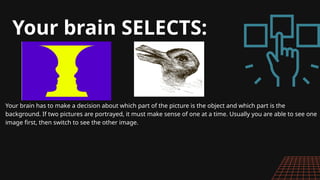
Your brain has to make a decision about which part of the picture is the object and which part is the
background. If two pictures are portrayed, it must make sense of one at a time. Usually you are able to see one
image first, then switch to see the other image.
Your brain SELECTS:
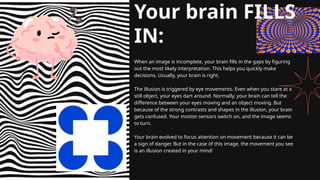
Your brain FILLS
IN:
When an image is incomplete, your brain fills in the gaps by figuring
out the most likely interpretation. This helps you quickly make
decisions. Usually, your brain is right.
The illusion is triggered by eye movements. Even when you stare at a
still object, your eyes dart around. Normally, your brain can tell the
difference between your eyes moving and an object moving. But
because of the strong contrasts and shapes in the illusion, your brain
gets confused. Your motion sensors switch on, and the image seems
to turn.
Your brain evolved to focus attention on movement because it can be
a sign of danger. But in the case of this image, the movement you see
is an illusion created in your mind!
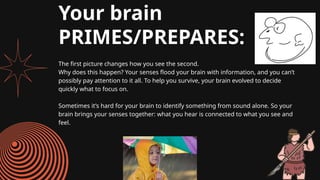
Your brain
PRIMES/PREPARES:
The first picture changes how you see the second.
Why does this happen? Your senses flood your brain with information, and you can’t
possibly pay attention to it all. To help you survive, your brain evolved to decide
quickly what to focus on.
Sometimes it’s hard for your brain to identify something from sound alone. So your
brain brings your senses together: what you hear is connected to what you see and
feel.
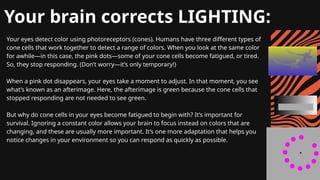
Your eyes detect color using photoreceptors (cones). Humans have three different types of
cone cells that work together to detect a range of colors. When you look at the same color
for awhile—in this case, the pink dots—some of your cone cells become fatigued, or tired.
So, they stop responding. (Don’t worry—it’s only temporary!)
When a pink dot disappears, your eyes take a moment to adjust. In that moment, you see
what’s known as an afterimage. Here, the afterimage is green because the cone cells that
stopped responding are not needed to see green.
But why do cone cells in your eyes become fatigued to begin with? It’s important for
survival. Ignoring a constant color allows your brain to focus instead on colors that are
changing, and these are usually more important. It’s one more adaptation that helps you
notice changes in your environment so you can respond as quickly as possible.
Your brain corrects LIGHTING:
Did you try to chase the flashing dots? They’re not really
there!
If you stare directly at a flashing dot, it will disappear. So,
why do you see them? One theory says it has to do with
how your eyes process light.
The yellow lines in the grid are surrounded by dark blue.
The contrast makes it easy to see them. But if you look
closely at the yellow discs, you’ll see that they are
surrounded by yellow. The arrangement confuses light
receptors in your eyes, making you see dark spots that
aren’t there.
Why did your visual system evolve to be better at
detecting light when it is surrounded by darkness? This
makes edges stand out so that you can quickly identify
objects in your surroundings—an important survival skill!
link
Click for
video above
All of this can bias us. Visual illusions
present clear and interesting challenges
for how we live: How do we know what’s
real? And once we know the extent of our
brain’s limits, how do we live with more
humility — and think with greater care
about our perceptions?
Stop here for
today!
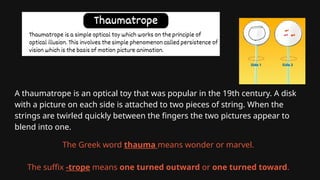
A thaumatrope is an optical toy that was popular in the 19th century. A disk
with a picture on each side is attached to two pieces of string. When the
strings are twirled quickly between the fingers the two pictures appear to
blend into one.
The Greek word thauma means wonder or marvel.
The suffix -trope means one turned outward or one turned toward.
The toy has traditionally been thought to demonstrate the principle of
persistence of vision.
Thaumatropes are often seen as important antecedents of motion pictures
and in particular of animation
Persistence of vision is the optical illusion that occurs when the
visual perception of an object does not cease for some time after the
rays of light proceeding from it have ceased to enter the eye. The illusion
has also been described as "retinal persistence."
The impression of an image on the retina lasts around 1/15th of a second. If
we see another image before our retina has a chance to forget the last, both
images appear to be seen as one.
French artist Antoine Claudet stated in 1867 that he had heard that
Paris had once been present when Herschel demonstrated his
rotating coin trick to his children and subsequently got the idea for
the thaumatrope.
Claudet also noted in 1867 that the thaumatrope could create a
three-dimensional illusion. A spinning rectangular thaumatrope with
the alternating letters of the name "Victoria" on each side, showed
the full word with the letters at two different distances from the
observer's eye.
Optical Illusions Introduction for Students

Optical Illusions Introduction for Students

  • 1.
  • 2.
    Learning Target: I willlearn about WHY optical illusions “trick” our brains. Success Criteria: Mindmap Notes, discussion, participation, hand drawing
  • 3.
    Optical Illusions Optical: relatingto sight Illusions: trick us into perceiving something differently than it actually exists, so what we see does not correspond to physical reality. Hence, the word illusion comes from the Latin verb illudere meaning, "to mock."
  • 4.
    Phenomena: Phenomena can bedefined as “observable events that occur in a natural or designed system.” They are everywhere around us, but some are easier to notice than others.
  • 5.
    “We’re seeing astory that’s being created for us.” - Research professor at Dartmouth College Most of the time, the story our brains generate matches the real, physical world — but not always. Our brains also unconsciously bend our perception of reality to meet our desires or expectations. And they fill in gaps using our past experiences. Rather than showing us how our brains are broken, illusions give us the chance to reveal how they work.
  • 6.
    ology: subject ofstudy lin k
  • 8.
    Your brain hasto make a decision about which part of the picture is the object and which part is the background. If two pictures are portrayed, it must make sense of one at a time. Usually you are able to see one image first, then switch to see the other image. Your brain SELECTS:
  • 9.
    Your brain FILLS IN: Whenan image is incomplete, your brain fills in the gaps by figuring out the most likely interpretation. This helps you quickly make decisions. Usually, your brain is right. The illusion is triggered by eye movements. Even when you stare at a still object, your eyes dart around. Normally, your brain can tell the difference between your eyes moving and an object moving. But because of the strong contrasts and shapes in the illusion, your brain gets confused. Your motion sensors switch on, and the image seems to turn. Your brain evolved to focus attention on movement because it can be a sign of danger. But in the case of this image, the movement you see is an illusion created in your mind!
  • 10.
    Your brain PRIMES/PREPARES: The firstpicture changes how you see the second. Why does this happen? Your senses flood your brain with information, and you can’t possibly pay attention to it all. To help you survive, your brain evolved to decide quickly what to focus on. Sometimes it’s hard for your brain to identify something from sound alone. So your brain brings your senses together: what you hear is connected to what you see and feel.
  • 11.
    Your eyes detectcolor using photoreceptors (cones). Humans have three different types of cone cells that work together to detect a range of colors. When you look at the same color for awhile—in this case, the pink dots—some of your cone cells become fatigued, or tired. So, they stop responding. (Don’t worry—it’s only temporary!) When a pink dot disappears, your eyes take a moment to adjust. In that moment, you see what’s known as an afterimage. Here, the afterimage is green because the cone cells that stopped responding are not needed to see green. But why do cone cells in your eyes become fatigued to begin with? It’s important for survival. Ignoring a constant color allows your brain to focus instead on colors that are changing, and these are usually more important. It’s one more adaptation that helps you notice changes in your environment so you can respond as quickly as possible. Your brain corrects LIGHTING:
  • 12.
    Did you tryto chase the flashing dots? They’re not really there! If you stare directly at a flashing dot, it will disappear. So, why do you see them? One theory says it has to do with how your eyes process light. The yellow lines in the grid are surrounded by dark blue. The contrast makes it easy to see them. But if you look closely at the yellow discs, you’ll see that they are surrounded by yellow. The arrangement confuses light receptors in your eyes, making you see dark spots that aren’t there. Why did your visual system evolve to be better at detecting light when it is surrounded by darkness? This makes edges stand out so that you can quickly identify objects in your surroundings—an important survival skill!
  • 13.
  • 16.
  • 18.
    All of thiscan bias us. Visual illusions present clear and interesting challenges for how we live: How do we know what’s real? And once we know the extent of our brain’s limits, how do we live with more humility — and think with greater care about our perceptions?
  • 19.
  • 20.
    A thaumatrope isan optical toy that was popular in the 19th century. A disk with a picture on each side is attached to two pieces of string. When the strings are twirled quickly between the fingers the two pictures appear to blend into one. The Greek word thauma means wonder or marvel. The suffix -trope means one turned outward or one turned toward.
  • 21.
    The toy hastraditionally been thought to demonstrate the principle of persistence of vision. Thaumatropes are often seen as important antecedents of motion pictures and in particular of animation Persistence of vision is the optical illusion that occurs when the visual perception of an object does not cease for some time after the rays of light proceeding from it have ceased to enter the eye. The illusion has also been described as "retinal persistence." The impression of an image on the retina lasts around 1/15th of a second. If we see another image before our retina has a chance to forget the last, both images appear to be seen as one.
  • 22.
    French artist AntoineClaudet stated in 1867 that he had heard that Paris had once been present when Herschel demonstrated his rotating coin trick to his children and subsequently got the idea for the thaumatrope. Claudet also noted in 1867 that the thaumatrope could create a three-dimensional illusion. A spinning rectangular thaumatrope with the alternating letters of the name "Victoria" on each side, showed the full word with the letters at two different distances from the observer's eye.