A STUDY ON AVAILABILITY AND
POSSIBILITIES OF BIO-ENERGY FROM
DAIRY-MANURE AT NORTH KOLKATA IN
INDIA

Rathin Biswas*, Sanjoy Das, Ratan Mandal
School Energy Studies, Jadavpur University, Kolkata-700032, INDIA
* Corresponding Author. Tel: (033) 25615039, E-mail:
rathin.d.great@gmail.com


The World is gradually shifting towards Renewable
energy due to the lack of Conventional Fuels. There is a plenty of
ways by which Renewable Energy comes for.

A survey-based work had been done at North
Barrackpore of North Kolkata of West Bengal in India where a
large no of dairy-farms produces tons of milk every day, but only
few of them utilizes its dairy-manure or dairy-waste. So, the
availability of Bio-energy Resources and the possibilities of Biogas generation as well as electricity generation are analyzed
here.

To inspect the survey area to get the possible bio-energy
generation from the available dairy manure.

To inspect the experimental area to get the local energy demand
for cooking purpose as well as for electricity purpose.


The main objective is to compare between the possibilities of
energy production from dairy manure and energy demand of that area to
show that bio-gas from such type of source can be able to meet not only
the energy demand that need for cooking purpose, but also the energy
demand for electricity.
Table-1 : Categorical Division of Farms based on Number of Buffaloes
Farm
Category

Farm size based on
no. of buffaloes

Average no. of
buffaloes per farm

Number of
Farms

Category 1

10-15

12

42

Category 2

16-30

24

31

Category 3

31-40

36

20

Category 4

41-52

48

16

Category 5

53-66

60

13

Category 6

67-80

72

11

Category 7

81-110

96

8

Category 8

111-135

120

8

Category 9

136-175

156

7

Category 10

176-250

204

5

Category 11

251-350

300

2

Category 12

351-450

408

1
The farm contains only buffaloes.
Buffalo waste : 12 kg/animal-day. [1,2]
Bio-Gas generation from wet buffalo-dung : 0.037 m3/kg.[3]
To generate one unit of electricity (kWh), the gas requirement is
about 0.54 m3.[2] i.e., 1 m3 of Bio-Gas generates 1.85 kWh of
electricity.
Hydraulic Retention Time (HRT) : 50 days.
Feed Slurry is prepared by mixing dung with water (1:1) so that
the slurry is having a total solid content of 10% (w/w) weight by
weight ratio.
Density of Slurry (10% Total Solid) : 1020 kg/ m3.
Feeding once in a day.
Table-2

Farm size based on
no. of buffaloes

Average no. of
buffaloes per farm

Number of Farms

No. of buffaloes

Buffalo Waste
[kg/aday]

Category wise Total
Bio-Gas Production
[m3/day]

Category wise Total
Electricity
Generation
[kWh/day]

Bio-Gas Production
from each farm of
each category
[m3/day]

Electricity
Generation from
each farm of each
category [kWh/day]

Category-1

10-15

12

42

504

6048

223.776

413.9856

5.328

9.8568

Category-2

16-30

24

31

744

8928

330.336

611.1216

10.656

19.7136

Category-3

31-40

36

20

720

8640

319.68

591.408

15.984

29.5704

Category-4

41-52

48

16

768

9216

340.992

630.8352

21.312

39.4272

Category-5

53-66

60

13

780

9360

346.32

640.692

26.64

49.284

Category-6

67-80

72

11

792

9504

351.648

650.5488

31.968

59.1408

Category-7

81-110

96

8

768

9216

340.992

630.8352

42.624

78.8544

Category-8

111-135

120

8

960

11520

426.24

788.544

53.28

98.568

Category-9

136-175

156

7

1092

13104

484.848

896.9688

69.264

128.1384

Category-10

176-250

204

5

1020

12240

452.88

837.828

90.576

167.5656

Category-11

251-350

300

2

600

7200

266.4

492.84

133.2

246.42

Category-12

351-450

408

1

408

4896

181.152

335.1312

181.152

335.1312

164

9156

109872

4065.26

7520.738

TOTAL
There are 402 houses and 11 hotels (Dhaba) that need energy for cooking
purposes. Energy Demand for Cooking Purpose at Households
Table-3 :
Type of
Fuel Used

Avg. Fuel
Consumption
per day [kg]

No. of
Households

Total Fuel
Consumed
per day [kg]

Net Calorific
Value (CV) by
mass MJ/Kg[4,5]

Total Energy
Consumed
per day [GJ]

Wood (dry)

7

223

1566

17.1

26.78

House coal

4

137

548

33.9

18.6

0.8

42

33.6

49.5

1.67

LPG

 Total Energy demand per day for cooking purpose at households : 47.05
GJ/day.
Table-4: Energy Demand for Cooking Purpose at Hotels (Dhaba)
Type of
Fuel Used

Avg. Fuel
Consumption
per day [kg]

No. of
Hotels
(Dhaba)

Total Fuel
Consumed
per day [kg]

Net Calorific
Value (CV) by
mass MJ/Kg[4,5]

Total Energy
Consumed
per day [GJ]

House coal

15

7

105

33.9

3.6

LPG

6

4

24

49.5

1.19

 Total Energy demand per day for cooking purpose at Hotels : 4.79 GJ/day.
Now, The Total Energy demand per day for cooking purpose : 51.84
GJ/day.
Except 402 households and 11 hotels, there are 164 dairy farms, 26 commercial
shops and Gram-Panchayet who uses electricity. All the lighting loads are of 50 watts Tube
Lights (with choke) whose avg. consumption in 1 hour is 0.05 units[6], all Fans (48”) are of
80 watts whose avg. consumption in 1 hour is 0.08 units[6] and Gram-Panchayet uses
Water-Pump of 15 HP, i.e. 1 Pump consumes 11.25 kW per hour.

Table-5 : Total electricity demand of the locality except Dairy Farms.
Type

Households
Shops
Hotels

GramPanchayet
Panchayet
Office
Total

Electric
Power
Quantity of
Total Energy
Operated Quantity
Component Consumption Electronic
Consumption
Hours
of Types
with wattage
[kWh]
Component
[kWh/day]
Light(40)
0.05
2
6
402
241.2
Fan(80)
0.08
2
16
402
1029.12
Light(40)
0.05
2
4
26
10.4
Fan(80)
0.08
1
10
26
20.8
Light(40)
0.05
5
12
11
33
Fan(80)
0.08
5
16
11
70.4
Street Light(40)
0.05
50
12
1
30
Water Pumping
11.25
2
6
1
135
Light(40)
0.05
10
9
1
4.5
Fan(80)
0.08
10
9
1
7.2

1581.62
The rest of the energy in form of electricity, is consumed
by the dairy farms itself. They uses only Tube lights for lightening
and Water-Pump for pumping.
Dairy farms uses,
 One Tube of 40 watts (i.e. 0.05 kWh considering choke) for
every 12 buffaloes which are running about 12 hours a day.
 Total Energy consumed per day for this purpose
= ((9156/12)X0.05)X12= 457.8 kWh/day
 One Motor of 6 HP or 4.5 kW per hour for 400 buffaloes which
are running about 3 hours a day i.e. 23 pump of 4.5 kWh is
needed.
 Total Energy consumed per day for this purpose
=(23X4.5)X3= 310.5 kWh/day
So, the electricity demand for the diary farms = (457.8+310.5) = 768.3
kWh/day
Now, The Total Energy demand as Electricity :
= (1581.62+768.3) = 2350 kWh of Electricity /day
 Based on the data available in Table-2, We can set up a large scale
anaerobic Bio-Gas digester of 4065 m3.
 Average calorific value of biogas is 20 MJ/m3 (4713kcal/m3)[7]. So, The Total
Produced Energy = (4065*20) = 81300MJ/day = 81.3 GJ/day
 If we use all the produced gas to generate electricity, Then we can generate
7520.7 kWh of electricity per day.
 The Total Energy demand for cooking purpose : 51.84 GJ/day.
The Total Energy demand as Electricity : 2350 kWh of Electricity /day
 Primarily, If Generated Energy is taken as cooking purpose by producing BioGas only, then (81.3-51.84)= 29.46 GJ of Energy per day will remain after
fulfilling the Local cooking demand.
 The Rest of 29.46 GJ of energy or 2725.05 kWh of Electricity per day[54],
which can definitely be able to meet the Local Electricity Demand.
 Now, after fulfillment of total energy Demand, 375 kWh of Excess Electricity
remains per day.
 If this excess Energy i.e. 375 kWh or 202.7 m3 of Excess Bio-Gas per day,
can be used for extra business purpose.
Excess
Energy
5%

Electricity
Demand
31%

Cooking
Demand
64%

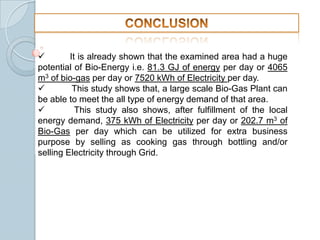
It is already shown that the examined area had a huge
potential of Bio-Energy i.e. 81.3 GJ of energy per day or 4065
m3 of bio-gas per day or 7520 kWh of Electricity per day.

This study shows that, a large scale Bio-Gas Plant can
be able to meet the all type of energy demand of that area.

This study also shows, after fulfillment of the local
energy demand, 375 kWh of Electricity per day or 202.7 m3 of
Bio-Gas per day which can be utilized for extra business
purpose by selling as cooking gas through bottling and/or
selling Electricity through Grid.
1) “Effect of Binary Combinations of Buffalo, Cow and Goat Dung with Different Agro
Wastes on Reproduction and Development of Earthworm Eiseniafetida (Haplotoxida:
Lumbricidae)” by Harendra Kumar Chauhan and Keshav Singh, [World Journal of
Zoology 7 (1): 23-29, 2012]
2) “Present and prospective role of bioenergy in regional energy system” by T.V.
Ramachandra*, N.V. Joshi, D.K. Subramanian [Renewable and Sustainable Energy
Reviews 4 (2000) 375-430]
3) “Utilization Of Poultry, Cow And Kitchen Wastes For Biogas Production: A Comparative
Analysis” by S.J. Ojolo, S.A. Oke, K. Animasahun, B.K. Adesuyi…. [Iran. J. Environ.
Health. Sci. Eng., 2007, Vol. 4, No. 4, pp. 223-228]
4) ”OIL_INDUSTRY_CONVERSIONS”,[http://www.gnc.org.ar/downloads/Unit%20Conver
sion%20_%20Oil%20Indus...pdf]
5) ”Estimated_average_gross_calorific_values_of_fuels”,[http://www.appletonlemoors.co.
uk/docs/calorific_values.pdf]
6) CESC Power Consumption Guide
7) “BIOGAS PURIFICATION USING WATER SCRUBBING SYSTEMS” by Dr. VirendraK.
Vijay,
Centre
for
Rural
Development
&
Technology,
IIT,
Delhi.
[http://web.iitd.ac.in/~vkvijay/Biogas%20Purification%20using%20
Water%20Scrubbing%20Systems_Dr%20VK%20Vijay,%20IIIT%20Delhi.pdf]
85 s. das

85 s. das

  • 1.
    A STUDY ONAVAILABILITY AND POSSIBILITIES OF BIO-ENERGY FROM DAIRY-MANURE AT NORTH KOLKATA IN INDIA Rathin Biswas*, Sanjoy Das, Ratan Mandal School Energy Studies, Jadavpur University, Kolkata-700032, INDIA * Corresponding Author. Tel: (033) 25615039, E-mail: rathin.d.great@gmail.com
  • 2.
     The World isgradually shifting towards Renewable energy due to the lack of Conventional Fuels. There is a plenty of ways by which Renewable Energy comes for.  A survey-based work had been done at North Barrackpore of North Kolkata of West Bengal in India where a large no of dairy-farms produces tons of milk every day, but only few of them utilizes its dairy-manure or dairy-waste. So, the availability of Bio-energy Resources and the possibilities of Biogas generation as well as electricity generation are analyzed here.
  • 3.
     To inspect thesurvey area to get the possible bio-energy generation from the available dairy manure.  To inspect the experimental area to get the local energy demand for cooking purpose as well as for electricity purpose.  The main objective is to compare between the possibilities of energy production from dairy manure and energy demand of that area to show that bio-gas from such type of source can be able to meet not only the energy demand that need for cooking purpose, but also the energy demand for electricity.
  • 4.
    Table-1 : CategoricalDivision of Farms based on Number of Buffaloes Farm Category Farm size based on no. of buffaloes Average no. of buffaloes per farm Number of Farms Category 1 10-15 12 42 Category 2 16-30 24 31 Category 3 31-40 36 20 Category 4 41-52 48 16 Category 5 53-66 60 13 Category 6 67-80 72 11 Category 7 81-110 96 8 Category 8 111-135 120 8 Category 9 136-175 156 7 Category 10 176-250 204 5 Category 11 251-350 300 2 Category 12 351-450 408 1
  • 5.
    The farm containsonly buffaloes. Buffalo waste : 12 kg/animal-day. [1,2] Bio-Gas generation from wet buffalo-dung : 0.037 m3/kg.[3] To generate one unit of electricity (kWh), the gas requirement is about 0.54 m3.[2] i.e., 1 m3 of Bio-Gas generates 1.85 kWh of electricity. Hydraulic Retention Time (HRT) : 50 days. Feed Slurry is prepared by mixing dung with water (1:1) so that the slurry is having a total solid content of 10% (w/w) weight by weight ratio. Density of Slurry (10% Total Solid) : 1020 kg/ m3. Feeding once in a day.
  • 6.
    Table-2 Farm size basedon no. of buffaloes Average no. of buffaloes per farm Number of Farms No. of buffaloes Buffalo Waste [kg/aday] Category wise Total Bio-Gas Production [m3/day] Category wise Total Electricity Generation [kWh/day] Bio-Gas Production from each farm of each category [m3/day] Electricity Generation from each farm of each category [kWh/day] Category-1 10-15 12 42 504 6048 223.776 413.9856 5.328 9.8568 Category-2 16-30 24 31 744 8928 330.336 611.1216 10.656 19.7136 Category-3 31-40 36 20 720 8640 319.68 591.408 15.984 29.5704 Category-4 41-52 48 16 768 9216 340.992 630.8352 21.312 39.4272 Category-5 53-66 60 13 780 9360 346.32 640.692 26.64 49.284 Category-6 67-80 72 11 792 9504 351.648 650.5488 31.968 59.1408 Category-7 81-110 96 8 768 9216 340.992 630.8352 42.624 78.8544 Category-8 111-135 120 8 960 11520 426.24 788.544 53.28 98.568 Category-9 136-175 156 7 1092 13104 484.848 896.9688 69.264 128.1384 Category-10 176-250 204 5 1020 12240 452.88 837.828 90.576 167.5656 Category-11 251-350 300 2 600 7200 266.4 492.84 133.2 246.42 Category-12 351-450 408 1 408 4896 181.152 335.1312 181.152 335.1312 164 9156 109872 4065.26 7520.738 TOTAL
  • 7.
    There are 402houses and 11 hotels (Dhaba) that need energy for cooking purposes. Energy Demand for Cooking Purpose at Households Table-3 : Type of Fuel Used Avg. Fuel Consumption per day [kg] No. of Households Total Fuel Consumed per day [kg] Net Calorific Value (CV) by mass MJ/Kg[4,5] Total Energy Consumed per day [GJ] Wood (dry) 7 223 1566 17.1 26.78 House coal 4 137 548 33.9 18.6 0.8 42 33.6 49.5 1.67 LPG  Total Energy demand per day for cooking purpose at households : 47.05 GJ/day. Table-4: Energy Demand for Cooking Purpose at Hotels (Dhaba) Type of Fuel Used Avg. Fuel Consumption per day [kg] No. of Hotels (Dhaba) Total Fuel Consumed per day [kg] Net Calorific Value (CV) by mass MJ/Kg[4,5] Total Energy Consumed per day [GJ] House coal 15 7 105 33.9 3.6 LPG 6 4 24 49.5 1.19  Total Energy demand per day for cooking purpose at Hotels : 4.79 GJ/day. Now, The Total Energy demand per day for cooking purpose : 51.84 GJ/day.
  • 8.
    Except 402 householdsand 11 hotels, there are 164 dairy farms, 26 commercial shops and Gram-Panchayet who uses electricity. All the lighting loads are of 50 watts Tube Lights (with choke) whose avg. consumption in 1 hour is 0.05 units[6], all Fans (48”) are of 80 watts whose avg. consumption in 1 hour is 0.08 units[6] and Gram-Panchayet uses Water-Pump of 15 HP, i.e. 1 Pump consumes 11.25 kW per hour. Table-5 : Total electricity demand of the locality except Dairy Farms. Type Households Shops Hotels GramPanchayet Panchayet Office Total Electric Power Quantity of Total Energy Operated Quantity Component Consumption Electronic Consumption Hours of Types with wattage [kWh] Component [kWh/day] Light(40) 0.05 2 6 402 241.2 Fan(80) 0.08 2 16 402 1029.12 Light(40) 0.05 2 4 26 10.4 Fan(80) 0.08 1 10 26 20.8 Light(40) 0.05 5 12 11 33 Fan(80) 0.08 5 16 11 70.4 Street Light(40) 0.05 50 12 1 30 Water Pumping 11.25 2 6 1 135 Light(40) 0.05 10 9 1 4.5 Fan(80) 0.08 10 9 1 7.2 1581.62
  • 9.
    The rest ofthe energy in form of electricity, is consumed by the dairy farms itself. They uses only Tube lights for lightening and Water-Pump for pumping. Dairy farms uses,  One Tube of 40 watts (i.e. 0.05 kWh considering choke) for every 12 buffaloes which are running about 12 hours a day.  Total Energy consumed per day for this purpose = ((9156/12)X0.05)X12= 457.8 kWh/day  One Motor of 6 HP or 4.5 kW per hour for 400 buffaloes which are running about 3 hours a day i.e. 23 pump of 4.5 kWh is needed.  Total Energy consumed per day for this purpose =(23X4.5)X3= 310.5 kWh/day So, the electricity demand for the diary farms = (457.8+310.5) = 768.3 kWh/day Now, The Total Energy demand as Electricity : = (1581.62+768.3) = 2350 kWh of Electricity /day
  • 10.
     Based onthe data available in Table-2, We can set up a large scale anaerobic Bio-Gas digester of 4065 m3.  Average calorific value of biogas is 20 MJ/m3 (4713kcal/m3)[7]. So, The Total Produced Energy = (4065*20) = 81300MJ/day = 81.3 GJ/day  If we use all the produced gas to generate electricity, Then we can generate 7520.7 kWh of electricity per day.  The Total Energy demand for cooking purpose : 51.84 GJ/day. The Total Energy demand as Electricity : 2350 kWh of Electricity /day
  • 11.
     Primarily, IfGenerated Energy is taken as cooking purpose by producing BioGas only, then (81.3-51.84)= 29.46 GJ of Energy per day will remain after fulfilling the Local cooking demand.  The Rest of 29.46 GJ of energy or 2725.05 kWh of Electricity per day[54], which can definitely be able to meet the Local Electricity Demand.  Now, after fulfillment of total energy Demand, 375 kWh of Excess Electricity remains per day.  If this excess Energy i.e. 375 kWh or 202.7 m3 of Excess Bio-Gas per day, can be used for extra business purpose.
  • 12.
  • 13.
     It is alreadyshown that the examined area had a huge potential of Bio-Energy i.e. 81.3 GJ of energy per day or 4065 m3 of bio-gas per day or 7520 kWh of Electricity per day.  This study shows that, a large scale Bio-Gas Plant can be able to meet the all type of energy demand of that area.  This study also shows, after fulfillment of the local energy demand, 375 kWh of Electricity per day or 202.7 m3 of Bio-Gas per day which can be utilized for extra business purpose by selling as cooking gas through bottling and/or selling Electricity through Grid.
  • 14.
    1) “Effect ofBinary Combinations of Buffalo, Cow and Goat Dung with Different Agro Wastes on Reproduction and Development of Earthworm Eiseniafetida (Haplotoxida: Lumbricidae)” by Harendra Kumar Chauhan and Keshav Singh, [World Journal of Zoology 7 (1): 23-29, 2012] 2) “Present and prospective role of bioenergy in regional energy system” by T.V. Ramachandra*, N.V. Joshi, D.K. Subramanian [Renewable and Sustainable Energy Reviews 4 (2000) 375-430] 3) “Utilization Of Poultry, Cow And Kitchen Wastes For Biogas Production: A Comparative Analysis” by S.J. Ojolo, S.A. Oke, K. Animasahun, B.K. Adesuyi…. [Iran. J. Environ. Health. Sci. Eng., 2007, Vol. 4, No. 4, pp. 223-228] 4) ”OIL_INDUSTRY_CONVERSIONS”,[http://www.gnc.org.ar/downloads/Unit%20Conver sion%20_%20Oil%20Indus...pdf] 5) ”Estimated_average_gross_calorific_values_of_fuels”,[http://www.appletonlemoors.co. uk/docs/calorific_values.pdf] 6) CESC Power Consumption Guide 7) “BIOGAS PURIFICATION USING WATER SCRUBBING SYSTEMS” by Dr. VirendraK. Vijay, Centre for Rural Development & Technology, IIT, Delhi. [http://web.iitd.ac.in/~vkvijay/Biogas%20Purification%20using%20 Water%20Scrubbing%20Systems_Dr%20VK%20Vijay,%20IIIT%20Delhi.pdf]