Prepared by:
Rimsha Khan ®
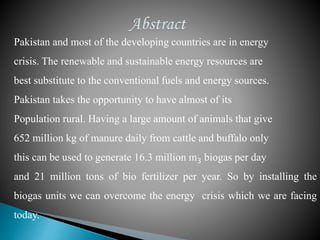
Pakistan and most of the developing countries are in energy
crisis. The renewable and sustainable energy resources are
best substitute to the conventional fuels and energy sources.
Pakistan takes the opportunity to have almost of its
Population rural. Having a large amount of animals that give
652 million kg of manure daily from cattle and buffalo only
this can be used to generate 16.3 million m3 biogas per day
and 21 million tons of bio fertilizer per year. So by installing the
biogas units we can overcome the energy crisis which we are facing
today.
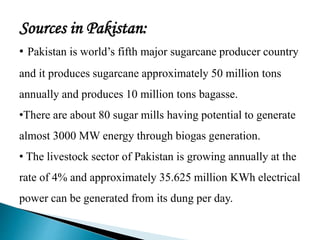
Sources in Pakistan:
• Pakistan is world’s fifth major sugarcane producer country
and it produces sugarcane approximately 50 million tons
annually and produces 10 million tons bagasse.
•There are about 80 sugar mills having potential to generate
almost 3000 MW energy through biogas generation.
• The livestock sector of Pakistan is growing annually at the
rate of 4% and approximately 35.625 million KWh electrical
power can be generated from its dung per day.
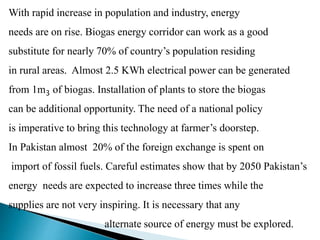
With rapid increase in population and industry, energy
needs are on rise. Biogas energy corridor can work as a good
substitute for nearly 70% of country’s population residing
in rural areas. Almost 2.5 KWh electrical power can be generated
from 1m3 of biogas. Installation of plants to store the biogas
can be additional opportunity. The need of a national policy
is imperative to bring this technology at farmer’s doorstep.
In Pakistan almost 20% of the foreign exchange is spent on
import of fossil fuels. Careful estimates show that by 2050 Pakistan’s
energy needs are expected to increase three times while the
supplies are not very inspiring. It is necessary that any
alternate source of energy must be explored.
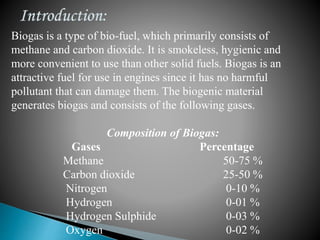
Biogas is a type of bio-fuel, which primarily consists of
methane and carbon dioxide. It is smokeless, hygienic and
more convenient to use than other solid fuels. Biogas is an
attractive fuel for use in engines since it has no harmful
pollutant that can damage them. The biogenic material
generates biogas and consists of the following gases.
Composition of Biogas:
Gases Percentage
Methane 50-75 %
Carbon dioxide 25-50 %
Nitrogen 0-10 %
Hydrogen 0-01 %
Hydrogen Sulphide 0-03 %
Oxygen 0-02 %
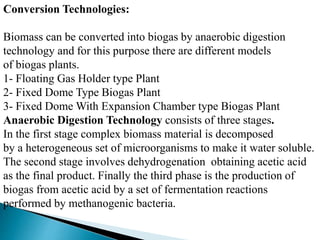
Conversion Technologies:
Biomass can be converted into biogas by anaerobic digestion
technology and for this purpose there are different models
of biogas plants.
1- Floating Gas Holder type Plant
2- Fixed Dome Type Biogas Plant
3- Fixed Dome With Expansion Chamber type Biogas Plant
Anaerobic Digestion Technology consists of three stages.
In the first stage complex biomass material is decomposed
by a heterogeneous set of microorganisms to make it water soluble.
The second stage involves dehydrogenation obtaining acetic acid
as the final product. Finally the third phase is the production of
biogas from acetic acid by a set of fermentation reactions
performed by methanogenic bacteria.
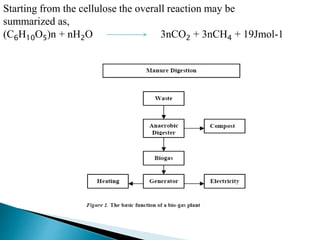
Starting from the cellulose the overall reaction may be
summarized as,
(C6H10O5)n + nH2O 3nCO2 + 3nCH4 + 19Jmol-1
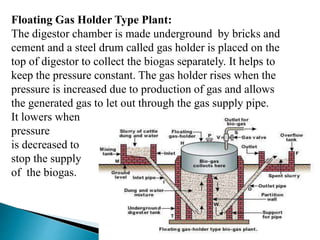
Floating Gas Holder Type Plant:
The digestor chamber is made underground by bricks and
cement and a steel drum called gas holder is placed on the
top of digestor to collect the biogas separately. It helps to
keep the pressure constant. The gas holder rises when the
pressure is increased due to production of gas and allows
the generated gas to let out through the gas supply pipe.
It lowers when
pressure
is decreased to
stop the supply
of the biogas.
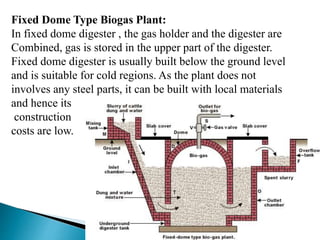
Fixed Dome Type Biogas Plant:
In fixed dome digester , the gas holder and the digester are
Combined, gas is stored in the upper part of the digester.
Fixed dome digester is usually built below the ground level
and is suitable for cold regions. As the plant does not
involves any steel parts, it can be built with local materials
and hence its
construction
costs are low.
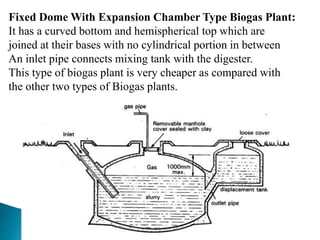
Fixed Dome With Expansion Chamber Type Biogas Plant:
It has a curved bottom and hemispherical top which are
joined at their bases with no cylindrical portion in between
An inlet pipe connects mixing tank with the digester.
This type of biogas plant is very cheaper as compared with
the other two types of Biogas plants.
Advantages:
 There are significant social, economic and environmental
benefits of biogas technology.
 Biogas is an eco-friendly technology, unlike conventional
gas power plants biogas has no environmental hazards and
handling aspects.
 Biogas plants are low-cost and can be run with very small
budget.
 As it is a renewable energy resource hence it is profitable.
 It is cheaper than all other energy resources so it is best fit
for the alternate energy resource in future.
Government Policy:
The Government has formed a council for renewable energy
technology named as Pakistan Council for Renewable Energy
Technology (PCRET), which is working for the development
of the biogas plants in the country.
About 4,137 biogas plants were installed in Pakistan with
the help of the government in the period 1974 to 1987.
The government fully funded the first 100 installations and
later on withdrew the financial support. Since then, the
growth rate of this technology dropped drastically and
only 6,000 biogas plants were installed till the end of 2006.
The Rural Support Program Network (RSPN) envisions setting
up 300,000 domestic biogas plants across Pakistan within
10 years of time.
Suggestions:
 The government of Pakistan through PCRET and Alternative
Energy Development Board (AEDB) should take the initiative and
announce more funds and support for this proven technology to be
a part of our rural society.
 In parallel, the media should raise the level of awareness among
the rural community by highlighting the benefits of this
technology.
 Government should help people to set these plants on small scale
by providing loans and machinery at low price.
 NGOs and foreign investors should be encouraged
to invest in this sector too.
Thank you….. 
Rimsha Khan

Biogas Potential in Pakistan

  • 1.
  • 2.
    Pakistan and mostof the developing countries are in energy crisis. The renewable and sustainable energy resources are best substitute to the conventional fuels and energy sources. Pakistan takes the opportunity to have almost of its Population rural. Having a large amount of animals that give 652 million kg of manure daily from cattle and buffalo only this can be used to generate 16.3 million m3 biogas per day and 21 million tons of bio fertilizer per year. So by installing the biogas units we can overcome the energy crisis which we are facing today.
  • 3.
    Sources in Pakistan: •Pakistan is world’s fifth major sugarcane producer country and it produces sugarcane approximately 50 million tons annually and produces 10 million tons bagasse. •There are about 80 sugar mills having potential to generate almost 3000 MW energy through biogas generation. • The livestock sector of Pakistan is growing annually at the rate of 4% and approximately 35.625 million KWh electrical power can be generated from its dung per day.
  • 4.
    With rapid increasein population and industry, energy needs are on rise. Biogas energy corridor can work as a good substitute for nearly 70% of country’s population residing in rural areas. Almost 2.5 KWh electrical power can be generated from 1m3 of biogas. Installation of plants to store the biogas can be additional opportunity. The need of a national policy is imperative to bring this technology at farmer’s doorstep. In Pakistan almost 20% of the foreign exchange is spent on import of fossil fuels. Careful estimates show that by 2050 Pakistan’s energy needs are expected to increase three times while the supplies are not very inspiring. It is necessary that any alternate source of energy must be explored.
  • 5.
    Biogas is atype of bio-fuel, which primarily consists of methane and carbon dioxide. It is smokeless, hygienic and more convenient to use than other solid fuels. Biogas is an attractive fuel for use in engines since it has no harmful pollutant that can damage them. The biogenic material generates biogas and consists of the following gases. Composition of Biogas: Gases Percentage Methane 50-75 % Carbon dioxide 25-50 % Nitrogen 0-10 % Hydrogen 0-01 % Hydrogen Sulphide 0-03 % Oxygen 0-02 %
  • 6.
    Conversion Technologies: Biomass canbe converted into biogas by anaerobic digestion technology and for this purpose there are different models of biogas plants. 1- Floating Gas Holder type Plant 2- Fixed Dome Type Biogas Plant 3- Fixed Dome With Expansion Chamber type Biogas Plant Anaerobic Digestion Technology consists of three stages. In the first stage complex biomass material is decomposed by a heterogeneous set of microorganisms to make it water soluble. The second stage involves dehydrogenation obtaining acetic acid as the final product. Finally the third phase is the production of biogas from acetic acid by a set of fermentation reactions performed by methanogenic bacteria.
  • 7.
    Starting from thecellulose the overall reaction may be summarized as, (C6H10O5)n + nH2O 3nCO2 + 3nCH4 + 19Jmol-1
  • 8.
    Floating Gas HolderType Plant: The digestor chamber is made underground by bricks and cement and a steel drum called gas holder is placed on the top of digestor to collect the biogas separately. It helps to keep the pressure constant. The gas holder rises when the pressure is increased due to production of gas and allows the generated gas to let out through the gas supply pipe. It lowers when pressure is decreased to stop the supply of the biogas.
  • 9.
    Fixed Dome TypeBiogas Plant: In fixed dome digester , the gas holder and the digester are Combined, gas is stored in the upper part of the digester. Fixed dome digester is usually built below the ground level and is suitable for cold regions. As the plant does not involves any steel parts, it can be built with local materials and hence its construction costs are low.
  • 10.
    Fixed Dome WithExpansion Chamber Type Biogas Plant: It has a curved bottom and hemispherical top which are joined at their bases with no cylindrical portion in between An inlet pipe connects mixing tank with the digester. This type of biogas plant is very cheaper as compared with the other two types of Biogas plants.
  • 11.
    Advantages:  There aresignificant social, economic and environmental benefits of biogas technology.  Biogas is an eco-friendly technology, unlike conventional gas power plants biogas has no environmental hazards and handling aspects.  Biogas plants are low-cost and can be run with very small budget.  As it is a renewable energy resource hence it is profitable.  It is cheaper than all other energy resources so it is best fit for the alternate energy resource in future.
  • 12.
    Government Policy: The Governmenthas formed a council for renewable energy technology named as Pakistan Council for Renewable Energy Technology (PCRET), which is working for the development of the biogas plants in the country. About 4,137 biogas plants were installed in Pakistan with the help of the government in the period 1974 to 1987. The government fully funded the first 100 installations and later on withdrew the financial support. Since then, the growth rate of this technology dropped drastically and only 6,000 biogas plants were installed till the end of 2006. The Rural Support Program Network (RSPN) envisions setting up 300,000 domestic biogas plants across Pakistan within 10 years of time.
  • 13.
    Suggestions:  The governmentof Pakistan through PCRET and Alternative Energy Development Board (AEDB) should take the initiative and announce more funds and support for this proven technology to be a part of our rural society.  In parallel, the media should raise the level of awareness among the rural community by highlighting the benefits of this technology.  Government should help people to set these plants on small scale by providing loans and machinery at low price.  NGOs and foreign investors should be encouraged to invest in this sector too.
  • 14.