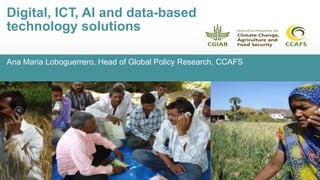
Ana Maria Loboguerrero, Head of Global Policy Research, CCAFS
Digital, ICT, AI and data-based
technology solutions
Photo: N. Palmer (CIAT)
• Transformation  Digital is key
• Connectivity – is it a problem?
• Digital solutions – examples for the four building
blocks in the NAP process
• Key messages
Outline
Achieving SDGs & Paris Agreement
• In many parts
of the world we
have 12 more
growing
seasons
We need to
transform our
agriculture and
food systems
Fostering enabling policy
and institutions
Digitally
enabled
climate-
informed
services
Climate-resilient
and low-emission
practices and
technologies
Innovative finance to
leverage public &
private sector
investments
Reshaping supply
chains, food retail,
marketing and
procurement
Empower farmer
and consumer
organizations,
women and youth
Our
transformation
framework has six
elements
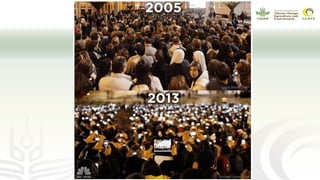
Connectivity crucial, but is it a problem?
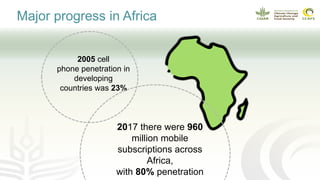
2017 there were 960
million mobile
subscriptions across
Africa,
with 80% penetration
2005 cell
phone penetration in
developing
countries was 23%
Major progress in Africa
And where connectivity is a
challenge, there are
innovative solutions…..
Solar panel
VSAT satellite antenna – geostationary satellite as backhaul
connection
BLUETOWN power unit to store power
Easy Internet connection by existing infrastructure via fiber
Fence
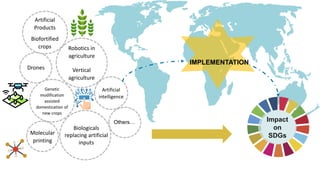
Impact
on
SDGs
Artificial
Products
Robotics in
agriculture
Drones
Artificial
intelligence
Biofortified
crops
Genetic
modification
assisted
domestication of
new crops
Vertical
agriculture
Biologicals
replacing artificial
inputs
Molecular
printing
Others…
IMPLEMENTATION
Digital Solutions and the NAP process
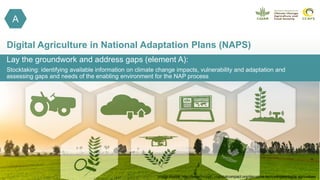
Lay the groundwork and address gaps (element A):
Stocktaking: identifying available information on climate change impacts, vulnerability and adaptation and
assessing gaps and needs of the enabling environment for the NAP process
Digital Agriculture in National Adaptation Plans (NAPS)
Image source: http://breakthrough.unglobalcompact.org/disruptive-technologies/digital-agriculture/
A
A
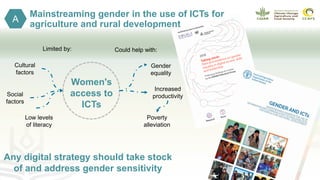
Women's
access to
ICTs
Could help with:Limited by:
Low levels
of literacy
Social
factors
Cultural
factors
Poverty
alleviation
Gender
equality
Increased
productivity
Any digital strategy should take stock
of and address gender sensitivity
Mainstreaming gender in the use of ICTs for
agriculture and rural development
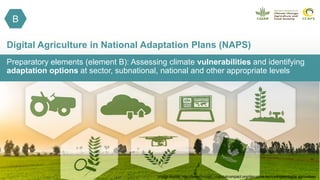
Preparatory elements (element B): Assessing climate vulnerabilities and identifying
adaptation options at sector, subnational, national and other appropriate levels
Digital Agriculture in National Adaptation Plans (NAPS)
Image source: http://breakthrough.unglobalcompact.org/disruptive-technologies/digital-agriculture/
B
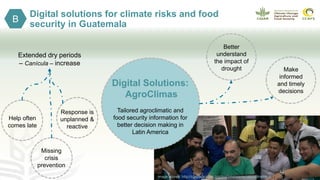
Digital solutions for climate risks and food
security in Guatemala
B
Digital Solutions:
AgroClimas
Tailored agroclimatic and
food security information for
better decision making in
Latin America
Extended dry periods
– Canícula – increase
Better
understand
the impact of
drought Make
informed
and timely
decisions
Response is
unplanned &
reactive
Missing
crisis
prevention
Help often
comes late
Image source: http://cgspace.cgiar.org/rest/bitstreams/165339/retrieve
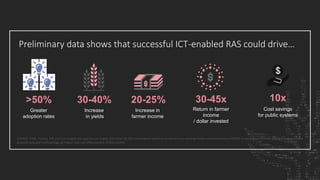
Preliminary data shows that successful ICT-enabled RAS could drive…
30-40%
Increase
in yields
30-45x
Return in farmer
income
/ dollar invested
20-25%
Increase in
farmer income
Cost savings
for public systems
10x
SOURCE: Yield, income, ROI and cost targets are aspirational targets estimated for RAS investments based on evidence from existing models and dimensions of BMGF proposed investment. Dalberg study provides
detailed data and methodology on impact and cost-effectiveness of RAS models.
>50%
Greater
adoption rates
Implementation strategies (element C): Enhancing capacity for planning and
implementing adaptation
Digital Agriculture in National Adaptation Plans (NAPS)
Image source: http://breakthrough.unglobalcompact.org/disruptive-technologies/digital-agriculture/
C
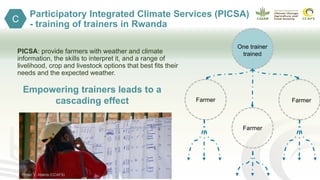
Participatory Integrated Climate Services (PICSA)
- training of trainers in Rwanda
PICSA: provide farmers with weather and climate
information, the skills to interpret it, and a range of
livelihood, crop and livestock options that best fits their
needs and the expected weather.
C
One trainer
trained
Farmer
Farmer
Farmer
Empowering trainers leads to a
cascading effect
Photo: V. Atakos (CCAFS)
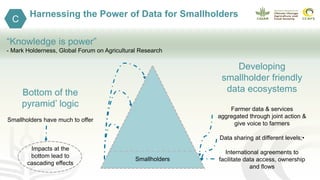
Harnessing the Power of Data for Smallholders
C
“Knowledge is power”
- Mark Holderness, Global Forum on Agricultural Research
Bottom of the
pyramid’ logic
Smallholders have much to offer
Impacts at the
bottom lead to
cascading effects
Smallholders
Developing
smallholder friendly
data ecosystems
Farmer data & services
aggregated through joint action &
give voice to farmers
Data sharing at different levels;•
International agreements to
facilitate data access, ownership
and flows
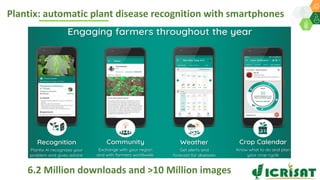
Plantix: automatic plant disease recognition with smartphones
6.2 Million downloads and >10 Million images
Reporting, monitoring and review (element D)
Digital Agriculture in National Adaptation Plans (NAPS)
Image source: http://breakthrough.unglobalcompact.org/disruptive-technologies/digital-agriculture/
D
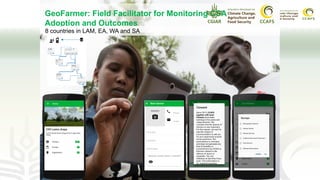
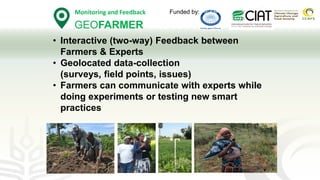
GeoFarmer: Field Facilitator for Monitoring CSA
Adoption and Outcomes
140
Carlos Mejia
Rita Mejia
Ada Angulo
Maria
Angulo
Jarvey
Agredo
8 countries in LAM, EA, WA and SA
GEOFARMER
Monitoring and Feedback
GEOFARMER
• Interactive (two-way) Feedback between
Farmers & Experts
• Geolocated data-collection
(surveys, field points, issues)
• Farmers can communicate with experts while
doing experiments or testing new smart
practices
Funded by:
Key messages
• Improved connectivity
• Improved access and curation of data
• Agriculture as a viable business – so farmers can pay for
services and turn that into gains on the market
• Partnership – science-farmers-private sector service
providers-extension services-policy
• Greater attention in R4D to some of the likely technologies
that will transform agriculture and food systems
Technical guidelines supplement
Digital Agriculture – National Adaptation Plans (NAPS)
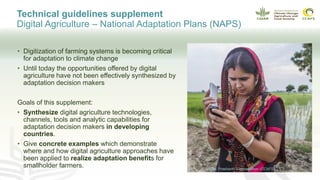
• Digitization of farming systems is becoming critical
for adaptation to climate change
• Until today the opportunities offered by digital
agriculture have not been effectively synthesized by
adaptation decision makers
Goals of this supplement:
• Synthesize digital agriculture technologies,
channels, tools and analytic capabilities for
adaptation decision makers in developing
countries.
• Give concrete examples which demonstrate
where and how digital agriculture approaches have
been applied to realize adaptation benefits for
smallholder farmers. Photo: Prashanth Vishwanathan (CCAFS)
THANK YOU !

8.4.1 Digital agriculture

  • 1.
    Ana Maria Loboguerrero,Head of Global Policy Research, CCAFS Digital, ICT, AI and data-based technology solutions Photo: N. Palmer (CIAT)
  • 2.
    • Transformation Digital is key • Connectivity – is it a problem? • Digital solutions – examples for the four building blocks in the NAP process • Key messages Outline
  • 3.
    Achieving SDGs &Paris Agreement • In many parts of the world we have 12 more growing seasons We need to transform our agriculture and food systems Fostering enabling policy and institutions Digitally enabled climate- informed services Climate-resilient and low-emission practices and technologies Innovative finance to leverage public & private sector investments Reshaping supply chains, food retail, marketing and procurement Empower farmer and consumer organizations, women and youth Our transformation framework has six elements
  • 4.
    Connectivity crucial, butis it a problem?
  • 6.
    2017 there were960 million mobile subscriptions across Africa, with 80% penetration 2005 cell phone penetration in developing countries was 23% Major progress in Africa
  • 7.
    And where connectivityis a challenge, there are innovative solutions….. Solar panel VSAT satellite antenna – geostationary satellite as backhaul connection BLUETOWN power unit to store power Easy Internet connection by existing infrastructure via fiber Fence
  • 8.
    Impact on SDGs Artificial Products Robotics in agriculture Drones Artificial intelligence Biofortified crops Genetic modification assisted domestication of newcrops Vertical agriculture Biologicals replacing artificial inputs Molecular printing Others… IMPLEMENTATION
  • 9.
    Digital Solutions andthe NAP process
  • 10.
    Lay the groundworkand address gaps (element A): Stocktaking: identifying available information on climate change impacts, vulnerability and adaptation and assessing gaps and needs of the enabling environment for the NAP process Digital Agriculture in National Adaptation Plans (NAPS) Image source: http://breakthrough.unglobalcompact.org/disruptive-technologies/digital-agriculture/ A
  • 11.
    A Women's access to ICTs Could helpwith:Limited by: Low levels of literacy Social factors Cultural factors Poverty alleviation Gender equality Increased productivity Any digital strategy should take stock of and address gender sensitivity Mainstreaming gender in the use of ICTs for agriculture and rural development
  • 12.
    Preparatory elements (elementB): Assessing climate vulnerabilities and identifying adaptation options at sector, subnational, national and other appropriate levels Digital Agriculture in National Adaptation Plans (NAPS) Image source: http://breakthrough.unglobalcompact.org/disruptive-technologies/digital-agriculture/ B
  • 13.
    Digital solutions forclimate risks and food security in Guatemala B Digital Solutions: AgroClimas Tailored agroclimatic and food security information for better decision making in Latin America Extended dry periods – Canícula – increase Better understand the impact of drought Make informed and timely decisions Response is unplanned & reactive Missing crisis prevention Help often comes late Image source: http://cgspace.cgiar.org/rest/bitstreams/165339/retrieve
  • 14.
    Preliminary data showsthat successful ICT-enabled RAS could drive… 30-40% Increase in yields 30-45x Return in farmer income / dollar invested 20-25% Increase in farmer income Cost savings for public systems 10x SOURCE: Yield, income, ROI and cost targets are aspirational targets estimated for RAS investments based on evidence from existing models and dimensions of BMGF proposed investment. Dalberg study provides detailed data and methodology on impact and cost-effectiveness of RAS models. >50% Greater adoption rates
  • 15.
    Implementation strategies (elementC): Enhancing capacity for planning and implementing adaptation Digital Agriculture in National Adaptation Plans (NAPS) Image source: http://breakthrough.unglobalcompact.org/disruptive-technologies/digital-agriculture/ C
  • 16.
    Participatory Integrated ClimateServices (PICSA) - training of trainers in Rwanda PICSA: provide farmers with weather and climate information, the skills to interpret it, and a range of livelihood, crop and livestock options that best fits their needs and the expected weather. C One trainer trained Farmer Farmer Farmer Empowering trainers leads to a cascading effect Photo: V. Atakos (CCAFS)
  • 17.
    Harnessing the Powerof Data for Smallholders C “Knowledge is power” - Mark Holderness, Global Forum on Agricultural Research Bottom of the pyramid’ logic Smallholders have much to offer Impacts at the bottom lead to cascading effects Smallholders Developing smallholder friendly data ecosystems Farmer data & services aggregated through joint action & give voice to farmers Data sharing at different levels;• International agreements to facilitate data access, ownership and flows
  • 18.
    Plantix: automatic plantdisease recognition with smartphones 6.2 Million downloads and >10 Million images
  • 19.
    Reporting, monitoring andreview (element D) Digital Agriculture in National Adaptation Plans (NAPS) Image source: http://breakthrough.unglobalcompact.org/disruptive-technologies/digital-agriculture/ D
  • 20.
    GeoFarmer: Field Facilitatorfor Monitoring CSA Adoption and Outcomes 140 Carlos Mejia Rita Mejia Ada Angulo Maria Angulo Jarvey Agredo 8 countries in LAM, EA, WA and SA
  • 21.
    GEOFARMER Monitoring and Feedback GEOFARMER •Interactive (two-way) Feedback between Farmers & Experts • Geolocated data-collection (surveys, field points, issues) • Farmers can communicate with experts while doing experiments or testing new smart practices Funded by:
  • 22.
    Key messages • Improvedconnectivity • Improved access and curation of data • Agriculture as a viable business – so farmers can pay for services and turn that into gains on the market • Partnership – science-farmers-private sector service providers-extension services-policy • Greater attention in R4D to some of the likely technologies that will transform agriculture and food systems
  • 23.
    Technical guidelines supplement DigitalAgriculture – National Adaptation Plans (NAPS) • Digitization of farming systems is becoming critical for adaptation to climate change • Until today the opportunities offered by digital agriculture have not been effectively synthesized by adaptation decision makers Goals of this supplement: • Synthesize digital agriculture technologies, channels, tools and analytic capabilities for adaptation decision makers in developing countries. • Give concrete examples which demonstrate where and how digital agriculture approaches have been applied to realize adaptation benefits for smallholder farmers. Photo: Prashanth Vishwanathan (CCAFS)
  • 24.