Reinder Prins
Digital agriculture specialist
Charles Green
Director of Thought Leadership
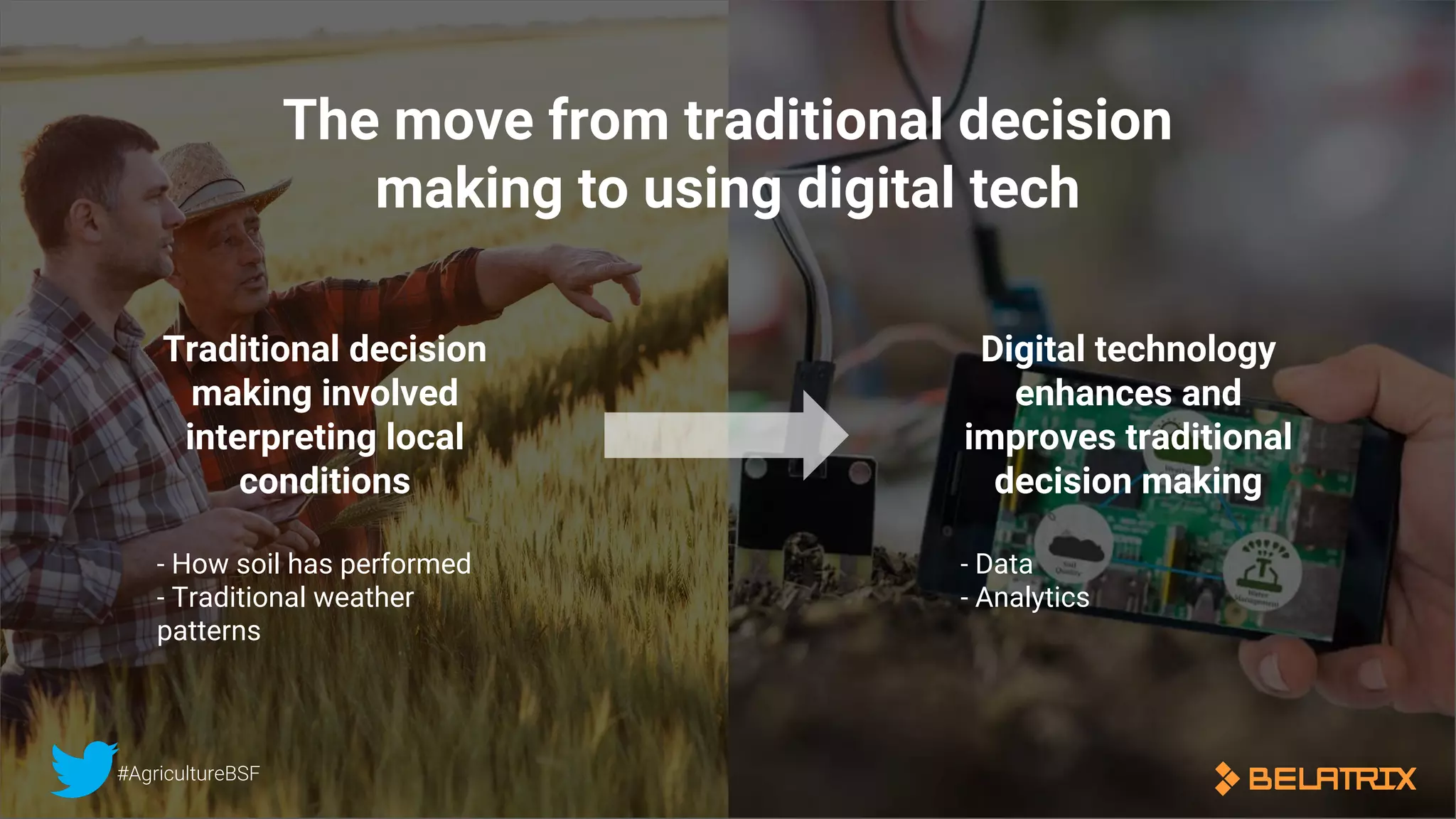
The move from traditional decision
making to using digital tech
Traditional decision
making involved
interpreting local
conditions
- How soil has performed
- Traditional weather
patterns
Digital technology
enhances and
improves traditional
decision making
- Data
- Analytics
Digital Ag, or Precision Agriculture,
is a farm management concept.
It is centred around the belief that
growers need to measure and
respond to inter and intra-field
variability in crops, or individual
animal metrics in herds, instead of
treating everything the same.
Collecting the data
Making data available on a
platform farmers and growers
can easily use
Interpreting the data
What does the information
mean for my decision making
process?
Execution
Changing specific actions based
on the analysis, e.g. tailoring the
amount of feed per cow
Internet of things
Blockchain
Data storage platforms
● Networks of physical devices that collect data and are able
to connect and exchange this data, are set to rapidly
advance digital agriculture
● Metrics enable us to actively manage crops
● By using sensor data, crop management decisions can be
tailored to micro-climates once they are identified
● Overcoming rural connectivity issues
● IT security issues
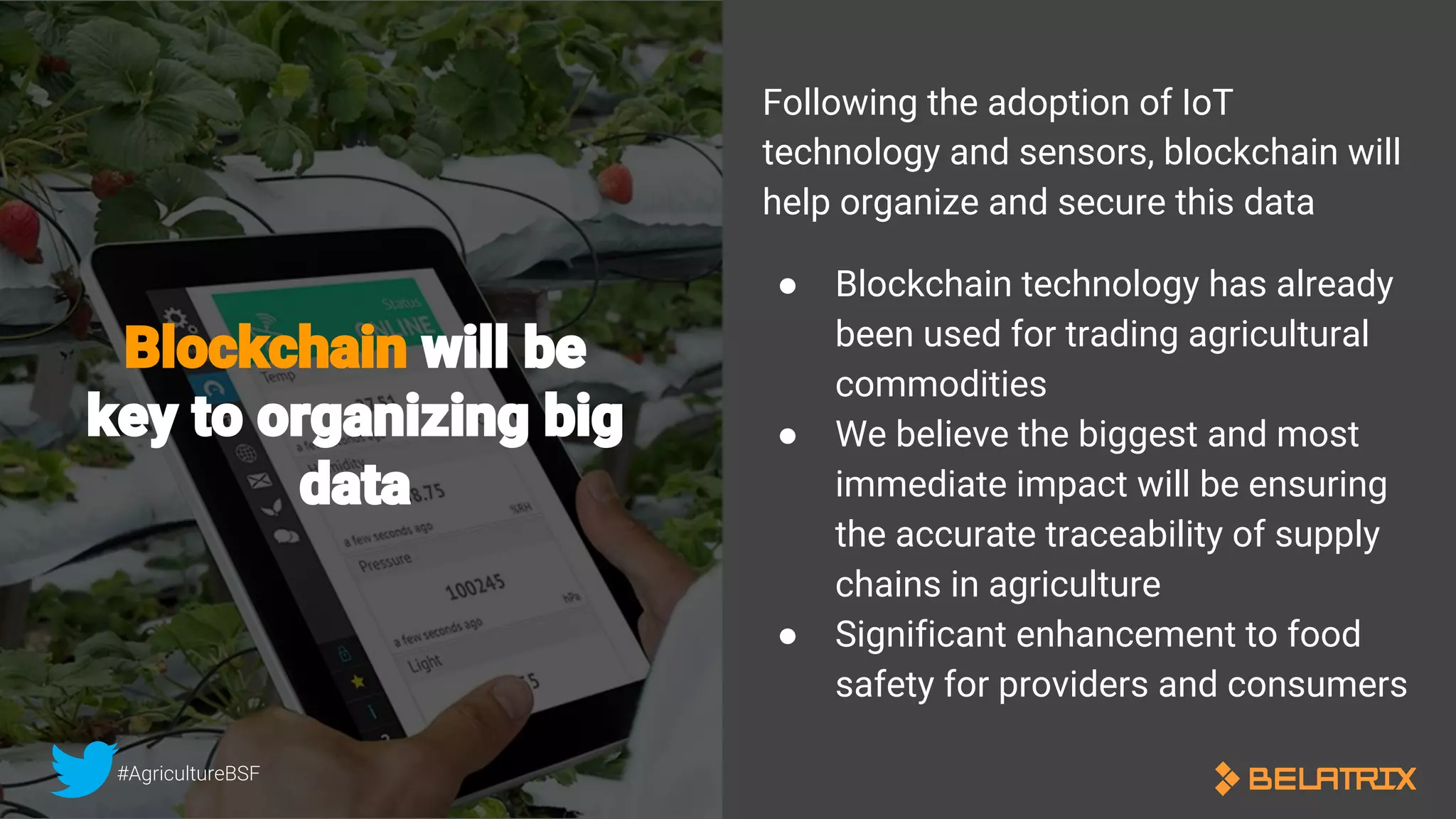
Following the adoption of IoT
technology and sensors, blockchain will
help organize and secure this data
● Blockchain technology has already
been used for trading agricultural
commodities
● We believe the biggest and most
immediate impact will be ensuring
the accurate traceability of supply
chains in agriculture
● Significant enhancement to food
safety for providers and consumers
Data storage in agriculture is more complicated than in other sectors
● Data security
● But data is much more valuable when shared
● But who has access to this data? Who owns the data? Every data
point has a GPS coordinate and can be traced to an individual field
Need new technologies to provide greater rural connectivity
● LPWAN, LoRaWAN
By using the right equipment, apps
and other software, stakeholders
from farmers to technology service
providers, can set themselves up for
success.
However, issues such as data
security, data sharing, ownership and
the traceability of data remain
important matters to solve.
Contact details
Reinder Prins
reinderprins@gmail.com
Charles Green
cgreen@belatrixsf.com

The digital agriculture revolution

  • 2.
    Reinder Prins Digital agriculturespecialist Charles Green Director of Thought Leadership
  • 3.
    The move fromtraditional decision making to using digital tech Traditional decision making involved interpreting local conditions - How soil has performed - Traditional weather patterns Digital technology enhances and improves traditional decision making - Data - Analytics
  • 4.
    Digital Ag, orPrecision Agriculture, is a farm management concept. It is centred around the belief that growers need to measure and respond to inter and intra-field variability in crops, or individual animal metrics in herds, instead of treating everything the same.
  • 5.
    Collecting the data Makingdata available on a platform farmers and growers can easily use Interpreting the data What does the information mean for my decision making process? Execution Changing specific actions based on the analysis, e.g. tailoring the amount of feed per cow
  • 6.
  • 7.
    ● Networks ofphysical devices that collect data and are able to connect and exchange this data, are set to rapidly advance digital agriculture ● Metrics enable us to actively manage crops ● By using sensor data, crop management decisions can be tailored to micro-climates once they are identified ● Overcoming rural connectivity issues ● IT security issues
  • 8.
    Following the adoptionof IoT technology and sensors, blockchain will help organize and secure this data ● Blockchain technology has already been used for trading agricultural commodities ● We believe the biggest and most immediate impact will be ensuring the accurate traceability of supply chains in agriculture ● Significant enhancement to food safety for providers and consumers
  • 9.
    Data storage inagriculture is more complicated than in other sectors ● Data security ● But data is much more valuable when shared ● But who has access to this data? Who owns the data? Every data point has a GPS coordinate and can be traced to an individual field Need new technologies to provide greater rural connectivity ● LPWAN, LoRaWAN
  • 10.
    By using theright equipment, apps and other software, stakeholders from farmers to technology service providers, can set themselves up for success. However, issues such as data security, data sharing, ownership and the traceability of data remain important matters to solve.
  • 12.