8051 Microcontroller 
Timers & Counters 
Prepared by: 
Manu Thomas 
manut46@gmail.com 1 12/11/2014
The 8051 Timers 
The 8051 comes equipped with two timers, both of which may be 
controlled, set, read, and configured individually. 
he 8051 timers have three general functions: 
1) Keeping time and/or calculating the amount of time between events, 
2) Counting the events themselves, or 
3) Generating baud rates for the serial port. 
The 8051 microcontroller has 2 timers/counters called T0 and T1. As their 
names suggest, their main purpose is to measure time and count external 
events. Besides, they can be used for generating clock pulses to be used in 
serial communication, so called Baud Rate. 
manut46@gmail.com 2 12/11/2014
Timer T0 
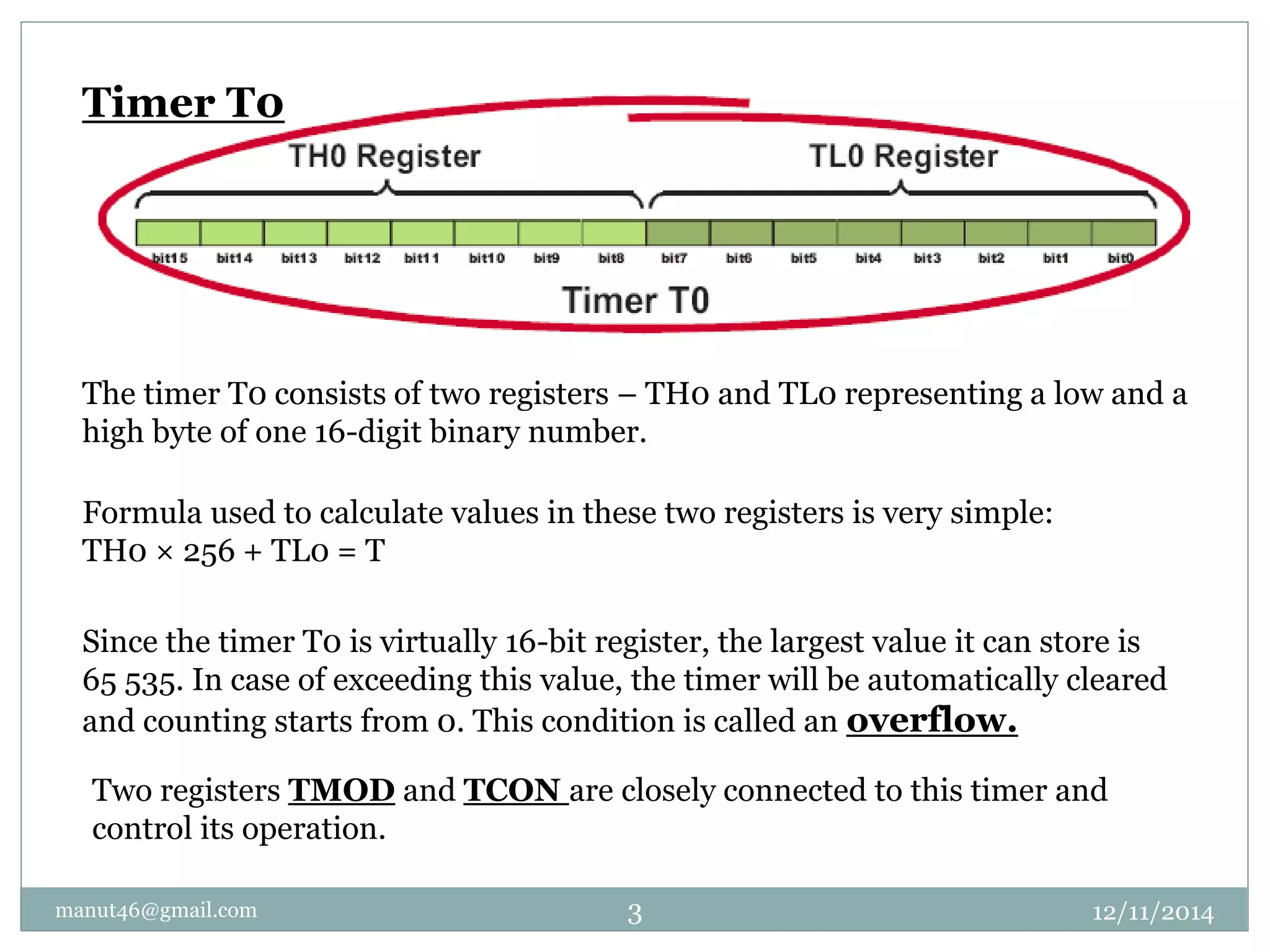
The timer T0 consists of two registers – TH0 and TL0 representing a low and a 
high byte of one 16-digit binary number. 
Formula used to calculate values in these two registers is very simple: 
TH0 × 256 + TL0 = T 
Since the timer T0 is virtually 16-bit register, the largest value it can store is 
65 535. In case of exceeding this value, the timer will be automatically cleared 
and counting starts from 0. This condition is called an overflow. 
Two registers TMOD and TCON are closely connected to this timer and 
control its operation. 
manut46@gmail.com 3 12/11/2014
TMOD Register (Timer Mode) 
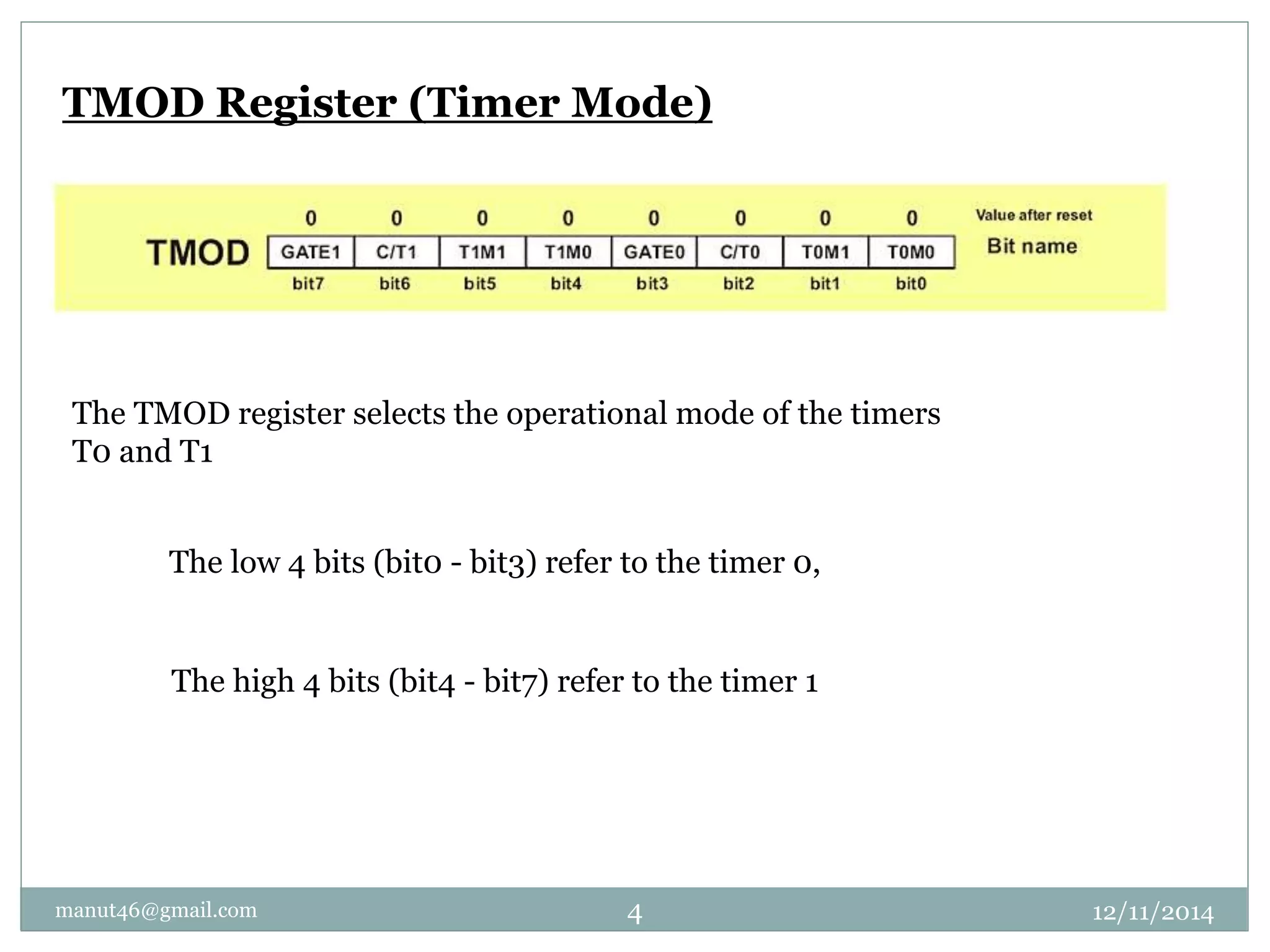
The TMOD register selects the operational mode of the timers 
T0 and T1 
The low 4 bits (bit0 - bit3) refer to the timer 0, 
The high 4 bits (bit4 - bit7) refer to the timer 1 
manut46@gmail.com 4 12/11/2014
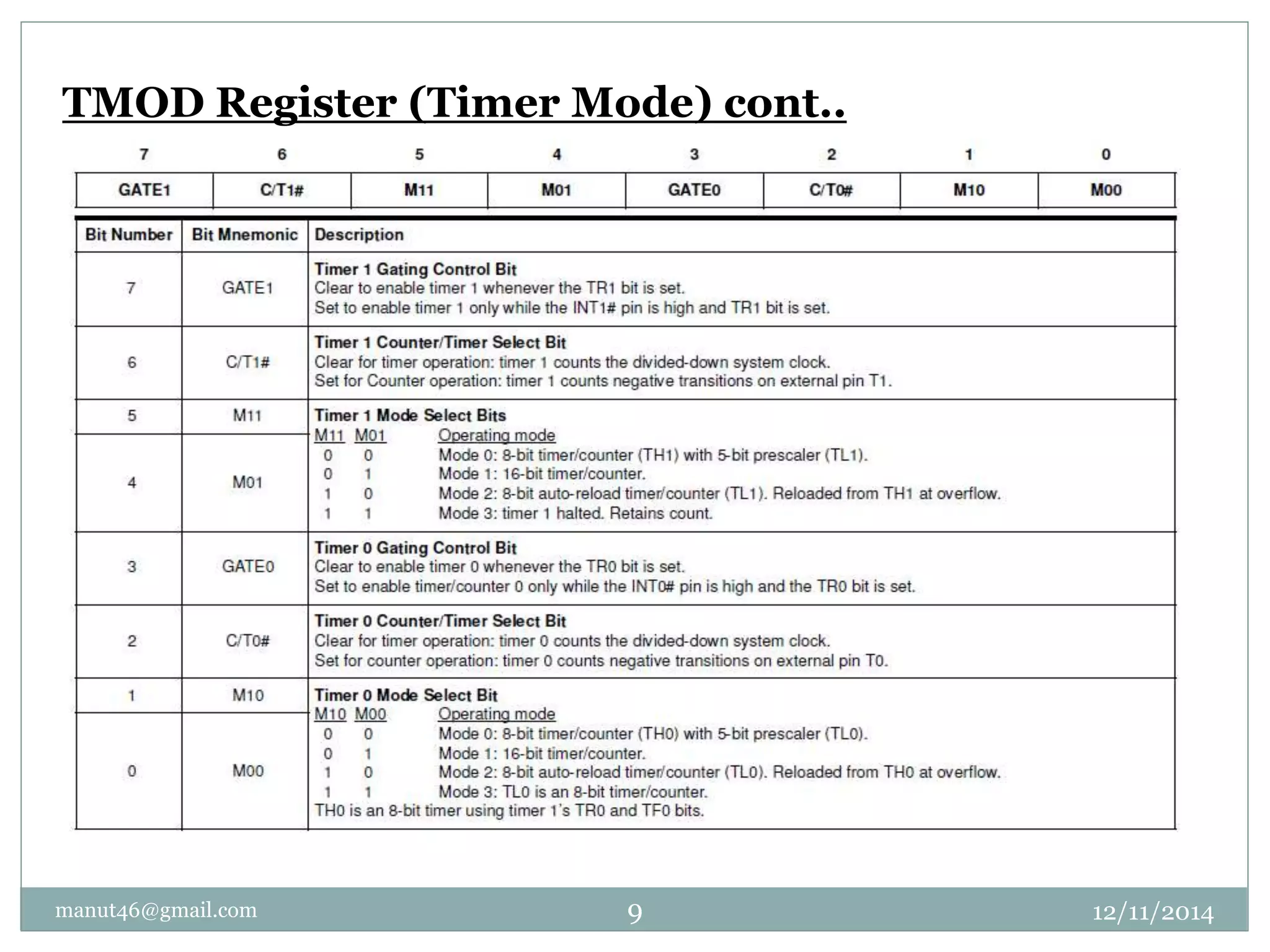
TMOD Register (Timer Mode) cont.. 
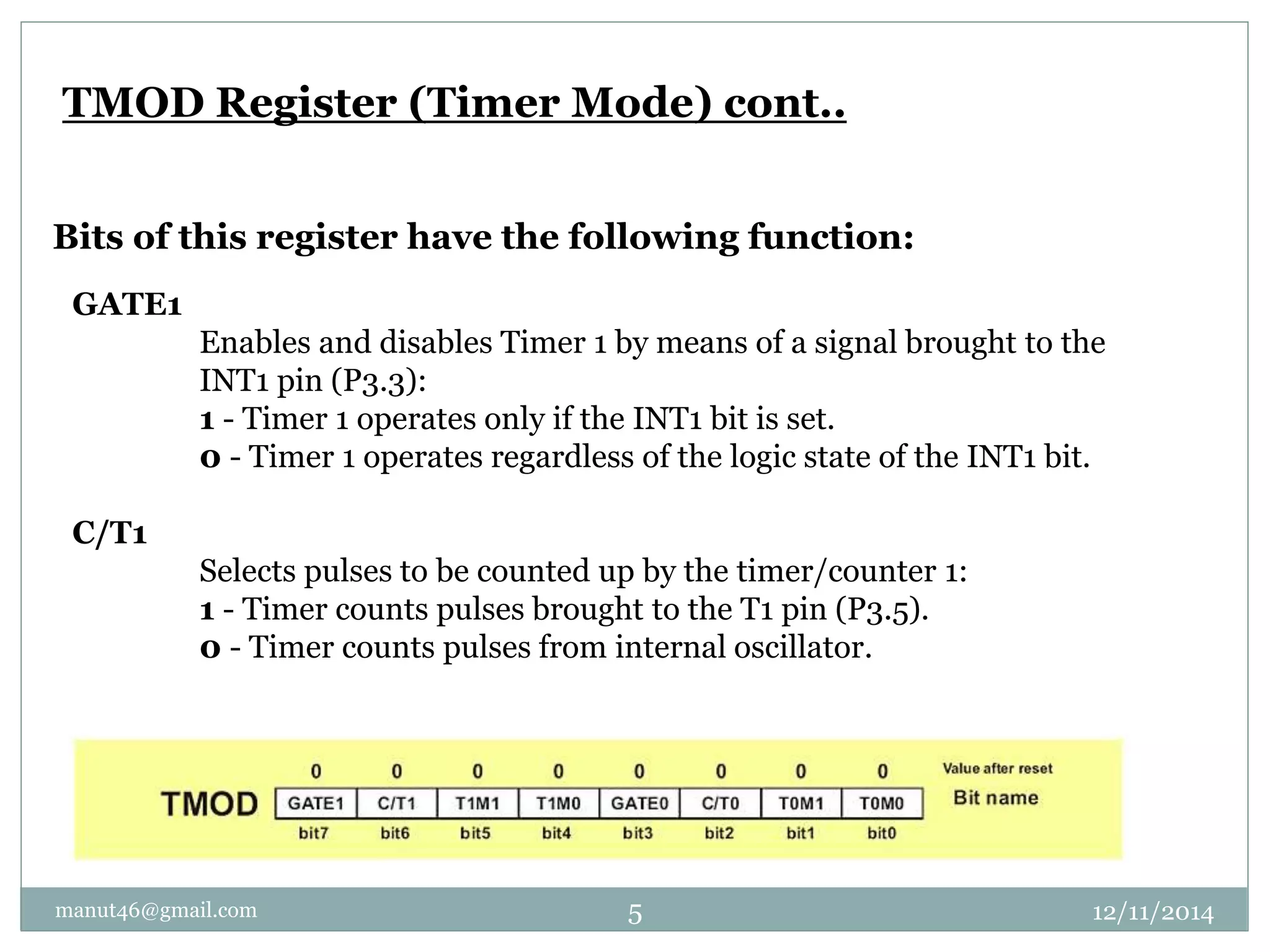
Bits of this register have the following function: 
GATE1 
Enables and disables Timer 1 by means of a signal brought to the 
INT1 pin (P3.3): 
1 - Timer 1 operates only if the INT1 bit is set. 
0 - Timer 1 operates regardless of the logic state of the INT1 bit. 
C/T1 
Selects pulses to be counted up by the timer/counter 1: 
1 - Timer counts pulses brought to the T1 pin (P3.5). 
0 - Timer counts pulses from internal oscillator. 
manut46@gmail.com 5 12/11/2014
TMOD Register (Timer Mode) cont.. 
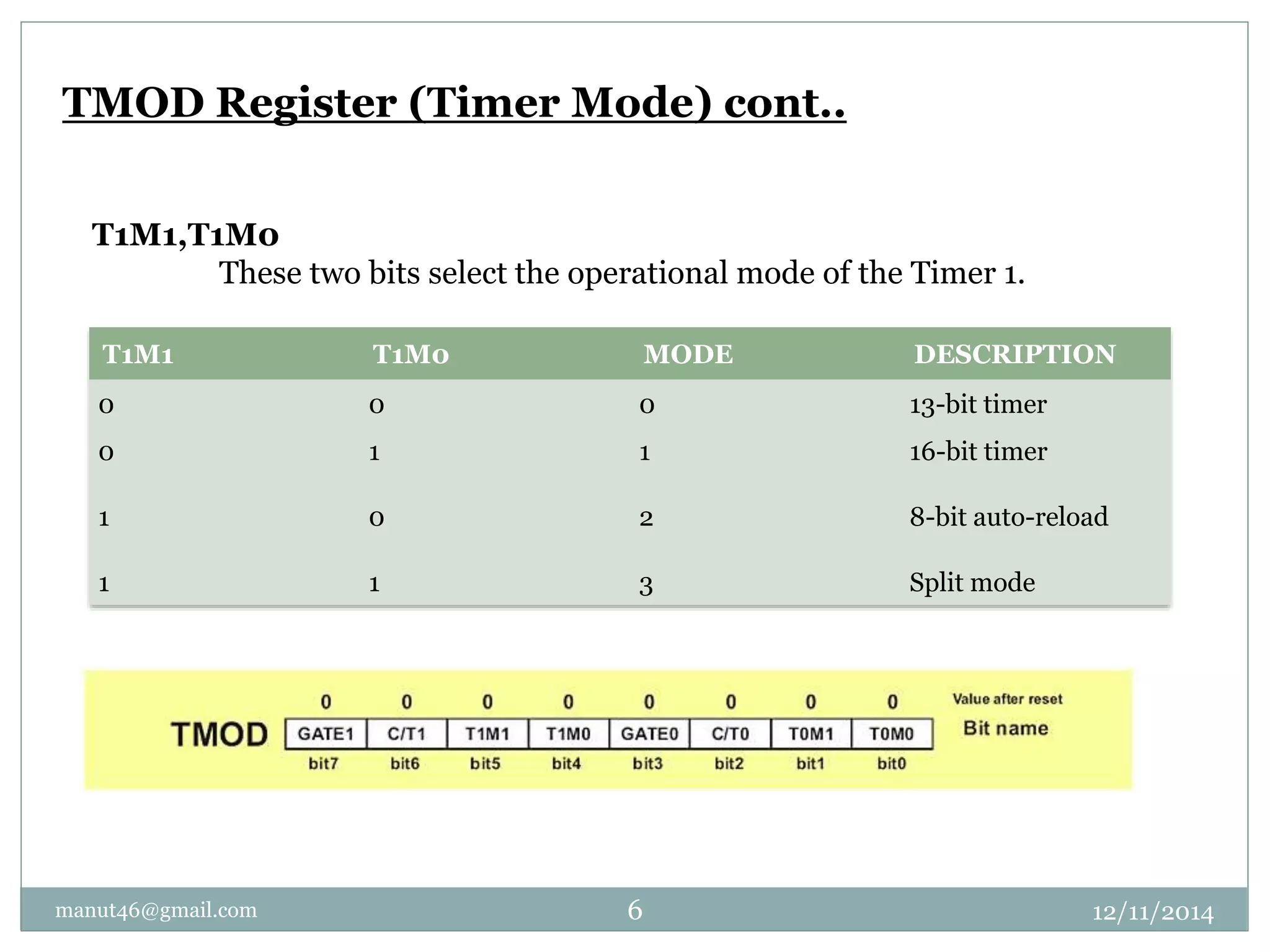
T1M1,T1M0 
These two bits select the operational mode of the Timer 1. 
T1M1 T1M0 MODE DESCRIPTION 
0 0 0 13-bit timer 
0 1 1 16-bit timer 
1 0 2 8-bit auto-reload 
1 1 3 Split mode 
manut46@gmail.com 6 12/11/2014
TMOD Register (Timer Mode) cont.. 
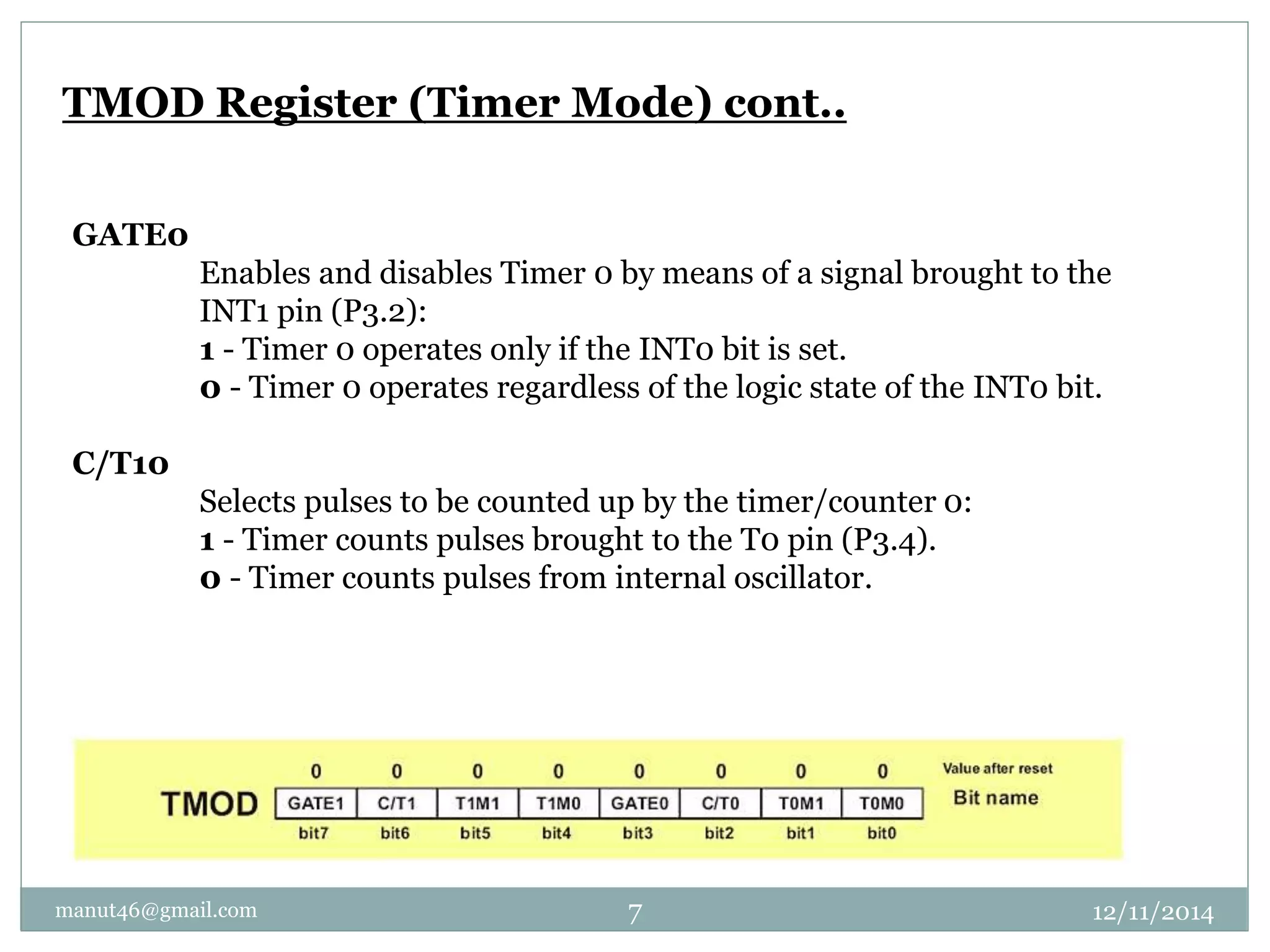
GATE0 
Enables and disables Timer 0 by means of a signal brought to the 
INT1 pin (P3.2): 
1 - Timer 0 operates only if the INT0 bit is set. 
0 - Timer 0 operates regardless of the logic state of the INT0 bit. 
C/T10 
Selects pulses to be counted up by the timer/counter 0: 
1 - Timer counts pulses brought to the T0 pin (P3.4). 
0 - Timer counts pulses from internal oscillator. 
manut46@gmail.com 7 12/11/2014
TMOD Register (Timer Mode) cont.. 
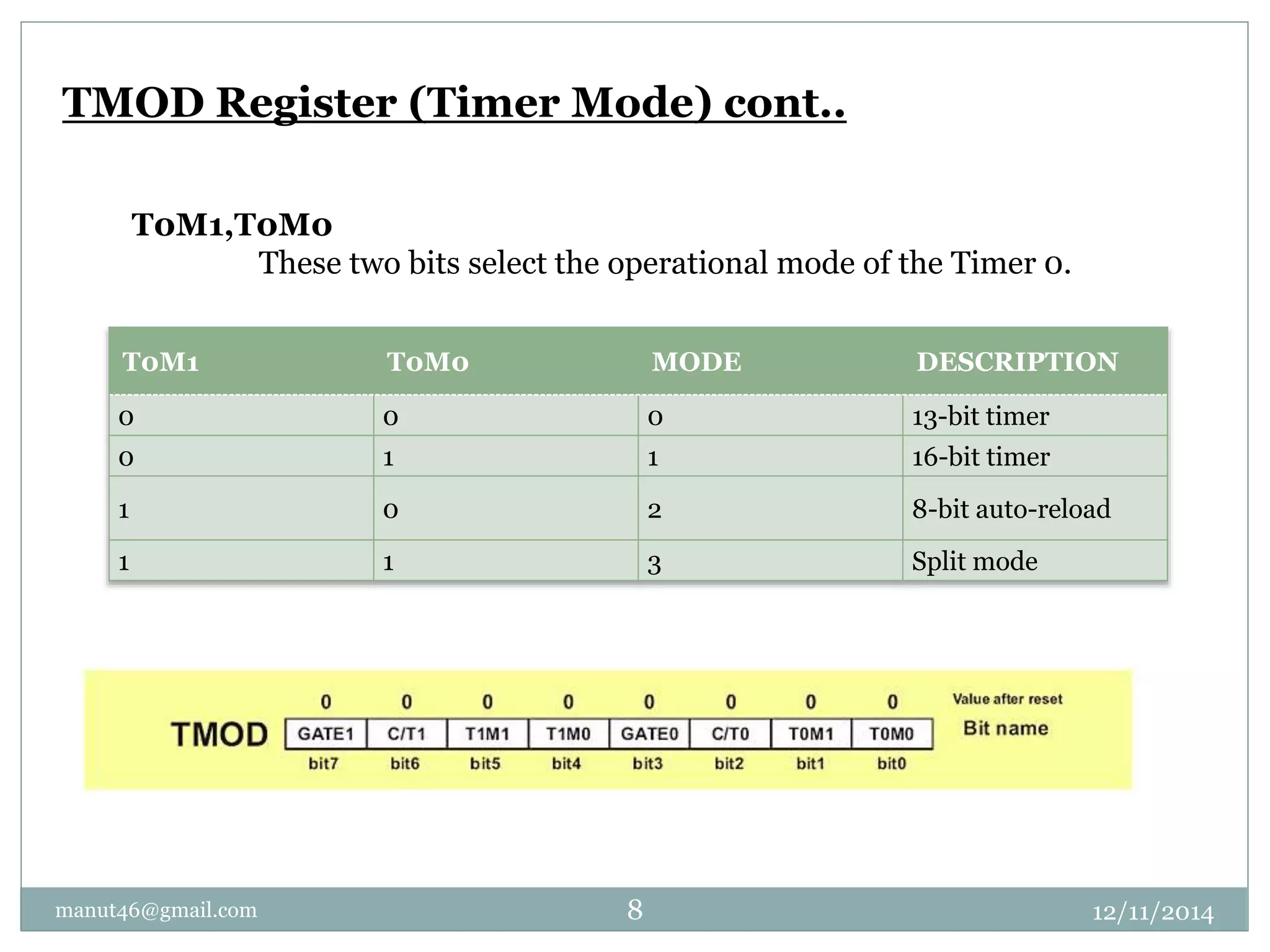
T0M1,T0M0 
These two bits select the operational mode of the Timer 0. 
T0M1 T0M0 MODE DESCRIPTION 
0 0 0 13-bit timer 
0 1 1 16-bit timer 
1 0 2 8-bit auto-reload 
1 1 3 Split mode 
manut46@gmail.com 8 12/11/2014
TMOD Register (Timer Mode) cont.. 
manut46@gmail.com 9 12/11/2014
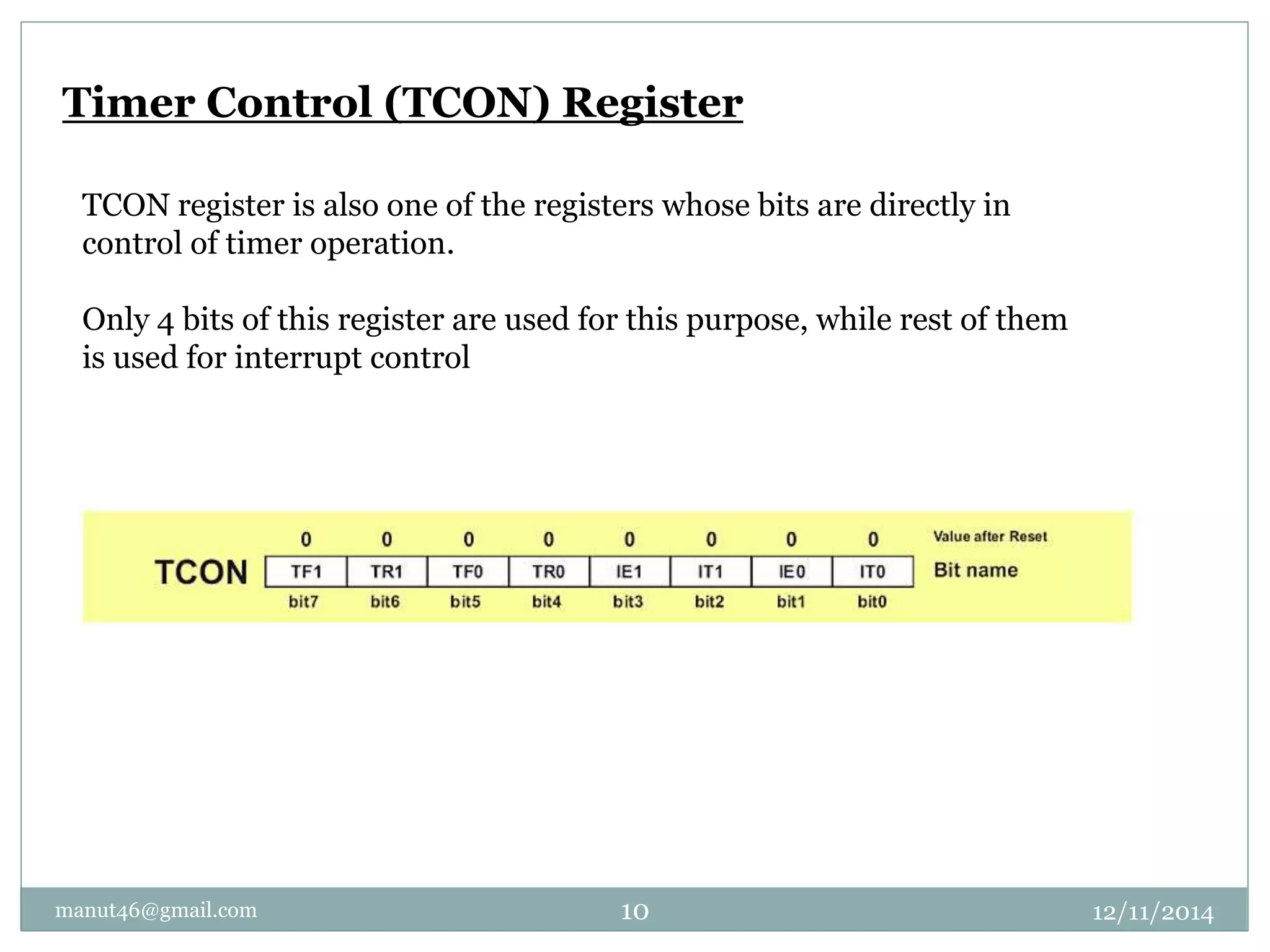
Timer Control (TCON) Register 
TCON register is also one of the registers whose bits are directly in 
control of timer operation. 
Only 4 bits of this register are used for this purpose, while rest of them 
is used for interrupt control 
manut46@gmail.com 10 12/11/2014
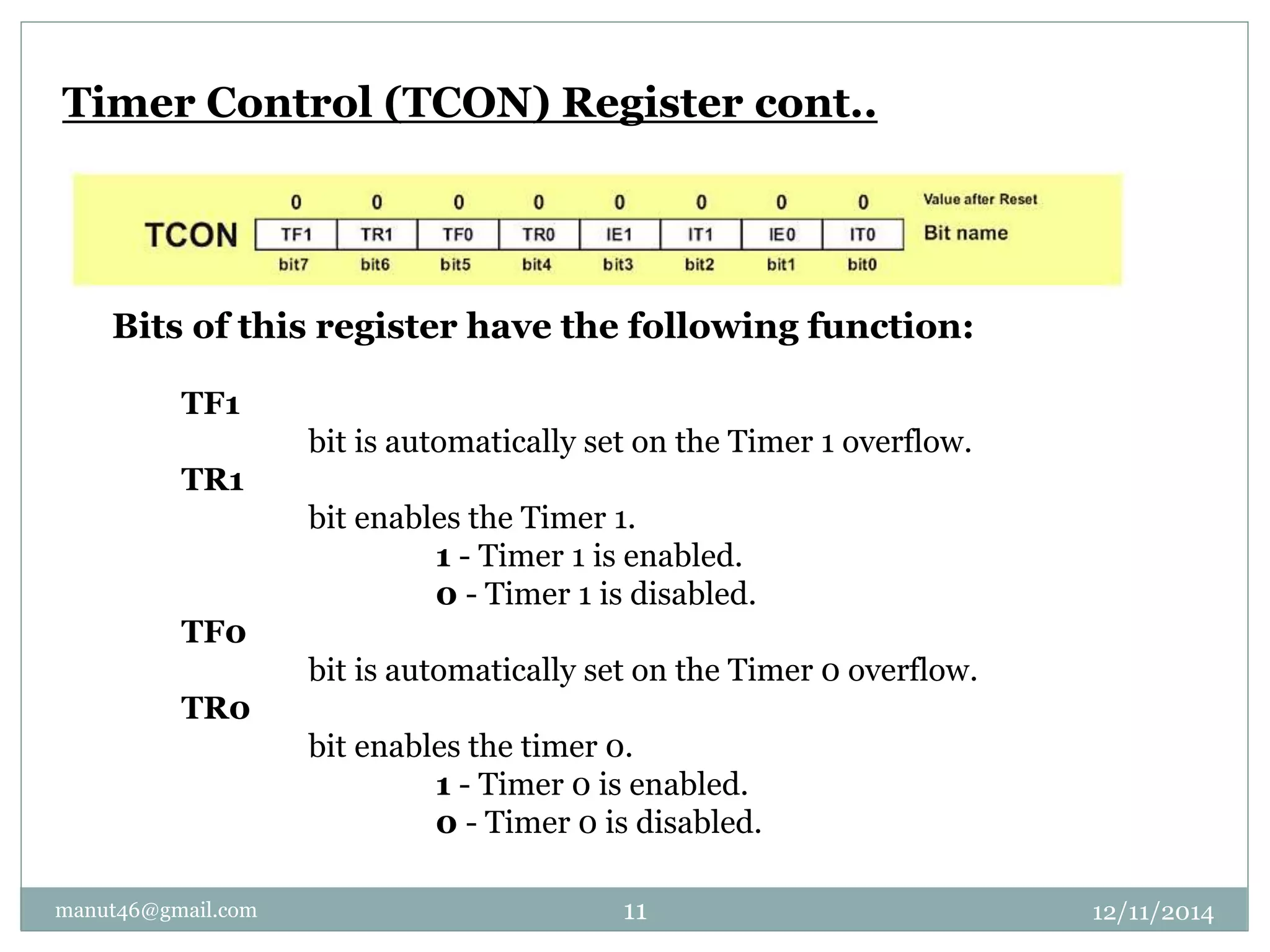
Timer Control (TCON) Register cont.. 
Bits of this register have the following function: 
TF1 
bit is automatically set on the Timer 1 overflow. 
TR1 
bit enables the Timer 1. 
1 - Timer 1 is enabled. 
0 - Timer 1 is disabled. 
TF0 
bit is automatically set on the Timer 0 overflow. 
TR0 
bit enables the timer 0. 
1 - Timer 0 is enabled. 
0 - Timer 0 is disabled. 
manut46@gmail.com 11 12/11/2014
manut46@gmail.com 12 12/11/2014
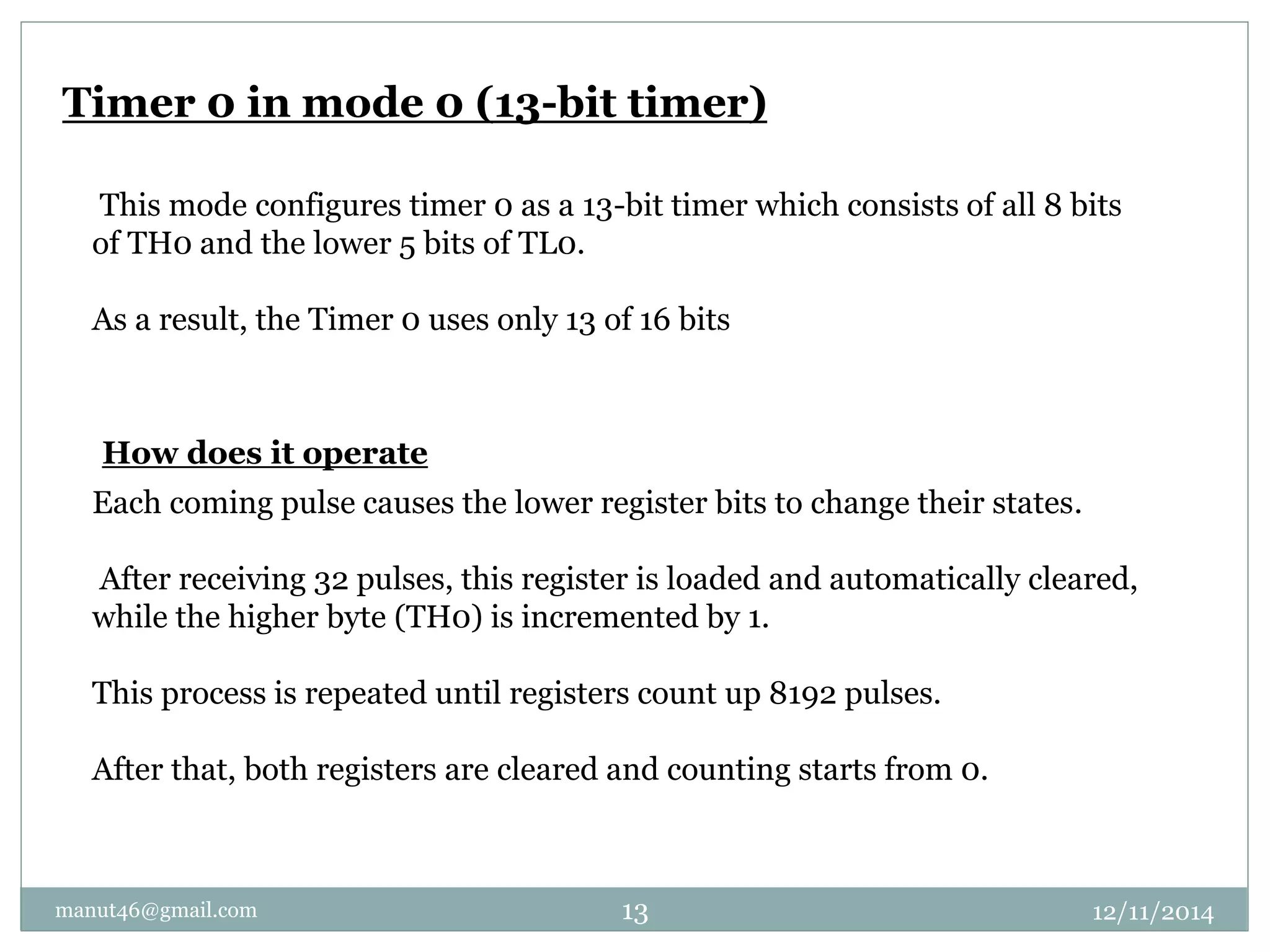
Timer 0 in mode 0 (13-bit timer) 
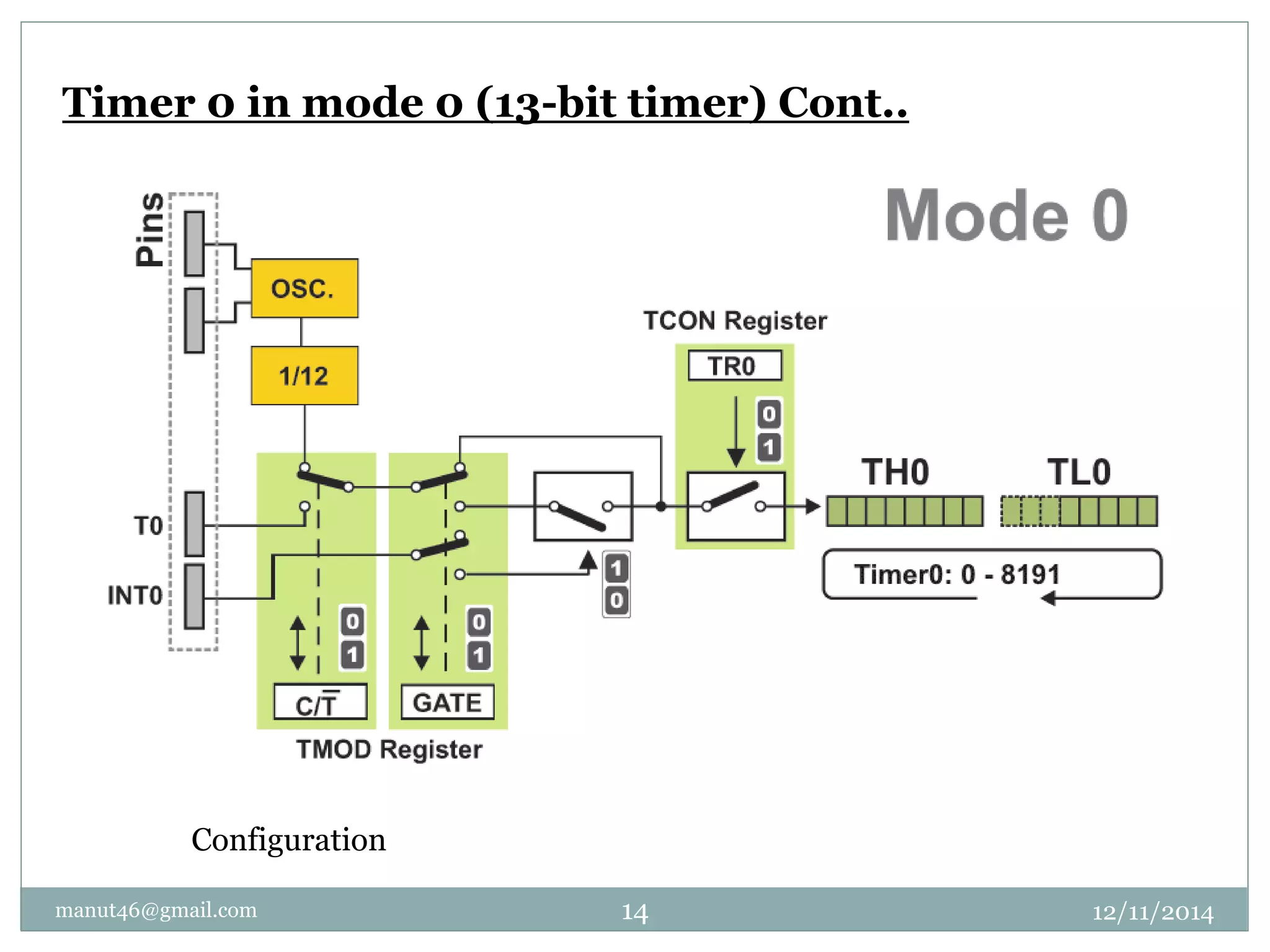
This mode configures timer 0 as a 13-bit timer which consists of all 8 bits 
of TH0 and the lower 5 bits of TL0. 
As a result, the Timer 0 uses only 13 of 16 bits 
How does it operate 
Each coming pulse causes the lower register bits to change their states. 
After receiving 32 pulses, this register is loaded and automatically cleared, 
while the higher byte (TH0) is incremented by 1. 
This process is repeated until registers count up 8192 pulses. 
After that, both registers are cleared and counting starts from 0. 
manut46@gmail.com 13 12/11/2014
Timer 0 in mode 0 (13-bit timer) Cont.. 
Configuration 
manut46@gmail.com 14 12/11/2014
Timer 0 in mode 1 (16-bit timer) 
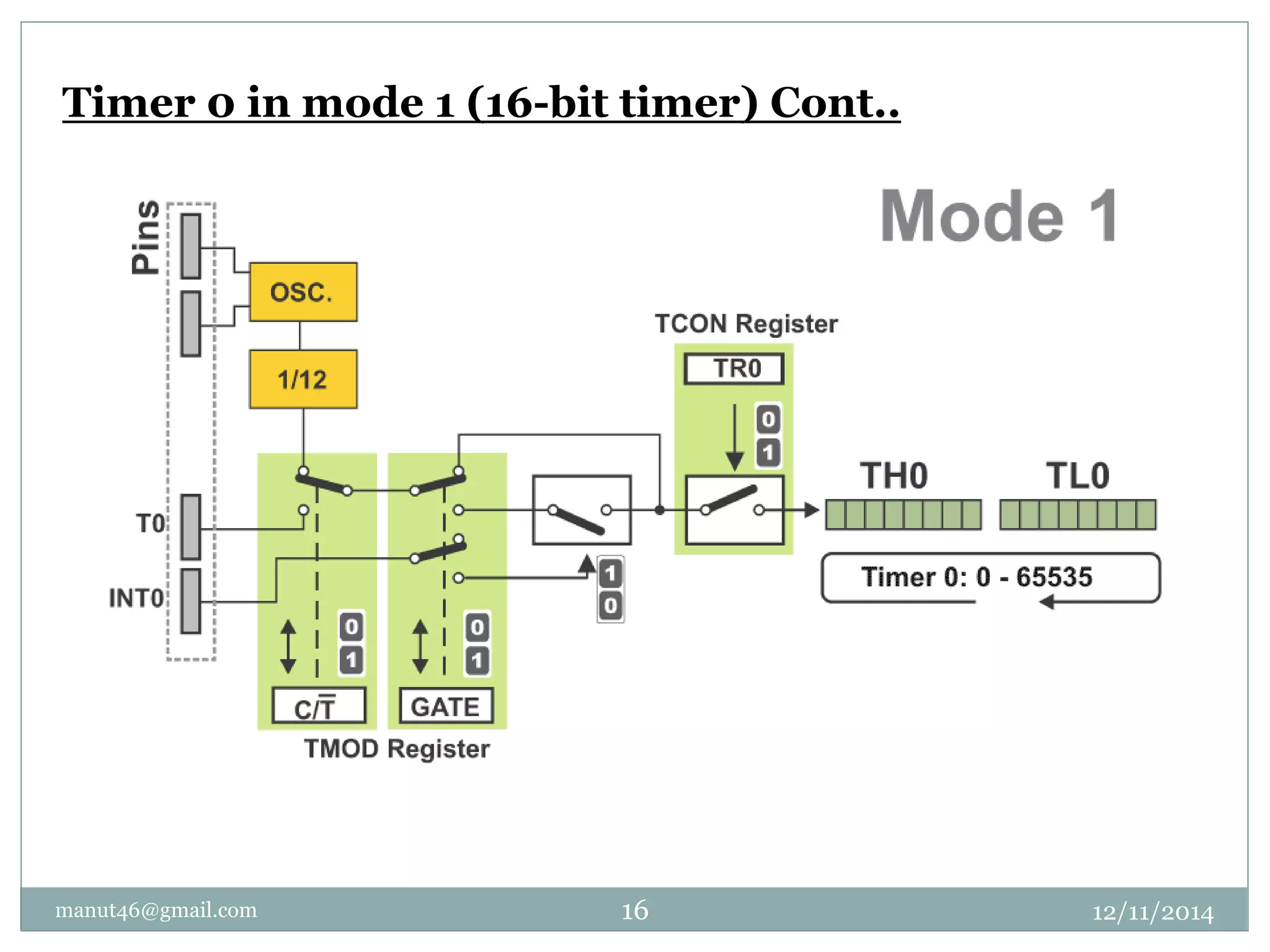
Mode 1 configures timer 0 as a 16-bit timer 
It uses all the bits of both registers TH0 and TL0. 
This is one of the most commonly used modes. 
Timer operates in the same way as in mode 0, with difference that the 
registers count up to 65 536 as allowable by the 16 bits. 
manut46@gmail.com 15 12/11/2014
Timer 0 in mode 1 (16-bit timer) Cont.. 
manut46@gmail.com 16 12/11/2014
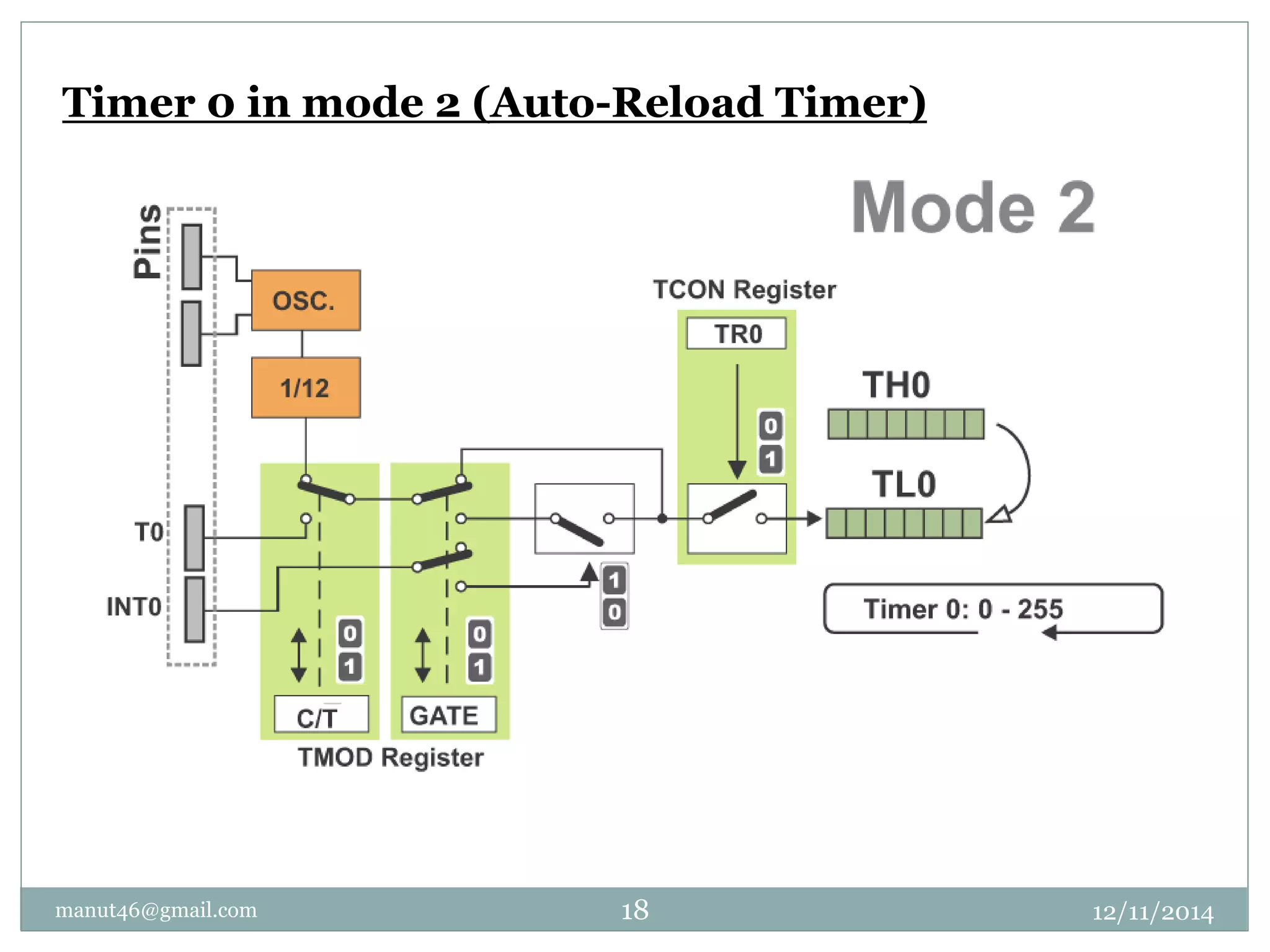
Timer 0 in mode 2 (Auto-Reload Timer) 
Mode 2 configures timer 0 as an 8-bit timer. 
Actually, timer 0 uses only one 8-bit register for counting and never counts 
from 0, but from an arbitrary value (0-255) stored in another (TH0) 
register. 
In fact, only the TL0 register operates as a timer, while another (TH0) 
register stores the value from which the counting starts 
When the TL0 register is loaded, instead of being cleared, the contents of 
TH0 will be reloaded to it. 
manut46@gmail.com 17 12/11/2014
Timer 0 in mode 2 (Auto-Reload Timer) 
manut46@gmail.com 18 12/11/2014
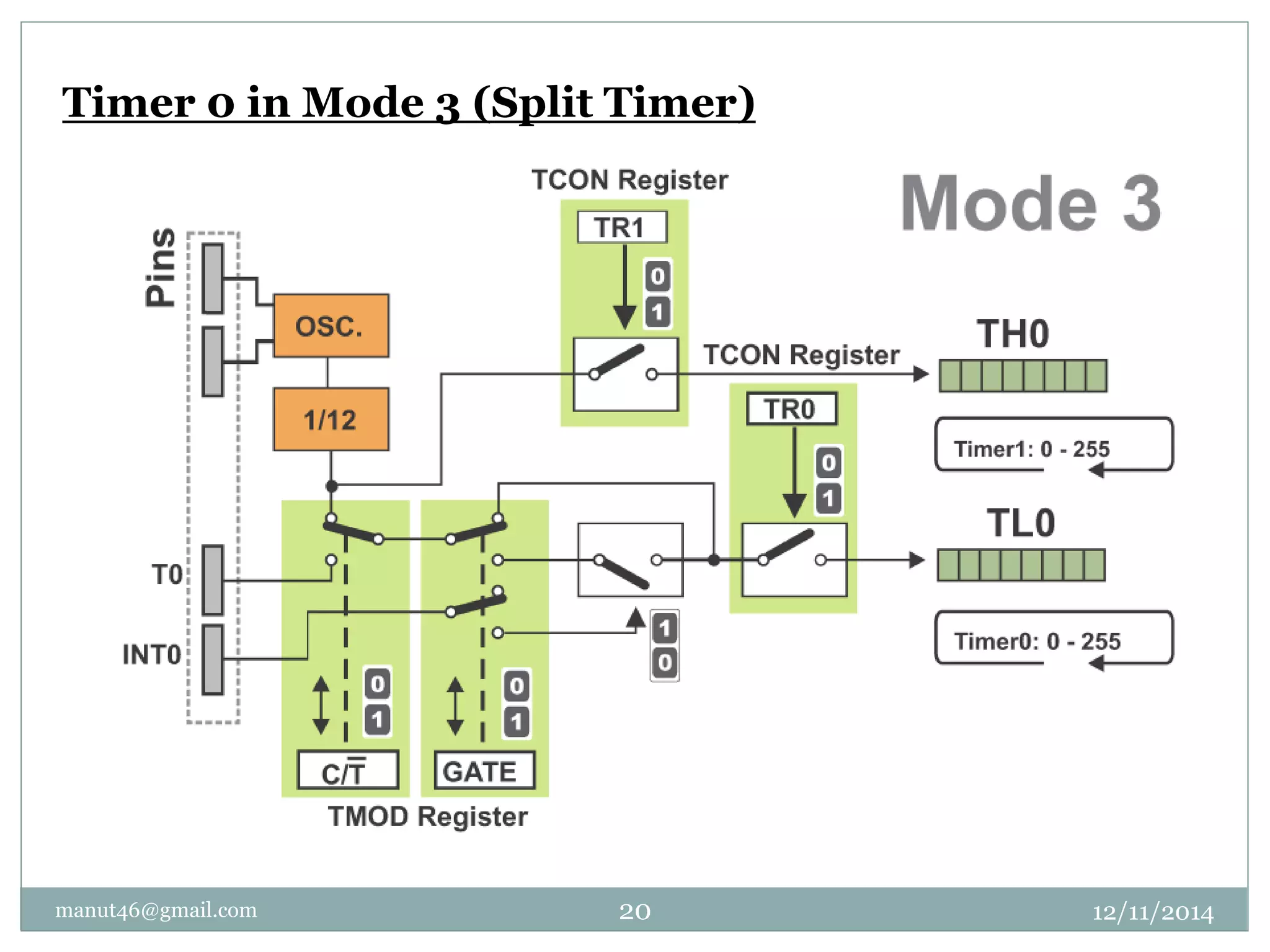
Timer 0 in Mode 3 (Split Timer) 
Mode 3 configures timer 0 so that registers TL0 and TH0 operate as separate 
8-bit timers. 
In other words, the 16-bit timer consisting of two registers TH0 and TL0 is 
split into two independent 8-bit timers. 
This mode is provided for applications requiring an additional 8-bit timer or 
counter. The TL0 timer turns into timer 0, while the TH0 timer turns into 
timer 1. 
All the control bits of 16-bit Timer 1 (consisting of the TH1 and TL1 register), 
now control the 8-bit Timer 1. 
Even though the 16-bit Timer 1 can still be configured to operate in any of 
modes (mode 1, 2 or 3), it is no longer possible to disable it as there is no 
control bit to do it. 
Thus, its operation is restricted when timer 0 is in mode 3. 
manut46@gmail.com 19 12/11/2014
Timer 0 in Mode 3 (Split Timer) 
manut46@gmail.com 20 12/11/2014

8051 timers

  • 1.
    8051 Microcontroller Timers& Counters Prepared by: Manu Thomas manut46@gmail.com 1 12/11/2014
  • 2.
    The 8051 Timers The 8051 comes equipped with two timers, both of which may be controlled, set, read, and configured individually. he 8051 timers have three general functions: 1) Keeping time and/or calculating the amount of time between events, 2) Counting the events themselves, or 3) Generating baud rates for the serial port. The 8051 microcontroller has 2 timers/counters called T0 and T1. As their names suggest, their main purpose is to measure time and count external events. Besides, they can be used for generating clock pulses to be used in serial communication, so called Baud Rate. manut46@gmail.com 2 12/11/2014
  • 3.
    Timer T0 Thetimer T0 consists of two registers – TH0 and TL0 representing a low and a high byte of one 16-digit binary number. Formula used to calculate values in these two registers is very simple: TH0 × 256 + TL0 = T Since the timer T0 is virtually 16-bit register, the largest value it can store is 65 535. In case of exceeding this value, the timer will be automatically cleared and counting starts from 0. This condition is called an overflow. Two registers TMOD and TCON are closely connected to this timer and control its operation. manut46@gmail.com 3 12/11/2014
  • 4.
    TMOD Register (TimerMode) The TMOD register selects the operational mode of the timers T0 and T1 The low 4 bits (bit0 - bit3) refer to the timer 0, The high 4 bits (bit4 - bit7) refer to the timer 1 manut46@gmail.com 4 12/11/2014
  • 5.
    TMOD Register (TimerMode) cont.. Bits of this register have the following function: GATE1 Enables and disables Timer 1 by means of a signal brought to the INT1 pin (P3.3): 1 - Timer 1 operates only if the INT1 bit is set. 0 - Timer 1 operates regardless of the logic state of the INT1 bit. C/T1 Selects pulses to be counted up by the timer/counter 1: 1 - Timer counts pulses brought to the T1 pin (P3.5). 0 - Timer counts pulses from internal oscillator. manut46@gmail.com 5 12/11/2014
  • 6.
    TMOD Register (TimerMode) cont.. T1M1,T1M0 These two bits select the operational mode of the Timer 1. T1M1 T1M0 MODE DESCRIPTION 0 0 0 13-bit timer 0 1 1 16-bit timer 1 0 2 8-bit auto-reload 1 1 3 Split mode manut46@gmail.com 6 12/11/2014
  • 7.
    TMOD Register (TimerMode) cont.. GATE0 Enables and disables Timer 0 by means of a signal brought to the INT1 pin (P3.2): 1 - Timer 0 operates only if the INT0 bit is set. 0 - Timer 0 operates regardless of the logic state of the INT0 bit. C/T10 Selects pulses to be counted up by the timer/counter 0: 1 - Timer counts pulses brought to the T0 pin (P3.4). 0 - Timer counts pulses from internal oscillator. manut46@gmail.com 7 12/11/2014
  • 8.
    TMOD Register (TimerMode) cont.. T0M1,T0M0 These two bits select the operational mode of the Timer 0. T0M1 T0M0 MODE DESCRIPTION 0 0 0 13-bit timer 0 1 1 16-bit timer 1 0 2 8-bit auto-reload 1 1 3 Split mode manut46@gmail.com 8 12/11/2014
  • 9.
    TMOD Register (TimerMode) cont.. manut46@gmail.com 9 12/11/2014
  • 10.
    Timer Control (TCON)Register TCON register is also one of the registers whose bits are directly in control of timer operation. Only 4 bits of this register are used for this purpose, while rest of them is used for interrupt control manut46@gmail.com 10 12/11/2014
  • 11.
    Timer Control (TCON)Register cont.. Bits of this register have the following function: TF1 bit is automatically set on the Timer 1 overflow. TR1 bit enables the Timer 1. 1 - Timer 1 is enabled. 0 - Timer 1 is disabled. TF0 bit is automatically set on the Timer 0 overflow. TR0 bit enables the timer 0. 1 - Timer 0 is enabled. 0 - Timer 0 is disabled. manut46@gmail.com 11 12/11/2014
  • 12.
  • 13.
    Timer 0 inmode 0 (13-bit timer) This mode configures timer 0 as a 13-bit timer which consists of all 8 bits of TH0 and the lower 5 bits of TL0. As a result, the Timer 0 uses only 13 of 16 bits How does it operate Each coming pulse causes the lower register bits to change their states. After receiving 32 pulses, this register is loaded and automatically cleared, while the higher byte (TH0) is incremented by 1. This process is repeated until registers count up 8192 pulses. After that, both registers are cleared and counting starts from 0. manut46@gmail.com 13 12/11/2014
  • 14.
    Timer 0 inmode 0 (13-bit timer) Cont.. Configuration manut46@gmail.com 14 12/11/2014
  • 15.
    Timer 0 inmode 1 (16-bit timer) Mode 1 configures timer 0 as a 16-bit timer It uses all the bits of both registers TH0 and TL0. This is one of the most commonly used modes. Timer operates in the same way as in mode 0, with difference that the registers count up to 65 536 as allowable by the 16 bits. manut46@gmail.com 15 12/11/2014
  • 16.
    Timer 0 inmode 1 (16-bit timer) Cont.. manut46@gmail.com 16 12/11/2014
  • 17.
    Timer 0 inmode 2 (Auto-Reload Timer) Mode 2 configures timer 0 as an 8-bit timer. Actually, timer 0 uses only one 8-bit register for counting and never counts from 0, but from an arbitrary value (0-255) stored in another (TH0) register. In fact, only the TL0 register operates as a timer, while another (TH0) register stores the value from which the counting starts When the TL0 register is loaded, instead of being cleared, the contents of TH0 will be reloaded to it. manut46@gmail.com 17 12/11/2014
  • 18.
    Timer 0 inmode 2 (Auto-Reload Timer) manut46@gmail.com 18 12/11/2014
  • 19.
    Timer 0 inMode 3 (Split Timer) Mode 3 configures timer 0 so that registers TL0 and TH0 operate as separate 8-bit timers. In other words, the 16-bit timer consisting of two registers TH0 and TL0 is split into two independent 8-bit timers. This mode is provided for applications requiring an additional 8-bit timer or counter. The TL0 timer turns into timer 0, while the TH0 timer turns into timer 1. All the control bits of 16-bit Timer 1 (consisting of the TH1 and TL1 register), now control the 8-bit Timer 1. Even though the 16-bit Timer 1 can still be configured to operate in any of modes (mode 1, 2 or 3), it is no longer possible to disable it as there is no control bit to do it. Thus, its operation is restricted when timer 0 is in mode 3. manut46@gmail.com 19 12/11/2014
  • 20.
    Timer 0 inMode 3 (Split Timer) manut46@gmail.com 20 12/11/2014