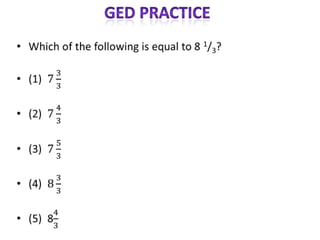
• 1. GED Practice (Fractions)
• 2. Review: Improper/Mixed Numbers
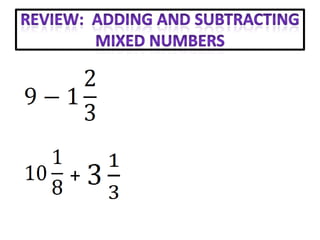
• 3. Adding/Subtracting Fractions/Mixed
  Numbers
• 4. Multiplying/Dividing Fractions
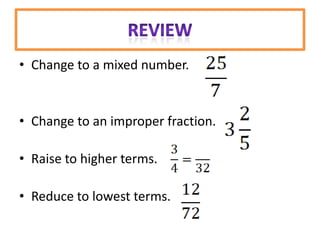
• Change to a mixed number.


• Change to an improper fraction.

• Raise to higher terms.

• Reduce to lowest terms.
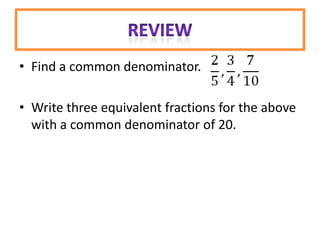
• Find a common denominator.

• Write three equivalent fractions for the above
  with a common denominator of 20.
+
• 1. How can one whole be represented as a
  fraction?

• 2. How do you raise a fraction to higher terms?

• 3. How do you reduce a fraction to lowest terms?

• 4. Why would you raise a fraction to higher
  terms?
• When you multiply, you are finding a fraction of
  a fraction.

• The product is smaller than the fractions you
  multiply.

• The phrase “a fraction of” means to multiply.

• Multiplying fractions means finding a “part of a
  part”.
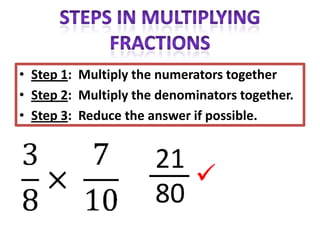
• Step 1: Multiply the numerators together
• Step 2: Multiply the denominators together.
• Step 3: Reduce the answer if possible.


                      21
                         
                      80
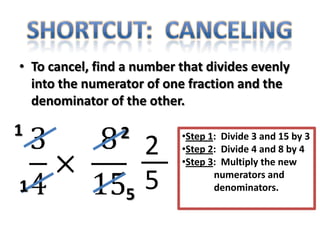
• To cancel, find a number that divides evenly
  into the numerator of one fraction and the
  denominator of the other.

1                2         •Step 1: Divide 3 and 15 by 3
                      2    •Step 2: Divide 4 and 8 by 4
                           •Step 3: Multiply the new

1                 5
                      5           numerators and
                                  denominators.
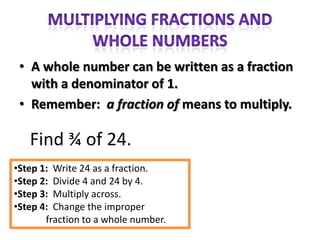
• A whole number can be written as a fraction
   with a denominator of 1.
 • Remember: a fraction of means to multiply.

   Find ¾ of 24.
•Step 1: Write 24 as a fraction.
•Step 2: Divide 4 and 24 by 4.
•Step 3: Multiply across.
•Step 4: Change the improper
       fraction to a whole number.
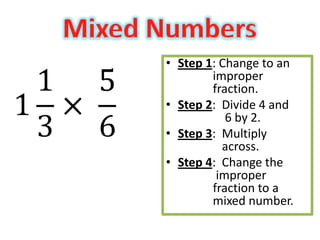
• Step 1: Change to an
        improper
        fraction.
• Step 2: Divide 4 and
           6 by 2.
• Step 3: Multiply
          across.
• Step 4: Change the
         improper
        fraction to a
        mixed number.
• In division problems with fractions
  or mixed numbers, you must invert
  (flip) the divisor.

              invert
                        inverse
              flip
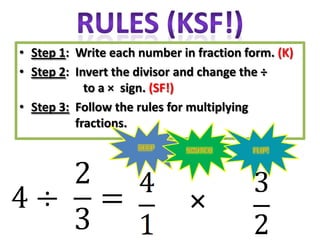
• Step 1: Write each number in fraction form. (K)
• Step 2: Invert the divisor and change the ÷
            to a × sign. (SF!)
• Step 3: Follow the rules for multiplying
          fractions.


                              ×
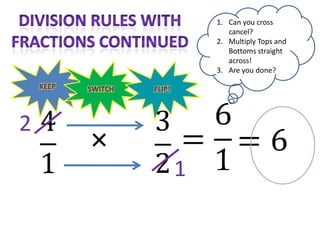
1. Can you cross
               cancel?
            2. Multiply Tops and
               Bottoms straight
               across!
            3. Are you done?


2
    ×
        1
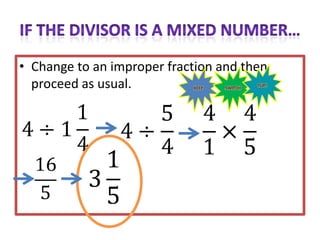
• Change to an improper fraction and then
  proceed as usual.

8:00 GED Math Wednesday Fractions

  • 1.
    • 1. GEDPractice (Fractions) • 2. Review: Improper/Mixed Numbers • 3. Adding/Subtracting Fractions/Mixed Numbers • 4. Multiplying/Dividing Fractions
  • 2.
    • Change toa mixed number. • Change to an improper fraction. • Raise to higher terms. • Reduce to lowest terms.
  • 3.
    • Find acommon denominator. • Write three equivalent fractions for the above with a common denominator of 20.
  • 4.
  • 5.
    • 1. Howcan one whole be represented as a fraction? • 2. How do you raise a fraction to higher terms? • 3. How do you reduce a fraction to lowest terms? • 4. Why would you raise a fraction to higher terms?
  • 7.
    • When youmultiply, you are finding a fraction of a fraction. • The product is smaller than the fractions you multiply. • The phrase “a fraction of” means to multiply. • Multiplying fractions means finding a “part of a part”.
  • 8.
    • Step 1:Multiply the numerators together • Step 2: Multiply the denominators together. • Step 3: Reduce the answer if possible. 21  80
  • 9.
    • To cancel,find a number that divides evenly into the numerator of one fraction and the denominator of the other. 1 2 •Step 1: Divide 3 and 15 by 3 2 •Step 2: Divide 4 and 8 by 4 •Step 3: Multiply the new 1 5 5 numerators and denominators.
  • 10.
    • A wholenumber can be written as a fraction with a denominator of 1. • Remember: a fraction of means to multiply. Find ¾ of 24. •Step 1: Write 24 as a fraction. •Step 2: Divide 4 and 24 by 4. •Step 3: Multiply across. •Step 4: Change the improper fraction to a whole number.
  • 11.
    • Step 1:Change to an improper fraction. • Step 2: Divide 4 and 6 by 2. • Step 3: Multiply across. • Step 4: Change the improper fraction to a mixed number.
  • 12.
    • In divisionproblems with fractions or mixed numbers, you must invert (flip) the divisor. invert inverse flip
  • 13.
    • Step 1:Write each number in fraction form. (K) • Step 2: Invert the divisor and change the ÷ to a × sign. (SF!) • Step 3: Follow the rules for multiplying fractions. ×
  • 14.
    1. Can youcross cancel? 2. Multiply Tops and Bottoms straight across! 3. Are you done? 2 × 1
  • 15.
    • Change toan improper fraction and then proceed as usual.