8 RESEARCH-RUINING
DATA MISTAKES –
AND HOW TO AVOID THEM
Colin Campbell
METER Group, Inc. USA
CLIMATE CHANGE IMPACTS ON
SPECIES DIVERSITY
Rush Valley,UT
Impact of fire, rodents, and
environment on invasive species
dynamics in an arid landscape
Adjust precipitation according to
modeled climate change
1. FAILING TO COLLECT
ENOUGH METADATA
Problem
• Manuscript requires details no longer remembered
• Sensor installation depths are not known
• Wires from buried sensors contain no information
Solutions
• Brainstorm everything you would want to know
• ask friend to review your ideas
• Keep a site (e-)notebook
• be rigorous in your notetaking
• edit sheet right in the field
• note things like sensor serial numbers
• record how deep sensors are buried
• store in cloud… or at least record where data can be found
Motto:Shortest pencil is longer than the longest memory
DIGITAL FIELD NOTEBOOK
METADATA IN SOFTWARE
SITE PICTURES/MONITORING
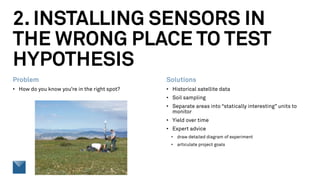
2. INSTALLING SENSORS IN
THE WRONG PLACE TO TEST
HYPOTHESIS
Problem
• How do you know you’re in the right spot?
Solutions
• Historical satellite data
• Soil sampling
• Separate areas into “statically interesting” units to
monitor
• Yield over time
• Expert advice
• draw detailed diagram of experiment
• articulate project goals
EXAMPLE
2019 SITE SELECTION
In situ measurement sites
selected by satellite estimation
of seasonal wetness across
each field
Locations for:
• average moisture across season
• driest moisture location across season
3. FAILING TO ADD LAB DATA
TO GET A COMPLETE PICTURE
Problem
• Not enough information to fully characterize
experimental site
Solutions
• Soil type
• data for publishing papers
• sensor behavior
• Moisture release curve
• air entry point
• understanding field MRCs with in situ sensors
• Hydraulic conductivity
Water potential (-kPa)
LAB TESTING EQUIPMENT
4. NOT INSTALLING ENOUGH
SENSORS TO CAPTURE
VARIABILITY
Problem
• Budget limits number of monitoring sites
• Correlations questioned because of lack of statistical
significance
Solutions
• Propose robust instrumentation budget
• Use other sources of data
• satellite
• soil sampling and testing to show field variability manually –
connect with remotely sensed data
• drone remote sensing
• above-ground fixed remote sensing for large footprint
• Carefully consider experimental design
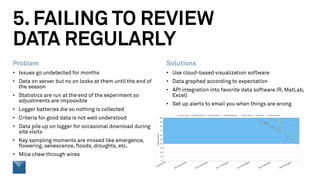
5. FAILING TO REVIEW
DATA REGULARLY
Problem
• Issues go undetected for months
• Data on server but no on looks at them until the end of
the season
• Statistics are run at the end of the experiment so
adjustments are impossible
• Logger batteries die so nothing is collected
• Criteria for good data is not well understood
• Data pile up on logger for occasional download during
site visits
• Key sampling moments are missed like emergence,
flowering, senescence, floods, droughts, etc.
• Mice chew through wires
Solutions
• Use cloud-based visualization software
• Data graphed according to expectation
• API integration into favorite data software (R, MatLab,
Excel)
• Set up alerts to email you when things are wrong
FAULTY SENSOR?
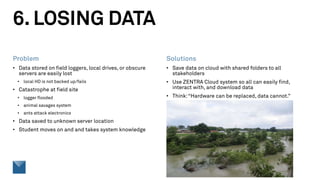
6. LOSING DATA
Problem
• Data stored on field loggers, local drives, or obscure
servers are easily lost
• local HD is not backed up/fails
• Catastrophe at field site
• logger flooded
• animal savages system
• ants attack electronics
• Data saved to unknown server location
• Student moves on and and takes system knowledge
Solutions
• Save data on cloud with shared folders to all
stakeholders
• Use ZENTRA Cloud system so all can easily find,
interact with, and download data
• Think:“Hardware can be replaced, data cannot.”
7. FAILING TO INSTALL
SENSORS PROPERLY
Problem
• Improper installation dooms experimental findings
• Many assume they know how to install properly
• fail to make good soil contact
• poorly levelled
• protective covers in place
• Compromises because of experimental realities
• rocky soils
• challenging to reach expected depth
• hard to install met stand
IMPROVED INSTALLATIONS
Solutions
• Use installation tool
• reach depth quickly
• press sensors into the soil consistently
• Use online aids
• videos
• step-by-step guides
8. FORGETTING TO VERIFY
EVERYTHING BEFORE LEAVING
THE INSTALLATION SITE
Problem
• Things seldom work the first time we do them
• Field work is exhausting; it’s hard to take time to check
• Acceptable range of sensor output is poorly
understood; errors are not spotted
• System isn’t configured correctly
• logger not reading; reading at the wrong interval
• Poorly configured sensor ports
Solutions
• Setup system in lab before going to field
• Prepare checklist of plausible readings for each sensor
• Use friend to check values online with ZENTRA Cloud
to verify everything works
• Mentally plan time for verification; hard to do after
exhausting day in field
• New ZSC Bluetooth reader to check individual sensor
readings
• ZENTRA Utility Mobile – plug-and-play system avoids
setup errors
FIELD TOOLS TO VERIFY
SENSOR BEHAVIOR
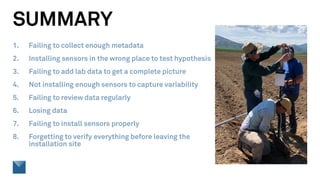
SUMMARY
1. Failing to collect enough metadata
2. Installing sensors in the wrong place to test hypothesis
3. Failing to add lab data to get a complete picture
4. Not installing enough sensors to capture variability
5. Failing to review data regularly
6. Losing data
7. Failing to install sensors properly
8. Forgetting to verify everything before leaving the
installation site
QUESTIONS?

8 Research-ruining Data Mistakes

  • 2.
    8 RESEARCH-RUINING DATA MISTAKES– AND HOW TO AVOID THEM Colin Campbell METER Group, Inc. USA
  • 3.
    CLIMATE CHANGE IMPACTSON SPECIES DIVERSITY Rush Valley,UT Impact of fire, rodents, and environment on invasive species dynamics in an arid landscape Adjust precipitation according to modeled climate change
  • 4.
    1. FAILING TOCOLLECT ENOUGH METADATA Problem • Manuscript requires details no longer remembered • Sensor installation depths are not known • Wires from buried sensors contain no information Solutions • Brainstorm everything you would want to know • ask friend to review your ideas • Keep a site (e-)notebook • be rigorous in your notetaking • edit sheet right in the field • note things like sensor serial numbers • record how deep sensors are buried • store in cloud… or at least record where data can be found Motto:Shortest pencil is longer than the longest memory
  • 5.
  • 6.
  • 7.
  • 8.
    2. INSTALLING SENSORSIN THE WRONG PLACE TO TEST HYPOTHESIS Problem • How do you know you’re in the right spot? Solutions • Historical satellite data • Soil sampling • Separate areas into “statically interesting” units to monitor • Yield over time • Expert advice • draw detailed diagram of experiment • articulate project goals
  • 9.
    EXAMPLE 2019 SITE SELECTION Insitu measurement sites selected by satellite estimation of seasonal wetness across each field Locations for: • average moisture across season • driest moisture location across season
  • 10.
    3. FAILING TOADD LAB DATA TO GET A COMPLETE PICTURE Problem • Not enough information to fully characterize experimental site Solutions • Soil type • data for publishing papers • sensor behavior • Moisture release curve • air entry point • understanding field MRCs with in situ sensors • Hydraulic conductivity Water potential (-kPa)
  • 11.
  • 12.
    4. NOT INSTALLINGENOUGH SENSORS TO CAPTURE VARIABILITY Problem • Budget limits number of monitoring sites • Correlations questioned because of lack of statistical significance Solutions • Propose robust instrumentation budget • Use other sources of data • satellite • soil sampling and testing to show field variability manually – connect with remotely sensed data • drone remote sensing • above-ground fixed remote sensing for large footprint • Carefully consider experimental design
  • 13.
    5. FAILING TOREVIEW DATA REGULARLY Problem • Issues go undetected for months • Data on server but no on looks at them until the end of the season • Statistics are run at the end of the experiment so adjustments are impossible • Logger batteries die so nothing is collected • Criteria for good data is not well understood • Data pile up on logger for occasional download during site visits • Key sampling moments are missed like emergence, flowering, senescence, floods, droughts, etc. • Mice chew through wires Solutions • Use cloud-based visualization software • Data graphed according to expectation • API integration into favorite data software (R, MatLab, Excel) • Set up alerts to email you when things are wrong
  • 14.
  • 15.
    6. LOSING DATA Problem •Data stored on field loggers, local drives, or obscure servers are easily lost • local HD is not backed up/fails • Catastrophe at field site • logger flooded • animal savages system • ants attack electronics • Data saved to unknown server location • Student moves on and and takes system knowledge Solutions • Save data on cloud with shared folders to all stakeholders • Use ZENTRA Cloud system so all can easily find, interact with, and download data • Think:“Hardware can be replaced, data cannot.”
  • 16.
    7. FAILING TOINSTALL SENSORS PROPERLY Problem • Improper installation dooms experimental findings • Many assume they know how to install properly • fail to make good soil contact • poorly levelled • protective covers in place • Compromises because of experimental realities • rocky soils • challenging to reach expected depth • hard to install met stand
  • 17.
    IMPROVED INSTALLATIONS Solutions • Useinstallation tool • reach depth quickly • press sensors into the soil consistently • Use online aids • videos • step-by-step guides
  • 18.
    8. FORGETTING TOVERIFY EVERYTHING BEFORE LEAVING THE INSTALLATION SITE Problem • Things seldom work the first time we do them • Field work is exhausting; it’s hard to take time to check • Acceptable range of sensor output is poorly understood; errors are not spotted • System isn’t configured correctly • logger not reading; reading at the wrong interval • Poorly configured sensor ports Solutions • Setup system in lab before going to field • Prepare checklist of plausible readings for each sensor • Use friend to check values online with ZENTRA Cloud to verify everything works • Mentally plan time for verification; hard to do after exhausting day in field • New ZSC Bluetooth reader to check individual sensor readings • ZENTRA Utility Mobile – plug-and-play system avoids setup errors
  • 19.
    FIELD TOOLS TOVERIFY SENSOR BEHAVIOR
  • 20.
    SUMMARY 1. Failing tocollect enough metadata 2. Installing sensors in the wrong place to test hypothesis 3. Failing to add lab data to get a complete picture 4. Not installing enough sensors to capture variability 5. Failing to review data regularly 6. Losing data 7. Failing to install sensors properly 8. Forgetting to verify everything before leaving the installation site
  • 21.