CHOOSING THE RIGHT WATER
POTENTIAL SENSOR IN 2023
Leo Rivera
METER Group, Inc. USA
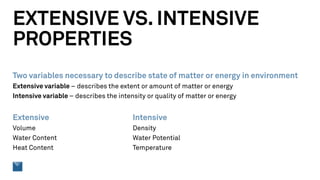
EXTENSIVE VS. INTENSIVE
PROPERTIES
Two variables necessary to describe state of matter or energy in environment
Extensive variable – describes the extent or amount of matter or energy
Intensive variable – describes the intensity or quality of matter or energy
Extensive Intensive
Volume Density
Water Content Water Potential
Heat Content Temperature
WATER POTENTIAL
DEFINITION
Energy required, per quantity of water, to transport an
infinitesimal quantity of water from the sample to a
reference pool of pure, free water
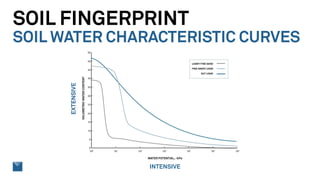
SOIL FINGERPRINT
SOIL WATER CHARACTERISTIC CURVES
EXTENSIVE
INTENSIVE
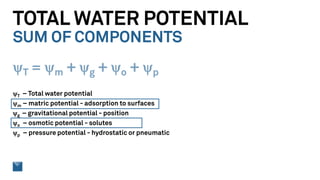
TOTAL WATER POTENTIAL
SUM OF COMPONENTS
ψT = ψm + ψg + ψo + ψp
ψT – Total water potential
ψm – matric potential - adsorption to surfaces
ψg – gravitational potential - position
ψo – osmotic potential - solutes
ψp – pressure potential - hydrostatic or pneumatic
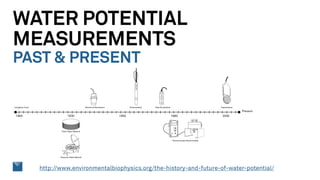
WATER POTENTIAL
MEASUREMENTS
PAST & PRESENT
http://www.environmentalbiophysics.org/the-history-and-future-of-water-potential/
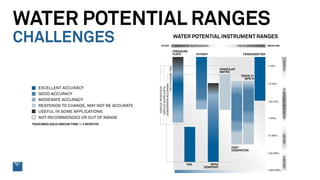
WATER POTENTIAL RANGES
CHALLENGES
WATER POTENTIAL
MEASUREMENTS
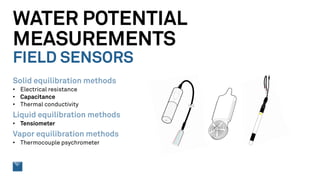
FIELD SENSORS
Solid equilibration methods
• Electrical resistance
• Capacitance
• Thermal conductivity
Liquid equilibration methods
• Tensiometer
Vapor equilibration methods
• Thermocouple psychrometer
FIELD SENSORS
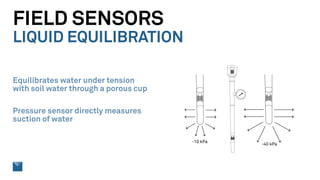
LIQUID EQUILIBRATION
Equilibrates water under tension
with soil water through a porous cup
Pressure sensor directly measures
suction of water
FIELD SENSORS
LIQUID EQUILIBRATION
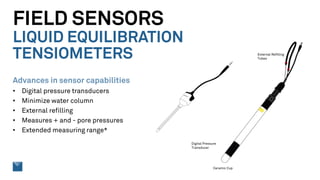
TENSIOMETERS
Advances in sensor capabilities
• Digital pressure transducers
• Minimize water column
• External refilling
• Measures + and - pore pressures
• Extended measuring range*
Ceramic Cup
Digital Pressure
Transducer
External Refilling
Tubes
FIELD SENSORS
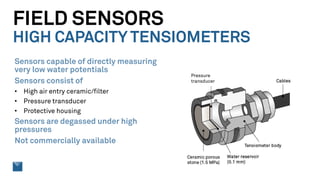
HIGH CAPACITY TENSIOMETERS
Sensors capable of directly measuring
very low water potentials
Sensors consist of
• High air entry ceramic/filter
• Pressure transducer
• Protective housing
Sensors are degassed under high
pressures
Not commercially available
Pressure
transducer
FIELD SENSORS
LIQUID EQUILIBRATION
PROS & CONS
Advantages
• Highest accuracy of any sensor
in wet range
• Positive pore pressure
measurements
Disadvantages
• Limited to water potential
from 0 to -90 kPa
• Significant maintenance
requirements
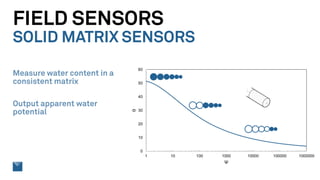
0
10
20
30
40
50
60
1 10 100 1000 10000 100000 1000000
θ
Ψ
FIELD SENSORS
SOLID MATRIX SENSORS
Measure water content in a
consistent matrix
Output apparent water
potential
FIELD SENSORS
SOLID MATRIX SENSORS
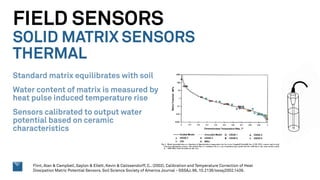
THERMAL
Standard matrix equilibrates with soil
Water content of matrix is measured by
heat pulse induced temperature rise
Sensors calibrated to output water
potential based on ceramic
characteristics
Flint, Alan & Campbell, Gaylon & Ellett, Kevin & Calissendorff, C.. (2002). Calibration and Temperature Correction of Heat
Dissipation Matric Potential Sensors. Soil Science Society of America Journal - SSSAJ. 66. 10.2136/sssaj2002.1439.
FIELD SENSORS
SOLID MATRIX SENSORS
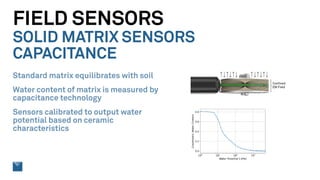
CAPACITANCE
Standard matrix equilibrates with soil
Water content of matrix is measured by
capacitance technology
Sensors calibrated to output water
potential based on ceramic
characteristics
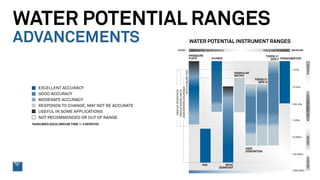
WATER POTENTIAL RANGES
ADVANCEMENTS
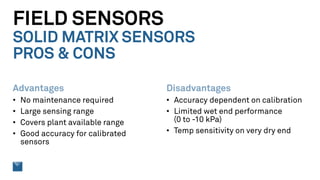
FIELD SENSORS
SOLID MATRIX SENSORS
PROS & CONS
Advantages
• No maintenance required
• Large sensing range
• Covers plant available range
• Good accuracy for calibrated
sensors
Disadvantages
• Accuracy dependent on calibration
• Limited wet end performance
(0 to -10 kPa)
• Temp sensitivity on very dry end
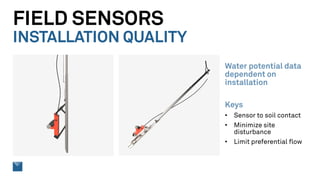
FIELD SENSORS
INSTALLATION QUALITY
Water potential data
dependent on
installation
Keys
• Sensor to soil contact
• Minimize site
disturbance
• Limit preferential flow
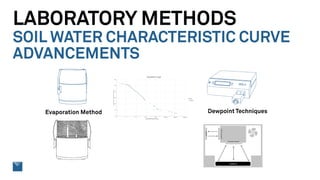
LABORATORY METHODS
SOIL WATER CHARACTERISTIC CURVE
ADVANCEMENTS
Evaporation Method Dewpoint Techniques
LABORATORY METHODS
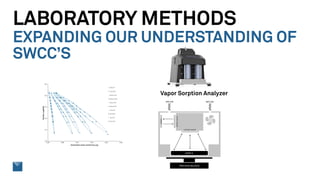
EXPANDING OUR UNDERSTANDING OF
SWCC’S
Vapor Sorption Analyzer
LABORATORY METHODS
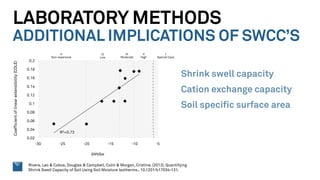
ADDITIONAL IMPLICATIONS OF SWCC’S
Shrink swell capacity
Cation exchange capacity
Soil specific surface area
Rivera, Leo & Cobos, Douglas & Campbell, Colin & Morgan, Cristine. (2013). Quantifying
Shrink Swell Capacity of Soil Using Soil Moisture Isotherms.. 10.1201/b17034-131.
LABORATORY METHODS
GROWING BODY OF WORK
References
1. Wang et al. (2022). “Soil water isotherm equations for particle surface sorption and interlamellar sorption.” VZJ
2. Zhang and Lu (2019). “Augmented Brunauer–Emmett–Teller equation for water adsorption on soils.” VZJ
3. Luo et al. (2023). “Determination of cation exchange capacity of soil by water vapor sorption.” JGGE
4. Luo et al. (2023). “Determination of pore size distribution of soil by water vapor sorption.” JGGE
5. Luo et al. (2022). “Determination of soil sorptive potential by soil water isotherm.” JGGE
6. Lu et al. (2022). “Water adsorption-induced pore water pressure in soil.” JGGE
7. Wang et al. (2022). “Soil swelling potential: Theory, determination, and validation.” JGGE
8. Lu and Kaya (2013). “A drying cake method for measuring suction-stress characteristic curve, soil–water-retention
curve, and hydraulic conductivity function.” GTJ
9. Lu and Dong (2017). “Correlation between soil-shrinkage curve and water-retention characteristics.” JGGE
10. Zhang et al. (2021). “Unified elastic modulus characteristic curve equation.” JGGE
11. Zhang and Lu (2019). “Unified effective stress equation for soil.” JEM
FUTURE TESTS
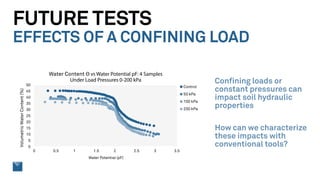
EFFECTS OF A CONFINING LOAD
Confining loads or
constant pressures can
impact soil hydraulic
properties
How can we characterize
these impacts with
conventional tools?
CONCLUSION
Variety of tools available to measure water potential
• Keep in mind measurement ranges and applications
• Installation is key
Need to continue advancing the capabilities of these measurements
• Sensor capabilities and models
QUESTIONS
Leo Rivera, MS
Director of Scientific Outreach
METER Group, Inc.
2365 NE Hopkins Ct, Pullman, WA USA 99163
T: +1 509 332 2756
E: leo.rivera@metergroup.com
W: www.metergroup.com

Choosing the Right Water Potential Sensor

  • 2.
    CHOOSING THE RIGHTWATER POTENTIAL SENSOR IN 2023 Leo Rivera METER Group, Inc. USA
  • 3.
    EXTENSIVE VS. INTENSIVE PROPERTIES Twovariables necessary to describe state of matter or energy in environment Extensive variable – describes the extent or amount of matter or energy Intensive variable – describes the intensity or quality of matter or energy Extensive Intensive Volume Density Water Content Water Potential Heat Content Temperature
  • 4.
    WATER POTENTIAL DEFINITION Energy required,per quantity of water, to transport an infinitesimal quantity of water from the sample to a reference pool of pure, free water
  • 5.
    SOIL FINGERPRINT SOIL WATERCHARACTERISTIC CURVES EXTENSIVE INTENSIVE
  • 6.
    TOTAL WATER POTENTIAL SUMOF COMPONENTS ψT = ψm + ψg + ψo + ψp ψT – Total water potential ψm – matric potential - adsorption to surfaces ψg – gravitational potential - position ψo – osmotic potential - solutes ψp – pressure potential - hydrostatic or pneumatic
  • 7.
    WATER POTENTIAL MEASUREMENTS PAST &PRESENT http://www.environmentalbiophysics.org/the-history-and-future-of-water-potential/
  • 8.
  • 9.
    WATER POTENTIAL MEASUREMENTS FIELD SENSORS Solidequilibration methods • Electrical resistance • Capacitance • Thermal conductivity Liquid equilibration methods • Tensiometer Vapor equilibration methods • Thermocouple psychrometer
  • 10.
    FIELD SENSORS LIQUID EQUILIBRATION Equilibrateswater under tension with soil water through a porous cup Pressure sensor directly measures suction of water
  • 11.
    FIELD SENSORS LIQUID EQUILIBRATION TENSIOMETERS Advancesin sensor capabilities • Digital pressure transducers • Minimize water column • External refilling • Measures + and - pore pressures • Extended measuring range* Ceramic Cup Digital Pressure Transducer External Refilling Tubes
  • 12.
    FIELD SENSORS HIGH CAPACITYTENSIOMETERS Sensors capable of directly measuring very low water potentials Sensors consist of • High air entry ceramic/filter • Pressure transducer • Protective housing Sensors are degassed under high pressures Not commercially available Pressure transducer
  • 13.
    FIELD SENSORS LIQUID EQUILIBRATION PROS& CONS Advantages • Highest accuracy of any sensor in wet range • Positive pore pressure measurements Disadvantages • Limited to water potential from 0 to -90 kPa • Significant maintenance requirements
  • 14.
    0 10 20 30 40 50 60 1 10 1001000 10000 100000 1000000 θ Ψ FIELD SENSORS SOLID MATRIX SENSORS Measure water content in a consistent matrix Output apparent water potential
  • 15.
    FIELD SENSORS SOLID MATRIXSENSORS THERMAL Standard matrix equilibrates with soil Water content of matrix is measured by heat pulse induced temperature rise Sensors calibrated to output water potential based on ceramic characteristics Flint, Alan & Campbell, Gaylon & Ellett, Kevin & Calissendorff, C.. (2002). Calibration and Temperature Correction of Heat Dissipation Matric Potential Sensors. Soil Science Society of America Journal - SSSAJ. 66. 10.2136/sssaj2002.1439.
  • 16.
    FIELD SENSORS SOLID MATRIXSENSORS CAPACITANCE Standard matrix equilibrates with soil Water content of matrix is measured by capacitance technology Sensors calibrated to output water potential based on ceramic characteristics
  • 17.
  • 18.
    FIELD SENSORS SOLID MATRIXSENSORS PROS & CONS Advantages • No maintenance required • Large sensing range • Covers plant available range • Good accuracy for calibrated sensors Disadvantages • Accuracy dependent on calibration • Limited wet end performance (0 to -10 kPa) • Temp sensitivity on very dry end
  • 19.
    FIELD SENSORS INSTALLATION QUALITY Waterpotential data dependent on installation Keys • Sensor to soil contact • Minimize site disturbance • Limit preferential flow
  • 20.
    LABORATORY METHODS SOIL WATERCHARACTERISTIC CURVE ADVANCEMENTS Evaporation Method Dewpoint Techniques
  • 21.
    LABORATORY METHODS EXPANDING OURUNDERSTANDING OF SWCC’S Vapor Sorption Analyzer
  • 22.
    LABORATORY METHODS ADDITIONAL IMPLICATIONSOF SWCC’S Shrink swell capacity Cation exchange capacity Soil specific surface area Rivera, Leo & Cobos, Douglas & Campbell, Colin & Morgan, Cristine. (2013). Quantifying Shrink Swell Capacity of Soil Using Soil Moisture Isotherms.. 10.1201/b17034-131.
  • 23.
    LABORATORY METHODS GROWING BODYOF WORK References 1. Wang et al. (2022). “Soil water isotherm equations for particle surface sorption and interlamellar sorption.” VZJ 2. Zhang and Lu (2019). “Augmented Brunauer–Emmett–Teller equation for water adsorption on soils.” VZJ 3. Luo et al. (2023). “Determination of cation exchange capacity of soil by water vapor sorption.” JGGE 4. Luo et al. (2023). “Determination of pore size distribution of soil by water vapor sorption.” JGGE 5. Luo et al. (2022). “Determination of soil sorptive potential by soil water isotherm.” JGGE 6. Lu et al. (2022). “Water adsorption-induced pore water pressure in soil.” JGGE 7. Wang et al. (2022). “Soil swelling potential: Theory, determination, and validation.” JGGE 8. Lu and Kaya (2013). “A drying cake method for measuring suction-stress characteristic curve, soil–water-retention curve, and hydraulic conductivity function.” GTJ 9. Lu and Dong (2017). “Correlation between soil-shrinkage curve and water-retention characteristics.” JGGE 10. Zhang et al. (2021). “Unified elastic modulus characteristic curve equation.” JGGE 11. Zhang and Lu (2019). “Unified effective stress equation for soil.” JEM
  • 24.
    FUTURE TESTS EFFECTS OFA CONFINING LOAD Confining loads or constant pressures can impact soil hydraulic properties How can we characterize these impacts with conventional tools?
  • 25.
    CONCLUSION Variety of toolsavailable to measure water potential • Keep in mind measurement ranges and applications • Installation is key Need to continue advancing the capabilities of these measurements • Sensor capabilities and models
  • 26.
    QUESTIONS Leo Rivera, MS Directorof Scientific Outreach METER Group, Inc. 2365 NE Hopkins Ct, Pullman, WA USA 99163 T: +1 509 332 2756 E: leo.rivera@metergroup.com W: www.metergroup.com