TRL 2 Technology Concept


              POC
    Gerald Temple, PE
  gerald.temple@nasa.gov
   mobile: (510) 304-7243

   Friedemann Freund, PhD
friedemann.t.freund@nasa.gov
     mobile: (650) 279-8478
Earthquake Forecasting System (EQFS) Principle Concepts
• EQFS: world’s first earthquake forecasting algorithm using NASA’s System
  Engineering approach.
• EQFS combines historical EQ fault information with multi-source real time data
  from satellites and ground observations.
• EQFS uses computer modeling and testability analysis to simulate an EQ as a
  system with many interactive subsystems:
    •   Input
    •   Output
    •   Feedback
    •   Precursory functionality.
• EQFS uses a probability quantification analysis for simplistic computation:
    •   Less chance for error
    •   Easy comprehension
    •   Easy communication
    •   Quick and easy updating and modification.
• EQFS finds probability of an EQ of a given magnitude range within a given time
  window for a given geographical area.
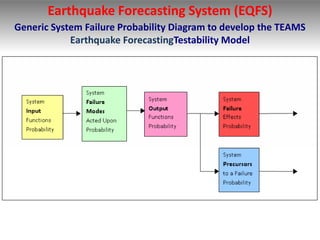
Earthquake Forecasting System (EQFS)
Generic System Failure Probability Diagram to develop the TEAMS
            Earthquake ForecastingTestability Model
Earthquake Forecasting System (EQFS)
Top Level Functional Flow Diagram of an Unstable Nonlinear Geo-System
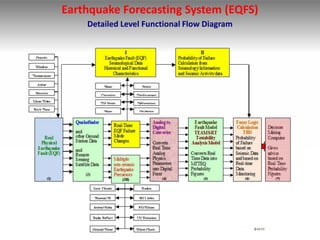
Earthquake Forecasting System (EQFS)
    Detailed Level Functional Flow Diagram
Architecture for a new approach to
                earthquake forecasting.

    Will save countless lives and billions of dollars
                throughout the world.


Magnitude 6.3 earthquake rocks Christchurch, NZ, on Feb. 22, 2011 at 12.51 pm local time

Earthquake Forecasting System

  • 1.
    TRL 2 TechnologyConcept POC Gerald Temple, PE gerald.temple@nasa.gov mobile: (510) 304-7243 Friedemann Freund, PhD friedemann.t.freund@nasa.gov mobile: (650) 279-8478
  • 2.
    Earthquake Forecasting System(EQFS) Principle Concepts • EQFS: world’s first earthquake forecasting algorithm using NASA’s System Engineering approach. • EQFS combines historical EQ fault information with multi-source real time data from satellites and ground observations. • EQFS uses computer modeling and testability analysis to simulate an EQ as a system with many interactive subsystems: • Input • Output • Feedback • Precursory functionality. • EQFS uses a probability quantification analysis for simplistic computation: • Less chance for error • Easy comprehension • Easy communication • Quick and easy updating and modification. • EQFS finds probability of an EQ of a given magnitude range within a given time window for a given geographical area.
  • 3.
    Earthquake Forecasting System(EQFS) Generic System Failure Probability Diagram to develop the TEAMS Earthquake ForecastingTestability Model
  • 4.
    Earthquake Forecasting System(EQFS) Top Level Functional Flow Diagram of an Unstable Nonlinear Geo-System
  • 5.
    Earthquake Forecasting System(EQFS) Detailed Level Functional Flow Diagram
  • 6.
    Architecture for anew approach to earthquake forecasting. Will save countless lives and billions of dollars throughout the world. Magnitude 6.3 earthquake rocks Christchurch, NZ, on Feb. 22, 2011 at 12.51 pm local time