The Old Kingdom
Social Studies for 8th E.G.B. | Teacher: Mauricio Torres
Introduction
    The same way the Sumerians
     organized their society into
     different social classes, the
     Egyptians’ social structure
     was arranged in the same
     way.
       A small group (nobles) ruled
        Egypt.
       A bigger group provided
        food, crafts and labor.
Early Egyptian Society
      The Old
Kingdom began
 when the Third
Dynasty rose to
  power around
      2700 BC. It
   lasted for 500
           years.


                    Pyramid of Djoser.- This first Egyptian pyramid consisted
                    of six mastabas (of decreasing size) built atop one another.
                    2600 BC.
Pharaohs
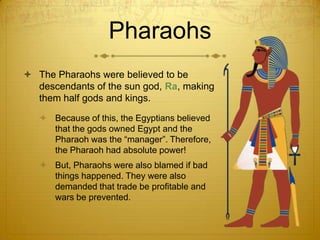
 The Pharaohs were believed to be
  descendants of the sun god, Ra, making
  them half gods and kings.

    Because of this, the Egyptians believed
     that the gods owned Egypt and the
     Pharaoh was the “manager”. Therefore,
     the Pharaoh had absolute power!
    But, Pharaohs were also blamed if bad
     things happened. They were also
     demanded that trade be profitable and
     wars be prevented.
Khufu
 The most famous pharaoh of
  the Old Kingdom was Khufu
  (Kheops).
 Some people say he was a
  good ruler, while other
  historians like Herodotus,
  labeled him a cruel tyrant.
 He is responsible for many
  monuments, including the
  Great Pyramid of Giza (2500
  BC).
Social Structure


   By 2200 BC, Egypt had 2 million people.

   There were three different social classes:
           Nobles: People from rich families.
           Middle class: Gov. officials, scribes, craftsmen, soldiers.
           Lower class: farmers and slaves (80% of the complete population)
Egypt and its Neighbors
   Egypt was well protected by its
    geography, but not completely
    isolated.
       Sumerian designs can be found
        in Egyptian art.
       Style from Nubia (south of Egypt)
        are also found.
   Trade with their neighbors
    allowed them to import different
    items:
       Nubia: gold, ivory, slaves and
        stone.
       Punt: incense and myrrh.
       Syria: wood.
Ask Yourself
 Recall:
    For how long did the Old Kingdom last?
 Drawing conclusions:
    What responsibilities did the pharaoh have that
     balanced his high status?
 Make Judgments:
    What may be some advantages and disadvantages for
     such a large segment of the population being farmers,
     servants and slaves?
Art Workshop!
 Imagine you have been asked by the government of
  Egypt to design stamps to commemorate the 4700th
  anniversary of the Old Kingdom’s beginning. Choose
  one of the subjects studied in class and draw a stamp!

 Afterwards, write a short summary (one paragraph) of
  the topic you illustrated.

8 old kingdom

  • 1.
    The Old Kingdom SocialStudies for 8th E.G.B. | Teacher: Mauricio Torres
  • 2.
    Introduction  The same way the Sumerians organized their society into different social classes, the Egyptians’ social structure was arranged in the same way.  A small group (nobles) ruled Egypt.  A bigger group provided food, crafts and labor.
  • 3.
    Early Egyptian Society  The Old Kingdom began when the Third Dynasty rose to power around 2700 BC. It lasted for 500 years. Pyramid of Djoser.- This first Egyptian pyramid consisted of six mastabas (of decreasing size) built atop one another. 2600 BC.
  • 4.
    Pharaohs  The Pharaohswere believed to be descendants of the sun god, Ra, making them half gods and kings.  Because of this, the Egyptians believed that the gods owned Egypt and the Pharaoh was the “manager”. Therefore, the Pharaoh had absolute power!  But, Pharaohs were also blamed if bad things happened. They were also demanded that trade be profitable and wars be prevented.
  • 5.
    Khufu  The mostfamous pharaoh of the Old Kingdom was Khufu (Kheops).  Some people say he was a good ruler, while other historians like Herodotus, labeled him a cruel tyrant.  He is responsible for many monuments, including the Great Pyramid of Giza (2500 BC).
  • 6.
    Social Structure  By 2200 BC, Egypt had 2 million people.  There were three different social classes:  Nobles: People from rich families.  Middle class: Gov. officials, scribes, craftsmen, soldiers.  Lower class: farmers and slaves (80% of the complete population)
  • 7.
    Egypt and itsNeighbors  Egypt was well protected by its geography, but not completely isolated.  Sumerian designs can be found in Egyptian art.  Style from Nubia (south of Egypt) are also found.  Trade with their neighbors allowed them to import different items:  Nubia: gold, ivory, slaves and stone.  Punt: incense and myrrh.  Syria: wood.
  • 8.
    Ask Yourself  Recall:  For how long did the Old Kingdom last?  Drawing conclusions:  What responsibilities did the pharaoh have that balanced his high status?  Make Judgments:  What may be some advantages and disadvantages for such a large segment of the population being farmers, servants and slaves?
  • 9.
    Art Workshop!  Imagineyou have been asked by the government of Egypt to design stamps to commemorate the 4700th anniversary of the Old Kingdom’s beginning. Choose one of the subjects studied in class and draw a stamp!  Afterwards, write a short summary (one paragraph) of the topic you illustrated.