8 Continuous-Time
Fourier Transform
Solutions to
Recommended Problems
S8.1
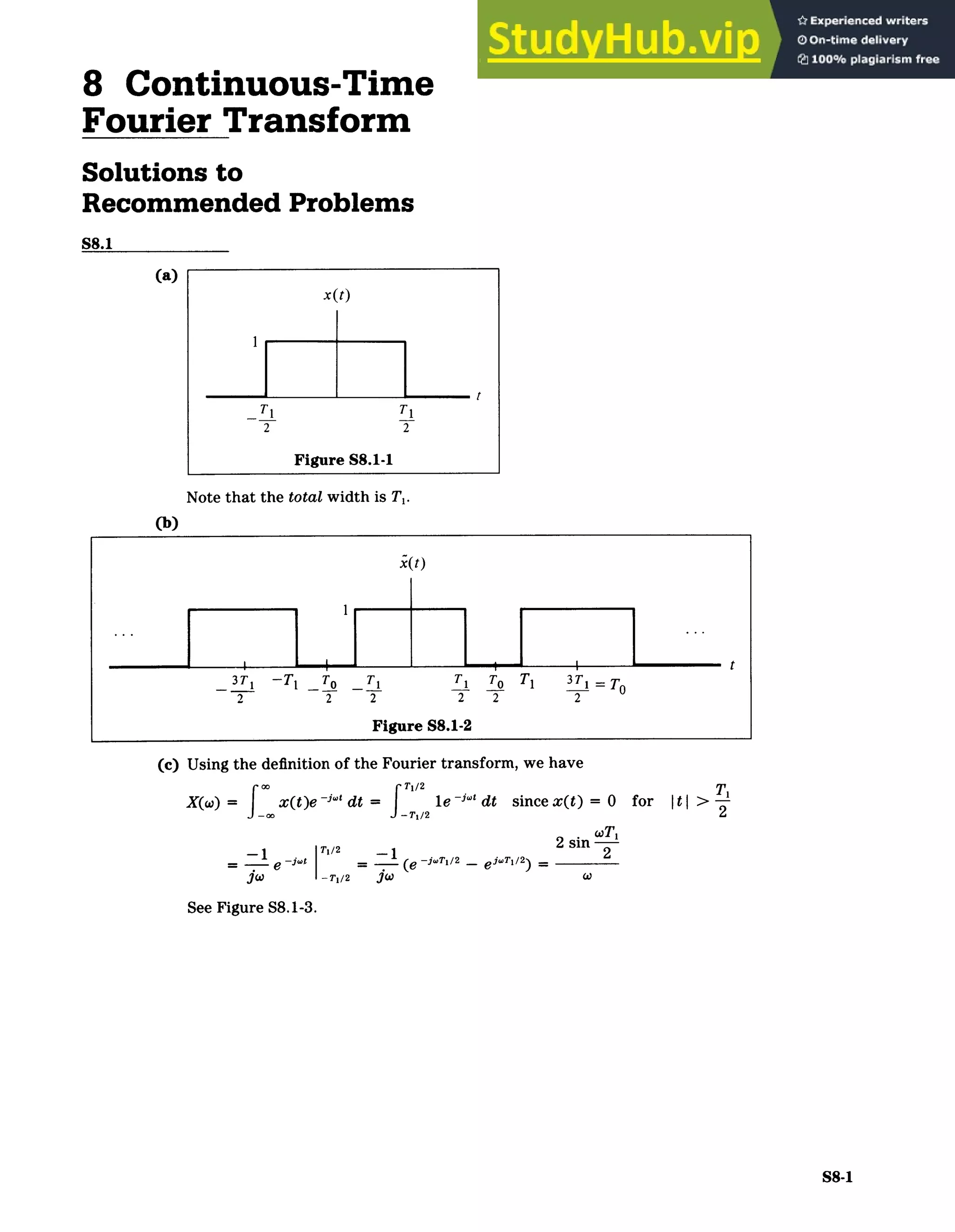
(a)
x(t)
t
Tj Tj
2 2
Figure S8.1-1
Note that the totalwidth is T,.
(b)
i(t)
t
3T1 ­­ T1 To T1 T1 To Tl 3
T 1 =O
2 2 2 2 2 2
Figure S8.1-2
(c) Using the definition of the Fourier transform, we have
X(w) = ox(t)e ­j dt =
Ti/2 le­j" dt since x(t) = 0 for ItI>
Til 12 sin wTi
= e ­ (e ­jwTI1/2 _ eT1/
2
) = 2
JW ­T1/2 (e
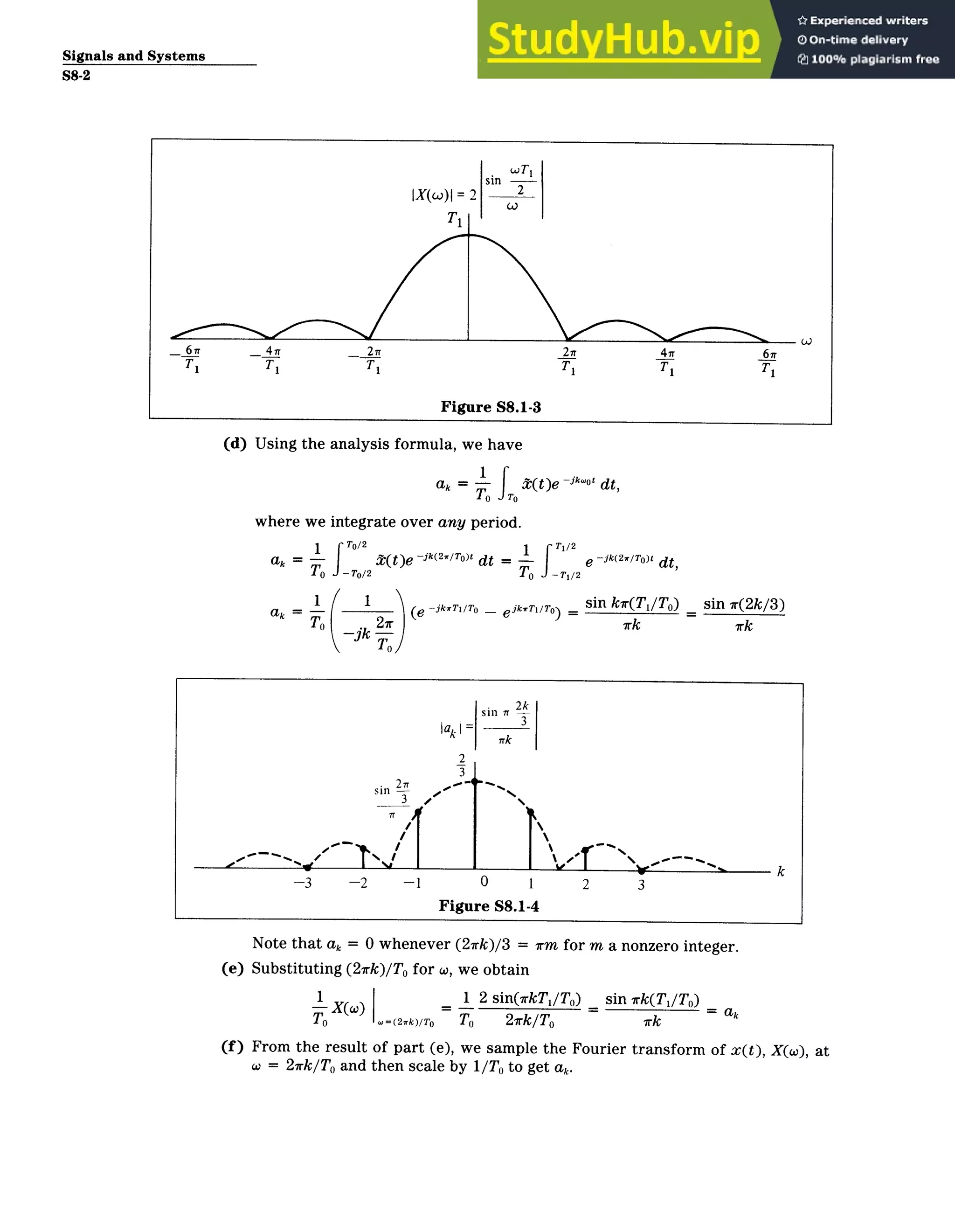
See Figure S8.1-3.
S8-1
Signals and Systems
S8-2
(d) Using the analysis formula, we have
ak = T f X(t)e ~jk 0
t dt,
where we integrate over any period.
_ 1
ak -T e ­jk(2/T )t dt
fT (t)e ­jk(2w/T)t dt = fT1 /2 O
- To12 TO -T
1
/2
To
1
ak = (e jkirToT 0 ­­ eikir1/TO) =
sin kr(T
1 /T 0 ) _ sin ,r(2k/3)
TO ,rk 7rk
­jk 2,
Note that ak = 0 whenever (27rk)/3 = irm for m a nonzero integer.
(e) Substituting (21rk)/To for o, we obtain
T
_1X( =2)T
1 2 sin(7rkT
1 /T0 ) sin rk(T1 /T 0 )
ak
TO I"=(21rk)/ To To 2,rk/To ,rk =
(f) From the result of part (e), we sample the Fourier transform of x( t), X(w), at
w = 2irk/To and then scale by 1/To to get ak.
Continuous-Time FourierTransform / Solutions
S8-3
S8.2
(a) X(w) = fx(t)e ­j4t dt = (t - 5)e -j' dt = e ~j = cos 5w ­ j sin 5w,
by the sifting property of the unit impulse.
IX(w)| = |ej5
wI = 1 for all w,
<tX(w) = tan­' tan ­sin5wo) = ­5w
LIM{X(xc)}
Re{X(co)} cos 5w
(b) X(w) = e ­a t
u(t)e -i"' dt = e ­ate ­j't dt
e ­ (a+jo)t
0 ­ (a+jw)t dt -1
a+jw o
Since Re{a} > 0, e ­at goes to zero as t goes to infinity. Therefore,
-1 1
X(W) = 1(0 - 1) =
a +jw
a + jw
IX(W)I = [X(W)X*(w)]l/ 2
=
a +ja ­jw)] 2
1
+o2 >
/
X(w) + X*(O) a
Re{X(w)} = 2 a2
+ (2 i
Im{X(W)} = X(W) - X*(W) -W
2 a2
+ w2
'>
Im{X(W)) _ w
­X(O) = tan­ = ­tan a
The magnitude and angle of X(w) are shown in Figure S8.2-2.
Jawaban no.1
Signals and Systems
S8­4
IX(w)I
­a a
4X(W)
2
Tro
­aa
2T
Figure S8.2-2
(c) X(o) = e 1+1
2)tU(t )e ­'''dt = e(­1+ 2
)te ­jct dt
1
[ 1-+j(2-)t 0
1 + j(2 ­ )0
Since Re{­1 + j(2 - w)} < 0, lim, e[­ 1+j(2­w) = 0. Therefore,
1
1 + j(o - 2)
1
IX(wO)| = [X(x)X*(W)]11 2
=
/1 + (o
w­ 2)
2
X(w) + X*(W) 1
Re{X()} =
2 1 + (w ­ 2)2
X(w) - X*(co) ­(o ­ 2)
Im{X(W)} =
2 1 + ((A ­2)2
X() = tan­' ImX(W) ­tan­'(w - 2)
LRe{X(w)}
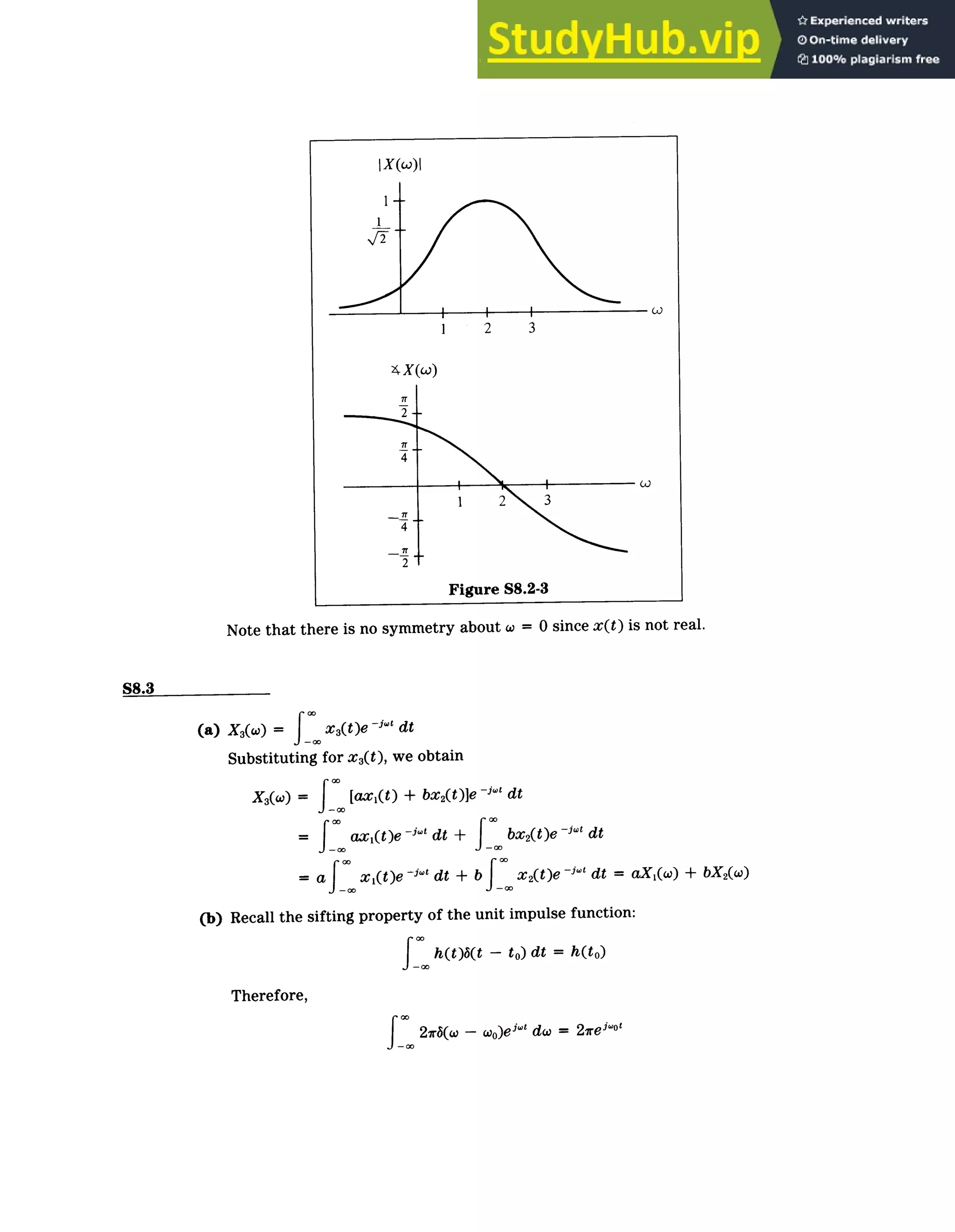
The magnitude and angle of X(w) are shown in Figure S8.2-3.
Continuous-Time Fourier Transform/ Solutions
S8-5
X(w)I
1
1 2 3
4X(W)
Figure S8.2-3
Note that there is no symmetry about w = 0 since x(t) is not real.
S8.3
(a) X3(w) = X3(t)e ­' dt
Substituting for x3(t), we obtain
X3(() = J [ax1(t) + bx 2(t0)e 1­'dt
=f ax1(t)e ­wt dt + bx 2(t)e ­jwt dt
= af x1(t)e ­j dt + b f x 2(t)e ­­ ' dt = aX
1(w) + bX 2(w)
(b) Recall the sifting property of the unit impulse function:
f h(t)b(t - to) dt = h(t o)
Therefore,
21rb(w - wo)ej­' do = 2rewot
Signals and Systems
S8-6
Thus,
1- 2
7rb(w - wo)ei­' dw = ei­o'
2,r -"oo
Note that the integral relating 2­7rS(w - wo) and e­o' is exactly of the form
x(t) = ­ X(w)ej­ t
dw,
where x(t) = ejot and X(w) = 2­7rb(co - wo). Thus, we can think of ei­o' as the
inverse Fourier transform of 2
7rb(w - wo). Therefore, 27rb(o - wo) is the Fourier
transform of eiwo'.
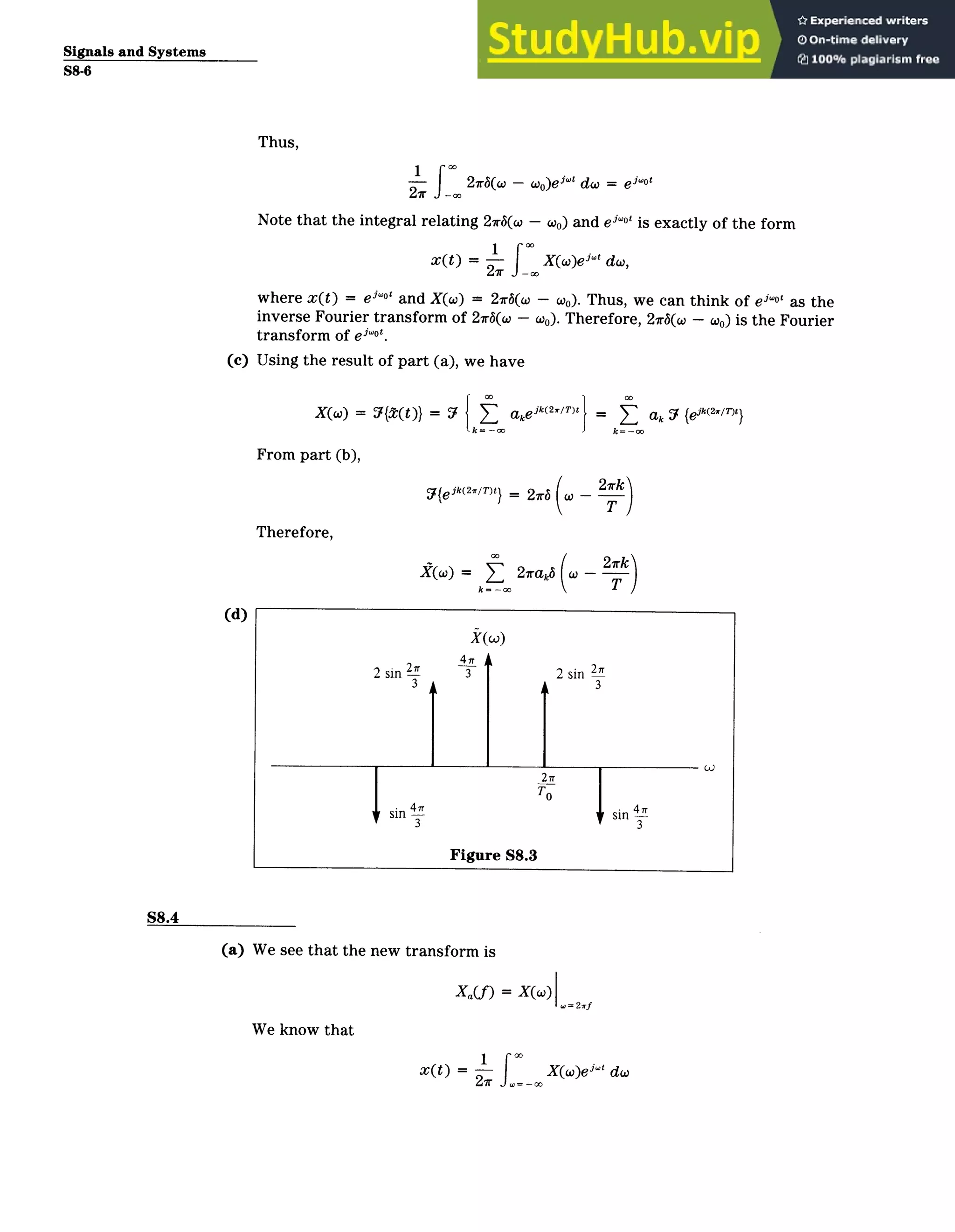
(c) Using the result of part (a), we have
=
X(M) = 7{x(t)} = 51 1 ake 2r j
T, a, 5T {eik(2
,rs/t
From part (b),
5{eik(2,rT)t = 2,irb ( W
­21rk)
Therefore,
Z(w) = 27rab ( W
k = ­00
(d)
X(w)
2 sin 3 2 sin 2
T o
3 3
Figure S8.3
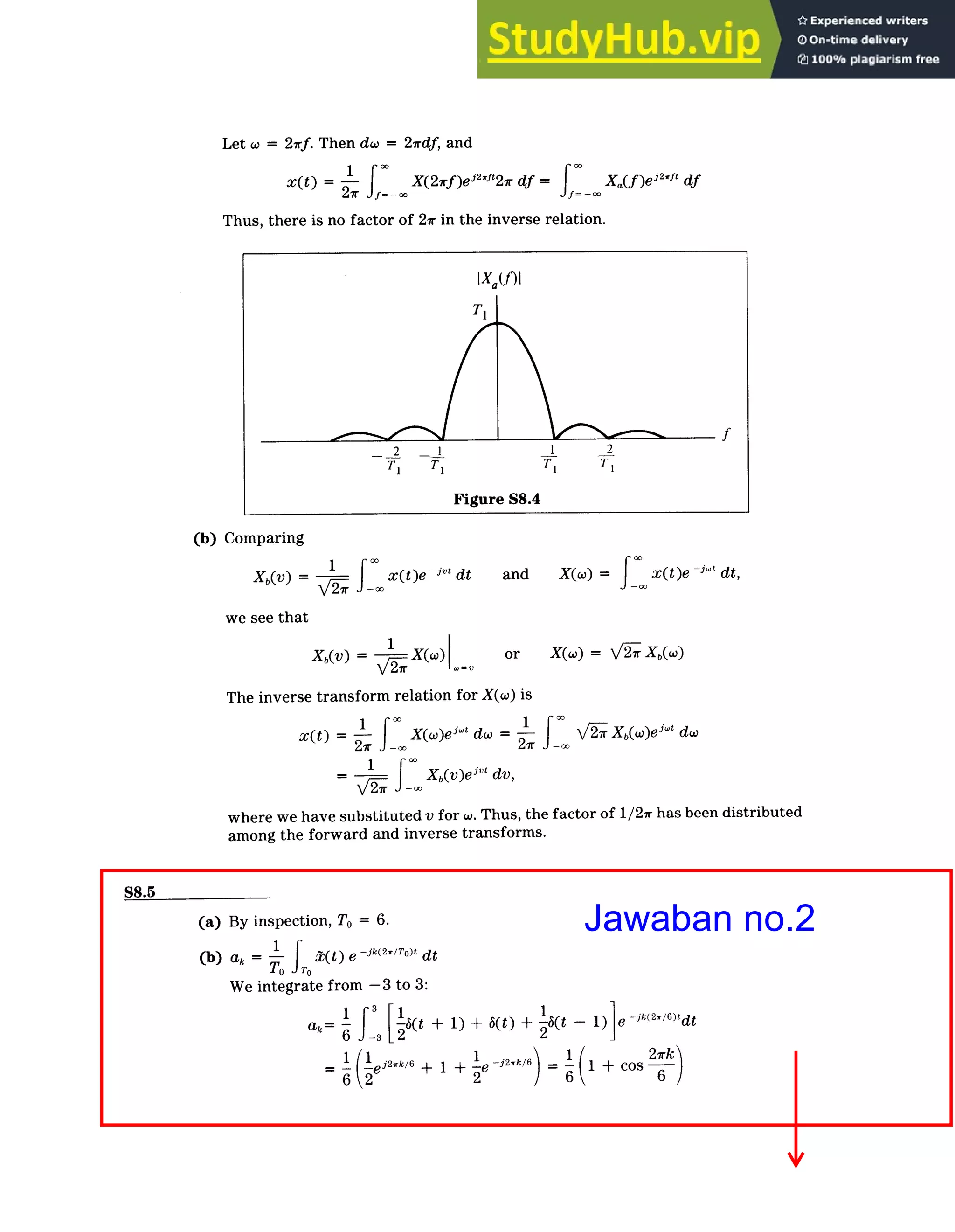
S8.4
(a) We see that the new transform is
Xa(f) = X(w)
W=2,wf
We know that
x(t) = - f X(w)e'j t do
Continuous­Time Fourier Transform / Solutions
S8-7
Let w = 2irf. Then dw = 21rdf, and
=
x(t)
1
X(21rf)ej 2
"2ir df = Xa(f )ei2
,"f df
27 f= ­o
Thus, there is no factor of 21r in the inverse relation.
IXa(f)I
TI
2 1 1 2
TI TI TF T,
Figure S8.4
(b) Comparing
Xb(V) = -1 x(t)e jv' dt and X(w) = x(t ­j~" dt,
we see that
Xb(V) = X(W) or X(w) = 7 X(w)
V2_ ­V
7r
The inverse transform relation for X(w) is
x(t) -
1 *0
X(w)e
j
dw = 1 X2r(w)ej­ dw
=1
Xb(v)e jvt dv,
where we have substituted v for w. Thus, the factor of 1/2­x has been distributed
among the forward and inverse transforms.
S8.5
(a) By inspection, To = 6.
(b) ak = 1 TO )e ­k(
2
/To)t dt
TO JT0
We integrate from -3 to 3:
1 1 1
ak= (ti + 1)+ 6(t) + ­6(t ­ + c 6
J­
2 2
(1
= 1 +l 1 + 'je ­Jlk6.. Cos 2k
Jawaban no.2
Signals and Systems
S8-8
(t) = 6( + Cos 27rk eik(2
/
6
)t
(c) (i) X1(w) = x 1 (t)e ­"' dt ­ [6(t + 1) + b(t) + ­1(t - 1)]e -j't dt
- ie * + 1 + ie ­"1 + cos w
(ii) X 2(w) = x2(t)e ­''' dt = [3( t) + it(t - 1) + ­3(t - 5)]e ­ dt
= 1 + ie -j + le ­i
5
w
(d) We see that by periodically repeating x1 ( t) with period Ti = 6, we get t(t), as
shown in Figure S8.5-1.
x1 (t)
2
t
-1 0 1
x 1 (t - 6)
0 5 6 7
xl(t + 6)
2 t t |tt) t
-7 -6 ­5 0
x(t)
­7 ­6 ­5 -1 0 1 5 6 7
Figure S8.5-1
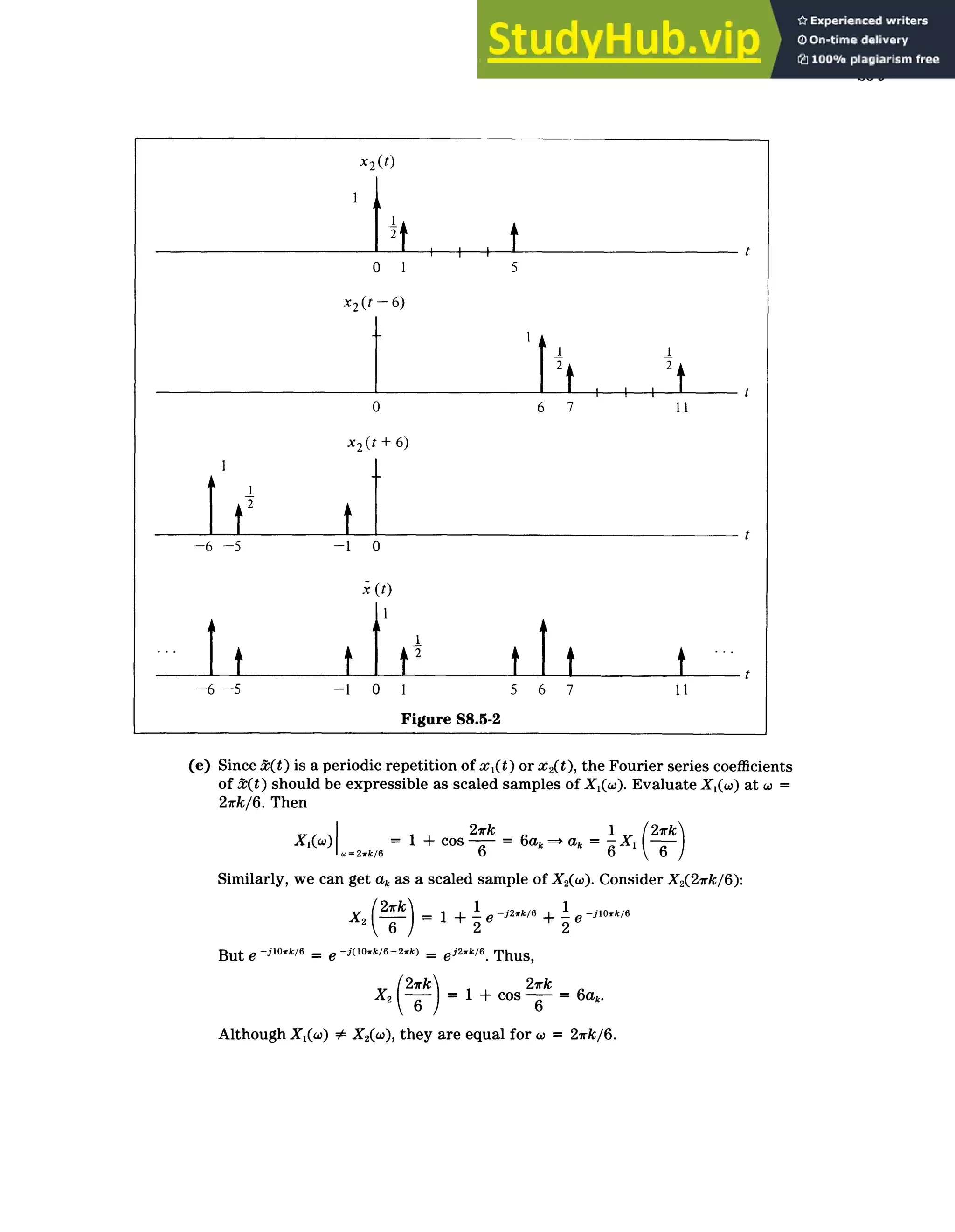
Similarly, we can periodically repeat x 2(t) to get 1(t). Thus T2 = 6. See Figure
S8.5-2.
Continuous­Time Fourier Transform / Solutions
S8-9
x 2(t)
tilt
t
01
X2 (t -6)
2
0 6 7
t 1 1
t t
x2(t ± 6)
t2~ 2
-6-5 0 7
X(t)
IL t2 tIt t
-6 -5 -1 0 1 5 6 7
Figure S8.5-2
(e) Since I(t) is a periodic repetition of x 1 (t) or X 2(0), the Fourier series coefficients
of t(t) should be expressible as scaled samples of X,(co). Evaluate X1 (0 ) at w=
21rk/6. Then
6
co­= k*k2rk 1 (27rk
Similarly, we can get ak as a scaled sample of X2(w). Consider X2(21rk/6):
X2­ 1 j2k/6 +
5e e
X1(x) =irk1 =6,rk n X x
+2o
62 2
But e njlOrk6
e j(lOrk/62rk) 2
rkI
6
. Thus,
= e
e
X2 = 1 + cos ­ =
6
a.
A X6
Although X,(w) # X 2(w), they are equal for w =27rk/6.
Signals and Systems
S8-10
S8.6
(a) By inspection,
Thus,
e ­atu(t) 7
9
1
.
a + jw
(b)
7I 1
e­ 7tu(t) 1
7 + jw
Direct inversion using the inverse Fourier transform formula is very difficult.
Xb(w) = 26(w + 7) + 26(o - 7),
Xb(t) = ­ Xb(w)ej do = ­ 2
[6(w + 7) + 6(w
1 1 . 2
e­-It + e = cos 7t
- 7)]ei-' dw
(c) From Example 4.8 of the text (page 191), we see that
37 2a
e alti 9 _2a
a 2 + W
2
However, note that
since
ax(t) aX(w)
ax(t)e ­j" dt = a x(t)e ­jw dt = aX(w)
Thus,
(d)
1 -
-e ­" l
2a
1
a2
+ (0
2
1 7
or
9 + .2
Xa(w)Xb(W) = Xa(w)[26(o + 7) + 26(w - 7)]
= 2X(­7)(co + 7) + 2Xa(7)6(w - 7)
2 2
XdCO)= ­ (w +7) + b(o7)
7 - j7 7 +j7
1f*[2 ±7+ 2
xaOt = f- .7 6(o + 7) + b(co
27r­­ 7 -37 7 +j7
1 1 . 1 1 .
XA(t) = ­ e -
7
' + ­ ej_ '
ir7­j7 xr7+j7
Note that
- 7) ej" do
1
- e
6
-31t
Thus
1
7 +j7 7 2
­jr/4 1
7 ­j7
1=
=_ (
7
,
2
+jir/4
XA(t) = - -
r7
-
2
[e -j(7t ­/4) + ei( 7
t-/4)] = --
77r
cos 7t - -)
4
Continuous-Time Fourier Transform / Solutions
S8-11
we ~j
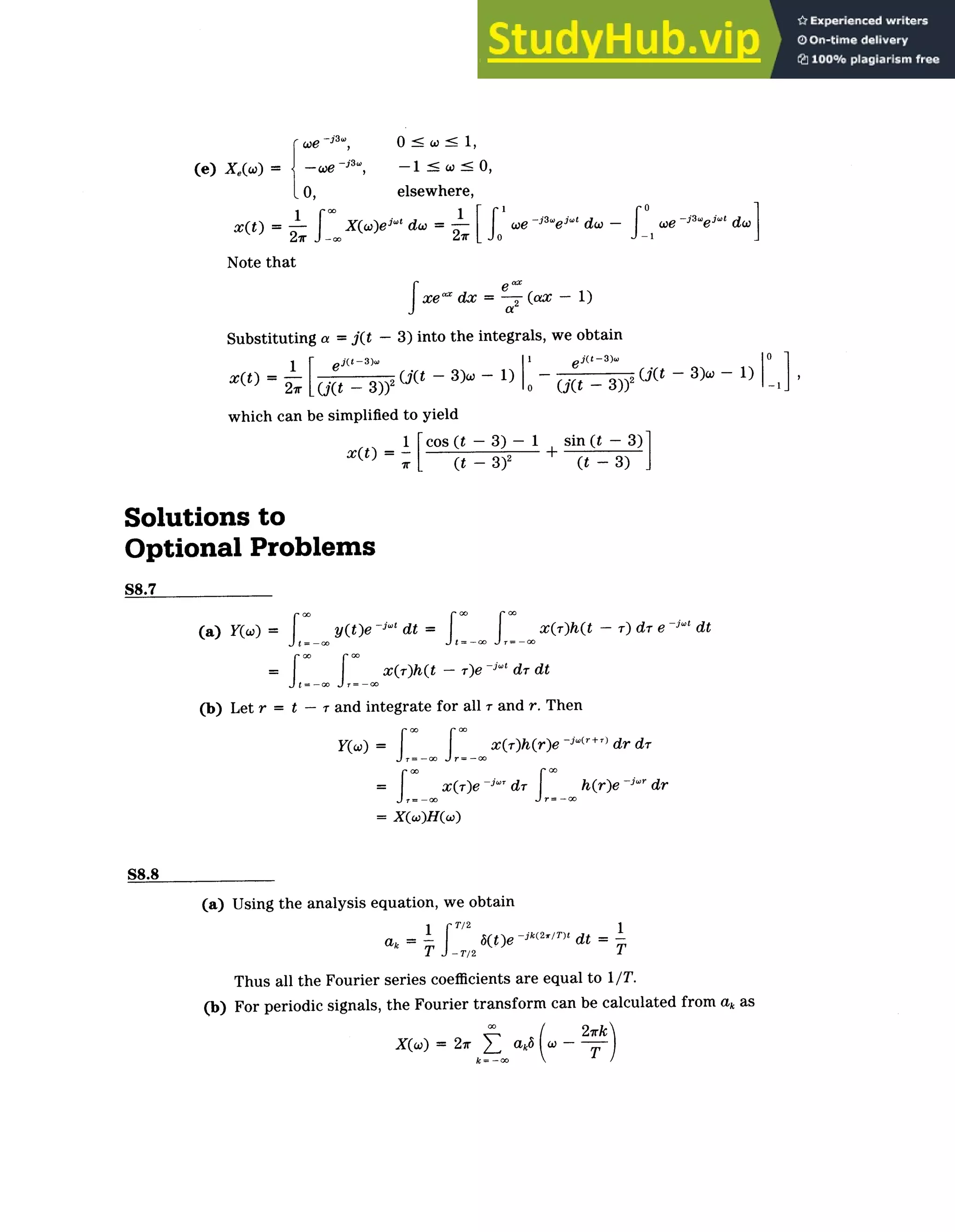
3
w, 0 5 w < 1,
(e) Xe(w) = we ­j3
w, -1 ! (O 0,
t0, elsewhere,
x(t) = f X(w)e­' dw = i [J'we ­jamei' do - we ~i
3
­ejwl dw
Note that
e ax
xe"
f dx = , -(ax
ax ­1)
Substituting a = j(t - 3) into the integrals, we obtain
1 j(t ­ 3)w I egj(t ­ 3)w 0
= - L( (j(t - 3)w - 1) 0 (j )) 2 (j(t - 3)w - 1) J
x(t)
21r (j(t ­ 3)) 0 (j(t ­ 3))-
which can be simplified to yield
1 [ cos (t - 3) - 1 sin (t - 3)
x(t) = 7r (t - 3)2 + (t - 3)_
Solutions to
Optional Problems
S8.7
(a) Y(w) = y(t)e ­j dt x(r)h(t - ­) dr e ­j'' dt
S ft x(,r)h(t - 1)e ­j"' dr dt
(b) Let r t ­ T and integrate for all r and r. Then
Y(w) = TT=- .fro x(r)h(r)e -jw( r-+*T) dr dr
= x(r)e ­' d­r {r=-0 h(r)e ~'j dr
= X(w)H(w)
S8.8
(a) Using the analysis equation, we obtain
1 rT/2_ 1
Ilk = I T/ e(t)e ­jk(21r/T)t dt­T
T ­T/2 T
Thus all the Fourier series coefficients are equal to 1/T.
(b) For periodic signals, the Fourier transform can be calculated from ak as
X(w) = 21 ak w
­T
k=­00
Signals and Systems
S8-12
In this case,
21 2rk
PM=T 6 T
P(wj)
21Tr
T
_47 _ 2n 0 2_ 4
T T T T
Figure S8.8
(c) We are required to show that
2(t) = x(t )* p(t)
Substituting for p(t), we have
x(t)* p(t) = xt * kT)
k Ot -
Using the associative property of convolution, we obtain
x(t) *p(t) = T, [x(t) * b(t ­ kT)]
k= ­o
From the sifting property of b(t), it follows that
x(t)* pX)O x(t ­ kT) =t(t)
k=-
Thus, x(t) * p(t) is a periodic repetition of x(t) with period T.
(d) From Problem P8.7, we have
X(w) = X()P(x)
27rk
= X(-) ­ ­T-
k=
2xk
=jI ­­ X(w)5(c
Since each summation term is nonzero only at w = 27rk/T,
*0 27r 2rk 2xk
i = y=) T X( T B
From this expression we see that the Fourier series coefficients of t(t) are
­ ,
ak = X
T i T
which is consistent with our previous discussions.
MIT OpenCourseWare
http://ocw.mit.edu
Resource: Signals and Systems
Professor Alan V. Oppenheim
The following may not correspond to a particular course on MIT OpenCourseWare, but has been
provided by the author as an individual learning resource.
For information about citing these materials or our Terms of Use, visit: http://ocw.mit.edu/terms.

8 Continuous-Time Fourier Transform Solutions To Recommended Problems

  • 1.
    8 Continuous-Time Fourier Transform Solutionsto Recommended Problems S8.1 (a) x(t) t Tj Tj 2 2 Figure S8.1-1 Note that the totalwidth is T,. (b) i(t) t 3T1 ­­ T1 To T1 T1 To Tl 3 T 1 =O 2 2 2 2 2 2 Figure S8.1-2 (c) Using the definition of the Fourier transform, we have X(w) = ox(t)e ­j dt = Ti/2 le­j" dt since x(t) = 0 for ItI> Til 12 sin wTi = e ­ (e ­jwTI1/2 _ eT1/ 2 ) = 2 JW ­T1/2 (e See Figure S8.1-3. S8-1
  • 2.
    Signals and Systems S8-2 (d)Using the analysis formula, we have ak = T f X(t)e ~jk 0 t dt, where we integrate over any period. _ 1 ak -T e ­jk(2/T )t dt fT (t)e ­jk(2w/T)t dt = fT1 /2 O - To12 TO -T 1 /2 To 1 ak = (e jkirToT 0 ­­ eikir1/TO) = sin kr(T 1 /T 0 ) _ sin ,r(2k/3) TO ,rk 7rk ­jk 2, Note that ak = 0 whenever (27rk)/3 = irm for m a nonzero integer. (e) Substituting (21rk)/To for o, we obtain T _1X( =2)T 1 2 sin(7rkT 1 /T0 ) sin rk(T1 /T 0 ) ak TO I"=(21rk)/ To To 2,rk/To ,rk = (f) From the result of part (e), we sample the Fourier transform of x( t), X(w), at w = 2irk/To and then scale by 1/To to get ak.
  • 3.
    Continuous-Time FourierTransform /Solutions S8-3 S8.2 (a) X(w) = fx(t)e ­j4t dt = (t - 5)e -j' dt = e ~j = cos 5w ­ j sin 5w, by the sifting property of the unit impulse. IX(w)| = |ej5 wI = 1 for all w, <tX(w) = tan­' tan ­sin5wo) = ­5w LIM{X(xc)} Re{X(co)} cos 5w (b) X(w) = e ­a t u(t)e -i"' dt = e ­ate ­j't dt e ­ (a+jo)t 0 ­ (a+jw)t dt -1 a+jw o Since Re{a} > 0, e ­at goes to zero as t goes to infinity. Therefore, -1 1 X(W) = 1(0 - 1) = a +jw a + jw IX(W)I = [X(W)X*(w)]l/ 2 = a +ja ­jw)] 2 1 +o2 > / X(w) + X*(O) a Re{X(w)} = 2 a2 + (2 i Im{X(W)} = X(W) - X*(W) -W 2 a2 + w2 '> Im{X(W)) _ w ­X(O) = tan­ = ­tan a The magnitude and angle of X(w) are shown in Figure S8.2-2. Jawaban no.1
  • 4.
    Signals and Systems S8­4 IX(w)I ­aa 4X(W) 2 Tro ­aa 2T Figure S8.2-2 (c) X(o) = e 1+1 2)tU(t )e ­'''dt = e(­1+ 2 )te ­jct dt 1 [ 1-+j(2-)t 0 1 + j(2 ­ )0 Since Re{­1 + j(2 - w)} < 0, lim, e[­ 1+j(2­w) = 0. Therefore, 1 1 + j(o - 2) 1 IX(wO)| = [X(x)X*(W)]11 2 = /1 + (o w­ 2) 2 X(w) + X*(W) 1 Re{X()} = 2 1 + (w ­ 2)2 X(w) - X*(co) ­(o ­ 2) Im{X(W)} = 2 1 + ((A ­2)2 X() = tan­' ImX(W) ­tan­'(w - 2) LRe{X(w)} The magnitude and angle of X(w) are shown in Figure S8.2-3.
  • 5.
    Continuous-Time Fourier Transform/Solutions S8-5 X(w)I 1 1 2 3 4X(W) Figure S8.2-3 Note that there is no symmetry about w = 0 since x(t) is not real. S8.3 (a) X3(w) = X3(t)e ­' dt Substituting for x3(t), we obtain X3(() = J [ax1(t) + bx 2(t0)e 1­'dt =f ax1(t)e ­wt dt + bx 2(t)e ­jwt dt = af x1(t)e ­j dt + b f x 2(t)e ­­ ' dt = aX 1(w) + bX 2(w) (b) Recall the sifting property of the unit impulse function: f h(t)b(t - to) dt = h(t o) Therefore, 21rb(w - wo)ej­' do = 2rewot
  • 6.
    Signals and Systems S8-6 Thus, 1-2 7rb(w - wo)ei­' dw = ei­o' 2,r -"oo Note that the integral relating 2­7rS(w - wo) and e­o' is exactly of the form x(t) = ­ X(w)ej­ t dw, where x(t) = ejot and X(w) = 2­7rb(co - wo). Thus, we can think of ei­o' as the inverse Fourier transform of 2 7rb(w - wo). Therefore, 27rb(o - wo) is the Fourier transform of eiwo'. (c) Using the result of part (a), we have = X(M) = 7{x(t)} = 51 1 ake 2r j T, a, 5T {eik(2 ,rs/t From part (b), 5{eik(2,rT)t = 2,irb ( W ­21rk) Therefore, Z(w) = 27rab ( W k = ­00 (d) X(w) 2 sin 3 2 sin 2 T o 3 3 Figure S8.3 S8.4 (a) We see that the new transform is Xa(f) = X(w) W=2,wf We know that x(t) = - f X(w)e'j t do
  • 7.
    Continuous­Time Fourier Transform/ Solutions S8-7 Let w = 2irf. Then dw = 21rdf, and = x(t) 1 X(21rf)ej 2 "2ir df = Xa(f )ei2 ,"f df 27 f= ­o Thus, there is no factor of 21r in the inverse relation. IXa(f)I TI 2 1 1 2 TI TI TF T, Figure S8.4 (b) Comparing Xb(V) = -1 x(t)e jv' dt and X(w) = x(t ­j~" dt, we see that Xb(V) = X(W) or X(w) = 7 X(w) V2_ ­V 7r The inverse transform relation for X(w) is x(t) - 1 *0 X(w)e j dw = 1 X2r(w)ej­ dw =1 Xb(v)e jvt dv, where we have substituted v for w. Thus, the factor of 1/2­x has been distributed among the forward and inverse transforms. S8.5 (a) By inspection, To = 6. (b) ak = 1 TO )e ­k( 2 /To)t dt TO JT0 We integrate from -3 to 3: 1 1 1 ak= (ti + 1)+ 6(t) + ­6(t ­ + c 6 J­ 2 2 (1 = 1 +l 1 + 'je ­Jlk6.. Cos 2k Jawaban no.2
  • 8.
    Signals and Systems S8-8 (t)= 6( + Cos 27rk eik(2 / 6 )t (c) (i) X1(w) = x 1 (t)e ­"' dt ­ [6(t + 1) + b(t) + ­1(t - 1)]e -j't dt - ie * + 1 + ie ­"1 + cos w (ii) X 2(w) = x2(t)e ­''' dt = [3( t) + it(t - 1) + ­3(t - 5)]e ­ dt = 1 + ie -j + le ­i 5 w (d) We see that by periodically repeating x1 ( t) with period Ti = 6, we get t(t), as shown in Figure S8.5-1. x1 (t) 2 t -1 0 1 x 1 (t - 6) 0 5 6 7 xl(t + 6) 2 t t |tt) t -7 -6 ­5 0 x(t) ­7 ­6 ­5 -1 0 1 5 6 7 Figure S8.5-1 Similarly, we can periodically repeat x 2(t) to get 1(t). Thus T2 = 6. See Figure S8.5-2.
  • 9.
    Continuous­Time Fourier Transform/ Solutions S8-9 x 2(t) tilt t 01 X2 (t -6) 2 0 6 7 t 1 1 t t x2(t ± 6) t2~ 2 -6-5 0 7 X(t) IL t2 tIt t -6 -5 -1 0 1 5 6 7 Figure S8.5-2 (e) Since I(t) is a periodic repetition of x 1 (t) or X 2(0), the Fourier series coefficients of t(t) should be expressible as scaled samples of X,(co). Evaluate X1 (0 ) at w= 21rk/6. Then 6 co­= k*k2rk 1 (27rk Similarly, we can get ak as a scaled sample of X2(w). Consider X2(21rk/6): X2­ 1 j2k/6 + 5e e X1(x) =irk1 =6,rk n X x +2o 62 2 But e njlOrk6 e j(lOrk/62rk) 2 rkI 6 . Thus, = e e X2 = 1 + cos ­ = 6 a. A X6 Although X,(w) # X 2(w), they are equal for w =27rk/6.
  • 10.
    Signals and Systems S8-10 S8.6 (a)By inspection, Thus, e ­atu(t) 7 9 1 . a + jw (b) 7I 1 e­ 7tu(t) 1 7 + jw Direct inversion using the inverse Fourier transform formula is very difficult. Xb(w) = 26(w + 7) + 26(o - 7), Xb(t) = ­ Xb(w)ej do = ­ 2 [6(w + 7) + 6(w 1 1 . 2 e­-It + e = cos 7t - 7)]ei-' dw (c) From Example 4.8 of the text (page 191), we see that 37 2a e alti 9 _2a a 2 + W 2 However, note that since ax(t) aX(w) ax(t)e ­j" dt = a x(t)e ­jw dt = aX(w) Thus, (d) 1 - -e ­" l 2a 1 a2 + (0 2 1 7 or 9 + .2 Xa(w)Xb(W) = Xa(w)[26(o + 7) + 26(w - 7)] = 2X(­7)(co + 7) + 2Xa(7)6(w - 7) 2 2 XdCO)= ­ (w +7) + b(o7) 7 - j7 7 +j7 1f*[2 ±7+ 2 xaOt = f- .7 6(o + 7) + b(co 27r­­ 7 -37 7 +j7 1 1 . 1 1 . XA(t) = ­ e - 7 ' + ­ ej_ ' ir7­j7 xr7+j7 Note that - 7) ej" do 1 - e 6 -31t Thus 1 7 +j7 7 2 ­jr/4 1 7 ­j7 1= =_ ( 7 , 2 +jir/4 XA(t) = - - r7 - 2 [e -j(7t ­/4) + ei( 7 t-/4)] = -- 77r cos 7t - -) 4
  • 11.
    Continuous-Time Fourier Transform/ Solutions S8-11 we ~j 3 w, 0 5 w < 1, (e) Xe(w) = we ­j3 w, -1 ! (O 0, t0, elsewhere, x(t) = f X(w)e­' dw = i [J'we ­jamei' do - we ~i 3 ­ejwl dw Note that e ax xe" f dx = , -(ax ax ­1) Substituting a = j(t - 3) into the integrals, we obtain 1 j(t ­ 3)w I egj(t ­ 3)w 0 = - L( (j(t - 3)w - 1) 0 (j )) 2 (j(t - 3)w - 1) J x(t) 21r (j(t ­ 3)) 0 (j(t ­ 3))- which can be simplified to yield 1 [ cos (t - 3) - 1 sin (t - 3) x(t) = 7r (t - 3)2 + (t - 3)_ Solutions to Optional Problems S8.7 (a) Y(w) = y(t)e ­j dt x(r)h(t - ­) dr e ­j'' dt S ft x(,r)h(t - 1)e ­j"' dr dt (b) Let r t ­ T and integrate for all r and r. Then Y(w) = TT=- .fro x(r)h(r)e -jw( r-+*T) dr dr = x(r)e ­' d­r {r=-0 h(r)e ~'j dr = X(w)H(w) S8.8 (a) Using the analysis equation, we obtain 1 rT/2_ 1 Ilk = I T/ e(t)e ­jk(21r/T)t dt­T T ­T/2 T Thus all the Fourier series coefficients are equal to 1/T. (b) For periodic signals, the Fourier transform can be calculated from ak as X(w) = 21 ak w ­T k=­00
  • 12.
    Signals and Systems S8-12 Inthis case, 21 2rk PM=T 6 T P(wj) 21Tr T _47 _ 2n 0 2_ 4 T T T T Figure S8.8 (c) We are required to show that 2(t) = x(t )* p(t) Substituting for p(t), we have x(t)* p(t) = xt * kT) k Ot - Using the associative property of convolution, we obtain x(t) *p(t) = T, [x(t) * b(t ­ kT)] k= ­o From the sifting property of b(t), it follows that x(t)* pX)O x(t ­ kT) =t(t) k=- Thus, x(t) * p(t) is a periodic repetition of x(t) with period T. (d) From Problem P8.7, we have X(w) = X()P(x) 27rk = X(-) ­ ­T- k= 2xk =jI ­­ X(w)5(c Since each summation term is nonzero only at w = 27rk/T, *0 27r 2rk 2xk i = y=) T X( T B From this expression we see that the Fourier series coefficients of t(t) are ­ , ak = X T i T which is consistent with our previous discussions.
  • 13.
    MIT OpenCourseWare http://ocw.mit.edu Resource: Signalsand Systems Professor Alan V. Oppenheim The following may not correspond to a particular course on MIT OpenCourseWare, but has been provided by the author as an individual learning resource. For information about citing these materials or our Terms of Use, visit: http://ocw.mit.edu/terms.