Fourier Analysis of Signals
and
Systems
Dr. Babul Islam
Dept. of Applied Physics and Electronic
Engineering
University of Rajshahi
1
Outline
• Response of LTI system in time domain
• Properties of LTI systems
• Fourier analysis of signals
• Frequency response of LTI system
2
• A system satisfying both the linearity and the time-
invariance properties.
• LTI systems are mathematically easy to analyze and
characterize, and consequently, easy to design.
• Highly useful signal processing algorithms have been
developed utilizing this class of systems over the last
several decades.
• They possess superposition theorem.
Linear Time-Invariant (LTI) Systems
3
• Linear System:
+ T
)
(
1 n
x
)
(
2 n
x
1
a
2
a
 
]
[
]
[
)
( 2
2
1
1 n
x
a
n
x
a
n
y 
T
   
]
[
]
[
)
( 2
2
1
1 n
x
a
n
x
a
n
y T
T 


+
)
(
1 n
x
)
(
2 n
x
1
a
2
a
T
T
System, T is linear if and only if
i.e., T satisfies the superposition principle.
)
(
)
( n
y
n
y 

4
• Time-Invariant System:
A system T is time invariant if and only if
)
(n
x T )
(n
y
implies that
)
( k
n
x  T )
(
)
,
( k
n
y
k
n
y 

Example: (a)
)
1
(
)
(
)
(
)
1
(
)
(
)
,
(
)
1
(
)
(
)
(














k
n
x
k
n
x
k
n
y
k
n
x
k
n
x
k
n
y
n
x
n
x
n
y
Since )
(
)
,
( k
n
y
k
n
y 
 , the system is time-invariant.
(b)
]
[
)
(
)
(
]
[
)
,
(
]
[
)
(
k
n
x
k
n
k
n
y
k
n
nx
k
n
y
n
nx
n
y







Since )
(
)
,
( k
n
y
k
n
y 
 , the system is time-variant. 5
• Any input signal x(n) can be represented as follows:






k
k
n
k
x
n
x )
(
)
(
)
( 
• Consider an LTI system T.
1






0
for
,
0
0
for
,
1
]
[
n
n
n

0 n
1 2
-1
-2 …
…
Graphical representation of unit impulse.
)
( k
n 
 T )
,
( k
n
h
)
(n
 T )
(n
h
• Now, the response of T to the unit impulse is
)
(n
x T   )
,
(
)
(
]
[
)
( k
n
h
k
x
n
x
n
y
k





T
• Applying linearity properties, we have
6
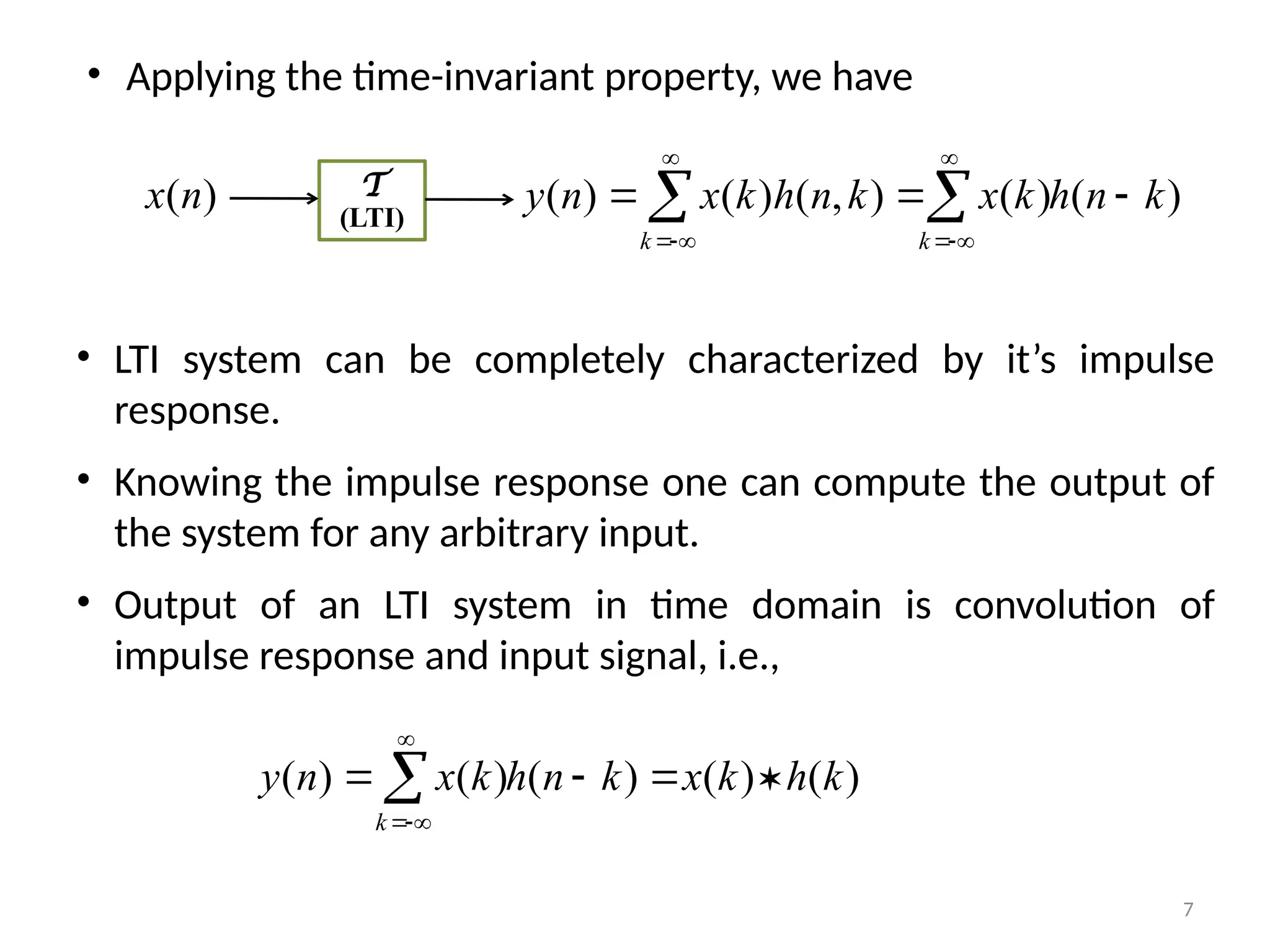
• LTI system can be completely characterized by it’s impulse
response.
• Knowing the impulse response one can compute the output of
the system for any arbitrary input.
• Output of an LTI system in time domain is convolution of
impulse response and input signal, i.e.,
)
(
)
(
)
(
)
(
)
( k
h
k
x
k
n
h
k
x
n
y
k



 



)
(n
x T
(LTI)
)
(
)
(
)
,
(
)
(
)
( k
n
h
k
x
k
n
h
k
x
n
y
k
k


 







• Applying the time-invariant property, we have
7
Properties of LTI systems
(Properties of convolution)
• Convolution is commutative
x[n]  h[n] = h[n]  x[n]
• Convolution is distributive
x[n]  (h1[n] + h2[n]) = x[n]  h1[n] + x[n]  h2[n]
8
• Convolution is Associative:
y[n] = h1[n]  [ h2[n]  x[n] ] = [ h1[n]  h2[n] ]  x[n]
h2
x[n] y[n]
h1h2
x[n] y[n]
h1
=
9
Frequency Analysis of Signals
• Fourier Series
• Fourier Transform
• Decomposition of signals in terms of sinusoidal or complex
exponential components.
• With such a decomposition a signal is said to be represented in the
frequency domain.
• For the class of periodic signals, such a decomposition is called a
Fourier series.
• For the class of finite energy signals (aperiodic), the decomposition
is called the Fourier transform.
10
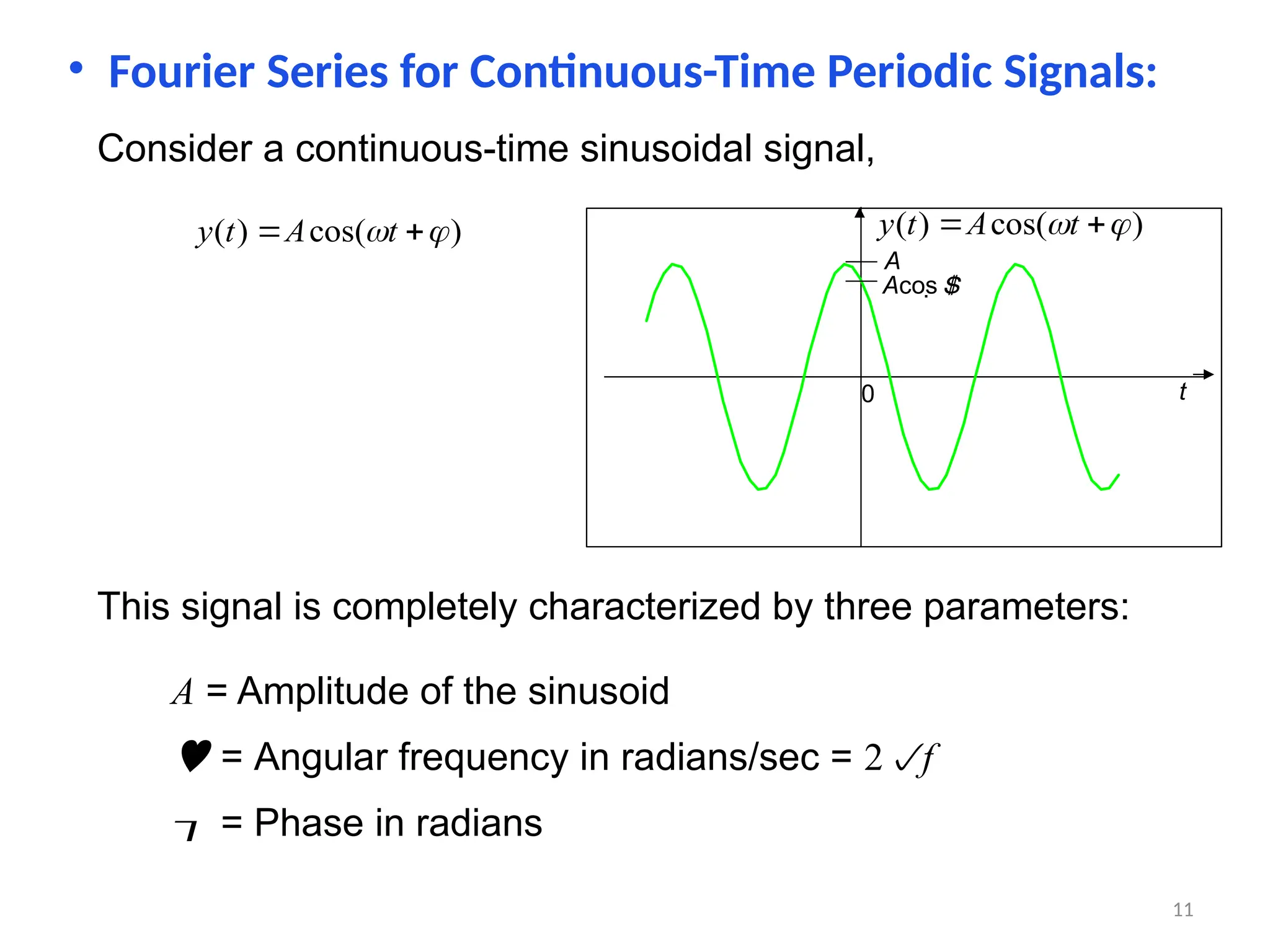
Consider a continuous-time sinusoidal signal,
)
cos(
)
( 
 
 t
A
t
y
This signal is completely characterized by three parameters:
A = Amplitude of the sinusoid
 = Angular frequency in radians/sec = 2f
 = Phase in radians
• Fourier Series for Continuous-Time Periodic Signals:
A
Acos
t
)
cos(
)
( 
 
 t
A
t
y
0
11
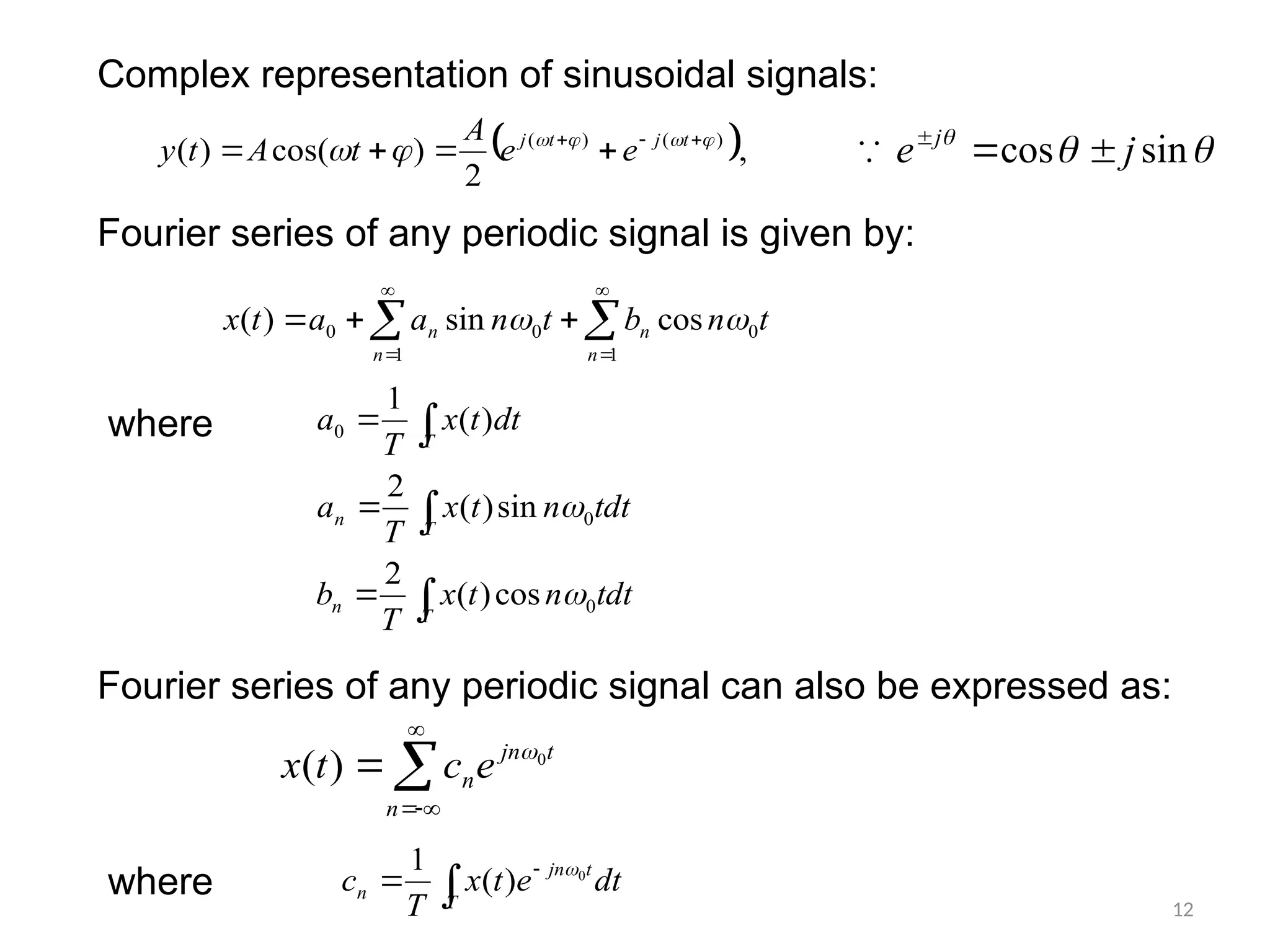
Complex representation of sinusoidal signals:
 ,
2
)
cos(
)
( )
(
)
( 




 





 t
j
t
j
e
e
A
t
A
t
y 


sin
cos j
e j




Fourier series of any periodic signal is given by:
 







1 1
0
0
0 cos
sin
)
(
n n
n
n t
n
b
t
n
a
a
t
x 

Fourier series of any periodic signal can also be expressed as:





n
t
jn
ne
c
t
x 0
)
( 
where






T
n
T
n
T
tdt
n
t
x
T
b
tdt
n
t
x
T
a
dt
t
x
T
a
0
0
0
cos
)
(
2
sin
)
(
2
)
(
1


where 


T
t
jn
n dt
e
t
x
T
c 0
)
(
1 
12
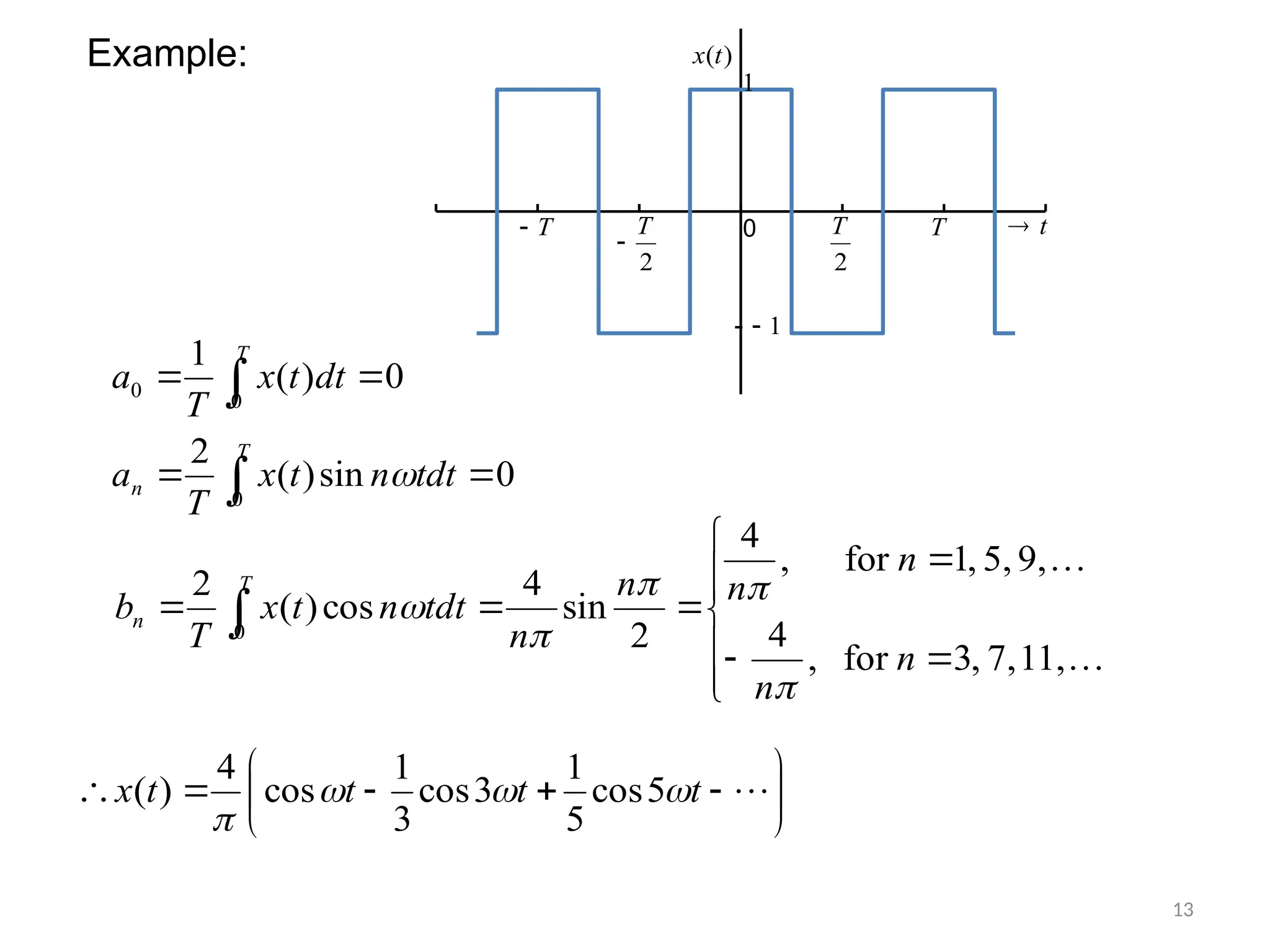
Example:






T
n
T
tdt
n
t
x
T
a
dt
t
x
T
a
0
0
0
0
sin
)
(
2
0
)
(
1













 


11,
7,
,
3
for
,
4
9,
5,
,
1
for
,
4
2
sin
4
cos
)
(
2
0
n
n
n
n
n
n
tdt
n
t
x
T
b
T
n





0
2
T
2
T

T
T
 t

)
(t
x
1
 1











 
t
t
t
t
x 



5
cos
5
1
3
cos
3
1
cos
4
)
(
13
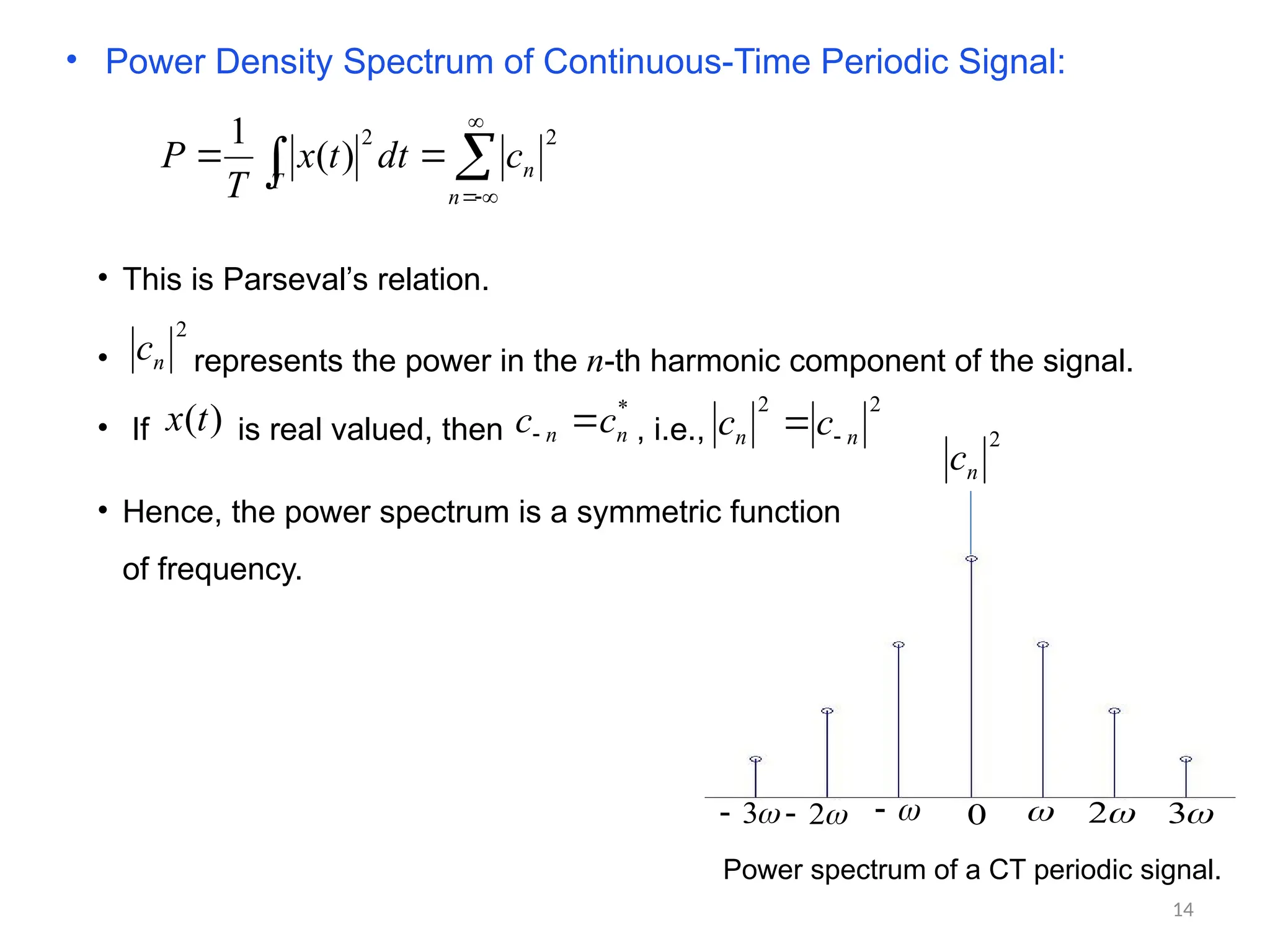
• Power Density Spectrum of Continuous-Time Periodic Signal:







n
n
T
c
dt
t
x
T
P
2
2
)
(
1
• This is Parseval’s relation.
• represents the power in the n-th harmonic component of the signal.
2
n
c
2
n
c
 
2 
3



2


3
 0
Power spectrum of a CT periodic signal.
• If is real valued, then , i.e.,
)
(t
x *
n
n c
c 

2
2
n
n c
c 

• Hence, the power spectrum is a symmetric function
of frequency.
14










2
2
2
)
(
)
(
~
T
t
periodic
T
t
T
t
x
t
x
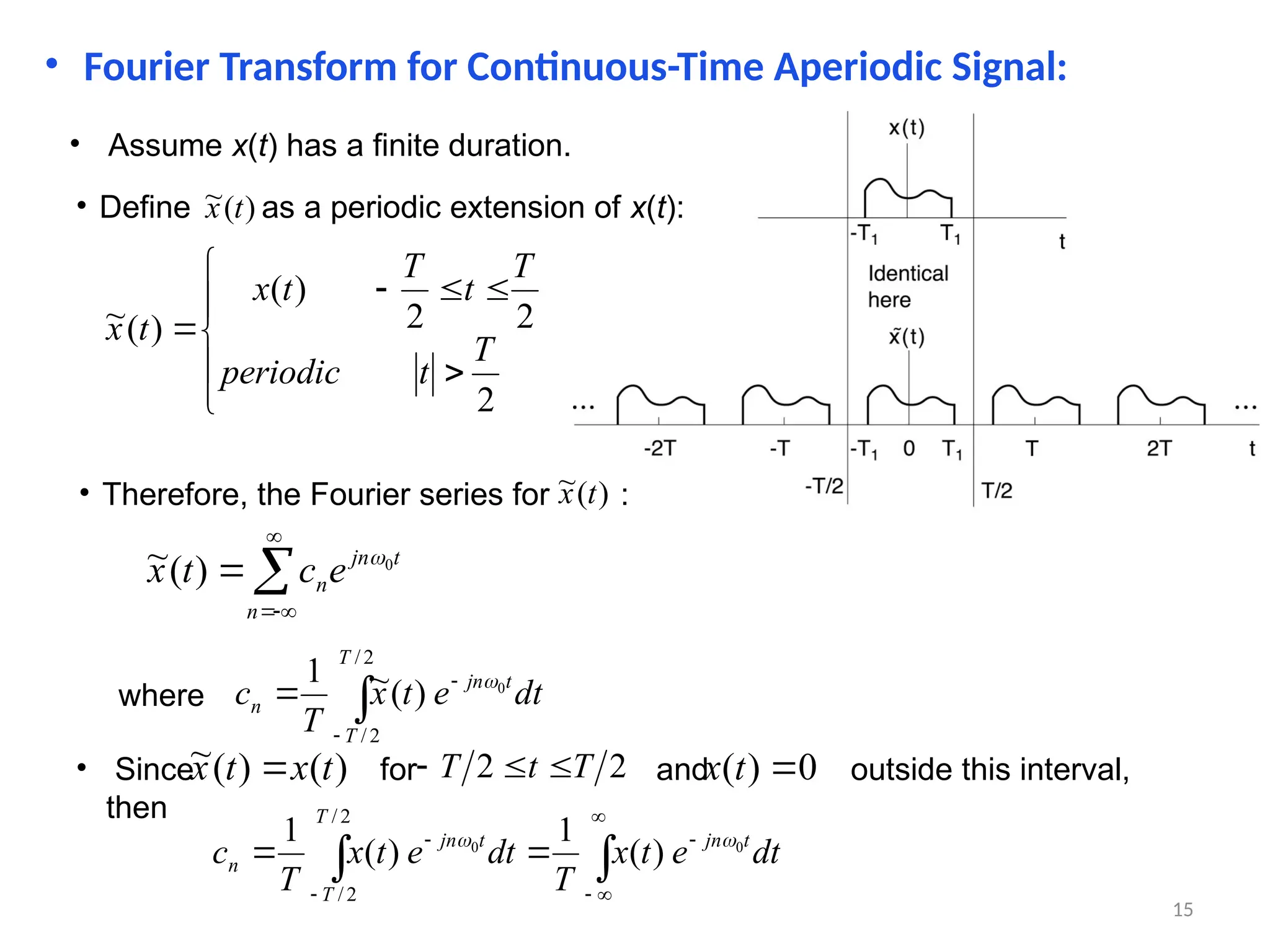
• Define as a periodic extension of x(t):
)
(
~ t
x





n
t
jn
ne
c
t
x 0
)
(
~ 




2
/
2
/
0
)
(
~
1
T
T
t
jn
n dt
e
t
x
T
c 









 dt
e
t
x
T
dt
e
t
x
T
c t
jn
T
T
t
jn
n
0
0
)
(
1
)
(
1
2
/
2
/


• Fourier Transform for Continuous-Time Aperiodic Signal:
• Assume x(t) has a finite duration.
• Therefore, the Fourier series for :
)
(
~ t
x
where
• Since for and outside this interval,
then
)
(
)
(
~ t
x
t
x  2
2 T
t
T 

 0
)
( 
t
x
15





 dt
e
t
x
T
X t
j
 )
(
1
)
(
• Now, defining the envelope of as
)
(
X n
Tc
)
(
1
0

n
X
T
cn 











n
t
jn
n
t
jn
e
n
X
e
n
X
T
t
x 0
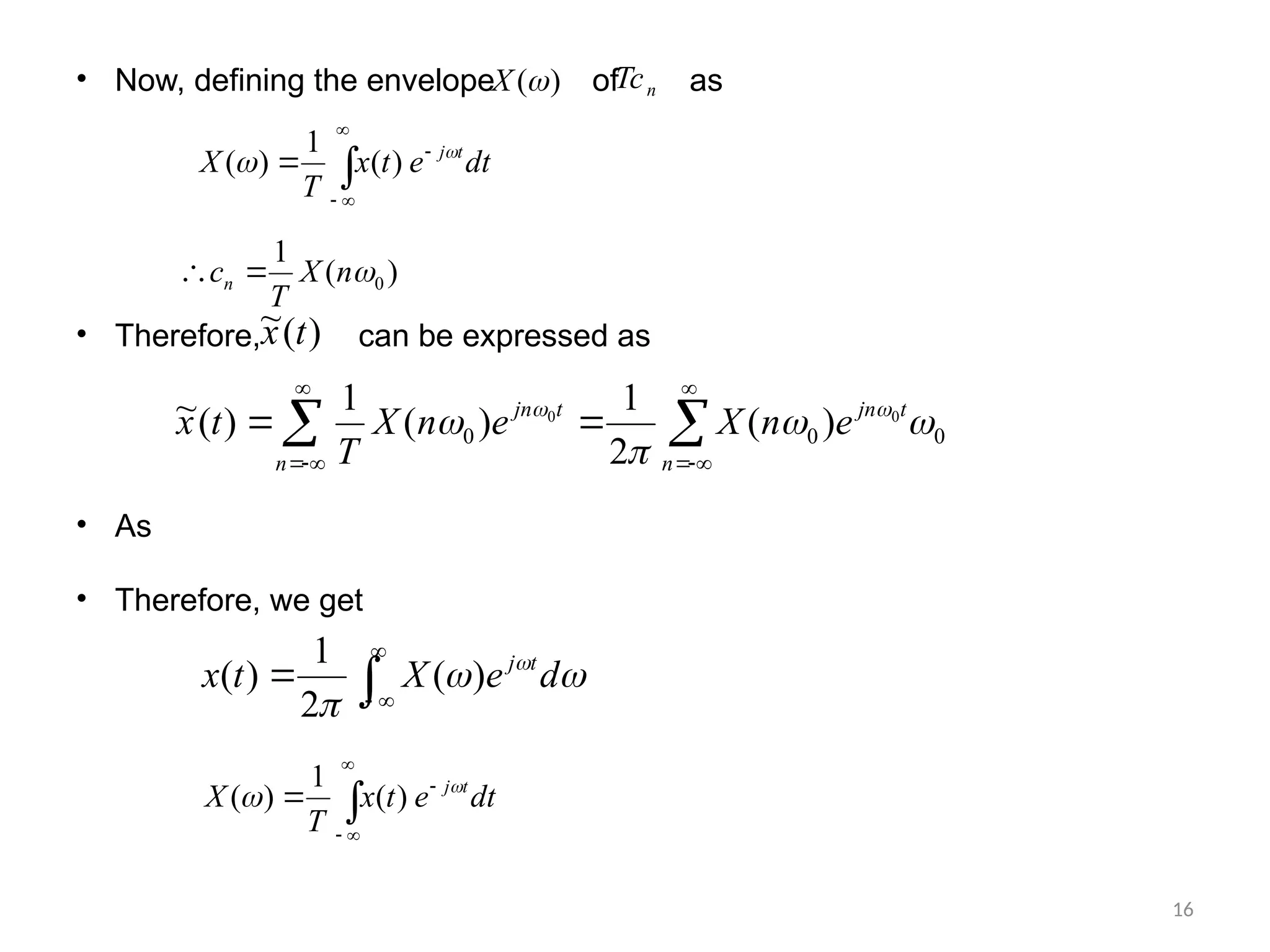
0
0
0
0
)
(
2
1
)
(
1
)
(
~ 


 

• Therefore, can be expressed as
)
(
~ t
x
• As
• Therefore, we get




 



d
e
X
t
x t
j
)
(
2
1
)
(





 dt
e
t
x
T
X t
j
 )
(
1
)
(
16
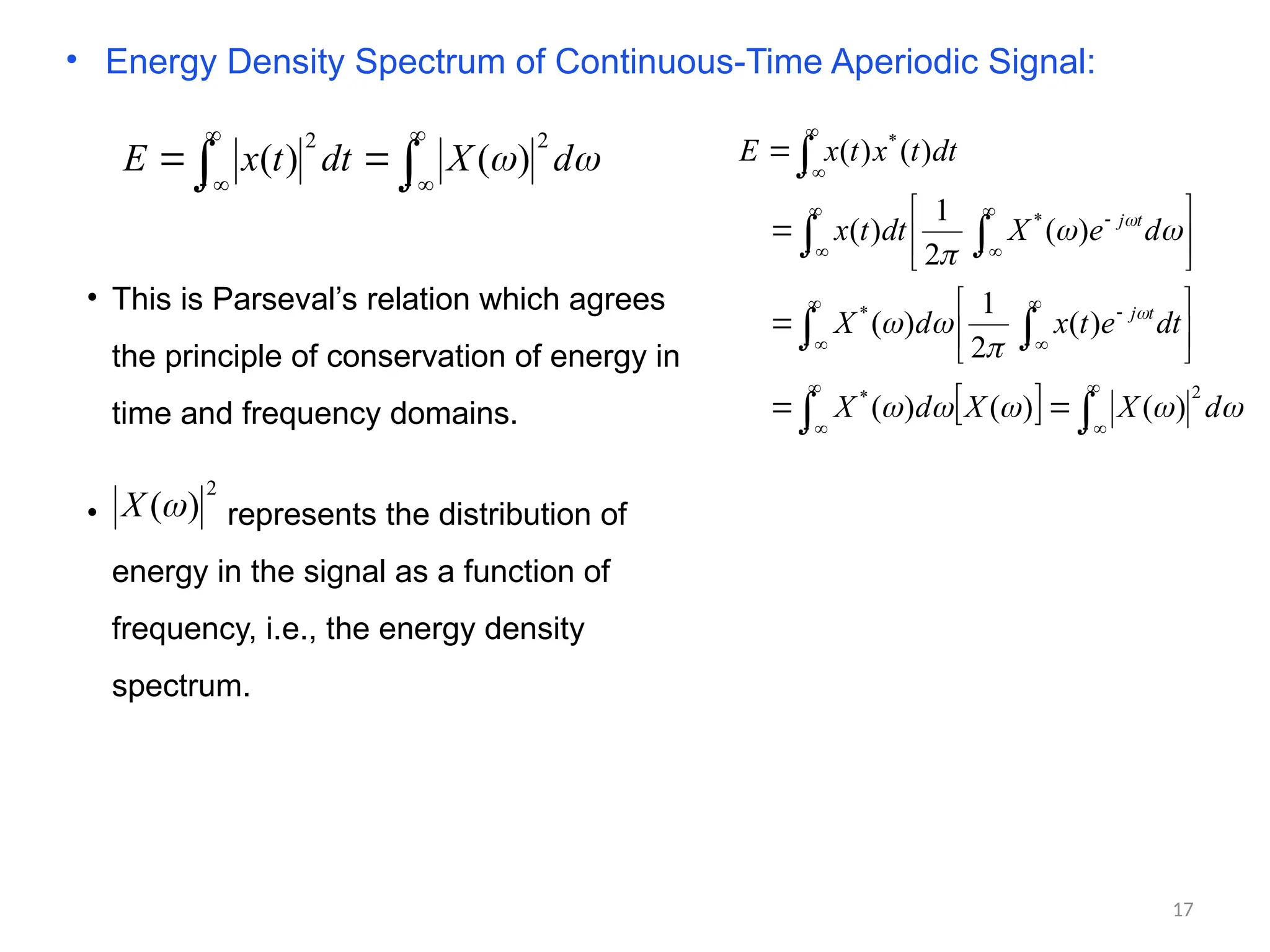
• Energy Density Spectrum of Continuous-Time Aperiodic Signal:









 
 d
X
dt
t
x
E
2
2
)
(
)
(
  

 
 






















































d
X
X
d
X
dt
e
t
x
d
X
d
e
X
dt
t
x
dt
t
x
t
x
E
t
j
t
j
2
*
*
*
*
)
(
)
(
)
(
)
(
2
1
)
(
)
(
2
1
)
(
)
(
)
(
• This is Parseval’s relation which agrees
the principle of conservation of energy in
time and frequency domains.
• represents the distribution of
energy in the signal as a function of
frequency, i.e., the energy density
spectrum.
2
)
(
X
17
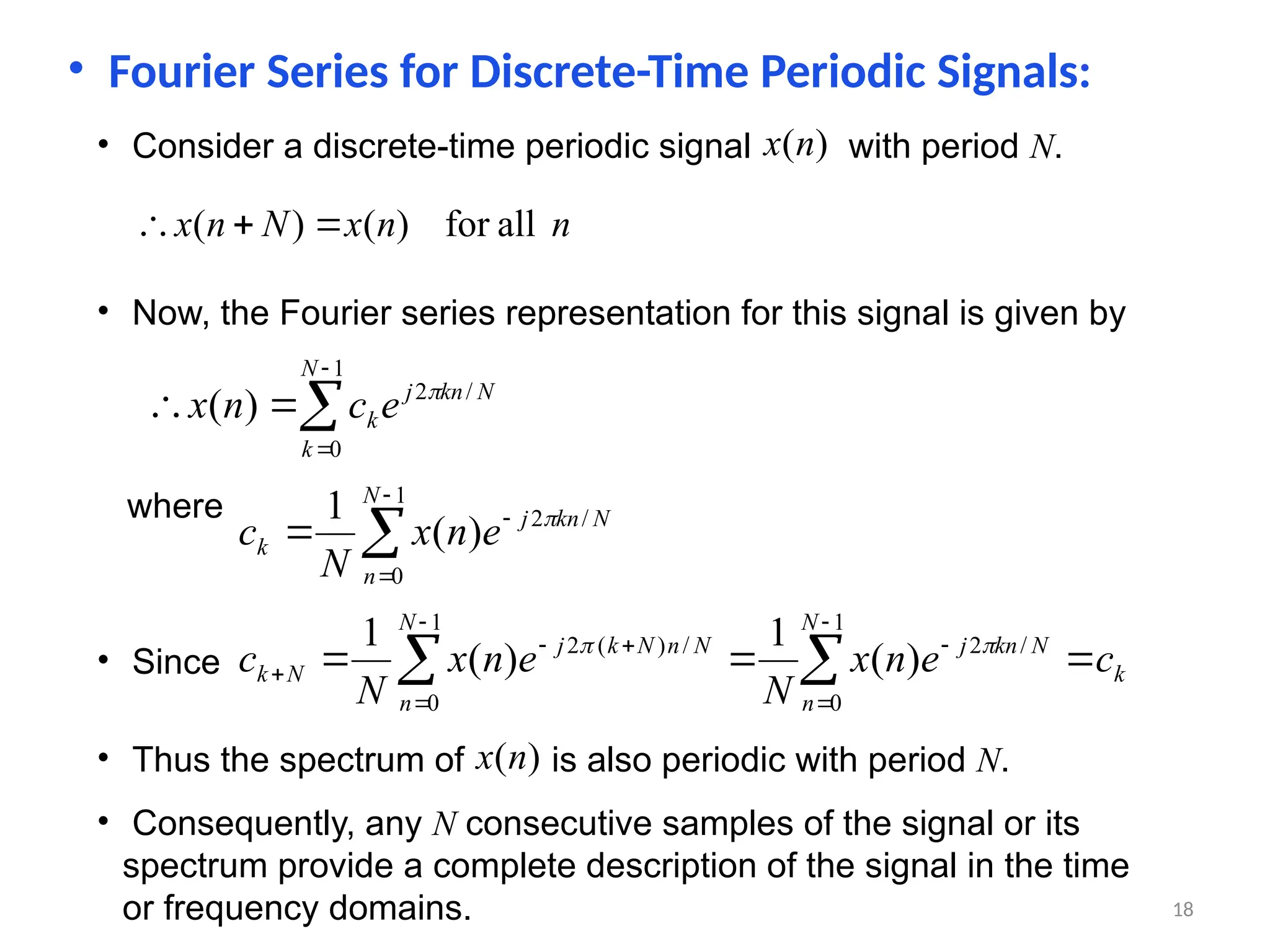
• Fourier Series for Discrete-Time Periodic Signals:
• Consider a discrete-time periodic signal with period N.
)
(n
x
n
n
x
N
n
x all
for
)
(
)
( 


• Now, the Fourier series representation for this signal is given by





1
0
/
2
)
(
N
k
N
kn
j
ke
c
n
x 
where





1
0
/
2
)
(
1 N
n
N
kn
j
k e
n
x
N
c 
• Since k
N
n
N
kn
j
N
n
N
n
N
k
j
N
k c
e
n
x
N
e
n
x
N
c 

 









1
0
/
2
1
0
/
)
(
2
)
(
1
)
(
1 

• Thus the spectrum of is also periodic with period N.
)
(n
x
• Consequently, any N consecutive samples of the signal or its
spectrum provide a complete description of the signal in the time
or frequency domains. 18
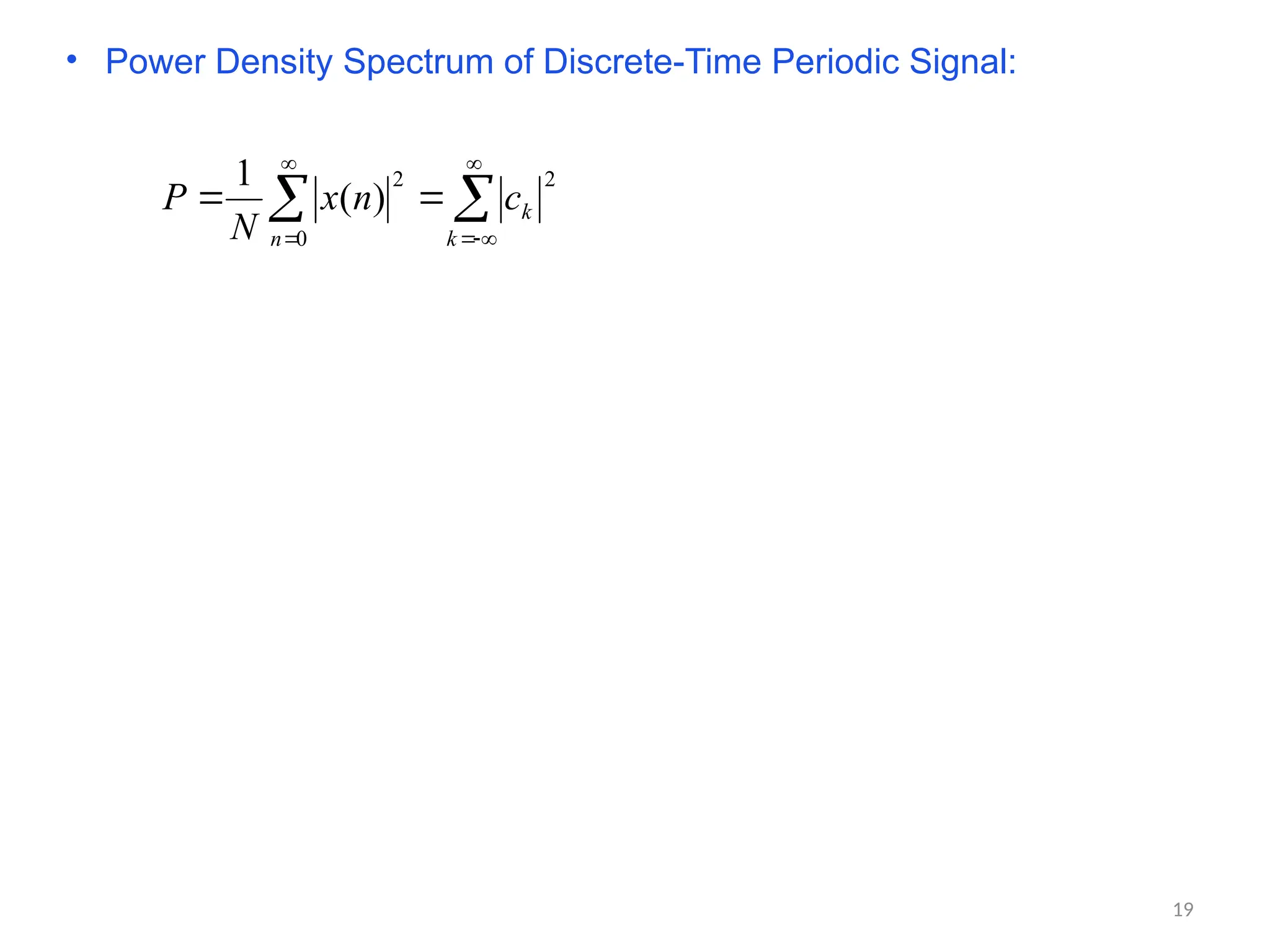
• Power Density Spectrum of Discrete-Time Periodic Signal:









k
k
n
c
n
x
N
P
2
0
2
)
(
1
19
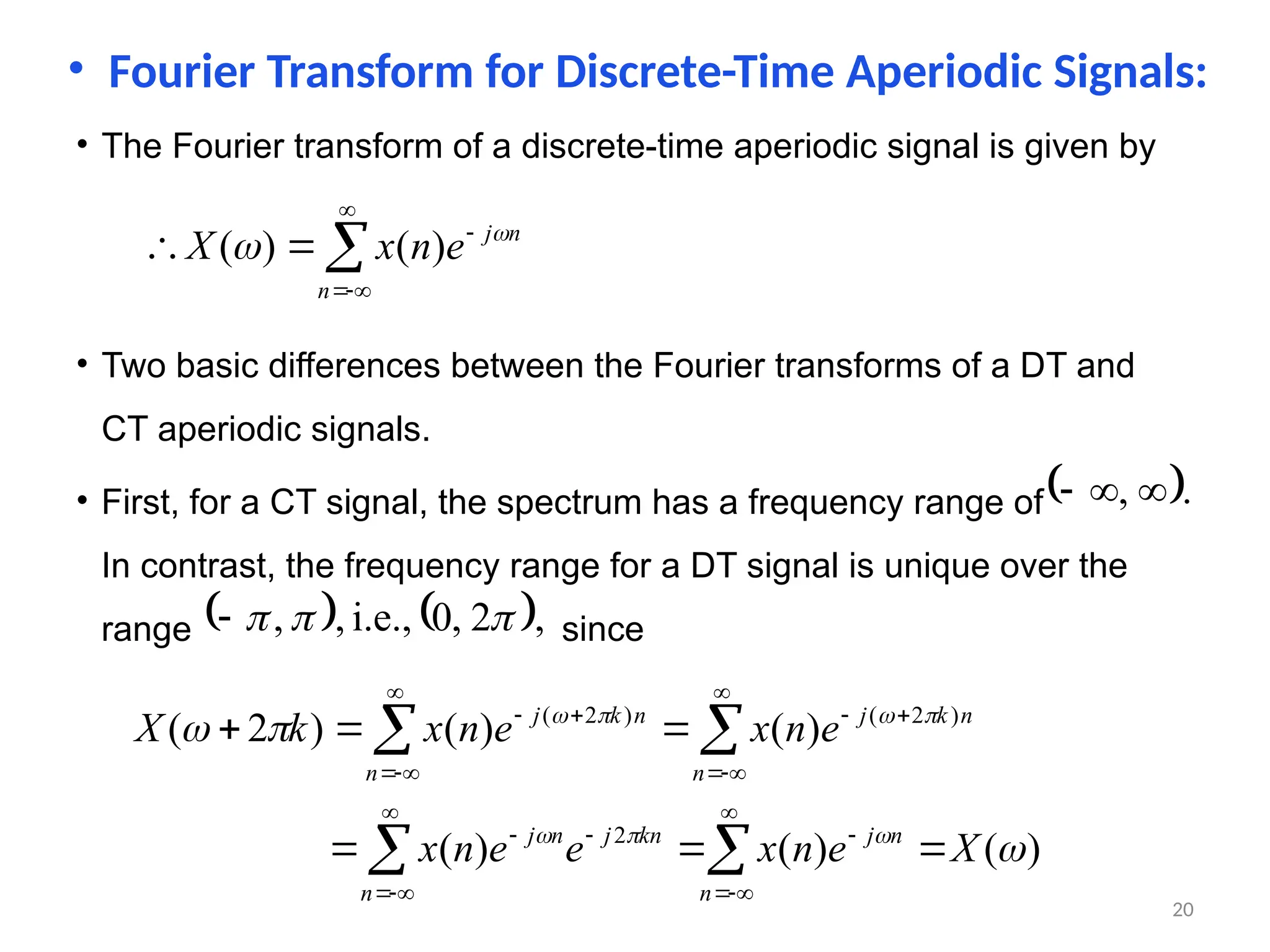
• Fourier Transform for Discrete-Time Aperiodic Signals:
• The Fourier transform of a discrete-time aperiodic signal is given by







n
n
j
e
n
x
X 
 )
(
)
(
• Two basic differences between the Fourier transforms of a DT and
CT aperiodic signals.
• First, for a CT signal, the spectrum has a frequency range of
In contrast, the frequency range for a DT signal is unique over the
range since
 .
, 


   ,
2
,
0
i.e.,
,
, 



)
(
)
(
)
(
)
(
)
(
)
2
(
2
)
2
(
)
2
(










X
e
n
x
e
e
n
x
e
n
x
e
n
x
k
X
n
n
j
n
kn
j
n
j
n
n
k
j
n
n
k
j





























20
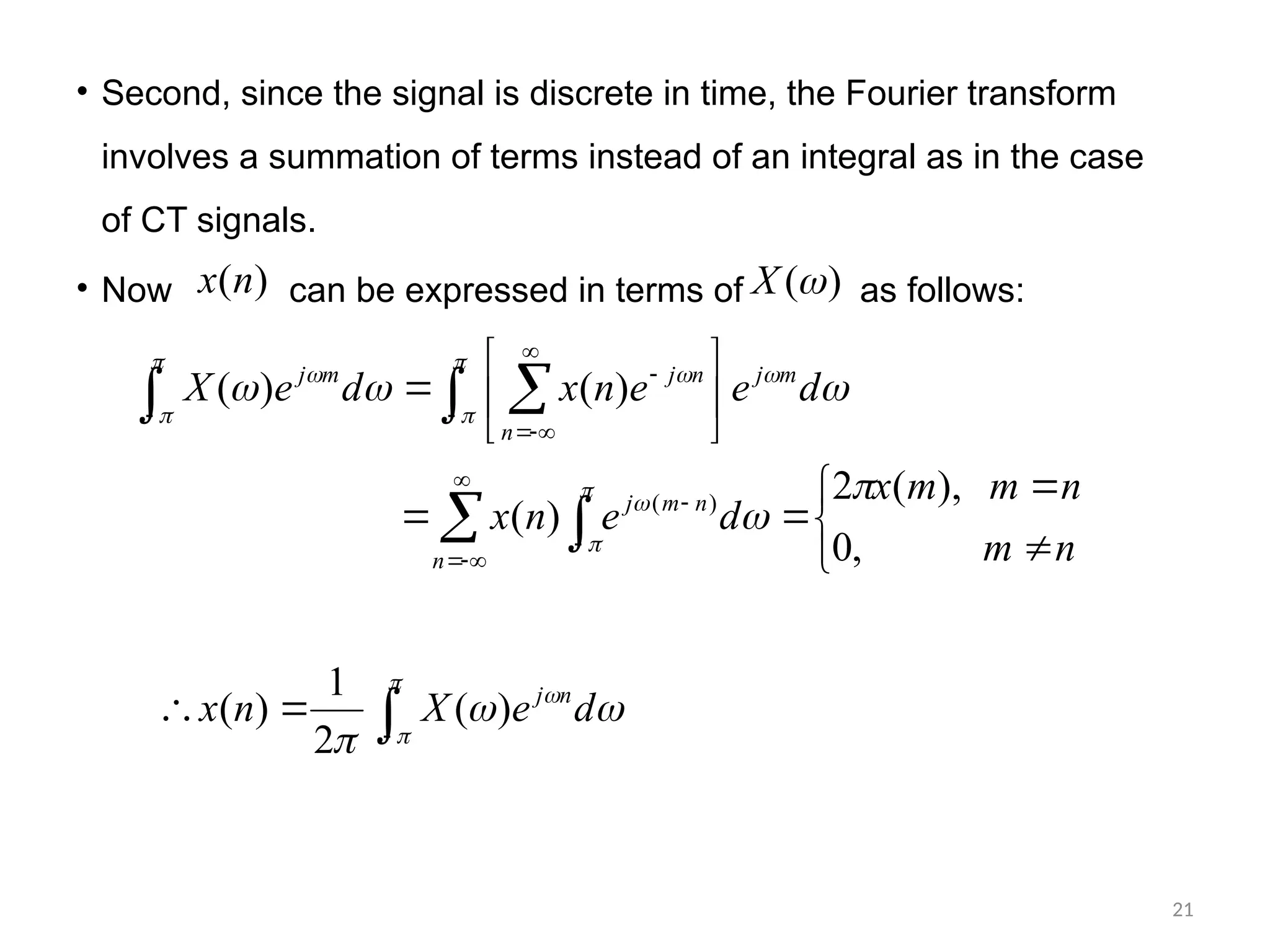
• Second, since the signal is discrete in time, the Fourier transform
involves a summation of terms instead of an integral as in the case
of CT signals.
• Now can be expressed in terms of as follows:
)
(n
x )
(
X
















 












n
m
n
m
m
x
d
e
n
x
d
e
e
n
x
d
e
X
n
m
j
n
m
j
n
n
j
m
j
,
0
),
(
2
)
(
)
(
)
(
)
( 
























d
e
X
n
x n
j
)
(
2
1
)
(
21
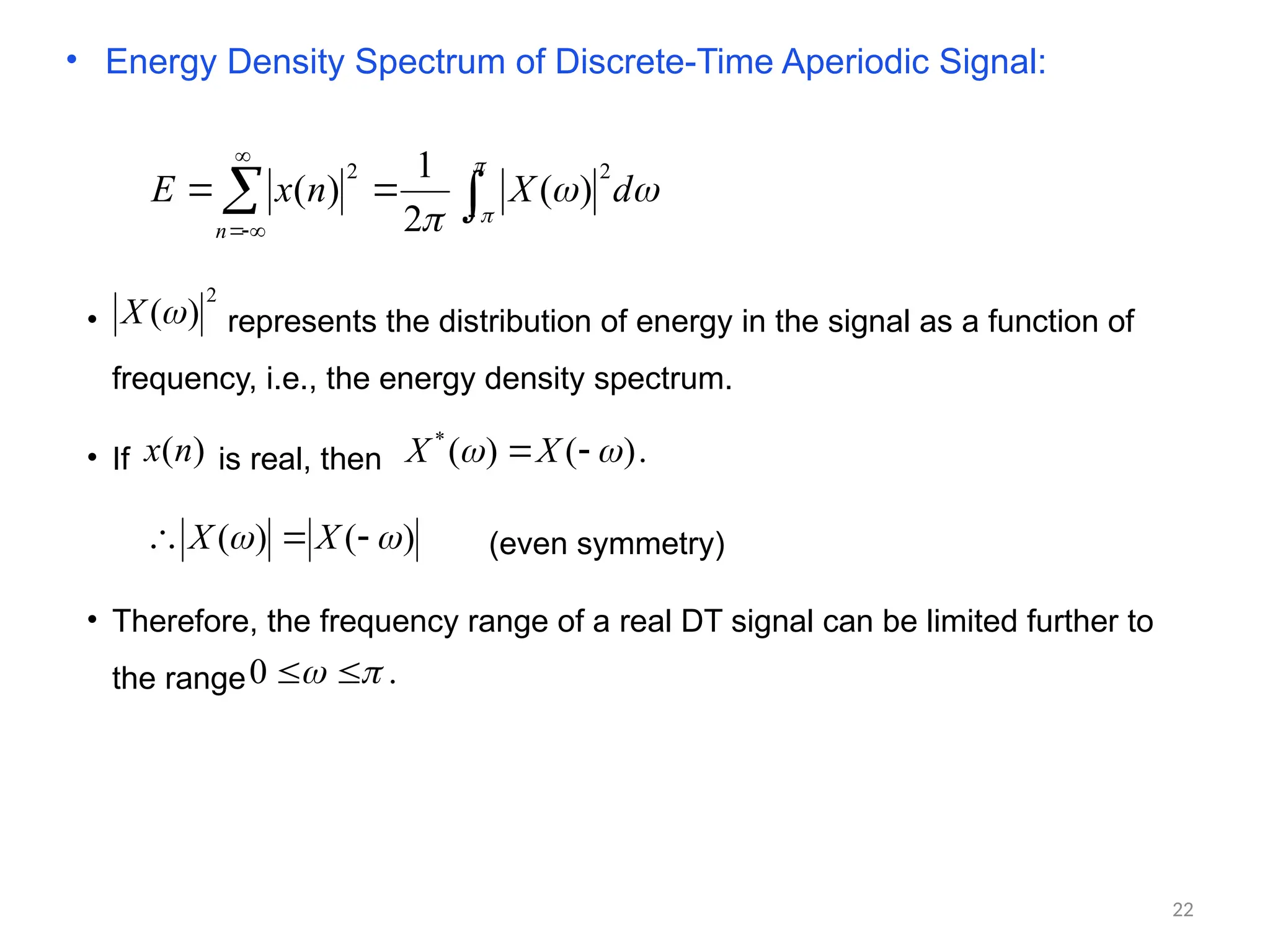
• Energy Density Spectrum of Discrete-Time Aperiodic Signal:





d
X
n
x
E
n

 





2
2
)
(
2
1
)
(
• represents the distribution of energy in the signal as a function of
frequency, i.e., the energy density spectrum.
2
)
(
X
• If is real, then
)
(n
x .
)
(
)
(
*

 
X
X
)
(
)
( 
 

 X
X (even symmetry)
• Therefore, the frequency range of a real DT signal can be limited further to
the range .
0 
 

22
23
Frequency Response of an LTI System
• For continuous-time LTI system
• For discrete-time LTI system
]
[n
h
n
j
e    n
j
e
H 

 
n
cos     
 




 H
n
H cos
)
(t
h
t
j
e 
  t
j
e
H 

   
 


 H
t
H 

cos
 
t
cos 
Conclusion
• The response of LTI systems in time domain has been examined.
• The properties of convolution has been studied.
• The response of LTI systems in frequency domain has been analyzed.
• Frequency analysis of signals has been introduced.
24

signals and systems, introduction.pptx

  • 1.
    Fourier Analysis ofSignals and Systems Dr. Babul Islam Dept. of Applied Physics and Electronic Engineering University of Rajshahi 1
  • 2.
    Outline • Response ofLTI system in time domain • Properties of LTI systems • Fourier analysis of signals • Frequency response of LTI system 2
  • 3.
    • A systemsatisfying both the linearity and the time- invariance properties. • LTI systems are mathematically easy to analyze and characterize, and consequently, easy to design. • Highly useful signal processing algorithms have been developed utilizing this class of systems over the last several decades. • They possess superposition theorem. Linear Time-Invariant (LTI) Systems 3
  • 4.
    • Linear System: +T ) ( 1 n x ) ( 2 n x 1 a 2 a   ] [ ] [ ) ( 2 2 1 1 n x a n x a n y  T     ] [ ] [ ) ( 2 2 1 1 n x a n x a n y T T    + ) ( 1 n x ) ( 2 n x 1 a 2 a T T System, T is linear if and only if i.e., T satisfies the superposition principle. ) ( ) ( n y n y   4
  • 5.
    • Time-Invariant System: Asystem T is time invariant if and only if ) (n x T ) (n y implies that ) ( k n x  T ) ( ) , ( k n y k n y   Example: (a) ) 1 ( ) ( ) ( ) 1 ( ) ( ) , ( ) 1 ( ) ( ) (               k n x k n x k n y k n x k n x k n y n x n x n y Since ) ( ) , ( k n y k n y   , the system is time-invariant. (b) ] [ ) ( ) ( ] [ ) , ( ] [ ) ( k n x k n k n y k n nx k n y n nx n y        Since ) ( ) , ( k n y k n y   , the system is time-variant. 5
  • 6.
    • Any inputsignal x(n) can be represented as follows:       k k n k x n x ) ( ) ( ) (  • Consider an LTI system T. 1       0 for , 0 0 for , 1 ] [ n n n  0 n 1 2 -1 -2 … … Graphical representation of unit impulse. ) ( k n   T ) , ( k n h ) (n  T ) (n h • Now, the response of T to the unit impulse is ) (n x T   ) , ( ) ( ] [ ) ( k n h k x n x n y k      T • Applying linearity properties, we have 6
  • 7.
    • LTI systemcan be completely characterized by it’s impulse response. • Knowing the impulse response one can compute the output of the system for any arbitrary input. • Output of an LTI system in time domain is convolution of impulse response and input signal, i.e., ) ( ) ( ) ( ) ( ) ( k h k x k n h k x n y k         ) (n x T (LTI) ) ( ) ( ) , ( ) ( ) ( k n h k x k n h k x n y k k            • Applying the time-invariant property, we have 7
  • 8.
    Properties of LTIsystems (Properties of convolution) • Convolution is commutative x[n]  h[n] = h[n]  x[n] • Convolution is distributive x[n]  (h1[n] + h2[n]) = x[n]  h1[n] + x[n]  h2[n] 8
  • 9.
    • Convolution isAssociative: y[n] = h1[n]  [ h2[n]  x[n] ] = [ h1[n]  h2[n] ]  x[n] h2 x[n] y[n] h1h2 x[n] y[n] h1 = 9
  • 10.
    Frequency Analysis ofSignals • Fourier Series • Fourier Transform • Decomposition of signals in terms of sinusoidal or complex exponential components. • With such a decomposition a signal is said to be represented in the frequency domain. • For the class of periodic signals, such a decomposition is called a Fourier series. • For the class of finite energy signals (aperiodic), the decomposition is called the Fourier transform. 10
  • 11.
    Consider a continuous-timesinusoidal signal, ) cos( ) (     t A t y This signal is completely characterized by three parameters: A = Amplitude of the sinusoid  = Angular frequency in radians/sec = 2f  = Phase in radians • Fourier Series for Continuous-Time Periodic Signals: A Acos t ) cos( ) (     t A t y 0 11
  • 12.
    Complex representation ofsinusoidal signals:  , 2 ) cos( ) ( ) ( ) (              t j t j e e A t A t y    sin cos j e j     Fourier series of any periodic signal is given by:          1 1 0 0 0 cos sin ) ( n n n n t n b t n a a t x   Fourier series of any periodic signal can also be expressed as:      n t jn ne c t x 0 ) (  where       T n T n T tdt n t x T b tdt n t x T a dt t x T a 0 0 0 cos ) ( 2 sin ) ( 2 ) ( 1   where    T t jn n dt e t x T c 0 ) ( 1  12
  • 13.
  • 14.
    • Power DensitySpectrum of Continuous-Time Periodic Signal:        n n T c dt t x T P 2 2 ) ( 1 • This is Parseval’s relation. • represents the power in the n-th harmonic component of the signal. 2 n c 2 n c   2  3    2   3  0 Power spectrum of a CT periodic signal. • If is real valued, then , i.e., ) (t x * n n c c   2 2 n n c c   • Hence, the power spectrum is a symmetric function of frequency. 14
  • 15.
              2 2 2 ) ( ) ( ~ T t periodic T t T t x t x • Define asa periodic extension of x(t): ) ( ~ t x      n t jn ne c t x 0 ) ( ~      2 / 2 / 0 ) ( ~ 1 T T t jn n dt e t x T c            dt e t x T dt e t x T c t jn T T t jn n 0 0 ) ( 1 ) ( 1 2 / 2 /   • Fourier Transform for Continuous-Time Aperiodic Signal: • Assume x(t) has a finite duration. • Therefore, the Fourier series for : ) ( ~ t x where • Since for and outside this interval, then ) ( ) ( ~ t x t x  2 2 T t T    0 ) (  t x 15
  • 16.
          dt e t x T X t j ) ( 1 ) ( • Now, defining the envelope of as ) ( X n Tc ) ( 1 0  n X T cn             n t jn n t jn e n X e n X T t x 0 0 0 0 0 ) ( 2 1 ) ( 1 ) ( ~       • Therefore, can be expressed as ) ( ~ t x • As • Therefore, we get          d e X t x t j ) ( 2 1 ) (       dt e t x T X t j  ) ( 1 ) ( 16
  • 17.
    • Energy DensitySpectrum of Continuous-Time Aperiodic Signal:             d X dt t x E 2 2 ) ( ) (                                                               d X X d X dt e t x d X d e X dt t x dt t x t x E t j t j 2 * * * * ) ( ) ( ) ( ) ( 2 1 ) ( ) ( 2 1 ) ( ) ( ) ( • This is Parseval’s relation which agrees the principle of conservation of energy in time and frequency domains. • represents the distribution of energy in the signal as a function of frequency, i.e., the energy density spectrum. 2 ) ( X 17
  • 18.
    • Fourier Seriesfor Discrete-Time Periodic Signals: • Consider a discrete-time periodic signal with period N. ) (n x n n x N n x all for ) ( ) (    • Now, the Fourier series representation for this signal is given by      1 0 / 2 ) ( N k N kn j ke c n x  where      1 0 / 2 ) ( 1 N n N kn j k e n x N c  • Since k N n N kn j N n N n N k j N k c e n x N e n x N c              1 0 / 2 1 0 / ) ( 2 ) ( 1 ) ( 1   • Thus the spectrum of is also periodic with period N. ) (n x • Consequently, any N consecutive samples of the signal or its spectrum provide a complete description of the signal in the time or frequency domains. 18
  • 19.
    • Power DensitySpectrum of Discrete-Time Periodic Signal:          k k n c n x N P 2 0 2 ) ( 1 19
  • 20.
    • Fourier Transformfor Discrete-Time Aperiodic Signals: • The Fourier transform of a discrete-time aperiodic signal is given by        n n j e n x X   ) ( ) ( • Two basic differences between the Fourier transforms of a DT and CT aperiodic signals. • First, for a CT signal, the spectrum has a frequency range of In contrast, the frequency range for a DT signal is unique over the range since  . ,       , 2 , 0 i.e., , ,     ) ( ) ( ) ( ) ( ) ( ) 2 ( 2 ) 2 ( ) 2 (           X e n x e e n x e n x e n x k X n n j n kn j n j n n k j n n k j                              20
  • 21.
    • Second, sincethe signal is discrete in time, the Fourier transform involves a summation of terms instead of an integral as in the case of CT signals. • Now can be expressed in terms of as follows: ) (n x ) ( X                               n m n m m x d e n x d e e n x d e X n m j n m j n n j m j , 0 ), ( 2 ) ( ) ( ) ( ) (                          d e X n x n j ) ( 2 1 ) ( 21
  • 22.
    • Energy DensitySpectrum of Discrete-Time Aperiodic Signal:      d X n x E n         2 2 ) ( 2 1 ) ( • represents the distribution of energy in the signal as a function of frequency, i.e., the energy density spectrum. 2 ) ( X • If is real, then ) (n x . ) ( ) ( *    X X ) ( ) (      X X (even symmetry) • Therefore, the frequency range of a real DT signal can be limited further to the range . 0     22
  • 23.
    23 Frequency Response ofan LTI System • For continuous-time LTI system • For discrete-time LTI system ] [n h n j e    n j e H     n cos             H n H cos ) (t h t j e    t j e H            H t H   cos   t cos 
  • 24.
    Conclusion • The responseof LTI systems in time domain has been examined. • The properties of convolution has been studied. • The response of LTI systems in frequency domain has been analyzed. • Frequency analysis of signals has been introduced. 24