Different Influences of Visual-Spatial
Skills on Chinese and English Word
Recognition:
The Example of Fourth-Grade
Students In Taiwan.
Authors:
(1) Ya-Chin Chuang, Certified Clinical Psychologist
(doctoral student),
National Taiwan Normal University, Email:
gracechuang2011@gmail.com
(2) Chien-Ju Chang, professor,
National Taiwan Normal University
Present in 4th
MultiLingual Education Conference
Thailand, 2013. 11.6 - 8
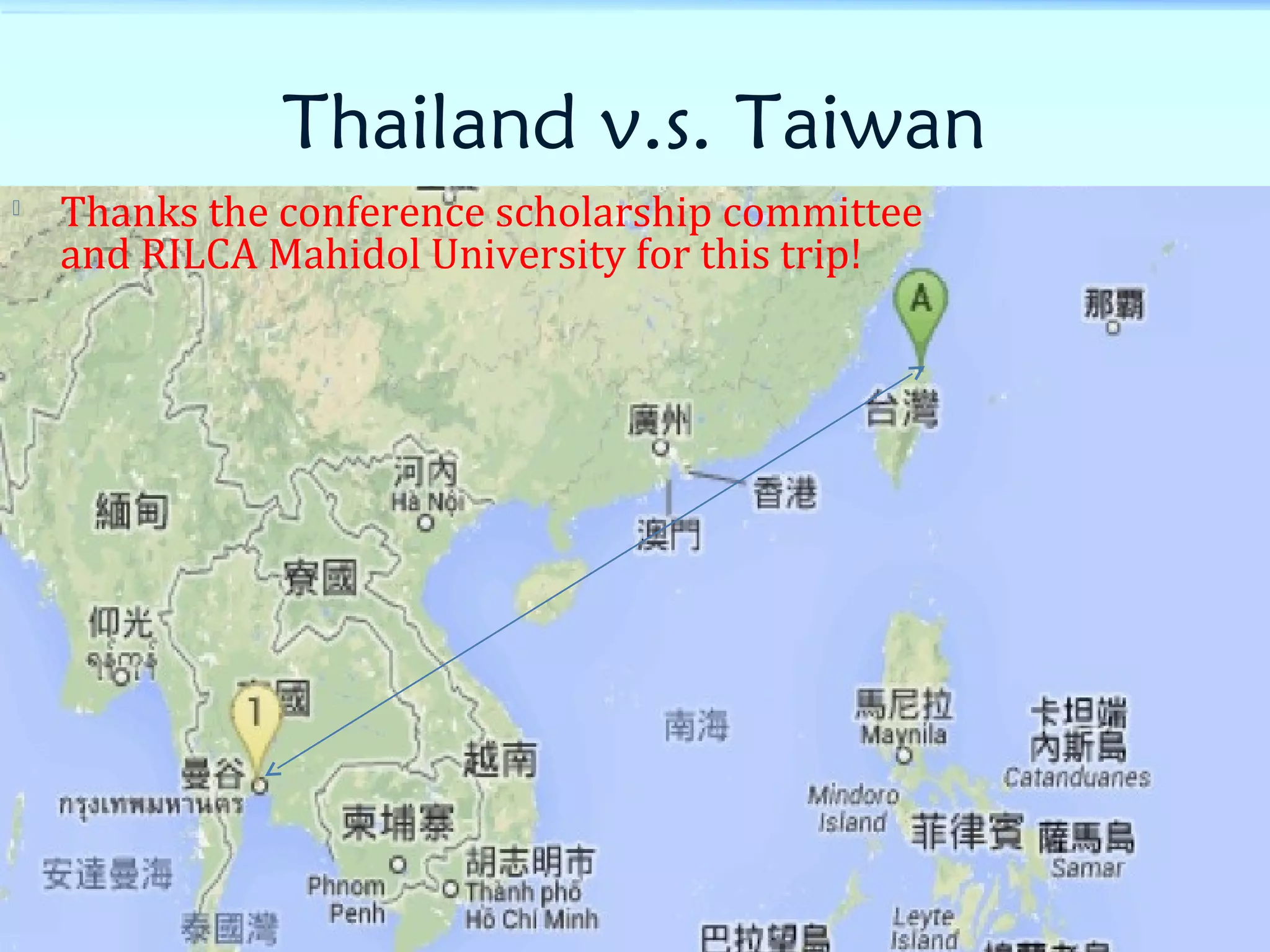
Thailand v.s. Taiwan

Thanks the conference scholarship committee
and RILCA Mahidol University for this trip!
Multilingual Environment?
Language education in Taiwan

Chinese/dialects: Mandarin, Taiwanese, Hakka

Share the same spelling system: Zhu-Yin-Fu-Hao
 Eg. 囡仔 (Taiwanese) 、細妹 (Hakka)

English versus. Chinese

Share different spelling systems and characters

English as a foreign language (English curriculum
since kindergarten or 1st
grade )
The objectives of the research

To clarify the key elements
(Auditory/phonological awareness,
Vocabulary, Visual-spatial/Morphology
awareness) and their relationship in
mother-tongue based mulitiligual (Chinese,
dialects and English) education.
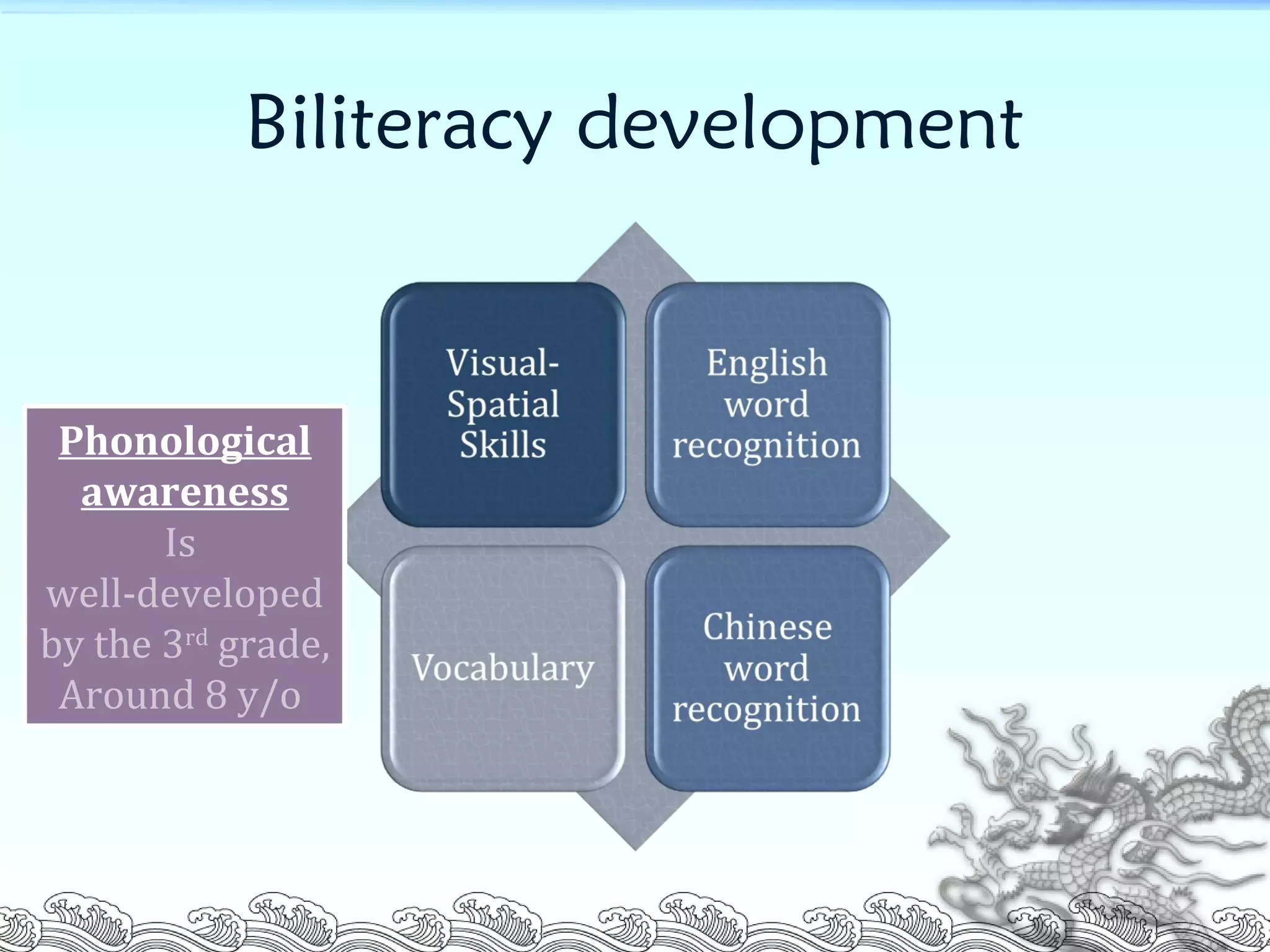
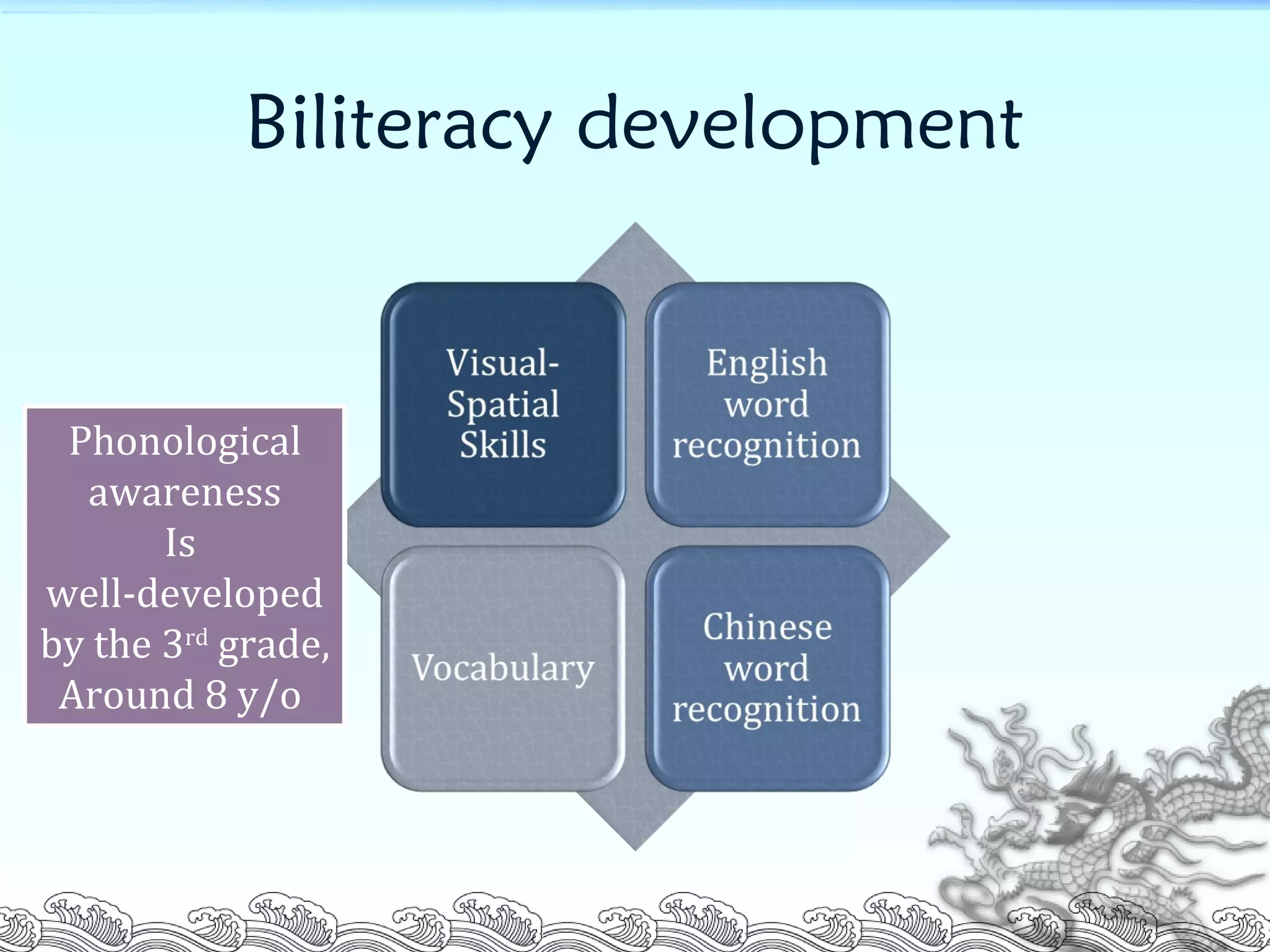
Biliteracy development
Phonological
awareness
Is
well-developed
by the 3rd
grade,
Around 8 y/o
Reading Development (Chall 1983)
Stage 0 0-6 y/o Preschool Pre-reading stage
Stage 1 6-7 y/o First-Second grade Initial reading stage
Stage 2 7-8 y/o Second-Third grade Confirmation, fluent, ungluing from print
Stage 3 8-14 y/o Reading for learning
3A 9-11 y/o Fourth-Sixth grade
3B 12-14 y/o Junior high school
Stage 4 14-18 y/o Senior high school Multiple viewpoint
Stage 5 18 y/o up College Construct and reconstruction –
a world view
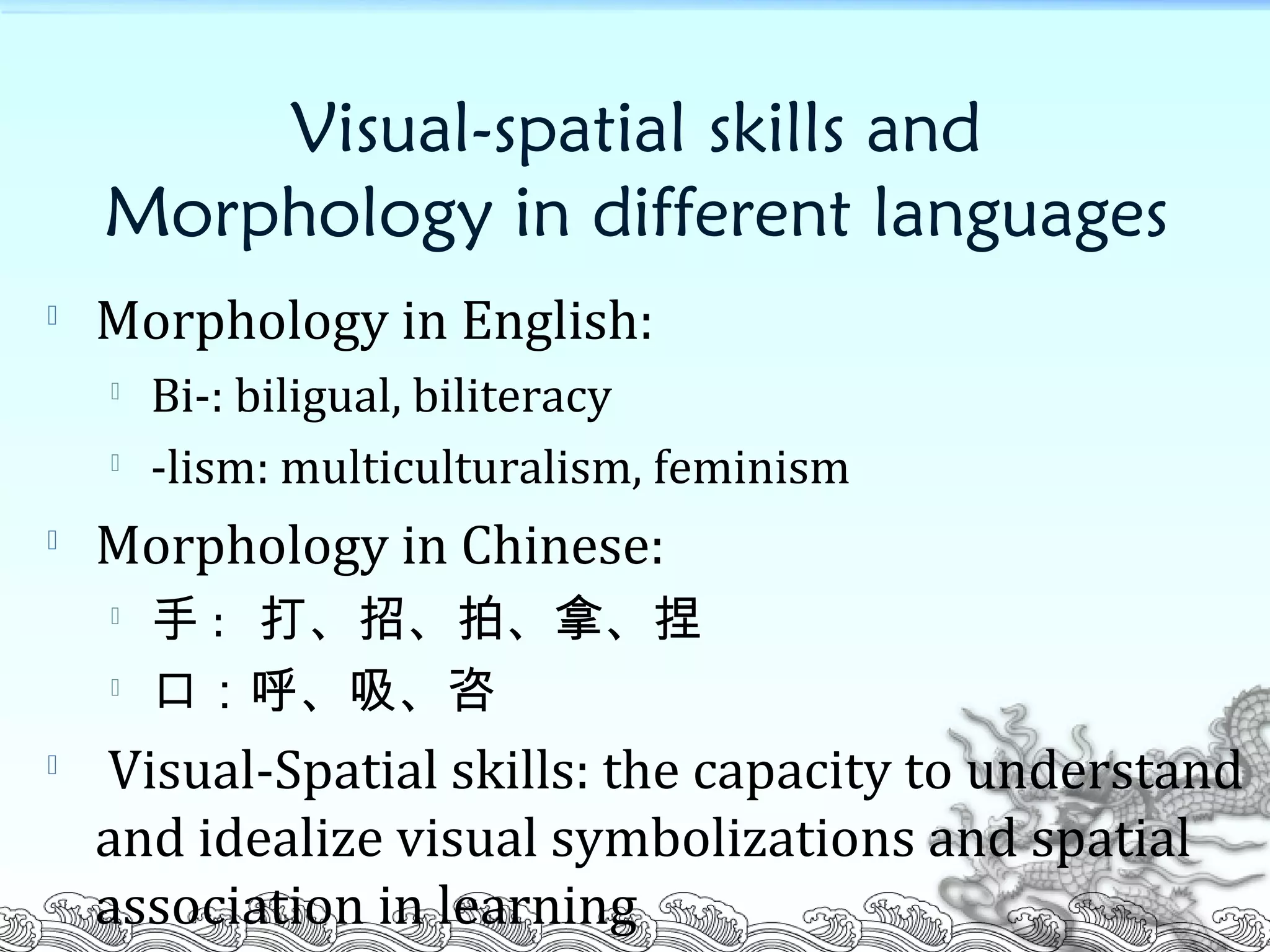
Visual-spatial skills and
Morphology in different languages

Morphology in English:

Bi-: biligual, biliteracy

-lism: multiculturalism, feminism

Morphology in Chinese:

手 : 打、招、拍、拿、捏

口:呼、吸、咨

Visual-Spatial skills: the capacity to understand
and idealize visual symbolizations and spatial
association in learning
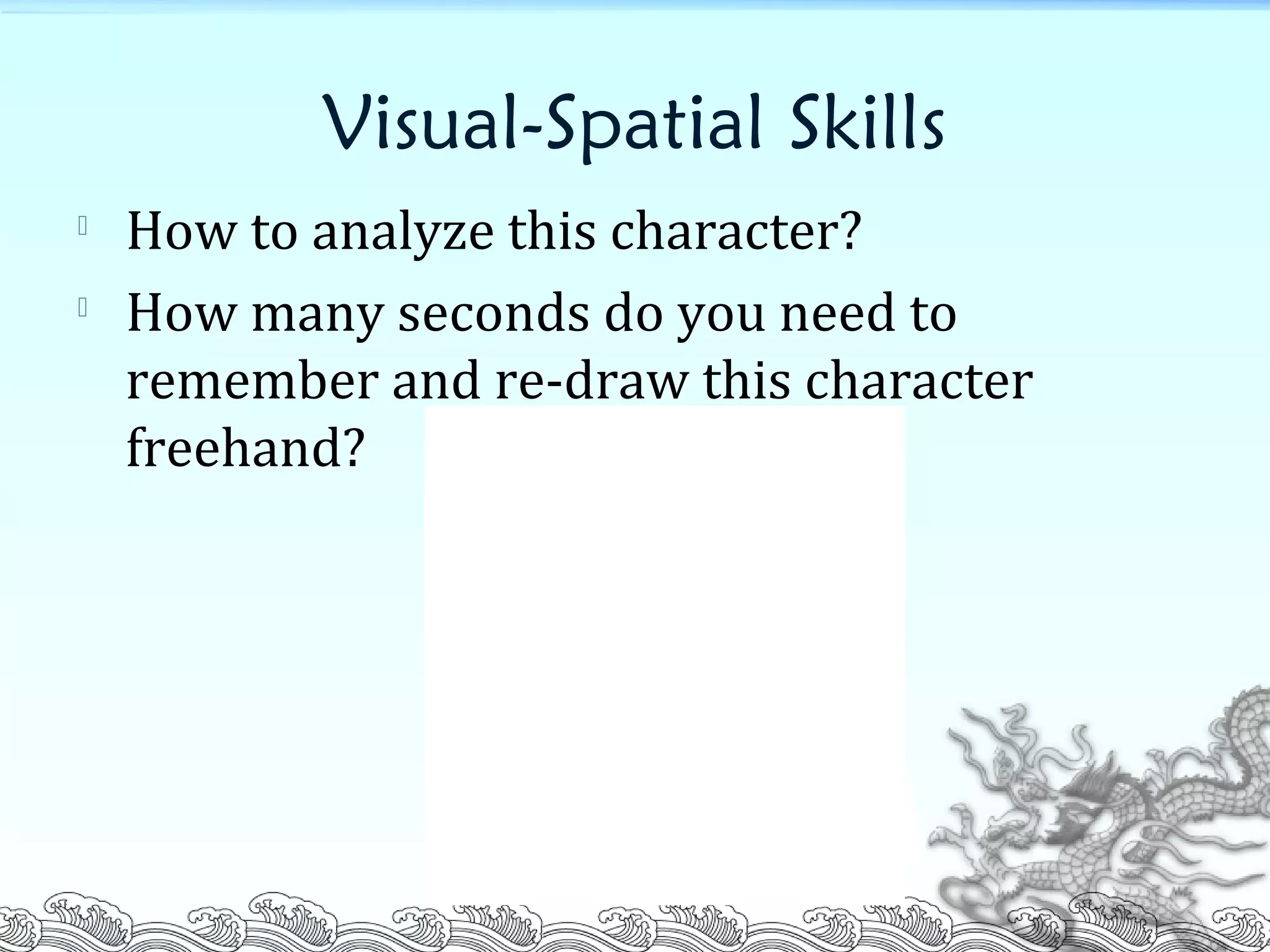
Visual-Spatial Skills

How to analyze this character?

How many seconds do you need to
remember and re-draw this character
freehand?
The hypotheses of the research

Vocabulary is the semantic knowledge of
the language and is expected to be
positively correlated to both Chinese and
English word recognition.

Visual-spatial skills are more correlated to
Chinese word recognition, rather than
English word recognition.
The tools to measure the
individual differences
The psychological tests applied in the research
Biliteracy development
Phonological
awareness
Is
well-developed
by the 3rd
grade,
Around 8 y/o
Biliteracy development
Measurement tools:
Word Recognition Test
Chinese word recognition test

請 又 真 你

謝 不 可 好

對 媽 爸 妹

身 課 上 湧
English word recognition test:
dog cat dear thing
bad hat thank real
please up class father
you body right mother
Biliteracy development
Measurement tools:
Vocabulary Test of
Wechsler Intelligence Scale of Children 4th
version
Biliteracy development
Measurement tools:
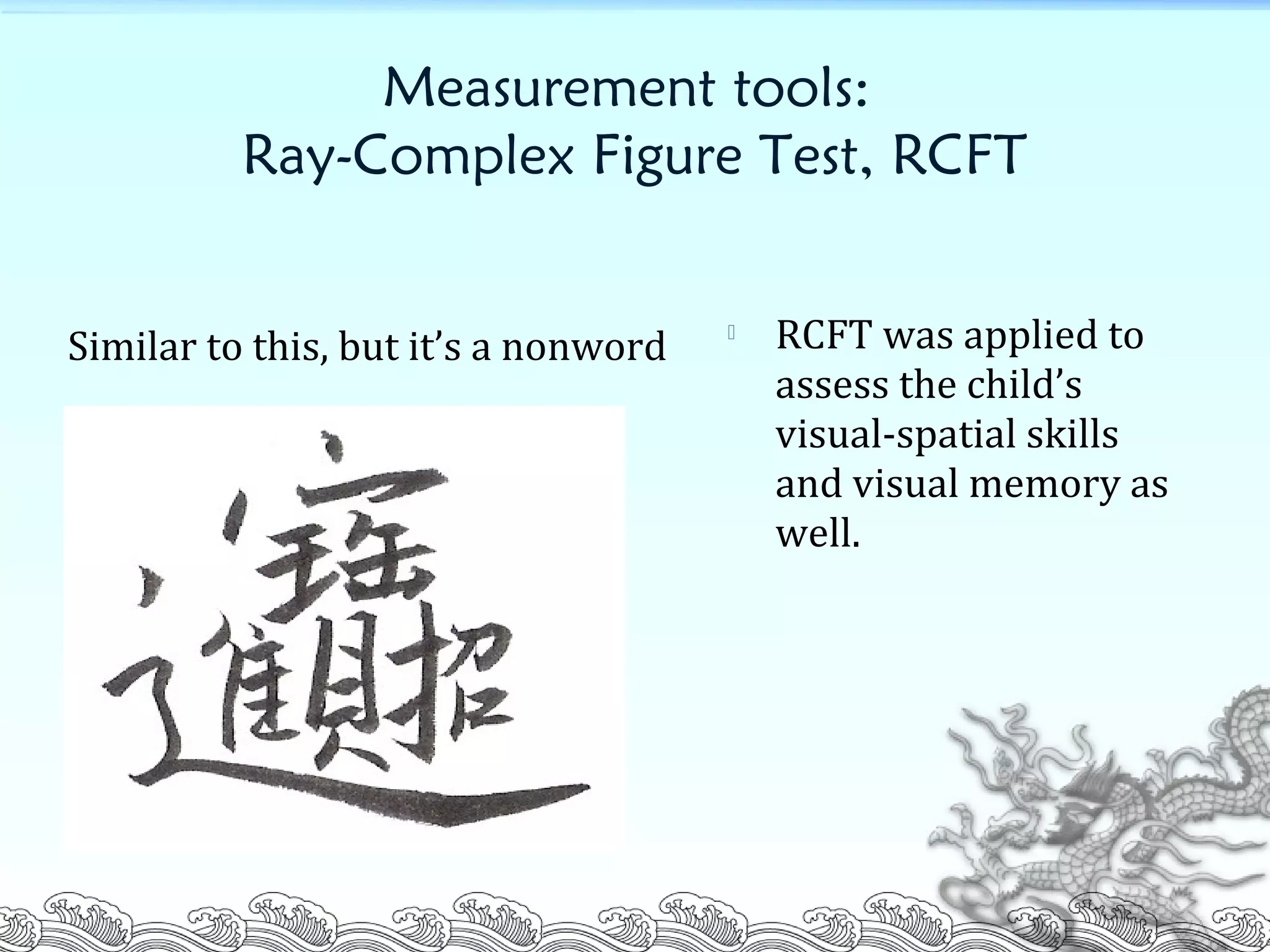
Ray-Complex Figure Test, RCFT
Similar to this, but it’s a nonword  RCFT was applied to
assess the child’s
visual-spatial skills
and visual memory as
well.
Result
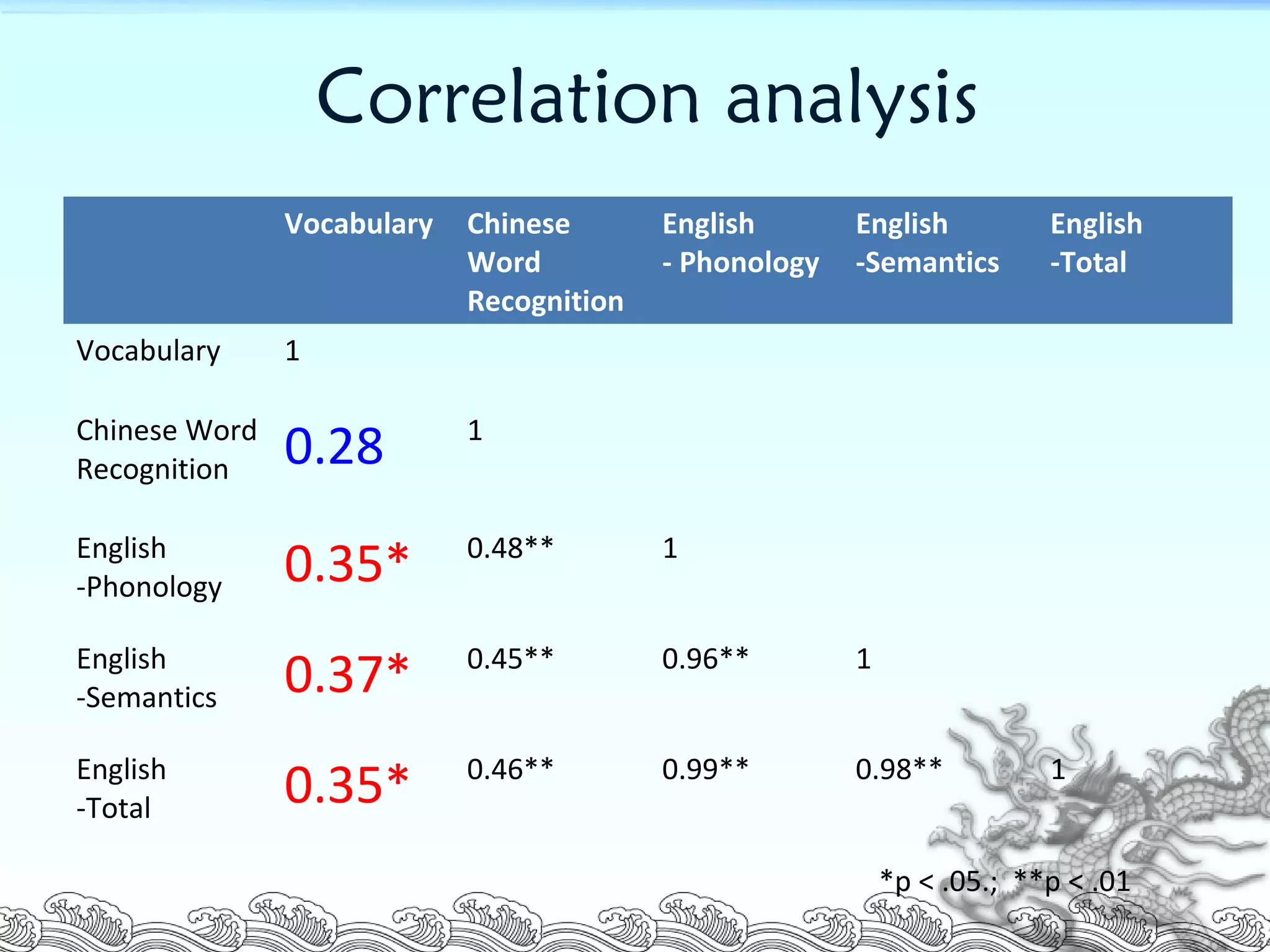
Correlation analysis
Vocabulary Chinese
Word
Recognition
English
- Phonology
English
-Semantics
English
-Total
Vocabulary 1
Chinese Word
Recognition 0.28 1
English
-Phonology 0.35* 0.48** 1
English
-Semantics 0.37* 0.45** 0.96** 1
English
-Total 0.35* 0.46** 0.99** 0.98** 1
*p < .05.; **p < .01
Multiple Regression analysis
Vocabulary Copy Immediately
Recall
Delayed
Recall
Recognition F Sig.
Chinese
word
Recognition
0.20
1.29
0.04
0.217
0.04
0.217
-1.207
-2.647
0.18
1.07
2.86* 0.03*
English
Word
Recognition
0.36
2.13
1.11
0.54
-0.34
-0.71
0.17
0.34
1.56
0.17
1.57 0.19
*p < .05.
Discussion-1

Vocabulary is related to English, but not
related to Chinese. The higher vocabulary
score, the more English words recognized.

4th
grade reading stage: read to learn, Chinese
character coding is automatic. On the contrary,
children are still not familiar with English coding
system.

Implication: Increasing children’s oral
vocabulary in their mother tongue might be
helpful to recognize the second language.
Discussion-2

RCFT scores could explain the performance of
Chinese word recognition, rather than English
word recognition.

Visual-Spatial skills are more important for
recognizing Chinese character than for recognizing
English word.

Implication: Visual-Spatial skills are more
important for ideographical character (eg.
Chinese) than spelling language (e.g. English)
Thanks for your listening!

77D_Chuang&Chang

  • 1.
    Different Influences ofVisual-Spatial Skills on Chinese and English Word Recognition: The Example of Fourth-Grade Students In Taiwan. Authors: (1) Ya-Chin Chuang, Certified Clinical Psychologist (doctoral student), National Taiwan Normal University, Email: gracechuang2011@gmail.com (2) Chien-Ju Chang, professor, National Taiwan Normal University Present in 4th MultiLingual Education Conference Thailand, 2013. 11.6 - 8
  • 2.
    Thailand v.s. Taiwan  Thanksthe conference scholarship committee and RILCA Mahidol University for this trip!
  • 3.
    Multilingual Environment? Language educationin Taiwan  Chinese/dialects: Mandarin, Taiwanese, Hakka  Share the same spelling system: Zhu-Yin-Fu-Hao  Eg. 囡仔 (Taiwanese) 、細妹 (Hakka)  English versus. Chinese  Share different spelling systems and characters  English as a foreign language (English curriculum since kindergarten or 1st grade )
  • 4.
    The objectives ofthe research  To clarify the key elements (Auditory/phonological awareness, Vocabulary, Visual-spatial/Morphology awareness) and their relationship in mother-tongue based mulitiligual (Chinese, dialects and English) education.
  • 5.
  • 6.
    Reading Development (Chall1983) Stage 0 0-6 y/o Preschool Pre-reading stage Stage 1 6-7 y/o First-Second grade Initial reading stage Stage 2 7-8 y/o Second-Third grade Confirmation, fluent, ungluing from print Stage 3 8-14 y/o Reading for learning 3A 9-11 y/o Fourth-Sixth grade 3B 12-14 y/o Junior high school Stage 4 14-18 y/o Senior high school Multiple viewpoint Stage 5 18 y/o up College Construct and reconstruction – a world view
  • 7.
    Visual-spatial skills and Morphologyin different languages  Morphology in English:  Bi-: biligual, biliteracy  -lism: multiculturalism, feminism  Morphology in Chinese:  手 : 打、招、拍、拿、捏  口:呼、吸、咨  Visual-Spatial skills: the capacity to understand and idealize visual symbolizations and spatial association in learning
  • 8.
    Visual-Spatial Skills  How toanalyze this character?  How many seconds do you need to remember and re-draw this character freehand?
  • 9.
    The hypotheses ofthe research  Vocabulary is the semantic knowledge of the language and is expected to be positively correlated to both Chinese and English word recognition.  Visual-spatial skills are more correlated to Chinese word recognition, rather than English word recognition.
  • 10.
    The tools tomeasure the individual differences The psychological tests applied in the research
  • 11.
  • 13.
  • 14.
    Measurement tools: Word RecognitionTest Chinese word recognition test  請 又 真 你  謝 不 可 好  對 媽 爸 妹  身 課 上 湧 English word recognition test: dog cat dear thing bad hat thank real please up class father you body right mother
  • 15.
  • 16.
    Measurement tools: Vocabulary Testof Wechsler Intelligence Scale of Children 4th version
  • 17.
  • 18.
    Measurement tools: Ray-Complex FigureTest, RCFT Similar to this, but it’s a nonword  RCFT was applied to assess the child’s visual-spatial skills and visual memory as well.
  • 19.
  • 20.
    Correlation analysis Vocabulary Chinese Word Recognition English -Phonology English -Semantics English -Total Vocabulary 1 Chinese Word Recognition 0.28 1 English -Phonology 0.35* 0.48** 1 English -Semantics 0.37* 0.45** 0.96** 1 English -Total 0.35* 0.46** 0.99** 0.98** 1 *p < .05.; **p < .01
  • 21.
    Multiple Regression analysis VocabularyCopy Immediately Recall Delayed Recall Recognition F Sig. Chinese word Recognition 0.20 1.29 0.04 0.217 0.04 0.217 -1.207 -2.647 0.18 1.07 2.86* 0.03* English Word Recognition 0.36 2.13 1.11 0.54 -0.34 -0.71 0.17 0.34 1.56 0.17 1.57 0.19 *p < .05.
  • 22.
    Discussion-1  Vocabulary is relatedto English, but not related to Chinese. The higher vocabulary score, the more English words recognized.  4th grade reading stage: read to learn, Chinese character coding is automatic. On the contrary, children are still not familiar with English coding system.  Implication: Increasing children’s oral vocabulary in their mother tongue might be helpful to recognize the second language.
  • 23.
    Discussion-2  RCFT scores couldexplain the performance of Chinese word recognition, rather than English word recognition.  Visual-Spatial skills are more important for recognizing Chinese character than for recognizing English word.  Implication: Visual-Spatial skills are more important for ideographical character (eg. Chinese) than spelling language (e.g. English)
  • 24.
    Thanks for yourlistening!

Editor's Notes

  • #3 Here’s a map for you get the idea where is Taiwan.
  • #4 Grapheme Phoneme Correspondence, GPC For different language systems, some are more related to each other, let’s say, dialects in Chinese. For example, Taiwanese and Hakka share the spelling systems, Zhu-Yin-Fu-Hao. On the contrary, English and Chinese are different in spelling systems and characters. Some regards Chinese as ideographical language, which means when we read Chinese, we know what it means but we may not know how to say it. English is spelling systems, which means when we read English, we know how to say it but we may not know what does that mean. In Taiwan, kids start their first formal English curriculum in 1st grade of elementary school.
  • #5 Here we focus on Chinese and English, biliteracy development and learning.
  • #6 According to the metaanalysis report by National Early Literacy Panel in 2008 and a research conducted by Mc-Bride Chang et al. in 2005, we focused on Vocabulary, Visual-spatial skills and phonological awareness. As you can see here, English and Chinense word recognition tests as our dependent variables, we explore three factors, Vocabulary, Visual-spatial and Phonological awareness. We know what vocabulary is about. PA is regarded to be the most important factors in English reading and is well-developed by 3rd grade according to Jeanne Chall, a psychologist, writer and literacy researcher in Harvard Graduate School of Education.
  • #7 Here we can glance at his reading development stage theory. You can see the critical turning point is stage three, when we are 8 years old, 3rd grades in elementary school, we are supposed to master the words and turn from learn to read to read to learn. In Taiwan, there will be no Zhu-Yin-Fu-Hao in our textbook.
  • #8 In Mc-Bride Chang’s research in 2005, they investigated these three variables in English, Chinese and Korean reading. They applied morphology instead of visual-spatial skills. What is morphology? It changes with different language and can not measures across different languages. Morphology in English, for example, when we read bilingual, biliteracy, bi, we know there are two. When we read multiculturalism, feminism, we know it’s about some beliefs. Morphology in Chinese, for example, when we see a symbol like this, we know it’s bout hand moment. When we see a symbol like this, we know is about mouth. Visual-Spatial, we refer it as a kind of neuropsychological function. It is the capacity to understand and idealize visual symbolizations and spatial association in learning.
  • #9 Let me show you how visual-spatial skills help us in word recognition. When you see the word, if I ask you to remember the word, and write it down, how many seconds do you need? If you know Chinese, you will know the most effective way is to analyze and divide the word into four parts. Since these four parts are meaningful to you. Visual-spatial skills helps us to analyze and reorganize the symbols to make it easier to remember.
  • #12 As you see there are five variables here. The first test we applied is Chinese Phonological awareness test battery. Chinese Phonological Awareness Test Battery: a time-saving group test which can be used to screen students who have phonological awareness (PA) difficulties. It has forty items and is composed of 4 subscales, i.e., the measure of the awareness of consonant, vowel, diphthong and tone. Those who fail in Chinese Phonological Awareness Test Battery are diagnosed as PA difficulty and their PA ability does not improve with age.
  • #13 We selects 4th grade students in elementary school, who passed the phonological awareness test. In other words, our participants has reach the reading developmental stage “read to learn”. Their phonological awareness has development to the plateau, and won’t make any difference on reading performance. Then each participants took another four psychological tests. RCFT, Voc, English and Chinese word recognition tests.
  • #14 Now, the tests we applied to measure English and Chiense reading achievements are English and Chinese word recognition tests.
  • #15 Here you can see the tests. Chinese Character Recognition Test was designed to assess a child’s performance of Chinese word recognition. It has twenty rows and each row is composed of 10 Chinese characters. 1 point was given if the child can pronounce the word. a published test with well-constructed validity and reliability. The norm of the test is from third-grade students in elementary school to third-grade students in junior high school. The internal-consistency reliability of different grades range from .991 to .994 and the criterion-related validity is significant.
  • #16 Another important variable is vocabulary.
  • #17 We applied Vocabulary test of Wechsler Intelligence Scale of Children, 4th version: Wechsler Intelligence Scale is a classical tool to assess a child’s intelligence and vocabulary subtest was applied to indicate the child’s oral language. It was administered in students’ mother tongue, Mandarin.
  • #18 For the most important variables, Visual-spatial skills, we applied RCFT to measure.
  • #19 Because of the regulation of psychological testing, I am not allowed to show you the testing complex figure. However, the figure is similar to this, but it’s a nonword. The child was asked to copy a complex figure freehand and re-draw again after 3 minutes immediate recall and 30 minutes delay recall. We applied Osterrieth scoring system and the total score range from 0 to 36.
  • #21 In this correlation analysis, we see that vocabulary is more related to English, which means, if you get higher scores in vocabulary, you get higher score in English word recognition test.
  • #22 In this multiple regression analysis, we can see that visual-spatial skills significantly account for Chinese word recognition, bot not for English word recognition.
  • #23 There are two conclusions. Vocabulary is related to English, but not related to Chinese. It means the higher vocabulary score, the more English, but not Chinese, words recognized. Our explanation is, in 4th grade reading stage, Chinese word recognition, the mother tongue, is fluent and automatic in reading. But English is not. However, if we increase our kid’s oral vocabulary in their mother tongue, it might be helpful to learning second language.
  • #24 The second result, Multiple regression test, showed us Visual-Spatial skills are more important for recognizing Chinese character than for recognizing English word. The influences of visual-spatial skills on Chinese and English word recognition test are different: The better visual-spatial skills you have, the quicker you learn Chinese words, but it might not help you recognize more English words. Our guess is that it is because Chinese is ideographical characters and more rely on visual-spatial skills.