
1Relationship Between Vocabulary Size and Reading ComprehensionAsst. Prof. Preawpan Pringprom, Ph. D                                                                                       Buppha Obchuae
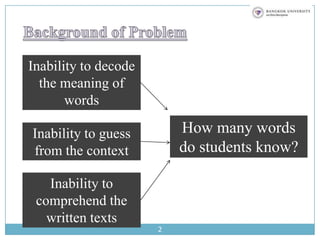
2Background of ProblemInability to decode the meaning of wordsHow many words do students know?Inability to guess from the contextInability to comprehend the written texts
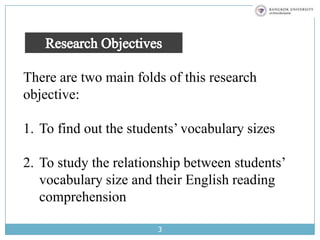
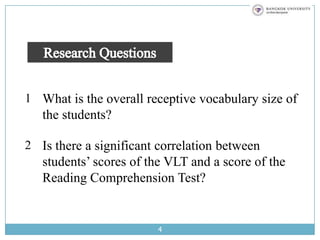
3Research ObjectivesThere are two main folds of this research objective: To find out the students’ vocabulary sizes To study the relationship between students’ vocabulary size and their English reading comprehension
4Research Questions
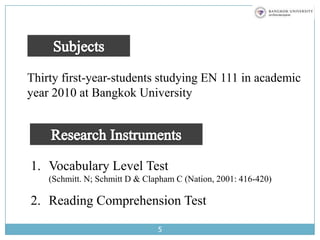
5SubjectsThirty first-year-students studying EN 111 in academic year 2010 at Bangkok UniversityResearch InstrumentsVocabulary Level Test                                       (Schmitt. N; Schmitt D & Clapham C (Nation, 2001: 416-420)Reading Comprehension Test
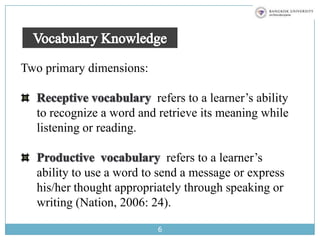
6Vocabulary KnowledgeTwo primary dimensions:Receptive vocabularyrefers to a learner’s ability to recognize a word and retrieve its meaning while listening or reading.Productive  vocabulary  refers to a learner’s ability to use a word to send a message or express his/her thought appropriately through speaking or writing (Nation, 2006: 24).
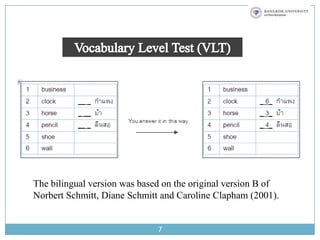
7Vocabulary Level Test (VLT)The bilingual version was based on the original version B of Norbert Schmitt, Diane Schmitt and Caroline Clapham (2001).
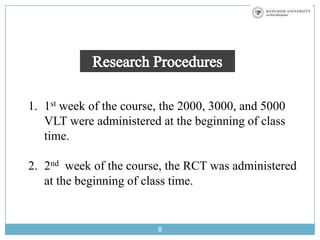
8Research Procedures1st week of the course, the 2000, 3000, and 5000 VLT were administered at the beginning of class time.2nd  week of the course, the RCT was administered at the beginning of class time.
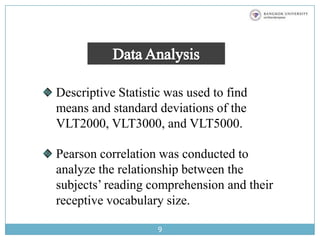
9Data AnalysisDescriptive Statistic was used to find means and standard deviations of the VLT2000, VLT3000, and VLT5000. Pearson correlation was conducted to analyze the relationship between the subjects’ reading comprehension and their receptive vocabulary size.
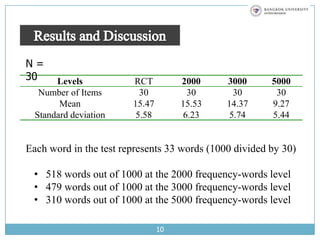
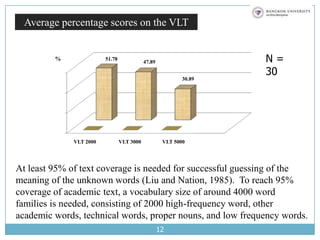
Results and DiscussionN = 30Each word in the test represents 33 words (1000 divided by 30)   518 words out of 1000 at the 2000 frequency-words level
   479 words out of 1000 at the 3000 frequency-words level
   310 words out of 1000 at the 5000 frequency-words level 10
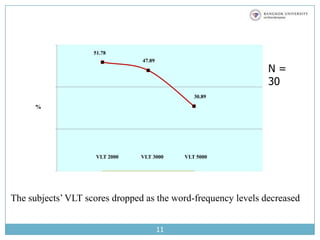
11N = 30The subjects’ VLT scoresdropped as the word-frequency levels decreased
12Average percentage scores on the VLT N = 30At least 95% of text coverage is needed for successful guessing of the meaning of the unknown words (Liu and Nation, 1985).  To reach 95% coverage of academic text, a vocabulary size of around 4000 word families is needed, consisting of 2000 high-frequency word, other academic words, technical words, proper nouns, and low frequency words.
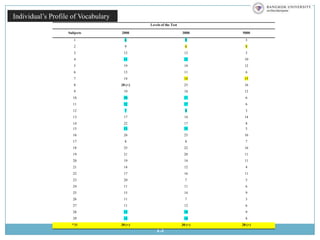
13Individual’s Profile of Vocabulary
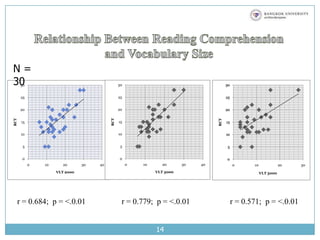
14Relationship Between Reading Comprehension and Vocabulary SizeN = 30  r = 0.684;  p = <.0.01                  r = 0.779;  p = <.0.01                    r = 0.571;  p = <.0.01

Relationship between Vocabulary Size and Reading Comprehension

  • 1.
    1Relationship Between VocabularySize and Reading ComprehensionAsst. Prof. Preawpan Pringprom, Ph. D Buppha Obchuae
  • 2.
    2Background of ProblemInabilityto decode the meaning of wordsHow many words do students know?Inability to guess from the contextInability to comprehend the written texts
  • 3.
    3Research ObjectivesThere aretwo main folds of this research objective: To find out the students’ vocabulary sizes To study the relationship between students’ vocabulary size and their English reading comprehension
  • 4.
  • 5.
    5SubjectsThirty first-year-students studyingEN 111 in academic year 2010 at Bangkok UniversityResearch InstrumentsVocabulary Level Test (Schmitt. N; Schmitt D & Clapham C (Nation, 2001: 416-420)Reading Comprehension Test
  • 6.
    6Vocabulary KnowledgeTwo primarydimensions:Receptive vocabularyrefers to a learner’s ability to recognize a word and retrieve its meaning while listening or reading.Productive vocabulary refers to a learner’s ability to use a word to send a message or express his/her thought appropriately through speaking or writing (Nation, 2006: 24).
  • 7.
    7Vocabulary Level Test(VLT)The bilingual version was based on the original version B of Norbert Schmitt, Diane Schmitt and Caroline Clapham (2001).
  • 8.
    8Research Procedures1st weekof the course, the 2000, 3000, and 5000 VLT were administered at the beginning of class time.2nd week of the course, the RCT was administered at the beginning of class time.
  • 9.
    9Data AnalysisDescriptive Statisticwas used to find means and standard deviations of the VLT2000, VLT3000, and VLT5000. Pearson correlation was conducted to analyze the relationship between the subjects’ reading comprehension and their receptive vocabulary size.
  • 10.
    Results and DiscussionN= 30Each word in the test represents 33 words (1000 divided by 30) 518 words out of 1000 at the 2000 frequency-words level
  • 11.
    479 words out of 1000 at the 3000 frequency-words level
  • 12.
    310 words out of 1000 at the 5000 frequency-words level 10
  • 13.
    11N = 30Thesubjects’ VLT scoresdropped as the word-frequency levels decreased
  • 14.
    12Average percentage scoreson the VLT N = 30At least 95% of text coverage is needed for successful guessing of the meaning of the unknown words (Liu and Nation, 1985). To reach 95% coverage of academic text, a vocabulary size of around 4000 word families is needed, consisting of 2000 high-frequency word, other academic words, technical words, proper nouns, and low frequency words.
  • 15.
  • 16.
    14Relationship Between ReadingComprehension and Vocabulary SizeN = 30 r = 0.684; p = <.0.01 r = 0.779; p = <.0.01 r = 0.571; p = <.0.01