Outcomes
Presentation to BAYA Members
By Erik Berman
What are Outcomes?
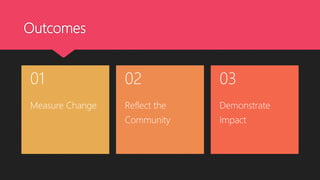
Outcomes
Measure Change
01
Reflect the
Community
02
Demonstrate
Impact
03
Definition
“Outcomes are benefits to people; specifically, achievements or changes
in skill, knowledge, attitude, behavior, condition, or life status…”
Institute of Museum and Library Services
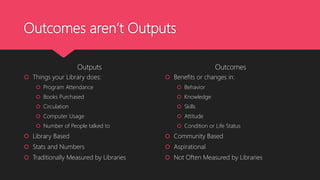
Outcomes aren’t Outputs
Outputs
 Things your Library does:
 Program Attendance
 Books Purchased
 Circulation
 Computer Usage
 Number of People talked to
 Library Based
 Stats and Numbers
 Traditionally Measured by Libraries
Outcomes
 Benefits or changes in:
 Behavior
 Knowledge
 Skills
 Attitude
 Condition or Life Status
 Community Based
 Aspirational
 Not Often Measured by Libraries
Why should you care about
Outcomes Measurement?
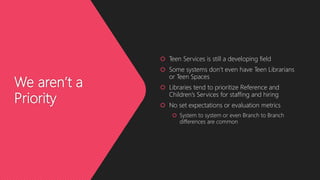
We aren’t a
Priority
 Teen Services is still a developing field
 Some systems don’t even have Teen Librarians
or Teen Spaces
 Libraries tend to prioritize Reference and
Children’s Services for staffing and hiring
 No set expectations or evaluation metrics
 System to system or even Branch to Branch
differences are common
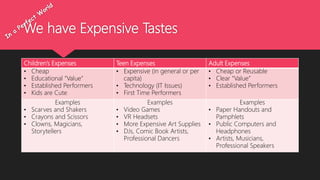
We have Expensive Tastes
Children’s Expenses Teen Expenses Adult Expenses
• Cheap
• Educational “Value”
• Established Performers
• Kids are Cute
• Expensive (in general or per
capita)
• Technology (IT Issues)
• First Time Performers
• Cheap or Reusable
• Clear “Value”
• Established Performers
Examples
• Scarves and Shakers
• Crayons and Scissors
• Clowns, Magicians,
Storytellers
Examples
• Video Games
• VR Headsets
• More Expensive Art Supplies
• DJs, Comic Book Artists,
Professional Dancers
Examples
• Paper Handouts and
Pamphlets
• Public Computers and
Headphones
• Artists, Musicians,
Professional Speakers
We’re
Compared to
All the Wrong
People
 Teen Services are constantly compared to
Children's or Adult Services
 We’ll never get the numbers of a Children’s
Program because…
 Parents make their kids attend
 Teens don’t have easy transportation
 Teen socializing is just different
 The value of a Teen Services or Teen Space
isn’t visible like a Storytime or ESL program
It’s Ammunition to Fight for Your Teens
 Outcomes let you show administrators, bosses, and stakeholders (internal and external) what
effect your programs are having on the community
 You can demonstrate the value of current programs and services (especially if you are worried
they will be taken away)
 You can try new programs and services and demonstrate the value they have on the community
 You can also use it to demonstrate the lack of value an existing program or service has
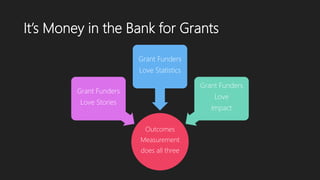
It’s Money in the Bank for Grants
Outcomes
Measurement
does all three
Grant Funders
Love Stories
Grant Funders
Love Statistics
Grant Funders
Love
Impact
How do you Measure
Outcomes?
Write an Outcome
 You should know what you are trying to
achieve
 It should benefit the community
 It should reflect a change in one’s
 Skill
 Knowledge
 Attitude
 Behavior
 Condition
 Life Status
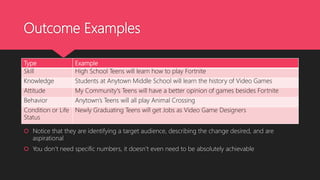
Outcome Examples
Type Example
Skill High School Teens will learn how to play Fortnite
Knowledge Students at Anytown Middle School will learn the history of Video Games
Attitude My Community's Teens will have a better opinion of games besides Fortnite
Behavior Anytown’s Teens will all play Animal Crossing
Condition or Life
Status
Newly Graduating Teens will get Jobs as Video Game Designers
 Notice that they are identifying a target audience, describing the change desired, and are
aspirational
 You don’t need specific numbers, it doesn’t even need to be absolutely achievable
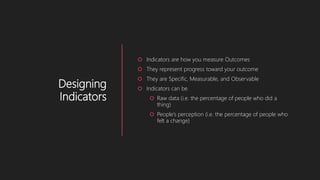
Designing
Indicators
 Indicators are how you measure Outcomes
 They represent progress toward your outcome
 They are Specific, Measurable, and Observable
 Indicators can be
 Raw data (i.e. the percentage of people who did a
thing)
 People’s perception (i.e. the percentage of people who
felt a change)
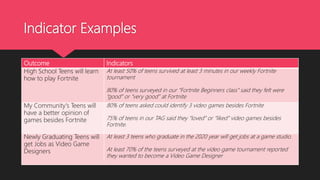
Indicator Examples
Outcome Indicators
High School Teens will learn
how to play Fortnite
At least 50% of teens survived at least 3 minutes in our weekly Fortnite
tournament
80% of teens surveyed in our “Fortnite Beginners class” said they felt were
“good” or “very good” at Fortnite
My Community's Teens will
have a better opinion of
games besides Fortnite
80% of teens asked could identify 3 video games besides Fortnite
75% of teens in our TAG said they “loved” or “liked” video games besides
Fortnite.
Newly Graduating Teens will
get Jobs as Video Game
Designers
At least 3 teens who graduate in the 2020 year will get jobs at a game studio.
At least 70% of the teens surveyed at the video game tournament reported
they wanted to become a Video Game Designer
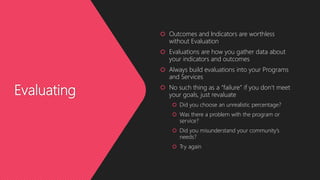
Evaluating
 Outcomes and Indicators are worthless
without Evaluation
 Evaluations are how you gather data about
your indicators and outcomes
 Always build evaluations into your Programs
and Services
 No such thing as a “failure” if you don’t meet
your goals, just revaluate
 Did you choose an unrealistic percentage?
 Was there a problem with the program or
service?
 Did you misunderstand your community’s
needs?
 Try again
Evaluation Types
 Data Analysis
 Observation
 Interviews
 Focus Groups
 Surveys
 Open Ended or Measured?
 Consistent Questions or Customized
Surveys?
PLA’s Project Outcome has built in Survey
and Evaluation Tools
Telling a Story
 Use Outcomes to…
 Gain support
 Defend services
 Strengthen Your Position
 Attract New Partners
 Earn Grants
 First Hand Accounts strengthen your point
 Take photos, collect samples, write down
quotes
Final Thoughts
 Outcomes are aspirational goals
 Indicators are how you show progress
 If you don’t Evaluate why Bother
 There’s tons of Additional Reading Available
Further Reading
 Five Steps of Outcomes-Based Planning and Evaluation for Public Libraries Book by Cindy
Mediavilla, Melissaa Gross, and Virginia A. Walter
 Project Outcome – PLA Outcomes Based Website
 Meaningful Measures | Assessment – School Library Journal)
 Outcomes Based Evaluation – Institute of Museum and Library Services
Special Thanks for Cindy Mediavilla

Outcomes

  • 1.
    Outcomes Presentation to BAYAMembers By Erik Berman
  • 2.
  • 3.
  • 4.
    Definition “Outcomes are benefitsto people; specifically, achievements or changes in skill, knowledge, attitude, behavior, condition, or life status…” Institute of Museum and Library Services
  • 5.
    Outcomes aren’t Outputs Outputs Things your Library does:  Program Attendance  Books Purchased  Circulation  Computer Usage  Number of People talked to  Library Based  Stats and Numbers  Traditionally Measured by Libraries Outcomes  Benefits or changes in:  Behavior  Knowledge  Skills  Attitude  Condition or Life Status  Community Based  Aspirational  Not Often Measured by Libraries
  • 6.
    Why should youcare about Outcomes Measurement?
  • 7.
    We aren’t a Priority Teen Services is still a developing field  Some systems don’t even have Teen Librarians or Teen Spaces  Libraries tend to prioritize Reference and Children’s Services for staffing and hiring  No set expectations or evaluation metrics  System to system or even Branch to Branch differences are common
  • 8.
    We have ExpensiveTastes Children’s Expenses Teen Expenses Adult Expenses • Cheap • Educational “Value” • Established Performers • Kids are Cute • Expensive (in general or per capita) • Technology (IT Issues) • First Time Performers • Cheap or Reusable • Clear “Value” • Established Performers Examples • Scarves and Shakers • Crayons and Scissors • Clowns, Magicians, Storytellers Examples • Video Games • VR Headsets • More Expensive Art Supplies • DJs, Comic Book Artists, Professional Dancers Examples • Paper Handouts and Pamphlets • Public Computers and Headphones • Artists, Musicians, Professional Speakers
  • 9.
    We’re Compared to All theWrong People  Teen Services are constantly compared to Children's or Adult Services  We’ll never get the numbers of a Children’s Program because…  Parents make their kids attend  Teens don’t have easy transportation  Teen socializing is just different  The value of a Teen Services or Teen Space isn’t visible like a Storytime or ESL program
  • 10.
    It’s Ammunition toFight for Your Teens  Outcomes let you show administrators, bosses, and stakeholders (internal and external) what effect your programs are having on the community  You can demonstrate the value of current programs and services (especially if you are worried they will be taken away)  You can try new programs and services and demonstrate the value they have on the community  You can also use it to demonstrate the lack of value an existing program or service has
  • 11.
    It’s Money inthe Bank for Grants Outcomes Measurement does all three Grant Funders Love Stories Grant Funders Love Statistics Grant Funders Love Impact
  • 12.
    How do youMeasure Outcomes?
  • 13.
    Write an Outcome You should know what you are trying to achieve  It should benefit the community  It should reflect a change in one’s  Skill  Knowledge  Attitude  Behavior  Condition  Life Status
  • 14.
    Outcome Examples Type Example SkillHigh School Teens will learn how to play Fortnite Knowledge Students at Anytown Middle School will learn the history of Video Games Attitude My Community's Teens will have a better opinion of games besides Fortnite Behavior Anytown’s Teens will all play Animal Crossing Condition or Life Status Newly Graduating Teens will get Jobs as Video Game Designers  Notice that they are identifying a target audience, describing the change desired, and are aspirational  You don’t need specific numbers, it doesn’t even need to be absolutely achievable
  • 15.
    Designing Indicators  Indicators arehow you measure Outcomes  They represent progress toward your outcome  They are Specific, Measurable, and Observable  Indicators can be  Raw data (i.e. the percentage of people who did a thing)  People’s perception (i.e. the percentage of people who felt a change)
  • 16.
    Indicator Examples Outcome Indicators HighSchool Teens will learn how to play Fortnite At least 50% of teens survived at least 3 minutes in our weekly Fortnite tournament 80% of teens surveyed in our “Fortnite Beginners class” said they felt were “good” or “very good” at Fortnite My Community's Teens will have a better opinion of games besides Fortnite 80% of teens asked could identify 3 video games besides Fortnite 75% of teens in our TAG said they “loved” or “liked” video games besides Fortnite. Newly Graduating Teens will get Jobs as Video Game Designers At least 3 teens who graduate in the 2020 year will get jobs at a game studio. At least 70% of the teens surveyed at the video game tournament reported they wanted to become a Video Game Designer
  • 17.
    Evaluating  Outcomes andIndicators are worthless without Evaluation  Evaluations are how you gather data about your indicators and outcomes  Always build evaluations into your Programs and Services  No such thing as a “failure” if you don’t meet your goals, just revaluate  Did you choose an unrealistic percentage?  Was there a problem with the program or service?  Did you misunderstand your community’s needs?  Try again
  • 18.
    Evaluation Types  DataAnalysis  Observation  Interviews  Focus Groups  Surveys  Open Ended or Measured?  Consistent Questions or Customized Surveys? PLA’s Project Outcome has built in Survey and Evaluation Tools
  • 19.
    Telling a Story Use Outcomes to…  Gain support  Defend services  Strengthen Your Position  Attract New Partners  Earn Grants  First Hand Accounts strengthen your point  Take photos, collect samples, write down quotes
  • 20.
    Final Thoughts  Outcomesare aspirational goals  Indicators are how you show progress  If you don’t Evaluate why Bother  There’s tons of Additional Reading Available
  • 21.
    Further Reading  FiveSteps of Outcomes-Based Planning and Evaluation for Public Libraries Book by Cindy Mediavilla, Melissaa Gross, and Virginia A. Walter  Project Outcome – PLA Outcomes Based Website  Meaningful Measures | Assessment – School Library Journal)  Outcomes Based Evaluation – Institute of Museum and Library Services Special Thanks for Cindy Mediavilla

Editor's Notes

  • #2 This Presentation draws heavily from a training done by Cindy Mediavilla and her book Five Steps of Outcomes-Based Planning and Evaluation for Public Libraries by her, Melissa Gross, and Virginia A. Walter
  • #5 https://www.imls.gov/grants/outcome-based-evaluation/basics
  • #9 Don’t @ me if you disagree. Of course teen librarians are amazing at doing insane things with no money, we rarely get money to spend.