The Digital Transformation of
 Scholarly Communication

 Its Impact on Academic Libraries and
              their Users
Libraries: Connecting People to
          Information
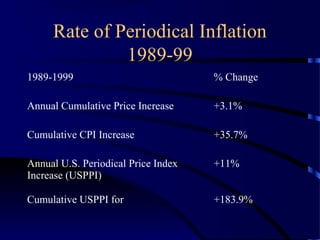
Rate of Periodical Inflation
              1989-99
1989-1999                            % Change

Annual Cumulative Price Increase     +3.1%

Cumulative CPI Increase              +35.7%

Annual U.S. Periodical Price Index   +11%
Increase (USPPI)

Cumulative USPPI for                 +183.9%
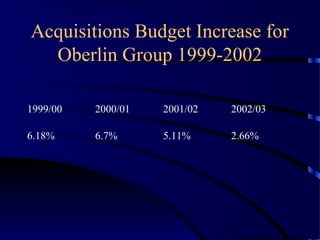
Acquisitions Budget Increase for
  Oberlin Group 1999-2002

1999/00   2000/01   2001/02   2002/03

6.18%     6.7%      5.11%     2.66%
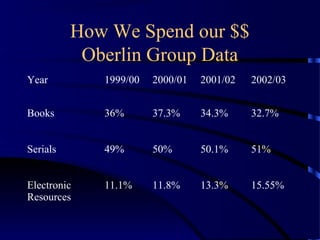
How We Spend our $$
           Oberlin Group Data
Year         1999/00   2000/01   2001/02   2002/03


Books        36%       37.3%     34.3%     32.7%


Serials      49%       50%       50.1%     51%


Electronic   11.1%     11.8%     13.3%     15.55%
Resources
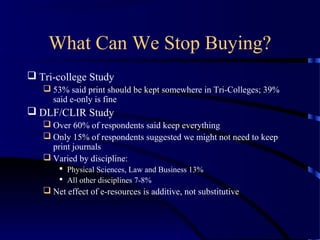
What Can We Stop Buying?
 Tri-college Study
    53% said print should be kept somewhere in Tri-Colleges; 39%
     said e-only is fine
 DLF/CLIR Study
    Over 60% of respondents said keep everything
    Only 15% of respondents suggested we might not need to keep
     print journals
    Varied by discipline:
        Physical Sciences, Law and Business 13%
        All other disciplines 7-8%
    Net effect of e-resources is additive, not substitutive
Other Collection Development
              Issues

Have I got a deal for you!

Preserving these resources
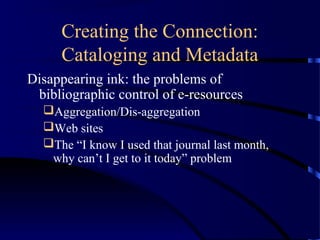
Creating the Connection:
     Cataloging and Metadata
Disappearing ink: the problems of
 bibliographic control of e-resources
  Aggregation/Dis-aggregation
  Web sites
  The “I know I used that journal last month,
   why can’t I get to it today” problem
Helping Make the Connection
 Ensuring the resources are catalogued in the
  OPAC
 Designing Web sites that help users locate these
  resources
 Integrating resources into CMS
 Contracting with service providers like Serials
  Solutions to maintain lists of e-journals
 SFX and other linking services, so that no matter
  where a user starts their search, they can chain
  through to needed resources
Why Can’t my Library Catalog
     be more like Amazon?
In evaluating whether a book might be useful, the following
   types of information are most helpful

 Table of Contents - 88%
 Reviews in Disciplinary Journals - 88%
 Preface/introduction - 72%
 Bibliography - 61%
 First chapter - 56%
 General book reviews - 56%
Why Can’t I Get …?
OCLC study found that a major barrier to
 successful use of library resources is the
 inability to access databases remotely due to
 password and/or license restrictions
Printing management
Public computers: how many are enough?
Reference and Help Seeking
False confidence syndrome: Students are
 very confident in their abilities to find
 information; 3 of 4 say they are successful
 in finding information needed for courses
 and assignments
Only 20% ever use a reference librarian
80% prefer face to face contact when
 seeking help
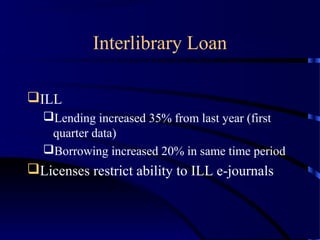
Interlibrary Loan

ILL
  Lending increased 35% from last year (first
   quarter data)
  Borrowing increased 20% in same time period
Licenses restrict ability to ILL e-journals
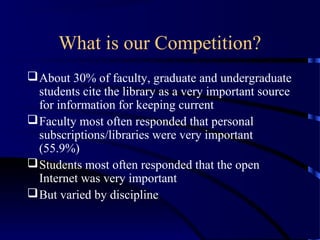
What is our Competition?
 About 30% of faculty, graduate and undergraduate
  students cite the library as a very important source
  for information for keeping current
 Faculty most often responded that personal
  subscriptions/libraries were very important
  (55.9%)
 Students most often responded that the open
  Internet was very important
 But varied by discipline
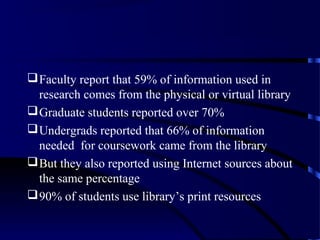
 Faculty report that 59% of information used in
  research comes from the physical or virtual library
 Graduate students reported over 70%
 Undergrads reported that 66% of information
  needed for coursework came from the library
 But they also reported using Internet sources about
  the same percentage
 90% of students use library’s print resources
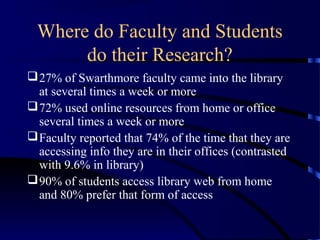
Where do Faculty and Students
       do their Research?
 27% of Swarthmore faculty came into the library
  at several times a week or more
 72% used online resources from home or office
  several times a week or more
 Faculty reported that 74% of the time that they are
  accessing info they are in their offices (contrasted
  with 9.6% in library)
 90% of students access library web from home
  and 80% prefer that form of access
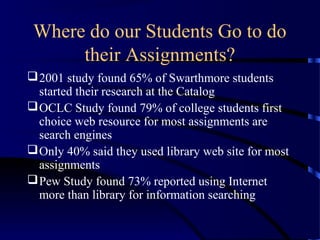
Where do our Students Go to do
      their Assignments?
 2001 study found 65% of Swarthmore students
  started their research at the Catalog
 OCLC Study found 79% of college students first
  choice web resource for most assignments are
  search engines
 Only 40% said they used library web site for most
  assignments
 Pew Study found 73% reported using Internet
  more than library for information searching
What do Users Value?
Convenience
Speed
Ease of Access
Quality/accuracy
Currency
Coverage
Ability to search and to print
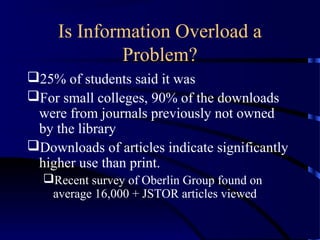
Is Information Overload a
             Problem?
25% of students said it was
For small colleges, 90% of the downloads
 were from journals previously not owned
 by the library
Downloads of articles indicate significantly
 higher use than print.
  Recent survey of Oberlin Group found on
   average 16,000 + JSTOR articles viewed
Academic Libraries Respond
  New collection development models
  New ways to manage the administrative data
 Development of digital repositories
  Enhanced cataloging
  Linking services
  Dynamic library websites to provide alternative
  ways to get to resources
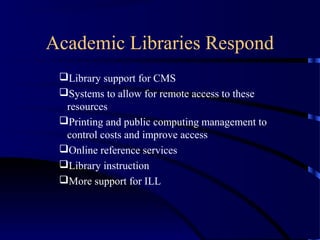
Academic Libraries Respond
 Library support for CMS
 Systems to allow for remote access to these
  resources
 Printing and public computing management to
  control costs and improve access
 Online reference services
 Library instruction
 More support for ILL
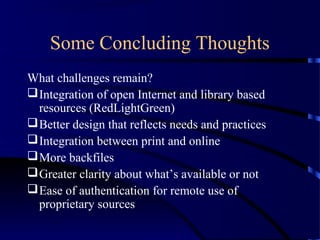
Some Concluding Thoughts
What challenges remain?
 Integration of open Internet and library based
  resources (RedLightGreen)
 Better design that reflects needs and practices
 Integration between print and online
 More backfiles
 Greater clarity about what’s available or not
 Ease of authentication for remote use of
  proprietary sources

72 libraries 1

  • 1.
    The Digital Transformationof Scholarly Communication Its Impact on Academic Libraries and their Users
  • 2.
  • 3.
    Rate of PeriodicalInflation 1989-99 1989-1999 % Change Annual Cumulative Price Increase +3.1% Cumulative CPI Increase +35.7% Annual U.S. Periodical Price Index +11% Increase (USPPI) Cumulative USPPI for +183.9%
  • 4.
    Acquisitions Budget Increasefor Oberlin Group 1999-2002 1999/00 2000/01 2001/02 2002/03 6.18% 6.7% 5.11% 2.66%
  • 5.
    How We Spendour $$ Oberlin Group Data Year 1999/00 2000/01 2001/02 2002/03 Books 36% 37.3% 34.3% 32.7% Serials 49% 50% 50.1% 51% Electronic 11.1% 11.8% 13.3% 15.55% Resources
  • 6.
    What Can WeStop Buying?  Tri-college Study  53% said print should be kept somewhere in Tri-Colleges; 39% said e-only is fine  DLF/CLIR Study  Over 60% of respondents said keep everything  Only 15% of respondents suggested we might not need to keep print journals  Varied by discipline:  Physical Sciences, Law and Business 13%  All other disciplines 7-8%  Net effect of e-resources is additive, not substitutive
  • 7.
    Other Collection Development Issues Have I got a deal for you! Preserving these resources
  • 8.
    Creating the Connection: Cataloging and Metadata Disappearing ink: the problems of bibliographic control of e-resources Aggregation/Dis-aggregation Web sites The “I know I used that journal last month, why can’t I get to it today” problem
  • 9.
    Helping Make theConnection  Ensuring the resources are catalogued in the OPAC  Designing Web sites that help users locate these resources  Integrating resources into CMS  Contracting with service providers like Serials Solutions to maintain lists of e-journals  SFX and other linking services, so that no matter where a user starts their search, they can chain through to needed resources
  • 10.
    Why Can’t myLibrary Catalog be more like Amazon? In evaluating whether a book might be useful, the following types of information are most helpful  Table of Contents - 88%  Reviews in Disciplinary Journals - 88%  Preface/introduction - 72%  Bibliography - 61%  First chapter - 56%  General book reviews - 56%
  • 11.
    Why Can’t IGet …? OCLC study found that a major barrier to successful use of library resources is the inability to access databases remotely due to password and/or license restrictions Printing management Public computers: how many are enough?
  • 12.
    Reference and HelpSeeking False confidence syndrome: Students are very confident in their abilities to find information; 3 of 4 say they are successful in finding information needed for courses and assignments Only 20% ever use a reference librarian 80% prefer face to face contact when seeking help
  • 13.
    Interlibrary Loan ILL Lending increased 35% from last year (first quarter data) Borrowing increased 20% in same time period Licenses restrict ability to ILL e-journals
  • 14.
    What is ourCompetition?  About 30% of faculty, graduate and undergraduate students cite the library as a very important source for information for keeping current  Faculty most often responded that personal subscriptions/libraries were very important (55.9%)  Students most often responded that the open Internet was very important  But varied by discipline
  • 15.
     Faculty reportthat 59% of information used in research comes from the physical or virtual library  Graduate students reported over 70%  Undergrads reported that 66% of information needed for coursework came from the library  But they also reported using Internet sources about the same percentage  90% of students use library’s print resources
  • 16.
    Where do Facultyand Students do their Research?  27% of Swarthmore faculty came into the library at several times a week or more  72% used online resources from home or office several times a week or more  Faculty reported that 74% of the time that they are accessing info they are in their offices (contrasted with 9.6% in library)  90% of students access library web from home and 80% prefer that form of access
  • 17.
    Where do ourStudents Go to do their Assignments?  2001 study found 65% of Swarthmore students started their research at the Catalog  OCLC Study found 79% of college students first choice web resource for most assignments are search engines  Only 40% said they used library web site for most assignments  Pew Study found 73% reported using Internet more than library for information searching
  • 18.
    What do UsersValue? Convenience Speed Ease of Access Quality/accuracy Currency Coverage Ability to search and to print
  • 19.
    Is Information Overloada Problem? 25% of students said it was For small colleges, 90% of the downloads were from journals previously not owned by the library Downloads of articles indicate significantly higher use than print. Recent survey of Oberlin Group found on average 16,000 + JSTOR articles viewed
  • 20.
    Academic Libraries Respond  New collection development models  New ways to manage the administrative data Development of digital repositories  Enhanced cataloging  Linking services  Dynamic library websites to provide alternative ways to get to resources
  • 21.
    Academic Libraries Respond Library support for CMS Systems to allow for remote access to these resources Printing and public computing management to control costs and improve access Online reference services Library instruction More support for ILL
  • 22.
    Some Concluding Thoughts Whatchallenges remain?  Integration of open Internet and library based resources (RedLightGreen)  Better design that reflects needs and practices  Integration between print and online  More backfiles  Greater clarity about what’s available or not  Ease of authentication for remote use of proprietary sources