Funded by The Andrew W. Mellon Foundation
and the University of North Carolina at Chapel Hill
         Sylvia K. Miller, Project Director
§   UNC Press (Principal Investigator, Kate Torrey, Director)

§   Special Collections Library, UNC (P.I., Rich Szary,
    Director)

§   Southern Oral History Program at the Center for the
    Study of the American South (P.I., Professor Jacquelyn
    Dowd Hall, Director, SOHP)

§   Center for Civil Rights, UNC Law School (P.I., Julius
    Chambers, Director)

                 Project staff for each partner
}   To advance scholarship on the Long Civil
    Rights Movement
}   To publish in innovative ways on civil rights
}   To help to discover where scholarly
    publishing is going in the future
}   The increasingly overlapping roles of
    scholarly publishers and librarians:
     Libraries’“scholarly communications”involve
     publishing services;
     Publishers offer library- like hosting, searching, and
     linking online.
     Does digitization of collections = publishing?
}   The old boundary between us becomes a
    space in which we work together.
Meetings, meetings, meetings. (Brainstorming,
working groups, next steps, mini projects)
Sketches to summarize our collective thinking
LCRM Conference April 3- 4, 2009
Focus groups, workshop following conference;
survey
Investigating technologies is an iterative process
Technology research necessarily turned inward,
to our own systems and capabilities
Defining “publishing platform”
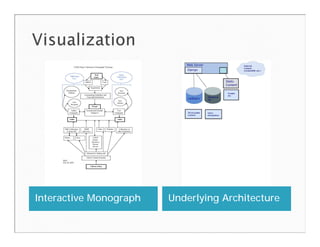
Interactive Monograph   Underlying Architecture
1.   Internal navigation (i.e., TOC, running
     heads, page numbers, index, cross-
     references)
2.   Apparatus pointing outward to sources and
     directions for further research (notes,
     bibliography, illustrations which might
     represent an archive)
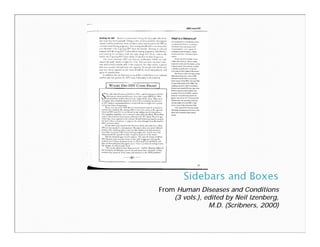
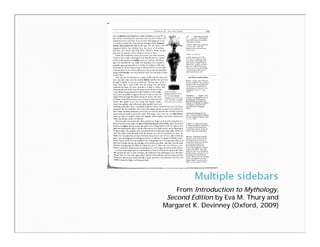
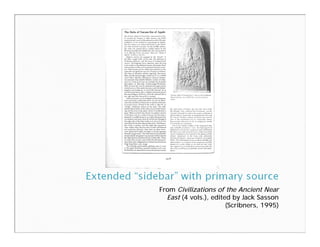
3.   Tangents: sidebar stories, boxed features,
     long notes, definitions, inserts
From Human Diseases and Conditions
    (3 vols.), edited by Neil Izenberg,
                M.D. (Scribners, 2000)
From Introduction to Mythology,
 Second Edition by Eva M. Thury and
Margaret K. Devinney (Oxford, 2009)
From Civilizations of the Ancient Near
  East (4 vols.), edited by Jack Sasson
                       (Scribners, 1995)
}   “Monographs aren’ published; they are
                      t
    abandoned.”
}   “Publishing as community” the publication
                              :
    can continue to develop in collaboration over
    time and spark new work
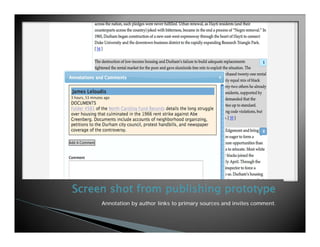
Annotation by author links to primary sources and invites comment.
§   Scholars: Book is read and taught; it sparks new projects;
    promotion/tenure via UNC Press legitimatization of
    publishing activity; share with students how history is
    researched and written

§   Library: Increased discovery and use of collections; exciting
    publishing service to offer to faculty; helps to prioritize
    collections for digitization; positive publicity attracts new
    collections/donations

§   Publisher: Sell more books; create new publications; attract
    authors; strengthen list/profile in the field

§   Activists: History informs organizing; current work recorded
    and used (they “ make history”)
}   To create a platform/environment that is
    used, not just admired
}   To balance traditional forms of scholarship
    with innovation
}   To focus on achievable goals for all partners
}   To achieve scalability and sustainability
}   More: legal, ethical, editorial, technical,
    diplomatic, monetary . . .
}   LCRM Online Center or “  hub”
}   Developing community- organizing manuals with
    CCR, SOHP, and archives
}   Archiving and publishing CCR and SOHP work
}   Digitization on demand for scholars and communities
}   Connecting primary and secondary sources (“   data
    sets”within the publishing process
}   CPP for development of library subject guides and
    finding aids
}   TEI XML Best Practices for university presses
}   LCRM full- text resource
}   CPP as teaching tool
}   Hybrid business model
You are invited to follow developments at . . .

           http://lcrm.unc.edu

1 a.3

  • 1.
    Funded by TheAndrew W. Mellon Foundation and the University of North Carolina at Chapel Hill Sylvia K. Miller, Project Director
  • 2.
    § UNC Press (Principal Investigator, Kate Torrey, Director) § Special Collections Library, UNC (P.I., Rich Szary, Director) § Southern Oral History Program at the Center for the Study of the American South (P.I., Professor Jacquelyn Dowd Hall, Director, SOHP) § Center for Civil Rights, UNC Law School (P.I., Julius Chambers, Director) Project staff for each partner
  • 3.
    } To advance scholarship on the Long Civil Rights Movement } To publish in innovative ways on civil rights } To help to discover where scholarly publishing is going in the future
  • 4.
    } The increasingly overlapping roles of scholarly publishers and librarians: Libraries’“scholarly communications”involve publishing services; Publishers offer library- like hosting, searching, and linking online. Does digitization of collections = publishing? } The old boundary between us becomes a space in which we work together.
  • 5.
    Meetings, meetings, meetings.(Brainstorming, working groups, next steps, mini projects) Sketches to summarize our collective thinking LCRM Conference April 3- 4, 2009 Focus groups, workshop following conference; survey Investigating technologies is an iterative process Technology research necessarily turned inward, to our own systems and capabilities Defining “publishing platform”
  • 6.
    Interactive Monograph Underlying Architecture
  • 7.
    1. Internal navigation (i.e., TOC, running heads, page numbers, index, cross- references) 2. Apparatus pointing outward to sources and directions for further research (notes, bibliography, illustrations which might represent an archive) 3. Tangents: sidebar stories, boxed features, long notes, definitions, inserts
  • 8.
    From Human Diseasesand Conditions (3 vols.), edited by Neil Izenberg, M.D. (Scribners, 2000)
  • 9.
    From Introduction toMythology, Second Edition by Eva M. Thury and Margaret K. Devinney (Oxford, 2009)
  • 10.
    From Civilizations ofthe Ancient Near East (4 vols.), edited by Jack Sasson (Scribners, 1995)
  • 11.
    } “Monographs aren’ published; they are t abandoned.” } “Publishing as community” the publication : can continue to develop in collaboration over time and spark new work
  • 12.
    Annotation by authorlinks to primary sources and invites comment.
  • 13.
    § Scholars: Book is read and taught; it sparks new projects; promotion/tenure via UNC Press legitimatization of publishing activity; share with students how history is researched and written § Library: Increased discovery and use of collections; exciting publishing service to offer to faculty; helps to prioritize collections for digitization; positive publicity attracts new collections/donations § Publisher: Sell more books; create new publications; attract authors; strengthen list/profile in the field § Activists: History informs organizing; current work recorded and used (they “ make history”)
  • 14.
    } To create a platform/environment that is used, not just admired } To balance traditional forms of scholarship with innovation } To focus on achievable goals for all partners } To achieve scalability and sustainability } More: legal, ethical, editorial, technical, diplomatic, monetary . . .
  • 15.
    } LCRM Online Center or “ hub” } Developing community- organizing manuals with CCR, SOHP, and archives } Archiving and publishing CCR and SOHP work } Digitization on demand for scholars and communities } Connecting primary and secondary sources (“ data sets”within the publishing process } CPP for development of library subject guides and finding aids } TEI XML Best Practices for university presses } LCRM full- text resource } CPP as teaching tool } Hybrid business model
  • 16.
    You are invitedto follow developments at . . . http://lcrm.unc.edu