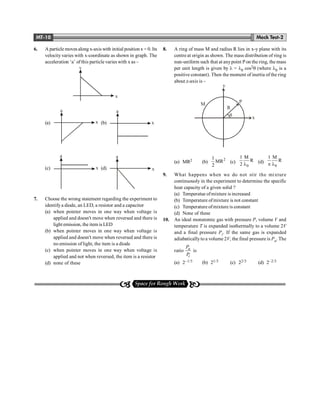
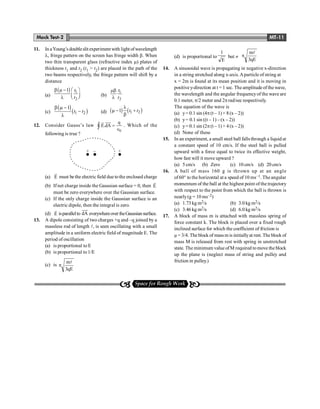
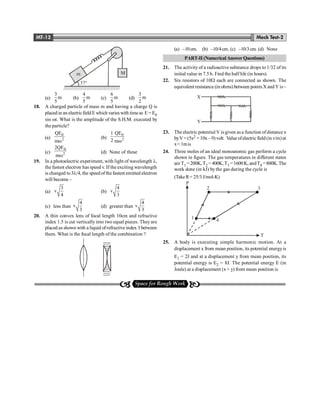
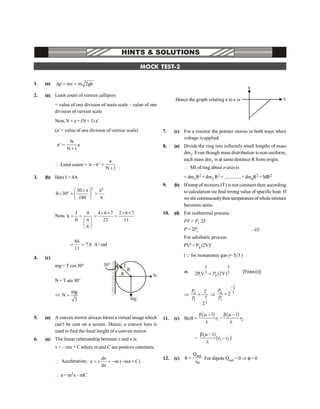
Typeset by Disha DTP Team
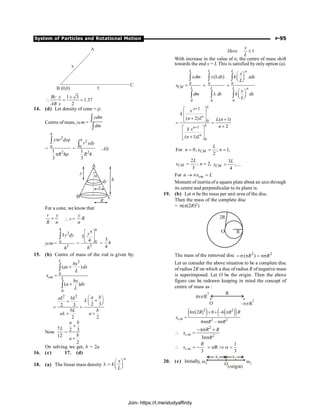
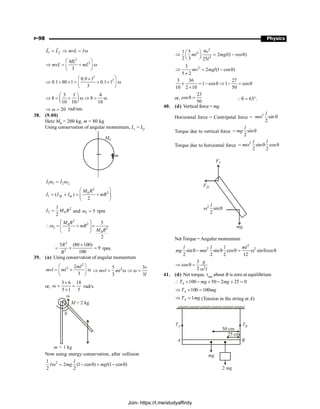
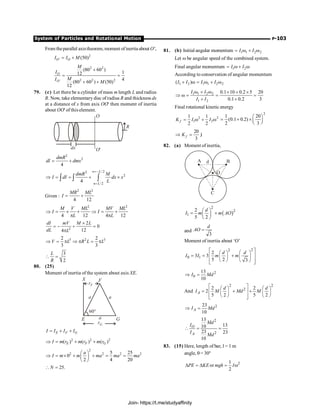
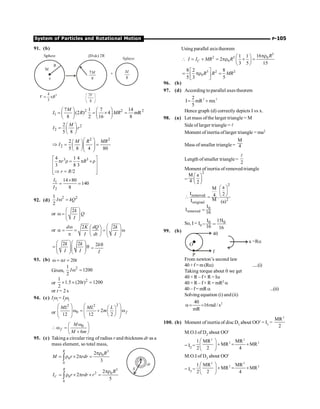
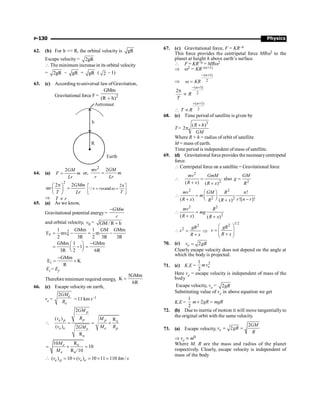
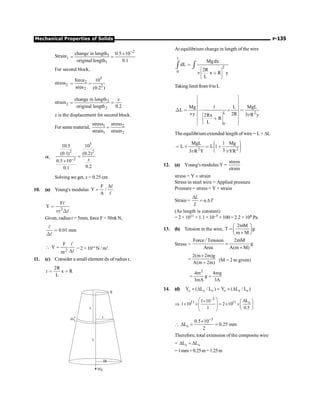
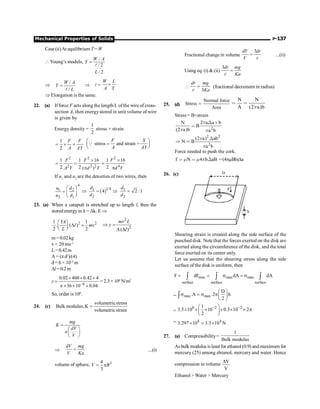
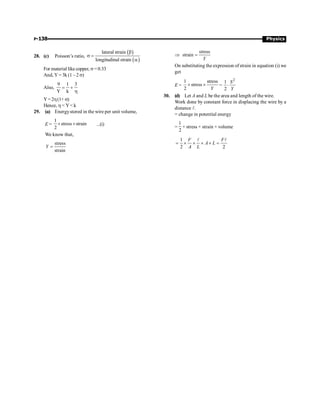
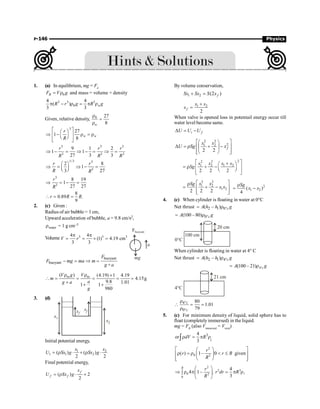
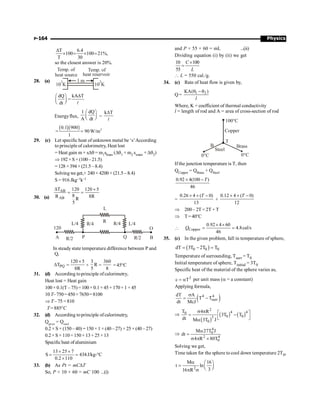
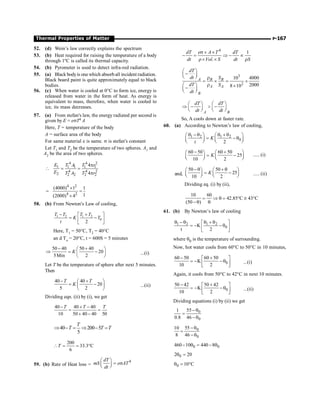
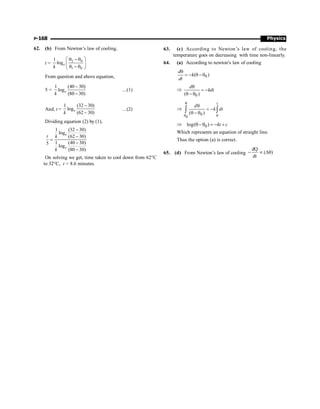
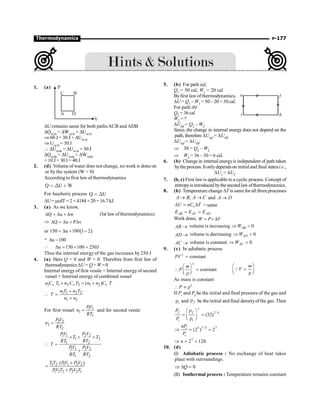
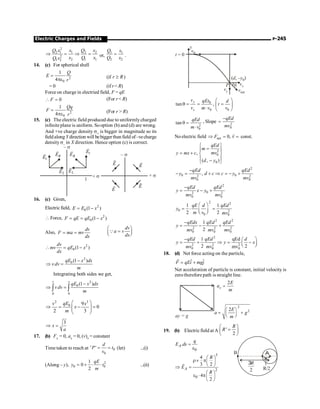
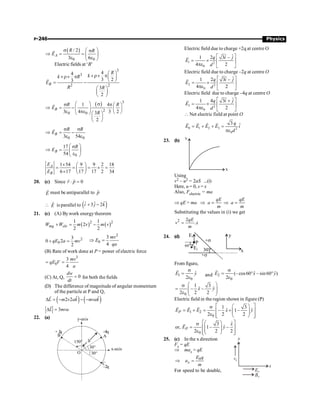
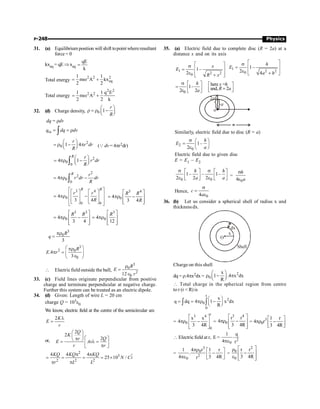
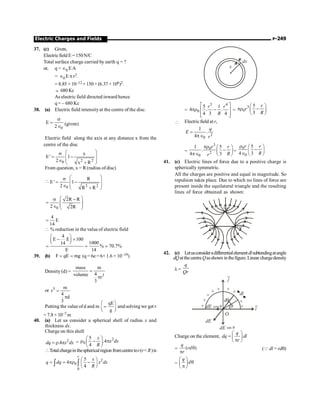
No part of this publication may be reproduced in
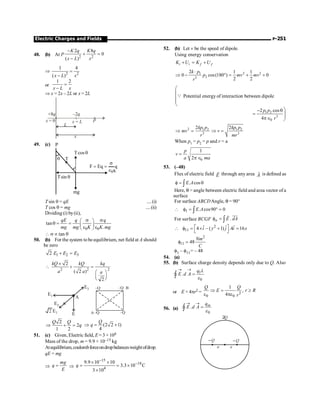
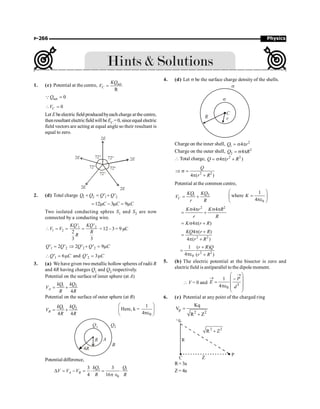
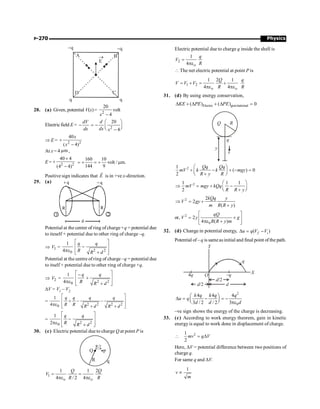
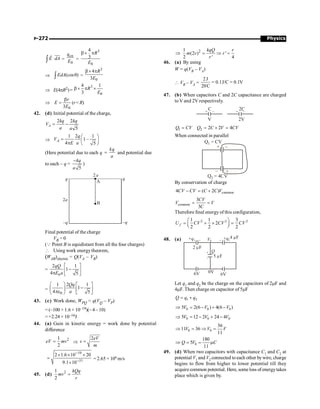
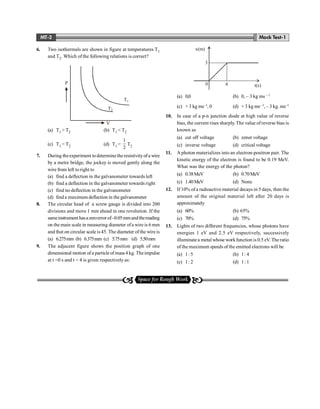
any form without prior permission of the publisher.
The author and the publisher do not take any legal
responsibility for any errors or misrepresentations that
might have crept in. We have tried and made our best
efforts to provide accurate up-to-date information in
this book.
DISHA PUBLICATION
45, 2nd Floor, Maharishi Dayanand Marg,
Corner Market, Malviya Nagar, New Delhi - 110017
Tel : 49842349 / 49842350
feedback_disha@aiets.co.in
Write to us at
www.dishapublication.com www.mylearninggraph.com
Books &
ebooks for
School &
Competitive
Exams
Etests
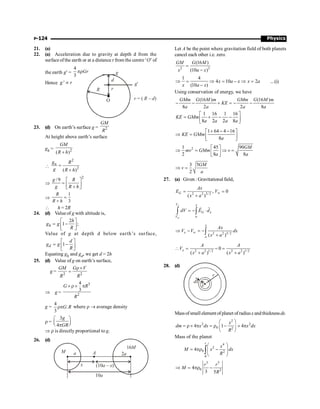
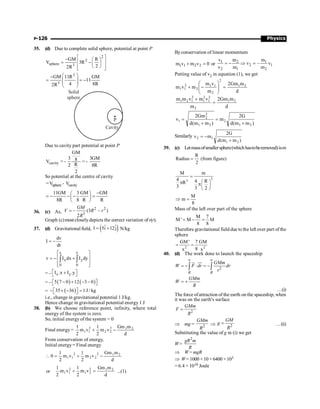
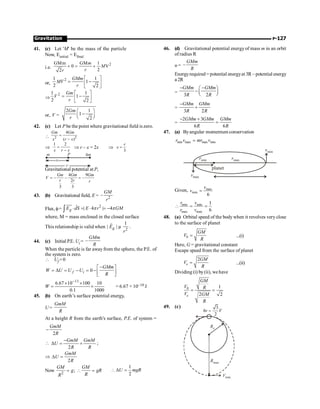
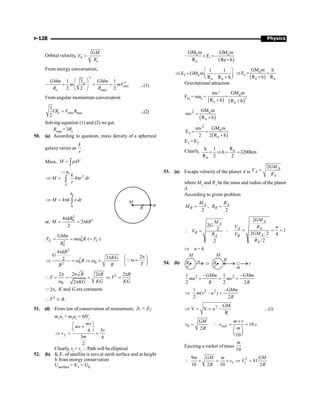
for
Competitive
Exams
All Right Reserved
Corporate
Office
Š
Copyright
Disha
Disha Experts
Sanjeev Kumar Jha
Govind Thakur
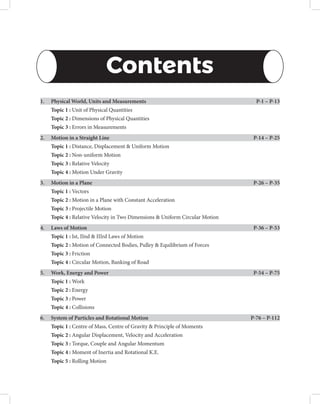
Contents
1. Physical World, Units and Measurements

P-1 – P-13
Topic 1 : Unit of Physical Quantities
Topic 2 : Dimensions of Physical Quantities
Topic 3 : Errors in Measurements
2. Motion in a Straight Line

P-14 – P-25
Topic 1 : Distance, Displacement  Uniform Motion
Topic 2 : Non-uniform Motion
Topic 3 : Relative Velocity
Topic 4 : Motion Under Gravity
3. Motion in a Plane

P-26 – P-35
Topic 1 : Vectors
Topic 2 : Motion in a Plane with Constant Acceleration
Topic 3 : Projectile Motion
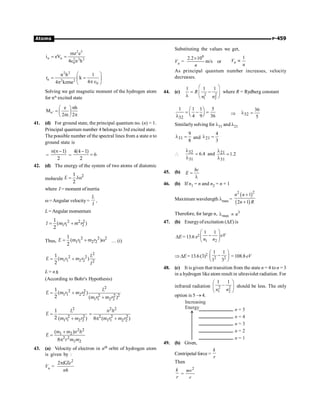
Topic 4 : Relative Velocity in Two Dimensions  Uniform Circular Motion
4. Laws of Motion

P-36 – P-53
Topic 1 : Ist, IInd  IIIrd Laws of Motion
Topic 2 : Motion of Connected Bodies, Pulley  Equilibrium of Forces
Topic 3 : Friction
Topic 4 : Circular Motion, Banking of Road
5. Work, Energy and Power

P-54 – P-75
Topic 1 : Work
Topic 2 : Energy
Topic 3 : Power
Topic 4 : Collisions
6. System of Particles and Rotational Motion

P-76 – P-112
Topic 1 : Centre of Mass, Centre of Gravity  Principle of Moments
Topic 2 : Angular Displacement, Velocity and Acceleration
Topic 3 : Torque, Couple and Angular Momentum
Topic 4 : Moment of Inertia and Rotational K.E.
Topic 5 : Rolling Motion
7. Gravitation

P-113 – P-130
Topic 1 : Kepler’s Laws of Planetary Motion
Topic 2 : Newton’s Universal Law of Gravitation
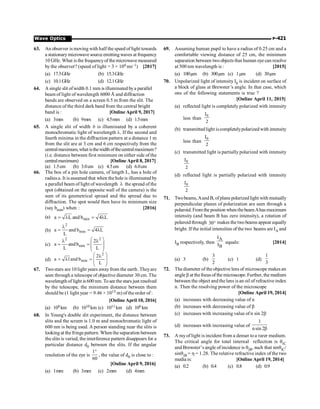
Topic 3 : Acceleration due to Gravity
Topic 4 : Gravitational Field and Potential Energy
Topic 5 : Motion of Satellites, Escape Speed and Orbital Velocity
8. Mechanical Properties of Solids

P-131 – P-138
Topic 1 : Hooke’s Law  Young’s Modulus
Topic 2 : Bulk and Rigidity Modulus and Work Done in Stretching a Wire
9. Mechanical Properties of Fluids

P-139 – P-154
Topic 1 : Pressure, Density, Pascal’s Law and Archimedes’ Principle
Topic 2 : Fluid Flow, Reynold’s Number and Bernoulli’s Principle
Topic 3 : Viscosity and Terminal Velocity
Topic 4 : Surface Tension, Surface Energy and Capillarity
10. Termal Properties of Matter

P-155 – P-168
Topic 1 : Termometer  Termal Expansion
Topic 2 : Calorimetry and Heat Transfer
Topic 3 : Newton’s Law of Cooling
11. Termodynamics

P-169 – P-185
Topic 1 : First Law of Termodynamics
Topic 2 : Specifc Heat Capacity and Termodynamical Processes
Topic 3 : Carnot Engine, Refrigerators and Second Law of Termodynamics
12. Kinetic Teory

P-186 – P-198
Topic 1 : Kinetic Teory of an Ideal Gas and Gas Laws
Topic 2 : Speed of Gas, Pressure and Kinetic Energy
Topic 3 : Degree of Freedom, Specifc Heat Capacity, and Mean Free Path
13. Oscillations

P-199 – P-218
Topic 1 : Displacement, Phase, Velocity and Acceleration in S.H.M.
Topic 2 : Energy in Simple Harmonic Motion
Topic 3 : Time Period, Frequency, Simple Pendulum and Spring Pendulum
Topic 4 : Damped, Forced Oscillations and Resonance
14. Waves

P-219 – P-234
Topic 1 : Basic of Mechanical Waves, Progressive and Stationary Waves
Topic 2 : Vibration of String and Organ Pipe
Topic 3 : Beats, Interference and Superposition of Waves
Topic 4 : Musical Sound and Doppler’s Efect
15. Electric Charges and Fields

P-235 – P-253
Topic 1 : Electric Charges and Coulomb’s Law
Topic 2 : Electric Field and Electric Field Lines
Topic 3 : Electric Dipole, Electric Flux and Gauss’s Law
16. Electrostatic Potential and Capacitance

P-254 – P-280
Topic 1 : Electrostatic Potential and Equipotential Surfaces
Topic 2 : Electric Potential Energy and Work Done in Carrying a Charge
Topic 3 : Capacitors, Grouping of Capacitor and Energy Stored in a Capacitor
17. Current Electricity

P-281 – P-311
Topic 1 : Electric Current, Drif of Electrons, Ohm’s Law, Resistance and Resistivity
Topic 2 : Combination of Resistances
Topic 3 : Kirchhof’s Laws, Cells, Termo e.m.f. Electrolysis
Topic 4 : Heating Efect of Current
Topic 5 : Wheatstone Bridge and Diferent Measuring Instruments
18. Moving Charges and Magnetism

P-312 – P-339
Topic 1 : Motion of Charged Particle in Magnetic Field
Topic 2 : Magnetic Field Lines, Biot-Savart’s Law and Ampere’s Circuital Law
Topic 3 : Force and Torque on Current Carrying Conductor
Topic 4 : Galvanometer and its Conversion into Ammeter and Voltmeter
19. Magnetism and Matter

P-340 – P-347
Topic 1 : Magnetism, Gauss’s Law, Magnetic Moment, Properties of Magnet
Topic 2 : Te Earth Magnetism, Magnetic Materials and their Properties
Topic 3 : Magnetic Equipment
20. Electromagnetic Induction

P-348 – P-360
Topic 1 : Magnetic Flux, Faraday’s and Lenz’s Law
Topic 2 : Motional and Static EMI and Application of EMI
21. Alternating Current

P-361 – P-376
Topic 1 : Alternating Current, Voltage and Power
Topic 2 : AC Circuit, LCR Circuit, Quality and Power Factor
Topic 3 : Transformers and LC Oscillations
22. Electromagnetic Waves

P-377 – P-388
Topic 1 : Electromagnetic Waves, Conduction and Displacement Current
Topic 2 : Electromagnetic Spectrum
23. Ray Optics and Optical Instruments

P-389 – P-414
Topic 1 : Plane Mirror, Spherical Mirror and Refection of Light
Topic 2 : Refraction of Light at Plane Surface and Total Internal Refection
Topic 3 : Refraction at Curved Surface Lenses and Power of Lens
Topic 4 : Prism and Dispersion of Light
Topic 5 : Optical Instruments
24. Wave Optics

P-415 – P-432
Topic 1 : Wavefront, Interference of Light, Coherent and Incoherent Sources
Topic 2 : Young’s Double Slit Experiment
Topic 3 : Difraction, Polarisation of Light and Resolving Power
25. Dual Nature of Radiation and Matter

P-433 – P-448
Topic 1 : Matter Waves, Cathode and Positive Rays
Topic 2 : Photon, Photoelectric Efect X-rays and Davisson-Germer Experiment
26. Atoms

P-449 – P-460
Topic 1 : Atomic Structure and Rutherford’s Nuclear Model
Topic 2 : Bohr’s Model and the Spectra of the Hydrogen Atom
27. Nuclei

P-461 – P-472
Topic 1 : Composition and Size of the Nuclei
Topic 2 : Mass-Energy Equivalence and Nuclear Reactions
Topic 3 : Radioactivity
28. Semiconductor Electronics : Materials, Devices and Simple Circuits

P-473 – P-493
Topic 1 : Solids, Semiconductors and P-N Junction Diode
Topic 2 : Junction Transistor
Topic 3 : Digital Electronics and Logic Gates
29. Communication Systems

P-494 – P-500
Topic 1 : Communication Systems
Mock Test 1 with Solutions

MT-1 – MT-8
Mock Test 2 with Solutions

MT-9 – MT-16
Opening/ Closing Rank for TOP NITs  List of NITs in India
Opening/ Closing Rank for Top NITS
College Name OR/CR CSE ECE ME EE/EEE
NIT Trichy ORF 2060 5325 4154 5708
CR 5317 8011 12970 10353
NIT Rourkela OR 2253 8571 11662 4084
CR 9420 12009 20304 19168
NIT Surathkal OR 960 3378 6315 3456
CR 3181 5608 11788 6801
NIT Warangal OR 978 2919 4340 5270
CR 2341 2919 10209 8152
NIT Calicut OR 2201 8023 10629 9703
CR 10222 14769 20480 18966
NIT Kurukshetra OR 2268 8320 11195 9454
CR 6170 12067 18115 16273
NIT Durgapur OR 5611 12509 14511 13595
CR 12095 16098 22753 19325
MNIT Allahabad OR 1449 3600 5884 5879
CR 4051 7128 11145 8790
NIT Silchar OR 8699 17899 21851 32579
CR 23882 40841 49215 56958
MNIT Jaipur OR 1148 3881 9277 4119
CR 3831 7868 11426 9179
List of NITs in India
After IITs, NITs form the second layer of topmost engineering Institutes in India
Rank Of (Amongst NITs) Name State NIRF Score NIRF Ranking
1 NIT Trichy Tamil Nadu 61.62 10
2 NIT Rourkela Odisha 57.75 16
3 NIT Karnataka Karnataka 55.25 21
4 NIT Warangal Telangana 53.21 26
5 NIT Calicut Kerala 52.69 28
6 V-NIT Maharashtra 51.27 31
7 NIT Kurukshetra Haryana 47.58 41
7 MN-NIT Uttar Pradesh 47.49 42
8 NIT Durgapur West Bengal 46.47 46
9 NIT Silchar Assam 45.61 51
10 M-NIT Rajasthan 45.20 53
11 SV-NIT Gujarat 41.88 58
12 NIT Hamirpur Himachal Pradesh 41.48 60
13 MA-NIT Madhya Pradesh 40.98 62
14 NITIE Maharashtra 40.48 66
15 NIT Meghalaya Meghalaya 40.32 67
16 NIT Agartala Tripura 39.53 70
17 NIT Raipur Chattisgarh 39.09 74
18 NIT Goa Goa 37.06 87
QUESTION: Which Colleges other than IITs accept JEE Ad-
vanced scores?
ANSWER:
1. Institute of Science (IISc), Bangalore
2. Indian Institute of Petroleum and Energy (IIPE), Visakhapatnam
3. Indian Institutes of Science Education and Research (IISER),
Bhopal
4. Indian Institutes of Science Education and Research (IISER),
Mohali
5. Indian Institutes of Science Education and Research (IISER),
Kolkata
6. Indian Institutes of Science Education and Research (IISER),
Pune
7. Indian Institutes of Science Education and Research (IISER),
Thiruvananthapuram
8. Indian Institute of Space Science and Technology (IIST), Thiru-
vananthapuram
9. Rajiv Gandhi Institute of Petroleum Technology (RGIPT), Rae
Bareli
QUESTION: If I am absent in one of the papers (Paper 1, Paper 2),
will my result be declared?
ANSWER: NO. You will be considered absent in JEE
(Advanced)-2018 and the result will not be prepared/declared. It is
compulsory to appear in both the papers for result preparation.
QUESTION: Do I have to choose my question paper language at the
time of JEE (Advanced)-2018 registration?
ANSWER: NO. There is no need to indicate question paper language
at the time of JEE (Advanced)-2018 registration. Candidates will
have the option to choose their preferred language (English or Hindi),
as the default language for viewing the questions, at the start of the
Computer Based Test (CBT) examination of JEE (Advanced)-2018.
QUESTION: Can I change the language (from English to Hindi
and vice versa) of viewing the questions during the CBT of JEE
(Advanced)-2018?
ANSWER: Questions will be displayed on the screen of the Candidate
in the chosen default language (English or Hindi). Further, the
candidate can also switch/toggle between English or Hindi languages,
as the viewing language of any question, anytime during the entire
period of the examination. The candidate will also be having the
option of changing default question viewing language anytime during
the examination.
QUESTION: Will I be given rough sheets for my calculations during
the CBT of JEE (Advanced)-2018?
ANSWER: Yes, you will be given “Scribble Pad” (containing
blank sheets, for rough work) at the start of every paper of JEE
(Advanced)-2018. You can do all your calculations inside this
“Scribble Pad”. Candidates MUST submit their signed Scribble Pads
at the end of each paper of the examination, given to them at the start
of the paper.
QUESTION: During examination can I change my answers?
ANSWER: Candidate will have the option to change previously
saved answer of any question, anytime during the entire duration of
the test.
QUESTION: How can I change a previously saved answer during the
CBT of JEE (Advanced)-2018?
ANSWER: To change the answer of a question that has already been
answered and saved, first select the corresponding question from
the Question Palette, then click on “Clear Response” to clear the
previously entered answer and subsequently follow the procedure for
answering that type of question.
QUESTION: Will I be given a printout/hard copy of the questions
papers along with my responses to questions in Paper-I and Paper-II
after the completion of the respective papers?
ANSWER: No.
QUESTION: How will I be getting a copy of the questions papers
and my responses to questions in Paper-I and Paper-II?
ANSWER: The responses of all the candidates who have appeared
for both Paper 1 and Paper 2, recorded during the exam, along with
the questions of each paper, will be electronically mailed to their
registered email ids, by Friday, May 25, 2018, 10:00 IST.
QUESTION: Suppose two candidates have same JEE
(Advanced)-2018 aggregate marks. Will the two candidates be given
the same rank?
ANSWER: If the aggregate marks scored by two or more candidates
are the same, then the following tie-break policy will be used for
awarding ranks: Step 1: Candidates having higher positive marks
will be awarded higher rank. If the tie breaking criterion at Step 1
fails to break the tie, then the following criterion at Step 2 will be
followed. Step 2: Higher rank will be assigned to the candidate who
has obtained higher marks in Mathematics. If this does not break the
tie, higher rank will be assigned to the candidate who has obtained
higher marks in Physics. If there is a tie even after this, candidates will
be assigned the same rank.
QUESTION: I have read in newspapers that for the academic year
2018-2019, supernumerary seats for female candidates would be there
in IITs. Does this mean that the non-females will get reduced number
of seats in IITs in 2018?
ANSWER:Adecision has been taken at the level of the IIT Council to,
inter alia, improve the gender balance in the undergraduate programs
at the IITs from the current (approximately) 8% to 14% in 2018-19
by creating supernumerary seats specifically for female candidates,
without any reduction in the number of seats that was made available
to non-female candidates in the previous academic year (i.e. academic
year 2017-2018).
FAQs - Frequently Asked Questions
Physical World, Units and Measurements P-1
TOPIC 1 Unit of PhysicalQuantities
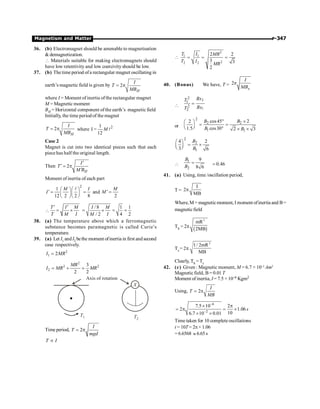
1. The density of a material in SI unit is 128 kg m–3
. In
certain units in which the unit of length is 25 cm and
the unit of mass is 50 g, the numerical value of density
of the material is: [10 Jan. 2019 I]
(a) 40 (b) 16 (c) 640 (d) 410
2. AmetalsamplecarryingacurrentalongX-axiswithdensityJxis
subjectedtoamagneticfieldBz(alongz-axis).Theelectricfield
Ey developedalongY-axisisdirectlyproportionaltoJx aswell
as Bz. The constant of proportionalityhas SI unit
[Online April 25, 2013]
(a)
2
m
A
(b)
3
m
As
(c)
2
m
As
(d) 3
As
m
TOPIC 2
Dimensions of Physical
Quantities
3. The quantities
0 0
1
,
E
x y
B
= =
m e
and
1
z
CR
= are
defined where C-capacitance, R-Resistance, l-length,
E-Electric field, B-magnetic field and 0 0
, ,
e m - free
space permittivity and permeability respectively. Then :
[Sep. 05, 2020 (II)]
(a) x, y and z have the same dimension.
(b) Only x and z have the same dimension.
(c) Only x and y have the same dimension.
(d) Only y and z have the same dimension.
4. Dimensional formula for thermal conductivity is (here K
denotes the temperature : [Sep. 04, 2020 (I)]
(a) MLT–2 K (b) MLT–2 K–2
(c) MLT–3 K (d) MLT–3 K–1
5. A quantityx is given by(IFv2/WL4) in terms of moment of
inertia I, force F, velocity v, work W and Length L. The
dimensional formula for x is same as that of :
[Sep. 04, 2020 (II)]
(a) planck’s constant (b) force constant
(c) energy density (d) coefficient of viscosity
6. Amount of solar energy received on the earth's surface
per unit area per unit time is defined a solar constant.
Dimension of solar constant is : [Sep. 03, 2020 (II)]
(a) ML2T–2 (b) ML0T–3
(c) M2L0T–1 (d) MLT–2
7. If speed V, area A and force F are chosen as fundamental
units, then the dimension ofYoung's modulus will be :
[Sep. 02, 2020 (I)]
(a) FA2V–1 (b) FA2V–3
(c) FA2V–2 (d) FA–1V0
8. Ifmomentum (P), area (A) and time (T) aretaken to bethe
fundamental quantities then the dimensional formula for
energy is : [Sep. 02, 2020 (II)]
(a) [P2AT–2] (b) [PA–1T–2]
(c) 1/2 1
[PA T ]
-
(d) 1/2 1
[P AT ]
-
9. Which of the following combinations has the dimension
of electrical resistance (Î0
is the permittivity of vacuum
and m0
is the permeability of vacuum)?
[12 April 2019 I]
(a)
0
0
m
e (b)
0
0
m
e (c)
0
0
e
m (d)
0
0
e
m
10. In the formula X = 5YZ2
, X and Z have dimensions of
capacitance and magnetic field, respectively. What are
the dimensions of Y in SI units ? [10 April 2019 II]
(a) [M–3
L–2
T8
A4
] (b) [M–1
L–2
T4
A2
]
(c) [M–2
L0
T–4
A–2
] (d) [M–2
L–2
T6
A3
]
11. In SI units, the dimensions of
0
0
Î
m
is: [8 April 2019 I]
(a) A–1
TML3
(b) AT2
M–1
L–1
(c) AT–3
ML3/2
(d) A2
T3
M–1
L–2
12. Let l, r, c and v represent inductance, resistance,
capacitance and voltage, respectively. The dimension of
l
rcv
in SI units will be : [12 Jan. 2019 II]
(a) [LA – 2] (b) [A–1]
(c) [LTA] (d) [LT2]
Physical World, Units
and Measurements
1
Join- https://t.me/studyaffinity
P-2 Physics
13. The force of interaction between two atoms is given by
2
exp
x
F
kT
ĂŚ Ăś
= ab -
ç á
ç á
a
è ø
; where x is the distance, k is the
Boltzmann constant and T is temperature and a and b are
two constants. The dimensions of b is: [11 Jan. 2019 I]
(a) M0L2T–4 (b) M2LT–4
(c) MLT–2 (d) M2L2T–2
14. Ifspeed (V), acceleration (A) and force (F) are considered
as fundamental units, the dimension ofYoung’s modulus
will be : [11 Jan. 2019 II]
(a) V–2A2F–2 (b) V–2A2F2
(c) V–4A–2F (d) V–4A2F
15. A quantity f is given by f =
5
hc
G
where c is speed of
light, G universal gravitationalconstant andh isthePlanck’s
constant. Dimension of f is that of : [9 Jan. 2019 I]
(a) area (b) energy
(c) momentum (d) volume
16. Expression for time in terms ofG (universal gravitational
constant), h (Planck's constant) and c (speed of light) is
proportional to: [9 Jan. 2019 II]
(a)
5
hc
G
(b)
3
c
Gh
(c) 5
Gh
c
(d) 3
Gh
c
17. The dimensions of stopping potential V0
in photoelectric
effect in units of Planck’s constant ‘h’, speed of light ‘c’
and Gravitational constant ‘G’and ampere A is:
[8 Jan. 2019 I]
(a) hl/3
G2/3
cl/3
A –1
(b) h2/3
c5/3
G1/3
A –1
(c) h–2/3
e–1/3
G4/3
A–1
(d) h2
G3/2
C1/3
A–1
18. The dimensions of
2
0
2
B
m
, where B is magnetic field and m0
is the magnetic permeability of vacuum, is:
[8 Jan. 2019 II]
(a) MLT–2
(b) ML2
T–1
(c) ML2
T–2
(d) ML–1
T–2
19. Thecharacteristic distance at which quantum gravitational
effects aresignificant, thePlanck length, can bedetermined
from a suitable combination of the fundamental physical
constants G, h and c. Which of the following correctly
gives the Planck length? [Online April 15, 2018]
(a) G2hc (b)
1
2
3
Gh
c
ĂŚ Ăś
ç á
è ø
(c)
1
2
2
G h c
(d) Gh2c3
20. Time (T), velocity (C) and angular momentum (h) are
chosen as fundamental quantities instead of mass, length
and time. In terms ofthese, the dimensions of mass would
be : [Online April 8, 2017]
(a) [ M ]=[ T–1 C–2 h ] (b) [ M ]=[ T–1 C2 h ]
(c) [ M ]=[ T–1 C–2 h–1 ] (d) [ M ]=[ T C–2 h ]
21. A, B, C and D are four different physical quantities having
different dimensions. None of them is dimensionless. But
we know that the equation AD = C ln (BD) holds true.
Thenwhich ofthecombinationisnotameaningfulquantity?
[Online April 10, 2016]
(a)
2
C AD
BD C
- (b) A2 –B2C2
(c)
A
C
B
- (d)
(A C)
D
-
22. In the following 'I' refers to current and other symbols
have their usual meaning, Choose the option that
corresponds to the dimensions of electrical conductivity:
[OnlineApril 9, 2016]
(a) M–1L–3T3I (b) M–1L–3T3I2
(c) M–1L3T3I (d) ML–3T–3I2
23. If electronic charge e, electron mass m, speed of light in
vacuum cand Planck’sconstant h are taken asfundamental
quantities, the permeabilityof vacuum m0 can beexpressed
in units of : [Online April 11, 2015]
(a) 2
h
me
ĂŚ Ăś
ç á
è ø
(b) 2
hc
me
ĂŚ Ăś
ç á
è ø
(c) 2
h
ce
ĂŚ Ăś
ç á
è ø
(d)
2
2
mc
he
ĂŚ Ăś
ç á
ç á
è ø
24. Ifthe capacitance of a nanocapacitor is measured in terms
of a unit ‘u’ made by combining the electric charge ‘e’,
Bohr radius ‘a0’, Planck’s constant ‘h’and speed of light
‘c’then: [Online April 10, 2015]
(a)
2
0
e h
u
a
= (b) 2
0
hc
u
e a
=
(c)
2
0
e c
u
ha
= (d)
2
0
e a
u
hc
=
25. From the following combinations of physical constants
(expressed through their usual symbols) the only
combination, that would have the same value in different
systems of units, is: [Online April 12, 2014]
(a) 2
o
ch
2pe
(b)
2
2
o e
e
2 Gm
pe
(me = mass of electron)
(c)
o o
2 2
G
c he
m e
(d)
o o
2
2 h
G
ce
p m e
Join- https://t.me/studyaffinity
Physical World, Units and Measurements P-3
26. In terms ofresistanceRand time T, the dimensions ofratio
m
e
ofthe permeabilitym and permittivitye is:
[Online April 11, 2014]
(a) [RT–2](b) [R2T–1] (c) [R2] (d) [R2T2]
27. Let [ 0
Î ] denotethe dimensional formula of the permittivity
of vacuum. If M = mass, L = length, T = time and A =
electric current, then: [2013]
(a) 0
Î = [M–1 L–3 T
T2 A] (b) 0
Î = [M–1 L–3 T
T4 A2]
(c) 0
Î = [M1 L2 T
T1 A2] (d) 0
Î = [M1 L2 T
T1 A]
28. If the time period t of the oscillation of a drop of liquid of
densityd, radiusr, vibrating under surface tension sisgiven
by the formula 2 / 2
= b c a
t r s d . It is observed that the
time period is directly proportional to
d
s
. The value of b
should therefore be : [Online April 23, 2013]
(a)
3
4
(b) 3
(c)
3
2
(d)
2
3
29. The dimensions of angular momentum, latent heat and
capacitance are, respectively. [Online April 22, 2013]
(a) 2 1 2 2 2 1 2 2
ML T A , L T , M L T
- - -
(b) 2 2 2 2 1 2 4 2
ML T , L T , M L T A
- - -
(c) 2 1 2 2 2 2
ML T , L T , ML TA
- -
(d) 2 1 2 2 1 2 4 2
ML T , L T , M L T A
- - - -
30. Given that K = energy, V = velocity, T = time. If they are
chosen as the fundamental units, then what is dimensional
formula for surface tension? [Online May 7, 2012]
(a) [KV–2T–2] (b) [K2V2T–2]
(c) [K2V–2T–2] (d) [KV2T2]
31. The dimensions of magnetic field in M, L, T and C
(coulomb) is given as [2008]
(a) [MLT–1 C–1] (b) [MT2 C–2]
(c) [MT–1 C–1] (d) [MT–2 C–1]
32. Which of the following units denotes the dimension
2
2
Q
ML
, where Q denotes the electric charge? [2006]
(a) Wb/m2 (b) Henry (H)
(c) H/m2 (d) Weber (Wb)
33. Out of the following pair, which one does NOT have
identical dimensions ? [2005]
(a) Impulse and momentum
(b) Angular momentum and planck’s constant
(c) Work and torque
(d) Moment of inertia and moment of a force
34. Which one of the following represents the correct
dimensions of the coefficient of viscosity? [2004]
(a)
1 1
ML T
- -
ĂŠ Ăš
ĂŤ Ăť (b)
1
MLT-
ĂŠ Ăš
ĂŤ Ăť
(c)
1 2
ML T
- -
ĂŠ Ăš
ĂŤ Ăť (d)
2 2
ML T
- -
ĂŠ Ăš
ĂŤ Ăť
35. Dimensions of
o o
1
m e
, where symbols have their usual
meaning, are [2003]
(a) ]
T
L
[ 1
-
(b) ]
T
L
[ 2
2
-
(c) ]
T
L
[ 2
2 -
(d) ]
LT
[ 1
-
36. The physical quantities not having same dimensions are
(a) torque and work [2003]
(b) momentum and planck’s constant
(c) stress and young’s modulus
(d) speed and 2
/
1
o
o )
( -
e
m
37. Identify the pair whose dimensions are equal [2002]
(a) torque and work (b) stress and energy
(c) force and stress (d) force and work
TOPIC 3 Errors in Measurements
38. A screw gauge has 50 divisions on its circular scale. The
circular scale is 4 units ahead of the pitch scale marking,
prior to use. Upon one complete rotation of the circular
scale, a displacement of 0.5 mm is noticed on the pitch
scale. The nature of zero error involved, and the least
count of the screw gauge, are respectively :
[Sep. 06, 2020 (I)]
(a) Negative, 2 mm (b) Positive, 10 mm
(c) Positive, 0.1 mm (d) Positive, 0.1 mm
39. The density of a solid metal sphere is determined by
measuring its massand its diameter. Themaximum error in
the density of the sphere is
100
ĂŚ Ăś
ç á
è ø
x
%. Ifthe relative errors
in measuring themass and the diameter are6.0% and 1.5%
respectively, the value of x is ______.
[NA Sep. 06, 2020 (I)]
40. A student measuring the diameter of a pencil of circular
cross-section with the help of a vernier scale records the
following four readings 5.50 mm, 5.55 mm, 5.45 mm,
5.65 mm, The average of these four reading is 5.5375 mm
and the standard deviation of the data is 0.07395 mm. The
average diameter of the pencil should therefore be re-
corded as : [Sep. 06, 2020 (II)]
(a) (5.5375Âą0.0739)mm (b) (5.5375Âą0.0740)mm
(c) (5.538Âą0.074)mm (d) (5.54Âą0.07)mm
41. A physical quantity z depends on four observables a, b, c
and d, as z =
2
2 3
3
a b
cd
. The percentages of error in the mea-
surement ofa, b, c andd are 2%, 1.5%, 4% and 2.5% respec-
tively. The percentage of error in z is :
[Sep. 05, 2020 (I)]
Join- https://t.me/studyaffinity
P-4 Physics
(a) 12.25% (b) 16.5%
(c) 13.5% (d) 14.5%
42. Using screw gauge of pitch 0.1 cm and 50 divisions on its
circular scale, the thickness of an object is measured. It
should correctly be recorded as : [Sep. 03, 2020 (I)]
(a) 2.121cm (b) 2.124cm
(c) 2.125cm (d) 2.123cm
43. The least count of the main scale of a vernier callipers is
1 mm. Its vernier scale is divided into 10 divisions and
coincidewith 9 divisions ofthe main scale. When jaws are
touching each other, the 7th division of vernier scale
coincides with a division of main scale and the zero of
vernier scale is lying right side of the zero of main scale.
When this vernier is used to measure length of a cylinder
the zero of the vernier scale betwen 3.1 cm and 3.2 cm and
4th VSD coincides with a main scale division. The length
of the cylinder is : (VSD is vernier scale division)
[Sep. 02, 2020 (I)]
(a) 3.2cm (b) 3.21cm
(c) 3.07cm (d) 2.99cm
44. Ifthe screwon ascrew-gaugeisgiven six rotations, itmoves
by 3 mm on the main scale. If there are 50 divisions on the
circular scale the least count of the screw gauge is:
[9 Jan. 2020 I]
(a) 0.001cm (b) 0.02mm
(c) 0.01cm (d) 0.001mm
45. For the four sets of three measured physical quantities as
given below. Which of the following options is correct?
[9 Jan. 2020 II]
(A) A1
= 24.36, B1
= 0.0724, C1
=256.2
(B) A2
= 24.44, B2
= 16.082, C2
=240.2
(C) A3
= 25.2, B3
= 19.2812, C3
=236.183
(D) A4
= 25, B4
= 236.191, C4
=19.5
(a) A4
+B4
+C4
A1
+B1
+C1
A3
+B3
+C3
A2
+B2
+C2
(b) A1
+B1
+C1
=A2
+B2
+C2
=A3
+B3
+C3
=A4
+B4
+C4
(c) A4
+B4
+C4
A1
+B1
+C1
=A2
+B2
+C2
=A3
+B3
+C3
(d) A1
+B1
+C1
A3
+B3
+C3
A2
+B2
+C2
A4
+B4
+C4
46. A simple pendulum is being used to determine the value
ofgravitational acceleration gat a certain place. The length
of the pendulum is 25.0 cm and a stop watch with 1 s
resolution measures the time taken for 40 oscillations to
be 50 s. The accuracy in g is: [8 Jan. 2020 II]
(a) 5.40% (b) 3.40%
(c) 4.40% (d) 2.40%
47. In the density measurement of a cube, the mass and edge
length are measured as(10.00 Âą0.10) kg and(0.10 Âą0.01)
m, respectively. The error in the measurement of density
is: [9 April 2019 I]
(a) 0.01kg/m3
(b) 0.10kg/m3
(c) 0.013kg/m3
(d) 0.07kg/m3
48. The area of a square is 5.29 cm2
. The area of 7 such
squares taking into account the significant figures is:
[9 April 2019 II]
(a) 37cm2
(b) 37.030cm2
(c) 37.03cm2
(d) 37.0cm2
49. In a simple pendulum experiment for determination of
acceleration due to gravity (g), time taken for 20
oscillations is measured by using a watch of 1 second
least count. The mean valueof timetaken comes out to be
30 s. The length of pendulum is measured by using a
meter scale of least count 1 mm and the value obtained is
55.0 cm. The percentage error in the determination of gis
close to : [8 April 2019 II]
(a) 0.7% (b) 0.2% (c) 3.5% (d) 6.8%
50. The least count ofthe main scale ofa screwgauge is 1 mm.
The minimum number of divisions on its circular scale
required tomeasure 5 Âľm diameter of a wire is:
[12 Jan. 2019 I]
(a) 50 (b) 200 (c) 100 (d) 500
51. The diameter and height of a cylinder are measured by
a meter scale to be 12.6 Âą 0.1 cm and 34.2 Âą 0.1 cm,
respectively. What will be the value of its volume in
appropriate significant figures? [10 Jan. 2019 II]
(a) 4264 Âą 81 cm3
(b) 4264.4 Âą 81.0 cm3
(c) 4260 Âą80cm3
(d) 4300 Âą80cm3
52. The pitch and the number of divisions, on the circular
scale for a given screw gauge are 0.5 mm and 100
respectively. When the screw gauge is fully tightened
without any object, the zero of its circular scale lies 3
division below the mean line.
The readings of the main scale and the circular scale, for
a thin sheet, are 5.5 mm and 48 respectively, the
thickness of the sheet is: [9 Jan. 2019 II]
(a) 5.755mm (b) 5.950mm
(c) 5.725mm (d) 5.740mm
53. The density of a material in the shape of a cube is
determined by measuring three sides of the cube and its
mass. If the relative errors in measuring the mass and
length are respectively 1.5% and 1%, the maximum error
in determining the density is: [2018]
(a) 2.5% (b) 3.5% (c) 4.5% (d) 6%
54. Thepercentage errors in quantities P, Q, Rand S are0.5%,
1%, 3% and 1.5% respectively in the measurement of a
physical quantity
3 2
P Q
A
RS
= .
Themaximum percentageerror in the value ofAwill be
[Online April 16, 2018]
(a) 8.5% (b) 6.0%
(c) 7.5% (d) 6.5%
55. The relative uncertaintyin the period of a satellite orbiting
around the earth is 10–2. If the relative uncertainty in the
radius ofthe orbit is negligible, the relative uncertaintyin
the mass of the earth is [Online April 16, 2018]
(a) 3×10⁻² (b) 10–2
(c) 2 × 10⁻² (d) 6 × 10⁻²
Physical World, Units and Measurements P-5
56. The relative error in the determination of the surface area
ofa sphereis a. Then therelative error in the determination
of its volume is [Online April 15, 2018]
(a)
2
3
a (b)
2
3
a (c)
3
2
a (d) a
57. In a screw gauge, 5 complete rotations of the screw cause
ittomove a lineardistanceof0.25cm. Thereare 100circular
scale divisions. The thickness of a wire measured by this
screw gauge gives a reading of 4 main scale divisions and
30 circular scaledivisions.Assumingnegligible zeroerror,
the thickness of the wire is: [OnlineApril 15, 2018]
(a) 0.0430cm (b) 0.3150cm
(c) 0.4300cm (d) 0.2150cm
58. The following observations were taken for determining
surface tensiton T of water by capillary method :
Diameter of capilary, D = 1.25 × 10⁻²
m
rise of water, h = 1.45 × 10⁻²
m
Using g = 9.80 m/s2
and the simplified relation
3
10
2
rhg
T = ´ N/m, the possible error in surface tension
is closest to : [2017]
(a) 2. 4 % (b) 10% (c) 0.15% (d) 1.5%
59. A physical quantity P is described by the relation
P = a1/2
b2
c3
d –4
If the relative errors in the measurement of a, b, c and d
respectively, are 2%, 1%, 3% and 5%, then the relative
error in P will be : [OnlineApril 9, 2017]
(a) 8% (b) 12% (c) 32% (d) 25%
60. A screw gauge with a pitch of 0.5 mm and a circular scale
with 50 divisions is used to measure the thickness of a
thin sheet ofAluminium. Before starting the measurement,
it is found that wen the two jaws of the screw gauge are
brought in contact, the 45th division coincides with the
main scale line and the zero of the main scale is barely
visible. What is the thickness of the sheet if the main scale
reading is 0.5 mm and the 25th division coincides with the
main scale line? [2016]
(a) 0.70 mm (b) 0.50 mm
(c) 0.75mm (d) 0.80mm
61. A student measures the time period of 100 oscillations of
a simple pendulum four times. The data set is 90 s, 91 s, 95
s, and 92 s. If the minimum division in the measuring clock
is 1 s, then the reported mean time should be: [2016]
(a) 92 Âą 1.8 s (b) 92 Âą 3s
(c) 92 Âą 1.5 s (d) 92 Âą 5.0 s
62. The period of oscillation of a simple pendulum is
T =
L
2
g
p . Measured value ofLis20.0 cmknown to1mm
accuracyand time for 100 oscillations of the pendulum is
found to be 90 s using a wrist watch of 1s resolution. The
accuracyin the determination of g is :
[2015]
(a) 1% (b) 5% (c) 2% (d) 3%
63. Diameter of asteel ball is measuredusing aVernier callipers
which has divisions of 0.1 cm on its main scale (MS) and
10 divisions of its vernier scale (VS) match 9 divisions on
the main scale. Three such measurements for a ball are
given as: [Online April 10, 2015]
S.No. MS(cm) VS divisions
1. 0.5 8
2. 0.5 4
3. 0.5 6
Ifthe zeroerror is– 0.03 cm, then mean corrected diameter
is:
(a) 0.52 cm (b) 0.59 cm
(c) 0.56cm (d) 0.53cm
64. The current voltage relation of a diode is given by
( )
1000V T
I e 1
= - mA, where the applied voltage V is in
voltsand the temperatureT is in degree kelvin. If a student
makes an error measuring 0.01
Âą V while measuring the
current of 5 mA at 300 K, what will be the error in the
value of current in mA? [2014]
(a) 0.2mA (b) 0.02mA (c) 0.5mA (d) 0.05mA
65. A student measured the length ofa rod and wrote it as 3.50
cm. Which instrument did he use to measure it?
[2014]
(a) A meter scale.
(b) A vernier calliper where the 10 divisions in vernier
scale matches with 9 division in main scale and main
scale has 10 divisions in 1 cm.
(c) A screw gauge having 100 divisions in the circular
scale and pitch as 1 mm.
(d) A screwgauge having50divisions in thecircular scale
and pitch as 1 mm.
66. Match List - I(Event) with List-II(Order ofthe timeinterval
for happening of the event) and select the correct option
from the options given below the lists:
[Online April 19, 2014]
(1) Rotation
period of earth
(i) 105
s
(2) Revolution
period of earth
(ii) 10
7
s
(3) Period of light
wave
(iii) 10
–15
s
(4) Period of
sound wave
(iv) 10–3
s
List - I List - II
(a) (1)-(i),(2)-(ii), (3)-(iii),(4)-(iv)
(b) (1)-(ii),(2)-(i),(3)-(iv),(4)-(iii)
(c) (1)-(i),(2)-(ii), (3)-(iv),(4)-(iii)
(d) (1)-(ii),(2)-(i), (3)-(iii),(4)-(iv)
P-6 Physics
67. In theexperiment ofcalibration ofvoltmeter, a standard cell
ofe.m.f. 1.1voltisbalanced against 440cmofpotentialwire.
The potential difference across the ends of resistance is
found to balance against 220 cm of the wire. The
corresponding reading ofvoltmeter is 0.5 volt. Theerror in
the reading of volmeter will be: [Online April 12, 2014]
(a) – 0. 15 volt (b) 0.15 volt
(c) 0.5 volt (d) – 0.05 volt
68. An experiment is performed to obtain the value of
acceleration due togravityg byusing a simple pendulum of
length L. In this experiment time for 100 oscillations is
measured byusing a watch of 1 second least count and the
value is 90.0 seconds. The length L is measured byusing a
meter scaleofleastcount1mm andthevalueis 20.0cm.The
error in the determination ofg wouldbe:
[Online April 9, 2014]
(a) 1.7% (b) 2.7% (c) 4.4% (d) 2.27%
69. Resistance of a given wire is obtained by measuring the
current flowingin it andthevoltagedifferenceapplied across
it. Ifthepercentage errorsin themeasurement ofthecurrent
and the voltage difference are 3% each, then error in the
value of resistance of the wire is [2012]
(a) 6% (b) zero (c) 1% (d) 3%
70. A spectrometer gives the following reading when used to
measure the angle of a prism.
Main scale reading : 58.5 degree
Vernier scale reading : 09 divisions
Given that 1 division on main scale corresponds to 0.5
degree. Total divisions on theVernier scale is30 and match
with 29 divisions of the main scale. The angle of the prism
from the above data is [2012]
(a) 58.59 degree (b) 58.77 degree
(c) 58.65 degree (d) 59 degree
71. N divisions on the main scale of a vernier calliper coincide
with (N+1) divisions ofthevernier scale. Ifeach division of
main scale is ‘a’units, then theleast count of theinstrument
is [Online May 19, 2012]
(a) a (b)
a
N
(c)
1
N
a
N
´
+
(d)
1
a
N +
72. A student measured the diameter of a wire using a screw
gauge with the least count 0.001 cm and listed the
measurements. The measured value should be recorded
as [Online May 12, 2012]
(a) 5.3200cm (b) 5.3cm
(c) 5.32cm (d) 5.320cm
73. A screw gauge gives the following reading when used to
measurethediameter ofa wire.
Main scalereading :0mm
Circular scalereading : 52 divisions
Given that 1mm on main scalecorresponds to100 divisions
of the circular scale. The diameter of wire from the above
data is [2011]
(a) 0.052cm (b) 0.026cm
(c) 0.005cm (d) 0.52cm
74. The respective number of significant figures for the
numbers23.023, 0.0003 and 2.1 × 10⁻³ are [2010]
(a) 5,1, 2 (b) 5,1, 5
(c) 5,5, 2 (d) 4,4, 2
75. In an experiment the angles are required to be measured
using an instrument, 29 divisions ofthe main scale exactly
coincide with the 30 divisions of the vernier scale. If the
smallest division of the main scale is half- a degree
(= 0.5°), then the least count ofthe instrument is: [2009]
(a) halfminute (b) one degree
(c) halfdegree (d) oneminute
76. A body of mass m = 3.513 kg is moving along the x-axis
with a speed of5.00ms–1. The magnitude ofits momentum
is recorded as [2008]
(a) 17.6kgms–1 (b) 17.565kgms–1
(c) 17.56kg ms–1 (d) 17.57kg ms–1
77. Twofull turns of the circular scale of a screw gauge cover a
distance of 1mm on its main scale. The total number of
divisions on the circular scale is 50. Further, it is found that
the screw gauge has a zero error of – 0.03 mm. While
measuring the diameter of a thin wire, a student notes the
main scale reading of3 mm and thenumber of circular scale
divisions in line with the main scale as 35. The diameter of
the wire is [2008]
(a) 3.32mm (b) 3.73mm
(c) 3.67mm (d) 3.38mm
Physical World, Units and Measurements P-7
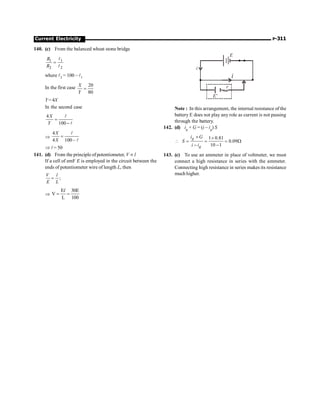
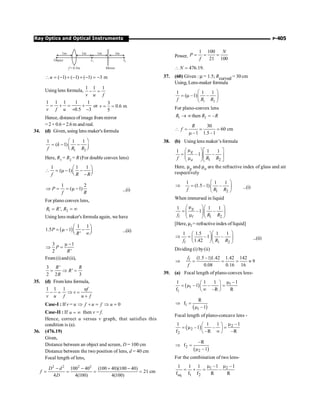
1. (a) Density of material in SI unit,
= 3
128kg
m
Density of material in new system
=
( )( )
( ) ( )
3 3
128 50g 20
25cm 4
= ( )
128
20 40units
64
=
2. (b) According to question
y x Z
E J B
Âľ
 Constant of proportionality
3
y
Z x x
E C m
K
B J J As
= = =
[As
E
C
B
= (speed of light) and
I
J
Area
= ]
3. (a) We know that
Speed of light,
0 0
1
c x
= =
m e
Also,
E
c y
B
= =
Time constant, Rc t
t = =
Speed
l l
z
Rc t
 = = =
Thus, x, y, z will have the same dimension of speed.
4. (d) From formula,
dQ dT
kA
dt dx
=
dQ
dt
k
dT
A
dx
ĂŚ Ăś
ç á
è ø
Þ =
ĂŚ Ăś
ç á
è ø
2 3
3 1
2 1
[ML T ]
[ ] [MLT K ]
[L ][KL ]
k
-
- -
-
= =
5. (c) Dimension of Force F = M1L1T–2
Dimension of velocity V = L1T–1
Dimension of work = M1L2T–2
Dimension of length = L
Moment of inertia = ML2
2
4
IFv
x
WL
 =
1 2 1 1 2 1 2 2
1 2 2 4
(M L )(M L T )(L T )
(M L T )(L )
- -
-
=
1 2 2
1 1 2
3
M L T
M L T
L
- -
- -
= = = Energy density
6. (b) Solar constant
Energy
Time Area
=
Dimension of Energy, E = ML2T–2
Dimension of Time = T
Dimension of Area = L2
 Dimension of Solar constant
1 2 2
1 0 3
2
M L T
M L T .
TL
-
-
= =
7. (d) Young's modulus,
stress
strain
Y =
–1 0
0
F
FA V
A
D
Þ = =
l
l
Y
8. (c) Energy, a b c
E A T P
Âľ
or, a b c
E kA T P
= ...(i)
where k is a dimensionless constant and a, b and c arethe
exponents.
Dimension of momentum, 1 1 1
P M LT -
=
Dimension of area, A = L2
Dimension of time, T = T1
Putting these value in equation (i), we get
1 2 2 2
c a c b c
M L T M L T
- + -
=
by comparison
c = 1
2a + c = 2
b – c = –2
c = 1, a = 1/2, b = –1
 1/ 2 1 1
E A T P
-
=
9. (a)
2
0 0
0
0 0 0 0 0
1
c c
ĂŚ Ăś
m m
= = m =
ç á
e e m m e
è ø
m0
c ® MLT–2
A–2
× LT–1
ML2
T–3
A–2
Dimensions of resistance
10. (a) X= 5YZ2
2
X
Y
Z
Þ µ ...(i)
P-8 Physics
2 2 2
2 2
[ ]
Capacitance =
V [ ]
Q Q A T
X
W ML T -
= = =
X = [M–1
L–2
T4
A2
]
F
Z B
IL
= = [QF= ILB]
Z = [MT–2
A–1
]
1 2 4 2
2 1 2
[ ]
[ ]
M L T A
Y
MT A
- -
- -
=
Y = [M–3
L–2
T8
A4
] (Using (i))
11. (d)
2
0 0 0
0 0 0 0 0
ĂŠ Ăš
ĂŠ Ăš
e e e
= = ĂŞ Ăş
ĂŞ Ăş
m m e m e
ĂŞ Ăş ĂŞ Ăş
ĂŤ Ăť ĂŤ Ăť
= e0
C[LT
T–1
]×[e0
]
0 0
1
C
ĂŠ Ăš
=
ĂŞ Ăş
m e
ĂŞ Ăş
ĂŤ Ăť
Q
2
2
0
4
q
F
r
=
pe
Q
2
2 1 3 4
0 2 2
[ ]
[ ] [ ]
[ ] [ ]
AT
A M L T
MLT L
- -
-
Þ e = =
´
1 2 1 3 4
0
0
[ ] [ ]
LT A M L T
- - -
ĂŠ Ăš
e
 = ´
ĂŞ Ăş
m
ĂŞ Ăş
ĂŤ Ăť
1 2 3 2
[ ]
M L T A
- -
=
12. (b) As we know,
[ ] [ ] [ ]
T and cv AT
r
ĂŠ Ăš
= =
ĂŞ Ăş
ĂŤ Ăť
l
–1
T
A
rcv AT
ĂŠ Ăš ĂŠ Ăš
ĂŠ Ăš
 = =ĂŤ Ăť
ĂŞ Ăş ĂŞ Ăş
ĂŤ Ăť ĂŤ Ăť
l
13. (b) Force of interaction between two atoms,
2
x
kT
F e
ĂŚ Ăś
-
ç á
ç á
a
è ø
= ab
Since exponential terms are dimensionless

2
kT
x
a
ĂŠ Ăš
ĂŞ Ăş
ĂŞ Ăş
ĂŤ Ăť
= M0L0T0
[ ]
2
0 0 0
2 2
L
M L T
ML T-
Þ =
a
Þ [a] = M–1T2
[F] = [a] [b]
MLT–2 = M–1T2[b]
Þ [b] = M2LT–4
14. (d) Let [Y] = [V]a [F]b [A]c
[ML–1T–2] = [LT–1]a [MLT–2]b [LT–2]c
[ML–1T–2] = [MbLa+b+c T–a–2b–2c]
Comparing power both sideof similar terms we get,
b = 1, a + b + c = – 1, –a –2b –2c = – 2
solving above equations we get:
a = – 4, b= 1, c = 2
so [Y] = [V–4FA2] = [V–4A2F]
15. (b) Dimension of [h] = [ML2
T–1
]
[C] = [LT–1
]
[G] = [M–1
L3
T–2
]
Hence dimension of
2 1 5 5
5
1 3 2
=
ML T L T
hC
G M L T
- -
- -
ĂŠ Ăš ĂŠ Ăš
é ù ×
ĂŤ Ăť ĂŤ Ăť
ĂŞ Ăş
ĂŠ Ăš
ĂŞ Ăş
ĂŤ Ăť ĂŤ Ăť
= [ML2
T–2
] = energy
16. (c) Let t Âľ Gx hy Cz
Dimensions of G = [M–1L3T–2],
h = [ML2T–1] and C = [LT–1]
[T] = [M–1L3T–2]x[ML2T–1]y[LT–1]z
[M0L0T1] = [M–x+y L3x+2y+z T–2x–y–z]
By comparing the powers of M, L, T both the sides
– x + y= 0 Þ x = y
3x +2y + z = 0Þ5x + z =0 .....(i)
–2x – y –z = 1 Þ 3x + z = –1 .....(ii)
Solving eqns. (i) and (ii),
1 5
x y , z
2 2
= = = - 5
Gh
t
C
 Âľ
17. (None)
Stopping potential 0
( ) x y Z r
V h I G C
Âľ
Here,h = Planck’s constant 2 1
ML T -
ĂŠ Ăš
= ĂŤ Ăť
I = current = [A]
G = Gravitational constant = [M–1
L3
T–2
]
and c = speed of light = [LT–1
]
V0
= potential= [ML2
T–3
A–1
]
 [ML2
T–3
A–1
]=[ML2
T–1
]x
[A]y
[M–1
L3
T–2
]z
[LT–1
]r
Mx – z
; L2x+3z+r
; T–x–2z–r
; Ay
Comparing dimension of M, L, T, A, we get
y= –1, x = 0, z = – 1 , r = 5
 0 –1 –1 5
0
V h I G C
Âľ
18. (d) The quantity
2
0
B
2m
is the energydensity of magnetic
field.
2
3
0
Energy Force displacement
2 (displacement)
B
Volume
Ê Ú ´
Þ = =
ĂŞ Ăş
m
ĂŞ Ăş
ĂŤ Ăť
2 –2
–1 –2
3
ML T
ML T
L
ĂŠ Ăš
= =
ĂŞ Ăş
ĂŞ Ăş
ĂŤ Ăť
Physical World, Units and Measurements P-9
19. (b) Planklength isaunitoflength,lp=1.616229×10⁻³⁵m
3
p
hG
l
c
=
20. (a) Let mass, related as M Âľ Tx
Cy
hz
M1
L0
T0
= (T')x
(L1
T–1
)y
(M1
L2
T–1
)z
M1
L0
T0
= Mz
Ly + 2z
+ Tx–y–z
z= 1
y+ 2z = 0 x – y– z = 0
y = –2 x+ 2– 1 = 0
x=–1
M = [T–1
C–2
h1
]
21. (d) Dimension of Aš dimension of(C)
Hence A – C is not possible.
22. (b) We know that resistivity
RA
l
θ 
Conductivity =
1
resistivity RA

l
I
VA

l
(Q V=RI)
2 2
2
[L][I]
[ML T
[L ]
[I][T]
,

ĂŠ Ăš
ê ú´
ĂŞ Ăş
ĂŞ Ăş
ĂŤ Ăť
W W
V
q it
 
Q
1 3 3 2 1 3 3 2
[M L T ][I ] [M L T I ]
, , , ,
 
23. (c) Let Âľ0 related with e, m, c and h as follows.
m0 = kea
mb
cc
hd
[MLT–2
A–2
] = [AT]a
[M]b
[LT–1
]c
[ML2
T–1
]d
= [Mb + d
Lc + 2d
Ta – c – d
Aa
]
On comparing both sides we get
a = – 2 ...(i)
b + d = 1 ...(ii)
c + 2d = 1 ...(iii)
a – c – d = –2 ...(iv)
By equation (i), (ii), (iii)  (iv) we get,
a = – 2, b = 0, c = – 1, d = 1
 0 2
[ ]
ĂŠ Ăš
m = ĂŞ Ăş
ĂŤ Ăť
h
ce
24. (d) Let unit ‘u’ related with e, a0
, h and c as follows.
[u] = [e]a [a0
]b [h]c [C]d
Using dimensional method,
[M–1L–2T+4A+2] = [A1T1]a[L]b[ML2T–1]c[LT–1]d
[M–1L–2T+4A+2] = [Mc Lb+2c+d Ta–c–d Aa]
a = 2, b = 1, c = – 1, d = – 1
 u =
2
0
e a
hc
25. (b) The dimensional formulae of
0 0 1 1
e M L T A
ĂŠ Ăš
=
ĂŤ Ăť
1 3 4 2
0 M L T A
-
ĂŠ Ăš
e =
ĂŤ Ăť
1 3 2
G M L T
- -
ĂŠ Ăš
=
ĂŤ Ăť and
1 0 0
e
m M L T
ĂŠ Ăš
=
ĂŤ Ăť
Now,
2
2
0 e
e
2 Gm
pe
=
2
0 0 1 1
2
1 3 4 2 1 3 2 1 0 0
M L T A
2 M L T A M L T M L T
- - - -
ĂŠ Ăš
ĂŤ Ăť
ĂŠ Ăš ĂŠ Ăš ĂŠ Ăš
p
ĂŤ Ăť ĂŤ Ăť ĂŤ Ăť
=
2 2
1 1 2 3 3 4 2 2
T A
2 M L T A
- - + - + -
ĂŠ Ăš
ĂŤ Ăť
ĂŠ Ăš
p
ĂŤ Ăť
=
2 2
0 0 2 2
T A
2 M L T A
ĂŠ Ăš
ĂŤ Ăť
ĂŠ Ăš
p
ĂŤ Ăť
=
1
2p
Q
1
2p
is dimensionless thus the combination
2
2
0 e
e
2 Gm
pe
would have the same value in different systems of units.
26. (c) Dimensions of m = [MLT–2A–2]
Dimensions of Î = [M–1L–3T4A2]
Dimensions of R = [ML2T–3A–2]

Dimensionsof
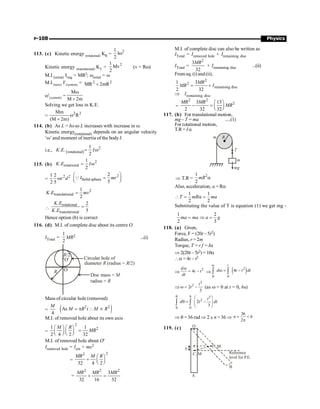
Dimensionsof
m
Î
=
2 2
1 3 4 2
[MLT A ]
[M L T A ]
- -
- -
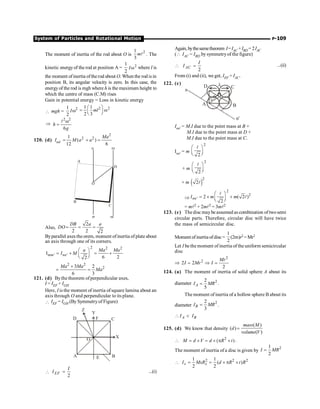
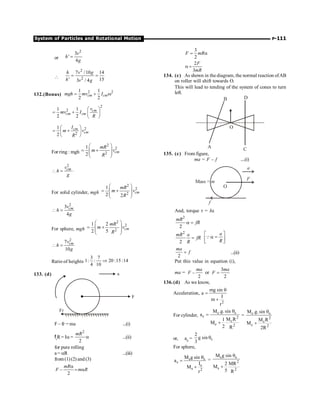
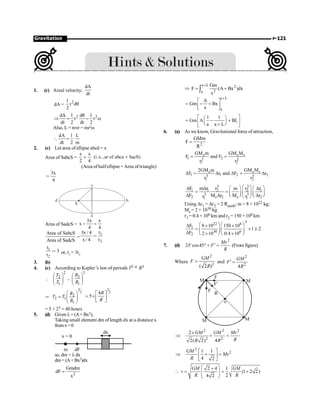
= [M2L4T–6A–4 ] = [R2]
27. (b) As we know, 1 2
2
0
1 q q
F
4 R
=
pe
Þ
1 2
0 2
q q
4 FR
e =
p
Hence,
2 2
0 2 2 2
C [AT]
N.m [MLT ][L ]
-
e = =
= [M–1 L–3 T4 A2]
28. (c)
29. (d) Angular momentum = m × v× r = ML2 T–1
Latent heat L =
2 2
Q ML T
m M
-
= = L2T–2
Capacitance C = 1 2 4 2
Charge
M L T A
P.d.
- -
=
30. (a) Surface tension,
2
2
. .
= =
l
l l l
F F T
T
T
(As, F.l = K (energy);
2
2
2
-
=
l
T
V )
Therefore, surface tension = [KV–2T–2]
31. (c) MagnitudeofLorentzformula F= qvB sin q
2
1 1
1
[ ]
F MLT
B MT C
qv C LT
-
- -
-
= = =
´
P-10 Physics
32. (b) Mutual inductance =
BA
I I
f
=
1 1 2
2 2
1
[ ]
[Henry]
[ ]
MT Q L
ML Q
QT
- -
-
-
= =
33. (d) Moment of Inertia, I = MR2
[I] = [ML2]
Moment of force, t
r
= r F
´
r
r
t
r
= 2 2 2
[ ][ ] [ ]
L MLT ML T
- -
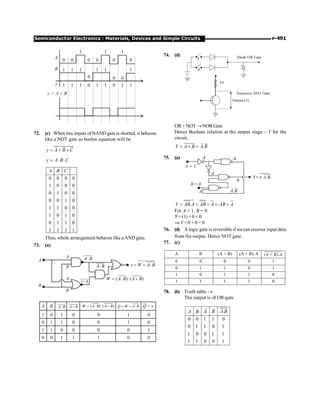
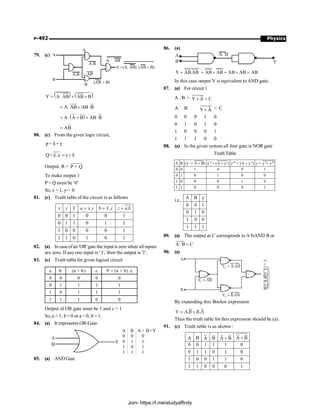
=
34. (a) According to, Stokes law,
F = 6phrv
6
F
r v
Þ h =
p
–2
–1
[ ]
[ ][ ]
MLT
L LT
h = 1 1
[ ]
ML T
- -
Þ h =
35. (c) As we know, the velocity of light in free space is
given by
c =
1
o o
m e
2 2 2
1
0 0
1
e Z T
 = =
m e
1
o o
m e = C2[m/s]2
= [LT–1]2
= [M0L2T–2]
36. (b) Momentum, = mv = [MLT–1]
Planck’s constant,
E
h
v
=
2 –2
–1
[ ]
[ ]
ML T
T
= = [ML2T–1]
37. (a) Work cos
W F s Fs
= × = q
r r
Q A B
×
r r
= AB cos q
2 2 2
[ ][ ] [ ]
MLT L ML T
- -
= = ;
Torque, r F
t = ´
r
r r
sin
rF
Þ t = q
Q A B
´
r r
= AB sin q
2 2 2
[ ] [ ] [ ]
L MLT ML T
- -
= =
38. (b) Given:No.ofdivisiononcircularscaleofscrewgauge=50
Pitch = 0.5mm
Least count of screw gauge
Pitch
No. of division on circular scale
=
5
0.5
mm 1 10 m = 10 m
50
= = ´ m
And nature of zero error is positive.
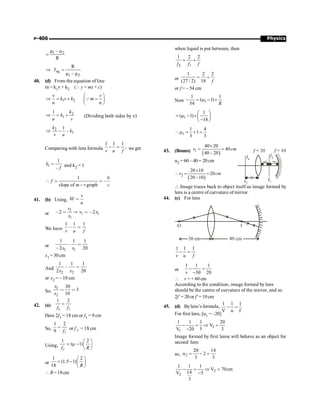
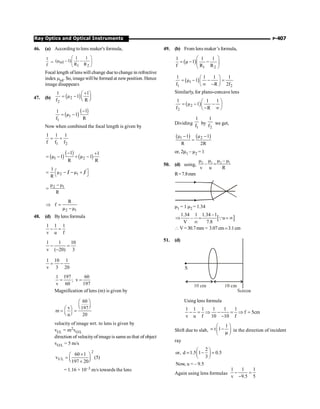
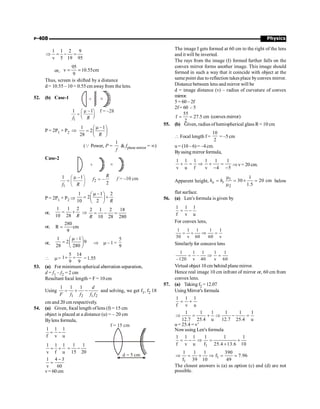
39. (1050)
Density, 3
4
3 2
M M
V D
r = =
ĂŚ Ăś
pç á
è ø
3
6
MD-
Þ r =
p
% 3 6 3 1.5 10.5%
m D
m D
ĂŚ Ăś
Dr D D
ĂŚ Ăś
 = + = + ´ =
ç á
ç á è ø
è r ø
1050
% % %
100 100
x
ĂŚ Ăś
Dr ĂŚ Ăś
= = ç á
ç á è ø
è r ø
1050.00
x
 =
40. (d) Averagediameter, dav = 5.5375 mm
Deviation of data, Dd= 0.07395 mm
As the measured data are upto two digits after decimal,
therefore answer should be in two digits after decimal.
(5.54 0.07) mm
d
 = Âą
41. (d) Given :
2 2/3
3
a b
Z
cd
=
Percentage error in Z,
=
Z
Z
D 2 2 1 3
3 2
a b c d
a b c d
D D D D
= + + +
2 1
2 2 1.5 4 3 2.5 14.5%.
3 2
= ´ + ´ + ´ + ´ =
42. (a) Thickness = M.S. Reading + Circular Scale Reading
(L.C.)
Here LC
Pitch 0.1
0.002
Circular scale division 50
= = = cm per
division
So, correct measurement is measurement of integral
multipleofL.C.
43. (c) L.C. ofvernier callipers= 1 MSD –1 VSD
9
1 1 0.1
10
ĂŚ Ăś
= - ´ =
ç á
è ø
mm=0.01cm
Here 7th division of vernier scale coincides with a division
of main scale and the zero of vernier scale is lying right
side of the zero of main scale.
Zeroerror =7×0.1 =0.7mm= 0.07cm.
Length of the cylinder = measured value – zero error
= (3.1 + 4 × 0.01) – 0.07 = 3.07cm.
44. (d) When screw on a screw-gauge is given six rotations,
it moves by 3mm on the main scale

3
Pitch 0.5mm
6
= =
 Least count L.C.
Pitch 0.5mm
50
CSD
= =
1
mm 0.01 0.001cm
100
mm
= = =
45. (None)
D1
= A1
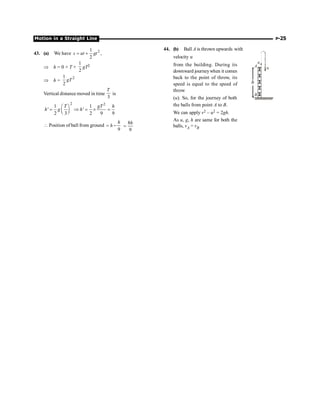
+ B1
+ C1
= 24.36 + 0.0724 + 256.2 = 280.6
D2
= A2
+ B2
+ C2
= 24.44 + 16.082 + 240.2 = 280.7
D3
= A3
+ B3
+ C3
= 25.2 + 19.2812 + 236.183= 280.7
Physical World, Units and Measurements P-11
D4
= A4
+ B4
+ C4
= 25 + 236.191 + 19.5 = 281
None of the option matches.
46. (c) Given, Length ofsimple pendulum, l = 25.0 cm
Time of 40 oscillation, T = 50s
Time period of pendulum
2
T
g
= p
l
2
2 4
T
g
p
Þ =
l 2
2
4
g
T
p
Þ =
l
Þ Fractional error in g =
2
g l T
g l T
D D D
= +
0.1 1
2 0.044
25.0 50
g
g
D ĂŚ Ăś ĂŚ Ăś
Þ = + =
ç á ç á
è ø è ø
Percentageerrorin 100 4.4%
g
g
g
D
 = ´ =
47. (Bonus) 3
3
M M
Ml
V l
-
d = = =
3
M l
M l
Dd D D
= +
d
0.10 0.01
3
10.00 0.10
ĂŚ Ăś
= + ç á
è ø = 0.31kg/m3
,
48. (d) A = 7× 5.29 = 37.03 cm2
The result should have three significant figures, so
A = 37.0 cm2
49. (d) We have
2
T
g
= p
l
or
2
2
4
g
T
= p
l
100 100 2 100
g R T
g Q T
D D D
´ = ´ + ´
0.1 1
100 2 100
55 30
ĂŚ Ăś
= ´ + ´
ç á
è ø
=0.18+6.67=6.8%
50. (b) Least count of main scale of screw gauge = 1mm
Least count of screw gauge
Pitch
Number of division on circular scale
=
3
6 10
5 10
N
-
-
´ =
Þ N= 200
51. (c)
52. (c) Least count of screw gauge,
LC=
Pitch
No. of division
= 0.5 × 10–3 = 0.5 × 10⁻² mm+veerror = 3×0.5 ×10–2 mm
=1.5×10⁻² mm= 0.015mm
Reading = MSR+ CSR– (+ve error)
= 5.5 mm + (48 × 0.5 × 10–2)–0.015
=5.5+0.24–0.015=5.725mm
53. (c) = 1.5 % + 3 (1%) = 4.5%
54. (d) Maximum percentage error in A
3(% error in P) 2(% error in Q)
= +
1
(% error in R) 1(% error in S)
2
+ +
1
3 0.5 2 1 3 1 1.5
2
= ´ + ´ + ´ + ´
=1.5+ 2+1.5+ 1.5=6.5%
55. (c) From Kepler's law, time period of a satellite,
3
r
T 2
Gm
= p
2
2 3
4
T r
GM
p
=
Relative uncertainty in the mass of the earth
2
M T
2 2 10
M T
-
D D
= = ´ (Q 4p  G constant and
relative uncertaintyin radius
r
r
D
negligible)
56. (c) Relativeerror in Surface area,
s r
2
s r
D D
= ´ = a and
relative error in volume,
v r
3
v r
D D
= ´
 Relative error in volume w.r.t. relative error in area,
v 3
v 2
D
= a
57. (d) Least count =
Value of 1 part on main scale
Number of parts on vernier scale
=
0.25
cm
5×100
= 5 × 10⁻⁴ cm
Reading = 4 × 0.05 cm + 30 × 5 × 10–4 cm
= (0.2 + 0.0150) cm = 0.2150 cm (Thickness of wire)
58. (d) Surface tension, 3
10
2
= ´
rhg
T
Relative error in surface tension,
0
D D D
= + +
T r h
T r h
(Q g, 2  103 are constant)
Percentage error
–2 –2
–2 –2
10 0.01 10 0.01
100 100
1.25 10 1.45 10
ĂŚ Ăś
D ´ ´
´ = +
ç á
´ ´
è ø
T
T
= (0.8 + 0.689)
= (1.489)= 1.489%@1.5%
59. (c) Given, P = a1/2
b2
c2
d–4
,
Maximumrelativeerror,
P 1 a b c d
2 3 4
P 2 a b c d
D D D D D
= + + +
1
2 2 1 3 3 4 5
2
= ´ + ´ + ´ + ´ =32%
60. (d) L.C.
0.5
50
= =0.01mm
Zeroerror = 5× 0.01 = 0.05mm(Negative)
Reading= (0.5+25× 0.01)+0.05= 0.80mm
P-12 Physics
61. (c)
1 2 3 4
| T | | T | | T | | T |
T
4
D + D + D + D
D =
2 1 3 0
1.5
4
+ + +
= =
As the resolution of measuring clock is 1.5 therefore
the mean time should be 92 Âą 1.5
62. (d) As, g = 2
2
4
L
T
p
So, 100 100 2 100
g L T
g L T
D D D
´ = ´ + ´
=
0.1 1
100 2 100
20 90
´ + ´ ´ = 2.72 ; 3%
63. (b) Least count =
0.1
10
= 0.01 cm
d1
= 0.5 + 8 × 0.01 + 0.03 = 0.61 cm
d2
= 0.5 + 4 × 0.01 + 0.03 = 0.57 cm
d3
= 0.5 + 6 × 0.01 + 0.03 = 0.59 cm
Mean diameter =
0.61 0.57 0.59
3
+ +
= 0.59 cm
64. (a) The current voltage relation of diode is
1000 /
( 1)
= -
V T
I e mA (given)
When, 1000 /
5 , 6
V T
I mA e mA
= =
Also, 1000 / 1000
( )
= ´
V T
dI e
T
Error = Âą 0.01 (By exponential function)
=
1000
(6 ) (0.01)
300
´ ´
mA =0.2mA
65. (b) Measured length of rod = 3.50 cm
For Vernier Scale with 1 Main Scale Division = 1 mm
9 Main Scale Division = 10 Vernier Scale Division,
Least count = 1 MSD –1 VSD = 0.1 mm
66. (a) Rotation period of earth is about 24 hrs ; 105 s
Revolution period of earth is about 365 days ; 107 s
Speed of light wave C = 3 × 10⁸ m/s
Wavelength of visible light of spectrum
l = 4000 – 7800 Å
C = f l
1
and T
f
ĂŚ Ăś
=
ç á
è ø
Therefore period of light wave is 10–15 s (approx)
67. (d) In a voltmeter
V l
Âľ
V = kl
Now, it is given E = 1.1 volt for l1 = 440 cm
and V = 0.5 volt for l2 = 220 cm
Let the error in reading of voltmeter be DV then,
1.1 = 400K and(0.5 – DV)=220K.
Þ
1.1 0.5 V
440 220
- D
=
 V 0.05 volt
D = -
68. (b) According to the question.
t = (90 Âą 1) or,
1
90
t
t
D
=
l = (20 Âą 0.1) or,
0.1
20
l
l
D
=
% ?
g
g
D
=
As we know,
2
l
t
g
= p Þ 2
4 l
g
t
2
p
=
or, 2
D D D
ĂŚ Ăś
= Âą +
ç á
è ø
g l t
g l t
=
0.1 1
2
20 90
ĂŚ Ăś
+ ´
ç á
è ø
= 0.027
 % 2.7%
g
g
D
=
69. (a) According to ohm’s law, V = IR
R=
V
I
 Percentage error =
2
Absolute error
10
Measurement
´
where, 100
V
V
D
´ = 100
I
I
D
´ = 3%
then, 100
R
R
D
´ =
2 2
10 10
V I
V I
D D
´ + ´
= 3% + 3% = 6%
70. (c) Q Reading of Vernier = Main scalereading
+ Vernier scale reading × least count.
Main scale reading = 58.5
Vernier scale reading = 09 division
least count of Vernier = 0.5°/30
Thus, R = 58.5° + 9 ×
0.5
30
°
R=58.65°
71. (d) No. of divisions on main scale = N
No. of divisions on vernier scale = N + 1
size of main scale division = a
Let size of vernier scale division be b
then we have
aN = b (N + 1) Þ b =
1
aN
N +
Least count is a – b = a –
1
aN
N +
=
1
1
N N
a
N
+ -
ĂŠ Ăš
ĂŞ Ăş
+
ĂŤ Ăť
=
1
a
N +
72. (d) The least count (L.C.) ofa screwguage is the smallest
length which can be measured accurately with it.
As least count is 0.001 cm =
1
1000
cm
Hence measured value should be recorded upto 3 decimal
placesi.e., 5.320 cm
Physical World, Units and Measurements P-13
73. (a) Least count, L.C. =
1
100
mm
Diameter of wire = MSR + CSR × L.C.
Q 1 mm = 0.1 cm
= 0+
1
100
×52=0.52mm=0.052cm
74. (a) Number of significant figures in 23.023 = 5
Number of significant figures in 0.0003 = 1
Number of significant figures in 2.1 ×10–3 = 2
So, the radiation belongs to X-rays part of the spectrum.
75. (d) 30 DivisionsofV.S. coincidewith 29 divisionsofM.S.
1V.S.D =
29
30
MSD
L.C.=1 MSD–1VSD
= 1 MSD
29
3 0
- MSD
=
1
MSD
30
=
1
0.5
30
´ ° = 1 minute.
76. (a) Momentum, p = m × v
Given, mass of a body = 3.513 kg speed of body
= (3.513) × (5.00) = 17.565 kg m/s
= 17.6 (Rounding offto get three significant figures)
77. (d) Least count of screw gauge = 0.01 mm
Q
0.5
50
mm
Reading = [M.S.R. + C.S.R. × L.C.] – (zero error)
= [3 + 35 × 0.01] – (–0.03) = 3.38 mm
14 Physics
TOPIC 1
Distance, Displacement 
Uniform Motion
1. A particle is moving with speed v b x
= along positive
x-axis.Calculatethespeedoftheparticleat timet = t(assume
that the particle is at origin at t = 0). [12Apr. 2019 II]
(a)
2
4
b t
(b)
2
2
b t
(c) 2
b t (d)
2
2
b t
2. All the graphs below are intended to represent the same
motion. One of them does it incorrectly. Pick it up.
[2018]
(a) position
velocity
(b) time
distance
(c) time
position
(d) time
velocity
3. A car covers the first half of the distance between two
places at 40 km/h and other half at 60 km/h. The average
speed of the car is [Online May 7, 2012]
(a) 40 km/h (b) 45 km/h
(c) 48km/h (d) 60km/h
4. The velocity ofa particle is v = v0 + gt + ft2. If its position
is x = 0 at t = 0, then its displacement after unit time (t =
1) is [2007]
(a) v0 + g /2 + f (b) v0 + 2g + 3f
(c) v0 + g /2 + f/3 (d) v0 + g + f
5. A particle located at x = 0 at time t = 0, starts moving
along with the positive x-direction with a velocity 'v' that
varies as v = x
a . The displacement of the particle
varieswith timeas [2006]
(a) t2 (b) t (c) t1/2 (d) t3
TOPIC 2 Non-uniform Motion
6. The velocity (v) and time (t) graph of a body in a straight
line motion is shown in the figure. The point S is at 4.333
seconds. The total distance covered by the body in 6 s is:
[05 Sep. 2020 (II)]
4
2
0
–2
1 2 3 4 5 6
t (in s)
A B
S D
C
v (m/s)
(a)
37
3
m (b) 12m (c) 11m (d)
49
4
m
7. The speed verses time graph for a particle is shown in the
figure. The distance travelled (in m) bythe particle during
the time interval t = 0 to t = 5 s will be __________.
[NA 4 Sep. 2020 (II)]
1 2 3 4 5
2
4
6
8
10
u
(ms )
–1
time
( )
s
8. The distance x covered by a particle in one dimensional
motion varies with time t as x2
= at2
+ 2bt + c. If the
acceleration of the particle depends on x as x–
n, where n
is an integer, the value of n is ______. [NA9 Jan 2020 I]
9. A bullet of mass 20g has an initial speed of 1 ms–1
, just
before it starts penetrating a mud wall of thickness 20 cm.
Ifthe wall offers a mean resistance of2.5×10–2
N, the speed
of the bullet after emerging from the other side of the wall
is close to : [10Apr. 2019 II]
(a) 0.1 ms–1
(b) 0.7 ms–1
(c) 0.3 ms–1
(d) 0.4 ms–1
Motion in a Straight
Line
2
Motion in a Straight Line P-15
10. The position of a particle as a function of time t, is given
by
x(t) = at + bt2
– ct3
where, a, b and c are constants. When the particle attains
zero acceleration, then its velocity will be:
[9Apr. 2019II]
(a)
2
4
+
b
a
c
(b)
2
3
b
a
c
+
(c)
2
b
a
c
+ (d)
2
2
b
a
c
+
11. A particle starts from origin O from rest and moves with a
uniform acceleration along the positive x-axis. Identifyall
figures that correctly represents the motion qualitatively
(a = acceleration, v = velocity, x = displacement, t = time)
[8Apr. 2019 II]
(A) (B)
(C) (D)
(a) (B), (C) (b) (A)
(c) (A), (B), (C) (d) (A), (B), (D)
12. A particle starts from the origin at time t = 0 and moves
along the positive x-axis. The graph of velocity with
respect to time is shown in figure. What is the position
of the particle at time t = 5s? [10 Jan. 2019 II]
3
2
1
0
1
1 2 3 4 5 6 7 8 9 10
v
(m/s)
(a) 10 m (b) 6 m
(c) 3m (d) 9m
13. In a car race on straight road, car A takes a time t less
than car B at the finish and passes finishing point with
a speed 'v' more than of car B. Both the cars start from
rest and travel with constant acceleration a1 and a2
respectively. Then 'v' is equal to: [9 Jan. 2019 II]
(a) 1 2
1 2
2a a
t
a a
+
(b) 1 2
2a a t
(c) 1 2
a a t (d) 1 2
a a
t
2
+
14. An automobile, travelling at 40 km/h, can be stopped at a
distance of40m byapplying brakes. Ifthe sameautomobile
is travelling at 80 km/h, theminimum stopping distance, in
metres, is (assume no skidding) [Online April 15, 2018]
(a) 75m (b) 160m (c) 100m (d) 150m
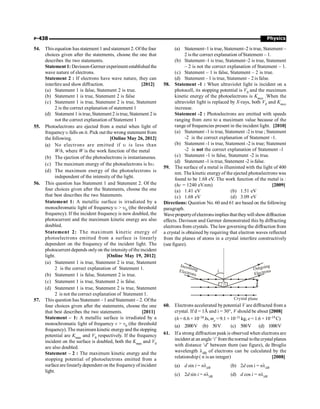
15. The velocity-time graphs ofa car and a scooter are shown
in the figure. (i) the difference between the distance
travelled bythe car and the scooter in 15 s and (ii) the time
at which the car will catch up with the scooter are,
respectively [OnlineApril 15, 2018]
(a) 337.5m and 25s
5
0
15
30
A B
G
E
F
C
D
45
10 15
Time in (s) ÂŽ
Velocity
(ms
)
–1
ÂŽ
20 25
O
Car
Scooter
(b) 225.5mand 10s
(c) 112.5mand 22.5s
(d) 11.2.5mand15s
16. Aman in a car at location Qon a straight highwayismoving
with speed v. He decides to reach a point P in a field at a
distance d from highway (point M) as shown in the figure.
Speed of the car in the field is half to that on the highway.
What should be the distance RM, so that the time taken to
reachPisminimum? [OnlineApril 15, 2018]
d
P
Q
R M
(a)
d
3
(b)
d
2
(c)
d
2
(d) d
17. Which graph corresponds to an object moving with a
constant negative acceleration and a positive velocity ?
[OnlineApril 8,2017]
(a)
Velocity
Time
(b)
Velocity
Time
(c)
Velocity
Distance
(d)
Velocity
Distance
18. The distance travelled by a body moving along a line in
time t is proportional to t3.
The acceleration-time (a, t) graph for the motion of the
body will be [Online May 12, 2012]
P-16 Physics
(a)
a
t
(b)
a
t
(c)
a
t
(d)
a
t
19. Thegraph of an object’s motion (along the x-axis) is shown
in the figure. The instantaneous velocity of the object at
points A and B are vA and vB respectively. Then
[Online May 7, 2012]
5
10
15
A
B
Dx = 4 m
10 20
x(m)
t(s)
0
Dt = 8
(a) vA = vB = 0.5 m/s (b) vA = 0.5 m/s  vB
(c) vA = 0.5 m/s  vB (d) vA = vB = 2 m/s
20. An object, moving with a speed of 6.25 m/s, is decelerated
at a rate given by
2.5
= -
dv
v
dt
where v is the instantaneous speed. The time
taken by the object, to come to rest, would be: [2011]
(a) 2 s (b) 4 s (c) 8 s (d) 1 s
21. A body is at rest at x = 0. At t = 0, it starts moving in the
positive x-direction with a constant acceleration. At the
same instant another body passes through x = 0 moving
in the positive x-direction with a constant speed. The
position of the first body is given by x1(t) after time ‘t’;
and that of the second body by x2(t) after the same time
interval. Which of the following graphs correctly
describes (x1 – x2) as a function of time ‘t’? [2008]
(a)
( – )
x x
1 2
t
O
(b)
( – )
x x
1 2
t
O
(c)
( – )
x x
1 2
t
O (d)
( – )
x x
1 2
t
O
22. Acar, starting from rest, accelerates at the rate f through a
distance S, then continues at constant speed for time t
and then decelerates at the rate
2
f
to come to rest. If the
total distance traversed is 15 S , then [2005]
(a) S = 2
1
6
ft (b) S = f t
(c) S =
2
1
4
ft (d) S =
2
1
72
ft
23. A particle is moving eastwards with a velocity of 5 ms–1.
In 10 seconds the velocity changes to 5 ms–1 northwards.
The average acceleration in this time is [2005]
(a) 2
ms
2
1 -
towards north
(b) 2
ms
2
1 - towards north - east
(c) 2
ms
2
1 -
towards north - west
(d) zero
24. The relation between time t and distance x is t = ax2 + bx
where a and b are constants. The acceleration is [2005]
(a) 2bv3 (b) –2abv2 (c) 2av2 (d) –2av3
25. An automobile travelling with a speed of 60 km/h, can
brake to stop within a distance of 20m. If the car is going
twice as fast i.e., 120 km/h, the stopping distance will be
[2004]
(a) 60m (b) 40m (c) 20m (d) 80m
26. Acar, moving with a speed of 50 km/hr, can be stopped by
brakes after at least 6 m. If the same car is moving at a
speed of 100 km/hr, the minimum stopping distance is
[2003]
(a) 12m (b) 18m (c) 24m (d) 6m
27. If a body looses half of its velocity on penetrating 3 cm in
a wooden block, then how much will it penetrate more
before coming to rest? [2002]
(a) 1cm (b) 2cm (c) 3cm (d) 4cm.
28. Speeds of two identical cars are u and 4u at the specific
instant. The ratio of the respective distances in which the
two cars are stopped from that instant is [2002]
(a) 1 : 1 (b) 1 : 4 (c) 1 : 8 (d) 1 : 16
TOPIC 3 Relative Velocity
29. Train A and train B are running on parallel tracks in the
opposite directions with speeds of 36 km/hour and 72
km/hour, respectively. A person is walking in train A in
the direction opposite to its motion with a speed of 1.8
Join- https://t.me/studyaffinity
Motion in a Straight Line P-17
km/hour. Speed (in ms–1) of this person as observed from
train B will be close to : (take the distance between the
tracks as negligible) [2 Sep. 2020 (I)]
(a) 29.5 ms–1 (b) 28.5 ms–1
(c) 31.5 ms–1q (d) 30.5 ms–1
30. A passenger train of length 60 m travels at a speed of 80
km/hr. Another freight train of length 120 m travels at a
speed of 30 km/h. The ratio of times taken by the
passenger train to completelycross the freight train when:
(i) they are moving in same direction, and (ii) in the
opposite directions is: [12 Jan. 2019 II]
(a)
11
5
(b)
5
2
(c)
3
2
(d)
25
11
31. A person standing on an open ground hears the sound of
a jet aeroplane, coming from north at an angle 60Âş with
ground level. But he finds the aeroplane right vertically
above his position. If v is the speed of sound, speed of the
plane is: [12 Jan. 2019 II]
(a)
3
2
v (b)
2
3
v
(c) v (d)
2
v
32. A car is standing 200 m behind a bus, which is alsoat rest.
The two start moving at the same instant but with differ-
ent forward accelerations. The bus has acceleration 2 m/s2
and the car has acceleration 4 m/s2
. The car will catch up
with the bus after a time of :
[Online April 9, 2017]
(a) 110s (b) 120s
(c) 10 2s (d) 15 s
33. A person climbs up a stalled escalator in 60 s. If standing
on the same but escalator running with constant velocity
he takes 40 s. How much time is taken by the person to
walk up the moving escalator? [Online April 12, 2014]
(a) 37 s (b) 27 s (c) 24 s (d) 45 s
34. A goods train accelerating uniformlyon a straight railway
track, approaches an electric pole standing on the side of
track. Its engine passes the pole with velocity u and the
guard’s room passes with velocityv. Themiddlewagon of
the train passes the pole with a velocity.
[Online May 19, 2012]
(a)
2
u v
+
(b)
2 2
1
2
u v
+
(c) uv (d)
2 2
2
u v
ĂŚ Ăś
+
ç á
è ø
TOPIC 4 Motion Under Gravity
35. A helicopter rises from rest on the ground vertically up-
wards with a constant acceleration g. A food packet is
dropped from the helicopter when it is at a height h. The
time taken by the packet to reach the ground is close to
[g is the accelertion due to gravity] : [5 Sep. 2020 (I)]
(a)
2
3
h
t
g
ĂŚ Ăś
= ç á
è ø
(b) 1.8
h
t
g
=
(c) 3.4
h
t
g
ĂŚ Ăś
= ç á
è ø
(d)
2
3
h
t
g
=
36. A Tennis ball is released from a height h and after freely
falling on a wooden floor it rebounds and reaches height
2
h
. The velocityversus height of the ball during its motion
may be represented graphically by :
(graph are drawn schematicallyand on not to scale)
[4 Sep. 2020 (I)]
(a)
h/2
h
h v
( )
v
(b)
h/2
h
h v
( )
v
(c)
h/2
h
h v
( )
v
(d)
h/2
h
h v
( )
v
37. A ball is dropped from the top of a 100 m high tower on a
planet. In the last
1
2
s before hitting the ground, it covers a
distance of19 m.Acceleration due to gravity(in ms–2
) near
the surface on that planet is _______.
[NA 8 Jan. 2020 II]
38. A body is thrown vertically upwards. Which one of the
following graphs correctlyrepresent the velocity vs time?
[2017]
(a) (b)
(c) (d)
39. Two stones are thrown up simultaneously from the edge
of a cliff 240 m high with initial speed of 10 m/s and 40
m/s respectively. Which of the following graph best
represents the time variation of relative position of the
second stone with respect to the first ?
Join- https://t.me/studyaffinity
P-18 Physics
(Assume stones do not rebound after hitting the ground
and neglect air resistance, take g = 10 m/ s2) [2015]
(The figures are schematic and not drawn to scale)
(a) (y – y ) m
2 1
240
8 12
t(s)
(b) (y – y ) m
2 1
240
8 12
t(s)
(c)
(y – y ) m
2 1
240
8 12
t(s)
tÂŽ
(d)
(y – y ) m
2 1
240
12
t(s)
40. From a tower of height H, a particle is thrown vertically
upwards with a speed u. The time taken bythe particle, to
hit the ground, is n times that taken by it to reach the
highest point of its path. The relation between H, u and n
is: [2014]
(a) 2gH = n2u2 (b) gH = (n – 2)2 u2d
(c) 2gH = nu2 (n – 2) (d) gH = (n – 2)u2
41. Consider a rubber ball freelyfallingfrom a height h =4.9m
onto a horizontal elastic plate. Assume that the duration
of collision is negligible and the collision with the plate is
totallyelastic.
Then the velocity as a function of time and the height as
a function of time will be : [2009]
(a) t
+v1
v
O
–v1
y
h
t
(b)
v
+v1
O
–v1
t1 2t1 4t1
t t
y
h
t
(c) t
t1 2t1
O
y
h
t
(d)
v1
v
O t
t
y
h
42. Aparachutistafterbailingoutfalls50mwithoutfriction.When
parachuteopens,itdeceleratesat2m/s2 .Hereachestheground
with aspeedof3m/s.Atwhatheight, didhebailout? [2005]
(a) 182 m (b) 91 m
(c) 111m (d) 293m
43. A ballis releasedfrom thetop ofa tower of heighth meters.
It takes Tseconds to reach the ground. What is the position
of the ball at
3
T
second [2004]
(a)
8
9
h
meters from the ground
(b)
7
9
h
meters from the ground
(c)
9
h
meters from the ground
(d)
17
18
h
meters from the ground
44. From a building two balls A and B are thrown such that A is
thrown upwards and B downwards (both vertically). If vA
and vB are their respective velocities on reaching the
ground, then [2002]
(a) vB  vA
(b) vA = vB
(c) vA  vB
(d) their velocities depend on their masses.
Join- https://t.me/studyaffinity
Motion in a Straight Line P-19
1. (b) Given, v = b x
or
1/2
dx
b x
dt
=
or
1/2
0 0
x t
x dx bdt
-
=
ò ò
or
1/2
1/ 2
x
= 6t or x =
2 2
4
b t
Differentiating w. r. t. time, we get
2
2
4
dx b t
dt
´
= (t = t)
or v =
2
2
b t
2. (b) Graphs in option (c) position-time and option (a)
velocity-position are corresponding to velocity-time graph
option (d) and its distance-time graph is as given below.
Hence distance-time graph option (b) is incorrect.
time
distance
3. (c) Average speed =
Total distance travelled x
Total time taken T
=
=
x
x x
2 40 2 60
+
´ ´
= 48 km/h
4. (c) We know that,
dx
v
dt
=
Þ dx = v dt
Integrating,
0 0
x t
dx v dt
=
ò ò
or 2
0
0
( )
t
x v gt ft dt
= + +
ò
2 3
0
0
2 3
t
gt ft
v t
ĂŠ Ăš
= + +
ĂŞ Ăş
ĂŞ Ăş
ĂŤ Ăť
or,
2 3
0
2 3
gt ft
x v t
= + +
At t = 1, 0
2 3
g f
x v
= + + .
5. (a) v x
= a ,
Þ
dx
x
dt
= a Þ
dx
dt
x
= a
Integrating both sides,
0 0
x t
dx
dt
x
= a
ò ò ; 0
0
2
[ ]
1
x
t
x
t
ĂŠ Ăš
= a
ĂŞ Ăş
ĂŤ Ăť
2 x t
Þ = a
2
2
4
x t
a
Þ =
6. (a) A B
S D
C
t
(in s)
v(m/s)
4
2
0
–2
1 2 3 4 5 6
O
1 13
4
3 3
OS = + =
1 5
2
3 3
SD = - =
Distance covered by the body = area of v-t graph
= ar (OABS) + ar (SCD)
1 13 1 5
1 4 2
2 3 2 3
ĂŚ Ăś
= + ´ + ´ ´
ç á
è ø
32 5 37
m
3 3 3
= + =
7. (20)
u
t
A
B
5
8
O
Distance travelled = Area of speed-time graph
1
5 8 20 m
2
= ´ ´ =
8. (3) Distance X varies with time t as x2
= at2
+ 2bt + c
2 2 2
dx
x at b
dt
Þ = +
( )
dx dx at b
x at b
dt dt x
+
Þ = + Þ =
2
2
2
d x dx
x a
dt
dt
ĂŚ Ăś
Þ + =
ç á
è ø
2 2
2
2
dx at b
a a
d x dt x
x x
dt
+
ĂŚ Ăś ĂŚ Ăś
- -
ç á ç á
è ø è ø
Þ = =
( )
2 2
3 3
ax at b ac b
x x
2
- + -
= =
Þ a µx–3
Hence, n = 3
Join- https://t.me/studyaffinity
P-20 Physics
9. (b) From the third equation of motion
v2
– u2
= 2aS
But,
F
a
m
=
2 2
2
F
v u S
m
ĂŚ Ăś
 = - ç á
è ø
2
2 2
3
2.5 10 20
(1) (2)
100
20 10
v
-
-
ĂŠ Ăš
´
Þ = - ê ú
´
ĂŞ Ăş
ĂŤ Ăť
Þ v2
=
1
1–
2
1
m/s 0.7m/s
2
v
Þ = =
10. (b) x = at + bt2
– ct3
Velocity,
2 3
( )
dx d
v at bt ct
dt dt
= = + +
= a + 2bt – 3ct2
Acceleration,
2
( 2 3 )
dv d
a bt ct
dt dt
= + -
or 0 = 2b – 3c × 2t
3
b
t
c
ĂŚ Ăś
 = ç á
è ø
and v =
2
2 3
3 3
b b
a b c
c c
ĂŚ Ăś ĂŚ Ăś
+ -
ç á ç á
è ø è ø
2
3
b
a
c
ĂŚ Ăś
= +
ç á
è ø
11. (d) For constant acceleration, there is straight line
parallel tot-axis on a t
ÂŽ
- .
Inclined straight line on v t
ÂŽ
- , and parabola on x t
ÂŽ
- .
12. (d) Position of the particle,
S = area under graph (time t = 0 to5s)
1
2 2 2 2 3 1 9m
2
= ´ ´ + ´ + ´ =
13. (c) Let time taken byAto reach finishing point is t0
 Time taken by B to reach finishing point = t0 + t
u = 0 v = a t
A 1 0
x
v = a + t)
B 2 0
(t
vA – vB = v
Þ v = a1 t0 – a2 (t0 + t) = (a1 – a2)t0–a2t ...(i)
2 2
B A 1 0 2 0
1 1
x x a t a (t t)
2 2
= = = +
( )
1 2 0
0
a t a t t
Þ = +
( )
1 2 0 2
a – a t a t
Þ =
Þ to = 2
1 2
a t
a – a
Putting this value of t0 in equation (i)
( ) 2
l 2 2
1 2
a t
v a – a –a t
a – a
=
( )
1 2 2 2
a a a t –a t
= + = 1 2 2 2
a a t a t –a t
+
or, 1 2
v a a t
=
14. (b) Accordingtoquestion,u1=40km/h,v1=0ands1 =40m
using v2 – u2 = 2as; 02 – 402 = 2a × 40 ...(i)
Again, 02 – 802 = 2as ...(ii)
From eqn. (i) and(ii)
Stopping distance, s = 160 m
15. (c) Using equation, a =
–
v u
t
and S = ut +
2
1
2
at
Distance travelled by car in 15 sec =
1 (45)
2 15
(15)2
=
675
2
m
Distancetravelled byscooter in 15 seconds = 30 × 15 = 450
(Q distance = speed × time)
Difference between distance travelled by car and scooter
in 15sec, 450–337.5= 112.5m
Let car catches scooter in time t;
675
45( –15) 30
2
t t
+ =
337.5 + 45t – 675 = 30t Þ 15t = 337.5
Þ t = 22.5 sec
16. (a) Let the car turn of the highway at a distance 'x' from
the point M. So, RM = x
And if speed of car in field is v, then time taken bythe car
to cover the distance QR = QM – x on the highway,
1
2
QM x
t
v
-
= .....(i)
Time taken to travel the distance 'RP' in the field
2 2
2
d x
t
v
+
= ..... (ii)
Total time elapsed to move the car from Q to P
2 2
1 2
2
QM x d x
t t t
v v
- +
= + = +
For 't' tobeminimum 0
dt
dx
=
d
P
Q
R M
2 2
1 1
0
2
x
v d x
ĂŠ Ăš
- + =
ĂŞ Ăş
ĂŞ Ăş
+
ĂŤ Ăť
or
2 3
2 1
d d
x = =
-
Join- https://t.me/studyaffinity
Motion in a Straight Line P-21
17. (c) According to question, object is moving with
constant negative acceleration i.e., a = – constant (C)
vdv
C
dx
= -
vdv = – Cdx
2
v
Cx k
2
= - +
2
v k
x
2C C
= - +
Hence, graph (3) represents correctly.
18. (b) Distance along a line i.e., displacement (s)
= t3 (Q 3
s t
Âľ given)
By double differentiation of displacement, we get
acceleration.
3
2
3
ds dt
V t
dt dt
= = = and
2
3
6
dv d t
a t
dt dt
= = =
a = 6t or a t
Âľ
Hence graph (b) is correct.
19. (a) Instantaneous velocity
D
=
D
x
v
t
From graph,
4
8
D
= =
D
A
A
A
x m
v
t s
= 0.5 m/s
and vB
8
16
D
= =
D
B
B
x m
t s
= 0.5 m/s
i.e., vA = vB = 0.5 m/s
20. (a) Given, 2.5
= -
dv
v
dt
Þ
dv
v
= – 2.5 dt
Integrating,
0 ½
6.25 0
2.5
-
= -
ò ò
t
v dv dt
Þ [ ]
0
½
0
6.25
2.5
(½)
+
ĂŠ Ăš
= -
ĂŞ Ăş
ĂŞ Ăş
ĂŤ Ăť
t
v
t
Þ – 2(6.25)½ = – 2.5t
Þ – 2 × 2.5 = –2.5t
Þ t = 25
21. (b) For the body starting from rest, distance travelled
(x1) is given by
x1 = 0 +
1
2
at2
Þ
2
1
1
2
=
x at
x x
1 2
–
v/a
t
Forthebodymovingwith constantspeed
x2 = vt
2
1 2
1
2
x x at vt
 - = -
at t = 0, x1 – x2 = 0
This equation is of parabola.
For t 
v
a
; the slope is negative
For t =
v
a
; the slope is zero
For t 
v
a
; the slope is positive
These characteristics are represented by graph (b).
22. (d) Let car starts from A from rest and moves up to point
B with acceleration f.
Distance, AB = S =
2
1
1
2
ft
Distance, BC = (ft1)t
Distance, CD =
2
2
1
( )
2 2( /2)
ft
u
a f
= = ft1
2 = 2S
t
1
t 1
t
2
f 2
/
f
15 S
A B C D
Total distance, AD = AB + BC + CD = 15S
AD = S + BC + 2S
Þ 1 2 15
S f t t S S
+ + =
Þ 1 12
f t t S
= .............(i)
2
1
1
2
f t S
= ............ (ii)
Dividing (i) by (ii), we get 1
t =
6
t
Þ
2 2
1
2 6 72
t f t
S f
ĂŚ Ăś
= =
ç á
è ø
23. (c)
N
S
E
W
1
v
- 1
v
2
v
)
v
(
v
v 1
2 -
+
=
D
°
90
Initial velocity, 1
ˆ
5 ,
=
uu
r
v i
Join- https://t.me/studyaffinity
P-22 Physics
Final velocity, 2
ˆ
5 ,
=
uu
r
v j
Change in velocity 2 1
( )
v v v
D = -
uu
r u
r u
r
= 2 2
1 2 1 2
2 cos90
v v v v
+ +
= 0
5
5 2
2
+
+ = 5 2m/s
[As | 1
v | = | 2
v | = 5 m/s]
Avg. acceleration =
v
t
D
uu
r
2
s
/
m
2
1
10
2
5
=
=
1
5
5
tan -
=
-
=
q
which means q is in the second quadrant.
(towards north-west)
24. (d) Given, t = ax2 + bx;
Diff. with respect totime (t)
2
( ) ( ) .2
d d dx dx
t a x b a x
dt dt dt dt
= + = + b.v.
Þ 1 = 2axv + bv = v(2ax + b)(v = velocity)
2ax + b =
1
v
.
Again differentiating, we get
2
1
2 0
dx dv
a
dt dt
v
+ = -
Þ a =
dv
dt
= –2av3
dx
v
dt
ĂŚ Ăś
=
ç á
è ø
Q
25. (d) In first case speed,
5 50
60 m/s m/s
18 3
u = ´ =
d=20m,
Let retardation be a then
(0)2 – u2 = –2ad
or u2 = 2ad …(i)
In second case speed, u¢ =
5
120
18
´
=
100
m/s
3
and (0)2 – u¢2 = –2ad¢
or u¢2 = 2ad¢ …(ii)
(ii) divided by (i) gives,
'
4 ' 4 20 80m
d
d
d
= Þ = ´ =
26. (c) Fir first case : Initial velocity,
5
50 m / s,
18
0,s 6m,
u
v a a
= ´
= = =
Using, 2 2
2
v u as
- =
2
2 5
0 50 2 6
18
a
ĂŚ Ăś
Þ - ´ = ´ ´
ç á
è ø
2
5
50 2 6
18
a
ĂŚ Ăś
Þ - ´ = ´ ´
ç á
è ø
a =
250 250
–
324 2 6
´
´ ´
» = –16 ms–2.
Case-2 : Initial velocity, u = 100 km/hr
=
5
100
18
´ m/sec
v = 0, s = s, a = a
As v2 – u2 = 2as
Þ
2
2 5
0 100 2
18
ĂŚ Ăś
- ´ =
ç á
è ø
as
Þ
2
5
100
18
ĂŚ Ăś
- ´
ç á
è ø
= 2 × (–16)× 5
s =
500 500
324 32
´
´
= 24m
27. (a) In first case
u1 = u ; v1 =
2
u
, s1 = 3 cm, a1 = ?
Using, 2 2
1 1 1 1
2
- =
v u a s ...(i)
2
2
2
ĂŚ Ăś
-
ç á
è ø
u
u = 2 × a × 3
Þ a =
2
–
8
u
In second case:Assuming the same retardation
u2 = u /2 ; v2 = 0 ; s2 = ?;
2
2
8
-
=
u
a
2 2
2 2 2 2
2
- = ´
v u a s ...(ii)

2 2
2
–
0 2
4 8
ĂŚ Ăś
- = ´
ç á
è ø
u u
s
Þ s2 = 1 cm
28. (d) For first car
u1 = u, v1 = 0, a1 = – a, s1 = s1
As 2 2
1 1 1 1
2
- =
v u a s
Þ –u2 = –2as1
Þ u2 = 2as1
Þ s1 =
2
2
u
a
...(i)
For second car
u2 = 4u, v1 = 0, a2 = – a, s2 = s2
 2 2
2 2 2 2
2
- =
v u a s
Þ –(4u)2 = 2(–a)s2
Motion in a Straight Line P-23
Þ 16 u2 = 2as2
Þ s2 =
2
8u
a
...(ii)
Dividing (i) and (ii),
2
1
2
2 2 8
= ×
s u a
s a u
=
1
16
29. (a) According to question, train A and B are running on
parallel tracks in the opposite direction.
36 km/h
A
1.8 km/h
36 km/h = 10 m/s
A
V =
72 km/h
B
72 km/h = –20 m/s
B
V = -
VMA = –1.8 km/h = –0.5 m/s
Vman, B = Vman, A + VA, B
= Vman, A + VA – VB = –0.5 + 10 – (–20)
= – 0.5 + 30 = 29.5 m/s.
30. (a)
31. (d)
R (Observer)
v
vP P
60
o
Q
Distance, PQ = vp × t (Distance = speed × time)
Distance, QR =V.t
PQ
cos60
QR
° =
p
p
v t
1 v
v
2 V.t 2
´
= Þ =
32. (c)
Car Bus
200 m
4 m/sec2
2 m/sec2
Given, uC
= uB
= 0, aC
= 4 m/s2
, aB
= 2 m/s2
hence relative acceleration, aCB
= 2 m/sec2
Now, we know, 2
1
s ut at
2
= +
2
1
200 2t u 0
2
= ´ =
Q
Hence, the car will catch up with the bus after time
t 10 2 second
=
33. (c) Person’s speed walking only is
1 escalator
60 second
Standing the escalator without walking the speed is
1 escalator
40 second
Walking with the escalator going, the speed add.
So, the person’s speed is
1 1 15
60 40 120
+ =
escalator
second
So, the time to go up the escalator
120
t
5
= = 24 second.
34 (d) Let 'S' be the distance between two ends 'a' be the
constant acceleration
As we know v2 – u2 = 2aS
or, aS =
2 2
2
-
v u
Let v be velocity at mid point.
Therefore,
2 2
2
2
- =
c
S
v u a
2 2
= +
c
v u aS
2 2
2 2
2
-
= +
c
v u
v u
vc =
2 2
2
u v
+
35. (c) For upward motion of helicopter,
2 2 2
2 0 2 2
v u gh v gh v gh
= + Þ = + Þ =
Now, packet will start moving under gravity.
Let 't' be the time taken by the food packet to reach the
ground.
2
1
2
s ut at
= +
2 2
1 1
2 2 0
2 2
h gh t gt gt gh t h
Þ - = - Þ - - =
or,
2 2 4
2
2
2
g
gh gh h
t
g
¹ + ´ ´
=
´
or,
2 2
(1 2) (1 2)
gh h
t t
g g
= + Þ = +
or, 3.4
h
t
g
=
36. (c) For uniformlyaccelerated/ deaccelerated motion :
2 2
2
= Âą
v u gh
As equation is quadratic, so, v-h graph will be a parabola
P-24 Physics
1
3
2
v
2
h
d
at = 0,
t h = d
collision
takes
place
increases downwards
V
velocity changes its direction
V decreases upwards
1 2:
ÂŽ
2 ÂŽ
2 3:
ÂŽ
Initially velocity is downwards (–ve) and then after
collision it reverses its direction with lesser magnitude, i.e.
velocity is upwards (+ve).
Note that time t = 0 corresponds to the point on the graph
where h = d.
Next time collision takes place at 3.
37. (08.00) Let the ball takes time t to reach the ground
Using,
2
1
2
S ut gt
= +
2
1
0
2
S t gt
Þ = ´ +
Þ 200 = gt2
[ 2 100 ]
S m
=
Q
200
t
g
Þ = …(i)
In last
1
2
s, body travels a distance of 19 m, so in
1
–
2
t
ĂŚ Ăś
ç á
è ø
distance travelled = 81
Now,
2
1 1
– 81
2 2
g t
ĂŚ Ăś
=
ç á
è ø
2
1
– 81 2
2
g t
ĂŚ Ăś
 = ´
ç á
è ø
1 81 2
–
2
t
g
´
ĂŚ Ăś
Þ =
ç á
è ø
1 1
( 200 – 81 2)
2 g
 = ´ using (i)
2(10 2 – 9 2)
g
Þ =
2 2
g
Þ =
 g = 8 m/s2
38. (a) For a body thrown vertically upwards acceleration
remains constant (a = – g) and velocity at anytime t is
given by V = u – gt
During rise velocity decreases linearly and during fall
velocity increases linearly and direction is opposite to
each other.
Hence graph (a) correctly depicts velocity versus time.
39. (b) y1 = 10t – 5t2 ; y2 = 40t – 5t2
for y1 = – 240m, t = 8s
 y2 – y1 = 30t for t  8s.
for t  8s,
y2 – y1 = 240 – 40t –
1
2
gt2
40. (c) Speed on reaching ground
u
H
v = 2
2
+
u gh
Now, v = u + at
Þ 2
2
+ = - +
u gh u gt
Time taken to reach highest point is
u
t
g
= ,
Þ
2
2
+ +
= =
u u gH nu
t
g g
(from question)
Þ 2gH = n(n –2)u2
41. (b) For downward motion v = –gt
The velocity of the rubber ball increases in downward
direction and we get a straight line between v and t with a
negative slope.
Also applying 0
-
y y =
2
1
2
+
ut at
We get
2
1
2
y h gt
- = - 2
1
2
y h gt
Þ = -
The graph between y and t is a parabola with y = h at t = 0.
As time increases y decreases.
For upward motion.
The ball suffer elastic collision with the horizontal elastic
plate therefore the direction of velocityis reversed and the
magnituderemains the same.
Here v = u – gt where u is the velocity just after collision.
As t increases, v decreases. We get a straight line between v
and t with negative slope.
Also
2
1
2
= -
y ut gt
All these characteristics are represented by graph (b).
42. (d) Initial velocity of parachute
after bailing out,
u = 2gh
u = 50
8
.
9
2 ´
´ = 5
14
The velocity at ground,
s
/
m
2
a -
=
s
/
m
3
v
m
50
2
v = 3m/s
S =
2 2
2 2
-
´
v u
=
4
980
32
-
Âť 243 m
Initiallyhe has fallen 50 m.
 Total height from where
he bailed out = 243 + 50 = 293 m
Motion in a Straight Line P-25
43. (a) We have 2
1
2
s ut gt
= + ,
Þ h = 0 × T +
1
2
gT2
Þ h =
2
1
2
gT
Vertical distance moved in time
3
T
is
2 2
1 1
' '
2 3 2 9 9
T gT h
h g h
ĂŚ Ăś
= Þ = ´ =
ç á
è ø
 Position of ball from ground
9
h
h
= -
8
9
h
=
44. (b) Ball A is thrown upwards with
h
B
A
u
u
velocity u
from the building. During its
downward journeywhen it comes
back to the point of throw, its
speed is equal to the speed of
throw
(u). So, for the journey of both
the balls from point A to B.
We can apply v2 – u2 = 2gh.
As u, g, h are same for both the
balls, vA = vB
P-26 Physics
TOPIC 1 Vectors
1. A force $ $
( 2 3 )
F i j k
ÂŽ
= + +
$ N acts at a point $ $
(4 3 )
i j k
+ -
$ m.
Then the magnitude oftorqueabout the point $ $
( 2 )
i j k
+ +
$ m
will be x N-m. The value of x is ______.
[NA Sep. 05, 2020 (I)]
2. The sum of two forces P
r
and Q
r
is R
r
such that | |
R
r
=
| |
P
r
. The angle q (in degrees) that the resultant of 2 P
r
and Q
r
will make with Q
r
is _______.
[NA7 Jan. 2020 II]
3. Let 1
A
uur
= 3, 2
A
uuu
r
= 5 and 1 2
A A
+
uur uuu
r
= 5. The value of
( ) ( )
1 2 1 2
2A 3A 3A 2A
+ ¡ -
uur uuu
r uur uuu
r
is : [8 April 2020 II]
(a) – 106.5 (b) – 99.5
(c) –112.5 (d) –118.5
4. In the cube of side ‘a’ shown in the figure, the vector
from the central point of the face ABOD to the central
point of the face BEFO will be: [10 Jan. 2019 I]
(a) ( )
1 ˆ ˆ
a
2
k i
- (b) ( )
1 ˆ
ˆ
a
2
i k
-
(c) ( )
1 ˆ ˆ
a
2
j i
- (d) ( )
1 ˆ
ˆ
a
2
j k
-
5. Two forces Pand Q, of magnitude 2F and 3F, respectively,
are at an angle q with each other. If the force Q is
doubled, then their resultant also gets doubled. Then, the
angle q is: [10 Jan. 2019 II]
(a) 120° (b) 60°
(c) 90° (d) 30°
6. Two vectors A
ur
and B
u
r
have equal magnitudes. The
magnitudeof ( )
A B
+
ur u
r
is‘n’timesthemagnitudeof ( )
A B .
-
ur u
r
The angle between A
ur
and B
u
r
is: [10 Jan. 2019 II]
(a)
2
1
2
n 1
cos
n 1
- ĂŠ Ăš
-
ĂŞ Ăş
+
ĂŤ Ăť
(b) 1 n 1
cos
n 1
- -
ĂŠ Ăš
ĂŞ Ăş
+
ĂŤ Ăť
(c)
2
1
2
n 1
sin
n 1
- ĂŠ Ăš
-
ĂŞ Ăş
+
ĂŤ Ăť
(d) 1 n 1
sin
n 1
- -
ĂŠ Ăš
ĂŞ Ăş
+
ĂŤ Ăť
7. Let ˆ ˆ
A (i j)
= +
r
and ˆ ˆ
B (i j)
= -
r
. The magnitude of a
coplanar vector C
r
such that A.C B.C A.B
= =
r r r r
r r
is given
by [Online April 16, 2018]
(a)
5
9
(b)
10
9
(c)
20
9
(d)
9
12
8. A vector A
ur
is rotated by a small angle Dq radian (Dq  1)
to get a new vector B
u
r
. In that case B A
-
ur
u
r
is :
[Online April 11, 2015]
(a) A
ur
Dq (b) B A
Dq -
ur
u
r
(c) A
2
1
2
ĂŚ Ăś
Dq
-
ç á
ç á
è ø
ur
(d) 0
9. If ,
A B B A
´ = ´
r r
r r
then theanglebetweenAand Bis[2004]
(a)
2
p
(b)
3
p
(c) p (d)
4
p
Motion in a Plane
3
Motion in a Plane P-27
TOPIC 2
Motion in a Plane with
Constant Acceleration
10. Aballoon ismovingupin air verticallyaboveapointAonthe
ground. When it isat a height h1, a girl standingat a distance
d (point B) from A (see figure) sees it at an angle 45Âş with
respect to the vertical. When the balloon climbs up a further
height h2, it is seen at an angle 60Âş with respect tothevertical
ifthegirlmovesfurtherbyadistance2.464d(pointC).Thenthe
height h2 is (given tan 30Âş = 0.5774): [Sep. 05, 2020 (I)]
A B C
45° 60°
h1
h2
d 2.464d
(a) 1.464d (b) 0.732d
(c) 0.464d (d) d
11. Starting from the origin at time t = 0, with initial velocity
ˆ
5 j ms–1, a particle moves in the x–y plane with a constant
acceleration of ˆ ˆ
(10 4 )
i j
+ ms–2. At time t, its coordiantes
are (20 m, y0 m). The values of t and y0 are, respectively :
[Sep. 04, 2020 (I)]
(a) 2 s and 18 m (b) 4 s and 52 m
(c) 2 s and 24 m (d) 5 s and 25 m
12. The position vector of a particle changes with time
according to the relation $
2 2
(t) 15t (4 20t ) .
r i j
= + -
r
$
What is the magnitude of the acceleration at t = 1?
[9April 2019 II]
(a) 40 (b) 25 (c) 100 (d) 50
13. A particle moves from the point ( )
ˆ ˆ
2.0 4.0 m
i j
+ , at t = 0,
with an initial velocity ( ) 1
ˆ ˆ
5.0 4.0 ms
i j -
+ . It is acted upon
bya constant force which produces a constant acceleration
( ) 2
ˆ ˆ
4.0 4.0 ms
i j -
+ . What is the distance of the particle
from the origin at time 2s? [11 Jan. 2019 II]
(a) 15m (b) 20 2m
(c) 5m (d) 10 2m
14. A particle is moving with a velocityv
r = K (y ˆ
i + x ĵ ),
where K is a constant. The general equation for its path
is: [9 Jan. 2019 I]
(a) y = x2
+ constant (b) y2
= x + constant
(c) y2
= x2
+ constant (d) xy = constant
15. A particle starts from the origin at t = 0 with an initial
velocity of ˆ
3.0i m/s and moves in the x-y plane with a
constant acceleration ˆ ˆ
(6.0 4.0 )
i j
+ m/s2
. The x-
coordinate of the particle at the instant when its y-
coordinate is 32 m is D meters. The value of D is:
[9 Jan. 2020II]
(a) 32 (b) 50 (c) 60 (d) 40
16. A particle is moving along the x-axis with its coordinate
with time ‘t’given byx(t) = 10 + 8t – 3t2
.Another particleis
moving along they-axiswith its coordinate asa function of
time given by y(t) = 5 – 8t3
. At t = 1 s, the speed of the
second particle asmeasured in the frameofthe first particle
is given as v . Then v (in m/s) is____ [NA 8 Jan. 2020 I]
17. A particle moves such that its position vector r
r
(t) = cos
wt ˆ
i + sin wt ĵ where w is a constant and t is time. Then
which of the following statements is truefor the velocity v
r
(t) and acceleration a
r
(t) of the particle: [8 Jan. 2020 II]
(a) v
r
is perpendicular to r
r
and a
r
is directed awayfrom
the origin
(b) v
r
and a
r
both are perpendicular to r
r
(c) v
r
and a
r
both are parallel to r
r
(d) v
r
is perpendicular to r
r
and a
r
is directed towards
the origin
18. A particle is moving with velocity ˆ ˆ
( )
k yi xj
n = +
r
, where k
is a constant. The general equation for its path is [2010]
(a) y = x2 + constant (b) y2 = x + constant
(c) xy = constant (d) y2 = x2 + constant
19. A particle has an initial velocity of ˆ ˆ
3 4
+
i j and an
acceleration of ˆ ˆ
0.4 0.3
+
i j . Its speed after 10 s is : [2009]
(a) 7 2 units (b) 7 units
(c) 8.5 units (d) 10 units
20. The co-ordinates of a moving particle at any time ‘t’are
given by 3
x t
= a and 3
y t
= b . The speed of the particle
at time ‘t’ is given by [2003]
(a) 2 2
3t a + b (b) 2 2 2
3t a + b
(c) 2 2 2
t a + b (d) 2
2
b
+
a
TOPIC 3 Projectile Motion
21. A particle of mass m is projected with a speed u from the
ground at an angle q =
3
p
w.r.t. horizontal (x-axis). When
it has reached its maximum height, it collides completely
inelastically with another particle of the same mass and
velocity ˆ.
ui Thehorizontaldistancecoveredbythecombined
mass before reaching the ground is: [9 Jan. 2020 II]
P-28 Physics
(a)
2
3 3
8
u
g
(b)
2
3 2
4
u
g
(c)
2
5
8
u
g
(d)
2
2 2
u
g
22. The trajectory of a projectile near the surface of the earth
is given as y = 2x – 9x2
. If it were launched at an angle q0
with speed v0
then (g = 10 ms–2
): [12 April 2019 I]
(a) q0
= sin–1
1
5
and v0
=
5
3
ms–1
(b) q0
= cos–1
2
5
ĂŚ Ăś
ç á
è ø and v0
=
3
5
ms–1
(c) q0
= cos–1
1
5
ĂŚ Ăś
ç á
è ø and v0
=
9
3
ms–1
(d) q0
= sin–1
2
5
ĂŚ Ăś
ç á
è ø and v0
=
3
5
ms–1
23. A shell is fired from a fixed artillery gun with an initial
speed u such that it hits the target on the ground at a
distance R from it. If t1
and t2
are the values of the time
taken by it to hit the target in two possible ways, the
product t1
t2
is : [12 April 2019 I]
(a) R/4g (b) R/g (c) R/2g (d) 2R/g
24. Two particles are projected from the same point with the
same speed u such that they have the same range R, but
different maximum heights, h1
and h2
. Which of the
following is correct ? [12 April 2019 II]
(a) R2
= 4 h1
h2
(b) R2
=16 h1
h2
(c) R2
= 2 h1
h2
(d) R2
= h1
h2
25. A plane is inclined at an angle a = 30o
with respect to the
horizontal. A particle is projected with a speed u = 2 ms–1
,
from the base ofthe plane, as shown in figure. Thedistance
from the base, at which theparticle hits the planeis close to
: (Takeg=10 ms–2
) [10 April 2019 II]
(a) 20cm (b) 18cm (c) 26cm (d) 14cm
26. A body is projected at t = 0 with a velocity 10 ms–1 at an
angle of 60° with the horizontal. The radius of curvature
of its trajectory at t = 1s is R. Neglecting air resistance
and taking acceleration due to gravity g = 10 ms–2, the
value of R is: [11 Jan. 2019 I]
(a) 10.3 m (b) 2.8 m
(c) 2.5m (d) 5.1m
27. Two guns A and B can fire bullets at speeds 1 km/s and
2 km/s respectively. From a point on a horizontal
ground, they are fired in all possible directions. The
ratio of maximum areas covered by the bullets fired by
the two guns, on the ground is: [10 Jan. 2019 I]
(a) 1:16 (b) 1: 2 (c) 1: 4 (d) 1: 8
28. The initial speed ofa bullet fired from a rifle is630 m/s. The
rifleis fired at thecentre ofa target 700m awayat thesame
level as the target. How far above the centre of the target ?
[Online April 11, 2014]
(a) 1.0m (b) 4.2m (c) 6.1m (d) 9.8m
29. The position ofa projectile launched from the origin at t =
0 is given by ( )
ˆ ˆ
40 50 m
r i j
= +
r
at t = 2s. If the projectile
was launched at an angle q from the horizontal, then q is
(take g = 10 ms–2) [Online April 9, 2014]
(a)
1 2
tan
3
-
(b)
1 3
tan
2
-
(c)
1 7
tan
4
-
(d)
1 4
tan
5
-
30. A projectile is given an initial velocity of ˆ ˆ
( 2 )
i j
+ m/s,
where ˆ
i is along the ground and ĵ is along the vertical.
If g = 10 m/s2 , the equation of its trajectory is : [2013]
(a) 2
5
y x x
= - (b) 2
2 5
y x x
= -
(c) 2
4 2 5
y x x
= - (d) 2
4 2 25
y x x
= -
31. The maximum range of a bullet fired from a toy pistol
mountedon a car at rest is R0= 40 m. What will betheacute
angleofinclination ofthe pistol for maximum range when
the car is moving in the direction of firing with uniform
velocityv= 20m/s, on a horizontal surface ? (g = 10 m/s2)
[Online April 25, 2013]
(a) 30° (b) 60° (c) 75° (d) 45°
32. A ball projected from ground at an angle of 45° just clears
a wall in front. Ifpoint of projection is 4 m from the foot of
wall and ball strikes the ground at a distance of6 m on the
other side of the wall, the height of the wall is :
[Online April 22, 2013]
(a) 4.4m (b) 2.4m (c) 3.6m (d) 1.6m
33. A boycan throw a stone up toa maximum height of 10 m.
The maximum horizontal distance that the boy can throw
the same stone up to will be [2012]
(a) 20 2 m (b) 10 m
(c) 10 2 m (d) 20m
34. A water fountain on the ground sprinkles water all around
it. If the speed of water coming out of the fountain is v, the
total area around the fountain that gets wet is: [2011]
(a)
4
2
p
v
g
(b)
4
2
2
p v
g
(c)
2
2
p
v
g
(d)
2
p
v
g
Motion in a Plane P-29
35. A projectile can have the same range ‘R’ for two angles
of projection. If ‘T1’ and ‘T2’ to be time of flights in the
two cases, then the product of the two time of flights is
directly proportional to. [2004]
(a) R (b)
1
R
(c) 2
1
R
(d) R2
36. A ball is thrown from a point with a speed 0
' '
v at an
elevation angle of q. From the same point and at the same
instant, a person starts running with a constant speed
0
' '
2
v
tocatch the ball. Will the person beabletocatch the ball? If
yes, what should be the angle of projection q? [2004]
(a) No (b) Yes,30°
(c) Yes,60° (d) Yes,45°
37. A boy playing on the roof of a 10 m high building throws
a ball with a speed of 10m/s at an angle of 30Âş with the
horizontal. How far fromthethrowing point will the ball be
at the height of 10 m from the ground ? [2003]
[ 2 1 3
10m/s , sin30 , cos30
2 2
o o
g = = = ]
(a) 5.20m (b) 4.33m (c) 2.60m (d) 8.66m
TOPIC 4
Relative Velocity in Two
Dimensions  Uniform
Circular Motion
38. A clock has a continuously moving second's hand of 0.1
m length. The average acceleration of the tip of the hand
(in units of ms–2) is of the order of: [Sep. 06, 2020 (I)]
(a) 10–3 (b) 10–4
(c) 10–2 (d) 10–1
39. When a carsit at rest, its driver sees raindrops falling on
it vertically. When driving the car with speed v, he sees
that raindrops are coming at an angle 60Âş from the hori-
zontal. On furter increasing the speed of the car to (1 +
b)v, this angle changes to 45Âş. The value of b is close to:
[Sep. 06, 2020 (II)]
(a) 0.50 (b) 0.41
(c) 0.37 (d) 0.73
40. The stream of a river is flowing with a speed of 2 km/h.
A swimmer can swim at a speed of 4 km/h. What should
be the direction of the swimmer with respect to the flow
of the river to cross the river straight? [9 April 2019 I]
(a) 90° (b) 150°
(c) 120° (d) 60°
41. Ship A is sailing towards north-east with velocity km/hr
where points east and , north. Ship Bis at a distance of 80
km east and 150 km north of ShipAand is sailing towards
west at 10 km/hr.Awill be at minimum distance from Bin:
[8April 2019 I]
(a) 4.2 hrs. (b) 2.6 hrs.
(c) 3.2 hrs. (d) 2.2 hrs.
42. Two particles A, B are moving on two concentric circles
of radii R1 and R2 with equal angular speed w. At t = 0,
their positions and direction of motion are shown in the
figure : [12 Jan. 2019 II]
B
A
Y
X
R1
R2
The relative velocity A B
ÂŽ ÂŽ
-
v v and t =
2
p
w
is given by:
(a) w(R1 + R2) ˆ
i (b) –w(R1 + R2) ˆ
i
(c) w(R2 – R1) ˆ
i (d) w(R1 – R2) ˆ
i
43. A particle is moving along a circular path with a constant
speed of 10 ms–1. What is the magnitude of the change in
velocityof the particle, when it moves through an angleof
60° around the centre of the circle?
[Online April 10, 2015]
(a) 10 3m/s (b) zero
(c) 10 2m/s (d) 10m/s
44. Ifa bodymoving in circular path maintains constant speed
of10 ms–1, then which ofthe following correctlydescribes
relation between acceleration and radius?
[Online April 10, 2015]
(a)
r
a
(b)
r
a
(c)
r
a
(d)
r
a
P-30 Physics
1. (195)
Given : ˆ
ˆ ˆ
( 2 3 )
F i j k
= + +
r
N
And, ˆ ˆ ˆ
ˆ ˆ ˆ ˆ ˆ ˆ
[(4 3 ) ( 2 )] 3 2
r i j k i j k i j k
= + - - + + = + -
r
Torque, ˆ ˆ
ˆ ˆ ˆ ˆ
(3 2 ) ( 2 3 )
r F i j k i j k
t = ´ = + - ´ + +
r
r
ˆ
ˆ ˆ
ˆ
ˆ ˆ
3 1 2 7 11 5
1 2 3
i j k
i j k
t = - = - +
Magnitude of torque, | | 195.
t =
r
2. (90) Given,
R P P Q P
= Þ + =
r
r r r r
q
a
2P Q
+
2P
Q
P2
+ Q2
+ 2PQ. cosq = P2
Þ Q + 2P cosq = 0
cos –
2
Q
P
Þ q = ..(i)
2 sin
tan ( 2P cos 0)
2 cos
P
Q
Q P
q
a = = ÂĽ q + =
+ q
Q
Þ a=90°
3. (d) Using,
R2
= A1
2
+ A2
2
+ 2A1
A2
cos q
52
= 32
+ 52
+ 2 × 3 × 5 cos q
or cos q = – 0.3
1 2 1 2
2 3 . 3 2
A A A A
ÂŽ ÂŽ ÂŽ ÂŽ
ĂŚ Ăś ĂŚ Ăś
+ -
ç á ç á
è ø è ø
= 2A1
× 3A1
+ (3A2
) (3A1
) cos q – (2A1
)(2A2
) cos q – 3A2
× 2A2
= 6A1
2
+ 9A1
A2
cos q – 4A1
A2
cos q – 6A2
2
= 6A1
2
6A2
2
+ 5A-
1
A2
cos q
= 6 × 32
– 6 × 52
+ 5 × 3 × 5 (– 0.3)
= – 118.5
4. (c) From figure,
G
a a
ˆ ˆ
r i k
2 2
= +
r
H
a a
ˆ ˆ
r j k
2 2
= +
r
( )
H G
a a a a a
ˆ ˆ ˆ ˆ ˆ ˆ
r – r j k – i k j– i
2 2 2 2 2
ĂŚ Ăś ĂŚ Ăś
 = + + =
ç á ç á
è ø è ø
r r
5. (a) Using, R2 = P2 + Q2 + 2PQcosq
4 F2 + 9F2 + 12F2 cos q = R2
When forces Q is doubled,
4 F2 + 36F2 + 24F2 cos q = 4R2
4 F2 + 36F2 + 24F2 cos q
= 4 (13F2 +12F2cosq)= 52 F2 + 48 F2 cosq
 cos q = –
2
2
12F 1
–
24F 2
=
o
120
Þ q =
6. (a) Let magnitude of two vectors A
r
and B
r
= a
2 2 2
| A B| a a 2a cos and
+ = + + q
r r
( )
2 2 2
| A – B| a a – 2a cos 180 –
= + ° q
ĂŠ Ăš
ĂŤ Ăť
r r
= 2 2 2
a a –2a cos
+ q
and accroding to question,
| A B| n | A –B|
+ =
r r
r r
or,
2 2 2
2
2 2 2
a a 2a cos
n
a a – 2a cos
+ + q
=
+ q
2
a
Þ
( )
2
1 1 2cos
a
+ + q
( )
2
n
1 1– 2cos
+ q
( )
( )
2
1 cos
n
1–cos
+ q
Þ =
q
using componendo and dividendo theorem, we get
2
–1
2
n –1
cos
n 1
ĂŚ Ăś
q= ç á
+
è ø
7. (a) If ˆ ˆ
C ai bj
= +
r
then A.C A.B
=
r r r r
a + b = 1 ..... (i)
B.C A.B
=
r r
r r
2a – b = 1 ..... (ii)
Solving equation (i) and (ii) we get
1 2
a , b
3 3
= =
 Magnitude of coplanar vector,
1 4 5
C
9 9 9
= + =
r
8. (a) Arc length = radius × angle
So, | – | | |
= D q
u
r u
r ur
B A A
B
A
B
A –
q
9. (c) 0
A B B A
´ - ´ =
r r
r r
0
A B A B
Þ ´ + ´ =
r r
r r
0
A B
 ´ =
r r
Anglebetween them is 0, p, or 2 p
from the given options, p
=
q
Motion in a Plane P-31
10. (d) From figure/ trigonometry,
1
tan 45
h
d
= ° 1
h d
 =
h2
h1
45° 30°
A d B 2.464d C
And, 1 2
tan30
2.464
h h
d d
+
= °
+
1 2
( ) 3 3.46
h h d
Þ + ´ =
1 2 2
3.46 3.46
( )
3 3
d d
h h d h
Þ + = Þ + =
2
h d
 =
11. (a) Given : ˆ
5 m/s
u j
=
r
Acceleration, ˆ ˆ
10 4
a i j
= +
r
and
final coordinate (20, y0) in time t.
2
1
2
x x x
S u t a t
= + [ 0]
x
u =
Q
2
1
20 0 10 2 s
2
t t
Þ = + ´ ´ Þ =
2
1
2
y y y
S u t a t
= ´ +
2
0
1
5 2 4 2 18 m
2
y = ´ + ´ ´ =
12. (d) 2 2
ˆ ˆ
15 (4 20 )
r t i t j
ÂŽ
= + -
ˆ ˆ
30 40
d r
v ti tj
dt
ÂŽ
ÂŽ
= = -
Acceleration, ˆ ˆ
30 40
d v
a i j
dt
ÂŽ
ÂŽ
= = -
2 2 2
30 40 50m/s
a
 = + =
13. (b) As 2
1
S ut at
2
= +
r r
r
1
ˆ ˆ ˆ ˆ
S (5i 4j)2 (4i 4 j)4
2
= + + +
r
ˆ ˆ ˆ ˆ
10i 8j 8i 8 j
= + + +
f i
ˆ ˆ
r r 18i 16j
- = +
r r
f i
[ass change in position r r ]
= = -
r r r
r
ˆ ˆ
r 20i 20j
= +
r
r
| r | 20 2
=
r
14. (c) From given equation,
( )
ˆ ˆ
V K yi xj
= +
r
dx dy
ky and kx
dt dt
= =
Now
dy
x dy
dt
dx y dx
dt
= =
,Þ ydy = xdx
Integrating both side
y2
= x2
+ c
15. (c) Using
2
1
2
S ut at
= +
2
1
(along Axis)
2
y y
y u t a t y
= +
2
1
32 0 (4)
2
t t
Þ = ´ +
2
1
4 32
2
t
Þ ´ ´ =
Þ t = 4 s
2
1
2
x x x
S u t a t
= + (Along x Axis)
2
1
3 4 6 4 60
2
x
Þ = ´ + ´ ´ =
16. (580)
For pariticle ‘A’ For particle ‘B’
XA
= –3t2
+ 8t + 10 YB
= 5 – 8t3
ˆ
(8 – 6 )
A
V t i
=
r 2 ˆ
–24
B
V t j
=
r
ˆ
–6
A
a i
=
r ˆ
48
B
a tj
= -
r
At t = 1 sec
ˆ ˆ ˆ
(8 – 6 ) 2 and –24
A B
V t i i v j
= = =
r r
/
ˆ ˆ
– –2 – 24
A B
B A
V v v i j
 = + =
r r r
 Speed of B w.r.t. A, v 2 2
2 24
= +
4 576 580
= + =
 v = 580 (m/s)
17. (d) Given, Position vector,
ˆ ˆ
cos sin
r ti t j
= w + w
r
Velocity, ˆ ˆ
(–sin cos )
dr
v ti t j
dt
= = w w + w
r
r
Acceleration,
2 ˆ ˆ
(cos sin )
d v
a ti t j
dt
= = - w w + w
r
r
2
a r
= -w
r r
a

r
is antiparallel to r
r
Also . 0
v r =
r r
v r
 ^
r r
Thus, the particle is performing uniform circular motion.
P-32 Physics
18. (d) v = k(yi + xj)
v = kyi + kxj
dx
dt
= ky,
dy
dt
= kx
dy
dx
=
dy dt
dt dx
´
dy
dx
=
kx
ky
ydy = xdx ...(i)
Integrating equation (i)
ydy
ò = x dx
×
ò
y2 = x2 + c
19. (a) Given ˆ ˆ
3 4 ,
= +
r
u i j ˆ ˆ
0.4 0.3
= +
r
a i j ,t=10s
From 1st equatoin of motion.
a =
–
v u
t
 v = at tu
Þ v = ( ) ( )
ˆ ˆ ˆ ˆ
0.4 0.3 10 3 4
i j i j
+ ´ + +
Þ ˆ ˆ ˆ ˆ
4 3 3 4
i j j j
+ + +
Þ v = ˆ ˆ
7 7
i j
+
Þ v
r
= 2 2
7 7
+ = 7 2 unit.
20. (b) Coordinates of moving particle at time ‘t’ are
x = at3 and y = bt3
2
3
x
dx
v t
dt
= = a and
2
3
y
dy
v t
dt
= = b
2 2 2 4 2 4
9 9
x y
v v v t t
 = + = a + b
2 2 2
3t
= a + b
21. (a) Using principal of conservation of linear momentum
for horizontal motion, we have
2mvx
= mu + mu cos 60°
3
4
x
u
v =
For vertical motion
2
1
0
2
h gT
= +
2h
T
g
Þ =
Let R is the horizontal distance travelled by the body.
2
1
(0)( ) (For horizontalmotion)
2
x
R v T T
= +
R = vx
T
3 2
4
u h
g
= ´
Þ R
2
3 3
8
u
g
=
22. (c) Given, y = 2x – 9x2
On comparing with,
2
2 2
tan
2 cos
gx
y x
u
= q -
q
,
We have,
tan q = 2 or cos q =
1
5
and 2 2
9
2 cos
g
u
=
q
or 2 2
10
9
2 (1/ 5)
u
=
 u = 5/3 m/s
23. (d) R will be same for q and 90° – q.
Time of flights:
t1
=
2 sin
u
g
q
and
t2
=
2 sin(90 ) 2 cos
u u
g g
° -q q
=
Now, t1
t2
=
2 sin 2 cos
u u
g g
ĂŚ Ăś ĂŚ Ăś
q q
ç á ç á
è ø è ø
=
2
2 sin 2 2
u R
g g g
ĂŚ Ăś
q
=
ç á
è ø
24. (b) For same range, the angle of projections are :
q and 90° – q. So,
h1
=
2 2
sin
2
u
g
q
and
h2
=
2 2 2 2
sin (90 ) cos
2 2
u u
g g
° -q q
=
Also, R =
2
sin 2
u
g
q
h1
h2
=
2 2
sin
2
u
g
q
×
2 2
cos
2
u
g
q
=
2 2 2
2
(2sin cos )
16
u u
g
q q
=
2
16
R
or R2
= 16 h1
h2
25. (a) On an inclined plane, time of flight (T) is given by
2 sin
cos
u
T
g
q
=
a
Substituting the values, we get
(2)(2sin15 ) 4sin15
cos30 10cos30
T
g
° °
= =
° °
Distance, S
2
1
(2cos15 ) sin30 ( )
2
T g T
= ° - °
y 2 m/s
q =15°
a = 30°
gcos30
g
x
gsin30
Motion in a Plane P-33
2
2
4 sin15 1 16sin 15
(2cos15 ) 10sin30
10 10cos30 2 100cos 30
° °
ĂŚ Ăś
= ° - ´ °
ç á
è ø
° °
16 3 16
0.1952m 20cm
60
-
= ; ;
26. (b)
g
5
v
q
q
gcos
g
60
o
10 m/s
(10 5 3)
-
Horizontal component of velocity
vx = 10cos 60° = 5 m/s
vertical component of velocity
vy = 10cos 30° = 5 3m/s
After t = 1 sec.
Horizontal componentof velocityvx = 5 m/s
Vertical component of velocity
vy = ( )
| 5 3 –10 | m / s 10–5 3
=
Centripetal, acceleration an =
2
v
R
Þ
2 2
x y
n
v v 25 100 75–100 3
R
a 10cos
+ + +
= =
q
...(i)
From figure (using (i))
10–5 3
tan 2– 3 15
5
q= = Þq= °
( )
100 2– 3
R 2.8m
10cos15
= =
27. (a) As we know, range R
2
u sin 2
g
q
=
and, area A = p R2
 AÂľ R2
or,AÂľ u4
4
4
1 1
4
2 2
A u 1 1
A 2 16
u
ĂŠ Ăš
 = = =
ĂŞ Ăş
ĂŤ Ăť
28. (c) Let ‘t’ be the time taken bythe bullet to hit the target.
 700m= 630ms–1 t
Þ t = 1
700m 10
sec
9
630ms-
=
For vertical motion,
Here, u = 0
 h =
2
1
2
gt
=
2
1 10
10
2 9
ĂŚ Ăś
´ ´ ç á
è ø
=
500
m
81
=6.1m
Therefore, the rifle must be aimed 6.1 m above the centre
of the target to hit the target.
29. (c) From question,
Horizontal velocity(initial),
40
20m/s
2
= =
x
u
Vertical velocity (initial), 50 = uy t +
1
2
gt2
Þ uy × 2 +
1
2
(–10) ×4
or, 50 = 2uy – 20
or, uy =
70
35m /s
2
=

35 7
tan
20 4
q = = =
y
x
u
u
Þ Angle q = tan–1 7
4
30. (b) From equation, ˆ ˆ
2
v i j
= +
r
Þ x = t …(i)
2
1
2 (10 )
2
y t t
= - …(ii)
From (i) and(ii), y = 2x – 5x2
31. (b)
32. (b)
45°
A
P
wall
6 m
4 m
O
As ball is projected at an angle 45° to the horizontal
therefore Range = 4H
or 10 = 4HÞ
10
H 2.5m
4
= =
(QRange= 4m + 6 m =10m)
Maximum height, H=
2 2
u sin
2g
q
 2
2 2
H 2g 2.5 2 10
u 100
sin 1
2
´ ´ ´
= = =
q ĂŚ Ăś
ç á
è ø
or, 1
u 100 10 ms-
= =
Height of wall PA
=
2
2 2
g(OA)
1
OA tan
2 u cos
q -
q
1 10 16
4 2.4m
1 1
2
10 10
2 2
´
= - ´ =
´ ´ ´
P-34 Physics
33. (d)
2 2
sin
u
R
g
q
= ,
2 2
sin
2
u
H
g
q
=
Hmax at 2q = 90°
Hmax =
2
2
u
g
2
2
10 10 2
2
u
u g
g
= Þ = ´
R =
2
sin2
u
g
q
Þ
2
max
u
R
g
=
max
10 2
g
R
g
´ ´
= = 20metre
34. (a) Let, total area around fountain
2
max
= p
A R ...(i)
Where Rmax =
2 2 2
sin sin90
2q °
= =
v v v
g g g
...(ii)
From equation (i) and (ii)
4
2
= p
v
A
g
35. (a) A projectile have same range for two angle
Let one angle be q, then other is 90° – q
1 2
2 sin 2 cos
,
u u
T T
g g
q q
= =
then,
2
1 2
4 sin cos
u
T T
g
q q
= = 2R
(Q
2 2
sin
u
R
g
q
= )
Thus, it is proportional to R. (Range)
36. (c) Yes, Man will catch the ball, if the horizontal
component of velocity becomes equal to the constant
speed of man.
cos
2
o
o
v
v
= q
or q = 60°
37. (d) Horizontal range is required
2 2
sin 2 (10) sin(2 30 )
5 3
10
u
R
g
q ´ °
= = = =8.66m
38. (a) Here, R =0.1m
2 2
0.105
60
T
p p
w = = = rad /s
Acceleration of the tip of the clock second's hand,
2 2 3
(0.105) (0.1) 0.0011 1.1 10
a R -
= w = = = ´ m/s2
Hence, average acceleration is of the order of 10–3.
39. (d) The given situation is shown in the diagram. Here vr
be the velocity of rain drop.
vr
vr vr
60° 45°
– =
v v
car – = ( + 1)
v v
car b
v
When car is moving with speed v,
tan 60 r
v
v
° = ...(i)
When car is moving with speed (1 )v
+ b ,
tan 45
( 1)
r
v
v
° =
b +
...(ii)
Dividing (i) by (ii) we get,
3 ( 1) 3 1 0.732.
v v
= b + Þ b = - =
40. (c) sin
u
v
q =
2 1
4 2
= =
u
v
q
or q = 30°
with respect to flow,
=90°+ 30°=120°
41. (b)
ˆ
i (East)
(North)
ĵ
B
A
r
BA
ˆ ˆ
30 50 km/hr
A
v i j
= +
r
ˆ
( 10 ) km/hr
B
v i
= -
r
ˆ ˆ
(80 150 ) km
BA
r i j
= +
ˆ ˆ ˆ ˆ ˆ
10 30 50 40 50
BA B A
v v v i i i i j
= - = - - - = -
r r r
tminimum
( )( )
( )
2
¡
BA BA
BA
r v
v
=
r r
r
2
ˆ ˆ ˆ ˆ
(80 150 )( 40 50 )
(10 41)
i j i j
+ - -
=
10700 107
2.6 hrs.
41
10 41 10 41
t
 = = =
´
Motion in a Plane P-35
42. (c) From, q = wt = w
2 2
p p
=
w
So, both have completed quater circle
wR1 A
B
wR2
X
Relative velocity,
( ) ( ) ( )
A B 1 2 2 1
ˆ
v – v R –i R –i R – R i
=w -w =w
43. (d)
q
2
v
1
v
1
v
2
v
( )
p- q
1
v
-
Change in velocity,
( )
2 2
1 2 1 2
| v | v v 2v v cos –
D = + + p q
= 2vsin ( )
1 2
| v | | v | v
2
q
= =
r r
Q
= (2 × 10)× sin(30°) = 2× 10 ×
1
2
= 10 m/s
44. (c) Speed, V = constant (from question)
Centripetal acceleration,
a =
2
V
r
ra = constant
Hence graph (c) correctly describes relation between
acceleration and radius.
P-36 Physics
TOPIC
Ist, Ind  IIIrd Laws of
Motion
1
1. A particle moving in the xy plane experiences a velocity
dependent force $
( )
y x
F k v i v j
= +
r
$ , where vx
and vy
are x
and y components of its velocity v
r
. if a
r
is the accelera-
tion of the particle, then which of the following statements
is true for the particle? [Sep. 06, 2020 (II)]
(a) quantity v a
´
r r
is constant in time
(b) F
r
arises due to a magnetic field
(c) kinetic energy of particle is constant in time
(d) quantity v a
×
r r
is constant in time
2. A spaceship in space sweeps stationaryinterplanetarydust.
As a result, its mass increases at a rate
2
( )
( ),
dM t
bv t
dt
=
where v (t) is its instantaneous velocity. The instantaneous
acceleration of the satellite is : [Sep. 05, 2020 (II)]
(a) 3
( )
bv t
- (b)
3
( )
bv
M t
-
(c)
3
2
( )
bv
M t
- (d)
3
2 ( )
bv
M t
-
3. A small ball of mass m is thrown upward with velocity u
from the ground. The ball experiences a resistive force
mkv2 where v is its speed. The maximum height attained
by the ball is : [Sep. 04, 2020 (II)]
(a)
2
1
1
tan
2
ku
k g
-
(b)
2
1
ln 1
2
ku
k g
ĂŚ Ăś
+
ç á
è ø
(c)
2
1
1
tan
2
ku
k g
-
(d)
2
1
ln 1
2
ku
k g
ĂŚ Ăś
+
ç á
è ø
4. A ball is thrown upward with an initial velocityV0
from the
surface of the earth. The motion of the ball is affected bya
drag force equal to mgv2
(where m is mass of the ball, v is
its instantaneous velocity and g is a constant). Time taken
by the ball to rise to its zenith is : [10 April 2019 I]
(a)
1
0
1
tan V
g
g
- ĂŚ Ăś
g
ç á
ç á
g è ø
(b)
1
0
1
sin V
g
g
- ĂŚ Ăś
g
ç á
ç á
g è ø
(c) 0
1
n 1 V
g
g
l
ĂŚ Ăś
g
+
ç á
ç á
g è ø
(d)
1
0
1 2
tan V
g
2 g
- ĂŚ Ăś
g
ç á
ç á
g è ø
5. A ball is thrown vertically up (taken as + z-axis) from the
ground. The correct momentum-height (p-h) diagram is:
[9April 2019 I]
(a) (b)
(c) (d)
6. A particle of mass m is moving in a straight line with
momentum p. Startingat time t = 0, a forceF = kt actsin the
same direction on the moving particle during time interval
T so that its momentum changes from p to 3p. Here k is a
constant. The value of T is : [11 Jan. 2019 II]
(a) 2
p
k
(b)
p
2
k
(c)
2
p
k
(d)
2
k
p
7. A particle of mass m is acted upon by a force F given by
the empirical law 2
R
F
t
= v(t). If this law is to be tested
experimentallybyobserving the motion starting from rest,
the best way is to plot : [OnlineApril 10, 2016]
(a) log v(t) against
1
t
(b) v(t) against t2
(c) log v(t) against 2
1
t
(d) log v(t) against t
Laws of Motion
4
Laws of Motion P-37
8. A large number (n) of identical beads, each of mass m
and radius r are strung on a thin smooth rigid horizontal
rod of length L (L  r) and are at rest at random
positions. The rod is mounted between two rigid
supports (see figure). If one of the beads is now given
a speed v, the average force experienced by each support
after a long time is (assume all collisions are elastic):
[Online April 11, 2015]
L
(a)
2
mv
2(L nr)
-
(b)
2
mv
L 2nr
-
(c)
2
mv
L nr
-
(d) zero
9. A body of mass 5 kg under the action of constant force
x y
ˆ ˆ
F F i F j
= +
r
has velocity at t = 0 s as ( )
ˆ ˆ
v 6i 2j
= -
r
m/s
and at t = 10s as ˆ
v 6j m / s
= +
r
. The force F
r
is:
[Online April 11, 2014]
(a) ( )
ˆ ˆ
3j 4j N
- + (b)
3 4
ˆ ˆ
i j N
5 5
ĂŚ Ăś
- +
ç á
è ø
(c) ( )
ˆ ˆ
3i 4j N
- (d)
3 4
ˆ ˆ
i j N
5 5
ĂŚ Ăś
-
ç á
è ø
10. A particle of mass m is at rest at the origin at time
t = 0.It is subjectedtoa forceF(t)= F0e–bt in thex direction.
Its speed v(t) is depicted by which of the following
curves? [2012]
(a)
F
mb
0
v t
( )
t
(b)
F
mb
0
v t
( )
t
(c)
F
mb
0
v t
( )
t
(d)
F
mb
0
v t
( )
t
11. This question has Statement 1 and Statement 2. Of the
four choices given after the Statements, choose the one
that best describes the two Statements.
Statement 1: Ifyou push on a cart being pulled bya horse
so that it does not move, the cart pushes you back with an
equal and opposite force.
Statement 2: The cart does not move because the force
described in statement 1 cancel each other.
[Online May 26, 2012]
(a) Statement 1 is true,Statement 2 istrue, Statement 2 is
the correct explanation of Statement 1.
(b) Statement 1 is false, Statement 2 is true.
(c) Statement 1 is true, Statement 2 is false.
(d) Statement 1 is true,Statement 2 istrue, Statement 2 is
not the correct explanation of Statement 1.
12. Twofixed frictionless inclinedplanesmakingan angle 30°
and 60° with the vertical are shown in the figure. Two
blocks A and B are placed on the two planes. What is the
relativevertical acceleration ofAwith respect toB ? [2010]
A
B
60° 30°
(a) 4.9 ms–2 in horizontal direction
(b) 9.8 ms–2 in vertical direction
(c) Zero
(d) 4.9 ms–2 in vertical direction
13. Aballofmass0.2kgisthrownverticallyupwardsbyapplying
a forcebyhand. Ifthehand moves0.2 m while applying the
force and the ball goes upto 2 m height further, find the
magnitude ofthe force. (Consider g = 10 m/s2). [2006]
(a) 4N (b) 16N (c) 20N (d) 22N
14. A player caught a cricket ball of mass 150 g moving at a
rate of 20 m/s. If the catching process is completed in 0.1s,
the force of the blow exerted by the ball on the hand ofthe
player is equal to [2006]
(a) 150N (b) 3N (c) 30N (d) 300N
15. A particle of mass 0.3 kg subject to a force F = – kx with
k = 15 N/m . What will be its initial acceleration if it is
released from a point 20 cm awayfrom the origin ?[2005]
(a) 15 m/s2 (b) 3 m/s2 (c) 10 m/s2 (d) 5 m/s2
16. A block is kept on a frictionless inclined surface with angle
of inclination ‘a’. The incline is given an acceleration ‘a’
to keep the block stationary. Then a is equal to [2005]
a
a
(a) g cosec a (b) g / tan a
(c) g tan a (d) g
17. Arocket with a lift-offmass3.5 × 104 kgis blastedupwards
with an initial acceleration of10m/s2. Then theinitial thrust
of the blast is [2003]
(a) N
10
5
.
3 5
´ (b) N
10
0
.
7 5
´
(c) N
10
0
.
14 5
´ (d) N
10
75
.
1 5
´
18. Three forces start acting simultaneously on a particle
moving with velocity, v
r
. These forces are represented
in magnitude and direction by the threesides of a triangle
ABC. The particle will now move with velocity [2003]
P-38 Physics
A B
C
(a) less than v
r
(b) greater than v
r
(c) v
r
in the direction of the largest force BC
(d) v
r
, remaining unchanged
19. A solid sphere, a hollow sphere and a ring are released
from top of an inclined plane (frictionless) so that they
slide down the plane. Then maximum acceleration down
the plane is for (no rolling) [2002]
(a) solid sphere (b) hollow sphere
(c) ring (d) all same
TOPIC 2
Motion of Connected Bodies,
Pulley  Equilibrium of
Forces
20. A mass of 10 kg is suspended bya rope of length 4 m, from
the ceiling. A force F is applied horizontally at the mid-
point of the rope such that the top half of the rope makes
an angle of 45° with the vertical. Then F equals:
(Take g = 10 ms–2
and the rope to be massless)
[7 Jan. 2020 II]
(a) 100 N (b) 90 N
(c) 70N (d) 75N
21. An elevator in a building can carry a maximum of 10
persons, with the average mass of each person being 68
kg. The mass of the elevator itself is 920 kg and it moves
with a constant speed of 3 m/s. The frictional force
opposing the motion is 6000 N. If the elevator is moving
up with its full capacity, the power delivered by the motor
to the elevator (g =10 m/s2
) must be at least:
[7 Jan. 2020 II]
(a) 56300 W (b) 62360 W
(c) 48000W (d) 66000W
22. A mass of 10 kg is suspended vertically by a rope from
the roof. When a horizontal force is applied on the rope
at some point, the rope deviated at an angle of 45°at the
roof point. If the suspended mass is at equilibrium, the
magnitude of the force applied is (g = 10 ms–2
)
[9 Jan. 2019 II]
(a) 200 N (b) 140 N
(c) 70 N (d) 100 N
23. Amass ‘m’ issupported bya massless string wound around
a uniform hollow cylinder of mass m and radius R. If the
string does not slip on the cylinder, with what
acceleration will the mass fall or release? [2014]
(a)
2g
3
m
R
m
(b)
g
2
(c)
5g
6
(d) g
24. Two blocks of mass M1 = 20 kg and M2 = 12 kg are
connected by a metal rod of mass 8 kg. The system is
pulled vertically up byapplying a force of480 N as shown.
The tension at the mid-point of the rod is :
[Online April 22, 2013]
(a) 144 N
M1
M2
480 N
(b) 96 N
(c) 240 N
(d) 192N
25. A uniform sphere of weight W and radius 5 cm is being
held bya string as shown in the figure. The tension in the
string will be: [Online April 9, 2013]
8 cm
(a) 12
5
W
(b) 5
12
W
(c) 13
5
W
(d) 13
12
W
26. A spring is compressed between two blocks of masses m1
and m2 placed on a horizontal frictionless surfaceasshown
in the figure. When the blocks are released, they have
initial velocity of v1 and v2 as shown. The blocks travel
distances x1 and x2 respectively before coming to rest.
The ratio 1
2
ĂŚ Ăś
ç á
è ø
x
x
is [Online May 12, 2012]
v1 v2
m1
m2
(a)
2
1
m
m (b)
1
2
m
m (c)
2
1
m
m (d)
1
2
m
m
Laws of Motion P-39
27. A block of mass m is connected to another block of mass
M by a spring (massless) of spring constant k. The block
are kept on a smooth horizontal plane. Initiallythe blocks
are at rest and the spring is unstretched. Then a constant
force F starts acting on the block of mass M to pull it.
Find the force of the block of mass m. [2007]
(a)
( )
+
MF
m M
(b)
mF
M
(c) ( )
+
M m F
m
(d)
( )
+
mF
m M
28. Two masses 1 5g
=
m and 2 4.8 kg
=
m tied to a string
are hanging over a light frictionless pulley. What is the
acceleration of the masses when left free to move ?
2
( 9.8m /s )
=
g [2004]
(a) 5 m/s2 (b) 9.8m/s2
(c) 0.2m/s2 (d) 4.8m/s2
29. Aspring balance is attached to the ceiling of a lift. Aman
hangs his bag on the spring and the spring reads 49 N,
when the lift is stationary. If the lift moves downward with
an acceleration of5 m/s2, thereading of thespring balance
will be [2003]
(a) 24N (b) 74N (c) 15N (d) 49N
30. A block of mass M is pulled along a horizontal frictionless
surface by a rope of mass m. If a force P is applied at the
free end of the rope, the force exerted by the rope on the
block is [2003]
(a)
+
Pm
M m
(b)
-
Pm
M m
(c) P (d)
+
PM
M m
31. A light spring balance hangs from the hook of the other
light spring balance and a block of mass M kg hangs from
the former one. Then the true statement about the scale
reading is [2003]
(a) both the scales read M kg each
(b) the scale of the lower one reads M kg and of the
upper one zero
(c) the reading of the two scales can be anything but the
sum of the reading will be M kg
(d) both the scales read M/2 kg each
32. Alift is moving down with acceleration a.Aman in the lift
drops a ball inside the lift. The acceleration of the ball as
observed by the man in the lift and a man standing
stationary on the ground are respectively [2002]
(a) g, g (b) g – a, g – a
(c) g – a, g (d) a, g
33. When forces F1, F2, F3 are acting on a particle of mass m
such that F2 and F3 are mutually perpendicular, then the
particle remains stationary. Ifthe force F1 is nowremoved
then the acceleration of the particle is [2002]
(a) F1/m (b) F2F3 /mF1
(c) (F2 - F3)/m (d) F2 /m.
34. Two forces are such that the sum of their magnitudes is
18 N and their resultant is 12 N which is perpendicular
to the smaller force. Then the magnitudes of the forces
are [2002]
(a) 12 N, 6 N (b) 13 N, 5 N
(c) 10 N, 8 N (d) 16N, 2N.
35. A light string passing over a smooth light pulleyconnects
two blocks of masses m1 and m2 (vertically). If the
acceleration of the system is g/8, then the ratio of the
masses is [2002]
(a) 8: 1 (b) 9: 7 (c) 4: 3 (d) 5: 3
36. Three identical blocks of masses m = 2 kg are drawn by a
force F = 10. 2 N with an acceleration of 0. 6 ms-2 on a
frictionless surface, then what is the tension (in N) in
the string between the blocks B and C? [2002]
F
C B A
(a) 9.2 (b) 3.4 (c) 4 (d) 9.8
37. One end of a massless rope, which passes over a massless
and frictionless pulleyP is tied to a hook C while the other
end is free. Maximum tension that the rope can bear is 360
N. With what valueofmaximum safeacceleration (in ms-2)
can a man of 60 kg climb on the rope? [2002]
P
C
(a) 16 (b) 6 (c) 4 (d) 8
TOPIC 3 Friction
38. An insect is at the bottom of a hemispherical ditch of
radius 1 m. It crawls up the ditch but starts slipping
after it is at height h from the bottom. If the coefficient
of friction between the ground and the insect is 0.75,
then h is : (g = 10 ms–2) [Sep. 06, 2020 (I)]
(a) 0.20 m (b) 0.45 m
(c) 0.60m (d) 0.80m
39. A block starts moving up an inclined plane of inclination
30° with an initial velocity of v0. It comes back to its
initial position with velocity 0
.
2
v
The value of the
coefficient of kinetic friction between the block and the
inclined plane is close to .
1000
I
The nearest integer to I
is _________. [NA Sep. 03, 2020 (II)]
P-40 Physics
40. A block ofmass 5 kg is (i) pushed in case (A) and (ii) pulled
in case (B), bya forceF=20 N, making an angle of 30o
with
the horizontal, as shown in the figures. The coefficient of
friction between the block and floor is m = 0.2. The
difference between the accelerations of the block, in case
(B) and case (A) will be : (g =10 ms–2
)
[12 April 2019 II]
(a) 0.4 ms–2
(b) 3.2 ms–2
(c) 0.8 ms–2
(d) 0 ms–2
41. TwoblocksAand B masses mA
=1 kg and mB
= 3 kg are kept
on the table as shown in figure. The coefficient of friction
between A and B is 0.2 and between B and the surface of
the table is also 0.2. The maximum force F that can be
applied on B horizontally, so that the block A does not
slide over the block B is : [Take g = 10 m/s2
]
[10 April 2019 II]
(a) 8N (b) 16N (c) 40N (d) 12N
42. A block kept on a rough inclined plane, as shown in the
figure, remains at rest upto a maximum force 2 N down
the inclined plane. The maximum external force up the
inclined plane that does not move the block is 10 N. The
coefficient of static friction between the block and the
plane is : [Take g = 10 m/s2] [12 Jan. 2019 II]
30°
2 N
10 N
(a)
3
2
(b)
3
4
(c)
1
2
(d)
2
3
43. A block of mass 10 kg is kept on a rough inclined plane as
shown in the figure. Aforce of 3 N is applied on the block.
The coefficient of static friction between the plane and
the block is 0.6. What should be the minimum value of
force P, such that the block doesnot move downward?
(take g = 10 ms–2
) [9 Jan. 2019 I]
45°
3
N
10 kg
P
(a) 32N (b) 18N (c) 23N (d) 25N
44. Two masses m1 = 5 kg and m2 = 10 kg, connected by an
inextensible string over a frictionless pulley, are moving
as shown in the figure. The coefficient of friction of
horizontal surface is 0.15. The minimum weight m that
should be put on top of m2 to stop the motion is: [2018]
(a) 18.3kg
T
m2
m2
m
T
m1
m g
1
(b) 27.3kg
(c) 43.3kg
(d) 10.3kg
45. A given object takes n times more time to slidedown a 45°
rough inclined plane as it takes to slide down a perfectly
smooth 45° incline. The coefficient of kinetic friction
between the object and the incline is :
[Online April 15, 2018]
(a) 2
1
1
n
- (b) 2
1
1
n
-
(c) 2
1
2 n
-
(d) 2
1
1 n
-
46. A body of mass 2kg slides down with an acceleration of
3m/s2 on a rough inclined plane having a slope of 30°.
The external force required to take the same body up the
plane with the same acceleration will be: (g = 10m/s2)
[Online April 15, 2018]
(a) 4N (b) 14N (c) 6N (d) 20N
47. Arocket isfired verticallyfrom theearth with an acceleration
of 2g, where g is the gravitational acceleration. On an
inclined plane inside the rocket, making an angle q with
the horizontal, a point object of mass m is kept. The
minimum coefficient offriction mmin between the mass and
the inclined surface such that the mass does not move is :
[Online April 9, 2016]
(a) tan2q (b) tanq
(c) 3 tanq (d) 2 tan q
48. Given in the figure are two blocks A and B of weight 20 N
and 100 N, respectively. These are being pressed against a
wall by a force F as shown. If the coefficient of friction
between the blocks is 0.1 and between block B and the
wall is 0.15, the frictional force applied by the wall on
block B is: [2015]
A B
F
(a) 120N (b) 150N
(c) 100N (d) 80N
Laws of Motion P-41
49. A block of mass m = 10 kg rests on a horizontal table. The
coefficient of friction between the block and the table is
0.05. When hit bya bullet of mass 50 g moving with speed
n, that gets embedded in it, the block moves and comes to
stop after moving a distance of 2 m on the table. If a freely
falling object were to acquire speed
10
n
after being dropped
from height H, then neglecting energylosses and taking g
= 10 ms–2, the value of H is close to:
[Online April 10, 2015]
(a) 0.05 km (b) 0.02 km
(c) 0.03km (d) 0.04km
50. A block of mass m is placed on a surface with a vertical
cross section given by
3
x
y .
6
= Ifthe coefficient of friction
is 0.5, the maximum height above the ground at which the
block can be placed without slipping is: [2014]
(a)
1
m
6
(b)
2
m
3
(c)
1
m
3
(d)
1
m
2
51. Consider a cylinder ofmassM restingon a rough horizontal
rug that is pulled out from under it with acceleration ‘a’
perpendicular to the axis of the cylinder. What is Ffriction
at point P? It is assumed that the cylinder does not slip.
[Online April 19, 2014]
P
w
O
v
a
friction
F
(a) Mg (b) Ma (c)
Ma
2
(d)
Ma
3
52. A heavy box is to dragged along a rough horizontal floor.
To do so, person A pushes it at an angle 30° from the
horizontal and requires a minimum force FA, whileperson
B pulls the box at an angle 60° from the horizontal and
needs minimum force FB. If the coefficient of friction
between the box and the floor is
3
5
, the ratio
A
B
F
F
is
[Online April 19, 2014]
(a) 3 (b)
5
3
(c)
3
2
(d)
2
3
53. A small ball of mass m starts at a point A with speed vo
and moves along a frictionless track AB as shown. The
track BC has coefficient of friction m. The ball comes to
stop at C after travelling a distance L which is:
[Online April 11, 2014]
A
B L C
h
(a)
2
o
v
2h
2 g
+
m m
(b)
2
o
v
h
2 g
+
m m
(c)
2
o
v
h
2 g
+
m m
(d)
2
o
v
h
2 2 g
+
m m
54. A block A of mass 4 kg is placed on another block B of
mass 5 kg, and the block B rests on a smooth horizontal
table. If the minimum force that can be applied on A so
that both the blocks move together is 12 N, the maximum
force that can be applied to B for the blocks to move
together will be: [Online April 9, 2014]
(a) 30N (b) 25N (c) 27N (d) 48N
55. A block is placed on a rough horizontal plane. A time
dependent horizontal force F = kt acts on the block, where
k is a positive constant. The acceleration - time graph of
the block is : [OnlineApril 25, 2013]
(a)
a
t
O
(b)
a
t
O
(c)
a
t
O
(d)
a
t
O
56. A body starts from rest on a long inclined plane of slope
45°. The coefficient of friction between the body and
the plane varies as m = 0.3 x, where x is distance travelled
down the plane. The body will have maximum speed
(for g = 10 m/s2) when x = [Online April 22, 2013]
(a) 9.8m (b) 27m (c) 12m (d) 3.33m
57. A block of weight W rests on a horizontal floor with
coefficient of static friction m. It is desired to make the
block move by applying minimum amount of force. The
angle q from the horizontal at which the force should be
applied and magnitude of the force F are respectively.
[Online May 19, 2012]
(a) ( )
1
2
tan ,
1
W
F
- m
q = m =
+ m
(b) 1
2
1
tan ,
1
W
F
- ĂŚ Ăś m
q = =
ç á
è mø + m
P-42 Physics
(c) 0,F W
q = = m
(d) 1
tan ,
1 1
W
F
- ĂŚ Ăś
m m
q = =
ç á
è + mø + m
58. An insect crawls up a hemispherical surface very slowly.
The coefficient of friction between the insect and the
surface is 1/3. If the line joining the centre of the
hemispherical surface to the insect makes an angle a with
the vertical, the maximum possible value of a so that the
insect does not slip is given by [Online May 12, 2012]
a
(a) cot a = 3 (b) sec a = 3
(c) cosec a = 3 (d) cos a = 3
59. The minimum force required to start pushing a body up
rough (frictional coefficient m) inclined plane is F1 while
the minimum force needed to prevent it from sliding down
is F2. If the inclined plane makes an angle q from the
horizontal such that tan q = 2m then the ratio 1
2
F
F
is
(a) 1 (b) 2 [2011 RS]
(c) 3 (d) 4
60. If a spring of stiffness ‘k’ is cut into parts ‘A’ and ‘B’ of
length : 2 :3,
=
l l
A B then the stiffness of spring ‘A’ is
given by [2011 RS]
(a)
3
5
k
(b)
2
5
k
(c) k (d)
5
2
k
61. Asmooth block isreleased at rest on a 45° incline and then
slides a distance ‘d’. The time taken toslide is ‘n’ times as
much to slide on rough incline than on a smooth incline.
The coefficient of friction is [2005]
(a) k
m = 2
1
1–
n
(b) k
m =
2
1
1
n
-
(c) s
m =
2
1
1
n
- (d) s
m =
2
1
1
n
-
62. The upper half of an inclined plane with inclination f is
perfectly smooth while the lower half is rough. A body
starting from rest at the top will again come to rest at the
bottom if the coefficient of friction for the lower half is
given by [2005]
(a) 2 cos f (b) 2 sin f (c) tan f (d) 2 tan f
63. Consider a car moving on a straight road with a speed of
100 m/s . The distance at which car can be stopped is
[ 5
.
0
k =
m ] [2005]
(a) 1000 m (b) 800 m (c) 400 m (d) 100 m
64. A block rests on a rough inclined plane makingan angle of
30° with the horizontal. The coefficient of static friction
between the block and the plane is 0.8. If the frictional
force on the block is 10 N, the mass of the block (in kg) is
(take
2
10 m /s
=
g ) [2004]
(a) 1.6 (b) 4.0 (c) 2.0 (d) 2.5
65. A horizontal force of10 N is necessarytojust hold a block
stationaryagainst a wall. The coefficient offriction between
the block and the wall is 0.2. The weight of the block is
[2003]
10N
(a) 20N (b) 50N (c) 100N (d) 2N
66. A marble block of mass 2 kg lying on ice when given a
velocity of 6 m/s is stopped by friction in 10 s. Then the
coefficient of friction is [2003]
(a) 0.02 (b) 0.03 (c) 0.04 (d) 0.06
TOPIC
Circular Motion, Banking of
Road
4
67. A disc rotates about its axis of symmetry in a hoizontal
plane at a steadyrate of 3.5 revolutions per second. Acoin
placed at a distance of 1.25cm from the axis of rotation
remains at rest on the disc. The coefficient of friction
between the coin and the disc is (g = 10m/s2)
[Online April 15, 2018]
(a) 0.5 (b) 0.7 (c) 0.3 (d) 0.6
68. A conical pendulum oflength 1 m makes an angle q = 45°
w.r.t. Z-axis and moves in a circle in the XY plane.The
radius of the circle is 0.4 m and its centre is vertically be-
lowO. The speed ofthe pendulum, in itscircular path, will
be :
(Take g = 10 ms–2
) [OnlineApril 9, 2017]
(a) 0.4 m/s
q
O
Z
C
(b) 4 m/s
(c) 0.2m/s
(d) 2 m/s
69. A particle is released on a vertical smooth semicircular
track from point X so that OX makes angle q from the
vertical (see figure). The normal reaction of the track on
the particle vanishes at point Y where OY makes angle f
with the horizontal. Then: [Online April 19, 2014]
X
Y
O
q
f
Laws of Motion P-43
(a) sin f = cos f (b)
1
sin cos
2
f = q
(c)
2
sin cos
3
f = q (d)
3
sin cos
4
f = q
70. A body of mass ‘m’ is tied to one end of a spring and
whirledround in a horizontal planewith a constant angular
velocity. The elongation in the spring is 1 cm. If the
angular velocity is doubled, the elongation in the spring
is 5 cm. The original length of the spring is :
[Online April 23, 2013]
(a) 15cm (b) 12cm
(c) 16cm (d) 10cm
71. A point P moves in counter-clockwise direction on a
circular path asshown in the figure. The movement of 'P' is
such that it sweeps out a length s = t3 + 5, where s is in
metres and t is in seconds. The radius of the path is 20 m.
The acceleration of 'P' when t = 2 s is nearly. [2010]
P(x,y)
O A
x
B
y
20m
(a) 13m/s2 (b) 12m/s2
(c) 7.2ms2 (d) 14m/s2
72. For a particle in uniform circular motion, the acceleration
a
r at a point P(R,q) on the circle of radius R is (Here q is
measured from thex-axis) [2010]
(a)
2 2
ˆ ˆ
cos sin
i j
R R
n n
- q + q
(b)
2 2
ˆ ˆ
sin cos
i j
R R
n n
- q + q
(c)
2 2
ˆ ˆ
sin
cos i j
R R
n n
- q - q
(d)
2 2
ˆ ˆ
i j
R R
n n
+
73. An annular ring with inner and outer radii R1 and R2 is
rolling without slipping with a uniform angular speed. The
ratio ofthe forces experienced bythe twoparticles situated
on the inner and outer parts of the ring ,
1
2
F
F is [2005]
(a)
2
1
2
R
R
ĂŚ Ăś
ç á
è ø
(b)
2
1
R
R
(c)
1
2
R
R (d) 1
74. Which of the following statements is FALSE for a particle
moving in a circle with a constant angular speed ? [2004]
(a) The acceleration vector points to the centre of the
circle
(b) The acceleration vector is tangent to the circle
(c) The velocity vector is tangent to the circle
(d) The velocity and acceleration vectors are
perpendicular to each other.
75. Theminimum velocity(in ms-1)with whichacardrivermust
traversea flatcurveofradius150mandcoefficientoffriction
0.6 to avoid skidding is [2002]
(a) 60 (b) 30
(c) 15 (d) 25
P-44 Physics
1. (a) Given
ˆ ˆ
( )
y x
F k v i v j
= +
r
ˆ ˆ
,
x y y x
F kv i F kv j
 = =
x x
y y
mdv dv k
kv v
dt dt m
= Þ =
Similarly, y
x
dv k
v
dt m
=
y x
y y x x
x y
dv v
v dv v dv
dv v
= Þ =
ò ò
2 2
y x
v v C
= +
2 2
constant
y x
v v
- =
ˆ ˆ ˆ ˆ
( ) ( )
x y y x
k
v a v i v j v i v j
m
´ = + ´ +
r r
2 2 2 2
ˆ ˆ ˆ
( ) ( ) constant
x y x y
k k
v k v k v v k
m m
= - = - =
2. (b) From the Newton's second law,
( ) ĂŚ Ăś
= = = ç á
è ø
dp d mv dm
F v
dt dt dt
...(i)
We have given,
2
( )
( )
=
dM t
bv t
dt
...(ii)
Thrust on the satellite,
2 3
( )
ĂŚ Ăś
= - = - = -
ç á
è ø
dm
F v v bv bv
dt
[Using (i) and (ii)]
3
3
( )
( )
bv
F M t a bv a
M t
-
Þ = = - Þ =
3. (d) v = 0
u
H
( ) = (acceleration)
g+kv a
2
2
F mkv mg
= -
r
(Qmg and mkv2 act
opposite to each other)
2
[ ]
F
a kv g
m
= = - +
r
r
2
[ ]
dv
v kv g
dh
Þ × = - +
dv
a v
dh
ĂŚ Ăś
=
ç á
è ø
Q
0
2
0
h
u
v dv
dh
kv g
×
Þ =
+
ò ò
0
2
1
ln
2 u
kv g h
k
ĂŠ Ăš
Þ + = -
ĂŤ Ăť
2
1
ln
2
ku g
h
k g
ĂŠ Ăš
+
Þ =
ĂŞ Ăş
ĂŤ Ăť
4. (a) Net acceleration
dv
dt
= a = – (g + gv2
)
Let time t required to rise to its zenith (v = 0) so,
0
0 t
2
v 0
dv
dt
g v
-
=
+ g
ò ò [for Hmax,
v = 0]
1 0
v
1
t tan
g g
-
ĂŚ Ăś
g
 = ç á
g è ø
5. (d) v2
= u2
– 2gh
or v = 2
2
u gh
-
Momentum, P = mv 2
2
m u gh
= -
At h = 0, P = mu and at
2
, 0
u
h P
f
= =
upward direction is positive and downward direction
is negative.
6. (b) From Newton’s second law
dp
F kt
dt
= =
Integrating both sides we get,
[ ]
T
2
3p T 3p
p
p 0
0
t
dp ktdt p k
2
ĂŠ Ăš
= Þ = ê ú
ĂŞ Ăş
ĂŤ Ăť
ò ò
2
kT p
2p T 2
2 k
Þ = Þ =
7. (a) From 2 2
R dv R
F v(t) m v(t)
dt
t t
 Þ 
Integrating both sides 2
dv Rdt
dt mt

ò ò
In
R
v
mt
 ,
1
ln v
t
[ ×
8. (b) Space between the supports for motion of beads is
L–2nr
Average force experienced by each support,
2
2
2( – 2 ) – 2
= =
mV mV
F
L nr L nr
V
Laws of Motion P-45
mv
mv
L–2nr
9. (a) From question,
Mass of body, m = 5 kg
Velocity at t = 0,
u = ˆ ˆ
(6 2 )
i j
- m/s
Velocity at t = 10s,
v = + 6 ĵ m/s
Force, F = ?
Acceleration, a =
v u
t
-
=
ˆ ˆ ˆ
6 (6 2 )
10
j i j
- -
=
ˆ ˆ
3 4
5
i j
- +
m/s2
Force, F = ma
=
ˆ ˆ
( 3 4 ) ˆ ˆ
5 ( 3 4 )
5
i j
i j N
- +
´ = - +
10. (c) Given that F(t) = F0e–bt
Þ
dv
m
dt
= F0e–bt
dv
dt
=
0 bt
F
e
m
-
0
v
dv
ò = 0
0
t
bt
F
e dt
m
-
ò
v = 0
0
t
bt
F e
m b
-
ĂŠ Ăš
ĂŞ Ăş
-
ĂŞ Ăş
ĂŤ Ăť
= ( )
0
0 bt
F
e e
mb
- -
ĂŠ Ăš
- -
ĂŤ Ăť
Þ v = 0 1 bt
F
e
mb
-
ĂŠ Ăš
-
ĂŤ Ăť
11. (a) According to newton third law of motion i.e. every
action is associated with equal and opposite reaction.
12. (d) mg sin q = ma
 a = g sin q
 Vertical componentofacceleration
= g sin2q
 Relative vertical acceleration ofAwith respect toB is
2 2
(sin 60 sin 30]
g -
3 1
– 4.9
4 4 2
g
g
ĂŚ Ăś
= = =
ç á
è ø
m/s2
in vertical direction
13. (d) For the motion of ball, just after the throwing
v = 0, s = 2m, a = –g = –10ms–2
v2 – u2 = 2as for upward journey
2 2
2( 10) 2 40
Þ - = - ´ Þ =
u u
When the ball is in the hands of the thrower
u = 0, v = 40 ms–1
s = 0.2 m
v2 – u2 = 2as
2
40 0 2 ( ) 0.2 100 m/s
Þ - = Þ =
a a
0.2 100 20
 = = ´ =
F ma N
20 20 2 22
Þ - = Þ = + =
N mg N N
Note :
Whand + Wgravity = DK
(0.2) (0.2)(10)(2.2) 0 22
F F N
Þ + = Þ =
14. (c) Given, mass ofcricket ball, m = 150 g = 0.15 kg
Initial velocity, u = 20 m/s
Force,
( ) 0.15(0 20)
30
0.1
- -
= = =
m v u
F N
t
15. (c) Mass (m) = 0.3 kg
Force, F = m.a = –kx
Þ ma = –15x
Þ 0.3a = –15x
Þ a =
15 150
– 50
0.3 3
x x x
-
= = -
a = –50× 0.2 = 10m/s2
16. (c) When the incline is given an acceleration a towards
the right, the block receives a reaction ma towards left.
a
sin
mg
cos
g
a
a
ma
mg
mg cos
+ sin
ma
a
a
N
a
a
For block to remain stationary, Net force along the incline
should be zero.
mg sin a = ma cos a Þ a = g tan a
17. (b) In the absence of air resistance, if
therocket moves up with an acceleration
a, then thrust
F = mg+ ma
a
Thrust ( )
F
mg
 F = m ( g + a) = 3.5 × 10⁴ ( 10 + 10)
= 7 × 10⁵ N
18. (d) Resultant force is zero, as three forces are represented
by the sides of a triangle taken in the same order. From
Newton’s second law, .
=
r r
net
F ma
Therefore, acceleration is also zero i.e., velocity remains
unchanged.
19. (d) This is a case of sliding (if plane is friction less) and
therefore the acceleration of all the bodies is same.
20. (a) From the free bodydiagram
P-46 Physics
T cos45° = 100 N ...(i)
T sin45° = F ...(ii)
On dividing (i) by(ii) we get
cos45 100
sin45
T
T F
°
=
°
Þ F=100N
21. (d) Net force on the elevator = force on elevator
+ frictional force
Þ F = (10 m + M)g + f
where, m = mass of person, M = mass of elevator,
f = frictional force
Þ F= (10 × 68 + 920) × 9.8 + 600
Þ F= 22000N
Þ P = FV= 22000× 3= 66000W
22. (d)
45
o
45
o
100 N
F
At equilibrium,
tan 45° =
mg 100
F F
=
 F= 100N
23. (b) Fromfigure,
R
m a
a
mg
T
T
Acceleration a = Ra …(i)
and mg – T = ma …(ii)
From equation (i) and (ii)
T × R = mR2a = mR2
ĂŚ Ăś
ç á
è ø
a
R
or T = ma
Þ mg – ma = ma
Þ
2
=
g
a
24. (d) Acceleration produced in upward direction
1 2
F
a
M M Mass of metal rod
=
+ +
2
480
12 ms
20 12 8
-
= =
+ +
Tension at the mid point
2
Mass of rod
T M a
2
ĂŚ Ăś
= +
ç á
è ø
=(12+ 4)×12=192N
25. (d)
w
O
wcosq
5 cm
Q
P
q
8 cm
T
2 2
PQ OP OQ
= +
2 2
13 5 12
= + =
Tension in the string
13
T w cos W
12
= q =
26. (a)
27. (d) Writing free body-diagrams for m  M,
m
mg
m
M
M
Mg
F
F
K
T T
a
N N
we get T = ma and F – T = Ma
where T is force due to spring
Þ F – ma = Ma or,
, F = Ma + ma
 Acceleration of the system
=
+
F
a
M m
.
Now, force acting on the block of mass m is
ma=
ĂŚ Ăś
ç á
è ø
+
F
m
M m
=
+
mF
m M
.
If a is the acceleration along the inclined plane, then
28. (c) Here, m1 =5kg and m2 = 4.8 kg.
If a is the acceleration of the masses,
m1a = m1g – T ...(i)
m2a = T – m2g ...(ii)
Solving (i) and (ii) we get
1 2
1 2
m m
a g
m m
ĂŚ Ăś
-
= ç á
+
è ø
Þ a 2
(5 4.8) 9.8
m / s
(5 4.8)
- ´
=
+
= 0.2 m/s2
Laws of Motion P-47
29. (a) When lift is stationary, W1 = mg ...(i)
When the lift descends with acceleration, a
W2 = m(g – a)
W2 =
49
(10 – 5) 24.5
10
N
=
mg
a
T
30. (d) Taking the rope and the block as a system
T P
m
M
a
we get P = (m + M)a
 Acceleration produced,
P
a
m M
=
+
Taking the block as a system,
Force on the block, F = Ma
MP
F
m M
 =
+
31. (a) The Earth exerts a pulling force Mg. The block in turn
exerts a reaction force Mg on the spring of spring balance
S1 which therefore shows a reading of M kgf.
As both the springs are massless. Therefore, it exerts a
force of Mg on the spring of spring balance S2 which
shows the reading of M kgf.
s2 Mkgf
Mkgf
M
Mg
s1
32. (c) Case - I: For the man standing in the lift, the
acceleration of the ball
= -
r r r
bm b m
a a a Þ abm = g – a
Case- II: Theman standingon theground, theacceleration
of the ball
= -
r r r
bm b m
a a a Þ abm = g – 0 = g
33. (a) When forces F1, F2 and F3 are acting on the particle,
it remains in equilibrium. ForceF2 and F3 areperpendicular
to each other,
F1 = F2 + F3
 F1 = 2 2
2 3
F F
+
The force F1 is now removed, so, resultant of F2 and F3
will now make the particle move with force equal to F1.
Then, acceleration, a = 1
F
m
34. (b) Let the two forces be F1 and F2 and let F2  F1. R is
the resultant force.
Given F1 + F2 = 18 ...(i)
From the figure 2 2 2
2 1
+ =
F R F
2 2 2
1 2
- =
F F R
 2 2
1 2 144
- =
F F ...(ii)
Onlyoption (b) follows equation (i) and (ii).
F1
F1
R
F2
35. (b) For mass m1
m1g – T = m1a ...(i)
For mass m2
T–m2g = m2a ...(ii)
a
a
m g
1
m1
T
T
m g
2
m2
Adding the equations we get
1 2
1 2
( )
-
=
+
m m g
a
m m
Here
8
=
g
a
1
2
1
2
1
1
8
1
-
 =
+
m
m
m
m
1 1
2 2
1 8 8
Þ + = -
m m
m m
1
2
9
7
Þ =
m
m
36. (b) Force = mass × acceleration
 F = (m + m + m) × a
F = 3m × a
a =
3
F
m
 a 2
10.2
m / s
6
=
 T2 = ma
10.2
2 3.4N
6
= ´ =
C A
F
T1 T1
B
T2
T2
2 kg 2 kg 2 kg
37. (c) Tension, T = 360 N
Mass of a man m = 60 kg
mg – T = ma
P-48 Physics

T
a g
m
= -
2
360
10 4 /
60
m s
= - =
38. (a) For balancing, sin cos
mg f mg
q = = m q
3
tan 0.75
4
Þ q = m = =
mgsinq
f = mgcosq
Rcosq R
h h
q
q
q
5
3
4
q R
Rcosq
h
4
cos
5 5
R
h R R R R
ĂŚ Ăś
= - q = - =
ç á
è ø
0.2 m
5
R
h
 = = [Q radius, R = 1m]
39. (346)
Acceleration of block while moving up an inclined plane,
1 sin cos
a g g
= q+ m q
1 sin30 cos30
a g g
Þ = °+m °
3
2 2
g g
m
= + ..(i) (Q q = 30o)
Using 2 2
2 ( )
v u a s
- =
2 2
0 1
0 2 ( )
v a s
Þ - = (Q u = 0)
2
0 1
2 ( ) 0
v a s
Þ - =
2
0
1
v
s
a
Þ = ...(ii)
Acceleration while moving down an inclined plane
2 sin cos
a g g
= q-m q
2 sin30 cos30
a g g
Þ = °-m °
2
3
2 2
g
a g
m
Þ = - ...(iii)
Using again 2 2
2
v u as
- = for downward motion
2 2
0 0
2
2
2 ( )
2 4
v v
a s s
a
ĂŚ Ăś
Þ = Þ =
ç á
è ø
...(iv)
Equating equation (ii) and (iv)
2 2
0 0
1 2
1 2
4
4
v v
a a
a a
= Þ =
3 3
4
2 2 2 2
g g g
ĂŚ Ăś
m m
Þ + = -
ç á
ç á
è ø
5 5 3 4(5 5 3 )
Þ + m = - m (Substituting, g = 10 m/
s2)
5 5 3 20 20 3 25 3 15
Þ + m = - m Þ m =
3 346
0.346
5 1000
Þ m = = =
So,
346
1000 1000
I
=
40. (c) A : N = 5g + 20 sin30°
= 50 + 20 ×
1
2
= 60 N
N
f
5 g
20 cos 30°
20 sin 30°
Accelaration, a1
=
20cos30 Âľ
5
F f N
m
- ° -
=
=
3
20 0.2 60
2
5
ĂŠ Ăš
´ - ´
ĂŞ Ăş
ĂŞ Ăş
ĂŞ Ăş
ĂŞ Ăş
ĂŤ Ăť
= 1.06 m/s2
N
f
5 g
20 cos 30°
20 sin 30°
B : N = 5g – 20 sin 30°
= 50 – 20 ×
1
2
= 40 N
a2
=
20cos30 0.2 40
5
F f
m
- °- ´
ĂŠ Ăš
= ĂŞ Ăş
ĂŤ Ăť
= 1.86 m/s2
Now a2
– a1
= 1.86 – 1.06 = 0.8 m/s2
41. (b) Taking (A + B) as system
F – m(M + m)g
= (M+ m)a
Þ a =
– ( )
( )
F M m g
M m
m +
+
(0.2)4 10 8
4 4
F F
a
- ´ -
ĂŚ Ăś
= = ç á
è ø
...(i)
Laws of Motion P-49
But, amax
= mg = 0.2 × 10 = 2
8
2
4
F -
 =
Þ F = 16 N
42. (a) From figure, 2 + mg sin 30° = mmg cos 30° and
10 = mg sin 30° + mmg cos 30°
= 2mmg cos 30° – 2
Þ 6 = mmg cos 30° and
4 = mg cos 30°
By dividing above two
3
3
2
Þ =m´
 Coefficient of friction,
3
2
m=
43. (a)
1
0
k
g
45°
3
N
Âľ= 0.6
P
P
3 + mgsing?
Âľ ?
mgcos
mg sin 45°
=
100
2
= 50 2
2
[ m 10kg,g 9.8ms ]
Q -
= =
mmg cosq = 0.6 × mg ×
1
0.6 50 2
2
= ´
3 + mg sinq = P + mmg cosq
3 + 50 2 = P + 30 2
P = 31.28= 32N
44. (b) Given : m1 = 5kg; m2 =10kg; m =0.15
FBD for m1, m1g – T = m1a
Þ 50 – T = 5 × a
and, T – 0.15 (m + 10)g =(10 + m)a
For rest a = 0
or,50=0.15(m+10)10
N
m
m2
m1
m g = 50N
1
T
T
m(m+m )g
2 (m+m )g
2
Þ
3
5 (m 10)
20
= +
100
m 10
3
= +  m =23.3kg; close to option (b)
45. (b) The coefficients of kinetic friction between the object
and the incline
2
1
tan 1
n
ĂŚ Ăś
m = q -
ç á
è ø 2
1
1
n
Þ m = - (Q q = 45°)
46. (d) Equation of motion when the mass slides down
Mg sin q – f = Ma
Þ 10 – f = 6 (M = 2 kg, a = 3 m/s2, q = 30° given)
 f=4N A
B
C
30°
q
2
kg
Ma
f
Equation of motion when the block is
pushed up
Let the external force required to take
the block up the plane with same
acceleration be F
F – Mg sin q – f = Ma
A
B
C
30°
q
2
kg
F
f
Ma
Þ F – 10 – 4 = 6
F=20N
47. (b) Let m be the minimum coefficient offriction
3 gsin
m q
m q
3mgcos
3g
At equilibrium, mass does not move so,
3mg sinq = m3mg cosq
min
Ο tanθ
[ 
48. (a)
f1
F
A
20N
f2
B
100N
f1
N
Assuming both the blocks are stationary
N= F
f1 = 20 N
f2 = 100 + 20 = 120N
120N
f
Considering the two blocks as one system and due to
equilibrium f=120N
P-50 Physics
49. (d) f = Âľ(M + m) g
f
a
M m
=
+
Âľ( )
Âľ
( )
M m g
g
M m
+
= =
+
= 0.05 × 10 = 0.5 ms–2
0
Initialmomentum 0.05
( ) 10.05
V
V
M m
= =
+
M = 10 kg
V0
m = 50g
n
v2 – u2 = 2as
0 – u2 = 2as
u2 = 2as
2
0.05
2 0.5 2
10.05
v
ĂŚ Ăś
= ´ ´
ç á
è ø
Solving we get v 201 2
=
Object falling from height H.
2
10
V
gH
=
201 2
2 10
10
H
= ´ ´
H = 40 m = 0.04 km
50. (a) At limiting equilibrium,
m = tan q
y
q
m
tanq = m =
2
2
dy x
dx
= (from question)
Q Coefficient of friction m = 0.5

2
0.5
2
=
x
Þ x = ±1
Now,
3
1
6 6
= =
x
y m
51. (d) Force of friction at point P,
friction
1
F Ma sin
3
= q
=
1
Ma sin90
3
° [ here q = 90°]
=
Ma
3
52. (d) FA
f
R
mg
q = 60°
30°
(Push)
A
mg
F
sin cos
m
=
q -m q
Similarly,
B
mg
F
sin cos
m
=
q+ m q
 A
B
mg
F sin cos
mg
F
sin cos
m
q - m q
=
m
q + m q
=
mg
3
sin60 cos60
5
mg
3
sin30 cos30
5
m
°- °
m
°+ °
3
given
5
ĂŠ Ăš
m =
ĂŞ Ăş
ĂŤ Ăť
=
sin30 cos30
5
3
sin60 cos60
5
3
° + °
° - °
=
1 3 3
2 5 2
3 3 1
2 5 2
+ ´
- ´
=
1 3 1 8
1
2 5 2 5
3 1 3 4
1
5 5 10
ĂŚ Ăś
+ ´
ç á
è ø =
´
ĂŚ Ăś
-
ç á
è ø
=
8
8 2
10
3 4 3 4 3
10
= =
´ ´
53. (b) Initial speed at point A, u = v0
Speed at point B, v = ?
v2 – u2 = 2gh
v2 = v2
0 + 2gh
Let ball travels distance ‘S’ before coming to rest
S =
2
2
v
g
m
=
2
0 2
2
v gh
g
+
m
=
2
0 2
2 2
v gh
g g
+
m m
=
2
0
2
v
h
g
+
m m
Laws of Motion P-51
54. (c) Minimum force on A
= frictional force between the surfaces
= 12 N
A
B
4 kg
5 kg
Smooth table
Thereforemaximum acceleration
amax =
2
12N
3m /s
4kg
=
Hencemaximum force,
Fmax = total mass × amax
= 9 × 3 = 27 N
55. (b) Graph (b) correctly dipicts the acceleration-time
graph of the block.
56. (d) When the body has maximum speed then
0.3x tan45
m = = °
x=3.33m
57. (a) Let the force F is applied at an angle q with the
horizontal.
F
R
w
F cosq
F sinq
F R
= Âľ
For horizontal equilibrium,
F cos q = ÂľR ...(i)
For vertical equilibrium,
R + F sin q = mg
or, R = mg – F sinq ...(ii)
Substituting this value of R in eq. (i), we get
F cosq = µ (mg – F sinq)
= µ mg – µ Fsinq
or, F (cosq + Âľsinq) = Âľmg
or, F =
Âľmg
cos sin
q + m q
...(iii)
For F to be minimum, the denominator (cosq + Âľ sinq)
should be maximum.
 (cos sin )
d
d
q + m q
q
= 0
or, – sinq + µ cosq = 0
or, tanq = Âľ
or, q = tan–1(µ)
Then, sinq =
2
1
m
+ m
and
2
1
cos
1
q =
+ m
Hence, Fmin
= 2 2
2 2
1 1
1 1
w w
m m
=
m + m
+
+ m +m
58. (a)
mg cos a
mg sin a
Bowl
h
O
F1
A
R
mg
r
y
a
The insect crawls up the bowl uptoa certain height h only
till the component of its weight along the bowl is balanced
bylimiting frictional force.
For limiting condition at point A
R = mg cosa ...(i)
F1 = mg sina ...(ii)
Dividing eq. (ii) by(i)
[ ]
1
1
1
tan
cot
F
As F R
R
a = = = m = m
a
Þ ( )
1 1
tan Given
3 3
ĂŠ Ăš
a = m = m =
ĂŞ Ăş
ĂŤ Ăť
Q
 cot a = 3
59. (c)
q mg
sinq
mg
cosq
mg
1
N 1
F
f1
q mg
sinq
mg
cosq
mg
2
N
2
F
f2
When the body slides up the inclined plane, then
mg sin q + f1 = F1
or, F1 = mg sin q + mmg cos q
When the body slides down the inclined plane, then
mg sin q – 2 2
f F
=
or 2
F = mg sin q – mmg cos q

1
2
F
F
=
sin cos
sin cos
q + m q
q - m q
Þ
1
2
tan 2 3
3
tan 2
F
F
q+ m m +m m
= = = =
q -m m -m m
P-52 Physics
60. (d) It is given lA : lB = 2 : 3
2
,
5
=
l
l A
3
5
B
ĂŚ Ăś
= ç á
è ø
l
l
 We know that
1
k Âľ
l
If initial spring constant is k, then
= =
l l l
A A B B
k k k
2
5
ĂŚ Ăś
= ç á
è ø
l
l A
k k
5
2
A
k
k =
61. (b)
smooth
d
rough
q
m
-
q cos
g
sin
a g
=
°
45
°
45
d
a
g
=
sin q
On smooth inclined plane, acceleration of the body = g
sin q. Let d be the distance travelled
 d = 2
1
1
( sin )
2
q
g t ,
1
2
sin
=
q
d
t
g
,
On rough inclined plane,
a =
sin –
mg R
m
q m
Þ a =
sin – cos
mg mg
m
q m q
Þ a = g sin q – mkg cos q
 d =
2
2
1 ˆ
( sin cos )
2
g kg t
q -m q
2
2
ˆ
sin cos
d
t
g kg
=
q-m q
According to question, t2 = nt1
2
sinq
d
n
g
=
2
ˆ
sin cos
d
g kg
q -m q
Here, m is coefficient of kinetic friction as the block
moves over the inclined plane.
 sin q = (sin q – k̂
m cos q)n2
Þ n =
1
1 k
- m
Þ
2 1
1 k
n =
-m
Þ 2
1
1
k
n
m = -
62. (d) For first half
acceleration = g sin f;
For second half
acceleration = – ( sin cos )
f - m f
g g
For the block to come to rest at the bottom, acceleration
in I half = retardation in II half.
sin ( sin cos )
f = - f - m f
g g g
Þ m = 2 tan f
NOTE
According to work-energy theorem, W = DK = 0
(Since initial and final speeds are zero)
 Workdone by friction + Work done by gravity = 0
i.e., ( cos ) sin 0
2
- f + f =
l
l
Âľ mg mg
or
Âľ
cos sin
2
f = f or Âľ 2tan
= f
63. (a) Given, initial velocity, u= 100m/s.
Final velocity, v = 0.
Acceleration, a = mkg = 0.5 × 10
v2 – u2 = 2as or
Þ 02 – u2 = 2(–mkg)s
Þ 2 1
100 2 10
2
- = ´ - ´ ´ s
Þ s= 1000 m
64. (c)
N
mg
fs
30°
mg sin 30°
mg cos q
Since the body is at rest on the inclined plane,
mg sin 30° = Force of friction
10 sin 30 10
m
Þ ´ ´ ° =
5 10 2.0 kg
m m
Þ ´ = Þ =
65. (d) Horizontal force, N= 10 N.
Coefficient of friction m = 0.2.
W
10N 10N
10N
f = N
m
The block will be stationary so long as
Force of friction = weight of block
 mN = W
Þ 0.2 × 10 = W
Þ W = 2N
66. (d) u = 6 m/s, v = 0, t = 10s, a = ?
Acceleration a =
–
v u
t
Þ a =
0 – 6
10
Þ
2
6
0.6m / s
10
-
= = -
a
mg
N
f = N
m
The retardation is due to the frictional force
 f = ma Þ m =
N ma
Laws of Motion P-53
Þ m =
mg ma Þ m =
ma
mg
0.6
0.06
10
Þ m = = =
a
g
67. (d) Using,
2
2
mv
mg mr
r
m = = w
w = 2pn = 2p × 3.5 = 7p rad/sec
Radius, r = 1.25 cm = 1.25 × 10⁻² m
Coefficient of friction, Âľ = ?
2
( )
m r
mg
r
w
m = (Q v = rw)
Disc
1.25cm
O
Âľmg = mrw2
Þ
2
2
2
22
1.25 10 7
7
10
r
g
- ĂŚ Ăś
´ ´ ´
ç á
è ø
w
m = =
2 2
1.25 10 22
0.6
10
-
´ ´
= =
68. (d) Given, q = 45°, r = 0.4 m, g = 10 m/s2
2
mv
Tsin
r
q = ...... (i)
Tcos mg
q = ...... (ii)
From equation (i)  (ii) we have,
2
v
tan
rg
q =
T q
v2
= rg Q q = 45°
Hence, speed of the pendulum in its circular path,
v rg 0.4 10
= = ´ = 2 m/s
69. (c) 70. (a)
71. (d) 3
5
s t
= +
Þ velocity, 2
3
ds
v t
dt
= =
Tangentialacceleration at = 6
dv
t
dt
=
Radialacceleration ac =
2 4
9
v t
R R
=
At t = 2s, 6 2 12
t
a = ´ = m/s2
9 16
7.2
20
c
a
´
= = m/s2
 Resultant acceleration
= 2 2
t c
a a
+
= 2 2
(12) (7.2)
+ = 144 51.84
+
= 195.84 = 14 m/s2
72. (c) Clearly ˆ
cos ( )
c
a a i
= q -
r ˆ
sin ( )
c
a j
+ q -
=
2 2
ˆ ˆ
cos sin
v v
i j
R R
-
q - q
O
q
R
P( , )
R q
X
Y
73. (c)
1
a
2
a
1
1 R
v w
=
1
R 2
2 R
v w
=
2
R
Let m is the mass of each particle and w is the angular
speed of the annular ring.
2 2 2
2
1 1
1 1
1 1
w
= = = w
v R
a R
R R
2
2
2
2 2
2
= = w
v
a R
R
Taking particle masses equal
2
1 1 1 1
2
2 2 2
2
F ma mR R
F ma R
mR
w
= = =
w
NOTE :
The force experienced byanyparticle is onlyalong radial
direction.
Force experienced bythe particle, F = mw2R
1 1
2 2
 =
F R
F R
74. (b) Only option (b) is false since acceleration vector is
always radial (i.e. towards the center) for uniform circular
motion.
75. (b) The maximum velocityofthe car is
vmax = rg
m
Here m= 0.6, r= 150 m, g=9.8
vmax = 0.6 150 9.8 30m / s
≥ ≥ ;
P-54 Physics
TOPIC 1 Work
1. A person pushes a box on a rough horizontal platform
surface. He applies a force of 200 N over a distance of
15 m.Thereafter, he gets progressivelytired and his applied
force reduces linearly with distance to 100 N. The total
distance through which the box has been moved is 30 m.
What is the work done by the person during the total
movement of the box ? [4 Sep. 2020 (II)]
(a) 3280J (b) 2780J
(c) 5690J (d) 5250J
2.
C
B
A q
A small block starts slipping down from a point B on an
inclined plane AB, which is making an angle q with the
horizontal section BC is smooth and the remaining section
CA is rough with a coefficient of friction m. It is found that
the block comes to rest as it reaches the bottom (point A)
ofthe inclinedplane. IfBC =2AC, the coefficient offriction
is given by m = k tanq. The value of k is _________.
[NA 2 Sep. 2020 (I)]
3. Consider a force ˆ ˆ
F xi yj
= - +
r
. The work done by this
force in moving a particle from point A(1, 0) to B(0, 1)
along the line segment is: (all quantities are in SI units)
[9 Jan. 2020 I]
(a) 2J (b)
1
2
J (c) 1J (d)
3
2
J
4. A block of mass m is kept on a platform which starts
from rest with constant acceleration g/2 upward, as
shown in fig. work done by normal reaction on block in
time t is: [10 Jan. 2019 I]
(a)
2 2
m g t
8
- (b)
2 2
m g t
8
(c) 0 (d)
2 2
3m g t
8
5. A body of mass starts moving from rest along x-axis so
that its velocity varies as v a s
= where a is a constant s
and is the distance covered by the body. The total work
done byall the forces acting on the bodyin the first second
after the start of the motion is: [OnlineApril 16, 2018]
(a)
4 2
1
ma t
8
(b) 4 2
4ma t
(c) 4 2
8ma t (d)
4 2
1
ma t
4
6. When a rubber-band is stretched bya distance x, it exerts
restoring force of magnitude F = ax + bx2 wherea and bare
constants. The work done in stretching the unstretched
rubber-band by L is: [2014]
(a) 2 3
aL bL
+ (b) ( )
2 3
1
aL bL
2
+
(c)
2 3
aL bL
2 3
+ (d)
2 3
1 aL bL
2 2 3
ĂŚ Ăś
+
ç á
ç á
è ø
7. A uniform chain of length 2 m is kept on a table such that
a length of 60 cm hangs freely from the edge of the table.
The total mass of the chain is 4 kg. What is the work done
in pulling the entire chain on the table ? [2004]
(a) 12J (b) 3.6J (c) 7.2J (d) 1200J
Work, Energy and
Power
5
Work, Energy  Power P-55
8. A force (5 3 2 )
F i j k N
= + +
r
r r r
is applied over a particle
which displaces it from its origin to the point
(2 ) .
r i j m
= -
r r
r
The work done on the particle in joules is
[2004]
(a) +10 (b) +7 (c) –7 (d) +13
9. Aspring ofspring constant 5 × 10³ N/m is stretched initially
by 5cm from the unstretched position. Then the work
required to stretch it further by another 5 cm is [2003]
(a) 12.50 N-m (b) 18.75 N-m
(c) 25.00 N-m (d) 6.25 N-m
10. Aspring offorceconstant 800N/m hasan extension of5 cm.
The work done in extending it from 5 cm to 15 cm is
[2002]
(a) 16 J (b) 8 J (c) 32 J (d) 24 J
TOPIC 2 Energy
11. A cricket ball of mass 0.15 kg is thrown verticallyup bya
bowling machine sothat it rises to a maximum height of20
m after leaving the machine. If the part pushing the ball
applies a constant force F on the ball and moves
horizontallya distance of 0.2 m while launching the ball,
the value of F (in N) is (g = 10 ms–2) __________.
[NA 3 Sep. 2020 (I)]
12. A particle (m = l kg) slides down a frictionless track
(AOC) starting from rest at a point A (height 2 m). After
reaching C, the particle continues to move freely in air
as a projectile. When it reaching its highest point P
(height 1 m), the kinetic energy of the particle (in J) is:
(Figure drawn is schematic and not to scale; take g = 10
ms–2
) žžž . [NA 7 Jan. 2020 I]
O
P
Height
C
2 m
A
13. A particle moves in one dimension from rest under the
influence of a force that varies with the distance travelled
bythe particle as shown in the figure. The kinetic energy
of the particle after it has travelled 3 m is :
[7 Jan. 2020 II]
(a) 4 J (b) 2.5J
(c) 6.5 J (d) 5 J
14. A spring whose unstretched length is l has a force
constant k. The spring is cut into two pieces of
unstretched lengths 11
and l2
where, l1
= nl2
and n is an
integer. The ratio k1
/k2
of the corresponding force
constants, k1
and k2
will be: [12 April 2019 II]
(a) n (b) 2
1
n
(c)
1
n
(d) n2
15. A bodyofmass 1 kg falls freely from a height of 100m, on
a platform of mass 3 kg which is mounted on a spring
having spring constant k= 1.25 × 10⁶ N/m. The bodysticks
to the platform and the spring’s maximum compression is
found to be x. Given that g = 10 ms–2, thevalueof x will be
close to : [11 April 2019 I]
(a) 40cm (b) 4cm (c) 80cm (d) 8cm
16. Auniform cable of mass ‘M’and length ‘L’is placed on a
horizontal surface such that its
th
1
n
ĂŚ Ăś
ç á
è ø
part is hanging
below the edge of the surface. To lift the hanging part of
the cable upto the surface, the work done should be:
[9 April 2019 I]
(a) 2
2
MgL
n
(b) 2
MgL
n
(c) 2
2MgL
n
(d) nMgL
17. A wedge of mass M = 4m lies on a frictionless plane. A
particle of mass m approaches the wedge with speed v.
There is no friction between the particle and the plane
or between the particle and the wedge. The maximum
height climbed by the particle on the wedge is given by:
[9 April 2019 II]
(a)
2
v
g
(b)
2
2
7
v
g
(c)
2
2
5
v
g
(d)
2
2
v
g
18. A particle moves in one dimension from rest under the
influence of a force that varies with the distance travelled
bythe particle as shown in the figure. The kinetic energy
of the particle after it has travelled 3 m is :
[8 April 2019 I]
(a) 4 J (b) 2.5 J
(c) 6.5 J (d) 5 J
19. A particle which is experiencing a force, given by
F 3i 12 j,
= -
r r r
undergoes a displacement of d 4i.
=
r r
If
the particle had a kinetic energy of 3 J at the beginning
of the displacement, what is its kinetic energy at the end
of the displacement? [10 Jan. 2019 II]
(a) 9 J (b) 12 J
(c) 10 J (d) 15 J
P-56 Physics
20. A block of mass m, lying on a smooth horizontal surface,
is attached to a spring (of negligible mass) of spring
constant k. The other end of the spring is fixed, as shown
in the figure. The block is initallyat rest in its equilibrium
position. If now the block is pulled with a constant force
F, the maximum speed of the block is: [9 Jan. 2019 I]
m F
(a)
2F
mk
(b)
F
mk
p
(c)
F
mk
p
(d)
F
mk
21. A force acts on a 2 kg object so that its position is given
as a function of time as x = 3t2
+ 5. What is the work
done by this force in first 5 seconds?
[9 Jan. 2019 II]
(a) 850 J (b) 950 J (c) 875 J (d) 900 J
22. A particle is movingin a circular path ofradiusa under the
actionofanattractivepotential
2
.
2
k
U
r
= - Itstotalenergyis:
[2018]
(a) 2
4
k
a
- (b) 2
2
k
a
(c) zero (d) 2
3
2
k
a
-
23. Two particles of the same mass m are moving in circular
orbits because of force, given by
3
16
F(r) r
r
-
= -
The first particle is at a distance r = 1, and the second, at
r = 4. The best estimate for the ratio of kinetic energies
of the first and the second particle is closest to
[Online April 16, 2018]
(a) 10–1 (b) 6 × 10⁻² (c) 6× 10² (d) 3 × 10⁻³
24. A body of mass m = 10–2 kg is moving in a medium and
experiences a frictional force F = –kv2. Its intial speed isv0 =
10 ms–1. If, after 10s, its energyis
2
0
1
8
mv , thevalue ofk will
be: [2017]
(a) 10–4 kg m–1 (b) 10–1 kg m–1 s–1
(c) 10–3 kgm–1 (d) 10–3 kg s–1
25. An object is dropped from a height h from the ground.
Every time it hits the ground it looses 50% of its kinetic
energy. The total distance covered as t ÂŽ ÂĽ is
[Online April 8, 2017]
(a) 3h (b) ÂĽ (c)
5
h
3
(d)
8
h
3
26. A time dependent force F = 6t acts on a particle of mass
1 kg. If the particle starts from rest, the work done by the
force during the first 1 second will be [2017]
(a) 9 J (b) 18J (c) 4.5J (d) 22J
27. Velocity–time graph for a body of mass 10 kg is shown in
figure. Work–done on the body in first two seconds of
the motion is : [Online April 10, 2016]
10s t(s)
50 ms
-1
v (m/s)
(0,0)
(a) – 9300 J (b) 12000 J
(c) –4500 J (d) –12000 J
28. A point particle of mass m, moves long the uniformly
rough track PQR as shown in the figure. The coefficient
of friction, between the particle and the rough track
equals m. The particle is released, from rest from the
point P and it comes to rest at a point R. The energies,
lost by the ball, over the parts, PQ and QR, of the track,
are equal toeach other, and no energyis lost when particle
changes direction from PQ to QR.
The value of the coefficient of friction m and the distance
x (= QR), are, respectivelyclose to : [2016]
Horizontal
Surface
Q
R
P
30°
h=2m
(a) 0.29and 3.5m (b) 0.29and 6.5m
(c) 0.2 and 6.5 m (d) 0.2 and 3.5 m
29. A person trying to lose weight by burning fat lifts a mass
of 10 kg upto a height of 1 m 1000 times. Assume that the
potential energy lost each time he lowers the mass is
dissipated. How much fat will he use up considering the
work done onlywhen the weight is lifted up? Fat supplies
3.8 × 10⁷ J of energy per kg which is converted to
mechanicalenergywith a 20% efficiencyrate. Take g = 9.8
ms–2 : [2016]
(a) 9.89× 10⁻³ kg (b) 12.89× 10⁻³ kg
(c) 2.45× 10⁻³ kg (d) 6.45× 10⁻³ kg
30. A particle is moving in a circle of radius r under the action
of a force F = ar2
which is directed towards centre of the
circle. Total mechanical energy (kinetic energy + potential
energy) of the particle is (take potential energy = 0 for r = 0) :
[Online April 11, 2015]
(a)
1
2
3
r
a (b)
5
6
3
r
a (c)
3
4
Îąr
3
(d) ar3
31. A block of mass m = 0.1 kg is connected to a spring of
unknown spring constant k. It is compressed to a distance
x from its equilibrium position and released from rest.After
approaching half the distance x
2
ĂŚ Ăś
ç á
è ø
from equilibrium
position, it hits another block and comes to rest
momentarily, while the other block moves with a velocity
3 ms–1.
The total initial energy of the spring is :
[Online April 10, 2015]
Work, Energy  Power P-57
(a) 0.3 J (b) 0.6 J
(c) 0.8J (d) 1.5J
32. A bullet looses
th
1
n
ĂŚ Ăś
ç á
è ø
of its velocity passing through
one plank. The number of such planks that are required
to stop the bullet can be: [Online April 19, 2014]
(a)
2
n
2n 1
-
(b)
2
2n
n 1
-
(c) infinite (d) n
33. A spring of unstretched length l has a mass m with one
end fixed to a rigid support. Assuming spring to be made
of a uniform wire, the kinetic energy possessed by it if its
free end is pulled with uniform velocity v is:
[Online April 12, 2014]
(a)
2
1
mv
2
(b) mv2 (c)
2
1
mv
3
(d)
2
1
mv
6
34. Two springs of force constants 300 N/m
(SpringA) and 400 N/m (Spring B) are joined together in
series. The combination is compressed by 8.75 cm. The
ratio of energy stored in A and B is A
B
E
E
. Then A
B
E
E
is
equal
to : [Online April 9, 2013]
(a)
4
3
(b)
16
9
(c)
3
4
(d)
9
16
35. The force ˆ
F Fi
=
r
on a particle ofmass2 kg, moving along
the x-axis is given in the figure as a function of its position
x. The particle is moving with a velocityof 5 m/s along the
x-axis at x = 0. What is the kinetic energyof the particle at
x = 8m? [Online May 26, 2012]
3
2
1
0
– 1
0 1 2 3 4 5 6 7 8
– 2
F
(in
N)
x (in m)
(a) 34J (b) 34.5J (c) 4.5J (d) 29.4J
36. A particle gets displaced by
( )
ˆ
ˆ ˆ
2 3 4
D = + +
r i j k m under the action of a force
( )
ˆ
ˆ ˆ
7 4 3
F i j k
= + +
r
. The change in its kinetic energy is
[Online May 7, 2012]
(a) 38J (b) 70J (c) 52.5J (d) 126J
37. At time t = 0 a particle starts moving along the x-axis. If
its kinetic energy increases uniformly with time ‘t’, the
net force acting on it must be proportional to [2011 RS]
(a) constant (b) t
(c)
1
t
(d) t
38. The potential energy function for the force between two
atoms in a diatomic molecule is approximately given by
U(x) = 12 6
,
a b
x x
- where a and b are constants and x is
the distance between the atoms. If the dissociation energy
of the molecule is
at equilibrium
( ) ,
D U x U
ĂŠ Ăš
= = ÂĽ -
ĂŤ Ăť D is [2010]
(a)
2
2
b
a
(b)
2
12
b
a
(c)
2
4
b
a
(d)
2
6
b
a
39. An athlete in the olympic games covers a distance of 100
m in 10 s. His kinetic energycan be estimated to be in the
range [2008]
(a) 200 J - 500 J (b) 2 × 10⁵ J - 3 × 10⁵ J
(c) 20,000J-50,000J (d) 2,000J-5,000J
40. A 2 kg block slides on a horizontal floor with a speedof4m/
s. It strikes a uncompressed spring, and compresses it till
theblock ismotionless. Thekinetic friction forceis 15Nand
spring constant is 10,000 N/m. The spring compresses by
[2007]
(a) 8.5cm (b) 5.5cm
(c) 2.5cm (d) 11.0cm
41. A particle is projected at 60otothehorizontal with a kinetic
energy K. The kinetic energy at the highest point is
(a) K /2 (b) K [2007]
(c) Zero (d) K /4
42. A particle of mass 100g is thrown verticallyupwards with
a speed of 5 m/s. The work done by the force of gravity
during the time the particle goes up is [2006]
(a) –0.5J (b) –1.25J
(c) 1.25J (d) 0.5J
43. The potential energyof a 1 kg particle free to move along
the x-axis is given by
4 2
( )
4 2
x x
V x J
ĂŚ Ăś
= -
ç á
è ø
.
The total mechanical energy of the particle is 2 J. Then,
the maximum speed (in m/s) is [2006]
(a)
2
3
(b) 2 (c)
2
1
(d) 2
44. A mass of M kg is suspended by a weightless string. The
horizontal force that is required to displace it until the
string makes an angle of 45° with the initial vertical
direction is [2006]
(a) ( 2 1)
+
Mg (b) 2
Mg
(c)
2
Mg
(d) ( 2 1)
-
Mg
P-58 Physics
45. A spherical ball of mass 20 kg is stationary at the top of
a hill of height 100 m. It rolls down a smooth surface to
the ground, then climbs up another hill ofheight 30 m and
finally rolls down to a horizontal base at a height of 20 m
above the ground. The velocity attained by the ball is
[2005]
(a) 20 m/s (b) 40 m/s
(c) 30
10 m/s (d) 10 m/s
46. A particle moves in a straight line with retardation
proportional toits displacement. Its loss of kinetic energy
for anydisplacement x is proportional to [2004]
(a) x (b) ex (c) x2 (d) loge x
47. A particle is acted upon by a force of constant magnitude
which is always perpendicular tothevelocityoftheparticle,
the motion ofthe particles takes place in a plane. It follows
that [2004]
(a) its kinetic energy is constant
(b) its acceleration is constant
(c) its velocity is constant
(d) it moves in a straight line
48. A wire suspended vertically from one of its ends is
stretched by attaching a weight of 200N to the lower end.
The weight stretches the wire by 1 mm. Then the elastic
energy stored in the wire is [2003]
(a) 0.2J (b) 10J (c) 20J (d) 0.1J
49. A ball whose kinetic energyis E, is projected at an angleof
45° to the horizontal. The kinetic energyofthe ball at the
highest point of its flight will be [2002]
(a) E (b) / 2
E (c) E/2 (d) zero
TOPIC 3 Power
50. A body of mass 2 kg is driven by an engine delivering a
constant power of 1 J/s. The body starts from rest and
moves in a straight line. After 9 seconds, the body has
moved a distance (in m) ________. [5 Sep. 2020 (II)]
51. A particle is moving unidirectionallyon a horizontal plane
under the action of a constant power supplying energy
source. The displacement (s) - time (t) graph that describes
themotion of theparticleis(graphs aredrawn schematically
and are not to scale) : [3 Sep. 2020 (II)]
(a)
S
t
(b)
S
t
(c)
S
t
(d)
S
t
52. A 60 HP electric motor lifts an elevator having a
maximum total load capacityof 2000 kg. If the frictional
force on the elevator is 4000 N, the speed of the elevator
at full load is close to: (1 HP = 746 W, g = 10 ms–2
)
[7 Jan. 2020 I]
(a) 1.7 ms–1
(b) 1.9 ms–1
(c) 1.5 ms–1
(d) 2.0 ms–1
53. A particle of mass M is moving in a circle of fixed radius
R in such a way that its centripetal acceleration at time t
is given by n2R t2 where n is a constant. The power
delivered to the particle by the force acting on it, is :
[Online April 10, 2016]
(a)
1
2
M n2 R2t2 (b) M n2R2t
(c) M n R2t2 (d) M n R2t
54. A car of weight W is on an inclined road that rises by100
m over a distanceof 1 Km and applies a constant frictional
force
W
20
on the car. While moving uphill on the road at
a speed of 10 ms–1, the car needs power P. If it needs
power
P
2
while moving downhill at speed v then value of
v is: [Online April 9, 2016]
(a) 20 ms–1 (b) 5 ms–1 (c) 15 ms–1 (d) 10 ms–1
55. Awind-poweredgeneratorconvertswindenergyintoelectrical
energy. Assume that the generator converts a fixed fraction
of the wind energy intercepted by its blades into electrical
energy. For windspeed n, theelectrical power output will be
most likelyproportional to
[Online April 25, 2013]
(a) n4 (b) n2 (c) n (d) n
56. A 70 kg man leaps vertically into the air from a crouching
position. To take the leap the man pushes the ground with
a constant force F to raise himself. The center of gravity
rises by 0.5 m before he leaps. After the leap the c.g. rises
by another 1 m. The maximum power delivered by the
muscles is : (Take g = 10 ms–2) [Online April 23, 2013]
(a) 6.26 × 10³ Watts at the start
(b) 6.26 × 10³ Watts at take off
(c) 6.26 × 10⁴ Watts at the start
(d) 6.26 × 10⁴ Watts at take off
57. A body ofmass ‘m’, accelerates uniformlyfrom rest to‘v1’
in time ‘t1’. The instantaneous power delivered to the body
as a function of time ‘t’ is [2004]
(a)
2
1
1
mv t
t
(b)
2
1
2
1
mv t
t
(c)
1
1
mv t
t (d)
2
1
1
mv t
t
58. A body is moved along a straight line by a machine
delivering a constant power. The distance moved by the
bodyin time ‘t’ is proportional to [2003]
(a) t3/4 (b) t3/2 (c) t1/4 (d) t1/2
Work, Energy  Power P-59
TOPIC 4 Collisions
59. Two bodies of the same mass are moving with the same
speed, but in different directions in a plane. They have a
completely inelastic collision and move together
thereafter with a final speed which is half of their initial
speed. The angle between the initial velocities of the
two bodies (in degree) is ______.[NA 6 Sep. 2020 (I)]
60. ParticleAof massm1
moving with velocity $ 1
( 3 ) ms
i j -
+
$
collides with another particle B of mass m2
which is at rest
initially. Let 1
V
r
and 2
V
r
be the velocities of particlesAand
Bafter collision respectively. Ifm1
= 2m2
and after collision
$ 1
1 ( 3 )ms
V i j -
= +
r
$ , the angle between 1
V
r
and 2
V
r
is :
[6 Sep. 2020 (II)]
(a) 15Âş (b) 60Âş
(c) –45º (d) 105º
61. Blocksofmassesm, 2m, 4mand 8marearrangedin alineon
a frictionless floor. Another block of mass m, moving with
speed v along the same line (see figure) collides with mass
m in perfectlyinelasticmanner.All the subsequentcollisions
are also perfectly inelastic. By the time the last block of
mass 8m starts moving the total energy loss is p% of the
original energy. Value of ‘p’is close to:
[4 Sep. 2020 (I)]
v
8m
4m
2m
m
m
(a) 77 (b) 94
(c) 37 (d) 87
62. A block of mass 1.9 kg is at rest at the edge of a table, of
height 1 m. Abullet of mass 0.1 kg collides with the block
and sticks to it. If the velocity of the bullet is 20 m/s in
the horizontal direction just before the collision then the
kinetic energy just before the combined system strikes
the floor, is [Take g = 10 m/s2. Assume there is no
rotational motion and losss of energy after the collision
is negligiable.]
[3 Sep. 2020 (II)]
(a) 20J (b) 21J (c) 19J (d) 23J
63. A particle of mass m with an initial velocity ˆ
ui collides
perfectly elastically with a mass 3 m at rest. It moves
with a velocity ˆ
v j after collision, then, v is given by :
[2 Sep. 2020 (I)]
(a)
2
3
v u
= (b)
3
u
v =
(c)
2
u
v = (d)
1
6
v u
=
64. A particle ofmass mis moving along the x-axiswith initial
velocity ˆ.
ui It collides elastically with a particle of mass
10 m at rest and then moves with half its initial kinetic
energy (see figure). If 1 2
sin sin
n
q = q , then value of n
is ___________. [NA 2 Sep. 2020 (II)]
10 m
10 m
ui
$
m
m
q1
q2
65. Two particles of equal mass m have respective initial
velocities ˆ
ui and
ˆ ˆ
2
i j
u
ĂŚ Ăś
+
ç á
è ø
. They collide completely
inelastically.The energylostintheprocessis: [9Jan. 2020 I]
(a)
1
3
mu2
(b)
1
8
mu2
(c)
3
4
mu2
(d)
2
3
mu2
66. AbodyA,ofmassm= 0.1kghasaninitialvelocityof3 ˆ
i ms–1
.
It collides elastically with another body, B of the same
mass which has an initial velocity of 5 ĵ ms–1
. After
collision, A moves with a velocity ( )
ˆ ˆ
4
v i j
= +
r
. The
energyof B after collision is written as
10
x
J. The valueof
x is _______. [NA 8 Jan. 2020 I]
67. A particle of mass m is dropped from a height h above the
ground. At the same time another particle of the same
mass is thrown verticallyupwards from the ground with a
speed of 2 .
gh If they collide head-on completely
inelastically, thetime taken for thecombined mass toreach
the ground, in units of
h
g
is: [8 Jan. 2020 II]
(a)
1
2
(b)
3
4
(c)
1
2
(d)
3
2
68. A man (mass = 50 kg) and his son (mass = 20 kg) are
standing on a frictionless surface facing each other. The
man pushes his son so that he starts moving at a speed of
0.70 ms–1
with respect to the man. The speed of the man
with respect to the surface is : [12 April 2019 I]
(a) 0.28ms–1
(b) 0.20ms–1
(c) 0.47 ms–1
(d) 0.14 ms–1
69. Two particles, of masses M and 2M, moving, as shown,
with speeds of 10 m/s and 5 m/s, collide elastically at the
origin. After the collision, they move along the indicated
directions with speeds v1
and v2
, respectively. The values
of v1
and v2
are nearly : [10 April 2019 I]
P-60 Physics
(a) 6.5 m/s and 6.3 m/s (b) 3.2 m/s and 6.3 m/s
(c) 6.5 m/s and 3.2 m/s (d) 3.2 m/s and 12.6 m/s
70. A body of mass 2 kg makes an elastic collision with a
second body at rest and continues to move in the original
direction but with one fourth of its original speed. What
is the mass of the second body? [9 April 2019 I]
(a) 1.0kg (b) 1.5kg (c) 1.8kg (d) 1.2kg
71. A particle of mass ‘m’ is moving with speed ‘2v’ and
collides with a mass ‘2m’ moving with speed ‘v’ in the
same direction. After collision, the first mass is stopped
completelywhile the second one splits into two particles
each of mass ‘m’, which move at angle 45° with respect to
the original direction. [9 April 2019 II]
The speed of each of the moving particle will be:
(a) 2 v (b) 2 2 v
(c) / (2 2)
v (d) v/ 2
72. A body of mass m1
moving with an unknown velocity of
v1
ˆ
i , undergoes a collinear collision with a body of mass
m2
moving with a velocityv2
ˆ
i . After collision, m1
and m2
move with velocities of v3
ˆ
i and v4
ˆ
i , respectively.
.
If m2
= 0.5 m1
and v3
= 0.5 v1
, then v1
is : [8April 2019II]
(a) v4
–
2
2
v
(b) v4
– v2
(c) v4
–
2
4
v
(d) v4
+ v2
73. An alpha-particle of mass m suffers 1-dimensional elastic
collision with a nucleus at rest of unknown mass. It is
scattered directly backwards losing, 64% of its initial
kinetic energy. The mass of the nucleus is :
[12 Jan. 2019 II]
(a) 2m (b) 3.5m (c) 1.5m (d) 4m
74. A piece of wood of mass 0.03 kg is dropped from the
top of a 100 m height building. At the same time, a bullet
of mass 0.02 kg is fired vertically upward, with a velocity
100 ms–1
, from the ground. The bullet gets embedded in
the wood. Then the maximum height to which the
combined system reaches above the top of the building
before falling below is: (g = 10 ms–2
) [10 Jan. 2019 I]
(a) 20m (b) 30m (c) 40m (d) 10m
75. There block A, B and C are lying on a smooth horizontal
surface, as shown in the figure. A and B have equal
masses, m while C has mass M. BlockAis given an inital
speed v towards B due to which it collides with B
perfectly inelastically. The combined mass collides with
C, also perfectly inelastically
5
th
6
of the initial kinetic
energy is lost in whole process. What is value of M/m?
[9 Jan. 2019 I]
m m M
C
B
A
(a) 5 (b) 2 (c) 4 (d) 3
76. In a collinear collision, a particle with an initial speed 0
n
strikes a stationary particle of the same mass. If the final
total kinetic energy is 50% greater than the original
kinetic energy, the magnitude of the relative velocity
between the two particles, after collision, is: [2018]
(a) 0
4
n
(b) 0
2n (c) 0
2
n
(d)
0
2
n
77. The mass ofa hydrogen molecule is 3.32×10⁻²⁷ kg. If 1023
hydrogen molecules strike, per second, a fixed wall ofarea
2 cm2 at an angle of 45° to the normal, and rebound
elastically with a speed of 103 m/s, then the pressure on
the wall is nearly: [2018]
(a) 2.35 × 10³ N/m2 (b) 4.70 × 10³ N/m2
(c) 2.35 × 10² N/m2 (d) 4.70 × 10² N/m2
78. It is found that if a neutron suffers an elastic collinear
collision with deuterium at rest, fractional loss ofits energy
is pd; while for its similar collision with carbon nucleus at
rest, fractional loss of energy is Pc. The values of Pd and
Pc are respectively: [2018]
(a) ( )
89, 28
× × (b) ( )
28, 89
× × (c) (0, 0) (d) (0, 1)
79. A proton of mass m collides elastically with a particle of
unknown mass at rest. After the collision, the proton and
the unknown particle are seen moving at an angle of 90°
with respect to each other. The mass of unknown particle
is: [Online April 15, 2018]
(a)
m
3
(b)
m
2
(c) 2m (d) m
80. Two particles A and B of equal mass M are moving with
the same speed v as shown in the figure. They collide
completely inelastically and move as a single particle C.
The angle q that the path of C makes with the X-axis is
given by: [Online April 9, 2017]
(a) tanq =
3 2
1 2
+
-
30°
45°
B
C
X
Y
q
A
(b) tanq =
3 2
1 2
-
-
(c) tanq =
1 2
2(1 3)
-
+
(d) tanq =
1 3
1 2
-
+
Work, Energy  Power P-61
81. A neutron moving with a speed 'v' makes a head on
collision with a stationaryhydrogen atom in ground state.
The minimum kinetic energy of the neutron for which
inelastic collision will takeplace is :
[Online April 10, 2016]
(a) 20.4eV (b) 10.2eV (c) 12.1eV (d) 16.8eV
82. A particle ofmass m moving in the x direction with speed
2v is hit by another particle of mass 2m moving in the y
direction with speed v. If the collision is perfectlyinelastic,
the percentage loss in the energy during the collision is
close to : [2015]
(a) 56% (b) 62% (c) 44% (d) 50%
83. A bullet of mass 4g is fired horizontally with a speed of
300 m/s into 0.8 kg block of wood at rest on a table. If the
coefficient of friction between the block and the table is
0.3, how far will the block slide approximately?
[Online April 12, 2014]
(a) 0.19m (b) 0.379m (c) 0.569m (d) 0.758m
84. Threemasses m, 2m and 3m are moving in x-y plane with
speed 3u, 2u and u respectively as shown in figure. The
three masses collide at the same point at P and stick
together. The velocity of resulting mass will be:
[Online April 12, 2014]
60°
3m, u
x
m, 3u 60°
y
2m, 2u
P
(a) ( )
u ˆ ˆ
i 3j
12
+ (b) ( )
u ˆ ˆ
i 3j
12
-
(c) ( )
u ˆ ˆ
i 3j
12
- + (d) ( )
u ˆ ˆ
i 3j
12
- -
85. This question has statement I and statement II. Of the four
choices given after the statements, choose the one that
best describes the two statements.
Statement - I: Apoint particle of mass m moving with
speed u collides with stationary point particle of mass
M. If the maximum energy loss possible is given as
2
1
mv
2
f
ĂŚ Ăś
ç á
è ø then f =
m
M m
ĂŚ Ăś
ç á
+
è ø
.
Statement - II: Maximum energy loss occurs when the
particles get stuck together as a result of the collision.
[2013]
(a) Statement - I is true, Statment - II is true, Statement
- II is the correct explanation of Statement - I.
(b) Statement-I is true, Statment - II is true, Statement -
II is not the correct explanation of Statement - II.
(c) Statement - I is true, Statment - II is false.
(d) Statement - I is false, Statment - II is true.
86. A projectile of mass M is fired so that the horizontal
range is 4 km. At the highest point the projectile explodes
in two parts of masses M/4 and 3M/4 respectively and
the heavier part starts falling down vertically with zero
initial speed. The horizontal range (distance from point
of firing) of the lighter part is :
[Online April 23, 2013]
(a) 16 km (b) 1 km (c) 10 km (d) 2 km
87. A moving particle of mass m, makes a head on elastic
collision with another particleof mass 2m, which is initially
at rest. The percentage loss in energy of the colliding
particle on collision, is close to
[Online May 19, 2012]
(a) 33% (b) 67% (c) 90% (d) 10%
88. Two bodies A and B of mass m and 2m respectively are
placed on a smooth floor. They are connected bya spring
of negligible mass. A third body C of mass m is placed
on the floor. The body C moves with a velocity v0 along
the line joining A and B and collides elastically with A.
At a certain time after the collision it is found that the
instantaneous velocities of A and B are same and the
compression of the spring is x0. The spring constant k
will be [Online May 12, 2012]
(a)
2
0
2
0
v
m
x
(b)
0
0
2
v
m
x
(c)
0
0
2
v
m
x (d)
2
0
0
2
3
ĂŚ Ăś
ç á
è ø
v
m
x
89. A projectile moving vertically upwards with a velocity of
200 ms–1 breaks into two equal parts at a height of 490 m.
One part starts moving vertically upwards with a velocity
of 400 ms–1. How much time it will take, after the break
up with the other part to hit the ground?
[Online May 12, 2012]
(a) 2 10 s (b) 5 s
(c) 10 s (d) 10 s
90. Statement -1: Two particles moving in the same direction
do not lose all their energy in a completely inelastic
collision.
Statement -2 : Principle of conservation of momentum
holds true for all kinds of collisions. [2010]
(a) Statement -1 is true, Statement -2 is true ; Statement
-2 is the correct explanation of Statement -1.
(b) Statement -1 is true, Statement -2 is true; Statement -2
is not the correct explanation of Statement -1
(c) Statement -1 is false, Statement -2 is true.
(d) Statement -1 is true, Statement -2 is false.
91. A block of mass 0.50 kg is moving with a speed of 2.00
ms–1 on a smooth surface. It strikes another mass of 1.00
kg and then they move together as a single body. The
energy loss during the collision is [2008]
(a) 0.16 J (b) 1.00 J (c) 0.67 J (d) 0.34 J
P-62 Physics
(a) 0.16 J (b) 1.00 J (c) 0.67 J (d) 0.34 J
92. A bomb of mass 16kg at rest explodes into two pieces of
masses 4 kg and 12 kg. The velolcity of the 12 kg mass is
4 ms–1. The kinetic energy of the other mass is [2006]
(a) 144J (b) 288J (c) 192J (d) 96J
93. The block of mass M moving on the frictionless horizontal
surface collides with the spring of spring constant k and
compresses it by length L. The maximum momentum of
the block after collision is [2005]
M
(a)
2
2
kL
M
(b) Mk L (c)
2
ML
k
(d) zero
94. A mass ‘m’ moves with a velocity ‘v’ and collides
inelastically with another identical mass. After collision
the lst mass moves with velocity
3
v
in a direction
perpendicular to the initial direction of motion. Find the
speed of the nd
2 mass after collision. [2005]
A
collision
m m
before
3
Aafter
collision
v
(a) 3v (b) v (c)
3
v
(d)
2
3
v
95. Consider the following two statements : [2003]
A. Linear momentum of a system of particles is zero
B. Kinetic energy of a system of particles is zero.
Then
(a) A does not imply B and B does not imply A
(b) A implies B but B does not imply A
(c) A does not imply B but B implies A
(d) A implies B and B implies A
Work, Energy  Power P-63
1. (d) The given situation can be drawn graphically as
shown in figure.
Work done = Area under F-x graph
=Area of rectangle ABCD +Area of trapezium BCFE
F
A B
E
F
C
D
200N
100N
15m 30m
1
(200 15) (100 200) 15 3000 2250
2
W = ´ + + ´ = +
5250 J
W
Þ =
2. (3) If AC = l then according to question, BC = 2l and AB =
3l.
q
Rough
Smooth
B
A
m
C 3 sin
l q
Here, work done by all the forces is zero.
Wfriction + Wmg = 0
(3 )sin cos ( ) 0
q - m q =
mg l mg l
cos 3 sin
mg l mgl
Þ m q = q
3tan tan
k
Þ m = q = q
3
k
 =
3. (c) Work done, W F ds
= ×
ò
uu
r
r
( ) ( )
ˆ ˆ
xi yj d i dyj
= - + × ´ +
$ $
0 1
1 0
–
W xdx ydy
Þ = +
ò ò
1 1
0 1
2 2
J
ĂŚ Ăś
= + + =
ç á
è ø
4. (d) Here,
mg 3mg
N – mg= ma = N =
2 2
Þ
N = normal reaction
Now, work done by normal reaction ‘N’ on
block in time t,
2
2
3mg 1
W=NS= g/ t
2 2
ĂŚ Ăś ĂŚ Ăś
ç á ç á
è ø è ø
r
r
or,
2 2
3mg t
W =
8
5. (a) From question,
ds
v a s
dt
= =
or,
2 2
a t
2 s at S
4
= Þ =
2
a
F m
2
= ´
Work done
2 2 2
4 2
ma a t 1
ma t
2 4 8
= ´ =
6. (c) Work done in stretching the rubber-band by a
distance dx is
dW = F dx = (ax + bx2)dx
Integrating both sides,
2 3
2
0 0
2 3
= + = +
ò ò
L L
aL bL
W axdx bx dx
7. (b) Mass of over hanging part of the chain
m¢
4
(0.6)kg
2
= ´ = 1.2 kg
Weight of hanging part of the chain
=1.2 ×10= 12N
C.M. of hanging part = 0.3 m belowthe table
Workdone in putting the entire cha in on the table = 12 ×
0.30= 3.6J.
8. (b) Given, Force, F
r
= ( )
ˆ
ˆ ˆ
5 3 2
i j k
+ +
Displacement, x = ( )
ˆ ˆ
2 –
i j
Work done,
W F x
= ×
r r ˆ
ˆ ˆ ˆ ˆ
(5 3 2 ) (2 )
i j k i j
= + + × -
= 10 – 3 = 7 joules
9. (b) Spring constant, k = 5 × 10³ N/m
Let x1 and x2 be the initial and final stretched position of
the spring, then
Work done, ( )
2 2
2 1
1
2
W k x x
= -
3 2 2
1
5 10 (0.1) (0.05)
2
ĂŠ Ăš
= ´ ´ -
ĂŤ Ăť
5000
0.15 0.05 18.75 Nm
2
= ´ ´ =
10. (b) Small amount of work done in extending the spring
by dx is
dW = k x dx
 W =
0.15
0.05
ò
k x dx
P-64 Physics
=
2 2
800
(0.15) (0.05)
2
ĂŠ Ăš
-
ĂŤ Ăť
=400 [(0.15+0.05)(0.15–0.05)]
= 400 × 0.2 × 0.1 = 8 J
11. (150.00) From work energy theorem,
2
1
2
W F s KE mv
= × = D =
Here 2
2
V gh
=
2 1 15
2 10 20
10 2 100
F s F
 × = ´ = ´ ´ ´ ´
150 N.
F
 =
12. (10.00) Kinetic energy = change in potential energy of
the particle,
KE = mgDh
Given, m =1 kg,
Dh = h2
– h1
= 2 – 1 = 1m
 KE = 1 ×10 × 1= 10 J
13. (c) We know area under F-x graph gives the work done
by the body
1
(3 2) (3 2) 2 2
2
W
 = ´ + ´ - + ´ = 2.5 + 4 = 6.5 J
Using work energytheorem,
D K.E = work done
 DK.E = 6.5 J
14. (c) 1 2 1 2
and
l l l l nl
+ = =
 1 2
and
1 1
nl l
l l
n n
= =
+ +
As k Âľ
1
l
,

1
2
/ ( 1) 1
( ) / ( 1)
k l n
k nl n n
+
= =
+
15. (b) Velocityof 1 kg block just before it collides with 3 kg
block 2gh 2000 m/s
= =
Using principle of conservation of linear momentum just
before and just after collision, we get
2000
1 2000 4v v m/s
4
´ = Þ = 4 kg v
Initial compression of spring
1.25× 106 x0 = 30Þx0 » 0
using work energytheorem,
Wg + Wsp = DKE
6 2 2
1
40 x 1.25 10 (0 x )
2
Þ ´ + ´ ´ -
2
1
0 4 v
2
= - ´ ´
solving x Âť 4 cm
16. (a) W = uf
– ui
0
2
mg L
n n
ĂŚ Ăś
= - - ´
ç á
è ø 2
.
2
MgL
n
=
17. (c) mv = (m + M) V’
or v =
4 5
mv mv v
m M m m
= =
+ +
Using conservation of ME, we have
( )
2
2
1 1
4
2 2 5
v
mv m m mgh
ĂŚ Ăś
= + +
ç á
è ø
2
2
or
5
v
h
g
=
18. (c) We know area under F-x graph gives the work done
by the body
1
(3 2) (3 2) 2 2
2
W
 = ´ + ´ - + ´
= 2.5 + 4
= 6.5 J
Using work energy theorem,
D K.E = work done
 D K.E = 6.5 J
19. (d) Work done = ( ) ( )
F.d 3i –12J . 4i 12J
= =
r r r
r r
From work energytheorem,
wnet = DK.E. = kf – ki
Þ 12 = kf –3
 Kf =15J
20. (d) Maximum speed is at mean position or equilibrium
At equilibrium Position
F = kx Þ
F
x
k
=
From work-energy theorem,
F sp
W W KE
+ = D
F(x) –
2 2
1 1
kx mv 0
2 2
= -
2
2
F 1 F 1
F k mv
k 2 k 2
ĂŚ Ăś ĂŚ Ăś
- =
ç á ç á
è ø è ø
2
2
1 F 1
mv
2 K 2
Þ =
or, max
F
v
mk
=
21. (d) Position, x = 3t2 + 5
 Velocity, v =
dx
dt
( )
2
d 3t 5
v
dt
+
Þ =
v 6t +0
Þ =
Work, Energy  Power P-65
At t = 0 v = 0
And, at t = 5 sec v= 30 m/s
According to work-energytheorem, w = DKE
or,
2 2
1 1
W mv –0 (2)(30) 900J
2 2
= = =
22. (c) 3
u K
ˆ ˆ
F r r
r r
Âś
= - =
Âś
Since particle is moving in circular path
2
2
3 2
mv K K
F mv
r r r
= = Þ =
2
2
1 K
K.E. mv
2 2r
 = =
Total energy= P.E. + K.E.
2 2
K K
Zero
2r 2r
= - + = 2
K
( P.E. given)
2r
= -
Q
23. (b) As the particles moving in circular orbits, So
2
2
mv 16
r
r r
= +
Kinetic energy, 2 4
0
1 1
KE mv [16 r ]
2 2
= = +
For first particle, r = 1, 1
1
K m(16 1)
2
= +
Similarly, for second particle, r = 4, 2
1
K m(16 256)
2
= +
 2
1
2
16 1
K 17
2 6 10
16 256
K 272
2
-
+
= = ´
+
;
24. (a) Let Vf is the final speed of the body.
From questions,
2 2
0
1 1
2 8
=
f
mV mV Þ
0
5 /
2
f
V
V m s
= =
2
dV
F m kV
dt
ĂŚ Ăś
= = -
ç á
è ø
 (10–2)
dV
dt
= –kV2
5 10
2
10 0
100
dV
K dt
V
= -
ò ò
1 1
100 (10)
5 10
- = K or, K = 10–4 kgm–1
25. (a) (K.E.)'= 50% ofK.E. after hit i.e.,
2 2
1 50 1
mv' mv
2 100 2
= ´ Þ
v
v'
2
=
Coefficient of restitution
1
2
=
Now, total distance travelled by object is
2
2
1
1
1 e 2
H h h 3h
1
1 e 1
2
ĂŚ Ăś
+
ĂŚ Ăś
+ ç á
= = =
ç á ç á
-
è ø -
ç á
è ø
26. (c) Using, F = ma =
dV
m
dt
6 1.
dV
t
dt
= [Q m = 1 kg given]
0
6
v
dV t dt
=
ò ò
1
2
–1
0
6 3ms
2
t
V
ĂŠ Ăš
= =
ĂŞ Ăş
ĂŤ Ăť
[Q t = 1 sec given]
From work-energy theorem,
W = DKE = ( )
2 2
1
2
m V u
- =
1
1 9 4.5 J
2
´ ´ =
27. (c) Acceleration (a)
v – 4
t
= =
2
(0 50)
5 m / s
(10 0)
,
 ,
,
u = 50 m/s
 v = u + at = 50 – 5t
Veocity in first two seconds t = 2
(at t 2)
v 40 m / s
 
From work-energytheorem,
2 2
1
K.E. W (40 50 ) 10 4500 J
2
Χ   , ´  ,
28. (a) Work done by friction at QR = Âľmgx
In triangle, sin 30° =
1
2
=
2
PQ
Þ PQ = 4m
Work done byfriction at PQ = µmg × Cos 30° × 4
= µmg ×
3
4
2
´ = 2 3 ¾mg
Since work done byfriction on parts PQ and QR are equal,
Âľmg x = 2 3 umg
Þ x = 2 3 @ 3.5m
Usingworkenergytheoremmgsin30°×4= 2 3 µmg+µmgx
Þ 2 = 4 3 µ
Þ µ = 0.29
29. (b) n =
W mgh 1000 10 9.8 1 1000
input input input
´ ´ ´ ´
= =
Input =
98000
0.2
= 49 × 104J
Fat used =
4
7
49 10
3.8 10
´
´
= 12.89 × 10⁻³kg.
30. (b) As we know, dU = F.dr
3
2
0
3
r
ar
U r dr
= a =
ò ...(i)
As,
2
2
mv
r
r
= a
m2
v2
= mar3
or, 2m(KE) =
3
1
2
r
a ...(ii)
P-66 Physics
Total energy = Potential energy + kinetic energy
Now, from eqn (i) and (ii)
Total energy = K.E. + P.E.
=
3 3
3
5
3 2 6
r r
r
a a
+ = a
31. (b) Applying momentum conservation
m1
u1
+ m2
u2
= m1
v1
+ m2
v2
0.1u + m(0) = 0.1(0) + m(3)
0.1u = 3m
2 2
1 1
0.1 (3)
2 2
u m
=
Solving we get, u = 3
2
2 2
1 1 1
(0.1)3
2 2 2 2
x
kx K
ĂŚ Ăś
= +
ç á
è ø
Þ
2
3
0.9
4
kx =
Þ 2
3 1
0.9
2 2
kx
´ =
 2
1
2
Kx = 0.6 J (total initial energy of the spring)
32. (a) Let u be the initial velocityof the bullet of mass m.
After passing through a plank of width x, its velocity
decreases to v.
 u – v =
4
n
or,
4 u(n 1)
v u
n n
-
= - =
If F be the retarding force applied by each plank, then
using work – energy theorem,
Fx =
1
2
mu2 –
1
2
mv2 =
1
2
mu2 –
1
2
mu2
( )2
2
n 1
n
-
=
( )2
2
2
1 n 1
1
mu
2 n
ĂŠ Ăš
- -
ĂŞ Ăş
ĂŞ Ăş
ĂŤ Ăť
2
2
1 2n 1
Fx mu
2 n
-
ĂŚ Ăś
= ç á
è ø
Let P be the number of planks required to stop the bul-
let.
Total distance travelled by the bullet before coming to
rest = Px
Using work-energy theorem again,
( ) 2
1
F Px mu 0
2
= -
or, ( )
( )
2 2
2
2n 1
1 1
P Fx P mu mu
2 2
n
-
ĂŠ Ăš
= =
ĂŞ Ăş
ĂŤ Ăť

2
n
P
2n 1
=
-
33. (d)
34. (a) Given : A
k 300N / m,
= B
k 400 N / m
=
Let when the combination of springs is compressed by
forceF. SpringAiscompressed byx.Thereforecompression
in spring B
B
x (8.75 x) cm
= -
F 300 x 400(8.75 x)
= ´ = -
Solving we get, x = 5 cm
B
x 8.75 5 3.75cm
= - =
2
2
A A
A
2
2
B
B B
1
k (x )
E 300 (5) 4
2
1
E 3
400 (3.75)
k (x )
2
´
= = =
´
35. (d)
36. (a) According to work-energytheorem,
Change in kinetic energy= work done
= .
ÂŽ ÂŽ
D
F r = ( ) ( )
ˆ ˆ
ˆ ˆ ˆ ˆ
7 4 3 . 2 3 4
+ + + +
i j k i j k
=14+ 12+12= 38J
37. (c) K.E. Âľt
K.E. = ct [Here, c = constant]
Þ
2
1
2
=
mv ct
Þ
2
( )
2
mv
m
= ct
Þ
2
2
p
ct
m
= (Q p = mv)
Þ 2ctm
p =
Þ F =
dp
dt
=
( )
2
d ctm
dt
Þ F =
1
2 cm
2
´
t
Þ F
1
t
Âľ
38. (d) At equilibrium : F =
– ( )
dU x
dx
Þ F = 12 6
–
–
d a b
dx x x
ĂŠ Ăš
ĂŞ Ăş
ĂŤ Ăť
Þ F = 13 7
12 6
–
a b
x x
ĂŠ Ăš
+
ĂŞ Ăş
ĂŤ Ăť
Þ
13 7
12 6
a b
x x
= Þ
1
6
2a
x
b
ĂŚ Ăś
= ç á
è ø
 at equilibrium 2 2
2
a b
U
a
a
b
b
= -
ĂŚ Ăś
Ì Ü ç á
ç á è ø
è ø
=
2
4
b
a
- and U(x=ÂĽ) = 0
 D =
2
2
0
4
4
b
b
a
a
ĂŚ Ăś
- =
-
ç á
è ø
39. (d) The average speed of the athelete
5 100
10m / s
10
v
t
= = =
2
1
K.E.
2
mv
 =
Work, Energy  Power P-67
Assuming the mass of athelet to 40 kg his average K.E
would be
2
1
K.E 40 (10) 2000J
2
= ´ ´ =
Assuming mass to 100 kg average kinetic energy
2
1
K.E. 100 (10) 5000J
2
= ´ ´ =
40. (b) Suppose the spring gets compressed by x before
stopping.
kinetic energy of the block = P.E. stored in the spring +
work done against friction.
Þ
2 2
1 1
2 (4) 10,000 15
2 2
x x
´ ´ = ´ ´ + ´
Þ 10,000 x2 + 30x – 32 = 0
2
5000 15 16 0
x x
Þ + - =
2
15 (15) 4 (5000)( 16)
2 5000
x
- ¹ - ´ -
 =
´
= 0.055m =5.5cm.
41. (d) Let u be thevelocitywith which theparticle is thrown
and m be the mass of the particle. Then
2
1
.
2
K mu
= ...(1)
At the highest point the velocity is u cos 60° (only the
horizontal component remains, the vertical component
being zeroat the top-most point). Therefore kinetic energy
at the highest point.
2
1
' ( cos60 )
2
K m u
= ° 2 2
1
cos 60
2 4
K
mu
= ° = [From 1]
42. (b) Given, Mass ofthe particle, m = 100g
Initial speed ofthe particle, m = 5 m/s
Final speed of the particle, v = 0
Work done by the force of gravity
= Loss in kinetic energy of the body.
=
1
2
m (v2 – u2) =
1 100
2 1000
´ (02 – 52)
= –1.25 J
43. (a) Potential energy
V(x) =
4 2
–
4 2
x x
joule
Formaxima ofminima
3
0 0 1
dV
x x x
dx
= Þ - = Þ = ±
1 1 1
Min. P.E.
4 2 4
Þ = - = - J
K.E.(max.) + P.E.(min.) = 2 (Given)
(max.)
1 9
K.E. 2
4 4
 = + =
2
max. max.
1
K.E.
2
mv
=
2
max. max.
1 9 3
1
2 4 2
v v
Þ ´ ´ = Þ =
44. (d) Work done by tension + Work done byforce (applied)
+ Work done by gravitational force = change in kinetic
energy
Work done by tension is zero
C
B
45°
A
F
F
O
l
0 0
Þ + ´ - ´ =
F AB Mg AC
Ăş
Ăş
Ăş
Ăş
Ăť
Ăš
ĂŞ
ĂŞ
ĂŞ
ĂŞ
ĂŤ
ĂŠ
-
=
á
ø
Ăś
ç
è
ĂŚ
=
Þ
2
1
2
1
1
Mg
AB
AC
Mg
F
[ sin 45
2
= ° =
l
Q l
AB and
1
cos45 1
2
ĂŚ Ăś
= - = - ° = -
ç á
è ø
l l l
AC OC OA
where l = length of the string.]
( 2 1)
Þ = -
F Mg
45. (b)
100
30 20
mgH
mgh
mv
2
1 2
+
Using conservation of energy,
Total energyat 100 m height
= Total energy at 20m height
m (10 × 100)
2
1
10 20
2
m v
ĂŚ Ăś
= + ´
ç á
è ø
or 2
1
800
2
v = or v = 1600 = 40 m/s
Note :
Loss in potential energy = gain in kinetic energy
2
1
80
2
m g mv
´ ´ =
2
1
10 80
2
v
´ =
v2 = 1600 or v = 40 m/s
46. (c) Given : retardation Âľ displacement
i.e., a = –kx [Here, k = constant]
But
dv
a v
dx
=
2
1 0
v x
v
vdv
kx v dv kxdx
dx
 = - Þ = -
ò ò
P-68 Physics
Þ
2
1
2 2
0
–
2 2
v x
v
v x
k
ĂŠ Ăš ĂŠ Ăš
=
ĂŞ Ăş ĂŞ Ăş
ĂŤ Ăť ĂŤ Ăť
Þ ( )
2
2 2
2 1
2
kx
v v
- = -
Þ ( )
2
2 2
2 1
1 1
2 2 2
kx
m v v m
ĂŚ Ăś
-
- = ç á
ç á
è ø
 Loss in kinetic energy,  DK Âľ x2
47. (a) Work done bysuch force is always zero since force is
acting in a direction perpendicular to velocity.
 From work-energy theorem = DK = 0
K remains constant.
48. (d) The elastic potential energy
1
Force extension
2
= ´ ´
=
1
2
F x
´ ´
1
200 0.001 0.1
2
= ´ ´ = J
49. (c) Let u be the speed with which the ball of mass m is
projected. Then the kinetic energy (E) at the point of
projection is
45°
2
u
2
u
u
2
1
2
E mu
= ...(i)
When the ball is at the highest point of its flight, the speed
of the ball is
2
u
(Remember that the horizontal
component of velocity does not change during a
projectile motion).
 The kinetic energy at the highest point
=
2
1
2 2
u
m
ĂŚ Ăś
ç á
è ø
=
2
1
2 2
mu
=
2
E
[From (i)]
50. (18) Given, Mass of the body, m = 2 kg
Power delivered by engine, P = 1 J/s
Time, t = 9 seconds
Power, P = Fv
P mav
Þ = [ ]
F ma
=
Q
dv
m v P
dt
Þ =
dv
a
dt
ĂŚ Ăś
=
ç á
è ø
Q
P
v dv dt
m
Þ =
Integrating both sides we get
0 0
v t
P
vdv dt
m
Þ =
ò ò
1/ 2
2
2
2
v Pt Pt
v
m m
ĂŚ Ăś
Þ = Þ = ç ÷
è ø
1/ 2
2
dx P dx
t v
dt m dt
ĂŚ Ăś
Þ = =
ç á
è ø
Q
1/2
0 0
2
x t
P
dx t dt
m
Þ =
ò ò
 Distance,
3/2
3/2
2 2 2
3/ 2 3
P t P
x t
m m
= = ´
3/2
2 1 2 2
9 27 18.
2 3 3
x
´
Þ = ´ ´ = ´ =
51. (b) We know that
Power, P = Fv
But
dv
F mav m v
dt
= =
dv
P mv Pdt mvdv
dt
 = Þ =
Integrating both sides
0 0
t v
P dt m v dv
=
ò ò
P. t
2
1
2
mv
=
1/ 2
2P
v t
m
ĂŚ Ăś
Þ = ç ÷
ç á
è ø
Distance, 1/2
0 0
2
t t
P
s vdt t dt
m
= =
ò ò
3/ 2
2
3/ 2
P t
m
= ×
3/2
8
9
P
s t
m
Þ = × Þ s µ t3/2
So, graph (b) is correct.
52. (b) Total force required to lift maximum load capacity
against frictional force = 400 N
Ftotal
= Mg + friction
= 2000 × 10 + 4000
= 20,000 + 4000 = 24000 N
Using power, P = F × v
60 × 746 = 24000 × v
Þ v = 1.86 m/s » 1.9 m/s
Hence speed ofthe elevator at full load is close to1.9 ms–1
53. (b) Centripetel acceleration ac
= n2
Rt2
2
2 2
c
v
a n Rt
R
 
2 2 2 2
v n R t

v = nRt
c
dv
a nR
dt
 
Power = mat
v= m nRnRt = Mn2
R2
t.
Work, Energy  Power P-69
54. (c) Whilemoving downhill power
sin 10
20
w
P w
ĂŚ Ăś
= q +
ç á
è ø
w w 3w
P 10
10 20 2
ĂŚ Ăś
á
ç
 ∗ 
á
ç á
ç
è ø
tanq =
1
10
wcosq
P 3w w w
V
2 4 10 20
ĂŚ Ăś
á
ç
  , á
ç á
ç
è ø
3
15 m/s
4 20
v
v
= Þ =
 Speed ofcar while moving downhill v= 15 m/s.
55. (d) 56. (b)
57. (b) Let a be the acceleration of body
Using, v = u + at
1
1 1
1
0
v
v at a
t
= + Þ =
Velocity of the body at instant t,
v = at
Þ
1
1
v t
v
t
=
Instantaneous powr, P = F v
×
r r
( )
ma v
= ×
r r
1 1
1 1
mv v t
t t
Ì ÜÌ Ü
= ç áç á
è øè ø
2
1
1
v
m t
t
ĂŚ Ăś
= ç á
è ø
58. (b) Power, P = Fv = ma.v
Þ P =
mdv
dt
v = c = contant
mdv
F ma
dt
ĂŚ Ăś
= =
ç á
è ø
Q
mv0v = cdt
Integrating both sides, we get
0 0
v t
m vdv c dt
=
ò ò
Þ 2
1
2
mv ct
=
Þ
2
.
2
v c t
m
=
Þ v2 =
2 .
c t
m
Þ
1
2
2c
v t
m
= ´
Þ
1
2
2
where
dx c dx
t v
dt m dt
= ´ =
Þ
1
2
0
2
x t
e
c
dx t dt
m
= ´
ò ò
Þ
3
2
2 2
3
c t
x
m
= ´
3
2
x t
Þ µ
59. (120)
v0
v0
v0/2
q
q
2m
m
m
Momentum conservation along x direction,
0
0
2 cos 2
2
v
mv m
q =
1
cos
2
Þ q = or 60
q = °
Hence angle between theinitial velocities of the twobodies
60 60 120 .
= q + q = ° + ° = °
60. (d) Before collision,
Velocityof particle A, 1
ˆ ˆ
( 3 )
u i j
= + m/s
Velocity of particle B, u2 = 0
After collision,
Velocityof particle A, 1
ˆ ˆ
( 3 )
v i j
= +
Velocity of particle B, v2 = 0
Using principal of conservation of angular momentum
1 1 2 2 1 1 2 2
m u m u m v m v
+ = +
r r r r
2 2 2 2 2
ˆ ˆ ˆ ˆ
2 ( 3 ) 0 2 ( 3 )
m i j m m i j m v
Þ + + ´ = + + ´
r
2
ˆ ˆ ˆ ˆ
2 3 2 2 2 3
i j i j v
Þ + = + +
r
2
ˆ ˆ
( 3 1) ( 3 1)
v i j
Þ = - - -
r
1
ˆ ˆ
3
v i j
Þ = +
r
For angle between 1
v
r
and 2
v
r
,
1 2
1 2
2( 3 1)(1 3) 1 3
cos
2 2 2( 3 1) 2 2
v v
v v
× - - -
q = = =
´ -
r r
r r
105
Þ q = °
Angle between 1
v
r
and 2
v
r
is 105°
60°
45°
$
2 ( 3 1) ( 3 1)
v i j
= - - -
$
$
1 3
v i j
= +
$
61. (b) According to the question, all collisions are perfectly
inelastic, so after the final collision, all blocks are moving
together.
v
8m
4m
2m
m
m
Let the final velocity be v', using momentum conservation
16 ' '
16
= Þ =
v
mv mv v
P-70 Physics
Now initial energy 2
1
2
=
i
E mv
Final energy:
2 2
1 1
16
2 16 2 16
ĂŚ Ăś
= ´ ´ =
ç á
è ø
f
v mv
E m
Energy loss :
2
2
1 1
2 2 16
- = -
i f
v
E E mv m
2 2
1 1 1 15
1
2 16 2 16
mv mv
ĂŠ Ăš ĂŠ Ăš
Þ - Þ
ĂŞ Ăş ĂŞ Ăş
ĂŤ Ăť ĂŤ Ăť
The total energy loss is P% of the original energy.
Energy loss
% 100
Original energy
P
 = ´
2
2
1 15
2 16
100 93.75%
1
2
mv
mv
ĂŠ Ăš
ĂŞ Ăş
ĂŤ Ăť
= ´ =
Hence, value of P is close to 94.
62. (b) Given,
Mass of block, m1 = 1.9 kg
Mass of bullet, m2 = 0.1 kg
Velocity of bullet, v2 = 20 m/s
Let v be the velocity of the combined system. It is an
inelastic collision.
Using conservation of linear momentum
1 2 2 1 2
0 ( )
m m v m m v
´ + ´ = +
0.1 20 (0.1 1.9) v
Þ ´ = + ´
1
v
Þ = m/s
Using work energy theorem
Work done = Change in Kinetic energy
Let K be the Kinetic energy of combined system.
(m1 + m2 )gh
1
K
2
= - (m1 + m2 )V2
2
1
2 1 2 1 21 J
2
g K K
Þ ´ ´ = - ´ ´ Þ =
63. (c) From conservation of linear momentum
ˆ ˆ
0 3 '
mui mvj mv
+ = +
ur
ˆ ˆ
'
3 3
u v
v i j
= -
ur
x
y
m
u
Before
collision
After
collision
3m
m
v
3m
v'
From kinetic energy conservation,
2 2
2 2
1 1 1
(3 )
2 2 2 3 3
u v
mu mv m
ĂŚ Ăś
ĂŚ Ăś ĂŚ Ăś
= + +
ç á
ç á ç á
ç á
è ø è ø
è ø
or,
2 2
2 2
3 3
mu mv
mu mv
= + +
2
u
v
 =
64. (10.00)
From momentum conservation in perpendicular direction
of initial motion.
1 1 1 2
sin 10 sin
mu mv
q = q ...(i)
It is given that energy of m reduced by half. If u1 be
velocity of m after collision, then
2 2
1
1 1 1
2 2 2
mu mu
ĂŚ Ăś
=
ç á
è ø
1
2
u
u
Þ =
If v1 be the velocity of mass 10 m after collision, then
2
2
1 1
1 1
10
2 2
2 20
m
u u
m v v
´ ´ = Þ =
From equation (i), we have
1 2
sin 10 sin
q = q
65. (b) m u m u/2
u/2 y
O
x
d
x-direction
' ' 3
2
2 4
x x
mu u
mu mv V
+ = Þ =
y-direction
' '
0 2
2 4
y y
mu u
mv v
+ = Þ =
2 2
2
1 1
. .
2 2 2 2
i
u u
K E m u m
ĂŠ Ăš
ĂŚ Ăś ĂŚ Ăś
= + +
ĂŞ Ăş
ç á ç á
è ø è ø
ĂŞ Ăş
ĂŤ Ăť
2 2
2
1 3
2 4 4
mu mu
mu
= + =
( )( ) ( )( )
2 2
' '
1 1
.E. 2 2
2 2
f x y
K m v m v
= +
2 2
2
1 3 5
2
2 4 4 8
u u
m mu
ĂŠ Ăš
ĂŚ Ăś ĂŚ Ăś
= + =
ĂŞ Ăş
ç á ç á
è ø è ø
ĂŞ Ăş
ĂŤ Ăť
 Loss in KE = KEf
– KEi
2
2 6 5
8 8 8
mu
mu
ĂŚ Ăś
= - =
ç á
è ø
66. (a) For elastic collision KEi
= KEf
2
1 1 1 1
25 9 32
2 2 2 2
B
m m m mv
´ + ´ ´ = ´ +
2
34 32 2
B B
V V
= + Þ =
2
1 1 1
0.1 2 0.1
2 2 10
B B
KE mv J J
= = ´ ´ = =
 x =1
Work, Energy  Power P-71
67. (d) Let t be the time taken by the particle dropped from
height h to collide with particle thrown upward.
Using,
S1
S2
h
4
3h
4
v2
–u2
= 2gh
Þ v2
– 02
=2gh
2
v gh
Þ =
Downward distance travelled
2
1
1 1
.
2 2 2 4
h h
S gt g
g
= = =
Distance of collision point from ground
2
3
–
4 4
h h
s h
= =
Speed of (A) just before collision
1
2
gh
v gt
= =
And speed of(B) just before collision
v2
2 –
2
gh
gh
=
Using principle of conservation of linear momentum
mv1
+ mv2
= 2mvf
2 – – 0
2 2
2
f
gh gh
v m gh m
m
ĂŚ Ăś
Þ = =
ç á
è ø
After collision, time taken (t1
) for combined mass to
reach the ground is
2
1
3 1
4 2
h
gt
Þ =
1
3
2
h
t
g
Þ =
68. (b) Pi
= Pf
or 0 = 20(0.7 – v) = 50v
or v = 0.2 m/s
69. (a) Applyconcervation of linear momentum in X and Y
direction for the system then
M (10cos30°) + 2M (5cos45°) = 2M (v1
cos30°)
+ M(v2
cos45°)
2
1
v
5 3 5 2 3 v
2
+ = + ....(1)
Also
2M(5sin45°) – M(10sin30°) = 2Mv1
sin30° – Mv2
sin45°
2
1
v
5 2 5 v
2
- = - ....(2)
Solving equation (1) and (2)
( ) 1 1
3 1 v 5 3 10 2 5 v 6.5m/s
+ = + - Þ =
v2
= 6.3 m/s
70. (b) 2
2 0 2
4
u
u mv
ĂŚ Ăś
+ = +
ç á
è ø
and
2
2 2
2
1 1 1
2 0 2
2 2 4 2
u
u mv
ĂŚ Ăś
´ ´ + = ´ ´ +
ç á
è ø
On solving, we get
m = 1.5 kg
71. (b) m (2v) + 2mv = 0 + 2mv’ cos 45°
or v’ = 2 2v
72. (b) m1
v1
+ m2
v2
= m1
v2
+ m2
v1
or m1
v1
+ (0.5m1
)v2
= m1
0.5v1
+ (0.5m1
)v4
On solving, v1
= v4
– v2
73. (d) Using conservation of momentum,
mv0 = mv2 – mv1
V0
a M
After collision
a
M
V1
V2
2 2
1 0
1 1
mv 0.36 mv
2 2
= ´
1 0
v 0.6v
Þ =
The collision is elastic. So,
2 2
2 0
1 1
MV 0.64 mv
2 2
= ´ [ M = mass of nucleus]
2 0
m
V 0.8V
M
Þ = ´
0 0 0
mV mM 0.8V – m 0.6V
= ´ ´
1.6m 0.8 mM
Þ =
2
4m mM
Þ =
M= 4m
74. (c)
0.02 kg
100 m/s
100 m
0.03 kg
Time taken for the particles to collide,
t =
rel
d 100
1sec
V 100
= =
Speed of wood just before collision = gt = 10 m/s and
speed of bullet just before collision = v – gt
P-72 Physics
= 100 – 10 = 90 m/s
S = 100 × 1 –
1
2
× 10 × 1 = 95 m
Now, using conservation of linear momentum just before
and after the collision
–(0.03) (10)+(0.02)(90) =(0.05)v
Þ 150 = 5v  v = 30 m/s
Max. height reached by body
h =
30 30
45m
2 10
´
= =
´
Before
0.03 kg 10 m/s
0.02 kg
90 m/s
After
0.05 kg
v
 Height above tower = 40 m
75. (c) Kinetic energy of block A
0
2
1
1
k mv
2
=
 From principle oflinear momentum conservation
( )
0 f
mv 2m M v
= + 0
f
mv
v
2m M
Þ =
+
According to question, of
5
th
6
the initial kinetic energy
is lost in whole process.
i
f
k
6
k
 =
( )
2
0
2
0
1
mv
2 6
mv
1
2m M
2 2m M
Þ =
ĂŚ Ăś
+ ç á
è ø
+
2m M
6
m
+
Þ = 
M
4
m
=
76. (b) Before Collision
m
V0
m Þ m
V1
m
V2
Stationary
After Collision
2 2 2
1 2 0
1 1 3 1
mv mv mv
2 2 2 2
ĂŚ Ăś
+ = ç á
è ø
2 2 2
2 0
1
3
v v v
2
Þ + = ....(i)
From momentum conservation
mv0 = m(v1 + v2) ....(ii)
Squarring both sides,
(v1 + v2)2 = v0
2
Þ v1
2 + v2
2 + 2v1v2 = v0
2
2
0
1 2
v
2v v
2
= -
2
2 2 2 2 0
1 2 1 2 1 2 0
v
3
(v v ) v v 2v v v
2 2
- = + - = +
Solving we get relative velocitybetween the two particles
1 2 0
v v 2v
- =
77. (a) Changein momentum
45° 45°
P
2 J
^
P
P
2 i
^
i
^
P
2 i
^
P
P
2 J
^
–
j
^
P P P P
ˆ ˆ
ˆ ˆ
P J J i i
2 2 2 2
D = + + -
H
2P ˆ
P J I molecule
2
D = =
wall
2P ˆ
I J
2
Þ = -
Pressure, P
=
F 2P
n ( n no.of particles)
A A
= =
Q
27 3 23
4
2 3.32 10 10 10
2 10
-
-
´ ´ ´ ´
=
´
=2.35 × 10³N/m2
78. (a) For collision of neutron with deuterium:
v
m 2m
v1
m 2m
v2
Applying conservation of momentum :
mv+ 0 = mv1 + 2mv2 .....(i)
v2 – v1 = v .....(ii)
Q Collision is elastic, e = 1
From eqn (i) and eqn (ii) 1
v
v
3
= -
2 2
1
d
2
1 1
mv mv
8
2 2
P 0.89
1 9
mv
2
-
= = =
Now, For collision of neutron with carbon nucleus
v
m 12m
v1
m 12m
v2
Applying Conservation of momentum
mv + 0 = mv1+ 12mv2 ....(iii)
v = v2 – v1 ....(iv)
From eqn (iii) and eqn (iv)
1
11
v v
13
= -
2
2
c
2
1 1 11
mv m v
48
2 2 13
P 0.28
1 169
mv
2
ĂŚ Ăś
- ç á
è ø
= = Âť
79. (d) Applyprinciple ofconservation of momentum along
x-direction,
mu = mv1 cos 45° + Mv2 cos 45°
1 2
1
( )
2
mu mv Mv
= + .....(i)
Along y-direction,
o = mv1 sin 45° – Mv2 sin 45°
Work, Energy  Power P-73
o = (mv1 – Mv2)
1
2
..... (ii)
m u u
, =
1 M u
, = 0
2
Proton Unknown mass
Before collision
m
v
,
1
M
v
,
2
90°
After collision
Coefficient of restution e = 1 2 1 cos90
cos45
v v
u
-
=
(Q Collision is elastic)
2 1
2
v
u
Þ =
2
2
u v
Þ = ..... (iii)
Solving eqs (i), (ii),  (iii), we get mass of unknown
particle, M = m
80. (a) For particle C,
According to law of conservation of linear momentum,
verticle component,
2 mv' sin q = mv sin 60° + mv sin 45°
mv mv 3
2mv'sin
2
2
q = + ...... (i)
Horizontal component,
2 mv' cos q = mv sin 60° – mv cos 45°
mv mv
2mv'cos
2 2
q = + ......(ii)
v cos 60° – v cos 45°
v sin 45°
v
sin
60°
A
B
60° 45°
30°
X'
X
Y'
For particle A For particle B
Y
Dividing eqn
(i) byeqn
(ii),
1 3
2
2
tan
1 1
2 2
+
q =
-
2 3
1 2
+
=
-
81. (a) For inelastic collision
1
m
1 2
v ' v
(m m )

∗
1 v
v
(1 1) 2
 
∗
n v(H)
↑ Before
v
(n)(H)
2
↑ After
Loss in K.E. =
2
2 2
1 1 v 1
mv (2m) mv
2 2 2 4
ĂŚ Ăś
á
ç
, 
á
ç á
ç
è ø
K.E. lost is used to jump from 1st orbit to 2nd orbit
DK.E. = 10.2ev
Minimum K.E. ofneutron for inelastic collision
2
1
mv 2 10.2 20.4 eV
2
 ´ 
82. (a) X
V
Y
p =3 m
f
v
2v
m
2m
45°
pi
Initial momentum of the system
pi = 2 2
[m(2V) 2m(2V) ]
´
= 2m 2V
´
Final momentum of the system = 3mV
Bythe law of conservation of momentum
2 2m 3mV
v = combined
2 2
V
3
v
Þ =
Loss in energy
2 2 2
1 1 2 2 1 2 combined
1 1 1
E m V m V (m m )V
2 2 2
D = + - +
2 2 2
4 5
E 3mv mv mv
3 3
D = - = = 55.55%
Percentagelossinenergyduringthecollision ; 56%
83. (b) Given, m1 = 4g, u1 = 300m/s
m2 = 0.8 kg = 800 g, u2 = 0 m/s
From law of conservation of momentum,
m1u1 + m2u2 = m1v1 + m2v2
Let the velocity of combined system = v m/s
then,
4 × 300 + 800 × 0 = (800 + 4) × v
1200
v 1.49 m / s
804
= =
Now, m = 0.3 (given)
a = mg
a = 0.3 × 10 (take g = 10 m/s2)
= 3 m/s2
then, from v2 = u2 + 2as
(1.49)2 = 0 + 2 ×3 × s
( )2
1.49
s
6
=
2.22
s
6
=
=0.379m
84. (d) From the law of conservation ofmomentum we know
that,
m1u1 + m2u2 + .... = m1v1 + m2v2 + ....
Given m1 = m, m2 = 2m and m3 = 3m
and u1 = 3u, u2 = 2u and u3 = u
Let the velocity when they stick = v
ÂŽ
P-74 Physics
Then, according to question,
P
j
(–j) sin 60°
i cos 60°
j sin 60°
2m, 2u
–3m, u
Y
60°
60° i
m, 3u X
m × 3u ( )
î + 2m ×2u ( )
ˆ ˆ
i cos60 jsin60
- ° - °
+ 3 m × u ( )
ˆ ˆ
i cos60 jsin60
- ° + ° = (m+ 2m + 3m) v
ÂŽ
Þ
ˆ ˆ
i 3 i
ˆ ˆ
3mui 4mu 4mu j 3mu
2 2 2
ĂŚ Ăś
- - -
ç á
è ø
3 ˆ
3mu j 6m v
2
ÂŽ
ĂŚ Ăś
+ =
ç á
ç á
è ø
Þ
3 3
ˆ ˆ ˆ
mui mui muj 6m v
2 2
ÂŽ
- - =
Þ
1 3
ˆ ˆ
mui muj 6m v
2 2
ÂŽ
- - =
Þ ( )
u ˆ ˆ
v i 3j
12
ÂŽ
= - -
85. (d) Maximum energyloss =
2 2
P P
2m 2(m M)
-
+
2
2
P 1
K.E. mv
2m 2
ĂŠ Ăš
= =
ĂŞ Ăş
ĂŞ Ăş
ĂŤ Ăť
Q
2
2
P M 1 M
mv
2m (m M) 2 m M
ĂŠ Ăš ĂŹ Ăź
= = Ă­ Ă˝
ĂŞ Ăş
+ +
ĂŽ Ăž
ĂŤ Ăť
Statement II is a case of perfectly inelastic collision.
Bycomparing the equation given in statement I with above
equation, we get
M
f
m M
ĂŚ Ăś
= ç á
è ø
+
instead of
m
M m
ĂŚ Ăś
ç á
+
è ø
Hence statement I is wrong and statement II is correct.
86. (c)
87. (c) Fractional decrease in kinetic energy of mass m
=
2
2 1
2 1
1
m m
m m
ĂŚ Ăś
-
-ç á
+
è ø
=
2
2 1
1
2 1
-
ĂŚ Ăś
- ç á
è ø
+
= 1 –
2
1
3
ĂŚ Ăś
ç á
è ø
1 8
1
9 9
= - =
Percentage loss in energy
=
8
100 90%
9
´ ;
88. (d)
A B
C
m m 2m
v0
Initial momentum of the system block (C)
= mv0. After striking with A, the block C comes to rest
and now both block A and B moves with velocity v when
compression in spring is x0.
Bythe law ofconservation of linear momentum
mv0 = (m + 2m) v Þ
0
3
v
v =
By the law of conservation of energy
K.E. of block C = K.E. of system + P.E. of system
( )
2
0
2 2
0 0
1 1 1
3
2 2 3 2
v
mv m kx
ĂŚ Ăś
= +
ç á
è ø
Þ
2 2 2
0 0 0
1 1 1
2 6 2
mv mv kx
= +
Þ
2
0
2 2 2
0 0 0
1 1 1
2 2 6 3
mv
kx mv mv
= - =

2
0
0
2
3
v
k m
x
ĂŚ Ăś
= ç á
è ø
89. (c) Y
X
O
m v
/2, + = 400 m/s
490 m
Mass before explosion = m
and velocity = 200 m/s (vertically)
v
Momentum before explosion = Momentum after explosion
ˆ ˆ
200 400
2 2
m m
m j j v
´ = ´ +
= ( )
ˆ
400
2
m
j v
+
Þ ˆ ˆ
400 400
j j v
- =
 v = 0
i.e., the velocity of the other part of the mass, v = 0
Let time taken to reach the earth by this part be t
Applying formula, 2
1
2
h ut gt
= +
490 = 0 +
1
2
× 9.8 × t2
Þ
2 980
100
9.8
t = =
 100 10sec
t = =
90. (a) In completely inelastic collision, all initial kinetic
energy is not lost but loss in kinetic energy 15 as large
as it can be. Linear momentum remain conserved in all
types of collision. Statement -2 explains statement -1
correctly because applying the principle of conservation
ofmomentum, we can get the common velocityand hence
the kinetic energy of the combined body.
91. (c) Initial kinetic energy of the system
2 2
1 1
K.E (0)
2 2
i mu M
= +
Work, Energy  Power P-75
1
0.5 2 2 0 1J
2
= ´ ´ ´ + =
Momentum before collision
= Momentum after collision
m1u1 + m2u2 = (m + M) × v
 0.5 × 2 + 1 × 0 = (0.5 + 1) × v
2
m / s
3
v
Þ =
Final kinetic energy of the system is
2
1
K.E ( )
2
f m M v
= +
1 2 2 1
(0.5 1) J
2 3 3 3
= + ´ ´ =
 Energy loss during collision
1
1 J 0.67J
3
ĂŚ Ăś
= - =
ç á
è ø
92. (b) Let the velocity and mass of 4 kg piece be v1 and m1
and that of 12 kg piece be v2 and m2.
16 kg
Situation 1
Initial momentum
= 0
Situation 2
4 kg = m1
m2 = 12 kg
v1 v2
Final momentum
= m v – m v
2 1
2 1
Applying conservation of linear momentum
16 × 0 =4 × v1 + 12 × 4
Þ
1
1
12 4
– –12
4
v ms-
´
= =
Kinetic energy of 4 kg mass
2
1 1
1 1
. . 4 144 288
2 2
K E m v J
 = = ´ ´ =
93. (b) When the spring gets compressed by length L.
K.E. lost bymassM= P.E.storedin the compressedspring.
2 2
1 1
2 2
Mv k L
=
Þ
k
v L
M
= ×
M
Momentum of the block, = M × v
= M ×
k
L
M
× = kM L
×
94. (d) Considering conservation of momentum along x-di-
rection,
mv = mv1 cos q ...(1)
where v1 is the velocity of second mass
In y-direction,
1
0 sin
3
= - q
mv
mv
or 1 1 sin
3
q =
mv
m v ...(2)
m v
q
v1 sinq
v1 cosq
v1
v
v / 3
Squaringand addingeqns.(1)and(2)weget
2
2 2
1 1
2
3 3
= + Þ =
v
v v v v
95. (c) Kinetic energy of a system of particle is zero only
when the speed of each particles is zero. This implies
momentum ofeach particle is zero, thus linear momentum
of the system of particle has to be zero.
Also if linear momentum of the system is zero it does not
meanlinearmomentumofeachparticleiszero.Thisisbecause
linear momentum is a vector quantity. In thiscasethekinetic
energy of the system of particles will not be zero.
Adoes not implyB but B impliesA.
Given, force, F= 200 N extension of wire, x = 1mm.
P-76 Physics
TOPIC 1
Centre of Mass, Centre of
Gravity  Principle of
Moments
1. The centre of mass of a solid hemisphere of radius 8 cm is
x cm from the centre of the flat surface. Then value of x is
______. [NA Sep. 06, 2020 (II)]
2. A square shaped hole of side
2
a
l = is carved out at a
distance
2
a
d = from the centre ‘O’ of a uniform circular
disk of radius a. If the distance ofthe centre ofmass ofthe
remaining portion from Ois ,
a
X
- value ofX (tothenearest
integer) is ___________. [NA Sep. 02, 2020 (II)]
O
a
d
l = a/2
3. A rod of length L has non-uniform linear mass density
given by r(x) = a + b
2
,
L
x
ĂŚ Ăś
ç á
è ø
where a and b are constants
and 0 ÂŁ x ÂŁ L. The value of x for the centre of mass of the
rod is at: [9 Jan. 2020 II]
(a)
3
L
2 2
a b
a b
+
ĂŚ Ăś
ç á
+
è ø
(b)
3 2
L
4 3
a b
a b
+
ĂŚ Ăś
ç á
+
è ø
(c)
4
L
3 2 3
a b
a b
+
ĂŚ Ăś
ç á
+
è ø
(d)
3 2
L
2 3
a b
a b
+
ĂŚ Ăś
ç á
+
è ø
4. The coordinates of centre of mass of a uniform flag shaped
lamina (thin flat plale) of mass 4 kg. (The coordinates of
the same are shown in figure) are: [8 Jan. 2020 I]
(a) (1.25 m, 1.50 m) (b) (0.75 m, 1.75 m)
(c) (0.75 m, 0.75 m) (d) (1 m, 1.75 m)
5. As shown in fig. when a spherical cavity (centred at O) of
radius 1 is cut out of a uniform sphere of radius R (centred
at C), the centre of mass of remaining (shaded) part of
sphere is at G, i.e on the surface of the cavity. R can be
determined by the equation: [8 Jan. 2020 II]
(a) (R2
+ R + 1) (2 – R) = 1
(b) (R2
– R – l) (2 – R) = 1
(c) (R2
– R + l) (2 – R) = l
(d) (R2
+ R – 1) (2 – R) = 1
6. Three point particles of masses 1.0 kg, 1.5 kg and 2.5 kg
are placed at three corners of a right angle triangle of
sides 4.0 cm, 3.0 cm and 5.0 cm as shown in the figure.
The center of mass of the system is at a point:
[7 Jan. 2020 I]
(a) 0.6 cm right and 2.0 cm above 1 kg mass
(b) 1.5 cm right and 1.2 cm above 1 kg mass
(c) 2.0 cm right and 0.9 cm above 1 kg mass
(d) 0.9 cm right and 2.0 cm above 1 kg mass
System of Particles and
Rotational Motion
6
System of Particles and Rotational Motion P-77
7. Three particles of masses 50 g, 100 g and 150 g are placed
at the vertices of an equilateral triangle of side 1 m (as
shown in the figure). The (x, y) coordinates of the centre of
mass will be : [12 Apr. 2019 II]
(a)
3 5
,
4 12
m m
ĂŚ Ăś
ç á
ç á
è ø
(b)
7 3
,
12 8
m m
ĂŚ Ăś
ç á
ç á
è ø
(c)
7 3
,
12 4
m m
ĂŚ Ăś
ç á
ç á
è ø
(d)
3 7
,
8 12
m m
ĂŚ Ăś
ç á
ç á
è ø
8. Four particles A, B, C and D with masses mA
= m, mB
=
2m, mC
= 3m and mD
= 4m are at the corners of a square.
They have accelerations of equal magnitude with
directions as shown. The acceleration of the centre of
mass of the particles is : [8 April 2019 I]
(a) $
( )
–
5
a
i j
$
(b) a
(c) Zero (d) $
( )
5
a
i j
+
$
9. A uniform rectangular thin sheet ABCD of mass M has
length a and breadth b, as shown in the figure. If the shaded
portion HBGO is cut-off, the coordinates of the centre of
mass of the remaining portion will be : [8Apr. 2019 II]
(a)
ĂŚ Ăś
ç á
è ø
3 3
,
4 4
a b
(b)
ĂŚ Ăś
ç á
è ø
5 5
,
3 3
a b
(c)
ĂŚ Ăś
ç á
è ø
2 2
,
3 3
a b
(d) ĂŚ Ăś
ç á
è ø
5 5
,
12 12
a b
10. The position vector of the centre of mass rcm of an
asymmetric uniform bar of negligible area of cross-
section as shown in figure is: [12 Jan. 2019 I]
L
L 2L 3L
(a)
13 5
ˆ ˆ
rcm L L
8 8
x y
= +
r
(b)
5 13
ˆ ˆ
rcm L L
8 8
x y
= +
r
(c)
3 11
ˆ ˆ
rcm L L
8 8
x y
= +
r
(d)
11 3
ˆ ˆ
rcm L L
8 8
x y
= +
r
11. A force of40 N acts on a point B at the end of an L-shaped
object, as shown in the figure. The angle q that will produce
maximum moment ofthe force about point Ais given by:
[Online April 15, 2018]
(a)
1
tan
4
q =
2 m
4 m
A
B
F
ÂŽ
q
(b) tan q = 2
(c)
1
tan
2
q =
(d) tan q = 4
12. In a physical balanceworking on the principle ofmoments,
when 5 mg weight is placed on the left pan, the beam
becomes horizontal. Both the empty pans of the balance
are of equal mass. Which of the following statements is
correct? [Online April 8, 2017]
(a) Left arm is longer than the right arm
(b) Both the arms are of same length
(c) Left arm is shorter than the right arm
(d) Every object that is weighed using this balance
appears lighter than its actual weight.
13. In the figure shown ABC is a uniform wire. If centre of
mass of wire lies vertically below point A, then
BC
AB
is
close to : [Online April 10, 2016]
A
B C
60°
(a) 1.85 (b) 1.5
(c) 1.37 (d) 3
P-78 Physics
14. Distance of the centre of mass of a solid uniform cone
from its vertex is z0. If the radius of its base is R and its
height is h then z0 is equal to : [2015]
(a)
5h
8
(b)
2
3h
8R
(c)
2
h
4R
(d)
3h
4
15. A uniform thin rod AB of length L has linear mass
density m (x) = a +
bx
L
, where x is measured from A. If
the CM of the rod lies at a distance of
7
L
12
ĂŚ Ăś
ç á
è ø
from A,
then a and b are related as : [Online April 11, 2015]
(a) a = 2b (b) 2a = b
(c) a = b (d) 3a = 2b
16. A thin bar of length L has a mass per unit length l, that
increases linearly with distance from one end. If its total
mass is M and its mass per unit length at the lighter end is
lO, then the distance ofthe centre of mass from the lighter
end is: [Online April 11, 2014]
(a)
2
oL
L
2 4M
l
- (b)
2
oL
L
3 8M
l
+
(c)
2
oL
L
3 4M
l
+ (d)
2
oL
2L
3 6M
l
-
17. A boy of mass 20 kg is standing on a 80 kg free to move
long cart. There is negligible friction between cart and
ground. Initially, the boyisstanding25 m from a wall. Ifhe
walks 10 m on the cart towards the wall, then the final
distance of the boyfrom the wall will be
[Online April 23, 2013]
(a) 15m (b) 12.5m (c) 15.5m (d) 17m
18. A thin rod of length ‘L’ is lying along the x-axis with its
ends at x = 0 and x = L. Its linear density (mass/length)
varies with x as
n
x
k
L
ĂŚ Ăś
ç á
è ø
, where n can be zero or any
positive number. If the position xCM of the centre of mass
of the rod is plotted against ‘n’, which of the following
graphs best approximates the dependence of xCM on n?
[2008]
(a)
xCM
O
n
L
L
2
(b)
xCM
O
n
L
2
(c)
xCM
O
n
L
L
2
(d)
xCM
O
n
L
L
2
19. Acircular discof radiusR isremovedfrom a bigger circular
disc of radius 2R such that the circumferences of the discs
coincide. The centre of mass of the new disc is
a/R form the centre of the bigger disc. The value of a is
[2007]
(a) 1/4 (b) 1/3 (c) 1/2 (d) 1/6
20. Consider a twoparticlesystem with particles havingmasses
m1 and m2. Ifthe first particle is pushed towards the centre
of mass through a distance d, bywhat distance should the
second particle is moved, so as to keep the centre of mass
at the same position? [2006]
(a)
2
1
m
d
m (b)
1
1 2
m
d
m m
+
(c)
1
2
m
d
m (d) d
21. A body A of mass M while falling vertically downwards
under gravity breaks into two parts; a body B of mass
3
1
M and a body C of mass
3
2
M. The centre of mass of
bodies B and C taken together shifts compared to that of
body A towards [2005]
(a) does not shift
(b) depends on height of breaking
(c) body B
(d) body C
22. A ‘T’ shaped object with dimensions shown in the figure,
is lying on a smooth floor. A force ‘ F
r
’ is applied at the
point P parallel to AB, such that the object has only the
translational motion without rotation. Find the location of
P with respect to C. [2005]
C
F
A
2l
B
l
P
(a) l
2
3
(b) l
3
2
(c) l (d) l
3
4
TOPIC
Angular Displacement,
Velocity and Aceleration
2
23. A bead of mass m stays at point P(a, b) on a wire bent in
the shape of a parabola y = 4Cx2 and rotating with angular
speed w(see figure). The value of w is (neglect friction) :
[Sep. 02, 2020 (I)]
x
P a, b
( )
y
w
O
(a) 2 2gC (b) 2 gC
(c)
2gC
ab
(d)
2g
C
System of Particles and Rotational Motion P-79
24. A cylindrical vessel containing a liquid is rotated about
its axis so that the liquid rises at its sides as shown in the
figure. The radius of vessel is 5 cm and the angular speed
of rotation is w rad s–1. The difference in the height,
h (in cm) of liquid at the centre of vessel and at the side
will be : [Sep. 02, 2020 (I)]
w
h
10 cm
(a)
2
2
25g
w
(b)
2
5
2g
w
(c)
2
25
2g
w
(d)
2
2
5g
w
25. A spring mass system (mass m, spring constant k and
natural length l) rests in equilibrium on a horizontal disc.
The free end of the spring is fixed at the centre of the disc.
If the disc together with spring mass system, rotates about
it’s axis with an angular velocity w, (k  mw2
) the relative
change in the length of the spring is best given by the
option: [9 Jan. 2020 II]
(a)
2
2
3
m
k
ĂŚ Ăś
w
ç á
ç á
è ø
(b)
2
2m
k
w
(c)
2
m
k
w
(d)
2
3
m
k
w
26. A particle of mass m is fixed to one end of a light spring
having force constant k and unstretched length l. The other
end is fixed. The system is given an angular speed wabout
the fixed end of the spring such that it rotates in a circle in
gravity free space. Then the stretch in the spring is:
[8 Jan. 2020 I]
(a)
2
ml
k m
w
- w
(b)
2
2
ml
k m
w
- w
(c)
2
2
ml
k m
w
+ w
(d)
2
ml
k m
w
+ w
27. A uniform rod of length l is being rotated in a horizontal
plane with a constant angular speed about an axis passing
through one of its ends. If the tension generated in the rod
due to rotation is T(x) at a distance x from the axis, then
which of the following graphs depicts it most closely?
[12 Apr. 2019 II]
(a)
(b)
(c)
(d)
28. A smooth wire of length 2pr is bent into a circle and kept
in a vertical plane. Abead can slide smoothlyon the wire.
When the circle is rotating with angular speed w about
the vertical diameter AB, as shown in figure, the bead is
at rest with respect to the circular ring at position P as
shown. Then the value of w2
is equal to :
[12 Apr. 2019 II]
(a)
3
2
g
r
(b) 2 / ( 3)
g r
(c) ( 3) / r
g (d) 2g/r
29. A long cylindrical vessel is half filled with a liquid. When
the vessel is rotated about its own vertical axis, the liquid
rises up near the wall. If the radius of vessel is 5 cm and its
rotational speed is 2 rotations per second, then the
difference in theheightsbetween the centreandthesides, in
cm, will be : [12 Jan. 2019 II]
(a) 2.0 (b) 0.1
(c) 0.4 (d) 1.2
P-80 Physics
30. A particle is moving with a uniform speed in a circular
orbit of radius R in a central force inversely proportional
to the nth power of R. If the period of rotation of the
particle is T, then: [2018]
(a) T Âľ R3/2 for anyn. (b) /2 1
T R +
Âľ n
(c) (n 1)/2
T R +
Âľ (d) n/2
T R
Âľ
31. The machine as shown has 2 rods oflength 1 m connected
by a pivot at the top. The end of one rod is connected to
the floor by a stationarypivot and the end of the other rod
has a roller that rolls along the floor in a slot.
As the roller goes back and forth, a 2 kg weight moves up
and down. Ifthe roller is moving towardsright at a constant
speed, the weight moves upwith a : [OnlineApril 9, 2017]
x
F Fixed pivot
Movable roller
2 kg
(a) constant speed
(b) decreasing speed
(c) increasing speed
(d) speed which is
3
4
th of that of the roller when the
weight is 0.4 m above the ground
32. A slender uniform rod of mass M and length l is pivoted
at one end so that it can rotate in a vertical plane (see
figure). There is negligible friction at the pivot. The free
end is held vertically above the pivot and then released.
Theangular acceleration ofthe rod when it makes an angle
q with the vertical is [2017]
(a)
3
cos
2
g
q
l
(b)
2
cos
3
g
q
l
(c)
3
sin
2
g
q
l
(d)
2
sin
2
g
q
l
33. Concrete mixture is made by mixing cement, stone and
sand in a rotating cylindrical drum. Ifthe drum rotates too
fast, the ingredients remain stuck to the wall of the drum
and proper mixing ofingredients does not take place. The
maximum rotational speed ofthe drum in revolutions per
minute (rpm) to ensure proper mixing is close to :
(Take the radius of the drum to be 1.25 m and its axle to
be horizontal): [Online April 10, 2016]
(a) 27.0 (b) 0.4 (c) 1.3 (d) 8.0
34. A cubical block of side 30 cm is moving with velocity
2 ms–1 on a smooth horizontal surface. The surface has a
bump at a point O as shown in figure. The angular velocity
(in rad/s) of the block immediately after it hits the bump,
is : [Online April 9, 2016]
O
a = 30 cm
(a) 13.3 (b) 5.0 (c) 9.4 (d) 6.7
35. Two point masses of mass m1 = fM and m2 = (1 – f) M (f
 1) are in outer space (far from gravitational influence of
other objects) at a distance R from each other. They move
in circular orbits about their centre of mass with angular
velocities w1 for m1 and w2 for m2. In that case
[Online May 19, 2012]
(a) (1 – f) w1 = fw
(b) w1 = w2 and independent of f
(c) fw1 = (1 – f)w2
(d) w1 = w2 and depend on f
TOPIC 3
Torque, Couple and
Angular Momentum
36. Four point masses, each of mass m, are fixed at the corners
of a square of side l. The square is rotating with angular
frequency w, about an axis passing through one of the
corners of the square and parallel to its diagonal, as
shown in the figure. The angular momentum of the square
about this axis is : [Sep. 06, 2020 (I)]
a
x
i
s
(a) ml2w (b) 4 ml2w
(c) 3 ml2w (d) 2 ml2w
37. A thin rod of mass 0.9 kg and length 1 m is suspended, at
rest, from one end so that it can freely oscillate in the
vertical plane.Aparticleofmove 0.1kgmoving in a straight
line with velocity 80 m/s hits the rod at its bottom most
point and sticks to it (see figure). The angular speed
(in rad/s) of the rod immediately after the collision will be
______________. [NA Sep. 05, 2020 (II)]
38. A person of 80 kg mass is standing on the rim of a circular
platform of mass 200 kg rotating about its axis at 5
revolutions per minute (rpm). The person now starts
moving towards the centre of the platform. What will be
the rotational speed (in rpm) of the platform when the
person reaches its centre __________.
[NA Sep. 03, 2020 (I)]
System of Particles and Rotational Motion P-81
39. A block of mass m = 1 kg slides with velocity v = 6 m/s
on a frictionless horizontal surface and collides with a
uniform vertical rod and sticks to it as shown. The rod is
pivoted about O and swings as a result of the collision
making angle q before momentarily coming to rest. If
the rod has mass M = 2 kg, and length l = 1 m, the value
of q is approximately: (take g = 10 m/s2)
[Sep. 03, 2020 (I)]
m v
m
q
m
O
M, l
(a) 63° (b) 55°
(c) 69° (d) 49°
40.
FV
FH
l
q
w
A uniform rod of length 'l' is pivoted at one of its ends on
a vertical shaft ofnegligible radius. When the shaft rotates
at angular speed w the rod makes an angle q with it (see
figure). To find q equate the rate of change of angular
momentum (direction going into the paper)
2
2
sin cos
12
ml
w q q about the centre of mass (CM) to the
torque provided by the horizontal and vertical forces FH
and FV about the CM. The value of q is then such that :
[Sep. 03, 2020 (II)]
(a) 2
2
cos
3
g
l
q =
w
(b) 2
cos
2
g
l
q =
w
(c) 2
cos
g
l
q =
w
(d) 2
3
cos
2
g
l
q =
w
41.
A B
0 25 50 75 100
2 m
Shown in the figure is rigid and uniform one meter long
rod AB held in horizontal position by two strings tied to
its ends and attached to the ceiling. The rod is of mass 'm'
and has another weight of mass 2 m hung at a distance of
75 cm from A. The tension in the string at A is :
[Sep. 02, 2020 (I)]
(a) 0.5 mg (b) 2 mg
(c) 0.75 mg (d) 1 mg
42. A uniform cylinder of mass M and radius R is to be pulled
over a step of height a (a  R) by applying a force F at its
centre 'O' perpendicular to the plane through the axes of
the cylinder on the edge of the step (see figure). The
minimum value ofFrequired is : [Sep. 02, 2020 (I)]
R
a
O
F
(a)
2
1
R a
Mg
R
-
ĂŚ Ăś
-ç á
è ø
(b)
2
1
R
Mg
R a
ĂŚ Ăś
-
ç á
-
è ø
(c)
a
Mg
R
(d)
2
2
1
a
Mg
R
-
43. Consider auniform rod of mass M= 4m and length l pivoted
about its centre. A mass m moving with velocityv making
angle
4
p
q = tothe rod’s long axis collides with one end of
the rod and sticks to it. The angular speed of the rod-mass
system just after the collision is:
[8 Jan. 2020 I]
(a)
3
7 2
v
l
(b)
3
7
v
l
(c)
3 2
7
v
l
(d)
4
7
v
l
44. A particle of mass m is moving along a trajectory given by
0 1
cos
x x a t
= + w
0 2
cos
y y b t
= + w
The torque, acting on the particle about the origin, at t = 0
is: [10 Apr. 2019 I]
(a) ( ) $
2
0 0 1
m x b y a k
- + w (b)
$
2
0 1
my a k
+ w
(c) zero (d)
$
2 2
0 2 0 1
( )
m x b y a k
- w - w
45. The time dependence of the position of a particle of mass
m = 2is given by $
2
( ) 2t 3
r t i t j
= -
r
$ . Its angular momentum,
with respect to the origin, at time t = 2 is :
[10 Apr. 2019 II]
(a) $
( )
48 i j
+
$ (b) $
36k
(c) $
( )
34 k i
- - $ (d) $
48k
-
46. A metal coin of mass 5 g and radius 1 cm is fixed to a thin
stick AB of negligible mass as shown in the figure The
system is initially at rest. The constant torque, that will
make the system rotate aboutAB at 25 rotations per second
in 5s, is close to : [10 Apr. 2019 II]
P-82 Physics
(a) 4.0×10⁻⁶
Nm (b) 1.6×10⁻⁵
Nm
(c) 7.9×10⁻⁶
Nm (d) 2.0×10⁻⁵
Nm
47. A rectangular solid box of length 0.3 m is held
horizontally, with one of its sides on the edge of a
platform of height 5m. When released, it slips off the
table in a veryshort time t = 0.01 s, remaining essentially
horizontal. The angle by which it would rotate when it
hits the ground will be (in radians) close to :
[8 Apr. 2019 II]
(a) 0.5 (b) 0.3 (c) 0.02 (d) 0.28
48. A particle of mass 20 g is released with an initial velocity
5 m/s along the curve from the point A, as shown in the
figure. The point Ais at height h from point B. The particle
slides along the frictionless surface. When the particle
reaches point B, its angular momentum about O will be :
(Take g = 10 m/s2) [12 Jan. 2019 II]
h = 10 m
O
B
a = 10 m
A
(a) 2 kg-m2/s (b) 8 kg-m2/s
(c) 6 kg-m2/s (d) 3 kg-m2/s
49. A slab is subjected to two forces 1
F
uu
r
and 2
F
uu
r
of same
magnitude F as shown in the figure. Force 2
F
uur
is in XY-
plane while force 1
F acts along z-axis at the point
( )
2 3 .
+
r r
i j The moment of these forces about point O will
be : [11 Jan. 2019 I]
F2
30Âş
4 m
6 m
F1
Z
O
x
y
(a) $ $
( )
3 2 3 F
i j k
- +
$ (b) $ $
( )
3 2 – 3 F
i j k
-
$
(c) $ $
( )
3 2 – 3 F
i j k
+
$ (d) $ $
( )
3 2 3 F
i j k
+ +
$
50. The magnitude of torque on a particle of mass 1 kg is 2.5
Nm about the origin. Ifthe force actingon it is1 N, and the
distance of the particle from the origin is 5m, the angle
between the force and the position vector is (in radians):
[11 Jan. 2019 II]
(a)
6
p
(b)
3
p
(c)
8
p
(d)
4
p
51. To mop-clean a floor, a cleaning machine presses a
circular mop of radius R vertically down with a total
force F and rotates it with a constant angular speed
about its axis. If the force F is distributed uniformly
over the mop and if coefficient of friction between the
mop and the floor is m, the torque, applied by the
machine on the mop is: [10 Jan. 2019 I]
(a) m FR/3 (b) m FR/6
(c) mFR/2 (d)
2
Îź
3
mFR
52. A rigid massless rod of length 3l has two masses attached
at each end as shown in the figure. The rod is pivoted at
point P on the horizontal axis (see figure). When released
from initial horizontal position, its instantaneous angular
acceleration will be: [10 Jan. 2019 II]
l 2l
5 Mo 2 Mo
P
(a)
g
13l
(b)
g
3l
(c)
g
2l
(d)
7g
3l
53. An L-shaped object, made of thin rods of uniform mass
density, is suspended with a string as shown in figure. If
AB = BC, and the angle made by AB with downward
vertical is q, then: [9 Jan. 2019 I]
(a)
1
tan
2 3
q = (b) tan q =
1
2
(c)
2
tan
3
q = (d) tan q =
1
3
54. A
x
B
System of Particles and Rotational Motion P-83
A uniform rod AB is suspended from a point X, at a variable
distance from x from A, as shown. To make the rod
horizontal, a mass m is suspended from its end A. A set of
(m, x) values is recorded. The appropriate variable that
give a straight line, when plotted, are:
[Online April 15, 2018]
(a)
1
,
m
x
(b) 2
1
,
m
x
(c) m,x (d) m, x2
55. Athin uniform bar oflengthL and mass8m lies on a smooth
horizontal table. Two point masses m and 2m moving in
the same horizontal plane from opposite sides of the bar
with speeds 2v and v respectively. The masses stick to the
bar after collision at a distance
L
3
and
L
6
respectively
from the centre of the bar. If the bar starts rotating about
its center ofmass as a result ofcollision, the angular speed
ofthe bar will be: [Online April 15, 2018]
L/6 L/3 2v
v
O
(a)
v
6L
(b)
6v
5L
(c)
3v
5L
(d)
v
5L
56. A particle of mass m is moving along the side of a square
ofside 'a', with a uniform speed v in the x-y plane as shown
in the figure : [2016]
y
45° a
O
D C
a
a
a
A
a B
R
V
V
V
V
V
Which of the following statements is false for the angular
momentum L
u
r
about the origin?
(a)
$
R
L mv a k
2
ĂŠ Ăš
= +
ĂŞ Ăş
ĂŤ Ăť
u
r
when theparticle is moving from
Bto C.
(b)
$
mv
L Rk
2
=
u
r
when the particleis moving from D toA.
(c)
$
mv
L – Rk
2
=
u
r
when theparticleismovingfromAtoB.
(d)
$
R
L mv a k
2
ĂŠ Ăš
= -
ĂŞ Ăş
ĂŤ Ăť
u
r
when theparticle is moving from
C to D.
57. A particle of mass 2 kg is on a smooth horizontal table
and moves in a circular path of radius 0.6 m. The height
of the table from the ground is 0.8 m. If the angular speed
of the particle is 12 rad s–1
, the magnitude of its angular
momentum about a point on the ground right under the
centre of the circle is : [Online April 11, 2015]
(a) 14.4 kg m2
s–1
(b) 8.64 kg m2
s–1
(c) 20.16 kg m2
s–1
(d) 11.52 kg m2
s–1
58. A bob of mass m attached to an inextensible string of
length l is suspended from a vertical support. The bob
rotates in a horizontal circle with an angular speed w rad/s
about the vertical. About the point of suspension: [2014]
(a) angular momentum is conserved.
(b) angular momentum changes in magnitude but not in
direction.
(c) angular momentum changes in direction but not in
magnitude.
(d) angular momentum changes both in direction and
magnitude.
59. A ball of mass 160 g is thrown up at an angle
of60° tothe horizontal at a speed of 10 ms–1. The angular
momentum of the ball at the highest point of the trajectory
with respect to the point from which the ball is thrown is
nearly(g = 10 ms–2) [Online April 19, 2014]
(a) 1.73 kg m2/s (b) 3.0 kg m2/s
(c) 3.46 kg m2/s (d) 6.0 kg m2/s
60. A particle is moving in a circular path of radius a, with a
constant velocity v as shown in the figure. The centre of
circle is marked by‘C’. The angular momentum from the
origin O can be written as: [Online April 12, 2014]
C
a
x
y
q
O
(a) va (1 + cos 2q) (b) va (1 + cos q)
(c) va cos 2q (d) va
61. A particle of mass 2 kg is moving such that at time t, its
position, in meter, is given by 2
ˆ ˆ
( ) 5 2
r t i t j
= -
r
.Theangular
momentum of the particle at t = 2s about the origin in
kg m–2 s–1 is : [Online April 23, 2013]
(a) $
80
- k (b) ˆ ˆ
(10 16 )
i j
-
(c) $
40
- k (d) $
40k
62. A bullet ofmass 10 g and speed 500 m/s is fired into a door
and gets embedded exactly at the centre of the door. The
door is 1.0 m wideand weighs 12 kg. It ishingedat oneend
androtatesabout a vertical axis practicallywithout friction.
The angular speed of the door just after the bullet embeds
into it will be : [Online April 9, 2013]
(a) 6.25 rad/sec (b) 0.625 rad/sec
(c) 3.35 rad/sec (d) 0.335 rad/sec
63. A stone of mass m, tied to the end of a string, is whirled
around in a circle on a horizontal frictionless table. The
length of the string is reduced gradually keeping the
angular momentum of the stone about the centre of the
circle constant. Then, the tension in the string is given by
T = Arn, where A is a constant, r is the instantaneous
radius of the circle. The value of n is equal to
[Online May 26, 2012]
(a) – 1 (b) – 2 (c) – 4 (d) – 3
64. A thin horizontal circular disc is rotating about a vertical
axis passing through its centre. An insect is at rest at a
P-84 Physics
point near the rim of the disc. The insect now moves along
a diameter of the disc to reach its other end. During the
journeyof the insect, the angular speed of the disc.[2011]
(a) continuously decreases
(b) continuously increases
(c) first increases and then decreases
(d) remains unchanged
65. A small particle of mass m is projected at an angle q with
the x-axis with an initial velocity n0 in the x-y plane as
shown in the figure. At a time 0 sin
t
g
n q
 , the angular
momentum ofthe particle is [2010]
x
q
y
v0
(a) 2
0
ˆ
cos
mg t j
- n q (b) 0
ˆ
cos
mg t k
n q
(c) 2
0
1 ˆ
cos
2
mg t k
- n q (d)
2
0
1 ˆ
cos
2
mg t i
n q
where ˆ ˆ
,
i j and k̂ are unit vectors along x, y and z-axis
respectively.
66. Angular momentum of the particle rotating with a central
force is constant due to [2007]
(a) constant torque
(b) constant force
(c) constant linear momentum
(d) zero torque
67. A thin circular ring of mass m and radius R is rotating
about its axis with a constant angular velocity w. Two
objects each of mass M are attached gently to the
opposite ends of a diameter of the ring. The ring now
rotates with an angular velocity w' = [2006]
(a)
( 2 )
m M
m
w +
(b)
( 2 )
( 2 )
m M
m M
w -
+
(c)
( )
m
m M
w
+
(d)
( 2 )
m
m M
w
+
68. A force of ˆ
–Fk acts on O, the origin of the coordinate
system. The torque about the point (1, –1) is [2006]
X
Y
Z
O
(a) ˆ ˆ
( )
F i j
- (b) ˆ ˆ
( )
F i j
- +
(c) ˆ ˆ
( )
F i j
+ (d) ˆ ˆ
( )
F i j
- -
69. A solid sphere is rotating in free space. If the radius of
the sphere is increased keeping mass same, which one
of the following will not be affected ? [2004]
(a) Angular velocity
(b) Angular momentum
(c) Moment of inertia
(d) Rotational kinetic energy
70. Let F
r
be the force acting on a particle having position
vector r
r
, and T
r
be the torque of this force about the
origin. Then [2003]
(a) . 0
r T =
r
r
and . 0
F T š
r r
(b) . 0
r T š
r
r
and . 0
F T =
r r
(c) . 0
r T š
r
r
and . 0
F T š
r r
(d) . 0
r T =
r
r
and . 0
F T =
r r
71. A particle of mass m moves along line PC with velocityv
as shown. What is the angular momentum of the particle
about P? [2002]
L
C
P
O
l
(a) mvL (b) mvl (c) mvr (d) zero.
TOPIC 4
Moment of Inertia and
Rotational K.E.
72. Shown in the figure is a hollowicecream cone(it is open at
the top). Ifits mass is M, radius ofits top, R and height, H,
then its moment of inertia about its axis is :
[Sep. 06, 2020 (I)]
R
H
(a)
2
2
MR
(b)
2 2
( )
4
+
M R H
(c)
2
3
MH
(d)
2
3
MR
73. The linear mass densityof a thin rodABoflength Lvaries
from A to B as 0
( ) 1
L
ĂŚ Ăś
l = l +
ç á
è ø
x
x , where x is the distance
fromA. IfM isthe mass ofthe rod then its moment ofinertia
about an axis passing through A and perpendicular to the
rod is : [Sep. 06, 2020 (II)]
(a)
12
5
ML2
(b)
7
18
ML2
(c)
2
5
ML2
(d)
3
7
ML2
74. A wheel is rotating freely with an angular speed w on a
shaft. The moment of inertia of the wheel is I and the mo-
ment of inertia of the shaft is negligible. Another wheel
System of Particles and Rotational Motion P-85
of moment of inertia 3I initially at rest is suddenlycoupled
to the same shaft. The resultant fractional loss in the
kinetic energy of the system is : [Sep. 05, 2020 (I)]
(a)
5
6
(b)
1
4
(c) 0 (d)
3
4
75. ABC is a plane lamina of the shape of an equilateral
triangle. D, E are mid points of AB, AC and G is the
centroid of the lamina. Moment of inertia of the lamina
about an axis passing through G and perpendicular to the
plane ABC is I0. If part ADE is removed, the moment of
inertia of the remaining part about the same axis is 0
16
NI
where N is an integer. Value of N is _______.
[NA Sep. 04, 2020 (I)]
G
C
B
D E
A
76. A circular disc of mass M and radius R is rotating about
its axis with angular speed w1. If another stationary disc
having radius
2
R
and same mass M is dropped co-axially
on to the rotating disc. Gradually both discs attain
constant angular speed w2. The energylost in the process
is p% of the initial energy. Value of p is ___________.
[NA Sep. 04, 2020 (I)]
77. Consider two uniform discs of the same thickness and
differentradii R1 = R andR2 = aRmadeofthesamematerial.
Ifthe ratiooftheir moments ofinertia I1 andI2, respectively,
about their axes is I1 : I2 = 1 : 16 then the value of a is :
[Sep. 04, 2020 (II)]
(a) 2 2 (b) 2
(c) 2 (d) 4
78.
80 cm
y
O'
O
x
60 cm
For a uniform rectangular sheet shown in the figure, the
ratio ofmoments ofinertia about the axes perpendicular to
the sheet and passing through O (the centre of mass) and
O' (corner point) is : [Sep. 04, 2020 (II)]
(a) 2/3 (b) 1/4
(c) 1/8 (d) 1/2
79. Moment of inertia of a cylinder of mass M, length L and
radius R about an axis passing through its centre and
perpendicular to the axis of the cylinder is
2 2
.
4 12
R L
I M
ĂŚ Ăś
= +
ç á
ç á
è ø
If such a cylinder is to be made for a
givenmass ofamaterial,theratioL/Rforittohaveminimum
possible I is : [Sep. 03, 2020 (I)]
(a)
2
3
(b)
3
2
(c)
3
2
(d)
2
3
80. An massless equilateral triangle EFGof side 'a' (Asshown
in figure) has three particles of mass m situated at its
vertices. The moment of inertia of the system about the
line EX perpendicular toEG in theplaneofEFGis
2
20
N
ma
where N is an integer. The value of N is _________.
[Sep. 03, 2020 (II)]
X
F
E G
a
81. Two uniform circular discs are rotating independently in
the same direction around their common axis passing
through their centres. The moment of inertia and angular
velocity of the first disc are 0.1 kg-m2 and 10 rad s–1
respectively while those for the second one are 0.2 kg-m2
and 5 rad s–1 respectively. At some instant they get stuck
together and start rotating as a single system about their
common axis with some angular speed. The kinetic energy
of the combined system is : [Sep. 02, 2020 (II)]
(a)
10
J
3
(b)
20
J
3
(c)
5
J
3
(d)
2
J
3
82. Three solid spheres each of mass m and diameter d are
stuck together such that the lines connecting the centres
form an equilateral triangle of side of length d. The ratio
0
A
I
I
of moment of inertia I0
of the system about an axis
passing the centroid and about center ofanyof the spheres
IA
and perpendicular to the plane of the triangle is:
[9 Jan. 2020 I]
(a)
13
23
(b)
15
13
(c)
23
13
(d)
13
15
P-86 Physics
83. One end of a straight uniform 1 m long bar is pivoted on
horizontal table. It is released from rest when it makes
an angle 30° from the horizontal (see figure). Its angular
speed when it hits the table is given as 1
ns-
, where n is
an integer. The value of n is ________ . [9 Jan. 2020 I]
84. A uniformly thick wheel with moment of inertia I and
radius R is free to rotate about its centre of mass (see
fig). A massless string is wrapped over its rim and two
blocks of masses m1
and m2
(m1
 m2
) are attached to the
ends of the string. The system is released from rest. The
angular speed of the wheel when m1
descents by a distance
h is: [9 Jan. 2020 II]
(a)
1/2
1 2
2
1 2
2( )
( )R 1
m m gh
m m
ĂŠ Ăš
-
ĂŞ Ăş
+ +
ĂŞ Ăş
ĂŤ Ăť
(b)
1/2
1 2
2
1 2
2( )
( )R 1
m m gh
m m
ĂŠ Ăš
+
ĂŞ Ăş
+ +
ĂŞ Ăş
ĂŤ Ăť
(c)
1/2
1 2
2
1 2
( )
( )R 1
m m
gh
m m
ĂŠ Ăš
-
ĂŞ Ăş
+ +
ĂŞ Ăş
ĂŤ Ăť
(d)
1/2
1 2
2
1 2
( )R 1
m m
gh
m m
ĂŠ Ăš
+
ĂŞ Ăş
+ +
ĂŞ Ăş
ĂŤ Ăť
85. As shown in the figure, a bob of mass m is tied by a
massless string whose other end portion is wound on a
fly wheel (disc) of radius r and mass m. When released
from rest the bob starts falling vertically. When it has
covered a distance of h, the angular speed of the wheel
will be: [7 Jan. 2020 I]
(a)
1 4
3
gh
r
(b)
3
2
r
gh
(c)
1 2
3
gh
r
(d)
3
4
r
gh
86. The radius of gyration of a uniform rod of length l, about
an axis passing through a point
4
l
away from the centre
of the rod, and perpendicular to it, is: [7 Jan. 2020 I]
(a)
1
4
l (b)
1
8
l (c)
7
48
l (d)
3
8
l
87. Mass per unit area of a circular disc of radius a depends
on the distance r from its centre as s(r) = A + Br. The
moment of inertia ofthe disc about the axis, perpendicular
to the plane and passing through its centre is:
[7 Jan. 2020 II]
(a)
4
2
4 5
A aB
a
ĂŚ Ăś
p +
ç á
è ø (b)
4
2
4 5
aA B
a
ĂŚ Ăś
p +
ç á
è ø
(c)
4
4 5
A aB
a
ĂŚ Ăś
p +
ç á
è ø (d)
4
2
4 5
A B
a
ĂŚ Ăś
p +
ç á
è ø
88. A circular discof radius b has a hole of radius a at its centre
(see figure). If the mass per unit area of the disc varies as
s
ĂŚ Ăś
ç á
è ø
0
r
, then the radius ofgyration of the disc about its axis
passing through the centre is : [12 Apr. 2019 I]
(a)
+ +
2 2
2
a b ab
(b)
+
2
a b
(c)
+ +
2 2
3
a b ab
(d)
+
3
a b
89. Twocoaxial discs, having moments of inertia I1
and
1
I
2
, are
rotating with respective angular velocities w1
and 1
2
w
,
about their common axis. Theyare brought in contact with
each other and thereafter theyrotatewith a common angular
velocity. If Ef
and Ei
are the final and initial total energies,
then (Ef
– Ei
) is : [10 Apr. 2019 I]
(a)
2
1 1
I
12
w
- (b)
2
1 1
I
6
w
(c)
2
1 1
3
I
8
w (d)
2
1 1
I
24
w
-
90. A thin disc of mass M and radius R has mass per unit area
s(r) = kr2
where ris the distance from itscentre. Its moment
of inertia about an axis going through its centre of mass
and perpendicular to its plane is : [10 Apr. 2019 I]
(a)
2
MR
3
(b)
2
2MR
3
(c)
2
MR
6
(d)
2
MR
2
91. A solid sphere of mass M and radius R is divided into two
unequal parts. The first part has a mass of
7
8
M
and is
converted into a uniform disc of radius 2R. The second
part is converted into a uniform solid sphere. Let I1
be
the moment of inertia of the new sphere about its axis.
The ratio I1
/I2
is given by : [10 Apr. 2019 II]
(a) 185 (b) 140 (c) 285 (d) 65
System of Particles and Rotational Motion P-87
92. A stationary horizontal disc is free to rotate about its axis.
When a torque is applied on it, its kinetic energy as a
function of q, where q is the angle bywhich it has rotated,
is given as kq2
. If its moment of inertia is I then theangular
acceleration of the disc is: [9 April 2019 I]
(a)
4
k
I
q (b)
k
I
q (c) 2
k
I
q (d)
2k
I
q
93. Moment of inertia of a body about a given axis is 1.5 kg
m2
. Initially the body is at rest. In order to produce a
rotational kinetic energy of 1200 J, the angular
acceleration of 20 rad/s2
must be applied about the axis
for a duration of: [9 Apr. 2019 II]
(a) 2.5s (b) 2s (c) 5s (d) 3s
94. A thin smooth rod of length L and mass M is rotating
freely with angular speed w0
about an axis perpendicular
to the rod and passing through its center. Two beads of
mass m and negligible size are at the center of the rod
initially. The beads are free to slide along the rod. The
angular speed of the system, when the beads reach the
opposite ends of the rod, will be: [9 Apr. 2019 II]
(a)
0
M
M m
w
+
(b)
0
3
M
M m
w
+
(c)
0
6
M
M m
w
+
(d)
0
2
M
M m
w
+
95. A thin circular plate of mass M and radius Rhas its density
varying as r(r) = r0
r with r0
as constant and r is the
distance from its center. The moment of Inertia of the
circular plate about an axis perpendicular to the plate and
passing through its edge is I = a MR2
. The value of the
coefficient a is: [8 April 2019 I]
(a) 1
2 (b) 3
5 (c) 8
5 (d) 3
2
96. Let the moment of inertia of a hollowcylinder of length 30
cm (inner radius 10 cm and outer radius 20 cm), about its
axis be 1. The radius of a thin cylinder of the same mass
such that its moment of inertia about its axis is also I, is:
[12 Jan. 2019 I]
(a) 12cm (b) 16cm
(c) 14cm (d) 18cm
97. The moment of inertia of a solid sphere, about an axis
parallel toitsdiameter and ata distance ofx fromit, is‘I(x)’.
Which one of the graphs represents the variation of I(x)
with x correctly? [12 Jan. 2019 II]
(a)
I( )
x
O x
(b)
I( )
x
O x
(c)
I( )
x
O x
(d)
I( )
x
O x
98. An equilateral triangle ABC is cut from a thin solid sheet
of wood. (See figure) D, E and F are the mid-points of its
sides as shown and G is the centre of the triangle. The
moment of inertia of the triangle about an axis passing
through G and perpendicular tothe plane of the triangle is
I0. If the smaller triangle DEF is removed from ABC, the
moment of inertia of the remaining figure about the same
axis is I. Then : [11 Jan. 2019 I]
A
B C
D E
F
G
(a) 0
15
I I
16
= (b) 0
3
I I
4
=
(c) 0
9
I I
16
= (d)
0
I
I
4
=
99. a string is wound around a hollow cylinder of mass 5 kg
and radius 0.5 m. If the string is now pulled with a
horizontal force of 40 N, and the cylinder is rolling
without slipping on a horizontal surface (see figure), then
the angular acceleration of the cylinder will be (Neglect
the mass and thickness of the string) [11 Jan. 2019 II]
40 N
(a) 20 rad/s2 (b) 16 rad/s2
(c) 12 rad/s2 (d) 10 rad/s2
100. A circular disc D1 of mass M and radius R has two
identical discs D2 and D3 of the same mass M and radius
R attached rigidly at its opposite ends (see figure). The
moment of inertia of the system about the axis OO’,
passing through the centre of D1, as shown in the figure,
will be : [11 Jan. 2019 II]
O'
O
D2 D3
D1
(a) MR2 (b) 3MR2
(c)
2
4
MR
5
(d)
2
2
MR
3
101. Two identical spherical balls of mass M and radius R
each are stuck on two ends of a rod of length 2R and
mass M (see figure). The moment of inertia of the
system about the axis passing perpendicularly through
the centre of the rod is: [10 Jan. 2019 II]
P-88 Physics
(a) 2
137
MR
15
(b) 2
17
MR
15
(c) 2
209
MR
15
(d) 2
152
MR
15
102. Two masses m and
m
2
are connected at the two ends of
a massless rigid rod of length l. The rod is suspended by
a thin wire of torsional constant k at the centre of mass
of the rod-mass system (see figure). Because of
torsional constant k, the restoring toruque is t= kq for
angular displacement q. If the rod is rotated by q0
and
released, the tension in it when it passes through its mean
position will be: [9 Jan. 2019 I]
(a)
2
0
3k
l
q
(b)
2
0
2k
l
q
(c)
2
0
k
l
q
(d)
2
0
2
k
l
q
103. A rod of length 50 cm is pivoted at one end. It is raised
such that if makes an angle of 30° from the horizontal as
shown and released from rest. Its angular speed when
it passes through the horizontal (in rads–1
) will be
(g = 10 ms–2
) [9 Jan. 2019 II]
30°
(a)
30
7
(b) 30
(c)
20
3
(d)
30
2
104. Seven identical circular planar disks, each of mass Mand
radius Rare welded symmetricallyas shown. The moment
of inertia of the arrangement about the axis normal to the
plane and passing through the point P is: [2018]
O
P
(a)
2
19
MR
2
(b)
2
55
MR
2
(c)
2
73
MR
2
(d)
2
181
MR
2
105. From a uniform circular disc of radius R and mass 9 M, a
small disc ofradius
R
3
is removed as shown in the figure.
The moment of inertia of the remaining disc about an
axis perpendicular to the plane of the disc and passing,
through centre of disc is : [2018]
R
2R
3
(a) 4 MR2 (b)
40
9
MR2 (c) 10 MR2 (d)
37
9
MR2
106. A thin circular disk is in the xy plane as shown in the
figure. The ratioofits moment ofinertia about z and z¢axes
will be [Online April 16, 2018]
y
z¢
z
x
O
(a) 1: 2 (b) 1: 4 (c) 1: 3 (d) 1: 5
107. A thin rod MN, free torotate in the vertical plane about the
fixed end N,is heldhorizontal. When theend M is released
the speed ofthis end, when the rod makes an angle a with
the horizontal, will be proportional to: (see figure)
[Online April 15, 2018]
M N
a
(a) cosa (b) cosa
(c) sin a (d) sina
108. Themoment ofinertia ofa uniform cylinder of length land
radius R about its perpendicular bisector is I. What is the
ratio l/Rsuch that the moment ofinertia is minimum ?
[2017]
(a) 1 (b)
3
2
(c)
3
2
(d)
3
2
109. Moment ofinertia ofan equilateral triangular laminaABC,
about the axis passing through its centre O and
perpendicular to its plane is Io as shown in the figure. A
cavity DEF is cut out from the lamina, where D, E, F are
the mid points of the sides. Moment of inertia of the
remaining part of lamina about the same axis is :
[Online April 8, 2017]
(a) o
7
I
8
(b) o
15
I
16
C
F E
O
B
D
A
(c)
o
3I
4
(d)
o
31I
32
Join- https://t.me/studyaffinity
System of Particles and Rotational Motion P-89
110. A circular hole of radius
R
4
is made in a thin uniform
disc having mass M and radius R, as shown in figure. The
moment of inertia ofthe remaining portion ofthe discabout
an axis passing through the point O and perpendicular to
the plane of the disc is : [Online April 9, 2017]
(a)
2
219MR
256
O
R
o'
R/4
3R/4
(b)
2
237MR
512
(c)
2
19MR
512
(d)
2
197 MR
256
111. From a solid sphere of mass M and radius R a cube of
maximum possible volume is cut. Moment of inertia ofcube
about an axis passing through its center and perpendicular
to one of its faces is : [2015]
(a)
2
4MR
9 3p
(b)
2
4MR
3 3p
(c)
2
MR
32 2p
(d)
2
MR
16 2p
112.Consider a thin uniform square sheet made of a rigid
material. If its side is ‘a’ mass m and moment of inertia I
about one of its diagonals, then :[Online April 10, 2015]
(a)
2
ma
I
12
 (b)
2 2
ma ma
I
24 12
 
(c)
2
ma
I
24
= (d)
2
ma
I
12
=
113. A ring of mass M and radius R is rotating about its axis
with angular velocityw. Two identical bodies each ofmass
m are now gentlyattached at the two ends of a diameter of
the ring. Because of this, the kinetic energy loss will be:
[Online April 25, 2013]
(a)
2 2
( 2 )
+
w
m M m
R
M
(b)
2 2
( )
w
+
Mm
R
M m
(c)
2 2
( 2 )
w
+
Mm
R
M m
(d)
2 2
( )
( 2 )
+
w
+
M m M
R
M m
114. This question has Statement 1and Statement 2. Ofthe four
choices given after the Statements, choose the one that
best describes the two Statements.
Statement 1: When moment of inertia I ofa bodyrotating
about an axis with angular speed w increases, its angular
momentum L is unchanged but the kinetic energy K
increases if there is no torque applied on it.
Statement 2: L = Iw, kinetic energy of rotation
=
2
1
2
w
I [Online May 12, 2012]
(a) Statement 1 is true, Statement 2 is true, Statement
2 is not the correct explanation of Statement 1.
(b) Statement 1 is false, Statement 2 is true.
(c) Statement 1 is true, Statement 2 is true, Statement
2 is correct explanation of the Statement 1.
(d) Statement 1 is true, Statement 2 is false.
115. A solid sphere having mass m and radius r rolls down an
inclined plane. Then its kinetic energyis
[Online May 7, 2012]
(a)
5
7
rotational and
2
7
translational
(b)
2
7
rotational and
5
7
translational
(c)
2
5
rotational and
3
5
translational
(d)
1
2
rotational and
1
2
translational
116. A circular hole of diameter R is cut from a disc of mass M
and radius R; the circumference of the cut passes through
the centre of the disc. The moment of inertia of the
remaining portion of the disc about an axis perpendicular
to the disc and passing through its centre is
[Online May 7, 2012]
(a)
2
15
32
ĂŚ Ăś
ç á
è ø
MR (b)
2
1
8
ĂŚ Ăś
ç á
è ø
MR
(c)
2
3
8
ĂŚ Ăś
ç á
è ø
MR (d)
2
13
32
ĂŚ Ăś
ç á
è ø
MR
117. A mass m hangs with the help of a string wrapped around
a pulley on a frictionless bearing. The pulley has mass m
and radius R. Assuming pulley to be a perfect uniform
circular disc, the acceleration of the mass m, if the string
does not slip on the pulley, is: [2011]
(a) g (b)
2
3
g (c)
3
g
(d)
3
2
g
118. A pulley of radius 2 m is rotated about its axis by a force
F = (20t – 5t2) newton (where t is measured in seconds)
applied tangentially. If the moment ofinertia of the pulley
about its axisofrotation is 10kg-m2 the number ofrotations
made by the pulley before its direction of motion is
reversed, is: [2011]
(a) more than 3 but less than 6
(b) more than 6 but less than 9
(c) more than 9
(d) less than 3
119. A thin uniform rod of length l and mass m is swinging
freely about a horizontal axis passing through its end. Its
maximum angular speed is w. Its centre of mass rises to
a maximum height of [2009]
(a)
1
6
l
g
w
(b)
2 2
1
2
l
g
w
(c)
2 2
1
6
l
g
w
(d)
2
1
3
l
g
2
w
120. Consider a uniform square plate of side‘a’ and mass ‘M’.
The moment of inertia of this plate about an axis
perpendicular to its plane and passing through one of its
corners is [2008]
Join- https://t.me/studyaffinity
P-90 Physics
(a)
2
5
6
Ma (b)
2
1
12
Ma
(c)
2
7
12
Ma (d)
2
2
3
Ma
121. For the given uniform square lamina ABCD, whose centre
is O, [2007]
O
A B
C
D
E
F
(a) 2
AC EF
I I
= (b) 2 AC EF
I I
=
(c) 3
AD EF
I I
= (d) AC EF
I I
=
122. Four point masses, each of value m, are placed at the
corners of a square ABCD ofside l. The moment ofinertia
ofthis system about an axis passing through A and parallel
to BD is [2006]
(a) 2
2ml (b) 2
3ml
(c) 2
3ml (d) 2
ml
123. The moment of inertia of a uniform semicircular disc of
mass M and radius r about a line perpendicular to the
plane of the disc through the centre is [2005]
(a) 2
2
5
Mr ` (b)
1
4
Mr
(c)
2
1
2
Mr (d) 2
Mr
124. One solid sphere A and another hollow sphere B are of
same mass and same outer radii. Their moment of inertia
about their diameters are respectively IA and IB Such that
[2004]
(a) IA  IB (b) IA  IB
(c) IA = IB (d)
A A
B B
I d
I d
=
where dA and dB are their densities.
125. A circular disc X of radius R is made from an iron plate of
thickness t, and another discY ofradius4R is made from an
iron plate of thickness
4
t
. Then the relation between the
moment of inertia IX and II is [2003]
(a) 32
Y X
Ι Ι
= (b) 16
Y X
Ι Ι
=
(c) Y X
Ι Ι
= (d) 64
Y X
Ι Ι
=
126. A particle performing uniform circular motion has angular
frequency is doubled  its kinetic energy halved, then the
newangular momentumis [2003]
(a)
4
L (b) 2L
(c) 4L (d)
2
L
127. Moment of inertia of a circular wire of mass M and radius
R about its diameter is [2002]
(a) MR2/2 (b) MR2 (c) 2MR2 (d) MR2/4
128. Initial angular velocity of a circular disc of mass M is
w1. Then twosmall spheres of mass m areattached gently
to diametrically opposite points on the edge of the disc.
What is the final angular velocity of the disc? [2002]
(a) 1
M m
M
+
ĂŚ Ăś
w
ç á
è ø (b) 1
M m
m
+
ĂŚ Ăś
w
ç á
è ø
(c) 1
M
M m
ĂŚ Ăś
w
ç á
è ø
+ 4
(d) 1
M
M m
ĂŚ Ăś
w
ç á
è ø
+2
TOPIC 5 Rolling Motion
129.A uniform sphere of mass 500 g rolls without slipping
on a plane horizontal surface with its centre moving at a
speed of 5.00 cm/s. Its kinetic energy is:
[8 Jan. 2020 II]
(a) 8.75 × 10⁻⁴
J (b) 8.75 × 10⁻³
J
(c) 6.25 × 10⁻⁴
J (d) 1.13 × 10⁻³
J
130.
Consider a uniform cubical box of side a on a rough floor
that is to be moved by applying minimum possible force F
at a point b above its centre of mass (see figure). If the
coefficient of friction is m = 0.4,the maximum possiblevalue
of 100 ×
b
a
for box not to topple before moving is
________. [NA 7 Jan. 2020 II]
131.A solid sphere and solid cylinder of identical radii approach
an incline with the same linear velocity (see figure). Both
roll without slipping all throughout. The two climb
maximum heights hsph
and hcyl
on the incline. The ratio
sph
cyl
h
h
is given by : [8 Apr. 2019 II]
(a)
2
5
(b) 1 (c)
14
15
(d)
4
5
Join- https://t.me/studyaffinity
System of Particles and Rotational Motion P-91
132.The following bodies are made to roll up (without
slipping) the same inclined plane from a horizontal plane:
(i) a ring of radius R, (ii) a solid cylinder of radius
2
R
and (iii) a solid sphere of radius
4
R
. If, in each case, the
speed of the center of mass at the bottom of the incline
is same, the ratio of the maximum heights they climb is:
[9 April 2019 I]
(a) 4 : 3 : 2 (b) 10 : 15 : 7
(c) 14:15:20 (d) 2 : 3 : 4
133. A homogeneous solid cylindrical roller of radius R and
mass M is pulled on a cricket pitch by a horizontal
force. Assuming rolling without slipping, angular
acceleration of the cylinder is: [10 Jan. 2019 I]
(a)
3F
2mR
(b)
F
3mR
(c)
F
2mR
(d)
2F
3mR
134. A roller is made by joining together two cones at their
vertices O. It is kept on two rails AB and CD, which are
placed asymmetrically (see figure), with its axis
perpendicular to CD and its centre O at the centre of line
joining AB and Cd (see figure). It is given a light push so
that it starts rolling with its centre O moving parallel to
CD in the direction shown. As it moves, the roller will
tend to: [2016]
B
A
D
C
O
(a) go straight.
(b) turn left and right alternately.
(c) turn left.
(d) turn right.
135.A uniform solid cylindrical roller of mass ‘m’ is being
pulled on a horizontal surface with force F parallel to the
surface and applied at its centre. If the acceleration of the
cylinder is ‘a’ and it is rolling without slipping then the
value of ‘F’ is: [Online April 10, 2015]
(a) ma (b)
5
ma
3
(c)
3
ma
2
(d) 2 ma
136. A cylinder of mass Mc and sphere of mass Ms are placed
at points A and B of two inclines, respectively (See
Figure). If they roll on the incline without slipping such
that their accelerations are the same, then the ratio
sin
sin
c
s
q
q
is: [Online April 9, 2014]
A
B
M
S
MC
qS
qC
C
D
(a)
8
7
(b)
15
14
(c)
8
7
(d)
15
14
137. A loop of radius r and mass m rotating with an angular
velocity w0 is placed on a rough horizontal surface.
The initial velocityof the centre of the hoop is zero.What
will be thevelocityofthe centre ofthe hoop when it ceases
to slip ? [2013]
(a) 0
r
4
w
(b) 0
r
3
w
(c) 0
r
2
w
(d) rw0
138. A tennis ball (treated as hollow spherical shell) starting
from O rolls down a hill. At point A the ball becomes air
borne leaving at an angle of 30° with the horizontal. The
ball strikes the ground at B. What is the value of the
distance AB ?
(Moment ofinertia ofa spherical shell ofmass mandradius
R about its diameter 2
2
)
3
= mR
[Online April 22, 2013]
O
0.2 m A
30°
B
2.0 m
(a) 1.87 m (b) 2.08 m
(c) 1.57 m (d) 1.77 m
139. A thick-walled hollowsphere has outside radius R0. It rolls
down an inclinewithout slippingand itsspeed at thebottom
is v0. Now the incline is waxed, so that it is practically
frictionless and the sphere is observed to slide down
(without any rolling). Its speed at the bottom is observed
to be 5v0/4. The radius of gyration of the hollow sphere
about an axis through its centre is [Online May 26, 2012]
(a) 3R0/2 (b) 3R0/4
(c) 9R0/16 (d) 3R0
P-92 Physics
140. A solid sphere is rolling on a surface as shown in figure,
with a translational velocity v ms–1. If it is to climb the
inclined surface continuing to roll without slipping, then
minimum velocityfor this to happen is
[Online May 12, 2012]
h
v
(a) 2gh (b)
7
5
gh
(c)
7
2
gh (d)
10
7
gh
141. A round uniform bodyof radius R, mass M and moment of
inertia I rolls down (without slipping) an inclined plane
making an angle q with the horizontal. Then its
acceleration is [2007]
(a) 2
sin
1 /
g
MR I
q
-
(b) 2
sin
1 /
g
I MR
q
+
(c) 2
sin
1 /
g
MR I
q
+
(d) 2
sin
1 /
g
I MR
q
-
Join- https://t.me/studyaffinity
System of Particles and Rotational Motion P-93
1. (3) Centre of mass of solid hemisphere of radius R lies at
a distance
3
8
R
above the centre offlat side ofhemisphere.
cm
3 3 8
3 cm
8 8
R
h
´
 = = =
2. (23.00) Let s be the mass density of circular disc.
Original mass of the disc, 2
0
m a
= p s
Removed mass,
2
4
a
m = s
Remaining, mass,
2
2
'
4
a
m a
ĂŚ Ăś
= p - s
ç á
è ø
2 4 1
4
a
p -
ĂŚ Ăś
= s
ç á
è ø
X
Y
1
a
2
a
2
New position of centre of mass
2
2
0 0
2
0 2
0
4 2
4
CM
a a
a
m x mx
X
m m a
a
p ´ - ´
-
= =
-
p -
3
2
/8
1 2(4 1) 8 2 23
4
a a a a
a
- - -
= = = = -
p - p -
ĂŚ Ăś
p -
ç á
è ø
23
x
 =
3. (b) Given,
Linear mass density,
2
( )
x
x a b
L
ĂŚ Ăś
r = + ç á
è ø
CM
xdm
X
dm
=
ò
ò
0
( )
L
dm x dx
= r
ò ò
2
0
3
L
x bL
a b dx aL
L
ĂŠ Ăš
ĂŚ Ăś
= ĂŞ + Ăş = +
ç á
è ø
ĂŞ Ăş
ĂŤ Ăť
ò
3 2 2
2
0 0
2 4
L L
bx aL bL
xdm ax dx
L
ĂŚ Ăś ĂŚ Ăś
= + = +
ç á ç á
ç á ç á
è ø è ø
ò ò
2 2
CM
2 4
3
aL bL
X
bL
aL
ĂŚ Ăś
+
ç á
ç á
è ø
 =
+
CM
3 2
4 3
L a b
X
a b
+
ĂŚ Ăś
Þ = ç ÷
+
è ø
4. (b)
For given Lamina
x y
m1
= 1, C1
= (1.5, 2.5)
m2
=3, C2
= (0.5, 1.5)
1 1 2 2
1 2
1.5 1.5
0.75
4
cm
m x m x
X
m m
+ +
= = =
+
1 1 2 2
1 2
2.5 4.5
1.75
4
cm
m y m y
Y
m m
+ +
= = =
+
 Coordinateof centre ofmass of flag shaped lamina
(0.75,1.75)
5. (a) Mass of sphere = volume of sphere x density of
sphere
3
4
R
3
= p r
Mass of cavity
3
cavity
4
(1)
3
M = p r
Mass of remaining
3 3
(Remaining)
4 4
– (1)
3 3
M R
= p r p r
Centre of mass of remaining part,
1 1 2 2
COM
1 2
M r M r
X
M M
+
=
+
3 3
3 3
4 4
0 (1) (– ) [ –1]
3 3
–(2 – )
4 4
(1) (– )
3 3
R R
R
R
ĂŠ Ăš ĂŠ Ăš
p r + p r
ĂŞ Ăş ĂŞ Ăş
ĂŤ Ăť ĂŤ Ăť
Þ =
p r+ p r
Join- https://t.me/studyaffinity
P-94 Physics
0
4 4
12
4
M a
M
a
M
M
´ - ´
= = -
-
and
12
CM
b
y = -
So CM coordinates one
0
5
2 12 12
a a a
x = - =
and 0
5
2 12 12
b b b
y = - =
10. (a)
2m (L,L)
m
L
2L,
2
ĂŚ Ăś
ç á
è ø
5L
,0
2
ĂŚ Ăś
ç á
è ø
2L m 3L
Y
X
x-coordinate of centre of mass is
cm
5mL
2mL 2mL
13
2
X L
4m 8
+ +
= =
y-coordinate of centre of mass is
cm
L
2m L m m 0
5L
2
Y
4m 8
ĂŚ Ăś
´ + ´ + ´
ç á
è ø
= =
11. (c) Toproduce maximum moment of force line ofaction
of force must be perpendicular to lineAB.
A
q
q
B
4 m
2 m
2 1
tan
4 2
 q = =
12. (c) According to principle ofmoments when a system is
stable or balance, the anti-clockwise moment is equal to
clockwise moment.
i.e., load × load arm = effort × effort arm
When 5 mg weight is placed, load arm shifts to left side,
hence left arm becomes shorter than right arm.
13. (c) Centre of mass
/2
cm
1
( )
2 2
2 ( )
y
x
x y
x
x
x y
ĂŚ Ăś
r +r
ç á
è ø
=
r +
2
2
1
2
y y
x x
Þ + =
3
( –1)
2 –
( –1)
R
R
R
Þ =
2
( –1)
2 –
( –1)( 1)
R
R
R R R
Þ =
+ +
Þ (R2
+ R + 1) (2 – R) = 1
6. (d)
Xcm
1 1 2 2 3 3
1 2 3
m x m x m x
m m m
+ +
=
+ +
1 0 1.5 3 2.5 0 1.5 3
0.9
1 1.5 2.5 5
cm
X cm
´ + ´ + ´ ´
= = =
+ +
Ycm
1 1 2 2 3 3
1 2 3
m y m y m y
m m m
+ +
=
+ +
1 0 1.5 0 2.5 4 2.5 4
2
1 1.5 2.5 5
cm
Y cm
´ + ´ + ´ ´
= = =
+ +
Hence, centre of mass of system is at point (0.9, 2)
7. (c) xcm
=
50 0 100 1 150 0.5
50 100 150
´ + ´ + ´
+ +
=
7
12
m
ycm
=
3
50 0 100 0 150
2
50 100 150
´ + ´ + ´
+ +
=
3
m
4
8. (a) Acceleration of centre of mass (acm
) is given by
1 1 2 2
cm
1 2
........
........
m a m a
a
m m
+ +
 =
+ +
r r
r
ˆ ˆ ˆ ˆ
(2 ) 3 ( ) 4 ( )
2 3 4
m aj m ai ma i m a j
m m m m
+ ´ + - + ´ -
=
+ + +
ˆ ˆ
2 2 ˆ ˆ
( )
10 5
ai aj a
i j
-
= = -
9. (d) With respect to point q, the CM of the cut-off portion
,
4 4
a b
ĂŚ Ăś
ç á
è ø
.
Using, CM
MX mx
x
M m
-
=
-
Join- https://t.me/studyaffinity
System of Particles and Rotational Motion P-95
A
B (0,0)
C
x
y
1 3
1.37
2
Bc y
AB x
+
 = =
14. (d) Let density of cone = r.
Centre of mass, ycm =
ydm
dm
ò
ò
=
2
0
2
1
3
h
y r dy
R h
p r
p r
ò
=
2
0
2
1
3
h
r ydy
R h
ò ...(i)
dy
r
y
h
R
B
A
C
a
For a cone, we know that
r y
R n
=  r =
y
R
n
ycm =
3
0
3
3
h
y dy
h
ò
=
4
0
3
3
4
h
y
h
ĂŠ Ăš
ĂŞ Ăş
ĂŤ Ăť
=
3
4
h
15. (b) Centre of mass of the rod is given by:
2
0
0
( )
( )
L
cm L
bx
ax dx
L
x
bx
a dx
L
+
=
+
ò
ò
2 2
2 3
2 3
2 2
a b
aL bL L
bL b
aL a
ĂŚ Ăś
+
+ ç á
è ø
= =
+ +
Now
7 2 3
12
2
+
=
+
a b
L
b
a
On solving we get, b = 2a
16. (c) 17. (d)
18. (a) The linear mass density
n
x
k
L
ĂŚ Ăś
l = ç á
è ø
1
x
Here
L
ÂŁ
With increase in the value of n, the centre of mass shift
towards the end x = L This is satisfied by only option (a).
0 0 0
0 0 0
( ) .
L L L n
CM L L L n
x
xdm x dx k xdx
L
x
x
dm dx k dx
L
ĂŚ Ăś
l ç á
è ø
= = =
ĂŚ Ăś
l ç á
è ø
ò ò ò
ò ò ò
2
0
1
0
( 2) ( 1)
2
( 1)
L
n
n
L
n
n
x
k
n L L n
n
k x
n L
+
+
ĂŠ Ăš
ĂŞ Ăş
+
ĂŞ Ăş +
ĂŤ Ăť
= =
+
ĂŠ Ăš
ĂŞ Ăş
+
ĂŞ Ăş
ĂŤ Ăť
For 0, ; 1,
2
CM
L
n x n
= = =
2
; 2,
3
CM
L
x n
= =
3
;....
4
CM
L
x =
For cm
n x L
ÂŽ ÂĽ =
Moment of inertia of a square plate about an axis through
its centre and perpendicular to its plane is.
19. (b) Let s be the mass per unit area of the disc.
Then the mass of the complete disc
= s(p(2R)2)
R
O
2R
The mass of the removed disc 2 2
( )
R R
= s p = ps
Let us consider the above situation to be a complete disc
of radius 2R on which a disc of radius R of negative mass
is superimposed. Let O be the origin. Then the above
figure can be redrawn keeping in mind the concept of
centre of mass as :
O
4 R
ps
2
– R
ps
2
R
( )
( ) ( )
( )
2 2
. 2 2
6 2 0 6
4
c m
R R R
x
R R
p ´ + - p
=
ps - ps
2
. 2
3
c m
R R
x
R
-ps ´
 =
ps
.
3
c m
R
x
 = -
1
R
3
= a Þ a =
20. (c) Initially,
Join- https://t.me/studyaffinity
P-96 Physics
1 1 2 2
1 2
( )
0
m x m x
m m
- +
=
+
1 1 2 2
m x m x
Þ = ...(1)
Let the particles is displaced through distanced awayfrom
centre of mass
d d¢
x – d
1
O m2
m1
x – d
2 ¢
1 1 2 2
1 2
( ) ( ')
0
m d x m x d
m m
- + -
 =
+
1 1 1 2 2 2
0 '
m d m x m x m d
Þ = - + -
1
2
'
m
d d
m
Þ = [From(1).]
21. (a) The centre of mass of bodies B and C taken together
does not shift as no external force acts. The centre of mass
of the system continues its original path. It is only the
internal forces which comes intoplaywhilebreaking.
22. (d) l
l
2
A B
C
P
F
y1
(0, 0)
y
y2
To have translational motion without rotation, the force
F
uur
has to beapplied at centre ofmass. i.e. the point ‘P’has
to be at the centre of mass
Taking point C at the origin position, positions of y, and y2
are r1 = 2l, r2 = l and ml = m and m2 = 2m
1 1 2 2
1 2
2 2 4
3 3
m y m y m m
y
m m m
+ ´ + ´
= = =
+
l l l
23. (a) 2
4 tan 8
= Þ = q =
dy
y Cx Cx
dx
At P, tan 8
q = Ca
mgsinq
w
q mgcosq
m a
w q
2
cos
m a
w
2
mg
a
N
q
P a, b
( )
y
x
For steady circular motion
2
cos sin
m a mg
w q = q
tan
g
a
q
Þ w =
8
2 2
´
w = =
g aC
gC
a
24. (c) Here, 2
dr r gdh
r w = r
2
0 0
R h
rdr g dh
Þ w =
ò ò
dh
dr
w
2 2
2
R
gh
w
Þ = (Given R = 5 cm)
2 2 2
25
2 2
R
h
g g
w w
 = =
25. (c) Free body diagram in the frame of disc
2
0
( )
kx
m m x
žž
ÂŽ w +
žž l
2
0
( )
m x kx
 w + =
l
2
0
2
–
m
x
k m
w
Þ =
w
l
For k  mw2
2
0
x m
k
w
Þ =
l
26. (b) At elongated position (x),
2
2
radial
mv
F mr
r
= = w
2
( )
kx m x
 = + w
l
( here)
r x
= +
Q l
kx = mlw2
+ mxw2
2
2
–
m
x
k m
w
 =
w
l
27. (d)
2
0
( ) ( )
T x
l
dT dm x
- = w
ò ò
– T =
2
x
l
m
dx x
l
ĂŚ Ăś
w
ç á
è ø
ò
or T =
2
2 2
( )
m
l x
l
w
-
It is a parabola between T and x.
Join- https://t.me/studyaffinity
System of Particles and Rotational Motion P-97
28. (b) N sin q = mw2
(r/2) ...(i)
/ 2 1
sin 30
2
r
r
q = = Þ q = °
and N cos q = mg ...(ii)
or tan q =
2
2
r
g
w
or tan 30° =
2
2
r
g
w
or
1
3
=
2
2
r
g
w
 w2
=
2
3
g
r
.
29. (a) Using v2 = u2 + 2gy [u= 0 at (0,0)]
v2 = 2gy [v= wx]
Þ
Y
y
X
(0,0)
w
2 2 2 2
x (2 2 ) (0.05)
y 2cm
2g 20
w ´ p ´
Þ = = ;
30. (c)
2
n
1
m R Force
R
w = Âľ (Force =
2
mv
R
)
2
n 1
1
R +
Þ w µ n 1
2
1
R
+
Þ w µ
2
TimeperiodT
p
=
w
Time period, T
n 1
2
R
+
Âľ
31. (b) decreasing speed
32. (c) Torque at angle q
sin .
2
t = q
l
Mg
Q
Q
w,a
Also t = la
 sin
2
a = q
l
l Mg
2
. sin
3 2
a = q
Ml l
Mg
2
3
ĂŠ Ăš
=
ĂŞ Ăş
ĂŤ Ăť
Q rod
Ml
I
Þ
sin
3 2
a q
=
l
g 
3 sin
2
q
a =
g
l
33. (a) For just complete rotation
v Rg
 at top point
The rotational speed of the drum
v g 10
ω
R R 1.25
Þ   
The maximum rotational speed ofthe drum in revolutions
per minute
60 10
ω(rpm) 27
2 1.25
p
  .
34. (b) Angular momentum, mvr = Iw
Moment of Inertia (I) of cubical block is given by
2
2
R R
I m
6 2
ĂŚ Ăś
Ì Ü á
ç á
á
ç
ç á
 ∗ ÷
ç
ç á
á
ç
ç á á
è ø á
ç
è ø

2
2
R
m.2
2
R R
m
6 2
w =
ĂŠ Ăš
ĂŚ Ăś
ĂŞ Ăş
+ç á
è ø
ĂŞ Ăş
ĂŤ Ăť
12 3 10
5 rad / s
8R 2 0.3 2
Þ w = = = =
´
.
35. (b) Angular velocity is the angular displacement per
unit time i.e., w =
t
Dq
D
Here w1 = w2 and independent of f.
36. (c) Angular momentum, L I
= w
Axis
l
m
m
m
/ 2
l
/ 2
l
2
2 2
(0) 2 ( 2 )
2
l
I m m m l
ĂŚ Ăś
= + ´ +
ç á
è ø
2
2 2
2
2 3
2
ml
ml ml
= + =
Angular momentum 2
3
L I ml
= w = w
37. (20)
w
( )
M, L
m v
Before collision After collision
Using principal ofconservation of angular momentum we
have
Join- https://t.me/studyaffinity
P-98 Physics
i f
L L mvL I
= Þ = w
r r
2
2
3
ML
mvL mL
ĂŚ Ăś
Þ = + w
ç á
è ø
2
2
0.9 1
0.1 80 1 0.1 1
3
ĂŚ Ăś
´
Þ ´ ´ = + ´ w
ç á
è ø
3 1 4
8 8
10 10 10
ĂŚ Ăś
Þ = + w Þ = w
ç á
è ø
20
Þ w = rad/sec.
38. (9.00)
Here M0 = 200 kg, m = 80 kg
Using conservation of angular momentum, Li = Lf
m
M0
1 1 2 2
I I
w = w
2
2
0
1 ( )
2
M m
M R
I I I mR
ĂŚ Ăś
= + = +
ç á
è ø
2
2 0
1
2
I M R
= and 1 5
w = rpm
2
2
0
2 2
0
5
2
2
M R
mR
M R
ĂŚ Ăś
w = + ´
ç á
ç á
è ø
2
2
5 (80 100)
9
100
R
R
+
= ´ = rpm.
39. (a) Using conservation of angular momentum
2
2 2
3
ml
mvl ml
ĂŚ Ăś
= + w
ç á
è ø
2
5 3
3 5
v
mvl ml
l
Þ = w Þ w =
or,
3 6 18
5 1 5
´
w = =
´
rad/s
w
q
M = 2 kg
m = 1 kg
Now using energy conservation, after collision
2
1
2 (1 cos ) (1 cos )
2 2
l
I mg mgl
w = - q + - q
2
2
2
1 5 9
2 (1 cos )
2 3 25
v
ml mgl
l
ĂŚ Ăś
Þ = - q
ç á
è ø
2
3
2 (1 cos )
5 2
mv mgl
Þ = - q
´
3 36 27
1 cos 1 cos
10 2 10 50
´ = - q Þ - = q
´
or,
23
cos
50
q = 63 .
q °
;
40. (d) Vertical force = mg
Horizontal force = Centripetal force =
2
sin
2
l
mw q
Torque due to vertical force sin
2
l
mg
= q
Torque due to horizontal force
2
sin cos
2 2
l l
m
= w q q
mg
FH
FV
2
sin
2
l
w q
Net Torque = Angular momentum
2
2 2
sin sin cos sin cos
2 2 2 12
l l l ml
mg m
q - w q q = w q q
2
3
cos
2
g
l
Þ q =
w
41. (d) Net torque, tnet about B is zero at equilibrium
100 50 2 25 0
 ´ - ´ - ´ =
A
T mg mg
100 100
Þ ´ =
A
T mg
1
Þ =
A
T mg (Tension in the string at A)
TA TB
50 cm
25 cm
B
A
mg
2 mg
Join- https://t.me/studyaffinity
System of Particles and Rotational Motion P-99
42. (a)
F
x f a
N
R
Mg
R–a
For step up, F R Mg x
´ ³ ´
2 2
( )
x R R a
= - - from figure
2 2
min ( )
Mg
F R R a
R
= ´ - -
2
1
R a
Mg
R
-
ĂŚ Ăś
= -ç á
è ø
43. (c)
About point O angular momentum
Linitial
= Lfinal
2 2
1 4
2 12 4
2
mV mL mL
ĂŠ Ăš
Þ ´ = + ´w
ĂŞ Ăş
ĂŤ Ăť
6 3 2
7
7 2
V V
L
L
 w = =
44. (b) Given that, x = x0
+ a cos w1
t
y = y0
+ b sin w2
t
x
dx
V
dt
=
Þ vx
= – aw1
sin (w1
t),
dy
and
dt
= vy
= bw2
cos(w2
t)
x
dv
dt
= ax
= – aw2
1
cos (w1
t),
y
dv
dt
= ay
= – bw2
2
sin (w2
t)
At t = 0, x = x0
+ a, y = y0
ax
= – aw2
1
, ay
= 0
Now, r F m(r a)
t = ´ = ´
r
r r r
r
= 2
0 0 1
ˆ ˆ ˆ
[(x a)i y j] m( a i)
+ + ´ - w 2
0 1
ˆ
my a k
= + w
45. (d) We have given 2
ˆ ˆ
2 3
r ti t j
= -
r
ˆ ˆ
(at 2) 4 12
r t i j
= = -
r
Velocity, ˆ ˆ
2 6
dr
v i tj
dt
= = -
r
r
ˆ ˆ
(at 2) 2 12
v t i j
= = -
r
ˆ
sin ( )
L mvr n m r v
= q = ´
r r r
ˆ
ˆ ˆ ˆ ˆ
2(4 12 ) (2 12 ) 48
i j i j k
= - ´ - = -
46. (d) Angular acceleration,
0
t
w- w
a =
25 2 0
5
´ p -
= = 10 p rad/s2
t = Ia
Þ t =
2
5
4
mR
ĂŚ Ăś
a
ç á
è ø
3 4
5
(5 10 )(10 )10
4
- -
ĂŚ Ăś
 ´ p
ç á
è ø
= 2.0 × 10⁻⁵
Nm
47. (a)
48. (c) According to work-energytheorem
mgh =
2 2
B A
1 1
mv – mv
2 2
2gh = 2 2
B A
v – v
2×10 ×10= 2 2
B
v – 5
Þ vB =15m/s
Angular momentum about O,
LO = mvr
= 20 × 10–3 × 20
LO = 6 kg.m2/s
49. (a) Given, 1
F F 3
ˆ ˆ
F ( i) ( j)
2 2
= - + -
r
1
ˆ ˆ
r 0i 6j
= +
r
Torque due to F1 force
1
F 1 1
r F
t = ´
r
r r F F 3
ˆ ˆ ˆ
6j ( i) ( j)
2 2
ĂŚ Ăś
= ´ - + -
ç á
ç á
è ø
ˆ
3F(k)
=
Torque due to F2 force
2
F
ˆ ˆ ˆ ˆ ˆ
(2i 3j) Fk 3Fi 2F( j)
t = + ´ = + -
r
1 2
net F F
t = t + t
r r r ˆ ˆ ˆ
3Fi 2F( j) 3F(k)
= + - +
ˆ ˆ ˆ
(3i 2j 3k)F
= - +
50. (a) Torque about the origin = r F
t= ´
r
r
r
= r F sin q Þ 2.5 = 1 × 5 sin q
1
sin 0.5
2
q= =
Þ
6
p
q=
51. (d) Consider a strip of radius x and thickness dx,
Torque due to friction on this strip
Net torque = ĂĽ Torque on ring
R
2
0
F.2 xdx
d
R
m p
t =
p
ò ò
3
2
2ÂľF R
¡
3
R
Þ t =
2ÂľFR
3
t =
52. (a) Applying torque equation about point P.
t = I a = [2M0(2l)2 + 5M0l2]a
Join- https://t.me/studyaffinity
P-100 Physics
Þ 5M0gl – 4 M0gl = [2M0(2l)2 + 5 M0l2]a
Þ M0gl = (13M0gl2)a
 a =
g
13l
53. (d) Given that, the rod is of uniform mass density and
AB= BC
Let mass of one rod is m.
Balancing torque about hinge point.
mg (C1
P) = mg (C2
N)
sin cos sin
2 2
L L
mg mg L
ĂŚ Ăś ĂŚ Ăś
q = q - q
ç á ç á
è ø è ø
3
sin cos
2 2
mgL
mgL
Þ q = q
sin
cos
q
Þ
q
=
1
3
or, tan q =
1
3
54. (a) Balancing torque w.r.t. point of suspension
mg x = –
2
Mg x
ĂŚ Ăś
ç á
è ø
l
l/2-X
X
B
A
m
Mg
Þ mx = –
2
M Mx
l
m =
1
–
2
M M
x
ĂŚ Ăś
ç á
è ø
l
y =
1
– C
x
a Straight line equation.
55. (a)
56. (a) We know that |L| = mvr^
D
y
A
a
a
O X
B
V
V
V
C
V
R
2
R / 2
a a
a
a
In none of the cases, the perpendicular
distance r^ is
2
R
a
ĂŚ Ăś
+
ç á
è ø
57. (a) Angular momentum,
L0 = mvr sin 90°
= 2 × 0.6 × 12 × 1 × 1
[As V = rw, Sin 90° = 1]
So, L0 = 14.4 kgm2
/s
0.6m
0.8m 1 m
O
o
58. (c) Torqueworking on thebobofmassm is, t= mg× lsin
q. (Direction parallel to plane ofrotation of particle)
l l
q
m mg
As t is perpendicular to L
r
, direction of L changes but
magnituderemains same.
59. (c) Given : m = 0.160 kg
q=60°
v = 10 m/s
Angular momentum L r m v
ÂŽ ÂŽ
= ´
= H mv cos q
=
2 2
v sin
cos
2g
q
q
2 2
v sin
H
2g
ĂŠ Ăš
q
=
ĂŞ Ăş
ĂŞ Ăş
ĂŤ Ăť
=
2
10 sin 60 cos60
2 10
2
´ °´ °
´
= 3.46 kg m2/s
60. (a)
61. (a) Angular momentum L= m (v × r)
=
dr
2kg r
dt
ĂŚ Ăś
´
ç á
è ø
2ˆ
2 kg(4t j 5i 2t j)
= ´ -
= 2 kg (–20 t k̂ ) = 2 kg × –20 ×2 m–2 s–1 k̂
=–80 k̂
62. (b) 63. (d)
64. (c) Angular momentum, L = IwÞL = mr2w
As insect moves along a diameter, the effective mass and
hence moment of inertia (I) first decreases then increases
so from principle of conservation of angular momentum,
angular speed w first increases then decreases.
65. (c) ( )
L m r v
= ´
r r r
2
0 0
1
ˆ ˆ
cos ( sin )
2
L m v ti v t gt j
ĂŠ Ăš
= q + q -
ĂŞ Ăş
ĂŤ Ăť
r
Join- https://t.me/studyaffinity
System of Particles and Rotational Motion P-101
0 0
ˆ ˆ
cos ( sin )
v i v gt j
ĂŠ Ăš
´ q + q -
ĂŤ Ăť
= 0
1 ˆ
cos
2
mv t k
gt
ĂŠ Ăš
q -
ĂŞ Ăş
ĂŤ Ăť
=
2
0
1 ˆ
cos
2
mgv t k
- q
66. (d) We know Torque c
c
dL
dt
t =
uu
r
uu
r
where c
L
uur
= Angular momentum about the center of mass
of the body. Central forces act along the center of mass.
Therefore torque about center of mass is zero.
0
dL
dt
t = = Þ c
L
uur
= constt.
67. (d) Applyingconservation ofangular momentumI¢w¢= Iw
(mR2 + 2MR2)w¢ = mR2w
Þ (m+ 2m)R2w¢ = mR2w
'
2
m
m M
ĂŠ Ăš
Þ w = w ê ú
+
ĂŤ Ăť
68. (c) Torque ˆ
ˆ ˆ
( ) ( )
r F i j Fk
t = ´ = - ´ -
u
r u
r uu
r
ˆ ˆ
ˆ ˆ
[ ]
F i k j k
= - ´ + ´ ˆ ˆ ˆ ˆ
( ) ( )
F j i F i j
= + = +
ˆ ˆ
ˆ ˆ ˆ ˆ
Since and
k i j j k i
ĂŠ Ăš
´ = ´ =
ĂŤ Ăť
69. (b) Angular momentum will remain the same since
no external torque act in free space.
70. (d) We know that r F
t = ´
r
r r
F
t r
Vector t
r
is perpendicular to both r
r
and F
r
. We also
know that the dot product of two vectors which have an
angle of 90° between them is zero.
 r T
×
r
r
=0 and F T
×
r r
= 0
71. (d) Angular momentum (L)
= (linear momentum) × (perpendicular distanceof the line
ofaction of momentum from the axis ofrotation)
Asthe particle moveswith velocityValonglinePC, the line
of motion passes through P.
 L= mv × r
= mv ×0
=0
72. (d) Hollow ice-cream cone can beassume as several parts
of discs having different radius, so
2
( )
I dI dm r
= =
ò ò ...(i)
R
r
q
H
Fromdiagram,
tan
r R
h H
= q = or
R
r h
H
= ...(ii)
Mass of element, 2
( )
dm r dh
= r p ...(iii)
From eq. (i), (ii) and (iii),
Area of element, 2 2
cos
dh
dA rdl r
= p = p
q
Mass of element,
2 2
2 tan
cos
Mh dh
dm
R R H
=
+ q
(here, tan
r h
= q )
2
2 2
0 0
( ) ( )
H H
R
I dI dm r r dh h
H
ĂŚ Ăś
= = = r p ×
ç á
è ø
ò ò ò
4
0
H
R
h dh
H
ĂŚ Ăś
ĂŚ Ăś
= r p ×
ç á
ç á
è ø
è ø
ò
Solving we get,
2
2
MR
I =
73. (b) dm
dx
A B
x
Mass of the small element of the rod
dm dx
= l ×
Moment of inertia of small element,
2
dI dm x
= × 2
0 1
x
x dx
L
ĂŚ Ăś
= l + ×
ç á
è ø
Moment of inertia of the complete rod can be obtained by
integration
3
2
0
0
L
x
I x dx
L
ĂŚ Ăś
= l +
ç á
è ø
ò
3 4 3 3
0 0
0
3 4 3 4
L
x x L L
L
ĂŠ Ăš
= l + = l +
ĂŞ Ăş
ĂŤ Ăť
3
0
7
12
L
I
l
Þ = ...(i)
Mass of the thin rod,
Join- https://t.me/studyaffinity
P-102 Physics
0
0
0 0
3
1
2
L L
L
x
M dx dx
L
l
ĂŚ Ăś
= l = l + =
ç á
è ø
ò ò
0
2
3
M
L
l =
3 2
7 2 7
12 3 18
M
I L I ML
L
ĂŚ Ăś
 = Þ =
ç á
è ø
74. (d) Byangular momentum conservation, c f
L L
=
3 0 4 ' '
4
I I I
w
w + ´ = w Þ w =
3I
I
w
2
1
( )
2
i
KE I
= w
2
1
( ) (3 ) '
2
f
KE I I
= + w
2 2
1
(4 )
2 4 8
I
I
w w
ĂŚ Ăś
= ´ ´ =
ç á
è ø
2 2 2
1 1 3
2 8 8
KE I I I
D = w - w = w
 Fractional loss in K.E.
2
2
3
3
8 .
1 4
2
i
l
I
KE
KE
I
w
D
= = =
w
75. (11) Let mass oftriangular lamina = m, and length ofside
= l, then moment ofinertia oflamina about an axis passing
through centroid G perpendicular to the plane.
2
0 Âľ
I ml
2
0
I kml
=
A
B
G
Let moment ofinertia ofDEF = I1 about G
So,
2 2
1
4 2 16
Ì ÜÌ Ü
Âľ Âľ
ç áç á
è øè ø
m l ml
I or
0
1
16
=
I
I
A
D E
C
F
B
m/4
m/4
G
l/2
Let 2
= = =
ADE BDF EFC
I I I I
0 0
2 1 0 2 0 2
5
3 3
16 16
 + = Þ + = Þ =
I I
I I I I I I
Hence, moment ofinertia ofDECB i.e., after removal part
ADE
0 0 0 0
2 1
5 11
2 2
16 16 16 16
ĂŚ Ăś ĂŚ Ăś
= + = + = =
ç á ç á
è ø è ø
I I I NI
I I
Therefore value of N = 11.
76. (20) As we know moment of inertia disc,
2
disc
1
2
=
I MR
R R
1=
R R/2
2=
I2
I1
w1
M
w2
M
w
R M
1( )
R M
2( )
Using angular momentum conservation
1 1 2 2 1 2
( )
w + w = + ´wf
I I I I
2 2 2
0
2 2 8
ĂŚ Ăś
´w+ = + w
ç á
ç á
è ø
f
MR MR MR 4
5
Þ w = w
f
Initial K.E.,
2 2 2
2 2
1 1
2 2 2 4
ĂŚ Ăś w
= w = w =
ç á
ç á
è ø
i
MR MR
K I
Final K.E.,
2 2 2 2
2
1 16
2 2 8 25 5
ĂŚ Ăś w
= + w =
ç á
ç á
è ø
f
MR MR MR
K
Percentage loss in kinetic energy % loss
2 2 2 2
2 2
4 5 100 20% %
4
w w
-
= ´ = =
w
MR MR
P
MR
Hence, value of P = 20.
77. (c) Let p be the density of the discs and t is the thickness
of discs.
Moment of inertia of disc is given by
2 2 2
[ ( ) ]
2 2
MR R t R
I
r p
= =
4
I R
Âľ (As r and t are same)
4
4
2 2
1 1
16
2
1
I R
I R
ĂŚ Ăś
= Þ = a Þ a =
ç á
è ø
78. (b) Moment of inertia of rectangular sheet about an axis
passing through O,
2 2 2 2
( ) [(80) (60) ]
12 12
O
M M
I a b
= + = +
80 cm
1
0
0
c
m
y
O'
O
x
60 cm
Join- https://t.me/studyaffinity
System of Particles and Rotational Motion P-103
From theparallel axistheorem, moment ofinertia about O',
2
' (50)
O O
I I M
= +
2 2
2 2 2
'
(80 60 )
1
12
4
(80 60 ) (50)
12
O
O
M
I
M
I
M
+
= =
+ +
79. (c) Let there be a cylinder of mass m length L and radius
R. Now, take elementary disc of radius R and thickness dx
at a distance of x from axis OO' then moment of inertia
about OO' of this element.
O
O'
R
dx
2
2
4
dmR
dI dmx
= +
/ 2
2
2
/2
4
n L
n L
dmR M
I dI dx x
L
=-
=
Þ = = + ´
ò ò ò
Given :
2 2
4 12
MR ML
I = +
2 2
4 12 4 12
M V ML MV ML
I I
L L
Þ = ´ + Þ = +
p p
2
2
0
12
4
dI mV M L
dL L
´
= - + =
p
3 2 3
2 2
3 3
V L R L L
Þ = p Þ p = p
3
2
L
R
 =
80. (25)
Moment of inertia of the system about axis XE.
rF
F
X
a a
a
E G
rG
60°
E F G
I I I I
= + +
2 2 2
( ) ( ) ( )
E F G
I m r m r m r
Þ = + +
2
2 2 2 2
5 25
0
2 4 20
a
I m m ma ma ma
ĂŚ Ăś
Þ = ´ + + = =
ç á
è ø
25.
N
 =
81. (b) Initial angular momentum 1 1 2 2
I I
= w + w
Let w be angular speed of the combined system.
Final angular momentum 1 2
I I
= w + w
According to conservation of angular momentum
1 2 1 1 2 2
( )
I I I I
+ w = w + w
1 1 2 2
1 2
0.1 10 0.2 5 20
0.1 0.2 3
I I
I I
w + w ´ + ´
Þ w = = =
+ +
Final rotational kinetic energy
2 2
1 2
1 1
2 2
f
K I I
= w + w
2
1 20
(0.1 0.2)
2 3
ĂŚ Ăś
= + ´ ç á
è ø
20
3
f
K
Þ = J
82. (a) Moment of inertia,
( )
2
2
1
2
5 2
d
I m m AO
ĂŚ Ăś
= +
ç á
è ø
and
3
d
AO =
Moment of inertia about ‘O’
2
2
0 1
2
3 3
5 2 3
d d
I I m m
ĂŠ Ăš
ĂŚ Ăś
ĂŚ Ăś
ĂŞ Ăş
= = + ç á
ç á
ĂŞ Ăş
è ø è ø
ĂŤ Ăť
2
0
13
10
I Md
Þ =
And
2 2
2
2 2
2
5 2 5 2
A
d d
I M Md M
ĂŠ Ăš
ĂŚ Ăś ĂŚ Ăś
= ĂŞ + Ăş +
ç á ç á
è ø è ø
ĂŞ Ăş
ĂŤ Ăť
2
23
10
A
I Md
Þ =
2
2
13
13
10
23 23
10
O
A
Md
I
I
Md
 = =
83. (15) Here, length of bar, l = 1 m
angle, q= 30°
2
1
or
2
PE KE mgh I
D = D = w
Join- https://t.me/studyaffinity
P-104 Physics
2
2
1
(mg) sin30
2 2 3
l ml
ĂŚ Ăś
Þ ° = w
ç á
ç á
è ø
2
2
1 1
mg
2 2 2 3
l ml
ĂŚ Ăś
Þ ´ = w
ç á
ç á
è ø
15 rad/s
Þ w =
84. (a) Using principal of conservation of energy
2 2
1 2 1 2
1 1
( – ) ( )
2 2
m m gh m m v I
= + + w
Þ
2 2
1 2 1 2
1 1
( – ) ( )( )
2 2
m m gh m m R I
= + w + w
( )
v R
= w
Q
2
2
1 2 1 2
( – ) ( )
2
m m gh m m R I
w ĂŠ Ăš
Þ = + +
ĂŤ Ăť
1 2
2
1 2
2( – )
( )
m m gh
m m R I
Þ w =
+ +
85. (a) When the bob covered a distance ‘h’
Using
2 2
1 1
2 2
mgh mv I
= + w
2
2 2
1 1
m( r) ( )
2 2 2
mr
v r no slipping
= w + ´ ´w = w
Q
Þ
2 2
3
4
mgh m r
= w
2
4 1 4
3
3
gh gh
r
r
Þ w = =
86. (c) Moment inertia of the rod passing through a point
4
l
away from the centre of the rod
I = Ig + ml2
2 2 2
7
12 16 48
MI I MI
I M
ĂŚ Ăś
Þ = + ´ =
ç á
ç á
è ø
Using
2
2 7
48
MI
I MK
= = (K = radius of gyration)
7
48
K I
Þ =
87. (a) Given,
mass per unit area of circular disc, s = A + Br
Area of the ring = 2 prdr
Mass of the ring, dm = s2prdr
Moment of inertia,
2 2
2 .
I dmr rdr r
= = s p
ò ò
4 5
3
0
2 ( ) 2
4 5
a
Aa Ba
I A Br r dr
ĂŠ Ăš
Þ = p + = p +
ĂŞ Ăş
ĂŞ Ăş
ĂŤ Ăť
ò
4
2
4 5
A Ba
I a
ĂŠ Ăš
Þ = p +
ĂŞ Ăş
ĂŤ Ăť
88. (c) I =
2
( )
b
a
dm r
ò
=
2
0
2
b
a
r dr r
r
s
ĂŚ Ăś
´ p
ç á
è ø
ò =
3
0
2
| |
3
b
a
r
ps
=
3 3
0
2
( )
3
b a
ps
-
Mass of the disc,
m =
0
2
b
a
r dr
r
s
´ p
ò = 2ps0
(b – a)
Radius of gyration,
k =
I
m
=
3 3
0
0
(2 / 3)( )
2 ( )
b a
b a
ps -
ps -
=
2 2
3
a b ab
+ +
89. (d) As no external torque is acting so angular momen-
tum should be conserved
(I1
+ I2
) w=I1
w1
+ I2
w2
[wc
= common angular velocity
of the system, when discs are in contact]
1 1
1 1
c 1
1
1
I
I
5 2
4
I 4 3
I
2
w
w +
ĂŚ Ăś
w = ´ w
ç á
è ø
+
1
c
5
6
w
w =
( ) 2 2 2
f i 1 2 c 1 1 2 2
1 1 1
E E I I I I
2 2 2
- = + w - w - w
Put I2
= I1
/2 and wc
=
1
5
6
w
5w1
/6
We get :
2
1 1
f i
I
E – E –
24
w
=
90. (b) As from the question density (s) = kr2
Mass of disc
R 4 4
2
0
R kR
M (kr )2 rdr 2 k
4 2
p
= p = p =
ò
4
2M
k
R
Þ =
p
....(i)
 Moment of inertia about the axis of the disc.
( ) 2 2
l dl dm r dAr
= = = s
ò ò ò
2 2
(kr )(2 rdr)r
= p
ò
6
R 6 4
5 2
0
2M
R
kR 2
R
2 k r dr MR
3 3 3
ĂŚ Ăś
p´ ´
ç á
p p
è ø
= p = = =
ò
[putting value of k from eqn ....(i)]
System of Particles and Rotational Motion P-105
91. (b)
2 2 2
1
7 1 7 14
(2 ) 4 mR
8 2 16 8
M
I R MR
ĂŚ Ăś ĂŚ Ăś
= = ´ =
ç á ç á
è ø è ø
2
2
2
5 8
M
I r
ĂŚ Ăś
= ç á
è ø
2 2
2
2
5 8 4 80
M R MR
I
ĂŚ Ăś
ĂŚ Ăś
Þ = =
ç á
ç áç á
è øè ø
3 3
4 1 4
3 8 3
/2
r R
r R
ĂŠ Ăš
p r = p ´r
ĂŞ Ăş
ĂŞ Ăş
Þ =
ĂŞ Ăş
ĂŤ Ăť
1
2
14 80
140
8
I
I
´
= =
92. (d)
2 2
1
2
I kQ
w =
or
2k
Q
I
ĂŚ Ăś
w = ç á
ç á
è ø
or
2 2
d K dQ k
I dt I
ĂŚ Ăś
w ĂŚ Ăś
a = = = w
ç á
ç á ç á
p è ø è ø
2 2
k k
I I
Ì ÜÌ Ü
= q
ç áç á
ç áç á
è øè ø
2k
I
q
=
93. (b) 20
t t
w = a =
Given,
2
1
1200
2
Iw =
or
2
1
1.5 (20 ) 1200
2
t
´ ´ =
or t = 2 s
94. (c) Ii
wi
= If
wf
or
2
2 2
0 2
12 12 2
f
ML ML L
m
ĂŚ Ăś
ĂŚ Ăś ĂŚ Ăś
ç á
w = + w
ç á ç á
ç á ç á
è ø
è ø è ø
0
6
f
M
M m
w
ĂŚ Ăś
w = ç á
+
è ø
95. (c) Taking a circular ring of radius r and thickness dr as a
mass element, so total mass,
3
0
0
0
2
2
3
R
R
M r rdr
pr
= r ´ p =
ò
5
2 0
0
0
2
2
5
R
C
R
I r rdr r
pr
= r ´ p ´ =
ò
Using parallel axis theorem
5
2 5 0
0
16
1 1
2
3 5 15
C
R
I I MR R
pr
ĂŚ Ăś
 = + = pr + =
ç á
è ø
3 2 2
0
8 2 8
5 3 5
R R MR
ĂŠ Ăš
= pr =
ĂŞ Ăş
ĂŤ Ăť
96. (b)
97. (d) According toparallel axes theorem
2 2
2
I mR mx
5
= +
Hence graph (d) correctly depicts I vs x.
98. (a) Let mass ofthe larger triangle = M
Side of larger triangle = l
Moment of inertia oflarger triangle = ma2
Mass of smaller triangle=
M
4
Length ofsmaller triangle =
2
l
Moment of inertia of removed triangle
=
2
M a
4 2
ĂŚ Ăś
ç á
è ø 2
removed
2
original
a
M
I 2
4 .
M
I (a)
ĂŚ Ăś
ç á
è ø
 =
0
removed
I
I
16
=
So, I = I0
0 0
I 15I
16 16
- =
99. (b)
40
f
P
O
a =Ra
From newton’s second law
40+f=m(Ra) .....(i)
Taking torque about 0 we get
40 × R – f× R = Ia
40 × R – f× R = mR2 a
40 – f= mRa ...(ii)
Solving equation (i) and (ii)
2
40
16rad / s
mR
a= =
100. (b) Moment of inertia of disc D1 about OO¢ = I1 =
2
MR
2
M.O.I of D2 about OO¢
= I2 =
2 2
2 2
1 MR MR
MR MR
2 2 4
ĂŚ Ăś
+ = +
ç á
è ø
M.O.I of D3 about OO¢
= I3 =
2 2
2 2
1 MR MR
MR MR
2 2 4
ĂŚ Ăś
+ = +
ç á
è ø
P-106 Physics
so, resultant M.O.I about OO¢ is I = I1 + I2 + I3
2 2
2
MR MR
I 2 MR
2 4
ĂŚ Ăś
Þ = + +
ç á
è ø
2 2
2
MR MR
2MR
2 2
= + + = 3 MR2
101. (a) ForBall
usingparallelaxestheorem,forballmomentofinertaia,
Iball = ( )
2
2 2
2 22
MR M 2R MR
5 5
+ =
For two balls Iballs= 2×
22
5
MR2 =and,
Irod =
( )
2 2
M 2R MR
12 3
=
Isystem = Iballs + Irod
=
2
2 2
44 MR 137
MR MR
5 3 15
+ =
102. (c) As we know,
k
I
w =
2
rod
2
3k 1
I m
3
m
ĂŠ Ăš
w = =
ĂŞ Ăş
ĂŤ Ăť
Q l
l
Tension when it passes through the mean position,
2 2
0
m
3
= w q
l 2
0
2
3k
m
3
m
= q
l
l
2
0
kq
=
l
103. (d)
Initial position
Final position
30
o
= 50 cm
By the low of conservation of energy,
P.E. of rod = Rotational K.E.
mg
2
l
Sin q =
1
2
Iw2
Þmg
2
l
Sin 30° =
1
2
2
2
m
ω
3
l
2
m
1 1 m
g
2 2 2 3
2
Þ ´ = w
l
l
For complete length of rod,
( ) –1
30
3g 2 2 rods
2
w = =
l
104. (d) Usingparallelaxestheorem,momentofinertiaabout‘O’
Io = Icm + md2
2 2
2
7MR 55MR
6(M (2R) )
2 2
= + ´ =
2R
2R
2R
2R
2R
2R
O
Again, moment of inertia about
point P, Ip = Io + md2
2
2 2
55MR 181
7M(3R) MR
2 2
= + =
105. (a) Let s be the mass per unit area.
2 /3
R
R/ 3
O'
O
The total mass of the disc
= s× pR2 =9M
The mass of the circular disc cut
=
2
3
R
ĂŚ Ăś
s ´ pç á
è ø
=
2
9
R
M
p
s ´ =
Let us consider the above system as a complete disc
of mass 9M and a negative mass M super imposed
on it.
Moment of inertia (I1) of the complete disc =
2
1
9
2
MR about an axis passing through O and
perpendicular to the plane of the disc.
M.I. of the cut out portion about an axis passing
through O' and perpendicular to the plane of disc
=
2
1
2 3
R
M
ĂŚ Ăś
´ ´ ç á
è ø
 M.I. (I2) of the cut out portion about an axis
passing through O and perpendicular to the plane of
disc
=
2 2
1 2
2 3 3
R R
M M
ĂŠ Ăš
ĂŚ Ăś ĂŚ Ăś
´ ´ + ´
ĂŞ Ăş
ç á ç á
è ø è ø
ĂŞ Ăş
ĂŤ Ăť
[Using perpendicular axis theorem]
 The total M.I. of the system about an axis passing
through O and perpendicular to the plane of the disc
is
I = I1 + I2
=
2 2
2
1 1 2
9
2 2 3 3
R R
MR M M
ĂŠ Ăš
ĂŚ Ăś ĂŚ Ăś
- ´ ´ + ´
ĂŞ Ăş
ç á ç á
è ø è ø
ĂŞ Ăş
ĂŤ Ăť
=
2 2
9 9
2 18
MR MR
- =
2
2
(9 1)
4
2
MR
MR
-
=
System of Particles and Rotational Motion P-107
106. (c) As we know, moment ofinertia ofa disc about an axis
passing through C.G. and perpendicular to its plane,
2
z
mR
I
2
=
Moment of inertia of a disc about a tangential axis
perpendicular to its own plane,
2
z
3
I ' mR
2
= q q
r

2 2
z z
mR 3mR
I I ' 1 3
2 2
= =
107. (a) When the rod makes an angle a
Displacement of centre of mass cos
2
l
= a
2
cos
2 2
l l
mg I
a = w
2
2
cos
2 6
l ml
mg a = w (Q M.I. of thin uniform rod
about an axis passing through its centre of mass and
perpendicular to the rod
2
12
ml
I = )
Þ
3 cos
g
l
a
w =
Speed of end 3 cos
l g l
= w ´ = a
i.e., Speed of end, cos
w Âľ a
108. (c) As we know, moment of inertia of a solid cylinder
about an axis which is perpendicular bisector
2 2
4 12
= +
mR ml
I
2
2
4 3
ĂŠ Ăš
= +
ĂŞ Ăş
ĂŤ Ăť
m l
I R l
=
2
4 3
ĂŠ Ăš
+
ĂŞ Ăş
p
ĂŤ Ăť
m V l
l
Þ 2
2
0
4 3
dl m V l
dl l
-
ĂŠ Ăš
= + =
ĂŞ Ăş
p
ĂŤ Ăť
2
2
3
V l
l
=
p
3
2
3
l
V
p
Þ =
3
2 2
3
p
p =
l
R l
2
2
3
2
Þ =
l
R
or,
3
2
=
l
R
109. (b) According to theorem ofperpendicular axes, moment
ofinertia of triangle (ABC)
I0
=kml2
.....(i)
BC=1
Moment of inertia of a cavityDEF
2
DEF
m
I K
4 2
ĂŚ Ăś
= ç á
è ø
l
2
k
m
16
= l
From equation (i),
0
DEF
I
I
16
=
Moment ofinertia of remaining part
0 0
remain 0
I 15I
I I
16 16
= - =
110. (b) Moment of Inertia of complete disc about 'O' point
2
total
MR
I
2
=
Radius of removed disc = R/4
 Mass of removed disc = M/16
[As M Âľ R2
]
M.I of removed disc about its own axis (O')
2 2
1 M R MR
2 16 4 512
ĂŚ Ăś
= =
ç á
è ø
M.I of removed disc about O
Iremoved disc
= Icm
+ mx2
2
2
MR M 3R
512 16 4
ĂŚ Ăś
= + ç á
è ø
2
19 MR
512
=
M.I of remaining disc
Iremaining
2
2
MR 19
MR
2 512
= - 2
237
MR
512
=
111. (a) Here
2
3
a R
=
Now,
3
3
4
3
R
M
M a
p
=
¢
3
3
4
3
3 .
2
2
3
R
R
p
= = p
ĂŚ Ăś
ç á
è ø
a
2
3
M
M¢ =
p
Moment of inertia of the cube about the given axis,
2
6
M a
I
¢
=
2
2 2
3 3
6
M
R
ĂŚ Ăś
´ç á
p è ø
=
2
4
9 3
MR
=
p
112. (d) For a thin uniform square sheet
I1
= I2
= I3
=
2
12
ma
I1
I2
I3
P-108 Physics
113. (c) Kinetic energy (rotational) KR =
2
1
I
2
w
Kinetic energy (translational) KT =
2
1
Mv
2
(v = Rw)
M.I.(initial) Iring = MR2; winitial = w
M.I.(new) I¢(system) = 2 2
MR 2mR
+
w¢(system) =
M
M 2m
w
+
Solving we get loss in K.E.
=
2 2
Mm
R
(M 2m)
w
+
114. (b) As L = Iw so L increases with increase in w.
Kinetic energy(rotational) depends on an angular velocity
‘w’ and moment of inertia of the body I.
i.e., ( )
2
rotational
1
. .
2
K E I
= w
115. (b)
2
rotational
1
.
2
= w
K E I
=
2 2
1 2
2 5
wr d
2
Solid sphere
2
5
ĂŚ Ăś
=
ç á
è ø
QI mr
2
translational
1
.
2
=
K E mv

rotational
translational
. 2
. 5
=
K E
K E
Hence option (b) is correct
116. (d) M.I. of complete disc about its centre O.
ITotal =
1
2
MR2 ...(i)
R/2
O
R
Circular hole of
diameter (radius = /2)
R R
Disc mass = M
radius = R
O¢
Mass of circular hole (removed)
=
4
M
( )
2 2
As = p  Âľ
M R t M R
M.I. of removed hole about its own axis
=
2
2
1 1
2 4 2 32
ĂŚ Ăś ĂŚ Ăś
=
ç á ç á
è ø è ø
M R
MR
M.I. of removed hole about O¢
Iremoved hole = Icm + mx2
=
2
2
32 4 2
ĂŚ Ăś
+ ç á
è ø
MR M R
=
2 2 2
3
32 16 32
+ =
MR MR MR
M.I. of complete disc can also be written as
ITotal = Iremoved hole + Iremaining disc
ITotal =
2
3
32
MR
+ Iremaining disc ...(ii)
Fromeq. (i) and(ii),
2
2
remaining disc
1 3
2 32
= +
MR
MR I
Þ Iremaining disc
=
2 2
2
3 13
2 32 32
ĂŚ Ăś
- = ç á
è ø
MR MR
MR
117. (b) For translational motion,
mg – T = ma .....(1)
For rotational motion,
T.R= Ia
R
m
T
m
mg
Þ T.R =
2
1
2
mR a
Also, acceleration, a = Ra
1 1
2 2
T mR ma
 = a =
Substituting the value of T is equation (1) we get mg -
1 2
2 3
ma ma a g
= Þ =
118. (a) Given,
Force, F = (20t – 5t2)
Radius, r = 2m
Torque, T = r f = Ia
Þ 2(20t – 5t2) = 10a
a = 4t – t2
Þ
2
4
w
= -
d
t t
dt
Þ ( )
2
0 0
4
w
w = -
ò ò
t
d t t dt
Þ
3
2
2
3
w = -
t
t (as w = 0 at t = 0, 6s)
6 3
2
0 0
2
3
q ĂŚ Ăś
q = -
ç á
è ø
ò ò
t
d t dt
Þ q =36 rad Þ 2 p n = 36 Þ
36
6
2
n = 
p
119. (c)
h
O
C. M
Reference
level for P.E.
C. M
A
B
System of Particles and Rotational Motion P-109
The moment of inertia of the rod about O is
2
1
3
l
m . The
kinetic energyof the rod at position A =
1
2
2
w
I where I is
the moment ofinertia oftherod about O. When the rod is in
position B, its angular velocity is zero. In this case, the
energyof the rod is mgh where h is the maximum height to
which the centre of mass (C.M) rises
Gain in potential energy = Loss in kinetic energy
 mgh =
2
1
2
Iw
2 2
1 1
2 3
ĂŚ Ăś
= w
ç á
è ø
ml
Þ
2 2
6
h
g
w
=
l
120. (d) Inn'
2
2 2
1
( )
12 6
Ma
M a a
= + =
B
n m1
m
n
A
C
D
O
Also,
2
2 2 2
DB a a
DO= = =
Byparallel axes theorem, moment ofinertia of plate about
an axis through one of its corners.
2 2 2
' '
I
6 2
2
mm nn
a Ma Ma
I M
ĂŚ Ăś
= + = +
ç á
è ø
2 2
2
3 2
6 3
Ma Ma
Ma
+
= =
121. (d) Bythe theorem ofperpendicular axes,
I = IEF + IGH
Here, I is the moment of inertia ofsquare lamina about an
axis through O and perpendicular to its plane.
 IEF = IGH (BySymmetryof Figure)
A B
E
D C
Z
X
F
O
Y

2
EF
I
I = ...(i)
Again,bythesametheorem I=IAC +IBD= 2IAC
( IAC = IBD by symmetryof the figure)

2
AC
I
I = ...(ii)
From (i) and (ii), we get, IEF = IAC.
122. (c)
A B
C
D
n
n'
l/ 2
l
O
Inn' = M.I due to the point mass at B +
M.I due to the point mass at D +
M.I due to the point mass at C.
Inn' = m
2
2
ĂŚ Ăś
ç á
è ø
l
+ m
2
2
ĂŚ Ăś
ç á
è ø
l
+ m ( )
2
2l
Þ
2
2
' 2 ( 2 )
2
nn
I m m
ĂŚ Ăś
= ´ +
ç á
è ø
l
l
= ml2 + 2ml2 = 3ml2
123. (c) Thedisc maybe assumed as combination oftwosemi
circular parts. Therefore, circular disc will have twice
the mass of semicircular disc.
Moment ofinertia ofdisc=
1
2
(2m)r2 =Mr2
Let I be the moment of inertia of the uniform semicircular
disc
Þ
2
2
2 2
2
Mr
I Mr I
= Þ =
124. (a) The moment of inertia of solid sphere A about its
diameter 2
2
5
A
I MR
= .
The moment of inertia of a hollow sphere B about its
diameter
2
2
3
B
I MR
= .
A B
I I
 
125. (d) We know that density
( )
( )
( )
mass M
d
volume V
=
2
( )
M d V d R t
 = ´ = ´ p ´ .
The moment of inertia of a disc is given by
2
1
2
I MR
=
2 2 2
1 1
( )
2 2
x x
I MxR d R t R
 = = ´ p ´
P-110 Physics
4
2
d
t R
p
= ´
( ) ( )2
2 2
1 1 1
4 4
2 2 4
y y y
I M R R d R
ĂŠ Ăš
ĂŚ Ăś
= = p ´
ç á
ĂŞ Ăş
è ø
ĂŤ Ăť
4
4
X X X
Y Y Y
I t R
I t R
 =
4
4
1
64
(4 )
4
t R
t
R
´
= =
´
126. (a) Rotational kinetic energy =
2
1
2
Iw ,
Angular momentum, L = Iw
L
I
Þ =
w
1 1
. .
2 2
L
K E L
2
 = ´ w = w
w
L' =
2K.E
w
When w is doubled and K.E is haled.
Newangular momentum,
L' =
2K.E
2
2w
Þ '
4
L
L
 =
127. (a) M. Iofa circular wireaboutan axisnn'passingthrough
the centre ofthe circle and perpendicular to the plane of the
circle= MR2
n
n'
Z
Y
X
Asshown in the figure, X-axis and Y-axis liealongdiameter
ofthe ring . Using perpendicular axis theorem
IX + IY = IZ
Here, IX andIY are the moment ofinertia about thediameter.
Þ 2 IX = MR2 [Q IX = IY (by symmetry) and IZ = MR2]
 IX =
2
1
2
MR
128. (c) Moment ofinertia ofcircular disc
2
1
1
2
I MR
=
When two small sphere are attached on the edge of the
disc, the moment of inertia becomes
2 2
2
1
2
2
I MR mR
= +
When two small spheres of mass m are attached gently,
the external torque, about the axis of rotation, is zero and
therefore the angular momentum about the axis ofrotation
is constant.
 1 1 2 2
I I
w = w Þ
1
2 1
2
I
I
w = w

2
2 1 1
2 2
1
2
1 4
2
2
MR
M
M m
MR mR
w = ´ w = w
+
+
129. (a) K.E of the sphere = translational K.E + rotational K.E
2 2
1 1
2 2
mv I
= + w
Where, I = moment ofinertia,
w = Angular, velocity of rotation
m = mass of the sphere
v = linear velocity of centre of mass of sphere
Q Moment of inertia of sphere
2
2
5
I mR
=

2 2 2
1 1 2
.
2 2 5
K E mv mR
= + ´ ´w
2
2 2
1 1 2
.
2 2 5
v v
K E mv mR
R R
ĂŚ Ăś ĂŚ Ăś
Þ = + ´ ´ w =
ç á ç á
è ø è ø
Q
2
2 2
1 2
2 5
v
KE mR mR
R
Ì ÜÌ Ü
Þ = +
ç áç á
è øè ø
2
2
2 4
1 7 7 1 25
2 5 10 2 10
v
KE mR
R
Þ = ´ ´ = ´ ´
–4
35
10 joule
4
KE
Þ = ´
Þ KE = 8.75× 10⁻⁴
joule
130. (50) For the box to be slide
F= mmg = 0.4mg
For no toppling
2 2
a a
F b mg
ĂŚ Ăś
+ ÂŁ
ç á
è ø
0.4
2 2
a a
mg b mg
ĂŚ Ăś
Þ + £
ç á
è ø
Þ 0.2 a+ 0.4 b£0.5 a
3
4
b
a
Þ £
i.e. b ÂŁ 0.75 a but this is not possible.
As the maximum value of b can be equal to 0.5a.
100
50
b
a
Þ =
131. (c) For sphere,
1
2
mv2
+ Iw2
=
1
2
mgh
or
1
2
mv2
+
1
2
2
2
2
2
5
v
mR mgh
R
ĂŚ Ăś
=
ç á
è ø
or h =
2
7
10
v
g
For cylinder
2
2
1 1
'
2 2 2
mR
mv mgh
ĂŚ Ăś
+ =
ç á
ç á
è ø
System of Particles and Rotational Motion P-111
or
2
3
'
4
v
h
g
=

2
2
7 /10 14
' 15
3 / 4
h v g
h v g
= =
132.(Bonus)
2 2
1 1
2 2
cm cm
mgh mv I
= + w
2
2
1 1
2 2
cm
cm cm
v
mv I
R
ĂŚ Ăś
= + ç á
è ø
2
2
1
2
cm
cm
I
m v
R
ĂŚ Ăś
= +
ç á
è ø
For ring : mgh
2
2
2
1
2
cm
mR
m v
R
ĂŚ Ăś
= +
ç á
ç á
è ø
2
.
cm
v
h
g
 =
For solid cylinder, mgh
2
2
2
1
2 2
cm
mR
m v
R
ĂŚ Ăś
= +
ç á
ç á
è ø
2
3
4
cm
v
h
g
 =
For sphere, mgh
2
2
2
1 2
2 5
cm
mR
m v
R
ĂŚ Ăś
= +
ç á
ç á
è ø
2
7
10
cm
v
h
g
 =
Ratio of heights
3 7
1: : 20 :15 :14
4 10
Þ
133. (d)
F – fr = ma ...(i)
fr
R= Ia =
2
2
mR
a ...(ii)
for pure rolling
a = aR ...(iii)
from(1)(2) and(3)
–
2
mR
F m R
a
= a
3
2
F mR
= a
2
3
F
mR
a =
134. (c) As shown in the diagram, the normal reaction ofAB
on roller will shift towards O.
This will lead to tending of the system of cones to turn
left.
A C
D
B
O
135. (c) From figure,
ma = F – f ....(i)
a
F
O
f
Mass = m
And, torque t = Ia
2
2
mR
fR
a =
2
2
mR a
fR
R
=
a
R
ĂŠ Ăš
a =
ĂŞ Ăş
ĂŤ Ăť
Q
2
ma
f
= ...(ii)
Put this value in equation (i),
ma = –
2
ma
F or
3
2
ma
F =
136.(d) As we know,
Acceleration,
2
mg sin
a
I
m
r
q
=
+
For cylinder,
c c
c 2
c
c 2
M .g.sin
a
M R
1
M
2 R
q
=
+
= c c
2
c
c 2
M .g.sin
M R
M
2R
q
+
or, ac = c
2
g sin
3
q
For sphere,
s s
s
s
s 2
M g sin
a
I
M
r
q
=
+
=
s s
2
s 2
M g sin
2 MR
M
5 R
q
+
P-112 Physics
or, s s
5
a g sin
7
= q
given, ac = as
i.e., c s
2 5
g sin g sin
3 7
q = q
 c
s
5
g
sin 15
7
2
sin 14
g
3
q
= =
q
137. (c)
r
o
o
From conservation of angular momentum about any fix
point on the surface,
mr2w0 = 2mr2w
Þ w = w0/2 Þ
0
2
r
v
w
= [ ]
v r
= w
Q
138. (b) Velocity of the tennis ball on the surface of the earth
or ground
2
2
2gh
v
k
1
R
=
+
( where k = radius of gyration of spherical
shell =
2
R
3
)
Horizontal rangeAB =
2
v sin 2
g
q
2
2 2
2gh
sin(2 30 )
1 k / R
g
ĂŚ Ăś
´ °
ç á
ç á
+
è ø
= =2.08m
139. (b) When body rolls dawn on inclined plane with
velocity V0 at bottom then body has both rotational
and translational kinetic energy.
Therefore, by law of conservation of energy,
P.E. = K.Etrans + K.Erotational
= 2 2
0
1 1
2 2
mV I
+ w
=
2
2 2 0
0 2
0
1 1
2 2
V
mV mk
R
+ …(i)
2
0
I ,
V
mk
R
ĂŠ Ăš
= w =
ĂŞ Ăş
ĂŤ Ăť
Q
When body is sliding down then body has only
translatory motion.
 P.E. = K.Etrans
=
2
0
1 5
2 4
m v
ĂŚ Ăś
ç á
è ø
...(ii)
Dividing (i) by (ii) we get
2
2
0 2
0
2
0
1
1
2
.
1 25
.
2 16
K
mv
R
P.E
P.E
mV
ĂŠ Ăš
+
ĂŞ Ăş
ĂŞ Ăş
ĂŤ Ăť
=
´ ´
=
2
2
0
25
1
16
K
R
= + Þ
2
2
0
9
16
K
R
=
or, K = 0
3
4
R .
140. (d) Minimum velocityfor a bodyrolling without slipping
2
2
2
1
gh
v
K
R
=
+
For solid sphere,
2
2
2
5
K
R
=

2
2
2 10
7
1
gh
v gh
K
R
= =
+
141. (b) Acceleration of the body rolling down an inclined
plane is given by.
2
sin
1
g
a
I
MR
q
=
+
Gravitation P-113
TOPIC 1 Kepler's Laws of Planetary
Motion
1. If the angular momentum of a planet of mass m, moving
around the Sun in a circular orbit is L, about the center of
the Sun, its areal velocity is: [9 Jan. 2019 I]
(a)
L
m
(b)
4L
m
(c)
L
2m
(d)
2L
m
2. Figure shows elliptical path abcd of a planet around the
sun S such that the area of triangle csa is
1
4
the area of the
ellipse. (See figure)With dbas the semimajor axis, and ca
as the semiminor axis. Ift1 isthe timetaken for planet to go
over path abc and t2 for path taken over cda then:
[Online April 9, 2016]
c
d
a
b
S
(a) t1 = 4t2 (b) t1 = 2t2
(c) t1 = 3t2 (d) t1 = t2
3. India’s Mangalyan was sent to the Mars by launching it
into a transfer orbit EOM around the sun. It leaves the
earth at E and meets Mars at M. If the semi-major axis of
Earth’s orbit is ae = 1.5 × 10¹¹ m, that of Mars orbit am =
2.28× 10¹¹ m,taken Kepler’slawsgive the estimateoftime
for Mangalyan to reach Mars from Earth to be close to:
[Online April 9, 2014]
Earth’s orbit
M
am ae
E
Sun
O
Mars orbit
(a) 500 days (b) 320 days
(c) 260 days (d) 220 days
4. The time period of a satellite of earth is 5 hours. If the
separation between the earth and the satellite is increased
to 4 times the previous value, the new time period will
become [2003]
(a) 10 hours (b) 80 hours
(c) 40 hours (d) 20 hours
TOPIC 2 Newton's Universal Law of
Gravitation
5. A straight rod of length L extends from x = a to x = L + a.
The gravitational force it exerts on point mass ‘m’ at x = 0,
if the mass per unit length of the rod is A + Bx2, is given
by: [12 Jan. 2019 I]
(a)
1 1
Gm A BL
a L a
ĂŠ Ăš
ĂŚ Ăś
- -
ç á
ĂŞ Ăş
+
è ø
ĂŤ Ăť
(b)
1 1
Gm A BL
a a L
ĂŠ Ăš
ĂŚ Ăś
- -
ç á
ĂŞ Ăş
+
è ø
ĂŤ Ăť
(c)
1 1
Gm A BL
a L a
ĂŠ Ăš
ĂŚ Ăś
- +
ç á
ĂŞ Ăş
+
è ø
ĂŤ Ăť
(d)
1 1
Gm A BL
a a L
ĂŠ Ăš
ĂŚ Ăś
- +
ç á
ĂŞ Ăş
+
è ø
ĂŤ Ăť
6. Take the mean distance of the moon and the sun from the
earth to be 0.4 × 10⁶ km and 150 × 106 km respectively.
Their masses are 8 × 10²²kg and 2 × 1030 kg respectively.
Theradius oftheearth is 6400km. Let DF1 bethedifference
in the forcesexerted bythe moon at the nearest andfarthest
points on the earth and DF2 be the difference in the force
exerted by the sun at the nearest and farthest points on
the earth. Then, the number closest to 1
2
F
F
D
D
is:
[Online April 15, 2018]
(a) 2 (b) 6 (c) 10–2 (d) 0.6
Gravitation
7
P-114 Physics
7. Four particles, each of mass M and equidistant from each
other, move along a circle of radius R under the action of
their mutual gravitational attraction. The speed of each
particle is: [2014]
(a)
GM
R
(b)
GM
2 2
R
(c) ( )
GM
1 2 2
R
+ (d) ( )
1 GM
1 2 2
2 R
+
8. From a sphere ofmass M and radius R, a smaller sphere of
radius
R
2
is carved out such that the cavity made in the
original sphere is between its centre and the periphery
(See figure). For the configuration in the figure where the
distance between the centre of the original sphere and the
removed sphere is 3R, the gravitational force between the
two sphere is: [Online April 11, 2014]
3R
(a)
2
2
41GM
3600 R
(b)
2
2
41GM
450 R
(c)
2
2
59 GM
450 R
(d)
2
2
GM
225 R
9. Twoparticles ofequal mass ‘m’go around a circle of radius
R under the action of their mutual gravitational attraction.
The speed of each particle with respect to their centre of
mass is [2011 RS]
(a)
4
Gm
R
(b)
3
Gm
R
(c)
2
Gm
R
(d)
Gm
R
10. Two spherical bodies of mass M and 5M  radii R  2R
respectivelyarereleased in freespacewith initial separation
between their centres equal to 12 R. If they attract each
other due to gravitational force only, then the distance
covered bythe smaller body just before collision is [2003]
(a) 2.5R (b) 4.5R (c) 7.5 R (d) 1.5R
TOPIC 3 Acceleration due to Gravity
11. The value of acceleration due to gravity is g1 at a height
h =
2
R
(R = radius of the earth) from the surface of the
earth. It is again equal to g1 and a depth d below the sur-
face of the earth. The ratio
d
R
ĂŚ Ăś
ç á
è ø
equals :[5 Sep. 2020 (I)]
(a)
4
9
(b)
5
9
(c)
1
3
(d)
7
9
12. The acceleration due to gravity on the earth’s surface at
the poles is g and angular velocity of the earth about the
axis passing through the pole is w.An object is weighed at
the equator and at a height h above the poles by using a
spring balance. If the weights are found to be same, then h
is : (hR, where R is the radius of the earth)
(a)
2 2
2
R
g
w
(b)
2 2
R
g
w
[5 Sep. 2020 (II)]
(c)
2 2
4
R
g
w
(d)
2 2
8
R
g
w
13. The height 'h' at which the weight of a body will be the
same as that at the same depth 'h' from the surface of the
earth is (Radius of the earth is R and effect of the rotation
of the earth is neglected) : [2Sep. 2020(II)]
(a)
5
2
R R
- (b)
2
R
(c)
5
2
R R
-
(d)
3
2
R R
-
14. A box weighs 196 N on a spring balance at the north pole.
Its weight recorded on the same balance if it is shifted to
the equator is close to (Take g = 10 ms –2 at the north pole
and the radius of the earth = 6400 km): [7 Jan. 2020 II]
(a) 195.66N (b) 194.32N
(c) 194.66N (d) 195.32N
15. The ratio of the weights of a bodyon the Earth’s surface to
that on the surface of a planet is 9:4. The mass of the
planet is
1
th
9
of that of the Earth. If ‘R’ is theradius of the
Earth, what is the radius of the planet ? (Take the planets
to have the same mass density). [12April 2019 II]
(a)
3
R
(b)
4
R
(c)
9
R
(d)
2
R
16. The value of acceleration due to gravity at Earth’s surface
is 9.8 ms– 2. The altitude above its surface at which the
acceleration due to gravity decreases to 4.9 ms– 2, is close
to : (Radius of earth = 6.4 × 10⁶ m) [10April 2019 I]
(a) 2.6×10⁶m (b) 6.4×10⁶m
(c) 9.0×10⁶m (d) 1.6×10⁶m
17. Suppose that the angular velocity of rotation of earth is
increased. Then, as a consequence.
[Online April 16, 2018]
(a) There will be no change in weight anywhere on the
earth
(b) Weight of the object, everywhere on the earth, wild
decrease
(c) Weight of the object, everywhere on the earth, will
increase
(d) Except at poles, weight ofthe object on the earth will
decrease
Gravitation P-115
18. The variation of acceleration duetogravityg with distance
d from centre of the earth is best represented by (R =
Earth's radius): [2017, Online May 7, 2012]
(a)
R
g
d
O
(b)
d
R
O
g
(c)
O
d
g
(d)
d
R
O
g
19. The mass density of a spherical body is given by r (r) =
k
r
for r  R and r (r) = 0 for r  R,
where r is the distance from the centre.
The correct graph that describes qualitatively the accel-
eration, a, of a test particle as a function of r is :
[Online April 9, 2017]
(a)
R r
a
(b)
R r
a
(c)
R r
a
(d)
R r
a
20. Ifthe Earth has norotational motion, theweight ofa person
on the equator is W. Determine the speed with which the
earth would have to rotate about its axis sothat the person
at the equator will weight
3
W
4
. Radius of the Earth is
6400km and g=10m/s2. [Online April 8, 2017]
(a) 1.1×10⁻³ rad/s (b) 0.83×10⁻³ rad/s
(c) 0.63 × 10⁻³ rad/s (d) 0.28×10⁻³ rad/s
21. The change in the value of acceleration of earth towards
sun, when the moon comes from the position of solar
eclipse to the position on the other side of earth in line
with sun is:
(mass of the moon = 7.36 × 10²² kg, radius of the moon’s
orbit = 3.8 × 10⁸ m). [Online April 22, 2013]
(a) 6.73 × 10⁻⁵ m/s2 (b) 6.73 × 10⁻³ m/s2
(c) 6.73 × 10⁻² m/s2 (d) 6.73 × 10⁻⁴ m/s2
22. Assuming the earth to be a sphere of uniform density, the
acceleration due to gravityinsidethe earth at a distance of
r from thecentreis proportional to[Online May 12, 2012]
(a) r (b) r–1 (c) r2 (d) r–2
23. The height at which the acceleration due to gravity
becomes
9
g
(where g = the acceleration due togravityon
the surface of the earth) in terms of R, the radius of the
earth, is [2009]
(a)
2
R
(b) R / 2 (c) 2R (d) 2R
24. The change in the value of ‘g’ at a height ‘h’ above the
surface of the earth is the same as at a depth ‘d’ below the
surface of earth. When both ‘d’ and ‘h’ are much smaller
than the radius ofearth, then which one of the following is
correct? [2005]
(a) d =
3
2
h
(b) d =
2
h
(c) d = h (d) d =2 h
25. Average density of the earth [2005]
(a) is a complex function of g
(b) does not depend on g
(c) is inversely proportional to g
(d) is directly proportional to g
TOPIC 4
Gravitational Field and
Potential Energy
26. Two planets have masses M and 16 M and their radii are a
and 2a, respectively. The separation between the centres
of the planets is 10a. A body of mass m is fired from the
surfaceofthe larger planet towards the smaller planet along
the line joining their centres. For the body to be able to
reach the surface of smaller planet, the minimum firing
speed needed is : [6 Sep. 2020 (II)]
(a) 2
GM
a
(b) 4
GM
a
(c)
2
GM
ma
(d)
3 5
2
GM
a
27. On the x-axis and at a distance x from the origin, the
gravitational field due to a mass distribution is given by
2 2 3/2
( )
Ax
x a
+
in the x-direction. The magnitude of
gravitational potential on the x-axis at a distance x, taking
its value to be zero at infinity, is : [4 Sep. 2020 (I)]
(a) 1
2
2 2
( )
+
A
x a
(b) 3
2
2 2
( )
+
A
x a
(c)
1
2
2 2
( )
+
A x a (d)
3
2
2 2
( )
+
A x a
P-116 Physics
28. The mass density of a planet of radius R varies with the
distance r from its centre as
2
0 2
( ) 1 .
r
r
R
ĂŚ Ăś
r = r -
ç á
ç á
è ø
Then the
gravitational field is maximumat : [3 Sep. 2020 (II)]
(a) 3
4
r R
= (b) r = R
(c)
1
3
r R
= (d)
5
9
r R
=
29. Consider two solid spheres of radii R1 = 1m, R2=2m and
masses M1 and M2, respectively. The gravitational field
due to sphere 1 and 2 are shown. The value of
1
2
m
m is:
[8 Jan. 2020 I]
0
1 2 3 4 5
1
2
3
4
Gravitational
field
E
radius R
1
2
(a)
2
3
(b)
1
6
(c)
1
2
(d)
1
3
30. An asteroid is moving directly towards the centre of the
earth. When at a distance of 10 R (R is the radius of the
earth) from the earths centre, it has a speed of 12 km/s.
Neglecting the effect of earths atmosphere, what will be
the speed of the asteroid when it hits the surface of the
earth (escape velocity from the earth is 11.2 km/ s)? Give
your answer to the nearest integer in kilometer/s _____.
[NA8 Jan. 2020 II]
31. A solid sphere ofmass ‘M’ and radius ‘a’ is surrounded by
a uniform concentric spherical shell of thickness 2a and
mass 2M. The gravitational field at distance ‘3a’ from the
centre will be: [9April 2019 I]
(a) 2
2GM
9a
(b) 2
GM
9a
(c) 2
GM
3a
(d) 2
2GM
3a
32. Four identical particles of mass M are located at the corners
of a square of side ‘a’. What should be their speed if each
of them revolves under the influence of others’
gravitational field in a circular orbit circumscribing the
square ? [8 April 2019 I]
(a) 1.35
GM
a
(b) 1.16
GM
a
(c) 1.21
GM
a
(d) 1.41
GM
a
33. A test particleismoving in circular orbit in the gravitational
field produced by a mass density 2
( )
K
r r
r
= . Identify the
correct relation between the radius R of the particle’s orbit
and its period T: [8April 2019 II]
(a) T/R is a constant (b) T2/R3 is a constant
(c) T/R2 is a constant (d) TR is a constant
34. A bodyof mass m is moving in a circular orbit of radius R
about a planet of mass M. At some instant, it splits into
twoequal masses. The first mass moves in a circular orbit
of radius
2
R
, and the other mass, in a circular orbit of
radius
3
2
R
. The difference between the final and initial
total energies is: [Online April 15, 2018]
(a)
2
GMm
R
- (b)
6
GMm
R
+ (c)
6
GMm
R
- (d)
2
GMm
R
35. From a solid sphere of mass M and radius R, a spherical
portion of radius R/2 is removed, as shown in the figure.
Taking gravitational potential V= 0 at r = ÂĽ, thepotential at
the centre of the cavity thus formed is :
(G = gravitational constant) [2015]
(a)
2GM
3R
-
(b)
2GM
R
-
(c)
GM
2R
-
(d)
GM
R
-
36. Which of the following most closely depicts the correct
variation of the gravitational potential V(r) due to a large
planet of radius R and uniform mass density ? (figures
are not drawn to scale) [Online April 11, 2015]
(a)
V(r)
r
O
(b) r
O
V(r)
(c)
V(r)
r
O (d)
V(r) r
O
Gravitation P-117
37. The gravitational field in a region is given by
ˆ ˆ
g 5N / kgi 12N / kgj
ÂŽ
= + . The change in the gravitational
potential energyof a particle of mass 1 kg when it is taken
from the origin to a point (7 m, – 3 m) is:
[Online April 19, 2014]
(a) 71J (b) 13 58J (c) – 71 J (d) 1 J
38. m1
m2
v1 v2
d
Two hypothetical planets of masses m1 and m2 are at rest
when they are infinite distance apart. Because of the
gravitational force they move towards each other along
the line joining their centres. What is their speed when
their separation is ‘d’? [Online April 12, 2014]
(Speed of m1 is v1 and that of m2 is v2)
(a) v1 = v2
(b) ( )
1 2
1 2
2G
v m
d m m
=
+ ( )
2 1
1 2
2G
v m
d m m
=
+
(c) ( )
1 1
1 2
2G
v m
d m m
=
+ ( )
2 2
1 2
2G
v m
d m m
=
+
(d) 1 2
1
2G
v m
m
= 2 2
2
2G
v m
m
=
39. Thegravitational field, duetothe'left over part' ofa uniform
sphere (from which a part as shown, has been 'removed
out'), at a veryfar off point, P, located as shown, would be
(nearly) : [Online April 9, 2013]
R
P
Mass of complete
sphere = M
Removed
Part
x
R
(a)
2
5
6
GM
x
(b) 2
8
9
GM
x
(c) 2
7
8
GM
x
(d) 2
6
7
GM
x
40. The mass of a spaceship is 1000 kg. It is to be launched
from the earth's surface out into free space. The value of g
and R(radiusofearth)are10m/s2 and6400kmrespectively.
The required energyfor this work will be [2012]
(a) 6.4 × 10¹¹Joules (b) 6.4 × 10⁸ Joules
(c) 6.4 × 10⁹ Joules (d) 6.4 × 10¹⁰ Joules
41. A point particle is held on the axis of a ring of mass m and
radius r at a distance r from its centre C. When released, it
reaches C under the gravitational attraction ofthe ring. Its
speed at C will be [Online May 26, 2012]
(a) ( )
2
2 1
Gm
r
- (b)
Gm
r
(c)
2 1
1
2
Gm
r
ĂŚ Ăś
-
ç á
è ø (d)
2Gm
r
42. Twobodies of masses m and 4 m are placed at a distance r.
The gravitational potential at a point on the line joining
them where the gravitational field is zero is: [2011]
(a)
4Gm
r
- (b)
6Gm
r
- (c)
9Gm
r
- (d) zero
43. This question contains Statement-1 and Statement-2. Of
the four choices given after the statements, choose the
one that best describes the two statements. [2008]
Statement-1 : For a mass M kept at thecentreof a cubeof
side ‘a’, the flux of gravitational field passing through its
sides 4 p GM. and
Statement-2: If thedirection ofa field due to a point source
is radial and its dependence on the distance ‘r’ from the
source is given as 2
1
r
, its flux through a closed surface
depends only on the strength of the source enclosed by
the surface and not on the size or shape of the surface.
(a) Statement -1 is false, Statement-2 is true
(b) Statement -1 is true,Statement-2is true; Statement -2
is a correct explanation for Statement-1
(c) Statement -1 is true, Statement-2 is true; Statement -
2 is not a correct explanation for Statement-1
(d) Statement -1 is true, Statement-2 is false
44. A particle of mass 10 g is kept on the surface of a uniform
sphere of mass 100 kg and radius 10 cm. Find the work to
be done against the gravitational force between them to
take the particle far awayfrom the sphere
(you may take G = 6.67× 2
2
11
kg
/
Nm
10-
) [2005]
(a) 3.33 × 10
10-
J (b) 13.34 × 10
10-
J
(c) 6.67 × 10
10-
J (d) 6.67 × 9
10-
J
45. If ‘g’ is the acceleration due to gravity on the earth’s
surface, the gain in the potential energy of an object of
mass ‘m’ raised from the surface of the earth to a height
equal to the radius ‘R' of the earth is [2004]
(a)
1
4
mgR (b)
1
2
mgR (c) 2 mgR (d) mgR
46. Energyrequired to move a bodyof mass m from an orbit of
radius 2R to 3R is [2002]
(a) GMm/12R2 (b) GMm/3R2
(c) GMm/8R (d) GMm/6R.
P-118 Physics
TOPIC 5
Motion of Satellites, Escape
Speed and Orbital Velocity
47. A satellite is in an elliptical orbit around a planet P. It is
observed that the velocityof the satellite when it is farthest
from the planet is 6 times less than that when it is closest
to the planet. The ratio of distances between the satellite
and the planet at closest and farthest points is :
[NA 6 Sep. 2020 (I)]
(a) 1: 6 (b) 1: 3 (c) 1: 2 (d) 3: 4
48. A bodyis moving in a low circular orbit about a planet of
mass M and radius R. The radius of the orbit can be taken
to be R itself. Then the ratio of the speed of this body in
the orbit to the escape velocity from the planet is :
(a)
1
2
(b) 2 [4 Sep. 2020 (II)]
(c) 1 (d) 2
49. A satellite is moving in a low nearlycircular orbit around
the earth. Its radius is roughly equal to that of the earth’s
radius Re. By firing rockets attached to it, its speed is
instantaneouslyincreased in the direction of its motion so
that it become
3
2
times larger. Due to this the farthest
distance from the centre of the earth that the satellite
reaches is R. Value of R is : [3 Sep. 2020 (I)]
(a) 4Re (b) 2.5Re (c) 3Re (d) 2Re
50. The mass density of a spherical galaxy varies as
K
r
over
a large distance 'r' from its centre. In that region, a small
star is in a circular orbit of radius R. Then the period of
revolution, T depends on R as : [2 Sep. 2020 (I)]
(a) 2
T R
Âľ (b) 2 3
T R
Âľ (c)
2
3
1
T
R
Âľ (d) T R
Âľ
51. AbodyAof mass m is moving in a circular orbit of radius
R about a planet. Another bodyB of mass
2
m
collides with
A with a velocity which is half
2
v
ĂŚ Ăś
ç á
è ø
r
the instantaneous
velocity v
r or A. The collision is completely inelastic.
Then, the combined body: [9 Jan. 2020 I]
(a) continues to move in a circular orbit
(b) Escapes from the Planet’s Gravitational field
(c) Falls vertically downwards towards the planet
(d) starts moving in an elliptical orbit around the planet
52. The energy required to take a satellite to a height 'h'
above Earth surface (radius of Eareth = 6.4 × 10³ km) is
E1 and kinetic energy required for the satellite to be in
a circular orbit at this height is E2. The value of h for
which E1 and E2 are equal, is: [9 Jan. 2019 II]
(a) 1.6× 10³ km (b) 3.2× 10³ km
(c) 6.4× 10³ km (d) 28× 104 km
53. Planet A has mass M and radius R. Planet B has half the
mass and half the radius of PlanetA. Ifthe escape velocities
from the PlanetsA and B are vA and vB, respectively, then
A
B
.
4
v n
v
= The value of n is : [9 Jan. 2020 II]
(a) 4 (b) 1 (c) 2 (d) 3
54. A satellite of mass m is launched vertically upwards
with an initial speed u from the surface of the earth.
After it reaches height R (R = radius of the earth), it
ejects a rocket of mass
10
m
so that subsequently the
satellite moves in a circular orbit. The kinetic energy of
the rocket is (G is the gravitational constant; M is the
mass of the earth): [7 Jan. 2020 I]
(a)
2 113
20 200
m GM
u
R
ĂŚ Ăś
+
ç á
è ø (b)
2 119
5
200
GM
m u
R
ĂŚ Ăś
-
ç á
è ø
(c)
2
3 5
8 6
m GM
u
R
ĂŚ Ăś
+
ç á
è ø
(d)
2
2
20 3
m GM
u
R
ĂŚ Ăś
-
ç á
è ø
55. A spaceship orbits around a planet at a height of 20 km
from its surface. Assuming that onlygravitational field of
the planet acts on the spaceship, what will be the number
of complete revolutions made bythe spaceship in 24 hours
around the planet ? [Given : Mass of Planet = 8×10²² kg,
Radius of planet = 2×10⁶ m, Gravitational constant
G= 6.67×10⁻¹¹Nm2/kg2] [10 April 2019 II]
(a) 9 (b) 17 (c) 13 (d) 11
56. A rocket has to be launched from earth in such a waythat
it never returns. If E is the minimum energy delivered by
the rocket launcher, what should be the minimum energy
that the launcher should have if the same rocket is to be
launched from the surface of the moon? Assume that the
density of the earth and the moon are equal and that the
earth’s volume is 64 times the volume of the moon.
[8April 2019 II]
(a)
E
64
(b)
E
32
(c)
E
4
(d)
E
16
57. A satellite of mass M is in a circular orbit of radius Rabout
the centre ofthe earth. A meteoriteofthesame mass, falling
towards the earth collides with the satellite completely in
elastically. The speeds ofthe satellite and the meteorite are
the same, Just before the collision. The subsequent motion
of the combined bodywill be [12 Jan. 2019 I]
Gravitation P-119
(a) such that it escape to infinity
(b) In an elliptical orbit
(c) in the same circular orbit of radius R
(d) in a circular orbit of a different radius
58. Two satellites,Aand B, have massesm and 2m respectively.
Ais in a circular orbit ofradiusR, and Bis in a circular orbit
of radius 2R around the earth. The ratio of their kinetic
energies, TA/TB, is : [12 Jan. 2019 II]
(a)
1
2
(b) 1
(c) 2 (d)
1
2
59. A satellite is revolving in a circular orbit at a height h from
the earth surface, such that h  R where R is the radiusof
the earth. Assuming that the effect of earth’s atmosphere
can be neglected the minimum increase in the speed
required so that the satellite could escape from the
gravitational field of earth is: [11 Jan. 2019 I]
(a) 2gR (b) gR
(c)
2
gR
(d) ( )
2 1
gR -
60. A satellite is moving with a constant speed v in circular
orbit around the earth. An object of mass ‘m’ is ejected
from the satellite such that it just escapes from the
gravitational pull of the earth. At the time of ejection,
the kinetic energy of the object is: [10 Jan. 2019 I]
(a) 2m v2 (b) m v2
(c)
1
2
m v2 (d)
3
2
m v2
61. Two stars of masses 3 × 1031 kg each, and at distance
2 × 10¹¹ m rotate in a plane about their common centre
of mass O. A meteorite passes through O moving
perpen-dicular to the star’s rotation plane. In order to
escape from the gravitational field of this double star,
the minimum speed that meteorite should have at O is:
(Take Gravitational constant G = 66 × 10–11 Nm2 kg–2)
[10 Jan. 2019 II]
(a) 2.4 × 10⁴ m/s (b) 1.4 × 10⁵ m/s
(c) 3.8 × 10⁴ m/s (d) 2.8 × 10⁵ m/s
62. A satellite is revolving in a circular orbit at a height 'h' from
theearth'ssurface(radiusofearthR; h R).Theminimum
increase in its orbital velocityrequired, so that the satellite
could escape from the earth's gravitational field, is close
to : (Neglect the effect of atmosphere.) [2016]
(a) gR / 2 (b) ( )
gR 2 1
-
(c) 2gR (d) gR
63. An astronaut of mass m is working on a satellite orbiting
theearth at a distanceh from the earth'ssurface. Theradius
oftheearth is R, while its massis M. The gravitational pull
FG on the astronaut is : [OnlineApril 10, 2016]
(a) Zero since astronaut feels weightless
(b) G
2 2
GMm GMm
F
(R h) R
 
+
(c) G 2
GMm
F
(R h)
=
+
(d) 0  FG  2
GMm
R
64. A very long (length L) cylindrical galaxy is made of
uniformly distributed mass and has radius R(R   L). A
star outside the galaxy is orbiting the galaxy in a plane
perpendicular tothe galaxyand passing through its centre.
If the time period of star is T and its distance from the
galaxy’s axis is r, then : [OnlineApril 10, 2015]
(a) T Âľr (b) T r
Âľ
(c) T Âľ r2 (d) T2 Âľ r3
65. What is the minimum energyrequired to launch a satellite
of mass m from the surface of a planet of mass M and
radius R in a circular orbit at an altitude of 2R? [2013]
(a)
5GmM
6R
(b)
2GmM
3R
(c)
GmM
2R
(d)
GmM
2R
66. A planet in a distant solar system is 10 times more massive
than the earth and its radius is 10 times smaller. Given that
the escape velocityfrom the earth is 11 km s–1, the escape
velocity from the surface of the planet would be [2008]
(a) 1.1 km s–1 (b) 11 km s–1
(c) 110km s–1 (d) 0.11 km s–1
67. Suppose the gravitational force varies inversely as the nth
power ofdistance.Thenthetimeperiodofaplanetin circular
orbit of radius ‘R’ around the sun will be proportional to
(a) n
R (b)
1
2
-
ĂŚ Ăś
ç á
è ø
n
R [2004]
(c)
1
2
+
ĂŚ Ăś
ç á
è ø
n
R (d)
2
2
-
ĂŚ Ăś
ç á
è ø
n
R
68. The time period of an earth satellite in circular orbit is
independent of [2004]
(a) both the mass and radius of the orbit
(b) radius of its orbit
(c) the mass of the satellite
(d) neither the mass of the satellite nor the radius of its
orbit.
P-120 Physics
69. A satellite ofmass m revolves around the earth ofradius R
at a height x from its surface. Ifg is the acceleration due to
gravityon the surface of the earth, the orbital speed of the
satellite is [2004]
(a)
2
+
gR
R x
(b)
-
gR
R x
(c) gx (d)
1/ 2
2
ĂŚ Ăś
ç á
+
è ø
gR
R x
70. The escape velocity for a body projected vertically
upwards from the surface of earth is 11 km/s. If the bodyis
projected at an angle of 45°with the vertical, the escape
velocitywill be [2003]
(a) s
/
km
2
11 (b) 22km/s
(c) 11km/s (d) s
/
km
2
11
71. The kinetic energyneeded toproject a bodyof mass m from
the earth surface (radius R) toinfinityis [2002]
(a) mgR/2 (b) 2mgR (c) mgR (d) mgR/4.
72. If suddenly the gravitational force of attraction between
Earth and a satellite revolving around it becomes zero,
then the satellite will [2002]
(a) continue to move in its orbit with same velocity
(b) move tangentially to the original orbit in the same
velocity
(c) become stationary in its orbit
(d) move towards the earth
73. The escape velocity of a body depends upon mass as
[2002]
(a) m0 (b) m1 (c) m2 (d) m3
P-121
Gravitation
1. (c) Areal velocity;
dA
dt
dA =
2
1
r d
2
q
2
dA 1 d
r
dt 2 dt
q
Þ = =
2
1
r
2
w
Also, L= mvr = mr2
w
dA 1 L
dt 2 m
 =
2. (c) Let area of ellipse abcd = x
Area of SabcS =
x x
(i.e.,ar of abca SacS)
2 4
+ +
(Area of halfellipse +Area of triangle)
3x
4
=
a
b
c
d
S
Area of SadcS =
3x x
x
4 4
- =
Area of SabcS
Area of SadcS
=
1
2
t
3x / 4
x / 4 t
=
1
2
t
3
t
= or, t1
= 3t2
3. (b)
4. (c) According to Kepler’s law of periods T2 µ R3

2
2
1
T
T
ĂŚ Ăś
ç á
è ø
=
3
2
1
R
R
ĂŚ Ăś
ç á
è ø
Þ
3
2
2
2 1
1
R
T T
R
ĂŚ Ăś
= ç á
è ø
3
2
4
5
R
R
ĂŠ Ăš
= ´ ê ú
ĂŤ Ăť
= 5 × 23 = 40 hours
5. (d) Given l=(A+Bx2),
Taking small element dm oflength dx at a distance x
fromx=0
x = 0
m dF
dx
so, dm = l dx
dm= (A +Bx2)dx
2
Gmdm
dF
x
=
Þ
a L 2
2
a
Gm
F (A Bx )dx
x
+
= +
ò
a L
a
A
Gm Bx
x
+
ĂŠ Ăš
= - +
ĂŞ Ăş
ĂŤ Ăť
1 1
Gm A BL
a a L
ĂŠ Ăš
ĂŚ Ăś
= - +
ç á
ĂŞ Ăş
è ø
+
ĂŤ Ăť
6. (a) As we know, Gravitational force of attraction,
2
GMm
F
R
=
e e s
1 2
2 2
1 2
GM m GM M
F and F
r r
= =
e e s
1 1 2 2
3 3
1 2
2GM m GM M
F r and F r
r r
D = D D = D
3 3
1 1 2 2 1
3 3
2 s 2 s 2
1 1
F m r r r r
m
F M r M r
r r
ĂŚ Ăś
ĂŚ Ăś ĂŚ Ăś
D D D
= = ç á ç á
ç á
D D D
è ø
è ø è ø
Using Dr1 = Dr2 = 2 Rearth; m = 8 × 10²² kg;
Ms = 2 × 1030 kg
r1 = 0.4 × 10⁶ km and r2 = 150 ×106 km
3
22 6
1
30 6
2
F 8 10 150 10
1 2
F 2 10 0.4 10
ĂŚ Ăś ĂŚ Ăś
D ´ ´
= ´ @
ç á ç á
D ´ ´
è ø è ø
7. (d)
2
2 cos45
Mv
F F
R
¢
° + = (From figure)
Where
2
2
( 2 )
=
GM
F
R
and
2
2
4
GM
F
R
¢ =
o
M M
M
M
F'
R
F
F
2 2 2
2 2
2
2( 2) 4
´
Þ + =
GM GM Mv
R
R R
2
2
1 1
4 2
ĂŠ Ăš
Þ + =
ĂŞ Ăş
ĂŤ Ăť
GM
Mv
R
2 4 1
(1 2 2)
2
4 2
GM GM
v
R R
ĂŚ Ăś
+
 = = +
ç á
ç á
è ø
Physics
P-122
8. (a) Volume of removed sphere
Vremo =
3
3
4 4 1
3 2 3 8
R
R
ĂŚ Ăś ĂŚ Ăś
p = p
ç á ç á
è ø è ø
Volume ofthe sphere (remaining)
Vremain =
3 3
4 4 1
3 3 8
R R
ĂŚ Ăś
p - p ç á
è ø
=
3
4 7
3 8
R
ĂŚ Ăś
p ç á
è ø
Therefore mass of sphere carved and remaining sphere
are at respectively
1
8
M and
7
8
M.
Therefore, gravitational force between these two sphere,
F = 2
G m
r
M
=
2
2 2
7 1
7
8 8
64 9
(3 )
M
G M
GM
R R
´
=
´
2
2
41 G
3600 R
M
;
9. (a) As two masses revolve about the common centre of
mass O.
 Mutual gravitational attraction = centripetal force
R
m
m
O
( )
2
2
2
2
Gm
m R
R
= w
Þ
2
3
4
Gm
R
= w
Þ 3
4
Gm
R
w =
Ifthe velocityofthe two particles with respect to the centre
of gravity is v then
v = wR
3
4
= ´
Gm
v R
R
=
4
Gm
R
10. (c) We know that
Force = mass × acceleration.
xM x5M 2R
R
9R
12R
The gravitational force acting on both the masses is the
same.
F1 = F2
ma1 = ma2
Þ
9
95
M
M
=
5M
M
= 5
Þ
9
95
M
M
=
1
5
Let t be the time taken for the two masses to collide and
x5M, xM be the distance travelled by the mass 5M and M
respectively.
For mass 5M
u = 0,
2
1
2
= +
S ut at
2
5 5
1
2
 =
M M
x a t ....(ii)
For mass M
u = 0, s = xM, t = t, a = aM

2
1
2
= +
s ut at
Þ
2
1
2
=
M M
x a t …(iii)
Dividing (ii) by(iii)
2
5
5
2
1
2
1
2
=
M
M
M
M
a t
x
x
a t
5 1
5
= =
M
M
a
a [From (i)]
5
5
 =
M M
x x ....(iv)
From the figure it is clear that
x5M + xM = 9R ....(v)
Where O is the point where the two spheres collide.
From (iv) and (v)
9
5
+ =
M
M
x
x R
 6xM =45R

45
7.5
6
M
x R R
= =
11. (b) According to question, 1
h d
g g g
= =
h R/
= 2
d
( )
R-d
2
2
h
GM
g
R
R
=
ĂŚ Ăś
+
ç á
è ø
and 3
( )
d
GM R d
g
R
-
=
2 3
( ) 4 ( )
9
3
2
GM GM R d R d
R
R
R
- -
= Þ =
ĂŚ Ăś
ç á
è ø
4 9 9 5 9
R R d R d
Þ = - Þ =
5
9
d
R
 =
12. (b) Value of g at equator, 2
= ×- w
A
g g R
Value of g at height h above the pole,
2
1
ĂŚ Ăś
= × -
ç á
è ø
B
h
g g
R
As object is weighed equally at the equator and poles, it
means g is same at these places.
P-123
Gravitation
A B
g g
=
2 2
1
ĂŚ Ăś
Þ - w = -
ç á
è ø
h
g R g
R
2 2
Þ w =
gh
R
R
2 2
2
w
Þ =
R
h
g
13. (c) The acceleration due to gravity at a height h is given
by
2
( )
GM
g
R h
=
+
Here, G = gravitation constant
M = mass of earth
The acceleration due to gravity at depth h is
2
' 1
ĂŚ Ăś
= -
ç á
è ø
GM h
g
R
R
Given, g = g'
2 2
1
( )
ĂŚ Ăś
 = -
ç á
è ø
+
GM GM h
R
R h R
3 2 2 2
( ) ( ) ( 2 )( )
R R h R h R h hR R h
 = + - = + + -
3 3 2 2 2 3 2
2 2
R R h R hR R h h h R
Þ = + + - - -
3 2 2
(2 ) 0
h h R R R h
Þ + - - =
3 2 2
0
h h R R h
Þ + - =
2 2
0
h hR R
Þ + - =
2 2
4(1)
2
R R R
h
- Âą +
Þ =
5 ( 5 1)
2 2
R R
R
- + -
= =
14. (d) Weight at pole, w= mg = 196 N
Þ m = 19.6 kg
Weight at equator, w’= mg’= m(g – w2
R)
2
3
2
19.6 10 – 6400 10 N
24 3600
ĂŠ Ăš
p
ĂŚ Ăś
= ´ ´
ĂŞ Ăş
ç á
è ø
´
ĂŞ Ăş
ĂŤ Ăť
2
T
p
ĂŚ Ăś
w =
ç á
è ø
Q
= 19.6 [10 –0.034] = 195.33N
15. (d)
9
4
e e
p p
W mg
W mg
= = or
9
4
e
p
g
g
=
or
2
2
/ 9
4
( / 9) / p
GM R
G M R
=
 Rp
=
2
R
16. (a) Given
Acceleration due to gravity at a height h from earth’s
surface is
2 2
h
e e
h h
g g 1 4.9 9.8 1
R R
- -
ĂŚ Ăś ĂŚ Ăś
= + Þ = +
ç á ç á
è ø è ø
e
1 h
1
R
2
ĂŚ Ăś
= -
ç á
è ø
[as h  Re
]
( )
e
h R 2 1
= -
h =6400 ×0.414km= 2.6×10⁶
m
17. (d) With rotation of earth or latitude, acceleration due to
gravity vary as g' = g – w2R cos2 f
Where fis latitude, there will be nochange in gravity
at poles as f= 90°
At all other points as w increases g' will decreases
hence, weight, W = mg decreases.
18. (b) Variation of acceleration due to gravity, g with
distance 'd ' from centre of the earth
If 2
, .
 =
Gm
d R g d
R
i.e., g Âľ d (straight line)
If d = R, gs
= 2
Gm
R
If d  R, g = 2
Gm
d
i.e., g Âľ 2
1
d
19. (b) Given that, mass density
mass
volume
ĂŚ Ăś
ç á
è ø
of a spherical
body
k
(r)
r
r =
M k
V r
= for inside r R
ÂŁ
kv
M
r
= .....(i)
Inside the surface of sphere Intensity
3
GMr
I
R
= Q
F
I
m
=
ginside 3
GMr
R
= or
mg
I
m
= = g
3
G kv
. .r
r
R
= = constant From eq. (i),
Similarly, gout 2
GM
r
=
Hence, option (2) is correct graph.
20. (c) We know, g' = g – w2
R cos2
q
2
3g
g R
4
= - w
Given,
3
g' g
4
=
2 g
R
4
w =
3
g 10
4R 4 6400 10
w = =
´ ´
3
1
0.6 10 rad/s
2 8 100
-
= = ´
´ ´
Physics
P-124
21. (a)
22. (a) Acceleration due to gravity at depth d from the
surfaceofthe earth or at a distance r from the centre ‘O’ of
the earth g¢ =
4
3
Gr
pr
Hence '
g r
Âľ
g
g¢
R r
d
O r R d
= ( – )
23. (d) On earth’s surface g = 2
GM
R
At height above earth’s surface
gh = 2
( )
GM
R h
+

2
2
( )
n
g R
g R h
=
+
Þ
2
/9 ĂŠ Ăš
= ĂŞ Ăş
+
ĂŤ Ăť
g R
g R h
Þ
1
3
=
+
R
R h
 h = 2R
24. (d) Value of g with altitude is,
2
1 ;
ĂŠ Ăš
= -
ĂŞ Ăş
ĂŤ Ăť
h
h
g g
R
Value of g at depth d below earth’s surface,
1
ĂŠ Ăš
= -
ĂŞ Ăş
ĂŤ Ăť
d
d
g g
R
Equating gh and gd, we get d = 2h
25. (d) Value of g on earth’s surface,
g = 2 2
r´
=
GM G V
R R
Þ g =
3
2
4
3
´ r´ p
G R
R
g =
4
.
3
rpG R where r ÂŽ average density
r =
3
4
ĂŚ Ăś
ç á
è ø
p
g
GR
Þ r is directly proportional to g.
26. (d)
16M
2a
(10 )
a – x
x
a
M A
10a
Let A be the point where gravitation field of both planets
cancel each other i.e. zero.
2 2
(16 )
(10 )
GM G M
x a x
=
-
1 4
4 10 2
(10 )
x a x x a
x a x
Þ = Þ = - Þ =
-
...(i)
Using conservation of energy, we have
(16 ) (16 )
8 2 2 8
GMm G M m GMm G M m
KE
a a a a
- - + = - -
1 16 1 16
8 2 2 8
KE GMm
a a a a
ĂŠ Ăš
= + - -
ĂŞ Ăş
ĂŤ Ăť
1 64 4 16
8
KE GMm
a
+ - -
ĂŠ Ăš
Þ = ê ú
ĂŤ Ăť
2
1 45 90
2 8 8
GM
mv GMm v
a a
ĂŠ Ăš
Þ = Þ =
ĂŞ Ăş
ĂŤ Ăť
3 5
2
GM
v
a
Þ =
27. (a) Given : Gravitational field,
2 2 3/ 2
, 0
( )
G
Ax
E V
x a
ÂĽ
= =
+
x
V x
G x
V
dV E d
ÂĽ ÂĽ
= - ×
ò ò
r
r
2 2 3/ 2
( )
x
x
Ax
V V dx
x a
ÂĽ
ÂĽ
Þ - = -
+
ò
2 2 1/2 2 2 1/2
0
( ) ( )
x
A A
V
x a x a
 = - =
+ +
28. (d)
x
dx
r
Massofsmall element ofplanet ofradiusx andthicknessdx.
2
2 2
0 2
4 1 4
x
dm x dx x dx
R
ĂŚ Ăś
= r ´ p = r - ´ p
ç á
è ø
Mass of the planet
4
2
0 2
0
4
r
x
M x dx
R
ĂŚ Ăś
= pr -
ç á
ç á
è ø
ò
3 5
0 2
4
3 5
r r
M
R
Þ = pr -
P-125
Gravitation
Gravitational field,
3 5
0
2 2 2
4
3 5
GM G r r
E
r r R
ĂŚ Ăś
= = ´ pr -
ç á
è ø
3
0 2
4
3 5
r r
E G
R
ĂŚ Ăś
Þ = p r -
ç á
ç á
è ø
E ismaximum when 0
dE
dr
=
2
0 2
1 3
4 0
3 5
dE r
G
dr R
ĂŚ Ăś
Þ = p r - =
ç á
ç á
è ø
5
3
r R
Þ =
29. (b) Gravitation field at the surface
2
Gm
E
r
=
1 2
1 2
2 2
1 2
and
Gm Gm
E E
r r
 = =
From the diagram given in question,
1
2
2
3
E
E
= (r1
= 1m, R2
= 2mgiven)
2 2
1 2 1 1
2 1 2 2
2 2
3 1
E r m m
E r m m
ĂŚ Ăś ĂŚ Ăś ĂŚ Ăś
ĂŚ Ăś
 = Þ = ç ÷
ç á ç á ç á
è ø
è ø è ø è ø
Þ
1
2
1
6
m
m
ĂŚ Ăś
=
ç á
è ø
30. (16.00)
Using law of conservation of energy
Total energy at height 10 R = total energyat earth
2 2
0
1 1
–
10 2 2
E E
GM m GM m
mV mV
R R
+ = - +
Gravitational potential energy –
GMm
r
ĂŠ Ăš
=
ĂŞ Ăş
ĂŤ Ăť
Q
2 2
0
1
1–
10 2 2
E V
GM V
R
ĂŚ Ăś
Þ + =
ç á
è ø
2 2
0
9
5
V V gR
Þ = +
2
0
9
16 /
5
V V gR km s
Þ = + »
[Q V0
= 12 km/s given]
31. (c) 2 2
(2 )
(3 ) (3 )
g
GM G M
E
a a
= +
2
3
GM
a
=
32. (b)
2
2
2 2 2
AC a a
AC a r
= = = =
Q
Resultant force on the body
B =
2 2 2
2 2 2
ˆ ˆ ˆ ˆ
(cos 45 sin 45 )
( 2)
GM GM GM
i j i j
a a a
+ + ° + °
2 2
2 2
( 2)
2
GM GM
F
a a
Þ = +
A
B
C
D
r
O
45°
a
a
X
Y
2
Mv
r
= Resultant force towards centre
2 2
2
1
2
2
2
Mv GM
a a
ĂŚ Ăś
 = +
ç á
è ø
ĂŚ Ăś
ç á
è ø
2 1
1
2 2
GM
v
a
ĂŚ Ăś
Þ = +
ç á
è ø
1
1 1.16
2 2
GM GM
v
a a
ĂŚ Ăś
Þ = + =
ç á
è ø
33. (a) 2
( )
GMm dV m
F a
r r
r
= = ò
2
2 2
0
4
R
k r dr
mG
r r
p
= ò
0
1
4
R
kGm
r
ĂŚ Ăś
= - p ç á
è ø
4 kGm
R
p
= -
Using Newton’s second law, we have
2
0 4
mv kGm
R R
p
=
or v0
= C (const.)
Time period,
0
2 2
R R
T
v C
p p
= =
or =
T
R
= constant.
34. (c) Initial gravitational potential energy, Ei = –
2
GMm
R
Final gravitational potential energy,
Ef =
/ 2 / 2
– –
3
2 2
2 2
GMm GMm
R R
ĂŚ Ăś ĂŚ Ăś
ç á ç á
è ø è ø
= – –
2 6
GMm GMm
R R
=
4 2
–
6 3
= -
GMm GMm
R R
 Difference between initial and final energy,
Ef – Ei =
2 1
–
3 2
GMm
R
ĂŚ Ăś
+
ç á
è ø
= –
6
GMm
R
Physics
P-126
35. (d) Due to complete solid sphere, potential at point P
2
2
sphere 3
GM R
V 3R
2
2R
ĂŠ Ăš
- ĂŚ Ăś
= ĂŞ - Ăş
ç á
è ø
ĂŞ Ăş
ĂŤ Ăť
2
3
GM 11R GM
11
4 8R
2R
ĂŚ Ăś
-
= = -
ç á
ç á
è ø
P
Cavity
Solid
sphere
Due to cavity part potential at point P
cavity
GM
3 3GM
8
V
R
2 8R
2
= - = -
So potential at the centre of cavity
sphere cavity
V V
= -
11GM 3 GM GM
8R 8 R R
-
ĂŚ Ăś
= - - - =
ç á
è ø
36. (c) As,
2 2
3
– (3 – )
2
=
GM
V R r
R
Graph (c)most closely depicts the correct variation ofv(r).
37. (d) Gravitational field, ( )
ˆ ˆ
I 5i 12j
= + N/kg
dv
I
dr
= -
y
x
x y
0 0
v I dx I dy
ĂŠ Ăš
ĂŞ Ăş
= - +
ĂŞ Ăş
ĂŤ Ăť
ò ò
= – x y
I .x I .y
ĂŠ Ăš
+
ĂŤ Ăť
= – ( ) ( )
5 7 0 12 3 0
- + - -
ĂŠ Ăš
ĂŤ Ăť
= ( )
35 36 1 J / kg
- + - =
ĂŠ Ăš
ĂŤ Ăť
i.e., change in gravitational potential 1 J/kg.
Hence change in gravitational potential energy 1 J
38. (b) We choose reference point, infinity, where total
energy of the system is zero.
So, initial energy of the system = 0
Final energy =
d
m
Gm
v
m
2
1
v
m
2
1 2
1
2
2
2
2
1
1 -
+
From conservation of energy,
Initial energy= Final energy
d
m
Gm
v
m
2
1
v
m
2
1
0 2
1
2
2
2
2
1
1 -
+
=

or
d
m
Gm
v
m
2
1
v
m
2
1 2
1
2
2
1
2
1
1 =
+ ...(1)
Byconservation of linear momentum
1 1 2 2
m v m v 0
+ = or 1 2 1
2 1
2 1 2
v m m
v – v
v m m
= - Þ =
Putting value of v2 in equation (1), we get
d
m
Gm
2
m
v
m
m
v
m 2
1
2
2
1
1
2
2
1
1 =
á
á
ø
Ăś
ç
ç
è
ĂŚ
-
+
d
m
Gm
2
m
v
m
v
m
m 2
1
2
2
1
2
1
2
1
2
1
=
+
)
m
m
(
d
G
2
m
)
m
m
(
d
Gm
2
v
2
1
2
2
1
2
2
1
+
=
+
=
Similarly
)
m
m
(
d
G
2
m
v
2
1
1
2
+
-
=
39. (c) Letmassofsmallersphere(whichhastoberemoved)ism
R
Radius (from figure)
2
=
3
3
M m
4 4 R
R
3 3 2
=
ĂŚ Ăś
p pç á
è ø
M
m
8
Þ =
Mass of the left over part of the sphere
M 7
M ' M M
8 8
= - =
Therefore gravitational field due to the left over part of the
sphere
2 2
GM' 7 GM
8
x x
= =
40. (d) The work done to launch the spaceship
2
R R
GMm
W F dr dr
r
ÂĽ ÂĽ
= - × = -
ò ò
ur uu
r
GMm
W
R
= +
…(i)
The force ofattraction of the earth on the spaceship, when
it was on the earth's surface
2
GMm
F
R
=
Þ mg = 2
GMm
R
Þ 2
GM
g
R
= …(ii)
Substituting the value of g in (i) we get
W=
2
gR m
R
Þ W= mgR
Þ W= 1000 × 10 × 6400 × 103
= 6.4 × 10¹⁰ Joule
P-127
Gravitation
41. (c) Let 'M' be the mass of the particle
Now, Einitial = Efinal
i.e.
2
GMm GM 1
0 V
2
2
m
M
r
r
+ = +
or,
2
1 1
1
2 2
GMm
MV
r
ĂŠ Ăš
= -
ĂŞ Ăş
ĂŤ Ăť
Þ
2
1 1
1
2 2
Gm
V
r
ĂŠ Ăš
= -
ĂŞ Ăş
ĂŤ Ăť
or, V =
2 1
1
2
Gm
r
ĂŚ Ăś
-
ç á
è ø
42. (c) Let P be the point where gravitational field iszero.
 2 2
4
( )
=
-
Gm Gm
x r x
Þ
1 2
=
-
x r x
Þ r – x = 2x Þ
3
=
r
x
x
P
m 4m
r
Gravitational potential at P,
4 9
2
3 3
= - - = -
Gm Gm Gm
V
r r r
43. (b) Gravitational field, E = 2
–
GM
r
Flux, f=
2
| 4 | 4
g
E dS E r GM
× = × = -
ò
uuu
r r
p p
where, M = mass enclosed in the closed surface
This relationship is valid when 2
1
| |
g
E
r
Âľ
r
.
44. (c) Initial P.E. Ui = –
GMm
R
When the particle is far away from the sphere, the P.E. of
the system is zero.
 Uf =0
0
-
ĂŠ Ăš
= D = - = - ĂŞ Ăş
ĂŤ Ăť
f i
GMm
W U U U
R
W
1000
10
1
.
0
100
10
67
.
6 11
´
´
´
=
-
= 6.67 × 10⁻¹⁰ J
45. (b) On earth’s surface potential energy,
U =
GmM
R
At a height R from the earth's surface, P.E. of system =
2
-
GmM
R

2
GmM GmM
U
R R
-
D = + ;
Þ
2
D =
GmM
U
R
Now 2
;
=  =
GM GM
g gR
R
R
1
2
 D =
U mgR
46. (d) Gravitational potential energy of mass m in an orbit
of radius R
u = –
GMm
R
Energyrequired = potential energyat 3R – potential energy
a2R
=
3 2
GMm GMm
R R
- -
ĂŚ Ăś
- ç á
è ø
=
3 2
GMm GMm
R R
-
+
=
2 3
6 6
GMm GMm GMm
R R
- +
=
47. (a) Byangular momentum conservation
min max max min
r v mr v
=
planet
rmax
rmin
vmax
vmin
Given, max
min
6
v
v =
min min
max max
1
6
r v
r v
 = =
48. (a) Orbital speed of the body when it revolves very close
to the surface of planet
0
GM
V
R
= ...(i)
Here, G = gravitational constant
Escape speed from the surface of planet
2
e
GM
V
R
= ...(ii)
Dividing (i) by (ii), we have
0 1
2 2
e
GM
V R
V GM
R
= =
49. (c) 3
2
hv V
=
Vmin.
Rmax
Re
Physics
P-128
Orbital velocity, 0
e
GM
V
R
=
From energy conversation,
2
2
min
max
1 3 1
2 2 2
e
GMm GMm
m V mV
R R
ĂŚ Ăś
- + = +
ç á
è ø
...(1)
From angular momentum conversation
min max
3
2
e
VR V R
= ...(2)
Solving equation (1) and (2) we get,
Rmax = 3Re
50. (a) According to question, mass density of a spherical
galaxyvaries as
k
r
.
Mass, M dV
= r
ò
0
2
0
4
r R
k
M r dr
r
=
Þ = p
ò
0
0
4
R
M k r dr
Þ = p ò M
R
m
or,
2
2
0
4
2
2
kR
M kR
p
= = p
2
0
2
0
( )
G C
GMm
F m R F
R
= = w =
2
2
0 0
2
4
2
2
kR
G
KG
R
R
R
p
p
Þ = w Þ w =
2
T
p
ĂŚ Ăś
w =
ç á
è ø
Q
2
0
2 2 2 2
2
R R R
T T
KG KG
KG
p p p p
 = = = Þ =
w p
2 ,
p
Q K and G are constants
2
.
T R
 Âľ
51. (d) From law of conservation of momentum, i f
p p
=
r r
m1
u1
+ m2
u2
= MVf
5
4
3 6
2
f
mv
mv
v
v
m
ĂŚ Ăś
+
ç á
è ø
Þ = =
Clearly, vf
 vi
 Path will be elliptical
52. (b) K.E. of satellite is zero at earth surface and at height
h from energy conservation
Usurface + E1 = Uh
–
( )
1
e e
e
GM m GM m
E –
R Re h
+ =
+
1 e
e e
1 1
E GM m –
R R h
ĂŚ Ăś
Þ = ç ÷
+
è ø ( )
e
1
e e
GM m h
E
R h R
Þ = ´
+
Gravitational attraction
FG = mac =
( ) ( )
2
2
e
e e
GM m
mv
R h R h
=
+ +
( )
2 e
e
GM m
mv
R h
=
+
( )
2
e
2
e
GM m
mv
E
2 2 R h
= =
+
E1 = E2
Clearly, e
e
R
h 1
h 3200km
R 2 2
= Þ = =
53. (a) Escape velocity of the planet A is
2 A
A
A
GM
V
R
=
where MA
and RA
be the mass and radius of the planet
A.
According to given problem
,
2 2
A A
B B
M R
M R
= =
2
2
2
A
B
A
M
G
V
R
 =
2
1
2 2 4
2
A
A A
A
B
A
GM
V R n
GM
V
R
 = = =
Þ n = 4
54. (b) Þ
R R
M
M
R
m
v
u
2 2
1 – 1 –
2 2 2
GMm GMm
mu mv
R R
+ = +
2 2
1 –
( – )
2 2
GMm
m v u
R
Þ =
2 GM
V V u – ...(i)
R
Þ = =
0 10
2
10
rad
GM m v
v v v
m
R
´
=  = =
ĂŚ Ăś
ç á
è ø
Ejecting a rocket of mass
10
m
2
9
81
10 2 10 2
m GM m GM
v V
R R
t t
 ´ = ´ Þ =
P-129
Gravitation
Kinetic energy of rocket,
( )
2 2
2
1
KE
2 10
1
( – )100 81
2 10
rocket T r
M
V V
m GM GM
u
R R
= +
ĂŚ Ăś
= ´ ´ +
ç á
è ø
=
2 81
100 –
20 200
m GM GM
u
R R
ĂŚ Ăś
´ +
ç á
è ø
M
10
9M
10
2R
vR
M
vT
2 119
5 –
200
GM
m u
R
ĂŚ Ăś
= ç á
è ø
55. (d) Time period of revolution of satellite,
2 r
T
v
p
=
GM
v
r
=
3
2 2
r r
T r
GM GM
 = p = p
Substituting the values, we get
3 12
11 22
(202) 10
2
6.67 10 8 10
T
-
´
= p
´ ´ ´
sec
T = 7812.2 s
T ; 2.17 hr Þ 11 revolutions.
56. (d) Escape velocity,
2 2
c
GM G V
v
R R
r
= =
3
2
2 4 8
3
GS R
GR
R
´ p
= = pr
For moon,
' 2
8
3
c m
v GR
= pr
Given,
3 3
4 4
64
3 3
m
R R
p = ´ p or
4
m
R
R =

2
' 8
3 4 4
c
e
v
R
v G
ĂŚ Ăś
= pr =
ç á
è ø
2
2
'2
2
1
2 16
1
'
'
2 4
e
e e
e
c
e
mv v v
E
v
E v
mv
= = = =
ĂŚ Ăś
ç á
è ø
or E’ =
16
E
57. (b) ˆ ˆ
mvi mvj 2mv
+ =
r
v v
ˆ ˆ
v i j
2 2
Þ = +
r
2 2
v v v
v
2 2 2
ĂŚ Ăś ĂŚ Ăś
Þ = + =
ç á ç á
è ø è ø
r
1 GM
R
2
= ´
58. (b) Orbital, velocity, v =
GM
r
Kinetic energyof satelliteA,
TA=
2
A A
1
m V
2
Kinetic energyof satellite B,
TB =
2
B B
1
m V
2
Þ
A
B
T
T
=
GM
m
R
GM
2m
2R
´
´
= 1
59. (d) For a satellite orbiting close to the earth, orbital
velocity is given by
0
v g(R h) gR
= + Âť
Escape velocity (ve) is
e
v 2g(R h) 2gR
= + Âť [Q h R]
e 0
v v v ( 2 1) gR
D = - = -
60. (b) At height r from center of earth, orbital velocity
GM
v
r
=
By principle of energy conservation
KEof‘m’ +
GMm
– 0 0
r
ĂŚ Ăś
= +
ç á
è ø
(Q At infinity, PE = KE = 0)
or KEof ‘m’ =
2
2
GMm GM
= m = mv
r r
ĂŚ Ăś
ç á
è ø
61. (d) Let M is mass of star m is mass of meteroite
By energy convervation between 0 and ÂĽ.
ese
2
GMm –GMm 1
– mV 0 0
r r 2
+ + = +
 v =
–11 31
11
4GM 4 6.67 10 3 10
r 10
´ ´ ´ ´
=
5
2.8 10 m / s
´
;
Physics
P-130
62. (b) For h  R, the orbital velocity is gR
Escape velocity = 2gR
 The minimum increase in its orbital velocity
= 2gR – gR = gR ( 2 – 1)
63. (c) According touniversal law ofGravitation,
Gravitational force F = 2
GMm
(R h)
+
h
R
Earth
Astronaut
64. (a)
2GM
F m
Lr
= or,
2
2
mv GM
m
r Lr
=
2
2 2GMm
mr
T Lr
p
ĂŚ Ăś
=
ç á
è ø
2
and
v r
T
p
ĂŠ Ăš
= w w =
ĂŞ Ăş
ĂŤ Ăť
Q
Þ T r
Âľ
65. (a) As we know,
Gravitational potential energy=
GMm
r
-
and orbital velocity, v0 = GM / R h
+
2
f 0
1 GMm 1 GM GMm
E mv m
2 3R 2 3R 3R
= - = -
GMm 1 GMm
1
3R 2 6R
-
ĂŚ Ăś
= - =
ç á
è ø
i
GMm
E K
R
-
= +
Ei = Ef
Therefore minimum required energy,
5GMm
K
6R
=
66. (c) Escape velocity on earth,
ve =
2 e
e
GM
R
=11 km s–1
 e
e
2
( ) R
( ) 2
R
= = ´ =
p
p
e p p
e e e p
e
GM
R
v M
v M R
GM
e
e
10 R
10
R /10
= ´ =
e
e
M
M
( ) 10 ( ) 10 11 110 /
 = ´ = ´ =
e p e e
v v km s
67. (c) Gravitational force, F = KR–n
This force provides the centripetal force MRw2 to the
planet at height h above earth’s surface.
 F = KR–n = MRw2
Þ w2 = KR–(n+1)
Þ
( 1)
2
- +
w =
n
KR
( 1)
2
2
- +
p
Âľ
n
R
T

( 1)
2
n
T R
+ +
Âľ
68. (c) Time period of satellite is given by
T =
3
( )
2
R h
GM
+
p
Where R + h = radius of orbit of satellite
M = mass of earth.
Time period is independent of mass of satellite.
69. (d) Gravitational force provides the necessarycentripetal
force.
 Centripetal force on a satellite = Gravitational force

2
2
( ) ( )
=
+ +
mv GmM
R x R x
also 2
=
GM
g
R
( )
2 2
2 2
!
( ) ! !
( )
ĂŚ Ăś
 = ç á
è ø
+ -
+
mv GM R n
m
R x r n r
R R x
2 2
2
( ) ( )
 =
+ +
mv R
mg
R x R x
2
2
 =
+
gR
v
R x
Þ
1/2
2
gR
v
R x
ĂŚ Ăś
= ç á
ç á
+
è ø
70. (c) 2
=
e
v gR
Clearly escape velocity does not depend on the angle at
which the body is projected.
71. (c) K.E =
2
1
2
e
mv
Here ve = escape velocity is independent of mass of the
body
Escape velocity, ve = 2gR
Substituting value of ve in above equation we get
K.E =
1
2
2
m gR mgR
´ =
72. (b) Due to inertia of motion it will move tangentially to
the original orbit with the same velocity.
73. (a) Escape velocity,
2
2
= =
e
GM
v gR
R
Þ ve µ m0
Where M, R are the mass and radius of the planet
respectively. Clearly, escape velocity is independent of
mass of the body
Mechanical Properties of Solids P-131
TOPIC 1 Hooke'sLawYoung'sModulus
1. If the potential energybetween two molecules is given by
U = 6 12
- +
A B
r r
, then at equilibrium, separation between
molecules, and the potential energyare: [Sep. 06, 2020 (I)]
(a)
1
2
6
,
2 2
ĂŚ Ăś
-
ç á
è ø
B A
A B
(b)
1
6
,0
ĂŚ Ăś
ç á
è ø
B
A
(c)
1
2
6
2
,
4
ĂŚ Ăś
-
ç á
è ø
B A
A B
(d)
1
2
6
2
,
2
ĂŚ Ăś
-
ç á
è ø
B A
A B
2. A bodyof mass m = 10 kg is attached to oneend of a wire of
length 0.3 m. The maximum angular speed (in rad s–1) with
which it can be rotated about its other end in space station is
(Breaking stress ofwire = 4.8 × 10⁷ Nm–2 and area of cross-
section of the wire = 10–2 cm2) is _______ .
[9 Jan 2020 I]
3. Auniform cylindrical rod of length Land radius r, is made
from a material whose Young’s modulus of Elasticity
equals Y. When this rod is heated by temperature T and
simultaneously subjected to a net longitudinal
compressional force F, its length remains unchanged. The
coefficient of volume expansion, of the material of the
rod, is (nearly) equal to : [12 April 2019 II]
(a) 9F/(pr 2YT) (b) 6F/(pr 2YT
(c) 3F/(pr 2YT) (d) F/(3pr 2YT)
4. In an environment, brass and steel wires of length 1 m
each with areas of cross section 1 mm2 are used. The
wires are connected in series and one end of the combined
wire is connected to a rigid support and other end is
subjected to elongation. The stress required to produce a
net elongation of 0.2 mm is,
[Given, the Young’s modulus for steel and brass are,
respectively, 120×109N/m2 and 60×109N/m2]
[10 April 2019 II]
(a) 1.2×10⁶ N/m2 (b) 4.0×10⁶ N/m2
(c) 1.8×10⁶N/m2 (d) 0.2×10⁶N/m2
5. The elastic limit of brass is 379 MPa. What should be the
minimum diameter of a brass rod if it is to support a 400
N load without exceeding its elastic limit?
[10 April 2019 II]
(a) 1.00 mm (b) 1.16 mm
(c) 0.90 mm (d) 1.36 mm
6. A steel wire having a radius of 2.0 mm, carrying a load of
4kg, is hanging from a ceiling. Given that g = 3.1 À ms–2,
what will be the tensile stress that would be developed in
the wire? [9 April 2019 I]
(a) 6.2 × 10⁶ Nm–2 (b) 5.2 × 10⁶ Nm–2
(c) 3.1 × 10⁶ Nm–2 (d) 4.8 × 10⁶ Nm–2
7. A steel wire having a radius of 2.0 mm, carrying a load of
4kg, is hanging from a ceiling. Given that g = 3.1 À ms–2,
what will be the tensile stress that would be developed in
the wire? [8 April 2019 I]
(a) 6.2 × 10⁶ Nm–2 (b) 5.2 × 10⁶ Nm–2
(c) 3.1 × 10⁶ Nm–2 (d) 4.8 × 10⁶ Nm–2
8. Young’s moduli of two wiresA and B are in the ratio 7 : 4.
Wire A is 2 m long and has radius R. Wire B is 1.5 m long
and has radius 2 mm. If the two wires stretch by the same
length for a given load, then the value of R is close to :
[8April 2019 II]
(a) 1.5mm (b) 1.9mm (c) 1.7mm (d) 1.3mm
9. As shown in the figure, forces of105N each are applied in
opposite directions, on the upper and lower faces of a
cube of side10cm, shifting the upper face parallel to itself
by0.5cm. If the side of another cube of the same material
is, 20cm, then under similar conditions as above, the
displacement will be: [OnlineApril 15, 2018]
F
F
(a) 1.00cm (b) 0.25cm
(c) 0.37cm (d) 0.75cm
Mechanical Properties
of Solids
8
P-132 Physics
10. Athin 1 m long rod has a radius of5 mm.Aforceof 50 pkN
is applied at one end to determine its Young's modulus.
Assume that the force is exactly known. If the least count
in the measurement ofall lengths is 0.01 mm, which ofthe
following statements is false ? [OnlineApril 10, 2016]
(a) The maximum value of Y that can be determined is
2× 10¹⁴N/m2.
(b)
Y
Y
D
gets minimum contribution from the uncertainty
in the length
(c)
Y
Y
D
gets its maximum contribution from the
uncertaintyin strain
(d) The figure ofmerit is the largest for the length of the
rod.
11. A uniformlytapering conical wireis made from a material
ofYoung'smodulusYandhasa normal, unextended length
L. The radii, at the upper and lower ends of this conical
wire, have values R and 3R, respectively. The upper end of
the wire is fixed to a rigid support and a mass M is
suspended from its lower end. The equilibrium extended
length, of this wire, would equal : [OnlineApril 9, 2016]
(a) 2
2 Mg
L 1
9 YR
ĂŚ Ăś
+
ç á
è ø
p
(b) 2
1 Mg
L 1
9 YR
ĂŚ Ăś
+
ç á
è ø
p
(c) 2
1 Mg
L 1
3 YR
ĂŚ Ăś
+
ç á
è ø
p
(d) 2
2 Mg
L 1
3 YR
ĂŚ Ăś
+
ç á
è ø
p
12. The pressure that has to be applied to the ends of a steel
wire of length 10 cm to keep its length constant when its
temperature is raised by100ÂşC is:
(For steel Young’s modulus is 11 2
2 10 Nm-
´ and
coefficient of thermal expansion is 5 1
1.1 10 K
- -
´ ) [2014]
(a) 8
2.2 10 Pa
´ (b) 9
2.2 10 Pa
´
(c) 7
2.2 10 Pa
´ (d) 6
2.2 10 Pa
´
13. Two blocks of masses m and M are connected by means
of a metal wire of cross-sectional area A passing over a
frictionless fixed pulleyas shown in the figure. The system
is then released. If M = 2 m, then the stress produced in
the wire is : [OnlineApril 25, 2013]
M
m
T
T
(a)
2mg
3A
(b)
4mg
3A
(c)
mg
A
(d)
3mg
4A
14. A copper wire of length 1.0 m and a steel wire of length
0.5 m having equal cross-sectional areas are joined end to
end. The composite wire is stretched by a certain load
which stretches the copper wire by 1 mm. If the Young’s
modulii ofcopper and steel arerespectively1.0 × 1011 Nm–
2 and 2.0 × 10¹¹ Nm–2, the total extension ofthe composite
wireis : [OnlineApril 23, 2013]
(a) 1.75mm (b) 2.0mm (c) 1.50mm (d) 1.25mm
15. A uniform wire (Young’s modulus 2 × 10¹¹ Nm–2) is
subjected to longitudinal tensile stress of 5 × 10⁷ Nm–2. If
the overall volume change in the wire is 0.02%, the
fractional decrease in the radius of the wire is close to :
[Online April 22, 2013]
(a) 1.0 × 10⁻⁴ (b) 1.5 × 10⁻⁴
(c) 0.25× 10⁻⁴ (d) 5 × 10⁻⁴
16. If the ratio of lengths, radii and Young's moduli of steel
and brass wires in the figure are a, b and c respectively,
then the corresponding ratioofincrease in their lengths is:
[OnlineApril 9, 2013]
Steel
Brass
M
2M
(a)
2
3
2
c
ab
(b)
2
2a c
b
(c) 2
3
2
a
b c
(d) 2
2ac
b
17. A steel wire can sustain 100 kg weight without breaking. If
the wire is cut into two equal parts, each part can sustain
a weight of [Online May 19, 2012]
(a) 50kg (b) 400kg (c) 100kg (d) 200kg
18. A structural steel rod has a radius of 10 mm and length of
1.0 m. A 100 kN force stretches it along its length. Young’s
modulusofstructural steel is 2 × 10¹¹ Nm–2. Thepercentage
strain is about [Online May 7, 2012]
(a) 0.16% (b) 0.32% (c) 0.08% (d) 0.24%
19. The load versus elongation graphs for four wires of same
length and made of the same material are shown in the
figure. The thinnest wire is represented by the line
[Online May 7, 2012]
A
B
C
D
Load
Elongation
O
(a) OA (b) OC (c) OD (d) OB
20. Two wires are made of the same material and have the
same volume. However wire 1 has cross-sectional area A
and wire 2 has cross-sectional area 3A. Ifthe length of wire
1 increases by Dx on applying force F, how much force is
needed to stretch wire 2 by the same amount? [2009]
(a) 4 F (b) 6 F (c) 9 F (d) F
Mechanical Properties of Solids P-133
21. Awireelongates byl mm when aloadWishanged fromit. If
thewire goesover a pulleyandtwoweightsWeach arehung
at thetwoends, the elongation ofthe wirewill be (in mm)
[2006]
(a) l (b) 2l (c) zero (d) l/2
TOPIC 2
Bulk and Rigidity Modulus and
Work Done in Stretching aWire
22. Two steel wires having same length are suspended from a
ceiling under the same load. If the ratio of their energy
stored per unit volume is 1 : 4, the ratio of their diameters
is: [9 Jan 2020 II]
(a) 2 : 1 (b) 1: 2
(c) 2: 1 (d) 1: 2
23. A boy’s catapult is made of rubber cord which is 42 cm
long, with 6 mm diameter ofcross-section and ofnegligible
mass. The boy keeps a stone weighing 0.02 kg on it and
stretches the cord by 20 cm by applying a constant force.
When released, the stone flies off with a velocityof 20 ms–
1. Neglect the change in the area of cross-section of the
cord while stretched. The Young’s modulus of rubber is
closest to : [8 April 2019 I]
(a) 106 N/m–2 (b) 104 N/m–2
(c) 108 N/m–2 (d) 103 N/m–2
24. A solid sphere of radius r made of a soft material of bulk
modulus K is surrounded by a liquid in a cylindrical
container. Amassless piston of area a floats on the surface
of the liquid, covering entire cross-section of cylindrical
container. When a mass m is placed on the surface of the
piston to compress the liquid, the fractional decrement in
the radius of the sphere ,is :
ĂŚ Ăś
ç á
è ø
dr
r
[2018]
(a)
Ka
mg
(b)
Ka
3mg
(c)
mg
3Ka
(d)
mg
Ka
25. Abottle has an opening of radius a and length b. Acork of
length b and radius (a + Da) where (Da   a)is compressed
to fit into the opening completely (see figure). If the bulk
modulus ofcork is Band frictional coefficient between the
bottle and cork is m then the force needed topush the cork
into the bottle is : [OnlineApril 10, 2016]
a
b
(a) (pmBb) a (b) (2pmBb)Da
(c) (pmBb) Da (d) (4 pmBb)Da
26. Steel ruptures when a shear of 3.5 × 10⁸ N m–2 is applied.
The force needed to punch a 1 cm diameter hole in a steel
sheet 0.3 cm thick is nearly: [Online April 12, 2014]
(a) 1.4 × 10⁴ N (b) 2.7 × 10⁴ N
(c) 3.3 × 10⁴ N (d) 1.1 × 10⁴ N
27. The bulk moduli of ethanol, mercury and water are given
as 0.9, 25 and 2.2 respectively in units of 109 Nm–2. For a
given value of pressure, the fractional compression in
volume is
V
V
D
. Which of the following statements about
V
V
D
forthesethreeliquidsiscorrect?[Online April 11, 2014]
(a) Ethanol  Water  Mercury
(b) Water  Ethanol  Mercury
(c) Mercury  Ethanol  Water
(d) Ethanol  Mercury  Water
28. In materialslike aluminium andcopper, thecorrect order of
magnitude of various elastic modului is:
[Online April 9, 2014]
(a) Young’s modulus  shear modulus  bulk modulus.
(b) Bulk modulus  shear modulus  Young’s modulus
(c) Shear modulus  Young’s modulus  bulk modulus.
(d) Bulk modulus  Young’s modulus  shear modulus.
29. If ‘S’is stress and ‘Y’is young’s modulus of material of a
wire, the energystoredin the wire per unit volume is[2005]
(a)
2
2
S
Y
(b) 2
2S Y (c)
2
S
Y
(d) 2
2Y
S
30. A wire fixed at the upper end stretches by length l by
applying a force F. The work done in stretching is [2004]
(a) 2Fl (b) Fl (c)
2l
F
(d)
2
l
F
P-134 Physics
1. (c) Given : 6 12
A B
U
r r
-
= +
For equilibrium,
7 13
( ( 6 )) ( 12 ) 0
dU
F A r B r
dr
- -
= = - - + - =
7 13 6
6 12 6 1
0
12
A B A
B
r r r
Þ = - Þ =
 Separation between molecules,
1/6
2B
r
A
ĂŚ Ăś
= ç á
è ø
Potential energy,
1/6
2 2
2
2 / 4 /
B A B
U r
A B A B A
ĂŚ Ăś
ĂŚ Ăś
= = - +
ç á
ç á
è ø
è ø
2 2 2
2 4 4
A A A
B B B
- -
= + =
2. (4) Given : Wire length, l = 0.3 m
Mass of the body, m = 10 kg
Breaking stress, s = 4.8 × 10⁷
Nm–2
Area of cross-section, a = 10–2
cm2
Maximum angular speed w= ?
T = Mlw2
2
T ml
A A
w
s = =
2
7
48 10
ml
A
w
£ ´
( )
7
2
48 10 A
ml
´
Þ w £
( )( )
7 6
2
48 10 10
16
10 3
-
´
Þ w £ =
´
Þ wmax
= 4 rad/s
3. (c) Dtemp
= Dforce
or La (DT) =
FL
AY
 a = 2
FL F
AYT r YT
=
p
Coefficient of volume expression
r = 3a = 2
3F
r YT
p
.
4. (Bonus)
Brass Steel F
Young modulus,
Stress
Y
l
L
=
D
ĂŚ Ăś
ç á
è ø
Let s be the stress
Total elongation
1 2
net
1 2
L L
l
Y Y
s s
D = +
net
1 2
1 1
l
Y Y
ĂŠ Ăš
D = s +
ĂŞ Ăş
ĂŤ Ăť
[Q L1
= L2
= 1m]
1 2
1 2
Y Y
l
Y Y
ĂŚ Ăś
s = D ç á
+
è ø
3 9
120 60
0.2 10 10
180
- ´
ĂŚ Ăś
= ´ ´ ´
ç á
è ø
6
2
8 10
N
m
= ´
5. (b) Stress =
6 2
2
400 4
379 10 N/m
´
= = ´
p
F
A d
2
6
400 4
379 10
´
Þ =
´ p
d
d=1.15mm
6. (c) Given,
Radius of wire, r= 2 mm
Mass of the load m = 4 kg
Stress 2
( )
F mg
A r
= =
p
6 2
3 2
4 3.1
3.1 10 N/m
(2 10 )
-
´ p
= = ´
p ´ ´
7. (c) Given,
Radius of wire, r= 2 mm
Mass of the load m = 4 kg
Stress 6 2
2 3 2
4 3.1
3.1 10 N/m
( ) (2 10 )
F mg
A r -
´ p
= = = = ´
p p ´ ´
8. (c) D1
= D2
or
1 2
2 2
1 1 2 2
Fl Fl
r y r y
=
p p
or 2 2
2 1.5
7 2 4
R
=
´ ´
 R=1.75mm
9. (b) For same material the ratioof stress to strain is same
For first cube
Stress1
5
1
2
1
force 10
area (0.1 )
= =
Mechanical Properties of Solids P-135
Strain1
2
1
1
change in length 0.5 10
original length 0.1
-
´
= =
For second block,
stress2
5
2
2
2
force 10
area (0.2 )
= =
strain2
2
2
change in length
original length 0.2
= =
x
x is the displacement for second block.
For same material, 1 2
1 2
stress stress
strain strain
=
or,
5
2 2
2
10.5 10
(0.1) (0.2)
0.5 10
0.2
0.1
-
=
´ x
Solving we get, x = 0.25 cm
10. (a) Young's modulus
F
Y /
A
D
=
l
l
2
F
Y
r
p

Χ
l
l
Given, radiusr = 5mm, force F= 50pkN,
0.01 mm

Χ
l
l
2
F
Y
r
 =
D
p
l
l
= 2 × 10¹⁴
N / m2
.
11. (c) Consider a small element dx of radius r,
2R
r x R
L
 ∗
R
x
r
dx
L
3R
Mg
At equilibrium change in length of the wire
1
2
0
Mgdx
dL
2R
x R y
L
p

ĂŠ Ăš
ĂŞ Ăş
∗
ĂŞ Ăş
ĂŤ Ăť
ò ò
Taking limit from 0toL
L 2
0
Mg 1 L MgL
L
y 2R 3 R y
2Rx
R
L
p p
ĂŠ Ăš
ĂŞ Ăş
ĂŞ Ăş
ĂŞ Ăş
Χ  , ≥ 
ĂŞ Ăş
ĂŞ Ăş
ĂŠ Ăš
ĂŞ Ăş
ĂŞ Ăş
∗
ĂŞ Ăş
ĂŞ Ăş
ĂŤ Ăť
ĂŤ Ăť
The equilibrium extended length of wire = L + DL
2 2
MgL 1 Mg
L L 1
3
3 R Y YR
p p
ĂŚ Ăś
á
ç
 ∗  ∗ ÷
ç á
ç á
è ø
12. (a) Young's modulus Y =
stress
strain
stress = Y ´ strain
Stress in steel wire = Applied pressure
Pressure = stress = Y × strain
Strain = Îą
D
= D
L
T
L
(As length is constant)
= 2 × 1011 × 1.1 ×10–5 × 100= 2.2 ×10⁸ Pa
13. (b) Tension in the wire,
2mM
T g
m M
ĂŚ Ăś
=ç á
+
è ø
Stress =
Force / Tension 2mM
g
Area A(m M)
=
+
2(m 2m)g
A(m 2m)
´
=
+
(M = 2 m given)
2
4m 4mg
g
3mA 3A
= =
14. (d) c c c s s s
Y ( L / L ) Y ( L / L )
´ D = ´ D
Þ
3
11 11 s
L
1 10
1 10 2 10
1 0.5
-
ĂŚ Ăś D
´ Ì Ü
´ ´ = ´ ´
ç á ç á
ç á è ø
è ø

3
s
0.5 10
L 0.25 mm
2
-
´
D = =
Therefore, total extension of the composite wire
= c s
L L
D + D
=1mm +0.25m=1.25m
P-136 Physics
15. (c) Given , 11 2
y 2 10 Nm-
= ´
7 2
F
Stress 5 10 Nm
A
-
ĂŚ Ăś
= ´
ç á
è ø
DV= 0.02% = 2 × 10⁻⁴ m3
r
?
r
D
=
0
stress
strain
strain stress
ĂŚ Ăś
D g
g = Þ =
ç á
è ø
l
l
…(i)
DV= 2
0
2 r r r
p D - p D
l l …(ii)
From eqns (i) and (ii) putting the value of Dl , 0
l and V
D
and solving we get
4
r
0.25 10
r
-
D
= ´
16. (c) According to questions,
s s s
b b b b
r y s
a, b, c, ?
r y
D
= = = =
D
l l
l l
As,
F F
y
A Ay
= Þ D =
D
l l
l
l
s
s 2
s s
3mg
r .y
D =
p
l
l
s
[ F (M 2M)g]
= +
Q
b
b 2
b b
2Mg
r .y
D =
p
l
l
b
[ F 2Mg]
=
Q

s
2
s s s
2
b
b
2
b b
3Mg
r .y 3a
2Mg. 2b C
r .y
D p
= =
D
p
l
l
l
l
17. (c) Breaking force a area of cross section of wire
Load hold by wire is independent of length of the wire.
18. (a) Given: F= 100 kN= 105 N
Y = 2 × 10¹¹ Nm–2
l0 = 1.0m
radius r = 10mm = 10– 2 m
From formula, Y=
Stress
Strain
Þ
Stress
Strain = =
F
Y AY
=
5 5
2 4 11
10 10
3.14 10 2 10
-
=
p ´ ´ ´
r Y
=
1
628
Therefore % strain =
1
100
628
´ = 0.16%
19. (a) From the graph, it is clear that for the same value of
load, elongation is maximum for wire OA. Hence OA isthe
thinnest wire among the four wires.
20. (c) Y
l
A
Wire (1)
Wire (2)
3A Y
l/3
For wire 1
Length, L1 = l
Area, A1 = A
For wire 2
Length, L2 =
3
l
Area, A2 = 3A
As the wires are made of same material, sothey will have
same young’s modulus.
For wire 1,
/
/
=
D l
F A
Y
x
...(i)
For wire 2 ,
'/ 3
/( /3)
F A
Y
x
=
D l
...(ii)
From (i) and (ii) we get,
'
3 3
´ = ´
D D
l l
F F
A x A x
Þ F¢ = 9F
21. (a) Case (i)
W
T
T T
W
W
At equilibrium, T = W
Young’s modules,
/
/
=
l
W A
Y
L
.....(1)
Elongation, l =
W L
A Y
´
Mechanical Properties of Solids P-137
Case (ii)At equilibrium T = W
Young’s moduls,
/
/ 2
/ 2
W A
Y
L
=
l
Þ
/
/
W A
Y
L
=
l
Þ l =
W L
A Y
´
Þ Elongation is the same.
22. (a) If force F acts along the length L ofthe wire of cross-
section A, then energystored in unit volume of wire
is given by
Energy density =
1
2
stress × strain
1
2
F F
A AY
= ´ ´ stress and strain =
F X
A AY
ĂŚ Ăś
=
ç á
è ø
Q
2 2 2
2 2 2 4
1 1 16 1 16
2 2 2
( )
F F F
A Y d Y d Y
´ ´
= = =
p p
If u1
and u2
are the densities of two wires, then
4
1 2
2 1
u d
u d
ĂŚ Ăś
= ç á
è ø
( )1 4
1 1
2 2
4 2 :1
d d
d d
Þ = Þ =
23. (a) When a catapult is stretched up to length l, then the
storedenergyin it = Dk. E Þ
2 2
1 1
. ( )
2 2
YA
I mv
L
ĂŚ Ăś
D =
ç á
è ø
2
2
( )
Þ =
D D
mv L
y
l
m = 0.02 kg
v = 20 ms–1
L= 0.42m
A = (pd2
)/(4)
d = 6 × 10⁻³
m
Dl =0.2m
y –6
0.02 400 0.42 4
36 10 0.04
´ ´ ´
=
p ´ ´ ´
= 2.3 × 10⁶
N/m2
So, order is 106
.
24. (c)
volumetricstress
Bulk modulus,K
volumetricstrain
=
mg
K
dV
a
V
=
ĂŚ Ăś
ç á
è ø
Þ
dV mg
V Ka
= ....(i)
volume of sphere, 3
4
3
V R
= p
Fractional change in volume
3
dV dr
V r
= ...(ii)
Using eq. (i)  (ii)
3dr mg
r Ka
=

3
dr mg
r Ka
= (fractional decrement in radius)
25. (d)
Normal force
Stress
Area

N N
A (2 a)b
p
 
Stress = B×strain
2
N 2 a a b
B
(2 a)b a b
p
p p
Χ ≥

2 2
2
(2 a) ab
N B
a b
p
p
Χ
Þ 
Force needed to push the cork.
f N 4 b aB
m m p
  Χ = (4pmBb)Da
26. (c) D
F
h
Shearing strain is created along the side surface of the
punched disk. Note that the forces exerted on the disk are
exerted along the circumference of the disk, and the total
force exerted on its center only.
Let us assume that the shearing stress along the side
surface of the disk is uniform, then
max max max
surface surface surface
F dF dA dA
= = s = s
ò ò ò
= max max
D
.A .2 h
2
ĂŚ Ăś
s = s pç á
è ø
ò
=
8 2 2
1
3.5 10 10 0.3 10 2
2
- -
ĂŚ Ăś
´ ´ ´ ´ ´ ´ p
ç á
è ø
= 4 4
3.297 10 3.3 10 N
´ ´
;
27. (a) Compressibility=
1
Bulk modulus
As bulk modulus isleast for ethanol (0.9) and maximum for
mercury (25) among ehtanol, mercury and water. Hence
compression in volume
V
V
D
Ethanol  Water  Mercury
P-138 Physics
28. (c) Poisson’s ratio,
( )
( )
lateral strain
longitudinal strain
b
s =
a
For material like copper, s =0.33
And, Y = 3k (1 –2 s)
Also,
9 1 3
Y k
= +
h
Y=2h(1+ s)
Hence, h  Y  k
29. (a) Energystored in the wire per unit volume,
E = strain
stress
2
1
´
´ ...(i)
We know that,
stress
strain
=
Y
Þ
stress
strain =
Y
On substituting the expression ofstrain in equation (i) we
get
E =
1 stress
stress
2
´ ´
Y
=
2
1
2
S
Y
×
30. (d) Let A and L be the area and length of the wire.
Work done by constant force in displacing the wire by a
distance l.
= change in potential energy
=
1
2
× stress × strain × volume
1
2 2
= ´ ´ ´ ´ =
l l
F F
A L
A L
Mechanical Properties of Fluids P-139
TOPIC 1
Pressure, Density, Pascal'sLaw
andArchimedes'Principle
1. A hollow spherical shell at outer radius R floats just
submerged under the water surface. The inner radius of
the shell is r. If the specific gravity of the shell material is
27
8
w.r.t water, the value of r is : [5Sep. 2020 (I)]
(a)
8
9
R (b)
4
9
R (c)
2
3
R (d)
1
3
R
2. An air bubble of radius 1 cm in water has an upward
acceleration 9.8 cm s–2. The density of water is 1 gm
cm–3 andwateroffersnegligibledrag forceonthe bubble.The
massofthebubble is (g= 980 cm/s2) [4 Sep. 2020 (I)]
(a) 4.51gm (b) 3.15gm (c) 4.15gm (d) 1.52gm
3. Two identical cylindrical vessels are kept on the ground
and each contain the same liquid of density d. The area of
the base of both vessels is S but the height of liquid in one
vessel is x1 and in the other, x2. When both cylinders are
connected through a pipe of negligible volume very close
to the bottom, the liquid flows from one vessel to the other
until it comes toequilibrium at a newheight. The change in
energyof the system in the process is : [4 Sep. 2020 (II)]
(a) 2 2
2 1
( )
gdS x x
+ (b) 2
2 1
( )
gdS x x
+
(c) 2
2 1
3
( )
4
gdS x x
- (d) 2
2 1
1
( )
4
gdS x x
-
4. A leak proof cylinder of length 1 m, made of a metal which
has verylow coefficient of expansion is floating vertically
in water at 0°C such that its height above the water surface
is 20 cm. When the temperature of water is increased to
4°C, the height of the cylinder above the water surface
becomes 21 cm. Thedensityof water at T = 4°C, relativeto
the density at T = 0°C is close to: [8Jan2020(I)]
(a) 1.26 (b) 1.04 (c) 1.01 (d) 1.03
5. Consider a solid sphere of radius R and mass density
r(r) = r0
2
2
1
r
R
ĂŚ Ăś
-
ç á
è ø
, 0  r ÂŁ R. The minimum density of a
liquid in which it will float is: [8Jan2020(I)]
(a)
0
3
r
(b)
0
5
r
(c)
0
2
5
r
(d)
0
2
3
r
6.
O
M
N
5 m
5 m
Two liquids of densities r1
and r2
(r2
= 2r1
) are filled up
behind a square wall of side 10 m as shown in figure. Each
liquidhas a height of5 m. The ratio oftheforces due tothese
liquidsexerted on upper part MN tothat at thelower part NO
is(Assumethattheliquidsarenotmixing): [8 Jan 2020 (II)]
(a) 1/3 (b) 2/3 (c) 1/2 (d) 1/4
7. A cubical block of side 0.5 m floats on water with 30% of
its volume under water. What is the maximum weight that
can be put on the block without fully submerging it under
water? [Take, densityof water = 103
kg/m3
]
[10April 2019 (II)]
(a) 46.3kg (b) 87.5kg (c) 65.4kg (d) 30.1kg
8. A submarine experiences a pressure of5.05×106
Pa at depth
of d1
in a sea. When it goes further to a depth of d2
, it
experiences a pressure of 8.08×10⁶
Pa. Then d1
– d1
is
approximately(densityofwater=103
kg/m3
and acceleration
due to gravity = 10 ms–2
): [10 April 2019 (II)]
(a) 300m (b) 400m (c) 600m (d) 500m
9. A wooden block floating in a bucket of water has
4
5
of its
volume submerged. When certain amount of an oil poured
into the bucket, it is found that the block is just under the
oil surface with half of its volume under water and half in
oil. The density of oil relative to that of water is:
[9April 2019 (II)]
(a) 0.5 (b) 0.8 (c) 0.6 (c) 0.7
10. A load of mass M kg is suspended from a steel wire of
length 2 m and radius 1.0 mm in Searle’s apparatus
experiment. The increase in length produced in the wire is
4.0mm. Nowtheload isfullyimmersed in a liquid ofrelative
density2. The relative densityof the material of load is 8.
The new value of increase in length of the steel wire is :
[12 Jan. 2019 (II)]
(a) 3.0mm (b) 4.0mm (c) 5.0mm (d) Zero
Mechanical Properties
of Fluids
9
P-140 Physics
11. A soap bubble, blown by a mechanical pump at the mouth
of a tube, increases in volume, with time, at a constant rate.
The graph that correctly depicts the time dependence of
pressure inside the bubble is given by: [12 Jan. 2019 (II)]
(a)
P
t
1
(b)
P
log(t)
(c)
P
t
(d)
P
t3
1
12. A liquid of densityr is coming out of a hose pipe of radius
a with horizontal speed vand hits a mesh. 50% of theliquid
passes through the mesh unaffected. 25% looses all of its
momentum and 25% comes back with the same speed. The
resultant pressure on the mesh will be: [11 Jan. 2019 (I)]
(a)
2
1
ρv
4
(b)
2
3
ρv
4
(c)
2
1
ρv
2
(d) 2
ρv
13. A thin uniform tube is bent into a circle of radius r in the
verticalplane.Equal volumesoftwoimmiscibleliquids,whose
densities are r1 and r1 (r1  r2) fill half the circle. The
angleqbetweentheradiusvectorpassingthroughthecommon
interfaceandtheverticalis [OnlineApril 15, 2018]
(a)
1 1 2
1 2
tan
2
- ĂŠ Ăš
ĂŚ Ăś
p r -r
q = ĂŞ Ăş
ç á
r +r
è ø
ĂŤ Ăť
(b)
1 1 2
1 2
tan
2
- ĂŚ Ăś
p r -r
q = ç á
r +r
è ø
(c) 1 1
2
tan- ĂŚ Ăś
r
q = pç á
r
è ø
(d) None of above
14. There is a circular tube in a vertical plane. Two liquids
which do not mix and of densities d1 and d2 are filled in the
tube. Each liquid subtends 90Âş angle at centre. Radius
joiningtheir interface makes an angle a with vertical. Ratio
1
2
d
d
is: [2014]
d2
a
d1
(a)
1 sin
1 sin
+ a
- a
(b)
1 cos
1 cos
+ a
- a
(c)
1 tan
1 tan
+ a
- a
(d)
1 sin
1 cos
+ a
- a
15. A uniform cylinder of length L and mass M having cross-
sectional areaAis suspended, with its length vertical, from
a fixed point by a massless spring such that it is half
submerged in a liquid of density s at equilibrium position.
The extension x0 of the spring when it is in equilibrium
is: [2013]
(a)
Mg
k
(b)
Mg LA
1 –
k M
s
ĂŚ Ăś
ç á
è ø
(c)
Mg LA
1 –
k 2M
s
ĂŚ Ăś
ç á
è ø
(d)
Mg LA
1
k M
s
ĂŚ Ăś
+
ç á
è ø
16. Aball ismadeofa material of densityrwhereroil  r rwater
with roil and rwater represe-nting the densities of oil and
water, respectively. The oil and water are immiscible. If the
aboveball is in equilibrium in a mixture ofthisoil andwater,
which of the following pictures represents its equilibrium
position ? [2010]
(a)
water
oil
(b)
water
oil
(c)
water
oil
(d)
water
oil
17. Two identical charged spheres are suspended by strings
of equal lengths. The strings make an angle of 30°
with each other. When suspended in a liquid of density
0.8g cm–3, the angle remains the same. If density of the
material of the sphere is 1.6 g cm–3 , the dielectric constant
of the liquid is [2010]
(a) 4 (b) 3 (c) 2 (d) 1
18. A jar is filled with two non-mixing liquids 1 and 2 having
densities r1 and, r2 respectively. A solid ball, made of a
material of density r3 , is dropped in the jar. It comes to
equilibrium in the position shown in the figure.Which of
the following is true for r1, r2and r3? [2008]
Mechanical Properties of Fluids P-141
r1
r3
(a) r3  r1  r2 (b) r1  r3  r2
(c) r1  r2  r3 (d) r1  r3  r2
TOPIC 2
Fluid Flow, Reynold's Number
and Bernoulli's Principle
19. Afluid is flowing through a horizontal pipeof varying cross-
section, with speed v ms–1
at a point where the pressure is
P Pascal. At another point where pressure is
2
P
Pascal its
speed is V ms–1
. If the densityofthe fluid is rkg m–3
and the
flowis streamline, then V is equal to: [6 Sep. 2020 (II)]
(a)
P
v
+
r
(b) 2
2P
v
+
r
(c) 2
2
P
v
+
r
(d) 2
P
v
+
r
20. Water flows in a horizontal tube (see figure). The pressure
of water changes by 700 Nm–2
between Aand B where the
area of cross section are 40 cm2
and 20 cm2
, respectively.
Find the rate of flow of water through the tube.
(densityof water = 1000 kgm–3
) [9 Jan. 2020 (I)]
A
B
(a) 3020 cm3
/s (b) 2720 cm3
/s
(c) 2420 cm3
/s (d) 1810 cm3
/s
21. An ideal fluid flows (laminar flow) through a pipe of non-
uniform diameter. Themaximum and minimum diametersof
the pipes are 6.4 cm and 4.8 cm, respectively. The ratio of
the minimum and the maximum velocities of fluid in this
pipe is: [7Jan. 2020(II)]
(a)
9
16
(b)
3
2
(c)
3
4
(d)
81
256
22. Water from a tap emerges vertically downwards with an
initial speed of 1.0 ms–1
. The cross-sectional area of the
tap is 10–4
m2
. Assume that the pressure is constant
throughoutthestreamofwaterandthattheflowisstreamlined.
The cross-sectional area ofthe stream, 0.15 m belowthe tap
would be : [Take g = 10 ms–2
) [10 April 2019 (II)]
(a) 2×10⁻⁵
m2
(b) 5×10⁻⁵
m2
(c) 5×10⁻⁴
m2
(d) 1×10⁻⁵
m2
23. Water from a pipe is coming at a rate of 100 liters per
minute. If the radius of the pipe is 5 cm, the Reynolds
number for the flow is of the order of : (density of water =
1000 kg/m3
, coefficient of viscosityof water = 1 mPa s)
[8April 2019 I]
(a) 103
(b) 104
(c) 102
(d) 106
24. Water flows into a large tank with flat bottom at the rate
of 10–4
m3
s–(
1) Water is also leaking out of a hole of area
1 cm2
at its bottom. If the height of the water in the tank
remains steady, then this height is: [10 Jan. 2019 I]
(a) 5.1cm (b) 7cm (c) 4cm (d) 9cm
25. The top of a water tank is open to air and its water lavel
is maintained. It is giving out 0.74m3
water per minute
through a circular opening of 2 cm radius in its wall. The
depth of the centre of the opening from the level of water
in the tank is close to: [9 Jan. 2019 (II)]
(a) 6.0 m (b) 4.8 m (c) 9.6 m (d) 2.9 m
26. When an air bubble of radius r rises from the bottom tothe
surface of a lake, its radius becomes
5r
4
. Taking the
atmospheric pressure to be equal to 10m height of water
column, the depth of the lake would approximately be
(ignore the surface tension and the effect of temperature):
[Online April 15, 2018]
(a) 10.5m (b) 8.7m (c) 11.2m (d) 9.5m
27. Two tubes of radii r1 and r2, and lengths l1 and l2, respec-
tively, are connected in series and a liquid flows through
eachofthem in streamlineconditions. P1 and P2 are pressure
differences across the two tubes. If P2 is 4P1 and l2 is 1
4
l ,
thentheradiusr2 willbe equalto: [OnlineApril 9, 2017]
(a) r1 (b) 2r1 (c) 4r1 (d) 1
2
r
28. Consider a water jar of radius R that has water filled up to
height H and is kept on a stand of height h (see figure).
Through a hole of radiusr (r  R) at its bottom, the water
leaks out and the stream of water coming down towards
the ground has a shapelikea funnel as shown in thefigure.
If the radius of the cross–section of water stream when it
hits the ground is x. Then : [OnlineApril 9,2016]
R
H
2r
2x
h
(a)
1
4
H
x r
H h
ĂŚ Ăś
= ç á
è ø
+
(b)
H
x r
H h
ĂŚ Ăś
= ç á
è ø
+
(c)
2
H
x r
H h
ĂŚ Ăś
= ç á
è ø
+
(d)
1
2
H
x r
H h
ĂŚ Ăś
= ç á
è ø
+
29. Ifit takes 5 minutes to fill a 15 litre bucket from a water tap
of diameter
2
p
cm then the Reynolds number for the
flow is (density of water = 103 kg/m3) and viscosity of
water = 10–3 Pa.s) close to : [OnlineApril 10, 2015]
(a) 1100 (b) 11,000 (c) 550 (d) 5500
Join- https://t.me/studyaffinity
P-142 Physics
30. An open glass tube is immersed in mercury in such a way
that a length of 8 cm extends above the mercury level. The
open end of the tube is then closed and sealed and the tube
is raised vertically up by additional 46 cm. What will be
length of the air column above mercuryin the tube now?
(Atmospheric pressure = 76 cm of Hg) [2014]
(a) 16cm (b) 22cm (c) 38cm (d) 6cm
31. In the diagram shown, the difference in the two tubes of
the manometer is 5 cm, the cross section of the tube at A
and B is 6 mm2 and 10 mm2 respectively. The rate at which
water flows through the tube is (g = 10 ms–2)
[Online April 19, 2014]
A B
5 cm
(a) 7.5 cc/s (b) 8.0 cc/s (c) 10.0 cc/s (d) 12.5cc/s
32. A cylindrical vessel of cross-section A contains water to a
height h. There is a hole in the bottom of radius ‘a’. The
time in which it will be emptied is: [Online April 12, 2014]
(a) 2
2A h
g
a
p
(b) 2
2A h
g
a
p
(c) 2
2 2A h
g
a
p
(d) 2
A h
g
2 a
p
33. Water is flowing at a speed of 1.5 ms–1 through horizontal
tube of cross-sectional area 10–2 m2 and you are trying to
stop the flow byyour palm. Assuming that the water stops
immediately after hitting the palm, the minimum force
that you must exert should be
(densityof water = 103 kgm–3) [Online April 9, 2014]
(a) 15N (b) 22.5N (c) 33.7N (d) 45N
34. Air of density 1.2 kg m–3 is blowing across the horizontal
wings of an aeroplane in such a way that its speeds above
and below the wings are 150 ms–1 and 100 ms–1,
respectively. The pressure difference between the upper
and lower sides of the wings, is : [OnlineApril 22, 2013]
(a) 60Nm–2 (b) 180Nm–2
(c) 7500Nm–2 (d) 12500Nm–2
35. In a cylindrical water tank, there are twosmall holes A and
B on the wall at a depth ofh1, fromthesurface ofwater andat
a height ofh2 from the bottomofwater tank. Surfaceof water
isat heigh Hfrom the bottom ofwater tank. Water comingout
from both holes strikes the ground at the same point S. Find
the ratio of h1 and h2 [Online May 26, 2012]
A
B
h2
H
S
h1
(a) Depends on H (b) 1 : 1
(c) 2: 2 (d) 1: 2
36. Water is flowing through a horizontal tube having cross-
sectional areas ofits two ends being A and A¢ such that the
ratio A/A¢ is 5. If the pressure difference of water between
the two ends is 3 × 10⁵ N m–2, the velocity of water with
which it enters the tube will be (neglect gravity effects)
[Online May 12, 2012]
(a) 5 m s–1 (b) 10 m s–1
(c) 25 m s–1 (d) 50 10 m s–1
37. A square hole of side length l is made at a depth of h and
a circular hole ofradius r is made at a depth of4h from the
surface of water in awater tank kept on a horizontal surface.
If l  h, r  h and the rate ofwater flow from the holes is
the same, then r is equal to [May7,2012]
4h
v1
v2
h
A
B
(a)
2p
l
(b)
3p
l
(c)
3p
l
(d)
2p
l
38. Water is flowing continuouslyfrom a tap having an internal
diameter 8 × 10⁻³ m. The water velocityas it leaves the tap
is 0.4 ms–1. The diameter ofthe water stream at a distance 2
× 10–1 m below the tap is close to: [2011]
(a) 7.5× 10⁻³ m (b) 9.6× 10⁻³ m
(c) 3.6× 10⁻³ m (d) 5.0× 10⁻³ m
39. A cylinder of height 20 m is completely filled with water.
Thevelocityofeffluxofwater (in ms-1) through a small hole
on the side wall of the cylinder near its bottom is [2002]
(a) 10 (b) 20 (c) 25.5 (d) 5
TOPIC 3 ViscosityandTerminalVelocity
40. In an experiment toverifyStokeslaw, a small spherical ball of
radius r and densityr fallsunder gravitythrough a distance h
in airbeforeenteringatankofwater.Iftheterminal velocityof
theball insidewater issameasitsvelocityjust beforeentering
the water surface, then the value ofh isproportional to :
(ignore viscosity of air) [5 Sep. 2020 (II)]
(a) r4 (b) r (c) r3(d) r2
41. A solid sphere, of radius R acquires a terminal velocity
v1
when falling (due to gravity) through a viscous fluid
having a coefficient of viscosity h. The sphere is broken
into 27 identical solid spheres. If each of these spheres
acquires a terminal velocity, v2
, when falling through the
same fluid, the ratio (v1
/v2
) equals: [12April 2019 (II)]
(a) 9 (b) 1/27 (c) 1/9 (d) 27
Join- https://t.me/studyaffinity
Mechanical Properties of Fluids P-143
42. Which of the following option correctly describes the
variation of the speed v and acceleration 'a' ofa point mass
falling vertically in a viscous medium that applies a force
F = –kv, where 'k' is a constant, on the body? (Graphs are
schematic and not drawn to scale)
[Online April 9, 2016]
(a)
a
v
t
(b)
v
a
t
(c)
v
a
t
(d)
v
a
t
43. The velocityof water in a river is 18 km/hr near the surface.
Ifthe river is 5 m deep, find the shearing stress between the
horizontal layers of water. The co-efficient of viscosity of
water = 10–2 poise. [OnlineApril 19, 2014]
(a) 10–1 N/m2 (b) 10–2 N/m2
(c) 10–3 N/m2 (d) 10–4 N/m2
44. The average mass of rain drops is 3.0 × 10⁻⁵ kg and their
avarage terminal velocity is 9 m/s. Calculate the energy
transferred by rain to each square metre of the surface at a
place which receives 100 cm of rain in a year.
[Online April 11, 2014]
(a) 3.5 × 10⁵ J (b) 4.05 × 10⁴ J
(c) 3.0 × 10⁵ J (d) 9.0 × 10⁴ J
45. A tank with a small hole at the bottom has been filled with
water and kerosene (specific gravity 0.8). The height of
water is 3m and that of kerosene 2m. When the hole is
opened the velocity of fluid coming out from it is nearly:
(take g = 10 ms–2 and densityof water = 103 kg m–3)
[Online April 11, 2014]
(a) 10.7ms–1 (b) 9.6ms–1
(c) 8.5ms–1 (d) 7.6ms–1
46. In an experiment, a small steel ball falls through a liquid at
a constant speed of10cm/s. Ifthe steel ball is pulled upward
with a force equal to twice its effective weight, how fast
will it move upward ? [Online April 25, 2013]
(a) 5 cm/s (b) Zero (c) 10 cm/s (d) 20 cm/s
47. The terminal velocity of a small sphere of radius a in a
viscous liquid is proportional to [Online May 26, 2012]
(a) a2 (b) a3 (c) a (d) a–1
48. If a ball of steel (density r = 7.8 g cm–3) attains a terminal
velocity of 10 cm s–1 when falling in water (Coefficient
of viscosity hwater = 8.5 × 10⁻⁴ Pa.s), then, its terminal
velocityin glycerine (r = 1.2 g cm–3, h = 13.2 Pa.s) would
be, nearly [2011 RS]
(a) 6.25 × 10⁻⁴ cm s–1 (b) 6.45 × 10⁻⁴ cm s–1
(c) 1.5 × 10⁻⁵ cm s–1 (d) 1.6 × 10⁻⁵ cm s–1
49. A spherical solid ball of volume V is made of a material
of density r1. It is falling through a liquid of density
r1 (r2 r1). Assume that the liquid applies a viscous force
on the ball that is proportional to the square of its speed
v, i.e., Fviscous = –kv2 (k  0). The terminal speed of the ball
is [2008]
(a) 1 2
( – )
Vg
k
r r
(b)
1
Vg
k
r
(c) 1
Vg
k
r
(d) 1 2
( – )
Vg
k
r r
50. If the terminal speed of a sphere of gold (density
= 19.5 kg/m3) is 0.2 m/s in a viscous liquid (density = 1.5
kg/m3), find the terminal speed of a sphere of silver
(density = 10.5 kg/m3) of the same size in the same liquid
[2006]
(a) 0.4 m/s (b) 0.133 m/s
(c) 0.1 m/s (d) 0.2 m/s
51. Spherical balls of radius ‘R’ are falling in a viscous fluid
of viscosity ‘h’ with a velocity ‘v’. The retarding viscous
force acting on the spherical ball is [2004]
(a) inverselyproportional to both radius ‘R’ and velocity‘v’
(b) directly proportional to both radius ‘R’ and velocity ‘v’
(c) directlyproportional to ‘R’ but inverselyproportional
to ‘v’
(d) inverselyproportional to ‘R’ but directlyproportional
to velocity ‘v’
TOPIC 4 Surface Tension, Surface
Energy and Capillarity
52. When a long glass capillary tube of radius 0.015 cm is
dipped in a liquid, the liquid rises to a height of 15 cm
within it. If the contact angle between the liquid and glass
to close to 0°, the surface tension of the liquid, in
milliNewton m–1, is [r(liquid) = 900 kgm–3, g = 10 ms–2]
(Give answer in closest integer) __________.
[NA 3 Sep. 2020 (I)]
53. Pressure inside two soap bubbles are 1.01 and 1.02
atmosphere, respectively. The ratio of their volumes is :
[3 Sep. 2020 (I)]
(a) 4 : 1 (b) 0.8 : 1 (c) 8 : 1 (d) 2 : 1
54. A capillarytube made ofglass ofradius 0.15 mm is dipped
verticallyin a beaker filled with methylene iodide (surface
tension = 0.05 Nm–1, density = 667 kg m–3) which rises
Join- https://t.me/studyaffinity
P-144 Physics
to height h in the tube. It is observed that the two tangents
drawn from liquid-glass interfaces (from opp. sides of
the capillary) make an angle of 60° with one another. Then
h is close to (g = 10 ms–2). [2 Sep. 2020 (II)]
(a) 0.049 m (b) 0.087 m
(c) 0.137 m (d) 0.172 m
55. A small spherical droplet of density d is floating exactly
half immersed in a liquid of densityr and surface tension
T. The radius of the droplet is (take note that the surface
tension applies an upward force on the droplet):
[9 Jan. 2020 (II)]
(a) r =
2T
3( )
d g
+ r
(b) r =
T
( )
d g
- r
(c) r =
T
( )
d g
+ r
(d) r =
3T
(2 )
d g
-r
56. The ratio of surface tensions of mercury and water is
given to be 7.5 while the ratio of their densities is 13.6.
Their contact angles, with glass, are close to 135o
and 0o
,
respectively. It is observed that mercury gets depressed
byan amount h in a capillary tube of radius r1
, while water
rises by the same amount h in a capillary tube of radius
r2
. The ratio, (r1
/r2
), is then close to :
[10 April 2019 (I)]
(a) 4/5 (b) 2/5 (c) 3/5 (d) 2/3
57. If ‘M’ is the mass of water that rises in a capillary tube of
radius ‘r’, then mass ofwater which will rise in a capillary
tube of radius ‘2r’ is : [9 April 2019 I]
(a) M (b)
M
2
(c) 4 M (d) 2 M
58. If two glass plates have water between them and are
separated by very small distance (see figure), it is very
difficult to pull them apart. It is because the water in
between forms cylindrical surface on the side that gives
rise to lower pressure in the water in comparison to
atmosphere. If the radius of the cylindrical surface is R
and surface tension ofwater is T then the pressure in water
between the plates is lower by : [Online April 10, 2015]
Cylindrical surface
of water
(a)
2T
R
(b)
4T
R
(c)
T
4R
(d)
T
R
59. On heating water, bubbles being formed at the bottom of
the vessel detach and rise. Take the bubbles to be spheres
of radius R and making a circular contact of radius r with
the bottom of the vessel. If r  R and the surface tension
of water is T, value of r just before bubbles detach is:
(density of water is rw) [2014]
R
2r
(a)
2 w
2 g
R
3T
r
(b)
2 wg
R
6T
r
(c)
2 wg
R
T
r
(d)
2 w
3 g
R
T
r
60. A large number of liquid drops each of radius r coalesce
to from a single drop of radius R. The energy released in
the process is converted into kinetic energy of the big
drop so formed. The speed of the big drop is (given,
surface tension of liquid T, density r)
[Online April 19, 2014, 2012]
(a)
T 1 1
r R
ĂŚ Ăś
-
ç á
r è ø
(b)
2T 1 1
r R
ĂŚ Ăś
-
ç á
r è ø
(c)
4T 1 1
r R
ĂŚ Ăś
-
ç á
r è ø
(d)
6T 1 1
r R
ĂŚ Ăś
-
ç á
r è ø
61. Two soap bubbles coalesce to form a single bubble. If V
is the subsequent change in volume of contained air and S
change in total surface area, T is the surface tension and P
atmospheric pressure, then which of the following relation
is correct? [OnlineApril 12, 2014]
(a) 4PV+3ST =0 (b) 3PV+4ST= 0
(c) 2PV+3ST =0 (d) 3PV+2ST= 0
62. An air bubble of radius 0.1 cm is in a liquid having surface
tension 0.06 N/m and density103 kg/m3. The pressureinside
the bubble is 1100 Nm–2 greater than the atmospheric
pressure. At what depth is the bubble below the surface of
the liquid?(g = 9.8 ms–2) [OnlineApril 11, 2014]
(a) 0.1m (b) 0.15m (c) 0.20m (d) 0.25m
63. Acapillarytubeisimmersed verticallyin water and theheight
ofthewater column is x. When thisarrangement is taken into
a mine of depth d, the height ofthe water column is y. If Ris
the radius ofearth, the ratio
x
y
is: [Online April 9, 2014]
(a)
d
1
R
ĂŚ Ăś
-
ç á
è ø
(b)
2d
1
R
ĂŚ Ăś
-
ç á
è ø
(c)
R d
R d
-
ĂŚ Ăś
ç á
+
è ø
(d)
R d
R d
+
ĂŚ Ăś
ç á
-
è ø
64. Wax is coated on the inner wall of a capillary tube and the
tube is then dippedin water. Then, compared to theunwaxed
capillary, the angle of contact q and the height h uptowhich
water rises change. These changes are :
[Online April 23, 2013]
Mechanical Properties of Fluids P-145
(a) q increases and h also increases
(b) q decreases and h also decreases
(c) q increases and h decreases
(d) q decreases and h increases
65. A thin tube sealed at both ends is 100 cm long. It lies
horizontally, the middle 20 cm containing mercuryand two
equalendscontaining airat standardatmospheric pressure.If
the tube is now turned toa vertical position, bywhat amount
willthe mercurybedisplaced? [OnlineApril 23, 2013]
20 cm
100 cm
l0
l0
(Given : cross-section of the tube can be assumed to be
uniform)
(a) 2.95cm (b) 5.18cm (c) 8.65cm (d) 0.0cm
66. This question has Statement-1 and Statement-2. Of the four
choices given after the Statements, choose the one that
best describes the two Statetnents.
Statement-1: A capillary is dipped in a liquid and liquid
rises to a height h in it. As the temperature of the liquid is
raised, the height h increases (if the density of the liquid
and the angle of contact remain the same).
Statement-2: Surface tension of a liquid decreases with
the rise in its temperature. [OnlineApril 9,2013]
(a) Statement-1 is true, Statement-2 is true; Statement-2 is
not the correct explanation for Statement-1.
(b) Statement-1 is false, Statement-2 is true.
(c) Statement-1 is true, Statement-2 is false.
(d) Statement-1 is true, Statement-2 is true; Statement-2 is
the correct explanation for Statement-1.
67. A thin liquid film formed between a U-shaped wire and a
light slider supports a weight of 1.5 × 10⁻² N (see figure).
Thelength ofthe slider is 30 cm and its weight is negligible.
Thesurface tension ofthe liquid film is [2012]
FILM
W
z
(a) 0.0125 Nm–1 (b) 0.1 Nm–1
(c) 0.05 Nm–1 (d) 0.025 Nm–1
68. Work done in increasing the size of a soap bubble from a
radius of 3 cm to 5 cm is nearly (Surface tension of soap
solution = 0.03 Nm–1) [2011]
(a) 0.2pmJ (b) 2pmJ (c) 0.4pmJ (d) 4pmJ
69. Two mercury drops (each of radius ‘r’) merge to form
bigger drop. The surface energy of the bigger drop, if T is
the surface tension, is : [2011 RS]
(a) 2
4pr T (b) 2
2pr T
(c) 8/3 2
2 pr T (d) 5/3 2
2 pr T
70. A capillary tube (A) is dipped in water. Another identical
tube (B) is dipped in a soap-water solution. Which of the
following shows the relative nature of the liquid columns
in the two tubes? [2008]
(a)
A B
(b)
A B
(c)
A B
(d)
A B
71. A 20 cm long capillary tube is dipped in water. The water
rises up to 8 cm. Ifthe entire arrangement is put in a freely
falling elevator the length of water column in the capillary
tube will be [2005]
(a) 10 cm (b) 8 cm (c) 20 cm (d) 4 cm
72. If two soap bubbles of different radii are connected by a
tube [2004]
(a) air flows from the smaller bubble to the bigger
(b) air flows from bigger bubble to the smaller bubble till
the sizes are interchanged
(c) air flows from the bigger bubble to the smaller bubble
till the sizes become equal
(d) there is no flow of air.
P-146 Physics
1. (a) In equilibrium, mg = Fe
0
B
F V g
= r and mass = volume × density
3 3 3
0
4 4
( )
3 3
w
R r g R g
p - r = p r
Given, relative density, 0 27
8
w
r
=
r
3
27
1
8
w w
r
R
ĂŠ Ăš
ĂŚ Ăś
Þ - r = r
ĂŞ Ăş
ç á
è ø
ĂŞ Ăş
ĂŤ Ăť
3 3 3
3 3 3
9 1 2
1 1
27 3 3
r r r
R R R
Þ - = Þ - = Þ =
1/3 3
3
2 8
1
3 27
r r
R R
ĂŚ Ăś
Þ = Þ - =
ç á
è ø
3
3
8 19
1
27 27
r
R
Þ = - =
8
0.89 .
9
r R R
 = =
2. (c) Given :
Radius of air bubble = 1 cm,
Upward acceleration of bubble, a = 9.8 cm/s2,
water
r = 1 g cm–3
Volume 3 3 3
4 4
(1) 4.19 cm
3 3
V r
p p
= = ´ =
a
mg
Fbuoyant
buoyant
buoyant
F
F mg ma m
g+a
- = Þ =
( ) (4.19) 1 4.19
4.15g
9.8 1.01
1 1
980
V g V
m
a
g a
g
w w
r r ´
 = = = = =
+
+ +
3. (d)
xf
xf
x2
x1
Initial potential energy,
1 2
1 1 2
( ) ( )
2 2
x x
U Sx g Sx g
= r × + r ×
Final potential energy,
( ) 2
2
f
f f
x
U Sx g
= r × ´
By volume conservation,
1 2 (2 )
f
Sx Sx S x
+ =
1 2
2
f
x x
x
+
=
When valve is opened loss in potentail energy occur till
water level become same.
i f
U U U
D = -
2 2
2
1 2
2 2
f
x x
U Sg x
ĂŠ Ăš
ĂŚ Ăś
D = r + -
ĂŞ Ăş
ç á
ĂŞ Ăş
è ø
ĂŤ Ăť
2
2 2
1 2 1 2
2 2 2
x x x x
Sg
ĂŠ Ăš
+
ĂŚ Ăś
= r + -
ĂŞ Ăş
ç á
è ø
ĂŞ Ăş
ĂŤ Ăť
2 2
1 2
1 2
2 2 2
x x
Sg
x x
ĂŠ Ăš
r
= + -
ĂŞ Ăş
ĂŞ Ăş
ĂŤ Ăť
2
1 2
( )
4
Sg
x x
r
= -
4. (c) When cylinder is floating in water at 0°C
Net thrust 2 1 0
( – ) c
A h h g
°
= r
0
(100 – 80) c
A g
°
= r
100 cm
20 cm
0°C
When cylinder is floating in water at 4° C
Net thrust 2 1 4
( – ) c
A h h g
°
= r
4
(100 – 21) c
A g
°
= r
21 cm
4°C
4
0
80
1.01
79
c
c
°
°
r
 = =
r
5. (c) For minimum density of liquid, solid sphere has to
float (completelyimmersed) in the liquid.
mg = FB
(also Vimmersed
= Vtotal
)
3
4
or
3
dV R
r = p r
ò l
2
0 2
( ) 1– 0 given
r
r r R
R
ĂŠ Ăš
ĂŚ Ăś
r =r  ÂŁ
ĂŞ Ăş
ç á
ĂŞ Ăş
è ø
ĂŤ Ăť
2
2 3
0 2
0
4
4 1– .
3
R r
r dr R
R
ĂŚ Ăś
Þ r p = p r
ò ç á
è ø
l
Mechanical Properties of Fluids P-147
3 5
3
0 2
0
4
4 –
3 3
5
R
r r
R
R
ĂŠ Ăš
Þ pr = p r
ĂŞ Ăş
ĂŞ Ăş
ĂŤ Ăť
l
3
3
0
4 2 4
3 5 3
R
R
pr
´ = p rl
0
2
5
r
 r =
l
6. (d)
F1
F2
P2= 15 g
r
P1 = 0
P2=5rg
r
2r
M
N
O
Let P1
, P2
and P3
be the pressure at points M, N and O
respectively.
Pressure is given by P = rgh
Now, P1
= 0 (Q h = 0)
P2
= rg(5)
P3
= rg(15)
= 15 rg
Force on upper part, 1 2
1
( )
2
P P
F A
+
=
Force on lower part,
2 3
2
( )
2
P P
F A
+
=
1
2
5 5 1
20 20 4
F g
F g
r
 = = =
r
7. (b) Whena bodyfloatsthentheweightofthebody=upthrust
3
cube
30
(50) (1)
100
g M g
 ´ ´ ´ = ...(i)
Let m mass should be placed, then
(50)3
× (1) × g = (Mcube
+ m)g ...(ii)
Subtracting equation (i) from equation (ii), we get
Þ mg = (50)3
× g (1 – 0.3) = 125 × 0.7 × 103
g
Þ m= 87.5 kg
8. (a) P1
= P0
+ rgd1
P2
= P0
+ rgd2
DP = P2
– P1
= rgDd
3.03 × 106
= 103
× 10 ×Dd
Þ Dd;300m
9. (c)
4
5
V
Mg g
ĂŚ Ăś
= ç á
è ø
rw
or
4
5
M
V
ĂŚ Ăś
=
ç á
è ø
rw
or
4
5
rw
r =
When block floats fully in water and oil, then
1 2
b b
Mg F F
= +
oil
( )
2 2
V V
V g g g
ĂŚ Ăś
= +
ç á
è ø
r r rw
or roil
=
3
0.6
5
rw = rw
10. (a) Using
F
A
= Y
D
×
l
l
T
Mg
T' fB
Mg
Þ Dl µ F ...(i)
T = Mg
T = Mg – fB = Mg –
b
M
g
×r ×
r
l
=
b
1– Mg
ĂŚ Ăś
r
ç á
r
è ø
l
=
2
1– Mg
8
ĂŚ Ăś
ç á
è ø
T =
3
Mg
4
From eqn (i)
¢
D
D
l
l
=
T
T
¢
=
3
4
[Given: Dl= 4 mm]
 Dl¢ =
3
4
×Dl =
3
4
4
´ = 3 mm
11. (d)
3
4
V ctor, r ct
3
= p =
1
3
r kt
Þ =
P = P0 + 1/3
4T
k t
P = P0 + c 1/3
1
t
ĂŚ Ăś
ç á
è ø
12. (b) Mass per unit time of the liquid = rav
Momentum per second carried byliquid
= rav × v
Net force due to bounced back liquid,
2
1
1
F 2 av
4
ĂŠ Ăš
= ´ r
ĂŞ Ăş
ĂŤ Ăť
Net force due to stopped liquid,
2
2
1
F av
4
= r
Total force,
F =
2 2 2
1 2
1 1 3
F F av av av
2 4 4
+ = r + r = r
Net pressure =
2
3
v
4
r
13. (d) Pressure at interface A must be same from both the
sides to be in equilibrium.
R
A
R
d2
d1
q
Rsinq
– Rsin q
Rsina
q q
Rcos
 2
(R cos R sin ) g
q+ q r 1
(Rcos Rsin ) g
= q- q r
P-148 Physics
Þ
1
2
d cos sin 1 tan
d cos sin 1 tan
q + q + q
= =
q - q - q
Þ r1 – r1 tan q = r2 + r2 tan q
Þ (r1 + r2) tan q = r1 – r2
 q = –1 1 2
1 2
–
tan
ĂŚ Ăś
r r
ç á
r + r
è ø
14. (c) Pressure at interface A must be same from both the
sides to be in equilibrium.
R
A
R
d2
d1
a Rsina
– Rsin a
Rsina
a a
Rcos
 2
( cos sin )
R R d g
a a
+ 1
( cos sin )
R R d g
a a
= -
Þ
1
2
cos sin 1 tan
cos sin 1 tan
a a a
a a a
+ +
= =
- -
d
d
15. (c) From figure, 0 B
kx F Mg
+ =
KX0
FB
Mg
0
L
kx Ag Mg
2
+ s =
[Q mass = density× volume]
0
L
kx Mg Ag
2
Þ = - s
0
LAg
Mg
2
x
k
s
-
Þ =
Mg LA
1
k 2M
s
ĂŚ Ăś
= -
ç á
è ø
Hence, extension ofthe spring when it is in equilibrium is,
0
Mg LA
x 1
k 2M
s
ĂŚ Ăś
= -
ç á
è ø
16. (b) Oil will float on water so, (b) or (d)is the correct option.
But density of ball is more than that of oil,, hence it will
sinkin oil.
17. (c)
30°
T
T cos 30°
T sin 30°
mg
Fe
sin30
e
F T
= °
cos30
mg T
= °
Þ tan30 e
F
mg
° = ...(1)
In liquid ,
' 'sin30
e
F T
= ° ...(A)
'cos30
B
mg F T
= + °
But FB = Buoyant force
30°
T¢
T¢ cos 30°
T¢ sin 30°
mg
F¢e
FB
= ( )
V d g
-r (1.6 0.8)
V g
= - = 0.8 Vg
=
0.8
0.8
1.6 2
m mg mg
g
d
= =
 'cos30
2
mg
mg T
= + °
Þ 'cos30
2
mg
T
= ° ...(B)
From (A) and (B),
'
2
tan 30 e
F
mg
° =
From (1) and (2)
'
2
e e
F F
mg mg
= (2)
Þ '
2
e e
F F
=
If K be the dielectric constant, then
' e
e
F
F
K
=

2 e
e
F
F
K
= Þ K = 2
18. (d) As liquid 1 floats over liquid 2. The lighter liquid
floats over heavier liquid. So, 1 2
r  r
Also r3  r2 because the ball of density r3 does not sink
to the bottom of the jar.
Also r3  r1 otherwise the ball would have floated in
liquid 1. we conclude that
r1  r3  r2.
19. (d) Using Bernoulli's equation
2 2
1 1 1 2 2 2
1 1
2 2
P gh P gh
+ ru + r = + ru + r
For horizontal pipe, h1 = 0 and h2 = 0 and taking
P1 = P, P2 =
2
P
, we get
2 2
1 1
2 2 2
P
P V
Þ + ru = + r
2 2
1 1
2 2 2
P
V
Þ + ru = r
2 P
V
Þ = u +
r
Mechanical Properties of Fluids P-149
20. (b) According to question, area of cross-section at A,
aA = 40 cm2
and at B, aB = 20 cm2
Let velocity of liquid flow at A, = VA
and at B, = VB
Using equation of continuity aA
VA
= aB
VB
40VA
=20VB
Þ 2VA
= VB
Now, using Bernoulli’s equation
( )
2 2 2 2
1 1 1
2 2 2
A A B B A B B A
P V P V P P V V
+ r = + r Þ - = r -
2 2
2
1 3
1000 500
2 4 4
B B
B
V V
P V P
ĂŚ Ăś
Þ D = - Þ D = ´
ç á
ç á
è ø
( ) ( ) 2
4 700 4
m/s 1.37 10 cm/s
1500 1500
B
P
V
D ´ ´
Þ = = = ´
Volumeflow rate Q = aB
× vB
= 20 × 100 × VB
= 2732 cm3
/s Âť 2720 cm3
/s
21. (a) From the equation of continuity
A1
v1
= A2
v2
Here, v1
and v2
are the velocities at two ends of pipe.
A1
and A2
are the area of pipe at two ends
Þ
2
1 2
2
2 1
(4.8) 9
16
(6.4)
v A
v A
p
= = =
p
22. (b) Using Bernoullie’s equation
2 2
1 2
1
( )
2
P v v gh P
+ - + r =
2 2
2 1 2
v v gh
Þ = +
2
2 1 2
v v gh
Þ = +
Equation of continuity
A1
v1
= A2
v2
(1 cm2
) (1 m/s) = (A2
)
2 15
(1) 2 10
100
ĂŚ Ăś
+ ´ ´
ç á
è ø
10–4
× 1 =A2
×2
 A2
=
4
10
2
-
= 5 × 10⁻⁵
m2
23. (b) Rate of flow of water (V) = 100 lit/min
3
3 3
100 10 5
10 m
60 3
-
-
´
= ´ ´
 Velocity of flow of water (v)
3
2 2
5 10
3 (5 10 )
V
A
-
-
´
= =
´ ´ ´
10 2
m/s
15 3
= =
p p
= 0.2 m/s
 Reynold number (NR
)
Dvr
=
h
2
4
2
(10 10 ) 1000
3 2 10
1
-
´ ´ ´
p
= = ´
Order of NR
= 104
24. (a)
Qout
h
Qin
Since height of water column is constant therefore, water
inflowrate (Qin
)
= water outflow rate
Qin
= 10–4
m3
s–1
Qout
= Au = 10–4
× 2gh
 10–4
= 10–4
× 20 h
´
 h =
1
20
m= 5cm
25. (b) Here, volume tric flowrate
= ( )
2 –4
0.74
r v 4 10 2gh
60
= p = p´ ´ ´
74 100
2gh
240
´
Þ =
p
740
2gh
24
Þ =
p
( )
2
740 740
2gh 10
24 24 10
´
Þ = p =
´ ´
Q
74 74
h 4.8m
2 24 24
´
Þ = »
´ ´
i.e., The depth of the centre of the opening from the
level of water in the tank is close to 4.8 m
26. (d) Using P1V1 = P2V2
3
3
1 2
4 4 125
( ) ( )
3 3 64
r
P r P
p = p
(10) 125
(10) 64
g gh
g
r + r
=
r
640 +64 h=1250
On solving we get h = 9.5 m
27. (d) The volume of liquid flowing through both the tubes
i.e., rate of flow ofliquid is same.
Therefore, V = V1
=V2
i.e.,
4 4
1 1 2 2
1 2
P r P r
8 8
p p
=
h h
l l
or
4 4
1 1 2 2
1 2
P r P r
=
l l
Q P2
= 4 P1
and l2
= l1
/4
P-150 Physics
4 4 4
4
1 1 1 2 1
2
1 1
P r 4P r r
r
4 16
= Þ =
l l
2 1
r r 2
=
28. (a) According to Bernoulli's Principle,
2 2
1 2
1 1
v gh v
2 2
r r r
∗ 
2 2
1 2
v 2gh v
∗ 
2
2
2gH 2gh v
∗  ...(i)
a1
v1
= a2
v2
2 2
2
r 2gh x v
p p

2
2
2
r
2gh v
x

Substituting the value of v2
in equation (i)
4
4
r
2gH 2gh 2gh
x
∗  or,
1
4
H
x r
H h
ĂŠ Ăš
ĂŞ Ăş

ĂŞ Ăş
∗
ĂŤ Ăť
29. (d) Given: Diameter of water tap =
2
p
cm
 Radius, r =
2
1
10-
´
p
m
dm
dt
= rAV
V
2
3 4
15 1
10 10 V
5 60
-
ĂŚ Ăś
= ´ p ´
ç á
´ p
è ø
Þ V = 0.05 m/s
Reynold’s number, Re
=
Vr
n
r
=
3 2
3
2
10 0.5 10
10
-
-
´ ´
p
@ 5500
30. (a)
8 cm
(54– )
x
x
54 cm P
Hg
Length of the air column above mercury in the tube is,
P + x = P0
Þ P = (76 – x)
Þ 8 × A × 76 = (76 – x) × A × (54 – x)
 x = 38
Thus, length of air column
= 54 – 38 = 16 cm.
31. (a) According to Bernoulli’s theorem,
2 2
1 1 2 2
1 1
P v P v
2 2
+ r = + r
 2 2
2 1
v v 2gh
- = ...(1)
According to the equation of continuty
1 1 2 2
A v A v
= ...(2)
2
1
2
2
A 6 mm
A 10 mm
=
From equation (2),
1 2
2 1
A v 6
A v 10
= =
or, 2 1
6
v v
10
=
Putting this value of v2 in equation (1)
( )
2
2 3
1 1
6
v v 2 10 5
10
ĂŚ Ăś
- = ´ ´
ç á
è ø
2 3 2
g 10m / s 10 cm / s
and h 5 cm
ĂŠ Ăš
= =
ĂŞ Ăş
=
ĂŞ Ăş
ĂŤ Ăť
Q
Solving we get 1
10
v
8
=
Therefore the rate at which water flows through the
tube = 1 1 2 2
6 10
A v A v 7.5cc / s
8
´
= = =
32. (b) Let the rate of falling water level be
dh
dt
-
Initially at t = 0 ; h = h
t = t ; h = 0
a
h
A
Then, 2
.
dh
A a v
dt
ĂŚ Ăś
- = p
ç á
è ø
2
2
A
dt dh
a gh
= -
p
[Q velocity of efflux of
liquid 2
v gh
= ]
Integrating both sides
0
1 2
2
0 2
t
h
A
dt h dh
g a
-
= -
p
ò ò
[ ]
0
1 2
0 2
.
1 2
2
t
h
A h
t
g a
ĂŠ Ăš
= - ĂŞ Ăş
p ĂŞ Ăş
ĂŤ Ăť
2
2A h
t
g
a
=
p
33. (a) For 1 m length of horizontal tube
Mass of water M = density × volume
= 103 × area × length
= 103 × 10–2 × 1 = 10 kg
Therefore minimum force =
p
t
D
D
(rate of change of
momentum)
= 10 ×1.5= 15 N
Mechanical Properties of Fluids P-151
34. (c) Pressure difference
( )
2 2
2 1 2 1
1
P P v v
2
- = r - ( )
2 2
1
1.2 (150) (100)
2
= ´ -
1
1.2(22500 10000)
2
= ´ -
= 7500 Nm–2
35. (b)
h2
V2
V1
h1
A
B
H
G
i.e. R1 = R2 = R
or, v1 t1 = v2 t2 ... (i)
Where v1 = velocity of efflux at A = 1
(2 )
gh and
v2 = velocity of efflux at B = 2
(2 (H )
g h
-
t1 = time of fall water stream through A
1
2(H
( )
h
g
-
=
t2 = time of fall of the water stream through B
2
2h
g
=
Putting these values is eqn (i) we get
(H – h1)h1 = (H – h2)h2
or [H – (h1 + h2)][h1 – h2] = 0
Here, H = h1 + h2 is irrelevant because the holes are at
two different heights. Hence h1 = h2 or,
1
2
1
h
h
=
36. (a) According to Bernoulli’s theorem
2 2
1 1 2 2
1 1
2 2
P v P v
+ r = + r ...(i)
From question,
1
5
1 2
2
3 10 , 5
A
P P
A
- = ´ =
According to equation of continuity
A1v1 = A2v2
or,
1 2
2 1
5
A v
A v
= =
Þ v2 = 5v1
From equation (i)
( )
2 2
1 2 2 1
1
2
P P v v
- = r -
or 3 × 105 = ( )
2 2
1 1
1
1000 5
2
v v
´ -
Þ 1 1
600 6 4
v v
= ´
Þ 2
1 25
v =
 1 5m/s
v =
37. (a) As 1 1 2 2
=
A v A v (Principle of continuity)
or, 2 2
2 2 4
= p ´
l gh r g h
(Efflux velocity = 2gh )

2
2
2
=
p
l
r or
2
2 2
= =
p p
l l
r
38. (c) UsingBernoulli'stheorem, for horizontal flow
2 2
0 1 0 2
1 1
0
2 2
P v gh P v
+ r + r = + r +
2
2 1 2 0.16 2 10 0.2
= + = + ´ ´
v v gh =2.03m/s
According to equation of continuity
A2v2 = A1v1
2 2
2 1
2 1
4 4
p ´ = p
D D
v v
Þ 1
2 1
2
v
D D
v
= = 3.55 ×10⁻³ m
39. (b) Given, Height of cylinder, h=20 cm Acceleration due
to gravity, g=10 ms–2
Velocityof efflux
v = 2gh
Where h is the height of the free surface of liquid from th e
hole
Þ v = 2 10 20 20m/s
´ ´ =
40. (a) Using, v2 – u2 = 2gh
2 2
0 2 2
v gh v gh
Þ - = Þ =
Terminal velocity,
2
2 ( )
9
T
r g
V
r - s
=
h
After falling through h the velocity should be equal to
terminal velocity
2
2 ( )
2
9
r g
gh
r - s
 =
h
4 2 2
2
4 ( )
2
81
r g
gh
r - s
Þ =
h
4 2
4
2
2 ( )
81
r g
h h r
r - s
Þ = Þ a
h
41. (a) 27 ×
3
4
3
r
p =
3
4
3
r
p
or r =
3
R
.
Terminal velocity, v Âľ r2

2
1 1
2
2 2
v r
v r
=
or v2
=
2 2
2
1 1
1
/ 3
r R
v v
r R
ĂŚ Ăś ĂŚ Ăś
= ç á
ç á è ø
è ø
=
1
9
P-152 Physics
or
1
2
v
v = 9.
42. (c) When a point mass is falling vertically in a viscous
medium, the medium or viscous fluid exerts drag force on
the body to oppose its motion and at one stage body
falling with constant terminal velocity.
43. (b) h = 10–2 poise
v = 18 km/h =
18000
3600
= 5 m/s
l = 5 m
Strain rate =
v
l
Coefficient of viscosity,
shearing stress
strain rate
h =
 Shearing stress = h × strain rate
=
2 5
10
5
-
´ = 10–2 Nm–2
44. (b) Total volume of rain drops, received 100 cm in a year
byarea 1 m2
=
2 100
1m m
100
´ =1 m3
As we know, density of water,
d = 103 kg/m3
Therefore, mass of this volume of water
M = d × v = 103 × 1 = 103 kg
Averageterminal velocity of rain drop
v = 9 m/s (given)
Therefore, energytransferred byrain,
E =
1
2
mv2
=
1
2
× 103 ×(9)2
=
1
2
× 103 × 81= 4.05 × 10⁴J
45. (b) According to Toricelli’s theorem,
Velocityof efflex,
Veff = 1
2 2 9.8 5 9.8ms-
= ´ ´ @
gh
46. (c)
r
(viscous
force)
F
W(weight)
T (upthrust)
Weight of the body
W = mg =
3
4
r g
3
p r
T =
3
4
r g
3
p s
and F = 6phvr
When the body attains terminal velocity net force acting
on the body is zero. i.e.,
W – T – F = 0
And terminal velocity
2
2 r ( )g
v
9
r - s
=
h
As in case of upward motion upward force is twice its
effective weight, therefore, it will move with same speed
10 cm/s
47. (a) Terminal velocity in a viscous medium is given by:
VT =
2 ( )
9
a g
2
r - s
h
2
T
V a
 Âľ
48. (a) When the ball attains terminal velocity
Weight of the ball = viscous force + buoyant force
6
V g rv V g
 r = ph + rl
Þ ( ) 6
Vg rv
r-r = ph
l
Also ( )
'
6 ' '
r-r = ph
i
Vg rv

'
( )
' '
( )
v v
r - r
h = ´ h
r - r
l
l
Þ
'
( )
'
( ) '
v
v
r -r h
= ´
r -r h
l
l
=
4
(7.8 1.2) 10 8.5 10
(7.8 1) 13.2
-
- ´ ´
´
-
 4
' 6.25 10-
= ´
v cm/s
49. (a) When the ball attains terminal velocity
Weight of the ball = Buoyant force + Viscous force
Fv
B=V g
r2
W=V g
1
r
( )
2 2
1 2 1 2
–
t t
V g V g kv Vg g kv
 r = r + Þ r r =
1 2
( )
t
Vg
v
k
-
Þ =
r r
50. (c) Given,
Density of gold, rG= 19.5 kg/m3
Densityof silver, r5= 10.5kg/m3
Densityof liquid, s = 1.5kg/m3
Terminal velocity,
2
2 ( )
9
T
r g
v
r - s
=
h
2 (10.5 1.5)
0.2 (19.5 1.5)
T
v -
 =
- 2
9
0.2
18
T
v
Þ = ´
2
0.1 m/s
T
v
 =
51. (b) From Stoke's law, force of viscosity acting on a
spherical body is
6
= ph
F rv
hence F is directly proportional to radius  velocity.
Mechanical Properties of Fluids P-153
52. (101)
Given : Radius of capillary tube,
r = 0.015 cm = 15 × 10–5 mm
h = 15 cm = 15 × 10–2 mm
Using,
2 cos
T
h
gr
q
=
r
[cos cos0 1]
q = ° =
Surface tension,
5 2
15 10 15 10 900 10
101
2 2
rh g
T
- -
r ´ ´ ´ ´ ´
= = = milli
newton m–1
53. (c) According to question, pressure inside, 1st soap
bubble,
1 1 0
1
4
0.01
T
P P P
R
D = - = = ...(i)
And 2 2 0
2
4
0.02
T
P P P
R
D = - = = ...(ii)
Dividing, equation (ii) by(i),
2
1 2
1
1
2
2
R
R R
R
= Þ =
Volume 3
4
3
V R
= p
3 3
1 1 2
3 3
2 2 2
8 8
1
V R R
V R R
 = = =
54. (b) Given,
Angle of contact q = 30°
Surface tension, T = 0.05 Nm–1
Radius of capillarytube, r = 0.15 mm = 0.15 ×10⁻³m
Densityof methylene iodide, r = 667 kg m–3
30°
60°
Capillaryrise,
2 cos
T
h
gr
q
=
r
3
3
2 0.05
2 0.087 m
667 10 0.15 10-
´ ´
= =
´ ´ ´
55. (d) For the drops to be in equilibrium upward force on
drop = downward force on drop
3 3
4 2
.2 –
3 3
T R R dg R g
p = p p r
Þ T(2pR)
3
2
(2 – )
3
R d g
= p r
2
(2 – )
3
R
T d g
Þ = r
3
(2 – )
T
R
d g
Þ =
r
56. (b) As we know that
2Tcos
R
r g
q
=
r
h
Hg
Water
T
7.5
T
=
Hg Hg
W W
cos cos135 1
13.6
cos cos0 2
r q °
= = =
r q °
Hg Hg Hg
W
Water W Hg W
R T cos
R T cos
ĂŚ Ăś q
ĂŚ Ăś ĂŚ Ăś
r
= ç á
ç á ç á
r q
è ø è ø
è ø
1 1 2
7.5 0.4
13.6 5
2
= ´ ´ = =
57. (d) We have, h =
2 cos
T
r g
q
r
Mass of the water in the capillary
m = rV = r× pr2
h =
2 2 cos
T
r
r g
q
r´ p ´
r
Þm ar
1
2 2
m r
m r
 =
or m2
=2m1
=2m.
58. (d) Here excess pressure, Pexcess
=
1 2
T T
r r
+
Pexcess
=
T
R
1
2
r R
r O
=
ĂŚ Ăś
ç á
=
è ø
Q
59. (a) When the bubble gets detached,
Buoyant force = force due to surface tension
R
q
q
T dl
×
r
Force due to excess pressure = upthrust
Access pressure in air bubble =
2T
R
3
2
2 4
( )
3
= w
T R
r g
R T
p
p r
Þ
4
2 2
3
= w
R g
r
T
r
Þ
2 2
3
= wg
r R
T
r
60. (d) When drops combinetoform a single dropofradius R.
Then energy released, 3 1 1
E 4 TR
r R
ĂŠ Ăš
= p -
ĂŞ Ăş
ĂŤ Ăť
If this energy is converted into kinetic energy then
3
1 1 1
mv 4 R T
2 r R
2 ĂŠ Ăš
= p -
ĂŞ Ăş
ĂŤ Ăť
P-154 Physics
3 2 3
1 4 1 1
R v 4 R T
2 3 r R
ĂŠ Ăš ĂŠ Ăš
´ p r = p -
ĂŞ Ăş ĂŞ Ăş
ĂŤ Ăť ĂŤ Ăť
2 6T 1 1
v
r R
ĂŠ Ăš
= -
ĂŞ Ăş
r ĂŤ Ăť
6T 1 1
v
r R
ĂŠ Ăš
= -
ĂŞ Ăş
r ĂŤ Ăť
61. (b)
62. (a) Given: Radius of air bubble,
r = 0.1 cm = 10–3 m
Surface tension of liquid,
S = 0.06 N/m = 6 × 10⁻² N/m
Density of liquid, r = 103 kg/m3
Excess pressure inside the bubble,
rexe = 1100 Nm–2
Depth of bubble below the liquid surface,
h = ?
As we know,
rExcess = hrg +
2s
r
Þ 1100 = h× 103 × 9.8 +
2
3
2 6 10
10
-
-
´ ´
Þ 1100 = 9800 h + 120
Þ 9800h = 1100 – 120
Þ h =
980
9800
= 0.1m
63. (a) Acceleration due to gravity changes with the depth,
d
g g 1
R
ĂŚ Ăś
¢ = -
ç á
è ø
Pressure, P = rgh
Hence ratio,
x d
is 1
y R
ĂŚ Ăś
-
ç á
è ø
64. (c) Angle of contact q
SA SL
LA
T T
cos
T
-
q =
when water is on a waxy or oily surface
TSA  TSL cos q is negative i.e.,
90°  q  180°
i.e., angle of contact q increases
And for 90
q  ° liquid level in capillary tube fall.
i.e., h decreases
65. (b)
66. (b) Surface tension of a liquid decreases with the rise in
temperture.At the boiling point of liquid, surface tension
is zero.
Capillary rise
2T cos
h
rdg
q
=
As surface tension T decreases with rise in temperature
hence capillary rise also decreases.
67. (d) Let T is the force due to surface tension per unit length,
then
F = 2lT
l = length of the slider.
At equilibrium, F = W
 2Tl = mg
Þ
-
-
´
= = =
´ ´
2
2
1.5 10 1.5
2 60
2 30 10
mg
T
l
=0.025Nm–1
68. (c) Work done = increase in surface area × surface tension
Þ W = 2T4p[(52) – (3)2] × 10–4
= 2 × 0.03 × 4p [25 – 9] × 10–4 J
= 0.4p × 10–3 J = 0.4p mJ
69. (c) As volume remains constant
Sum of volumes of 2 smaller drops
= Volume of the bigger drop
3 3
4 4
2.
3 3
r R
p = p Þ 1/3
2
R r
=
Surface energy = Surfacetension × Surface area =
2
.4
T R
p
= 2 /3 2
4 2
T r
p = 8/ 3 2
.2 .
p
T r
70. (c) In case of water, the meniscus shape is concave
upwards. From ascent formula
2 cos
h
r g
s q
=
r
The surface tension (s) of soap solution is less than water.
Therefore height of capillaryrise for soap solution should
be less as compared to water. As in the case of water, the
meniscus shape of soap solution is also concave upwards.
71. (c) Water fills the tube entirely in gravityless condition
i.e.,20 cm.
72. (a) Let pressure outside be P0 and r and R be the radius
of smaller bubble and bigger bubble respectively.
 Pressure P1 For smaller bubble 0
2
= +
T
P
r
P2 For bigger bubble 0
2
= +
T
P
R
( R  r)
1 2
 
P P
hence air moves from smaller bubble to bigger bubble.
TOPIC 1 Thermometer  Thermal
Expansion
1. Two different wires having lengths L1 and L2, and
respective temperature coefficient of linear expansion a1
and a2
, are joined end-to-end. Then the effective
temperature coefficient of linear expansion is :
[Sep. 05, 2020 (II)]
(a) 1 1 2 2
1 2
L L
L L
a + a
+
(b) 1 2
2 a a
(c) 1 2
2
a + a
(d) 1 2 2 1
2
1 2 2 1
4
( )
L L
L L
a a
a + a +
2. A bakelite beaker has volume capacity of 500 cc at 30°C.
When it is partially filled with Vm volume (at 30°C) of
mercury, it is found that the unfilled volume of the beaker
remains constant as temperature is varied. If g(beaker) = 6 ×
10–6 °C–1 and g(mercury) = 1.5 × 10⁻⁴ °C–1, where g is the
coefficient of volume expansion, then Vm (in cc) is close to
__________. [NA Sep. 03, 2020 (I)]
3. When the temperature of a metal wire is increased from
0°Cto10°C, itslength increased by0.02%. The percentage
change in its mass density will be closest to :
[Sep. 02, 2020 (II)]
(a) 0.06 (b) 2.3
(c) 0.008 (d) 0.8
4. A non-isotropic solid metal cube has coefficients of linear
expansion as: 5 ´ l0–5
/°C along the x-axis and 5 ´ 10–6
/°C
along the y and the z-axis. If the coefficient of volume
expansion of the solid is C ´ 10–6
/°C then the value of C is
žžž. [NA 7 Jan. 2020 I]
5. At 40o
C, a brass wire of 1 mm radius is hung from the
ceiling. A small mass, M is hung from the free end of the
wire. When the wire is cooled down from 40o
C to 20o
C it
regains its original length of 0.2 m. Thevalue ofM is close
to: [12 April 2019 I]
(Coefficient of linear expansion and Young’s modulus of
brass are 10–5
/o
C and 1011
N/m2
, respectively; g = 10 ms–2
)
(a) 9 kg (b) 0.5kg (c) 1.5kg (d) 0.9kg
6. Two rods A and B of identical dimensions are at
temperature 30°C. If A is heated upto 180°C and B upto
T°C, then the newlengths are the same. If the ratio of the
coefficients of linear expansion of A and B is 4 : 3, then
the value of T is : [11 Jan. 2019 II]
(a) 230°C (b) 270°C
(c) 200°C (d) 250°C
7. A thermometer graduated according toa linear scale reads
a value x0 when in contact with boiling water, and x0/3
when in contact with ice. What is the temperature of an
object in °C, if this thermometer in the contact with the
object reads x0/2? [11 Jan. 2019 II]
(a) 25 (b) 60 (c) 40 (d) 35
8. A rod, of length L at room temperature and uniform area
of cross section A, is made of a metal having coefficient
of linear expansion a/°C. It is observed that an external
compressive force F, is applied on each of its ends,
prevents any change in the length of the rod, when its
temperature rises by DT K. Young’s modulus, Y, for this
metal is: [9 Jan. 2019 I]
(a)
F
A T
a D
(b)
F
A ( T 273)
a D -
(c)
F
2A T
a D
(d)
2F
A T
a D
9. An external pressure P is applied on a cube at 0oC so that
it is equally compressed from all sides. K is the bulk
modulus of the material of the cube and a is its
coefficient of linear expansion. Suppose we want tobring
the cube to its original size by heating. The temperature
should be raised by : [2017]
(a)
3
PK
a
(b) 3PKa
(c)
3
P
K
a
(d)
P
K
a
10. A steel rail of length 5 m and area of cross-section 40
cm2
is prevented from expanding along its length while
the temperature rises by 10°C. If coefficient of linear
expansion and Young’s modulus of steel are 1.2 × 10⁻⁵
K–1
and 2 × 10¹¹
Nm–2
respectively, the force developed in
the rail is approximately: [Online April 9, 2017]
(a) 2 × 10⁷
N (b) 1 × 10⁵
N
(c) 2 × 10⁹
N (d) 3 × 10⁻⁵
N
Thermal Properties
of Matter
10
Physics
P-156
100 C
°
K1 K2 K3
70 C
° 20 C
°
0 C
°
(a) K1
: K3
= 2 : 3, K1
 K3
= 2 : 5
(b) K1
 K2
 K3
(c) K1
: K2
= 5 : 2, K1
: K3
= 3 : 5
(d) K1
 K2
 K3
16. A bullet of mass 5 g, travelling with a speed of 210 m/s,
strikes a fixed wooden target. One half of its kinetics en-
ergy is converted into heat in the bullet while the other
half is converted into heat in the wood. The rise of tem-
perature of the bullet if the specific heat of its material is
0.030 cal/(g –ºC) (1 cal = 4.2 × 10⁷ ergs) close to:
[Sep. 05, 2020 (I)]
(a) 87.5ÂşC (b) 83.3ÂşC
(c) 119.2ÂşC (d) 38.4ÂşC
17. The specific heat of water = 4200 J kg–1 K–1 and the latent
heat of ice = 3.4 × 10⁵ J kg–1. 100 grams of ice at 0°C is
placedin 200 gofwater at 25°C. Theamount oficethat will
melt as the temperature ofwater reaches 0°C is close to(in
grams): [Sep. 04, 2020 (I)]
(a) 61.7 (b) 63.8
(c) 69.3 (d) 64.6
18. A calorimter of water equivalent 20 g contains 180 g of
water at 25°C. 'm' grams ofsteam at 100°C ismixedin it till
the temperature of the mixture is 31°C. The value of 'm' is
close to (Latent heat of water = 540 cal g–1, specific heat of
water = 1 cal g–1 °C–1) [Sep. 03, 2020 (II)]
(a) 2 (b) 4
(c) 3.2 (d) 2.6
19. Three containers C1
, C2
and C3
have water at different
temperatures. The table below shows the final temperature
T when different amounts ofwater (given in liters) are taken
from each container and mixed (assume no loss of heat
during the process) [8 Jan. 2020 II]
C1 C2 C3 T
1 l 2 l — 60°C
– 1 l 2 l 30°C
2 l — 1 l 60°C
1 l 1 l 1 l q
The value of q (in °C to the nearest integer) is______.
20. M grams ofsteam at 100°C is mixed with 200 g ofice at its
melting point in a thermally insulated container. If it
produces liquid water at 40°C [heat of vaporization ofwater
is 540 cal/ g and heat of fusion of ice is 80 cal/g], the value
of M is ________ [NA7 Jan. 2020 II]
21. When M1
gramoficeat–10o
C(Specificheat=0.5cal g–1o
C–1
)
is added to M2
gram of water at 50o
C, finally no ice is
left and the water is at 0o
C. The value of latent heat of
ice, in cal g–1
is: [12 April 2019 I]
11. A compressive force, F is applied at the two ends of a
long thin steel rod. It is heated, simultaneously, such that
its temperature increases by DT. The net change in its
length is zero. Let l be the length of the rod, A its area of
cross–section, Y its Young’s modulus, and a its
coefficient of linear expansion. Then, F is equal to :
[Online April 8, 2017]
(a) l2 Ya DT (b) lAYa DT
(c) AYaDT (d)
AY
T
aD
12. The ratio of the coefficient of volume expansion of a glass
container to that of a viscous liquid kept inside the
container is 1 : 4. What fraction of the inner volume of the
container should the liquid occupy so that the volume of
theremaining vacant spacewill besameat all temperatures?
[Online April 23, 2013]
(a) 2: 5 (b) 1: 4 (c) 1:64 (d) 1: 8
13. On a linear temperature scaleY, water freezes at – 160° Y
and boils at – 50°Y. On thisYscale, a temperature of 340 K
wouldbereadas:(water freezesat273Kandboilsat 373K)
[Online April 9, 2013]
(a) –73.7°Y (b) –233.7°Y
(c) –86.3°Y (d) –106.3°Y
14. A wooden wheel of radius R is made of two semicircular
part (see figure). The two parts are held together by a ring
made of a metal strip of cross sectional area S and length
L. L isslightlyless than 2pR. Tofit the ring on the wheel, it
is heated so that its temperature rises by DT and it just
steps over the wheel. As it cools down to surrounding
temperature, it presses the semicircular parts together. If
thecoefficient oflinear expansion ofthe metal is a, and its
Young's modulus is Y, the force that one part of the wheel
applies on the other part is : [2012]
(a) 2 SY T
p aD
R
(b) SY T
aD
(c) SY T
p aD
(d) 2SY T
aD
TOPIC 2 Calorimetry and Heat
Transfer
15. Three rods of identical cross-section and lengths are made
of three different materials of thermal conductivityK1
, K2
and K3
, respectively. Theyare joined together at their ends
to make a long rod (see figure). One end of the long rod is
maintained at 100ÂşCand the other at 0ÂşC (see figure). Ifthe
joints of the rod are at 70ÂşC and 20ÂşC in steady state and
there is no loss of energy from the surface of the rod,
the correct relationship between K1
, K2
and K3
is :
[Sep. 06, 2020 (II)]
P-157
Thermal Properties of Matter
(a) -
2
1
50
5
M
M (b) -
1
2
5
50
M
M
(c)
2
1
50M
M (d) -
2
1
5
5
M
M
22. A massless spring (K = 800 N/m), attached with a mass
(500 g) is completelyimmersed in 1kg of water. The spring
is stretched by2cm and released so that it starts vibrating.
What would be the order of magnitude of the change in
the temperature of water when the vibrations stop
completely? (Assume that the water container and spring
receivenegligible heatandspecificheat ofmass=400 J/kgK,
specific heat ofwater = 4184 J/kg K) [9April 2019 II]
(a) 10–4
K (b) 10–5
K (c) 10–1
K (d) 10–3
K
23. Two materials having coefficients of thermal conductivity
‘3K’ and ‘K’ and thickness ‘d’ and ‘3d’, respectively, are
joined to form a slab as shown in the figure. The
temperatures of the outer surfaces are ‘q2
’ and ‘q1
’
respectively, (q2
 q1
). The temperature at the interface is:
[9 April 2019 II]
(a)
1 2
9
10 10
q q
+ (b)
2 1
2
q + q
(c)
1 2
5
6 6
q q
+ (d)
1 2
2
3 3
q q
+
24. A cylinder of radius Ris surrounded bya cylindrical shell
of inner radius R and outer radius 2R. The thermal
conductivityofthe material ofthe inner cylinder is K1 and
that of the outer cylinder is K2. Assuming no loss of
heat, the effective thermal conductivity of the system for
heat flowing along the length of the cylinder is:
[12 Jan. 2019 I]
(a) 1 2
K K
2
+
(b) 1 2
K K
+
(c)
1 2
2K 3K
5
+
(d)
1 2
K 3K
4
+
25. Ice at –20°C is added to 50 g of water at 40°C, When the
temperature of the mixture reaches 0°C, it is found that 20
g of ice is still unmelted. The amount of ice added to the
water was close to [11 Jan. 2019 I]
(Specific heat of water = 4.2J/g/°C
Specific heat of Ice = 2.1 J/g/°C
Heat of fusion of water at 0°C = 334J/g)
(a) 50g (b) 100 g
(c) 60 g (d) 40 g
26. When 100 g of a liquid A at 100°C is added to 50 g of a
liquid Bat temperature75°C, thetemperatureofthemixture
becomes 90°C. The temperature of the mixture, if 100 g of
liquid Aat 100°C is added to 50 g of liquid B at 50°C, will
be : [11 Jan. 2019 II]
(a) 85°C (b) 60°C
(c) 80°C (d) 70°C
27. A metal ball of mass 0.1 kg is heated upto 500°C and
dropped into a vessel of heat capacity 800 JK–1 and
containing 0.5 kg water. The initial temperature of water
and vessel is 30°C. What is the approximate percentage
increment in the temperature of the water? [Specific Heat
Capacities ofwater and metal are, respectively, 4200 Jkg–
1K–1 and 400 Jkg–1 K–1 ] [11 Jan. 2019 II]
(a) 15% (b) 30%
(c) 25% (d) 20%
28. A heat source at T = 103
K is connected to another heat
reservoir at T = 102
K by a copper slab which is 1 m
thick. Given that the thermal conductivity of copper is
0.1 WK–1
m–1
, the energy flux through it in the steady
state is: [10 Jan. 2019 I]
(a) 90 Wm–2
(b) 120Wm–2
(c) 65 Wm–2
(d) 200Wm–2
29. An unknown metal of mass 192 g heated to a temperature
of 100°C was immersed into a brass calorimeter of mass
128 g containing 240 g of water at a temperature of 8.4°C.
Calculate the specific heat of the unknown metal if water
temperature stablizes at 21.5°C. (Specific heat of brass is
394 J kg–1
K–1
) [10 Jan. 2019 II]
(a) 458 J kg–1
K–1
(b) 1232 J kg–1
K–1
(c) 916 J kg–1
K–1
(d) 654 J kg–1
K–1
30. Temperature difference of 120°C is maintained between
two ends of a uniform rod AB of length 2L. Another bent
rod PQ, of same cross-section as AB and length
3L
2
, is
connected across AB (See figure). In steady state,
temperature difference between P and Q will be close to:
[9 Jan. 2019 I]
L
Q
L
L
A B
2
4
P
(a) 45°C (b) 75°C (c) 60°C (d) 35°C
31. A copper ball of mass 100 gm is at a temperature T. It is
dropped in a copper calorimeter of mass100 gm, filled with
170 gm of water at room temperature. Subsequently, the
temperature of the system is found to be 75°C. T is given
by (Given : room temperature = 30° C, specific heat of
copper = 0.1 cal/gm°C [2017]
(a) 1250°C (b) 825°C (c) 800°C (d) 885° C
32. In an experiment a sphere of aluminium of mass 0.20 kg
is heated upto 150°C. Immediately, it is put into water of
volume 150 cc at 27°C kept in a calorimeter of water
equivalent to 0.025 kg. Final temperature of the system
is 40°C. The specific heat of aluminium is :
(take 4.2 Joule=1 calorie) [Online April 8, 2017]
(a) 378 J/kg – °C (b) 315 J/kg – °C
(c) 476 J/kg – °C (d) 434 J/kg – °C
Physics
P-158
33. An experiment takes 10 minutes to raise the temperature
of water in a container from 0ÂşC to 100ÂşC and another 55
minutes to convert it totally into steam by a heater
supplying heat at a uniform rate. Neglecting the specific
heat of the container and taking specific heat of water
to be 1 cal / g ÂşC, the heat of vapourization according
to this experiment will come out to be :
[Online April 11, 2015]
(a) 560 cal/ g (b) 550 cal/ g
(c) 540 cal/ g (d) 530 cal/ g
34. Three rods of Copper, Brass and Steel are welded together
to form a Y shaped structure. Area of cross - section of
each rod = 4 cm2. End of copper rod is maintained at 100ÂşC
where as ends of brass and steel are kept at 0ÂşC. Lengths
of the copper, brass and steel rods are 46, 13 and 12 cms
respectively. The rods are thermally insulated from
surroundings excepts at ends. Thermal conductivities of
copper, brass and steel are 0.92, 0.26 and 0.12 CGSunits
respectively. Rateofheat flowthrough copper rod is:[2014]
(a) 1.2 cal/s (b) 2.4 cal/s
(c) 4.8 cal/s (d) 6.0 cal/s
35. A black coloured solid sphere of radius R and mass M is
inside a cavitywith vacuum inside. The walls of the cavity
are maintained at temperature T0. The initial temperature
of the sphere is 3T0. If the specific heat of the material of
thesphere variesas aT3 per unit mass with thetemperature
T of the sphere, where a is a constant, then the time taken
for the sphere tocool down to temperature 2T0 will be (s is
Stefan Boltzmann constant) [Online April 19, 2014]
(a) 2
M 3
In
2
4 R
a ĂŚ Ăś
ç á
è ø
p s
(b) 2
M 16
In
3
4 R
a ĂŚ Ăś
ç á
è ø
p s
(c) 2
M 16
In
3
16 R
a ĂŚ Ăś
ç á
è ø
p s
(d) 2
M 3
In
2
16 R
a ĂŚ Ăś
ç á
è ø
p s
36. Water ofvolume 2 L in a closed container is heated with a
coil of 1 kW. While water is heated, the container loses
energy at a rate of 160 J/s. In how much time will the
temperatureofwater risefrom 27°C to77°C? (Specificheat
ofwater is4.2 kJ/kg and thatofthe container is negligible).
[Online April 9, 2014]
(a) 8 min 20 s (b) 6 min 2 s
(c) 7min (d) 14min
37. Assume that a drop of liquid evaporates bydecrease in its
surface energy, so that its temperature remains
unchanged.What should be the minimum radius of the
drop for this to be possible? The surface tension is T,
density of liquid is r and L is its latent heat of
vaporization. [2013]
(a) rL/T (b) T/ L
r (c) T/rL (d) 2T/rL
38. A mass of 50g of water in a closed vessel, with
surroundings at a constant temperature takes 2 minutes to
coolfrom30°C to25°C.Amass of100gofanother liquid in
an identical vessel with identical surroundings takes the
same time to cool from 30° C to 25° C. The specific heat of
the liquid is :
(The water equivalent of the vessel is 30g.)
[Online April 25, 2013]
(a) 2.0 kcal/kg (b) 7 kcal/kg
(c) 3 kcal/kg (d) 0.5 kcal/kg
39. 500 g of water and 100 g of ice at 0°C are in a calorimeter
whose water equivalent is 40 g. 10 g of steam at 100°C is
added to it. Then water in the calorimeter is : (Latent heat
of ice = 80 cal/g, Latent heat ofsteam = 540 cal/ g)
[Online April 23, 2013]
(a) 580g (b) 590g (c) 600g (d) 610g
40. Given that 1 g of water in liquid phase has volume 1 cm3
and in vapour phase 1671 cm3 at atmospheric pressure
and the latent heat ofvaporization ofwater is 2256 J/g; the
change in the internal energy in joules for 1 g of water at
373 K when it changes from liquid phase to vapour phase
at the same temperature is : [Online April 22, 2013]
(a) 2256 (b) 167 (c) 2089 (d) 1
41. A large cylindrical rod of length L is made byjoining two
identical rods of copper and steel of length
2
L
ĂŚ Ăś
ç á
è ø
each.
The rods are completelyinsulated from the surroundings.
If the free end of copper rod is maintained at 100°C and
that of steel at 0°C then the temperature of junction is
(Thermal conductivity of copper is 9 times that of steel)
[Online May 19, 2012]
(a) 90°C (b) 50°C (c) 10°C (d) 67°C
42. The heat radiated per unit area in 1 hour by a furnace
whosetemperature is3000 K is (s= 5.7 × 10⁻⁸ Wm–2 K–4)
[Online May 7, 2012]
(a) 1.7 × 10¹⁰ J (b) 1.1 × 10¹² J
(c) 2.8 × 10⁸ J (d) 4.6 × 10⁶ J
43. 100g of water is heated from 30°C to 50°C. Ignoring the
slight expansion of the water, the change in its internal
energyis (specific heat of water is 4184 J/kg/K): [2011]
(a) 8.4kJ (b) 84kJ (c) 2.1kJ (d) 4.2kJ
44. The specific heat capacity of a metal at low temperature
(T) is given as
3
1 1
( kg ) 32
400
p
T
C kJK- - ĂŚ Ăś
= ç á
è ø
A 100 gram vessel of this metal is to be cooled from 20ÂşK
to 4ÂşK by a special refrigerator operating at room
temperature (27°C). The amount of work required to
cool the vessel is [2011 RS]
(a) greater than 0.148 kJ
(b) between 0.148 kJ and 0.028 kJ
(c) less than 0.028 kJ
(d) equal to 0.002 kJ
P-159
Thermal Properties of Matter
45. A long metallic bar is carrying heat from one of its ends
to the other end under steady–state. The variation of
temperature qalong the length x of thebar from its hot end
is best described bywhich ofthe following figures?[2009]
(a)
q
x
(b)
q
x
(c)
q
x
(d)
q
x
46. Oneend ofa thermallyinsulated rodiskeptat a temperature
T1 and the other at T2. The rod is composed oftwosections
of length l1 and l2 and thermal conductivities K1 and K2
respectively. The temperature at the interface of the two
section is [2007]
T1 l1 l2 T2
K1 K2
(a) 1 1 1 2 2 2
1 1 2 2
( )
( )
K l T K l T
K l K l
+
+
(b) 2 2 1 1 1 2
1 1 2 2
( )
( )
K l T K l T
K l K l
+
+
(c) 2 1 1 1 2 2
2 1 1 2
( )
( )
K l T K l T
K l K l
+
+
(d) 1 2 1 2 1 2
1 2 2 1
( )
( )
K l T K l T
K l K l
+
+
47. Assuming the Sun to be a spherical body of radius R at a
temperature of TK, evaluate the total radiant powerd
incident of Earth at a distance r from the Sun [2006]
(a)
4
2 2
0 2
4
T
r R
r
p s (b)
4
2 2
0 2
T
r R
r
p s
(c)
4
2 2
0 2
4
T
r R
r
s
p
(d)
4
2
2
T
R
r
s
where r0 is the radius oftheEarth and sis Stefan'sconstant.
48. Tworigid boxes containing different ideal gases are placed
on a table. Box A contains one mole of nitrogen at
temperature T0
, while Box contains one mole of helium at
temperature 0
7
3
T
ĂŚ Ăś
ç á
è ø . The boxes are then put into thermal
contact with each other, and heat flows between them until
the gases reach a common final temperature (ignore the
heat capacity of boxes). Then, the final temperature of
the gases, Tf
in terms of T0
is [2006]
(a) 0
3
7
f
T T
= (b) 0
7
3
f
T T
=
(c) 0
3
2
f
T T
= (d) 0
5
2
f
T T
=
49. The figure shows a system of two concentric spheres of
radii r1 and r2 are kept at temperatures T1 and T2,
respectively. The radial rate of flow of heat in a substance
between the two concentric spheres is proportional to
[2005]
2
1
1
2
T
r
T
r
(a) 2
1
r
n
r
ĂŚ Ăś
ç á
è ø
l (b) 2 1
1 2
( )
( )
r r
r r
-
(c) 2 1
( )
r r
- (d) 1 2
2 1
( )
r r
r r
-
50. If the temperature of the sun were to increase from T to
2T and its radius from R to 2R, then the ratio oftheradiant
energy received on earth to what it was previously will
be [2004]
(a) 32 (b) 16 (c) 4 (d) 64
51. The temperature of the two outer surfaces of a composite
slab, consisting of two materials having coefficients of
thermal conductivity K and 2K and thickness x and 4x,
respectively, are 2
T and 1 2 1
( )
T T T
 . The rate of heat
transfer through the slab, in a steady state is
2 1
( )
,
A T T K
f
x
-
ĂŚ Ăś
ç á
è ø
with f equal to [2004]
4x
x
K
2K T1
(a)
2
3
(b)
1
2
(c) 1 (d)
1
3
52. The earth radiates in the infra-red region of the spectrum.
The spectrum is correctly given by [2003]
(a) Rayleigh Jeans law
(b) Planck’s law ofradiation
(c) Stefan’s law ofradiation
(d) Wien’s law
53. Heat given to a body which raises its temperature by 1°C
is [2002]
(a) water equivalent
(b) thermal capacity
(c) specific heat
(d) temperature gradient
Physics
P-160
54. Infrared radiation is detected by [2002]
(a) spectrometer (b) pyrometer
(c) nanometer (d) photometer
55. Which of the following is more close to a black body?
[2002]
(a) black board paint (b) green leaves
(c) black holes (d) red roses
56. If mass-energy equivalence is taken into account, when
water is cooled to form ice, the mass of water should[2002]
(a) increase
(b) remain unchanged
(c) decrease
(d) first increase then decrease
57. Two spheres of the same material have radii 1 m and 4 m
and temperatures 4000 K and 2000 K respectively. The
ratio of the energy radiated per second by the first sphere
to that by the second is [2002]
(a) 1: 1 (b) 16:1
(c) 4: 1 (d) 1:9.
TOPIC 3 Newton's Law of Cooling
58. A metallic sphere cools from 50°C to 40°C in 300 s. If
atmospheric temperature around is 20°C, then the sphere's
temperature after the next 5 minutes will be close to :
[Sep. 03, 2020 (II)]
(a) 31°C (b) 33°C (c) 28°C (d) 35°C
59. Two identical beakers A and B contain equal volumes of
two different liquids at 60°C each and left to cool down.
Liquid in Ahas density of 8 × 10²
kg/m3
and specific heat of
2000 J kg–1
K–1
while liquid in B has density of 103
kg m–3
and specific heat of 4000 J kg–1
K–1
. Which of the following
best describes their temperature versus time graph
schematically? (assume the emissivityof both the beakers
to be the same) [8 April 2019 I]
(a) (b)
(c) (d)
60. A bodytakes 10 minutes to cool from 60°C to 50°C. The
temperature of surroundings is constant at 25°C. Then,
the temperature of the body after next 10 minutes will
be approximately [Online April 15, 2018]
(a) 43°C (b) 47°C (c) 41°C (d) 45°C
61. Hot water cools from 60°C to 50°C in the first 10 minutes
and to 42°C in the next 10 minutes. The temperature of
the surroundings is: [Online April 12, 2014]
(a) 25°C (b) 10°C (c) 15°C (d) 20°C
62. A hot body, obeying Newton’s law of cooling is cooling
down from its peak value 80°C to an ambient temperature
of 30°C. It takes 5 minutes in cooling down from 80°C to
40°C. Howmuch timewill it take tocool down from 62°Cto
32°C?
(Given In 2 =0.693,In5 =1.609) [Online April 11, 2014]
(a) 3.75minutes (b) 8.6minutes
(c) 9.6minutes (d) 6.5minutes
63. If a piece of metal is heated to temperature q and then
allowed to cool in a room which is at temperature q0, the
graph between the temperature T of the metal and time t
will be closest to [2013]
(a)
T
O t
(b)
T
O t
q0
(c)
T
O t
q0
(d)
T
O t
q0
64. A liquid in a beaker has temperature q(t) at time t and q0
is temperature of surroundings, then according to
Newton's law of cooling the correct graph between
loge(q – q0) and t is : [2012]
(a)
0
log
(
–
)
e
0
q
q
t
(b)
0
log
(
–
)
e
0
q
q
t
(c)
0
log
(
–
)
e
0
q
q
t
(d)
0
log
(
–
)
e
0
q
q
t
65. According to Newton’s law of cooling, the rate of cooling
of a body is proportional to (Dq)n, where Dq is the
difference of the temperature of the body and the
surroundings, and n is equal to [2003]
(a) two (b) three
(c) four (d) one
P-161
Thermal Properties of Matter
1. (a) Let 1
'
L and 2
'
L be the lengths of the wire when
temperature is changed by C
T
D ° .
At T °C,
1 2
eq
L L L
= +
At C
T + D°
1 2
eq
' ' '
L L L
= +
 eq 1 1 2 2
(1 ) (1 ) (1 )
eq
L T L T L T
+ a D = + a D + + a D
[ ]
' (1 )
L L T
= + a D
Q
1 2 eq 1 2 1 1 2 2
( )(1 )
L L T L L L T L T
Þ + + a D = + + a D + a D
1 1 2 2
eq
1 2
L L
L L
a + a
Þ a =
+
2. (20.00)
Volume capacityof beaker, V0 = 500 cc
0 0 beaker
b
V V V T
= + g D
When beaker is partiallyfilled with Vm volume ofmercury,
1
b m m m
V V V T
= + g D
Unfilled volume 1
0
( ) ( )
m b m
V V V V
- = -
0 beaker m M
V V
Þ g = g
0 beaker
m
M
V
V
g
 =
g
or,
6
4
500 6 10
20
1.5 10
m
V
-
-
´ ´
= =
´
cc.
3. (a) Change in length of the metal wire (Dl) when its
temperature is changed by DT is given by
l l T
D = aD
Here, a= Coefficient of linear expansion
Here, Dl = 0.02%, DT=10ÂşC
0.02
100 10
l
l T
D
a = =
D ´
5
2 10-
Þ a = ´
Volume coefficient of expansion, 5
3 6 10-
g = a = ´
M
V
r =
Q
100
V
V
D
´ = gDT 5 2
(6 10 10 100) 6 10
- -
= ´ ´ ´ = ´
Volume increase by 0.06% therefore density decrease by
0.06%.
4. (60.00) Volume, V = Ibh
V b h
V b h
D D D D
 g = = + +
l
l
(g = coefficient of volume expansion)
Þ g = 5 × 10⁻⁵
+ 5 × 10⁻⁶
+ 5 × 10–6
= 60 × 10–6
/°C
 Value of C = 60.00
5. (Bonus) Dtemp
= Dload
and A = pr2
= p(10–3
)2
= p × 10–6
L a DT =
FL
AY
or 0.2 × 10–5
× 20 = 6 11
0.2
( 10 ) 10
F
-
´
p ´ ´
 F = 20pN
f
m
g
 = = 2p= 6.28 kg
6. (a) Change in length in both rods are same i.e.
1 2
D =D
l l
1 1 2 2
a Dq = a Dq
l l
1 2 1
2 1 2
4
3
ĂŠ Ăš
a Dq a
= =
ĂŞ Ăş
a Dq a
ĂŤ Ăť
Q
4 –30
3 180–30
q
=
q=230°C
7. (a) Let required temperature = T°C
M.P.
0 C
o
T C
o
B.P.
100 C
o
x
3
0
x
2
0
x0
x
6
0
0 0 0
x x x
T C –
2 3 6
Þ ° = =
0
0
x
 x – (100– 0 C)
3
ĂŚ Ăś
= °
ç á
è ø
Physics
P-162
0
0
2x 300
100 x
3 2
Þ = Þ =
0
x 150
T C 25 C
6 6
Þ ° = = = °
8. (a) Young’s modulus Y =
stress
strain
=
( )
F / A
A /
Dl l
Using, coefficient of linear expansion,
T
T
D D
a = Þ =aD
D
l l
l l
( )
F
Y
A T
 =
aD
9. (c) As we know, Bulk modulus
D
=
-D
ĂŚ Ăś
ç á
è ø
P
K
V
V
Þ
D
=
V P
V K
g = 3 a
V = V0 (1 + gDt)
0
D
= gD
V
t
V
3
 = gD Þ D = =
g a
P P P
t t
K K K
10. (b) Young's modulus
Thermal stress F A
Strain L L
= =
D
F
Y
A. .
=
a Dq
L
L
D
ĂŚ Ăś
= a Dq
ç á
è ø
Q
Force developed in the rail F = YAaDt
= 2 × 1011
× 40× 10–4
× 1.2 × 10–5
×10
= 9.6 × 104
= 1 × 10⁵
N
11. (c) Due to thermal exp., change in length (Dl) = l a DT ...
(i)
Young’s modulus (Y)
Normal stress
Longitudinal strain
=
F A F
Y
AY
D
= Þ =
D
l
l l l
F
l
AY
D =
l
From eqn
(i),
F
T
AY
= a D
l
l
F = AYa DT
12. (b) When there is no change in liquid level in vessel
then g¢real = g¢ vessel
Change in volume in liquid relative to vessel
app app real vessel
V V ' V( ' ' )
D = g Dq = g - g
13. (c)
Reading on any scale – LFP
UFP LFP
-
= constant for all scales
340 273 Y ( 160)
373 273 50 ( 160)
- ° - -
=
- - - -
67 y 160
100 110
+
Þ =
 Y=–86.3°Y
14. (d) The Young modulus is given as
stress F / S
Y
strain L / L
= =
D
Here, DL=2pDRL =2pR
F
Y 2 R
S2 R
= ´ p
pD
Þ
FR
Y
S. R
=
D
…(i)
The coefficient oflinear expansion
D
a =
D
R
R T
Þ .
R
T
R
D
= a D
1
R
R T
Þ =
D aD
…(ii)
From equation (i) and (ii)
= Þ = aD
aD
. .
.
F
Y F Y S T
S T
 The ring is pressing the wheel from both sides, Thus
Fnet = 2F =2YSaDT
15. (a) As the rods are identical, so theyhave same length (l)
and area of cross-section (A). Theyare connected in series.
So, heat current will be same for all rods.
Heat current
AB BC CD
Q Q Q
t t t
D D D
ĂŚ Ăś ĂŚ Ăś ĂŚ Ăś
= = =
ç á ç á ç á
D D D
è ø è ø è ø
3
1 2 (20 0)
(100 70) (70 20) K A
K A K A
l l l
-
- -
Þ = =
1 2 3
(100 70) (70 20) (20 0)
K K K
Þ - = - = -
1 2 3
(30) (50) (20)
K K K
Þ = =
3
1 2
10 6 15
K
K K
Þ = =
1 2 3
: : 10 :6:15
K K K
Þ =
1 3
: 2:3.
K K
Þ =
16. (a) According to question, one half of its kinetic energy
is converted into heat in the wood.
2
1 1
2 2
mv ms T
´ = D
2
210 210
87.5 C
4 4 4.2 0.3 1000
v
T
s
´
Þ D = = = °
´ ´ ´ ´
17. (a) Here ice melts due to water.
Let the amount of ice melts = mice
ice ice
Dq =
w w
m s m L
P-163
Thermal Properties of Matter
ice
ice
Dq
 = w w
m s
m
L
5
0.2 4200 25
0.0617 kg = 61.7 g
3.4 10
´ ´
= =
´
18. (a) Heat given by water mix
( )
w w w
m C T T
= -
200 1 (31 25)
= ´ ´ -
Heat taken bysteam = m Lstem + m Cw (Ts – Tmix)
=m× 540+m(1) ×(100–31)
=m× 540+m(1)× (69)
From theprincipal ofcalorimeter,
Heat lost = Heat gained
(200)(31 25) 540 (1)(69)
m m
 - = ´ +
1200 (609) 2.
m m
Þ = Þ »
19. (50.00)
Let Q1
, Q2
, Q3
be the temperatures of container C1
,C2
and
C3
respectively.
Using principle of calorimetry in container C1
, we have
(q1
– 60) = 2 ms(60 – q)
Þ q1
– 60 = 120 – 2q
Þ q1
= 180 – 2q ...(i)
For container C2
ms (q2
–30) = 2ms (30 – q)
Þ q2
= 90 – 2q3 ...(ii)
For container C3
2ms (q1
–60) = ms (60 – q)
Þ 2q1
–120 = 60 – q
Þ 2q1
+ q = 180 ...(iii)
Also, q1
+ q2
+ q3
= 3q ...(iv)
Adding (i), (ii) and (iii)
3q1
+ 3q2
+ 3q3
= 450
Þ q1
+ q2
+ q3
= 150
Þ 3q =150 Þ q = 50ºC
20. (40) Using the principal of calorimetry
Mice
Lf
+ mice
(40 – 0) Cw
= mstream
Lv
+ mstream
(100 – 40) Cw
Þ M (540) + M× 1 × (100 – 40)
= 200 × 80 + 200 × 1 × 40
Þ600 M=24000
Þ M = 40g
21. (a) M1
Cice
× (10) + M1
L = M2
Cw
(50)
or M1
× Cice
(=0.5) × 10 + M1
L = M2
× 1 × 50
Þ
2
1
50
L 5
M
M
= -
22. (b)
2
1
. ( )
2
kx mC T m C T
w w
= D + D
or
2
1
800 0.02 0.5 400 1 4184
2
T T
´ ´ = ´ ´ D + ´ ´ D
5
1 10
T K
-
 D = ´
23. (a) H1
= H2
3
2 1
3
d d
k k
q
q q
or
2 1
(3 )
3
k A kA
d d
q -q q - q
ĂŚ Ăś ĂŚ Ăś
=
ç á ç á
è ø è ø
1 2
9
or
10
q + q
ĂŚ Ăś
q = ç á
è ø
24. (d) Effective thermal conductivity of system
K A
1 1
K2
A2
1 1 2 2
eq
1 2
K A K A
K
A A
+
=
+
2 2 2
1 2
2
K R K [ (2R) R ]
(2R)
p + p - p
=
p
2 2
1 2 1 2
2
K ( R ) K (3 R ) K 3K
4
4 R
p + p +
= =
p
25. (d) Let m gram ofice is added.
Fromprincipal ofcalorimeter
heat gained (by ice) = heat lost (by water)
 20×2.1×m +(m–20) ×334
=50× 4.2×40
376m=8400+6680
m=40.1
26. (c) Heat loss = Heat gain = mSDq
So, mASADqA= mBSBDqB
Þ 100 × SA × (100 – 90) = 50 × SB × (90 – 75)
2SA = 1.5SB Þ SA =
3
4
SB
Now, 100 × SA × (100 – q) = 50× SB × (q – 50)
2 ×
3
4
ĂŚ Ăś
ç á
è ø × (100 – q) = (q– 50)
300– 3q = 2q– 100
400 = 5qÞ q=80°C
27. (d) Assume final temperature = T°C
Heat lass = Heat gain = msDT
ÞmB sB DTB = mw swDTw
0.1× 400×(500 –T)
= 0.5 × 4200 × (T – 30) + 800 (T – 30)
Þ 40 (500 –T) = (T – 30)(2100 + 800)
Þ20000–40T=2900T– 30×2900
Þ20000 +30×2900 =T(2940)
T= 30.4°C
Physics
P-164
T 6.4
100 100 21%,
T 30
D
´ = ´ =
so the closest answer is 20%.
28. (a) 1 m
10 K
3
Temp. of
heat source heat reservoir
Temp. of
10 K
2
dQ kA T
=
dt
D
ĂŚ Ăś
ç á
è ø l
Energyflux,
1 dQ
A dt
ĂŚ Ăś
ç á
è ø =
k T
D
l
( )( ) 2
0.1 900
= 90W/m
1
=
29. (c) Let specific heat of unknown metal be ‘s’According
to principleof calorimetry, Heat lost
= Heat gain m × sDq = m1sbrass (Dq1 + m2 swater + Dq2)
Þ 192×S×(100–21.5)
=128 ×394×(21.5 –8.4)
Solvingwe get,+ 240 × 4200 × (21.5 –8.4)
S = 916 Jkg–1k–1
30. (a)
AB
AB
T 120 120 5
8
R 8R
R
5
D ´
= =
L
R R/4 L/4
L/4 R/4
R/2 P R/2 B
O
120
A Q
In steady state temperature difference between P and
Q,
PQ
120 5
T
8R
´
D = ×
3
R
5
=
360
8
=45°C
31. (d) According toprinciple ofcalorimetry,
Heat lost = Heat gain
100×0.1(T –75)=100×0.1×45+170×1 ×45
10 T–750=450 +7650=8100
Þ T –75 =810
T= 885°C
32. (d) According toprinciple ofcalorimetry,
Qgiven
= Qused
0.2 × S × (150 – 40) = 150 × 1 × (40 – 27) + 25 × (40 – 27)
0.2×S ×110=150× 13+25×13
Specific heat ofaluminium
13 25 7
S 434
0.2 110
´ ´
= =
´
J/kg-°C
33. (b) As Pt = mCDT
So, P × 10 × 60 = mC 100 ...(i)
and P × 55 × 60 = mL ...(ii)
Dividing equation (i) by (ii) we get
10 100
55
C
L
´
=
 L = 550 cal./g.
34. (c) Rate of heat flow is given by,
Q = 1 2
KA( )
l
q - q
Where, K = coefficient of thermal conductivity
l = length of rod and A = area of cross-section of rod
Steel
Brass
Copper
0°C
0°C
100°C
T
B
If the junction temperature is T, then
QCopper = QBrass + QSteel
0.92 4(100 )
46
´ -T
=
0.26 4 ( 0)
13
´ ´ -
T
+
0.12 4 ( 0)
12
´ ´ -
T
Þ 200– 2T =2T + T
Þ T=40°C
 Copper
0.92 4 60
4.8cal/s
46
´ ´
= =
Q
35. (c) In the given problem, fall in temperature of sphere,
( )
0 0 0
dT 3T 2T T
= - =
Temperature of surrounding, Tsurr = T0
Initial temperature of sphere, Tinitial = 3T0
Specific heat of the material of the sphere varies as,
3
c T
= a per unit mass (a = a constant)
Applying formula,
( )
4 4
surr
dT A
T T
dt McJ
s
= -
Þ
( )
( ) ( )
2
4 4
0
0 0
3
0
T 4 R
3T T
dt M 3T J
s p ĂŠ Ăš
= -
ĂŞ Ăş
ĂŤ Ăť
a
Þ
4
0
2 4
0
M 27T J
dt
4 R 80T
a
=
s p ´
Solving we get,
Time taken for the sphere to cool down temperature 2T0,
2
M 16
t ln
3
16 R
a ĂŚ Ăś
= ç á
è ø
p s
P-165
Thermal Properties of Matter
36. (a) From question,
In 1 sec heat gained by water
= 1 KW – 160 J/s
= 1000 J/s – 160 J/s
= 840 J/s
Total heat required to raise the temperature of water (vol-
ume2L)from 27°cto77°c
= mwater ×sp. ht × Dq
= 2 × 103 × 4.2 × 50 [Q mass = density× volume]
And, 840 ×t = 2 × 103 × 4.2 × 50
or,
3
2 10 4.2 50
t
840
´ ´ ´
=
= 500 s= 8 min 20s
37. (d) When radius is decrease by DR,
2 2 2
4 R R L 4 T[R (R R) ]
p D r = p - - D
2 2 2 2
R RL T[R R 2R R R ]
Þ r D = - + D - D
2
R RL T2R R
Þ r D = D [ DRis verysmall]
2T
R
L
Þ =
r
38. (d) As the surrounding is identical, vessel is identical
time taken tocoolboth water andliquid(from 30°C to25°C)
is same 2 minutes, therefore
water liquid
dQ dQ
dt dt
ĂŚ Ăś ĂŚ Ăś
=
ç á ç á
è ø è ø
or,
w w
(m C W) T (m C W) T
t t
+ D + D
= l l
(W = water equivalent of the vessel)
or , w w
m C m C
= l l
 Specific heat of liquid , Cl =
W W
m C
ml
=
50 1
0.5 kcal / kg
100
´
=
39. (b) As 1g ofsteam at 100°C melts 8g of ice at 0°C.
10 g of steam will melt 8× 10 g ofice at 0°C
Water in calorimeter = 500 + 80 + 10g = 590g
40. (c)
41. (a) L
L/2 L/2
0°C
100°C Copper Steel
Let conductivity of steel Ksteel = k then from question
Conductivity of copper Kcopper = 9k
qcopper = 100°C
qsteel = 0°C
lsteel = lcopper =
2
L
From formula temperature of junction;
q =
copper copper steel steel steel copper
copper steel steel copper
K l K l
K l K l
q + q
+
=
9 100 0
2 2
9
2 2
L L
k k
L L
k k
´ ´ + ´ ´
´ + ´
=
900
2
10
2
kL
kL
= 90°C
42. (a) According to Stefan’s law
E = s T4
Heat radiated per unit area in 1 hour (3600s) is
= 5.7× 10–8 × (300)4 × 3600= 1.7 × 10¹⁰ J
43. (a) DU= DQ = mcDT
=
100
1000
× 4184(50 –30) »8.4 kJ
44. (d) Required work = energyreleased
Here, Q mc dT
= ò
4 3
3
20
0.1 32
400
T
dT
ĂŚ Ăś
= ´ ´ç á
è ø
ò
4
3
6
20
3.2
64 10
T dT
=
´
ò
4
–8 3
20
5 10 0.002
T dT kJ
= ´ =
ò
Therefore, required work = 0.002 kJ
45. (a) Let Q be the temperature at a distance x from hot end
of bar. Let Q is the temperature of hot end.
The heat flow rate is given by
1
( )
kA
dQ
dt x
q - q
=
Þ
1
x dQ
kA dt
q - q = Þ 1
x dQ
kA dt
q = q -
Thus, the graph ofQ versus x is a straight line with a positive
intercept and a negativeslope.
The above equation can be graphically represented by
option (a).
46. (d) Let T be the temperature of the interface.
In the steady state, Q1 = Q2
1
T 2
T
2
K
1
K
1 2
 1 1 2 2
1 2
( ) ( )
K A T T K A T T
- -
=
l l
,
Physics
P-166
where A is the area of cross-section.
Þ 1 1 2 2 2 1
( ) ( )
K A T T K A T T
- = -
l l
Þ 1 1 2 1 2 2 1 2 2 1
K T K T K T K T
- = -
l l l l
Þ 2 1 1 2 1 1 2 2 2 1
( )
K K T K T K T
+ = +
l l l l
Þ
1 1 2 2 2 1
2 1 1 2
K T K T
T
K K
+
=
+
l l
l l
1 2 1 2 1 2
1 2 2 1
.
K T K T
K K
+
=
+
l l
l l
47. (b) From stefan's law, totalpower radiated bySun, E = sT4 ×
4pR2
The intensity of power Per unit area incident on earth's
surface
4 2
2
4
4
T R
r
s ´ p
=
p
Total power received by Earth
E' = 2
4
E
r
p
× Cross – Section area of earth facing the
sun =
4 2
2
0
2
( )
T R
r
r
s
p
48. (c) When two gases are mixed to gether then
Heat lost by He gas = Heat gained by N2 gas
1 2
1 1 2 2
v v
n C T n C T
D = D
0 0
3 7 5
2 3 2
f f
R T T R T T
ĂŠ Ăš ĂŠ Ăš
- = -
ĂŞ Ăş ĂŤ Ăť
ĂŤ Ăť
0 0
7 3 5 5
f f
T T T T
- = -
0 0
12
12 8
8
f f
T T T T
Þ = Þ =
0
3
2
f
T T
Þ = ..
49. (d)
dT
T -
r
dr
2
r
¡
1
r
1
T
2
T
Consider a thin concentric shell of thickness (dr) and of
radius (r) and let the temperature of inner and outer
surfaces of this shell be T and (T – dT) respectively.
The radial rate of flow of heat through this elementary
shell will be
dQ
dt
=
[( ) ]
KA T dT T
dr
- -
=
KAdT
dr
-
=
2
4
dT
Kr
dr
- p 2
( 4 )
A r
= p
Q
Since the area of the surface through which heat will
flow is not constant. Integrating both sides between the
limits of radii and temperatures of the two shells, we get
2 2
1 1
2 2
1 1
2
2
1
4
4
r T
r T
r T
r T
dQ
dr K dT
dt r
dQ
r dr K dT
dt
-
ĂŚ Ăś
= - p
ç á
è ø
ĂŚ Ăś
= - p
ç á
è ø
ò ò
ò ò
[ ]
2 1
1 2
1 1
4
dQ
K T T
dt r r
ĂŠ Ăš
- = - p -
ĂŞ Ăş
ĂŤ Ăť
or 1 2 2 1
2 1
4 ( )
( )
Kr r T T
dQ
dt r r
- p -
=
-
1 2
2 1
( )
r r
dQ
dt r r
 Âľ
-
50. (d) From stefan's law, energyradiated bysun per second
4
E AT
= s ;
2
2 4
A R
E R T
 Âľ
 Âľ
2 4
2 2 2
2 4
1 1 1
E R T
E R T
 =
put R2 = 2R, R1 = R ; T2 = 2T, T1 = T
2 4
2
2 4
1
(2 ) (2 )
64
E R T
E R T
Þ = =
51. (d) The thermal resistance is given by
4 2 3
2
x x x x x
KA KA KA KA KA
+ = + =
Amount of heat flow per second,
2 1
( )
3 3
T T KA
dQ T
x
dt x
KA
-
D
= =
2 1
( )
1
3
A T T K
x
-
ĂŹ Ăź
= Ă­ Ă˝
ĂŽ Ăž
1
3
f
 =
P-167
Thermal Properties of Matter
52. (d) Wein’s law correctly explains the spectrum
53. (b) Heat required for raising the temperature of a body
through 1ÂşC is called its thermal capacity.
54. (b) Pyrometer is used to detect infra-red radiation.
55. (a) Black bodyis one which absorball incident radiation.
Black board paint is quite approximately equal to black
bodies.
56. (c) When water is cooled at 0°C to form ice, energy is
released from water in the form of heat. As energy is
equivalent to mass, therefore, when water is cooled to
ice, its mass decreases.
57. (a) From stefan's law, the energy radiated per second is
given by E = esT4 A
Here, T = temperature of the body
A = surface area of the body
For same material e is same. s is stefan's constant
Let T1 and T2 be the temperature of two spheres. A1 and
A2 be the area of two spheres.
4 4 2
1 1 1 1 1
4 4 2
2 2 2 2 2
4
4
E T A T r
E T A T r
p
 = =
p
4 2
4 2
(4000) 1 1
1
(2000) 4
´
= =
´
58. (b) From Newton's Law of cooling,
1 2 1 2
0
2
T T T T
K T
t
- +
ĂŠ Ăš
= -
ĂŞ Ăş
ĂŤ Ăť
Here, T1 = 50°C, T2 = 40°C
an d To = 20°C, t = 600S = 5 minutes
50 40 50 40
20
5Min 2
K
- +
ĂŚ Ăś
Þ = -
ç á
è ø
...(i)
Let T be the temperature of sphere after next 5 minutes.
Then
40 40
20
5 2
T T
K
- +
ĂŚ Ăś
= -
ç á
è ø
...(ii)
Dividing eqn. (ii) by (i), we get
40 40 40
10 50 40 40 50
T T T
- + -
= =
+ -
40 200 5
5
T
T T T
Þ - = Þ - =
200
33.3 C
6
T
 = = °
59. (b) Rate of Heat loss =
4
dT
mS e AT
dt
ĂŚ Ăś
= s
ç á
è ø
4
1
.
dT e A T dT
dt Vol S dt S
s ´ ´
- = Þ - µ
r´ ´ r
3
2
10 4000
2000
8 10
A B B
A A
B
dT
dt S
dT S
dt
ĂŚ Ăś
-
ç á
è ø r
= ´ = ´
r
Ì Ü ´
-
ç á
è ø
A B
dT dT
dt dt
ĂŚ Ăś ĂŚ Ăś
Þ -  -
ç á ç á
è ø è ø
So, A cools down at faster rate.
60. (a) According to Newton’s law of cooling,
1 2 1 2
0
2
K
t
q -q q + q
ĂŚ Ăś ĂŚ Ăś
= -q
ç á ç á
è ø è ø
60 50 60 50
25
10 2
K
- +
ĂŚ Ăś ĂŚ Ăś
= -
ç á ç á
è ø è ø
..... (i)
and,
50 50
25
10 2
K
-q + q
ĂŚ Ăś ĂŚ Ăś
= -
ç á ç á
è ø è ø ..... (ii)
Dividing eq. (i) by (ii),
10 60
42.85°C 43°C
(50 )
= Þ q = @
-q q
61. (b) By Newton’s law of cooling
1 2 1 2
0
K
t 2
q - q q + q
ĂŠ Ăš
= - - q
ĂŞ Ăş
ĂŤ Ăť
where q0 is the temperature of surrounding.
Now, hot water cools from 60°C to 50°C in 10 minutes,
0
60 50 60 50
K
10 2
- +
ĂŠ Ăš
= - - q
ĂŞ Ăş
ĂŤ Ăť
...(i)
Again, it cools from 50°C to 42°C in next 10 minutes.
0
50 42 50 42
K
10 2
- +
ĂŠ Ăš
= - - q
ĂŞ Ăş
ĂŤ Ăť
...(ii)
Dividing equations (i) by (ii) we get
0
0
55
1
0.8 46
-q
=
-q
0
0
55
10
8 46
-q
=
-q
0 0
460 10 440 8
- q = - q
0
2 20
q =
0 10 C
q = °
Physics
P-168
62. (b) From Newton’s law of cooling,
t = 2 0
1 0
1
loge
k
ĂŚ Ăś
q -q
ç á
q - q
è ø
From question and above equation,
5 =
1 (40 30)
log
(80 30)
-
-
e
k
...(1)
And, t =
1 (32 30)
log
(62 30)
-
-
e
k
...(2)
Dividing equation (2) by (1),
1 (32 30)
log
(62 30)
1 (40 30)
5
log
(80 30)
-
-
=
-
-
e
e
t k
k
On solving we get, time taken to cool down from 62°C
to 32°C, t = 8.6 minutes.
63. (c) According to Newton’s law of cooling, the
temperature goes on decreasing with time non-linearly.
64. (a) According to newton's law of cooling
0
( )
d
k
dt
q
= - q -q
Þ
q
= -
q - q0
( )
d
kdt
Þ
0
0
( )
t
d
k dt
q
q q
q
= -
q - q
ò ò
Þ q-q = - +
0
log( ) kt c
Which represents an equation of straight line.
Thus the option (a) is correct.
65. (d) From Newton’s law of cooling
dQ
( )
dt
- Âľ Dq
P-169
Thermodynamics
TOPIC 1 First Law of Thermodynamics
1. Agas can be taken from AtoB via two different processes
ACB and ADB.
When path ACB is used 60 J of heat flows into the system
and 30J of work is done by the system. If path ADB is
used work done by the system is 10 J. The heat Flow into
the system in path ADB is : [9 Jan. 2019 I]
(a) 40J (b) 80J (c) 100J (d) 20J
2. 200g water isheatedfrom 40°C to60°C. Ignoring theslight
expansion of water, the change in its internal energy is
close to (Given specific heat ofwater = 4184 J/kgK):
[OnlineApril 9, 2016]
(a) 167.4kJ (b) 8.4kJ (c) 4.2kJ (d) 16.7kJ
3. A gas is compressed from a volume of 2m3 to a volume of
1m3 at a constant pressure of 100N/m2. Then it is heated at
constant volume bysupplying 150 J of energy. As a result,
the internal energyof the gas: [OnlineApril 19,2014]
(a) increases by 250 J (b) decreases by 250 J
(c) increases by 50 J (d) decreases by 50 J
4. An insulated container of gas has two chambers separated
byan insulating partition. Oneofthe chambers has volume
V1 and contains ideal gas at pressure P1 and temperature
T1. The other chamber has volume V2 and contains
ideal gas at pressure P2 and temperature T2. Ifthe partition
is removed without doing any work on the gas, the
final equilibrium temperature of the gas in the container
will be [2008]
(a) 1 2 1 1 2 2
1 1 2 2 2 1
( )
T T PV P V
PV T P V T
+
+
(b)
1 1 1 2 2 2
1 1 2 2
PV T P V T
PV P V
+
+
(c)
1 1 2 2 2 1
1 1 2 2
PV T P V T
PV P V
+
+ (d)
1 2 1 1 2 2
1 1 1 2 2 2
( )
T T PV P V
PV T P V T
+
+
5. When a system is taken from state i to state f along the
path iaf, it is found that Q =50 cal andW= 20 cal. Along the
path ibf Q = 36 cal. Walong the path ibf is [2007]
f
b
a
i
(a) 14cal (b) 6cal (c) 16cal (d) 66cal
6. A system goes from A to B via two processes I and II as
shown in figure. If DU1 and DU2 are the changes in internal
energiesin the processesIandII respectively, then [2005]
II
I
B
A
p
v
(a) relationbetween 1
U
D and 2
U
D cannotbedetermined
(b) 1
U
D = 2
U
D
(c) 2
U
D  1
U
D
(d) 2
U
D  1
U
D
7. Which of the following is incorrect regarding the first law
of thermodynamics? [2005]
(a) It is a restatement of the principle of conservation of
energy
(b) It is not applicable to any cyclic process
(c) It does not introduces the concept of the entropy
(d) It introduces the concept of the internal energy
TOPIC
Specific Heat Capacity and
Thermodynamical Processes
2
8. Three different processes that can occur in an ideal
monoatomic gas are shown in the P vs V diagram. The
pathsare lebelled as AÂŽ B,AÂŽ CandAÂŽD. Thechange
Thermodynamics
11
Physics
P-170
(a) (b)
(c) (d)
14. Startingat temperature300K, one mole ofan ideal diatomic
gas (g = 1.4) is first compressed adiabaticallyfrom volume
V1
to V2
=
1
V
.
16
It is then allowed to expand isobaricallyto
volume 2V2
. If all the processes are the quasi-static then
the final temperature of the gas (in °K) is (to the nearest
integer) ______. [9 Jan. 2020 II]
15. Athermodynamic cycle xyzx is shown on a V-T diagram.
The P-V diagram that best describes this cycle is:
(Diagrams are schematic and not to scale)
[8 Jan. 2020 I]
(a) (b)
(c) (d)
16. A litre of dry air at STP expands adiabaticallyto a volume
of 3 litres. If g = 1.40, the work done by air is:
(31.4
= 4.6555) [Take air to be an ideal gas]
[7 Jan. 2020 I]
(a) 60.7J (b) 90.5J (c) 100.8J (d) 48J
in internal energies during these process are taken as EAB,
EAC and EAD and the workdone as WAB, WAC and WAD.
The correct relation between these parameters are :
[5 Sep. 2020 (I)]
P
D
C
B
T1
T2
T T
1 2
V
A
(a) EAB = EAC EAD, WAB  0, WAC = 0, WAD 0
(b) EAB = EAC= EAD, WAB  0, WAC = 0, WAD 0
(c) EAB  EAC  EAD, WAB  0, WAC  WAD
(d) EAB  EAC  EAD, WAB  WAC  WAD
9. In an adiabatic process, the density of a diatomic gas
becomes 32 times its initial value. The final pressure ofthe
gas is found to be n times the initial pressure. The valueof
n is : [5 Sep. 2020 (II)]
(a) 32 (b) 326 (c) 128 (d)
1
32
10. Match the thermodynamic processes taking place in a
system with the correct conditions. In the table : DQ is the
heat supplied, DW is the work done and DU is change in
internal energy of the system. [4 Sep. 2020 (II)]
Process Condition
(I) Adiabatic (A) DW=0
(II) Isothermal (B) DQ= 0
(III) Isochoric (C) 0, 0,
U W
D š D š
0
Q
D š
(IV) Isobaric (D) DU= 0
(a) (I)-(A),(II)-(B), (III)-(D),(IV)-(D)
(b) (I)-(B),(II)-(A),(III)-(D),(IV)-(C)
(c) (I)-(A),(II)-(A), (III)-(B),(IV)-(C)
(d) (I)-(B),(II)-(D),(III)-(A),(IV)-(C)
11. A balloon filled with helium (32°C and 1.7 atm.) bursts.
Immediately afterwards the expansion of helium can be
considered as : [3 Sep. 2020 (I)]
(a) irreversible isothermal (b) irreversible adiabatic
(c) reversible adiabatic (d) reversible isotherm7al
12. An engine takes in 5 mole of air at 20°C and 1 atm, and
compresses it adiabaticaly to 1/10th of the original
volume. Assuming air to be a diatomic ideal gas made up
ofrigid molecules, the change in its internal energyduring
this process comes out to be X kJ. The value of X to the
nearest integer is ________. [NA 2 Sep. 2020 (I)]
13. Which of the following is an equivalent cyclic process
corresponding to the thermodynamic cyclic given in the
figure?
where, 1 ÂŽ 2 is adiabatic.
(Graphs are schematic and are not to scale) [9 Jan. 2020 I]
P-171
Thermodynamics
17. Under an adiabatic process, the volume ofan ideal gas gets
doubled. Consequently the mean collision time between
the gas molecule changes from t1
to t2
. If
p
v
C
C
= g for this
gas then a good estimate for
2
1
t
t is given by:
[7 Jan. 2020 I]
(a) 2 (b)
1
2
(c)
1
2
g
ĂŚ Ăś
ç á
è ø
(d)
1
2
1
2
g +
ĂŚ Ăś
ç á
è ø
18. A sample ofan ideal gas is taken through the cyclic process
abca as shown in the figure. The change in the internal
energy of the gas along the path ca is – 180 J, The gas
absorbs 250 J of heat along the path ab and 60 J along the
path bc. The work down by the gas along the path abc is:
[12 Apr. 2019 I]
(a) 120J (b) 130J (c) 100J (d) 140J
19. A cylinder with fixed capacity of 67.2 lit contains helium
gas at STP. The amount of heat needed to raise the
temperature of the gas by 20o
C is : [Given that R = 8.31 J
mol – 1
K –1
] [10Apr. 2019 I]
(a) 350J (b) 374J (c) 748J (d) 700J
20. n moles of an ideal gas with constant volume heat capacity
CV
undergo an isobaric expansion bycertain volume. The
ratio of the work done in the process, to the heat supplied
is: [10 Apr. 2019 I]
(a)
V
nR
C nR
+
(b)
V
nR
C nR
-
(c)
V
4nR
C nR
-
(d)
V
4nR
C nR
+
21. One mole of an ideal gas passes through a process where
pressureand volumeobeytherelation
2
0
0
1
1 .
2
V
P P
V
ĂŠ Ăš
ĂŚ Ăś
= -
ĂŞ Ăş
ç á
è ø
ĂŞ Ăş
ĂŤ Ăť
Here Po
and Vo
are constants. Calculate the charge in the
temperatureof the gasif itsvolume changes from Vo
to 2Vo
.
[10 Apr. 2019 II]
(a)
P V
1
2 R
o o
(b)
P V
5
4 R
o o
(c)
P V
3
4 R
o o
(d)
P V
1
4 R
o o
22. Following figure shows two processes A and B for a gas.
If DQA
and DQB
are the amount of heat absorbed by the
system in two cases, and DUA
and DUB
are changes in
internal energies, respectively, then: [9 April 2019 I]
(a) DQA
 DQB
,DUA
 DUB
(b) DQA
 DQB
,DUA
 DUB
(c) DQA
 DQB
,DUA
= DUB
(d) DQA
= DQB
;DUA
= DUB
23. A thermally insulted vessel contains 150 g ofwater at 0°C.
Then the air from the vessel is pumped out adiabatically.A
fraction of water turns into ice and the rest evaporates at
0°C itself. The mass of evaporated water will be closed to:
(Latent heat of vaporization ofwater = 2.10 × 10⁶
J kg–1
and
Latent heat of Fusion of water = 3.36 × 10⁵
J kg–1
)
[8 April 2019 I]
(a) 150g (b) 20 g (c) 130g (d) 35 g
24. The given diagram shows four processes i.e., isochoric,
isobaric, isothermal and adiabatic. The correct assignment
of the processes, in the same order is given by :
[8 Apr. 2019 II]
(a) a d b c (b) d a c b (c) a d c b (d) d a b c
25. For the given cyclic process CAB as shown for gas, the
work done is: [12 Jan. 2019 I]
1
2
3
4
5
6.0
1 2 3 4 5
p(Pa)
V(m )
3
C
A
B
(a) 30J (b) 10J (c) 1 J (d) 5 J
26. A rigid diatomic ideal gas undergoes an adiabatic process
at room temperature. The relation between temperature and
volume for this process is TVx = constant, then x is:
[11 Jan. 2019 I]
(a)
3
5
(b)
2
5
(c)
2
3
(d)
5
3
27. Half mole of an ideal monoatomic gas is heated at constant
pressure of 1 atm from 20°C to 90°C. Work done by gas is
close to: (Gas constant R= 8.31 J/mol-K) [10 Jan. 2019 II]
(a) 581 J (b) 291 J (c) 146 J (d) 73 J
28. One mole of an ideal monoatomic gas is taken along the
path ABCA as shown in the PV diagram. The maximum
temperature attained bythe gas along the path BC is given
by [Online April 16, 2018]
Physics
P-172
P
B
C
V
A
3P0
P0
V0 2V0
(a) 0 0
P V
25
8 R
(b) 0 0
P V
25
4 R
(c) 0 0
P V
25
16 R
(d) 0 0
P V
5
8 R
29. One mole of an ideal monoatomic gas is compressed
isothermallyin a rigid vessel to double its pressure at room
temperature, 27°C. The work done on the gas will be:
[Online April 15, 2018]
(a) 300Rln 6 (b) 300R
(c) 300Rln 7 (d) 300Rln2
30. 'n' moles of an ideal gas undergoes a process A ÂŽ B as
shown in the figure. The maximum temperature of the gas
during the process will be : [2016]
P
A
B
V
2V
V
2P
P
0
0
0 0
(a)
0 0
9P V
2nR
(b)
0 0
9P V
nR
(c)
0 0
9P V
4nR
(d)
0 0
3P V
2nR
31. The ratio of work done by an ideal monoatomic gas to the
heat supplied to it in an isobaric process is :
[OnlineApril 9, 2016]
(a)
2
5
(b)
3
2
(c)
3
5
(d)
2
3
32. Consider an ideal gas confined in an isolated closed
chamber. As the gas undergoes an adiabatic expansion,
the average time of collision between molecules increases
as Vq, where V is the volume of the gas. The value of q
is :
p
v
C
C
ĂŚ Ăś
g =
ç á
è ø
[2015]
(a)
1
2
g +
(b)
1
2
g -
(c)
3 5
6
g +
(d)
3 5
6
g -
33. Consider a spherical shell ofradius Rat temperatureT. The
black body radiation inside it can be considered as an ideal
gas of photons with internal energy per unit volume u =
U
V
Âľ T4 and pressure
1 U
p
3 V
ĂŚ Ăś
= ç á
è ø
. If the shell now
undergoes an adiabatic expansion the relation between T
and R is : [2015]
(a)
1
T
R
Âľ (b) 3
1
T
R
µ (c) T µ e–R (d) Tµe–3R
34. An ideal gas goes through a reversible cycle aÂŽbÂŽcÂŽd
has the V - T diagram shown below. Process dÂŽa and
bÂŽc are adiabatic.
V
T
a
b
c
d
The corresponding P - V diagram for the process is (all
figures are schematic and not drawn to scale) :
[Online April 10, 2015]
(a)
V
P
a b
c
d
(b)
V
P
a b
c
d
(c)
V
P
a b
c
d
(d)
V
P
a b
c
d
35. One mole of a diatomic ideal gas undergoes a cyclic process
ABC as shown in figure. The process BC is adiabatic. The
temperatures at A, B and C are 400 K, 800 K and 600 K
respectively. Choose the correct statement:
[2014]
600 k
600 k
800 K
C
B
A
400 K
V
P
(a) The change in internal energyin whole cyclic process
is 250 R.
(b) Thechange in internalenergyin theprocessCAis 700R.
(c) The change in internal energy in the process AB is -
350R.
(d) The change in internal energy in the process BC is –
500R.
36. An ideal monoatomicgasisconfinedin acylinder byaspring
loaded piston ofcross section 8.0 × 10⁻³ m2. Initiallythe gas
is at 300 K and occupies a volume of 2.4 × 10⁻³ m3 and the
spring is in its relaxed state as shown in figure. The gas is
heated by a small heater until the piston moves out slowly
by 0.1 m. The force constant of the spring is 8000 N/m and
theatmospheric pressureis 1.0 × 10⁵ N/m2. Thecylinder and
P-173
Thermodynamics
thepiston are thermallyinsulated. The piston and the spring
are massless and there is no friction between the piston and
thecylinder.The final temperatureofthe gas will be:
(Neglect the heat loss through the lead wires of the heater.
The heat capacity of the heater coil is also negligible).
[Online April 11, 2014]
(a) 300K (b) 800K (c) 500K (d) 1000K
37. During an adiabatic compression, 830 J ofwork is done on
2 moles of a diatomic ideal gas to reduce its volume by
50%. The change in itstemperature is nearly:
(R= 8.3 JK–1 mol–1) [Online April 11, 2014]
(a) 40K (b) 33K (c) 20K (d) 14K
38. The equation ofstate for a gas is given byPV = nRT + aV,
where n is the number of moles and a is a positive constant.
The initial temperature and pressure of one mole of the gas
contained in a cylinder are To and Po respectively. The
work done by the gas when its temperature doubles
isobaricallywill be: [Online April 9, 2014]
(a)
o o
o
P T R
P - a
(b)
o o
o
P T R
P + a
(c) PoToRIn2 (d) PoToR
39. A certain amount of gas is taken through a cyclic process
(A B C D A) that has two isobars, one isochore and one
isothermal. The cycle can be represented on a P-Vindicator
diagram as : [Online April 22, 2013]
(a)
V
P
A
B C
D
(b)
V
P
A
B
C
D
(c)
V
P
A
B C
D
(d)
V
P
A
B
C
D
40. An ideal gas at atmospheric pressure is adiabatically
compressed so that its density becomes 32 times of its
initial value. If the final pressure of gas is 128 atmospheres,
the value of ‘g’of the gas is :
[Online April 22, 2013]
(a) 1.5 (b) 1.4 (c) 1.3 (d) 1.6
41. Helium gas goes through a cycle ABCDA (consisting of
two isochoric and isobaric lines) as shown in figure. The
efficiency of this cycle is nearly : (Assume the gas to be
close to ideal gas) [2012]
(a) 15.4%
B C
D
A
2P0
P0
V0
2V0
(b) 9.1%
(c) 10.5%
(d) 12.5%
42. An ideal monatomic gas with pressure P, volume V and
temperature T is expanded isothermally to a volume 2V
and a final pressure Pi. If the same gas is expanded
adiabatically to a volume 2V, the final pressure is Pa. The
ratio a
i
P
P
is [Online May 26, 2012]
(a) 2–1/3 (b) 21/3 (c) 22/3 (d) 2–2/3
43. The pressure ofan ideal gas varies with volume as P = aV,
where a is a constant. One mole of the gas is allowed to
undergoexpansion such that its volume becomes ‘m’ times
its initial volume. The work done bythe gas in the process
is [Online May 19, 2012]
(a) ( )
2
1
2
V
m
a
- (b) ( )
2 2
2 1
2
V
m
a
-
(c) ( )
2
1
2
m
a
- (d) ( )
2
2 1
2
V
m
a
-
44. n moles of an ideal gas undergo a process A ÂŽ B as shown
in the figure. Maximum temperature of the gas during the
process is [Online May 12, 2012]
A
B
V0 2V0
P0
2P0
P
V
(a)
0 0
9P V
nR
(b)
0 0
3
2
P V
nR
(c)
0 0
9
2
P V
nR
(d)
0 0
9
4
P V
nR
45. This question has Statement 1 and Statement 2. Of the four
choices given after the Statements, choose the one that
best describes the two Statements.
Statement 1: In an adiabatic process, change in internal
energy of a gas is equal to work done on/by the gas in the
process.
Statement 2: The temperature of a gas remains constant
in an adiabatic process. [Online May 7, 2012]
(a) Statement 1 is true, Statement 2 is true, Statement 2 is a
correct explanation of Statement 1.
(b) Statement 1 is true, Statement 2 is false.
Physics
P-174
(c) Statement 1 is false, Statement 2 is true.
(d) Statement 1 is false, Statement 2 is true, Statement 2 is
not a correct explanation of Statement 1.
46. A container with insulating walls is divided intoequal parts
by a partition fitted with a valve. One part is filled
with an ideal gas at a pressure Pand temperature T, whereas
the other part is completly evacuated. If the valve is
suddenly opened, the pressure and temperature of the gas
will be : [2011 RS]
(a) ,
2 2
P T
(b) P, T (c) ,
2
T
P (d) ,
2
P
T
Directions for questions 47 to 49: Questions are based on
the following paragraph.
Two moles of helium gas are taken over the cycle ABCDA, as
shown in the P-T diagram. [2009]
D C
A B
300K
2 × 10
5
P (Pa)
1 × 10
5
T
500K
47. Assuming the gas to be ideal the work done on the gas in
taking it from A to B is
(a) 300R (b) 400R (c) 500R (d) 200R
48. The work done on the gas in taking it from D to A is
(a) +414 R (b) – 690 R (c) +690 R (d) – 414 R
49. The net work done on the gas in the cycle ABCDA is
(a) 279R (b) 1076R (c) 1904R (d) zero
50. The work of 146 kJ is performed in order to compress one
kilo mole of gas adiabatically and in this process the
temperature of the gas increases by 7°C. The gas is [2006]
(R = 8.3 Jmol–1
K–1
)
(a) diatomic
(b) triatomic
(c) a mixture of monoatomic and diatomic
(d) monoatomic
51. Which of the following parameters does not characterize
the thermodynamic state of matter? [2003]
(a) Temperature (b) Pressure
(c) Work (d) Volume
TOPIC 3
Carnot Engine, Refrigerators
and Second Law of
Thermodynamics
52. An engine operatesby taking a monatomic ideal gasthrough
the cycle shown in the figure. The percentage efficiency of
the engine is close is ______. [NA 6 Sep. 2020 (II)]
A
B C
D
3 PO
2 PO
PO
VO 2VO
53. If minimum possible work is done by a refrigerator in
converting 100 grams ofwater at 0°Ctoice, how much heat
(in calories) is released to the surroundings at temperature
27°C (Latent heatofice=80Cal/gram)tothe nearestinteger?
[NA 3 Sep. 2020 (II)]
54. A heat engineis involved with exchange of heat of 1915 J,
– 40 J, +125 J and – Q J, during one cycle achieving an
efficiency of 50.0%. The value of Q is :
[2 Sep. 2020 (II)]
(a) 640J (b) 40J (c) 980J (d) 400J
55. A Carnot engine having an efficiency of
1
10
is being used
as a refrigerator. If the work done on the refrigerator is 10
J, the amount of heat absorbed from the reservoir at lower
temperature is: [8 Jan. 2020 II]
(a) 99J (b) 100J (c) 1 J (d) 90J
56. A Carnot engine operates between two reservoirs of
temperatures900 Kand 300 K. The engineperforms 1200 J
of work per cycle. The heat energy (in J) delivered by the
engine to the low temperature reservoir, in a cycle, is
_______. [NA 7 Jan. 2020 I]
57. Two ideal Carnot engines operate in cascade (all heat
given up by one engine is used by the other engine to
produce work) between temperatures, T1
and T2
. The
temperature of the hot reservoir of the first engine is T1
and the temperature of the cold reservoir of the second
engine is T2
. T is temperature of the sink of first engine
which is also the source for the second engine. How is
T related to T1
and T2
, if both the engines perform equal
amount of work ? [7 Jan. 2020 II]
(a)
1 2
1 2
2T T
T
T T
=
+ (b)
1 2
2
T T
T
+
=
(c) 1 2
T T T
= (d) T = 0
58. A Carnot engine has an efficiency of 1/6. When the
temperature of the sink is reduced by 62o
C, its efficiency
is doubled. The temperatures of the source and the sink
are, respectively. [12 Apr. 2019 II]
(a) 62o
C, 124o
C (b) 99o
C, 37o
C
(c) 124o
C,62o
C (d) 37o
C,99o
C
59. Three Carnot engines operate in series between a heat
source at a temperature T1 and a heat sink at temperature
T4 (see figure). There are two other reservoirs at temperature
T2 and T3, as shown, with T1  T2  T3  T(4) The three
engines are equally efficient if: [10 Jan. 2019 I]
P-175
Thermodynamics
(a) ( ) ( )
1/3
1/2 2
2 1 4 3 1 4
T T T ; T T T
= =
(b) ( ) ( )
1/3 1/3
2 2
2 1 4 3 1 4
T T T ; T T T
= =
(c) ( ) ( )
1/3 1/3
2 2
2 1 4 3 1 4
T T T ; T T T
= =
(d) ( ) ( )
1/4 1/4
3 3
2 1 4 3 1 4
T T T ; T T T
= =
60. Two Carnot engines A and B are operated in series. The
first one, A receives heat at T1 (= 600 K) and rejects to a
reservoir at temperature T2. The second engine B receives
heat rejected by the first engine and in turn, rejects to a
heat reservoir at T3 (= 400 K). Calculate the temperature
T2 if the work outputs of the two engines are equal:
[9 Jan. 2019 II]
(a) 600 K (b) 400 K (c) 300 K (d) 500 K
61. A Carnot's engine works as a refrigerator between 250 K
and 300 K. It receives 500 cal heat from the reservoir at the
lower temperature.The amount ofwork done in each cycle
to operate the refrigerator is: [Online April 15, 2018]
(a) 420J (b) 2100J (c) 772J (d) 2520J
62. Two Carnot enginesAand B are operated in series. Engine
A receives heat from a reservoir at 600K and rejects heat to
a reservoir at temperatureT. EngineB receivesheat rejected
by engine A and in turn rejects it to a reservoir at 100K. If
the efficiencies of the two engines Aand B are represented
by hA and hB respectively, then what is the value of A
B
h
h
[Online April 15, 2018]
(a)
12
7
(b)
12
5
(c)
5
12
(d)
7
12
63. An engine operates by taking n moles of an ideal gas
through the cycle ABCDA shown in figure. The thermal
efficiencyoftheengine is: (TakeCv =1.5R, where Ris gas
constant) [OnlineApril 8,2017]
(a) 0.24 2P0
P0
V0 2V0
B C
D
A
V
P
(b) 0.15
(c) 0.32
(d) 0.08
64. A Carnot freezer takes heat from water at 0°C inside it and
rejects it to the room at a temperature of 27°C. The latent
heat of ice is 336 × 103 J kg–1. If 5 kg of water at 0°C is
converted into ice at 0°C by the freezer, then the energy
consumed by the freezer is close to :
[Online April 10, 2016]
(a) 1.51 × 10⁵ J (b) 1.68 × 10⁶ J
(c) 1.71 × 10⁷ J (d) 1.67 × 10⁵ J
65. A solid bodyofconstant heat capacity1 J/°C is being heated
bykeeping it in contact with reservoirs in twoways : [2015]
(i) Sequentially keeping in contact with 2 reservoirs such
that each reservoir supplies same amount of heat.
(ii) Sequentially keeping in contact with 8 reservoirs such
that each reservoir supplies same amount of heat.
In both the cases body is brought from initial temperature
100°C to final temperature 200°C. Entropy change of the
body in the two cases respectively is :
(a) ln2, 2ln2 (b) 2ln2, 8ln2
(c) ln2,4ln2 (d) ln2,ln2
66. A Carnot engine absorbs 1000 J of heat energy from a
reservoir at 127°C and rejects 600 J of heat energy during
each cycle. The efficiency of engine and temperature of
sinkwill be: [OnlineApril 12, 2014]
(a) 20%and – 43°C (b) 40% and – 33°C
(c) 50% and – 20°C (d) 70% and – 10°C
67.
2p0
p0
p
v0 2v0
v
A B
C
D
The above p-vdiagramrepresents the thermodynamic cycle
of an engine, operating with an ideal monatomic gas. The
amount of heat, extracted from the source in a single cycle
is [2013]
(a) p0v0 (b) 0 0
13
p v
2
ĂŚ Ăś
ç á
è ø
(c) 0 0
11
p v
2
ĂŚ Ăś
ç á
è ø
(d) 4p0v0
68. A Carnot engine, whose efficiency is 40%, takes in heat
from a source maintained at a temperature of 500K. It is
desired to have an engine of efficiency 60%. Then, the
intake temperature for the same exhaust (sink) temperature
must be : [2012]
(a) efficiencyofCarnotenginecannotbemadelargerthan50%
(b) 1200K
(c) 750K
(d) 600K
69. The door of a working refrigerator is left open in a
well insulated room. The temperature of air in the room
will [Online May 26, 2012]
(a) decrease
(b) increase in winters and decrease in summers
(c) remain the same
(d) increase
70. This question has Statement 1 and Statement 2. Of the four
choices given after the Statements, choose the one that
best describes the two Statements.
Statement 1: An inventor claims to have constructed an
engine that has an efficiency of 30% when operated
between the boiling and freezing points of water. This is
not possible.
Physics
P-176
Statement 2: The efficiency of a real engine is always
less than the efficiency of a Carnot engine operating
between the same two temperatures.
[Online May 19, 2012]
(a) Statement 1 is true, Statement 2 is true, Statement 2 is
not the correct explanation of Statement 1.
(b) Statement 1 is true, Statement 2 is false.
(c) Statement 1 is false, Statement 2 is true.
(d) Statement 1 is true, Statement 2 is true, Statement 2 is
the correct explanation of Statement 1.
71. A Carnot engineoperating between temperatures T1 and T2
has efficiency
1
6
. When T2 is lowered by62 K its efficiency
increases to
1
3
. Then T1 and T2 are, respectively: [2011]
(a) 372 K and 310 K (b) 330 K and 268 K
(c) 310 K and 248 K (d) 372 K and 310 K
72. A diatomic ideal gas is used in a Carnot engine as the
working substance. If during the adiabatic expansion part
of the cycle the volume of the gas increases from V to 32
V, the efficiency of the engine is [2010]
(a) 0.5 (b) 0.75 (c) 0.99 (d) 0.25
73. A Carnot engine, having an efficiency of h = 1/10 as heat
engine, is used as a refrigerator. If the work done on the
system is 10 J, the amount of energy absorbed from the
reservoir at lower temperature is [2007]
(a) 100J (b) 99J (c) 90J (d) 1 J
74. The temperature-entropy diagram of a reversible engine
cycle is given in the figure. Its efficiency is [2005]
T
S
0
0
0
0
S
2
S
T
T
2
(a)
4
1
(b)
2
1
(c)
3
2
(d)
3
1
75. Which of the following statements is correct for any
thermodynamic system ? [2004]
(a) The change in entropy can never be zero
(b) Internal energy and entropy are state functions
(c) The internal energy changes in all processes
(d) The work done in an adiabatic process is always zero.
76. “Heat cannot byitselfflowfrom a bodyat lower temperature
to a body at higher temperature” is a statement or
consequence of [2003]
(a) second law of thermodynamics
(b) conservation of momentum
(c) conservation of mass
(d) first law of thermodynamics
77. A Carnot engine takes 3 × 10⁶ cal ofheat from a reservoir at
627°C, and gives it toa sink at 27°C. The work done bythe
engine is [2003]
(a) 4.2 × 10⁶ J (b) 8.4 × 10⁶ J
(c) 16.8 × 10⁶ J (d) zero
78. Which statement is incorrect? [2002]
(a) All reversible cycles have same efficiency
(b) Reversible cycle has more efficiency than an
irreversible one
(c) Carnot cycle is a reversible one
(d) Carnot cycle has the maximum efficiencyin all cycles
79. Even Carnot engine cannot give 100% efficiency because
we cannot [2002]
(a) prevent radiation
(b) find ideal sources
(c) reach absolute zero temperature
(d) eliminate friction
P-177
Thermodynamics
1. (a)
DU remains same for both pathsACB and ADB
DQACB
= DWACB
+ DUACB
Þ 60 J= 30 J+ DUACB
Þ UACB
= 30 J
 DUADB
= DUACB
= 30 J
DQADB
= DUADB
+ DWADB
= 10 J + 30 J = 40 J
2. (d) Volume of water does not change, no work is done on
or by the system (W = 0)
According to first law of thermodynamics
Q U W
 Χ ∗
For Isochoric process Q U
 Χ
DU= mcdT = 2 × 4184 × 20 = 16.7 kJ.
3. (a) As we know,
Q u w
D = D + D (Ist law ofthermodynamics)
Þ Q u P v
D = D + D
or ( )
150 u 100 1 2
= D + -
= u 100
D -
 u 150 100 250J
D = + =
Thus the internal energy of the gas increases by 250 J
4. (a) Here Q = 0 and W = 0. Therefore from first law of
thermodynamics DU= Q+ W=0
Internal energy of first vessle + Internal energy of second
vessel = Internal energy of combined vessel
1 1 2 2 1 2
( )
v v v
n C T n C T n n C T
+ = +
 1 1 2 2
1 2
n T n T
T
n n
+
=
+
For first vessel 1 1
1
1
PV
n
RT
= and for second vessle
2 2
2
2
P V
n
RT
=

1 1 2 2
1 2
1 2
1 1 2 2
1 2
PV P V
T T
RT RT
T
PV P V
RT RT
´ + ´
 =
+
1 2 1 1 2 2
1 1 2 2 2 1
( )
T T PV P V
PV T P V T
+
=
+
5. (b) For path iaf,
Q1 = 50 cal, W1 = 20 cal
f
b
a
i
Byfirst law of thermodynamics,
DU = Q1 – W1 = 50 – 20 = 30 cal.
For path ibf
Q2 = 36 cal
W2 = ?
DUibf = Q2 – W2
Since, the change in internal energy does not depend on the
path, therefore DUiaf = DUibf
DUiaf = DUibf
Þ 30 = Q2 – W2
Þ W2 = 36 – 30 = 6 cal.
6. (b) Change in internal energyis independent of path taken
bythe process. It onlydependson initial and final statesi.e.,
DU1 = DU2
7. (b, c) First law is applicable to a cyclic process. Concept of
entropyisintroduced bythe secondlawofthermodynamics.
8. (b) Temperature change DT is same for all three processes
;
A B A C
ÂŽ ÂŽ and A D
ÂŽ
v
U nC T
D = D = same
AB AC AD
E E E
= =
Work done, W P V
= ´D
AB ÂŽ volume is increasing 0
AB
W
Þ 
AD ÂŽ volume is decreasing 0
AD
W
Þ 
AC ÂŽ volume is constant 0
AC
W
Þ =
9. (c) In adiabatic process
constant
PV g
=
constant
m
P
g
ĂŚ Ăś
 =
ç á
è r ø
m
V
ĂŚ Ăś
=
ç á
è r ø
Q
As mass is constant
P g
 Âľ r
If Pi and Pf be the initial and final pressure of the gas and
i
r and f
r be the initial and final densityofthe gas. Then
7/5
(32)
f f
i i
P
P
g
r
ĂŚ Ăś
= =
ç á
r
è ø
5 7 /5 7
(2 ) 2
i
i
nP
P
Þ = =
7
2 128.
n
Þ = =
10. (d)
(I) Adiabatic process : No exchange of heat takes
place with surroundings.
0
Q
Þ D =
(II) Isothermal process : Temperature remains constant
Physics
P-178
0 0
2
f
T U nR T U
 D = Þ D = D Þ D =
No change in internal energy[DU = 0].
(III) Isochoric process volume remains constant
0 0
V W P dV
D = Þ = × =
ò
Hence work done is zero.
(IV) In isobaric process pressure remains constant.
0
W P V
= × D ¹
[ ] 0
2 2
f f
U nR T P V
D = D = D š
0
p
Q nC T
D = D š
11. (b) Bursting of helium balloon is irreversible and in this
process 0
Q
D = , so adiabatic.
12. (46)
For adiabatic process, 1
TV g -
= constant
or, 1 1
1 2
1 2
TV T V
g - g -
=
1 20 C 273 293 K
T = ° + = , 1
2
10
V
V = and
7
5
g =
1
1 1
1 1 2
( )
10
V
T V T
g -
g - ĂŚ Ăś
= ç á
è ø
2/5
2/5
2 2
1
293 293(10) 736 K
10
T T
ĂŚ Ăś
Þ = Þ =
ç á
è ø
;
736 293 443 K
T
D = - =
During the process, change in internal energy
3
5
5 8.3 443 46 10 J = kJ
2
D = D = ´ ´ ´ ´
;
V
U NC T X
46
X
 = .
13. (c) For process 3 ÂŽ 1 volume is constant
 Graph given in option (d) is wrong.
And process 1 ÂŽ 2 is adiabatic  graph in option (1) is
wrong
Q v = constant
P ­, T ­
For Process 2 ÂŽ 3 Pressure constant i.e., P = constant
 V ÂŻ T ÂŻ
Hence graph (c) is the correct V – T graph of given
P – V graph
V
T
3
2
1
14. (1818) For an adiabatic process,
TVg–1
= constant
1
–1 –1
1 2 2
T V T V
g g
 =
Þ
1.4 1
1
2
1
(300)
16
V
T
V
-
ĂŚ Ăś
ç á
= ´ç á
ç á
ç á
è ø
Þ T2
=300×(16)0.4
Ideal gas equation, PV = nRT
nRT
V
P
 =
Þ V = kT (since pressure is constant for isobaric
process)
So, during isobaric process
V2
= kT2
...(i)
2V2
= kTf
...(ii)
Dividing (i) by (ii)
2
1
2 f
T
T
=
Tf
= 2T2
= 300 × 2 × (16)0.4
=1818 K
15. (a) From the corresponding V-T graph given in question,
Process xy ÂŽ Isobaric expansion,
Process yz ÂŽ Isochoric (Pressure decreases)
Process zx ÂŽ Isothermal compression
Therefore, corresponding PV graph is as shown in figure
16. (b) Given, V1
= 1 litre, P1
= 1atm
V2
= 3 litre, g=1.40,
Using, PVr
= constant Þ 1 2
1 2
PV P V
g g
=
1.4
2 1
1 1
3 4.6555
P P atm
ĂŚ Ăś
Þ = ´ =
ç á
è ø
 Work done, 1 1 2 2
–
–1
PV P V
W =
g
5 –3
1
1 1– 3 1.01325 10 10
4.6555
0.4
ĂŚ Ăś
´ ´ ´ ´
ç á
è ø
= = 90.1 J
Closest value of W = 90.5 J
17. (Bonus) We know that Relaxation time,
V
T
T
Âľ ...(i)
Equation of adiabatic process is
TVg–1
= constant
1
1
T
V g-
Þ µ
P-179
Thermodynamics
Þ
–1
1
2
T V
g
+
Âľ using (i)
1
2
T V
+g
Þ µ
1
2
2
f
i
T V
T V
+g
ĂŚ Ăś
Þ =ç ÷
è ø
1
2
(2)
+g
=
18. (b) DUac
= – (DUca
) = – (– 180) = 180 J
Q= 250+60= 310J
Now Q = DU + W
or 310 = 180 + W
or W = 130 J
19. (c) As the process is isochoric so,
v
67.2 3R
Q nc 20 90R 90 8.31 748j.
22.4 2
= DT = ´ ´ = = ´ ;
20. (a) At constant volume
Work done (W) = nRDT
Heat given Q = Cv
DT + nRDT
So,
v V
W nR T nR
Q C T nR T C nR
D
 = =
D + D +
21. (b) We have given,
2
0
0
1
1
2
V
P P
V
ĂŠ Ăš
ĂŚ Ăś
ĂŞ Ăş
= - ç á
ĂŞ Ăş
è ø
ĂŤ Ăť
When V1
= V0
Þ P1
= P0
0
1
1
2 2
P
ĂŠ Ăš
- =
ĂŞ Ăş
ĂŤ Ăť
When V2
= 2V0
Þ P2
= P0
0
7
1 1
1
2 4 8
P
ĂŠ Ăš ĂŚ Ăś
ĂŚ Ăś
- =
ç á ç á
ĂŞ Ăş
è ø è ø
ĂŤ Ăť
1 1 2 2
2 1
PV P V
T T T
nR nR
D = - = -
PV
T
nR
ĂŠ Ăš
=
ĂŞ Ăş
ĂŤ Ăť
Q
0 0 0 0
1 1 2 2
7
1 1
( )
2 4
P V P V
T PV P V
nR nR
ĂŚ Ăś
ĂŚ Ăś ĂŚ Ăś
D = - = -
ç á ç á ç á
è ø è ø è ø
0 0 0 0
5 5
4 4
P V P V
nR R
= = (Q n=1)
22. (c) Internal energydepends onlyon initial and final state
So, DUA
= DUB
Also DQ = DU + W
As WA
 WB
Þ DQA
 DQB
23. (b) Suppose amount of water evaporated be M gram.
Then (150 – M) gram water converted into ice.
so, heat consumed in evoporation = Heat released in fusion
M × Lv
= (150 – M) × Ls
M × 2.1 × 106
= (150 – M) × 3.36 × 10⁵
ÞM – 20 g
24. (d) a ÂŽ Isobasic, b ÂŽ Isothermal, c ÂŽ Adiabatic,
d ÂŽ Isochoric
25. (b) Total work done by the gas during the cycle is equal
toarea of triangleABC.
1
W 4 5 10 J
2
 D = ´ ´ =
26. (b) Equation of adiabatic change is
TVg-1 = constant
Put
7
5
g = , we get:
7
1 1
5
g - = -
2
x
5
 =
27. (b) Work done,
W = PDV = nRDT =
1
8.31 70 291J
2
´ ´ ;
28. (a) Equation of the BC
0
0 0
0
2P
P P (V 2V )
V
= - -
using PV = nRT
Temperature,
2
0
0 0
0
2P V
P V 4P V
V
T
1 R
- +
=
´
(Q n = 1 mole given)
2
0
0
P 2V
T 5V
F V
ĂŠ Ăš
= -
ĂŞ Ăş
ĂŞ Ăş
ĂŤ Ăť
0
0
dT 4V 5
0 5 0 V V
dV V 4
= Þ - = Þ =
2
0 0 0 0
0
0
P 5V P V
2 25 25
T 5 V
R 4 V 16 8 R
ĂŠ Ăš
= ´ - ´ =
ĂŞ Ăş
ĂŤ Ăť
29. (d) Work done on gas = nRT
1
f
p
n
p
ĂŚ Ăś
ç á
ç á
è ø
l = R(300) ln(2)
= 300 Rln2 2 given
f
i
P
p
ĂŚ Ăś
=
ç á
ç á
è ø
Q
30. (c) The equation for the line is
c
3Po
P
q
2Po
Po
Vo
Po
q
Vo 2Vo
V
P =
0
0
P
V 3P
V
-
+ [slope =
0
0
P
V
-
, c = 3P0]
PV0 + P0V= 3P0V0 ...(i)
But pV = nRT
 P =
nRT
V
...(ii)
From (i) (ii)
nRT
V
V0 + P0V=3P0V0
Physics
P-180
From (i)  (ii)
nRT
V
V0 + P0V = 3P0V0
 nRT V0 + P0V2 = 3P0V0V ...(iii)
For temperature tobe maximum
dT
dV
= 0
Differentiating e.q. (iii) by‘V’ we get
nRV0
dT
dV
+ P0(2V) = 3P0V0
 nRV0
dT
dV
= 3P0V0 – 2 P0V
dT
dV
=
0 0 0
0
3P V 2P V
nRV
-
= 0
V = 0
3V
2
 0
3
2
P
P = [From (i)]
 Tmax =
0 0
9P V
4nR
[From (iii)]
8. (a) Efficiency of heat engine is given by
V
P p
C
w R R 2
1
5R
Q C C 5
2
h = = - = = =
(Q Cp
– Cv
= R)
For monoatomic gas P
5
C R
2
= .
9. (a)
2
1
N 3RT
d
V M
t =
ĂŚ Ăś
2p ç á
è ø
V
T
t Âľ
As, TVg–1 = K
So, t Âľ Vg + 1/2
Therefore, q =
1
2
g+
10. (a) As,
1
3
U
P
V
ĂŚ Ăś
= ç á
è ø
But
4
U
KT
V
=
So,
4
1
P KT
3
=
or
4
uRT 1
KT
V 3
= [As PV = u RT]
3 3
4
R T constant
3
p =
Therefore, TÂľ
1
R
11. (b) In VT graph
ab-process : Isobaric, temperature increases.
bc process : Adiabatic, pressure decreases.
cd process : Isobaric, volume decreases.
da process : Adiabatic, pressure increases.
The above processes correctlyrepresented in P-V diagram (b).
12. (d) In cyclicprocess, changein totalinternal energyiszero.
DUcyclic = 0
DUBC =
5
1
2
D = ´ D
v
R
nC T T
Where, Cv = molar specific heat at constant volume.
For BC, DT = –200 K
 DUBC = –500R
13. (c)
14. (c) Given : work done, W= 830 J
No. of moles of gas, m = 2
For diatomic gas g = 1.4
Work done during an adiabatic change
W= 1 2
( )
1
R T T
m -
g -
Þ 830=
2 8.3( )
1.4 1
T
´ D
-
=
2 8.3( )
0.4
T
´ D
Þ DT=
830 0.4
2 8.3
´
´
= 20 K
15. (a)
16. (c) P-V indicator diagram for isobaric
slope
dP
0
dV
=
P
V
P-V indicator diagram for isochoric process
slope
dP
dV
= ÂĽ
P
V
P-V indicator diagram for isothermal process
slope
dP P
dV V
-
= =
P
V
17. (b) Volume of the gas
m
v
d
= and
Using PV constant
g
=
P' V d'
P V' d
g
ĂŚ Ăś
= = ç á
è ø
or 128 = (32)g

7
1.4
5
g = =
18. (a) The efficiency
h =
output work
heat given to the system
P-181
Thermodynamics
=
3
2
n R T
D 0
3
2
V P
= D =
3
2
P0V0
Wi = 0 0 0 0 0 0
n
( ) (2 ) 2
2 2
n
PV PV P V
+ +
Heat given in going B to C = nCpDT
=
5
2
n R T
ĂŚ Ăś
D
ç á
è ø
= 0
5
(2 )
2
P V
D
= 5P0V0
and W0 = area under PV diagram P0V0
0 0
0 0
2
13 13
2
W PV
Q PV
h = = =
Efficiencyin %
2 200
100 15.4%
13 13
h = ´ = ;
42. (d) For isothermal process :
PV = Pi .2V
P = 2Pi ...(i)
For adiabatic process
PVg = Pa (2V)g
(Q for monatomic gas g= 5 3 )
or,
5 5
3 3
i
2P V (2V)
a
P
= [From (i)]
Þ 5
3
2
2
a
i
P
P
=
Þ
2
3
2
a
i
P
P
-
=
43. (d) Given P = aV
Work done, w =
mV
V
PdV
ò
=
mV
V
VdV
a
ò =
2
2
( 1)
2
a
-
V
m .
44. (b) Work done during the process A ÂŽ B
= Area of trapezium (= area bounded byindicator diagram
with V-axis)
= ( )( )
0 0 0 0 0 0
1 3
2 2
2 2
P P V V P V
+ - =
Ideal gas eqn : PV = nRT
Þ
0 0
3
2
P V
PV
T
nR nR
= =
45. (b) In an adiabatic process, dH = 0
And according to first law of thermodynamics
dH = dU + W
 W = – dU
46. (d)
P
, T
Vacuum
It is the free expansion
 So, T remains constant
Þ 1 1 2 2
PV P V
=
Þ ( )
2
2
V
P P V
=
2
2
P
P
ĂŚ Ăś
=ç á
è ø
47. (b) The process A ÂŽ B is isobaric.
 work done WAB = nR(T2 – T1)
= 2 (500 300) 400
- =
R R
48. (a) The process D to A is isothermal as temperature is
constant.
Work done, WDA = 2.303nRT 10
log D
A
P
P
2.303 2 300
R
= ´ ´
5
10 5
1 10
log
2 10
´
´
– 414R.
Therefore, work done on the gas is +414 R.
49. (a) The net work in the cycle ABCDA is
AB BC CD DA
W W W W W
= + + +
400 2.303 log ( 400 ) 414
B
C
P
R nRT R R
P
= + + - -
=
5
5
2 10
2.303 2 500log 414
1 10
´
´ ´ -
´
R R
= 693.2 R – 414R = 279.2R
50. (a) Work done in adiabatic compression is given by
1
nR T
W
D
=
- g
Þ
1000 8.3 7
146000
1
´ ´
- =
- g
or
58.1 58.1
1 1.4
146 146
1- g = - Þ g = + =
Hence the gas is diatomic.
51. (c) Work is not a state function. The remaining three
parameters are state function.
52. (19) P
B
A
D
C
3P0
P0
2V0
V0
V
Physics
P-182
From the figure,
Work, 0 0
2
W PV
=
Heat given, in AB BC V AB P BC
Q W W n C T nC T
= + = × D + D
3 5
( ) ( )
2 2
B A C B
R n R
n T T T T
= - + -
3 5
and
2 2
v P
R R
C C
ĂŚ Ăś
= =
ç á
è ø
Q
3 5
( ) ( )
2 2
B B A A C C B B
P V P V P V P V
= - + -
0 0 0 0 0 0 0 0
3 5
[3 ] [6 3 ]
2 2
P V PV P V P V
= ´ - + -
0 0 0 0 0 0
15 21
3
2 2
PV P V P V
= + =
Efficiency, 0 0
in
0 0
2 4
21 21
2
P V
W
Q
PV
h = = =
400
% 19.
21
h = Âť
53. (8791)
Given,
Heat absorbed, Q2 = mL = 80 × 100 = 8000 Cal
Temperature of ice, T2 = 273 K
Temperature of surrounding,
T1 = 273 + 27 = 300K
Efficiency = 1 2 1 2
2 2 2
Q Q T T
w
Q Q T
- -
= = =
300 273
273
-
1
1
8000 27
8791
8000 273
Q
Q
-
Þ = Þ = Cal
54. (c) Efficiency,
Work done
Heat absorbed
W
Q
h = =
S
1 2 3 4
1 3
0.5
Q Q Q Q
Q Q
+ + +
= =
+
Here, Q1 = 1915 J, Q2 = – 40 J and Q3 = 125 J
4
1915 40 125
0.5
1915 125
Q
- + +
 =
+
4
1915 40 125 1020
Q
Þ - + + =
4 1020 2000
Q
Þ = -
4 980 J
Q Q
Þ = - = -
980 J
Q
Þ =
55. (d) For carnot refrigerator
Efficiency
1 2
1
–
Q Q
Q
=
Where,
Q1
= heat lost from sorrounding
Q2
= heat absorbed from reservoir at low temperature.
1 2
1
–
Also,
Q Q
Q 1
w
Q
=
1
1 w
10 Q
Þ =
Þ Q1
= w× 10 = 100 J
So, Q1
– Q2
= w
Þ Q2
= Q1
– w
Þ 100 – 10 = Q2
= 90 J
56. (600.00) Given; T1
= 900 K, T2
= 300K, W= 1200 J
Using,
2
1 1
1–
T W
T Q
=
1
300 1200
1–
900 Q
Þ =
1
1
2 1200
1800
3
Q
Q
Þ = Þ =
Therefore heat energy delivered by the engine to the low
temperature reservoir, Q2
= Q1
– W = 1800 – 1200 =
600.00J
57. (b) Let QH
= Heat taken by first engine
QL
= Heat rejected by first engine
Q2
= Heat rejected by second engine
Work done by 1st
engine = work done by 2nd
engine
W = QH
– QL
= QL
– Q2
Þ 2QL
= QH
+ Q2
2
2 H
L L
q q
= +
q q
Let T be the temperature of cold reservoir of first engine.
Then in carnot engine.
1
2 2
and
H L
L
Q T Q T
Q T Q T
= =
1 2
2
T T
T T
Þ = + using (i)
1 2
1 2
2
2
T T
T T T T
+
Þ = + Þ =
58. (b) Using, n =
2
1
1
T
T
-
n =
1
6
=
2
1
1
T
T
-
and
2
1
62
1
3
T
T
T
-
= -
On solving, we get
T1
= 99°C and T2
= 37°C
59. (b) According to question, h1
= h2
= h3
3
2 4
1 2 3
T
T T
1– 1– 1–
T T T
 = =
[Q Three engines are equallyefficient]
P-183
Thermodynamics
3
2 4
1 2 3
T
T T
T T T
Þ = =
2 1 3
T T T
Þ = ...(i)
3 2 4
T T T
= ...(ii)
From (i) and (ii)
1
3
2
2 1 4
T (T T )
=
T3
=
1
3
2
1 4
(T T )
60. (d) 1 2 A
A
l 1
T – T w
T Q
h = =
and, 2 3 B
B
2 2
T – T W
T Q
h = =
According to question,
WA = WB
2 3
1 1 1
2 2 1 2 2
T T
Q T T
Q T T T T
-
 = ´ =
-
l 3
2
T T
T
2
+
 =
600 400
2
+
=
=500K
61. (a) Given: Temperature of cold body, T2 = 250 K
temperature of hot body; T1 = 300 K
Heat received, Q2 = 500 cal work done, W = ?
Efficiency =
2
1 2
1–
T W
T Q W
=
+
Þ
2
250
1–
300
W
Q W
=
+
W =
2 500 4.2
5 5
Q
J
´
= = 420 J
62. (d) Efficiency of engine A, 1 2
1
A
T T
n
T
-
=
and 2 3 1 3
2
2
; 350
2
B
T T T T
n T K
T
- +
= = =
or
600 350
7
600
350 100 12
350
A
B
n
n
-
= =
-
63. (b) Work-done (W) = P0
V0
According to principle of calorimetry
Heat given = QAB
= QBC
= nCV
dTAB
+ nCP
dTBC
B A C B
3 5
(nRT nRT ) (nRT nRT )
2 2
= - + -
0 0 0 0 0 0 0
3 5
(2P V P V ) (4P V 2P V)
2 2
= - + -
0 0
13
P V
2
=
Thermal efficiencyof engine (h)
given
W 2
0.15
Q 13
= = =
64. (d) DH= mL= 5 × 336 × 103
=Qsink
sink sink
source source
Q T
Q T

source
source sink
sink
T
Q Q
T
[  ´
Energy consumed by freezer
output source sink
w Q Q
[  ,
source
sink
sink
T
Q 1
T
ĂŚ Ăś
á
ç á
 ,
ç á
ç á
ç
è ø
Given: source
T 27 C 273 300K,
 ° ∗ 
sink
T 0 C 273 273
 ° ∗  k
Woutput
=
3 5
300
5 336 10 1 1.67 10 J
273
ĂŚ Ăś
á
ç
´ ´ ,  ´
á
ç á
ç
è ø
65. (d) The entropy change of the body in the two cases is
same as entropy is a state function.
66. (b) Given : Q1 = 1000 J
Q2 = 600 J
T1 = 127°C = 400 K
T2 = ?
h = ?
Efficiencyof carnot engine,
1
W
100%
Q
h = ´
or,
2 1
1
Q Q
100%
Q
-
h = ´
or,
1000 600
100%
1000
-
h = ´
40%
h =
Now, for carnot cycle
2 2
1 1
Q T
Q T
=
2
T
600
1000 400
=
2
600 400
T
1000
´
=
=240K
=240 –273
 2
T 33 C
= - °
67. (b) Heat isextracted from the sourcein path DAandABis
0 0 0 0
2
3 5
2 2
P V P V
Q R R
R R
ĂŚ Ăś ĂŚ Ăś
D = +
ç á ç á
è ø è ø
0 0 0 0
3 5
2
2 2
P V P V
Þ + 0 0
13
2
P V
ĂŚ Ăś
= ç á
è ø
Physics
P-184
68. (c) The efficiency of the carnot’s heat engine is given as
2
1
1 100
T
T
ĂŚ Ăś
h = - ´
ç á
è ø
When efficiency is 40%,
T1 = 500 K; h = 40
40 =
2
1 100
500
T
ĂŚ Ăś
- ´
ç á
è ø
Þ
40
100
= 2
1
500
T
-
Þ 2
500
T
=
60
100
Þ T2 = 300 K
When efficiency is 60%, then
60
100
=
2
300
1
T
ĂŚ Ăś
-
ç á
è ø
Þ
2
300
T
=
40
100
Þ T2 =
100 300
40
´
Þ T2 = 750 K
69. (d) In a refrigerator, the heat dissipated in the
atmosphere is more than that taken from the cooling
chamber, therefore the room is heated. If the door of
a refrigerator is kept open.
70. (d) According to Carnot's theorem - no heat engine working
between two given temperatures of source and sink can be
more efficient than a perfectly reversible engine i.e. Carnot
engine working between the same two temperatures.
Efficiency of Carnot's engine, n = 1 – 2
1
T
T
where, T1 = temperature of source
T2 = temperature of sink
71. (d) Efficiencyof engine
2
1
1
1
1
6
T
T
h = - =
Þ 2
1
5
6
T
T
= ....(i)
When T2 is lowered by 62K, then
Again,
2
2
1
62
1
T
T
-
h = -
2
1 1
62 1
1–
3
T
T T
= + = ....(ii)
Solving (i) and (ii), we get,
T1 = 372 K and T2 =
5
6
× 372 = 310 K
72. (b)
T1 ( , )
V T1
(32 , )
V T2
T2
V
P
For adiabatic expansion 1 1
1 2
1 2
TV T V
g- g-
=
Þ 1 1
1 2(32 )
T V T V
- -
=
g g
Þ 1
2
T
T
= (32)g–1
For diatomic gas,
7
5
g =

2
1
5
g - =

2
1 5
2
(32)
T
T
= Þ T1 = 4T2
Now, efficiency = 2
1
1
T
T
-
= 2
2
1
4
T
T
- =
1
1
4
- =
3
0.75.
4
=
73. (c) The efficiency (h) of a Carnot engine and the
coefficient of performance (b) of a refrigerator are related
as
1- h
b =
h
Also, b = 2
Q
W
 b =
1– n
n
= 2
Q
W
 2
1
1
10 .
1
10
Q
W
-
b = =
ĂŚ Ăś
ç á
è ø
is independent of path taken by the process.
Þ 2
9
10
Q
=
Þ Q2 = 90 J.
74. (d) Q1 = area under BC = 0 0 0 0
1
2
T S T S
+
Q2 = area under AC = T0(2S0 – S0) = T0S0
and Q3 = 0
Efficiency,
1 2
1 1
Q Q
W
Q Q
-
h = =
2T0
Q3
Q1
Q2
S0 2S0
T
T0
B
C
A
P-185
Thermodynamics
= 0 0
2
1
0 0
1
1 1
3 3
2
T S
Q
Q
T S
- = - =
75. (b) Internal energyand entropyarestatefunction, theyare
independent of path taken.
76. (a) This is a consequence of second law of
thermodynamics
77. (b) Here, T1 = 627 + 273= 900 K
T2 = 27 + 273 = 300 K
Efficiency,
2
1
1
T
T
h = -
300 1 2
1 1
900 3 3
= - = - =
But
W
Q
h =
6
2 2 2
3 10
3 3 3
W
W Q
Q
 = Þ = ´ = ´ ´
= 2 × 10⁶ cal
= 2 × 106 × 4.2 J= 8.4 ×10⁶ J
78. (a) All reversible engines have same efficiencies if they
are working for the same temperature of source and sink.
If the temperatures are different, the efficiency is
different.
79. (c) In Carnot’s cycle we assume frictionless piston,
absolute insulation and ideal source and sink (reservoirs).
The efficiency of carnot’s cycle 2
1
1
T
T
h = -
The efficiency of carnot engine will be 100% when its
sink (T2) is at 0 K.
The temperature of 0 K (absolute zero) cannot be realised
in practice so, efficiency is never 100%.
Physics
P-186
TOPIC
Kinetic Theory of an Ideal
Gas and Gas Laws
1
1. Initially a gas of diatomic molecules is contained in a
cylinder of volume V1 at a pressure P1 and temperature
250 K. Assuming that 25% of the molecules get
dissociated causing a change in number of moles. The
pressure of the resulting gas at temperature 2000 K,
when contained in a volume 2V1 is given by P2. The ratio
P2/P1 is ______. [NA Sep. 06, 2020 (I)]
2. The change in the magnitude of the volume ofan ideal gas
when asmall additional pressureDP is applied at a constant
temperature, is the same as the change when the
temperature is reduced bya small quantityDT at constant
pressure. The initial temperature and pressure of the gas
were 300 K and 2 atm. respectively. If | | | |
T C P
D = D ,
then value of C in (K/atm.) is __________.
[NA Sep.04, 2020(II)]
3. The number density of molecules of a gas depends on
their distance r from the origin as , n(r) = n0e–ar4. Then
the total number of molecules is proportional to :
[12 April 2019 II]
(a) n0a–3/4 (b) 1/2
0
n a
(c) n0a1/4 (d) n0a–3
4. A vertical closed cylinder is separated into two parts by a
frictionless piston of mass m and of negligible thickness.
The piston is free tomove along the length of the cylinder.
The length of the cylinder above the piston is l1, and that
below the piston is l2, such that l1  l2. Each part of the
cylinder containsn molesofan idealgasatequaltemperature
T. If the piston is stationary, its mass, m, will be given by:
(R is universal gas constant and g is the acceleration due to
gravity) [12 Jan. 2019 II]
(a) 1 2
1 2
3
RT
ng
ĂŠ Ăš
-
ĂŞ Ăş
ĂŤ Ăť
l l
l I
(b)
1 2
1 2
2
RT
g
ĂŠ Ăš
+
ĂŞ Ăş
ĂŤ Ăť
l l
l I
(c)
2 1
nRT 1 1
g
ĂŠ Ăš
+
ĂŞ Ăş
ĂŤ Ăť
l l
(d)
1 2
1 2
nRT
g
ĂŠ Ăš
-
ĂŞ Ăş
ĂŤ Ăť
l l
l l
5. Thetemperature ofan open room ofvolume30m3 increases
from17°Cto27°Cduetosunshine.Theatmosphericpressure
in theroom remains1 ×105 Pa. Ifni and nf arethenumber of
molecules in the room before and after heating, then nf– ni
will be : [2017]
(a) 2.5 × 1025 (b) –2.5 × 1025
(c) –1.61 × 10²³ (d) 1.38 × 10²³
6. For the P-V diagram given for an ideal gas,
V
P
1
P =
Constant
V
2
out of the following which one correctly represents the
T-Pdiagram ? [Online April 9, 2017]
(a)
P
T
1
2
(b)
P
T
1
2
(c)
P
T
1
2
(d)
P
T
1 2
7.
ideal
gas
1 2
Chamber I
real
gas
3 4
Chamber II
Kinetic Theory
12
P-187
Kinetic Theory
There are two identical chambers, completely thermally
insulated from surroundings. Both chambers have a
partition wall dividing thechambers in twocompartments.
Compartment 1 is filled with an ideal gas and
Compartment 3 is filled with a real gas. Compartments 2
and 4 are vacuum. A small hole (orifice) is made in the
partition walls and the gases are allowed to expand in
vacuum.
Statement-1: No change in the temperature of the gas
takes place when ideal gas expands in vacuum. However,
the temperature of real gas goes down (cooling) when it
expands in vacuum.
Statement-2: The internal energy of an ideal gas is only
kinetic. The internal energy of a real gas is kinetic as
well as potential. [Online April 9, 2013]
(a) Statement-1 is false and Statement-2 is true.
(b) Statement-1 and Statement-2 both are true.
Statement-2 is the correct explanation of Statement-1.
(c) Statement-1 is true and Statement-2 is false.
(d) Statement-1 and Statement-2 both are true.
Statement-2 is not correct explanation of Statement-1.
8. Cooking gas containers are kept in a lorry moving with
uniform speed. The temperature of the gas molecules
inside will [2002]
(a) increase
(b) decrease
(c) remain same
(d) decrease for some, while increase for others
TOPIC
Speed of Gas, Pressure
and Kinetic Energy
2
9. Number of molecules in a volume of 4 cm3 of a perfect
monoatomic gas at some temperature T and at a pressure
of 2 cm of mercury is close to? (Given, mean kinetic en-
ergy of a molecule (at T) is 4 × 10–14 erg, g = 980 cm/s2,
density of mercury = 13.6 g/cm3) [Sep. 05, 2020 (I)]
(a) 4.0 × 10¹⁸ (b) 4.0 × 10¹⁶
(c) 5.8 × 10¹⁶ (d) 5.8 × 10¹⁸
10. Nitrogen gas is at 300°C temperature. The temperature
(in K) at which the rms speed of a H2 molecule would be
equal to the rms speed of a nitrogen molecule, is
_____________. (Molar mass of N2 gas 28 g);
[NASep. 05, 2020 (II)]
11. For a given gas at 1 atm pressure, rms speed of the
molecules is 200 m/s at 127°C. At 2 atm pressure and at
227°C, the rms speed of the molecules will be:
[9April 2019 I]
(a) 100m/s (b) 80 5 m/s
(c) 100 5 m/s (d) 80m/s
12. If 1022 gas molecules each of mass 10–26 kg collide with a
surface (perpendicular to it) elastically per second over
an area 1 m2 with a speed 104 m/s, the pressure exerted
by the gas molecules will be of the order of :
[8April 2019 I]
(a) 104 N/m2 (b) 108 N/m2
(c) 103 N/m2 (d) 1016 N/m2
13. The temperature, at which the root mean square velocity
of hydrogen molecules equals their escape velocity from
the earth, is closest to : [8April 2019 II]
[Boltzmann Constant kB = 1.38 × 10⁻²³ J/K
AvogadroNumber NA = 6.02 × 1026 /kg
Radius of Earth : 6.4 × 10⁶ m
Gravitational acceleration on Earth = 10 ms–2]
(a) 800K (b) 3 × 10⁵ K
(c) 104 K (d) 650K
14. Amixtureof 2 molesofhelium gas (atomicmass= 4u), and
1 mole ofargon gas (atomic mass =40u) iskept at 300 K in
a container. The ratio of their rms speeds
( )
( )
V helium
rms
V argon
rms
ĂŠ Ăš
ĂŞ Ăş
ĂŤ Ăť
is close to : [9 Jan. 2019 I]
(a) 3.16 (b) 0.32
(c) 0.45 (d) 2.24
15. N moles ofa diatomic gas in a cylinder areat a temperature
T. Heat is supplied to the cylinder such that the tempera-
ture remains constant but n moles of the diatomic gas get
converted into monoatomic gas. What is the change in
the total kinetic energy of the gas ?
[Online April 9, 2017]
(a)
1
nRT
2
(b) 0
(c)
3
nRT
2
(d)
5
nRT
2
16. In an ideal gas at temperature T, the average force that a
molecule applies on the walls of a closed container
depends on T as Tq. A good estimate for q is:
[Online April 10, 2015]
(a)
1
2
(b) 2
(c) 1 (d)
1
4
17. A gas molecule of mass M at the surface of the Earth has
kinetic energy equivalent to 0°C. If it were to go up
straight without colliding with any other molecules, how
high it wouldrise?Assumethat theheight attained is much
less than radius of the earth. (kB is Boltzmann constant).
[Online April 19, 2014]
(a) 0 (b)
B
273k
2Mg
(c) B
546k
3Mg
(d)
B
819k
2Mg
18. At room temperature a diatomic gas is found to have an
r.m.s. speed of 1930 ms–1. The gas is:
[Online April 12, 2014]
(a) H2 (b) Cl2
(c) O2 (d) F2
Physics
P-188
19. In the isothermal expansion of 10g of gas from volume
V to 2V the work done by the gas is 575J. What is the
root mean square speed of the molecules of the gas at
that temperature? [Online April 25, 2013]
(a) 398m/s (b) 520m/s
(c) 499m/s (d) 532m/s
20. A perfect gas at 27°C is heated at constant pressure so as
todouble its volume. The final temperature ofthe gas will
be, close to [Online May 7, 2012]
(a) 327°C (b) 200°C
(c) 54°C (d) 300°C
21. A thermally insulated vessel contains an ideal gas of
molecular mass M and ratio of specific heats g. It is
moving with speed v and it's suddenly brought to rest.
Assuming no heat is lost to the surroundings, its
temperature increases by: [2011]
(a)
( ) 2
1
2
g -
g
Mv K
R
(b)
2
2
gM v
K
R
(c) 2
( 1)
2
g -
Mv K
R
(d)
2
( 1)
2( 1)
g -
g +
Mv K
R
22. Three perfect gases at absolute temperatures T1, T2 and T3
are mixed. The masses ofmolecules are m1, m2 and m3 and
the number of molecules are n1, n2 and n3 respectively.
Assuming no loss of energy, the final temperature of the
mixture is : [2011]
(a) 1 1 2 2 3 3
1 2 3
+ +
+ +
n T n T n T
n n n
(b)
2 2 2
1 1 2 2 3 3
1 1 2 2 3 3
+ +
+ +
n T n T n T
n T n T n T
(c)
2 2 2 2 2 2
1 1 2 2 3 3
1 1 2 2 3 3
+ +
+ +
n T n T n T
n T n T n T
(d) ( )
1 2 3
3
+ +
T T T
23. One kg of a diatomic gas is at a pressure of
8 × 10⁴N/m2. The density of the gas is 4kg/m3. What is
the energy of the gas due to its thermal motion?[2009]
(a) 5 × 10⁴ J (b) 6 × 10⁴ J
(c) 7 × 10⁴ J (d) 3 × 10⁴ J
24. Thespeed ofsound in oxygen (O2) at a certain temperature
is 460 ms–1. The speedofsound in helium (He) at the same
temperature will be (assume both gases to be ideal)
[2008]
(a) 1421 ms–1 (b) 500 ms–1
(c) 650 ms–1 (d) 330 ms–1
25. At what temperature is the r.m.s velocity of a hydrogen
molecule equal to that of an oxygen molecule at 47°C?
[2002]
(a) 80 K (b) –73 K
(c) 3 K (d) 20 K
TOPIC 3
Degree of Freedom, Specific
Heat Capacity, and Mean
Free Path
26. Molecules of an ideal gas are known to have three
translational degrees of freedom and two rotational
degrees of freedom. The gas is maintained at a
temperature of T.
The total internal energy, U of a mole of this gas, and the
value of
ĂŚ Ăś
g =
ç á
è ø
p
v
C
C
are given, respectively, by:
[Sep. 06, 2020 (I)]
(a) U=
5
2
RT and g =
6
5
(b) U= 5RT and g =
7
5
(c) U=
5
2
RT and g =
7
5
(d) U= 5RT and g =
6
5
27. In a dilute gas at pressure P and temperature T, the mean
time between successive collisions of a molecule varies
with T is : [Sep. 06, 2020 (II)]
(a) T (b)
1
T
(c)
1
T
(d) T
28. Match the Cp/Cv ratio for ideal gases with different type
of molecules : [Sep. 04, 2020 (I)]
Column-I Column-II
Molecule Type Cp/Cv
(A) Monatomic (I) 7/5
(B) Diatomic rigid molecules (II) 9/7
(C) Diatomic non-rigid molecules(III) 4/3
(D) Triatomic rigid molecules(IV) 5/3
(a) (A)-(IV), (B)-(II), (C)-(I), (D)-(III)
(b) (A)-(III), (B)-(IV), (C)-(II), (D)-(I)
(c) (A)-(IV), (B)-(I), (C)-(II), (D)-(III)
(d) (A)-(II),(B)-(III), (C)-(I),(D)-(IV)
29. A closed vessel contains 0.1 mole of a monatomic ideal
gas at 200 K. If 0.05 mole of the same gas at 400 K is
added to it, the final equilibrium temperature (in K) of
the gas in the vessel will be close to _________.
[NA Sep. 04, 2020 (I)]
30.
Consider a gas of triatomic molecules. The molecules are
assumed to be triangular and made of massless rigid rods
whose vertices are occupied byatoms. The internal energy
of a mole of the gas at temperature T is :
[Sep. 03, 2020 (I)]
(a)
5
2
RT (b)
3
2
RT
(c)
9
2
RT (d) 3RT
31. To raise the temperature of a certain mass of gas by 50°C
at a constant pressure, 160 calories of heat is required.
When the same mass of gas is cooled by100°C at constant
P-189
Kinetic Theory
volume, 240 calories of heat is released. How many
degrees of freedom does each molecule of this gas have
(assume gas to be ideal)? [Sep. 03, 2020 (II)]
(a) 5 (b) 6
(c) 3 (d) 7
32. A gas mixture consists of3 moles ofoxygen and 5 moles of
argon at temperature T. Assuming the gases to be ideal
and the oxygen bond to be rigid, the total internal energy
(in units of RT) of the mixture is : [Sep. 02, 2020 (I)]
(a) 15 (b) 13
(c) 20 (d) 11
33. An ideal gas in a closed container is slowly heated.As its
temperature increases, which of the following statements
are true? [Sep. 02, 2020 (II)]
(1) The mean free path of the molecules decreases
(2) The mean collision time between the molecules
decreases
(3) The mean free path remains unchanged
(4) The mean collision time remains unchanged
(a) (2) and (3) (b) (1) and (2)
(c) (3) and (4) (d) (1) and (4)
34. Consider two ideal diatomic gases A and B at some
temperature T. Molecules ofthe gas Aare rigid, and have
a mass m. Molecules of the gas B have an additional
vibrational mode, and have a mass
4
m
. The ratio of the
specific heats A B
V V
(C andC ) of gas A and B, respectively
is: [9 Jan 2020 I]
(a) 7 : 9 (b) 5 : 9
(c) 3: 5 (d) 5: 7
35. Two gases-argon (atomic radius 0.07 nm, atomic weight
40) and xenon (atomic radius 0.1 nm, atomic weight 140)
have the same number density and are at the same
temperature. The ratio of their respective mean free
times is closest to: [9 Jan 2020 II]
(a) 3.67 (b) 1.83
(c) 2.3 (d) 4.67
36. The plot that depicts the behavior of the mean free time t
(time between two successive collisions) for the molecules
of an ideal gas, as a function of temperature (T),
qualitatively, is: (Graphs are schematic and not drawn to
scale) [8 Jan. 2020 I]
(a)
t
T
(b)
t
1
T
(c)
t
1
T
(d)
t
T
37. Consider a mixture of n moles of helium gas and 2n
moles of oxygen gas (molecules taken to be rigid) as an
ideal gas. Its CP/CV value will be: [8 Jan. 2020 II]
(a) 19/13 (b) 67/45
(c) 40/27 (d) 23/15
38. Two moles of an ideal gas with
5
3
p
V
C
C
= are mixed with 3
moles of another ideal gas with
4
3
p
V
C
C
= . The value of
p
V
C
C
for the mixtureis: [7 Jan. 2020 I]
(a) 1.45 (b) 1.50
(c) 1.47 (d) 1.42
39. Two moles of helium gas is mixed with three moles of
hydrogen molecules (taken to be rigid). What is the molar
specific heat of mixture at constant volume?
(R = 8.3 J/mol K) [12 April 2019 I]
(a) 19.7 J/mol L (b) 15.7 J/mol K
(c) 17.4 J/mol K (d) 21.6 J/mol K
40. A diatomic gas with rigid molecules does 10 J of work
when expanded at constant pressure. What would be the
heat energy absorbed by the gas, in this process ?
[12 April 2019 II]
(a) 25 J (b) 35 J
(c) 30J (d) 40J
41. A 25×10 – 3 m3 volumecylinder is filled with 1 mol of O2
gas at room temperature (300 K) . The molecular diameter
of O2, and its root mean square speed, are found to be 0.3
nm and 200 m/s, respectively. What is the averagecollision
rate (per second) for an O2 molecule?
[10 April 2019 I]
(a) ~1012 (b) ~1011
(c) ~1010 (d) ~1013
42. When heat Q is supplied to a diatomic gas of rigid
molecules, at constant volume its temperature increases
by DT. The heat required to produce the same change in
temperature, at a constant pressure is :
[10April 2019 II]
(a)
2
3
Q (b)
5
3
Q
(c)
7
5
Q (d)
3
2
Q
43. An HCl molecule has rotational, translational and
vibrational motions. If the rms velocityof HCl molecules
in its gaseous phase is v , m is its mass and kB is
Boltzmann constant, then its temperature will be:
[9April 2019 I]
(a)
2
6 B
mv
k
(b)
2
3 B
mv
k
(c)
2
7 B
mv
k
(d)
2
5 B
mv
k
Physics
P-190
44. The specific heats, Cp and Cv of a gas of diatomic
molecules,A, are given (in units of J mol–1 k–1) by29 and
22, respectively. Another gas of diatomic molecules, B,
has the corresponding values 30 and 21. Iftheyare treated
as ideal gases, then: [9April 2019 II]
(a) A is rigid but B has a vibrational mode.
(b) A has a vibrational mode but B has none.
(c) A has one vibrational mode and B has two.
(d) Both A and B have a vibrational mode each.
45. An ideal gas occupies a volume of 2 m3 at a pressure of 3
× 106 Pa. The energy of the gas: [12 Jan. 2019 I]
(a) 9 × 10⁶ J (b) 6 × 10⁴ J
(c) 108 J (d) 3 × 10² J
46. An ideal gas is enclosed in a cylinder at pressure of 2 atm
and temperature, 300 K. The mean time between two
successive collisions is 6 × 10⁻⁸ s. Ifthe pressure is doubled
and temperature is increased to 500 K, the mean time
between two successive collisions wiil be close to:
[12 Jan. 2019 II]
(a) 2 × 10⁻⁷ s (b) 4 × 10⁻⁸ s
(c) 0.5 × 10⁻⁸ s (d) 3 × 10⁻⁶ s
47. A gas mixture consists of 3 moles of oxygen and 5 moles
of argon at temperature T. Considering onlytranslational
and rotational modes, the total internal energy of the
system is : [11 Jan. 2019 I]
(a) 15RT (b) 12RT
(c) 4RT (d) 20RT
48. In a process, temperature and volume of one mole of an
ideal monoatomic gas are varied according to the relation
VT = K, where K is a constant. In this process the
temperature of the gas is increased by DT. The amount of
heat absorbed by gas is (R is gas constant) :
[11 Jan. 2019 II]
(a)
1
RΔT
2
(b)
1
KRΔT
2
(c)
3
RΔT
2
(d)
2K
ΔT
3
49. Two kg of a monoatomic gas is at a pressure of 4 × 10⁴
N/m2
. The density of the gas is 8 kg/m3
. What is the
order of energy of the gas due to its thermal motion?
[10 Jan 2019 II]
(a) 103
J (b) 105
J
(c) 104
J (d) 106
J
50. A 15 g mass of nitrogen gas is enclosed in a vessel at
a temperature 27°C. Amount of heat transferred to the
gas, so that rms velocity of molecules is doubled, is
about: [Take R = 8.3 J/K mole] [9 Jan. 2019 II]
(a) 0.9 kJ (b) 6 kJ
(c) 10 kJ (d) 14 kJ
51. Twomoles of an ideal monoatomic gas occupies a volume
V at 27°C. The gas expands adiabaticallyto a volume 2V.
Calculate(1) thefinal temperature of thegas and (2) change
in its internal energy. [2018]
(a) (1) 189 K (2) 2.7kJ
(b) (1) 195 K (2) –2.7kJ
(c) (1) 189 K (2) –2.7kJ
(d) (1) 195 K (2) 2.7kJ
52. Two moles of helium are mixed with n with moles of
hydrogen. If P
V
C 3
C 2
= for the mixture, then the value of n
is [Online April 16, 2018]
(a) 3/2 (b) 2
(c) 1 (d) 3
53. Cp and Cv are specific heats at constant pressure and
constant volume respectively. It is observed that
Cp – Cv = a for hydrogen gas
Cp – Cv = b for nitrogen gas
The correct relation between a and b is : [2017]
(a) a = 14 b (b) a = 28 b
(c)
1
14
a b
= (d) a = b
54. An ideal gas has molecules with 5 degrees of freedom.
The ratio of specific heats at constant pressure (Cp) and
at constant volume (Cv) is : [Online April 8, 2017]
(a) 6 (b)
7
2
(c)
5
2
(d)
7
5
55. An ideal gas undergoes a quasi static, reversible process
in which its molar heat capacity C remains constant. If
during this process the relation of pressure P and volume
V is given by PVn = constant, then n is given by (Here CP
and CV are molar specific heat at constant pressure and
constant volume, respectively) : [2016]
(a)
P
V
C C
n
C C
-
=
-
(b) V
P
C C
n
C C
-
=
-
(c)
P
V
C
n
C
= (d)
P
V
C – C
n
C – C
=
56. Using equipartition of energy, the specific heat
(in J kg–1
K–1
) of aluminium at room temperature can
be estimated to be (atomic weight of aluminium = 27)
[Online April 11, 2015]
(a) 410 (b) 25
(c) 1850 (d) 925
57. Modern vacuum pumps can evacuate a vessel down to a
pressure of 4.0 × 10⁻¹⁵ atm. at room temperature (300
K). Taking R = 8.0 JK–1 mole–1, 1 atm = 105 Pa and
NAvogadro = 6 × 10²³ mole–1, the mean distance between
molecules of gas in an evacuated vessel will be of the
order of: [Online April 9, 2014]
(a) 0.2mm (b) 0.2mm
(c) 0.2cm (d) 0.2nm
P-191
Kinetic Theory
58. Figure shows the variation in temperature (DT) with the
amount of heat supplied (Q) in an isobaric process
corresponding to a monoatomic (M), diatomic (D) and a
polyatomic (P) gas. The initial state of all the gases are the
same and the scales for the two axes coincide. Ignoring
vibrational degrees of freedom, the lines a, b and c
respectively correspond to : [OnlineApril 9, 2013]
Q
a
b
c
T
D
(a) P, M and D (b) M, D and P
(c) P, D and M (d) D, M and P
59. A given ideal gas with 1.5
g = =
p
v
C
C
at a temperature T. If
the gas is compressed adiabatically to one-fourth of its
initial volume, the final temperature will be
[Online May 12, 2012]
(a) 2 2T (b) 4T
(c) 2T (d) 8T
60. If CP and CV denote the specific heats of nitrogen per unit
mass at constant pressure and constant volume
respectively, then [2007]
(a) CP – CV = 28R (b) CP – CV = R/28
(c) CP – CV = R/14 (d) CP – CV = R
61. A gaseous mixture consists of 16 g of helium and 16 g of
oxygen. The ratio p
v
C
C
ofthe mixture is [2005]
(a) 1.62 (b) 1.59
(c) 1.54 (d) 1.4
62. One mole of ideal monatomic gas (g = 5/3) is mixed with
one mole of diatomic gas (g = 7/5). What is g for the
mixture? g Denotes the ratio of specific heat at constant
pressure, to that at constant volume [2004]
(a) 35/23 (b) 23/15
(c) 3/2 (d) 4/3
63. During an adiabatic process, the pressure ofa gas is found
to be proportional to the cube of its absolute temperature.
The ratio CP/CV for the gas is [2003]
(a)
3
4
(b) 2
(c)
3
5
(d)
2
3
Physics
P-192
1. (5) Using ideal gas equation, PV nRT
=
1 1 250
PV nR
Þ = ´ 1
[ 250 K]
T =
Q ...(i)
2 1
5
(2 2000
4
n
P V R
= ´ 2
[ 2000 K]
T =
Q ...(ii)
Dividing eq. (i) by(ii),
1 1
2 2
4 250 1
2 5 2000 5
P P
P P
´
= Þ =
´
2
1
5.
P
P
 =
2. (150) In first case,
From ideal gas equation
PV = nRT
0
P V V P
D + D = (As temperature is constant)
P
V V
P
D
D = - ...(i)
In second case, using ideal gas equation again
P V nR T
D = - D
nR T
V
P
D
D = - ...(ii)
Equating (i) and (ii), we get
nR T P
V
P P
D D
= -
V
T P
nR
Þ D = D
Comparing the above equation with | | | |
T C P
D = D , we
have
300 K
150 K/atm
2 atm
V T
C
nR P
D
= = = =
D
3. (a) N = ( )
dv
r
ò
=
4
2
0
0
4
r
r
n e r dr
-a
´ p
ò = 4p n0
4
2
0
( )
r
r
r e dr
-a
ò
Âľ n0
a–3/4
4. (d) Clearlyfrom figure,
P2A = P1A + mg
or,
2
nRT A
A
×
l =
1
nRT A
mg
A
×
+
l
n
T
l1
l2
P A
1
P A
2
mg
n
T
Þ
2 1
1 1
nRT –
ĂŚ Ăś
ç á
è ø
l l = mg
 m =
1 2
1 2
nRT –
g
ĂŚ Ăś
ç á
×
è ø
l l
l l
5. (b) Given: Temperature Ti = 17+ 273 = 290K
Temperature Tf = 27 + 273 = 300 K
Atmospheric pressure, P0 = 1 × 10⁵ Pa
Volume of room, V0 = 30 m3
Difference in number of molecules, nf – ni = ?
Using ideal gas equation, PV = nRT(N0),
N0 = Avogadro's number
Þ =
PV
n
RT
(N0)
 nf – ni =
0 0 1 1
ĂŚ Ăś
-
ç á
è ø
f i
P V
R T T
N0
=
5
23
1 10 30 1 1
6.023 10
8.314 300 290
´ ´ Ì Ü
´ ´ -
ç á
è ø
= – 2.5 × 1025
6. (c) From P-V graph,
1
P ,
V
Âľ T = constant and Pressure is increasing from 2
to 1 so option (3) represents correct T-P graph.
7. (a) In ideal gases the molecules are considered as point
particles and for point particles, there is no internal
excitation, no vibration and no rotation. For an ideal gas
the internal energycan onlybetranslational kinetic energy
and for real gas both kinetic as well as potential energy.
8. (c) The centre of mass of gas molecules also moves with
lorrywith uniform speed. As there is no relative motion of
gas molecule. So, kinetic energy and hence temperature
remain same.
9. (c) Given : K.E.mean=
14
3
4 10
2
kT -
= ´
P = 2 cm of Hg, V = 4 cm3
18
14
2 13.6 980 4
4 10
8
10
3
PV P gV
N
KT KT -
r ´ ´ ´
= = ´
´
;
10. (41) Room mean square speed is given by
3
rms
RT
v
M
=
Join- https://t.me/studyaffinity
P-193
Kinetic Theory
Here, M = Molar mass of gas molecule
T = temperature ofthe gas molecule
We have given 2 2
N H
v v
=
2 2
2 2
N H
N H
3 3
M
RT RT
M
 =
2
H 573
2 28
T
Þ = 2
H 41 K
T
Þ =
11. (c)
3
rms
RT
V
M
=
1 1
2 2
(273 127) 400 4 2
(273 237) 500 5 5
v T
v T
+
= = = = =
+
2 1
5 5
200 100 5 m/s.
2 2
v v
 = = ´ =
12. (Bouns) Rate of change of momentum during collision
=
–(– )
mv mv
t
D
2mv
N
t
=
D
so pressure (2 )
N mv
P
t A
´
=
D ´
22 –26 4
2
10 2 10 10
2 /
1 1
N m
´ ´ ´
= =
´
13. (c) vrms
= ve
3
3
11.2 10
RT
M
= ´
or
3
3
11.2 10
kT
m
= ´
or
23
3
3
3 1.38 10
11.2 10
2 10
T
-
-
´ ´
= ´
´
 v = 104
K
14. (a) Using
1rms
2rms
V
V =
2
1
M
M
( )
( )
rms
rms
V He
V Ar
=
Ar
He
M
M =
40
4
= 3.16
15. (a) Energy associated with N moles of diatomic gas,
i
5
U N RT
2
=
Energy associated with n moles of monoatomic gas
3
n RT
2
=
Total energywhen n moles ofdiatomic gas converted into
monoatomic (Uf
)
3 5
2n RT (N n) RT
2 2
= + -
1 5
nRT NRT
2 2
= +
Now, change in total kinetic energy of the gas
1
U Q nRT
2
D = =
16. (c) Pressure, P =
2
1
3
rms
mN
V
V
or,
( )
mN T
P
V
=
If the gas mass and temperature are constant then
P Âľ (Vrms
)2 Âľ T
So, force Âľ (Vrms
)2 Âľ T
i.e., Value of q = 1
17. (d) Kinetic energyof each molecule,
B
3
K.E. K T
2
=
In the given problem,
Temperature, T = 0°C = 273 K
Height attained by the gas molecule, h = ?
( ) B
B
819K
3
K.E. K 273
2 2
= =
K.E.= P.E.
Þ B
819K
Mgh
2
=
or B
819K
h
2Mg
=
18. (a) Q
3RT
C
M
=
( )2 3 8.314 300
1930
M
´ ´
=
3
3 8.314 300
M 2 10 kg
1930 1930
-
´ ´
=  ´
´
The gas is H2.
19. (c) rms
3 v
v
mass of the gas
r
=
20. (a) Given, V1 = V
V2 = 2V
T1 = 27° + 273 = 300 K
T2 = ?
From charle’s law
1 2
1 2
=
V V
T T ( )
Pressure is constant
Q
or,
2
2
300
=
V V
T
 T2 =600 K=600– 273=327°C
21. (c) As, work done is zero.
So, loss in kinetic energy = heat gain by the gas
2
1
2 1
= D = D
g -
v
R
mv nC T n T
2
1
2 1
= D
g -
m R
mv T
M
Join- https://t.me/studyaffinity
Physics
P-194
 DT =
2
( 1)
2
g -
Mv
K
R
22. (a) Number of moles of first gas =
1
A
n
N
Number of moles of second gas =
2
A
n
N
Number of moles of third gas =
3
A
n
N
If there is no loss of energy then
P1V1 +P2V2 +P3V3 =PV
3
1 2
1 2 3
+ +
A A A
n
n n
RT RT RT
N N N
=
1 2 3
+ +
mix
A
n n n
RT
N
Tmix =
1 1 2 2 3 3
1 2 3
+ +
+ +
n T n T n T
n n n
23. (a) Given, mass = 1 kg
Density= 4 kg m–3
Volume=
3
mass 1
m
density 4
=
Internal energyof the diatomic gas
=
4 4
5 5 1
8 10 5 10
2 2 4
= ´ ´ ´ = ´
PV J
Alternatively:
K.E =
5 5
2 2
=
m
nRT RT
M
5
2
= ´
m PM
M d
[QPM = dRT ]
4
4
5 5 1 8 10
5 10 J
2 2 4
mP
d
´ ´
= = ´ = ´
24. (a) The speed of sound in a gas is given by
RT
v
M
g
=
 v
M
g
Âľ [As R and T is constant]
2 2
2
O O He
He O He
v M
v M
g
 = ´
g
1.4 4
0.3237
32 1.67
= ´ =
2
O
He
460
1421 m/s
0.3237 0.3237
v
v
 = = =
25. (d) RMS velocity of a gas molecule is given by
Vrms =
3RT
M
Let T be the temperature at which the velocityofhydrogen
molecule is equal to the velocity of oxygen molecule.

3
2
RT
=
3 (273 47)
32
R ´ +
Þ T=20K
26. (c) Total degree offreedom f = 3 + 2 = 5
Total energy,
5
2 2
nfRT RT
U = =
And
2 2 7
1 1
5 5
p
v
C
C f
g = = + = + =
27. (b) Mean free path, 2
1
2 nd
l =
p
where, d = diameter of the molecule
n = number of molecules per unit volume
But, mean time ofcollision,
rms
v
l
t =
But rms
3kT
v
R
=
1
3
t
kT T
m
l
t = Þ µ
28. (c) As we know,
2
1
p
v
C
C f
g = = + , where f = degree of freedom
(A) Monatomic, f = 3
2 5
1
3 3
g = + =
(B) Diatomic rigid molecules, f =5
2 7
1
5 5
g = + =
(C) Diatomic non-rigid molecules, f = 7
2 9
1
7 7
g = + =
(D) Triatomic rigidmolecules, f =6
2 4
1
6 3
g = + =
29. (266.67) Here work done on gas and heat supplied to the
gas are zero.
Let T be the final equilibrium temperature of the gas in the
vessel.
Total internal energyof gases remain same.
i.e., 1 2 1 2
' '
+ = +
u u u u
or, 1 1 2 2 1 2
( )
D + D = +
v v v
n C T n C T n n C T
(0.1) (200) (0.05) (400) (0.15)
Þ + =
v v v
C C C T
800
266.67 K
3
 = =
T
30. (d) Here degreeof freedom, f = 3 + 3 = 6 for triatomicnon-
linear molecule.
Internal energy of a mole of the gas at temperature T,
6
3
2 2
f
U nRT RT RT
= = =
31. (b) Let Cp and Cv be the specific heat capacity of the gas
at constant pressure and volume.
P-195
Kinetic Theory
At constant pressure, heat required
1 p
Q nC T
D = D
160 50
p
nC
Þ = × ...(i)
At constant volume, heat required
2 v
Q nC T
D = D
240 100
v
nC
Þ = × ...(ii)
Dividing (i) by (ii), we get
160 50 4
240 100 3
p p
v v
C C
C C
= × Þ =
4 2
1
3
p
v
C
C f
g = = = + (Here, f = degree of freedom)
6.
f
Þ =
32. (a) Total energyof the gas mixture,
Emix
1 1 1 2 2 2
2 2
f n RT f n RT
= +
5 5
3 3 15
2 2
RT RT RT
= ´ + ´ =
33. (a) As we know mean free path
2
1
2
l =
ĂŚ Ăś
p
ç á
è ø
N
d
V
Here, N = no. ofmolecule
V = volume of container
d = diameter of molecule
But PV nRT nNKT
= =
N P
n
V KT
Þ = =
2
1
2
KT
d P
l =
p
For constant volume and hence constant number density
n of gas molecules
P
T
is constant.
So mean free path remains same.
As temperature increases no. of collision increases so
relaxation time decreases.
34. (d) Specific heat of gas at constant volume
1
;
2
v
C fR f
= = degree of freedom
For gas A (diatomic)
f= 5 (3 translational + 2 rotational)
5
2
v
A
C R
 =
For gas B (diatomic) in addition to (3 translational + 2
rotational) 2 vibrational degree of freedom.

7
2
B
v
C R
= Hence
5
5
2
7 7
2
A
v
B
v
R
C
C R
= =
35. (Bonus) Mean free path of a gas molecule is given by
2
1
2 d n
l =
p
Here, n = number of collisions per unit volume
d = diameter of the molecule
If average speed of molecule is v then
Mean free time,
v
l
t =
2 2
1 1
3
2 2
M
RT
nd v nd
Þ t = =
p p
3RT
v
M
ĂŚ Ăś
=
ç á
è ø
Q
2
M
d
 t Âľ
2
1
1 2
2
2 2
1
M d
M
d
t
 = ´
t
2
40 0.1
1.09
140 0.07
ĂŚ Ăś
= ´ =
ç á
è ø
36. (c) Relaxation time
mean freepath
( )
speed
t µ Þ
1
v
t Âľ
and, v T
Âľ
1
T
 t Âľ
Hence graph between
1
v/s
T
t is a straight line which
is correctly depicted by graph shown in option (c).
37. (a) Helium isa monoatomic gas and Oxygen is a diatomic
gas.
For helium, 1
3
2
V
C R
= and 1
5
2
P
C R
=
For oxygen, 2
5
2
V
C R
= and
2
7
2
P
C R
=
1 2
1 2
1 2
1 2
P P
V V
N C N C
N C N C
+
g =
+
Þ
5 7
. 2 .
19 2
2 2
3 5 2(13 )
. 2 .
2 2
n R n R
nR
nR
n R n R
+
´
g = =
+
19
13
P
V mixture
C
C
ĂŚ Ăś
 =
ç á
è ø
Physics
P-196
38. (d) Using, gmixture
= 1 2
1 2
1 2
1 2
p p
v v
n C n C
n C n C
+
+
1 2 1 2
1 2
–1 –1 –1
m
n n n n
+
Þ + =
g g g
3 2 5
4 5 –1
–1 –1
3 3
m
Þ + =
g
9 2 3 5
1 2 –1
m
´
Þ + =
g m
5
–1
12
Þ g =
17
1.42
12
m
Þ g = =
39. (c) [Cv
]min
=
1 2
1 2
1 2
[ ] [ ]
v v
n C n C
n n
+
+
=
3 5
2 3
2 2
2 3
R R
ĂŠ Ăš
´ + ´
ĂŞ Ăş
ĂŞ Ăş
+
ĂŞ Ăş
ĂŤ Ăť
= 2.1 R = 2.1 × 8.3 = 17.4 J/mol–k
40. (b) F =
1 1
(7 / 5)
v
p
C
C r
= = =
5
7
or
5 2
1
7 7
W
Q
= - =
or Q =
7 7 10
2 2
W
´
= = 35 J
41. (c) V = 25 × 10–3
m3
, N = 1 mole ofO2
T = 300 K
Vrms
= 200 m/s
2
1
2N r
 l =
p
Average time
2
1 V
200.N r . 2
 
= = p
t l
23
18
3
2 200 6.023 10
. 10 0.09
25 10
-
-
´ ´ ´
= p ´ ´
´
The closest value in the given option is = 1010
42. (c) Amount ofheat required (Q) to raise the temperature
at constant volume
Q= nCv
DT ...(i)
Amount of heat required (Q1
) at constant pressure
Q1
= nCP
DT ...(ii)
Dividing equation (ii) by(i), we get
1 p
v
C
Q
Q C
 =
1
7
( )
5
Q Q
ĂŚ Ăś
Þ = ç ÷
è ø
7
5
p
v
C
C
ĂŚ Ăś
g = =
ç á
è ø
Q
43. (a)
2
1
3
2
B
mv k T
=
or
2
6 B
mv
T
k
=
44. (b)
29
1.32 1.4
22
P
A
v
C
C
g = = =  (diatomic)
and
30 10
1.43 1.4
21 7
B
g = = = 
Gas Ahas more than 5-degrees of freedom.
45. (a) Energy of the gas, E
f f
nRT PV
2 2
= =
6 6
f
(3 10 )(2) f 3 10
2
= ´ = ´ ´
Considering gas is monoatomic i.e., f = 3
Energy, E = 9 × 10⁶ J
46. (b) Using, 2
avg
1
2n d V
t=
p
T no.of molecules
t n
P Volume
ĂŠ Ăš
 Âľ  =
ĂŞ Ăş
ĂŤ Ăť
or,
–8
1
–8
t 500 P
4 10
6 10 2P 300
= ´  ´
´
47. (a) 1 2
1 2
f f
U n RT n RT
2 2
= +
Considering translational and rotational modes, degrees
of freedom f1 = 5 and f2 = 3
 u
5 3
(3RT) 5RT
2 2
= + ´
U= 15RT
48. (a) According to question VT = K
we also know that PV = nRT
PV
T
nR
ĂŚ Ăś
Þ = ç ÷
è ø
2
PV
V k PV K
nR
ĂŚ Ăś
Þ = Þ =
ç á
è ø
V
R
C C (For polytropic process)
1– x
= +
Q
R 3R R
C
1–2 2 2
= + =
DQ= nCDT
R
T
2
= ´D [here, n = 1 mole]
49. (c) Thermal energyof Nmolecule
=N
3
kT
2
ĂŚ Ăś
ç á
è ø
P-197
Kinetic Theory
( )
A
N 3 3 3
RT nRT PV
N 2 2 2
= = =
=
3 m 3 2
P P
2 2 8
ĂŚ Ăś ĂŚ Ăś
=
ç á ç á
r è ø
è ø
=
4 4
3 2
4 10 1.5 10
2 8
´ ´ ´ = ´ J
therefore, order = 104J
50. (c) Heat transferred,
Q = nCv DT as gas in closed vessel
To double the rms speed, temperature should be 4 times
i.e., T' = 4T as vrms = 3 /
RT M
 Q = ( )
15 5
4
28 2
R
T T
´
´ ´ -
7
Îł 
5
diatomic p v
CP
C C R
CV
ĂŠ Ăš
 = = - =
ĂŞ Ăş
ĂŤ Ăť
or, Q= 10000J= 10 kJ
51. (c) In an adiabatic process
TVg–1 = Constant or, T1V1
g–1 = T2V2
g–1
For monoatomic gas
5
3
g =
(300)V2/3 = T2(2V)2/3 2 2/3
300
T
(2)
Þ =
T2 = 189 K(final temperature)
Change in internal energy
f
U n R T
2
D = D
3 25
2 ( 111) 2.7kJ
2 3
Ì ÜÌ Ü
= - = -
ç áç á
è øè ø
52. (b) Usingformula,
1 1 2 2
p 1 2
mixture
1 2
v mix
1 2
n n
C 1 1
n n
C
1 1
g g
+
ĂŚ Ăś g - g -
g = =
ç á
è ø +
g - g -
Putting the value of n1 = 2, n2 = n,
p
v mix
C 3
C 2
ĂŚ Ăś
=
ç á
è ø
1 2
5 7
,
3 5
g = g = and solving we get, n = 2
53. (a) As we know, Cp – Cv = R where Cp and Cv are molar
specific heat capacities
or, Cp – Cv =
R
M
For hydrogen (M = 2) Cp – Cv =
2
=
R
a
For nitrogen (M = 28) Cp – Cv =
28
=
R
b
 14
=
a
b
or, a= 14b
54. (d) The ratio of specific heats at constant pressure (Cp
)
and constant volume (Cv
)
p
v
C 2
1
C f
ĂŚ Ăś
= g = +
ç á
è ø
where f is degree of freedom
p
v
C 2 7
1
C 5 5
ĂŚ Ăś
= + =
ç á
è ø
55. (d) For a polytropic process
v v
R R
C C C C
1 n 1 n
= +  - =
- -

v v
R R
1 n 1 n
C C C C
- =  - =
- -
v p v
v
v v
C C C C
C C R
n
C C C C
- - +
- -
 = =
- -
p
p v R
v
C C
( C C )
C C
=
-
= -
-
Q
56. (d) Using equipartition of energy, we have
6
2
=
KT mCT
–23 23
–3
3 1.38 10 6.02 10
27 10
C
´ ´ ´ ´
=
´
 C = 925 J/kgK
57. (b)
58. (b) On giving same amount of heat at constant pressure,
there is no change in temperature for mono, dia and
polyatomic.
P p
No. of molecules
( Q) C T
Avogedro's no.
ĂŚ Ăś
D = m D m =
ç á
è ø
or
1
T
no. of molecules
D Âľ
59. (c) 1
constant
TV g -
=
1
1
1 1 2 2
T
T V V
g -
g -
=
Þ ( )
1
2
1
2
2
=T
4
V
T V
ĂŚ Ăś
ç á
è ø
1 1 2
1.5, , and
4
V
T T V V V
ĂŠ Ăš
g = = = =
ĂŞ Ăş
ĂŤ Ăť
Q

1
2
2
4
2
V
T T T
V
ĂŚ Ăś
= =
ç á
è ø
60. (b) According to Mayer's relationship
CP – CV = R, as per the question (CP – CV) M = R
Þ CP – CV = R/28
Here M = 28 = mass of 1 unit of N2
61. (a) For mixture of gas specific heat at constant volume
1 2
1 2
1 2
v v
v
n C n C
C
n n
+
=
+
Physics
P-198
No. of moles ofhelium,
n1 =
He
He
m
M =
16
4
= 4
Number of moles of oxygen,
n2 =
16 1
32 2
=
 Cv
3 1 5 5
4 6
2 2 2 4
9
1
4
2
2
R R R R
´ + ´ +
= =
ĂŚ Ăś
+
ç á
è ø
29 2
9 4
R ´
=
´
29
18
R
= and
Specific heat at constant pressure
1 2
1 2
1 2
5 1 7
4
2 2 2
1
( )
4
2
p p
p
R R
n C n C
C
n n
´ + ´
+
= =
+ ĂŚ Ăś
+
ç á
è ø
7
10
47
4
9 18
2
R R
R
+
= =

47 18
1.62
18 29
p
v
C R
C R
Þ = ´ =
62. (c) 1 2
5 7
3 5
g = g =
n1 = 1, n2 = 1
1 2 1 2
1 2
1 1 1
n n n n
+
= +
g - g - g -
1 1 1 1 3 5
4
5 7
1 2 2
1 1
3 5
+
Þ = + = + =
g - - -
2 3
4
1 2
 = Þ g =
g -
63. (d) 3 3
constant
P T PT -
µ Þ = ....(i)
But for an adiabatic process, the pressure temperature
relationship is given by
1
constant
P T
-g g
=
1
PT
g
-g
Þ = constt. ....(ii)
From (i) and (ii) 3
1
g
= -
- g
3
3 3
2
Þ g = - + g Þ g =
P-199
Oscillations
TOPIC
Displacement, Phase, Velocity
and Acceleration in S.H.M.
1
1. The position co-ordinates of a particle moving in a 3-D
coordinate system is given by [9 Jan 2019, II]
x = a coswt
y = a sinwt
and z = awt
The speed of the particle is:
(a) 2 aw (b) aw (c) 3 aw (d) 2aw
2. Twosimpleharmonic motions,asshown, are at right angles.
They are combined to form Lissajous figures.
x(t) = Asin (at + d)
y(t) = B sin (bt)
Identify the correct match below
[Online April 15, 2018]
(a) Parameters:A= B, a = 2b; d=
2
p
; Curve: Circle
(b) Parameters:A = B, a = b; d=
2
p
; Curve: Line
(c) Parameters:A š B, a = b; d=
2
p
; Curve: Ellipse
(d) Parameters:A š B, a = b; d= 0; Curve: Parabola
3. The ratioofmaximumacceleration tomaximum velocityin
asimpleharmonicmotionis10s–1
. At, t=0thedisplacement
is5 m.Whatisthemaximumacceleration ?Theinitialphase
is
4
p
[Online April 8, 2017]
(a) 500m/s2 (b) 500 2 m/s2
(c) 750m/s2 (d) 750 2 m/s2
4. Aparticle performssimpleharmonicmition with amplitude
A. Its speed is trebled at the instant that it is at a distance
2A
3
from equilibrium position. The new amplitude of the
motion is : [2016]
(a) A 3 (b)
7A
3
(c)
A
41
3
(d) 3A
5. Twoparticles are performing simple harmonic motion in a
straight line about the same equilibrium point. The
amplitude and time period for both particles are same
and equal toAandT, respectively. At time t= 0 oneparticle
has displacement A while the other one has displacement
A
2
-
and theyare moving towards each other. If theycross
each other at time t, then t is:
[Online April 9, 2016]
(a)
5T
6
(b)
T
3
(c)
T
4
(d)
T
6
6. A simple harmonic oscillator of angular frequency2 rad
s–1 is acted upon by an external force F = sin t N. If the
oscillator is at rest in its equilibrium position at t = 0, its
position at later times is proportional to :
[Online April 10, 2015]
(a)
1
sin cos2
2
t t
+ (b)
1
cos sin 2
2
t t
-
(c)
1
sin sin 2
2
t t
- (d)
1
sin sin2
2
t t
+
7. x and y displacements of a particle are given as x(t) = a sin
wt and y (t) = a sin 2wt. Its trajectorywill look like :
[Online April 10, 2015]
(a)
y
x
(b)
y
x
(c)
y
x
(d)
y
x
Oscillations
13
Physics
P-200
8. A bodyis in simple harmonic motion with time period half
second (T = 0.5 s) and amplitude one cm (A = 1 cm). Find
the average velocityin the interval in which it moves form
equilibrium position tohalf of its amplitude.
[Online April 19, 2014]
(a) 4 cm/s (b) 6 cm/s (c) 12 cm/s (d) 16 cm/s
9. Which of the following expressions corresponds to simple
harmonic motion along a straight line, where x is the
displacement and a, b, c are positive constants?
[Online April 12, 2014]
(a) a + bx – cx2 (b) bx2
(c) a – bx + cx2 (d) – bx
10. A particle which is simultaneously subjected to two
perpendicular simple harmonic motions represented by;
x = a1 cos wt and y = a2 cos 2 wt traces a curve given by:
[Online April 9, 2014]
(a) O
x
y
a1
a2
(b) O
x
y
a1
a2
(c) O
x
y
a1
a2
(d) O
x
y
a1
a2
11. The displacement y(t) = A sin (wt + f) of a pendulum for
2
3
p
f = is correctly represented by
[Online May 19, 2012]
(a) t
y
(b) t
y
(c) t
y
(d) t
y
12. Two particles are executing simple harmonic motion of
the same amplitude A and frequency w along the x-axis.
Their mean position is separated by distance X0(X0  A).
If the maximum separation between them is (X0 + A), the
phase difference between their motion is: [2011]
(a)
3
p
(b)
4
p
(c)
6
p
(d)
2
p
13. A mass M, attached toa horizontal spring, executes S.H.M.
with amplitude A1. When the mass M passes through its
mean position then a smaller mass m is placed over it and
both of them move together with amplitude A2. The ratio
of
1
2
A
A
ĂŚ Ăś
ç á
è ø
is: [2011]
(a)
+
M m
M
(b)
1
2
ĂŚ Ăś
ç á
è ø
+
M
M m
(c)
1
2
+
ĂŚ Ăś
ç á
è ø
M m
M
(d)
+
M
M m
14. A point mass oscillates along the x-axis according to the
law x = x0 cos( / 4)
w - p
t . If the acceleration ofthe particle
is written as a = A cos( )
w + d
t ,then [2007]
(a) 2
0 ,
= w
A x 3 / 4
d p
= (b) A = x0, / 4
d p
=-
(c) 2
0 ,
= w
A x / 4
d p
= (d)
2
0 ,
= w
A x / 4
d p
=-
15. A coin is placed on a horizontal platform which undergoes
vertical simple harmonic motion of angular frequency w.
The amplitude of oscillation is gradually increased. The
coin will leave contact with the platform for the first time
(a) at the mean position of the platform [2006]
(b) for an amplitude of 2
g
w
(c) for an amplitude of 2
2
g
w
(d) at the highest position of the platform
16. The maximum velocity of a particle, executing simple
harmonicmotion with an amplitude7 mm, is 4.4 m/s. The
period of oscillation is [2006]
(a) 0.01 s (b) 10 s (c) 0.1 s (d) 100 s
17. The function )
t
(
sin2
w represents [2005]
(a) a periodic, but not simple harmonic motion with a
period
w
p
(b) a periodic, but not simple harmonic motion with a
period
w
p
2
(c) a simple harmonic motion with a period
w
p
(d) a simple harmonic motion with a period
w
p
2
P-201
Oscillations
18. Two simple harmonic motions are represented by the
equations 1
y = 0.1 sin 100
3
t
p
ĂŚ Ăś
p +
ç á
è ø
and 2
y = 0.1 cos t
p .
The phase difference of the velocity of particle 1 with
respect to the velocity of particle 2 is [2005]
(a)
3
p
(b)
6
p
-
(c)
6
p
(d)
3
p
-
19. Two particles A and B of equal masses are suspended from
two massless springs of spring constants k1 and k2,
respectively. If the maximum velocities, during
oscillation, are equal, the ratio of amplitude of A and B
is [2003]
(a)
1
2
k
k
(b)
2
1
k
k (c)
2
1
k
k
(d)
1
2
k
k
20. The displacement of a particle varies according to the
relation 4(cos sin ).
= p + p
x t t The amplitude of the
particle is [2003]
(a) – 4 (b) 4 (c) 2
4 (d) 8
TOPIC
Energy in Simple Harmonic
Motion
2
21. Thedisplacement time graph ofa particle executing S.H.M.
is given in figure : (sketch is schematic and not to scale)
2T
4
T
4
3T
4
5T
4
T
O time (s)
displacement
Which of the following statements is/are true for this
motion? [Sep. 02, 2020 (II)]
(1) The force is zero at
3
4
T
t =
(2) The acceleration is maximum at t = T
(3) The speed is maximum at
4
T
t =
(4) The P.E. is equal to K.E. of the oscillation at
2
T
t =
(a) (1), (2) and (4) (b) (2), (3) and (4)
(c) (1), (2) and (3) (d) (1) and (4)
22. A particle undergoing simple harmonic motion has time
dependent displacement given by ( ) Asin .
90
t
x t
p
= The
ratio of kinetic to potential energy of this particle at
t = 210s will be : [11 Jan 2019, I]
(a)
1
9
(b) 1 (c) 2 (d)
1
3
23. A pendulum is executing simple harmonic motion and its
maximum kinetic energy is K1. If the length of the
pendulum is doubled and it performs simple harmonic
motion with the same amplitude as in the first case, its
maximum kinetic energyis K2. [11 Jan 2019, II]
(a) K2 = 2K1 (b) 1
2
K
K
2
=
(c) 1
2
K
K
4
= (d) K2 = K1
24. A particle is executing simpleharmonic motion (SHM) of
amplitude A, along the x-axis, about x = 0. When its
potential Energy (PE) equals kinetic energy (KE), the
position of the particle will be: [9 Jan 2019, II]
(a)
A
2
(b)
A
2 2
(c)
A
2
(d) A
25. A particle is executingsimpleharmonic motion with a time
period T. At time t = 0, it is at its position of equilibrium.
Thekinetic energy-time graph ofthe particle will look like:
[2017]
(a) (b)
(c) (d)
26. A block of mass 0.1 kg is connected to an elastic spring of
spring constant 640 Nm–1
and oscillates in a medium of
constant 10–2
kg s–1
. The system dissipates its energy
gradually. The time taken for its mechanical energy of
vibration to drop to half of its initial value, is closest to :
[OnlineApril 9, 2017]
(a) 2 s (b) 3.5 s (c) 5 s (d) 7 s
27. For a simple pendulum, a graph is plotted between its
kinetic energy (KE) and potential energy (PE) against its
displacement d.Which one of thefollowingrepresents these
correctly? (graphs are schematic and not drawn to scale)
[2015]
(a)
PE
KE
E
d (b)
E
PE
KE
(c) PE
KE
E
d
(d)
PE
KE
E
d
Physics
P-202
28. A pendulum with time period of 1s is losing energy. At
certain time its energy is 45 J. If after completing 15
oscillations, its energy has become 15 J, its damping
constant (in s–1
) is : [OnlineApril 11,2015]
(a)
1
2
(b)
1
ln3
30
(c) 2 (d)
1
ln3
15
29. This question has Statement 1 and Statement 2. Of the
four choices given after the Statements, choose the one
that best describes the two Statements.
If two springs S1 and S2 of force constants k1 and k2
respectively, are stretched by the same force, it is found
that more work is done on spring S1 than on spring S2.
Statement 1 : If stretched bythe same amount work done
on S1
Statement 2 : k1  k2 [2012]
(a) Statement 1 is false, Statement 2 is true.
(b) Statement 1 is true, Statement 2 is false.
(c) Statement 1 is true,Statement 2 istrue, Statement 2 is
the correct explanation for Statement 1
(d) Statement 1 is true,Statement 2 istrue, Statement 2 is
not the correct explanation for Statement 1
30. Aparticleof massm executes simple harmonic motion with
amplitude a and frequency n. The average kinetic energy
during its motion from the position of equilibrium to the
end is [2007]
(a) 2 2 2
2p n
ma (b) 2 2 2
p n
ma
(c)
2 2
1
4
n
ma (d) 2 2 2
4p n
ma
31. Starting from the origin a body oscillates simple
harmonicallywith a period of2 s. After what time will its
kinetic energy be 75% of the total energy? [2006]
(a) s
6
1
(b) s
4
1
(c) s
3
1
(d) s
12
1
32. The total energyof a particle, executing simple harmonic
motion is [2004]
(a) independent of x (b) Âľ x2
(c) Âľ x (d) Âľ x1/2
where x is the displacement from the mean position, hence
total energy is independent of x.
33. A body executes simple harmonic motion. The potential
energy(P.E),thekineticenergy(K.E)and totalenergy(T.E)
are measured as a function of displacement x. Which of
the following statements is true ? [2003]
(a) K.E. is maximum when x = 0
(b) T.E is zero when x = 0
(c) K.E is maximum when x is maximum
(d) P.E is maximumwhen x =0
34. In a simple harmonic oscillator, at the mean position
[2002]
(a) kineticenergyisminimum,potentialenergyismaximum
(b) both kinetic and potential energies are maximum
(c) kineticenergyismaximum,potentialenergyisminimum
(d) both kinetic and potential energies are minimum
TOPIC 3
Time Period, Frequency,
Simple Pendulum and Spring
Pendulum
35. An object of mass m is suspended at the end of a massless
wire of length L and area of cross-section, A. Young
modulus of the material of the wire is Y. If the mass is
pulled down slightlyits frequencyofoscillation along the
vertical direction is: [Sep. 06, 2020 (I)]
(a)
1
2
mL
f
YA
=
p
(b)
1
2
YA
f
mL
=
p
(c)
1
2
mA
f
YL
=
p
(d)
1
2
YL
f
mA
=
p
36. When a particle of mass m is attached to a vertical spring
of spring constant k and released, its motion is described
by y (t) = y0
sin2
wt, where ‘y’ is measured from the lower
end of unstretched spring. Then w is :
[Sep. 06, 2020 (II)]
(a)
0
1
2
g
y
(b)
0
g
y
(c)
0
2
g
y
(d)
0
2g
y
37. A block of mass m attached to a massless spring is
performing oscillatory motion of amplitude 'A' on a
frictionlesshorizontal plane. Ifhalfof the massofthe block
breaks offwhen it is passing through itsequilibrium point,
the amplitude of oscillation for the remaining system
become fA. The value of f is : [Sep. 03, 2020 (II)]
(a)
1
2
(b) 1 (c)
1
2
(d) 2
38. A person of mass M is, sitting on a swing of length L and
swingingwith an angular amplitude q0
. Ifthe person stands
up when the swing passes through its lowest point, the
work done by him, assuming that his centre of mass
moves by a distance l (lL), is close to :
[12 April 2019, II]
(a) mgl (1– q0
2
) (b) mgl (1+q0
2
)
(c) mgl (d) Mgl
2
0
1
2
ĂŚ Ăś
q
+
ç á
ç á
è ø
39. Asimple pendulum oscillating in air has periodT. The bob
of the pendulum is completelyimmersed in a non-viscous
liquid. The densityof the liquid is
1
16
th of the material of
the bob. If the bob is inside liquid all the time, its period of
oscillation in this liquid is : [9April 2019 I]
(a) 2T
1
10
(b) 2T
1
14
(c) 4T
1
15
(d) 4T
1
14
P-203
Oscillations
40. Twolight identical springsofspring constant k areattached
horizontallyatthetwoendsofauniformhorizontal rodABof
length l and mass m. The rod is pivoted atits centre‘O’ and
can rotate frreelyin horizontal plane. The other ends of two
springsarefixedtorigidsupports asshown infigure.Therod
is gently pushed through a small angle and released. The
frequencyofresulting oscillation is: [12 Jan 2019, I]
O
y
x
A
B
(a)
1 3k
2π m
(b)
1 2k
2π m
(c)
1 6k
2π m
(d)
1 k
2π m
41. A simple pendulum, made of a string of length l and a bob
of mass m, is released from a small angle q0. It strikes a
block of mass M, kept on a horizontal surface at its lowest
point of oscillations, elastically. It bounces back and goes
up to an angle q1. The M is given by : [12 Jan 2019, I]
(a)
0 1
0 1
θ θ
m
2 θ θ
ĂŚ Ăś
+
ç á
-
è ø
(b)
0 1
0 1
θ θ
m
θ θ
ĂŚ Ăś
-
ç á
+
è ø
(c)
0 1
0 1
θ θ
m
θ θ
ĂŚ Ăś
+
ç á
-
è ø
(d)
0 1
0 1
θ θ
m
2 θ θ
ĂŚ Ăś
-
ç á
+
è ø
42. A simple harmonic motion is represented by:
y = 5(sin3pt + 3 cos3pt) cm
The amplitude and time period ofthe motion are :
[12 Jan 2019, II]
(a) 10 cm,
2
3
s (b) 10 cm,
3
2
s
(c) 5 cm,
3
2
s (d) 5 cm,
2
3
s
43. A simple pendulum of length 1 m is oscillating with an
angular frequency10 rad/s. The support of the pendulum
starts oscillating up and down with a small angular
frequency of 1 rad/s and an amplitude of 10–2 m. The
relative change in the angular frequencyof the pendulum
is best given by : [11 Jan 2019, II]
(a) 10–3 rad/s (b) 1 rad/s
(c) 10–1 rad/s (d) 10–5 rad/s
44. The mass and the diameter of a planet are three times the
respective values for the Earth. The period of oscillation
of a simple pendulum on the Earth is 2s. The period of
oscillation of the same pendulum on the planet would be:
[11 Jan 2019, II]
(a)
3
s
2
(b)
2
s
3
(c)
3
s
2
(d) 2 3s
45. A particle executes simple harmonic motion with an
amplitude of 5 cm. When the particle is at 4 cm from the
mean position, the magnitude of its velocity in SI units
is equal to that of its acceleration. Then, its periodic time
in seconds is: [10 Jan 2019, II]
(a)
4
3
p
(b)
3
8
p
(c)
8
3
p
(d)
7
3
p
46. A cylindrical plastic bottle of negligible mass is filled
with 310 ml of water and left floating in a pond with still
water. If pressed downward slightly and released, it
starts performing simple harmonic motion at angular
frequency w. If the radius of the bottle is 2.5 cm then w
is close to: (density of water = 103
kg/m3
)
[10 Jan 2019, II]
(a) 3.75 rad s–1
(b) 1.25 rad s–1
(c) 2.50 rad s–1
(d) 5.00 rad s–1
47. A rodof mass 'M' and length '2L' is suspended at its middle
by a wire. It exhibits torsional oscillations; If two masses
each of 'm' are attached at distance 'L/2' from its centre on
both sides, it reduces the oscillation frequency by 20%.
The value of ratio m/M is close to : [9 Jan 2019, II]
(a) 0.77 (b) 0.57
(c) 0.37 (d) 0.17
48. Asilver atom in a solid oscillatesin simple harmonicmotion
in some direction with a frequencyof1012/sec. What is the
force constant of the bonds connecting one atom with the
other? (Mole wt. of silver = 108 and Avagadro number
= 6.02 ×10²³ gm mole–1) [2018]
(a) 6.4N/m (b) 7.1N/m (c) 2.2N/m (d) 5.5N/m
49. A particle executes simple harmonic motion and is located
at x = a, b and c at times t0, 2t0 and 3t0 respectively. The
frequency of the oscillation is [OnlineApril 16, 2018]
(a) 1
0
1 a b
cos
2 t 2c
- +
ĂŚ Ăś
ç á
p è ø
(b) 1
0
1 a b
cos
2 t 3c
- +
ĂŚ Ăś
ç á
p è ø
(c) 1
0
1 2a 3c
cos
2 t b
- +
ĂŚ Ăś
ç á
p è ø
(d) 1
0
1 a c
cos
2 t 2b
- +
ĂŚ Ăś
ç á
p è ø
50. In an experiment to determine the period of a simple pen-
dulum of length 1 m, it is attached to different spherical
bobs of radii r1
and r2
. The two spherical bobs have uni-
form mass distribution. If the relative difference in the pe-
riods, is found tobe 5 × 10⁻⁴
s, thedifference in radii, |r1
–r2
|
is best given by: [OnlineApril 9, 2017]
(a) 1cm (b) 0.1cm (c) 0.5cm (d) 0.01cm
Physics
P-204
51. A 1 kg block attached to a spring vibrates with a frequency
of 1 Hz on a frictionless horizontal table. Two springs
identical to the original spring are attachedin parallel toan
8 kg block placed on the same table. So, the frequency of
vibration of the 8 kg block is : [Online April 8, 2017]
(a)
1
Hz
4
(b)
1
Hz
2 2
(c)
1
Hz
2
(d) 2Hz
52. A pendulum clock loses 12 s a day if the temperature is
40°C and gains 4 s a dayif the temperature is 20° C. The
temperature at which the clock will show correct time, and
the co-efficient of linear expansion (a) of the metal of the
pendulum shaft are respectively : [2016]
(a) 30°C; a=1.85× 10⁻³/°C
(b) 55°C; a=1.85× 10⁻²/°C
(c) 25°C; a=1.85× 10⁻⁵/°C
(d) 60°C; a=1.85× 10⁻⁴/°C
53. In an engine the piston undergoes vertical simple harmonic
motion with amplitude 7 cm.A washer rests on top of the
piston and moves with it. The motor speed is slowly
increased. The frequencyofthe piston at which the washer
no longer stays in contact with the piston, is close to :
[Online April 10, 2016]
(a) 0.7Hz (b) 1.9Hz (c) 1.2Hz (d) 0.1Hz
54. A pendulum madeofa uniform wire ofcross sectional area
Ahas time period T. When an additional mass M is added
to its bob, the time period changes to TM. If the Young's
modulus of the material of the wire is Y then
1
Y
is equal
to:
(g = gravitational acceleration) [2015]
(a)
2
M
T A
1
T Mg
ĂŠ Ăš
ĂŚ Ăś
ĂŞ Ăş
- ç á
è ø
ĂŤ Ăť
(b)
2
M
T A
1
T Mg
ĂŠ Ăš
ĂŚ Ăś
ĂŞ - Ăş
ç á
ĂŞ Ăş
è ø
ĂŤ Ăť
(c)
2
M
T A
1
T Mg
ĂŠ Ăš
ĂŚ Ăś
ĂŞ Ăş
-
ç á
è ø
ĂŤ Ăť
(d)
2
M
T Mg
1
T A
ĂŠ Ăš
ĂŚ Ăś
ĂŞ Ăş
-
ç á
è ø
ĂŤ Ăť
55. Aparticlemoves with simple harmonicmotion in a straight
line. In first s,
t after starting from rest it travels a distance
a, and in next t s it travels 2a, in same direction, then:
(a) amplitude of motion is 3a [2014]
(b) time period of oscillations is 8t
(c) amplitude of motion is 4a
(d) time period of oscillations is 6t
56. In an experiment for determining the gravitational
acceleration g of a place with the help of a simple
pendulum, the measured time period square is plotted
against the string length of the pendulum in the figure.
[Online April 19, 2014]
0.5 1.01.5 2.0 L (in m)
T
(in
s
)
2
2
2.0
4.0
6.0
8.0
What is the value of g at the place?
(a) 9.81 m/s2 (b) 9.87 m/s2
(c) 9.91 m/s2 (d) 10.0 m/s2
57. Theamplitude ofa simplependulum, oscillating in air with
a small spherical bob, decreases from 10 cm to 8 cm in 40
seconds. Assuming that Stokes law is valid, and ratio of
the coefficient of viscosity of air to that of carbon dioxide
is 1.3. The time in which amplitude ofthis pendulum will
reducefrom 10 cm to5 cm in carbon dioxidewill be close to
(In5 =1.601, In2=0.693). [Online April 9, 2014]
(a) 231 s (b) 208 s (c) 161 s (d) 142 s
58. Two bodies of masses 1 kg and 4 kg are connected to a
vertical spring, as shown in the figure. The smaller mass
executes simple harmonic motion of angular frequency
25 rad/s, and amplitude 1.6 cm while the bigger mass
remains stationary on the ground. The maximum force
exerted by the system on the floor is (take g = 10 ms–2)
[Online April 9, 2014]
4 kg
1 kg
(a) 20N (b) 10N (c) 60N (d) 40N
59. An ideal gas enclosed in a vertical cylindrical container
supports a freely moving piston of mass M. The piston
and the cylinder have equal cross sectional area A. When
the piston is in equilibrium, the volume of the gas is V0
and its pressure is P0. The piston is slightly displaced
from the equilibrium position and released. Assuming that
the system is completely isolated from its surrounding,
the piston executes a simple harmonic motion with
frequency [2013]
(a) 0
0
A P
1
2 V M
g
p
(b) 0 0
2
V MP
1
2 A
p g
(c)
2
0
0
A P
1
2 MV
g
p
(d) 0
0
MV
1
2 A P
p g
P-205
Oscillations
60. A mass m = 1.0 kg is put on a flat pan attached toa vertical
spring fixed on the ground. The mass ofthe spring and the
pan is negligible. When pressed slightlyand released, the
mass executes simple harmonic motion. The spring
constant is 500 N/m. What is the amplitude A of the
motion, so that the mass m tends to get detached from
the pan ?
(Take g = 10 m/s2).
The spring is stiff enough so that it does not get distorted
during the motion. [Online April 22, 2013]
k
m
(a) A2.0cm (b) A= 2.0cm
(c) A2.0cm (d) A= 1.5cm
61. Two simple pendulums oflength 1 m and 4 m respectively
are both given small displacement in the same direction
at the same instant. They will be again in phase after the
shorter pendulum has completed number of oscillations
equal to : [Online April 9, 2013]
(a) 2 (b) 7 (c) 5 (d) 3
62. If a simple pendulum has significant amplitude (up to a
factor of 1/e of original) only in the period between t =
0s to t = t s, then t may be called the average life of the
pendulum. When the spherical bob of the pendulum
suffers a retardation (due to viscous drag) proportional
to its velocity with b as the constant of proportionality,
the average life time of the pendulum in second is
(assuming damping is small) [2012]
(a)
0.693
b
(b) b (c)
1
b
(d)
2
b
63. A ring is suspended from a point S on its rim as shown in
the figure. When displaced from equilibrium, it oscillates
with time period of 1 second. The radius of the ring is
(take g = p2) [Online May 19, 2012]
S
(a) 0.15m (b) 1.5m (c) 1.0m (d) 0.5m
64. A wooden cube (densityof wood ‘d’) of side ‘l’ floats in a
liquid of density ‘r’ with its upper and lower surfaces
horizontal. If the cube is pushed slightly down and
released, it performs simple harmonic motion of period
‘T’ [2011 RS]
(a) 2
d
g
p
r
l
(b) 2
dg
r
p
l
(c)
( )
2
d
d g
p
r-
l
(d) ( )
2
d g
r
p
r -
l
65. If x, v and a denote the displacement, the velocity and
the acceleration of a particle executing simple harmonic
motion of time period T, then, which of the following
does not change with time? [2009]
(a) aT/x (b) aT + 2pv
(c) aT/v (d) a2T2 + 4p2v2
66. Two springs, of force constants k1 and k2 are connected
to a mass m as shown. The frequency of oscillation of
the mass is f. If both k1 and k2 are made four times their
original values, the frequency of oscillation becomes
[2007]
k2
k1
m
(a) 2f (b) f /2 (c) f /4 (d) 4f
67. The displacement of an object attached to a spring and
executing simple harmonic motion is given byx = 2 × 10⁻²
cos pt metre.The time at which the maximum speed first
occurs is [2007]
(a) 0.25 s (b) 0.5 s (c) 0.75 s (d) 0.125 s
68. The bob of a simple pendulum is a spherical hollow ball
filled with water. A plugged hole near the bottom of the
oscillating bob gets suddenly unplugged. During
observation, till water is coming out, the time period of
oscillation would [2005]
(a) first decrease and then increase to the original value
(b) first increase and then decrease to the original value
(c) increase towards a saturation value
(d) remain unchanged
69. If a simple harmonic motion is represented by
2
2
0
+ a =
d x
x
dt
, its time period is [2005]
(a)
a
p
2
(b)
a
p
2
(c) a
p
2 (d) pa
2
70. The bob of a simple pendulum executes simple harmonic
motioninwater withaperiod t,whiletheperiod ofoscillation
ofthebobist0 in air. Neglectingfrictional forceofwater and
given that the density of the bob is 3
(4 /3) 1000 kg/m
´ .
Which relationship between t and t0 is true? [2004]
(a) 0
2
=
t t (b) 0 / 2
=
t t
(c) 0
=
t t (d) 0
4
=
t t
Physics
P-206
71. A particle at the end of a spring executes S.H.M with a
period t1. whilethecorresponding periodfor another spring
is t2. If the period of oscillation with the two springs in
series is T then [2004]
(a) 1 1 1
1 2
- - -
= +
T t t (b) 2 2 2
1 2
= +
T t t
(c) 1 2
= +
T t t (d) 2 2 2
1 2
- - -
= +
T t t
72. A mass M is suspended from a spring of negligible mass.
The spring is pulled a little and then released so that the
mass executes SHM of time period T. If the mass is
increased by m, the time period becomes
5
3
T
. Then the
ratio of
m
M
is [2003]
(a)
5
3
(b)
9
25
(c)
9
16
(d)
3
5
73. Thelength ofa simplependulum executing simpleharmonic
motion is increased by 21%. The percentage increase in
the time period of the pendulum of increased length is
[2003]
(a) 11% (b) 21% (c) 42% (d) 10%
74. If a spring has time period T, and is cut into n equal parts,
then the time period of each part will be [2002]
(a) T n (b) /
T n (c) nT (d) T
75. A child swinging on a swing in sitting position, stands up,
then the time period if the swing will [2002]
(a) increase
(b) decrease
(c) remains same
(d) increases if the child is long and decreases if the
child is short
TOPIC
Damped, Forced
Oscillations and Resonance
4
76. A damped harmonic oscillator has a frequency of 5
oscillations per second. The amplitude drops to half its
valuefor every10 oscillations. The time it will take to drop
to
1
1000
of the original amplitude is close to :
[8 April 2019, II]
(a) 50s (b) 100s (c) 20s (d) 10s
77. The displacement of a damped harmonic oscillator is given
byx(t) = e–0.1t
. cos(10pt + j). Here t is in seconds.
The time taken for itsamplitude of vibration todrop to half
of its initial value is close to : [9 Jan 2019, II]
(a) 4s (b) 7s (c) 13s (d) 27s
78. An oscillator ofmassM is at rest in its equilibrium position
in a potential
2
1
V k(x X)
2
= - .Aparticleofmass m comes
from right with speed uand collides completelyinelastically
with M and sticks to it. This process repeats every time
the oscillator crosses its equilibrium position. The
amplitude of oscillations after 13 collisions is:
(M = 10, m = 5, u = 1, k = 1). [OnlineApril 16, 2018]
(a)
1
2
(b)
1
3
(c)
2
3
(d)
3
5
79. The angular frequency of the damped oscillator is given
by,
2
2
k r
m 4m
ĂŚ Ăś
w = -
ç á
ç á
è ø
where k is the spring constant, m
is the mass of the oscillator and r is the damping constant.
If the ratio
2
r
mk
is 8%, the change in time period
compared to the undamped oscillator is approximately
as follows: [Online April 11, 2014]
(a) increases by 1% (b) increases by 8%
(c) decreases by 1% (d) decreases by 8%
80. The amplitudeofa dampedoscillator decreases to0.9times
its original magnitude in 5s. In another 10s it will decrease
to a times itsoriginal magnitude, where a equals [2013]
(a) 0.7 (b) 0.81 (c) 0.729 (d) 0.6
81. A uniform cylinder of length L and mass M having cross-
sectional areaAis suspended, with its length vertical, from
a fixed point by a massless spring, such that it is half
submerged in a liquid of densitys at equilibrium position.
When the cylinder is given a downward push and released,
it starts oscillating verticallywith a small amplitude. The
time period T of the oscillations of the cylinder will be :
[Online April 25, 2013]
(a) Smaller than
1
2
2
( )
ĂŠ Ăš
p ĂŞ Ăş
+ s
ĂŤ Ăť
M
k A g
(b) 2p
M
k
(c) Larger than
1
2
2
( )
ĂŠ Ăš
p ĂŞ Ăş
+ s
ĂŤ Ăť
M
k A g
(d)
1
2
2
( )
ĂŠ Ăš
p ĂŞ Ăş
+ s
ĂŤ Ăť
M
k A g
P-207
Oscillations
82. Bob of a simple pendulum of length l is made of iron.
The pendulum is oscillating over a horizontal coil
carrying direct current. If the time period ofthe pendulum
is T then : [Online April 23, 2013]
(a) 2
 p
l
T
g
and damping is smaller than in air alone.
(b) 2
= p
l
T
g
and damping is larger than in air alone.
(c) 2
 p
l
T
g
and damping is smaller than in air alone.
(d) 2
 p
l
T
g
and damping is larger than in air alone.
83. In forced oscillation of a particle the amplitude is
maximum for a frequency w1 of the force while the energy
is maximum for a frequency w2 of the force; then
[2004]
(a) w1  w2 when damping is small and w1  w2 when
damping is large
(b) w1  w2
(c) w1 = w2
(d) w1  w2
84. A particle of mass m is attached to a spring (of spring
constant k) and has a natural angular frequency w0. An
external force F(t) proportional to 0
cos ( )
w w š w
t is
applied tothe oscillator. The displacement of the oscillator
will be proportional to [2004]
(a) 2 2
0
1
( )
w + w
m
(b) 2 2
0
1
( )
w - w
m
(c) 2 2
0
w - w
m
(d) 2 2
0
( )
w + w
m
Physics
P-208
1. (a) Here, vx = – a w sin wt, vy = a wcos wt and vz = aw
2 2 2
x y z
v v v v
Þ = + +
( ) ( ) ( )
2 2 2
v –a sin t a cos t a
Þ = w w + w w + w
v 2a
= w
2. (c) From the two mutually perpendicular S.H.M.’s, the
general equation of Lissajous figure,
2 2
2
2 2
2
cos sin
x y xy
AB
A B
+ - d = d
x = A sin (at + d)
y = B sin (bt + r)
Clearly A B
š hence ellipse.
3. (b) Maximum velocityin SHM, vmax
= aw
Maximum acceleration in SHM, Amax
= aw2
where a and w are maximum amplitude and angular
frequency.
Given that, max
max
A
10
v
=
i.e., w= 10 s–1
Displacement is given by
x = a sin (wt + p/4)
at t = 0, x = 5
5 = a sin p/4
5 = a sin 45° Þ a = 5 2
Maximum acceleration Amax
= aw2
= 500 2 m/s2
4. (b) We know that V =
2 2
A x
w -
InitiallyV =
2
2 2A
A
3
ĂŚ Ăś
w -ç á
è ø
Finally 3V =
2
2 2A
A'
3
ĂŚ Ăś
w -ç á
è ø
Where A'= final amplitude (Given at x =
2A
3
, velocityto
trebled)
On dividing we get
3
1
=
2
2
2
2
2A
A'
3
2A
A
3
ĂŚ Ăś
-ç á
è ø
ĂŚ Ăś
-ç á
è ø
9
2
2 4A
A
9
ĂŠ Ăš
-
ĂŞ Ăş
ĂŞ Ăş
ĂŤ Ăť
= A'2 –
2
4A
9
 A' =
7A
3
5. (d)
O
A
A
2
Equilibrium point
(at time t = 0)
60°
120°
Angle covered to meet q = 60° = rad.
3
p
If they cross each other at time t then
T
t T
2 3 2 6
q p
p p
  
≥
6. (c) As we know,
F = ma Þ a µ F
or, a Âľ sin t
Þ sin
dv
t
dt
Âľ
Þ
0
0 0
sin
t
dV t dt
Âľ
ò ò
V µ – cos t + 1
0 0
( cos 1)
x t
dx t dt
= - +
ò ò
x = sin t –
1
2
sin 2t
7. (c) At t = 0, x (t) = 0 ; y (t) = 0
x (t) is a sinusoidal function
At t =
2
p
w
; x (t) = a and y (t) = 0
Hence trajectory of particle will look like as (c).
8. (c) Given: Time period, T = 0.5 sec
Amplitude,A= 1 cm
Average velocity in the interval in which body moves
from equilibrium to half ofits amplitude, v= ?
S
O
P-209
Oscillations
Time taken to a displacement A/2 where A is the
amplitude of oscillation from the mean position ‘O’ is
T
12
Therefore, time,
0.5
t sec
12
=
Displacement,
A 1
s cm
2 2
= =
 Average velocity,
A 1
2 2
v 12 cm /s
0.5
t
12
= = =
9. (d) In linear S.H.M., the restoring force acting on particle
should always be proportional to the displacement of the
particle and directed towards the equilibrium position.
i.e., F x
Âľ
or F bx
= - where b is a positive constant.
10. (b) Twoperpendicular S.H.Ms are
x = a1 cos wt ....(1)
and y = a2 2 cos wt ....(2)
From eqn (1)
1
x
cos wt
a
=
and from eqn (2)
2
y
2cos t
a
= w
 y = 2
1
a
2 x
a
11. (a) Displacement y (t) = A sin (wt + f)[Given]
For f =
2
3
p
at t = 0; y = A sin f = A sin
2
3
p
= A sin 120° = 0.87 A [Q sin 120° ; 0.866]
Graph (a) depicts y = 0.87A at t = 0
12. (a) Let, x1 = A sin wt and x2 = A sin (wt + f)
x2 – x1 = 2A cos sin
2 2
f f
ĂŚ Ăś
w +
ç á
è ø
t
The above equation is SHM with amplitude 2A sin
2
f
 2 sin
2
f
=
A A
Þ
1
sin
2 2 3
f p
= Þ f =
13. (c) At mean position, F net = 0
Therefore, by principal of conseruation of linear
momentum.
 Mv1 = (M + m)v2
M w, a, = (M + m) w2 a2
1 2
( )
= +
+
k k
MA M m A
M m M

k
V A
M
ĂŚ Ăś
=
ç á
è ø
Þ 1 2
= +
A M A M m
Þ
1
2
+
=
A m M
A M
14. (a) Given,
Displacement, x = x0 cos (wt – / 4
p )
 Velocity, 0 sin
4
p
ĂŚ Ăś
= = - w w -
ç á
è ø
dx
v x t
dt
Acceleration,
2
0 cos
4
p
ĂŚ Ăś
= = - w w -
ç á
è ø
dv
a x t
dt
2
0 cos
4
ĂŠ p Ăš
ĂŚ Ăś
= w p + w -
ç á
ĂŞ Ăş
è ø
ĂŤ Ăť
x t
2
0
3
cos
4
p
ĂŚ Ăś
= w w +
ç á
è ø
x t ...(1)
Acceleration, a = A cos (wt + d) ...(2)
Comparing the two equations, we get
A = x0w2 and
3
4
p
d = .
15. (b) For block A tomove in SHM.
mg x
N
A
mean
position
mg – N = mw2x
where x is the distance from mean position
For block to leave contact N = 0
2
2
Þ = w Þ =
w
g
mg m x x
16. (a) Maximum velocity,
max = w
v a
Here, a = amplitude ofSHM
w = angular velocity of SHM
max
2 2
v a
T T
p p
ĂŚ Ăś
= ´  w =
ç á
è ø
Q
3
max
2 2 3.14 7 10
0.01
4.4
-
p ´ ´ ´
Þ = = »
a
T s
v
Physics
P-210
17. (a) Clearlysin 2wt is a periodic function with period
p
w
0 p/w 2 /w
p 3 /
p w
For SHM
2
2
Âľ -
d y
y
dt
y = sin2 1– cos 2
2
t
t
w
w =
=
1 1
– cos 2
2 2
t
w
1
2 sin 2 2 sin cos
2
sin 2
dy
v t t t
dt
t
= = ´ w w = w w w
= w w
Acceleration, a =
2
2
2
2 cos 2
= w w
d y
t
dt
which is not
proportional to–y.Hence, it is not in SHM.
18. (b) Velocityof particle 1,
1
1 0.1 100 cos 100
3
p
ĂŚ Ăś
= = ´ p p +
ç á
è ø
dy
v t
dt
Velocityof particle 2,
2
2 0.1 sin 0.1 cos
2
p
ĂŚ Ăś
= = - p p = p p +
ç á
è ø
dy
v t t
dt
Phase difference of velocity ofparticle 1 with respect to
the velocity of particle 2 is
= 2
1 f
-
f =
2
3
p
-
p
=
6
3
2 p
-
p
= –
6
p
19. (c) Maximum velocityduring SHM, Vmax= Aw
But k = mw2
 w =
k
m
Maximum velocity of the body in SHM
k
A
m

=
As maximum velocities are equal
1 2
1 2
k k
A A
m m
 =
Þ 1 1 2 2
A k A k
= Þ
1 2
2 1
A k
A k
=
20. (c) Displacement, 4(cos sin )
x t t
= p + p
sin cos
2 4
2 2
p p
ĂŚ Ăś
= ´ +
ç á
è ø
t t
4 2(sin cos45 cos sin 45 )
= p ° + p °
t t
4 2 sin( 45 )
= p + °
x t
On comparing it with standard equation sin( )
= w + f
x A t
we get 4 2
=
A
21. (c) From graph equation of SHM
cos
X A t
= w
(1) At
3
4
T
particle is at mean position.
 Acceleration = 0, Force = 0
(2) At T particle again at extreme position soacceleration
ismaximum.
(3) At ,
4
T
t = particle is at mean position so velocity is
maximum.
Acceleration = 0
(4) When KE = PE
2 2 2
1 1
( )
2 2
k A x kx
Þ - =
Here, A = amplitudeofSHM
x = displacement from mean position
2 2
2
2
A
A x x
+
Þ = Þ =
cos
2
A
A t
Þ = w
2
T
t
Þ =
 x = – A which is not possible
 1, 2 and 3 are correct.
22. (d) Kinetic energy, 2 2 2
1
k m A cos t
2
= w w
Potential energy, 2 2 2
1
U m A sin t
2
= w w
2 2
k 1
cot t cot (210)
U 90 3
p
= w = =
23. (a)
2 2
1
K m x
2
= w
2 2
max
1
K m A
2
Þ = w
A= Lq
g
L
w =
2 2
1 g
K m. .L
2 L
Þ = q
2
1
mgL
2
= q
1
2 1
2
K L 1
K 2K
K 2L 2
 = = Þ =
P-211
Oscillations
1
2 1
2
K L 1
K 2K
K 2L 2
 = = Þ =
24. (c) Potential energy (U) =
2
1
2
kx
Kinetic energy(K) =
2 2
1 1
2 2
kA kx
-
According to the question, U = k
2 2 2
1 1 1
2 2 2
kx kA kx
 = -
Þ x2 =A2 or,
2
A
x =Âą
25. (b) For a particle executing SHM
At mean position; t = 0, wt = 0, y = 0, V = Vmax = aw
 K.E. = KEmax =
1
2
mw2a2
At extreme position : t =
4
T
, wt =
2
p
, y = A, V = Vmin = 0
 K.E. = KEmin = 0
Kinetic energyin SHM, KE =
1
2
mw2(a2 – y2)
=
1
2
mw2a2cos2wt
Hence graph (b) correctlydepictskineticenergytimegraph.
26. (b) Since system dissipates its energy gradually, and
hence amplitude will also decreases with time according to
a = a0
e–bt/m
....... (i)
Q Energy of vibration drop to half of its initial value
(E0
), as E Âľ a2
Þ a µ E
0
a
a
2
= Þ
2
bt 10 t t
m 0.1 10
-
= =
From eqn
(i),
t 10
0
0
a
a e
2
-
=
t 10
1
e
2
-
= or
t
10
2 e
=
t
ln 2
10
=  t = 3.5 seconds
27. (d) K.E =
2 2
1
( )
2
k A d
-
andP.E. =
2
1
2
kd
At mean position d = 0. At extreme positions d = A
28. (d) As we know,
–
0
bt
m
E E e
=
15
–
15 45
=
b
m
e
[As no. of oscillations = 15 so t = 15sec]
15
–
1
3
=
b
m
e
Taking log on both sides
1
n 3
15
= l
b
m
29. (b) Work done, w =
2
1
2
kx
Work done by spring S1, w1 = 2
1
1
2
k x
Work done by spring S2, w2 =
2
2
1
2
k x
Since w1  w2 Thus (k1  k2)
30. (b) The kinetic energy of a particle executing S.H.M. at
any instant t is given by
K =
1
2
ma2 w2 sin2wt
where, m = mass of particle
a = amplitude
w = angular frequency
t = time
The average value of sin2wt over a cycle is
1
2
.
KE=
1
2
mw2a2
1
2
ĂŚ Ăś
ç á
è ø
2 1
sin
2
ĂŚ Ăś
 q  =
ç á
è ø
Q
2 2
1
4
= w
m a =
1
4
ma2 2
(2 )
pn ( 2 )
w = pn
Q
or,  K 
2 2 2
= p n
ma
31. (a) K.E. ofa body undergoing SHM is given by,
2 2 2
1
. . cos
2
= w w
K E ma t
Here, a = amplitude of SHM
w = angular velocity of SHM
Total energyin S.H.M
2 2
1
2
= w
ma
GivenK.E.= 75%T.E.
2 2 2 2 2
1 75 1
cos t
2 100 2
ma ma
w w = ´ w
2
0.75 cos
6
p
Þ = w Þ w =
t t
2 1
6 6 2 6
p p ´
Þ = Þ = Þ =
´ w ´ p
t t t s
32. (a) At any instant the total energy in SHM is
2
0
1
2
kA = constant,
where A0 = amplitude
k = spring constant
hence total energy is independent of x.
33. (a) K.E. ofsimple harmonicmotion
2 2 2
1
( )
2
m a x
= w -
Physics
P-212
34. (c) Thekineticenergy(K. E.)ofparticleinSHMisgivenby,
2 2
1
K.E ( )
2
= -
k A x ;
Potential energy of particle in SHM is
2
1
U
2
= kx
Where A = amplitude and k = mw2
x = displacement from the mean position
At the mean position x = 0

2
1
K.E.
2
= kA = Maximum
and U = 0
35. (b) An elastic wire can be treated as a springand its spring
constant.
YA
k
L
=
0
F l
Y
A l
ĂŠ Ăš
D
=
ĂŞ Ăş
ĂŤ Ăť
Q
Frequency of oscillation,
1 1
2 2
k YA
f
m mL
= =
p p
36. (c) 2
0 sin
y y t
= w
0
(1 cos2 )
2
y
y t
Þ = - w
2 1 cos2
sin
2
t
t
- w
ĂŚ Ăś
w =
ç á
è ø
Q
0 0
cos2
2 2
y y
y t
-
Þ - = w
cos2
y A t
Þ = w
0
Amplitude
2
y
 =
Angular velocity = 2w
For equilibrium of mass, 0
2
ky
mg
=
0
2
k g
m y
Þ =
Also, spring constant 2
(2 )
k m
= w
0 0 0
2 1 2
2
2 2
k g g g
m y y y
Þ w = = Þ w = =
37. (a) Potential energy of spring 2
1
2
kx
=
Here, x = distance of block from mean position,
k = spring constant
At mean position, potential energy 2
1
2
kA
=
At equilibrium position, half of the mass of block breaks
off, so its potential energy becomes half.
Remaining energy =
2 2
1 1 1
'
2 2 2
kA kA
ĂŚ Ăś
=
ç á
è ø
Here, A' = New distance of block from mean position
'
2
A
A
Þ =
38. (b)
39. (c) 2
l
T
g
= p
When immersed non viscous liquid
15
16 16
mt
g g
a g
ĂŚ Ăś
= - =
ç á
è ø
Now net
4
2 2
0 15 15
16
l l
T T
g
¢ = p = p =
40. (c) Net torque due to spring force:
2Kx cos
2
t = - q
l
x
2
=
l
q
q
Kx
2 2
K K
C let C
2 2
ĂŚ Ăś ĂŠ Ăš
Þ t = q = - q =
ĂŞ Ăş
ç á
è ø ê ú
ĂŤ Ăť
l l
Þ So, frequency of resulting oscillations
2
2
K
1 C 1 1 6K
2
f
2 I 2 2 M
M
12
= = =
p p p
l
l
41. (b)
q0
l
mM
Velocity before colision 0
v 2g (1 cos )
= - q
l
Velocityafter colision
1 1
v 2g (1 cos )
= - q
l
Using momentum conservation
mv= MVm –mV1
0 m
m 2g (1 cos ) MV m 2g (1 cos )
- q = - - q
l l
{ }
0 1 m
m 2g 1 cos 1 cos MV
Þ - q + - q =
l
and m 1
0
V 2g (1 cos )
e 1
2g (1 cos )
+ - q
= =
- q
l
l
P-213
Oscillations
( )
0 1 m
2g 1 cos 1 cos V
- q - - q =
l ...(i)
( )
0 1 M
m 2g 1 cos 1 cos MV
- q + - q =
l ... (ii)
Dividing (ii) by (i) we get
( )
( )
0 1
0 1
1 cos 1 cos M
m
1 cos 1 cos
- q + - q
=
- q - - q
By componendo and dividendo rule
1
1
0
0
sin
1 cos
m M 2
m M 1 cos
sin
2
q
ĂŚ Ăś
ç á
- q è ø
-
= =
q
+ ĂŚ Ăś
- q
ç á
è ø
0 1 0 1
0 1 0 1
M
M m
m
q -q q -q
Þ = Þ =
q + q q + q
42. (a) Given : y = 5 sin(3 t) 3cos(3 t)
ĂŠ Ăš
p + p
ĂŤ Ăť
Þ y = 10sin 3 t
3
p
ĂŚ Ăś
p +
ç á
è ø
Amplitude= 10cm
Timeperiod, T =
2p
w
=
2
3
p
p
=
2
s
3
43. (a) Angular frequency of pendulum
g
w =
l
 relative change in angular frequency
1 g
2 g
Dw D
=
w
[as length remains constant]
2
s
g 2A
D = w [ws = angular frequency of support and, A =
amplitude]
2
s
2A
1
2 g
w
Dw
= ´
w
2 –2
1 2 1 10
2 10
´ ´
Dw= ´ = 10–3 rad/sec.
44. (d) Acceleration due to gravity g = 2
GM
R
2 2
p p e
e e p
g M R 1 1
3
g M R 3 3
ĂŚ Ăś ĂŚ Ăś
= = =
ç á ç á
ç á è ø
è ø
Also p e
e p
T g
1
T 3
T g
g
µ Þ = =
p
T 2 3 s
Þ =
45. (c) Velocity, 2 2
v A – x
= w ...(i)
acceleration, a = –w2x ...(ii)
and according to question,
| v | | a |
=
2 2 2
A – x x
Þw = w
2 2 2 2
A – x x
Þ =w
( )
2 2 2 2
5 – 4 4
Þ =w
3 = w× 4
3
4
Þw=
 T =2p/w
2 8
3/ 4 3
p p
= =
46. (Bonus)
B – )
0 B
x
x0
a
mg
at
B = mg
0
equilibriu
Extra boyant force = rAxg
B0 + B= mg + ma
 B = ma = rAxg= (pr2rg)x
a =
( )
2
r g x
m
p r
using, a = w2x
2
r g
m
p r
Þ w =
W ;7.95 rads–1
47. (c)
M
m m
L/2
L/2
L – X – L
1
1
=
2 1
C
f
p
...(i)
2
1 3
2
C
ML
=
2
2
1
2
3 2
C
f
M M
L
=
p ĂŚ Ăś
+
ç á
è ø
...(ii)
As frequency reduces by 80%
 f2 = 0.8 f1 Þ
2
1
0.8
f
f
= ...(iii)
Solving equations(i), (ii)  (iii)
m
Ratio = 0.37
M
Physics
P-214
As frequency reduces by 80%
 f2 = 0.8 f1 Þ
2
1
0.8
f
f
= ...(iii)
Solving equations(i), (ii)  (iii)
m
Ratio = 0.37
M
48. (b) As we know, frequency in SHM
f=
12
1 k
10
2 m
=
p
where m = mass of one atom
Mass of one atom of silver, =
( )
3
23
108
10 kg
6.02 10
-
´
´
23 12
3
1 k
6.02 10 10
2 108 10-
´ ´ =
p ´
Solving we get, spring constant,
K=7.1N/m
49. (d) Using y = A sin wt
a = A sin wt0
b = Asin 2wt0
c = A sin 3wt0
a + c = A[sin wt0 + A sin 3wt0] = 2A sin 2wt0 cos wt0
0
a c
2cos t
b
+
= w
1 1
0 0
1 a c 1 a c
cos f cos
t 2b 2 t 2b
- -
+ +
ĂŚ Ăś ĂŚ Ăś
Þ w = Þ =
ç á ç á
è ø è ø
p
50. (b) As we know, Time-period of simple pendulum,
T Âľ l
differentiating both side,
T 1
T 2
D D
=
l
l
Q change in length Dl = r1
– r2
4 1 2
r r
1
5 10
2 1
- -
´ =
r1
– r2
= 10 × 10–4
10–3
m =10–1
cm=0.1cm
51. (c) Frequency of spring (f)
1 k
1 Hz
2 m
= =
p
Þ
2 k
4
m
p = m = 1 kg
If block of mass m = 1 kg is attached then,
k=4p2
Now, identical springs are attached in parallel with mass m
= 8 kg. Hence,
keq
= 2k
8 kg
k
1 k 2 1
F Hz
2 g 2
´
= =
p
52. (c) Time lost/gained per day
1
86400
2
= ¾ Dq ´ second
1
12 (40 – ) 86400
2
= a q ´ ....(i)
1
4 ( – 20) 86400
2
= a q ´ ....(ii)
On dividing we get,
40 –
3
– 20
q
=
q
3q – 60 = 40 – q
4q= 100Þq =25°C
53. (b) Washer contact with piston Þ N = 0
GivenAmplitudeA=7 cm= 0.07m.
amax
= g = w2
A
The frequency of piston
ω g 1 1000 1
f 1.9 Hz.
2π A 2π 7 2p
   
54. (c) As we know, time period, T 2
g
= p
l
When additional mass M is added then
M
T 2
g
+ D
= p
l l
M
T
T
+ D
=
l l
l
Þ
2
M
T
T
+ D
ĂŚ Ăś
=
ç á
è ø
l l
l
or,
2
M
T Mg
1
T AY
ĂŚ Ăś
= +
ç á
è ø
Mg
AY
ĂŠ Ăš
D =
ĂŞ Ăş
ĂŤ Ăť
l
Q l
2
M
T
1 A
1
Y T Mg
ĂŠ Ăš
ĂŚ Ăś
ĂŞ Ăş
 = -
ç á
è ø
ĂŞ Ăş
ĂŤ Ăť
55. (d) In simple harmonic motion, starting from rest,
At t = 0 , x = A
x = Acoswt .....(i)
When t = t , x = A – a
When t = 2 t , x = A –3a
From equation (i)
A – a = Acoswt ......(ii)
A – 3a = A cos2wt ....(iii)
As cos2wt = 2 cos2 wt – 1...(iv)
From equation (ii), (iii) and (iv)
2
3
2 1
- -
ĂŚ Ăś
= -
ç á
è ø
A a A a
A A
Þ
2 2 2
2
3 2 2 4
- + - -
=
A a A a Aa A
A A
P-215
Oscillations
Þ A2 – 3aA = A2 + 2a2 – 4Aa
Þ 2a2 = aA
Þ A = 2a
Þ
1
2
=
a
A
Now, A – a = A coswt
Þ cos
A a
A
-
wt =
Þ
1
cos
2
wt = or
2
3
T
p p
t =
Þ T = 6t
56. (b) From graph it is clear that when
L = 1m, T2 = 4s2
As we know,
L
T 2
g
= p
Þ
2
2
4 L
g
T
p
=
=
2 2
22 1 22
4
7 4 7
ĂŚ Ăś ĂŚ Ăś
´ ´ =
ç á ç á
è ø è ø

2
484
g 9.87m / s
49
= =
57. (d) As we know,
x = x0 e–bt/2m
From question,
40b
2m
8 10e
-
=
....(i)
Similarly,
bt
2m
5 10e
-
= ....(ii)
Solving eqns (i) and (ii) we get
t 142 s
@
58. (c) Mass of bigger body M = 4 kg
Mass of smaller bodym = 1 kg
Smaller mass (m = 1 kg) executes S.H.M of angular
frequency w = 25 rad/s
Amplitudex = 1.6 cm = 1.6 × 10⁻²
As we know,
m
T 2
K
= p
or,
2 m
2
K
p
= p
w
or, [ ]
1 1
m 1kg; 25 rad / s
25 K
= = w =
Q
or, K= 625 Nm–1.
The maximum force exerted bythe system on the floor
= Mg + Kx + mg
= 4 × 10 + 625 × 1.6 × 10–2 + 1 × 10
= 40+10 +10
= 60N
59. (c) 0
Mg
P
A
=
0 0
P V PV
g g
=
Mg = P0A …(1)
Let piston is displaced by distance x
0 0 0
( )
P Ax PA x x
g g
= -
0 0
0
( )
P x
P
x x
g
g
=
-
x0
x
Cylinder
containing
ideal gas
Piston
0 0
restoring
0
( )
P x
Mg A F
x x
g
g
ĂŚ Ăś
- =
ç á
ç á
-
è ø
0
0 restoring
0
1
( )
x
P A F
x x
g
g
ĂŚ Ăś
- =
ç á
ç á
-
è ø
0 0
[ ]
x x x
- Âť
0
0
P Ax
F
x
g
= -
 Frequency with which piston executes SHM.
0
0
1
2
P A
f
x M
g
=
p =
2
0
0
1
2
P A
MV
g
p
60. (c) As F kx
= -
61. (a) Let T1
and T2
be the timeperiod ofthe twopendulums
1
1
T 2
g
= p and 2
4
T 2
g
= p
As 1 2

l l therefore 1 2
T T

Let at t = 0 they start swinging together. Since their time
periods are different, the swinging will not be in unison
always. Only when number of completed oscillations
differ by an integer, the two pendulums will again begin
to swing together
Let longer length pendulum complete n oscillation and
shorter length pendulum complete (n + 1) oscillation. For
unison swinging
1 2
(n 1)T nT
+ =
4
(n 1) 2 (n) 2
g g
+ ´ p = ´ p
l
Þ n = 1
 n + 1 = 1 + 1 = 2
Physics
P-216
62. (d) The equation of motion for the pendulum, for
damped harmonic motion
F = -
–kx bv
Þ ma + kx + bv = 0
Þ
2
2
0
d x dx
m kx b
dt
dt
+ + =
Þ + + =
2
2
0
d x k b dx
x
m m dt
dt
Þ + + =
2
2
0
d x b dx k
x
m dt m
dt
… (1)
Let l
= t
x e is the solution of the equation (1)
l
= l t
dx
e
dt
Þ
l
= l
2
2
2
t
d x
e
dt
Substituting in the equation (1)
l l l
l + l + =
2
0
t t t
b k
e e e
m m
l + l + =
2
0
b k
m m
- Âą -
l =
2
2
4
2
b b k
m m
m
2
4
2
b b km
m
- Âą -
=
Solving the equation (1) for x, we have
2
b
t
m
x e
-
=
2 2
0
w = w - l where 0
k
m
w = ,
+
l =
2
b
The average life = =
l
1 2
b
63. (a)
64. (a) Let the cube be at a depth x from the equilibrium
position.
Force acting on the cube = up thrust on the portion of
length x.
F=– [ ]
2
mass density volume
xg X
r 
l ....(i)
Clearly F µ – x, Hence it is a SHM.
Equation of SHM is F = –kx ....(ii)
Comparing equation (i) and (ii) we have
k = rl2g
Now, Time period, T = 2
m
k
p
3
2
2
d
T
g
Þ = p
r
l
l
= 2
d
g
p
r
l
Comparing the above equation with
a = –w2x, we get

g
d
r
w =
l
Þ 2
d
T
g
= p
r
l
65. (a) For an SHM, the acceleration
2
a x
= -w where
2
w is a constant.
2 2
2
–4 –4
x aT
a
x T
T
p p
= Þ =
The time period T is also constant. Therefore,
aT
x
is a
constant.
66. (a) The two springs are in parallel.
 Effective spring constant,
k = k1 + k2
Initial frequency of oscillation is given by
v = 1 2
1
2
k k
m
+
p
....(i)
When both k1 and k2 are made four times their original
values, the new frequency is given by
1 2
4 4
1
'
2
k k
v
m
+
=
p
1 2 1 2
4( 4 )
1 1
2 2
2 2
k k k k
v
m m
ĂŚ Ăś
+ +
= = =
ç á
ç á
è ø
p p
67. (b) Here, Displacement, x = 2 × 10⁻² cos p t
Velocity is given by
=
dx
v
dt
= 2 × 10⁻²
p sin p t
For thefirst time, thewhen velocitybecomesmaximum,
sin p t = 1
Þ sin p t = sin
2
p
Þ
2
p
p =
t or,
, t =
1
2
= 0.5 sec.
68. (b) When plugged hole near thebottom of the oscillating
bob gets suddenly unplugged, centre of mass of
combination of liquid and hollow portion (at position l ),
first goes down )
to
( l
l D
+ and when total water is drained
out, centre ofmass regain its original position (to l ),
Time period, 2
= p
l
T
g
 ‘T ’ first increases and then decreases to original value.
c
P-217
Oscillations
70. (a) Time period,
eff
2
= p
l
t
g
;
In air, 0 2
= p
l
t
g
4
1000
3
Vg
´
Weight
Buoyant
force 1000 Vg
Net force
4
1 1000
3
Vg
ĂŚ Ăś
= - ´
ç á
è ø
1000
3
Vg
=
eff
1000
4 4
3 1000
3
Vg g
g
V
= =
´ ´
2 2 2
/ 4
t
g g
 = p = ´ p
l l
t = 2t0
71. (b) Time period for first spring, 1
1
2 ,
= p
m
t
k
Time period for second spring, 2
2
2
= p
m
t
k
Force constant of the series combination 1 2
eff
2
=
+
l
k k
k
k k
 Time period of oscillation for series combination
2
1 2
( )
2
+
= p l
m k k
T
k k
2 1
2
 = p +
m m
T
k k
2 2
2 1
2 2
2
(2 ) (2 )
= p +
p p
t t
2 2 2
1 2
Þ = +
T t t
where x is the displacement from the mean position
72. (c) With mass M, the time period of the spring.
2
= p
M
T
k
With mass M + m, the time period becomes,
5
' 2
3
+
= p =
M m T
T
k
5
2 2
3
+
 p = ´ p
M m M
k k
Þ
25
9
+ = ´
M m M
Þ
25
1
9
+ =
m
M
25 16
1
9 9
Þ = - =
m
M
73. (d) Time period, 2
T
g
= p
l
Newlength, ' 21% of
= +
l l l
l' = l+ 0.21 l
Þ l' = 1.21 l
1.21
' 2
T
g
= p
l
'
% increase in length 100
T T
T
-
= ´
( )
1.21
100 1.21 1 100
-
= ´ = - ´
l l
l
( )
1.1 1 100 10%
= - ´ =
74. (b) Let k be the spring constant of the original spring.
Timeperiod T = 2p
m
k
wherem is themas sof oscillating
body.
When the spring is cut into n equal parts, the spring
constant of one part becomes nk. Therefore the new time
period,
' 2
= p =
m T
T
nk n
75. (b) The time period 2
= p
l
T
g
where l = distance
between the point of suspension and the centre of mass of
the child.
As the child stands up, her centre of mass is raised. The
distance between point of suspension and centre of mass
decreases ie length l decreases.
 ¢

l l
 ¢

T T i.e., the period decreases.
l'
l
point of suspension
Case (i) child sitting
Case (ii) child standing
Physics
P-218
l'
l
point of suspension
Case (i) child sitting
Case (ii) child standing
76. (c) Time of half the amplitude is = 2s
Using, A = A0
e–kt
2
0
2
k
e
A
A e- ´
= ...(i)
and
0
1000
kt
e
A
A e-
= ...(ii)
Dividing (i) by(ii) and solving, we get
t = 20 s
77. (b)Amplitude of vibration at time t = 0 is given by
A = A0
e –0.1× 0
= 1 × A0
= A0
also at t = t, if 0
A
A
2
=
–0.1t
1
e
2
Þ =
t = 10 ln 2 ;7s
78. (b) In first collision mu momentum will be imparted to
system, in secondcollision when momentumof(M +m) is in
opposite direction mu momentum of particle will make its
momentum zero.
On 13th collision, m M 12 ; M 13m V
ÂŽ + + ÂŽ
mu = (M + 13m)v Þ
mu u
v
M 13m 15
= =
+
v = wA
u K
A
15 M 13m
Þ = ´
-
Putting value of M, m, u and K we get amplitude
1 75 1
A
15 1 3
= =
79. (b) Thechangein timeperiodcompared to the undamped
oscillator increases by 8%.
80. (c)
bt
2m
0
A A e
-
=
Q
(where, A0 = maximum amplitude)
According to the questions, after 5 second,
b(5)
2m
0 0
0.9A A e
-
= … (i)
After 10 more second,
b(15)
2m
0
A A e
-
= …(ii)
From eqns (i) and (ii)
A= 0.729A0
 a= 0.729
81. (a)
82. (d) When the pendulum is oscillating over a current
carrying coil, and when the direction of oscillating
pendulum bob is opposite to the direction of current. Its
instantaneous acceleration increases.
Hence time period T 2
g
 p
l
and damping is larger than in air alone due energydissipa-
tion.
83. (c) As energy Âľ ( Amplitude)2, the maximum for both
of them occurs at the same frequency and this is only
possible in case of resonance.
1 2
In resonance state w = w
84. (b) Equation ofdisplacement in forcedoscillation isgiven
by
y =
0
2 2 2
0
( )
F
m w - w
= 0
2 2
0
( )
w - w
F
m
Here damping effect is considered to be zero
2 2
0
1
( )
 Âľ
w - w
x
m
TOPIC 1
Basic of Mechanical Waves,
Progressive and Stationary
Waves
1. Assume that the displacement (s) of air is proportional
to the pressure difference (Dp) created by a sound wave.
Displacement (s) further depends on the speed of sound
(v), density of air (r) and the frequency ( f ). If Dp ~
10Pa, v ~ 300 m/s, r ~ 1 kg/m3 and f ~ 1000 Hz, then s
will be of the order of (take the multiplicative constant
to be 1) [Sep. 05, 2020 (I)]
(a)
3
100
mm (b) 10 mm
(c)
1
10
mm (d) 1 mm
2. For a transverse wave travelling along a straight line, the
distance between two peaks (crests) is 5 m, while the
distance between one crest and one trough is 1.5 m. The
possible wavelengths (in m) of the waves are :
[Sep. 04, 2020 (I)]
(a) 1,3, 5,..... (b)
1 1 1
, , , .......
1 3 5
(c) 1,2, 3,..... (d)
1 1 1
, , , .......
2 4 6
3. Aprogressive wave travellingalongthe positivex-direction
is represented byy(x,t) =Asin (kx – wt +f). Its snapshot at
t = 0 is given in the figure. [12 April 2019 I]
For this wave, the phase f is :
(a)
2
p
- (b) p (c) 0 (d)
2
p
4. A small speaker delivers 2 W of audio output. At what
distance from the speaker will one detect 120 dB intensity
sound ? [Given reference intensityof sound as 10–12
W/m2
]
[12 April 2019 II]
(a) 40cm (b) 20cm (c) 10cm (d) 30cm
5. The pressure wave,
P = 0.01 sin[1000t – 3x] Nm–2
, corresponds to the sound
produced bya vibrating blade on a daywhen atmospheric
temperature is 0°C. On some other day when temperature
is T, the speed of sound produced by the same blade and
at thesame frequencyis found to be336 ms–1
.Approximate
value of T is : [9 April 2019 I]
(a) 4°C (b) 11°C (c) 12°C (d) 15°C
6. A travelling harmonic wave is represented by the equa-
tion y(x,t)=10–3 sin(50t+2x), where x andy arein meter and
t is in seconds. Which of the following is a correct state-
ment about the wave? [12 Jan. 2019 I]
(a) The wave is propagating along the negative x-axis
with speed 25 ms–1.
(b) Thewaveis propagating along the positive x-axis with
speed 100 ms–1.
(c) The wave is propagating along the positive x-axis with
speed 25 ms–1.
(d) The wave is propagating along the negative x-axis
with speed 100 ms–1.
7. A transverse wave is represented by
10 2 2
y sin t x
T
p p
ĂŚ Ăś
= -
ç á
p l
è ø
For what value of the wavelength the wave velocity is
twicethemaximum particlevelocity?
[Online April 9, 2014]
(a) 40cm (b) 20cm (c) 10cm (d) 60cm
8. In a transverse wave the distance between a crest and
neighbouring trough at the same instant is 4.0 cm and the
distance between a crest and trough at the same place is
1.0 cm. The next crest appears at the same place after a
time interval of0.4s. The maximum speed ofthe vibrating
particles in the medium is : [Online April 25, 2013]
(a)
3
cm/s
2
p
(b)
5
cm/s
2
p
(c) cm/s
2
p
(d) 2 cm/s
p
Waves
14
Physics
P-220
9. When two sound waves travel in the same direction in a
medium, the displacements of a particle located at 'x' at
time ‘t’ is given by:
y1 = 0.05 cos (0.50 px – 100 pt)
y2 = 0.05 cos (0.46 px – 92 pt)
where y1, y2 and x are in meters and t in seconds. The
speed of sound in the medium is : [Online April 9, 2013]
(a) 92m/s (b) 200m/s (c) 100m/s(d) 332m/s
10. The disturbance y (x, t) of a wave propagating in the
positive x-direction is given by
2
1
1
y
x
=
+
at time t = 0
and by
( )2
1
1 1
y
x
=
ĂŠ Ăš
+ -
ĂŤ Ăť
at t = 2 s, where x and y are in
meters. The shape ofthe wave disturbance does not change
during the propagation. The velocity of wave in m/s is
[Online May 26, 2012]
(a) 2.0 (b) 4.0 (c) 0.5 (d) 1.0
11. The transverse displacement y (x, t) of a wave is given by
( )
2 2
2 )
( , )
- + +
=
ax bt ab xt
y x t e .
This represents a: [2011]
(a) wave moving in – x direction with speed
b
a
(b) standing wave of frequency b
(c) standing wave of frequency
1
b
(d) wave moving in + x direction speed
a
b
12. A wave travelling along the x-axis is described by the
equation y(x, t) = 0.005 cos (a x – bt). If the wavelength
and the time period of the wave are 0.08 m and 2.0s,
respectively, then a and b in appropriate units are [2008]
(a) a = 25.00 p , b = p (b)
0.08 2.0
,
a = b =
p p
(c)
0.04 1.0
,
a = b =
p p
(d) 12.50 ,
2.0
p
a = p b =
13. A sound absorber attenuates the sound level by 20 dB.
The intensity decreases by a factor of [2007]
(a) 100 (b) 1000 (c) 10000 (d) 10
14. The displacement y of a particle in a medium can be
expressed as,
6
10 sin 100 20
4
y t x m
- p
ĂŚ Ăś
= + +
ç á
è ø
where t is
in second and x in meter. The speed of the wave is [2004]
(a) 20m/s (b) 5 m/s
(c) 2000m/s (d) 5pm/s
15. The displacement yofa wave travelling in the x -direction
is given by á
ø
Ăś
ç
è
ĂŚ p
+
-
= -
3
x
2
t
600
sin
10
y 4
metres
where x is expressed in metres and t in seconds. The speed
of the wave - motion, in ms–1 , is [2003]
(a) 300 (b) 600 (c) 1200 (d) 200
16. When temperature increases, the frequency of a tuning
fork [2002]
(a) increases
(b) decreases
(c) remains same
(d) increases or decreases depending on the material
TOPIC 2 Vibration of String and Organ
Pipe
17. In a resonance tube experiment when the tube is filled
with water up to a height of 17.0 cm from bottom, it reso-
nates with a given tuning fork. When the water level is
raised the next resonance with the same tuning fork oc-
curs at a height of 24.5 cm. If the velocity of sound in air
is 330 m/s, the tuning fork frequency is :
[Sep. 05, 2020 (I)]
(a) 2200 Hz (b) 550 Hz
(c) 1100 Hz (d) 3300 Hz
18. A uniform thin rope of length 12 m and mass 6 kg hangs
vertically from a rigid support and a block of mass 2 kg
is attached to its free end. A transverse short wave-train
of wavelength 6 cm is produced at the lower end of the
rope. What is the wavelength of the wavetrain (in cm)
when it reaches the top of the rope ?[Sep. 03, 2020 (I)]
(a) 3 (b) 6
(c) 12 (d) 9
19. Twoidentical strings X and Z made of same material have
tension TX and TZ in them. If their fundamental
frequencies are 450 Hz and 300 Hz, respectively, then
the ratio TX/TZ is: [Sep. 02, 2020 (I)]
(a) 2.25 (b) 0.44
(c) 1.25 (d) 1.5
20. A wire of density 9 × 10⁻³ kg cm–3 is stretched between
two clamps 1 m apart. The resulting strain in the wire is
4.9 × 10⁻⁴. The lowest frequency of the transverse
vibrations in the wire is
(Young’smodulusofwireY=9 ×10¹⁰ Nm–2), (tothenearest
integer), ___________. [Sep. 02, 2020 (II)]
21. A one metre long (both ends open) organ pipe is kept in a
gas that has double the density of air at STP. Assuming
the speed of sound in air at STP is 300 m/s, the frequency
difference between thefundamental and second harmonic
of this pipe is ______ Hz. [NA 8 Jan. 2020 (I)]
22. A transverse wave travels on a taut steel wire with a
velocity of v when tension in it is 2.06 ´ l04
N. When
the tension is changed to T, the velocity changed to v/2.
The value of T is close to: [8 Jan. 2020 (II)]
(a) 2.50 ´l04
N (b) 5.15 ´l03
N
(c) 30.5 ´ l04
N (d) 10.2 ´ l02
N
23. Speed of a transverse wave on a straight wire (mass 6.0
g, length 60 cm and area of cross-section 1.0 mm2
) is 90
ms–1
. If the Young’s modulus of wire is 16 ´ l011
Nm–2
the
extension of wire over its natural length is:
[7 Jan. 2020 (I)]
P-221
Waves
(a) 0.03mm (b) 0.02mm
(c) 0.04mm (d) 0.01mm
24. Equation of travelling wave on a stretched string of linear
density5 g/m isy= 0.03 sin (450 t – 9x) where distanceand
time are measured in SI units. The tension in the string is:
[11 Jan 2019 (I)]
(a) 10 N (b) 7.5N (c) 12.5N (d) 5N
25. A heavy ball of mass M is suspended from the ceiling of
a car by a light string of massm (mM). When the car is
at rest, the speeed of transverse waves in the string is 60
ms–1
. when the car has acceleration a, the wave-speed
increases to 60.5 ms–1
. The value of a, in terms of
gravitational acceleration g, is closest to: [9 Jan. 2019 (I)]
(a)
g
30
(b)
g
5
(c)
g
10
(d)
g
20
26. Awireoflength L andmass per unitlength 6.0 × 10⁻³
kgm–1
is put under tension of 540 N. Two consecutive
frequencies that it resonates at are: 420 Hz and 490 Hz.
Then L in meters is: [9 Jan. 2020 (II)]
(a) 2.1m (b) 1.1m
(c) 8.1m (d) 5.1m
27. A tuning fork offrequency480 Hz is used in an experiment
for measuring speed of sound (v) in air by resonance
tube method. Resonance is observed to occur at two
successive lengths ofthe air column, l1
= 30 cm and l2
= 70
cm. Then, v is equal to : [12 April 2019 (II)]
(a) 332 ms–1
(b) 384 ms–1
(c) 338 ms–1
(d) 379 ms–1
28. A string 2.0 m long and fixed at its ends is driven bya 240
Hz vibrator. The string vibrates in its third harmonic mode.
The speed of the wave and its fundamental frequency is:
[9 April 2019 (II)]
(a) 180 m/s, 80 Hz (b) 320 m/s, 80 Hz
(c) 320 m/s, 120 Hz (d) 180 m/s, 120 Hz
29. A string is clamped at both the ends and it is vibrating in
its 4th
harmonic. The equation of the stationarywave is Y
= 0.3 sin(0.157x) cos(200At). The length of the string is:
(All quantities are in SI units.) [9 April 2019 (I)]
(a) 20m (b) 80m (c) 40m (d) 60m
30. Awire of length 2L, is made byjoining two wires Aand B
ofsame length but different radii r and 2r and made of the
same material. It is vibrating at a frequencysuch that the
joint of the two wires forms a node. If the number of
antinodes in wire A is p and that in B is q then the ratio
p : q is : [8 April 2019 (I)]
(a) 3: 5 (b) 4: 9 (c) 1: 2 (d) 1: 4
31. A closed organ pipe has a fundamental frequency of 1.5
kHz. The number of overtones that can be distinctly
heard by a person with this organ pipe will be: (Assume
that the highest frequency a person can hear is 20,000 Hz)
[10 Jan. 2019 (I)]
(a) 6 (b) 4
(c) 7 (d) 5
32. A string of length 1 m and mass 5 g is fixed at both
ends. The tension in the string is 8.0 N. The string is
set into vibration using an external vibrator of frequency
100 Hz. The separation between successive nodes on
the string is close to: [10 Jan. 2019 (I)]
(a) 10.0cm (b) 33.3cm (c) 16.6cm (d) 20.0cm
33. A granite rod of60 cm length is clamped at its middlepoint
and is set into longitudinal vibrations. The density of
granite is 2.7 × 10³ kg/m3 and its Young's modulus is
9.27×10¹⁰ Pa.
What will be the fundamental frequencyof the longitudinal
vibrations? [2018]
(a) 5kHz (b) 2.5kHz (c) 10kHz (d) 7.5kHz
34. The end correction of a resonance column is 1cm. If the
shortest length resonating with the tuning fork is 10cm,
the next resonating length should be
[Online April 16, 2018]
(a) 32cm (b) 40cm (c) 28cm (d) 36cm
35. Two wires W1 and W2 have the same radius r and
respective densities r1 and r2 such that r2 = 4r1. They
are joined together at the point O, as shown in the figure.
The combination is used as a sonometer wire and kept
under tension T. The point O is midway between the two
bridges. When a stationary waves is set up in the
composite wire, the joint is found to be a node. The ratio
of the number of antinodes formed in W1 to W2 is :
[Online April 8, 2017]
W1
O W2
r1 r2
(a) 1: 1 (b) 1: 2 (c) 1: 3 (d) 4: 1
36. A uniform string of length 20 m is suspended from a rigid
support. A short wave pulse is introduced at its lowest
end. It starts moving up the string. The time taken toreach
the supports is : [2016]
(take g = 10 ms–2)
(a) 2 2s (b) 2 s (c) 2 2 s
p (d)2 s
37. A pipe open at both ends has a fundamental frequency f
in air. The pipe is dipped vertically in water sothat halfof
it is in water. The fundamental frequencyofthe air column
is now : [2016]
(a) 2f (b) f (c)
f
2
(d)
3f
4
38. A pipe of length 85 cm is closed from one end. Find the
number of possible natural oscillations of air column in
thepipewhose frequenciesliebelow1250 Hz. Thevelocity
of sound in air is 340 m/s. [2014]
(a) 12 (b) 8 (c) 6 (d) 4
39. The total length ofa sonometer wire between fixed ends is
110 cm. Twobridges are placed todivide the length ofwire
in ratio 6 : 3 : 2. The tension in the wire is 400 N and the
mass per unit length is 0.01 kg/m. What is the minimum
common frequency with which three parts can vibrate?
[Online April 19, 2014]
Physics
P-222
(a) 1100 Hz (b) 1000 Hz
(c) 166 Hz (d) 100 Hz
40. A sonometer wire of length 1.5 m is made of steel. The
tension in it produces an elastic strain of 1%. What is the
fundamental frequencyof steel if densityand elasticityof
steel are 7.7 × 10³ kg/m3 and 2.2 × 10¹¹ N/m2 respectively?
(a) 188.5Hz (b) 178.2Hz [2013]
(c) 200.5Hz (d) 770Hz
41. Asonometer wire oflength 114 cm isfixedat both theends.
Where should the two bridges be placed so as to divide the
wire into three segments whose fundamental frequencies
arein the ratio1 :3 :4 ? [Online April 23, 2013]
(a) At 36 cm and 84 cm from one end
(b) At 24 cm and 72 cm from one end
(c) At 48 cm and 96 cm from one end
(d) At 72 cm and 96 cm from one end
42. A cylindrical tube, open at both ends, has a fundamental
frequency f in air. The tube is dipped verticallyin water so
that half of it is in water. The fundamental frequencyof the
air-column is now: [2012]
(a) f (b) f / 2 (c) 3 f /4 (d) 2 f
43. An air column in a pipe, which is closed at one end, will
be in resonance wtih a vibrating tuning fork of frequency
264 Hz if the length of the column in cm is (velocity of
sound = 330 m/s) [Online May 26, 2012]
(a) 125.00 (b) 93.75 (c) 62.50 (d) 187.50
44. A uniform tube of length 60.5 cm is held vertically with
its lower end dipped in water. A sound source of frequency
500 Hz sends sound waves into the tube. When the length
of tube above water is 16 cm and again when it is 50 cm,
the tube resonates with the source of sound. Two lowest
frequencies (in Hz), to which tube will resonate when it
is taken out of water, are (approximately).
[Online May 19, 2012]
(a) 281, 562 (b) 281, 843
(c) 276, 552 (d) 272, 544
45. The equation of a wave on a string of linear mass density
0.04 kg m–1 is given by
y = 0.02(m) sin 2
0.04( ) 0.50( )
t x
s m
ĂŠ Ăš
ĂŚ Ăś
-
ĂŞ Ăş
ç á
è ø
ĂŤ Ăť
p .
The tension in the string is [2010]
(a) 4.0 N (b) 12.5 N (c) 0.5 N (d) 6.25 N
46. While measuring the speed of sound by performing a
resonance column experiment, a student gets the first
resonance condition at a column length of 18 cm during
winter. Repeating the same experiment during summer,
she measures the column length to be x cm for the second
resonance. Then [2008]
(a) 18  x (b) x  54
(c) 54  x  36 (d) 36  x  18
47. A string is stretched between fixed points separated by
75.0 cm. It is observed to have resonant frequencies of
420 Hz and 315 Hz. There are no other resonant
frequencies between these two. Then, the lowest resonant
frequency for this string is [2006]
(a) 105 Hz (b) 1.05 Hz
(c) 1050Hz (d) 10.5Hz
48. Tube A has both ends open while tube B has one end
closed, otherwise they are identical. The ratio of
fundamental frequency of tube A and B is [2002]
(a) 1: 2 (b) 1: 4 (c) 2: 1 (d) 4: 1
49. A wave y = a sin(wt–kx) on a string meets with another
wave producing a node at x = 0. Then the equation of the
unknown wave is [2002]
(a) y = a sin( wt + kx)
(b) y = –a sin( wt + kx)
(c) y = a sin( wt – kx)
(d) y = –a sin( wt – kx)
TOPIC 3
Beats, Interference and
Superposition of Waves
50. There harmonic waves having equal frequency n and same
intensityI0
, have phase angles 0,
4
p
and
4
p
- respectively.
.
When theyare superimposed the intensityof the resultant
wave is close to: [9 Jan. 2020 I]
(a) 5.8I0
(b) 0.2I0
(c) 3 I0
(d) I0
51. The correct figure that shows, schematically, the wave
pattern produced by superposition of two waves of
frequencies 9 Hz and 11 Hz is : [10 April 2019 II]
(a)
(b)
(c)
(d)
52. A resonance tube is old and has jagged end. It is still used
in the laboratory to determine velocity of sound in air. A
tuning fork of frequency512 Hz produces first resonance
when the tube is filled with water to a mark 11 cm below
a reference mark, near the open end of the tube. The
experiment is repeated with another fork of frequency
256 Hz which produces first resonance when water
P-223
Waves
reaches a mark 27 cm below the reference mark. The
velocity of sound in air, obtained in the experiment, is
close to: [12 Jan. 2019 II]
(a) 322 ms–1 (b) 341 ms–1
(c) 335 ms–1 (d) 328 ms–1
53. A tuning fork vibrates with frequency 256 Hz and gives
one beat per second with the third normal mode of
vibration of an open pipe. What is the length of the pipe?
(Speed of sound of air is 340 ms–1)
[Online April 15, 2018]
(a) 190 cm (b) 180 cm
(c) 220 cm (d) 200 cm
54. 5 beats/ second are heard when a turning fork is sounded
with a sonometer wire under tension, when the length of
the sonometer wire is either 0.95m or 1m . The frequency
of the fork will be: [Online April 15, 2018]
(a) 195Hz (b) 251Hz (c) 150Hz (d) 300Hz
55. A standing wave is formed by the superposition of two
waves travelling in opposite directions. The transverse
displacement is given by
y(x, t) = 0.5 sin
5
4
x
p
ĂŚ Ăś
ç á
è ø
cos(200 pt).
What is the speed of the travelling wave moving in the
positive x direction ?
(x and t are in meter and second, respectively.)
[Online April 9, 2017]
(a) 160m/s (b) 90m/s (c) 180m/s(d) 120m/s
56. A wave represented by the equation y1 = acos (kx – wt) is
superimposed with another wavetoform a stationarywave
such that the point x – 0 is node. The equation for the
other wave is [Online May 12, 2012]
(a) a cos (kx – wt + p) (b) a cos (kx + wt + p)
(c) cos
2
p
ĂŚ Ăś
+ w +
ç á
è ø
a kx t (d) cos
2
p
ĂŚ Ăś
- w +
ç á
è ø
a kx t
57. Following are expressions for four plane simple harmonic
waves [Online May 7, 2012]
(i) 1 1
1
cos2
ĂŚ Ăś
= p +
ç á
l
è ø
x
y A n t
(ii) 2 1
1
cos2
ĂŚ Ăś
= p + + p
ç á
l
è ø
x
y A n t
(iii) 3 2
2
cos2
ĂŚ Ăś
= p +
ç á
l
è ø
x
y A n t
(iv) 4 2
2
cos2
ĂŚ Ăś
= p -
ç á
l
è ø
x
y A n t
The pairs of waves which will produce destructive
interference and stationary waves respectively in a
medium, are
(a) (iii, iv), (i, ii) (b) (i, iii), (ii, iv)
(c) (i, iv), (ii, iii) (d) (i, ii), (iii, iv)
58. A travelling wave represented by
y = A sin (wt – kx) is superimposed on another wave
represented by y = A sin (wt + kx). The resultant is
(a) A wave travelling along + x direction [2011 RS]
(b) A wave travelling along – x direction
(c) A standing wave having nodes at
, 0,1,2....
2
n
x n
l
= =
(d) A standing wave having nodes at
1
; 0,1,2....
2 2
x n n
l
ĂŚ Ăś
= + =
ç á
è ø
59. Statement - 1 : Two longitudinal waves given by
equations : y1
(x, t) = 2a sin (wt – kx) and y2
(x, t) = a
sin (2 2 )
t kx
w - will have equal intensity.
. [2011 RS]
Statement - 2 : Intensity of waves of given frequency in
same medium is proportional to square of amplitude only.
(a) Statement-1 is true, statement-2 is false.
(b) Statement-1 is true, statement-2 is true, statement-
2 is the correct explanation of statement-1
(c) Statement-1 is true, statement-2 is true, statement-
2 is not the correct explanation of statement-1
(d) Statement-1 is false, statement-2 is true.
60. Three sound waves of equal amplitudes have frequencies
(n–1), n, (n + 1). Theysuperposetogive beats. The number
of beats produced per second will be : [2009]
(a) 3 (b) 2 (c) 1 (d) 4
61. When two tuning forks (fork 1 and fork 2) are sounded
simultaneously, 4 beats per second are heard. Now, some
tape is attached on the prong of the fork 2. When the
tuning forks are sounded again, 6 beats per second are
heard. If the frequencyof fork 1 is 200 Hz, then what was
the original frequency of fork 2? [2005]
(a) 202Hz (b) 200Hz (c) 204Hz (d) 196Hz
62. A tuning fork of known frequency 256 Hz makes 5 beats
per second with the vibrating string of a piano. The beat
frequency decreases to 2 beats per second when the
tension in the piano string is slightly increased. The
frequencyof the pianostring before increasing the tension
was [2003]
(a) (256+2)Hz (b) (256 –2) Hz
(c) (256 –5) Hz (d) (256+5)Hz
63. A tuning fork arrangement (pair) produces 4 beats/sec with
one fork of frequency288 cps.Alittle wax is placed on the
unknown fork and it then produces 2 beats/sec. The
frequency of the unknown fork is [2002]
(a) 286 cps (b) 292 cps (c) 294 cps(d) 288 cps
TOPIC 4
Musical Sound and Doppler's
Effect
64. A sound source S is moving along a straight track with
speed v, and is emitting sound of frequency vo (see
figure). An observer is standing at a finite distance, at the
point O, from the track. The time variation of frequency
heard by the observer is best represented by:
[Sep. 06, 2020 (I)]
Physics
P-224
(t0 represents the instant when the distance between the
source and observer is minimum)
(a)
t0
vo
v
t
(b)
vo
v
t0 t
(c)
vo
v
t0 t
(d)
vo
v
t0 t
65. A driver in a car, approaching a vertical wall notices that
the frequencyof his car horn, has changed from 440 Hz to
480 Hz, when it gets reflected from the wall. Ifthe speed of
sound in air is 345 m/s, then the speed of the car is :
[Sep. 05, 2020 (II)]
(a) 54km/hr (b) 36km/hr
(c) 18km/hr (d) 24km/hr
66. The driver ofa bus approaching a big wall notices that the
frequencyofhis bus’shorn changes from 420Hz to 490 Hz
when he hears it after it gets reflected from the wall. Find
the speed of the bus if speed of the sound is 330 ms–1.
[Sep. 04, 2020 (II)]
(a) 91kmh–1 (b) 81kmh–1
(c) 61kmh–1 (d) 71kmh–1
67. Magnetic materials used for making permanent magnets
(P) and magnets in a transformer (T) have different
properties of the following, which property best matches
for the type of magnet required? [Sep. 02, 2020 (I)]
(a) T : Large retentivity, small coercivity
(b) P: Small retentivity, largecoercivity
(c) T : Large retentivity, large coercivity
(d) P: Large retentivity, largecoercivity
68. A stationary observer receives sound from two identical
tuning forks, one of which approaches and the other one
recedes with the same speed (much less than the speed
of sound). The observer hears 2 beats/sec. The oscillation
frequency of each tuning fork is v0
= 1400 Hz and the
velocity of sound in air is 350 m/s. The speed of each
tuning fork is close to: [7 Jan. 2020 I]
(a)
1
m/s
2
(b) 1m/s (c)
1
m/s
4
(d)
1
m/s
8
69. A submarine (A) travelling at 18 km/hr is being chased
along the line of its velocity by another submarine (B)
travelling at 27 km/hr. Bsends a sonar signal of500 Hz to
detect A and receives a reflected sound of frequency v.
The value of v is close to : [12 April 2019 I]
(Speed of sound in water = 1500 ms–1
)
(a) 504Hz (b) 507Hz
(c) 499 Hz (d) 502 Hz
70. Two sources of sound S1
and S2
produce sound waves of
same frequency660 Hz. Alistener is moving from source
S1
towards S2
with a constant speed u m/s and he hears
10 beats/s. The velocity of sound is 330 m/s. Then u
equals: [12 April 2019 II]
(a) 5.5 m/s (b) 15.0 m/s
(c) 2.5m/s (d) 10.0m/s
71. A stationary source emits sounds waves of frequency
500 Hz. Two observers moving along a line passing
through the source detect sound to be of frequencies
4801 Hz and 530 Hz. Their respective speeds are, in
ms–1
,
(Given speed of sound = 300 m/s) [10 April 2019 I]
(a) 12, 16 (b) 12, 18 (c) 16, 14 (d) 8, 18
72. A source of sound S is moving with a velocity of 50 m/s
towards a stationary observer. The observer measures
the frequencyof the source as 1000 Hz. What will be the
apparent frequency of the source when it is moving away
from the observer after crossing him? (Take velocity of
sound in air 350 m/s) [10 April 2019 II]
(a) 750Hz (b) 857Hz (c) 1143 Hz (d) 807Hz
73. Two cars A and B are moving away from each other in
opposite directions. Both the cars are moving with a speed
of 20 ms–1
with respect tothe ground. Ifan observer in carA
detectsa frequency2000Hzofthesoundcomingfromcar B,
what is the natural frequency of the sound source in car B?
(speed of sound in air = 340 ms–1
) [9 April 2019 II]
(a) 2250Hz (b) 2060Hz
(c) 2300Hz (d) 2150Hz
74. A train moves towards a stationary observer with speed
34 m/s. The train sounds a whistle and its frequency
registered by the observer is f1 If the speed of the train
is reduced to 17 m/s, the frequency registered is f2 If
speed of sound is 340 m/s, then the ratio f1/f2 is:
[10 Jan. 2019 I]
(a) 18/17 (b) 19/18 (c) 20/19 (d) 21/20
75. A musician using an open flute of length 50 cm
produces second harmonic sound waves. A person runs
towards the musician from another end of a hall at a
speed of 10 km/h. If the wave speed is 330 m/s, the
frequency heard by the running person shall be close to:
[9 Jan. 2019 II]
(a) 666 Hz (b) 753 Hz
(c) 500 Hz (d) 333 Hz
76. Twositar strings,Aand B, playing thenote'Dha' areslightly
out of tune and produce beats and frequency 5 Hz. The
tension of the string B is slightly increased and the beat
frequency is found to decrease by 3 Hz . If the frequency
ofAis 425 Hz, the original frequencyof B is
[Online April 16, 2018]
(a) 430Hz (b) 428Hz (c) 422Hz (d) 420Hz
77. Atoy–car, blowing its horm, is moving with a steadyspeed
of5 m/s, awayfrom a wall.An observer, towards whom the
toycar is moving, is able to hear 5 beats per second. If the
velocity of sound in air is 340 m/s, the frequency of the
horn of the toy car is close to : [Online April 10, 2016]
(a) 680Hz (b) 510Hz (c) 340Hz (d) 170Hz
78. Two engines pass each other moving in opposite
directions with uniform speed of 30 m/s. One of them is
blowing a whistle of frequency 540 Hz. Calculate the
P-225
Waves
frequency heard by driver of second engine before they
pass each other. Speed of sound is 330 m/sec:
[Online April 9, 2016]
(a) 450 Hz (b) 540 Hz (c) 270 Hz(d) 648 Hz
79. A train is moving on a straight track with speed 20 ms–1.
It is blowing its whistle at the frequency of 1000 Hz. The
percentage change in the frequency heard by a person
standing near the track as the train passes him is (speed
of sound = 320 ms–1) close to : [2015]
(a) 18% (b) 24% (c) 6% (d) 12%
80. A source of sound emits sound waves at frequency f0. It
is moving towards an observer with fixed speed
vs (vs  v, where v is the speed of sound in air). If the
observer were to move towards the source with speed
v0, one of the following two graphs (A and B) will given
the correct variation of the frequency f heard by the
observer as v0 is changed.
v0
f
(A)
1/v0
f
(B)
The variation of f with v0 is given correctly by :
[Online April 11, 2015]
(a) graph A with slope = 0
s
f
(v + v )
(b) graph B with slope =
0
s
f
(v – v )
(c) graph A with slope = 0
s
f
(v – v )
(d) graph B with slope = 0
s
f
(v + v )
81. A bat moving at 10 ms–1 towards a wall sends a sound
signal of 8000 Hz towards it. On reflection it hears a
sound of frequency f. The value of f in Hz is close to
(speed of sound = 320 ms–1)
[Online April 10, 2015]
(a) 8516 (b) 8258 (c) 8424 (d) 8000
82. A source of sound A emitting waves of frequency 1800
Hz is falling towards ground with a terminal speed v. The
observer B on the ground directly beneath the source
receives waves of frequency 2150 Hz. The source A
receives waves, reflected from ground of frequency
nearly: (Speed of sound = 343 m/s)
[Online April 12, 2014]
(a) 2150 Hz (b) 2500 Hz
(c) 1800 Hz (d) 2400 Hz
83. Two factories are sounding their sirens at 800 Hz. A man
goes from one factory to other at a speed of 2m/s. The
velocity of sound is 320 m/s. The number of beats heard
by the person in one second will be:
[Online April 11, 2014]
(a) 2 (b) 4
(c) 8 (d) 10
84. A and B are two sources generating sound waves. A
listener is situated at C. The frequency of the source at A
is 500 Hz. A, now, moves towards C with a speed 4 m/s.
The number of beats heard at C is 6. When A moves away
from C with speed 4 m/s, the number of beats heard at C
is 18. The speed of sound is 340 m/s. The frequency of
the source at B is : [Online April 22, 2013]
A C B
(a) 500Hz (b) 506Hz (c) 512Hz (d) 494Hz
85. An engine approaches a hill with a constant speed. When
it is at a distance of 0.9 km, it blows a whistle whose echo
is heard by the driver after 5 seconds. If the speed of
sound in air is 330 m/s, then the speed of the engine is :
[Online April 9, 2013]
(a) 32m/s (b) 27.5m/s (c) 60m/s (d) 30m/s
86. This question has Statement 1 and Statement 2. Of the
four choices given after the Statements, choose the one
that best describes the two Statements.
Statement 1: Bats emitting ultrasonic waves can detect
thelocation ofa preybyhearing the waves reflected from it.
Statement 2: When the source and the detector are
moving, the frequency of reflected waves is changed.
[Online May 12, 2012]
(a) Statement 1 is false, Statement 2 is true.
(b) Statement 1 is true, Statement 2 is false.
(c) Statement 1 is true, Statement 2 is true, Statement
2 is not the correct explanation of Statement 1.
(d) Statement 1 is true, Statement 2 is true, Statement
2 is the correct explanation of Statement 1.
87. A motor cycle starts from rest and accelerates along a
straight path at 2m/s2. At the starting point of the motor
cycle there is a stationary electric siren. How far has the
motor cycle gone when the driver hears the frequency of
the siren at 94% of its value when the motor cycle was at
rest? (Speed of sound = 330 ms–1) [2009]
(a) 98 m (b) 147 m (c) 196 m (d) 49 m
88. A whistle producing sound waves of frequencies 9500
HZ and above is approaching a stationary person with
speed v ms–1. The velocity of sound in air is 300 ms–1. If
the person can hear frequencies upto a maximum of
10,000 HZ, the maximum value of v upto which he can
hear whistle is [2006]
(a) 1
ms
2
15 - (b)
1
ms
2
15 -
(c) 15 ms–1 (d) 30 ms–1
89. An observer moves towards a stationary source of sound,
with a velocity one-fifth of the velocity of sound. What is
the percentage increase in the apparent frequency?[2005]
(a) 0.5% (b) zero (c) 20% (d) 5 %
Physics
P-226
1. (a) As we know,
Pressure amplitude, 2
0 0 0
P aKB S KB S V
V
w
D = = = ´ ´ r
,
B
K V
V
ĂŠ Ăš
w
= =
ĂŞ Ăş
r
ĂŤ Ăť
Q
0
0
10 1 3
m mm mm
1 300 1000 30 100
P
S
V
D
Þ = » = »
r w ´ ´
2. (b) Given : Distance between one crest and one trough
=1.5m
1
(2 1)
2
l
= +
n
Distance between two crests = 5 m 2
= l
n
1
2 1
2
(2 1)
1.5
3 10 5
5 2
+
= Þ = +
n
n n
n
Here n1 and n2 are integer.
If 1 2
1, 5 1
= = l =
n n
1 2
4, 15 1/3
= = l =
n n
1 2
7, 25 1/ 5
= = l =
n n
Hence possible wavelengths
1 1 1
, ,
1 3 5
metre.
3. (b) At t = 0, x = 0, y = 0
f= p rad
4. (a) Using, b = 10
or 120 = 10 12
log10
10
I
-
ĂŚ Ăś
ç á
è ø ...(i)
Also I = 2 2
2
4 4
P
r r
=
p p
...(ii)
On solving above equations, we get
r= 40cm.
5. (a) On comparing with P = P0
sin (wt – kx), we have
w= 1000 rad/s, K = 3 m–1
0
1000
333.3m/s
3
w
v
k
 = = =
1 1
2 2
v T
v T
=
333.3 273 0
or
336 273 t
+
=
+
 t = 4°C
6. (a) Comparing the given equation
y= 10–3sin(50t + 2x) with standard equation,
y = a sin(wt – kx)
Þ wave is moving along –ve x-axis with speed
50
v v 25 m/sec
K 2
w
= Þ = = .
7. (a) Given, amplitude a = 10 cm
wave velocity= 2 × maximum particle velocity
i.e, a
2
2
wl w
=
p p
or, l = 4a = 4×10 =40 cm
8. (b)
9. (b) Standard equation
y(x, t) Acos x t
V
w
ĂŚ Ăś
= - w
ç á
è ø
From any of the displacement equation
Say y1
0.50
V
w
= p and 100
w = p

100
0.5
V
p
= p

100
V 200m/s
0.5
p
= =
p
10. (c) The equation of wave at any time is obtained by
putting X = x – vt
y = 2
1
1 x
+
= 2
1
1 ( )
x vt
+ -
...(i)
We know at t = 2 sec,
y = 2
1
1 ( 1)
x
+ -
...(ii)
On comparing (i) and (ii) we get
vt = 1
V =
1
t
As t = 2 sec
 V =
1
2
=0.5 m/s.
11. (a) Given
y (x, t) = ( )
2 2
2
ax bt ab xt
e
- + +
=
2 2
[( ) ( ) 2 . ]
ax b t a x bt
e- + +
=
2
( )
ax bt
e- +
=
2
b
x t
a
e
ĂŚ Ăś
ç á
- +
è ø
It is a function of type y = f (x + vt)
 y (x, t) represents wave travelling along –ve x direction
Þ Speed of wave =
w
k
=
b
a
P-227
Waves
12. (a) Given,
Wavelength, l = 0.08m
Time period, T = 2.05
y(x, t) 0.005 cos ( x t)
= a -b (Given)
Comparing it with the standard equation of wave
y(x,t) a cos (kx t)
= -w we get
k =a =
2
l
p
and w= b =
2
T
p
2
25
0.08
p
 a = = p and
2
2
p
b = = p
13. (a) Loudness of sound. 1
1
0
I
L 10log
I
ĂŚ Ăś
= ç á
è ø
;
2
2
0
I
L 10log
I
ĂŚ Ăś
= ç á
è ø
 L1 – L2 = 10 log 1 2
0 0
I I
10log
I I
ĂŚ Ăś ĂŚ Ăś
-
ç á ç á
è ø è ø
or, 0
1
0 2
I
I
L 10log
I I
ĂŚ Ăś
D = ´
ç á
è ø
or, 1
2
I
L 10log
I
ĂŚ Ăś
D = ç á
è ø
The sound level attenuated by 20 dB ie
L1 – L2 = 20 dB
or, 1
2
I
20 10log
I
ĂŚ Ăś
= ç á
è ø
or, 1
2
I
2 log
I
ĂŚ Ăś
= ç á
è ø
or, 2
1
2
I
10
I
= or, 1
2
I
I .
100
=
Þ Intensity decreases by a factor 100.
14. (b) Given, y = 10–6 sin 100 20
4
t x m
p
ĂŚ Ăś
+ +
ç á
è ø
Comparing it with standard equation, we get
w= 100 and k = 20
100
v 5m /s
k 20
w
= = =
15. (a)
4
y 10 sin 600t 2x
3
- p
ĂŚ Ăś
= - +
ç á
è ø
On comparing with standard equation
( )
y Asin t kx
= w - + f
we get w= 600; k=2
Velocity of wave
1
600
v 300 ms
k 2
-
w
= = =
16. (b) The frequency of a tuning fork is given by
2
2
m k Y
f
4 3
=
r
pl
As temperature increases, the length or dimension of the
prongs increases and also young's modulus increases
therefore f decreases.
17. (a) Here, l1 = 17 cm and l2 = 24.5 cm, V = 330 m/s,
f = ?
2 1
2( ) 2 (24.5 17) 15 cm
l l
l = - = ´ - =
Now, from 2
330 15 10
v f -
= l Þ = l ´ ´
330 1100 100
100 2200 Hz
15 5
´
l = ´ = =
18. (c) Using, V f
= l
1 2 2
2 1
1 2 1
V V V
V
= Þ l = l
l l
T1
T2
12 m, 6 kg
2 kg
l = 6 cm
Again using,
2
2 1
1
T
V T
n
M T
= = l = l
l T2 = 8g (Top)
1 1
8
2 12
2
g
g
= l = l = cmT1 = 2g (Bottom)
19. (a) Using
1
2
T
f =
m
l
,
where, T = tension and
mass
length
m =
1
2
x
x
T
f =
m
l
and
1
2
z
z
T
f =
m
l
450
300
x x
z z
f T
f T
= =
9
2.25.
4
x
z
T
T
 = =
20. (35.00)
Given,
Denisty of wire, 3
9 10-
s = ´ kg cm–3
Young's modulus of wire, Y = 9 × 10¹⁰ Nm–2
Strain = 4.9 × 10⁻⁴
Stress /
Strain Strain
T A
Y = =
Strain
T
Y
A
 = ´ = 9 × 109 × 4.9 × 10–4
Also, mass of wire, m Al
= s
Mass per unit length,
m
A
J
m = = s
Physics
P-228
Fundamental frequency in the string
1 1
2 2
T T
f
l l A
= =
m s
9 4
3
1 9 10 4.9 10
2 1 9 10
-
´ ´ ´
=
´ ´
9 4 3
1 1
49 10 70 35 Hz
2 2
- -
= ´ = ´ =
21. (106) Given : Vair
= 300 m/s, rgas
= 2 r air
Using,
B
V =
r
gas air
air
air
2
B
V
V B
r
=
r
air
gas
300
150 2m/s
2 2
V
V
Þ = = =
And fnth
harmonic
2
nv
L
= (in open organ pipe)
(L = 1 metre given)
 f2nd
harmonic – ffundamental
2
–
2 1 2 1 2
v v v
= =
´ ´
 f2n
harmonic – ffundamental
150 2 150
106
2 2
Hz
= = Âť
22. (b) The velocity of a transverse wave in a stretched wire
is given by
T
v =
m
Where,
T = Tension in the wire
m = linear densityof wire
( )
V T
Âľ
Q
1 1
2 2
v T
v T
 =
4
2
2.06 10
2
v
v T
´
Þ ´ =
4
4
2
2.06 10
0.515 10
4
T N
´
Þ = = ´
Þ T2
= 5.15 × 10³
N
23. (a) Given, l = 60 cm, m = 6 g, A = 1 mm2
, v = 90 m/s and Y
= 16 × 1011
Nm–2
Using,
2
T mv
v l T
m I
= ´ Þ =
Again from, 0
/
T
Y L L
A
= D
2
(YA)
Tl mv l
L
YA l
´
D = =
–3 2
–4
11 –6
6 10 90
3 10
16 10 10
m
´ ´
= = ´
´ ´
=0.03mm
24. (c) We have given,
y= 0.03 sin(450 t – 9x)
Comparing it with standard equation of wave, we get w=
450k=9

450
v 50m/s
k 9
w
= = =
Velocity of travelling wave on a stretched string is given
by
T T
v 2500
= Þ =
m m
m = linear mass density
Þ T =2500 × 5 ×10–3
Þ12.5N
25. (b) Wave speed
T
V =
m
when car is at rest a = 0
Mg
60
 =
m
Similarlywhen the car is moving with acceleration a,
( )
1 2
2 2
M g +a
60.5=
m
2 2
2
60.5 g +a
60 g
=
4 2 2
2
0.5 g +a 2
1+ = =1+
60 60
g
ĂŚ Ăś
ç á
è ø
2 2 2 2 2
g +a = g +g ×
60
Þ
2 g
a =g =
60 30
[which is closest to g/5]
26. (a) Fundamental frequency, f = 70 Hz.
The fundamental frequency of wire vibrating under
tension T is given by
1
2
T
f
L
=
m
P-229
Waves
Here, Âľ = mass per unit length of the wire
L = length of wire
3
1 540
70
2 6 10
L -
=
´
ÞL »2.14m
27. (b) V = f l = f × 2 2 1
( )
l l
-
=480× 2(0.70–0.30)
= 384 m/s
28. (b)
3 4
2 or
2 3
m
l
= l =
Velocity, v =
4
240 320m/sec
3
fl = ´ =
Also 1
240
80Hz
3
f = =
29. (b) Given, y= 0.3 sin (0.157 x) cos (200 pt)
Sok = 0.157 and w = 200p
or f= 100 Hz,
200
4000m/s
0.157
w
v
k
p
= = =
Now, using
4 2
2 2
nv v v
f
l l l
= = =
2 2 4000
80
100
v
l m
f
´
 = = =
30. (c) As there must be node at both ends and at the joint
of the wire A and B so
2
A B B A
B A A B
V u r
V u r
l
= = = =
l
2
A B
Þ l = l
1
2
P
q
Þ =
31. (a) If a closed pipe vibration in Nth mode then frequency
of vibration
( )
( ) 1
2N 1 v
n 2N 1 n
4
-
= = -
l
(where n1 = fundamental frequency of vibration)
Hence 20,000 = (2N– 1) × 1500
Þ N= 7.1 »7
 Number ofover tones = (No. of mode of vibration) – 1
= 7 – 1 = 6
32. (d) Velocity of wave on string
T 8
V= 1000 40m/s
5
= ´ =
m
Here, T = tension and Âľ = mass/length
Wavelength of wave
v 40
m
n 100
l = =
Separation b/w successive nodes,
40 20
m 20 cm
2 2 100 100
l
= = =
´
33. (a) In solids, Velocity of wave
10
3
Y 9.27 10
V
2.7 10
´
= =
r ´
v= 5.85 × 10³ m/sec
Since rod is clamped at middle fundamental wave shape
is as follow
L 2L
2
l
= Þ l = N
A A
l/2
l =1.2m(Q L =60cm = 0.6m (given)
Using v = fl
3
v 5.85 10
f
1.2
´
Þ = =
l
= 4.88 × 10³ Hz ; 5KHz
34. (a) For first resonance, 1 e 11cm
4
l
= + =
l
(Q end correction e = 1 cm given)
For second resonance, 2
3
e
4
l
= +
l
2 3 11 1 32 cm
Þ = ´ - =
l
35. (b) n1 = n2
T ÂŽ Same
r ÂŽSame
l ÂŽSame
Frequency of vibration
2
p T
n
2 r
=
p r
l
As T, r, and l are same for both the wires
n1 = n2
1 2
1 2
p p
=
r r
Þ 1
2
p 1
p 2
=
Q r2 = 4 r1
36. (a) We know that velocity in string is given by
T
v =
m
...(i)
where
m massof string
l length of string
m = =
m
Thetension T x g
= ´ ´
l
..(ii)
From (1) and (2)
x
l
T
dx
gx
dt
=
1/2
x dx g dt
-
=
1/2
0 0
x dx g dt
2 l
-
 -
Þ
ò ò
l l
Physics
P-230
20
g t t 2 2 2 2
g 10
= ´  = = =
l
37. (b)
f
l
(a)
l
(b)
The fundamental frequency in case (a) is
v
f
2
=
l
The fundamental frequency in case (b) is
f ' =
v v
f
4( / 2) 2
= =
l l
38. (c) Length ofpipe = 85 cm = 0.85m
Frequencyofoscillations ofair column in closed organ
pipe is given by,
(2 1)
4
n
f
L
-
=
u
(2 1)
1250
4
u
-
= ÂŁ
n
f
L
Þ
(2n 1) 340
1250
0.85 4
- ´
ÂŁ
´
Þ 2n – 1  12.5 »6
39. (b) Total length ofsonometer wire, l = 110 cm = 1.1 m
Length of wire is in ratio, 6 : 3 : 2 i.e. 60 cm, 30 cm, 20 cm.
Tension in the wire, T = 400 N
Mass per unit length, m = 0.01 kg
Minimum common frequency= ?
As we know,
Frequency,
1 T 1000
Hz
2l m 11
n = =
Similarly, 1
1000
Hz
6
n =
2
1000
Hz
3
n =
3
1000
Hz
2
n =
Hence common frequency = 1000 Hz
40. (b) Fundamental frequency,
1 1
2 2 2
v T T
f
A
= = =
m r
l l l
and
T m
v
ĂŠ Ăš
= m =
ĂŞ Ăş
m
ĂŤ Ăť
Q
l
Also,
D
= Þ =
D
l l
l l
T T Y
Y
A A
1
2
y
f
D
Þ =
r
l
l l
....(i)
l = 1.5 m,
Dl
l
=0.01,
r = 7.7 × 10³ kg/m3 (given)
y = 2.2 × 10¹¹ N/m2 (given)
Putting the value of , ,
D
r
l
l
l
and y in eqn. (i) we get,
3
2 10
7 3
f = ´ or f  178.2 Hz
41. (d) Total length of the wire, L = 114 cm
n1 : n2 : n3 = 1 : 3 : 4
Let L1, L2 and L3 be the lengths of the three parts
As
1
n
L
Âľ
 L1 : L2 : L3 =
1 1 1
: : 12: 4 : 3
1 3 4
=
 1
12
L 114 72cm
12 4 3
ĂŚ Ăś
= ´ =
ç á
è ø
+ +
2
4
L 114 24 cm
19
ĂŚ Ăś
= ´ =
ç á
è ø
and 3
3
L 114 18 cm
19
ĂŚ Ăś
= ´ =
ç á
è ø
Hence the bridges should be placed at 72 cm and 72 + 24
= 96 cm from one end.
42. (a) Initially for open organ pipe, fundamental frequency
0
0
2
v
l
n = …(i)
where l0 is the length of the tube
v = speed of sound
But when it is halfdipped in water, it becomes closed organ
pipe of length 0
2
l
.
Fundamental frequency of closed organ pipe
4
c
c
v
l
n = …(ii)
New length,
0
2
c
l
l =
Thus
0
4 / 2 2
c c
v v
l l
n = Þ n = …(iii)
From equations (i) and (iii)
0 c
n = n
Thus, c f
n = ( Q 0 f
n = is given)
43. (b) Given : Frequency of tuning fork, n = 264 Hz
Length of column L = ?
For closed organ pipe
n =
4
v
l
Þ l =
4
v
n
=
330
4 264
´
= 0.3125
or, l = 0.3125 × 100 = 31.25 cm
In case of closed organ pipe only odd harmonics are
possible.
Therefore value of l will be (2n – 1) l
Hence option (b) i.e. 3 × 31.25 = 93.75 cm is correct.
44. (d) Two lowest frequencies to which tube will resonates
are 272 Hz and 544 Hz.
45. (d) 0.02( )sin 2
0.04( ) 0.50( )
t x
y m
s m
ĂŠ Ăš
ĂŚ Ăś
= p -
ĂŞ Ăş
ç á
è ø
ĂŤ Ăť
Comparing it with the standard wave equation
sin( )
y a t kx
= w -
we get
2
0.04
p
=
w rad s–1
P-231
Waves
and
2
0.50
k
p
=
Wave velocity, v =
w
k
Þ v =
2 / 0.04
12.5 /
2 / 0.5
m s
p
=
p
Velocity on a string is given by
T
v =
m
 2
v
T = ´ m =(12.5)2 × 0.04=6.25N
46. (b) Fundamental frequencyfor first resonant length
1
v v
(in winter)
4 4 18
n = =
´
l
Fundamental frequency for second resonant length
2
3v' 3v'
' (insummer)
4 4x
n = =
l
According to questions,
v 3v'
=
4×18 4× x

v'
x 3 18
v
 = ´ ´
v'
x 54 cm
v
 = ´
v'  v because velocity of light is greater in summer as
compared to winter (v T)
Âľ
x 54cm
 
47. (a) It is given that 315 Hz and 420 Hz are two resonant
frequencies, let these be nth and (n + 1)th harmonies, then
we have nv
315
2
=
l
and 420
2
v
)
1
n
( =
+
l
1 420
315
3
n
n
n
+
Þ =
Þ =
Hence 3 315
2
v
´ =
l
105
2
v
Hz
Þ =
l
The lowest resonant frequency is when
n = 1
Therefore lowest resonant frequency
=105Hz.
48. (c) The fundamental frequency for tube B closed at one
end is given by
B
v
4
u =
l 4
l
ĂŠ Ăš
=
ĂŞ Ăş
ĂŤ Ăť
Ql
Where l = length of the tube and v is the velocity of
sound in air.
The fundamental frequencyfor tubeAopen with both ends
is given by
A
v
2
u =
l 2
l
ĂŠ Ăš
=
ĂŞ Ăş
ĂŤ Ăť
Ql

A
B
v 4 2
2 v 1
u
= ´ =
u
l
l
49. (b) To form a node there should be superposition of this
wave with the reflected wave. The reflected wave should
travel in opposite direction with a phase change of p. The
equation of the reflected wave will be
y= a sin (wt + kx + p)
Þ y= – a sin (wt + kx)
50. (a)
51. (c) Beat frequency
= difference in frequencies of two waves
= 11 – 9 = 2 Hz
52. (d)
53. (d) According to question, tuning fork gives 1 beat/second
with (N) 3rd normal mode. Therefore, organ pipe will have
frequency (256 Âą 1) Hz. In open organ pipe, frequency
NV
n
2
=
l
or,
3 340
255
2
´
=
´ l
2m 200 cm
Þ = =
l
54. (a) Probable frequencies of tuning fork be n Âą 5
Frequency of sonometer wire,
1
n
l
Âľ

5 100
95( 5) 100( 5)
5 95
n
n n
n
+
= Þ + = -
-
or, 95 n + 475 =100n – 500
or, 5 n=975
or,
975
195 Hz
5
n = =
55. (a) Given, y(x, t)
5
0.5 sin x cos (200 t),
4
p
ĂŚ Ăś
= p
ç á
è ø
comparing with equation –y(x, t) = 2 a sin kx cos wt
w= 200p, k =
5
4
p
speed of travelling wave
200
v
k 5 4
w p
= =
p
= 160 m/s
56. (b) Since the point x = 0 is a nodeand reflection is taking
place from point x = 0. This means that reflection must be
taking place from the fixed end and hence the reflected ray
must suffer an additional phase change of p or a path
change of
2
l
.
So, if yincident = a cos ( kx – wt)
Þ yincident = a cos (– kx – wt + p)
= – a cos (wt + kx)
Hence equation for the other wave
cos( )
y a kx t
= + w + p
57. (d) In case of destructive interference
Phase difference f = 180° or p
So wave pair (i) and (ii) will produce destructive
interference.
Stationary or standing waves will produce by equations
(iii)  (iv) as two waves travelling along the same line but
in opposite direction.
n¢ = n + x
58. (d) y = A sin (wt – kx) + A sin (wt + kx)
y = 2A sin wt cos kx
Physics
P-232
This is an equation of standing wave. For position of
nodes
cos kx = 0
Þ
2
. (2 1)
2
x n
p p
= +
l
Þ
( )
2 1
, 0,1,2,3,...........
4
n
x n
+ l
= =
59. (a) Intensity of a wave
2 2
1
2
I pw A v
=
Since, 2 2
Âľ w
I A
 2 2
1 (2 )
Âľ w
I a
and 2 2
2 (2 )
Âľ w
I a
1 2
I I
=
In the same medium, p and v are same.
Intensitydepends on amplitude and frequency.
60. (b) Maximum number of beats
=Maximumfrequency–Minimumfrequency
= ( n + 1) – ( n – 1) = 2 Beats per second
61. (d) Frequencyof fork 1, no= 200 Hz
No. ofbeats heard when fork2 is sounded with fork 1 = Dn =
4
Now on loading (attaching tape) on unknown fork, the
mass of tuning fork increases, So the beat frequency
increases (from 4 to 6 in this case) then the frequency
of the unknown fork 2 is given by,
n = n0 – Dn = 200 – 4 = 196 Hz
62. (c) It is given that tuning fork offrequency256 Hz makes
5 beats/second with the vibrating string of a piano.
Therefore, possible frequency of the piano are (256 Âą 5)
Hz. i.e., either 261Hz or 251 Hz. When the tension in the
piano string increases, its frequency will increases. As
the original frequency was 261Hz, the beat frequency
should decreases, we can conclude that the frequency of
piano string is 251Hz
63. (b) Frequencyof unknown fork= known frequencyÂąBeat
frequency= 288 + 4 cps or 288 – 4 cps i.e. 292 cps or 284
cps. When a little wax is placed on the unknown fork, it
produces 2 beats/sec. When a little wax is placed on the
unknown fork, its frequencydecreases and simultaneously
the beat frequencydecreases confirming that thefrequency
of the unknown fork is 292 cps.
Note : Had the frequency of unknown fork been 284 cps,
then on placing wax its frequency would have decreased
thereby increasing the gap between its frequency and the
frequency of known fork. This would produce high beat
frequency.
64. (b) Frequency heard by the observer
sound
observed 0
sound
v cos
ĂŚ Ăś
= ç á
- q
è ø
v
v v
v
Observer
D
Source V
q
O
Initially q will be less so cos q more.
 vobserved more, then it will decrease.
65. (a) Let f1 be the frequency heard by wall,
1 0
c
v
f f
v v
ĂŚ Ăś
= ç á
-
è ø
Here, v = Velocity of sound,
vc = VelocityofCar,
f0 = actual frequency of car horn
Let f2 be the frequency heard by driver after reflection
fromwall.
2 1 0
c c
c
v v v v
f f f
v v v
ĂŚ Ăś
+ +
ĂŚ Ăś
= =
ç á ç á
è ø -
è ø
345 345
12
480 440
345 11 345
c c
c c
v v
v v
ĂŠ Ăš
+ +
Þ = Þ =
ĂŞ Ăş
- -
ĂŤ Ăť
54 km/hr
c
v
Þ =
66. (a) From the Doppler's effect of sound, frequency
appeared at wall
330
330
w
f f
v
= ×
-
...(i)
Here, v = speed of bus,
f = actual frequency of source
Frequencyheard after reflection from wall (f') is
330 330
'
330 330
w
v v
f f f
v
+ +
= × = ×
-
330
490 420
330
v
v
+
Þ = ×
-
330 7
25.38 m/s = 91 km/s
91
v
´
Þ = »
67. (d) Permanent magnets(P)are madeofmaterialswith large
retentivityand large coercivity. Transformer cores (T) are
madeof materials with low retentivityand lowcoercivity.
68. (c) From Doppler’s effect, frequencyof sound heard (f1
)
when source is approaching
1 0
–
c
f f
c v
=
Here, c = velocity of sound
v = velocity of source
Frequency of sound heard (f2
) when source is receding
2 0
c
f f
c v
=
+
Beat frequency = f1
– f2
1 2 0
1 1
2 – –
–
f f f c
c v c v
ĂŠ Ăš
Þ = = ê ú
+
ĂŤ Ăť
0 2
2
2
2
1–
v
f c
v
c
c
=
ĂŠ Ăš
ĂŞ Ăş
ĂŞ Ăş
ĂŤ Ăť
For c v
0 0
2 350 1
m/s
2 1400 4
c c
v
f f
Þ = = = =
69. (d) f1
=
1500 5
1500 7.5
o
s
v v
f f
v v
ĂŚ Ăś
- -
ĂŚ Ăś
= ç á
ç á è ø
- -
è ø
No reflected signal,
P-233
Waves
f2
= 1 1
1500 7.5
1500 5
o
s
v v
f f
v v
ĂŚ Ăś
+ +
ĂŚ Ăś
= ç á
ç á è ø
+ +
è ø
f2
= 500
1500 5 1500 7.5
1500 7.5 1500 5
- +
ĂŚ Ăś ĂŚ Ăś
ç á ç á
è ø è ø
- +
502Hz
70. (c) f1
=
0
v v
f
v
-
and f2
=
0
v v
f
v
+
L
u
S1 S2
But frequency,
f2
– f1
=
0
2v
f
v
´
or 10 =
2
660
330
u
´
 u = 2.5 m/s.
71. (b) Frequency of sound source (f0
) = 500 Hz
When observer is moving away from the source
Apparent frequency
'
0
1 0
f 480 f
ĂŚ Ăś
n - n
= = ç á
n
è ø
....(i)
And when observer is moving towards the source

0
2 0
f 530 f
ĂŚ Ăś
n - n
= = ç á
n
è ø
....(ii)
From equation (i)
'
0
300 v
480 500
300
ĂŚ Ăś
-
= ç á
ç á
è ø
v’0
= 12 m/s
From equation (ii)
''
0
v
530 500 1
v
ĂŚ Ăś
= +
ç á
è ø
 V”0
= 18 m/s
72. (a) When source is moving towards a stationary
observer,
app source
0
50
V
f f
V
-
ĂŚ Ăś
= ç á
è ø
-
source
350
1000
300
f
ĂŚ Ăś
= ç á
è ø
When source is moving away from observer
f ' = source
350
350 50
f
ĂŚ Ăś
ç á
è ø
+
f ' =
1000 300 350
350 400
´
´
f ' Âť 750 Hz
73. (a) f ' =
0
s
v v
f
v v
,
∗
or
340 20
2000
340 20
f
,

∗
 f = 2250 Hz.
74. (b) According to Doppler’s effect, when source is moving
but observer at rest
app 0
f = f
– s
V
V V
ĂŠ Ăš
ĂŞ Ăş
ĂŤ Ăť
l 0
340
f = f
340 –34
ĂŠ Ăš
Þ ê ú
ĂŤ Ăť
and, 2 0
340
f = f
340–17
ĂŠ Ăš
ĂŞ Ăş
ĂŤ Ăť
l 1
2 2
f f
340 –17 323 19
= or,
f 340 –34 306 f 18
 = =
75. (a) Frequency of the sound produced by open flute.
2 330
2 660
2 2 0.5
l
v
f Hz
´
ĂŚ Ăś
= = =
ç á
´
è ø
Velocity of observer, v0 =
5 25
10 /
18 9
m s
´ =
As the source is moving towards the observer therefore,
according to Doppler's effect.
 Frequency detected by observer,
f ' =
0
v v
f
v
+
ĂŠ Ăš
ĂŞ Ăş
ĂŤ Ăť
=
25
330
9 660
330
ĂŠ Ăš
+
ĂŞ Ăş
ĂŞ Ăş
ĂŞ Ăş
ĂŤ Ăť
=
2995
660
9 330
´
´
or, f' = 665.55 ; 666Hz
76. (d) nA = 425 Hz, nB =?
Beat frequency x = 5 Hz which is decreasing (5 ÂŽ 3) after
increasing the tension of the string B.
Also tension of string B increasing so
nB­ ( n T)
Âľ
Q
Hence nA – nB­= x¯ ¾¾
ÂŽ correct
nB­ – nA= x¯ ¾¾
ÂŽ incorrect
 nB = nA – x = 425– 5 = 420 Hz
77. (d) From Doppler's effect
1
340
f(direct) f f
340 5
ĂŚ Ăś
= =
ç á
-
è ø
340
f(by wall)=f
340+5
ĂŚ Ăś
ç á
è ø
= f2
Beats = (f1 – f2)
340 340
5 f
340 5 340 5
ĂŚ Ăś
= -
ç á
- +
è ø
f 170 Hz.
Þ 
78. (d) We know that the apperent frequency
0
s
v v
f ' f
v v
ĂŚ Ăś
-
= ç á
-
è ø
from Doppler's effect
where v0 = vs = 30 m/s, velocity of observer and source
Speed of sound v = 330 m/s

330 30
f ' 540
330 30
∗
 ≥
,
=648Hz.
Q Frequency of whistle (f) = 540 Hz.
79. (d) 1
320
300
s
v
f f f Hz
v v
ĂŠ Ăš
= = ´
ĂŞ Ăş
-
ĂŤ Ăť
2
320
340
s
v
f f f Hz
v v
ĂŠ Ăš
= = ´
ĂŞ Ăş
+
ĂŤ Ăť
Physics
P-234
2
1
300
1 100 1 100 12%
340
f
f
ĂŚ Ăś ĂŚ Ăś
- ´ = - ´
ç á
ç á è ø
è ø
;
80. (c) According to Doppler’s effect,
Apparent, frequency
0
0
– S
V V
f f
V V
ĂŚ Ăś
+
= ç á
è ø
Now,
0 0
0
– –
S s
f V f
f V
V V V V
ĂŚ Ăś
= +
ç á
è ø
So, slope
0
–
=
S
f
V V
Hence, option (c) is the correct answer.
81. (a) Reflected frequency of sound reaching bat
= 0
( )
s
V V
V V
ĂŠ Ăš
- -
ĂŞ Ăş
-
ĂŤ Ăť
f = 0
s
V V
V V
ĂŠ Ăš
+
ĂŞ Ăş
-
ĂŤ Ăť
f =
10
10
V
V
+
-
f
=
320 10
8000
320 10
+
ĂŚ Ăś
´
ç á
-
è ø
= 8516 Hz
82. (b) Given fA = 1800 Hz
vt = v
fB = 2150 Hz
Reflected wave frequency received by A, fA¢ = ?
Applying doppler’s effect of sound,
s
s t
v f
f
v v
¢ =
-
here, A
t s
B
f
v v 1
f
ĂŚ Ăś
= -
ç á
è ø
=
1800
343 1
2150
ĂŚ Ăś
-
ç á
è ø
vt = 55.8372 m/s
Now, for the reflected wave,

s t
A A
s t
v v
f f
v v
ĂŚ Ăś
+
¢ = ç á
-
è ø
=
343 55.83
1800
343 55.83
+
ĂŚ Ăś
´
ç á
-
è ø
= 2499.44 2500Hz
Âť
83. (d) Given: Frequency of sound produced by siren, f =
800Hz
Speed of observer, u = 2 m/s
Velocity of sound, v = 320 m/s
No. of beats heard per second = ?
No. ofextra wavesreceived bythe observerper second= +4l
 No. of beats/ sec
=
2 2 4
ĂŚ Ăś
- - =
ç á
è ø
l l l
=
2 2
320
800
V
f
ĂŚ Ăś
´
l =
ç á
è ø
Q
=
2 2 800
10
320
´ ´
=
84. (c)
A C B
f = 500 Hz
Listener
4 m/s
Case 1 : When source is moving towards stationary
listener
apparent frequency
s
v
'
v v
ĂŚ Ăś
h = hç á
-
è ø
340
500
336
ĂŚ Ăś
= ç á
è ø
= 506
Hz
Case 2 : When source is moving awayfrom the stationary
listener
s
v

v v
ĂŚ Ăś
h = hç á
+
è ø
340
500
344
ĂŚ Ăś
= ç á
è ø
= 494 Hz
In case 1 number of beats heard is 6 and in case 2 number of
beatsheardis18thereforefrequencyofthesourceatB=512Hz
85. (d) ENGINE
A 0.9 km
C
B
H
I
L
L
Let after 5 sec engine at point C
AB BC
t
330 330
= + 5 =
0.9 1000 BC
330 330
´
+
BC=750m
Distance travelled by engine in 5 sec
=900m–750m=150m
Therefore velocity of engine
150m
30 m/s
5sec
= =
86. (c) Bats catch the prey by hearing reflected ultrasonic
waves.
When the source and the detector (observer) are moving,
frequencyof reflected waveschange. This is according to
Doppler’s effect.
87. (a)
u = 0
Electric
siren
Motor
cycle
s
a = 2m/s
2
vm
Let the motorcycle has travelled a distances, its velocity
at that point
2 2
v 2
m u as
- =  2
v 2 2
= ´ ´
m s
 v 2
m s
=
The observed frequency will be
v v
'
v
m
-
ĂŠ Ăš
= ĂŞ Ăş
ĂŤ Ăť
n n
330 2
0.94
330
s
ĂŠ Ăš
-
= ĂŞ Ăş
ĂŤ Ăť
n n Þ s= 98.01 m
88. (c) Apparent frequency Ăş
Ăť
Ăš
ĂŞ
ĂŤ
ĂŠ
-
n
=
n
s
v
v
v
'
Ăş
Ăť
Ăš
ĂŞ
ĂŤ
ĂŠ
-
=
Þ
v
300
300
9500
10000 300 v 300 0.95
Þ - = ´
1
v 300 285 15 ms-
Þ = - =
89. (c) Apparent frequency
0
'
v v
n n
v
+
ĂŠ Ăš
= ĂŞ Ăş
ĂŤ Ăť
6
5
5
v
v
n n
v
ĂŠ Ăš
+
ĂŞ Ăş ĂŠ Ăš
= =
ĂŞ Ăş ĂŞ Ăş
ĂŤ Ăť
ĂŞ Ăş
ĂŤ Ăť
' 6
5
n
n
=
The percentage increase in apparent
frequency
' 6 5
100 20%
5
n n
n
- -
= ´ =
Electric Charges and Fields P-235
TOPIC 1 ElectricChargesandCoulomb's
Law
1. Three charges + Q, q, + Q are placed respectively, at
distance, d/2 and d from the origin, on the x-axis. Ifthe net
force experienced by + Q, placed at x = 0, is zero, then
value of q is: [9 Jan. 2019 I]
(a) – Q/4 (b) + Q/2 (c) + Q/4 (d) – Q/2
2. Charge is distributed within a sphere of radius R with a
volume charge density
2r
a
2
A
p(r) e
r
-
= where A and a
are constants. If Q is the total charge of this charge
distribution, the radius R is: [9 Jan. 2019, II]
(a)
Q
a log 1
2 aA
ĂŚ Ăś
-
ç á
p
è ø
(b)
a 1
log
Q
2 1
2 aA
ĂŚ Ăś
ç á
ç á
ç á
-
ç á
p
è ø
(c)
1
a log
Q
1
2 aA
ĂŚ Ăś
ç á
ç á
ç á
-
ç á
p
è ø
(d)
a Q
log 1
2 2 aA
ĂŚ Ăś
-
ç á
p
è ø
3. Two identical conducting spheres A and B, carry equal
charge. Theyare separated bya distance much larger than
their diameter, and the force between them is F. A third
identical conducting sphere, C, is uncharged. Sphere C is
first touched to A, then to B, and then removed. As a
result, the force between Aand B would be equal to
[Online April 16, 2018]
(a)
3F
4
(b)
F
2
(c) F (d)
3F
8
4. Shown in the figure are two point charges +Q and –Q
inside the cavity ofa spherical shell. The charges are kept
near the surface of the cavity on opposite sides of the
centre of the shell. If s1 is the surface charge on the inner
surface and Q1 net charge on it and s2 the surface charge
on the outer surface and Q2 net charge on it then :
[OnlineApril 10, 2015]
+Q
–Q
(a) s1 š 0, Q1 = 0 (b) s1 š 0, Q1 = 0
s2 = 0, Q2 = 0 s2 š 0, Q2 = 0
(c) s1 = 0, Q1 = 0 (d) s1 š 0, Q1 š 0
s2 = 0, Q2 = 0 s2 š 0, Q2 š 0
5. Two charges, each equal to q, are kept at x = – a and x = a
on the x-axis. A particle of mass m and charge q0 =
q
2
is
placed at the origin. If charge q0 is given a small
displacement (ya) along the y-axis, thenet force acting
on the particle is proportional to [2013]
(a) y (b) –y (c)
1
y
(d)
1
–
y
6. Two balls of same mass and carrying equal charge are
hung from a fixed support of length l. At electrostatic
equilibrium, assuming that angles madebyeach thread is
small, the separation, x between the balls is proportional
to : [Online April 9, 2013]
(a) l (b) l 2 (c) l2/3 (d) l1/3
7. Two identical charged spheres suspended from a common
point by two massless strings of length l are initially a
distance d(d  l) apart becauseoftheir mutual repulsion.
The charge begins to leak from both the spheres at a
constant rate. As a result charges approach each other
with a velocityv. Then as a function of distance x between
them, [2011]
(a) v µ x–1 (b) v µ x½ (c) v µ x (d) v µ x–½
8. A charge Q is placed at each of the opposite corners of a
square. A charge q is placed at each of the other two
corners. If the net electrical force on Q is zero, then Q/q
equals: [2009]
(a) –1 (b) 1 (c)
1
2
- (d) 2 2
-
9. If gE and gM are the accelerations due to gravity on the
surfaces of the earth and the moon respectively and if
Millikan’s oil drop experiment could be performed on the
Electric Charges
and Fields
15
P-236 Physics
two surfaces, one will find the ratio [2007]
electronic charge on the moon
to be
electronic charge on the earth
(a) /
M E
g g (b) 1 (c) 0 (d) /
E M
g g
10. Two spherical conductors B and C having equal radii and
carrying equal charges on them repel each other with a
force F when kept apart at some distance.Athird spherical
conductor having same radius as that B but uncharged is
brought in contact with B, then brought in contact with C
and finally removed away from both. The new force of
repulsion between B and C is [2004]
(a) F/8 (b) 3F/4 (c) F/4 (d) 3F/8
11. Three charges –q1 , +q2 and –q3 are place as shown in the
figure. The x - component of the force on –q1 is
proportional to [2003]
a
b
X
+q2
q3
Y
q1
(a) 3
2
2 2
cos
b
q
q
a
- q (b) 3
2
2 2
sin
b
q
q
a
+ q
(c) 3
2
2 2
cos
b
q
q
a
+ q (d) 3
2
2 2
sin
b
q
q
a
- q
12. If a charge q is placed at the centre of the line joining two
equal charges Q such that the system is in equilibrium
then the value of q is [2002]
(a) Q/2 (b) –Q/2 (c) Q/4 (d) –Q/4
TOPIC 2 Electric Field and Electric Field
Lines
13. Charges Q1 and Q2 are at points A and B of a right angle
triangle OAB (see figure). The resultant electric field at
point O is perpendicular to the hypotenuse, then Q1/Q2 is
proportional to : [Sep. 06, 2020 (I)]
A
B
O
Q1
Q2
x1
x2
(a)
3
1
3
2
x
x
(b)
2
1
x
x
(c) 1
2
x
x
(d)
2
2
2
1
x
x
14. Consider the force F on a charge ‘q’ due to a uniformly
charged spherical shell of radius R carrying charge Q dis-
tributed uniformlyover it. Which oneof thefollowingstate-
ments is true for F, if ‘q’ is placed at distance r from the
centre of the shell? [Sep. 06, 2020 (II)]
(a)
2
0
1
F
4
Qq
R
=
pe
forrR (b) 2
0
1
4
Qq
R
pe
F 0for rR
(c)
2
0
1
F
4
Qq
R
=
pe
forrR (d)
2
0
1
F
4
Qq
R
=
pe
for all r
15. Two charged thin infinite plane sheets of uniform surface
charge density +
s and – ,
s where –
| | | |,
+
s  s intersect
at right angle. Which of the following best represents the
electric field lines for this system ? [Sep. 04, 2020 (I)]
(a) s
s –
+
(b) s
s –
+
(c) s
s –
+
(d) s
s –
+
16. A particle of charge qand mass missubjected toan electric
field E = E0 (1 – ax2) in the x-direction, where a and E0 are
constants. Initially the particle was at rest at x = 0. Other
than the initial position the kinetic energy of the particle
becomes zero when the distance of the particle from the
origin is : [Sep. 04, 2020 (II)]
(a) a (b)
2
a
(c)
3
a
(d)
1
a
17. A charged particle (mass m and charge q) moves along X
axis with velocityV0. When it passes through the origin it
entersa region havinguniformelectricfield ˆ
E Ej
= -
r
which
extends upto x = d. Equation of path of electron in the
region x  d is : [Sep. 02, 2020 (I)]
Electric Charges and Fields P-237
d
O
Y
E
X
V0
(a) 2
0
( )
qEd
y x d
mV
= - (b) 2
0 2
qEd d
y x
mV
ĂŚ Ăś
= -
ç á
è ø
(c) 2
0
qEd
y x
mV
= (d)
2
2
0
qEd
y x
mV
=
18. A small point mass carrying some positive charge on it, is
releasedfrom theedgeofa table. Thereisa uniform electric
field in this region in the horizontal direction. Which ofthe
following options then correctlydescribe the trajectoryof
the mass ? (Curves are drawn schematicallyand are not to
scale). [Sep. 02, 2020 (II)]
x
E
y
(a)
y
x
(b)
y
x
(c)
y
x
(d)
y
x
19. Consider a sphere of radius R which carries a uniform
charge density r. If a sphere of radius
R
2
is carved out of
it, as shown, the ratio
A
B
E
E
u
r
u
r of magnitude of electric
field A
E
u
r
and B
E
u
r
, respectively, at points A and B due to
the remaining portion is: [9 Jan. 2020, I]
(a)
21
34
(b)
18
34
(c)
17
54
(d)
18
54
20. Anelectricdipole ofmoment 29
ˆ
ˆ ˆ
( 3 2 ) 10
p i j k -
= - + ´
u
r
C.m
is at the origin (0, 0, 0). The electric field due tothis dipole
at ˆ
ˆ ˆ
3 5
r i j k
= + + +
r
(note that . 0)
r p =
r u
r
is parallel to: [9 Jan. 2020, I]
(a) ˆ
ˆ ˆ
( 3 2 )
i j k
+ - - (b) ˆ
ˆ ˆ
( 3 2 )
i j k
- + -
(c) ˆ
ˆ ˆ
( 3 2 )
i j k
+ + - (d) ˆ
ˆ ˆ
( 3 2 )
i j k
- - +
21. Achargedparticle ofmass‘m’andcharge‘q’movingunder
the influence of uniform electric field ˆ
Ei and a uniform
magnetic field Bk
r
followsa trajectoryfrom point P toQ as
shown in figure. The velocities at Pand Q are respectively,
vi
r
and 2 .
vj
-
r
Then which of the following statements
(A, B, C, D) are the correct? (Trajectory shown is
schematic and not to scale) [9 Jan. 2020, I]
Y
P
O X
Q
v
a
2a
2v
E
B
(A) E=
2
3
4
mv
qa
ĂŚ Ăś
ç á
ç á
è ø
(B) Rateofwork donebythe electric field at P is
2
3
4
mv
a
ĂŚ Ăś
ç á
ç á
è ø
(C) Rate of work done by both the fields at Q is zero
(D) The difference between the magnitude of angular
momentum of the particle at P and Q is 2 mav.
(a) (A), (C), (D) (b) (B), (C), (D)
(c) (A), (B), (C) (d) (A), (B), (C) , (D)
22. Three charged particles
30°
30°
O
d
d
150°
d
C
A
B
2q –4q
–2q
y
x
A, B and C with charges – 4q, 2q and –2q are present on
the circumference of a circle of radius d. The charged
particles A, C and centre O of the circle formed an
equilateral triangle as shown in figure. Electric field at O
along x-direction is: [8 Jan. 2020, I]
(a) 2
0
3q
d
p Î
(b) 2
0
2 3q
d
p Î
(c) 2
0
3
4
q
d
p Î
(d) 2
0
3 3
4
q
d
p Î
P-238 Physics
23. A particle of mass m and charge q is released from rest in
a uniform electric field. If there is no other force on the
particle, the dependence of its speed v on the distance x
travelled byit is correctlygiven by (graphs are schematic
and not drawn to scale) [8Jan.2020,II]
(a)
x
v
(b)
x
v
(c)
x
v
(d)
x
v
24. Two infinite planes each with uniform surface charge
density +s are kept in such a way that the angle between
them is 30°. The electricfield in the region shown between
them is given by: [7 Jan. 2020, I]
30°
x
y
(a)
0
ˆ
ˆ
(1 3)
2 2
x
y
s ĂŠ Ăš
+ -
ĂŞ Ăş
Î ë û
(b)
0
ˆ
3
ˆ
1
2 2
x
y
ĂŠ Ăš
ĂŚ Ăś
s
+ +
ĂŞ Ăş
ç á
Î è ø
ĂŞ Ăş
ĂŤ Ăť
(c) ( )
0
ˆ
ˆ
1 3
2 2
x
y
s ĂŠ Ăš
+ +
ĂŞ Ăş
Î ë û
(d)
0
ˆ
3
ˆ
1
2 2 2
x
y
ĂŠ Ăš
ĂŚ Ăś
s
- -
ĂŞ Ăş
ç á
Î è ø
ĂŞ Ăş
ĂŤ Ăť
25. A particle of mass m and charge q has an initial velocity
v
r = 0
v j
$ . Ifan electricfield E
r
= 0
E i
r
and magnetic field
B
r
= 0
ˆ
B i act on the particle, its speed will double after a
time: [7 Jan 2020, II]
(a)
0
0
2mv
qE (b)
0
0
3mv
qE (c)
0
0
3mv
qE
(d)
0
0
2mv
qE
26. A simple pendulum of length L is placed between the
plates of a parallel plate capacitor having electric field E,
as shown in figure. Its bob has mass m and charge q. The
time period of the pendulum is given by :
[10April 2019, II]
(a)
2
L
qE
g
m
p
ĂŚ Ăś
+
ç á
è ø
(b)
2 2
2
2
2
L
q E
g
m
p
-
(c)
2
L
qE
g
m
p
ĂŚ Ăś
-
ç á
è ø
(d)
2
2
2
L
qE
g
m
p
ĂŚ Ăś
+ ç á
è ø
27. Four point charges –q, +q, + q and –q are placed on y-axis
at y = –2d, y = –d, y = +d and y = +2d, respectively. The
magnitudeof the electric field E at a point on the x-axis at
x = D, with D d, will behave as: [9April 2019, II]
(a) 3
1
E
D
Âľ (b)
1
E
D
Âľ (c) 4
1
E
D
Âľ (d) 2
1
E
D
Âľ
28. The bob of a simple pendulum has mass 2 g and a charge
of5.0 ÂźC. It is at rest in a uniform horizontal electricfield
of intensity 2000 V/m. At equilibrium, the angle that the
pendulum makes with the vertical is : [8April 2019 I]
(take g = 10 m/s2
)
(a) tan–1
(2.0) (b) tan–1
(0.2)
(c) tan–1
(5.0) (d) tan–1
(0.5)
29. For a uniformlycharged ring of radius R, the electric field
on its axis has the largest magnitude at a distance h from
its centre. Then value of h is: [9 Jan. 2019 I]
(a)
R
5
(b)
R
2
(c) R (d) R 2
30. Two point charges q1 ( 10 mC) and q2 (– 25 mC) are
placed on the x-axis at x = 1 m and x = 4 m respectively.
The electric field (in V/m) at a point y = 3 m on y-axis
is, [9 Jan 2019, II]
9 2 2
0
1
take 9 10 Nm C
4
-
ĂŠ Ăš
= ´
ĂŞ Ăş
p Î
ĂŤ Ăť
(a) (63 î – 27 ĵ) × 102
(b) (– 63 î + 27 ĵ) × 102
(c) (81 î – 81 ĵ) × 102
(d) (–81 î + 81 ĵ) × 102
31. A body of mass M and charge q is connected to a spring
ofspring constant k. It is oscillating along x-direction about
its equilibrium position, taken to be at x = 0, with an
amplitude A. An electric field E is applied along the
x-direction. Which ofthe following statements iscorrect?
[Online April 15, 2018]
(a) The total energyofthe system is
2 2
2 2
1 1
2 2
q E
m A
k
w +
(b) The new equilibrium position is at a distance:
2qE
k
from x =0
(c) The new equilibrium position is at a distance:
2
qE
k
fromx=0
(d) Thetotal energyofthe system is
2 2
2 2
1 1
–
2 2
q E
m A
k
w
32. A solid ball of radius R has a charge density r given by
0
r
1
R
ĂŚ Ăś
r = r -
ç á
è ø
for 0 ÂŁ r ÂŁ R. The electric field outside
the ball is: [Online April 15, 2018]
(a)
3
0
2
0
R
r
r
e
(b)
3
0
2
0
4 R
3 r
r
e
(c)
3
0
2
0
3 R
4 r
r
e
(d)
3
0
2
0
R
12 r
r
e
Electric Charges and Fields P-239
33. A long cylindrical shell carriespositivesurface charge s in
the upper halfand negative surfacecharge - s in the lower
half. The electric field lines around the cylinder will look
likefigure given in : (figures are schematic and not drawn
to scale) [2015]
(a) (b)
(c) (d) C ield Lines
34. A wire of length L (=20 cm), is bent into a semicircular
arc. If the two equal halves of the arc were each to be
uniformly charged with charges Âą Q, [|Q| = 103
e0
Coulomb where e0
is the permittivity (in SI units) of free
space] the net electric field at the centre O of the
semicircular arc would be : [Online April 11, 2015]
O
Y
X
O
(a) (50 × 103
N/C) j
$ (b) (50 × 103
N/C) i
$
(c) (25 × 103
N/C) j
$ (d) (25 × 103
N/C) i
$
35. A thin disc of radius b = 2a has a concentric hole ofradius
‘a’ in it (see figure). It carries uniform surface charge ‘s’
on it. If the electric field on its axis at height ‘h’ (h  a)
from its centre is given as ‘Ch’ then value of ‘C’ is :
[Online April 10, 2015]
(a)
0
4a
s
Î
(b)
0
8a
s
Î
(c)
0
a
s
Î
(d)
0
2a
s
Î
36. Asphericallysymmetricchargedistribution ischaracterised
bya charge density having the following variations:
( ) o
r
r 1
R
ĂŚ Ăś
r = r -
ç á
è ø
for r  R
r(r) = 0 for r Âł R
Where r is the distance from the centre of the charge
distribution ro isa constant. The electricfieldatan internal
point (r  R) is: [Online April 12, 2014]
(a)
2
o
o
r r
4 3 4R
ĂŚ Ăś
r
-
ç á
ç á
e è ø
(b)
2
o
o
r r
3 4R
ĂŚ Ăś
r
-
ç á
ç á
e è ø
(c)
2
o
o
r r
3 3 4R
ĂŚ Ăś
r
-
ç á
ç á
e è ø
(d)
2
o
o
r r
12 3 4R
ĂŚ Ăś
r
-
ç á
ç á
e è ø
37. The magnitude of the average electric field normally
present in the atmosphere just above the surface of the
Earth isabout 150 N/C, directed inward towards the center
ofthe Earth. This gives the total net surface chargecarried
by the Earth to be: [Online April 9, 2014]
[Given eo =8.85× 10⁻¹² C2/N-m2, RE = 6.37 ×10⁶ m]
(a) +670kC (b) –670kC
(c) –680kC (d) +680kC
38. The surface charge densityofa thin charged disc of radius
R is s. The value of the electric field at the centre of the
disc is
0
2
s
Î
. With respect to the field at the centre, the
electric field along the axis at a distance Rfrom the centre
of the disc : [Online April 25, 2013]
(a) reduces by 70.7% (b) reduces by 29.3%
(c) reduces by 9.7% (d) reduces by 14.6%
39. A liquid drop having 6 excess electrons is kept stationary
under a uniform electric field of 25.5kVm–1. Thedensityof
liquid is 1.26 × 10³ kgm–3.Theradiusofthedrop is(neglect
buoyancy). [Online April 23, 2013]
(a) 4.3× 10⁻⁷m (b) 7.8× 10⁻⁷m
(c) 0.078 ×10⁻⁷m (d) 3.4× 10⁻⁷m
40. In a uniformlycharged sphere oftotal charge Q and radius
R, the electric field E is plotted as function of distance
from the centre, The graph which would correspond to the
above will be: [2012]
(a)
E r
( )
r
(b)
E( )
r
r
(c)
E( )
r
r
(d)
E( )
r
r
41. Three positive charges of equal value q are placed at
vertices of an equilateral triangle. The resulting lines of
force should be sketched as in [Online May 26, 2012]
(a) (b)
(c) (d)
P-240 Physics
42. A thin semi-circular ring ofradius r has a positive charge q
distributed uniformly over it. The net field E
ur
at the centre
O is [2010]
O
j
i
(a) 2 2
0
ˆ
4
q
j
r
p e
(b) 2 2
0
ˆ
4
q
j
r
-
p e
(c) 2 2
0
ˆ
2
q
j
r
-
p e
(d) 2 2
0
ˆ
2
q
j
r
p e
43. Let there be a spherically symmetric charge distribution
with charge densityvarying as 0
5
( )
4
r
r
R
ĂŚ Ăś
= -
ç á
è ø
r r upto r
= R , and ( ) 0
r
r = for r  R , where r is the distance from
the origin. The electric field at a distance r(r  R) from the
origin is given by [2010]
(a)
0
0
5
4 3
r r
R
ĂŚ Ăś
-
ç á
è ø
e
r
(b)
0
0
4 5
3 3
r r
R
ĂŚ Ăś
-
ç á
è ø
e
pr
(c)
0
0
4Îľ 4
r r
R
5
ĂŚ Ăś
-
ç á
è ø
r
(d)
0
0
5
3Îľ 4
r r
R
ĂŚ Ăś
-
ç á
è ø
r
44. This question contains Statement-1 and Statement-2. Of
the four choices given after the statements, choose the
one that best describes the two statements.
Statement-1 : For a charged particle moving from point P
to point Q, the net work done by an electrostatic field on
the particle is independent of the path connecting point P
to point Q.
Statement-2 : The net work done bya conservative force
on an object moving along a closed loop is zero. [2009]
(a) Statement-1 is true, Statement-2 is true; Statement-2
is the correct explanation ofStatement-1.
(b) Statement-1 is true, Statement-2 is true; Statement-2
is not the correct explanation of Statement-1.
(c) Statement-1 is false, Statement-2 is true.
(d) Statement-1 is true, Statement-2 is false.
45. Let
4
( )
Q
r r
R
=
r
p
be the charge density distribution for
a solid sphere of radius R and total charge Q. For a point
‘P’ inside the sphere at distance r1 from the centre of the
sphere, the magnitude of electric field is : [2009]
(a) 2
0 1
4
Q
r
p Î
(b)
2
1
4
0
4
Qr
R
p Î
(c)
2
1
4
0
3
Qr
R
p Î
(d) 0
46. A thin spherical shell of radus R has charge Q spread
uniformlyover its surface. Which of the following graphs
most closelyrepresents the electric field E(r) produced by
the shell in the range 0 ÂŁ r ÂĽ, where r isthe distance from
the centre of the shell? [2008]
(a)
E(r)
r
O R
(b)
E(r)
r
O R
(c)
E(r)
r
O R
(d)
E(r)
r
O R
47. Twospherical conductors A and B of radii 1 mm and 2 mm
are separated by a distance of 5 cm and are uniformly
charged. If the spheres are connected by a conducting
wire then in equilibrium condition, the ratio of the
magnitude of the electric fields at the surfaces of spheres
A and B is [2006]
(a) 4: 1 (b) 1: 2 (c) 2: 1 (d) 1: 4
48. Two point charges + 8q and – 2q are located at
x = 0 and x = L respectively. The location of a point on the
x axis at which the net electric field dueto these two point
charges is zero is [2005]
(a)
4
L
(b) 2L (c) 4 L (d) 8 L
49. A charged ball B hangs from a silk thread S, which makes
an angle q with a large charged conducting sheet P, as
shown in the figure. The surface charge density s ofthe
sheet is proportional to [2005]
q
S
B
P
(a) cot q (b) cos q (c) tan q (d) sin q
50. Four charges equal to -Q are placed at the four corners of
a square and a charge q is at its centre. If the system is in
equilibrium the value of q is [2004]
(a) (1 2 2)
2
Q
- + (b) (1 2 2)
4
Q
+
(c) (1 2 2)
4
Q
- + (d) (1 2 2)
2
Q
+
51. A charged oil drop issuspended in a uniform field of3×104
v/m so that it neither falls nor rises. The charge on the
drop will be (Take the mass of the charge = 9.9×10⁻¹⁵ kg
and g = 10 m/s2) [2004]
(a) 1.6×10⁻¹⁸ C (b) 3.2×10⁻¹⁸ C
(c) 3.3×10⁻¹⁸ C (d) 4.8×10⁻¹⁸ C
Electric Charges and Fields P-241
TOPIC 3
Electric Dipole, Electric Flux
and Gauss's Law
52. Two identical electric point dipoles have dipole moments
1
P P
ÂŽ
= $
i and 2
P P
ÂŽ
= - $
i and are heldon thex axisat distance
‘a’ from each other. When released, they move along x-
axis with the direction of their dipole moments remaining
unchanged. If the mass of each dipole is ‘m’, their speed
when theyare infinitelyfar apart is : [Sep. 06, 2020 (II)]
(a)
0
P 1
a ma
pe
(b)
0
P 1
2
a ma
pe
(c)
0
P 2
a ma
pe
(d)
0
P 2
2
a ma
pe
53. An electric field 2
ˆ ˆ
E 4 ( 1) N/C
xi y j
= - +
u
r
passes through
the box shown in figure. The flux of the electric field
through surfacesABCD and BCGF are marked as f1
and
f11
respectively. The difference between (f1
– f11
) is (in
Nm2
/C) _______. [9 Jan 2020, II]
z
y
x
A B
C
D
E F
G
H
(0, 0, 2)
(3, 0, 2)
(0, 2, 2)
(3, 2, 2)
(0, 0, 0) (3, 0, 0)
(0, 2, 0) (3, 2, 0)
54. In finding the electric field using Gauss law the formula
0
| |
| |
enc
q
E
A
=
Î
r
is applicable. In the formula Î0
is
permittivityof free space, A is the area ofGaussian surface
and qenc
is charge enclosed by the Gaussian surface. This
equation can be used in which of the following situation?
[8 Jan 2020, I]
(a) Only when the Gaussian surface is an equipotential
surface.
Only when the Gaussian surface is an
(b) equipotential surface and | |
E
r
isconstant on thesurface.
(c) Only when | |
E
r
= constant on the surface.
(d) For any choice of Gaussian surface.
55. Shown in the figure is a shell made of a conductor. It has
inner radius a and outer radius b, and carries charge Q. At
its centre is a dipole p
u
r
as shown. In this case :
[12 April 2019, I]
(a) surface changedensityon the inner surface is uniform
and equal to 2
Q / 2
4 a
p
(b) electric field outside the shell is the same as that of a
point charge at the centre of the shell.
(c) surface charge density on the outer surface depends
on P
r
(d) surface charge density on the inner surface of the
shell is zero everywhere.-
56. Let a total charge 2 Q be distributed in a sphere of radius
R, with the charge density given by r(r) = kr, where r is
the distance from thecentre. Two charges Aand B, of – Q
each, are placed on diametricallyopposite points, at equal
distance, a, from the centre. IfA and B do not experience
any force, then. [12 April 2019, II]
(a) a = 8–1/4
R (b) 1/4
3
2
R
a =
(c) a = 2–1/4
R (d) / 3
a R
=
57. An electric dipole is formed by two equal and opposite
charges q with separation d. The charges have same mass
m. It is kept in a uniform electric field E. If it is slightly
rotated from its equilibrium orientation, then its angular
frequency w is : [8 April 2019, II]
(a)
qE
md
(b)
2qE
md
(c) 2
qE
md
(d)
2
qE
md
58. An electric field of1000 V/m is applied toan electric dipole
at angle of 45°. The value of electric dipole moment is
10–29 C.m. What is the potential energy of the electric
dipole? [11 Jan 2019, II]
(a) –20 × 10–18 J (b) –7 × 10 –27 J
(c) –10 × 10–29 J (d) – 9 × 10–20 J
59. Charges – q and + q located at A and B, respectively,
constitute an electric dipole. Distance AB = 2a, O is the
mid point of the dipole and OP is perpendicular to AB.
A charge Q is placed at P where OP = y and y  2a. The
charge Q experiences an electrostatic force F. If Q is now
moved along the equatorial line to P¢ such that OP¢
= ,
3
ĂŚ Ăś
ç á
è ø
y
the force on Q will be close to: 2a
3
ĂŚ Ăś

ç á
è ø
y
[10 Jan 2019, II]
Q P¢
O
A B
+ q
– q
P
(a) 3 F (b)
F
3
(c) 9 F (d) 27 F
P-242 Physics
60. Acharge Qis placedat a distance a/2abovethe centre ofthe
square surface of edge a as shown in the figure. The electric
flux through the square surface is:
[Online April 15, 2018]
(a)
0
3
Q
e
(b)
0
6
Q
e
P
a/2
a
(c)
0
2
Q
e
(d)
0
Q
e
61. An electric dipole has a fixed dipole moment p
u
r
, which
makes angle q with respect to x-axis. When subjected to
an electric field 1
ˆ
E Ei
=
uu
r
, it experiences a torque 1
ˆ
T i
t
=
ur
.
When subjected to another electric field 2 1
ˆ
3
E E j
=
uur
it
experiences torque 2 1
T T
= -
uu
r ur
. The angle q is : [2017]
(a) 60° (b) 90° (c) 30° (d) 45°
62. Four closed surfaces and corresponding charge distribu-
tions are shown below. [Online April 9, 2017]
2q
S1
q
q q
–q
S2
q q
5q
S3
8q
–2q
–4q
3q
S4
Let the respective electric fluxes through the surfaces be
F1, F2, F3, and F4. Then :
(a) F1 F2 =F3  F4 (b) F1 F2  F3  F4
(c) F1= F2 = F3 = F4 (d) F1 F3 ;F2  F4
63. The region between two concentric spheres of radii 'a' and
'b', respectively (see figure), have volume charge density
A
,
r
r= where A is a constant and r is the distance from
the centre. At the centre of the spheres is a point charge
Q. The value of A such that the electric field in the region
between the spheres will be constant, is: [2016]
a
Q
b
(a)
( )
2 2
2Q
a b
p -
(b) 2
2Q
a
p
(c) 2
2
Q
a
p
(d)
( )
2 2
2
Q
b a
p -
64. The electric field in a region of space is given by,
o o
ˆ ˆ
E E i 2E j
= +
r
where Eo = 100 N/C. The flux of the field
through a circular surfaceofradius 0.02m parallel totheY-
Z plane is nearly: [Online April 19, 2014]
(a) 0.125Nm2/C (b) 0.02Nm2/C
(c) 0.005Nm2/C (d) 3.14Nm2/C
65. Two point dipoles of dipole moment 1
u
r
p and 2
u
r
p are at a
distance x from each other and 1 2
||
u
r u
r
p p . The force between
the dipoles is : [Online April 9, 2013]
(a) 1 2
4
0
4
1
4
p p
x
pe
(b) 1 2
3
0
3
1
4
p p
x
pe
(c) 1 2
4
0
6
1
4
p p
x
pe
(d)
1 2
4
0
8
1
4
p p
x
pe
66. The flat base of a hemisphere of radius a with no charge
inside it lies in a horizontal plane. A uniform electric field
E
ÂŽ
is applied at an angle
4
p
with the vertical direction. The
electric flux through the curved surface of the hemisphere
is [Online May 19, 2012]
45°
E
ÂŽ
(a) 2
a E
p (b)
2
2
a E
p
(c)
2
2 2
a E
p
(d)
( )
( )
2
2
2
2 2
a E
p + p
67. An electric dipole is placed at an angle of 30° to a non-
uniform electric field. The dipole will experience [2006]
(a) a translational force only in the direction of the field
(b) a translational force only in a direction normal to
the direction of the field
(c) a torque as well as a translational force
(d) a torque only
68. If the electric flux entering and leaving an enclosed surface
respectivelyis f1 and f2, theelectricchargeinsidethe surface
will be [2003]
(a) (f2 – f1)eo (b) (f1 – f2)/eo
(c) (f2 – f1)/eo (d) (f1 – f2)eo
69. A charged particle q is placed at the centre O of cube of
length L (A B C D E F G H). Another same charge q is
placed at a distance L from O. Then the electric flux
through ABCD is [2002]
E
D
F
c
O
A
B
H q
G
L
q
(a) q /4 p Î0 L (b) zero
(c) q/2 p Î0 L (d) q/3 p Î0 L
Electric Charges and Fields P-243
1. (a)
d
Fa
+Q d/2 q d/2 +Q
Fb
Force due to charge + Q,
a 2
KQQ
F
d
=
Force due to charge q,
b 2
KQq
F
d
2
=
ĂŚ Ăś
ç á
è ø
For equilibrium,
a b
F F 0
+ =
r r
( )
2 2
kQQ kQq
d d / 2
Þ +
= 0
Q
q
4
 = -
2. (b) ( )
R
–2r/a 2
2
0
A
Q dv e 4 r dr
r
= r = p
ò ò
R
R –2r/a
–2r/a
0
0
e
4 A e dr 4 A
2
–
a
ĂŚ Ăś
ç á
= p = p ç á
ç á
è ø
ò
( )
–2R/a
a
4 A – e –1
2
ĂŚ Ăś
= p ç á
è ø
r
dr
Q = 2paA(1–e–2R/a)
a 1
R log
Q
2 1–
2 aA
ĂŚ Ăś
ç á
= ç á
ç á
p
è ø
3. (d) Spheres A and B carry equal charge say 'q'
 Force between them, 2
kqq
F
r
=
When A and C are touched, charge on both A C
q
q q
2
= =
Then when B and C are touched, charge on B
B
q
q
3q
2
q
2 4
+
= =
Now, the force between charge qA and qB
2
A B
2 2 2
q 3q
k
kq q 3 kq 3
2 4
F' F
8 8
r r r
´ ´
= = = =
4. (c) Inside the cavity net charge is zero.
 Q1 = 0 and s1 = 0
There is no effect of point charges +Q, –Q and induced
charge on inner surface on the outer surface.
 Q2 = 0 and s2 = 0
5. (a)
q q
a a
y
F F
x
ÞF sin q F sin q
2 cos
F q
Þ Fnet = 2F cosq
2 2 2
2 2
2
2
net
q
kq
y
F
y a
y a
ĂŚ Ăś
ç á
è ø
= ×
ĂŚ Ăś +
+
ç á
è ø
2 2 3/2
2
2
( )
net
q
kq y
F
y a
ĂŚ Ăś
ç á
è ø
=
+
(Q y  a)
Þ
2
3
kq y
a
So, F Âľ y
6. (d)
l
q
mg
Fe
Tcos q
Tsin q
q
q
q
x
In equilibrium, e
F Tsin
= q
mg Tcos
= q
2
e
2
0
F q
tan
mg 4 x mg
q = =
pÎ ´
also
x / 2
tan sin
q Âť =
l
Hence,
2
2
0
x q
2 4 x mg
=
pÎ ´
l
2
3
0
2q
x
4 mg
Þ =
pÎ
l

1/3
2
0
q
x
2 mg
ĂŚ Ăś
= ç á
ç á
pÎ
è ø
l
Therefore x Âľ l1/3
P-244 Physics
7. (d) From figure
T cos q = mg ....(i)
T sin q = Fe ....(ii)
Dividing equation (ii) by(i), we get
Þ
sin
cos
q
=
q
e
F
mg
Þ Fe = mg tan q
Þ
2
2
kq
x
= mg tan q Þ q2 =
2
tan
x mg
k
q
Since q is small
 tan q Âť sin q =
2
x
l
 q2 =
3
2
x mg
kl
Þ q2 µ x3/2
Tcosq
q Tsinq
l l
q
x
mg
Fe
T
Þ
3
2
dq dx
x
dt dt
a =
3
2
xV
Since
dq
dt
= const.
Þ v µ x–1/2 [Q q2 µ x3]
8. (d) Let F be the force between Q and Q. The force
between q and Q should be attractive for net force on Q to
be zero. Let F¢ be the force between Q and q. The resultant
of F¢ and F¢ is R. For equilibrium
A Q
( ) p q
( )
F¢
Q
l
D q
( )
F¢
R
F
C
Net force on Q at C is zero.
 0
+ =
r r
R F Þ 2 F F
¢ = -
Þ
2
2 2
2
( 2 )
´ = -
l l
Qq Q
k k
Þ 2 2
= -
Q
q
9. (b) It is obvious that by charge conservaiton law,
electronic charge does not depend on acceleration due to
gravity as it is a universal constant.
So, electronic charge on earth
= electronic charge on moon
 Required ratio = 1.
10. (d)
C
r r
B
×
Initial force, 2
B C
Q Q
F K
x
=
x is distance between the spheres. When third spherical
conductor comes in contact with B charge on B is halved
i.e.,
2
Q
and charge on third sphere becomes
2
Q
. Nowit is
touched to C, charge then equally distributes themselves
to make potential same, hence charge on C becomes
1 3
2 2 4
Q Q
Q
ĂŚ Ăś
+ =
ç á
è ø
.

2
C B
new
Q Q
F k
x
¢ ¢
= 2
3
4 2
Q Q
k
x
Ì ÜÌ Ü
ç áç á
è øè ø
=
2
2
3
8
Q
k
x
=
or
3
8
new
F F
=
11. (b) Force applied by charge q2 on q1
1 2
12 2
q q
F k
b
=
Force applied by charge q3 on q1
1 3
13 2
q q
F k
a
=
The X-component of net
force (Fx) on
q1 is F12 + F13 sin q
 1 2 1 2
2 2
sin
x
q q q q
F k k
b a
= + q
F sin
13
F12
F13
F cos
13 q
q
q
3
2
2 2
sin
x
q
q
F
b a
 Âľ + q
12. (d) At equilibrium net force is zero,
 2 2
0
(2 )
Q Q Qq
k k
x x
´
+ =
Q Q
q
x x
4
Q
q
Þ = -
13. (c) Electric field due charge Q2, 2
2 2
2
kQ
E
x
=
Electric field due charge Q1, 1
1 2
1
kQ
E
x
=
q
q
q
90–q
x1
x2
E2
E1
Enet
Q2
Q1
A
B
O
Fromfigure,
2 1 2 1
2 1
1 2 2
2 2
1
tan
E x kQ x
kQ
E x x
x
x
q = = Þ =
´
Electric Charges and Fields P-245
2
2 1 1 2 2
2
2 1 1
1 2
Q x x Q x
x Q x
Q x
Þ = Þ = or,
1 1
2 2
Q x
Q x
= .
14. (c) For spherical shell
2
0
1
4
Q
E
r
=
pe (if r R
Âł )
= 0 (if r R)
Force on charge in electried field, F = qE
0
F
 = (For r  R)
2
0
1
4
Qq
F
r
=
pe (For r  R)
15. (c) The electric field produced due to uniformlycharged
infinite plane is uniform. Sooption (b) and (d) are wrong.
And +ve charge density s+ is bigger in magnitude so its
fieldalong Ydirection will bebigger than field of–vecharge
density s– in X direction. Hence option (c) is correct.
1
E
1
E R
E
R
E
2
E
2
E
1
+ s
E
E
E
E
+ s
– s
– s
16. (c) Given,
Electric field, 2
0 (1 )
E E x
= -
 Force, 2
0(1 )
F qE qE x
= = -
Also,
dv
F ma mv
dx
= =
dv
a v
dx
ĂŚ Ăś
=
ç á
è ø
Q
2
0(1 )
dv
mv qE x
dx
 = -
2
0 (1 )
qE x dx
vdv
m
-
Þ =
Integrating both sides we get,
2
0
0 0
(1 )
v x
qE x dx
vdv
m
-
Þ =
ò ò
2 3
0 9
0
2 3
ĂŚ Ăś
Þ = - =
ç á
ç á
è ø
qE
v x
x
m
3
x
a
Þ =
17. (b) Fx = 0, ax = 0, (v)x = constant
Time taken to reach at 0
0
' '
d
P t
v
= = (let) ...(i)
(Along – y), 2
0 0
1
0
2
qE
y t
m
= + × × ...(ii)
q
v0
vy
vx
vnet
y
t = 0
( , – )
d y0
P
0
0 0
tan ,
ĂŚ Ăś
q = = =
ç á
× è ø
y
x
v qEt d
t
v m v v
2
0
tan
qEd
m v
q =
×
, Slope 2
0
qEd
mv
-
=
No electric field net 0,
F v
Þ = =
r
const.
2
0
0
,
( , )
qEd
m
mv
y mx c
d y
ĂŹ Ăź
=
ĂŻ ĂŻ
= + Ă­ Ă˝
ĂŻ ĂŻ
-
ĂŽ Ăž
2
0 0
2 2
0 0
,
qEd qEd
y d c c y
mv mv
-
- = + Þ = - +
2
0
2 2
0 0
qEd qEd
y x y
mv mv
-
= - +
2 2
0 2
0 0
1 1
2 2
qE d qEd
y
m v mv
ĂŚ Ăś
= × =
ç á
è ø
2 2
2 2 2
0 0 0
1
2
qEdx qEd qEd
y
mv mv mv
-
= - +
2
2 2 2
0 0 0
1 qEd
2 2
mv
qEd qEd d
y y x
mv mv
- ĂŚ Ăś
= + Þ = -
ç á
è ø
18. (d) Net force acting on the particle,
ˆ ˆ
F qEi mgj
= +
r
Net acceleration of particle is constant, initial velocity is
zerotherefore path is straight line.
ay = g
2
x
E
a
m
=
2
2
2E
a g
m
ĂŚ Ăś
= +
ç á
è ø
19. (b) Electric field at A '
2
R
R
ĂŚ Ăś
=
ç á
è ø
0
.
A
q
E ds =
e
3
2
0
4
3 2
4
2
A
R
E
R
ĂŚ Ăś
r´ pç á
è ø
Þ =
ĂŚ Ăś
e × pç ÷
è ø
r
B A
3
2
R
R/2
P-246 Physics
( )
0 0
/ 2
3 6
A
R R
E
s ĂŚ Ăś
s
Þ = = ç ÷
e e
è ø
r
Electric fields at ‘B’
3
3
2 2
4
4
3 2
3
3
2
B
R
k
k R
E
R R
ĂŚ Ăś
´r´ p
´r´ p ç á
è ø
= -
ĂŚ Ăś
ç á
è ø
r
( ) 3
2
0 0
1 4
3 4 3 2
3
2
B
R R
E
R
s
ĂŚ Ăś
s p ĂŚ Ăś
Þ = -ç ÷ ç ÷
e pe è ø
è ø Ì Ü
ç á
è ø
r
0 0
3 54
B
R R
E
s s
Þ = -
e e
r
0
17
54
B
R
E
ĂŚ Ăś
s
Þ = ç ÷
e
è ø
1 54 9 9 2 18
6 17 17 17 2 34
A
B
E
E
´ Ì Ü
= = = ´ =
ç á
´ è ø
20. (c) Since 0
r p
× =
r r
E
r
must be antiparallel to p
r
 Ê is parallel to ( )
ˆ
ˆ ˆ
3 2
i j k
+ -
21. (c) (A) Bywork energy theorem
( ) ( )
2 2
1 1
2
2 2
mg ele
W W m v m v
+ = -
2
0
3
0 2
2
qE a mv
+ =
2
0
3
4
mv
E
qa
Þ =
(B) Rate of work done at P = power of electric force
3
0
3
4
mv
qE V
a
= =
(C) At, Q, 0
dw
dt
= for both the fields
(D) The difference of magnitude of angular momentum
of the particle at P and Q,
( ) ( )
ˆ ˆ
2 2
L m v ak mvak
D = - - -
r
3
L mva
D =
r
22. (a)
30°
30°
O
d
150°
C
A
B
+ 2
q –4q
–2q
x-axis
y-axis
Electric field due to charge +2q at centre O
1 2
0
ˆ ˆ
1 2 3 –
4 2
q i j
E
d
ĂŠ Ăš
= ´ ê ú
pe ĂŤ Ăť
r
Electric field due to charge –2q at centre O
2 2
0
ˆ ˆ
1 2 3 –
4 2
q i j
E
d
ĂŠ Ăš
= ´ ê ú
pe ĂŤ Ăť
r
Electric field due to charge –4q at centre O
3 2
0
ˆ ˆ
1 4 3
4 2
q i j
E
d
ĂŠ Ăš
+
= ´ ê ú
pe ĂŤ Ăť
r
 Net electric field at point O
0 1 2 3 2
0
3 ˆ
q
E E E E i
d
= + + =
pe
r r r r
23. (b) v
x
Using
v2 – u2 = 2aS ...(i)
Here, u = 0, s = x
Also, Felectric = ma
Þ qE = ma
qE qE
a a
m m
Þ = Þ =
Substituting the values in (i) we get
2 2
.
qE
v x
m
=
24. (d)
30°
+s
60°
E1
E2
+s
P
y
x
From figure,
1
0
ˆ
2
E y
s
=
e
r
and 2
0
ˆ ˆ
(–cos60 – sin60 )
2
E x y
s
= ° °
e
r
0
1 3
ˆ ˆ
– –
2 2 2
x y
ĂŚ Ăś
s
= ç á
ç á
e è ø
Electric field in the region shown in figure (P)
1 2
0
1 3
ˆ ˆ
– 1–
2 2 2
P
E E E x y
ĂŠ Ăš
ĂŚ Ăś
s
= + = +
ĂŞ Ăş
ç á
ç á
e ĂŞ Ăş
è ø
ĂŤ Ăť
r r r
0
ˆ
3
ˆ
or, 1– –
2 2 2
P
x
E y
ĂŠ Ăš
ĂŚ Ăś
s
= ĂŞ Ăş
ç á
ç á
e ĂŞ Ăş
è ø
ĂŤ Ăť
r
25. (c) In the x direction
Fx = qE
Þ max = qE
0
x
E q
a
m
Þ =
For speed to be double,
Electric Charges and Fields P-247
2 2 2
0 0
(2 )
x
v v v
+ =
0
3
x x
v v a t
Þ = =
0 0
0
0
3
3 0
qE t v m
v t
m E q
Þ = + Þ =
26. (d) Time period of the pendulum (T) is given by
eff
2
L
T
g
= p
2 2
eff
( ) ( )
mg qE
g
m
+
=
2
2
eff
gE
g g
m
ĂŚ Ăś
Þ = + ç ÷
è ø
2
2
2
L
T
qE
g
m
Þ = p
ĂŚ Ăś
+ç á
è ø
27. (d)
1 2 3 4
( ) ( )
E E E E E
ÂŽ ÂŽ ÂŽ ÂŽ ÂŽ
= + + +
or E = 2E cos a – 2E cos b
E1
–q
d
q
d
d
q
d
–q
D
E3
a
= 2 2 2 2
2 2 2 2
2 2
( ) ( (2 ) (2 )
kq D kq D
D d D d
D d D d
´ - ´
+ +
+ +
2 2 3/2 2 2 3/2
2 2
( ) [ (2 ) ]
kqD kqD
D d D d
= -
+ +
For d   D
3
D
E
D
Âľ 2
1
D
Âľ
28. (d) At equilibrium resultant force on bob must be zero, so
T cos q = mg ..... (i)
T sin q = qE .....(ii)
Solving (i) and (ii) we get
tan
qE
mg
q =
qE X
Y
mg
T
q
q
q
6
3
5 10 2000 1
tan
2
2 10 10
-
-
´ ´
q = =
´ ´
[Here, q = 5 × 10⁻⁶C,
E =2000 v/m, m = 2 × 10⁻³ kg]
1 1
tan
2
- ĂŚ Ăś
Þ ç ÷
è ø
29. (b) Electric field on the axis of a ring of radius R at a
distance h from the centre,
( )
3/2
2 2
kQh
E
h R
=
+
Condition: for maximum electric field
dE
0
dh
=
Þ
( )
3/2
2 2
d kQh
dh
R h
ĂŠ Ăš
ĂŞ Ăş
ĂŞ Ăş
+
ĂŞ Ăş
ĂŤ Ăť
= 0
Byusing the concept of maxima and minima we get,
R
h
2
=
30. (a)
y = 3
(0, 0) x
Let 1
E
r
and 2
E
r
are the vauesofelectricfield due tocharge,
q1 and q2 respectively
magnitude of 1
1 2
0 1
1
4
=
Î
q
E
r
p
=
( )
6
2 2
0
1 10 10
4 1 3
-
´
Î +
p
( )
9 7
9 10 10 10-
= ´ ´ ´
3
q1
10
2
9 10 10
= ´
( )
2
1 1 1
9 10 10 cos sin
r r r
E i j
q q
ĂŠ Ăš
 = ´ - +
ĂŤ Ăť
( )
2
1
1 3
ˆ ˆ
9 10 10
10 10
ĂŠ Ăš
Þ = ´ ´ - +
ĂŞ Ăş
ĂŤ Ăť
E i j
2 2
1
ˆ ˆ ˆ ˆ
9 10 3 –9 27 10
ĂŠ Ăš ĂŠ Ăš
Þ = ´ - + = +
ĂŤ Ăť ĂŤ Ăť
E i j i j
Similarly, E2 =
2
2
0
1
4
q
r
pÎ
E2 =
( )
( )
9 6
2 2
9 10 25 10
4 3
-
´ ´ ´
+
E2 = 9 × 10³ V/m
( )
3
2 2 2
ˆ ˆ
9 10 cos sin
E i j
 = ´ q - q
r
2
3
tan
4
Q q =
( )
3 2
2
4 3
ˆ ˆ ˆ ˆ
9 10 72 54 10
5 5
ĂŚ Ăś
 = ´ - = - ´
ç á
è ø
r
E i j i j
( ) 2
1 2
ˆ ˆ
63 27 10 /
 = + = - ´
r r r
E E E i j V m
P-248 Physics
31. (a) Equilibrium position will shift topoint whereresultant
force = 0
kxeq = qE Þxeq
qE
k
=
Total energy
2 2 2
eq
1 1
m A kx
2 2
= w +
Total energy
2 2
2 2
1 1 q E
m A
2 2 k
= w +
32. (d) Charge density, 0 1
r
R
ĂŚ Ăś
r = r -
ç á
è ø
dq = rdv
in
q dq dv
= = r
ò
2
0 1 4
r
r dr
R
ĂŚ Ăś
= r - p
ç á
è ø (Q dv = 4pr2dr)
2
0
0
4 1
R r
r dr
R
ĂŚ Ăś
= pr -
ç á
è ø
ò
2
2
0
0
4
R r
r dr dr
R
= pr -
ò
3 4
0
0 0
4
3 4
R R
r r
R
ĂŠ Ăš
ĂŠ Ăš ĂŠ Ăš
ĂŞ Ăş
= pr -
ĂŞ Ăş ĂŞ Ăş
ĂŞ Ăş
ĂŞ Ăş ĂŞ Ăş
ĂŤ Ăť ĂŤ Ăť
ĂŤ Ăť
3 4
0
4
3 4
R R
R
ĂŠ Ăš
= pr -
ĂŞ Ăş
ĂŞ Ăş
ĂŤ Ăť
3 3
0
4
3 4
R R
ĂŠ Ăš
= pr -
ĂŞ Ăş
ĂŞ Ăş
ĂŤ Ăť
3
0
4
12
R
ĂŠ Ăš
= pr ĂŞ Ăş
ĂŞ Ăş
ĂŤ Ăť
3
0
3
R
q
pr
=
3
2 0
0
.4
3
R
E r
ĂŚ Ăś
pr
p = ç á
Î
è ø
 Electric field outside the ball,
3
0
2
0
12
R
E
r
r
=
Î
33. (c) Field lines originate perpendicular from positive
charge and terminate perpendicular at negative charge.
Further this system can be treated as an electric dipole.
34. (d) Given: Length of wire L = 20 cm
charge Q = 103e0
We know, electric field at the centre of the semicircular arc
2 l
=
K
E
r
or,
2
2
2
Q
K
Q
r
E As
r r
ĂŚ Ăś
ç á
p ĂŠ Ăš
è ø
= l =
ĂŞ Ăş
p
ĂŤ Ăť
2
3
2 2 2
4 4 4
25 10 /
KQ KQ KQ
N Ci
r L L
p p
= = = = ´
p p
$
35. (a) Electric field due to complete disc (R = 2a) at a
distance x and on its axis
1
2 2
0
1–
2
x
E
R x
ĂŠ Ăš
s
= ĂŞ Ăş
e ĂŞ Ăş
+
ĂŤ Ăť
1
2 2
0
1–
2 4
h
E
a h
ĂŠ Ăš
s
= ĂŞ Ăş
e ĂŞ Ăş
+
ĂŤ Ăť
0
here =
1– and, 2
2 2
h x h
R a
a
s ĂŠ Ăš ĂŠ Ăš
= ĂŞ Ăş =
ĂŞ Ăş
ĂŤ Ăť
e ĂŤ Ăť
2a
a
o
Similarly, electric field due to disc (R = a)
2
0
1–
2
h
E
a
s ĂŚ Ăś
= ç á
e è ø
Electric field due to given disc
E = E1 – E2
0 0
1– – 1–
2 2 2
h h
a a
s s
ĂŠ Ăš ĂŠ Ăš
ĂŞ Ăş ĂŞ Ăş
e e
ĂŤ Ăť ĂŤ Ăť
=
0
4
h
a
s
e
Hence,
0
4
c
a
s
=
e
36. (b) Let us consider a spherical shell of radius x and
thickness dx.
dx
Shell
x
O
Charge on this shell
dq = r.4px2dx = 2
0
x
1 .4 x dx
R
ĂŚ Ăś
r - p
ç á
è ø
 Total charge in the spherical region from centre
to r (r  R) is
r
2
0
0
x
q dq 4 1 x dx
R
ĂŚ Ăś
= = pr -
ç á
è ø
ò ò
=
r
3 4
0
0
x x
4
3 4R
ĂŠ Ăš
pr -
ĂŞ Ăş
ĂŞ Ăş
ĂŤ Ăť
=
3 4
0
r r
4
3 4R
ĂŠ Ăš
pr -
ĂŞ Ăş
ĂŞ Ăş
ĂŤ Ăť
= 3
0
1 r
4 r
3 4R
ĂŠ Ăš
pr -
ĂŞ Ăş
ĂŤ Ăť
 Electric field at r, E = 2
0
1 q
.
4 r
pe
=
3
0
2
0
4 r
1 1 r
.
4 3 4R
r
pr ĂŠ Ăš
-
ĂŞ Ăş
pe ĂŤ Ăť
=
2
0
0
r r
3 4R
ĂŠ Ăš
r
-
ĂŞ Ăş
e ĂŞ Ăş
ĂŤ Ăť
Electric Charges and Fields P-249
37. (c) Given,
Electricfield E = 150N/C
Total surface charge carried by earth q = ?
or, q = Î0 EA
= Î0 E p r2.
= 8.85 × 10–12 × 150 × (6.37 × 106)2.
; 680 Kc
As electric field directed inward hence
q = – 680 Kc
38. (a) Electric field intensityat the centre of the disc.
0
E
2
s
=
Î
(given)
Electric field along the axis at any distance x from the
centre of the disc
2 2
0
x
E' 1
2 x R
ĂŚ Ăś
s
ç á
= -
ç á
Î +
è ø
From question, x = R(radius of disc)

2 2
0
R
E' 1
2 R R
ĂŚ Ăś
s
ç á
= -
ç á
Î +
è ø
0
2R R
2 2R
ĂŚ Ăś
s -
= ç á
ç á
Î è ø
4
E
14
=
 % reduction in the value of electric field
4
E E 100
1000
14
% 70.7%
E 14
ĂŚ Ăś
- ´
ç á
è ø
= = ;
39. (b) F qE mg
= = (q = 6e= 6× 1.6 × 10–19)
Density (d) =
3
mass m
4
volume
r
3
=
p
or 3 m
r
4
d
3
=
p
Putting the value ofd and m
qE
g
ĂŚ Ăś
=
ç á
è ø
and solving we get r
= 7.8 × 10⁻⁷ m
40. (a) Let us consider a spherical shell of radius x and
thickness dx.
Charge on this shell
2
.4
dq x dx
=r p =
2
0
5
.4
4
x
x dx
R
ĂŚ Ăś
r - p
ç á
è ø
Totalchargeinthesphericalregionfromcentretor(r R)is
2
0
0
5
4
4
r
x
q dq x dx
R
ĂŚ Ăś
= = pr -
ç á
è ø
ò ò
x
dx
=
3 4
0
5 1
4 . .
4 3 4
r r
R
ĂŠ Ăš
pr -
ĂŞ Ăş
ĂŞ Ăş
ĂŤ Ăť
=
3
0
5
3
r
r
R
ĂŚ Ăś
pr -
ç á
è ø
 Electricfield at r,
2
0
1
.
4
q
E
r
=
pÎ
=
3
0
2
0
1 5
.
4 3
r r
R
r
pr ĂŚ Ăś
-
ç á
pÎ è ø
=
0
0
5
4 3
r r
R
r ĂŚ Ăś
-
ç á
Î è ø
41. (c) Electric lines of force due to a positive charge is
spherically symmetric.
All the charges are positive and equal in magnitude. So
repulsion takes place. Due to which no lines of force are
present inside the equilateral triangle and the resulting
lines of force obtained as shown:
+q
+q +q
42. (c) Letusconsideradifferentialelementdlsubtendingatangle
dQatthecentreQasshown inthefigure. Linear chargedensity
l=
q
Qr
+
+
+
+
+
+
+
+
+
j
i
dl
dq
q
dE
dE
dE cos q
sin q
O
Charge on the element,
q
dq dl
r
ĂŚ Ăś
= ç á
p
è ø
= ( )
q
rd
r
q
p
(Q dl = rdq)
=
q
d
ĂŚ Ăś
q
ç á
p
è ø
P-250 Physics
Electric field at the center O due to dq is
2
0
1
4
dq
dE
r
= ×
pÎ
= 2
0
1
4
q
d
r
× q
pÎ p
Resolving dE into two rectangular component, we find
the component dE cos q will be counter balanced by
another element on left portion. Hence resultant field at O
is the resultant of the component dE sin q only.
 2 2
0
0
sin sin
4
q
E dE d
r
p
= q = q q
p Î
ò ò
[ ]0
2 2
0
cos
4
q
r
p
= - q
p Î
= 2 2
0
( 1 1)
4
q
r
+ +
p Î
= 2 2
0
2
q
r
p Î
The direction of E is towards negative y-axis.

2 2
0
ˆ
2
q
E j
r
= -
p Î
r
43. (a) Let us consider a spherical shell of radius x and
thickness dx.
Due to shpherically symmetric charge distribution, the
chrge on the spherical surface of radius x is
dq = dVr×4px2dx =
2
0
5
4
4
x
x dx
R
ĂŚ Ăś
r - × p
ç á
è ø
Totalchargeinthesphericalregionfromcentretor(rR)is
2
0
0
5
4
4
r
x
q dq x dx
R
ĂŚ Ăś
= = pr -
ç á
è ø
ò ò
x
dx
=
3 4
0
5 1
4
4 3 4
r r
R
ĂŠ Ăš
pr × - ×
ĂŞ Ăş
ĂŞ Ăş
ĂŤ Ăť
=
3
0
5
3
r
r
R
ĂŚ Ăś
pr -
ç á
è ø
 Electric fieldintensityat a point on this spherical surface
2
0
1
4
q
E
r
= ×
pÎ
=
3
0
2
0
1 5
4 3
r r
R
r
pr ĂŚ Ăś
× -
ç á
pÎ è ø
=
0
0
5
4 3
r r
R
r ĂŚ Ăś
-
ç á
Î è ø
44. (a)
45. (b)
R
x dx
Let us consider a spherical shell ofthickness dx and radius
x. Thearea ofthis spherical shell = 4px2.
The volume of this spherical shell = 4px2dx. The charge
enclosed within shell
dq =
2
4
.
[4 ]
Qx
x dx
R
ĂŠ Ăš
p
ĂŞ Ăş
p
ĂŤ Ăť
=
3
4
4Q
x dx
R
The charge enclosed in a sphere of radius r1 can be
calculated by
Q = dq
ò
1 1
4
4
3 4
1
4 4
0
0
4 4
4
r r
R
Q Q x Q
x dx r
R R
ĂŠ Ăš
= = =
ĂŞ Ăş
ĂŞ Ăş
ĂŤ Ăť
ò
 The electricfieldat point Pinsidethesphereat adistance
r1 from the centre of the sphere is
E = 2
1
1
4
Q
E r
p
Þ
4
1
4
2
0 1
1
4
Q
r
R
E
r
ĂŠ Ăš
ĂŞ Ăş
ĂŤ Ăť
=
pÎ
2
1
4
0
1
4
Q
r
R
=
pÎ
46. (a) Theelectric field insidea thin spherical shell ofradius
R has charge Q spread uniformly over its surface is zero.
+
+
+
+
+
+
+
+
+
+
+ +
+
+
+
+
+
+
+
+
+
+
+ +
+ + +
+
+
+
+
+
+
+
+
+
+ + +
+
+
+
+
+
+
+
+
+
+
+
+
+
+
+
+
+
+
+
+ +
+
+
+
+
+
+
+
+
+
+
+ +
+ + +
+
+
+
+
+
+
+
+
+
+ + +
+
+
+
+
+
+
+
+
+
+
+
+
+
+
+
+
+
+
+
+ +
+
+
+
+
+
+
+
+
+
+
+ +
+ + +
+
+
+
+
+
+
+
+
+
+ + +
+
+
+
+
+
+
+
+
+
R
Q
E = 0
E = k
Q
r
2
Outside the shell the electric field is 2
Q
E k
r
= . These
characteristics are represented by graph (a).
47. (c)
A B
r1 r2
+Q1
+Q2
When the two conducting spheres are connected by a
conductingwire, charge will flowfrom one toother till both
acquire same potential.
 After connection, V1 = V2
1 2 1 2
1 2 1 2
Q Q Q Q
k k
r r r r
Þ = Þ =
The ratio of electric fields
1
2
2
1 1 1 2
1
2
2
2 2 2
1
2
2
Q
k
E E Q r
r
Q
E E Q
r
k
r
= Þ = ´
2
1 1 2 1 2
2
2 2 1
1 2
2
1
E r r E r
E E r
r r
´
Þ = Þ = =
´
Electric Charges and Fields P-251
48. (b) At P 2 2
2 8
0
( )
K q K q
x L x
-
+ =
-
Þ 2 2
1 4
( )
x L x
=
-
or
1 2
x L x
=
-
Þ x = 2x – 2L or x = 2L
P
x L
=
L
x
x = 0
+ q
8 –2q
49. (c)
T
q
q
cos
T
q
sin
T
mg
q
Eq
F
0
e
s
=
=
P
K
T sin q = qE ....(i)
T cos q = mg ....(ii)
Dividing (i) by(ii),
0 0
tan
.
qE q q
mg mg K K mg
s s
ĂŚ Ăś
q = = ç á
e e
è ø
 s Âľ tan q
50. (b) For the system tobeequilibrium, net field at A should
be zero
1 2 3
2 E E E
+ =
2 2 2
2
( 2 )
2
kQ kQ kq
a a a
´
 + =
ĂŚ Ăś
ç á
è ø
E3
A
E1
E2
E
2 E1 –Q
–Q
–Q B
–Q
A
2
2
1 2
Q Q
q
Þ + = (2 2 1)
4
Q
q
Þ = +
51. (c) Given, Electric field, E = 3 × 10⁴
Mass of the drop, m = 9.9 × 10⁻¹⁵ kg
Atequilibrium,coulombforceondropbalancesweightofdrop.
qE = mg
Þ
mg
q
E
= Þ
15
18
4
9.9 10 10
3.3 10 C
3 10
q
-
-
´ ´
= = ´
´
52. (b) Let v be the speed of dipole.
Using energy conservation
i i f f
K U K U
+ = +
2 2
1
2
3
2 1 1
0 cos(180 ) 0
2 2
k p
p mv mv
r
×
Þ - ° = + +
ĂŚ
ç
ç
ç
è
Q Potential energy of interaction between dipole
1 2
3
0
2 cos
4
Ăś
- q
= á
á
pÎ ø
p p
r
2 1 2
3
2kp p
mv
r
Þ = 1 2
3
2kp p
v
mr
Þ =
When p1 = p2 = p and r = a
0
1
2
p
v
a ma
=
p Î
53. (–48)
Flux of electric field E
r
through any area A
r
is defined as
. cos
E A
f = q
ò
Here, q = angle between electric field and area vector of a
surface
For surface ABCDAngle, q = 90°
1 . cos90 0
E A
 f = ° =
ò
For surface BCGF .
n E dA
f = ò
uur
r
2
11
ˆ ˆ ˆ
4 – ( 1) .4 16
i y j i x
ĂŠ Ăš
 f = ´ + =
ĂŤ Ăť
2
11 48
Nm
C
f =
f1 – f11= – 48
54. (a)
55. (b) Surface charge density depends only due to Q. Also
1
0
.
q
E d A
ÂŽ ÂŽ
=
ò
Ñ
l
e
or E × 4pr2 = 2
0 0
1
,
4
Q Q
E r R
r
Þ = ³
e pe
56. (a)
0
. in
q
E d A
ÂŽ ÂŽ
=
ò
Ñ e
a a
2Q
–Q –Q
P-252 Physics
or E × 4pr2 =
2
0
1
(4 )
S r dr
p
e ò
or E × 4pr2 =
2
0 0
1
( )(4 )
r
kr r dr
p
e ò
or E × 4pr2 =
4
0
4
4
k r
ĂŚ Ăś
p
ç á
ç á
e è ø
 E =
2
0
4
k
r
e
...(i)
Also 2Q =
2
0
( ) (4 )
R
kr r dr
p
ò =
4
0
4
4
R
r
k
p
Q=
4
2
kR
p
....(ii)
From above equations,
E =
2
4
0
2
Qr
R
pe
....(iii)
According to given condition
= EQ
4
2
0
4 (20)
Q
pe
....(iv)
From equations (iii) and (iv), we have
a = 8–1/4 R.
57. (b) t = – PE sin q
or Ia = – PE (q)
( )
PE
I
a = -q
On comparing with
a = – w2
q
2
2
2
2
PE qdE qE
I md
d
m
w = = =
ĂŚ Ăś
ç á
è ø
58. (b) Potential energy of a dipole is given by
U – P.E
=
r r
= – PE cos q
[Whereq = angle between dipole and perpendicular tothe
field]
= – (10–29) (103) cos 45°
= – 0.707 × 10⁻²⁶ J = – 7 × 10–27J
59. (d) Electricfield ofequitorial plane ofdipole
3
KP
–
r
=
r
At point P, = + 3
KP
Q
y
At Point P1, F1 = +
( )3
KPQ
27F.
y / 3
=
60. (b) When cube is of side a and point charge Q is at the
center of the cube then the total electric flux due to this
charge will pass evenlythrough the six faces of the cube.
So, the electric flux through one face will be equal to 1/6
of the total electric flux due to this charge.
Flux through 6 faces =
o
Q
Î
 Flux through 1 face, =
o
Q
6 Î
61. (a) T = PE sin q Torque experienced by the dipole in an
electric field, T P E
= ´
r r r
p
r
= p cosq ˆ
i + p sin q ĵ
1
E Ei
=
r
r
1 1
T p E
= ´
r r
r
= (p cos q ˆ
i + p sin q ĵ ) × E( ˆ
i )
t k̂ = pE sinq (– k̂ ) ...(i)
2 1
ˆ
3
E E j
=
r
2 1
ˆ ˆ ˆ
cos sin ) 3
T p i p j E j
= q + q ´
r
1
ˆ ˆ
3 cos
t = q
k pE k ...(ii)
From eqns. (i) and (ii)
pE sinq = 3 pE cosq
tanq = 3  q= 60°
62. (c) Thenet fluxlinkedwith closed surfacesS1, S2, S3 S4
are
For surface S1, 1
0
1
(2q)
f =
e
For surface S2, 2
0 0
1 1
(q q q q) 2q
f = + + - =
e e
For surface S3, 3
0 0
1 1
(q q) (2q)
f = + =
e e
For surface S4, 4
0 0
1 1
(8q 2q 4q) (2q)
f = - - =
e e
Hence, f1 = f2 = f3 = f4 i.e. net electric flux is same for all
surfaces.
Keep in mind, the electricfield duetoa charge outside (S3
and S4), the Gaussian surface contributes zero net flux
through the surface, because as many lines due to that
charge enter the surface as leave it.
63. (c) Applying Gauss’s law
0
S
Q
E ds
× =
Î
ò
uu
r
r
Ñ
 E × 4pr2 =
2 2
0
2 2
Q Ar Aa
+ p - p
Î
Electric Charges and Fields P-253
dr
dV
r =
Gaussiam
surface
Q a
b
dr
r
Q = r4pr2
Q =
2
4
r
a
A
r dr
r
p
ò = 2pA[r2 – a2]
E =
2
2
0
1 Q 2 Aa
2 A
4 r
ĂŠ Ăš
- p
+ p
ĂŞ Ăş
p Î ê ú
ĂŤ Ăť
For E to be independent of ‘r’
Q – 2pAa2 = 0
 A = 2
2
Q
a
p
64. (a) 0 0
ˆ ˆ
E E i 2E j
ÂŽ
= +
Given, 0
E 100N / c
=
So, ˆ ˆ
E 100i 200j
ÂŽ
= +
Radius of circular surface = 0.02 m
Area =
2 22
r 0.02 0.02
7
p = ´ ´
= 3 2
ˆ
1.25 10 i m
-
´ [Loop is parallel toY-Z plane]
Now, flux (f) = EAcosq
= ( ) 3
ˆ ˆ ˆ
100i 200j .1.25 10 i cos
-
+ ´ q° [q= 0°]
= 125 × 10–3 Nm2/c
= 0.125 Nm2/c
65. (c) Force of interaction
1 2
4
0
6p p
1
F .
4 r
=
pÎ
+q
–q
+q
–q
p1 p2
r
66. (b) We know that,
f = .
E dS E dS
=
ò ò
Ñ Ñ cos 45°
In case of hemisphere
fcurved = fcircular
Therefore, fcurved = 2 1
.
2
E a
p =
2
2
E a
p
67. (c)
E1
E2
F1
F2
+q
–q
As the dipole is placed in non-uniform field, so the force
acting on the dipole will not cancel each other. This will
result in a force as well as torque.
68. (a) The electric flux f1 entering an enclosed surface is
taken as negative and theelectric flux f2 leavingthe surface
is taken as positive, by convention. Therefore the net flux
leaving the enclosed surface, f= f2 – f1
According to Gauss theorem
f=
0
q
Î
Þ q = Î0f= Î0(f2 – f1)
69. (None) Electric flux due to charge placed outside is zero.
But for the charge inside the cube, flux due to each face is
0
1
6
q
ĂŠ Ăš
ĂŞ Ăş
Î
ĂŤ Ăť
which is not in option.
A
B
D
C
q
.
q
.
q
.
q
.
Physics
P-254
TOPIC
Electrostatic Potential and
Equipotential Surfaces
1
1. Ten charges are placed on the circumference of a circle of
radius R with constant angular separation between
successive charges. Alternate charges 1, 3, 5, 7, 9 have
charge (+q) each, while 2, 4, 6, 8, 10 have charge (–q)
each. The potential V and the electric field E at the centre
of the circle are respectively :
(Take V = 0 at infinity) [Sep. 05, 2020 (II)]
(a)
0
10
; 0
4
q
V E
R
= =
pe
(b) 2
0
10
0;
4
q
V E
R
= =
pe
(c) V = 0; E = 0
(d) 2
0 0
10 10
;
4 4
q q
V E
R R
= =
pe pe
2. Two isolated conducting spheres S1 and S2 of radius
2
3
R
and
1
3
R have 12 mC and –3 mC charges, respectively, and
are at a large distance from each other. They are now
connected by a conducting wire. A long time after this is
done the charges on S1 and S2 are respectively :
[Sep. 03, 2020 (I)]
(a) 4.5 mC on both (b) +4.5 mC and –4.5 mC
(c) 3 mCand 6mC (d) 6 mCand 3mC
3. Concentricmetallic hollowspheres of radii R and 4R hold
charges Q1 and Q2 respectively. Given that surfacecharge
densities ofthe concentric spheres are equal, the potential
difference V(R) – V(4R) is : [Sep. 03, 2020 (II)]
(a) 1
0
3
16
Q
R
pe
(b) 2
0
3
4
Q
R
pe
(c) 2
0
4
Q
R
pe
(d) 1
0
3
4
Q
R
pe
4. A charge Q is distributed over two concentric conducting
thin spherical shells radii r and R (R  r). If the surface
charge densities on the two shells are equal, the electric
potential at the common centre is : [Sep. 02, 2020 (II)]
r
R
(a) 2 2
0
1 ( )
4 2( )
R r
Q
R r
+
pe +
(b) 2 2
0
1 (2 )
4 ( )
R r
Q
R r
+
pe +
(c) 2 2
0
1 ( 2 )
4 2( )
R r Q
R r
+
pe +
(d) 2 2
0
1 ( )
4 ( )
R r
Q
R r
+
pe +
5. A point dipole = p
u
r
– po
$
x kept at the origin. The potential
and electric field due to this dipole on the y-axis at a
distance d are, respectively: (Take V = 0 at infinity)
[12 April 2019 I]
(a) 2 3
0 0
,
4 4
p p
d d
pe pe
u
r u
r
(b) 3
0
0,
4
p
d
-
pe
u
r
(c) 3
0
0,
4
p
d
pe
u
r
(d) 2 3
0 0
,
4 4
p p
d d
-
pe pe
u
r u
r
6. A uniformlycharged ring of radius 3a and total charge q
is placed in xy-plane centred at origin. Apoint charge q is
moving towards the ring along the z-axis and has speed v
at z = 4a. The minimum value of v such that it crosses the
origin is : [10 April 2019 I]
(a)
1/2
2
0
2 4 q
m 15 4 a
ĂŚ Ăś
ç á
pe
è ø
(b)
1/2
2
0
2 1 q
m 5 4 a
ĂŚ Ăś
ç á
pe
è ø
(c)
1/2
2
0
2 2 q
m 15 4 a
ĂŚ Ăś
ç á
pe
è ø
(d)
1/2
2
0
2 1 q
m 15 4 a
ĂŚ Ăś
ç á
pe
è ø
7. A solid conducting sphere, having a charge Q, is
surrounded byan uncharged conducting hollow spherical
shell. Let the potential difference between the surface of
the solid sphere and that of the outer surface of the hollow
shell be V. If the shell is now given a charge of – 4 Q, the
new potential difference between the same two surfaces
is : [8 April 2019 I]
(a) –2V (b) 2V (c) 4V (d) V
16
Electrostatic Potential
and Capacitance
P-255
Electrostatic Potential and Capacitance
8. The electric field in a region is given by ( )ˆ
E A B
x i
= +
r
,
where E is in NC–1 and x is in metres. The values of
constants are A = 20 SI unit and B = 10 SI unit. If the
potential at x = 1 is V1 and that at x = –5 is V2, then
V1 – V2 is : [8 Jan. 2019 II]
(a) 320V (b) –48V (c) 180V (d) –520 V
9. Thegivengraphshowsvariation(withdistancer fromcentre)
of : [11 Jan. 2019 I]
rO
rO
r
(a) Electric field ofa uniformlycharged sphere
(b) Potential of a uniformlycharged spherical shell
(c) Potential of a uniformlycharged sphere
(d) Electric field ofa uniformlycharged spherical shell
10. A charge Q is distributed over three concentric spherical
shells of radii a, b, c (a  b  c) such that their surface
charge densities are equal to one another.
The total potential at a point at distance r from their
common centre, where r  a, would be:
[10 Jan. 2019 I]
(a)
0
Q ab bc ca
12 abc
+ +
pÎ (b)
2 2 2
3 3 3
0
Q (a b c )
4 (a b c )
+ +
pÎ + +
(c)
0
Q
4 (a b c)
pÎ + + (d) 2 2 2
0
Q (a b c)
4 (a b c )
+ +
pÎ + +
11. Two electric dipoles, A, B with respective dipole
moments A ˆ
d – 4 qa i
=
r
and B ˆ
d – 2 qai
=
r
are placed on
the x-axis with a separation R, as shown in the figure
The distance from A at which both of them produce the
same potential is: [10 Jan. 2019 I]
(a)
R
2 1
+
(b)
2 R
2 1
+
(c)
R
2 1
-
(d)
2 R
2 1
-
12. Consider two charged metallic spheres S1 and S2 of radii
R1 and R2, respectively. The electric fields E1 (on S1) and
E2 (on S2) on their surfaces are such that E1/E2 = R1/R2.
Then the ratio V1(on S1)/V2(on S2) of the electrostatic
potentials on each sphere is: [8 Jan. 2019 II]
(a) R1/R2 (b) (R1/R2)2
(c) (R2/R1) (d)
3
1
2
R
R
ĂŚ Ăś
ç á
è ø
13. Three concentric metal shells A, B and C of respective
radii a, b and c (a  b  c) have surface charge densities
+s, –s and +s respectively. The potential of shell B is:
[2018]
(a)
2 2
0
a b
+c
a
ĂŠ Ăš
s -
ĂŞ Ăş
Î ê ú
ĂŤ Ăť
(b)
2 2
0
a b
+c
b
ĂŠ Ăš
s -
ĂŞ Ăş
Î ê ú
ĂŤ Ăť
(c)
2 2
0
b c
+a
b
ĂŠ Ăš
s -
ĂŞ Ăş
Î ê ú
ĂŤ Ăť
(d)
2 2
0
b c
+a
c
ĂŠ Ăš
s -
ĂŞ Ăş
Î ê ú
ĂŤ Ăť
14. There is a uniform electrostatic field in a region. The
potential at various points on a small sphere centred at P,
in the region, is found tovary between in the limits 589.0 V
to 589.8 V. What is the potential at a point on the sphere
whoseradius vector makesan angle of60° with thedirection
of the field ? [Online April 8, 2017]
(a) 589.5V (b) 589.2V (c) 589.4V (d) 589.6V
15. Within a spherical charge distribution of charge density
r(r), N equipotential surfaces of potential V0, V0 + DV, V0
+ 2DV, .........V0 + NDV (DV  0), are drawn and have
increasing radii r0, r1, r2,......... rN, respectively. If the
difference in the radii of the surfaces is constant for all
values of V0 and DV then : [Online April 10, 2016]
(a) r(r) = constant (b) r(r) 2
1
r
Âľ
(c) r(r)
1
r
Âľ (d) r(r)Âľr
16. The potential (in volts) of a charge distribution is given by
V(z)=30–5z2 for |z|£1m
V(z) =35 – 10|z|for |z|³1m.
V(z) does not depend on x and y. If this potential is
generated by a constant charge per unit volume r0 (in
units of e0) which is spread over a certain region, then
choose the correct statement. [Online April 9, 2016]
(a) r0 = 20 e0 in the entire region
(b) r0 = 10 e0 for |z| ÂŁ 1 m and p0 = 0 elsewhere
(c) r0 = 20 e0 for |z| ÂŁ 1 m and p0 = 0 elsewhere
(d) r0 = 40 e0 in the entire region
17. A uniformlycharged solid sphere ofradius Rhas potential
V0 (measured with respect to ÂĽ) on its surface. For this
sphere the equipotential surfaces with potentials
0 0 0
3V 5V 3V
, ,
2 4 4
and
0
V
4
have radius R1, R2, R3 and R4
respectively. Then [2015]
(a) R1 = 0 and R2  (R4 – R3)
(b) 2R= R4
(c) R1 = 0 and R2  (R4 – R3)
(d) R1 ¹ 0 and (R2 – R1)  (R4 – R3)
18. An electric field 1
E (25i 30j)NC-
= +
r
$ $ exists in a region of
space. If the potential at the origin is taken to be zero
then the potential at x = 2 m, y = 2 m is :
[Online April 11, 2015]
(a) –110 J (b) –140 J (c) –120 J (d) –130 J
19. Assume that an electric field 2ˆ
E 30x i
=
r
exists in space.
Then the potential difference A O
V V ,
- where O
V is the
potential at the origin and A
V the potential at x = 2 m is:
(a) 120J/C (b) –120J/C [2014]
(c) –80 J/C (d) 80J/C
Physics
P-256
20. Consider a finite insulated, uncharged conductor placed
near a finite positivelycharged conductor. The uncharged
body must have a potential : [Online April 23, 2013]
(a) less than the charged conductor and more than at
infinity.
(b) more than the charged conductor and less than at
infinity.
(c) more than the charged conductor and more than at
infinity.
(d) less than the charged conductor and less than at
infinity.
21. Two small equal point charges of magnitude q are
suspended from a common point on the ceiling by
insulating mass less strings of equal lengths. They come
to equilibrium with each string making angle q from the
vertical. If the mass of each charge is m, then the
electrostatic potential at the centre ofline joining them will
be
0
1
4
ĂŚ Ăś
=
ç á
pÎ
è ø
k . [Online April 22, 2013]
(a) 2 tan q
k mg (b) tanq
k mg
(c) 4 / tan q
k mg (d) / tan q
k mg
22. Apoint charge ofmagnitude+ 1 mC is fixed at (0, 0, 0).An
isolated uncharged spherical conductor, is fixed with its
center at (4, 0, 0). The potential and the induced electric
field at thecentreof thesphere is:[Online April 22, 2013]
(a) 1.8 × 10⁵ V and –5.625 × 10⁶ V/m
(b) 0Vand 0V/m
(c) 2.25 × 10⁵ Vand – 5.625 × 10⁶ V/m
(d) 2.25 × 10⁵ Vand 0V/m
23. A charge of total amount Q is distributed over two
concentric hollow spheres of radii r and R (R  r) such that
the surface charge densities on the two spheres are equal.
The electric potential at the common centre is
[Online May 19, 2012]
(a)
( )
( )
2 2
0
1
4
R r Q
R r
-
pe +
(b)
( )
( )
2 2
0
1
4 2
R r Q
R r
+
pe +
(c)
( )
( )
2 2
0
1
4
R r Q
R r
+
pe +
(d)
( )
( )
2 2
0
1
4 2
R r Q
R r
-
pe +
24. The electric potential V(x) in a region around the origin is
given by V(x) = 4x2 volts. The electric charge enclosed in
a cube of1 mside with its centre at theorigin is (in coulomb)
[Online May 7, 2012]
(a) 8e0 (b) – 4e0 (c) 0 (d) – 8e0
25. Theelectrostaticpotential insidea chargedspherical ball is
given byf= ar2 + b where r is the distance from the centre
and a, b are constants. Then the charge density inside the
ballis: [2011]
(a) –6ae0r (b) –24pae0
(c) –6ae0 (d) –24pae0r
26. An electric charge 10–3 m C is placed at the origin (0, 0) of
X – Y co-ordinate system. Two points A and B are situated
at ( 2, 2) and (2, 0) respectively. The potential
difference between the points A and B will be [2007]
(a) 4.5 volts (b) 9 volts
(c) Zero (d) 2 volt
27. Charges are placed on the vertices of a square as shown.
Let E
r
be the electric field and V the potential at the
centre. If the charges on A and B are interchanged with
those on D and C respectively, then [2007]
A B
C
D
q
-q
q
-q
(a) E
u
r
changes, V remains unchanged
(b) E
ur
remains unchanged, V changes
(c) both E
ur
and V change
(d) E
ur
and V remain unchanged
28. The potential at a point x (measured in m m) due to some
charges situated on the x-axis is given byV(x) = 20/(x2 – 4)
volt. The electric field E at x = 4 m m is given by [2007]
(a) (10/9) volt/ m m and in the +ve x direction
(b) (5/3) volt/ m m and in the –ve x direction
(c) (5/3) volt/ m m and in the +ve x direction
(d) (10/9) volt/ m m and in the –ve x direction
29. Twothin wire rings each having a radius R are placed at a
distance d apart with their axes coinciding. The charges
on the two rings are +q and -q. The potential difference
between the centres of the two rings is [2005]
(a)
2 2
0
1 1
2
q
R R d
ĂŠ Ăš
-
ĂŞ Ăş
p Î ê ú
+
ĂŤ Ăť
(b) 2
0
4
qR
d
p Î
(c)
2 2
0
1 1
4
q
R R d
ĂŠ Ăš
-
ĂŞ Ăş
p Î ê ú
+
ĂŤ Ăť
(d) zero
30. A thin spherical conducting shell of radius R has a charge
q. Another charge Q is placed at the centre of the shell.
The electrostatic potential at a point P , a distance
2
R
from the centre of the shell is [2003]
(a)
2
4 o
Q
R
pe (b)
2 2
4 4
o o
Q q
R R
-
pe pe
(c)
2
4 4
o o
Q q
R R
+
pe pe (d)
( )2
4 o
q Q
R
+
pe
P-257
Electrostatic Potential and Capacitance
TOPIC 2
Electric PotentialEnergyand
Work Done in Carrying a
Charge
31. A solid sphere of radius R carries a chargeQ+ qdistributed
uniformalyover its volume.Averysmall point like piece of
it of mass m gets detached from the bottom of the sphere
and falls down verticallyunder gravity. This piece carries
charge q. If it acquires a speed v when it has fallen through
a vertical height y (see figure), then : (assume theremaining
portion to be spherical).
[Sep. 05, 2020 (I)]
y
v
q
Q R
(a) 2
2
0
4
qQ
v y g
R ym
ĂŠ Ăš
= +
ĂŞ Ăş
pe
ĂŞ Ăş
ĂŤ Ăť
(b) 2
0
4 ( )
qQ
v y g
R R y m
ĂŠ Ăš
= +
ĂŞ Ăş
pe +
ĂŤ Ăť
(c) 2
3
0
2
4 ( )
Qq R
v y g
R y m
ĂŠ Ăš
= +
ĂŞ Ăş
pe +
ĂŞ Ăş
ĂŤ Ăť
(d)
2
0
2
4 ( )
qQ
v y g
R R y m
ĂŠ Ăš
= +
ĂŞ Ăş
pe +
ĂŤ Ăť
32. A two point charges 4q and –q are fixed on the x-axis at
2
d
x = - and ,
2
d
x = respectively. If a third point charge
ge
‘q’ is taken from the origin tox = d along the semicircle as
shown in the figure, the energy of the charge will :
[Sep. 04, 2020 (I)]
– q
4q
(a) increase by
2
0
3
4
q
d
pe
(b) increase by
2
0
2
3
q
d
pe
(c) decrease by
2
0
4
q
d
pe
(d) decrease by
2
0
4
3
q
d
pe
33. Hydrogen ion and singly ionized helium atom are
accelerated, from rest, through the same potential
difference. The ratio of final speeds of hydrogen and
helium ions is close to : [Sep. 03, 2020 (II)]
(a) 1: 2 (b) 10:7
(c) 2: 1 (d) 5: 7
34. In free space, a particleAof charge 1 mC is held fixed at a
point P. Another particle Bof the same charge and mass 4
mg is kept at a distance of 1 mm from P. If B is released,
then its velocity at a distance of 9 mm from P is :
9 2 2
0
1
9 10
4
Take Nm C-
ĂŠ Ăš
= ´
ĂŞ Ăş
pe
ĂŤ Ăť
[10 April 2019 II]
(a) 1.0m/s (b) 3.0×10⁴ m/s
(c) 2.0×10³ m/s (d) 1.5×10² m/s
35. A system of three charges are placed as shown in the
figure:
If D  d, the potential energy of the system is best given
by [9 April 2019 I]
(a)
2
2
0
1
4 2
q qQd
d D
ĂŠ Ăš
- -
ĂŞ Ăş
p Î ë û
(b)
2
2
0
1 2
4
q qQd
d D
ĂŠ Ăš
-
+
ĂŞ Ăş
Î ë û
p
(c)
2
2
0
1
4
q qQd
d D
ĂŠ Ăš
+ +
ĂŞ Ăş
Î ë û
p
(d)
2
2
0
1
4
q qQd
d D
ĂŠ Ăš
- -
ĂŞ Ăş
Î ë û
p
36. A positive point charge is released from rest at a distance
r0 from a positive line charge with uniform density. The
speed (v) of the point charge, as a function of
instantaneous distance r from line charge, is proportional
to : [8 April 2019 II]
(a) v Âľ
+ 0
/
r r
e (b) v Âľ
ĂŚ Ăś
ç á
è ø
0
r
ln
r
(c) v Âľ ln
ĂŚ Ăś
ç á
è ø
0
r
r
(d) v Âľ
ĂŚ Ăś
ç á
è ø
0
r
r
37. There is a uniform spherically symmetric surface charge
density at a distance Ro from the origin. The charge
distribution is initiallyat rest and starts expanding because
of mutual repulsion. The figure that represents best the
speed V (R(t)) of the distribution as a function of its
instantaneous radius R(t) is: [12 Jan. 2019 I]
Physics
P-258
(a)
V(R(t))
Ro
R (t)
(b)
V(R(t))
Ro R (t)
(c)
V(R(t))
Ro R (t)
Vo
(d)
V(R(t))
Ro R (t)
38. Three charges Q, + q and + q are placed at the vertices of
a right-angle isosceles triangle as shown below. The net
electrostaticenergyof the configuration iszero, if thevalue
of Q is : [11 Jan. 2019 I]
Q
+q +q
(a) + q (b)
2q
2 1
-
+
(c)
q
1 2
-
+
(d) –2q
39. Four equal point charges Q each are placed in the xy
plane at (0, 2), (4, 2), (4, – 2) and (0, – 2). The work
required to put a fifth charge Q at the origin of the
coordinate system will be: [10 Jan. 2019 II]
(a)
2
0
Q 1
1
4 3
ĂŚ Ăś
+
ç á
pe è ø
(b)
2
0
Q 1
1
4 5
ĂŚ Ăś
+
ç á
pe è ø
(c)
2
0
Q
2 2 pe
(d)
2
0
Q
4pe
40. Statement 1 : No work is required to be done to move a
test charge between any two points on an equipotential
surface.
Statement 2 : Electric lines of force at the equipotential
surfaces are mutually perpendicular to each other.
[Online April 25, 2013]
(a) Statement 1 is true, Statement 2 is true, Statement 2 is
the correct explanation of Statement 1.
(b) Statement 1 is true, Statement 2 is true, Statement 2 is
not the correct explanation of Statement 1.
(c) Statement 1 is true, Statement 2 is false.
(d) Statement 1 is false, Statement 2 is true.
41. An insulating solid sphere of radius R has a uniformly
positivecharge densityr.As a result ofthis uniform charge
distribution there is a finite value of electric potential at
the centre of the sphere, at the surface of the sphere and
also at a point outside the sphere. The electric potential
at infinite is zero. [2012]
Statement -1 When a charge q is taken from the centre
to the surface of the sphere its potential energy changes
by
0
3
qr
e
.
Statement -2 The electric field at a distance r (r R) from
the centre of the sphere is
0
3
r
r
e
.
(a) Statement 1 is true, Statement 2 is true; Statement 2 is
not the correct explanation of statement 1.
(b) Statement 1 is trueStatement 2 is false.
(c) Statement 1 is false Statement 2 is true.
(d) Statement 1 is true, Statement 2 is true, Statement 2 is
the correct explanation ofStatement 1
42. Two positive charges of magnitude ‘q’ are placed, at the
ends ofa side (side 1)of a square of side ‘2a’. Twonegative
chargesof thesamemagnitude are kept at the other corners.
Starting from rest, ifa charge Qmoves from the middle of
side 1 to the centre of square, its kinetic energy at the
centre of square is [2011 RS]
(a) zero (b)
0
1 2 1
1
4 5
qQ
a
ĂŚ Ăś
+
ç á
è ø
pe
(c)
0
1 2 2
1
4 5
qQ
a
ĂŚ Ăś
-
ç á
è ø
pe
(d)
0
1 2 1
1
4 5
qQ
a
ĂŚ Ăś
-
ç á
è ø
pe
43. Two points P and Q are maintained at the potentials of 10
V and – 4 V, respectively. The work done in moving 100
electrons from P to Q is: [2009]
(a) 9.60 × 10⁻¹⁷J (b) –2.24 × 10⁻¹⁶ J
(c) 2.24 × 10⁻¹⁶ J (d) –9.60× 10⁻¹⁷ J
44. Two insulating plates are both uniformlycharged in such
a way that the potential difference between them is V2 –
V1 = 20 V. (i.e., plate 2 is at a higher potential).The plates
are separated by d = 0.1 m and can be treated asinfinitely
large.An electron is releasedfrom rest on the inner surface
ofplate 1. What is its speed when it hits plate 2?(e = 1.6 ×
10–19 C, me = 9.11 × 10⁻³¹ kg) [2006]
1 2
0.1 m
Y
X
(a) 2.65 × 10⁶ m/s (b) 7.02 × 10¹² m/s
(c) 1.87 × 10⁶ m/s (d) 32 × 10–19 m/s
P-259
Electrostatic Potential and Capacitance
45. A charged particle ‘q’ is shot towards another charged
particle ‘Q’ which is fixed, with a speed ‘v’. It approaches
‘Q’ upto a closest distance r and then returns. If q were
given a speed of ‘2v’ the closest distances of approach
would be [2004]
(a) r/2 (b) 2r (c) r (d) r/4
46. On moving a charge of 20 coulomb by 2 cm, 2 J of work
is done, then the potential difference between the points
is [2002]
(a) 0.1 V (b) 8 V (c) 2 V (d) 0.5 V
TOPIC 3
Capacitors, Grouping of
Capacitors and Energy Stored
in a Capacitor
47. Two capacitors of capacitances C and 2C are charged to
potential differences Vand 2V, respectively. These are then
connected in parallel in such a manner that the positive
terminal of one is connected to the negative terminal ofthe
other. The final energy of this configuration is :
[Sep. 05, 2020 (I)]
(a)
25
6
CV2 (b)
3
2
CV2
(c) zero (d)
9
2
CV2
48. In the circuit shown, charge on the 5 mF capacitor is :
[Sep. 05, 2020 (II)]
5 F
m
2 F
m 4 F
m
O
6 V 6 V
(a) 18.00mC (b) 10.90mC
(c) 16.36mC (d) 5.45mC
49. A capacitor C is fully charged with voltage V0. After
disconnecting thevoltage source, itisconnected in parallel
with another uncharged capacitor of capacitance .
2
C
The
energy loss in the process after the charge is distributed
between the two capacitors is : [Sep. 04, 2020 (II)]
(a) 2
0
1
2
CV (b) 2
0
1
3
CV
(c) 2
0
1
4
CV (d) 2
0
1
6
CV
50. In thecircuit shown in thefigure, the total charge is 750 mC
and the voltage across capacitor C2 is 20 V. Then the
charge on capacitor C2 is : [Sep. 03, 2020 (I)]
C1 = 15 F
m
C2
C3 = 8 F
m
V
+ –
(a) 450mC (b) 590mC
(c) 160mC (d) 650mC
51. A 5 mF capacitor is charged fully by a 220 V supply. It is
then disconnected from the supply and is connected in
series to another uncharged 2.5 mF capacitor. Ifthe energy
changeduring thecharge redistribution is
100
X
J then value
of X to the nearest integer is ________.
[NA Sep. 02, 2020 (I)]
52. A 10 mF capacitor is fullycharged to a potential difference
of 50 V. After removing the source voltage it is connected
to an uncharged capacitor in parallel. Now the potential
difference across them becomes 20 V. The capacitance of
the second capacitor is : [Sep. 02, 2020 (II)]
(a) 15mF (b) 30mF
(c) 20mF (d) 10mF
53. Effective capacitance of parallel combination of two
capacitors C1 and C2 is 10 mF. When these capacitors are
individually connected to a voltage source of 1 V, the
energy stored in the capacitor C2 is 4 times that of C1. If
these capacitors are connected in series, their effective
capacitance will be: [8 Jan. 2020 I]
(a) 4.2mF (b) 3.2mF (c) 1.6mF (d) 8.4mF
54. A capacitor is made of two square plates each of side ‘a’
making a very small angle a between them, as shown in
figure. The capacitance will be close to: [8 Jan. 2020 II]
d
a V2
V1
a
(a)
2
0
1
2
a a
d d
Î a
ĂŚ Ăś
-
ç á
è ø
(b)
2
0
1
4
a a
d d
Î a
ĂŚ Ăś
-
ç á
è ø
(c)
2
0
1
a a
d d
Î a
ĂŚ Ăś
+
ç á
è ø
(d)
2
0 3
1
2
a a
d d
Î a
ĂŚ Ăś
-
ç á
è ø
55. A parallel plate capacitor has plates of area A separated
bydistance ‘d’ between them. It is filled with a dielectric
which has a dielectric constant that varies as k(x) = K(1 +
ax) where ‘x’ is the distance measured from one of the
plates. If (ad)  l, the total capacitance of the system is
best given by the expression: [7 Jan. 2020 I]
(a)
0
1
2
AK d
d
Î a
ĂŚ Ăś
+
ç á
è ø
(b)
2
0 1
2
A K d
d
ĂŚ Ăś
Î a
ĂŚ Ăś
ç á
+ ç á
ç á
è ø
è ø
(c)
2
2
0 1
2
A K d
d
ĂŚ Ăś
Î a
ç á
+
ç á
è ø
(d) ( )
0
1
AK
d
d
Î
+ a
Physics
P-260
56. A 60 pF capacitor is fully charged by a 20 V supply. It is
then disconnected from the supply and is connected
to another uncharged 60 pF capacitor in parallel. The
electrostatic energy that is lost in this process by the
time the charge is redistributed between them is (in nJ)
[NA 7 Jan. 2020 II]
57. The parallel combination of two air filled parallel plate
capacitors of capacitance C and nC is connected to a
battery of voltage, V. When the capacitors are fully
charged, the battery is removed and after that a dielectric
material of dielectric constant K is placed between the
two plates of the first capacitor. The new potential
difference of the combined system is: [9 April 2020 II]
(a)
V
K +
n
n
(b) V
(c)
V
K + n
(d)
( 1) V
(K )
n
n
+
+
58. Two identical parallel plate capacitors, of capacitance C
each, have plates of area A, separated by a distance d.
The space between the plates of the two capacitors, is
filledwith three dielectrics, ofequalthickness anddielectric
constants K1, K2 and K3. The first capacitors is filled as
shown in Fig. I, and the second one is filled as shown in
Fig.II.
If these two modified capacitors are charged by the same
potential V, the ratioofthe energystored in the two, would
be (E1 refers to capacitors (I) and E2 to capacitors (II) :
[12 April 2019 I]
(a)
1 2 3
1
2 1 2 3 2 3 3 1 1 2
( )(
K K K
E
E K K K K K K K K K
=
+ + + +
(b)
1 2 3 2 3 3 1 1 2
1
2 1 2 3
( )(
K K K K K K K K K
E
E K K K
+ + + +
=
(c)
1 2 3
1
2 1 2 3 2 3 3 1 1 2
9
( )( )
K K K
E
E K K K K K K K K K
=
+ + + +
(d)
1 2 3 2 3 3 1 1 2
1
2 1 2 3
( )(K
9
K K K K K K K K
E
E K K K
+ + + +
=
59. In the given circuit, the charge on 4 mF capacitor will be :
[12 April 2019 II]
(a) 5.4mC (b) 9.6mC (c) 13.4mC (d) 24mC
60. Figure shows charge (q) versus voltage (V) graph for
series and parallel combination of two given capacitors.
The capacitances are : [10 April 2019 I]
(a) 40 mF and 10 mF (b) 60 mF and 40 mF
(c) 50 mF and 30 mF (d) 20 mF and 30 mF
61. A capacitor with capacitance 5mF is charged to 5 mC. If
the plates are pulled apart to reduce the capacitance to 2
ÂźF, how much work is done? [9 April 2019 I]
(a) 6.25 × 10⁻⁶ J (b) 3.75 × 10⁻⁶ J
(c) 2.16 × 10⁻⁶ J (d) 2.55 × 10⁻⁶ J
62. Voltage rating of a parallel plate capacitor is 500 V. Its
dielectric can withstand a maximum electric field of106 V/
m. The plate area is 10–4 m2. What isthedielectricconstant
if the capacitance is 15 pF ? [8 April 2019 I]
(given “0 = 8.86 × 10⁻¹² C2/Nm2)
(a) 3.8 (b) 8.5 (c) 4.5 (d) 6.2
63. A parallel plate capacitor has 1mF capacitance. One of its
two plates is given + 2mC charge and the other plate,
+4mC charge. The potential difference developed across
the capacitor is : [8 April 2019 II]
(a) 3V (b) 1V (c) 5V (d) 2V
64. In the figure shown, after the switch ‘S’ is turned from
position ‘A’ to position ‘B’, the energy dissipated in the
circuit in terms ofcapacitance ‘C’ and total charge ‘Q’ is:
[12 Jan. 2019 I]
A B
S
C 3 C
e
(a)
2
1 Q
8 C
(b)
2
3 Q
8 C
(c)
2
5 Q
8 C
(d)
2
3 Q
4 C
65. A parallel plate capacitor with plates ofarea 1 m2 each, are
at a separation of 0.1 m. If the electric field between the
platesis 100 N/C, the magnitudeofcharge on each plate is:
(Take Î0 = 8.85 × 10⁻¹²
2
2
C
N – M
) [12 Jan. 2019 II]
(a) 7.85× 10⁻¹⁰ C (b) 6.85× 10⁻¹⁰ C
(c) 8.85× 10⁻¹⁰ C (d) 9.85× 10⁻¹⁰ C
P-261
Electrostatic Potential and Capacitance
66. In the circuit shown, find C if the effective capacitance of
the whole circuit is tobe0.5 ÂľF.All values in the circuit are
in ÂľF. [12 Jan. 2019 II]
1
2
2
2
B
2
2
C
A
2
(a)
7
11
ÂľF (b)
6
5
ÂľF (c) 4ÂľF (d)
7
10
ÂľF
67. In the figure shown below, the charge on the left plate of
the 10 mF capacitor is –30mC. The chargeon the right plate
of the 6mF capacitor is : [11 Jan. 2019 I]
2 F
m
4 F
m
10 F
m
6 F
m
(a) –12 mC (b) +12mC
(c) –18mC (d) +18mC
68. Seven capacitors, each of capacitance 2 ÂľF, are to be
connected in a configuration to obtain an effective
capacitance of
6
13
ĂŚ Ăś
ç á
è ø
ÂľF. Which of the combinations,
shown in figures below, will achieve the desired value?
[11 Jan. 2019 II]
(a)
(b)
(c)
(d)
69. A parallel plate capacitor having capacitance 12 pF is
charged by a battery to a potential difference of 10 V
between its plates. The charging battery is now
disconnected and a porcelain slab of dielectric constant
6.5 is slipped between the plates. The work done by the
capacitor on the slab is: [10 Jan. 2019 II]
(a) 692pJ (b) 508pJ
(c) 560pJ (d) 600pJ
70. A parallel plate capacitor is of area 6 cm2 and a
separation 3 mm. The gap is filled with three dielectric
materials of equal thickness (see figure) with dielectric
constants K1 = 10, K2 = 12 and K3 = 1(4) The dielectric
constant of a material which when fully inserted in
above capacitor, gives same capacitance would be:
[10 Jan. 2019 I]
(a) 4 (b) 14 (c) 12 (d) 36
71. A parallel plate capacitor is made of two square plates of
side ‘a’, separated by a distance d (da). The lower
triangular portion is filled with a dielectric of dielectric
constant K, as shown in the figure. Capacitance of this
capacitor is: [9 Jan. 2019 I]
a
d
K
(a)
2
0
K a
2d (K 1)
Î
+
(b)
2
0
K a
In K
d (K –1)
Î
(c)
2
0
K a
In K
d
Î
(d)
2
0
K a
1
2 d
Î
72. A parallel plate capacitor with square plates is filled with
four dielectrics of dielectric constants K1, K2, K3, K4
arranged as shown in the figure. The effective dielectric
constant K will be: [9 Jan. 2019 II]
K1 K2
K3 K4
L/2
L/2
d/2 d/2
(a)
( ) ( )
1 3 2 4
1 2 3 4
K K K K
K
K K K K
+ +
=
+ + +
(b)
( ) ( )
1 2 3 4
1 2 3 4
K K K K
K
2(K K K K )
+ +
=
+ + +
Physics
P-262
(c)
( ) ( )
1 2 3 4
1 2 3 4
K K K K
K
K K K K
+ +
=
+ + +
(d)
( ) ( )
1 4 2 3
1 2 3 4
K K K K
K
2(K K K K )
+ +
=
+ + +
73. A parallel plate capacitor ofcapacitance90 pFisconnected
toa batteryofemf20V. Ifa dielectric material ofdielectric
constant k =
5
3
is inserted between the plates, the
magnitude of the induced charge will be: [2018]
(a) 1.2n C (b) 0.3n C (c) 2.4n C (d) 0.9n C
74. In the following circuit, the switch S is closed at t = 0. The
charge on the capacitor C1 as a function of time will be
given by 1 2
eq
1 2
C C
C
C C
ĂŚ Ăś
=
ç á
+
è ø
. [Online April 16, 2018]
(a) CeqE[1 – exp(–t/RCeq)]
E
C1 C2
R
S
(b) C1E[1 – exp(–tR/C1)]
(c) C2E[1 – exp(–t/RC2)]
(d) CeqEexp(–t/RCeq)
75. The equivalent capacitance between A and B in the circuit
given below is:
A
6 ÂľF 2 ÂľF
2 ÂľF
4 ÂľF
5 ÂľF 5 ÂľF
B
[Online April 15, 2018]
(a) 4.9ÂľF (b) 3.6ÂľF (c) 5.4ÂľF (d) 2.4ÂľF
76. A parallel plate capacitor with area 200cm2 and separation
between the plates 1.5cm, is connected across a battery of
emfV. Iftheforceofattraction between theplatesis 25 ×10–
6N,thevalueofVisapproximately: [Online April 15, 2018]
2
12
0 2
C
8.85 10
N.m
-
ĂŚ Ăś
e = ´
ç á
è ø
(a) 150V (b) 100V (c) 250V (d) 300V
77. A capacitor C1 is charged up to a voltage V = 60V by
connecting it to battery B through switch (1), Now C1 is
disconnected from battery and connected to a circuit
consisting of twouncharged capacitorsC2 =3.0mFand C3 =
6.0mFthrough a switch (2) as shown in thefigure. The sum
offinal chargeson C2 andC3 is: [Online April 15, 2018]
(2)
(1)
B
60 V C1
C2
C3
(a) 36mC (b) 20mC (c) 54mC (d) 40mC
78. A capacitance of 2 F
m is required in an electrical circuit
across a potential difference of 1.0 kV. A large number of
1 F
m capacitors are available which can withstand a
potential differenceof not more than 300 V. The minimum
number of capacitors required to achieve this is [2017]
(a) 24 (b) 32 (c) 2 (d) 16
79. A combination of parallel plate capacitors is maintained at
a certain potential difference.
C1 C2
C3
C
E
D B
A
When a 3 mm thick slab is introduced between all the
plates, in order to maintain the same potential difference,
the distance between the plates is increased by 2.4 mm.
Find the dielectric constant of the slab.
[Online April 9, 2017]
(a) 3 (b) 4 (c) 5 (d) 6
80. The energystored in the electric field produced by a metal
sphere is 4.5 J. If the sphere contains 4 mC charge, its
radius will be: [Take : 9 2 2
0
1
9 10 N m / C
4
= ´ -
pe
]
[Online April 8, 2017]
(a) 20mm (b) 32mm (c) 28mm (d) 16mm
81. A combination of capacitors is set up as shown in the
figure. The magnitude of the electric field, due to a point
charge Q (having a charge equal tothe sum of the charges
on the 4 mF and 9 mF capacitors), at a point distance 30 m
from it, would equal : [2016]
4 F
m
3 F
m
9 F
m
2 F
m
8V
+ –
(a) 420N/C (b) 480N/C
(c) 240N/C (d) 360N/C
82. Figure shows a network of capacitors where the numbers
indicates capacitances in micro Farad. The value of
capacitance C if the equivalent capacitance between point
A and B is to be 1 mF is : [Online April 10, 2016]
A
C 1
8
2 2 12
6 4
B
P-263
Electrostatic Potential and Capacitance
(a)
32
F
23
m (b)
31
F
23
m (c)
33
F
23
m (d)
34
F
23
m
83. Three capacitors each of 4 mF are to be connected in such
a way that the effective capacitance is 6mF. This can be
done by connecting them : [Online April 9, 2016]
(a) all in series
(b) allin parallel
(c) two in parallel and one in series
(d) two in series and one in parallel
84. In the given circuit, charge Q2 on the 2ÂľF capacitor
changes as C is varied from 1ÂľF to 3ÂľF. Q2 as a function of
'C' is given properly by: (figures are drawn schematically
and are not to scale) [2015]
1ÂľF
2ÂľF
E
C
(a)
Q2
C
Charge
1ÂľF 3ÂľF
(b)
Q2
C
Charge
1ÂľF 3ÂľF
(c)
Q2
C
Charge
1ÂľF 3ÂľF
(d)
Q2
C
Charge
1ÂľF 3ÂľF
85. In figure a system of four capacitors connected across
a 10 V battery is shown. Charge that will flow from
switch S when it is closed is : [Online April 11, 2015]
2 F
m
2 F
m
3 F
m
3 F
m
S
b
a
10 V
(a) 5 ÂľC from b to a (b) 20 ÂľC from a to b
(c) zero (d) 5 ÂľC from a to b
86. A parallel plate capacitor is made of two circular plates
separated by a distance 5 mm and with a dielectric of
dialectric constant 2.2 between them. When the electric
field in the dielectric is 4
3 10 V m
´ thechargedensityof
the positive plate will be close to: [2014]
(a) 7 2
6 10 C m
-
´ (b) 7 2
3 10 C m
-
´
(c) 4 2
3 10 C m
´ (d) 4 2
6 10 C m
´
87. The gap between the plates of a parallel plate capacitor of
area A and distance between plates d, is filled with a
dielectric whose permittivityvaries linearlyfrom 1
Î at one
plate to 2
Î at the other. The capacitance of capacitor is:
[Online April 19, 2014]
(a) ( )
0 1 2 A / d
Î Î +Î
(b) ( )
0 2 1 A / 2d
Î Î + Î
(c) ( )
0 2 1
A / d n /
l
ĂŠ Ăš
Î Î Î
ĂŤ Ăť
(d) ( ) ( )
0 2 1 2 1
A / d n /
l
ĂŠ Ăš
Î Î - Î Î Î
ĂŤ Ăť
88. The space between the plates of a parallel plate capacitor
is filledwith a ‘dielectric’ whose‘dielectric constant’ varies
with distance as per the relation:
K(x) = Ko + lx (l = a constant)
The capacitance C, ofthe capacitor, would be related to its
vacuum capacitance Co for the relation :
[Online April 12, 2014]
(a)
( ) o
o
d
C C
n 1 K d
l
l
=
+ l
(b)
( ) o
o
C C
d. n 1 K d
l
l
=
+ l
(c)
( ) o
o
d
C C
n 1 d / K
l
l
=
+ l
(d)
( ) o
o
C C
d. n 1 K / d
l
l
=
+ l
89. A parallel plate capacitor is made of twoplates of length l,
width w and separated by distance d. A dielectric slab
(dielectric constant K) that fits exactlybetween the plates
is held near the edge of the plates. It is pulled into the
capacitor by a force
U
F
x
Âś
= -
Âś
where U is the energy of
the capacitor when dielectric is inside the capacitor up to
distance x (See figure). If the charge on the capacitor is Q
then the force on the dielectric when it is near the edge is:
[Online April 11, 2014]
x
d
l
(a)
2
2
o
Q d
K
2w e
l
(b) ( )
2
2
0
Q
K 1
2d
w
-
e
l
(c) ( )
2
2
o
Q d
K 1
2w
-
e
l
(d)
2
2
o
Q w
K
2d e
l
90. Three capacitors, each of 3 mF, are provided. These cannot
be combined to provide the resultant capacitance of:
[Online April 9, 2014]
(a) 1mF (b) 2mF (c) 4.5mF (d) 6mF
91. A parallel plate capacitor having a separation between the
plates d, plate areaAand material with dielectric constant
K has capacitance C0. Now one-third of the material is
replaced by another material with dielectric constant 2K,
so that effectively there are two capacitors one with area
Physics
P-264
1
3
A, dielectric constant 2K and another with area
2
3
A
A
and dielectric constant K. If the capacitance of this new
capacitor is C then
0
C
C
is [Online April 25, 2013]
(a) 1 (b)
4
3
(c)
2
3
(d)
1
3
92. To establish an instantaneous current of 2 A through a 1
mF capacitor ; the potential difference across the capacitor
plates should be changed at the rate of :
[Online April 22, 2013]
(a) 2 × 10⁴ V/s (b) 4 × 10⁶ V/s
(c) 2 × 10⁶ V/s (d) 4 × 10⁴ V/s
93. A uniform electric field
ur
E exists between the plates of a
charged condenser. A charged particle enters the space
between the plates and perpendicular to
ur
E . The path of
the particle between the plates is a :
[Online April 9, 2013]
(a) straight line (b) hyperbola
(c) parabola (d) circle
94. The figure shows an experimental plot discharging of a
capacitor in an RC circuit. The timeconstant tofthiscircuit
lies between : [2012]
0
50 100 150 200 250 300
5
10
15
20
25
Potential
difference
V
in
volts
Time in seconds
(a) 150 sec and 200 sec (b) 0 sec and 50 sec
(c) 50 sec and 100 sec (d) 100sec and 150 sec
95. The capacitor of an oscillatory circuit is enclosed in a
container. When the container is evacuated, the resonance
frequency of the circuit is 10 kHz. When the container is
filled with a gas, the resonance frequency changes by 50
Hz. The dielectric constant of the gas is
[Online May 26, 2012]
(a) 1.001 (b) 2.001 (c) 1.01 (d) 3.01
96. Statement 1: It is not possible to make a sphere of
capacity 1 farad using a conducting material.
Statement 2: It is possible for earth as its radius is
6.4×10⁶ m. [Online May 26, 2012]
(a) Statement 1 is true, Statement 2 is true, Statement 2 is
the correct explanation of Statement 1.
(b) Statement 1 is false, Statement 2 is true.
(c) Statement 1 is true, Statement 2 is true, Statement 2 is
not the correct explanation of Statement 1.
(d) Statement 1 is true, Statement 2 is false.
97. A series combination of n1 capacitors, each of capacity
C1 is charged bysource of potential difference 4 V. When
another parallel combination of n2 capacitors each of
capacity C2 is charged by a source of potential difference
V, it has the same total energy stored in it as the first
combination has. The value of C2 in terms of C1 is then
[Online May 12, 2012]
(a)
2
1
1
16
n
C
n (b)
1
1 2
2 C
n n
(c)
2
1
1
2
n
C
n (d)
1
1 2
16C
n n
98. Two circuits (a) and (b) have charged capacitors of
capacitance C, 2C and 3C with open switches. Charges on
each of thecapacitor areas shown in thefigures. On closing
the switches [Online May 7, 2012]
2Q
3C
Q
C
S
L R
Circuit (a)
2Q
2C
Q
2C
S
L R
Circuit (b)
(a) Nochargeflowsin(a)butchargeflowsfrom Rto Lin (b)
(b) Charges flow from L to R in both (a) and (b)
(c) Charges flow from R to L in (a) and from L to R in (b)
(d) Nochargeflowsin(a)butchargeflowsfrom Lto R in (b)
99. Let C be the capacitance ofa capacitor dischargingthrough
a resistor R. Suppose t1 is the time taken for the energy
stored in the capacitor toreduce to halfits initial value and
t2 is the time taken for the charge to reduce to one-fourth
its initial value. Then the ratio t1/ t2 will be [2010]
(a) 1 (b)
1
2
(c)
1
4
(d) 2
100. A parallel plate capacitor with air between the plates has
capacitance of 9 pF. The separation between its plates is
‘d’. The space between the plates is now filled with two
dielectrics. One of the dielectrics has dielectric constant
k1 = 3 and thickness
3
d
while the other one has dielectric
constant k2 = 6 and thickness
2
3
d
. Capacitance of the
capacitor is now [2008]
(a) 1.8pF (b) 45pF (c) 40.5pF (d) 20.25pF
101. A parallel plate condenser with a dielectric of dielectric
constant K between the plates has a capacity C and is
charged to a potential V volt. The dielectric slab is slowly
removed from between the plates and then reinserted. The
net work done by the system in this process is [2007]
P-265
Electrostatic Potential and Capacitance
(a) zero (b) 2
1
( 1)
2
K CV
-
(c)
2
( 1)
CV K
K
- (d) 2
( 1)
K CV
-
102. A parallel plate capacitor is made by stacking n equally
spaced plates connected alternatively. If the capacitance
between any two adjacent plates is ‘C’ then the resultant
capacitance is [2005]
(a) (n + 1) C (b) (n – 1) C
(c) nC (d) C
103. A fully charged capacitor has a capacitance ‘C’. It
is discharged through a small coil of resistance wire
embedded in a thermally insulated block of specific heat
capacity ‘s’ and mass ‘m’. Ifthetemperature ofthe block is
raised by ‘DT’, the potential difference ‘V’ across the
capacitance is [2005]
(a)
mC T
s
D
(b)
2mC T
s
D
(c)
2ms T
C
D
(d)
ms T
C
D
104. A sheet of aluminium foil of negligible thickness is
introduced between the plates of a capacitor. The
capacitance of the capacitor [2003]
(a) decreases (b) remains unchanged
(c) becomes infinite (d) increases
105. The work done in placing a charge of 18
10
8 -
´ coulomb
on a condenser of capacity 100 micro-farad is [2003]
(a) joule
10
16 32
-
´ (b) joule
10
1
.
3 26
-
´
(c) joule
10
4 10
-
´ (d) joule
10
32 32
-
´
106. If there are n capacitors in parallel connected to V volt
source, then the energy stored is equal to [2002]
(a) CV (b)
2
1
nCV2 (c) CV2 (d)
1
2n
CV2
107. Capacitance (in F) ofa spherical conductor with radius 1 m
is [2002]
(a) 10
10
1
.
1 -
´ (b) 6
10-
(c) 9
10
9 -
´ (d) 3
10-
Physics
P-266
1. (c) Potential at the centre, net
R
=
C
KQ
V
net 0
=
QQ
0
 =
C
V
Let E be electric field producedbyeach charge atthe centre,
thenresultant electricfieldwill beEC = 0, sinceequal electric
field vectors are acting at equal angle so their resultant is
equal to zero.
72°
72°
72°
72°
72°
2E
2E
2E 2E
2E
2. (d) Total charge 1 2 1 2
' '
Q Q Q Q
+ = +
12 3 9
C C C
= m - m = m
Two isolated conducting sphres S1 and S2 are now
connected by a conducting wire.
1 2
1 2
' '
2
3 3
KQ KQ
V V
R
R
 = = = = 12– 3 = 9 µC
1 2
' 2 '
Q Q
= 2 2
2 ' ' 9
Q Q C
Þ + = m
1
' 6
Q C
 = m and 2
' 3
Q C
= m
3. (a) We have given two metallic hollow spheres of radii R
and 4R having charges Q1 and Q2 respectively.
Potential on the surface of inner sphere (at A)
1 2
4
A
kQ kQ
V
R R
= +
Potential on the surface of outer sphere (at B)
1 2
4 4
B
kQ kQ
V
R R
= +
0
1
Here, k =
4
ĂŚ Ăś
ç á
pe
è ø
4R
R
Q1 Q2
B
A
Potential difference,
1 1
0
3 3
4 16
A B
kQ Q
V V V
R R
D = - = × = ×
p Î
4. (d) Let s be the surface charge density of the shells.
s
s
C
r
R
Charge on the inner shell, 2
1 4
Q r
= s p
Charge on the outer shell, 2
2 4
Q R
= s p
 Total charge, 2 2
4 ( )
Q r R
= s p +
2 2
4 ( )
Q
r R
Þ s =
p +
Potential at the common centre,
1 2
C
KQ KQ
V
r R
= +
0
1
where
4
ĂŚ Ăś
=
ç á
pe
è ø
K
2 2
4 4
K r K R
r R
s p s p
= +
4 ( )
K r R
= s p +
2 2
4 ( )
4 ( )
KQ r R
r R
p +
=
p +
2 2
0
1 ( )
4 ( )
r R Q
r R
+
=
pe +
5. (b) The electric potential at the bisector is zero and
electric field is antiparallel to the dipole moment.
 V = 0 and 3
0
1
4
ÂŽ
ÂŽ
ĂŚ Ăś
-
ç á
= ç á
pe ç á
è ø
P
E
d
6. (c) Potential at any point of the charged ring
p
2 2
Kq
V
R Z
=
+
R= 3a
Z = 4a
P-267
Electrostatic Potential and Capacitance
2 2
R Z 5a
= + =
l
The minimum velocity(v0
) should just sufficient to reach
the point charge at the center, therefore
2
0 C P
1
mv q [V V ]
2
= -
Kq Kq
q
3a 5a
ĂŠ Ăš
= -
ĂŞ Ăş
ĂŤ Ăť
2 2
2
0
0
4Kq 4 1 q
v
15ma 15 4 ma
= =
pe
1
2 2
0
0
2 2q
v
m 15 4 a
ĂŚ Ăś
Þ = ç ÷
´ pe
è ø
7. (d) When charge Q is on inner solid conducting sphere
+Q
–Q +Q
E
Electric field between spherical surface
2
.
KQ
E So E dr V given
r
= =
ò
r r r
Now when a charge – 4Q is given to hollow shell
+Q
–Q –3Q
Electric field between surface remain unchanged.
2
KQ
E
r
=
r
as, field inside the hollow spherical shell = 0
 Potentialdifferencebetween them remain unchanged
i.e. .
E dr V
=
ò
r r
8. (c) Given, ( ) ˆ
E Ax B i
= +
uu
r
or E=20x+10
Using V Edx
= ò , we have
V2
– V1
= ( )
1
5
20 10
x dx
-
+
ò = – 180 V
or V1
– V2
= 180 V
9. (b) Electricpotential isconstant inside a chargedspherical
shell.
10. (d)
a
r
P
b
c
Potential at point P,
a b c
kQ kQ kQ
V
a b c
= + +
Since surface charge densities are equal to one another
i.e., sa
= sb
= sc
2 2 2
a b c
Q : Q : Q :: a : b : c

2
a 2 2 2
a
Q Q
a b c
ĂŠ Ăš
 = ĂŞ Ăş
+ +
ĂŞ Ăş
ĂŤ Ăť
2
b 2 2 2
b
Q Q
a b c
ĂŠ Ăš
= ĂŞ Ăş
+ +
ĂŞ Ăş
ĂŤ Ăť
2
c 2 2 2
c
Q Q
a b c
ĂŠ Ăš
= ĂŞ Ăş
+ +
ĂŞ Ăş
ĂŤ Ăť
( )
2 2 2
0
a b c
Q
V
4 a b c
ĂŠ + + Ăš
 = ĂŞ Ăş
p Î + +
ĂŤ Ăť
11. (d) Let at a distance ‘x’ from point B, both the dipoles
produce same potential
R
4qa 2qa
( ) ( )
2
4qa 2qa
R x x
 =
+
R
2x R x x
2 –1
Þ = + Þ =
Therefore distance from Aat which both of them produce
the same potential
R 2R
R
2 –1 2 –1
= + =
12. (b) Electric field at a point outside the sphere is given by
2
0
1
4
Q
E
r
=
p Î
But
3
4
3
Q
R
r =
p
3
2
0
3
R
E
r
r
 =
Î
At surface r = R
3
0
3
R
E
r
 =
Î
Let r1
and r2
are the charge densities of two sphere.
1 2 2
1 2
0 0
and
3 3
R R
E E
r r
= =
e e
Physics
P-268
1 1 1 1
2 2 2 2
E R R
E R R
r
= =
r
Q
This gives r1
= r2
= r
Potential at a point outside the sphere
0
1
4
Q
V
r
=
pe
3
3
0 4
3
3
ĂŚ Ăś
ç á
r
= r =
ç á
e ç á
p
ç á
è ø
Q
R Q
r
R
At surface, r = R
2
0
3
R
V
r
=
e
so,
2 2
1 2
1 2
0 0
and
3 3
R R
V V
r r
= =
e e
2
1 1
2 2
V R
V R
ĂŚ Ăś
 = ç á
è ø
13. (b) Potential outside the shell, outside
KQ
V
r
=
where r is distance of point from the centre of shell
Potential inside the shell, inside
KQ
V
R
=
where ‘R” is radius of the shell
–s
B
s
a A
b c
C
s
C
A B
B
b b c
Kq
Kq Kq
V
r r r
= + +
2 2 2
B
0
1 4 a 4 b 4 c
V
4 b b c
ĂŠ Ăš
s p s p s p
= - +
ĂŞ Ăş
pÎ ê ú
ĂŤ Ăť
2 2
B
0
a b
V c
b
ĂŠ Ăš
s -
= +
ĂŞ Ăş
Î ê ú
ĂŤ Ăť
14. (c) Potential gradient is given by,
DV=E.d
0.8=Ed(max)
DV = Ed cos q = 0.8 × cos 60 = 0.4
Hence, maximum potential at a point on the sphere
=589.4V
15. (c) As we know electric field,
dv
E
dr
-
=
E = constant  dv and dr same
2
K
E c
r
f
= =
2
r
Þ f µ v0 v0 + v v0 + 2 v
D
r r
r
2
0
4 r dr
 f = r p
ò
1
r
Þ r µ
16. (b) 1
dv
10 | z |
dr
-
S = =
2
dv
10
dr
-
S = = (constant : E)
 The source is an infinity large non conducting thick
plate of thickness 2 m.
0
A Z
10Z 10A
r× µ
 × =
e
0 0
10e
r = for | z | 1m
ÂŁ .
17. (a) We know, 0
Kq
V
R
= = V surface
Now, Vi =
2 2
3
Kq
(3R – r )
2R
[For r  R]
At the centre of sphare r = 0. Here
0
3
V V
2
=
Now,
5 Kq
4 R
2 2
3
Kq
(3R – r )
2R
=
Þ 2
R
R
2
=
3
3 Kq Kq
4 R R
=
4
1 Kq Kq
4 R R
=
R4 =4R
Also, R1 = 0 and R2  (R4 – R3)
18. (a) As we know, E = –
dv
dx
Potential at the point x = 2m, y = 2m is given by :
2, 2
0 0
– (25 30 )
V
dV dx dy
= +
ò ò
on solving we get,
V = – 110 volt.
19. (c) Potential difference between any two points in an
electric field is given by,
dV= –E dx
×
uu
r
r
2
2
0
30
= -
ò ò
A
O
V
V
dV x dx
3 2
0
[10 ] 80J/ C
- = - = -
A O
V V x
20. (a) The potential of uncharged body is less than that of
the charged conductor and more than at infinity.
P-269
Electrostatic Potential and Capacitance
21. (c)
q
x
q
O
C
Tcosq
mg
Fe
q
q
Tsinq
In equilibrium, e
F Tsin
= q
mg = Tcosq
2
e
2
0
F q
tan
mg 4 x mg
q = =
p Î ´

2
0
q
x
4 tan mg
=
pÎ q
Electric potential at the centre of the line
kq kq
V 4 kmg / tan
x / 2 x / 2
= + = q
22. (c) q = 1µC= 1 ×10⁻⁶C
r = 4 cm = 4 ×10⁻² m
Potential
kq
V
r
=
9 6
2
9 10 10
4 10
-
-
´ ´
=
´
= 2.25 × 10⁵ V.
V.
Induced electric field 2
kq
E –
r
=
9 6
4
9 10 1 10
16 10
-
-
´ ´ ´
=
´
=–5.625 ×10⁶ V/m
23. (c) Let q1 and q2 be charge on two spheres of radius
'r' and 'R' respectively
As, q1 + q2 = Q
and s1 = s2 [Surface charge density are equal]
 1 2
2 2
4
q q
r r R
=
p p
So, q1 =
2
2 2
Qr
R r
+
and q2 =
2
2 2
QR
R r
+
Now, potential, V = 1 2
0
1
4
q q
r R
ĂŠ Ăš
+
ĂŞ Ăş
pe ĂŤ Ăť
= 2 2 2 2
0
1
4
Qr QR
R r R r
ĂŠ Ăš
+
ĂŞ Ăş
pe + +
ĂŤ Ăť
= 2 2
( )
Q R r
R r
+
+ 0
1
4pe
24. (c) Charges reside only on the outer surface of a
conductor with cavity.
25. (c) Electricfield
f
= -
d
E
dr
= – 2ar ....(i)
By Gauss's theorem
2
0
1
4
=
pe
q
E
r
....(ii)
From(i)and(ii),
Q = –8 pe0ar3
Þdq = – 24pe0ar2 dr
Charge density, 2
4
r =
p
dq
r dr
= – 6e0a
26. (c)
Y
O X
(0,0) (2,0)
B
A( 2, 2)
Ö Ö
rB
rA
ÂŽ
ÂŽ
The distance of point ( )
2, 2
A from the origin,
rA = 2 2
( 2) ( 2)
+ = 4 =2units.
The distance of point B(2, 0) from the origin,
rB = 2 2
(2) (0)
+ = 2 units.
Now, potential at A, due to charge q = 10–3mC
VA =
0
1
4 ( )
A
Q
r
×
pÎ
Potential at B, duetochargeQ= 10–3 QC VB =
0
1
4 ( )
B
Q
r
×
pÎ
Potential difference between the points A and B is given
by
VA – VB =
–3 –3
0 0
1 10 1 10
4 4
A B
r r
× - ×
pÎ pÎ
–3
0
10 1 1
4 A B
r r
ĂŚ Ăś
= -
ç á
pÎ è ø
–3
0
10 1 1
4 2 2
ĂŚ Ăś
= -
ç á
pÎ è ø
0
0
4
Q
= ´
p Î
= 0.
27. (a) As shown in the figure, the resultant electric fields
before and after interchanging the charges will have the
same magnitude, but opposite directions.
As potential is a scalar quantity, So the potential will be
same in both cases.
A B
C
D
q q
-q
-q
ÂŽ
E
Physics
P-270
A B
C
D
q q
-q -q
ÂŽ
E
28. (a) Given, potential V(x)= 2
20
volt
4
x -
Electricfield E =
dV
dx
- 2
20
4
d
dx x
ĂŚ Ăś
= - ç á
è ø
-
Þ E = 2 2
40
( 4)
x
x
+
-
At x = 4 m
m ,
E = 2 2
40 4
(4 4)
´
+
-
160 10
volt / m.
144 9
= + = + m
Positive sign indicates that E
r
is in +ve x-direction.
29. (a)
d
q
q
1 2
R R
Potential at the center of ring of charge+q = potential due
to iteself + potential due to other ring of charge –q.
Þ 1
V =
2 2
0
1
4
q q
R R d
ĂŠ Ăš
-
ĂŞ Ăş
pe ĂŞ Ăş
+
ĂŤ Ăť
Potential at the centre of ring of charge –q = potential due
to itself + potential due to other ring of charge +q.
Þ 2
V =
2 2
0
1
4
q q
R R d
ĂŠ Ăš
-
+
ĂŞ Ăş
pe ĂŞ Ăş
+
ĂŤ Ăť
DV = V1 – V2
=
2 2 2 2
0
1
4
q q q q
R R R d R d
ĂŠ Ăš
+ - -
ĂŞ Ăş
pe ĂŞ Ăş
+ +
ĂŤ Ăť
=
2 2
0
1
2
q q
R R d
ĂŠ Ăš
-
ĂŞ Ăş
pe ĂŞ Ăş
+
ĂŤ Ăť
30. (c) Electric potential due to charge Q at point P is
P
R
R/2
q
Q
1
1 1 2
4 / 2 4
o o
Q Q
V
R R
= =
pe pe
Electric potential due to charge q inside the shell is
2
1
4 o
q
V
R
=
pe
 The net electric potential at point P is
1 2
1 2 1
4 4
o o
Q q
V V V
R R
= + = +
pe pe
31. (d) By using energy conservation,
Electro gravitational
( ) ( ) 0
KE PE PE
D + D + D =
Q R
y
q
v
2
1
( ) 0
2
Qq Qq
mV k k mgy
R y R
ĂŚ Ăś
+ - + - =
ç á
è + ø
2
1 1 1
2
mV mgy kQq
R R y
ĂŚ Ăś
Þ = + -
ç á
è + ø
2 2
2
( )
kQq y
V gy
m R R y
Þ = +
+
or, 2
0
2
4 ( )
qQ
V y g
R R y m
ĂŠ Ăš
= +
ĂŞ Ăş
pe +
ĂŤ Ăť
32. (d) Change in potential energy, ( )
f i
u q V V
D = -
Potential of – q is sameasinitial and final point of the path.
X
Y
O
q
–q
4q
d/2 d
d/2
2
0
4 4 4
3 / 2 / 2 3
k q k q q
u q
d d d
ĂŚ Ăś
D = - = -
ç á
è ø pe
–ve sign shows the energy of the charge is decreasing.
33. (c) According to work energy theorem, gain in kinetic
energy is equal to work done in displacement of charge.
 2
1
2
mv q V
= D
Here, DV = potential difference between two positions of
charge q.
For same q and DV.
1
v
m
Âľ
P-271
Electrostatic Potential and Capacitance
Mass of hydrogen ion mH = 1
Mass of helium ion mHe = 4
 H
He
4
2 :1.
1
v
v
= =
34. (c) Using conservation of energy
2
1
2
i F
U U mv
= +
2
1 2 1 2
1 2
1
2
kq q kq q
mv
r r
= +
2
1 2
1 2
1 1 1
2
mv kq q
r r
ĂŠ Ăš
Þ = -
ĂŞ Ăş
ĂŤ Ăť
2 1 2
1 2
2 1 1
kq q
v
m r r
ĂŠ Ăš
= -
ĂŞ Ăş
ĂŤ Ăť
9 12
6
6 3
2 9 10 10 1
1 4 10
9
4 10 10
-
+
- -
´ ´ ´ Ê Ú
= - = ´
ĂŞ Ăş
ĂŤ Ăť
´ ´
v = 2 × 10³
m/s
35. (d) 0
1 ( ) ( )
4
2 2
q q qQ q Q
U
d d
d
D D
ĂŠ Ăš
ĂŞ Ăş
- -
ĂŞ Ăş
= + +
p Î æ ö æ ö
ĂŞ Ăş
+ -
ç á ç á
ĂŞ Ăş
è ø è ø
ĂŤ Ăť
2
2
0
1
4
q qQd
d D
ĂŠ Ăš
= - -
ĂŞ Ăş
p Î ê ú
ĂŤ Ăť
, Ignoring
2
4
d
36. (b) Using, [K + U]i
= [K + U]f
or 0 + Vq = mv2
+ v’q
or mv2
= (V – V’)q
=
0 0
3
0 0 0
ln
2 2
r r
r r
q
q Edr q dr
r r
ĂŚ Ăś
l l
- = = ç á
p Î p Î è ø
ò ò
Þ
0
n
r
v l
r
Âľ
37. (c) Total energy of charge distribution is constant at any
instant t.
Uf + Kf = Ui + Ki
i.e.,
2 2
2
0
1 KQ KQ
mV 0
2 2R 2R
+ = +
2 2
2
0
1 KQ KQ
mV
2 2R 2R
 = -
2
0
2 KQ 1 1
V
m 2 R R
ĂŚ Ăś
 = -
ç á
è ø
2
0 0
KQ 1 1 1 1
V C
m R R R R
ĂŚ Ăś
 = - = -
ç á
è ø
Also the slope of V – R curve will go on decreasing.
38. (b) Net electrostatic energy for the system
2
q Qq Qq
U K 0
a a a 2
ĂŠ Ăš
= + + =
ĂŞ Ăş
ĂŞ Ăş
ĂŤ Ăť
2
1
q Q 1
ĂŠ Ăš
Þ = - +
ĂŞ Ăş
ĂŤ Ăť
+q
Q
a
a a
+q
2
q 2
Q
2+1
-
Þ =
39. (b)
(O, – 2 ) Q
(O,2 ) Q Q
Q
(4, + 2)
(4, – 2)
Potential at origin
v =
KQ KQ KQ KQ
2 2 20 20
+ + +
and potential at ÂĽ = 0 =KQ
1
1
5
ĂŚ Ăś
+
ç á
è ø
 Work required to put a fifth charge Qat origin W =
VQ=
2
0
Q 1
1
4 5
ĂŚ Ăś
+
ç á
pe è ø
40. (c) The work done in moving a charge along an
equipotential surface is always zero.
The direction of electric field is perpendicular to the
equipotential surface or lines.
41. (c) The potential energy at the centre of the sphere
KQ
U
R
=
3
2
c
q
The potential energy at the surface of the sphere
K
U
R
=
s
qQ
Now change in the energy
U U U
D = -
c s
K ĂŠ Ăš
= -
ĂŞ Ăş
ĂŤ Ăť
3
1
2
Qq
R
=
2
KQq
R
Where Q = r = r p 3
4
. .
3
V R
U
p r
D =
3
2
3
R q
K
R
p r
D = ´
pÎ
U
3
0
2 1
3 4
R q
R
R
U
r
D =
Î
2
0
6
q
Using Gauss’s law
Physics
P-272
E dA
×
ò
uur
r
=
0
en
q
E =
3
0
4
3
R
E
b´ p
Þ (cos )
EdA q
ò =
3
0
4
3
R
E
b´ p
Þ E(4pR2)=
3
0
4 1
3
R
E
b´ p ´
Þ
0
3
r
E
E
b
= (r R)
42. (d) Initial potential of the charge,
2 2
5
A
kq kq
V
a a
= -
Þ
1 2 1
1–
4 5
A
q
V
E a
ĂŚ Ăś
= ç á
p è ø
(Here potential due to each q
kq
a
= and potential due
to each – q =
5
kq
a
-
)
q
2a
2a
q
–q
–q
A
B
Final potential of the charge
VB = 0
(Q Point B is equidistant from all the four charges)
 Using work energytheorem,
(WAB)electric = Q(VA – VB)
=
0
2 1
1
4 5
qQ
E a
ĂŠ Ăš
-
ĂŞ Ăş
p ĂŤ Ăť
=
0
1 2 1
1
4 5
Qq
a
ĂŚ Ăś ĂŠ Ăš
-
ç á ê ú
pe ĂŤ Ăť
è ø
43. (c) Work done, WPQ = q(VQ – VP)
= (–100 × 1.6 × 10–19)(– 4 – 10)
= +2.24 × 10⁻¹⁶J
44. (a) Gain in kinetic energy = work done by potential
difference
2
1
2
eV mv
= Þ
2eV
v
m
=
19
31
2 1.6 10 20
9.1 10
-
-
´ ´ ´
=
´
= 2.65 × 10⁶ m/s
45. (d) 2
1
2
kQq
mv
r
=
Þ 2
1
(2 ) '
2 ' 4
kqQ r
m v r
r
= Þ =
46. (a) By using
W = q(VB – VA)
 VB – VA =
2J
0.1J/C 0.1V
20C
= =
47. (b) When capacitors C and 2C capacitance are charged
toV and 2V respectively.
+ +
– –
C 2C
V 2V
1
Q CV
= 2 2 2 4
Q C V CV
= ´ =
When connected in parallel
Q = CV
1
Q = 4CV
2
+
+
–
–
By conservation of charge
common
4 ( 2 )
CV CV C C V
- = +
common
3
3
CV
V V
C
= =
Therefore final energy of this configuration,
2 2 2
1 1 3
2
2 2 2
f
U CV CV CV
ĂŚ Ăś
= + ´ =
ç á
è ø
48. (a)
+
–
–
–
Q
5 F
m
2 F
m
4 F
m
V0
0V
6V
6V
+q1 +q2
Let q1 and q2 be the charge on the capacitors of 2mF and
4mF. Then charge on capacitor of 5mF
1 2
= +
Q q q
0 0 0
5 2(6 ) 4(6 )
Þ = - + -
V V V
0 0 0
5 12 2 24 4
Þ = - + -
V V V
0 0
36
11 36
11
Þ = Þ =
V V V
0
180
5
11
Þ = = m
Q V C
49. (d) When two capacitors with capacitance C1 and C2 at
potential V1 and V2 connected toeach other bywire, charge
begins to flow from higher to lower potential till they
acquire common potential. Here, some loss of energytakes
place which is given by.
P-273
Electrostatic Potential and Capacitance
Heat loss,
2
1 2
1 2
1 2
( )
2( )
C C
H V V
C C
= -
+
In the equation, put V2 = 0, V1 = V0
C1 = C, 2
2
C
C =
Loss of heat
2 2
0 0
2 ( 0)
6
2
2
C
C
C
V V
C
C
´
= - =
ĂŚ Ăś
+
ç á
è ø
2
0
1
6
H CV
=
50. (b) According to question,
2 3
750
Q C q q
= m = +
C1 = 15 F
m
C2
C3 = 8 F
m
750 C
m
V2 = 20V
V1
Q
q2
q3
Capacitors C2 and C3 are in parallel hence,
Voltage across C2 = voltage across C3 = 20 V
Change on capacitor C3,
3 3 3 8 20 160
q C V C
= ´ = ´ = m
2 750 160 590
q C C C
 = m - m = m
51. (4)
Given, C1 = 5 mF and V1 = 220Volt
When capacitor C1 fully charged it is disconnected from
the supply and connected to uncharged capacitor C2.
C2 = 2.5 mF, V2 =0
Energychange during the charge redistribution,
2
1 2
1 2
1 2
1
( )
2
i f
C C
U U U V V
C C
D = - = -
+
2
1 5 2.5
(220 0) J
2 (5 2.5)
´
= ´ - m
+
6
5
22 22 100 10 J
2 3
-
= ´ ´ ´ ´
´
4 4
5 11 22 55 22
10 J 10 J
3 3
- -
´ ´ ´
= ´ = ´
4 3 2
1210 1210
10 J 10 J 4 10 J
3 3
- - -
= ´ = ´ ´
;
According to questions,
2
4 10
100
x -
= ´
4
x
 =
52. (a) Given,
Capacitance of capacitor, C1 = 10 mF
Potential difference before removing the source voltage,
V1 =50V
If C2 be the capacitance of uncharged capacitor, then
common potential is
1 1 2 2
1 2
C V C V
V
C C
+
=
+
10 50 0
20 15
20
C F
C
´ +
Þ = Þ = m
+
53. (c) In parallel combination, Ceq
= C1
+ C2
= 10 mF
When connected across 1 V battery, then
2
1
1 1
2
2 2
2
1
1 1
2
1 4 4
2
C V
U C
U C
C V
ĂŚ Ăś
ç á
è ø
= = Þ =
ĂŚ Ăś
ç á
è ø
1v
c1
c2
 C2
= 8 mF andC1
= 2 mF
Now C1
and C2
are connected in series combination,
1 2
equivalent
1 2
2 8 16
1.6
2 8 10
C C
C F
C C
´
 = = = = m
+ +
54. (a)
a
a
x= 0
x
d
dx
xtana
Consider an infinitesimal strip of capacitor of thickness
dx at a distance x as shown.
Capacitance of parallel plate capacitor of area A is given
by
0 A
C
t
e
=
[Here t = seperation between plates]
So, capacitance of thickness dx will be
0
tan
adx
dC
d x
e
 =
+ a
Total capacitance of system can be obtained by
integrating with limits x = 0 to x = a
0
0
tan
x a
eq
x
dx
C dC a
x d
=
=
 = = e
a +
ò ò
[ByBinomial expansion]
2
0 0
0 0
tan tan
1– –
2
a
a
eq
a a
x x
C dx x
d d d d
ĂŚ Ăś
e e
a a
ĂŚ Ăś
Þ = =
ç á ç á
è ø è ø
ò
2 2
0 0
tan
1– 1–
2 2
eq
a a
a a
C
d d d d
e e
a a
ĂŚ Ăś ĂŚ Ăś
Þ = = =
ç á ç á
è ø è ø
55. (a) Given, K (x)= K(1 + ax)
Capacitance of element,
0
el
K A
C
dx
e
=
Physics
P-274
0 (1 )
el
K x A
C
dx
e + a
Þ =
0
0
1 1
(1 )
ĂŚ Ăś
ĂŚ Ăś
 = = ç á
ç á
e + a
è ø è ø
ò ò
d
el
dx
d
C C KA x
0
0
1 1
[ (1 )]d
ln x
C KA
Þ = + a
e a
0
1 1
(1 )[ d 1]
ln d
C KA
Þ = + a a 
e a
2 2
0
1
2
d
d
KA
ĂŠ Ăš
a
= a -
ĂŞ Ăş
e a ĂŞ Ăş
ĂŤ Ăť
x dx
0
1
1
2
d
KA
a
ĂŠ Ăš
= -
ĂŞ Ăş
e ĂŤ Ăť
0 0
1
2
1
2
KA KA d
C C
d d
d
e e a
ĂŚ Ăś
 = Þ = +
ç á
è ø
a
ĂŚ Ăś
-
ç á
è ø
56. (6) In the first condition, electrostatic energy is
2 –12 –9
0
1 1
60 10 400 12 10
2 2
i
U CV J
= = ´ ´ ´ = ´
In the second condition
2
1
' '
2
F
U C V
=
2
0 0
1
2 . ' 2 , '
2 2 2
f
V V
U C C C V
ĂŚ Ăś ĂŚ Ăś
= = =
ç á ç á
è ø è ø
Q
12 2
1
60 10 (20)
4
-
= ´ ´ ´ = 6 × 10⁻⁹
J
Energylost = Ui
– Uf
= 12×10–9
J –6 × 10⁻⁹
J = 6 nJ
57. (d)
( )
CV nC V
V
kC nC
+
¢=
+
( 1)
n V
k n
+
+
58. (c)
1 1 0 2 0 3 0
1 / 3 / 3 / 3
d d d
C k A k A k A
= + +
e e e
or C1
=
1 2 3 0
1 2 2 3 3 1
3
( )
k k k A
d k k k k k k
e
+ +
C2
=
1 0 2 0 3 0
( / 3) ( / 3) ( / 3)
k A k A k A
d d d
e e e
+ +
=
1 2 3 0
( )
3
k k k A
d
+ + e
2
1
1
2
2
2
1
2
1
2
C V
U
U
C V
=
=
1 2 3
1
2 1 2 3 1 2 2 3 3 1
9
( )( )
k k k
E
E k k k k k k k k k
=
+ + + +
59. (d) V1
+ V2
= 10
10V
4ÂľF 6 F
Âľ
and 4V1
= 6V2
On solving above equations, we get
V1
=6V
Charge on 4 mf,
q = CV1
= 4 × 6 = 24 mC.
60. (a) Equivalent capacitance in series combination (C’) is
given by
1 2
1 2 1 2
C C
1 1 1
C'
C' C C C C
= + Þ =
+
For parallel combination equivalent capacitance
C” = C1
+ C2
For parallel combination
q = 10(C1
+ C2
)
q1
= 500 ÂľC
500 =10(C1
+C2
)
C1
+ C2
= 50ÂľF ....(i)
For Series Combination–
( )
1 2
2
1 2
C C
q 10
C C
=
+
1 2
C C
80 10
50
= From equation ....(ii)
C1
C2
=400 ....(iii)
From equation (i) and (ii)
C1
=10ÂľF C2
=40ÂľF
61. (b)
1 1
2
ĂŚ Ăś
w = w - = -
ç á
ç á
è ø
f i
f i
q
v
C C
2
6
(5 10) 1 1
10
2 2 5
´ Ì Ü
= - ´
ç á
è ø
= 3.75 × 10⁻⁶
J
62. (b) Capacitanceofa capacitor with adielectricofdielectric
constant k is given by
0
k A
C
d
Î
=
V
E
d
=
Q 0
k AE
C
V
Î
 =
12 4 6
12 8.86 10 10 10
15 10
500
k - -
- ´ ´ ´ ´
´ =
k =8.5
P-275
Electrostatic Potential and Capacitance
63. (b) V =
Q
C
Q1
2 2
–
Q2
Q1 Q2 –
Q1 Q2
–
( (
1 2
2
Q Q
C
-
ĂŚ Ăś
= ç á
è ø
=
4 2
2 1
-
ĂŚ Ăś
ç á
è ø
´
= 1V
64. (b) Energystored in the system initially
2
i
1
U CE
2
=
2 2 2
f
eq
1 Q (CE) 1 CE
U
2 C 2 4C 2 4
= = =
´
[As Q = CE, and Ceq = 4C]
2
2 2
1 3 3 3 Q
U CE CE
2 4 8 8 C
D = ´ = =
65. (c)
0 0
Q
E
A
s
= =
e e
Q= e0. E.A= 8.85 × 10–12 × 100 × 1
= 8.85 × 10⁻¹⁰C
66. (a) A
C 1
4
3
B
A
C
7
3
B
For series combination
eq
1
C
=
1 2
1 1
C C
+
Þ
7C
3
7
C
3
+
=
1
2
Þ 14 C=7+ 3C
Þ C =
7
F
11
m
67. (d)
30mC
10mF
- +
2mF
- +
4mF
- +
6mF
- +
As given in the figure, 6ÂľF and 4ÂľF are in parallel. Now
using charge conservation
Charge on 6ÂľF capacitor
6
30
6 4
= ´
+
= 18ÂľC
Sincecharge is asked on right platetherefore is +18ÂľC
68. (b) As required equivalent capacitance should be
eq
6
C F
13
= m
Therefore three capacitors must be in parallel and 4 must
be in series with it.
eq
1 1 1 1 1 1
C 3C C C C C
ĂŠ Ăš ĂŠ Ăš
= + + + +
ĂŞ Ăş ĂŞ Ăş
ĂŤ Ăť ĂŤ Ăť
eq
3C 6
C F
13 13
= = m [ ]
asC 2 F
= m
So, desired combination will be as below:
69. (b) W = – Du
( )
( ) ( )
2 2
c c
1
2kc 2c
e e
= - -
2
c k 1
2 k
e -
=
= 508 J
70. (c) Let dielectric constant of material used be K.
1 0 1 2 0 2 3 0 3 0
k A k A k A k A
+
d d d d
Î Î Î Î
+ =
or
0 0 0 0
10 A/3 12 A/3 14 A/3 K A
+ + =
d d d d
Î Î Î Î
0 0
A K A
10 12 14
d 3 3 3 d
Î Î
ĂŚ Ăś
+ + =
ç á
è ø
 K=12
71. (b)
x dx
y
d
a
a
k
From figure,
y d d
y x
x a a
= Þ =
d
dy (dx)
a
= Þ
0 0
1 y (d y)
dc K adx adx
-
= +
e e
0
1 y y
d y
dc abx k
ĂŚ Ăś
= + -
ç á
è ø
e
0adx
dc
y
d y
k
e
=
+ -
ò ò
or,
d
0
0
a dy
c a.
1
d
d y 1
k
= e
ĂŚ Ăś
+ -
ç á
è ø
ò
Physics
P-276
d
2
0
0
a 1
n d y 1
1 k
1 d
k
ĂŠ Ăš
e ĂŚ Ăś
ĂŚ Ăś
= + -
ĂŞ Ăş
ç á
ç á
è ø
è ø
ĂŚ Ăś ĂŤ Ăť
-
ç á
è ø
l
( )
2
0
1
d d 1
k a k
n
1 k d d
ĂŚ Ăś
ĂŚ Ăś
+ -
ç á
ç á
Î è ø
ç á
=
- ç á
ç á
è ø
l
( ) ( )
2 2
0 0
k a k a nk
1
n
1 k d k k 1 d
Î Î
ĂŚ Ăś
= =
ç á
è ø
- -
l
l
72. (Bonus)
k1 k2 L/2
k4 L/2
k3
Þ
k1 k2
C1 C2
k3 k4
C3 C4
C12
C34
Þ
Ceq
2 0
1 0
1 2
12
1 2
0
1 2
L
L k L
k L
2
2 .
C C d / 2 d / 2
C
L
C C
L
2
(k k )
d / 2
ĂŠ Ăš
Î ´
Î ´ ê ú
ĂŤ Ăť
= =
+ ĂŠ Ăš
Î ´
ĂŞ Ăş
+ ĂŞ Ăş
ĂŤ Ăť
2
0
1 2
12
1 2
L
k k
C
k k d
Î
=
+
in the same way we get,
2
3 4 0
34
3 4
k k L
C
k k d
Î
=
+
2
3 4 0
1 2
eq 12 34
1 2 3 4
k k L
k k
C C C
k k k k d
é ùÎ
 = + = +
ĂŞ Ăş
+ +
ĂŤ Ăť
.. (i)
Nowif keq = K,
2
0
eq
k L
C
d
Î
= ...(ii)
on comparing equation (i) to equation (ii), we get
1 2 3 4 3 4 1 2
eq
1 2 3 4
k k (k k ) k k (k k )
k
(k k )(k k )
+ + +
=
+ +
This does not match with any of the options so this must
be a bonus.
73. (a) Charge on Capacitor, Qi = CV
After inserting dielectric of dielectric constant
= K Qf = (kC)V
Induced charges on dielectric
Qind = Qf – Qi = KCV – CV
5
( 1) 1
3
K CV
ĂŚ Ăś
- = -
ç á
è ø
× 90 pF × 2V = 1.2nc
74. (a) During charging charge on the capacitor increases
with time. Chargeon the capacitor C1 asa function oftime,
Q = Q0(1 – e–t/RC)
eq
t RC
eq
Q C E 1 e
-
ĂŠ Ăš
= -
ĂŤ Ăť
0 eq
( Q C E)
=
Q
Ceq
E R
Both capacitor will have charge as they are connected in
series
75. (d) The simplified circuit of the circuit given in question
as follows:
6 F
m 2 F
m
C D 4 F
m
B
2 F
m
A
5 F
m
5 F
m
E
The equivalent capacitance between C  D capacitors of
2mF, 5mFand 5 mFarein parallel.
 CCD= 2 + 5 + 5 = 12 mF (Q In parallel grouping
Ceq = C1 + C2 +.... + Cn)
Similarlyequivalent capacitance between E  BCEB
=4 + 2= 6mF
Now equivalent capacitance between A  B
eq
1 1 1 1 5
C 6 12 6 12
= + + =
eq
12
C 2.4 F
5
Þ = = m (Q In series grouping,
eq 1 2 n
1 1 1 1
..........
C C C C
= + + + )
76. (c) Given area ofParallel plate capacitor, A = 200 cm2
Separation between the plates, d = 1.5 cm
Force of attraction between the plates, F = 25 × 10–6N
F=QE
2
0
2
Q
F
A
=
Î
(E due toparallel plate
0 0
2 2
Q
A
s
= =
Î Î
)
But Q = CV 0 ( )
A V
d
Î
=

2
0
2
0
( )
2
AV
F
d A
Î
=
´ Î
d = 1.5 cm
V
+ –
2 2 2
0 0
2 2
0
( ) ( )
2 ( ) 2
A V A V
d A d
Î ´ Î ´
= =
´ ´ Î ´
or,
12 4 2
6
4
(8.85 10 ) (200 10 )
25 10
2.25 10 2
V
- -
-
-
´ ´ ´ ´
´ =
´ ´
Þ
6 4
12 4
25 10 2.25 10 2
250 V
8.85 10 200 10
V
- -
- -
´ ´ ´ ´
= Âť
´ ´ ´
P-277
Electrostatic Potential and Capacitance
77. (a) The sum of final charges on C2 and C3 is 36 ÂľC.
78. (b) To get a capacitance of 2mF arrangement of
capacitors of capacitance 1mF as shown in figure 8
capacitors of 1mF in parallel with four such branches in
series i.e., 32 such capacitors are required.
m m m m
1 1 1 1 1
8 8 8 8
= + + +
eq
C  Ceq = 2 mF
79. (c) Before introducing a slab capacitance of plates
0
1
A
C
3
e
=
If a slab of dielectric constant K is introduced between
plates then
0
K A
C
d
e
= then ' 0
1
A
C
2.4
e
=
C1
and '
1
C are in series hence,
0 0
0
0 0
A A
k .
A 3 2.4
A A
3
k
3 2.4
e e
e
=
e e
+
Slab
'
1
C
3 k = 2.4 k + 3
0.6k=3
Hence, the dielectric constant of slap is given by,
30
k 5
6
= =
80. (d) Energy of sphere
2
Q
2C
=
12
16 10
4.5
2C
-
´
=
12
0
16 10
C 4 R
9
-
´
= = pe
(capacity of spherical conductor)
12
0
16 10 1
R
9 4
-
´
= ´
pe
Q
9
0
1
9 10
4
= ´
pe
9 12
16
9 10 10 16 mm
9
-
= ´ ´ ´ =
81. (a) 4 F
Âľ
3ÂľF
C = 4ÂľF
1 12ÂľF = CP
9 F
Âľ
2 F
Âľ
8V 8V
Þ
Charge on C1 is q1 =
12
8 4
4 12
ĂŠ Ăš
ĂŚ Ăś
´ ´
ç á
ĂŞ Ăş
è ø
+
ĂŤ Ăť
= 24mC
ThevoltageacrossCP isVP=
4
4 12
+
×8 =2V
 Voltage across 9mF is also2V
 Charge on 9mF capacitor = 9 × 2 = 18mC
 Total charge on 4 mF and 9mF = 42mC
 E 2
KQ
r
= = 9 × 109 ×
6
42 10
30 30
-
´
´
= 420 NC–1
82. (a) Capacitors 2mF and 2mF are parallel, their equivalent
=4mF
6mF and 12 mF are in series, their equivalent = 4 mF
Now 4mF (2 and 2 mF) and 8mF in series =
3
F
8
m
And 4mF(12 6 mF) and 4mF in parallel = 4+ 4 = 8mF
8mF in series with 1mF =
1 8
1 F
8 9
+ Þ m
Now Ceq
=
8 8 32
9 3 9
+ =
Ceq
ofcircuit =
32
9
With C –
eq
1 1 9 32
1 C
C C 32 23
= + = Þ =
83. (d) To get effective capacitance of 6 mF two capacitors of
4 mF each connected in sereies and one of 4 mF capacitor
in parallel with them.
4 F
m 4 F
m
4 F
m
Two capacitances in series
1 2
1 1 1 1 1 1
C C C 4 4 2
 = + = + =
1 capacitor in parallel
eq 3
C C C 4 2 6 F
 = + = + = m
84. (d)
Q1
Q2
C
Q
1 F
m
2 F
m
From figure, Q2
2
2 1
Q
=
+
2
3
Q
=
Physics
P-278
Q=
3
3
C
E
C
´
ĂŚ Ăś
ç á
+
è ø
 Q2
2 3
3 3
CE
C
ĂŚ Ăś
= ç á
+
è ø
2CE
C 3
=
+
Therefore graph d correctly dipicts.
C
Charge
1 F
m 3 F
m
85. (a) when switch is closed
5V
–10 C
5V
15 C
–15 C +10 C
When switch is open
6V
–12 C
4V
+12 C
–12 C
4V
+12 C
6V
Charge of 5mc flows from b to a
86. (a) Electric field in presence ofdielectric between the two
plates of a parallel plate capaciator is given by,
0
E
K
s
=
e
Then, charge density
s = Ke0E
= 2.2 × 8.85 × 10–12 × 3 × 104
» 6 × 10⁻⁷ C/m2
87. (d)
88. (c) The value of dielectric constant is given as,
0
K K x
= + l
And,
d
0
V Edr
= ò Þ
d
0
V dx
K
s
= ò
= ( )
d
0
0
1
dx
K x
s
+ l
ò = ( )
0 0
ln K d ln K
s
ĂŠ Ăš
+ l -
ĂŤ Ăť
l
=
0
d
ln 1
K
ĂŚ Ăś
s l
+
ç á
l è ø
Now it is given that capacitance of vacuum = C0.
Thus,
Q
C
V
=
=
.s
v
s
(Let surface area of plates = s)
=
0
.s
d
ln 1
K
s
ĂŚ Ăś
s l
+
ç á
l è ø
=
0
d 1
s .
d d
ln 1
K
l
ĂŚ Ăś
l
+
ç á
è ø
(Q in vacuum e0 =1)
0
0
d .
c C
d
ln 1
K
l
=
ĂŚ Ăś
l
+
ç á
è ø
0
s
here, C
d
ĂŚ Ăś
=
ç á
è ø
89. (c)
90. (d) Possible combination of capacitors
(i) Three capacitors in series combination
3ÂľF 3 F
Âľ 3 F
Âľ
eq
1 1 1 1
C 3 3 3
= + +

eq
1
1 F
C
= m
(ii) Threecapacitors in parallel combination
3ÂľF
3 F
Âľ
3 F
Âľ
Ceq = 3 + 3 + 3 = 9 ÂľF
(iii) Two capacitors in parallel and one is in series
3ÂľF
3ÂľF
3ÂľF
Ceq = 2ÂľF
(iv) Two capacitors in series and one is in parallel
Ceq = 4.5ÂľF
91. (b)
0
0
k A
C
d
Î
=
P-279
Electrostatic Potential and Capacitance
0 0 0
k 2 2k A k A
4
C
3d 3d 3 d
Î Î Î
= + =

0
0
0
k A
4
C 4
3 d
k A
C 3
d
Î
= =
Î
92. (c) As,
Q It
C
V V
= =
Þ 6
V I 2
t C 1 10-
= =
´
= 2 × 10⁶ V/s
93. (c) When charged particle enters perpendicularly in an
electric field, it describes a parabolic path
2
1 QE x
y
2 m 4
Ì ÜÌ Ü
= ç áç á
è øè ø
This is the equation of parabola.
E
u
y
P(x, y)
x
94. (d) The discharging of a capacitor is given as
[ ]
0
exp /
q q t RC
= -
RC = time constant = t
0
/
t
q q e- t
=
If e is the capacitance of the capacitor
=
q CV and = 0
q CV
Thus, CV = t
/
0
t
CV e
- t
= /
0
t
V V e …(i)
From the graph (given in the problem
when t = 0.5, V = 25 i.e.,
V0 = 25 volt.
and when t = 200, V = 5 volt
Thus equation (i) becomes
200/
5 25e- t
=
Þ 200/
1/ 5 - t
= e
Taking loge on both sides
e
1
log 200 /
5
= - t Þ – 5
200
log
=
t
e
t =
200
log 5
e
or
200 200
10 log 10 log 2
log
2
t = =
-
ĂŚ Ăś
ç á
è ø
e e
e
200 200
2.302 0.693 1.609
t = =
-
=124.300
Which lies between 100 s and 150 s
95. (c) The dielectric constant of the gas is 1.01
96. (d) Capacitance of sphere is given by :
C = 0
4 r
p Î
If, C = 1F then radius of sphere needed:
r = 12
0
1
4 4 8.85 10
C
-
=
pÎ p´ ´
or, r =
12
10
4 8.85
p´
= 9 × 10⁹ m
9 × 10⁹ m is very large, it is not possible to obtain such
a large sphere. Infact earth has radius 6.4 × 10⁶ m only
and capacitance of earth is 711mF.
97. (d) Equivalent capacitance of n2 number of capacitors
each of capacitance C2 in parallel = n2C2
Equivalent capacitance of n1 number of capacitors each
of capacitances C1 in series.
Capacitance of each is 1
1
1
C
C
n
=
According to question, total energy stored in both the
combinations are same
i.e., ( ) ( )
2
1 2
2 2
1
1 1
4
2 2
C
V n C V
n
ĂŚ Ăś
=
ç á
è ø

1
2
1 2
16C
C
n n
=
98. (c) Charge (or current) always flowsfrom higher potential
to lower potential.
Charge
Potential=
Capacitance
99. (c) Initial energyof capacitor,
2
1
1
2
q
E
C
=
Final energy of capacitor,
2
2 1
1
2 1
q
1
2
2 4
2C
q
E E
C
ĂŚ Ăś
ç á
= = =
ç á
è ø
 1
t = time for the charge to reduce to
1
2
of its initial
value
and 2
t = time for the charge to reduce to
1
4
of its initial
value
We have, /
2 1
t CR
q q e-
= Þ
2
1
ln
q t
q CR
ĂŚ Ăś
= -
ç á
è ø

1
1
ln
2
t
CR
-
ĂŚ Ăś
=
ç á
è ø
...(1)
and
2
1
ln
4
t
CR
-
ĂŚ Ăś =
ç á
è ø
...(2)
By(1) and (2) , 1
2
1
ln
2
1
ln
4
t
t
ĂŚ Ăś
ç á
è ø
=
ĂŚ Ăś
ç á
è ø
=
1
ln
1 2
1
2
2ln
2
ĂŚ Ăś
ç á
è ø
ĂŚ Ăś
ç á
è ø
=
1
4
Physics
P-280
100. (c)
The capacitance with air between the plates
0A
C
d
e
= = 9pF
On introducingtwo dielectric between theplates, the given
capacitance is equal to two capacitances connected in
series where
1 0 0
1
3
/ 3 / 3
k A A
C
d d
Î Î
= =
0 0
3 3 9
A A
d d
´ Î Î
= =
and
2 0
2 0
2
3
2 / 3 2
k A
k A
C
d d
Î
Î
= =
0 0
3 6 9
2
A A
d d
´ Î Î
= =
The equivalent capacitance Ceq is
eq 1 2
1 1 1
C C C
= +
0 0 0
2
9 9 9
d d d
A A A
= + =
Î Î Î
0
9 9
9 40.5
2 2
eq
A
C pF pF
d
Î
 = = ´ =
101. (a) The potential energy of a charged capacitor is given
by
2
.
2
Q
U
C
=
When a dielectric slab is introduced between the plates
the energy is given by
2
2
Q
KC
, where K is the dielectric
constant.
Again, when the dielectric slab is removed slowly its
energy increases to initial potential energy. Thus, work
done is zero.
102. (b) As n plates are joined alternately positive plate of all
(n – 1) capacitor are connected to one point and negative
plate of all (n – 1) capacitors are connected to other point.
It means (n – 1) capacitorsjoined in parallel.
 Resultant capacitance = (n – 1)C
103. (c) Applying conservation of energy,
Electric potential energy of capacitor = heat absorbed
2
1
. ;
2
CV m s t
= D V =
2 . .
m s t
C
D
104. (b) The capacitance without aluminium foil is
C= 0A
d
e
Here, d is distance between the plates of a capacitor
A = Area of plates of capacitor
When an aluminium foil of thickness t is introduced
between the plates.
Capacitance, C¢ = 0
–
A
d t
e
Ifthickness offoil isnegligible 50 d – t ~ d. Hence, C = C¢.
105. (d) Thework done is stored in theform of potential energy
which is given by
2
1
2
Q
U
C
=

( )
2
18
6
8 10
1
2 100 10
U
-
-
´
= ´
´
= 32 × 10–32 J
106. (b) In parallel, equivalent capacitance of n capacitor of
capacitance C
C¢ = nC
Energy stored in this capacitor
E =
1 2
1
2
C V
Þ E =
2 2
1 1
( )
2 2
nC V nCV
=
C
C
C
V
n times
V
Alternatively
Each capacitor has a potential difference of V between the
plates.
So, energy stored in each capacitor
= 2
1
2
CV .
 Energy stored in n capacitor
=
2
1
2
CV n
ĂŠ Ăš
´
ĂŞ Ăş
ĂŤ Ăť
107. (a) Capacitance of spherical conductor = 4pE0R
Here, R is radius of conductor
 10
0 9
1
4 1 1.1 10
9 10
C R F
-
= pÎ = ´ = ´
´
Current Electricity P-281
TOPIC 1
Electric Current, Drift of
Electrons, Ohm's Law,
Resistance and Resistivity
1. Acircuit to verifyOhm’s lawuses ammeter and voltmeter
in series or parallel connected correctly to the resistor.
In the circuit : [Sep. 06, 2020 (II)]
(a) ammeter is always used in parallel and voltmeter is
series
(b) Both ammeter and voltmeter must be connected in
parallel
(c) ammeter is always connected in series and voltmeter
in parallel
(d) Both, ammeter and voltmeter must be connected in
series
2. Consider four conducting materials copper, tungsten,
mercuryand aluminium with resistivityrC, rT, rM and rA
respectively. Then : [Sep. 02, 2020 (I)]
(a) C A T
r  r  r (b) M A C
r  r  r
(c) A T C
r  r  r (d) A M C
r  r  r
3. To verify Ohm’s law, a student connects the voltmeter
across the battery as, shown in the figure. The measured
voltage is plotted as a function of the current, and the
following graph is obtained : [12 Apr. 2019 I]
If Vo is almost zero, identifythe correct statement:
(a) The emf of the battery is 1.5 V and its internal
resistance is 1.5 W
(b) The value of the resistance R is 1.5 W
(c) Thepotential difference acrossthebatteryis1.5Vwhen
it sends a current of 1000 mA
(d) Theemfofthebatteryis1.5Vandthevalueof Ris1.5 W
4. A current of 5 A passes through a copper conductor
(resistivity) = 1.7×10 – 8Wm) of radius of cross-section
5 mm. Find the mobility of the charges if their drift
velocity is 1.1×10 – 3 m/s. [10 Apr. 2019 I]
(a) 1.8m2/Vs (b) 1.5 m2/Vs
(c) 1.3m2/Vs (d) 1.0m2/Vs
5. In an experiment, the resistance of a material is plotted as
a function of temperature (in some range). As shown in
the figure, it is a straight line. [10 Apr. 2019 I]
One may canclude that:
(a)
0
2
R
R(T)
T
= (b)
2 2
0
T /T
0
R(T) R e-
=
(c)
2 2
0
T /T
0
R(T) R e
-
= (d)
2 2
0
T /T
0
R(T) R e
=
6. Space between two concentric conducting spheres of radii
a and b (b  a) is filled with a medium of resistivityr. The
resistance between the two spheres will be :
[10 Apr. 2019 II]
(a)
1 1
4 a b
r ĂŚ Ăś
-
ç á
p è ø
(b)
1 1
2 a b
r ĂŚ Ăś
-
ç á
p è ø
(c)
1 1
2 a b
r ĂŚ Ăś
+
ç á
p è ø
(d)
1 1
4 a b
r ĂŚ Ăś
+
ç á
p è ø
7. In a conductor, if the number of conduction electrons
per unit volume is 8.5 × 1028 m–3 and mean free time is
25 fs (femto second), it’s approximate resistivity is:
(me = 9.1 × 10⁻³¹ kg) [9Apr. 2019II]
(a) 10–6 W m (b) 10–7 Wm
(c) 10–8 Wm (d) 10–5 Wm
Current Electricity
17
P-282 Physics
8. A 200 W resistor has a certain color code. If one replaces
the red color by green in the code, the new resistance will
be : [8 April 2019 I]
(a) 100W (b) 400W (c) 300W (d) 500W
9. The charge on a capacitor plate in a circuit, as a function of
time, is shown in the figure: [12 Jan. 2019 II]
6
5
4
3
2
0 2 4 6 8
t(s)
q(Âľc)
What is the value of current at t = 4 s ?
(a) Zero (b) 3 ÂľA (c) 2 ÂľA (d) 1.5ÂľA
10. A resistance is shown in the figure. Its value and tolerance
are given respectively by: [9 Jan. 2019 I]
(a) 270W,10% (b) 27kW,10%
(c) 27kW,20% (d) 270W,5%
11. Drift speed of electrons, when 1.5 A of current flows in a
copper wire of cross section 5 mm2, is v. If the electron
density in copper is 9 × 1028/m3 the value of v in mm/s
close to (Take charge of electron to be = 1.6 × 10⁻¹⁹C)
[9 Jan. 2019 I]
(a) 0.02 (b) 3 (c) 2 (d) 0.2
12. A copper wire is stretched to make it 0.5% longer. The
percentage change in its electrical resistance if its volume
remains unchanged is: [9 Jan. 2019 I]
(a) 2.0% (b) 2.5% (c) 1.0% (d) 0.5%
13. A carbon resistance has following colour code. What is
the value of the resistance? [9 Jan. 2019 II]
GOY Golden
(a) 530 kW Âą 5% (b) 5.3 kW Âą 5%
(c) 6.4 MW Âą 5%(d) 64 MW Âą 10%
14. A heating element has a resistance of 100W at room
temperature. When it is connected to a supply of 220 V,
a steady current of 2 A passes in it and temperature is
500°C more than room temperature. What is the
temperature coefficient of resistance of the heating
element? [Online April 16, 2018]
(a) 1 × 10⁻⁴°C–1 (b) 5 × 10⁻⁴°C–1
(c) 2 × 10⁻⁴°C–1 (d) 0.5 × 10⁻⁴°C–1
15. A copper rod of cross-sectional area A carries a uniform
current I through it.At temperature T, if the volume charge
density of the rod is r, how long will the charges take to
travel a distance d ? [Online April 15, 2018]
(a)
2 dA
IT
r
(b)
2 dA
I
r
(c)
dA
I
r
(d)
dA
IT
r
16. A uniform wire of length l and radius r has a resistance of
100 W. It is recast into a wire of radius
r
2
. The resistance
ofnew wire will be : [Online April 9, 2017]
(a) 1600W (b) 400W (c) 200W (d) 100W
17. When 5V potential difference is applied across a wire of
length 0.1 m, the drift speed ofelectrons is 2.5 × 10⁻⁴ ms–1.
If the electron density in the wire is 8 × 1028 m–3, the
resistivity of the material is close to : [2015]
(a) 1.6 × 10⁻⁶ Wm (b) 1.6 × 10⁻⁵ Wm
(c) 1.6 × 10⁻⁸ Wm (d) 1.6 × 10⁻⁷ Wm
18. Suppose the drift velocity nd in a material varied with the
applied electric field E as d E
n µ . Then V – I graph for
a wire made of such a material is best given by :
[Online April 10, 2015]
(a)
V
I
(b)
V
I
(c)
V
I
(d)
V
I
19. Correct set up to verifyOhm’s law is :
[Online April 23, 2013]
(a)
A
V
(b) A V
(c)
A
V
(d)
V
A
Current Electricity P-283
20. The resistance of a wire is R. It is bent at the middle by 180°
and both theendsaretwisted together tomakea shorter wire.
The resistance of the newwire is [Online May 26, 2012]
(a) 2R (b) R/2 (c) R/4 (d) R/8
21. If a wire is stretched to make it 0.1% longer, its resistance
will: [2011]
(a) increase by 0.2% (b) decrease by 0.2%
(c) decrease by 0.05% (d) increase by 0.05%
DIRECTIONS : Question No. 22 and 23 are based on the
following paragraph.
Consider a blockofconducting material of resistivity‘r’shown in
the figure. Current ‘I’enters at ‘A’and leaves from ‘D’. We apply
superposition principletofind voltage‘DV’developedbetween‘B’
and ‘C’. The calculation is done in the following steps:
(i) Take current ‘I’entering from ‘A’and assume it to spread
over a hemispherical surface in the block.
(ii) Calculate field E(r) at distance ‘r’from Abyusing Ohm’s
lawE = r j, where j is the current per unit area at ‘r’.
(iii) From the‘r’dependenceofE(r), obtain thepotentialV(r) at r.
(iv) Repeat (i), (ii) and (iii) for current ‘I’ leaving ‘D’ and
superpose results for ‘A’ and ‘D’.
a
DV
A
I
B C D
b a
I
22. DV measured between B and C is [2008]
(a) –
( )
I I
a a b
r r
p p +
(b) –
( )
I I
a a b
r r
+
(c) –
2 2 ( )
I I
a a b
r r
p p +
(d)
2 ( )
I
a b
r
p -
23. For current entering at A, the electric field at a distance ‘r’
fromA is [2008]
(a) 2
8
I
r
r
p
(b) 2
I
r
r
(c) 2
2
I
r
r
p
(d) 2
4
I
r
r
p
24. The resistance of a wire is 5 ohm at 50°C and 6 ohm at
100°C. The resistance ofthe wire at 0°C will be [2007]
(a) 3ohm (b) 2ohm (c) 1ohm (d) 4ohm
25. A material 'B' has twice the specific resistance of 'A'. A
circular wire made of 'B' has twice the diameter of a wire
made of 'A'. then for the two wires to have the same
resistance, the ratio lB/lA of their respective lengths must
be [2006]
(a) 1 (b)
2
1
(c)
4
1
(d) 2
26. An electric current is passed through a circuit containing
twowires ofthe same material, connected in parallel. Ifthe
lengthsand radii are in the ratio of
4
3
and
2
3
, then theratio
of the current passing through the wires will be [2004]
(a) 8/9 (b) 1/3 (c) 3 (d) 2
27. Thelength ofa given cylindrical wire is increased by100%.
Due to the consequent decrease in diameter the change in
the resistance of the wire will be [2003]
(a) 200% (b) 100% (c) 50% (d) 300%
TOPIC 2 Combination of Resistances
28. In the given circuit diagram, a wire is joining points B and
D. The current in this wire is: [9 Jan. 2020 I]
(a) 0.4A (b) 2A (c) 4A (d) zero
29. The series combination of two batteries, both of the same
emf 10 V, but different internal resistance of 20 W and 5
W, is connected to the parallel combination of two
resistors 30 W and R W. The voltage difference across
the battery of internal resistance 20 W is zero, the value
of R (in W) is _________. [NA. 8 Jan. 2020 II]
30. The current I1 (in A) flowing through 1 W resistor in the
following circuit is: [7 Jan. 2020 I]
(a) 0.4 (b) 0.5 (c) 0.2 (d) 0.25
31. A wire of resistance R is bent to form a square ABCD as
shown in the figure. The effective resistance between E
and C is: (E is mid-point of arm CD) [9April 2019 I]
A B
D C
E
(a) R (b)
7
R
64
(c)
3
R
4
(d)
1
R
16
32. Ametal wireofresistance3 W iselongatedtomake a uniform
wire of double its previous length. This new wire is now
bent and the ends joined to make a circle. If two points on
the circle make an angle 60° at the centre, the equivalent
resistancebetween thesetwopointswillbe: [9Apr. 2019 II]
(a)
12
5
W (b)
5
2
W (c)
5
3
W (d)
7
2
W
P-284 Physics
33. In the figure shown, what is the current (in Ampere) drawn
from the battery? You are given : [8Apr. 2019 II]
R1 = 15 W, R2 = 10 W, R3 = 20 W, R4 = 5 W, R5 = 25 W,
R6 = 30W, E = 15V
(a) 13/24 (b) 7/18 (c) 9/32 (d) 20/3
34. A uniform metallic wire has a resistance of 18 W and is
bent into an equilateral triangle. Then, the resistance
between any two vertices of the triangle is:
[10 Jan. 2019 I]
(a) 4 W (b) 8 W (c) 12 W (d) 2 W
35. The actual value of resistance R, shown in the figure is 30
W. This is measured in an experiment as shown using the
standard formula
V
R ,
I
= whereV and I arethe reading of
the voltmeter and ammeter, respectively. If the measured
value of R is 5% less, then the internal resistance of the
voltmeter is: [10 Jan. 2019 II]
V
A
R
(a) 600 W (b) 570 W (c) 35 W (d) 350 W
36. In the given circuit the internal resistance of the 18 V cell
is negligible. If R1 = 400W, R3 = 100 W and R4 = 500 W
and the reading of an ideal voltmeter across R4 is 5 V,
then the value of R2 will be: [9 Jan. 2019 II]
R3 R4
R1
R2
18 V
(a) 300W (b) 450W
(c) 550W (d) 230W
37. In the given circuit all resistances are of valueR ohm each.
The equivalent resistance between A and B is :
[Online April 15, 2018]
A
B
(a) 2R (b)
5
2
R
(c)
5
3
R
(d) 3R
38. In thegiven circuit diagram when the current reaches steady
state in the circuit, the charge on the capacitor of
capacitance C will be: [2017]
(a)
2
2
(r r )
r
CE
+
(b)
1
1
(r r)
r
CE
+
(c) CE
(d) 1
2
(r r)
r
CE
+
39.
In the above circuit the current in each resistance is
[2017]
(a) 0.5A (b) 0 A (c) 1 A (d) 0.25A
40.
1W 1W 1W
1W 1W 1W
4W 4W
4W ÂĽ
0.5W
9V
B
A2 A3
V
A1
A 9 V batterywith internal resistance of 0.5 W is connected
across an infinite network as shown in the figure. All
ammeters A1, A2, A3 and voltmeter V are ideal.
Choose correct statement. [Online April 8, 2017]
(a) Reading of A1 is 2 A (b) Reading of A1 is 18 A
(c) Reading of V is 9 V (d) Reading of V is 7 V
41. Six equal resistances are connected between points P, Q
and R as shown in figure. Then net resistance will be
maximumbetween : [OnlineApril 25, 2013]
r
Q R
r
r
r
r
r
P
(a) P and R (b) P and Q
(c) Q and R (d) Any two points
Current Electricity P-285
42. A letter 'A' is constructed of a uniform wire with resistance
1.0 W per cm, The sides of the letter are 20 cm and the cross
piece in themiddleis10 cm long. The apex angleis60 . The
resistance between the ends of the legs is close to:
[OnlineApril 9, 2013]
(a) 50.0W (b) 10 W (c) 36.7W (d) 26.7W
43. Two conductors have the same resistance at 0°C but their
temperature coefficients of resistance are a1 and a2. The
respective temperature coefficients of their series and
parallel combinations are nearly [2010]
(a)
1 2
1 2
,
2
a + a
a + a (b) 1 2
1 2,
2
a + a
a + a
(c)
1 2
1 2
1 2
,
a a
a + a
a + a
(d) 1 2 1 2
,
2 2
a +a a +a
44. Thecurrent Idrawn from the 5volt source willbe [2006]
+ –
5 volt
I
5W 10W 20W
10W
10W
(a) 0.33A (b) 0.5A (c) 0.67A (d) 0.17A
45. The total current supplied to the circuit by the battery is
[2004]
2W
6W
1.5W
3W
6V
(a) 4A (b) 2A (c) 1A (d) 6A
46. The resistance of the series combination of two resistances
is S. when theyare joined in parallel the total resistance is
P. If S = nP then the minimum possible value of n is
[2004]
(a) 2 (b) 3 (c) 4 (d) 1
47. A 3 volt battery with negligible internal resistance is
connected in a circuit as shown in the figure. The current
I, in the circuit will be [2003]
W
3
W
3
W
3
V
3
(a) 1A (b) 1.5A (c) 2A (d) 1/3A
TOPIC 3 Kirchhoff 's Laws,Cells,
Thermo e.m.f.  Electrolysis
48.
20V
5W
10W
4W
2W
10V
In the figure shown, the current in the 10 V battery is
close to : [Sep. 06, 2020 (II)]
(a) 0.71 A from positive to negative terminal
(b) 0.42 A from positive to negative terminal
(c) 0.21 A from positive to negative terminal
(d) 0.36A from negative to positive terminal
49. Inthecircuit,given in the figurecurrentsin different branches
and value ofone resistor are shown. Then potential at point
B with respect to the point A is : [Sep. 05, 2020 (II)]
2A
2A
C
D
B
F
A
E
1V
1A
2W
2V
(a) +2V (b) –2 V (c) –1 V (d) +1V
50. The value of current i1 flowing from A to C in the circuit
diagram is : [Sep. 04, 2020 (II)]
8 V
i i
A C
B
D
2W 2W
2W
2W
4W 4W
5W
i1
(a) 2A (b) 4A (c) 1A (d) 5A
51.
40 V
D
C
A
B
40W 60W
110W
90W
Four resistances 40 W, 60 W, 90 W and 110 W make the
arms of a quadrilateral ABCD. Across AC is a battery of
emf 40 V and internal resistance negligible. The potential
difference across BD in V is __________.
[NA. Sep.04, 2020 (II)]
P-286 Physics
52. An ideal cell of emf 10 V is connected in circuit shown in
figure. Each resistance is 2 W. The potential difference (in
V) across the capacitor when it is fully charged is
__________. [Sep. 02, 2020 (II)]
10 V
C
R1
R2
R3
R5
R4
53. In the given circuit, an ideal voltmeter connected across
the 10 W resistance reads 2V. The internal resistance r, of
each cell is : [10 Apr. 2019 I]
(a) 1 W (b) 0.5 W (c) 1.5 W (d) 0 W
54. For the circuit shown, with R1 = 1.0 W, R2 = 2.0 W, E1 = 2V
and E2 = E3 = 4 V, the potential difference between the
points ‘a’and‘b’is approximately(in V): [8April 2019 I]
(a) 2.7 (b) 2.3 (c) 3.7 (d) 3.3
55. A cell of internal resistance r drives current through an
external resistance R. The power delivered by the cell to
the external resistancewill be maximumwhen :
[8Apr. 2019II]
(a) R= 0.001r (b) R= 1000r
(c) R= 2r (d) R= r
56. Inthe givencircuit diagram, thecurrents,I1 = –0.3A, I4 =0.8
Aand I5 = 0.4A, are flowing as shown. The currents I2, I3
and I6, respectively, are : [12 Jan. 2019 II]
I1
Q
R
I2
I6
I3
P
I5
S I4
(a) 1.1A, – 0.4A, 0.4A (b) 1.1A, 0.4 A,0.4A
(c) 0.4A, 1.1 A,0.4A (d) –0.4A, 0.4A, 1.1A
57. In the circuit shown, the potential difference between A
and B is : [11 Jan. 2019 II]
A
5W
1W 1V
2V
1W
1W
D
N
3V
10W
B
M
C
(a) 1V (b) 2V (c) 3V (d) 6V
58. In the given circuit the cells have zero internal resistance.
The currents (in Amperes) passing through resistance
R1 and R2 respectively, are: [10 Jan. 2019 I]
(a) 1, 2 (b) 2, 2 (c) 0.5, 0 (d) 0, 1
59. When the switch S, in the circuit shown, is closed then
the valued of current i will be: [9 Jan. 2019 I]
(a) 3A (b) 5A (c) 4A (d) 2A
60. Two batteries with e.m.f. 12 V and 13 V are connected in
parallel across a load resistor of 10W. The internal
resistances of the twobatteries are 1W and 2W respectively.
The voltage across the load lies between: [2018]
(a) 11.6Vand11.7V (b) 11.5Vand11.6V
(c) 11.4Vand11.5V (d) 11.7Vand11.8V
61. In the circuit shown, the current in the 1W resistor is:
[2015]
9V
6V 2W
P
1W
3W 3W
W
(a) 0.13A, from Q toP (b) 0.13A, from PtoQ
(c) 1.3A from P to Q (d) 0A
Current Electricity P-287
62. In the electric network shown, when no current flows
through the 4W resistor in the arm EB, the potential
difference between the points A and D will be :
[Online April 11, 2015]
9V
2V
3V
A B C
F E D
2W
2W
4W
R
4V
(a) 6 V (b) 3 V (c) 5 V (d) 4 V
63. The circuit shown here has two batteries of8.0 V and 16.0
V and three resistors 3 W, 9 W and 9 W and a capacitor of
5.0mF. [Online April 12, 2014]
3 W
9 W
5 F
m
8.0 V
I1 I2
9 W
16.0 V
I
How much is the current I in the circuit in steady state?
(a) 1.6 A (b) 0.67 A
(c) 2.5 A (d) 0.25A
64. In the circuit shown, current (in A) through 50 V and 30 V
batteries are, respectively. [Online April 11, 2014]
50 V 30 V
20 W 10 W
5 W
5 W
(a) 2.5 and 3 (b) 3.5 and 2
(c) 4.5 and 1 (d) 3and2.5
65. A d.c. main supply of e.m.f. 220 V is connected across a
storage battery of e.m.f. 200 V through a resistance of 1W.
The batteryterminals areconnectedtoan external resistance
‘R’. The minimum value of ‘R’, so that a current passes
through the battery to charge it is: [Online April 9, 2014]
(a) 7 W (b) 9 W (c) 11 W (d) Zero
66. AdcsourceofemfE1 = 100V andinternal resistancer=0.5
W, a storage battery of emf E2 = 90 V and an external
resistance R are connected as shown in figure. For what
value of R no current will pass through the battery ?
[Online April 22, 2013]
R
E1
E2
r = 0.5 W
(a) 5.5 W (b) 3.5 W
(c) 4.5 W (d) 2.5 W
67. A 5V batterywith internal resistance 2W and a 2V battery
with internal resistance 1W are connected toa 10W resistor
as shown in the figure. [2008]
P2
5V 2V
2W 1W
10W
The current in the 10W resistor is
(a) 0.27A P2 to P1 (b) 0.03A P1 to P2
(c) 0.03A P2 to P1 (d) 0.27A P1 to P2
68. A battery is used to charge a parallel plate capacitor till the
potential difference between the plates becomes equal to
the electromotive force of the battery. The ratio of the
energy stored in the capacitor and the work done by the
batterywill be [2007]
(a) 1/2 (b) 1 (c) 2 (d) 1/4
69. TheKirchhoff'sfirstlaw(Si =0) andsecondlaw (SiR = SE),
where the symbols have their usual meanings, are
respectively based on [2006]
(a) conservation of charge, conservation of momentum
(b) conservation of energy, conservation of charge
(c) conservation of momentum, conservation of charge
(d) conservation of charge, conservatrion of energy
70. A thermocouple is made from two metals, Antimony and
Bismuth. If one junction of the couple is kept hot and the
other is kept cold, then, an electric current will [2006]
(a) flow from Antimony to Bismuth at the hot junction
(b) flow from Bismuth toAntimonyat the cold junction
(c) now flow through the thermocouple
(d) flow fromAntimony to Bismuth at the cold junction
71. Two sources of equal emf are connected to an external
resistance R. The internal resistance of the two sources are
R1and R2 (R1  R1). If the potential difference across the
source having internal resistance R2 is zero, then
[2005]
P-288 Physics
(a) R = 2 1
R R
-
(b) R = 2 1 2 2 1
( )/( )
R R R R R
´ + -
(c) R = 1 2 2 1
/( )
R R R R
-
(d) R = 1 2 1 2
/( )
R R R R
-
72. Two voltameters, one of copper and another of silver, are
joined in parallel. When a total charge q flows through the
voltameters, equal amount of metals are deposited. If the
electrochemical equivalents of copper and silver are Z1
and Z2 respectively the charge which flows through the
silver voltameter is [2005]
(a)
2
1
1
q
Z
Z
+
`(b)
1
2
1
q
Z
Z
+
(c) 2
1
Z
q
Z
(d) 1
2
Z
q
Z
73. An energy source will supply a constant current into the
load if its internal resistance is [2005]
(a) very large as compared to the load resistance
(b) equal to the resistance of the load
(c) non-zero but less than the resistance of the load
(d) zero
74. The thermo emf of a thermocouple varies with the
temperature q of the hot junction as E = aq + bq2 in volts
where the ratio a/b is 700°C. If the cold junction is kept at
0°C, then the neutral temperature is [2004]
(a) 1400°C
(b) 350°C
(c) 700°C
(d) Noneutral temperatureispossible for thistermocouple.
75. The electrochemical equivalent of a metal is 3.35 × 10⁻⁷ kg
per Coulomb. The mass ofthe metal liberated at the cathode
when a 3A current is passed for 2 seconds will be
[2004]
(a) 6.6×1057kg (b) 9.9×10⁻⁷ kg
(c) 19.8×10⁻⁷ kg (d) 1.1×10⁻⁷ kg
76. The thermo e.m.f. of a thermo-couple is 25 mV/°C at room
temperature.Agalvanometer of 40 ohm resistance, capable
of detecting current as low as 10–5 A, is connected with
thethermo couple. Thesmallest temperature differencethat
can be detected by this system is [2003]
(a) 16°C (b) 12°C (c) 8°C (d) 20°C
77. The negative Zn pole of a Daniell cell, sending a constant
current through a circuit, decreases in mass by0.13g in 30
minutes. If the electeochemical equivalent of Zn and Cu
are 32.5 and 31.5 respectively, the increase in the mass of
the positive Cu pole in this time is [2003]
(a) 0.180g (b) 0.141g (c) 0.126g (d) 0.242g
78. The mass of product liberated on anode in an
electrochemical cell depends on [2002]
(a) (It)1/2 (b) It (c) I/t (d) I2t
(where t is the time period for which the current is passed).
TOPIC 4 Heating Effectof Current
79. An electrical power line, having a total resistance of 2 W,
delivers 1 kW at 220 V. The efficiency of the transmission
line is approximately: [Sep. 05, 2020 (I)]
(a) 72% (b) 91% (c) 85% (d) 96%
80. Model a torch battery of length l to be made up of a thin
cylindrical bar of radius ‘a’ and a concentric thin cylindrical
shellofradius‘b’filledinbetweenwithanelectrolyteofresistivity
r (see figure). If the battery is connected to a resistance of
valueR,themaximumJouleheatinginRwilltakeplacefor:
[Sep. 03, 2020 (I)]
l r
a
b
(a)
2
b
R
l a
r ĂŚ Ăś
= ç á
p è ø
(b) n
2
b
R l
l a
r ĂŚ Ăś
= ç á
p è ø
(c) n
b
R l
l a
r ĂŚ Ăś
= ç á
p è ø
(d)
2
n
b
R l
l a
r ĂŚ Ăś
= ç á
p è ø
81. In a building there are 15 bulbs of45 W, 15 bulbs of 100W,
15 small fans of 10 W and 2 heaters of 1 kW. The voltage
of electric main is 220V. The minimum fuse capacity(rated
value) of the building will be: [7 Jan. 2020 II]
(a) 10A (b) 25A (c) 15A (d) 20A
82. The resistive network shown below is connected to a D.C.
source of 16 V. The power consumed by the network is 4
Watt. The value of R is : [12 Apr. 2019 I]
(a) 6W (b) 8W (c) 1W (d) 16W
83. One kg of water, at 20oC, is heated in an electric kettle
whoseheating element has a mean (temperature averaged)
resistance of 20 W. The rms voltage in the mains is 200 V.
Ignoring heat loss from the kettle, time taken for water to
evaporate fully, is close to :
[Specific heat ofwater = 4200 J/(kgoC), Latent heat ofwater
= 2260 kJ/kg] [12 Apr. 2019 II]
(a) 16 minutes (b) 22 minutes
(c) 3 minutes (d) 3 minutes
Current Electricity P-289
84. Twoelectricbulbs,ratedat(25W, 220V)and(100W,220V),
are connected in series across a 220 V voltage source. If
the 25 W and 100 W bulbs draw powers P1 and P2
respectively, then: [12 Jan. 2019 I]
(a) P1=16 W, P2=4 W (b) P1=16 W, P2=9 W
(c) P1=9 W, P2=16 W (d) P1=4 W, P2=16 W
85. Twoequal resistances when connected in series toa battery,
consume electric power of60W. Ifthese resistance are now
connected in parallel combination to the same battery, the
electric power consumed will be : [11 Jan. 2019 I]
(a) 60 W (b) 240W (c) 120W (d) 30 W
86. A 2 W carbon resistor is color coded with green, black,
red and brown respectively. The maximum current which
can be passed through this resistor is: [10 Jan. 2019 I]
(a) 20 mA (b) 100 mA (c) 0.4 mA (d) 63 mA
87. A current of2 mA was passed through an unknown resistor
which dissipated a power of 4.4 W. Dissipated power when
an ideal power supply of 11 V is connected across it is:
[10 Jan. 2019 II]
(a) 11 × 10–5
W (b) 11 × 10–3
W
(c) 11 × 10–4
W (d) 11 × 105
W
88. A constant voltageis applied between twoends of a metallic
wire. If the length is halved and the radius of the wire is
doubled, the rate of heat developed in the wire will be:
[OnlineApril 15, 2018]
(a) Increased 8 times (b) Doubled
(c) Halved (d) Unchanged
89. The figure shows three circuits I, II and III which are
connected to a 3V battery. If the powers dissipated by the
configurations I, II and III are P1, P2 and P3 respectively,
then : [Online April 9, 2017]
3V
1W
1W
1W
1W
1W
(I)
3V
(II)
1W
1W
1W
1W
1W
3V
(III)
1
1
W
W
1W 1W
1W
1W
(a) P1  P2  P3 (b) P1  P3  P2
(c) P2  P1  P3 (d) P3  P2  P1
90. The resistance of an electrical toaster has a temperature
dependence given byR(T) = R0 [1 + a(T – T0)] in its range
ofoperation. AtT0 = 300K, R= 100W and atT =500K, R=
120 W. The toaster is connected to a voltage source at 200
V and its temperature is raised at a constant rate from 300
to 500 K in 30 s. The total work done in raising the
temperature is : [OnlineApril 10, 2016]
(a)
5
400ln J
6
(b)
2
200ln J
3
(c) 300J (d)
1.5
400ln J
1.3
91.
r
R
R
In the circuit shown, theresistance r is a variableresistance.
If for r = fR, the heat generation in r is maximum then the
value of f is : [Online April 9, 2016]
(a)
1
2
(b) 1 (c)
1
4
(d)
3
4
92. In a large building, there are 15 bulbs of 40 W, 5 bulbs of
100 W, 5 fans of 80 W and 1 heater of 1 kW. The voltage
of electric mains is 220 V. The minimum capacity of the
main fuse ofthe building will be: [2014]
(a) 8A (b) 10A (c) 12A (d) 14A
93. Four bulbs B1, B2, B3 and B4 of 100 W each are connected
to 220 V main as shown in the figure.
[Online April 19, 2014]
220 V B1 B2 B3 B4
Ammeter
The reading in an ideal ammeter will be:
(a) 0.45A (b) 0.90A (c) 1.35A (d) 1.80A
94. The supply voltage to room is 120V. The resistance of the
lead wires is 6W. A 60 W bulb is already switched on.
What is the decrease of voltage across the bulb, when a
240 W heater is switched on in parallel to the bulb?[2013]
(a) zero (b) 2.9 Volt
(c) 13.3Volt (d) 10.04V
olt
95. Which of the four resistances P, Q, R and S generate the
greatest amount of heat when a current flows from A to
B? [Online April 23, 2013]
P = 2 Q = 4
W W
R = 1 S = 2
W W
A B
(a) Q (b) S (c) P (d) R
96. Two electricbulbs rated 25W –220 Vand 100W – 220V are
connected in series to a 440 V supply. Which of the bulbs
will fuse? [2012]
(a) Both (b) 100W (c) 25 W (d) Neither
97. A 6.0 volt batteryis connected to twolight bulbs as shown in
figure. Light bulb 1 has resistance 3 ohm while light bulb 2
has resistance 6 ohm. Battery has negligible internal
resistance. Which bulb will glow brighter?
[Online May 19, 2012]
P-290 Physics
Bulb 1
Bulb 2
6.0 V
+ –
(a) Bulb1 will glowmore first and then its brightness will
become less than bulb 2
(b) Bulb 1
(c) Bulb 2
(d) Both glow equally
98. Three resistors of 4 W, 6 W and 12 W are connected in
parallel and the combination is connected in series with a
1.5 V battery of 1 W internal resistance. The rate of Joule
heating in the 4 W resistor is [Online May 12, 2012]
(a) 0.55W (b) 0.33W (c) 0.25W (d) 0.86W
99. This question has Statement 1 and Statement 2. Of the
four choices given after the Statements, choose the one
that best describes the two Statements.
Statement 1: The possibility of an electric bulb fusing is
higher at the time of switching ON.
Statement 2: Resistance of an electric bulb when it is not lit
upis much smaller than when itis lit up.
[Online May 7, 2012]
(a) Statement 1 is true, Statement 2 is false
(b) Statement 1 is false, Statement 2 is true, Statement
2 is not a correct explanation of Statement 1.
(c) Statement 1 is true, Statement 2 is true, Statement 2
is a correct explanation of Statement 1.
(d) Statement 1 is false, Statement 2 is true.
100. The resistance of a bulb filmanet is 100W at a temperature
of 100°C. If its temperature coefficient of resistance be
0.005 per °C, its resistance will become 200 W at a
temperature of [2006]
(a) 300°C (b) 400°C (c) 500°C (d) 200°C
101. An electric bulb is rated 220 volt - 100 watt. The power
consumed by it when operated on 110 volt will be [2006]
(a) 75 watt (b) 40 watt (c) 25 watt (d) 50 watt
102. A heater coil is cut into two equal parts and only one part
is now used in the heater. The heat generated will now
be [2005]
(a) four times (b) doubled
(c) halved (d) one fourth
103. The resistance of hot tungsten filament is about 10 times
the cold resistance. What will be the resistance of 100 W
and 200 V lamp when not in use ? [2005]
(a) W
20 (b) W
40 (c) W
200 (d) W
400
104. The thermistors are usuallymade of [2004]
(a) metal oxides with high temperature coefficient of
resistivity
(b) metals with high temperature coefficient of
resistivity
(c) metals with lowtemperature coefficient of resistivity
(d) semiconducting materials having low temperature
coefficient of resistivity
105. Time taken by a 836 W heater to heat one litre of water
from 10°C to 40°C is [2004]
(a) 150 s (b) 100 s (c) 50 s (d) 200 s
106. A 220 volt, 1000 watt bulb is connected across a 110 volt
mains supply. The power consumed will be [2003]
(a) 750 watt (b) 500 watt
(c) 250watt (d) 1000watt
107. A wire when connected to 220 V mains supply has power
dissipation P1. Now the wire is cut into two equal pieces
which are connected in parallel to the same supply. Power
dissipation in this case is P2. Then P2 : P1 is [2002]
(a) 1 (b) 4 (c) 2 (d) 3
108. If in the circuit, power dissipation is 150 W, then R is
[2002]
15 V
R
2W
(a) 2W (b) 6W (c) 5W (d) 4W
TOPIC 5
Wheatstone Bridge and
Different Measuring
Instruments
109. Tworesistors400W and 800W areconnected in series across
a 6 V battery. The potential difference measured by a
voltmeter of 10 kW across 400W resistor is close to:
[Sep. 03, 2020 (II)]
(a) 2V (b) 1.8V (c) 2.05V (d) 1.95V
110. Which of the following will NOT be observed when a
multimeter (operating in resistance measuring mode)
probes connected across a component, are just reversed?
[Sep. 03, 2020 (II)]
(a) Multimeter shows an equal deflection in both cases
i.e. before and after reversing the probes if the chosen
component is resistor.
(b) Multimeter shows NO deflection in both cases i.e.
before and after reversing the probes if the chosen
component is capacitor.
(c) Multimeter shows a deflection, accompanied by a
splash of light out of connected and NO deflection
on reversing the probes if the chosen component is
LED.
(d) Multimeter shows NO deflection in both cases i.e.
before and after reversing the probes if the chosen
component is metal wire.
111. A potentiometer wire PQ of 1 m length is connected to a
standard cell E1. Another cell E2 of emf 1.02 V is
connected with a resistance 'r' and switch S (as shown in
figure). With switch S open, the null position is obtained
at a distance of 49 cm from Q. The potential gradient in
the potentiometer wire is : [Sep. 02, 2020 (II)]
Current Electricity P-291
S
G
Q
J
r
P
E1
E2
(a) 0.02V/cm (b) 0.01V/cm
(c) 0.03V/cm (d) 0.04V/cm
112. In a meter bridge experiment S is a standard resistance. R
is a resistance wire. It is found that balancing length is
l = 25 cm. If R is replaced by a wire of half length and half
diameter that of R of same material, then the balancing
distance l¢ (in cm) will nowbe ____. [NA. 9 Jan. 2020 II]
113. The length ofa potentiometer wire is 1200 cm and it carries
a current of 60 mA. For a cell of emf 5 V and internal
resistance of 20 W, the null point on it is found to be at
1000 cm. The resistance of whole wire is:
[8 Jan. 2020 I]
(a) 80W (b) 120W (c) 60W (d) 100W
114. Four resistances of 15 W, 12 W, 4 W and 10 W respectively
in cyclic order to form Wheatstone’s network. The
resistance that is to be connected in parallel with the
resistance of 10 W to balance the network is _____ W.
[NA. 8 Jan. 2020 I]
115. Thebalancing length for a cell is 560 cm in a potentiometer
experiment. When an external resistance of 10 W is
connected in parallel to the cell, the balancing length
changesby60 cm. Ifthe internal resistanceofthe cell is
10
N
W, where N is an integer then value of N is ________.
[NA. 7 Jan. 2020 II]
116. In a meter bridge experiment, the circuit diagram and the
corresponding observation table are shown in figure.
[10 Apr. 2019 I]
Sl.No. R l (cm)
1. 1000 60
2. 100 13
3. 10 1.5
4. 1 1.0
W
Which of the reading is consistent ?
(a) 3 (b) 2 (c) 4 (d) 1
117. In the circuit shown, a four-wire potentiometer is made of
a 400 cm long wire, which extends between Aand B. The
resistance per unit length of the potentiometer wire is
r = 0.01 W/cm. Ifan ideal voltmeter is connected as shown
with jockeyJ at 50 cm from endA, the expected reading of
the voltmeter will be : [8 Apr. 2019 II]
(a) 0.50V (b) 0.75V (c) 0.25V (d) 0.20V
118. In a meter bridge, thewireof length 1 m has a non-uniform
cross-section such that, the variation
dR
dl
of its resistance
R with length l is
dR
dl
Âľ
1
l
. Two equal resistances are
connected as shown in the figure. The galvanometer has
zero deflection when the jockey is at point P. What is the
length AP? [12 Jan. 2019 I]
G
P
l 1 l
R' R'
(a) 0.2m (b) 0.3m (c) 0.25m (d) 0.35m
119. An ideal battery of 4 V and resistance R are connected in
series in the primary circuit of a potentionmeter of length
1 m and resistance 5W. The value of R, to give a potential
difference of 5 mV across 10 cm ofpotentiometer wire is:
[12 Jan. 2019 I]
(a) 490W (b) 480W (c) 395W (d) 495W
120. The resistance ofthe meter bridge ABin given figure is 4W.
With a cell of emfe= 0.5 V and rheostat resistance Rh = 2W
the null point is obtained at some point J. When the cell is
replaced by another one of emf e =e2 the same null point
J is found for Rh = 6W. The emf e2 is: [11 Jan. 2019 I]
P-292 Physics
B
A
J
Rh
6 V
e
(a) 0.4V (b) 0.3V (c) 0.6V (d) 0.5V
121. In a Wheatstone bridge (see fig.), Resistances P and Q are
approximatelyequal. WhenR= 400W,thebridgeisbalanced.
On interchanging P and Q, the value of R, for balance, is
405W. The value of X is close to : [11 Jan. 2019 I]
A
B
C
D
P Q
X
R
K1
G
K2
(a) 401.5 ohm (b) 404.5 ohm
(c) 403.5ohm (d) 402.5ohm
122. In the experimental set up of metre bridge shown in the
figure, the null point is obtaine data distanceof40 cm from
A. If a 10 W resistor is connected in series with R1, the null
point shifts by 10 cm. The resistance that should be
connected in parallel with (R1 + 10) W such that the null
point shifts back to its initial position is :
[11 Jan. 2019 II]
R1 R2
G
A B
(a) 20 W (b) 40 W (c) 60 W (d) 30 W
123. A potentiometer wire AB having length L and resistance
12 r is joined to a cell D of emf e and internal resistance
r. A cell C having emf e/2 and internal resistance 3r is
connected. The length AJ at which the galvanometer as
shown in fig. shows no deflection is: [10 Jan. 2019 I]
(a)
11
L
12
(b)
11
L
24
(c)
13
L
24
(d)
5
L
12
124. The Wheatstone bridge shown in Fig. here, gets balanced
when the carbon resistor used as R1 has the colour code
(Orange, Red, Brown). The resistors R2 and R4 are 80 W
and 40 W, respectively.
Assuming that the colour code for the carbon resistors
gives their accurate values, the colour code for the carbon
resistor, used as R3, would be: [10 Jan. 2019 II]
G
R1 R2
R3 R4
+ –
(a) Brown, Blue, Brown (b) Brown, Blue, Black
(c) Red, Green, Brown (d) Grey, Black, Brown
125. In a potentiometer experiment, it is found that no current
passes through the galvanometer when the terminals of
the cell are connected across 52 cm of the potentiometer
wire. If the cell is shunted by a resistance of 5 W, a balance
is found when the cell is connected across 40 cm of the
wire. Find the internal resistance of the cell. [2018]
(a) 1 W (b) 1.5 W (c) 2 W (d) 2.5 W
126. On interchanging the resistances, the balance point of a
meter bridge shifts to the left by 10 cm. The resistance of
their seriescombination is1kW.Howmuch wastheresistance
on the left slot before interchanging the resistances?
[2018]
(a) 990 W (b) 505 W (c) 550 W (d) 910 W
127. In a meter bridge, as shown in the figure, it is given that
resistance Y=12.5 W and that the balance is obtained at a
distance 39.5 cm from end A (by jockey J). After
interchanging the resistances X and Y, a new balance point
is found at a distance l2 from end A. What are thevalues of
X and l2 ? [Online April 15, 2018]
Join- https://t.me/studyaffinity
Current Electricity P-293
X Y
B
G
J
A
METER SCALE
Battery Key
C
l1 (100 – )
l1
39.5 wire
(a) 19.15 W and39.5cm (b) 8.16 W and60.5cm
(c) 19.15 W and60.5cm (d) 8.16 W and39.5cm
128. Which of the following statements is false ? [2017]
(a) A rheostat can be used as a potential divider
(b) Kirchhoff'ssecond lawrepresentsenergyconservation
(c) Wheatstone bridge is the most sensitive when all the
four resistances are of the same order of magnitude
(d) In a balanced wheatstone bridge if the cell and the
galvanometer are exchanged, thenullpointisdisturbed.
129. In a meter bridge experiment resistances are connected as
shown in the figure. Initially resistance P = 4 W and the
neutral point N is at 60 cm fromA. Nowan unknown resis-
tance R is connected in series to P and the new position of
the neutral point is at 80 cm fromA.The value ofunknown
resistance R is : [Online April 9, 2017]
G
N
B
Q
P
A
( )
E Rh
K
(a)
33
5
W (b) 6 W (c) 7 W (d)
20
3
W
130. A potentiometer PQ is set up to compare two resistances as
shown in the figure.TheammeterAin thecircuit reads 1.0A
when twowaykeyK3 isopen. Thebalancepoint is at alength
l1 cm from P when two waykey K3 is plugged in between 2
and1, whilethebalancepointisata length l2 cmfromPwhen
key K3 is plugged in between 3 and 1. The ratio of two
resistances 1
2
R
R
, is found to be : [Online April 8, 2017]
(a)
1
1 2
+
l
l l
(b)
2
2 1
-
l
l l
(c)
1
1 2
-
l
l l (d)
1
2 1
-
l
l l
131. A 10V batterywith internal resistance 1W anda 15Vbattery
with internal resistance 0.6 W are connected in parallel to
a voltmeter (see figure). The reading in the voltmeter will
be close to : [OnlineApril 10, 2015]
10V
1W
15V
0.6W
V
(a) 12.5V (b) 24.5V (c) 13.1V (d) 11.9V
132. In an experiment ofpotentiometer for measuring the internal
resistanceofprimarycell a balancing length l is obtained on
the potentiometer wirewhen the cell isopen circuit. Nowthe
cell is short circuited by a resistance R. If R is tobe equal to
theinternal resistanceofthecell thebalancinglength on the
potentiometer wire will be [Online May 26, 2012]
(a) l (b) 2l (c) l/2 (d) l/4
133. It is preferable to measure the e.m.f. of a cell by
potentiometer than bya voltmeter because of the following
possible reasons. [Online May 12, 2012]
(i) In case of potentiometer, no current flows through
the cell.
(ii) Thelength ofthepotentiometer allowsgreater precision.
(iii) Measurement by the potentiometer is quicker.
(iv) The sensitivity of the galvanometer, when using a
potentiometer is not relevant.
Which of these reasons are correct?
(a) (i), (iii), (iv) (b) (i), (iii), (iv)
(c) (i),(ii) (d) (i),(ii),(iii),(iv)
134. In a sensitive meter bridge apparatus the bridge wire should
possess [Online May12, 2012]
(a) high resistivityand lowtemperature coefficient.
(b) low resistivity and high temperature coefficient.
(c) low resistivity and low temperature coefficient.
(d) high resistivityand high temperature coefficient.
135. In a metrebridgeexperiment null point is obtained at 40 cm
from one end of the wire when resistance X is balanced
against another resistanceY. IfX Y, then the newposition
of the null point from the same end, if one decides to
balance a resistance of 3X against Y, will be close to :
[Online April 9, 2013]
(a) 80cm (b) 75cm (c) 67cm (d) 50cm
136. The current in the primarycircuit of a potentiometer is 0.2
A. The specific resistance and cross-section of the
potentiometer wire are 4 × 10⁻⁷ohm metre and 8 × 10⁻⁷m2,
respectively. The potential gradient will be equal to
[2011 RS]
(a) 1V/m (b) 0.5V/m (c) 0.1V/m (d) 0.2V/m
137. Shown in the figure belowis a meter-bridgeset up with null
deflection in the galvanometer.
Join- https://t.me/studyaffinity
P-294 Physics
55W
20 cm
G
R
The value of the unknown resistor R is [2008]
(a) 13.75W (b) 220W (c) 110W (d) 55 W
138. In a Wheatstone's bridge, three resistances P, Q and R
connected in the three arms and the fourth arm is formed
by two resistances S1 and S2 connected in parallel. The
condition for the bridge to be balanced will be [2006]
(a)
1 2
2
P R
Q S S
=
+ (b)
1 2
1 2
( )
R S S
P
Q S S
+
=
(c)
1 2
1 2
( )
2
R S S
P
Q S S
+
= (d)
1 2
P R
Q S S
=
+
139. In a potentiometer experiment thebalancing with a cell is at
length 240 cm. On shunting the cell with a resistance of2W,
the balancing length becomes 120 cm. The internal
resistance of the cell is [2005]
(a) W
5
.
0 (b) W
1 (c) W
2 (d) W
4
140. In a meter bridge experiment null point isobtainedat 20 cm.
from one end of the wire when resistance X is balanced
against another resistance Y. If X  Y, then where willbethe
new position of the null point from the same end, if one
decides to balance a resistance of 4 X against Y [2004]
(a) 40cm (b) 80cm (c) 50cm (d) 70cm
141. The length of a wire of a potentiometer is 100 cm, and the
e. m.f. ofitsstandard cell is E volt. It is employedtomeasure
the e.m.f. of a batterywhose internal resistance is 0.5W. If
the balance point is obtained at l = 30 cm from the positive
end, the e.m.f. of the battery is [2003]
(a)
30
100.5
E
(b)
( )
30
100 0.5
E
-
(c)
( )
30 0.5
100
E i
-
(d)
30
100
E
where i is the current in the potentiometer wire.
142. An ammeter reads upto 1 ampere. Its internal resistance is
0.81ohm. To increase the range to 10 A the value of the
required shunt is [2003]
(a) 0.03W (b) 0.3W (c) 0.9W (d) 0.09W
143. If an ammeter is tobe used in place of a voltmeter, then we
must connect with the ammeter a [2002]
(a) low resistance in parallel
(b) high resistance in parallel
(c) high resistance in series
(d) low resistance in series.
Join- https://t.me/studyaffinity
Current Electricity P-295
1. (c) Ammeter : In series connection, the same current
flows through all the components. It aims at measuring
the current flowing through the circuit and hence, it is
connected in series.
Voltmeter : Avoltmeter measures voltagechangebetween
twopoints in a circuit. Sowe have toplace the voltmeter in
parallel with the cicuit component.
2. (b) 8
98 10-
r = ´
M
8
2.65 10
A
-
r = ´
8
1.724 10
C
-
r = ´
8
5.65 10
T
-
r = ´
r  r  r  r
M T A C
3. (a) When i = 0, V = e = 1.5 volt
4. (d) Charge mobility
[ ]
d
d
V
( ) Where V drift velocity
E
m = =
and resistivity ( )
E EA I( )
E
j I A
r
r = = Þ =
d d
V V A
E Ir
Þ m = =
( )
2
–3 –3
–8
1.1 10 5 10
5 1.7 10
´ ´p´ ´
=
´ ´
2
s
m
1.0
V
m =
5. (b) Equation of straight line from graph
y= – mx + c
2
1
nR m c
T
l
ĂŚ Ăś
Þ = - +
ç á
è ø
here, m  c are constants
2
1
m c
T
R e
ĂŠ Ăš
ĂŚ Ăś
- +
ĂŞ Ăş
ç á
è ø
ĂŤ Ăť
=
2
1
m
c
T
e e
ĂŚ Ăś
- ç á
è ø
= ´
2
0
2
T
T
0
R(T) R e
-
=
6. (a) 2
( )( )
4
dx
dR
x
r
=
p
R dR
= ò
2
4
b
a
dx
dR
x
= r
p
ò ò
1
4
b
a
R
x
r -
ĂŠ Ăš
Þ = ê ú
p ĂŤ Ăť
1 1
.
4
R
a b
r
ĂŚ Ăś ĂŚ Ăś
= -
ç á ç á
p
è ø è ø
7. (c) 2
m
ne
r =
t
31
28 19 2 15
9.1 10
8.5 10 (1.6 10 ) 25 10
-
- -
´
=
´ ´ ´ ´ ´
=10–8
W-m
8. (d) Number 2 is associated with the red colour. This
colour is replaced by green.
Q Colour code figure for green is 5
 New resistance = 500 W
9. (a) Clearly, from graph
Current, I =
dq
0at t 4s
dt
= = [Since q is constant]
10. (b) Color code : Bl, Br, R, O, Y, G, B, V, Gr, W
0, 1, 2, 3, 4, 5, 6, 7, 8 9
R =AB × C ± D% where D = tolerance
Dgold
= Âą5%, Dsilver
= Âą10%; Dno colour
= Âą20%
Red voilet orange silver
R= 27 × 103
W Âą 10% = 27 kW Âą 10%
11. (a) Using, I = neAvd
d
1
Driftspeed v
neA
 =
28 19 6
1.5
9 10 1.6 10 5 10
- -
´ ´ ´ ´ ´
= 0.02 mms–1
12. (c) Resistance, R
A
r
=
l
R
2
A V
r
= r ´ =
l l
l
l
[?Volume(V) =A
A?.]
Since resistivity and volume remains constant therefore
% change in resistance
R 2
2 (0.5) 1%
R
D D
= = ´ =
l
l
13. (a) Colour code for carbon resistor
Bl,Br,R, O,Y,G,Blue,V,Gr,W
0 1 2 3 4 5 6 7 8 9
Resistance, R =AB× C ± D
Bands A and B are the first two significant figures of
resistance
B and C indicates the decimal multiplier or the number of
zeros that followA and B
Band D is tolerance: Gold = Âą 5%,
Silver = Âą 10 % Nocolour = Âą 20%
4
R 53 10 5% 530k 5%
= ´ ¹ = W ¹
P-296 Physics
14. (c) Resistance after temperature increases by500°C i.e.,
t
V 220
R 110
I 2
= = = W
R0 = 100 (given) temperaturecoefficientofresistance, a=?
using Rt = R0 (1 + at)
110 =100 (1+a500)
10
100 500
a =
´
or, 4 1
2 10 C
- -
a = ´ °
15. (c) Charge density
charge
volume
q
q Ad
Ad
r = = Þ = r
Also, q = IT Þ
q Ad
T
I I
r
= =
16. (a) Given, R1 = 100 W, r' = r/2, R2 =?
Resistivityof wire, R
A
r
=
l
Q Area × length = volume
Hence, 2
V
R
A
r
=
Since, r ÂŽ constant, V ÂŽ constant
2
1
R
A
Âľ
or
4
1
R
r
Âľ Q A= pr2
2
2
1
R
16 R 16 100 1600
R
= Þ = ´ = W,Resistanceofnewwire.
17. (b) ( )
d
V IR neAv
A
= = r
l
 r =
d
V
V lne
Here V= potential difference
l = length of wire
n = no. of electrons per unit volume of conductor.
e = no. of electrons
Placing the value of above parameters we get resistivity
28 19 4
5
8 10 1.6 10 2.5 10 0.1
- -
r =
´ ´ ´ ´ ´ ´
= 1.6 × 10⁻⁵Wm
18. (c) i = neAVd
and d
V E
Âľ (Given)
or, i E
Âľ
i2 Âľ E
i2 Âľ V
Hence graph (c) correctly dipicts the V-I graph for a wire
made of such type of material.
19. (a) In ohm's law, we check V = IR where I is the corrent
flowing through a resistor and Vis the potential difference
across that resistor. Onlyoption (a) fits the above criteria.
Remember that ammeter is connected in series with
resistance and voltmeter parallel with the resistance.
20. (c) Resistance of wire (R) =
l
A
r
If wire is bent in the middle then
l¢ = , 2
2
l
A A
¢ =
 New resistance, R¢ =
A
l¢
r
¢
=
2
2
l
A
r
= .
4 4
l R
A
r
=
21. (a) Resistance of wire
2
l l
R
A V
r r
= = (Q V = Al)
Hence, R =
2
r
V
l
= constant × l2
 Fractional change in resistance
2
D D
=
R l
R l
100
R
R
D
´ = 200
d
ĂŚ Ăś
´ç á
è ø
l
l
Q dl/l = 0.1%
 % change in R = { }
0.1
200
100
ĂŠ Ăš
´
ĂŞ Ăş
ĂŤ Ăť
= 0.2%
 Resistance will increase by0.2%.
22. (a) Let j be the current density.
Then 2
2
j r I
´ p =
2
2
I
j
r
Þ =
p
2
2
I
E j
r
r
 = r =
p
Now, VB – VC
2
2
a a
a b a b
I
E dr dr
r
+ +
r
= - × = -
p
ò ò
uu
r
r
1
2 2 2 ( )
a
a b
I I I
r a a b
+
r r r
ĂŠ Ăš
= - - = -
ĂŞ Ăş
p p p +
ĂŤ Ăť
On applying superposition as mentioned we get
'
2
( )
BC BC
I I
V V
a a b
r r
D = ´ D = -
p p +
23. (c) As shown in Answer (a)
2
2
I
E
r
r
=
p
24. (d) Resistance of a metal conductor at temperature t°C
is given by
Rt = R0 (1 + at),
R0 is the resistance of the wire at 0ÂşC
and a is the temperature coefficient of resistance.
Resistance at 50°C, R50 = R0 (1 + 50a) ..(i)
Resistance at 100°C, R100 = R0 (1 + 100a) ...(ii)
From (i), R50 – R0 = 50aR0 ...(iii)
From (ii), R100 – R0 = 100aR0 ... (iv)
Current Electricity P-297
Dividing (iii) by (iv), we get
50 0
100 0
1
2
R R
R R
-
=
-
Here, R50 = 5W and R100 = 6W
 0
0
5 1
6 2
R
R
-
=
-
or, 6 – R0 = 10 – 2 R0 or, R0 = 4W.
25. (d) Let dAanddBarethediameterofwireAandBrespectively.
Let rB andrA betheresistivityofwireA andB.Wehavegiven
rB = 2rA
dB = 2dA
If both resistances are equal
RB = RA
B B A A
B A
A A
r r
Þ =
l l
2 2
2 2
4
2
2
B A B A A
A B A
A A
d d
d d
r r
 = ´ = ´ =
r r
l
l
26. (b)
R1
R2
i1
i2
V
Given,
1
2
l
l
=
4
3
and 1
2
2
3
r
r
=
1
1 2
1
R
r
r
=
p
l
; 2
2 2
2
R
r
r
=
p
l
When wires are in parallel tothe circuit potential difference
across each wire is same
i1R1 = i2R2
 1 2
2 1
i R
i R
= =
2
2 1
2
1
2
r p
´
r
p
r
r
r
l 2
2 1
2
1 2
r
r
= ´
l
l
3 4 1
4 9 3
= ´ =
27. (d) Since volume of wire remains unchanged on
increasing length, hence
A × l = = A¢ × l¢
Þ l¢ = 2l

2 2
A A A
A
´ ´
¢ = = =
¢
l l
l l
Percentage change in resistance
100 100
f i
i
R R A A
R
A
¢
r -b
- ¢
= ´ = ´
r
l l
l
1 100
A
A
¢
ĂŠ Ăš
ĂŚ Ăś
= ´ - ´
ç á
ĂŞ Ăş
¢
è ø
ĂŤ Ăť
l
l
2
2
1 100
A
A
ĂŠ Ăš
ĂŚ Ăś
= ´ - ´
ĂŞ Ăş
ç á
ç á
ĂŞ Ăş
è ø
ĂŤ Ăť
l
l
= (4– 1) × 100
=300%
28. (b) From circuit diagram,
1
1
1 1 1 4
1 4 5
R
R
= + Þ =
2
2
1 1 1 6
2 3 5
R
R
= + Þ =
eff 1 2
4 6
2
5 5
R R R
= + = + = W
eff
20
10
2
v
i A
R
= = =

4 3
2
5 5 5
BC
i i i
I A
= - = =
29. (30.00)
The resistance of30W is in parallel with R. Their effective
resistance
1 1 1
' 30
R R
= +
30
'
30
R
R
R
=
+
...(i)
Also, V = IR Þ
20 20
10
' 25
R
´
=
+
' 25 40
R
Þ + = Þ R’ = 15
30
' 15
30
R
R
R
= =
+
Using (i)
Þ 30+ R = 2R
Þ R = 30 W
30. (c)
31. (b) eq
7
8 8
R
R R
R
Ì ÜÌ Ü
ç áç á
è øè ø
= =
7
64
R
P-298 Physics
32. (c) When length becomes double its resistance becomes
2
( )
R l
Âľ
R = 4 × 3 = 12 W
Req
=
2 10 5
12 3
´
= W
33. (c) R3
, R4
and R5
are in series so their equivalent
R = 20 + 5 + 25 = 50 W
This is parallel with R2
, and so net resistance of the circuit
Req
10 50 160
15 30
10 50 3
´
ĂŚ Ăś
= + + = W
ç á
+
è ø
So,
( )
eq
15 9
100 / 3 32
i A
R
e
= = =
34. (a)
Resistance, R Âľ l so resistance of each side of the
equilateral triangle= 6 W
Resistance Req
between any two vertices
eq.
eq
1 1 1
= + R 4
R 12 6
Þ = W
35. (b) Using,
eq 1 2
1 1 1
R R R
= +
0.95 R =
RR
R R
u
+ u (measured value 5% less then internal
resistance of voltmeter)
or,0.95×30=0.05 Ru
 Ru = 19 × 30= 570 W
36. (a) R = 100
3 W R4= 500W
R1= 400W
R2
18V
i
i2
i1
Across R4 reading of voltmeter, V4 = 5V
Current, i4=
4
4
V
0.01A
R
=
V3 = i1 R3 = 1V
V3+ V4 =6V=V2
V1 +V3 +V4 =18V
1
V 12V
Þ =
1
1
V
i 0.03A
R
= =
i = i1 + i2 2
i , 0.03–0.01A 0.02A
Þ = = =
i – i
2
2
2
V 6
R 300
i 0.02
 = = = W
37. (a) Rseries = R1 + R2 + ..... + Rn
parallel 1 2 n
1 1 1 1
.......
R R R R
= + + +
A
C
C
C
C
B
R
R
R
R
R
R
R
R
R
R
R
R
R
A C
C
B
R = 2R
eq
R
R
38. (a) In steadystate, flow fo current through capacitor will
be zero.
Current through the circuit,
2
=
+
E
i
r r
Potential difference through capacitor
= = -
c
Q
V E ir
C
=
2
ĂŚ Ăś
- ç á
+
è ø
E
E r
r r

2
2
=
+
r
Q CE
r r
39. (b) The potential difference in each loop is zero.
 No current will flowor current in each resistance isZero.
40. (a) The given circuit can be redrawn as,
x W 4 W
1 W
1 W
x W
A
B
as 4 W and x W are parallel x' =
1 1 (4 x)
4 x 4x
+
+ =
4x
x '
4 x
=
+
 1 W and 1 W are alsoparallel x = 2 W
Now equivalent resistance of circuit
4x
x 2
4 x
= +
+
8 6x
4 x
+
=
+
4x+x2 =8+6x
x2 – 2x– 8 = 0
Current Electricity P-299
2 4 4(1)( 8) 2 36
x
2 2
Âą - - Âą
= =
2 6
4
2
Âą
= = W
Reading ofAmmeter 1
V
A
(R r)
=
+
1
9
A 2
4 0.5
= =
+
Ampere
41. (b) Resistance between P and Q
rPQ =
r r
r
3 2
ĂŚ Ăś
+
ç á
è ø
P
5
r r
5
6 r
5 11
r r
6
´
= =
+
Resistance between Q and R
QR
r 4
r
r r 4
2 3
r (r ) r
r 4
2 3 11
r
2 3
´
= + = =
+
P
Resistance between P and R
PR
r 3
r
r r 3
3 2
r r r
r 3
3 2 11
r
3 2
´
ĂŚ Ăś
= + = =
ç á
è ø
+
P
Hence, it is clear that rPQ is maximum
42. (d)
60°
A
D
B
E
C
xW
xW
10 W 20 –xW
20 –xW
For ADE
1 1 1
R ' 2x 10
= +
or
20x
R '
10 2x
=
+
BC
20x
R 20 x 20 x
10 2x
= + - + -
+
…(i)
or
20x
40 2x
10 2x
+ =
+
Solving we get
x= 10W
Putting the value of x = 10 W in equation (i)
We get
BC
20 10
R 20 10 20 10
10 2 10
´
= + - + -
+ ´
=
80
26.7
3
= W
43. (d) Let R1 and R2 be theresistances of two conductors, then
[ ]
1 0 1
1
R R t
= + a D
[ ]
2 0 2
1
R R t
= + a D
Here, R0 is the resistance of conductor at 0°C
In Series, 1 2
R R R
= +
= [ ]
0 1 2
2 ( )
R t
+ a + a D
= 1 2
0
2 1
2
R t
a + a
ĂŠ Ăš
ĂŚ Ăś
+ D
ç á
ĂŞ Ăş
è ø
ĂŤ Ăť
 1 2
2
eq
a + a
a =
In Parallel,
1 2
1 1 1
R R R
= +
=
[ ] [ ]
0 0
1 2
1 1
1 1
R R
t t
+
+ a D + a D
Þ
0
1
(1 )
2
eq
R
t
+ a D
0 1 0 2
1 1
(1 ) (1 )
R t R t
= +
+ a D + a D
1 2
2(1 ) (1 )(1 )
eq t t t
- a D = - a D - a D

1 2
2
eq
a + a
a =
44. (b) The network of resistors is a balanced wheatstone
bridge. Hence, no current will flowthrough centre resistor.
Theequivalent circuit is
10W 20W
5W 10W
5V 5V
30W
15W
5V
10W
10W
Req = W
=
+
´
10
30
15
30
15
Þ
5
0.5 A
10
V
I
R
= = =
45. (a)
2W
1.5W
3W
6W
6V
3/2W
3W
3/2W
6V 6V
3W
3W
hence Req = 3/2;
6
4A
3/ 2
I
 = =
P-300 Physics
46. (c) Let R1 and R2 be the two given resistances
Resistance of the series combination,
S = R1 + R2
Resistance of the parallel combination,
1 2
1 2
R R
P
R R
=
+
As per question S = nP
1 2
1 2
1 2
( )
( )
n R R
R R
R R
Þ + =
+
Þ (R1 + R2)2 = nR1R2
Minimum value of n is 4 for that
(R1 + R2)2 = 4R1R2
Þ (R1 – R2)2 = 0
47. (b) In the given circuit, resistance of 3W is in parallel
with series combination of two 3W resistance.
3 6 18
2
3 6 9
p
R
´
= = = W
+
Using ohm’s law V = IR
3
1.5
2
V
I A
R
Þ = = =
3V
3W 3W
3W
3W
6W
3V 3V
I
2W
48. (c)
4W
2W
5W
10W 10V
i1
i1 i2
i2
+
B E
F
C
D
A
20V
Using Kirchoff's loop law in loop ABCD
2 1 2 2
5 10( ) 2 20 0
i i i i
- - + - + =
1 2
10 17 20 0
i i
Þ - - + = ...(i)
Using Kirchoff's loop lawin loop BEFC
1 1 2
10 4 10( ) 0
i i i
Þ - + + + =
1 2
14 10 10 0
i i
Þ + + = ...(ii)
Multiplying equation (i) by10, we have
1 2
(10 17 20) 10
i i
+ = ´
1 2
100 170 200
i i
Þ - = ...(iii)
Multiplying equation (ii) by17, we have
1 2
(14 10 10) 17
i i
+ = ´
1 2
238 170 170
i i
Þ - = ...(iv)
On solving equations (iii) and (iv), we get
1 1
30
138 30 0.217
138
i i
- = Þ = - = -
i1 is negative it means current flows from positive to
negativeterminal.
49. (d)
2A
C
D
B
F
A
E
1V
1A
2W
2V
1A = i1 i2 = 2A
i3
i3
Let us assume the potential at A = VA = 0
Using Kirchoff's junction rule at C, we get
1 3 2
i i i
+ =
3
1A 2 A
i
+ = 3 2
i A
Þ =
Now using Kirchoff's loop law along ACDB
3
1 (2) 2
A B
V i V
+ + - =
3
1 (1) 2
A B
V i V
Þ + + - =
3 2 1 volt
B A
V V
Þ - = - =
50. (c) The equivalent circuit can be drawn as
2W
2W
2W 2W
4W
4W
i1
i2
8 V
A C
Voltage across AC = 8 V
Resistance RAC = 4 + 4 = 8 W
1
8
1 Amp
4 4
AC
V
i
R
= = =
+
51. (2)
40 V
D
C
A
B
40W 60W
110W
90W
i2
i1
Current through AB, 1
40
0.4
40 60
i = =
+
Current through AD, 2
40 1
90 110 5
i = =
+
Using KVLin BAD loop
Current Electricity P-301
1 2
(40) (90)
B D
V i i V
+ - =
1 4
(90) (40)
5 10
B D
V V
Þ - = -
18 16 2V
B D
V V
Þ - = - =
52. (08.00)
10 V
2W
2W
2W
2W
A B
F
C
D
2W
i
i1
i2
i2
E i
Ascapacitor is fullychargednocurrent will flowthrough it.
10 V
2W
2W
2W
A
B
2W
E
1A
3 A
1A
2A
We have the current distribution as shown in the figure.
Equivalent resistance, Req =
4 2
2
4 2
´
ĂŚ Ăś
+
ç á
è ø
+
Net current,
10 10 3
3 Amp
4 10
2
3
i
´
= = =
+
i1 = 2 Aand i2 = 1 A
VAEB = 1 ×2 + 3× 2 = 8V
53. (b) For the given circuit
3
i
8 2r
=
+
Now voltage across AB
3
i 6 6 2
8 2r
´ = ´ =
+
Þ 9 = 8 + 2r
1
r
2
Þ = W
54. (d) Applying parallel combination of batteries
3
1 2
1 1 2 1 1
1 1 1
1 1 2 1 1
E
E E
+ +
+ +
+ +
+ +
2 4 4
5 2
2 2 2
1 1 1 3
2 2 2
+ +
´
=
+ +
10
3
= =3.3Volt
55. (d) i
R r
e
ĂŚ Ăś
= ç á
+
è ø
Power delivered to R.
P = i2
R =
2
R
R r
e
ĂŚ Ăś
ç á
+
è ø
P tobemaximum, 0
dP
dR
=
or
2
0
d
R
dR R r
ĂŠ Ăš
e
ĂŚ Ăś
ĂŞ Ăş =
ç á
+
è ø
ĂŞ Ăş
ĂŤ Ăť
or R = r
56. (b)
0.3A
0.8A(I )
4
(I )
5 0.4A
(I )
6 0.4A
I1
I2
0.4A
I3
From KCL, I3 = 0.8–0.4= 0.4A
I2 = 0.4 + 0.4 + 0.3
= 1.1 A
and I6 = 0.4 A
57. (b) Given, E1 = 1V, E2 =2V,E3 =3V,r1 =1W,
r2 = 1W and r3 = 1W
P-302 Physics
3
1 2
1 2 3
AB CD
1 2 3
E
E E 1 2 3
r r r 1 1 1
V V
1 1 1 1 1 1
r r r 1 1 1
+ + + +
= = =
+ + + +
=
6
2V
3
=
58. (c) Current passing through resistance R1
,
1
1
v 10
i 0.5A
R 20
= = =
and, i2
= 0
59. (b)
Let voltage at C = xV
From kirchhoff’s current law,
KCL: i1
+ i2
= i
20 x 10 x x 0
2 4 2
- - -
+ = Þ x = 10
 i =
V
R
=
X
R
=
10
2
=5A
60. (b)
12V 1W
T
S
R
v–12
v–13
2W
10W
U
P
Q
V 0
Using Kirchhoff’s lawat P we get
V 12 V 13 V 0
0
1 2 10
- - -
+ + =
[Let potential at P, Q, U = 0 and at R = V
V V V 12 13 0
1 2 10 1 2 10
Þ + + = + +
10 5 1 24 13
V
10 2
+ + +
Þ =
16 37
V
10 2
ĂŚ Ăś
Þ =
ç á
è ø
37 10 370
V 11.56 volt
16 2 32
´
Þ = = =
´
61. (a) FromKVL
– 6 + 3I1 + 1 (Ii – I2) = 0
1W
2W
3W 4W
P
9V
q
6V
6 = 3 I1 + I1 – I2 ; 4I1 – I2 = 6 ...(1)
– 9 + 2I2 – (I1 – I2) + 3I2 = 0
– I1 + 6I2 = 9 ...(2)
On solving (1) and (2)
I1 = 0.13A
Direction Q to P, since I1  I2.
62. (c) As no current flows through arm EB then
VD
= 0V
VE
= 0V
VB
= –4V
VA
= 5V
So, potential difference between the points A and D
VA
– VD
= 5V
63. (b)
I
5 F
m
line 1 line 2 line 3
3W 9W
8.0 V 16.0 V
I1 I2
In steadystate capacitor is fullycharged hence nocurrent
will flowthrough line 2.
Bysimplyfing the circuit
3W 9W
8.0 V 16.0 V
Hence resultant potential difference across resistances will
be8.0 V.
Thus current
V
I
R
=
8.0
3 9
=
+
=
8
12
or, I =
2
3
= 0.67 A
64. (a) Current through 50 V and 30 V batteries are
respectively 2.5 A and 3 A.
65. (c) Given, emfofcell E= 200V
Internal resistance of cells = 1 W
D. C. main supplyvoltageV = 220 V
External resistance R = ?
E V
r R
V
-
ĂŚ Ăś
=ç á
è ø
20
1 R
220
ĂŚ Ăś
= ´
ç á
è ø
 R= 11 W.
66. (c)
100 90
R r R
=
+
Þ
R r 10
R 9
+
= Þ
0.5 10
1
R 9
+ =
Þ
0.5 1
R 9
=  R= 4.5 W
67. (c) Applying Kirchoff’s second law in AB P2P1A, we get
1
2 5 10 0
i i
- + - =
2i + 10i1 = 5 .....(i)
Current Electricity P-303
C
P2
B i i i
– 1
i1
5V
2V
D
10W
2W
1W
P1
A
Again applying Kirchoff's second law in P2 CDP1P2 we
get,
10 i1 + 2 – i + i1= 0
2i – 22i1 = 4 ....(ii)
From (i)and(ii)
32i1 = 1
1
1
32
i
Þ = A from P2 to P1
68. (a) Energyin capacitor =
2
1
2
CV
Work done by battery = QV = CV2
where C = Capacitance of capacitor
V = Potential difference,
e = emf of battery
Required ratio
2
2
1
2
CV
CV
=
1
2
= (Q V = e)
69. (d) Note : Kirchhoff's first law is based on conservation
of charge and Kirchhoff's second law is based on
conservation of energy.
70. (d) At cold junction, current flows from Antimony to
Bismuth because current flows from metal occurring later
in theseries tometal occurringearlier in the thermoelectric
series. In thermoelectricseries, Bismuth comes earlier than
Antimonysoat coldjunction, current. FlowfromAntimony
toBismuth.
71. (a)
R
I
1
R 2
R
E E
Let E be the emf of each source of current
Current in the circuit I =
1 2
2E
R R R
+ +
Potentialdifferenceacrosscell having internal resistance R2
V = E – iR2 = 0
E – 2
1 2
2
0
E
R
R R R
× =
+ +
Þ 0
R
2
R
R
R 2
2
1 =
-
+
+
Þ 2
1 R
R
R -
+ = 0
Þ R = 1
2 R
R -
72. (a) From Faraday’s first law of electrolysis, mass
deposited
m = Zq
Þ
1
Z
q
µ Þ 1 2
2 1
Z q
Z q
= ....(i)
Also 1 2
q q q
= + ....(ii)
Þ 1
2 2
1
q
q
q q
= + (Dividing (ii) byq2)
Þ q2 =
1
2
1
q
q
q
+
....(iii)
From equation (i) and(iii),
q2 =
2
1
1
q
Z
Z
+
73. (d) Current is given by
I =
E
R r
+
,
If internal resistance (r) is zero,
I =
E
R
= constant.
Thus, energy source will supply a constant current if its
internal resistance is zero.
74. (d) Given E = aq + bq2
2
dE
a b
d
Þ = + q
q
At neutral temperature
q = qn :
dE
dq
= 0
350
2
n
a
b
-
Þ q = = - Þ
2
2
2
d E
b
d
=
q
hence no q is possible for E to be maximum no neutral
temperature is possible.
75. (c) From the Faraday’s first law of electrolysis,
m= Zit
Þ m = 3.3 ×10–7 × 3× 2
= 19.8 × 10⁻⁷ kg
76. (a) Let the smallest temperature difference be q°C that
can be detected by the thermocouple, then
Thermoemf= (25 ×10–6)q
Let I is the smallest current which can be detected by the
galvanometer of resistance R.
Potential difference across galvanometer
IR = 10–5 × 40
 10–5 × 40 = 25 × 10–6 × q
Þ q=16°C.
77. (c) According to Faraday’s first law of electrolysis
m = Z × I × t
When I and t is same, m Âľ Z
 Cu Cu
Zn Zn
m Z
m Z
=
Cu
Cu Zn
Zn
Z
m m
Z
Þ = ´
Þ mCu
31.5
0.13 0.126 g
32.5
= ´ =
P-304 Physics
78. (b) From the Faraday’s first law of electrolysis
m = ZIt Þ m µ It
79. (b) Given : Power, P = 1 kW= 1000W
2 , 220V
R V
= W =
Current,
1000
220
P
I
V
= =
2
2
loss
1000
2
220
P I R
ĂŚ Ăś
= = ´
ç á
è ø
 Efficiency
loss
1000
100 96%.
1000 P
= ´ =
+
80. (b) Maximum power in external resistance is generated
when it is equal to internal resistance of battery i.e., PR
maximum when r= R
The maximum Joule heating in R will take place for, the
resistance of small element
2 2
b
a
dr dr
R R
rl l r
r r
D = Þ =
p p ò
l
b
a
b
r
R
or, ln
2
b
R
l a
r
=
p
81. (d) Net Power, P
= 15 × 45 + 15 × 100 + 15 × 10 + 2 × 1000
= 15 × 155+ 2000 W
Power, P = VI
P
I
V
Þ =
main
15 155 2000
19.66 20
220
I A A
´ +
 = = Âť
82. (b) Equivalent resistance,
Req
=
4 4 6 12
4 4 6 12
R R R R
R R
R R R R
´ ´
+ + +
+ +
= 2R + R + 4R + R
=8R.
Using, P =
2
eq
V
R Þ 4 =
2
16
8R
 R =
2
16
4 8
´
= 8 W
83. (b)
84. (a) As
2
V
R ,
P
= so
2
1
220
R
25
= and
2
2
220
R
100
=
Current flown i
1 2
220
R R
=
+
2 2
2
1 1 2 2
220 220
P i R
25
220 220
25 100
= = ´
ĂŚ Ăś
+
ç á
è ø
= 16 W
Similarly, P2 = i2R2 =4 W
85. (b) When two resistances are connected in series,
Req = 2R
Power consumed,
2 2
eq
P
R 2R
e e
= =
In parallel condition, Req= R/2.
New power,
2
P
(R/2)
e
=
¢
or P' = 4P = 240 W(Q P = 60 W)
86. (a) Colour code for carbon resistor
Bl, Br, R, O, Y
, G
, Blue, V
, Gr, W
0 1 2 3 4 5 6 7 8 9
Resistance, R =AB × C ± D
 Resistance, R = 50 × 102
W
Nowusing formula, Power, P= i2
R
 i =
P
R
= 2
2
50 10
´
= 20mA
87. (a) Power, P= I2R
4.4 = 4 × 10⁻⁶ ×R
Þ R= 1.1 × 10⁶W
When supply of 11 v is connected
Power, P’=
2
v
R
=
2 2
–6
11 11
10
1.1 1.1
´ ´
–5
11 10 W
= ´
88. (a) Rate of heat i.e., Power developed in the wire =
2
=
V
P
R
Resistance of the wire of length, L 1 2
r r
= =
p
L L
R
A r
 Power,
2
1
1
=
V
P
R
Resistance of the wire when length is halved i.e., L/2
1
2 2 2
2
8
(2 ) 8
r
r
= = =
p p
L
R
L
R
r r
 Power, 2
1 1
8
8
= =
V V
P
R R
or, P2 = 8P1 i.e., power increased 8 times ofprevious
or original wire.
Current Electricity P-305
89. (c) From the given circuit, net resistances
RI = 1 W, RII = 1/2 W, RIII = 3/2 W
It is clear that R3  R1  R2
Hence, P3  P1  P2
As Power (P)
2
V 1
P
R R
= Þ µ
90. (None) Work done in 30s,
30 2
0
V
W dt
R
= ò
or,
30 30
2 2
0 0
(200) (200) dt
W dt
20t 20
100
100(1 ) 1 t
3 3
= =
a
+ a +
ò ò
1 20
30
400 3 3
n
20 1
+ a
ĂŚ Ăś
´
ç á
´
= ç á
a è ø
l = 60,000 ln
6
5
ĂŚ Ăś
ç á
è ø
( )
120 100 1 200
ĂŠ Ăš
= + a
ĂŤ Ăť
Q
1
1000
 a =
91. (c) Heat energywill bemaximum when resistance will be
minimum.
92. (c) Total power consumed by electrical appliances in
the building, Ptotal = 2500W
Watt = Volt × ampere
Þ 2500 = V× I Þ2500= 220I
Þ
2500
11.36
220
= =
I Âť 12A
(Minimum capacityof main fuse)
93. (c) Current in each bulb =
Power
Voltage
=
100
0.45A
220
=
Current through ammeter = 0.45 × 3 = 1.35A
94. (d)
(Lead) Bulb
6 W
120 V
Power of bulb = 60 W (given)
Resistance of bulb
120 120
240
60
´
= = W
2
V
P
R
ĂŠ Ăš
=
ĂŞ Ăş
ĂŤ Ăť
Q
Power of heater = 240W (given)
Resistance of heater
120 120
60
240
´
= = W
Voltage across bulb before heater is switched on,
1
240
V 120 117.73
246
= ´ = volt
Voltage across bulb after heater is switched on,
2
48
V 120 106.66
54
= ´ = volt
Hence decrease in voltage
V1 – V2= 117.073 – 106.66 = 10.04 Volt (approximately)
95. (b)
A B
P = 2 W Q = 4 W
R = 1 W S = 2 W
I1
I2
R1 = P + Q = 2 W + 4 W = 6 W
R2 = R + S = 1W + 2 W = 3 W
I1R1 = I2R2
2 2
1 2 2
1
R I
3
I I I
R 6 2
= = =
or 2 1
I 2I
=
Heat flow H = I2 Rt
For Q,
2
2 2
2
Q 1 2
I
H I Qt 4t I t
4
= = ´ =
For S,
2 2 2
S 2 2 2
H I St I 2t 2I t
= = × =
 Greatest amount of heat generated by S.
96. (c) Current capacity of 25 W bulb
I1 =
1
1
25
Amp
220
W
V
=
Current capacity of 100 W bulb
I2 =
2
2
100
Amp
220
W
V
=
The current flowing through the circuit
r2
440V
B2
B1
R1
Resistance of 25 W bulb,
= =
2 2
1
1
1
(220)
25
V
R
P
;
Resistance of 100 W bulb
= =
2 2
2
2
(220)
100
V
R
P
Reff = R1 + R2
Current flowing through circuit
P-306 Physics
I =
440
eff
R
I = 2 2
440
(220) (220)
25 100
+
2
440
1 1
(220)
25 100
=
ĂŠ Ăš
+
ĂŞ Ăş
ĂŤ Ăť
; I =
40
Amp
220
Q 1
25 40
220 220
I A I A
ĂŚ Ăś ĂŚ Ăś
=  =
ç á ç á
è ø è ø
2
100
200
I A
ĂŚ Ăś
 =
ç á
è ø
Thus the bulb rated 25 W–220 will fuse.
97. (b) Total resistance =
6 3
2
6 3
´
= W
+
Current in circuit =
6
2
= 3A
Therefore current through bulb 1 is 2A and bulb 2 is 1A.
So bulb 1 will glow more
98. (c) Resistors4 W, 6 W and 12 W are connected in parallel,
its equivalent resistance (R) is given by
1 1 1 1
4 6 12
R
= + + Þ
12
2
6
R = = W
Again R is connected to 1.5 V battery whose internal
resistance r = 1 W.
Equivalent resistance now,
R¢ = 2W + 1W = 3W
Current, Itotal =
1.5 1
A
' 3 2
V
R
= =
Itotal =
1
2
= 3x + 2x + x = 6x
Þ x =
1
12
 Current through 4W resistor = 3x
= 3 ×
1
12
=
1
4
A
Therefore, rate of Joule heating in the 4W resistor
= I2R =
2
1 1
4 0.25W
4 4
ĂŚ Ăś
´ = =
ç á
è ø
99. (c)
100. (b) Let resistance of bulbfilament be R0 at 0°C using R=
R0 (1 + a Dt) we have
R1 = R0 [1 + a × 100] = 100 ....(1)
R2 = R0 [1 + a × T] = 200 ....(2)
On dividing we get
200 1 1 0.005
2
100 1 100 1 100 0.005
T T
+ a +
= Þ =
+ a + ´
400 C
T
Þ = °
Note : We may use this expression as an approximation
because the difference in the answers is appreciable. For
accurate results one should use R = R0eaDT
101. (c) The resistance of the electric bulb is
2 2
(220)
100
V
R
P
= =
The power consumed when operated at 110 V is
P¢ =
2
V
R
Þ
2
2
(110) 100
25 W
4
(220) /100
P = = =
102. (b) Heat generated,
H =
2
V t
R
After cutting equal length ofheater coil will become half.
As R Âľ l
Resistance of half the coil =
2
R
H¢=
2
2
V t
R
= 2H
 As R reduces to half, ‘H’will be doubled.
103. (b) Power,
2
V
P Vi
R
= =
 Resistance of tungsten filament when in use
2
hot
200 200
400
100
V
R
P
´
= = = W
Resistance when not in use i.e., cold resistance
cold
400
40
10
R = = W
104. (a) Thermistors are usually made of metaloxides with
high temperature coefficient of resistivity.
105. (a) Heat supplied in time t for heating 1L water from
10°Cto40°C
DQ= mCp × DT
=1 ×4180×(40–10)=4180× 30
But DQ = P × t = 836 × t
4180 30
836
t
´
Þ = =150s
106. (c) We know that resistance,
2 2
rated
rated
(220)
1000
V
R
P
= = = 48.4 W
When this bulb is connected to 110 volt mains supply we
get
2 2
(110)
250W
48.4
V
P
R
= = =
107. (b) Case 1 Initial power dissipation,
2
1
V
P
R
=
R
V
Current Electricity P-307
Case 2
When wire is cut into two equal pieces, the resistance of
each piece is
2
R
. When they are connected in parallel
Equivalent resistance, Req =
R / 2 R
2 4
=
R/4
R/2
=
R/2
V
V
Power dissipated,
2 2
2 1
4 4
/ 4
V V
P P
R R
ĂŚ Ăś
= = =
ç á
ç á
è ø
108. (b) The equivalent resistance of parallel combination of
2W and R is
Req =
2
2
R
R
´
+
 Power dissipation
2
e
R q
V
P =  150 =
2
e
(15)
R q
Þ 150 =
225 ( 2)
2
R
R
´ +
Þ
2 3
2 2
R
R
=
+
Þ 4 R = 6 + 3R Þ R = 6W
109. (d) The voltmeter of resistance 10kW is parallel to the
resistance of 400W. So, their equivalent resistance is
1 1 1 1 1
' 10 400 10000 400
R k
= + = +
W W
1 1 25 26
' 10000 10000
R
+
Þ = =
10000
'
26
R
Þ = W
Using Ohm's law, current in the circuit
Voltage 6
10000
Net Resistance 800
26
I = =
+
Potential difference measured byvoltmeter
6 10000
'
10000 26
800
26
V IR
= = ´
+
150
77
V
Þ = = 1.95 volt
110. (b) Multimeter shows deflection in both cases i.e. before
and after reversing the probes if the chosen component is
capacitor.
111. (a) Potential gradient,
Potential drop
length
x =
Here, Potentialdrop=1.02
Balancinglength fromP=100–49
1.02
0.02
100 49
x
 = =
-
volt/cm
112. (40) For the given meter bridge
1
1
100 –
R
S
=
l
l
Where, 1
l = balancing length
Þ
25 1
75 3
R
S
= = ...(i)
New resistance,
2
2
'
4
R
A A
r
´
= = r
l
l
R
A
ĂŚ Ăś
= r
ç á
è ø
l
Q
Þ R¢= 2R
2
2
'
100 –
R
S
=
l
l
2
2
2
100 –
R
S
Þ =
l
l
2
2
1
2
3 100 –
Þ ´ =
l
l
Using (i)
Þ 2
l!
=40cm
113. (d)
Let R be the resistance of the whole wire
Potential gradient for the potentiometer wire
60
' ' /
AB
dV I R R
AB mv m
d
ĂŠ Ăš
´ ´
= - = = ĂŞ Ăş
ĂŤ Ăť
l l l
60
1000
1200
AP AP
AB
dV R
V mV
d
Ì Ü ´
= = ´
ç á
è ø
l
l
Þ VAP
= 50 R mV
Also, VAP
= 5 V (for balance point at P)
–3 –3
5
100
50 10 50 10
AP
V
R
 = = = W
´ ´
114. (10)
As per Wheatstone bridge balance condition
P S
Q R
=
P-308 Physics
Let resistance R’ is connected in parallel with resistance S
of10W
15 10 '
10 '
12
4
R
R
 =
+
10 '
5
10 '
R
R
Þ =
+
Þ 50+ 5R’=10R’
50
' 10
5
R
 = = W
115. (12) We know that
E Âľ l where l is the balancing length
E = k (560) ....(i)
When the balancing length changes by 60 cm
10 (500)
10
E
k
r
=
+
...(ii)
Dividing (i) by (ii) we get
10 56
10 50
r +
Þ = Þ50 r+ 500 = 560
6
5 10
N
r
Þ = W = W Þ N = 12
116. (c) For a balanced bridge
1 2
2 1
R
R
l
l
=
So
R
X 100 –
l
l
=
Using the above expression
R(100 – )
X
l
l
=
for observation (1)
100 40 2000
X
60 3
´
= = W
for observation (2)
100 87 8700
X
13 13
´
= = W
for observation (3)
10 98.5 1970
X
1.5 3
´
= = W
for observation (4)
1 99
X 99
1
´
= = W
Clearly we can see that the value of x calculated in
observation (4) is inconsistent than other.
117. (c) The resistance of potentiometer wire
R= 0.01× 400 = 4 W
Current in the wire
3 1
4 0.5 0.57 1 2
T
V
i A
R
= = =
+ + +
Now V = iRAJ
=
1
2
× (0.01 × 50) = 0.25 V.
.
118. (c) We have given
dR 1 dR 1
k
d d
µ Þ = ´
l l
l l
(where k is constant)
dR=
d
k
l
l
Let R1 and R2 be the resistance ofAPand PB respectively.
Using wheatstone bridge principle
 1
1 2
2
R
R'
or R R
R' R
= =
Now,
d
dR k
=
ò ò
l
l
1 2
1
0
R k d k.2.
-
 = =
ò
l
l l l
1
1 2
2
R k d k.(2 2 )
-
= = -
ò
l
l l l
Putting R1 = R2
k2 k(2 2 )
= -
l l
2 1
 =
l
1
2
=
l
i.e.,
1
m 0.25 m
4
= Þ
l
119. (c) i i
R
4v
1m
5W
Current flowing through the circuit (I) is given by
4
I A
R 5
ĂŚ Ăś
= ç á
è ø
+
Resistance of length 10 cm of wire
10
5 0.5
100
= ´ = W
According to question,
3 4
5 10 .(0.5)
R 5
- ĂŚ Ăś
´ = ç á
è ø
+
2
4
10 or R 5 400
R 5
-
 = + = W
+
 R= 395W
120. (b) Given, Emf ofcell, e =0.5v
Rheostat resistance, Rh = 2W
Potential gradient is
dv 6 4
dL 2 4 L
ĂŚ Ăś
= ´
ç á
+
è ø
Let null point be at l cm when cell of emfe = 0.5 v is used.
thus 1
6
0.5V
2 4 L
4
ĂŚ Ăś
e = = ´ ´
ç á
è ø
+
l ...(i)
Current Electricity P-309
For resistance Rh = 6W new potential gradient is
6 4
4 6 L
ĂŚ Ăś
´
ç á
è ø
+
and at null point
2
6 4
4 6 L
ĂŚ Ăś ĂŚ Ăś
´ = e
ç á ç á
è ø è ø
+
l ... (ii)
Dividing equation (i) by(ii) we get
2
0.5 10
6
=
e
thus e2 = 0.3v
121. (d)
122. (c) Initiallyat null deflection 1
2
R 2
R 3
= ...(i)
Finallyat null deflection, when null point is shifted
1
2
R 10
1
R
+
= Þ R1 + 10 = R2 ...(ii)
Solving equations (i) and (ii) we get
2
2
2R
10 R
3
+ =
2
2
R
10 R 30
3
= Þ = W
 R1 = 20W
Now if required resistance is R then
30 R
2
30 R
30 3
´
+ =
R= 60W
123. (c) Let x be the length AJ at which galvanometer shows
null deflection current,
3
i
12r r 13r
e
= =
+
or,
x
i 12r
L 2
e
ĂŚ Ăś
=
ç á
è ø
x
¡12r
13r L 2
e e
ĂŠ Ăš
Þ =
ĂŞ Ăş
ĂŤ Ăť
x
¡12r
13r L 2
e e
ĂŠ Ăš
Þ =
ĂŞ Ăş
ĂŤ Ăť
13L
or, x =
24
124. (a) Given, colour code of resistance,
R1 = Orange, Red and Brown
R1=32 ×10= 320
using balanced wheatstone bridge principle,
1 2
3 4 3
R R 320 80
R R R 40
= Þ =
 R3 = 160 i.e. colour code for R3 Brown, Blue and Brown
125. (b) Using formula, internal resistance,
1 2
2
l l
r s
l
ĂŚ Ăś
-
= ç á
è ø
52 40
5 1.5
40
-
ĂŚ Ăś
= ´ = W
ç á
è ø
126. (c) R1 + R2 = 1000
Þ R2 = 1000 – R1
G
R1
( )
l 100 – l
R = 1000 – R
2 1
On balancing condition
R1(100 – l) = (1000 – R1)l ...(i)
On Interchangingresistancebalancepoint shiftsleft by10cm
G
R =1000 – R
2 1 R1
( – 10)
l (100 – + 10)
l
=(110 – )
l
On balancing condition
(1000 – R1) (110 – l) = R1 (l – 10)
or, R1 (l – 10) = (1000 – R1) (110 – l) ...(ii)
Dividing eqn (i) by(ii)
100
10 110
-
=
- -
l l
l l
Þ (100 – l) (110 – l) = l(l – 10)
Þ 11000 – 100l – 110l + l2 = l2 – 10l
Þ 11000 = 200l
or, l = 55
Putting the value of ‘l’ in eqn (i)
R1 (100 –55)=(1000 – R1)55
Þ R1 (45) = (1000 – R1) 55
Þ R1 (9) = (1000 – R1) 11
Þ 20 R1 = 11000
 R1 = 550KW
127. (b) For a balanced meter bridge,
X Y
39.5 (100 39.5)
=
-
ÞY=39.5 =X ×(100–39.5)
or,
12.5 39.5
X 8.16
60.5
´
= = W
When X and Y are interchanged l1 and (100 – l1) will also
interchange so, l2 = 60.5 cm
128. (d) There is no change in null point, if the cell and the
galvanometer are exchanged in a balanced wheatstone
bridge.
On balancing condition 1 2
3 4
=
R R
R R
After exchange
On balancing condition 3
1
2
=
R
R
R R
P-310 Physics
129. (d) In balance position of bridge,
P
Q (100 )
=
-
l
l
Initiallyneutral position is 60 cm. from A, so
4 Q 16 8
Q
60 40 6 3
= Þ = = W
Now, when unknown resistance R is connected in series
toP, neutral point is 80 cm from Athen,
4 R Q
80 20
+
=
4 R 8
80 60
+
=
64 64 24 40
R 4
6 6 6
-
= - = = W
Hence, the value of unknown resistance R is
20
3
= W
130. (d) When key is at point (1)
V1 = iR1 = xl1
When key is at (3)
V2 = i (R1 + R2) = xl2
1 1
1 2 2
R
R R
=
+
l
l
Þ 1 1
2 2 1
R
R
=
-
l
l l
131. (c) As the two cells oppose each other hence, the
effective emf in closed circuit is 15 – 10 = 5 V and net
resistance is 1 + 0.6 = 1.6 W (because in the closed
circuit the internal resistance of two cells are in series.
Current in the circuit,
I =
effective emf 5
total resistance 1.6
A
=
The potential difference across voltmeter will be same as
the terminal voltage of either cell.
Since the current is drawn from the cell of 15 V
 V1
= E1
– Ir1
= 15 –
5
0.6 13.1 V
1.6
´ =
132. (c) Balancing length l will give emf of cell
 E = Kl
Here K is potential gradient.
If the cell is short circuited by resistance 'R'
Let balancing length obtained be l¢ then
V = kl¢
r =
E V
R
V
-
ĂŚ Ăś
ç á
è ø
Þ V = E – V [Q r = R given]
Þ 2V = E
or, 2Kl¢ = Kl
 l¢ =
2
l
133. (c) Tomeasure the emfof a cell we prefer potentiometer
rather than voltmeter because
(i) the length of potentiometer which allows greater
precision.
(ii) in case of potentiometer, no current flows through the
cell.
(iii) of high sensitivity.
134. (a) Bridge wire in a sensitive meter bridge wire should be
of high resistivityand low temperature coefficient.
135. (c) From question,
x 40 2
y 100 40 3
= =
-
2
x y
3
Þ =
Again,
3x Z
y 100 Z
=
-
or
2y
3
Z
3
y 100 Z
´
=
-
Solving we get Z = 67 cm
Therefore new position of null point @ 67 cm
136. (c) Potential gradient
Þ
V IR I I
k
A A
r r
ĂŚ Ăś
= = = =
ç á
è ø
l
l l l
7
7
0.2 4 10 0.8
0.1 V/m
8
8 10
k
-
-
´ ´
= = =
´
137. (b) Given,
Balance point from one end, l1 = 20 cm
From the condition for balance of metre bridge, we have
1
1
55
100 –
R
=
l
l
55 20
80
R
=
Þ R = 220W
138. (b) From balanced wheat stone bridge
P R
Q S
= where
1 2
1 2
S S
S
S S
=
+
139. (c) Initial balancing length, l1 = 240 cm New balancing
length, l2 = 120 cm.
The internal resistance ofthe cell,
r = 1 2
2
240 120
2
120
R
ĂŚ Ăś
- -
´ = ´
ç á
è ø
l l
l
= 2W
Current Electricity P-311
140. (c) From the balanced wheat stone bridge
1 1
2 2
R
R
=
l
l
where l2 = 100 – l1
In the first case 20
80
X
Y
=
Y= 4X
In the second case
4
100
X
Y
=
-
l
l
Þ
4
4 100 –
X
X
=
l
l
Þ l= 50
141. (d) From the principle of potentiometer, V Âľ l
If a cell of emF E is employed in the circuit between the
ends of potentiometer wire of length L, then
;
V l
E L
=
Þ
E 30E
V
L 100
= =
l
i
i
E'
r
E
Note : In this arrangement, the internal resistance of the
battery E does not play any role as current is not passing
through the battery.
142. (d) ig × G = (i – ig) S
1 0.81
0.09
10 1
g
g
i G
S
i i
´ ´
 = = = W
- -
143. (c) To use an ammeter in place of voltmeter, we must
connect a high resistance in series with the ammeter.
Connecting high resistance in series makes its resistance
much higher.
P-312 Physics
TOPIC
Motion of Charged Particle in
Magnetic Field
1
1. An electron is moving along + x direction with a velocity
of 6 × 10⁶ ms–1. It enters a region ofuniform electric field of
300 V/cm pointing along + y direction. The magnitude and
direction of the magnetic field set up in this region such
that the electron keeps moving along the x direction will
be : [Sep. 06, 2020 (I)]
(a) 3 × 10⁻⁴ T, along + z direction
(b) 5 × 10⁻³ T, along – z direction
(c) 5 × 10⁻³ T, along + z direction
(d) 3 × 10⁻⁴ T, along – z direction
2. A particle of charge q and mass m is moving with a
velocity – v ( 0)
i v š
$ towards a large screen placed in the
Y-Z plane at a distance d. If there is a magnetic field
$
0
=
ur
B B k , the minimum value of v for which the particle
will not hit the screen is: [Sep. 06, 2020 (I)]
(a)
0
3
qdB
m
(b)
0
2qdB
m
(c)
0
qdB
m
(d)
0
2
qdB
m
3. A charged particle carrying charge 1 mC is moving with
velocity ˆ
ˆ ˆ
(2 3 4 )
i j k
+ + ms–1. Ifan external magnetic field
of 3
ˆ
ˆ ˆ
(5 3 6 ) 10
i j k -
+ - ´ T exists in the region where the
particle is moving then the force on the particle is
9
10
F -
´
ur
N. The vector F
ur
is : [Sep. 03, 2020 (I)]
(a) ˆ
ˆ ˆ
0.30 0.32 0.09
i j k
- + -
(b) ˆ
ˆ ˆ
30 32 9
i j k
- + -
(c) ˆ
ˆ ˆ
300 320 90
i j k
- + -
(d) ˆ
ˆ ˆ
3.0 3.2 0.9
i j k
- + -
4. A beam of protonswith speed 4 × 10⁵ ms–1 enters auniform
magnetic field of 0.3 T at an angle of 60° to the magnetic
field. The pitch of the resulting helical path of protons is
close to : (Mass of the proton = 1.67 × 10⁻²⁷ kg, charge of
the proton = 1.69 × 10⁻¹⁹ C) [Sep. 02, 2020 (I)]
(a) 2cm (b) 5cm (c) 12cm (d) 4cm
5. The figure shows a region of length ‘l’ with a uniform
magnetic field of0.3 T in it and a proton entering theregion
with velocity 4 × 10⁵ ms–1 making an angle 60° with the
field. If the proton completes 10 revolution by the time it
cross the region shown, ‘l’ is close to (mass of proton
= 1.67 × 10⁻²⁷ kg, charge ofthe proton = 1.6 × 10⁻¹⁹ C)
[Sep. 02, 2020 (II)]
(a) 0.11m
l
B
60°
(b) 0.88m
(c) 0.44m
(d) 0.22m
6. Proton with kineticenergyof 1 MeV moves from south to
north. It gets an acceleration of 1012 m/s2 by an applied
magnetic field (west to east). The value of magnetic field:
(Rest mass of proton is 1.6 ´ 10–27 kg) [8 Jan 2020, I]
(a) 0.71mT (b) 7.1mT
(c) 0.071mT (d) 71mT
7. A particle having the same charge as of electron moves
in a circular path of radius 0.5 cm under the influence of
a magnetic field of 0.5T. If an electric field of 100V/m
makes it to move in a straight path then the mass of the
particle is (Given charge of electron = 1.6 × 10⁻¹⁹C)
[12 April 2019, I]
(a) 9.1 × 10⁻³¹ kg (b) 1.6 × 10⁻²⁷ kg
(c) 1.6 × 10⁻¹⁹ kg (d) 2.0 × 10⁻²⁴ kg
8. An electron, moving along the x-axis with an initial energy
of100eV,entersaregionofmagneticfield B
u
r
=(1.5×10⁻³T) $
k
at S (see figure). The field extends between x = 0 and x =
2 cm. The electron is detected at the point Q on a screen
Moving Charges
and Magnetism
18
Moving Charges and Magnetism P-313
placed 8 cm awayfrom the point S. The distance dbetween
P and Q (on the screen) is :
(Electron’s charge = 1.6 × 10⁻¹⁹ C, mass of electron
= 9.1 × 10⁻³¹ kg) [12 April 2019, II]
(a) 11.65 cm (b) 12.87 cm
(c) 1.22 cm (d) 2.25 cm
9. A proton, an electron, and a Helium nucleus, have the
same energy. They are in circular orbits in a plane due to
magnetic field perpendicular to the plane. Let rp, re and rHe
be their respective radii, then, [10 April 2019, I]
(a) re  rp = rHe (b) re  rp = rHe
(c) re  rp  rHe (d) re  rp  rHe
10. A proton and an Îą -particle (with their masses in the ratio
of 1 : 4 and charges in the ratio 1 : 2) are accelerated from
rest through a potential difference V. If a uniform magnetic
field (B) is set up perpendicular totheir velocities, the ratio
of the radii rp : ra of the circular paths descrfibed bythem
will be: [12 Jan 2019, I]
(a) 1: 2 (b) 1: 2 (c) 1:3 (d) 1: 3
11. In an experiment, electrons are accelerated, from rest, by
applying a voltage of 500 V. Calculate the radius of the
path ifa magnetic field 100 mT is then applied.
[Charge of the electron = 1.6 × 10⁻¹⁹ C
Mass of the electron = 9.1 × 10⁻³¹ kg] [11 Jan 2019, I]
(a) 7.5 × 10⁻³ m (b) 7.5 × 10⁻² m
(c) 7.5m (d) 7.5×10⁻⁴ m
12. The region between y = 0 and y = d contains a magnetic
field ˆ
B = Bz
r
. A particle of mass m and charge q enters
the region with a velocity ˆ
v vi
=
r
. if
m
d
2qB
v
= , the
acceleration of the charged particle at the point of its
emergence at the other side is : [11 Jan 2019, II]
(a)
q B 1 3
ˆ ˆ
m 2 2
v
i j
ĂŚ Ăś
-
ç á
è ø
(b)
q B 3 1
ˆ ˆ
m 2 2
v
i j
ĂŚ Ăś
+
ç á
è ø
(c)
ˆ ˆ
q B
m 2
v j i
ĂŚ Ăś
- +
ç á
è ø
(d)
ˆ ˆ
q B
m 2
v i j
ĂŚ Ăś
+
ç á
è ø
13. An electron, a proton andan alpha particlehaving thesame
kinetic energy are moving in circular orbits of radii re,
rp, ra respectively in a uniform magnetic field B. The
relation between re, rp, ra is : [2018]
(a) re  rp = ra (b) re  rp = ra
(c) re  rp  ra (d) re  ra  rp
14. A negative test chargeis moving near a long straight wire
carrying a current. The force acting on the test charge is
parallel to the direction of the current. The motion of the
charge is : [Online April 9, 2017]
(a) away from the wire
(b) towards the wire
(c) parallel to the wire along the current
(d) parallel to the wire opposite to the current
15. In a certain region static electric and magnetic fields exist.
The magnetic field is given by 0
ˆ ˆ ˆ
B B (i 2j 4k)
= + -
r
. If a
test charge moving with a velocity 0
ˆ ˆ ˆ
v v (3i j 2k)
= - +
r
experiences no force in that region, then the electric field
in the region, in SI units, is : [Online April 8, 2017]
(a) 0 0
ˆ ˆ ˆ
E v B (3i 2j 4k)
= - - -
r
(b) 0 0
ˆ ˆ ˆ
E v B (i j 7k)
= - + +
r
(c) 0 0
ˆ ˆ
E v B (14j 7k)
= +
r
(d) 0 0
ˆ ˆ
E v B (14j 7k)
= - +
r
16. Consider a thin metallic sheet perpendicular to the plane
of the paper moving with speed 'v' in a uniform magnetic
field B going into the plane of the paper (See figure). If
charge densities s1 and s2 are induced on the left and
right surfaces, respectively, ofthe sheet then (ignore fringe
effects): [Online April 10, 2016]
(a)
0 0
1 2
vB vB
,
2 2
- Î Î
s = s =
v
B
s1 s2
(b) 1 0 2 0
vB, vB
s = Î s = - Î
(c)
0 0
1 2
vB vB
,
2 2
Î - Î
s = s =
(d) 1 2 0 vB
s = s = Î
17. A proton (mass m) accelerated bya potential difference V
flies through a uniform transverse magnetic field B. The
field occupies a region of space by width ‘d’. If a be the
angleofdeviation ofproton from initial direction ofmotion
(see figure), the value of sin a will be :
[Online April 10, 2015]
B
d
a
(a)
Bd
qV
2m
(b)
B qd
2 mV
(c)
B q
d 2mV
(d)
q
Bd
2mV
P-314 Physics
18. A positive charge ‘q’ ofmass ‘m’ is moving along the + x
axis. We wish to apply a uniform magnetic field B for
time Dt so that the charge reverses its direction crossing
the y axis at a distance d. Then: [Online April 12, 2014]
(a)
mv
B
qd
= and
d
t
v
p
D = (b)
mv
B
2qd
= and
d
t
2v
p
D =
(c)
2mv
B
qd
= and
d
t
2v
p
D = (d)
2mv
B
qd
= and
d
t
v
p
D =
19. A particle of charge 16 × 10–16 C moving with velocity
10 ms–1 along x-axis enters a region where magnetic field
of induction
u
r
B is along the y-axis and an electric field
of magnitude 104 Vm–1 is along the negative z-axis. If
the charged particle continues moving along x-axis, the
magnitude of
u
r
B is : [Online April 23, 2013]
(a) 16 × 103 Wb m–2 (b) 2 × 10³ Wb m–2
(c) 1 × 10³ Wb m–2 (d) 4 × 10³ Wb m–2
20. Proton, deuteron and alpha particle of same kinetic energy
are moving in circular trajectories in a constant magnetic
field. The radii of proton, deuteron and alpha particle are
respectively rp, rd and ra. Which one of the following
relation is correct? [2012]
(a) p d
r r r
a = = (b) p d
r r r
a = 
(c) d p
r r r
a   (d) d p
r r r
a = 
21. This question has Statement 1 and Statement 2. Of the
four choices given after the Statements, choose the one
that best describes the two Statements.
Statement 1: A charged particle is moving at right angle
to a static magnetic field. During the motion the kinetic
energy of the charge remains unchanged.
Statement 2: Static magnetic fieldexert force on a moving
charge in the direction perpendicular tothe magnetic field.
[Online May 26, 2012]
(a) Statement 1 is false, Statement 2 is true.
(b) Statement 1 is true,Statement 2 istrue, Statement 2 is
not the correct explanation of Statement 1.
(c) Statement 1 is true, Statement 2 is false.
(d) Statement 1 is true,Statement 2 istrue, Statement 2 is
the correct explanation of Statement 1.
22. A proton and a deuteron are both accelerated through the
same potential difference and enter in a magnetic field
perpendicular to the direction of the field. If the deuteron
followsa path ofradius R, assumingthe neutron and proton
masses are nearly equal, the radius of the proton’s path
will be [Online May 19, 2012]
(a) 2R (b)
2
R
(c)
2
R
(d) R
23. The magnetic force acting on charged particle of charge 2
mC in magnetic field of 2 T acting in y-direction, when the
particle velocity is ( ) 6 1
ˆ ˆ
2 3 10 ms
i j -
+ ´ is
[Online May 12, 2012]
(a) 8 N in z-direction (b) 8 N in y-direction
(c) 4 N in y-direction (d) 4 N in z-direction
24. The velocityof certain ions that pass undeflected through
crossed electric field E = 7.7 k V/m and magnetic field
B = 0.14 T is [Online May 7, 2012]
(a) 18 km/s (b) 77 km/s
(c) 55km/s (d) 1078km/s
25. An electric charge+qmoves with velocity ˆ
ˆ ˆ
v 3 4
= + +
r
i j k
in an electromagnetic field given by $
E 3i j 2k
= + +
u
r
$ $ and
ˆ
ˆ ˆ
B 3k
= + -
u
r
i j The y - component ofthe forceexperienced
by + q is : [2011 RS]
(a) 11 q (b) 5 q (c) 3 q (d) 2 q
26. A charged particle with charge q enters a region of
constant, uniform and mutuallyorthogonal fields E
ur
and
B
u
r
with a velocity v
r
perpendicular to both E
ur
and B
u
r
,
and comes out without any change in magnitude or
direction of v
r
. Then [2007]
(a) 2
/
v B E E
= ´
r u
r ur
(b) 2
/
v E B B
= ´
r ur u
r
(c)
2
/
v B E B
= ´
r u
r ur
(d) 2
/
v E B E
= ´
r ur u
r
27. A charged particle moves through a magnetic field
perpendicular to its direction. Then [2007]
(a) kinetic energy changes but the momentum is
constant
(b) the momentum changes but the kinetic energy is
constant
(c) both momentum and kinetic energy of the particle
are not constant
(d) both momentum and kinetic energy of the particle
are constant
28. In a region, steadyand uniform electric and magneticfields
are present. These two fields are parallel to each other. A
charged particle is released from rest in this region. The
path of the particle will be a [2006]
(a) helix (b) straight line
(c) ellipse (d) circle
29. A charged particle of mass m and charge q travels on a
circular path ofradius r that is perpendicular toa magnetic
field B. The time taken by the particle to complete one
revolution is [2005]
(a)
2
2 q B
m
p
(b)
2 mq
B
p
(c)
2 m
qB
p
(d)
2 qB
m
p
30. A uniform electric field and a uniform magnetic field are
acting along the same direction in a certain region. If an
electron is projected along the direction of the fields with
a certain velocity then [2005]
(a) its velocity will increase
(b) Its velocity will decrease
(c) it will turn towards left ofdirection of motion
(d) it will turn towards right of direction of motion
Moving Charges and Magnetism P-315
31. A particle of mass M and charge Q moving with velocity
v
r
describe a circular path of radius R when subjected to
a uniform transverse magnetic field of induction B. The
work done by the field when the particle completes one
full circle is [2003]
(a)
2
2
Mv
R
R
ĂŚ Ăś
p
ç á
è ø
(b) zero
(c) 2
BQ R
p (d) 2
BQv R
p
32. If an electron and a proton having same momenta enter
perpendicular to a magnetic field, then [2002]
(a) curved path of electron and proton will be same
(ignoring the sense of revolution)
(b) they will move undeflected
(c) curved path of electron is more curved than that of
the proton
(d) path of proton is more curved.
33. The timeperiod ofa charged particle undergoing acircular
motion in a uniform magnetic field is independent ofits
(a) speed (b) mass [2002]
(c) charge (d) magnetic induction
TOPIC 2
Magnetic Field Lines,
Biot-Savart's
Law and Ampere's Circuital
34. A charged particle going around in a circle can be con-
sidered to be a current loop. A particle of mass m carry-
ing charge q is moving in a plane wit speed v under the
influence of magnetic field B
ÂŽ
. The magnetic moment
of this moving particle : [Sep. 06, 2020 (II)]
(a)
2
2
2
mv B
B
ÂŽ
(b)
2
2
2
mv B
B
ÂŽ
-
p
(c)
2
2
mv B
B
ÂŽ
- (d)
2
2
2
mv B
B
ÂŽ
-
35. A wire A, bent in the shape ofan arc of a circle, carrying a
current of2 Aand having radius 2 cm and another wire B,
also bent in the shape of arc of a circle, carrying a current
of 3 A and having radius of 4 cm, are placed as shown in
thefigure. The ratio ofthe magnetic fields dueto the wires
A and B at the common centre O is :
[Sep. 04, 2020 (I)]
60°
90°
O
A B
(a) 4: 6 (b) 6: 4
(c) 2 : 5 (d) 6 : 5
36. Magnitude of magnetic field (in SI units) at the centre of
a hexagonal shape coil of side 10 cm, 50 turns and
carrying current I (Ampere) in units of 0 I
m
p
is :
[Sep. 03, 2020 (I)]
(a) 250 3 (b) 50 3 (c) 500 3 (d) 5 3
37. A long, straight wire of radius a carries a current distribut-
ed uniformly over its cross-section. The ratio of the
magnetic fields due to the wire at distance
3
a
and 2a,
respectively from the axis of the wire is: [9 Jan 2020, I]
(a)
2
3
(b) 2 (c)
1
2
(d)
3
2
38. An electron gun is placed inside a long solenoid of radius
R on its axis. The solenoid has n turns/length and carries
a current I. The electron gun shoots an electron along the
radius of the solenoid with speed v. If the electron does
nothit the surface ofthe solenoid, maximum possible value
of v is (all symbols have their standard meaning):
[9 Jan 2020, II]
(a)
0 IR
e n
m
m
(b)
0 IR
2
e n
m
m
(c)
0 IR
4
e n
m
m
(d)
0
2 IR
e n
m
m
39. A verylong wire ABDMNDC is shown in figure carrying
current I. AB and BC parts are straight, long and at
right angle. At D wire forms a circular turn DMND of
radius R.
AB, BC parts are tangential to circular turn at N and D.
Magnetic field at the centre of circle is:
[8 Jan 2020, II]
(a)
0 1
2 2
I
R
m ĂŚ Ăś
p +
ç á
è ø
p
(b)
0 1
2 2
I
R
m ĂŚ Ăś
p -
ç á
è ø
p
(c)
0
( 1)
2
I
R
m
p +
p
(d)
0
2
I
R
m
P-316 Physics
40. Two very long, straight, and insulated wires are kept at
90° angle from each other in xy-plane as shown in the
figure.
These wires carry currents of equal magnitude I, whose
directions are shown in the figure. The net magneticfield
at point P will be : [12 April 2019, I]
(a) Zero (b) ( )
0 ˆ ˆ
–
2
I
x y
d
m
+
p
(c) ( )
0 ˆ
I
z
d
+m
p
(d) ( )
0 ˆ ˆ
2
I
x y
d
m
+
p
41. A thin ring of10 cm radius carries a uniformlydistributed
charge. The ring rotates at a constant angular speed of 40
À rad s–1 about its axis, perpendicular to its plane. If the
magnetic field at its centre is 3.8 × 10⁻⁹ T, then the charge
carried by the ring is close to (µ0= 4p × 10–7 N/A2).
[12 April 2019, I]
(a) 2×10⁻⁶C (b) 3×10⁻⁵C (c) 4×10⁻⁵C (d) 7×10⁻⁶C
42. Find the magnetic field at point P due to a straight line
segmentAB of length 6 cm carrying a current of 5A. (See
figure) (mo=4p×10–7 N-A–2) [12 April 2019, II]
(a) 2.0×10⁻⁵T (b) 1.5×10⁻⁵T
(c) 3.0×10⁻⁵T (d) 2.5×10⁻⁵T
43. The magnitude of the magnetic field at the center of an
equilateral triangular loop of side 1 m which is carrying a
current of 10 Ais : [10 April 2019, II]
[Take mo = 4p×10–7 NA–2]
(a) 18mT (b) 9mT (c) 3mT (d) 1mT
44. A square loop is carrying a steady current I and the
magnitude of its magnetic dipole moment is m. If this
square loop is changed to a circular loop and it carries the
samecurrent, the magnitudeofthemagneticdipolemoment
of circular loop will be : [10 April 2019, II]
(a)
m
p
(b)
3m
p
(c)
2m
p
(d)
4m
p
45. As shown in the figure, two infinitelylong, identical wires
are bent by90Âş and placed in such a waythat thesegments
LP and QM are along the x-axis, while segments PS and
QN are parallel to the y-axis. If OP = OQ = 4 cm, and the
magnitude of the magneticf field at O is 10–4 T, and the
twowires carry equal currents (see figure), the magnitude
of the current in each wireand thedirection ofthe magnetic
field at O will be (µ0 = 4p× 10–7 NA–2): [12 Jan 2019, I]
O Q
M x
N
L P
S
y
(a) 20 A, perpendicular out of the page
(b) 40 A, perpendicular out of the page
(c) 20 A, perpendicular into the page
(d) 40 A, perpendicular into the page
46. A current loop, having two circular arcs joined by two
radial lines is shown in the figure. It carries a current of10
A. The magnetic field at point O will be close to:
[9 Jan. 2019 I]
O
Q R
i = 10A
P
q
=
4
5
°
3
c
m
S
2
c
m
3
c
m
2
c
m
(a) 1.0 × 10⁻⁷T (b) 1.5 × 10⁻⁷T
(c) 1.5 × 10⁻⁵T (d) 1.0 × 10⁻⁵T
47. One of the two identical conducting wires of length L is
bent in the form of a circular loop and the other one into
a circular coil of N identical turns. If the same current is
passed in both, the ratio of the magnetic field at the
central of the loop (B1
) to that at the centre of the coil
(BC
), i.e., L
C
B
B
will be: [9 Jan 2019, II]
(a) N (b)
1
N
(c) N2 (d) 2
1
N
48. The dipole moment of a circular loop carrying a current I,
is m and the magnetic field at the centre of the loop is B1.
When thedipole moment is doubled bykeeping thecurrent
Moving Charges and Magnetism P-317
current constant, the magnetic field at the centre of the
loop is B2. The ratio 1
2
B
B
is: [2018]
(a) 2 (b) 3 (c) 2 (d)
1
2
49. A Helmholtz coil has pair of loops, each with N turns and
radius R. They are placed coaxially at distance R and the
same current I flows through the loops in the same
direction. The magnitude of magnetic field at P, midway
between the centres A and C, is given by (Refer to figure):
[Online April 15, 2018]
P
R
2R
A C
(a) 0
3/2
4
5
N I
R
m
(b) 0
3/ 2
8
5
N I
R
m
(c) 0
1/ 2
4
5
N I
R
m
(d) 0
1/2
8
5
N I
R
m
50. A current of 1A is flowing on the sides of an equilateral
triangle of side 4.5 × 10⁻²m . The magnetic field at the
centre of the trianglewill be: [Online April 15, 2018]
(a) 4 × 10⁻⁵Wb/m2 (b) Zero
(c) 2 × 10⁻⁵Wb/m2 (d) 8 × 10⁻⁵Wb/m2
51. Two identical wires A and B, each of length 'l', carry the
same current I. Wire A is bent into a circle of radius R
and wire B is bent to form a square of side 'a'. If BA and
BB are the values of magnetic field at the centres of the
circle and square respectively, then the ratio A
B
B
B
is:
[2016]
(a)
2
16
p
(b)
2
8 2
p
(c)
2
8
p
(d)
2
16 2
p
52. Two long current carrying thin wires, both with current I,
are held by insulating threads of length L and are in
equilibrium as shown in the figure, with threads making
an angle 'q' with the vertical. If wires have mass l per unit
length then the value of I is :
(g = gravitational acceleration) [2015]
(a)
0
gL
2 tan
Âľ
p
q
L
q
I I
(b)
0
gL
tan
Âľ
pl
q
(c)
0
gL
sin
Âľ cos
pl
q
q
(d)
0
gL
2sin
Âľ cos
pl
q
q
53. Consider two thin identical conducting wires covered
with very thin insulating material. One of the wires is
bent into a loop and produces magnetic field B1, at its
centre when a current I passes through it. The ratio B1 :
B2 is: [Online April 12, 2014]
(a) 1 : 1 (b) 1 : 3 (c) 1 : 9 (d) 9 : 1
54. A parallel plate capacitor ofarea 60 cm2 and separation 3
mm is chargedinitiallyto 90mC. Ifthe medium between the
plate gets slightlyconductingand theplate loses the charge
initiallyat therateof2.5 × 10–8 C/s,thenwhat isthemagnetic
field between the plates ?
[Online April 23, 2013]
(a) 2.5 × 10⁻⁸T (b) 2.0 × 10⁻⁷T
(c) 1.63× 10⁻¹¹T (d) Zero
55. A current i is flowing in a straight conductor of length L.
The magnetic induction at a point on its axis at a distance
4
L
from its centre will be : [Online April 22, 2013]
(a) Zero (b)
0
2
m
p
i
L
(c) 0
2
m i
L
(d) 0
4
5
m
p
i
L
56. Choose the correct sketch of the magnetic field lines of a
circular current loop shown by the dot e and the cross
Ä. [Online April 22, 2013]
(a) (b)
(c) (d)
57. An electric current is flowing through a circular coil of
radius R. The ratio of the magnetic field at the centre of
the coil and that at a distance 2 2R from the centre of
the coil and on its axis is : [Online April 9, 2013]
(a) 2 2 (b) 27 (c) 36 (d) 8
58. A charge Q is uniformly distributed over the surface of
non-conducting disc of radius R. The disc rotates about
an axis perpendicular to its plane and passing through its
centre with an angular velocity w. As a result of this
rotation a magnetic field of induction B is obtained at
the centre of the disc. Ifwe keep both the amount ofcharge
placed on the disc and its angular velocity to be constant
and vary the radius of the disc then the variation of the
magnetic induction at the centre of the disc will be
represented by the figure : [2012]
P-318 Physics
(a)
R
B
(b)
R
B
(c)
R
B
(d)
R
B
59. Acurrent Iflowsin an infinitelylong wire with crosssection
in the formofa semi-circular ringofradiusR.Themagnitude
of the magnetic induction along its axis is: [2011]
(a)
0
2
2
m
p
I
R
(b)
0
2
m
p
I
R
(c)
0
4
m
p
I
R
(d)
0
2
m
p
I
R
60. Two long parallel wires are at a distance 2d apart. They
carry steady equal currents flowing out of the plane of
the paper as shown. The variation of the magnetic field B
along the line XX' is given by [2010]
(a)
d d
B
X¢
X
(b)
d d
B
X¢
X
(c)
d d
B
X¢
X
(d)
d d
B
X¢
X
61. A horizontal overhead powerline is at height of 4m from
the ground and carries a current of100A from east towest.
The magnetic field directly below it on the ground is
(m0 = 4p×10 –7 Tm A–1) [2008]
(a) 2.5 × 10⁻⁷ T southward
(b) 5 × 10⁻⁶ T northward
(c) 5 × 10⁻⁶ T southward
(d) 2.5 × 10⁻⁷ T northward
62. A long straight wire of radius a carries a steady current i.
The current is uniformly distributed across its cross
section. The ratio of the magnetic field at a/2 and 2a is
[2007]
(a) 1/2 (b) 1/4 (c) 4 (d) 1
63. A current I flows along the length of an infinitely long,
straight, thin walled pipe. Then [2007]
(a) the magnetic field at all points inside the pipe is the
same, but not zero
(b) the magnetic field is zero only on the axis of the
pipe
(c) the magnetic field is different at different points
inside the pipe
(d) the magnetic field at anypoint inside the pipe is zero
64. Two identical conducting wires AOB and COD are placed
at right angles to each other. The wire AOB carries an
electric current I1 and COD carries a current I2. The
magnetic field on a point lying at a distance d from O, in
a direction perpendicular to the plane of the wires AOB
and COD, will be given by [2007]
(a) 2 2
0
1 2
( )
2
I I
d
m
+
p
(b)
1
2
0 1 2
2
I I
d
m +
ĂŚ Ăś
ç á
è ø
p
(c) ( )
1
2 2
0 2
1 2
2
I I
d
m
+
p
(d) ( )
0
1 2
2
I I
d
m
+
p
65. A long solenoid has 200 turns per cm and carries a current
i. The magnetic field at its centre is 6.28 × 10⁻² Weber/m2.
Another long solenoid has 100 turns per cm and it carries
a current
3
i
. The valueof the magnetic field at its centre is
[2006]
(a) 1.05 × 10⁻² Weber/m2 (b) 1.05 × 10⁻⁵ Weber/m2
(c) 1.05 × 10⁻³ Weber/m2 (d) 1.05 × 10⁻⁴ Weber/m2
66. Two concentric coils each of radius equal to 2 p cm are
placed at right angles to each other. 3 ampere and 4 am-
pere are the currents flowing in each coil respectively.
The magnetic induction in Weber/m2 at the centre of the
coils will be 7
0
( 4 10 Wb / A.m)
-
m = p´ [2005]
(a) 5
10-
(b) 5
10
12 -
´
(c) 5
10
7 -
´ (d) 5
10
5 -
´
67. A current i ampere flows along an infinitely long straight
thin walled tube, then the magnetic induction at anypoint
inside the tube is [2004]
(a)
0 2
. tesla
4
i
r
m
p
(b) zero
(c) infinite (d)
2
tesla
i
r
Moving Charges and Magnetism P-319
68. A long wire carries a steadycurrent. It is bent into a circle
of one turn and the magnetic field at the centre of the coil
is B. It is then bent into a circular loop of n turns. The
magneticfield at the centre of the coil will be
[2004]
(a) 2n B (b) n2 B (c) nB (d) 2 n2 B
69. The magnetic field due to a current carrying circular loop
of radius 3 cm at a point on the axis at a distance of 4 cm
from the centre is 54 mT. What will be its value at the
centre of loop? [2004]
(a) 125mT (b) 150mT (c) 250mT (d) 75mT
70. Ifin a circular coil A of radius R, current I is flowing and in
another coil B of radius 2R a current 2I is flowing, then the
ratio of the magnetic fields BA and BB, produced by them
will be [2002]
(a) 1 (b) 2 (c) 1/2 (d) 4
TOPIC
Force and Torque on Current
Carrying Conductor
3
71. A square loop of side 2a and carrying current I is kept is xz
plane with its centre at origin. A long wire carrying the
same current I is placed parallel to z-axis and passing
through point (0, b, 0), (b  a). The magnitude of torque
on the loop about z-axis will be : [Sep. 06, 2020 (II)]
(a)
2 2
0
2 I a
b
m
p
(b)
2 2
0
2 2
2 I
( )
a b
a b
m
p +
(c)
2 2
0
2 2
I
2 ( )
a b
a b
m
p +
(d)
2 2
0I
2
a
b
m
p
72. A square loop of side 2a, and carrying current I, is kept in
XZplane with its centre at origin. Along wire carrying the
same current I is placed parallel to the z-axis and passing
through the point (0, b, 0), (b  a). Themagnitude of the
torque on the loop about z-axis is given by :
[Sep. 05, 2020 (I)]
(a)
2 2
0
2
I a
b
m
p
(b)
2 3
0
2
2
I a
b
m
p
(c)
2 2
0
2 I a
b
m
p
(d)
2 3
0
2
2 I a
b
m
p
73. A wire carrying current I isbent in theshape ABCDEFA as
shown, where rectangle ABCDA and ADEFA are
perpendicular to each other. If the sides of the rectangles
are oflengths a and b, then themagnitudeand direction of
magnetic moment of the loop ABCDEFA is :
[Sep. 02, 2020 (II)]
b
Y
C
I
E
Z
I
F
A a B
O
D
X
(a)
ˆ
ˆ
, along
2 2
j k
abI
ĂŚ Ăś
+
ç á
ç á
è ø
(b)
ˆ
ˆ
2 , along
2 2
j k
abI
ĂŚ Ăś
+
ç á
ç á
è ø
(c)
ˆ
ˆ 2
2 , along
5 5
j k
abI
ĂŚ Ăś
+
ç á
ç á
è ø
(d)
ˆ
ˆ 2
, along
5 5
j k
abI
ĂŚ Ăś
+
ç á
ç á
è ø
74. A small circular loop of conducting wire has radius a and
carries current I. It is placed in a uniform magnetic field B
perpendicular to its plane such that when rotated slightly
about its diameter and released, it starts performing simple
harmonicmotion oftimeperiodT.Ifthemassofthe loopis m
then : [9 Jan 2020, II]
(a) T =
2m
IB
(b) T =
m
2IB
p
(c) T =
2 m
IB
p
(c) T =
m
IB
p
75. Two wires A B are carrying currents I1 and I2 as shown
in the figure. The separation between them is d. A third
wire C carrying a current I is to be kept parallel to them
at a distance x from A such that the net force acting on it
is zero. The possible values of x are : [10 April 2019, I]
(a)
1
1 2
I
x d
I I
ĂŚ Ăś
= ç á
-
è ø
and
2
1 2
I
x d
(I I )
=
+
(b)
2
1 2
I
x d
(I I )
ĂŚ Ăś
= ç á
+
è ø
and
2
1 2
I
x d
(I I )
ĂŚ Ăś
= ç á
-
è ø
(c)
1
1 2
I
x d
(I I )
ĂŚ Ăś
= ç á
+
è ø
and
2
1 2
I
x d
(I I )
ĂŚ Ăś
= ç á
-
è ø
(d)
1
1 2
I d
x
(I I )
= Âą
-
76. A rectangular coil (Dimension 5 cm × 2.5 cm) with 100
turns, carrying a current of 3 A in the clock-wise
direction, is kept centered at the origin and in the X-Z
plane. A magnetic field of 1 T is applied along X-axis. If
the coil is tilted through 45° about Z-axis, then the torque
on the coil is: [9 April 2019 I]
(a) 0.38 Nm (b) 0.55 Nm
(c) 0.42Nm (d) 0.27Nm
P-320 Physics
77. A rigid square of loop of side ‘a’ and carrying current I2 is
lyingon a horizontal surfacenear a long current I1carrying
wire in the same plane as shown in figure. The net force
on the loop due to the wire will be:
[9 April 2019 I]
a
a
I2
I1
(a) Repulsive and equal to 1 2
2
oI I
m
p
(b) Attractive and equal to 1 2
3
oI I
m
p
(c) Repulsive and equal to 1 2
4
oI I
m
p
(d) Zero
78. A circular coil having N turns and radius rcarries a current
I. It is held in the XZ plane in a magnetic field B. The
torque on the coil due to the magnetic field is :
[8 April 2019 I]
(a)
2
Br I
N
p
(b) Bpr2IN
(c)
2
B r I
N
p
(d) Zero
79. An infinitelylong current carryingwireand a smallcurrent
carrying loop are in the plane of the paper as shown. The
redius of the loop is a and distance of its centre from the
wire is d (da). If the loop applies a force F on the wire
then: [9 Jan. 2019 I]
d
(a) F = 0 (b)
a
F
d
ĂŚ Ăś
¾ ç á
è ø
(c)
2
3
a
F
d
ĂŚ Ăś
¾ ç á
è ø
(d)
2
a
F
d
ĂŚ Ăś
¾ ç á
è ø
80. A charge q is spread uniformly over an insulated loop of
radius r . If it is rotated with an angular velocity w with
respect to normal axis then the magnetic moment of the
loop is [Online April 16, 2018]
(a)
2
1
q r
2
w (b)
2
4
q r
3
w (c)
2
3
q r
2
w (d) 2
q r
w
81. A uniform magnetic field Bof0.3 T is along thepositiveZ-
direction. A rectangular loop (abcd) of sides 10 cm × 5
cm carries a current 1 of 12 A. Out ofthe following differ-
ent orientations which one corresponds to stable equilib-
rium? [Online April 9, 2017]
(a)
Z
d c
I
I
B
a b Y
X
(b)
Z
d
c I
I
B
a
b
Y
X
(c)
Z
d
c
I
I
B
a
b Y
X
(d)
Z
d
c
I
I
B
a
b Y
X
82. Two coaxial solenoids ofdifferent radius carrycurrent I in
the same direction. 1
F
uu
r
be the magnetic force on the inner
solenoid due to the outer one and 2
F
uu
r
be the magnetic
force on the outer solenoid due to the inner one. Then :
[2015]
(a) 1
F
uu
r
is radially inwards and 2
F
uu
r
= 0
(b) 1
F
uu
r
is radially outwards and 2
F
uu
r
= 0
(c) 1
F
uu
r
= 2
F
uu
r
= 0
(d) 1
F
uu
r
is radiallyinwards and 2
F
uu
r
is radiallyoutwards
83. A rectangular loop of sides 10 cm and 5 cm carrying a
current 1 of12Ais placed in different orientations asshown
in the figures below :
(A)
I
I I
I
z
x
y
B
(B) I
I
I
I
z
x
y
B
(C) I
I
I
I
z
x
y
B
(D) I
I
I
I
z
x
y
B
Moving Charges and Magnetism P-321
Ifthere is a uniform magnetic field of0.3 T in the positive
z direction, in which orientations the loop would be in (i)
stable equilibrium and (ii) unstable equilibrium ?
[2015]
(a) (B) and (D), respectively
(b) (B) and (C), respectively
(c) (A) and (B), respectively
(d) (A) and (C), respectively
84. Two long straight parallel wires, carrying (adjustable)
current I1
and I2
, are kept at a distance d apart. If the force
‘F’ between the two wires is taken as ‘positive’ when the
wires repel each other and ‘negative’ when the wires
attract each other, the graph showing the dependence of
‘F’, on the product I1
I2
, would be :
[Online April 11, 2015]
(a)
I I2
1
F
O
(b)
I I2
1
F
O
(c)
F
I I2
1
O (d)
I I2
1
F
O
85. A wire carrying current I is tied between points P and
Q and is in the shape of a circular arc of radius R due
to a uniform magnetic field B (perpendicular to the plane
of the paper, shown by xxx) in the vicinity of the wire.
If the wire subtends an angle 2q0
at the centre of the
circle (of which it forms an arc) then the tension in the
wire is : [Online April 11, 2015]
(a)
0
IBR
2sinq
P
R
Q
B
q0
(b)
0
0
IBR
sin
q
q
(c) IBR
(d)
0
IBR
sinq
86. A conductor lies along the z-axis at 1.5 z 1.5 m
- ÂŁ  and
carriesafixedcurrentof10.0Ain z
â
- direction (seefigure).
For a field 4 0.2x
y
ˆ
B 3.0 10 e a
- -
= ´
r
T,find thepower required
to move the conductor at constant speed to x = 2.0 m,
y = 0 m in 3
5 10 s.
-
´ Assume parallel motion along the
x-axis. [2014]
z
B
1.5
x
y
2.0
I
–1.5
(a) 1.57W (b) 2.97W (c) 14.85W (d) 29.7W
87. Three straight parallel current carrying conductors are
shown in the figure. The force experienced by the middle
conductor of length 25 cm is: [Online April 11, 2014]
3 cm 5 cm
I = 30 A
1
I = 10 A
I = 20 A
2
(a) 3 × 10⁻⁴ N toward right
(b) 6 × 10⁻⁴ N toward right
(c) 9 × 10⁻⁴ N toward right
(d) Zero
88. A rectangular loop of wire, supporting a mass m, hangs
with one end in a uniform magnetic field B
r
pointing out
of the plane of the paper. A clockwise current is set up
such that i  mg/Ba, where a is the width of the loop.
Then :
[Online April 23, 2013]
y
x
R
S
P Q
Ii
a
mg
(a) The weight rises due to a vertical force caused by
the magnetic field and work is done on the system.
(b) The weight do not rise due to vertical for caused by
the magnetic field and work is done on the system.
P-322 Physics
(c) The weight rises due to a vertical force caused bythe
magnetic field but no work is done on the system.
(d) The weight rises due to a vertical force caused by
the magnetic field and work is extracted from the
magnetic field.
89. Currents of a 10 ampere and 2 ampere are passed through
two parallel thin wires A and B respectively in opposite
directions. Wire A is infinitely long and the length of the
wire B is 2 m. The force acting on the conductor B, which
is situated at 10 cm distance from A will be
[Online May 26, 2012]
(a) 8 × 10⁻⁵ N (b) 5 × 10⁻⁵ N
(c) 8p× 10–7 N (d) 4p× 10–7 N
90. The circuit in figure consists of wires at the top and bottom
and identical springs as the left and right sides. The wire
at the bottom has a mass of10 g and is 5 cm long. The wire
is hanging as shown in the figure. The springs stretch 0.5
cm under the weight ofthe wire and the circuit has a total
resistance of 12 W. When the lower wire is subjected to a
static magnetic field, the springs, stretch an additional
0.3 cm. The magnetic field is [Online May 12, 2012]
5 cm
Magnetic
field region
24 V
(a) 0.6 T and directed out of page
(b) 1.2 T and directed into the plane of page
(c) 0.6 T and directed into the plane of page
(d) 1.2 T and directed out of page
Directions : Question numbers 91 and 92 are based on the
following paragraph.
A current loop ABCD is held fixed on the plane of the paper as
shown in the figure. The arcs BC (radius = b) and DA (radius =
a) of the loop are joined by two straight wires AB and CD. A
steady current I is flowing in the loop. Angle made by AB and
CD at the origin O is 30°. Another straight thin wire with steady
current I1 flowing out of the plane of the paper is kept at the
origin. [2009]
B
I
C
D
b
O
30°
a A
I1
91. The magnitude of the magnetic field (B) due to the loop
ABCD at the origin (O) is :
(a)
( )
24
oI b a
ab
m -
(b)
o
4
I b a
ab
m -
ĂŠ Ăš
ĂŞ Ăş
p ĂŤ Ăť
(c) [2( ) / 3( )]
4
oI
b a a b
- + +
m
p
p
(d) zero
92. Due to the presence of the current I1 at the origin:
(a) The forces on AD and BC are zero.
(b) The magnitude of the net force on the loop is given
by
1
[2( ) / 3( ]
4
o
I I
b a a b
- + +
m p
p
.
(c) The magnitude of the net force on the loop is given
by
1
( ).
24
oII
b a
ab
m
-
(d) The forces on AB and DC are zero.
93. Two long conductors, separated by a distance d carry
current I1 and I2 in the same direction. They exert a force F
on each other. Now the current in one ofthem is increased
to two times and its direction is reversed. The distance is
also increased to 3d. The new value of the force between
them is [2004]
(a)
2
3
F
- (b)
3
F
(c) –2 F (d)
3
F
-
94. If a current is passed through a spring then the spring
will [2002]
(a) expand (b) compress
(c) remains same (d) none of these
95. Wires 1 and 2 carrying currents i1 and i2 respectively are
inclined at an angle θ to each other. What is the force on
a small element dl ofwire 2ata distance ofr fromwire 1 (as
shown in figure)duetothe magneticfieldof wire1? [2002]
(a) 0
1 2 tan
2
i i dl
r
m
q
p
r i2
2
1
dl
i1
q
(b) 0
1 2 sin
2
i i dl
r
m
q
p
(c) 0
1 2 cos
2
i i dl
r
m
q
p
(d) 0
1 2 sin
4
i i dl
r
m
q
p
TOPIC 4
Galvanometer and its
Conversion into Ammeter and
Voltmeter
96. A galvanometer of resistance G is converted into a volt-
meter of ragne 0 – 1V by connecting a resistance R1 in
series with it. The additional resistance R1 in series with
it. The additional resistance that should be connected in
series with R1 to increase the range of the voltmeter to 0
–2V will be: [Sep. 05, 2020 (I)]
(a) G (b) R1
(c) R1 – G (d) R1 +G
Moving Charges and Magnetism P-323
97. A galvanometer is used in laboratory for detecting the
null point in electrical experiments. If, on passing a
current of 6 mA it produces a deflection of 2°, its figure
of merit is close to : [Sep. 05, 2020 (II)]
(a) 333° A/div. (b) 6 × 10⁻³ A/div.
(c) 666° A/div. (d) 3 × 10⁻³ A/div.
98. A galvanometer coil has 500 turns and each turn has an
averagearea of3 × 10–4 m2. Ifa torqueof1.5Nmisrequired
tokeep this coil parallel to a magnetic field when a current
of0.5Ais flowing through it, the strength ofthe field(in T)
is __________. [NA Sep. 03, 2020 (II)]
99. A galvanometer of resistance 100 W has 50 divisions on
its scale and has sensitivity of 20 ÂľA/division. It is to be
converted to a voltmeter with three ranges, of 0–2V, 0–10
V and 0–20 V. The appropriate circuit to do so is :
[12 April 2019, I]
(a)
(b)
(c)
(d)
100. A moving coil galvanometer, having a resistance G,
produces full scale deflection when a current Ig flows
through it. This galvanometer can be converted into (i)
an ammeter ofrange 0 to I0 (I0  Ig) byconnecting a shunt
resistance RA to it and (ii) into a voltmeter of range 0 to V
(V=GI0) by connecting a series resistance Rv to it. Then,
[12 April 2019, II]
(a) 0
2 g
A V
g
I I
R R G
I
ĂŚ Ăś
-
= ç á
ç á
è ø
and
2
0
g
A
V g
I
R
R I I
ĂŚ Ăś
= ç á
ç á
-
è ø
(b) 2
A V
R R G
= and
2
0
g
A
V g
I
R
R I I
ĂŚ Ăś
= ç á
ç á
-
è ø
(c) 2
0
g
A V
g
I
R R G
I I
ĂŚ Ăś
= ç á
ç á
-
è ø
and
2
0 g
A
V g
I I
R
R I
ĂŚ Ăś
-
= ç á
ç á
è ø
(d) 2
A V
R R G
= and
0
( )
g
A
V g
I
R
R I I
=
-
101. A moving coil galvanometer allows a full scale current
of 10– 4 A. A series resistance of 2 MW is required to
convert the above galvanometer into a voltmeter of range
0 – 5 V. Therefore the value of shunt resistance required
to convert theabove galvanometer intoan ammeter ofrange
0 – 10 mA is : [10April 2019, I]
(a) 500W (b) 100W (c) 200W (d) 10 W
102. A moving coil galvanometer has resistance 50 W and it
indicates full deflection at 4 mA current. A voltmeter is
made using this galvanometer and a 5 k W resistance. The
maximum voltage, that can be measured using this
voltmeter, will be close to: [9 April 2019 I]
(a) 40 V (b) 15V (c) 20V (d) 10V
103. A moving coil galvanometer has a coil with 175 turns and
area 1 cm2. It uses a torsion band of torsion constant 10–
6 N-m/rad. The coil is placed in a magnetic field Bparallel
to its plane. The coil deflects by 1° for a current of 1mA.
The value of B (in Tesla) is approximately:
[9 April 2019, II]
(a) 10–4 (b) 10–2 (c) 10–1 (c) 10–3
104. The resistance of a galvanometer is 50 ohm and the
maximum current which can be passed through it is 0.002
A. What resistance must be connected to it order to
convert it into an ammeter of range 0 – 0.5A?
[9 April 2019, II]
(a) 0.5ohm (b) 0.002ohm
(c) 0.02ohm (d) 0.2ohm
105. The galvanometer deflection, when key K1 is closed but
K2 is open, equals θ 0 (see figure). On closing K2 also
and adjusting R2 to 5W, the deflection in galvanometer
becomes 0
θ
5
. Theresistance of the galvanometer is, then,
given by [Neglect the internal resistance of battery]:
[12 Jan 2019, I]
G
R = 220
1 W
K2
R2
K1
(a) 5W (b) 22W
(c) 25W (d) 12W
106. A galvanometer, whose resistance is 50 ohm, has 25
divisions in it.When a current of4 × 10–4 Apassesthrough
it, its needle (pointer) deflects byone division. To use this
galvanometer as a voltmeter of range 2.5 V, it should be
connected to a resistance of :
[12 Jan 2019, II]
(a) 250 ohm (b) 200 ohm
(c) 6200 ohm (d) 6250 ohm
P-324 Physics
107. A galvanometer having a resistance of 20 W and 30
division on both sides has figure of merit 0.005 ampere/
division. The resistance that should beconnected in series
such that it can be used as a voltmeter upto 15 volt, is:
[11 Jan 2019, II]
(a) 100W (b) 120W (c) 80 W (d) 125W
108. A galvanometer having a coil resistance 100 W gives a full
scale deflection when a current of 1 mA is passed through
it. What is the value of the resistance which can convert
this galvanometer into a voltmeter giving full scale
deflection for a potential difference of 10 V?
[8 Jan 2019, II]
(a) 10kW (b) 8.9kW
(c) 7.9kW (d) 9.9kW
109. In a circuit for finding the resistance of a galvanometer by
halfdeflection method, a 6 V batteryand a high resistance
of 11kW are used. The figure ofmerit ofthe galvanometer
60mA/division. In the absence of shunt resistance, the
galvanometer produces a deflection of q = 9divisionswhen
current flows in the circuit. The value of the shunt
resistance that can cause the deflection of q/2 , is closest
to [Online April 16, 2018]
(a) 55W (b) 110W (c) 220W (d) 550W
110. A galvanometer with its coil resistance 25W requires a
current of 1mA for its full deflection. In order to construct
an ammeter to read up to a current of 2A, the approximate
value of the shunt resistance should be
[Online April 16, 2018]
(a) 2.5 × 10⁻²W (b) 1.25 × 10⁻³W
(c) 2.5 × 10⁻³W (d) 1.25 × 10⁻²W
111. When a current of5 mA is passed through a galvanometer
having a coil of resistance 15 W , it shows full scale
deflection. The value of the resistance to be put in series
with the galvanometer to convert it into to voltmeter of
range0 - 10 V is [2017]
(a) 3
2.535 10
´ W (b) 3
4.005 10
´ W
(c) 3
1.985 10
´ W (d) 3
2.045 10
´ W
112. A galvanometer having a coil resistance of 100 W gives a
full scale deflection, when a currect of 1 mA is passed
through it. The value ofthe resistance, which can convert
thisgalvanometer intoammeter givinga full scaledeflection
for a current of 10 A, is : [2016]
(a) 0.1W (b) 3
W (c) 0.01W (d) 2
W
113. A 50 W resistance is connected to a battery of 5V. A
galvanometer of resistance 100 W is to be used as an
ammeter to measure current through the resistance, for
this a resistance rs is connected tothe galvanometer.Which
of the following connections should be employed if the
measured current is within 1% of the current without the
ammeter in the circuit ? [Online April 9, 2016]
(a) rs = 0.5 W in series with the galvanometer
(b) rs = 1 W in series with galvanometer
(c) rs = 1W in parallel with galvanometer
(d) rs = 0.5 W in parallel with the galvanometer.
114. To know the resistance G of a galvanometer by half
deflection method, a battery of emf VE and resistance R
is used to deflect the galvanometer by angle q. If a shunt
of resistance S is needed to get half deflection then G, R
and S related by the equation: [Online April 9, 2016]
(a) S(R+G)=RG (b) 2S(R+G)=RG
(c) 2G=S (d) 2S=G
115. The AC voltage across a resistance can be measured
using a : [Online April 11, 2015]
(a) hot wire voltmeter
(b) moving coil galvanometer
(c) potential coil galvanometer
(d) moving magnet galvanometer
116. In the circuit diagrams (A, B, C and D) shown below, Ris
a high resistance and S is a resistance of the order of
galvanometer resistance G. The correct circuit,
corresponding to the half deflection method for finding
the resistance and figure of merit of the galvanometer, is
the circuit labelled as: [Online April 11, 2014]
(A)
G
R
K1
K2
S
(B)
G
R
K1
K2
S
(C)
G
R
K1
K2
S
(D)
G
R
K1
K2
S
Moving Charges and Magnetism P-325
(a) Circuit A with G=
( )
RS
R S
-
(b) Circuit Bwith G = S
(c) Circuit Cwith G= S
(d) Circuit Dwith G =
( )
RS
R S
-
117. This questions has Statement I and Statement II. Of the
four choices given after the Statements, choose the one
that best describes into two Statements.
Statement-I : Higher the range, greater is the resistanceof
ammeter.
Statement-II :Toincreasetherangeofammeter,additional
shunt needs to be used across it. [2013]
(a) Statement-I is true, Statement-II is true, Statement-II
is the correct explanation of Statement-I.
(b) Statement-I is true, Statement-II is true, Statement-II
is not the correct explanation of Statement-I.
(c) Statement-I is true, Statement-II is false.
(d) Statement-I is false, Statement-II is true.
118. To find the resistance of a galvanometer by the half
deflection method the following circuit is used with
resistances R1= 9970 W, R2 = 30 W and R3 = 0. The
deflection in the galvanometer is d. With R3 = 107 W the
deflection changed to
2
d
. The galvanometer resistance is
approximately:
[Online April 22, 2013]
Ii
G
R1 R2
R3
(a) 107W (b) 137W (c) 107/2 W (d) 77 W
119. A shunt of resistance 1 W is connected across a
galvanometer of 120 W resistance. Acurrent of 5.5 ampere
givesfull scale deflection in thegalvanometer. Thecurrent
that will give full scale deflection in the absence of the
shunt is nearly : [Online April 9, 2013]
(a) 5.5ampere (b) 0.5ampere
(c) 0.004ampere (d) 0.045ampere
120. In the circuit , the galvanometer G shows zero deflection.
Ifthe batteriesAand B have negligible internal resistance,
the value of the resistor R will be - [2005]
G
B A
R
2V
12V
W
500
(a) W
100 (b) W
200 (c) W
1000 (d) W
500
121. A moving coil galvanometer has 150 equal divisions. Its
current sensitivity is 10-divisions per milliampere and
voltage sensitivityis 2 divisions per millivolt. In order that
each division reads 1 volt, the resistance in ohms needed
to be connected in series with the coil will be - [2005]
(a) 105 (b) 103 (c) 9995 (d) 99995
P-326 Physics
1. (c) 4
ˆ
300 V/cm 3 10 V/m
E j
= = ´
r
6 ˆ
6 10
V i
= ´
r
y
x
z
V
E
e
–
6
6 10
= ´ $
V i
4
300
V/cm 3 10 V/m
E j
=
= ´
B
r
must be in +z axis.
0
qE qV B
+ ´ =
r r r
E = VB
4
3
6
3 10
5 10
6 10
-
´
 = = = ´
´
E
B T
V
Hence, magnetic field B = 5 × 10⁻³ T along +z direction.
2. (c) In uniform magnetic field particle moves in a circular
path, if the radius of the circular path is 'r', particle will not
hit the screen.
d
0
mv
r
qB
=
2
0
mv
qvB
r
ĂŠ Ăš
=
ĂŞ Ăş
ĂŤ Ăť
Q
Hence, minimum value of v for which the particle will not
hit the screen.
0
qB d
v
m
=
3. (a) [Given: 6
1 1 10 ;
q C C
-
= m = ´
ˆ
ˆ ˆ
(2 3 4 ) m/s
V i j k
= + +
r
and
–3
ˆ
ˆ ˆ
(5 3 6 ) ×10 T
B i j k
= + -
r
]
6 3
ˆ
ˆ ˆ
( ) 10 10 2 3 4
5 3 6
i j k
F q V B - -
= ´ = ´
-
r r r
9
ˆ
ˆ ˆ
( 30 32 9 ) 10 N
i j k -
= - + - ´
ˆ
ˆ ˆ
( 30 32 9 )
F i j k
 = - + -
r
4. (d) Pitch ( cos )
v T
= q and
2 m
T
qB
p
=
 Pitch
2
( cos )
m
V
qB
p
= q
27
5
19
2 1.67 10
(4 10 cos60 )
0.3 1.69 10
-
-
ĂŚ Ăś
p ´
= ´ ° ç á
ç á
´
è ø
= 4 cm
5. (c) Time period of one revolution of proton,
2 m
T
qB
p
=
Here, m = mass of proton
q = charge of proton
B = magnetic field.
Linear distance travelled in one revolution,
p = T(v cos q) (Here, v = velocity of proton)
 Length of region, 10 ( cos )
l v T
= ´ q
Þ l
2
10 cos60
m
v
qB
p
= ´ ° ´
27 5
19
20 20 3.14 1.67 10 4 10
1.6 10 0.3
mv
l
qB
-
-
p ´ ´ ´ ´ ´
Þ = =
´ ´
0.44 m
l
Þ =
6. (a)
As we know, magnetic force F = qvB = ma
qvB
a
m
ĂŚ Ăś
 = ç á
è ø
r
perpendicular to velocity.
.
6
2 2 10
Also
KE e
v
m m
´ ´
 = =
6
2 10
qvB eB e
a
m m m
´ ´
 = =
3
–19 2
12 3
–27
1.6 10
10 . 2 10
1.67 10
ĂŚ Ăś
´
 = ´
ç á
´
è ø
B
–3
1
10 0.71 mT(approx)
2
B T
 ´ =
;
Moving Charges and Magnetism P-327
7. (d) As particle is moving along a circular path
mv
R
qB
 = ...(i)
Path is straight line, then
qE = qvB
E = vB
E
v
B
Þ = ....(ii)
From equation (i) and (ii)
( )2
–19 –2
2 1.6 10 0.5 0.5 10
qB R
m
E 100
´ ´ ´ ´
= =
 m = 2.0 ×10⁻²⁴ kg
8. (b)
9. (b) As mvr = qvB Þ
mv 2mK.E.
r
qB qB
= =
2
1
[As : mv K.E.
2
=
2 2
m v 2mK.E.
Þ =
mv 2mK.E.]
Þ =
For proton, electron and a-particle,
mHe = 4mp and mp  me
Also aHe = 2qp and qp = qe
 As KE of all the particles is same then,
m
r
q
a
 rHe = rp  re
10. (a) Radiusof the circular path will be
mv
r
qB
=
2mKE
r ( p mv 2mKE)
qB
Þ = = =
Q
Q KE =qDV
2mq V m
r r
qB q
D
 = Þ µ
p
r 1
r 2
a
 =
11. (d) Radius of the path (r) is given by
mv
r
qB
=
2mk
r
eB
= ( )
p mv 2mk
= =
Q
2meV
eB
= ( k eV)
=
Q
31
19
3
2 9.1 10
2m (500)
V
e 1.6 10
r
B 100 10
-
-
-
´ ´
´
= =
´
10
4
1
9.1
10
3
0.16
r 10
.4
10
-
-
-
´
= = ´
4
7.5 10-
= ´
12. (BONUS)
Assuming particle enters from (0, d)
mv r
r , d
qB 2
= =
(0, d)
r/2
(0, 0) 30°
Fm
V
r
C
qVB 3i j
a
m 2
ĂŠ Ăš
- -
= ĂŞ Ăş
ĂŤ Ăť
this option is not given in the all above four choices.
13. (b) As we know, radiusofcircular path in magneticfield
2Km
r
qB
=
For electron,
e
e
2Km
r
eB
= ....(i)
For proton,
p
p
2Km
r
eB
= ....(ii)
For aparticle,
p p
a
2K4m 2Km
2Km
r
q B 2eB eB
a
a
= = = ...(iii)
 re  rp = ra (Q me mp)
14. (b) The force is parallel to the direction
ofcurrent in magnetic field,
hence F q(v B)
= ´
r
According to Fleming's left hand rule,
I v
F
BÄ
e
we have, the direction of motion of charge is towards the
wire.
15. (d) According to question, as the test charge experiences
no net force in that region i.e., sum of electric force
e
(F qE)
=
r
and magneticforces m
[F q(v B]
= ´
r
r
willbezero.
Hence, Fe + Fm = 0
P-328 Physics
Fe = q(v B)
- ´
r
r
( ) ( )
0 0
ˆ ˆ ˆ ˆ ˆ
B v 3i j 2k i 2j 4k
ĂŠ Ăš
= - - + ´ + -
ĂŤ Ăť
( )
0 0
ˆ ˆ
B v 14j 7k
= - +
16. (b) Q F = qE and F = qvB
 E = vB
And Gauss's law in Electrostatics
0
E
s
e
=
0
E vB
s
e
= = Þ 0vB
s e
=
1 2
σ = – σ
17. (d) From figure, sin a = d/R
a
a
d
R
And we know,
2
mv
R
= qvB
Þ R =
mv
qB
 sin a =
dqB
mv
sin a = Bd
2
q
mV
2
1
2
qV mv
ĂŠ Ăš
=
ĂŞ Ăş
ĂŤ Ăť
Q
18. (c) The applied magnetic field provides the required
centripetal force to the charge particle, so it can move in
circular path of radius
d
2

2
mv
Bqv
d / 2
=
or,
2mv
B
qd
=
Timeinterval for which a uniform magnetic fieldisapplied
d
.
2
t
v
p
D =
(particle reverses its direction after time Dt by covering
semicircle).
d
t
2v
p
D =
19. (c) Since particle is moving undeflected
So, E
q qvB
=
4
3 2
E 10
B 10 wb / m
V 10
Þ = = =
20. (b) The centripetal force is providedbythe magnetic force

2
mv
R
= qvB Þ r =
mv
Bq

m
r
q
Âľ
 rp : rd : ra =
p
p
m
q
:
d
d
m
q
:
m
q
a
a
= 1 : 2 :1
Thus we have, ra = rp  rd
21. (d) When a charged particle enters the magnetic field
in perpendicular direction then it experience a force in
perpendicular direction.
i.e. F = Bqv sinq
Due to which it moves in a circular path.
22. (b) As charge on both proton and deuteron is same i.e. 'e'
Energy acquired by both, E = eV
For Deuteron.
Kinetic energy,
1
2
mV2 = eV
[V is the potential difference]
v =
2
d
eV
m
But md = 2m
Therefore, v =
2
2
eV eV
m m
=
Radius of path, R =
mv
eB
Substituting value of 'v' we get
R =
2
ev
m
m
eB
2
ev
m
R m
eB
= ...(i)
For proton :
2
1
2
mV eV
=
V =
2eV
m
Radius of path, R¢ =
mV
eB
=
2eV
m
m
eB
R¢ = 2
2
R
´ [From eq. (i)]
R¢ =
2
R
23. (a) F q V B
ÂŽ ÂŽ ÂŽ
ĂŚ Ăś
= ´
ç á
è ø
=
6 6
ˆ ˆ ˆ
2 10 (2 3 ) 10 2
i j j
- ĂŠ Ăš
´ + ´ ´
ĂŤ Ăť
= ˆ
2 4 8
k N
´ = in Z-direction.
Moving Charges and Magnetism P-329
24. (c) As velocity
3
7.7 10
0.14
´
= =
E
v
B
= 55 km/s
25. (a) The charge experiences both electric and magnetic
force.
Electric force, Fe = qE
Magnetic force, Fm = ( )
q v B
´
r
r
 Net force, F q E v B
ĂŠ Ăš
= + ´
ĂŤ Ăť
ur ur r ur
$ $
ˆ
ˆ ˆ
3 2 3 4 1
1 1 3
i j k
q i j k
ĂŠ Ăš
ĂŞ Ăş
= + + +
ĂŞ Ăş
ĂŞ Ăş
-
ĂŤ Ăť
$
$ ( )
ˆ
3 2 12 1
q i j k i
ĂŠ
= + + + - -
ĂŤ
$ $ $ ( ) ( )
9 1 3 4
j k Ăš
- - - + -
Ăť
= $ $ $ $
ˆ
3 2 13 10
q i j k i j k
ĂŠ Ăš
+ + - + -
ĂŤ Ăť
$
= $ $
10 11
q i j k
ĂŠ Ăš
- + +
ĂŤ Ăť
$
ˆ
11
y
F qj
=
Thus, the y component of the force.
26. (b) As velocity is not changing, charge particle must go
undeflected, then
qE = qvB
Þ
E
v
B
=
Also,
2 2
sin
E B E B
B B
´ q
=
r r
2
sin90
| |
E B E
v v
B
B
°
= = = =
r
27. (b) When a charged particle enters a magnetic field at a
direction perpendicular to the direction of motion, the path
ofthe motion is circular. In circular motion the direction of
velocity changes at every point (the magnitude remains
constant).
Therefore, the tangential momentum will change at every
point. But kinetic energywill remain constant asit is given
by 2
1
2
mv and v2 is the square of the magnitude ofvelocity
which does not change.
28. (b) The charged particle will move along the lines of
electricfield (and magnetic field). Magneticfield will exert
no force. The force byelectric field will be along the lines
ofuniform electric field. Hence the particle will move in a
straight line.
29. (c) Equating magnetic force tocentripetal force,
2
mv
qvB
r
= sin 90Âş
Þ
mv
r
= Bq Þ v =
Bqr
m
Time to complete one revolution,
T =
2 2
r m
v qB
p p
=
30. (b) Due to electric field, it experiences force and
accelerates i.e. its velocity decreases.
31. (b) The workdone, dW = Fds cosq
The angle between force and displacement is 90°.
Therefore work done is zero.
×
×
×
×
×
×
×
×
×
×
×
F
S
32. (a) When a moving charged particle is subjected to a
perpendicular magnetic field, then it describes a circular
path of radius.
p
r
qB
=
where q = Charge ofthe particle
p = Momentum of the particle
B = Magnetic field
Here p,qand Bareconstantfor electron andproton, therefore
the radiuswill besame.
33. (a) The time period of a charged particle of charge q and
mass m moving in a magnetic field (B) is
2 m
T
qB
p
=
Clearlytime period is independent ofspeed of the particle.
34. (d)
+
v
+q
Length of the circular path, 2
l r
= p
Current,
2
q qv
i
T r
= =
p
Magnetic moment M = Current ×Area
2 2
2
qv
i r r
r
= ´ p = ´ p
p
1
2
M q v r
= × ×
Radius of circular path in magnetic field,
mv
r
qB
=
2
1
2 2
mv mv
M qv M
qB B
 = ´ Þ =
Direction of M
r
is opposite of B
r
therefore
2
2
2
mv B
M
B
-
=
r
r
(Bymultiplying both numerator and denominator byB).
P-330 Physics
35. (d) Given : IA =2A, RA = 2cm,
3
2
2 2
p p
q = p - =
A
IB = 3A, RB = 4 cm,
5
2
3 3
p p
q = p - =
B
Using, magnetic field, 0
m q
=
4p
I
B
R
3
2 4
6
2
5 5
3 2
3
p
´ ´
q
= ´ = =
p
q
´ ´
A A A B
B B B A
B I R
B I R
36. (c)
I
30°
30°
a
3
2
a
Magnetic field due to one side of hexagon
0
(sin30 sin30 )
3
4
2
I
B
a
m
= ° + °
p
0 0
1 1
2 2
2 3 2 3
I I
B
a a
m m
ĂŚ Ăś
Þ = + =
ç á
è ø p
Now, magnetic field due to one hexagon coil
0
6
2 3
I
B
a
m
= ´
p
Again magnetic field at the centre of hexagonal shapecoil
of 50 turns,
0
50 6
2 3
I
B
a
m
= ´ ´
p
10
0.1 m
100
a
ĂŠ Ăš
= =
ĂŞ Ăş
ĂŤ Ăť
Q
or, 0 0
150
500 3
3 0.1
I I
B
m m
= =
p
´ ´ p
37. (a) Let a be the radius of the wire
Magnetic field at point A (inside)
0
0 0 0
2 2 2
3
6 6
2 2
A
a
i
ir i i
a
B
a
a a a
m
m m m
= = = =
p
p p p
Magnetic field at point B (outside)
( )
0
2 2
B
i
B
a
m
=
p

0
0
4 2
6
6 3
2 (2a)
A
B
i
B a
i
B
m
p
= = =
m
p
38. (b) Magnetic field inside the solenoid is given by
B = Âľ0nI ....(i)
Here, n = number of turns per unit length
The path of charge particle is circular. The maximum
possible radius of electron
2
R
=

max
2
mV R
qB
=
max
2
qBR
V
m
Þ = 0
2
eR nI
m
m
= (using (i))
39. (a)
B0 = B1 + B2 + B3 + B4
[ ]
0 0 0
sin90 – sin 45
4 2 4
I I I
R R R
m m m
= ° ° + +
p p
[sin45° + sin90°]
0 0 0
I I I
1 1
– 1– 1
4 R 2R 4 R
2 2
m m m
ĂŚ Ăś ĂŚ Ăś
= + + +
ç á ç á
è ø è ø
p p
0
0
I 1
B
2 R 2
m ĂŚ Ăś
= p +
ç á
è ø
p
e
e
uuu
r
40. (a)
1 2
B B B
ÂŽ ÂŽ ÂŽ
= +
( )
0 Âş Âş
ˆ ˆ
. . 0
2
Âľ i i
k k
d d
ĂŚ Ăś
= + - =
ç á
è ø
p
41. (b) If q is the charge on the ring, then
Moving Charges and Magnetism P-331
i =
2
q q
T
w
=
p
Magnetic field,
B =
0
2
i
R
m
=
0
2
2
q
R
w
ĂŚ Ăś
m ç á
è ø
p
or 3.8 × 10–9 = ( )
7
0 40
10
4 0.10
q q
R
-
m w ´ p
ĂŚ Ăś
=
ç á
è ø
p
 q = 3 × 10⁻⁵C.
42. (b) B =
0
Âľ
, (sin sin )
4
i
r
a + b
p
Here r = 2 2
5 3
- = 4 cm
a= b = 37°
 B =
7 5
10 2sin37
4
-
´ ° = 1.5 × 10⁻⁵ T
43. (a)
1
( sin60)
3
r a
ĂŚ Ăś
= ç á
è ø
3
3 2 2 3
a a
r
ĂŚ Ăś
= ´ = ç á
è ø
0
0 3 (sin60 sin60 )
4
l
B
r
m
ĂŠ Ăš
= ° + °
ĂŞ Ăş
p
ĂŤ Ăť
0
3 3
(2)
2
4
2 3
l
a
ĂŚ Ăś
m
= ´ ç á
ç á
Ì Ü è ø
pç á
è ø
0
9
2
l
a
m
ĂŚ Ăś
= ç á
è ø
p
7
9 2 10 10
1
-
´ ´ ´
= = 18mT
44. (d) Let a be the area of the square and r be the radius of
circular loop.
2
2 4
a
r a r
ĂŚ Ăś
p = Þ = ç ÷
è ø
p
For square
M = (I) a2
For circular loop
M1 = (I)pr2
2
1 2
4
( )( )
a
M I
ĂŚ Ăś
= p ç á
p
è ø
2
1
4Ia
M =
p
1
4M
M =
p
(Q M = Ia2)
45. (c) Let I be the current in each wire. (directed inwards)
Magnetic field at ‘O’ due to LP and QM will be zero.
i.e., B0 = BPS + BQN
 Net magnetic field 0 0
0
i i
B
4 d 4 d
m m
= +
p p
or
7
4 0
2
i 2 10 i
10
2 d 4 10
-
-
-
m ´ ´
= +
p ´
 i = 20 A and the direction of magnetic field is
perpendicular into the plane
46. (d)
There will be no magnetic field at O due to wire
PQ and RS
Magnetic field at ‘O’ due to arc QR
0
1
.I
4
4 r
ĂŚ Ăś
ç á
è ø
=
p
m
p
Magnetic field at ‘O’ due to are PS
0
2
.I
4
4 r
ĂŚ Ăś
ç á
è ø
=
p
m
p
 Net magnetic field at ‘O’
B= ( )
( ) ( )
0
2 2
1 1
/ 4 10
4 3 10 5 10
- -
ĂŠ Ăš
m ĂŞ Ăş
p ´ -
ĂŞ Ăş
p ´ ´
ĂŞ Ăş
ĂŤ Ăť
5 5
| B | 10 T 1 10 T
3
- -
Þ = ´ » ´
r p
47. (d)
R
Loop r Coil
L=2pR L=N ×2pr
P-332 Physics
R= Nr Þ r =
R
N
BLoop = 0i
2R
m
Bcoil =
2
0 0 0
Ni Ni N i
R
2r 2R
2
N
m m m
= =
ĂŚ Ăś
ç á
è ø
L
2
C
B 1
B N
 =
48. (c) Magnetic field at the centre of loop, 0
1
I
B
2R
m
=
Dipole moment of circular loop is m = IA
m1 = I.A = I.pR2 {R = Radius ofthe loop}
If moment is doubled (keeping current constant) R be-
comes 2R
( )
2 2
2 1
m I. 2R 2.I R 2m
= p = p =
( )
0
2
I
B
2 2R
m
=
( )
0
1
0
2
I
B 2R 2
I
B
2 2R
m
 = =
m
49. (b) Point P is situated at the mid-point of the line joining
the centres ofthecircular wires which have same radii (R).
The magnetic fields ( B
r
) at P due to the currents in the
wires are in same direction.
Magnitude of magnetic field at point, P
B =
2
0
3/ 2
2
2
2
2
4
ĂŹ Ăź
m
ĂŻ ĂŻ
ĂŻ ĂŻ
ĂŚ Ăś
Ă­ Ă˝
+
ĂŻ ĂŻ
ç á
è ø
ĂŻ ĂŻ
ĂŽ Ăž
NIR
R
R
=
2
0
3/ 2
5
8
NIR
m
=
0
3/ 2
8
5
NI
R
m
50. (a) Here,sideofthetriangle,l=4.5×10⁻² m,current, I=1A
magnetic field at the centre of the triangle ‘O’ B = ?
From figure,
1
tan 60 3
2
° = =
d
Þ
2
4.5 10
m
2 3 2 3
-
ĂŚ Ăś
´
= = ç á
è ø
l
d
B
A
C
O
60°
l
=
4
.
5
×
1
0
–
2
m
Magnetic field, 0
1 2
(cos cos )
4
m
= q + q
p
i
B
d
Putting value ofµ = 4p × 10–7 and q1 and q2 we will get B =
4 × 10⁻⁵ Wb/m2
51. (b) Case (a) :
BA= 0 0
Âľ Âľ
I I
2 2
4 R 4 / 2
´ p = ´ p
p p p
l
(Q2pR= l)
=
2
0
Âľ I
(2 )
4
´ p
p l
Case (b) :
45°
a BB
a/2
BB = 4 ×
0
Âľ I
4 a / 2
p
[sin 45°+ sin 45°]
= 0 0 0
Âľ Âľ I
I 2 I 64
4 32 2
4 / 8 4 4
2 2
m
´ ´ ´ = ´ =
p p p
l l l
[4a=l]
Þ
2
8 2
A
B
B
B
p
=
52. (d) Let us consider 'l' length of current carrying wire.
At equilibrium
T cos q = lgl
Lsin q Lsin q
q L
T
T sin q
( )g
ll
FB
T cos q
and T sin q =
0 I I
2 Lsin
l
2
m ´
p q
0 2
4 2 sin
B
F I I
m ´
ĂŠ Ăš
=
ĂŞ Ăş
p q
ĂŤ Ăť
Q
l l
Therefore,
0
gL
I 2sin
u cos
pl
= q
q
53. (b) For loop
0nI
B
2a
m
=
where, a is the radius of loop.
Then,
0
1
I
B
2a
m
=
Now, for coil 0
3
I 2nA
B .
4 x
m
=
p
at the centre x = radius of loop
( ) ( )
( )
2
0
2 3
2 3 I / 3 a / 3
B .
4 a / 3
´ ´ ´p
m
=
p
=
0.3I
2a
m

0
1
2 0
I/ 2a
B
B .3I/ 2a
m
=
m
1 2
B :B 1:3
=
54. (d) Magnetic field between the plates in this case is zero.
55. (a) Magnetic field at any point lies on axial position of
current carrying conductor B = 0
Moving Charges and Magnetism P-333
56. (a) Ifmagnetic field is perpendicular and into the plane of
the paper, it is represented by cross Ä and if the direction
of the magnetic field is perpendicular out of the plane of
the paper it is represented by dot e .
57. (b) Given : Radius = R
Distance x 2 2R
=
3/2 3/2
2 2
centre
2 2
axis
B x (2 2R)
1 1
B R R
ĂŚ Ăś ĂŚ Ăś
= + = +
ç á ç á
ç á ç á
è ø è ø
3/2
(9) 27
= =
58. (a) The magnetic field due to a disc is given as
m w
=
p
0
2
Q
B
R
i.e., Âľ
1
B
R
59. (d) Let R be the radius of semicircular ring. Let an
elementarylength dl is cut for finding magnetic field. So,
dl = Rdq. Current in a small element,
d
dI I
q
=
p
Magnetic field due to the element
0 2
4
m
=
p
dI
dB
R
= 0
2
2
I
R
m
p
The component dB cos q, of thefieldiscancelled byanother
opposite component.
Therefore,
dB
0 0
2 2
0
sin sin
2
p
m m
= q = q q =
p p
ò ò
net
I I
B dB d
R R
60. (a) The magnetic field varies inverselywith the distance
for a long conductor. That is,
1
B
d
Âľ
so, graph in option (a) is the correct one.
61. (c) The magnetic field is
0 2
4
I
B
r
m
=
p
7 2 100
10
4
- ´
= ´ = 5 × 10⁻⁶ T
E
N
100A
4m
Ground
S
B
W
Current flows from east to west. Point is below the power
line, using right hand thumb rule, the magnetic field is
directed towards south.
62. (d) Since uniform current is flowing through a straight
wire, current enclosed in the amperean path formed at a
distance 1
2
a
r
ĂŚ Ăś
=
ç á
è ø
is
a/2
P1 P2
i
2
1
2
r
I
a
ĂŚ Ăś
p
= ´
ç á
ç á
p
è ø
,
where I is total current
UsingAmpere circuital law,
B dl
×
ò
uu
r
Ñ = m0i
Þ B1
0 current enclosed
Path
m ´
=
Þ
2
1
0 2
1
1
2
r
I
a
B
r
ĂŚ Ăś
p
m ´ ´
ç á
ç á
p
è ø
=
p
0 1
2
2
I r
a
m ´
=
p
Now, magnetic field induction at point P2,
B2
0
2 (2 )
I
a
m
= ×
p
0
4
I
a
m
=
p
.
 0 1
1
2
2 0
4
2
Ir
B a
B I
a
m p
= ´
m
p
Þ 1 1
2
2
2 2
a
B r
B a a
´
= = = 1.
63. (d) There is no current inside the pipe. From Ampere’s
circuital law 0
B dl I
× = m
ò
uu
r
r
Ñ
Q I= 0
 B = 0
64. (c) The direction of magnetic field induction due to
current through AB and CD at P are indicated as B1 and
B2. The magnetic fields at a point P, equidistant from AOB
and COD will have directions perpendicular toeach other,
as they are placed normal to each other.
O
I1
I2
B2
B1
d
C
A D
B
P
Magnetic field at P due to current through AB,
0 1
1
2
I
B
d
m
=
p
Magnetic field at P due to current through CD,
0 2
2
2
I
B
d
m
=
p
 Resultant field,
2 2
1 2
B B B
= +
 ( )
2
2 2
0
1 2
2
B I I
d
m
ĂŚ Ăś
= +
ç á
è ø
p
P-334 Physics
or, ( )
1/ 2
2 2
0
1 2
2
B I I
d
m
= +
p
65. (a) Magneticfield duetolong solenoidisgiven byB = m0nI
In first case B1 = m0n1I1
In second case, B2 = m0n2I2
 0 2 2
2
1 0 1 1
n i
B
B n i
m
=
m
2
2
100
3
200
6.28 10
i
B
i
-
´
Þ =
´
´
2
2 2
2
6.28 10
1.05 10 Wb/m
6
B
-
-
´
Þ = = ´
66. (d) (1)
(2)
The magnetic field due to circular coil (1) is
B1
0 1
Âľ
2
i
r
= 0 1
2
2(2 10 )
i
-
m
=
p´
2
0 3 10
4
m ´ ´
=
p
Magnetic field due to coil (2)
Total magnetic field
2
0 2 0
2 2
4 10
4
2(2 10 )
i
B
-
m m ´ ´
= =
p
p ´
Total magnetic field, B =
2 2
1 2
B B
+
=
p
m
4
0
× 5 ×102
Þ B = 10–7 × 5 × 102
Þ B = 5 × 10⁻⁵ Wb/m2
67. (b) FromAmpere’s circuital law
0
B dl i
× =m
ò
uu
r
r
Þ B × 2pr= m0i
Here i is zero, for r  R, whereas R is the radius
 B = 0
68. (b) Magentic field at the centre of a circular coil ofradius
R carrying current i is 0
2
i
B
R
m
=
The circumference of the first loop = 2pR. If it is bent into
n circular coil ofradius r¢.
n × (2pr¢)= 2pR
Þ nr¢ = R ...(1)
Newmagnetic field, 0
2
n i
B
r
×m
¢ =
¢
...(2)
From (1) and(2),
2
0
2
n i n
B n B
R
m ×
¢ = =
p
69. (c) The magnetic field at a point on the axis of a circular
loop at a distance x from centre is,
2
0
2 2 3/ 2
2( )
i a
B
x a
m
=
+
Magnetic field at the centre of loop is
0
2
i
B
a
m
¢ =

2 2 3/2
3
( )
B x a
B
a
× +
¢ =
Put x = 4  a = 3
Þ
3
54(5 )
3 3 3
B¢ =
´ ´
= 250 ÂľT
70. (a) Magnetic field induction at the centre of current
carrying circular coil of radius r is
0 2
4
I
B
R
m
= ´ p
p
Here 0
2
4
A
I
B
R
m
= ´ p
p
and
0 2
2
4 2
B
I
B
R
m
= ´ p
p
Þ
/
1
2 / 2
A
B
B I R
B I R
= =
71. (b)
I
z
y
(0, ,0)
b
x
y
F a a
b
r
F
Fcosq
Fcosq
x
2 2
r b a
= +
Force, 0
2 2
2
I
F BI a I a
r
m
= = ´
p
Force,
2
0
2 2
I a
F
b a
m
=
p +
Torque, 1
F
t = ´ Perpendicular distance cos 2
F a
= q ´
2
0
2 2 2 2
2
I a b
a
b a b a
m
= ´ ´
p + +
2 2
0
2 2
2
( )
I a b
a b
m
Þ t =
p +
Moving Charges and Magnetism P-335
If b  a then
2 2
0
2 I a
b
m
t =
p
72. (c) Torque on the loop,
sin sin90
M B MB MB
t = ´ = q = °
Magnetic field,
0
2
I
B
d
m
=
p
2 0 2
1(2 ) sin90
2
I
I a
d
m
ĂŚ Ăś
t = °
ç á
è ø
p
2 2
2
0 1 2 0
2 2
I I I a
a
d d
m m
= ´ =
p p
73. (b) Magnetic moment of loop ABCD,
M1 = area of loop × current
1
ˆ
( )( )
M abI j
=
r
(Here, ab = area ofrectangle)
Magnetic moment of loop DEFA,
2 ( )( )
M abI i
=
r
$
Net magnetic moment,
$
1 2 ( )
M M M M abI i j
= + Þ = +
r r r r
$
ˆ
ˆ
| | 2
2 2
ĂŚ Ăś
Þ = +
ç á
è ø
r j k
M abI
74. (c) Torque on circular loop, t = MB sin q
where, M = magnetic moment
B = magnetic field
Now, using t = Ia
 t = MB sin q = Ia
2
2
2
mR
R IB
a
Þ p q =
(Q m = IA and moment of inertia of circular loop,
2
2
mR
I = )
Þ pR2IB q
2
2
mR
= wq
2 IB
m
p
Þ w =
2 2 IB
T m
p p
Þ =
2 m
T
IB
p
Þ =
75. (d)
As net force on the third wire C is zero.
0 1 0 2
Âľ I Âľ I
F 0
2 x 2 (d x)
Þ = + =
p p -
r
0 1 0 2
Âľ I Âľ I
2 x 2 (x d)
=
p p -
I1x – I1d = I2x
1
1 2
I d
x
I I
=
-
Two cases may be possible if I1  I2 or I2  I1
76. (d) t = MBsin45° = N (iA) B sin 45°
4 1
100 3(5 2.5) 10 1
2
-
= ´ ´ ´ ´ ´
=0.27N-m
77. (c)
0 2 1 2
2 2
i
i i i i
F a
a a
m ĂŚ Ăś
= - ´
ç á
è ø
p
0 1 2
4
i i
m
=
p
78. (b) | | | B|
t = m ´
r
r r
[m = NIA]
=NIA × B sin 90o [A= pr2]
Þt=NIpr2B
79. (d)
Force on one pole,
0
2 2
I
F m
2 d x
m
= ´
p +
Total force, Ftotal = 2F sin q
0
2 2 2 2
Im x
2
2 d a d a
m
= ´ ´
p + +
0
2 2
Im x
(d a )
m
=
p +
Magnetic moment, M = Ipa2 = m × 2
P-336 Physics
or, Total force, Ftotal
2
0
2 2
Ia
2(d a )
m
=
+
[ ]
2
0
2
Ia
d a
2d
m
= 
Q
Clearly Ftotal Âľ
2
2
a
d
80. (a) Magnetic moment,
2
qv
IA ( r )
2 r
m = = p
p
or,
2 2
qr 1
( r ) qr
2 r 2
w
m = p = w
p
81. (c) Magneticmoment ofcurrent carrying rectangular loop
of area A is given by M = NIA
magnetic moment of current carrying coil is a vector and
its direction is given by right hand thumb rule, for
rectangular loop, B
r
at centre due to current in loop and
M
r
are always parallel.
B, M B, M
Ä
e
Outwards Inwards
Hence, (c) corresponds to stable equilibrium.
82. (c) 1 2
F F 0
= =
r r
because of action and reaction pair
83. (a) For stable equilibrium M || B
r r
For unstable equilibrium M || (–B)
r r
84. (a) I1
I2
= Positive
(attract) F = Negative
I1
I2
= Negative
(repell) F = Positive
Hence, option (a) is the correct answer.
85. (c) For small arc length
2T sin q = BIR 2 q (As F = BIL and L = RZq)
T = BIR
T T
Tsinq Tsinq
Q
P
R
q
86. (b) Work done in moving the conductor is,
2
0
= ò
W Fdx
2 4 0.2
0
3.0 10 10 3
- -
= ´ ´ ´
ò
x
e dx
I = 10 A
l = 3 m
z
x
=
2
3 0.2
0
9 10- -
´ ò
x
e dx
=
3
0.2 2
9 10
[ 1]
0.2
-
- ´
´
- +
e
=
3
0.4
9 10
[1 ]
0.2
-
-
´
´ - e
=
–3
9×10 (0.33)
2
´
=
–3
2.97×10
2
Power required to move the conductor is,
P =
W
t
3
3
2.97 10
2.97W
(0.2) 5 10
P
-
-
´
= =
´ ´
87. (a)
5 cm
3 cm
I = 10 A I2 = 20 A
I1 = 30 A
P Q R
Also given; length of wire Q
=25cm=0.25m
Force on wire Q due to wire R
FQR = 10–7
2 20 10
0.25
0.05
´ ´
´ ´
= 20 × 10–5 N (Towards left)
Force on wire Q due to wire P
FQP = 10–7 ×
2 30 10
0.25
0.03
´ ´
´
= 50 × 10–5 N (Towards right)
Hence, Fnet = FQP – FQR
= 50 × 10–5 N – 20 × 10–5 N
= 3 × 10⁻⁴ N towards right
88. (c)
89. (a) Force acting on conductor B due to conductor A is
given by relation
F = 0 1 2
2
I I l
r
m
p
l-length of conductor B
r-distance between two conductors
 F =
7
4 10 10 2 2
2 0.1
-
p´ ´ ´ ´
´p´
= 8 × 10⁻⁵ N
90. (a)
91. (a) The magnetic field at O due to current in DA is
1 4 6
m p
= ´
p
o I
B
a
(directed verticallyupwards)
The magnetic field at O due to current in BC is
2
4 6
m p
= ´
p
o I
B
b
(directed vertically downwards)
The magnetic field dueto current AB and CD at O is zero.
Therefore the net magnetic field is
Moving Charges and Magnetism P-337
B = B1 – B2 (directed vertically upwards)
4 6 4 6
o o
I I
a b
m m
p p
= - ´
p p
1 1
( )
24 24
o o
I I
b a
a b ab
m m
ĂŚ Ăś
= - = -
ç á
è ø
92. (d) ( )
= ´
r
r r
l
F I B
The force on AD and BC due to current I1 is zero. This is
because the directions of current element I
uur
l
d and
magnetic field
r
B are parallel.
93. (a) Force acting between two long conductor carrying
current,
0 1 2
2
4
I I
F
d
m
= ´
p
l ...(i)
Where d = distance between the conductors
l = length of conductor
In second case, 0 1 2
2(2 )
4 3
I I
F
d
m
¢ = -
p
l ..(ii)
From equation (i) and (ii), wehave

2
3
F
F
¢ -
=
94. (b) When current is passed through a spring then current
flows parallel in the adjacent turns in the same direction.
As a result the various turn attract each other and spring
get compress.
95. (c) Magneticfield duetocurrent in wire 1at point Pdistant
r from the wire is
[ ]
0 1
B cos cos
4
i
r
m
= q + q
p
r P
dl
i2
q
q
i1
B = 0 1 cos
2
i
r
m q
p
This magnetic fieldis directedperpendicular tothe plane of
paper, inwards.
The force exerted due to this magnetic field on current
element i2 dl is
dF = i2 dl B sin 90°
 dF = i2 dlB
Þ dF = i2 dl 0 1 cos
4
i
r
m q
ĂŚ Ăś
ç á
p
è ø
0
1 2 cos
2
i i dl
r
m
= q
p
96. (d) Galvanometer of resistance (G) converted into a
voltmeter ofrange 0-1V.
G
R1
ig
1
1 ( )
g
V i G R
= = + ...(i)
To increase the range of voltmeter 0-2 V
G
R1 R2
1 2
2 ( )
g
i R R G
= + + ...(ii)
Dividing eq. (i) by(ii),
1
1 2
1
2
G R
G R R
+
Þ =
+ +
1 2 1
2 2
G R R G R
Þ + + = +
2 1
R G R
 = +
97. (d) Given,
Current passing through galvanometer, I = 6 mA
Deflection, q= 2°
Figure of merit ofgalvanometer
3
3
6 10
3 10 A/div
2
-
-
´
= = = ´
q
I
98. (20)
Given,
Area of galvanometer coil, A = 3 × 10⁻⁴ m2
Number of turns in the coil, N = 500
Current in the coil, I = 0.5A
Torque | | sin(90 )
M B NiAB NiAB
t = ´ = ° =
r r
4
1.5
20
500 0.5 3 10
B T
NiA -
t
Þ = = =
´ ´ ´
99. (c) ig = 20× 50= 1000 µA =1mA
Using, V = ig (G + R), we have
2 = 10–3 (100 + R1)
R1 = 1900 W
when, V = 10 volt
10 = 10–3 (100 + R2 + R1)
10000= (100+ R2 +1900)
 R2 = 8000 W
100. (b) In an ammeter,
A
0
A
g
R
i i
R G
=
+
and for voltmeter,
V = ig (G + RV) = Gi0
On solving above equations, we get
RARV = G2
and
2
0
g
A
V g
i
R
R i i
ĂŚ Ăś
= ç á
-
è ø
101. (Bonus) v = ig (R + G)
Þ 5 = 10–4 (2 × 10⁶ + x)
x = – 195 × 104W
P-338 Physics
102. (c) V= ig(G+ R) = 4 × 10⁻³(50+5000) =20V
103. (d) Cq = NBiA sin 90°
6 3 4
or 10 175 (10 ) 10
180
B
- - -
p
ĂŚ Ăś
= ´
ç á
è ø
 B = 10–3T
104. (d) Using, g
S
i i
S G
=
+
0.002 0.5
50
S
S
=
+
On solving, we get
100
0.2
498
S ;
= W
105. (b) When key K1 is closed and key K2 is open
g 0
g
E
i C
220 R
= = q
+ ...(i)
When both the keys are closed
0
g
g g
g
C
E 5
i
5R (R 5) 5
220
5 R
q
ĂŚ Ăś
= ´ =
ç á +
+
ç á
+
è ø
0
g
C
5E
225R 1100 5
q
Þ =
+ ...(ii)
0
g
E
C
220 R
= q
+ ...(i)
Dividing (i) by (ii), we get
g
g
225R 1100
5
1100 5R
+
Þ =
+
Þ 5500 + 25Rg = 225Rg +1100
200Rg=4400
Rg = 22W
106. (b) Galvanometerhas25divisionsIg=4 ×10–4 ×25=10–2A
G ig
50W
v 2.5V
R V = I R
g net
v= Ig (G + R)
2.5 = (50 + R) 10–2 R= 200W
107. (c) Deflection current
=Igmax =nxk=0.005×30
Where, n = Number of divisions = 30 and k = 0.005 amp/
division
= 15 × 10–2=0.15
v= Ig[20 + R]
15=0.15 [20+R]
100=20+R
R= 80 W
108. (d) Given,
Resistance of galvanometer, G = 100W
Current, ig = 1 mA
A galvanometer can be converted into voltmeter by
connecting a large resistance R in series with it.
Total resistance of the combination = G + R
According to Ohm’s law, V = ig (G + R)
 10 = 1 × 10⁻³ (100 + R0)
Þ 10000 –100 = 9900 W = R0
Þ R0 = 9.9 kW
109. (b) Figureofmerit ofa galvanometer is thecorrectrequired
toproducea deflection ofone division in the galvanometer
i.e., figure of merit
I
=
q
I
R G
e
=
+
1
G K
9
= W
1 S 1 S
GS
2 S G 2 R(S G) GS
R
G S
e e
= ´ Þ =
+ + +
+
+
1
RG
2
S
(R G)I
2
´
=
+
e -
G
E
R
I
G
E
R
S
I/2
3 2 6
1
11 10 10 270 10
2
S 110
6
6
2
-
´ ´ ´ ´ ´
= = W
ĂŚ Ăś
- ç á
è ø
110. (d) According to question, current through galvanometer,
Ig = 1 mA
Current through shunt (I – Ig) = 2A
Galvanometer resistance Rg = 25W
Resistance of shunt, S = ?
G
S
Ig
I – Ig
I0R0 = (I – Ig)S
3
10 25
S
2
-
´
Þ =
S ; 1.25× 10⁻²W
111. (c) Given : Current through the galvanometer,
ig = 5 × 10⁻³ A
Galvanometer resistance, G = 15W
Let resistance R to be put in series with the galvanometer
to convert it into a voltmeter.
V = ig (R + G)
10 = 5 × 10⁻³ (R + 15)
 R = 2000–15= 1985=1.985 ×10³ W
112. (c) Ig G = ( I – Ig)s
 10–3 × 100 = (10 – 10–3)× S
 S Âť0.01W
Moving Charges and Magnetism P-339
113. (d) As we know,
V 5
I 0.1
R 50
= = =
I'=0.099
When Galvanometer is connected
eq
100S V
R 50
100 S I
= + =
+
100S 5
50
100 S 0.099
Þ = -
+
100S 100S
50.50 50 0.5
100 S 100 S
Þ = - Þ =
+ +
Þ100S =50+ 0.55Þ99.5S = 50
50
S 0.5
99.05
W
= =
So, shunt of resistance= 0.5W is connected in parallel with
the galvanometer.
114. (a) According to Ohm's Law,
V
I
R
=
g
V
I
R G
=
+
where, Ig-Galvanometer current, G-Galvonometer resistance
G
IG
R
V
When shunt of resistance S is connected parallel to the
Galvanometer then
GS
G
G S
=
+

V
I
GS
R
G S
=
+
+
G
IG
R 2
S
Equal potential difference is given by
g g
I' G (I I' )S
= -
g
I' (G S) IS
+ =
g
I IS
2 G S
Þ =
+
V V S
GS
2(R G) G S
R
G S
Þ = ´
+ +
+
+
1 S
2(R G) R(G S) GS
Þ =
+ + +
R(G S) GS 2S(R G)
Þ + + = +
RG RS GS 2S(R G)
Þ + + = +
RG 2S(R G) S(R G)
Þ = + - +
RG S(R G)
 = +
115. (b) To measure AC voltage across a resistance a
moving coil galvanometer is used.
116. (d) The correct circuit diagram is D with galvanometer
resistance
G =
RS
R S
-
117. (d) StatementsIisfalseandStatementIIistrue
For ammeter, shunt resistance,
–
IgG
S
I Ig
=
Therefore for Itoincrease, Sshoulddecrease, Soadditional
S can be connected across it.
118. (d)
119. (d) The current that will given full scale deflection in the
absence of the shunt is nearly equal to the current through
the galvanometer when shunt is connected i.e. Ig
As g
IS
I
G S
=
+
5.5 1
120 1
´
=
+
= 0.045 ampere.
120. (a) A
R
12V
2V
i
W
500
12 – 2 = (500 )i
W Þ
10 1
500 50
i = =
Again, i =
50
1
R
500
12
=
+
Þ 500+ R=600
Þ R= 100W
121. (c) Resistance of Galvanometer,
G =
y
sensitivit
Voltage
y
sensitivit
Current
Þ G = W
= 5
2
10
Here ig = Full scale deflection current =
10
150
= 15 mA
V = voltage to be measured = 150 volts
(such that each division reads 1 volt)
Þ R = W
=
-
´ -
9995
5
10
15
150
3
P-340 Physics
TOPIC 1
Magnetism, Gauss’s Law,
Magnetic Moment, Properties
of Magnet
1. Asmallbar magnetplacedwithitsaxisat30°with anexternal
field of 0.06 T experiences a torque of 0.018 Nm. The
minimum work required to rotate it from its stable to
unstable equilibrium position is :
[Sep. 04, 2020 (I)]
(a) 6.4 × 10⁻² J (b) 9.2 × 10⁻³J
(c) 7.2 × 10⁻² J (d) 11.7× 10⁻³ J
2. A circular coil has moment ofinertia 0.8 kg m2 around any
diameter and is carrying current to produce a magnetic
moment of 20 Am2. The coil is kept initially in a vertical
position and it can rotate freely around a horizontal
diameter.When a uniform magnetic field of4 T is applied
along the vertical, it starts rotating around its horizontal
diameter. The angular speed the coil acquires after rotating
by60° will be: [Sep. 04, 2020 (II)]
(a) 10 rad s–1 (b) 10p rad s–1
(c) 20p rad s–1 (d) 20 rad s–1
3. Two magnetic dipoles X andY are placed at a separation
d, with their axes perpendicular to each other. The dipole
moment of Y is twice that of X. A particle of charge q is
passing through their midpoint P, at angle q = 45° with the
horizontal line, as shown in figure. What would be the
magnitude of force on the particle at that instant? (d is
much larger than the dimensions of the dipole)
[8 April 2019 II]
(a)
( )
0
3
4
2
M
qv
d
ĂŚ Ăś
´
ç á
è ø
m
p (b) 0
(c)
( )
0
3
2
4
2
M
qv
d
ĂŚ Ăś
´
ç á
è ø
m
p (d)
( )
0
3
2
4
2
M
qv
d
ĂŚ Ăś
´
ç á
è ø
m
p
4. A magnet of total magnetic moment 2 ˆ
10 i
-
A-m2
is
placed in a time varying magnetic field,
B ˆ
i (coswt)where B = 1 Tesla and w = 0.125 rad/s. The
work done for reversing the direction of the magnetic
moment at t = 1 second, is: [10 Jan. 2019 I]
(a) 0.01 J (b) 0.007 J
(c) 0.028J (d) 0.014J
5. A magnetic dipole in a constant magnetic field has :
[OnlineApril 8, 2017]
(a) maximumpotentialenergywhenthetorqueismaximum
(b) zero potential energywhen the torque is minimum.
(c) zero potential energywhen the torque is maximum.
(d) minimumpotentialenergywhenthetorqueismaximum.
6. A magnetic dipole is acted upon by two magnetic fields
which are inclined to each other at an angle of 75°. One of
the fields has a magnitude of 15 mT. The dipole attains
stable equilibrium at an angle of 30° with this field. The
magntidueof the other field (in mT) is close to :
[Online April 9, 2016]
(a) 1 (b) 11 (c) 36 (d) 1060
7. A25cm longsolenoidhasradius2cmand500 totalnumber
of turns. It carries a current of 15A. If it is equivalent to a
magnet of the same size and magnetization M
r
(magnetic
moment/volume), then M
uu
r
is : [Online April 10, 2015]
(a) 30000pAm–1 (b) 3pAm–1
(c) 30000Am–1 (d) 300Am–1
8. A bar magnet of length 6 cm has a magnetic moment of
4 J T–1. Find the strength ofmagnetic field at a distance of
200 cm from the centre of the magnet along its equatorial
line. [Online May 7, 2012]
(a) 4 × 10⁻⁸ tesla (b) 3.5 × 10⁻⁸ tesla
(c) 5 × 10⁻⁸ tesla (d) 3 × 10⁻⁸ tesla
9. A thin circular disc of radius R is uniformly charged with
density 0
s  per unit area. The disc rotates about its axis
with a uniform angular speed w.The magnetic moment of
the disc is [2011 RS]
Magnetism and
Matter
19
Magnetism and Matter P-341
(a) B
r
(b) zero
(c) much large than | |
B
r
and parallel to B
r
(d) much large than | |
B
r
but opposite to B
r
17. Magnetic materials used for making permanent magnets
(P) and magnets in a transformer (T) have different
properties of the following, which property best matches
for the type of magnet required? [Sep. 02, 2020 (I)]
(a) T : Large retentivity, small coercivity
(b) P: Small retentivity, largecoercivity
(c) T : Large retentivity, large coercivity
(d) P: Large retentivity, largecoercivity
18.
The figure gives experimentallymeasured B vs. Hvariation
in a ferromagnetic material. The retentivity, co-ercivity
and saturation, respectively, of the material are:
[7 Jan. 2020 II]
(a) 1.5T, 50A/m and 1.0T
(b) 1.5T, 50A/m and 1.0T
(c) 150A/m, 1.0Tand 1.5T
(d) 1.0T, 50A/m and 1.5T
19. A paramagnetic material has 1028 atoms/m3. Its magnetic
susceptibility at temperature 350 K is 2.8 × 10⁻⁴. Its
susceptibilityat 300 K is: [12 Jan. 2019 II]
(a) 3.267× 10⁻⁴ (b) 3.672× 10⁻⁴
(c) 3.726× 10⁻⁴ (d) 2.672× 10 –4
20. A paramagnetic substance in the form of a cube with sides
1 cm has a magneticdipole moment of20 × 10–6 J/T when
a magnetic intensityof60 × 103 A/mis applied.Itsmagnetic
susceptibility is: [11 Jan. 2019 II]
(a) 3.3 × 10⁻² (b) 4.3 × 10 –2
(c) 2.3 × 10⁻² (d) 3.3 × 10⁻⁴
21. At some location on earth the horizontal component of
earth’s magnetic field is 18 × 10–6
T. At this location,
magnetic needle of length 0.12 m and pole strength 1.8
Am is suspended from its mid-point using a thread, it
makes 45° angle with horizontal in equilibrium. To keep
this needle horizontal, the vertical force that should be
applied at one of its ends is: [10 Jan. 2019 II]
(a) 3.6 × 10⁻⁵
N (b) 1.8 × 10⁻⁵
N
(c) 1.3× 10⁻⁵
N (d) 6.5× 10⁻⁵
N
22. A bar magnet is demagnetized by inserthing it inside a
solenoid of length 0.2 m, 100 turns, and carrying a current
of 5.2A. The coercivity of the bar magnet is:
[9 Jan. 2019 I]
(a) 285A/m (b) 2600A/m
(c) 520A/m (d) 1200A/m
(a) 4
R
p sw (b)
4
2
R
p
sw
(c)
4
4
R
p
sw (d) 4
2 R
p sw
10. A magnetic needle is kept in a non-uniform magnetic field.
It experiences [2005]
(a) neither a force nor a torque
(b) a torque but not a force
(c) a force but not a torque
(d) a force and a torque
11. The length of a magnet is largecompared to its width and
breadth. The time period of its oscillation in a vibration
magnetometer is 2s. The magnet is cut along its length
into three equal parts and these parts are then placed on
each other with their like poles together. The time period
of this combination will be [2004]
(a) 2 3 s (b)
2
s
3
(c) 2 s (d)
2
s
3
12. Amagneticneedle lying parallel toa magneticfield requiers
W units ofwork to turn it through 0
60 . The torqueneeded
to maintain the needlein this position will be [2003]
(a) W
3 (b) W (c) W
2
3 (d) W
2
13. The magneticlines of force insidea bar magnet [2003]
(a) are from north-pole to south-pole of the magnet
(b) do not exist
(c) depend upon the area of cross-section of the bar
magnet
(d) are from south-pole to north-pole of the Magnet
TOPIC 2
The Earth Magnetism, Magnetic
Materials and their properties
14. An iron rod of volume 10–3 m3 and relative permeability
1000 is placed as core in a solenoid with 10 turns/cm. If a
current of 0.5 A is passed through the solenoid, then the
magnetic moment of the rod will be : [Sep. 05, 2020 (II)]
(a) 50 ×102Am2 (b) 5 × 10²Am2
(c) 500×102Am2 (d) 0.5×10²Am2
15. Aparamagneticsample shows a net magnetisation of6A/m
when it is placed in an external magneticfield of 0.4 T at a
temperatureof4K.When thesampleisplacedin an external
magnetic field of 0.3 T at a temperature of 24 K, then the
magnetisation will be : [Sep. 04, 2020 (II)]
(a) 1A/m (b) 4A/m
(c) 2.25A/m (d) 0.75A/m
16. A perfectlydiamagnetic sphere hasa small spherical cavity
at its centre, which is filled with a paramagnetic substance.
The whole system is placed in a uniform magnetic field .
B
r
Then the field inside the paramagnetic substance is :
[Sep. 03, 2020 (II)]
P
P-342 Physics
23. The B-H curve for a ferromagnet is shown in the figure.
The ferromagnet is placed inside a long solenoid with
1000 turns/cm.. The current that should be passed in the
solenoid to demagnetise the ferromagnet completely is:
[Online April 15, 2018]
100
–200 200
–100
1, 0
–1, 0
–2, 0
2, 0
H(A/m)
B(T)
(a) 2mA (b) 1mA (c) 40 ÂľA (d) 20 ÂľA
24. Hysteresis loops for two magnetic materials A and B are
given below :
D
H
(A)
B
H
(B)
These materials are used to make magnets for elecric
generators, transformer core and electromagnet core.
Then it is proper to use : [2016]
(a) A for transformers and B for electric generators.
(b) B for electromagnets and transformers.
(c) A for electric generators and trasformers.
(d) A for electromagnets and B for electric generators.
25. A fighter plane of length 20 m, wing span (distance from
tip of one wing to the tip of the other wing) of 15m and
height 5m is lying towards east over Delhi. Its speed is
240 ms–1. The earth's magnetic field over Delhi is 5 ×
10–5T with the declination angle ~0° and dip of q such
that sin q =
2
3
. If the voltage developed is VB between
the lower and upper side of the plane and VW between the
tips of the wings then VB and VW are close to :
[Online April 10, 2016]
(a) VB = 40 mV; VW = 135 mV with left side of pilot at
higher voltage
(b) VB = 45 mV; VW = 120 mV with right side of pilot
at higher voltage
(c) VB = 40 mV; VW = 135 mV with right side of pilot
at higher voltage
(d) VB = 45 mV; VW = 120 mV with left side of pilot at
higher voltage
26. A short bar magnet is placed in the magnetic meridian
of the earth with north pole pointing north. Neutral
points are found at a distance of 30 cm from the magnet
on the East – West line, drawn through the middle point
of the magnet. The magnetic moment of the magnet in
Am2
is close to: (Given 0
4
m
p
= 10–7
in SI units and BH
=Horizontal component of earth’s magnetic field = 3.6
× 10–5
tesla) [Online April 11, 2015]
(a) 14.6 (b) 19.4 (c) 9.7 (d) 4.9
27. The coercivity of a small magnet where the ferromagnet
gets demagnetized is 3 1
3 10 Am .
-
´ The current required
to be passed in a solenoid of length 10 cm and number of
turns 100, so that the magnet gets demagnetized when
inside the solenoid, is: [2014]
(a) 30mA (b) 60mA (c) 3A (d) 6A
28. An example of a perfect diamagnet is a superconductor.
This implies that when a superconductor is put in a
magnetic field of intensityB, the magnetic field Bs inside
the superconductor will be such that:
[Online April 19, 2014]
(a) Bs = – B (b) Bs = 0
(c) Bs = B (d) Bs  B but Bs š 0
29. Three identical bars A, B and C are made of different
magneticmaterials. When keptin a uniform magneticfield,
the field lines around them look as follows:
A B C
Make the correspondence of these bars with their
material being diamagnetic (D), ferromagnetic (F) and
paramagnetic (P): [Online April 11, 2014]
(a) A D,B P,C F
ÂŤ ÂŤ ÂŤ
(b) A F,B D,C P
ÂŤ ÂŤ ÂŤ
(c) A P,B F,C D
ÂŤ ÂŤ ÂŤ
(d) A F,B P,C D
ÂŤ ÂŤ ÂŤ
30. Themagnetic field ofearth at the equator is approximately
4 × 10⁻⁵ T. The radius of earth is 6.4 × 10⁶ m. Then the
dipole moment of the earth will be nearlyof the order of:
[Online April 9, 2014]
(a) 1023 A m2 (b) 1020 A m2
(c) 1016 A m2 (d) 1010 A m2
31. The mid points of two small magnetic dipoles of length d
in end-on positions, are separated by a distance x, (x  
d). The force between them is proportional to x–n where n
is: [Online April 9, 2014]
N
S N
x
S
(a) 1 (b) 2 (c) 3 (d) 4
32. Two short bar magnets oflength 1 cm each have magnetic
moments 1.20 Am2 and 1.00 Am2 respectively. They are
placed on a horizontal table parallel to each other with
their N poles pointing towards the South. They have a
common magnetic equator and are separated bya distance
of20.0 cm. The value ofthe resultand horizontal magnetic
induction at the mid-point O of the line joining their
centres is close to (Horizontal component of earth.s
magnetic induction is 3.6× 10.5Wb/m2) [2013]
(a) 3.6 × 10.5 Wb/m2 (b) 2.56 × 10.4 Wb/m2
(c) 3.50 × 10.4 Wb/m2 (d) 5.80 × 10.4 Wb/m2
Magnetism and Matter P-343
33. The earth’s magnetic field lines resemble
that of a dipole at the centre of the earth. If the magnetic
moment of this dipole is close to 8 × 10²² Am2, the
value of earth’s magnetic field near the equator is close
to (radius of the earth = 6.4 × 10⁶ m)
[Online April 25, 2013]
(a) 0.6 Gauss (b) 1.2 Gauss
(c) 1.8 Gauss (d) 0.32 Gauss
34. Relative permittivityand permeabilityofa material r
e and
r
m , respectively. Which of the following values of these
quantitiesare allowed for a diamagnetic material? [2008]
(a) r
e = 0.5, r
m = 1.5 (b) r
e = 1.5, r
m = 0.5
(c) r
e = 0.5, r
m = 0.5 (d) r
e = 1.5, r
m = 1.5
35. Needles N1, N2 and N3 are made of a ferromagnetic, a
paramagnetic and a diamagnetic substance respectively.
A magnet when brought close to them will [2006]
(a) attract N1 and N2 strongly but repel N3
(b) attract N1 strongly, N2 weakly and repel N3 weakly
(c) attract N1 strongly, but repel N2 and N3 weakly
(d) attract all three of them
36. The materials suitable for making electromagnets should
have [2004]
(a) high retentivity and low coercivity
(b) low retentivity and low coercivity
(c) high retentivity and high coercivity
(d) low retentivity and high coercivity
37. A thin rectangular magnet suspended freelyhas a period
of oscillation equal to T. Now it is broken into two equal
halves (each having half of the original length) and one
piece is made to oscillate freely in the same field. If its
period of oscillation is T¢, the ratio
'
T
T
is [2003]
(a)
2
2
1
(b)
2
1
(c) 2 (d)
4
1
38. Curie temperature is the temperature above which
[2003]
(a) a ferromagnetic material becomes paramagnetic
(b) a paramagnetic material becomes diamagnetic
(c) a ferromagnetic material becomes diamagnetic
(d) a paramagnetic material becomes ferromagnetic
TOPIC 3 Magnetic Equipment
39. A ring is hung on a nail. It can oscillate, without slipping
or sliding (i) in itsplane with a time period T1 and, (ii) back
and forth in a direction perpendicular to its plane, with a
period T2. The ratio 1
2
T
T
will be: [Sep. 05, 2020 (II)]
(a)
2
3
(b)
2
3
(c)
3
2
(d)
2
3
40. A magnetic compass needle oscillates 30 times per minute
at a place where the dip is 45o
, and 40 times per minute
where the dip is 30o
. If B1
and B2
are respectively the total
magnetic field due to the earth and the two places, then
the ratio B1
/B2
is best given by :
[12 April 2019 I]
(a) 1.8 (b) 0.7 (c) 3.6 (d) 2.2
41. A hoop and a solid cylinder of same mass and radius are
made of a permanent magnetic material with their
magnetic moment parallel to their respective axes. But
the magnetic moment of hoop is twice of solid cylinder.
They are placed in a uniform magnetic field in such a
manner that their magneticmoments make a small angle
with the field. If the oscillation periods of hoop and
cylinder are Th and Tc respectively, then:
[10 Jan. 2019 II]
(a) Th = Tc (b) Th = 2 Tc
(c) Th = 1.5Tc (d) Th = 0.5Tc
42. A magnetic needle of magnetic moment 6.7 × 10⁻² Am2
and moment of inertia 7.5 × 10⁻⁶ kg m2 is performing
simple harmonic oscillations in a magnetic field of 0.01
T. Time taken for 10 complete oscillations is : [2017]
(a) 6.98 s (b) 8.76 s
(c) 6.65 s (d) 8. 89 s
P-344 Physics
1. (c) Here, 30 ,
q = ° t = 0.018 N-m, B =0.06T
Torque on a bar magnet :
sin
t = q
MB
0.018 0.06 sin 30
= ´ ´ °
M
2
1
0.018 0.06 0.6 A-m
2
Þ = ´ ´ Þ =
M M
Position of stable equilibrium (q = 0°)
Position of unstable equilibrium (q = 180°)
Minimum work required to rotate bar magnet from stable
to unstable equilibrium
cos180 ( cos0 )
D = - = - °- - °
f i
U U U MB MB
2 2 0.6 0.06
= = ´ ´
W MB
2
7.2 10 J
W -
 = ´
2. (a) Given,
Moment of inertia ofcircular coil, I = 0.8 kg m2
Magnetic moment ofcircular coil, M = 20Am2
Rotational kinetic energyofcircular coil,
KE
2
1
2
I
= w
Here, w = angular speed of coil
Potential energy of bar magnet = – MB cos f
From energy conservation
2
in
1
cos60 ( )
2
f
I U U MB MB
w = - = - ° - -
2
1
2 2
MB
I
Þ = w
2
20 4 1
(0.8)
2 2
´
Þ = w
2
100 10 rad
Þ = w Þ w =
3. (b)
( )
0
1 3
2
4 / 2
Âľ K
B
d
=
p
and
( )
0
2 3
2
4 / 2
Âľ M
B
d
=
p

( )
( )
0
3
2
0
1
3
2
4 / 2
tan
2
4 / 2
Âľ M
d
B
Âľ M
B
d
p
q = =
p
= 1
or q= 45Âş
The resultant field is 45Âş from B1
. The angle between B
uu
r
and v
uu
r
zero, so force on the particle is zero.
4. (c)
Work done, W = 2 m¡B
= 2 × 10–2
× 1 cos (0.125)
=0.02J
5. (c) Potential energy of dipole,
U = – pE cos q
Torque experienced by dipole
t = pE sin q
Torque will bemaximum (tmax
) when q= 90° then potential
energy U = 0
6. (b) We knowthat, magnetic dipole moment
M NiAcosθ i.e., M cosθ
= Âľ
When two magnetic fields are inclined at an angle of 75°
theequilibrium will be at 30°, so
1
cosθ cos(75 30 ) cos45
2
 °, °  ° 
x 15
x 11
2
2
 [ Âť
7. (c)
r
M (mag. moment/volume) =
NiA
Al
=
Ni
l
= –2
(500)15
25 10
´
= 30000 Am
Am–1
8. (c) Along the equatorial line, magnetic field strength
( )
0
3/2
2 2
4
m
=
p
+ l
M
B
r
Given: M= 4JT–1
r= 200cm= 2m
l =
6cm
2
= 3 cm = 3 × 10⁻² m
 B =
( )
7
3
2 2
2 2
4 10 4
4
2 3 10
-
-
p ´
´
p
ĂŠ Ăš
+ ´
ĂŞ Ăş
ĂŤ Ăť
Solving we get, B = 5 × 10⁻⁸ tesla
Magnetism and Matter P-345
9. (c)
Magnetic dipolemoment
2 Angular momentum
=
q
m
a
 Magnetic dipole moment (M)
2
. .
2 2
q mR
M
m
ĂŚ Ăś
= w
ç á
è ø
4
1
. R .
4
= s p w
10. (d) A magnetic needle kept in non uniform magnetic field
experience a force and torque due to unequal forces acting
on poles.
11. (b) Initially, timeperiod ofmagnet
2 25
I
T
MB
= p = where 2
1
12
I m
= l
When the magnet is cut into three pieces the pole strength
will remain the same and
Moment of inertia of each part,
(I¢)=
1
3
12 3 3 9
m I
ĂŚ Ăś ĂŚ Ăś
´ =
ç á ç á
è ø è ø
l
We have, Magnetic moment (M)
= Pole strength (m) × l
 New magneticmoment,
' 3
3
M m m M
ĂŚ Ăś
= ´ ´ = =
ç á
è ø
l
l
New time period, T¢ = 2
I
M B
¢
p
¢
= 2
9
I
MB
p Þ
2
3
9
T
T s
¢ = = .
12. (a) Workdone toturn a magnetic needlefrom angle q1 to
q2 is given by
1 2
(cos cos )
W MB
= q - q
 W (cos0 cos60 )
MB
= ° - °
1
1
2 2
MB
MB
ĂŚ Ăś
= - =
ç á
è ø
 Torque, t = MB sin q = MB sin 60° 3 3
2
MB
W
= =
13. (d) The magnetif field lines of bar magnet form closed
lines. As shown in the figure, the magnetic lines of force
are directed from south to north inside a bar magnet.
Outsidethe bar magnet magnetic field lines directed from
north to south pole.
N S
14. (b) Given,
Volume of iron rod, 3
10
V -
= m3
Relative permeability, 1000
r
m =
Number of turns per unit length, n = 10
Magnetic moment of an iron core solenoid,
( 1)
r
M NiA
= m - ´
( 1)
r
V
M Ni
l
Þ = m - ´ ( 1)
r
N
M iV
l
Þ = m - ´
3
2
10
999 0.5 10 499.5 500.
10
M -
-
Þ = ´ ´ ´ = »
15. (d) For paramagnetic material. According to curies law
1
T
c Âľ
For two temperatures T1 and T2
1 1 2 2
T T
c = c
But
I
B
c =
1 2
1 2
1 2
I I
T T
B B
 =
2
2
6 0.3
4 24 0.75 A/m
0.4 0.3 0.4
I
I
Þ ´ = ´ Þ = =
16. (b) When magnetic field is applied to a diamagnetic
substance, it produces magnetic field in opposite direction
so net magnetic field inside the cavity of sphere will be
zero. So, field inside the paramagnetic substance kept
inside the cavity is zero.
17. (d) Permanent magnets(P)are madeofmaterialswith large
retentivityand large coercivity. Transformer cores (T) are
madeof materials with low retentivityand lowcoercivity.
18. (d)
19. (a) According to Curie law for paramagnetic substance,
c Âľ
C
1
T
Þ 1
2
c
c
=
2
1
C
C
T
T
–4
2
2.8 10
´
c
=
300
350
c2 =
–4
2.8 350 10
300
´ ´
= 3.266 × 10⁻⁴
P-346 Physics
20. (d) Magnetic susceptibility,
I
H
c=
where,
Magneticmoment
I
Volume
=
–6
–6
20 10
10
´
= = 20 N/m2
Now,
–3 –4
3
20 1
10 3.3 10
3
60 10
c = = ´ = ´
´
21. (d) using, MB sinq = F l Sinq (t)
B
45°
m
F
MBsin 45° = F sin45
2
°
l
F = 2MB= 2 × 1.8× 18 ×10–6 = 6.5 × 10⁻⁵N
22. (b) Corecivity,
0
B
H =
m and 0
N
B ni n
ĂŚ Ăś
= m =
ç á
è ø
l
or, H =
N
i
l
=
100
0.2
× 5.2 = 2600A/m
23. (b) Given Number ofturns,
n = 1000 turns/cm = 1000 × 100 turns/m
Coercivityof ferromagnet, H= 100A/m
Current to demagnetise the ferromagnet, I = ?
Using, H= nI
or, 100 = 105 ×I
 5
100
I 1mA
10
= =
24. (b) Graph [A] is for material used for making permanent
magnets (high coercivity)
Graph [B] isfor making electromagnets and transformers.
25. (d) VB
= VBH
l = 240× 5 × 10–5
cos(q) × 5 = 44.7 mv
By right hand rule, the charge moves to the left of pilot.
26. (c) Here, r = 30cm = 0.3cm
we know
–5
0
3
3.6 10
4
H
M
B
r
m
= = ´
p
Þ
–5
3
–7
3.6 10
(0.3)
10
M
´
=
Hence, M = 9.7 Am2
27. (c) Magnetic field in solenoid B = m0ni
Þ
0
B
ni
=
m
(Where n = number of turns per unit length)
Þ
0
B Ni
L
=
m
Þ 3
2
100
3 10
10 10-
´ =
´
i
Þ i = 3A
28. (b) Magnetic field inside the superconductor is zero.
Diamagnetic substances are repelled in external magnetic
field.
29. (b) Diamagnetic materials are repelled in an external
magnetic field.
Bar B represents diamagnetic materials.
30. (a) Given, B= 4 × 10⁻⁵ T
RE = 6.4 × 10⁶ m
Dipole moment ofthe earth M = ?
B= 0
3
M
4 d
m
p
( )
7
5
3
6
4 10 M
4 10
4 6.4 10
-
- p´ ´
´ =
p´ ´
 M @ 1023 Am2
31. (d) In magnetic dipole
Force
4
1
r
Âľ
In the given question,
Force µ x– n
Hence, n = 4
32. (b) Given : M1 = 1.20 Am2
S
N
S
N
O
r r
B1
B2
BH
N
S
M2 = 1.00 Am2 ;
20
0.1m
2
r cm
= =
Bnet = B1 + B2 + BH
0 1 2
3
( )
4
net H
M M
B B
r
m +
= +
p
7
5 4
3
10 (1.2 1)
3.6 10 2.56 10
(0.1)
-
- -
+
= + ´ = ´ wb/m2
33. (a) Given M = 8 × 10²² Am2
d= Re =6.4 ×10⁶m
Earth’s magnetic field, B=
0
3
2M
.
4 d
m
p
7 22
6 3
4 10 2 8 10
4 (6.4 10 )
-
p´ ´ ´
= ´
p ´
0.6 Gauss
@
34. (b) For a diamagnetic material, the value of Âľr is slightly
less than one. For any material, the value of Îr is always
greater than 1.
35. (b) Ferromagnetic substance has magnetic domains
whereas paramagnetic substances have magnetic dipoles
which get attracted to a magnetic field. Ferromagnetic
material magnetised stronglyin thedirection ofmagnetism
field, Hence, N1 will be attracted paramagnetic substance
attract weeklyin thedirection offield. Hence, N2 willweakly
attracted. Diamagnetic substances do not have magnetic
dipole but in the presence of external magnetic field due to
their orbital motion of electrons these substances are
repelled. Hence, N3 will be repelled.
Magnetism and Matter P-347
36. (b) Electromagnet should be amenable to magnetisation
 demagnetization.
 Materials suitable for making electromagnets should
have low retentivity and low coercivityshould be low.
37. (b) The time period ofa rectangular magnet oscillating in
earth’s magnetic field is given by 2
H
I
T
MB
= p
where I = Moment of inertia ofthe rectangular magnet
M = Magnetic moment
BH = Horizontal component ofthe earth’s magnetic field
Initially, the time period of the magnet
2
H
I
T
MB
= p where 2
1
I =
12
M l
Case 2
Magnet is cut into two identical pieces such that each
piece has half the original length.
Then 2
H
I
T
M B
¢
¢ = p
¢
Moment of inertia of each part
2
1
12 2 2 8
M I
I
Ì ÜÌ Ü
¢ = =
ç áç á
è øè ø
l
and
2
M
M ¢ =

T I M
T M I
¢ ¢
= ´
/ 8 1 1
/ 2 4 2
I M
M I
= ´ = =
38. (a) The temperature above which a ferromagnetic
substance becomes paramagnetic is called Curie’s
temperature.
39. (a) Let I1 andI2 bethe moment ofinertia in first andsecond
case respectively.
2
1 2
I MR
=
2
2 2
2
3
2 2
MR
I MR MR
= + =
T1 T2
X
Axis of rotation
Time period, 2
I
T
mgd
= p
T I
Âľ

2
1 1
2
2 2
2 2
3 3
2
T I MR
T I
MR
= = =
40. (Bonus) We have, T = 2
x
I
MB
p

2
1
2
1
2
2
Bx
T
Bx
T
=
or
2
2 2
1 1
cos45 2
2
1.5 cos30 2 3
B B
B B
° ´
ĂŚ Ăś
= =
ç á
è ø ° ´ ´
2
2
1
4 2
3 6
B
B
ĂŚ Ăś
= ´
ç á
è ø

1
2
9
8 6
B
B
= = 0.46
41. (a) Using, time /oscillation period,
T =
I
2
MB
p
Where, M = magneticmoment, I moment ofinertia and B=
magneticfield
Th = 2p
( )
2
mR
2MB
Tc= 2p
2
1/ 2mR
MB
Clearly, Th =Tc
42. (c) Given : Magnetic moment, M = 6.7 × 10⁻²
Am2
Magnetic field, B= 0.01 T
Moment of inertia, I = 7.5 ×10⁻⁶ Kgm2
Using, 2
= p
I
T
MB
6
2
7.5 10 2
2 1.06
10
6.7 10 0.01
-
-
´ p
= p = ´
´ ´
s
Time taken for 10 complete oscillations
t = 10T= 2p× 1.06
= 6.6568 Âť 6.65s
P-348 Physics
TOPIC 1 Magnetic Flux, Faraday's
and Lenz'sLaw
1. Twoconcentric circular coils, C1 and C2, are placed in the
XY plane. C1 has 500turns, and a radius of1 cm. C2 has 200
turns and radius current 20 cm. C2 carries a time dependent
current I(t) = (5t2 – 2t + 3)AWheret is in s. Theemfinduced
in C1 (in mV), at the instant t = 1 s is
4
x
. The value of x is
______. [NA Sep. 05, 2020 (I)]
2. A small bar magnet is moved through a coil at constant
speed from one end to the other. Which of the following
series of observations will be seen on the galvanometer G
attached across the coil ? [Sep. 04, 2020 (I)]
magnet
G
a
b
c
Three positions shown describe : (1) the magnet’s entry
(2) magnet is completelyinside and (3) magnet’s exit.
(a)
(1) (2) (3)
ÂŽ ÂŽ
(b)
(1) (2) (3)
ÂŽ ÂŽ
(c)
(1) (2) (3)
ÂŽ ÂŽ
(d)
(1) (2) (3)
ÂŽ ÂŽ
3. An elliptical loop having resistance R, ofsemi major axis a,
andsemi minor axisbisplaced in a magneticfield as shown
in the figure. If the loop is rotated about the x-axis with
angular frequency w, the average power loss in the loop
due to Joule heating is : [Sep. 03, 2020 (I)]
x
B
x
a
b
y
z
y
(a)
2 2 2 2 2
2
a b B
R
p w
(b) zero
(c)
abB
R
p w
(d)
2 2 2 2 2
a b B
R
p w
4. A uniform magnetic field B exists in a direction
perpendicular to the plane of a square loop made of a
metal wire. The wire has a diameter of 4 mm and a total
length of 30 cm. The magnetic field changes with time at a
steady rate dB/dt = 0.032 Ts–1. The induced current in
the loop is close to (Resistivity of the metal wire is
1.23 × 10⁻⁸ W m) [Sep. 03, 2020 (II)]
(a) 0.43A (b) 0.61A (c) 0.34A (d) 0.53A
5. Acircularcoil ofradius10cmisplacedina uniformmagnetic
field of3.0 × 10–5 T with its plane perpendicular tothe field
initially. It is rotated at constant angular speed about an
axis along the diameter of coil and perpendicular to
magnetic field sothat it undergoes half ofrotation in 0.2 s.
Themaximum valueofEMFinduced (in mV) in thecoil will
be close to the integer _____. [NA Sep. 02, 2020 (I)]
6. In a fluorescent lamp choke (a small transformer) 100 V of
reverse voltage is produced when the choke current
changes uniformly from 0.25Ato 0 in a duration of 0.025
ms. The self-inductance ofthe choke (in mH) is estimated
to be ______. [NA 9 Jan. 2020 I]
7. At time t = 0 magnetic field of 1000 Gauss is passing
perpendicularly through the area defined by the closed
loop shown in the figure. If the magnetic field reduces
linearly to 500 Gauss, in the next 5 s, then induced EMF
in the loop is: [NA 8 Jan. 2020 I]
Electromagnetic
Induction
20
Electromagnetic Induction P-349
(a) 56mV (b) 28mV (c) 48mV (d) 36mV
8. Consider a circular coil of wire carrying constant current
I, forming a magnetic dipole. The magnetic flux through
an infinite plane that contains the circular coil and
excluding the circular coil area is given by fi
.The
magnetic flux through the area of the circular coil area is
given by f0
. Which of the following option is correct?
[7 Jan. 2020 I]
(a) fi
= f0
(b) fi
 f0
(c) fi
 f0
(d) fi
= – f0
9. A long solenoid of radius R carries a time (t) - dependent
current I(t) = I0
t(l – t).Aring ofradius 2R isplaced coaxially
near its middle. During the time interval 0 ÂŁ t ÂŁ 1, the
induced current (IR
) and the induced EMF(VR
) in the ring
change as: [7 Jan. 2020 I]
(a) Direction of IR
remains unchanged and VR
is maximum
at t = 0.5
(b) At t = 0.25 direction of IR
reverses and VR
is maximum
(c) Direction ofIR
remainsunchanged andVR
iszeroat t=0.25
(d) At t = 0.5 direction of IR
reverses and VR
is zero
10. A loop ABCDEFA of straight edges has six corner points
A(0, 0, 0), B{5, 0, 0), C(5, 5, 0), D(0, 5, 0), E(0, 5, 5) and
F(0, 0, 5). The magnetic field in this region is
B
r
= ( ˆ
3i + ˆ
4k )T. The quantity of flux through the loop
ABCDEFA (in Wb) is _________ . [NA 7 Jan. 2020 I]
11. A planar loop of wire rotates in a uniform magnetic field.
Initially, at t = 0, the plane of the loop is perpendicular to
the magnetic field. If it rotates with a period of 10 s about
an axis in its plane then the magnitude of induced emf will
be maximum and minimum, respectivelyat:[7 Jan. 2020 II]
(a) 2.5 s and 7.5 s (b) 2.5 s and 5.0 s
(c) 5.0 s and 7.5 s (d) 5.0 s and 10.0 s
12. A very long solenoid of radius R is carrying current
I(t) = kte–at
(k 0), as a function of time (t 0). Counter
clockwise current is taken to be positive. A circular
conducting coil of radius 2R is placed in the equatorial
plane of the solenoid and concentric with the solenoid.
The current induced in the outer coil is correctlydepicted,
as a function of time, by: [9 Apr. 2019 II]
(a)
(b)
(c)
(d)
13. Twocoils ‘P’and ‘Q’are separated bysome distance. When
a current of 3A flows through coil ‘P’, a magnetic flux of
10–3
Wb passes through ‘Q’. No current is passed through
‘Q’. When no current passes through ‘P’ and a current of
2A passes through ‘Q’, the flux through ‘P’ is:
[9 Apr. 2019 II]
(a) 6.67 × 10⁻⁴
Wb (b) 3.67 × 10⁻³
Wb
(c) 6.67 × 10⁻³
Wb (d) 3.67 × 10⁻⁴
Wb
14. The self induced emf of a coil is 25 volts. When the
current in it is changed at uniiform rate from 10 A to 25
A in 1s, the change in the energy of the inductance is:
[9 Jan. 2019 II]
(a) 740 J (b) 437.5 J
(c) 540J (d) 637.5J
15. A conducting circular loop made of a thin wire, has area
3.5 × 10 –3
m2
and resistance10W. It is placed perpendicular
to a time dependent magnetic field B (t) = (0.4T) sin (50pt).
The the net charge flowing through the loop during t = 0
s and t = 10 ms is close to: [9 Jan. 2019 I]
(a) 14mC (b) 7mC (c) 21mC (d) 6mC
16. In a coil of resistance 100 W , a current is induced by
changing the magnetic flux through it as shown in the
figure. The magnitude ofchange in flux through the coil is
[2017]
(a) 250 Wb
(b) 275 Wb
(c) 200 Wb
(d) 225 Wb
17. Aconductingmetal circular–wire–loopofradius r is placed
perpendicular toa magnetic field which varies with time as
B=
t
0
B e
-
t , where B0 and t are constants, at time t = 0. If
the resistance of the loop is R then the heat generated in
the loop after a long time (t )
ÂŽ ÂĽ is ;
[Online April 10, 2016]
(a)
2 4 4
0
r B
2 R
p
t
(b)
2 4 2
0
r B
2 R
p
t
(c)
2 4 2
0
r B R
p
t
(d)
2 4 2
0
r B
R
p
t
P-350 Physics
18. When current in a coil changes from 5 A to 2 A in 0.1 s,
average voltage of 50 V is produced. The self - inductance
of the coil is : [Online April 10, 2015]
(a) 6H (b) 0.67H
(c) 3H (d) 1.67H
19. Figure shows a circular area of radius
Rwhere a uniform magnetic field B
ÂŽ
is
going into the plane of paper and
increasing in magnitude at a constant
rate.
R
In that case, which of the following graphs, drawn
schematically, correctlyshows the variation of the induced
electric field E(r)? [Online April 19, 2014]
(a)
E
R r
(b)
E
R r
(c)
E
R r
(d)
E
R r
20. A coil of circular cross-section having 1000 turns and 4
cm2 face area is placed with its axis parallel to a magnetic
fieldwhich decreases by10–2 Wb m–2 in 0.01 s. The e.m.f.
induced in the coil is: [Online April 11, 2014]
(a) 400mV (b) 200mV
(c) 4mV (d) 0.4mV
21. Acircular loop ofradius0.3 cm liesparallelto amuch bigger
circular loop ofradius 20 cm. The centre of the small loop
is on the axis of the bigger loop. The distance between
their centres is 15 cm. If a current of 2.0 Aflows through
the smaller loop, then the flux linked with bigger loop is
[2013]
(a) 9.1 × 10⁻¹¹ weber (b) 6 × 10–11 weber
(c) 3.3 × 10⁻¹¹ weber (d) 6.6 × 10⁻⁹ weber
22. Two coils, X andY, are kept in close vicinityof each other.
When a varying current, I(t), flows through coil X, the
induced emf (V(t)) in coil Y, varies in the manner shown
here. The variation of I(t), with time, can then be
represented by the graph labelled as graph :
[Online April 9, 2013]
( )
V t
t
(A) ( )
I t
t
(B) ( )
I t
t
(C) ( )
I t
t
(D) ( )
I t
t
(a) A (b) C
(c) B (d) D
23. A coil is suspended in a uniform magnetic field, with the
plane of the coil parallel to the magnetic lines of force.
When a current is passed through the coil it starts
oscillating; It is verydifficult to stop. But if an aluminium
plate is placed near to the coil, it stops. This is due to :
[2012]
(a) developement of air current when the plate is placed
(b) induction of electrical charge on the plate
(c) shielding ofmagnetic lines offorce as aluminium is a
paramagneticmaterial.
(d) electromagnetic induction in the aluminium plate
giving rise to electromagnetic damping.
24. Magnetic flux through a coil ofresistance 10 W is changed
by Df in 0.1 s. The resulting current in the coil varies with
timeas shown in thefigure. Then |Df| is equal to(in weber)
[Online May 12, 2012]
4
0.1
i(A)
t(s)
(a) 6 (b) 4
(c) 2 (d) 8
25. The flux linked with a coil at any instant 't' is given by
f = 10t2 – 50t + 250. The induced emf at t = 3sis [2006]
(a) –190V (b) –10V
(c) 10V (d) 190V
Electromagnetic Induction P-351
TOPIC 2
Motionaland Static EMI and
Application ofEMI
26. An infinitely long straight wire carrying current I, oneside
opened rectangular loop and a conductor C with a sliding
connector are located in the same plane, as shown in the
figure. The connector has length l and resistance R. It
slides to the right with a velocity v. The resistance of the
conductor and the self inductance of the loop are
negligible. The induced current in the loop, as a function
of separation r, between the connector and the straight
wireis : [Sep. 05, 2020 (II)]
r
I R
v
l
C
one side opened long
conducting wire loop
(a)
0
4
Ivl
Rr
m
p
(b)
0 Ivl
Rr
m
p
(c)
0
2 Ivl
Rr
m
p
(d)
0
2
Ivl
Rr
m
p
27. The figure shows a square loop L of side 5 cm which is
connected to a network of resistances. The whole setup is
moving towards right with a constant speed of 1 cm s–1
. At
some instant, a part of L is in a uniform magnetic field of 1
T, perpendicular to the plane of the loop. If the resistance
of L is 1.7 !, the current in the loop at that instant will be
close to : [12 Apr. 2019 I]
(a) 60ÂľA (b) 170ÂľA
(c) 150ÂľA (d) 115ÂľA
28. The total number of turns and cross-section area in a
solenoid is fixed. However, its length L is varied by
adjusting the separation between windings. The
inductance of solenoid will be proportional to:
[9 April 2019 I]
(a) L (b) L2
(c) 1/ L2
(d) 1/L
29. A thin strip 10 cm long is on a Ushaped wire ofnegligible
resistance and it is connected to a spring of spring constant
0.5 Nm–1
(see figure). The assembly is kept in a uniform
magnetic field of 0.1 T. If the strip is pulled from its
equilibrium position and released, the number of
oscillations it performs before its amplitude decreases by
a factor of e is N. If the mass of strip is 50 grams, its
resistance10W and air drag negligible, N will be close to :
[8 April 2019 I]
(a) 1000 (b) 50000 (c) 5000 (d) 10000
30. A 10 m long horizontal wire extends from North East to
South West. It is falling with a speed of 5.0 ms–1, at right
angles tothe horizontal component ofthe earth’s magnetic
field, of0.3 ×10–4 Wb/m2. The valueof the induced emfin
wireis : [12 Jan. 2019 II]
(a) 1.5 × 10⁻³ V (b) 1.1 × 10⁻³ V
(c) 2.5×10⁻³V (d) 0.3 × 10⁻³ V
31. There are two long co-axial solenoids of same length l.
The inner and outer coils have radii r1 and r2 and number
of turns per unit length n1 and n2, respectively. Theratioof
mutual inductance to the self-inductance of the inner-coil
is : [11 Jan. 2019 I]
(a)
1
2
n
n
(b)
2 1
1 2
n r
n r
×
(c)
2
2 2
2
1 1
n r
n r
× (d)
2
1
n
n
32. A copper wire is wound on a wooden frame, whose shape
is that ofan equilateral triangle. If the linear dimension of
each side of the frame is increased bya factor of 3, keeping
the number of turns of the coil per unit length of the frame
the same, then the self inductance of the coil:
[11 Jan. 2019 II]
(a) decreases by a factor of 9
(b) increases by a factor of 27
(c) increases by a factor of 3
(d) decreases by a factor of 9 3
33. A solid metal cube of edge length 2 cm is moving in a
positive y-direction at a constant speed of 6 m/s. There
is a uniform magnetic field of 0.1 T in the positive
z-direction. The potential difference between the two
faces of the cube perpendicular to the x-axis, is:
[10 Jan. 2019 I]
(a) 12mV (b) 6mV
(c) 1mV (d) 2mV
P-352 Physics
34. An insulating thin rod of length l has a linear charge
density r(x) = 0
x
l
r on it. The rod is rotated about an
axis passing through the origin (x = 0) and perpendicular
to the rod. If the rod makes n rotations per second, then
the time averaged magnetic moment of the rod is:
[10 Jan. 2019 I]
(a) p n r l3
(b)
3
n
3
l
p
r
(c)
3
n
4
l
p
r (d) n r l3
35. Acoil of cross-sectional areaA having n turns is placed in
a uniform magnetic field B. When it is rotated with an
angular velocity w, the maximum e.m.f. induced in the coil
will be [OnlineApril 16, 2018]
(a) nBAw (b)
3
nBA
2
w
(c) 3nBAw (d)
1
nBA
2
w
36. An ideal capacitor of capacitance 0.2 mF is charged to a
potential difference of 10V. The charging battery is then
disconnected. The capacitor is then connected to an ideal
inductor of self inductance 0.5mH. The current at a time
when the potential difference across the capacitor is 5V, is:
[Online April 15, 2018]
(a) 0.17A (b) 0.15A (c) 0.34A (d) 0.25A
37. A copper rod ofmass m slides under gravityon twosmooth
parallel rails, with separation 1 and set at an angle of q
with the horizontal. At the bottom, rails are joined by a
resistance R.There is a uniform magnetic field Bnormal to
the plane of the rails, as shown in the figure. The terminal
speed of the copper rod is: [OnlineApril 15, 2018]
q
l
R
B
ÂŽ
(a)
2 2
mgR cos
B l
q
(b)
2 2
mgRsin
B l
q
(c)
2 2
mgR tan
B l
q
(d)
2 2
mgRcot
B l
q
38. At the centre ofa fixed large circular coil ofradius R, a much
smaller circular coil of radiusr is placed. The two coils are
concentricand arein thesame plane.Thelarger coil carries
a current I. The smaller coil is set to rotate with a constant
angular velocity w about an axis along their common
diameter.Calculatetheemfinducedinthesmallercoilafter a
time t of its start of rotation. [Online April 15, 2018]
(a)
2
0I
r sin t
2R
m
w w (b)
2
0I
r sin t
4R
m
wp w
(c)
2
0I
r sin t
2R
m
wp w (d)
2
0I
r sin t
4R
m
w w
39. A square frame of side 10 cm and a long straight wire
carrying current 1 A are in the plate of the paper. Starting
from close to the wire, the frame moves towards the right
with a constant speed of 10 ms–1 (see figure).
10 cm
I = 1A
v
x
The e.m.finduced at the time the left arm ofthe frame is at
x= 10cm from the wire is: [Online April 19, 2014]
(a) 2mV (b) 1mV
(c) 0.75mV (d) 0.5mV
40. A metallic rod of length ‘l’ is tied to a string of length 2l
and made to rotate with angular speed w on a horizontal
table with one end of the string fixed. If there is a vertical
magnetic field ‘B’ in the region, the e.m.f. induced across
the ends of the rod is [2013]
(a)
2
2
2
Bwl
(b)
2
3
2
Bwl
(c)
2
4
2
Bwl
(d)
2
5
2
Bwl
41. A coil of self inductance L is connected at one end of two
rails as shown in figure. A connector of length l, mass m
can slide freelyover the two parallel rails. The entire set up
is placed in a magnetic field of induction B going into the
page. At an instant t = 0 an initial velocityv0 is imparted to
it and as a result of that it starts moving along x-axis. The
displacement ofthe connector is represented by the figure.
[Online May 19, 2012]
L
B
x-axis
Electromagnetic Induction P-353
(a)
Displacement
Time
(b)
Displacement
Time
(c)
Displacement
Time
(d)
Displacement
Time
42. This question has Statement 1 and Statement 2. Of the
four choices given after the Statements, choose the one
that best describes the two Statements.
Statement 1: Selfinductance ofa long solenoid of length
L, total number of turns N and radius r is less than
2 2
0N r
L
pm
.
Statement 2: The magnetic induction in the solenoid in
Statement 1 carryingcurrent Iis
0NI
L
m
in the middle ofthe
solenoid but becomes less as we move towards its ends.
[Online May 19, 2012]
(a) Statement 1 is true, Statement 2 is false.
(b) Statement 1 is true, Statement 2 is true, Statement 2 is
the correct explanation of Statement 1.
(c) Statement 1 is false, Statement 2 is true.
(d) Statement 1 is true, Statement 2 is true, Statement 2 is
not the correct explanation of Statement 1.
43. A boat is moving due east in a region where the earth's
magnetic field is 5.0 × 10⁻⁵ NA–1 m–1 due north and
horizontal. The boatcarries a vertical aerial 2 m long. Ifthe
speed of the boat is 1.50ms–1, themagnitude ofthe induced
emfin the wire of aerial is: [2011]
(a) 0.75mV (b) 0.50mV
(c) 0.15mV (d) 1mV
44. Ahorizontal straight wire 20 m longextendingfrom east to
west falling with a speed of 5.0 m/s, at right angles
to the horizontal component of the earth’s magnetic field
0.30 × 10⁻⁴ Wb/m2. The instantaneous value of the e.m.f.
inducedin the wirewill be [2011 RS]
(a) 3mV (b) 4.5mV (c) 1.5mV (d) 6.0mV
45. A rectangular loop has a sliding connector PQ of length l
and resistance R W and it is moving with a speed v as
shown. The set-up is placed in a uniform magnetic field
going into the plane of the paper. The three currents I1, I2
and I are [2010]
P
l
R W R W R W
I1 Q
I
I2
v
(a) 1 2
2
,
6 6
Blv Blv
I I I
R R
= - = =
(b) 1 2
2
,
3 3
Blv Blv
I I I
R R
= = =
(c) 1 2
Blv
I I I
R
= = =
(d) 1 2 ,
6 3
Bl Bl
I I I
R R
n n
= = =
46. Two coaxial solenoids are madebywinding thin insulated
wire over a pipe of cross-sectional area A = 10 cm2 and
length = 20 cm. Ifone of the solenoid has 300 turnsand the
other 400 turns, their mutual inductance is [2008]
(m0 = 4p ×10 –7 TmA–1)
(a) 2.4p×10–5 H (b) 4.8p×10–4 H
(c) 4.8p× 10–5 H (d) 2.4p× 10–4 H
47. One conducting U tube can slide inside another as shown
in figure, maintainingelectrical contactsbetween thetubes.
The magnetic field B is perpendicular to the plane of the
figure. If each tubemoves towards the other at a constant
speed v, then the emf induced in the circuit in terms of B, l
and v where l is the width of each tube, will be [2005]
X
A
B
C
v
v
(a) – Blv (b) Blv
(c) 2 Blv (d) zero
48. Ametal conductor oflength 1 m rotatesverticallyabout one
of its ends at angular velocity 5 radians per second. If the
horizontalcomponent ofearth’smagneticfield is0.2×10–4T,
then the e.m.f. developed between the two ends of the
conductor is [2004]
(a) 5mV (b) 50mV
(c) 5mV (d) 50mV
49. A coil having n turns and resistance RW is connected with
a galvanometer of resistance 4RW. This combination is
moved in time t seconds from a magnetic field W1 weber to
W2 weber. The induced current in the circuit is [2004]
P-354 Physics
(a) 2 1
( )
W W
Rnt
-
- (b)
2 1
( )
5
n W W
Rt
-
-
(c)
2 1
( )
5
W W
Rnt
-
- (d) 2 1
( )
n W W
Rt
-
-
50. Two coils are placed close to each other. The mutual
inductance of the pair of coils depends upon [2003]
(a) the rates at which currents are changing in the two
coils
(b) relative position and orientation of the two coils
(c) the materials of the wires of the coils
(d) the currents in the two coils
51. When the current changes from +2Ato–2Ain 0.05second,
an e.m.f. of8 V is induced in a coil. The coefficient of self
-induction of the coil is [2003]
(a) 0.2H (b) 0.4H (c) 0.8H (d) 0.1H
52. A conducting square loop of side L and resistanceR moves
in its plane with a uniform velocityv perpendicular to one
of its sides. A magnetic induction B constant in time and
space, pointing perpendicular and into the plane at the
loop exists everywhere with half the loop outside the field,
as shown in figure. The induced emf is [2002]
L v
(a) zero (b) RvB (c) vBL/R (d) vBL
Electromagnetic Induction P-355
1. (5)
For coil C1, No. of turns N1 = 500 and radius, r = 1 cm.
For coil C2, No. of turns N2 = 200 and radius, R = 20 cm
2
(5 2 3) (10 2)
dI
I t t t
dt
= - + Þ = -
2
0 2
small ( )
2
IN
BA r
R
m
ĂŚ Ăś
f = = p
ç á
è ø
Induced emfin small coil,
2
2
0 2 0 1 2
1 (10 2)
2 2
N N N r
d di
e r N t
dt r dt R
ĂŚ Ăś
m m p
f ĂŚ Ăś
= = p = -
ç á ç á
è ø è ø
At t = 1 s
2 2
0 1 2 0 1 2
8 4
2
N N r N N r
e
R R
ĂŚ Ăś
m p m p
= =
ç á
è ø
7 4
2
4(4 )10 200 10
500
20 10
- -
-
p ´
= ´ ´ p
2 7 2 2
80 10 10 10 10
- -
= ´ p ´ ´ ´ ´
4 4
8 10 volt = 0.8 mV=
x
-
= ´ 5.
x
Þ =
2. (b) Case (a) : When bar magnet is entering with constant
speed, flux (f) will change and an e.m.f. is induced, so
galvanometer will deflect in positive direction.
Case (b) : When magnet is completelyinside, flux (f) will
not change, so galvanometer will show null deflection.
Case (c) : When bar magnet is making on exit, again flux
(f) will changeand an e.m.f. isinduced in oppositedirection
so galvanometer will deflect in negative direction i.e.
reverse direction.
3. (a) As we know, emf cos
NAB t
e = w w , Here N = 1
Average power,
2
P
R
e
  =   =
2 2 2 2
cos
A B t
R
w w
  =
2 2 2
1
2
A B
R
w ĂŚ Ăś
ç á
è ø
Therefore average power loss in the loop due to Joule
heating
 P  =
2 2 2 2
2
( )
2
a b B
R
p
w
4. (b) Given,
Length of wire, l = 30 cm
Radiusof wire, r= 2 mm= 2 ×10⁻³ m
Resistivityofmetal wire, 8
1.23 10 m
-
r = ´ W
Emfgenerated, | | ( )
d dB
e A
dt dt
f
= = (Q f = B.A.)
Current,
e
i
R
=
But, resistance of wire,
l
R
A
= r
2 3 2
8
( ) 0.032 { 2 10 }
1.23 10 0.3
dB A
i
dt l
-
-
´ p´ ´
 = =
r ´ ´
= 0.61A.
5. (15)
Here, B = 3.0 ×10⁻⁵ T, R = 10cm =0.1m
2
2 0.2
p p
w = =
T
Flux as a function of time cos( )
B A AB t
f = × = w
r
r
Emfinduced, sin( )
d
e AB t
dt
- f
= = w w
Max. value ofEmf = ABw= pR2Bw
5
3.14 0.1 0.1 3 10
0.2
- p
= ´ ´ ´ ´ ´
6
15 10 V 15 V
-
= ´ = m
6. (10)Given dI= 0.25– 0 = 0.25A
dt = 0.025 ms
Induced voltage
Eind = 100 v
Self-inductance, L = ?
Using, ind
E
t
Df
=
D 3
(0.25 – 0)
100
.025 10
L
-
Þ =
´
Þ L = 10–3 H= 10 mH
7. (a) According to question, dB = 1000 – 500 = 500 gauss
= 500 × 10–4T
Time dt = 5 s
Using faraday law
Induced , –
d dB
EMF e A
dt dt
f
= =
–4 –2
1000 – 500
10 10 T/sec
5
dB
dt
= ´ =
Area,A=arof X –2arofD=(16×4–2×Areaoftriangle)cm2
2
1
64 – 2 2 4 cm
2
ĂŚ Ăś
= ´ ´ ´
ç á
è ø
= 56 × 10–4 m2
P-356 Physics
–4 –2 –6
induced 56 10 10 56 10
dB
A V
dt
 e = = ´ ´ = ´ =56mV
8. (d) As magnetic field lines form close loop, henceevery
magneticfieldlinecreating magnetic flux through the inner
region (fi) must be passing through the outer region.
Since flux in two regions are in opposite region.
 fi = –f0
9. (d) According to question,
I(t) = I0t(1 – t)
 I = I0t – I0t2
f = B.A
f = (m0 nI) × (pR2)
2
0
( nI )
B and A R
= m = p
Q
– d
R
V
dt
f
=
2
0 0 0
( – 2 )
R
V n R I I t
= m p
1
0 at
2
R
V t s
Þ = =
10. (175.00)
Flux through theloopABCDEFA,
ˆ ˆ ˆ ˆ
B.A (3i 4k).(25i 25k)
f = = + +
r
r
Þ f= (3 × 25) + (4 × 25) = 175 weber
11. (b) We have given, time period, T = 10s
 Angular velocity,
2
10 5
p p
w = =
Magnetic flux, f(t)= BA cos wt
Emfinduced, ( )
–
sin sin
d
E BA t BA t
dt
f
= = w w = w w
Induced emf, | e | is maximum when wt =
2
p
2.5 s
2
5
t
p
Þ = =
p
For induced emf to be minimum i.e zero
5
5
t t s
p
w = p Þ = =
p
 Induced emf is zero at t = 5 s
12. (a) Q = BA
= (m0 ni)A
= m0 n (kt e–at)A
dQ
e
dt
= - 0 ( )
t
d
nAk te
dt
-a
= -m
0 [ ( 1) 1]
t t
nAk t e e
-a -a
= -m - + ´
0 [ (1 )]
t
nAk e t
-a
= -m -
0
[ (1 )]
t
nAk
e
i e t
R R
-a
- m
= = -
At t = 0, i Þ –ve
13. (a) coil ( )
Q NQ i
= Âľ
So,
1 1
2 2
Q i
Q i
= 3
2
=
or
3
2 1
2 2
10
3 3
Q Q -
= = ´ = 6.67 × 10⁻⁴ Wb
14. (b) According to faraday’s lawof electromagnetic induc-
tion,
d
e
dt
- f
=
di 15
L 25 L 25
dt 1
´ = Þ ´ = or
5
L H
3
=
Change in the energy of the inductance,
( )
2 2 2 2
1 2
1 1 5
E L i –i (25 –10 )
2 2 3
D = = ´ ´
5
525 437.5J
6
= ´ =
15. [Bonus]
Net charge
3
f i
1 1
Q A(B B ) 3.5 10
R 10 10
-
Df
= = - = ´ ´
0.4sin 0
2
p
ĂŚ Ăś
-
ç á
è ø
3
1
(3.5 10 )(0.4 0)
10
-
= ´ -
= 1.4 × 10– 4
No option matches, So it should be a bonus.
16. (a) According to Faraday's law of electromagnetic
induction,
f
e =
d
dt
Also, e = iR

f
=
d
iR
dt
Þ f =
ò ò
d R idt
Electromagnetic Induction P-357
Magnitude of change in flux (df) = R × area under current
vs time graph
or, df=
1 1
100 10
2 2
´ ´ ´ = 250 Wb
17. (b) Electric flux is given by
f= B.A
2 t/
0
B r e- t
f = p ( )
t/
0
B B e t
-
=
Q
Induced E.m.f.
2
t/
0
2
B r
d
e
dt
- t
p
f
e = =
t
2 4 2
2
0
0
r B
Heat
R 2 R
ÂĽ
p
e
= =
t
ò
18. (d) According to Faraday’s law of electromagnetic
induction,
Induced emf, e =
Ldi
dt
5 – 2
50
0.1sec
L
ĂŚ Ăś
= ç á
è ø
Þ
50 0.1 5
3 3
L
´
= = = 1.67 H
19. (a) Inside the sphere field varies linearlyi.e., E Âľ r with
distance and outside varies according to
2
1
E
r
Âľ
Hence the variation is shown by curve (a)
20. (a) Given: No. of turns N = 1000
Face area, A = 4 cm2 = 4 × 10⁻⁴ m2
Changein magnetic field,
DB= 10–2 wbm–2
Time taken, t = 0.01s = 10–2 sec
Emfinduced in the coil e = ?
Applying formula,
Induced emf, e =
d
dt
- f
= cos
B
N A
t
D
ĂŚ Ăś
q
ç á
D
è ø
=
2 4
2
1000 10 4 10
10
- -
-
´ ´ ´
=400mV
21. (a) As we know, Magnetic flux, .
B A
f =
2 2
2 2
0
2 2
(2)(20 10 )
(0.3 10 )
2[(0.2) (0.15) ]
-
-
m ´
´ p ´
+
On solving
= 9.216 × 10–11 = 9.2 × 10⁻¹¹ weber
22. (a) Induced emf
di
dt
-
e Âľ
23. (d) Because of the Lenz’s law of conservation of energy.
Length ofstraignt wire, l = 20m Earth’s Magneti field,
B = 0.30 × 10⁻⁴ Wb/m2.
24. (c) As e
t
Df
=
D
or Ri
t
Df
=
D
( )
e Ri
=
Q
Þ Df= R(i.Dt)
= R × area under i – t graph
= 10 ×
1
2
× 4 × 0.1 = 2 weber
25. (b) Electric flux, f= 10t2 – 50t + 250
Induced emf, (20 50)
d
e t
dt
f
= - = - -
et = 3 = –10 V
26. (d) Magnetic field at a distance r from the wire
0
2
I
B
r
m
=
p
Magnetic flux for small displacement dr,
B A Bldr
f = × = [Q A = l dr and B.A = BA cos 0°]
0
2
I
l dr
r
m
Þ f =
p
dr
r
I V
Emf, 0 0
2 2
Il
d dr Ivl
e e
dt r dt r
m m
f
= = × Þ = ×
p p
Induce current in the loop, 0
2
e Ivl
i
R Rr
m
= = ×
p
27. (b) Induced emf,
e = Bvl= 1 × 10–2 × 0.05 = 5 × 10⁻⁴ V
Equivalent resistance,
R =
4 2
1.7
4 2
´
+
+
=
4
1.7 3
3
;
+ W
Current, i =
4
5 10
3
e
R
-
´
= 17 A
0
; m
28. (d) Inductance =
2
0N A
L
m
29. (c) Force on the strip when it is at stretched position x
from mean position is
BIv
F kx iIB kx IB
R
= - - = - - ´
2 2
B I
F kx v
R
= - - ´
Above expression shows that it is case of damped
oscillation, so its amplitude can be given by
P-358 Physics
2
0
bt
m
A A e
-
Þ =
0 2
0
bt
m
A
A e
e
-
Þ = [as per question
0
A
A
e
= ]
3
2 2
2 2 50 10 10
0.01 0.01
m
t
B I
R
-
´ ´ ´
Þ = =
´
ĂŚ Ăś
ç á
ç á
è ø
Given, m = 50 × 10–3 kg
B = 0.1 T
l = 0.1 m
R = 10 W
k = 0.5 N
Time period, 2 2 s
m
T
k
= p ;
so, required number of oscillations,
10000
5000
2
N = =
30. (a) Induced emf, e = Bvl
= 0.3 × 10–4 ×5 ×10
= 1.5 × 10⁻³ V
31. (d) The rate of mutual inductance is given by
M = m0n1n2
2
1
r
p ...(i)
The rate of self inductance is given by
2 2
0 1 1
L n r
= m p ...(ii)
Dividing (i) by (ii) 2
1
n
M
L n
Þ =
32. (c) As total length L of the wire will remain constant
L= (3a) N (N = total turns )
and length ofwinding = (d) N
a
a
a
(d = diameter ofwire)
self inductance = m0n2Al
= m0n2
2
3a
dN
4
ĂŚ Ăś
ç á
è ø
µ a2 N µ a [as N = L/3a Þ Nµ
1
a
]
Now‘a’ increased to ‘3a’
So self inductance will become 3 times
33. (a) Potential difference between two faces
perpendicular to x-axis
=lV.B –2
2 10 (6 0.1) 12mV
= ´ ´ =
34. (c)
Magnetic moment, M = NIA
dQ = rdx
dI = .
2
dQ
w
p
dM = dI × A
=
2
0
. .
2
x x dx
r
w
p
p l
Þ M =
3
0
0
n x dx
r
p ò
l
l
=
3
.
4
n
p
rl
35. (a) Induced emf in a coil,
d
e NBAsin t
dt
f
= - = w
Also, e = e0 sin wt
 Maximum emfinduced, e0 = nBAw
36. (a) Given: Capacitance, C= 0.2 mF = 0.2 ×10⁻⁶ F
InductanceL = 0.5 mH= 0.5 × 10⁻³ H
Current I = ?
Using energy conservation
2
1
2
CV =
2 2
1
1 1
2 2
CV LI
+
–6 2
1
0.2 10 10 0
2
´ ´ ´ +
=
–6 2 –3 2
1 1
0.2 10 5 0.5 10
2 2
I
´ ´ ´ + ´ ´
 I = –1
3 10 A
´ = 0.17A
A
37. (b) From Faraday’s law of electomagnetic induction,
( ) ( )
d d BA d Bll
e
dt lt dt
f
= = =
Bdl l
BVl
dt
´
= =
Also,
2 2
2
( )
BV B l V
F ilB l B
R R
ĂŚ Ăś
= = =
ç á
è ø
At equilibrium
q
l
R
B
ÂŽ
2
2 2
sin
sin
B lV mgR
mg V
R B l
q
q = Þ =
Electromagnetic Induction P-359
38. (c) According to Faraday’s law of electromagnetic
induction,
2
and cos cos
d
e BA t B r t
dt
f
= - f = w = p w
Þ
2 2
( cos ) sin ( )
d
e r B t r B t
dt
= - p w = p w w

2
0 0
sin
2 2
I I
e r t B
R R
m m
ĂŚ Ăś
= pw w =
ç á
è ø
Q
39. (b) In the given question,
Current flowing through the wire, I = 1A
Speed of the frame, v = 10 ms–1
Side of square loop, l = 10 cm
Distance of square frame from current carrying wires
x=10cm.
We have to find, e.m.f induced e = ?
According to Biot-Savart’s law
0
2
Idlsin
B
4 x
m q
=
p
=
( )
7 1
2
1
4 10 1 10
4
10
- -
-
p´ ´
´
p
= 10–6
Induced e.m.f. e = Blv
= 10–6 × 10–1 × 10 = 1 mv
40. (d) Here, induced e.m.f.
x
dx
l
2l
w
3 2 2
2
[(3 ) – (2 ) ]
( )
2
e x Bdx B
= w = w
ò
l
l
l l
2
5
2
B w
=
l
41. (d)
42. (b) Self inductance of a long solenoid is given by
L =
2
0N A
l
m
Magnetic field at the centre of solenoid
B =
0NI
l
m
So both the statements are correct and statement 2 is
correct explanation of statement 1
43. (d) As magnetic field lines form close loop,
hence every magnetic field line creating magnetic flux
through the inner region (fi) must be passing through
the outer region. Since flux in two regions are in opposite
region.
 fi = –f0
44. (a) Induced, emF, e = Bvl
= 0.3 × 10–4 ×5 ×20
=3×10⁻³V=3mV.
45. (b) Due to the movement of resistor R, an emf equal to
Blv will be induced in it as shown in figure clearly,
P
l
RW
RW
RW v
Blv
I
I1
I2
Q
1 2
I I I
= + Also, I1 = I2
Solving the circuit,
we get 1 2
3
Blv
I I
R
= =
and 1
2
2
3
Blv
I I
R
= =
46. (d) Given, Area of cross-section of pipe,
A = 10 cm2
Length of pipe, l = 20 cm
0 1 2
N N A
M
m
=
l
7 4
4 10 300 400 100 10
0.2
- -
p ´ ´ ´ ´ ´
=
0 1 2
N N A
M
m
=
l
= 2.4p× 10–4 H
47. (c) Relative velocity of the tube of width l,
= v – (–v) v = 2v
 Induced emf. = B.l (2v)
48. (b) Given, length of conductor l = 1m,
Angular speed, w = 5 rad/s,
Magnetic field, B = 0.2 × 10⁻⁴ T
EmF generated between two ends of conductor
2 4
0.2 10 5 1
50
2 2
B l
V
-
w ´ ´ ´
e = = = m
49. (b)
2 1
( )
W W
t t
-
Df
=
D
( 4 ) 5
tot
R R R R
= + W = W
2 1
( )
5
tot
n W W
nd
i
R dt Rt
- -
f
= =
(Q W2  W1 are magnetic flux)
50. (b) Mutual inductance depends on the relative position
and orientation of the two coils.
P-360 Physics
51. (d) Induced emf,
( )
LI I
e L
t t t
Df -D D
= - = = -
D D D
| |
I
e L
t
D
 =
D
[2 – (–2)]
8
0.05
L
Þ = ´
8 0.05
0.1H
4
L
´
Þ = =
52. (d) As the side BC is outside the field, no emf isinduced
across BC. Further, sides AB and CD are not cutting any
flux. So, theywill not centribute in flux.
OnlysideAD is cutting the flux 50 emfwill be induced due
to AD only.
The induced emf is
( ) ( cos0Âş)
d d B A d BA
e
dt dt dt
- f × -
= = - =
r
r
×
×
×
×
×
×
×
×
×
×
×
×
×
×
×
×
×
×
×
×
×
×
×
×
×
×
×
×
×
×
×
×
×
×
×
×
×
×
×
×
×
×
×
×
×
×
×
×
×
×
×
×
×
×
×
×
×
×
l
×
×
X
V
D C
A B
 e =
( )
–
dA d x
B B
dt dt
´
= -
l
 e =
dx
B B v
dt
- = -
l l
TOPIC 1 Alternating Current,
Voltage and Power
1. An alternating voltage v(t) = 220 sin 100Àt volt is applied
to a purely resistive load of 50W. The time taken for the
current to rise from half of the peak value to the peak
value is : [8 April 2019 I]
(a) 5 ms (b) 2.2ms (c) 7.2ms (d) 3.3ms
2. A small circular loop of wire of radius a is located at the
centre of a much larger circular wire loop of radius b. The
two loops are in the same plane. The outer loop of radius
b carries an alternating current I = Io cos (wt). The emf
induced in the smaller inner loop is nearly:
[Online April 8, 2017]
(a)
2
0 o
I a
. sin( t)
2 b
pm
w w (b)
2
0 o
I a
. cos( t)
2 b
pm
w w
(c)
2
0 o
a
I sin ( t)
b
pm w w (d)
2
0 o
I b
cos( t)
a
pm
w w
3. A sinusoidal voltage V(t) = 100 sin (500t) is applied across
a pure inductance of L = 0.02 H. The current through the
coil is: [Online April 12, 2014]
(a) 10 cos (500 t) (b) – 10 cos (500t)
(c) 10 sin (500t) (d) – 10 sin (500t)
4. In an a.c. circuit the voltage applied is E = E0 sin wt. The
resulting current in the circuit is 0 sin
2
I I t
p
ĂŚ Ăś
= w -
ç á
è ø
. The
power consumption in the circuit is given by [2007]
(a) 0 0
2
P E I
= (b) 0 0
2
E I
P =
(c) P = zero (d)
0 0
2
E I
P =
5. In a uniform magnetic field of induction B a wire in the
form of a semicircle of radius r rotates about the diameter
of the circle with an angular frequency w. The axis of
rotation is perpendicular tothe field. If the total resistance
ofthe circuit is R, the mean power generated per period of
rotation is [2004]
(a)
( )
2
B r
R
2
p w
(b)
2
( )
8
B r
R
2
p w
(c)
2
2
B r
R
p w
(d)
2 2
( )
8
B r
R
p w
6. Alternating current can not be measured byD.C. ammeter
because [2004]
(a) Average value of current for complete cycle is zero
(b) A.C. Changes direction
(c) A.C. can not pass through D.C.Ammeter
(d) D.C.Ammeter will get damaged.
TOPIC 2
AC Circuit, LCR Circuit,
Quality and PowerFactor
7. Apart of a complete circuit is shown in the figure. At some
instant, the value of current I is 1 Aand it is decreasing at a
rateof102As–1.ThevalueofthepotentialdifferenceVP –VQ,
(in volts) at that instant, is ______.
[NA Sep. 06, 2020 (I)]
L=50 mH I
30 V
R = 2 W
Q
P
8. An AC circuit has R = 100 W, C = 2 mF and L = 80 mH,
connected in series. The quality factor of the circuit is :
[Sep. 06, 2020 (I)]
(a) 2 (b) 0.5
(c) 20 (d) 400
9. In a series LR circuit, power of 400 W is dissipated from a
sourceof250V, 50Hz.Thepowerfactor ofthecircuitis0.8.In
order tobring thepower factor tounity, a capacitor ofvalueC
is added in series to the L and R. Taking the value C as
n
F
3
ĂŚ Ăś
m
ç á
è ø
p
, then valueofn is ______. [NASep.06, 2020(II)]
10. A series L-R circuit is connected to a battery of emf V. If
the circuit is switched on at t = 0, then thetime at which the
energy stored in the inductor reaches
1
n
ĂŚ Ăś
ç á
è ø
times of its
maximumvalue, is: [Sep. 04, 2020 (II)]
21
Alternating Current
Physics
P-362
(a) ln
1
L n
R n
ĂŚ Ăś
ç á
-
è ø
(b)
1
ln
1
L n
R n
ĂŚ Ăś
+
ç á
-
è ø
(c) ln
1
L n
R n
ĂŚ Ăś
ç á
+
è ø
(d)
1
ln
L n
R n
ĂŚ Ăś
-
ç á
è ø
11. A 750 Hz, 20 V (rms) source is connected to a resistance of
100 W, an inductance of0.1803 Hand a capacitance of10
mF all in series. The time in which the resistance (heat
capacity 2 J/°C) will get heated by 10°C. (assume no loss
of heat to the surroundings) is close to :
[Sep. 03, 2020 (I)]
(a) 418 s (b) 245 s
(c) 365 s (d) 348 s
12. An inductance coil has a reactance of 100 W. When anAC
signaloffrequency1000Hzisappliedtothecoil, theapplied
voltage leads the current by 45°. The self-inductance of
the coil is : [Sep. 02, 2020 (II)]
(a) 1.1 × 10⁻² H (b) 1.1 × 10⁻¹ H
(c) 5.5 × 10⁻⁵ H (d) 6.7 × 10⁻⁷ H
13. Consider the LR circuit shown in the figure. If the switch
S is closed at t = 0 then the amount of charge that passes
through the battery between t = 0 and
L
t
R
= is :
[12 April 2019 II]
(a) 2
2.7EL
R
(b) 2
2.7
EL
R
(c) 2
7.3EL
R
(d) 2
7.3
EL
R
14. A coil of self inductance 10 mH and resistance 0.1 W is
connected through a switch to a battery of internal
resistance 0.9 W.After the switch is closed, the timetaken
for the current to attain 80% of the saturation value is
[take ln 5 = 1.6] [10 April 2019 II]
(a) 0.324s (b) 0.103s
(c) 0.002s (d) 0.016s
15. A 20 Henry inductor coil is connected to a 10 ohm
resistance in series as shown in figure. The time at which
rate of dissipation of energy (Joule’s heat) across
resistance is equal to the rate at which magnetic energyis
stored in the inductor, is : [8 April 2019 I]
(a)
2
2
ln (b)
1
2
ln 2
(c) 2 ln 2 (d) ln 2
16. A circuit connected to an ac source of emf e = e0
sin(100t)
with t in seconds, gives a phase difference of
4
p
between
the emf e and current i. Which of the following circuits
will exhibit this ? [8 April 2019 II]
(a) RL circuit with R= 1 kW and L = 10 mH
(b) RL circuit with R= 1 kW and L = 1 mH
(d) RC circuit with R = 1 kW and C = 1 mF
(d) RC circuit with R= 1 kW and C = 10 mF.
17. In the figure shown, a circuit contains two identical
resistors with resistance R= 5 W and an inductance with L
= 2 mH. An ideal batteryof15V is connected in the circuit.
What will be the current through the batterylong after the
switch is closed? [12 Jan. 2019 I]
S
R
R
L
(a) 5.5 A (b) 7.5 A
(c) 3 A (d) 6 A
18.
I2
R1
C
L I1
~
R2
In the abovecircuit, C =
3
ÂľF,
2
R2 = 20 W, L=
3
10
Hand
R1 = 10 W. Current in L-R1 path is I1 and in C-R2 path it is
I2. The voltage ofA.C source is given by, V = 200 2 sin
(100 t) volts. The phase difference between I1 and I2 is :
[12 Jan. 2019 II]
(a) 60° (b) 30°
(c) 90° (d) 0
P-363
Alternating Current
19. In the circuit shown,
R L
S1
S2
e
the switch S1 is closed at time t = 0 and the switch S2 is
kept open. At some later time (t0), the switch S1 is opened
and S2 is closed. the behaviour of the current I as a function
of time ‘t’ is given by: [11 Jan. 2019 II]
(a)
tO t
I
(b)
tO t
I
(c)
tO t
I
(d)
I
tO t
20. A series AC circuit containing an inductor (20 mH), a
capacitor (120 mF) and a resistor (60 W) is driven by an
AC source of 24 V/50 Hz. The energy dissipated in the
circuit in 60 s is: [9 Jan. 2019 I]
(a) 5.65 × 10²
J (b) 2.26 × 10³
J
(c) 5.17 × 10²
J (d) 3.39 × 10³
J
21. In LC circuit the inductance L = 40 mHand capacitance C
= 100 mF. If a voltage V(t) = 10 sin(314 t) is applied to the
circuit, the current in the circuit is given as:
[9 Jan. 2019 II]
(a) 0.52 cos 314 t (b) 10 cos 314 t
(c) 5.2 cos 314 t (d) 0.52 sin 314 t
22.
Asshown in thefigure, abatteryofemfÎ is connectedtoan
inductor Land resistance R in series. The switch isclosed at
t = 0.The total chargethat flows fromthe battery, between t
= 0 and t = tc
(tc
isthe time constant ofthe circuit) is:
[8 Jan. 2020 II]
(a) 2
R
eL
Î
(b) 2
1
1
L
e
R
Î æ ö
-
ç á
è ø
(c) 2
L
R
Î
(d) 2
R
eL
Î
23. ALCR circuit behaves like a damped harmonic oscillator.
Comparing it with a physical spring-mass damped
oscillator having damping constant ‘b’, the correct
equivalence would be: [7 Jan. 2020 I]
(a) L ÂŤ m, C ÂŤ k, R ÂŤ b
(b) L ÂŤ
1
b
, C ÂŤ
1
m
, R ÂŤ
1
k
(c) L ÂŤ k, C ÂŤ b, R ÂŤ m
(d) L ÂŤ m, C ÂŤ
1
k
, R ÂŤ b
24. An emf of20V isappliedat timet= 0to a circuit containing
in series 10 mHinductor and 5 W resistor. The ratio ofthe
currents at time t = ÂĽ and at t = 40 s is close to:
(Take e2
=7.389) [7 Jan. 2020 II]
(a) 1.06 (b) 1.15
(c) 1.46 (d) 0.84
25. In an a.c. circuit, the instantaneous e.m.f. and current are
given by
e = 100 sin 30 t
i = 20 sin 30t
4
p
ĂŚ Ăś
-
ç á
è ø
In one cycle of a.c., the average power consumed by the
circuit and the wattless current are, respectively: [2018]
(a) 50W, 10A (b)
1000
2
W, 10A
(c)
50
W,0
2
(d) 50W,0
26. For an RLC circuit driven with voltage ofamplitude vmand
frequency w0 =
1
LC
the current exhibits resonance. The
quality factor, Q is given by: [2018]
(a) 0L
R
w
(b) 0R
L
w
(c)
0
R
( C)
w
(d)
0
CR
w
27. A sinusoidal voltage of peak value 283 V and angular
frequency 320/s is applied to a series LCR circuit. Given
thatR=5W,L=25mHandC=1000mF.Thetotalimpedance,
and phase difference between the voltage across the
source and the current will respectively be :
[Online April 9, 2017]
(a) 10 W and tan–1 5
3
ĂŚ Ăś
ç á
è ø
(b) 7 W and 45°
(c) 10 W and tan–1 8
3
ĂŚ Ăś
ç á
è ø
(d) 7 W and tan–1 5
3
ĂŚ Ăś
ç á
è ø
Physics
P-364
28. An arc lamp requires a direct current of 10 A at 80 V to
function. If it is connected to a 220 V (rms), 50 Hz AC
supply, the series inductor needed for it to work is close to :
[2016]
(a) 0.044H (b) 0.065H
(c) 80H (d) 0.08H
29. A series LR circuit is connected to a voltage source with
V(t) = V0 sinwt.After very large time, current l(t) behaves
as 0
L
t
R
ĂŚ Ăś

ç á
è ø : [Online April 9, 2016]
(a)
I(t)
t = t0
t
(b) t = t0
I(t)
t
(c)
t = t0
I(t)
t
(d)
I(t)
t
t0
30. An inductor (L = 0.03 H) and a resistor (R = 0.15 kW) are
connected in series to a battery of 15V emf in a circuit
shown below. The key K1 has been kept closed for a long
time. Then at t = 0, K1 is opened and key K2 is closed
simultaneously. At t = l ms, the current in the circuit will
be : ( )
5
e 150
@ [2015]
0.15 kW
0.03 H
K1
K2
15V
(a) 6.7mA (b) 0.67mA
(c) 100mA (d) 67mA
31. An LCR circuit is equivalent to a damped pendulum. In an
LCR circuit the capacitor is charged to Q0 and then
connected to the L and R as shown below :
R
C
L
Ifa student plots graphs of the square of maximum charge
( )
2
Max
Q on the capacitor with time(t) for two different
values L1 and L2 (L1  L2) ofL then which ofthe following
represents this graph correctly ? (plots are schematic and
not drawn to scale) [2015]
(a)
Q
2
Max
t
L1
L2 (b)
Q
2
Max
t
Q (For both L and L )
0 1 2
(c)
Q
2
Max
t
L1
L2 (d)
Q
2
Max
t
L1
L2
32. For the LCR circuit, shown here, the current is observed
to lead the applied voltage. An additional capacitor C’,
when joined with the capacitor C present in the circuit,
makes the power factor of the circuit unity. The
capacitor C’, must have been connected in :
[Online April 11, 2015]
~
V = V sint
0 w
L C R
(a) series with C and has a magnitude
2
C
( LC –1)
w
(b) series with C and has a magnitude
2
2
1 LC
L
-w
w
(c) parallel with C and has a magnitude
2
2
1 LC
L
-w
w
(d) parallel with C and has a magnitude 2
C
( LC 1)
w -
P-365
Alternating Current
33. In the circuits (a) and (b) switches S1 and S2 are closed
at t =0 and are kept closed for a long time. The variation of
current in the two circuits for t Âł 0 are roughly shown by
figure (figures are schematic and not drawn to scale) :
[Online April 10, 2015]
C
S1
E
(a)
R
E
(b)
R
L
(a)
(a)
(b)
t
E
R
i (b)
(a)
(b)
t
E
R
i
(c)
(a)
(b)
t
E
R
i (d) (a)
(b)
t
E
R
i
34. In the circuit shown here, the point ‘C’ is kept connected
to point ‘A’ till the current flowing through the circuit
becomes constant. Afterward, suddenly, point ‘C’ is
disconnected from point ‘A’and connected to point ‘B’at
time t = 0. Ratio of the voltage across resistance and the
inductor at t = L/R will be equal to: [2014]
L
R
A C
B
(a)
e
1 e
-
(b) 1 (c) –1 (d)
1 e
e
-
35. When the rms voltages VL, VC and VR are measured
respectivelyacross the inductor L, the capacitor C and the
resistor Rin a series LCR circuitconnectedtoan AC source,
it is found that the ratio VL : VC : VR = 1 : 2 : 3. If the rms
voltage of the AC sources is 100 V, the VR is close to:
[Online April 9, 2014]
(a) 50V (b) 70V (c) 90V (d) 100V
36. In an LCR circuit as shown below both switches are open
initially. Now switch S1 is closed, S2 kept open. (q is charge
on the capacitor and t = RC is Capacitive time constant).
Which of the following statement is correct ? [2013]
S1
S2
V
R
C
L
(a) Work done by the battery is half of the energy
dissipated in the resistor
(b) At, t = t, q = CV/2
(c) At, t = 2t, q = CV (1 – e–2)
(d) At, t = 2 t, q = CV (1 – e–1)
37. A series LR circuit is connected to an ac source of
frequency wand the inductive reactance is equal to 2R. A
capacitance ofcapacitive reactance equal to R is added in
series with L and R. The ratio of the new power factor to
the old one is : [Online April 25, 2013]
(a)
2
3
(b)
2
5
(c)
3
2
(d)
5
2
38. When resonance is produced in a series LCR circuit,then
which ofthe following is not correct ?
[Online April 25, 2013]
(a) Current in the circuit is in phase with the applied
voltage.
(b) Inductive and capacitive reactances are equal.
(c) If R is reduced, the voltage across capacitor will
increase.
(d) Impedanceofthe circuit is maximum.
39. The plot given below is of the average power delivered to
an LRC circuit versus frequency. The quality factor of the
circuit is : [Online April 23, 2013]
3 4 5 6 7
0.0
0.5
1.0
frequency (kHz)
average
power
(microwatts)
(a) 5.0 (b) 2.0 (c) 2.5 (d) 0.4
40. In a series L-C-Rcircuit, C = 10–11 Farad, L = 10–5 Henry
and R= 100 Ohm, when a constant D.C. voltageE isapplied
to the circuit, the capacitor acquires a charge 10–9 C. The
D.C. source is replaced by a sinusoidal voltage source in
Physics
P-366
which the peak voltage E0 is equal to the constant D.C.
voltage E. At resonance the peak value of the charge
acquired bythe capacitor will be : [Online April 22, 2013]
(a) 10–15 C (b) 10–6C (c) 10–10C (d) 10–8 C
41. An LCR circuit as shown in the figure is connected to a
voltage source Vac whose frequency can be varied.
V
~
24 H 2 ÂľF 15 W
ac 0
V V sin t
= w
The frequency, at which the voltage across the resistor is
maximum,is: [Online April 22, 2013]
(a) 902Hz (b) 143Hz (c) 23Hz (d) 345Hz
42. In the circuit shown here, the voltage across E and C are
respectively300Vand400V.The voltageE oftheacsource
is : [Online April 9, 2013]
~ E
C
L
(a) 400Volt (b) 500Volt(c) 100Volt (d) 700Volt
43. A resistance R and a capacitance C are connected in series
toa batteryofnegligible internal resistance through a key.
The key is closed at t = 0. If after t sec the voltage across
the capacitance was seven times the voltage across R, the
value of t is [Online May 12, 2012]
(a) 3RC ln 2 (b) 2 RC ln 2
(c) 2 RC ln 7 (d) 3 RC ln 7
44. In an LCR circuit shown in the following figure, what will
be the readings of the voltmeter across the resistor and
ammeter if an a.c. source of 220V and 100 Hz is connected
to it as shown? [Online May 7, 2012]
V V V A
300V 300 V VR
220 V, 100 Hz
L C 100 W
(a) 800V, 8A (b) 110V,1.1A
(c) 300V,3A (d) 220V,2.2A
45. A fully charged capacitor C with initial charge q0 is
connected to a coil ofself inductance L at t = 0. The time at
which the energy is stored equally between the electric
and the magnetic fields is: [2011]
(a)
4
p
LC (b) 2p LC
(c) LC (d) p LC
46. A resistor ‘R’ and 2µF capacitor in series is connected
through a switch to 200 V direct supply. Across the
capacitor is a neon bulb that lights up at 120 V. Calculate
the value ofR to make the bulb light up 5 s after the switch
has been closed. (log10 2.5 = 0.4) [2011]
(a) 1.7 × 10⁵ W (b) 2.7 × 10⁶ W
(c) 3.3 × 10⁷ W (d) 1.3 × 10⁴ W
47. Combination of two identical capacitors, a resistor R and
a dc voltage source of voltage 6V is used in an experiment
on a (C-R)circuit. It is foundthat for a parallel combination
of the capacitor the time in which the voltage of the fully
charged combination reduces to halfits original voltageis
10 second. For series combination the time for needed for
reducing the voltage of the fully charged series
combination byhalf is [2011 RS]
(a) 10 second (b) 5 second
(c) 2.5 second (d) 20 second
48. In the circuit shown below, the keyK is closed at t = 0. The
current through the battery is [2010]
V K
L R1
R2
(a) 1 2
2 2
1 2
VR R
R R
+
at t = 0 and
2
V
R
at t = ÂĽ
(b)
2
V
R
at t = 0 and
1 2
1 2
( )
V R R
R R
+
at t = ÂĽ
(c)
2
V
R
at t = 0 and 1 2
2 2
1 2
VR R
R R
+
at t = ÂĽ
(d)
1 2
1 2
( )
V R R
R R
+
at t = 0 and
2
V
R
at t = ÂĽ
49. In a series LCR circuit R = 200W and the voltage and the
frequency of the main supply is 220V and 50 Hz
respectively. On taking out the capacitancefrom the circuit
the current lags behind the voltage by 30°. On taking out
the inductor from the circuit the current leads the voltage
by30°. The power dissipated in the LCR circuit is [2010]
(a) 305W (b) 210W (c) Zero W (d)242 W
P-367
Alternating Current
50. E
S
L
R2
R1
An inductor of inductance L = 400 mH and resistors of
resistance R1 = 2W and R2 = 2W are connected to a battery
ofemf 12 V as shown in the figure. The internal resistance
of the batteryis negligible. The switch S is closed at t = 0.
The potential drop across Las a function oftimeis [2009]
(a)
3
12
V
t
e
t
-
(b) ( )
/0.2
6 1 V
t
e-
-
(c) 12e–5t V (d) 6e–5t V
51. In a series resonant LCR circuit, the voltage across R is
100 volts and R = 1 kW with C = 2mF. The resonant
frequency w is 200 rad/s. At resonance the voltage across
L is [2006]
(a) 2.5× 10⁻² V (b) 40V
(c) 250V (d) 4× 10⁻³ V
52. An inductor (L = 100 mH), a resistor (R = 100 W) and a
battery (E = 100 V) are initially connected in series as
shown in the figure. After a long time the battery is
disconnected after short circuiting the points A and B.
The current in the circuit 1 ms after the short circuit is
[2006]
A B
E
R
L
(a) 1/eA (b) eA (c) 0.1A (d) 1A
53. In an AC generator, a coil with N turns, all of the same area
A and total resistance R, rotates with frequency w in a
magnetic field B. The maximum value ofemf generated in
the coil is [2006]
(a) N.A.B.R.w (b) N.A.B
(c) N.A.B.R. (d) N.A.B.w
54. The phase difference between the alternating current and
emfis
2
p
. Which ofthe following cannot be the constituent
of the circuit? [2005]
(a) R, L (b) C alone(c) L alone (d) L, C
55. A circuit has a resistance of 12 ohm and an impedance of
15 ohm. The power factor of the circuit will be [2005]
(a) 0.4 (b) 0.8 (c) 0.125 (d) 1.25
56. A coil of inductance 300 mH and resistance 2 W is
connected to a source of voltage 2V. The current reaches
half of its steady state value in [2005]
(a) 0.1 s (b) 0.05 s (c) 0.3 s (d) 0.15s
57. The selfinductance ofthe motor of an electric fan is 10 H.
In order to impart maximum power at 50 Hz, it should be
connected to a capacitance of [2005]
(a) 8 F
m (b) 4 F
m (c) 2 F
m (d) 1 F
m
58. In an LCR series a.c. circuit, the voltage across each of the
components, L, C and R is 50V. The voltage across the LC
combination will be [2004]
(a) 100V (b) 50 2 V
(c) 50V (d) 0V (zero)
59. In a LCR circuit capacitance is changed from C to2 C. For
the resonant frequency to remain unchanged, the
inductance should be changed from L to [2004]
(a) L/2 (b) 2L (c) 4L (d) L/4
60. The power factor of an AC circuit having resistance (R)
and inductance (L) connected in series and an angular
velocity wis [2002]
(a) R/ wL (b) R/(R2 + w2L2)1/2
(c) wL/R (d) R/(R2 – w2L2)1/2
61. The inductance between A and D is [2002]
D
A 3 H 3 H 3 H
(a) 3.66H (b) 9H
(c) 0.66 H (d) 1 H
TOPIC 3
Transformers and LC
Oscillations
62. For the given input voltage waveform Vin(t), the output
voltage waveform Vo(t), across the capacitor is correctly
depicted by : [Sep. 06, 2020 (I)]
0V
5 s
m
1kW
10nF V (t)
O
5
s
m
0
+5V
t
(a)
V (t)
o
3V
2V
5 s
m 10 s
m 1 s
5m t
Physics
P-368
(b)
2V
5 s
m 10 s
m 1 s
5m t
V (t)
o
(c)
2V
5 s
m 10 s
m 1 s
5m t
V (t)
o
(d)
2V
5 s
m 10 s
m 1 s
5m t
V (t)
o
63. A transformer consisting of 300 turns in the primaryand
150 turns in the secondary gives output power of 2.2kW.
If the current in the secondarycoil is 10A, then the input
voltage and current in the primary coil are :
[10 April 2019 I]
(a) 220Vand 20A (b) 440Vand 20A
(c) 440 Vand 5A (d) 220Vand 10A
64. A power transmission line feeds input power at 2300 V
to a step down transformer with its primary windings
having 4000 turns. The output power is delivered at 230
V by the transformer. If the current in the primary of the
transformer is 5A and its efficiency is 90%, the output
current would be: [9 Jan. 2019 II]
(a) 50 A (b) 45 A (c) 35 A (d) 25 A
65. A power transmission line feeds input power at 2300 V toa
step down transformer with its primary windings having
4000turns,giving theoutputpowerat 230V.Ifthecurrentin
the primary of the transformer is 5 A, and its efficiency is
90%, the outputcurrent would be: [OnlineApril 16, 2018]
(a) 20A (b) 40A (c) 45A (d) 25A
66. In an oscillating LC circuit the maximum charge on the
capacitor is Q. The charge on the capacitor when the
energyis stored equallybetween the electric and magnetic
field is [2003]
(a)
2
Q
(b)
3
Q
(c)
2
Q
(d) Q
67. The core of any transformer is laminated so as to [2003]
(a) reduce the energy loss due to eddy currents
(b) makeit light weight
(c) make it robust and strong
(d) increase the secondary voltage
68. In a transformer, number ofturns in theprimarycoil are140
and that in the secondarycoil are 280. Ifcurrent in primary
coil is 4 A, then that in the secondary coil is [2002]
(a) 4A (b) 2A (c) 6A (d) 10A.
P-369
Alternating Current
1. (d) As V(t) = 220 sin 100 pt
so, I(t) =
220
50
sin 100 pt
i.e., I = Im
= sin (100 pt)
For I = Im
1
1 1
sec.
2 100 200
t
p
= ´ =
p
and for
2
m
I
I =
2
sin(100 )
2
m
m
I
I t
Þ = p 2
100
6
t
p
Þ = p
2
1
600
t s
Þ =
req
1 1 2 1
3.3 ms
200 600 600 300
t s
 = - = = =
2. (a) For two concentric circular coil,
Mutual Inductance M
2
0 1 2
N N a
2b
m p
=
here, N1
= N2
= 1
Hence, M
2
0 a
2b
m p
= .....(i)
and given I = I0
cos wt .....(ii)
Now according to Faraday's second law induced emf
dI
e M
dt
= -
Fromeq. (ii),
a
b
2
0
0
a d
e (I cos t)
2b dt
-m p
= w
2
0
0
a
e I sin t ( )
2b
m p
= w w
2
0 0
I a
e . sin t
2 b
pm
= w w
3. (b) In a pure inductive circuit current always lags behind
the emf by
2
p
.
If ( ) 0
v t v sin t
= w
then 0
I I sin t
2
p
ĂŚ Ăś
= w -
ç á
è ø
Now, given v(t) = 100 sin (500 t)
and 0
0
E 100
I
L 500 0.02
= =
w ´
[ ]
L 0.02H
=
Q
0
I 10sin 500t
2
p
ĂŚ Ăś
= -
ç á
è ø
( )
0
I 10cos 500t
= -
4. (c) We know that power consumed in a.c. circuit is given
by,
P = Erms.Irms cos f
Here, E = E0 sin wt
I = I0 sin
2
t
p
ĂŚ Ăś
w -
ç á
è ø
This means the phase difference, is
2
p
f =
Q cos f = cos
2
p
= 2
 . .cos
2
rms rms
P E I
p
= =0
5. (b) .
B A
f =
r
r
; cos
BA t
f = w
sin
d
BA t
dt
f
e = - = w w ; sin
BA
i t
R
w
= w
2
2 2
sin
inst
BA
P i R R t
R
w
ĂŚ Ăś
= = ´ w
ç á
è ø
0
0
T
inst
avg T
P dt
P
dt
´
=
ò
ò
2
2
0
0
sin
( )
T
T
tdt
BA
R
dt
w
w
=
ò
ò
2
1 ( )
2
BA
R
w
=
2 2
( )
8
avg
B r
P
R
w p
 =
2
2
r
A
ĂŠ Ăš
p
=
ĂŞ Ăş
ĂŞ Ăş
ĂŤ Ăť
6. (a) D.C. ammeter measure average value ofcurrent. InAC
current, average value of current in complete cycle is zero.
Hence reading will bezero.
7. (33)
Here, L = 50 mH = 50 × 10–3 H; I = 1A, R = 2W
30
P Q
dl
V L RI V
dt
- - + =
3 2
50 10 10 30 1 2
P Q
V V -
Þ - = ´ ´ + - ´
= 5 + 30 – 2 = 33 V.
Physics
P-370
8. (a) Qualityfactor,
3
6
1 1 80 10
100 2 10
L
Q
R C
-
-
´
= =
´
3
1 200
40 10 2
100 100
= ´ = =
9. (400)
Given: Power P = 400W, Voltage V =250V
rms cos
m
P V I
= × × f
rms rms
400 250 0.8 2A
I I
Þ = ´ ´ Þ =
Using 2
rms
P I R
=
2
rms
( ) 4 400
I R P R
× = Þ ´ =
100
R
Þ = W
Power factor is,
2 2
cos
L
R
R X
f =
+
2
2 2
2 2
100 100
0.8 100
0.8
100
L
L
X
X
ĂŚ Ăś
Þ = Þ + = ç ÷
è ø
+
2
2 100
100 75
0.8
L L
X X
ĂŚ Ăś
Þ = - + Þ = W
ç á
è ø
When power factor is unity,
1
75 75
C L
X X
C
= = Þ =
w
1 1
75 2 50 7500
C F
Þ = =
´ p ´ p
6
10 1 400
2500 3 3
F F
ĂŚ Ăś
= ´ m = m
ç á
p p
è ø
N=400
10. (a) Potential energy stored in the inductor
2
1
2
U LI
=
During growth ofcurrent,
( )
/
max 1 Rt L
i I e-
= -
For U to be max
U
n
; i has to be max
I
n
 /
max
max (1 )
Rt L
I
I e
n
-
= -
/ 1 1
1
Rt L n
e
n n
- -
Þ = - =
1
ln
Rt n
L n
ĂŚ Ăś
-
Þ - = ç ÷
è ø
ln
1
L n
t
R n
ĂŚ Ăś
Þ = ç ÷
-
è ø
11. (d) Here, R = 100, XL =Lw= 0.1803 × 750 × 2p=850W,
5
1 1
21.23
10 2 750
C
X
C -
= = = W
w ´ p ´
Impedance Z = 2 2
( )
L C
R X X
+ -
= 2 2
100 (850 21.23)
+ - =834.77 ; 835
20V/750 Hz
100W
10mF
0.1803 H
2
2 rms
rms ( )
| |
V
H i Rt RT ms t
Z
ĂŚ Ăś
= = = D
ç á
è ø
20 20
100 (2) 10
835 835
t
Þ ´ ´ = ´
rms 20 V
V =
Q and Dt = 10°C
 Time, t = 348.61 s.
12. (a) Given,
Reactance of inductance coil, Z = 100W
FrequencyofAC signal, v = 1000 Hz
Phase angle, f= 45°
tan tan 45 1
L
X
R
f = = ° =
L
X R
Þ =
Reactance, 2 2
100 L
Z X R
= = +
2 2
100 R R
Þ = +
2 100 50 2
R R
Þ = Þ =
50 2
L
X
 =
50 2
L
Þ w = ( )
L
X L
= w
Q
50 2
2 1000
L
Þ =
p ´
( 2 )
v
w = p
Q
25 2
=
p
mH
= 1.1 × 10⁻² H
P-371
Alternating Current
13. (b) We have, i = i0 (1 – e–t/c) =
/
(1 )
t c
e
R
-
e
-
Charge, q =
0
idt
ò
t
=
/
0
(1 )
t
e dt
R
-
-
ò
t
t
e
=
E
R e
t
=
( / )
E L R
R e
´ = 2
2.7
EL
R
14. (d)
–
0 1
Rt
L
I I e
ĂŚ Ăś
ç á
= -
ç á
è ø
Here R = RL
+ r = 1W
–
.01
0 0
0.8 1
t
I I e
ĂŚ Ăś
ç á
= -
ç á
è ø
100
0.8 1 t
e-
Þ = -
100 1
0.2
5
t
e- ĂŚ Ăś
Þ = = ç ÷
è ø
Þ 100t = ln5 Þ t =
1
ln 5
100
= 0.016 s
15. (c)
2 di
i R i
dt
ĂŚ Ăś
= ç á
è ø
t
di i
dt
Þ =
t
Þ t = t ln2 = 2ln2
20
as 2
10
L
R
ĂŠ Ăš
= = =
ĂŞ Ăş
ĂŤ Ăť
t
16. (d) w = 100 rad/s
We know that
1
tan C
X
R CR
f = =
w
or tan45Âş =
1
CR
w
or wCR=1
LHS: wCR= 10 × 10 × 10–6
× 103
=1
17. (d) Long time after switch is closed, the inductor will be
idle so, the equivalent diagram will be as below
R R
e
2 2 15
I 6A
R R R 5
R R
e e ´
= = = =
´
ĂŚ Ăś
ç á
è ø
+
18. (Bonus)
Capacitive reactance,
Xc =
1
C
w
= –6
4
10 3 100
´ ´
=
4
2 10
3
´
tan q1 =
C
2
X
R =
3
10
3
q1
i
v
q1 is close to 90°
For L-R circuit
XL = wL =
3
100
10
´ = 10 3
R1 = 10
q2
v
i
tan q2 =
L
1
X
R
tan q2 = 3 Þ q2 = –1
tan ( 3)
q2 =60°
So, phase difference comes out 90° + 60° = 150°
If R2 is 20 KW
then phase difference comes out to be 60 + 30 = 90°.
ThereforeAns. is Bonus
19. (b)
I
t
t0
The current will grow for the time t = 0 to
t = t0 and after that decay of current takes place.
20. (c) Given: R = 60W, f= 50 Hz, w= 2 pf= 100pandv=24v
C= 120 mf= 120 × 10–6f
C 6
1 1
x 26.52
C 100 120 10-
= = = W
w p ´ ´
xL = wL= 100p× 20× 10–3 = 2pW
xC –xL= 20.24 »20
f
R = 60W
Z
( )
2
2
C L
z R x – x
= +
z 20 10
= W
R 60 3
cos
z 20 10 10
f= = =
avg
v
P VIcos ,I
z
= f =
2
v
cos 8.64watt
z
= f=
Energydissipated (Q) in time t = 60s is
Q= P.t = 8.64 × 60 = 5.17 × 10²J
21. (a) Given, Inductance, L= 40 mH
Capacitance, C = 100 mF
Impedance, Z = XC
– XL
Physics
P-372
1 1
– and
c L
Z L X X L
C C
ĂŚ Ăś
Þ = w = = w
ç á
è ø
w w
Q
–3
–6
1
–314 40 10
314 100 10
= ´ ´
´ ´
=19.28W
Current,
0
sin( / 2)
V
i t
Z
= w + p
10
cos
19.28
i t
Þ = w = 0.52 cos (314 t)
22. (a) For series connection of a resistor and inductor, time
variation of current is – /
0 (1– )
c
t T
I I e
=
Here, C
L
T
R
=
0
c
T
q idt
= ò
( )
– /
1– c
t t
E
dq e dt
R
Þ =
ò ò
– /
0
c
c
t
t t
C
q t t e
R
Îé ù
Þ = +
ĂŤ Ăť
–
C
C C
t
q t t
R e
Îé ù
Þ = +
ĂŞ Ăş
ĂŤ Ăť
Re
L
q
R
Î
Þ =
2
L
q
R e
Î
 =
23. (d) In damped harmonic oscillation,
2
2
– –
md x
kx bv
dt
=
2
2
0 ....(i)
md x dx
b kx
dt
dt
Þ + + =
In LCR circuit,
–
– – 0
q Ldi
iR
C dt
=
2
2
0 ...(ii)
d dq q
L R
dt C
dt
+ + =
Comparing equations (i)  (ii)
1
, ,
L m C R b
k
ÂŤ ÂŤ ÂŤ
24. (a) The current (I) in LR series circuit is given by
–
1–
tR
L
V
I e
R
ĂŚ Ăś
ç á
=
ç á
è ø
At t = ÂĽ,
–
/
20
– 4
5
L R
I I e
ÂĽ
ÂĽ
ĂŚ Ăś
ç á
= =
ç á
è ø
...(i)
At t = 40s,
–20,000
–3
–40 5
1– 4(1– )
10 10
e e
´
ĂŚ Ăś
=
ç á
è ø
´
...(ii)
Dividing (i) by (ii) we get
–20,000
40
1
,
1–
I
I e
ÂĽ
Þ =
25. (b) As we know, average power Pavg = Vrms Irms cosq
0 0
V I
cos
2 2
Ì ÜÌ Ü
= q
ç áç á
è øè ø
=
100 20
cos45
2 2
Ì ÜÌ Ü
°
ç áç á
è øè ø
(Qq=45°)
Pavg
1000
watt
2
=
Wattless current I = rms
I sin q
0
I 20
sin sin 45 10A
2 2
= q = ° =
26. (a) Qualityfactor
0 0L
Q
2 R
w w
= =
Dw
27. (b) Given,
V0
= 283volt, w=320, R= 5W, L= 25mH, C= 1000ÂľF
xL
= wL= 320 ×25 × 10–3
= 8W
xC 6
1 1
3.1
C 320 1000 10-
= = = W
w ´ ´
Total impedanceof the circuit :
2 2 2
L C
Z R (X X ) 25 (4.9) 7
= + - = + = W
Phase difference between the voltage and current
L C
X X
tan
R
-
f =
4.9
tan 1 45
5
f = » Þ f = °
28. (b) Here
i = 2 2 2 2 2 2 2 2 2
4
L
e e e
R X R L R v L
= =
+ + w + p
10=
2 2
220
64 4 (50) L
+ p
[QR =
V 80
I 10
= =8]
On solving we get
L=0.065H
P-373
Alternating Current
29. (d)
30. (b) 3
15 100
(0) 0.1
0.15 10
I A
´
= =
´
I(ÂĽ)= 0
I(t) = [I(0)– I (¥)]
–
/ ( )
t
L R
e i
+ ÂĽ
I(t)= 0.1
–
/ 0.1
t R
L R L
e e
=
I(t)= 0.1
0.15 1000
0.03 0.67
e mA
´
=
31. (c) From KVL at anytime t
+ –
+ –
di
L
dt
q c
i
R
0
q di
iR L
c dt
- - =
2
2
0
dq q dq Ld q
i R
dt c dt dt
= - Þ + + =
2
2
0
d q R dq q
L dt Lc
dt
+ + =
From damped harmonic oscillator, the amplitude is given
by A
2
o
dt
A e
m
= -
Double differential equation
2
2
0
d x b dx k
x
m dt m
dt
+ + =
max
2 2
2
max
Rt Rt
L L
o o
Q Q e Q Q e
- -
= Þ =
Hence damping will be faster for lesser self inductance.
32. (c) Power factor
2
2
cos 1
1
–
( ')
f = =
ĂŠ Ăš
+ w
ĂŞ Ăş
w +
ĂŤ Ăť
R
R L
C C
On solving we get,
1
( ')
w =
w +
L
C C
2
2
1–
'
w
=
w
LC
C
L
Hence option (c) is the correct answer.
33. (c) For capacitor circuit, i = i0
e–t/RC
For inductor circuit,
–
0 1–
ĂŚ Ăś
ç á
=
ç á
è ø
Rt
L
i i e
Hence graph (c) correctly depicts i versus t graph.
34. (c) Applying Kirchhoff's law of voltage in closed loop
–VR –VC = 0 Þ 1
= -
R
C
V
V
L
R
A C
B
VR
VL
35. (c) Given, VL : VC :VR = 1:2 :3
V=100V
VR =?
As we know,
( )2
2
R L C
V V V V
= + -
Solving we get, R
V 90V
;
36. (c) Charge on he capacitor at any time t is given
by q = CV (1– et/t)
at t = 2t
q = CV (1 – e–2)
37. (d) Power factor (old)
=
2 2 2 2
L
R R R
5R
R X R (2R)
= =
+ +
Power factor(new)
=
2 2 2 2
L C
R R
R (X X ) R (2R R)
=
+ - + -
=
R
2R

New power factor
Old power factor
=
R
5
2R
R 2
5R
=
38. (d) Impedance (Z) of the series LCR circuit is
2 2
L C
Z R (X X )
= + -
At resonance, L C
X X
=
Therefore, Zminimum = R
39. (b)
0.0
0.5
1.0
3 4 5 6 7
Pmax
max
P
P
2
=
w1 w0 w2
P
Qualityfactor of the circuit
=
0
2 1
5
2.0
2.5
w
= =
w - w
Physics
P-374
40. (d)
41. (c) Frequency
1
f
2 LC
=
p
6
1
2 3.4 24 2 10-
=
´ ´ ´
23Hz
;
42. (c) Voltage E of the ac source
E =VC
–VL
=400V–300V=100V
43. (a) t = 3 RC ln 2
44. (d) In case of series RLC circuit,
Equation of voltage is given by
( )2
2 2
V = + -
R L C
V V V
Here, V = 220 V; VL = VC = 300 V
 2
220V
= =
R
V V
Current i =
220
2.2A
100
= =
V
R
45. (a) Energystored in magnetic field =
1
2
Li2
Energystored in electric field =
1
2
2
q
C
Energywill be equal when

2
2
1 1
2 2
=
q
Li
C
tan wt = 1
q = q0 cos wt
Þ
1
2
L(wq0 sin wt)2 =
2
0
( cos )
2
q t
C
w
Þ w =
1
LC
Þ wt =
4
p
Þ
4
p
=
t LC
46. (b) We have, V = V0(1 – e–t/RC)
Þ 120 = 200(1 – e–t/RC)
e–t/r =
200 –120
200
=
80
200
t = loge(2.5)
Þ t = RCin (2.5) [Q r = RC]
Þ R = 2.71 × 10⁶ W
47. (c) Time constant for parallel combination
=2RC
Time constant for series combination =
2
RC
In first case :
V = V0 ( )
–
1–
t
CR
e
Þ
0
2
V
=
–
0 0
–
t
CR
V V e
1
0
2
0
2
t
RC
V
V V e
-
= = ...(1)
In second case :
In series grouping, equivalent capacitance =
2
C
2
0
( / 2)
0
2
t
RC V
V V e
-
= = ....(2)
From (1) and (2)
( )
1 2
2 / 2
t t
RC RC
=
Þ 1
2
10
2.5
4 4
t
t = = = sec.
48. (c) At t = 0, no current will flow through L and R1 as
inductor will offer infiniteresistance.
 Current through battery, i =
2
V
R
At t = ÂĽ, inductor behave as conducting wire
Effective resistance, 1 2
1 2
eff
R R
R
R R
=
+
 Current through battery=
eff
V
R =
1 2
1 2
( )
V R R
R R
+
49. (d) When only the capacitance is removed phase
difference between current and voltage is
tan f =
L
X
R
Þ tan
L
R
w
f =
Þ L
w =
1 200
tan 200
3 3
R f = ´ =
When only inductor is removed, phase difference between
current and voltage is

1
tan
CR
f =
w
Þ
1
tan
R
C
= f
w
1 200
200
3 3
= ´ =
Impedanceof the circuit,
2
2 1
Z R L
C
ĂŚ Ăś
= + -w
ç á
w
è ø
=
2
2 200 200
(200)
3 3
ĂŚ Ăś
+ -
ç á
è ø
= 200W
Power dissipated in the circuit = VrmsIrms cos f
= rms
rms
V R
V
Z Z
× × cos
R
Z
ĂŚ Ăś
f =
ç á
è ø
Q =
2
rms
2
Z
V R
=
2
2
(220) 200
(200)
´
=
220 220
200
´
= 242 W
50. (c) Growth in current in branch containing L and R2 when
switch is closed is given by
2 /
2
[1 ]
R t L
E
i e
R
-
= -
Þ 2 /
2
2
R t L
di E R
e
dt R L
-
= × ×
2
R t
L
E
e
L
-
=
P-375
Alternating Current
Hence, potential drop across L
VL = 2 /
R t L
Ldi E
e L
dt L
-
ĂŚ Ăś
= ç á
è ø
2 /
R t L
Ee-
= =
3
2
400 10
12
-
-
´
t
e = 12e–5tV
51. (c) Across resistor, I =
100
0.1
1000
V
A
R
= =
At resonance,
6
1 1
2500
200 2 10
L C
X X
C -
= = = =
w ´ ´
Voltage across L is
0.1 2500 250V
L
I X = ´ =
52. (a) Initially, when steady state is achieved,
i =
E
R
Let E is short circuited at t = 0. Then
At t = 0
Maximum current, i0 =
E
R
=
100
1
100
A
=
Let during decayofcurrent at anytime the current flowing
is 0
di
L iR
dt
- - =
di R
dt
i L
Þ = -
0 0
i t
i
di R
dt
i L
Þ = -
ò ò
0
loge
i R
t
i L
Þ = -
0
R
t
L
i i e
-
Þ =
3
3
100 10
100 10 1
1
R
t
L
E
i e e
R e
-
-
- ´
-
´
Þ = = ´ =
53. (d)
( . )
d d N B A
e
dt dt
f
= - = -
ur u
r
( cos ) sin
d
N BA t NBA t
dt
= - w = w w
w
=
Þ NBA
emax
54. (a) Phase difference for R–L circuit lies between
á
ø
Ăś
ç
è
ĂŚ p
2
,
0 but 0 or p/2
55. (b) Given, Resistance ofcircuit, R = 12 W
Imedanceof circuit, Z = 15 W
Power factor = cos
R
Z
f =
12 4
0.8
15 5
= = =
56. (a) Current in inductor circuit is given by,
( )
0 1
-
= -
Rt
L
i i e
0
0(1 )
2
Rt
L
i
i e
-
= - Þ
1
2
Rt
L
e
-
=
Taking log on both the sides,
log1 log2
Rt
L
- = -
Þ t =
3
300 10
log2 0.69
2
L
R
-
´
= ´
Þ t = 0.1 sec.
57. (d) For maximum power, XL = XC, which yields
2 2
1 1
(2 ) 4 50 50 10
C
n L
= =
p p ´ ´ ´
 C = 5
0.1 10 1
F F
-
´ = m
58. (d) In a series LCR circuit voltage across the inductor
and capacitor are in opposite phase
 Net voltage difference across
LC = 50– 50 = 0
59. (a) Resonant frequency, Fr =
1
2 LC
p
For resonant frequency to remain same
LC = constant
 LC = L' C'
Þ LC = L¢ × 2C
'
2
L
L
Þ =
60. (b) Resistance of the inductor, XL = wL
Theimpedance triangle for resistance (R) and inductor (L)
connected in series is shown in the figure.
X = L
w
L
R
f
R
+
L
2
2
w
2
Net impedance of circuit Z = 2 2
L
X R
+
Power factor, cos f=
R
Z
Þ cos f =
2 2 2
R
R L
+ w
61. (d) All three inductors are connected in parallel. The
equivalent inductance Lp is given by
1 2 3
1 1 1 1
p
L L L L
= + +
1 1 1 3
1
3 3 3 3
= + + = =
 Lp = 1
62. (a) When first pulse is applied, the potential across
capacitor
1
0 in
( ) 1 RC
V t V e
ĂŚ Ăś
= -
ç á
è ø
At 6
5 5 10
t s s
-
= m = ´
Physics
P-376
Vin
V (t)
0
10 F
m
6
3 9
5 10
0.5
10 10 10
0 ( ) 5 1 5(1 ) 2
V t e e V
-
-
´
-
´ ´
ĂŚ Ăś
ç á
= - = - =
ç á
è ø
When no pulse is applied, capacitor will discharge.
Now, Vin = 0 means discharging.
1
0.5
0 ( ) 2 2 1.21 V
RC
V t e e-
= = =
Nowfor next 5 ms
1
0 ( ) 5 3.79 RC
V t e
= -
After 5 ms again, 0 ( ) 2.79 Volt 3 V
V t = Âť
Hence, graph (a) correctly depicts.
63. (c) Power output (V2
I2
) = 2.2 kW
( )
2
2.2kW
V 220 volts
10A
 = =
 Input voltage for step-down transformer
1 1
2 2
V N
2
V N
= =
Vinput
= 2 ×Voutput
= 2 ×220
= 440 V
Also
1 2
2 1
I N
I N
=
1
1
I 10 5A
2
 = ´ =
64. (b) Efficiency, out s s
in p p
P V I
P V I
h= =
s
230 I
0.9
2300 5
´
Þ =
´
s
I 0.9 50 45A
Þ = ´ =
Output current = 45A
65. (c) Given:VP = 2300V,Vs=230V,IP = 5A, n=90% =0.9
Efficiencyn = 0.9 s
s p
P
P
P 0.9 P
P
= Þ =
VsIs = 0.9 ×VPIP (Q P = VI)
s
0.9 2300 5
I 45A
230
´ ´
= =
66. (c) When the capacitor is completely charged, the total
energy in the LC circuit is with the capacitor and that
energy is given by
Umax
2
1
2
Q
C
=
When half energyiswith the capacitor in theform ofelectric
field between the plates of the capacitor we get
2
max 1
2 2
U q
C
¢
=
Here q' is the charge on the plate of capacitor when energy
is shared equally.
2 2
1 1 1
2 2 2
Q q
C C
¢
 ´ =
2
Q
q¢
Þ =
67. (a) Laminated core provide less area of cross-section for
the current to flow. Because of this, resistance of the core
increases and current decreases there by decreasing the
energy loss due to eddy current.
68. (b) Number ofturns in primary
Np = 140
Number of turns in secondary Ns = 280, Ip = 4A, Is = ?
Using transformation ratio for a transformer
p
s
p s
N
I
I N
=
Þ
140
4 280
s
I
=
Þ Is = 2 A
TOPIC 1
Electromagnetic Waves,
Conduction
and Displacement Current
1. For a plane electromagnetic wave, the magnetic field at a
point x and time t is
$
7 3 11
B( , ) [1.2 10 sin(0.5 10 1.5 10 ) ]T
x t x t k
ÂŽ
-
= ´ ´ + ´
The instantaneous electric field E
ÂŽ
corresponding to B
ÂŽ
is: (speed of light c = 3 × 10⁸
ms–1
) [Sep. 06, 2020 (II)]
(a) $
3 11 V
E( , ) [ 36sin(0.5 10 1.5 10 ) ]
m
x t x t j
ÂŽ
= - ´ + ´
(b) $
3 11 V
E( , ) [36sin(1 10 0.5 10 ) ]
m
x t x t j
ÂŽ
= ´ + ´
(c) $
3 11 V
E( , ) [36sin(0.5 10 1.5 10 ) ]
m
x t x t k
ÂŽ
= ´ + ´
(d) 3 11 V
E( , ) [36sin(1 10 1.5 10 ) ]
m
x t x t i
ÂŽ
= ´ + ´ $
2. An electron is constrained to move along the y-axis with a
speed of 0.1 c (c is the speed of light) in the presence of
electromagnetic wave, whose electric field is E 30j
ÂŽ
= $
sin(1.5× 10⁷t –5×10⁻²x)V/m.Themaximummagneticforce
experienced by the electron will be :
(given c = 3 × 10⁸ ms–1  electron charge = 1.6 × 10⁻¹⁹C)
[Sep. 05, 2020 (I)]
(a) 3.2 × 10⁻¹⁸ N (b) 2.4 × 10⁻¹⁸ N
(c) 4.8 × 10⁻¹⁹ N (d) 1.6 × 10⁻¹⁹ N
3. The electric field of a plane electromagnetic waveis given
by 0 ˆ ˆ
( )sin( )
E E x y kz t
= + - w
r
Its magnetic field will be given by: [Sep. 04, 2020 (II)]
(a) 0
ˆ ˆ
( )sin( )
E
x y kz t
c
- + - w
(b) 0
ˆ ˆ
( )sin( )
E
x y kz t
c
+ - w
(c) 0
ˆ ˆ
( )sin( )
E
x y kz t
c
- - w
(d) 0
ˆ ˆ
( )cos( )
E
x y kz t
c
- - w
4. The magnetic field of a plane electromagnetic wave is
8 ˆ
3 10 sin[200 ( )]
B y ct iT
-
= ´ p +
u
r
where c = 3 × 10⁸ ms–1 is the speed of light.
The corresponding electric field is : [Sep. 03, 2020 (I)]
(a) ˆ
9sin[200 ( )]
E y ct k
= p +
ur
V/m
(b) 6 ˆ
10 sin[200 ( )]
E y ct k
-
= - p +
ur
V/m
(c) 8 ˆ
3 10 sin[200 ( )]
E y ct k
-
= ´ p +
ur
V/m
(d) ˆ
9sin[200 ( )]
E y ct k
= - p +
ur
V/m
5. The electric field of a plane electromagnetic wave
propagating along the x direction in vacuum is
0
ˆcos( )
E E j t kx
= w -
r
. The magnetic field ,
B
r
at the
moment t = 0 is : [Sep. 03, 2020 (II)]
(a) 0
0 0
ˆ
cos( )
E
B kx k
=
m e
r
(b) 0 0 0
ˆ
cos( )
B E kx j
= m e
r
(c) 0 0 0
ˆ
cos( )
B E kx k
= m e
r
(d) 0
0 0
ˆ
cos( )
E
B kx j
=
m e
r
6. A plane electromagnetic wave, has frequencyof 2.0 × 10¹⁰
Hz and its energy density is 1.02 × 10⁻⁸ J/m3 in vacuum.
The amplitude of the magnetic field of the wave is close to
(
2
9
2
0
1
9 10
4
Nm
C
= ´
pe
and speed oflight = 3 × 10⁸ ms–1) :
[Sep. 02, 2020 (I)]
(a) 150nT (b) 160nT
(c) 180nT (d) 190nT
22
Electromagnetic
Waves
Physics
P-378
7. In a plane electromagnetic wave, the directions ofelectric
field and magneticfield are represented by k̂ and ˆ ˆ
2 2 ,
i j
-
respectively. What is the unit vector along direction of
propagation of the wave. [Sep. 02, 2020 (II)]
(a)
1 ˆ ˆ
( )
2
i j
+ (b)
1 ˆ
ˆ
( )
2
j k
+
(c)
1 ˆ ˆ
( 2 )
5
i j
+ (d)
1 ˆ ˆ
(2 )
5
i j
+
8. The electric fields of two plane electromagnetic plane
waves in vacuum are given by
1 0
ˆ
E E cos( )
j t kx
= w -
u
r
and 2 0
ˆ
E E cos( )
k t ky
= w -
u
r
.
At t = 0, a particle of charge q is at origin with a velocity
ˆ
0.8
v cj
=
r
(c is the speed of light in vacuum). The
instantaneous force experienced by the particle is:
[9 Jan 2020, I]
(a) 0
ˆ
ˆ ˆ
E (0.8 0.4 )
q i j k
- + (b) 0
ˆ
ˆ ˆ
E (0.4 3 0.8 )
q i j k
- +
(c) 0
ˆ
ˆ ˆ
E ( 0.8 )
q i j k
- + + (d) 0
ˆ
ˆ ˆ
E (0.8 0.2 )
q i j k
+ +
9. A plane electromagnetic wave is propagating along the
direction
ˆ ˆ
,
2
i j
+
with its polarization along the direction
ˆ.
k The correct form of the magnetic field of the wave
would be (here B0
is an appropriate constant):
[9 Jan 2020, II]
(a) 0
ˆ ˆ ˆ ˆ
B cos
2 2
i j i j
t k
ĂŚ Ăś
- +
w -
ç á
è ø
(b) 0
ˆ ˆ ˆ ˆ
B cos
2 2
j i i j
t k
ĂŚ Ăś
- +
w +
ç á
è ø
(c) 0
ˆ ˆ
ˆ
B cos
2
i j
k t k
ĂŚ Ăś
+
w -
ç á
è ø
(d) 0
ˆ ˆ ˆ ˆ
B cos
2 2
i j i j
t k
ĂŚ Ăś
+ +
w -
ç á
è ø
10. A plane electromagnetic wave of frequency 25 GHz is
propagating in vacuum along the z-direction. At a
particular point in space and time, the magnetic field is
given by 8 ˆ
5 10 .
B j T
-
= ´
r
The corresponding electric
field E
r
is (speed of light c = 3 ´ l08
ms–l
)
[8 Jan 2020, II]
(a) 1.66 ´10–16
ˆ
i V/m (b) – 1.66 ´10–16
ˆ
i V/m
(c) –15 ˆ
i V/m (d) 15 ˆ
i V/m
11. If the magnetic field in a plane electromagnetic wave is
given by B
u
r
= 3 ´ 10–8
sin (l.6 ´ 103
x + 48 ´1010
t) ĵ T, then
what will be expression for electric field?
[7 Jan 2020, I]
(a) E
ur
= (60 sin (1.6 ´ l03
x + 48 ´l010
t) k̂ v/m)
(b) E
ur
= (9 sin (1.6 ´ l03
x + 48 ´ l010
t) k̂ v/m)
(c) E
ur
= (3 ´l0–8
sin (l.6 ´l03
x + 48 ´ l010
t) k̂ v/m)
(d) E
ur
= (3 ´ l0–8
sin (l.6 ´ l03
x + 48 ´l010
t) k̂ v/m)
12. The electric field of a plane electromagnetic wave is
given by
E
r
= 0
ˆ ˆ
cos( )
2
i j
E kz t
+
+ w
At t = 0, a positively charged particle is at the point
(x, y, z) = 0,0,
k
p
ĂŚ Ăś
ç á
è ø . If its instantaneous velocity at (t = 0)
is 0
ˆ
v k , the force acting on it due to the wave is:
[7 Jan 2020, II]
(a) parallel to
ˆ ˆ
2
i j
+
(b) zero
(c) antiparallel to
ˆ ˆ
2
i j
+
(d) parallel to k̂
13. An electromagnetic wave is represented by the electric
field $
= w + -
ur
0 sin[ t (6y 8z)]
E E n . Taking unit vectors in
x, y and z directions to be $ $
, ,
i j k
$ , the direction of
propogation s
$ is : [12 April 2019, I]
(a)
-
=
$ $
$ 3 4
5
i j
s (b)
$
- +
=
$
$ 4 3
5
k j
s
(c)
$ $
3 4
5
j k
s
ĂŚ Ăś
- +
= ç á
ç á
è ø
$ (d)
$
-
=
$
$ 3 3
5
j k
s
14. A plane electromagnetic wave having a frequency
v = 23.9 GHz propagates along the positive z-direction in
free space. The peak valueof the Electric Field is 60 V/m.
Which among the following is the acceptable magnetic
field component in the electromagnetic wave ?
[12 April 2019, II]
(a) 7 3 11
2 10 sin(0.5 10 1.5 10 )
B z t i
= ´ ´ + ´
ur
$
(b) 7 3 11
2 10 sin(0.5 10 1.5 10 )
B z t i
-
= ´ ´ - ´
ur
$
(c) $
3 11
60sin(0.5 10 1.5 10 )
B x t k
= ´ + ´
ur
(d)
$
7 2 11
2 10 sin(1.5 10 0.5 10 )
B x t j
-
= ´ ´ + ´
ur
15. The electric field of a plane electromagnetic waveis given
by 0
E E icos(kz)cos( t)
= w
u
r
$
The corresponding magnetic field is then given by :
[10 April 2019, I]
(a)
0
E
B j sin(kz)sin( t)
C
= w
u
r
$
(b)
0
E
B j sin(kz)cos( t)
C
= w
u
r
$
(c)
0
E
B j cos(kz)sin( t)
C
= w
u
r
$
(d) $
0
E
B ksin (kz)cos( t)
C
= w
u
r
P-379
Electromagnetic Waves
16. Light is incident normally on a completely absorbing
surfacewith an energyflux of 25 Wcm–2
. Ifthe surfacehas
an area of25 cm2
, the momentum transferred tothe surface
in 40 min time duration will be: [10 April 2019, II]
(a) 6.3×10⁻⁴
Ns (b) 1.4×10⁻⁶
Ns
(c) 5.0×10⁻³
Ns (d) 3.5×10⁻⁶
Ns
17. The magnetic field of a plane electromagnetic wave is
given by:
( )
[ ] $ ( )
0 1
cos – cos
B B i kz t B j kz t
= + +
r
$ w w
Where B0
= 3 × 10⁻⁵
T and B1
= 2 × 10⁻⁶
T.
The rms value of the force experienced by a stationary
charge Q = 10–4
C at z = 0 is closest to: [9 April 2019 I]
(a) 0.6N (b) 0.1N
(c) 0.9N (d) 3 × 10⁻²
N
18. A planeelectromagnetic wave offrequency50 MHz travels
in free space along the positive x-direction.At a particular
point in space and time, ˆ
E 6.3 V / m.
j
=
r
The
corresponding magnetic field B
r
, at that point will be:
[9 April 2019 I]
(a) 18.9 × 10⁻⁸
k̂T (b) 2.1 × 10⁻⁸
k̂T
(c) 6.3 × 10⁻⁸
k̂T (d) 18.9× 10⁸
k̂T
19. 50 W/m2
energy density of sunlight is normally incident
on the surface of a solar panel. Some part of incident
energy(25%) is reflected from the surface and the rest is
absorbed. The force exerted on 1m2
surface area will be
close to (c = 3 × 10⁸
m/s): [9 April 2019, II]
(a) 15 × 10–8
N (b) 20 × 10–8
N
(c) 10 × 10–8
N (d) 35 × 10–8
N
20. A plane electromagnetic wave travels in free space along
the x-direction. The electric field component of the wave
at a particular point of space and time is E = 6 Vm–1
along
y-direction. Its corresponding magnetic field component,
B would be: [8 April 2019 I]
(a) 2 × 10⁻⁸
T along z-direction
(b) 6 × 10⁻⁸
T along x-direction
(c) 6 × 10⁻⁸
T along z-direction
(d) 2 × 10⁻⁸
T along y-direction
21. The magnetic field ofan electromagnetic wave is given by:
( )( )
–6 7 15
2
ˆ ˆ
B 1.6 10 cos 2 10 6 10 2
Wb
z t i j
m
= ´ ´ + ´ +
u
r
The associated electric field will be : [8 April 2019, II]
(a) E
u
r
= 4.8 × 10²
cos(2 × 10⁷
z – 6 × 10¹⁵
t) ( )
ˆ ˆ
2
V
i j
m
+
(b) = ´ ´ - ´ - +
u
r
$ $
2 7 15
E 4.8 10 cos(2 10 6 10 )( 2 )
z t j i
V
m
(c) E
u
r
= 4.8 × 10²
cos(2 × 10⁷
z + 6 × 10¹⁵
t) ( )
ˆ ˆ
– 2
V
i j
m
+
(d) E
u
r
= 4.8 × 10²
cos(2 × 10⁷
z + 6 × 10¹⁵
t) ( )
ˆ ˆ
– 2
V
i j
m
22. The mean intensityof radiation on the surface of the Sun
is about 108 W/m2. The rms value of the corresponding
magnetic field is closest to : [12 Jan 2019, II]
(a) 1T (b)102 T (c) 10–2 T (d) 10–4 T
23. An electromagnetic wave ofintensity 50 Wm–2 enters in a
medium ofrefractive index ‘n’ without any loss. The ratio
of the magnitudes of electric fields, and the ratio of the
magnitudes of magnetic fields ofthe wave before and after
entering into the medium are respectively, given by:
[11 Jan 2019, I]
(a)
1 1
,
n n
ĂŚ Ăś
ç á
è ø
(b) ( )
n, n
(c)
1
n,
n
ĂŚ Ăś
ç á
è ø
(d)
1
, n
n
ĂŚ Ăś
ç á
è ø
24. A 27 mW laser beam has a cross-sectional area of 10 mm2.
The magnitude of the maximum electric field in this
electromagnetic wave is given by :
[Given permittivityof space Î0 = 9× 10 –12 SI units, Speed
oflight c = 3 × 10⁸ m/s] [11 Jan 2019, II]
(a) 2kV/m (c) 0.7kV/m
(b) 1kV/m (d) 1.4kV/m
25. If the magnetic field of a plane electromagnetic wave is
given by (The speed of light = 3 × 10⁸
m/s)
B = 100 × 10–6
sin
15
2 2 10 t
c
x
ĂŠ Ăš
ĂŚ Ăś
p ´ ´ -
ç á
ĂŞ Ăş
è ø
ĂŤ Ăť
then the maximum electric field associated with it is:
[10 Jan. 2019 I]
(a) 6 × 10⁴
N/C (b) 3 × 10⁴
N/C
(c) 4 × 10⁴
N/C (d) 4.5104
N/C
26. The electric field of a plane polarized electromagnetic
wave in free space at time t = 0 is given by an expression
ˆ
E ( , ) 10 jcos [(6 8 )]
= +
u
r
x y x z
The magnetic field B ( , , )
u
r
x z t is given by: (c is the
velocity of light) [10 Jan 2019, II]
(a) [ ]
1 ˆ ˆ
(6k 8i) cos (6 8 10c )
c
+ - +
x z t
(b) [ ]
1 ˆ ˆ
(6k 8i) cos (6 8 10c )
c
- + -
x z t
(c) [ ]
1 ˆ ˆ
(6k 8i) cos (6 8 10c )
c
+ + -
x z t
(d) [ ]
1 ˆ ˆ
(6k 8i) cos (6 8 10c )
c
- + +
x z t
27. An EM wavefrom air enters a medium. The electric fields
are 1 01ˆcos 2
z
E E x v t
c
ĂŠ Ăš
ĂŚ Ăś
= p -
ç á
ĂŞ Ăş
è ø
ĂŤ Ăť
r
in air and
[ ]
2 02 ˆcos (2 )
E E x k z ct
= -
r
in medium, where the wave
number k and frequency v refer to their values in air. The
medium is nonmagnetic. If 1
r
Î and
2
r
Î refer to relative
permittivities of air and medium respectively, which ofthe
following options is correct? [9 Jan 2019, I]
(a) 1
2
4
r
r
Î
=
Î
(b) 1
2
2
r
r
Î
=
Î
(c) 1
2
1
4
r
r
Î
=
Î
(d) 1
2
1
2
r
r
Î
=
Î
Physics
P-380
28. The energyassociated with electric field is (UE) and with
magnetic fields is (UB) for an electromagnetic wave in
free space. Then : [9 Jan 2019, II]
(a) B
E
U
U
2
= (b) UE  UB
(c) UE  UB (d) UE = UB
29. A plane electromagnetic wave of wavelength l has an
intensity I. It is propagating along the positive Y–
direction. The allowed expressions for the electric and
magnetic fields are given by [Online April 16, 2018]
(a)
0
I 2 1
ˆ ˆ
E cos (y ct) i;B Ek
C c
p
ĂŠ Ăš
= - =
ĂŞ Ăş
e l
ĂŤ Ăť
u
r r
(b)
0
I 2 1
ˆ ˆ
E cos (y ct) k;B Ei
C c
p
ĂŠ Ăš
= - = -
ĂŞ Ăş
e l
ĂŤ Ăť
u
r r
(c)
0
2I 2 1
ˆ ˆ
E cos (y ct) k;B Ei
C c
p
ĂŠ Ăš
= - = +
ĂŞ Ăş
e l
ĂŤ Ăť
u
r r
(d)
0
2I 2 1
ˆ ˆ
E cos (y ct) k;B Ei
C c
p
ĂŠ Ăš
= + =
ĂŞ Ăş
e l
ĂŤ Ăť
u
r r
30. A monochromatic beam of light has a frequency
12
3
10 Hz
2
v = ´
p
and is propagating along the direction
ˆ ˆ
2
i j
+
. It is polarized along the k̂ direction. The acceptable
form for the magnetic field is: [Online April 15, 2018]
(a)
4 12
0
ˆ ˆ ˆ ˆ
cos 10 . (3 10 )
2 2
E i j i j
k r t
C
ĂŠ Ăš
ĂŚ Ăś ĂŚ Ăś
- -
- ´
ĂŞ Ăş
ç á ç á
ĂŞ Ăş
è ø è ø
ĂŤ Ăť
r
(b)
4 12
0
ˆ ˆ ˆ ˆ
cos 10 . (3 10 )
2 2
E i j i j
r t
C
ĂŠ Ăš
ĂŚ Ăś ĂŚ Ăś
- +
- ´
ĂŞ Ăş
ç á ç á
ĂŞ Ăş
è ø è ø
ĂŤ Ăť
r
(c)
4 12
0
ˆ ˆ
ˆcos 10 . (3 10 )
2
E i j
k r t
C
ĂŠ Ăš
ĂŚ Ăś
+
+ ´
ĂŞ Ăş
ç á
ĂŞ Ăş
è ø
ĂŤ Ăť
r
(d)
4 12
0
ˆ
ˆ ˆ ˆ ˆ
( )
cos 10 . (3 10 )
3 2
E i j k i j
r t
C
ĂŠ Ăš
ĂŚ Ăś
+ + +
+ ´
ĂŞ Ăş
ç á
ĂŞ Ăş
è ø
ĂŤ Ăť
r
31. The electric field component of a monochromatic
radiation is given by
E
u
r
= 2 E0
i
$ cos kz cos wt
Its magnetic field B
u
r
is then given by :
[Online April 9, 2017]
(a) $
o
2E
c
j sin kz cos wt (b) $
o
2E
c
- j sin kz sin wt
(c) $
o
2E
c
j sin kz sin wt (d) $
o
2E
c
j cos kz cos wt
32. Magnetic field in a plane electromagnetic wave is given by
0
ˆ
B B sin(kx t)jT
= + w
r
Expression for corresponding electric field will be :
Where c is speed of light. [Online April 8, 2017]
(a) 0
ˆ
E B csin(kx t)kV / m
= + w
r
(b)
0
B ˆ
E sin(kx t)kV / m
c
= + w
r
(c) 0
ˆ
E B csin(kx t)kV / m
= - + w
r
(d) 0
ˆ
E B csin(kx t)kV/ m
= -w
r
33. Consider an electromagneticwave propagating in vacuum.
Choose the correct statement : [Online April 10, 2016]
(a) For an electromagnetic wave propagating in +y
direction the electric field is yz
1
ˆ
E E (x,t)z
2
=
r
and
the magnetic field is z
1
ˆ
B B (x,t)y
2
=
r
(b) For an electromagnetic wave propagating in +y
direction the electric field is yz
1
ˆ
E E (x, t)y
2
=
r
and
the magnetic field is yz
1
ˆ
B B (x,t)z
2
=
r
(c) For an electromagnetic wave propagating in
+x direction the electric field is yz
1
E E (y,z,t)
2
=
r
( )
ˆ ˆ
y z
+ and the magnetic field is
( )
yz
1
ˆ ˆ
B B (y,z,t) y z
2
= +
r
(d) For an electromagnetic wave propagating in +x
direction the electric field is ( )
yz
1
ˆ ˆ
E E (x,t) y z
2
= -
r
and the magnetic field is ( )
yz
1
ˆ ˆ
B B (x,t) y z
2
= +
r
34. For plane electromagnetic waves propagating in the
z-direction, which one of the following combination gives
the correct possible direction for E
u
r
and B
u
r
field
respectively? [Online April 11, 2015]
(a) (2 3 )
i j
+ $
$ and ( 2 )
i j
+ $
$ (b) ( 2 3 )
i j
- - $
$ and (3 2 )
i j
- $
$
(c) (3 4 )
i j
+ $
$ and (4 3 )
i j
- $
$ (d) ( 2 )
i j
+ $
$ and (2 )
i j
- $
$
35. An electromagnetic wave travelling in the x-direction has
frequencyof 2 × 10¹⁴ Hz and electric field amplitude of27
Vm–1. From the options given below, which one describes
the magnetic field for this wave ?[Online April 10, 2015]
(a) ( ) ( )
8 ˆ
,t 3 10 T
-
= ´
r
B x j
–8 14
sin 2 (1.5 × 10 – 2 × 10 t)
x
ĂŠ Ăš
p
ĂŤ Ăť
(b) ( ) ( )ˆ
-8
B x,t = 9×10 T i
ur
–8
sin 2 (1.5 × 10 – 2 × 10¹⁴ t)
x
ĂŠ Ăš
p
ĂŤ Ăť
(c) ( ) ( )
8 ˆ
, 9 10
B x t T j
-
= ´
ur
–6 14
sin 1.5 × 10 x – 2 × 10 t)
ĂŠ Ăš
ĂŤ Ăť
(d) ( ) ( )
8 ˆ
, 9 10-
= ´
ur
B x t T k
–6 14
sin 2 (1.5 × 10 x – 2 × 10 t)
ĂŠ Ăš
p
ĂŤ Ăť
P-381
Electromagnetic Waves
36. During the propagation of electromagnetic waves in a
medium: [2014]
(a) Electric energy density is double of the magnetic
energy density.
(b) Electric energydensity is half ofthe magnetic energy
density.
(c) Electricenergydensityisequal tothe magneticenergy
density.
(d) Both electric and magnetic energydensities are zero.
37. A lamp emits monochromatic green light uniformlyin all
directions. The lamp is 3% efficient in convertingelectrical
power to electromagnetic waves and consumes 100 W of
power. The amplitude of the electric field associated with
theelectromagnetic radiation at a distance of5 m from the
lampwill benearly: [Online April 12, 2014]
(a) 1.34V/m (b) 2.68V/m
(c) 4.02V/m (d) 5.36V/m
38. An electromagnetic wave of frequency 1 × 10¹⁴ hertz is
propagating along z-axis. The amplitude ofelectric field is
4 V/m. If e0 = 8.8 × 10⁻¹² C2/N-m2, then average energy
densityofelectric field will be: [Online April 11, 2014]
(a) 35.2 × 10⁻¹⁰ J/m3 (b) 35.2 × 10⁻¹¹ J/m3
(c) 35.2 × 10⁻¹² J/m3 (d) 35.2 × 10⁻¹³ J/m3
39. The magnetic field in a travelling electromagnetic wave
has a peak value of 20 nT. The peak value of electric field
strength is : [2013]
(a) 3V/m (b)6V/m (c) 9V/m (d) 12V/m
40. A plane electromagnetic wave in a non-magnetic dielectric
medium is given by 0
7
(4 10 50 )
E E x t
-
= ´ -
ur ur
with
distance being in meter and timein seconds. The dielectric
constant of the medium is : [Online April 22, 2013]
(a) 2.4 (b)5.8 (c) 8.2 (d) 4.8
41. Select the correct statement from the following :
[Online April 9, 2013]
(a) Electromagnetic waves cannot travel in vacuum.
(b) Electromagnetic waves are longitudinal waves.
(c) Electromagnetic waves are produced by charges
moving with uniform velocity.
(d) Electromagnetic waves carry both energy and
momentum as they propagate through space.
42. An electromagnetic wave in vacuum has the electric and
magnetic field
r
E and
r
B , which are always perpendicular
to each other. The direction of polarization is given by
r
X
and that of wave propagation by
r
k . Then [2012]
(a)
r
X |
|
r
B and
r
k |
| ´
r r
B E
(b)
r
X |
|
r
E and
r
k |
| ´
r r
E B
(c)
r
X |
|
r
B and
r
k |
| ´
r r
E B
(d)
r
X |
|
r
E and
r
k |
| ´
r r
B E
43. An electromagnetic wave with frequency w and
wavelength ltravels in the+ y direction. Its magnetic field
is along + x-axis. The vector equation for the associated
electric field (ofamplitude E0) is [Online May 19, 2012]
(a) 0
2
ˆ
cos
E E t y x
ÂŽ p
ĂŚ Ăś
= - w +
ç á
è ø
l
(b) 0
2
ˆ
cos
E E t y x
ÂŽ p
ĂŚ Ăś
= w -
ç á
è ø
l
(c) 0
2
ˆ
cos
E E t y z
ÂŽ p
ĂŚ Ăś
= w -
ç á
è ø
l
(d) 0
2
ˆ
cos
E E t y z
ÂŽ p
ĂŚ Ăś
= - w +
ç á
è ø
l
44. An electromagnetic wave of frequency 3.0 MHz
v =
passes from vacuum into a dielectric medium with
permittivity Î = 4.0. Then [2004]
(a) wave length is halved and frequency remains
unchanged
(b) wave length is doubled and frequency becomes half
(c) wave length is doubled and the frequency remains
unchanged
(d) wave length and frequency both remain unchanged.
45. Electromagnetic waves are transverse in nature is evident
by [2002]
(a) polarization (b) interference
(c) reflection (d) diffraction
TOPIC 2 ElectromagneticSpectrum
46. The correct match between the entries in column I and
column II are : [Sep. 05, 2020 (II)]
I II
Radiation Wavelength
(A) Microwave (i) 100m
(B) Gamma rays (ii) 10–15 m
(C) A.M. radio waves (iii) 10–10 m
(D) X-rays (iv) 10–3m
(a) (A)-(ii),(B)-(i), (C)-(iv),(D)-(iii)
(b) (A)-(i),(B)-(iii),(C)-(iv),(D)-(ii)
(c) (A)-(iii),(B)-(ii), (C)-(i),(D)-(iv)
(d) (A)-(iv),(B)-(ii),(C)-(i),(D)-(iii)
47. Chosse the correctoption relating wavelengthsof different
parts of electromagnetic wave spectrum :
[Sep. 04, 2020 (I)]
(a) visible micro waves radio waves rays
X -
l  l  l  l
(b) radio waves micro waves visible rays
x-
l  l  l  l
(c) rays micro waves radio waves visible
x-
l  l  l  l
(d) visible rays radio waves micro waves
x-
l  l  l  l
48. Given below in the left column are different modes of
communication using the kinds of waves given in the
right column. [10April 2019, I]
A. Optical Fibre P. Ultrasound
Communication
B. Radar Q. Infrared Light
C. Sonar R. Microwaves
D. Mobile Phones S. Radio Waves
Physics
P-382
From the options given below, find the most appropriate
match between entries in the left and the right column.
(a) A – Q, B – S, C – R, D – P
(b) A – S, B – Q, C – R, D – P
(c) A– Q, B – S, C – P, D – R
(d) A– R, B – P, C – S, D – Q
49. Arrange the following electromagnetic radiations per
quantum in the order of increasing energy: [2016]
A : Blue light B: Yellowlight
C: X-ray D : Radiowave.
(a) C, A, B, D (b) B, A, D, C
(c) D, B, A, C (d) A, B, D, C
50. Microwave oven acts on the principle of :
[Online April 9, 2016]
(a) giving rotational energyto water molecules
(b) giving translational energy to water molecules
(c) giving vibrational energy to water molecules
(d) transferring electrons from lower to higher energy
levels in water molecule
51. Match List - I (Electromagnetic wave type) with List - II
(Its association/application) and select the correct option
from the choices given below the lists: [2014]
List 1 List 2
1. Infrared waves (i) Totreat muscular
strain
2. Radio waves (ii) For broadcasting
3. X-rays (iii) To detect fracture of
bones
4. Ultraviolet rays (iv) Absorbed by the
ozone layer of the
atmosphere
1 2 3 4
(a) (iv) (iii) (ii) (i)
(b) (i) (ii) (iv) (iii)
(c) (iii) (ii) (i) (iv)
(d) (i) (ii) (iii) (iv)
52. Ifmicrowaves, X rays, infrared, gamma rays, ultra-violet,
radio waves and visible parts of the electromagnetic
spectrum are denoted byM, X, I, G, U, Rand Vthen which
of the following is the arrangement in ascending order of
wavelength ? [Online April 19, 2014]
(a) R, M, I, V, U, X andG
(b) M, R, V, X, U, G andI
(c) G, X, U,V, I, MandR
(d) I, M, R, U, V, X and G
53. Match the List-I (Phenomenon associated with
electromagnetic radiation) with List-II (Part of
electromagneticspectrum) and selectthecorrect codefrom
the choices given below this lists:[Online April 11, 2014]
I Doublet of sodium (A) Visible radiation
II Wavelength
corresponding to
temperature associated
with the isotropic
radiation filling all space
(B) Microwave
III Wavelength emitted by
atomic hydrogen in
interstellar space
(C) Short radio wave
IV Wavelength of radiation
arising from two close
energy levels in hydrogen
(D) X-rays
List I List II
(a) (I)-(A),(II)-(B),(III)-(B),(IV)-(C)
(b) (I)-(A),(II)-(B), (III)-(C),(IV)-(C)
(c) (I)-(D),(II)-(C),(III)-(A),(IV)-(B)
(d) (I)-(B),(II)-(A), (III)-(D),(IV)-(A)
54. Match List I (Wavelength range of electromagnetic
spectrum) with List II (Method of production of these
waves) and select the correct option from the options given
below the lists. [Online April 9, 2014]
(1) 700 nm to
1 mm
(i) Vibration of atoms
and molecules.
(2) 1 nm to
400 nm
(ii) Inner shell electrons
in atoms moving
from one energy
level to a lower level.
(3)  10
–3
nm (iii) Radioactive decay of
the nucleus.
(4) 1 mm to
0.1 m
(iv) Magnetron valve.
List I List II
(a) (1)-(iv),(2)-(iii), (3)-(ii),(4)-(i)
(b) (1)-(iii),(2)-(iv), (3)-(i),(4)-(ii)
(c) (1)-(ii),(2)-(iii), (3)-(iv),(4)-(i)
(d) (1)-(i),(2)-(ii), (3)-(iii),(4)-(iv)
55. Photons of an electromagnetic radiation has an energy
11 keVeach. Towhich region of electromagnetic spectrum
does it belong ? [Online April 9, 2013]
(a) X-rayregion (b) Ultra violet region
(c) Infrared region (d) Visible region
56. The frequency of X-rays; g-rays and ultraviolet rays are
respectively a, b and c then [Online May 26, 2012]
(a) a  b; b  c (b) a  b ; b  c
(c) a  b  c (d) a = b = c
P-383
Electromagnetic Waves
1. (a) Relation between electric field E0 and magnetic field
B0 of an electromagnetic wave is given by
0
0
E
c
B
= (Here, c = Speed of light)
7 8
0 0 1.2 10 3 10 36
E B c -
Þ = ´ = ´ ´ ´ =
As the wave is propagating along x-direction, magnetic
field is along z-direction
and ˆ
ˆ ˆ
( ) ||
E B C
´
E

r
should be along y-direction.
So, electric field 0 sin ( , )
E E E x t
= ×
r r
3 11 ˆ
[ 36sin(0.5 10 1.5 10 ) ]
V
x t j
m
= - ´ + ´
2. (c) In electromagnetic wave,
0
0
E
C
B
=
 Maximum valueofmagnetic field, 0
0
E
B
C
=
0 0
max max sin90
qV E
F qVB
C
= ° =
(Given V0 = 0.1 C and E0 = 30)
19 8
19
8
1.6 10 0.1 3 10 30
4.8 10 N
3 10
-
-
´ ´ ´ ´ ´
= = ´
´
3. (a) 0 ˆ ˆ
( )sin( )
E E x y kz t
= + - w
r
Direction of propagation of em wave k̂
= +
Unit vector in the direction of electric field,
ˆ ˆ
ˆ
2
i j
E
+
=
The direction ofelectromagnetic wave is perpendicular to
both electric and magnetic field.
ˆ ˆ ˆ
k E B
 = ´
ˆ ˆ
ˆ ˆ
2
i j
k B
ĂŚ Ăś
+
Þ = ´
ç á
è ø
ˆ ˆ
ˆ
2
i j
B
- +
Þ =
0
ˆ ˆ
( )sin( )
E
B x y kz t
c
 = - + - w
r
4. (d) Given : 8 ˆ
3 10 sin[200 ( )]
B y ct iT
-
= ´ p +
8
0 3 10
B -
 = ´
8 8
0 0 0 3 10 3 10 9
E CB E -
= Þ = ´ ´ ´ = V/m
Directiono f wave propagation
( ) ||
E B C
´
ˆ ˆ
B i
= and ˆ ˆ
C j
= - ˆ
Ê k
 = -
0
ˆ
sin[200 ( )]( )
E E y ct k
 = p + - V/m
or, ˆ
9sin[200 ( )]
E y ct k
= - p + V/m
5. (c) Relation between electric field and magnetic field for
an electromagnetic wave in vacuum is 0
0
E
B
c
= .
In free space, its speed
0 0
1
c =
m e
Here, m0 = absolute permeability, e0 = absolute permittivity
0 0
0 0 0 0
0 0
1/
E E
B E
c
 = = = m e
m e
As the electromagnetic wave is propagating along x
direction and electric field is along y direction.
ˆ
ˆ ˆ ||
E B C
 ´ (Here, Ĉ = direction ofpropagation ofwave)
B

r
should be in k̂ direction.
 B= 0 0 0
E m e cos (wt – kx) k̂
At t = 0
B= 0 0 0
E m e cos (kx) k̂
6. (b) Energy density
2
0
1
2
B
=
m
0
2 Energy density
B
Þ = ´ m ´
7
0 2
0
1
4 10
C
-
m = = p ´
e
7 8 9
2 4 10 1.02 10 160 10
B - - -
 = ´ p ´ ´ ´ = ´
= 160 nT
7. (a) Electromagnetic wave will propagate perpendicular to
the direction ofElectric and Magnetic fields
ˆ ˆ ˆ
C E B
= ´
Here unit vector Ĉ is perpendicular to both Ê and B̂
Given, $ $
, 2 2
E k B i j
= = -
ur ur
$

ˆ
ˆ ˆ
ˆ ˆ
1
ˆ ˆ ˆ 0 0 1
2 2
1 1 0
i j k
i j
C E B
+
= ´ = =
-
ˆ ˆ
ˆ
2
i j
C
+
Þ =
Physics
P-384
8. (d) Given: ( )
1 0
ˆcos
E E j t kx
= w -
r
i.e., Travelling in +ve x-direction E B
´
r r
should be in x-
direction
 B
r
is in K̂
( )
0 0
1 0
ˆ
cos
E E
B t kx k B
C C
ĂŚ Ăś
 = w - =
ç á
è ø
r
Q
( )
2 0
ˆcos
E E k t ky
= w -
r
( )
0
2
ˆcos
E
B i t ky
C
= w -
r
 Travellingin +ve y-axis
E B
´
r r
should be in y-axis
 Net force ( )
F qE q v B
= + ´
r r r
r
( ) ( ( )
1 2 1 2
ˆ
0.8
q E E q cj B B
+ + ´ +
r r r r
If t = 0 and x = y= 0
1 0 2 0
ˆ
ˆ
E E j E E k
= =
r r
0 0
1 2
ˆ ˆ
E E
B k B i
c c
= =
r r
( ) ( )
0
net 0
ˆ ˆ
ˆ ˆ ˆ
0.8
E
F qE j k q c j k i
C
 = + + ´ ´ ´ +
r
( ) ( )
0 0
ˆ ˆ
ˆ ˆ
0.8
qE j k qE i k
= + + -
( )
0
ˆ
ˆ ˆ
0.8 0.2
qE i j k
= + +
9. (a) Direction of polarisation = ˆ
Ê k
=
Direction of propagation = Âľ Âľ
$
2
i j
E B
+
´ =
$
But . 0
E B =
r r ˆ
ˆ
2
i j
B
-
 =
10. (d) Amplitude of electric field (E) and Magnetic field (B)
of an electromagnetic wave are related by the relation
E
c
B
=
E Bc
Þ =
Þ E = 5 × 10–8
× 3 × 108
= 15 N/C
ˆ
15 /
E i V m
Þ =
r
11. (b) Given, 8 3 10
3 10 sin(1.6 10 48 10 t)
B x
-
= ´ ´ + ´
r
Using, –8 8
0 0 3 10 3 10 9 /
E B C Vm
= ´ = ´ ´ ´ =
 Electric field,
3 10 ˆ
9sin(1.6 10 48 10 )k /
E x t V m
= ´ + ´
r
12. (c) At t = 0, z =
k
p
0 0
ˆ ˆ ˆ ˆ
( )cos[ ] – ( )
2 2
E E
E i j i j
 = + p = +
r
E
F qE
=
r r
Force due toelectricfield will be in the direction
ˆ ˆ
( )
2
i j
- +
Force due to magnetic field is in direction
( )
q v B
´
r
r
and ||
v k
r
r
. Therefore, it is parallel to E
r
.
net E B
F F F
Þ = +
r r r
is antiparallel to
ˆ ˆ
2
i j
+
13. (c) 2 2
ˆ ˆ
ˆ ˆ
6 8 3 4
ˆ
5
6 8
j k j k
S
+ - +
= =
+
14. (b) B0
=
0
8
60
3 10
E
C
=
´
= 20 × 10–8
T = 2 × 10⁻⁷
T
K =
9
8
2 2 23.9 10
3 10
f
v v
w p p ´ ´
= =
´
= 500
Therefore,
0 sin( )
B B kz t
ÂŽ
= - w
= 2 × 10⁻⁷ 3 11
sin(0.5 10 1.5 10 )
z t i
´ - ´
15. (a)
0
0
E
C
B
=
Þ
0
0
E
B
C
=
Given that 0
ˆ
E E cos(kz)cos( t)i
= w
r
( ) ( )
0
E ˆ ˆ
E cos kz – t i – cos kz t i
2
ĂŠ Ăš
= w + w
ĂŤ Ăť
r
Correspondingly
( ) ( )
0
B ˆ ˆ
B cos kz – t j – cos kz t j
2
ĂŠ Ăš
= w + w
ĂŤ Ăť
r
0
B
B 2sin kzsin t
2
= ´ w
r
0
E ˆ
B sin kzsin t j
C
ĂŚ Ăś
= w
ç á
è ø
r
P-385
Electromagnetic Waves
16. (c) Pressure,
I
P
C
=
F I
A C
Þ =
IA p
F
C t
D
Þ = =
D
I
p A t
C
Þ D = D
4 –4
8
(25 25) 10 10 40 60
N-s
3 10
´ ´ ´ ´ ´
=
´
= 5 × 10⁻³
N-s
17. (a) 2 2 2 2 6
0 0 1 30 2 10
B B B -
= + = + ´
= 30 × 10–6
T
8 6
0 3 10 30 10
E CB -
 = = ´ ´ ´
= 9× 10³
V/m
3
0
2
9
10 /
2
E
V m
V
= ´
Force on the charge,
3 4
9
10 10 0.64
2
F EQ N
-
= = ´ ´ ;
18. (b) As we know,
8
8
| E | 6.3
| B | 2.1 10 T
C 3 10
-
= = = ´
´
r
r
and ˆ
ˆ ˆ
E B C
´ =
ˆ
ˆ ˆ
J B i
´ = [Q EM wave travels along +(ve) x-direction.]
 ˆ
B̂ k
= or –8 ˆ
B 2.1 10 kT
= ´
r
19. (b) (1 )
IA
F r
C
= +
8
(1 0.25) 50 1
3 10
+ ´ ´
=
´
8
20 10 N
; -
´
20. (a) The relation between amplitudes of electric and
magnetic field in free space is given by
8
0
0 8
6
2 10
3 10
E
B T
c
-
= = = ´
´
Propagation direction ˆ ˆ
E B
= ´
ˆ
ˆ ˆ
i j B
= ´
ˆ
B̂ k
Þ =
 The magnetic field component will be along zdirection.
21. (c) E0
= cB0
= 3 × 108
× 1.6 × 10–6
= 4.8 × 10²
V/m
Also S E B
Þ ´
uu
r uur uur
or ˆ ˆ
(2 )
K E i j
- Þ ´ +
uu
r uu
r
Therefore direction of ( )
ˆ ˆ
2
E i j
ÂŽ - +
uur
22. (d)
2
0
0
B
I ¡C
2Âľ
=
2
0 0
B IÂľ
2 C
Þ =
0
rms
IÂľ
B
C
Þ =
8 7
8
10 4 10
3 10
-
´ p ´
=
´
; 6 × 10⁻⁴ T
Which is closest to 10–4.
23. (c) The speed of electromagnetic wave in free space is
given by
0 0
1
C=
m Î ...(i)
Inmedium,
0 0
1
v
k
=
Î m
...(ii)
Dividing equation (i) by(ii), we get
C
k n
V
 = =
2
0 0
1
E C
2
Î = intensity=
2
0
1
kE v
2
Î
2 2
0
E C kE v
 =
2 2
0 0
2
E E
kV n
n
E C n E
Þ = = Þ =
similarly
2 2
0 0
0 0
B C B
B v 1
2 2 B n
= Þ =
m m
24. (d) EM wave intensity
Þ
2
0 0
Power 1
I E c
Area 2
= = e
[where E0= maximum electricfield]
–3
–12 2 8
0
–6
27 10 1
9 10 E 3 10
2
10 10
´
Þ = ´ ´ ´ ´ ´
´
3
0
E 2 10 kV / m 1.4kV / m
Þ = ´ =
25. (b) Using, formula E0
= B0
× C
= 100 × 10–6
× 3 × 108
= 3 × 10⁴
N/C
Here we assumed that
B0
= 100 × 10–6
is in tesla (T) units
26. (b) ( ) ( )
ˆ ˆ ˆ ˆ ˆ
E 10jcos 6i 8k . xi zk
ĂŠ Ăš
= + +
ĂŤ Ăť
r
= ˆ
10 jcos K.r
ĂŠ Ăš
ĂŤ Ăť
r r
ˆ ˆ
K 6i 8K;
 = +
r
direction of waves travel
i. e. direction of ‘c’.
Physics
P-386
ˆ
E(10 j)
B
ˆ ˆ
3i 4k
ĉ
5
+
=
ˆ ˆ
–4i 3k
ˆ ˆ
C E
5
+
´ =
E 10
B
C C
= =
r
ˆ ˆ ˆ ˆ
10 –4i 3k –8i 6k
B
C 5 C
ĂŚ Ăś ĂŚ Ăś
+ +
 =
ç á ç á
ç á ç á
è ø è ø
r
or, magnetic field ( )
1
B x,z,t
C
=
r
( ) ( )
ˆ ˆ
6k –8i cos 6x 8z –10ct
+
27. (c) Velocity of EM wave is given by
1
v =
mÎ
Velocityin air = C
k
w
=
Velocityin medium =
2
C
Here, m1 = m2 = 1 as medium is non-magnetic
 1
2
1
2
1
2
r
r
C
C
Î
= =
ĂŚ Ăś
ç á
Î è ø
Þ 1
2
1
4
r
r
Î
=
Î
28. (d) Average energy density of magnetic field,
2
0
B
0
B
u
4
=
m
.
Average energy density of electric field,
2
0 0
E
E
u
4
e
=
Now, E0 = CB0 and C2 =
0 0
1
m Î
uE =
2 2
0
0
C B
4
e
´
2
2
0 0
0 B
0 0 0
B
1
B u
4 4
e
= ´ ´ = =
m e m
 uE = uB
Since energydensity ofelectric and magnetic field issame,
so energyassociated with equal volume will be equal i.e.,
uE = uB
29. (c) If E0 is magnitudeof electric field then
2
0 0
0
1 2I
E C 1 E
2 C
e ´ = Þ =
e
0
0
E
E
C
=
Direction of E B
´
r r
will be along ĵ
+ .
30. (c) ˆ ˆ
E B
´ should give the direction of wave propagation
Þ
ˆ ˆ ˆ ˆ ˆ ˆ ˆ ˆ ˆ ˆ
i j i j j ( i) i j i j
ˆ ˆ
K B K
2 2 2 2 2
ĂŚ Ăś
´ + - - + +
´ Þ ´ = =
ç á
è ø
)
P P
Option (a), option (b) and option (d) does not satisfy.
Wave propagation vector K̂ should along
ˆ ˆ
i j
2
+
.
31. (c) Given, Electric field component of monochromatic
radiation, 0
ˆ
(E) 2E icoskzcos t
= w
r
We know that,
dE dB
dz dt
= -
0
dE dB
2E ksin kz cos t
dz dt
= - w = -
dB = + 2E0
k sin kz cos wt dt .....(i)
Integrating eq.
n
(i), we have
0
B 2E k sinkz cos tdt
= + w
ò
Magnetic field is given by,
0
k
2E sin kz sin t
= + w
w
We also know that,
0
0
E
c
B k
w
= =
Magnetic field vector,
0
2E ˆ
B j sin kzsin t
c
= w
r
32. (a) Speed of EM wave in force space (c) 0
0
E
B
=
or 0
ˆ
E cB sin (kx t)k
= + w
r
33. (d) Wavein X-direction means E andB shouldbefunction
of x and t.
y z y z
, ^ ∗
) ) ) )
34. (b) As we know, . 0
=
uu
r u
r
E B Q [ ]
E B
^
uu
r ur
and ´
uu
r ur
E B should be along Z direction
As $ $ $
(–2 – 3 ) (3 – 2 ) 5
i j i j k
´ =
$ $
Hence option (b) is the correct answer.
35. (d) As we know,
–8
0
0 8
27
9 10
3 10
E
B
C
= = = ´
´
tesla
P-387
Electromagnetic Waves
Oscillation of B can be only along ĵ or k̂ direction.
w = 2pf = 2p × 2 × 1014 Hz
 –8 –6 4
ˆ
( , ) (9 10 ) sin[2 (1.5 10 –2 10 )]
B x t T k t
= ´ p ´ ´ ´
u
r
36. (c) E0 = CB0 and
0 0
1
C =
m e
Electric energydensity =
2
0 0
1
2
E
E
e = m
Magnetic energy density =
2
0
1
2
B
Bo
= m
m
Thus, mE = mB
Energy is equally divided between electric and magnetic
field.
37. (b) Wavelength of monochromatic green light
= 5.5 × 10⁻⁵ cm
Intensity I =
Power
Area
=
( )
( )2
100 3/100
4 5
´
p
=
2
3
Wm
100
-
p
Now, half of this intensity(I) belongs to electric field and
halfof that to magnetic field, therefore,
2
0 0
I 1
E C
2 4
= e
or 0
0
2I
E
C
=
e
=
( )
8
9
3
2
100
1
3 10
4 9 10
ĂŚ Ăś
´ p
ç á
è ø
ĂŚ Ăś
´ ´
ç á
p´ ´
è ø
=
6
30
25
´ = 7.2
 0
E 2.68 V / m
=
38. (c) Given:Amplitude of electricfield,
E0 = 4 v/m
Absolute permitivity,
e0 =8.8 ×10⁻¹² c2/N-m2
Average energy density uE = ?
Applying formula,
Average energy density uE =
2
0
1
4
E
e
Þ uE =
12 2
1
8.8 10 (4)
4
-
´ ´ ´
= 35.2 × 10⁻¹² J/m3
39. (b) From question,
B0 = 20 nT = 20 × 10–9T
(Q velocity of light in vacuum C = 3 × 10⁸ ms–1)
0 0
E B C
= ´
r
r r
9 8
0
| | | | | | 20 10 3 10
E B C -
= × = ´ ´ ´
r
r r
= 6 V/m.
40. (b)
41. (d) Electromagnetic waves do not required any medium
to propagate. They can travel in vacuum. They are
transverse in nature like light. Theycarryboth energyand
momentum.
A changing electric field produces a changing magnetic
field and vice-versa. Which gives rise to a transverse wave
known as electromagnetic wave.
42. (b) Q The E.M. wave are transverse in nature i.e.,
=
k E
H
´
=
m
r r
r
…(i)
where =
m
r
r B
H
and
k H
E
´
= -
we
r r
r
…(ii)
r
k is ^
r
H and
r
k is also ^ to
r
E
The direction of wave propagation is parallel to .
E B
´
r r
The direction of polarization is parallel to electric field.
43. (c) In an electromagnetic wave electric field and
magnetic field are perpendicular to the direction of
propagation of wave. The vector equation for the electric
field is
E
r
= E0 cos 2
ˆ
t y z
p
ĂŚ Ăś
w -
ç á
è ø
l
44. (a) Frequencyremains unchanged during refraction
Velocityof EM wave in vacuum
Vvacuum =
0 0
1
C
=
m Î
med
0 0
1
2
Âľ 4
c
v = =
Î ´
med med
vacuum vacuum
/ 2 1
2
v c
v c
l
= = =
l
 Wavelength is halved and frequency remains
unchanged
45. (a) The phenomenon of polarisation is shown only by
transverse waves. The vibration of electromagnetic wave
are restricted through polarization in a direction
perpendicular to wave propagation.
46. (d) Energy sequence of radiations is
-Rays X-Rays microwave AM Radiowaves
E E E E
g   
-Rays X-Rays microwave AM Radiowaves
g
 l  l  l  l
From the above sequence, we have
(a) Microwave 3
10 m
-
ÂŽ (iv)
(b) GammaRays 15
10 m
-
ÂŽ (ii)
(c) AM Radio wave 100 m
ÂŽ (i)
(d) X-Rays 10
10 m
-
ÂŽ (iii)
Physics
P-388
47. (b) Theorderlyarrangement ofdifferent parts ofEMwave
in decreasing order of wavelength is as follows:
radiowaves microwaves visible X-rays
l  l  l  l
48. (c) Optical Fibre Communication – Infrared Light
Radar – Radio Waves
Sonar – Ultrasound
Mobile Phones – Microwaves
49. (c)
E, Decreases
g-rays X-rays uv-rays Visible rays
VIBGYOR
IR rays Radio
waves
Microwaves
Radiowave  yellowlight  blue light  X-rays
(Increasing order of energy)
50. (c) Microwave oven acts on the principle of giving
vibrational energyto water molecules.
51. (d)
(1) Infrared rays are used totreat muscular strain because
these are heat rays.
(2) Radio waves are used for broadcasting because these
waves have very long wavelength ranging from few
centimeters to few hundred kilometers.
(3) X-rays are used to detect fracture of bones because
theyhave high penetrating power but they can't penetrate
through denser medium like dones.
(4) Ultraviolet rays are absorbed by ozone of the
atmosphere.
52. (c) Gamma rays  X-rays  Ultra violet  Visible rays
 Infrared rays  Microwaves  Radio waves.
53. (d) Wavelength emitted byatomichydrogen in interstellar
space - Part of short radio wave of electromagnetic
spectrum.
Doublet of sodium - visible radiation.
54. (d) Vibration ofatoms and molecules 700 nm to 1 mm
Radioactive decay of the nucleus  10–3 nm
Magnetron valve 1 mm to 0.1 m
55. (a)
hc
E =
l
Þ
hc
E
l =
Þ
34 8
19
6.6 10 3 10
11 1000 1.6 10
-
-
´ ´ ´
l =
´ ´ ´
= 12.4 Å
x-rays u-v rays visible Infrared
Increasing order of frequency
wavelength range of visible region is 4000Å to 7800Å.
56. (a) Frequency range of g-ray,
b = 1018 – 1023 Hz
Frequency range of X-ray,
a = 1016 – 1020 Hz
Frequency range of ultraviolet ray,
c = 1015 – 1017 Hz
 a  b; b  c
TOPIC 1
PlaneMirror, SphericalMirror
and Reflection of Light
1. When an object iskeptata distanceof30cm from aconcave
mirror, the image is formed at a distance of10 cm from the
mirror. If the object is moved with a speed of 9
cms–1, the speed (in cms–1) with which image moves at
that instant is ________. [NA Sep. 03, 2020 (II)]
2.
Object
20
(cm)
16 12 8 4
A spherical mirror is obtained as shown in the figure from
a hollow glass sphere. If an object is positioned in front of
themirror, what will bethe natureand magnification ofthe
image of the object? (Figure drawn as schematic and not
to scale) [Sep. 02, 2020 (I)]
(a) Inverted, real and magnified
(b) Erect, virtual and magnified
(c) Erect, virtual and unmagnified
(d) Inverted, real and unmagnified
3. A concave mirror for face viewing has focal length of 0.4 m.
The distance at which you hold the mirror from your face
in order to see your image upright with a magnification of
5is: [9 April 2019 I]
(a) 0.24m (b) 1.60m (c) 0.32m (d) 0.16m
4. A point source of light, S is placed at a distance L in front
of the centre of plane mirror of width d which is hanging
vertically on a wall. A man walks in front of the mirror
along a line parallel tothemirror, at a distance 2L asshown
below. The distance over which the man can see the image
ofthe light source in the mirror is: [12 Jan. 2019 I]
2 L
L
d
S
(a) d (b) 2d
(c) 3d (d)
2
d
5. Two plane mirrors are inclined to each other such that a
rayof light incident on the first mirror (M1) and parallel to
the second mirror (M2) is finallyreflected from the second
mirror (M2) parallel to the first mirror (M1). The angle
between the two mirrors will be: [9 Jan. 2019 II]
(a) 45° (b) 60°
(c) 75° (d) 90°
6. An object is gradually moving away from the focal point
of a concave mirror along the axis of the mirror. The
graphical representation of the magnitude of linear
magnification (m) versus distance of the object from the
mirror (x) is correctlygiven by
(Graphs are drawn schematically and are not to scale)
[8 Jan. 2020 II]
(a)
23
Ray Optics and
Optical Instruments
Physics
P-390
(b)
(c)
(d)
7. A particle is oscillating on the X-axis with an amplitude
2cmaboutthepointx0=10cmwitha frequencyw.Aconcave
mirror offocal length 5 cm is placed attheorigin (seefigure)
Identify the correct statements: [Online April 15, 2018]
(A) The imageexecutes periodic motion
(B) The image executes non-periodic motion
(C) The turning points of the image are asymmetric w.r.t
the image of the point at x = 10 cm
(D) The distance between the turning points of the
oscillation ofthe image is
100
21 x = 0
x0 = 10 cm
(a) (B),(D) (b) (B),(C)
(c) (A), (C), (D) (d) (A),(D)
8. You are asked to design a shaving mirror assuming that a
person keeps it 10 cm from his faceand views the magnified
image of the face at the closest comfortable distance of 25
cm. The radius of curvature of the mirror would then be :
[Online April 10, 2015]
(a) 60cm (b) –24cm
(c) – 60 cm (d) 24cm
9. Acar isfittedwith a convexside-viewmirror of focal length
20 cm.Asecond car 2.8m behind thefirst car isovertaking
the first car at a relative speed of 15 m/s. The speed of the
image of the second car as seen in the mirror of the first
one is : [2011]
(a)
1
15
m/s (b) 10m/s (c) 15m/s (d)
1
10
m/s
10. To get three images of a single object, one should have
twoplane mirrors at an angle of [2003]
(a) 60Âş (b) 90Âş (c) 120Âş (d) 30Âş
11. If two plane mirrors are kept at 60° to each other, then the
number of images formed by them is [2002]
(a) 5 (b) 6 (c) 7 (d) 8
TOPIC 2
Refraction ofLight at Plane
Surface and Total Internal
Reflection
12. An observer can see through a small hole on the side of a
jar (radius 15 cm) at a point at height of 15 cm from the
bottom (see figure). The hole is at a height of 45 cm. When
the jar is filledwith a liquidup toa height of30cm the same
observer can see the edge at the bottom of the jar. If the
refractiveindex ofthe liquidis N/100, whereN is an integer,
the value of N is ___________. [NA Sep. 03, 2020 (I)]
45 cm
15 cm
15 cm
13. A light ray enters a solid glass sphere of refractive index
3
m = at an angle of incidence 60°. The ray is both
reflected and refracted at the farther surface of the sphere.
The angle (in degrees) between the reflected and refracted
rays at this surface is ___________.
[NA Sep. 02, 2020 (II)]
14. A vessel of depth 2h is half filled with a liquid of refractive
index 2 2 and the upper half with another liquid of
refractive index 2. The liquids are immiscible. The
apparent depth of the inner surface of the bottom of vessel
will be: [9 Jan. 2020 I]
(a)
2
h
(b)
2( 2 1)
h
+
(c)
3 2
h
(d)
3
2
4
h
15. There is a small source of light at some depth below the
surface of water (refractive index =
4
3
) in a tank of large
cross sectional surface area. Neglecting anyreflection from
the bottom and absorption by water, percentage of light
that emerges out of surface is (nearly):
[Use the fact that surface area of a spherical cap of height
h and radius of curvature r is 2prh] [9 Jan. 2020 II]
(a) 21% (b) 34% (c) 17% (d) 50%
P-391
Ray Optics and Optical Instruments
16. The critical angle of a medium for a specific wavelength, if
the medium has relative permittivity 3 and relative
permeability
4
3
for this wavelength, will be: [8 Jan. 2020 I]
(a) 15° (b) 30°
(c) 45° (d) 60°
17. A concave mirror has radius of curvature of 40 cm. It is at
the bottom of a glass that has water filled up to 5 cm (see
figure). If a small partricle is floating on the surface of
water, its image as seen, from directlyabove the glass, is at
a distance d from the surface of water. The value of d is
close to : [12 Apr. 2019 I]
(Refractive index of water = 1.33)
(a) 6.7cm (b) 13.4cm (c) 8.8cm (d) 11.7cm
18. A transparent cubeofside d, madeofa material ofrefractive
index m2, is immersed in a liquid of refractive index
m1(m1 m2). Aray is incident on the face AB at an angle q
(shown in the figure). Total internal reflection takes place
at point E on the face BC.
Then q must satisfy : [12 Apr. 2019 II]
(a)
1 1
2
sin- m
q 
m
(b)
2
1 2
2
1
sin 1
- m
q  -
m
(c)
2
1 2
2
1
sin 1
- m
q  -
m
(d) 1 1
2
sin- m
q 
m
19. A ray of light AO in vacuum is incident on a glass slab at
angle 60o and refracted at angle 30o along OB as shown in
the figure. The optical path length of light rayfrom A to B
is : [10 Apr. 2019 I]
(a)
2 3
2b
a
+ (b)
2b
2a
3
+
(c)
2b
2a
3
+ (d) 2a + 2b
20. In figure, the optical fiber is l = 2 m long and has a diameter
of d = 20 mm. If a rayof light is incident on one end of the
fiber at angle q1 = 40°, the number of reflections it makes
before emerging from the other end is close to :
(refractive index offiber is 1.31 and sin 40° = 0.64)
[8 April 2019 I]
(a) 55000 (b) 66000 (c) 45000 (d) 57000
21. A light wave is incident normally on a glass slab of
refractive index 1.5. If 4% of light gets reflected and the
amplitude of the electric field of the incident light is 30 V/
m, then the amplitude of the electric field for the wave
propogating in the glass medium will be:[12 Jan. 2019 I]
(a) 30V/m (b) 10 V/m
(c) 24V/m (d) 6 V/m
22. Let the refractiveindex ofa denser medium with respect to
a rarer medium be n12 and its critical angle be qC. At an
angle of incidence Awhen light is travelling from denser
medium to rarer medium, a part ofthelight is reflected and
the rest is refracted and the angle between reflected and
refracted rays is 90°. Angle Ais given by :
[Online April 8, 2017]
(a)
1
C
1
cos (sin )
-
q
(b) 1
C
1
tan (sin )
-
q
(c) cos–1 (sin qC) (d) tan–1 (sin qC)
23. A diver looking up through the water sees the outside
world contained in a circular horizon. The refractive index
of water is
4
3
, and the diver’s eyes are 15 cm below the
surface of water. Then the radius of the circle is:
[Online April 9, 2014]
(a) 15 3 5
´ ´ cm (b) 15 3 7
´ cm
(c)
15 7
3
´
cm (d)
15 3
7
´
cm
Physics
P-392
24. Aprinted page is pressed bya glass ofwater. The refractive
index of the glass and water is 1.5 and 1.33, respectively. If
the thickness of the bottom of glass is 1 cm and depth of
water is 5 cm, howmuch the page will appear to beshifted
if viewed from the top ? [Online April 25, 2013]
(a) 1.033cm (b) 3.581cm
(c) 1.3533cm (d) 1.90cm
25. A light ray falls on a square glass slab as shown in the
diagram. The index ofrefraction of theglass, iftotal internal
reflection is to occur at the vertical face, is equal to :
[Online April 23, 2013]
45° Incident ray
(a) ( 2 1)
2
+ (b)
5
2
(c)
3
2
(d)
3
2
26. Light is incident from a medium into air at two possible
angles of incidence (A) 20° and (B) 40°. In the medium
light travels 3.0 cm in 0.2 ns. The raywill :
[Online April 9, 2013]
(a) suffer total internal reflection in both cases (A) and
(B)
(b) suffer total internal reflection in case (B) only
(c) havepartial reflection and partial transmission in case
(B)
(d) have 100% transmission in case (A)
27. Let the x-z plane be the boundary between twotransparent
media. Medium 1 in z Âł 0 has a refractive index of 2 and
medium 2 with z  0 has a refractiveindex of 3 .Arayof
light in medium 1 given bythe vector ˆ
ˆ ˆ
6 3 8 3 10
= + -
r
A i j k
is incident on the plane of separation. The angle of
refraction in medium 2is: [2011]
(a) 45° (b) 60° (c) 75° (d) 30°
28. A beaker contains water up to a height h1 and kerosene
of height h2 above water so that the total height of
(water + kerosene) is (h1 + h2). Refractive index ofwater is
m1and that of kerosene is m2. The apparent shift in the
position of the bottom of the beaker when viewed from
above is [2011 RS]
(a) 1 2
1 2
1 1
1 1
h h
ĂŚ Ăś ĂŚ Ăś
+ - +
ç á ç á
m m
è ø è ø
(b) 1 2
1 2
1 1
1 1
h h
ĂŚ Ăś ĂŚ Ăś
- + -
ç á ç á
m m
è ø è ø
(c) 2 1
1 2
1 1
1 1
h h
ĂŚ Ăś ĂŚ Ăś
+ - +
ç á ç á
m m
è ø è ø
(d) 2 1
1 2
1 1
1 1
h h
ĂŚ Ăś ĂŚ Ăś
- + -
ç á ç á
m m
è ø è ø
29. A transparent solid cylindrical rod has a refractive index of
2
3
. It is surrounded by air. A light ray is incident at the
mid-point of one end of the rod as shown in the figure.
q
The incident angle q for which the light raygrazes along
the wall of the rod is : [2009]
(a) ( )
1
sin 3 / 2
-
(b)
1 2
sin
3
- ĂŚ Ăś
ç á
è ø
(c)
1 1
sin
3
- ĂŚ Ăś
ç á
è ø
(d) ( )
1
sin 1/ 2
-
30. A fish looking up through the water sees the outside world
contained in a circular horizon. If the refractive index of
water is
3
4
and the fish is 12 cm below the surface, the
radius of this circle in cm is [2005]
(a)
7
36
(b) 7
36 (c) 5
4 (d) 5
36
31. Consider telecommunication through optical fibres. Which
of the following statements is not true? [2003]
(a) Optical fibres can be ofgraded refractive index
(b) Optical fibres are subject to electromagnetic
interference from outside
(c) Optical fibres have extremelylow transmission loss
(d) Optical fibres may have homogeneous core with a
suitable cladding.
32. Which of the following is used in optical fibres? [2002]
(a) total internal reflection (b) scattering
(c) diffraction (d) refraction.
TOPIC 3
Refraction at Curved Surface
Lenses and Power of Lens
33. A point likeobject is placed at a distance of 1 m in front of
a convex lensoffocal length 0.5 m.Aplane mirror is placed
at a distance of 2 m behind the lens. The position and
nature of the final image formed by the system is :
[Sep. 06, 2020 (I)]
(a) 2.6m from themirror,real
(b) 1 mfrom themirror, virtual
(c) 1mfrom themirror,real
(d) 2.6m from themirror,virtual
P-393
Ray Optics and Optical Instruments
34. A double convex lens has power P and same radii of cur-
vature R of both the surfaces. The radius of curvature of a
surface of a plano-convex lens made of the same material
with power 1.5 P is : [Sep. 06, 2020 (II)]
(a) 2R (b)
2
R
(c)
3
2
R
(d)
3
R
35. For a concave lens of focal length f, the relation between
object and imagedistances uandv, respectively, from itspole
can best be represented by(u = v is the reference line) :
[Sep. 05, 2020 (I)]
(a)
f
v
u
u
=
v
f
(b)
f
v
u
u
=
v
f
(c)
f
v
u
u
=
v
f
(d)
f
v
u
u
=
v
f
36. The distance between an object and a screen is 100 cm. A
lens can produce real image of the object on the screen for
two different positions between the screen and the object.
The distance between these two positions is 40 cm. If the
power of the lens is close to
100
N
D
ĂŚ Ăś
ç á
è ø
where N is an
integer, the value of N is ___________.
[NA Sep. 04, 2020 (II)]
37. A point object in air is in front of the curved surface of a
plano-convex lens. The radius of curvature of the curved
surface is 30 cm and the refractive index ofthe lens material
is 1.5, then the focal length of the lens (in cm)
is__________. [NA 8 Jan. 2020 I]
38. A thin lens made of glass (refractive index = 1.5) of focal
length f = 16 cm is immersed in a liquid of refractive index
1.42. If its focal length in liquid is fl ,then the ratio fl /f is
closest to the integer: [7 Jan. 2020 II]
(a) 1 (b) 9 (c) 5 (d) 17
39. One plano-convex and one plano-concave lens of same
radius ofcurvature ‘R’ but ofdifferent materials are joined
side by side as shown in the figure. If the refractive index
of the material of 1 is m1 and that of 2 is m2, then the focal
length of the combination is : [10 Apr. 2019 I]
(a)
1 2
R
m -m
(b)
1 2
2R
m -m
(c)
1 2
2R
2( )
m -m
(d)
1 2
R
2 ( )
- m -m
40. The graph shows how the magnification m produced bya
thin lens varies with image distance v. What is the focal
length of the lens used ? [10 Apr. 2019 II]
(a)
2
b
ac
(b)
2
b c
a
(c)
a
c
(d)
b
c
41. A convex lens of focal length 20 cm produces images of
the same magnification 2 when an object is kept at two
distances x1 and x2 (x1  x2) from the lens. The ratio of x1
and x2 is: [9 Apr. 2019 II]
(a) 2: 1 (b) 3: 1 (c) 5: 3 (d) 4: 3
42. A thin convex lens L (refractiveindex = 1.5) is placed on a
planemirror M. When a pin is placed atA, such that OA=
18 cm, its real inverted imageis formedatAitself, as shown
in figure. When a liquid ofrefractive index Âľi isput between
the lens and the mirror, the pin has to be moved toA’, such
that OA’= 27 cm, to get its inverted real image at A’itself.
The value of Âľi will be: [9 Apr. 2019 II]
(a)
4
3
(b)
3
2
(c) 3 (d) 2
Physics
P-394
43. An upright object is placed at a distance of 40 cm in front
of a convergent lens of focal length 20 cm. A convergent
mirror offocal length 10 cm is placed at a distance of60 cm
on the other side of the lens. The position and size of the
final image will be : [8 April 2019 I]
(a) 20 cmfromtheconvergentmirror, samesizeas theobject
(b) 40cm fromtheconvergentmirror, samesizeastheobject
(c) 40 cm from the convergent lens, twice the size of the
object
(d) 20 cm from the convergent mirror, twice the size of the
object
44. Aconvex lens (offocal length 20 cm) and a concave mirror,
having their principal axes along the same lines, are kept
80 cm apart from each other. The concave mirror is to the
right of the convex lens. When an object is kept at a
distance of 30 cm to the left of the convex lens, its image
remains at the same position even if the concave mirror is
removed. The maximum distance of the object for which
this concave mirror, byitselfwould produce a virtual image
would be : [8 Apr. 2019 II]
(a) 30cm (b) 25cm (c) 10cm (d) 20cm
45. What is the position and nature of image formed by lens
combination shown in figure? (f1, f2 are focal lengths)
[12 Jan. 2019 I]
B
A
2 cm
20 cm f1 = + 5 cm f2 = –5 cm
(a) 70 cm from point Bat left; virtual
(b) 40 cm from point Bat right; real
(c)
20
3
cm from point Bat right, real
(d) 70 cm from point Bat right; real
46. Formation of real image using a biconvex lens is shown
below : [12 Jan. 2019 II]
screen
2f f f
2f
Ifthe whole set up is immersed in water without disturbing
the object and the screen positions, what will one observe
on the screen ?
(a) Image disappears (b) Magnified image
(c) Erect real image (d) No change
47. A plano-convex lens (focal length f2, refractive index Âľ2,
radius of curvature R) fits exactly into a plano-concave
lens (focal length f1, refractive index Âľ1, radius of
curvatureR). Their planesurfaces are parallel toeach other.
Then, the focal length of the combination will be :
[12 Jan. 2019 II]
(a) f1 – f2 (b)
2 1
R
Âľ Âľ
-
(c)
1 2
1 2
2
+
f f
f f
(d) f1 + f2
48. An object is at a distance of 20 m from a convex lens of
focal length 0.3 m. The lensforms an image of the object. If
the object moves away from the lens at a speed of 5m/s,
the speed and direction of the image will be :
[11 Jan. 2019 I]
(a) 2.26 × 10⁻³ m/s away from the lens
(b) 0.92 × 10⁻³ m/s away from the lens
(c) 3.22 × 10⁻³ m/s towards the lens
(d) 1.16 × 10⁻³ m/s towards the lens
49. A plano convex lens of refractive index m1 and focal
length f1 is kept in contact with another plano concave
lens of refractive index m2 and focal length f2 If the
radius of curvature of their spherical faces is R each
and f1 = 2f2, then m1 and m2 are related as:
[10 Jan. 2019 I]
(a) m1 + m2 = 3 (b) 2m1 – m2 = 1
(c) 3m2 – 2m1 = 1 (d) 2m2 – m1 = 1
50. The eye can be regarded as a single refracting surface.
The radius of curvature of this surface is equal to that
of cornea (7.8 mm). This surface separates two media of
refractive indices 1 and 1.34. Calculate the distance from
the refracting surface at which a parallel beam of light
will come to focus. [10 Jan. 2019 II]
(a) 1 cm (b) 2 cm
(c) 4.0cm (d) 3.1cm
51. A convex lens is put 10 cm from a light source and it
makes a sharp imageon a screen, kept 10 cm from the lens.
Nowa glass block(refractiveindex 1.5) of1.5 cm thickness
is placed in contact with the light source. To get the sharp
image again, the screem is shifted bya distance d. Then d
is: [9 Jan. 2019 I]
(a) 1.1 cm awayfrom the lens
(b) 0
(c) 0.55 cm towards the lens
(d) 0.55 cm awayfrom the lens
52. A planoconvex lens becomes an optical system of 28 cm
focal length when its plane surface is silvered and
illuminatedfrom left toright as shown in Fig-A. If thesame
lens is instead silvered on the curved surface and
illuminated from other sideasin Fig. B, it actslike an optical
system of focal length 10 cm. The refractive index of the
material oflensif: [Online April 15, 2018]
Fig. A Fig. B
(a) 1.50 (b) 1.55 (c) 1.75 (d) 1.51
Join- https://t.me/studyaffinity
P-395
Ray Optics and Optical Instruments
53. A convergent doublet of separated lenses, corrected for
spherical aberration, has resultant focal length of 10cm.
The separation between the two lenses is 2cm. The focal
lengths of the component lenses [Online April 15, 2018]
(a) 18cm,20cm (b) 10cm,12cm
(c) 12cm,14cm (d) 16cm,18cm
54. In an experiment a convex lens of focal length 15 cm is
placed coaxially on an optical bench in front of a convex
mirror at a distance of 5 cm from it. It is found that an
object and its image coincide, if the object is placed at a
distance of 20 cm from the lens. The focal length of the
convex mirror is: [Online April 9, 2017]
(a) 27.5cm (b) 20.0cm (c) 25.0cm (d) 30.5cm
55. A hemispherical glass bodyof radius 10 cm and refractive
index 1.5 is silvered on its curved surface.Asmall air bubble
is 6 cm below the flat surface inside it along the axis. The
position of the iamgeof the air bubble made bythe mirror
is seen : [Online April 10, 2016]
6cm
10 cm
Silvered
O
(a) 14 cm below flat surface
(b) 20 cm below flat surface
(c) 16 cm below flat surface
(d) 30 cm below flat surface
56. A convex lens, of focal length 30 cm, a concave lens of
focal length 120 cm, and a plane mirror are arranged as
shown. For an object kept at a distance of 60 cm from the
convex lens, the final image, formed bythecombination, is
a real image, at a distance of : [Online April 9, 2016]
|Focal length| |Focal length|
= 30 cm = 120 cm
60cm 20cm
70 cm
(a) 60 cm from the convex lens
(b) 60 cm from the concave lens
(c) 70 cm from the convex lens
(d) 70 cm from the concave lens
57. Tofind thefocal length ofa convexmirror, a student records
the following data : [Online April 9, 2016]
Object Pin Convex Lens Convex Mirror Image Pin
22.2cm 32.2cm 45.8cm 71.2cm
Thefocal length of theconvex lens is f1 and that ofmirror
is f2. Then taking index correction to be negligiblysmall,
f1 and f2 are close to :
(a) f1 = 7.8 cm f2 =12.7cm
(b) f1 = 12.7 cm f2 = 7.8 cm
(c) f1 = 15.6 cm f2 = 25.4 cm
(d) f1 = 7.8 cm f2 =25.4cm
58. A thin convex lens of focal length ‘f’ is put on a plane
mirror as shown in the figure. When an object is kept at
a distance ‘a’ from the lens - mirror combination, its
image is formed at a distance
a
3
in front of the
combination. The value of ‘a’ is :
[Online April 11, 2015]
(a) 3f (b)
3
2
f (c) f (d) 2f
59. A thin convex lens made from crown glass
3
2
ĂŚ Ăś
m =
ç á
è ø
has
focal length f. When it is measured in two different
liquids having refractive indices
4
3
and
5
3
, it has the focal
lengths f1 and f2 respectively. The correct relation between
the focal lengths is: [2014]
(a) f1 = f2  f
(b) f1  f and f2 becomes negative
(c) f2  f and f1 becomes negative
(d) f1 and f2 both become negative
60. The refractive index of the material of a concave lens is m.
Itis immersedin a medium ofrefractive indexm1. A parallel
beam of light is incident on the lens. The path of the
emergent rays when m1  m is:
[Online April 12, 2014]
(a)
m1
m1
m
Join- https://t.me/studyaffinity
Physics
P-396
(b)
m1
m1
m
(c)
m1
m1
m
(d)
m1
m1
m
61. An object is located in a fixed position in front of a screen.
Sharp image is obtained on the screen for two positions of
a thin lens separated by 10 cm. The size of the images in
two situations are in the ratio 3 : 3. What is the distance
between the screen and the object?
[Online April 11, 2014]
(a) 124.5cm (b) 144.5cm
(c) 65.0cm (d) 99.0cm
62. Diameter of a plano-convex lens is 6 cm and thickness at
the centre is 3 mm. If speed of light in material of lens is
2× 10⁸ m/s, the focal length of the lens is [2013]
(a) 15cm (b) 20cm (c) 30cm (d) 10cm
63. The image ofan illuminated square is obtained on a screen
with the help of a converging lens. The distance of the
square from the lens is 40 cm. The area of the image is 9
times that of the square. The focal length of the lens is :
[Online April 22, 2013]
(a) 36cm (b) 27cm (c) 60cm (d) 30cm
64. An object at 2.4m in front ofa lens formsa sharp imageon
a film 12 cm behind the lens. A glass plate 1cm thick, of
refractive index 1.50 is interposed between lens and film
with its plane faces parallel to film. At what distance
(from lens) should object shifted to be in sharp focus of
film? [2012]
(a) 7.2m (b) 2.4m (c) 3.2m (d) 5.6m
65. When monochromatic red light is used instead of blue
light in a convex lens, its focal length will [2011 RS]
(a) increase
(b) decrease
(c) remain same
(d) does not depend on colour of light
66. In an optics experiment, with the position of the object
fixed, a student varies the position of a convex lens and
for each position, the screen is adjusted to get a clear
image of the object. Agraph between the object distance u
and the image distance v, from the lens, is plotted using
the same scale for the two axes. A straight line passing
through the origin and making an angle of 45° with the x-
axis meets the experimental curve at P.The coordinates of
P will be [2009]
(a) ,
2 2
ĂŚ Ăś
ç á
è ø
f f
(b) ( f, f )
(c) ( 4 f, 4 f ) (d) ( 2 f, 2 f )
67. A student measures the focal length of a convex lens by
putting an object pin at a distance ‘u’ from the lens and
measuring the distance ‘v’ of the image pin. The graph
between ‘u’ and ‘v’ plotted by the student should look
like [2008]
(a)
v(cm)
u(cm)
O
(b)
v(cm)
u(cm)
O
(c)
v(cm)
u(cm)
O
(d)
v(cm)
u(cm)
O
68. Two lenses of power –15 D and +5 D are in contact with
each other. The focal length of the combination is [2007]
(a) +10cm (b) – 20 cm
(c) – 10 cm (d) +20cm
69. A thin glass (refractive index 1.5) lens hasoptical power of
– 5 D in air. Its optical power in a liquid medium with
refractive index 1.6 will be [2005]
(a) – 1D (b) 1D (c) –25 D (d) 25D
70. A plano convex lens of refractive index 1.5 and radius of
curvature 30 cm. Is silvered at the curved surface. Nowthis
lens has been used to form the image of an object. At what
distance from this lens an object be placed in order to have
a real image ofsize of the object [2004]
(a) 60cm (b) 30cm (c) 20cm (d) 80cm
TOPIC 4 Prism and Dispersion of Light
71. The surface of a metal is illuminated alternately with
photons of energies E1 = 4 eVand E2 = 2.5 eVrespectively.
Theratioofmaximum speedsofthe photoelectronsemitted
in thetwo casesis 2. The work function ofthe metal in (eV)
is _______________. [NA Sep. 05, 2020 (II)]
P-397
Ray Optics and Optical Instruments
72. The variation ofrefractiveindexof a crown glass thin prism
with wavelength of the incident light is shown. Which of
the following graphs is the correct one, if Dm is the angle
ofminimum deviation ? [11 Jan. 2019, I]
1.535
1.530
1.525
1.520
1.515
1.510 l (nm)
n2
400 500 600 700
(a)
l (nm)
Dm
400 500 600 700
(b)
l (nm)
Dm
400 500 600 700
(c)
l (nm)
400 500 600 700
Dm
(d)
l (nm)
400 500 600 700
Dm
73. A monochromatic light is incident at a certain angle on an
equilateral triangular prismandsuffers minimum deviation.
If the refractive index of the material of the prism is 3 ,
then the angle of incidence is : [11 Jan. 2019 II]
(a) 90° (b) 30°
(c) 60° (d) 45°
74. A rayof light is incident at an angle of 60° on one face of
a prism of angle 30°. The emergent rayof light makes an
angle of 30° with incident ray. The angle made by the
emergent ray with second face of prism will be:
[Online April 16, 2018]
(a) 30° (b) 90° (c) 0° (d) 45°
75. In an experiment for determination of refractive index of
glass of a prism byi – d, plot it was found thata rayincident
at angle 35°, suffers a deviation of40° and that it emerges
at angle 79°. In that case which of the following is closest
tothe maximum possible valueof the refractive index?
[2016]
(a) 1.7 (b) 1.8 (c) 1.5 (d) 1.6
76. Monochromatic light is incident on a glass prism of angle
A. If the refractive index of the material of the prism is Âľ,
a ray, incident at an angle q, on the face AB would get
transmitted through the face AC of the prism provided :
[2015]
B C
A
q
(a) 1 1 1
cos Âľsin A sin
Âľ
- -
ĂŠ Ăš
ĂŚ ĂŚ Ăś
q  +
ĂŞ Ăş
ç ç á
ĂŞ Ăş
è ø
è
ĂŤ Ăť
(b) 1 1 1
cos Âľsin A sin
Âľ
- -
ĂŠ Ăš
ĂŚ ĂŚ Ăś
q  +
ĂŞ Ăş
ç ç á
ĂŞ Ăş
è ø
è
ĂŤ Ăť
(c)
1 1 1
sin Âľsin A sin
Âľ
- -
ĂŠ Ăš
ĂŚ ĂŚ Ăś
q  -
ĂŞ Ăş
ç ç á
ĂŞ Ăş
è ø
è
ĂŤ Ăť
(d)
1 1 1
sin Âľsin A sin
Âľ
- -
ĂŠ Ăš
ĂŚ ĂŚ Ăś
q  -
ĂŞ Ăş
ç ç á
ĂŞ Ăş
è ø
è
ĂŤ Ăť
77. The graph between angle of deviation (d) and angle of
incidence (i) for a triangular prism is represented by[2013]
(a)
o
i
d
Physics
P-398
(b)
o
i
d
(c)
o
i
d
(d)
o
i
d
78. A beam of light consisting of red, green and blue colours
is incident on a right-angled prism on face AB. The
refractive indices of the material for the above red, green
and blue colours are 1.39, 1.44 and 1.47 respectively. A
person looking on surface AC of the prism will see
[Online May 26, 2012]
45°
A
B
C
(a) no light
(b) green and blue colours
(c) red and green colours
(d) red colour only
79. A glass prism of refractive index 1.5 is immersed in water
(refractive index
4
3
) as shown in figure. A light beam
incident normally on the face AB is totally reflected to
reach the face BC, if [Online May 19, 2012]
A
B
C
q
(a)
5
sin
9
q  (b)
2
sin
3
q 
(c)
8
sin
9
q  (d)
1
sin
3
q 
80. Which of the following processes play a part in the
formation of a rainbow? [Online May 7, 2012]
(i) Refraction (ii) Total internal reflection
(iii) Dispersion (iv) Interference
(a) (i), (ii)and(iii) (b) (i) and (ii)
(c) (i), (ii) and (iv) (d) (iii) and (iv)
81. The refractive index of a glass is 1.520 for red light and
1.525 for blue light. Let D1 and D2 be angles ofminimum
deviation for red and blue light respectively in a prism of
this glass. Then, [2006]
(a) D1  D2
(b) D1 = D2
(c) D1 can be less than or greater than D2 depending
upon the angle of prism
(d) D1  D2
82. Alight rayis incident perpendicularlytoone face of a 90°
prism and is totally internally reflected at the glass-air
interface. If the angle ofreflection is 45°, we concludethat
the refractive index n [2004]
45°
45°
45°
(a)
1
2
n  (b) 2
n 
(c)
1
2
n  (d) 2
n 
TOPIC 5 Optical Instruments
83. A compound microscope consists of an objective lens of
focal length 1 cm and an eye piece offocal length 5 cm with
a separation of 10 cm.
The distance between an object and the objective lens, at
which the strain on the eye is minimum is
40
n
cm.
The value of n is ______. [NA Sep. 05, 2020 (I)]
84. In a compound microscope, the magnified virtual image is
formed at a distance of25 cm from the eye-piece. The focal
length of its objective lens is 1 cm. If the magnification is
100 and the tube length ofthe microscope is 20 cm, then the
focal length of the eye-piece lens (in cm) is __________.
[NA Sep. 04, 2020 (I)]
85. The magnifying power of a telescope with tube length 60
cm is 5. What is the focal length of its eye piece?
[8 Jan. 2020 I]
(a) 20cm (b) 40cm
(c) 30cm (d) 10cm
P-399
Ray Optics and Optical Instruments
86. If we need a magnification of 375 from a compound
microscope of tube length 150 mm and an objective of
focal length 5 mm, the focal length ofthe eye-piece, should
be close to: [7 Jan. 2020 I]
(a) 22mm (b) 12mm
(c) 2mm (d) 33mm
87. An observer looks at a distant tree of height 10 m with a
telescope of magnifying power of 20. To the observer the
tree appears : [2016]
(a) 20times taller (b) 20 times nearer
(c) 10times taller (d) 10 times nearer
88. To determine refractive index of glass slab using a
travelling microscope, minimum number of readings
required are : [Online April 10, 2016]
(a) Two (b) Four (c) Three (d) Five
89. A telescope has an objective lens of focal length 150 cm
and an eyepiece of focal length 5 cm. If a 50 m tall tower at
a distance of 1 km is observed through this telescope in
normal setting, the angle formed bythe imageof the tower
is q, then q is close to : [Online April 10, 2015]
(a) 30° (b) 15° (c) 60° (d) 1°
90. In a compound microscope, the focal length of objective
lens is1.2 cm andfocal length ofeye piece is 3.0 cm. When
object is kept at 1.25 cm in front of objective, final image is
formed at infinity. Magnifying power of the compound
microscope should be: [Online April 11, 2014]
(a) 200 (b) 100
(c) 400 (d) 150
91. The focal lengths of objective lens and eye lens of a
Galilean telescope are respectively 30 cm and 3.0 cm.
telescope produces virtual, erect image of an object
situated far awayfrom it at least distance of distinct vision
from the eye lens. In this condition, the magnifying power
of the Galilean telescope should be:
[Online April 9, 2014]
(a) +11.2 (b) –11.2 (c) –8.8 (d) +8.8
92. This question has Statement-1 and Statement-2. Of the
four choices given after the Statements, choose the one
that best describes the two Statements.
Statement 1: Very large size telescopes are reflecting
telescopes instead of refracting telescopes.
Statement 2: It is easier to providemechanical support to
largesize mirrors than large size lenses.
[Online April 23, 2013]
(a) Statement-1 is true and Statement-2 is false.
(b) Statement-1 is false and Statement-2 is true.
(c) Statement-1 and statement-2 aretrue and Statement-
2 is correct explanation for statement-1.
(d) Statements-1and statement-2 are true and Statement-
2 is not the correct explanation for statement-1.
93. The focal length of the objective and the eyepiece of a
telescope are 50 cm and 5 cm respectively. If the telescope
is focussed for distinct vision on a scale distant 2 m from
its objective, then its magnifying power will be:
[Online April 22, 2013]
(a) – 4 (b) – 8 (c) +8 (d) – 2
94. A telescope of aperture 3 × 10⁻² m diameter is focused on
a windowat 80m distancefitted with a wiremesh ofspacing
2 × 10⁻³ m. Given: l= 5.5 × 10⁻⁷ m, which ofthe following
is true for observing the mesh through the telescope?
[Online May 26, 2012]
(a) Yes, it is possible with the same aperture size.
(b) Possible also with an aperture half the present
diameter.
(c) No, it is not possible.
(d) Given data is not sufficient.
95. We wish tomakea microscope with the help oftwopositive
lenses both with a focal length of 20 mm each and the
object is positioned 25 mm from the objective lens. How
far apart the lenses should be so that the final image is
formed at infinity? [Online May 12, 2012]
(a) 20mm (b) 100mm
(c) 120mm (d) 80mm
96. An experment is performed to find the refractiveindex of
glass using a travelling microscope. In this experiment
distances are measured by [2008]
(a) a vernier scale provided on the microscope
(b) a standard laboratory scale
(c) a meter scale provided on the microscope
(d) a screw gauge provided on the microscope
97. The image formed by an objective of a compound
microscope is [2003]
(a) virtual and diminished
(b) real and diminished
(c) real and enlarged
(d) virtual and enlarged
98. An astronomical telescope has a large aperture to [2002]
(a) reduce spherical aberration
(b) have high resolution
(c) increase span of observation
(d) have low dispersion
Physics
P-400
1. (1)
Distance of object, u = – 30 cm
Distance of image, v = 10 cm
Magnification,
( 10) 1
30 3
v
m
u
- -
= = =
-
Speed of image = m2 × speed of object
1
9
9
= ´ = 1 cm s–1
2. (d) Object is placed beyond radius of curvature (R) of
concave mirror hence image formed is real, inverted and
diminished or unmagnified.
h0
hi
h  h
i 0
P
O C F
Image
3. (c) 5 5
v
v u
u
+ = - Þ = -
Using
1 1 1
v u f
+ =
or
1 1 1
5 0.4
u u
+ =
-
 u = 0.32 m
4. (c) L
L
L
S
3d
2
3d
2
Total distance
3d 3d
3d
2 2
= + =
5. (b)
P
R
Q
q
q
q q
M2
q
M1
O
Let angle between the two mirrors be q.
RayPQ P mirror M1 and Rs P mirror M2
 M1Rs = ÐORQ = Ð M1OM2= q
Similarly, ÐM2QP= ÐOQR = ÐM2OM1= q
 In DORQ, 3q= 180° Þq =
180°
3
=60°
6. (c) Using mirror formula, magnification is given by
–1
– 1–
f
m
u
u f
f
= =
At focus magnification is ÂĽ
And at u = 2f, magnification is 1.
Hence graph (d) correctly depicts ‘m’ versus distance of
object ‘x’ graph.
7. (c) When object is at 8 cm
Image 1
f u 5 8 40
V cm
u f 8 5 3
´ ´
= = = -
- -
When object is at 12 cm
Image 2
f u 5 12 60
V cm
u f 12 5 7
´ ´
= = = -
- -
Separation 1 2
40 60 100
V V cm
3 7 21
= - = - =
SoA, C and D are correct statements.
8. (c) Convex morror is used as a shaving mirror.
O
10 cm 15 cm
From question : v = 15 cm, u = – 10 cm
Radius of curvature, R = 2f = ?
Using mirror formula,
1 1 1
v u f
+ =
1 1 1
15 ( 10) f
+ =
-
Þ f = – 30 cm
Therefore radius of curvature,
R = 2f = – 60 cm
P-401
Ray Optics and Optical Instruments
9. (a) Frommirror formula
1 1 1
+ =
v u f
Differentiating the above equation, we get
2
2
ĂŚ Ăś
= - ç á
è ø
dv v du
dt dt
u
Also,
–
v f
=
u u f
Þ
2
ĂŚ Ăś
= -ç á
-
è ø
dv f du
dt u f dt
Þ
2
0.2
15
2.8 0.2
ĂŚ Ăś
= ´
ç á
è ø
-
dv
dt
Þ
1
15
=
dv
dt
m/s
10. (b) The number of images formed is given by
360
n 1
= -
q
Þ
360
1 3
- =
q
360
90
4
°
Þ q = = °
11. (a) When two plane mirrors are inclined at each other at
an angle q then the number of the images (n) of a point
object kept between the plane mirrors is
n =
360
1
°
-
q
,
(if
360°
q
is even integer)
Number of images formed =
360
1
60Âş
°
- = 5
12. (158)
From figure,
2 2
15
sin
15 30
i =
+
and sin sin 45
r = °
FromSnell's law, sin 1 sin
i r
m ´ = ´
2 2
15 1
1 sin 45
2
15 30
Þ m ´ = ´ ° =
+
30 cm
30 cm
15 cm
15 cm
15 cm
P
45 cm
45°
i
r
2
1
2 158 10
15 100
1125
N
-
m = = ´ =
Hence, value of 158
N ; .
13. (90.00)
In the figure, QR is the reflected ray and QS is refracted
ray. CQis normal.
r'
r' R
Q
S
e
q
reflected ray
C
r
P
60°
3
m =
ApplySnell's law at P
1sin60 3sin r
° =
1
sin 30
2
r r
Þ = Þ = °
From geometry, CP = CQ
' 30
r
 = °
Again applysnell's law at Q,
3sin ' 1sin
r e
=
3
sin 60
2
e e
Þ = Þ = °
From geometry
' 180
r e
+ q + = ° (As angles lies on a straight line)
30 60 180 90 .
Þ ° + q + ° = ° Þ q = °
14. (d) Apparent depth,
1
2
2
2 2
m =
m =
h
h
1 2
1 2
3 3 2
4
2 2 2 2 2
t t h h h h
D = + = + = =
m m
15. (c) Given,
Refractiveindex,
4
3
m =
4
sin 1sin90
3
q = °
Þ sinq =
3
4
7
cos
4
q =
Solid angle, W = 2p(1– cosq) 2 (1– 7 / 4)
= p
Fraction of energytransmitted
Physics
P-402
2 (1– cos ) 1– 7 / 4
0.17
4 2
p q
= = =
p
Percentage of light emerges out of surface
=0.17×100=17%
16. (b) Here, from question, relative permittivity
0
0
3 3
r
e
e = = Þ e = e
e
Relative permeability 0
0
4 4
3 3
r
m
m = = Þ m = m
m
0 0
4
 me = m e
0 0
0 0
1 1
2
v
c
c
ĂŚ Ăś
m e
= = =
ç á
ç á
me m e
è ø
Q
4
3 2
3
r r
n = m e = ´ =
And
1
sin c
n =
q
1 1
sin
2
c
n
Þ q = =
 Critical angle, qc = 30°
17. (c) If v is the distance of image formed bymirror, then
1 1 1
v u f
+ =
or
1 1 1
5 20
v
+ =
- -
 v =
20
cm
3
Distance of this image from water surface
=
20 35
5 cm
3 3
+ =
Using,
RD
AD
= Âľ
 AD = d =
(35 / 3)
1.33
RD
=
m
= 8.8 cm
18. (c) Using, sin qmax = 2 2
1 2 1
Âľ Âľ Âľ
- =
2
2
2
1
Âľ
1
Âľ
-
or qmax =
2
1 2
2
1
Âľ
sin 1
Âľ
-
ĂŚ Ăś
ç á
-
ç á
è ø
For T1 R, q 
2
1 2
2
1
Âľ
sin 1
Âľ
-
ĂŚ Ăś
ç á
-
ç á
è ø
19. (d) From the given figure
As sin 60o = m sin 30o
Þ m =
o
o
sin60
3
sin 30
=
o
a
cos60 AO 2a
AO
= Þ =
o
b 2b
cos30 BO
BO 3
= Þ =
Optical path length =AO + mBO
2b
2a ( 3) 2a 2b
3
= + = +
20. (d) Using Snell’s law of refraction,
1 × sin 40° = 1.31 sin q
0.64
sin 0.49 0.5
1.31
Þ q = = »
Þ q = 30°
x = 20 µm × cot q
 Number of reflections 6
2
20 10 cot
-
=
´ ´ q
6
2 10
57735 57000
20 3
´
= = Âť
´
21. (c) As 4% of light gets reflected, so only (100 – 4 = 96%)
of light comes after refraction so,
refracted I
96
P P
100
=
2 2
2 t 1 i
96
K A K A
100
Þ =
2 2
2 t 1 i
96
r A r A
100
Þ =
2 2
t
96 1
A (30)
3
100
2
Þ = ´ ´
2
t
64
A (30) 24
100
´ =
P-403
Ray Optics and Optical Instruments
22. (d)
90°
A
Incident ray
denser
(Âľ )
D
rarer
(Âľ )
R
A
r
FromSnell's law, R
D
sini
sin r
m
=
m
.....(i)
i A and r (90 A)
Ð = Ð = ° -
Q
We also know that, R
C
D
sin
m
q =
m
From eqn (i), C
sin A
sin
sin(90 A)
q =
° -
C
sin A
sin
cosA
q =
C
sin tanA
q =
or A = tan–1 (sin qC)
23. (d) Given, Âľ =
4
3
h = 15cm
R= ?
h
C
O
R
sin 90
sinC
°
= m
Þ
2 2
1 R 3
sinC
4
R h
= = =
m +
Þ 16 R2 = 9 R2 + 9 h2
or, 7R2 = 9 h2
or,
3 3
R h 15cm
7 7
= = ´
24. (c) Real depth = 5 cm + 1cm = 6 cm
5cm
Water
= 1.33
m
= 1.5
m 1cm
Glass
Apparent depth =
1 2
1 2
d d
....
+ +
m m
5 1
1.33 1.5
= +
; 3.8 + 0.7 ; 4.5cm
 Shift = 6cm – 4.5 cm @ 1.5 cm
25. (d) At point Aby Snell’s law
sin 45 1
sin r
sin r 2
°
m = Þ =
m
…(i)
At point B, for total internal reflection,
1
1
sini =
m
B
Air
A
m
45°
90°
i1
i2
From figure, 1
i 90 r
= ° -

1
(sin90 r)
°- =
m
Þ
1
cosr =
m
…(ii)
Now 2
2
1
cosr 1 sin r 1
2
= - = -
m
2
2
2 1
2
m -
=
m
…(iii)
From eqs(ii) and (iii)
2
2
1 2 1
2
m -
=
m m
Squaring both sides and then solving, we get
3
2
m =
26. (b) Velocityoflight in medium
Vmed =
2
9
3cm 3 10 m
0.2ns 0.2 10 s
-
-
´
=
´
= 1.5 m/s
Refractive index of themedium
8
air
med
V 3 10
2m/s
V 1.5
´
m = = =
As
1
Âľ
sin C
=

1 1
sin C 30
2
= = = °
m
Condition of TIR is angle of incidence i must be greater
than critical angle. Henceraywill suffer TIRin case of(B)
(i=40° 30°)only.
27. (a) As refractive index for z  0 and z ÂŁ 0 is different xy
plane should be the boundry between two media.
Angle of incidence is given by
cos (p–i) =
( )
ˆ ˆ
ˆ ˆ
6 3 8 3 10 .
20
i j k k
+ -
Physics
P-404
– cos i = –
1
2
Þ Ð i = 60 °
From Snell's law,
2
1
u
sin
sin u
=
i
r
Þ
sin 3
sin 2
=
i
r
Þ 2sin 3sin
=
i r
Þ 2 sin 60° = 3
3
2 3sin
2
Þ ´ = r
ÞÐ r = 45°
28. (b)
Kerosene
Water
m2
m1
h2
h1
Apparent shift of the bottom due to water,
Dh1 = 1
1
1
1
h
ĂŠ Ăš
-
ĂŞ Ăş
m
ĂŤ Ăť
Apparent shift of the bottom due to kerosene, Dh2
= 2
2
1
1
h
ĂŠ Ăš
-
ĂŞ Ăş
m
ĂŤ Ăť
Thus, total apparent shift :
= Dh1 + Dh2
1 2
1 2
1 1
1 1
h h
ĂŚ Ăś ĂŚ Ăś
= - + -
ç á ç á
m m
è ø è ø
29. (c)
q P
a
90 – a
Q
n
Applying Snell’s law
for medium inside the cylinder and air at Q we get
sin90 1
sin(90Âş ) cos
°
= =
-a a
n

1
cosa =
n

2
2
2
1 1
sin 1 cos 1
n
n
n
-
a = - a = - = ...(i)
Applying Snell’sLawfor air and medium insidet
71_JEE_Main_Physics_2002_2020_Chapterwise_Solved_Papers@StudyAffinity (1).pdf

71_JEE_Main_Physics_2002_2020_Chapterwise_Solved_Papers@StudyAffinity (1).pdf

  • 3.
    Typeset by DishaDTP Team No part of this publication may be reproduced in any form without prior permission of the publisher. The author and the publisher do not take any legal responsibility for any errors or misrepresentations that might have crept in. We have tried and made our best efforts to provide accurate up-to-date information in this book. DISHA PUBLICATION 45, 2nd Floor, Maharishi Dayanand Marg, Corner Market, Malviya Nagar, New Delhi - 110017 Tel : 49842349 / 49842350 feedback_disha@aiets.co.in Write to us at www.dishapublication.com www.mylearninggraph.com Books & ebooks for School & Competitive Exams Etests for Competitive Exams All Right Reserved Corporate Office Š Copyright Disha Disha Experts Sanjeev Kumar Jha Govind Thakur
  • 4.
    Contents 1. Physical World,Units and Measurements P-1 – P-13 Topic 1 : Unit of Physical Quantities Topic 2 : Dimensions of Physical Quantities Topic 3 : Errors in Measurements 2. Motion in a Straight Line P-14 – P-25 Topic 1 : Distance, Displacement Uniform Motion Topic 2 : Non-uniform Motion Topic 3 : Relative Velocity Topic 4 : Motion Under Gravity 3. Motion in a Plane P-26 – P-35 Topic 1 : Vectors Topic 2 : Motion in a Plane with Constant Acceleration Topic 3 : Projectile Motion Topic 4 : Relative Velocity in Two Dimensions Uniform Circular Motion 4. Laws of Motion P-36 – P-53 Topic 1 : Ist, IInd IIIrd Laws of Motion Topic 2 : Motion of Connected Bodies, Pulley Equilibrium of Forces Topic 3 : Friction Topic 4 : Circular Motion, Banking of Road 5. Work, Energy and Power P-54 – P-75 Topic 1 : Work Topic 2 : Energy Topic 3 : Power Topic 4 : Collisions 6. System of Particles and Rotational Motion P-76 – P-112 Topic 1 : Centre of Mass, Centre of Gravity Principle of Moments Topic 2 : Angular Displacement, Velocity and Acceleration Topic 3 : Torque, Couple and Angular Momentum Topic 4 : Moment of Inertia and Rotational K.E. Topic 5 : Rolling Motion
  • 5.
    7. Gravitation P-113 –P-130 Topic 1 : Kepler’s Laws of Planetary Motion Topic 2 : Newton’s Universal Law of Gravitation Topic 3 : Acceleration due to Gravity Topic 4 : Gravitational Field and Potential Energy Topic 5 : Motion of Satellites, Escape Speed and Orbital Velocity 8. Mechanical Properties of Solids P-131 – P-138 Topic 1 : Hooke’s Law Young’s Modulus Topic 2 : Bulk and Rigidity Modulus and Work Done in Stretching a Wire 9. Mechanical Properties of Fluids P-139 – P-154 Topic 1 : Pressure, Density, Pascal’s Law and Archimedes’ Principle Topic 2 : Fluid Flow, Reynold’s Number and Bernoulli’s Principle Topic 3 : Viscosity and Terminal Velocity Topic 4 : Surface Tension, Surface Energy and Capillarity 10. Termal Properties of Matter P-155 – P-168 Topic 1 : Termometer Termal Expansion Topic 2 : Calorimetry and Heat Transfer Topic 3 : Newton’s Law of Cooling 11. Termodynamics P-169 – P-185 Topic 1 : First Law of Termodynamics Topic 2 : Specifc Heat Capacity and Termodynamical Processes Topic 3 : Carnot Engine, Refrigerators and Second Law of Termodynamics 12. Kinetic Teory P-186 – P-198 Topic 1 : Kinetic Teory of an Ideal Gas and Gas Laws Topic 2 : Speed of Gas, Pressure and Kinetic Energy Topic 3 : Degree of Freedom, Specifc Heat Capacity, and Mean Free Path 13. Oscillations P-199 – P-218 Topic 1 : Displacement, Phase, Velocity and Acceleration in S.H.M. Topic 2 : Energy in Simple Harmonic Motion Topic 3 : Time Period, Frequency, Simple Pendulum and Spring Pendulum Topic 4 : Damped, Forced Oscillations and Resonance 14. Waves P-219 – P-234 Topic 1 : Basic of Mechanical Waves, Progressive and Stationary Waves Topic 2 : Vibration of String and Organ Pipe
  • 6.
    Topic 3 :Beats, Interference and Superposition of Waves Topic 4 : Musical Sound and Doppler’s Efect 15. Electric Charges and Fields P-235 – P-253 Topic 1 : Electric Charges and Coulomb’s Law Topic 2 : Electric Field and Electric Field Lines Topic 3 : Electric Dipole, Electric Flux and Gauss’s Law 16. Electrostatic Potential and Capacitance P-254 – P-280 Topic 1 : Electrostatic Potential and Equipotential Surfaces Topic 2 : Electric Potential Energy and Work Done in Carrying a Charge Topic 3 : Capacitors, Grouping of Capacitor and Energy Stored in a Capacitor 17. Current Electricity P-281 – P-311 Topic 1 : Electric Current, Drif of Electrons, Ohm’s Law, Resistance and Resistivity Topic 2 : Combination of Resistances Topic 3 : Kirchhof’s Laws, Cells, Termo e.m.f. Electrolysis Topic 4 : Heating Efect of Current Topic 5 : Wheatstone Bridge and Diferent Measuring Instruments 18. Moving Charges and Magnetism P-312 – P-339 Topic 1 : Motion of Charged Particle in Magnetic Field Topic 2 : Magnetic Field Lines, Biot-Savart’s Law and Ampere’s Circuital Law Topic 3 : Force and Torque on Current Carrying Conductor Topic 4 : Galvanometer and its Conversion into Ammeter and Voltmeter 19. Magnetism and Matter P-340 – P-347 Topic 1 : Magnetism, Gauss’s Law, Magnetic Moment, Properties of Magnet Topic 2 : Te Earth Magnetism, Magnetic Materials and their Properties Topic 3 : Magnetic Equipment 20. Electromagnetic Induction P-348 – P-360 Topic 1 : Magnetic Flux, Faraday’s and Lenz’s Law Topic 2 : Motional and Static EMI and Application of EMI 21. Alternating Current P-361 – P-376 Topic 1 : Alternating Current, Voltage and Power Topic 2 : AC Circuit, LCR Circuit, Quality and Power Factor Topic 3 : Transformers and LC Oscillations
  • 7.
    22. Electromagnetic Waves P-377– P-388 Topic 1 : Electromagnetic Waves, Conduction and Displacement Current Topic 2 : Electromagnetic Spectrum 23. Ray Optics and Optical Instruments P-389 – P-414 Topic 1 : Plane Mirror, Spherical Mirror and Refection of Light Topic 2 : Refraction of Light at Plane Surface and Total Internal Refection Topic 3 : Refraction at Curved Surface Lenses and Power of Lens Topic 4 : Prism and Dispersion of Light Topic 5 : Optical Instruments 24. Wave Optics P-415 – P-432 Topic 1 : Wavefront, Interference of Light, Coherent and Incoherent Sources Topic 2 : Young’s Double Slit Experiment Topic 3 : Difraction, Polarisation of Light and Resolving Power 25. Dual Nature of Radiation and Matter P-433 – P-448 Topic 1 : Matter Waves, Cathode and Positive Rays Topic 2 : Photon, Photoelectric Efect X-rays and Davisson-Germer Experiment 26. Atoms P-449 – P-460 Topic 1 : Atomic Structure and Rutherford’s Nuclear Model Topic 2 : Bohr’s Model and the Spectra of the Hydrogen Atom 27. Nuclei P-461 – P-472 Topic 1 : Composition and Size of the Nuclei Topic 2 : Mass-Energy Equivalence and Nuclear Reactions Topic 3 : Radioactivity 28. Semiconductor Electronics : Materials, Devices and Simple Circuits P-473 – P-493 Topic 1 : Solids, Semiconductors and P-N Junction Diode Topic 2 : Junction Transistor Topic 3 : Digital Electronics and Logic Gates 29. Communication Systems P-494 – P-500 Topic 1 : Communication Systems Mock Test 1 with Solutions MT-1 – MT-8 Mock Test 2 with Solutions MT-9 – MT-16
  • 8.
    Opening/ Closing Rankfor TOP NITs List of NITs in India Opening/ Closing Rank for Top NITS College Name OR/CR CSE ECE ME EE/EEE NIT Trichy ORF 2060 5325 4154 5708 CR 5317 8011 12970 10353 NIT Rourkela OR 2253 8571 11662 4084 CR 9420 12009 20304 19168 NIT Surathkal OR 960 3378 6315 3456 CR 3181 5608 11788 6801 NIT Warangal OR 978 2919 4340 5270 CR 2341 2919 10209 8152 NIT Calicut OR 2201 8023 10629 9703 CR 10222 14769 20480 18966 NIT Kurukshetra OR 2268 8320 11195 9454 CR 6170 12067 18115 16273 NIT Durgapur OR 5611 12509 14511 13595 CR 12095 16098 22753 19325 MNIT Allahabad OR 1449 3600 5884 5879 CR 4051 7128 11145 8790 NIT Silchar OR 8699 17899 21851 32579 CR 23882 40841 49215 56958 MNIT Jaipur OR 1148 3881 9277 4119 CR 3831 7868 11426 9179 List of NITs in India After IITs, NITs form the second layer of topmost engineering Institutes in India Rank Of (Amongst NITs) Name State NIRF Score NIRF Ranking 1 NIT Trichy Tamil Nadu 61.62 10 2 NIT Rourkela Odisha 57.75 16 3 NIT Karnataka Karnataka 55.25 21 4 NIT Warangal Telangana 53.21 26 5 NIT Calicut Kerala 52.69 28 6 V-NIT Maharashtra 51.27 31 7 NIT Kurukshetra Haryana 47.58 41 7 MN-NIT Uttar Pradesh 47.49 42 8 NIT Durgapur West Bengal 46.47 46 9 NIT Silchar Assam 45.61 51 10 M-NIT Rajasthan 45.20 53 11 SV-NIT Gujarat 41.88 58 12 NIT Hamirpur Himachal Pradesh 41.48 60 13 MA-NIT Madhya Pradesh 40.98 62 14 NITIE Maharashtra 40.48 66 15 NIT Meghalaya Meghalaya 40.32 67 16 NIT Agartala Tripura 39.53 70 17 NIT Raipur Chattisgarh 39.09 74 18 NIT Goa Goa 37.06 87
  • 9.
    QUESTION: Which Collegesother than IITs accept JEE Ad- vanced scores? ANSWER: 1. Institute of Science (IISc), Bangalore 2. Indian Institute of Petroleum and Energy (IIPE), Visakhapatnam 3. Indian Institutes of Science Education and Research (IISER), Bhopal 4. Indian Institutes of Science Education and Research (IISER), Mohali 5. Indian Institutes of Science Education and Research (IISER), Kolkata 6. Indian Institutes of Science Education and Research (IISER), Pune 7. Indian Institutes of Science Education and Research (IISER), Thiruvananthapuram 8. Indian Institute of Space Science and Technology (IIST), Thiru- vananthapuram 9. Rajiv Gandhi Institute of Petroleum Technology (RGIPT), Rae Bareli QUESTION: If I am absent in one of the papers (Paper 1, Paper 2), will my result be declared? ANSWER: NO. You will be considered absent in JEE (Advanced)-2018 and the result will not be prepared/declared. It is compulsory to appear in both the papers for result preparation. QUESTION: Do I have to choose my question paper language at the time of JEE (Advanced)-2018 registration? ANSWER: NO. There is no need to indicate question paper language at the time of JEE (Advanced)-2018 registration. Candidates will have the option to choose their preferred language (English or Hindi), as the default language for viewing the questions, at the start of the Computer Based Test (CBT) examination of JEE (Advanced)-2018. QUESTION: Can I change the language (from English to Hindi and vice versa) of viewing the questions during the CBT of JEE (Advanced)-2018? ANSWER: Questions will be displayed on the screen of the Candidate in the chosen default language (English or Hindi). Further, the candidate can also switch/toggle between English or Hindi languages, as the viewing language of any question, anytime during the entire period of the examination. The candidate will also be having the option of changing default question viewing language anytime during the examination. QUESTION: Will I be given rough sheets for my calculations during the CBT of JEE (Advanced)-2018? ANSWER: Yes, you will be given “Scribble Pad” (containing blank sheets, for rough work) at the start of every paper of JEE (Advanced)-2018. You can do all your calculations inside this “Scribble Pad”. Candidates MUST submit their signed Scribble Pads at the end of each paper of the examination, given to them at the start of the paper. QUESTION: During examination can I change my answers? ANSWER: Candidate will have the option to change previously saved answer of any question, anytime during the entire duration of the test. QUESTION: How can I change a previously saved answer during the CBT of JEE (Advanced)-2018? ANSWER: To change the answer of a question that has already been answered and saved, first select the corresponding question from the Question Palette, then click on “Clear Response” to clear the previously entered answer and subsequently follow the procedure for answering that type of question. QUESTION: Will I be given a printout/hard copy of the questions papers along with my responses to questions in Paper-I and Paper-II after the completion of the respective papers? ANSWER: No. QUESTION: How will I be getting a copy of the questions papers and my responses to questions in Paper-I and Paper-II? ANSWER: The responses of all the candidates who have appeared for both Paper 1 and Paper 2, recorded during the exam, along with the questions of each paper, will be electronically mailed to their registered email ids, by Friday, May 25, 2018, 10:00 IST. QUESTION: Suppose two candidates have same JEE (Advanced)-2018 aggregate marks. Will the two candidates be given the same rank? ANSWER: If the aggregate marks scored by two or more candidates are the same, then the following tie-break policy will be used for awarding ranks: Step 1: Candidates having higher positive marks will be awarded higher rank. If the tie breaking criterion at Step 1 fails to break the tie, then the following criterion at Step 2 will be followed. Step 2: Higher rank will be assigned to the candidate who has obtained higher marks in Mathematics. If this does not break the tie, higher rank will be assigned to the candidate who has obtained higher marks in Physics. If there is a tie even after this, candidates will be assigned the same rank. QUESTION: I have read in newspapers that for the academic year 2018-2019, supernumerary seats for female candidates would be there in IITs. Does this mean that the non-females will get reduced number of seats in IITs in 2018? ANSWER:Adecision has been taken at the level of the IIT Council to, inter alia, improve the gender balance in the undergraduate programs at the IITs from the current (approximately) 8% to 14% in 2018-19 by creating supernumerary seats specifically for female candidates, without any reduction in the number of seats that was made available to non-female candidates in the previous academic year (i.e. academic year 2017-2018). FAQs - Frequently Asked Questions
  • 10.
    Physical World, Unitsand Measurements P-1 TOPIC 1 Unit of PhysicalQuantities 1. The density of a material in SI unit is 128 kg m–3 . In certain units in which the unit of length is 25 cm and the unit of mass is 50 g, the numerical value of density of the material is: [10 Jan. 2019 I] (a) 40 (b) 16 (c) 640 (d) 410 2. AmetalsamplecarryingacurrentalongX-axiswithdensityJxis subjectedtoamagneticfieldBz(alongz-axis).Theelectricfield Ey developedalongY-axisisdirectlyproportionaltoJx aswell as Bz. The constant of proportionalityhas SI unit [Online April 25, 2013] (a) 2 m A (b) 3 m As (c) 2 m As (d) 3 As m TOPIC 2 Dimensions of Physical Quantities 3. The quantities 0 0 1 , E x y B = = m e and 1 z CR = are defined where C-capacitance, R-Resistance, l-length, E-Electric field, B-magnetic field and 0 0 , , e m - free space permittivity and permeability respectively. Then : [Sep. 05, 2020 (II)] (a) x, y and z have the same dimension. (b) Only x and z have the same dimension. (c) Only x and y have the same dimension. (d) Only y and z have the same dimension. 4. Dimensional formula for thermal conductivity is (here K denotes the temperature : [Sep. 04, 2020 (I)] (a) MLT–2 K (b) MLT–2 K–2 (c) MLT–3 K (d) MLT–3 K–1 5. A quantityx is given by(IFv2/WL4) in terms of moment of inertia I, force F, velocity v, work W and Length L. The dimensional formula for x is same as that of : [Sep. 04, 2020 (II)] (a) planck’s constant (b) force constant (c) energy density (d) coefficient of viscosity 6. Amount of solar energy received on the earth's surface per unit area per unit time is defined a solar constant. Dimension of solar constant is : [Sep. 03, 2020 (II)] (a) ML2T–2 (b) ML0T–3 (c) M2L0T–1 (d) MLT–2 7. If speed V, area A and force F are chosen as fundamental units, then the dimension ofYoung's modulus will be : [Sep. 02, 2020 (I)] (a) FA2V–1 (b) FA2V–3 (c) FA2V–2 (d) FA–1V0 8. Ifmomentum (P), area (A) and time (T) aretaken to bethe fundamental quantities then the dimensional formula for energy is : [Sep. 02, 2020 (II)] (a) [P2AT–2] (b) [PA–1T–2] (c) 1/2 1 [PA T ] - (d) 1/2 1 [P AT ] - 9. Which of the following combinations has the dimension of electrical resistance (Î0 is the permittivity of vacuum and m0 is the permeability of vacuum)? [12 April 2019 I] (a) 0 0 m e (b) 0 0 m e (c) 0 0 e m (d) 0 0 e m 10. In the formula X = 5YZ2 , X and Z have dimensions of capacitance and magnetic field, respectively. What are the dimensions of Y in SI units ? [10 April 2019 II] (a) [M–3 L–2 T8 A4 ] (b) [M–1 L–2 T4 A2 ] (c) [M–2 L0 T–4 A–2 ] (d) [M–2 L–2 T6 A3 ] 11. In SI units, the dimensions of 0 0 Î m is: [8 April 2019 I] (a) A–1 TML3 (b) AT2 M–1 L–1 (c) AT–3 ML3/2 (d) A2 T3 M–1 L–2 12. Let l, r, c and v represent inductance, resistance, capacitance and voltage, respectively. The dimension of l rcv in SI units will be : [12 Jan. 2019 II] (a) [LA – 2] (b) [A–1] (c) [LTA] (d) [LT2] Physical World, Units and Measurements 1 Join- https://t.me/studyaffinity
  • 11.
    P-2 Physics 13. Theforce of interaction between two atoms is given by 2 exp x F kT æ ö = ab - ç ÷ ç ÷ a è ø ; where x is the distance, k is the Boltzmann constant and T is temperature and a and b are two constants. The dimensions of b is: [11 Jan. 2019 I] (a) M0L2T–4 (b) M2LT–4 (c) MLT–2 (d) M2L2T–2 14. Ifspeed (V), acceleration (A) and force (F) are considered as fundamental units, the dimension ofYoung’s modulus will be : [11 Jan. 2019 II] (a) V–2A2F–2 (b) V–2A2F2 (c) V–4A–2F (d) V–4A2F 15. A quantity f is given by f = 5 hc G where c is speed of light, G universal gravitationalconstant andh isthePlanck’s constant. Dimension of f is that of : [9 Jan. 2019 I] (a) area (b) energy (c) momentum (d) volume 16. Expression for time in terms ofG (universal gravitational constant), h (Planck's constant) and c (speed of light) is proportional to: [9 Jan. 2019 II] (a) 5 hc G (b) 3 c Gh (c) 5 Gh c (d) 3 Gh c 17. The dimensions of stopping potential V0 in photoelectric effect in units of Planck’s constant ‘h’, speed of light ‘c’ and Gravitational constant ‘G’and ampere A is: [8 Jan. 2019 I] (a) hl/3 G2/3 cl/3 A –1 (b) h2/3 c5/3 G1/3 A –1 (c) h–2/3 e–1/3 G4/3 A–1 (d) h2 G3/2 C1/3 A–1 18. The dimensions of 2 0 2 B m , where B is magnetic field and m0 is the magnetic permeability of vacuum, is: [8 Jan. 2019 II] (a) MLT–2 (b) ML2 T–1 (c) ML2 T–2 (d) ML–1 T–2 19. Thecharacteristic distance at which quantum gravitational effects aresignificant, thePlanck length, can bedetermined from a suitable combination of the fundamental physical constants G, h and c. Which of the following correctly gives the Planck length? [Online April 15, 2018] (a) G2hc (b) 1 2 3 Gh c æ ö ç ÷ è ø (c) 1 2 2 G h c (d) Gh2c3 20. Time (T), velocity (C) and angular momentum (h) are chosen as fundamental quantities instead of mass, length and time. In terms ofthese, the dimensions of mass would be : [Online April 8, 2017] (a) [ M ]=[ T–1 C–2 h ] (b) [ M ]=[ T–1 C2 h ] (c) [ M ]=[ T–1 C–2 h–1 ] (d) [ M ]=[ T C–2 h ] 21. A, B, C and D are four different physical quantities having different dimensions. None of them is dimensionless. But we know that the equation AD = C ln (BD) holds true. Thenwhich ofthecombinationisnotameaningfulquantity? [Online April 10, 2016] (a) 2 C AD BD C - (b) A2 –B2C2 (c) A C B - (d) (A C) D - 22. In the following 'I' refers to current and other symbols have their usual meaning, Choose the option that corresponds to the dimensions of electrical conductivity: [OnlineApril 9, 2016] (a) M–1L–3T3I (b) M–1L–3T3I2 (c) M–1L3T3I (d) ML–3T–3I2 23. If electronic charge e, electron mass m, speed of light in vacuum cand Planck’sconstant h are taken asfundamental quantities, the permeabilityof vacuum m0 can beexpressed in units of : [Online April 11, 2015] (a) 2 h me æ ö ç ÷ è ø (b) 2 hc me æ ö ç ÷ è ø (c) 2 h ce æ ö ç ÷ è ø (d) 2 2 mc he æ ö ç ÷ ç ÷ è ø 24. Ifthe capacitance of a nanocapacitor is measured in terms of a unit ‘u’ made by combining the electric charge ‘e’, Bohr radius ‘a0’, Planck’s constant ‘h’and speed of light ‘c’then: [Online April 10, 2015] (a) 2 0 e h u a = (b) 2 0 hc u e a = (c) 2 0 e c u ha = (d) 2 0 e a u hc = 25. From the following combinations of physical constants (expressed through their usual symbols) the only combination, that would have the same value in different systems of units, is: [Online April 12, 2014] (a) 2 o ch 2pe (b) 2 2 o e e 2 Gm pe (me = mass of electron) (c) o o 2 2 G c he m e (d) o o 2 2 h G ce p m e Join- https://t.me/studyaffinity
  • 12.
    Physical World, Unitsand Measurements P-3 26. In terms ofresistanceRand time T, the dimensions ofratio m e ofthe permeabilitym and permittivitye is: [Online April 11, 2014] (a) [RT–2](b) [R2T–1] (c) [R2] (d) [R2T2] 27. Let [ 0 Î ] denotethe dimensional formula of the permittivity of vacuum. If M = mass, L = length, T = time and A = electric current, then: [2013] (a) 0 Î = [M–1 L–3 T T2 A] (b) 0 Î = [M–1 L–3 T T4 A2] (c) 0 Î = [M1 L2 T T1 A2] (d) 0 Î = [M1 L2 T T1 A] 28. If the time period t of the oscillation of a drop of liquid of densityd, radiusr, vibrating under surface tension sisgiven by the formula 2 / 2 = b c a t r s d . It is observed that the time period is directly proportional to d s . The value of b should therefore be : [Online April 23, 2013] (a) 3 4 (b) 3 (c) 3 2 (d) 2 3 29. The dimensions of angular momentum, latent heat and capacitance are, respectively. [Online April 22, 2013] (a) 2 1 2 2 2 1 2 2 ML T A , L T , M L T - - - (b) 2 2 2 2 1 2 4 2 ML T , L T , M L T A - - - (c) 2 1 2 2 2 2 ML T , L T , ML TA - - (d) 2 1 2 2 1 2 4 2 ML T , L T , M L T A - - - - 30. Given that K = energy, V = velocity, T = time. If they are chosen as the fundamental units, then what is dimensional formula for surface tension? [Online May 7, 2012] (a) [KV–2T–2] (b) [K2V2T–2] (c) [K2V–2T–2] (d) [KV2T2] 31. The dimensions of magnetic field in M, L, T and C (coulomb) is given as [2008] (a) [MLT–1 C–1] (b) [MT2 C–2] (c) [MT–1 C–1] (d) [MT–2 C–1] 32. Which of the following units denotes the dimension 2 2 Q ML , where Q denotes the electric charge? [2006] (a) Wb/m2 (b) Henry (H) (c) H/m2 (d) Weber (Wb) 33. Out of the following pair, which one does NOT have identical dimensions ? [2005] (a) Impulse and momentum (b) Angular momentum and planck’s constant (c) Work and torque (d) Moment of inertia and moment of a force 34. Which one of the following represents the correct dimensions of the coefficient of viscosity? [2004] (a) 1 1 ML T - - é ù ë û (b) 1 MLT- é ù ë û (c) 1 2 ML T - - é ù ë û (d) 2 2 ML T - - é ù ë û 35. Dimensions of o o 1 m e , where symbols have their usual meaning, are [2003] (a) ] T L [ 1 - (b) ] T L [ 2 2 - (c) ] T L [ 2 2 - (d) ] LT [ 1 - 36. The physical quantities not having same dimensions are (a) torque and work [2003] (b) momentum and planck’s constant (c) stress and young’s modulus (d) speed and 2 / 1 o o ) ( - e m 37. Identify the pair whose dimensions are equal [2002] (a) torque and work (b) stress and energy (c) force and stress (d) force and work TOPIC 3 Errors in Measurements 38. A screw gauge has 50 divisions on its circular scale. The circular scale is 4 units ahead of the pitch scale marking, prior to use. Upon one complete rotation of the circular scale, a displacement of 0.5 mm is noticed on the pitch scale. The nature of zero error involved, and the least count of the screw gauge, are respectively : [Sep. 06, 2020 (I)] (a) Negative, 2 mm (b) Positive, 10 mm (c) Positive, 0.1 mm (d) Positive, 0.1 mm 39. The density of a solid metal sphere is determined by measuring its massand its diameter. Themaximum error in the density of the sphere is 100 æ ö ç ÷ è ø x %. Ifthe relative errors in measuring themass and the diameter are6.0% and 1.5% respectively, the value of x is ______. [NA Sep. 06, 2020 (I)] 40. A student measuring the diameter of a pencil of circular cross-section with the help of a vernier scale records the following four readings 5.50 mm, 5.55 mm, 5.45 mm, 5.65 mm, The average of these four reading is 5.5375 mm and the standard deviation of the data is 0.07395 mm. The average diameter of the pencil should therefore be re- corded as : [Sep. 06, 2020 (II)] (a) (5.5375±0.0739)mm (b) (5.5375±0.0740)mm (c) (5.538±0.074)mm (d) (5.54±0.07)mm 41. A physical quantity z depends on four observables a, b, c and d, as z = 2 2 3 3 a b cd . The percentages of error in the mea- surement ofa, b, c andd are 2%, 1.5%, 4% and 2.5% respec- tively. The percentage of error in z is : [Sep. 05, 2020 (I)] Join- https://t.me/studyaffinity
  • 13.
    P-4 Physics (a) 12.25%(b) 16.5% (c) 13.5% (d) 14.5% 42. Using screw gauge of pitch 0.1 cm and 50 divisions on its circular scale, the thickness of an object is measured. It should correctly be recorded as : [Sep. 03, 2020 (I)] (a) 2.121cm (b) 2.124cm (c) 2.125cm (d) 2.123cm 43. The least count of the main scale of a vernier callipers is 1 mm. Its vernier scale is divided into 10 divisions and coincidewith 9 divisions ofthe main scale. When jaws are touching each other, the 7th division of vernier scale coincides with a division of main scale and the zero of vernier scale is lying right side of the zero of main scale. When this vernier is used to measure length of a cylinder the zero of the vernier scale betwen 3.1 cm and 3.2 cm and 4th VSD coincides with a main scale division. The length of the cylinder is : (VSD is vernier scale division) [Sep. 02, 2020 (I)] (a) 3.2cm (b) 3.21cm (c) 3.07cm (d) 2.99cm 44. Ifthe screwon ascrew-gaugeisgiven six rotations, itmoves by 3 mm on the main scale. If there are 50 divisions on the circular scale the least count of the screw gauge is: [9 Jan. 2020 I] (a) 0.001cm (b) 0.02mm (c) 0.01cm (d) 0.001mm 45. For the four sets of three measured physical quantities as given below. Which of the following options is correct? [9 Jan. 2020 II] (A) A1 = 24.36, B1 = 0.0724, C1 =256.2 (B) A2 = 24.44, B2 = 16.082, C2 =240.2 (C) A3 = 25.2, B3 = 19.2812, C3 =236.183 (D) A4 = 25, B4 = 236.191, C4 =19.5 (a) A4 +B4 +C4 A1 +B1 +C1 A3 +B3 +C3 A2 +B2 +C2 (b) A1 +B1 +C1 =A2 +B2 +C2 =A3 +B3 +C3 =A4 +B4 +C4 (c) A4 +B4 +C4 A1 +B1 +C1 =A2 +B2 +C2 =A3 +B3 +C3 (d) A1 +B1 +C1 A3 +B3 +C3 A2 +B2 +C2 A4 +B4 +C4 46. A simple pendulum is being used to determine the value ofgravitational acceleration gat a certain place. The length of the pendulum is 25.0 cm and a stop watch with 1 s resolution measures the time taken for 40 oscillations to be 50 s. The accuracy in g is: [8 Jan. 2020 II] (a) 5.40% (b) 3.40% (c) 4.40% (d) 2.40% 47. In the density measurement of a cube, the mass and edge length are measured as(10.00 ±0.10) kg and(0.10 ±0.01) m, respectively. The error in the measurement of density is: [9 April 2019 I] (a) 0.01kg/m3 (b) 0.10kg/m3 (c) 0.013kg/m3 (d) 0.07kg/m3 48. The area of a square is 5.29 cm2 . The area of 7 such squares taking into account the significant figures is: [9 April 2019 II] (a) 37cm2 (b) 37.030cm2 (c) 37.03cm2 (d) 37.0cm2 49. In a simple pendulum experiment for determination of acceleration due to gravity (g), time taken for 20 oscillations is measured by using a watch of 1 second least count. The mean valueof timetaken comes out to be 30 s. The length of pendulum is measured by using a meter scale of least count 1 mm and the value obtained is 55.0 cm. The percentage error in the determination of gis close to : [8 April 2019 II] (a) 0.7% (b) 0.2% (c) 3.5% (d) 6.8% 50. The least count ofthe main scale ofa screwgauge is 1 mm. The minimum number of divisions on its circular scale required tomeasure 5 µm diameter of a wire is: [12 Jan. 2019 I] (a) 50 (b) 200 (c) 100 (d) 500 51. The diameter and height of a cylinder are measured by a meter scale to be 12.6 ± 0.1 cm and 34.2 ± 0.1 cm, respectively. What will be the value of its volume in appropriate significant figures? [10 Jan. 2019 II] (a) 4264 ± 81 cm3 (b) 4264.4 ± 81.0 cm3 (c) 4260 ±80cm3 (d) 4300 ±80cm3 52. The pitch and the number of divisions, on the circular scale for a given screw gauge are 0.5 mm and 100 respectively. When the screw gauge is fully tightened without any object, the zero of its circular scale lies 3 division below the mean line. The readings of the main scale and the circular scale, for a thin sheet, are 5.5 mm and 48 respectively, the thickness of the sheet is: [9 Jan. 2019 II] (a) 5.755mm (b) 5.950mm (c) 5.725mm (d) 5.740mm 53. The density of a material in the shape of a cube is determined by measuring three sides of the cube and its mass. If the relative errors in measuring the mass and length are respectively 1.5% and 1%, the maximum error in determining the density is: [2018] (a) 2.5% (b) 3.5% (c) 4.5% (d) 6% 54. Thepercentage errors in quantities P, Q, Rand S are0.5%, 1%, 3% and 1.5% respectively in the measurement of a physical quantity 3 2 P Q A RS = . Themaximum percentageerror in the value ofAwill be [Online April 16, 2018] (a) 8.5% (b) 6.0% (c) 7.5% (d) 6.5% 55. The relative uncertaintyin the period of a satellite orbiting around the earth is 10–2. If the relative uncertainty in the radius ofthe orbit is negligible, the relative uncertaintyin the mass of the earth is [Online April 16, 2018] (a) 3×10⁻² (b) 10–2 (c) 2 × 10⁻² (d) 6 × 10⁻²
  • 14.
    Physical World, Unitsand Measurements P-5 56. The relative error in the determination of the surface area ofa sphereis a. Then therelative error in the determination of its volume is [Online April 15, 2018] (a) 2 3 a (b) 2 3 a (c) 3 2 a (d) a 57. In a screw gauge, 5 complete rotations of the screw cause ittomove a lineardistanceof0.25cm. Thereare 100circular scale divisions. The thickness of a wire measured by this screw gauge gives a reading of 4 main scale divisions and 30 circular scaledivisions.Assumingnegligible zeroerror, the thickness of the wire is: [OnlineApril 15, 2018] (a) 0.0430cm (b) 0.3150cm (c) 0.4300cm (d) 0.2150cm 58. The following observations were taken for determining surface tensiton T of water by capillary method : Diameter of capilary, D = 1.25 × 10⁻² m rise of water, h = 1.45 × 10⁻² m Using g = 9.80 m/s2 and the simplified relation 3 10 2 rhg T = ´ N/m, the possible error in surface tension is closest to : [2017] (a) 2. 4 % (b) 10% (c) 0.15% (d) 1.5% 59. A physical quantity P is described by the relation P = a1/2 b2 c3 d –4 If the relative errors in the measurement of a, b, c and d respectively, are 2%, 1%, 3% and 5%, then the relative error in P will be : [OnlineApril 9, 2017] (a) 8% (b) 12% (c) 32% (d) 25% 60. A screw gauge with a pitch of 0.5 mm and a circular scale with 50 divisions is used to measure the thickness of a thin sheet ofAluminium. Before starting the measurement, it is found that wen the two jaws of the screw gauge are brought in contact, the 45th division coincides with the main scale line and the zero of the main scale is barely visible. What is the thickness of the sheet if the main scale reading is 0.5 mm and the 25th division coincides with the main scale line? [2016] (a) 0.70 mm (b) 0.50 mm (c) 0.75mm (d) 0.80mm 61. A student measures the time period of 100 oscillations of a simple pendulum four times. The data set is 90 s, 91 s, 95 s, and 92 s. If the minimum division in the measuring clock is 1 s, then the reported mean time should be: [2016] (a) 92 ± 1.8 s (b) 92 ± 3s (c) 92 ± 1.5 s (d) 92 ± 5.0 s 62. The period of oscillation of a simple pendulum is T = L 2 g p . Measured value ofLis20.0 cmknown to1mm accuracyand time for 100 oscillations of the pendulum is found to be 90 s using a wrist watch of 1s resolution. The accuracyin the determination of g is : [2015] (a) 1% (b) 5% (c) 2% (d) 3% 63. Diameter of asteel ball is measuredusing aVernier callipers which has divisions of 0.1 cm on its main scale (MS) and 10 divisions of its vernier scale (VS) match 9 divisions on the main scale. Three such measurements for a ball are given as: [Online April 10, 2015] S.No. MS(cm) VS divisions 1. 0.5 8 2. 0.5 4 3. 0.5 6 Ifthe zeroerror is– 0.03 cm, then mean corrected diameter is: (a) 0.52 cm (b) 0.59 cm (c) 0.56cm (d) 0.53cm 64. The current voltage relation of a diode is given by ( ) 1000V T I e 1 = - mA, where the applied voltage V is in voltsand the temperatureT is in degree kelvin. If a student makes an error measuring 0.01 ± V while measuring the current of 5 mA at 300 K, what will be the error in the value of current in mA? [2014] (a) 0.2mA (b) 0.02mA (c) 0.5mA (d) 0.05mA 65. A student measured the length ofa rod and wrote it as 3.50 cm. Which instrument did he use to measure it? [2014] (a) A meter scale. (b) A vernier calliper where the 10 divisions in vernier scale matches with 9 division in main scale and main scale has 10 divisions in 1 cm. (c) A screw gauge having 100 divisions in the circular scale and pitch as 1 mm. (d) A screwgauge having50divisions in thecircular scale and pitch as 1 mm. 66. Match List - I(Event) with List-II(Order ofthe timeinterval for happening of the event) and select the correct option from the options given below the lists: [Online April 19, 2014] (1) Rotation period of earth (i) 105 s (2) Revolution period of earth (ii) 10 7 s (3) Period of light wave (iii) 10 –15 s (4) Period of sound wave (iv) 10–3 s List - I List - II (a) (1)-(i),(2)-(ii), (3)-(iii),(4)-(iv) (b) (1)-(ii),(2)-(i),(3)-(iv),(4)-(iii) (c) (1)-(i),(2)-(ii), (3)-(iv),(4)-(iii) (d) (1)-(ii),(2)-(i), (3)-(iii),(4)-(iv)
  • 15.
    P-6 Physics 67. Intheexperiment ofcalibration ofvoltmeter, a standard cell ofe.m.f. 1.1voltisbalanced against 440cmofpotentialwire. The potential difference across the ends of resistance is found to balance against 220 cm of the wire. The corresponding reading ofvoltmeter is 0.5 volt. Theerror in the reading of volmeter will be: [Online April 12, 2014] (a) – 0. 15 volt (b) 0.15 volt (c) 0.5 volt (d) – 0.05 volt 68. An experiment is performed to obtain the value of acceleration due togravityg byusing a simple pendulum of length L. In this experiment time for 100 oscillations is measured byusing a watch of 1 second least count and the value is 90.0 seconds. The length L is measured byusing a meter scaleofleastcount1mm andthevalueis 20.0cm.The error in the determination ofg wouldbe: [Online April 9, 2014] (a) 1.7% (b) 2.7% (c) 4.4% (d) 2.27% 69. Resistance of a given wire is obtained by measuring the current flowingin it andthevoltagedifferenceapplied across it. Ifthepercentage errorsin themeasurement ofthecurrent and the voltage difference are 3% each, then error in the value of resistance of the wire is [2012] (a) 6% (b) zero (c) 1% (d) 3% 70. A spectrometer gives the following reading when used to measure the angle of a prism. Main scale reading : 58.5 degree Vernier scale reading : 09 divisions Given that 1 division on main scale corresponds to 0.5 degree. Total divisions on theVernier scale is30 and match with 29 divisions of the main scale. The angle of the prism from the above data is [2012] (a) 58.59 degree (b) 58.77 degree (c) 58.65 degree (d) 59 degree 71. N divisions on the main scale of a vernier calliper coincide with (N+1) divisions ofthevernier scale. Ifeach division of main scale is ‘a’units, then theleast count of theinstrument is [Online May 19, 2012] (a) a (b) a N (c) 1 N a N ´ + (d) 1 a N + 72. A student measured the diameter of a wire using a screw gauge with the least count 0.001 cm and listed the measurements. The measured value should be recorded as [Online May 12, 2012] (a) 5.3200cm (b) 5.3cm (c) 5.32cm (d) 5.320cm 73. A screw gauge gives the following reading when used to measurethediameter ofa wire. Main scalereading :0mm Circular scalereading : 52 divisions Given that 1mm on main scalecorresponds to100 divisions of the circular scale. The diameter of wire from the above data is [2011] (a) 0.052cm (b) 0.026cm (c) 0.005cm (d) 0.52cm 74. The respective number of significant figures for the numbers23.023, 0.0003 and 2.1 × 10⁻³ are [2010] (a) 5,1, 2 (b) 5,1, 5 (c) 5,5, 2 (d) 4,4, 2 75. In an experiment the angles are required to be measured using an instrument, 29 divisions ofthe main scale exactly coincide with the 30 divisions of the vernier scale. If the smallest division of the main scale is half- a degree (= 0.5°), then the least count ofthe instrument is: [2009] (a) halfminute (b) one degree (c) halfdegree (d) oneminute 76. A body of mass m = 3.513 kg is moving along the x-axis with a speed of5.00ms–1. The magnitude ofits momentum is recorded as [2008] (a) 17.6kgms–1 (b) 17.565kgms–1 (c) 17.56kg ms–1 (d) 17.57kg ms–1 77. Twofull turns of the circular scale of a screw gauge cover a distance of 1mm on its main scale. The total number of divisions on the circular scale is 50. Further, it is found that the screw gauge has a zero error of – 0.03 mm. While measuring the diameter of a thin wire, a student notes the main scale reading of3 mm and thenumber of circular scale divisions in line with the main scale as 35. The diameter of the wire is [2008] (a) 3.32mm (b) 3.73mm (c) 3.67mm (d) 3.38mm
  • 16.
    Physical World, Unitsand Measurements P-7 1. (a) Density of material in SI unit, = 3 128kg m Density of material in new system = ( )( ) ( ) ( ) 3 3 128 50g 20 25cm 4 = ( ) 128 20 40units 64 = 2. (b) According to question y x Z E J B µ Constant of proportionality 3 y Z x x E C m K B J J As = = = [As E C B = (speed of light) and I J Area = ] 3. (a) We know that Speed of light, 0 0 1 c x = = m e Also, E c y B = = Time constant, Rc t t = = Speed l l z Rc t = = = Thus, x, y, z will have the same dimension of speed. 4. (d) From formula, dQ dT kA dt dx = dQ dt k dT A dx æ ö ç ÷ è ø Þ = æ ö ç ÷ è ø 2 3 3 1 2 1 [ML T ] [ ] [MLT K ] [L ][KL ] k - - - - = = 5. (c) Dimension of Force F = M1L1T–2 Dimension of velocity V = L1T–1 Dimension of work = M1L2T–2 Dimension of length = L Moment of inertia = ML2 2 4 IFv x WL = 1 2 1 1 2 1 2 2 1 2 2 4 (M L )(M L T )(L T ) (M L T )(L ) - - - = 1 2 2 1 1 2 3 M L T M L T L - - - - = = = Energy density 6. (b) Solar constant Energy Time Area = Dimension of Energy, E = ML2T–2 Dimension of Time = T Dimension of Area = L2 Dimension of Solar constant 1 2 2 1 0 3 2 M L T M L T . TL - - = = 7. (d) Young's modulus, stress strain Y = –1 0 0 F FA V A D Þ = = l l Y 8. (c) Energy, a b c E A T P µ or, a b c E kA T P = ...(i) where k is a dimensionless constant and a, b and c arethe exponents. Dimension of momentum, 1 1 1 P M LT - = Dimension of area, A = L2 Dimension of time, T = T1 Putting these value in equation (i), we get 1 2 2 2 c a c b c M L T M L T - + - = by comparison c = 1 2a + c = 2 b – c = –2 c = 1, a = 1/2, b = –1 1/ 2 1 1 E A T P - = 9. (a) 2 0 0 0 0 0 0 0 0 1 c c æ ö m m = = m = ç ÷ e e m m e è ø m0 c ® MLT–2 A–2 × LT–1 ML2 T–3 A–2 Dimensions of resistance 10. (a) X= 5YZ2 2 X Y Z Þ µ ...(i)
  • 17.
    P-8 Physics 2 22 2 2 [ ] Capacitance = V [ ] Q Q A T X W ML T - = = = X = [M–1 L–2 T4 A2 ] F Z B IL = = [QF= ILB] Z = [MT–2 A–1 ] 1 2 4 2 2 1 2 [ ] [ ] M L T A Y MT A - - - - = Y = [M–3 L–2 T8 A4 ] (Using (i)) 11. (d) 2 0 0 0 0 0 0 0 0 é ù é ù e e e = = ê ú ê ú m m e m e ê ú ê ú ë û ë û = e0 C[LT T–1 ]×[e0 ] 0 0 1 C é ù = ê ú m e ê ú ë û Q 2 2 0 4 q F r = pe Q 2 2 1 3 4 0 2 2 [ ] [ ] [ ] [ ] [ ] AT A M L T MLT L - - - Þ e = = ´ 1 2 1 3 4 0 0 [ ] [ ] LT A M L T - - - é ù e = ´ ê ú m ê ú ë û 1 2 3 2 [ ] M L T A - - = 12. (b) As we know, [ ] [ ] [ ] T and cv AT r é ù = = ê ú ë û l –1 T A rcv AT é ù é ù é ù = =ë û ê ú ê ú ë û ë û l 13. (b) Force of interaction between two atoms, 2 x kT F e æ ö - ç ÷ ç ÷ a è ø = ab Since exponential terms are dimensionless 2 kT x a é ù ê ú ê ú ë û = M0L0T0 [ ] 2 0 0 0 2 2 L M L T ML T- Þ = a Þ [a] = M–1T2 [F] = [a] [b] MLT–2 = M–1T2[b] Þ [b] = M2LT–4 14. (d) Let [Y] = [V]a [F]b [A]c [ML–1T–2] = [LT–1]a [MLT–2]b [LT–2]c [ML–1T–2] = [MbLa+b+c T–a–2b–2c] Comparing power both sideof similar terms we get, b = 1, a + b + c = – 1, –a –2b –2c = – 2 solving above equations we get: a = – 4, b= 1, c = 2 so [Y] = [V–4FA2] = [V–4A2F] 15. (b) Dimension of [h] = [ML2 T–1 ] [C] = [LT–1 ] [G] = [M–1 L3 T–2 ] Hence dimension of 2 1 5 5 5 1 3 2 = ML T L T hC G M L T - - - - é ù é ù é ù × ë û ë û ê ú é ù ê ú ë û ë û = [ML2 T–2 ] = energy 16. (c) Let t µ Gx hy Cz Dimensions of G = [M–1L3T–2], h = [ML2T–1] and C = [LT–1] [T] = [M–1L3T–2]x[ML2T–1]y[LT–1]z [M0L0T1] = [M–x+y L3x+2y+z T–2x–y–z] By comparing the powers of M, L, T both the sides – x + y= 0 Þ x = y 3x +2y + z = 0Þ5x + z =0 .....(i) –2x – y –z = 1 Þ 3x + z = –1 .....(ii) Solving eqns. (i) and (ii), 1 5 x y , z 2 2 = = = - 5 Gh t C µ 17. (None) Stopping potential 0 ( ) x y Z r V h I G C µ Here,h = Planck’s constant 2 1 ML T - é ù = ë û I = current = [A] G = Gravitational constant = [M–1 L3 T–2 ] and c = speed of light = [LT–1 ] V0 = potential= [ML2 T–3 A–1 ] [ML2 T–3 A–1 ]=[ML2 T–1 ]x [A]y [M–1 L3 T–2 ]z [LT–1 ]r Mx – z ; L2x+3z+r ; T–x–2z–r ; Ay Comparing dimension of M, L, T, A, we get y= –1, x = 0, z = – 1 , r = 5 0 –1 –1 5 0 V h I G C µ 18. (d) The quantity 2 0 B 2m is the energydensity of magnetic field. 2 3 0 Energy Force displacement 2 (displacement) B Volume é ù ´ Þ = = ê ú m ê ú ë û 2 –2 –1 –2 3 ML T ML T L é ù = = ê ú ê ú ë û
  • 18.
    Physical World, Unitsand Measurements P-9 19. (b) Planklength isaunitoflength,lp=1.616229×10⁻³⁵m 3 p hG l c = 20. (a) Let mass, related as M µ Tx Cy hz M1 L0 T0 = (T')x (L1 T–1 )y (M1 L2 T–1 )z M1 L0 T0 = Mz Ly + 2z + Tx–y–z z= 1 y+ 2z = 0 x – y– z = 0 y = –2 x+ 2– 1 = 0 x=–1 M = [T–1 C–2 h1 ] 21. (d) Dimension of A¹ dimension of(C) Hence A – C is not possible. 22. (b) We know that resistivity RA l θ Conductivity = 1 resistivity RA l I VA l (Q V=RI) 2 2 2 [L][I] [ML T [L ] [I][T] , é ù ê ú´ ê ú ê ú ë û W W V q it Q 1 3 3 2 1 3 3 2 [M L T ][I ] [M L T I ] , , , , 23. (c) Let µ0 related with e, m, c and h as follows. m0 = kea mb cc hd [MLT–2 A–2 ] = [AT]a [M]b [LT–1 ]c [ML2 T–1 ]d = [Mb + d Lc + 2d Ta – c – d Aa ] On comparing both sides we get a = – 2 ...(i) b + d = 1 ...(ii) c + 2d = 1 ...(iii) a – c – d = –2 ...(iv) By equation (i), (ii), (iii) (iv) we get, a = – 2, b = 0, c = – 1, d = 1 0 2 [ ] é ù m = ê ú ë û h ce 24. (d) Let unit ‘u’ related with e, a0 , h and c as follows. [u] = [e]a [a0 ]b [h]c [C]d Using dimensional method, [M–1L–2T+4A+2] = [A1T1]a[L]b[ML2T–1]c[LT–1]d [M–1L–2T+4A+2] = [Mc Lb+2c+d Ta–c–d Aa] a = 2, b = 1, c = – 1, d = – 1 u = 2 0 e a hc 25. (b) The dimensional formulae of 0 0 1 1 e M L T A é ù = ë û 1 3 4 2 0 M L T A - é ù e = ë û 1 3 2 G M L T - - é ù = ë û and 1 0 0 e m M L T é ù = ë û Now, 2 2 0 e e 2 Gm pe = 2 0 0 1 1 2 1 3 4 2 1 3 2 1 0 0 M L T A 2 M L T A M L T M L T - - - - é ù ë û é ù é ù é ù p ë û ë û ë û = 2 2 1 1 2 3 3 4 2 2 T A 2 M L T A - - + - + - é ù ë û é ù p ë û = 2 2 0 0 2 2 T A 2 M L T A é ù ë û é ù p ë û = 1 2p Q 1 2p is dimensionless thus the combination 2 2 0 e e 2 Gm pe would have the same value in different systems of units. 26. (c) Dimensions of m = [MLT–2A–2] Dimensions of Î = [M–1L–3T4A2] Dimensions of R = [ML2T–3A–2] Dimensionsof Dimensionsof m Î = 2 2 1 3 4 2 [MLT A ] [M L T A ] - - - - = [M2L4T–6A–4 ] = [R2] 27. (b) As we know, 1 2 2 0 1 q q F 4 R = pe Þ 1 2 0 2 q q 4 FR e = p Hence, 2 2 0 2 2 2 C [AT] N.m [MLT ][L ] - e = = = [M–1 L–3 T4 A2] 28. (c) 29. (d) Angular momentum = m × v× r = ML2 T–1 Latent heat L = 2 2 Q ML T m M - = = L2T–2 Capacitance C = 1 2 4 2 Charge M L T A P.d. - - = 30. (a) Surface tension, 2 2 . . = = l l l l F F T T T (As, F.l = K (energy); 2 2 2 - = l T V ) Therefore, surface tension = [KV–2T–2] 31. (c) MagnitudeofLorentzformula F= qvB sin q 2 1 1 1 [ ] F MLT B MT C qv C LT - - - - = = = ´
  • 19.
    P-10 Physics 32. (b)Mutual inductance = BA I I f = 1 1 2 2 2 1 [ ] [Henry] [ ] MT Q L ML Q QT - - - - = = 33. (d) Moment of Inertia, I = MR2 [I] = [ML2] Moment of force, t r = r F ´ r r t r = 2 2 2 [ ][ ] [ ] L MLT ML T - - = 34. (a) According to, Stokes law, F = 6phrv 6 F r v Þ h = p –2 –1 [ ] [ ][ ] MLT L LT h = 1 1 [ ] ML T - - Þ h = 35. (c) As we know, the velocity of light in free space is given by c = 1 o o m e 2 2 2 1 0 0 1 e Z T = = m e 1 o o m e = C2[m/s]2 = [LT–1]2 = [M0L2T–2] 36. (b) Momentum, = mv = [MLT–1] Planck’s constant, E h v = 2 –2 –1 [ ] [ ] ML T T = = [ML2T–1] 37. (a) Work cos W F s Fs = × = q r r Q A B × r r = AB cos q 2 2 2 [ ][ ] [ ] MLT L ML T - - = = ; Torque, r F t = ´ r r r sin rF Þ t = q Q A B ´ r r = AB sin q 2 2 2 [ ] [ ] [ ] L MLT ML T - - = = 38. (b) Given:No.ofdivisiononcircularscaleofscrewgauge=50 Pitch = 0.5mm Least count of screw gauge Pitch No. of division on circular scale = 5 0.5 mm 1 10 m = 10 m 50 = = ´ m And nature of zero error is positive. 39. (1050) Density, 3 4 3 2 M M V D r = = æ ö pç ÷ è ø 3 6 MD- Þ r = p % 3 6 3 1.5 10.5% m D m D æ ö Dr D D æ ö = + = + ´ = ç ÷ ç ÷ è ø è r ø 1050 % % % 100 100 x æ ö Dr æ ö = = ç ÷ ç ÷ è ø è r ø 1050.00 x = 40. (d) Averagediameter, dav = 5.5375 mm Deviation of data, Dd= 0.07395 mm As the measured data are upto two digits after decimal, therefore answer should be in two digits after decimal. (5.54 0.07) mm d = ± 41. (d) Given : 2 2/3 3 a b Z cd = Percentage error in Z, = Z Z D 2 2 1 3 3 2 a b c d a b c d D D D D = + + + 2 1 2 2 1.5 4 3 2.5 14.5%. 3 2 = ´ + ´ + ´ + ´ = 42. (a) Thickness = M.S. Reading + Circular Scale Reading (L.C.) Here LC Pitch 0.1 0.002 Circular scale division 50 = = = cm per division So, correct measurement is measurement of integral multipleofL.C. 43. (c) L.C. ofvernier callipers= 1 MSD –1 VSD 9 1 1 0.1 10 æ ö = - ´ = ç ÷ è ø mm=0.01cm Here 7th division of vernier scale coincides with a division of main scale and the zero of vernier scale is lying right side of the zero of main scale. Zeroerror =7×0.1 =0.7mm= 0.07cm. Length of the cylinder = measured value – zero error = (3.1 + 4 × 0.01) – 0.07 = 3.07cm. 44. (d) When screw on a screw-gauge is given six rotations, it moves by 3mm on the main scale 3 Pitch 0.5mm 6 = = Least count L.C. Pitch 0.5mm 50 CSD = = 1 mm 0.01 0.001cm 100 mm = = = 45. (None) D1 = A1 + B1 + C1 = 24.36 + 0.0724 + 256.2 = 280.6 D2 = A2 + B2 + C2 = 24.44 + 16.082 + 240.2 = 280.7 D3 = A3 + B3 + C3 = 25.2 + 19.2812 + 236.183= 280.7
  • 20.
    Physical World, Unitsand Measurements P-11 D4 = A4 + B4 + C4 = 25 + 236.191 + 19.5 = 281 None of the option matches. 46. (c) Given, Length ofsimple pendulum, l = 25.0 cm Time of 40 oscillation, T = 50s Time period of pendulum 2 T g = p l 2 2 4 T g p Þ = l 2 2 4 g T p Þ = l Þ Fractional error in g = 2 g l T g l T D D D = + 0.1 1 2 0.044 25.0 50 g g D æ ö æ ö Þ = + = ç ÷ ç ÷ è ø è ø Percentageerrorin 100 4.4% g g g D = ´ = 47. (Bonus) 3 3 M M Ml V l - d = = = 3 M l M l Dd D D = + d 0.10 0.01 3 10.00 0.10 æ ö = + ç ÷ è ø = 0.31kg/m3 , 48. (d) A = 7× 5.29 = 37.03 cm2 The result should have three significant figures, so A = 37.0 cm2 49. (d) We have 2 T g = p l or 2 2 4 g T = p l 100 100 2 100 g R T g Q T D D D ´ = ´ + ´ 0.1 1 100 2 100 55 30 æ ö = ´ + ´ ç ÷ è ø =0.18+6.67=6.8% 50. (b) Least count of main scale of screw gauge = 1mm Least count of screw gauge Pitch Number of division on circular scale = 3 6 10 5 10 N - - ´ = Þ N= 200 51. (c) 52. (c) Least count of screw gauge, LC= Pitch No. of division = 0.5 × 10–3 = 0.5 × 10⁻² mm+veerror = 3×0.5 ×10–2 mm =1.5×10⁻² mm= 0.015mm Reading = MSR+ CSR– (+ve error) = 5.5 mm + (48 × 0.5 × 10–2)–0.015 =5.5+0.24–0.015=5.725mm 53. (c) = 1.5 % + 3 (1%) = 4.5% 54. (d) Maximum percentage error in A 3(% error in P) 2(% error in Q) = + 1 (% error in R) 1(% error in S) 2 + + 1 3 0.5 2 1 3 1 1.5 2 = ´ + ´ + ´ + ´ =1.5+ 2+1.5+ 1.5=6.5% 55. (c) From Kepler's law, time period of a satellite, 3 r T 2 Gm = p 2 2 3 4 T r GM p = Relative uncertainty in the mass of the earth 2 M T 2 2 10 M T - D D = = ´ (Q 4p G constant and relative uncertaintyin radius r r D negligible) 56. (c) Relativeerror in Surface area, s r 2 s r D D = ´ = a and relative error in volume, v r 3 v r D D = ´ Relative error in volume w.r.t. relative error in area, v 3 v 2 D = a 57. (d) Least count = Value of 1 part on main scale Number of parts on vernier scale = 0.25 cm 5×100 = 5 × 10⁻⁴ cm Reading = 4 × 0.05 cm + 30 × 5 × 10–4 cm = (0.2 + 0.0150) cm = 0.2150 cm (Thickness of wire) 58. (d) Surface tension, 3 10 2 = ´ rhg T Relative error in surface tension, 0 D D D = + + T r h T r h (Q g, 2 103 are constant) Percentage error –2 –2 –2 –2 10 0.01 10 0.01 100 100 1.25 10 1.45 10 æ ö D ´ ´ ´ = + ç ÷ ´ ´ è ø T T = (0.8 + 0.689) = (1.489)= 1.489%@1.5% 59. (c) Given, P = a1/2 b2 c2 d–4 , Maximumrelativeerror, P 1 a b c d 2 3 4 P 2 a b c d D D D D D = + + + 1 2 2 1 3 3 4 5 2 = ´ + ´ + ´ + ´ =32% 60. (d) L.C. 0.5 50 = =0.01mm Zeroerror = 5× 0.01 = 0.05mm(Negative) Reading= (0.5+25× 0.01)+0.05= 0.80mm
  • 21.
    P-12 Physics 61. (c) 12 3 4 | T | | T | | T | | T | T 4 D + D + D + D D = 2 1 3 0 1.5 4 + + + = = As the resolution of measuring clock is 1.5 therefore the mean time should be 92 ± 1.5 62. (d) As, g = 2 2 4 L T p So, 100 100 2 100 g L T g L T D D D ´ = ´ + ´ = 0.1 1 100 2 100 20 90 ´ + ´ ´ = 2.72 ; 3% 63. (b) Least count = 0.1 10 = 0.01 cm d1 = 0.5 + 8 × 0.01 + 0.03 = 0.61 cm d2 = 0.5 + 4 × 0.01 + 0.03 = 0.57 cm d3 = 0.5 + 6 × 0.01 + 0.03 = 0.59 cm Mean diameter = 0.61 0.57 0.59 3 + + = 0.59 cm 64. (a) The current voltage relation of diode is 1000 / ( 1) = - V T I e mA (given) When, 1000 / 5 , 6 V T I mA e mA = = Also, 1000 / 1000 ( ) = ´ V T dI e T Error = ± 0.01 (By exponential function) = 1000 (6 ) (0.01) 300 ´ ´ mA =0.2mA 65. (b) Measured length of rod = 3.50 cm For Vernier Scale with 1 Main Scale Division = 1 mm 9 Main Scale Division = 10 Vernier Scale Division, Least count = 1 MSD –1 VSD = 0.1 mm 66. (a) Rotation period of earth is about 24 hrs ; 105 s Revolution period of earth is about 365 days ; 107 s Speed of light wave C = 3 × 10⁸ m/s Wavelength of visible light of spectrum l = 4000 – 7800 Å C = f l 1 and T f æ ö = ç ÷ è ø Therefore period of light wave is 10–15 s (approx) 67. (d) In a voltmeter V l µ V = kl Now, it is given E = 1.1 volt for l1 = 440 cm and V = 0.5 volt for l2 = 220 cm Let the error in reading of voltmeter be DV then, 1.1 = 400K and(0.5 – DV)=220K. Þ 1.1 0.5 V 440 220 - D = V 0.05 volt D = - 68. (b) According to the question. t = (90 ± 1) or, 1 90 t t D = l = (20 ± 0.1) or, 0.1 20 l l D = % ? g g D = As we know, 2 l t g = p Þ 2 4 l g t 2 p = or, 2 D D D æ ö = ± + ç ÷ è ø g l t g l t = 0.1 1 2 20 90 æ ö + ´ ç ÷ è ø = 0.027 % 2.7% g g D = 69. (a) According to ohm’s law, V = IR R= V I Percentage error = 2 Absolute error 10 Measurement ´ where, 100 V V D ´ = 100 I I D ´ = 3% then, 100 R R D ´ = 2 2 10 10 V I V I D D ´ + ´ = 3% + 3% = 6% 70. (c) Q Reading of Vernier = Main scalereading + Vernier scale reading × least count. Main scale reading = 58.5 Vernier scale reading = 09 division least count of Vernier = 0.5°/30 Thus, R = 58.5° + 9 × 0.5 30 ° R=58.65° 71. (d) No. of divisions on main scale = N No. of divisions on vernier scale = N + 1 size of main scale division = a Let size of vernier scale division be b then we have aN = b (N + 1) Þ b = 1 aN N + Least count is a – b = a – 1 aN N + = 1 1 N N a N + - é ù ê ú + ë û = 1 a N + 72. (d) The least count (L.C.) ofa screwguage is the smallest length which can be measured accurately with it. As least count is 0.001 cm = 1 1000 cm Hence measured value should be recorded upto 3 decimal placesi.e., 5.320 cm
  • 22.
    Physical World, Unitsand Measurements P-13 73. (a) Least count, L.C. = 1 100 mm Diameter of wire = MSR + CSR × L.C. Q 1 mm = 0.1 cm = 0+ 1 100 ×52=0.52mm=0.052cm 74. (a) Number of significant figures in 23.023 = 5 Number of significant figures in 0.0003 = 1 Number of significant figures in 2.1 ×10–3 = 2 So, the radiation belongs to X-rays part of the spectrum. 75. (d) 30 DivisionsofV.S. coincidewith 29 divisionsofM.S. 1V.S.D = 29 30 MSD L.C.=1 MSD–1VSD = 1 MSD 29 3 0 - MSD = 1 MSD 30 = 1 0.5 30 ´ ° = 1 minute. 76. (a) Momentum, p = m × v Given, mass of a body = 3.513 kg speed of body = (3.513) × (5.00) = 17.565 kg m/s = 17.6 (Rounding offto get three significant figures) 77. (d) Least count of screw gauge = 0.01 mm Q 0.5 50 mm Reading = [M.S.R. + C.S.R. × L.C.] – (zero error) = [3 + 35 × 0.01] – (–0.03) = 3.38 mm
  • 23.
    14 Physics TOPIC 1 Distance,Displacement Uniform Motion 1. A particle is moving with speed v b x = along positive x-axis.Calculatethespeedoftheparticleat timet = t(assume that the particle is at origin at t = 0). [12Apr. 2019 II] (a) 2 4 b t (b) 2 2 b t (c) 2 b t (d) 2 2 b t 2. All the graphs below are intended to represent the same motion. One of them does it incorrectly. Pick it up. [2018] (a) position velocity (b) time distance (c) time position (d) time velocity 3. A car covers the first half of the distance between two places at 40 km/h and other half at 60 km/h. The average speed of the car is [Online May 7, 2012] (a) 40 km/h (b) 45 km/h (c) 48km/h (d) 60km/h 4. The velocity ofa particle is v = v0 + gt + ft2. If its position is x = 0 at t = 0, then its displacement after unit time (t = 1) is [2007] (a) v0 + g /2 + f (b) v0 + 2g + 3f (c) v0 + g /2 + f/3 (d) v0 + g + f 5. A particle located at x = 0 at time t = 0, starts moving along with the positive x-direction with a velocity 'v' that varies as v = x a . The displacement of the particle varieswith timeas [2006] (a) t2 (b) t (c) t1/2 (d) t3 TOPIC 2 Non-uniform Motion 6. The velocity (v) and time (t) graph of a body in a straight line motion is shown in the figure. The point S is at 4.333 seconds. The total distance covered by the body in 6 s is: [05 Sep. 2020 (II)] 4 2 0 –2 1 2 3 4 5 6 t (in s) A B S D C v (m/s) (a) 37 3 m (b) 12m (c) 11m (d) 49 4 m 7. The speed verses time graph for a particle is shown in the figure. The distance travelled (in m) bythe particle during the time interval t = 0 to t = 5 s will be __________. [NA 4 Sep. 2020 (II)] 1 2 3 4 5 2 4 6 8 10 u (ms ) –1 time ( ) s 8. The distance x covered by a particle in one dimensional motion varies with time t as x2 = at2 + 2bt + c. If the acceleration of the particle depends on x as x– n, where n is an integer, the value of n is ______. [NA9 Jan 2020 I] 9. A bullet of mass 20g has an initial speed of 1 ms–1 , just before it starts penetrating a mud wall of thickness 20 cm. Ifthe wall offers a mean resistance of2.5×10–2 N, the speed of the bullet after emerging from the other side of the wall is close to : [10Apr. 2019 II] (a) 0.1 ms–1 (b) 0.7 ms–1 (c) 0.3 ms–1 (d) 0.4 ms–1 Motion in a Straight Line 2
  • 24.
    Motion in aStraight Line P-15 10. The position of a particle as a function of time t, is given by x(t) = at + bt2 – ct3 where, a, b and c are constants. When the particle attains zero acceleration, then its velocity will be: [9Apr. 2019II] (a) 2 4 + b a c (b) 2 3 b a c + (c) 2 b a c + (d) 2 2 b a c + 11. A particle starts from origin O from rest and moves with a uniform acceleration along the positive x-axis. Identifyall figures that correctly represents the motion qualitatively (a = acceleration, v = velocity, x = displacement, t = time) [8Apr. 2019 II] (A) (B) (C) (D) (a) (B), (C) (b) (A) (c) (A), (B), (C) (d) (A), (B), (D) 12. A particle starts from the origin at time t = 0 and moves along the positive x-axis. The graph of velocity with respect to time is shown in figure. What is the position of the particle at time t = 5s? [10 Jan. 2019 II] 3 2 1 0 1 1 2 3 4 5 6 7 8 9 10 v (m/s) (a) 10 m (b) 6 m (c) 3m (d) 9m 13. In a car race on straight road, car A takes a time t less than car B at the finish and passes finishing point with a speed 'v' more than of car B. Both the cars start from rest and travel with constant acceleration a1 and a2 respectively. Then 'v' is equal to: [9 Jan. 2019 II] (a) 1 2 1 2 2a a t a a + (b) 1 2 2a a t (c) 1 2 a a t (d) 1 2 a a t 2 + 14. An automobile, travelling at 40 km/h, can be stopped at a distance of40m byapplying brakes. Ifthe sameautomobile is travelling at 80 km/h, theminimum stopping distance, in metres, is (assume no skidding) [Online April 15, 2018] (a) 75m (b) 160m (c) 100m (d) 150m 15. The velocity-time graphs ofa car and a scooter are shown in the figure. (i) the difference between the distance travelled bythe car and the scooter in 15 s and (ii) the time at which the car will catch up with the scooter are, respectively [OnlineApril 15, 2018] (a) 337.5m and 25s 5 0 15 30 A B G E F C D 45 10 15 Time in (s) ® Velocity (ms ) –1 ® 20 25 O Car Scooter (b) 225.5mand 10s (c) 112.5mand 22.5s (d) 11.2.5mand15s 16. Aman in a car at location Qon a straight highwayismoving with speed v. He decides to reach a point P in a field at a distance d from highway (point M) as shown in the figure. Speed of the car in the field is half to that on the highway. What should be the distance RM, so that the time taken to reachPisminimum? [OnlineApril 15, 2018] d P Q R M (a) d 3 (b) d 2 (c) d 2 (d) d 17. Which graph corresponds to an object moving with a constant negative acceleration and a positive velocity ? [OnlineApril 8,2017] (a) Velocity Time (b) Velocity Time (c) Velocity Distance (d) Velocity Distance 18. The distance travelled by a body moving along a line in time t is proportional to t3. The acceleration-time (a, t) graph for the motion of the body will be [Online May 12, 2012]
  • 25.
    P-16 Physics (a) a t (b) a t (c) a t (d) a t 19. Thegraphof an object’s motion (along the x-axis) is shown in the figure. The instantaneous velocity of the object at points A and B are vA and vB respectively. Then [Online May 7, 2012] 5 10 15 A B Dx = 4 m 10 20 x(m) t(s) 0 Dt = 8 (a) vA = vB = 0.5 m/s (b) vA = 0.5 m/s vB (c) vA = 0.5 m/s vB (d) vA = vB = 2 m/s 20. An object, moving with a speed of 6.25 m/s, is decelerated at a rate given by 2.5 = - dv v dt where v is the instantaneous speed. The time taken by the object, to come to rest, would be: [2011] (a) 2 s (b) 4 s (c) 8 s (d) 1 s 21. A body is at rest at x = 0. At t = 0, it starts moving in the positive x-direction with a constant acceleration. At the same instant another body passes through x = 0 moving in the positive x-direction with a constant speed. The position of the first body is given by x1(t) after time ‘t’; and that of the second body by x2(t) after the same time interval. Which of the following graphs correctly describes (x1 – x2) as a function of time ‘t’? [2008] (a) ( – ) x x 1 2 t O (b) ( – ) x x 1 2 t O (c) ( – ) x x 1 2 t O (d) ( – ) x x 1 2 t O 22. Acar, starting from rest, accelerates at the rate f through a distance S, then continues at constant speed for time t and then decelerates at the rate 2 f to come to rest. If the total distance traversed is 15 S , then [2005] (a) S = 2 1 6 ft (b) S = f t (c) S = 2 1 4 ft (d) S = 2 1 72 ft 23. A particle is moving eastwards with a velocity of 5 ms–1. In 10 seconds the velocity changes to 5 ms–1 northwards. The average acceleration in this time is [2005] (a) 2 ms 2 1 - towards north (b) 2 ms 2 1 - towards north - east (c) 2 ms 2 1 - towards north - west (d) zero 24. The relation between time t and distance x is t = ax2 + bx where a and b are constants. The acceleration is [2005] (a) 2bv3 (b) –2abv2 (c) 2av2 (d) –2av3 25. An automobile travelling with a speed of 60 km/h, can brake to stop within a distance of 20m. If the car is going twice as fast i.e., 120 km/h, the stopping distance will be [2004] (a) 60m (b) 40m (c) 20m (d) 80m 26. Acar, moving with a speed of 50 km/hr, can be stopped by brakes after at least 6 m. If the same car is moving at a speed of 100 km/hr, the minimum stopping distance is [2003] (a) 12m (b) 18m (c) 24m (d) 6m 27. If a body looses half of its velocity on penetrating 3 cm in a wooden block, then how much will it penetrate more before coming to rest? [2002] (a) 1cm (b) 2cm (c) 3cm (d) 4cm. 28. Speeds of two identical cars are u and 4u at the specific instant. The ratio of the respective distances in which the two cars are stopped from that instant is [2002] (a) 1 : 1 (b) 1 : 4 (c) 1 : 8 (d) 1 : 16 TOPIC 3 Relative Velocity 29. Train A and train B are running on parallel tracks in the opposite directions with speeds of 36 km/hour and 72 km/hour, respectively. A person is walking in train A in the direction opposite to its motion with a speed of 1.8 Join- https://t.me/studyaffinity
  • 26.
    Motion in aStraight Line P-17 km/hour. Speed (in ms–1) of this person as observed from train B will be close to : (take the distance between the tracks as negligible) [2 Sep. 2020 (I)] (a) 29.5 ms–1 (b) 28.5 ms–1 (c) 31.5 ms–1q (d) 30.5 ms–1 30. A passenger train of length 60 m travels at a speed of 80 km/hr. Another freight train of length 120 m travels at a speed of 30 km/h. The ratio of times taken by the passenger train to completelycross the freight train when: (i) they are moving in same direction, and (ii) in the opposite directions is: [12 Jan. 2019 II] (a) 11 5 (b) 5 2 (c) 3 2 (d) 25 11 31. A person standing on an open ground hears the sound of a jet aeroplane, coming from north at an angle 60º with ground level. But he finds the aeroplane right vertically above his position. If v is the speed of sound, speed of the plane is: [12 Jan. 2019 II] (a) 3 2 v (b) 2 3 v (c) v (d) 2 v 32. A car is standing 200 m behind a bus, which is alsoat rest. The two start moving at the same instant but with differ- ent forward accelerations. The bus has acceleration 2 m/s2 and the car has acceleration 4 m/s2 . The car will catch up with the bus after a time of : [Online April 9, 2017] (a) 110s (b) 120s (c) 10 2s (d) 15 s 33. A person climbs up a stalled escalator in 60 s. If standing on the same but escalator running with constant velocity he takes 40 s. How much time is taken by the person to walk up the moving escalator? [Online April 12, 2014] (a) 37 s (b) 27 s (c) 24 s (d) 45 s 34. A goods train accelerating uniformlyon a straight railway track, approaches an electric pole standing on the side of track. Its engine passes the pole with velocity u and the guard’s room passes with velocityv. Themiddlewagon of the train passes the pole with a velocity. [Online May 19, 2012] (a) 2 u v + (b) 2 2 1 2 u v + (c) uv (d) 2 2 2 u v æ ö + ç ÷ è ø TOPIC 4 Motion Under Gravity 35. A helicopter rises from rest on the ground vertically up- wards with a constant acceleration g. A food packet is dropped from the helicopter when it is at a height h. The time taken by the packet to reach the ground is close to [g is the accelertion due to gravity] : [5 Sep. 2020 (I)] (a) 2 3 h t g æ ö = ç ÷ è ø (b) 1.8 h t g = (c) 3.4 h t g æ ö = ç ÷ è ø (d) 2 3 h t g = 36. A Tennis ball is released from a height h and after freely falling on a wooden floor it rebounds and reaches height 2 h . The velocityversus height of the ball during its motion may be represented graphically by : (graph are drawn schematicallyand on not to scale) [4 Sep. 2020 (I)] (a) h/2 h h v ( ) v (b) h/2 h h v ( ) v (c) h/2 h h v ( ) v (d) h/2 h h v ( ) v 37. A ball is dropped from the top of a 100 m high tower on a planet. In the last 1 2 s before hitting the ground, it covers a distance of19 m.Acceleration due to gravity(in ms–2 ) near the surface on that planet is _______. [NA 8 Jan. 2020 II] 38. A body is thrown vertically upwards. Which one of the following graphs correctlyrepresent the velocity vs time? [2017] (a) (b) (c) (d) 39. Two stones are thrown up simultaneously from the edge of a cliff 240 m high with initial speed of 10 m/s and 40 m/s respectively. Which of the following graph best represents the time variation of relative position of the second stone with respect to the first ? Join- https://t.me/studyaffinity
  • 27.
    P-18 Physics (Assume stonesdo not rebound after hitting the ground and neglect air resistance, take g = 10 m/ s2) [2015] (The figures are schematic and not drawn to scale) (a) (y – y ) m 2 1 240 8 12 t(s) (b) (y – y ) m 2 1 240 8 12 t(s) (c) (y – y ) m 2 1 240 8 12 t(s) t® (d) (y – y ) m 2 1 240 12 t(s) 40. From a tower of height H, a particle is thrown vertically upwards with a speed u. The time taken bythe particle, to hit the ground, is n times that taken by it to reach the highest point of its path. The relation between H, u and n is: [2014] (a) 2gH = n2u2 (b) gH = (n – 2)2 u2d (c) 2gH = nu2 (n – 2) (d) gH = (n – 2)u2 41. Consider a rubber ball freelyfallingfrom a height h =4.9m onto a horizontal elastic plate. Assume that the duration of collision is negligible and the collision with the plate is totallyelastic. Then the velocity as a function of time and the height as a function of time will be : [2009] (a) t +v1 v O –v1 y h t (b) v +v1 O –v1 t1 2t1 4t1 t t y h t (c) t t1 2t1 O y h t (d) v1 v O t t y h 42. Aparachutistafterbailingoutfalls50mwithoutfriction.When parachuteopens,itdeceleratesat2m/s2 .Hereachestheground with aspeedof3m/s.Atwhatheight, didhebailout? [2005] (a) 182 m (b) 91 m (c) 111m (d) 293m 43. A ballis releasedfrom thetop ofa tower of heighth meters. It takes Tseconds to reach the ground. What is the position of the ball at 3 T second [2004] (a) 8 9 h meters from the ground (b) 7 9 h meters from the ground (c) 9 h meters from the ground (d) 17 18 h meters from the ground 44. From a building two balls A and B are thrown such that A is thrown upwards and B downwards (both vertically). If vA and vB are their respective velocities on reaching the ground, then [2002] (a) vB vA (b) vA = vB (c) vA vB (d) their velocities depend on their masses. Join- https://t.me/studyaffinity
  • 28.
    Motion in aStraight Line P-19 1. (b) Given, v = b x or 1/2 dx b x dt = or 1/2 0 0 x t x dx bdt - = ò ò or 1/2 1/ 2 x = 6t or x = 2 2 4 b t Differentiating w. r. t. time, we get 2 2 4 dx b t dt ´ = (t = t) or v = 2 2 b t 2. (b) Graphs in option (c) position-time and option (a) velocity-position are corresponding to velocity-time graph option (d) and its distance-time graph is as given below. Hence distance-time graph option (b) is incorrect. time distance 3. (c) Average speed = Total distance travelled x Total time taken T = = x x x 2 40 2 60 + ´ ´ = 48 km/h 4. (c) We know that, dx v dt = Þ dx = v dt Integrating, 0 0 x t dx v dt = ò ò or 2 0 0 ( ) t x v gt ft dt = + + ò 2 3 0 0 2 3 t gt ft v t é ù = + + ê ú ê ú ë û or, 2 3 0 2 3 gt ft x v t = + + At t = 1, 0 2 3 g f x v = + + . 5. (a) v x = a , Þ dx x dt = a Þ dx dt x = a Integrating both sides, 0 0 x t dx dt x = a ò ò ; 0 0 2 [ ] 1 x t x t é ù = a ê ú ë û 2 x t Þ = a 2 2 4 x t a Þ = 6. (a) A B S D C t (in s) v(m/s) 4 2 0 –2 1 2 3 4 5 6 O 1 13 4 3 3 OS = + = 1 5 2 3 3 SD = - = Distance covered by the body = area of v-t graph = ar (OABS) + ar (SCD) 1 13 1 5 1 4 2 2 3 2 3 æ ö = + ´ + ´ ´ ç ÷ è ø 32 5 37 m 3 3 3 = + = 7. (20) u t A B 5 8 O Distance travelled = Area of speed-time graph 1 5 8 20 m 2 = ´ ´ = 8. (3) Distance X varies with time t as x2 = at2 + 2bt + c 2 2 2 dx x at b dt Þ = + ( ) dx dx at b x at b dt dt x + Þ = + Þ = 2 2 2 d x dx x a dt dt æ ö Þ + = ç ÷ è ø 2 2 2 2 dx at b a a d x dt x x x dt + æ ö æ ö - - ç ÷ ç ÷ è ø è ø Þ = = ( ) 2 2 3 3 ax at b ac b x x 2 - + - = = Þ a µx–3 Hence, n = 3 Join- https://t.me/studyaffinity
  • 29.
    P-20 Physics 9. (b)From the third equation of motion v2 – u2 = 2aS But, F a m = 2 2 2 F v u S m æ ö = - ç ÷ è ø 2 2 2 3 2.5 10 20 (1) (2) 100 20 10 v - - é ù ´ Þ = - ê ú ´ ê ú ë û Þ v2 = 1 1– 2 1 m/s 0.7m/s 2 v Þ = = 10. (b) x = at + bt2 – ct3 Velocity, 2 3 ( ) dx d v at bt ct dt dt = = + + = a + 2bt – 3ct2 Acceleration, 2 ( 2 3 ) dv d a bt ct dt dt = + - or 0 = 2b – 3c × 2t 3 b t c æ ö = ç ÷ è ø and v = 2 2 3 3 3 b b a b c c c æ ö æ ö + - ç ÷ ç ÷ è ø è ø 2 3 b a c æ ö = + ç ÷ è ø 11. (d) For constant acceleration, there is straight line parallel tot-axis on a t ® - . Inclined straight line on v t ® - , and parabola on x t ® - . 12. (d) Position of the particle, S = area under graph (time t = 0 to5s) 1 2 2 2 2 3 1 9m 2 = ´ ´ + ´ + ´ = 13. (c) Let time taken byAto reach finishing point is t0 Time taken by B to reach finishing point = t0 + t u = 0 v = a t A 1 0 x v = a + t) B 2 0 (t vA – vB = v Þ v = a1 t0 – a2 (t0 + t) = (a1 – a2)t0–a2t ...(i) 2 2 B A 1 0 2 0 1 1 x x a t a (t t) 2 2 = = = + ( ) 1 2 0 0 a t a t t Þ = + ( ) 1 2 0 2 a – a t a t Þ = Þ to = 2 1 2 a t a – a Putting this value of t0 in equation (i) ( ) 2 l 2 2 1 2 a t v a – a –a t a – a = ( ) 1 2 2 2 a a a t –a t = + = 1 2 2 2 a a t a t –a t + or, 1 2 v a a t = 14. (b) Accordingtoquestion,u1=40km/h,v1=0ands1 =40m using v2 – u2 = 2as; 02 – 402 = 2a × 40 ...(i) Again, 02 – 802 = 2as ...(ii) From eqn. (i) and(ii) Stopping distance, s = 160 m 15. (c) Using equation, a = – v u t and S = ut + 2 1 2 at Distance travelled by car in 15 sec = 1 (45) 2 15 (15)2 = 675 2 m Distancetravelled byscooter in 15 seconds = 30 × 15 = 450 (Q distance = speed × time) Difference between distance travelled by car and scooter in 15sec, 450–337.5= 112.5m Let car catches scooter in time t; 675 45( –15) 30 2 t t + = 337.5 + 45t – 675 = 30t Þ 15t = 337.5 Þ t = 22.5 sec 16. (a) Let the car turn of the highway at a distance 'x' from the point M. So, RM = x And if speed of car in field is v, then time taken bythe car to cover the distance QR = QM – x on the highway, 1 2 QM x t v - = .....(i) Time taken to travel the distance 'RP' in the field 2 2 2 d x t v + = ..... (ii) Total time elapsed to move the car from Q to P 2 2 1 2 2 QM x d x t t t v v - + = + = + For 't' tobeminimum 0 dt dx = d P Q R M 2 2 1 1 0 2 x v d x é ù - + = ê ú ê ú + ë û or 2 3 2 1 d d x = = - Join- https://t.me/studyaffinity
  • 30.
    Motion in aStraight Line P-21 17. (c) According to question, object is moving with constant negative acceleration i.e., a = – constant (C) vdv C dx = - vdv = – Cdx 2 v Cx k 2 = - + 2 v k x 2C C = - + Hence, graph (3) represents correctly. 18. (b) Distance along a line i.e., displacement (s) = t3 (Q 3 s t µ given) By double differentiation of displacement, we get acceleration. 3 2 3 ds dt V t dt dt = = = and 2 3 6 dv d t a t dt dt = = = a = 6t or a t µ Hence graph (b) is correct. 19. (a) Instantaneous velocity D = D x v t From graph, 4 8 D = = D A A A x m v t s = 0.5 m/s and vB 8 16 D = = D B B x m t s = 0.5 m/s i.e., vA = vB = 0.5 m/s 20. (a) Given, 2.5 = - dv v dt Þ dv v = – 2.5 dt Integrating, 0 ½ 6.25 0 2.5 - = - ò ò t v dv dt Þ [ ] 0 ½ 0 6.25 2.5 (½) + é ù = - ê ú ê ú ë û t v t Þ – 2(6.25)½ = – 2.5t Þ – 2 × 2.5 = –2.5t Þ t = 25 21. (b) For the body starting from rest, distance travelled (x1) is given by x1 = 0 + 1 2 at2 Þ 2 1 1 2 = x at x x 1 2 – v/a t Forthebodymovingwith constantspeed x2 = vt 2 1 2 1 2 x x at vt - = - at t = 0, x1 – x2 = 0 This equation is of parabola. For t v a ; the slope is negative For t = v a ; the slope is zero For t v a ; the slope is positive These characteristics are represented by graph (b). 22. (d) Let car starts from A from rest and moves up to point B with acceleration f. Distance, AB = S = 2 1 1 2 ft Distance, BC = (ft1)t Distance, CD = 2 2 1 ( ) 2 2( /2) ft u a f = = ft1 2 = 2S t 1 t 1 t 2 f 2 / f 15 S A B C D Total distance, AD = AB + BC + CD = 15S AD = S + BC + 2S Þ 1 2 15 S f t t S S + + = Þ 1 12 f t t S = .............(i) 2 1 1 2 f t S = ............ (ii) Dividing (i) by (ii), we get 1 t = 6 t Þ 2 2 1 2 6 72 t f t S f æ ö = = ç ÷ è ø 23. (c) N S E W 1 v - 1 v 2 v ) v ( v v 1 2 - + = D ° 90 Initial velocity, 1 ˆ 5 , = uu r v i Join- https://t.me/studyaffinity
  • 31.
    P-22 Physics Final velocity,2 ˆ 5 , = uu r v j Change in velocity 2 1 ( ) v v v D = - uu r u r u r = 2 2 1 2 1 2 2 cos90 v v v v + + = 0 5 5 2 2 + + = 5 2m/s [As | 1 v | = | 2 v | = 5 m/s] Avg. acceleration = v t D uu r 2 s / m 2 1 10 2 5 = = 1 5 5 tan - = - = q which means q is in the second quadrant. (towards north-west) 24. (d) Given, t = ax2 + bx; Diff. with respect totime (t) 2 ( ) ( ) .2 d d dx dx t a x b a x dt dt dt dt = + = + b.v. Þ 1 = 2axv + bv = v(2ax + b)(v = velocity) 2ax + b = 1 v . Again differentiating, we get 2 1 2 0 dx dv a dt dt v + = - Þ a = dv dt = –2av3 dx v dt æ ö = ç ÷ è ø Q 25. (d) In first case speed, 5 50 60 m/s m/s 18 3 u = ´ = d=20m, Let retardation be a then (0)2 – u2 = –2ad or u2 = 2ad …(i) In second case speed, u¢ = 5 120 18 ´ = 100 m/s 3 and (0)2 – u¢2 = –2ad¢ or u¢2 = 2ad¢ …(ii) (ii) divided by (i) gives, ' 4 ' 4 20 80m d d d = Þ = ´ = 26. (c) Fir first case : Initial velocity, 5 50 m / s, 18 0,s 6m, u v a a = ´ = = = Using, 2 2 2 v u as - = 2 2 5 0 50 2 6 18 a æ ö Þ - ´ = ´ ´ ç ÷ è ø 2 5 50 2 6 18 a æ ö Þ - ´ = ´ ´ ç ÷ è ø a = 250 250 – 324 2 6 ´ ´ ´ » = –16 ms–2. Case-2 : Initial velocity, u = 100 km/hr = 5 100 18 ´ m/sec v = 0, s = s, a = a As v2 – u2 = 2as Þ 2 2 5 0 100 2 18 æ ö - ´ = ç ÷ è ø as Þ 2 5 100 18 æ ö - ´ ç ÷ è ø = 2 × (–16)× 5 s = 500 500 324 32 ´ ´ = 24m 27. (a) In first case u1 = u ; v1 = 2 u , s1 = 3 cm, a1 = ? Using, 2 2 1 1 1 1 2 - = v u a s ...(i) 2 2 2 æ ö - ç ÷ è ø u u = 2 × a × 3 Þ a = 2 – 8 u In second case:Assuming the same retardation u2 = u /2 ; v2 = 0 ; s2 = ?; 2 2 8 - = u a 2 2 2 2 2 2 2 - = ´ v u a s ...(ii) 2 2 2 – 0 2 4 8 æ ö - = ´ ç ÷ è ø u u s Þ s2 = 1 cm 28. (d) For first car u1 = u, v1 = 0, a1 = – a, s1 = s1 As 2 2 1 1 1 1 2 - = v u a s Þ –u2 = –2as1 Þ u2 = 2as1 Þ s1 = 2 2 u a ...(i) For second car u2 = 4u, v1 = 0, a2 = – a, s2 = s2 2 2 2 2 2 2 2 - = v u a s Þ –(4u)2 = 2(–a)s2
  • 32.
    Motion in aStraight Line P-23 Þ 16 u2 = 2as2 Þ s2 = 2 8u a ...(ii) Dividing (i) and (ii), 2 1 2 2 2 8 = × s u a s a u = 1 16 29. (a) According to question, train A and B are running on parallel tracks in the opposite direction. 36 km/h A 1.8 km/h 36 km/h = 10 m/s A V = 72 km/h B 72 km/h = –20 m/s B V = - VMA = –1.8 km/h = –0.5 m/s Vman, B = Vman, A + VA, B = Vman, A + VA – VB = –0.5 + 10 – (–20) = – 0.5 + 30 = 29.5 m/s. 30. (a) 31. (d) R (Observer) v vP P 60 o Q Distance, PQ = vp × t (Distance = speed × time) Distance, QR =V.t PQ cos60 QR ° = p p v t 1 v v 2 V.t 2 ´ = Þ = 32. (c) Car Bus 200 m 4 m/sec2 2 m/sec2 Given, uC = uB = 0, aC = 4 m/s2 , aB = 2 m/s2 hence relative acceleration, aCB = 2 m/sec2 Now, we know, 2 1 s ut at 2 = + 2 1 200 2t u 0 2 = ´ = Q Hence, the car will catch up with the bus after time t 10 2 second = 33. (c) Person’s speed walking only is 1 escalator 60 second Standing the escalator without walking the speed is 1 escalator 40 second Walking with the escalator going, the speed add. So, the person’s speed is 1 1 15 60 40 120 + = escalator second So, the time to go up the escalator 120 t 5 = = 24 second. 34 (d) Let 'S' be the distance between two ends 'a' be the constant acceleration As we know v2 – u2 = 2aS or, aS = 2 2 2 - v u Let v be velocity at mid point. Therefore, 2 2 2 2 - = c S v u a 2 2 = + c v u aS 2 2 2 2 2 - = + c v u v u vc = 2 2 2 u v + 35. (c) For upward motion of helicopter, 2 2 2 2 0 2 2 v u gh v gh v gh = + Þ = + Þ = Now, packet will start moving under gravity. Let 't' be the time taken by the food packet to reach the ground. 2 1 2 s ut at = + 2 2 1 1 2 2 0 2 2 h gh t gt gt gh t h Þ - = - Þ - - = or, 2 2 4 2 2 2 g gh gh h t g ± + ´ ´ = ´ or, 2 2 (1 2) (1 2) gh h t t g g = + Þ = + or, 3.4 h t g = 36. (c) For uniformlyaccelerated/ deaccelerated motion : 2 2 2 = ± v u gh As equation is quadratic, so, v-h graph will be a parabola
  • 33.
    P-24 Physics 1 3 2 v 2 h d at =0, t h = d collision takes place increases downwards V velocity changes its direction V decreases upwards 1 2: ® 2 ® 2 3: ® Initially velocity is downwards (–ve) and then after collision it reverses its direction with lesser magnitude, i.e. velocity is upwards (+ve). Note that time t = 0 corresponds to the point on the graph where h = d. Next time collision takes place at 3. 37. (08.00) Let the ball takes time t to reach the ground Using, 2 1 2 S ut gt = + 2 1 0 2 S t gt Þ = ´ + Þ 200 = gt2 [ 2 100 ] S m = Q 200 t g Þ = …(i) In last 1 2 s, body travels a distance of 19 m, so in 1 – 2 t æ ö ç ÷ è ø distance travelled = 81 Now, 2 1 1 – 81 2 2 g t æ ö = ç ÷ è ø 2 1 – 81 2 2 g t æ ö = ´ ç ÷ è ø 1 81 2 – 2 t g ´ æ ö Þ = ç ÷ è ø 1 1 ( 200 – 81 2) 2 g = ´ using (i) 2(10 2 – 9 2) g Þ = 2 2 g Þ = g = 8 m/s2 38. (a) For a body thrown vertically upwards acceleration remains constant (a = – g) and velocity at anytime t is given by V = u – gt During rise velocity decreases linearly and during fall velocity increases linearly and direction is opposite to each other. Hence graph (a) correctly depicts velocity versus time. 39. (b) y1 = 10t – 5t2 ; y2 = 40t – 5t2 for y1 = – 240m, t = 8s y2 – y1 = 30t for t 8s. for t 8s, y2 – y1 = 240 – 40t – 1 2 gt2 40. (c) Speed on reaching ground u H v = 2 2 + u gh Now, v = u + at Þ 2 2 + = - + u gh u gt Time taken to reach highest point is u t g = , Þ 2 2 + + = = u u gH nu t g g (from question) Þ 2gH = n(n –2)u2 41. (b) For downward motion v = –gt The velocity of the rubber ball increases in downward direction and we get a straight line between v and t with a negative slope. Also applying 0 - y y = 2 1 2 + ut at We get 2 1 2 y h gt - = - 2 1 2 y h gt Þ = - The graph between y and t is a parabola with y = h at t = 0. As time increases y decreases. For upward motion. The ball suffer elastic collision with the horizontal elastic plate therefore the direction of velocityis reversed and the magnituderemains the same. Here v = u – gt where u is the velocity just after collision. As t increases, v decreases. We get a straight line between v and t with negative slope. Also 2 1 2 = - y ut gt All these characteristics are represented by graph (b). 42. (d) Initial velocity of parachute after bailing out, u = 2gh u = 50 8 . 9 2 ´ ´ = 5 14 The velocity at ground, s / m 2 a - = s / m 3 v m 50 2 v = 3m/s S = 2 2 2 2 - ´ v u = 4 980 32 - » 243 m Initiallyhe has fallen 50 m. Total height from where he bailed out = 243 + 50 = 293 m
  • 34.
    Motion in aStraight Line P-25 43. (a) We have 2 1 2 s ut gt = + , Þ h = 0 × T + 1 2 gT2 Þ h = 2 1 2 gT Vertical distance moved in time 3 T is 2 2 1 1 ' ' 2 3 2 9 9 T gT h h g h æ ö = Þ = ´ = ç ÷ è ø Position of ball from ground 9 h h = - 8 9 h = 44. (b) Ball A is thrown upwards with h B A u u velocity u from the building. During its downward journeywhen it comes back to the point of throw, its speed is equal to the speed of throw (u). So, for the journey of both the balls from point A to B. We can apply v2 – u2 = 2gh. As u, g, h are same for both the balls, vA = vB
  • 35.
    P-26 Physics TOPIC 1Vectors 1. A force $ $ ( 2 3 ) F i j k ® = + + $ N acts at a point $ $ (4 3 ) i j k + - $ m. Then the magnitude oftorqueabout the point $ $ ( 2 ) i j k + + $ m will be x N-m. The value of x is ______. [NA Sep. 05, 2020 (I)] 2. The sum of two forces P r and Q r is R r such that | | R r = | | P r . The angle q (in degrees) that the resultant of 2 P r and Q r will make with Q r is _______. [NA7 Jan. 2020 II] 3. Let 1 A uur = 3, 2 A uuu r = 5 and 1 2 A A + uur uuu r = 5. The value of ( ) ( ) 1 2 1 2 2A 3A 3A 2A + · - uur uuu r uur uuu r is : [8 April 2020 II] (a) – 106.5 (b) – 99.5 (c) –112.5 (d) –118.5 4. In the cube of side ‘a’ shown in the figure, the vector from the central point of the face ABOD to the central point of the face BEFO will be: [10 Jan. 2019 I] (a) ( ) 1 ˆ ˆ a 2 k i - (b) ( ) 1 ˆ ˆ a 2 i k - (c) ( ) 1 ˆ ˆ a 2 j i - (d) ( ) 1 ˆ ˆ a 2 j k - 5. Two forces Pand Q, of magnitude 2F and 3F, respectively, are at an angle q with each other. If the force Q is doubled, then their resultant also gets doubled. Then, the angle q is: [10 Jan. 2019 II] (a) 120° (b) 60° (c) 90° (d) 30° 6. Two vectors A ur and B u r have equal magnitudes. The magnitudeof ( ) A B + ur u r is‘n’timesthemagnitudeof ( ) A B . - ur u r The angle between A ur and B u r is: [10 Jan. 2019 II] (a) 2 1 2 n 1 cos n 1 - é ù - ê ú + ë û (b) 1 n 1 cos n 1 - - é ù ê ú + ë û (c) 2 1 2 n 1 sin n 1 - é ù - ê ú + ë û (d) 1 n 1 sin n 1 - - é ù ê ú + ë û 7. Let ˆ ˆ A (i j) = + r and ˆ ˆ B (i j) = - r . The magnitude of a coplanar vector C r such that A.C B.C A.B = = r r r r r r is given by [Online April 16, 2018] (a) 5 9 (b) 10 9 (c) 20 9 (d) 9 12 8. A vector A ur is rotated by a small angle Dq radian (Dq 1) to get a new vector B u r . In that case B A - ur u r is : [Online April 11, 2015] (a) A ur Dq (b) B A Dq - ur u r (c) A 2 1 2 æ ö Dq - ç ÷ ç ÷ è ø ur (d) 0 9. If , A B B A ´ = ´ r r r r then theanglebetweenAand Bis[2004] (a) 2 p (b) 3 p (c) p (d) 4 p Motion in a Plane 3
  • 36.
    Motion in aPlane P-27 TOPIC 2 Motion in a Plane with Constant Acceleration 10. Aballoon ismovingupin air verticallyaboveapointAonthe ground. When it isat a height h1, a girl standingat a distance d (point B) from A (see figure) sees it at an angle 45º with respect to the vertical. When the balloon climbs up a further height h2, it is seen at an angle 60º with respect tothevertical ifthegirlmovesfurtherbyadistance2.464d(pointC).Thenthe height h2 is (given tan 30º = 0.5774): [Sep. 05, 2020 (I)] A B C 45° 60° h1 h2 d 2.464d (a) 1.464d (b) 0.732d (c) 0.464d (d) d 11. Starting from the origin at time t = 0, with initial velocity ˆ 5 j ms–1, a particle moves in the x–y plane with a constant acceleration of ˆ ˆ (10 4 ) i j + ms–2. At time t, its coordiantes are (20 m, y0 m). The values of t and y0 are, respectively : [Sep. 04, 2020 (I)] (a) 2 s and 18 m (b) 4 s and 52 m (c) 2 s and 24 m (d) 5 s and 25 m 12. The position vector of a particle changes with time according to the relation $ 2 2 (t) 15t (4 20t ) . r i j = + - r $ What is the magnitude of the acceleration at t = 1? [9April 2019 II] (a) 40 (b) 25 (c) 100 (d) 50 13. A particle moves from the point ( ) ˆ ˆ 2.0 4.0 m i j + , at t = 0, with an initial velocity ( ) 1 ˆ ˆ 5.0 4.0 ms i j - + . It is acted upon bya constant force which produces a constant acceleration ( ) 2 ˆ ˆ 4.0 4.0 ms i j - + . What is the distance of the particle from the origin at time 2s? [11 Jan. 2019 II] (a) 15m (b) 20 2m (c) 5m (d) 10 2m 14. A particle is moving with a velocityv r = K (y ˆ i + x ĵ ), where K is a constant. The general equation for its path is: [9 Jan. 2019 I] (a) y = x2 + constant (b) y2 = x + constant (c) y2 = x2 + constant (d) xy = constant 15. A particle starts from the origin at t = 0 with an initial velocity of ˆ 3.0i m/s and moves in the x-y plane with a constant acceleration ˆ ˆ (6.0 4.0 ) i j + m/s2 . The x- coordinate of the particle at the instant when its y- coordinate is 32 m is D meters. The value of D is: [9 Jan. 2020II] (a) 32 (b) 50 (c) 60 (d) 40 16. A particle is moving along the x-axis with its coordinate with time ‘t’given byx(t) = 10 + 8t – 3t2 .Another particleis moving along they-axiswith its coordinate asa function of time given by y(t) = 5 – 8t3 . At t = 1 s, the speed of the second particle asmeasured in the frameofthe first particle is given as v . Then v (in m/s) is____ [NA 8 Jan. 2020 I] 17. A particle moves such that its position vector r r (t) = cos wt ˆ i + sin wt ĵ where w is a constant and t is time. Then which of the following statements is truefor the velocity v r (t) and acceleration a r (t) of the particle: [8 Jan. 2020 II] (a) v r is perpendicular to r r and a r is directed awayfrom the origin (b) v r and a r both are perpendicular to r r (c) v r and a r both are parallel to r r (d) v r is perpendicular to r r and a r is directed towards the origin 18. A particle is moving with velocity ˆ ˆ ( ) k yi xj n = + r , where k is a constant. The general equation for its path is [2010] (a) y = x2 + constant (b) y2 = x + constant (c) xy = constant (d) y2 = x2 + constant 19. A particle has an initial velocity of ˆ ˆ 3 4 + i j and an acceleration of ˆ ˆ 0.4 0.3 + i j . Its speed after 10 s is : [2009] (a) 7 2 units (b) 7 units (c) 8.5 units (d) 10 units 20. The co-ordinates of a moving particle at any time ‘t’are given by 3 x t = a and 3 y t = b . The speed of the particle at time ‘t’ is given by [2003] (a) 2 2 3t a + b (b) 2 2 2 3t a + b (c) 2 2 2 t a + b (d) 2 2 b + a TOPIC 3 Projectile Motion 21. A particle of mass m is projected with a speed u from the ground at an angle q = 3 p w.r.t. horizontal (x-axis). When it has reached its maximum height, it collides completely inelastically with another particle of the same mass and velocity ˆ. ui Thehorizontaldistancecoveredbythecombined mass before reaching the ground is: [9 Jan. 2020 II]
  • 37.
    P-28 Physics (a) 2 3 3 8 u g (b) 2 32 4 u g (c) 2 5 8 u g (d) 2 2 2 u g 22. The trajectory of a projectile near the surface of the earth is given as y = 2x – 9x2 . If it were launched at an angle q0 with speed v0 then (g = 10 ms–2 ): [12 April 2019 I] (a) q0 = sin–1 1 5 and v0 = 5 3 ms–1 (b) q0 = cos–1 2 5 æ ö ç ÷ è ø and v0 = 3 5 ms–1 (c) q0 = cos–1 1 5 æ ö ç ÷ è ø and v0 = 9 3 ms–1 (d) q0 = sin–1 2 5 æ ö ç ÷ è ø and v0 = 3 5 ms–1 23. A shell is fired from a fixed artillery gun with an initial speed u such that it hits the target on the ground at a distance R from it. If t1 and t2 are the values of the time taken by it to hit the target in two possible ways, the product t1 t2 is : [12 April 2019 I] (a) R/4g (b) R/g (c) R/2g (d) 2R/g 24. Two particles are projected from the same point with the same speed u such that they have the same range R, but different maximum heights, h1 and h2 . Which of the following is correct ? [12 April 2019 II] (a) R2 = 4 h1 h2 (b) R2 =16 h1 h2 (c) R2 = 2 h1 h2 (d) R2 = h1 h2 25. A plane is inclined at an angle a = 30o with respect to the horizontal. A particle is projected with a speed u = 2 ms–1 , from the base ofthe plane, as shown in figure. Thedistance from the base, at which theparticle hits the planeis close to : (Takeg=10 ms–2 ) [10 April 2019 II] (a) 20cm (b) 18cm (c) 26cm (d) 14cm 26. A body is projected at t = 0 with a velocity 10 ms–1 at an angle of 60° with the horizontal. The radius of curvature of its trajectory at t = 1s is R. Neglecting air resistance and taking acceleration due to gravity g = 10 ms–2, the value of R is: [11 Jan. 2019 I] (a) 10.3 m (b) 2.8 m (c) 2.5m (d) 5.1m 27. Two guns A and B can fire bullets at speeds 1 km/s and 2 km/s respectively. From a point on a horizontal ground, they are fired in all possible directions. The ratio of maximum areas covered by the bullets fired by the two guns, on the ground is: [10 Jan. 2019 I] (a) 1:16 (b) 1: 2 (c) 1: 4 (d) 1: 8 28. The initial speed ofa bullet fired from a rifle is630 m/s. The rifleis fired at thecentre ofa target 700m awayat thesame level as the target. How far above the centre of the target ? [Online April 11, 2014] (a) 1.0m (b) 4.2m (c) 6.1m (d) 9.8m 29. The position ofa projectile launched from the origin at t = 0 is given by ( ) ˆ ˆ 40 50 m r i j = + r at t = 2s. If the projectile was launched at an angle q from the horizontal, then q is (take g = 10 ms–2) [Online April 9, 2014] (a) 1 2 tan 3 - (b) 1 3 tan 2 - (c) 1 7 tan 4 - (d) 1 4 tan 5 - 30. A projectile is given an initial velocity of ˆ ˆ ( 2 ) i j + m/s, where ˆ i is along the ground and ĵ is along the vertical. If g = 10 m/s2 , the equation of its trajectory is : [2013] (a) 2 5 y x x = - (b) 2 2 5 y x x = - (c) 2 4 2 5 y x x = - (d) 2 4 2 25 y x x = - 31. The maximum range of a bullet fired from a toy pistol mountedon a car at rest is R0= 40 m. What will betheacute angleofinclination ofthe pistol for maximum range when the car is moving in the direction of firing with uniform velocityv= 20m/s, on a horizontal surface ? (g = 10 m/s2) [Online April 25, 2013] (a) 30° (b) 60° (c) 75° (d) 45° 32. A ball projected from ground at an angle of 45° just clears a wall in front. Ifpoint of projection is 4 m from the foot of wall and ball strikes the ground at a distance of6 m on the other side of the wall, the height of the wall is : [Online April 22, 2013] (a) 4.4m (b) 2.4m (c) 3.6m (d) 1.6m 33. A boycan throw a stone up toa maximum height of 10 m. The maximum horizontal distance that the boy can throw the same stone up to will be [2012] (a) 20 2 m (b) 10 m (c) 10 2 m (d) 20m 34. A water fountain on the ground sprinkles water all around it. If the speed of water coming out of the fountain is v, the total area around the fountain that gets wet is: [2011] (a) 4 2 p v g (b) 4 2 2 p v g (c) 2 2 p v g (d) 2 p v g
  • 38.
    Motion in aPlane P-29 35. A projectile can have the same range ‘R’ for two angles of projection. If ‘T1’ and ‘T2’ to be time of flights in the two cases, then the product of the two time of flights is directly proportional to. [2004] (a) R (b) 1 R (c) 2 1 R (d) R2 36. A ball is thrown from a point with a speed 0 ' ' v at an elevation angle of q. From the same point and at the same instant, a person starts running with a constant speed 0 ' ' 2 v tocatch the ball. Will the person beabletocatch the ball? If yes, what should be the angle of projection q? [2004] (a) No (b) Yes,30° (c) Yes,60° (d) Yes,45° 37. A boy playing on the roof of a 10 m high building throws a ball with a speed of 10m/s at an angle of 30º with the horizontal. How far fromthethrowing point will the ball be at the height of 10 m from the ground ? [2003] [ 2 1 3 10m/s , sin30 , cos30 2 2 o o g = = = ] (a) 5.20m (b) 4.33m (c) 2.60m (d) 8.66m TOPIC 4 Relative Velocity in Two Dimensions Uniform Circular Motion 38. A clock has a continuously moving second's hand of 0.1 m length. The average acceleration of the tip of the hand (in units of ms–2) is of the order of: [Sep. 06, 2020 (I)] (a) 10–3 (b) 10–4 (c) 10–2 (d) 10–1 39. When a carsit at rest, its driver sees raindrops falling on it vertically. When driving the car with speed v, he sees that raindrops are coming at an angle 60º from the hori- zontal. On furter increasing the speed of the car to (1 + b)v, this angle changes to 45º. The value of b is close to: [Sep. 06, 2020 (II)] (a) 0.50 (b) 0.41 (c) 0.37 (d) 0.73 40. The stream of a river is flowing with a speed of 2 km/h. A swimmer can swim at a speed of 4 km/h. What should be the direction of the swimmer with respect to the flow of the river to cross the river straight? [9 April 2019 I] (a) 90° (b) 150° (c) 120° (d) 60° 41. Ship A is sailing towards north-east with velocity km/hr where points east and , north. Ship Bis at a distance of 80 km east and 150 km north of ShipAand is sailing towards west at 10 km/hr.Awill be at minimum distance from Bin: [8April 2019 I] (a) 4.2 hrs. (b) 2.6 hrs. (c) 3.2 hrs. (d) 2.2 hrs. 42. Two particles A, B are moving on two concentric circles of radii R1 and R2 with equal angular speed w. At t = 0, their positions and direction of motion are shown in the figure : [12 Jan. 2019 II] B A Y X R1 R2 The relative velocity A B ® ® - v v and t = 2 p w is given by: (a) w(R1 + R2) ˆ i (b) –w(R1 + R2) ˆ i (c) w(R2 – R1) ˆ i (d) w(R1 – R2) ˆ i 43. A particle is moving along a circular path with a constant speed of 10 ms–1. What is the magnitude of the change in velocityof the particle, when it moves through an angleof 60° around the centre of the circle? [Online April 10, 2015] (a) 10 3m/s (b) zero (c) 10 2m/s (d) 10m/s 44. Ifa bodymoving in circular path maintains constant speed of10 ms–1, then which ofthe following correctlydescribes relation between acceleration and radius? [Online April 10, 2015] (a) r a (b) r a (c) r a (d) r a
  • 39.
    P-30 Physics 1. (195) Given: ˆ ˆ ˆ ( 2 3 ) F i j k = + + r N And, ˆ ˆ ˆ ˆ ˆ ˆ ˆ ˆ ˆ [(4 3 ) ( 2 )] 3 2 r i j k i j k i j k = + - - + + = + - r Torque, ˆ ˆ ˆ ˆ ˆ ˆ (3 2 ) ( 2 3 ) r F i j k i j k t = ´ = + - ´ + + r r ˆ ˆ ˆ ˆ ˆ ˆ 3 1 2 7 11 5 1 2 3 i j k i j k t = - = - + Magnitude of torque, | | 195. t = r 2. (90) Given, R P P Q P = Þ + = r r r r r q a 2P Q + 2P Q P2 + Q2 + 2PQ. cosq = P2 Þ Q + 2P cosq = 0 cos – 2 Q P Þ q = ..(i) 2 sin tan ( 2P cos 0) 2 cos P Q Q P q a = = ¥ q + = + q Q Þ a=90° 3. (d) Using, R2 = A1 2 + A2 2 + 2A1 A2 cos q 52 = 32 + 52 + 2 × 3 × 5 cos q or cos q = – 0.3 1 2 1 2 2 3 . 3 2 A A A A ® ® ® ® æ ö æ ö + - ç ÷ ç ÷ è ø è ø = 2A1 × 3A1 + (3A2 ) (3A1 ) cos q – (2A1 )(2A2 ) cos q – 3A2 × 2A2 = 6A1 2 + 9A1 A2 cos q – 4A1 A2 cos q – 6A2 2 = 6A1 2 6A2 2 + 5A- 1 A2 cos q = 6 × 32 – 6 × 52 + 5 × 3 × 5 (– 0.3) = – 118.5 4. (c) From figure, G a a ˆ ˆ r i k 2 2 = + r H a a ˆ ˆ r j k 2 2 = + r ( ) H G a a a a a ˆ ˆ ˆ ˆ ˆ ˆ r – r j k – i k j– i 2 2 2 2 2 æ ö æ ö = + + = ç ÷ ç ÷ è ø è ø r r 5. (a) Using, R2 = P2 + Q2 + 2PQcosq 4 F2 + 9F2 + 12F2 cos q = R2 When forces Q is doubled, 4 F2 + 36F2 + 24F2 cos q = 4R2 4 F2 + 36F2 + 24F2 cos q = 4 (13F2 +12F2cosq)= 52 F2 + 48 F2 cosq cos q = – 2 2 12F 1 – 24F 2 = o 120 Þ q = 6. (a) Let magnitude of two vectors A r and B r = a 2 2 2 | A B| a a 2a cos and + = + + q r r ( ) 2 2 2 | A – B| a a – 2a cos 180 – = + ° q é ù ë û r r = 2 2 2 a a –2a cos + q and accroding to question, | A B| n | A –B| + = r r r r or, 2 2 2 2 2 2 2 a a 2a cos n a a – 2a cos + + q = + q 2 a Þ ( ) 2 1 1 2cos a + + q ( ) 2 n 1 1– 2cos + q ( ) ( ) 2 1 cos n 1–cos + q Þ = q using componendo and dividendo theorem, we get 2 –1 2 n –1 cos n 1 æ ö q= ç ÷ + è ø 7. (a) If ˆ ˆ C ai bj = + r then A.C A.B = r r r r a + b = 1 ..... (i) B.C A.B = r r r r 2a – b = 1 ..... (ii) Solving equation (i) and (ii) we get 1 2 a , b 3 3 = = Magnitude of coplanar vector, 1 4 5 C 9 9 9 = + = r 8. (a) Arc length = radius × angle So, | – | | | = D q u r u r ur B A A B A B A – q 9. (c) 0 A B B A ´ - ´ = r r r r 0 A B A B Þ ´ + ´ = r r r r 0 A B ´ = r r Anglebetween them is 0, p, or 2 p from the given options, p = q
  • 40.
    Motion in aPlane P-31 10. (d) From figure/ trigonometry, 1 tan 45 h d = ° 1 h d = h2 h1 45° 30° A d B 2.464d C And, 1 2 tan30 2.464 h h d d + = ° + 1 2 ( ) 3 3.46 h h d Þ + ´ = 1 2 2 3.46 3.46 ( ) 3 3 d d h h d h Þ + = Þ + = 2 h d = 11. (a) Given : ˆ 5 m/s u j = r Acceleration, ˆ ˆ 10 4 a i j = + r and final coordinate (20, y0) in time t. 2 1 2 x x x S u t a t = + [ 0] x u = Q 2 1 20 0 10 2 s 2 t t Þ = + ´ ´ Þ = 2 1 2 y y y S u t a t = ´ + 2 0 1 5 2 4 2 18 m 2 y = ´ + ´ ´ = 12. (d) 2 2 ˆ ˆ 15 (4 20 ) r t i t j ® = + - ˆ ˆ 30 40 d r v ti tj dt ® ® = = - Acceleration, ˆ ˆ 30 40 d v a i j dt ® ® = = - 2 2 2 30 40 50m/s a = + = 13. (b) As 2 1 S ut at 2 = + r r r 1 ˆ ˆ ˆ ˆ S (5i 4j)2 (4i 4 j)4 2 = + + + r ˆ ˆ ˆ ˆ 10i 8j 8i 8 j = + + + f i ˆ ˆ r r 18i 16j - = + r r f i [ass change in position r r ] = = - r r r r ˆ ˆ r 20i 20j = + r r | r | 20 2 = r 14. (c) From given equation, ( ) ˆ ˆ V K yi xj = + r dx dy ky and kx dt dt = = Now dy x dy dt dx y dx dt = = ,Þ ydy = xdx Integrating both side y2 = x2 + c 15. (c) Using 2 1 2 S ut at = + 2 1 (along Axis) 2 y y y u t a t y = + 2 1 32 0 (4) 2 t t Þ = ´ + 2 1 4 32 2 t Þ ´ ´ = Þ t = 4 s 2 1 2 x x x S u t a t = + (Along x Axis) 2 1 3 4 6 4 60 2 x Þ = ´ + ´ ´ = 16. (580) For pariticle ‘A’ For particle ‘B’ XA = –3t2 + 8t + 10 YB = 5 – 8t3 ˆ (8 – 6 ) A V t i = r 2 ˆ –24 B V t j = r ˆ –6 A a i = r ˆ 48 B a tj = - r At t = 1 sec ˆ ˆ ˆ (8 – 6 ) 2 and –24 A B V t i i v j = = = r r / ˆ ˆ – –2 – 24 A B B A V v v i j = + = r r r Speed of B w.r.t. A, v 2 2 2 24 = + 4 576 580 = + = v = 580 (m/s) 17. (d) Given, Position vector, ˆ ˆ cos sin r ti t j = w + w r Velocity, ˆ ˆ (–sin cos ) dr v ti t j dt = = w w + w r r Acceleration, 2 ˆ ˆ (cos sin ) d v a ti t j dt = = - w w + w r r 2 a r = -w r r a r is antiparallel to r r Also . 0 v r = r r v r ^ r r Thus, the particle is performing uniform circular motion.
  • 41.
    P-32 Physics 18. (d)v = k(yi + xj) v = kyi + kxj dx dt = ky, dy dt = kx dy dx = dy dt dt dx ´ dy dx = kx ky ydy = xdx ...(i) Integrating equation (i) ydy ò = x dx × ò y2 = x2 + c 19. (a) Given ˆ ˆ 3 4 , = + r u i j ˆ ˆ 0.4 0.3 = + r a i j ,t=10s From 1st equatoin of motion. a = – v u t v = at tu Þ v = ( ) ( ) ˆ ˆ ˆ ˆ 0.4 0.3 10 3 4 i j i j + ´ + + Þ ˆ ˆ ˆ ˆ 4 3 3 4 i j j j + + + Þ v = ˆ ˆ 7 7 i j + Þ v r = 2 2 7 7 + = 7 2 unit. 20. (b) Coordinates of moving particle at time ‘t’ are x = at3 and y = bt3 2 3 x dx v t dt = = a and 2 3 y dy v t dt = = b 2 2 2 4 2 4 9 9 x y v v v t t = + = a + b 2 2 2 3t = a + b 21. (a) Using principal of conservation of linear momentum for horizontal motion, we have 2mvx = mu + mu cos 60° 3 4 x u v = For vertical motion 2 1 0 2 h gT = + 2h T g Þ = Let R is the horizontal distance travelled by the body. 2 1 (0)( ) (For horizontalmotion) 2 x R v T T = + R = vx T 3 2 4 u h g = ´ Þ R 2 3 3 8 u g = 22. (c) Given, y = 2x – 9x2 On comparing with, 2 2 2 tan 2 cos gx y x u = q - q , We have, tan q = 2 or cos q = 1 5 and 2 2 9 2 cos g u = q or 2 2 10 9 2 (1/ 5) u = u = 5/3 m/s 23. (d) R will be same for q and 90° – q. Time of flights: t1 = 2 sin u g q and t2 = 2 sin(90 ) 2 cos u u g g ° -q q = Now, t1 t2 = 2 sin 2 cos u u g g æ ö æ ö q q ç ÷ ç ÷ è ø è ø = 2 2 sin 2 2 u R g g g æ ö q = ç ÷ è ø 24. (b) For same range, the angle of projections are : q and 90° – q. So, h1 = 2 2 sin 2 u g q and h2 = 2 2 2 2 sin (90 ) cos 2 2 u u g g ° -q q = Also, R = 2 sin 2 u g q h1 h2 = 2 2 sin 2 u g q × 2 2 cos 2 u g q = 2 2 2 2 (2sin cos ) 16 u u g q q = 2 16 R or R2 = 16 h1 h2 25. (a) On an inclined plane, time of flight (T) is given by 2 sin cos u T g q = a Substituting the values, we get (2)(2sin15 ) 4sin15 cos30 10cos30 T g ° ° = = ° ° Distance, S 2 1 (2cos15 ) sin30 ( ) 2 T g T = ° - ° y 2 m/s q =15° a = 30° gcos30 g x gsin30
  • 42.
    Motion in aPlane P-33 2 2 4 sin15 1 16sin 15 (2cos15 ) 10sin30 10 10cos30 2 100cos 30 ° ° æ ö = ° - ´ ° ç ÷ è ø ° ° 16 3 16 0.1952m 20cm 60 - = ; ; 26. (b) g 5 v q q gcos g 60 o 10 m/s (10 5 3) - Horizontal component of velocity vx = 10cos 60° = 5 m/s vertical component of velocity vy = 10cos 30° = 5 3m/s After t = 1 sec. Horizontal componentof velocityvx = 5 m/s Vertical component of velocity vy = ( ) | 5 3 –10 | m / s 10–5 3 = Centripetal, acceleration an = 2 v R Þ 2 2 x y n v v 25 100 75–100 3 R a 10cos + + + = = q ...(i) From figure (using (i)) 10–5 3 tan 2– 3 15 5 q= = Þq= ° ( ) 100 2– 3 R 2.8m 10cos15 = = 27. (a) As we know, range R 2 u sin 2 g q = and, area A = p R2 Aµ R2 or,Aµ u4 4 4 1 1 4 2 2 A u 1 1 A 2 16 u é ù = = = ê ú ë û 28. (c) Let ‘t’ be the time taken bythe bullet to hit the target. 700m= 630ms–1 t Þ t = 1 700m 10 sec 9 630ms- = For vertical motion, Here, u = 0 h = 2 1 2 gt = 2 1 10 10 2 9 æ ö ´ ´ ç ÷ è ø = 500 m 81 =6.1m Therefore, the rifle must be aimed 6.1 m above the centre of the target to hit the target. 29. (c) From question, Horizontal velocity(initial), 40 20m/s 2 = = x u Vertical velocity (initial), 50 = uy t + 1 2 gt2 Þ uy × 2 + 1 2 (–10) ×4 or, 50 = 2uy – 20 or, uy = 70 35m /s 2 = 35 7 tan 20 4 q = = = y x u u Þ Angle q = tan–1 7 4 30. (b) From equation, ˆ ˆ 2 v i j = + r Þ x = t …(i) 2 1 2 (10 ) 2 y t t = - …(ii) From (i) and(ii), y = 2x – 5x2 31. (b) 32. (b) 45° A P wall 6 m 4 m O As ball is projected at an angle 45° to the horizontal therefore Range = 4H or 10 = 4HÞ 10 H 2.5m 4 = = (QRange= 4m + 6 m =10m) Maximum height, H= 2 2 u sin 2g q 2 2 2 H 2g 2.5 2 10 u 100 sin 1 2 ´ ´ ´ = = = q æ ö ç ÷ è ø or, 1 u 100 10 ms- = = Height of wall PA = 2 2 2 g(OA) 1 OA tan 2 u cos q - q 1 10 16 4 2.4m 1 1 2 10 10 2 2 ´ = - ´ = ´ ´ ´
  • 43.
    P-34 Physics 33. (d) 22 sin u R g q = , 2 2 sin 2 u H g q = Hmax at 2q = 90° Hmax = 2 2 u g 2 2 10 10 2 2 u u g g = Þ = ´ R = 2 sin2 u g q Þ 2 max u R g = max 10 2 g R g ´ ´ = = 20metre 34. (a) Let, total area around fountain 2 max = p A R ...(i) Where Rmax = 2 2 2 sin sin90 2q ° = = v v v g g g ...(ii) From equation (i) and (ii) 4 2 = p v A g 35. (a) A projectile have same range for two angle Let one angle be q, then other is 90° – q 1 2 2 sin 2 cos , u u T T g g q q = = then, 2 1 2 4 sin cos u T T g q q = = 2R (Q 2 2 sin u R g q = ) Thus, it is proportional to R. (Range) 36. (c) Yes, Man will catch the ball, if the horizontal component of velocity becomes equal to the constant speed of man. cos 2 o o v v = q or q = 60° 37. (d) Horizontal range is required 2 2 sin 2 (10) sin(2 30 ) 5 3 10 u R g q ´ ° = = = =8.66m 38. (a) Here, R =0.1m 2 2 0.105 60 T p p w = = = rad /s Acceleration of the tip of the clock second's hand, 2 2 3 (0.105) (0.1) 0.0011 1.1 10 a R - = w = = = ´ m/s2 Hence, average acceleration is of the order of 10–3. 39. (d) The given situation is shown in the diagram. Here vr be the velocity of rain drop. vr vr vr 60° 45° – = v v car – = ( + 1) v v car b v When car is moving with speed v, tan 60 r v v ° = ...(i) When car is moving with speed (1 )v + b , tan 45 ( 1) r v v ° = b + ...(ii) Dividing (i) by (ii) we get, 3 ( 1) 3 1 0.732. v v = b + Þ b = - = 40. (c) sin u v q = 2 1 4 2 = = u v q or q = 30° with respect to flow, =90°+ 30°=120° 41. (b) ˆ i (East) (North) ĵ B A r BA ˆ ˆ 30 50 km/hr A v i j = + r ˆ ( 10 ) km/hr B v i = - r ˆ ˆ (80 150 ) km BA r i j = + ˆ ˆ ˆ ˆ ˆ 10 30 50 40 50 BA B A v v v i i i i j = - = - - - = - r r r tminimum ( )( ) ( ) 2 · BA BA BA r v v = r r r 2 ˆ ˆ ˆ ˆ (80 150 )( 40 50 ) (10 41) i j i j + - - = 10700 107 2.6 hrs. 41 10 41 10 41 t = = = ´
  • 44.
    Motion in aPlane P-35 42. (c) From, q = wt = w 2 2 p p = w So, both have completed quater circle wR1 A B wR2 X Relative velocity, ( ) ( ) ( ) A B 1 2 2 1 ˆ v – v R –i R –i R – R i =w -w =w 43. (d) q 2 v 1 v 1 v 2 v ( ) p- q 1 v - Change in velocity, ( ) 2 2 1 2 1 2 | v | v v 2v v cos – D = + + p q = 2vsin ( ) 1 2 | v | | v | v 2 q = = r r Q = (2 × 10)× sin(30°) = 2× 10 × 1 2 = 10 m/s 44. (c) Speed, V = constant (from question) Centripetal acceleration, a = 2 V r ra = constant Hence graph (c) correctly describes relation between acceleration and radius.
  • 45.
    P-36 Physics TOPIC Ist, Ind IIIrd Laws of Motion 1 1. A particle moving in the xy plane experiences a velocity dependent force $ ( ) y x F k v i v j = + r $ , where vx and vy are x and y components of its velocity v r . if a r is the accelera- tion of the particle, then which of the following statements is true for the particle? [Sep. 06, 2020 (II)] (a) quantity v a ´ r r is constant in time (b) F r arises due to a magnetic field (c) kinetic energy of particle is constant in time (d) quantity v a × r r is constant in time 2. A spaceship in space sweeps stationaryinterplanetarydust. As a result, its mass increases at a rate 2 ( ) ( ), dM t bv t dt = where v (t) is its instantaneous velocity. The instantaneous acceleration of the satellite is : [Sep. 05, 2020 (II)] (a) 3 ( ) bv t - (b) 3 ( ) bv M t - (c) 3 2 ( ) bv M t - (d) 3 2 ( ) bv M t - 3. A small ball of mass m is thrown upward with velocity u from the ground. The ball experiences a resistive force mkv2 where v is its speed. The maximum height attained by the ball is : [Sep. 04, 2020 (II)] (a) 2 1 1 tan 2 ku k g - (b) 2 1 ln 1 2 ku k g æ ö + ç ÷ è ø (c) 2 1 1 tan 2 ku k g - (d) 2 1 ln 1 2 ku k g æ ö + ç ÷ è ø 4. A ball is thrown upward with an initial velocityV0 from the surface of the earth. The motion of the ball is affected bya drag force equal to mgv2 (where m is mass of the ball, v is its instantaneous velocity and g is a constant). Time taken by the ball to rise to its zenith is : [10 April 2019 I] (a) 1 0 1 tan V g g - æ ö g ç ÷ ç ÷ g è ø (b) 1 0 1 sin V g g - æ ö g ç ÷ ç ÷ g è ø (c) 0 1 n 1 V g g l æ ö g + ç ÷ ç ÷ g è ø (d) 1 0 1 2 tan V g 2 g - æ ö g ç ÷ ç ÷ g è ø 5. A ball is thrown vertically up (taken as + z-axis) from the ground. The correct momentum-height (p-h) diagram is: [9April 2019 I] (a) (b) (c) (d) 6. A particle of mass m is moving in a straight line with momentum p. Startingat time t = 0, a forceF = kt actsin the same direction on the moving particle during time interval T so that its momentum changes from p to 3p. Here k is a constant. The value of T is : [11 Jan. 2019 II] (a) 2 p k (b) p 2 k (c) 2 p k (d) 2 k p 7. A particle of mass m is acted upon by a force F given by the empirical law 2 R F t = v(t). If this law is to be tested experimentallybyobserving the motion starting from rest, the best way is to plot : [OnlineApril 10, 2016] (a) log v(t) against 1 t (b) v(t) against t2 (c) log v(t) against 2 1 t (d) log v(t) against t Laws of Motion 4
  • 46.
    Laws of MotionP-37 8. A large number (n) of identical beads, each of mass m and radius r are strung on a thin smooth rigid horizontal rod of length L (L r) and are at rest at random positions. The rod is mounted between two rigid supports (see figure). If one of the beads is now given a speed v, the average force experienced by each support after a long time is (assume all collisions are elastic): [Online April 11, 2015] L (a) 2 mv 2(L nr) - (b) 2 mv L 2nr - (c) 2 mv L nr - (d) zero 9. A body of mass 5 kg under the action of constant force x y ˆ ˆ F F i F j = + r has velocity at t = 0 s as ( ) ˆ ˆ v 6i 2j = - r m/s and at t = 10s as ˆ v 6j m / s = + r . The force F r is: [Online April 11, 2014] (a) ( ) ˆ ˆ 3j 4j N - + (b) 3 4 ˆ ˆ i j N 5 5 æ ö - + ç ÷ è ø (c) ( ) ˆ ˆ 3i 4j N - (d) 3 4 ˆ ˆ i j N 5 5 æ ö - ç ÷ è ø 10. A particle of mass m is at rest at the origin at time t = 0.It is subjectedtoa forceF(t)= F0e–bt in thex direction. Its speed v(t) is depicted by which of the following curves? [2012] (a) F mb 0 v t ( ) t (b) F mb 0 v t ( ) t (c) F mb 0 v t ( ) t (d) F mb 0 v t ( ) t 11. This question has Statement 1 and Statement 2. Of the four choices given after the Statements, choose the one that best describes the two Statements. Statement 1: Ifyou push on a cart being pulled bya horse so that it does not move, the cart pushes you back with an equal and opposite force. Statement 2: The cart does not move because the force described in statement 1 cancel each other. [Online May 26, 2012] (a) Statement 1 is true,Statement 2 istrue, Statement 2 is the correct explanation of Statement 1. (b) Statement 1 is false, Statement 2 is true. (c) Statement 1 is true, Statement 2 is false. (d) Statement 1 is true,Statement 2 istrue, Statement 2 is not the correct explanation of Statement 1. 12. Twofixed frictionless inclinedplanesmakingan angle 30° and 60° with the vertical are shown in the figure. Two blocks A and B are placed on the two planes. What is the relativevertical acceleration ofAwith respect toB ? [2010] A B 60° 30° (a) 4.9 ms–2 in horizontal direction (b) 9.8 ms–2 in vertical direction (c) Zero (d) 4.9 ms–2 in vertical direction 13. Aballofmass0.2kgisthrownverticallyupwardsbyapplying a forcebyhand. Ifthehand moves0.2 m while applying the force and the ball goes upto 2 m height further, find the magnitude ofthe force. (Consider g = 10 m/s2). [2006] (a) 4N (b) 16N (c) 20N (d) 22N 14. A player caught a cricket ball of mass 150 g moving at a rate of 20 m/s. If the catching process is completed in 0.1s, the force of the blow exerted by the ball on the hand ofthe player is equal to [2006] (a) 150N (b) 3N (c) 30N (d) 300N 15. A particle of mass 0.3 kg subject to a force F = – kx with k = 15 N/m . What will be its initial acceleration if it is released from a point 20 cm awayfrom the origin ?[2005] (a) 15 m/s2 (b) 3 m/s2 (c) 10 m/s2 (d) 5 m/s2 16. A block is kept on a frictionless inclined surface with angle of inclination ‘a’. The incline is given an acceleration ‘a’ to keep the block stationary. Then a is equal to [2005] a a (a) g cosec a (b) g / tan a (c) g tan a (d) g 17. Arocket with a lift-offmass3.5 × 104 kgis blastedupwards with an initial acceleration of10m/s2. Then theinitial thrust of the blast is [2003] (a) N 10 5 . 3 5 ´ (b) N 10 0 . 7 5 ´ (c) N 10 0 . 14 5 ´ (d) N 10 75 . 1 5 ´ 18. Three forces start acting simultaneously on a particle moving with velocity, v r . These forces are represented in magnitude and direction by the threesides of a triangle ABC. The particle will now move with velocity [2003]
  • 47.
    P-38 Physics A B C (a)less than v r (b) greater than v r (c) v r in the direction of the largest force BC (d) v r , remaining unchanged 19. A solid sphere, a hollow sphere and a ring are released from top of an inclined plane (frictionless) so that they slide down the plane. Then maximum acceleration down the plane is for (no rolling) [2002] (a) solid sphere (b) hollow sphere (c) ring (d) all same TOPIC 2 Motion of Connected Bodies, Pulley Equilibrium of Forces 20. A mass of 10 kg is suspended bya rope of length 4 m, from the ceiling. A force F is applied horizontally at the mid- point of the rope such that the top half of the rope makes an angle of 45° with the vertical. Then F equals: (Take g = 10 ms–2 and the rope to be massless) [7 Jan. 2020 II] (a) 100 N (b) 90 N (c) 70N (d) 75N 21. An elevator in a building can carry a maximum of 10 persons, with the average mass of each person being 68 kg. The mass of the elevator itself is 920 kg and it moves with a constant speed of 3 m/s. The frictional force opposing the motion is 6000 N. If the elevator is moving up with its full capacity, the power delivered by the motor to the elevator (g =10 m/s2 ) must be at least: [7 Jan. 2020 II] (a) 56300 W (b) 62360 W (c) 48000W (d) 66000W 22. A mass of 10 kg is suspended vertically by a rope from the roof. When a horizontal force is applied on the rope at some point, the rope deviated at an angle of 45°at the roof point. If the suspended mass is at equilibrium, the magnitude of the force applied is (g = 10 ms–2 ) [9 Jan. 2019 II] (a) 200 N (b) 140 N (c) 70 N (d) 100 N 23. Amass ‘m’ issupported bya massless string wound around a uniform hollow cylinder of mass m and radius R. If the string does not slip on the cylinder, with what acceleration will the mass fall or release? [2014] (a) 2g 3 m R m (b) g 2 (c) 5g 6 (d) g 24. Two blocks of mass M1 = 20 kg and M2 = 12 kg are connected by a metal rod of mass 8 kg. The system is pulled vertically up byapplying a force of480 N as shown. The tension at the mid-point of the rod is : [Online April 22, 2013] (a) 144 N M1 M2 480 N (b) 96 N (c) 240 N (d) 192N 25. A uniform sphere of weight W and radius 5 cm is being held bya string as shown in the figure. The tension in the string will be: [Online April 9, 2013] 8 cm (a) 12 5 W (b) 5 12 W (c) 13 5 W (d) 13 12 W 26. A spring is compressed between two blocks of masses m1 and m2 placed on a horizontal frictionless surfaceasshown in the figure. When the blocks are released, they have initial velocity of v1 and v2 as shown. The blocks travel distances x1 and x2 respectively before coming to rest. The ratio 1 2 æ ö ç ÷ è ø x x is [Online May 12, 2012] v1 v2 m1 m2 (a) 2 1 m m (b) 1 2 m m (c) 2 1 m m (d) 1 2 m m
  • 48.
    Laws of MotionP-39 27. A block of mass m is connected to another block of mass M by a spring (massless) of spring constant k. The block are kept on a smooth horizontal plane. Initiallythe blocks are at rest and the spring is unstretched. Then a constant force F starts acting on the block of mass M to pull it. Find the force of the block of mass m. [2007] (a) ( ) + MF m M (b) mF M (c) ( ) + M m F m (d) ( ) + mF m M 28. Two masses 1 5g = m and 2 4.8 kg = m tied to a string are hanging over a light frictionless pulley. What is the acceleration of the masses when left free to move ? 2 ( 9.8m /s ) = g [2004] (a) 5 m/s2 (b) 9.8m/s2 (c) 0.2m/s2 (d) 4.8m/s2 29. Aspring balance is attached to the ceiling of a lift. Aman hangs his bag on the spring and the spring reads 49 N, when the lift is stationary. If the lift moves downward with an acceleration of5 m/s2, thereading of thespring balance will be [2003] (a) 24N (b) 74N (c) 15N (d) 49N 30. A block of mass M is pulled along a horizontal frictionless surface by a rope of mass m. If a force P is applied at the free end of the rope, the force exerted by the rope on the block is [2003] (a) + Pm M m (b) - Pm M m (c) P (d) + PM M m 31. A light spring balance hangs from the hook of the other light spring balance and a block of mass M kg hangs from the former one. Then the true statement about the scale reading is [2003] (a) both the scales read M kg each (b) the scale of the lower one reads M kg and of the upper one zero (c) the reading of the two scales can be anything but the sum of the reading will be M kg (d) both the scales read M/2 kg each 32. Alift is moving down with acceleration a.Aman in the lift drops a ball inside the lift. The acceleration of the ball as observed by the man in the lift and a man standing stationary on the ground are respectively [2002] (a) g, g (b) g – a, g – a (c) g – a, g (d) a, g 33. When forces F1, F2, F3 are acting on a particle of mass m such that F2 and F3 are mutually perpendicular, then the particle remains stationary. Ifthe force F1 is nowremoved then the acceleration of the particle is [2002] (a) F1/m (b) F2F3 /mF1 (c) (F2 - F3)/m (d) F2 /m. 34. Two forces are such that the sum of their magnitudes is 18 N and their resultant is 12 N which is perpendicular to the smaller force. Then the magnitudes of the forces are [2002] (a) 12 N, 6 N (b) 13 N, 5 N (c) 10 N, 8 N (d) 16N, 2N. 35. A light string passing over a smooth light pulleyconnects two blocks of masses m1 and m2 (vertically). If the acceleration of the system is g/8, then the ratio of the masses is [2002] (a) 8: 1 (b) 9: 7 (c) 4: 3 (d) 5: 3 36. Three identical blocks of masses m = 2 kg are drawn by a force F = 10. 2 N with an acceleration of 0. 6 ms-2 on a frictionless surface, then what is the tension (in N) in the string between the blocks B and C? [2002] F C B A (a) 9.2 (b) 3.4 (c) 4 (d) 9.8 37. One end of a massless rope, which passes over a massless and frictionless pulleyP is tied to a hook C while the other end is free. Maximum tension that the rope can bear is 360 N. With what valueofmaximum safeacceleration (in ms-2) can a man of 60 kg climb on the rope? [2002] P C (a) 16 (b) 6 (c) 4 (d) 8 TOPIC 3 Friction 38. An insect is at the bottom of a hemispherical ditch of radius 1 m. It crawls up the ditch but starts slipping after it is at height h from the bottom. If the coefficient of friction between the ground and the insect is 0.75, then h is : (g = 10 ms–2) [Sep. 06, 2020 (I)] (a) 0.20 m (b) 0.45 m (c) 0.60m (d) 0.80m 39. A block starts moving up an inclined plane of inclination 30° with an initial velocity of v0. It comes back to its initial position with velocity 0 . 2 v The value of the coefficient of kinetic friction between the block and the inclined plane is close to . 1000 I The nearest integer to I is _________. [NA Sep. 03, 2020 (II)]
  • 49.
    P-40 Physics 40. Ablock ofmass 5 kg is (i) pushed in case (A) and (ii) pulled in case (B), bya forceF=20 N, making an angle of 30o with the horizontal, as shown in the figures. The coefficient of friction between the block and floor is m = 0.2. The difference between the accelerations of the block, in case (B) and case (A) will be : (g =10 ms–2 ) [12 April 2019 II] (a) 0.4 ms–2 (b) 3.2 ms–2 (c) 0.8 ms–2 (d) 0 ms–2 41. TwoblocksAand B masses mA =1 kg and mB = 3 kg are kept on the table as shown in figure. The coefficient of friction between A and B is 0.2 and between B and the surface of the table is also 0.2. The maximum force F that can be applied on B horizontally, so that the block A does not slide over the block B is : [Take g = 10 m/s2 ] [10 April 2019 II] (a) 8N (b) 16N (c) 40N (d) 12N 42. A block kept on a rough inclined plane, as shown in the figure, remains at rest upto a maximum force 2 N down the inclined plane. The maximum external force up the inclined plane that does not move the block is 10 N. The coefficient of static friction between the block and the plane is : [Take g = 10 m/s2] [12 Jan. 2019 II] 30° 2 N 10 N (a) 3 2 (b) 3 4 (c) 1 2 (d) 2 3 43. A block of mass 10 kg is kept on a rough inclined plane as shown in the figure. Aforce of 3 N is applied on the block. The coefficient of static friction between the plane and the block is 0.6. What should be the minimum value of force P, such that the block doesnot move downward? (take g = 10 ms–2 ) [9 Jan. 2019 I] 45° 3 N 10 kg P (a) 32N (b) 18N (c) 23N (d) 25N 44. Two masses m1 = 5 kg and m2 = 10 kg, connected by an inextensible string over a frictionless pulley, are moving as shown in the figure. The coefficient of friction of horizontal surface is 0.15. The minimum weight m that should be put on top of m2 to stop the motion is: [2018] (a) 18.3kg T m2 m2 m T m1 m g 1 (b) 27.3kg (c) 43.3kg (d) 10.3kg 45. A given object takes n times more time to slidedown a 45° rough inclined plane as it takes to slide down a perfectly smooth 45° incline. The coefficient of kinetic friction between the object and the incline is : [Online April 15, 2018] (a) 2 1 1 n - (b) 2 1 1 n - (c) 2 1 2 n - (d) 2 1 1 n - 46. A body of mass 2kg slides down with an acceleration of 3m/s2 on a rough inclined plane having a slope of 30°. The external force required to take the same body up the plane with the same acceleration will be: (g = 10m/s2) [Online April 15, 2018] (a) 4N (b) 14N (c) 6N (d) 20N 47. Arocket isfired verticallyfrom theearth with an acceleration of 2g, where g is the gravitational acceleration. On an inclined plane inside the rocket, making an angle q with the horizontal, a point object of mass m is kept. The minimum coefficient offriction mmin between the mass and the inclined surface such that the mass does not move is : [Online April 9, 2016] (a) tan2q (b) tanq (c) 3 tanq (d) 2 tan q 48. Given in the figure are two blocks A and B of weight 20 N and 100 N, respectively. These are being pressed against a wall by a force F as shown. If the coefficient of friction between the blocks is 0.1 and between block B and the wall is 0.15, the frictional force applied by the wall on block B is: [2015] A B F (a) 120N (b) 150N (c) 100N (d) 80N
  • 50.
    Laws of MotionP-41 49. A block of mass m = 10 kg rests on a horizontal table. The coefficient of friction between the block and the table is 0.05. When hit bya bullet of mass 50 g moving with speed n, that gets embedded in it, the block moves and comes to stop after moving a distance of 2 m on the table. If a freely falling object were to acquire speed 10 n after being dropped from height H, then neglecting energylosses and taking g = 10 ms–2, the value of H is close to: [Online April 10, 2015] (a) 0.05 km (b) 0.02 km (c) 0.03km (d) 0.04km 50. A block of mass m is placed on a surface with a vertical cross section given by 3 x y . 6 = Ifthe coefficient of friction is 0.5, the maximum height above the ground at which the block can be placed without slipping is: [2014] (a) 1 m 6 (b) 2 m 3 (c) 1 m 3 (d) 1 m 2 51. Consider a cylinder ofmassM restingon a rough horizontal rug that is pulled out from under it with acceleration ‘a’ perpendicular to the axis of the cylinder. What is Ffriction at point P? It is assumed that the cylinder does not slip. [Online April 19, 2014] P w O v a friction F (a) Mg (b) Ma (c) Ma 2 (d) Ma 3 52. A heavy box is to dragged along a rough horizontal floor. To do so, person A pushes it at an angle 30° from the horizontal and requires a minimum force FA, whileperson B pulls the box at an angle 60° from the horizontal and needs minimum force FB. If the coefficient of friction between the box and the floor is 3 5 , the ratio A B F F is [Online April 19, 2014] (a) 3 (b) 5 3 (c) 3 2 (d) 2 3 53. A small ball of mass m starts at a point A with speed vo and moves along a frictionless track AB as shown. The track BC has coefficient of friction m. The ball comes to stop at C after travelling a distance L which is: [Online April 11, 2014] A B L C h (a) 2 o v 2h 2 g + m m (b) 2 o v h 2 g + m m (c) 2 o v h 2 g + m m (d) 2 o v h 2 2 g + m m 54. A block A of mass 4 kg is placed on another block B of mass 5 kg, and the block B rests on a smooth horizontal table. If the minimum force that can be applied on A so that both the blocks move together is 12 N, the maximum force that can be applied to B for the blocks to move together will be: [Online April 9, 2014] (a) 30N (b) 25N (c) 27N (d) 48N 55. A block is placed on a rough horizontal plane. A time dependent horizontal force F = kt acts on the block, where k is a positive constant. The acceleration - time graph of the block is : [OnlineApril 25, 2013] (a) a t O (b) a t O (c) a t O (d) a t O 56. A body starts from rest on a long inclined plane of slope 45°. The coefficient of friction between the body and the plane varies as m = 0.3 x, where x is distance travelled down the plane. The body will have maximum speed (for g = 10 m/s2) when x = [Online April 22, 2013] (a) 9.8m (b) 27m (c) 12m (d) 3.33m 57. A block of weight W rests on a horizontal floor with coefficient of static friction m. It is desired to make the block move by applying minimum amount of force. The angle q from the horizontal at which the force should be applied and magnitude of the force F are respectively. [Online May 19, 2012] (a) ( ) 1 2 tan , 1 W F - m q = m = + m (b) 1 2 1 tan , 1 W F - æ ö m q = = ç ÷ è mø + m
  • 51.
    P-42 Physics (c) 0,FW q = = m (d) 1 tan , 1 1 W F - æ ö m m q = = ç ÷ è + mø + m 58. An insect crawls up a hemispherical surface very slowly. The coefficient of friction between the insect and the surface is 1/3. If the line joining the centre of the hemispherical surface to the insect makes an angle a with the vertical, the maximum possible value of a so that the insect does not slip is given by [Online May 12, 2012] a (a) cot a = 3 (b) sec a = 3 (c) cosec a = 3 (d) cos a = 3 59. The minimum force required to start pushing a body up rough (frictional coefficient m) inclined plane is F1 while the minimum force needed to prevent it from sliding down is F2. If the inclined plane makes an angle q from the horizontal such that tan q = 2m then the ratio 1 2 F F is (a) 1 (b) 2 [2011 RS] (c) 3 (d) 4 60. If a spring of stiffness ‘k’ is cut into parts ‘A’ and ‘B’ of length : 2 :3, = l l A B then the stiffness of spring ‘A’ is given by [2011 RS] (a) 3 5 k (b) 2 5 k (c) k (d) 5 2 k 61. Asmooth block isreleased at rest on a 45° incline and then slides a distance ‘d’. The time taken toslide is ‘n’ times as much to slide on rough incline than on a smooth incline. The coefficient of friction is [2005] (a) k m = 2 1 1– n (b) k m = 2 1 1 n - (c) s m = 2 1 1 n - (d) s m = 2 1 1 n - 62. The upper half of an inclined plane with inclination f is perfectly smooth while the lower half is rough. A body starting from rest at the top will again come to rest at the bottom if the coefficient of friction for the lower half is given by [2005] (a) 2 cos f (b) 2 sin f (c) tan f (d) 2 tan f 63. Consider a car moving on a straight road with a speed of 100 m/s . The distance at which car can be stopped is [ 5 . 0 k = m ] [2005] (a) 1000 m (b) 800 m (c) 400 m (d) 100 m 64. A block rests on a rough inclined plane makingan angle of 30° with the horizontal. The coefficient of static friction between the block and the plane is 0.8. If the frictional force on the block is 10 N, the mass of the block (in kg) is (take 2 10 m /s = g ) [2004] (a) 1.6 (b) 4.0 (c) 2.0 (d) 2.5 65. A horizontal force of10 N is necessarytojust hold a block stationaryagainst a wall. The coefficient offriction between the block and the wall is 0.2. The weight of the block is [2003] 10N (a) 20N (b) 50N (c) 100N (d) 2N 66. A marble block of mass 2 kg lying on ice when given a velocity of 6 m/s is stopped by friction in 10 s. Then the coefficient of friction is [2003] (a) 0.02 (b) 0.03 (c) 0.04 (d) 0.06 TOPIC Circular Motion, Banking of Road 4 67. A disc rotates about its axis of symmetry in a hoizontal plane at a steadyrate of 3.5 revolutions per second. Acoin placed at a distance of 1.25cm from the axis of rotation remains at rest on the disc. The coefficient of friction between the coin and the disc is (g = 10m/s2) [Online April 15, 2018] (a) 0.5 (b) 0.7 (c) 0.3 (d) 0.6 68. A conical pendulum oflength 1 m makes an angle q = 45° w.r.t. Z-axis and moves in a circle in the XY plane.The radius of the circle is 0.4 m and its centre is vertically be- lowO. The speed ofthe pendulum, in itscircular path, will be : (Take g = 10 ms–2 ) [OnlineApril 9, 2017] (a) 0.4 m/s q O Z C (b) 4 m/s (c) 0.2m/s (d) 2 m/s 69. A particle is released on a vertical smooth semicircular track from point X so that OX makes angle q from the vertical (see figure). The normal reaction of the track on the particle vanishes at point Y where OY makes angle f with the horizontal. Then: [Online April 19, 2014] X Y O q f
  • 52.
    Laws of MotionP-43 (a) sin f = cos f (b) 1 sin cos 2 f = q (c) 2 sin cos 3 f = q (d) 3 sin cos 4 f = q 70. A body of mass ‘m’ is tied to one end of a spring and whirledround in a horizontal planewith a constant angular velocity. The elongation in the spring is 1 cm. If the angular velocity is doubled, the elongation in the spring is 5 cm. The original length of the spring is : [Online April 23, 2013] (a) 15cm (b) 12cm (c) 16cm (d) 10cm 71. A point P moves in counter-clockwise direction on a circular path asshown in the figure. The movement of 'P' is such that it sweeps out a length s = t3 + 5, where s is in metres and t is in seconds. The radius of the path is 20 m. The acceleration of 'P' when t = 2 s is nearly. [2010] P(x,y) O A x B y 20m (a) 13m/s2 (b) 12m/s2 (c) 7.2ms2 (d) 14m/s2 72. For a particle in uniform circular motion, the acceleration a r at a point P(R,q) on the circle of radius R is (Here q is measured from thex-axis) [2010] (a) 2 2 ˆ ˆ cos sin i j R R n n - q + q (b) 2 2 ˆ ˆ sin cos i j R R n n - q + q (c) 2 2 ˆ ˆ sin cos i j R R n n - q - q (d) 2 2 ˆ ˆ i j R R n n + 73. An annular ring with inner and outer radii R1 and R2 is rolling without slipping with a uniform angular speed. The ratio ofthe forces experienced bythe twoparticles situated on the inner and outer parts of the ring , 1 2 F F is [2005] (a) 2 1 2 R R æ ö ç ÷ è ø (b) 2 1 R R (c) 1 2 R R (d) 1 74. Which of the following statements is FALSE for a particle moving in a circle with a constant angular speed ? [2004] (a) The acceleration vector points to the centre of the circle (b) The acceleration vector is tangent to the circle (c) The velocity vector is tangent to the circle (d) The velocity and acceleration vectors are perpendicular to each other. 75. Theminimum velocity(in ms-1)with whichacardrivermust traversea flatcurveofradius150mandcoefficientoffriction 0.6 to avoid skidding is [2002] (a) 60 (b) 30 (c) 15 (d) 25
  • 53.
    P-44 Physics 1. (a)Given ˆ ˆ ( ) y x F k v i v j = + r ˆ ˆ , x y y x F kv i F kv j = = x x y y mdv dv k kv v dt dt m = Þ = Similarly, y x dv k v dt m = y x y y x x x y dv v v dv v dv dv v = Þ = ò ò 2 2 y x v v C = + 2 2 constant y x v v - = ˆ ˆ ˆ ˆ ( ) ( ) x y y x k v a v i v j v i v j m ´ = + ´ + r r 2 2 2 2 ˆ ˆ ˆ ( ) ( ) constant x y x y k k v k v k v v k m m = - = - = 2. (b) From the Newton's second law, ( ) æ ö = = = ç ÷ è ø dp d mv dm F v dt dt dt ...(i) We have given, 2 ( ) ( ) = dM t bv t dt ...(ii) Thrust on the satellite, 2 3 ( ) æ ö = - = - = - ç ÷ è ø dm F v v bv bv dt [Using (i) and (ii)] 3 3 ( ) ( ) bv F M t a bv a M t - Þ = = - Þ = 3. (d) v = 0 u H ( ) = (acceleration) g+kv a 2 2 F mkv mg = - r (Qmg and mkv2 act opposite to each other) 2 [ ] F a kv g m = = - + r r 2 [ ] dv v kv g dh Þ × = - + dv a v dh æ ö = ç ÷ è ø Q 0 2 0 h u v dv dh kv g × Þ = + ò ò 0 2 1 ln 2 u kv g h k é ù Þ + = - ë û 2 1 ln 2 ku g h k g é ù + Þ = ê ú ë û 4. (a) Net acceleration dv dt = a = – (g + gv2 ) Let time t required to rise to its zenith (v = 0) so, 0 0 t 2 v 0 dv dt g v - = + g ò ò [for Hmax, v = 0] 1 0 v 1 t tan g g - æ ö g = ç ÷ g è ø 5. (d) v2 = u2 – 2gh or v = 2 2 u gh - Momentum, P = mv 2 2 m u gh = - At h = 0, P = mu and at 2 , 0 u h P f = = upward direction is positive and downward direction is negative. 6. (b) From Newton’s second law dp F kt dt = = Integrating both sides we get, [ ] T 2 3p T 3p p p 0 0 t dp ktdt p k 2 é ù = Þ = ê ú ê ú ë û ò ò 2 kT p 2p T 2 2 k Þ = Þ = 7. (a) From 2 2 R dv R F v(t) m v(t) dt t t Þ Integrating both sides 2 dv Rdt dt mt ò ò In R v mt , 1 ln v t [ × 8. (b) Space between the supports for motion of beads is L–2nr Average force experienced by each support, 2 2 2( – 2 ) – 2 = = mV mV F L nr L nr V
  • 54.
    Laws of MotionP-45 mv mv L–2nr 9. (a) From question, Mass of body, m = 5 kg Velocity at t = 0, u = ˆ ˆ (6 2 ) i j - m/s Velocity at t = 10s, v = + 6 ĵ m/s Force, F = ? Acceleration, a = v u t - = ˆ ˆ ˆ 6 (6 2 ) 10 j i j - - = ˆ ˆ 3 4 5 i j - + m/s2 Force, F = ma = ˆ ˆ ( 3 4 ) ˆ ˆ 5 ( 3 4 ) 5 i j i j N - + ´ = - + 10. (c) Given that F(t) = F0e–bt Þ dv m dt = F0e–bt dv dt = 0 bt F e m - 0 v dv ò = 0 0 t bt F e dt m - ò v = 0 0 t bt F e m b - é ù ê ú - ê ú ë û = ( ) 0 0 bt F e e mb - - é ù - - ë û Þ v = 0 1 bt F e mb - é ù - ë û 11. (a) According to newton third law of motion i.e. every action is associated with equal and opposite reaction. 12. (d) mg sin q = ma a = g sin q Vertical componentofacceleration = g sin2q Relative vertical acceleration ofAwith respect toB is 2 2 (sin 60 sin 30] g - 3 1 – 4.9 4 4 2 g g æ ö = = = ç ÷ è ø m/s2 in vertical direction 13. (d) For the motion of ball, just after the throwing v = 0, s = 2m, a = –g = –10ms–2 v2 – u2 = 2as for upward journey 2 2 2( 10) 2 40 Þ - = - ´ Þ = u u When the ball is in the hands of the thrower u = 0, v = 40 ms–1 s = 0.2 m v2 – u2 = 2as 2 40 0 2 ( ) 0.2 100 m/s Þ - = Þ = a a 0.2 100 20 = = ´ = F ma N 20 20 2 22 Þ - = Þ = + = N mg N N Note : Whand + Wgravity = DK (0.2) (0.2)(10)(2.2) 0 22 F F N Þ + = Þ = 14. (c) Given, mass ofcricket ball, m = 150 g = 0.15 kg Initial velocity, u = 20 m/s Force, ( ) 0.15(0 20) 30 0.1 - - = = = m v u F N t 15. (c) Mass (m) = 0.3 kg Force, F = m.a = –kx Þ ma = –15x Þ 0.3a = –15x Þ a = 15 150 – 50 0.3 3 x x x - = = - a = –50× 0.2 = 10m/s2 16. (c) When the incline is given an acceleration a towards the right, the block receives a reaction ma towards left. a sin mg cos g a a ma mg mg cos + sin ma a a N a a For block to remain stationary, Net force along the incline should be zero. mg sin a = ma cos a Þ a = g tan a 17. (b) In the absence of air resistance, if therocket moves up with an acceleration a, then thrust F = mg+ ma a Thrust ( ) F mg F = m ( g + a) = 3.5 × 10⁴ ( 10 + 10) = 7 × 10⁵ N 18. (d) Resultant force is zero, as three forces are represented by the sides of a triangle taken in the same order. From Newton’s second law, . = r r net F ma Therefore, acceleration is also zero i.e., velocity remains unchanged. 19. (d) This is a case of sliding (if plane is friction less) and therefore the acceleration of all the bodies is same. 20. (a) From the free bodydiagram
  • 55.
    P-46 Physics T cos45°= 100 N ...(i) T sin45° = F ...(ii) On dividing (i) by(ii) we get cos45 100 sin45 T T F ° = ° Þ F=100N 21. (d) Net force on the elevator = force on elevator + frictional force Þ F = (10 m + M)g + f where, m = mass of person, M = mass of elevator, f = frictional force Þ F= (10 × 68 + 920) × 9.8 + 600 Þ F= 22000N Þ P = FV= 22000× 3= 66000W 22. (d) 45 o 45 o 100 N F At equilibrium, tan 45° = mg 100 F F = F= 100N 23. (b) Fromfigure, R m a a mg T T Acceleration a = Ra …(i) and mg – T = ma …(ii) From equation (i) and (ii) T × R = mR2a = mR2 æ ö ç ÷ è ø a R or T = ma Þ mg – ma = ma Þ 2 = g a 24. (d) Acceleration produced in upward direction 1 2 F a M M Mass of metal rod = + + 2 480 12 ms 20 12 8 - = = + + Tension at the mid point 2 Mass of rod T M a 2 æ ö = + ç ÷ è ø =(12+ 4)×12=192N 25. (d) w O wcosq 5 cm Q P q 8 cm T 2 2 PQ OP OQ = + 2 2 13 5 12 = + = Tension in the string 13 T w cos W 12 = q = 26. (a) 27. (d) Writing free body-diagrams for m M, m mg m M M Mg F F K T T a N N we get T = ma and F – T = Ma where T is force due to spring Þ F – ma = Ma or, , F = Ma + ma Acceleration of the system = + F a M m . Now, force acting on the block of mass m is ma= æ ö ç ÷ è ø + F m M m = + mF m M . If a is the acceleration along the inclined plane, then 28. (c) Here, m1 =5kg and m2 = 4.8 kg. If a is the acceleration of the masses, m1a = m1g – T ...(i) m2a = T – m2g ...(ii) Solving (i) and (ii) we get 1 2 1 2 m m a g m m æ ö - = ç ÷ + è ø Þ a 2 (5 4.8) 9.8 m / s (5 4.8) - ´ = + = 0.2 m/s2
  • 56.
    Laws of MotionP-47 29. (a) When lift is stationary, W1 = mg ...(i) When the lift descends with acceleration, a W2 = m(g – a) W2 = 49 (10 – 5) 24.5 10 N = mg a T 30. (d) Taking the rope and the block as a system T P m M a we get P = (m + M)a Acceleration produced, P a m M = + Taking the block as a system, Force on the block, F = Ma MP F m M = + 31. (a) The Earth exerts a pulling force Mg. The block in turn exerts a reaction force Mg on the spring of spring balance S1 which therefore shows a reading of M kgf. As both the springs are massless. Therefore, it exerts a force of Mg on the spring of spring balance S2 which shows the reading of M kgf. s2 Mkgf Mkgf M Mg s1 32. (c) Case - I: For the man standing in the lift, the acceleration of the ball = - r r r bm b m a a a Þ abm = g – a Case- II: Theman standingon theground, theacceleration of the ball = - r r r bm b m a a a Þ abm = g – 0 = g 33. (a) When forces F1, F2 and F3 are acting on the particle, it remains in equilibrium. ForceF2 and F3 areperpendicular to each other, F1 = F2 + F3 F1 = 2 2 2 3 F F + The force F1 is now removed, so, resultant of F2 and F3 will now make the particle move with force equal to F1. Then, acceleration, a = 1 F m 34. (b) Let the two forces be F1 and F2 and let F2 F1. R is the resultant force. Given F1 + F2 = 18 ...(i) From the figure 2 2 2 2 1 + = F R F 2 2 2 1 2 - = F F R 2 2 1 2 144 - = F F ...(ii) Onlyoption (b) follows equation (i) and (ii). F1 F1 R F2 35. (b) For mass m1 m1g – T = m1a ...(i) For mass m2 T–m2g = m2a ...(ii) a a m g 1 m1 T T m g 2 m2 Adding the equations we get 1 2 1 2 ( ) - = + m m g a m m Here 8 = g a 1 2 1 2 1 1 8 1 - = + m m m m 1 1 2 2 1 8 8 Þ + = - m m m m 1 2 9 7 Þ = m m 36. (b) Force = mass × acceleration F = (m + m + m) × a F = 3m × a a = 3 F m a 2 10.2 m / s 6 = T2 = ma 10.2 2 3.4N 6 = ´ = C A F T1 T1 B T2 T2 2 kg 2 kg 2 kg 37. (c) Tension, T = 360 N Mass of a man m = 60 kg mg – T = ma
  • 57.
    P-48 Physics T a g m =- 2 360 10 4 / 60 m s = - = 38. (a) For balancing, sin cos mg f mg q = = m q 3 tan 0.75 4 Þ q = m = = mgsinq f = mgcosq Rcosq R h h q q q 5 3 4 q R Rcosq h 4 cos 5 5 R h R R R R æ ö = - q = - = ç ÷ è ø 0.2 m 5 R h = = [Q radius, R = 1m] 39. (346) Acceleration of block while moving up an inclined plane, 1 sin cos a g g = q+ m q 1 sin30 cos30 a g g Þ = °+m ° 3 2 2 g g m = + ..(i) (Q q = 30o) Using 2 2 2 ( ) v u a s - = 2 2 0 1 0 2 ( ) v a s Þ - = (Q u = 0) 2 0 1 2 ( ) 0 v a s Þ - = 2 0 1 v s a Þ = ...(ii) Acceleration while moving down an inclined plane 2 sin cos a g g = q-m q 2 sin30 cos30 a g g Þ = °-m ° 2 3 2 2 g a g m Þ = - ...(iii) Using again 2 2 2 v u as - = for downward motion 2 2 0 0 2 2 2 ( ) 2 4 v v a s s a æ ö Þ = Þ = ç ÷ è ø ...(iv) Equating equation (ii) and (iv) 2 2 0 0 1 2 1 2 4 4 v v a a a a = Þ = 3 3 4 2 2 2 2 g g g æ ö m m Þ + = - ç ÷ ç ÷ è ø 5 5 3 4(5 5 3 ) Þ + m = - m (Substituting, g = 10 m/ s2) 5 5 3 20 20 3 25 3 15 Þ + m = - m Þ m = 3 346 0.346 5 1000 Þ m = = = So, 346 1000 1000 I = 40. (c) A : N = 5g + 20 sin30° = 50 + 20 × 1 2 = 60 N N f 5 g 20 cos 30° 20 sin 30° Accelaration, a1 = 20cos30 µ 5 F f N m - ° - = = 3 20 0.2 60 2 5 é ù ´ - ´ ê ú ê ú ê ú ê ú ë û = 1.06 m/s2 N f 5 g 20 cos 30° 20 sin 30° B : N = 5g – 20 sin 30° = 50 – 20 × 1 2 = 40 N a2 = 20cos30 0.2 40 5 F f m - °- ´ é ù = ê ú ë û = 1.86 m/s2 Now a2 – a1 = 1.86 – 1.06 = 0.8 m/s2 41. (b) Taking (A + B) as system F – m(M + m)g = (M+ m)a Þ a = – ( ) ( ) F M m g M m m + + (0.2)4 10 8 4 4 F F a - ´ - æ ö = = ç ÷ è ø ...(i)
  • 58.
    Laws of MotionP-49 But, amax = mg = 0.2 × 10 = 2 8 2 4 F - = Þ F = 16 N 42. (a) From figure, 2 + mg sin 30° = mmg cos 30° and 10 = mg sin 30° + mmg cos 30° = 2mmg cos 30° – 2 Þ 6 = mmg cos 30° and 4 = mg cos 30° By dividing above two 3 3 2 Þ =m´ Coefficient of friction, 3 2 m= 43. (a) 1 0 k g 45° 3 N µ= 0.6 P P 3 + mgsing? µ ? mgcos mg sin 45° = 100 2 = 50 2 2 [ m 10kg,g 9.8ms ] Q - = = mmg cosq = 0.6 × mg × 1 0.6 50 2 2 = ´ 3 + mg sinq = P + mmg cosq 3 + 50 2 = P + 30 2 P = 31.28= 32N 44. (b) Given : m1 = 5kg; m2 =10kg; m =0.15 FBD for m1, m1g – T = m1a Þ 50 – T = 5 × a and, T – 0.15 (m + 10)g =(10 + m)a For rest a = 0 or,50=0.15(m+10)10 N m m2 m1 m g = 50N 1 T T m(m+m )g 2 (m+m )g 2 Þ 3 5 (m 10) 20 = + 100 m 10 3 = + m =23.3kg; close to option (b) 45. (b) The coefficients of kinetic friction between the object and the incline 2 1 tan 1 n æ ö m = q - ç ÷ è ø 2 1 1 n Þ m = - (Q q = 45°) 46. (d) Equation of motion when the mass slides down Mg sin q – f = Ma Þ 10 – f = 6 (M = 2 kg, a = 3 m/s2, q = 30° given) f=4N A B C 30° q 2 kg Ma f Equation of motion when the block is pushed up Let the external force required to take the block up the plane with same acceleration be F F – Mg sin q – f = Ma A B C 30° q 2 kg F f Ma Þ F – 10 – 4 = 6 F=20N 47. (b) Let m be the minimum coefficient offriction 3 gsin m q m q 3mgcos 3g At equilibrium, mass does not move so, 3mg sinq = m3mg cosq min μ tanθ [ 48. (a) f1 F A 20N f2 B 100N f1 N Assuming both the blocks are stationary N= F f1 = 20 N f2 = 100 + 20 = 120N 120N f Considering the two blocks as one system and due to equilibrium f=120N
  • 59.
    P-50 Physics 49. (d)f = µ(M + m) g f a M m = + µ( ) µ ( ) M m g g M m + = = + = 0.05 × 10 = 0.5 ms–2 0 Initialmomentum 0.05 ( ) 10.05 V V M m = = + M = 10 kg V0 m = 50g n v2 – u2 = 2as 0 – u2 = 2as u2 = 2as 2 0.05 2 0.5 2 10.05 v æ ö = ´ ´ ç ÷ è ø Solving we get v 201 2 = Object falling from height H. 2 10 V gH = 201 2 2 10 10 H = ´ ´ H = 40 m = 0.04 km 50. (a) At limiting equilibrium, m = tan q y q m tanq = m = 2 2 dy x dx = (from question) Q Coefficient of friction m = 0.5 2 0.5 2 = x Þ x = ±1 Now, 3 1 6 6 = = x y m 51. (d) Force of friction at point P, friction 1 F Ma sin 3 = q = 1 Ma sin90 3 ° [ here q = 90°] = Ma 3 52. (d) FA f R mg q = 60° 30° (Push) A mg F sin cos m = q -m q Similarly, B mg F sin cos m = q+ m q A B mg F sin cos mg F sin cos m q - m q = m q + m q = mg 3 sin60 cos60 5 mg 3 sin30 cos30 5 m °- ° m °+ ° 3 given 5 é ù m = ê ú ë û = sin30 cos30 5 3 sin60 cos60 5 3 ° + ° ° - ° = 1 3 3 2 5 2 3 3 1 2 5 2 + ´ - ´ = 1 3 1 8 1 2 5 2 5 3 1 3 4 1 5 5 10 æ ö + ´ ç ÷ è ø = ´ æ ö - ç ÷ è ø = 8 8 2 10 3 4 3 4 3 10 = = ´ ´ 53. (b) Initial speed at point A, u = v0 Speed at point B, v = ? v2 – u2 = 2gh v2 = v2 0 + 2gh Let ball travels distance ‘S’ before coming to rest S = 2 2 v g m = 2 0 2 2 v gh g + m = 2 0 2 2 2 v gh g g + m m = 2 0 2 v h g + m m
  • 60.
    Laws of MotionP-51 54. (c) Minimum force on A = frictional force between the surfaces = 12 N A B 4 kg 5 kg Smooth table Thereforemaximum acceleration amax = 2 12N 3m /s 4kg = Hencemaximum force, Fmax = total mass × amax = 9 × 3 = 27 N 55. (b) Graph (b) correctly dipicts the acceleration-time graph of the block. 56. (d) When the body has maximum speed then 0.3x tan45 m = = ° x=3.33m 57. (a) Let the force F is applied at an angle q with the horizontal. F R w F cosq F sinq F R = µ For horizontal equilibrium, F cos q = µR ...(i) For vertical equilibrium, R + F sin q = mg or, R = mg – F sinq ...(ii) Substituting this value of R in eq. (i), we get F cosq = µ (mg – F sinq) = µ mg – µ Fsinq or, F (cosq + µsinq) = µmg or, F = µmg cos sin q + m q ...(iii) For F to be minimum, the denominator (cosq + µ sinq) should be maximum. (cos sin ) d d q + m q q = 0 or, – sinq + µ cosq = 0 or, tanq = µ or, q = tan–1(µ) Then, sinq = 2 1 m + m and 2 1 cos 1 q = + m Hence, Fmin = 2 2 2 2 1 1 1 1 w w m m = m + m + + m +m 58. (a) mg cos a mg sin a Bowl h O F1 A R mg r y a The insect crawls up the bowl uptoa certain height h only till the component of its weight along the bowl is balanced bylimiting frictional force. For limiting condition at point A R = mg cosa ...(i) F1 = mg sina ...(ii) Dividing eq. (ii) by(i) [ ] 1 1 1 tan cot F As F R R a = = = m = m a Þ ( ) 1 1 tan Given 3 3 é ù a = m = m = ê ú ë û Q cot a = 3 59. (c) q mg sinq mg cosq mg 1 N 1 F f1 q mg sinq mg cosq mg 2 N 2 F f2 When the body slides up the inclined plane, then mg sin q + f1 = F1 or, F1 = mg sin q + mmg cos q When the body slides down the inclined plane, then mg sin q – 2 2 f F = or 2 F = mg sin q – mmg cos q 1 2 F F = sin cos sin cos q + m q q - m q Þ 1 2 tan 2 3 3 tan 2 F F q+ m m +m m = = = = q -m m -m m
  • 61.
    P-52 Physics 60. (d)It is given lA : lB = 2 : 3 2 , 5 = l l A 3 5 B æ ö = ç ÷ è ø l l We know that 1 k µ l If initial spring constant is k, then = = l l l A A B B k k k 2 5 æ ö = ç ÷ è ø l l A k k 5 2 A k k = 61. (b) smooth d rough q m - q cos g sin a g = ° 45 ° 45 d a g = sin q On smooth inclined plane, acceleration of the body = g sin q. Let d be the distance travelled d = 2 1 1 ( sin ) 2 q g t , 1 2 sin = q d t g , On rough inclined plane, a = sin – mg R m q m Þ a = sin – cos mg mg m q m q Þ a = g sin q – mkg cos q d = 2 2 1 ˆ ( sin cos ) 2 g kg t q -m q 2 2 ˆ sin cos d t g kg = q-m q According to question, t2 = nt1 2 sinq d n g = 2 ˆ sin cos d g kg q -m q Here, m is coefficient of kinetic friction as the block moves over the inclined plane. sin q = (sin q – k̂ m cos q)n2 Þ n = 1 1 k - m Þ 2 1 1 k n = -m Þ 2 1 1 k n m = - 62. (d) For first half acceleration = g sin f; For second half acceleration = – ( sin cos ) f - m f g g For the block to come to rest at the bottom, acceleration in I half = retardation in II half. sin ( sin cos ) f = - f - m f g g g Þ m = 2 tan f NOTE According to work-energy theorem, W = DK = 0 (Since initial and final speeds are zero) Workdone by friction + Work done by gravity = 0 i.e., ( cos ) sin 0 2 - f + f = l l µ mg mg or µ cos sin 2 f = f or µ 2tan = f 63. (a) Given, initial velocity, u= 100m/s. Final velocity, v = 0. Acceleration, a = mkg = 0.5 × 10 v2 – u2 = 2as or Þ 02 – u2 = 2(–mkg)s Þ 2 1 100 2 10 2 - = ´ - ´ ´ s Þ s= 1000 m 64. (c) N mg fs 30° mg sin 30° mg cos q Since the body is at rest on the inclined plane, mg sin 30° = Force of friction 10 sin 30 10 m Þ ´ ´ ° = 5 10 2.0 kg m m Þ ´ = Þ = 65. (d) Horizontal force, N= 10 N. Coefficient of friction m = 0.2. W 10N 10N 10N f = N m The block will be stationary so long as Force of friction = weight of block mN = W Þ 0.2 × 10 = W Þ W = 2N 66. (d) u = 6 m/s, v = 0, t = 10s, a = ? Acceleration a = – v u t Þ a = 0 – 6 10 Þ 2 6 0.6m / s 10 - = = - a mg N f = N m The retardation is due to the frictional force f = ma Þ m = N ma
  • 62.
    Laws of MotionP-53 Þ m = mg ma Þ m = ma mg 0.6 0.06 10 Þ m = = = a g 67. (d) Using, 2 2 mv mg mr r m = = w w = 2pn = 2p × 3.5 = 7p rad/sec Radius, r = 1.25 cm = 1.25 × 10⁻² m Coefficient of friction, µ = ? 2 ( ) m r mg r w m = (Q v = rw) Disc 1.25cm O µmg = mrw2 Þ 2 2 2 22 1.25 10 7 7 10 r g - æ ö ´ ´ ´ ç ÷ è ø w m = = 2 2 1.25 10 22 0.6 10 - ´ ´ = = 68. (d) Given, q = 45°, r = 0.4 m, g = 10 m/s2 2 mv Tsin r q = ...... (i) Tcos mg q = ...... (ii) From equation (i) (ii) we have, 2 v tan rg q = T q v2 = rg Q q = 45° Hence, speed of the pendulum in its circular path, v rg 0.4 10 = = ´ = 2 m/s 69. (c) 70. (a) 71. (d) 3 5 s t = + Þ velocity, 2 3 ds v t dt = = Tangentialacceleration at = 6 dv t dt = Radialacceleration ac = 2 4 9 v t R R = At t = 2s, 6 2 12 t a = ´ = m/s2 9 16 7.2 20 c a ´ = = m/s2 Resultant acceleration = 2 2 t c a a + = 2 2 (12) (7.2) + = 144 51.84 + = 195.84 = 14 m/s2 72. (c) Clearly ˆ cos ( ) c a a i = q - r ˆ sin ( ) c a j + q - = 2 2 ˆ ˆ cos sin v v i j R R - q - q O q R P( , ) R q X Y 73. (c) 1 a 2 a 1 1 R v w = 1 R 2 2 R v w = 2 R Let m is the mass of each particle and w is the angular speed of the annular ring. 2 2 2 2 1 1 1 1 1 1 w = = = w v R a R R R 2 2 2 2 2 2 = = w v a R R Taking particle masses equal 2 1 1 1 1 2 2 2 2 2 F ma mR R F ma R mR w = = = w NOTE : The force experienced byanyparticle is onlyalong radial direction. Force experienced bythe particle, F = mw2R 1 1 2 2 = F R F R 74. (b) Only option (b) is false since acceleration vector is always radial (i.e. towards the center) for uniform circular motion. 75. (b) The maximum velocityofthe car is vmax = rg m Here m= 0.6, r= 150 m, g=9.8 vmax = 0.6 150 9.8 30m / s ≥ ≥ ;
  • 63.
    P-54 Physics TOPIC 1Work 1. A person pushes a box on a rough horizontal platform surface. He applies a force of 200 N over a distance of 15 m.Thereafter, he gets progressivelytired and his applied force reduces linearly with distance to 100 N. The total distance through which the box has been moved is 30 m. What is the work done by the person during the total movement of the box ? [4 Sep. 2020 (II)] (a) 3280J (b) 2780J (c) 5690J (d) 5250J 2. C B A q A small block starts slipping down from a point B on an inclined plane AB, which is making an angle q with the horizontal section BC is smooth and the remaining section CA is rough with a coefficient of friction m. It is found that the block comes to rest as it reaches the bottom (point A) ofthe inclinedplane. IfBC =2AC, the coefficient offriction is given by m = k tanq. The value of k is _________. [NA 2 Sep. 2020 (I)] 3. Consider a force ˆ ˆ F xi yj = - + r . The work done by this force in moving a particle from point A(1, 0) to B(0, 1) along the line segment is: (all quantities are in SI units) [9 Jan. 2020 I] (a) 2J (b) 1 2 J (c) 1J (d) 3 2 J 4. A block of mass m is kept on a platform which starts from rest with constant acceleration g/2 upward, as shown in fig. work done by normal reaction on block in time t is: [10 Jan. 2019 I] (a) 2 2 m g t 8 - (b) 2 2 m g t 8 (c) 0 (d) 2 2 3m g t 8 5. A body of mass starts moving from rest along x-axis so that its velocity varies as v a s = where a is a constant s and is the distance covered by the body. The total work done byall the forces acting on the bodyin the first second after the start of the motion is: [OnlineApril 16, 2018] (a) 4 2 1 ma t 8 (b) 4 2 4ma t (c) 4 2 8ma t (d) 4 2 1 ma t 4 6. When a rubber-band is stretched bya distance x, it exerts restoring force of magnitude F = ax + bx2 wherea and bare constants. The work done in stretching the unstretched rubber-band by L is: [2014] (a) 2 3 aL bL + (b) ( ) 2 3 1 aL bL 2 + (c) 2 3 aL bL 2 3 + (d) 2 3 1 aL bL 2 2 3 æ ö + ç ÷ ç ÷ è ø 7. A uniform chain of length 2 m is kept on a table such that a length of 60 cm hangs freely from the edge of the table. The total mass of the chain is 4 kg. What is the work done in pulling the entire chain on the table ? [2004] (a) 12J (b) 3.6J (c) 7.2J (d) 1200J Work, Energy and Power 5
  • 64.
    Work, Energy Power P-55 8. A force (5 3 2 ) F i j k N = + + r r r r is applied over a particle which displaces it from its origin to the point (2 ) . r i j m = - r r r The work done on the particle in joules is [2004] (a) +10 (b) +7 (c) –7 (d) +13 9. Aspring ofspring constant 5 × 10³ N/m is stretched initially by 5cm from the unstretched position. Then the work required to stretch it further by another 5 cm is [2003] (a) 12.50 N-m (b) 18.75 N-m (c) 25.00 N-m (d) 6.25 N-m 10. Aspring offorceconstant 800N/m hasan extension of5 cm. The work done in extending it from 5 cm to 15 cm is [2002] (a) 16 J (b) 8 J (c) 32 J (d) 24 J TOPIC 2 Energy 11. A cricket ball of mass 0.15 kg is thrown verticallyup bya bowling machine sothat it rises to a maximum height of20 m after leaving the machine. If the part pushing the ball applies a constant force F on the ball and moves horizontallya distance of 0.2 m while launching the ball, the value of F (in N) is (g = 10 ms–2) __________. [NA 3 Sep. 2020 (I)] 12. A particle (m = l kg) slides down a frictionless track (AOC) starting from rest at a point A (height 2 m). After reaching C, the particle continues to move freely in air as a projectile. When it reaching its highest point P (height 1 m), the kinetic energy of the particle (in J) is: (Figure drawn is schematic and not to scale; take g = 10 ms–2 ) ¾¾¾ . [NA 7 Jan. 2020 I] O P Height C 2 m A 13. A particle moves in one dimension from rest under the influence of a force that varies with the distance travelled bythe particle as shown in the figure. The kinetic energy of the particle after it has travelled 3 m is : [7 Jan. 2020 II] (a) 4 J (b) 2.5J (c) 6.5 J (d) 5 J 14. A spring whose unstretched length is l has a force constant k. The spring is cut into two pieces of unstretched lengths 11 and l2 where, l1 = nl2 and n is an integer. The ratio k1 /k2 of the corresponding force constants, k1 and k2 will be: [12 April 2019 II] (a) n (b) 2 1 n (c) 1 n (d) n2 15. A bodyofmass 1 kg falls freely from a height of 100m, on a platform of mass 3 kg which is mounted on a spring having spring constant k= 1.25 × 10⁶ N/m. The bodysticks to the platform and the spring’s maximum compression is found to be x. Given that g = 10 ms–2, thevalueof x will be close to : [11 April 2019 I] (a) 40cm (b) 4cm (c) 80cm (d) 8cm 16. Auniform cable of mass ‘M’and length ‘L’is placed on a horizontal surface such that its th 1 n æ ö ç ÷ è ø part is hanging below the edge of the surface. To lift the hanging part of the cable upto the surface, the work done should be: [9 April 2019 I] (a) 2 2 MgL n (b) 2 MgL n (c) 2 2MgL n (d) nMgL 17. A wedge of mass M = 4m lies on a frictionless plane. A particle of mass m approaches the wedge with speed v. There is no friction between the particle and the plane or between the particle and the wedge. The maximum height climbed by the particle on the wedge is given by: [9 April 2019 II] (a) 2 v g (b) 2 2 7 v g (c) 2 2 5 v g (d) 2 2 v g 18. A particle moves in one dimension from rest under the influence of a force that varies with the distance travelled bythe particle as shown in the figure. The kinetic energy of the particle after it has travelled 3 m is : [8 April 2019 I] (a) 4 J (b) 2.5 J (c) 6.5 J (d) 5 J 19. A particle which is experiencing a force, given by F 3i 12 j, = - r r r undergoes a displacement of d 4i. = r r If the particle had a kinetic energy of 3 J at the beginning of the displacement, what is its kinetic energy at the end of the displacement? [10 Jan. 2019 II] (a) 9 J (b) 12 J (c) 10 J (d) 15 J
  • 65.
    P-56 Physics 20. Ablock of mass m, lying on a smooth horizontal surface, is attached to a spring (of negligible mass) of spring constant k. The other end of the spring is fixed, as shown in the figure. The block is initallyat rest in its equilibrium position. If now the block is pulled with a constant force F, the maximum speed of the block is: [9 Jan. 2019 I] m F (a) 2F mk (b) F mk p (c) F mk p (d) F mk 21. A force acts on a 2 kg object so that its position is given as a function of time as x = 3t2 + 5. What is the work done by this force in first 5 seconds? [9 Jan. 2019 II] (a) 850 J (b) 950 J (c) 875 J (d) 900 J 22. A particle is movingin a circular path ofradiusa under the actionofanattractivepotential 2 . 2 k U r = - Itstotalenergyis: [2018] (a) 2 4 k a - (b) 2 2 k a (c) zero (d) 2 3 2 k a - 23. Two particles of the same mass m are moving in circular orbits because of force, given by 3 16 F(r) r r - = - The first particle is at a distance r = 1, and the second, at r = 4. The best estimate for the ratio of kinetic energies of the first and the second particle is closest to [Online April 16, 2018] (a) 10–1 (b) 6 × 10⁻² (c) 6× 10² (d) 3 × 10⁻³ 24. A body of mass m = 10–2 kg is moving in a medium and experiences a frictional force F = –kv2. Its intial speed isv0 = 10 ms–1. If, after 10s, its energyis 2 0 1 8 mv , thevalue ofk will be: [2017] (a) 10–4 kg m–1 (b) 10–1 kg m–1 s–1 (c) 10–3 kgm–1 (d) 10–3 kg s–1 25. An object is dropped from a height h from the ground. Every time it hits the ground it looses 50% of its kinetic energy. The total distance covered as t ® ¥ is [Online April 8, 2017] (a) 3h (b) ¥ (c) 5 h 3 (d) 8 h 3 26. A time dependent force F = 6t acts on a particle of mass 1 kg. If the particle starts from rest, the work done by the force during the first 1 second will be [2017] (a) 9 J (b) 18J (c) 4.5J (d) 22J 27. Velocity–time graph for a body of mass 10 kg is shown in figure. Work–done on the body in first two seconds of the motion is : [Online April 10, 2016] 10s t(s) 50 ms -1 v (m/s) (0,0) (a) – 9300 J (b) 12000 J (c) –4500 J (d) –12000 J 28. A point particle of mass m, moves long the uniformly rough track PQR as shown in the figure. The coefficient of friction, between the particle and the rough track equals m. The particle is released, from rest from the point P and it comes to rest at a point R. The energies, lost by the ball, over the parts, PQ and QR, of the track, are equal toeach other, and no energyis lost when particle changes direction from PQ to QR. The value of the coefficient of friction m and the distance x (= QR), are, respectivelyclose to : [2016] Horizontal Surface Q R P 30° h=2m (a) 0.29and 3.5m (b) 0.29and 6.5m (c) 0.2 and 6.5 m (d) 0.2 and 3.5 m 29. A person trying to lose weight by burning fat lifts a mass of 10 kg upto a height of 1 m 1000 times. Assume that the potential energy lost each time he lowers the mass is dissipated. How much fat will he use up considering the work done onlywhen the weight is lifted up? Fat supplies 3.8 × 10⁷ J of energy per kg which is converted to mechanicalenergywith a 20% efficiencyrate. Take g = 9.8 ms–2 : [2016] (a) 9.89× 10⁻³ kg (b) 12.89× 10⁻³ kg (c) 2.45× 10⁻³ kg (d) 6.45× 10⁻³ kg 30. A particle is moving in a circle of radius r under the action of a force F = ar2 which is directed towards centre of the circle. Total mechanical energy (kinetic energy + potential energy) of the particle is (take potential energy = 0 for r = 0) : [Online April 11, 2015] (a) 1 2 3 r a (b) 5 6 3 r a (c) 3 4 αr 3 (d) ar3 31. A block of mass m = 0.1 kg is connected to a spring of unknown spring constant k. It is compressed to a distance x from its equilibrium position and released from rest.After approaching half the distance x 2 æ ö ç ÷ è ø from equilibrium position, it hits another block and comes to rest momentarily, while the other block moves with a velocity 3 ms–1. The total initial energy of the spring is : [Online April 10, 2015]
  • 66.
    Work, Energy Power P-57 (a) 0.3 J (b) 0.6 J (c) 0.8J (d) 1.5J 32. A bullet looses th 1 n æ ö ç ÷ è ø of its velocity passing through one plank. The number of such planks that are required to stop the bullet can be: [Online April 19, 2014] (a) 2 n 2n 1 - (b) 2 2n n 1 - (c) infinite (d) n 33. A spring of unstretched length l has a mass m with one end fixed to a rigid support. Assuming spring to be made of a uniform wire, the kinetic energy possessed by it if its free end is pulled with uniform velocity v is: [Online April 12, 2014] (a) 2 1 mv 2 (b) mv2 (c) 2 1 mv 3 (d) 2 1 mv 6 34. Two springs of force constants 300 N/m (SpringA) and 400 N/m (Spring B) are joined together in series. The combination is compressed by 8.75 cm. The ratio of energy stored in A and B is A B E E . Then A B E E is equal to : [Online April 9, 2013] (a) 4 3 (b) 16 9 (c) 3 4 (d) 9 16 35. The force ˆ F Fi = r on a particle ofmass2 kg, moving along the x-axis is given in the figure as a function of its position x. The particle is moving with a velocityof 5 m/s along the x-axis at x = 0. What is the kinetic energyof the particle at x = 8m? [Online May 26, 2012] 3 2 1 0 – 1 0 1 2 3 4 5 6 7 8 – 2 F (in N) x (in m) (a) 34J (b) 34.5J (c) 4.5J (d) 29.4J 36. A particle gets displaced by ( ) ˆ ˆ ˆ 2 3 4 D = + + r i j k m under the action of a force ( ) ˆ ˆ ˆ 7 4 3 F i j k = + + r . The change in its kinetic energy is [Online May 7, 2012] (a) 38J (b) 70J (c) 52.5J (d) 126J 37. At time t = 0 a particle starts moving along the x-axis. If its kinetic energy increases uniformly with time ‘t’, the net force acting on it must be proportional to [2011 RS] (a) constant (b) t (c) 1 t (d) t 38. The potential energy function for the force between two atoms in a diatomic molecule is approximately given by U(x) = 12 6 , a b x x - where a and b are constants and x is the distance between the atoms. If the dissociation energy of the molecule is at equilibrium ( ) , D U x U é ù = = ¥ - ë û D is [2010] (a) 2 2 b a (b) 2 12 b a (c) 2 4 b a (d) 2 6 b a 39. An athlete in the olympic games covers a distance of 100 m in 10 s. His kinetic energycan be estimated to be in the range [2008] (a) 200 J - 500 J (b) 2 × 10⁵ J - 3 × 10⁵ J (c) 20,000J-50,000J (d) 2,000J-5,000J 40. A 2 kg block slides on a horizontal floor with a speedof4m/ s. It strikes a uncompressed spring, and compresses it till theblock ismotionless. Thekinetic friction forceis 15Nand spring constant is 10,000 N/m. The spring compresses by [2007] (a) 8.5cm (b) 5.5cm (c) 2.5cm (d) 11.0cm 41. A particle is projected at 60otothehorizontal with a kinetic energy K. The kinetic energy at the highest point is (a) K /2 (b) K [2007] (c) Zero (d) K /4 42. A particle of mass 100g is thrown verticallyupwards with a speed of 5 m/s. The work done by the force of gravity during the time the particle goes up is [2006] (a) –0.5J (b) –1.25J (c) 1.25J (d) 0.5J 43. The potential energyof a 1 kg particle free to move along the x-axis is given by 4 2 ( ) 4 2 x x V x J æ ö = - ç ÷ è ø . The total mechanical energy of the particle is 2 J. Then, the maximum speed (in m/s) is [2006] (a) 2 3 (b) 2 (c) 2 1 (d) 2 44. A mass of M kg is suspended by a weightless string. The horizontal force that is required to displace it until the string makes an angle of 45° with the initial vertical direction is [2006] (a) ( 2 1) + Mg (b) 2 Mg (c) 2 Mg (d) ( 2 1) - Mg
  • 67.
    P-58 Physics 45. Aspherical ball of mass 20 kg is stationary at the top of a hill of height 100 m. It rolls down a smooth surface to the ground, then climbs up another hill ofheight 30 m and finally rolls down to a horizontal base at a height of 20 m above the ground. The velocity attained by the ball is [2005] (a) 20 m/s (b) 40 m/s (c) 30 10 m/s (d) 10 m/s 46. A particle moves in a straight line with retardation proportional toits displacement. Its loss of kinetic energy for anydisplacement x is proportional to [2004] (a) x (b) ex (c) x2 (d) loge x 47. A particle is acted upon by a force of constant magnitude which is always perpendicular tothevelocityoftheparticle, the motion ofthe particles takes place in a plane. It follows that [2004] (a) its kinetic energy is constant (b) its acceleration is constant (c) its velocity is constant (d) it moves in a straight line 48. A wire suspended vertically from one of its ends is stretched by attaching a weight of 200N to the lower end. The weight stretches the wire by 1 mm. Then the elastic energy stored in the wire is [2003] (a) 0.2J (b) 10J (c) 20J (d) 0.1J 49. A ball whose kinetic energyis E, is projected at an angleof 45° to the horizontal. The kinetic energyofthe ball at the highest point of its flight will be [2002] (a) E (b) / 2 E (c) E/2 (d) zero TOPIC 3 Power 50. A body of mass 2 kg is driven by an engine delivering a constant power of 1 J/s. The body starts from rest and moves in a straight line. After 9 seconds, the body has moved a distance (in m) ________. [5 Sep. 2020 (II)] 51. A particle is moving unidirectionallyon a horizontal plane under the action of a constant power supplying energy source. The displacement (s) - time (t) graph that describes themotion of theparticleis(graphs aredrawn schematically and are not to scale) : [3 Sep. 2020 (II)] (a) S t (b) S t (c) S t (d) S t 52. A 60 HP electric motor lifts an elevator having a maximum total load capacityof 2000 kg. If the frictional force on the elevator is 4000 N, the speed of the elevator at full load is close to: (1 HP = 746 W, g = 10 ms–2 ) [7 Jan. 2020 I] (a) 1.7 ms–1 (b) 1.9 ms–1 (c) 1.5 ms–1 (d) 2.0 ms–1 53. A particle of mass M is moving in a circle of fixed radius R in such a way that its centripetal acceleration at time t is given by n2R t2 where n is a constant. The power delivered to the particle by the force acting on it, is : [Online April 10, 2016] (a) 1 2 M n2 R2t2 (b) M n2R2t (c) M n R2t2 (d) M n R2t 54. A car of weight W is on an inclined road that rises by100 m over a distanceof 1 Km and applies a constant frictional force W 20 on the car. While moving uphill on the road at a speed of 10 ms–1, the car needs power P. If it needs power P 2 while moving downhill at speed v then value of v is: [Online April 9, 2016] (a) 20 ms–1 (b) 5 ms–1 (c) 15 ms–1 (d) 10 ms–1 55. Awind-poweredgeneratorconvertswindenergyintoelectrical energy. Assume that the generator converts a fixed fraction of the wind energy intercepted by its blades into electrical energy. For windspeed n, theelectrical power output will be most likelyproportional to [Online April 25, 2013] (a) n4 (b) n2 (c) n (d) n 56. A 70 kg man leaps vertically into the air from a crouching position. To take the leap the man pushes the ground with a constant force F to raise himself. The center of gravity rises by 0.5 m before he leaps. After the leap the c.g. rises by another 1 m. The maximum power delivered by the muscles is : (Take g = 10 ms–2) [Online April 23, 2013] (a) 6.26 × 10³ Watts at the start (b) 6.26 × 10³ Watts at take off (c) 6.26 × 10⁴ Watts at the start (d) 6.26 × 10⁴ Watts at take off 57. A body ofmass ‘m’, accelerates uniformlyfrom rest to‘v1’ in time ‘t1’. The instantaneous power delivered to the body as a function of time ‘t’ is [2004] (a) 2 1 1 mv t t (b) 2 1 2 1 mv t t (c) 1 1 mv t t (d) 2 1 1 mv t t 58. A body is moved along a straight line by a machine delivering a constant power. The distance moved by the bodyin time ‘t’ is proportional to [2003] (a) t3/4 (b) t3/2 (c) t1/4 (d) t1/2
  • 68.
    Work, Energy Power P-59 TOPIC 4 Collisions 59. Two bodies of the same mass are moving with the same speed, but in different directions in a plane. They have a completely inelastic collision and move together thereafter with a final speed which is half of their initial speed. The angle between the initial velocities of the two bodies (in degree) is ______.[NA 6 Sep. 2020 (I)] 60. ParticleAof massm1 moving with velocity $ 1 ( 3 ) ms i j - + $ collides with another particle B of mass m2 which is at rest initially. Let 1 V r and 2 V r be the velocities of particlesAand Bafter collision respectively. Ifm1 = 2m2 and after collision $ 1 1 ( 3 )ms V i j - = + r $ , the angle between 1 V r and 2 V r is : [6 Sep. 2020 (II)] (a) 15º (b) 60º (c) –45º (d) 105º 61. Blocksofmassesm, 2m, 4mand 8marearrangedin alineon a frictionless floor. Another block of mass m, moving with speed v along the same line (see figure) collides with mass m in perfectlyinelasticmanner.All the subsequentcollisions are also perfectly inelastic. By the time the last block of mass 8m starts moving the total energy loss is p% of the original energy. Value of ‘p’is close to: [4 Sep. 2020 (I)] v 8m 4m 2m m m (a) 77 (b) 94 (c) 37 (d) 87 62. A block of mass 1.9 kg is at rest at the edge of a table, of height 1 m. Abullet of mass 0.1 kg collides with the block and sticks to it. If the velocity of the bullet is 20 m/s in the horizontal direction just before the collision then the kinetic energy just before the combined system strikes the floor, is [Take g = 10 m/s2. Assume there is no rotational motion and losss of energy after the collision is negligiable.] [3 Sep. 2020 (II)] (a) 20J (b) 21J (c) 19J (d) 23J 63. A particle of mass m with an initial velocity ˆ ui collides perfectly elastically with a mass 3 m at rest. It moves with a velocity ˆ v j after collision, then, v is given by : [2 Sep. 2020 (I)] (a) 2 3 v u = (b) 3 u v = (c) 2 u v = (d) 1 6 v u = 64. A particle ofmass mis moving along the x-axiswith initial velocity ˆ. ui It collides elastically with a particle of mass 10 m at rest and then moves with half its initial kinetic energy (see figure). If 1 2 sin sin n q = q , then value of n is ___________. [NA 2 Sep. 2020 (II)] 10 m 10 m ui $ m m q1 q2 65. Two particles of equal mass m have respective initial velocities ˆ ui and ˆ ˆ 2 i j u æ ö + ç ÷ è ø . They collide completely inelastically.The energylostintheprocessis: [9Jan. 2020 I] (a) 1 3 mu2 (b) 1 8 mu2 (c) 3 4 mu2 (d) 2 3 mu2 66. AbodyA,ofmassm= 0.1kghasaninitialvelocityof3 ˆ i ms–1 . It collides elastically with another body, B of the same mass which has an initial velocity of 5 ĵ ms–1 . After collision, A moves with a velocity ( ) ˆ ˆ 4 v i j = + r . The energyof B after collision is written as 10 x J. The valueof x is _______. [NA 8 Jan. 2020 I] 67. A particle of mass m is dropped from a height h above the ground. At the same time another particle of the same mass is thrown verticallyupwards from the ground with a speed of 2 . gh If they collide head-on completely inelastically, thetime taken for thecombined mass toreach the ground, in units of h g is: [8 Jan. 2020 II] (a) 1 2 (b) 3 4 (c) 1 2 (d) 3 2 68. A man (mass = 50 kg) and his son (mass = 20 kg) are standing on a frictionless surface facing each other. The man pushes his son so that he starts moving at a speed of 0.70 ms–1 with respect to the man. The speed of the man with respect to the surface is : [12 April 2019 I] (a) 0.28ms–1 (b) 0.20ms–1 (c) 0.47 ms–1 (d) 0.14 ms–1 69. Two particles, of masses M and 2M, moving, as shown, with speeds of 10 m/s and 5 m/s, collide elastically at the origin. After the collision, they move along the indicated directions with speeds v1 and v2 , respectively. The values of v1 and v2 are nearly : [10 April 2019 I]
  • 69.
    P-60 Physics (a) 6.5m/s and 6.3 m/s (b) 3.2 m/s and 6.3 m/s (c) 6.5 m/s and 3.2 m/s (d) 3.2 m/s and 12.6 m/s 70. A body of mass 2 kg makes an elastic collision with a second body at rest and continues to move in the original direction but with one fourth of its original speed. What is the mass of the second body? [9 April 2019 I] (a) 1.0kg (b) 1.5kg (c) 1.8kg (d) 1.2kg 71. A particle of mass ‘m’ is moving with speed ‘2v’ and collides with a mass ‘2m’ moving with speed ‘v’ in the same direction. After collision, the first mass is stopped completelywhile the second one splits into two particles each of mass ‘m’, which move at angle 45° with respect to the original direction. [9 April 2019 II] The speed of each of the moving particle will be: (a) 2 v (b) 2 2 v (c) / (2 2) v (d) v/ 2 72. A body of mass m1 moving with an unknown velocity of v1 ˆ i , undergoes a collinear collision with a body of mass m2 moving with a velocityv2 ˆ i . After collision, m1 and m2 move with velocities of v3 ˆ i and v4 ˆ i , respectively. . If m2 = 0.5 m1 and v3 = 0.5 v1 , then v1 is : [8April 2019II] (a) v4 – 2 2 v (b) v4 – v2 (c) v4 – 2 4 v (d) v4 + v2 73. An alpha-particle of mass m suffers 1-dimensional elastic collision with a nucleus at rest of unknown mass. It is scattered directly backwards losing, 64% of its initial kinetic energy. The mass of the nucleus is : [12 Jan. 2019 II] (a) 2m (b) 3.5m (c) 1.5m (d) 4m 74. A piece of wood of mass 0.03 kg is dropped from the top of a 100 m height building. At the same time, a bullet of mass 0.02 kg is fired vertically upward, with a velocity 100 ms–1 , from the ground. The bullet gets embedded in the wood. Then the maximum height to which the combined system reaches above the top of the building before falling below is: (g = 10 ms–2 ) [10 Jan. 2019 I] (a) 20m (b) 30m (c) 40m (d) 10m 75. There block A, B and C are lying on a smooth horizontal surface, as shown in the figure. A and B have equal masses, m while C has mass M. BlockAis given an inital speed v towards B due to which it collides with B perfectly inelastically. The combined mass collides with C, also perfectly inelastically 5 th 6 of the initial kinetic energy is lost in whole process. What is value of M/m? [9 Jan. 2019 I] m m M C B A (a) 5 (b) 2 (c) 4 (d) 3 76. In a collinear collision, a particle with an initial speed 0 n strikes a stationary particle of the same mass. If the final total kinetic energy is 50% greater than the original kinetic energy, the magnitude of the relative velocity between the two particles, after collision, is: [2018] (a) 0 4 n (b) 0 2n (c) 0 2 n (d) 0 2 n 77. The mass ofa hydrogen molecule is 3.32×10⁻²⁷ kg. If 1023 hydrogen molecules strike, per second, a fixed wall ofarea 2 cm2 at an angle of 45° to the normal, and rebound elastically with a speed of 103 m/s, then the pressure on the wall is nearly: [2018] (a) 2.35 × 10³ N/m2 (b) 4.70 × 10³ N/m2 (c) 2.35 × 10² N/m2 (d) 4.70 × 10² N/m2 78. It is found that if a neutron suffers an elastic collinear collision with deuterium at rest, fractional loss ofits energy is pd; while for its similar collision with carbon nucleus at rest, fractional loss of energy is Pc. The values of Pd and Pc are respectively: [2018] (a) ( ) 89, 28 × × (b) ( ) 28, 89 × × (c) (0, 0) (d) (0, 1) 79. A proton of mass m collides elastically with a particle of unknown mass at rest. After the collision, the proton and the unknown particle are seen moving at an angle of 90° with respect to each other. The mass of unknown particle is: [Online April 15, 2018] (a) m 3 (b) m 2 (c) 2m (d) m 80. Two particles A and B of equal mass M are moving with the same speed v as shown in the figure. They collide completely inelastically and move as a single particle C. The angle q that the path of C makes with the X-axis is given by: [Online April 9, 2017] (a) tanq = 3 2 1 2 + - 30° 45° B C X Y q A (b) tanq = 3 2 1 2 - - (c) tanq = 1 2 2(1 3) - + (d) tanq = 1 3 1 2 - +
  • 70.
    Work, Energy Power P-61 81. A neutron moving with a speed 'v' makes a head on collision with a stationaryhydrogen atom in ground state. The minimum kinetic energy of the neutron for which inelastic collision will takeplace is : [Online April 10, 2016] (a) 20.4eV (b) 10.2eV (c) 12.1eV (d) 16.8eV 82. A particle ofmass m moving in the x direction with speed 2v is hit by another particle of mass 2m moving in the y direction with speed v. If the collision is perfectlyinelastic, the percentage loss in the energy during the collision is close to : [2015] (a) 56% (b) 62% (c) 44% (d) 50% 83. A bullet of mass 4g is fired horizontally with a speed of 300 m/s into 0.8 kg block of wood at rest on a table. If the coefficient of friction between the block and the table is 0.3, how far will the block slide approximately? [Online April 12, 2014] (a) 0.19m (b) 0.379m (c) 0.569m (d) 0.758m 84. Threemasses m, 2m and 3m are moving in x-y plane with speed 3u, 2u and u respectively as shown in figure. The three masses collide at the same point at P and stick together. The velocity of resulting mass will be: [Online April 12, 2014] 60° 3m, u x m, 3u 60° y 2m, 2u P (a) ( ) u ˆ ˆ i 3j 12 + (b) ( ) u ˆ ˆ i 3j 12 - (c) ( ) u ˆ ˆ i 3j 12 - + (d) ( ) u ˆ ˆ i 3j 12 - - 85. This question has statement I and statement II. Of the four choices given after the statements, choose the one that best describes the two statements. Statement - I: Apoint particle of mass m moving with speed u collides with stationary point particle of mass M. If the maximum energy loss possible is given as 2 1 mv 2 f æ ö ç ÷ è ø then f = m M m æ ö ç ÷ + è ø . Statement - II: Maximum energy loss occurs when the particles get stuck together as a result of the collision. [2013] (a) Statement - I is true, Statment - II is true, Statement - II is the correct explanation of Statement - I. (b) Statement-I is true, Statment - II is true, Statement - II is not the correct explanation of Statement - II. (c) Statement - I is true, Statment - II is false. (d) Statement - I is false, Statment - II is true. 86. A projectile of mass M is fired so that the horizontal range is 4 km. At the highest point the projectile explodes in two parts of masses M/4 and 3M/4 respectively and the heavier part starts falling down vertically with zero initial speed. The horizontal range (distance from point of firing) of the lighter part is : [Online April 23, 2013] (a) 16 km (b) 1 km (c) 10 km (d) 2 km 87. A moving particle of mass m, makes a head on elastic collision with another particleof mass 2m, which is initially at rest. The percentage loss in energy of the colliding particle on collision, is close to [Online May 19, 2012] (a) 33% (b) 67% (c) 90% (d) 10% 88. Two bodies A and B of mass m and 2m respectively are placed on a smooth floor. They are connected bya spring of negligible mass. A third body C of mass m is placed on the floor. The body C moves with a velocity v0 along the line joining A and B and collides elastically with A. At a certain time after the collision it is found that the instantaneous velocities of A and B are same and the compression of the spring is x0. The spring constant k will be [Online May 12, 2012] (a) 2 0 2 0 v m x (b) 0 0 2 v m x (c) 0 0 2 v m x (d) 2 0 0 2 3 æ ö ç ÷ è ø v m x 89. A projectile moving vertically upwards with a velocity of 200 ms–1 breaks into two equal parts at a height of 490 m. One part starts moving vertically upwards with a velocity of 400 ms–1. How much time it will take, after the break up with the other part to hit the ground? [Online May 12, 2012] (a) 2 10 s (b) 5 s (c) 10 s (d) 10 s 90. Statement -1: Two particles moving in the same direction do not lose all their energy in a completely inelastic collision. Statement -2 : Principle of conservation of momentum holds true for all kinds of collisions. [2010] (a) Statement -1 is true, Statement -2 is true ; Statement -2 is the correct explanation of Statement -1. (b) Statement -1 is true, Statement -2 is true; Statement -2 is not the correct explanation of Statement -1 (c) Statement -1 is false, Statement -2 is true. (d) Statement -1 is true, Statement -2 is false. 91. A block of mass 0.50 kg is moving with a speed of 2.00 ms–1 on a smooth surface. It strikes another mass of 1.00 kg and then they move together as a single body. The energy loss during the collision is [2008] (a) 0.16 J (b) 1.00 J (c) 0.67 J (d) 0.34 J
  • 71.
    P-62 Physics (a) 0.16J (b) 1.00 J (c) 0.67 J (d) 0.34 J 92. A bomb of mass 16kg at rest explodes into two pieces of masses 4 kg and 12 kg. The velolcity of the 12 kg mass is 4 ms–1. The kinetic energy of the other mass is [2006] (a) 144J (b) 288J (c) 192J (d) 96J 93. The block of mass M moving on the frictionless horizontal surface collides with the spring of spring constant k and compresses it by length L. The maximum momentum of the block after collision is [2005] M (a) 2 2 kL M (b) Mk L (c) 2 ML k (d) zero 94. A mass ‘m’ moves with a velocity ‘v’ and collides inelastically with another identical mass. After collision the lst mass moves with velocity 3 v in a direction perpendicular to the initial direction of motion. Find the speed of the nd 2 mass after collision. [2005] A collision m m before 3 Aafter collision v (a) 3v (b) v (c) 3 v (d) 2 3 v 95. Consider the following two statements : [2003] A. Linear momentum of a system of particles is zero B. Kinetic energy of a system of particles is zero. Then (a) A does not imply B and B does not imply A (b) A implies B but B does not imply A (c) A does not imply B but B implies A (d) A implies B and B implies A
  • 72.
    Work, Energy Power P-63 1. (d) The given situation can be drawn graphically as shown in figure. Work done = Area under F-x graph =Area of rectangle ABCD +Area of trapezium BCFE F A B E F C D 200N 100N 15m 30m 1 (200 15) (100 200) 15 3000 2250 2 W = ´ + + ´ = + 5250 J W Þ = 2. (3) If AC = l then according to question, BC = 2l and AB = 3l. q Rough Smooth B A m C 3 sin l q Here, work done by all the forces is zero. Wfriction + Wmg = 0 (3 )sin cos ( ) 0 q - m q = mg l mg l cos 3 sin mg l mgl Þ m q = q 3tan tan k Þ m = q = q 3 k = 3. (c) Work done, W F ds = × ò uu r r ( ) ( ) ˆ ˆ xi yj d i dyj = - + × ´ + $ $ 0 1 1 0 – W xdx ydy Þ = + ò ò 1 1 0 1 2 2 J æ ö = + + = ç ÷ è ø 4. (d) Here, mg 3mg N – mg= ma = N = 2 2 Þ N = normal reaction Now, work done by normal reaction ‘N’ on block in time t, 2 2 3mg 1 W=NS= g/ t 2 2 æ ö æ ö ç ÷ ç ÷ è ø è ø r r or, 2 2 3mg t W = 8 5. (a) From question, ds v a s dt = = or, 2 2 a t 2 s at S 4 = Þ = 2 a F m 2 = ´ Work done 2 2 2 4 2 ma a t 1 ma t 2 4 8 = ´ = 6. (c) Work done in stretching the rubber-band by a distance dx is dW = F dx = (ax + bx2)dx Integrating both sides, 2 3 2 0 0 2 3 = + = + ò ò L L aL bL W axdx bx dx 7. (b) Mass of over hanging part of the chain m¢ 4 (0.6)kg 2 = ´ = 1.2 kg Weight of hanging part of the chain =1.2 ×10= 12N C.M. of hanging part = 0.3 m belowthe table Workdone in putting the entire cha in on the table = 12 × 0.30= 3.6J. 8. (b) Given, Force, F r = ( ) ˆ ˆ ˆ 5 3 2 i j k + + Displacement, x = ( ) ˆ ˆ 2 – i j Work done, W F x = × r r ˆ ˆ ˆ ˆ ˆ (5 3 2 ) (2 ) i j k i j = + + × - = 10 – 3 = 7 joules 9. (b) Spring constant, k = 5 × 10³ N/m Let x1 and x2 be the initial and final stretched position of the spring, then Work done, ( ) 2 2 2 1 1 2 W k x x = - 3 2 2 1 5 10 (0.1) (0.05) 2 é ù = ´ ´ - ë û 5000 0.15 0.05 18.75 Nm 2 = ´ ´ = 10. (b) Small amount of work done in extending the spring by dx is dW = k x dx W = 0.15 0.05 ò k x dx
  • 73.
    P-64 Physics = 2 2 800 (0.15)(0.05) 2 é ù - ë û =400 [(0.15+0.05)(0.15–0.05)] = 400 × 0.2 × 0.1 = 8 J 11. (150.00) From work energy theorem, 2 1 2 W F s KE mv = × = D = Here 2 2 V gh = 2 1 15 2 10 20 10 2 100 F s F × = ´ = ´ ´ ´ ´ 150 N. F = 12. (10.00) Kinetic energy = change in potential energy of the particle, KE = mgDh Given, m =1 kg, Dh = h2 – h1 = 2 – 1 = 1m KE = 1 ×10 × 1= 10 J 13. (c) We know area under F-x graph gives the work done by the body 1 (3 2) (3 2) 2 2 2 W = ´ + ´ - + ´ = 2.5 + 4 = 6.5 J Using work energytheorem, D K.E = work done DK.E = 6.5 J 14. (c) 1 2 1 2 and l l l l nl + = = 1 2 and 1 1 nl l l l n n = = + + As k µ 1 l , 1 2 / ( 1) 1 ( ) / ( 1) k l n k nl n n + = = + 15. (b) Velocityof 1 kg block just before it collides with 3 kg block 2gh 2000 m/s = = Using principle of conservation of linear momentum just before and just after collision, we get 2000 1 2000 4v v m/s 4 ´ = Þ = 4 kg v Initial compression of spring 1.25× 106 x0 = 30Þx0 » 0 using work energytheorem, Wg + Wsp = DKE 6 2 2 1 40 x 1.25 10 (0 x ) 2 Þ ´ + ´ ´ - 2 1 0 4 v 2 = - ´ ´ solving x » 4 cm 16. (a) W = uf – ui 0 2 mg L n n æ ö = - - ´ ç ÷ è ø 2 . 2 MgL n = 17. (c) mv = (m + M) V’ or v = 4 5 mv mv v m M m m = = + + Using conservation of ME, we have ( ) 2 2 1 1 4 2 2 5 v mv m m mgh æ ö = + + ç ÷ è ø 2 2 or 5 v h g = 18. (c) We know area under F-x graph gives the work done by the body 1 (3 2) (3 2) 2 2 2 W = ´ + ´ - + ´ = 2.5 + 4 = 6.5 J Using work energy theorem, D K.E = work done D K.E = 6.5 J 19. (d) Work done = ( ) ( ) F.d 3i –12J . 4i 12J = = r r r r r From work energytheorem, wnet = DK.E. = kf – ki Þ 12 = kf –3 Kf =15J 20. (d) Maximum speed is at mean position or equilibrium At equilibrium Position F = kx Þ F x k = From work-energy theorem, F sp W W KE + = D F(x) – 2 2 1 1 kx mv 0 2 2 = - 2 2 F 1 F 1 F k mv k 2 k 2 æ ö æ ö - = ç ÷ ç ÷ è ø è ø 2 2 1 F 1 mv 2 K 2 Þ = or, max F v mk = 21. (d) Position, x = 3t2 + 5 Velocity, v = dx dt ( ) 2 d 3t 5 v dt + Þ = v 6t +0 Þ =
  • 74.
    Work, Energy Power P-65 At t = 0 v = 0 And, at t = 5 sec v= 30 m/s According to work-energytheorem, w = DKE or, 2 2 1 1 W mv –0 (2)(30) 900J 2 2 = = = 22. (c) 3 u K ˆ ˆ F r r r r ¶ = - = ¶ Since particle is moving in circular path 2 2 3 2 mv K K F mv r r r = = Þ = 2 2 1 K K.E. mv 2 2r = = Total energy= P.E. + K.E. 2 2 K K Zero 2r 2r = - + = 2 K ( P.E. given) 2r = - Q 23. (b) As the particles moving in circular orbits, So 2 2 mv 16 r r r = + Kinetic energy, 2 4 0 1 1 KE mv [16 r ] 2 2 = = + For first particle, r = 1, 1 1 K m(16 1) 2 = + Similarly, for second particle, r = 4, 2 1 K m(16 256) 2 = + 2 1 2 16 1 K 17 2 6 10 16 256 K 272 2 - + = = ´ + ; 24. (a) Let Vf is the final speed of the body. From questions, 2 2 0 1 1 2 8 = f mV mV Þ 0 5 / 2 f V V m s = = 2 dV F m kV dt æ ö = = - ç ÷ è ø (10–2) dV dt = –kV2 5 10 2 10 0 100 dV K dt V = - ò ò 1 1 100 (10) 5 10 - = K or, K = 10–4 kgm–1 25. (a) (K.E.)'= 50% ofK.E. after hit i.e., 2 2 1 50 1 mv' mv 2 100 2 = ´ Þ v v' 2 = Coefficient of restitution 1 2 = Now, total distance travelled by object is 2 2 1 1 1 e 2 H h h 3h 1 1 e 1 2 æ ö + æ ö + ç ÷ = = = ç ÷ ç ÷ - è ø - ç ÷ è ø 26. (c) Using, F = ma = dV m dt 6 1. dV t dt = [Q m = 1 kg given] 0 6 v dV t dt = ò ò 1 2 –1 0 6 3ms 2 t V é ù = = ê ú ë û [Q t = 1 sec given] From work-energy theorem, W = DKE = ( ) 2 2 1 2 m V u - = 1 1 9 4.5 J 2 ´ ´ = 27. (c) Acceleration (a) v – 4 t = = 2 (0 50) 5 m / s (10 0) , , , u = 50 m/s v = u + at = 50 – 5t Veocity in first two seconds t = 2 (at t 2) v 40 m / s From work-energytheorem, 2 2 1 K.E. W (40 50 ) 10 4500 J 2 Χ , ´ , 28. (a) Work done by friction at QR = µmgx In triangle, sin 30° = 1 2 = 2 PQ Þ PQ = 4m Work done byfriction at PQ = µmg × Cos 30° × 4 = µmg × 3 4 2 ´ = 2 3 µmg Since work done byfriction on parts PQ and QR are equal, µmg x = 2 3 umg Þ x = 2 3 @ 3.5m Usingworkenergytheoremmgsin30°×4= 2 3 µmg+µmgx Þ 2 = 4 3 µ Þ µ = 0.29 29. (b) n = W mgh 1000 10 9.8 1 1000 input input input ´ ´ ´ ´ = = Input = 98000 0.2 = 49 × 104J Fat used = 4 7 49 10 3.8 10 ´ ´ = 12.89 × 10⁻³kg. 30. (b) As we know, dU = F.dr 3 2 0 3 r ar U r dr = a = ò ...(i) As, 2 2 mv r r = a m2 v2 = mar3 or, 2m(KE) = 3 1 2 r a ...(ii)
  • 75.
    P-66 Physics Total energy= Potential energy + kinetic energy Now, from eqn (i) and (ii) Total energy = K.E. + P.E. = 3 3 3 5 3 2 6 r r r a a + = a 31. (b) Applying momentum conservation m1 u1 + m2 u2 = m1 v1 + m2 v2 0.1u + m(0) = 0.1(0) + m(3) 0.1u = 3m 2 2 1 1 0.1 (3) 2 2 u m = Solving we get, u = 3 2 2 2 1 1 1 (0.1)3 2 2 2 2 x kx K æ ö = + ç ÷ è ø Þ 2 3 0.9 4 kx = Þ 2 3 1 0.9 2 2 kx ´ = 2 1 2 Kx = 0.6 J (total initial energy of the spring) 32. (a) Let u be the initial velocityof the bullet of mass m. After passing through a plank of width x, its velocity decreases to v. u – v = 4 n or, 4 u(n 1) v u n n - = - = If F be the retarding force applied by each plank, then using work – energy theorem, Fx = 1 2 mu2 – 1 2 mv2 = 1 2 mu2 – 1 2 mu2 ( )2 2 n 1 n - = ( )2 2 2 1 n 1 1 mu 2 n é ù - - ê ú ê ú ë û 2 2 1 2n 1 Fx mu 2 n - æ ö = ç ÷ è ø Let P be the number of planks required to stop the bul- let. Total distance travelled by the bullet before coming to rest = Px Using work-energy theorem again, ( ) 2 1 F Px mu 0 2 = - or, ( ) ( ) 2 2 2 2n 1 1 1 P Fx P mu mu 2 2 n - é ù = = ê ú ë û 2 n P 2n 1 = - 33. (d) 34. (a) Given : A k 300N / m, = B k 400 N / m = Let when the combination of springs is compressed by forceF. SpringAiscompressed byx.Thereforecompression in spring B B x (8.75 x) cm = - F 300 x 400(8.75 x) = ´ = - Solving we get, x = 5 cm B x 8.75 5 3.75cm = - = 2 2 A A A 2 2 B B B 1 k (x ) E 300 (5) 4 2 1 E 3 400 (3.75) k (x ) 2 ´ = = = ´ 35. (d) 36. (a) According to work-energytheorem, Change in kinetic energy= work done = . ® ® D F r = ( ) ( ) ˆ ˆ ˆ ˆ ˆ ˆ 7 4 3 . 2 3 4 + + + + i j k i j k =14+ 12+12= 38J 37. (c) K.E. µt K.E. = ct [Here, c = constant] Þ 2 1 2 = mv ct Þ 2 ( ) 2 mv m = ct Þ 2 2 p ct m = (Q p = mv) Þ 2ctm p = Þ F = dp dt = ( ) 2 d ctm dt Þ F = 1 2 cm 2 ´ t Þ F 1 t µ 38. (d) At equilibrium : F = – ( ) dU x dx Þ F = 12 6 – – d a b dx x x é ù ê ú ë û Þ F = 13 7 12 6 – a b x x é ù + ê ú ë û Þ 13 7 12 6 a b x x = Þ 1 6 2a x b æ ö = ç ÷ è ø at equilibrium 2 2 2 a b U a a b b = - æ ö æ ö ç ÷ ç ÷ è ø è ø = 2 4 b a - and U(x=¥) = 0 D = 2 2 0 4 4 b b a a æ ö - = - ç ÷ è ø 39. (d) The average speed of the athelete 5 100 10m / s 10 v t = = = 2 1 K.E. 2 mv =
  • 76.
    Work, Energy Power P-67 Assuming the mass of athelet to 40 kg his average K.E would be 2 1 K.E 40 (10) 2000J 2 = ´ ´ = Assuming mass to 100 kg average kinetic energy 2 1 K.E. 100 (10) 5000J 2 = ´ ´ = 40. (b) Suppose the spring gets compressed by x before stopping. kinetic energy of the block = P.E. stored in the spring + work done against friction. Þ 2 2 1 1 2 (4) 10,000 15 2 2 x x ´ ´ = ´ ´ + ´ Þ 10,000 x2 + 30x – 32 = 0 2 5000 15 16 0 x x Þ + - = 2 15 (15) 4 (5000)( 16) 2 5000 x - ± - ´ - = ´ = 0.055m =5.5cm. 41. (d) Let u be thevelocitywith which theparticle is thrown and m be the mass of the particle. Then 2 1 . 2 K mu = ...(1) At the highest point the velocity is u cos 60° (only the horizontal component remains, the vertical component being zeroat the top-most point). Therefore kinetic energy at the highest point. 2 1 ' ( cos60 ) 2 K m u = ° 2 2 1 cos 60 2 4 K mu = ° = [From 1] 42. (b) Given, Mass ofthe particle, m = 100g Initial speed ofthe particle, m = 5 m/s Final speed of the particle, v = 0 Work done by the force of gravity = Loss in kinetic energy of the body. = 1 2 m (v2 – u2) = 1 100 2 1000 ´ (02 – 52) = –1.25 J 43. (a) Potential energy V(x) = 4 2 – 4 2 x x joule Formaxima ofminima 3 0 0 1 dV x x x dx = Þ - = Þ = ± 1 1 1 Min. P.E. 4 2 4 Þ = - = - J K.E.(max.) + P.E.(min.) = 2 (Given) (max.) 1 9 K.E. 2 4 4 = + = 2 max. max. 1 K.E. 2 mv = 2 max. max. 1 9 3 1 2 4 2 v v Þ ´ ´ = Þ = 44. (d) Work done by tension + Work done byforce (applied) + Work done by gravitational force = change in kinetic energy Work done by tension is zero C B 45° A F F O l 0 0 Þ + ´ - ´ = F AB Mg AC ú ú ú ú û ù ê ê ê ê ë é - = ÷ ø ö ç è æ = Þ 2 1 2 1 1 Mg AB AC Mg F [ sin 45 2 = ° = l Q l AB and 1 cos45 1 2 æ ö = - = - ° = - ç ÷ è ø l l l AC OC OA where l = length of the string.] ( 2 1) Þ = - F Mg 45. (b) 100 30 20 mgH mgh mv 2 1 2 + Using conservation of energy, Total energyat 100 m height = Total energy at 20m height m (10 × 100) 2 1 10 20 2 m v æ ö = + ´ ç ÷ è ø or 2 1 800 2 v = or v = 1600 = 40 m/s Note : Loss in potential energy = gain in kinetic energy 2 1 80 2 m g mv ´ ´ = 2 1 10 80 2 v ´ = v2 = 1600 or v = 40 m/s 46. (c) Given : retardation µ displacement i.e., a = –kx [Here, k = constant] But dv a v dx = 2 1 0 v x v vdv kx v dv kxdx dx = - Þ = - ò ò
  • 77.
    P-68 Physics Þ 2 1 2 2 0 – 22 v x v v x k é ù é ù = ê ú ê ú ë û ë û Þ ( ) 2 2 2 2 1 2 kx v v - = - Þ ( ) 2 2 2 2 1 1 1 2 2 2 kx m v v m æ ö - - = ç ÷ ç ÷ è ø Loss in kinetic energy, DK µ x2 47. (a) Work done bysuch force is always zero since force is acting in a direction perpendicular to velocity. From work-energy theorem = DK = 0 K remains constant. 48. (d) The elastic potential energy 1 Force extension 2 = ´ ´ = 1 2 F x ´ ´ 1 200 0.001 0.1 2 = ´ ´ = J 49. (c) Let u be the speed with which the ball of mass m is projected. Then the kinetic energy (E) at the point of projection is 45° 2 u 2 u u 2 1 2 E mu = ...(i) When the ball is at the highest point of its flight, the speed of the ball is 2 u (Remember that the horizontal component of velocity does not change during a projectile motion). The kinetic energy at the highest point = 2 1 2 2 u m æ ö ç ÷ è ø = 2 1 2 2 mu = 2 E [From (i)] 50. (18) Given, Mass of the body, m = 2 kg Power delivered by engine, P = 1 J/s Time, t = 9 seconds Power, P = Fv P mav Þ = [ ] F ma = Q dv m v P dt Þ = dv a dt æ ö = ç ÷ è ø Q P v dv dt m Þ = Integrating both sides we get 0 0 v t P vdv dt m Þ = ò ò 1/ 2 2 2 2 v Pt Pt v m m æ ö Þ = Þ = ç ÷ è ø 1/ 2 2 dx P dx t v dt m dt æ ö Þ = = ç ÷ è ø Q 1/2 0 0 2 x t P dx t dt m Þ = ò ò Distance, 3/2 3/2 2 2 2 3/ 2 3 P t P x t m m = = ´ 3/2 2 1 2 2 9 27 18. 2 3 3 x ´ Þ = ´ ´ = ´ = 51. (b) We know that Power, P = Fv But dv F mav m v dt = = dv P mv Pdt mvdv dt = Þ = Integrating both sides 0 0 t v P dt m v dv = ò ò P. t 2 1 2 mv = 1/ 2 2P v t m æ ö Þ = ç ÷ ç ÷ è ø Distance, 1/2 0 0 2 t t P s vdt t dt m = = ò ò 3/ 2 2 3/ 2 P t m = × 3/2 8 9 P s t m Þ = × Þ s µ t3/2 So, graph (b) is correct. 52. (b) Total force required to lift maximum load capacity against frictional force = 400 N Ftotal = Mg + friction = 2000 × 10 + 4000 = 20,000 + 4000 = 24000 N Using power, P = F × v 60 × 746 = 24000 × v Þ v = 1.86 m/s » 1.9 m/s Hence speed ofthe elevator at full load is close to1.9 ms–1 53. (b) Centripetel acceleration ac = n2 Rt2 2 2 2 c v a n Rt R 2 2 2 2 v n R t v = nRt c dv a nR dt Power = mat v= m nRnRt = Mn2 R2 t.
  • 78.
    Work, Energy Power P-69 54. (c) Whilemoving downhill power sin 10 20 w P w æ ö = q + ç ÷ è ø w w 3w P 10 10 20 2 æ ö ÷ ç ∗ ÷ ç ÷ ç è ø tanq = 1 10 wcosq P 3w w w V 2 4 10 20 æ ö ÷ ç , ÷ ç ÷ ç è ø 3 15 m/s 4 20 v v = Þ = Speed ofcar while moving downhill v= 15 m/s. 55. (d) 56. (b) 57. (b) Let a be the acceleration of body Using, v = u + at 1 1 1 1 0 v v at a t = + Þ = Velocity of the body at instant t, v = at Þ 1 1 v t v t = Instantaneous powr, P = F v × r r ( ) ma v = × r r 1 1 1 1 mv v t t t æ öæ ö = ç ÷ç ÷ è øè ø 2 1 1 v m t t æ ö = ç ÷ è ø 58. (b) Power, P = Fv = ma.v Þ P = mdv dt v = c = contant mdv F ma dt æ ö = = ç ÷ è ø Q mv0v = cdt Integrating both sides, we get 0 0 v t m vdv c dt = ò ò Þ 2 1 2 mv ct = Þ 2 . 2 v c t m = Þ v2 = 2 . c t m Þ 1 2 2c v t m = ´ Þ 1 2 2 where dx c dx t v dt m dt = ´ = Þ 1 2 0 2 x t e c dx t dt m = ´ ò ò Þ 3 2 2 2 3 c t x m = ´ 3 2 x t Þ µ 59. (120) v0 v0 v0/2 q q 2m m m Momentum conservation along x direction, 0 0 2 cos 2 2 v mv m q = 1 cos 2 Þ q = or 60 q = ° Hence angle between theinitial velocities of the twobodies 60 60 120 . = q + q = ° + ° = ° 60. (d) Before collision, Velocityof particle A, 1 ˆ ˆ ( 3 ) u i j = + m/s Velocity of particle B, u2 = 0 After collision, Velocityof particle A, 1 ˆ ˆ ( 3 ) v i j = + Velocity of particle B, v2 = 0 Using principal of conservation of angular momentum 1 1 2 2 1 1 2 2 m u m u m v m v + = + r r r r 2 2 2 2 2 ˆ ˆ ˆ ˆ 2 ( 3 ) 0 2 ( 3 ) m i j m m i j m v Þ + + ´ = + + ´ r 2 ˆ ˆ ˆ ˆ 2 3 2 2 2 3 i j i j v Þ + = + + r 2 ˆ ˆ ( 3 1) ( 3 1) v i j Þ = - - - r 1 ˆ ˆ 3 v i j Þ = + r For angle between 1 v r and 2 v r , 1 2 1 2 2( 3 1)(1 3) 1 3 cos 2 2 2( 3 1) 2 2 v v v v × - - - q = = = ´ - r r r r 105 Þ q = ° Angle between 1 v r and 2 v r is 105° 60° 45° $ 2 ( 3 1) ( 3 1) v i j = - - - $ $ 1 3 v i j = + $ 61. (b) According to the question, all collisions are perfectly inelastic, so after the final collision, all blocks are moving together. v 8m 4m 2m m m Let the final velocity be v', using momentum conservation 16 ' ' 16 = Þ = v mv mv v
  • 79.
    P-70 Physics Now initialenergy 2 1 2 = i E mv Final energy: 2 2 1 1 16 2 16 2 16 æ ö = ´ ´ = ç ÷ è ø f v mv E m Energy loss : 2 2 1 1 2 2 16 - = - i f v E E mv m 2 2 1 1 1 15 1 2 16 2 16 mv mv é ù é ù Þ - Þ ê ú ê ú ë û ë û The total energy loss is P% of the original energy. Energy loss % 100 Original energy P = ´ 2 2 1 15 2 16 100 93.75% 1 2 mv mv é ù ê ú ë û = ´ = Hence, value of P is close to 94. 62. (b) Given, Mass of block, m1 = 1.9 kg Mass of bullet, m2 = 0.1 kg Velocity of bullet, v2 = 20 m/s Let v be the velocity of the combined system. It is an inelastic collision. Using conservation of linear momentum 1 2 2 1 2 0 ( ) m m v m m v ´ + ´ = + 0.1 20 (0.1 1.9) v Þ ´ = + ´ 1 v Þ = m/s Using work energy theorem Work done = Change in Kinetic energy Let K be the Kinetic energy of combined system. (m1 + m2 )gh 1 K 2 = - (m1 + m2 )V2 2 1 2 1 2 1 21 J 2 g K K Þ ´ ´ = - ´ ´ Þ = 63. (c) From conservation of linear momentum ˆ ˆ 0 3 ' mui mvj mv + = + ur ˆ ˆ ' 3 3 u v v i j = - ur x y m u Before collision After collision 3m m v 3m v' From kinetic energy conservation, 2 2 2 2 1 1 1 (3 ) 2 2 2 3 3 u v mu mv m æ ö æ ö æ ö = + + ç ÷ ç ÷ ç ÷ ç ÷ è ø è ø è ø or, 2 2 2 2 3 3 mu mv mu mv = + + 2 u v = 64. (10.00) From momentum conservation in perpendicular direction of initial motion. 1 1 1 2 sin 10 sin mu mv q = q ...(i) It is given that energy of m reduced by half. If u1 be velocity of m after collision, then 2 2 1 1 1 1 2 2 2 mu mu æ ö = ç ÷ è ø 1 2 u u Þ = If v1 be the velocity of mass 10 m after collision, then 2 2 1 1 1 1 10 2 2 2 20 m u u m v v ´ ´ = Þ = From equation (i), we have 1 2 sin 10 sin q = q 65. (b) m u m u/2 u/2 y O x d x-direction ' ' 3 2 2 4 x x mu u mu mv V + = Þ = y-direction ' ' 0 2 2 4 y y mu u mv v + = Þ = 2 2 2 1 1 . . 2 2 2 2 i u u K E m u m é ù æ ö æ ö = + + ê ú ç ÷ ç ÷ è ø è ø ê ú ë û 2 2 2 1 3 2 4 4 mu mu mu = + = ( )( ) ( )( ) 2 2 ' ' 1 1 .E. 2 2 2 2 f x y K m v m v = + 2 2 2 1 3 5 2 2 4 4 8 u u m mu é ù æ ö æ ö = + = ê ú ç ÷ ç ÷ è ø è ø ê ú ë û Loss in KE = KEf – KEi 2 2 6 5 8 8 8 mu mu æ ö = - = ç ÷ è ø 66. (a) For elastic collision KEi = KEf 2 1 1 1 1 25 9 32 2 2 2 2 B m m m mv ´ + ´ ´ = ´ + 2 34 32 2 B B V V = + Þ = 2 1 1 1 0.1 2 0.1 2 2 10 B B KE mv J J = = ´ ´ = = x =1
  • 80.
    Work, Energy Power P-71 67. (d) Let t be the time taken by the particle dropped from height h to collide with particle thrown upward. Using, S1 S2 h 4 3h 4 v2 –u2 = 2gh Þ v2 – 02 =2gh 2 v gh Þ = Downward distance travelled 2 1 1 1 . 2 2 2 4 h h S gt g g = = = Distance of collision point from ground 2 3 – 4 4 h h s h = = Speed of (A) just before collision 1 2 gh v gt = = And speed of(B) just before collision v2 2 – 2 gh gh = Using principle of conservation of linear momentum mv1 + mv2 = 2mvf 2 – – 0 2 2 2 f gh gh v m gh m m æ ö Þ = = ç ÷ è ø After collision, time taken (t1 ) for combined mass to reach the ground is 2 1 3 1 4 2 h gt Þ = 1 3 2 h t g Þ = 68. (b) Pi = Pf or 0 = 20(0.7 – v) = 50v or v = 0.2 m/s 69. (a) Applyconcervation of linear momentum in X and Y direction for the system then M (10cos30°) + 2M (5cos45°) = 2M (v1 cos30°) + M(v2 cos45°) 2 1 v 5 3 5 2 3 v 2 + = + ....(1) Also 2M(5sin45°) – M(10sin30°) = 2Mv1 sin30° – Mv2 sin45° 2 1 v 5 2 5 v 2 - = - ....(2) Solving equation (1) and (2) ( ) 1 1 3 1 v 5 3 10 2 5 v 6.5m/s + = + - Þ = v2 = 6.3 m/s 70. (b) 2 2 0 2 4 u u mv æ ö + = + ç ÷ è ø and 2 2 2 2 1 1 1 2 0 2 2 2 4 2 u u mv æ ö ´ ´ + = ´ ´ + ç ÷ è ø On solving, we get m = 1.5 kg 71. (b) m (2v) + 2mv = 0 + 2mv’ cos 45° or v’ = 2 2v 72. (b) m1 v1 + m2 v2 = m1 v2 + m2 v1 or m1 v1 + (0.5m1 )v2 = m1 0.5v1 + (0.5m1 )v4 On solving, v1 = v4 – v2 73. (d) Using conservation of momentum, mv0 = mv2 – mv1 V0 a M After collision a M V1 V2 2 2 1 0 1 1 mv 0.36 mv 2 2 = ´ 1 0 v 0.6v Þ = The collision is elastic. So, 2 2 2 0 1 1 MV 0.64 mv 2 2 = ´ [ M = mass of nucleus] 2 0 m V 0.8V M Þ = ´ 0 0 0 mV mM 0.8V – m 0.6V = ´ ´ 1.6m 0.8 mM Þ = 2 4m mM Þ = M= 4m 74. (c) 0.02 kg 100 m/s 100 m 0.03 kg Time taken for the particles to collide, t = rel d 100 1sec V 100 = = Speed of wood just before collision = gt = 10 m/s and speed of bullet just before collision = v – gt
  • 81.
    P-72 Physics = 100– 10 = 90 m/s S = 100 × 1 – 1 2 × 10 × 1 = 95 m Now, using conservation of linear momentum just before and after the collision –(0.03) (10)+(0.02)(90) =(0.05)v Þ 150 = 5v v = 30 m/s Max. height reached by body h = 30 30 45m 2 10 ´ = = ´ Before 0.03 kg 10 m/s 0.02 kg 90 m/s After 0.05 kg v Height above tower = 40 m 75. (c) Kinetic energy of block A 0 2 1 1 k mv 2 = From principle oflinear momentum conservation ( ) 0 f mv 2m M v = + 0 f mv v 2m M Þ = + According to question, of 5 th 6 the initial kinetic energy is lost in whole process. i f k 6 k = ( ) 2 0 2 0 1 mv 2 6 mv 1 2m M 2 2m M Þ = æ ö + ç ÷ è ø + 2m M 6 m + Þ = M 4 m = 76. (b) Before Collision m V0 m Þ m V1 m V2 Stationary After Collision 2 2 2 1 2 0 1 1 3 1 mv mv mv 2 2 2 2 æ ö + = ç ÷ è ø 2 2 2 2 0 1 3 v v v 2 Þ + = ....(i) From momentum conservation mv0 = m(v1 + v2) ....(ii) Squarring both sides, (v1 + v2)2 = v0 2 Þ v1 2 + v2 2 + 2v1v2 = v0 2 2 0 1 2 v 2v v 2 = - 2 2 2 2 2 0 1 2 1 2 1 2 0 v 3 (v v ) v v 2v v v 2 2 - = + - = + Solving we get relative velocitybetween the two particles 1 2 0 v v 2v - = 77. (a) Changein momentum 45° 45° P 2 J ^ P P 2 i ^ i ^ P 2 i ^ P P 2 J ^ – j ^ P P P P ˆ ˆ ˆ ˆ P J J i i 2 2 2 2 D = + + - H 2P ˆ P J I molecule 2 D = = wall 2P ˆ I J 2 Þ = - Pressure, P = F 2P n ( n no.of particles) A A = = Q 27 3 23 4 2 3.32 10 10 10 2 10 - - ´ ´ ´ ´ = ´ =2.35 × 10³N/m2 78. (a) For collision of neutron with deuterium: v m 2m v1 m 2m v2 Applying conservation of momentum : mv+ 0 = mv1 + 2mv2 .....(i) v2 – v1 = v .....(ii) Q Collision is elastic, e = 1 From eqn (i) and eqn (ii) 1 v v 3 = - 2 2 1 d 2 1 1 mv mv 8 2 2 P 0.89 1 9 mv 2 - = = = Now, For collision of neutron with carbon nucleus v m 12m v1 m 12m v2 Applying Conservation of momentum mv + 0 = mv1+ 12mv2 ....(iii) v = v2 – v1 ....(iv) From eqn (iii) and eqn (iv) 1 11 v v 13 = - 2 2 c 2 1 1 11 mv m v 48 2 2 13 P 0.28 1 169 mv 2 æ ö - ç ÷ è ø = = » 79. (d) Applyprinciple ofconservation of momentum along x-direction, mu = mv1 cos 45° + Mv2 cos 45° 1 2 1 ( ) 2 mu mv Mv = + .....(i) Along y-direction, o = mv1 sin 45° – Mv2 sin 45°
  • 82.
    Work, Energy Power P-73 o = (mv1 – Mv2) 1 2 ..... (ii) m u u , = 1 M u , = 0 2 Proton Unknown mass Before collision m v , 1 M v , 2 90° After collision Coefficient of restution e = 1 2 1 cos90 cos45 v v u - = (Q Collision is elastic) 2 1 2 v u Þ = 2 2 u v Þ = ..... (iii) Solving eqs (i), (ii), (iii), we get mass of unknown particle, M = m 80. (a) For particle C, According to law of conservation of linear momentum, verticle component, 2 mv' sin q = mv sin 60° + mv sin 45° mv mv 3 2mv'sin 2 2 q = + ...... (i) Horizontal component, 2 mv' cos q = mv sin 60° – mv cos 45° mv mv 2mv'cos 2 2 q = + ......(ii) v cos 60° – v cos 45° v sin 45° v sin 60° A B 60° 45° 30° X' X Y' For particle A For particle B Y Dividing eqn (i) byeqn (ii), 1 3 2 2 tan 1 1 2 2 + q = - 2 3 1 2 + = - 81. (a) For inelastic collision 1 m 1 2 v ' v (m m ) ∗ 1 v v (1 1) 2 ∗ n v(H) ↑ Before v (n)(H) 2 ↑ After Loss in K.E. = 2 2 2 1 1 v 1 mv (2m) mv 2 2 2 4 æ ö ÷ ç , ÷ ç ÷ ç è ø K.E. lost is used to jump from 1st orbit to 2nd orbit DK.E. = 10.2ev Minimum K.E. ofneutron for inelastic collision 2 1 mv 2 10.2 20.4 eV 2 ´ 82. (a) X V Y p =3 m f v 2v m 2m 45° pi Initial momentum of the system pi = 2 2 [m(2V) 2m(2V) ] ´ = 2m 2V ´ Final momentum of the system = 3mV Bythe law of conservation of momentum 2 2m 3mV v = combined 2 2 V 3 v Þ = Loss in energy 2 2 2 1 1 2 2 1 2 combined 1 1 1 E m V m V (m m )V 2 2 2 D = + - + 2 2 2 4 5 E 3mv mv mv 3 3 D = - = = 55.55% Percentagelossinenergyduringthecollision ; 56% 83. (b) Given, m1 = 4g, u1 = 300m/s m2 = 0.8 kg = 800 g, u2 = 0 m/s From law of conservation of momentum, m1u1 + m2u2 = m1v1 + m2v2 Let the velocity of combined system = v m/s then, 4 × 300 + 800 × 0 = (800 + 4) × v 1200 v 1.49 m / s 804 = = Now, m = 0.3 (given) a = mg a = 0.3 × 10 (take g = 10 m/s2) = 3 m/s2 then, from v2 = u2 + 2as (1.49)2 = 0 + 2 ×3 × s ( )2 1.49 s 6 = 2.22 s 6 = =0.379m 84. (d) From the law of conservation ofmomentum we know that, m1u1 + m2u2 + .... = m1v1 + m2v2 + .... Given m1 = m, m2 = 2m and m3 = 3m and u1 = 3u, u2 = 2u and u3 = u Let the velocity when they stick = v ®
  • 83.
    P-74 Physics Then, accordingto question, P j (–j) sin 60° i cos 60° j sin 60° 2m, 2u –3m, u Y 60° 60° i m, 3u X m × 3u ( ) î + 2m ×2u ( ) ˆ ˆ i cos60 jsin60 - ° - ° + 3 m × u ( ) ˆ ˆ i cos60 jsin60 - ° + ° = (m+ 2m + 3m) v ® Þ ˆ ˆ i 3 i ˆ ˆ 3mui 4mu 4mu j 3mu 2 2 2 æ ö - - - ç ÷ è ø 3 ˆ 3mu j 6m v 2 ® æ ö + = ç ÷ ç ÷ è ø Þ 3 3 ˆ ˆ ˆ mui mui muj 6m v 2 2 ® - - = Þ 1 3 ˆ ˆ mui muj 6m v 2 2 ® - - = Þ ( ) u ˆ ˆ v i 3j 12 ® = - - 85. (d) Maximum energyloss = 2 2 P P 2m 2(m M) - + 2 2 P 1 K.E. mv 2m 2 é ù = = ê ú ê ú ë û Q 2 2 P M 1 M mv 2m (m M) 2 m M é ù ì ü = = í ý ê ú + + î þ ë û Statement II is a case of perfectly inelastic collision. Bycomparing the equation given in statement I with above equation, we get M f m M æ ö = ç ÷ è ø + instead of m M m æ ö ç ÷ + è ø Hence statement I is wrong and statement II is correct. 86. (c) 87. (c) Fractional decrease in kinetic energy of mass m = 2 2 1 2 1 1 m m m m æ ö - -ç ÷ + è ø = 2 2 1 1 2 1 - æ ö - ç ÷ è ø + = 1 – 2 1 3 æ ö ç ÷ è ø 1 8 1 9 9 = - = Percentage loss in energy = 8 100 90% 9 ´ ; 88. (d) A B C m m 2m v0 Initial momentum of the system block (C) = mv0. After striking with A, the block C comes to rest and now both block A and B moves with velocity v when compression in spring is x0. Bythe law ofconservation of linear momentum mv0 = (m + 2m) v Þ 0 3 v v = By the law of conservation of energy K.E. of block C = K.E. of system + P.E. of system ( ) 2 0 2 2 0 0 1 1 1 3 2 2 3 2 v mv m kx æ ö = + ç ÷ è ø Þ 2 2 2 0 0 0 1 1 1 2 6 2 mv mv kx = + Þ 2 0 2 2 2 0 0 0 1 1 1 2 2 6 3 mv kx mv mv = - = 2 0 0 2 3 v k m x æ ö = ç ÷ è ø 89. (c) Y X O m v /2, + = 400 m/s 490 m Mass before explosion = m and velocity = 200 m/s (vertically) v Momentum before explosion = Momentum after explosion ˆ ˆ 200 400 2 2 m m m j j v ´ = ´ + = ( ) ˆ 400 2 m j v + Þ ˆ ˆ 400 400 j j v - = v = 0 i.e., the velocity of the other part of the mass, v = 0 Let time taken to reach the earth by this part be t Applying formula, 2 1 2 h ut gt = + 490 = 0 + 1 2 × 9.8 × t2 Þ 2 980 100 9.8 t = = 100 10sec t = = 90. (a) In completely inelastic collision, all initial kinetic energy is not lost but loss in kinetic energy 15 as large as it can be. Linear momentum remain conserved in all types of collision. Statement -2 explains statement -1 correctly because applying the principle of conservation ofmomentum, we can get the common velocityand hence the kinetic energy of the combined body. 91. (c) Initial kinetic energy of the system 2 2 1 1 K.E (0) 2 2 i mu M = +
  • 84.
    Work, Energy Power P-75 1 0.5 2 2 0 1J 2 = ´ ´ ´ + = Momentum before collision = Momentum after collision m1u1 + m2u2 = (m + M) × v 0.5 × 2 + 1 × 0 = (0.5 + 1) × v 2 m / s 3 v Þ = Final kinetic energy of the system is 2 1 K.E ( ) 2 f m M v = + 1 2 2 1 (0.5 1) J 2 3 3 3 = + ´ ´ = Energy loss during collision 1 1 J 0.67J 3 æ ö = - = ç ÷ è ø 92. (b) Let the velocity and mass of 4 kg piece be v1 and m1 and that of 12 kg piece be v2 and m2. 16 kg Situation 1 Initial momentum = 0 Situation 2 4 kg = m1 m2 = 12 kg v1 v2 Final momentum = m v – m v 2 1 2 1 Applying conservation of linear momentum 16 × 0 =4 × v1 + 12 × 4 Þ 1 1 12 4 – –12 4 v ms- ´ = = Kinetic energy of 4 kg mass 2 1 1 1 1 . . 4 144 288 2 2 K E m v J = = ´ ´ = 93. (b) When the spring gets compressed by length L. K.E. lost bymassM= P.E.storedin the compressedspring. 2 2 1 1 2 2 Mv k L = Þ k v L M = × M Momentum of the block, = M × v = M × k L M × = kM L × 94. (d) Considering conservation of momentum along x-di- rection, mv = mv1 cos q ...(1) where v1 is the velocity of second mass In y-direction, 1 0 sin 3 = - q mv mv or 1 1 sin 3 q = mv m v ...(2) m v q v1 sinq v1 cosq v1 v v / 3 Squaringand addingeqns.(1)and(2)weget 2 2 2 1 1 2 3 3 = + Þ = v v v v v 95. (c) Kinetic energy of a system of particle is zero only when the speed of each particles is zero. This implies momentum ofeach particle is zero, thus linear momentum of the system of particle has to be zero. Also if linear momentum of the system is zero it does not meanlinearmomentumofeachparticleiszero.Thisisbecause linear momentum is a vector quantity. In thiscasethekinetic energy of the system of particles will not be zero. Adoes not implyB but B impliesA. Given, force, F= 200 N extension of wire, x = 1mm.
  • 85.
    P-76 Physics TOPIC 1 Centreof Mass, Centre of Gravity Principle of Moments 1. The centre of mass of a solid hemisphere of radius 8 cm is x cm from the centre of the flat surface. Then value of x is ______. [NA Sep. 06, 2020 (II)] 2. A square shaped hole of side 2 a l = is carved out at a distance 2 a d = from the centre ‘O’ of a uniform circular disk of radius a. If the distance ofthe centre ofmass ofthe remaining portion from Ois , a X - value ofX (tothenearest integer) is ___________. [NA Sep. 02, 2020 (II)] O a d l = a/2 3. A rod of length L has non-uniform linear mass density given by r(x) = a + b 2 , L x æ ö ç ÷ è ø where a and b are constants and 0 £ x £ L. The value of x for the centre of mass of the rod is at: [9 Jan. 2020 II] (a) 3 L 2 2 a b a b + æ ö ç ÷ + è ø (b) 3 2 L 4 3 a b a b + æ ö ç ÷ + è ø (c) 4 L 3 2 3 a b a b + æ ö ç ÷ + è ø (d) 3 2 L 2 3 a b a b + æ ö ç ÷ + è ø 4. The coordinates of centre of mass of a uniform flag shaped lamina (thin flat plale) of mass 4 kg. (The coordinates of the same are shown in figure) are: [8 Jan. 2020 I] (a) (1.25 m, 1.50 m) (b) (0.75 m, 1.75 m) (c) (0.75 m, 0.75 m) (d) (1 m, 1.75 m) 5. As shown in fig. when a spherical cavity (centred at O) of radius 1 is cut out of a uniform sphere of radius R (centred at C), the centre of mass of remaining (shaded) part of sphere is at G, i.e on the surface of the cavity. R can be determined by the equation: [8 Jan. 2020 II] (a) (R2 + R + 1) (2 – R) = 1 (b) (R2 – R – l) (2 – R) = 1 (c) (R2 – R + l) (2 – R) = l (d) (R2 + R – 1) (2 – R) = 1 6. Three point particles of masses 1.0 kg, 1.5 kg and 2.5 kg are placed at three corners of a right angle triangle of sides 4.0 cm, 3.0 cm and 5.0 cm as shown in the figure. The center of mass of the system is at a point: [7 Jan. 2020 I] (a) 0.6 cm right and 2.0 cm above 1 kg mass (b) 1.5 cm right and 1.2 cm above 1 kg mass (c) 2.0 cm right and 0.9 cm above 1 kg mass (d) 0.9 cm right and 2.0 cm above 1 kg mass System of Particles and Rotational Motion 6
  • 86.
    System of Particlesand Rotational Motion P-77 7. Three particles of masses 50 g, 100 g and 150 g are placed at the vertices of an equilateral triangle of side 1 m (as shown in the figure). The (x, y) coordinates of the centre of mass will be : [12 Apr. 2019 II] (a) 3 5 , 4 12 m m æ ö ç ÷ ç ÷ è ø (b) 7 3 , 12 8 m m æ ö ç ÷ ç ÷ è ø (c) 7 3 , 12 4 m m æ ö ç ÷ ç ÷ è ø (d) 3 7 , 8 12 m m æ ö ç ÷ ç ÷ è ø 8. Four particles A, B, C and D with masses mA = m, mB = 2m, mC = 3m and mD = 4m are at the corners of a square. They have accelerations of equal magnitude with directions as shown. The acceleration of the centre of mass of the particles is : [8 April 2019 I] (a) $ ( ) – 5 a i j $ (b) a (c) Zero (d) $ ( ) 5 a i j + $ 9. A uniform rectangular thin sheet ABCD of mass M has length a and breadth b, as shown in the figure. If the shaded portion HBGO is cut-off, the coordinates of the centre of mass of the remaining portion will be : [8Apr. 2019 II] (a) æ ö ç ÷ è ø 3 3 , 4 4 a b (b) æ ö ç ÷ è ø 5 5 , 3 3 a b (c) æ ö ç ÷ è ø 2 2 , 3 3 a b (d) æ ö ç ÷ è ø 5 5 , 12 12 a b 10. The position vector of the centre of mass rcm of an asymmetric uniform bar of negligible area of cross- section as shown in figure is: [12 Jan. 2019 I] L L 2L 3L (a) 13 5 ˆ ˆ rcm L L 8 8 x y = + r (b) 5 13 ˆ ˆ rcm L L 8 8 x y = + r (c) 3 11 ˆ ˆ rcm L L 8 8 x y = + r (d) 11 3 ˆ ˆ rcm L L 8 8 x y = + r 11. A force of40 N acts on a point B at the end of an L-shaped object, as shown in the figure. The angle q that will produce maximum moment ofthe force about point Ais given by: [Online April 15, 2018] (a) 1 tan 4 q = 2 m 4 m A B F ® q (b) tan q = 2 (c) 1 tan 2 q = (d) tan q = 4 12. In a physical balanceworking on the principle ofmoments, when 5 mg weight is placed on the left pan, the beam becomes horizontal. Both the empty pans of the balance are of equal mass. Which of the following statements is correct? [Online April 8, 2017] (a) Left arm is longer than the right arm (b) Both the arms are of same length (c) Left arm is shorter than the right arm (d) Every object that is weighed using this balance appears lighter than its actual weight. 13. In the figure shown ABC is a uniform wire. If centre of mass of wire lies vertically below point A, then BC AB is close to : [Online April 10, 2016] A B C 60° (a) 1.85 (b) 1.5 (c) 1.37 (d) 3
  • 87.
    P-78 Physics 14. Distanceof the centre of mass of a solid uniform cone from its vertex is z0. If the radius of its base is R and its height is h then z0 is equal to : [2015] (a) 5h 8 (b) 2 3h 8R (c) 2 h 4R (d) 3h 4 15. A uniform thin rod AB of length L has linear mass density m (x) = a + bx L , where x is measured from A. If the CM of the rod lies at a distance of 7 L 12 æ ö ç ÷ è ø from A, then a and b are related as : [Online April 11, 2015] (a) a = 2b (b) 2a = b (c) a = b (d) 3a = 2b 16. A thin bar of length L has a mass per unit length l, that increases linearly with distance from one end. If its total mass is M and its mass per unit length at the lighter end is lO, then the distance ofthe centre of mass from the lighter end is: [Online April 11, 2014] (a) 2 oL L 2 4M l - (b) 2 oL L 3 8M l + (c) 2 oL L 3 4M l + (d) 2 oL 2L 3 6M l - 17. A boy of mass 20 kg is standing on a 80 kg free to move long cart. There is negligible friction between cart and ground. Initially, the boyisstanding25 m from a wall. Ifhe walks 10 m on the cart towards the wall, then the final distance of the boyfrom the wall will be [Online April 23, 2013] (a) 15m (b) 12.5m (c) 15.5m (d) 17m 18. A thin rod of length ‘L’ is lying along the x-axis with its ends at x = 0 and x = L. Its linear density (mass/length) varies with x as n x k L æ ö ç ÷ è ø , where n can be zero or any positive number. If the position xCM of the centre of mass of the rod is plotted against ‘n’, which of the following graphs best approximates the dependence of xCM on n? [2008] (a) xCM O n L L 2 (b) xCM O n L 2 (c) xCM O n L L 2 (d) xCM O n L L 2 19. Acircular discof radiusR isremovedfrom a bigger circular disc of radius 2R such that the circumferences of the discs coincide. The centre of mass of the new disc is a/R form the centre of the bigger disc. The value of a is [2007] (a) 1/4 (b) 1/3 (c) 1/2 (d) 1/6 20. Consider a twoparticlesystem with particles havingmasses m1 and m2. Ifthe first particle is pushed towards the centre of mass through a distance d, bywhat distance should the second particle is moved, so as to keep the centre of mass at the same position? [2006] (a) 2 1 m d m (b) 1 1 2 m d m m + (c) 1 2 m d m (d) d 21. A body A of mass M while falling vertically downwards under gravity breaks into two parts; a body B of mass 3 1 M and a body C of mass 3 2 M. The centre of mass of bodies B and C taken together shifts compared to that of body A towards [2005] (a) does not shift (b) depends on height of breaking (c) body B (d) body C 22. A ‘T’ shaped object with dimensions shown in the figure, is lying on a smooth floor. A force ‘ F r ’ is applied at the point P parallel to AB, such that the object has only the translational motion without rotation. Find the location of P with respect to C. [2005] C F A 2l B l P (a) l 2 3 (b) l 3 2 (c) l (d) l 3 4 TOPIC Angular Displacement, Velocity and Aceleration 2 23. A bead of mass m stays at point P(a, b) on a wire bent in the shape of a parabola y = 4Cx2 and rotating with angular speed w(see figure). The value of w is (neglect friction) : [Sep. 02, 2020 (I)] x P a, b ( ) y w O (a) 2 2gC (b) 2 gC (c) 2gC ab (d) 2g C
  • 88.
    System of Particlesand Rotational Motion P-79 24. A cylindrical vessel containing a liquid is rotated about its axis so that the liquid rises at its sides as shown in the figure. The radius of vessel is 5 cm and the angular speed of rotation is w rad s–1. The difference in the height, h (in cm) of liquid at the centre of vessel and at the side will be : [Sep. 02, 2020 (I)] w h 10 cm (a) 2 2 25g w (b) 2 5 2g w (c) 2 25 2g w (d) 2 2 5g w 25. A spring mass system (mass m, spring constant k and natural length l) rests in equilibrium on a horizontal disc. The free end of the spring is fixed at the centre of the disc. If the disc together with spring mass system, rotates about it’s axis with an angular velocity w, (k mw2 ) the relative change in the length of the spring is best given by the option: [9 Jan. 2020 II] (a) 2 2 3 m k æ ö w ç ÷ ç ÷ è ø (b) 2 2m k w (c) 2 m k w (d) 2 3 m k w 26. A particle of mass m is fixed to one end of a light spring having force constant k and unstretched length l. The other end is fixed. The system is given an angular speed wabout the fixed end of the spring such that it rotates in a circle in gravity free space. Then the stretch in the spring is: [8 Jan. 2020 I] (a) 2 ml k m w - w (b) 2 2 ml k m w - w (c) 2 2 ml k m w + w (d) 2 ml k m w + w 27. A uniform rod of length l is being rotated in a horizontal plane with a constant angular speed about an axis passing through one of its ends. If the tension generated in the rod due to rotation is T(x) at a distance x from the axis, then which of the following graphs depicts it most closely? [12 Apr. 2019 II] (a) (b) (c) (d) 28. A smooth wire of length 2pr is bent into a circle and kept in a vertical plane. Abead can slide smoothlyon the wire. When the circle is rotating with angular speed w about the vertical diameter AB, as shown in figure, the bead is at rest with respect to the circular ring at position P as shown. Then the value of w2 is equal to : [12 Apr. 2019 II] (a) 3 2 g r (b) 2 / ( 3) g r (c) ( 3) / r g (d) 2g/r 29. A long cylindrical vessel is half filled with a liquid. When the vessel is rotated about its own vertical axis, the liquid rises up near the wall. If the radius of vessel is 5 cm and its rotational speed is 2 rotations per second, then the difference in theheightsbetween the centreandthesides, in cm, will be : [12 Jan. 2019 II] (a) 2.0 (b) 0.1 (c) 0.4 (d) 1.2
  • 89.
    P-80 Physics 30. Aparticle is moving with a uniform speed in a circular orbit of radius R in a central force inversely proportional to the nth power of R. If the period of rotation of the particle is T, then: [2018] (a) T µ R3/2 for anyn. (b) /2 1 T R + µ n (c) (n 1)/2 T R + µ (d) n/2 T R µ 31. The machine as shown has 2 rods oflength 1 m connected by a pivot at the top. The end of one rod is connected to the floor by a stationarypivot and the end of the other rod has a roller that rolls along the floor in a slot. As the roller goes back and forth, a 2 kg weight moves up and down. Ifthe roller is moving towardsright at a constant speed, the weight moves upwith a : [OnlineApril 9, 2017] x F Fixed pivot Movable roller 2 kg (a) constant speed (b) decreasing speed (c) increasing speed (d) speed which is 3 4 th of that of the roller when the weight is 0.4 m above the ground 32. A slender uniform rod of mass M and length l is pivoted at one end so that it can rotate in a vertical plane (see figure). There is negligible friction at the pivot. The free end is held vertically above the pivot and then released. Theangular acceleration ofthe rod when it makes an angle q with the vertical is [2017] (a) 3 cos 2 g q l (b) 2 cos 3 g q l (c) 3 sin 2 g q l (d) 2 sin 2 g q l 33. Concrete mixture is made by mixing cement, stone and sand in a rotating cylindrical drum. Ifthe drum rotates too fast, the ingredients remain stuck to the wall of the drum and proper mixing ofingredients does not take place. The maximum rotational speed ofthe drum in revolutions per minute (rpm) to ensure proper mixing is close to : (Take the radius of the drum to be 1.25 m and its axle to be horizontal): [Online April 10, 2016] (a) 27.0 (b) 0.4 (c) 1.3 (d) 8.0 34. A cubical block of side 30 cm is moving with velocity 2 ms–1 on a smooth horizontal surface. The surface has a bump at a point O as shown in figure. The angular velocity (in rad/s) of the block immediately after it hits the bump, is : [Online April 9, 2016] O a = 30 cm (a) 13.3 (b) 5.0 (c) 9.4 (d) 6.7 35. Two point masses of mass m1 = fM and m2 = (1 – f) M (f 1) are in outer space (far from gravitational influence of other objects) at a distance R from each other. They move in circular orbits about their centre of mass with angular velocities w1 for m1 and w2 for m2. In that case [Online May 19, 2012] (a) (1 – f) w1 = fw (b) w1 = w2 and independent of f (c) fw1 = (1 – f)w2 (d) w1 = w2 and depend on f TOPIC 3 Torque, Couple and Angular Momentum 36. Four point masses, each of mass m, are fixed at the corners of a square of side l. The square is rotating with angular frequency w, about an axis passing through one of the corners of the square and parallel to its diagonal, as shown in the figure. The angular momentum of the square about this axis is : [Sep. 06, 2020 (I)] a x i s (a) ml2w (b) 4 ml2w (c) 3 ml2w (d) 2 ml2w 37. A thin rod of mass 0.9 kg and length 1 m is suspended, at rest, from one end so that it can freely oscillate in the vertical plane.Aparticleofmove 0.1kgmoving in a straight line with velocity 80 m/s hits the rod at its bottom most point and sticks to it (see figure). The angular speed (in rad/s) of the rod immediately after the collision will be ______________. [NA Sep. 05, 2020 (II)] 38. A person of 80 kg mass is standing on the rim of a circular platform of mass 200 kg rotating about its axis at 5 revolutions per minute (rpm). The person now starts moving towards the centre of the platform. What will be the rotational speed (in rpm) of the platform when the person reaches its centre __________. [NA Sep. 03, 2020 (I)]
  • 90.
    System of Particlesand Rotational Motion P-81 39. A block of mass m = 1 kg slides with velocity v = 6 m/s on a frictionless horizontal surface and collides with a uniform vertical rod and sticks to it as shown. The rod is pivoted about O and swings as a result of the collision making angle q before momentarily coming to rest. If the rod has mass M = 2 kg, and length l = 1 m, the value of q is approximately: (take g = 10 m/s2) [Sep. 03, 2020 (I)] m v m q m O M, l (a) 63° (b) 55° (c) 69° (d) 49° 40. FV FH l q w A uniform rod of length 'l' is pivoted at one of its ends on a vertical shaft ofnegligible radius. When the shaft rotates at angular speed w the rod makes an angle q with it (see figure). To find q equate the rate of change of angular momentum (direction going into the paper) 2 2 sin cos 12 ml w q q about the centre of mass (CM) to the torque provided by the horizontal and vertical forces FH and FV about the CM. The value of q is then such that : [Sep. 03, 2020 (II)] (a) 2 2 cos 3 g l q = w (b) 2 cos 2 g l q = w (c) 2 cos g l q = w (d) 2 3 cos 2 g l q = w 41. A B 0 25 50 75 100 2 m Shown in the figure is rigid and uniform one meter long rod AB held in horizontal position by two strings tied to its ends and attached to the ceiling. The rod is of mass 'm' and has another weight of mass 2 m hung at a distance of 75 cm from A. The tension in the string at A is : [Sep. 02, 2020 (I)] (a) 0.5 mg (b) 2 mg (c) 0.75 mg (d) 1 mg 42. A uniform cylinder of mass M and radius R is to be pulled over a step of height a (a R) by applying a force F at its centre 'O' perpendicular to the plane through the axes of the cylinder on the edge of the step (see figure). The minimum value ofFrequired is : [Sep. 02, 2020 (I)] R a O F (a) 2 1 R a Mg R - æ ö -ç ÷ è ø (b) 2 1 R Mg R a æ ö - ç ÷ - è ø (c) a Mg R (d) 2 2 1 a Mg R - 43. Consider auniform rod of mass M= 4m and length l pivoted about its centre. A mass m moving with velocityv making angle 4 p q = tothe rod’s long axis collides with one end of the rod and sticks to it. The angular speed of the rod-mass system just after the collision is: [8 Jan. 2020 I] (a) 3 7 2 v l (b) 3 7 v l (c) 3 2 7 v l (d) 4 7 v l 44. A particle of mass m is moving along a trajectory given by 0 1 cos x x a t = + w 0 2 cos y y b t = + w The torque, acting on the particle about the origin, at t = 0 is: [10 Apr. 2019 I] (a) ( ) $ 2 0 0 1 m x b y a k - + w (b) $ 2 0 1 my a k + w (c) zero (d) $ 2 2 0 2 0 1 ( ) m x b y a k - w - w 45. The time dependence of the position of a particle of mass m = 2is given by $ 2 ( ) 2t 3 r t i t j = - r $ . Its angular momentum, with respect to the origin, at time t = 2 is : [10 Apr. 2019 II] (a) $ ( ) 48 i j + $ (b) $ 36k (c) $ ( ) 34 k i - - $ (d) $ 48k - 46. A metal coin of mass 5 g and radius 1 cm is fixed to a thin stick AB of negligible mass as shown in the figure The system is initially at rest. The constant torque, that will make the system rotate aboutAB at 25 rotations per second in 5s, is close to : [10 Apr. 2019 II]
  • 91.
    P-82 Physics (a) 4.0×10⁻⁶ Nm(b) 1.6×10⁻⁵ Nm (c) 7.9×10⁻⁶ Nm (d) 2.0×10⁻⁵ Nm 47. A rectangular solid box of length 0.3 m is held horizontally, with one of its sides on the edge of a platform of height 5m. When released, it slips off the table in a veryshort time t = 0.01 s, remaining essentially horizontal. The angle by which it would rotate when it hits the ground will be (in radians) close to : [8 Apr. 2019 II] (a) 0.5 (b) 0.3 (c) 0.02 (d) 0.28 48. A particle of mass 20 g is released with an initial velocity 5 m/s along the curve from the point A, as shown in the figure. The point Ais at height h from point B. The particle slides along the frictionless surface. When the particle reaches point B, its angular momentum about O will be : (Take g = 10 m/s2) [12 Jan. 2019 II] h = 10 m O B a = 10 m A (a) 2 kg-m2/s (b) 8 kg-m2/s (c) 6 kg-m2/s (d) 3 kg-m2/s 49. A slab is subjected to two forces 1 F uu r and 2 F uu r of same magnitude F as shown in the figure. Force 2 F uur is in XY- plane while force 1 F acts along z-axis at the point ( ) 2 3 . + r r i j The moment of these forces about point O will be : [11 Jan. 2019 I] F2 30º 4 m 6 m F1 Z O x y (a) $ $ ( ) 3 2 3 F i j k - + $ (b) $ $ ( ) 3 2 – 3 F i j k - $ (c) $ $ ( ) 3 2 – 3 F i j k + $ (d) $ $ ( ) 3 2 3 F i j k + + $ 50. The magnitude of torque on a particle of mass 1 kg is 2.5 Nm about the origin. Ifthe force actingon it is1 N, and the distance of the particle from the origin is 5m, the angle between the force and the position vector is (in radians): [11 Jan. 2019 II] (a) 6 p (b) 3 p (c) 8 p (d) 4 p 51. To mop-clean a floor, a cleaning machine presses a circular mop of radius R vertically down with a total force F and rotates it with a constant angular speed about its axis. If the force F is distributed uniformly over the mop and if coefficient of friction between the mop and the floor is m, the torque, applied by the machine on the mop is: [10 Jan. 2019 I] (a) m FR/3 (b) m FR/6 (c) mFR/2 (d) 2 μ 3 mFR 52. A rigid massless rod of length 3l has two masses attached at each end as shown in the figure. The rod is pivoted at point P on the horizontal axis (see figure). When released from initial horizontal position, its instantaneous angular acceleration will be: [10 Jan. 2019 II] l 2l 5 Mo 2 Mo P (a) g 13l (b) g 3l (c) g 2l (d) 7g 3l 53. An L-shaped object, made of thin rods of uniform mass density, is suspended with a string as shown in figure. If AB = BC, and the angle made by AB with downward vertical is q, then: [9 Jan. 2019 I] (a) 1 tan 2 3 q = (b) tan q = 1 2 (c) 2 tan 3 q = (d) tan q = 1 3 54. A x B
  • 92.
    System of Particlesand Rotational Motion P-83 A uniform rod AB is suspended from a point X, at a variable distance from x from A, as shown. To make the rod horizontal, a mass m is suspended from its end A. A set of (m, x) values is recorded. The appropriate variable that give a straight line, when plotted, are: [Online April 15, 2018] (a) 1 , m x (b) 2 1 , m x (c) m,x (d) m, x2 55. Athin uniform bar oflengthL and mass8m lies on a smooth horizontal table. Two point masses m and 2m moving in the same horizontal plane from opposite sides of the bar with speeds 2v and v respectively. The masses stick to the bar after collision at a distance L 3 and L 6 respectively from the centre of the bar. If the bar starts rotating about its center ofmass as a result ofcollision, the angular speed ofthe bar will be: [Online April 15, 2018] L/6 L/3 2v v O (a) v 6L (b) 6v 5L (c) 3v 5L (d) v 5L 56. A particle of mass m is moving along the side of a square ofside 'a', with a uniform speed v in the x-y plane as shown in the figure : [2016] y 45° a O D C a a a A a B R V V V V V Which of the following statements is false for the angular momentum L u r about the origin? (a) $ R L mv a k 2 é ù = + ê ú ë û u r when theparticle is moving from Bto C. (b) $ mv L Rk 2 = u r when the particleis moving from D toA. (c) $ mv L – Rk 2 = u r when theparticleismovingfromAtoB. (d) $ R L mv a k 2 é ù = - ê ú ë û u r when theparticle is moving from C to D. 57. A particle of mass 2 kg is on a smooth horizontal table and moves in a circular path of radius 0.6 m. The height of the table from the ground is 0.8 m. If the angular speed of the particle is 12 rad s–1 , the magnitude of its angular momentum about a point on the ground right under the centre of the circle is : [Online April 11, 2015] (a) 14.4 kg m2 s–1 (b) 8.64 kg m2 s–1 (c) 20.16 kg m2 s–1 (d) 11.52 kg m2 s–1 58. A bob of mass m attached to an inextensible string of length l is suspended from a vertical support. The bob rotates in a horizontal circle with an angular speed w rad/s about the vertical. About the point of suspension: [2014] (a) angular momentum is conserved. (b) angular momentum changes in magnitude but not in direction. (c) angular momentum changes in direction but not in magnitude. (d) angular momentum changes both in direction and magnitude. 59. A ball of mass 160 g is thrown up at an angle of60° tothe horizontal at a speed of 10 ms–1. The angular momentum of the ball at the highest point of the trajectory with respect to the point from which the ball is thrown is nearly(g = 10 ms–2) [Online April 19, 2014] (a) 1.73 kg m2/s (b) 3.0 kg m2/s (c) 3.46 kg m2/s (d) 6.0 kg m2/s 60. A particle is moving in a circular path of radius a, with a constant velocity v as shown in the figure. The centre of circle is marked by‘C’. The angular momentum from the origin O can be written as: [Online April 12, 2014] C a x y q O (a) va (1 + cos 2q) (b) va (1 + cos q) (c) va cos 2q (d) va 61. A particle of mass 2 kg is moving such that at time t, its position, in meter, is given by 2 ˆ ˆ ( ) 5 2 r t i t j = - r .Theangular momentum of the particle at t = 2s about the origin in kg m–2 s–1 is : [Online April 23, 2013] (a) $ 80 - k (b) ˆ ˆ (10 16 ) i j - (c) $ 40 - k (d) $ 40k 62. A bullet ofmass 10 g and speed 500 m/s is fired into a door and gets embedded exactly at the centre of the door. The door is 1.0 m wideand weighs 12 kg. It ishingedat oneend androtatesabout a vertical axis practicallywithout friction. The angular speed of the door just after the bullet embeds into it will be : [Online April 9, 2013] (a) 6.25 rad/sec (b) 0.625 rad/sec (c) 3.35 rad/sec (d) 0.335 rad/sec 63. A stone of mass m, tied to the end of a string, is whirled around in a circle on a horizontal frictionless table. The length of the string is reduced gradually keeping the angular momentum of the stone about the centre of the circle constant. Then, the tension in the string is given by T = Arn, where A is a constant, r is the instantaneous radius of the circle. The value of n is equal to [Online May 26, 2012] (a) – 1 (b) – 2 (c) – 4 (d) – 3 64. A thin horizontal circular disc is rotating about a vertical axis passing through its centre. An insect is at rest at a
  • 93.
    P-84 Physics point nearthe rim of the disc. The insect now moves along a diameter of the disc to reach its other end. During the journeyof the insect, the angular speed of the disc.[2011] (a) continuously decreases (b) continuously increases (c) first increases and then decreases (d) remains unchanged 65. A small particle of mass m is projected at an angle q with the x-axis with an initial velocity n0 in the x-y plane as shown in the figure. At a time 0 sin t g n q , the angular momentum ofthe particle is [2010] x q y v0 (a) 2 0 ˆ cos mg t j - n q (b) 0 ˆ cos mg t k n q (c) 2 0 1 ˆ cos 2 mg t k - n q (d) 2 0 1 ˆ cos 2 mg t i n q where ˆ ˆ , i j and k̂ are unit vectors along x, y and z-axis respectively. 66. Angular momentum of the particle rotating with a central force is constant due to [2007] (a) constant torque (b) constant force (c) constant linear momentum (d) zero torque 67. A thin circular ring of mass m and radius R is rotating about its axis with a constant angular velocity w. Two objects each of mass M are attached gently to the opposite ends of a diameter of the ring. The ring now rotates with an angular velocity w' = [2006] (a) ( 2 ) m M m w + (b) ( 2 ) ( 2 ) m M m M w - + (c) ( ) m m M w + (d) ( 2 ) m m M w + 68. A force of ˆ –Fk acts on O, the origin of the coordinate system. The torque about the point (1, –1) is [2006] X Y Z O (a) ˆ ˆ ( ) F i j - (b) ˆ ˆ ( ) F i j - + (c) ˆ ˆ ( ) F i j + (d) ˆ ˆ ( ) F i j - - 69. A solid sphere is rotating in free space. If the radius of the sphere is increased keeping mass same, which one of the following will not be affected ? [2004] (a) Angular velocity (b) Angular momentum (c) Moment of inertia (d) Rotational kinetic energy 70. Let F r be the force acting on a particle having position vector r r , and T r be the torque of this force about the origin. Then [2003] (a) . 0 r T = r r and . 0 F T ¹ r r (b) . 0 r T ¹ r r and . 0 F T = r r (c) . 0 r T ¹ r r and . 0 F T ¹ r r (d) . 0 r T = r r and . 0 F T = r r 71. A particle of mass m moves along line PC with velocityv as shown. What is the angular momentum of the particle about P? [2002] L C P O l (a) mvL (b) mvl (c) mvr (d) zero. TOPIC 4 Moment of Inertia and Rotational K.E. 72. Shown in the figure is a hollowicecream cone(it is open at the top). Ifits mass is M, radius ofits top, R and height, H, then its moment of inertia about its axis is : [Sep. 06, 2020 (I)] R H (a) 2 2 MR (b) 2 2 ( ) 4 + M R H (c) 2 3 MH (d) 2 3 MR 73. The linear mass densityof a thin rodABoflength Lvaries from A to B as 0 ( ) 1 L æ ö l = l + ç ÷ è ø x x , where x is the distance fromA. IfM isthe mass ofthe rod then its moment ofinertia about an axis passing through A and perpendicular to the rod is : [Sep. 06, 2020 (II)] (a) 12 5 ML2 (b) 7 18 ML2 (c) 2 5 ML2 (d) 3 7 ML2 74. A wheel is rotating freely with an angular speed w on a shaft. The moment of inertia of the wheel is I and the mo- ment of inertia of the shaft is negligible. Another wheel
  • 94.
    System of Particlesand Rotational Motion P-85 of moment of inertia 3I initially at rest is suddenlycoupled to the same shaft. The resultant fractional loss in the kinetic energy of the system is : [Sep. 05, 2020 (I)] (a) 5 6 (b) 1 4 (c) 0 (d) 3 4 75. ABC is a plane lamina of the shape of an equilateral triangle. D, E are mid points of AB, AC and G is the centroid of the lamina. Moment of inertia of the lamina about an axis passing through G and perpendicular to the plane ABC is I0. If part ADE is removed, the moment of inertia of the remaining part about the same axis is 0 16 NI where N is an integer. Value of N is _______. [NA Sep. 04, 2020 (I)] G C B D E A 76. A circular disc of mass M and radius R is rotating about its axis with angular speed w1. If another stationary disc having radius 2 R and same mass M is dropped co-axially on to the rotating disc. Gradually both discs attain constant angular speed w2. The energylost in the process is p% of the initial energy. Value of p is ___________. [NA Sep. 04, 2020 (I)] 77. Consider two uniform discs of the same thickness and differentradii R1 = R andR2 = aRmadeofthesamematerial. Ifthe ratiooftheir moments ofinertia I1 andI2, respectively, about their axes is I1 : I2 = 1 : 16 then the value of a is : [Sep. 04, 2020 (II)] (a) 2 2 (b) 2 (c) 2 (d) 4 78. 80 cm y O' O x 60 cm For a uniform rectangular sheet shown in the figure, the ratio ofmoments ofinertia about the axes perpendicular to the sheet and passing through O (the centre of mass) and O' (corner point) is : [Sep. 04, 2020 (II)] (a) 2/3 (b) 1/4 (c) 1/8 (d) 1/2 79. Moment of inertia of a cylinder of mass M, length L and radius R about an axis passing through its centre and perpendicular to the axis of the cylinder is 2 2 . 4 12 R L I M æ ö = + ç ÷ ç ÷ è ø If such a cylinder is to be made for a givenmass ofamaterial,theratioL/Rforittohaveminimum possible I is : [Sep. 03, 2020 (I)] (a) 2 3 (b) 3 2 (c) 3 2 (d) 2 3 80. An massless equilateral triangle EFGof side 'a' (Asshown in figure) has three particles of mass m situated at its vertices. The moment of inertia of the system about the line EX perpendicular toEG in theplaneofEFGis 2 20 N ma where N is an integer. The value of N is _________. [Sep. 03, 2020 (II)] X F E G a 81. Two uniform circular discs are rotating independently in the same direction around their common axis passing through their centres. The moment of inertia and angular velocity of the first disc are 0.1 kg-m2 and 10 rad s–1 respectively while those for the second one are 0.2 kg-m2 and 5 rad s–1 respectively. At some instant they get stuck together and start rotating as a single system about their common axis with some angular speed. The kinetic energy of the combined system is : [Sep. 02, 2020 (II)] (a) 10 J 3 (b) 20 J 3 (c) 5 J 3 (d) 2 J 3 82. Three solid spheres each of mass m and diameter d are stuck together such that the lines connecting the centres form an equilateral triangle of side of length d. The ratio 0 A I I of moment of inertia I0 of the system about an axis passing the centroid and about center ofanyof the spheres IA and perpendicular to the plane of the triangle is: [9 Jan. 2020 I] (a) 13 23 (b) 15 13 (c) 23 13 (d) 13 15
  • 95.
    P-86 Physics 83. Oneend of a straight uniform 1 m long bar is pivoted on horizontal table. It is released from rest when it makes an angle 30° from the horizontal (see figure). Its angular speed when it hits the table is given as 1 ns- , where n is an integer. The value of n is ________ . [9 Jan. 2020 I] 84. A uniformly thick wheel with moment of inertia I and radius R is free to rotate about its centre of mass (see fig). A massless string is wrapped over its rim and two blocks of masses m1 and m2 (m1 m2 ) are attached to the ends of the string. The system is released from rest. The angular speed of the wheel when m1 descents by a distance h is: [9 Jan. 2020 II] (a) 1/2 1 2 2 1 2 2( ) ( )R 1 m m gh m m é ù - ê ú + + ê ú ë û (b) 1/2 1 2 2 1 2 2( ) ( )R 1 m m gh m m é ù + ê ú + + ê ú ë û (c) 1/2 1 2 2 1 2 ( ) ( )R 1 m m gh m m é ù - ê ú + + ê ú ë û (d) 1/2 1 2 2 1 2 ( )R 1 m m gh m m é ù + ê ú + + ê ú ë û 85. As shown in the figure, a bob of mass m is tied by a massless string whose other end portion is wound on a fly wheel (disc) of radius r and mass m. When released from rest the bob starts falling vertically. When it has covered a distance of h, the angular speed of the wheel will be: [7 Jan. 2020 I] (a) 1 4 3 gh r (b) 3 2 r gh (c) 1 2 3 gh r (d) 3 4 r gh 86. The radius of gyration of a uniform rod of length l, about an axis passing through a point 4 l away from the centre of the rod, and perpendicular to it, is: [7 Jan. 2020 I] (a) 1 4 l (b) 1 8 l (c) 7 48 l (d) 3 8 l 87. Mass per unit area of a circular disc of radius a depends on the distance r from its centre as s(r) = A + Br. The moment of inertia ofthe disc about the axis, perpendicular to the plane and passing through its centre is: [7 Jan. 2020 II] (a) 4 2 4 5 A aB a æ ö p + ç ÷ è ø (b) 4 2 4 5 aA B a æ ö p + ç ÷ è ø (c) 4 4 5 A aB a æ ö p + ç ÷ è ø (d) 4 2 4 5 A B a æ ö p + ç ÷ è ø 88. A circular discof radius b has a hole of radius a at its centre (see figure). If the mass per unit area of the disc varies as s æ ö ç ÷ è ø 0 r , then the radius ofgyration of the disc about its axis passing through the centre is : [12 Apr. 2019 I] (a) + + 2 2 2 a b ab (b) + 2 a b (c) + + 2 2 3 a b ab (d) + 3 a b 89. Twocoaxial discs, having moments of inertia I1 and 1 I 2 , are rotating with respective angular velocities w1 and 1 2 w , about their common axis. Theyare brought in contact with each other and thereafter theyrotatewith a common angular velocity. If Ef and Ei are the final and initial total energies, then (Ef – Ei ) is : [10 Apr. 2019 I] (a) 2 1 1 I 12 w - (b) 2 1 1 I 6 w (c) 2 1 1 3 I 8 w (d) 2 1 1 I 24 w - 90. A thin disc of mass M and radius R has mass per unit area s(r) = kr2 where ris the distance from itscentre. Its moment of inertia about an axis going through its centre of mass and perpendicular to its plane is : [10 Apr. 2019 I] (a) 2 MR 3 (b) 2 2MR 3 (c) 2 MR 6 (d) 2 MR 2 91. A solid sphere of mass M and radius R is divided into two unequal parts. The first part has a mass of 7 8 M and is converted into a uniform disc of radius 2R. The second part is converted into a uniform solid sphere. Let I1 be the moment of inertia of the new sphere about its axis. The ratio I1 /I2 is given by : [10 Apr. 2019 II] (a) 185 (b) 140 (c) 285 (d) 65
  • 96.
    System of Particlesand Rotational Motion P-87 92. A stationary horizontal disc is free to rotate about its axis. When a torque is applied on it, its kinetic energy as a function of q, where q is the angle bywhich it has rotated, is given as kq2 . If its moment of inertia is I then theangular acceleration of the disc is: [9 April 2019 I] (a) 4 k I q (b) k I q (c) 2 k I q (d) 2k I q 93. Moment of inertia of a body about a given axis is 1.5 kg m2 . Initially the body is at rest. In order to produce a rotational kinetic energy of 1200 J, the angular acceleration of 20 rad/s2 must be applied about the axis for a duration of: [9 Apr. 2019 II] (a) 2.5s (b) 2s (c) 5s (d) 3s 94. A thin smooth rod of length L and mass M is rotating freely with angular speed w0 about an axis perpendicular to the rod and passing through its center. Two beads of mass m and negligible size are at the center of the rod initially. The beads are free to slide along the rod. The angular speed of the system, when the beads reach the opposite ends of the rod, will be: [9 Apr. 2019 II] (a) 0 M M m w + (b) 0 3 M M m w + (c) 0 6 M M m w + (d) 0 2 M M m w + 95. A thin circular plate of mass M and radius Rhas its density varying as r(r) = r0 r with r0 as constant and r is the distance from its center. The moment of Inertia of the circular plate about an axis perpendicular to the plate and passing through its edge is I = a MR2 . The value of the coefficient a is: [8 April 2019 I] (a) 1 2 (b) 3 5 (c) 8 5 (d) 3 2 96. Let the moment of inertia of a hollowcylinder of length 30 cm (inner radius 10 cm and outer radius 20 cm), about its axis be 1. The radius of a thin cylinder of the same mass such that its moment of inertia about its axis is also I, is: [12 Jan. 2019 I] (a) 12cm (b) 16cm (c) 14cm (d) 18cm 97. The moment of inertia of a solid sphere, about an axis parallel toitsdiameter and ata distance ofx fromit, is‘I(x)’. Which one of the graphs represents the variation of I(x) with x correctly? [12 Jan. 2019 II] (a) I( ) x O x (b) I( ) x O x (c) I( ) x O x (d) I( ) x O x 98. An equilateral triangle ABC is cut from a thin solid sheet of wood. (See figure) D, E and F are the mid-points of its sides as shown and G is the centre of the triangle. The moment of inertia of the triangle about an axis passing through G and perpendicular tothe plane of the triangle is I0. If the smaller triangle DEF is removed from ABC, the moment of inertia of the remaining figure about the same axis is I. Then : [11 Jan. 2019 I] A B C D E F G (a) 0 15 I I 16 = (b) 0 3 I I 4 = (c) 0 9 I I 16 = (d) 0 I I 4 = 99. a string is wound around a hollow cylinder of mass 5 kg and radius 0.5 m. If the string is now pulled with a horizontal force of 40 N, and the cylinder is rolling without slipping on a horizontal surface (see figure), then the angular acceleration of the cylinder will be (Neglect the mass and thickness of the string) [11 Jan. 2019 II] 40 N (a) 20 rad/s2 (b) 16 rad/s2 (c) 12 rad/s2 (d) 10 rad/s2 100. A circular disc D1 of mass M and radius R has two identical discs D2 and D3 of the same mass M and radius R attached rigidly at its opposite ends (see figure). The moment of inertia of the system about the axis OO’, passing through the centre of D1, as shown in the figure, will be : [11 Jan. 2019 II] O' O D2 D3 D1 (a) MR2 (b) 3MR2 (c) 2 4 MR 5 (d) 2 2 MR 3 101. Two identical spherical balls of mass M and radius R each are stuck on two ends of a rod of length 2R and mass M (see figure). The moment of inertia of the system about the axis passing perpendicularly through the centre of the rod is: [10 Jan. 2019 II]
  • 97.
    P-88 Physics (a) 2 137 MR 15 (b)2 17 MR 15 (c) 2 209 MR 15 (d) 2 152 MR 15 102. Two masses m and m 2 are connected at the two ends of a massless rigid rod of length l. The rod is suspended by a thin wire of torsional constant k at the centre of mass of the rod-mass system (see figure). Because of torsional constant k, the restoring toruque is t= kq for angular displacement q. If the rod is rotated by q0 and released, the tension in it when it passes through its mean position will be: [9 Jan. 2019 I] (a) 2 0 3k l q (b) 2 0 2k l q (c) 2 0 k l q (d) 2 0 2 k l q 103. A rod of length 50 cm is pivoted at one end. It is raised such that if makes an angle of 30° from the horizontal as shown and released from rest. Its angular speed when it passes through the horizontal (in rads–1 ) will be (g = 10 ms–2 ) [9 Jan. 2019 II] 30° (a) 30 7 (b) 30 (c) 20 3 (d) 30 2 104. Seven identical circular planar disks, each of mass Mand radius Rare welded symmetricallyas shown. The moment of inertia of the arrangement about the axis normal to the plane and passing through the point P is: [2018] O P (a) 2 19 MR 2 (b) 2 55 MR 2 (c) 2 73 MR 2 (d) 2 181 MR 2 105. From a uniform circular disc of radius R and mass 9 M, a small disc ofradius R 3 is removed as shown in the figure. The moment of inertia of the remaining disc about an axis perpendicular to the plane of the disc and passing, through centre of disc is : [2018] R 2R 3 (a) 4 MR2 (b) 40 9 MR2 (c) 10 MR2 (d) 37 9 MR2 106. A thin circular disk is in the xy plane as shown in the figure. The ratioofits moment ofinertia about z and z¢axes will be [Online April 16, 2018] y z¢ z x O (a) 1: 2 (b) 1: 4 (c) 1: 3 (d) 1: 5 107. A thin rod MN, free torotate in the vertical plane about the fixed end N,is heldhorizontal. When theend M is released the speed ofthis end, when the rod makes an angle a with the horizontal, will be proportional to: (see figure) [Online April 15, 2018] M N a (a) cosa (b) cosa (c) sin a (d) sina 108. Themoment ofinertia ofa uniform cylinder of length land radius R about its perpendicular bisector is I. What is the ratio l/Rsuch that the moment ofinertia is minimum ? [2017] (a) 1 (b) 3 2 (c) 3 2 (d) 3 2 109. Moment ofinertia ofan equilateral triangular laminaABC, about the axis passing through its centre O and perpendicular to its plane is Io as shown in the figure. A cavity DEF is cut out from the lamina, where D, E, F are the mid points of the sides. Moment of inertia of the remaining part of lamina about the same axis is : [Online April 8, 2017] (a) o 7 I 8 (b) o 15 I 16 C F E O B D A (c) o 3I 4 (d) o 31I 32 Join- https://t.me/studyaffinity
  • 98.
    System of Particlesand Rotational Motion P-89 110. A circular hole of radius R 4 is made in a thin uniform disc having mass M and radius R, as shown in figure. The moment of inertia ofthe remaining portion ofthe discabout an axis passing through the point O and perpendicular to the plane of the disc is : [Online April 9, 2017] (a) 2 219MR 256 O R o' R/4 3R/4 (b) 2 237MR 512 (c) 2 19MR 512 (d) 2 197 MR 256 111. From a solid sphere of mass M and radius R a cube of maximum possible volume is cut. Moment of inertia ofcube about an axis passing through its center and perpendicular to one of its faces is : [2015] (a) 2 4MR 9 3p (b) 2 4MR 3 3p (c) 2 MR 32 2p (d) 2 MR 16 2p 112.Consider a thin uniform square sheet made of a rigid material. If its side is ‘a’ mass m and moment of inertia I about one of its diagonals, then :[Online April 10, 2015] (a) 2 ma I 12 (b) 2 2 ma ma I 24 12 (c) 2 ma I 24 = (d) 2 ma I 12 = 113. A ring of mass M and radius R is rotating about its axis with angular velocityw. Two identical bodies each ofmass m are now gentlyattached at the two ends of a diameter of the ring. Because of this, the kinetic energy loss will be: [Online April 25, 2013] (a) 2 2 ( 2 ) + w m M m R M (b) 2 2 ( ) w + Mm R M m (c) 2 2 ( 2 ) w + Mm R M m (d) 2 2 ( ) ( 2 ) + w + M m M R M m 114. This question has Statement 1and Statement 2. Ofthe four choices given after the Statements, choose the one that best describes the two Statements. Statement 1: When moment of inertia I ofa bodyrotating about an axis with angular speed w increases, its angular momentum L is unchanged but the kinetic energy K increases if there is no torque applied on it. Statement 2: L = Iw, kinetic energy of rotation = 2 1 2 w I [Online May 12, 2012] (a) Statement 1 is true, Statement 2 is true, Statement 2 is not the correct explanation of Statement 1. (b) Statement 1 is false, Statement 2 is true. (c) Statement 1 is true, Statement 2 is true, Statement 2 is correct explanation of the Statement 1. (d) Statement 1 is true, Statement 2 is false. 115. A solid sphere having mass m and radius r rolls down an inclined plane. Then its kinetic energyis [Online May 7, 2012] (a) 5 7 rotational and 2 7 translational (b) 2 7 rotational and 5 7 translational (c) 2 5 rotational and 3 5 translational (d) 1 2 rotational and 1 2 translational 116. A circular hole of diameter R is cut from a disc of mass M and radius R; the circumference of the cut passes through the centre of the disc. The moment of inertia of the remaining portion of the disc about an axis perpendicular to the disc and passing through its centre is [Online May 7, 2012] (a) 2 15 32 æ ö ç ÷ è ø MR (b) 2 1 8 æ ö ç ÷ è ø MR (c) 2 3 8 æ ö ç ÷ è ø MR (d) 2 13 32 æ ö ç ÷ è ø MR 117. A mass m hangs with the help of a string wrapped around a pulley on a frictionless bearing. The pulley has mass m and radius R. Assuming pulley to be a perfect uniform circular disc, the acceleration of the mass m, if the string does not slip on the pulley, is: [2011] (a) g (b) 2 3 g (c) 3 g (d) 3 2 g 118. A pulley of radius 2 m is rotated about its axis by a force F = (20t – 5t2) newton (where t is measured in seconds) applied tangentially. If the moment ofinertia of the pulley about its axisofrotation is 10kg-m2 the number ofrotations made by the pulley before its direction of motion is reversed, is: [2011] (a) more than 3 but less than 6 (b) more than 6 but less than 9 (c) more than 9 (d) less than 3 119. A thin uniform rod of length l and mass m is swinging freely about a horizontal axis passing through its end. Its maximum angular speed is w. Its centre of mass rises to a maximum height of [2009] (a) 1 6 l g w (b) 2 2 1 2 l g w (c) 2 2 1 6 l g w (d) 2 1 3 l g 2 w 120. Consider a uniform square plate of side‘a’ and mass ‘M’. The moment of inertia of this plate about an axis perpendicular to its plane and passing through one of its corners is [2008] Join- https://t.me/studyaffinity
  • 99.
    P-90 Physics (a) 2 5 6 Ma (b) 2 1 12 Ma (c) 2 7 12 Ma(d) 2 2 3 Ma 121. For the given uniform square lamina ABCD, whose centre is O, [2007] O A B C D E F (a) 2 AC EF I I = (b) 2 AC EF I I = (c) 3 AD EF I I = (d) AC EF I I = 122. Four point masses, each of value m, are placed at the corners of a square ABCD ofside l. The moment ofinertia ofthis system about an axis passing through A and parallel to BD is [2006] (a) 2 2ml (b) 2 3ml (c) 2 3ml (d) 2 ml 123. The moment of inertia of a uniform semicircular disc of mass M and radius r about a line perpendicular to the plane of the disc through the centre is [2005] (a) 2 2 5 Mr ` (b) 1 4 Mr (c) 2 1 2 Mr (d) 2 Mr 124. One solid sphere A and another hollow sphere B are of same mass and same outer radii. Their moment of inertia about their diameters are respectively IA and IB Such that [2004] (a) IA IB (b) IA IB (c) IA = IB (d) A A B B I d I d = where dA and dB are their densities. 125. A circular disc X of radius R is made from an iron plate of thickness t, and another discY ofradius4R is made from an iron plate of thickness 4 t . Then the relation between the moment of inertia IX and II is [2003] (a) 32 Y X Ι Ι = (b) 16 Y X Ι Ι = (c) Y X Ι Ι = (d) 64 Y X Ι Ι = 126. A particle performing uniform circular motion has angular frequency is doubled its kinetic energy halved, then the newangular momentumis [2003] (a) 4 L (b) 2L (c) 4L (d) 2 L 127. Moment of inertia of a circular wire of mass M and radius R about its diameter is [2002] (a) MR2/2 (b) MR2 (c) 2MR2 (d) MR2/4 128. Initial angular velocity of a circular disc of mass M is w1. Then twosmall spheres of mass m areattached gently to diametrically opposite points on the edge of the disc. What is the final angular velocity of the disc? [2002] (a) 1 M m M + æ ö w ç ÷ è ø (b) 1 M m m + æ ö w ç ÷ è ø (c) 1 M M m æ ö w ç ÷ è ø + 4 (d) 1 M M m æ ö w ç ÷ è ø +2 TOPIC 5 Rolling Motion 129.A uniform sphere of mass 500 g rolls without slipping on a plane horizontal surface with its centre moving at a speed of 5.00 cm/s. Its kinetic energy is: [8 Jan. 2020 II] (a) 8.75 × 10⁻⁴ J (b) 8.75 × 10⁻³ J (c) 6.25 × 10⁻⁴ J (d) 1.13 × 10⁻³ J 130. Consider a uniform cubical box of side a on a rough floor that is to be moved by applying minimum possible force F at a point b above its centre of mass (see figure). If the coefficient of friction is m = 0.4,the maximum possiblevalue of 100 × b a for box not to topple before moving is ________. [NA 7 Jan. 2020 II] 131.A solid sphere and solid cylinder of identical radii approach an incline with the same linear velocity (see figure). Both roll without slipping all throughout. The two climb maximum heights hsph and hcyl on the incline. The ratio sph cyl h h is given by : [8 Apr. 2019 II] (a) 2 5 (b) 1 (c) 14 15 (d) 4 5 Join- https://t.me/studyaffinity
  • 100.
    System of Particlesand Rotational Motion P-91 132.The following bodies are made to roll up (without slipping) the same inclined plane from a horizontal plane: (i) a ring of radius R, (ii) a solid cylinder of radius 2 R and (iii) a solid sphere of radius 4 R . If, in each case, the speed of the center of mass at the bottom of the incline is same, the ratio of the maximum heights they climb is: [9 April 2019 I] (a) 4 : 3 : 2 (b) 10 : 15 : 7 (c) 14:15:20 (d) 2 : 3 : 4 133. A homogeneous solid cylindrical roller of radius R and mass M is pulled on a cricket pitch by a horizontal force. Assuming rolling without slipping, angular acceleration of the cylinder is: [10 Jan. 2019 I] (a) 3F 2mR (b) F 3mR (c) F 2mR (d) 2F 3mR 134. A roller is made by joining together two cones at their vertices O. It is kept on two rails AB and CD, which are placed asymmetrically (see figure), with its axis perpendicular to CD and its centre O at the centre of line joining AB and Cd (see figure). It is given a light push so that it starts rolling with its centre O moving parallel to CD in the direction shown. As it moves, the roller will tend to: [2016] B A D C O (a) go straight. (b) turn left and right alternately. (c) turn left. (d) turn right. 135.A uniform solid cylindrical roller of mass ‘m’ is being pulled on a horizontal surface with force F parallel to the surface and applied at its centre. If the acceleration of the cylinder is ‘a’ and it is rolling without slipping then the value of ‘F’ is: [Online April 10, 2015] (a) ma (b) 5 ma 3 (c) 3 ma 2 (d) 2 ma 136. A cylinder of mass Mc and sphere of mass Ms are placed at points A and B of two inclines, respectively (See Figure). If they roll on the incline without slipping such that their accelerations are the same, then the ratio sin sin c s q q is: [Online April 9, 2014] A B M S MC qS qC C D (a) 8 7 (b) 15 14 (c) 8 7 (d) 15 14 137. A loop of radius r and mass m rotating with an angular velocity w0 is placed on a rough horizontal surface. The initial velocityof the centre of the hoop is zero.What will be thevelocityofthe centre ofthe hoop when it ceases to slip ? [2013] (a) 0 r 4 w (b) 0 r 3 w (c) 0 r 2 w (d) rw0 138. A tennis ball (treated as hollow spherical shell) starting from O rolls down a hill. At point A the ball becomes air borne leaving at an angle of 30° with the horizontal. The ball strikes the ground at B. What is the value of the distance AB ? (Moment ofinertia ofa spherical shell ofmass mandradius R about its diameter 2 2 ) 3 = mR [Online April 22, 2013] O 0.2 m A 30° B 2.0 m (a) 1.87 m (b) 2.08 m (c) 1.57 m (d) 1.77 m 139. A thick-walled hollowsphere has outside radius R0. It rolls down an inclinewithout slippingand itsspeed at thebottom is v0. Now the incline is waxed, so that it is practically frictionless and the sphere is observed to slide down (without any rolling). Its speed at the bottom is observed to be 5v0/4. The radius of gyration of the hollow sphere about an axis through its centre is [Online May 26, 2012] (a) 3R0/2 (b) 3R0/4 (c) 9R0/16 (d) 3R0
  • 101.
    P-92 Physics 140. Asolid sphere is rolling on a surface as shown in figure, with a translational velocity v ms–1. If it is to climb the inclined surface continuing to roll without slipping, then minimum velocityfor this to happen is [Online May 12, 2012] h v (a) 2gh (b) 7 5 gh (c) 7 2 gh (d) 10 7 gh 141. A round uniform bodyof radius R, mass M and moment of inertia I rolls down (without slipping) an inclined plane making an angle q with the horizontal. Then its acceleration is [2007] (a) 2 sin 1 / g MR I q - (b) 2 sin 1 / g I MR q + (c) 2 sin 1 / g MR I q + (d) 2 sin 1 / g I MR q - Join- https://t.me/studyaffinity
  • 102.
    System of Particlesand Rotational Motion P-93 1. (3) Centre of mass of solid hemisphere of radius R lies at a distance 3 8 R above the centre offlat side ofhemisphere. cm 3 3 8 3 cm 8 8 R h ´ = = = 2. (23.00) Let s be the mass density of circular disc. Original mass of the disc, 2 0 m a = p s Removed mass, 2 4 a m = s Remaining, mass, 2 2 ' 4 a m a æ ö = p - s ç ÷ è ø 2 4 1 4 a p - æ ö = s ç ÷ è ø X Y 1 a 2 a 2 New position of centre of mass 2 2 0 0 2 0 2 0 4 2 4 CM a a a m x mx X m m a a p ´ - ´ - = = - p - 3 2 /8 1 2(4 1) 8 2 23 4 a a a a a - - - = = = = - p - p - æ ö p - ç ÷ è ø 23 x = 3. (b) Given, Linear mass density, 2 ( ) x x a b L æ ö r = + ç ÷ è ø CM xdm X dm = ò ò 0 ( ) L dm x dx = r ò ò 2 0 3 L x bL a b dx aL L é ù æ ö = ê + ú = + ç ÷ è ø ê ú ë û ò 3 2 2 2 0 0 2 4 L L bx aL bL xdm ax dx L æ ö æ ö = + = + ç ÷ ç ÷ ç ÷ ç ÷ è ø è ø ò ò 2 2 CM 2 4 3 aL bL X bL aL æ ö + ç ÷ ç ÷ è ø = + CM 3 2 4 3 L a b X a b + æ ö Þ = ç ÷ + è ø 4. (b) For given Lamina x y m1 = 1, C1 = (1.5, 2.5) m2 =3, C2 = (0.5, 1.5) 1 1 2 2 1 2 1.5 1.5 0.75 4 cm m x m x X m m + + = = = + 1 1 2 2 1 2 2.5 4.5 1.75 4 cm m y m y Y m m + + = = = + Coordinateof centre ofmass of flag shaped lamina (0.75,1.75) 5. (a) Mass of sphere = volume of sphere x density of sphere 3 4 R 3 = p r Mass of cavity 3 cavity 4 (1) 3 M = p r Mass of remaining 3 3 (Remaining) 4 4 – (1) 3 3 M R = p r p r Centre of mass of remaining part, 1 1 2 2 COM 1 2 M r M r X M M + = + 3 3 3 3 4 4 0 (1) (– ) [ –1] 3 3 –(2 – ) 4 4 (1) (– ) 3 3 R R R R é ù é ù p r + p r ê ú ê ú ë û ë û Þ = p r+ p r Join- https://t.me/studyaffinity
  • 103.
    P-94 Physics 0 4 4 12 4 Ma M a M M ´ - ´ = = - - and 12 CM b y = - So CM coordinates one 0 5 2 12 12 a a a x = - = and 0 5 2 12 12 b b b y = - = 10. (a) 2m (L,L) m L 2L, 2 æ ö ç ÷ è ø 5L ,0 2 æ ö ç ÷ è ø 2L m 3L Y X x-coordinate of centre of mass is cm 5mL 2mL 2mL 13 2 X L 4m 8 + + = = y-coordinate of centre of mass is cm L 2m L m m 0 5L 2 Y 4m 8 æ ö ´ + ´ + ´ ç ÷ è ø = = 11. (c) Toproduce maximum moment of force line ofaction of force must be perpendicular to lineAB. A q q B 4 m 2 m 2 1 tan 4 2 q = = 12. (c) According to principle ofmoments when a system is stable or balance, the anti-clockwise moment is equal to clockwise moment. i.e., load × load arm = effort × effort arm When 5 mg weight is placed, load arm shifts to left side, hence left arm becomes shorter than right arm. 13. (c) Centre of mass /2 cm 1 ( ) 2 2 2 ( ) y x x y x x x y æ ö r +r ç ÷ è ø = r + 2 2 1 2 y y x x Þ + = 3 ( –1) 2 – ( –1) R R R Þ = 2 ( –1) 2 – ( –1)( 1) R R R R R Þ = + + Þ (R2 + R + 1) (2 – R) = 1 6. (d) Xcm 1 1 2 2 3 3 1 2 3 m x m x m x m m m + + = + + 1 0 1.5 3 2.5 0 1.5 3 0.9 1 1.5 2.5 5 cm X cm ´ + ´ + ´ ´ = = = + + Ycm 1 1 2 2 3 3 1 2 3 m y m y m y m m m + + = + + 1 0 1.5 0 2.5 4 2.5 4 2 1 1.5 2.5 5 cm Y cm ´ + ´ + ´ ´ = = = + + Hence, centre of mass of system is at point (0.9, 2) 7. (c) xcm = 50 0 100 1 150 0.5 50 100 150 ´ + ´ + ´ + + = 7 12 m ycm = 3 50 0 100 0 150 2 50 100 150 ´ + ´ + ´ + + = 3 m 4 8. (a) Acceleration of centre of mass (acm ) is given by 1 1 2 2 cm 1 2 ........ ........ m a m a a m m + + = + + r r r ˆ ˆ ˆ ˆ (2 ) 3 ( ) 4 ( ) 2 3 4 m aj m ai ma i m a j m m m m + ´ + - + ´ - = + + + ˆ ˆ 2 2 ˆ ˆ ( ) 10 5 ai aj a i j - = = - 9. (d) With respect to point q, the CM of the cut-off portion , 4 4 a b æ ö ç ÷ è ø . Using, CM MX mx x M m - = - Join- https://t.me/studyaffinity
  • 104.
    System of Particlesand Rotational Motion P-95 A B (0,0) C x y 1 3 1.37 2 Bc y AB x + = = 14. (d) Let density of cone = r. Centre of mass, ycm = ydm dm ò ò = 2 0 2 1 3 h y r dy R h p r p r ò = 2 0 2 1 3 h r ydy R h ò ...(i) dy r y h R B A C a For a cone, we know that r y R n = r = y R n ycm = 3 0 3 3 h y dy h ò = 4 0 3 3 4 h y h é ù ê ú ë û = 3 4 h 15. (b) Centre of mass of the rod is given by: 2 0 0 ( ) ( ) L cm L bx ax dx L x bx a dx L + = + ò ò 2 2 2 3 2 3 2 2 a b aL bL L bL b aL a æ ö + + ç ÷ è ø = = + + Now 7 2 3 12 2 + = + a b L b a On solving we get, b = 2a 16. (c) 17. (d) 18. (a) The linear mass density n x k L æ ö l = ç ÷ è ø 1 x Here L £ With increase in the value of n, the centre of mass shift towards the end x = L This is satisfied by only option (a). 0 0 0 0 0 0 ( ) . L L L n CM L L L n x xdm x dx k xdx L x x dm dx k dx L æ ö l ç ÷ è ø = = = æ ö l ç ÷ è ø ò ò ò ò ò ò 2 0 1 0 ( 2) ( 1) 2 ( 1) L n n L n n x k n L L n n k x n L + + é ù ê ú + ê ú + ë û = = + é ù ê ú + ê ú ë û For 0, ; 1, 2 CM L n x n = = = 2 ; 2, 3 CM L x n = = 3 ;.... 4 CM L x = For cm n x L ® ¥ = Moment of inertia of a square plate about an axis through its centre and perpendicular to its plane is. 19. (b) Let s be the mass per unit area of the disc. Then the mass of the complete disc = s(p(2R)2) R O 2R The mass of the removed disc 2 2 ( ) R R = s p = ps Let us consider the above situation to be a complete disc of radius 2R on which a disc of radius R of negative mass is superimposed. Let O be the origin. Then the above figure can be redrawn keeping in mind the concept of centre of mass as : O 4 R ps 2 – R ps 2 R ( ) ( ) ( ) ( ) 2 2 . 2 2 6 2 0 6 4 c m R R R x R R p ´ + - p = ps - ps 2 . 2 3 c m R R x R -ps ´ = ps . 3 c m R x = - 1 R 3 = a Þ a = 20. (c) Initially, Join- https://t.me/studyaffinity
  • 105.
    P-96 Physics 1 12 2 1 2 ( ) 0 m x m x m m - + = + 1 1 2 2 m x m x Þ = ...(1) Let the particles is displaced through distanced awayfrom centre of mass d d¢ x – d 1 O m2 m1 x – d 2 ¢ 1 1 2 2 1 2 ( ) ( ') 0 m d x m x d m m - + - = + 1 1 1 2 2 2 0 ' m d m x m x m d Þ = - + - 1 2 ' m d d m Þ = [From(1).] 21. (a) The centre of mass of bodies B and C taken together does not shift as no external force acts. The centre of mass of the system continues its original path. It is only the internal forces which comes intoplaywhilebreaking. 22. (d) l l 2 A B C P F y1 (0, 0) y y2 To have translational motion without rotation, the force F uur has to beapplied at centre ofmass. i.e. the point ‘P’has to be at the centre of mass Taking point C at the origin position, positions of y, and y2 are r1 = 2l, r2 = l and ml = m and m2 = 2m 1 1 2 2 1 2 2 2 4 3 3 m y m y m m y m m m + ´ + ´ = = = + l l l 23. (a) 2 4 tan 8 = Þ = q = dy y Cx Cx dx At P, tan 8 q = Ca mgsinq w q mgcosq m a w q 2 cos m a w 2 mg a N q P a, b ( ) y x For steady circular motion 2 cos sin m a mg w q = q tan g a q Þ w = 8 2 2 ´ w = = g aC gC a 24. (c) Here, 2 dr r gdh r w = r 2 0 0 R h rdr g dh Þ w = ò ò dh dr w 2 2 2 R gh w Þ = (Given R = 5 cm) 2 2 2 25 2 2 R h g g w w = = 25. (c) Free body diagram in the frame of disc 2 0 ( ) kx m m x ¾¾ ® w + ¬¾¾ l 2 0 ( ) m x kx w + = l 2 0 2 – m x k m w Þ = w l For k mw2 2 0 x m k w Þ = l 26. (b) At elongated position (x), 2 2 radial mv F mr r = = w 2 ( ) kx m x = + w l ( here) r x = + Q l kx = mlw2 + mxw2 2 2 – m x k m w = w l 27. (d) 2 0 ( ) ( ) T x l dT dm x - = w ò ò – T = 2 x l m dx x l æ ö w ç ÷ è ø ò or T = 2 2 2 ( ) m l x l w - It is a parabola between T and x. Join- https://t.me/studyaffinity
  • 106.
    System of Particlesand Rotational Motion P-97 28. (b) N sin q = mw2 (r/2) ...(i) / 2 1 sin 30 2 r r q = = Þ q = ° and N cos q = mg ...(ii) or tan q = 2 2 r g w or tan 30° = 2 2 r g w or 1 3 = 2 2 r g w w2 = 2 3 g r . 29. (a) Using v2 = u2 + 2gy [u= 0 at (0,0)] v2 = 2gy [v= wx] Þ Y y X (0,0) w 2 2 2 2 x (2 2 ) (0.05) y 2cm 2g 20 w ´ p ´ Þ = = ; 30. (c) 2 n 1 m R Force R w = µ (Force = 2 mv R ) 2 n 1 1 R + Þ w µ n 1 2 1 R + Þ w µ 2 TimeperiodT p = w Time period, T n 1 2 R + µ 31. (b) decreasing speed 32. (c) Torque at angle q sin . 2 t = q l Mg Q Q w,a Also t = la sin 2 a = q l l Mg 2 . sin 3 2 a = q Ml l Mg 2 3 é ù = ê ú ë û Q rod Ml I Þ sin 3 2 a q = l g 3 sin 2 q a = g l 33. (a) For just complete rotation v Rg at top point The rotational speed of the drum v g 10 ω R R 1.25 Þ The maximum rotational speed ofthe drum in revolutions per minute 60 10 ω(rpm) 27 2 1.25 p . 34. (b) Angular momentum, mvr = Iw Moment of Inertia (I) of cubical block is given by 2 2 R R I m 6 2 æ ö æ ö ÷ ç ÷ ÷ ç ç ÷ ∗ ÷ ç ç ÷ ÷ ç ç ÷ ÷ è ø ÷ ç è ø 2 2 R m.2 2 R R m 6 2 w = é ù æ ö ê ú +ç ÷ è ø ê ú ë û 12 3 10 5 rad / s 8R 2 0.3 2 Þ w = = = = ´ . 35. (b) Angular velocity is the angular displacement per unit time i.e., w = t Dq D Here w1 = w2 and independent of f. 36. (c) Angular momentum, L I = w Axis l m m m / 2 l / 2 l 2 2 2 (0) 2 ( 2 ) 2 l I m m m l æ ö = + ´ + ç ÷ è ø 2 2 2 2 2 3 2 ml ml ml = + = Angular momentum 2 3 L I ml = w = w 37. (20) w ( ) M, L m v Before collision After collision Using principal ofconservation of angular momentum we have Join- https://t.me/studyaffinity
  • 107.
    P-98 Physics i f LL mvL I = Þ = w r r 2 2 3 ML mvL mL æ ö Þ = + w ç ÷ è ø 2 2 0.9 1 0.1 80 1 0.1 1 3 æ ö ´ Þ ´ ´ = + ´ w ç ÷ è ø 3 1 4 8 8 10 10 10 æ ö Þ = + w Þ = w ç ÷ è ø 20 Þ w = rad/sec. 38. (9.00) Here M0 = 200 kg, m = 80 kg Using conservation of angular momentum, Li = Lf m M0 1 1 2 2 I I w = w 2 2 0 1 ( ) 2 M m M R I I I mR æ ö = + = + ç ÷ è ø 2 2 0 1 2 I M R = and 1 5 w = rpm 2 2 0 2 2 0 5 2 2 M R mR M R æ ö w = + ´ ç ÷ ç ÷ è ø 2 2 5 (80 100) 9 100 R R + = ´ = rpm. 39. (a) Using conservation of angular momentum 2 2 2 3 ml mvl ml æ ö = + w ç ÷ è ø 2 5 3 3 5 v mvl ml l Þ = w Þ w = or, 3 6 18 5 1 5 ´ w = = ´ rad/s w q M = 2 kg m = 1 kg Now using energy conservation, after collision 2 1 2 (1 cos ) (1 cos ) 2 2 l I mg mgl w = - q + - q 2 2 2 1 5 9 2 (1 cos ) 2 3 25 v ml mgl l æ ö Þ = - q ç ÷ è ø 2 3 2 (1 cos ) 5 2 mv mgl Þ = - q ´ 3 36 27 1 cos 1 cos 10 2 10 50 ´ = - q Þ - = q ´ or, 23 cos 50 q = 63 . q ° ; 40. (d) Vertical force = mg Horizontal force = Centripetal force = 2 sin 2 l mw q Torque due to vertical force sin 2 l mg = q Torque due to horizontal force 2 sin cos 2 2 l l m = w q q mg FH FV 2 sin 2 l w q Net Torque = Angular momentum 2 2 2 sin sin cos sin cos 2 2 2 12 l l l ml mg m q - w q q = w q q 2 3 cos 2 g l Þ q = w 41. (d) Net torque, tnet about B is zero at equilibrium 100 50 2 25 0 ´ - ´ - ´ = A T mg mg 100 100 Þ ´ = A T mg 1 Þ = A T mg (Tension in the string at A) TA TB 50 cm 25 cm B A mg 2 mg Join- https://t.me/studyaffinity
  • 108.
    System of Particlesand Rotational Motion P-99 42. (a) F x f a N R Mg R–a For step up, F R Mg x ´ ³ ´ 2 2 ( ) x R R a = - - from figure 2 2 min ( ) Mg F R R a R = ´ - - 2 1 R a Mg R - æ ö = -ç ÷ è ø 43. (c) About point O angular momentum Linitial = Lfinal 2 2 1 4 2 12 4 2 mV mL mL é ù Þ ´ = + ´w ê ú ë û 6 3 2 7 7 2 V V L L w = = 44. (b) Given that, x = x0 + a cos w1 t y = y0 + b sin w2 t x dx V dt = Þ vx = – aw1 sin (w1 t), dy and dt = vy = bw2 cos(w2 t) x dv dt = ax = – aw2 1 cos (w1 t), y dv dt = ay = – bw2 2 sin (w2 t) At t = 0, x = x0 + a, y = y0 ax = – aw2 1 , ay = 0 Now, r F m(r a) t = ´ = ´ r r r r r = 2 0 0 1 ˆ ˆ ˆ [(x a)i y j] m( a i) + + ´ - w 2 0 1 ˆ my a k = + w 45. (d) We have given 2 ˆ ˆ 2 3 r ti t j = - r ˆ ˆ (at 2) 4 12 r t i j = = - r Velocity, ˆ ˆ 2 6 dr v i tj dt = = - r r ˆ ˆ (at 2) 2 12 v t i j = = - r ˆ sin ( ) L mvr n m r v = q = ´ r r r ˆ ˆ ˆ ˆ ˆ 2(4 12 ) (2 12 ) 48 i j i j k = - ´ - = - 46. (d) Angular acceleration, 0 t w- w a = 25 2 0 5 ´ p - = = 10 p rad/s2 t = Ia Þ t = 2 5 4 mR æ ö a ç ÷ è ø 3 4 5 (5 10 )(10 )10 4 - - æ ö » ´ p ç ÷ è ø = 2.0 × 10⁻⁵ Nm 47. (a) 48. (c) According to work-energytheorem mgh = 2 2 B A 1 1 mv – mv 2 2 2gh = 2 2 B A v – v 2×10 ×10= 2 2 B v – 5 Þ vB =15m/s Angular momentum about O, LO = mvr = 20 × 10–3 × 20 LO = 6 kg.m2/s 49. (a) Given, 1 F F 3 ˆ ˆ F ( i) ( j) 2 2 = - + - r 1 ˆ ˆ r 0i 6j = + r Torque due to F1 force 1 F 1 1 r F t = ´ r r r F F 3 ˆ ˆ ˆ 6j ( i) ( j) 2 2 æ ö = ´ - + - ç ÷ ç ÷ è ø ˆ 3F(k) = Torque due to F2 force 2 F ˆ ˆ ˆ ˆ ˆ (2i 3j) Fk 3Fi 2F( j) t = + ´ = + - r 1 2 net F F t = t + t r r r ˆ ˆ ˆ 3Fi 2F( j) 3F(k) = + - + ˆ ˆ ˆ (3i 2j 3k)F = - + 50. (a) Torque about the origin = r F t= ´ r r r = r F sin q Þ 2.5 = 1 × 5 sin q 1 sin 0.5 2 q= = Þ 6 p q= 51. (d) Consider a strip of radius x and thickness dx, Torque due to friction on this strip Net torque = å Torque on ring R 2 0 F.2 xdx d R m p t = p ò ò 3 2 2µF R · 3 R Þ t = 2µFR 3 t = 52. (a) Applying torque equation about point P. t = I a = [2M0(2l)2 + 5M0l2]a Join- https://t.me/studyaffinity
  • 109.
    P-100 Physics Þ 5M0gl– 4 M0gl = [2M0(2l)2 + 5 M0l2]a Þ M0gl = (13M0gl2)a a = g 13l 53. (d) Given that, the rod is of uniform mass density and AB= BC Let mass of one rod is m. Balancing torque about hinge point. mg (C1 P) = mg (C2 N) sin cos sin 2 2 L L mg mg L æ ö æ ö q = q - q ç ÷ ç ÷ è ø è ø 3 sin cos 2 2 mgL mgL Þ q = q sin cos q Þ q = 1 3 or, tan q = 1 3 54. (a) Balancing torque w.r.t. point of suspension mg x = – 2 Mg x æ ö ç ÷ è ø l l/2-X X B A m Mg Þ mx = – 2 M Mx l m = 1 – 2 M M x æ ö ç ÷ è ø l y = 1 – C x a Straight line equation. 55. (a) 56. (a) We know that |L| = mvr^ D y A a a O X B V V V C V R 2 R / 2 a a a a In none of the cases, the perpendicular distance r^ is 2 R a æ ö + ç ÷ è ø 57. (a) Angular momentum, L0 = mvr sin 90° = 2 × 0.6 × 12 × 1 × 1 [As V = rw, Sin 90° = 1] So, L0 = 14.4 kgm2 /s 0.6m 0.8m 1 m O o 58. (c) Torqueworking on thebobofmassm is, t= mg× lsin q. (Direction parallel to plane ofrotation of particle) l l q m mg As t is perpendicular to L r , direction of L changes but magnituderemains same. 59. (c) Given : m = 0.160 kg q=60° v = 10 m/s Angular momentum L r m v ® ® = ´ = H mv cos q = 2 2 v sin cos 2g q q 2 2 v sin H 2g é ù q = ê ú ê ú ë û = 2 10 sin 60 cos60 2 10 2 ´ °´ ° ´ = 3.46 kg m2/s 60. (a) 61. (a) Angular momentum L= m (v × r) = dr 2kg r dt æ ö ´ ç ÷ è ø 2ˆ 2 kg(4t j 5i 2t j) = ´ - = 2 kg (–20 t k̂ ) = 2 kg × –20 ×2 m–2 s–1 k̂ =–80 k̂ 62. (b) 63. (d) 64. (c) Angular momentum, L = IwÞL = mr2w As insect moves along a diameter, the effective mass and hence moment of inertia (I) first decreases then increases so from principle of conservation of angular momentum, angular speed w first increases then decreases. 65. (c) ( ) L m r v = ´ r r r 2 0 0 1 ˆ ˆ cos ( sin ) 2 L m v ti v t gt j é ù = q + q - ê ú ë û r Join- https://t.me/studyaffinity
  • 110.
    System of Particlesand Rotational Motion P-101 0 0 ˆ ˆ cos ( sin ) v i v gt j é ù ´ q + q - ë û = 0 1 ˆ cos 2 mv t k gt é ù q - ê ú ë û = 2 0 1 ˆ cos 2 mgv t k - q 66. (d) We know Torque c c dL dt t = uu r uu r where c L uur = Angular momentum about the center of mass of the body. Central forces act along the center of mass. Therefore torque about center of mass is zero. 0 dL dt t = = Þ c L uur = constt. 67. (d) Applyingconservation ofangular momentumI¢w¢= Iw (mR2 + 2MR2)w¢ = mR2w Þ (m+ 2m)R2w¢ = mR2w ' 2 m m M é ù Þ w = w ê ú + ë û 68. (c) Torque ˆ ˆ ˆ ( ) ( ) r F i j Fk t = ´ = - ´ - u r u r uu r ˆ ˆ ˆ ˆ [ ] F i k j k = - ´ + ´ ˆ ˆ ˆ ˆ ( ) ( ) F j i F i j = + = + ˆ ˆ ˆ ˆ ˆ ˆ Since and k i j j k i é ù ´ = ´ = ë û 69. (b) Angular momentum will remain the same since no external torque act in free space. 70. (d) We know that r F t = ´ r r r F t r Vector t r is perpendicular to both r r and F r . We also know that the dot product of two vectors which have an angle of 90° between them is zero. r T × r r =0 and F T × r r = 0 71. (d) Angular momentum (L) = (linear momentum) × (perpendicular distanceof the line ofaction of momentum from the axis ofrotation) Asthe particle moveswith velocityValonglinePC, the line of motion passes through P. L= mv × r = mv ×0 =0 72. (d) Hollow ice-cream cone can beassume as several parts of discs having different radius, so 2 ( ) I dI dm r = = ò ò ...(i) R r q H Fromdiagram, tan r R h H = q = or R r h H = ...(ii) Mass of element, 2 ( ) dm r dh = r p ...(iii) From eq. (i), (ii) and (iii), Area of element, 2 2 cos dh dA rdl r = p = p q Mass of element, 2 2 2 tan cos Mh dh dm R R H = + q (here, tan r h = q ) 2 2 2 0 0 ( ) ( ) H H R I dI dm r r dh h H æ ö = = = r p × ç ÷ è ø ò ò ò 4 0 H R h dh H æ ö æ ö = r p × ç ÷ ç ÷ è ø è ø ò Solving we get, 2 2 MR I = 73. (b) dm dx A B x Mass of the small element of the rod dm dx = l × Moment of inertia of small element, 2 dI dm x = × 2 0 1 x x dx L æ ö = l + × ç ÷ è ø Moment of inertia of the complete rod can be obtained by integration 3 2 0 0 L x I x dx L æ ö = l + ç ÷ è ø ò 3 4 3 3 0 0 0 3 4 3 4 L x x L L L é ù = l + = l + ê ú ë û 3 0 7 12 L I l Þ = ...(i) Mass of the thin rod, Join- https://t.me/studyaffinity
  • 111.
    P-102 Physics 0 0 0 0 3 1 2 LL L x M dx dx L l æ ö = l = l + = ç ÷ è ø ò ò 0 2 3 M L l = 3 2 7 2 7 12 3 18 M I L I ML L æ ö = Þ = ç ÷ è ø 74. (d) Byangular momentum conservation, c f L L = 3 0 4 ' ' 4 I I I w w + ´ = w Þ w = 3I I w 2 1 ( ) 2 i KE I = w 2 1 ( ) (3 ) ' 2 f KE I I = + w 2 2 1 (4 ) 2 4 8 I I w w æ ö = ´ ´ = ç ÷ è ø 2 2 2 1 1 3 2 8 8 KE I I I D = w - w = w Fractional loss in K.E. 2 2 3 3 8 . 1 4 2 i l I KE KE I w D = = = w 75. (11) Let mass oftriangular lamina = m, and length ofside = l, then moment ofinertia oflamina about an axis passing through centroid G perpendicular to the plane. 2 0 µ I ml 2 0 I kml = A B G Let moment ofinertia ofDEF = I1 about G So, 2 2 1 4 2 16 æ öæ ö µ µ ç ÷ç ÷ è øè ø m l ml I or 0 1 16 = I I A D E C F B m/4 m/4 G l/2 Let 2 = = = ADE BDF EFC I I I I 0 0 2 1 0 2 0 2 5 3 3 16 16 + = Þ + = Þ = I I I I I I I I Hence, moment ofinertia ofDECB i.e., after removal part ADE 0 0 0 0 2 1 5 11 2 2 16 16 16 16 æ ö æ ö = + = + = = ç ÷ ç ÷ è ø è ø I I I NI I I Therefore value of N = 11. 76. (20) As we know moment of inertia disc, 2 disc 1 2 = I MR R R 1= R R/2 2= I2 I1 w1 M w2 M w R M 1( ) R M 2( ) Using angular momentum conservation 1 1 2 2 1 2 ( ) w + w = + ´wf I I I I 2 2 2 0 2 2 8 æ ö ´w+ = + w ç ÷ ç ÷ è ø f MR MR MR 4 5 Þ w = w f Initial K.E., 2 2 2 2 2 1 1 2 2 2 4 æ ö w = w = w = ç ÷ ç ÷ è ø i MR MR K I Final K.E., 2 2 2 2 2 1 16 2 2 8 25 5 æ ö w = + w = ç ÷ ç ÷ è ø f MR MR MR K Percentage loss in kinetic energy % loss 2 2 2 2 2 2 4 5 100 20% % 4 w w - = ´ = = w MR MR P MR Hence, value of P = 20. 77. (c) Let p be the density of the discs and t is the thickness of discs. Moment of inertia of disc is given by 2 2 2 [ ( ) ] 2 2 MR R t R I r p = = 4 I R µ (As r and t are same) 4 4 2 2 1 1 16 2 1 I R I R æ ö = Þ = a Þ a = ç ÷ è ø 78. (b) Moment of inertia of rectangular sheet about an axis passing through O, 2 2 2 2 ( ) [(80) (60) ] 12 12 O M M I a b = + = + 80 cm 1 0 0 c m y O' O x 60 cm Join- https://t.me/studyaffinity
  • 112.
    System of Particlesand Rotational Motion P-103 From theparallel axistheorem, moment ofinertia about O', 2 ' (50) O O I I M = + 2 2 2 2 2 ' (80 60 ) 1 12 4 (80 60 ) (50) 12 O O M I M I M + = = + + 79. (c) Let there be a cylinder of mass m length L and radius R. Now, take elementary disc of radius R and thickness dx at a distance of x from axis OO' then moment of inertia about OO' of this element. O O' R dx 2 2 4 dmR dI dmx = + / 2 2 2 /2 4 n L n L dmR M I dI dx x L =- = Þ = = + ´ ò ò ò Given : 2 2 4 12 MR ML I = + 2 2 4 12 4 12 M V ML MV ML I I L L Þ = ´ + Þ = + p p 2 2 0 12 4 dI mV M L dL L ´ = - + = p 3 2 3 2 2 3 3 V L R L L Þ = p Þ p = p 3 2 L R = 80. (25) Moment of inertia of the system about axis XE. rF F X a a a E G rG 60° E F G I I I I = + + 2 2 2 ( ) ( ) ( ) E F G I m r m r m r Þ = + + 2 2 2 2 2 5 25 0 2 4 20 a I m m ma ma ma æ ö Þ = ´ + + = = ç ÷ è ø 25. N = 81. (b) Initial angular momentum 1 1 2 2 I I = w + w Let w be angular speed of the combined system. Final angular momentum 1 2 I I = w + w According to conservation of angular momentum 1 2 1 1 2 2 ( ) I I I I + w = w + w 1 1 2 2 1 2 0.1 10 0.2 5 20 0.1 0.2 3 I I I I w + w ´ + ´ Þ w = = = + + Final rotational kinetic energy 2 2 1 2 1 1 2 2 f K I I = w + w 2 1 20 (0.1 0.2) 2 3 æ ö = + ´ ç ÷ è ø 20 3 f K Þ = J 82. (a) Moment of inertia, ( ) 2 2 1 2 5 2 d I m m AO æ ö = + ç ÷ è ø and 3 d AO = Moment of inertia about ‘O’ 2 2 0 1 2 3 3 5 2 3 d d I I m m é ù æ ö æ ö ê ú = = + ç ÷ ç ÷ ê ú è ø è ø ë û 2 0 13 10 I Md Þ = And 2 2 2 2 2 2 5 2 5 2 A d d I M Md M é ù æ ö æ ö = ê + ú + ç ÷ ç ÷ è ø è ø ê ú ë û 2 23 10 A I Md Þ = 2 2 13 13 10 23 23 10 O A Md I I Md = = 83. (15) Here, length of bar, l = 1 m angle, q= 30° 2 1 or 2 PE KE mgh I D = D = w Join- https://t.me/studyaffinity
  • 113.
    P-104 Physics 2 2 1 (mg) sin30 22 3 l ml æ ö Þ ° = w ç ÷ ç ÷ è ø 2 2 1 1 mg 2 2 2 3 l ml æ ö Þ ´ = w ç ÷ ç ÷ è ø 15 rad/s Þ w = 84. (a) Using principal of conservation of energy 2 2 1 2 1 2 1 1 ( – ) ( ) 2 2 m m gh m m v I = + + w Þ 2 2 1 2 1 2 1 1 ( – ) ( )( ) 2 2 m m gh m m R I = + w + w ( ) v R = w Q 2 2 1 2 1 2 ( – ) ( ) 2 m m gh m m R I w é ù Þ = + + ë û 1 2 2 1 2 2( – ) ( ) m m gh m m R I Þ w = + + 85. (a) When the bob covered a distance ‘h’ Using 2 2 1 1 2 2 mgh mv I = + w 2 2 2 1 1 m( r) ( ) 2 2 2 mr v r no slipping = w + ´ ´w = w Q Þ 2 2 3 4 mgh m r = w 2 4 1 4 3 3 gh gh r r Þ w = = 86. (c) Moment inertia of the rod passing through a point 4 l away from the centre of the rod I = Ig + ml2 2 2 2 7 12 16 48 MI I MI I M æ ö Þ = + ´ = ç ÷ ç ÷ è ø Using 2 2 7 48 MI I MK = = (K = radius of gyration) 7 48 K I Þ = 87. (a) Given, mass per unit area of circular disc, s = A + Br Area of the ring = 2 prdr Mass of the ring, dm = s2prdr Moment of inertia, 2 2 2 . I dmr rdr r = = s p ò ò 4 5 3 0 2 ( ) 2 4 5 a Aa Ba I A Br r dr é ù Þ = p + = p + ê ú ê ú ë û ò 4 2 4 5 A Ba I a é ù Þ = p + ê ú ë û 88. (c) I = 2 ( ) b a dm r ò = 2 0 2 b a r dr r r s æ ö ´ p ç ÷ è ø ò = 3 0 2 | | 3 b a r ps = 3 3 0 2 ( ) 3 b a ps - Mass of the disc, m = 0 2 b a r dr r s ´ p ò = 2ps0 (b – a) Radius of gyration, k = I m = 3 3 0 0 (2 / 3)( ) 2 ( ) b a b a ps - ps - = 2 2 3 a b ab + + 89. (d) As no external torque is acting so angular momen- tum should be conserved (I1 + I2 ) w=I1 w1 + I2 w2 [wc = common angular velocity of the system, when discs are in contact] 1 1 1 1 c 1 1 1 I I 5 2 4 I 4 3 I 2 w w + æ ö w = ´ w ç ÷ è ø + 1 c 5 6 w w = ( ) 2 2 2 f i 1 2 c 1 1 2 2 1 1 1 E E I I I I 2 2 2 - = + w - w - w Put I2 = I1 /2 and wc = 1 5 6 w 5w1 /6 We get : 2 1 1 f i I E – E – 24 w = 90. (b) As from the question density (s) = kr2 Mass of disc R 4 4 2 0 R kR M (kr )2 rdr 2 k 4 2 p = p = p = ò 4 2M k R Þ = p ....(i) Moment of inertia about the axis of the disc. ( ) 2 2 l dl dm r dAr = = = s ò ò ò 2 2 (kr )(2 rdr)r = p ò 6 R 6 4 5 2 0 2M R kR 2 R 2 k r dr MR 3 3 3 æ ö p´ ´ ç ÷ p p è ø = p = = = ò [putting value of k from eqn ....(i)]
  • 114.
    System of Particlesand Rotational Motion P-105 91. (b) 2 2 2 1 7 1 7 14 (2 ) 4 mR 8 2 16 8 M I R MR æ ö æ ö = = ´ = ç ÷ ç ÷ è ø è ø 2 2 2 5 8 M I r æ ö = ç ÷ è ø 2 2 2 2 5 8 4 80 M R MR I æ ö æ ö Þ = = ç ÷ ç ÷ç ÷ è øè ø 3 3 4 1 4 3 8 3 /2 r R r R é ù p r = p ´r ê ú ê ú Þ = ê ú ë û 1 2 14 80 140 8 I I ´ = = 92. (d) 2 2 1 2 I kQ w = or 2k Q I æ ö w = ç ÷ ç ÷ è ø or 2 2 d K dQ k I dt I æ ö w æ ö a = = = w ç ÷ ç ÷ ç ÷ p è ø è ø 2 2 k k I I æ öæ ö = q ç ÷ç ÷ ç ÷ç ÷ è øè ø 2k I q = 93. (b) 20 t t w = a = Given, 2 1 1200 2 Iw = or 2 1 1.5 (20 ) 1200 2 t ´ ´ = or t = 2 s 94. (c) Ii wi = If wf or 2 2 2 0 2 12 12 2 f ML ML L m æ ö æ ö æ ö ç ÷ w = + w ç ÷ ç ÷ ç ÷ ç ÷ è ø è ø è ø 0 6 f M M m w æ ö w = ç ÷ + è ø 95. (c) Taking a circular ring of radius r and thickness dr as a mass element, so total mass, 3 0 0 0 2 2 3 R R M r rdr pr = r ´ p = ò 5 2 0 0 0 2 2 5 R C R I r rdr r pr = r ´ p ´ = ò Using parallel axis theorem 5 2 5 0 0 16 1 1 2 3 5 15 C R I I MR R pr æ ö = + = pr + = ç ÷ è ø 3 2 2 0 8 2 8 5 3 5 R R MR é ù = pr = ê ú ë û 96. (b) 97. (d) According toparallel axes theorem 2 2 2 I mR mx 5 = + Hence graph (d) correctly depicts I vs x. 98. (a) Let mass ofthe larger triangle = M Side of larger triangle = l Moment of inertia oflarger triangle = ma2 Mass of smaller triangle= M 4 Length ofsmaller triangle = 2 l Moment of inertia of removed triangle = 2 M a 4 2 æ ö ç ÷ è ø 2 removed 2 original a M I 2 4 . M I (a) æ ö ç ÷ è ø = 0 removed I I 16 = So, I = I0 0 0 I 15I 16 16 - = 99. (b) 40 f P O a =Ra From newton’s second law 40+f=m(Ra) .....(i) Taking torque about 0 we get 40 × R – f× R = Ia 40 × R – f× R = mR2 a 40 – f= mRa ...(ii) Solving equation (i) and (ii) 2 40 16rad / s mR a= = 100. (b) Moment of inertia of disc D1 about OO¢ = I1 = 2 MR 2 M.O.I of D2 about OO¢ = I2 = 2 2 2 2 1 MR MR MR MR 2 2 4 æ ö + = + ç ÷ è ø M.O.I of D3 about OO¢ = I3 = 2 2 2 2 1 MR MR MR MR 2 2 4 æ ö + = + ç ÷ è ø
  • 115.
    P-106 Physics so, resultantM.O.I about OO¢ is I = I1 + I2 + I3 2 2 2 MR MR I 2 MR 2 4 æ ö Þ = + + ç ÷ è ø 2 2 2 MR MR 2MR 2 2 = + + = 3 MR2 101. (a) ForBall usingparallelaxestheorem,forballmomentofinertaia, Iball = ( ) 2 2 2 2 22 MR M 2R MR 5 5 + = For two balls Iballs= 2× 22 5 MR2 =and, Irod = ( ) 2 2 M 2R MR 12 3 = Isystem = Iballs + Irod = 2 2 2 44 MR 137 MR MR 5 3 15 + = 102. (c) As we know, k I w = 2 rod 2 3k 1 I m 3 m é ù w = = ê ú ë û Q l l Tension when it passes through the mean position, 2 2 0 m 3 = w q l 2 0 2 3k m 3 m = q l l 2 0 kq = l 103. (d) Initial position Final position 30 o = 50 cm By the low of conservation of energy, P.E. of rod = Rotational K.E. mg 2 l Sin q = 1 2 Iw2 Þmg 2 l Sin 30° = 1 2 2 2 m ω 3 l 2 m 1 1 m g 2 2 2 3 2 Þ ´ = w l l For complete length of rod, ( ) –1 30 3g 2 2 rods 2 w = = l 104. (d) Usingparallelaxestheorem,momentofinertiaabout‘O’ Io = Icm + md2 2 2 2 7MR 55MR 6(M (2R) ) 2 2 = + ´ = 2R 2R 2R 2R 2R 2R O Again, moment of inertia about point P, Ip = Io + md2 2 2 2 55MR 181 7M(3R) MR 2 2 = + = 105. (a) Let s be the mass per unit area. 2 /3 R R/ 3 O' O The total mass of the disc = s× pR2 =9M The mass of the circular disc cut = 2 3 R æ ö s ´ pç ÷ è ø = 2 9 R M p s ´ = Let us consider the above system as a complete disc of mass 9M and a negative mass M super imposed on it. Moment of inertia (I1) of the complete disc = 2 1 9 2 MR about an axis passing through O and perpendicular to the plane of the disc. M.I. of the cut out portion about an axis passing through O' and perpendicular to the plane of disc = 2 1 2 3 R M æ ö ´ ´ ç ÷ è ø M.I. (I2) of the cut out portion about an axis passing through O and perpendicular to the plane of disc = 2 2 1 2 2 3 3 R R M M é ù æ ö æ ö ´ ´ + ´ ê ú ç ÷ ç ÷ è ø è ø ê ú ë û [Using perpendicular axis theorem] The total M.I. of the system about an axis passing through O and perpendicular to the plane of the disc is I = I1 + I2 = 2 2 2 1 1 2 9 2 2 3 3 R R MR M M é ù æ ö æ ö - ´ ´ + ´ ê ú ç ÷ ç ÷ è ø è ø ê ú ë û = 2 2 9 9 2 18 MR MR - = 2 2 (9 1) 4 2 MR MR - =
  • 116.
    System of Particlesand Rotational Motion P-107 106. (c) As we know, moment ofinertia ofa disc about an axis passing through C.G. and perpendicular to its plane, 2 z mR I 2 = Moment of inertia of a disc about a tangential axis perpendicular to its own plane, 2 z 3 I ' mR 2 = q q r 2 2 z z mR 3mR I I ' 1 3 2 2 = = 107. (a) When the rod makes an angle a Displacement of centre of mass cos 2 l = a 2 cos 2 2 l l mg I a = w 2 2 cos 2 6 l ml mg a = w (Q M.I. of thin uniform rod about an axis passing through its centre of mass and perpendicular to the rod 2 12 ml I = ) Þ 3 cos g l a w = Speed of end 3 cos l g l = w ´ = a i.e., Speed of end, cos w µ a 108. (c) As we know, moment of inertia of a solid cylinder about an axis which is perpendicular bisector 2 2 4 12 = + mR ml I 2 2 4 3 é ù = + ê ú ë û m l I R l = 2 4 3 é ù + ê ú p ë û m V l l Þ 2 2 0 4 3 dl m V l dl l - é ù = + = ê ú p ë û 2 2 3 V l l = p 3 2 3 l V p Þ = 3 2 2 3 p p = l R l 2 2 3 2 Þ = l R or, 3 2 = l R 109. (b) According to theorem ofperpendicular axes, moment ofinertia of triangle (ABC) I0 =kml2 .....(i) BC=1 Moment of inertia of a cavityDEF 2 DEF m I K 4 2 æ ö = ç ÷ è ø l 2 k m 16 = l From equation (i), 0 DEF I I 16 = Moment ofinertia of remaining part 0 0 remain 0 I 15I I I 16 16 = - = 110. (b) Moment of Inertia of complete disc about 'O' point 2 total MR I 2 = Radius of removed disc = R/4 Mass of removed disc = M/16 [As M µ R2 ] M.I of removed disc about its own axis (O') 2 2 1 M R MR 2 16 4 512 æ ö = = ç ÷ è ø M.I of removed disc about O Iremoved disc = Icm + mx2 2 2 MR M 3R 512 16 4 æ ö = + ç ÷ è ø 2 19 MR 512 = M.I of remaining disc Iremaining 2 2 MR 19 MR 2 512 = - 2 237 MR 512 = 111. (a) Here 2 3 a R = Now, 3 3 4 3 R M M a p = ¢ 3 3 4 3 3 . 2 2 3 R R p = = p æ ö ç ÷ è ø a 2 3 M M¢ = p Moment of inertia of the cube about the given axis, 2 6 M a I ¢ = 2 2 2 3 3 6 M R æ ö ´ç ÷ p è ø = 2 4 9 3 MR = p 112. (d) For a thin uniform square sheet I1 = I2 = I3 = 2 12 ma I1 I2 I3
  • 117.
    P-108 Physics 113. (c)Kinetic energy (rotational) KR = 2 1 I 2 w Kinetic energy (translational) KT = 2 1 Mv 2 (v = Rw) M.I.(initial) Iring = MR2; winitial = w M.I.(new) I¢(system) = 2 2 MR 2mR + w¢(system) = M M 2m w + Solving we get loss in K.E. = 2 2 Mm R (M 2m) w + 114. (b) As L = Iw so L increases with increase in w. Kinetic energy(rotational) depends on an angular velocity ‘w’ and moment of inertia of the body I. i.e., ( ) 2 rotational 1 . . 2 K E I = w 115. (b) 2 rotational 1 . 2 = w K E I = 2 2 1 2 2 5 wr d 2 Solid sphere 2 5 æ ö = ç ÷ è ø QI mr 2 translational 1 . 2 = K E mv rotational translational . 2 . 5 = K E K E Hence option (b) is correct 116. (d) M.I. of complete disc about its centre O. ITotal = 1 2 MR2 ...(i) R/2 O R Circular hole of diameter (radius = /2) R R Disc mass = M radius = R O¢ Mass of circular hole (removed) = 4 M ( ) 2 2 As = p µ M R t M R M.I. of removed hole about its own axis = 2 2 1 1 2 4 2 32 æ ö æ ö = ç ÷ ç ÷ è ø è ø M R MR M.I. of removed hole about O¢ Iremoved hole = Icm + mx2 = 2 2 32 4 2 æ ö + ç ÷ è ø MR M R = 2 2 2 3 32 16 32 + = MR MR MR M.I. of complete disc can also be written as ITotal = Iremoved hole + Iremaining disc ITotal = 2 3 32 MR + Iremaining disc ...(ii) Fromeq. (i) and(ii), 2 2 remaining disc 1 3 2 32 = + MR MR I Þ Iremaining disc = 2 2 2 3 13 2 32 32 æ ö - = ç ÷ è ø MR MR MR 117. (b) For translational motion, mg – T = ma .....(1) For rotational motion, T.R= Ia R m T m mg Þ T.R = 2 1 2 mR a Also, acceleration, a = Ra 1 1 2 2 T mR ma = a = Substituting the value of T is equation (1) we get mg - 1 2 2 3 ma ma a g = Þ = 118. (a) Given, Force, F = (20t – 5t2) Radius, r = 2m Torque, T = r f = Ia Þ 2(20t – 5t2) = 10a a = 4t – t2 Þ 2 4 w = - d t t dt Þ ( ) 2 0 0 4 w w = - ò ò t d t t dt Þ 3 2 2 3 w = - t t (as w = 0 at t = 0, 6s) 6 3 2 0 0 2 3 q æ ö q = - ç ÷ è ø ò ò t d t dt Þ q =36 rad Þ 2 p n = 36 Þ 36 6 2 n = p 119. (c) h O C. M Reference level for P.E. C. M A B
  • 118.
    System of Particlesand Rotational Motion P-109 The moment of inertia of the rod about O is 2 1 3 l m . The kinetic energyof the rod at position A = 1 2 2 w I where I is the moment ofinertia oftherod about O. When the rod is in position B, its angular velocity is zero. In this case, the energyof the rod is mgh where h is the maximum height to which the centre of mass (C.M) rises Gain in potential energy = Loss in kinetic energy mgh = 2 1 2 Iw 2 2 1 1 2 3 æ ö = w ç ÷ è ø ml Þ 2 2 6 h g w = l 120. (d) Inn' 2 2 2 1 ( ) 12 6 Ma M a a = + = B n m1 m n A C D O Also, 2 2 2 2 DB a a DO= = = Byparallel axes theorem, moment ofinertia of plate about an axis through one of its corners. 2 2 2 ' ' I 6 2 2 mm nn a Ma Ma I M æ ö = + = + ç ÷ è ø 2 2 2 3 2 6 3 Ma Ma Ma + = = 121. (d) Bythe theorem ofperpendicular axes, I = IEF + IGH Here, I is the moment of inertia ofsquare lamina about an axis through O and perpendicular to its plane. IEF = IGH (BySymmetryof Figure) A B E D C Z X F O Y 2 EF I I = ...(i) Again,bythesametheorem I=IAC +IBD= 2IAC ( IAC = IBD by symmetryof the figure) 2 AC I I = ...(ii) From (i) and (ii), we get, IEF = IAC. 122. (c) A B C D n n' l/ 2 l O Inn' = M.I due to the point mass at B + M.I due to the point mass at D + M.I due to the point mass at C. Inn' = m 2 2 æ ö ç ÷ è ø l + m 2 2 æ ö ç ÷ è ø l + m ( ) 2 2l Þ 2 2 ' 2 ( 2 ) 2 nn I m m æ ö = ´ + ç ÷ è ø l l = ml2 + 2ml2 = 3ml2 123. (c) Thedisc maybe assumed as combination oftwosemi circular parts. Therefore, circular disc will have twice the mass of semicircular disc. Moment ofinertia ofdisc= 1 2 (2m)r2 =Mr2 Let I be the moment of inertia of the uniform semicircular disc Þ 2 2 2 2 2 Mr I Mr I = Þ = 124. (a) The moment of inertia of solid sphere A about its diameter 2 2 5 A I MR = . The moment of inertia of a hollow sphere B about its diameter 2 2 3 B I MR = . A B I I 125. (d) We know that density ( ) ( ) ( ) mass M d volume V = 2 ( ) M d V d R t = ´ = ´ p ´ . The moment of inertia of a disc is given by 2 1 2 I MR = 2 2 2 1 1 ( ) 2 2 x x I MxR d R t R = = ´ p ´
  • 119.
    P-110 Physics 4 2 d t R p =´ ( ) ( )2 2 2 1 1 1 4 4 2 2 4 y y y I M R R d R é ù æ ö = = p ´ ç ÷ ê ú è ø ë û 4 4 X X X Y Y Y I t R I t R = 4 4 1 64 (4 ) 4 t R t R ´ = = ´ 126. (a) Rotational kinetic energy = 2 1 2 Iw , Angular momentum, L = Iw L I Þ = w 1 1 . . 2 2 L K E L 2 = ´ w = w w L' = 2K.E w When w is doubled and K.E is haled. Newangular momentum, L' = 2K.E 2 2w Þ ' 4 L L = 127. (a) M. Iofa circular wireaboutan axisnn'passingthrough the centre ofthe circle and perpendicular to the plane of the circle= MR2 n n' Z Y X Asshown in the figure, X-axis and Y-axis liealongdiameter ofthe ring . Using perpendicular axis theorem IX + IY = IZ Here, IX andIY are the moment ofinertia about thediameter. Þ 2 IX = MR2 [Q IX = IY (by symmetry) and IZ = MR2] IX = 2 1 2 MR 128. (c) Moment ofinertia ofcircular disc 2 1 1 2 I MR = When two small sphere are attached on the edge of the disc, the moment of inertia becomes 2 2 2 1 2 2 I MR mR = + When two small spheres of mass m are attached gently, the external torque, about the axis of rotation, is zero and therefore the angular momentum about the axis ofrotation is constant. 1 1 2 2 I I w = w Þ 1 2 1 2 I I w = w 2 2 1 1 2 2 1 2 1 4 2 2 MR M M m MR mR w = ´ w = w + + 129. (a) K.E of the sphere = translational K.E + rotational K.E 2 2 1 1 2 2 mv I = + w Where, I = moment ofinertia, w = Angular, velocity of rotation m = mass of the sphere v = linear velocity of centre of mass of sphere Q Moment of inertia of sphere 2 2 5 I mR = 2 2 2 1 1 2 . 2 2 5 K E mv mR = + ´ ´w 2 2 2 1 1 2 . 2 2 5 v v K E mv mR R R æ ö æ ö Þ = + ´ ´ w = ç ÷ ç ÷ è ø è ø Q 2 2 2 1 2 2 5 v KE mR mR R æ öæ ö Þ = + ç ÷ç ÷ è øè ø 2 2 2 4 1 7 7 1 25 2 5 10 2 10 v KE mR R Þ = ´ ´ = ´ ´ –4 35 10 joule 4 KE Þ = ´ Þ KE = 8.75× 10⁻⁴ joule 130. (50) For the box to be slide F= mmg = 0.4mg For no toppling 2 2 a a F b mg æ ö + £ ç ÷ è ø 0.4 2 2 a a mg b mg æ ö Þ + £ ç ÷ è ø Þ 0.2 a+ 0.4 b£0.5 a 3 4 b a Þ £ i.e. b £ 0.75 a but this is not possible. As the maximum value of b can be equal to 0.5a. 100 50 b a Þ = 131. (c) For sphere, 1 2 mv2 + Iw2 = 1 2 mgh or 1 2 mv2 + 1 2 2 2 2 2 5 v mR mgh R æ ö = ç ÷ è ø or h = 2 7 10 v g For cylinder 2 2 1 1 ' 2 2 2 mR mv mgh æ ö + = ç ÷ ç ÷ è ø
  • 120.
    System of Particlesand Rotational Motion P-111 or 2 3 ' 4 v h g = 2 2 7 /10 14 ' 15 3 / 4 h v g h v g = = 132.(Bonus) 2 2 1 1 2 2 cm cm mgh mv I = + w 2 2 1 1 2 2 cm cm cm v mv I R æ ö = + ç ÷ è ø 2 2 1 2 cm cm I m v R æ ö = + ç ÷ è ø For ring : mgh 2 2 2 1 2 cm mR m v R æ ö = + ç ÷ ç ÷ è ø 2 . cm v h g = For solid cylinder, mgh 2 2 2 1 2 2 cm mR m v R æ ö = + ç ÷ ç ÷ è ø 2 3 4 cm v h g = For sphere, mgh 2 2 2 1 2 2 5 cm mR m v R æ ö = + ç ÷ ç ÷ è ø 2 7 10 cm v h g = Ratio of heights 3 7 1: : 20 :15 :14 4 10 Þ 133. (d) F – fr = ma ...(i) fr R= Ia = 2 2 mR a ...(ii) for pure rolling a = aR ...(iii) from(1)(2) and(3) – 2 mR F m R a = a 3 2 F mR = a 2 3 F mR a = 134. (c) As shown in the diagram, the normal reaction ofAB on roller will shift towards O. This will lead to tending of the system of cones to turn left. A C D B O 135. (c) From figure, ma = F – f ....(i) a F O f Mass = m And, torque t = Ia 2 2 mR fR a = 2 2 mR a fR R = a R é ù a = ê ú ë û Q 2 ma f = ...(ii) Put this value in equation (i), ma = – 2 ma F or 3 2 ma F = 136.(d) As we know, Acceleration, 2 mg sin a I m r q = + For cylinder, c c c 2 c c 2 M .g.sin a M R 1 M 2 R q = + = c c 2 c c 2 M .g.sin M R M 2R q + or, ac = c 2 g sin 3 q For sphere, s s s s s 2 M g sin a I M r q = + = s s 2 s 2 M g sin 2 MR M 5 R q +
  • 121.
    P-112 Physics or, ss 5 a g sin 7 = q given, ac = as i.e., c s 2 5 g sin g sin 3 7 q = q c s 5 g sin 15 7 2 sin 14 g 3 q = = q 137. (c) r o o From conservation of angular momentum about any fix point on the surface, mr2w0 = 2mr2w Þ w = w0/2 Þ 0 2 r v w = [ ] v r = w Q 138. (b) Velocity of the tennis ball on the surface of the earth or ground 2 2 2gh v k 1 R = + ( where k = radius of gyration of spherical shell = 2 R 3 ) Horizontal rangeAB = 2 v sin 2 g q 2 2 2 2gh sin(2 30 ) 1 k / R g æ ö ´ ° ç ÷ ç ÷ + è ø = =2.08m 139. (b) When body rolls dawn on inclined plane with velocity V0 at bottom then body has both rotational and translational kinetic energy. Therefore, by law of conservation of energy, P.E. = K.Etrans + K.Erotational = 2 2 0 1 1 2 2 mV I + w = 2 2 2 0 0 2 0 1 1 2 2 V mV mk R + …(i) 2 0 I , V mk R é ù = w = ê ú ë û Q When body is sliding down then body has only translatory motion. P.E. = K.Etrans = 2 0 1 5 2 4 m v æ ö ç ÷ è ø ...(ii) Dividing (i) by (ii) we get 2 2 0 2 0 2 0 1 1 2 . 1 25 . 2 16 K mv R P.E P.E mV é ù + ê ú ê ú ë û = ´ ´ = 2 2 0 25 1 16 K R = + Þ 2 2 0 9 16 K R = or, K = 0 3 4 R . 140. (d) Minimum velocityfor a bodyrolling without slipping 2 2 2 1 gh v K R = + For solid sphere, 2 2 2 5 K R = 2 2 2 10 7 1 gh v gh K R = = + 141. (b) Acceleration of the body rolling down an inclined plane is given by. 2 sin 1 g a I MR q = +
  • 122.
    Gravitation P-113 TOPIC 1Kepler's Laws of Planetary Motion 1. If the angular momentum of a planet of mass m, moving around the Sun in a circular orbit is L, about the center of the Sun, its areal velocity is: [9 Jan. 2019 I] (a) L m (b) 4L m (c) L 2m (d) 2L m 2. Figure shows elliptical path abcd of a planet around the sun S such that the area of triangle csa is 1 4 the area of the ellipse. (See figure)With dbas the semimajor axis, and ca as the semiminor axis. Ift1 isthe timetaken for planet to go over path abc and t2 for path taken over cda then: [Online April 9, 2016] c d a b S (a) t1 = 4t2 (b) t1 = 2t2 (c) t1 = 3t2 (d) t1 = t2 3. India’s Mangalyan was sent to the Mars by launching it into a transfer orbit EOM around the sun. It leaves the earth at E and meets Mars at M. If the semi-major axis of Earth’s orbit is ae = 1.5 × 10¹¹ m, that of Mars orbit am = 2.28× 10¹¹ m,taken Kepler’slawsgive the estimateoftime for Mangalyan to reach Mars from Earth to be close to: [Online April 9, 2014] Earth’s orbit M am ae E Sun O Mars orbit (a) 500 days (b) 320 days (c) 260 days (d) 220 days 4. The time period of a satellite of earth is 5 hours. If the separation between the earth and the satellite is increased to 4 times the previous value, the new time period will become [2003] (a) 10 hours (b) 80 hours (c) 40 hours (d) 20 hours TOPIC 2 Newton's Universal Law of Gravitation 5. A straight rod of length L extends from x = a to x = L + a. The gravitational force it exerts on point mass ‘m’ at x = 0, if the mass per unit length of the rod is A + Bx2, is given by: [12 Jan. 2019 I] (a) 1 1 Gm A BL a L a é ù æ ö - - ç ÷ ê ú + è ø ë û (b) 1 1 Gm A BL a a L é ù æ ö - - ç ÷ ê ú + è ø ë û (c) 1 1 Gm A BL a L a é ù æ ö - + ç ÷ ê ú + è ø ë û (d) 1 1 Gm A BL a a L é ù æ ö - + ç ÷ ê ú + è ø ë û 6. Take the mean distance of the moon and the sun from the earth to be 0.4 × 10⁶ km and 150 × 106 km respectively. Their masses are 8 × 10²²kg and 2 × 1030 kg respectively. Theradius oftheearth is 6400km. Let DF1 bethedifference in the forcesexerted bythe moon at the nearest andfarthest points on the earth and DF2 be the difference in the force exerted by the sun at the nearest and farthest points on the earth. Then, the number closest to 1 2 F F D D is: [Online April 15, 2018] (a) 2 (b) 6 (c) 10–2 (d) 0.6 Gravitation 7
  • 123.
    P-114 Physics 7. Fourparticles, each of mass M and equidistant from each other, move along a circle of radius R under the action of their mutual gravitational attraction. The speed of each particle is: [2014] (a) GM R (b) GM 2 2 R (c) ( ) GM 1 2 2 R + (d) ( ) 1 GM 1 2 2 2 R + 8. From a sphere ofmass M and radius R, a smaller sphere of radius R 2 is carved out such that the cavity made in the original sphere is between its centre and the periphery (See figure). For the configuration in the figure where the distance between the centre of the original sphere and the removed sphere is 3R, the gravitational force between the two sphere is: [Online April 11, 2014] 3R (a) 2 2 41GM 3600 R (b) 2 2 41GM 450 R (c) 2 2 59 GM 450 R (d) 2 2 GM 225 R 9. Twoparticles ofequal mass ‘m’go around a circle of radius R under the action of their mutual gravitational attraction. The speed of each particle with respect to their centre of mass is [2011 RS] (a) 4 Gm R (b) 3 Gm R (c) 2 Gm R (d) Gm R 10. Two spherical bodies of mass M and 5M radii R 2R respectivelyarereleased in freespacewith initial separation between their centres equal to 12 R. If they attract each other due to gravitational force only, then the distance covered bythe smaller body just before collision is [2003] (a) 2.5R (b) 4.5R (c) 7.5 R (d) 1.5R TOPIC 3 Acceleration due to Gravity 11. The value of acceleration due to gravity is g1 at a height h = 2 R (R = radius of the earth) from the surface of the earth. It is again equal to g1 and a depth d below the sur- face of the earth. The ratio d R æ ö ç ÷ è ø equals :[5 Sep. 2020 (I)] (a) 4 9 (b) 5 9 (c) 1 3 (d) 7 9 12. The acceleration due to gravity on the earth’s surface at the poles is g and angular velocity of the earth about the axis passing through the pole is w.An object is weighed at the equator and at a height h above the poles by using a spring balance. If the weights are found to be same, then h is : (hR, where R is the radius of the earth) (a) 2 2 2 R g w (b) 2 2 R g w [5 Sep. 2020 (II)] (c) 2 2 4 R g w (d) 2 2 8 R g w 13. The height 'h' at which the weight of a body will be the same as that at the same depth 'h' from the surface of the earth is (Radius of the earth is R and effect of the rotation of the earth is neglected) : [2Sep. 2020(II)] (a) 5 2 R R - (b) 2 R (c) 5 2 R R - (d) 3 2 R R - 14. A box weighs 196 N on a spring balance at the north pole. Its weight recorded on the same balance if it is shifted to the equator is close to (Take g = 10 ms –2 at the north pole and the radius of the earth = 6400 km): [7 Jan. 2020 II] (a) 195.66N (b) 194.32N (c) 194.66N (d) 195.32N 15. The ratio of the weights of a bodyon the Earth’s surface to that on the surface of a planet is 9:4. The mass of the planet is 1 th 9 of that of the Earth. If ‘R’ is theradius of the Earth, what is the radius of the planet ? (Take the planets to have the same mass density). [12April 2019 II] (a) 3 R (b) 4 R (c) 9 R (d) 2 R 16. The value of acceleration due to gravity at Earth’s surface is 9.8 ms– 2. The altitude above its surface at which the acceleration due to gravity decreases to 4.9 ms– 2, is close to : (Radius of earth = 6.4 × 10⁶ m) [10April 2019 I] (a) 2.6×10⁶m (b) 6.4×10⁶m (c) 9.0×10⁶m (d) 1.6×10⁶m 17. Suppose that the angular velocity of rotation of earth is increased. Then, as a consequence. [Online April 16, 2018] (a) There will be no change in weight anywhere on the earth (b) Weight of the object, everywhere on the earth, wild decrease (c) Weight of the object, everywhere on the earth, will increase (d) Except at poles, weight ofthe object on the earth will decrease
  • 124.
    Gravitation P-115 18. Thevariation of acceleration duetogravityg with distance d from centre of the earth is best represented by (R = Earth's radius): [2017, Online May 7, 2012] (a) R g d O (b) d R O g (c) O d g (d) d R O g 19. The mass density of a spherical body is given by r (r) = k r for r R and r (r) = 0 for r R, where r is the distance from the centre. The correct graph that describes qualitatively the accel- eration, a, of a test particle as a function of r is : [Online April 9, 2017] (a) R r a (b) R r a (c) R r a (d) R r a 20. Ifthe Earth has norotational motion, theweight ofa person on the equator is W. Determine the speed with which the earth would have to rotate about its axis sothat the person at the equator will weight 3 W 4 . Radius of the Earth is 6400km and g=10m/s2. [Online April 8, 2017] (a) 1.1×10⁻³ rad/s (b) 0.83×10⁻³ rad/s (c) 0.63 × 10⁻³ rad/s (d) 0.28×10⁻³ rad/s 21. The change in the value of acceleration of earth towards sun, when the moon comes from the position of solar eclipse to the position on the other side of earth in line with sun is: (mass of the moon = 7.36 × 10²² kg, radius of the moon’s orbit = 3.8 × 10⁸ m). [Online April 22, 2013] (a) 6.73 × 10⁻⁵ m/s2 (b) 6.73 × 10⁻³ m/s2 (c) 6.73 × 10⁻² m/s2 (d) 6.73 × 10⁻⁴ m/s2 22. Assuming the earth to be a sphere of uniform density, the acceleration due to gravityinsidethe earth at a distance of r from thecentreis proportional to[Online May 12, 2012] (a) r (b) r–1 (c) r2 (d) r–2 23. The height at which the acceleration due to gravity becomes 9 g (where g = the acceleration due togravityon the surface of the earth) in terms of R, the radius of the earth, is [2009] (a) 2 R (b) R / 2 (c) 2R (d) 2R 24. The change in the value of ‘g’ at a height ‘h’ above the surface of the earth is the same as at a depth ‘d’ below the surface of earth. When both ‘d’ and ‘h’ are much smaller than the radius ofearth, then which one of the following is correct? [2005] (a) d = 3 2 h (b) d = 2 h (c) d = h (d) d =2 h 25. Average density of the earth [2005] (a) is a complex function of g (b) does not depend on g (c) is inversely proportional to g (d) is directly proportional to g TOPIC 4 Gravitational Field and Potential Energy 26. Two planets have masses M and 16 M and their radii are a and 2a, respectively. The separation between the centres of the planets is 10a. A body of mass m is fired from the surfaceofthe larger planet towards the smaller planet along the line joining their centres. For the body to be able to reach the surface of smaller planet, the minimum firing speed needed is : [6 Sep. 2020 (II)] (a) 2 GM a (b) 4 GM a (c) 2 GM ma (d) 3 5 2 GM a 27. On the x-axis and at a distance x from the origin, the gravitational field due to a mass distribution is given by 2 2 3/2 ( ) Ax x a + in the x-direction. The magnitude of gravitational potential on the x-axis at a distance x, taking its value to be zero at infinity, is : [4 Sep. 2020 (I)] (a) 1 2 2 2 ( ) + A x a (b) 3 2 2 2 ( ) + A x a (c) 1 2 2 2 ( ) + A x a (d) 3 2 2 2 ( ) + A x a
  • 125.
    P-116 Physics 28. Themass density of a planet of radius R varies with the distance r from its centre as 2 0 2 ( ) 1 . r r R æ ö r = r - ç ÷ ç ÷ è ø Then the gravitational field is maximumat : [3 Sep. 2020 (II)] (a) 3 4 r R = (b) r = R (c) 1 3 r R = (d) 5 9 r R = 29. Consider two solid spheres of radii R1 = 1m, R2=2m and masses M1 and M2, respectively. The gravitational field due to sphere 1 and 2 are shown. The value of 1 2 m m is: [8 Jan. 2020 I] 0 1 2 3 4 5 1 2 3 4 Gravitational field E radius R 1 2 (a) 2 3 (b) 1 6 (c) 1 2 (d) 1 3 30. An asteroid is moving directly towards the centre of the earth. When at a distance of 10 R (R is the radius of the earth) from the earths centre, it has a speed of 12 km/s. Neglecting the effect of earths atmosphere, what will be the speed of the asteroid when it hits the surface of the earth (escape velocity from the earth is 11.2 km/ s)? Give your answer to the nearest integer in kilometer/s _____. [NA8 Jan. 2020 II] 31. A solid sphere ofmass ‘M’ and radius ‘a’ is surrounded by a uniform concentric spherical shell of thickness 2a and mass 2M. The gravitational field at distance ‘3a’ from the centre will be: [9April 2019 I] (a) 2 2GM 9a (b) 2 GM 9a (c) 2 GM 3a (d) 2 2GM 3a 32. Four identical particles of mass M are located at the corners of a square of side ‘a’. What should be their speed if each of them revolves under the influence of others’ gravitational field in a circular orbit circumscribing the square ? [8 April 2019 I] (a) 1.35 GM a (b) 1.16 GM a (c) 1.21 GM a (d) 1.41 GM a 33. A test particleismoving in circular orbit in the gravitational field produced by a mass density 2 ( ) K r r r = . Identify the correct relation between the radius R of the particle’s orbit and its period T: [8April 2019 II] (a) T/R is a constant (b) T2/R3 is a constant (c) T/R2 is a constant (d) TR is a constant 34. A bodyof mass m is moving in a circular orbit of radius R about a planet of mass M. At some instant, it splits into twoequal masses. The first mass moves in a circular orbit of radius 2 R , and the other mass, in a circular orbit of radius 3 2 R . The difference between the final and initial total energies is: [Online April 15, 2018] (a) 2 GMm R - (b) 6 GMm R + (c) 6 GMm R - (d) 2 GMm R 35. From a solid sphere of mass M and radius R, a spherical portion of radius R/2 is removed, as shown in the figure. Taking gravitational potential V= 0 at r = ¥, thepotential at the centre of the cavity thus formed is : (G = gravitational constant) [2015] (a) 2GM 3R - (b) 2GM R - (c) GM 2R - (d) GM R - 36. Which of the following most closely depicts the correct variation of the gravitational potential V(r) due to a large planet of radius R and uniform mass density ? (figures are not drawn to scale) [Online April 11, 2015] (a) V(r) r O (b) r O V(r) (c) V(r) r O (d) V(r) r O
  • 126.
    Gravitation P-117 37. Thegravitational field in a region is given by ˆ ˆ g 5N / kgi 12N / kgj ® = + . The change in the gravitational potential energyof a particle of mass 1 kg when it is taken from the origin to a point (7 m, – 3 m) is: [Online April 19, 2014] (a) 71J (b) 13 58J (c) – 71 J (d) 1 J 38. m1 m2 v1 v2 d Two hypothetical planets of masses m1 and m2 are at rest when they are infinite distance apart. Because of the gravitational force they move towards each other along the line joining their centres. What is their speed when their separation is ‘d’? [Online April 12, 2014] (Speed of m1 is v1 and that of m2 is v2) (a) v1 = v2 (b) ( ) 1 2 1 2 2G v m d m m = + ( ) 2 1 1 2 2G v m d m m = + (c) ( ) 1 1 1 2 2G v m d m m = + ( ) 2 2 1 2 2G v m d m m = + (d) 1 2 1 2G v m m = 2 2 2 2G v m m = 39. Thegravitational field, duetothe'left over part' ofa uniform sphere (from which a part as shown, has been 'removed out'), at a veryfar off point, P, located as shown, would be (nearly) : [Online April 9, 2013] R P Mass of complete sphere = M Removed Part x R (a) 2 5 6 GM x (b) 2 8 9 GM x (c) 2 7 8 GM x (d) 2 6 7 GM x 40. The mass of a spaceship is 1000 kg. It is to be launched from the earth's surface out into free space. The value of g and R(radiusofearth)are10m/s2 and6400kmrespectively. The required energyfor this work will be [2012] (a) 6.4 × 10¹¹Joules (b) 6.4 × 10⁸ Joules (c) 6.4 × 10⁹ Joules (d) 6.4 × 10¹⁰ Joules 41. A point particle is held on the axis of a ring of mass m and radius r at a distance r from its centre C. When released, it reaches C under the gravitational attraction ofthe ring. Its speed at C will be [Online May 26, 2012] (a) ( ) 2 2 1 Gm r - (b) Gm r (c) 2 1 1 2 Gm r æ ö - ç ÷ è ø (d) 2Gm r 42. Twobodies of masses m and 4 m are placed at a distance r. The gravitational potential at a point on the line joining them where the gravitational field is zero is: [2011] (a) 4Gm r - (b) 6Gm r - (c) 9Gm r - (d) zero 43. This question contains Statement-1 and Statement-2. Of the four choices given after the statements, choose the one that best describes the two statements. [2008] Statement-1 : For a mass M kept at thecentreof a cubeof side ‘a’, the flux of gravitational field passing through its sides 4 p GM. and Statement-2: If thedirection ofa field due to a point source is radial and its dependence on the distance ‘r’ from the source is given as 2 1 r , its flux through a closed surface depends only on the strength of the source enclosed by the surface and not on the size or shape of the surface. (a) Statement -1 is false, Statement-2 is true (b) Statement -1 is true,Statement-2is true; Statement -2 is a correct explanation for Statement-1 (c) Statement -1 is true, Statement-2 is true; Statement - 2 is not a correct explanation for Statement-1 (d) Statement -1 is true, Statement-2 is false 44. A particle of mass 10 g is kept on the surface of a uniform sphere of mass 100 kg and radius 10 cm. Find the work to be done against the gravitational force between them to take the particle far awayfrom the sphere (you may take G = 6.67× 2 2 11 kg / Nm 10- ) [2005] (a) 3.33 × 10 10- J (b) 13.34 × 10 10- J (c) 6.67 × 10 10- J (d) 6.67 × 9 10- J 45. If ‘g’ is the acceleration due to gravity on the earth’s surface, the gain in the potential energy of an object of mass ‘m’ raised from the surface of the earth to a height equal to the radius ‘R' of the earth is [2004] (a) 1 4 mgR (b) 1 2 mgR (c) 2 mgR (d) mgR 46. Energyrequired to move a bodyof mass m from an orbit of radius 2R to 3R is [2002] (a) GMm/12R2 (b) GMm/3R2 (c) GMm/8R (d) GMm/6R.
  • 127.
    P-118 Physics TOPIC 5 Motionof Satellites, Escape Speed and Orbital Velocity 47. A satellite is in an elliptical orbit around a planet P. It is observed that the velocityof the satellite when it is farthest from the planet is 6 times less than that when it is closest to the planet. The ratio of distances between the satellite and the planet at closest and farthest points is : [NA 6 Sep. 2020 (I)] (a) 1: 6 (b) 1: 3 (c) 1: 2 (d) 3: 4 48. A bodyis moving in a low circular orbit about a planet of mass M and radius R. The radius of the orbit can be taken to be R itself. Then the ratio of the speed of this body in the orbit to the escape velocity from the planet is : (a) 1 2 (b) 2 [4 Sep. 2020 (II)] (c) 1 (d) 2 49. A satellite is moving in a low nearlycircular orbit around the earth. Its radius is roughly equal to that of the earth’s radius Re. By firing rockets attached to it, its speed is instantaneouslyincreased in the direction of its motion so that it become 3 2 times larger. Due to this the farthest distance from the centre of the earth that the satellite reaches is R. Value of R is : [3 Sep. 2020 (I)] (a) 4Re (b) 2.5Re (c) 3Re (d) 2Re 50. The mass density of a spherical galaxy varies as K r over a large distance 'r' from its centre. In that region, a small star is in a circular orbit of radius R. Then the period of revolution, T depends on R as : [2 Sep. 2020 (I)] (a) 2 T R µ (b) 2 3 T R µ (c) 2 3 1 T R µ (d) T R µ 51. AbodyAof mass m is moving in a circular orbit of radius R about a planet. Another bodyB of mass 2 m collides with A with a velocity which is half 2 v æ ö ç ÷ è ø r the instantaneous velocity v r or A. The collision is completely inelastic. Then, the combined body: [9 Jan. 2020 I] (a) continues to move in a circular orbit (b) Escapes from the Planet’s Gravitational field (c) Falls vertically downwards towards the planet (d) starts moving in an elliptical orbit around the planet 52. The energy required to take a satellite to a height 'h' above Earth surface (radius of Eareth = 6.4 × 10³ km) is E1 and kinetic energy required for the satellite to be in a circular orbit at this height is E2. The value of h for which E1 and E2 are equal, is: [9 Jan. 2019 II] (a) 1.6× 10³ km (b) 3.2× 10³ km (c) 6.4× 10³ km (d) 28× 104 km 53. Planet A has mass M and radius R. Planet B has half the mass and half the radius of PlanetA. Ifthe escape velocities from the PlanetsA and B are vA and vB, respectively, then A B . 4 v n v = The value of n is : [9 Jan. 2020 II] (a) 4 (b) 1 (c) 2 (d) 3 54. A satellite of mass m is launched vertically upwards with an initial speed u from the surface of the earth. After it reaches height R (R = radius of the earth), it ejects a rocket of mass 10 m so that subsequently the satellite moves in a circular orbit. The kinetic energy of the rocket is (G is the gravitational constant; M is the mass of the earth): [7 Jan. 2020 I] (a) 2 113 20 200 m GM u R æ ö + ç ÷ è ø (b) 2 119 5 200 GM m u R æ ö - ç ÷ è ø (c) 2 3 5 8 6 m GM u R æ ö + ç ÷ è ø (d) 2 2 20 3 m GM u R æ ö - ç ÷ è ø 55. A spaceship orbits around a planet at a height of 20 km from its surface. Assuming that onlygravitational field of the planet acts on the spaceship, what will be the number of complete revolutions made bythe spaceship in 24 hours around the planet ? [Given : Mass of Planet = 8×10²² kg, Radius of planet = 2×10⁶ m, Gravitational constant G= 6.67×10⁻¹¹Nm2/kg2] [10 April 2019 II] (a) 9 (b) 17 (c) 13 (d) 11 56. A rocket has to be launched from earth in such a waythat it never returns. If E is the minimum energy delivered by the rocket launcher, what should be the minimum energy that the launcher should have if the same rocket is to be launched from the surface of the moon? Assume that the density of the earth and the moon are equal and that the earth’s volume is 64 times the volume of the moon. [8April 2019 II] (a) E 64 (b) E 32 (c) E 4 (d) E 16 57. A satellite of mass M is in a circular orbit of radius Rabout the centre ofthe earth. A meteoriteofthesame mass, falling towards the earth collides with the satellite completely in elastically. The speeds ofthe satellite and the meteorite are the same, Just before the collision. The subsequent motion of the combined bodywill be [12 Jan. 2019 I]
  • 128.
    Gravitation P-119 (a) suchthat it escape to infinity (b) In an elliptical orbit (c) in the same circular orbit of radius R (d) in a circular orbit of a different radius 58. Two satellites,Aand B, have massesm and 2m respectively. Ais in a circular orbit ofradiusR, and Bis in a circular orbit of radius 2R around the earth. The ratio of their kinetic energies, TA/TB, is : [12 Jan. 2019 II] (a) 1 2 (b) 1 (c) 2 (d) 1 2 59. A satellite is revolving in a circular orbit at a height h from the earth surface, such that h R where R is the radiusof the earth. Assuming that the effect of earth’s atmosphere can be neglected the minimum increase in the speed required so that the satellite could escape from the gravitational field of earth is: [11 Jan. 2019 I] (a) 2gR (b) gR (c) 2 gR (d) ( ) 2 1 gR - 60. A satellite is moving with a constant speed v in circular orbit around the earth. An object of mass ‘m’ is ejected from the satellite such that it just escapes from the gravitational pull of the earth. At the time of ejection, the kinetic energy of the object is: [10 Jan. 2019 I] (a) 2m v2 (b) m v2 (c) 1 2 m v2 (d) 3 2 m v2 61. Two stars of masses 3 × 1031 kg each, and at distance 2 × 10¹¹ m rotate in a plane about their common centre of mass O. A meteorite passes through O moving perpen-dicular to the star’s rotation plane. In order to escape from the gravitational field of this double star, the minimum speed that meteorite should have at O is: (Take Gravitational constant G = 66 × 10–11 Nm2 kg–2) [10 Jan. 2019 II] (a) 2.4 × 10⁴ m/s (b) 1.4 × 10⁵ m/s (c) 3.8 × 10⁴ m/s (d) 2.8 × 10⁵ m/s 62. A satellite is revolving in a circular orbit at a height 'h' from theearth'ssurface(radiusofearthR; h R).Theminimum increase in its orbital velocityrequired, so that the satellite could escape from the earth's gravitational field, is close to : (Neglect the effect of atmosphere.) [2016] (a) gR / 2 (b) ( ) gR 2 1 - (c) 2gR (d) gR 63. An astronaut of mass m is working on a satellite orbiting theearth at a distanceh from the earth'ssurface. Theradius oftheearth is R, while its massis M. The gravitational pull FG on the astronaut is : [OnlineApril 10, 2016] (a) Zero since astronaut feels weightless (b) G 2 2 GMm GMm F (R h) R + (c) G 2 GMm F (R h) = + (d) 0 FG 2 GMm R 64. A very long (length L) cylindrical galaxy is made of uniformly distributed mass and has radius R(R L). A star outside the galaxy is orbiting the galaxy in a plane perpendicular tothe galaxyand passing through its centre. If the time period of star is T and its distance from the galaxy’s axis is r, then : [OnlineApril 10, 2015] (a) T µr (b) T r µ (c) T µ r2 (d) T2 µ r3 65. What is the minimum energyrequired to launch a satellite of mass m from the surface of a planet of mass M and radius R in a circular orbit at an altitude of 2R? [2013] (a) 5GmM 6R (b) 2GmM 3R (c) GmM 2R (d) GmM 2R 66. A planet in a distant solar system is 10 times more massive than the earth and its radius is 10 times smaller. Given that the escape velocityfrom the earth is 11 km s–1, the escape velocity from the surface of the planet would be [2008] (a) 1.1 km s–1 (b) 11 km s–1 (c) 110km s–1 (d) 0.11 km s–1 67. Suppose the gravitational force varies inversely as the nth power ofdistance.Thenthetimeperiodofaplanetin circular orbit of radius ‘R’ around the sun will be proportional to (a) n R (b) 1 2 - æ ö ç ÷ è ø n R [2004] (c) 1 2 + æ ö ç ÷ è ø n R (d) 2 2 - æ ö ç ÷ è ø n R 68. The time period of an earth satellite in circular orbit is independent of [2004] (a) both the mass and radius of the orbit (b) radius of its orbit (c) the mass of the satellite (d) neither the mass of the satellite nor the radius of its orbit.
  • 129.
    P-120 Physics 69. Asatellite ofmass m revolves around the earth ofradius R at a height x from its surface. Ifg is the acceleration due to gravityon the surface of the earth, the orbital speed of the satellite is [2004] (a) 2 + gR R x (b) - gR R x (c) gx (d) 1/ 2 2 Ì Ü ç á + è ø gR R x 70. The escape velocity for a body projected vertically upwards from the surface of earth is 11 km/s. If the bodyis projected at an angle of 45°with the vertical, the escape velocitywill be [2003] (a) s / km 2 11 (b) 22km/s (c) 11km/s (d) s / km 2 11 71. The kinetic energyneeded toproject a bodyof mass m from the earth surface (radius R) toinfinityis [2002] (a) mgR/2 (b) 2mgR (c) mgR (d) mgR/4. 72. If suddenly the gravitational force of attraction between Earth and a satellite revolving around it becomes zero, then the satellite will [2002] (a) continue to move in its orbit with same velocity (b) move tangentially to the original orbit in the same velocity (c) become stationary in its orbit (d) move towards the earth 73. The escape velocity of a body depends upon mass as [2002] (a) m0 (b) m1 (c) m2 (d) m3
  • 130.
    P-121 Gravitation 1. (c) Arealvelocity; dA dt dA = 2 1 r d 2 q 2 dA 1 d r dt 2 dt q Þ = = 2 1 r 2 w Also, L= mvr = mr2 w dA 1 L dt 2 m = 2. (c) Let area of ellipse abcd = x Area of SabcS = x x (i.e.,ar of abca SacS) 2 4 + + (Area of halfellipse +Area of triangle) 3x 4 = a b c d S Area of SadcS = 3x x x 4 4 - = Area of SabcS Area of SadcS = 1 2 t 3x / 4 x / 4 t = 1 2 t 3 t = or, t1 = 3t2 3. (b) 4. (c) According to Kepler’s law of periods T2 µ R3 2 2 1 T T æ ö ç ÷ è ø = 3 2 1 R R æ ö ç ÷ è ø Þ 3 2 2 2 1 1 R T T R æ ö = ç ÷ è ø 3 2 4 5 R R é ù = ´ ê ú ë û = 5 × 23 = 40 hours 5. (d) Given l=(A+Bx2), Taking small element dm oflength dx at a distance x fromx=0 x = 0 m dF dx so, dm = l dx dm= (A +Bx2)dx 2 Gmdm dF x = Þ a L 2 2 a Gm F (A Bx )dx x + = + ò a L a A Gm Bx x + é ù = - + ê ú ë û 1 1 Gm A BL a a L é ù æ ö = - + ç ÷ ê ú è ø + ë û 6. (a) As we know, Gravitational force of attraction, 2 GMm F R = e e s 1 2 2 2 1 2 GM m GM M F and F r r = = e e s 1 1 2 2 3 3 1 2 2GM m GM M F r and F r r r D = D D = D 3 3 1 1 2 2 1 3 3 2 s 2 s 2 1 1 F m r r r r m F M r M r r r æ ö æ ö æ ö D D D = = ç ÷ ç ÷ ç ÷ D D D è ø è ø è ø Using Dr1 = Dr2 = 2 Rearth; m = 8 × 10²² kg; Ms = 2 × 1030 kg r1 = 0.4 × 10⁶ km and r2 = 150 ×106 km 3 22 6 1 30 6 2 F 8 10 150 10 1 2 F 2 10 0.4 10 æ ö æ ö D ´ ´ = ´ @ ç ÷ ç ÷ D ´ ´ è ø è ø 7. (d) 2 2 cos45 Mv F F R ¢ ° + = (From figure) Where 2 2 ( 2 ) = GM F R and 2 2 4 GM F R ¢ = o M M M M F' R F F 2 2 2 2 2 2 2( 2) 4 ´ Þ + = GM GM Mv R R R 2 2 1 1 4 2 é ù Þ + = ê ú ë û GM Mv R 2 4 1 (1 2 2) 2 4 2 GM GM v R R æ ö + = = + ç ÷ ç ÷ è ø
  • 131.
    Physics P-122 8. (a) Volumeof removed sphere Vremo = 3 3 4 4 1 3 2 3 8 R R æ ö æ ö p = p ç ÷ ç ÷ è ø è ø Volume ofthe sphere (remaining) Vremain = 3 3 4 4 1 3 3 8 R R æ ö p - p ç ÷ è ø = 3 4 7 3 8 R æ ö p ç ÷ è ø Therefore mass of sphere carved and remaining sphere are at respectively 1 8 M and 7 8 M. Therefore, gravitational force between these two sphere, F = 2 G m r M = 2 2 2 7 1 7 8 8 64 9 (3 ) M G M GM R R ´ = ´ 2 2 41 G 3600 R M ; 9. (a) As two masses revolve about the common centre of mass O. Mutual gravitational attraction = centripetal force R m m O ( ) 2 2 2 2 Gm m R R = w Þ 2 3 4 Gm R = w Þ 3 4 Gm R w = Ifthe velocityofthe two particles with respect to the centre of gravity is v then v = wR 3 4 = ´ Gm v R R = 4 Gm R 10. (c) We know that Force = mass × acceleration. xM x5M 2R R 9R 12R The gravitational force acting on both the masses is the same. F1 = F2 ma1 = ma2 Þ 9 95 M M = 5M M = 5 Þ 9 95 M M = 1 5 Let t be the time taken for the two masses to collide and x5M, xM be the distance travelled by the mass 5M and M respectively. For mass 5M u = 0, 2 1 2 = + S ut at 2 5 5 1 2 = M M x a t ....(ii) For mass M u = 0, s = xM, t = t, a = aM 2 1 2 = + s ut at Þ 2 1 2 = M M x a t …(iii) Dividing (ii) by(iii) 2 5 5 2 1 2 1 2 = M M M M a t x x a t 5 1 5 = = M M a a [From (i)] 5 5 = M M x x ....(iv) From the figure it is clear that x5M + xM = 9R ....(v) Where O is the point where the two spheres collide. From (iv) and (v) 9 5 + = M M x x R 6xM =45R 45 7.5 6 M x R R = = 11. (b) According to question, 1 h d g g g = = h R/ = 2 d ( ) R-d 2 2 h GM g R R = æ ö + ç ÷ è ø and 3 ( ) d GM R d g R - = 2 3 ( ) 4 ( ) 9 3 2 GM GM R d R d R R R - - = Þ = æ ö ç ÷ è ø 4 9 9 5 9 R R d R d Þ = - Þ = 5 9 d R = 12. (b) Value of g at equator, 2 = ×- w A g g R Value of g at height h above the pole, 2 1 æ ö = × - ç ÷ è ø B h g g R As object is weighed equally at the equator and poles, it means g is same at these places.
  • 132.
    P-123 Gravitation A B g g = 22 1 æ ö Þ - w = - ç ÷ è ø h g R g R 2 2 Þ w = gh R R 2 2 2 w Þ = R h g 13. (c) The acceleration due to gravity at a height h is given by 2 ( ) GM g R h = + Here, G = gravitation constant M = mass of earth The acceleration due to gravity at depth h is 2 ' 1 æ ö = - ç ÷ è ø GM h g R R Given, g = g' 2 2 1 ( ) æ ö = - ç ÷ è ø + GM GM h R R h R 3 2 2 2 ( ) ( ) ( 2 )( ) R R h R h R h hR R h = + - = + + - 3 3 2 2 2 3 2 2 2 R R h R hR R h h h R Þ = + + - - - 3 2 2 (2 ) 0 h h R R R h Þ + - - = 3 2 2 0 h h R R h Þ + - = 2 2 0 h hR R Þ + - = 2 2 4(1) 2 R R R h - ± + Þ = 5 ( 5 1) 2 2 R R R - + - = = 14. (d) Weight at pole, w= mg = 196 N Þ m = 19.6 kg Weight at equator, w’= mg’= m(g – w2 R) 2 3 2 19.6 10 – 6400 10 N 24 3600 é ù p æ ö = ´ ´ ê ú ç ÷ è ø ´ ê ú ë û 2 T p æ ö w = ç ÷ è ø Q = 19.6 [10 –0.034] = 195.33N 15. (d) 9 4 e e p p W mg W mg = = or 9 4 e p g g = or 2 2 / 9 4 ( / 9) / p GM R G M R = Rp = 2 R 16. (a) Given Acceleration due to gravity at a height h from earth’s surface is 2 2 h e e h h g g 1 4.9 9.8 1 R R - - æ ö æ ö = + Þ = + ç ÷ ç ÷ è ø è ø e 1 h 1 R 2 æ ö = - ç ÷ è ø [as h Re ] ( ) e h R 2 1 = - h =6400 ×0.414km= 2.6×10⁶ m 17. (d) With rotation of earth or latitude, acceleration due to gravity vary as g' = g – w2R cos2 f Where fis latitude, there will be nochange in gravity at poles as f= 90° At all other points as w increases g' will decreases hence, weight, W = mg decreases. 18. (b) Variation of acceleration due to gravity, g with distance 'd ' from centre of the earth If 2 , . = Gm d R g d R i.e., g µ d (straight line) If d = R, gs = 2 Gm R If d R, g = 2 Gm d i.e., g µ 2 1 d 19. (b) Given that, mass density mass volume æ ö ç ÷ è ø of a spherical body k (r) r r = M k V r = for inside r R £ kv M r = .....(i) Inside the surface of sphere Intensity 3 GMr I R = Q F I m = ginside 3 GMr R = or mg I m = = g 3 G kv . .r r R = = constant From eq. (i), Similarly, gout 2 GM r = Hence, option (2) is correct graph. 20. (c) We know, g' = g – w2 R cos2 q 2 3g g R 4 = - w Given, 3 g' g 4 = 2 g R 4 w = 3 g 10 4R 4 6400 10 w = = ´ ´ 3 1 0.6 10 rad/s 2 8 100 - = = ´ ´ ´
  • 133.
    Physics P-124 21. (a) 22. (a)Acceleration due to gravity at depth d from the surfaceofthe earth or at a distance r from the centre ‘O’ of the earth g¢ = 4 3 Gr pr Hence ' g r µ g g¢ R r d O r R d = ( – ) 23. (d) On earth’s surface g = 2 GM R At height above earth’s surface gh = 2 ( ) GM R h + 2 2 ( ) n g R g R h = + Þ 2 /9 é ù = ê ú + ë û g R g R h Þ 1 3 = + R R h h = 2R 24. (d) Value of g with altitude is, 2 1 ; é ù = - ê ú ë û h h g g R Value of g at depth d below earth’s surface, 1 é ù = - ê ú ë û d d g g R Equating gh and gd, we get d = 2h 25. (d) Value of g on earth’s surface, g = 2 2 r´ = GM G V R R Þ g = 3 2 4 3 ´ r´ p G R R g = 4 . 3 rpG R where r ® average density r = 3 4 æ ö ç ÷ è ø p g GR Þ r is directly proportional to g. 26. (d) 16M 2a (10 ) a – x x a M A 10a Let A be the point where gravitation field of both planets cancel each other i.e. zero. 2 2 (16 ) (10 ) GM G M x a x = - 1 4 4 10 2 (10 ) x a x x a x a x Þ = Þ = - Þ = - ...(i) Using conservation of energy, we have (16 ) (16 ) 8 2 2 8 GMm G M m GMm G M m KE a a a a - - + = - - 1 16 1 16 8 2 2 8 KE GMm a a a a é ù = + - - ê ú ë û 1 64 4 16 8 KE GMm a + - - é ù Þ = ê ú ë û 2 1 45 90 2 8 8 GM mv GMm v a a é ù Þ = Þ = ê ú ë û 3 5 2 GM v a Þ = 27. (a) Given : Gravitational field, 2 2 3/ 2 , 0 ( ) G Ax E V x a ¥ = = + x V x G x V dV E d ¥ ¥ = - × ò ò r r 2 2 3/ 2 ( ) x x Ax V V dx x a ¥ ¥ Þ - = - + ò 2 2 1/2 2 2 1/2 0 ( ) ( ) x A A V x a x a = - = + + 28. (d) x dx r Massofsmall element ofplanet ofradiusx andthicknessdx. 2 2 2 0 2 4 1 4 x dm x dx x dx R æ ö = r ´ p = r - ´ p ç ÷ è ø Mass of the planet 4 2 0 2 0 4 r x M x dx R æ ö = pr - ç ÷ ç ÷ è ø ò 3 5 0 2 4 3 5 r r M R Þ = pr -
  • 134.
    P-125 Gravitation Gravitational field, 3 5 0 22 2 4 3 5 GM G r r E r r R æ ö = = ´ pr - ç ÷ è ø 3 0 2 4 3 5 r r E G R æ ö Þ = p r - ç ÷ ç ÷ è ø E ismaximum when 0 dE dr = 2 0 2 1 3 4 0 3 5 dE r G dr R æ ö Þ = p r - = ç ÷ ç ÷ è ø 5 3 r R Þ = 29. (b) Gravitation field at the surface 2 Gm E r = 1 2 1 2 2 2 1 2 and Gm Gm E E r r = = From the diagram given in question, 1 2 2 3 E E = (r1 = 1m, R2 = 2mgiven) 2 2 1 2 1 1 2 1 2 2 2 2 3 1 E r m m E r m m æ ö æ ö æ ö æ ö = Þ = ç ÷ ç ÷ ç ÷ ç ÷ è ø è ø è ø è ø Þ 1 2 1 6 m m æ ö = ç ÷ è ø 30. (16.00) Using law of conservation of energy Total energy at height 10 R = total energyat earth 2 2 0 1 1 – 10 2 2 E E GM m GM m mV mV R R + = - + Gravitational potential energy – GMm r é ù = ê ú ë û Q 2 2 0 1 1– 10 2 2 E V GM V R æ ö Þ + = ç ÷ è ø 2 2 0 9 5 V V gR Þ = + 2 0 9 16 / 5 V V gR km s Þ = + » [Q V0 = 12 km/s given] 31. (c) 2 2 (2 ) (3 ) (3 ) g GM G M E a a = + 2 3 GM a = 32. (b) 2 2 2 2 2 AC a a AC a r = = = = Q Resultant force on the body B = 2 2 2 2 2 2 ˆ ˆ ˆ ˆ (cos 45 sin 45 ) ( 2) GM GM GM i j i j a a a + + ° + ° 2 2 2 2 ( 2) 2 GM GM F a a Þ = + A B C D r O 45° a a X Y 2 Mv r = Resultant force towards centre 2 2 2 1 2 2 2 Mv GM a a æ ö = + ç ÷ è ø æ ö ç ÷ è ø 2 1 1 2 2 GM v a æ ö Þ = + ç ÷ è ø 1 1 1.16 2 2 GM GM v a a æ ö Þ = + = ç ÷ è ø 33. (a) 2 ( ) GMm dV m F a r r r = = ò 2 2 2 0 4 R k r dr mG r r p = ò 0 1 4 R kGm r æ ö = - p ç ÷ è ø 4 kGm R p = - Using Newton’s second law, we have 2 0 4 mv kGm R R p = or v0 = C (const.) Time period, 0 2 2 R R T v C p p = = or = T R = constant. 34. (c) Initial gravitational potential energy, Ei = – 2 GMm R Final gravitational potential energy, Ef = / 2 / 2 – – 3 2 2 2 2 GMm GMm R R æ ö æ ö ç ÷ ç ÷ è ø è ø = – – 2 6 GMm GMm R R = 4 2 – 6 3 = - GMm GMm R R Difference between initial and final energy, Ef – Ei = 2 1 – 3 2 GMm R æ ö + ç ÷ è ø = – 6 GMm R
  • 135.
    Physics P-126 35. (d) Dueto complete solid sphere, potential at point P 2 2 sphere 3 GM R V 3R 2 2R é ù - æ ö = ê - ú ç ÷ è ø ê ú ë û 2 3 GM 11R GM 11 4 8R 2R æ ö - = = - ç ÷ ç ÷ è ø P Cavity Solid sphere Due to cavity part potential at point P cavity GM 3 3GM 8 V R 2 8R 2 = - = - So potential at the centre of cavity sphere cavity V V = - 11GM 3 GM GM 8R 8 R R - æ ö = - - - = ç ÷ è ø 36. (c) As, 2 2 3 – (3 – ) 2 = GM V R r R Graph (c)most closely depicts the correct variation ofv(r). 37. (d) Gravitational field, ( ) ˆ ˆ I 5i 12j = + N/kg dv I dr = - y x x y 0 0 v I dx I dy é ù ê ú = - + ê ú ë û ò ò = – x y I .x I .y é ù + ë û = – ( ) ( ) 5 7 0 12 3 0 - + - - é ù ë û = ( ) 35 36 1 J / kg - + - = é ù ë û i.e., change in gravitational potential 1 J/kg. Hence change in gravitational potential energy 1 J 38. (b) We choose reference point, infinity, where total energy of the system is zero. So, initial energy of the system = 0 Final energy = d m Gm v m 2 1 v m 2 1 2 1 2 2 2 2 1 1 - + From conservation of energy, Initial energy= Final energy d m Gm v m 2 1 v m 2 1 0 2 1 2 2 2 2 1 1 - + = or d m Gm v m 2 1 v m 2 1 2 1 2 2 1 2 1 1 = + ...(1) Byconservation of linear momentum 1 1 2 2 m v m v 0 + = or 1 2 1 2 1 2 1 2 v m m v – v v m m = - Þ = Putting value of v2 in equation (1), we get d m Gm 2 m v m m v m 2 1 2 2 1 1 2 2 1 1 = ÷ ÷ ø ö ç ç è æ - + d m Gm 2 m v m v m m 2 1 2 2 1 2 1 2 1 2 1 = + ) m m ( d G 2 m ) m m ( d Gm 2 v 2 1 2 2 1 2 2 1 + = + = Similarly ) m m ( d G 2 m v 2 1 1 2 + - = 39. (c) Letmassofsmallersphere(whichhastoberemoved)ism R Radius (from figure) 2 = 3 3 M m 4 4 R R 3 3 2 = æ ö p pç ÷ è ø M m 8 Þ = Mass of the left over part of the sphere M 7 M ' M M 8 8 = - = Therefore gravitational field due to the left over part of the sphere 2 2 GM' 7 GM 8 x x = = 40. (d) The work done to launch the spaceship 2 R R GMm W F dr dr r ¥ ¥ = - × = - ò ò ur uu r GMm W R = + …(i) The force ofattraction of the earth on the spaceship, when it was on the earth's surface 2 GMm F R = Þ mg = 2 GMm R Þ 2 GM g R = …(ii) Substituting the value of g in (i) we get W= 2 gR m R Þ W= mgR Þ W= 1000 × 10 × 6400 × 103 = 6.4 × 10¹⁰ Joule
  • 136.
    P-127 Gravitation 41. (c) Let'M' be the mass of the particle Now, Einitial = Efinal i.e. 2 GMm GM 1 0 V 2 2 m M r r + = + or, 2 1 1 1 2 2 GMm MV r é ù = - ê ú ë û Þ 2 1 1 1 2 2 Gm V r é ù = - ê ú ë û or, V = 2 1 1 2 Gm r æ ö - ç ÷ è ø 42. (c) Let P be the point where gravitational field iszero. 2 2 4 ( ) = - Gm Gm x r x Þ 1 2 = - x r x Þ r – x = 2x Þ 3 = r x x P m 4m r Gravitational potential at P, 4 9 2 3 3 = - - = - Gm Gm Gm V r r r 43. (b) Gravitational field, E = 2 – GM r Flux, f= 2 | 4 | 4 g E dS E r GM × = × = - ò uuu r r p p where, M = mass enclosed in the closed surface This relationship is valid when 2 1 | | g E r µ r . 44. (c) Initial P.E. Ui = – GMm R When the particle is far away from the sphere, the P.E. of the system is zero. Uf =0 0 - é ù = D = - = - ê ú ë û f i GMm W U U U R W 1000 10 1 . 0 100 10 67 . 6 11 ´ ´ ´ = - = 6.67 × 10⁻¹⁰ J 45. (b) On earth’s surface potential energy, U = GmM R At a height R from the earth's surface, P.E. of system = 2 - GmM R 2 GmM GmM U R R - D = + ; Þ 2 D = GmM U R Now 2 ; = = GM GM g gR R R 1 2 D = U mgR 46. (d) Gravitational potential energy of mass m in an orbit of radius R u = – GMm R Energyrequired = potential energyat 3R – potential energy a2R = 3 2 GMm GMm R R - - æ ö - ç ÷ è ø = 3 2 GMm GMm R R - + = 2 3 6 6 GMm GMm GMm R R - + = 47. (a) Byangular momentum conservation min max max min r v mr v = planet rmax rmin vmax vmin Given, max min 6 v v = min min max max 1 6 r v r v = = 48. (a) Orbital speed of the body when it revolves very close to the surface of planet 0 GM V R = ...(i) Here, G = gravitational constant Escape speed from the surface of planet 2 e GM V R = ...(ii) Dividing (i) by (ii), we have 0 1 2 2 e GM V R V GM R = = 49. (c) 3 2 hv V = Vmin. Rmax Re
  • 137.
    Physics P-128 Orbital velocity, 0 e GM V R = Fromenergy conversation, 2 2 min max 1 3 1 2 2 2 e GMm GMm m V mV R R æ ö - + = + ç ÷ è ø ...(1) From angular momentum conversation min max 3 2 e VR V R = ...(2) Solving equation (1) and (2) we get, Rmax = 3Re 50. (a) According to question, mass density of a spherical galaxyvaries as k r . Mass, M dV = r ò 0 2 0 4 r R k M r dr r = Þ = p ò 0 0 4 R M k r dr Þ = p ò M R m or, 2 2 0 4 2 2 kR M kR p = = p 2 0 2 0 ( ) G C GMm F m R F R = = w = 2 2 0 0 2 4 2 2 kR G KG R R R p p Þ = w Þ w = 2 T p æ ö w = ç ÷ è ø Q 2 0 2 2 2 2 2 R R R T T KG KG KG p p p p = = = Þ = w p 2 , p Q K and G are constants 2 . T R µ 51. (d) From law of conservation of momentum, i f p p = r r m1 u1 + m2 u2 = MVf 5 4 3 6 2 f mv mv v v m æ ö + ç ÷ è ø Þ = = Clearly, vf vi Path will be elliptical 52. (b) K.E. of satellite is zero at earth surface and at height h from energy conservation Usurface + E1 = Uh – ( ) 1 e e e GM m GM m E – R Re h + = + 1 e e e 1 1 E GM m – R R h æ ö Þ = ç ÷ + è ø ( ) e 1 e e GM m h E R h R Þ = ´ + Gravitational attraction FG = mac = ( ) ( ) 2 2 e e e GM m mv R h R h = + + ( ) 2 e e GM m mv R h = + ( ) 2 e 2 e GM m mv E 2 2 R h = = + E1 = E2 Clearly, e e R h 1 h 3200km R 2 2 = Þ = = 53. (a) Escape velocity of the planet A is 2 A A A GM V R = where MA and RA be the mass and radius of the planet A. According to given problem , 2 2 A A B B M R M R = = 2 2 2 A B A M G V R = 2 1 2 2 4 2 A A A A B A GM V R n GM V R = = = Þ n = 4 54. (b) Þ R R M M R m v u 2 2 1 – 1 – 2 2 2 GMm GMm mu mv R R + = + 2 2 1 – ( – ) 2 2 GMm m v u R Þ = 2 GM V V u – ...(i) R Þ = = 0 10 2 10 rad GM m v v v v m R ´ = = = æ ö ç ÷ è ø Ejecting a rocket of mass 10 m 2 9 81 10 2 10 2 m GM m GM v V R R t t ´ = ´ Þ =
  • 138.
    P-129 Gravitation Kinetic energy ofrocket, ( ) 2 2 2 1 KE 2 10 1 ( – )100 81 2 10 rocket T r M V V m GM GM u R R = + æ ö = ´ ´ + ç ÷ è ø = 2 81 100 – 20 200 m GM GM u R R æ ö ´ + ç ÷ è ø M 10 9M 10 2R vR M vT 2 119 5 – 200 GM m u R æ ö = ç ÷ è ø 55. (d) Time period of revolution of satellite, 2 r T v p = GM v r = 3 2 2 r r T r GM GM = p = p Substituting the values, we get 3 12 11 22 (202) 10 2 6.67 10 8 10 T - ´ = p ´ ´ ´ sec T = 7812.2 s T ; 2.17 hr Þ 11 revolutions. 56. (d) Escape velocity, 2 2 c GM G V v R R r = = 3 2 2 4 8 3 GS R GR R ´ p = = pr For moon, ' 2 8 3 c m v GR = pr Given, 3 3 4 4 64 3 3 m R R p = ´ p or 4 m R R = 2 ' 8 3 4 4 c e v R v G æ ö = pr = ç ÷ è ø 2 2 '2 2 1 2 16 1 ' ' 2 4 e e e e c e mv v v E v E v mv = = = = æ ö ç ÷ è ø or E’ = 16 E 57. (b) ˆ ˆ mvi mvj 2mv + = r v v ˆ ˆ v i j 2 2 Þ = + r 2 2 v v v v 2 2 2 æ ö æ ö Þ = + = ç ÷ ç ÷ è ø è ø r 1 GM R 2 = ´ 58. (b) Orbital, velocity, v = GM r Kinetic energyof satelliteA, TA= 2 A A 1 m V 2 Kinetic energyof satellite B, TB = 2 B B 1 m V 2 Þ A B T T = GM m R GM 2m 2R ´ ´ = 1 59. (d) For a satellite orbiting close to the earth, orbital velocity is given by 0 v g(R h) gR = + » Escape velocity (ve) is e v 2g(R h) 2gR = + » [Q h R] e 0 v v v ( 2 1) gR D = - = - 60. (b) At height r from center of earth, orbital velocity GM v r = By principle of energy conservation KEof‘m’ + GMm – 0 0 r æ ö = + ç ÷ è ø (Q At infinity, PE = KE = 0) or KEof ‘m’ = 2 2 GMm GM = m = mv r r æ ö ç ÷ è ø 61. (d) Let M is mass of star m is mass of meteroite By energy convervation between 0 and ¥. ese 2 GMm –GMm 1 – mV 0 0 r r 2 + + = + v = –11 31 11 4GM 4 6.67 10 3 10 r 10 ´ ´ ´ ´ = 5 2.8 10 m / s ´ ;
  • 139.
    Physics P-130 62. (b) Forh R, the orbital velocity is gR Escape velocity = 2gR The minimum increase in its orbital velocity = 2gR – gR = gR ( 2 – 1) 63. (c) According touniversal law ofGravitation, Gravitational force F = 2 GMm (R h) + h R Earth Astronaut 64. (a) 2GM F m Lr = or, 2 2 mv GM m r Lr = 2 2 2GMm mr T Lr p æ ö = ç ÷ è ø 2 and v r T p é ù = w w = ê ú ë û Q Þ T r µ 65. (a) As we know, Gravitational potential energy= GMm r - and orbital velocity, v0 = GM / R h + 2 f 0 1 GMm 1 GM GMm E mv m 2 3R 2 3R 3R = - = - GMm 1 GMm 1 3R 2 6R - æ ö = - = ç ÷ è ø i GMm E K R - = + Ei = Ef Therefore minimum required energy, 5GMm K 6R = 66. (c) Escape velocity on earth, ve = 2 e e GM R =11 km s–1 e e 2 ( ) R ( ) 2 R = = ´ = p p e p p e e e p e GM R v M v M R GM e e 10 R 10 R /10 = ´ = e e M M ( ) 10 ( ) 10 11 110 / = ´ = ´ = e p e e v v km s 67. (c) Gravitational force, F = KR–n This force provides the centripetal force MRw2 to the planet at height h above earth’s surface. F = KR–n = MRw2 Þ w2 = KR–(n+1) Þ ( 1) 2 - + w = n KR ( 1) 2 2 - + p µ n R T ( 1) 2 n T R + + µ 68. (c) Time period of satellite is given by T = 3 ( ) 2 R h GM + p Where R + h = radius of orbit of satellite M = mass of earth. Time period is independent of mass of satellite. 69. (d) Gravitational force provides the necessarycentripetal force. Centripetal force on a satellite = Gravitational force 2 2 ( ) ( ) = + + mv GmM R x R x also 2 = GM g R ( ) 2 2 2 2 ! ( ) ! ! ( ) æ ö = ç ÷ è ø + - + mv GM R n m R x r n r R R x 2 2 2 ( ) ( ) = + + mv R mg R x R x 2 2 = + gR v R x Þ 1/2 2 gR v R x æ ö = ç ÷ ç ÷ + è ø 70. (c) 2 = e v gR Clearly escape velocity does not depend on the angle at which the body is projected. 71. (c) K.E = 2 1 2 e mv Here ve = escape velocity is independent of mass of the body Escape velocity, ve = 2gR Substituting value of ve in above equation we get K.E = 1 2 2 m gR mgR ´ = 72. (b) Due to inertia of motion it will move tangentially to the original orbit with the same velocity. 73. (a) Escape velocity, 2 2 = = e GM v gR R Þ ve µ m0 Where M, R are the mass and radius of the planet respectively. Clearly, escape velocity is independent of mass of the body
  • 140.
    Mechanical Properties ofSolids P-131 TOPIC 1 Hooke'sLawYoung'sModulus 1. If the potential energybetween two molecules is given by U = 6 12 - + A B r r , then at equilibrium, separation between molecules, and the potential energyare: [Sep. 06, 2020 (I)] (a) 1 2 6 , 2 2 æ ö - ç ÷ è ø B A A B (b) 1 6 ,0 æ ö ç ÷ è ø B A (c) 1 2 6 2 , 4 æ ö - ç ÷ è ø B A A B (d) 1 2 6 2 , 2 æ ö - ç ÷ è ø B A A B 2. A bodyof mass m = 10 kg is attached to oneend of a wire of length 0.3 m. The maximum angular speed (in rad s–1) with which it can be rotated about its other end in space station is (Breaking stress ofwire = 4.8 × 10⁷ Nm–2 and area of cross- section of the wire = 10–2 cm2) is _______ . [9 Jan 2020 I] 3. Auniform cylindrical rod of length Land radius r, is made from a material whose Young’s modulus of Elasticity equals Y. When this rod is heated by temperature T and simultaneously subjected to a net longitudinal compressional force F, its length remains unchanged. The coefficient of volume expansion, of the material of the rod, is (nearly) equal to : [12 April 2019 II] (a) 9F/(pr 2YT) (b) 6F/(pr 2YT (c) 3F/(pr 2YT) (d) F/(3pr 2YT) 4. In an environment, brass and steel wires of length 1 m each with areas of cross section 1 mm2 are used. The wires are connected in series and one end of the combined wire is connected to a rigid support and other end is subjected to elongation. The stress required to produce a net elongation of 0.2 mm is, [Given, the Young’s modulus for steel and brass are, respectively, 120×109N/m2 and 60×109N/m2] [10 April 2019 II] (a) 1.2×10⁶ N/m2 (b) 4.0×10⁶ N/m2 (c) 1.8×10⁶N/m2 (d) 0.2×10⁶N/m2 5. The elastic limit of brass is 379 MPa. What should be the minimum diameter of a brass rod if it is to support a 400 N load without exceeding its elastic limit? [10 April 2019 II] (a) 1.00 mm (b) 1.16 mm (c) 0.90 mm (d) 1.36 mm 6. A steel wire having a radius of 2.0 mm, carrying a load of 4kg, is hanging from a ceiling. Given that g = 3.1 À ms–2, what will be the tensile stress that would be developed in the wire? [9 April 2019 I] (a) 6.2 × 10⁶ Nm–2 (b) 5.2 × 10⁶ Nm–2 (c) 3.1 × 10⁶ Nm–2 (d) 4.8 × 10⁶ Nm–2 7. A steel wire having a radius of 2.0 mm, carrying a load of 4kg, is hanging from a ceiling. Given that g = 3.1 À ms–2, what will be the tensile stress that would be developed in the wire? [8 April 2019 I] (a) 6.2 × 10⁶ Nm–2 (b) 5.2 × 10⁶ Nm–2 (c) 3.1 × 10⁶ Nm–2 (d) 4.8 × 10⁶ Nm–2 8. Young’s moduli of two wiresA and B are in the ratio 7 : 4. Wire A is 2 m long and has radius R. Wire B is 1.5 m long and has radius 2 mm. If the two wires stretch by the same length for a given load, then the value of R is close to : [8April 2019 II] (a) 1.5mm (b) 1.9mm (c) 1.7mm (d) 1.3mm 9. As shown in the figure, forces of105N each are applied in opposite directions, on the upper and lower faces of a cube of side10cm, shifting the upper face parallel to itself by0.5cm. If the side of another cube of the same material is, 20cm, then under similar conditions as above, the displacement will be: [OnlineApril 15, 2018] F F (a) 1.00cm (b) 0.25cm (c) 0.37cm (d) 0.75cm Mechanical Properties of Solids 8
  • 141.
    P-132 Physics 10. Athin1 m long rod has a radius of5 mm.Aforceof 50 pkN is applied at one end to determine its Young's modulus. Assume that the force is exactly known. If the least count in the measurement ofall lengths is 0.01 mm, which ofthe following statements is false ? [OnlineApril 10, 2016] (a) The maximum value of Y that can be determined is 2× 10¹⁴N/m2. (b) Y Y D gets minimum contribution from the uncertainty in the length (c) Y Y D gets its maximum contribution from the uncertaintyin strain (d) The figure ofmerit is the largest for the length of the rod. 11. A uniformlytapering conical wireis made from a material ofYoung'smodulusYandhasa normal, unextended length L. The radii, at the upper and lower ends of this conical wire, have values R and 3R, respectively. The upper end of the wire is fixed to a rigid support and a mass M is suspended from its lower end. The equilibrium extended length, of this wire, would equal : [OnlineApril 9, 2016] (a) 2 2 Mg L 1 9 YR æ ö + ç ÷ è ø p (b) 2 1 Mg L 1 9 YR æ ö + ç ÷ è ø p (c) 2 1 Mg L 1 3 YR æ ö + ç ÷ è ø p (d) 2 2 Mg L 1 3 YR æ ö + ç ÷ è ø p 12. The pressure that has to be applied to the ends of a steel wire of length 10 cm to keep its length constant when its temperature is raised by100ºC is: (For steel Young’s modulus is 11 2 2 10 Nm- ´ and coefficient of thermal expansion is 5 1 1.1 10 K - - ´ ) [2014] (a) 8 2.2 10 Pa ´ (b) 9 2.2 10 Pa ´ (c) 7 2.2 10 Pa ´ (d) 6 2.2 10 Pa ´ 13. Two blocks of masses m and M are connected by means of a metal wire of cross-sectional area A passing over a frictionless fixed pulleyas shown in the figure. The system is then released. If M = 2 m, then the stress produced in the wire is : [OnlineApril 25, 2013] M m T T (a) 2mg 3A (b) 4mg 3A (c) mg A (d) 3mg 4A 14. A copper wire of length 1.0 m and a steel wire of length 0.5 m having equal cross-sectional areas are joined end to end. The composite wire is stretched by a certain load which stretches the copper wire by 1 mm. If the Young’s modulii ofcopper and steel arerespectively1.0 × 1011 Nm– 2 and 2.0 × 10¹¹ Nm–2, the total extension ofthe composite wireis : [OnlineApril 23, 2013] (a) 1.75mm (b) 2.0mm (c) 1.50mm (d) 1.25mm 15. A uniform wire (Young’s modulus 2 × 10¹¹ Nm–2) is subjected to longitudinal tensile stress of 5 × 10⁷ Nm–2. If the overall volume change in the wire is 0.02%, the fractional decrease in the radius of the wire is close to : [Online April 22, 2013] (a) 1.0 × 10⁻⁴ (b) 1.5 × 10⁻⁴ (c) 0.25× 10⁻⁴ (d) 5 × 10⁻⁴ 16. If the ratio of lengths, radii and Young's moduli of steel and brass wires in the figure are a, b and c respectively, then the corresponding ratioofincrease in their lengths is: [OnlineApril 9, 2013] Steel Brass M 2M (a) 2 3 2 c ab (b) 2 2a c b (c) 2 3 2 a b c (d) 2 2ac b 17. A steel wire can sustain 100 kg weight without breaking. If the wire is cut into two equal parts, each part can sustain a weight of [Online May 19, 2012] (a) 50kg (b) 400kg (c) 100kg (d) 200kg 18. A structural steel rod has a radius of 10 mm and length of 1.0 m. A 100 kN force stretches it along its length. Young’s modulusofstructural steel is 2 × 10¹¹ Nm–2. Thepercentage strain is about [Online May 7, 2012] (a) 0.16% (b) 0.32% (c) 0.08% (d) 0.24% 19. The load versus elongation graphs for four wires of same length and made of the same material are shown in the figure. The thinnest wire is represented by the line [Online May 7, 2012] A B C D Load Elongation O (a) OA (b) OC (c) OD (d) OB 20. Two wires are made of the same material and have the same volume. However wire 1 has cross-sectional area A and wire 2 has cross-sectional area 3A. Ifthe length of wire 1 increases by Dx on applying force F, how much force is needed to stretch wire 2 by the same amount? [2009] (a) 4 F (b) 6 F (c) 9 F (d) F
  • 142.
    Mechanical Properties ofSolids P-133 21. Awireelongates byl mm when aloadWishanged fromit. If thewire goesover a pulleyandtwoweightsWeach arehung at thetwoends, the elongation ofthe wirewill be (in mm) [2006] (a) l (b) 2l (c) zero (d) l/2 TOPIC 2 Bulk and Rigidity Modulus and Work Done in Stretching aWire 22. Two steel wires having same length are suspended from a ceiling under the same load. If the ratio of their energy stored per unit volume is 1 : 4, the ratio of their diameters is: [9 Jan 2020 II] (a) 2 : 1 (b) 1: 2 (c) 2: 1 (d) 1: 2 23. A boy’s catapult is made of rubber cord which is 42 cm long, with 6 mm diameter ofcross-section and ofnegligible mass. The boy keeps a stone weighing 0.02 kg on it and stretches the cord by 20 cm by applying a constant force. When released, the stone flies off with a velocityof 20 ms– 1. Neglect the change in the area of cross-section of the cord while stretched. The Young’s modulus of rubber is closest to : [8 April 2019 I] (a) 106 N/m–2 (b) 104 N/m–2 (c) 108 N/m–2 (d) 103 N/m–2 24. A solid sphere of radius r made of a soft material of bulk modulus K is surrounded by a liquid in a cylindrical container. Amassless piston of area a floats on the surface of the liquid, covering entire cross-section of cylindrical container. When a mass m is placed on the surface of the piston to compress the liquid, the fractional decrement in the radius of the sphere ,is : æ ö ç ÷ è ø dr r [2018] (a) Ka mg (b) Ka 3mg (c) mg 3Ka (d) mg Ka 25. Abottle has an opening of radius a and length b. Acork of length b and radius (a + Da) where (Da a)is compressed to fit into the opening completely (see figure). If the bulk modulus ofcork is Band frictional coefficient between the bottle and cork is m then the force needed topush the cork into the bottle is : [OnlineApril 10, 2016] a b (a) (pmBb) a (b) (2pmBb)Da (c) (pmBb) Da (d) (4 pmBb)Da 26. Steel ruptures when a shear of 3.5 × 10⁸ N m–2 is applied. The force needed to punch a 1 cm diameter hole in a steel sheet 0.3 cm thick is nearly: [Online April 12, 2014] (a) 1.4 × 10⁴ N (b) 2.7 × 10⁴ N (c) 3.3 × 10⁴ N (d) 1.1 × 10⁴ N 27. The bulk moduli of ethanol, mercury and water are given as 0.9, 25 and 2.2 respectively in units of 109 Nm–2. For a given value of pressure, the fractional compression in volume is V V D . Which of the following statements about V V D forthesethreeliquidsiscorrect?[Online April 11, 2014] (a) Ethanol Water Mercury (b) Water Ethanol Mercury (c) Mercury Ethanol Water (d) Ethanol Mercury Water 28. In materialslike aluminium andcopper, thecorrect order of magnitude of various elastic modului is: [Online April 9, 2014] (a) Young’s modulus shear modulus bulk modulus. (b) Bulk modulus shear modulus Young’s modulus (c) Shear modulus Young’s modulus bulk modulus. (d) Bulk modulus Young’s modulus shear modulus. 29. If ‘S’is stress and ‘Y’is young’s modulus of material of a wire, the energystoredin the wire per unit volume is[2005] (a) 2 2 S Y (b) 2 2S Y (c) 2 S Y (d) 2 2Y S 30. A wire fixed at the upper end stretches by length l by applying a force F. The work done in stretching is [2004] (a) 2Fl (b) Fl (c) 2l F (d) 2 l F
  • 143.
    P-134 Physics 1. (c)Given : 6 12 A B U r r - = + For equilibrium, 7 13 ( ( 6 )) ( 12 ) 0 dU F A r B r dr - - = = - - + - = 7 13 6 6 12 6 1 0 12 A B A B r r r Þ = - Þ = Separation between molecules, 1/6 2B r A æ ö = ç ÷ è ø Potential energy, 1/6 2 2 2 2 / 4 / B A B U r A B A B A æ ö æ ö = = - + ç ÷ ç ÷ è ø è ø 2 2 2 2 4 4 A A A B B B - - = + = 2. (4) Given : Wire length, l = 0.3 m Mass of the body, m = 10 kg Breaking stress, s = 4.8 × 10⁷ Nm–2 Area of cross-section, a = 10–2 cm2 Maximum angular speed w= ? T = Mlw2 2 T ml A A w s = = 2 7 48 10 ml A w £ ´ ( ) 7 2 48 10 A ml ´ Þ w £ ( )( ) 7 6 2 48 10 10 16 10 3 - ´ Þ w £ = ´ Þ wmax = 4 rad/s 3. (c) Dtemp = Dforce or La (DT) = FL AY a = 2 FL F AYT r YT = p Coefficient of volume expression r = 3a = 2 3F r YT p . 4. (Bonus) Brass Steel F Young modulus, Stress Y l L = D æ ö ç ÷ è ø Let s be the stress Total elongation 1 2 net 1 2 L L l Y Y s s D = + net 1 2 1 1 l Y Y é ù D = s + ê ú ë û [Q L1 = L2 = 1m] 1 2 1 2 Y Y l Y Y æ ö s = D ç ÷ + è ø 3 9 120 60 0.2 10 10 180 - ´ æ ö = ´ ´ ´ ç ÷ è ø 6 2 8 10 N m = ´ 5. (b) Stress = 6 2 2 400 4 379 10 N/m ´ = = ´ p F A d 2 6 400 4 379 10 ´ Þ = ´ p d d=1.15mm 6. (c) Given, Radius of wire, r= 2 mm Mass of the load m = 4 kg Stress 2 ( ) F mg A r = = p 6 2 3 2 4 3.1 3.1 10 N/m (2 10 ) - ´ p = = ´ p ´ ´ 7. (c) Given, Radius of wire, r= 2 mm Mass of the load m = 4 kg Stress 6 2 2 3 2 4 3.1 3.1 10 N/m ( ) (2 10 ) F mg A r - ´ p = = = = ´ p p ´ ´ 8. (c) D1 = D2 or 1 2 2 2 1 1 2 2 Fl Fl r y r y = p p or 2 2 2 1.5 7 2 4 R = ´ ´ R=1.75mm 9. (b) For same material the ratioof stress to strain is same For first cube Stress1 5 1 2 1 force 10 area (0.1 ) = =
  • 144.
    Mechanical Properties ofSolids P-135 Strain1 2 1 1 change in length 0.5 10 original length 0.1 - ´ = = For second block, stress2 5 2 2 2 force 10 area (0.2 ) = = strain2 2 2 change in length original length 0.2 = = x x is the displacement for second block. For same material, 1 2 1 2 stress stress strain strain = or, 5 2 2 2 10.5 10 (0.1) (0.2) 0.5 10 0.2 0.1 - = ´ x Solving we get, x = 0.25 cm 10. (a) Young's modulus F Y / A D = l l 2 F Y r p Χ l l Given, radiusr = 5mm, force F= 50pkN, 0.01 mm Χ l l 2 F Y r = D p l l = 2 × 10¹⁴ N / m2 . 11. (c) Consider a small element dx of radius r, 2R r x R L ∗ R x r dx L 3R Mg At equilibrium change in length of the wire 1 2 0 Mgdx dL 2R x R y L p é ù ê ú ∗ ê ú ë û ò ò Taking limit from 0toL L 2 0 Mg 1 L MgL L y 2R 3 R y 2Rx R L p p é ù ê ú ê ú ê ú Χ , ≥ ê ú ê ú é ù ê ú ê ú ∗ ê ú ê ú ë û ë û The equilibrium extended length of wire = L + DL 2 2 MgL 1 Mg L L 1 3 3 R Y YR p p æ ö ÷ ç ∗ ∗ ÷ ç ÷ ç ÷ è ø 12. (a) Young's modulus Y = stress strain stress = Y ´ strain Stress in steel wire = Applied pressure Pressure = stress = Y × strain Strain = α D = D L T L (As length is constant) = 2 × 1011 × 1.1 ×10–5 × 100= 2.2 ×10⁸ Pa 13. (b) Tension in the wire, 2mM T g m M æ ö =ç ÷ + è ø Stress = Force / Tension 2mM g Area A(m M) = + 2(m 2m)g A(m 2m) ´ = + (M = 2 m given) 2 4m 4mg g 3mA 3A = = 14. (d) c c c s s s Y ( L / L ) Y ( L / L ) ´ D = ´ D Þ 3 11 11 s L 1 10 1 10 2 10 1 0.5 - æ ö D ´ æ ö ´ ´ = ´ ´ ç ÷ ç ÷ ç ÷ è ø è ø 3 s 0.5 10 L 0.25 mm 2 - ´ D = = Therefore, total extension of the composite wire = c s L L D + D =1mm +0.25m=1.25m
  • 145.
    P-136 Physics 15. (c)Given , 11 2 y 2 10 Nm- = ´ 7 2 F Stress 5 10 Nm A - æ ö = ´ ç ÷ è ø DV= 0.02% = 2 × 10⁻⁴ m3 r ? r D = 0 stress strain strain stress æ ö D g g = Þ = ç ÷ è ø l l …(i) DV= 2 0 2 r r r p D - p D l l …(ii) From eqns (i) and (ii) putting the value of Dl , 0 l and V D and solving we get 4 r 0.25 10 r - D = ´ 16. (c) According to questions, s s s b b b b r y s a, b, c, ? r y D = = = = D l l l l As, F F y A Ay = Þ D = D l l l l s s 2 s s 3mg r .y D = p l l s [ F (M 2M)g] = + Q b b 2 b b 2Mg r .y D = p l l b [ F 2Mg] = Q s 2 s s s 2 b b 2 b b 3Mg r .y 3a 2Mg. 2b C r .y D p = = D p l l l l 17. (c) Breaking force a area of cross section of wire Load hold by wire is independent of length of the wire. 18. (a) Given: F= 100 kN= 105 N Y = 2 × 10¹¹ Nm–2 l0 = 1.0m radius r = 10mm = 10– 2 m From formula, Y= Stress Strain Þ Stress Strain = = F Y AY = 5 5 2 4 11 10 10 3.14 10 2 10 - = p ´ ´ ´ r Y = 1 628 Therefore % strain = 1 100 628 ´ = 0.16% 19. (a) From the graph, it is clear that for the same value of load, elongation is maximum for wire OA. Hence OA isthe thinnest wire among the four wires. 20. (c) Y l A Wire (1) Wire (2) 3A Y l/3 For wire 1 Length, L1 = l Area, A1 = A For wire 2 Length, L2 = 3 l Area, A2 = 3A As the wires are made of same material, sothey will have same young’s modulus. For wire 1, / / = D l F A Y x ...(i) For wire 2 , '/ 3 /( /3) F A Y x = D l ...(ii) From (i) and (ii) we get, ' 3 3 ´ = ´ D D l l F F A x A x Þ F¢ = 9F 21. (a) Case (i) W T T T W W At equilibrium, T = W Young’s modules, / / = l W A Y L .....(1) Elongation, l = W L A Y ´
  • 146.
    Mechanical Properties ofSolids P-137 Case (ii)At equilibrium T = W Young’s moduls, / / 2 / 2 W A Y L = l Þ / / W A Y L = l Þ l = W L A Y ´ Þ Elongation is the same. 22. (a) If force F acts along the length L ofthe wire of cross- section A, then energystored in unit volume of wire is given by Energy density = 1 2 stress × strain 1 2 F F A AY = ´ ´ stress and strain = F X A AY æ ö = ç ÷ è ø Q 2 2 2 2 2 2 4 1 1 16 1 16 2 2 2 ( ) F F F A Y d Y d Y ´ ´ = = = p p If u1 and u2 are the densities of two wires, then 4 1 2 2 1 u d u d æ ö = ç ÷ è ø ( )1 4 1 1 2 2 4 2 :1 d d d d Þ = Þ = 23. (a) When a catapult is stretched up to length l, then the storedenergyin it = Dk. E Þ 2 2 1 1 . ( ) 2 2 YA I mv L æ ö D = ç ÷ è ø 2 2 ( ) Þ = D D mv L y l m = 0.02 kg v = 20 ms–1 L= 0.42m A = (pd2 )/(4) d = 6 × 10⁻³ m Dl =0.2m y –6 0.02 400 0.42 4 36 10 0.04 ´ ´ ´ = p ´ ´ ´ = 2.3 × 10⁶ N/m2 So, order is 106 . 24. (c) volumetricstress Bulk modulus,K volumetricstrain = mg K dV a V = æ ö ç ÷ è ø Þ dV mg V Ka = ....(i) volume of sphere, 3 4 3 V R = p Fractional change in volume 3 dV dr V r = ...(ii) Using eq. (i) (ii) 3dr mg r Ka = 3 dr mg r Ka = (fractional decrement in radius) 25. (d) Normal force Stress Area N N A (2 a)b p Stress = B×strain 2 N 2 a a b B (2 a)b a b p p p Χ ≥ 2 2 2 (2 a) ab N B a b p p Χ Þ Force needed to push the cork. f N 4 b aB m m p Χ = (4pmBb)Da 26. (c) D F h Shearing strain is created along the side surface of the punched disk. Note that the forces exerted on the disk are exerted along the circumference of the disk, and the total force exerted on its center only. Let us assume that the shearing stress along the side surface of the disk is uniform, then max max max surface surface surface F dF dA dA = = s = s ò ò ò = max max D .A .2 h 2 æ ö s = s pç ÷ è ø ò = 8 2 2 1 3.5 10 10 0.3 10 2 2 - - æ ö ´ ´ ´ ´ ´ ´ p ç ÷ è ø = 4 4 3.297 10 3.3 10 N ´ ´ ; 27. (a) Compressibility= 1 Bulk modulus As bulk modulus isleast for ethanol (0.9) and maximum for mercury (25) among ehtanol, mercury and water. Hence compression in volume V V D Ethanol Water Mercury
  • 147.
    P-138 Physics 28. (c)Poisson’s ratio, ( ) ( ) lateral strain longitudinal strain b s = a For material like copper, s =0.33 And, Y = 3k (1 –2 s) Also, 9 1 3 Y k = + h Y=2h(1+ s) Hence, h Y k 29. (a) Energystored in the wire per unit volume, E = strain stress 2 1 ´ ´ ...(i) We know that, stress strain = Y Þ stress strain = Y On substituting the expression ofstrain in equation (i) we get E = 1 stress stress 2 ´ ´ Y = 2 1 2 S Y × 30. (d) Let A and L be the area and length of the wire. Work done by constant force in displacing the wire by a distance l. = change in potential energy = 1 2 × stress × strain × volume 1 2 2 = ´ ´ ´ ´ = l l F F A L A L
  • 148.
    Mechanical Properties ofFluids P-139 TOPIC 1 Pressure, Density, Pascal'sLaw andArchimedes'Principle 1. A hollow spherical shell at outer radius R floats just submerged under the water surface. The inner radius of the shell is r. If the specific gravity of the shell material is 27 8 w.r.t water, the value of r is : [5Sep. 2020 (I)] (a) 8 9 R (b) 4 9 R (c) 2 3 R (d) 1 3 R 2. An air bubble of radius 1 cm in water has an upward acceleration 9.8 cm s–2. The density of water is 1 gm cm–3 andwateroffersnegligibledrag forceonthe bubble.The massofthebubble is (g= 980 cm/s2) [4 Sep. 2020 (I)] (a) 4.51gm (b) 3.15gm (c) 4.15gm (d) 1.52gm 3. Two identical cylindrical vessels are kept on the ground and each contain the same liquid of density d. The area of the base of both vessels is S but the height of liquid in one vessel is x1 and in the other, x2. When both cylinders are connected through a pipe of negligible volume very close to the bottom, the liquid flows from one vessel to the other until it comes toequilibrium at a newheight. The change in energyof the system in the process is : [4 Sep. 2020 (II)] (a) 2 2 2 1 ( ) gdS x x + (b) 2 2 1 ( ) gdS x x + (c) 2 2 1 3 ( ) 4 gdS x x - (d) 2 2 1 1 ( ) 4 gdS x x - 4. A leak proof cylinder of length 1 m, made of a metal which has verylow coefficient of expansion is floating vertically in water at 0°C such that its height above the water surface is 20 cm. When the temperature of water is increased to 4°C, the height of the cylinder above the water surface becomes 21 cm. Thedensityof water at T = 4°C, relativeto the density at T = 0°C is close to: [8Jan2020(I)] (a) 1.26 (b) 1.04 (c) 1.01 (d) 1.03 5. Consider a solid sphere of radius R and mass density r(r) = r0 2 2 1 r R æ ö - ç ÷ è ø , 0 r £ R. The minimum density of a liquid in which it will float is: [8Jan2020(I)] (a) 0 3 r (b) 0 5 r (c) 0 2 5 r (d) 0 2 3 r 6. O M N 5 m 5 m Two liquids of densities r1 and r2 (r2 = 2r1 ) are filled up behind a square wall of side 10 m as shown in figure. Each liquidhas a height of5 m. The ratio oftheforces due tothese liquidsexerted on upper part MN tothat at thelower part NO is(Assumethattheliquidsarenotmixing): [8 Jan 2020 (II)] (a) 1/3 (b) 2/3 (c) 1/2 (d) 1/4 7. A cubical block of side 0.5 m floats on water with 30% of its volume under water. What is the maximum weight that can be put on the block without fully submerging it under water? [Take, densityof water = 103 kg/m3 ] [10April 2019 (II)] (a) 46.3kg (b) 87.5kg (c) 65.4kg (d) 30.1kg 8. A submarine experiences a pressure of5.05×106 Pa at depth of d1 in a sea. When it goes further to a depth of d2 , it experiences a pressure of 8.08×10⁶ Pa. Then d1 – d1 is approximately(densityofwater=103 kg/m3 and acceleration due to gravity = 10 ms–2 ): [10 April 2019 (II)] (a) 300m (b) 400m (c) 600m (d) 500m 9. A wooden block floating in a bucket of water has 4 5 of its volume submerged. When certain amount of an oil poured into the bucket, it is found that the block is just under the oil surface with half of its volume under water and half in oil. The density of oil relative to that of water is: [9April 2019 (II)] (a) 0.5 (b) 0.8 (c) 0.6 (c) 0.7 10. A load of mass M kg is suspended from a steel wire of length 2 m and radius 1.0 mm in Searle’s apparatus experiment. The increase in length produced in the wire is 4.0mm. Nowtheload isfullyimmersed in a liquid ofrelative density2. The relative densityof the material of load is 8. The new value of increase in length of the steel wire is : [12 Jan. 2019 (II)] (a) 3.0mm (b) 4.0mm (c) 5.0mm (d) Zero Mechanical Properties of Fluids 9
  • 149.
    P-140 Physics 11. Asoap bubble, blown by a mechanical pump at the mouth of a tube, increases in volume, with time, at a constant rate. The graph that correctly depicts the time dependence of pressure inside the bubble is given by: [12 Jan. 2019 (II)] (a) P t 1 (b) P log(t) (c) P t (d) P t3 1 12. A liquid of densityr is coming out of a hose pipe of radius a with horizontal speed vand hits a mesh. 50% of theliquid passes through the mesh unaffected. 25% looses all of its momentum and 25% comes back with the same speed. The resultant pressure on the mesh will be: [11 Jan. 2019 (I)] (a) 2 1 ρv 4 (b) 2 3 ρv 4 (c) 2 1 ρv 2 (d) 2 ρv 13. A thin uniform tube is bent into a circle of radius r in the verticalplane.Equal volumesoftwoimmiscibleliquids,whose densities are r1 and r1 (r1 r2) fill half the circle. The angleqbetweentheradiusvectorpassingthroughthecommon interfaceandtheverticalis [OnlineApril 15, 2018] (a) 1 1 2 1 2 tan 2 - é ù æ ö p r -r q = ê ú ç ÷ r +r è ø ë û (b) 1 1 2 1 2 tan 2 - æ ö p r -r q = ç ÷ r +r è ø (c) 1 1 2 tan- æ ö r q = pç ÷ r è ø (d) None of above 14. There is a circular tube in a vertical plane. Two liquids which do not mix and of densities d1 and d2 are filled in the tube. Each liquid subtends 90º angle at centre. Radius joiningtheir interface makes an angle a with vertical. Ratio 1 2 d d is: [2014] d2 a d1 (a) 1 sin 1 sin + a - a (b) 1 cos 1 cos + a - a (c) 1 tan 1 tan + a - a (d) 1 sin 1 cos + a - a 15. A uniform cylinder of length L and mass M having cross- sectional areaAis suspended, with its length vertical, from a fixed point by a massless spring such that it is half submerged in a liquid of density s at equilibrium position. The extension x0 of the spring when it is in equilibrium is: [2013] (a) Mg k (b) Mg LA 1 – k M s æ ö ç ÷ è ø (c) Mg LA 1 – k 2M s æ ö ç ÷ è ø (d) Mg LA 1 k M s æ ö + ç ÷ è ø 16. Aball ismadeofa material of densityrwhereroil r rwater with roil and rwater represe-nting the densities of oil and water, respectively. The oil and water are immiscible. If the aboveball is in equilibrium in a mixture ofthisoil andwater, which of the following pictures represents its equilibrium position ? [2010] (a) water oil (b) water oil (c) water oil (d) water oil 17. Two identical charged spheres are suspended by strings of equal lengths. The strings make an angle of 30° with each other. When suspended in a liquid of density 0.8g cm–3, the angle remains the same. If density of the material of the sphere is 1.6 g cm–3 , the dielectric constant of the liquid is [2010] (a) 4 (b) 3 (c) 2 (d) 1 18. A jar is filled with two non-mixing liquids 1 and 2 having densities r1 and, r2 respectively. A solid ball, made of a material of density r3 , is dropped in the jar. It comes to equilibrium in the position shown in the figure.Which of the following is true for r1, r2and r3? [2008]
  • 150.
    Mechanical Properties ofFluids P-141 r1 r3 (a) r3 r1 r2 (b) r1 r3 r2 (c) r1 r2 r3 (d) r1 r3 r2 TOPIC 2 Fluid Flow, Reynold's Number and Bernoulli's Principle 19. Afluid is flowing through a horizontal pipeof varying cross- section, with speed v ms–1 at a point where the pressure is P Pascal. At another point where pressure is 2 P Pascal its speed is V ms–1 . If the densityofthe fluid is rkg m–3 and the flowis streamline, then V is equal to: [6 Sep. 2020 (II)] (a) P v + r (b) 2 2P v + r (c) 2 2 P v + r (d) 2 P v + r 20. Water flows in a horizontal tube (see figure). The pressure of water changes by 700 Nm–2 between Aand B where the area of cross section are 40 cm2 and 20 cm2 , respectively. Find the rate of flow of water through the tube. (densityof water = 1000 kgm–3 ) [9 Jan. 2020 (I)] A B (a) 3020 cm3 /s (b) 2720 cm3 /s (c) 2420 cm3 /s (d) 1810 cm3 /s 21. An ideal fluid flows (laminar flow) through a pipe of non- uniform diameter. Themaximum and minimum diametersof the pipes are 6.4 cm and 4.8 cm, respectively. The ratio of the minimum and the maximum velocities of fluid in this pipe is: [7Jan. 2020(II)] (a) 9 16 (b) 3 2 (c) 3 4 (d) 81 256 22. Water from a tap emerges vertically downwards with an initial speed of 1.0 ms–1 . The cross-sectional area of the tap is 10–4 m2 . Assume that the pressure is constant throughoutthestreamofwaterandthattheflowisstreamlined. The cross-sectional area ofthe stream, 0.15 m belowthe tap would be : [Take g = 10 ms–2 ) [10 April 2019 (II)] (a) 2×10⁻⁵ m2 (b) 5×10⁻⁵ m2 (c) 5×10⁻⁴ m2 (d) 1×10⁻⁵ m2 23. Water from a pipe is coming at a rate of 100 liters per minute. If the radius of the pipe is 5 cm, the Reynolds number for the flow is of the order of : (density of water = 1000 kg/m3 , coefficient of viscosityof water = 1 mPa s) [8April 2019 I] (a) 103 (b) 104 (c) 102 (d) 106 24. Water flows into a large tank with flat bottom at the rate of 10–4 m3 s–( 1) Water is also leaking out of a hole of area 1 cm2 at its bottom. If the height of the water in the tank remains steady, then this height is: [10 Jan. 2019 I] (a) 5.1cm (b) 7cm (c) 4cm (d) 9cm 25. The top of a water tank is open to air and its water lavel is maintained. It is giving out 0.74m3 water per minute through a circular opening of 2 cm radius in its wall. The depth of the centre of the opening from the level of water in the tank is close to: [9 Jan. 2019 (II)] (a) 6.0 m (b) 4.8 m (c) 9.6 m (d) 2.9 m 26. When an air bubble of radius r rises from the bottom tothe surface of a lake, its radius becomes 5r 4 . Taking the atmospheric pressure to be equal to 10m height of water column, the depth of the lake would approximately be (ignore the surface tension and the effect of temperature): [Online April 15, 2018] (a) 10.5m (b) 8.7m (c) 11.2m (d) 9.5m 27. Two tubes of radii r1 and r2, and lengths l1 and l2, respec- tively, are connected in series and a liquid flows through eachofthem in streamlineconditions. P1 and P2 are pressure differences across the two tubes. If P2 is 4P1 and l2 is 1 4 l , thentheradiusr2 willbe equalto: [OnlineApril 9, 2017] (a) r1 (b) 2r1 (c) 4r1 (d) 1 2 r 28. Consider a water jar of radius R that has water filled up to height H and is kept on a stand of height h (see figure). Through a hole of radiusr (r R) at its bottom, the water leaks out and the stream of water coming down towards the ground has a shapelikea funnel as shown in thefigure. If the radius of the cross–section of water stream when it hits the ground is x. Then : [OnlineApril 9,2016] R H 2r 2x h (a) 1 4 H x r H h æ ö = ç ÷ è ø + (b) H x r H h æ ö = ç ÷ è ø + (c) 2 H x r H h æ ö = ç ÷ è ø + (d) 1 2 H x r H h æ ö = ç ÷ è ø + 29. Ifit takes 5 minutes to fill a 15 litre bucket from a water tap of diameter 2 p cm then the Reynolds number for the flow is (density of water = 103 kg/m3) and viscosity of water = 10–3 Pa.s) close to : [OnlineApril 10, 2015] (a) 1100 (b) 11,000 (c) 550 (d) 5500 Join- https://t.me/studyaffinity
  • 151.
    P-142 Physics 30. Anopen glass tube is immersed in mercury in such a way that a length of 8 cm extends above the mercury level. The open end of the tube is then closed and sealed and the tube is raised vertically up by additional 46 cm. What will be length of the air column above mercuryin the tube now? (Atmospheric pressure = 76 cm of Hg) [2014] (a) 16cm (b) 22cm (c) 38cm (d) 6cm 31. In the diagram shown, the difference in the two tubes of the manometer is 5 cm, the cross section of the tube at A and B is 6 mm2 and 10 mm2 respectively. The rate at which water flows through the tube is (g = 10 ms–2) [Online April 19, 2014] A B 5 cm (a) 7.5 cc/s (b) 8.0 cc/s (c) 10.0 cc/s (d) 12.5cc/s 32. A cylindrical vessel of cross-section A contains water to a height h. There is a hole in the bottom of radius ‘a’. The time in which it will be emptied is: [Online April 12, 2014] (a) 2 2A h g a p (b) 2 2A h g a p (c) 2 2 2A h g a p (d) 2 A h g 2 a p 33. Water is flowing at a speed of 1.5 ms–1 through horizontal tube of cross-sectional area 10–2 m2 and you are trying to stop the flow byyour palm. Assuming that the water stops immediately after hitting the palm, the minimum force that you must exert should be (densityof water = 103 kgm–3) [Online April 9, 2014] (a) 15N (b) 22.5N (c) 33.7N (d) 45N 34. Air of density 1.2 kg m–3 is blowing across the horizontal wings of an aeroplane in such a way that its speeds above and below the wings are 150 ms–1 and 100 ms–1, respectively. The pressure difference between the upper and lower sides of the wings, is : [OnlineApril 22, 2013] (a) 60Nm–2 (b) 180Nm–2 (c) 7500Nm–2 (d) 12500Nm–2 35. In a cylindrical water tank, there are twosmall holes A and B on the wall at a depth ofh1, fromthesurface ofwater andat a height ofh2 from the bottomofwater tank. Surfaceof water isat heigh Hfrom the bottom ofwater tank. Water comingout from both holes strikes the ground at the same point S. Find the ratio of h1 and h2 [Online May 26, 2012] A B h2 H S h1 (a) Depends on H (b) 1 : 1 (c) 2: 2 (d) 1: 2 36. Water is flowing through a horizontal tube having cross- sectional areas ofits two ends being A and A¢ such that the ratio A/A¢ is 5. If the pressure difference of water between the two ends is 3 × 10⁵ N m–2, the velocity of water with which it enters the tube will be (neglect gravity effects) [Online May 12, 2012] (a) 5 m s–1 (b) 10 m s–1 (c) 25 m s–1 (d) 50 10 m s–1 37. A square hole of side length l is made at a depth of h and a circular hole ofradius r is made at a depth of4h from the surface of water in awater tank kept on a horizontal surface. If l h, r h and the rate ofwater flow from the holes is the same, then r is equal to [May7,2012] 4h v1 v2 h A B (a) 2p l (b) 3p l (c) 3p l (d) 2p l 38. Water is flowing continuouslyfrom a tap having an internal diameter 8 × 10⁻³ m. The water velocityas it leaves the tap is 0.4 ms–1. The diameter ofthe water stream at a distance 2 × 10⁻¹ m below the tap is close to: [2011] (a) 7.5× 10⁻³ m (b) 9.6× 10⁻³ m (c) 3.6× 10⁻³ m (d) 5.0× 10⁻³ m 39. A cylinder of height 20 m is completely filled with water. Thevelocityofeffluxofwater (in ms-1) through a small hole on the side wall of the cylinder near its bottom is [2002] (a) 10 (b) 20 (c) 25.5 (d) 5 TOPIC 3 ViscosityandTerminalVelocity 40. In an experiment toverifyStokeslaw, a small spherical ball of radius r and densityr fallsunder gravitythrough a distance h in airbeforeenteringatankofwater.Iftheterminal velocityof theball insidewater issameasitsvelocityjust beforeentering the water surface, then the value ofh isproportional to : (ignore viscosity of air) [5 Sep. 2020 (II)] (a) r4 (b) r (c) r3(d) r2 41. A solid sphere, of radius R acquires a terminal velocity v1 when falling (due to gravity) through a viscous fluid having a coefficient of viscosity h. The sphere is broken into 27 identical solid spheres. If each of these spheres acquires a terminal velocity, v2 , when falling through the same fluid, the ratio (v1 /v2 ) equals: [12April 2019 (II)] (a) 9 (b) 1/27 (c) 1/9 (d) 27 Join- https://t.me/studyaffinity
  • 152.
    Mechanical Properties ofFluids P-143 42. Which of the following option correctly describes the variation of the speed v and acceleration 'a' ofa point mass falling vertically in a viscous medium that applies a force F = –kv, where 'k' is a constant, on the body? (Graphs are schematic and not drawn to scale) [Online April 9, 2016] (a) a v t (b) v a t (c) v a t (d) v a t 43. The velocityof water in a river is 18 km/hr near the surface. Ifthe river is 5 m deep, find the shearing stress between the horizontal layers of water. The co-efficient of viscosity of water = 10–2 poise. [OnlineApril 19, 2014] (a) 10–1 N/m2 (b) 10–2 N/m2 (c) 10–3 N/m2 (d) 10–4 N/m2 44. The average mass of rain drops is 3.0 × 10⁻⁵ kg and their avarage terminal velocity is 9 m/s. Calculate the energy transferred by rain to each square metre of the surface at a place which receives 100 cm of rain in a year. [Online April 11, 2014] (a) 3.5 × 10⁵ J (b) 4.05 × 10⁴ J (c) 3.0 × 10⁵ J (d) 9.0 × 10⁴ J 45. A tank with a small hole at the bottom has been filled with water and kerosene (specific gravity 0.8). The height of water is 3m and that of kerosene 2m. When the hole is opened the velocity of fluid coming out from it is nearly: (take g = 10 ms–2 and densityof water = 103 kg m–3) [Online April 11, 2014] (a) 10.7ms–1 (b) 9.6ms–1 (c) 8.5ms–1 (d) 7.6ms–1 46. In an experiment, a small steel ball falls through a liquid at a constant speed of10cm/s. Ifthe steel ball is pulled upward with a force equal to twice its effective weight, how fast will it move upward ? [Online April 25, 2013] (a) 5 cm/s (b) Zero (c) 10 cm/s (d) 20 cm/s 47. The terminal velocity of a small sphere of radius a in a viscous liquid is proportional to [Online May 26, 2012] (a) a2 (b) a3 (c) a (d) a–1 48. If a ball of steel (density r = 7.8 g cm–3) attains a terminal velocity of 10 cm s–1 when falling in water (Coefficient of viscosity hwater = 8.5 × 10⁻⁴ Pa.s), then, its terminal velocityin glycerine (r = 1.2 g cm–3, h = 13.2 Pa.s) would be, nearly [2011 RS] (a) 6.25 × 10⁻⁴ cm s–1 (b) 6.45 × 10⁻⁴ cm s–1 (c) 1.5 × 10⁻⁵ cm s–1 (d) 1.6 × 10⁻⁵ cm s–1 49. A spherical solid ball of volume V is made of a material of density r1. It is falling through a liquid of density r1 (r2 r1). Assume that the liquid applies a viscous force on the ball that is proportional to the square of its speed v, i.e., Fviscous = –kv2 (k 0). The terminal speed of the ball is [2008] (a) 1 2 ( – ) Vg k r r (b) 1 Vg k r (c) 1 Vg k r (d) 1 2 ( – ) Vg k r r 50. If the terminal speed of a sphere of gold (density = 19.5 kg/m3) is 0.2 m/s in a viscous liquid (density = 1.5 kg/m3), find the terminal speed of a sphere of silver (density = 10.5 kg/m3) of the same size in the same liquid [2006] (a) 0.4 m/s (b) 0.133 m/s (c) 0.1 m/s (d) 0.2 m/s 51. Spherical balls of radius ‘R’ are falling in a viscous fluid of viscosity ‘h’ with a velocity ‘v’. The retarding viscous force acting on the spherical ball is [2004] (a) inverselyproportional to both radius ‘R’ and velocity‘v’ (b) directly proportional to both radius ‘R’ and velocity ‘v’ (c) directlyproportional to ‘R’ but inverselyproportional to ‘v’ (d) inverselyproportional to ‘R’ but directlyproportional to velocity ‘v’ TOPIC 4 Surface Tension, Surface Energy and Capillarity 52. When a long glass capillary tube of radius 0.015 cm is dipped in a liquid, the liquid rises to a height of 15 cm within it. If the contact angle between the liquid and glass to close to 0°, the surface tension of the liquid, in milliNewton m–1, is [r(liquid) = 900 kgm–3, g = 10 ms–2] (Give answer in closest integer) __________. [NA 3 Sep. 2020 (I)] 53. Pressure inside two soap bubbles are 1.01 and 1.02 atmosphere, respectively. The ratio of their volumes is : [3 Sep. 2020 (I)] (a) 4 : 1 (b) 0.8 : 1 (c) 8 : 1 (d) 2 : 1 54. A capillarytube made ofglass ofradius 0.15 mm is dipped verticallyin a beaker filled with methylene iodide (surface tension = 0.05 Nm–1, density = 667 kg m–3) which rises Join- https://t.me/studyaffinity
  • 153.
    P-144 Physics to heighth in the tube. It is observed that the two tangents drawn from liquid-glass interfaces (from opp. sides of the capillary) make an angle of 60° with one another. Then h is close to (g = 10 ms–2). [2 Sep. 2020 (II)] (a) 0.049 m (b) 0.087 m (c) 0.137 m (d) 0.172 m 55. A small spherical droplet of density d is floating exactly half immersed in a liquid of densityr and surface tension T. The radius of the droplet is (take note that the surface tension applies an upward force on the droplet): [9 Jan. 2020 (II)] (a) r = 2T 3( ) d g + r (b) r = T ( ) d g - r (c) r = T ( ) d g + r (d) r = 3T (2 ) d g -r 56. The ratio of surface tensions of mercury and water is given to be 7.5 while the ratio of their densities is 13.6. Their contact angles, with glass, are close to 135o and 0o , respectively. It is observed that mercury gets depressed byan amount h in a capillary tube of radius r1 , while water rises by the same amount h in a capillary tube of radius r2 . The ratio, (r1 /r2 ), is then close to : [10 April 2019 (I)] (a) 4/5 (b) 2/5 (c) 3/5 (d) 2/3 57. If ‘M’ is the mass of water that rises in a capillary tube of radius ‘r’, then mass ofwater which will rise in a capillary tube of radius ‘2r’ is : [9 April 2019 I] (a) M (b) M 2 (c) 4 M (d) 2 M 58. If two glass plates have water between them and are separated by very small distance (see figure), it is very difficult to pull them apart. It is because the water in between forms cylindrical surface on the side that gives rise to lower pressure in the water in comparison to atmosphere. If the radius of the cylindrical surface is R and surface tension ofwater is T then the pressure in water between the plates is lower by : [Online April 10, 2015] Cylindrical surface of water (a) 2T R (b) 4T R (c) T 4R (d) T R 59. On heating water, bubbles being formed at the bottom of the vessel detach and rise. Take the bubbles to be spheres of radius R and making a circular contact of radius r with the bottom of the vessel. If r R and the surface tension of water is T, value of r just before bubbles detach is: (density of water is rw) [2014] R 2r (a) 2 w 2 g R 3T r (b) 2 wg R 6T r (c) 2 wg R T r (d) 2 w 3 g R T r 60. A large number of liquid drops each of radius r coalesce to from a single drop of radius R. The energy released in the process is converted into kinetic energy of the big drop so formed. The speed of the big drop is (given, surface tension of liquid T, density r) [Online April 19, 2014, 2012] (a) T 1 1 r R æ ö - ç ÷ r è ø (b) 2T 1 1 r R æ ö - ç ÷ r è ø (c) 4T 1 1 r R æ ö - ç ÷ r è ø (d) 6T 1 1 r R æ ö - ç ÷ r è ø 61. Two soap bubbles coalesce to form a single bubble. If V is the subsequent change in volume of contained air and S change in total surface area, T is the surface tension and P atmospheric pressure, then which of the following relation is correct? [OnlineApril 12, 2014] (a) 4PV+3ST =0 (b) 3PV+4ST= 0 (c) 2PV+3ST =0 (d) 3PV+2ST= 0 62. An air bubble of radius 0.1 cm is in a liquid having surface tension 0.06 N/m and density103 kg/m3. The pressureinside the bubble is 1100 Nm–2 greater than the atmospheric pressure. At what depth is the bubble below the surface of the liquid?(g = 9.8 ms–2) [OnlineApril 11, 2014] (a) 0.1m (b) 0.15m (c) 0.20m (d) 0.25m 63. Acapillarytubeisimmersed verticallyin water and theheight ofthewater column is x. When thisarrangement is taken into a mine of depth d, the height ofthe water column is y. If Ris the radius ofearth, the ratio x y is: [Online April 9, 2014] (a) d 1 R æ ö - ç ÷ è ø (b) 2d 1 R æ ö - ç ÷ è ø (c) R d R d - æ ö ç ÷ + è ø (d) R d R d + æ ö ç ÷ - è ø 64. Wax is coated on the inner wall of a capillary tube and the tube is then dippedin water. Then, compared to theunwaxed capillary, the angle of contact q and the height h uptowhich water rises change. These changes are : [Online April 23, 2013]
  • 154.
    Mechanical Properties ofFluids P-145 (a) q increases and h also increases (b) q decreases and h also decreases (c) q increases and h decreases (d) q decreases and h increases 65. A thin tube sealed at both ends is 100 cm long. It lies horizontally, the middle 20 cm containing mercuryand two equalendscontaining airat standardatmospheric pressure.If the tube is now turned toa vertical position, bywhat amount willthe mercurybedisplaced? [OnlineApril 23, 2013] 20 cm 100 cm l0 l0 (Given : cross-section of the tube can be assumed to be uniform) (a) 2.95cm (b) 5.18cm (c) 8.65cm (d) 0.0cm 66. This question has Statement-1 and Statement-2. Of the four choices given after the Statements, choose the one that best describes the two Statetnents. Statement-1: A capillary is dipped in a liquid and liquid rises to a height h in it. As the temperature of the liquid is raised, the height h increases (if the density of the liquid and the angle of contact remain the same). Statement-2: Surface tension of a liquid decreases with the rise in its temperature. [OnlineApril 9,2013] (a) Statement-1 is true, Statement-2 is true; Statement-2 is not the correct explanation for Statement-1. (b) Statement-1 is false, Statement-2 is true. (c) Statement-1 is true, Statement-2 is false. (d) Statement-1 is true, Statement-2 is true; Statement-2 is the correct explanation for Statement-1. 67. A thin liquid film formed between a U-shaped wire and a light slider supports a weight of 1.5 × 10⁻² N (see figure). Thelength ofthe slider is 30 cm and its weight is negligible. Thesurface tension ofthe liquid film is [2012] FILM W z (a) 0.0125 Nm–1 (b) 0.1 Nm–1 (c) 0.05 Nm–1 (d) 0.025 Nm–1 68. Work done in increasing the size of a soap bubble from a radius of 3 cm to 5 cm is nearly (Surface tension of soap solution = 0.03 Nm–1) [2011] (a) 0.2pmJ (b) 2pmJ (c) 0.4pmJ (d) 4pmJ 69. Two mercury drops (each of radius ‘r’) merge to form bigger drop. The surface energy of the bigger drop, if T is the surface tension, is : [2011 RS] (a) 2 4pr T (b) 2 2pr T (c) 8/3 2 2 pr T (d) 5/3 2 2 pr T 70. A capillary tube (A) is dipped in water. Another identical tube (B) is dipped in a soap-water solution. Which of the following shows the relative nature of the liquid columns in the two tubes? [2008] (a) A B (b) A B (c) A B (d) A B 71. A 20 cm long capillary tube is dipped in water. The water rises up to 8 cm. Ifthe entire arrangement is put in a freely falling elevator the length of water column in the capillary tube will be [2005] (a) 10 cm (b) 8 cm (c) 20 cm (d) 4 cm 72. If two soap bubbles of different radii are connected by a tube [2004] (a) air flows from the smaller bubble to the bigger (b) air flows from bigger bubble to the smaller bubble till the sizes are interchanged (c) air flows from the bigger bubble to the smaller bubble till the sizes become equal (d) there is no flow of air.
  • 155.
    P-146 Physics 1. (a)In equilibrium, mg = Fe 0 B F V g = r and mass = volume × density 3 3 3 0 4 4 ( ) 3 3 w R r g R g p - r = p r Given, relative density, 0 27 8 w r = r 3 27 1 8 w w r R é ù æ ö Þ - r = r ê ú ç ÷ è ø ê ú ë û 3 3 3 3 3 3 9 1 2 1 1 27 3 3 r r r R R R Þ - = Þ - = Þ = 1/3 3 3 2 8 1 3 27 r r R R æ ö Þ = Þ - = ç ÷ è ø 3 3 8 19 1 27 27 r R Þ = - = 8 0.89 . 9 r R R = = 2. (c) Given : Radius of air bubble = 1 cm, Upward acceleration of bubble, a = 9.8 cm/s2, water r = 1 g cm–3 Volume 3 3 3 4 4 (1) 4.19 cm 3 3 V r p p = = ´ = a mg Fbuoyant buoyant buoyant F F mg ma m g+a - = Þ = ( ) (4.19) 1 4.19 4.15g 9.8 1.01 1 1 980 V g V m a g a g w w r r ´ = = = = = + + + 3. (d) xf xf x2 x1 Initial potential energy, 1 2 1 1 2 ( ) ( ) 2 2 x x U Sx g Sx g = r × + r × Final potential energy, ( ) 2 2 f f f x U Sx g = r × ´ By volume conservation, 1 2 (2 ) f Sx Sx S x + = 1 2 2 f x x x + = When valve is opened loss in potentail energy occur till water level become same. i f U U U D = - 2 2 2 1 2 2 2 f x x U Sg x é ù æ ö D = r + - ê ú ç ÷ ê ú è ø ë û 2 2 2 1 2 1 2 2 2 2 x x x x Sg é ù + æ ö = r + - ê ú ç ÷ è ø ê ú ë û 2 2 1 2 1 2 2 2 2 x x Sg x x é ù r = + - ê ú ê ú ë û 2 1 2 ( ) 4 Sg x x r = - 4. (c) When cylinder is floating in water at 0°C Net thrust 2 1 0 ( – ) c A h h g ° = r 0 (100 – 80) c A g ° = r 100 cm 20 cm 0°C When cylinder is floating in water at 4° C Net thrust 2 1 4 ( – ) c A h h g ° = r 4 (100 – 21) c A g ° = r 21 cm 4°C 4 0 80 1.01 79 c c ° ° r = = r 5. (c) For minimum density of liquid, solid sphere has to float (completelyimmersed) in the liquid. mg = FB (also Vimmersed = Vtotal ) 3 4 or 3 dV R r = p r ò l 2 0 2 ( ) 1– 0 given r r r R R é ù æ ö r =r £ ê ú ç ÷ ê ú è ø ë û 2 2 3 0 2 0 4 4 1– . 3 R r r dr R R æ ö Þ r p = p r ò ç ÷ è ø l
  • 156.
    Mechanical Properties ofFluids P-147 3 5 3 0 2 0 4 4 – 3 3 5 R r r R R é ù Þ pr = p r ê ú ê ú ë û l 3 3 0 4 2 4 3 5 3 R R pr ´ = p rl 0 2 5 r r = l 6. (d) F1 F2 P2= 15 g r P1 = 0 P2=5rg r 2r M N O Let P1 , P2 and P3 be the pressure at points M, N and O respectively. Pressure is given by P = rgh Now, P1 = 0 (Q h = 0) P2 = rg(5) P3 = rg(15) = 15 rg Force on upper part, 1 2 1 ( ) 2 P P F A + = Force on lower part, 2 3 2 ( ) 2 P P F A + = 1 2 5 5 1 20 20 4 F g F g r = = = r 7. (b) Whena bodyfloatsthentheweightofthebody=upthrust 3 cube 30 (50) (1) 100 g M g ´ ´ ´ = ...(i) Let m mass should be placed, then (50)3 × (1) × g = (Mcube + m)g ...(ii) Subtracting equation (i) from equation (ii), we get Þ mg = (50)3 × g (1 – 0.3) = 125 × 0.7 × 103 g Þ m= 87.5 kg 8. (a) P1 = P0 + rgd1 P2 = P0 + rgd2 DP = P2 – P1 = rgDd 3.03 × 106 = 103 × 10 ×Dd Þ Dd;300m 9. (c) 4 5 V Mg g æ ö = ç ÷ è ø rw or 4 5 M V æ ö = ç ÷ è ø rw or 4 5 rw r = When block floats fully in water and oil, then 1 2 b b Mg F F = + oil ( ) 2 2 V V V g g g æ ö = + ç ÷ è ø r r rw or roil = 3 0.6 5 rw = rw 10. (a) Using F A = Y D × l l T Mg T' fB Mg Þ Dl µ F ...(i) T = Mg T = Mg – fB = Mg – b M g ×r × r l = b 1– Mg æ ö r ç ÷ r è ø l = 2 1– Mg 8 æ ö ç ÷ è ø T = 3 Mg 4 From eqn (i) ¢ D D l l = T T ¢ = 3 4 [Given: Dl= 4 mm] Dl¢ = 3 4 ×Dl = 3 4 4 ´ = 3 mm 11. (d) 3 4 V ctor, r ct 3 = p = 1 3 r kt Þ = P = P0 + 1/3 4T k t P = P0 + c 1/3 1 t æ ö ç ÷ è ø 12. (b) Mass per unit time of the liquid = rav Momentum per second carried byliquid = rav × v Net force due to bounced back liquid, 2 1 1 F 2 av 4 é ù = ´ r ê ú ë û Net force due to stopped liquid, 2 2 1 F av 4 = r Total force, F = 2 2 2 1 2 1 1 3 F F av av av 2 4 4 + = r + r = r Net pressure = 2 3 v 4 r 13. (d) Pressure at interface A must be same from both the sides to be in equilibrium. R A R d2 d1 q Rsinq – Rsin q Rsina q q Rcos 2 (R cos R sin ) g q+ q r 1 (Rcos Rsin ) g = q- q r
  • 157.
    P-148 Physics Þ 1 2 d cossin 1 tan d cos sin 1 tan q + q + q = = q - q - q Þ r1 – r1 tan q = r2 + r2 tan q Þ (r1 + r2) tan q = r1 – r2 q = –1 1 2 1 2 – tan æ ö r r ç ÷ r + r è ø 14. (c) Pressure at interface A must be same from both the sides to be in equilibrium. R A R d2 d1 a Rsina – Rsin a Rsina a a Rcos 2 ( cos sin ) R R d g a a + 1 ( cos sin ) R R d g a a = - Þ 1 2 cos sin 1 tan cos sin 1 tan a a a a a a + + = = - - d d 15. (c) From figure, 0 B kx F Mg + = KX0 FB Mg 0 L kx Ag Mg 2 + s = [Q mass = density× volume] 0 L kx Mg Ag 2 Þ = - s 0 LAg Mg 2 x k s - Þ = Mg LA 1 k 2M s æ ö = - ç ÷ è ø Hence, extension ofthe spring when it is in equilibrium is, 0 Mg LA x 1 k 2M s æ ö = - ç ÷ è ø 16. (b) Oil will float on water so, (b) or (d)is the correct option. But density of ball is more than that of oil,, hence it will sinkin oil. 17. (c) 30° T T cos 30° T sin 30° mg Fe sin30 e F T = ° cos30 mg T = ° Þ tan30 e F mg ° = ...(1) In liquid , ' 'sin30 e F T = ° ...(A) 'cos30 B mg F T = + ° But FB = Buoyant force 30° T¢ T¢ cos 30° T¢ sin 30° mg F¢e FB = ( ) V d g -r (1.6 0.8) V g = - = 0.8 Vg = 0.8 0.8 1.6 2 m mg mg g d = = 'cos30 2 mg mg T = + ° Þ 'cos30 2 mg T = ° ...(B) From (A) and (B), ' 2 tan 30 e F mg ° = From (1) and (2) ' 2 e e F F mg mg = (2) Þ ' 2 e e F F = If K be the dielectric constant, then ' e e F F K = 2 e e F F K = Þ K = 2 18. (d) As liquid 1 floats over liquid 2. The lighter liquid floats over heavier liquid. So, 1 2 r r Also r3 r2 because the ball of density r3 does not sink to the bottom of the jar. Also r3 r1 otherwise the ball would have floated in liquid 1. we conclude that r1 r3 r2. 19. (d) Using Bernoulli's equation 2 2 1 1 1 2 2 2 1 1 2 2 P gh P gh + ru + r = + ru + r For horizontal pipe, h1 = 0 and h2 = 0 and taking P1 = P, P2 = 2 P , we get 2 2 1 1 2 2 2 P P V Þ + ru = + r 2 2 1 1 2 2 2 P V Þ + ru = r 2 P V Þ = u + r
  • 158.
    Mechanical Properties ofFluids P-149 20. (b) According to question, area of cross-section at A, aA = 40 cm2 and at B, aB = 20 cm2 Let velocity of liquid flow at A, = VA and at B, = VB Using equation of continuity aA VA = aB VB 40VA =20VB Þ 2VA = VB Now, using Bernoulli’s equation ( ) 2 2 2 2 1 1 1 2 2 2 A A B B A B B A P V P V P P V V + r = + r Þ - = r - 2 2 2 1 3 1000 500 2 4 4 B B B V V P V P æ ö Þ D = - Þ D = ´ ç ÷ ç ÷ è ø ( ) ( ) 2 4 700 4 m/s 1.37 10 cm/s 1500 1500 B P V D ´ ´ Þ = = = ´ Volumeflow rate Q = aB × vB = 20 × 100 × VB = 2732 cm3 /s » 2720 cm3 /s 21. (a) From the equation of continuity A1 v1 = A2 v2 Here, v1 and v2 are the velocities at two ends of pipe. A1 and A2 are the area of pipe at two ends Þ 2 1 2 2 2 1 (4.8) 9 16 (6.4) v A v A p = = = p 22. (b) Using Bernoullie’s equation 2 2 1 2 1 ( ) 2 P v v gh P + - + r = 2 2 2 1 2 v v gh Þ = + 2 2 1 2 v v gh Þ = + Equation of continuity A1 v1 = A2 v2 (1 cm2 ) (1 m/s) = (A2 ) 2 15 (1) 2 10 100 æ ö + ´ ´ ç ÷ è ø 10–4 × 1 =A2 ×2 A2 = 4 10 2 - = 5 × 10⁻⁵ m2 23. (b) Rate of flow of water (V) = 100 lit/min 3 3 3 100 10 5 10 m 60 3 - - ´ = ´ ´ Velocity of flow of water (v) 3 2 2 5 10 3 (5 10 ) V A - - ´ = = ´ ´ ´ 10 2 m/s 15 3 = = p p = 0.2 m/s Reynold number (NR ) Dvr = h 2 4 2 (10 10 ) 1000 3 2 10 1 - ´ ´ ´ p = = ´ Order of NR = 104 24. (a) Qout h Qin Since height of water column is constant therefore, water inflowrate (Qin ) = water outflow rate Qin = 10–4 m3 s–1 Qout = Au = 10–4 × 2gh 10–4 = 10–4 × 20 h ´ h = 1 20 m= 5cm 25. (b) Here, volume tric flowrate = ( ) 2 –4 0.74 r v 4 10 2gh 60 = p = p´ ´ ´ 74 100 2gh 240 ´ Þ = p 740 2gh 24 Þ = p ( ) 2 740 740 2gh 10 24 24 10 ´ Þ = p = ´ ´ Q 74 74 h 4.8m 2 24 24 ´ Þ = » ´ ´ i.e., The depth of the centre of the opening from the level of water in the tank is close to 4.8 m 26. (d) Using P1V1 = P2V2 3 3 1 2 4 4 125 ( ) ( ) 3 3 64 r P r P p = p (10) 125 (10) 64 g gh g r + r = r 640 +64 h=1250 On solving we get h = 9.5 m 27. (d) The volume of liquid flowing through both the tubes i.e., rate of flow ofliquid is same. Therefore, V = V1 =V2 i.e., 4 4 1 1 2 2 1 2 P r P r 8 8 p p = h h l l or 4 4 1 1 2 2 1 2 P r P r = l l Q P2 = 4 P1 and l2 = l1 /4
  • 159.
    P-150 Physics 4 44 4 1 1 1 2 1 2 1 1 P r 4P r r r 4 16 = Þ = l l 2 1 r r 2 = 28. (a) According to Bernoulli's Principle, 2 2 1 2 1 1 v gh v 2 2 r r r ∗ 2 2 1 2 v 2gh v ∗ 2 2 2gH 2gh v ∗ ...(i) a1 v1 = a2 v2 2 2 2 r 2gh x v p p 2 2 2 r 2gh v x Substituting the value of v2 in equation (i) 4 4 r 2gH 2gh 2gh x ∗ or, 1 4 H x r H h é ù ê ú ê ú ∗ ë û 29. (d) Given: Diameter of water tap = 2 p cm Radius, r = 2 1 10- ´ p m dm dt = rAV V 2 3 4 15 1 10 10 V 5 60 - æ ö = ´ p ´ ç ÷ ´ p è ø Þ V = 0.05 m/s Reynold’s number, Re = Vr n r = 3 2 3 2 10 0.5 10 10 - - ´ ´ p @ 5500 30. (a) 8 cm (54– ) x x 54 cm P Hg Length of the air column above mercury in the tube is, P + x = P0 Þ P = (76 – x) Þ 8 × A × 76 = (76 – x) × A × (54 – x) x = 38 Thus, length of air column = 54 – 38 = 16 cm. 31. (a) According to Bernoulli’s theorem, 2 2 1 1 2 2 1 1 P v P v 2 2 + r = + r 2 2 2 1 v v 2gh - = ...(1) According to the equation of continuty 1 1 2 2 A v A v = ...(2) 2 1 2 2 A 6 mm A 10 mm = From equation (2), 1 2 2 1 A v 6 A v 10 = = or, 2 1 6 v v 10 = Putting this value of v2 in equation (1) ( ) 2 2 3 1 1 6 v v 2 10 5 10 æ ö - = ´ ´ ç ÷ è ø 2 3 2 g 10m / s 10 cm / s and h 5 cm é ù = = ê ú = ê ú ë û Q Solving we get 1 10 v 8 = Therefore the rate at which water flows through the tube = 1 1 2 2 6 10 A v A v 7.5cc / s 8 ´ = = = 32. (b) Let the rate of falling water level be dh dt - Initially at t = 0 ; h = h t = t ; h = 0 a h A Then, 2 . dh A a v dt æ ö - = p ç ÷ è ø 2 2 A dt dh a gh = - p [Q velocity of efflux of liquid 2 v gh = ] Integrating both sides 0 1 2 2 0 2 t h A dt h dh g a - = - p ò ò [ ] 0 1 2 0 2 . 1 2 2 t h A h t g a é ù = - ê ú p ê ú ë û 2 2A h t g a = p 33. (a) For 1 m length of horizontal tube Mass of water M = density × volume = 103 × area × length = 103 × 10–2 × 1 = 10 kg Therefore minimum force = p t D D (rate of change of momentum) = 10 ×1.5= 15 N
  • 160.
    Mechanical Properties ofFluids P-151 34. (c) Pressure difference ( ) 2 2 2 1 2 1 1 P P v v 2 - = r - ( ) 2 2 1 1.2 (150) (100) 2 = ´ - 1 1.2(22500 10000) 2 = ´ - = 7500 Nm–2 35. (b) h2 V2 V1 h1 A B H G i.e. R1 = R2 = R or, v1 t1 = v2 t2 ... (i) Where v1 = velocity of efflux at A = 1 (2 ) gh and v2 = velocity of efflux at B = 2 (2 (H ) g h - t1 = time of fall water stream through A 1 2(H ( ) h g - = t2 = time of fall of the water stream through B 2 2h g = Putting these values is eqn (i) we get (H – h1)h1 = (H – h2)h2 or [H – (h1 + h2)][h1 – h2] = 0 Here, H = h1 + h2 is irrelevant because the holes are at two different heights. Hence h1 = h2 or, 1 2 1 h h = 36. (a) According to Bernoulli’s theorem 2 2 1 1 2 2 1 1 2 2 P v P v + r = + r ...(i) From question, 1 5 1 2 2 3 10 , 5 A P P A - = ´ = According to equation of continuity A1v1 = A2v2 or, 1 2 2 1 5 A v A v = = Þ v2 = 5v1 From equation (i) ( ) 2 2 1 2 2 1 1 2 P P v v - = r - or 3 × 105 = ( ) 2 2 1 1 1 1000 5 2 v v ´ - Þ 1 1 600 6 4 v v = ´ Þ 2 1 25 v = 1 5m/s v = 37. (a) As 1 1 2 2 = A v A v (Principle of continuity) or, 2 2 2 2 4 = p ´ l gh r g h (Efflux velocity = 2gh ) 2 2 2 = p l r or 2 2 2 = = p p l l r 38. (c) UsingBernoulli'stheorem, for horizontal flow 2 2 0 1 0 2 1 1 0 2 2 P v gh P v + r + r = + r + 2 2 1 2 0.16 2 10 0.2 = + = + ´ ´ v v gh =2.03m/s According to equation of continuity A2v2 = A1v1 2 2 2 1 2 1 4 4 p ´ = p D D v v Þ 1 2 1 2 v D D v = = 3.55 ×10⁻³ m 39. (b) Given, Height of cylinder, h=20 cm Acceleration due to gravity, g=10 ms–2 Velocityof efflux v = 2gh Where h is the height of the free surface of liquid from th e hole Þ v = 2 10 20 20m/s ´ ´ = 40. (a) Using, v2 – u2 = 2gh 2 2 0 2 2 v gh v gh Þ - = Þ = Terminal velocity, 2 2 ( ) 9 T r g V r - s = h After falling through h the velocity should be equal to terminal velocity 2 2 ( ) 2 9 r g gh r - s = h 4 2 2 2 4 ( ) 2 81 r g gh r - s Þ = h 4 2 4 2 2 ( ) 81 r g h h r r - s Þ = Þ a h 41. (a) 27 × 3 4 3 r p = 3 4 3 r p or r = 3 R . Terminal velocity, v µ r2 2 1 1 2 2 2 v r v r = or v2 = 2 2 2 1 1 1 / 3 r R v v r R æ ö æ ö = ç ÷ ç ÷ è ø è ø = 1 9
  • 161.
    P-152 Physics or 1 2 v v =9. 42. (c) When a point mass is falling vertically in a viscous medium, the medium or viscous fluid exerts drag force on the body to oppose its motion and at one stage body falling with constant terminal velocity. 43. (b) h = 10–2 poise v = 18 km/h = 18000 3600 = 5 m/s l = 5 m Strain rate = v l Coefficient of viscosity, shearing stress strain rate h = Shearing stress = h × strain rate = 2 5 10 5 - ´ = 10–2 Nm–2 44. (b) Total volume of rain drops, received 100 cm in a year byarea 1 m2 = 2 100 1m m 100 ´ =1 m3 As we know, density of water, d = 103 kg/m3 Therefore, mass of this volume of water M = d × v = 103 × 1 = 103 kg Averageterminal velocity of rain drop v = 9 m/s (given) Therefore, energytransferred byrain, E = 1 2 mv2 = 1 2 × 103 ×(9)2 = 1 2 × 103 × 81= 4.05 × 10⁴J 45. (b) According to Toricelli’s theorem, Velocityof efflex, Veff = 1 2 2 9.8 5 9.8ms- = ´ ´ @ gh 46. (c) r (viscous force) F W(weight) T (upthrust) Weight of the body W = mg = 3 4 r g 3 p r T = 3 4 r g 3 p s and F = 6phvr When the body attains terminal velocity net force acting on the body is zero. i.e., W – T – F = 0 And terminal velocity 2 2 r ( )g v 9 r - s = h As in case of upward motion upward force is twice its effective weight, therefore, it will move with same speed 10 cm/s 47. (a) Terminal velocity in a viscous medium is given by: VT = 2 ( ) 9 a g 2 r - s h 2 T V a µ 48. (a) When the ball attains terminal velocity Weight of the ball = viscous force + buoyant force 6 V g rv V g r = ph + rl Þ ( ) 6 Vg rv r-r = ph l Also ( ) ' 6 ' ' r-r = ph i Vg rv ' ( ) ' ' ( ) v v r - r h = ´ h r - r l l Þ ' ( ) ' ( ) ' v v r -r h = ´ r -r h l l = 4 (7.8 1.2) 10 8.5 10 (7.8 1) 13.2 - - ´ ´ ´ - 4 ' 6.25 10- = ´ v cm/s 49. (a) When the ball attains terminal velocity Weight of the ball = Buoyant force + Viscous force Fv B=V g r2 W=V g 1 r ( ) 2 2 1 2 1 2 – t t V g V g kv Vg g kv r = r + Þ r r = 1 2 ( ) t Vg v k - Þ = r r 50. (c) Given, Density of gold, rG= 19.5 kg/m3 Densityof silver, r5= 10.5kg/m3 Densityof liquid, s = 1.5kg/m3 Terminal velocity, 2 2 ( ) 9 T r g v r - s = h 2 (10.5 1.5) 0.2 (19.5 1.5) T v - = - 2 9 0.2 18 T v Þ = ´ 2 0.1 m/s T v = 51. (b) From Stoke's law, force of viscosity acting on a spherical body is 6 = ph F rv hence F is directly proportional to radius velocity.
  • 162.
    Mechanical Properties ofFluids P-153 52. (101) Given : Radius of capillary tube, r = 0.015 cm = 15 × 10–5 mm h = 15 cm = 15 × 10–2 mm Using, 2 cos T h gr q = r [cos cos0 1] q = ° = Surface tension, 5 2 15 10 15 10 900 10 101 2 2 rh g T - - r ´ ´ ´ ´ ´ = = = milli newton m–1 53. (c) According to question, pressure inside, 1st soap bubble, 1 1 0 1 4 0.01 T P P P R D = - = = ...(i) And 2 2 0 2 4 0.02 T P P P R D = - = = ...(ii) Dividing, equation (ii) by(i), 2 1 2 1 1 2 2 R R R R = Þ = Volume 3 4 3 V R = p 3 3 1 1 2 3 3 2 2 2 8 8 1 V R R V R R = = = 54. (b) Given, Angle of contact q = 30° Surface tension, T = 0.05 Nm–1 Radius of capillarytube, r = 0.15 mm = 0.15 ×10⁻³m Densityof methylene iodide, r = 667 kg m–3 30° 60° Capillaryrise, 2 cos T h gr q = r 3 3 2 0.05 2 0.087 m 667 10 0.15 10- ´ ´ = = ´ ´ ´ 55. (d) For the drops to be in equilibrium upward force on drop = downward force on drop 3 3 4 2 .2 – 3 3 T R R dg R g p = p p r Þ T(2pR) 3 2 (2 – ) 3 R d g = p r 2 (2 – ) 3 R T d g Þ = r 3 (2 – ) T R d g Þ = r 56. (b) As we know that 2Tcos R r g q = r h Hg Water T 7.5 T = Hg Hg W W cos cos135 1 13.6 cos cos0 2 r q ° = = = r q ° Hg Hg Hg W Water W Hg W R T cos R T cos æ ö q æ ö æ ö r = ç ÷ ç ÷ ç ÷ r q è ø è ø è ø 1 1 2 7.5 0.4 13.6 5 2 = ´ ´ = = 57. (d) We have, h = 2 cos T r g q r Mass of the water in the capillary m = rV = r× pr2 h = 2 2 cos T r r g q r´ p ´ r Þm ar 1 2 2 m r m r = or m2 =2m1 =2m. 58. (d) Here excess pressure, Pexcess = 1 2 T T r r + Pexcess = T R 1 2 r R r O = æ ö ç ÷ = è ø Q 59. (a) When the bubble gets detached, Buoyant force = force due to surface tension R q q T dl × r Force due to excess pressure = upthrust Access pressure in air bubble = 2T R 3 2 2 4 ( ) 3 = w T R r g R T p p r Þ 4 2 2 3 = w R g r T r Þ 2 2 3 = wg r R T r 60. (d) When drops combinetoform a single dropofradius R. Then energy released, 3 1 1 E 4 TR r R é ù = p - ê ú ë û If this energy is converted into kinetic energy then 3 1 1 1 mv 4 R T 2 r R 2 é ù = p - ê ú ë û
  • 163.
    P-154 Physics 3 23 1 4 1 1 R v 4 R T 2 3 r R é ù é ù ´ p r = p - ê ú ê ú ë û ë û 2 6T 1 1 v r R é ù = - ê ú r ë û 6T 1 1 v r R é ù = - ê ú r ë û 61. (b) 62. (a) Given: Radius of air bubble, r = 0.1 cm = 10–3 m Surface tension of liquid, S = 0.06 N/m = 6 × 10⁻² N/m Density of liquid, r = 103 kg/m3 Excess pressure inside the bubble, rexe = 1100 Nm–2 Depth of bubble below the liquid surface, h = ? As we know, rExcess = hrg + 2s r Þ 1100 = h× 103 × 9.8 + 2 3 2 6 10 10 - - ´ ´ Þ 1100 = 9800 h + 120 Þ 9800h = 1100 – 120 Þ h = 980 9800 = 0.1m 63. (a) Acceleration due to gravity changes with the depth, d g g 1 R æ ö ¢ = - ç ÷ è ø Pressure, P = rgh Hence ratio, x d is 1 y R æ ö - ç ÷ è ø 64. (c) Angle of contact q SA SL LA T T cos T - q = when water is on a waxy or oily surface TSA TSL cos q is negative i.e., 90° q 180° i.e., angle of contact q increases And for 90 q ° liquid level in capillary tube fall. i.e., h decreases 65. (b) 66. (b) Surface tension of a liquid decreases with the rise in temperture.At the boiling point of liquid, surface tension is zero. Capillary rise 2T cos h rdg q = As surface tension T decreases with rise in temperature hence capillary rise also decreases. 67. (d) Let T is the force due to surface tension per unit length, then F = 2lT l = length of the slider. At equilibrium, F = W 2Tl = mg Þ - - ´ = = = ´ ´ 2 2 1.5 10 1.5 2 60 2 30 10 mg T l =0.025Nm–1 68. (c) Work done = increase in surface area × surface tension Þ W = 2T4p[(52) – (3)2] × 10–4 = 2 × 0.03 × 4p [25 – 9] × 10–4 J = 0.4p × 10–3 J = 0.4p mJ 69. (c) As volume remains constant Sum of volumes of 2 smaller drops = Volume of the bigger drop 3 3 4 4 2. 3 3 r R p = p Þ 1/3 2 R r = Surface energy = Surfacetension × Surface area = 2 .4 T R p = 2 /3 2 4 2 T r p = 8/ 3 2 .2 . p T r 70. (c) In case of water, the meniscus shape is concave upwards. From ascent formula 2 cos h r g s q = r The surface tension (s) of soap solution is less than water. Therefore height of capillaryrise for soap solution should be less as compared to water. As in the case of water, the meniscus shape of soap solution is also concave upwards. 71. (c) Water fills the tube entirely in gravityless condition i.e.,20 cm. 72. (a) Let pressure outside be P0 and r and R be the radius of smaller bubble and bigger bubble respectively. Pressure P1 For smaller bubble 0 2 = + T P r P2 For bigger bubble 0 2 = + T P R ( R r) 1 2 P P hence air moves from smaller bubble to bigger bubble.
  • 164.
    TOPIC 1 Thermometer Thermal Expansion 1. Two different wires having lengths L1 and L2, and respective temperature coefficient of linear expansion a1 and a2 , are joined end-to-end. Then the effective temperature coefficient of linear expansion is : [Sep. 05, 2020 (II)] (a) 1 1 2 2 1 2 L L L L a + a + (b) 1 2 2 a a (c) 1 2 2 a + a (d) 1 2 2 1 2 1 2 2 1 4 ( ) L L L L a a a + a + 2. A bakelite beaker has volume capacity of 500 cc at 30°C. When it is partially filled with Vm volume (at 30°C) of mercury, it is found that the unfilled volume of the beaker remains constant as temperature is varied. If g(beaker) = 6 × 10⁻⁶ °C–1 and g(mercury) = 1.5 × 10⁻⁴ °C–1, where g is the coefficient of volume expansion, then Vm (in cc) is close to __________. [NA Sep. 03, 2020 (I)] 3. When the temperature of a metal wire is increased from 0°Cto10°C, itslength increased by0.02%. The percentage change in its mass density will be closest to : [Sep. 02, 2020 (II)] (a) 0.06 (b) 2.3 (c) 0.008 (d) 0.8 4. A non-isotropic solid metal cube has coefficients of linear expansion as: 5 ´ l0–5 /°C along the x-axis and 5 ´ 10–6 /°C along the y and the z-axis. If the coefficient of volume expansion of the solid is C ´ 10–6 /°C then the value of C is ¾¾¾. [NA 7 Jan. 2020 I] 5. At 40o C, a brass wire of 1 mm radius is hung from the ceiling. A small mass, M is hung from the free end of the wire. When the wire is cooled down from 40o C to 20o C it regains its original length of 0.2 m. Thevalue ofM is close to: [12 April 2019 I] (Coefficient of linear expansion and Young’s modulus of brass are 10–5 /o C and 1011 N/m2 , respectively; g = 10 ms–2 ) (a) 9 kg (b) 0.5kg (c) 1.5kg (d) 0.9kg 6. Two rods A and B of identical dimensions are at temperature 30°C. If A is heated upto 180°C and B upto T°C, then the newlengths are the same. If the ratio of the coefficients of linear expansion of A and B is 4 : 3, then the value of T is : [11 Jan. 2019 II] (a) 230°C (b) 270°C (c) 200°C (d) 250°C 7. A thermometer graduated according toa linear scale reads a value x0 when in contact with boiling water, and x0/3 when in contact with ice. What is the temperature of an object in °C, if this thermometer in the contact with the object reads x0/2? [11 Jan. 2019 II] (a) 25 (b) 60 (c) 40 (d) 35 8. A rod, of length L at room temperature and uniform area of cross section A, is made of a metal having coefficient of linear expansion a/°C. It is observed that an external compressive force F, is applied on each of its ends, prevents any change in the length of the rod, when its temperature rises by DT K. Young’s modulus, Y, for this metal is: [9 Jan. 2019 I] (a) F A T a D (b) F A ( T 273) a D - (c) F 2A T a D (d) 2F A T a D 9. An external pressure P is applied on a cube at 0oC so that it is equally compressed from all sides. K is the bulk modulus of the material of the cube and a is its coefficient of linear expansion. Suppose we want tobring the cube to its original size by heating. The temperature should be raised by : [2017] (a) 3 PK a (b) 3PKa (c) 3 P K a (d) P K a 10. A steel rail of length 5 m and area of cross-section 40 cm2 is prevented from expanding along its length while the temperature rises by 10°C. If coefficient of linear expansion and Young’s modulus of steel are 1.2 × 10⁻⁵ K–1 and 2 × 10¹¹ Nm–2 respectively, the force developed in the rail is approximately: [Online April 9, 2017] (a) 2 × 10⁷ N (b) 1 × 10⁵ N (c) 2 × 10⁹ N (d) 3 × 10⁻⁵ N Thermal Properties of Matter 10
  • 165.
    Physics P-156 100 C ° K1 K2K3 70 C ° 20 C ° 0 C ° (a) K1 : K3 = 2 : 3, K1 K3 = 2 : 5 (b) K1 K2 K3 (c) K1 : K2 = 5 : 2, K1 : K3 = 3 : 5 (d) K1 K2 K3 16. A bullet of mass 5 g, travelling with a speed of 210 m/s, strikes a fixed wooden target. One half of its kinetics en- ergy is converted into heat in the bullet while the other half is converted into heat in the wood. The rise of tem- perature of the bullet if the specific heat of its material is 0.030 cal/(g –ºC) (1 cal = 4.2 × 10⁷ ergs) close to: [Sep. 05, 2020 (I)] (a) 87.5ºC (b) 83.3ºC (c) 119.2ºC (d) 38.4ºC 17. The specific heat of water = 4200 J kg–1 K–1 and the latent heat of ice = 3.4 × 10⁵ J kg–1. 100 grams of ice at 0°C is placedin 200 gofwater at 25°C. Theamount oficethat will melt as the temperature ofwater reaches 0°C is close to(in grams): [Sep. 04, 2020 (I)] (a) 61.7 (b) 63.8 (c) 69.3 (d) 64.6 18. A calorimter of water equivalent 20 g contains 180 g of water at 25°C. 'm' grams ofsteam at 100°C ismixedin it till the temperature of the mixture is 31°C. The value of 'm' is close to (Latent heat of water = 540 cal g–1, specific heat of water = 1 cal g–1 °C–1) [Sep. 03, 2020 (II)] (a) 2 (b) 4 (c) 3.2 (d) 2.6 19. Three containers C1 , C2 and C3 have water at different temperatures. The table below shows the final temperature T when different amounts ofwater (given in liters) are taken from each container and mixed (assume no loss of heat during the process) [8 Jan. 2020 II] C1 C2 C3 T 1 l 2 l — 60°C – 1 l 2 l 30°C 2 l — 1 l 60°C 1 l 1 l 1 l q The value of q (in °C to the nearest integer) is______. 20. M grams ofsteam at 100°C is mixed with 200 g ofice at its melting point in a thermally insulated container. If it produces liquid water at 40°C [heat of vaporization ofwater is 540 cal/ g and heat of fusion of ice is 80 cal/g], the value of M is ________ [NA7 Jan. 2020 II] 21. When M1 gramoficeat–10o C(Specificheat=0.5cal g–1o C–1 ) is added to M2 gram of water at 50o C, finally no ice is left and the water is at 0o C. The value of latent heat of ice, in cal g–1 is: [12 April 2019 I] 11. A compressive force, F is applied at the two ends of a long thin steel rod. It is heated, simultaneously, such that its temperature increases by DT. The net change in its length is zero. Let l be the length of the rod, A its area of cross–section, Y its Young’s modulus, and a its coefficient of linear expansion. Then, F is equal to : [Online April 8, 2017] (a) l2 Ya DT (b) lAYa DT (c) AYaDT (d) AY T aD 12. The ratio of the coefficient of volume expansion of a glass container to that of a viscous liquid kept inside the container is 1 : 4. What fraction of the inner volume of the container should the liquid occupy so that the volume of theremaining vacant spacewill besameat all temperatures? [Online April 23, 2013] (a) 2: 5 (b) 1: 4 (c) 1:64 (d) 1: 8 13. On a linear temperature scaleY, water freezes at – 160° Y and boils at – 50°Y. On thisYscale, a temperature of 340 K wouldbereadas:(water freezesat273Kandboilsat 373K) [Online April 9, 2013] (a) –73.7°Y (b) –233.7°Y (c) –86.3°Y (d) –106.3°Y 14. A wooden wheel of radius R is made of two semicircular part (see figure). The two parts are held together by a ring made of a metal strip of cross sectional area S and length L. L isslightlyless than 2pR. Tofit the ring on the wheel, it is heated so that its temperature rises by DT and it just steps over the wheel. As it cools down to surrounding temperature, it presses the semicircular parts together. If thecoefficient oflinear expansion ofthe metal is a, and its Young's modulus is Y, the force that one part of the wheel applies on the other part is : [2012] (a) 2 SY T p aD R (b) SY T aD (c) SY T p aD (d) 2SY T aD TOPIC 2 Calorimetry and Heat Transfer 15. Three rods of identical cross-section and lengths are made of three different materials of thermal conductivityK1 , K2 and K3 , respectively. Theyare joined together at their ends to make a long rod (see figure). One end of the long rod is maintained at 100ºCand the other at 0ºC (see figure). Ifthe joints of the rod are at 70ºC and 20ºC in steady state and there is no loss of energy from the surface of the rod, the correct relationship between K1 , K2 and K3 is : [Sep. 06, 2020 (II)]
  • 166.
    P-157 Thermal Properties ofMatter (a) - 2 1 50 5 M M (b) - 1 2 5 50 M M (c) 2 1 50M M (d) - 2 1 5 5 M M 22. A massless spring (K = 800 N/m), attached with a mass (500 g) is completelyimmersed in 1kg of water. The spring is stretched by2cm and released so that it starts vibrating. What would be the order of magnitude of the change in the temperature of water when the vibrations stop completely? (Assume that the water container and spring receivenegligible heatandspecificheat ofmass=400 J/kgK, specific heat ofwater = 4184 J/kg K) [9April 2019 II] (a) 10–4 K (b) 10–5 K (c) 10–1 K (d) 10–3 K 23. Two materials having coefficients of thermal conductivity ‘3K’ and ‘K’ and thickness ‘d’ and ‘3d’, respectively, are joined to form a slab as shown in the figure. The temperatures of the outer surfaces are ‘q2 ’ and ‘q1 ’ respectively, (q2 q1 ). The temperature at the interface is: [9 April 2019 II] (a) 1 2 9 10 10 q q + (b) 2 1 2 q + q (c) 1 2 5 6 6 q q + (d) 1 2 2 3 3 q q + 24. A cylinder of radius Ris surrounded bya cylindrical shell of inner radius R and outer radius 2R. The thermal conductivityofthe material ofthe inner cylinder is K1 and that of the outer cylinder is K2. Assuming no loss of heat, the effective thermal conductivity of the system for heat flowing along the length of the cylinder is: [12 Jan. 2019 I] (a) 1 2 K K 2 + (b) 1 2 K K + (c) 1 2 2K 3K 5 + (d) 1 2 K 3K 4 + 25. Ice at –20°C is added to 50 g of water at 40°C, When the temperature of the mixture reaches 0°C, it is found that 20 g of ice is still unmelted. The amount of ice added to the water was close to [11 Jan. 2019 I] (Specific heat of water = 4.2J/g/°C Specific heat of Ice = 2.1 J/g/°C Heat of fusion of water at 0°C = 334J/g) (a) 50g (b) 100 g (c) 60 g (d) 40 g 26. When 100 g of a liquid A at 100°C is added to 50 g of a liquid Bat temperature75°C, thetemperatureofthemixture becomes 90°C. The temperature of the mixture, if 100 g of liquid Aat 100°C is added to 50 g of liquid B at 50°C, will be : [11 Jan. 2019 II] (a) 85°C (b) 60°C (c) 80°C (d) 70°C 27. A metal ball of mass 0.1 kg is heated upto 500°C and dropped into a vessel of heat capacity 800 JK–1 and containing 0.5 kg water. The initial temperature of water and vessel is 30°C. What is the approximate percentage increment in the temperature of the water? [Specific Heat Capacities ofwater and metal are, respectively, 4200 Jkg– 1K–1 and 400 Jkg–1 K–1 ] [11 Jan. 2019 II] (a) 15% (b) 30% (c) 25% (d) 20% 28. A heat source at T = 103 K is connected to another heat reservoir at T = 102 K by a copper slab which is 1 m thick. Given that the thermal conductivity of copper is 0.1 WK–1 m–1 , the energy flux through it in the steady state is: [10 Jan. 2019 I] (a) 90 Wm–2 (b) 120Wm–2 (c) 65 Wm–2 (d) 200Wm–2 29. An unknown metal of mass 192 g heated to a temperature of 100°C was immersed into a brass calorimeter of mass 128 g containing 240 g of water at a temperature of 8.4°C. Calculate the specific heat of the unknown metal if water temperature stablizes at 21.5°C. (Specific heat of brass is 394 J kg–1 K–1 ) [10 Jan. 2019 II] (a) 458 J kg–1 K–1 (b) 1232 J kg–1 K–1 (c) 916 J kg–1 K–1 (d) 654 J kg–1 K–1 30. Temperature difference of 120°C is maintained between two ends of a uniform rod AB of length 2L. Another bent rod PQ, of same cross-section as AB and length 3L 2 , is connected across AB (See figure). In steady state, temperature difference between P and Q will be close to: [9 Jan. 2019 I] L Q L L A B 2 4 P (a) 45°C (b) 75°C (c) 60°C (d) 35°C 31. A copper ball of mass 100 gm is at a temperature T. It is dropped in a copper calorimeter of mass100 gm, filled with 170 gm of water at room temperature. Subsequently, the temperature of the system is found to be 75°C. T is given by (Given : room temperature = 30° C, specific heat of copper = 0.1 cal/gm°C [2017] (a) 1250°C (b) 825°C (c) 800°C (d) 885° C 32. In an experiment a sphere of aluminium of mass 0.20 kg is heated upto 150°C. Immediately, it is put into water of volume 150 cc at 27°C kept in a calorimeter of water equivalent to 0.025 kg. Final temperature of the system is 40°C. The specific heat of aluminium is : (take 4.2 Joule=1 calorie) [Online April 8, 2017] (a) 378 J/kg – °C (b) 315 J/kg – °C (c) 476 J/kg – °C (d) 434 J/kg – °C
  • 167.
    Physics P-158 33. An experimenttakes 10 minutes to raise the temperature of water in a container from 0ºC to 100ºC and another 55 minutes to convert it totally into steam by a heater supplying heat at a uniform rate. Neglecting the specific heat of the container and taking specific heat of water to be 1 cal / g ºC, the heat of vapourization according to this experiment will come out to be : [Online April 11, 2015] (a) 560 cal/ g (b) 550 cal/ g (c) 540 cal/ g (d) 530 cal/ g 34. Three rods of Copper, Brass and Steel are welded together to form a Y shaped structure. Area of cross - section of each rod = 4 cm2. End of copper rod is maintained at 100ºC where as ends of brass and steel are kept at 0ºC. Lengths of the copper, brass and steel rods are 46, 13 and 12 cms respectively. The rods are thermally insulated from surroundings excepts at ends. Thermal conductivities of copper, brass and steel are 0.92, 0.26 and 0.12 CGSunits respectively. Rateofheat flowthrough copper rod is:[2014] (a) 1.2 cal/s (b) 2.4 cal/s (c) 4.8 cal/s (d) 6.0 cal/s 35. A black coloured solid sphere of radius R and mass M is inside a cavitywith vacuum inside. The walls of the cavity are maintained at temperature T0. The initial temperature of the sphere is 3T0. If the specific heat of the material of thesphere variesas aT3 per unit mass with thetemperature T of the sphere, where a is a constant, then the time taken for the sphere tocool down to temperature 2T0 will be (s is Stefan Boltzmann constant) [Online April 19, 2014] (a) 2 M 3 In 2 4 R a æ ö ç ÷ è ø p s (b) 2 M 16 In 3 4 R a æ ö ç ÷ è ø p s (c) 2 M 16 In 3 16 R a æ ö ç ÷ è ø p s (d) 2 M 3 In 2 16 R a æ ö ç ÷ è ø p s 36. Water ofvolume 2 L in a closed container is heated with a coil of 1 kW. While water is heated, the container loses energy at a rate of 160 J/s. In how much time will the temperatureofwater risefrom 27°C to77°C? (Specificheat ofwater is4.2 kJ/kg and thatofthe container is negligible). [Online April 9, 2014] (a) 8 min 20 s (b) 6 min 2 s (c) 7min (d) 14min 37. Assume that a drop of liquid evaporates bydecrease in its surface energy, so that its temperature remains unchanged.What should be the minimum radius of the drop for this to be possible? The surface tension is T, density of liquid is r and L is its latent heat of vaporization. [2013] (a) rL/T (b) T/ L r (c) T/rL (d) 2T/rL 38. A mass of 50g of water in a closed vessel, with surroundings at a constant temperature takes 2 minutes to coolfrom30°C to25°C.Amass of100gofanother liquid in an identical vessel with identical surroundings takes the same time to cool from 30° C to 25° C. The specific heat of the liquid is : (The water equivalent of the vessel is 30g.) [Online April 25, 2013] (a) 2.0 kcal/kg (b) 7 kcal/kg (c) 3 kcal/kg (d) 0.5 kcal/kg 39. 500 g of water and 100 g of ice at 0°C are in a calorimeter whose water equivalent is 40 g. 10 g of steam at 100°C is added to it. Then water in the calorimeter is : (Latent heat of ice = 80 cal/g, Latent heat ofsteam = 540 cal/ g) [Online April 23, 2013] (a) 580g (b) 590g (c) 600g (d) 610g 40. Given that 1 g of water in liquid phase has volume 1 cm3 and in vapour phase 1671 cm3 at atmospheric pressure and the latent heat ofvaporization ofwater is 2256 J/g; the change in the internal energy in joules for 1 g of water at 373 K when it changes from liquid phase to vapour phase at the same temperature is : [Online April 22, 2013] (a) 2256 (b) 167 (c) 2089 (d) 1 41. A large cylindrical rod of length L is made byjoining two identical rods of copper and steel of length 2 L æ ö ç ÷ è ø each. The rods are completelyinsulated from the surroundings. If the free end of copper rod is maintained at 100°C and that of steel at 0°C then the temperature of junction is (Thermal conductivity of copper is 9 times that of steel) [Online May 19, 2012] (a) 90°C (b) 50°C (c) 10°C (d) 67°C 42. The heat radiated per unit area in 1 hour by a furnace whosetemperature is3000 K is (s= 5.7 × 10⁻⁸ Wm–2 K–4) [Online May 7, 2012] (a) 1.7 × 10¹⁰ J (b) 1.1 × 10¹² J (c) 2.8 × 10⁸ J (d) 4.6 × 10⁶ J 43. 100g of water is heated from 30°C to 50°C. Ignoring the slight expansion of the water, the change in its internal energyis (specific heat of water is 4184 J/kg/K): [2011] (a) 8.4kJ (b) 84kJ (c) 2.1kJ (d) 4.2kJ 44. The specific heat capacity of a metal at low temperature (T) is given as 3 1 1 ( kg ) 32 400 p T C kJK- - æ ö = ç ÷ è ø A 100 gram vessel of this metal is to be cooled from 20ºK to 4ºK by a special refrigerator operating at room temperature (27°C). The amount of work required to cool the vessel is [2011 RS] (a) greater than 0.148 kJ (b) between 0.148 kJ and 0.028 kJ (c) less than 0.028 kJ (d) equal to 0.002 kJ
  • 168.
    P-159 Thermal Properties ofMatter 45. A long metallic bar is carrying heat from one of its ends to the other end under steady–state. The variation of temperature qalong the length x of thebar from its hot end is best described bywhich ofthe following figures?[2009] (a) q x (b) q x (c) q x (d) q x 46. Oneend ofa thermallyinsulated rodiskeptat a temperature T1 and the other at T2. The rod is composed oftwosections of length l1 and l2 and thermal conductivities K1 and K2 respectively. The temperature at the interface of the two section is [2007] T1 l1 l2 T2 K1 K2 (a) 1 1 1 2 2 2 1 1 2 2 ( ) ( ) K l T K l T K l K l + + (b) 2 2 1 1 1 2 1 1 2 2 ( ) ( ) K l T K l T K l K l + + (c) 2 1 1 1 2 2 2 1 1 2 ( ) ( ) K l T K l T K l K l + + (d) 1 2 1 2 1 2 1 2 2 1 ( ) ( ) K l T K l T K l K l + + 47. Assuming the Sun to be a spherical body of radius R at a temperature of TK, evaluate the total radiant powerd incident of Earth at a distance r from the Sun [2006] (a) 4 2 2 0 2 4 T r R r p s (b) 4 2 2 0 2 T r R r p s (c) 4 2 2 0 2 4 T r R r s p (d) 4 2 2 T R r s where r0 is the radius oftheEarth and sis Stefan'sconstant. 48. Tworigid boxes containing different ideal gases are placed on a table. Box A contains one mole of nitrogen at temperature T0 , while Box contains one mole of helium at temperature 0 7 3 T æ ö ç ÷ è ø . The boxes are then put into thermal contact with each other, and heat flows between them until the gases reach a common final temperature (ignore the heat capacity of boxes). Then, the final temperature of the gases, Tf in terms of T0 is [2006] (a) 0 3 7 f T T = (b) 0 7 3 f T T = (c) 0 3 2 f T T = (d) 0 5 2 f T T = 49. The figure shows a system of two concentric spheres of radii r1 and r2 are kept at temperatures T1 and T2, respectively. The radial rate of flow of heat in a substance between the two concentric spheres is proportional to [2005] 2 1 1 2 T r T r (a) 2 1 r n r æ ö ç ÷ è ø l (b) 2 1 1 2 ( ) ( ) r r r r - (c) 2 1 ( ) r r - (d) 1 2 2 1 ( ) r r r r - 50. If the temperature of the sun were to increase from T to 2T and its radius from R to 2R, then the ratio oftheradiant energy received on earth to what it was previously will be [2004] (a) 32 (b) 16 (c) 4 (d) 64 51. The temperature of the two outer surfaces of a composite slab, consisting of two materials having coefficients of thermal conductivity K and 2K and thickness x and 4x, respectively, are 2 T and 1 2 1 ( ) T T T . The rate of heat transfer through the slab, in a steady state is 2 1 ( ) , A T T K f x - æ ö ç ÷ è ø with f equal to [2004] 4x x K 2K T1 (a) 2 3 (b) 1 2 (c) 1 (d) 1 3 52. The earth radiates in the infra-red region of the spectrum. The spectrum is correctly given by [2003] (a) Rayleigh Jeans law (b) Planck’s law ofradiation (c) Stefan’s law ofradiation (d) Wien’s law 53. Heat given to a body which raises its temperature by 1°C is [2002] (a) water equivalent (b) thermal capacity (c) specific heat (d) temperature gradient
  • 169.
    Physics P-160 54. Infrared radiationis detected by [2002] (a) spectrometer (b) pyrometer (c) nanometer (d) photometer 55. Which of the following is more close to a black body? [2002] (a) black board paint (b) green leaves (c) black holes (d) red roses 56. If mass-energy equivalence is taken into account, when water is cooled to form ice, the mass of water should[2002] (a) increase (b) remain unchanged (c) decrease (d) first increase then decrease 57. Two spheres of the same material have radii 1 m and 4 m and temperatures 4000 K and 2000 K respectively. The ratio of the energy radiated per second by the first sphere to that by the second is [2002] (a) 1: 1 (b) 16:1 (c) 4: 1 (d) 1:9. TOPIC 3 Newton's Law of Cooling 58. A metallic sphere cools from 50°C to 40°C in 300 s. If atmospheric temperature around is 20°C, then the sphere's temperature after the next 5 minutes will be close to : [Sep. 03, 2020 (II)] (a) 31°C (b) 33°C (c) 28°C (d) 35°C 59. Two identical beakers A and B contain equal volumes of two different liquids at 60°C each and left to cool down. Liquid in Ahas density of 8 × 10² kg/m3 and specific heat of 2000 J kg–1 K–1 while liquid in B has density of 103 kg m–3 and specific heat of 4000 J kg–1 K–1 . Which of the following best describes their temperature versus time graph schematically? (assume the emissivityof both the beakers to be the same) [8 April 2019 I] (a) (b) (c) (d) 60. A bodytakes 10 minutes to cool from 60°C to 50°C. The temperature of surroundings is constant at 25°C. Then, the temperature of the body after next 10 minutes will be approximately [Online April 15, 2018] (a) 43°C (b) 47°C (c) 41°C (d) 45°C 61. Hot water cools from 60°C to 50°C in the first 10 minutes and to 42°C in the next 10 minutes. The temperature of the surroundings is: [Online April 12, 2014] (a) 25°C (b) 10°C (c) 15°C (d) 20°C 62. A hot body, obeying Newton’s law of cooling is cooling down from its peak value 80°C to an ambient temperature of 30°C. It takes 5 minutes in cooling down from 80°C to 40°C. Howmuch timewill it take tocool down from 62°Cto 32°C? (Given In 2 =0.693,In5 =1.609) [Online April 11, 2014] (a) 3.75minutes (b) 8.6minutes (c) 9.6minutes (d) 6.5minutes 63. If a piece of metal is heated to temperature q and then allowed to cool in a room which is at temperature q0, the graph between the temperature T of the metal and time t will be closest to [2013] (a) T O t (b) T O t q0 (c) T O t q0 (d) T O t q0 64. A liquid in a beaker has temperature q(t) at time t and q0 is temperature of surroundings, then according to Newton's law of cooling the correct graph between loge(q – q0) and t is : [2012] (a) 0 log ( – ) e 0 q q t (b) 0 log ( – ) e 0 q q t (c) 0 log ( – ) e 0 q q t (d) 0 log ( – ) e 0 q q t 65. According to Newton’s law of cooling, the rate of cooling of a body is proportional to (Dq)n, where Dq is the difference of the temperature of the body and the surroundings, and n is equal to [2003] (a) two (b) three (c) four (d) one
  • 170.
    P-161 Thermal Properties ofMatter 1. (a) Let 1 ' L and 2 ' L be the lengths of the wire when temperature is changed by C T D ° . At T °C, 1 2 eq L L L = + At C T + D° 1 2 eq ' ' ' L L L = + eq 1 1 2 2 (1 ) (1 ) (1 ) eq L T L T L T + a D = + a D + + a D [ ] ' (1 ) L L T = + a D Q 1 2 eq 1 2 1 1 2 2 ( )(1 ) L L T L L L T L T Þ + + a D = + + a D + a D 1 1 2 2 eq 1 2 L L L L a + a Þ a = + 2. (20.00) Volume capacityof beaker, V0 = 500 cc 0 0 beaker b V V V T = + g D When beaker is partiallyfilled with Vm volume ofmercury, 1 b m m m V V V T = + g D Unfilled volume 1 0 ( ) ( ) m b m V V V V - = - 0 beaker m M V V Þ g = g 0 beaker m M V V g = g or, 6 4 500 6 10 20 1.5 10 m V - - ´ ´ = = ´ cc. 3. (a) Change in length of the metal wire (Dl) when its temperature is changed by DT is given by l l T D = aD Here, a= Coefficient of linear expansion Here, Dl = 0.02%, DT=10ºC 0.02 100 10 l l T D a = = D ´ 5 2 10- Þ a = ´ Volume coefficient of expansion, 5 3 6 10- g = a = ´ M V r = Q 100 V V D ´ = gDT 5 2 (6 10 10 100) 6 10 - - = ´ ´ ´ = ´ Volume increase by 0.06% therefore density decrease by 0.06%. 4. (60.00) Volume, V = Ibh V b h V b h D D D D g = = + + l l (g = coefficient of volume expansion) Þ g = 5 × 10⁻⁵ + 5 × 10⁻⁶ + 5 × 10–6 = 60 × 10–6 /°C Value of C = 60.00 5. (Bonus) Dtemp = Dload and A = pr2 = p(10–3 )2 = p × 10–6 L a DT = FL AY or 0.2 × 10–5 × 20 = 6 11 0.2 ( 10 ) 10 F - ´ p ´ ´ F = 20pN f m g = = 2p= 6.28 kg 6. (a) Change in length in both rods are same i.e. 1 2 D =D l l 1 1 2 2 a Dq = a Dq l l 1 2 1 2 1 2 4 3 é ù a Dq a = = ê ú a Dq a ë û Q 4 –30 3 180–30 q = q=230°C 7. (a) Let required temperature = T°C M.P. 0 C o T C o B.P. 100 C o x 3 0 x 2 0 x0 x 6 0 0 0 0 x x x T C – 2 3 6 Þ ° = = 0 0 x x – (100– 0 C) 3 æ ö = ° ç ÷ è ø
  • 171.
    Physics P-162 0 0 2x 300 100 x 32 Þ = Þ = 0 x 150 T C 25 C 6 6 Þ ° = = = ° 8. (a) Young’s modulus Y = stress strain = ( ) F / A A / Dl l Using, coefficient of linear expansion, T T D D a = Þ =aD D l l l l ( ) F Y A T = aD 9. (c) As we know, Bulk modulus D = -D æ ö ç ÷ è ø P K V V Þ D = V P V K g = 3 a V = V0 (1 + gDt) 0 D = gD V t V 3 = gD Þ D = = g a P P P t t K K K 10. (b) Young's modulus Thermal stress F A Strain L L = = D F Y A. . = a Dq L L D æ ö = a Dq ç ÷ è ø Q Force developed in the rail F = YAaDt = 2 × 1011 × 40× 10–4 × 1.2 × 10–5 ×10 = 9.6 × 104 = 1 × 10⁵ N 11. (c) Due to thermal exp., change in length (Dl) = l a DT ... (i) Young’s modulus (Y) Normal stress Longitudinal strain = F A F Y AY D = Þ = D l l l l F l AY D = l From eqn (i), F T AY = a D l l F = AYa DT 12. (b) When there is no change in liquid level in vessel then g¢real = g¢ vessel Change in volume in liquid relative to vessel app app real vessel V V ' V( ' ' ) D = g Dq = g - g 13. (c) Reading on any scale – LFP UFP LFP - = constant for all scales 340 273 Y ( 160) 373 273 50 ( 160) - ° - - = - - - - 67 y 160 100 110 + Þ = Y=–86.3°Y 14. (d) The Young modulus is given as stress F / S Y strain L / L = = D Here, DL=2pDRL =2pR F Y 2 R S2 R = ´ p pD Þ FR Y S. R = D …(i) The coefficient oflinear expansion D a = D R R T Þ . R T R D = a D 1 R R T Þ = D aD …(ii) From equation (i) and (ii) = Þ = aD aD . . . F Y F Y S T S T The ring is pressing the wheel from both sides, Thus Fnet = 2F =2YSaDT 15. (a) As the rods are identical, so theyhave same length (l) and area of cross-section (A). Theyare connected in series. So, heat current will be same for all rods. Heat current AB BC CD Q Q Q t t t D D D æ ö æ ö æ ö = = = ç ÷ ç ÷ ç ÷ D D D è ø è ø è ø 3 1 2 (20 0) (100 70) (70 20) K A K A K A l l l - - - Þ = = 1 2 3 (100 70) (70 20) (20 0) K K K Þ - = - = - 1 2 3 (30) (50) (20) K K K Þ = = 3 1 2 10 6 15 K K K Þ = = 1 2 3 : : 10 :6:15 K K K Þ = 1 3 : 2:3. K K Þ = 16. (a) According to question, one half of its kinetic energy is converted into heat in the wood. 2 1 1 2 2 mv ms T ´ = D 2 210 210 87.5 C 4 4 4.2 0.3 1000 v T s ´ Þ D = = = ° ´ ´ ´ ´ 17. (a) Here ice melts due to water. Let the amount of ice melts = mice ice ice Dq = w w m s m L
  • 172.
    P-163 Thermal Properties ofMatter ice ice Dq = w w m s m L 5 0.2 4200 25 0.0617 kg = 61.7 g 3.4 10 ´ ´ = = ´ 18. (a) Heat given by water mix ( ) w w w m C T T = - 200 1 (31 25) = ´ ´ - Heat taken bysteam = m Lstem + m Cw (Ts – Tmix) =m× 540+m(1) ×(100–31) =m× 540+m(1)× (69) From theprincipal ofcalorimeter, Heat lost = Heat gained (200)(31 25) 540 (1)(69) m m - = ´ + 1200 (609) 2. m m Þ = Þ » 19. (50.00) Let Q1 , Q2 , Q3 be the temperatures of container C1 ,C2 and C3 respectively. Using principle of calorimetry in container C1 , we have (q1 – 60) = 2 ms(60 – q) Þ q1 – 60 = 120 – 2q Þ q1 = 180 – 2q ...(i) For container C2 ms (q2 –30) = 2ms (30 – q) Þ q2 = 90 – 2q3 ...(ii) For container C3 2ms (q1 –60) = ms (60 – q) Þ 2q1 –120 = 60 – q Þ 2q1 + q = 180 ...(iii) Also, q1 + q2 + q3 = 3q ...(iv) Adding (i), (ii) and (iii) 3q1 + 3q2 + 3q3 = 450 Þ q1 + q2 + q3 = 150 Þ 3q =150 Þ q = 50ºC 20. (40) Using the principal of calorimetry Mice Lf + mice (40 – 0) Cw = mstream Lv + mstream (100 – 40) Cw Þ M (540) + M× 1 × (100 – 40) = 200 × 80 + 200 × 1 × 40 Þ600 M=24000 Þ M = 40g 21. (a) M1 Cice × (10) + M1 L = M2 Cw (50) or M1 × Cice (=0.5) × 10 + M1 L = M2 × 1 × 50 Þ 2 1 50 L 5 M M = - 22. (b) 2 1 . ( ) 2 kx mC T m C T w w = D + D or 2 1 800 0.02 0.5 400 1 4184 2 T T ´ ´ = ´ ´ D + ´ ´ D 5 1 10 T K - D = ´ 23. (a) H1 = H2 3 2 1 3 d d k k q q q or 2 1 (3 ) 3 k A kA d d q -q q - q æ ö æ ö = ç ÷ ç ÷ è ø è ø 1 2 9 or 10 q + q æ ö q = ç ÷ è ø 24. (d) Effective thermal conductivity of system K A 1 1 K2 A2 1 1 2 2 eq 1 2 K A K A K A A + = + 2 2 2 1 2 2 K R K [ (2R) R ] (2R) p + p - p = p 2 2 1 2 1 2 2 K ( R ) K (3 R ) K 3K 4 4 R p + p + = = p 25. (d) Let m gram ofice is added. Fromprincipal ofcalorimeter heat gained (by ice) = heat lost (by water) 20×2.1×m +(m–20) ×334 =50× 4.2×40 376m=8400+6680 m=40.1 26. (c) Heat loss = Heat gain = mSDq So, mASADqA= mBSBDqB Þ 100 × SA × (100 – 90) = 50 × SB × (90 – 75) 2SA = 1.5SB Þ SA = 3 4 SB Now, 100 × SA × (100 – q) = 50× SB × (q – 50) 2 × 3 4 æ ö ç ÷ è ø × (100 – q) = (q– 50) 300– 3q = 2q– 100 400 = 5qÞ q=80°C 27. (d) Assume final temperature = T°C Heat lass = Heat gain = msDT ÞmB sB DTB = mw swDTw 0.1× 400×(500 –T) = 0.5 × 4200 × (T – 30) + 800 (T – 30) Þ 40 (500 –T) = (T – 30)(2100 + 800) Þ20000–40T=2900T– 30×2900 Þ20000 +30×2900 =T(2940) T= 30.4°C
  • 173.
    Physics P-164 T 6.4 100 10021%, T 30 D ´ = ´ = so the closest answer is 20%. 28. (a) 1 m 10 K 3 Temp. of heat source heat reservoir Temp. of 10 K 2 dQ kA T = dt D æ ö ç ÷ è ø l Energyflux, 1 dQ A dt æ ö ç ÷ è ø = k T D l ( )( ) 2 0.1 900 = 90W/m 1 = 29. (c) Let specific heat of unknown metal be ‘s’According to principleof calorimetry, Heat lost = Heat gain m × sDq = m1sbrass (Dq1 + m2 swater + Dq2) Þ 192×S×(100–21.5) =128 ×394×(21.5 –8.4) Solvingwe get,+ 240 × 4200 × (21.5 –8.4) S = 916 Jkg–1k–1 30. (a) AB AB T 120 120 5 8 R 8R R 5 D ´ = = L R R/4 L/4 L/4 R/4 R/2 P R/2 B O 120 A Q In steady state temperature difference between P and Q, PQ 120 5 T 8R ´ D = × 3 R 5 = 360 8 =45°C 31. (d) According toprinciple ofcalorimetry, Heat lost = Heat gain 100×0.1(T –75)=100×0.1×45+170×1 ×45 10 T–750=450 +7650=8100 Þ T –75 =810 T= 885°C 32. (d) According toprinciple ofcalorimetry, Qgiven = Qused 0.2 × S × (150 – 40) = 150 × 1 × (40 – 27) + 25 × (40 – 27) 0.2×S ×110=150× 13+25×13 Specific heat ofaluminium 13 25 7 S 434 0.2 110 ´ ´ = = ´ J/kg-°C 33. (b) As Pt = mCDT So, P × 10 × 60 = mC 100 ...(i) and P × 55 × 60 = mL ...(ii) Dividing equation (i) by (ii) we get 10 100 55 C L ´ = L = 550 cal./g. 34. (c) Rate of heat flow is given by, Q = 1 2 KA( ) l q - q Where, K = coefficient of thermal conductivity l = length of rod and A = area of cross-section of rod Steel Brass Copper 0°C 0°C 100°C T B If the junction temperature is T, then QCopper = QBrass + QSteel 0.92 4(100 ) 46 ´ -T = 0.26 4 ( 0) 13 ´ ´ - T + 0.12 4 ( 0) 12 ´ ´ - T Þ 200– 2T =2T + T Þ T=40°C Copper 0.92 4 60 4.8cal/s 46 ´ ´ = = Q 35. (c) In the given problem, fall in temperature of sphere, ( ) 0 0 0 dT 3T 2T T = - = Temperature of surrounding, Tsurr = T0 Initial temperature of sphere, Tinitial = 3T0 Specific heat of the material of the sphere varies as, 3 c T = a per unit mass (a = a constant) Applying formula, ( ) 4 4 surr dT A T T dt McJ s = - Þ ( ) ( ) ( ) 2 4 4 0 0 0 3 0 T 4 R 3T T dt M 3T J s p é ù = - ê ú ë û a Þ 4 0 2 4 0 M 27T J dt 4 R 80T a = s p ´ Solving we get, Time taken for the sphere to cool down temperature 2T0, 2 M 16 t ln 3 16 R a æ ö = ç ÷ è ø p s
  • 174.
    P-165 Thermal Properties ofMatter 36. (a) From question, In 1 sec heat gained by water = 1 KW – 160 J/s = 1000 J/s – 160 J/s = 840 J/s Total heat required to raise the temperature of water (vol- ume2L)from 27°cto77°c = mwater ×sp. ht × Dq = 2 × 103 × 4.2 × 50 [Q mass = density× volume] And, 840 ×t = 2 × 103 × 4.2 × 50 or, 3 2 10 4.2 50 t 840 ´ ´ ´ = = 500 s= 8 min 20s 37. (d) When radius is decrease by DR, 2 2 2 4 R R L 4 T[R (R R) ] p D r = p - - D 2 2 2 2 R RL T[R R 2R R R ] Þ r D = - + D - D 2 R RL T2R R Þ r D = D [ DRis verysmall] 2T R L Þ = r 38. (d) As the surrounding is identical, vessel is identical time taken tocoolboth water andliquid(from 30°C to25°C) is same 2 minutes, therefore water liquid dQ dQ dt dt æ ö æ ö = ç ÷ ç ÷ è ø è ø or, w w (m C W) T (m C W) T t t + D + D = l l (W = water equivalent of the vessel) or , w w m C m C = l l Specific heat of liquid , Cl = W W m C ml = 50 1 0.5 kcal / kg 100 ´ = 39. (b) As 1g ofsteam at 100°C melts 8g of ice at 0°C. 10 g of steam will melt 8× 10 g ofice at 0°C Water in calorimeter = 500 + 80 + 10g = 590g 40. (c) 41. (a) L L/2 L/2 0°C 100°C Copper Steel Let conductivity of steel Ksteel = k then from question Conductivity of copper Kcopper = 9k qcopper = 100°C qsteel = 0°C lsteel = lcopper = 2 L From formula temperature of junction; q = copper copper steel steel steel copper copper steel steel copper K l K l K l K l q + q + = 9 100 0 2 2 9 2 2 L L k k L L k k ´ ´ + ´ ´ ´ + ´ = 900 2 10 2 kL kL = 90°C 42. (a) According to Stefan’s law E = s T4 Heat radiated per unit area in 1 hour (3600s) is = 5.7× 10–8 × (300)4 × 3600= 1.7 × 10¹⁰ J 43. (a) DU= DQ = mcDT = 100 1000 × 4184(50 –30) »8.4 kJ 44. (d) Required work = energyreleased Here, Q mc dT = ò 4 3 3 20 0.1 32 400 T dT æ ö = ´ ´ç ÷ è ø ò 4 3 6 20 3.2 64 10 T dT = ´ ò 4 –8 3 20 5 10 0.002 T dT kJ = ´ = ò Therefore, required work = 0.002 kJ 45. (a) Let Q be the temperature at a distance x from hot end of bar. Let Q is the temperature of hot end. The heat flow rate is given by 1 ( ) kA dQ dt x q - q = Þ 1 x dQ kA dt q - q = Þ 1 x dQ kA dt q = q - Thus, the graph ofQ versus x is a straight line with a positive intercept and a negativeslope. The above equation can be graphically represented by option (a). 46. (d) Let T be the temperature of the interface. In the steady state, Q1 = Q2 1 T 2 T 2 K 1 K 1 2 1 1 2 2 1 2 ( ) ( ) K A T T K A T T - - = l l ,
  • 175.
    Physics P-166 where A isthe area of cross-section. Þ 1 1 2 2 2 1 ( ) ( ) K A T T K A T T - = - l l Þ 1 1 2 1 2 2 1 2 2 1 K T K T K T K T - = - l l l l Þ 2 1 1 2 1 1 2 2 2 1 ( ) K K T K T K T + = + l l l l Þ 1 1 2 2 2 1 2 1 1 2 K T K T T K K + = + l l l l 1 2 1 2 1 2 1 2 2 1 . K T K T K K + = + l l l l 47. (b) From stefan's law, totalpower radiated bySun, E = sT4 × 4pR2 The intensity of power Per unit area incident on earth's surface 4 2 2 4 4 T R r s ´ p = p Total power received by Earth E' = 2 4 E r p × Cross – Section area of earth facing the sun = 4 2 2 0 2 ( ) T R r r s p 48. (c) When two gases are mixed to gether then Heat lost by He gas = Heat gained by N2 gas 1 2 1 1 2 2 v v n C T n C T D = D 0 0 3 7 5 2 3 2 f f R T T R T T é ù é ù - = - ê ú ë û ë û 0 0 7 3 5 5 f f T T T T - = - 0 0 12 12 8 8 f f T T T T Þ = Þ = 0 3 2 f T T Þ = .. 49. (d) dT T - r dr 2 r · 1 r 1 T 2 T Consider a thin concentric shell of thickness (dr) and of radius (r) and let the temperature of inner and outer surfaces of this shell be T and (T – dT) respectively. The radial rate of flow of heat through this elementary shell will be dQ dt = [( ) ] KA T dT T dr - - = KAdT dr - = 2 4 dT Kr dr - p 2 ( 4 ) A r = p Q Since the area of the surface through which heat will flow is not constant. Integrating both sides between the limits of radii and temperatures of the two shells, we get 2 2 1 1 2 2 1 1 2 2 1 4 4 r T r T r T r T dQ dr K dT dt r dQ r dr K dT dt - æ ö = - p ç ÷ è ø æ ö = - p ç ÷ è ø ò ò ò ò [ ] 2 1 1 2 1 1 4 dQ K T T dt r r é ù - = - p - ê ú ë û or 1 2 2 1 2 1 4 ( ) ( ) Kr r T T dQ dt r r - p - = - 1 2 2 1 ( ) r r dQ dt r r µ - 50. (d) From stefan's law, energyradiated bysun per second 4 E AT = s ; 2 2 4 A R E R T µ µ 2 4 2 2 2 2 4 1 1 1 E R T E R T = put R2 = 2R, R1 = R ; T2 = 2T, T1 = T 2 4 2 2 4 1 (2 ) (2 ) 64 E R T E R T Þ = = 51. (d) The thermal resistance is given by 4 2 3 2 x x x x x KA KA KA KA KA + = + = Amount of heat flow per second, 2 1 ( ) 3 3 T T KA dQ T x dt x KA - D = = 2 1 ( ) 1 3 A T T K x - ì ü = í ý î þ 1 3 f =
  • 176.
    P-167 Thermal Properties ofMatter 52. (d) Wein’s law correctly explains the spectrum 53. (b) Heat required for raising the temperature of a body through 1ºC is called its thermal capacity. 54. (b) Pyrometer is used to detect infra-red radiation. 55. (a) Black bodyis one which absorball incident radiation. Black board paint is quite approximately equal to black bodies. 56. (c) When water is cooled at 0°C to form ice, energy is released from water in the form of heat. As energy is equivalent to mass, therefore, when water is cooled to ice, its mass decreases. 57. (a) From stefan's law, the energy radiated per second is given by E = esT4 A Here, T = temperature of the body A = surface area of the body For same material e is same. s is stefan's constant Let T1 and T2 be the temperature of two spheres. A1 and A2 be the area of two spheres. 4 4 2 1 1 1 1 1 4 4 2 2 2 2 2 2 4 4 E T A T r E T A T r p = = p 4 2 4 2 (4000) 1 1 1 (2000) 4 ´ = = ´ 58. (b) From Newton's Law of cooling, 1 2 1 2 0 2 T T T T K T t - + é ù = - ê ú ë û Here, T1 = 50°C, T2 = 40°C an d To = 20°C, t = 600S = 5 minutes 50 40 50 40 20 5Min 2 K - + æ ö Þ = - ç ÷ è ø ...(i) Let T be the temperature of sphere after next 5 minutes. Then 40 40 20 5 2 T T K - + æ ö = - ç ÷ è ø ...(ii) Dividing eqn. (ii) by (i), we get 40 40 40 10 50 40 40 50 T T T - + - = = + - 40 200 5 5 T T T T Þ - = Þ - = 200 33.3 C 6 T = = ° 59. (b) Rate of Heat loss = 4 dT mS e AT dt æ ö = s ç ÷ è ø 4 1 . dT e A T dT dt Vol S dt S s ´ ´ - = Þ - µ r´ ´ r 3 2 10 4000 2000 8 10 A B B A A B dT dt S dT S dt æ ö - ç ÷ è ø r = ´ = ´ r æ ö ´ - ç ÷ è ø A B dT dT dt dt æ ö æ ö Þ - - ç ÷ ç ÷ è ø è ø So, A cools down at faster rate. 60. (a) According to Newton’s law of cooling, 1 2 1 2 0 2 K t q -q q + q æ ö æ ö = -q ç ÷ ç ÷ è ø è ø 60 50 60 50 25 10 2 K - + æ ö æ ö = - ç ÷ ç ÷ è ø è ø ..... (i) and, 50 50 25 10 2 K -q + q æ ö æ ö = - ç ÷ ç ÷ è ø è ø ..... (ii) Dividing eq. (i) by (ii), 10 60 42.85°C 43°C (50 ) = Þ q = @ -q q 61. (b) By Newton’s law of cooling 1 2 1 2 0 K t 2 q - q q + q é ù = - - q ê ú ë û where q0 is the temperature of surrounding. Now, hot water cools from 60°C to 50°C in 10 minutes, 0 60 50 60 50 K 10 2 - + é ù = - - q ê ú ë û ...(i) Again, it cools from 50°C to 42°C in next 10 minutes. 0 50 42 50 42 K 10 2 - + é ù = - - q ê ú ë û ...(ii) Dividing equations (i) by (ii) we get 0 0 55 1 0.8 46 -q = -q 0 0 55 10 8 46 -q = -q 0 0 460 10 440 8 - q = - q 0 2 20 q = 0 10 C q = °
  • 177.
    Physics P-168 62. (b) FromNewton’s law of cooling, t = 2 0 1 0 1 loge k æ ö q -q ç ÷ q - q è ø From question and above equation, 5 = 1 (40 30) log (80 30) - - e k ...(1) And, t = 1 (32 30) log (62 30) - - e k ...(2) Dividing equation (2) by (1), 1 (32 30) log (62 30) 1 (40 30) 5 log (80 30) - - = - - e e t k k On solving we get, time taken to cool down from 62°C to 32°C, t = 8.6 minutes. 63. (c) According to Newton’s law of cooling, the temperature goes on decreasing with time non-linearly. 64. (a) According to newton's law of cooling 0 ( ) d k dt q = - q -q Þ q = - q - q0 ( ) d kdt Þ 0 0 ( ) t d k dt q q q q = - q - q ò ò Þ q-q = - + 0 log( ) kt c Which represents an equation of straight line. Thus the option (a) is correct. 65. (d) From Newton’s law of cooling dQ ( ) dt - µ Dq
  • 178.
    P-169 Thermodynamics TOPIC 1 FirstLaw of Thermodynamics 1. Agas can be taken from AtoB via two different processes ACB and ADB. When path ACB is used 60 J of heat flows into the system and 30J of work is done by the system. If path ADB is used work done by the system is 10 J. The heat Flow into the system in path ADB is : [9 Jan. 2019 I] (a) 40J (b) 80J (c) 100J (d) 20J 2. 200g water isheatedfrom 40°C to60°C. Ignoring theslight expansion of water, the change in its internal energy is close to (Given specific heat ofwater = 4184 J/kgK): [OnlineApril 9, 2016] (a) 167.4kJ (b) 8.4kJ (c) 4.2kJ (d) 16.7kJ 3. A gas is compressed from a volume of 2m3 to a volume of 1m3 at a constant pressure of 100N/m2. Then it is heated at constant volume bysupplying 150 J of energy. As a result, the internal energyof the gas: [OnlineApril 19,2014] (a) increases by 250 J (b) decreases by 250 J (c) increases by 50 J (d) decreases by 50 J 4. An insulated container of gas has two chambers separated byan insulating partition. Oneofthe chambers has volume V1 and contains ideal gas at pressure P1 and temperature T1. The other chamber has volume V2 and contains ideal gas at pressure P2 and temperature T2. Ifthe partition is removed without doing any work on the gas, the final equilibrium temperature of the gas in the container will be [2008] (a) 1 2 1 1 2 2 1 1 2 2 2 1 ( ) T T PV P V PV T P V T + + (b) 1 1 1 2 2 2 1 1 2 2 PV T P V T PV P V + + (c) 1 1 2 2 2 1 1 1 2 2 PV T P V T PV P V + + (d) 1 2 1 1 2 2 1 1 1 2 2 2 ( ) T T PV P V PV T P V T + + 5. When a system is taken from state i to state f along the path iaf, it is found that Q =50 cal andW= 20 cal. Along the path ibf Q = 36 cal. Walong the path ibf is [2007] f b a i (a) 14cal (b) 6cal (c) 16cal (d) 66cal 6. A system goes from A to B via two processes I and II as shown in figure. If DU1 and DU2 are the changes in internal energiesin the processesIandII respectively, then [2005] II I B A p v (a) relationbetween 1 U D and 2 U D cannotbedetermined (b) 1 U D = 2 U D (c) 2 U D 1 U D (d) 2 U D 1 U D 7. Which of the following is incorrect regarding the first law of thermodynamics? [2005] (a) It is a restatement of the principle of conservation of energy (b) It is not applicable to any cyclic process (c) It does not introduces the concept of the entropy (d) It introduces the concept of the internal energy TOPIC Specific Heat Capacity and Thermodynamical Processes 2 8. Three different processes that can occur in an ideal monoatomic gas are shown in the P vs V diagram. The pathsare lebelled as AŽ B,AŽ CandAŽD. Thechange Thermodynamics 11
  • 179.
    Physics P-170 (a) (b) (c) (d) 14.Startingat temperature300K, one mole ofan ideal diatomic gas (g = 1.4) is first compressed adiabaticallyfrom volume V1 to V2 = 1 V . 16 It is then allowed to expand isobaricallyto volume 2V2 . If all the processes are the quasi-static then the final temperature of the gas (in °K) is (to the nearest integer) ______. [9 Jan. 2020 II] 15. Athermodynamic cycle xyzx is shown on a V-T diagram. The P-V diagram that best describes this cycle is: (Diagrams are schematic and not to scale) [8 Jan. 2020 I] (a) (b) (c) (d) 16. A litre of dry air at STP expands adiabaticallyto a volume of 3 litres. If g = 1.40, the work done by air is: (31.4 = 4.6555) [Take air to be an ideal gas] [7 Jan. 2020 I] (a) 60.7J (b) 90.5J (c) 100.8J (d) 48J in internal energies during these process are taken as EAB, EAC and EAD and the workdone as WAB, WAC and WAD. The correct relation between these parameters are : [5 Sep. 2020 (I)] P D C B T1 T2 T T 1 2 V A (a) EAB = EAC EAD, WAB 0, WAC = 0, WAD 0 (b) EAB = EAC= EAD, WAB 0, WAC = 0, WAD 0 (c) EAB EAC EAD, WAB 0, WAC WAD (d) EAB EAC EAD, WAB WAC WAD 9. In an adiabatic process, the density of a diatomic gas becomes 32 times its initial value. The final pressure ofthe gas is found to be n times the initial pressure. The valueof n is : [5 Sep. 2020 (II)] (a) 32 (b) 326 (c) 128 (d) 1 32 10. Match the thermodynamic processes taking place in a system with the correct conditions. In the table : DQ is the heat supplied, DW is the work done and DU is change in internal energy of the system. [4 Sep. 2020 (II)] Process Condition (I) Adiabatic (A) DW=0 (II) Isothermal (B) DQ= 0 (III) Isochoric (C) 0, 0, U W D š D š 0 Q D š (IV) Isobaric (D) DU= 0 (a) (I)-(A),(II)-(B), (III)-(D),(IV)-(D) (b) (I)-(B),(II)-(A),(III)-(D),(IV)-(C) (c) (I)-(A),(II)-(A), (III)-(B),(IV)-(C) (d) (I)-(B),(II)-(D),(III)-(A),(IV)-(C) 11. A balloon filled with helium (32°C and 1.7 atm.) bursts. Immediately afterwards the expansion of helium can be considered as : [3 Sep. 2020 (I)] (a) irreversible isothermal (b) irreversible adiabatic (c) reversible adiabatic (d) reversible isotherm7al 12. An engine takes in 5 mole of air at 20°C and 1 atm, and compresses it adiabaticaly to 1/10th of the original volume. Assuming air to be a diatomic ideal gas made up ofrigid molecules, the change in its internal energyduring this process comes out to be X kJ. The value of X to the nearest integer is ________. [NA 2 Sep. 2020 (I)] 13. Which of the following is an equivalent cyclic process corresponding to the thermodynamic cyclic given in the figure? where, 1 Ž 2 is adiabatic. (Graphs are schematic and are not to scale) [9 Jan. 2020 I]
  • 180.
    P-171 Thermodynamics 17. Under anadiabatic process, the volume ofan ideal gas gets doubled. Consequently the mean collision time between the gas molecule changes from t1 to t2 . If p v C C = g for this gas then a good estimate for 2 1 t t is given by: [7 Jan. 2020 I] (a) 2 (b) 1 2 (c) 1 2 g æ ö ç ÷ è ø (d) 1 2 1 2 g + æ ö ç ÷ è ø 18. A sample ofan ideal gas is taken through the cyclic process abca as shown in the figure. The change in the internal energy of the gas along the path ca is – 180 J, The gas absorbs 250 J of heat along the path ab and 60 J along the path bc. The work down by the gas along the path abc is: [12 Apr. 2019 I] (a) 120J (b) 130J (c) 100J (d) 140J 19. A cylinder with fixed capacity of 67.2 lit contains helium gas at STP. The amount of heat needed to raise the temperature of the gas by 20o C is : [Given that R = 8.31 J mol – 1 K –1 ] [10Apr. 2019 I] (a) 350J (b) 374J (c) 748J (d) 700J 20. n moles of an ideal gas with constant volume heat capacity CV undergo an isobaric expansion bycertain volume. The ratio of the work done in the process, to the heat supplied is: [10 Apr. 2019 I] (a) V nR C nR + (b) V nR C nR - (c) V 4nR C nR - (d) V 4nR C nR + 21. One mole of an ideal gas passes through a process where pressureand volumeobeytherelation 2 0 0 1 1 . 2 V P P V é ù æ ö = - ê ú ç ÷ è ø ê ú ë û Here Po and Vo are constants. Calculate the charge in the temperatureof the gasif itsvolume changes from Vo to 2Vo . [10 Apr. 2019 II] (a) P V 1 2 R o o (b) P V 5 4 R o o (c) P V 3 4 R o o (d) P V 1 4 R o o 22. Following figure shows two processes A and B for a gas. If DQA and DQB are the amount of heat absorbed by the system in two cases, and DUA and DUB are changes in internal energies, respectively, then: [9 April 2019 I] (a) DQA DQB ,DUA DUB (b) DQA DQB ,DUA DUB (c) DQA DQB ,DUA = DUB (d) DQA = DQB ;DUA = DUB 23. A thermally insulted vessel contains 150 g ofwater at 0°C. Then the air from the vessel is pumped out adiabatically.A fraction of water turns into ice and the rest evaporates at 0°C itself. The mass of evaporated water will be closed to: (Latent heat of vaporization ofwater = 2.10 × 10⁶ J kg–1 and Latent heat of Fusion of water = 3.36 × 10⁵ J kg–1 ) [8 April 2019 I] (a) 150g (b) 20 g (c) 130g (d) 35 g 24. The given diagram shows four processes i.e., isochoric, isobaric, isothermal and adiabatic. The correct assignment of the processes, in the same order is given by : [8 Apr. 2019 II] (a) a d b c (b) d a c b (c) a d c b (d) d a b c 25. For the given cyclic process CAB as shown for gas, the work done is: [12 Jan. 2019 I] 1 2 3 4 5 6.0 1 2 3 4 5 p(Pa) V(m ) 3 C A B (a) 30J (b) 10J (c) 1 J (d) 5 J 26. A rigid diatomic ideal gas undergoes an adiabatic process at room temperature. The relation between temperature and volume for this process is TVx = constant, then x is: [11 Jan. 2019 I] (a) 3 5 (b) 2 5 (c) 2 3 (d) 5 3 27. Half mole of an ideal monoatomic gas is heated at constant pressure of 1 atm from 20°C to 90°C. Work done by gas is close to: (Gas constant R= 8.31 J/mol-K) [10 Jan. 2019 II] (a) 581 J (b) 291 J (c) 146 J (d) 73 J 28. One mole of an ideal monoatomic gas is taken along the path ABCA as shown in the PV diagram. The maximum temperature attained bythe gas along the path BC is given by [Online April 16, 2018]
  • 181.
    Physics P-172 P B C V A 3P0 P0 V0 2V0 (a) 00 P V 25 8 R (b) 0 0 P V 25 4 R (c) 0 0 P V 25 16 R (d) 0 0 P V 5 8 R 29. One mole of an ideal monoatomic gas is compressed isothermallyin a rigid vessel to double its pressure at room temperature, 27°C. The work done on the gas will be: [Online April 15, 2018] (a) 300Rln 6 (b) 300R (c) 300Rln 7 (d) 300Rln2 30. 'n' moles of an ideal gas undergoes a process A ® B as shown in the figure. The maximum temperature of the gas during the process will be : [2016] P A B V 2V V 2P P 0 0 0 0 (a) 0 0 9P V 2nR (b) 0 0 9P V nR (c) 0 0 9P V 4nR (d) 0 0 3P V 2nR 31. The ratio of work done by an ideal monoatomic gas to the heat supplied to it in an isobaric process is : [OnlineApril 9, 2016] (a) 2 5 (b) 3 2 (c) 3 5 (d) 2 3 32. Consider an ideal gas confined in an isolated closed chamber. As the gas undergoes an adiabatic expansion, the average time of collision between molecules increases as Vq, where V is the volume of the gas. The value of q is : p v C C æ ö g = ç ÷ è ø [2015] (a) 1 2 g + (b) 1 2 g - (c) 3 5 6 g + (d) 3 5 6 g - 33. Consider a spherical shell ofradius Rat temperatureT. The black body radiation inside it can be considered as an ideal gas of photons with internal energy per unit volume u = U V µ T4 and pressure 1 U p 3 V æ ö = ç ÷ è ø . If the shell now undergoes an adiabatic expansion the relation between T and R is : [2015] (a) 1 T R µ (b) 3 1 T R µ (c) T µ e–R (d) Tµe–3R 34. An ideal gas goes through a reversible cycle a®b®c®d has the V - T diagram shown below. Process d®a and b®c are adiabatic. V T a b c d The corresponding P - V diagram for the process is (all figures are schematic and not drawn to scale) : [Online April 10, 2015] (a) V P a b c d (b) V P a b c d (c) V P a b c d (d) V P a b c d 35. One mole of a diatomic ideal gas undergoes a cyclic process ABC as shown in figure. The process BC is adiabatic. The temperatures at A, B and C are 400 K, 800 K and 600 K respectively. Choose the correct statement: [2014] 600 k 600 k 800 K C B A 400 K V P (a) The change in internal energyin whole cyclic process is 250 R. (b) Thechange in internalenergyin theprocessCAis 700R. (c) The change in internal energy in the process AB is - 350R. (d) The change in internal energy in the process BC is – 500R. 36. An ideal monoatomicgasisconfinedin acylinder byaspring loaded piston ofcross section 8.0 × 10⁻³ m2. Initiallythe gas is at 300 K and occupies a volume of 2.4 × 10⁻³ m3 and the spring is in its relaxed state as shown in figure. The gas is heated by a small heater until the piston moves out slowly by 0.1 m. The force constant of the spring is 8000 N/m and theatmospheric pressureis 1.0 × 10⁵ N/m2. Thecylinder and
  • 182.
    P-173 Thermodynamics thepiston are thermallyinsulated.The piston and the spring are massless and there is no friction between the piston and thecylinder.The final temperatureofthe gas will be: (Neglect the heat loss through the lead wires of the heater. The heat capacity of the heater coil is also negligible). [Online April 11, 2014] (a) 300K (b) 800K (c) 500K (d) 1000K 37. During an adiabatic compression, 830 J ofwork is done on 2 moles of a diatomic ideal gas to reduce its volume by 50%. The change in itstemperature is nearly: (R= 8.3 JK–1 mol–1) [Online April 11, 2014] (a) 40K (b) 33K (c) 20K (d) 14K 38. The equation ofstate for a gas is given byPV = nRT + aV, where n is the number of moles and a is a positive constant. The initial temperature and pressure of one mole of the gas contained in a cylinder are To and Po respectively. The work done by the gas when its temperature doubles isobaricallywill be: [Online April 9, 2014] (a) o o o P T R P - a (b) o o o P T R P + a (c) PoToRIn2 (d) PoToR 39. A certain amount of gas is taken through a cyclic process (A B C D A) that has two isobars, one isochore and one isothermal. The cycle can be represented on a P-Vindicator diagram as : [Online April 22, 2013] (a) V P A B C D (b) V P A B C D (c) V P A B C D (d) V P A B C D 40. An ideal gas at atmospheric pressure is adiabatically compressed so that its density becomes 32 times of its initial value. If the final pressure of gas is 128 atmospheres, the value of ‘g’of the gas is : [Online April 22, 2013] (a) 1.5 (b) 1.4 (c) 1.3 (d) 1.6 41. Helium gas goes through a cycle ABCDA (consisting of two isochoric and isobaric lines) as shown in figure. The efficiency of this cycle is nearly : (Assume the gas to be close to ideal gas) [2012] (a) 15.4% B C D A 2P0 P0 V0 2V0 (b) 9.1% (c) 10.5% (d) 12.5% 42. An ideal monatomic gas with pressure P, volume V and temperature T is expanded isothermally to a volume 2V and a final pressure Pi. If the same gas is expanded adiabatically to a volume 2V, the final pressure is Pa. The ratio a i P P is [Online May 26, 2012] (a) 2–1/3 (b) 21/3 (c) 22/3 (d) 2–2/3 43. The pressure ofan ideal gas varies with volume as P = aV, where a is a constant. One mole of the gas is allowed to undergoexpansion such that its volume becomes ‘m’ times its initial volume. The work done bythe gas in the process is [Online May 19, 2012] (a) ( ) 2 1 2 V m a - (b) ( ) 2 2 2 1 2 V m a - (c) ( ) 2 1 2 m a - (d) ( ) 2 2 1 2 V m a - 44. n moles of an ideal gas undergo a process A ® B as shown in the figure. Maximum temperature of the gas during the process is [Online May 12, 2012] A B V0 2V0 P0 2P0 P V (a) 0 0 9P V nR (b) 0 0 3 2 P V nR (c) 0 0 9 2 P V nR (d) 0 0 9 4 P V nR 45. This question has Statement 1 and Statement 2. Of the four choices given after the Statements, choose the one that best describes the two Statements. Statement 1: In an adiabatic process, change in internal energy of a gas is equal to work done on/by the gas in the process. Statement 2: The temperature of a gas remains constant in an adiabatic process. [Online May 7, 2012] (a) Statement 1 is true, Statement 2 is true, Statement 2 is a correct explanation of Statement 1. (b) Statement 1 is true, Statement 2 is false.
  • 183.
    Physics P-174 (c) Statement 1is false, Statement 2 is true. (d) Statement 1 is false, Statement 2 is true, Statement 2 is not a correct explanation of Statement 1. 46. A container with insulating walls is divided intoequal parts by a partition fitted with a valve. One part is filled with an ideal gas at a pressure Pand temperature T, whereas the other part is completly evacuated. If the valve is suddenly opened, the pressure and temperature of the gas will be : [2011 RS] (a) , 2 2 P T (b) P, T (c) , 2 T P (d) , 2 P T Directions for questions 47 to 49: Questions are based on the following paragraph. Two moles of helium gas are taken over the cycle ABCDA, as shown in the P-T diagram. [2009] D C A B 300K 2 × 10 5 P (Pa) 1 × 10 5 T 500K 47. Assuming the gas to be ideal the work done on the gas in taking it from A to B is (a) 300R (b) 400R (c) 500R (d) 200R 48. The work done on the gas in taking it from D to A is (a) +414 R (b) – 690 R (c) +690 R (d) – 414 R 49. The net work done on the gas in the cycle ABCDA is (a) 279R (b) 1076R (c) 1904R (d) zero 50. The work of 146 kJ is performed in order to compress one kilo mole of gas adiabatically and in this process the temperature of the gas increases by 7°C. The gas is [2006] (R = 8.3 Jmol–1 K–1 ) (a) diatomic (b) triatomic (c) a mixture of monoatomic and diatomic (d) monoatomic 51. Which of the following parameters does not characterize the thermodynamic state of matter? [2003] (a) Temperature (b) Pressure (c) Work (d) Volume TOPIC 3 Carnot Engine, Refrigerators and Second Law of Thermodynamics 52. An engine operatesby taking a monatomic ideal gasthrough the cycle shown in the figure. The percentage efficiency of the engine is close is ______. [NA 6 Sep. 2020 (II)] A B C D 3 PO 2 PO PO VO 2VO 53. If minimum possible work is done by a refrigerator in converting 100 grams ofwater at 0°Ctoice, how much heat (in calories) is released to the surroundings at temperature 27°C (Latent heatofice=80Cal/gram)tothe nearestinteger? [NA 3 Sep. 2020 (II)] 54. A heat engineis involved with exchange of heat of 1915 J, – 40 J, +125 J and – Q J, during one cycle achieving an efficiency of 50.0%. The value of Q is : [2 Sep. 2020 (II)] (a) 640J (b) 40J (c) 980J (d) 400J 55. A Carnot engine having an efficiency of 1 10 is being used as a refrigerator. If the work done on the refrigerator is 10 J, the amount of heat absorbed from the reservoir at lower temperature is: [8 Jan. 2020 II] (a) 99J (b) 100J (c) 1 J (d) 90J 56. A Carnot engine operates between two reservoirs of temperatures900 Kand 300 K. The engineperforms 1200 J of work per cycle. The heat energy (in J) delivered by the engine to the low temperature reservoir, in a cycle, is _______. [NA 7 Jan. 2020 I] 57. Two ideal Carnot engines operate in cascade (all heat given up by one engine is used by the other engine to produce work) between temperatures, T1 and T2 . The temperature of the hot reservoir of the first engine is T1 and the temperature of the cold reservoir of the second engine is T2 . T is temperature of the sink of first engine which is also the source for the second engine. How is T related to T1 and T2 , if both the engines perform equal amount of work ? [7 Jan. 2020 II] (a) 1 2 1 2 2T T T T T = + (b) 1 2 2 T T T + = (c) 1 2 T T T = (d) T = 0 58. A Carnot engine has an efficiency of 1/6. When the temperature of the sink is reduced by 62o C, its efficiency is doubled. The temperatures of the source and the sink are, respectively. [12 Apr. 2019 II] (a) 62o C, 124o C (b) 99o C, 37o C (c) 124o C,62o C (d) 37o C,99o C 59. Three Carnot engines operate in series between a heat source at a temperature T1 and a heat sink at temperature T4 (see figure). There are two other reservoirs at temperature T2 and T3, as shown, with T1 T2 T3 T(4) The three engines are equally efficient if: [10 Jan. 2019 I]
  • 184.
    P-175 Thermodynamics (a) ( )( ) 1/3 1/2 2 2 1 4 3 1 4 T T T ; T T T = = (b) ( ) ( ) 1/3 1/3 2 2 2 1 4 3 1 4 T T T ; T T T = = (c) ( ) ( ) 1/3 1/3 2 2 2 1 4 3 1 4 T T T ; T T T = = (d) ( ) ( ) 1/4 1/4 3 3 2 1 4 3 1 4 T T T ; T T T = = 60. Two Carnot engines A and B are operated in series. The first one, A receives heat at T1 (= 600 K) and rejects to a reservoir at temperature T2. The second engine B receives heat rejected by the first engine and in turn, rejects to a heat reservoir at T3 (= 400 K). Calculate the temperature T2 if the work outputs of the two engines are equal: [9 Jan. 2019 II] (a) 600 K (b) 400 K (c) 300 K (d) 500 K 61. A Carnot's engine works as a refrigerator between 250 K and 300 K. It receives 500 cal heat from the reservoir at the lower temperature.The amount ofwork done in each cycle to operate the refrigerator is: [Online April 15, 2018] (a) 420J (b) 2100J (c) 772J (d) 2520J 62. Two Carnot enginesAand B are operated in series. Engine A receives heat from a reservoir at 600K and rejects heat to a reservoir at temperatureT. EngineB receivesheat rejected by engine A and in turn rejects it to a reservoir at 100K. If the efficiencies of the two engines Aand B are represented by hA and hB respectively, then what is the value of A B h h [Online April 15, 2018] (a) 12 7 (b) 12 5 (c) 5 12 (d) 7 12 63. An engine operates by taking n moles of an ideal gas through the cycle ABCDA shown in figure. The thermal efficiencyoftheengine is: (TakeCv =1.5R, where Ris gas constant) [OnlineApril 8,2017] (a) 0.24 2P0 P0 V0 2V0 B C D A V P (b) 0.15 (c) 0.32 (d) 0.08 64. A Carnot freezer takes heat from water at 0°C inside it and rejects it to the room at a temperature of 27°C. The latent heat of ice is 336 × 103 J kg–1. If 5 kg of water at 0°C is converted into ice at 0°C by the freezer, then the energy consumed by the freezer is close to : [Online April 10, 2016] (a) 1.51 × 10⁵ J (b) 1.68 × 10⁶ J (c) 1.71 × 10⁷ J (d) 1.67 × 10⁵ J 65. A solid bodyofconstant heat capacity1 J/°C is being heated bykeeping it in contact with reservoirs in twoways : [2015] (i) Sequentially keeping in contact with 2 reservoirs such that each reservoir supplies same amount of heat. (ii) Sequentially keeping in contact with 8 reservoirs such that each reservoir supplies same amount of heat. In both the cases body is brought from initial temperature 100°C to final temperature 200°C. Entropy change of the body in the two cases respectively is : (a) ln2, 2ln2 (b) 2ln2, 8ln2 (c) ln2,4ln2 (d) ln2,ln2 66. A Carnot engine absorbs 1000 J of heat energy from a reservoir at 127°C and rejects 600 J of heat energy during each cycle. The efficiency of engine and temperature of sinkwill be: [OnlineApril 12, 2014] (a) 20%and – 43°C (b) 40% and – 33°C (c) 50% and – 20°C (d) 70% and – 10°C 67. 2p0 p0 p v0 2v0 v A B C D The above p-vdiagramrepresents the thermodynamic cycle of an engine, operating with an ideal monatomic gas. The amount of heat, extracted from the source in a single cycle is [2013] (a) p0v0 (b) 0 0 13 p v 2 æ ö ç ÷ è ø (c) 0 0 11 p v 2 æ ö ç ÷ è ø (d) 4p0v0 68. A Carnot engine, whose efficiency is 40%, takes in heat from a source maintained at a temperature of 500K. It is desired to have an engine of efficiency 60%. Then, the intake temperature for the same exhaust (sink) temperature must be : [2012] (a) efficiencyofCarnotenginecannotbemadelargerthan50% (b) 1200K (c) 750K (d) 600K 69. The door of a working refrigerator is left open in a well insulated room. The temperature of air in the room will [Online May 26, 2012] (a) decrease (b) increase in winters and decrease in summers (c) remain the same (d) increase 70. This question has Statement 1 and Statement 2. Of the four choices given after the Statements, choose the one that best describes the two Statements. Statement 1: An inventor claims to have constructed an engine that has an efficiency of 30% when operated between the boiling and freezing points of water. This is not possible.
  • 185.
    Physics P-176 Statement 2: Theefficiency of a real engine is always less than the efficiency of a Carnot engine operating between the same two temperatures. [Online May 19, 2012] (a) Statement 1 is true, Statement 2 is true, Statement 2 is not the correct explanation of Statement 1. (b) Statement 1 is true, Statement 2 is false. (c) Statement 1 is false, Statement 2 is true. (d) Statement 1 is true, Statement 2 is true, Statement 2 is the correct explanation of Statement 1. 71. A Carnot engineoperating between temperatures T1 and T2 has efficiency 1 6 . When T2 is lowered by62 K its efficiency increases to 1 3 . Then T1 and T2 are, respectively: [2011] (a) 372 K and 310 K (b) 330 K and 268 K (c) 310 K and 248 K (d) 372 K and 310 K 72. A diatomic ideal gas is used in a Carnot engine as the working substance. If during the adiabatic expansion part of the cycle the volume of the gas increases from V to 32 V, the efficiency of the engine is [2010] (a) 0.5 (b) 0.75 (c) 0.99 (d) 0.25 73. A Carnot engine, having an efficiency of h = 1/10 as heat engine, is used as a refrigerator. If the work done on the system is 10 J, the amount of energy absorbed from the reservoir at lower temperature is [2007] (a) 100J (b) 99J (c) 90J (d) 1 J 74. The temperature-entropy diagram of a reversible engine cycle is given in the figure. Its efficiency is [2005] T S 0 0 0 0 S 2 S T T 2 (a) 4 1 (b) 2 1 (c) 3 2 (d) 3 1 75. Which of the following statements is correct for any thermodynamic system ? [2004] (a) The change in entropy can never be zero (b) Internal energy and entropy are state functions (c) The internal energy changes in all processes (d) The work done in an adiabatic process is always zero. 76. “Heat cannot byitselfflowfrom a bodyat lower temperature to a body at higher temperature” is a statement or consequence of [2003] (a) second law of thermodynamics (b) conservation of momentum (c) conservation of mass (d) first law of thermodynamics 77. A Carnot engine takes 3 × 10⁶ cal ofheat from a reservoir at 627°C, and gives it toa sink at 27°C. The work done bythe engine is [2003] (a) 4.2 × 10⁶ J (b) 8.4 × 10⁶ J (c) 16.8 × 10⁶ J (d) zero 78. Which statement is incorrect? [2002] (a) All reversible cycles have same efficiency (b) Reversible cycle has more efficiency than an irreversible one (c) Carnot cycle is a reversible one (d) Carnot cycle has the maximum efficiencyin all cycles 79. Even Carnot engine cannot give 100% efficiency because we cannot [2002] (a) prevent radiation (b) find ideal sources (c) reach absolute zero temperature (d) eliminate friction
  • 186.
    P-177 Thermodynamics 1. (a) DU remainssame for both pathsACB and ADB DQACB = DWACB + DUACB Þ 60 J= 30 J+ DUACB Þ UACB = 30 J DUADB = DUACB = 30 J DQADB = DUADB + DWADB = 10 J + 30 J = 40 J 2. (d) Volume of water does not change, no work is done on or by the system (W = 0) According to first law of thermodynamics Q U W Χ ∗ For Isochoric process Q U Χ DU= mcdT = 2 × 4184 × 20 = 16.7 kJ. 3. (a) As we know, Q u w D = D + D (Ist law ofthermodynamics) Þ Q u P v D = D + D or ( ) 150 u 100 1 2 = D + - = u 100 D - u 150 100 250J D = + = Thus the internal energy of the gas increases by 250 J 4. (a) Here Q = 0 and W = 0. Therefore from first law of thermodynamics DU= Q+ W=0 Internal energy of first vessle + Internal energy of second vessel = Internal energy of combined vessel 1 1 2 2 1 2 ( ) v v v n C T n C T n n C T + = + 1 1 2 2 1 2 n T n T T n n + = + For first vessel 1 1 1 1 PV n RT = and for second vessle 2 2 2 2 P V n RT = 1 1 2 2 1 2 1 2 1 1 2 2 1 2 PV P V T T RT RT T PV P V RT RT ´ + ´ = + 1 2 1 1 2 2 1 1 2 2 2 1 ( ) T T PV P V PV T P V T + = + 5. (b) For path iaf, Q1 = 50 cal, W1 = 20 cal f b a i Byfirst law of thermodynamics, DU = Q1 – W1 = 50 – 20 = 30 cal. For path ibf Q2 = 36 cal W2 = ? DUibf = Q2 – W2 Since, the change in internal energy does not depend on the path, therefore DUiaf = DUibf DUiaf = DUibf Þ 30 = Q2 – W2 Þ W2 = 36 – 30 = 6 cal. 6. (b) Change in internal energyis independent of path taken bythe process. It onlydependson initial and final statesi.e., DU1 = DU2 7. (b, c) First law is applicable to a cyclic process. Concept of entropyisintroduced bythe secondlawofthermodynamics. 8. (b) Temperature change DT is same for all three processes ; A B A C ® ® and A D ® v U nC T D = D = same AB AC AD E E E = = Work done, W P V = ´D AB ® volume is increasing 0 AB W Þ AD ® volume is decreasing 0 AD W Þ AC ® volume is constant 0 AC W Þ = 9. (c) In adiabatic process constant PV g = constant m P g æ ö = ç ÷ è r ø m V æ ö = ç ÷ è r ø Q As mass is constant P g µ r If Pi and Pf be the initial and final pressure of the gas and i r and f r be the initial and final densityofthe gas. Then 7/5 (32) f f i i P P g r æ ö = = ç ÷ r è ø 5 7 /5 7 (2 ) 2 i i nP P Þ = = 7 2 128. n Þ = = 10. (d) (I) Adiabatic process : No exchange of heat takes place with surroundings. 0 Q Þ D = (II) Isothermal process : Temperature remains constant
  • 187.
    Physics P-178 0 0 2 f T UnR T U D = Þ D = D Þ D = No change in internal energy[DU = 0]. (III) Isochoric process volume remains constant 0 0 V W P dV D = Þ = × = ò Hence work done is zero. (IV) In isobaric process pressure remains constant. 0 W P V = × D ¹ [ ] 0 2 2 f f U nR T P V D = D = D ¹ 0 p Q nC T D = D ¹ 11. (b) Bursting of helium balloon is irreversible and in this process 0 Q D = , so adiabatic. 12. (46) For adiabatic process, 1 TV g - = constant or, 1 1 1 2 1 2 TV T V g - g - = 1 20 C 273 293 K T = ° + = , 1 2 10 V V = and 7 5 g = 1 1 1 1 1 2 ( ) 10 V T V T g - g - æ ö = ç ÷ è ø 2/5 2/5 2 2 1 293 293(10) 736 K 10 T T æ ö Þ = Þ = ç ÷ è ø ; 736 293 443 K T D = - = During the process, change in internal energy 3 5 5 8.3 443 46 10 J = kJ 2 D = D = ´ ´ ´ ´ ; V U NC T X 46 X = . 13. (c) For process 3 ® 1 volume is constant Graph given in option (d) is wrong. And process 1 ® 2 is adiabatic graph in option (1) is wrong Q v = constant P ­, T ­ For Process 2 ® 3 Pressure constant i.e., P = constant V ¯ T ¯ Hence graph (c) is the correct V – T graph of given P – V graph V T 3 2 1 14. (1818) For an adiabatic process, TVg–1 = constant 1 –1 –1 1 2 2 T V T V g g = Þ 1.4 1 1 2 1 (300) 16 V T V - æ ö ç ÷ = ´ç ÷ ç ÷ ç ÷ è ø Þ T2 =300×(16)0.4 Ideal gas equation, PV = nRT nRT V P = Þ V = kT (since pressure is constant for isobaric process) So, during isobaric process V2 = kT2 ...(i) 2V2 = kTf ...(ii) Dividing (i) by (ii) 2 1 2 f T T = Tf = 2T2 = 300 × 2 × (16)0.4 =1818 K 15. (a) From the corresponding V-T graph given in question, Process xy ® Isobaric expansion, Process yz ® Isochoric (Pressure decreases) Process zx ® Isothermal compression Therefore, corresponding PV graph is as shown in figure 16. (b) Given, V1 = 1 litre, P1 = 1atm V2 = 3 litre, g=1.40, Using, PVr = constant Þ 1 2 1 2 PV P V g g = 1.4 2 1 1 1 3 4.6555 P P atm æ ö Þ = ´ = ç ÷ è ø Work done, 1 1 2 2 – –1 PV P V W = g 5 –3 1 1 1– 3 1.01325 10 10 4.6555 0.4 æ ö ´ ´ ´ ´ ç ÷ è ø = = 90.1 J Closest value of W = 90.5 J 17. (Bonus) We know that Relaxation time, V T T µ ...(i) Equation of adiabatic process is TVg–1 = constant 1 1 T V g- Þ µ
  • 188.
    P-179 Thermodynamics Þ –1 1 2 T V g + µ using(i) 1 2 T V +g Þ µ 1 2 2 f i T V T V +g æ ö Þ =ç ÷ è ø 1 2 (2) +g = 18. (b) DUac = – (DUca ) = – (– 180) = 180 J Q= 250+60= 310J Now Q = DU + W or 310 = 180 + W or W = 130 J 19. (c) As the process is isochoric so, v 67.2 3R Q nc 20 90R 90 8.31 748j. 22.4 2 = DT = ´ ´ = = ´ ; 20. (a) At constant volume Work done (W) = nRDT Heat given Q = Cv DT + nRDT So, v V W nR T nR Q C T nR T C nR D = = D + D + 21. (b) We have given, 2 0 0 1 1 2 V P P V é ù æ ö ê ú = - ç ÷ ê ú è ø ë û When V1 = V0 Þ P1 = P0 0 1 1 2 2 P é ù - = ê ú ë û When V2 = 2V0 Þ P2 = P0 0 7 1 1 1 2 4 8 P é ù æ ö æ ö - = ç ÷ ç ÷ ê ú è ø è ø ë û 1 1 2 2 2 1 PV P V T T T nR nR D = - = - PV T nR é ù = ê ú ë û Q 0 0 0 0 1 1 2 2 7 1 1 ( ) 2 4 P V P V T PV P V nR nR æ ö æ ö æ ö D = - = - ç ÷ ç ÷ ç ÷ è ø è ø è ø 0 0 0 0 5 5 4 4 P V P V nR R = = (Q n=1) 22. (c) Internal energydepends onlyon initial and final state So, DUA = DUB Also DQ = DU + W As WA WB Þ DQA DQB 23. (b) Suppose amount of water evaporated be M gram. Then (150 – M) gram water converted into ice. so, heat consumed in evoporation = Heat released in fusion M × Lv = (150 – M) × Ls M × 2.1 × 106 = (150 – M) × 3.36 × 10⁵ ÞM – 20 g 24. (d) a ® Isobasic, b ® Isothermal, c ® Adiabatic, d ® Isochoric 25. (b) Total work done by the gas during the cycle is equal toarea of triangleABC. 1 W 4 5 10 J 2 D = ´ ´ = 26. (b) Equation of adiabatic change is TVg-1 = constant Put 7 5 g = , we get: 7 1 1 5 g - = - 2 x 5 = 27. (b) Work done, W = PDV = nRDT = 1 8.31 70 291J 2 ´ ´ ; 28. (a) Equation of the BC 0 0 0 0 2P P P (V 2V ) V = - - using PV = nRT Temperature, 2 0 0 0 0 2P V P V 4P V V T 1 R - + = ´ (Q n = 1 mole given) 2 0 0 P 2V T 5V F V é ù = - ê ú ê ú ë û 0 0 dT 4V 5 0 5 0 V V dV V 4 = Þ - = Þ = 2 0 0 0 0 0 0 P 5V P V 2 25 25 T 5 V R 4 V 16 8 R é ù = ´ - ´ = ê ú ë û 29. (d) Work done on gas = nRT 1 f p n p æ ö ç ÷ ç ÷ è ø l = R(300) ln(2) = 300 Rln2 2 given f i P p æ ö = ç ÷ ç ÷ è ø Q 30. (c) The equation for the line is c 3Po P q 2Po Po Vo Po q Vo 2Vo V P = 0 0 P V 3P V - + [slope = 0 0 P V - , c = 3P0] PV0 + P0V= 3P0V0 ...(i) But pV = nRT P = nRT V ...(ii) From (i) (ii) nRT V V0 + P0V=3P0V0
  • 189.
    Physics P-180 From (i) (ii) nRT V V0 + P0V = 3P0V0 nRT V0 + P0V2 = 3P0V0V ...(iii) For temperature tobe maximum dT dV = 0 Differentiating e.q. (iii) by‘V’ we get nRV0 dT dV + P0(2V) = 3P0V0 nRV0 dT dV = 3P0V0 – 2 P0V dT dV = 0 0 0 0 3P V 2P V nRV - = 0 V = 0 3V 2 0 3 2 P P = [From (i)] Tmax = 0 0 9P V 4nR [From (iii)] 8. (a) Efficiency of heat engine is given by V P p C w R R 2 1 5R Q C C 5 2 h = = - = = = (Q Cp – Cv = R) For monoatomic gas P 5 C R 2 = . 9. (a) 2 1 N 3RT d V M t = æ ö 2p ç ÷ è ø V T t µ As, TVg–1 = K So, t µ Vg + 1/2 Therefore, q = 1 2 g+ 10. (a) As, 1 3 U P V æ ö = ç ÷ è ø But 4 U KT V = So, 4 1 P KT 3 = or 4 uRT 1 KT V 3 = [As PV = u RT] 3 3 4 R T constant 3 p = Therefore, Tµ 1 R 11. (b) In VT graph ab-process : Isobaric, temperature increases. bc process : Adiabatic, pressure decreases. cd process : Isobaric, volume decreases. da process : Adiabatic, pressure increases. The above processes correctlyrepresented in P-V diagram (b). 12. (d) In cyclicprocess, changein totalinternal energyiszero. DUcyclic = 0 DUBC = 5 1 2 D = ´ D v R nC T T Where, Cv = molar specific heat at constant volume. For BC, DT = –200 K DUBC = –500R 13. (c) 14. (c) Given : work done, W= 830 J No. of moles of gas, m = 2 For diatomic gas g = 1.4 Work done during an adiabatic change W= 1 2 ( ) 1 R T T m - g - Þ 830= 2 8.3( ) 1.4 1 T ´ D - = 2 8.3( ) 0.4 T ´ D Þ DT= 830 0.4 2 8.3 ´ ´ = 20 K 15. (a) 16. (c) P-V indicator diagram for isobaric slope dP 0 dV = P V P-V indicator diagram for isochoric process slope dP dV = ¥ P V P-V indicator diagram for isothermal process slope dP P dV V - = = P V 17. (b) Volume of the gas m v d = and Using PV constant g = P' V d' P V' d g æ ö = = ç ÷ è ø or 128 = (32)g 7 1.4 5 g = = 18. (a) The efficiency h = output work heat given to the system
  • 190.
    P-181 Thermodynamics = 3 2 n R T D0 3 2 V P = D = 3 2 P0V0 Wi = 0 0 0 0 0 0 n ( ) (2 ) 2 2 2 n PV PV P V + + Heat given in going B to C = nCpDT = 5 2 n R T æ ö D ç ÷ è ø = 0 5 (2 ) 2 P V D = 5P0V0 and W0 = area under PV diagram P0V0 0 0 0 0 2 13 13 2 W PV Q PV h = = = Efficiencyin % 2 200 100 15.4% 13 13 h = ´ = ; 42. (d) For isothermal process : PV = Pi .2V P = 2Pi ...(i) For adiabatic process PVg = Pa (2V)g (Q for monatomic gas g= 5 3 ) or, 5 5 3 3 i 2P V (2V) a P = [From (i)] Þ 5 3 2 2 a i P P = Þ 2 3 2 a i P P - = 43. (d) Given P = aV Work done, w = mV V PdV ò = mV V VdV a ò = 2 2 ( 1) 2 a - V m . 44. (b) Work done during the process A ® B = Area of trapezium (= area bounded byindicator diagram with V-axis) = ( )( ) 0 0 0 0 0 0 1 3 2 2 2 2 P P V V P V + - = Ideal gas eqn : PV = nRT Þ 0 0 3 2 P V PV T nR nR = = 45. (b) In an adiabatic process, dH = 0 And according to first law of thermodynamics dH = dU + W W = – dU 46. (d) P , T Vacuum It is the free expansion So, T remains constant Þ 1 1 2 2 PV P V = Þ ( ) 2 2 V P P V = 2 2 P P æ ö =ç ÷ è ø 47. (b) The process A ® B is isobaric. work done WAB = nR(T2 – T1) = 2 (500 300) 400 - = R R 48. (a) The process D to A is isothermal as temperature is constant. Work done, WDA = 2.303nRT 10 log D A P P 2.303 2 300 R = ´ ´ 5 10 5 1 10 log 2 10 ´ ´ – 414R. Therefore, work done on the gas is +414 R. 49. (a) The net work in the cycle ABCDA is AB BC CD DA W W W W W = + + + 400 2.303 log ( 400 ) 414 B C P R nRT R R P = + + - - = 5 5 2 10 2.303 2 500log 414 1 10 ´ ´ ´ - ´ R R = 693.2 R – 414R = 279.2R 50. (a) Work done in adiabatic compression is given by 1 nR T W D = - g Þ 1000 8.3 7 146000 1 ´ ´ - = - g or 58.1 58.1 1 1.4 146 146 1- g = - Þ g = + = Hence the gas is diatomic. 51. (c) Work is not a state function. The remaining three parameters are state function. 52. (19) P B A D C 3P0 P0 2V0 V0 V
  • 191.
    Physics P-182 From the figure, Work,0 0 2 W PV = Heat given, in AB BC V AB P BC Q W W n C T nC T = + = × D + D 3 5 ( ) ( ) 2 2 B A C B R n R n T T T T = - + - 3 5 and 2 2 v P R R C C æ ö = = ç ÷ è ø Q 3 5 ( ) ( ) 2 2 B B A A C C B B P V P V P V P V = - + - 0 0 0 0 0 0 0 0 3 5 [3 ] [6 3 ] 2 2 P V PV P V P V = ´ - + - 0 0 0 0 0 0 15 21 3 2 2 PV P V P V = + = Efficiency, 0 0 in 0 0 2 4 21 21 2 P V W Q PV h = = = 400 % 19. 21 h = » 53. (8791) Given, Heat absorbed, Q2 = mL = 80 × 100 = 8000 Cal Temperature of ice, T2 = 273 K Temperature of surrounding, T1 = 273 + 27 = 300K Efficiency = 1 2 1 2 2 2 2 Q Q T T w Q Q T - - = = = 300 273 273 - 1 1 8000 27 8791 8000 273 Q Q - Þ = Þ = Cal 54. (c) Efficiency, Work done Heat absorbed W Q h = = S 1 2 3 4 1 3 0.5 Q Q Q Q Q Q + + + = = + Here, Q1 = 1915 J, Q2 = – 40 J and Q3 = 125 J 4 1915 40 125 0.5 1915 125 Q - + + = + 4 1915 40 125 1020 Q Þ - + + = 4 1020 2000 Q Þ = - 4 980 J Q Q Þ = - = - 980 J Q Þ = 55. (d) For carnot refrigerator Efficiency 1 2 1 – Q Q Q = Where, Q1 = heat lost from sorrounding Q2 = heat absorbed from reservoir at low temperature. 1 2 1 – Also, Q Q Q 1 w Q = 1 1 w 10 Q Þ = Þ Q1 = w× 10 = 100 J So, Q1 – Q2 = w Þ Q2 = Q1 – w Þ 100 – 10 = Q2 = 90 J 56. (600.00) Given; T1 = 900 K, T2 = 300K, W= 1200 J Using, 2 1 1 1– T W T Q = 1 300 1200 1– 900 Q Þ = 1 1 2 1200 1800 3 Q Q Þ = Þ = Therefore heat energy delivered by the engine to the low temperature reservoir, Q2 = Q1 – W = 1800 – 1200 = 600.00J 57. (b) Let QH = Heat taken by first engine QL = Heat rejected by first engine Q2 = Heat rejected by second engine Work done by 1st engine = work done by 2nd engine W = QH – QL = QL – Q2 Þ 2QL = QH + Q2 2 2 H L L q q = + q q Let T be the temperature of cold reservoir of first engine. Then in carnot engine. 1 2 2 and H L L Q T Q T Q T Q T = = 1 2 2 T T T T Þ = + using (i) 1 2 1 2 2 2 T T T T T T + Þ = + Þ = 58. (b) Using, n = 2 1 1 T T - n = 1 6 = 2 1 1 T T - and 2 1 62 1 3 T T T - = - On solving, we get T1 = 99°C and T2 = 37°C 59. (b) According to question, h1 = h2 = h3 3 2 4 1 2 3 T T T 1– 1– 1– T T T = = [Q Three engines are equallyefficient]
  • 192.
    P-183 Thermodynamics 3 2 4 1 23 T T T T T T Þ = = 2 1 3 T T T Þ = ...(i) 3 2 4 T T T = ...(ii) From (i) and (ii) 1 3 2 2 1 4 T (T T ) = T3 = 1 3 2 1 4 (T T ) 60. (d) 1 2 A A l 1 T – T w T Q h = = and, 2 3 B B 2 2 T – T W T Q h = = According to question, WA = WB 2 3 1 1 1 2 2 1 2 2 T T Q T T Q T T T T - = ´ = - l 3 2 T T T 2 + = 600 400 2 + = =500K 61. (a) Given: Temperature of cold body, T2 = 250 K temperature of hot body; T1 = 300 K Heat received, Q2 = 500 cal work done, W = ? Efficiency = 2 1 2 1– T W T Q W = + Þ 2 250 1– 300 W Q W = + W = 2 500 4.2 5 5 Q J ´ = = 420 J 62. (d) Efficiency of engine A, 1 2 1 A T T n T - = and 2 3 1 3 2 2 ; 350 2 B T T T T n T K T - + = = = or 600 350 7 600 350 100 12 350 A B n n - = = - 63. (b) Work-done (W) = P0 V0 According to principle of calorimetry Heat given = QAB = QBC = nCV dTAB + nCP dTBC B A C B 3 5 (nRT nRT ) (nRT nRT ) 2 2 = - + - 0 0 0 0 0 0 0 3 5 (2P V P V ) (4P V 2P V) 2 2 = - + - 0 0 13 P V 2 = Thermal efficiencyof engine (h) given W 2 0.15 Q 13 = = = 64. (d) DH= mL= 5 × 336 × 103 =Qsink sink sink source source Q T Q T source source sink sink T Q Q T [ ´ Energy consumed by freezer output source sink w Q Q [ , source sink sink T Q 1 T æ ö ÷ ç ÷ , ç ÷ ç ÷ ç è ø Given: source T 27 C 273 300K, ° ∗ sink T 0 C 273 273 ° ∗ k Woutput = 3 5 300 5 336 10 1 1.67 10 J 273 æ ö ÷ ç ´ ´ , ´ ÷ ç ÷ ç è ø 65. (d) The entropy change of the body in the two cases is same as entropy is a state function. 66. (b) Given : Q1 = 1000 J Q2 = 600 J T1 = 127°C = 400 K T2 = ? h = ? Efficiencyof carnot engine, 1 W 100% Q h = ´ or, 2 1 1 Q Q 100% Q - h = ´ or, 1000 600 100% 1000 - h = ´ 40% h = Now, for carnot cycle 2 2 1 1 Q T Q T = 2 T 600 1000 400 = 2 600 400 T 1000 ´ = =240K =240 –273 2 T 33 C = - ° 67. (b) Heat isextracted from the sourcein path DAandABis 0 0 0 0 2 3 5 2 2 P V P V Q R R R R æ ö æ ö D = + ç ÷ ç ÷ è ø è ø 0 0 0 0 3 5 2 2 2 P V P V Þ + 0 0 13 2 P V æ ö = ç ÷ è ø
  • 193.
    Physics P-184 68. (c) Theefficiency of the carnot’s heat engine is given as 2 1 1 100 T T æ ö h = - ´ ç ÷ è ø When efficiency is 40%, T1 = 500 K; h = 40 40 = 2 1 100 500 T æ ö - ´ ç ÷ è ø Þ 40 100 = 2 1 500 T - Þ 2 500 T = 60 100 Þ T2 = 300 K When efficiency is 60%, then 60 100 = 2 300 1 T æ ö - ç ÷ è ø Þ 2 300 T = 40 100 Þ T2 = 100 300 40 ´ Þ T2 = 750 K 69. (d) In a refrigerator, the heat dissipated in the atmosphere is more than that taken from the cooling chamber, therefore the room is heated. If the door of a refrigerator is kept open. 70. (d) According to Carnot's theorem - no heat engine working between two given temperatures of source and sink can be more efficient than a perfectly reversible engine i.e. Carnot engine working between the same two temperatures. Efficiency of Carnot's engine, n = 1 – 2 1 T T where, T1 = temperature of source T2 = temperature of sink 71. (d) Efficiencyof engine 2 1 1 1 1 6 T T h = - = Þ 2 1 5 6 T T = ....(i) When T2 is lowered by 62K, then Again, 2 2 1 62 1 T T - h = - 2 1 1 62 1 1– 3 T T T = + = ....(ii) Solving (i) and (ii), we get, T1 = 372 K and T2 = 5 6 × 372 = 310 K 72. (b) T1 ( , ) V T1 (32 , ) V T2 T2 V P For adiabatic expansion 1 1 1 2 1 2 TV T V g- g- = Þ 1 1 1 2(32 ) T V T V - - = g g Þ 1 2 T T = (32)g–1 For diatomic gas, 7 5 g = 2 1 5 g - = 2 1 5 2 (32) T T = Þ T1 = 4T2 Now, efficiency = 2 1 1 T T - = 2 2 1 4 T T - = 1 1 4 - = 3 0.75. 4 = 73. (c) The efficiency (h) of a Carnot engine and the coefficient of performance (b) of a refrigerator are related as 1- h b = h Also, b = 2 Q W b = 1– n n = 2 Q W 2 1 1 10 . 1 10 Q W - b = = æ ö ç ÷ è ø is independent of path taken by the process. Þ 2 9 10 Q = Þ Q2 = 90 J. 74. (d) Q1 = area under BC = 0 0 0 0 1 2 T S T S + Q2 = area under AC = T0(2S0 – S0) = T0S0 and Q3 = 0 Efficiency, 1 2 1 1 Q Q W Q Q - h = = 2T0 Q3 Q1 Q2 S0 2S0 T T0 B C A
  • 194.
    P-185 Thermodynamics = 0 0 2 1 00 1 1 1 3 3 2 T S Q Q T S - = - = 75. (b) Internal energyand entropyarestatefunction, theyare independent of path taken. 76. (a) This is a consequence of second law of thermodynamics 77. (b) Here, T1 = 627 + 273= 900 K T2 = 27 + 273 = 300 K Efficiency, 2 1 1 T T h = - 300 1 2 1 1 900 3 3 = - = - = But W Q h = 6 2 2 2 3 10 3 3 3 W W Q Q = Þ = ´ = ´ ´ = 2 × 10⁶ cal = 2 × 106 × 4.2 J= 8.4 ×10⁶ J 78. (a) All reversible engines have same efficiencies if they are working for the same temperature of source and sink. If the temperatures are different, the efficiency is different. 79. (c) In Carnot’s cycle we assume frictionless piston, absolute insulation and ideal source and sink (reservoirs). The efficiency of carnot’s cycle 2 1 1 T T h = - The efficiency of carnot engine will be 100% when its sink (T2) is at 0 K. The temperature of 0 K (absolute zero) cannot be realised in practice so, efficiency is never 100%.
  • 195.
    Physics P-186 TOPIC Kinetic Theory ofan Ideal Gas and Gas Laws 1 1. Initially a gas of diatomic molecules is contained in a cylinder of volume V1 at a pressure P1 and temperature 250 K. Assuming that 25% of the molecules get dissociated causing a change in number of moles. The pressure of the resulting gas at temperature 2000 K, when contained in a volume 2V1 is given by P2. The ratio P2/P1 is ______. [NA Sep. 06, 2020 (I)] 2. The change in the magnitude of the volume ofan ideal gas when asmall additional pressureDP is applied at a constant temperature, is the same as the change when the temperature is reduced bya small quantityDT at constant pressure. The initial temperature and pressure of the gas were 300 K and 2 atm. respectively. If | | | | T C P D = D , then value of C in (K/atm.) is __________. [NA Sep.04, 2020(II)] 3. The number density of molecules of a gas depends on their distance r from the origin as , n(r) = n0e–ar4. Then the total number of molecules is proportional to : [12 April 2019 II] (a) n0a–3/4 (b) 1/2 0 n a (c) n0a1/4 (d) n0a–3 4. A vertical closed cylinder is separated into two parts by a frictionless piston of mass m and of negligible thickness. The piston is free tomove along the length of the cylinder. The length of the cylinder above the piston is l1, and that below the piston is l2, such that l1 l2. Each part of the cylinder containsn molesofan idealgasatequaltemperature T. If the piston is stationary, its mass, m, will be given by: (R is universal gas constant and g is the acceleration due to gravity) [12 Jan. 2019 II] (a) 1 2 1 2 3 RT ng é ù - ê ú ë û l l l I (b) 1 2 1 2 2 RT g é ù + ê ú ë û l l l I (c) 2 1 nRT 1 1 g é ù + ê ú ë û l l (d) 1 2 1 2 nRT g é ù - ê ú ë û l l l l 5. Thetemperature ofan open room ofvolume30m3 increases from17°Cto27°Cduetosunshine.Theatmosphericpressure in theroom remains1 ×105 Pa. Ifni and nf arethenumber of molecules in the room before and after heating, then nf– ni will be : [2017] (a) 2.5 × 1025 (b) –2.5 × 1025 (c) –1.61 × 10²³ (d) 1.38 × 10²³ 6. For the P-V diagram given for an ideal gas, V P 1 P = Constant V 2 out of the following which one correctly represents the T-Pdiagram ? [Online April 9, 2017] (a) P T 1 2 (b) P T 1 2 (c) P T 1 2 (d) P T 1 2 7. ideal gas 1 2 Chamber I real gas 3 4 Chamber II Kinetic Theory 12
  • 196.
    P-187 Kinetic Theory There aretwo identical chambers, completely thermally insulated from surroundings. Both chambers have a partition wall dividing thechambers in twocompartments. Compartment 1 is filled with an ideal gas and Compartment 3 is filled with a real gas. Compartments 2 and 4 are vacuum. A small hole (orifice) is made in the partition walls and the gases are allowed to expand in vacuum. Statement-1: No change in the temperature of the gas takes place when ideal gas expands in vacuum. However, the temperature of real gas goes down (cooling) when it expands in vacuum. Statement-2: The internal energy of an ideal gas is only kinetic. The internal energy of a real gas is kinetic as well as potential. [Online April 9, 2013] (a) Statement-1 is false and Statement-2 is true. (b) Statement-1 and Statement-2 both are true. Statement-2 is the correct explanation of Statement-1. (c) Statement-1 is true and Statement-2 is false. (d) Statement-1 and Statement-2 both are true. Statement-2 is not correct explanation of Statement-1. 8. Cooking gas containers are kept in a lorry moving with uniform speed. The temperature of the gas molecules inside will [2002] (a) increase (b) decrease (c) remain same (d) decrease for some, while increase for others TOPIC Speed of Gas, Pressure and Kinetic Energy 2 9. Number of molecules in a volume of 4 cm3 of a perfect monoatomic gas at some temperature T and at a pressure of 2 cm of mercury is close to? (Given, mean kinetic en- ergy of a molecule (at T) is 4 × 10–14 erg, g = 980 cm/s2, density of mercury = 13.6 g/cm3) [Sep. 05, 2020 (I)] (a) 4.0 × 10¹⁸ (b) 4.0 × 10¹⁶ (c) 5.8 × 10¹⁶ (d) 5.8 × 10¹⁸ 10. Nitrogen gas is at 300°C temperature. The temperature (in K) at which the rms speed of a H2 molecule would be equal to the rms speed of a nitrogen molecule, is _____________. (Molar mass of N2 gas 28 g); [NASep. 05, 2020 (II)] 11. For a given gas at 1 atm pressure, rms speed of the molecules is 200 m/s at 127°C. At 2 atm pressure and at 227°C, the rms speed of the molecules will be: [9April 2019 I] (a) 100m/s (b) 80 5 m/s (c) 100 5 m/s (d) 80m/s 12. If 1022 gas molecules each of mass 10–26 kg collide with a surface (perpendicular to it) elastically per second over an area 1 m2 with a speed 104 m/s, the pressure exerted by the gas molecules will be of the order of : [8April 2019 I] (a) 104 N/m2 (b) 108 N/m2 (c) 103 N/m2 (d) 1016 N/m2 13. The temperature, at which the root mean square velocity of hydrogen molecules equals their escape velocity from the earth, is closest to : [8April 2019 II] [Boltzmann Constant kB = 1.38 × 10⁻²³ J/K AvogadroNumber NA = 6.02 × 1026 /kg Radius of Earth : 6.4 × 10⁶ m Gravitational acceleration on Earth = 10 ms–2] (a) 800K (b) 3 × 10⁵ K (c) 104 K (d) 650K 14. Amixtureof 2 molesofhelium gas (atomicmass= 4u), and 1 mole ofargon gas (atomic mass =40u) iskept at 300 K in a container. The ratio of their rms speeds ( ) ( ) V helium rms V argon rms é ù ê ú ë û is close to : [9 Jan. 2019 I] (a) 3.16 (b) 0.32 (c) 0.45 (d) 2.24 15. N moles ofa diatomic gas in a cylinder areat a temperature T. Heat is supplied to the cylinder such that the tempera- ture remains constant but n moles of the diatomic gas get converted into monoatomic gas. What is the change in the total kinetic energy of the gas ? [Online April 9, 2017] (a) 1 nRT 2 (b) 0 (c) 3 nRT 2 (d) 5 nRT 2 16. In an ideal gas at temperature T, the average force that a molecule applies on the walls of a closed container depends on T as Tq. A good estimate for q is: [Online April 10, 2015] (a) 1 2 (b) 2 (c) 1 (d) 1 4 17. A gas molecule of mass M at the surface of the Earth has kinetic energy equivalent to 0°C. If it were to go up straight without colliding with any other molecules, how high it wouldrise?Assumethat theheight attained is much less than radius of the earth. (kB is Boltzmann constant). [Online April 19, 2014] (a) 0 (b) B 273k 2Mg (c) B 546k 3Mg (d) B 819k 2Mg 18. At room temperature a diatomic gas is found to have an r.m.s. speed of 1930 ms–1. The gas is: [Online April 12, 2014] (a) H2 (b) Cl2 (c) O2 (d) F2
  • 197.
    Physics P-188 19. In theisothermal expansion of 10g of gas from volume V to 2V the work done by the gas is 575J. What is the root mean square speed of the molecules of the gas at that temperature? [Online April 25, 2013] (a) 398m/s (b) 520m/s (c) 499m/s (d) 532m/s 20. A perfect gas at 27°C is heated at constant pressure so as todouble its volume. The final temperature ofthe gas will be, close to [Online May 7, 2012] (a) 327°C (b) 200°C (c) 54°C (d) 300°C 21. A thermally insulated vessel contains an ideal gas of molecular mass M and ratio of specific heats g. It is moving with speed v and it's suddenly brought to rest. Assuming no heat is lost to the surroundings, its temperature increases by: [2011] (a) ( ) 2 1 2 g - g Mv K R (b) 2 2 gM v K R (c) 2 ( 1) 2 g - Mv K R (d) 2 ( 1) 2( 1) g - g + Mv K R 22. Three perfect gases at absolute temperatures T1, T2 and T3 are mixed. The masses ofmolecules are m1, m2 and m3 and the number of molecules are n1, n2 and n3 respectively. Assuming no loss of energy, the final temperature of the mixture is : [2011] (a) 1 1 2 2 3 3 1 2 3 + + + + n T n T n T n n n (b) 2 2 2 1 1 2 2 3 3 1 1 2 2 3 3 + + + + n T n T n T n T n T n T (c) 2 2 2 2 2 2 1 1 2 2 3 3 1 1 2 2 3 3 + + + + n T n T n T n T n T n T (d) ( ) 1 2 3 3 + + T T T 23. One kg of a diatomic gas is at a pressure of 8 × 10⁴N/m2. The density of the gas is 4kg/m3. What is the energy of the gas due to its thermal motion?[2009] (a) 5 × 10⁴ J (b) 6 × 10⁴ J (c) 7 × 10⁴ J (d) 3 × 10⁴ J 24. Thespeed ofsound in oxygen (O2) at a certain temperature is 460 ms–1. The speedofsound in helium (He) at the same temperature will be (assume both gases to be ideal) [2008] (a) 1421 ms–1 (b) 500 ms–1 (c) 650 ms–1 (d) 330 ms–1 25. At what temperature is the r.m.s velocity of a hydrogen molecule equal to that of an oxygen molecule at 47°C? [2002] (a) 80 K (b) –73 K (c) 3 K (d) 20 K TOPIC 3 Degree of Freedom, Specific Heat Capacity, and Mean Free Path 26. Molecules of an ideal gas are known to have three translational degrees of freedom and two rotational degrees of freedom. The gas is maintained at a temperature of T. The total internal energy, U of a mole of this gas, and the value of æ ö g = ç ÷ è ø p v C C are given, respectively, by: [Sep. 06, 2020 (I)] (a) U= 5 2 RT and g = 6 5 (b) U= 5RT and g = 7 5 (c) U= 5 2 RT and g = 7 5 (d) U= 5RT and g = 6 5 27. In a dilute gas at pressure P and temperature T, the mean time between successive collisions of a molecule varies with T is : [Sep. 06, 2020 (II)] (a) T (b) 1 T (c) 1 T (d) T 28. Match the Cp/Cv ratio for ideal gases with different type of molecules : [Sep. 04, 2020 (I)] Column-I Column-II Molecule Type Cp/Cv (A) Monatomic (I) 7/5 (B) Diatomic rigid molecules (II) 9/7 (C) Diatomic non-rigid molecules(III) 4/3 (D) Triatomic rigid molecules(IV) 5/3 (a) (A)-(IV), (B)-(II), (C)-(I), (D)-(III) (b) (A)-(III), (B)-(IV), (C)-(II), (D)-(I) (c) (A)-(IV), (B)-(I), (C)-(II), (D)-(III) (d) (A)-(II),(B)-(III), (C)-(I),(D)-(IV) 29. A closed vessel contains 0.1 mole of a monatomic ideal gas at 200 K. If 0.05 mole of the same gas at 400 K is added to it, the final equilibrium temperature (in K) of the gas in the vessel will be close to _________. [NA Sep. 04, 2020 (I)] 30. Consider a gas of triatomic molecules. The molecules are assumed to be triangular and made of massless rigid rods whose vertices are occupied byatoms. The internal energy of a mole of the gas at temperature T is : [Sep. 03, 2020 (I)] (a) 5 2 RT (b) 3 2 RT (c) 9 2 RT (d) 3RT 31. To raise the temperature of a certain mass of gas by 50°C at a constant pressure, 160 calories of heat is required. When the same mass of gas is cooled by100°C at constant
  • 198.
    P-189 Kinetic Theory volume, 240calories of heat is released. How many degrees of freedom does each molecule of this gas have (assume gas to be ideal)? [Sep. 03, 2020 (II)] (a) 5 (b) 6 (c) 3 (d) 7 32. A gas mixture consists of3 moles ofoxygen and 5 moles of argon at temperature T. Assuming the gases to be ideal and the oxygen bond to be rigid, the total internal energy (in units of RT) of the mixture is : [Sep. 02, 2020 (I)] (a) 15 (b) 13 (c) 20 (d) 11 33. An ideal gas in a closed container is slowly heated.As its temperature increases, which of the following statements are true? [Sep. 02, 2020 (II)] (1) The mean free path of the molecules decreases (2) The mean collision time between the molecules decreases (3) The mean free path remains unchanged (4) The mean collision time remains unchanged (a) (2) and (3) (b) (1) and (2) (c) (3) and (4) (d) (1) and (4) 34. Consider two ideal diatomic gases A and B at some temperature T. Molecules ofthe gas Aare rigid, and have a mass m. Molecules of the gas B have an additional vibrational mode, and have a mass 4 m . The ratio of the specific heats A B V V (C andC ) of gas A and B, respectively is: [9 Jan 2020 I] (a) 7 : 9 (b) 5 : 9 (c) 3: 5 (d) 5: 7 35. Two gases-argon (atomic radius 0.07 nm, atomic weight 40) and xenon (atomic radius 0.1 nm, atomic weight 140) have the same number density and are at the same temperature. The ratio of their respective mean free times is closest to: [9 Jan 2020 II] (a) 3.67 (b) 1.83 (c) 2.3 (d) 4.67 36. The plot that depicts the behavior of the mean free time t (time between two successive collisions) for the molecules of an ideal gas, as a function of temperature (T), qualitatively, is: (Graphs are schematic and not drawn to scale) [8 Jan. 2020 I] (a) t T (b) t 1 T (c) t 1 T (d) t T 37. Consider a mixture of n moles of helium gas and 2n moles of oxygen gas (molecules taken to be rigid) as an ideal gas. Its CP/CV value will be: [8 Jan. 2020 II] (a) 19/13 (b) 67/45 (c) 40/27 (d) 23/15 38. Two moles of an ideal gas with 5 3 p V C C = are mixed with 3 moles of another ideal gas with 4 3 p V C C = . The value of p V C C for the mixtureis: [7 Jan. 2020 I] (a) 1.45 (b) 1.50 (c) 1.47 (d) 1.42 39. Two moles of helium gas is mixed with three moles of hydrogen molecules (taken to be rigid). What is the molar specific heat of mixture at constant volume? (R = 8.3 J/mol K) [12 April 2019 I] (a) 19.7 J/mol L (b) 15.7 J/mol K (c) 17.4 J/mol K (d) 21.6 J/mol K 40. A diatomic gas with rigid molecules does 10 J of work when expanded at constant pressure. What would be the heat energy absorbed by the gas, in this process ? [12 April 2019 II] (a) 25 J (b) 35 J (c) 30J (d) 40J 41. A 25×10 – 3 m3 volumecylinder is filled with 1 mol of O2 gas at room temperature (300 K) . The molecular diameter of O2, and its root mean square speed, are found to be 0.3 nm and 200 m/s, respectively. What is the averagecollision rate (per second) for an O2 molecule? [10 April 2019 I] (a) ~1012 (b) ~1011 (c) ~1010 (d) ~1013 42. When heat Q is supplied to a diatomic gas of rigid molecules, at constant volume its temperature increases by DT. The heat required to produce the same change in temperature, at a constant pressure is : [10April 2019 II] (a) 2 3 Q (b) 5 3 Q (c) 7 5 Q (d) 3 2 Q 43. An HCl molecule has rotational, translational and vibrational motions. If the rms velocityof HCl molecules in its gaseous phase is v , m is its mass and kB is Boltzmann constant, then its temperature will be: [9April 2019 I] (a) 2 6 B mv k (b) 2 3 B mv k (c) 2 7 B mv k (d) 2 5 B mv k
  • 199.
    Physics P-190 44. The specificheats, Cp and Cv of a gas of diatomic molecules,A, are given (in units of J mol–1 k–1) by29 and 22, respectively. Another gas of diatomic molecules, B, has the corresponding values 30 and 21. Iftheyare treated as ideal gases, then: [9April 2019 II] (a) A is rigid but B has a vibrational mode. (b) A has a vibrational mode but B has none. (c) A has one vibrational mode and B has two. (d) Both A and B have a vibrational mode each. 45. An ideal gas occupies a volume of 2 m3 at a pressure of 3 × 10⁶ Pa. The energy of the gas: [12 Jan. 2019 I] (a) 9 × 10⁶ J (b) 6 × 10⁴ J (c) 108 J (d) 3 × 10² J 46. An ideal gas is enclosed in a cylinder at pressure of 2 atm and temperature, 300 K. The mean time between two successive collisions is 6 × 10⁻⁸ s. Ifthe pressure is doubled and temperature is increased to 500 K, the mean time between two successive collisions wiil be close to: [12 Jan. 2019 II] (a) 2 × 10⁻⁷ s (b) 4 × 10⁻⁸ s (c) 0.5 × 10⁻⁸ s (d) 3 × 10⁻⁶ s 47. A gas mixture consists of 3 moles of oxygen and 5 moles of argon at temperature T. Considering onlytranslational and rotational modes, the total internal energy of the system is : [11 Jan. 2019 I] (a) 15RT (b) 12RT (c) 4RT (d) 20RT 48. In a process, temperature and volume of one mole of an ideal monoatomic gas are varied according to the relation VT = K, where K is a constant. In this process the temperature of the gas is increased by DT. The amount of heat absorbed by gas is (R is gas constant) : [11 Jan. 2019 II] (a) 1 RΔT 2 (b) 1 KRΔT 2 (c) 3 RΔT 2 (d) 2K ΔT 3 49. Two kg of a monoatomic gas is at a pressure of 4 × 10⁴ N/m2 . The density of the gas is 8 kg/m3 . What is the order of energy of the gas due to its thermal motion? [10 Jan 2019 II] (a) 103 J (b) 105 J (c) 104 J (d) 106 J 50. A 15 g mass of nitrogen gas is enclosed in a vessel at a temperature 27°C. Amount of heat transferred to the gas, so that rms velocity of molecules is doubled, is about: [Take R = 8.3 J/K mole] [9 Jan. 2019 II] (a) 0.9 kJ (b) 6 kJ (c) 10 kJ (d) 14 kJ 51. Twomoles of an ideal monoatomic gas occupies a volume V at 27°C. The gas expands adiabaticallyto a volume 2V. Calculate(1) thefinal temperature of thegas and (2) change in its internal energy. [2018] (a) (1) 189 K (2) 2.7kJ (b) (1) 195 K (2) –2.7kJ (c) (1) 189 K (2) –2.7kJ (d) (1) 195 K (2) 2.7kJ 52. Two moles of helium are mixed with n with moles of hydrogen. If P V C 3 C 2 = for the mixture, then the value of n is [Online April 16, 2018] (a) 3/2 (b) 2 (c) 1 (d) 3 53. Cp and Cv are specific heats at constant pressure and constant volume respectively. It is observed that Cp – Cv = a for hydrogen gas Cp – Cv = b for nitrogen gas The correct relation between a and b is : [2017] (a) a = 14 b (b) a = 28 b (c) 1 14 a b = (d) a = b 54. An ideal gas has molecules with 5 degrees of freedom. The ratio of specific heats at constant pressure (Cp) and at constant volume (Cv) is : [Online April 8, 2017] (a) 6 (b) 7 2 (c) 5 2 (d) 7 5 55. An ideal gas undergoes a quasi static, reversible process in which its molar heat capacity C remains constant. If during this process the relation of pressure P and volume V is given by PVn = constant, then n is given by (Here CP and CV are molar specific heat at constant pressure and constant volume, respectively) : [2016] (a) P V C C n C C - = - (b) V P C C n C C - = - (c) P V C n C = (d) P V C – C n C – C = 56. Using equipartition of energy, the specific heat (in J kg–1 K–1 ) of aluminium at room temperature can be estimated to be (atomic weight of aluminium = 27) [Online April 11, 2015] (a) 410 (b) 25 (c) 1850 (d) 925 57. Modern vacuum pumps can evacuate a vessel down to a pressure of 4.0 × 10⁻¹⁵ atm. at room temperature (300 K). Taking R = 8.0 JK–1 mole–1, 1 atm = 105 Pa and NAvogadro = 6 × 10²³ mole–1, the mean distance between molecules of gas in an evacuated vessel will be of the order of: [Online April 9, 2014] (a) 0.2mm (b) 0.2mm (c) 0.2cm (d) 0.2nm
  • 200.
    P-191 Kinetic Theory 58. Figureshows the variation in temperature (DT) with the amount of heat supplied (Q) in an isobaric process corresponding to a monoatomic (M), diatomic (D) and a polyatomic (P) gas. The initial state of all the gases are the same and the scales for the two axes coincide. Ignoring vibrational degrees of freedom, the lines a, b and c respectively correspond to : [OnlineApril 9, 2013] Q a b c T D (a) P, M and D (b) M, D and P (c) P, D and M (d) D, M and P 59. A given ideal gas with 1.5 g = = p v C C at a temperature T. If the gas is compressed adiabatically to one-fourth of its initial volume, the final temperature will be [Online May 12, 2012] (a) 2 2T (b) 4T (c) 2T (d) 8T 60. If CP and CV denote the specific heats of nitrogen per unit mass at constant pressure and constant volume respectively, then [2007] (a) CP – CV = 28R (b) CP – CV = R/28 (c) CP – CV = R/14 (d) CP – CV = R 61. A gaseous mixture consists of 16 g of helium and 16 g of oxygen. The ratio p v C C ofthe mixture is [2005] (a) 1.62 (b) 1.59 (c) 1.54 (d) 1.4 62. One mole of ideal monatomic gas (g = 5/3) is mixed with one mole of diatomic gas (g = 7/5). What is g for the mixture? g Denotes the ratio of specific heat at constant pressure, to that at constant volume [2004] (a) 35/23 (b) 23/15 (c) 3/2 (d) 4/3 63. During an adiabatic process, the pressure ofa gas is found to be proportional to the cube of its absolute temperature. The ratio CP/CV for the gas is [2003] (a) 3 4 (b) 2 (c) 3 5 (d) 2 3
  • 201.
    Physics P-192 1. (5) Usingideal gas equation, PV nRT = 1 1 250 PV nR Þ = ´ 1 [ 250 K] T = Q ...(i) 2 1 5 (2 2000 4 n P V R = ´ 2 [ 2000 K] T = Q ...(ii) Dividing eq. (i) by(ii), 1 1 2 2 4 250 1 2 5 2000 5 P P P P ´ = Þ = ´ 2 1 5. P P = 2. (150) In first case, From ideal gas equation PV = nRT 0 P V V P D + D = (As temperature is constant) P V V P D D = - ...(i) In second case, using ideal gas equation again P V nR T D = - D nR T V P D D = - ...(ii) Equating (i) and (ii), we get nR T P V P P D D = - V T P nR Þ D = D Comparing the above equation with | | | | T C P D = D , we have 300 K 150 K/atm 2 atm V T C nR P D = = = = D 3. (a) N = ( ) dv r ò = 4 2 0 0 4 r r n e r dr -a ´ p ò = 4p n0 4 2 0 ( ) r r r e dr -a ò µ n0 a–3/4 4. (d) Clearlyfrom figure, P2A = P1A + mg or, 2 nRT A A × l = 1 nRT A mg A × + l n T l1 l2 P A 1 P A 2 mg n T Þ 2 1 1 1 nRT – æ ö ç ÷ è ø l l = mg m = 1 2 1 2 nRT – g æ ö ç ÷ × è ø l l l l 5. (b) Given: Temperature Ti = 17+ 273 = 290K Temperature Tf = 27 + 273 = 300 K Atmospheric pressure, P0 = 1 × 10⁵ Pa Volume of room, V0 = 30 m3 Difference in number of molecules, nf – ni = ? Using ideal gas equation, PV = nRT(N0), N0 = Avogadro's number Þ = PV n RT (N0) nf – ni = 0 0 1 1 æ ö - ç ÷ è ø f i P V R T T N0 = 5 23 1 10 30 1 1 6.023 10 8.314 300 290 ´ ´ æ ö ´ ´ - ç ÷ è ø = – 2.5 × 1025 6. (c) From P-V graph, 1 P , V µ T = constant and Pressure is increasing from 2 to 1 so option (3) represents correct T-P graph. 7. (a) In ideal gases the molecules are considered as point particles and for point particles, there is no internal excitation, no vibration and no rotation. For an ideal gas the internal energycan onlybetranslational kinetic energy and for real gas both kinetic as well as potential energy. 8. (c) The centre of mass of gas molecules also moves with lorrywith uniform speed. As there is no relative motion of gas molecule. So, kinetic energy and hence temperature remain same. 9. (c) Given : K.E.mean= 14 3 4 10 2 kT - = ´ P = 2 cm of Hg, V = 4 cm3 18 14 2 13.6 980 4 4 10 8 10 3 PV P gV N KT KT - r ´ ´ ´ = = ´ ´ ; 10. (41) Room mean square speed is given by 3 rms RT v M = Join- https://t.me/studyaffinity
  • 202.
    P-193 Kinetic Theory Here, M= Molar mass of gas molecule T = temperature ofthe gas molecule We have given 2 2 N H v v = 2 2 2 2 N H N H 3 3 M RT RT M = 2 H 573 2 28 T Þ = 2 H 41 K T Þ = 11. (c) 3 rms RT V M = 1 1 2 2 (273 127) 400 4 2 (273 237) 500 5 5 v T v T + = = = = = + 2 1 5 5 200 100 5 m/s. 2 2 v v = = ´ = 12. (Bouns) Rate of change of momentum during collision = –(– ) mv mv t D 2mv N t = D so pressure (2 ) N mv P t A ´ = D ´ 22 –26 4 2 10 2 10 10 2 / 1 1 N m ´ ´ ´ = = ´ 13. (c) vrms = ve 3 3 11.2 10 RT M = ´ or 3 3 11.2 10 kT m = ´ or 23 3 3 3 1.38 10 11.2 10 2 10 T - - ´ ´ = ´ ´ v = 104 K 14. (a) Using 1rms 2rms V V = 2 1 M M ( ) ( ) rms rms V He V Ar = Ar He M M = 40 4 = 3.16 15. (a) Energy associated with N moles of diatomic gas, i 5 U N RT 2 = Energy associated with n moles of monoatomic gas 3 n RT 2 = Total energywhen n moles ofdiatomic gas converted into monoatomic (Uf ) 3 5 2n RT (N n) RT 2 2 = + - 1 5 nRT NRT 2 2 = + Now, change in total kinetic energy of the gas 1 U Q nRT 2 D = = 16. (c) Pressure, P = 2 1 3 rms mN V V or, ( ) mN T P V = If the gas mass and temperature are constant then P µ (Vrms )2 µ T So, force µ (Vrms )2 µ T i.e., Value of q = 1 17. (d) Kinetic energyof each molecule, B 3 K.E. K T 2 = In the given problem, Temperature, T = 0°C = 273 K Height attained by the gas molecule, h = ? ( ) B B 819K 3 K.E. K 273 2 2 = = K.E.= P.E. Þ B 819K Mgh 2 = or B 819K h 2Mg = 18. (a) Q 3RT C M = ( )2 3 8.314 300 1930 M ´ ´ = 3 3 8.314 300 M 2 10 kg 1930 1930 - ´ ´ = » ´ ´ The gas is H2. 19. (c) rms 3 v v mass of the gas r = 20. (a) Given, V1 = V V2 = 2V T1 = 27° + 273 = 300 K T2 = ? From charle’s law 1 2 1 2 = V V T T ( ) Pressure is constant Q or, 2 2 300 = V V T T2 =600 K=600– 273=327°C 21. (c) As, work done is zero. So, loss in kinetic energy = heat gain by the gas 2 1 2 1 = D = D g - v R mv nC T n T 2 1 2 1 = D g - m R mv T M Join- https://t.me/studyaffinity
  • 203.
    Physics P-194 DT = 2 (1) 2 g - Mv K R 22. (a) Number of moles of first gas = 1 A n N Number of moles of second gas = 2 A n N Number of moles of third gas = 3 A n N If there is no loss of energy then P1V1 +P2V2 +P3V3 =PV 3 1 2 1 2 3 + + A A A n n n RT RT RT N N N = 1 2 3 + + mix A n n n RT N Tmix = 1 1 2 2 3 3 1 2 3 + + + + n T n T n T n n n 23. (a) Given, mass = 1 kg Density= 4 kg m–3 Volume= 3 mass 1 m density 4 = Internal energyof the diatomic gas = 4 4 5 5 1 8 10 5 10 2 2 4 = ´ ´ ´ = ´ PV J Alternatively: K.E = 5 5 2 2 = m nRT RT M 5 2 = ´ m PM M d [QPM = dRT ] 4 4 5 5 1 8 10 5 10 J 2 2 4 mP d ´ ´ = = ´ = ´ 24. (a) The speed of sound in a gas is given by RT v M g = v M g µ [As R and T is constant] 2 2 2 O O He He O He v M v M g = ´ g 1.4 4 0.3237 32 1.67 = ´ = 2 O He 460 1421 m/s 0.3237 0.3237 v v = = = 25. (d) RMS velocity of a gas molecule is given by Vrms = 3RT M Let T be the temperature at which the velocityofhydrogen molecule is equal to the velocity of oxygen molecule. 3 2 RT = 3 (273 47) 32 R ´ + Þ T=20K 26. (c) Total degree offreedom f = 3 + 2 = 5 Total energy, 5 2 2 nfRT RT U = = And 2 2 7 1 1 5 5 p v C C f g = = + = + = 27. (b) Mean free path, 2 1 2 nd l = p where, d = diameter of the molecule n = number of molecules per unit volume But, mean time ofcollision, rms v l t = But rms 3kT v R = 1 3 t kT T m l t = Þ µ 28. (c) As we know, 2 1 p v C C f g = = + , where f = degree of freedom (A) Monatomic, f = 3 2 5 1 3 3 g = + = (B) Diatomic rigid molecules, f =5 2 7 1 5 5 g = + = (C) Diatomic non-rigid molecules, f = 7 2 9 1 7 7 g = + = (D) Triatomic rigidmolecules, f =6 2 4 1 6 3 g = + = 29. (266.67) Here work done on gas and heat supplied to the gas are zero. Let T be the final equilibrium temperature of the gas in the vessel. Total internal energyof gases remain same. i.e., 1 2 1 2 ' ' + = + u u u u or, 1 1 2 2 1 2 ( ) D + D = + v v v n C T n C T n n C T (0.1) (200) (0.05) (400) (0.15) Þ + = v v v C C C T 800 266.67 K 3 = = T 30. (d) Here degreeof freedom, f = 3 + 3 = 6 for triatomicnon- linear molecule. Internal energy of a mole of the gas at temperature T, 6 3 2 2 f U nRT RT RT = = = 31. (b) Let Cp and Cv be the specific heat capacity of the gas at constant pressure and volume.
  • 204.
    P-195 Kinetic Theory At constantpressure, heat required 1 p Q nC T D = D 160 50 p nC Þ = × ...(i) At constant volume, heat required 2 v Q nC T D = D 240 100 v nC Þ = × ...(ii) Dividing (i) by (ii), we get 160 50 4 240 100 3 p p v v C C C C = × Þ = 4 2 1 3 p v C C f g = = = + (Here, f = degree of freedom) 6. f Þ = 32. (a) Total energyof the gas mixture, Emix 1 1 1 2 2 2 2 2 f n RT f n RT = + 5 5 3 3 15 2 2 RT RT RT = ´ + ´ = 33. (a) As we know mean free path 2 1 2 l = æ ö p ç ÷ è ø N d V Here, N = no. ofmolecule V = volume of container d = diameter of molecule But PV nRT nNKT = = N P n V KT Þ = = 2 1 2 KT d P l = p For constant volume and hence constant number density n of gas molecules P T is constant. So mean free path remains same. As temperature increases no. of collision increases so relaxation time decreases. 34. (d) Specific heat of gas at constant volume 1 ; 2 v C fR f = = degree of freedom For gas A (diatomic) f= 5 (3 translational + 2 rotational) 5 2 v A C R = For gas B (diatomic) in addition to (3 translational + 2 rotational) 2 vibrational degree of freedom. 7 2 B v C R = Hence 5 5 2 7 7 2 A v B v R C C R = = 35. (Bonus) Mean free path of a gas molecule is given by 2 1 2 d n l = p Here, n = number of collisions per unit volume d = diameter of the molecule If average speed of molecule is v then Mean free time, v l t = 2 2 1 1 3 2 2 M RT nd v nd Þ t = = p p 3RT v M æ ö = ç ÷ è ø Q 2 M d t µ 2 1 1 2 2 2 2 1 M d M d t = ´ t 2 40 0.1 1.09 140 0.07 æ ö = ´ = ç ÷ è ø 36. (c) Relaxation time mean freepath ( ) speed t µ Þ 1 v t µ and, v T µ 1 T t µ Hence graph between 1 v/s T t is a straight line which is correctly depicted by graph shown in option (c). 37. (a) Helium isa monoatomic gas and Oxygen is a diatomic gas. For helium, 1 3 2 V C R = and 1 5 2 P C R = For oxygen, 2 5 2 V C R = and 2 7 2 P C R = 1 2 1 2 1 2 1 2 P P V V N C N C N C N C + g = + Þ 5 7 . 2 . 19 2 2 2 3 5 2(13 ) . 2 . 2 2 n R n R nR nR n R n R + ´ g = = + 19 13 P V mixture C C æ ö = ç ÷ è ø
  • 205.
    Physics P-196 38. (d) Using,gmixture = 1 2 1 2 1 2 1 2 p p v v n C n C n C n C + + 1 2 1 2 1 2 –1 –1 –1 m n n n n + Þ + = g g g 3 2 5 4 5 –1 –1 –1 3 3 m Þ + = g 9 2 3 5 1 2 –1 m ´ Þ + = g m 5 –1 12 Þ g = 17 1.42 12 m Þ g = = 39. (c) [Cv ]min = 1 2 1 2 1 2 [ ] [ ] v v n C n C n n + + = 3 5 2 3 2 2 2 3 R R é ù ´ + ´ ê ú ê ú + ê ú ë û = 2.1 R = 2.1 × 8.3 = 17.4 J/mol–k 40. (b) F = 1 1 (7 / 5) v p C C r = = = 5 7 or 5 2 1 7 7 W Q = - = or Q = 7 7 10 2 2 W ´ = = 35 J 41. (c) V = 25 × 10–3 m3 , N = 1 mole ofO2 T = 300 K Vrms = 200 m/s 2 1 2N r l = p Average time 2 1 V 200.N r . 2 = = p t l 23 18 3 2 200 6.023 10 . 10 0.09 25 10 - - ´ ´ ´ = p ´ ´ ´ The closest value in the given option is = 1010 42. (c) Amount ofheat required (Q) to raise the temperature at constant volume Q= nCv DT ...(i) Amount of heat required (Q1 ) at constant pressure Q1 = nCP DT ...(ii) Dividing equation (ii) by(i), we get 1 p v C Q Q C = 1 7 ( ) 5 Q Q æ ö Þ = ç ÷ è ø 7 5 p v C C æ ö g = = ç ÷ è ø Q 43. (a) 2 1 3 2 B mv k T = or 2 6 B mv T k = 44. (b) 29 1.32 1.4 22 P A v C C g = = = (diatomic) and 30 10 1.43 1.4 21 7 B g = = = Gas Ahas more than 5-degrees of freedom. 45. (a) Energy of the gas, E f f nRT PV 2 2 = = 6 6 f (3 10 )(2) f 3 10 2 = ´ = ´ ´ Considering gas is monoatomic i.e., f = 3 Energy, E = 9 × 10⁶ J 46. (b) Using, 2 avg 1 2n d V t= p T no.of molecules t n P Volume é ù µ = ê ú ë û or, –8 1 –8 t 500 P 4 10 6 10 2P 300 = ´ » ´ ´ 47. (a) 1 2 1 2 f f U n RT n RT 2 2 = + Considering translational and rotational modes, degrees of freedom f1 = 5 and f2 = 3 u 5 3 (3RT) 5RT 2 2 = + ´ U= 15RT 48. (a) According to question VT = K we also know that PV = nRT PV T nR æ ö Þ = ç ÷ è ø 2 PV V k PV K nR æ ö Þ = Þ = ç ÷ è ø V R C C (For polytropic process) 1– x = + Q R 3R R C 1–2 2 2 = + = DQ= nCDT R T 2 = ´D [here, n = 1 mole] 49. (c) Thermal energyof Nmolecule =N 3 kT 2 æ ö ç ÷ è ø
  • 206.
    P-197 Kinetic Theory ( ) A N3 3 3 RT nRT PV N 2 2 2 = = = = 3 m 3 2 P P 2 2 8 æ ö æ ö = ç ÷ ç ÷ r è ø è ø = 4 4 3 2 4 10 1.5 10 2 8 ´ ´ ´ = ´ J therefore, order = 104J 50. (c) Heat transferred, Q = nCv DT as gas in closed vessel To double the rms speed, temperature should be 4 times i.e., T' = 4T as vrms = 3 / RT M Q = ( ) 15 5 4 28 2 R T T ´ ´ ´ - 7 γ 5 diatomic p v CP C C R CV é ù = = - = ê ú ë û or, Q= 10000J= 10 kJ 51. (c) In an adiabatic process TVg–1 = Constant or, T1V1 g–1 = T2V2 g–1 For monoatomic gas 5 3 g = (300)V2/3 = T2(2V)2/3 2 2/3 300 T (2) Þ = T2 = 189 K(final temperature) Change in internal energy f U n R T 2 D = D 3 25 2 ( 111) 2.7kJ 2 3 æ öæ ö = - = - ç ÷ç ÷ è øè ø 52. (b) Usingformula, 1 1 2 2 p 1 2 mixture 1 2 v mix 1 2 n n C 1 1 n n C 1 1 g g + æ ö g - g - g = = ç ÷ è ø + g - g - Putting the value of n1 = 2, n2 = n, p v mix C 3 C 2 æ ö = ç ÷ è ø 1 2 5 7 , 3 5 g = g = and solving we get, n = 2 53. (a) As we know, Cp – Cv = R where Cp and Cv are molar specific heat capacities or, Cp – Cv = R M For hydrogen (M = 2) Cp – Cv = 2 = R a For nitrogen (M = 28) Cp – Cv = 28 = R b 14 = a b or, a= 14b 54. (d) The ratio of specific heats at constant pressure (Cp ) and constant volume (Cv ) p v C 2 1 C f æ ö = g = + ç ÷ è ø where f is degree of freedom p v C 2 7 1 C 5 5 æ ö = + = ç ÷ è ø 55. (d) For a polytropic process v v R R C C C C 1 n 1 n = + - = - - v v R R 1 n 1 n C C C C - = - = - - v p v v v v C C C C C C R n C C C C - - + - - = = - - p p v R v C C ( C C ) C C = - = - - Q 56. (d) Using equipartition of energy, we have 6 2 = KT mCT –23 23 –3 3 1.38 10 6.02 10 27 10 C ´ ´ ´ ´ = ´ C = 925 J/kgK 57. (b) 58. (b) On giving same amount of heat at constant pressure, there is no change in temperature for mono, dia and polyatomic. P p No. of molecules ( Q) C T Avogedro's no. æ ö D = m D m = ç ÷ è ø or 1 T no. of molecules D µ 59. (c) 1 constant TV g - = 1 1 1 1 2 2 T T V V g - g - = Þ ( ) 1 2 1 2 2 =T 4 V T V æ ö ç ÷ è ø 1 1 2 1.5, , and 4 V T T V V V é ù g = = = = ê ú ë û Q 1 2 2 4 2 V T T T V æ ö = = ç ÷ è ø 60. (b) According to Mayer's relationship CP – CV = R, as per the question (CP – CV) M = R Þ CP – CV = R/28 Here M = 28 = mass of 1 unit of N2 61. (a) For mixture of gas specific heat at constant volume 1 2 1 2 1 2 v v v n C n C C n n + = +
  • 207.
    Physics P-198 No. of molesofhelium, n1 = He He m M = 16 4 = 4 Number of moles of oxygen, n2 = 16 1 32 2 = Cv 3 1 5 5 4 6 2 2 2 4 9 1 4 2 2 R R R R ´ + ´ + = = æ ö + ç ÷ è ø 29 2 9 4 R ´ = ´ 29 18 R = and Specific heat at constant pressure 1 2 1 2 1 2 5 1 7 4 2 2 2 1 ( ) 4 2 p p p R R n C n C C n n ´ + ´ + = = + æ ö + ç ÷ è ø 7 10 47 4 9 18 2 R R R + = = 47 18 1.62 18 29 p v C R C R Þ = ´ = 62. (c) 1 2 5 7 3 5 g = g = n1 = 1, n2 = 1 1 2 1 2 1 2 1 1 1 n n n n + = + g - g - g - 1 1 1 1 3 5 4 5 7 1 2 2 1 1 3 5 + Þ = + = + = g - - - 2 3 4 1 2 = Þ g = g - 63. (d) 3 3 constant P T PT - µ Þ = ....(i) But for an adiabatic process, the pressure temperature relationship is given by 1 constant P T -g g = 1 PT g -g Þ = constt. ....(ii) From (i) and (ii) 3 1 g = - - g 3 3 3 2 Þ g = - + g Þ g =
  • 208.
    P-199 Oscillations TOPIC Displacement, Phase, Velocity andAcceleration in S.H.M. 1 1. The position co-ordinates of a particle moving in a 3-D coordinate system is given by [9 Jan 2019, II] x = a coswt y = a sinwt and z = awt The speed of the particle is: (a) 2 aw (b) aw (c) 3 aw (d) 2aw 2. Twosimpleharmonic motions,asshown, are at right angles. They are combined to form Lissajous figures. x(t) = Asin (at + d) y(t) = B sin (bt) Identify the correct match below [Online April 15, 2018] (a) Parameters:A= B, a = 2b; d= 2 p ; Curve: Circle (b) Parameters:A = B, a = b; d= 2 p ; Curve: Line (c) Parameters:A ¹ B, a = b; d= 2 p ; Curve: Ellipse (d) Parameters:A ¹ B, a = b; d= 0; Curve: Parabola 3. The ratioofmaximumacceleration tomaximum velocityin asimpleharmonicmotionis10s–1 . At, t=0thedisplacement is5 m.Whatisthemaximumacceleration ?Theinitialphase is 4 p [Online April 8, 2017] (a) 500m/s2 (b) 500 2 m/s2 (c) 750m/s2 (d) 750 2 m/s2 4. Aparticle performssimpleharmonicmition with amplitude A. Its speed is trebled at the instant that it is at a distance 2A 3 from equilibrium position. The new amplitude of the motion is : [2016] (a) A 3 (b) 7A 3 (c) A 41 3 (d) 3A 5. Twoparticles are performing simple harmonic motion in a straight line about the same equilibrium point. The amplitude and time period for both particles are same and equal toAandT, respectively. At time t= 0 oneparticle has displacement A while the other one has displacement A 2 - and theyare moving towards each other. If theycross each other at time t, then t is: [Online April 9, 2016] (a) 5T 6 (b) T 3 (c) T 4 (d) T 6 6. A simple harmonic oscillator of angular frequency2 rad s–1 is acted upon by an external force F = sin t N. If the oscillator is at rest in its equilibrium position at t = 0, its position at later times is proportional to : [Online April 10, 2015] (a) 1 sin cos2 2 t t + (b) 1 cos sin 2 2 t t - (c) 1 sin sin 2 2 t t - (d) 1 sin sin2 2 t t + 7. x and y displacements of a particle are given as x(t) = a sin wt and y (t) = a sin 2wt. Its trajectorywill look like : [Online April 10, 2015] (a) y x (b) y x (c) y x (d) y x Oscillations 13
  • 209.
    Physics P-200 8. A bodyisin simple harmonic motion with time period half second (T = 0.5 s) and amplitude one cm (A = 1 cm). Find the average velocityin the interval in which it moves form equilibrium position tohalf of its amplitude. [Online April 19, 2014] (a) 4 cm/s (b) 6 cm/s (c) 12 cm/s (d) 16 cm/s 9. Which of the following expressions corresponds to simple harmonic motion along a straight line, where x is the displacement and a, b, c are positive constants? [Online April 12, 2014] (a) a + bx – cx2 (b) bx2 (c) a – bx + cx2 (d) – bx 10. A particle which is simultaneously subjected to two perpendicular simple harmonic motions represented by; x = a1 cos wt and y = a2 cos 2 wt traces a curve given by: [Online April 9, 2014] (a) O x y a1 a2 (b) O x y a1 a2 (c) O x y a1 a2 (d) O x y a1 a2 11. The displacement y(t) = A sin (wt + f) of a pendulum for 2 3 p f = is correctly represented by [Online May 19, 2012] (a) t y (b) t y (c) t y (d) t y 12. Two particles are executing simple harmonic motion of the same amplitude A and frequency w along the x-axis. Their mean position is separated by distance X0(X0 A). If the maximum separation between them is (X0 + A), the phase difference between their motion is: [2011] (a) 3 p (b) 4 p (c) 6 p (d) 2 p 13. A mass M, attached toa horizontal spring, executes S.H.M. with amplitude A1. When the mass M passes through its mean position then a smaller mass m is placed over it and both of them move together with amplitude A2. The ratio of 1 2 A A æ ö ç ÷ è ø is: [2011] (a) + M m M (b) 1 2 æ ö ç ÷ è ø + M M m (c) 1 2 + æ ö ç ÷ è ø M m M (d) + M M m 14. A point mass oscillates along the x-axis according to the law x = x0 cos( / 4) w - p t . If the acceleration ofthe particle is written as a = A cos( ) w + d t ,then [2007] (a) 2 0 , = w A x 3 / 4 d p = (b) A = x0, / 4 d p =- (c) 2 0 , = w A x / 4 d p = (d) 2 0 , = w A x / 4 d p =- 15. A coin is placed on a horizontal platform which undergoes vertical simple harmonic motion of angular frequency w. The amplitude of oscillation is gradually increased. The coin will leave contact with the platform for the first time (a) at the mean position of the platform [2006] (b) for an amplitude of 2 g w (c) for an amplitude of 2 2 g w (d) at the highest position of the platform 16. The maximum velocity of a particle, executing simple harmonicmotion with an amplitude7 mm, is 4.4 m/s. The period of oscillation is [2006] (a) 0.01 s (b) 10 s (c) 0.1 s (d) 100 s 17. The function ) t ( sin2 w represents [2005] (a) a periodic, but not simple harmonic motion with a period w p (b) a periodic, but not simple harmonic motion with a period w p 2 (c) a simple harmonic motion with a period w p (d) a simple harmonic motion with a period w p 2
  • 210.
    P-201 Oscillations 18. Two simpleharmonic motions are represented by the equations 1 y = 0.1 sin 100 3 t p æ ö p + ç ÷ è ø and 2 y = 0.1 cos t p . The phase difference of the velocity of particle 1 with respect to the velocity of particle 2 is [2005] (a) 3 p (b) 6 p - (c) 6 p (d) 3 p - 19. Two particles A and B of equal masses are suspended from two massless springs of spring constants k1 and k2, respectively. If the maximum velocities, during oscillation, are equal, the ratio of amplitude of A and B is [2003] (a) 1 2 k k (b) 2 1 k k (c) 2 1 k k (d) 1 2 k k 20. The displacement of a particle varies according to the relation 4(cos sin ). = p + p x t t The amplitude of the particle is [2003] (a) – 4 (b) 4 (c) 2 4 (d) 8 TOPIC Energy in Simple Harmonic Motion 2 21. Thedisplacement time graph ofa particle executing S.H.M. is given in figure : (sketch is schematic and not to scale) 2T 4 T 4 3T 4 5T 4 T O time (s) displacement Which of the following statements is/are true for this motion? [Sep. 02, 2020 (II)] (1) The force is zero at 3 4 T t = (2) The acceleration is maximum at t = T (3) The speed is maximum at 4 T t = (4) The P.E. is equal to K.E. of the oscillation at 2 T t = (a) (1), (2) and (4) (b) (2), (3) and (4) (c) (1), (2) and (3) (d) (1) and (4) 22. A particle undergoing simple harmonic motion has time dependent displacement given by ( ) Asin . 90 t x t p = The ratio of kinetic to potential energy of this particle at t = 210s will be : [11 Jan 2019, I] (a) 1 9 (b) 1 (c) 2 (d) 1 3 23. A pendulum is executing simple harmonic motion and its maximum kinetic energy is K1. If the length of the pendulum is doubled and it performs simple harmonic motion with the same amplitude as in the first case, its maximum kinetic energyis K2. [11 Jan 2019, II] (a) K2 = 2K1 (b) 1 2 K K 2 = (c) 1 2 K K 4 = (d) K2 = K1 24. A particle is executing simpleharmonic motion (SHM) of amplitude A, along the x-axis, about x = 0. When its potential Energy (PE) equals kinetic energy (KE), the position of the particle will be: [9 Jan 2019, II] (a) A 2 (b) A 2 2 (c) A 2 (d) A 25. A particle is executingsimpleharmonic motion with a time period T. At time t = 0, it is at its position of equilibrium. Thekinetic energy-time graph ofthe particle will look like: [2017] (a) (b) (c) (d) 26. A block of mass 0.1 kg is connected to an elastic spring of spring constant 640 Nm–1 and oscillates in a medium of constant 10–2 kg s–1 . The system dissipates its energy gradually. The time taken for its mechanical energy of vibration to drop to half of its initial value, is closest to : [OnlineApril 9, 2017] (a) 2 s (b) 3.5 s (c) 5 s (d) 7 s 27. For a simple pendulum, a graph is plotted between its kinetic energy (KE) and potential energy (PE) against its displacement d.Which one of thefollowingrepresents these correctly? (graphs are schematic and not drawn to scale) [2015] (a) PE KE E d (b) E PE KE (c) PE KE E d (d) PE KE E d
  • 211.
    Physics P-202 28. A pendulumwith time period of 1s is losing energy. At certain time its energy is 45 J. If after completing 15 oscillations, its energy has become 15 J, its damping constant (in s–1 ) is : [OnlineApril 11,2015] (a) 1 2 (b) 1 ln3 30 (c) 2 (d) 1 ln3 15 29. This question has Statement 1 and Statement 2. Of the four choices given after the Statements, choose the one that best describes the two Statements. If two springs S1 and S2 of force constants k1 and k2 respectively, are stretched by the same force, it is found that more work is done on spring S1 than on spring S2. Statement 1 : If stretched bythe same amount work done on S1 Statement 2 : k1 k2 [2012] (a) Statement 1 is false, Statement 2 is true. (b) Statement 1 is true, Statement 2 is false. (c) Statement 1 is true,Statement 2 istrue, Statement 2 is the correct explanation for Statement 1 (d) Statement 1 is true,Statement 2 istrue, Statement 2 is not the correct explanation for Statement 1 30. Aparticleof massm executes simple harmonic motion with amplitude a and frequency n. The average kinetic energy during its motion from the position of equilibrium to the end is [2007] (a) 2 2 2 2p n ma (b) 2 2 2 p n ma (c) 2 2 1 4 n ma (d) 2 2 2 4p n ma 31. Starting from the origin a body oscillates simple harmonicallywith a period of2 s. After what time will its kinetic energy be 75% of the total energy? [2006] (a) s 6 1 (b) s 4 1 (c) s 3 1 (d) s 12 1 32. The total energyof a particle, executing simple harmonic motion is [2004] (a) independent of x (b) µ x2 (c) µ x (d) µ x1/2 where x is the displacement from the mean position, hence total energy is independent of x. 33. A body executes simple harmonic motion. The potential energy(P.E),thekineticenergy(K.E)and totalenergy(T.E) are measured as a function of displacement x. Which of the following statements is true ? [2003] (a) K.E. is maximum when x = 0 (b) T.E is zero when x = 0 (c) K.E is maximum when x is maximum (d) P.E is maximumwhen x =0 34. In a simple harmonic oscillator, at the mean position [2002] (a) kineticenergyisminimum,potentialenergyismaximum (b) both kinetic and potential energies are maximum (c) kineticenergyismaximum,potentialenergyisminimum (d) both kinetic and potential energies are minimum TOPIC 3 Time Period, Frequency, Simple Pendulum and Spring Pendulum 35. An object of mass m is suspended at the end of a massless wire of length L and area of cross-section, A. Young modulus of the material of the wire is Y. If the mass is pulled down slightlyits frequencyofoscillation along the vertical direction is: [Sep. 06, 2020 (I)] (a) 1 2 mL f YA = p (b) 1 2 YA f mL = p (c) 1 2 mA f YL = p (d) 1 2 YL f mA = p 36. When a particle of mass m is attached to a vertical spring of spring constant k and released, its motion is described by y (t) = y0 sin2 wt, where ‘y’ is measured from the lower end of unstretched spring. Then w is : [Sep. 06, 2020 (II)] (a) 0 1 2 g y (b) 0 g y (c) 0 2 g y (d) 0 2g y 37. A block of mass m attached to a massless spring is performing oscillatory motion of amplitude 'A' on a frictionlesshorizontal plane. Ifhalfof the massofthe block breaks offwhen it is passing through itsequilibrium point, the amplitude of oscillation for the remaining system become fA. The value of f is : [Sep. 03, 2020 (II)] (a) 1 2 (b) 1 (c) 1 2 (d) 2 38. A person of mass M is, sitting on a swing of length L and swingingwith an angular amplitude q0 . Ifthe person stands up when the swing passes through its lowest point, the work done by him, assuming that his centre of mass moves by a distance l (lL), is close to : [12 April 2019, II] (a) mgl (1– q0 2 ) (b) mgl (1+q0 2 ) (c) mgl (d) Mgl 2 0 1 2 æ ö q + ç ÷ ç ÷ è ø 39. Asimple pendulum oscillating in air has periodT. The bob of the pendulum is completelyimmersed in a non-viscous liquid. The densityof the liquid is 1 16 th of the material of the bob. If the bob is inside liquid all the time, its period of oscillation in this liquid is : [9April 2019 I] (a) 2T 1 10 (b) 2T 1 14 (c) 4T 1 15 (d) 4T 1 14
  • 212.
    P-203 Oscillations 40. Twolight identicalspringsofspring constant k areattached horizontallyatthetwoendsofauniformhorizontal rodABof length l and mass m. The rod is pivoted atits centre‘O’ and can rotate frreelyin horizontal plane. The other ends of two springsarefixedtorigidsupports asshown infigure.Therod is gently pushed through a small angle and released. The frequencyofresulting oscillation is: [12 Jan 2019, I] O y x A B (a) 1 3k 2π m (b) 1 2k 2π m (c) 1 6k 2π m (d) 1 k 2π m 41. A simple pendulum, made of a string of length l and a bob of mass m, is released from a small angle q0. It strikes a block of mass M, kept on a horizontal surface at its lowest point of oscillations, elastically. It bounces back and goes up to an angle q1. The M is given by : [12 Jan 2019, I] (a) 0 1 0 1 θ θ m 2 θ θ æ ö + ç ÷ - è ø (b) 0 1 0 1 θ θ m θ θ æ ö - ç ÷ + è ø (c) 0 1 0 1 θ θ m θ θ æ ö + ç ÷ - è ø (d) 0 1 0 1 θ θ m 2 θ θ æ ö - ç ÷ + è ø 42. A simple harmonic motion is represented by: y = 5(sin3pt + 3 cos3pt) cm The amplitude and time period ofthe motion are : [12 Jan 2019, II] (a) 10 cm, 2 3 s (b) 10 cm, 3 2 s (c) 5 cm, 3 2 s (d) 5 cm, 2 3 s 43. A simple pendulum of length 1 m is oscillating with an angular frequency10 rad/s. The support of the pendulum starts oscillating up and down with a small angular frequency of 1 rad/s and an amplitude of 10–2 m. The relative change in the angular frequencyof the pendulum is best given by : [11 Jan 2019, II] (a) 10–3 rad/s (b) 1 rad/s (c) 10–1 rad/s (d) 10–5 rad/s 44. The mass and the diameter of a planet are three times the respective values for the Earth. The period of oscillation of a simple pendulum on the Earth is 2s. The period of oscillation of the same pendulum on the planet would be: [11 Jan 2019, II] (a) 3 s 2 (b) 2 s 3 (c) 3 s 2 (d) 2 3s 45. A particle executes simple harmonic motion with an amplitude of 5 cm. When the particle is at 4 cm from the mean position, the magnitude of its velocity in SI units is equal to that of its acceleration. Then, its periodic time in seconds is: [10 Jan 2019, II] (a) 4 3 p (b) 3 8 p (c) 8 3 p (d) 7 3 p 46. A cylindrical plastic bottle of negligible mass is filled with 310 ml of water and left floating in a pond with still water. If pressed downward slightly and released, it starts performing simple harmonic motion at angular frequency w. If the radius of the bottle is 2.5 cm then w is close to: (density of water = 103 kg/m3 ) [10 Jan 2019, II] (a) 3.75 rad s–1 (b) 1.25 rad s–1 (c) 2.50 rad s–1 (d) 5.00 rad s–1 47. A rodof mass 'M' and length '2L' is suspended at its middle by a wire. It exhibits torsional oscillations; If two masses each of 'm' are attached at distance 'L/2' from its centre on both sides, it reduces the oscillation frequency by 20%. The value of ratio m/M is close to : [9 Jan 2019, II] (a) 0.77 (b) 0.57 (c) 0.37 (d) 0.17 48. Asilver atom in a solid oscillatesin simple harmonicmotion in some direction with a frequencyof1012/sec. What is the force constant of the bonds connecting one atom with the other? (Mole wt. of silver = 108 and Avagadro number = 6.02 ×10²³ gm mole–1) [2018] (a) 6.4N/m (b) 7.1N/m (c) 2.2N/m (d) 5.5N/m 49. A particle executes simple harmonic motion and is located at x = a, b and c at times t0, 2t0 and 3t0 respectively. The frequency of the oscillation is [OnlineApril 16, 2018] (a) 1 0 1 a b cos 2 t 2c - + æ ö ç ÷ p è ø (b) 1 0 1 a b cos 2 t 3c - + æ ö ç ÷ p è ø (c) 1 0 1 2a 3c cos 2 t b - + æ ö ç ÷ p è ø (d) 1 0 1 a c cos 2 t 2b - + æ ö ç ÷ p è ø 50. In an experiment to determine the period of a simple pen- dulum of length 1 m, it is attached to different spherical bobs of radii r1 and r2 . The two spherical bobs have uni- form mass distribution. If the relative difference in the pe- riods, is found tobe 5 × 10⁻⁴ s, thedifference in radii, |r1 –r2 | is best given by: [OnlineApril 9, 2017] (a) 1cm (b) 0.1cm (c) 0.5cm (d) 0.01cm
  • 213.
    Physics P-204 51. A 1kg block attached to a spring vibrates with a frequency of 1 Hz on a frictionless horizontal table. Two springs identical to the original spring are attachedin parallel toan 8 kg block placed on the same table. So, the frequency of vibration of the 8 kg block is : [Online April 8, 2017] (a) 1 Hz 4 (b) 1 Hz 2 2 (c) 1 Hz 2 (d) 2Hz 52. A pendulum clock loses 12 s a day if the temperature is 40°C and gains 4 s a dayif the temperature is 20° C. The temperature at which the clock will show correct time, and the co-efficient of linear expansion (a) of the metal of the pendulum shaft are respectively : [2016] (a) 30°C; a=1.85× 10⁻³/°C (b) 55°C; a=1.85× 10⁻²/°C (c) 25°C; a=1.85× 10⁻⁵/°C (d) 60°C; a=1.85× 10⁻⁴/°C 53. In an engine the piston undergoes vertical simple harmonic motion with amplitude 7 cm.A washer rests on top of the piston and moves with it. The motor speed is slowly increased. The frequencyofthe piston at which the washer no longer stays in contact with the piston, is close to : [Online April 10, 2016] (a) 0.7Hz (b) 1.9Hz (c) 1.2Hz (d) 0.1Hz 54. A pendulum madeofa uniform wire ofcross sectional area Ahas time period T. When an additional mass M is added to its bob, the time period changes to TM. If the Young's modulus of the material of the wire is Y then 1 Y is equal to: (g = gravitational acceleration) [2015] (a) 2 M T A 1 T Mg é ù æ ö ê ú - ç ÷ è ø ë û (b) 2 M T A 1 T Mg é ù æ ö ê - ú ç ÷ ê ú è ø ë û (c) 2 M T A 1 T Mg é ù æ ö ê ú - ç ÷ è ø ë û (d) 2 M T Mg 1 T A é ù æ ö ê ú - ç ÷ è ø ë û 55. Aparticlemoves with simple harmonicmotion in a straight line. In first s, t after starting from rest it travels a distance a, and in next t s it travels 2a, in same direction, then: (a) amplitude of motion is 3a [2014] (b) time period of oscillations is 8t (c) amplitude of motion is 4a (d) time period of oscillations is 6t 56. In an experiment for determining the gravitational acceleration g of a place with the help of a simple pendulum, the measured time period square is plotted against the string length of the pendulum in the figure. [Online April 19, 2014] 0.5 1.01.5 2.0 L (in m) T (in s ) 2 2 2.0 4.0 6.0 8.0 What is the value of g at the place? (a) 9.81 m/s2 (b) 9.87 m/s2 (c) 9.91 m/s2 (d) 10.0 m/s2 57. Theamplitude ofa simplependulum, oscillating in air with a small spherical bob, decreases from 10 cm to 8 cm in 40 seconds. Assuming that Stokes law is valid, and ratio of the coefficient of viscosity of air to that of carbon dioxide is 1.3. The time in which amplitude ofthis pendulum will reducefrom 10 cm to5 cm in carbon dioxidewill be close to (In5 =1.601, In2=0.693). [Online April 9, 2014] (a) 231 s (b) 208 s (c) 161 s (d) 142 s 58. Two bodies of masses 1 kg and 4 kg are connected to a vertical spring, as shown in the figure. The smaller mass executes simple harmonic motion of angular frequency 25 rad/s, and amplitude 1.6 cm while the bigger mass remains stationary on the ground. The maximum force exerted by the system on the floor is (take g = 10 ms–2) [Online April 9, 2014] 4 kg 1 kg (a) 20N (b) 10N (c) 60N (d) 40N 59. An ideal gas enclosed in a vertical cylindrical container supports a freely moving piston of mass M. The piston and the cylinder have equal cross sectional area A. When the piston is in equilibrium, the volume of the gas is V0 and its pressure is P0. The piston is slightly displaced from the equilibrium position and released. Assuming that the system is completely isolated from its surrounding, the piston executes a simple harmonic motion with frequency [2013] (a) 0 0 A P 1 2 V M g p (b) 0 0 2 V MP 1 2 A p g (c) 2 0 0 A P 1 2 MV g p (d) 0 0 MV 1 2 A P p g
  • 214.
    P-205 Oscillations 60. A massm = 1.0 kg is put on a flat pan attached toa vertical spring fixed on the ground. The mass ofthe spring and the pan is negligible. When pressed slightlyand released, the mass executes simple harmonic motion. The spring constant is 500 N/m. What is the amplitude A of the motion, so that the mass m tends to get detached from the pan ? (Take g = 10 m/s2). The spring is stiff enough so that it does not get distorted during the motion. [Online April 22, 2013] k m (a) A2.0cm (b) A= 2.0cm (c) A2.0cm (d) A= 1.5cm 61. Two simple pendulums oflength 1 m and 4 m respectively are both given small displacement in the same direction at the same instant. They will be again in phase after the shorter pendulum has completed number of oscillations equal to : [Online April 9, 2013] (a) 2 (b) 7 (c) 5 (d) 3 62. If a simple pendulum has significant amplitude (up to a factor of 1/e of original) only in the period between t = 0s to t = t s, then t may be called the average life of the pendulum. When the spherical bob of the pendulum suffers a retardation (due to viscous drag) proportional to its velocity with b as the constant of proportionality, the average life time of the pendulum in second is (assuming damping is small) [2012] (a) 0.693 b (b) b (c) 1 b (d) 2 b 63. A ring is suspended from a point S on its rim as shown in the figure. When displaced from equilibrium, it oscillates with time period of 1 second. The radius of the ring is (take g = p2) [Online May 19, 2012] S (a) 0.15m (b) 1.5m (c) 1.0m (d) 0.5m 64. A wooden cube (densityof wood ‘d’) of side ‘l’ floats in a liquid of density ‘r’ with its upper and lower surfaces horizontal. If the cube is pushed slightly down and released, it performs simple harmonic motion of period ‘T’ [2011 RS] (a) 2 d g p r l (b) 2 dg r p l (c) ( ) 2 d d g p r- l (d) ( ) 2 d g r p r - l 65. If x, v and a denote the displacement, the velocity and the acceleration of a particle executing simple harmonic motion of time period T, then, which of the following does not change with time? [2009] (a) aT/x (b) aT + 2pv (c) aT/v (d) a2T2 + 4p2v2 66. Two springs, of force constants k1 and k2 are connected to a mass m as shown. The frequency of oscillation of the mass is f. If both k1 and k2 are made four times their original values, the frequency of oscillation becomes [2007] k2 k1 m (a) 2f (b) f /2 (c) f /4 (d) 4f 67. The displacement of an object attached to a spring and executing simple harmonic motion is given byx = 2 × 10⁻² cos pt metre.The time at which the maximum speed first occurs is [2007] (a) 0.25 s (b) 0.5 s (c) 0.75 s (d) 0.125 s 68. The bob of a simple pendulum is a spherical hollow ball filled with water. A plugged hole near the bottom of the oscillating bob gets suddenly unplugged. During observation, till water is coming out, the time period of oscillation would [2005] (a) first decrease and then increase to the original value (b) first increase and then decrease to the original value (c) increase towards a saturation value (d) remain unchanged 69. If a simple harmonic motion is represented by 2 2 0 + a = d x x dt , its time period is [2005] (a) a p 2 (b) a p 2 (c) a p 2 (d) pa 2 70. The bob of a simple pendulum executes simple harmonic motioninwater withaperiod t,whiletheperiod ofoscillation ofthebobist0 in air. Neglectingfrictional forceofwater and given that the density of the bob is 3 (4 /3) 1000 kg/m ´ . Which relationship between t and t0 is true? [2004] (a) 0 2 = t t (b) 0 / 2 = t t (c) 0 = t t (d) 0 4 = t t
  • 215.
    Physics P-206 71. A particleat the end of a spring executes S.H.M with a period t1. whilethecorresponding periodfor another spring is t2. If the period of oscillation with the two springs in series is T then [2004] (a) 1 1 1 1 2 - - - = + T t t (b) 2 2 2 1 2 = + T t t (c) 1 2 = + T t t (d) 2 2 2 1 2 - - - = + T t t 72. A mass M is suspended from a spring of negligible mass. The spring is pulled a little and then released so that the mass executes SHM of time period T. If the mass is increased by m, the time period becomes 5 3 T . Then the ratio of m M is [2003] (a) 5 3 (b) 9 25 (c) 9 16 (d) 3 5 73. Thelength ofa simplependulum executing simpleharmonic motion is increased by 21%. The percentage increase in the time period of the pendulum of increased length is [2003] (a) 11% (b) 21% (c) 42% (d) 10% 74. If a spring has time period T, and is cut into n equal parts, then the time period of each part will be [2002] (a) T n (b) / T n (c) nT (d) T 75. A child swinging on a swing in sitting position, stands up, then the time period if the swing will [2002] (a) increase (b) decrease (c) remains same (d) increases if the child is long and decreases if the child is short TOPIC Damped, Forced Oscillations and Resonance 4 76. A damped harmonic oscillator has a frequency of 5 oscillations per second. The amplitude drops to half its valuefor every10 oscillations. The time it will take to drop to 1 1000 of the original amplitude is close to : [8 April 2019, II] (a) 50s (b) 100s (c) 20s (d) 10s 77. The displacement of a damped harmonic oscillator is given byx(t) = e–0.1t . cos(10pt + j). Here t is in seconds. The time taken for itsamplitude of vibration todrop to half of its initial value is close to : [9 Jan 2019, II] (a) 4s (b) 7s (c) 13s (d) 27s 78. An oscillator ofmassM is at rest in its equilibrium position in a potential 2 1 V k(x X) 2 = - .Aparticleofmass m comes from right with speed uand collides completelyinelastically with M and sticks to it. This process repeats every time the oscillator crosses its equilibrium position. The amplitude of oscillations after 13 collisions is: (M = 10, m = 5, u = 1, k = 1). [OnlineApril 16, 2018] (a) 1 2 (b) 1 3 (c) 2 3 (d) 3 5 79. The angular frequency of the damped oscillator is given by, 2 2 k r m 4m æ ö w = - ç ÷ ç ÷ è ø where k is the spring constant, m is the mass of the oscillator and r is the damping constant. If the ratio 2 r mk is 8%, the change in time period compared to the undamped oscillator is approximately as follows: [Online April 11, 2014] (a) increases by 1% (b) increases by 8% (c) decreases by 1% (d) decreases by 8% 80. The amplitudeofa dampedoscillator decreases to0.9times its original magnitude in 5s. In another 10s it will decrease to a times itsoriginal magnitude, where a equals [2013] (a) 0.7 (b) 0.81 (c) 0.729 (d) 0.6 81. A uniform cylinder of length L and mass M having cross- sectional areaAis suspended, with its length vertical, from a fixed point by a massless spring, such that it is half submerged in a liquid of densitys at equilibrium position. When the cylinder is given a downward push and released, it starts oscillating verticallywith a small amplitude. The time period T of the oscillations of the cylinder will be : [Online April 25, 2013] (a) Smaller than 1 2 2 ( ) é ù p ê ú + s ë û M k A g (b) 2p M k (c) Larger than 1 2 2 ( ) é ù p ê ú + s ë û M k A g (d) 1 2 2 ( ) é ù p ê ú + s ë û M k A g
  • 216.
    P-207 Oscillations 82. Bob ofa simple pendulum of length l is made of iron. The pendulum is oscillating over a horizontal coil carrying direct current. If the time period ofthe pendulum is T then : [Online April 23, 2013] (a) 2 p l T g and damping is smaller than in air alone. (b) 2 = p l T g and damping is larger than in air alone. (c) 2 p l T g and damping is smaller than in air alone. (d) 2 p l T g and damping is larger than in air alone. 83. In forced oscillation of a particle the amplitude is maximum for a frequency w1 of the force while the energy is maximum for a frequency w2 of the force; then [2004] (a) w1 w2 when damping is small and w1 w2 when damping is large (b) w1 w2 (c) w1 = w2 (d) w1 w2 84. A particle of mass m is attached to a spring (of spring constant k) and has a natural angular frequency w0. An external force F(t) proportional to 0 cos ( ) w w š w t is applied tothe oscillator. The displacement of the oscillator will be proportional to [2004] (a) 2 2 0 1 ( ) w + w m (b) 2 2 0 1 ( ) w - w m (c) 2 2 0 w - w m (d) 2 2 0 ( ) w + w m
  • 217.
    Physics P-208 1. (a) Here,vx = – a w sin wt, vy = a wcos wt and vz = aw 2 2 2 x y z v v v v Þ = + + ( ) ( ) ( ) 2 2 2 v –a sin t a cos t a Þ = w w + w w + w v 2a = w 2. (c) From the two mutually perpendicular S.H.M.’s, the general equation of Lissajous figure, 2 2 2 2 2 2 cos sin x y xy AB A B + - d = d x = A sin (at + d) y = B sin (bt + r) Clearly A B ¹ hence ellipse. 3. (b) Maximum velocityin SHM, vmax = aw Maximum acceleration in SHM, Amax = aw2 where a and w are maximum amplitude and angular frequency. Given that, max max A 10 v = i.e., w= 10 s–1 Displacement is given by x = a sin (wt + p/4) at t = 0, x = 5 5 = a sin p/4 5 = a sin 45° Þ a = 5 2 Maximum acceleration Amax = aw2 = 500 2 m/s2 4. (b) We know that V = 2 2 A x w - InitiallyV = 2 2 2A A 3 æ ö w -ç ÷ è ø Finally 3V = 2 2 2A A' 3 æ ö w -ç ÷ è ø Where A'= final amplitude (Given at x = 2A 3 , velocityto trebled) On dividing we get 3 1 = 2 2 2 2 2A A' 3 2A A 3 æ ö -ç ÷ è ø æ ö -ç ÷ è ø 9 2 2 4A A 9 é ù - ê ú ê ú ë û = A'2 – 2 4A 9 A' = 7A 3 5. (d) O A A 2 Equilibrium point (at time t = 0) 60° 120° Angle covered to meet q = 60° = rad. 3 p If they cross each other at time t then T t T 2 3 2 6 q p p p ≥ 6. (c) As we know, F = ma Þ a µ F or, a µ sin t Þ sin dv t dt µ Þ 0 0 0 sin t dV t dt µ ò ò V µ – cos t + 1 0 0 ( cos 1) x t dx t dt = - + ò ò x = sin t – 1 2 sin 2t 7. (c) At t = 0, x (t) = 0 ; y (t) = 0 x (t) is a sinusoidal function At t = 2 p w ; x (t) = a and y (t) = 0 Hence trajectory of particle will look like as (c). 8. (c) Given: Time period, T = 0.5 sec Amplitude,A= 1 cm Average velocity in the interval in which body moves from equilibrium to half ofits amplitude, v= ? S O
  • 218.
    P-209 Oscillations Time taken toa displacement A/2 where A is the amplitude of oscillation from the mean position ‘O’ is T 12 Therefore, time, 0.5 t sec 12 = Displacement, A 1 s cm 2 2 = = Average velocity, A 1 2 2 v 12 cm /s 0.5 t 12 = = = 9. (d) In linear S.H.M., the restoring force acting on particle should always be proportional to the displacement of the particle and directed towards the equilibrium position. i.e., F x µ or F bx = - where b is a positive constant. 10. (b) Twoperpendicular S.H.Ms are x = a1 cos wt ....(1) and y = a2 2 cos wt ....(2) From eqn (1) 1 x cos wt a = and from eqn (2) 2 y 2cos t a = w y = 2 1 a 2 x a 11. (a) Displacement y (t) = A sin (wt + f)[Given] For f = 2 3 p at t = 0; y = A sin f = A sin 2 3 p = A sin 120° = 0.87 A [Q sin 120° ; 0.866] Graph (a) depicts y = 0.87A at t = 0 12. (a) Let, x1 = A sin wt and x2 = A sin (wt + f) x2 – x1 = 2A cos sin 2 2 f f æ ö w + ç ÷ è ø t The above equation is SHM with amplitude 2A sin 2 f 2 sin 2 f = A A Þ 1 sin 2 2 3 f p = Þ f = 13. (c) At mean position, F net = 0 Therefore, by principal of conseruation of linear momentum. Mv1 = (M + m)v2 M w, a, = (M + m) w2 a2 1 2 ( ) = + + k k MA M m A M m M k V A M æ ö = ç ÷ è ø Þ 1 2 = + A M A M m Þ 1 2 + = A m M A M 14. (a) Given, Displacement, x = x0 cos (wt – / 4 p ) Velocity, 0 sin 4 p æ ö = = - w w - ç ÷ è ø dx v x t dt Acceleration, 2 0 cos 4 p æ ö = = - w w - ç ÷ è ø dv a x t dt 2 0 cos 4 é p ù æ ö = w p + w - ç ÷ ê ú è ø ë û x t 2 0 3 cos 4 p æ ö = w w + ç ÷ è ø x t ...(1) Acceleration, a = A cos (wt + d) ...(2) Comparing the two equations, we get A = x0w2 and 3 4 p d = . 15. (b) For block A tomove in SHM. mg x N A mean position mg – N = mw2x where x is the distance from mean position For block to leave contact N = 0 2 2 Þ = w Þ = w g mg m x x 16. (a) Maximum velocity, max = w v a Here, a = amplitude ofSHM w = angular velocity of SHM max 2 2 v a T T p p æ ö = ´ w = ç ÷ è ø Q 3 max 2 2 3.14 7 10 0.01 4.4 - p ´ ´ ´ Þ = = » a T s v
  • 219.
    Physics P-210 17. (a) Clearlysin2wt is a periodic function with period p w 0 p/w 2 /w p 3 / p w For SHM 2 2 µ - d y y dt y = sin2 1– cos 2 2 t t w w = = 1 1 – cos 2 2 2 t w 1 2 sin 2 2 sin cos 2 sin 2 dy v t t t dt t = = ´ w w = w w w = w w Acceleration, a = 2 2 2 2 cos 2 = w w d y t dt which is not proportional to–y.Hence, it is not in SHM. 18. (b) Velocityof particle 1, 1 1 0.1 100 cos 100 3 p æ ö = = ´ p p + ç ÷ è ø dy v t dt Velocityof particle 2, 2 2 0.1 sin 0.1 cos 2 p æ ö = = - p p = p p + ç ÷ è ø dy v t t dt Phase difference of velocity ofparticle 1 with respect to the velocity of particle 2 is = 2 1 f - f = 2 3 p - p = 6 3 2 p - p = – 6 p 19. (c) Maximum velocityduring SHM, Vmax= Aw But k = mw2 w = k m Maximum velocity of the body in SHM k A m = As maximum velocities are equal 1 2 1 2 k k A A m m = Þ 1 1 2 2 A k A k = Þ 1 2 2 1 A k A k = 20. (c) Displacement, 4(cos sin ) x t t = p + p sin cos 2 4 2 2 p p æ ö = ´ + ç ÷ è ø t t 4 2(sin cos45 cos sin 45 ) = p ° + p ° t t 4 2 sin( 45 ) = p + ° x t On comparing it with standard equation sin( ) = w + f x A t we get 4 2 = A 21. (c) From graph equation of SHM cos X A t = w (1) At 3 4 T particle is at mean position. Acceleration = 0, Force = 0 (2) At T particle again at extreme position soacceleration ismaximum. (3) At , 4 T t = particle is at mean position so velocity is maximum. Acceleration = 0 (4) When KE = PE 2 2 2 1 1 ( ) 2 2 k A x kx Þ - = Here, A = amplitudeofSHM x = displacement from mean position 2 2 2 2 A A x x + Þ = Þ = cos 2 A A t Þ = w 2 T t Þ = x = – A which is not possible 1, 2 and 3 are correct. 22. (d) Kinetic energy, 2 2 2 1 k m A cos t 2 = w w Potential energy, 2 2 2 1 U m A sin t 2 = w w 2 2 k 1 cot t cot (210) U 90 3 p = w = = 23. (a) 2 2 1 K m x 2 = w 2 2 max 1 K m A 2 Þ = w A= Lq g L w = 2 2 1 g K m. .L 2 L Þ = q 2 1 mgL 2 = q 1 2 1 2 K L 1 K 2K K 2L 2 = = Þ =
  • 220.
    P-211 Oscillations 1 2 1 2 K L1 K 2K K 2L 2 = = Þ = 24. (c) Potential energy (U) = 2 1 2 kx Kinetic energy(K) = 2 2 1 1 2 2 kA kx - According to the question, U = k 2 2 2 1 1 1 2 2 2 kx kA kx = - Þ x2 =A2 or, 2 A x =± 25. (b) For a particle executing SHM At mean position; t = 0, wt = 0, y = 0, V = Vmax = aw K.E. = KEmax = 1 2 mw2a2 At extreme position : t = 4 T , wt = 2 p , y = A, V = Vmin = 0 K.E. = KEmin = 0 Kinetic energyin SHM, KE = 1 2 mw2(a2 – y2) = 1 2 mw2a2cos2wt Hence graph (b) correctlydepictskineticenergytimegraph. 26. (b) Since system dissipates its energy gradually, and hence amplitude will also decreases with time according to a = a0 e–bt/m ....... (i) Q Energy of vibration drop to half of its initial value (E0 ), as E µ a2 Þ a µ E 0 a a 2 = Þ 2 bt 10 t t m 0.1 10 - = = From eqn (i), t 10 0 0 a a e 2 - = t 10 1 e 2 - = or t 10 2 e = t ln 2 10 = t = 3.5 seconds 27. (d) K.E = 2 2 1 ( ) 2 k A d - andP.E. = 2 1 2 kd At mean position d = 0. At extreme positions d = A 28. (d) As we know, – 0 bt m E E e = 15 – 15 45 = b m e [As no. of oscillations = 15 so t = 15sec] 15 – 1 3 = b m e Taking log on both sides 1 n 3 15 = l b m 29. (b) Work done, w = 2 1 2 kx Work done by spring S1, w1 = 2 1 1 2 k x Work done by spring S2, w2 = 2 2 1 2 k x Since w1 w2 Thus (k1 k2) 30. (b) The kinetic energy of a particle executing S.H.M. at any instant t is given by K = 1 2 ma2 w2 sin2wt where, m = mass of particle a = amplitude w = angular frequency t = time The average value of sin2wt over a cycle is 1 2 . KE= 1 2 mw2a2 1 2 æ ö ç ÷ è ø 2 1 sin 2 æ ö q = ç ÷ è ø Q 2 2 1 4 = w m a = 1 4 ma2 2 (2 ) pn ( 2 ) w = pn Q or, K 2 2 2 = p n ma 31. (a) K.E. ofa body undergoing SHM is given by, 2 2 2 1 . . cos 2 = w w K E ma t Here, a = amplitude of SHM w = angular velocity of SHM Total energyin S.H.M 2 2 1 2 = w ma GivenK.E.= 75%T.E. 2 2 2 2 2 1 75 1 cos t 2 100 2 ma ma w w = ´ w 2 0.75 cos 6 p Þ = w Þ w = t t 2 1 6 6 2 6 p p ´ Þ = Þ = Þ = ´ w ´ p t t t s 32. (a) At any instant the total energy in SHM is 2 0 1 2 kA = constant, where A0 = amplitude k = spring constant hence total energy is independent of x. 33. (a) K.E. ofsimple harmonicmotion 2 2 2 1 ( ) 2 m a x = w -
  • 221.
    Physics P-212 34. (c) Thekineticenergy(K.E.)ofparticleinSHMisgivenby, 2 2 1 K.E ( ) 2 = - k A x ; Potential energy of particle in SHM is 2 1 U 2 = kx Where A = amplitude and k = mw2 x = displacement from the mean position At the mean position x = 0 2 1 K.E. 2 = kA = Maximum and U = 0 35. (b) An elastic wire can be treated as a springand its spring constant. YA k L = 0 F l Y A l é ù D = ê ú ë û Q Frequency of oscillation, 1 1 2 2 k YA f m mL = = p p 36. (c) 2 0 sin y y t = w 0 (1 cos2 ) 2 y y t Þ = - w 2 1 cos2 sin 2 t t - w æ ö w = ç ÷ è ø Q 0 0 cos2 2 2 y y y t - Þ - = w cos2 y A t Þ = w 0 Amplitude 2 y = Angular velocity = 2w For equilibrium of mass, 0 2 ky mg = 0 2 k g m y Þ = Also, spring constant 2 (2 ) k m = w 0 0 0 2 1 2 2 2 2 k g g g m y y y Þ w = = Þ w = = 37. (a) Potential energy of spring 2 1 2 kx = Here, x = distance of block from mean position, k = spring constant At mean position, potential energy 2 1 2 kA = At equilibrium position, half of the mass of block breaks off, so its potential energy becomes half. Remaining energy = 2 2 1 1 1 ' 2 2 2 kA kA æ ö = ç ÷ è ø Here, A' = New distance of block from mean position ' 2 A A Þ = 38. (b) 39. (c) 2 l T g = p When immersed non viscous liquid 15 16 16 mt g g a g æ ö = - = ç ÷ è ø Now net 4 2 2 0 15 15 16 l l T T g ¢ = p = p = 40. (c) Net torque due to spring force: 2Kx cos 2 t = - q l x 2 = l q q Kx 2 2 K K C let C 2 2 æ ö é ù Þ t = q = - q = ê ú ç ÷ è ø ê ú ë û l l Þ So, frequency of resulting oscillations 2 2 K 1 C 1 1 6K 2 f 2 I 2 2 M M 12 = = = p p p l l 41. (b) q0 l mM Velocity before colision 0 v 2g (1 cos ) = - q l Velocityafter colision 1 1 v 2g (1 cos ) = - q l Using momentum conservation mv= MVm –mV1 0 m m 2g (1 cos ) MV m 2g (1 cos ) - q = - - q l l { } 0 1 m m 2g 1 cos 1 cos MV Þ - q + - q = l and m 1 0 V 2g (1 cos ) e 1 2g (1 cos ) + - q = = - q l l
  • 222.
    P-213 Oscillations ( ) 0 1m 2g 1 cos 1 cos V - q - - q = l ...(i) ( ) 0 1 M m 2g 1 cos 1 cos MV - q + - q = l ... (ii) Dividing (ii) by (i) we get ( ) ( ) 0 1 0 1 1 cos 1 cos M m 1 cos 1 cos - q + - q = - q - - q By componendo and dividendo rule 1 1 0 0 sin 1 cos m M 2 m M 1 cos sin 2 q æ ö ç ÷ - q è ø - = = q + æ ö - q ç ÷ è ø 0 1 0 1 0 1 0 1 M M m m q -q q -q Þ = Þ = q + q q + q 42. (a) Given : y = 5 sin(3 t) 3cos(3 t) é ù p + p ë û Þ y = 10sin 3 t 3 p æ ö p + ç ÷ è ø Amplitude= 10cm Timeperiod, T = 2p w = 2 3 p p = 2 s 3 43. (a) Angular frequency of pendulum g w = l relative change in angular frequency 1 g 2 g Dw D = w [as length remains constant] 2 s g 2A D = w [ws = angular frequency of support and, A = amplitude] 2 s 2A 1 2 g w Dw = ´ w 2 –2 1 2 1 10 2 10 ´ ´ Dw= ´ = 10–3 rad/sec. 44. (d) Acceleration due to gravity g = 2 GM R 2 2 p p e e e p g M R 1 1 3 g M R 3 3 æ ö æ ö = = = ç ÷ ç ÷ ç ÷ è ø è ø Also p e e p T g 1 T 3 T g g µ Þ = = p T 2 3 s Þ = 45. (c) Velocity, 2 2 v A – x = w ...(i) acceleration, a = –w2x ...(ii) and according to question, | v | | a | = 2 2 2 A – x x Þw = w 2 2 2 2 A – x x Þ =w ( ) 2 2 2 2 5 – 4 4 Þ =w 3 = w× 4 3 4 Þw= T =2p/w 2 8 3/ 4 3 p p = = 46. (Bonus) B – ) 0 B x x0 a mg at B = mg 0 equilibriu Extra boyant force = rAxg B0 + B= mg + ma B = ma = rAxg= (pr2rg)x a = ( ) 2 r g x m p r using, a = w2x 2 r g m p r Þ w = W ;7.95 rads–1 47. (c) M m m L/2 L/2 L – X – L 1 1 = 2 1 C f p ...(i) 2 1 3 2 C ML = 2 2 1 2 3 2 C f M M L = p æ ö + ç ÷ è ø ...(ii) As frequency reduces by 80% f2 = 0.8 f1 Þ 2 1 0.8 f f = ...(iii) Solving equations(i), (ii) (iii) m Ratio = 0.37 M
  • 223.
    Physics P-214 As frequency reducesby 80% f2 = 0.8 f1 Þ 2 1 0.8 f f = ...(iii) Solving equations(i), (ii) (iii) m Ratio = 0.37 M 48. (b) As we know, frequency in SHM f= 12 1 k 10 2 m = p where m = mass of one atom Mass of one atom of silver, = ( ) 3 23 108 10 kg 6.02 10 - ´ ´ 23 12 3 1 k 6.02 10 10 2 108 10- ´ ´ = p ´ Solving we get, spring constant, K=7.1N/m 49. (d) Using y = A sin wt a = A sin wt0 b = Asin 2wt0 c = A sin 3wt0 a + c = A[sin wt0 + A sin 3wt0] = 2A sin 2wt0 cos wt0 0 a c 2cos t b + = w 1 1 0 0 1 a c 1 a c cos f cos t 2b 2 t 2b - - + + æ ö æ ö Þ w = Þ = ç ÷ ç ÷ è ø è ø p 50. (b) As we know, Time-period of simple pendulum, T µ l differentiating both side, T 1 T 2 D D = l l Q change in length Dl = r1 – r2 4 1 2 r r 1 5 10 2 1 - - ´ = r1 – r2 = 10 × 10–4 10–3 m =10–1 cm=0.1cm 51. (c) Frequency of spring (f) 1 k 1 Hz 2 m = = p Þ 2 k 4 m p = m = 1 kg If block of mass m = 1 kg is attached then, k=4p2 Now, identical springs are attached in parallel with mass m = 8 kg. Hence, keq = 2k 8 kg k 1 k 2 1 F Hz 2 g 2 ´ = = p 52. (c) Time lost/gained per day 1 86400 2 = µ Dq ´ second 1 12 (40 – ) 86400 2 = a q ´ ....(i) 1 4 ( – 20) 86400 2 = a q ´ ....(ii) On dividing we get, 40 – 3 – 20 q = q 3q – 60 = 40 – q 4q= 100Þq =25°C 53. (b) Washer contact with piston Þ N = 0 GivenAmplitudeA=7 cm= 0.07m. amax = g = w2 A The frequency of piston ω g 1 1000 1 f 1.9 Hz. 2π A 2π 7 2p 54. (c) As we know, time period, T 2 g = p l When additional mass M is added then M T 2 g + D = p l l M T T + D = l l l Þ 2 M T T + D æ ö = ç ÷ è ø l l l or, 2 M T Mg 1 T AY æ ö = + ç ÷ è ø Mg AY é ù D = ê ú ë û l Q l 2 M T 1 A 1 Y T Mg é ù æ ö ê ú = - ç ÷ è ø ê ú ë û 55. (d) In simple harmonic motion, starting from rest, At t = 0 , x = A x = Acoswt .....(i) When t = t , x = A – a When t = 2 t , x = A –3a From equation (i) A – a = Acoswt ......(ii) A – 3a = A cos2wt ....(iii) As cos2wt = 2 cos2 wt – 1...(iv) From equation (ii), (iii) and (iv) 2 3 2 1 - - æ ö = - ç ÷ è ø A a A a A A Þ 2 2 2 2 3 2 2 4 - + - - = A a A a Aa A A A
  • 224.
    P-215 Oscillations Þ A2 –3aA = A2 + 2a2 – 4Aa Þ 2a2 = aA Þ A = 2a Þ 1 2 = a A Now, A – a = A coswt Þ cos A a A - wt = Þ 1 cos 2 wt = or 2 3 T p p t = Þ T = 6t 56. (b) From graph it is clear that when L = 1m, T2 = 4s2 As we know, L T 2 g = p Þ 2 2 4 L g T p = = 2 2 22 1 22 4 7 4 7 æ ö æ ö ´ ´ = ç ÷ ç ÷ è ø è ø 2 484 g 9.87m / s 49 = = 57. (d) As we know, x = x0 e–bt/2m From question, 40b 2m 8 10e - = ....(i) Similarly, bt 2m 5 10e - = ....(ii) Solving eqns (i) and (ii) we get t 142 s @ 58. (c) Mass of bigger body M = 4 kg Mass of smaller bodym = 1 kg Smaller mass (m = 1 kg) executes S.H.M of angular frequency w = 25 rad/s Amplitudex = 1.6 cm = 1.6 × 10⁻² As we know, m T 2 K = p or, 2 m 2 K p = p w or, [ ] 1 1 m 1kg; 25 rad / s 25 K = = w = Q or, K= 625 Nm–1. The maximum force exerted bythe system on the floor = Mg + Kx + mg = 4 × 10 + 625 × 1.6 × 10–2 + 1 × 10 = 40+10 +10 = 60N 59. (c) 0 Mg P A = 0 0 P V PV g g = Mg = P0A …(1) Let piston is displaced by distance x 0 0 0 ( ) P Ax PA x x g g = - 0 0 0 ( ) P x P x x g g = - x0 x Cylinder containing ideal gas Piston 0 0 restoring 0 ( ) P x Mg A F x x g g æ ö - = ç ÷ ç ÷ - è ø 0 0 restoring 0 1 ( ) x P A F x x g g æ ö - = ç ÷ ç ÷ - è ø 0 0 [ ] x x x - » 0 0 P Ax F x g = - Frequency with which piston executes SHM. 0 0 1 2 P A f x M g = p = 2 0 0 1 2 P A MV g p 60. (c) As F kx = - 61. (a) Let T1 and T2 be the timeperiod ofthe twopendulums 1 1 T 2 g = p and 2 4 T 2 g = p As 1 2 l l therefore 1 2 T T Let at t = 0 they start swinging together. Since their time periods are different, the swinging will not be in unison always. Only when number of completed oscillations differ by an integer, the two pendulums will again begin to swing together Let longer length pendulum complete n oscillation and shorter length pendulum complete (n + 1) oscillation. For unison swinging 1 2 (n 1)T nT + = 4 (n 1) 2 (n) 2 g g + ´ p = ´ p l Þ n = 1 n + 1 = 1 + 1 = 2
  • 225.
    Physics P-216 62. (d) Theequation of motion for the pendulum, for damped harmonic motion F = - –kx bv Þ ma + kx + bv = 0 Þ 2 2 0 d x dx m kx b dt dt + + = Þ + + = 2 2 0 d x k b dx x m m dt dt Þ + + = 2 2 0 d x b dx k x m dt m dt … (1) Let l = t x e is the solution of the equation (1) l = l t dx e dt Þ l = l 2 2 2 t d x e dt Substituting in the equation (1) l l l l + l + = 2 0 t t t b k e e e m m l + l + = 2 0 b k m m - ± - l = 2 2 4 2 b b k m m m 2 4 2 b b km m - ± - = Solving the equation (1) for x, we have 2 b t m x e - = 2 2 0 w = w - l where 0 k m w = , + l = 2 b The average life = = l 1 2 b 63. (a) 64. (a) Let the cube be at a depth x from the equilibrium position. Force acting on the cube = up thrust on the portion of length x. F=– [ ] 2 mass density volume xg X r l ....(i) Clearly F µ – x, Hence it is a SHM. Equation of SHM is F = –kx ....(ii) Comparing equation (i) and (ii) we have k = rl2g Now, Time period, T = 2 m k p 3 2 2 d T g Þ = p r l l = 2 d g p r l Comparing the above equation with a = –w2x, we get g d r w = l Þ 2 d T g = p r l 65. (a) For an SHM, the acceleration 2 a x = -w where 2 w is a constant. 2 2 2 –4 –4 x aT a x T T p p = Þ = The time period T is also constant. Therefore, aT x is a constant. 66. (a) The two springs are in parallel. Effective spring constant, k = k1 + k2 Initial frequency of oscillation is given by v = 1 2 1 2 k k m + p ....(i) When both k1 and k2 are made four times their original values, the new frequency is given by 1 2 4 4 1 ' 2 k k v m + = p 1 2 1 2 4( 4 ) 1 1 2 2 2 2 k k k k v m m æ ö + + = = = ç ÷ ç ÷ è ø p p 67. (b) Here, Displacement, x = 2 × 10⁻² cos p t Velocity is given by = dx v dt = 2 × 10⁻² p sin p t For thefirst time, thewhen velocitybecomesmaximum, sin p t = 1 Þ sin p t = sin 2 p Þ 2 p p = t or, , t = 1 2 = 0.5 sec. 68. (b) When plugged hole near thebottom of the oscillating bob gets suddenly unplugged, centre of mass of combination of liquid and hollow portion (at position l ), first goes down ) to ( l l D + and when total water is drained out, centre ofmass regain its original position (to l ), Time period, 2 = p l T g ‘T ’ first increases and then decreases to original value. c
  • 226.
    P-217 Oscillations 70. (a) Timeperiod, eff 2 = p l t g ; In air, 0 2 = p l t g 4 1000 3 Vg ´ Weight Buoyant force 1000 Vg Net force 4 1 1000 3 Vg æ ö = - ´ ç ÷ è ø 1000 3 Vg = eff 1000 4 4 3 1000 3 Vg g g V = = ´ ´ 2 2 2 / 4 t g g = p = ´ p l l t = 2t0 71. (b) Time period for first spring, 1 1 2 , = p m t k Time period for second spring, 2 2 2 = p m t k Force constant of the series combination 1 2 eff 2 = + l k k k k k Time period of oscillation for series combination 2 1 2 ( ) 2 + = p l m k k T k k 2 1 2 = p + m m T k k 2 2 2 1 2 2 2 (2 ) (2 ) = p + p p t t 2 2 2 1 2 Þ = + T t t where x is the displacement from the mean position 72. (c) With mass M, the time period of the spring. 2 = p M T k With mass M + m, the time period becomes, 5 ' 2 3 + = p = M m T T k 5 2 2 3 + p = ´ p M m M k k Þ 25 9 + = ´ M m M Þ 25 1 9 + = m M 25 16 1 9 9 Þ = - = m M 73. (d) Time period, 2 T g = p l Newlength, ' 21% of = + l l l l' = l+ 0.21 l Þ l' = 1.21 l 1.21 ' 2 T g = p l ' % increase in length 100 T T T - = ´ ( ) 1.21 100 1.21 1 100 - = ´ = - ´ l l l ( ) 1.1 1 100 10% = - ´ = 74. (b) Let k be the spring constant of the original spring. Timeperiod T = 2p m k wherem is themas sof oscillating body. When the spring is cut into n equal parts, the spring constant of one part becomes nk. Therefore the new time period, ' 2 = p = m T T nk n 75. (b) The time period 2 = p l T g where l = distance between the point of suspension and the centre of mass of the child. As the child stands up, her centre of mass is raised. The distance between point of suspension and centre of mass decreases ie length l decreases. ¢ l l ¢ T T i.e., the period decreases. l' l point of suspension Case (i) child sitting Case (ii) child standing
  • 227.
    Physics P-218 l' l point of suspension Case(i) child sitting Case (ii) child standing 76. (c) Time of half the amplitude is = 2s Using, A = A0 e–kt 2 0 2 k e A A e- ´ = ...(i) and 0 1000 kt e A A e- = ...(ii) Dividing (i) by(ii) and solving, we get t = 20 s 77. (b)Amplitude of vibration at time t = 0 is given by A = A0 e –0.1× 0 = 1 × A0 = A0 also at t = t, if 0 A A 2 = –0.1t 1 e 2 Þ = t = 10 ln 2 ;7s 78. (b) In first collision mu momentum will be imparted to system, in secondcollision when momentumof(M +m) is in opposite direction mu momentum of particle will make its momentum zero. On 13th collision, m M 12 ; M 13m V ® + + ® mu = (M + 13m)v Þ mu u v M 13m 15 = = + v = wA u K A 15 M 13m Þ = ´ - Putting value of M, m, u and K we get amplitude 1 75 1 A 15 1 3 = = 79. (b) Thechangein timeperiodcompared to the undamped oscillator increases by 8%. 80. (c) bt 2m 0 A A e - = Q (where, A0 = maximum amplitude) According to the questions, after 5 second, b(5) 2m 0 0 0.9A A e - = … (i) After 10 more second, b(15) 2m 0 A A e - = …(ii) From eqns (i) and (ii) A= 0.729A0 a= 0.729 81. (a) 82. (d) When the pendulum is oscillating over a current carrying coil, and when the direction of oscillating pendulum bob is opposite to the direction of current. Its instantaneous acceleration increases. Hence time period T 2 g p l and damping is larger than in air alone due energydissipa- tion. 83. (c) As energy µ ( Amplitude)2, the maximum for both of them occurs at the same frequency and this is only possible in case of resonance. 1 2 In resonance state w = w 84. (b) Equation ofdisplacement in forcedoscillation isgiven by y = 0 2 2 2 0 ( ) F m w - w = 0 2 2 0 ( ) w - w F m Here damping effect is considered to be zero 2 2 0 1 ( ) µ w - w x m
  • 228.
    TOPIC 1 Basic ofMechanical Waves, Progressive and Stationary Waves 1. Assume that the displacement (s) of air is proportional to the pressure difference (Dp) created by a sound wave. Displacement (s) further depends on the speed of sound (v), density of air (r) and the frequency ( f ). If Dp ~ 10Pa, v ~ 300 m/s, r ~ 1 kg/m3 and f ~ 1000 Hz, then s will be of the order of (take the multiplicative constant to be 1) [Sep. 05, 2020 (I)] (a) 3 100 mm (b) 10 mm (c) 1 10 mm (d) 1 mm 2. For a transverse wave travelling along a straight line, the distance between two peaks (crests) is 5 m, while the distance between one crest and one trough is 1.5 m. The possible wavelengths (in m) of the waves are : [Sep. 04, 2020 (I)] (a) 1,3, 5,..... (b) 1 1 1 , , , ....... 1 3 5 (c) 1,2, 3,..... (d) 1 1 1 , , , ....... 2 4 6 3. Aprogressive wave travellingalongthe positivex-direction is represented byy(x,t) =Asin (kx – wt +f). Its snapshot at t = 0 is given in the figure. [12 April 2019 I] For this wave, the phase f is : (a) 2 p - (b) p (c) 0 (d) 2 p 4. A small speaker delivers 2 W of audio output. At what distance from the speaker will one detect 120 dB intensity sound ? [Given reference intensityof sound as 10–12 W/m2 ] [12 April 2019 II] (a) 40cm (b) 20cm (c) 10cm (d) 30cm 5. The pressure wave, P = 0.01 sin[1000t – 3x] Nm–2 , corresponds to the sound produced bya vibrating blade on a daywhen atmospheric temperature is 0°C. On some other day when temperature is T, the speed of sound produced by the same blade and at thesame frequencyis found to be336 ms–1 .Approximate value of T is : [9 April 2019 I] (a) 4°C (b) 11°C (c) 12°C (d) 15°C 6. A travelling harmonic wave is represented by the equa- tion y(x,t)=10–3 sin(50t+2x), where x andy arein meter and t is in seconds. Which of the following is a correct state- ment about the wave? [12 Jan. 2019 I] (a) The wave is propagating along the negative x-axis with speed 25 ms–1. (b) Thewaveis propagating along the positive x-axis with speed 100 ms–1. (c) The wave is propagating along the positive x-axis with speed 25 ms–1. (d) The wave is propagating along the negative x-axis with speed 100 ms–1. 7. A transverse wave is represented by 10 2 2 y sin t x T p p æ ö = - ç ÷ p l è ø For what value of the wavelength the wave velocity is twicethemaximum particlevelocity? [Online April 9, 2014] (a) 40cm (b) 20cm (c) 10cm (d) 60cm 8. In a transverse wave the distance between a crest and neighbouring trough at the same instant is 4.0 cm and the distance between a crest and trough at the same place is 1.0 cm. The next crest appears at the same place after a time interval of0.4s. The maximum speed ofthe vibrating particles in the medium is : [Online April 25, 2013] (a) 3 cm/s 2 p (b) 5 cm/s 2 p (c) cm/s 2 p (d) 2 cm/s p Waves 14
  • 229.
    Physics P-220 9. When twosound waves travel in the same direction in a medium, the displacements of a particle located at 'x' at time ‘t’ is given by: y1 = 0.05 cos (0.50 px – 100 pt) y2 = 0.05 cos (0.46 px – 92 pt) where y1, y2 and x are in meters and t in seconds. The speed of sound in the medium is : [Online April 9, 2013] (a) 92m/s (b) 200m/s (c) 100m/s(d) 332m/s 10. The disturbance y (x, t) of a wave propagating in the positive x-direction is given by 2 1 1 y x = + at time t = 0 and by ( )2 1 1 1 y x = é ù + - ë û at t = 2 s, where x and y are in meters. The shape ofthe wave disturbance does not change during the propagation. The velocity of wave in m/s is [Online May 26, 2012] (a) 2.0 (b) 4.0 (c) 0.5 (d) 1.0 11. The transverse displacement y (x, t) of a wave is given by ( ) 2 2 2 ) ( , ) - + + = ax bt ab xt y x t e . This represents a: [2011] (a) wave moving in – x direction with speed b a (b) standing wave of frequency b (c) standing wave of frequency 1 b (d) wave moving in + x direction speed a b 12. A wave travelling along the x-axis is described by the equation y(x, t) = 0.005 cos (a x – bt). If the wavelength and the time period of the wave are 0.08 m and 2.0s, respectively, then a and b in appropriate units are [2008] (a) a = 25.00 p , b = p (b) 0.08 2.0 , a = b = p p (c) 0.04 1.0 , a = b = p p (d) 12.50 , 2.0 p a = p b = 13. A sound absorber attenuates the sound level by 20 dB. The intensity decreases by a factor of [2007] (a) 100 (b) 1000 (c) 10000 (d) 10 14. The displacement y of a particle in a medium can be expressed as, 6 10 sin 100 20 4 y t x m - p æ ö = + + ç ÷ è ø where t is in second and x in meter. The speed of the wave is [2004] (a) 20m/s (b) 5 m/s (c) 2000m/s (d) 5pm/s 15. The displacement yofa wave travelling in the x -direction is given by ÷ ø ö ç è æ p + - = - 3 x 2 t 600 sin 10 y 4 metres where x is expressed in metres and t in seconds. The speed of the wave - motion, in ms–1 , is [2003] (a) 300 (b) 600 (c) 1200 (d) 200 16. When temperature increases, the frequency of a tuning fork [2002] (a) increases (b) decreases (c) remains same (d) increases or decreases depending on the material TOPIC 2 Vibration of String and Organ Pipe 17. In a resonance tube experiment when the tube is filled with water up to a height of 17.0 cm from bottom, it reso- nates with a given tuning fork. When the water level is raised the next resonance with the same tuning fork oc- curs at a height of 24.5 cm. If the velocity of sound in air is 330 m/s, the tuning fork frequency is : [Sep. 05, 2020 (I)] (a) 2200 Hz (b) 550 Hz (c) 1100 Hz (d) 3300 Hz 18. A uniform thin rope of length 12 m and mass 6 kg hangs vertically from a rigid support and a block of mass 2 kg is attached to its free end. A transverse short wave-train of wavelength 6 cm is produced at the lower end of the rope. What is the wavelength of the wavetrain (in cm) when it reaches the top of the rope ?[Sep. 03, 2020 (I)] (a) 3 (b) 6 (c) 12 (d) 9 19. Twoidentical strings X and Z made of same material have tension TX and TZ in them. If their fundamental frequencies are 450 Hz and 300 Hz, respectively, then the ratio TX/TZ is: [Sep. 02, 2020 (I)] (a) 2.25 (b) 0.44 (c) 1.25 (d) 1.5 20. A wire of density 9 × 10⁻³ kg cm–3 is stretched between two clamps 1 m apart. The resulting strain in the wire is 4.9 × 10⁻⁴. The lowest frequency of the transverse vibrations in the wire is (Young’smodulusofwireY=9 ×10¹⁰ Nm–2), (tothenearest integer), ___________. [Sep. 02, 2020 (II)] 21. A one metre long (both ends open) organ pipe is kept in a gas that has double the density of air at STP. Assuming the speed of sound in air at STP is 300 m/s, the frequency difference between thefundamental and second harmonic of this pipe is ______ Hz. [NA 8 Jan. 2020 (I)] 22. A transverse wave travels on a taut steel wire with a velocity of v when tension in it is 2.06 ´ l04 N. When the tension is changed to T, the velocity changed to v/2. The value of T is close to: [8 Jan. 2020 (II)] (a) 2.50 ´l04 N (b) 5.15 ´l03 N (c) 30.5 ´ l04 N (d) 10.2 ´ l02 N 23. Speed of a transverse wave on a straight wire (mass 6.0 g, length 60 cm and area of cross-section 1.0 mm2 ) is 90 ms–1 . If the Young’s modulus of wire is 16 ´ l011 Nm–2 the extension of wire over its natural length is: [7 Jan. 2020 (I)]
  • 230.
    P-221 Waves (a) 0.03mm (b)0.02mm (c) 0.04mm (d) 0.01mm 24. Equation of travelling wave on a stretched string of linear density5 g/m isy= 0.03 sin (450 t – 9x) where distanceand time are measured in SI units. The tension in the string is: [11 Jan 2019 (I)] (a) 10 N (b) 7.5N (c) 12.5N (d) 5N 25. A heavy ball of mass M is suspended from the ceiling of a car by a light string of massm (mM). When the car is at rest, the speeed of transverse waves in the string is 60 ms–1 . when the car has acceleration a, the wave-speed increases to 60.5 ms–1 . The value of a, in terms of gravitational acceleration g, is closest to: [9 Jan. 2019 (I)] (a) g 30 (b) g 5 (c) g 10 (d) g 20 26. Awireoflength L andmass per unitlength 6.0 × 10⁻³ kgm–1 is put under tension of 540 N. Two consecutive frequencies that it resonates at are: 420 Hz and 490 Hz. Then L in meters is: [9 Jan. 2020 (II)] (a) 2.1m (b) 1.1m (c) 8.1m (d) 5.1m 27. A tuning fork offrequency480 Hz is used in an experiment for measuring speed of sound (v) in air by resonance tube method. Resonance is observed to occur at two successive lengths ofthe air column, l1 = 30 cm and l2 = 70 cm. Then, v is equal to : [12 April 2019 (II)] (a) 332 ms–1 (b) 384 ms–1 (c) 338 ms–1 (d) 379 ms–1 28. A string 2.0 m long and fixed at its ends is driven bya 240 Hz vibrator. The string vibrates in its third harmonic mode. The speed of the wave and its fundamental frequency is: [9 April 2019 (II)] (a) 180 m/s, 80 Hz (b) 320 m/s, 80 Hz (c) 320 m/s, 120 Hz (d) 180 m/s, 120 Hz 29. A string is clamped at both the ends and it is vibrating in its 4th harmonic. The equation of the stationarywave is Y = 0.3 sin(0.157x) cos(200At). The length of the string is: (All quantities are in SI units.) [9 April 2019 (I)] (a) 20m (b) 80m (c) 40m (d) 60m 30. Awire of length 2L, is made byjoining two wires Aand B ofsame length but different radii r and 2r and made of the same material. It is vibrating at a frequencysuch that the joint of the two wires forms a node. If the number of antinodes in wire A is p and that in B is q then the ratio p : q is : [8 April 2019 (I)] (a) 3: 5 (b) 4: 9 (c) 1: 2 (d) 1: 4 31. A closed organ pipe has a fundamental frequency of 1.5 kHz. The number of overtones that can be distinctly heard by a person with this organ pipe will be: (Assume that the highest frequency a person can hear is 20,000 Hz) [10 Jan. 2019 (I)] (a) 6 (b) 4 (c) 7 (d) 5 32. A string of length 1 m and mass 5 g is fixed at both ends. The tension in the string is 8.0 N. The string is set into vibration using an external vibrator of frequency 100 Hz. The separation between successive nodes on the string is close to: [10 Jan. 2019 (I)] (a) 10.0cm (b) 33.3cm (c) 16.6cm (d) 20.0cm 33. A granite rod of60 cm length is clamped at its middlepoint and is set into longitudinal vibrations. The density of granite is 2.7 × 10³ kg/m3 and its Young's modulus is 9.27×10¹⁰ Pa. What will be the fundamental frequencyof the longitudinal vibrations? [2018] (a) 5kHz (b) 2.5kHz (c) 10kHz (d) 7.5kHz 34. The end correction of a resonance column is 1cm. If the shortest length resonating with the tuning fork is 10cm, the next resonating length should be [Online April 16, 2018] (a) 32cm (b) 40cm (c) 28cm (d) 36cm 35. Two wires W1 and W2 have the same radius r and respective densities r1 and r2 such that r2 = 4r1. They are joined together at the point O, as shown in the figure. The combination is used as a sonometer wire and kept under tension T. The point O is midway between the two bridges. When a stationary waves is set up in the composite wire, the joint is found to be a node. The ratio of the number of antinodes formed in W1 to W2 is : [Online April 8, 2017] W1 O W2 r1 r2 (a) 1: 1 (b) 1: 2 (c) 1: 3 (d) 4: 1 36. A uniform string of length 20 m is suspended from a rigid support. A short wave pulse is introduced at its lowest end. It starts moving up the string. The time taken toreach the supports is : [2016] (take g = 10 ms–2) (a) 2 2s (b) 2 s (c) 2 2 s p (d)2 s 37. A pipe open at both ends has a fundamental frequency f in air. The pipe is dipped vertically in water sothat halfof it is in water. The fundamental frequencyofthe air column is now : [2016] (a) 2f (b) f (c) f 2 (d) 3f 4 38. A pipe of length 85 cm is closed from one end. Find the number of possible natural oscillations of air column in thepipewhose frequenciesliebelow1250 Hz. Thevelocity of sound in air is 340 m/s. [2014] (a) 12 (b) 8 (c) 6 (d) 4 39. The total length ofa sonometer wire between fixed ends is 110 cm. Twobridges are placed todivide the length ofwire in ratio 6 : 3 : 2. The tension in the wire is 400 N and the mass per unit length is 0.01 kg/m. What is the minimum common frequency with which three parts can vibrate? [Online April 19, 2014]
  • 231.
    Physics P-222 (a) 1100 Hz(b) 1000 Hz (c) 166 Hz (d) 100 Hz 40. A sonometer wire of length 1.5 m is made of steel. The tension in it produces an elastic strain of 1%. What is the fundamental frequencyof steel if densityand elasticityof steel are 7.7 × 10³ kg/m3 and 2.2 × 10¹¹ N/m2 respectively? (a) 188.5Hz (b) 178.2Hz [2013] (c) 200.5Hz (d) 770Hz 41. Asonometer wire oflength 114 cm isfixedat both theends. Where should the two bridges be placed so as to divide the wire into three segments whose fundamental frequencies arein the ratio1 :3 :4 ? [Online April 23, 2013] (a) At 36 cm and 84 cm from one end (b) At 24 cm and 72 cm from one end (c) At 48 cm and 96 cm from one end (d) At 72 cm and 96 cm from one end 42. A cylindrical tube, open at both ends, has a fundamental frequency f in air. The tube is dipped verticallyin water so that half of it is in water. The fundamental frequencyof the air-column is now: [2012] (a) f (b) f / 2 (c) 3 f /4 (d) 2 f 43. An air column in a pipe, which is closed at one end, will be in resonance wtih a vibrating tuning fork of frequency 264 Hz if the length of the column in cm is (velocity of sound = 330 m/s) [Online May 26, 2012] (a) 125.00 (b) 93.75 (c) 62.50 (d) 187.50 44. A uniform tube of length 60.5 cm is held vertically with its lower end dipped in water. A sound source of frequency 500 Hz sends sound waves into the tube. When the length of tube above water is 16 cm and again when it is 50 cm, the tube resonates with the source of sound. Two lowest frequencies (in Hz), to which tube will resonate when it is taken out of water, are (approximately). [Online May 19, 2012] (a) 281, 562 (b) 281, 843 (c) 276, 552 (d) 272, 544 45. The equation of a wave on a string of linear mass density 0.04 kg m–1 is given by y = 0.02(m) sin 2 0.04( ) 0.50( ) t x s m é ù æ ö - ê ú ç ÷ è ø ë û p . The tension in the string is [2010] (a) 4.0 N (b) 12.5 N (c) 0.5 N (d) 6.25 N 46. While measuring the speed of sound by performing a resonance column experiment, a student gets the first resonance condition at a column length of 18 cm during winter. Repeating the same experiment during summer, she measures the column length to be x cm for the second resonance. Then [2008] (a) 18 x (b) x 54 (c) 54 x 36 (d) 36 x 18 47. A string is stretched between fixed points separated by 75.0 cm. It is observed to have resonant frequencies of 420 Hz and 315 Hz. There are no other resonant frequencies between these two. Then, the lowest resonant frequency for this string is [2006] (a) 105 Hz (b) 1.05 Hz (c) 1050Hz (d) 10.5Hz 48. Tube A has both ends open while tube B has one end closed, otherwise they are identical. The ratio of fundamental frequency of tube A and B is [2002] (a) 1: 2 (b) 1: 4 (c) 2: 1 (d) 4: 1 49. A wave y = a sin(wt–kx) on a string meets with another wave producing a node at x = 0. Then the equation of the unknown wave is [2002] (a) y = a sin( wt + kx) (b) y = –a sin( wt + kx) (c) y = a sin( wt – kx) (d) y = –a sin( wt – kx) TOPIC 3 Beats, Interference and Superposition of Waves 50. There harmonic waves having equal frequency n and same intensityI0 , have phase angles 0, 4 p and 4 p - respectively. . When theyare superimposed the intensityof the resultant wave is close to: [9 Jan. 2020 I] (a) 5.8I0 (b) 0.2I0 (c) 3 I0 (d) I0 51. The correct figure that shows, schematically, the wave pattern produced by superposition of two waves of frequencies 9 Hz and 11 Hz is : [10 April 2019 II] (a) (b) (c) (d) 52. A resonance tube is old and has jagged end. It is still used in the laboratory to determine velocity of sound in air. A tuning fork of frequency512 Hz produces first resonance when the tube is filled with water to a mark 11 cm below a reference mark, near the open end of the tube. The experiment is repeated with another fork of frequency 256 Hz which produces first resonance when water
  • 232.
    P-223 Waves reaches a mark27 cm below the reference mark. The velocity of sound in air, obtained in the experiment, is close to: [12 Jan. 2019 II] (a) 322 ms–1 (b) 341 ms–1 (c) 335 ms–1 (d) 328 ms–1 53. A tuning fork vibrates with frequency 256 Hz and gives one beat per second with the third normal mode of vibration of an open pipe. What is the length of the pipe? (Speed of sound of air is 340 ms–1) [Online April 15, 2018] (a) 190 cm (b) 180 cm (c) 220 cm (d) 200 cm 54. 5 beats/ second are heard when a turning fork is sounded with a sonometer wire under tension, when the length of the sonometer wire is either 0.95m or 1m . The frequency of the fork will be: [Online April 15, 2018] (a) 195Hz (b) 251Hz (c) 150Hz (d) 300Hz 55. A standing wave is formed by the superposition of two waves travelling in opposite directions. The transverse displacement is given by y(x, t) = 0.5 sin 5 4 x p æ ö ç ÷ è ø cos(200 pt). What is the speed of the travelling wave moving in the positive x direction ? (x and t are in meter and second, respectively.) [Online April 9, 2017] (a) 160m/s (b) 90m/s (c) 180m/s(d) 120m/s 56. A wave represented by the equation y1 = acos (kx – wt) is superimposed with another wavetoform a stationarywave such that the point x – 0 is node. The equation for the other wave is [Online May 12, 2012] (a) a cos (kx – wt + p) (b) a cos (kx + wt + p) (c) cos 2 p æ ö + w + ç ÷ è ø a kx t (d) cos 2 p æ ö - w + ç ÷ è ø a kx t 57. Following are expressions for four plane simple harmonic waves [Online May 7, 2012] (i) 1 1 1 cos2 æ ö = p + ç ÷ l è ø x y A n t (ii) 2 1 1 cos2 æ ö = p + + p ç ÷ l è ø x y A n t (iii) 3 2 2 cos2 æ ö = p + ç ÷ l è ø x y A n t (iv) 4 2 2 cos2 æ ö = p - ç ÷ l è ø x y A n t The pairs of waves which will produce destructive interference and stationary waves respectively in a medium, are (a) (iii, iv), (i, ii) (b) (i, iii), (ii, iv) (c) (i, iv), (ii, iii) (d) (i, ii), (iii, iv) 58. A travelling wave represented by y = A sin (wt – kx) is superimposed on another wave represented by y = A sin (wt + kx). The resultant is (a) A wave travelling along + x direction [2011 RS] (b) A wave travelling along – x direction (c) A standing wave having nodes at , 0,1,2.... 2 n x n l = = (d) A standing wave having nodes at 1 ; 0,1,2.... 2 2 x n n l æ ö = + = ç ÷ è ø 59. Statement - 1 : Two longitudinal waves given by equations : y1 (x, t) = 2a sin (wt – kx) and y2 (x, t) = a sin (2 2 ) t kx w - will have equal intensity. . [2011 RS] Statement - 2 : Intensity of waves of given frequency in same medium is proportional to square of amplitude only. (a) Statement-1 is true, statement-2 is false. (b) Statement-1 is true, statement-2 is true, statement- 2 is the correct explanation of statement-1 (c) Statement-1 is true, statement-2 is true, statement- 2 is not the correct explanation of statement-1 (d) Statement-1 is false, statement-2 is true. 60. Three sound waves of equal amplitudes have frequencies (n–1), n, (n + 1). Theysuperposetogive beats. The number of beats produced per second will be : [2009] (a) 3 (b) 2 (c) 1 (d) 4 61. When two tuning forks (fork 1 and fork 2) are sounded simultaneously, 4 beats per second are heard. Now, some tape is attached on the prong of the fork 2. When the tuning forks are sounded again, 6 beats per second are heard. If the frequencyof fork 1 is 200 Hz, then what was the original frequency of fork 2? [2005] (a) 202Hz (b) 200Hz (c) 204Hz (d) 196Hz 62. A tuning fork of known frequency 256 Hz makes 5 beats per second with the vibrating string of a piano. The beat frequency decreases to 2 beats per second when the tension in the piano string is slightly increased. The frequencyof the pianostring before increasing the tension was [2003] (a) (256+2)Hz (b) (256 –2) Hz (c) (256 –5) Hz (d) (256+5)Hz 63. A tuning fork arrangement (pair) produces 4 beats/sec with one fork of frequency288 cps.Alittle wax is placed on the unknown fork and it then produces 2 beats/sec. The frequency of the unknown fork is [2002] (a) 286 cps (b) 292 cps (c) 294 cps(d) 288 cps TOPIC 4 Musical Sound and Doppler's Effect 64. A sound source S is moving along a straight track with speed v, and is emitting sound of frequency vo (see figure). An observer is standing at a finite distance, at the point O, from the track. The time variation of frequency heard by the observer is best represented by: [Sep. 06, 2020 (I)]
  • 233.
    Physics P-224 (t0 represents theinstant when the distance between the source and observer is minimum) (a) t0 vo v t (b) vo v t0 t (c) vo v t0 t (d) vo v t0 t 65. A driver in a car, approaching a vertical wall notices that the frequencyof his car horn, has changed from 440 Hz to 480 Hz, when it gets reflected from the wall. Ifthe speed of sound in air is 345 m/s, then the speed of the car is : [Sep. 05, 2020 (II)] (a) 54km/hr (b) 36km/hr (c) 18km/hr (d) 24km/hr 66. The driver ofa bus approaching a big wall notices that the frequencyofhis bus’shorn changes from 420Hz to 490 Hz when he hears it after it gets reflected from the wall. Find the speed of the bus if speed of the sound is 330 ms–1. [Sep. 04, 2020 (II)] (a) 91kmh–1 (b) 81kmh–1 (c) 61kmh–1 (d) 71kmh–1 67. Magnetic materials used for making permanent magnets (P) and magnets in a transformer (T) have different properties of the following, which property best matches for the type of magnet required? [Sep. 02, 2020 (I)] (a) T : Large retentivity, small coercivity (b) P: Small retentivity, largecoercivity (c) T : Large retentivity, large coercivity (d) P: Large retentivity, largecoercivity 68. A stationary observer receives sound from two identical tuning forks, one of which approaches and the other one recedes with the same speed (much less than the speed of sound). The observer hears 2 beats/sec. The oscillation frequency of each tuning fork is v0 = 1400 Hz and the velocity of sound in air is 350 m/s. The speed of each tuning fork is close to: [7 Jan. 2020 I] (a) 1 m/s 2 (b) 1m/s (c) 1 m/s 4 (d) 1 m/s 8 69. A submarine (A) travelling at 18 km/hr is being chased along the line of its velocity by another submarine (B) travelling at 27 km/hr. Bsends a sonar signal of500 Hz to detect A and receives a reflected sound of frequency v. The value of v is close to : [12 April 2019 I] (Speed of sound in water = 1500 ms–1 ) (a) 504Hz (b) 507Hz (c) 499 Hz (d) 502 Hz 70. Two sources of sound S1 and S2 produce sound waves of same frequency660 Hz. Alistener is moving from source S1 towards S2 with a constant speed u m/s and he hears 10 beats/s. The velocity of sound is 330 m/s. Then u equals: [12 April 2019 II] (a) 5.5 m/s (b) 15.0 m/s (c) 2.5m/s (d) 10.0m/s 71. A stationary source emits sounds waves of frequency 500 Hz. Two observers moving along a line passing through the source detect sound to be of frequencies 4801 Hz and 530 Hz. Their respective speeds are, in ms–1 , (Given speed of sound = 300 m/s) [10 April 2019 I] (a) 12, 16 (b) 12, 18 (c) 16, 14 (d) 8, 18 72. A source of sound S is moving with a velocity of 50 m/s towards a stationary observer. The observer measures the frequencyof the source as 1000 Hz. What will be the apparent frequency of the source when it is moving away from the observer after crossing him? (Take velocity of sound in air 350 m/s) [10 April 2019 II] (a) 750Hz (b) 857Hz (c) 1143 Hz (d) 807Hz 73. Two cars A and B are moving away from each other in opposite directions. Both the cars are moving with a speed of 20 ms–1 with respect tothe ground. Ifan observer in carA detectsa frequency2000Hzofthesoundcomingfromcar B, what is the natural frequency of the sound source in car B? (speed of sound in air = 340 ms–1 ) [9 April 2019 II] (a) 2250Hz (b) 2060Hz (c) 2300Hz (d) 2150Hz 74. A train moves towards a stationary observer with speed 34 m/s. The train sounds a whistle and its frequency registered by the observer is f1 If the speed of the train is reduced to 17 m/s, the frequency registered is f2 If speed of sound is 340 m/s, then the ratio f1/f2 is: [10 Jan. 2019 I] (a) 18/17 (b) 19/18 (c) 20/19 (d) 21/20 75. A musician using an open flute of length 50 cm produces second harmonic sound waves. A person runs towards the musician from another end of a hall at a speed of 10 km/h. If the wave speed is 330 m/s, the frequency heard by the running person shall be close to: [9 Jan. 2019 II] (a) 666 Hz (b) 753 Hz (c) 500 Hz (d) 333 Hz 76. Twositar strings,Aand B, playing thenote'Dha' areslightly out of tune and produce beats and frequency 5 Hz. The tension of the string B is slightly increased and the beat frequency is found to decrease by 3 Hz . If the frequency ofAis 425 Hz, the original frequencyof B is [Online April 16, 2018] (a) 430Hz (b) 428Hz (c) 422Hz (d) 420Hz 77. Atoy–car, blowing its horm, is moving with a steadyspeed of5 m/s, awayfrom a wall.An observer, towards whom the toycar is moving, is able to hear 5 beats per second. If the velocity of sound in air is 340 m/s, the frequency of the horn of the toy car is close to : [Online April 10, 2016] (a) 680Hz (b) 510Hz (c) 340Hz (d) 170Hz 78. Two engines pass each other moving in opposite directions with uniform speed of 30 m/s. One of them is blowing a whistle of frequency 540 Hz. Calculate the
  • 234.
    P-225 Waves frequency heard bydriver of second engine before they pass each other. Speed of sound is 330 m/sec: [Online April 9, 2016] (a) 450 Hz (b) 540 Hz (c) 270 Hz(d) 648 Hz 79. A train is moving on a straight track with speed 20 ms–1. It is blowing its whistle at the frequency of 1000 Hz. The percentage change in the frequency heard by a person standing near the track as the train passes him is (speed of sound = 320 ms–1) close to : [2015] (a) 18% (b) 24% (c) 6% (d) 12% 80. A source of sound emits sound waves at frequency f0. It is moving towards an observer with fixed speed vs (vs v, where v is the speed of sound in air). If the observer were to move towards the source with speed v0, one of the following two graphs (A and B) will given the correct variation of the frequency f heard by the observer as v0 is changed. v0 f (A) 1/v0 f (B) The variation of f with v0 is given correctly by : [Online April 11, 2015] (a) graph A with slope = 0 s f (v + v ) (b) graph B with slope = 0 s f (v – v ) (c) graph A with slope = 0 s f (v – v ) (d) graph B with slope = 0 s f (v + v ) 81. A bat moving at 10 ms–1 towards a wall sends a sound signal of 8000 Hz towards it. On reflection it hears a sound of frequency f. The value of f in Hz is close to (speed of sound = 320 ms–1) [Online April 10, 2015] (a) 8516 (b) 8258 (c) 8424 (d) 8000 82. A source of sound A emitting waves of frequency 1800 Hz is falling towards ground with a terminal speed v. The observer B on the ground directly beneath the source receives waves of frequency 2150 Hz. The source A receives waves, reflected from ground of frequency nearly: (Speed of sound = 343 m/s) [Online April 12, 2014] (a) 2150 Hz (b) 2500 Hz (c) 1800 Hz (d) 2400 Hz 83. Two factories are sounding their sirens at 800 Hz. A man goes from one factory to other at a speed of 2m/s. The velocity of sound is 320 m/s. The number of beats heard by the person in one second will be: [Online April 11, 2014] (a) 2 (b) 4 (c) 8 (d) 10 84. A and B are two sources generating sound waves. A listener is situated at C. The frequency of the source at A is 500 Hz. A, now, moves towards C with a speed 4 m/s. The number of beats heard at C is 6. When A moves away from C with speed 4 m/s, the number of beats heard at C is 18. The speed of sound is 340 m/s. The frequency of the source at B is : [Online April 22, 2013] A C B (a) 500Hz (b) 506Hz (c) 512Hz (d) 494Hz 85. An engine approaches a hill with a constant speed. When it is at a distance of 0.9 km, it blows a whistle whose echo is heard by the driver after 5 seconds. If the speed of sound in air is 330 m/s, then the speed of the engine is : [Online April 9, 2013] (a) 32m/s (b) 27.5m/s (c) 60m/s (d) 30m/s 86. This question has Statement 1 and Statement 2. Of the four choices given after the Statements, choose the one that best describes the two Statements. Statement 1: Bats emitting ultrasonic waves can detect thelocation ofa preybyhearing the waves reflected from it. Statement 2: When the source and the detector are moving, the frequency of reflected waves is changed. [Online May 12, 2012] (a) Statement 1 is false, Statement 2 is true. (b) Statement 1 is true, Statement 2 is false. (c) Statement 1 is true, Statement 2 is true, Statement 2 is not the correct explanation of Statement 1. (d) Statement 1 is true, Statement 2 is true, Statement 2 is the correct explanation of Statement 1. 87. A motor cycle starts from rest and accelerates along a straight path at 2m/s2. At the starting point of the motor cycle there is a stationary electric siren. How far has the motor cycle gone when the driver hears the frequency of the siren at 94% of its value when the motor cycle was at rest? (Speed of sound = 330 ms–1) [2009] (a) 98 m (b) 147 m (c) 196 m (d) 49 m 88. A whistle producing sound waves of frequencies 9500 HZ and above is approaching a stationary person with speed v ms–1. The velocity of sound in air is 300 ms–1. If the person can hear frequencies upto a maximum of 10,000 HZ, the maximum value of v upto which he can hear whistle is [2006] (a) 1 ms 2 15 - (b) 1 ms 2 15 - (c) 15 ms–1 (d) 30 ms–1 89. An observer moves towards a stationary source of sound, with a velocity one-fifth of the velocity of sound. What is the percentage increase in the apparent frequency?[2005] (a) 0.5% (b) zero (c) 20% (d) 5 %
  • 235.
    Physics P-226 1. (a) Aswe know, Pressure amplitude, 2 0 0 0 P aKB S KB S V V w D = = = ´ ´ r , B K V V é ù w = = ê ú r ë û Q 0 0 10 1 3 m mm mm 1 300 1000 30 100 P S V D Þ = » = » r w ´ ´ 2. (b) Given : Distance between one crest and one trough =1.5m 1 (2 1) 2 l = + n Distance between two crests = 5 m 2 = l n 1 2 1 2 (2 1) 1.5 3 10 5 5 2 + = Þ = + n n n n Here n1 and n2 are integer. If 1 2 1, 5 1 = = l = n n 1 2 4, 15 1/3 = = l = n n 1 2 7, 25 1/ 5 = = l = n n Hence possible wavelengths 1 1 1 , , 1 3 5 metre. 3. (b) At t = 0, x = 0, y = 0 f= p rad 4. (a) Using, b = 10 or 120 = 10 12 log10 10 I - æ ö ç ÷ è ø ...(i) Also I = 2 2 2 4 4 P r r = p p ...(ii) On solving above equations, we get r= 40cm. 5. (a) On comparing with P = P0 sin (wt – kx), we have w= 1000 rad/s, K = 3 m–1 0 1000 333.3m/s 3 w v k = = = 1 1 2 2 v T v T = 333.3 273 0 or 336 273 t + = + t = 4°C 6. (a) Comparing the given equation y= 10–3sin(50t + 2x) with standard equation, y = a sin(wt – kx) Þ wave is moving along –ve x-axis with speed 50 v v 25 m/sec K 2 w = Þ = = . 7. (a) Given, amplitude a = 10 cm wave velocity= 2 × maximum particle velocity i.e, a 2 2 wl w = p p or, l = 4a = 4×10 =40 cm 8. (b) 9. (b) Standard equation y(x, t) Acos x t V w æ ö = - w ç ÷ è ø From any of the displacement equation Say y1 0.50 V w = p and 100 w = p 100 0.5 V p = p 100 V 200m/s 0.5 p = = p 10. (c) The equation of wave at any time is obtained by putting X = x – vt y = 2 1 1 x + = 2 1 1 ( ) x vt + - ...(i) We know at t = 2 sec, y = 2 1 1 ( 1) x + - ...(ii) On comparing (i) and (ii) we get vt = 1 V = 1 t As t = 2 sec V = 1 2 =0.5 m/s. 11. (a) Given y (x, t) = ( ) 2 2 2 ax bt ab xt e - + + = 2 2 [( ) ( ) 2 . ] ax b t a x bt e- + + = 2 ( ) ax bt e- + = 2 b x t a e æ ö ç ÷ - + è ø It is a function of type y = f (x + vt) y (x, t) represents wave travelling along –ve x direction Þ Speed of wave = w k = b a
  • 236.
    P-227 Waves 12. (a) Given, Wavelength,l = 0.08m Time period, T = 2.05 y(x, t) 0.005 cos ( x t) = a -b (Given) Comparing it with the standard equation of wave y(x,t) a cos (kx t) = -w we get k =a = 2 l p and w= b = 2 T p 2 25 0.08 p a = = p and 2 2 p b = = p 13. (a) Loudness of sound. 1 1 0 I L 10log I æ ö = ç ÷ è ø ; 2 2 0 I L 10log I æ ö = ç ÷ è ø L1 – L2 = 10 log 1 2 0 0 I I 10log I I æ ö æ ö - ç ÷ ç ÷ è ø è ø or, 0 1 0 2 I I L 10log I I æ ö D = ´ ç ÷ è ø or, 1 2 I L 10log I æ ö D = ç ÷ è ø The sound level attenuated by 20 dB ie L1 – L2 = 20 dB or, 1 2 I 20 10log I æ ö = ç ÷ è ø or, 1 2 I 2 log I æ ö = ç ÷ è ø or, 2 1 2 I 10 I = or, 1 2 I I . 100 = Þ Intensity decreases by a factor 100. 14. (b) Given, y = 10–6 sin 100 20 4 t x m p æ ö + + ç ÷ è ø Comparing it with standard equation, we get w= 100 and k = 20 100 v 5m /s k 20 w = = = 15. (a) 4 y 10 sin 600t 2x 3 - p æ ö = - + ç ÷ è ø On comparing with standard equation ( ) y Asin t kx = w - + f we get w= 600; k=2 Velocity of wave 1 600 v 300 ms k 2 - w = = = 16. (b) The frequency of a tuning fork is given by 2 2 m k Y f 4 3 = r pl As temperature increases, the length or dimension of the prongs increases and also young's modulus increases therefore f decreases. 17. (a) Here, l1 = 17 cm and l2 = 24.5 cm, V = 330 m/s, f = ? 2 1 2( ) 2 (24.5 17) 15 cm l l l = - = ´ - = Now, from 2 330 15 10 v f - = l Þ = l ´ ´ 330 1100 100 100 2200 Hz 15 5 ´ l = ´ = = 18. (c) Using, V f = l 1 2 2 2 1 1 2 1 V V V V = Þ l = l l l T1 T2 12 m, 6 kg 2 kg l = 6 cm Again using, 2 2 1 1 T V T n M T = = l = l l T2 = 8g (Top) 1 1 8 2 12 2 g g = l = l = cmT1 = 2g (Bottom) 19. (a) Using 1 2 T f = m l , where, T = tension and mass length m = 1 2 x x T f = m l and 1 2 z z T f = m l 450 300 x x z z f T f T = = 9 2.25. 4 x z T T = = 20. (35.00) Given, Denisty of wire, 3 9 10- s = ´ kg cm–3 Young's modulus of wire, Y = 9 × 10¹⁰ Nm–2 Strain = 4.9 × 10⁻⁴ Stress / Strain Strain T A Y = = Strain T Y A = ´ = 9 × 109 × 4.9 × 10–4 Also, mass of wire, m Al = s Mass per unit length, m A J m = = s
  • 237.
    Physics P-228 Fundamental frequency inthe string 1 1 2 2 T T f l l A = = m s 9 4 3 1 9 10 4.9 10 2 1 9 10 - ´ ´ ´ = ´ ´ 9 4 3 1 1 49 10 70 35 Hz 2 2 - - = ´ = ´ = 21. (106) Given : Vair = 300 m/s, rgas = 2 r air Using, B V = r gas air air air 2 B V V B r = r air gas 300 150 2m/s 2 2 V V Þ = = = And fnth harmonic 2 nv L = (in open organ pipe) (L = 1 metre given) f2nd harmonic – ffundamental 2 – 2 1 2 1 2 v v v = = ´ ´ f2n harmonic – ffundamental 150 2 150 106 2 2 Hz = = » 22. (b) The velocity of a transverse wave in a stretched wire is given by T v = m Where, T = Tension in the wire m = linear densityof wire ( ) V T µ Q 1 1 2 2 v T v T = 4 2 2.06 10 2 v v T ´ Þ ´ = 4 4 2 2.06 10 0.515 10 4 T N ´ Þ = = ´ Þ T2 = 5.15 × 10³ N 23. (a) Given, l = 60 cm, m = 6 g, A = 1 mm2 , v = 90 m/s and Y = 16 × 1011 Nm–2 Using, 2 T mv v l T m I = ´ Þ = Again from, 0 / T Y L L A = D 2 (YA) Tl mv l L YA l ´ D = = –3 2 –4 11 –6 6 10 90 3 10 16 10 10 m ´ ´ = = ´ ´ ´ =0.03mm 24. (c) We have given, y= 0.03 sin(450 t – 9x) Comparing it with standard equation of wave, we get w= 450k=9 450 v 50m/s k 9 w = = = Velocity of travelling wave on a stretched string is given by T T v 2500 = Þ = m m m = linear mass density Þ T =2500 × 5 ×10–3 Þ12.5N 25. (b) Wave speed T V = m when car is at rest a = 0 Mg 60 = m Similarlywhen the car is moving with acceleration a, ( ) 1 2 2 2 M g +a 60.5= m 2 2 2 60.5 g +a 60 g = 4 2 2 2 0.5 g +a 2 1+ = =1+ 60 60 g æ ö ç ÷ è ø 2 2 2 2 2 g +a = g +g × 60 Þ 2 g a =g = 60 30 [which is closest to g/5] 26. (a) Fundamental frequency, f = 70 Hz. The fundamental frequency of wire vibrating under tension T is given by 1 2 T f L = m
  • 238.
    P-229 Waves Here, µ =mass per unit length of the wire L = length of wire 3 1 540 70 2 6 10 L - = ´ ÞL »2.14m 27. (b) V = f l = f × 2 2 1 ( ) l l - =480× 2(0.70–0.30) = 384 m/s 28. (b) 3 4 2 or 2 3 m l = l = Velocity, v = 4 240 320m/sec 3 fl = ´ = Also 1 240 80Hz 3 f = = 29. (b) Given, y= 0.3 sin (0.157 x) cos (200 pt) Sok = 0.157 and w = 200p or f= 100 Hz, 200 4000m/s 0.157 w v k p = = = Now, using 4 2 2 2 nv v v f l l l = = = 2 2 4000 80 100 v l m f ´ = = = 30. (c) As there must be node at both ends and at the joint of the wire A and B so 2 A B B A B A A B V u r V u r l = = = = l 2 A B Þ l = l 1 2 P q Þ = 31. (a) If a closed pipe vibration in Nth mode then frequency of vibration ( ) ( ) 1 2N 1 v n 2N 1 n 4 - = = - l (where n1 = fundamental frequency of vibration) Hence 20,000 = (2N– 1) × 1500 Þ N= 7.1 »7 Number ofover tones = (No. of mode of vibration) – 1 = 7 – 1 = 6 32. (d) Velocity of wave on string T 8 V= 1000 40m/s 5 = ´ = m Here, T = tension and µ = mass/length Wavelength of wave v 40 m n 100 l = = Separation b/w successive nodes, 40 20 m 20 cm 2 2 100 100 l = = = ´ 33. (a) In solids, Velocity of wave 10 3 Y 9.27 10 V 2.7 10 ´ = = r ´ v= 5.85 × 10³ m/sec Since rod is clamped at middle fundamental wave shape is as follow L 2L 2 l = Þ l = N A A l/2 l =1.2m(Q L =60cm = 0.6m (given) Using v = fl 3 v 5.85 10 f 1.2 ´ Þ = = l = 4.88 × 10³ Hz ; 5KHz 34. (a) For first resonance, 1 e 11cm 4 l = + = l (Q end correction e = 1 cm given) For second resonance, 2 3 e 4 l = + l 2 3 11 1 32 cm Þ = ´ - = l 35. (b) n1 = n2 T ® Same r ®Same l ®Same Frequency of vibration 2 p T n 2 r = p r l As T, r, and l are same for both the wires n1 = n2 1 2 1 2 p p = r r Þ 1 2 p 1 p 2 = Q r2 = 4 r1 36. (a) We know that velocity in string is given by T v = m ...(i) where m massof string l length of string m = = m Thetension T x g = ´ ´ l ..(ii) From (1) and (2) x l T dx gx dt = 1/2 x dx g dt - = 1/2 0 0 x dx g dt 2 l - - Þ ò ò l l
  • 239.
    Physics P-230 20 g t t2 2 2 2 g 10 = ´ = = = l 37. (b) f l (a) l (b) The fundamental frequency in case (a) is v f 2 = l The fundamental frequency in case (b) is f ' = v v f 4( / 2) 2 = = l l 38. (c) Length ofpipe = 85 cm = 0.85m Frequencyofoscillations ofair column in closed organ pipe is given by, (2 1) 4 n f L - = u (2 1) 1250 4 u - = £ n f L Þ (2n 1) 340 1250 0.85 4 - ´ £ ´ Þ 2n – 1 12.5 »6 39. (b) Total length ofsonometer wire, l = 110 cm = 1.1 m Length of wire is in ratio, 6 : 3 : 2 i.e. 60 cm, 30 cm, 20 cm. Tension in the wire, T = 400 N Mass per unit length, m = 0.01 kg Minimum common frequency= ? As we know, Frequency, 1 T 1000 Hz 2l m 11 n = = Similarly, 1 1000 Hz 6 n = 2 1000 Hz 3 n = 3 1000 Hz 2 n = Hence common frequency = 1000 Hz 40. (b) Fundamental frequency, 1 1 2 2 2 v T T f A = = = m r l l l and T m v é ù = m = ê ú m ë û Q l Also, D = Þ = D l l l l T T Y Y A A 1 2 y f D Þ = r l l l ....(i) l = 1.5 m, Dl l =0.01, r = 7.7 × 10³ kg/m3 (given) y = 2.2 × 10¹¹ N/m2 (given) Putting the value of , , D r l l l and y in eqn. (i) we get, 3 2 10 7 3 f = ´ or f » 178.2 Hz 41. (d) Total length of the wire, L = 114 cm n1 : n2 : n3 = 1 : 3 : 4 Let L1, L2 and L3 be the lengths of the three parts As 1 n L µ L1 : L2 : L3 = 1 1 1 : : 12: 4 : 3 1 3 4 = 1 12 L 114 72cm 12 4 3 æ ö = ´ = ç ÷ è ø + + 2 4 L 114 24 cm 19 æ ö = ´ = ç ÷ è ø and 3 3 L 114 18 cm 19 æ ö = ´ = ç ÷ è ø Hence the bridges should be placed at 72 cm and 72 + 24 = 96 cm from one end. 42. (a) Initially for open organ pipe, fundamental frequency 0 0 2 v l n = …(i) where l0 is the length of the tube v = speed of sound But when it is halfdipped in water, it becomes closed organ pipe of length 0 2 l . Fundamental frequency of closed organ pipe 4 c c v l n = …(ii) New length, 0 2 c l l = Thus 0 4 / 2 2 c c v v l l n = Þ n = …(iii) From equations (i) and (iii) 0 c n = n Thus, c f n = ( Q 0 f n = is given) 43. (b) Given : Frequency of tuning fork, n = 264 Hz Length of column L = ? For closed organ pipe n = 4 v l Þ l = 4 v n = 330 4 264 ´ = 0.3125 or, l = 0.3125 × 100 = 31.25 cm In case of closed organ pipe only odd harmonics are possible. Therefore value of l will be (2n – 1) l Hence option (b) i.e. 3 × 31.25 = 93.75 cm is correct. 44. (d) Two lowest frequencies to which tube will resonates are 272 Hz and 544 Hz. 45. (d) 0.02( )sin 2 0.04( ) 0.50( ) t x y m s m é ù æ ö = p - ê ú ç ÷ è ø ë û Comparing it with the standard wave equation sin( ) y a t kx = w - we get 2 0.04 p = w rad s–1
  • 240.
    P-231 Waves and 2 0.50 k p = Wave velocity, v= w k Þ v = 2 / 0.04 12.5 / 2 / 0.5 m s p = p Velocity on a string is given by T v = m 2 v T = ´ m =(12.5)2 × 0.04=6.25N 46. (b) Fundamental frequencyfor first resonant length 1 v v (in winter) 4 4 18 n = = ´ l Fundamental frequency for second resonant length 2 3v' 3v' ' (insummer) 4 4x n = = l According to questions, v 3v' = 4×18 4× x v' x 3 18 v = ´ ´ v' x 54 cm v = ´ v' v because velocity of light is greater in summer as compared to winter (v T) µ x 54cm 47. (a) It is given that 315 Hz and 420 Hz are two resonant frequencies, let these be nth and (n + 1)th harmonies, then we have nv 315 2 = l and 420 2 v ) 1 n ( = + l 1 420 315 3 n n n + Þ = Þ = Hence 3 315 2 v ´ = l 105 2 v Hz Þ = l The lowest resonant frequency is when n = 1 Therefore lowest resonant frequency =105Hz. 48. (c) The fundamental frequency for tube B closed at one end is given by B v 4 u = l 4 l é ù = ê ú ë û Ql Where l = length of the tube and v is the velocity of sound in air. The fundamental frequencyfor tubeAopen with both ends is given by A v 2 u = l 2 l é ù = ê ú ë û Ql A B v 4 2 2 v 1 u = ´ = u l l 49. (b) To form a node there should be superposition of this wave with the reflected wave. The reflected wave should travel in opposite direction with a phase change of p. The equation of the reflected wave will be y= a sin (wt + kx + p) Þ y= – a sin (wt + kx) 50. (a) 51. (c) Beat frequency = difference in frequencies of two waves = 11 – 9 = 2 Hz 52. (d) 53. (d) According to question, tuning fork gives 1 beat/second with (N) 3rd normal mode. Therefore, organ pipe will have frequency (256 ± 1) Hz. In open organ pipe, frequency NV n 2 = l or, 3 340 255 2 ´ = ´ l 2m 200 cm Þ = = l 54. (a) Probable frequencies of tuning fork be n ± 5 Frequency of sonometer wire, 1 n l µ 5 100 95( 5) 100( 5) 5 95 n n n n + = Þ + = - - or, 95 n + 475 =100n – 500 or, 5 n=975 or, 975 195 Hz 5 n = = 55. (a) Given, y(x, t) 5 0.5 sin x cos (200 t), 4 p æ ö = p ç ÷ è ø comparing with equation –y(x, t) = 2 a sin kx cos wt w= 200p, k = 5 4 p speed of travelling wave 200 v k 5 4 w p = = p = 160 m/s 56. (b) Since the point x = 0 is a nodeand reflection is taking place from point x = 0. This means that reflection must be taking place from the fixed end and hence the reflected ray must suffer an additional phase change of p or a path change of 2 l . So, if yincident = a cos ( kx – wt) Þ yincident = a cos (– kx – wt + p) = – a cos (wt + kx) Hence equation for the other wave cos( ) y a kx t = + w + p 57. (d) In case of destructive interference Phase difference f = 180° or p So wave pair (i) and (ii) will produce destructive interference. Stationary or standing waves will produce by equations (iii) (iv) as two waves travelling along the same line but in opposite direction. n¢ = n + x 58. (d) y = A sin (wt – kx) + A sin (wt + kx) y = 2A sin wt cos kx
  • 241.
    Physics P-232 This is anequation of standing wave. For position of nodes cos kx = 0 Þ 2 . (2 1) 2 x n p p = + l Þ ( ) 2 1 , 0,1,2,3,........... 4 n x n + l = = 59. (a) Intensity of a wave 2 2 1 2 I pw A v = Since, 2 2 µ w I A 2 2 1 (2 ) µ w I a and 2 2 2 (2 ) µ w I a 1 2 I I = In the same medium, p and v are same. Intensitydepends on amplitude and frequency. 60. (b) Maximum number of beats =Maximumfrequency–Minimumfrequency = ( n + 1) – ( n – 1) = 2 Beats per second 61. (d) Frequencyof fork 1, no= 200 Hz No. ofbeats heard when fork2 is sounded with fork 1 = Dn = 4 Now on loading (attaching tape) on unknown fork, the mass of tuning fork increases, So the beat frequency increases (from 4 to 6 in this case) then the frequency of the unknown fork 2 is given by, n = n0 – Dn = 200 – 4 = 196 Hz 62. (c) It is given that tuning fork offrequency256 Hz makes 5 beats/second with the vibrating string of a piano. Therefore, possible frequency of the piano are (256 ± 5) Hz. i.e., either 261Hz or 251 Hz. When the tension in the piano string increases, its frequency will increases. As the original frequency was 261Hz, the beat frequency should decreases, we can conclude that the frequency of piano string is 251Hz 63. (b) Frequencyof unknown fork= known frequency±Beat frequency= 288 + 4 cps or 288 – 4 cps i.e. 292 cps or 284 cps. When a little wax is placed on the unknown fork, it produces 2 beats/sec. When a little wax is placed on the unknown fork, its frequencydecreases and simultaneously the beat frequencydecreases confirming that thefrequency of the unknown fork is 292 cps. Note : Had the frequency of unknown fork been 284 cps, then on placing wax its frequency would have decreased thereby increasing the gap between its frequency and the frequency of known fork. This would produce high beat frequency. 64. (b) Frequency heard by the observer sound observed 0 sound v cos æ ö = ç ÷ - q è ø v v v v Observer D Source V q O Initially q will be less so cos q more. vobserved more, then it will decrease. 65. (a) Let f1 be the frequency heard by wall, 1 0 c v f f v v æ ö = ç ÷ - è ø Here, v = Velocity of sound, vc = VelocityofCar, f0 = actual frequency of car horn Let f2 be the frequency heard by driver after reflection fromwall. 2 1 0 c c c v v v v f f f v v v æ ö + + æ ö = = ç ÷ ç ÷ è ø - è ø 345 345 12 480 440 345 11 345 c c c c v v v v é ù + + Þ = Þ = ê ú - - ë û 54 km/hr c v Þ = 66. (a) From the Doppler's effect of sound, frequency appeared at wall 330 330 w f f v = × - ...(i) Here, v = speed of bus, f = actual frequency of source Frequencyheard after reflection from wall (f') is 330 330 ' 330 330 w v v f f f v + + = × = × - 330 490 420 330 v v + Þ = × - 330 7 25.38 m/s = 91 km/s 91 v ´ Þ = » 67. (d) Permanent magnets(P)are madeofmaterialswith large retentivityand large coercivity. Transformer cores (T) are madeof materials with low retentivityand lowcoercivity. 68. (c) From Doppler’s effect, frequencyof sound heard (f1 ) when source is approaching 1 0 – c f f c v = Here, c = velocity of sound v = velocity of source Frequency of sound heard (f2 ) when source is receding 2 0 c f f c v = + Beat frequency = f1 – f2 1 2 0 1 1 2 – – – f f f c c v c v é ù Þ = = ê ú + ë û 0 2 2 2 2 1– v f c v c c = é ù ê ú ê ú ë û For c v 0 0 2 350 1 m/s 2 1400 4 c c v f f Þ = = = = 69. (d) f1 = 1500 5 1500 7.5 o s v v f f v v æ ö - - æ ö = ç ÷ ç ÷ è ø - - è ø No reflected signal,
  • 242.
    P-233 Waves f2 = 1 1 15007.5 1500 5 o s v v f f v v æ ö + + æ ö = ç ÷ ç ÷ è ø + + è ø f2 = 500 1500 5 1500 7.5 1500 7.5 1500 5 - + æ ö æ ö ç ÷ ç ÷ è ø è ø - + 502Hz 70. (c) f1 = 0 v v f v - and f2 = 0 v v f v + L u S1 S2 But frequency, f2 – f1 = 0 2v f v ´ or 10 = 2 660 330 u ´ u = 2.5 m/s. 71. (b) Frequency of sound source (f0 ) = 500 Hz When observer is moving away from the source Apparent frequency ' 0 1 0 f 480 f æ ö n - n = = ç ÷ n è ø ....(i) And when observer is moving towards the source 0 2 0 f 530 f æ ö n - n = = ç ÷ n è ø ....(ii) From equation (i) ' 0 300 v 480 500 300 æ ö - = ç ÷ ç ÷ è ø v’0 = 12 m/s From equation (ii) '' 0 v 530 500 1 v æ ö = + ç ÷ è ø V”0 = 18 m/s 72. (a) When source is moving towards a stationary observer, app source 0 50 V f f V - æ ö = ç ÷ è ø - source 350 1000 300 f æ ö = ç ÷ è ø When source is moving away from observer f ' = source 350 350 50 f æ ö ç ÷ è ø + f ' = 1000 300 350 350 400 ´ ´ f ' » 750 Hz 73. (a) f ' = 0 s v v f v v , ∗ or 340 20 2000 340 20 f , ∗ f = 2250 Hz. 74. (b) According to Doppler’s effect, when source is moving but observer at rest app 0 f = f – s V V V é ù ê ú ë û l 0 340 f = f 340 –34 é ù Þ ê ú ë û and, 2 0 340 f = f 340–17 é ù ê ú ë û l 1 2 2 f f 340 –17 323 19 = or, f 340 –34 306 f 18 = = 75. (a) Frequency of the sound produced by open flute. 2 330 2 660 2 2 0.5 l v f Hz ´ æ ö = = = ç ÷ ´ è ø Velocity of observer, v0 = 5 25 10 / 18 9 m s ´ = As the source is moving towards the observer therefore, according to Doppler's effect. Frequency detected by observer, f ' = 0 v v f v + é ù ê ú ë û = 25 330 9 660 330 é ù + ê ú ê ú ê ú ë û = 2995 660 9 330 ´ ´ or, f' = 665.55 ; 666Hz 76. (d) nA = 425 Hz, nB =? Beat frequency x = 5 Hz which is decreasing (5 ® 3) after increasing the tension of the string B. Also tension of string B increasing so nB­ ( n T) µ Q Hence nA – nB­= x¯ ¾¾ ® correct nB­ – nA= x¯ ¾¾ ® incorrect nB = nA – x = 425– 5 = 420 Hz 77. (d) From Doppler's effect 1 340 f(direct) f f 340 5 æ ö = = ç ÷ - è ø 340 f(by wall)=f 340+5 æ ö ç ÷ è ø = f2 Beats = (f1 – f2) 340 340 5 f 340 5 340 5 æ ö = - ç ÷ - + è ø f 170 Hz. Þ 78. (d) We know that the apperent frequency 0 s v v f ' f v v æ ö - = ç ÷ - è ø from Doppler's effect where v0 = vs = 30 m/s, velocity of observer and source Speed of sound v = 330 m/s 330 30 f ' 540 330 30 ∗ ≥ , =648Hz. Q Frequency of whistle (f) = 540 Hz. 79. (d) 1 320 300 s v f f f Hz v v é ù = = ´ ê ú - ë û 2 320 340 s v f f f Hz v v é ù = = ´ ê ú + ë û
  • 243.
    Physics P-234 2 1 300 1 100 1100 12% 340 f f æ ö æ ö - ´ = - ´ ç ÷ ç ÷ è ø è ø ; 80. (c) According to Doppler’s effect, Apparent, frequency 0 0 – S V V f f V V æ ö + = ç ÷ è ø Now, 0 0 0 – – S s f V f f V V V V V æ ö = + ç ÷ è ø So, slope 0 – = S f V V Hence, option (c) is the correct answer. 81. (a) Reflected frequency of sound reaching bat = 0 ( ) s V V V V é ù - - ê ú - ë û f = 0 s V V V V é ù + ê ú - ë û f = 10 10 V V + - f = 320 10 8000 320 10 + æ ö ´ ç ÷ - è ø = 8516 Hz 82. (b) Given fA = 1800 Hz vt = v fB = 2150 Hz Reflected wave frequency received by A, fA¢ = ? Applying doppler’s effect of sound, s s t v f f v v ¢ = - here, A t s B f v v 1 f æ ö = - ç ÷ è ø = 1800 343 1 2150 æ ö - ç ÷ è ø vt = 55.8372 m/s Now, for the reflected wave, s t A A s t v v f f v v æ ö + ¢ = ç ÷ - è ø = 343 55.83 1800 343 55.83 + æ ö ´ ç ÷ - è ø = 2499.44 2500Hz » 83. (d) Given: Frequency of sound produced by siren, f = 800Hz Speed of observer, u = 2 m/s Velocity of sound, v = 320 m/s No. of beats heard per second = ? No. ofextra wavesreceived bythe observerper second= +4l No. of beats/ sec = 2 2 4 æ ö - - = ç ÷ è ø l l l = 2 2 320 800 V f æ ö ´ l = ç ÷ è ø Q = 2 2 800 10 320 ´ ´ = 84. (c) A C B f = 500 Hz Listener 4 m/s Case 1 : When source is moving towards stationary listener apparent frequency s v ' v v æ ö h = hç ÷ - è ø 340 500 336 æ ö = ç ÷ è ø = 506 Hz Case 2 : When source is moving awayfrom the stationary listener s v v v æ ö h = hç ÷ + è ø 340 500 344 æ ö = ç ÷ è ø = 494 Hz In case 1 number of beats heard is 6 and in case 2 number of beatsheardis18thereforefrequencyofthesourceatB=512Hz 85. (d) ENGINE A 0.9 km C B H I L L Let after 5 sec engine at point C AB BC t 330 330 = + 5 = 0.9 1000 BC 330 330 ´ + BC=750m Distance travelled by engine in 5 sec =900m–750m=150m Therefore velocity of engine 150m 30 m/s 5sec = = 86. (c) Bats catch the prey by hearing reflected ultrasonic waves. When the source and the detector (observer) are moving, frequencyof reflected waveschange. This is according to Doppler’s effect. 87. (a) u = 0 Electric siren Motor cycle s a = 2m/s 2 vm Let the motorcycle has travelled a distances, its velocity at that point 2 2 v 2 m u as - = 2 v 2 2 = ´ ´ m s v 2 m s = The observed frequency will be v v ' v m - é ù = ê ú ë û n n 330 2 0.94 330 s é ù - = ê ú ë û n n Þ s= 98.01 m 88. (c) Apparent frequency ú û ù ê ë é - n = n s v v v ' ú û ù ê ë é - = Þ v 300 300 9500 10000 300 v 300 0.95 Þ - = ´ 1 v 300 285 15 ms- Þ = - = 89. (c) Apparent frequency 0 ' v v n n v + é ù = ê ú ë û 6 5 5 v v n n v é ù + ê ú é ù = = ê ú ê ú ë û ê ú ë û ' 6 5 n n = The percentage increase in apparent frequency ' 6 5 100 20% 5 n n n - - = ´ =
  • 244.
    Electric Charges andFields P-235 TOPIC 1 ElectricChargesandCoulomb's Law 1. Three charges + Q, q, + Q are placed respectively, at distance, d/2 and d from the origin, on the x-axis. Ifthe net force experienced by + Q, placed at x = 0, is zero, then value of q is: [9 Jan. 2019 I] (a) – Q/4 (b) + Q/2 (c) + Q/4 (d) – Q/2 2. Charge is distributed within a sphere of radius R with a volume charge density 2r a 2 A p(r) e r - = where A and a are constants. If Q is the total charge of this charge distribution, the radius R is: [9 Jan. 2019, II] (a) Q a log 1 2 aA æ ö - ç ÷ p è ø (b) a 1 log Q 2 1 2 aA æ ö ç ÷ ç ÷ ç ÷ - ç ÷ p è ø (c) 1 a log Q 1 2 aA æ ö ç ÷ ç ÷ ç ÷ - ç ÷ p è ø (d) a Q log 1 2 2 aA æ ö - ç ÷ p è ø 3. Two identical conducting spheres A and B, carry equal charge. Theyare separated bya distance much larger than their diameter, and the force between them is F. A third identical conducting sphere, C, is uncharged. Sphere C is first touched to A, then to B, and then removed. As a result, the force between Aand B would be equal to [Online April 16, 2018] (a) 3F 4 (b) F 2 (c) F (d) 3F 8 4. Shown in the figure are two point charges +Q and –Q inside the cavity ofa spherical shell. The charges are kept near the surface of the cavity on opposite sides of the centre of the shell. If s1 is the surface charge on the inner surface and Q1 net charge on it and s2 the surface charge on the outer surface and Q2 net charge on it then : [OnlineApril 10, 2015] +Q –Q (a) s1 ¹ 0, Q1 = 0 (b) s1 ¹ 0, Q1 = 0 s2 = 0, Q2 = 0 s2 ¹ 0, Q2 = 0 (c) s1 = 0, Q1 = 0 (d) s1 ¹ 0, Q1 ¹ 0 s2 = 0, Q2 = 0 s2 ¹ 0, Q2 ¹ 0 5. Two charges, each equal to q, are kept at x = – a and x = a on the x-axis. A particle of mass m and charge q0 = q 2 is placed at the origin. If charge q0 is given a small displacement (ya) along the y-axis, thenet force acting on the particle is proportional to [2013] (a) y (b) –y (c) 1 y (d) 1 – y 6. Two balls of same mass and carrying equal charge are hung from a fixed support of length l. At electrostatic equilibrium, assuming that angles madebyeach thread is small, the separation, x between the balls is proportional to : [Online April 9, 2013] (a) l (b) l 2 (c) l2/3 (d) l1/3 7. Two identical charged spheres suspended from a common point by two massless strings of length l are initially a distance d(d l) apart becauseoftheir mutual repulsion. The charge begins to leak from both the spheres at a constant rate. As a result charges approach each other with a velocityv. Then as a function of distance x between them, [2011] (a) v µ x–1 (b) v µ x½ (c) v µ x (d) v µ x–½ 8. A charge Q is placed at each of the opposite corners of a square. A charge q is placed at each of the other two corners. If the net electrical force on Q is zero, then Q/q equals: [2009] (a) –1 (b) 1 (c) 1 2 - (d) 2 2 - 9. If gE and gM are the accelerations due to gravity on the surfaces of the earth and the moon respectively and if Millikan’s oil drop experiment could be performed on the Electric Charges and Fields 15
  • 245.
    P-236 Physics two surfaces,one will find the ratio [2007] electronic charge on the moon to be electronic charge on the earth (a) / M E g g (b) 1 (c) 0 (d) / E M g g 10. Two spherical conductors B and C having equal radii and carrying equal charges on them repel each other with a force F when kept apart at some distance.Athird spherical conductor having same radius as that B but uncharged is brought in contact with B, then brought in contact with C and finally removed away from both. The new force of repulsion between B and C is [2004] (a) F/8 (b) 3F/4 (c) F/4 (d) 3F/8 11. Three charges –q1 , +q2 and –q3 are place as shown in the figure. The x - component of the force on –q1 is proportional to [2003] a b X +q2 q3 Y q1 (a) 3 2 2 2 cos b q q a - q (b) 3 2 2 2 sin b q q a + q (c) 3 2 2 2 cos b q q a + q (d) 3 2 2 2 sin b q q a - q 12. If a charge q is placed at the centre of the line joining two equal charges Q such that the system is in equilibrium then the value of q is [2002] (a) Q/2 (b) –Q/2 (c) Q/4 (d) –Q/4 TOPIC 2 Electric Field and Electric Field Lines 13. Charges Q1 and Q2 are at points A and B of a right angle triangle OAB (see figure). The resultant electric field at point O is perpendicular to the hypotenuse, then Q1/Q2 is proportional to : [Sep. 06, 2020 (I)] A B O Q1 Q2 x1 x2 (a) 3 1 3 2 x x (b) 2 1 x x (c) 1 2 x x (d) 2 2 2 1 x x 14. Consider the force F on a charge ‘q’ due to a uniformly charged spherical shell of radius R carrying charge Q dis- tributed uniformlyover it. Which oneof thefollowingstate- ments is true for F, if ‘q’ is placed at distance r from the centre of the shell? [Sep. 06, 2020 (II)] (a) 2 0 1 F 4 Qq R = pe forrR (b) 2 0 1 4 Qq R pe F 0for rR (c) 2 0 1 F 4 Qq R = pe forrR (d) 2 0 1 F 4 Qq R = pe for all r 15. Two charged thin infinite plane sheets of uniform surface charge density + s and – , s where – | | | |, + s s intersect at right angle. Which of the following best represents the electric field lines for this system ? [Sep. 04, 2020 (I)] (a) s s – + (b) s s – + (c) s s – + (d) s s – + 16. A particle of charge qand mass missubjected toan electric field E = E0 (1 – ax2) in the x-direction, where a and E0 are constants. Initially the particle was at rest at x = 0. Other than the initial position the kinetic energy of the particle becomes zero when the distance of the particle from the origin is : [Sep. 04, 2020 (II)] (a) a (b) 2 a (c) 3 a (d) 1 a 17. A charged particle (mass m and charge q) moves along X axis with velocityV0. When it passes through the origin it entersa region havinguniformelectricfield ˆ E Ej = - r which extends upto x = d. Equation of path of electron in the region x d is : [Sep. 02, 2020 (I)]
  • 246.
    Electric Charges andFields P-237 d O Y E X V0 (a) 2 0 ( ) qEd y x d mV = - (b) 2 0 2 qEd d y x mV æ ö = - ç ÷ è ø (c) 2 0 qEd y x mV = (d) 2 2 0 qEd y x mV = 18. A small point mass carrying some positive charge on it, is releasedfrom theedgeofa table. Thereisa uniform electric field in this region in the horizontal direction. Which ofthe following options then correctlydescribe the trajectoryof the mass ? (Curves are drawn schematicallyand are not to scale). [Sep. 02, 2020 (II)] x E y (a) y x (b) y x (c) y x (d) y x 19. Consider a sphere of radius R which carries a uniform charge density r. If a sphere of radius R 2 is carved out of it, as shown, the ratio A B E E u r u r of magnitude of electric field A E u r and B E u r , respectively, at points A and B due to the remaining portion is: [9 Jan. 2020, I] (a) 21 34 (b) 18 34 (c) 17 54 (d) 18 54 20. Anelectricdipole ofmoment 29 ˆ ˆ ˆ ( 3 2 ) 10 p i j k - = - + ´ u r C.m is at the origin (0, 0, 0). The electric field due tothis dipole at ˆ ˆ ˆ 3 5 r i j k = + + + r (note that . 0) r p = r u r is parallel to: [9 Jan. 2020, I] (a) ˆ ˆ ˆ ( 3 2 ) i j k + - - (b) ˆ ˆ ˆ ( 3 2 ) i j k - + - (c) ˆ ˆ ˆ ( 3 2 ) i j k + + - (d) ˆ ˆ ˆ ( 3 2 ) i j k - - + 21. Achargedparticle ofmass‘m’andcharge‘q’movingunder the influence of uniform electric field ˆ Ei and a uniform magnetic field Bk r followsa trajectoryfrom point P toQ as shown in figure. The velocities at Pand Q are respectively, vi r and 2 . vj - r Then which of the following statements (A, B, C, D) are the correct? (Trajectory shown is schematic and not to scale) [9 Jan. 2020, I] Y P O X Q v a 2a 2v E B (A) E= 2 3 4 mv qa æ ö ç ÷ ç ÷ è ø (B) Rateofwork donebythe electric field at P is 2 3 4 mv a æ ö ç ÷ ç ÷ è ø (C) Rate of work done by both the fields at Q is zero (D) The difference between the magnitude of angular momentum of the particle at P and Q is 2 mav. (a) (A), (C), (D) (b) (B), (C), (D) (c) (A), (B), (C) (d) (A), (B), (C) , (D) 22. Three charged particles 30° 30° O d d 150° d C A B 2q –4q –2q y x A, B and C with charges – 4q, 2q and –2q are present on the circumference of a circle of radius d. The charged particles A, C and centre O of the circle formed an equilateral triangle as shown in figure. Electric field at O along x-direction is: [8 Jan. 2020, I] (a) 2 0 3q d p Î (b) 2 0 2 3q d p Î (c) 2 0 3 4 q d p Î (d) 2 0 3 3 4 q d p Î
  • 247.
    P-238 Physics 23. Aparticle of mass m and charge q is released from rest in a uniform electric field. If there is no other force on the particle, the dependence of its speed v on the distance x travelled byit is correctlygiven by (graphs are schematic and not drawn to scale) [8Jan.2020,II] (a) x v (b) x v (c) x v (d) x v 24. Two infinite planes each with uniform surface charge density +s are kept in such a way that the angle between them is 30°. The electricfield in the region shown between them is given by: [7 Jan. 2020, I] 30° x y (a) 0 ˆ ˆ (1 3) 2 2 x y s é ù + - ê ú Î ë û (b) 0 ˆ 3 ˆ 1 2 2 x y é ù æ ö s + + ê ú ç ÷ Î è ø ê ú ë û (c) ( ) 0 ˆ ˆ 1 3 2 2 x y s é ù + + ê ú Î ë û (d) 0 ˆ 3 ˆ 1 2 2 2 x y é ù æ ö s - - ê ú ç ÷ Î è ø ê ú ë û 25. A particle of mass m and charge q has an initial velocity v r = 0 v j $ . Ifan electricfield E r = 0 E i r and magnetic field B r = 0 ˆ B i act on the particle, its speed will double after a time: [7 Jan 2020, II] (a) 0 0 2mv qE (b) 0 0 3mv qE (c) 0 0 3mv qE (d) 0 0 2mv qE 26. A simple pendulum of length L is placed between the plates of a parallel plate capacitor having electric field E, as shown in figure. Its bob has mass m and charge q. The time period of the pendulum is given by : [10April 2019, II] (a) 2 L qE g m p æ ö + ç ÷ è ø (b) 2 2 2 2 2 L q E g m p - (c) 2 L qE g m p æ ö - ç ÷ è ø (d) 2 2 2 L qE g m p æ ö + ç ÷ è ø 27. Four point charges –q, +q, + q and –q are placed on y-axis at y = –2d, y = –d, y = +d and y = +2d, respectively. The magnitudeof the electric field E at a point on the x-axis at x = D, with D d, will behave as: [9April 2019, II] (a) 3 1 E D µ (b) 1 E D µ (c) 4 1 E D µ (d) 2 1 E D µ 28. The bob of a simple pendulum has mass 2 g and a charge of5.0 ¼C. It is at rest in a uniform horizontal electricfield of intensity 2000 V/m. At equilibrium, the angle that the pendulum makes with the vertical is : [8April 2019 I] (take g = 10 m/s2 ) (a) tan–1 (2.0) (b) tan–1 (0.2) (c) tan–1 (5.0) (d) tan–1 (0.5) 29. For a uniformlycharged ring of radius R, the electric field on its axis has the largest magnitude at a distance h from its centre. Then value of h is: [9 Jan. 2019 I] (a) R 5 (b) R 2 (c) R (d) R 2 30. Two point charges q1 ( 10 mC) and q2 (– 25 mC) are placed on the x-axis at x = 1 m and x = 4 m respectively. The electric field (in V/m) at a point y = 3 m on y-axis is, [9 Jan 2019, II] 9 2 2 0 1 take 9 10 Nm C 4 - é ù = ´ ê ú p Î ë û (a) (63 î – 27 ĵ) × 102 (b) (– 63 î + 27 ĵ) × 102 (c) (81 î – 81 ĵ) × 102 (d) (–81 î + 81 ĵ) × 102 31. A body of mass M and charge q is connected to a spring ofspring constant k. It is oscillating along x-direction about its equilibrium position, taken to be at x = 0, with an amplitude A. An electric field E is applied along the x-direction. Which ofthe following statements iscorrect? [Online April 15, 2018] (a) The total energyofthe system is 2 2 2 2 1 1 2 2 q E m A k w + (b) The new equilibrium position is at a distance: 2qE k from x =0 (c) The new equilibrium position is at a distance: 2 qE k fromx=0 (d) Thetotal energyofthe system is 2 2 2 2 1 1 – 2 2 q E m A k w 32. A solid ball of radius R has a charge density r given by 0 r 1 R æ ö r = r - ç ÷ è ø for 0 £ r £ R. The electric field outside the ball is: [Online April 15, 2018] (a) 3 0 2 0 R r r e (b) 3 0 2 0 4 R 3 r r e (c) 3 0 2 0 3 R 4 r r e (d) 3 0 2 0 R 12 r r e
  • 248.
    Electric Charges andFields P-239 33. A long cylindrical shell carriespositivesurface charge s in the upper halfand negative surfacecharge - s in the lower half. The electric field lines around the cylinder will look likefigure given in : (figures are schematic and not drawn to scale) [2015] (a) (b) (c) (d) C ield Lines 34. A wire of length L (=20 cm), is bent into a semicircular arc. If the two equal halves of the arc were each to be uniformly charged with charges ± Q, [|Q| = 103 e0 Coulomb where e0 is the permittivity (in SI units) of free space] the net electric field at the centre O of the semicircular arc would be : [Online April 11, 2015] O Y X O (a) (50 × 103 N/C) j $ (b) (50 × 103 N/C) i $ (c) (25 × 103 N/C) j $ (d) (25 × 103 N/C) i $ 35. A thin disc of radius b = 2a has a concentric hole ofradius ‘a’ in it (see figure). It carries uniform surface charge ‘s’ on it. If the electric field on its axis at height ‘h’ (h a) from its centre is given as ‘Ch’ then value of ‘C’ is : [Online April 10, 2015] (a) 0 4a s Î (b) 0 8a s Î (c) 0 a s Î (d) 0 2a s Î 36. Asphericallysymmetricchargedistribution ischaracterised bya charge density having the following variations: ( ) o r r 1 R æ ö r = r - ç ÷ è ø for r R r(r) = 0 for r ³ R Where r is the distance from the centre of the charge distribution ro isa constant. The electricfieldatan internal point (r R) is: [Online April 12, 2014] (a) 2 o o r r 4 3 4R æ ö r - ç ÷ ç ÷ e è ø (b) 2 o o r r 3 4R æ ö r - ç ÷ ç ÷ e è ø (c) 2 o o r r 3 3 4R æ ö r - ç ÷ ç ÷ e è ø (d) 2 o o r r 12 3 4R æ ö r - ç ÷ ç ÷ e è ø 37. The magnitude of the average electric field normally present in the atmosphere just above the surface of the Earth isabout 150 N/C, directed inward towards the center ofthe Earth. This gives the total net surface chargecarried by the Earth to be: [Online April 9, 2014] [Given eo =8.85× 10⁻¹² C2/N-m2, RE = 6.37 ×10⁶ m] (a) +670kC (b) –670kC (c) –680kC (d) +680kC 38. The surface charge densityofa thin charged disc of radius R is s. The value of the electric field at the centre of the disc is 0 2 s Î . With respect to the field at the centre, the electric field along the axis at a distance Rfrom the centre of the disc : [Online April 25, 2013] (a) reduces by 70.7% (b) reduces by 29.3% (c) reduces by 9.7% (d) reduces by 14.6% 39. A liquid drop having 6 excess electrons is kept stationary under a uniform electric field of 25.5kVm–1. Thedensityof liquid is 1.26 × 10³ kgm–3.Theradiusofthedrop is(neglect buoyancy). [Online April 23, 2013] (a) 4.3× 10⁻⁷m (b) 7.8× 10⁻⁷m (c) 0.078 ×10⁻⁷m (d) 3.4× 10⁻⁷m 40. In a uniformlycharged sphere oftotal charge Q and radius R, the electric field E is plotted as function of distance from the centre, The graph which would correspond to the above will be: [2012] (a) E r ( ) r (b) E( ) r r (c) E( ) r r (d) E( ) r r 41. Three positive charges of equal value q are placed at vertices of an equilateral triangle. The resulting lines of force should be sketched as in [Online May 26, 2012] (a) (b) (c) (d)
  • 249.
    P-240 Physics 42. Athin semi-circular ring ofradius r has a positive charge q distributed uniformly over it. The net field E ur at the centre O is [2010] O j i (a) 2 2 0 ˆ 4 q j r p e (b) 2 2 0 ˆ 4 q j r - p e (c) 2 2 0 ˆ 2 q j r - p e (d) 2 2 0 ˆ 2 q j r p e 43. Let there be a spherically symmetric charge distribution with charge densityvarying as 0 5 ( ) 4 r r R æ ö = - ç ÷ è ø r r upto r = R , and ( ) 0 r r = for r R , where r is the distance from the origin. The electric field at a distance r(r R) from the origin is given by [2010] (a) 0 0 5 4 3 r r R æ ö - ç ÷ è ø e r (b) 0 0 4 5 3 3 r r R æ ö - ç ÷ è ø e pr (c) 0 0 4ε 4 r r R 5 æ ö - ç ÷ è ø r (d) 0 0 5 3ε 4 r r R æ ö - ç ÷ è ø r 44. This question contains Statement-1 and Statement-2. Of the four choices given after the statements, choose the one that best describes the two statements. Statement-1 : For a charged particle moving from point P to point Q, the net work done by an electrostatic field on the particle is independent of the path connecting point P to point Q. Statement-2 : The net work done bya conservative force on an object moving along a closed loop is zero. [2009] (a) Statement-1 is true, Statement-2 is true; Statement-2 is the correct explanation ofStatement-1. (b) Statement-1 is true, Statement-2 is true; Statement-2 is not the correct explanation of Statement-1. (c) Statement-1 is false, Statement-2 is true. (d) Statement-1 is true, Statement-2 is false. 45. Let 4 ( ) Q r r R = r p be the charge density distribution for a solid sphere of radius R and total charge Q. For a point ‘P’ inside the sphere at distance r1 from the centre of the sphere, the magnitude of electric field is : [2009] (a) 2 0 1 4 Q r p Î (b) 2 1 4 0 4 Qr R p Î (c) 2 1 4 0 3 Qr R p Î (d) 0 46. A thin spherical shell of radus R has charge Q spread uniformlyover its surface. Which of the following graphs most closelyrepresents the electric field E(r) produced by the shell in the range 0 £ r ¥, where r isthe distance from the centre of the shell? [2008] (a) E(r) r O R (b) E(r) r O R (c) E(r) r O R (d) E(r) r O R 47. Twospherical conductors A and B of radii 1 mm and 2 mm are separated by a distance of 5 cm and are uniformly charged. If the spheres are connected by a conducting wire then in equilibrium condition, the ratio of the magnitude of the electric fields at the surfaces of spheres A and B is [2006] (a) 4: 1 (b) 1: 2 (c) 2: 1 (d) 1: 4 48. Two point charges + 8q and – 2q are located at x = 0 and x = L respectively. The location of a point on the x axis at which the net electric field dueto these two point charges is zero is [2005] (a) 4 L (b) 2L (c) 4 L (d) 8 L 49. A charged ball B hangs from a silk thread S, which makes an angle q with a large charged conducting sheet P, as shown in the figure. The surface charge density s ofthe sheet is proportional to [2005] q S B P (a) cot q (b) cos q (c) tan q (d) sin q 50. Four charges equal to -Q are placed at the four corners of a square and a charge q is at its centre. If the system is in equilibrium the value of q is [2004] (a) (1 2 2) 2 Q - + (b) (1 2 2) 4 Q + (c) (1 2 2) 4 Q - + (d) (1 2 2) 2 Q + 51. A charged oil drop issuspended in a uniform field of3×104 v/m so that it neither falls nor rises. The charge on the drop will be (Take the mass of the charge = 9.9×10⁻¹⁵ kg and g = 10 m/s2) [2004] (a) 1.6×10⁻¹⁸ C (b) 3.2×10⁻¹⁸ C (c) 3.3×10⁻¹⁸ C (d) 4.8×10⁻¹⁸ C
  • 250.
    Electric Charges andFields P-241 TOPIC 3 Electric Dipole, Electric Flux and Gauss's Law 52. Two identical electric point dipoles have dipole moments 1 P P ® = $ i and 2 P P ® = - $ i and are heldon thex axisat distance ‘a’ from each other. When released, they move along x- axis with the direction of their dipole moments remaining unchanged. If the mass of each dipole is ‘m’, their speed when theyare infinitelyfar apart is : [Sep. 06, 2020 (II)] (a) 0 P 1 a ma pe (b) 0 P 1 2 a ma pe (c) 0 P 2 a ma pe (d) 0 P 2 2 a ma pe 53. An electric field 2 ˆ ˆ E 4 ( 1) N/C xi y j = - + u r passes through the box shown in figure. The flux of the electric field through surfacesABCD and BCGF are marked as f1 and f11 respectively. The difference between (f1 – f11 ) is (in Nm2 /C) _______. [9 Jan 2020, II] z y x A B C D E F G H (0, 0, 2) (3, 0, 2) (0, 2, 2) (3, 2, 2) (0, 0, 0) (3, 0, 0) (0, 2, 0) (3, 2, 0) 54. In finding the electric field using Gauss law the formula 0 | | | | enc q E A = Î r is applicable. In the formula Î0 is permittivityof free space, A is the area ofGaussian surface and qenc is charge enclosed by the Gaussian surface. This equation can be used in which of the following situation? [8 Jan 2020, I] (a) Only when the Gaussian surface is an equipotential surface. Only when the Gaussian surface is an (b) equipotential surface and | | E r isconstant on thesurface. (c) Only when | | E r = constant on the surface. (d) For any choice of Gaussian surface. 55. Shown in the figure is a shell made of a conductor. It has inner radius a and outer radius b, and carries charge Q. At its centre is a dipole p u r as shown. In this case : [12 April 2019, I] (a) surface changedensityon the inner surface is uniform and equal to 2 Q / 2 4 a p (b) electric field outside the shell is the same as that of a point charge at the centre of the shell. (c) surface charge density on the outer surface depends on P r (d) surface charge density on the inner surface of the shell is zero everywhere.- 56. Let a total charge 2 Q be distributed in a sphere of radius R, with the charge density given by r(r) = kr, where r is the distance from thecentre. Two charges Aand B, of – Q each, are placed on diametricallyopposite points, at equal distance, a, from the centre. IfA and B do not experience any force, then. [12 April 2019, II] (a) a = 8–1/4 R (b) 1/4 3 2 R a = (c) a = 2–1/4 R (d) / 3 a R = 57. An electric dipole is formed by two equal and opposite charges q with separation d. The charges have same mass m. It is kept in a uniform electric field E. If it is slightly rotated from its equilibrium orientation, then its angular frequency w is : [8 April 2019, II] (a) qE md (b) 2qE md (c) 2 qE md (d) 2 qE md 58. An electric field of1000 V/m is applied toan electric dipole at angle of 45°. The value of electric dipole moment is 10–29 C.m. What is the potential energy of the electric dipole? [11 Jan 2019, II] (a) –20 × 10–18 J (b) –7 × 10 –27 J (c) –10 × 10–29 J (d) – 9 × 10–20 J 59. Charges – q and + q located at A and B, respectively, constitute an electric dipole. Distance AB = 2a, O is the mid point of the dipole and OP is perpendicular to AB. A charge Q is placed at P where OP = y and y 2a. The charge Q experiences an electrostatic force F. If Q is now moved along the equatorial line to P¢ such that OP¢ = , 3 æ ö ç ÷ è ø y the force on Q will be close to: 2a 3 æ ö ç ÷ è ø y [10 Jan 2019, II] Q P¢ O A B + q – q P (a) 3 F (b) F 3 (c) 9 F (d) 27 F
  • 251.
    P-242 Physics 60. AchargeQis placedat a distance a/2abovethe centre ofthe square surface of edge a as shown in the figure. The electric flux through the square surface is: [Online April 15, 2018] (a) 0 3 Q e (b) 0 6 Q e P a/2 a (c) 0 2 Q e (d) 0 Q e 61. An electric dipole has a fixed dipole moment p u r , which makes angle q with respect to x-axis. When subjected to an electric field 1 ˆ E Ei = uu r , it experiences a torque 1 ˆ T i t = ur . When subjected to another electric field 2 1 ˆ 3 E E j = uur it experiences torque 2 1 T T = - uu r ur . The angle q is : [2017] (a) 60° (b) 90° (c) 30° (d) 45° 62. Four closed surfaces and corresponding charge distribu- tions are shown below. [Online April 9, 2017] 2q S1 q q q –q S2 q q 5q S3 8q –2q –4q 3q S4 Let the respective electric fluxes through the surfaces be F1, F2, F3, and F4. Then : (a) F1 F2 =F3 F4 (b) F1 F2 F3 F4 (c) F1= F2 = F3 = F4 (d) F1 F3 ;F2 F4 63. The region between two concentric spheres of radii 'a' and 'b', respectively (see figure), have volume charge density A , r r= where A is a constant and r is the distance from the centre. At the centre of the spheres is a point charge Q. The value of A such that the electric field in the region between the spheres will be constant, is: [2016] a Q b (a) ( ) 2 2 2Q a b p - (b) 2 2Q a p (c) 2 2 Q a p (d) ( ) 2 2 2 Q b a p - 64. The electric field in a region of space is given by, o o ˆ ˆ E E i 2E j = + r where Eo = 100 N/C. The flux of the field through a circular surfaceofradius 0.02m parallel totheY- Z plane is nearly: [Online April 19, 2014] (a) 0.125Nm2/C (b) 0.02Nm2/C (c) 0.005Nm2/C (d) 3.14Nm2/C 65. Two point dipoles of dipole moment 1 u r p and 2 u r p are at a distance x from each other and 1 2 || u r u r p p . The force between the dipoles is : [Online April 9, 2013] (a) 1 2 4 0 4 1 4 p p x pe (b) 1 2 3 0 3 1 4 p p x pe (c) 1 2 4 0 6 1 4 p p x pe (d) 1 2 4 0 8 1 4 p p x pe 66. The flat base of a hemisphere of radius a with no charge inside it lies in a horizontal plane. A uniform electric field E ® is applied at an angle 4 p with the vertical direction. The electric flux through the curved surface of the hemisphere is [Online May 19, 2012] 45° E ® (a) 2 a E p (b) 2 2 a E p (c) 2 2 2 a E p (d) ( ) ( ) 2 2 2 2 2 a E p + p 67. An electric dipole is placed at an angle of 30° to a non- uniform electric field. The dipole will experience [2006] (a) a translational force only in the direction of the field (b) a translational force only in a direction normal to the direction of the field (c) a torque as well as a translational force (d) a torque only 68. If the electric flux entering and leaving an enclosed surface respectivelyis f1 and f2, theelectricchargeinsidethe surface will be [2003] (a) (f2 – f1)eo (b) (f1 – f2)/eo (c) (f2 – f1)/eo (d) (f1 – f2)eo 69. A charged particle q is placed at the centre O of cube of length L (A B C D E F G H). Another same charge q is placed at a distance L from O. Then the electric flux through ABCD is [2002] E D F c O A B H q G L q (a) q /4 p Î0 L (b) zero (c) q/2 p Î0 L (d) q/3 p Î0 L
  • 252.
    Electric Charges andFields P-243 1. (a) d Fa +Q d/2 q d/2 +Q Fb Force due to charge + Q, a 2 KQQ F d = Force due to charge q, b 2 KQq F d 2 = æ ö ç ÷ è ø For equilibrium, a b F F 0 + = r r ( ) 2 2 kQQ kQq d d / 2 Þ + = 0 Q q 4 = - 2. (b) ( ) R –2r/a 2 2 0 A Q dv e 4 r dr r = r = p ò ò R R –2r/a –2r/a 0 0 e 4 A e dr 4 A 2 – a æ ö ç ÷ = p = p ç ÷ ç ÷ è ø ò ( ) –2R/a a 4 A – e –1 2 æ ö = p ç ÷ è ø r dr Q = 2paA(1–e–2R/a) a 1 R log Q 2 1– 2 aA æ ö ç ÷ = ç ÷ ç ÷ p è ø 3. (d) Spheres A and B carry equal charge say 'q' Force between them, 2 kqq F r = When A and C are touched, charge on both A C q q q 2 = = Then when B and C are touched, charge on B B q q 3q 2 q 2 4 + = = Now, the force between charge qA and qB 2 A B 2 2 2 q 3q k kq q 3 kq 3 2 4 F' F 8 8 r r r ´ ´ = = = = 4. (c) Inside the cavity net charge is zero. Q1 = 0 and s1 = 0 There is no effect of point charges +Q, –Q and induced charge on inner surface on the outer surface. Q2 = 0 and s2 = 0 5. (a) q q a a y F F x ÞF sin q F sin q 2 cos F q Þ Fnet = 2F cosq 2 2 2 2 2 2 2 net q kq y F y a y a æ ö ç ÷ è ø = × æ ö + + ç ÷ è ø 2 2 3/2 2 2 ( ) net q kq y F y a æ ö ç ÷ è ø = + (Q y a) Þ 2 3 kq y a So, F µ y 6. (d) l q mg Fe Tcos q Tsin q q q q x In equilibrium, e F Tsin = q mg Tcos = q 2 e 2 0 F q tan mg 4 x mg q = = pÎ ´ also x / 2 tan sin q » = l Hence, 2 2 0 x q 2 4 x mg = pÎ ´ l 2 3 0 2q x 4 mg Þ = pÎ l 1/3 2 0 q x 2 mg æ ö = ç ÷ ç ÷ pÎ è ø l Therefore x µ l1/3
  • 253.
    P-244 Physics 7. (d)From figure T cos q = mg ....(i) T sin q = Fe ....(ii) Dividing equation (ii) by(i), we get Þ sin cos q = q e F mg Þ Fe = mg tan q Þ 2 2 kq x = mg tan q Þ q2 = 2 tan x mg k q Since q is small tan q » sin q = 2 x l q2 = 3 2 x mg kl Þ q2 µ x3/2 Tcosq q Tsinq l l q x mg Fe T Þ 3 2 dq dx x dt dt a = 3 2 xV Since dq dt = const. Þ v µ x–1/2 [Q q2 µ x3] 8. (d) Let F be the force between Q and Q. The force between q and Q should be attractive for net force on Q to be zero. Let F¢ be the force between Q and q. The resultant of F¢ and F¢ is R. For equilibrium A Q ( ) p q ( ) F¢ Q l D q ( ) F¢ R F C Net force on Q at C is zero. 0 + = r r R F Þ 2 F F ¢ = - Þ 2 2 2 2 ( 2 ) ´ = - l l Qq Q k k Þ 2 2 = - Q q 9. (b) It is obvious that by charge conservaiton law, electronic charge does not depend on acceleration due to gravity as it is a universal constant. So, electronic charge on earth = electronic charge on moon Required ratio = 1. 10. (d) C r r B × Initial force, 2 B C Q Q F K x = x is distance between the spheres. When third spherical conductor comes in contact with B charge on B is halved i.e., 2 Q and charge on third sphere becomes 2 Q . Nowit is touched to C, charge then equally distributes themselves to make potential same, hence charge on C becomes 1 3 2 2 4 Q Q Q æ ö + = ç ÷ è ø . 2 C B new Q Q F k x ¢ ¢ = 2 3 4 2 Q Q k x æ öæ ö ç ÷ç ÷ è øè ø = 2 2 3 8 Q k x = or 3 8 new F F = 11. (b) Force applied by charge q2 on q1 1 2 12 2 q q F k b = Force applied by charge q3 on q1 1 3 13 2 q q F k a = The X-component of net force (Fx) on q1 is F12 + F13 sin q 1 2 1 2 2 2 sin x q q q q F k k b a = + q F sin 13 F12 F13 F cos 13 q q q 3 2 2 2 sin x q q F b a µ + q 12. (d) At equilibrium net force is zero, 2 2 0 (2 ) Q Q Qq k k x x ´ + = Q Q q x x 4 Q q Þ = - 13. (c) Electric field due charge Q2, 2 2 2 2 kQ E x = Electric field due charge Q1, 1 1 2 1 kQ E x = q q q 90–q x1 x2 E2 E1 Enet Q2 Q1 A B O Fromfigure, 2 1 2 1 2 1 1 2 2 2 2 1 tan E x kQ x kQ E x x x x q = = Þ = ´
  • 254.
    Electric Charges andFields P-245 2 2 1 1 2 2 2 2 1 1 1 2 Q x x Q x x Q x Q x Þ = Þ = or, 1 1 2 2 Q x Q x = . 14. (c) For spherical shell 2 0 1 4 Q E r = pe (if r R ³ ) = 0 (if r R) Force on charge in electried field, F = qE 0 F = (For r R) 2 0 1 4 Qq F r = pe (For r R) 15. (c) The electric field produced due to uniformlycharged infinite plane is uniform. Sooption (b) and (d) are wrong. And +ve charge density s+ is bigger in magnitude so its fieldalong Ydirection will bebigger than field of–vecharge density s– in X direction. Hence option (c) is correct. 1 E 1 E R E R E 2 E 2 E 1 + s E E E E + s – s – s 16. (c) Given, Electric field, 2 0 (1 ) E E x = - Force, 2 0(1 ) F qE qE x = = - Also, dv F ma mv dx = = dv a v dx æ ö = ç ÷ è ø Q 2 0(1 ) dv mv qE x dx = - 2 0 (1 ) qE x dx vdv m - Þ = Integrating both sides we get, 2 0 0 0 (1 ) v x qE x dx vdv m - Þ = ò ò 2 3 0 9 0 2 3 æ ö Þ = - = ç ÷ ç ÷ è ø qE v x x m 3 x a Þ = 17. (b) Fx = 0, ax = 0, (v)x = constant Time taken to reach at 0 0 ' ' d P t v = = (let) ...(i) (Along – y), 2 0 0 1 0 2 qE y t m = + × × ...(ii) q v0 vy vx vnet y t = 0 ( , – ) d y0 P 0 0 0 tan , æ ö q = = = ç ÷ × è ø y x v qEt d t v m v v 2 0 tan qEd m v q = × , Slope 2 0 qEd mv - = No electric field net 0, F v Þ = = r const. 2 0 0 , ( , ) qEd m mv y mx c d y ì ü = ï ï = + í ý ï ï - î þ 2 0 0 2 2 0 0 , qEd qEd y d c c y mv mv - - = + Þ = - + 2 0 2 2 0 0 qEd qEd y x y mv mv - = - + 2 2 0 2 0 0 1 1 2 2 qE d qEd y m v mv æ ö = × = ç ÷ è ø 2 2 2 2 2 0 0 0 1 2 qEdx qEd qEd y mv mv mv - = - + 2 2 2 2 0 0 0 1 qEd 2 2 mv qEd qEd d y y x mv mv - æ ö = + Þ = - ç ÷ è ø 18. (d) Net force acting on the particle, ˆ ˆ F qEi mgj = + r Net acceleration of particle is constant, initial velocity is zerotherefore path is straight line. ay = g 2 x E a m = 2 2 2E a g m æ ö = + ç ÷ è ø 19. (b) Electric field at A ' 2 R R æ ö = ç ÷ è ø 0 . A q E ds = e 3 2 0 4 3 2 4 2 A R E R æ ö r´ pç ÷ è ø Þ = æ ö e × pç ÷ è ø r B A 3 2 R R/2
  • 255.
    P-246 Physics ( ) 00 / 2 3 6 A R R E s æ ö s Þ = = ç ÷ e e è ø r Electric fields at ‘B’ 3 3 2 2 4 4 3 2 3 3 2 B R k k R E R R æ ö ´r´ p ´r´ p ç ÷ è ø = - æ ö ç ÷ è ø r ( ) 3 2 0 0 1 4 3 4 3 2 3 2 B R R E R s æ ö s p æ ö Þ = -ç ÷ ç ÷ e pe è ø è ø æ ö ç ÷ è ø r 0 0 3 54 B R R E s s Þ = - e e r 0 17 54 B R E æ ö s Þ = ç ÷ e è ø 1 54 9 9 2 18 6 17 17 17 2 34 A B E E ´ æ ö = = = ´ = ç ÷ ´ è ø 20. (c) Since 0 r p × = r r E r must be antiparallel to p r Ê is parallel to ( ) ˆ ˆ ˆ 3 2 i j k + - 21. (c) (A) Bywork energy theorem ( ) ( ) 2 2 1 1 2 2 2 mg ele W W m v m v + = - 2 0 3 0 2 2 qE a mv + = 2 0 3 4 mv E qa Þ = (B) Rate of work done at P = power of electric force 3 0 3 4 mv qE V a = = (C) At, Q, 0 dw dt = for both the fields (D) The difference of magnitude of angular momentum of the particle at P and Q, ( ) ( ) ˆ ˆ 2 2 L m v ak mvak D = - - - r 3 L mva D = r 22. (a) 30° 30° O d 150° C A B + 2 q –4q –2q x-axis y-axis Electric field due to charge +2q at centre O 1 2 0 ˆ ˆ 1 2 3 – 4 2 q i j E d é ù = ´ ê ú pe ë û r Electric field due to charge –2q at centre O 2 2 0 ˆ ˆ 1 2 3 – 4 2 q i j E d é ù = ´ ê ú pe ë û r Electric field due to charge –4q at centre O 3 2 0 ˆ ˆ 1 4 3 4 2 q i j E d é ù + = ´ ê ú pe ë û r Net electric field at point O 0 1 2 3 2 0 3 ˆ q E E E E i d = + + = pe r r r r 23. (b) v x Using v2 – u2 = 2aS ...(i) Here, u = 0, s = x Also, Felectric = ma Þ qE = ma qE qE a a m m Þ = Þ = Substituting the values in (i) we get 2 2 . qE v x m = 24. (d) 30° +s 60° E1 E2 +s P y x From figure, 1 0 ˆ 2 E y s = e r and 2 0 ˆ ˆ (–cos60 – sin60 ) 2 E x y s = ° ° e r 0 1 3 ˆ ˆ – – 2 2 2 x y æ ö s = ç ÷ ç ÷ e è ø Electric field in the region shown in figure (P) 1 2 0 1 3 ˆ ˆ – 1– 2 2 2 P E E E x y é ù æ ö s = + = + ê ú ç ÷ ç ÷ e ê ú è ø ë û r r r 0 ˆ 3 ˆ or, 1– – 2 2 2 P x E y é ù æ ö s = ê ú ç ÷ ç ÷ e ê ú è ø ë û r 25. (c) In the x direction Fx = qE Þ max = qE 0 x E q a m Þ = For speed to be double,
  • 256.
    Electric Charges andFields P-247 2 2 2 0 0 (2 ) x v v v + = 0 3 x x v v a t Þ = = 0 0 0 0 3 3 0 qE t v m v t m E q Þ = + Þ = 26. (d) Time period of the pendulum (T) is given by eff 2 L T g = p 2 2 eff ( ) ( ) mg qE g m + = 2 2 eff gE g g m æ ö Þ = + ç ÷ è ø 2 2 2 L T qE g m Þ = p æ ö +ç ÷ è ø 27. (d) 1 2 3 4 ( ) ( ) E E E E E ® ® ® ® ® = + + + or E = 2E cos a – 2E cos b E1 –q d q d d q d –q D E3 a = 2 2 2 2 2 2 2 2 2 2 ( ) ( (2 ) (2 ) kq D kq D D d D d D d D d ´ - ´ + + + + 2 2 3/2 2 2 3/2 2 2 ( ) [ (2 ) ] kqD kqD D d D d = - + + For d D 3 D E D µ 2 1 D µ 28. (d) At equilibrium resultant force on bob must be zero, so T cos q = mg ..... (i) T sin q = qE .....(ii) Solving (i) and (ii) we get tan qE mg q = qE X Y mg T q q q 6 3 5 10 2000 1 tan 2 2 10 10 - - ´ ´ q = = ´ ´ [Here, q = 5 × 10⁻⁶C, E =2000 v/m, m = 2 × 10⁻³ kg] 1 1 tan 2 - æ ö Þ ç ÷ è ø 29. (b) Electric field on the axis of a ring of radius R at a distance h from the centre, ( ) 3/2 2 2 kQh E h R = + Condition: for maximum electric field dE 0 dh = Þ ( ) 3/2 2 2 d kQh dh R h é ù ê ú ê ú + ê ú ë û = 0 Byusing the concept of maxima and minima we get, R h 2 = 30. (a) y = 3 (0, 0) x Let 1 E r and 2 E r are the vauesofelectricfield due tocharge, q1 and q2 respectively magnitude of 1 1 2 0 1 1 4 = Î q E r p = ( ) 6 2 2 0 1 10 10 4 1 3 - ´ Î + p ( ) 9 7 9 10 10 10- = ´ ´ ´ 3 q1 10 2 9 10 10 = ´ ( ) 2 1 1 1 9 10 10 cos sin r r r E i j q q é ù = ´ - + ë û ( ) 2 1 1 3 ˆ ˆ 9 10 10 10 10 é ù Þ = ´ ´ - + ê ú ë û E i j 2 2 1 ˆ ˆ ˆ ˆ 9 10 3 –9 27 10 é ù é ù Þ = ´ - + = + ë û ë û E i j i j Similarly, E2 = 2 2 0 1 4 q r pÎ E2 = ( ) ( ) 9 6 2 2 9 10 25 10 4 3 - ´ ´ ´ + E2 = 9 × 10³ V/m ( ) 3 2 2 2 ˆ ˆ 9 10 cos sin E i j = ´ q - q r 2 3 tan 4 Q q = ( ) 3 2 2 4 3 ˆ ˆ ˆ ˆ 9 10 72 54 10 5 5 æ ö = ´ - = - ´ ç ÷ è ø r E i j i j ( ) 2 1 2 ˆ ˆ 63 27 10 / = + = - ´ r r r E E E i j V m
  • 257.
    P-248 Physics 31. (a)Equilibrium position will shift topoint whereresultant force = 0 kxeq = qE Þxeq qE k = Total energy 2 2 2 eq 1 1 m A kx 2 2 = w + Total energy 2 2 2 2 1 1 q E m A 2 2 k = w + 32. (d) Charge density, 0 1 r R æ ö r = r - ç ÷ è ø dq = rdv in q dq dv = = r ò 2 0 1 4 r r dr R æ ö = r - p ç ÷ è ø (Q dv = 4pr2dr) 2 0 0 4 1 R r r dr R æ ö = pr - ç ÷ è ø ò 2 2 0 0 4 R r r dr dr R = pr - ò 3 4 0 0 0 4 3 4 R R r r R é ù é ù é ù ê ú = pr - ê ú ê ú ê ú ê ú ê ú ë û ë û ë û 3 4 0 4 3 4 R R R é ù = pr - ê ú ê ú ë û 3 3 0 4 3 4 R R é ù = pr - ê ú ê ú ë û 3 0 4 12 R é ù = pr ê ú ê ú ë û 3 0 3 R q pr = 3 2 0 0 .4 3 R E r æ ö pr p = ç ÷ Î è ø Electric field outside the ball, 3 0 2 0 12 R E r r = Î 33. (c) Field lines originate perpendicular from positive charge and terminate perpendicular at negative charge. Further this system can be treated as an electric dipole. 34. (d) Given: Length of wire L = 20 cm charge Q = 103e0 We know, electric field at the centre of the semicircular arc 2 l = K E r or, 2 2 2 Q K Q r E As r r æ ö ç ÷ p é ù è ø = l = ê ú p ë û 2 3 2 2 2 4 4 4 25 10 / KQ KQ KQ N Ci r L L p p = = = = ´ p p $ 35. (a) Electric field due to complete disc (R = 2a) at a distance x and on its axis 1 2 2 0 1– 2 x E R x é ù s = ê ú e ê ú + ë û 1 2 2 0 1– 2 4 h E a h é ù s = ê ú e ê ú + ë û 0 here = 1– and, 2 2 2 h x h R a a s é ù é ù = ê ú = ê ú ë û e ë û 2a a o Similarly, electric field due to disc (R = a) 2 0 1– 2 h E a s æ ö = ç ÷ e è ø Electric field due to given disc E = E1 – E2 0 0 1– – 1– 2 2 2 h h a a s s é ù é ù ê ú ê ú e e ë û ë û = 0 4 h a s e Hence, 0 4 c a s = e 36. (b) Let us consider a spherical shell of radius x and thickness dx. dx Shell x O Charge on this shell dq = r.4px2dx = 2 0 x 1 .4 x dx R æ ö r - p ç ÷ è ø Total charge in the spherical region from centre to r (r R) is r 2 0 0 x q dq 4 1 x dx R æ ö = = pr - ç ÷ è ø ò ò = r 3 4 0 0 x x 4 3 4R é ù pr - ê ú ê ú ë û = 3 4 0 r r 4 3 4R é ù pr - ê ú ê ú ë û = 3 0 1 r 4 r 3 4R é ù pr - ê ú ë û Electric field at r, E = 2 0 1 q . 4 r pe = 3 0 2 0 4 r 1 1 r . 4 3 4R r pr é ù - ê ú pe ë û = 2 0 0 r r 3 4R é ù r - ê ú e ê ú ë û
  • 258.
    Electric Charges andFields P-249 37. (c) Given, Electricfield E = 150N/C Total surface charge carried by earth q = ? or, q = Î0 EA = Î0 E p r2. = 8.85 × 10–12 × 150 × (6.37 × 106)2. ; 680 Kc As electric field directed inward hence q = – 680 Kc 38. (a) Electric field intensityat the centre of the disc. 0 E 2 s = Î (given) Electric field along the axis at any distance x from the centre of the disc 2 2 0 x E' 1 2 x R æ ö s ç ÷ = - ç ÷ Î + è ø From question, x = R(radius of disc) 2 2 0 R E' 1 2 R R æ ö s ç ÷ = - ç ÷ Î + è ø 0 2R R 2 2R æ ö s - = ç ÷ ç ÷ Î è ø 4 E 14 = % reduction in the value of electric field 4 E E 100 1000 14 % 70.7% E 14 æ ö - ´ ç ÷ è ø = = ; 39. (b) F qE mg = = (q = 6e= 6× 1.6 × 10–19) Density (d) = 3 mass m 4 volume r 3 = p or 3 m r 4 d 3 = p Putting the value ofd and m qE g æ ö = ç ÷ è ø and solving we get r = 7.8 × 10⁻⁷ m 40. (a) Let us consider a spherical shell of radius x and thickness dx. Charge on this shell 2 .4 dq x dx =r p = 2 0 5 .4 4 x x dx R æ ö r - p ç ÷ è ø Totalchargeinthesphericalregionfromcentretor(r R)is 2 0 0 5 4 4 r x q dq x dx R æ ö = = pr - ç ÷ è ø ò ò x dx = 3 4 0 5 1 4 . . 4 3 4 r r R é ù pr - ê ú ê ú ë û = 3 0 5 3 r r R æ ö pr - ç ÷ è ø Electricfield at r, 2 0 1 . 4 q E r = pÎ = 3 0 2 0 1 5 . 4 3 r r R r pr æ ö - ç ÷ pÎ è ø = 0 0 5 4 3 r r R r æ ö - ç ÷ Î è ø 41. (c) Electric lines of force due to a positive charge is spherically symmetric. All the charges are positive and equal in magnitude. So repulsion takes place. Due to which no lines of force are present inside the equilateral triangle and the resulting lines of force obtained as shown: +q +q +q 42. (c) Letusconsideradifferentialelementdlsubtendingatangle dQatthecentreQasshown inthefigure. Linear chargedensity l= q Qr + + + + + + + + + j i dl dq q dE dE dE cos q sin q O Charge on the element, q dq dl r æ ö = ç ÷ p è ø = ( ) q rd r q p (Q dl = rdq) = q d æ ö q ç ÷ p è ø
  • 259.
    P-250 Physics Electric fieldat the center O due to dq is 2 0 1 4 dq dE r = × pÎ = 2 0 1 4 q d r × q pÎ p Resolving dE into two rectangular component, we find the component dE cos q will be counter balanced by another element on left portion. Hence resultant field at O is the resultant of the component dE sin q only. 2 2 0 0 sin sin 4 q E dE d r p = q = q q p Î ò ò [ ]0 2 2 0 cos 4 q r p = - q p Î = 2 2 0 ( 1 1) 4 q r + + p Î = 2 2 0 2 q r p Î The direction of E is towards negative y-axis. 2 2 0 ˆ 2 q E j r = - p Î r 43. (a) Let us consider a spherical shell of radius x and thickness dx. Due to shpherically symmetric charge distribution, the chrge on the spherical surface of radius x is dq = dVr×4px2dx = 2 0 5 4 4 x x dx R æ ö r - × p ç ÷ è ø Totalchargeinthesphericalregionfromcentretor(rR)is 2 0 0 5 4 4 r x q dq x dx R æ ö = = pr - ç ÷ è ø ò ò x dx = 3 4 0 5 1 4 4 3 4 r r R é ù pr × - × ê ú ê ú ë û = 3 0 5 3 r r R æ ö pr - ç ÷ è ø Electric fieldintensityat a point on this spherical surface 2 0 1 4 q E r = × pÎ = 3 0 2 0 1 5 4 3 r r R r pr æ ö × - ç ÷ pÎ è ø = 0 0 5 4 3 r r R r æ ö - ç ÷ Î è ø 44. (a) 45. (b) R x dx Let us consider a spherical shell ofthickness dx and radius x. Thearea ofthis spherical shell = 4px2. The volume of this spherical shell = 4px2dx. The charge enclosed within shell dq = 2 4 . [4 ] Qx x dx R é ù p ê ú p ë û = 3 4 4Q x dx R The charge enclosed in a sphere of radius r1 can be calculated by Q = dq ò 1 1 4 4 3 4 1 4 4 0 0 4 4 4 r r R Q Q x Q x dx r R R é ù = = = ê ú ê ú ë û ò The electricfieldat point Pinsidethesphereat adistance r1 from the centre of the sphere is E = 2 1 1 4 Q E r p Þ 4 1 4 2 0 1 1 4 Q r R E r é ù ê ú ë û = pÎ 2 1 4 0 1 4 Q r R = pÎ 46. (a) Theelectric field insidea thin spherical shell ofradius R has charge Q spread uniformly over its surface is zero. + + + + + + + + + + + + + + + + + + + + + + + + + + + + + + + + + + + + + + + + + + + + + + + + + + + + + + + + + + + + + + + + + + + + + + + + + + + + + + + + + + + + + + + + + + + + + + + + + + + + + + + + + + + + + + + + + + + + + + + + + + + + + + + + + + + + + + + + + + + + + + + + R Q E = 0 E = k Q r 2 Outside the shell the electric field is 2 Q E k r = . These characteristics are represented by graph (a). 47. (c) A B r1 r2 +Q1 +Q2 When the two conducting spheres are connected by a conductingwire, charge will flowfrom one toother till both acquire same potential. After connection, V1 = V2 1 2 1 2 1 2 1 2 Q Q Q Q k k r r r r Þ = Þ = The ratio of electric fields 1 2 2 1 1 1 2 1 2 2 2 2 2 1 2 2 Q k E E Q r r Q E E Q r k r = Þ = ´ 2 1 1 2 1 2 2 2 2 1 1 2 2 1 E r r E r E E r r r ´ Þ = Þ = = ´
  • 260.
    Electric Charges andFields P-251 48. (b) At P 2 2 2 8 0 ( ) K q K q x L x - + = - Þ 2 2 1 4 ( ) x L x = - or 1 2 x L x = - Þ x = 2x – 2L or x = 2L P x L = L x x = 0 + q 8 –2q 49. (c) T q q cos T q sin T mg q Eq F 0 e s = = P K T sin q = qE ....(i) T cos q = mg ....(ii) Dividing (i) by(ii), 0 0 tan . qE q q mg mg K K mg s s æ ö q = = ç ÷ e e è ø s µ tan q 50. (b) For the system tobeequilibrium, net field at A should be zero 1 2 3 2 E E E + = 2 2 2 2 ( 2 ) 2 kQ kQ kq a a a ´ + = æ ö ç ÷ è ø E3 A E1 E2 E 2 E1 –Q –Q –Q B –Q A 2 2 1 2 Q Q q Þ + = (2 2 1) 4 Q q Þ = + 51. (c) Given, Electric field, E = 3 × 10⁴ Mass of the drop, m = 9.9 × 10⁻¹⁵ kg Atequilibrium,coulombforceondropbalancesweightofdrop. qE = mg Þ mg q E = Þ 15 18 4 9.9 10 10 3.3 10 C 3 10 q - - ´ ´ = = ´ ´ 52. (b) Let v be the speed of dipole. Using energy conservation i i f f K U K U + = + 2 2 1 2 3 2 1 1 0 cos(180 ) 0 2 2 k p p mv mv r × Þ - ° = + + æ ç ç ç è Q Potential energy of interaction between dipole 1 2 3 0 2 cos 4 ö - q = ÷ ÷ pÎ ø p p r 2 1 2 3 2kp p mv r Þ = 1 2 3 2kp p v mr Þ = When p1 = p2 = p and r = a 0 1 2 p v a ma = p Î 53. (–48) Flux of electric field E r through any area A r is defined as . cos E A f = q ò Here, q = angle between electric field and area vector of a surface For surface ABCDAngle, q = 90° 1 . cos90 0 E A f = ° = ò For surface BCGF . n E dA f = ò uur r 2 11 ˆ ˆ ˆ 4 – ( 1) .4 16 i y j i x é ù f = ´ + = ë û 2 11 48 Nm C f = f1 – f11= – 48 54. (a) 55. (b) Surface charge density depends only due to Q. Also 1 0 . q E d A ® ® = ò Ñ l e or E × 4pr2 = 2 0 0 1 , 4 Q Q E r R r Þ = ³ e pe 56. (a) 0 . in q E d A ® ® = ò Ñ e a a 2Q –Q –Q
  • 261.
    P-252 Physics or E× 4pr2 = 2 0 1 (4 ) S r dr p e ò or E × 4pr2 = 2 0 0 1 ( )(4 ) r kr r dr p e ò or E × 4pr2 = 4 0 4 4 k r æ ö p ç ÷ ç ÷ e è ø E = 2 0 4 k r e ...(i) Also 2Q = 2 0 ( ) (4 ) R kr r dr p ò = 4 0 4 4 R r k p Q= 4 2 kR p ....(ii) From above equations, E = 2 4 0 2 Qr R pe ....(iii) According to given condition = EQ 4 2 0 4 (20) Q pe ....(iv) From equations (iii) and (iv), we have a = 8–1/4 R. 57. (b) t = – PE sin q or Ia = – PE (q) ( ) PE I a = -q On comparing with a = – w2 q 2 2 2 2 PE qdE qE I md d m w = = = æ ö ç ÷ è ø 58. (b) Potential energy of a dipole is given by U – P.E = r r = – PE cos q [Whereq = angle between dipole and perpendicular tothe field] = – (10–29) (103) cos 45° = – 0.707 × 10⁻²⁶ J = – 7 × 10–27J 59. (d) Electricfield ofequitorial plane ofdipole 3 KP – r = r At point P, = + 3 KP Q y At Point P1, F1 = + ( )3 KPQ 27F. y / 3 = 60. (b) When cube is of side a and point charge Q is at the center of the cube then the total electric flux due to this charge will pass evenlythrough the six faces of the cube. So, the electric flux through one face will be equal to 1/6 of the total electric flux due to this charge. Flux through 6 faces = o Q Î Flux through 1 face, = o Q 6 Î 61. (a) T = PE sin q Torque experienced by the dipole in an electric field, T P E = ´ r r r p r = p cosq ˆ i + p sin q ĵ 1 E Ei = r r 1 1 T p E = ´ r r r = (p cos q ˆ i + p sin q ĵ ) × E( ˆ i ) t k̂ = pE sinq (– k̂ ) ...(i) 2 1 ˆ 3 E E j = r 2 1 ˆ ˆ ˆ cos sin ) 3 T p i p j E j = q + q ´ r 1 ˆ ˆ 3 cos t = q k pE k ...(ii) From eqns. (i) and (ii) pE sinq = 3 pE cosq tanq = 3 q= 60° 62. (c) Thenet fluxlinkedwith closed surfacesS1, S2, S3 S4 are For surface S1, 1 0 1 (2q) f = e For surface S2, 2 0 0 1 1 (q q q q) 2q f = + + - = e e For surface S3, 3 0 0 1 1 (q q) (2q) f = + = e e For surface S4, 4 0 0 1 1 (8q 2q 4q) (2q) f = - - = e e Hence, f1 = f2 = f3 = f4 i.e. net electric flux is same for all surfaces. Keep in mind, the electricfield duetoa charge outside (S3 and S4), the Gaussian surface contributes zero net flux through the surface, because as many lines due to that charge enter the surface as leave it. 63. (c) Applying Gauss’s law 0 S Q E ds × = Î ò uu r r Ñ E × 4pr2 = 2 2 0 2 2 Q Ar Aa + p - p Î
  • 262.
    Electric Charges andFields P-253 dr dV r = Gaussiam surface Q a b dr r Q = r4pr2 Q = 2 4 r a A r dr r p ò = 2pA[r2 – a2] E = 2 2 0 1 Q 2 Aa 2 A 4 r é ù - p + p ê ú p Î ê ú ë û For E to be independent of ‘r’ Q – 2pAa2 = 0 A = 2 2 Q a p 64. (a) 0 0 ˆ ˆ E E i 2E j ® = + Given, 0 E 100N / c = So, ˆ ˆ E 100i 200j ® = + Radius of circular surface = 0.02 m Area = 2 22 r 0.02 0.02 7 p = ´ ´ = 3 2 ˆ 1.25 10 i m - ´ [Loop is parallel toY-Z plane] Now, flux (f) = EAcosq = ( ) 3 ˆ ˆ ˆ 100i 200j .1.25 10 i cos - + ´ q° [q= 0°] = 125 × 10–3 Nm2/c = 0.125 Nm2/c 65. (c) Force of interaction 1 2 4 0 6p p 1 F . 4 r = pÎ +q –q +q –q p1 p2 r 66. (b) We know that, f = . E dS E dS = ò ò Ñ Ñ cos 45° In case of hemisphere fcurved = fcircular Therefore, fcurved = 2 1 . 2 E a p = 2 2 E a p 67. (c) E1 E2 F1 F2 +q –q As the dipole is placed in non-uniform field, so the force acting on the dipole will not cancel each other. This will result in a force as well as torque. 68. (a) The electric flux f1 entering an enclosed surface is taken as negative and theelectric flux f2 leavingthe surface is taken as positive, by convention. Therefore the net flux leaving the enclosed surface, f= f2 – f1 According to Gauss theorem f= 0 q Î Þ q = Î0f= Î0(f2 – f1) 69. (None) Electric flux due to charge placed outside is zero. But for the charge inside the cube, flux due to each face is 0 1 6 q é ù ê ú Î ë û which is not in option. A B D C q . q . q . q .
  • 263.
    Physics P-254 TOPIC Electrostatic Potential and EquipotentialSurfaces 1 1. Ten charges are placed on the circumference of a circle of radius R with constant angular separation between successive charges. Alternate charges 1, 3, 5, 7, 9 have charge (+q) each, while 2, 4, 6, 8, 10 have charge (–q) each. The potential V and the electric field E at the centre of the circle are respectively : (Take V = 0 at infinity) [Sep. 05, 2020 (II)] (a) 0 10 ; 0 4 q V E R = = pe (b) 2 0 10 0; 4 q V E R = = pe (c) V = 0; E = 0 (d) 2 0 0 10 10 ; 4 4 q q V E R R = = pe pe 2. Two isolated conducting spheres S1 and S2 of radius 2 3 R and 1 3 R have 12 mC and –3 mC charges, respectively, and are at a large distance from each other. They are now connected by a conducting wire. A long time after this is done the charges on S1 and S2 are respectively : [Sep. 03, 2020 (I)] (a) 4.5 mC on both (b) +4.5 mC and –4.5 mC (c) 3 mCand 6mC (d) 6 mCand 3mC 3. Concentricmetallic hollowspheres of radii R and 4R hold charges Q1 and Q2 respectively. Given that surfacecharge densities ofthe concentric spheres are equal, the potential difference V(R) – V(4R) is : [Sep. 03, 2020 (II)] (a) 1 0 3 16 Q R pe (b) 2 0 3 4 Q R pe (c) 2 0 4 Q R pe (d) 1 0 3 4 Q R pe 4. A charge Q is distributed over two concentric conducting thin spherical shells radii r and R (R r). If the surface charge densities on the two shells are equal, the electric potential at the common centre is : [Sep. 02, 2020 (II)] r R (a) 2 2 0 1 ( ) 4 2( ) R r Q R r + pe + (b) 2 2 0 1 (2 ) 4 ( ) R r Q R r + pe + (c) 2 2 0 1 ( 2 ) 4 2( ) R r Q R r + pe + (d) 2 2 0 1 ( ) 4 ( ) R r Q R r + pe + 5. A point dipole = p u r – po $ x kept at the origin. The potential and electric field due to this dipole on the y-axis at a distance d are, respectively: (Take V = 0 at infinity) [12 April 2019 I] (a) 2 3 0 0 , 4 4 p p d d pe pe u r u r (b) 3 0 0, 4 p d - pe u r (c) 3 0 0, 4 p d pe u r (d) 2 3 0 0 , 4 4 p p d d - pe pe u r u r 6. A uniformlycharged ring of radius 3a and total charge q is placed in xy-plane centred at origin. Apoint charge q is moving towards the ring along the z-axis and has speed v at z = 4a. The minimum value of v such that it crosses the origin is : [10 April 2019 I] (a) 1/2 2 0 2 4 q m 15 4 a æ ö ç ÷ pe è ø (b) 1/2 2 0 2 1 q m 5 4 a æ ö ç ÷ pe è ø (c) 1/2 2 0 2 2 q m 15 4 a æ ö ç ÷ pe è ø (d) 1/2 2 0 2 1 q m 15 4 a æ ö ç ÷ pe è ø 7. A solid conducting sphere, having a charge Q, is surrounded byan uncharged conducting hollow spherical shell. Let the potential difference between the surface of the solid sphere and that of the outer surface of the hollow shell be V. If the shell is now given a charge of – 4 Q, the new potential difference between the same two surfaces is : [8 April 2019 I] (a) –2V (b) 2V (c) 4V (d) V 16 Electrostatic Potential and Capacitance
  • 264.
    P-255 Electrostatic Potential andCapacitance 8. The electric field in a region is given by ( )ˆ E A B x i = + r , where E is in NC–1 and x is in metres. The values of constants are A = 20 SI unit and B = 10 SI unit. If the potential at x = 1 is V1 and that at x = –5 is V2, then V1 – V2 is : [8 Jan. 2019 II] (a) 320V (b) –48V (c) 180V (d) –520 V 9. Thegivengraphshowsvariation(withdistancer fromcentre) of : [11 Jan. 2019 I] rO rO r (a) Electric field ofa uniformlycharged sphere (b) Potential of a uniformlycharged spherical shell (c) Potential of a uniformlycharged sphere (d) Electric field ofa uniformlycharged spherical shell 10. A charge Q is distributed over three concentric spherical shells of radii a, b, c (a b c) such that their surface charge densities are equal to one another. The total potential at a point at distance r from their common centre, where r a, would be: [10 Jan. 2019 I] (a) 0 Q ab bc ca 12 abc + + pÎ (b) 2 2 2 3 3 3 0 Q (a b c ) 4 (a b c ) + + pÎ + + (c) 0 Q 4 (a b c) pÎ + + (d) 2 2 2 0 Q (a b c) 4 (a b c ) + + pÎ + + 11. Two electric dipoles, A, B with respective dipole moments A ˆ d – 4 qa i = r and B ˆ d – 2 qai = r are placed on the x-axis with a separation R, as shown in the figure The distance from A at which both of them produce the same potential is: [10 Jan. 2019 I] (a) R 2 1 + (b) 2 R 2 1 + (c) R 2 1 - (d) 2 R 2 1 - 12. Consider two charged metallic spheres S1 and S2 of radii R1 and R2, respectively. The electric fields E1 (on S1) and E2 (on S2) on their surfaces are such that E1/E2 = R1/R2. Then the ratio V1(on S1)/V2(on S2) of the electrostatic potentials on each sphere is: [8 Jan. 2019 II] (a) R1/R2 (b) (R1/R2)2 (c) (R2/R1) (d) 3 1 2 R R æ ö ç ÷ è ø 13. Three concentric metal shells A, B and C of respective radii a, b and c (a b c) have surface charge densities +s, –s and +s respectively. The potential of shell B is: [2018] (a) 2 2 0 a b +c a é ù s - ê ú Î ê ú ë û (b) 2 2 0 a b +c b é ù s - ê ú Î ê ú ë û (c) 2 2 0 b c +a b é ù s - ê ú Î ê ú ë û (d) 2 2 0 b c +a c é ù s - ê ú Î ê ú ë û 14. There is a uniform electrostatic field in a region. The potential at various points on a small sphere centred at P, in the region, is found tovary between in the limits 589.0 V to 589.8 V. What is the potential at a point on the sphere whoseradius vector makesan angle of60° with thedirection of the field ? [Online April 8, 2017] (a) 589.5V (b) 589.2V (c) 589.4V (d) 589.6V 15. Within a spherical charge distribution of charge density r(r), N equipotential surfaces of potential V0, V0 + DV, V0 + 2DV, .........V0 + NDV (DV 0), are drawn and have increasing radii r0, r1, r2,......... rN, respectively. If the difference in the radii of the surfaces is constant for all values of V0 and DV then : [Online April 10, 2016] (a) r(r) = constant (b) r(r) 2 1 r µ (c) r(r) 1 r µ (d) r(r)µr 16. The potential (in volts) of a charge distribution is given by V(z)=30–5z2 for |z|£1m V(z) =35 – 10|z|for |z|³1m. V(z) does not depend on x and y. If this potential is generated by a constant charge per unit volume r0 (in units of e0) which is spread over a certain region, then choose the correct statement. [Online April 9, 2016] (a) r0 = 20 e0 in the entire region (b) r0 = 10 e0 for |z| £ 1 m and p0 = 0 elsewhere (c) r0 = 20 e0 for |z| £ 1 m and p0 = 0 elsewhere (d) r0 = 40 e0 in the entire region 17. A uniformlycharged solid sphere ofradius Rhas potential V0 (measured with respect to ¥) on its surface. For this sphere the equipotential surfaces with potentials 0 0 0 3V 5V 3V , , 2 4 4 and 0 V 4 have radius R1, R2, R3 and R4 respectively. Then [2015] (a) R1 = 0 and R2 (R4 – R3) (b) 2R= R4 (c) R1 = 0 and R2 (R4 – R3) (d) R1 ¹ 0 and (R2 – R1) (R4 – R3) 18. An electric field 1 E (25i 30j)NC- = + r $ $ exists in a region of space. If the potential at the origin is taken to be zero then the potential at x = 2 m, y = 2 m is : [Online April 11, 2015] (a) –110 J (b) –140 J (c) –120 J (d) –130 J 19. Assume that an electric field 2ˆ E 30x i = r exists in space. Then the potential difference A O V V , - where O V is the potential at the origin and A V the potential at x = 2 m is: (a) 120J/C (b) –120J/C [2014] (c) –80 J/C (d) 80J/C
  • 265.
    Physics P-256 20. Consider afinite insulated, uncharged conductor placed near a finite positivelycharged conductor. The uncharged body must have a potential : [Online April 23, 2013] (a) less than the charged conductor and more than at infinity. (b) more than the charged conductor and less than at infinity. (c) more than the charged conductor and more than at infinity. (d) less than the charged conductor and less than at infinity. 21. Two small equal point charges of magnitude q are suspended from a common point on the ceiling by insulating mass less strings of equal lengths. They come to equilibrium with each string making angle q from the vertical. If the mass of each charge is m, then the electrostatic potential at the centre ofline joining them will be 0 1 4 æ ö = ç ÷ pÎ è ø k . [Online April 22, 2013] (a) 2 tan q k mg (b) tanq k mg (c) 4 / tan q k mg (d) / tan q k mg 22. Apoint charge ofmagnitude+ 1 mC is fixed at (0, 0, 0).An isolated uncharged spherical conductor, is fixed with its center at (4, 0, 0). The potential and the induced electric field at thecentreof thesphere is:[Online April 22, 2013] (a) 1.8 × 10⁵ V and –5.625 × 10⁶ V/m (b) 0Vand 0V/m (c) 2.25 × 10⁵ Vand – 5.625 × 10⁶ V/m (d) 2.25 × 10⁵ Vand 0V/m 23. A charge of total amount Q is distributed over two concentric hollow spheres of radii r and R (R r) such that the surface charge densities on the two spheres are equal. The electric potential at the common centre is [Online May 19, 2012] (a) ( ) ( ) 2 2 0 1 4 R r Q R r - pe + (b) ( ) ( ) 2 2 0 1 4 2 R r Q R r + pe + (c) ( ) ( ) 2 2 0 1 4 R r Q R r + pe + (d) ( ) ( ) 2 2 0 1 4 2 R r Q R r - pe + 24. The electric potential V(x) in a region around the origin is given by V(x) = 4x2 volts. The electric charge enclosed in a cube of1 mside with its centre at theorigin is (in coulomb) [Online May 7, 2012] (a) 8e0 (b) – 4e0 (c) 0 (d) – 8e0 25. Theelectrostaticpotential insidea chargedspherical ball is given byf= ar2 + b where r is the distance from the centre and a, b are constants. Then the charge density inside the ballis: [2011] (a) –6ae0r (b) –24pae0 (c) –6ae0 (d) –24pae0r 26. An electric charge 10–3 m C is placed at the origin (0, 0) of X – Y co-ordinate system. Two points A and B are situated at ( 2, 2) and (2, 0) respectively. The potential difference between the points A and B will be [2007] (a) 4.5 volts (b) 9 volts (c) Zero (d) 2 volt 27. Charges are placed on the vertices of a square as shown. Let E r be the electric field and V the potential at the centre. If the charges on A and B are interchanged with those on D and C respectively, then [2007] A B C D q -q q -q (a) E u r changes, V remains unchanged (b) E ur remains unchanged, V changes (c) both E ur and V change (d) E ur and V remain unchanged 28. The potential at a point x (measured in m m) due to some charges situated on the x-axis is given byV(x) = 20/(x2 – 4) volt. The electric field E at x = 4 m m is given by [2007] (a) (10/9) volt/ m m and in the +ve x direction (b) (5/3) volt/ m m and in the –ve x direction (c) (5/3) volt/ m m and in the +ve x direction (d) (10/9) volt/ m m and in the –ve x direction 29. Twothin wire rings each having a radius R are placed at a distance d apart with their axes coinciding. The charges on the two rings are +q and -q. The potential difference between the centres of the two rings is [2005] (a) 2 2 0 1 1 2 q R R d é ù - ê ú p Î ê ú + ë û (b) 2 0 4 qR d p Î (c) 2 2 0 1 1 4 q R R d é ù - ê ú p Î ê ú + ë û (d) zero 30. A thin spherical conducting shell of radius R has a charge q. Another charge Q is placed at the centre of the shell. The electrostatic potential at a point P , a distance 2 R from the centre of the shell is [2003] (a) 2 4 o Q R pe (b) 2 2 4 4 o o Q q R R - pe pe (c) 2 4 4 o o Q q R R + pe pe (d) ( )2 4 o q Q R + pe
  • 266.
    P-257 Electrostatic Potential andCapacitance TOPIC 2 Electric PotentialEnergyand Work Done in Carrying a Charge 31. A solid sphere of radius R carries a chargeQ+ qdistributed uniformalyover its volume.Averysmall point like piece of it of mass m gets detached from the bottom of the sphere and falls down verticallyunder gravity. This piece carries charge q. If it acquires a speed v when it has fallen through a vertical height y (see figure), then : (assume theremaining portion to be spherical). [Sep. 05, 2020 (I)] y v q Q R (a) 2 2 0 4 qQ v y g R ym é ù = + ê ú pe ê ú ë û (b) 2 0 4 ( ) qQ v y g R R y m é ù = + ê ú pe + ë û (c) 2 3 0 2 4 ( ) Qq R v y g R y m é ù = + ê ú pe + ê ú ë û (d) 2 0 2 4 ( ) qQ v y g R R y m é ù = + ê ú pe + ë û 32. A two point charges 4q and –q are fixed on the x-axis at 2 d x = - and , 2 d x = respectively. If a third point charge ge ‘q’ is taken from the origin tox = d along the semicircle as shown in the figure, the energy of the charge will : [Sep. 04, 2020 (I)] – q 4q (a) increase by 2 0 3 4 q d pe (b) increase by 2 0 2 3 q d pe (c) decrease by 2 0 4 q d pe (d) decrease by 2 0 4 3 q d pe 33. Hydrogen ion and singly ionized helium atom are accelerated, from rest, through the same potential difference. The ratio of final speeds of hydrogen and helium ions is close to : [Sep. 03, 2020 (II)] (a) 1: 2 (b) 10:7 (c) 2: 1 (d) 5: 7 34. In free space, a particleAof charge 1 mC is held fixed at a point P. Another particle Bof the same charge and mass 4 mg is kept at a distance of 1 mm from P. If B is released, then its velocity at a distance of 9 mm from P is : 9 2 2 0 1 9 10 4 Take Nm C- é ù = ´ ê ú pe ë û [10 April 2019 II] (a) 1.0m/s (b) 3.0×10⁴ m/s (c) 2.0×10³ m/s (d) 1.5×10² m/s 35. A system of three charges are placed as shown in the figure: If D d, the potential energy of the system is best given by [9 April 2019 I] (a) 2 2 0 1 4 2 q qQd d D é ù - - ê ú p Î ë û (b) 2 2 0 1 2 4 q qQd d D é ù - + ê ú Î ë û p (c) 2 2 0 1 4 q qQd d D é ù + + ê ú Î ë û p (d) 2 2 0 1 4 q qQd d D é ù - - ê ú Î ë û p 36. A positive point charge is released from rest at a distance r0 from a positive line charge with uniform density. The speed (v) of the point charge, as a function of instantaneous distance r from line charge, is proportional to : [8 April 2019 II] (a) v µ + 0 / r r e (b) v µ æ ö ç ÷ è ø 0 r ln r (c) v µ ln æ ö ç ÷ è ø 0 r r (d) v µ æ ö ç ÷ è ø 0 r r 37. There is a uniform spherically symmetric surface charge density at a distance Ro from the origin. The charge distribution is initiallyat rest and starts expanding because of mutual repulsion. The figure that represents best the speed V (R(t)) of the distribution as a function of its instantaneous radius R(t) is: [12 Jan. 2019 I]
  • 267.
    Physics P-258 (a) V(R(t)) Ro R (t) (b) V(R(t)) Ro R(t) (c) V(R(t)) Ro R (t) Vo (d) V(R(t)) Ro R (t) 38. Three charges Q, + q and + q are placed at the vertices of a right-angle isosceles triangle as shown below. The net electrostaticenergyof the configuration iszero, if thevalue of Q is : [11 Jan. 2019 I] Q +q +q (a) + q (b) 2q 2 1 - + (c) q 1 2 - + (d) –2q 39. Four equal point charges Q each are placed in the xy plane at (0, 2), (4, 2), (4, – 2) and (0, – 2). The work required to put a fifth charge Q at the origin of the coordinate system will be: [10 Jan. 2019 II] (a) 2 0 Q 1 1 4 3 æ ö + ç ÷ pe è ø (b) 2 0 Q 1 1 4 5 æ ö + ç ÷ pe è ø (c) 2 0 Q 2 2 pe (d) 2 0 Q 4pe 40. Statement 1 : No work is required to be done to move a test charge between any two points on an equipotential surface. Statement 2 : Electric lines of force at the equipotential surfaces are mutually perpendicular to each other. [Online April 25, 2013] (a) Statement 1 is true, Statement 2 is true, Statement 2 is the correct explanation of Statement 1. (b) Statement 1 is true, Statement 2 is true, Statement 2 is not the correct explanation of Statement 1. (c) Statement 1 is true, Statement 2 is false. (d) Statement 1 is false, Statement 2 is true. 41. An insulating solid sphere of radius R has a uniformly positivecharge densityr.As a result ofthis uniform charge distribution there is a finite value of electric potential at the centre of the sphere, at the surface of the sphere and also at a point outside the sphere. The electric potential at infinite is zero. [2012] Statement -1 When a charge q is taken from the centre to the surface of the sphere its potential energy changes by 0 3 qr e . Statement -2 The electric field at a distance r (r R) from the centre of the sphere is 0 3 r r e . (a) Statement 1 is true, Statement 2 is true; Statement 2 is not the correct explanation of statement 1. (b) Statement 1 is trueStatement 2 is false. (c) Statement 1 is false Statement 2 is true. (d) Statement 1 is true, Statement 2 is true, Statement 2 is the correct explanation ofStatement 1 42. Two positive charges of magnitude ‘q’ are placed, at the ends ofa side (side 1)of a square of side ‘2a’. Twonegative chargesof thesamemagnitude are kept at the other corners. Starting from rest, ifa charge Qmoves from the middle of side 1 to the centre of square, its kinetic energy at the centre of square is [2011 RS] (a) zero (b) 0 1 2 1 1 4 5 qQ a æ ö + ç ÷ è ø pe (c) 0 1 2 2 1 4 5 qQ a æ ö - ç ÷ è ø pe (d) 0 1 2 1 1 4 5 qQ a æ ö - ç ÷ è ø pe 43. Two points P and Q are maintained at the potentials of 10 V and – 4 V, respectively. The work done in moving 100 electrons from P to Q is: [2009] (a) 9.60 × 10⁻¹⁷J (b) –2.24 × 10⁻¹⁶ J (c) 2.24 × 10⁻¹⁶ J (d) –9.60× 10⁻¹⁷ J 44. Two insulating plates are both uniformlycharged in such a way that the potential difference between them is V2 – V1 = 20 V. (i.e., plate 2 is at a higher potential).The plates are separated by d = 0.1 m and can be treated asinfinitely large.An electron is releasedfrom rest on the inner surface ofplate 1. What is its speed when it hits plate 2?(e = 1.6 × 10⁻¹⁹ C, me = 9.11 × 10⁻³¹ kg) [2006] 1 2 0.1 m Y X (a) 2.65 × 10⁶ m/s (b) 7.02 × 10¹² m/s (c) 1.87 × 10⁶ m/s (d) 32 × 10–19 m/s
  • 268.
    P-259 Electrostatic Potential andCapacitance 45. A charged particle ‘q’ is shot towards another charged particle ‘Q’ which is fixed, with a speed ‘v’. It approaches ‘Q’ upto a closest distance r and then returns. If q were given a speed of ‘2v’ the closest distances of approach would be [2004] (a) r/2 (b) 2r (c) r (d) r/4 46. On moving a charge of 20 coulomb by 2 cm, 2 J of work is done, then the potential difference between the points is [2002] (a) 0.1 V (b) 8 V (c) 2 V (d) 0.5 V TOPIC 3 Capacitors, Grouping of Capacitors and Energy Stored in a Capacitor 47. Two capacitors of capacitances C and 2C are charged to potential differences Vand 2V, respectively. These are then connected in parallel in such a manner that the positive terminal of one is connected to the negative terminal ofthe other. The final energy of this configuration is : [Sep. 05, 2020 (I)] (a) 25 6 CV2 (b) 3 2 CV2 (c) zero (d) 9 2 CV2 48. In the circuit shown, charge on the 5 mF capacitor is : [Sep. 05, 2020 (II)] 5 F m 2 F m 4 F m O 6 V 6 V (a) 18.00mC (b) 10.90mC (c) 16.36mC (d) 5.45mC 49. A capacitor C is fully charged with voltage V0. After disconnecting thevoltage source, itisconnected in parallel with another uncharged capacitor of capacitance . 2 C The energy loss in the process after the charge is distributed between the two capacitors is : [Sep. 04, 2020 (II)] (a) 2 0 1 2 CV (b) 2 0 1 3 CV (c) 2 0 1 4 CV (d) 2 0 1 6 CV 50. In thecircuit shown in thefigure, the total charge is 750 mC and the voltage across capacitor C2 is 20 V. Then the charge on capacitor C2 is : [Sep. 03, 2020 (I)] C1 = 15 F m C2 C3 = 8 F m V + – (a) 450mC (b) 590mC (c) 160mC (d) 650mC 51. A 5 mF capacitor is charged fully by a 220 V supply. It is then disconnected from the supply and is connected in series to another uncharged 2.5 mF capacitor. Ifthe energy changeduring thecharge redistribution is 100 X J then value of X to the nearest integer is ________. [NA Sep. 02, 2020 (I)] 52. A 10 mF capacitor is fullycharged to a potential difference of 50 V. After removing the source voltage it is connected to an uncharged capacitor in parallel. Now the potential difference across them becomes 20 V. The capacitance of the second capacitor is : [Sep. 02, 2020 (II)] (a) 15mF (b) 30mF (c) 20mF (d) 10mF 53. Effective capacitance of parallel combination of two capacitors C1 and C2 is 10 mF. When these capacitors are individually connected to a voltage source of 1 V, the energy stored in the capacitor C2 is 4 times that of C1. If these capacitors are connected in series, their effective capacitance will be: [8 Jan. 2020 I] (a) 4.2mF (b) 3.2mF (c) 1.6mF (d) 8.4mF 54. A capacitor is made of two square plates each of side ‘a’ making a very small angle a between them, as shown in figure. The capacitance will be close to: [8 Jan. 2020 II] d a V2 V1 a (a) 2 0 1 2 a a d d Î a æ ö - ç ÷ è ø (b) 2 0 1 4 a a d d Î a æ ö - ç ÷ è ø (c) 2 0 1 a a d d Î a æ ö + ç ÷ è ø (d) 2 0 3 1 2 a a d d Î a æ ö - ç ÷ è ø 55. A parallel plate capacitor has plates of area A separated bydistance ‘d’ between them. It is filled with a dielectric which has a dielectric constant that varies as k(x) = K(1 + ax) where ‘x’ is the distance measured from one of the plates. If (ad) l, the total capacitance of the system is best given by the expression: [7 Jan. 2020 I] (a) 0 1 2 AK d d Î a æ ö + ç ÷ è ø (b) 2 0 1 2 A K d d æ ö Î a æ ö ç ÷ + ç ÷ ç ÷ è ø è ø (c) 2 2 0 1 2 A K d d æ ö Î a ç ÷ + ç ÷ è ø (d) ( ) 0 1 AK d d Î + a
  • 269.
    Physics P-260 56. A 60pF capacitor is fully charged by a 20 V supply. It is then disconnected from the supply and is connected to another uncharged 60 pF capacitor in parallel. The electrostatic energy that is lost in this process by the time the charge is redistributed between them is (in nJ) [NA 7 Jan. 2020 II] 57. The parallel combination of two air filled parallel plate capacitors of capacitance C and nC is connected to a battery of voltage, V. When the capacitors are fully charged, the battery is removed and after that a dielectric material of dielectric constant K is placed between the two plates of the first capacitor. The new potential difference of the combined system is: [9 April 2020 II] (a) V K + n n (b) V (c) V K + n (d) ( 1) V (K ) n n + + 58. Two identical parallel plate capacitors, of capacitance C each, have plates of area A, separated by a distance d. The space between the plates of the two capacitors, is filledwith three dielectrics, ofequalthickness anddielectric constants K1, K2 and K3. The first capacitors is filled as shown in Fig. I, and the second one is filled as shown in Fig.II. If these two modified capacitors are charged by the same potential V, the ratioofthe energystored in the two, would be (E1 refers to capacitors (I) and E2 to capacitors (II) : [12 April 2019 I] (a) 1 2 3 1 2 1 2 3 2 3 3 1 1 2 ( )( K K K E E K K K K K K K K K = + + + + (b) 1 2 3 2 3 3 1 1 2 1 2 1 2 3 ( )( K K K K K K K K K E E K K K + + + + = (c) 1 2 3 1 2 1 2 3 2 3 3 1 1 2 9 ( )( ) K K K E E K K K K K K K K K = + + + + (d) 1 2 3 2 3 3 1 1 2 1 2 1 2 3 ( )(K 9 K K K K K K K K E E K K K + + + + = 59. In the given circuit, the charge on 4 mF capacitor will be : [12 April 2019 II] (a) 5.4mC (b) 9.6mC (c) 13.4mC (d) 24mC 60. Figure shows charge (q) versus voltage (V) graph for series and parallel combination of two given capacitors. The capacitances are : [10 April 2019 I] (a) 40 mF and 10 mF (b) 60 mF and 40 mF (c) 50 mF and 30 mF (d) 20 mF and 30 mF 61. A capacitor with capacitance 5mF is charged to 5 mC. If the plates are pulled apart to reduce the capacitance to 2 ¼F, how much work is done? [9 April 2019 I] (a) 6.25 × 10⁻⁶ J (b) 3.75 × 10⁻⁶ J (c) 2.16 × 10⁻⁶ J (d) 2.55 × 10⁻⁶ J 62. Voltage rating of a parallel plate capacitor is 500 V. Its dielectric can withstand a maximum electric field of106 V/ m. The plate area is 10–4 m2. What isthedielectricconstant if the capacitance is 15 pF ? [8 April 2019 I] (given “0 = 8.86 × 10⁻¹² C2/Nm2) (a) 3.8 (b) 8.5 (c) 4.5 (d) 6.2 63. A parallel plate capacitor has 1mF capacitance. One of its two plates is given + 2mC charge and the other plate, +4mC charge. The potential difference developed across the capacitor is : [8 April 2019 II] (a) 3V (b) 1V (c) 5V (d) 2V 64. In the figure shown, after the switch ‘S’ is turned from position ‘A’ to position ‘B’, the energy dissipated in the circuit in terms ofcapacitance ‘C’ and total charge ‘Q’ is: [12 Jan. 2019 I] A B S C 3 C e (a) 2 1 Q 8 C (b) 2 3 Q 8 C (c) 2 5 Q 8 C (d) 2 3 Q 4 C 65. A parallel plate capacitor with plates ofarea 1 m2 each, are at a separation of 0.1 m. If the electric field between the platesis 100 N/C, the magnitudeofcharge on each plate is: (Take Î0 = 8.85 × 10⁻¹² 2 2 C N – M ) [12 Jan. 2019 II] (a) 7.85× 10⁻¹⁰ C (b) 6.85× 10⁻¹⁰ C (c) 8.85× 10⁻¹⁰ C (d) 9.85× 10⁻¹⁰ C
  • 270.
    P-261 Electrostatic Potential andCapacitance 66. In the circuit shown, find C if the effective capacitance of the whole circuit is tobe0.5 µF.All values in the circuit are in µF. [12 Jan. 2019 II] 1 2 2 2 B 2 2 C A 2 (a) 7 11 µF (b) 6 5 µF (c) 4µF (d) 7 10 µF 67. In the figure shown below, the charge on the left plate of the 10 mF capacitor is –30mC. The chargeon the right plate of the 6mF capacitor is : [11 Jan. 2019 I] 2 F m 4 F m 10 F m 6 F m (a) –12 mC (b) +12mC (c) –18mC (d) +18mC 68. Seven capacitors, each of capacitance 2 µF, are to be connected in a configuration to obtain an effective capacitance of 6 13 æ ö ç ÷ è ø µF. Which of the combinations, shown in figures below, will achieve the desired value? [11 Jan. 2019 II] (a) (b) (c) (d) 69. A parallel plate capacitor having capacitance 12 pF is charged by a battery to a potential difference of 10 V between its plates. The charging battery is now disconnected and a porcelain slab of dielectric constant 6.5 is slipped between the plates. The work done by the capacitor on the slab is: [10 Jan. 2019 II] (a) 692pJ (b) 508pJ (c) 560pJ (d) 600pJ 70. A parallel plate capacitor is of area 6 cm2 and a separation 3 mm. The gap is filled with three dielectric materials of equal thickness (see figure) with dielectric constants K1 = 10, K2 = 12 and K3 = 1(4) The dielectric constant of a material which when fully inserted in above capacitor, gives same capacitance would be: [10 Jan. 2019 I] (a) 4 (b) 14 (c) 12 (d) 36 71. A parallel plate capacitor is made of two square plates of side ‘a’, separated by a distance d (da). The lower triangular portion is filled with a dielectric of dielectric constant K, as shown in the figure. Capacitance of this capacitor is: [9 Jan. 2019 I] a d K (a) 2 0 K a 2d (K 1) Î + (b) 2 0 K a In K d (K –1) Î (c) 2 0 K a In K d Î (d) 2 0 K a 1 2 d Î 72. A parallel plate capacitor with square plates is filled with four dielectrics of dielectric constants K1, K2, K3, K4 arranged as shown in the figure. The effective dielectric constant K will be: [9 Jan. 2019 II] K1 K2 K3 K4 L/2 L/2 d/2 d/2 (a) ( ) ( ) 1 3 2 4 1 2 3 4 K K K K K K K K K + + = + + + (b) ( ) ( ) 1 2 3 4 1 2 3 4 K K K K K 2(K K K K ) + + = + + +
  • 271.
    Physics P-262 (c) ( ) () 1 2 3 4 1 2 3 4 K K K K K K K K K + + = + + + (d) ( ) ( ) 1 4 2 3 1 2 3 4 K K K K K 2(K K K K ) + + = + + + 73. A parallel plate capacitor ofcapacitance90 pFisconnected toa batteryofemf20V. Ifa dielectric material ofdielectric constant k = 5 3 is inserted between the plates, the magnitude of the induced charge will be: [2018] (a) 1.2n C (b) 0.3n C (c) 2.4n C (d) 0.9n C 74. In the following circuit, the switch S is closed at t = 0. The charge on the capacitor C1 as a function of time will be given by 1 2 eq 1 2 C C C C C æ ö = ç ÷ + è ø . [Online April 16, 2018] (a) CeqE[1 – exp(–t/RCeq)] E C1 C2 R S (b) C1E[1 – exp(–tR/C1)] (c) C2E[1 – exp(–t/RC2)] (d) CeqEexp(–t/RCeq) 75. The equivalent capacitance between A and B in the circuit given below is: A 6 µF 2 µF 2 µF 4 µF 5 µF 5 µF B [Online April 15, 2018] (a) 4.9µF (b) 3.6µF (c) 5.4µF (d) 2.4µF 76. A parallel plate capacitor with area 200cm2 and separation between the plates 1.5cm, is connected across a battery of emfV. Iftheforceofattraction between theplatesis 25 ×10– 6N,thevalueofVisapproximately: [Online April 15, 2018] 2 12 0 2 C 8.85 10 N.m - æ ö e = ´ ç ÷ è ø (a) 150V (b) 100V (c) 250V (d) 300V 77. A capacitor C1 is charged up to a voltage V = 60V by connecting it to battery B through switch (1), Now C1 is disconnected from battery and connected to a circuit consisting of twouncharged capacitorsC2 =3.0mFand C3 = 6.0mFthrough a switch (2) as shown in thefigure. The sum offinal chargeson C2 andC3 is: [Online April 15, 2018] (2) (1) B 60 V C1 C2 C3 (a) 36mC (b) 20mC (c) 54mC (d) 40mC 78. A capacitance of 2 F m is required in an electrical circuit across a potential difference of 1.0 kV. A large number of 1 F m capacitors are available which can withstand a potential differenceof not more than 300 V. The minimum number of capacitors required to achieve this is [2017] (a) 24 (b) 32 (c) 2 (d) 16 79. A combination of parallel plate capacitors is maintained at a certain potential difference. C1 C2 C3 C E D B A When a 3 mm thick slab is introduced between all the plates, in order to maintain the same potential difference, the distance between the plates is increased by 2.4 mm. Find the dielectric constant of the slab. [Online April 9, 2017] (a) 3 (b) 4 (c) 5 (d) 6 80. The energystored in the electric field produced by a metal sphere is 4.5 J. If the sphere contains 4 mC charge, its radius will be: [Take : 9 2 2 0 1 9 10 N m / C 4 = ´ - pe ] [Online April 8, 2017] (a) 20mm (b) 32mm (c) 28mm (d) 16mm 81. A combination of capacitors is set up as shown in the figure. The magnitude of the electric field, due to a point charge Q (having a charge equal tothe sum of the charges on the 4 mF and 9 mF capacitors), at a point distance 30 m from it, would equal : [2016] 4 F m 3 F m 9 F m 2 F m 8V + – (a) 420N/C (b) 480N/C (c) 240N/C (d) 360N/C 82. Figure shows a network of capacitors where the numbers indicates capacitances in micro Farad. The value of capacitance C if the equivalent capacitance between point A and B is to be 1 mF is : [Online April 10, 2016] A C 1 8 2 2 12 6 4 B
  • 272.
    P-263 Electrostatic Potential andCapacitance (a) 32 F 23 m (b) 31 F 23 m (c) 33 F 23 m (d) 34 F 23 m 83. Three capacitors each of 4 mF are to be connected in such a way that the effective capacitance is 6mF. This can be done by connecting them : [Online April 9, 2016] (a) all in series (b) allin parallel (c) two in parallel and one in series (d) two in series and one in parallel 84. In the given circuit, charge Q2 on the 2µF capacitor changes as C is varied from 1µF to 3µF. Q2 as a function of 'C' is given properly by: (figures are drawn schematically and are not to scale) [2015] 1µF 2µF E C (a) Q2 C Charge 1µF 3µF (b) Q2 C Charge 1µF 3µF (c) Q2 C Charge 1µF 3µF (d) Q2 C Charge 1µF 3µF 85. In figure a system of four capacitors connected across a 10 V battery is shown. Charge that will flow from switch S when it is closed is : [Online April 11, 2015] 2 F m 2 F m 3 F m 3 F m S b a 10 V (a) 5 µC from b to a (b) 20 µC from a to b (c) zero (d) 5 µC from a to b 86. A parallel plate capacitor is made of two circular plates separated by a distance 5 mm and with a dielectric of dialectric constant 2.2 between them. When the electric field in the dielectric is 4 3 10 V m ´ thechargedensityof the positive plate will be close to: [2014] (a) 7 2 6 10 C m - ´ (b) 7 2 3 10 C m - ´ (c) 4 2 3 10 C m ´ (d) 4 2 6 10 C m ´ 87. The gap between the plates of a parallel plate capacitor of area A and distance between plates d, is filled with a dielectric whose permittivityvaries linearlyfrom 1 Î at one plate to 2 Î at the other. The capacitance of capacitor is: [Online April 19, 2014] (a) ( ) 0 1 2 A / d Î Î +Î (b) ( ) 0 2 1 A / 2d Î Î + Î (c) ( ) 0 2 1 A / d n / l é ù Î Î Î ë û (d) ( ) ( ) 0 2 1 2 1 A / d n / l é ù Î Î - Î Î Î ë û 88. The space between the plates of a parallel plate capacitor is filledwith a ‘dielectric’ whose‘dielectric constant’ varies with distance as per the relation: K(x) = Ko + lx (l = a constant) The capacitance C, ofthe capacitor, would be related to its vacuum capacitance Co for the relation : [Online April 12, 2014] (a) ( ) o o d C C n 1 K d l l = + l (b) ( ) o o C C d. n 1 K d l l = + l (c) ( ) o o d C C n 1 d / K l l = + l (d) ( ) o o C C d. n 1 K / d l l = + l 89. A parallel plate capacitor is made of twoplates of length l, width w and separated by distance d. A dielectric slab (dielectric constant K) that fits exactlybetween the plates is held near the edge of the plates. It is pulled into the capacitor by a force U F x ¶ = - ¶ where U is the energy of the capacitor when dielectric is inside the capacitor up to distance x (See figure). If the charge on the capacitor is Q then the force on the dielectric when it is near the edge is: [Online April 11, 2014] x d l (a) 2 2 o Q d K 2w e l (b) ( ) 2 2 0 Q K 1 2d w - e l (c) ( ) 2 2 o Q d K 1 2w - e l (d) 2 2 o Q w K 2d e l 90. Three capacitors, each of 3 mF, are provided. These cannot be combined to provide the resultant capacitance of: [Online April 9, 2014] (a) 1mF (b) 2mF (c) 4.5mF (d) 6mF 91. A parallel plate capacitor having a separation between the plates d, plate areaAand material with dielectric constant K has capacitance C0. Now one-third of the material is replaced by another material with dielectric constant 2K, so that effectively there are two capacitors one with area
  • 273.
    Physics P-264 1 3 A, dielectric constant2K and another with area 2 3 A A and dielectric constant K. If the capacitance of this new capacitor is C then 0 C C is [Online April 25, 2013] (a) 1 (b) 4 3 (c) 2 3 (d) 1 3 92. To establish an instantaneous current of 2 A through a 1 mF capacitor ; the potential difference across the capacitor plates should be changed at the rate of : [Online April 22, 2013] (a) 2 × 10⁴ V/s (b) 4 × 10⁶ V/s (c) 2 × 10⁶ V/s (d) 4 × 10⁴ V/s 93. A uniform electric field ur E exists between the plates of a charged condenser. A charged particle enters the space between the plates and perpendicular to ur E . The path of the particle between the plates is a : [Online April 9, 2013] (a) straight line (b) hyperbola (c) parabola (d) circle 94. The figure shows an experimental plot discharging of a capacitor in an RC circuit. The timeconstant tofthiscircuit lies between : [2012] 0 50 100 150 200 250 300 5 10 15 20 25 Potential difference V in volts Time in seconds (a) 150 sec and 200 sec (b) 0 sec and 50 sec (c) 50 sec and 100 sec (d) 100sec and 150 sec 95. The capacitor of an oscillatory circuit is enclosed in a container. When the container is evacuated, the resonance frequency of the circuit is 10 kHz. When the container is filled with a gas, the resonance frequency changes by 50 Hz. The dielectric constant of the gas is [Online May 26, 2012] (a) 1.001 (b) 2.001 (c) 1.01 (d) 3.01 96. Statement 1: It is not possible to make a sphere of capacity 1 farad using a conducting material. Statement 2: It is possible for earth as its radius is 6.4×10⁶ m. [Online May 26, 2012] (a) Statement 1 is true, Statement 2 is true, Statement 2 is the correct explanation of Statement 1. (b) Statement 1 is false, Statement 2 is true. (c) Statement 1 is true, Statement 2 is true, Statement 2 is not the correct explanation of Statement 1. (d) Statement 1 is true, Statement 2 is false. 97. A series combination of n1 capacitors, each of capacity C1 is charged bysource of potential difference 4 V. When another parallel combination of n2 capacitors each of capacity C2 is charged by a source of potential difference V, it has the same total energy stored in it as the first combination has. The value of C2 in terms of C1 is then [Online May 12, 2012] (a) 2 1 1 16 n C n (b) 1 1 2 2 C n n (c) 2 1 1 2 n C n (d) 1 1 2 16C n n 98. Two circuits (a) and (b) have charged capacitors of capacitance C, 2C and 3C with open switches. Charges on each of thecapacitor areas shown in thefigures. On closing the switches [Online May 7, 2012] 2Q 3C Q C S L R Circuit (a) 2Q 2C Q 2C S L R Circuit (b) (a) Nochargeflowsin(a)butchargeflowsfrom Rto Lin (b) (b) Charges flow from L to R in both (a) and (b) (c) Charges flow from R to L in (a) and from L to R in (b) (d) Nochargeflowsin(a)butchargeflowsfrom Lto R in (b) 99. Let C be the capacitance ofa capacitor dischargingthrough a resistor R. Suppose t1 is the time taken for the energy stored in the capacitor toreduce to halfits initial value and t2 is the time taken for the charge to reduce to one-fourth its initial value. Then the ratio t1/ t2 will be [2010] (a) 1 (b) 1 2 (c) 1 4 (d) 2 100. A parallel plate capacitor with air between the plates has capacitance of 9 pF. The separation between its plates is ‘d’. The space between the plates is now filled with two dielectrics. One of the dielectrics has dielectric constant k1 = 3 and thickness 3 d while the other one has dielectric constant k2 = 6 and thickness 2 3 d . Capacitance of the capacitor is now [2008] (a) 1.8pF (b) 45pF (c) 40.5pF (d) 20.25pF 101. A parallel plate condenser with a dielectric of dielectric constant K between the plates has a capacity C and is charged to a potential V volt. The dielectric slab is slowly removed from between the plates and then reinserted. The net work done by the system in this process is [2007]
  • 274.
    P-265 Electrostatic Potential andCapacitance (a) zero (b) 2 1 ( 1) 2 K CV - (c) 2 ( 1) CV K K - (d) 2 ( 1) K CV - 102. A parallel plate capacitor is made by stacking n equally spaced plates connected alternatively. If the capacitance between any two adjacent plates is ‘C’ then the resultant capacitance is [2005] (a) (n + 1) C (b) (n – 1) C (c) nC (d) C 103. A fully charged capacitor has a capacitance ‘C’. It is discharged through a small coil of resistance wire embedded in a thermally insulated block of specific heat capacity ‘s’ and mass ‘m’. Ifthetemperature ofthe block is raised by ‘DT’, the potential difference ‘V’ across the capacitance is [2005] (a) mC T s D (b) 2mC T s D (c) 2ms T C D (d) ms T C D 104. A sheet of aluminium foil of negligible thickness is introduced between the plates of a capacitor. The capacitance of the capacitor [2003] (a) decreases (b) remains unchanged (c) becomes infinite (d) increases 105. The work done in placing a charge of 18 10 8 - ´ coulomb on a condenser of capacity 100 micro-farad is [2003] (a) joule 10 16 32 - ´ (b) joule 10 1 . 3 26 - ´ (c) joule 10 4 10 - ´ (d) joule 10 32 32 - ´ 106. If there are n capacitors in parallel connected to V volt source, then the energy stored is equal to [2002] (a) CV (b) 2 1 nCV2 (c) CV2 (d) 1 2n CV2 107. Capacitance (in F) ofa spherical conductor with radius 1 m is [2002] (a) 10 10 1 . 1 - ´ (b) 6 10- (c) 9 10 9 - ´ (d) 3 10-
  • 275.
    Physics P-266 1. (c) Potentialat the centre, net R = C KQ V net 0 = QQ 0 = C V Let E be electric field producedbyeach charge atthe centre, thenresultant electricfieldwill beEC = 0, sinceequal electric field vectors are acting at equal angle so their resultant is equal to zero. 72° 72° 72° 72° 72° 2E 2E 2E 2E 2E 2. (d) Total charge 1 2 1 2 ' ' Q Q Q Q + = + 12 3 9 C C C = m - m = m Two isolated conducting sphres S1 and S2 are now connected by a conducting wire. 1 2 1 2 ' ' 2 3 3 KQ KQ V V R R = = = = 12– 3 = 9 µC 1 2 ' 2 ' Q Q = 2 2 2 ' ' 9 Q Q C Þ + = m 1 ' 6 Q C = m and 2 ' 3 Q C = m 3. (a) We have given two metallic hollow spheres of radii R and 4R having charges Q1 and Q2 respectively. Potential on the surface of inner sphere (at A) 1 2 4 A kQ kQ V R R = + Potential on the surface of outer sphere (at B) 1 2 4 4 B kQ kQ V R R = + 0 1 Here, k = 4 æ ö ç ÷ pe è ø 4R R Q1 Q2 B A Potential difference, 1 1 0 3 3 4 16 A B kQ Q V V V R R D = - = × = × p Î 4. (d) Let s be the surface charge density of the shells. s s C r R Charge on the inner shell, 2 1 4 Q r = s p Charge on the outer shell, 2 2 4 Q R = s p Total charge, 2 2 4 ( ) Q r R = s p + 2 2 4 ( ) Q r R Þ s = p + Potential at the common centre, 1 2 C KQ KQ V r R = + 0 1 where 4 æ ö = ç ÷ pe è ø K 2 2 4 4 K r K R r R s p s p = + 4 ( ) K r R = s p + 2 2 4 ( ) 4 ( ) KQ r R r R p + = p + 2 2 0 1 ( ) 4 ( ) r R Q r R + = pe + 5. (b) The electric potential at the bisector is zero and electric field is antiparallel to the dipole moment. V = 0 and 3 0 1 4 ® ® æ ö - ç ÷ = ç ÷ pe ç ÷ è ø P E d 6. (c) Potential at any point of the charged ring p 2 2 Kq V R Z = + R= 3a Z = 4a
  • 276.
    P-267 Electrostatic Potential andCapacitance 2 2 R Z 5a = + = l The minimum velocity(v0 ) should just sufficient to reach the point charge at the center, therefore 2 0 C P 1 mv q [V V ] 2 = - Kq Kq q 3a 5a é ù = - ê ú ë û 2 2 2 0 0 4Kq 4 1 q v 15ma 15 4 ma = = pe 1 2 2 0 0 2 2q v m 15 4 a æ ö Þ = ç ÷ ´ pe è ø 7. (d) When charge Q is on inner solid conducting sphere +Q –Q +Q E Electric field between spherical surface 2 . KQ E So E dr V given r = = ò r r r Now when a charge – 4Q is given to hollow shell +Q –Q –3Q Electric field between surface remain unchanged. 2 KQ E r = r as, field inside the hollow spherical shell = 0 Potentialdifferencebetween them remain unchanged i.e. . E dr V = ò r r 8. (c) Given, ( ) ˆ E Ax B i = + uu r or E=20x+10 Using V Edx = ò , we have V2 – V1 = ( ) 1 5 20 10 x dx - + ò = – 180 V or V1 – V2 = 180 V 9. (b) Electricpotential isconstant inside a chargedspherical shell. 10. (d) a r P b c Potential at point P, a b c kQ kQ kQ V a b c = + + Since surface charge densities are equal to one another i.e., sa = sb = sc 2 2 2 a b c Q : Q : Q :: a : b : c 2 a 2 2 2 a Q Q a b c é ù = ê ú + + ê ú ë û 2 b 2 2 2 b Q Q a b c é ù = ê ú + + ê ú ë û 2 c 2 2 2 c Q Q a b c é ù = ê ú + + ê ú ë û ( ) 2 2 2 0 a b c Q V 4 a b c é + + ù = ê ú p Î + + ë û 11. (d) Let at a distance ‘x’ from point B, both the dipoles produce same potential R 4qa 2qa ( ) ( ) 2 4qa 2qa R x x = + R 2x R x x 2 –1 Þ = + Þ = Therefore distance from Aat which both of them produce the same potential R 2R R 2 –1 2 –1 = + = 12. (b) Electric field at a point outside the sphere is given by 2 0 1 4 Q E r = p Î But 3 4 3 Q R r = p 3 2 0 3 R E r r = Î At surface r = R 3 0 3 R E r = Î Let r1 and r2 are the charge densities of two sphere. 1 2 2 1 2 0 0 and 3 3 R R E E r r = = e e
  • 277.
    Physics P-268 1 1 11 2 2 2 2 E R R E R R r = = r Q This gives r1 = r2 = r Potential at a point outside the sphere 0 1 4 Q V r = pe 3 3 0 4 3 3 æ ö ç ÷ r = r = ç ÷ e ç ÷ p ç ÷ è ø Q R Q r R At surface, r = R 2 0 3 R V r = e so, 2 2 1 2 1 2 0 0 and 3 3 R R V V r r = = e e 2 1 1 2 2 V R V R æ ö = ç ÷ è ø 13. (b) Potential outside the shell, outside KQ V r = where r is distance of point from the centre of shell Potential inside the shell, inside KQ V R = where ‘R” is radius of the shell –s B s a A b c C s C A B B b b c Kq Kq Kq V r r r = + + 2 2 2 B 0 1 4 a 4 b 4 c V 4 b b c é ù s p s p s p = - + ê ú pÎ ê ú ë û 2 2 B 0 a b V c b é ù s - = + ê ú Î ê ú ë û 14. (c) Potential gradient is given by, DV=E.d 0.8=Ed(max) DV = Ed cos q = 0.8 × cos 60 = 0.4 Hence, maximum potential at a point on the sphere =589.4V 15. (c) As we know electric field, dv E dr - = E = constant dv and dr same 2 K E c r f = = 2 r Þ f µ v0 v0 + v v0 + 2 v D r r r 2 0 4 r dr f = r p ò 1 r Þ r µ 16. (b) 1 dv 10 | z | dr - S = = 2 dv 10 dr - S = = (constant : E) The source is an infinity large non conducting thick plate of thickness 2 m. 0 A Z 10Z 10A r× µ × = e 0 0 10e r = for | z | 1m £ . 17. (a) We know, 0 Kq V R = = V surface Now, Vi = 2 2 3 Kq (3R – r ) 2R [For r R] At the centre of sphare r = 0. Here 0 3 V V 2 = Now, 5 Kq 4 R 2 2 3 Kq (3R – r ) 2R = Þ 2 R R 2 = 3 3 Kq Kq 4 R R = 4 1 Kq Kq 4 R R = R4 =4R Also, R1 = 0 and R2 (R4 – R3) 18. (a) As we know, E = – dv dx Potential at the point x = 2m, y = 2m is given by : 2, 2 0 0 – (25 30 ) V dV dx dy = + ò ò on solving we get, V = – 110 volt. 19. (c) Potential difference between any two points in an electric field is given by, dV= –E dx × uu r r 2 2 0 30 = - ò ò A O V V dV x dx 3 2 0 [10 ] 80J/ C - = - = - A O V V x 20. (a) The potential of uncharged body is less than that of the charged conductor and more than at infinity.
  • 278.
    P-269 Electrostatic Potential andCapacitance 21. (c) q x q O C Tcosq mg Fe q q Tsinq In equilibrium, e F Tsin = q mg = Tcosq 2 e 2 0 F q tan mg 4 x mg q = = p Î ´ 2 0 q x 4 tan mg = pÎ q Electric potential at the centre of the line kq kq V 4 kmg / tan x / 2 x / 2 = + = q 22. (c) q = 1µC= 1 ×10⁻⁶C r = 4 cm = 4 ×10⁻² m Potential kq V r = 9 6 2 9 10 10 4 10 - - ´ ´ = ´ = 2.25 × 10⁵ V. V. Induced electric field 2 kq E – r = 9 6 4 9 10 1 10 16 10 - - ´ ´ ´ = ´ =–5.625 ×10⁶ V/m 23. (c) Let q1 and q2 be charge on two spheres of radius 'r' and 'R' respectively As, q1 + q2 = Q and s1 = s2 [Surface charge density are equal] 1 2 2 2 4 q q r r R = p p So, q1 = 2 2 2 Qr R r + and q2 = 2 2 2 QR R r + Now, potential, V = 1 2 0 1 4 q q r R é ù + ê ú pe ë û = 2 2 2 2 0 1 4 Qr QR R r R r é ù + ê ú pe + + ë û = 2 2 ( ) Q R r R r + + 0 1 4pe 24. (c) Charges reside only on the outer surface of a conductor with cavity. 25. (c) Electricfield f = - d E dr = – 2ar ....(i) By Gauss's theorem 2 0 1 4 = pe q E r ....(ii) From(i)and(ii), Q = –8 pe0ar3 Þdq = – 24pe0ar2 dr Charge density, 2 4 r = p dq r dr = – 6e0a 26. (c) Y O X (0,0) (2,0) B A( 2, 2) Ö Ö rB rA ® ® The distance of point ( ) 2, 2 A from the origin, rA = 2 2 ( 2) ( 2) + = 4 =2units. The distance of point B(2, 0) from the origin, rB = 2 2 (2) (0) + = 2 units. Now, potential at A, due to charge q = 10–3mC VA = 0 1 4 ( ) A Q r × pÎ Potential at B, duetochargeQ= 10–3 QC VB = 0 1 4 ( ) B Q r × pÎ Potential difference between the points A and B is given by VA – VB = –3 –3 0 0 1 10 1 10 4 4 A B r r × - × pÎ pÎ –3 0 10 1 1 4 A B r r æ ö = - ç ÷ pÎ è ø –3 0 10 1 1 4 2 2 æ ö = - ç ÷ pÎ è ø 0 0 4 Q = ´ p Î = 0. 27. (a) As shown in the figure, the resultant electric fields before and after interchanging the charges will have the same magnitude, but opposite directions. As potential is a scalar quantity, So the potential will be same in both cases. A B C D q q -q -q ® E
  • 279.
    Physics P-270 A B C D q q -q-q ® E 28. (a) Given, potential V(x)= 2 20 volt 4 x - Electricfield E = dV dx - 2 20 4 d dx x æ ö = - ç ÷ è ø - Þ E = 2 2 40 ( 4) x x + - At x = 4 m m , E = 2 2 40 4 (4 4) ´ + - 160 10 volt / m. 144 9 = + = + m Positive sign indicates that E r is in +ve x-direction. 29. (a) d q q 1 2 R R Potential at the center of ring of charge+q = potential due to iteself + potential due to other ring of charge –q. Þ 1 V = 2 2 0 1 4 q q R R d é ù - ê ú pe ê ú + ë û Potential at the centre of ring of charge –q = potential due to itself + potential due to other ring of charge +q. Þ 2 V = 2 2 0 1 4 q q R R d é ù - + ê ú pe ê ú + ë û DV = V1 – V2 = 2 2 2 2 0 1 4 q q q q R R R d R d é ù + - - ê ú pe ê ú + + ë û = 2 2 0 1 2 q q R R d é ù - ê ú pe ê ú + ë û 30. (c) Electric potential due to charge Q at point P is P R R/2 q Q 1 1 1 2 4 / 2 4 o o Q Q V R R = = pe pe Electric potential due to charge q inside the shell is 2 1 4 o q V R = pe The net electric potential at point P is 1 2 1 2 1 4 4 o o Q q V V V R R = + = + pe pe 31. (d) By using energy conservation, Electro gravitational ( ) ( ) 0 KE PE PE D + D + D = Q R y q v 2 1 ( ) 0 2 Qq Qq mV k k mgy R y R æ ö + - + - = ç ÷ è + ø 2 1 1 1 2 mV mgy kQq R R y æ ö Þ = + - ç ÷ è + ø 2 2 2 ( ) kQq y V gy m R R y Þ = + + or, 2 0 2 4 ( ) qQ V y g R R y m é ù = + ê ú pe + ë û 32. (d) Change in potential energy, ( ) f i u q V V D = - Potential of – q is sameasinitial and final point of the path. X Y O q –q 4q d/2 d d/2 2 0 4 4 4 3 / 2 / 2 3 k q k q q u q d d d æ ö D = - = - ç ÷ è ø pe –ve sign shows the energy of the charge is decreasing. 33. (c) According to work energy theorem, gain in kinetic energy is equal to work done in displacement of charge. 2 1 2 mv q V = D Here, DV = potential difference between two positions of charge q. For same q and DV. 1 v m µ
  • 280.
    P-271 Electrostatic Potential andCapacitance Mass of hydrogen ion mH = 1 Mass of helium ion mHe = 4 H He 4 2 :1. 1 v v = = 34. (c) Using conservation of energy 2 1 2 i F U U mv = + 2 1 2 1 2 1 2 1 2 kq q kq q mv r r = + 2 1 2 1 2 1 1 1 2 mv kq q r r é ù Þ = - ê ú ë û 2 1 2 1 2 2 1 1 kq q v m r r é ù = - ê ú ë û 9 12 6 6 3 2 9 10 10 1 1 4 10 9 4 10 10 - + - - ´ ´ ´ é ù = - = ´ ê ú ë û ´ ´ v = 2 × 10³ m/s 35. (d) 0 1 ( ) ( ) 4 2 2 q q qQ q Q U d d d D D é ù ê ú - - ê ú = + + p Î æ ö æ ö ê ú + - ç ÷ ç ÷ ê ú è ø è ø ë û 2 2 0 1 4 q qQd d D é ù = - - ê ú p Î ê ú ë û , Ignoring 2 4 d 36. (b) Using, [K + U]i = [K + U]f or 0 + Vq = mv2 + v’q or mv2 = (V – V’)q = 0 0 3 0 0 0 ln 2 2 r r r r q q Edr q dr r r æ ö l l - = = ç ÷ p Î p Î è ø ò ò Þ 0 n r v l r µ 37. (c) Total energy of charge distribution is constant at any instant t. Uf + Kf = Ui + Ki i.e., 2 2 2 0 1 KQ KQ mV 0 2 2R 2R + = + 2 2 2 0 1 KQ KQ mV 2 2R 2R = - 2 0 2 KQ 1 1 V m 2 R R æ ö = - ç ÷ è ø 2 0 0 KQ 1 1 1 1 V C m R R R R æ ö = - = - ç ÷ è ø Also the slope of V – R curve will go on decreasing. 38. (b) Net electrostatic energy for the system 2 q Qq Qq U K 0 a a a 2 é ù = + + = ê ú ê ú ë û 2 1 q Q 1 é ù Þ = - + ê ú ë û +q Q a a a +q 2 q 2 Q 2+1 - Þ = 39. (b) (O, – 2 ) Q (O,2 ) Q Q Q (4, + 2) (4, – 2) Potential at origin v = KQ KQ KQ KQ 2 2 20 20 + + + and potential at ¥ = 0 =KQ 1 1 5 æ ö + ç ÷ è ø Work required to put a fifth charge Qat origin W = VQ= 2 0 Q 1 1 4 5 æ ö + ç ÷ pe è ø 40. (c) The work done in moving a charge along an equipotential surface is always zero. The direction of electric field is perpendicular to the equipotential surface or lines. 41. (c) The potential energy at the centre of the sphere KQ U R = 3 2 c q The potential energy at the surface of the sphere K U R = s qQ Now change in the energy U U U D = - c s K é ù = - ê ú ë û 3 1 2 Qq R = 2 KQq R Where Q = r = r p 3 4 . . 3 V R U p r D = 3 2 3 R q K R p r D = ´ pÎ U 3 0 2 1 3 4 R q R R U r D = Î 2 0 6 q Using Gauss’s law
  • 281.
    Physics P-272 E dA × ò uur r = 0 en q E = 3 0 4 3 R E b´p Þ (cos ) EdA q ò = 3 0 4 3 R E b´ p Þ E(4pR2)= 3 0 4 1 3 R E b´ p ´ Þ 0 3 r E E b = (r R) 42. (d) Initial potential of the charge, 2 2 5 A kq kq V a a = - Þ 1 2 1 1– 4 5 A q V E a æ ö = ç ÷ p è ø (Here potential due to each q kq a = and potential due to each – q = 5 kq a - ) q 2a 2a q –q –q A B Final potential of the charge VB = 0 (Q Point B is equidistant from all the four charges) Using work energytheorem, (WAB)electric = Q(VA – VB) = 0 2 1 1 4 5 qQ E a é ù - ê ú p ë û = 0 1 2 1 1 4 5 Qq a æ ö é ù - ç ÷ ê ú pe ë û è ø 43. (c) Work done, WPQ = q(VQ – VP) = (–100 × 1.6 × 10–19)(– 4 – 10) = +2.24 × 10⁻¹⁶J 44. (a) Gain in kinetic energy = work done by potential difference 2 1 2 eV mv = Þ 2eV v m = 19 31 2 1.6 10 20 9.1 10 - - ´ ´ ´ = ´ = 2.65 × 10⁶ m/s 45. (d) 2 1 2 kQq mv r = Þ 2 1 (2 ) ' 2 ' 4 kqQ r m v r r = Þ = 46. (a) By using W = q(VB – VA) VB – VA = 2J 0.1J/C 0.1V 20C = = 47. (b) When capacitors C and 2C capacitance are charged toV and 2V respectively. + + – – C 2C V 2V 1 Q CV = 2 2 2 4 Q C V CV = ´ = When connected in parallel Q = CV 1 Q = 4CV 2 + + – – By conservation of charge common 4 ( 2 ) CV CV C C V - = + common 3 3 CV V V C = = Therefore final energy of this configuration, 2 2 2 1 1 3 2 2 2 2 f U CV CV CV æ ö = + ´ = ç ÷ è ø 48. (a) + – – – Q 5 F m 2 F m 4 F m V0 0V 6V 6V +q1 +q2 Let q1 and q2 be the charge on the capacitors of 2mF and 4mF. Then charge on capacitor of 5mF 1 2 = + Q q q 0 0 0 5 2(6 ) 4(6 ) Þ = - + - V V V 0 0 0 5 12 2 24 4 Þ = - + - V V V 0 0 36 11 36 11 Þ = Þ = V V V 0 180 5 11 Þ = = m Q V C 49. (d) When two capacitors with capacitance C1 and C2 at potential V1 and V2 connected toeach other bywire, charge begins to flow from higher to lower potential till they acquire common potential. Here, some loss of energytakes place which is given by.
  • 282.
    P-273 Electrostatic Potential andCapacitance Heat loss, 2 1 2 1 2 1 2 ( ) 2( ) C C H V V C C = - + In the equation, put V2 = 0, V1 = V0 C1 = C, 2 2 C C = Loss of heat 2 2 0 0 2 ( 0) 6 2 2 C C C V V C C ´ = - = æ ö + ç ÷ è ø 2 0 1 6 H CV = 50. (b) According to question, 2 3 750 Q C q q = m = + C1 = 15 F m C2 C3 = 8 F m 750 C m V2 = 20V V1 Q q2 q3 Capacitors C2 and C3 are in parallel hence, Voltage across C2 = voltage across C3 = 20 V Change on capacitor C3, 3 3 3 8 20 160 q C V C = ´ = ´ = m 2 750 160 590 q C C C = m - m = m 51. (4) Given, C1 = 5 mF and V1 = 220Volt When capacitor C1 fully charged it is disconnected from the supply and connected to uncharged capacitor C2. C2 = 2.5 mF, V2 =0 Energychange during the charge redistribution, 2 1 2 1 2 1 2 1 ( ) 2 i f C C U U U V V C C D = - = - + 2 1 5 2.5 (220 0) J 2 (5 2.5) ´ = ´ - m + 6 5 22 22 100 10 J 2 3 - = ´ ´ ´ ´ ´ 4 4 5 11 22 55 22 10 J 10 J 3 3 - - ´ ´ ´ = ´ = ´ 4 3 2 1210 1210 10 J 10 J 4 10 J 3 3 - - - = ´ = ´ ´ ; According to questions, 2 4 10 100 x - = ´ 4 x = 52. (a) Given, Capacitance of capacitor, C1 = 10 mF Potential difference before removing the source voltage, V1 =50V If C2 be the capacitance of uncharged capacitor, then common potential is 1 1 2 2 1 2 C V C V V C C + = + 10 50 0 20 15 20 C F C ´ + Þ = Þ = m + 53. (c) In parallel combination, Ceq = C1 + C2 = 10 mF When connected across 1 V battery, then 2 1 1 1 2 2 2 2 1 1 1 2 1 4 4 2 C V U C U C C V æ ö ç ÷ è ø = = Þ = æ ö ç ÷ è ø 1v c1 c2 C2 = 8 mF andC1 = 2 mF Now C1 and C2 are connected in series combination, 1 2 equivalent 1 2 2 8 16 1.6 2 8 10 C C C F C C ´ = = = = m + + 54. (a) a a x= 0 x d dx xtana Consider an infinitesimal strip of capacitor of thickness dx at a distance x as shown. Capacitance of parallel plate capacitor of area A is given by 0 A C t e = [Here t = seperation between plates] So, capacitance of thickness dx will be 0 tan adx dC d x e = + a Total capacitance of system can be obtained by integrating with limits x = 0 to x = a 0 0 tan x a eq x dx C dC a x d = = = = e a + ò ò [ByBinomial expansion] 2 0 0 0 0 tan tan 1– – 2 a a eq a a x x C dx x d d d d æ ö e e a a æ ö Þ = = ç ÷ ç ÷ è ø è ø ò 2 2 0 0 tan 1– 1– 2 2 eq a a a a C d d d d e e a a æ ö æ ö Þ = = = ç ÷ ç ÷ è ø è ø 55. (a) Given, K (x)= K(1 + ax) Capacitance of element, 0 el K A C dx e =
  • 283.
    Physics P-274 0 (1 ) el Kx A C dx e + a Þ = 0 0 1 1 (1 ) æ ö æ ö = = ç ÷ ç ÷ e + a è ø è ø ò ò d el dx d C C KA x 0 0 1 1 [ (1 )]d ln x C KA Þ = + a e a 0 1 1 (1 )[ d 1] ln d C KA Þ = + a a e a 2 2 0 1 2 d d KA é ù a = a - ê ú e a ê ú ë û x dx 0 1 1 2 d KA a é ù = - ê ú e ë û 0 0 1 2 1 2 KA KA d C C d d d e e a æ ö = Þ = + ç ÷ è ø a æ ö - ç ÷ è ø 56. (6) In the first condition, electrostatic energy is 2 –12 –9 0 1 1 60 10 400 12 10 2 2 i U CV J = = ´ ´ ´ = ´ In the second condition 2 1 ' ' 2 F U C V = 2 0 0 1 2 . ' 2 , ' 2 2 2 f V V U C C C V æ ö æ ö = = = ç ÷ ç ÷ è ø è ø Q 12 2 1 60 10 (20) 4 - = ´ ´ ´ = 6 × 10⁻⁹ J Energylost = Ui – Uf = 12×10–9 J –6 × 10⁻⁹ J = 6 nJ 57. (d) ( ) CV nC V V kC nC + ¢= + ( 1) n V k n + + 58. (c) 1 1 0 2 0 3 0 1 / 3 / 3 / 3 d d d C k A k A k A = + + e e e or C1 = 1 2 3 0 1 2 2 3 3 1 3 ( ) k k k A d k k k k k k e + + C2 = 1 0 2 0 3 0 ( / 3) ( / 3) ( / 3) k A k A k A d d d e e e + + = 1 2 3 0 ( ) 3 k k k A d + + e 2 1 1 2 2 2 1 2 1 2 C V U U C V = = 1 2 3 1 2 1 2 3 1 2 2 3 3 1 9 ( )( ) k k k E E k k k k k k k k k = + + + + 59. (d) V1 + V2 = 10 10V 4µF 6 F µ and 4V1 = 6V2 On solving above equations, we get V1 =6V Charge on 4 mf, q = CV1 = 4 × 6 = 24 mC. 60. (a) Equivalent capacitance in series combination (C’) is given by 1 2 1 2 1 2 C C 1 1 1 C' C' C C C C = + Þ = + For parallel combination equivalent capacitance C” = C1 + C2 For parallel combination q = 10(C1 + C2 ) q1 = 500 µC 500 =10(C1 +C2 ) C1 + C2 = 50µF ....(i) For Series Combination– ( ) 1 2 2 1 2 C C q 10 C C = + 1 2 C C 80 10 50 = From equation ....(ii) C1 C2 =400 ....(iii) From equation (i) and (ii) C1 =10µF C2 =40µF 61. (b) 1 1 2 æ ö w = w - = - ç ÷ ç ÷ è ø f i f i q v C C 2 6 (5 10) 1 1 10 2 2 5 ´ æ ö = - ´ ç ÷ è ø = 3.75 × 10⁻⁶ J 62. (b) Capacitanceofa capacitor with adielectricofdielectric constant k is given by 0 k A C d Î = V E d = Q 0 k AE C V Î = 12 4 6 12 8.86 10 10 10 15 10 500 k - - - ´ ´ ´ ´ ´ = k =8.5
  • 284.
    P-275 Electrostatic Potential andCapacitance 63. (b) V = Q C Q1 2 2 – Q2 Q1 Q2 – Q1 Q2 – ( ( 1 2 2 Q Q C - æ ö = ç ÷ è ø = 4 2 2 1 - æ ö ç ÷ è ø ´ = 1V 64. (b) Energystored in the system initially 2 i 1 U CE 2 = 2 2 2 f eq 1 Q (CE) 1 CE U 2 C 2 4C 2 4 = = = ´ [As Q = CE, and Ceq = 4C] 2 2 2 1 3 3 3 Q U CE CE 2 4 8 8 C D = ´ = = 65. (c) 0 0 Q E A s = = e e Q= e0. E.A= 8.85 × 10–12 × 100 × 1 = 8.85 × 10⁻¹⁰C 66. (a) A C 1 4 3 B A C 7 3 B For series combination eq 1 C = 1 2 1 1 C C + Þ 7C 3 7 C 3 + = 1 2 Þ 14 C=7+ 3C Þ C = 7 F 11 m 67. (d) 30mC 10mF - + 2mF - + 4mF - + 6mF - + As given in the figure, 6µF and 4µF are in parallel. Now using charge conservation Charge on 6µF capacitor 6 30 6 4 = ´ + = 18µC Sincecharge is asked on right platetherefore is +18µC 68. (b) As required equivalent capacitance should be eq 6 C F 13 = m Therefore three capacitors must be in parallel and 4 must be in series with it. eq 1 1 1 1 1 1 C 3C C C C C é ù é ù = + + + + ê ú ê ú ë û ë û eq 3C 6 C F 13 13 = = m [ ] asC 2 F = m So, desired combination will be as below: 69. (b) W = – Du ( ) ( ) ( ) 2 2 c c 1 2kc 2c e e = - - 2 c k 1 2 k e - = = 508 J 70. (c) Let dielectric constant of material used be K. 1 0 1 2 0 2 3 0 3 0 k A k A k A k A + d d d d Î Î Î Î + = or 0 0 0 0 10 A/3 12 A/3 14 A/3 K A + + = d d d d Î Î Î Î 0 0 A K A 10 12 14 d 3 3 3 d Î Î æ ö + + = ç ÷ è ø K=12 71. (b) x dx y d a a k From figure, y d d y x x a a = Þ = d dy (dx) a = Þ 0 0 1 y (d y) dc K adx adx - = + e e 0 1 y y d y dc abx k æ ö = + - ç ÷ è ø e 0adx dc y d y k e = + - ò ò or, d 0 0 a dy c a. 1 d d y 1 k = e æ ö + - ç ÷ è ø ò
  • 285.
    Physics P-276 d 2 0 0 a 1 n dy 1 1 k 1 d k é ù e æ ö æ ö = + - ê ú ç ÷ ç ÷ è ø è ø æ ö ë û - ç ÷ è ø l ( ) 2 0 1 d d 1 k a k n 1 k d d æ ö æ ö + - ç ÷ ç ÷ Î è ø ç ÷ = - ç ÷ ç ÷ è ø l ( ) ( ) 2 2 0 0 k a k a nk 1 n 1 k d k k 1 d Î Î æ ö = = ç ÷ è ø - - l l 72. (Bonus) k1 k2 L/2 k4 L/2 k3 Þ k1 k2 C1 C2 k3 k4 C3 C4 C12 C34 Þ Ceq 2 0 1 0 1 2 12 1 2 0 1 2 L L k L k L 2 2 . C C d / 2 d / 2 C L C C L 2 (k k ) d / 2 é ù Î ´ Î ´ ê ú ë û = = + é ù Î ´ ê ú + ê ú ë û 2 0 1 2 12 1 2 L k k C k k d Î = + in the same way we get, 2 3 4 0 34 3 4 k k L C k k d Î = + 2 3 4 0 1 2 eq 12 34 1 2 3 4 k k L k k C C C k k k k d é ùÎ = + = + ê ú + + ë û .. (i) Nowif keq = K, 2 0 eq k L C d Î = ...(ii) on comparing equation (i) to equation (ii), we get 1 2 3 4 3 4 1 2 eq 1 2 3 4 k k (k k ) k k (k k ) k (k k )(k k ) + + + = + + This does not match with any of the options so this must be a bonus. 73. (a) Charge on Capacitor, Qi = CV After inserting dielectric of dielectric constant = K Qf = (kC)V Induced charges on dielectric Qind = Qf – Qi = KCV – CV 5 ( 1) 1 3 K CV æ ö - = - ç ÷ è ø × 90 pF × 2V = 1.2nc 74. (a) During charging charge on the capacitor increases with time. Chargeon the capacitor C1 asa function oftime, Q = Q0(1 – e–t/RC) eq t RC eq Q C E 1 e - é ù = - ë û 0 eq ( Q C E) = Q Ceq E R Both capacitor will have charge as they are connected in series 75. (d) The simplified circuit of the circuit given in question as follows: 6 F m 2 F m C D 4 F m B 2 F m A 5 F m 5 F m E The equivalent capacitance between C D capacitors of 2mF, 5mFand 5 mFarein parallel. CCD= 2 + 5 + 5 = 12 mF (Q In parallel grouping Ceq = C1 + C2 +.... + Cn) Similarlyequivalent capacitance between E BCEB =4 + 2= 6mF Now equivalent capacitance between A B eq 1 1 1 1 5 C 6 12 6 12 = + + = eq 12 C 2.4 F 5 Þ = = m (Q In series grouping, eq 1 2 n 1 1 1 1 .......... C C C C = + + + ) 76. (c) Given area ofParallel plate capacitor, A = 200 cm2 Separation between the plates, d = 1.5 cm Force of attraction between the plates, F = 25 × 10–6N F=QE 2 0 2 Q F A = Î (E due toparallel plate 0 0 2 2 Q A s = = Î Î ) But Q = CV 0 ( ) A V d Î = 2 0 2 0 ( ) 2 AV F d A Î = ´ Î d = 1.5 cm V + – 2 2 2 0 0 2 2 0 ( ) ( ) 2 ( ) 2 A V A V d A d Î ´ Î ´ = = ´ ´ Î ´ or, 12 4 2 6 4 (8.85 10 ) (200 10 ) 25 10 2.25 10 2 V - - - - ´ ´ ´ ´ ´ = ´ ´ Þ 6 4 12 4 25 10 2.25 10 2 250 V 8.85 10 200 10 V - - - - ´ ´ ´ ´ = » ´ ´ ´
  • 286.
    P-277 Electrostatic Potential andCapacitance 77. (a) The sum of final charges on C2 and C3 is 36 µC. 78. (b) To get a capacitance of 2mF arrangement of capacitors of capacitance 1mF as shown in figure 8 capacitors of 1mF in parallel with four such branches in series i.e., 32 such capacitors are required. m m m m 1 1 1 1 1 8 8 8 8 = + + + eq C Ceq = 2 mF 79. (c) Before introducing a slab capacitance of plates 0 1 A C 3 e = If a slab of dielectric constant K is introduced between plates then 0 K A C d e = then ' 0 1 A C 2.4 e = C1 and ' 1 C are in series hence, 0 0 0 0 0 A A k . A 3 2.4 A A 3 k 3 2.4 e e e = e e + Slab ' 1 C 3 k = 2.4 k + 3 0.6k=3 Hence, the dielectric constant of slap is given by, 30 k 5 6 = = 80. (d) Energy of sphere 2 Q 2C = 12 16 10 4.5 2C - ´ = 12 0 16 10 C 4 R 9 - ´ = = pe (capacity of spherical conductor) 12 0 16 10 1 R 9 4 - ´ = ´ pe Q 9 0 1 9 10 4 = ´ pe 9 12 16 9 10 10 16 mm 9 - = ´ ´ ´ = 81. (a) 4 F µ 3µF C = 4µF 1 12µF = CP 9 F µ 2 F µ 8V 8V Þ Charge on C1 is q1 = 12 8 4 4 12 é ù æ ö ´ ´ ç ÷ ê ú è ø + ë û = 24mC ThevoltageacrossCP isVP= 4 4 12 + ×8 =2V Voltage across 9mF is also2V Charge on 9mF capacitor = 9 × 2 = 18mC Total charge on 4 mF and 9mF = 42mC E 2 KQ r = = 9 × 109 × 6 42 10 30 30 - ´ ´ = 420 NC–1 82. (a) Capacitors 2mF and 2mF are parallel, their equivalent =4mF 6mF and 12 mF are in series, their equivalent = 4 mF Now 4mF (2 and 2 mF) and 8mF in series = 3 F 8 m And 4mF(12 6 mF) and 4mF in parallel = 4+ 4 = 8mF 8mF in series with 1mF = 1 8 1 F 8 9 + Þ m Now Ceq = 8 8 32 9 3 9 + = Ceq ofcircuit = 32 9 With C – eq 1 1 9 32 1 C C C 32 23 = + = Þ = 83. (d) To get effective capacitance of 6 mF two capacitors of 4 mF each connected in sereies and one of 4 mF capacitor in parallel with them. 4 F m 4 F m 4 F m Two capacitances in series 1 2 1 1 1 1 1 1 C C C 4 4 2 = + = + = 1 capacitor in parallel eq 3 C C C 4 2 6 F = + = + = m 84. (d) Q1 Q2 C Q 1 F m 2 F m From figure, Q2 2 2 1 Q = + 2 3 Q =
  • 287.
    Physics P-278 Q= 3 3 C E C ´ æ ö ç ÷ + èø Q2 2 3 3 3 CE C æ ö = ç ÷ + è ø 2CE C 3 = + Therefore graph d correctly dipicts. C Charge 1 F m 3 F m 85. (a) when switch is closed 5V –10 C 5V 15 C –15 C +10 C When switch is open 6V –12 C 4V +12 C –12 C 4V +12 C 6V Charge of 5mc flows from b to a 86. (a) Electric field in presence ofdielectric between the two plates of a parallel plate capaciator is given by, 0 E K s = e Then, charge density s = Ke0E = 2.2 × 8.85 × 10–12 × 3 × 104 » 6 × 10⁻⁷ C/m2 87. (d) 88. (c) The value of dielectric constant is given as, 0 K K x = + l And, d 0 V Edr = ò Þ d 0 V dx K s = ò = ( ) d 0 0 1 dx K x s + l ò = ( ) 0 0 ln K d ln K s é ù + l - ë û l = 0 d ln 1 K æ ö s l + ç ÷ l è ø Now it is given that capacitance of vacuum = C0. Thus, Q C V = = .s v s (Let surface area of plates = s) = 0 .s d ln 1 K s æ ö s l + ç ÷ l è ø = 0 d 1 s . d d ln 1 K l æ ö l + ç ÷ è ø (Q in vacuum e0 =1) 0 0 d . c C d ln 1 K l = æ ö l + ç ÷ è ø 0 s here, C d æ ö = ç ÷ è ø 89. (c) 90. (d) Possible combination of capacitors (i) Three capacitors in series combination 3µF 3 F µ 3 F µ eq 1 1 1 1 C 3 3 3 = + + eq 1 1 F C = m (ii) Threecapacitors in parallel combination 3µF 3 F µ 3 F µ Ceq = 3 + 3 + 3 = 9 µF (iii) Two capacitors in parallel and one is in series 3µF 3µF 3µF Ceq = 2µF (iv) Two capacitors in series and one is in parallel Ceq = 4.5µF 91. (b) 0 0 k A C d Î =
  • 288.
    P-279 Electrostatic Potential andCapacitance 0 0 0 k 2 2k A k A 4 C 3d 3d 3 d Î Î Î = + = 0 0 0 k A 4 C 4 3 d k A C 3 d Î = = Î 92. (c) As, Q It C V V = = Þ 6 V I 2 t C 1 10- = = ´ = 2 × 10⁶ V/s 93. (c) When charged particle enters perpendicularly in an electric field, it describes a parabolic path 2 1 QE x y 2 m 4 æ öæ ö = ç ÷ç ÷ è øè ø This is the equation of parabola. E u y P(x, y) x 94. (d) The discharging of a capacitor is given as [ ] 0 exp / q q t RC = - RC = time constant = t 0 / t q q e- t = If e is the capacitance of the capacitor = q CV and = 0 q CV Thus, CV = t / 0 t CV e - t = / 0 t V V e …(i) From the graph (given in the problem when t = 0.5, V = 25 i.e., V0 = 25 volt. and when t = 200, V = 5 volt Thus equation (i) becomes 200/ 5 25e- t = Þ 200/ 1/ 5 - t = e Taking loge on both sides e 1 log 200 / 5 = - t Þ – 5 200 log = t e t = 200 log 5 e or 200 200 10 log 10 log 2 log 2 t = = - æ ö ç ÷ è ø e e e 200 200 2.302 0.693 1.609 t = = - =124.300 Which lies between 100 s and 150 s 95. (c) The dielectric constant of the gas is 1.01 96. (d) Capacitance of sphere is given by : C = 0 4 r p Î If, C = 1F then radius of sphere needed: r = 12 0 1 4 4 8.85 10 C - = pÎ p´ ´ or, r = 12 10 4 8.85 p´ = 9 × 10⁹ m 9 × 10⁹ m is very large, it is not possible to obtain such a large sphere. Infact earth has radius 6.4 × 10⁶ m only and capacitance of earth is 711mF. 97. (d) Equivalent capacitance of n2 number of capacitors each of capacitance C2 in parallel = n2C2 Equivalent capacitance of n1 number of capacitors each of capacitances C1 in series. Capacitance of each is 1 1 1 C C n = According to question, total energy stored in both the combinations are same i.e., ( ) ( ) 2 1 2 2 2 1 1 1 4 2 2 C V n C V n æ ö = ç ÷ è ø 1 2 1 2 16C C n n = 98. (c) Charge (or current) always flowsfrom higher potential to lower potential. Charge Potential= Capacitance 99. (c) Initial energyof capacitor, 2 1 1 2 q E C = Final energy of capacitor, 2 2 1 1 2 1 q 1 2 2 4 2C q E E C æ ö ç ÷ = = = ç ÷ è ø 1 t = time for the charge to reduce to 1 2 of its initial value and 2 t = time for the charge to reduce to 1 4 of its initial value We have, / 2 1 t CR q q e- = Þ 2 1 ln q t q CR æ ö = - ç ÷ è ø 1 1 ln 2 t CR - æ ö = ç ÷ è ø ...(1) and 2 1 ln 4 t CR - æ ö = ç ÷ è ø ...(2) By(1) and (2) , 1 2 1 ln 2 1 ln 4 t t æ ö ç ÷ è ø = æ ö ç ÷ è ø = 1 ln 1 2 1 2 2ln 2 æ ö ç ÷ è ø æ ö ç ÷ è ø = 1 4
  • 289.
    Physics P-280 100. (c) The capacitancewith air between the plates 0A C d e = = 9pF On introducingtwo dielectric between theplates, the given capacitance is equal to two capacitances connected in series where 1 0 0 1 3 / 3 / 3 k A A C d d Î Î = = 0 0 3 3 9 A A d d ´ Î Î = = and 2 0 2 0 2 3 2 / 3 2 k A k A C d d Î Î = = 0 0 3 6 9 2 A A d d ´ Î Î = = The equivalent capacitance Ceq is eq 1 2 1 1 1 C C C = + 0 0 0 2 9 9 9 d d d A A A = + = Î Î Î 0 9 9 9 40.5 2 2 eq A C pF pF d Î = = ´ = 101. (a) The potential energy of a charged capacitor is given by 2 . 2 Q U C = When a dielectric slab is introduced between the plates the energy is given by 2 2 Q KC , where K is the dielectric constant. Again, when the dielectric slab is removed slowly its energy increases to initial potential energy. Thus, work done is zero. 102. (b) As n plates are joined alternately positive plate of all (n – 1) capacitor are connected to one point and negative plate of all (n – 1) capacitors are connected to other point. It means (n – 1) capacitorsjoined in parallel. Resultant capacitance = (n – 1)C 103. (c) Applying conservation of energy, Electric potential energy of capacitor = heat absorbed 2 1 . ; 2 CV m s t = D V = 2 . . m s t C D 104. (b) The capacitance without aluminium foil is C= 0A d e Here, d is distance between the plates of a capacitor A = Area of plates of capacitor When an aluminium foil of thickness t is introduced between the plates. Capacitance, C¢ = 0 – A d t e Ifthickness offoil isnegligible 50 d – t ~ d. Hence, C = C¢. 105. (d) Thework done is stored in theform of potential energy which is given by 2 1 2 Q U C = ( ) 2 18 6 8 10 1 2 100 10 U - - ´ = ´ ´ = 32 × 10–32 J 106. (b) In parallel, equivalent capacitance of n capacitor of capacitance C C¢ = nC Energy stored in this capacitor E = 1 2 1 2 C V Þ E = 2 2 1 1 ( ) 2 2 nC V nCV = C C C V n times V Alternatively Each capacitor has a potential difference of V between the plates. So, energy stored in each capacitor = 2 1 2 CV . Energy stored in n capacitor = 2 1 2 CV n é ù ´ ê ú ë û 107. (a) Capacitance of spherical conductor = 4pE0R Here, R is radius of conductor 10 0 9 1 4 1 1.1 10 9 10 C R F - = pÎ = ´ = ´ ´
  • 290.
    Current Electricity P-281 TOPIC1 Electric Current, Drift of Electrons, Ohm's Law, Resistance and Resistivity 1. Acircuit to verifyOhm’s lawuses ammeter and voltmeter in series or parallel connected correctly to the resistor. In the circuit : [Sep. 06, 2020 (II)] (a) ammeter is always used in parallel and voltmeter is series (b) Both ammeter and voltmeter must be connected in parallel (c) ammeter is always connected in series and voltmeter in parallel (d) Both, ammeter and voltmeter must be connected in series 2. Consider four conducting materials copper, tungsten, mercuryand aluminium with resistivityrC, rT, rM and rA respectively. Then : [Sep. 02, 2020 (I)] (a) C A T r r r (b) M A C r r r (c) A T C r r r (d) A M C r r r 3. To verify Ohm’s law, a student connects the voltmeter across the battery as, shown in the figure. The measured voltage is plotted as a function of the current, and the following graph is obtained : [12 Apr. 2019 I] If Vo is almost zero, identifythe correct statement: (a) The emf of the battery is 1.5 V and its internal resistance is 1.5 W (b) The value of the resistance R is 1.5 W (c) Thepotential difference acrossthebatteryis1.5Vwhen it sends a current of 1000 mA (d) Theemfofthebatteryis1.5Vandthevalueof Ris1.5 W 4. A current of 5 A passes through a copper conductor (resistivity) = 1.7×10 – 8Wm) of radius of cross-section 5 mm. Find the mobility of the charges if their drift velocity is 1.1×10 – 3 m/s. [10 Apr. 2019 I] (a) 1.8m2/Vs (b) 1.5 m2/Vs (c) 1.3m2/Vs (d) 1.0m2/Vs 5. In an experiment, the resistance of a material is plotted as a function of temperature (in some range). As shown in the figure, it is a straight line. [10 Apr. 2019 I] One may canclude that: (a) 0 2 R R(T) T = (b) 2 2 0 T /T 0 R(T) R e- = (c) 2 2 0 T /T 0 R(T) R e - = (d) 2 2 0 T /T 0 R(T) R e = 6. Space between two concentric conducting spheres of radii a and b (b a) is filled with a medium of resistivityr. The resistance between the two spheres will be : [10 Apr. 2019 II] (a) 1 1 4 a b r æ ö - ç ÷ p è ø (b) 1 1 2 a b r æ ö - ç ÷ p è ø (c) 1 1 2 a b r æ ö + ç ÷ p è ø (d) 1 1 4 a b r æ ö + ç ÷ p è ø 7. In a conductor, if the number of conduction electrons per unit volume is 8.5 × 1028 m–3 and mean free time is 25 fs (femto second), it’s approximate resistivity is: (me = 9.1 × 10⁻³¹ kg) [9Apr. 2019II] (a) 10–6 W m (b) 10–7 Wm (c) 10–8 Wm (d) 10–5 Wm Current Electricity 17
  • 291.
    P-282 Physics 8. A200 W resistor has a certain color code. If one replaces the red color by green in the code, the new resistance will be : [8 April 2019 I] (a) 100W (b) 400W (c) 300W (d) 500W 9. The charge on a capacitor plate in a circuit, as a function of time, is shown in the figure: [12 Jan. 2019 II] 6 5 4 3 2 0 2 4 6 8 t(s) q(µc) What is the value of current at t = 4 s ? (a) Zero (b) 3 µA (c) 2 µA (d) 1.5µA 10. A resistance is shown in the figure. Its value and tolerance are given respectively by: [9 Jan. 2019 I] (a) 270W,10% (b) 27kW,10% (c) 27kW,20% (d) 270W,5% 11. Drift speed of electrons, when 1.5 A of current flows in a copper wire of cross section 5 mm2, is v. If the electron density in copper is 9 × 1028/m3 the value of v in mm/s close to (Take charge of electron to be = 1.6 × 10⁻¹⁹C) [9 Jan. 2019 I] (a) 0.02 (b) 3 (c) 2 (d) 0.2 12. A copper wire is stretched to make it 0.5% longer. The percentage change in its electrical resistance if its volume remains unchanged is: [9 Jan. 2019 I] (a) 2.0% (b) 2.5% (c) 1.0% (d) 0.5% 13. A carbon resistance has following colour code. What is the value of the resistance? [9 Jan. 2019 II] GOY Golden (a) 530 kW ± 5% (b) 5.3 kW ± 5% (c) 6.4 MW ± 5%(d) 64 MW ± 10% 14. A heating element has a resistance of 100W at room temperature. When it is connected to a supply of 220 V, a steady current of 2 A passes in it and temperature is 500°C more than room temperature. What is the temperature coefficient of resistance of the heating element? [Online April 16, 2018] (a) 1 × 10⁻⁴°C–1 (b) 5 × 10⁻⁴°C–1 (c) 2 × 10⁻⁴°C–1 (d) 0.5 × 10⁻⁴°C–1 15. A copper rod of cross-sectional area A carries a uniform current I through it.At temperature T, if the volume charge density of the rod is r, how long will the charges take to travel a distance d ? [Online April 15, 2018] (a) 2 dA IT r (b) 2 dA I r (c) dA I r (d) dA IT r 16. A uniform wire of length l and radius r has a resistance of 100 W. It is recast into a wire of radius r 2 . The resistance ofnew wire will be : [Online April 9, 2017] (a) 1600W (b) 400W (c) 200W (d) 100W 17. When 5V potential difference is applied across a wire of length 0.1 m, the drift speed ofelectrons is 2.5 × 10⁻⁴ ms–1. If the electron density in the wire is 8 × 1028 m–3, the resistivity of the material is close to : [2015] (a) 1.6 × 10⁻⁶ Wm (b) 1.6 × 10⁻⁵ Wm (c) 1.6 × 10⁻⁸ Wm (d) 1.6 × 10⁻⁷ Wm 18. Suppose the drift velocity nd in a material varied with the applied electric field E as d E n µ . Then V – I graph for a wire made of such a material is best given by : [Online April 10, 2015] (a) V I (b) V I (c) V I (d) V I 19. Correct set up to verifyOhm’s law is : [Online April 23, 2013] (a) A V (b) A V (c) A V (d) V A
  • 292.
    Current Electricity P-283 20.The resistance of a wire is R. It is bent at the middle by 180° and both theendsaretwisted together tomakea shorter wire. The resistance of the newwire is [Online May 26, 2012] (a) 2R (b) R/2 (c) R/4 (d) R/8 21. If a wire is stretched to make it 0.1% longer, its resistance will: [2011] (a) increase by 0.2% (b) decrease by 0.2% (c) decrease by 0.05% (d) increase by 0.05% DIRECTIONS : Question No. 22 and 23 are based on the following paragraph. Consider a blockofconducting material of resistivity‘r’shown in the figure. Current ‘I’enters at ‘A’and leaves from ‘D’. We apply superposition principletofind voltage‘DV’developedbetween‘B’ and ‘C’. The calculation is done in the following steps: (i) Take current ‘I’entering from ‘A’and assume it to spread over a hemispherical surface in the block. (ii) Calculate field E(r) at distance ‘r’from Abyusing Ohm’s lawE = r j, where j is the current per unit area at ‘r’. (iii) From the‘r’dependenceofE(r), obtain thepotentialV(r) at r. (iv) Repeat (i), (ii) and (iii) for current ‘I’ leaving ‘D’ and superpose results for ‘A’ and ‘D’. a DV A I B C D b a I 22. DV measured between B and C is [2008] (a) – ( ) I I a a b r r p p + (b) – ( ) I I a a b r r + (c) – 2 2 ( ) I I a a b r r p p + (d) 2 ( ) I a b r p - 23. For current entering at A, the electric field at a distance ‘r’ fromA is [2008] (a) 2 8 I r r p (b) 2 I r r (c) 2 2 I r r p (d) 2 4 I r r p 24. The resistance of a wire is 5 ohm at 50°C and 6 ohm at 100°C. The resistance ofthe wire at 0°C will be [2007] (a) 3ohm (b) 2ohm (c) 1ohm (d) 4ohm 25. A material 'B' has twice the specific resistance of 'A'. A circular wire made of 'B' has twice the diameter of a wire made of 'A'. then for the two wires to have the same resistance, the ratio lB/lA of their respective lengths must be [2006] (a) 1 (b) 2 1 (c) 4 1 (d) 2 26. An electric current is passed through a circuit containing twowires ofthe same material, connected in parallel. Ifthe lengthsand radii are in the ratio of 4 3 and 2 3 , then theratio of the current passing through the wires will be [2004] (a) 8/9 (b) 1/3 (c) 3 (d) 2 27. Thelength ofa given cylindrical wire is increased by100%. Due to the consequent decrease in diameter the change in the resistance of the wire will be [2003] (a) 200% (b) 100% (c) 50% (d) 300% TOPIC 2 Combination of Resistances 28. In the given circuit diagram, a wire is joining points B and D. The current in this wire is: [9 Jan. 2020 I] (a) 0.4A (b) 2A (c) 4A (d) zero 29. The series combination of two batteries, both of the same emf 10 V, but different internal resistance of 20 W and 5 W, is connected to the parallel combination of two resistors 30 W and R W. The voltage difference across the battery of internal resistance 20 W is zero, the value of R (in W) is _________. [NA. 8 Jan. 2020 II] 30. The current I1 (in A) flowing through 1 W resistor in the following circuit is: [7 Jan. 2020 I] (a) 0.4 (b) 0.5 (c) 0.2 (d) 0.25 31. A wire of resistance R is bent to form a square ABCD as shown in the figure. The effective resistance between E and C is: (E is mid-point of arm CD) [9April 2019 I] A B D C E (a) R (b) 7 R 64 (c) 3 R 4 (d) 1 R 16 32. Ametal wireofresistance3 W iselongatedtomake a uniform wire of double its previous length. This new wire is now bent and the ends joined to make a circle. If two points on the circle make an angle 60° at the centre, the equivalent resistancebetween thesetwopointswillbe: [9Apr. 2019 II] (a) 12 5 W (b) 5 2 W (c) 5 3 W (d) 7 2 W
  • 293.
    P-284 Physics 33. Inthe figure shown, what is the current (in Ampere) drawn from the battery? You are given : [8Apr. 2019 II] R1 = 15 W, R2 = 10 W, R3 = 20 W, R4 = 5 W, R5 = 25 W, R6 = 30W, E = 15V (a) 13/24 (b) 7/18 (c) 9/32 (d) 20/3 34. A uniform metallic wire has a resistance of 18 W and is bent into an equilateral triangle. Then, the resistance between any two vertices of the triangle is: [10 Jan. 2019 I] (a) 4 W (b) 8 W (c) 12 W (d) 2 W 35. The actual value of resistance R, shown in the figure is 30 W. This is measured in an experiment as shown using the standard formula V R , I = whereV and I arethe reading of the voltmeter and ammeter, respectively. If the measured value of R is 5% less, then the internal resistance of the voltmeter is: [10 Jan. 2019 II] V A R (a) 600 W (b) 570 W (c) 35 W (d) 350 W 36. In the given circuit the internal resistance of the 18 V cell is negligible. If R1 = 400W, R3 = 100 W and R4 = 500 W and the reading of an ideal voltmeter across R4 is 5 V, then the value of R2 will be: [9 Jan. 2019 II] R3 R4 R1 R2 18 V (a) 300W (b) 450W (c) 550W (d) 230W 37. In the given circuit all resistances are of valueR ohm each. The equivalent resistance between A and B is : [Online April 15, 2018] A B (a) 2R (b) 5 2 R (c) 5 3 R (d) 3R 38. In thegiven circuit diagram when the current reaches steady state in the circuit, the charge on the capacitor of capacitance C will be: [2017] (a) 2 2 (r r ) r CE + (b) 1 1 (r r) r CE + (c) CE (d) 1 2 (r r) r CE + 39. In the above circuit the current in each resistance is [2017] (a) 0.5A (b) 0 A (c) 1 A (d) 0.25A 40. 1W 1W 1W 1W 1W 1W 4W 4W 4W ÂĽ 0.5W 9V B A2 A3 V A1 A 9 V batterywith internal resistance of 0.5 W is connected across an infinite network as shown in the figure. All ammeters A1, A2, A3 and voltmeter V are ideal. Choose correct statement. [Online April 8, 2017] (a) Reading of A1 is 2 A (b) Reading of A1 is 18 A (c) Reading of V is 9 V (d) Reading of V is 7 V 41. Six equal resistances are connected between points P, Q and R as shown in figure. Then net resistance will be maximumbetween : [OnlineApril 25, 2013] r Q R r r r r r P (a) P and R (b) P and Q (c) Q and R (d) Any two points
  • 294.
    Current Electricity P-285 42.A letter 'A' is constructed of a uniform wire with resistance 1.0 W per cm, The sides of the letter are 20 cm and the cross piece in themiddleis10 cm long. The apex angleis60 . The resistance between the ends of the legs is close to: [OnlineApril 9, 2013] (a) 50.0W (b) 10 W (c) 36.7W (d) 26.7W 43. Two conductors have the same resistance at 0°C but their temperature coefficients of resistance are a1 and a2. The respective temperature coefficients of their series and parallel combinations are nearly [2010] (a) 1 2 1 2 , 2 a + a a + a (b) 1 2 1 2, 2 a + a a + a (c) 1 2 1 2 1 2 , a a a + a a + a (d) 1 2 1 2 , 2 2 a +a a +a 44. Thecurrent Idrawn from the 5volt source willbe [2006] + – 5 volt I 5W 10W 20W 10W 10W (a) 0.33A (b) 0.5A (c) 0.67A (d) 0.17A 45. The total current supplied to the circuit by the battery is [2004] 2W 6W 1.5W 3W 6V (a) 4A (b) 2A (c) 1A (d) 6A 46. The resistance of the series combination of two resistances is S. when theyare joined in parallel the total resistance is P. If S = nP then the minimum possible value of n is [2004] (a) 2 (b) 3 (c) 4 (d) 1 47. A 3 volt battery with negligible internal resistance is connected in a circuit as shown in the figure. The current I, in the circuit will be [2003] W 3 W 3 W 3 V 3 (a) 1A (b) 1.5A (c) 2A (d) 1/3A TOPIC 3 Kirchhoff 's Laws,Cells, Thermo e.m.f. Electrolysis 48. 20V 5W 10W 4W 2W 10V In the figure shown, the current in the 10 V battery is close to : [Sep. 06, 2020 (II)] (a) 0.71 A from positive to negative terminal (b) 0.42 A from positive to negative terminal (c) 0.21 A from positive to negative terminal (d) 0.36A from negative to positive terminal 49. Inthecircuit,given in the figurecurrentsin different branches and value ofone resistor are shown. Then potential at point B with respect to the point A is : [Sep. 05, 2020 (II)] 2A 2A C D B F A E 1V 1A 2W 2V (a) +2V (b) –2 V (c) –1 V (d) +1V 50. The value of current i1 flowing from A to C in the circuit diagram is : [Sep. 04, 2020 (II)] 8 V i i A C B D 2W 2W 2W 2W 4W 4W 5W i1 (a) 2A (b) 4A (c) 1A (d) 5A 51. 40 V D C A B 40W 60W 110W 90W Four resistances 40 W, 60 W, 90 W and 110 W make the arms of a quadrilateral ABCD. Across AC is a battery of emf 40 V and internal resistance negligible. The potential difference across BD in V is __________. [NA. Sep.04, 2020 (II)]
  • 295.
    P-286 Physics 52. Anideal cell of emf 10 V is connected in circuit shown in figure. Each resistance is 2 W. The potential difference (in V) across the capacitor when it is fully charged is __________. [Sep. 02, 2020 (II)] 10 V C R1 R2 R3 R5 R4 53. In the given circuit, an ideal voltmeter connected across the 10 W resistance reads 2V. The internal resistance r, of each cell is : [10 Apr. 2019 I] (a) 1 W (b) 0.5 W (c) 1.5 W (d) 0 W 54. For the circuit shown, with R1 = 1.0 W, R2 = 2.0 W, E1 = 2V and E2 = E3 = 4 V, the potential difference between the points ‘a’and‘b’is approximately(in V): [8April 2019 I] (a) 2.7 (b) 2.3 (c) 3.7 (d) 3.3 55. A cell of internal resistance r drives current through an external resistance R. The power delivered by the cell to the external resistancewill be maximumwhen : [8Apr. 2019II] (a) R= 0.001r (b) R= 1000r (c) R= 2r (d) R= r 56. Inthe givencircuit diagram, thecurrents,I1 = –0.3A, I4 =0.8 Aand I5 = 0.4A, are flowing as shown. The currents I2, I3 and I6, respectively, are : [12 Jan. 2019 II] I1 Q R I2 I6 I3 P I5 S I4 (a) 1.1A, – 0.4A, 0.4A (b) 1.1A, 0.4 A,0.4A (c) 0.4A, 1.1 A,0.4A (d) –0.4A, 0.4A, 1.1A 57. In the circuit shown, the potential difference between A and B is : [11 Jan. 2019 II] A 5W 1W 1V 2V 1W 1W D N 3V 10W B M C (a) 1V (b) 2V (c) 3V (d) 6V 58. In the given circuit the cells have zero internal resistance. The currents (in Amperes) passing through resistance R1 and R2 respectively, are: [10 Jan. 2019 I] (a) 1, 2 (b) 2, 2 (c) 0.5, 0 (d) 0, 1 59. When the switch S, in the circuit shown, is closed then the valued of current i will be: [9 Jan. 2019 I] (a) 3A (b) 5A (c) 4A (d) 2A 60. Two batteries with e.m.f. 12 V and 13 V are connected in parallel across a load resistor of 10W. The internal resistances of the twobatteries are 1W and 2W respectively. The voltage across the load lies between: [2018] (a) 11.6Vand11.7V (b) 11.5Vand11.6V (c) 11.4Vand11.5V (d) 11.7Vand11.8V 61. In the circuit shown, the current in the 1W resistor is: [2015] 9V 6V 2W P 1W 3W 3W W (a) 0.13A, from Q toP (b) 0.13A, from PtoQ (c) 1.3A from P to Q (d) 0A
  • 296.
    Current Electricity P-287 62.In the electric network shown, when no current flows through the 4W resistor in the arm EB, the potential difference between the points A and D will be : [Online April 11, 2015] 9V 2V 3V A B C F E D 2W 2W 4W R 4V (a) 6 V (b) 3 V (c) 5 V (d) 4 V 63. The circuit shown here has two batteries of8.0 V and 16.0 V and three resistors 3 W, 9 W and 9 W and a capacitor of 5.0mF. [Online April 12, 2014] 3 W 9 W 5 F m 8.0 V I1 I2 9 W 16.0 V I How much is the current I in the circuit in steady state? (a) 1.6 A (b) 0.67 A (c) 2.5 A (d) 0.25A 64. In the circuit shown, current (in A) through 50 V and 30 V batteries are, respectively. [Online April 11, 2014] 50 V 30 V 20 W 10 W 5 W 5 W (a) 2.5 and 3 (b) 3.5 and 2 (c) 4.5 and 1 (d) 3and2.5 65. A d.c. main supply of e.m.f. 220 V is connected across a storage battery of e.m.f. 200 V through a resistance of 1W. The batteryterminals areconnectedtoan external resistance ‘R’. The minimum value of ‘R’, so that a current passes through the battery to charge it is: [Online April 9, 2014] (a) 7 W (b) 9 W (c) 11 W (d) Zero 66. AdcsourceofemfE1 = 100V andinternal resistancer=0.5 W, a storage battery of emf E2 = 90 V and an external resistance R are connected as shown in figure. For what value of R no current will pass through the battery ? [Online April 22, 2013] R E1 E2 r = 0.5 W (a) 5.5 W (b) 3.5 W (c) 4.5 W (d) 2.5 W 67. A 5V batterywith internal resistance 2W and a 2V battery with internal resistance 1W are connected toa 10W resistor as shown in the figure. [2008] P2 5V 2V 2W 1W 10W The current in the 10W resistor is (a) 0.27A P2 to P1 (b) 0.03A P1 to P2 (c) 0.03A P2 to P1 (d) 0.27A P1 to P2 68. A battery is used to charge a parallel plate capacitor till the potential difference between the plates becomes equal to the electromotive force of the battery. The ratio of the energy stored in the capacitor and the work done by the batterywill be [2007] (a) 1/2 (b) 1 (c) 2 (d) 1/4 69. TheKirchhoff'sfirstlaw(Si =0) andsecondlaw (SiR = SE), where the symbols have their usual meanings, are respectively based on [2006] (a) conservation of charge, conservation of momentum (b) conservation of energy, conservation of charge (c) conservation of momentum, conservation of charge (d) conservation of charge, conservatrion of energy 70. A thermocouple is made from two metals, Antimony and Bismuth. If one junction of the couple is kept hot and the other is kept cold, then, an electric current will [2006] (a) flow from Antimony to Bismuth at the hot junction (b) flow from Bismuth toAntimonyat the cold junction (c) now flow through the thermocouple (d) flow fromAntimony to Bismuth at the cold junction 71. Two sources of equal emf are connected to an external resistance R. The internal resistance of the two sources are R1and R2 (R1 R1). If the potential difference across the source having internal resistance R2 is zero, then [2005]
  • 297.
    P-288 Physics (a) R= 2 1 R R - (b) R = 2 1 2 2 1 ( )/( ) R R R R R ´ + - (c) R = 1 2 2 1 /( ) R R R R - (d) R = 1 2 1 2 /( ) R R R R - 72. Two voltameters, one of copper and another of silver, are joined in parallel. When a total charge q flows through the voltameters, equal amount of metals are deposited. If the electrochemical equivalents of copper and silver are Z1 and Z2 respectively the charge which flows through the silver voltameter is [2005] (a) 2 1 1 q Z Z + `(b) 1 2 1 q Z Z + (c) 2 1 Z q Z (d) 1 2 Z q Z 73. An energy source will supply a constant current into the load if its internal resistance is [2005] (a) very large as compared to the load resistance (b) equal to the resistance of the load (c) non-zero but less than the resistance of the load (d) zero 74. The thermo emf of a thermocouple varies with the temperature q of the hot junction as E = aq + bq2 in volts where the ratio a/b is 700°C. If the cold junction is kept at 0°C, then the neutral temperature is [2004] (a) 1400°C (b) 350°C (c) 700°C (d) Noneutral temperatureispossible for thistermocouple. 75. The electrochemical equivalent of a metal is 3.35 × 10⁻⁷ kg per Coulomb. The mass ofthe metal liberated at the cathode when a 3A current is passed for 2 seconds will be [2004] (a) 6.6×1057kg (b) 9.9×10⁻⁷ kg (c) 19.8×10⁻⁷ kg (d) 1.1×10⁻⁷ kg 76. The thermo e.m.f. of a thermo-couple is 25 mV/°C at room temperature.Agalvanometer of 40 ohm resistance, capable of detecting current as low as 10–5 A, is connected with thethermo couple. Thesmallest temperature differencethat can be detected by this system is [2003] (a) 16°C (b) 12°C (c) 8°C (d) 20°C 77. The negative Zn pole of a Daniell cell, sending a constant current through a circuit, decreases in mass by0.13g in 30 minutes. If the electeochemical equivalent of Zn and Cu are 32.5 and 31.5 respectively, the increase in the mass of the positive Cu pole in this time is [2003] (a) 0.180g (b) 0.141g (c) 0.126g (d) 0.242g 78. The mass of product liberated on anode in an electrochemical cell depends on [2002] (a) (It)1/2 (b) It (c) I/t (d) I2t (where t is the time period for which the current is passed). TOPIC 4 Heating Effectof Current 79. An electrical power line, having a total resistance of 2 W, delivers 1 kW at 220 V. The efficiency of the transmission line is approximately: [Sep. 05, 2020 (I)] (a) 72% (b) 91% (c) 85% (d) 96% 80. Model a torch battery of length l to be made up of a thin cylindrical bar of radius ‘a’ and a concentric thin cylindrical shellofradius‘b’filledinbetweenwithanelectrolyteofresistivity r (see figure). If the battery is connected to a resistance of valueR,themaximumJouleheatinginRwilltakeplacefor: [Sep. 03, 2020 (I)] l r a b (a) 2 b R l a r æ ö = ç ÷ p è ø (b) n 2 b R l l a r æ ö = ç ÷ p è ø (c) n b R l l a r æ ö = ç ÷ p è ø (d) 2 n b R l l a r æ ö = ç ÷ p è ø 81. In a building there are 15 bulbs of45 W, 15 bulbs of 100W, 15 small fans of 10 W and 2 heaters of 1 kW. The voltage of electric main is 220V. The minimum fuse capacity(rated value) of the building will be: [7 Jan. 2020 II] (a) 10A (b) 25A (c) 15A (d) 20A 82. The resistive network shown below is connected to a D.C. source of 16 V. The power consumed by the network is 4 Watt. The value of R is : [12 Apr. 2019 I] (a) 6W (b) 8W (c) 1W (d) 16W 83. One kg of water, at 20oC, is heated in an electric kettle whoseheating element has a mean (temperature averaged) resistance of 20 W. The rms voltage in the mains is 200 V. Ignoring heat loss from the kettle, time taken for water to evaporate fully, is close to : [Specific heat ofwater = 4200 J/(kgoC), Latent heat ofwater = 2260 kJ/kg] [12 Apr. 2019 II] (a) 16 minutes (b) 22 minutes (c) 3 minutes (d) 3 minutes
  • 298.
    Current Electricity P-289 84.Twoelectricbulbs,ratedat(25W, 220V)and(100W,220V), are connected in series across a 220 V voltage source. If the 25 W and 100 W bulbs draw powers P1 and P2 respectively, then: [12 Jan. 2019 I] (a) P1=16 W, P2=4 W (b) P1=16 W, P2=9 W (c) P1=9 W, P2=16 W (d) P1=4 W, P2=16 W 85. Twoequal resistances when connected in series toa battery, consume electric power of60W. Ifthese resistance are now connected in parallel combination to the same battery, the electric power consumed will be : [11 Jan. 2019 I] (a) 60 W (b) 240W (c) 120W (d) 30 W 86. A 2 W carbon resistor is color coded with green, black, red and brown respectively. The maximum current which can be passed through this resistor is: [10 Jan. 2019 I] (a) 20 mA (b) 100 mA (c) 0.4 mA (d) 63 mA 87. A current of2 mA was passed through an unknown resistor which dissipated a power of 4.4 W. Dissipated power when an ideal power supply of 11 V is connected across it is: [10 Jan. 2019 II] (a) 11 × 10–5 W (b) 11 × 10–3 W (c) 11 × 10–4 W (d) 11 × 105 W 88. A constant voltageis applied between twoends of a metallic wire. If the length is halved and the radius of the wire is doubled, the rate of heat developed in the wire will be: [OnlineApril 15, 2018] (a) Increased 8 times (b) Doubled (c) Halved (d) Unchanged 89. The figure shows three circuits I, II and III which are connected to a 3V battery. If the powers dissipated by the configurations I, II and III are P1, P2 and P3 respectively, then : [Online April 9, 2017] 3V 1W 1W 1W 1W 1W (I) 3V (II) 1W 1W 1W 1W 1W 3V (III) 1 1 W W 1W 1W 1W 1W (a) P1 P2 P3 (b) P1 P3 P2 (c) P2 P1 P3 (d) P3 P2 P1 90. The resistance of an electrical toaster has a temperature dependence given byR(T) = R0 [1 + a(T – T0)] in its range ofoperation. AtT0 = 300K, R= 100W and atT =500K, R= 120 W. The toaster is connected to a voltage source at 200 V and its temperature is raised at a constant rate from 300 to 500 K in 30 s. The total work done in raising the temperature is : [OnlineApril 10, 2016] (a) 5 400ln J 6 (b) 2 200ln J 3 (c) 300J (d) 1.5 400ln J 1.3 91. r R R In the circuit shown, theresistance r is a variableresistance. If for r = fR, the heat generation in r is maximum then the value of f is : [Online April 9, 2016] (a) 1 2 (b) 1 (c) 1 4 (d) 3 4 92. In a large building, there are 15 bulbs of 40 W, 5 bulbs of 100 W, 5 fans of 80 W and 1 heater of 1 kW. The voltage of electric mains is 220 V. The minimum capacity of the main fuse ofthe building will be: [2014] (a) 8A (b) 10A (c) 12A (d) 14A 93. Four bulbs B1, B2, B3 and B4 of 100 W each are connected to 220 V main as shown in the figure. [Online April 19, 2014] 220 V B1 B2 B3 B4 Ammeter The reading in an ideal ammeter will be: (a) 0.45A (b) 0.90A (c) 1.35A (d) 1.80A 94. The supply voltage to room is 120V. The resistance of the lead wires is 6W. A 60 W bulb is already switched on. What is the decrease of voltage across the bulb, when a 240 W heater is switched on in parallel to the bulb?[2013] (a) zero (b) 2.9 Volt (c) 13.3Volt (d) 10.04V olt 95. Which of the four resistances P, Q, R and S generate the greatest amount of heat when a current flows from A to B? [Online April 23, 2013] P = 2 Q = 4 W W R = 1 S = 2 W W A B (a) Q (b) S (c) P (d) R 96. Two electricbulbs rated 25W –220 Vand 100W – 220V are connected in series to a 440 V supply. Which of the bulbs will fuse? [2012] (a) Both (b) 100W (c) 25 W (d) Neither 97. A 6.0 volt batteryis connected to twolight bulbs as shown in figure. Light bulb 1 has resistance 3 ohm while light bulb 2 has resistance 6 ohm. Battery has negligible internal resistance. Which bulb will glow brighter? [Online May 19, 2012]
  • 299.
    P-290 Physics Bulb 1 Bulb2 6.0 V + – (a) Bulb1 will glowmore first and then its brightness will become less than bulb 2 (b) Bulb 1 (c) Bulb 2 (d) Both glow equally 98. Three resistors of 4 W, 6 W and 12 W are connected in parallel and the combination is connected in series with a 1.5 V battery of 1 W internal resistance. The rate of Joule heating in the 4 W resistor is [Online May 12, 2012] (a) 0.55W (b) 0.33W (c) 0.25W (d) 0.86W 99. This question has Statement 1 and Statement 2. Of the four choices given after the Statements, choose the one that best describes the two Statements. Statement 1: The possibility of an electric bulb fusing is higher at the time of switching ON. Statement 2: Resistance of an electric bulb when it is not lit upis much smaller than when itis lit up. [Online May 7, 2012] (a) Statement 1 is true, Statement 2 is false (b) Statement 1 is false, Statement 2 is true, Statement 2 is not a correct explanation of Statement 1. (c) Statement 1 is true, Statement 2 is true, Statement 2 is a correct explanation of Statement 1. (d) Statement 1 is false, Statement 2 is true. 100. The resistance of a bulb filmanet is 100W at a temperature of 100°C. If its temperature coefficient of resistance be 0.005 per °C, its resistance will become 200 W at a temperature of [2006] (a) 300°C (b) 400°C (c) 500°C (d) 200°C 101. An electric bulb is rated 220 volt - 100 watt. The power consumed by it when operated on 110 volt will be [2006] (a) 75 watt (b) 40 watt (c) 25 watt (d) 50 watt 102. A heater coil is cut into two equal parts and only one part is now used in the heater. The heat generated will now be [2005] (a) four times (b) doubled (c) halved (d) one fourth 103. The resistance of hot tungsten filament is about 10 times the cold resistance. What will be the resistance of 100 W and 200 V lamp when not in use ? [2005] (a) W 20 (b) W 40 (c) W 200 (d) W 400 104. The thermistors are usuallymade of [2004] (a) metal oxides with high temperature coefficient of resistivity (b) metals with high temperature coefficient of resistivity (c) metals with lowtemperature coefficient of resistivity (d) semiconducting materials having low temperature coefficient of resistivity 105. Time taken by a 836 W heater to heat one litre of water from 10°C to 40°C is [2004] (a) 150 s (b) 100 s (c) 50 s (d) 200 s 106. A 220 volt, 1000 watt bulb is connected across a 110 volt mains supply. The power consumed will be [2003] (a) 750 watt (b) 500 watt (c) 250watt (d) 1000watt 107. A wire when connected to 220 V mains supply has power dissipation P1. Now the wire is cut into two equal pieces which are connected in parallel to the same supply. Power dissipation in this case is P2. Then P2 : P1 is [2002] (a) 1 (b) 4 (c) 2 (d) 3 108. If in the circuit, power dissipation is 150 W, then R is [2002] 15 V R 2W (a) 2W (b) 6W (c) 5W (d) 4W TOPIC 5 Wheatstone Bridge and Different Measuring Instruments 109. Tworesistors400W and 800W areconnected in series across a 6 V battery. The potential difference measured by a voltmeter of 10 kW across 400W resistor is close to: [Sep. 03, 2020 (II)] (a) 2V (b) 1.8V (c) 2.05V (d) 1.95V 110. Which of the following will NOT be observed when a multimeter (operating in resistance measuring mode) probes connected across a component, are just reversed? [Sep. 03, 2020 (II)] (a) Multimeter shows an equal deflection in both cases i.e. before and after reversing the probes if the chosen component is resistor. (b) Multimeter shows NO deflection in both cases i.e. before and after reversing the probes if the chosen component is capacitor. (c) Multimeter shows a deflection, accompanied by a splash of light out of connected and NO deflection on reversing the probes if the chosen component is LED. (d) Multimeter shows NO deflection in both cases i.e. before and after reversing the probes if the chosen component is metal wire. 111. A potentiometer wire PQ of 1 m length is connected to a standard cell E1. Another cell E2 of emf 1.02 V is connected with a resistance 'r' and switch S (as shown in figure). With switch S open, the null position is obtained at a distance of 49 cm from Q. The potential gradient in the potentiometer wire is : [Sep. 02, 2020 (II)]
  • 300.
    Current Electricity P-291 S G Q J r P E1 E2 (a)0.02V/cm (b) 0.01V/cm (c) 0.03V/cm (d) 0.04V/cm 112. In a meter bridge experiment S is a standard resistance. R is a resistance wire. It is found that balancing length is l = 25 cm. If R is replaced by a wire of half length and half diameter that of R of same material, then the balancing distance l¢ (in cm) will nowbe ____. [NA. 9 Jan. 2020 II] 113. The length ofa potentiometer wire is 1200 cm and it carries a current of 60 mA. For a cell of emf 5 V and internal resistance of 20 W, the null point on it is found to be at 1000 cm. The resistance of whole wire is: [8 Jan. 2020 I] (a) 80W (b) 120W (c) 60W (d) 100W 114. Four resistances of 15 W, 12 W, 4 W and 10 W respectively in cyclic order to form Wheatstone’s network. The resistance that is to be connected in parallel with the resistance of 10 W to balance the network is _____ W. [NA. 8 Jan. 2020 I] 115. Thebalancing length for a cell is 560 cm in a potentiometer experiment. When an external resistance of 10 W is connected in parallel to the cell, the balancing length changesby60 cm. Ifthe internal resistanceofthe cell is 10 N W, where N is an integer then value of N is ________. [NA. 7 Jan. 2020 II] 116. In a meter bridge experiment, the circuit diagram and the corresponding observation table are shown in figure. [10 Apr. 2019 I] Sl.No. R l (cm) 1. 1000 60 2. 100 13 3. 10 1.5 4. 1 1.0 W Which of the reading is consistent ? (a) 3 (b) 2 (c) 4 (d) 1 117. In the circuit shown, a four-wire potentiometer is made of a 400 cm long wire, which extends between Aand B. The resistance per unit length of the potentiometer wire is r = 0.01 W/cm. Ifan ideal voltmeter is connected as shown with jockeyJ at 50 cm from endA, the expected reading of the voltmeter will be : [8 Apr. 2019 II] (a) 0.50V (b) 0.75V (c) 0.25V (d) 0.20V 118. In a meter bridge, thewireof length 1 m has a non-uniform cross-section such that, the variation dR dl of its resistance R with length l is dR dl µ 1 l . Two equal resistances are connected as shown in the figure. The galvanometer has zero deflection when the jockey is at point P. What is the length AP? [12 Jan. 2019 I] G P l 1 l R' R' (a) 0.2m (b) 0.3m (c) 0.25m (d) 0.35m 119. An ideal battery of 4 V and resistance R are connected in series in the primary circuit of a potentionmeter of length 1 m and resistance 5W. The value of R, to give a potential difference of 5 mV across 10 cm ofpotentiometer wire is: [12 Jan. 2019 I] (a) 490W (b) 480W (c) 395W (d) 495W 120. The resistance ofthe meter bridge ABin given figure is 4W. With a cell of emfe= 0.5 V and rheostat resistance Rh = 2W the null point is obtained at some point J. When the cell is replaced by another one of emf e =e2 the same null point J is found for Rh = 6W. The emf e2 is: [11 Jan. 2019 I]
  • 301.
    P-292 Physics B A J Rh 6 V e (a)0.4V (b) 0.3V (c) 0.6V (d) 0.5V 121. In a Wheatstone bridge (see fig.), Resistances P and Q are approximatelyequal. WhenR= 400W,thebridgeisbalanced. On interchanging P and Q, the value of R, for balance, is 405W. The value of X is close to : [11 Jan. 2019 I] A B C D P Q X R K1 G K2 (a) 401.5 ohm (b) 404.5 ohm (c) 403.5ohm (d) 402.5ohm 122. In the experimental set up of metre bridge shown in the figure, the null point is obtaine data distanceof40 cm from A. If a 10 W resistor is connected in series with R1, the null point shifts by 10 cm. The resistance that should be connected in parallel with (R1 + 10) W such that the null point shifts back to its initial position is : [11 Jan. 2019 II] R1 R2 G A B (a) 20 W (b) 40 W (c) 60 W (d) 30 W 123. A potentiometer wire AB having length L and resistance 12 r is joined to a cell D of emf e and internal resistance r. A cell C having emf e/2 and internal resistance 3r is connected. The length AJ at which the galvanometer as shown in fig. shows no deflection is: [10 Jan. 2019 I] (a) 11 L 12 (b) 11 L 24 (c) 13 L 24 (d) 5 L 12 124. The Wheatstone bridge shown in Fig. here, gets balanced when the carbon resistor used as R1 has the colour code (Orange, Red, Brown). The resistors R2 and R4 are 80 W and 40 W, respectively. Assuming that the colour code for the carbon resistors gives their accurate values, the colour code for the carbon resistor, used as R3, would be: [10 Jan. 2019 II] G R1 R2 R3 R4 + – (a) Brown, Blue, Brown (b) Brown, Blue, Black (c) Red, Green, Brown (d) Grey, Black, Brown 125. In a potentiometer experiment, it is found that no current passes through the galvanometer when the terminals of the cell are connected across 52 cm of the potentiometer wire. If the cell is shunted by a resistance of 5 W, a balance is found when the cell is connected across 40 cm of the wire. Find the internal resistance of the cell. [2018] (a) 1 W (b) 1.5 W (c) 2 W (d) 2.5 W 126. On interchanging the resistances, the balance point of a meter bridge shifts to the left by 10 cm. The resistance of their seriescombination is1kW.Howmuch wastheresistance on the left slot before interchanging the resistances? [2018] (a) 990 W (b) 505 W (c) 550 W (d) 910 W 127. In a meter bridge, as shown in the figure, it is given that resistance Y=12.5 W and that the balance is obtained at a distance 39.5 cm from end A (by jockey J). After interchanging the resistances X and Y, a new balance point is found at a distance l2 from end A. What are thevalues of X and l2 ? [Online April 15, 2018] Join- https://t.me/studyaffinity
  • 302.
    Current Electricity P-293 XY B G J A METER SCALE Battery Key C l1 (100 – ) l1 39.5 wire (a) 19.15 W and39.5cm (b) 8.16 W and60.5cm (c) 19.15 W and60.5cm (d) 8.16 W and39.5cm 128. Which of the following statements is false ? [2017] (a) A rheostat can be used as a potential divider (b) Kirchhoff'ssecond lawrepresentsenergyconservation (c) Wheatstone bridge is the most sensitive when all the four resistances are of the same order of magnitude (d) In a balanced wheatstone bridge if the cell and the galvanometer are exchanged, thenullpointisdisturbed. 129. In a meter bridge experiment resistances are connected as shown in the figure. Initially resistance P = 4 W and the neutral point N is at 60 cm fromA. Nowan unknown resis- tance R is connected in series to P and the new position of the neutral point is at 80 cm fromA.The value ofunknown resistance R is : [Online April 9, 2017] G N B Q P A ( ) E Rh K (a) 33 5 W (b) 6 W (c) 7 W (d) 20 3 W 130. A potentiometer PQ is set up to compare two resistances as shown in the figure.TheammeterAin thecircuit reads 1.0A when twowaykeyK3 isopen. Thebalancepoint is at alength l1 cm from P when two waykey K3 is plugged in between 2 and1, whilethebalancepointisata length l2 cmfromPwhen key K3 is plugged in between 3 and 1. The ratio of two resistances 1 2 R R , is found to be : [Online April 8, 2017] (a) 1 1 2 + l l l (b) 2 2 1 - l l l (c) 1 1 2 - l l l (d) 1 2 1 - l l l 131. A 10V batterywith internal resistance 1W anda 15Vbattery with internal resistance 0.6 W are connected in parallel to a voltmeter (see figure). The reading in the voltmeter will be close to : [OnlineApril 10, 2015] 10V 1W 15V 0.6W V (a) 12.5V (b) 24.5V (c) 13.1V (d) 11.9V 132. In an experiment ofpotentiometer for measuring the internal resistanceofprimarycell a balancing length l is obtained on the potentiometer wirewhen the cell isopen circuit. Nowthe cell is short circuited by a resistance R. If R is tobe equal to theinternal resistanceofthecell thebalancinglength on the potentiometer wire will be [Online May 26, 2012] (a) l (b) 2l (c) l/2 (d) l/4 133. It is preferable to measure the e.m.f. of a cell by potentiometer than bya voltmeter because of the following possible reasons. [Online May 12, 2012] (i) In case of potentiometer, no current flows through the cell. (ii) Thelength ofthepotentiometer allowsgreater precision. (iii) Measurement by the potentiometer is quicker. (iv) The sensitivity of the galvanometer, when using a potentiometer is not relevant. Which of these reasons are correct? (a) (i), (iii), (iv) (b) (i), (iii), (iv) (c) (i),(ii) (d) (i),(ii),(iii),(iv) 134. In a sensitive meter bridge apparatus the bridge wire should possess [Online May12, 2012] (a) high resistivityand lowtemperature coefficient. (b) low resistivity and high temperature coefficient. (c) low resistivity and low temperature coefficient. (d) high resistivityand high temperature coefficient. 135. In a metrebridgeexperiment null point is obtained at 40 cm from one end of the wire when resistance X is balanced against another resistanceY. IfX Y, then the newposition of the null point from the same end, if one decides to balance a resistance of 3X against Y, will be close to : [Online April 9, 2013] (a) 80cm (b) 75cm (c) 67cm (d) 50cm 136. The current in the primarycircuit of a potentiometer is 0.2 A. The specific resistance and cross-section of the potentiometer wire are 4 × 10⁻⁷ohm metre and 8 × 10⁻⁷m2, respectively. The potential gradient will be equal to [2011 RS] (a) 1V/m (b) 0.5V/m (c) 0.1V/m (d) 0.2V/m 137. Shown in the figure belowis a meter-bridgeset up with null deflection in the galvanometer. Join- https://t.me/studyaffinity
  • 303.
    P-294 Physics 55W 20 cm G R Thevalue of the unknown resistor R is [2008] (a) 13.75W (b) 220W (c) 110W (d) 55 W 138. In a Wheatstone's bridge, three resistances P, Q and R connected in the three arms and the fourth arm is formed by two resistances S1 and S2 connected in parallel. The condition for the bridge to be balanced will be [2006] (a) 1 2 2 P R Q S S = + (b) 1 2 1 2 ( ) R S S P Q S S + = (c) 1 2 1 2 ( ) 2 R S S P Q S S + = (d) 1 2 P R Q S S = + 139. In a potentiometer experiment thebalancing with a cell is at length 240 cm. On shunting the cell with a resistance of2W, the balancing length becomes 120 cm. The internal resistance of the cell is [2005] (a) W 5 . 0 (b) W 1 (c) W 2 (d) W 4 140. In a meter bridge experiment null point isobtainedat 20 cm. from one end of the wire when resistance X is balanced against another resistance Y. If X Y, then where willbethe new position of the null point from the same end, if one decides to balance a resistance of 4 X against Y [2004] (a) 40cm (b) 80cm (c) 50cm (d) 70cm 141. The length of a wire of a potentiometer is 100 cm, and the e. m.f. ofitsstandard cell is E volt. It is employedtomeasure the e.m.f. of a batterywhose internal resistance is 0.5W. If the balance point is obtained at l = 30 cm from the positive end, the e.m.f. of the battery is [2003] (a) 30 100.5 E (b) ( ) 30 100 0.5 E - (c) ( ) 30 0.5 100 E i - (d) 30 100 E where i is the current in the potentiometer wire. 142. An ammeter reads upto 1 ampere. Its internal resistance is 0.81ohm. To increase the range to 10 A the value of the required shunt is [2003] (a) 0.03W (b) 0.3W (c) 0.9W (d) 0.09W 143. If an ammeter is tobe used in place of a voltmeter, then we must connect with the ammeter a [2002] (a) low resistance in parallel (b) high resistance in parallel (c) high resistance in series (d) low resistance in series. Join- https://t.me/studyaffinity
  • 304.
    Current Electricity P-295 1.(c) Ammeter : In series connection, the same current flows through all the components. It aims at measuring the current flowing through the circuit and hence, it is connected in series. Voltmeter : Avoltmeter measures voltagechangebetween twopoints in a circuit. Sowe have toplace the voltmeter in parallel with the cicuit component. 2. (b) 8 98 10- r = ´ M 8 2.65 10 A - r = ´ 8 1.724 10 C - r = ´ 8 5.65 10 T - r = ´ r r r r M T A C 3. (a) When i = 0, V = e = 1.5 volt 4. (d) Charge mobility [ ] d d V ( ) Where V drift velocity E m = = and resistivity ( ) E EA I( ) E j I A r r = = Þ = d d V V A E Ir Þ m = = ( ) 2 –3 –3 –8 1.1 10 5 10 5 1.7 10 ´ ´p´ ´ = ´ ´ 2 s m 1.0 V m = 5. (b) Equation of straight line from graph y= – mx + c 2 1 nR m c T l æ ö Þ = - + ç ÷ è ø here, m c are constants 2 1 m c T R e é ù æ ö - + ê ú ç ÷ è ø ë û = 2 1 m c T e e æ ö - ç ÷ è ø = ´ 2 0 2 T T 0 R(T) R e - = 6. (a) 2 ( )( ) 4 dx dR x r = p R dR = ò 2 4 b a dx dR x = r p ò ò 1 4 b a R x r - é ù Þ = ê ú p ë û 1 1 . 4 R a b r æ ö æ ö = - ç ÷ ç ÷ p è ø è ø 7. (c) 2 m ne r = t 31 28 19 2 15 9.1 10 8.5 10 (1.6 10 ) 25 10 - - - ´ = ´ ´ ´ ´ ´ =10–8 W-m 8. (d) Number 2 is associated with the red colour. This colour is replaced by green. Q Colour code figure for green is 5 New resistance = 500 W 9. (a) Clearly, from graph Current, I = dq 0at t 4s dt = = [Since q is constant] 10. (b) Color code : Bl, Br, R, O, Y, G, B, V, Gr, W 0, 1, 2, 3, 4, 5, 6, 7, 8 9 R =AB × C ± D% where D = tolerance Dgold = ±5%, Dsilver = ±10%; Dno colour = ±20% Red voilet orange silver R= 27 × 103 W ± 10% = 27 kW ± 10% 11. (a) Using, I = neAvd d 1 Driftspeed v neA = 28 19 6 1.5 9 10 1.6 10 5 10 - - ´ ´ ´ ´ ´ = 0.02 mms–1 12. (c) Resistance, R A r = l R 2 A V r = r ´ = l l l l [?Volume(V) =A A?.] Since resistivity and volume remains constant therefore % change in resistance R 2 2 (0.5) 1% R D D = = ´ = l l 13. (a) Colour code for carbon resistor Bl,Br,R, O,Y,G,Blue,V,Gr,W 0 1 2 3 4 5 6 7 8 9 Resistance, R =AB× C ± D Bands A and B are the first two significant figures of resistance B and C indicates the decimal multiplier or the number of zeros that followA and B Band D is tolerance: Gold = ± 5%, Silver = ± 10 % Nocolour = ± 20% 4 R 53 10 5% 530k 5% = ´ ± = W ±
  • 305.
    P-296 Physics 14. (c)Resistance after temperature increases by500°C i.e., t V 220 R 110 I 2 = = = W R0 = 100 (given) temperaturecoefficientofresistance, a=? using Rt = R0 (1 + at) 110 =100 (1+a500) 10 100 500 a = ´ or, 4 1 2 10 C - - a = ´ ° 15. (c) Charge density charge volume q q Ad Ad r = = Þ = r Also, q = IT Þ q Ad T I I r = = 16. (a) Given, R1 = 100 W, r' = r/2, R2 =? Resistivityof wire, R A r = l Q Area × length = volume Hence, 2 V R A r = Since, r ® constant, V ® constant 2 1 R A µ or 4 1 R r µ Q A= pr2 2 2 1 R 16 R 16 100 1600 R = Þ = ´ = W,Resistanceofnewwire. 17. (b) ( ) d V IR neAv A = = r l r = d V V lne Here V= potential difference l = length of wire n = no. of electrons per unit volume of conductor. e = no. of electrons Placing the value of above parameters we get resistivity 28 19 4 5 8 10 1.6 10 2.5 10 0.1 - - r = ´ ´ ´ ´ ´ ´ = 1.6 × 10⁻⁵Wm 18. (c) i = neAVd and d V E µ (Given) or, i E µ i2 µ E i2 µ V Hence graph (c) correctly dipicts the V-I graph for a wire made of such type of material. 19. (a) In ohm's law, we check V = IR where I is the corrent flowing through a resistor and Vis the potential difference across that resistor. Onlyoption (a) fits the above criteria. Remember that ammeter is connected in series with resistance and voltmeter parallel with the resistance. 20. (c) Resistance of wire (R) = l A r If wire is bent in the middle then l¢ = , 2 2 l A A ¢ = New resistance, R¢ = A l¢ r ¢ = 2 2 l A r = . 4 4 l R A r = 21. (a) Resistance of wire 2 l l R A V r r = = (Q V = Al) Hence, R = 2 r V l = constant × l2 Fractional change in resistance 2 D D = R l R l 100 R R D ´ = 200 d æ ö ´ç ÷ è ø l l Q dl/l = 0.1% % change in R = { } 0.1 200 100 é ù ´ ê ú ë û = 0.2% Resistance will increase by0.2%. 22. (a) Let j be the current density. Then 2 2 j r I ´ p = 2 2 I j r Þ = p 2 2 I E j r r = r = p Now, VB – VC 2 2 a a a b a b I E dr dr r + + r = - × = - p ò ò uu r r 1 2 2 2 ( ) a a b I I I r a a b + r r r é ù = - - = - ê ú p p p + ë û On applying superposition as mentioned we get ' 2 ( ) BC BC I I V V a a b r r D = ´ D = - p p + 23. (c) As shown in Answer (a) 2 2 I E r r = p 24. (d) Resistance of a metal conductor at temperature t°C is given by Rt = R0 (1 + at), R0 is the resistance of the wire at 0ºC and a is the temperature coefficient of resistance. Resistance at 50°C, R50 = R0 (1 + 50a) ..(i) Resistance at 100°C, R100 = R0 (1 + 100a) ...(ii) From (i), R50 – R0 = 50aR0 ...(iii) From (ii), R100 – R0 = 100aR0 ... (iv)
  • 306.
    Current Electricity P-297 Dividing(iii) by (iv), we get 50 0 100 0 1 2 R R R R - = - Here, R50 = 5W and R100 = 6W 0 0 5 1 6 2 R R - = - or, 6 – R0 = 10 – 2 R0 or, R0 = 4W. 25. (d) Let dAanddBarethediameterofwireAandBrespectively. Let rB andrA betheresistivityofwireA andB.Wehavegiven rB = 2rA dB = 2dA If both resistances are equal RB = RA B B A A B A A A r r Þ = l l 2 2 2 2 4 2 2 B A B A A A B A A A d d d d r r = ´ = ´ = r r l l 26. (b) R1 R2 i1 i2 V Given, 1 2 l l = 4 3 and 1 2 2 3 r r = 1 1 2 1 R r r = p l ; 2 2 2 2 R r r = p l When wires are in parallel tothe circuit potential difference across each wire is same i1R1 = i2R2 1 2 2 1 i R i R = = 2 2 1 2 1 2 r p ´ r p r r r l 2 2 1 2 1 2 r r = ´ l l 3 4 1 4 9 3 = ´ = 27. (d) Since volume of wire remains unchanged on increasing length, hence A × l = = A¢ × l¢ Þ l¢ = 2l 2 2 A A A A ´ ´ ¢ = = = ¢ l l l l Percentage change in resistance 100 100 f i i R R A A R A ¢ r -b - ¢ = ´ = ´ r l l l 1 100 A A ¢ é ù æ ö = ´ - ´ ç ÷ ê ú ¢ è ø ë û l l 2 2 1 100 A A é ù æ ö = ´ - ´ ê ú ç ÷ ç ÷ ê ú è ø ë û l l = (4– 1) × 100 =300% 28. (b) From circuit diagram, 1 1 1 1 1 4 1 4 5 R R = + Þ = 2 2 1 1 1 6 2 3 5 R R = + Þ = eff 1 2 4 6 2 5 5 R R R = + = + = W eff 20 10 2 v i A R = = = 4 3 2 5 5 5 BC i i i I A = - = = 29. (30.00) The resistance of30W is in parallel with R. Their effective resistance 1 1 1 ' 30 R R = + 30 ' 30 R R R = + ...(i) Also, V = IR Þ 20 20 10 ' 25 R ´ = + ' 25 40 R Þ + = Þ R’ = 15 30 ' 15 30 R R R = = + Using (i) Þ 30+ R = 2R Þ R = 30 W 30. (c) 31. (b) eq 7 8 8 R R R R æ öæ ö ç ÷ç ÷ è øè ø = = 7 64 R
  • 307.
    P-298 Physics 32. (c)When length becomes double its resistance becomes 2 ( ) R l µ R = 4 × 3 = 12 W Req = 2 10 5 12 3 ´ = W 33. (c) R3 , R4 and R5 are in series so their equivalent R = 20 + 5 + 25 = 50 W This is parallel with R2 , and so net resistance of the circuit Req 10 50 160 15 30 10 50 3 ´ æ ö = + + = W ç ÷ + è ø So, ( ) eq 15 9 100 / 3 32 i A R e = = = 34. (a) Resistance, R µ l so resistance of each side of the equilateral triangle= 6 W Resistance Req between any two vertices eq. eq 1 1 1 = + R 4 R 12 6 Þ = W 35. (b) Using, eq 1 2 1 1 1 R R R = + 0.95 R = RR R R u + u (measured value 5% less then internal resistance of voltmeter) or,0.95×30=0.05 Ru Ru = 19 × 30= 570 W 36. (a) R = 100 3 W R4= 500W R1= 400W R2 18V i i2 i1 Across R4 reading of voltmeter, V4 = 5V Current, i4= 4 4 V 0.01A R = V3 = i1 R3 = 1V V3+ V4 =6V=V2 V1 +V3 +V4 =18V 1 V 12V Þ = 1 1 V i 0.03A R = = i = i1 + i2 2 i , 0.03–0.01A 0.02A Þ = = = i – i 2 2 2 V 6 R 300 i 0.02 = = = W 37. (a) Rseries = R1 + R2 + ..... + Rn parallel 1 2 n 1 1 1 1 ....... R R R R = + + + A C C C C B R R R R R R R R R R R R R A C C B R = 2R eq R R 38. (a) In steadystate, flow fo current through capacitor will be zero. Current through the circuit, 2 = + E i r r Potential difference through capacitor = = - c Q V E ir C = 2 æ ö - ç ÷ + è ø E E r r r 2 2 = + r Q CE r r 39. (b) The potential difference in each loop is zero. No current will flowor current in each resistance isZero. 40. (a) The given circuit can be redrawn as, x W 4 W 1 W 1 W x W A B as 4 W and x W are parallel x' = 1 1 (4 x) 4 x 4x + + = 4x x ' 4 x = + 1 W and 1 W are alsoparallel x = 2 W Now equivalent resistance of circuit 4x x 2 4 x = + + 8 6x 4 x + = + 4x+x2 =8+6x x2 – 2x– 8 = 0
  • 308.
    Current Electricity P-299 24 4(1)( 8) 2 36 x 2 2 ± - - ± = = 2 6 4 2 ± = = W Reading ofAmmeter 1 V A (R r) = + 1 9 A 2 4 0.5 = = + Ampere 41. (b) Resistance between P and Q rPQ = r r r 3 2 æ ö + ç ÷ è ø P 5 r r 5 6 r 5 11 r r 6 ´ = = + Resistance between Q and R QR r 4 r r r 4 2 3 r (r ) r r 4 2 3 11 r 2 3 ´ = + = = + P Resistance between P and R PR r 3 r r r 3 3 2 r r r r 3 3 2 11 r 3 2 ´ æ ö = + = = ç ÷ è ø + P Hence, it is clear that rPQ is maximum 42. (d) 60° A D B E C xW xW 10 W 20 –xW 20 –xW For ADE 1 1 1 R ' 2x 10 = + or 20x R ' 10 2x = + BC 20x R 20 x 20 x 10 2x = + - + - + …(i) or 20x 40 2x 10 2x + = + Solving we get x= 10W Putting the value of x = 10 W in equation (i) We get BC 20 10 R 20 10 20 10 10 2 10 ´ = + - + - + ´ = 80 26.7 3 = W 43. (d) Let R1 and R2 be theresistances of two conductors, then [ ] 1 0 1 1 R R t = + a D [ ] 2 0 2 1 R R t = + a D Here, R0 is the resistance of conductor at 0°C In Series, 1 2 R R R = + = [ ] 0 1 2 2 ( ) R t + a + a D = 1 2 0 2 1 2 R t a + a é ù æ ö + D ç ÷ ê ú è ø ë û 1 2 2 eq a + a a = In Parallel, 1 2 1 1 1 R R R = + = [ ] [ ] 0 0 1 2 1 1 1 1 R R t t + + a D + a D Þ 0 1 (1 ) 2 eq R t + a D 0 1 0 2 1 1 (1 ) (1 ) R t R t = + + a D + a D 1 2 2(1 ) (1 )(1 ) eq t t t - a D = - a D - a D 1 2 2 eq a + a a = 44. (b) The network of resistors is a balanced wheatstone bridge. Hence, no current will flowthrough centre resistor. Theequivalent circuit is 10W 20W 5W 10W 5V 5V 30W 15W 5V 10W 10W Req = W = + ´ 10 30 15 30 15 Þ 5 0.5 A 10 V I R = = = 45. (a) 2W 1.5W 3W 6W 6V 3/2W 3W 3/2W 6V 6V 3W 3W hence Req = 3/2; 6 4A 3/ 2 I = =
  • 309.
    P-300 Physics 46. (c)Let R1 and R2 be the two given resistances Resistance of the series combination, S = R1 + R2 Resistance of the parallel combination, 1 2 1 2 R R P R R = + As per question S = nP 1 2 1 2 1 2 ( ) ( ) n R R R R R R Þ + = + Þ (R1 + R2)2 = nR1R2 Minimum value of n is 4 for that (R1 + R2)2 = 4R1R2 Þ (R1 – R2)2 = 0 47. (b) In the given circuit, resistance of 3W is in parallel with series combination of two 3W resistance. 3 6 18 2 3 6 9 p R ´ = = = W + Using ohm’s law V = IR 3 1.5 2 V I A R Þ = = = 3V 3W 3W 3W 3W 6W 3V 3V I 2W 48. (c) 4W 2W 5W 10W 10V i1 i1 i2 i2 + B E F C D A 20V Using Kirchoff's loop law in loop ABCD 2 1 2 2 5 10( ) 2 20 0 i i i i - - + - + = 1 2 10 17 20 0 i i Þ - - + = ...(i) Using Kirchoff's loop lawin loop BEFC 1 1 2 10 4 10( ) 0 i i i Þ - + + + = 1 2 14 10 10 0 i i Þ + + = ...(ii) Multiplying equation (i) by10, we have 1 2 (10 17 20) 10 i i + = ´ 1 2 100 170 200 i i Þ - = ...(iii) Multiplying equation (ii) by17, we have 1 2 (14 10 10) 17 i i + = ´ 1 2 238 170 170 i i Þ - = ...(iv) On solving equations (iii) and (iv), we get 1 1 30 138 30 0.217 138 i i - = Þ = - = - i1 is negative it means current flows from positive to negativeterminal. 49. (d) 2A C D B F A E 1V 1A 2W 2V 1A = i1 i2 = 2A i3 i3 Let us assume the potential at A = VA = 0 Using Kirchoff's junction rule at C, we get 1 3 2 i i i + = 3 1A 2 A i + = 3 2 i A Þ = Now using Kirchoff's loop law along ACDB 3 1 (2) 2 A B V i V + + - = 3 1 (1) 2 A B V i V Þ + + - = 3 2 1 volt B A V V Þ - = - = 50. (c) The equivalent circuit can be drawn as 2W 2W 2W 2W 4W 4W i1 i2 8 V A C Voltage across AC = 8 V Resistance RAC = 4 + 4 = 8 W 1 8 1 Amp 4 4 AC V i R = = = + 51. (2) 40 V D C A B 40W 60W 110W 90W i2 i1 Current through AB, 1 40 0.4 40 60 i = = + Current through AD, 2 40 1 90 110 5 i = = + Using KVLin BAD loop
  • 310.
    Current Electricity P-301 12 (40) (90) B D V i i V + - = 1 4 (90) (40) 5 10 B D V V Þ - = - 18 16 2V B D V V Þ - = - = 52. (08.00) 10 V 2W 2W 2W 2W A B F C D 2W i i1 i2 i2 E i Ascapacitor is fullychargednocurrent will flowthrough it. 10 V 2W 2W 2W A B 2W E 1A 3 A 1A 2A We have the current distribution as shown in the figure. Equivalent resistance, Req = 4 2 2 4 2 ´ æ ö + ç ÷ è ø + Net current, 10 10 3 3 Amp 4 10 2 3 i ´ = = = + i1 = 2 Aand i2 = 1 A VAEB = 1 ×2 + 3× 2 = 8V 53. (b) For the given circuit 3 i 8 2r = + Now voltage across AB 3 i 6 6 2 8 2r ´ = ´ = + Þ 9 = 8 + 2r 1 r 2 Þ = W 54. (d) Applying parallel combination of batteries 3 1 2 1 1 2 1 1 1 1 1 1 1 2 1 1 E E E + + + + + + + + 2 4 4 5 2 2 2 2 1 1 1 3 2 2 2 + + ´ = + + 10 3 = =3.3Volt 55. (d) i R r e æ ö = ç ÷ + è ø Power delivered to R. P = i2 R = 2 R R r e æ ö ç ÷ + è ø P tobemaximum, 0 dP dR = or 2 0 d R dR R r é ù e æ ö ê ú = ç ÷ + è ø ê ú ë û or R = r 56. (b) 0.3A 0.8A(I ) 4 (I ) 5 0.4A (I ) 6 0.4A I1 I2 0.4A I3 From KCL, I3 = 0.8–0.4= 0.4A I2 = 0.4 + 0.4 + 0.3 = 1.1 A and I6 = 0.4 A 57. (b) Given, E1 = 1V, E2 =2V,E3 =3V,r1 =1W, r2 = 1W and r3 = 1W
  • 311.
    P-302 Physics 3 1 2 12 3 AB CD 1 2 3 E E E 1 2 3 r r r 1 1 1 V V 1 1 1 1 1 1 r r r 1 1 1 + + + + = = = + + + + = 6 2V 3 = 58. (c) Current passing through resistance R1 , 1 1 v 10 i 0.5A R 20 = = = and, i2 = 0 59. (b) Let voltage at C = xV From kirchhoff’s current law, KCL: i1 + i2 = i 20 x 10 x x 0 2 4 2 - - - + = Þ x = 10 i = V R = X R = 10 2 =5A 60. (b) 12V 1W T S R v–12 v–13 2W 10W U P Q V 0 Using Kirchhoff’s lawat P we get V 12 V 13 V 0 0 1 2 10 - - - + + = [Let potential at P, Q, U = 0 and at R = V V V V 12 13 0 1 2 10 1 2 10 Þ + + = + + 10 5 1 24 13 V 10 2 + + + Þ = 16 37 V 10 2 æ ö Þ = ç ÷ è ø 37 10 370 V 11.56 volt 16 2 32 ´ Þ = = = ´ 61. (a) FromKVL – 6 + 3I1 + 1 (Ii – I2) = 0 1W 2W 3W 4W P 9V q 6V 6 = 3 I1 + I1 – I2 ; 4I1 – I2 = 6 ...(1) – 9 + 2I2 – (I1 – I2) + 3I2 = 0 – I1 + 6I2 = 9 ...(2) On solving (1) and (2) I1 = 0.13A Direction Q to P, since I1 I2. 62. (c) As no current flows through arm EB then VD = 0V VE = 0V VB = –4V VA = 5V So, potential difference between the points A and D VA – VD = 5V 63. (b) I 5 F m line 1 line 2 line 3 3W 9W 8.0 V 16.0 V I1 I2 In steadystate capacitor is fullycharged hence nocurrent will flowthrough line 2. Bysimplyfing the circuit 3W 9W 8.0 V 16.0 V Hence resultant potential difference across resistances will be8.0 V. Thus current V I R = 8.0 3 9 = + = 8 12 or, I = 2 3 = 0.67 A 64. (a) Current through 50 V and 30 V batteries are respectively 2.5 A and 3 A. 65. (c) Given, emfofcell E= 200V Internal resistance of cells = 1 W D. C. main supplyvoltageV = 220 V External resistance R = ? E V r R V - æ ö =ç ÷ è ø 20 1 R 220 æ ö = ´ ç ÷ è ø R= 11 W. 66. (c) 100 90 R r R = + Þ R r 10 R 9 + = Þ 0.5 10 1 R 9 + = Þ 0.5 1 R 9 = R= 4.5 W 67. (c) Applying Kirchoff’s second law in AB P2P1A, we get 1 2 5 10 0 i i - + - = 2i + 10i1 = 5 .....(i)
  • 312.
    Current Electricity P-303 C P2 Bi i i – 1 i1 5V 2V D 10W 2W 1W P1 A Again applying Kirchoff's second law in P2 CDP1P2 we get, 10 i1 + 2 – i + i1= 0 2i – 22i1 = 4 ....(ii) From (i)and(ii) 32i1 = 1 1 1 32 i Þ = A from P2 to P1 68. (a) Energyin capacitor = 2 1 2 CV Work done by battery = QV = CV2 where C = Capacitance of capacitor V = Potential difference, e = emf of battery Required ratio 2 2 1 2 CV CV = 1 2 = (Q V = e) 69. (d) Note : Kirchhoff's first law is based on conservation of charge and Kirchhoff's second law is based on conservation of energy. 70. (d) At cold junction, current flows from Antimony to Bismuth because current flows from metal occurring later in theseries tometal occurringearlier in the thermoelectric series. In thermoelectricseries, Bismuth comes earlier than Antimonysoat coldjunction, current. FlowfromAntimony toBismuth. 71. (a) R I 1 R 2 R E E Let E be the emf of each source of current Current in the circuit I = 1 2 2E R R R + + Potentialdifferenceacrosscell having internal resistance R2 V = E – iR2 = 0 E – 2 1 2 2 0 E R R R R × = + + Þ 0 R 2 R R R 2 2 1 = - + + Þ 2 1 R R R - + = 0 Þ R = 1 2 R R - 72. (a) From Faraday’s first law of electrolysis, mass deposited m = Zq Þ 1 Z q µ Þ 1 2 2 1 Z q Z q = ....(i) Also 1 2 q q q = + ....(ii) Þ 1 2 2 1 q q q q = + (Dividing (ii) byq2) Þ q2 = 1 2 1 q q q + ....(iii) From equation (i) and(iii), q2 = 2 1 1 q Z Z + 73. (d) Current is given by I = E R r + , If internal resistance (r) is zero, I = E R = constant. Thus, energy source will supply a constant current if its internal resistance is zero. 74. (d) Given E = aq + bq2 2 dE a b d Þ = + q q At neutral temperature q = qn : dE dq = 0 350 2 n a b - Þ q = = - Þ 2 2 2 d E b d = q hence no q is possible for E to be maximum no neutral temperature is possible. 75. (c) From the Faraday’s first law of electrolysis, m= Zit Þ m = 3.3 ×10–7 × 3× 2 = 19.8 × 10⁻⁷ kg 76. (a) Let the smallest temperature difference be q°C that can be detected by the thermocouple, then Thermoemf= (25 ×10–6)q Let I is the smallest current which can be detected by the galvanometer of resistance R. Potential difference across galvanometer IR = 10–5 × 40 10–5 × 40 = 25 × 10–6 × q Þ q=16°C. 77. (c) According to Faraday’s first law of electrolysis m = Z × I × t When I and t is same, m µ Z Cu Cu Zn Zn m Z m Z = Cu Cu Zn Zn Z m m Z Þ = ´ Þ mCu 31.5 0.13 0.126 g 32.5 = ´ =
  • 313.
    P-304 Physics 78. (b)From the Faraday’s first law of electrolysis m = ZIt Þ m µ It 79. (b) Given : Power, P = 1 kW= 1000W 2 , 220V R V = W = Current, 1000 220 P I V = = 2 2 loss 1000 2 220 P I R æ ö = = ´ ç ÷ è ø Efficiency loss 1000 100 96%. 1000 P = ´ = + 80. (b) Maximum power in external resistance is generated when it is equal to internal resistance of battery i.e., PR maximum when r= R The maximum Joule heating in R will take place for, the resistance of small element 2 2 b a dr dr R R rl l r r r D = Þ = p p ò l b a b r R or, ln 2 b R l a r = p 81. (d) Net Power, P = 15 × 45 + 15 × 100 + 15 × 10 + 2 × 1000 = 15 × 155+ 2000 W Power, P = VI P I V Þ = main 15 155 2000 19.66 20 220 I A A ´ + = = » 82. (b) Equivalent resistance, Req = 4 4 6 12 4 4 6 12 R R R R R R R R R R ´ ´ + + + + + = 2R + R + 4R + R =8R. Using, P = 2 eq V R Þ 4 = 2 16 8R R = 2 16 4 8 ´ = 8 W 83. (b) 84. (a) As 2 V R , P = so 2 1 220 R 25 = and 2 2 220 R 100 = Current flown i 1 2 220 R R = + 2 2 2 1 1 2 2 220 220 P i R 25 220 220 25 100 = = ´ æ ö + ç ÷ è ø = 16 W Similarly, P2 = i2R2 =4 W 85. (b) When two resistances are connected in series, Req = 2R Power consumed, 2 2 eq P R 2R e e = = In parallel condition, Req= R/2. New power, 2 P (R/2) e = ¢ or P' = 4P = 240 W(Q P = 60 W) 86. (a) Colour code for carbon resistor Bl, Br, R, O, Y , G , Blue, V , Gr, W 0 1 2 3 4 5 6 7 8 9 Resistance, R =AB × C ± D Resistance, R = 50 × 102 W Nowusing formula, Power, P= i2 R i = P R = 2 2 50 10 ´ = 20mA 87. (a) Power, P= I2R 4.4 = 4 × 10⁻⁶ ×R Þ R= 1.1 × 10⁶W When supply of 11 v is connected Power, P’= 2 v R = 2 2 –6 11 11 10 1.1 1.1 ´ ´ –5 11 10 W = ´ 88. (a) Rate of heat i.e., Power developed in the wire = 2 = V P R Resistance of the wire of length, L 1 2 r r = = p L L R A r Power, 2 1 1 = V P R Resistance of the wire when length is halved i.e., L/2 1 2 2 2 2 8 (2 ) 8 r r = = = p p L R L R r r Power, 2 1 1 8 8 = = V V P R R or, P2 = 8P1 i.e., power increased 8 times ofprevious or original wire.
  • 314.
    Current Electricity P-305 89.(c) From the given circuit, net resistances RI = 1 W, RII = 1/2 W, RIII = 3/2 W It is clear that R3 R1 R2 Hence, P3 P1 P2 As Power (P) 2 V 1 P R R = Þ µ 90. (None) Work done in 30s, 30 2 0 V W dt R = ò or, 30 30 2 2 0 0 (200) (200) dt W dt 20t 20 100 100(1 ) 1 t 3 3 = = a + a + ò ò 1 20 30 400 3 3 n 20 1 + a æ ö ´ ç ÷ ´ = ç ÷ a è ø l = 60,000 ln 6 5 æ ö ç ÷ è ø ( ) 120 100 1 200 é ù = + a ë û Q 1 1000 a = 91. (c) Heat energywill bemaximum when resistance will be minimum. 92. (c) Total power consumed by electrical appliances in the building, Ptotal = 2500W Watt = Volt × ampere Þ 2500 = V× I Þ2500= 220I Þ 2500 11.36 220 = = I » 12A (Minimum capacityof main fuse) 93. (c) Current in each bulb = Power Voltage = 100 0.45A 220 = Current through ammeter = 0.45 × 3 = 1.35A 94. (d) (Lead) Bulb 6 W 120 V Power of bulb = 60 W (given) Resistance of bulb 120 120 240 60 ´ = = W 2 V P R é ù = ê ú ë û Q Power of heater = 240W (given) Resistance of heater 120 120 60 240 ´ = = W Voltage across bulb before heater is switched on, 1 240 V 120 117.73 246 = ´ = volt Voltage across bulb after heater is switched on, 2 48 V 120 106.66 54 = ´ = volt Hence decrease in voltage V1 – V2= 117.073 – 106.66 = 10.04 Volt (approximately) 95. (b) A B P = 2 W Q = 4 W R = 1 W S = 2 W I1 I2 R1 = P + Q = 2 W + 4 W = 6 W R2 = R + S = 1W + 2 W = 3 W I1R1 = I2R2 2 2 1 2 2 1 R I 3 I I I R 6 2 = = = or 2 1 I 2I = Heat flow H = I2 Rt For Q, 2 2 2 2 Q 1 2 I H I Qt 4t I t 4 = = ´ = For S, 2 2 2 S 2 2 2 H I St I 2t 2I t = = × = Greatest amount of heat generated by S. 96. (c) Current capacity of 25 W bulb I1 = 1 1 25 Amp 220 W V = Current capacity of 100 W bulb I2 = 2 2 100 Amp 220 W V = The current flowing through the circuit r2 440V B2 B1 R1 Resistance of 25 W bulb, = = 2 2 1 1 1 (220) 25 V R P ; Resistance of 100 W bulb = = 2 2 2 2 (220) 100 V R P Reff = R1 + R2 Current flowing through circuit
  • 315.
    P-306 Physics I = 440 eff R I= 2 2 440 (220) (220) 25 100 + 2 440 1 1 (220) 25 100 = é ù + ê ú ë û ; I = 40 Amp 220 Q 1 25 40 220 220 I A I A æ ö æ ö = = ç ÷ ç ÷ è ø è ø 2 100 200 I A æ ö = ç ÷ è ø Thus the bulb rated 25 W–220 will fuse. 97. (b) Total resistance = 6 3 2 6 3 ´ = W + Current in circuit = 6 2 = 3A Therefore current through bulb 1 is 2A and bulb 2 is 1A. So bulb 1 will glow more 98. (c) Resistors4 W, 6 W and 12 W are connected in parallel, its equivalent resistance (R) is given by 1 1 1 1 4 6 12 R = + + Þ 12 2 6 R = = W Again R is connected to 1.5 V battery whose internal resistance r = 1 W. Equivalent resistance now, R¢ = 2W + 1W = 3W Current, Itotal = 1.5 1 A ' 3 2 V R = = Itotal = 1 2 = 3x + 2x + x = 6x Þ x = 1 12 Current through 4W resistor = 3x = 3 × 1 12 = 1 4 A Therefore, rate of Joule heating in the 4W resistor = I2R = 2 1 1 4 0.25W 4 4 æ ö ´ = = ç ÷ è ø 99. (c) 100. (b) Let resistance of bulbfilament be R0 at 0°C using R= R0 (1 + a Dt) we have R1 = R0 [1 + a × 100] = 100 ....(1) R2 = R0 [1 + a × T] = 200 ....(2) On dividing we get 200 1 1 0.005 2 100 1 100 1 100 0.005 T T + a + = Þ = + a + ´ 400 C T Þ = ° Note : We may use this expression as an approximation because the difference in the answers is appreciable. For accurate results one should use R = R0eaDT 101. (c) The resistance of the electric bulb is 2 2 (220) 100 V R P = = The power consumed when operated at 110 V is P¢ = 2 V R Þ 2 2 (110) 100 25 W 4 (220) /100 P = = = 102. (b) Heat generated, H = 2 V t R After cutting equal length ofheater coil will become half. As R µ l Resistance of half the coil = 2 R H¢= 2 2 V t R = 2H As R reduces to half, ‘H’will be doubled. 103. (b) Power, 2 V P Vi R = = Resistance of tungsten filament when in use 2 hot 200 200 400 100 V R P ´ = = = W Resistance when not in use i.e., cold resistance cold 400 40 10 R = = W 104. (a) Thermistors are usually made of metaloxides with high temperature coefficient of resistivity. 105. (a) Heat supplied in time t for heating 1L water from 10°Cto40°C DQ= mCp × DT =1 ×4180×(40–10)=4180× 30 But DQ = P × t = 836 × t 4180 30 836 t ´ Þ = =150s 106. (c) We know that resistance, 2 2 rated rated (220) 1000 V R P = = = 48.4 W When this bulb is connected to 110 volt mains supply we get 2 2 (110) 250W 48.4 V P R = = = 107. (b) Case 1 Initial power dissipation, 2 1 V P R = R V
  • 316.
    Current Electricity P-307 Case2 When wire is cut into two equal pieces, the resistance of each piece is 2 R . When they are connected in parallel Equivalent resistance, Req = R / 2 R 2 4 = R/4 R/2 = R/2 V V Power dissipated, 2 2 2 1 4 4 / 4 V V P P R R æ ö = = = ç ÷ ç ÷ è ø 108. (b) The equivalent resistance of parallel combination of 2W and R is Req = 2 2 R R ´ + Power dissipation 2 e R q V P = 150 = 2 e (15) R q Þ 150 = 225 ( 2) 2 R R ´ + Þ 2 3 2 2 R R = + Þ 4 R = 6 + 3R Þ R = 6W 109. (d) The voltmeter of resistance 10kW is parallel to the resistance of 400W. So, their equivalent resistance is 1 1 1 1 1 ' 10 400 10000 400 R k = + = + W W 1 1 25 26 ' 10000 10000 R + Þ = = 10000 ' 26 R Þ = W Using Ohm's law, current in the circuit Voltage 6 10000 Net Resistance 800 26 I = = + Potential difference measured byvoltmeter 6 10000 ' 10000 26 800 26 V IR = = ´ + 150 77 V Þ = = 1.95 volt 110. (b) Multimeter shows deflection in both cases i.e. before and after reversing the probes if the chosen component is capacitor. 111. (a) Potential gradient, Potential drop length x = Here, Potentialdrop=1.02 Balancinglength fromP=100–49 1.02 0.02 100 49 x = = - volt/cm 112. (40) For the given meter bridge 1 1 100 – R S = l l Where, 1 l = balancing length Þ 25 1 75 3 R S = = ...(i) New resistance, 2 2 ' 4 R A A r ´ = = r l l R A æ ö = r ç ÷ è ø l Q Þ R¢= 2R 2 2 ' 100 – R S = l l 2 2 2 100 – R S Þ = l l 2 2 1 2 3 100 – Þ ´ = l l Using (i) Þ 2 l! =40cm 113. (d) Let R be the resistance of the whole wire Potential gradient for the potentiometer wire 60 ' ' / AB dV I R R AB mv m d é ù ´ ´ = - = = ê ú ë û l l l 60 1000 1200 AP AP AB dV R V mV d æ ö ´ = = ´ ç ÷ è ø l l Þ VAP = 50 R mV Also, VAP = 5 V (for balance point at P) –3 –3 5 100 50 10 50 10 AP V R = = = W ´ ´ 114. (10) As per Wheatstone bridge balance condition P S Q R =
  • 317.
    P-308 Physics Let resistanceR’ is connected in parallel with resistance S of10W 15 10 ' 10 ' 12 4 R R = + 10 ' 5 10 ' R R Þ = + Þ 50+ 5R’=10R’ 50 ' 10 5 R = = W 115. (12) We know that E µ l where l is the balancing length E = k (560) ....(i) When the balancing length changes by 60 cm 10 (500) 10 E k r = + ...(ii) Dividing (i) by (ii) we get 10 56 10 50 r + Þ = Þ50 r+ 500 = 560 6 5 10 N r Þ = W = W Þ N = 12 116. (c) For a balanced bridge 1 2 2 1 R R l l = So R X 100 – l l = Using the above expression R(100 – ) X l l = for observation (1) 100 40 2000 X 60 3 ´ = = W for observation (2) 100 87 8700 X 13 13 ´ = = W for observation (3) 10 98.5 1970 X 1.5 3 ´ = = W for observation (4) 1 99 X 99 1 ´ = = W Clearly we can see that the value of x calculated in observation (4) is inconsistent than other. 117. (c) The resistance of potentiometer wire R= 0.01× 400 = 4 W Current in the wire 3 1 4 0.5 0.57 1 2 T V i A R = = = + + + Now V = iRAJ = 1 2 × (0.01 × 50) = 0.25 V. . 118. (c) We have given dR 1 dR 1 k d d µ Þ = ´ l l l l (where k is constant) dR= d k l l Let R1 and R2 be the resistance ofAPand PB respectively. Using wheatstone bridge principle 1 1 2 2 R R' or R R R' R = = Now, d dR k = ò ò l l 1 2 1 0 R k d k.2. - = = ò l l l l 1 1 2 2 R k d k.(2 2 ) - = = - ò l l l l Putting R1 = R2 k2 k(2 2 ) = - l l 2 1 = l 1 2 = l i.e., 1 m 0.25 m 4 = Þ l 119. (c) i i R 4v 1m 5W Current flowing through the circuit (I) is given by 4 I A R 5 æ ö = ç ÷ è ø + Resistance of length 10 cm of wire 10 5 0.5 100 = ´ = W According to question, 3 4 5 10 .(0.5) R 5 - æ ö ´ = ç ÷ è ø + 2 4 10 or R 5 400 R 5 - = + = W + R= 395W 120. (b) Given, Emf ofcell, e =0.5v Rheostat resistance, Rh = 2W Potential gradient is dv 6 4 dL 2 4 L æ ö = ´ ç ÷ + è ø Let null point be at l cm when cell of emfe = 0.5 v is used. thus 1 6 0.5V 2 4 L 4 æ ö e = = ´ ´ ç ÷ è ø + l ...(i)
  • 318.
    Current Electricity P-309 Forresistance Rh = 6W new potential gradient is 6 4 4 6 L æ ö ´ ç ÷ è ø + and at null point 2 6 4 4 6 L æ ö æ ö ´ = e ç ÷ ç ÷ è ø è ø + l ... (ii) Dividing equation (i) by(ii) we get 2 0.5 10 6 = e thus e2 = 0.3v 121. (d) 122. (c) Initiallyat null deflection 1 2 R 2 R 3 = ...(i) Finallyat null deflection, when null point is shifted 1 2 R 10 1 R + = Þ R1 + 10 = R2 ...(ii) Solving equations (i) and (ii) we get 2 2 2R 10 R 3 + = 2 2 R 10 R 30 3 = Þ = W R1 = 20W Now if required resistance is R then 30 R 2 30 R 30 3 ´ + = R= 60W 123. (c) Let x be the length AJ at which galvanometer shows null deflection current, 3 i 12r r 13r e = = + or, x i 12r L 2 e æ ö = ç ÷ è ø x ·12r 13r L 2 e e é ù Þ = ê ú ë û x ·12r 13r L 2 e e é ù Þ = ê ú ë û 13L or, x = 24 124. (a) Given, colour code of resistance, R1 = Orange, Red and Brown R1=32 ×10= 320 using balanced wheatstone bridge principle, 1 2 3 4 3 R R 320 80 R R R 40 = Þ = R3 = 160 i.e. colour code for R3 Brown, Blue and Brown 125. (b) Using formula, internal resistance, 1 2 2 l l r s l æ ö - = ç ÷ è ø 52 40 5 1.5 40 - æ ö = ´ = W ç ÷ è ø 126. (c) R1 + R2 = 1000 Þ R2 = 1000 – R1 G R1 ( ) l 100 – l R = 1000 – R 2 1 On balancing condition R1(100 – l) = (1000 – R1)l ...(i) On Interchangingresistancebalancepoint shiftsleft by10cm G R =1000 – R 2 1 R1 ( – 10) l (100 – + 10) l =(110 – ) l On balancing condition (1000 – R1) (110 – l) = R1 (l – 10) or, R1 (l – 10) = (1000 – R1) (110 – l) ...(ii) Dividing eqn (i) by(ii) 100 10 110 - = - - l l l l Þ (100 – l) (110 – l) = l(l – 10) Þ 11000 – 100l – 110l + l2 = l2 – 10l Þ 11000 = 200l or, l = 55 Putting the value of ‘l’ in eqn (i) R1 (100 –55)=(1000 – R1)55 Þ R1 (45) = (1000 – R1) 55 Þ R1 (9) = (1000 – R1) 11 Þ 20 R1 = 11000 R1 = 550KW 127. (b) For a balanced meter bridge, X Y 39.5 (100 39.5) = - ÞY=39.5 =X ×(100–39.5) or, 12.5 39.5 X 8.16 60.5 ´ = = W When X and Y are interchanged l1 and (100 – l1) will also interchange so, l2 = 60.5 cm 128. (d) There is no change in null point, if the cell and the galvanometer are exchanged in a balanced wheatstone bridge. On balancing condition 1 2 3 4 = R R R R After exchange On balancing condition 3 1 2 = R R R R
  • 319.
    P-310 Physics 129. (d)In balance position of bridge, P Q (100 ) = - l l Initiallyneutral position is 60 cm. from A, so 4 Q 16 8 Q 60 40 6 3 = Þ = = W Now, when unknown resistance R is connected in series toP, neutral point is 80 cm from Athen, 4 R Q 80 20 + = 4 R 8 80 60 + = 64 64 24 40 R 4 6 6 6 - = - = = W Hence, the value of unknown resistance R is 20 3 = W 130. (d) When key is at point (1) V1 = iR1 = xl1 When key is at (3) V2 = i (R1 + R2) = xl2 1 1 1 2 2 R R R = + l l Þ 1 1 2 2 1 R R = - l l l 131. (c) As the two cells oppose each other hence, the effective emf in closed circuit is 15 – 10 = 5 V and net resistance is 1 + 0.6 = 1.6 W (because in the closed circuit the internal resistance of two cells are in series. Current in the circuit, I = effective emf 5 total resistance 1.6 A = The potential difference across voltmeter will be same as the terminal voltage of either cell. Since the current is drawn from the cell of 15 V V1 = E1 – Ir1 = 15 – 5 0.6 13.1 V 1.6 ´ = 132. (c) Balancing length l will give emf of cell E = Kl Here K is potential gradient. If the cell is short circuited by resistance 'R' Let balancing length obtained be l¢ then V = kl¢ r = E V R V - æ ö ç ÷ è ø Þ V = E – V [Q r = R given] Þ 2V = E or, 2Kl¢ = Kl l¢ = 2 l 133. (c) Tomeasure the emfof a cell we prefer potentiometer rather than voltmeter because (i) the length of potentiometer which allows greater precision. (ii) in case of potentiometer, no current flows through the cell. (iii) of high sensitivity. 134. (a) Bridge wire in a sensitive meter bridge wire should be of high resistivityand low temperature coefficient. 135. (c) From question, x 40 2 y 100 40 3 = = - 2 x y 3 Þ = Again, 3x Z y 100 Z = - or 2y 3 Z 3 y 100 Z ´ = - Solving we get Z = 67 cm Therefore new position of null point @ 67 cm 136. (c) Potential gradient Þ V IR I I k A A r r æ ö = = = = ç ÷ è ø l l l l 7 7 0.2 4 10 0.8 0.1 V/m 8 8 10 k - - ´ ´ = = = ´ 137. (b) Given, Balance point from one end, l1 = 20 cm From the condition for balance of metre bridge, we have 1 1 55 100 – R = l l 55 20 80 R = Þ R = 220W 138. (b) From balanced wheat stone bridge P R Q S = where 1 2 1 2 S S S S S = + 139. (c) Initial balancing length, l1 = 240 cm New balancing length, l2 = 120 cm. The internal resistance ofthe cell, r = 1 2 2 240 120 2 120 R æ ö - - ´ = ´ ç ÷ è ø l l l = 2W
  • 320.
    Current Electricity P-311 140.(c) From the balanced wheat stone bridge 1 1 2 2 R R = l l where l2 = 100 – l1 In the first case 20 80 X Y = Y= 4X In the second case 4 100 X Y = - l l Þ 4 4 100 – X X = l l Þ l= 50 141. (d) From the principle of potentiometer, V µ l If a cell of emF E is employed in the circuit between the ends of potentiometer wire of length L, then ; V l E L = Þ E 30E V L 100 = = l i i E' r E Note : In this arrangement, the internal resistance of the battery E does not play any role as current is not passing through the battery. 142. (d) ig × G = (i – ig) S 1 0.81 0.09 10 1 g g i G S i i ´ ´ = = = W - - 143. (c) To use an ammeter in place of voltmeter, we must connect a high resistance in series with the ammeter. Connecting high resistance in series makes its resistance much higher.
  • 321.
    P-312 Physics TOPIC Motion ofCharged Particle in Magnetic Field 1 1. An electron is moving along + x direction with a velocity of 6 × 10⁶ ms–1. It enters a region ofuniform electric field of 300 V/cm pointing along + y direction. The magnitude and direction of the magnetic field set up in this region such that the electron keeps moving along the x direction will be : [Sep. 06, 2020 (I)] (a) 3 × 10⁻⁴ T, along + z direction (b) 5 × 10⁻³ T, along – z direction (c) 5 × 10⁻³ T, along + z direction (d) 3 × 10⁻⁴ T, along – z direction 2. A particle of charge q and mass m is moving with a velocity – v ( 0) i v ¹ $ towards a large screen placed in the Y-Z plane at a distance d. If there is a magnetic field $ 0 = ur B B k , the minimum value of v for which the particle will not hit the screen is: [Sep. 06, 2020 (I)] (a) 0 3 qdB m (b) 0 2qdB m (c) 0 qdB m (d) 0 2 qdB m 3. A charged particle carrying charge 1 mC is moving with velocity ˆ ˆ ˆ (2 3 4 ) i j k + + ms–1. Ifan external magnetic field of 3 ˆ ˆ ˆ (5 3 6 ) 10 i j k - + - ´ T exists in the region where the particle is moving then the force on the particle is 9 10 F - ´ ur N. The vector F ur is : [Sep. 03, 2020 (I)] (a) ˆ ˆ ˆ 0.30 0.32 0.09 i j k - + - (b) ˆ ˆ ˆ 30 32 9 i j k - + - (c) ˆ ˆ ˆ 300 320 90 i j k - + - (d) ˆ ˆ ˆ 3.0 3.2 0.9 i j k - + - 4. A beam of protonswith speed 4 × 10⁵ ms–1 enters auniform magnetic field of 0.3 T at an angle of 60° to the magnetic field. The pitch of the resulting helical path of protons is close to : (Mass of the proton = 1.67 × 10⁻²⁷ kg, charge of the proton = 1.69 × 10⁻¹⁹ C) [Sep. 02, 2020 (I)] (a) 2cm (b) 5cm (c) 12cm (d) 4cm 5. The figure shows a region of length ‘l’ with a uniform magnetic field of0.3 T in it and a proton entering theregion with velocity 4 × 10⁵ ms–1 making an angle 60° with the field. If the proton completes 10 revolution by the time it cross the region shown, ‘l’ is close to (mass of proton = 1.67 × 10⁻²⁷ kg, charge ofthe proton = 1.6 × 10⁻¹⁹ C) [Sep. 02, 2020 (II)] (a) 0.11m l B 60° (b) 0.88m (c) 0.44m (d) 0.22m 6. Proton with kineticenergyof 1 MeV moves from south to north. It gets an acceleration of 1012 m/s2 by an applied magnetic field (west to east). The value of magnetic field: (Rest mass of proton is 1.6 ´ 10–27 kg) [8 Jan 2020, I] (a) 0.71mT (b) 7.1mT (c) 0.071mT (d) 71mT 7. A particle having the same charge as of electron moves in a circular path of radius 0.5 cm under the influence of a magnetic field of 0.5T. If an electric field of 100V/m makes it to move in a straight path then the mass of the particle is (Given charge of electron = 1.6 × 10⁻¹⁹C) [12 April 2019, I] (a) 9.1 × 10⁻³¹ kg (b) 1.6 × 10⁻²⁷ kg (c) 1.6 × 10⁻¹⁹ kg (d) 2.0 × 10⁻²⁴ kg 8. An electron, moving along the x-axis with an initial energy of100eV,entersaregionofmagneticfield B u r =(1.5×10⁻³T) $ k at S (see figure). The field extends between x = 0 and x = 2 cm. The electron is detected at the point Q on a screen Moving Charges and Magnetism 18
  • 322.
    Moving Charges andMagnetism P-313 placed 8 cm awayfrom the point S. The distance dbetween P and Q (on the screen) is : (Electron’s charge = 1.6 × 10⁻¹⁹ C, mass of electron = 9.1 × 10⁻³¹ kg) [12 April 2019, II] (a) 11.65 cm (b) 12.87 cm (c) 1.22 cm (d) 2.25 cm 9. A proton, an electron, and a Helium nucleus, have the same energy. They are in circular orbits in a plane due to magnetic field perpendicular to the plane. Let rp, re and rHe be their respective radii, then, [10 April 2019, I] (a) re rp = rHe (b) re rp = rHe (c) re rp rHe (d) re rp rHe 10. A proton and an α -particle (with their masses in the ratio of 1 : 4 and charges in the ratio 1 : 2) are accelerated from rest through a potential difference V. If a uniform magnetic field (B) is set up perpendicular totheir velocities, the ratio of the radii rp : ra of the circular paths descrfibed bythem will be: [12 Jan 2019, I] (a) 1: 2 (b) 1: 2 (c) 1:3 (d) 1: 3 11. In an experiment, electrons are accelerated, from rest, by applying a voltage of 500 V. Calculate the radius of the path ifa magnetic field 100 mT is then applied. [Charge of the electron = 1.6 × 10⁻¹⁹ C Mass of the electron = 9.1 × 10⁻³¹ kg] [11 Jan 2019, I] (a) 7.5 × 10⁻³ m (b) 7.5 × 10⁻² m (c) 7.5m (d) 7.5×10⁻⁴ m 12. The region between y = 0 and y = d contains a magnetic field ˆ B = Bz r . A particle of mass m and charge q enters the region with a velocity ˆ v vi = r . if m d 2qB v = , the acceleration of the charged particle at the point of its emergence at the other side is : [11 Jan 2019, II] (a) q B 1 3 ˆ ˆ m 2 2 v i j æ ö - ç ÷ è ø (b) q B 3 1 ˆ ˆ m 2 2 v i j æ ö + ç ÷ è ø (c) ˆ ˆ q B m 2 v j i æ ö - + ç ÷ è ø (d) ˆ ˆ q B m 2 v i j æ ö + ç ÷ è ø 13. An electron, a proton andan alpha particlehaving thesame kinetic energy are moving in circular orbits of radii re, rp, ra respectively in a uniform magnetic field B. The relation between re, rp, ra is : [2018] (a) re rp = ra (b) re rp = ra (c) re rp ra (d) re ra rp 14. A negative test chargeis moving near a long straight wire carrying a current. The force acting on the test charge is parallel to the direction of the current. The motion of the charge is : [Online April 9, 2017] (a) away from the wire (b) towards the wire (c) parallel to the wire along the current (d) parallel to the wire opposite to the current 15. In a certain region static electric and magnetic fields exist. The magnetic field is given by 0 ˆ ˆ ˆ B B (i 2j 4k) = + - r . If a test charge moving with a velocity 0 ˆ ˆ ˆ v v (3i j 2k) = - + r experiences no force in that region, then the electric field in the region, in SI units, is : [Online April 8, 2017] (a) 0 0 ˆ ˆ ˆ E v B (3i 2j 4k) = - - - r (b) 0 0 ˆ ˆ ˆ E v B (i j 7k) = - + + r (c) 0 0 ˆ ˆ E v B (14j 7k) = + r (d) 0 0 ˆ ˆ E v B (14j 7k) = - + r 16. Consider a thin metallic sheet perpendicular to the plane of the paper moving with speed 'v' in a uniform magnetic field B going into the plane of the paper (See figure). If charge densities s1 and s2 are induced on the left and right surfaces, respectively, ofthe sheet then (ignore fringe effects): [Online April 10, 2016] (a) 0 0 1 2 vB vB , 2 2 - Î Î s = s = v B s1 s2 (b) 1 0 2 0 vB, vB s = Î s = - Î (c) 0 0 1 2 vB vB , 2 2 Î - Î s = s = (d) 1 2 0 vB s = s = Î 17. A proton (mass m) accelerated bya potential difference V flies through a uniform transverse magnetic field B. The field occupies a region of space by width ‘d’. If a be the angleofdeviation ofproton from initial direction ofmotion (see figure), the value of sin a will be : [Online April 10, 2015] B d a (a) Bd qV 2m (b) B qd 2 mV (c) B q d 2mV (d) q Bd 2mV
  • 323.
    P-314 Physics 18. Apositive charge ‘q’ ofmass ‘m’ is moving along the + x axis. We wish to apply a uniform magnetic field B for time Dt so that the charge reverses its direction crossing the y axis at a distance d. Then: [Online April 12, 2014] (a) mv B qd = and d t v p D = (b) mv B 2qd = and d t 2v p D = (c) 2mv B qd = and d t 2v p D = (d) 2mv B qd = and d t v p D = 19. A particle of charge 16 × 10–16 C moving with velocity 10 ms–1 along x-axis enters a region where magnetic field of induction u r B is along the y-axis and an electric field of magnitude 104 Vm–1 is along the negative z-axis. If the charged particle continues moving along x-axis, the magnitude of u r B is : [Online April 23, 2013] (a) 16 × 103 Wb m–2 (b) 2 × 10³ Wb m–2 (c) 1 × 10³ Wb m–2 (d) 4 × 10³ Wb m–2 20. Proton, deuteron and alpha particle of same kinetic energy are moving in circular trajectories in a constant magnetic field. The radii of proton, deuteron and alpha particle are respectively rp, rd and ra. Which one of the following relation is correct? [2012] (a) p d r r r a = = (b) p d r r r a = (c) d p r r r a (d) d p r r r a = 21. This question has Statement 1 and Statement 2. Of the four choices given after the Statements, choose the one that best describes the two Statements. Statement 1: A charged particle is moving at right angle to a static magnetic field. During the motion the kinetic energy of the charge remains unchanged. Statement 2: Static magnetic fieldexert force on a moving charge in the direction perpendicular tothe magnetic field. [Online May 26, 2012] (a) Statement 1 is false, Statement 2 is true. (b) Statement 1 is true,Statement 2 istrue, Statement 2 is not the correct explanation of Statement 1. (c) Statement 1 is true, Statement 2 is false. (d) Statement 1 is true,Statement 2 istrue, Statement 2 is the correct explanation of Statement 1. 22. A proton and a deuteron are both accelerated through the same potential difference and enter in a magnetic field perpendicular to the direction of the field. If the deuteron followsa path ofradius R, assumingthe neutron and proton masses are nearly equal, the radius of the proton’s path will be [Online May 19, 2012] (a) 2R (b) 2 R (c) 2 R (d) R 23. The magnetic force acting on charged particle of charge 2 mC in magnetic field of 2 T acting in y-direction, when the particle velocity is ( ) 6 1 ˆ ˆ 2 3 10 ms i j - + ´ is [Online May 12, 2012] (a) 8 N in z-direction (b) 8 N in y-direction (c) 4 N in y-direction (d) 4 N in z-direction 24. The velocityof certain ions that pass undeflected through crossed electric field E = 7.7 k V/m and magnetic field B = 0.14 T is [Online May 7, 2012] (a) 18 km/s (b) 77 km/s (c) 55km/s (d) 1078km/s 25. An electric charge+qmoves with velocity ˆ ˆ ˆ v 3 4 = + + r i j k in an electromagnetic field given by $ E 3i j 2k = + + u r $ $ and ˆ ˆ ˆ B 3k = + - u r i j The y - component ofthe forceexperienced by + q is : [2011 RS] (a) 11 q (b) 5 q (c) 3 q (d) 2 q 26. A charged particle with charge q enters a region of constant, uniform and mutuallyorthogonal fields E ur and B u r with a velocity v r perpendicular to both E ur and B u r , and comes out without any change in magnitude or direction of v r . Then [2007] (a) 2 / v B E E = ´ r u r ur (b) 2 / v E B B = ´ r ur u r (c) 2 / v B E B = ´ r u r ur (d) 2 / v E B E = ´ r ur u r 27. A charged particle moves through a magnetic field perpendicular to its direction. Then [2007] (a) kinetic energy changes but the momentum is constant (b) the momentum changes but the kinetic energy is constant (c) both momentum and kinetic energy of the particle are not constant (d) both momentum and kinetic energy of the particle are constant 28. In a region, steadyand uniform electric and magneticfields are present. These two fields are parallel to each other. A charged particle is released from rest in this region. The path of the particle will be a [2006] (a) helix (b) straight line (c) ellipse (d) circle 29. A charged particle of mass m and charge q travels on a circular path ofradius r that is perpendicular toa magnetic field B. The time taken by the particle to complete one revolution is [2005] (a) 2 2 q B m p (b) 2 mq B p (c) 2 m qB p (d) 2 qB m p 30. A uniform electric field and a uniform magnetic field are acting along the same direction in a certain region. If an electron is projected along the direction of the fields with a certain velocity then [2005] (a) its velocity will increase (b) Its velocity will decrease (c) it will turn towards left ofdirection of motion (d) it will turn towards right of direction of motion
  • 324.
    Moving Charges andMagnetism P-315 31. A particle of mass M and charge Q moving with velocity v r describe a circular path of radius R when subjected to a uniform transverse magnetic field of induction B. The work done by the field when the particle completes one full circle is [2003] (a) 2 2 Mv R R Ì Ü p ç á è ø (b) zero (c) 2 BQ R p (d) 2 BQv R p 32. If an electron and a proton having same momenta enter perpendicular to a magnetic field, then [2002] (a) curved path of electron and proton will be same (ignoring the sense of revolution) (b) they will move undeflected (c) curved path of electron is more curved than that of the proton (d) path of proton is more curved. 33. The timeperiod ofa charged particle undergoing acircular motion in a uniform magnetic field is independent ofits (a) speed (b) mass [2002] (c) charge (d) magnetic induction TOPIC 2 Magnetic Field Lines, Biot-Savart's Law and Ampere's Circuital 34. A charged particle going around in a circle can be con- sidered to be a current loop. A particle of mass m carry- ing charge q is moving in a plane wit speed v under the influence of magnetic field B Ž . The magnetic moment of this moving particle : [Sep. 06, 2020 (II)] (a) 2 2 2 mv B B Ž (b) 2 2 2 mv B B Ž - p (c) 2 2 mv B B Ž - (d) 2 2 2 mv B B Ž - 35. A wire A, bent in the shape ofan arc of a circle, carrying a current of2 Aand having radius 2 cm and another wire B, also bent in the shape of arc of a circle, carrying a current of 3 A and having radius of 4 cm, are placed as shown in thefigure. The ratio ofthe magnetic fields dueto the wires A and B at the common centre O is : [Sep. 04, 2020 (I)] 60° 90° O A B (a) 4: 6 (b) 6: 4 (c) 2 : 5 (d) 6 : 5 36. Magnitude of magnetic field (in SI units) at the centre of a hexagonal shape coil of side 10 cm, 50 turns and carrying current I (Ampere) in units of 0 I m p is : [Sep. 03, 2020 (I)] (a) 250 3 (b) 50 3 (c) 500 3 (d) 5 3 37. A long, straight wire of radius a carries a current distribut- ed uniformly over its cross-section. The ratio of the magnetic fields due to the wire at distance 3 a and 2a, respectively from the axis of the wire is: [9 Jan 2020, I] (a) 2 3 (b) 2 (c) 1 2 (d) 3 2 38. An electron gun is placed inside a long solenoid of radius R on its axis. The solenoid has n turns/length and carries a current I. The electron gun shoots an electron along the radius of the solenoid with speed v. If the electron does nothit the surface ofthe solenoid, maximum possible value of v is (all symbols have their standard meaning): [9 Jan 2020, II] (a) 0 IR e n m m (b) 0 IR 2 e n m m (c) 0 IR 4 e n m m (d) 0 2 IR e n m m 39. A verylong wire ABDMNDC is shown in figure carrying current I. AB and BC parts are straight, long and at right angle. At D wire forms a circular turn DMND of radius R. AB, BC parts are tangential to circular turn at N and D. Magnetic field at the centre of circle is: [8 Jan 2020, II] (a) 0 1 2 2 I R m Ì Ü p + ç á è ø p (b) 0 1 2 2 I R m Ì Ü p - ç á è ø p (c) 0 ( 1) 2 I R m p + p (d) 0 2 I R m
  • 325.
    P-316 Physics 40. Twovery long, straight, and insulated wires are kept at 90° angle from each other in xy-plane as shown in the figure. These wires carry currents of equal magnitude I, whose directions are shown in the figure. The net magneticfield at point P will be : [12 April 2019, I] (a) Zero (b) ( ) 0 ˆ ˆ – 2 I x y d m + p (c) ( ) 0 ˆ I z d +m p (d) ( ) 0 ˆ ˆ 2 I x y d m + p 41. A thin ring of10 cm radius carries a uniformlydistributed charge. The ring rotates at a constant angular speed of 40 À rad s–1 about its axis, perpendicular to its plane. If the magnetic field at its centre is 3.8 × 10⁻⁹ T, then the charge carried by the ring is close to (µ0= 4p × 10–7 N/A2). [12 April 2019, I] (a) 2×10⁻⁶C (b) 3×10⁻⁵C (c) 4×10⁻⁵C (d) 7×10⁻⁶C 42. Find the magnetic field at point P due to a straight line segmentAB of length 6 cm carrying a current of 5A. (See figure) (mo=4p×10–7 N-A–2) [12 April 2019, II] (a) 2.0×10⁻⁵T (b) 1.5×10⁻⁵T (c) 3.0×10⁻⁵T (d) 2.5×10⁻⁵T 43. The magnitude of the magnetic field at the center of an equilateral triangular loop of side 1 m which is carrying a current of 10 Ais : [10 April 2019, II] [Take mo = 4p×10–7 NA–2] (a) 18mT (b) 9mT (c) 3mT (d) 1mT 44. A square loop is carrying a steady current I and the magnitude of its magnetic dipole moment is m. If this square loop is changed to a circular loop and it carries the samecurrent, the magnitudeofthemagneticdipolemoment of circular loop will be : [10 April 2019, II] (a) m p (b) 3m p (c) 2m p (d) 4m p 45. As shown in the figure, two infinitelylong, identical wires are bent by90º and placed in such a waythat thesegments LP and QM are along the x-axis, while segments PS and QN are parallel to the y-axis. If OP = OQ = 4 cm, and the magnitude of the magneticf field at O is 10–4 T, and the twowires carry equal currents (see figure), the magnitude of the current in each wireand thedirection ofthe magnetic field at O will be (µ0 = 4p× 10–7 NA–2): [12 Jan 2019, I] O Q M x N L P S y (a) 20 A, perpendicular out of the page (b) 40 A, perpendicular out of the page (c) 20 A, perpendicular into the page (d) 40 A, perpendicular into the page 46. A current loop, having two circular arcs joined by two radial lines is shown in the figure. It carries a current of10 A. The magnetic field at point O will be close to: [9 Jan. 2019 I] O Q R i = 10A P q = 4 5 ° 3 c m S 2 c m 3 c m 2 c m (a) 1.0 × 10⁻⁷T (b) 1.5 × 10⁻⁷T (c) 1.5 × 10⁻⁵T (d) 1.0 × 10⁻⁵T 47. One of the two identical conducting wires of length L is bent in the form of a circular loop and the other one into a circular coil of N identical turns. If the same current is passed in both, the ratio of the magnetic field at the central of the loop (B1 ) to that at the centre of the coil (BC ), i.e., L C B B will be: [9 Jan 2019, II] (a) N (b) 1 N (c) N2 (d) 2 1 N 48. The dipole moment of a circular loop carrying a current I, is m and the magnetic field at the centre of the loop is B1. When thedipole moment is doubled bykeeping thecurrent
  • 326.
    Moving Charges andMagnetism P-317 current constant, the magnetic field at the centre of the loop is B2. The ratio 1 2 B B is: [2018] (a) 2 (b) 3 (c) 2 (d) 1 2 49. A Helmholtz coil has pair of loops, each with N turns and radius R. They are placed coaxially at distance R and the same current I flows through the loops in the same direction. The magnitude of magnetic field at P, midway between the centres A and C, is given by (Refer to figure): [Online April 15, 2018] P R 2R A C (a) 0 3/2 4 5 N I R m (b) 0 3/ 2 8 5 N I R m (c) 0 1/ 2 4 5 N I R m (d) 0 1/2 8 5 N I R m 50. A current of 1A is flowing on the sides of an equilateral triangle of side 4.5 × 10⁻²m . The magnetic field at the centre of the trianglewill be: [Online April 15, 2018] (a) 4 × 10⁻⁵Wb/m2 (b) Zero (c) 2 × 10⁻⁵Wb/m2 (d) 8 × 10⁻⁵Wb/m2 51. Two identical wires A and B, each of length 'l', carry the same current I. Wire A is bent into a circle of radius R and wire B is bent to form a square of side 'a'. If BA and BB are the values of magnetic field at the centres of the circle and square respectively, then the ratio A B B B is: [2016] (a) 2 16 p (b) 2 8 2 p (c) 2 8 p (d) 2 16 2 p 52. Two long current carrying thin wires, both with current I, are held by insulating threads of length L and are in equilibrium as shown in the figure, with threads making an angle 'q' with the vertical. If wires have mass l per unit length then the value of I is : (g = gravitational acceleration) [2015] (a) 0 gL 2 tan µ p q L q I I (b) 0 gL tan µ pl q (c) 0 gL sin µ cos pl q q (d) 0 gL 2sin µ cos pl q q 53. Consider two thin identical conducting wires covered with very thin insulating material. One of the wires is bent into a loop and produces magnetic field B1, at its centre when a current I passes through it. The ratio B1 : B2 is: [Online April 12, 2014] (a) 1 : 1 (b) 1 : 3 (c) 1 : 9 (d) 9 : 1 54. A parallel plate capacitor ofarea 60 cm2 and separation 3 mm is chargedinitiallyto 90mC. Ifthe medium between the plate gets slightlyconductingand theplate loses the charge initiallyat therateof2.5 × 10–8 C/s,thenwhat isthemagnetic field between the plates ? [Online April 23, 2013] (a) 2.5 × 10⁻⁸T (b) 2.0 × 10⁻⁷T (c) 1.63× 10⁻¹¹T (d) Zero 55. A current i is flowing in a straight conductor of length L. The magnetic induction at a point on its axis at a distance 4 L from its centre will be : [Online April 22, 2013] (a) Zero (b) 0 2 m p i L (c) 0 2 m i L (d) 0 4 5 m p i L 56. Choose the correct sketch of the magnetic field lines of a circular current loop shown by the dot e and the cross Ä. [Online April 22, 2013] (a) (b) (c) (d) 57. An electric current is flowing through a circular coil of radius R. The ratio of the magnetic field at the centre of the coil and that at a distance 2 2R from the centre of the coil and on its axis is : [Online April 9, 2013] (a) 2 2 (b) 27 (c) 36 (d) 8 58. A charge Q is uniformly distributed over the surface of non-conducting disc of radius R. The disc rotates about an axis perpendicular to its plane and passing through its centre with an angular velocity w. As a result of this rotation a magnetic field of induction B is obtained at the centre of the disc. Ifwe keep both the amount ofcharge placed on the disc and its angular velocity to be constant and vary the radius of the disc then the variation of the magnetic induction at the centre of the disc will be represented by the figure : [2012]
  • 327.
    P-318 Physics (a) R B (b) R B (c) R B (d) R B 59. AcurrentIflowsin an infinitelylong wire with crosssection in the formofa semi-circular ringofradiusR.Themagnitude of the magnetic induction along its axis is: [2011] (a) 0 2 2 m p I R (b) 0 2 m p I R (c) 0 4 m p I R (d) 0 2 m p I R 60. Two long parallel wires are at a distance 2d apart. They carry steady equal currents flowing out of the plane of the paper as shown. The variation of the magnetic field B along the line XX' is given by [2010] (a) d d B X¢ X (b) d d B X¢ X (c) d d B X¢ X (d) d d B X¢ X 61. A horizontal overhead powerline is at height of 4m from the ground and carries a current of100A from east towest. The magnetic field directly below it on the ground is (m0 = 4p×10 –7 Tm A–1) [2008] (a) 2.5 × 10⁻⁷ T southward (b) 5 × 10⁻⁶ T northward (c) 5 × 10⁻⁶ T southward (d) 2.5 × 10⁻⁷ T northward 62. A long straight wire of radius a carries a steady current i. The current is uniformly distributed across its cross section. The ratio of the magnetic field at a/2 and 2a is [2007] (a) 1/2 (b) 1/4 (c) 4 (d) 1 63. A current I flows along the length of an infinitely long, straight, thin walled pipe. Then [2007] (a) the magnetic field at all points inside the pipe is the same, but not zero (b) the magnetic field is zero only on the axis of the pipe (c) the magnetic field is different at different points inside the pipe (d) the magnetic field at anypoint inside the pipe is zero 64. Two identical conducting wires AOB and COD are placed at right angles to each other. The wire AOB carries an electric current I1 and COD carries a current I2. The magnetic field on a point lying at a distance d from O, in a direction perpendicular to the plane of the wires AOB and COD, will be given by [2007] (a) 2 2 0 1 2 ( ) 2 I I d m + p (b) 1 2 0 1 2 2 I I d m + æ ö ç ÷ è ø p (c) ( ) 1 2 2 0 2 1 2 2 I I d m + p (d) ( ) 0 1 2 2 I I d m + p 65. A long solenoid has 200 turns per cm and carries a current i. The magnetic field at its centre is 6.28 × 10⁻² Weber/m2. Another long solenoid has 100 turns per cm and it carries a current 3 i . The valueof the magnetic field at its centre is [2006] (a) 1.05 × 10⁻² Weber/m2 (b) 1.05 × 10⁻⁵ Weber/m2 (c) 1.05 × 10⁻³ Weber/m2 (d) 1.05 × 10⁻⁴ Weber/m2 66. Two concentric coils each of radius equal to 2 p cm are placed at right angles to each other. 3 ampere and 4 am- pere are the currents flowing in each coil respectively. The magnetic induction in Weber/m2 at the centre of the coils will be 7 0 ( 4 10 Wb / A.m) - m = p´ [2005] (a) 5 10- (b) 5 10 12 - ´ (c) 5 10 7 - ´ (d) 5 10 5 - ´ 67. A current i ampere flows along an infinitely long straight thin walled tube, then the magnetic induction at anypoint inside the tube is [2004] (a) 0 2 . tesla 4 i r m p (b) zero (c) infinite (d) 2 tesla i r
  • 328.
    Moving Charges andMagnetism P-319 68. A long wire carries a steadycurrent. It is bent into a circle of one turn and the magnetic field at the centre of the coil is B. It is then bent into a circular loop of n turns. The magneticfield at the centre of the coil will be [2004] (a) 2n B (b) n2 B (c) nB (d) 2 n2 B 69. The magnetic field due to a current carrying circular loop of radius 3 cm at a point on the axis at a distance of 4 cm from the centre is 54 mT. What will be its value at the centre of loop? [2004] (a) 125mT (b) 150mT (c) 250mT (d) 75mT 70. Ifin a circular coil A of radius R, current I is flowing and in another coil B of radius 2R a current 2I is flowing, then the ratio of the magnetic fields BA and BB, produced by them will be [2002] (a) 1 (b) 2 (c) 1/2 (d) 4 TOPIC Force and Torque on Current Carrying Conductor 3 71. A square loop of side 2a and carrying current I is kept is xz plane with its centre at origin. A long wire carrying the same current I is placed parallel to z-axis and passing through point (0, b, 0), (b a). The magnitude of torque on the loop about z-axis will be : [Sep. 06, 2020 (II)] (a) 2 2 0 2 I a b m p (b) 2 2 0 2 2 2 I ( ) a b a b m p + (c) 2 2 0 2 2 I 2 ( ) a b a b m p + (d) 2 2 0I 2 a b m p 72. A square loop of side 2a, and carrying current I, is kept in XZplane with its centre at origin. Along wire carrying the same current I is placed parallel to the z-axis and passing through the point (0, b, 0), (b a). Themagnitude of the torque on the loop about z-axis is given by : [Sep. 05, 2020 (I)] (a) 2 2 0 2 I a b m p (b) 2 3 0 2 2 I a b m p (c) 2 2 0 2 I a b m p (d) 2 3 0 2 2 I a b m p 73. A wire carrying current I isbent in theshape ABCDEFA as shown, where rectangle ABCDA and ADEFA are perpendicular to each other. If the sides of the rectangles are oflengths a and b, then themagnitudeand direction of magnetic moment of the loop ABCDEFA is : [Sep. 02, 2020 (II)] b Y C I E Z I F A a B O D X (a) ˆ ˆ , along 2 2 j k abI æ ö + ç ÷ ç ÷ è ø (b) ˆ ˆ 2 , along 2 2 j k abI æ ö + ç ÷ ç ÷ è ø (c) ˆ ˆ 2 2 , along 5 5 j k abI æ ö + ç ÷ ç ÷ è ø (d) ˆ ˆ 2 , along 5 5 j k abI æ ö + ç ÷ ç ÷ è ø 74. A small circular loop of conducting wire has radius a and carries current I. It is placed in a uniform magnetic field B perpendicular to its plane such that when rotated slightly about its diameter and released, it starts performing simple harmonicmotion oftimeperiodT.Ifthemassofthe loopis m then : [9 Jan 2020, II] (a) T = 2m IB (b) T = m 2IB p (c) T = 2 m IB p (c) T = m IB p 75. Two wires A B are carrying currents I1 and I2 as shown in the figure. The separation between them is d. A third wire C carrying a current I is to be kept parallel to them at a distance x from A such that the net force acting on it is zero. The possible values of x are : [10 April 2019, I] (a) 1 1 2 I x d I I æ ö = ç ÷ - è ø and 2 1 2 I x d (I I ) = + (b) 2 1 2 I x d (I I ) æ ö = ç ÷ + è ø and 2 1 2 I x d (I I ) æ ö = ç ÷ - è ø (c) 1 1 2 I x d (I I ) æ ö = ç ÷ + è ø and 2 1 2 I x d (I I ) æ ö = ç ÷ - è ø (d) 1 1 2 I d x (I I ) = ± - 76. A rectangular coil (Dimension 5 cm × 2.5 cm) with 100 turns, carrying a current of 3 A in the clock-wise direction, is kept centered at the origin and in the X-Z plane. A magnetic field of 1 T is applied along X-axis. If the coil is tilted through 45° about Z-axis, then the torque on the coil is: [9 April 2019 I] (a) 0.38 Nm (b) 0.55 Nm (c) 0.42Nm (d) 0.27Nm
  • 329.
    P-320 Physics 77. Arigid square of loop of side ‘a’ and carrying current I2 is lyingon a horizontal surfacenear a long current I1carrying wire in the same plane as shown in figure. The net force on the loop due to the wire will be: [9 April 2019 I] a a I2 I1 (a) Repulsive and equal to 1 2 2 oI I m p (b) Attractive and equal to 1 2 3 oI I m p (c) Repulsive and equal to 1 2 4 oI I m p (d) Zero 78. A circular coil having N turns and radius rcarries a current I. It is held in the XZ plane in a magnetic field B. The torque on the coil due to the magnetic field is : [8 April 2019 I] (a) 2 Br I N p (b) Bpr2IN (c) 2 B r I N p (d) Zero 79. An infinitelylong current carryingwireand a smallcurrent carrying loop are in the plane of the paper as shown. The redius of the loop is a and distance of its centre from the wire is d (da). If the loop applies a force F on the wire then: [9 Jan. 2019 I] d (a) F = 0 (b) a F d æ ö µ ç ÷ è ø (c) 2 3 a F d æ ö µ ç ÷ è ø (d) 2 a F d æ ö µ ç ÷ è ø 80. A charge q is spread uniformly over an insulated loop of radius r . If it is rotated with an angular velocity w with respect to normal axis then the magnetic moment of the loop is [Online April 16, 2018] (a) 2 1 q r 2 w (b) 2 4 q r 3 w (c) 2 3 q r 2 w (d) 2 q r w 81. A uniform magnetic field Bof0.3 T is along thepositiveZ- direction. A rectangular loop (abcd) of sides 10 cm × 5 cm carries a current 1 of 12 A. Out ofthe following differ- ent orientations which one corresponds to stable equilib- rium? [Online April 9, 2017] (a) Z d c I I B a b Y X (b) Z d c I I B a b Y X (c) Z d c I I B a b Y X (d) Z d c I I B a b Y X 82. Two coaxial solenoids ofdifferent radius carrycurrent I in the same direction. 1 F uu r be the magnetic force on the inner solenoid due to the outer one and 2 F uu r be the magnetic force on the outer solenoid due to the inner one. Then : [2015] (a) 1 F uu r is radially inwards and 2 F uu r = 0 (b) 1 F uu r is radially outwards and 2 F uu r = 0 (c) 1 F uu r = 2 F uu r = 0 (d) 1 F uu r is radiallyinwards and 2 F uu r is radiallyoutwards 83. A rectangular loop of sides 10 cm and 5 cm carrying a current 1 of12Ais placed in different orientations asshown in the figures below : (A) I I I I z x y B (B) I I I I z x y B (C) I I I I z x y B (D) I I I I z x y B
  • 330.
    Moving Charges andMagnetism P-321 Ifthere is a uniform magnetic field of0.3 T in the positive z direction, in which orientations the loop would be in (i) stable equilibrium and (ii) unstable equilibrium ? [2015] (a) (B) and (D), respectively (b) (B) and (C), respectively (c) (A) and (B), respectively (d) (A) and (C), respectively 84. Two long straight parallel wires, carrying (adjustable) current I1 and I2 , are kept at a distance d apart. If the force ‘F’ between the two wires is taken as ‘positive’ when the wires repel each other and ‘negative’ when the wires attract each other, the graph showing the dependence of ‘F’, on the product I1 I2 , would be : [Online April 11, 2015] (a) I I2 1 F O (b) I I2 1 F O (c) F I I2 1 O (d) I I2 1 F O 85. A wire carrying current I is tied between points P and Q and is in the shape of a circular arc of radius R due to a uniform magnetic field B (perpendicular to the plane of the paper, shown by xxx) in the vicinity of the wire. If the wire subtends an angle 2q0 at the centre of the circle (of which it forms an arc) then the tension in the wire is : [Online April 11, 2015] (a) 0 IBR 2sinq P R Q B q0 (b) 0 0 IBR sin q q (c) IBR (d) 0 IBR sinq 86. A conductor lies along the z-axis at 1.5 z 1.5 m - £ and carriesafixedcurrentof10.0Ain z â - direction (seefigure). For a field 4 0.2x y ˆ B 3.0 10 e a - - = ´ r T,find thepower required to move the conductor at constant speed to x = 2.0 m, y = 0 m in 3 5 10 s. - ´ Assume parallel motion along the x-axis. [2014] z B 1.5 x y 2.0 I –1.5 (a) 1.57W (b) 2.97W (c) 14.85W (d) 29.7W 87. Three straight parallel current carrying conductors are shown in the figure. The force experienced by the middle conductor of length 25 cm is: [Online April 11, 2014] 3 cm 5 cm I = 30 A 1 I = 10 A I = 20 A 2 (a) 3 × 10⁻⁴ N toward right (b) 6 × 10⁻⁴ N toward right (c) 9 × 10⁻⁴ N toward right (d) Zero 88. A rectangular loop of wire, supporting a mass m, hangs with one end in a uniform magnetic field B r pointing out of the plane of the paper. A clockwise current is set up such that i mg/Ba, where a is the width of the loop. Then : [Online April 23, 2013] y x R S P Q Ii a mg (a) The weight rises due to a vertical force caused by the magnetic field and work is done on the system. (b) The weight do not rise due to vertical for caused by the magnetic field and work is done on the system.
  • 331.
    P-322 Physics (c) Theweight rises due to a vertical force caused bythe magnetic field but no work is done on the system. (d) The weight rises due to a vertical force caused by the magnetic field and work is extracted from the magnetic field. 89. Currents of a 10 ampere and 2 ampere are passed through two parallel thin wires A and B respectively in opposite directions. Wire A is infinitely long and the length of the wire B is 2 m. The force acting on the conductor B, which is situated at 10 cm distance from A will be [Online May 26, 2012] (a) 8 × 10⁻⁵ N (b) 5 × 10⁻⁵ N (c) 8p× 10–7 N (d) 4p× 10–7 N 90. The circuit in figure consists of wires at the top and bottom and identical springs as the left and right sides. The wire at the bottom has a mass of10 g and is 5 cm long. The wire is hanging as shown in the figure. The springs stretch 0.5 cm under the weight ofthe wire and the circuit has a total resistance of 12 W. When the lower wire is subjected to a static magnetic field, the springs, stretch an additional 0.3 cm. The magnetic field is [Online May 12, 2012] 5 cm Magnetic field region 24 V (a) 0.6 T and directed out of page (b) 1.2 T and directed into the plane of page (c) 0.6 T and directed into the plane of page (d) 1.2 T and directed out of page Directions : Question numbers 91 and 92 are based on the following paragraph. A current loop ABCD is held fixed on the plane of the paper as shown in the figure. The arcs BC (radius = b) and DA (radius = a) of the loop are joined by two straight wires AB and CD. A steady current I is flowing in the loop. Angle made by AB and CD at the origin O is 30°. Another straight thin wire with steady current I1 flowing out of the plane of the paper is kept at the origin. [2009] B I C D b O 30° a A I1 91. The magnitude of the magnetic field (B) due to the loop ABCD at the origin (O) is : (a) ( ) 24 oI b a ab m - (b) o 4 I b a ab m - é ù ê ú p ë û (c) [2( ) / 3( )] 4 oI b a a b - + + m p p (d) zero 92. Due to the presence of the current I1 at the origin: (a) The forces on AD and BC are zero. (b) The magnitude of the net force on the loop is given by 1 [2( ) / 3( ] 4 o I I b a a b - + + m p p . (c) The magnitude of the net force on the loop is given by 1 ( ). 24 oII b a ab m - (d) The forces on AB and DC are zero. 93. Two long conductors, separated by a distance d carry current I1 and I2 in the same direction. They exert a force F on each other. Now the current in one ofthem is increased to two times and its direction is reversed. The distance is also increased to 3d. The new value of the force between them is [2004] (a) 2 3 F - (b) 3 F (c) –2 F (d) 3 F - 94. If a current is passed through a spring then the spring will [2002] (a) expand (b) compress (c) remains same (d) none of these 95. Wires 1 and 2 carrying currents i1 and i2 respectively are inclined at an angle θ to each other. What is the force on a small element dl ofwire 2ata distance ofr fromwire 1 (as shown in figure)duetothe magneticfieldof wire1? [2002] (a) 0 1 2 tan 2 i i dl r m q p r i2 2 1 dl i1 q (b) 0 1 2 sin 2 i i dl r m q p (c) 0 1 2 cos 2 i i dl r m q p (d) 0 1 2 sin 4 i i dl r m q p TOPIC 4 Galvanometer and its Conversion into Ammeter and Voltmeter 96. A galvanometer of resistance G is converted into a volt- meter of ragne 0 – 1V by connecting a resistance R1 in series with it. The additional resistance R1 in series with it. The additional resistance that should be connected in series with R1 to increase the range of the voltmeter to 0 –2V will be: [Sep. 05, 2020 (I)] (a) G (b) R1 (c) R1 – G (d) R1 +G
  • 332.
    Moving Charges andMagnetism P-323 97. A galvanometer is used in laboratory for detecting the null point in electrical experiments. If, on passing a current of 6 mA it produces a deflection of 2°, its figure of merit is close to : [Sep. 05, 2020 (II)] (a) 333° A/div. (b) 6 × 10⁻³ A/div. (c) 666° A/div. (d) 3 × 10⁻³ A/div. 98. A galvanometer coil has 500 turns and each turn has an averagearea of3 × 10–4 m2. Ifa torqueof1.5Nmisrequired tokeep this coil parallel to a magnetic field when a current of0.5Ais flowing through it, the strength ofthe field(in T) is __________. [NA Sep. 03, 2020 (II)] 99. A galvanometer of resistance 100 W has 50 divisions on its scale and has sensitivity of 20 µA/division. It is to be converted to a voltmeter with three ranges, of 0–2V, 0–10 V and 0–20 V. The appropriate circuit to do so is : [12 April 2019, I] (a) (b) (c) (d) 100. A moving coil galvanometer, having a resistance G, produces full scale deflection when a current Ig flows through it. This galvanometer can be converted into (i) an ammeter ofrange 0 to I0 (I0 Ig) byconnecting a shunt resistance RA to it and (ii) into a voltmeter of range 0 to V (V=GI0) by connecting a series resistance Rv to it. Then, [12 April 2019, II] (a) 0 2 g A V g I I R R G I æ ö - = ç ÷ ç ÷ è ø and 2 0 g A V g I R R I I æ ö = ç ÷ ç ÷ - è ø (b) 2 A V R R G = and 2 0 g A V g I R R I I æ ö = ç ÷ ç ÷ - è ø (c) 2 0 g A V g I R R G I I æ ö = ç ÷ ç ÷ - è ø and 2 0 g A V g I I R R I æ ö - = ç ÷ ç ÷ è ø (d) 2 A V R R G = and 0 ( ) g A V g I R R I I = - 101. A moving coil galvanometer allows a full scale current of 10– 4 A. A series resistance of 2 MW is required to convert the above galvanometer into a voltmeter of range 0 – 5 V. Therefore the value of shunt resistance required to convert theabove galvanometer intoan ammeter ofrange 0 – 10 mA is : [10April 2019, I] (a) 500W (b) 100W (c) 200W (d) 10 W 102. A moving coil galvanometer has resistance 50 W and it indicates full deflection at 4 mA current. A voltmeter is made using this galvanometer and a 5 k W resistance. The maximum voltage, that can be measured using this voltmeter, will be close to: [9 April 2019 I] (a) 40 V (b) 15V (c) 20V (d) 10V 103. A moving coil galvanometer has a coil with 175 turns and area 1 cm2. It uses a torsion band of torsion constant 10– 6 N-m/rad. The coil is placed in a magnetic field Bparallel to its plane. The coil deflects by 1° for a current of 1mA. The value of B (in Tesla) is approximately: [9 April 2019, II] (a) 10–4 (b) 10–2 (c) 10–1 (c) 10–3 104. The resistance of a galvanometer is 50 ohm and the maximum current which can be passed through it is 0.002 A. What resistance must be connected to it order to convert it into an ammeter of range 0 – 0.5A? [9 April 2019, II] (a) 0.5ohm (b) 0.002ohm (c) 0.02ohm (d) 0.2ohm 105. The galvanometer deflection, when key K1 is closed but K2 is open, equals θ 0 (see figure). On closing K2 also and adjusting R2 to 5W, the deflection in galvanometer becomes 0 θ 5 . Theresistance of the galvanometer is, then, given by [Neglect the internal resistance of battery]: [12 Jan 2019, I] G R = 220 1 W K2 R2 K1 (a) 5W (b) 22W (c) 25W (d) 12W 106. A galvanometer, whose resistance is 50 ohm, has 25 divisions in it.When a current of4 × 10–4 Apassesthrough it, its needle (pointer) deflects byone division. To use this galvanometer as a voltmeter of range 2.5 V, it should be connected to a resistance of : [12 Jan 2019, II] (a) 250 ohm (b) 200 ohm (c) 6200 ohm (d) 6250 ohm
  • 333.
    P-324 Physics 107. Agalvanometer having a resistance of 20 W and 30 division on both sides has figure of merit 0.005 ampere/ division. The resistance that should beconnected in series such that it can be used as a voltmeter upto 15 volt, is: [11 Jan 2019, II] (a) 100W (b) 120W (c) 80 W (d) 125W 108. A galvanometer having a coil resistance 100 W gives a full scale deflection when a current of 1 mA is passed through it. What is the value of the resistance which can convert this galvanometer into a voltmeter giving full scale deflection for a potential difference of 10 V? [8 Jan 2019, II] (a) 10kW (b) 8.9kW (c) 7.9kW (d) 9.9kW 109. In a circuit for finding the resistance of a galvanometer by halfdeflection method, a 6 V batteryand a high resistance of 11kW are used. The figure ofmerit ofthe galvanometer 60mA/division. In the absence of shunt resistance, the galvanometer produces a deflection of q = 9divisionswhen current flows in the circuit. The value of the shunt resistance that can cause the deflection of q/2 , is closest to [Online April 16, 2018] (a) 55W (b) 110W (c) 220W (d) 550W 110. A galvanometer with its coil resistance 25W requires a current of 1mA for its full deflection. In order to construct an ammeter to read up to a current of 2A, the approximate value of the shunt resistance should be [Online April 16, 2018] (a) 2.5 × 10⁻²W (b) 1.25 × 10⁻³W (c) 2.5 × 10⁻³W (d) 1.25 × 10⁻²W 111. When a current of5 mA is passed through a galvanometer having a coil of resistance 15 W , it shows full scale deflection. The value of the resistance to be put in series with the galvanometer to convert it into to voltmeter of range0 - 10 V is [2017] (a) 3 2.535 10 ´ W (b) 3 4.005 10 ´ W (c) 3 1.985 10 ´ W (d) 3 2.045 10 ´ W 112. A galvanometer having a coil resistance of 100 W gives a full scale deflection, when a currect of 1 mA is passed through it. The value ofthe resistance, which can convert thisgalvanometer intoammeter givinga full scaledeflection for a current of 10 A, is : [2016] (a) 0.1W (b) 3 W (c) 0.01W (d) 2 W 113. A 50 W resistance is connected to a battery of 5V. A galvanometer of resistance 100 W is to be used as an ammeter to measure current through the resistance, for this a resistance rs is connected tothe galvanometer.Which of the following connections should be employed if the measured current is within 1% of the current without the ammeter in the circuit ? [Online April 9, 2016] (a) rs = 0.5 W in series with the galvanometer (b) rs = 1 W in series with galvanometer (c) rs = 1W in parallel with galvanometer (d) rs = 0.5 W in parallel with the galvanometer. 114. To know the resistance G of a galvanometer by half deflection method, a battery of emf VE and resistance R is used to deflect the galvanometer by angle q. If a shunt of resistance S is needed to get half deflection then G, R and S related by the equation: [Online April 9, 2016] (a) S(R+G)=RG (b) 2S(R+G)=RG (c) 2G=S (d) 2S=G 115. The AC voltage across a resistance can be measured using a : [Online April 11, 2015] (a) hot wire voltmeter (b) moving coil galvanometer (c) potential coil galvanometer (d) moving magnet galvanometer 116. In the circuit diagrams (A, B, C and D) shown below, Ris a high resistance and S is a resistance of the order of galvanometer resistance G. The correct circuit, corresponding to the half deflection method for finding the resistance and figure of merit of the galvanometer, is the circuit labelled as: [Online April 11, 2014] (A) G R K1 K2 S (B) G R K1 K2 S (C) G R K1 K2 S (D) G R K1 K2 S
  • 334.
    Moving Charges andMagnetism P-325 (a) Circuit A with G= ( ) RS R S - (b) Circuit Bwith G = S (c) Circuit Cwith G= S (d) Circuit Dwith G = ( ) RS R S - 117. This questions has Statement I and Statement II. Of the four choices given after the Statements, choose the one that best describes into two Statements. Statement-I : Higher the range, greater is the resistanceof ammeter. Statement-II :Toincreasetherangeofammeter,additional shunt needs to be used across it. [2013] (a) Statement-I is true, Statement-II is true, Statement-II is the correct explanation of Statement-I. (b) Statement-I is true, Statement-II is true, Statement-II is not the correct explanation of Statement-I. (c) Statement-I is true, Statement-II is false. (d) Statement-I is false, Statement-II is true. 118. To find the resistance of a galvanometer by the half deflection method the following circuit is used with resistances R1= 9970 W, R2 = 30 W and R3 = 0. The deflection in the galvanometer is d. With R3 = 107 W the deflection changed to 2 d . The galvanometer resistance is approximately: [Online April 22, 2013] Ii G R1 R2 R3 (a) 107W (b) 137W (c) 107/2 W (d) 77 W 119. A shunt of resistance 1 W is connected across a galvanometer of 120 W resistance. Acurrent of 5.5 ampere givesfull scale deflection in thegalvanometer. Thecurrent that will give full scale deflection in the absence of the shunt is nearly : [Online April 9, 2013] (a) 5.5ampere (b) 0.5ampere (c) 0.004ampere (d) 0.045ampere 120. In the circuit , the galvanometer G shows zero deflection. Ifthe batteriesAand B have negligible internal resistance, the value of the resistor R will be - [2005] G B A R 2V 12V W 500 (a) W 100 (b) W 200 (c) W 1000 (d) W 500 121. A moving coil galvanometer has 150 equal divisions. Its current sensitivity is 10-divisions per milliampere and voltage sensitivityis 2 divisions per millivolt. In order that each division reads 1 volt, the resistance in ohms needed to be connected in series with the coil will be - [2005] (a) 105 (b) 103 (c) 9995 (d) 99995
  • 335.
    P-326 Physics 1. (c)4 ˆ 300 V/cm 3 10 V/m E j = = ´ r 6 ˆ 6 10 V i = ´ r y x z V E e – 6 6 10 = ´ $ V i 4 300 V/cm 3 10 V/m E j = = ´ B r must be in +z axis. 0 qE qV B + ´ = r r r E = VB 4 3 6 3 10 5 10 6 10 - ´ = = = ´ ´ E B T V Hence, magnetic field B = 5 × 10⁻³ T along +z direction. 2. (c) In uniform magnetic field particle moves in a circular path, if the radius of the circular path is 'r', particle will not hit the screen. d 0 mv r qB = 2 0 mv qvB r é ù = ê ú ë û Q Hence, minimum value of v for which the particle will not hit the screen. 0 qB d v m = 3. (a) [Given: 6 1 1 10 ; q C C - = m = ´ ˆ ˆ ˆ (2 3 4 ) m/s V i j k = + + r and –3 ˆ ˆ ˆ (5 3 6 ) ×10 T B i j k = + - r ] 6 3 ˆ ˆ ˆ ( ) 10 10 2 3 4 5 3 6 i j k F q V B - - = ´ = ´ - r r r 9 ˆ ˆ ˆ ( 30 32 9 ) 10 N i j k - = - + - ´ ˆ ˆ ˆ ( 30 32 9 ) F i j k = - + - r 4. (d) Pitch ( cos ) v T = q and 2 m T qB p = Pitch 2 ( cos ) m V qB p = q 27 5 19 2 1.67 10 (4 10 cos60 ) 0.3 1.69 10 - - æ ö p ´ = ´ ° ç ÷ ç ÷ ´ è ø = 4 cm 5. (c) Time period of one revolution of proton, 2 m T qB p = Here, m = mass of proton q = charge of proton B = magnetic field. Linear distance travelled in one revolution, p = T(v cos q) (Here, v = velocity of proton) Length of region, 10 ( cos ) l v T = ´ q Þ l 2 10 cos60 m v qB p = ´ ° ´ 27 5 19 20 20 3.14 1.67 10 4 10 1.6 10 0.3 mv l qB - - p ´ ´ ´ ´ ´ Þ = = ´ ´ 0.44 m l Þ = 6. (a) As we know, magnetic force F = qvB = ma qvB a m æ ö = ç ÷ è ø r perpendicular to velocity. . 6 2 2 10 Also KE e v m m ´ ´ = = 6 2 10 qvB eB e a m m m ´ ´ = = 3 –19 2 12 3 –27 1.6 10 10 . 2 10 1.67 10 æ ö ´ = ´ ç ÷ ´ è ø B –3 1 10 0.71 mT(approx) 2 B T ´ = ;
  • 336.
    Moving Charges andMagnetism P-327 7. (d) As particle is moving along a circular path mv R qB = ...(i) Path is straight line, then qE = qvB E = vB E v B Þ = ....(ii) From equation (i) and (ii) ( )2 –19 –2 2 1.6 10 0.5 0.5 10 qB R m E 100 ´ ´ ´ ´ = = m = 2.0 ×10⁻²⁴ kg 8. (b) 9. (b) As mvr = qvB Þ mv 2mK.E. r qB qB = = 2 1 [As : mv K.E. 2 = 2 2 m v 2mK.E. Þ = mv 2mK.E.] Þ = For proton, electron and a-particle, mHe = 4mp and mp me Also aHe = 2qp and qp = qe As KE of all the particles is same then, m r q a rHe = rp re 10. (a) Radiusof the circular path will be mv r qB = 2mKE r ( p mv 2mKE) qB Þ = = = Q Q KE =qDV 2mq V m r r qB q D = Þ µ p r 1 r 2 a = 11. (d) Radius of the path (r) is given by mv r qB = 2mk r eB = ( ) p mv 2mk = = Q 2meV eB = ( k eV) = Q 31 19 3 2 9.1 10 2m (500) V e 1.6 10 r B 100 10 - - - ´ ´ ´ = = ´ 10 4 1 9.1 10 3 0.16 r 10 .4 10 - - - ´ = = ´ 4 7.5 10- = ´ 12. (BONUS) Assuming particle enters from (0, d) mv r r , d qB 2 = = (0, d) r/2 (0, 0) 30° Fm V r C qVB 3i j a m 2 é ù - - = ê ú ë û this option is not given in the all above four choices. 13. (b) As we know, radiusofcircular path in magneticfield 2Km r qB = For electron, e e 2Km r eB = ....(i) For proton, p p 2Km r eB = ....(ii) For aparticle, p p a 2K4m 2Km 2Km r q B 2eB eB a a = = = ...(iii) re rp = ra (Q me mp) 14. (b) The force is parallel to the direction ofcurrent in magnetic field, hence F q(v B) = ´ r According to Fleming's left hand rule, I v F BÄ e we have, the direction of motion of charge is towards the wire. 15. (d) According to question, as the test charge experiences no net force in that region i.e., sum of electric force e (F qE) = r and magneticforces m [F q(v B] = ´ r r willbezero. Hence, Fe + Fm = 0
  • 337.
    P-328 Physics Fe =q(v B) - ´ r r ( ) ( ) 0 0 ˆ ˆ ˆ ˆ ˆ B v 3i j 2k i 2j 4k é ù = - - + ´ + - ë û ( ) 0 0 ˆ ˆ B v 14j 7k = - + 16. (b) Q F = qE and F = qvB E = vB And Gauss's law in Electrostatics 0 E s e = 0 E vB s e = = Þ 0vB s e = 1 2 σ = – σ 17. (d) From figure, sin a = d/R a a d R And we know, 2 mv R = qvB Þ R = mv qB sin a = dqB mv sin a = Bd 2 q mV 2 1 2 qV mv é ù = ê ú ë û Q 18. (c) The applied magnetic field provides the required centripetal force to the charge particle, so it can move in circular path of radius d 2 2 mv Bqv d / 2 = or, 2mv B qd = Timeinterval for which a uniform magnetic fieldisapplied d . 2 t v p D = (particle reverses its direction after time Dt by covering semicircle). d t 2v p D = 19. (c) Since particle is moving undeflected So, E q qvB = 4 3 2 E 10 B 10 wb / m V 10 Þ = = = 20. (b) The centripetal force is providedbythe magnetic force 2 mv R = qvB Þ r = mv Bq m r q µ rp : rd : ra = p p m q : d d m q : m q a a = 1 : 2 :1 Thus we have, ra = rp rd 21. (d) When a charged particle enters the magnetic field in perpendicular direction then it experience a force in perpendicular direction. i.e. F = Bqv sinq Due to which it moves in a circular path. 22. (b) As charge on both proton and deuteron is same i.e. 'e' Energy acquired by both, E = eV For Deuteron. Kinetic energy, 1 2 mV2 = eV [V is the potential difference] v = 2 d eV m But md = 2m Therefore, v = 2 2 eV eV m m = Radius of path, R = mv eB Substituting value of 'v' we get R = 2 ev m m eB 2 ev m R m eB = ...(i) For proton : 2 1 2 mV eV = V = 2eV m Radius of path, R¢ = mV eB = 2eV m m eB R¢ = 2 2 R ´ [From eq. (i)] R¢ = 2 R 23. (a) F q V B ® ® ® æ ö = ´ ç ÷ è ø = 6 6 ˆ ˆ ˆ 2 10 (2 3 ) 10 2 i j j - é ù ´ + ´ ´ ë û = ˆ 2 4 8 k N ´ = in Z-direction.
  • 338.
    Moving Charges andMagnetism P-329 24. (c) As velocity 3 7.7 10 0.14 ´ = = E v B = 55 km/s 25. (a) The charge experiences both electric and magnetic force. Electric force, Fe = qE Magnetic force, Fm = ( ) q v B ´ r r Net force, F q E v B é ù = + ´ ë û ur ur r ur $ $ ˆ ˆ ˆ 3 2 3 4 1 1 1 3 i j k q i j k é ù ê ú = + + + ê ú ê ú - ë û $ $ ( ) ˆ 3 2 12 1 q i j k i é = + + + - - ë $ $ $ ( ) ( ) 9 1 3 4 j k ù - - - + - û = $ $ $ $ ˆ 3 2 13 10 q i j k i j k é ù + + - + - ë û $ = $ $ 10 11 q i j k é ù - + + ë û $ ˆ 11 y F qj = Thus, the y component of the force. 26. (b) As velocity is not changing, charge particle must go undeflected, then qE = qvB Þ E v B = Also, 2 2 sin E B E B B B ´ q = r r 2 sin90 | | E B E v v B B ° = = = = r 27. (b) When a charged particle enters a magnetic field at a direction perpendicular to the direction of motion, the path ofthe motion is circular. In circular motion the direction of velocity changes at every point (the magnitude remains constant). Therefore, the tangential momentum will change at every point. But kinetic energywill remain constant asit is given by 2 1 2 mv and v2 is the square of the magnitude ofvelocity which does not change. 28. (b) The charged particle will move along the lines of electricfield (and magnetic field). Magneticfield will exert no force. The force byelectric field will be along the lines ofuniform electric field. Hence the particle will move in a straight line. 29. (c) Equating magnetic force tocentripetal force, 2 mv qvB r = sin 90º Þ mv r = Bq Þ v = Bqr m Time to complete one revolution, T = 2 2 r m v qB p p = 30. (b) Due to electric field, it experiences force and accelerates i.e. its velocity decreases. 31. (b) The workdone, dW = Fds cosq The angle between force and displacement is 90°. Therefore work done is zero. × × × × × × × × × × × F S 32. (a) When a moving charged particle is subjected to a perpendicular magnetic field, then it describes a circular path of radius. p r qB = where q = Charge ofthe particle p = Momentum of the particle B = Magnetic field Here p,qand Bareconstantfor electron andproton, therefore the radiuswill besame. 33. (a) The time period of a charged particle of charge q and mass m moving in a magnetic field (B) is 2 m T qB p = Clearlytime period is independent ofspeed of the particle. 34. (d) + v +q Length of the circular path, 2 l r = p Current, 2 q qv i T r = = p Magnetic moment M = Current ×Area 2 2 2 qv i r r r = ´ p = ´ p p 1 2 M q v r = × × Radius of circular path in magnetic field, mv r qB = 2 1 2 2 mv mv M qv M qB B = ´ Þ = Direction of M r is opposite of B r therefore 2 2 2 mv B M B - = r r (Bymultiplying both numerator and denominator byB).
  • 339.
    P-330 Physics 35. (d)Given : IA =2A, RA = 2cm, 3 2 2 2 p p q = p - = A IB = 3A, RB = 4 cm, 5 2 3 3 p p q = p - = B Using, magnetic field, 0 m q = 4p I B R 3 2 4 6 2 5 5 3 2 3 p ´ ´ q = ´ = = p q ´ ´ A A A B B B B A B I R B I R 36. (c) I 30° 30° a 3 2 a Magnetic field due to one side of hexagon 0 (sin30 sin30 ) 3 4 2 I B a m = ° + ° p 0 0 1 1 2 2 2 3 2 3 I I B a a m m æ ö Þ = + = ç ÷ è ø p Now, magnetic field due to one hexagon coil 0 6 2 3 I B a m = ´ p Again magnetic field at the centre of hexagonal shapecoil of 50 turns, 0 50 6 2 3 I B a m = ´ ´ p 10 0.1 m 100 a é ù = = ê ú ë û Q or, 0 0 150 500 3 3 0.1 I I B m m = = p ´ ´ p 37. (a) Let a be the radius of the wire Magnetic field at point A (inside) 0 0 0 0 2 2 2 3 6 6 2 2 A a i ir i i a B a a a a m m m m = = = = p p p p Magnetic field at point B (outside) ( ) 0 2 2 B i B a m = p 0 0 4 2 6 6 3 2 (2a) A B i B a i B m p = = = m p 38. (b) Magnetic field inside the solenoid is given by B = µ0nI ....(i) Here, n = number of turns per unit length The path of charge particle is circular. The maximum possible radius of electron 2 R = max 2 mV R qB = max 2 qBR V m Þ = 0 2 eR nI m m = (using (i)) 39. (a) B0 = B1 + B2 + B3 + B4 [ ] 0 0 0 sin90 – sin 45 4 2 4 I I I R R R m m m = ° ° + + p p [sin45° + sin90°] 0 0 0 I I I 1 1 – 1– 1 4 R 2R 4 R 2 2 m m m æ ö æ ö = + + + ç ÷ ç ÷ è ø è ø p p 0 0 I 1 B 2 R 2 m æ ö = p + ç ÷ è ø p e e uuu r 40. (a) 1 2 B B B ® ® ® = + ( ) 0 º º ˆ ˆ . . 0 2 µ i i k k d d æ ö = + - = ç ÷ è ø p 41. (b) If q is the charge on the ring, then
  • 340.
    Moving Charges andMagnetism P-331 i = 2 q q T w = p Magnetic field, B = 0 2 i R m = 0 2 2 q R w æ ö m ç ÷ è ø p or 3.8 × 10–9 = ( ) 7 0 40 10 4 0.10 q q R - m w ´ p æ ö = ç ÷ è ø p q = 3 × 10⁻⁵C. 42. (b) B = 0 µ , (sin sin ) 4 i r a + b p Here r = 2 2 5 3 - = 4 cm a= b = 37° B = 7 5 10 2sin37 4 - ´ ° = 1.5 × 10⁻⁵ T 43. (a) 1 ( sin60) 3 r a æ ö = ç ÷ è ø 3 3 2 2 3 a a r æ ö = ´ = ç ÷ è ø 0 0 3 (sin60 sin60 ) 4 l B r m é ù = ° + ° ê ú p ë û 0 3 3 (2) 2 4 2 3 l a æ ö m = ´ ç ÷ ç ÷ æ ö è ø pç ÷ è ø 0 9 2 l a m æ ö = ç ÷ è ø p 7 9 2 10 10 1 - ´ ´ ´ = = 18mT 44. (d) Let a be the area of the square and r be the radius of circular loop. 2 2 4 a r a r æ ö p = Þ = ç ÷ è ø p For square M = (I) a2 For circular loop M1 = (I)pr2 2 1 2 4 ( )( ) a M I æ ö = p ç ÷ p è ø 2 1 4Ia M = p 1 4M M = p (Q M = Ia2) 45. (c) Let I be the current in each wire. (directed inwards) Magnetic field at ‘O’ due to LP and QM will be zero. i.e., B0 = BPS + BQN Net magnetic field 0 0 0 i i B 4 d 4 d m m = + p p or 7 4 0 2 i 2 10 i 10 2 d 4 10 - - - m ´ ´ = + p ´ i = 20 A and the direction of magnetic field is perpendicular into the plane 46. (d) There will be no magnetic field at O due to wire PQ and RS Magnetic field at ‘O’ due to arc QR 0 1 .I 4 4 r æ ö ç ÷ è ø = p m p Magnetic field at ‘O’ due to are PS 0 2 .I 4 4 r æ ö ç ÷ è ø = p m p Net magnetic field at ‘O’ B= ( ) ( ) ( ) 0 2 2 1 1 / 4 10 4 3 10 5 10 - - é ù m ê ú p ´ - ê ú p ´ ´ ê ú ë û 5 5 | B | 10 T 1 10 T 3 - - Þ = ´ » ´ r p 47. (d) R Loop r Coil L=2pR L=N ×2pr
  • 341.
    P-332 Physics R= NrÞ r = R N BLoop = 0i 2R m Bcoil = 2 0 0 0 Ni Ni N i R 2r 2R 2 N m m m = = æ ö ç ÷ è ø L 2 C B 1 B N = 48. (c) Magnetic field at the centre of loop, 0 1 I B 2R m = Dipole moment of circular loop is m = IA m1 = I.A = I.pR2 {R = Radius ofthe loop} If moment is doubled (keeping current constant) R be- comes 2R ( ) 2 2 2 1 m I. 2R 2.I R 2m = p = p = ( ) 0 2 I B 2 2R m = ( ) 0 1 0 2 I B 2R 2 I B 2 2R m = = m 49. (b) Point P is situated at the mid-point of the line joining the centres ofthecircular wires which have same radii (R). The magnetic fields ( B r ) at P due to the currents in the wires are in same direction. Magnitude of magnetic field at point, P B = 2 0 3/ 2 2 2 2 2 4 ì ü m ï ï ï ï æ ö í ý + ï ï ç ÷ è ø ï ï î þ NIR R R = 2 0 3/ 2 5 8 NIR m = 0 3/ 2 8 5 NI R m 50. (a) Here,sideofthetriangle,l=4.5×10⁻² m,current, I=1A magnetic field at the centre of the triangle ‘O’ B = ? From figure, 1 tan 60 3 2 ° = = d Þ 2 4.5 10 m 2 3 2 3 - æ ö ´ = = ç ÷ è ø l d B A C O 60° l = 4 . 5 × 1 0 – 2 m Magnetic field, 0 1 2 (cos cos ) 4 m = q + q p i B d Putting value ofµ = 4p × 10–7 and q1 and q2 we will get B = 4 × 10⁻⁵ Wb/m2 51. (b) Case (a) : BA= 0 0 µ µ I I 2 2 4 R 4 / 2 ´ p = ´ p p p p l (Q2pR= l) = 2 0 µ I (2 ) 4 ´ p p l Case (b) : 45° a BB a/2 BB = 4 × 0 µ I 4 a / 2 p [sin 45°+ sin 45°] = 0 0 0 µ µ I I 2 I 64 4 32 2 4 / 8 4 4 2 2 m ´ ´ ´ = ´ = p p p l l l [4a=l] Þ 2 8 2 A B B B p = 52. (d) Let us consider 'l' length of current carrying wire. At equilibrium T cos q = lgl Lsin q Lsin q q L T T sin q ( )g ll FB T cos q and T sin q = 0 I I 2 Lsin l 2 m ´ p q 0 2 4 2 sin B F I I m ´ é ù = ê ú p q ë û Q l l Therefore, 0 gL I 2sin u cos pl = q q 53. (b) For loop 0nI B 2a m = where, a is the radius of loop. Then, 0 1 I B 2a m = Now, for coil 0 3 I 2nA B . 4 x m = p at the centre x = radius of loop ( ) ( ) ( ) 2 0 2 3 2 3 I / 3 a / 3 B . 4 a / 3 ´ ´ ´p m = p = 0.3I 2a m 0 1 2 0 I/ 2a B B .3I/ 2a m = m 1 2 B :B 1:3 = 54. (d) Magnetic field between the plates in this case is zero. 55. (a) Magnetic field at any point lies on axial position of current carrying conductor B = 0
  • 342.
    Moving Charges andMagnetism P-333 56. (a) Ifmagnetic field is perpendicular and into the plane of the paper, it is represented by cross Ä and if the direction of the magnetic field is perpendicular out of the plane of the paper it is represented by dot e . 57. (b) Given : Radius = R Distance x 2 2R = 3/2 3/2 2 2 centre 2 2 axis B x (2 2R) 1 1 B R R æ ö æ ö = + = + ç ÷ ç ÷ ç ÷ ç ÷ è ø è ø 3/2 (9) 27 = = 58. (a) The magnetic field due to a disc is given as m w = p 0 2 Q B R i.e., µ 1 B R 59. (d) Let R be the radius of semicircular ring. Let an elementarylength dl is cut for finding magnetic field. So, dl = Rdq. Current in a small element, d dI I q = p Magnetic field due to the element 0 2 4 m = p dI dB R = 0 2 2 I R m p The component dB cos q, of thefieldiscancelled byanother opposite component. Therefore, dB 0 0 2 2 0 sin sin 2 p m m = q = q q = p p ò ò net I I B dB d R R 60. (a) The magnetic field varies inverselywith the distance for a long conductor. That is, 1 B d µ so, graph in option (a) is the correct one. 61. (c) The magnetic field is 0 2 4 I B r m = p 7 2 100 10 4 - ´ = ´ = 5 × 10⁻⁶ T E N 100A 4m Ground S B W Current flows from east to west. Point is below the power line, using right hand thumb rule, the magnetic field is directed towards south. 62. (d) Since uniform current is flowing through a straight wire, current enclosed in the amperean path formed at a distance 1 2 a r æ ö = ç ÷ è ø is a/2 P1 P2 i 2 1 2 r I a æ ö p = ´ ç ÷ ç ÷ p è ø , where I is total current UsingAmpere circuital law, B dl × ò uu r Ñ = m0i Þ B1 0 current enclosed Path m ´ = Þ 2 1 0 2 1 1 2 r I a B r æ ö p m ´ ´ ç ÷ ç ÷ p è ø = p 0 1 2 2 I r a m ´ = p Now, magnetic field induction at point P2, B2 0 2 (2 ) I a m = × p 0 4 I a m = p . 0 1 1 2 2 0 4 2 Ir B a B I a m p = ´ m p Þ 1 1 2 2 2 2 a B r B a a ´ = = = 1. 63. (d) There is no current inside the pipe. From Ampere’s circuital law 0 B dl I × = m ò uu r r Ñ Q I= 0 B = 0 64. (c) The direction of magnetic field induction due to current through AB and CD at P are indicated as B1 and B2. The magnetic fields at a point P, equidistant from AOB and COD will have directions perpendicular toeach other, as they are placed normal to each other. O I1 I2 B2 B1 d C A D B P Magnetic field at P due to current through AB, 0 1 1 2 I B d m = p Magnetic field at P due to current through CD, 0 2 2 2 I B d m = p Resultant field, 2 2 1 2 B B B = + ( ) 2 2 2 0 1 2 2 B I I d m æ ö = + ç ÷ è ø p
  • 343.
    P-334 Physics or, () 1/ 2 2 2 0 1 2 2 B I I d m = + p 65. (a) Magneticfield duetolong solenoidisgiven byB = m0nI In first case B1 = m0n1I1 In second case, B2 = m0n2I2 0 2 2 2 1 0 1 1 n i B B n i m = m 2 2 100 3 200 6.28 10 i B i - ´ Þ = ´ ´ 2 2 2 2 6.28 10 1.05 10 Wb/m 6 B - - ´ Þ = = ´ 66. (d) (1) (2) The magnetic field due to circular coil (1) is B1 0 1 µ 2 i r = 0 1 2 2(2 10 ) i - m = p´ 2 0 3 10 4 m ´ ´ = p Magnetic field due to coil (2) Total magnetic field 2 0 2 0 2 2 4 10 4 2(2 10 ) i B - m m ´ ´ = = p p ´ Total magnetic field, B = 2 2 1 2 B B + = p m 4 0 × 5 ×102 Þ B = 10–7 × 5 × 102 Þ B = 5 × 10⁻⁵ Wb/m2 67. (b) FromAmpere’s circuital law 0 B dl i × =m ò uu r r Þ B × 2pr= m0i Here i is zero, for r R, whereas R is the radius B = 0 68. (b) Magentic field at the centre of a circular coil ofradius R carrying current i is 0 2 i B R m = The circumference of the first loop = 2pR. If it is bent into n circular coil ofradius r¢. n × (2pr¢)= 2pR Þ nr¢ = R ...(1) Newmagnetic field, 0 2 n i B r ×m ¢ = ¢ ...(2) From (1) and(2), 2 0 2 n i n B n B R m × ¢ = = p 69. (c) The magnetic field at a point on the axis of a circular loop at a distance x from centre is, 2 0 2 2 3/ 2 2( ) i a B x a m = + Magnetic field at the centre of loop is 0 2 i B a m ¢ = 2 2 3/2 3 ( ) B x a B a × + ¢ = Put x = 4 a = 3 Þ 3 54(5 ) 3 3 3 B¢ = ´ ´ = 250 µT 70. (a) Magnetic field induction at the centre of current carrying circular coil of radius r is 0 2 4 I B R m = ´ p p Here 0 2 4 A I B R m = ´ p p and 0 2 2 4 2 B I B R m = ´ p p Þ / 1 2 / 2 A B B I R B I R = = 71. (b) I z y (0, ,0) b x y F a a b r F Fcosq Fcosq x 2 2 r b a = + Force, 0 2 2 2 I F BI a I a r m = = ´ p Force, 2 0 2 2 I a F b a m = p + Torque, 1 F t = ´ Perpendicular distance cos 2 F a = q ´ 2 0 2 2 2 2 2 I a b a b a b a m = ´ ´ p + + 2 2 0 2 2 2 ( ) I a b a b m Þ t = p +
  • 344.
    Moving Charges andMagnetism P-335 If b a then 2 2 0 2 I a b m t = p 72. (c) Torque on the loop, sin sin90 M B MB MB t = ´ = q = ° Magnetic field, 0 2 I B d m = p 2 0 2 1(2 ) sin90 2 I I a d m æ ö t = ° ç ÷ è ø p 2 2 2 0 1 2 0 2 2 I I I a a d d m m = ´ = p p 73. (b) Magnetic moment of loop ABCD, M1 = area of loop × current 1 ˆ ( )( ) M abI j = r (Here, ab = area ofrectangle) Magnetic moment of loop DEFA, 2 ( )( ) M abI i = r $ Net magnetic moment, $ 1 2 ( ) M M M M abI i j = + Þ = + r r r r $ ˆ ˆ | | 2 2 2 æ ö Þ = + ç ÷ è ø r j k M abI 74. (c) Torque on circular loop, t = MB sin q where, M = magnetic moment B = magnetic field Now, using t = Ia t = MB sin q = Ia 2 2 2 mR R IB a Þ p q = (Q m = IA and moment of inertia of circular loop, 2 2 mR I = ) Þ pR2IB q 2 2 mR = wq 2 IB m p Þ w = 2 2 IB T m p p Þ = 2 m T IB p Þ = 75. (d) As net force on the third wire C is zero. 0 1 0 2 µ I µ I F 0 2 x 2 (d x) Þ = + = p p - r 0 1 0 2 µ I µ I 2 x 2 (x d) = p p - I1x – I1d = I2x 1 1 2 I d x I I = - Two cases may be possible if I1 I2 or I2 I1 76. (d) t = MBsin45° = N (iA) B sin 45° 4 1 100 3(5 2.5) 10 1 2 - = ´ ´ ´ ´ ´ =0.27N-m 77. (c) 0 2 1 2 2 2 i i i i i F a a a m æ ö = - ´ ç ÷ è ø p 0 1 2 4 i i m = p 78. (b) | | | B| t = m ´ r r r [m = NIA] =NIA × B sin 90o [A= pr2] Þt=NIpr2B 79. (d) Force on one pole, 0 2 2 I F m 2 d x m = ´ p + Total force, Ftotal = 2F sin q 0 2 2 2 2 Im x 2 2 d a d a m = ´ ´ p + + 0 2 2 Im x (d a ) m = p + Magnetic moment, M = Ipa2 = m × 2
  • 345.
    P-336 Physics or, Totalforce, Ftotal 2 0 2 2 Ia 2(d a ) m = + [ ] 2 0 2 Ia d a 2d m = Q Clearly Ftotal µ 2 2 a d 80. (a) Magnetic moment, 2 qv IA ( r ) 2 r m = = p p or, 2 2 qr 1 ( r ) qr 2 r 2 w m = p = w p 81. (c) Magneticmoment ofcurrent carrying rectangular loop of area A is given by M = NIA magnetic moment of current carrying coil is a vector and its direction is given by right hand thumb rule, for rectangular loop, B r at centre due to current in loop and M r are always parallel. B, M B, M Ä e Outwards Inwards Hence, (c) corresponds to stable equilibrium. 82. (c) 1 2 F F 0 = = r r because of action and reaction pair 83. (a) For stable equilibrium M || B r r For unstable equilibrium M || (–B) r r 84. (a) I1 I2 = Positive (attract) F = Negative I1 I2 = Negative (repell) F = Positive Hence, option (a) is the correct answer. 85. (c) For small arc length 2T sin q = BIR 2 q (As F = BIL and L = RZq) T = BIR T T Tsinq Tsinq Q P R q 86. (b) Work done in moving the conductor is, 2 0 = ò W Fdx 2 4 0.2 0 3.0 10 10 3 - - = ´ ´ ´ ò x e dx I = 10 A l = 3 m z x = 2 3 0.2 0 9 10- - ´ ò x e dx = 3 0.2 2 9 10 [ 1] 0.2 - - ´ ´ - + e = 3 0.4 9 10 [1 ] 0.2 - - ´ ´ - e = –3 9×10 (0.33) 2 ´ = –3 2.97×10 2 Power required to move the conductor is, P = W t 3 3 2.97 10 2.97W (0.2) 5 10 P - - ´ = = ´ ´ 87. (a) 5 cm 3 cm I = 10 A I2 = 20 A I1 = 30 A P Q R Also given; length of wire Q =25cm=0.25m Force on wire Q due to wire R FQR = 10–7 2 20 10 0.25 0.05 ´ ´ ´ ´ = 20 × 10–5 N (Towards left) Force on wire Q due to wire P FQP = 10–7 × 2 30 10 0.25 0.03 ´ ´ ´ = 50 × 10–5 N (Towards right) Hence, Fnet = FQP – FQR = 50 × 10–5 N – 20 × 10–5 N = 3 × 10⁻⁴ N towards right 88. (c) 89. (a) Force acting on conductor B due to conductor A is given by relation F = 0 1 2 2 I I l r m p l-length of conductor B r-distance between two conductors F = 7 4 10 10 2 2 2 0.1 - p´ ´ ´ ´ ´p´ = 8 × 10⁻⁵ N 90. (a) 91. (a) The magnetic field at O due to current in DA is 1 4 6 m p = ´ p o I B a (directed verticallyupwards) The magnetic field at O due to current in BC is 2 4 6 m p = ´ p o I B b (directed vertically downwards) The magnetic field dueto current AB and CD at O is zero. Therefore the net magnetic field is
  • 346.
    Moving Charges andMagnetism P-337 B = B1 – B2 (directed vertically upwards) 4 6 4 6 o o I I a b m m p p = - ´ p p 1 1 ( ) 24 24 o o I I b a a b ab m m æ ö = - = - ç ÷ è ø 92. (d) ( ) = ´ r r r l F I B The force on AD and BC due to current I1 is zero. This is because the directions of current element I uur l d and magnetic field r B are parallel. 93. (a) Force acting between two long conductor carrying current, 0 1 2 2 4 I I F d m = ´ p l ...(i) Where d = distance between the conductors l = length of conductor In second case, 0 1 2 2(2 ) 4 3 I I F d m ¢ = - p l ..(ii) From equation (i) and (ii), wehave 2 3 F F ¢ - = 94. (b) When current is passed through a spring then current flows parallel in the adjacent turns in the same direction. As a result the various turn attract each other and spring get compress. 95. (c) Magneticfield duetocurrent in wire 1at point Pdistant r from the wire is [ ] 0 1 B cos cos 4 i r m = q + q p r P dl i2 q q i1 B = 0 1 cos 2 i r m q p This magnetic fieldis directedperpendicular tothe plane of paper, inwards. The force exerted due to this magnetic field on current element i2 dl is dF = i2 dl B sin 90° dF = i2 dlB Þ dF = i2 dl 0 1 cos 4 i r m q æ ö ç ÷ p è ø 0 1 2 cos 2 i i dl r m = q p 96. (d) Galvanometer of resistance (G) converted into a voltmeter ofrange 0-1V. G R1 ig 1 1 ( ) g V i G R = = + ...(i) To increase the range of voltmeter 0-2 V G R1 R2 1 2 2 ( ) g i R R G = + + ...(ii) Dividing eq. (i) by(ii), 1 1 2 1 2 G R G R R + Þ = + + 1 2 1 2 2 G R R G R Þ + + = + 2 1 R G R = + 97. (d) Given, Current passing through galvanometer, I = 6 mA Deflection, q= 2° Figure of merit ofgalvanometer 3 3 6 10 3 10 A/div 2 - - ´ = = = ´ q I 98. (20) Given, Area of galvanometer coil, A = 3 × 10⁻⁴ m2 Number of turns in the coil, N = 500 Current in the coil, I = 0.5A Torque | | sin(90 ) M B NiAB NiAB t = ´ = ° = r r 4 1.5 20 500 0.5 3 10 B T NiA - t Þ = = = ´ ´ ´ 99. (c) ig = 20× 50= 1000 µA =1mA Using, V = ig (G + R), we have 2 = 10–3 (100 + R1) R1 = 1900 W when, V = 10 volt 10 = 10–3 (100 + R2 + R1) 10000= (100+ R2 +1900) R2 = 8000 W 100. (b) In an ammeter, A 0 A g R i i R G = + and for voltmeter, V = ig (G + RV) = Gi0 On solving above equations, we get RARV = G2 and 2 0 g A V g i R R i i æ ö = ç ÷ - è ø 101. (Bonus) v = ig (R + G) Þ 5 = 10–4 (2 × 10⁶ + x) x = – 195 × 104W
  • 347.
    P-338 Physics 102. (c)V= ig(G+ R) = 4 × 10⁻³(50+5000) =20V 103. (d) Cq = NBiA sin 90° 6 3 4 or 10 175 (10 ) 10 180 B - - - p æ ö = ´ ç ÷ è ø B = 10–3T 104. (d) Using, g S i i S G = + 0.002 0.5 50 S S = + On solving, we get 100 0.2 498 S ; = W 105. (b) When key K1 is closed and key K2 is open g 0 g E i C 220 R = = q + ...(i) When both the keys are closed 0 g g g g C E 5 i 5R (R 5) 5 220 5 R q æ ö = ´ = ç ÷ + + ç ÷ + è ø 0 g C 5E 225R 1100 5 q Þ = + ...(ii) 0 g E C 220 R = q + ...(i) Dividing (i) by (ii), we get g g 225R 1100 5 1100 5R + Þ = + Þ 5500 + 25Rg = 225Rg +1100 200Rg=4400 Rg = 22W 106. (b) Galvanometerhas25divisionsIg=4 ×10–4 ×25=10–2A G ig 50W v 2.5V R V = I R g net v= Ig (G + R) 2.5 = (50 + R) 10–2 R= 200W 107. (c) Deflection current =Igmax =nxk=0.005×30 Where, n = Number of divisions = 30 and k = 0.005 amp/ division = 15 × 10–2=0.15 v= Ig[20 + R] 15=0.15 [20+R] 100=20+R R= 80 W 108. (d) Given, Resistance of galvanometer, G = 100W Current, ig = 1 mA A galvanometer can be converted into voltmeter by connecting a large resistance R in series with it. Total resistance of the combination = G + R According to Ohm’s law, V = ig (G + R) 10 = 1 × 10⁻³ (100 + R0) Þ 10000 –100 = 9900 W = R0 Þ R0 = 9.9 kW 109. (b) Figureofmerit ofa galvanometer is thecorrectrequired toproducea deflection ofone division in the galvanometer i.e., figure of merit I = q I R G e = + 1 G K 9 = W 1 S 1 S GS 2 S G 2 R(S G) GS R G S e e = ´ Þ = + + + + + 1 RG 2 S (R G)I 2 ´ = + e - G E R I G E R S I/2 3 2 6 1 11 10 10 270 10 2 S 110 6 6 2 - ´ ´ ´ ´ ´ = = W æ ö - ç ÷ è ø 110. (d) According to question, current through galvanometer, Ig = 1 mA Current through shunt (I – Ig) = 2A Galvanometer resistance Rg = 25W Resistance of shunt, S = ? G S Ig I – Ig I0R0 = (I – Ig)S 3 10 25 S 2 - ´ Þ = S ; 1.25× 10⁻²W 111. (c) Given : Current through the galvanometer, ig = 5 × 10⁻³ A Galvanometer resistance, G = 15W Let resistance R to be put in series with the galvanometer to convert it into a voltmeter. V = ig (R + G) 10 = 5 × 10⁻³ (R + 15) R = 2000–15= 1985=1.985 ×10³ W 112. (c) Ig G = ( I – Ig)s 10–3 × 100 = (10 – 10–3)× S S »0.01W
  • 348.
    Moving Charges andMagnetism P-339 113. (d) As we know, V 5 I 0.1 R 50 = = = I'=0.099 When Galvanometer is connected eq 100S V R 50 100 S I = + = + 100S 5 50 100 S 0.099 Þ = - + 100S 100S 50.50 50 0.5 100 S 100 S Þ = - Þ = + + Þ100S =50+ 0.55Þ99.5S = 50 50 S 0.5 99.05 W = = So, shunt of resistance= 0.5W is connected in parallel with the galvanometer. 114. (a) According to Ohm's Law, V I R = g V I R G = + where, Ig-Galvanometer current, G-Galvonometer resistance G IG R V When shunt of resistance S is connected parallel to the Galvanometer then GS G G S = + V I GS R G S = + + G IG R 2 S Equal potential difference is given by g g I' G (I I' )S = - g I' (G S) IS + = g I IS 2 G S Þ = + V V S GS 2(R G) G S R G S Þ = ´ + + + + 1 S 2(R G) R(G S) GS Þ = + + + R(G S) GS 2S(R G) Þ + + = + RG RS GS 2S(R G) Þ + + = + RG 2S(R G) S(R G) Þ = + - + RG S(R G) = + 115. (b) To measure AC voltage across a resistance a moving coil galvanometer is used. 116. (d) The correct circuit diagram is D with galvanometer resistance G = RS R S - 117. (d) StatementsIisfalseandStatementIIistrue For ammeter, shunt resistance, – IgG S I Ig = Therefore for Itoincrease, Sshoulddecrease, Soadditional S can be connected across it. 118. (d) 119. (d) The current that will given full scale deflection in the absence of the shunt is nearly equal to the current through the galvanometer when shunt is connected i.e. Ig As g IS I G S = + 5.5 1 120 1 ´ = + = 0.045 ampere. 120. (a) A R 12V 2V i W 500 12 – 2 = (500 )i W Þ 10 1 500 50 i = = Again, i = 50 1 R 500 12 = + Þ 500+ R=600 Þ R= 100W 121. (c) Resistance of Galvanometer, G = y sensitivit Voltage y sensitivit Current Þ G = W = 5 2 10 Here ig = Full scale deflection current = 10 150 = 15 mA V = voltage to be measured = 150 volts (such that each division reads 1 volt) Þ R = W = - ´ - 9995 5 10 15 150 3
  • 349.
    P-340 Physics TOPIC 1 Magnetism,Gauss’s Law, Magnetic Moment, Properties of Magnet 1. Asmallbar magnetplacedwithitsaxisat30°with anexternal field of 0.06 T experiences a torque of 0.018 Nm. The minimum work required to rotate it from its stable to unstable equilibrium position is : [Sep. 04, 2020 (I)] (a) 6.4 × 10⁻² J (b) 9.2 × 10⁻³J (c) 7.2 × 10⁻² J (d) 11.7× 10⁻³ J 2. A circular coil has moment ofinertia 0.8 kg m2 around any diameter and is carrying current to produce a magnetic moment of 20 Am2. The coil is kept initially in a vertical position and it can rotate freely around a horizontal diameter.When a uniform magnetic field of4 T is applied along the vertical, it starts rotating around its horizontal diameter. The angular speed the coil acquires after rotating by60° will be: [Sep. 04, 2020 (II)] (a) 10 rad s–1 (b) 10p rad s–1 (c) 20p rad s–1 (d) 20 rad s–1 3. Two magnetic dipoles X andY are placed at a separation d, with their axes perpendicular to each other. The dipole moment of Y is twice that of X. A particle of charge q is passing through their midpoint P, at angle q = 45° with the horizontal line, as shown in figure. What would be the magnitude of force on the particle at that instant? (d is much larger than the dimensions of the dipole) [8 April 2019 II] (a) ( ) 0 3 4 2 M qv d æ ö ´ ç ÷ è ø m p (b) 0 (c) ( ) 0 3 2 4 2 M qv d æ ö ´ ç ÷ è ø m p (d) ( ) 0 3 2 4 2 M qv d æ ö ´ ç ÷ è ø m p 4. A magnet of total magnetic moment 2 ˆ 10 i - A-m2 is placed in a time varying magnetic field, B ˆ i (coswt)where B = 1 Tesla and w = 0.125 rad/s. The work done for reversing the direction of the magnetic moment at t = 1 second, is: [10 Jan. 2019 I] (a) 0.01 J (b) 0.007 J (c) 0.028J (d) 0.014J 5. A magnetic dipole in a constant magnetic field has : [OnlineApril 8, 2017] (a) maximumpotentialenergywhenthetorqueismaximum (b) zero potential energywhen the torque is minimum. (c) zero potential energywhen the torque is maximum. (d) minimumpotentialenergywhenthetorqueismaximum. 6. A magnetic dipole is acted upon by two magnetic fields which are inclined to each other at an angle of 75°. One of the fields has a magnitude of 15 mT. The dipole attains stable equilibrium at an angle of 30° with this field. The magntidueof the other field (in mT) is close to : [Online April 9, 2016] (a) 1 (b) 11 (c) 36 (d) 1060 7. A25cm longsolenoidhasradius2cmand500 totalnumber of turns. It carries a current of 15A. If it is equivalent to a magnet of the same size and magnetization M r (magnetic moment/volume), then M uu r is : [Online April 10, 2015] (a) 30000pAm–1 (b) 3pAm–1 (c) 30000Am–1 (d) 300Am–1 8. A bar magnet of length 6 cm has a magnetic moment of 4 J T–1. Find the strength ofmagnetic field at a distance of 200 cm from the centre of the magnet along its equatorial line. [Online May 7, 2012] (a) 4 × 10⁻⁸ tesla (b) 3.5 × 10⁻⁸ tesla (c) 5 × 10⁻⁸ tesla (d) 3 × 10⁻⁸ tesla 9. A thin circular disc of radius R is uniformly charged with density 0 s per unit area. The disc rotates about its axis with a uniform angular speed w.The magnetic moment of the disc is [2011 RS] Magnetism and Matter 19
  • 350.
    Magnetism and MatterP-341 (a) B r (b) zero (c) much large than | | B r and parallel to B r (d) much large than | | B r but opposite to B r 17. Magnetic materials used for making permanent magnets (P) and magnets in a transformer (T) have different properties of the following, which property best matches for the type of magnet required? [Sep. 02, 2020 (I)] (a) T : Large retentivity, small coercivity (b) P: Small retentivity, largecoercivity (c) T : Large retentivity, large coercivity (d) P: Large retentivity, largecoercivity 18. The figure gives experimentallymeasured B vs. Hvariation in a ferromagnetic material. The retentivity, co-ercivity and saturation, respectively, of the material are: [7 Jan. 2020 II] (a) 1.5T, 50A/m and 1.0T (b) 1.5T, 50A/m and 1.0T (c) 150A/m, 1.0Tand 1.5T (d) 1.0T, 50A/m and 1.5T 19. A paramagnetic material has 1028 atoms/m3. Its magnetic susceptibility at temperature 350 K is 2.8 × 10⁻⁴. Its susceptibilityat 300 K is: [12 Jan. 2019 II] (a) 3.267× 10⁻⁴ (b) 3.672× 10⁻⁴ (c) 3.726× 10⁻⁴ (d) 2.672× 10 –4 20. A paramagnetic substance in the form of a cube with sides 1 cm has a magneticdipole moment of20 × 10–6 J/T when a magnetic intensityof60 × 103 A/mis applied.Itsmagnetic susceptibility is: [11 Jan. 2019 II] (a) 3.3 × 10⁻² (b) 4.3 × 10 –2 (c) 2.3 × 10⁻² (d) 3.3 × 10⁻⁴ 21. At some location on earth the horizontal component of earth’s magnetic field is 18 × 10–6 T. At this location, magnetic needle of length 0.12 m and pole strength 1.8 Am is suspended from its mid-point using a thread, it makes 45° angle with horizontal in equilibrium. To keep this needle horizontal, the vertical force that should be applied at one of its ends is: [10 Jan. 2019 II] (a) 3.6 × 10⁻⁵ N (b) 1.8 × 10⁻⁵ N (c) 1.3× 10⁻⁵ N (d) 6.5× 10⁻⁵ N 22. A bar magnet is demagnetized by inserthing it inside a solenoid of length 0.2 m, 100 turns, and carrying a current of 5.2A. The coercivity of the bar magnet is: [9 Jan. 2019 I] (a) 285A/m (b) 2600A/m (c) 520A/m (d) 1200A/m (a) 4 R p sw (b) 4 2 R p sw (c) 4 4 R p sw (d) 4 2 R p sw 10. A magnetic needle is kept in a non-uniform magnetic field. It experiences [2005] (a) neither a force nor a torque (b) a torque but not a force (c) a force but not a torque (d) a force and a torque 11. The length of a magnet is largecompared to its width and breadth. The time period of its oscillation in a vibration magnetometer is 2s. The magnet is cut along its length into three equal parts and these parts are then placed on each other with their like poles together. The time period of this combination will be [2004] (a) 2 3 s (b) 2 s 3 (c) 2 s (d) 2 s 3 12. Amagneticneedle lying parallel toa magneticfield requiers W units ofwork to turn it through 0 60 . The torqueneeded to maintain the needlein this position will be [2003] (a) W 3 (b) W (c) W 2 3 (d) W 2 13. The magneticlines of force insidea bar magnet [2003] (a) are from north-pole to south-pole of the magnet (b) do not exist (c) depend upon the area of cross-section of the bar magnet (d) are from south-pole to north-pole of the Magnet TOPIC 2 The Earth Magnetism, Magnetic Materials and their properties 14. An iron rod of volume 10–3 m3 and relative permeability 1000 is placed as core in a solenoid with 10 turns/cm. If a current of 0.5 A is passed through the solenoid, then the magnetic moment of the rod will be : [Sep. 05, 2020 (II)] (a) 50 ×102Am2 (b) 5 × 10²Am2 (c) 500×102Am2 (d) 0.5×10²Am2 15. Aparamagneticsample shows a net magnetisation of6A/m when it is placed in an external magneticfield of 0.4 T at a temperatureof4K.When thesampleisplacedin an external magnetic field of 0.3 T at a temperature of 24 K, then the magnetisation will be : [Sep. 04, 2020 (II)] (a) 1A/m (b) 4A/m (c) 2.25A/m (d) 0.75A/m 16. A perfectlydiamagnetic sphere hasa small spherical cavity at its centre, which is filled with a paramagnetic substance. The whole system is placed in a uniform magnetic field . B r Then the field inside the paramagnetic substance is : [Sep. 03, 2020 (II)] P
  • 351.
    P-342 Physics 23. TheB-H curve for a ferromagnet is shown in the figure. The ferromagnet is placed inside a long solenoid with 1000 turns/cm.. The current that should be passed in the solenoid to demagnetise the ferromagnet completely is: [Online April 15, 2018] 100 –200 200 –100 1, 0 –1, 0 –2, 0 2, 0 H(A/m) B(T) (a) 2mA (b) 1mA (c) 40 µA (d) 20 µA 24. Hysteresis loops for two magnetic materials A and B are given below : D H (A) B H (B) These materials are used to make magnets for elecric generators, transformer core and electromagnet core. Then it is proper to use : [2016] (a) A for transformers and B for electric generators. (b) B for electromagnets and transformers. (c) A for electric generators and trasformers. (d) A for electromagnets and B for electric generators. 25. A fighter plane of length 20 m, wing span (distance from tip of one wing to the tip of the other wing) of 15m and height 5m is lying towards east over Delhi. Its speed is 240 ms–1. The earth's magnetic field over Delhi is 5 × 10⁻⁵T with the declination angle ~0° and dip of q such that sin q = 2 3 . If the voltage developed is VB between the lower and upper side of the plane and VW between the tips of the wings then VB and VW are close to : [Online April 10, 2016] (a) VB = 40 mV; VW = 135 mV with left side of pilot at higher voltage (b) VB = 45 mV; VW = 120 mV with right side of pilot at higher voltage (c) VB = 40 mV; VW = 135 mV with right side of pilot at higher voltage (d) VB = 45 mV; VW = 120 mV with left side of pilot at higher voltage 26. A short bar magnet is placed in the magnetic meridian of the earth with north pole pointing north. Neutral points are found at a distance of 30 cm from the magnet on the East – West line, drawn through the middle point of the magnet. The magnetic moment of the magnet in Am2 is close to: (Given 0 4 m p = 10–7 in SI units and BH =Horizontal component of earth’s magnetic field = 3.6 × 10⁻⁵ tesla) [Online April 11, 2015] (a) 14.6 (b) 19.4 (c) 9.7 (d) 4.9 27. The coercivity of a small magnet where the ferromagnet gets demagnetized is 3 1 3 10 Am . - ´ The current required to be passed in a solenoid of length 10 cm and number of turns 100, so that the magnet gets demagnetized when inside the solenoid, is: [2014] (a) 30mA (b) 60mA (c) 3A (d) 6A 28. An example of a perfect diamagnet is a superconductor. This implies that when a superconductor is put in a magnetic field of intensityB, the magnetic field Bs inside the superconductor will be such that: [Online April 19, 2014] (a) Bs = – B (b) Bs = 0 (c) Bs = B (d) Bs B but Bs ¹ 0 29. Three identical bars A, B and C are made of different magneticmaterials. When keptin a uniform magneticfield, the field lines around them look as follows: A B C Make the correspondence of these bars with their material being diamagnetic (D), ferromagnetic (F) and paramagnetic (P): [Online April 11, 2014] (a) A D,B P,C F « « « (b) A F,B D,C P « « « (c) A P,B F,C D « « « (d) A F,B P,C D « « « 30. Themagnetic field ofearth at the equator is approximately 4 × 10⁻⁵ T. The radius of earth is 6.4 × 10⁶ m. Then the dipole moment of the earth will be nearlyof the order of: [Online April 9, 2014] (a) 1023 A m2 (b) 1020 A m2 (c) 1016 A m2 (d) 1010 A m2 31. The mid points of two small magnetic dipoles of length d in end-on positions, are separated by a distance x, (x d). The force between them is proportional to x–n where n is: [Online April 9, 2014] N S N x S (a) 1 (b) 2 (c) 3 (d) 4 32. Two short bar magnets oflength 1 cm each have magnetic moments 1.20 Am2 and 1.00 Am2 respectively. They are placed on a horizontal table parallel to each other with their N poles pointing towards the South. They have a common magnetic equator and are separated bya distance of20.0 cm. The value ofthe resultand horizontal magnetic induction at the mid-point O of the line joining their centres is close to (Horizontal component of earth.s magnetic induction is 3.6× 10.5Wb/m2) [2013] (a) 3.6 × 10.5 Wb/m2 (b) 2.56 × 10.4 Wb/m2 (c) 3.50 × 10.4 Wb/m2 (d) 5.80 × 10.4 Wb/m2
  • 352.
    Magnetism and MatterP-343 33. The earth’s magnetic field lines resemble that of a dipole at the centre of the earth. If the magnetic moment of this dipole is close to 8 × 10²² Am2, the value of earth’s magnetic field near the equator is close to (radius of the earth = 6.4 × 10⁶ m) [Online April 25, 2013] (a) 0.6 Gauss (b) 1.2 Gauss (c) 1.8 Gauss (d) 0.32 Gauss 34. Relative permittivityand permeabilityofa material r e and r m , respectively. Which of the following values of these quantitiesare allowed for a diamagnetic material? [2008] (a) r e = 0.5, r m = 1.5 (b) r e = 1.5, r m = 0.5 (c) r e = 0.5, r m = 0.5 (d) r e = 1.5, r m = 1.5 35. Needles N1, N2 and N3 are made of a ferromagnetic, a paramagnetic and a diamagnetic substance respectively. A magnet when brought close to them will [2006] (a) attract N1 and N2 strongly but repel N3 (b) attract N1 strongly, N2 weakly and repel N3 weakly (c) attract N1 strongly, but repel N2 and N3 weakly (d) attract all three of them 36. The materials suitable for making electromagnets should have [2004] (a) high retentivity and low coercivity (b) low retentivity and low coercivity (c) high retentivity and high coercivity (d) low retentivity and high coercivity 37. A thin rectangular magnet suspended freelyhas a period of oscillation equal to T. Now it is broken into two equal halves (each having half of the original length) and one piece is made to oscillate freely in the same field. If its period of oscillation is T¢, the ratio ' T T is [2003] (a) 2 2 1 (b) 2 1 (c) 2 (d) 4 1 38. Curie temperature is the temperature above which [2003] (a) a ferromagnetic material becomes paramagnetic (b) a paramagnetic material becomes diamagnetic (c) a ferromagnetic material becomes diamagnetic (d) a paramagnetic material becomes ferromagnetic TOPIC 3 Magnetic Equipment 39. A ring is hung on a nail. It can oscillate, without slipping or sliding (i) in itsplane with a time period T1 and, (ii) back and forth in a direction perpendicular to its plane, with a period T2. The ratio 1 2 T T will be: [Sep. 05, 2020 (II)] (a) 2 3 (b) 2 3 (c) 3 2 (d) 2 3 40. A magnetic compass needle oscillates 30 times per minute at a place where the dip is 45o , and 40 times per minute where the dip is 30o . If B1 and B2 are respectively the total magnetic field due to the earth and the two places, then the ratio B1 /B2 is best given by : [12 April 2019 I] (a) 1.8 (b) 0.7 (c) 3.6 (d) 2.2 41. A hoop and a solid cylinder of same mass and radius are made of a permanent magnetic material with their magnetic moment parallel to their respective axes. But the magnetic moment of hoop is twice of solid cylinder. They are placed in a uniform magnetic field in such a manner that their magneticmoments make a small angle with the field. If the oscillation periods of hoop and cylinder are Th and Tc respectively, then: [10 Jan. 2019 II] (a) Th = Tc (b) Th = 2 Tc (c) Th = 1.5Tc (d) Th = 0.5Tc 42. A magnetic needle of magnetic moment 6.7 × 10⁻² Am2 and moment of inertia 7.5 × 10⁻⁶ kg m2 is performing simple harmonic oscillations in a magnetic field of 0.01 T. Time taken for 10 complete oscillations is : [2017] (a) 6.98 s (b) 8.76 s (c) 6.65 s (d) 8. 89 s
  • 353.
    P-344 Physics 1. (c)Here, 30 , q = ° t = 0.018 N-m, B =0.06T Torque on a bar magnet : sin t = q MB 0.018 0.06 sin 30 = ´ ´ ° M 2 1 0.018 0.06 0.6 A-m 2 Þ = ´ ´ Þ = M M Position of stable equilibrium (q = 0°) Position of unstable equilibrium (q = 180°) Minimum work required to rotate bar magnet from stable to unstable equilibrium cos180 ( cos0 ) D = - = - °- - ° f i U U U MB MB 2 2 0.6 0.06 = = ´ ´ W MB 2 7.2 10 J W - = ´ 2. (a) Given, Moment of inertia ofcircular coil, I = 0.8 kg m2 Magnetic moment ofcircular coil, M = 20Am2 Rotational kinetic energyofcircular coil, KE 2 1 2 I = w Here, w = angular speed of coil Potential energy of bar magnet = – MB cos f From energy conservation 2 in 1 cos60 ( ) 2 f I U U MB MB w = - = - ° - - 2 1 2 2 MB I Þ = w 2 20 4 1 (0.8) 2 2 ´ Þ = w 2 100 10 rad Þ = w Þ w = 3. (b) ( ) 0 1 3 2 4 / 2 µ K B d = p and ( ) 0 2 3 2 4 / 2 µ M B d = p ( ) ( ) 0 3 2 0 1 3 2 4 / 2 tan 2 4 / 2 µ M d B µ M B d p q = = p = 1 or q= 45º The resultant field is 45º from B1 . The angle between B uu r and v uu r zero, so force on the particle is zero. 4. (c) Work done, W = 2 m·B = 2 × 10–2 × 1 cos (0.125) =0.02J 5. (c) Potential energy of dipole, U = – pE cos q Torque experienced by dipole t = pE sin q Torque will bemaximum (tmax ) when q= 90° then potential energy U = 0 6. (b) We knowthat, magnetic dipole moment M NiAcosθ i.e., M cosθ = µ When two magnetic fields are inclined at an angle of 75° theequilibrium will be at 30°, so 1 cosθ cos(75 30 ) cos45 2 °, ° ° x 15 x 11 2 2 [ » 7. (c) r M (mag. moment/volume) = NiA Al = Ni l = –2 (500)15 25 10 ´ = 30000 Am Am–1 8. (c) Along the equatorial line, magnetic field strength ( ) 0 3/2 2 2 4 m = p + l M B r Given: M= 4JT–1 r= 200cm= 2m l = 6cm 2 = 3 cm = 3 × 10⁻² m B = ( ) 7 3 2 2 2 2 4 10 4 4 2 3 10 - - p ´ ´ p é ù + ´ ê ú ë û Solving we get, B = 5 × 10⁻⁸ tesla
  • 354.
    Magnetism and MatterP-345 9. (c) Magnetic dipolemoment 2 Angular momentum = q m a Magnetic dipole moment (M) 2 . . 2 2 q mR M m æ ö = w ç ÷ è ø 4 1 . R . 4 = s p w 10. (d) A magnetic needle kept in non uniform magnetic field experience a force and torque due to unequal forces acting on poles. 11. (b) Initially, timeperiod ofmagnet 2 25 I T MB = p = where 2 1 12 I m = l When the magnet is cut into three pieces the pole strength will remain the same and Moment of inertia of each part, (I¢)= 1 3 12 3 3 9 m I æ ö æ ö ´ = ç ÷ ç ÷ è ø è ø l We have, Magnetic moment (M) = Pole strength (m) × l New magneticmoment, ' 3 3 M m m M æ ö = ´ ´ = = ç ÷ è ø l l New time period, T¢ = 2 I M B ¢ p ¢ = 2 9 I MB p Þ 2 3 9 T T s ¢ = = . 12. (a) Workdone toturn a magnetic needlefrom angle q1 to q2 is given by 1 2 (cos cos ) W MB = q - q W (cos0 cos60 ) MB = ° - ° 1 1 2 2 MB MB æ ö = - = ç ÷ è ø Torque, t = MB sin q = MB sin 60° 3 3 2 MB W = = 13. (d) The magnetif field lines of bar magnet form closed lines. As shown in the figure, the magnetic lines of force are directed from south to north inside a bar magnet. Outsidethe bar magnet magnetic field lines directed from north to south pole. N S 14. (b) Given, Volume of iron rod, 3 10 V - = m3 Relative permeability, 1000 r m = Number of turns per unit length, n = 10 Magnetic moment of an iron core solenoid, ( 1) r M NiA = m - ´ ( 1) r V M Ni l Þ = m - ´ ( 1) r N M iV l Þ = m - ´ 3 2 10 999 0.5 10 499.5 500. 10 M - - Þ = ´ ´ ´ = » 15. (d) For paramagnetic material. According to curies law 1 T c µ For two temperatures T1 and T2 1 1 2 2 T T c = c But I B c = 1 2 1 2 1 2 I I T T B B = 2 2 6 0.3 4 24 0.75 A/m 0.4 0.3 0.4 I I Þ ´ = ´ Þ = = 16. (b) When magnetic field is applied to a diamagnetic substance, it produces magnetic field in opposite direction so net magnetic field inside the cavity of sphere will be zero. So, field inside the paramagnetic substance kept inside the cavity is zero. 17. (d) Permanent magnets(P)are madeofmaterialswith large retentivityand large coercivity. Transformer cores (T) are madeof materials with low retentivityand lowcoercivity. 18. (d) 19. (a) According to Curie law for paramagnetic substance, c µ C 1 T Þ 1 2 c c = 2 1 C C T T –4 2 2.8 10 ´ c = 300 350 c2 = –4 2.8 350 10 300 ´ ´ = 3.266 × 10⁻⁴
  • 355.
    P-346 Physics 20. (d)Magnetic susceptibility, I H c= where, Magneticmoment I Volume = –6 –6 20 10 10 ´ = = 20 N/m2 Now, –3 –4 3 20 1 10 3.3 10 3 60 10 c = = ´ = ´ ´ 21. (d) using, MB sinq = F l Sinq (t) B 45° m F MBsin 45° = F sin45 2 ° l F = 2MB= 2 × 1.8× 18 ×10–6 = 6.5 × 10⁻⁵N 22. (b) Corecivity, 0 B H = m and 0 N B ni n æ ö = m = ç ÷ è ø l or, H = N i l = 100 0.2 × 5.2 = 2600A/m 23. (b) Given Number ofturns, n = 1000 turns/cm = 1000 × 100 turns/m Coercivityof ferromagnet, H= 100A/m Current to demagnetise the ferromagnet, I = ? Using, H= nI or, 100 = 105 ×I 5 100 I 1mA 10 = = 24. (b) Graph [A] is for material used for making permanent magnets (high coercivity) Graph [B] isfor making electromagnets and transformers. 25. (d) VB = VBH l = 240× 5 × 10–5 cos(q) × 5 = 44.7 mv By right hand rule, the charge moves to the left of pilot. 26. (c) Here, r = 30cm = 0.3cm we know –5 0 3 3.6 10 4 H M B r m = = ´ p Þ –5 3 –7 3.6 10 (0.3) 10 M ´ = Hence, M = 9.7 Am2 27. (c) Magnetic field in solenoid B = m0ni Þ 0 B ni = m (Where n = number of turns per unit length) Þ 0 B Ni L = m Þ 3 2 100 3 10 10 10- ´ = ´ i Þ i = 3A 28. (b) Magnetic field inside the superconductor is zero. Diamagnetic substances are repelled in external magnetic field. 29. (b) Diamagnetic materials are repelled in an external magnetic field. Bar B represents diamagnetic materials. 30. (a) Given, B= 4 × 10⁻⁵ T RE = 6.4 × 10⁶ m Dipole moment ofthe earth M = ? B= 0 3 M 4 d m p ( ) 7 5 3 6 4 10 M 4 10 4 6.4 10 - - p´ ´ ´ = p´ ´ M @ 1023 Am2 31. (d) In magnetic dipole Force 4 1 r µ In the given question, Force µ x– n Hence, n = 4 32. (b) Given : M1 = 1.20 Am2 S N S N O r r B1 B2 BH N S M2 = 1.00 Am2 ; 20 0.1m 2 r cm = = Bnet = B1 + B2 + BH 0 1 2 3 ( ) 4 net H M M B B r m + = + p 7 5 4 3 10 (1.2 1) 3.6 10 2.56 10 (0.1) - - - + = + ´ = ´ wb/m2 33. (a) Given M = 8 × 10²² Am2 d= Re =6.4 ×10⁶m Earth’s magnetic field, B= 0 3 2M . 4 d m p 7 22 6 3 4 10 2 8 10 4 (6.4 10 ) - p´ ´ ´ = ´ p ´ 0.6 Gauss @ 34. (b) For a diamagnetic material, the value of µr is slightly less than one. For any material, the value of Îr is always greater than 1. 35. (b) Ferromagnetic substance has magnetic domains whereas paramagnetic substances have magnetic dipoles which get attracted to a magnetic field. Ferromagnetic material magnetised stronglyin thedirection ofmagnetism field, Hence, N1 will be attracted paramagnetic substance attract weeklyin thedirection offield. Hence, N2 willweakly attracted. Diamagnetic substances do not have magnetic dipole but in the presence of external magnetic field due to their orbital motion of electrons these substances are repelled. Hence, N3 will be repelled.
  • 356.
    Magnetism and MatterP-347 36. (b) Electromagnet should be amenable to magnetisation demagnetization. Materials suitable for making electromagnets should have low retentivity and low coercivityshould be low. 37. (b) The time period ofa rectangular magnet oscillating in earth’s magnetic field is given by 2 H I T MB = p where I = Moment of inertia ofthe rectangular magnet M = Magnetic moment BH = Horizontal component ofthe earth’s magnetic field Initially, the time period of the magnet 2 H I T MB = p where 2 1 I = 12 M l Case 2 Magnet is cut into two identical pieces such that each piece has half the original length. Then 2 H I T M B ¢ ¢ = p ¢ Moment of inertia of each part 2 1 12 2 2 8 M I I æ öæ ö ¢ = = ç ÷ç ÷ è øè ø l and 2 M M ¢ = T I M T M I ¢ ¢ = ´ / 8 1 1 / 2 4 2 I M M I = ´ = = 38. (a) The temperature above which a ferromagnetic substance becomes paramagnetic is called Curie’s temperature. 39. (a) Let I1 andI2 bethe moment ofinertia in first andsecond case respectively. 2 1 2 I MR = 2 2 2 2 3 2 2 MR I MR MR = + = T1 T2 X Axis of rotation Time period, 2 I T mgd = p T I µ 2 1 1 2 2 2 2 2 3 3 2 T I MR T I MR = = = 40. (Bonus) We have, T = 2 x I MB p 2 1 2 1 2 2 Bx T Bx T = or 2 2 2 1 1 cos45 2 2 1.5 cos30 2 3 B B B B ° ´ æ ö = = ç ÷ è ø ° ´ ´ 2 2 1 4 2 3 6 B B æ ö = ´ ç ÷ è ø 1 2 9 8 6 B B = = 0.46 41. (a) Using, time /oscillation period, T = I 2 MB p Where, M = magneticmoment, I moment ofinertia and B= magneticfield Th = 2p ( ) 2 mR 2MB Tc= 2p 2 1/ 2mR MB Clearly, Th =Tc 42. (c) Given : Magnetic moment, M = 6.7 × 10⁻² Am2 Magnetic field, B= 0.01 T Moment of inertia, I = 7.5 ×10⁻⁶ Kgm2 Using, 2 = p I T MB 6 2 7.5 10 2 2 1.06 10 6.7 10 0.01 - - ´ p = p = ´ ´ ´ s Time taken for 10 complete oscillations t = 10T= 2p× 1.06 = 6.6568 » 6.65s
  • 357.
    P-348 Physics TOPIC 1Magnetic Flux, Faraday's and Lenz'sLaw 1. Twoconcentric circular coils, C1 and C2, are placed in the XY plane. C1 has 500turns, and a radius of1 cm. C2 has 200 turns and radius current 20 cm. C2 carries a time dependent current I(t) = (5t2 – 2t + 3)AWheret is in s. Theemfinduced in C1 (in mV), at the instant t = 1 s is 4 x . The value of x is ______. [NA Sep. 05, 2020 (I)] 2. A small bar magnet is moved through a coil at constant speed from one end to the other. Which of the following series of observations will be seen on the galvanometer G attached across the coil ? [Sep. 04, 2020 (I)] magnet G a b c Three positions shown describe : (1) the magnet’s entry (2) magnet is completelyinside and (3) magnet’s exit. (a) (1) (2) (3) ® ® (b) (1) (2) (3) ® ® (c) (1) (2) (3) ® ® (d) (1) (2) (3) ® ® 3. An elliptical loop having resistance R, ofsemi major axis a, andsemi minor axisbisplaced in a magneticfield as shown in the figure. If the loop is rotated about the x-axis with angular frequency w, the average power loss in the loop due to Joule heating is : [Sep. 03, 2020 (I)] x B x a b y z y (a) 2 2 2 2 2 2 a b B R p w (b) zero (c) abB R p w (d) 2 2 2 2 2 a b B R p w 4. A uniform magnetic field B exists in a direction perpendicular to the plane of a square loop made of a metal wire. The wire has a diameter of 4 mm and a total length of 30 cm. The magnetic field changes with time at a steady rate dB/dt = 0.032 Ts–1. The induced current in the loop is close to (Resistivity of the metal wire is 1.23 × 10⁻⁸ W m) [Sep. 03, 2020 (II)] (a) 0.43A (b) 0.61A (c) 0.34A (d) 0.53A 5. Acircularcoil ofradius10cmisplacedina uniformmagnetic field of3.0 × 10–5 T with its plane perpendicular tothe field initially. It is rotated at constant angular speed about an axis along the diameter of coil and perpendicular to magnetic field sothat it undergoes half ofrotation in 0.2 s. Themaximum valueofEMFinduced (in mV) in thecoil will be close to the integer _____. [NA Sep. 02, 2020 (I)] 6. In a fluorescent lamp choke (a small transformer) 100 V of reverse voltage is produced when the choke current changes uniformly from 0.25Ato 0 in a duration of 0.025 ms. The self-inductance ofthe choke (in mH) is estimated to be ______. [NA 9 Jan. 2020 I] 7. At time t = 0 magnetic field of 1000 Gauss is passing perpendicularly through the area defined by the closed loop shown in the figure. If the magnetic field reduces linearly to 500 Gauss, in the next 5 s, then induced EMF in the loop is: [NA 8 Jan. 2020 I] Electromagnetic Induction 20
  • 358.
    Electromagnetic Induction P-349 (a)56mV (b) 28mV (c) 48mV (d) 36mV 8. Consider a circular coil of wire carrying constant current I, forming a magnetic dipole. The magnetic flux through an infinite plane that contains the circular coil and excluding the circular coil area is given by fi .The magnetic flux through the area of the circular coil area is given by f0 . Which of the following option is correct? [7 Jan. 2020 I] (a) fi = f0 (b) fi f0 (c) fi f0 (d) fi = – f0 9. A long solenoid of radius R carries a time (t) - dependent current I(t) = I0 t(l – t).Aring ofradius 2R isplaced coaxially near its middle. During the time interval 0 £ t £ 1, the induced current (IR ) and the induced EMF(VR ) in the ring change as: [7 Jan. 2020 I] (a) Direction of IR remains unchanged and VR is maximum at t = 0.5 (b) At t = 0.25 direction of IR reverses and VR is maximum (c) Direction ofIR remainsunchanged andVR iszeroat t=0.25 (d) At t = 0.5 direction of IR reverses and VR is zero 10. A loop ABCDEFA of straight edges has six corner points A(0, 0, 0), B{5, 0, 0), C(5, 5, 0), D(0, 5, 0), E(0, 5, 5) and F(0, 0, 5). The magnetic field in this region is B r = ( ˆ 3i + ˆ 4k )T. The quantity of flux through the loop ABCDEFA (in Wb) is _________ . [NA 7 Jan. 2020 I] 11. A planar loop of wire rotates in a uniform magnetic field. Initially, at t = 0, the plane of the loop is perpendicular to the magnetic field. If it rotates with a period of 10 s about an axis in its plane then the magnitude of induced emf will be maximum and minimum, respectivelyat:[7 Jan. 2020 II] (a) 2.5 s and 7.5 s (b) 2.5 s and 5.0 s (c) 5.0 s and 7.5 s (d) 5.0 s and 10.0 s 12. A very long solenoid of radius R is carrying current I(t) = kte–at (k 0), as a function of time (t 0). Counter clockwise current is taken to be positive. A circular conducting coil of radius 2R is placed in the equatorial plane of the solenoid and concentric with the solenoid. The current induced in the outer coil is correctlydepicted, as a function of time, by: [9 Apr. 2019 II] (a) (b) (c) (d) 13. Twocoils ‘P’and ‘Q’are separated bysome distance. When a current of 3A flows through coil ‘P’, a magnetic flux of 10–3 Wb passes through ‘Q’. No current is passed through ‘Q’. When no current passes through ‘P’ and a current of 2A passes through ‘Q’, the flux through ‘P’ is: [9 Apr. 2019 II] (a) 6.67 × 10⁻⁴ Wb (b) 3.67 × 10⁻³ Wb (c) 6.67 × 10⁻³ Wb (d) 3.67 × 10⁻⁴ Wb 14. The self induced emf of a coil is 25 volts. When the current in it is changed at uniiform rate from 10 A to 25 A in 1s, the change in the energy of the inductance is: [9 Jan. 2019 II] (a) 740 J (b) 437.5 J (c) 540J (d) 637.5J 15. A conducting circular loop made of a thin wire, has area 3.5 × 10 –3 m2 and resistance10W. It is placed perpendicular to a time dependent magnetic field B (t) = (0.4T) sin (50pt). The the net charge flowing through the loop during t = 0 s and t = 10 ms is close to: [9 Jan. 2019 I] (a) 14mC (b) 7mC (c) 21mC (d) 6mC 16. In a coil of resistance 100 W , a current is induced by changing the magnetic flux through it as shown in the figure. The magnitude ofchange in flux through the coil is [2017] (a) 250 Wb (b) 275 Wb (c) 200 Wb (d) 225 Wb 17. Aconductingmetal circular–wire–loopofradius r is placed perpendicular toa magnetic field which varies with time as B= t 0 B e - t , where B0 and t are constants, at time t = 0. If the resistance of the loop is R then the heat generated in the loop after a long time (t ) ® ¥ is ; [Online April 10, 2016] (a) 2 4 4 0 r B 2 R p t (b) 2 4 2 0 r B 2 R p t (c) 2 4 2 0 r B R p t (d) 2 4 2 0 r B R p t
  • 359.
    P-350 Physics 18. Whencurrent in a coil changes from 5 A to 2 A in 0.1 s, average voltage of 50 V is produced. The self - inductance of the coil is : [Online April 10, 2015] (a) 6H (b) 0.67H (c) 3H (d) 1.67H 19. Figure shows a circular area of radius Rwhere a uniform magnetic field B ® is going into the plane of paper and increasing in magnitude at a constant rate. R In that case, which of the following graphs, drawn schematically, correctlyshows the variation of the induced electric field E(r)? [Online April 19, 2014] (a) E R r (b) E R r (c) E R r (d) E R r 20. A coil of circular cross-section having 1000 turns and 4 cm2 face area is placed with its axis parallel to a magnetic fieldwhich decreases by10–2 Wb m–2 in 0.01 s. The e.m.f. induced in the coil is: [Online April 11, 2014] (a) 400mV (b) 200mV (c) 4mV (d) 0.4mV 21. Acircular loop ofradius0.3 cm liesparallelto amuch bigger circular loop ofradius 20 cm. The centre of the small loop is on the axis of the bigger loop. The distance between their centres is 15 cm. If a current of 2.0 Aflows through the smaller loop, then the flux linked with bigger loop is [2013] (a) 9.1 × 10⁻¹¹ weber (b) 6 × 10–11 weber (c) 3.3 × 10⁻¹¹ weber (d) 6.6 × 10⁻⁹ weber 22. Two coils, X andY, are kept in close vicinityof each other. When a varying current, I(t), flows through coil X, the induced emf (V(t)) in coil Y, varies in the manner shown here. The variation of I(t), with time, can then be represented by the graph labelled as graph : [Online April 9, 2013] ( ) V t t (A) ( ) I t t (B) ( ) I t t (C) ( ) I t t (D) ( ) I t t (a) A (b) C (c) B (d) D 23. A coil is suspended in a uniform magnetic field, with the plane of the coil parallel to the magnetic lines of force. When a current is passed through the coil it starts oscillating; It is verydifficult to stop. But if an aluminium plate is placed near to the coil, it stops. This is due to : [2012] (a) developement of air current when the plate is placed (b) induction of electrical charge on the plate (c) shielding ofmagnetic lines offorce as aluminium is a paramagneticmaterial. (d) electromagnetic induction in the aluminium plate giving rise to electromagnetic damping. 24. Magnetic flux through a coil ofresistance 10 W is changed by Df in 0.1 s. The resulting current in the coil varies with timeas shown in thefigure. Then |Df| is equal to(in weber) [Online May 12, 2012] 4 0.1 i(A) t(s) (a) 6 (b) 4 (c) 2 (d) 8 25. The flux linked with a coil at any instant 't' is given by f = 10t2 – 50t + 250. The induced emf at t = 3sis [2006] (a) –190V (b) –10V (c) 10V (d) 190V
  • 360.
    Electromagnetic Induction P-351 TOPIC2 Motionaland Static EMI and Application ofEMI 26. An infinitely long straight wire carrying current I, oneside opened rectangular loop and a conductor C with a sliding connector are located in the same plane, as shown in the figure. The connector has length l and resistance R. It slides to the right with a velocity v. The resistance of the conductor and the self inductance of the loop are negligible. The induced current in the loop, as a function of separation r, between the connector and the straight wireis : [Sep. 05, 2020 (II)] r I R v l C one side opened long conducting wire loop (a) 0 4 Ivl Rr m p (b) 0 Ivl Rr m p (c) 0 2 Ivl Rr m p (d) 0 2 Ivl Rr m p 27. The figure shows a square loop L of side 5 cm which is connected to a network of resistances. The whole setup is moving towards right with a constant speed of 1 cm s–1 . At some instant, a part of L is in a uniform magnetic field of 1 T, perpendicular to the plane of the loop. If the resistance of L is 1.7 !, the current in the loop at that instant will be close to : [12 Apr. 2019 I] (a) 60µA (b) 170µA (c) 150µA (d) 115µA 28. The total number of turns and cross-section area in a solenoid is fixed. However, its length L is varied by adjusting the separation between windings. The inductance of solenoid will be proportional to: [9 April 2019 I] (a) L (b) L2 (c) 1/ L2 (d) 1/L 29. A thin strip 10 cm long is on a Ushaped wire ofnegligible resistance and it is connected to a spring of spring constant 0.5 Nm–1 (see figure). The assembly is kept in a uniform magnetic field of 0.1 T. If the strip is pulled from its equilibrium position and released, the number of oscillations it performs before its amplitude decreases by a factor of e is N. If the mass of strip is 50 grams, its resistance10W and air drag negligible, N will be close to : [8 April 2019 I] (a) 1000 (b) 50000 (c) 5000 (d) 10000 30. A 10 m long horizontal wire extends from North East to South West. It is falling with a speed of 5.0 ms–1, at right angles tothe horizontal component ofthe earth’s magnetic field, of0.3 ×10–4 Wb/m2. The valueof the induced emfin wireis : [12 Jan. 2019 II] (a) 1.5 × 10⁻³ V (b) 1.1 × 10⁻³ V (c) 2.5×10⁻³V (d) 0.3 × 10⁻³ V 31. There are two long co-axial solenoids of same length l. The inner and outer coils have radii r1 and r2 and number of turns per unit length n1 and n2, respectively. Theratioof mutual inductance to the self-inductance of the inner-coil is : [11 Jan. 2019 I] (a) 1 2 n n (b) 2 1 1 2 n r n r × (c) 2 2 2 2 1 1 n r n r × (d) 2 1 n n 32. A copper wire is wound on a wooden frame, whose shape is that ofan equilateral triangle. If the linear dimension of each side of the frame is increased bya factor of 3, keeping the number of turns of the coil per unit length of the frame the same, then the self inductance of the coil: [11 Jan. 2019 II] (a) decreases by a factor of 9 (b) increases by a factor of 27 (c) increases by a factor of 3 (d) decreases by a factor of 9 3 33. A solid metal cube of edge length 2 cm is moving in a positive y-direction at a constant speed of 6 m/s. There is a uniform magnetic field of 0.1 T in the positive z-direction. The potential difference between the two faces of the cube perpendicular to the x-axis, is: [10 Jan. 2019 I] (a) 12mV (b) 6mV (c) 1mV (d) 2mV
  • 361.
    P-352 Physics 34. Aninsulating thin rod of length l has a linear charge density r(x) = 0 x l r on it. The rod is rotated about an axis passing through the origin (x = 0) and perpendicular to the rod. If the rod makes n rotations per second, then the time averaged magnetic moment of the rod is: [10 Jan. 2019 I] (a) p n r l3 (b) 3 n 3 l p r (c) 3 n 4 l p r (d) n r l3 35. Acoil of cross-sectional areaA having n turns is placed in a uniform magnetic field B. When it is rotated with an angular velocity w, the maximum e.m.f. induced in the coil will be [OnlineApril 16, 2018] (a) nBAw (b) 3 nBA 2 w (c) 3nBAw (d) 1 nBA 2 w 36. An ideal capacitor of capacitance 0.2 mF is charged to a potential difference of 10V. The charging battery is then disconnected. The capacitor is then connected to an ideal inductor of self inductance 0.5mH. The current at a time when the potential difference across the capacitor is 5V, is: [Online April 15, 2018] (a) 0.17A (b) 0.15A (c) 0.34A (d) 0.25A 37. A copper rod ofmass m slides under gravityon twosmooth parallel rails, with separation 1 and set at an angle of q with the horizontal. At the bottom, rails are joined by a resistance R.There is a uniform magnetic field Bnormal to the plane of the rails, as shown in the figure. The terminal speed of the copper rod is: [OnlineApril 15, 2018] q l R B ® (a) 2 2 mgR cos B l q (b) 2 2 mgRsin B l q (c) 2 2 mgR tan B l q (d) 2 2 mgRcot B l q 38. At the centre ofa fixed large circular coil ofradius R, a much smaller circular coil of radiusr is placed. The two coils are concentricand arein thesame plane.Thelarger coil carries a current I. The smaller coil is set to rotate with a constant angular velocity w about an axis along their common diameter.Calculatetheemfinducedinthesmallercoilafter a time t of its start of rotation. [Online April 15, 2018] (a) 2 0I r sin t 2R m w w (b) 2 0I r sin t 4R m wp w (c) 2 0I r sin t 2R m wp w (d) 2 0I r sin t 4R m w w 39. A square frame of side 10 cm and a long straight wire carrying current 1 A are in the plate of the paper. Starting from close to the wire, the frame moves towards the right with a constant speed of 10 ms–1 (see figure). 10 cm I = 1A v x The e.m.finduced at the time the left arm ofthe frame is at x= 10cm from the wire is: [Online April 19, 2014] (a) 2mV (b) 1mV (c) 0.75mV (d) 0.5mV 40. A metallic rod of length ‘l’ is tied to a string of length 2l and made to rotate with angular speed w on a horizontal table with one end of the string fixed. If there is a vertical magnetic field ‘B’ in the region, the e.m.f. induced across the ends of the rod is [2013] (a) 2 2 2 Bwl (b) 2 3 2 Bwl (c) 2 4 2 Bwl (d) 2 5 2 Bwl 41. A coil of self inductance L is connected at one end of two rails as shown in figure. A connector of length l, mass m can slide freelyover the two parallel rails. The entire set up is placed in a magnetic field of induction B going into the page. At an instant t = 0 an initial velocityv0 is imparted to it and as a result of that it starts moving along x-axis. The displacement ofthe connector is represented by the figure. [Online May 19, 2012] L B x-axis
  • 362.
    Electromagnetic Induction P-353 (a) Displacement Time (b) Displacement Time (c) Displacement Time (d) Displacement Time 42.This question has Statement 1 and Statement 2. Of the four choices given after the Statements, choose the one that best describes the two Statements. Statement 1: Selfinductance ofa long solenoid of length L, total number of turns N and radius r is less than 2 2 0N r L pm . Statement 2: The magnetic induction in the solenoid in Statement 1 carryingcurrent Iis 0NI L m in the middle ofthe solenoid but becomes less as we move towards its ends. [Online May 19, 2012] (a) Statement 1 is true, Statement 2 is false. (b) Statement 1 is true, Statement 2 is true, Statement 2 is the correct explanation of Statement 1. (c) Statement 1 is false, Statement 2 is true. (d) Statement 1 is true, Statement 2 is true, Statement 2 is not the correct explanation of Statement 1. 43. A boat is moving due east in a region where the earth's magnetic field is 5.0 × 10⁻⁵ NA–1 m–1 due north and horizontal. The boatcarries a vertical aerial 2 m long. Ifthe speed of the boat is 1.50ms–1, themagnitude ofthe induced emfin the wire of aerial is: [2011] (a) 0.75mV (b) 0.50mV (c) 0.15mV (d) 1mV 44. Ahorizontal straight wire 20 m longextendingfrom east to west falling with a speed of 5.0 m/s, at right angles to the horizontal component of the earth’s magnetic field 0.30 × 10⁻⁴ Wb/m2. The instantaneous value of the e.m.f. inducedin the wirewill be [2011 RS] (a) 3mV (b) 4.5mV (c) 1.5mV (d) 6.0mV 45. A rectangular loop has a sliding connector PQ of length l and resistance R W and it is moving with a speed v as shown. The set-up is placed in a uniform magnetic field going into the plane of the paper. The three currents I1, I2 and I are [2010] P l R W R W R W I1 Q I I2 v (a) 1 2 2 , 6 6 Blv Blv I I I R R = - = = (b) 1 2 2 , 3 3 Blv Blv I I I R R = = = (c) 1 2 Blv I I I R = = = (d) 1 2 , 6 3 Bl Bl I I I R R n n = = = 46. Two coaxial solenoids are madebywinding thin insulated wire over a pipe of cross-sectional area A = 10 cm2 and length = 20 cm. Ifone of the solenoid has 300 turnsand the other 400 turns, their mutual inductance is [2008] (m0 = 4p ×10 –7 TmA–1) (a) 2.4p×10–5 H (b) 4.8p×10–4 H (c) 4.8p× 10–5 H (d) 2.4p× 10–4 H 47. One conducting U tube can slide inside another as shown in figure, maintainingelectrical contactsbetween thetubes. The magnetic field B is perpendicular to the plane of the figure. If each tubemoves towards the other at a constant speed v, then the emf induced in the circuit in terms of B, l and v where l is the width of each tube, will be [2005] X A B C v v (a) – Blv (b) Blv (c) 2 Blv (d) zero 48. Ametal conductor oflength 1 m rotatesverticallyabout one of its ends at angular velocity 5 radians per second. If the horizontalcomponent ofearth’smagneticfield is0.2×10–4T, then the e.m.f. developed between the two ends of the conductor is [2004] (a) 5mV (b) 50mV (c) 5mV (d) 50mV 49. A coil having n turns and resistance RW is connected with a galvanometer of resistance 4RW. This combination is moved in time t seconds from a magnetic field W1 weber to W2 weber. The induced current in the circuit is [2004]
  • 363.
    P-354 Physics (a) 21 ( ) W W Rnt - - (b) 2 1 ( ) 5 n W W Rt - - (c) 2 1 ( ) 5 W W Rnt - - (d) 2 1 ( ) n W W Rt - - 50. Two coils are placed close to each other. The mutual inductance of the pair of coils depends upon [2003] (a) the rates at which currents are changing in the two coils (b) relative position and orientation of the two coils (c) the materials of the wires of the coils (d) the currents in the two coils 51. When the current changes from +2Ato–2Ain 0.05second, an e.m.f. of8 V is induced in a coil. The coefficient of self -induction of the coil is [2003] (a) 0.2H (b) 0.4H (c) 0.8H (d) 0.1H 52. A conducting square loop of side L and resistanceR moves in its plane with a uniform velocityv perpendicular to one of its sides. A magnetic induction B constant in time and space, pointing perpendicular and into the plane at the loop exists everywhere with half the loop outside the field, as shown in figure. The induced emf is [2002] L v (a) zero (b) RvB (c) vBL/R (d) vBL
  • 364.
    Electromagnetic Induction P-355 1.(5) For coil C1, No. of turns N1 = 500 and radius, r = 1 cm. For coil C2, No. of turns N2 = 200 and radius, R = 20 cm 2 (5 2 3) (10 2) dI I t t t dt = - + Þ = - 2 0 2 small ( ) 2 IN BA r R m æ ö f = = p ç ÷ è ø Induced emfin small coil, 2 2 0 2 0 1 2 1 (10 2) 2 2 N N N r d di e r N t dt r dt R æ ö m m p f æ ö = = p = - ç ÷ ç ÷ è ø è ø At t = 1 s 2 2 0 1 2 0 1 2 8 4 2 N N r N N r e R R æ ö m p m p = = ç ÷ è ø 7 4 2 4(4 )10 200 10 500 20 10 - - - p ´ = ´ ´ p 2 7 2 2 80 10 10 10 10 - - = ´ p ´ ´ ´ ´ 4 4 8 10 volt = 0.8 mV= x - = ´ 5. x Þ = 2. (b) Case (a) : When bar magnet is entering with constant speed, flux (f) will change and an e.m.f. is induced, so galvanometer will deflect in positive direction. Case (b) : When magnet is completelyinside, flux (f) will not change, so galvanometer will show null deflection. Case (c) : When bar magnet is making on exit, again flux (f) will changeand an e.m.f. isinduced in oppositedirection so galvanometer will deflect in negative direction i.e. reverse direction. 3. (a) As we know, emf cos NAB t e = w w , Here N = 1 Average power, 2 P R e = = 2 2 2 2 cos A B t R w w = 2 2 2 1 2 A B R w æ ö ç ÷ è ø Therefore average power loss in the loop due to Joule heating P = 2 2 2 2 2 ( ) 2 a b B R p w 4. (b) Given, Length of wire, l = 30 cm Radiusof wire, r= 2 mm= 2 ×10⁻³ m Resistivityofmetal wire, 8 1.23 10 m - r = ´ W Emfgenerated, | | ( ) d dB e A dt dt f = = (Q f = B.A.) Current, e i R = But, resistance of wire, l R A = r 2 3 2 8 ( ) 0.032 { 2 10 } 1.23 10 0.3 dB A i dt l - - ´ p´ ´ = = r ´ ´ = 0.61A. 5. (15) Here, B = 3.0 ×10⁻⁵ T, R = 10cm =0.1m 2 2 0.2 p p w = = T Flux as a function of time cos( ) B A AB t f = × = w r r Emfinduced, sin( ) d e AB t dt - f = = w w Max. value ofEmf = ABw= pR2Bw 5 3.14 0.1 0.1 3 10 0.2 - p = ´ ´ ´ ´ ´ 6 15 10 V 15 V - = ´ = m 6. (10)Given dI= 0.25– 0 = 0.25A dt = 0.025 ms Induced voltage Eind = 100 v Self-inductance, L = ? Using, ind E t Df = D 3 (0.25 – 0) 100 .025 10 L - Þ = ´ Þ L = 10–3 H= 10 mH 7. (a) According to question, dB = 1000 – 500 = 500 gauss = 500 × 10–4T Time dt = 5 s Using faraday law Induced , – d dB EMF e A dt dt f = = –4 –2 1000 – 500 10 10 T/sec 5 dB dt = ´ = Area,A=arof X –2arofD=(16×4–2×Areaoftriangle)cm2 2 1 64 – 2 2 4 cm 2 æ ö = ´ ´ ´ ç ÷ è ø = 56 × 10–4 m2
  • 365.
    P-356 Physics –4 –2–6 induced 56 10 10 56 10 dB A V dt e = = ´ ´ = ´ =56mV 8. (d) As magnetic field lines form close loop, henceevery magneticfieldlinecreating magnetic flux through the inner region (fi) must be passing through the outer region. Since flux in two regions are in opposite region. fi = –f0 9. (d) According to question, I(t) = I0t(1 – t) I = I0t – I0t2 f = B.A f = (m0 nI) × (pR2) 2 0 ( nI ) B and A R = m = p Q – d R V dt f = 2 0 0 0 ( – 2 ) R V n R I I t = m p 1 0 at 2 R V t s Þ = = 10. (175.00) Flux through theloopABCDEFA, ˆ ˆ ˆ ˆ B.A (3i 4k).(25i 25k) f = = + + r r Þ f= (3 × 25) + (4 × 25) = 175 weber 11. (b) We have given, time period, T = 10s Angular velocity, 2 10 5 p p w = = Magnetic flux, f(t)= BA cos wt Emfinduced, ( ) – sin sin d E BA t BA t dt f = = w w = w w Induced emf, | e | is maximum when wt = 2 p 2.5 s 2 5 t p Þ = = p For induced emf to be minimum i.e zero 5 5 t t s p w = p Þ = = p Induced emf is zero at t = 5 s 12. (a) Q = BA = (m0 ni)A = m0 n (kt e–at)A dQ e dt = - 0 ( ) t d nAk te dt -a = -m 0 [ ( 1) 1] t t nAk t e e -a -a = -m - + ´ 0 [ (1 )] t nAk e t -a = -m - 0 [ (1 )] t nAk e i e t R R -a - m = = - At t = 0, i Þ –ve 13. (a) coil ( ) Q NQ i = µ So, 1 1 2 2 Q i Q i = 3 2 = or 3 2 1 2 2 10 3 3 Q Q - = = ´ = 6.67 × 10⁻⁴ Wb 14. (b) According to faraday’s lawof electromagnetic induc- tion, d e dt - f = di 15 L 25 L 25 dt 1 ´ = Þ ´ = or 5 L H 3 = Change in the energy of the inductance, ( ) 2 2 2 2 1 2 1 1 5 E L i –i (25 –10 ) 2 2 3 D = = ´ ´ 5 525 437.5J 6 = ´ = 15. [Bonus] Net charge 3 f i 1 1 Q A(B B ) 3.5 10 R 10 10 - Df = = - = ´ ´ 0.4sin 0 2 p æ ö - ç ÷ è ø 3 1 (3.5 10 )(0.4 0) 10 - = ´ - = 1.4 × 10– 4 No option matches, So it should be a bonus. 16. (a) According to Faraday's law of electromagnetic induction, f e = d dt Also, e = iR f = d iR dt Þ f = ò ò d R idt
  • 366.
    Electromagnetic Induction P-357 Magnitudeof change in flux (df) = R × area under current vs time graph or, df= 1 1 100 10 2 2 ´ ´ ´ = 250 Wb 17. (b) Electric flux is given by f= B.A 2 t/ 0 B r e- t f = p ( ) t/ 0 B B e t - = Q Induced E.m.f. 2 t/ 0 2 B r d e dt - t p f e = = t 2 4 2 2 0 0 r B Heat R 2 R ¥ p e = = t ò 18. (d) According to Faraday’s law of electromagnetic induction, Induced emf, e = Ldi dt 5 – 2 50 0.1sec L æ ö = ç ÷ è ø Þ 50 0.1 5 3 3 L ´ = = = 1.67 H 19. (a) Inside the sphere field varies linearlyi.e., E µ r with distance and outside varies according to 2 1 E r µ Hence the variation is shown by curve (a) 20. (a) Given: No. of turns N = 1000 Face area, A = 4 cm2 = 4 × 10⁻⁴ m2 Changein magnetic field, DB= 10–2 wbm–2 Time taken, t = 0.01s = 10–2 sec Emfinduced in the coil e = ? Applying formula, Induced emf, e = d dt - f = cos B N A t D æ ö q ç ÷ D è ø = 2 4 2 1000 10 4 10 10 - - - ´ ´ ´ =400mV 21. (a) As we know, Magnetic flux, . B A f = 2 2 2 2 0 2 2 (2)(20 10 ) (0.3 10 ) 2[(0.2) (0.15) ] - - m ´ ´ p ´ + On solving = 9.216 × 10–11 = 9.2 × 10⁻¹¹ weber 22. (a) Induced emf di dt - e µ 23. (d) Because of the Lenz’s law of conservation of energy. Length ofstraignt wire, l = 20m Earth’s Magneti field, B = 0.30 × 10⁻⁴ Wb/m2. 24. (c) As e t Df = D or Ri t Df = D ( ) e Ri = Q Þ Df= R(i.Dt) = R × area under i – t graph = 10 × 1 2 × 4 × 0.1 = 2 weber 25. (b) Electric flux, f= 10t2 – 50t + 250 Induced emf, (20 50) d e t dt f = - = - - et = 3 = –10 V 26. (d) Magnetic field at a distance r from the wire 0 2 I B r m = p Magnetic flux for small displacement dr, B A Bldr f = × = [Q A = l dr and B.A = BA cos 0°] 0 2 I l dr r m Þ f = p dr r I V Emf, 0 0 2 2 Il d dr Ivl e e dt r dt r m m f = = × Þ = × p p Induce current in the loop, 0 2 e Ivl i R Rr m = = × p 27. (b) Induced emf, e = Bvl= 1 × 10–2 × 0.05 = 5 × 10⁻⁴ V Equivalent resistance, R = 4 2 1.7 4 2 ´ + + = 4 1.7 3 3 ; + W Current, i = 4 5 10 3 e R - ´ = 17 A 0 ; m 28. (d) Inductance = 2 0N A L m 29. (c) Force on the strip when it is at stretched position x from mean position is BIv F kx iIB kx IB R = - - = - - ´ 2 2 B I F kx v R = - - ´ Above expression shows that it is case of damped oscillation, so its amplitude can be given by
  • 367.
    P-358 Physics 2 0 bt m A Ae - Þ = 0 2 0 bt m A A e e - Þ = [as per question 0 A A e = ] 3 2 2 2 2 50 10 10 0.01 0.01 m t B I R - ´ ´ ´ Þ = = ´ æ ö ç ÷ ç ÷ è ø Given, m = 50 × 10–3 kg B = 0.1 T l = 0.1 m R = 10 W k = 0.5 N Time period, 2 2 s m T k = p ; so, required number of oscillations, 10000 5000 2 N = = 30. (a) Induced emf, e = Bvl = 0.3 × 10–4 ×5 ×10 = 1.5 × 10⁻³ V 31. (d) The rate of mutual inductance is given by M = m0n1n2 2 1 r p ...(i) The rate of self inductance is given by 2 2 0 1 1 L n r = m p ...(ii) Dividing (i) by (ii) 2 1 n M L n Þ = 32. (c) As total length L of the wire will remain constant L= (3a) N (N = total turns ) and length ofwinding = (d) N a a a (d = diameter ofwire) self inductance = m0n2Al = m0n2 2 3a dN 4 æ ö ç ÷ è ø µ a2 N µ a [as N = L/3a Þ Nµ 1 a ] Now‘a’ increased to ‘3a’ So self inductance will become 3 times 33. (a) Potential difference between two faces perpendicular to x-axis =lV.B –2 2 10 (6 0.1) 12mV = ´ ´ = 34. (c) Magnetic moment, M = NIA dQ = rdx dI = . 2 dQ w p dM = dI × A = 2 0 . . 2 x x dx r w p p l Þ M = 3 0 0 n x dx r p ò l l = 3 . 4 n p rl 35. (a) Induced emf in a coil, d e NBAsin t dt f = - = w Also, e = e0 sin wt Maximum emfinduced, e0 = nBAw 36. (a) Given: Capacitance, C= 0.2 mF = 0.2 ×10⁻⁶ F InductanceL = 0.5 mH= 0.5 × 10⁻³ H Current I = ? Using energy conservation 2 1 2 CV = 2 2 1 1 1 2 2 CV LI + –6 2 1 0.2 10 10 0 2 ´ ´ ´ + = –6 2 –3 2 1 1 0.2 10 5 0.5 10 2 2 I ´ ´ ´ + ´ ´ I = –1 3 10 A ´ = 0.17A A 37. (b) From Faraday’s law of electomagnetic induction, ( ) ( ) d d BA d Bll e dt lt dt f = = = Bdl l BVl dt ´ = = Also, 2 2 2 ( ) BV B l V F ilB l B R R æ ö = = = ç ÷ è ø At equilibrium q l R B ® 2 2 2 sin sin B lV mgR mg V R B l q q = Þ =
  • 368.
    Electromagnetic Induction P-359 38.(c) According to Faraday’s law of electromagnetic induction, 2 and cos cos d e BA t B r t dt f = - f = w = p w Þ 2 2 ( cos ) sin ( ) d e r B t r B t dt = - p w = p w w 2 0 0 sin 2 2 I I e r t B R R m m æ ö = pw w = ç ÷ è ø Q 39. (b) In the given question, Current flowing through the wire, I = 1A Speed of the frame, v = 10 ms–1 Side of square loop, l = 10 cm Distance of square frame from current carrying wires x=10cm. We have to find, e.m.f induced e = ? According to Biot-Savart’s law 0 2 Idlsin B 4 x m q = p = ( ) 7 1 2 1 4 10 1 10 4 10 - - - p´ ´ ´ p = 10–6 Induced e.m.f. e = Blv = 10–6 × 10–1 × 10 = 1 mv 40. (d) Here, induced e.m.f. x dx l 2l w 3 2 2 2 [(3 ) – (2 ) ] ( ) 2 e x Bdx B = w = w ò l l l l 2 5 2 B w = l 41. (d) 42. (b) Self inductance of a long solenoid is given by L = 2 0N A l m Magnetic field at the centre of solenoid B = 0NI l m So both the statements are correct and statement 2 is correct explanation of statement 1 43. (d) As magnetic field lines form close loop, hence every magnetic field line creating magnetic flux through the inner region (fi) must be passing through the outer region. Since flux in two regions are in opposite region. fi = –f0 44. (a) Induced, emF, e = Bvl = 0.3 × 10–4 ×5 ×20 =3×10⁻³V=3mV. 45. (b) Due to the movement of resistor R, an emf equal to Blv will be induced in it as shown in figure clearly, P l RW RW RW v Blv I I1 I2 Q 1 2 I I I = + Also, I1 = I2 Solving the circuit, we get 1 2 3 Blv I I R = = and 1 2 2 3 Blv I I R = = 46. (d) Given, Area of cross-section of pipe, A = 10 cm2 Length of pipe, l = 20 cm 0 1 2 N N A M m = l 7 4 4 10 300 400 100 10 0.2 - - p ´ ´ ´ ´ ´ = 0 1 2 N N A M m = l = 2.4p× 10–4 H 47. (c) Relative velocity of the tube of width l, = v – (–v) v = 2v Induced emf. = B.l (2v) 48. (b) Given, length of conductor l = 1m, Angular speed, w = 5 rad/s, Magnetic field, B = 0.2 × 10⁻⁴ T EmF generated between two ends of conductor 2 4 0.2 10 5 1 50 2 2 B l V - w ´ ´ ´ e = = = m 49. (b) 2 1 ( ) W W t t - Df = D ( 4 ) 5 tot R R R R = + W = W 2 1 ( ) 5 tot n W W nd i R dt Rt - - f = = (Q W2 W1 are magnetic flux) 50. (b) Mutual inductance depends on the relative position and orientation of the two coils.
  • 369.
    P-360 Physics 51. (d)Induced emf, ( ) LI I e L t t t Df -D D = - = = - D D D | | I e L t D = D [2 – (–2)] 8 0.05 L Þ = ´ 8 0.05 0.1H 4 L ´ Þ = = 52. (d) As the side BC is outside the field, no emf isinduced across BC. Further, sides AB and CD are not cutting any flux. So, theywill not centribute in flux. OnlysideAD is cutting the flux 50 emfwill be induced due to AD only. The induced emf is ( ) ( cos0º) d d B A d BA e dt dt dt - f × - = = - = r r × × × × × × × × × × × × × × × × × × × × × × × × × × × × × × × × × × × × × × × × × × × × × × × × × × × × × × × × × × l × × X V D C A B e = ( ) – dA d x B B dt dt ´ = - l e = dx B B v dt - = - l l
  • 370.
    TOPIC 1 AlternatingCurrent, Voltage and Power 1. An alternating voltage v(t) = 220 sin 100Àt volt is applied to a purely resistive load of 50W. The time taken for the current to rise from half of the peak value to the peak value is : [8 April 2019 I] (a) 5 ms (b) 2.2ms (c) 7.2ms (d) 3.3ms 2. A small circular loop of wire of radius a is located at the centre of a much larger circular wire loop of radius b. The two loops are in the same plane. The outer loop of radius b carries an alternating current I = Io cos (wt). The emf induced in the smaller inner loop is nearly: [Online April 8, 2017] (a) 2 0 o I a . sin( t) 2 b pm w w (b) 2 0 o I a . cos( t) 2 b pm w w (c) 2 0 o a I sin ( t) b pm w w (d) 2 0 o I b cos( t) a pm w w 3. A sinusoidal voltage V(t) = 100 sin (500t) is applied across a pure inductance of L = 0.02 H. The current through the coil is: [Online April 12, 2014] (a) 10 cos (500 t) (b) – 10 cos (500t) (c) 10 sin (500t) (d) – 10 sin (500t) 4. In an a.c. circuit the voltage applied is E = E0 sin wt. The resulting current in the circuit is 0 sin 2 I I t p æ ö = w - ç ÷ è ø . The power consumption in the circuit is given by [2007] (a) 0 0 2 P E I = (b) 0 0 2 E I P = (c) P = zero (d) 0 0 2 E I P = 5. In a uniform magnetic field of induction B a wire in the form of a semicircle of radius r rotates about the diameter of the circle with an angular frequency w. The axis of rotation is perpendicular tothe field. If the total resistance ofthe circuit is R, the mean power generated per period of rotation is [2004] (a) ( ) 2 B r R 2 p w (b) 2 ( ) 8 B r R 2 p w (c) 2 2 B r R p w (d) 2 2 ( ) 8 B r R p w 6. Alternating current can not be measured byD.C. ammeter because [2004] (a) Average value of current for complete cycle is zero (b) A.C. Changes direction (c) A.C. can not pass through D.C.Ammeter (d) D.C.Ammeter will get damaged. TOPIC 2 AC Circuit, LCR Circuit, Quality and PowerFactor 7. Apart of a complete circuit is shown in the figure. At some instant, the value of current I is 1 Aand it is decreasing at a rateof102As–1.ThevalueofthepotentialdifferenceVP –VQ, (in volts) at that instant, is ______. [NA Sep. 06, 2020 (I)] L=50 mH I 30 V R = 2 W Q P 8. An AC circuit has R = 100 W, C = 2 mF and L = 80 mH, connected in series. The quality factor of the circuit is : [Sep. 06, 2020 (I)] (a) 2 (b) 0.5 (c) 20 (d) 400 9. In a series LR circuit, power of 400 W is dissipated from a sourceof250V, 50Hz.Thepowerfactor ofthecircuitis0.8.In order tobring thepower factor tounity, a capacitor ofvalueC is added in series to the L and R. Taking the value C as n F 3 æ ö m ç ÷ è ø p , then valueofn is ______. [NASep.06, 2020(II)] 10. A series L-R circuit is connected to a battery of emf V. If the circuit is switched on at t = 0, then thetime at which the energy stored in the inductor reaches 1 n æ ö ç ÷ è ø times of its maximumvalue, is: [Sep. 04, 2020 (II)] 21 Alternating Current
  • 371.
    Physics P-362 (a) ln 1 L n Rn æ ö ç ÷ - è ø (b) 1 ln 1 L n R n æ ö + ç ÷ - è ø (c) ln 1 L n R n æ ö ç ÷ + è ø (d) 1 ln L n R n æ ö - ç ÷ è ø 11. A 750 Hz, 20 V (rms) source is connected to a resistance of 100 W, an inductance of0.1803 Hand a capacitance of10 mF all in series. The time in which the resistance (heat capacity 2 J/°C) will get heated by 10°C. (assume no loss of heat to the surroundings) is close to : [Sep. 03, 2020 (I)] (a) 418 s (b) 245 s (c) 365 s (d) 348 s 12. An inductance coil has a reactance of 100 W. When anAC signaloffrequency1000Hzisappliedtothecoil, theapplied voltage leads the current by 45°. The self-inductance of the coil is : [Sep. 02, 2020 (II)] (a) 1.1 × 10⁻² H (b) 1.1 × 10⁻¹ H (c) 5.5 × 10⁻⁵ H (d) 6.7 × 10⁻⁷ H 13. Consider the LR circuit shown in the figure. If the switch S is closed at t = 0 then the amount of charge that passes through the battery between t = 0 and L t R = is : [12 April 2019 II] (a) 2 2.7EL R (b) 2 2.7 EL R (c) 2 7.3EL R (d) 2 7.3 EL R 14. A coil of self inductance 10 mH and resistance 0.1 W is connected through a switch to a battery of internal resistance 0.9 W.After the switch is closed, the timetaken for the current to attain 80% of the saturation value is [take ln 5 = 1.6] [10 April 2019 II] (a) 0.324s (b) 0.103s (c) 0.002s (d) 0.016s 15. A 20 Henry inductor coil is connected to a 10 ohm resistance in series as shown in figure. The time at which rate of dissipation of energy (Joule’s heat) across resistance is equal to the rate at which magnetic energyis stored in the inductor, is : [8 April 2019 I] (a) 2 2 ln (b) 1 2 ln 2 (c) 2 ln 2 (d) ln 2 16. A circuit connected to an ac source of emf e = e0 sin(100t) with t in seconds, gives a phase difference of 4 p between the emf e and current i. Which of the following circuits will exhibit this ? [8 April 2019 II] (a) RL circuit with R= 1 kW and L = 10 mH (b) RL circuit with R= 1 kW and L = 1 mH (d) RC circuit with R = 1 kW and C = 1 mF (d) RC circuit with R= 1 kW and C = 10 mF. 17. In the figure shown, a circuit contains two identical resistors with resistance R= 5 W and an inductance with L = 2 mH. An ideal batteryof15V is connected in the circuit. What will be the current through the batterylong after the switch is closed? [12 Jan. 2019 I] S R R L (a) 5.5 A (b) 7.5 A (c) 3 A (d) 6 A 18. I2 R1 C L I1 ~ R2 In the abovecircuit, C = 3 µF, 2 R2 = 20 W, L= 3 10 Hand R1 = 10 W. Current in L-R1 path is I1 and in C-R2 path it is I2. The voltage ofA.C source is given by, V = 200 2 sin (100 t) volts. The phase difference between I1 and I2 is : [12 Jan. 2019 II] (a) 60° (b) 30° (c) 90° (d) 0
  • 372.
    P-363 Alternating Current 19. Inthe circuit shown, R L S1 S2 e the switch S1 is closed at time t = 0 and the switch S2 is kept open. At some later time (t0), the switch S1 is opened and S2 is closed. the behaviour of the current I as a function of time ‘t’ is given by: [11 Jan. 2019 II] (a) tO t I (b) tO t I (c) tO t I (d) I tO t 20. A series AC circuit containing an inductor (20 mH), a capacitor (120 mF) and a resistor (60 W) is driven by an AC source of 24 V/50 Hz. The energy dissipated in the circuit in 60 s is: [9 Jan. 2019 I] (a) 5.65 × 10² J (b) 2.26 × 10³ J (c) 5.17 × 10² J (d) 3.39 × 10³ J 21. In LC circuit the inductance L = 40 mHand capacitance C = 100 mF. If a voltage V(t) = 10 sin(314 t) is applied to the circuit, the current in the circuit is given as: [9 Jan. 2019 II] (a) 0.52 cos 314 t (b) 10 cos 314 t (c) 5.2 cos 314 t (d) 0.52 sin 314 t 22. Asshown in thefigure, abatteryofemfÎ is connectedtoan inductor Land resistance R in series. The switch isclosed at t = 0.The total chargethat flows fromthe battery, between t = 0 and t = tc (tc isthe time constant ofthe circuit) is: [8 Jan. 2020 II] (a) 2 R eL Î (b) 2 1 1 L e R Î æ ö - ç ÷ è ø (c) 2 L R Î (d) 2 R eL Î 23. ALCR circuit behaves like a damped harmonic oscillator. Comparing it with a physical spring-mass damped oscillator having damping constant ‘b’, the correct equivalence would be: [7 Jan. 2020 I] (a) L « m, C « k, R « b (b) L « 1 b , C « 1 m , R « 1 k (c) L « k, C « b, R « m (d) L « m, C « 1 k , R « b 24. An emf of20V isappliedat timet= 0to a circuit containing in series 10 mHinductor and 5 W resistor. The ratio ofthe currents at time t = ¥ and at t = 40 s is close to: (Take e2 =7.389) [7 Jan. 2020 II] (a) 1.06 (b) 1.15 (c) 1.46 (d) 0.84 25. In an a.c. circuit, the instantaneous e.m.f. and current are given by e = 100 sin 30 t i = 20 sin 30t 4 p æ ö - ç ÷ è ø In one cycle of a.c., the average power consumed by the circuit and the wattless current are, respectively: [2018] (a) 50W, 10A (b) 1000 2 W, 10A (c) 50 W,0 2 (d) 50W,0 26. For an RLC circuit driven with voltage ofamplitude vmand frequency w0 = 1 LC the current exhibits resonance. The quality factor, Q is given by: [2018] (a) 0L R w (b) 0R L w (c) 0 R ( C) w (d) 0 CR w 27. A sinusoidal voltage of peak value 283 V and angular frequency 320/s is applied to a series LCR circuit. Given thatR=5W,L=25mHandC=1000mF.Thetotalimpedance, and phase difference between the voltage across the source and the current will respectively be : [Online April 9, 2017] (a) 10 W and tan–1 5 3 æ ö ç ÷ è ø (b) 7 W and 45° (c) 10 W and tan–1 8 3 æ ö ç ÷ è ø (d) 7 W and tan–1 5 3 æ ö ç ÷ è ø
  • 373.
    Physics P-364 28. An arclamp requires a direct current of 10 A at 80 V to function. If it is connected to a 220 V (rms), 50 Hz AC supply, the series inductor needed for it to work is close to : [2016] (a) 0.044H (b) 0.065H (c) 80H (d) 0.08H 29. A series LR circuit is connected to a voltage source with V(t) = V0 sinwt.After very large time, current l(t) behaves as 0 L t R æ ö ç ÷ è ø : [Online April 9, 2016] (a) I(t) t = t0 t (b) t = t0 I(t) t (c) t = t0 I(t) t (d) I(t) t t0 30. An inductor (L = 0.03 H) and a resistor (R = 0.15 kW) are connected in series to a battery of 15V emf in a circuit shown below. The key K1 has been kept closed for a long time. Then at t = 0, K1 is opened and key K2 is closed simultaneously. At t = l ms, the current in the circuit will be : ( ) 5 e 150 @ [2015] 0.15 kW 0.03 H K1 K2 15V (a) 6.7mA (b) 0.67mA (c) 100mA (d) 67mA 31. An LCR circuit is equivalent to a damped pendulum. In an LCR circuit the capacitor is charged to Q0 and then connected to the L and R as shown below : R C L Ifa student plots graphs of the square of maximum charge ( ) 2 Max Q on the capacitor with time(t) for two different values L1 and L2 (L1 L2) ofL then which ofthe following represents this graph correctly ? (plots are schematic and not drawn to scale) [2015] (a) Q 2 Max t L1 L2 (b) Q 2 Max t Q (For both L and L ) 0 1 2 (c) Q 2 Max t L1 L2 (d) Q 2 Max t L1 L2 32. For the LCR circuit, shown here, the current is observed to lead the applied voltage. An additional capacitor C’, when joined with the capacitor C present in the circuit, makes the power factor of the circuit unity. The capacitor C’, must have been connected in : [Online April 11, 2015] ~ V = V sint 0 w L C R (a) series with C and has a magnitude 2 C ( LC –1) w (b) series with C and has a magnitude 2 2 1 LC L -w w (c) parallel with C and has a magnitude 2 2 1 LC L -w w (d) parallel with C and has a magnitude 2 C ( LC 1) w -
  • 374.
    P-365 Alternating Current 33. Inthe circuits (a) and (b) switches S1 and S2 are closed at t =0 and are kept closed for a long time. The variation of current in the two circuits for t ³ 0 are roughly shown by figure (figures are schematic and not drawn to scale) : [Online April 10, 2015] C S1 E (a) R E (b) R L (a) (a) (b) t E R i (b) (a) (b) t E R i (c) (a) (b) t E R i (d) (a) (b) t E R i 34. In the circuit shown here, the point ‘C’ is kept connected to point ‘A’ till the current flowing through the circuit becomes constant. Afterward, suddenly, point ‘C’ is disconnected from point ‘A’and connected to point ‘B’at time t = 0. Ratio of the voltage across resistance and the inductor at t = L/R will be equal to: [2014] L R A C B (a) e 1 e - (b) 1 (c) –1 (d) 1 e e - 35. When the rms voltages VL, VC and VR are measured respectivelyacross the inductor L, the capacitor C and the resistor Rin a series LCR circuitconnectedtoan AC source, it is found that the ratio VL : VC : VR = 1 : 2 : 3. If the rms voltage of the AC sources is 100 V, the VR is close to: [Online April 9, 2014] (a) 50V (b) 70V (c) 90V (d) 100V 36. In an LCR circuit as shown below both switches are open initially. Now switch S1 is closed, S2 kept open. (q is charge on the capacitor and t = RC is Capacitive time constant). Which of the following statement is correct ? [2013] S1 S2 V R C L (a) Work done by the battery is half of the energy dissipated in the resistor (b) At, t = t, q = CV/2 (c) At, t = 2t, q = CV (1 – e–2) (d) At, t = 2 t, q = CV (1 – e–1) 37. A series LR circuit is connected to an ac source of frequency wand the inductive reactance is equal to 2R. A capacitance ofcapacitive reactance equal to R is added in series with L and R. The ratio of the new power factor to the old one is : [Online April 25, 2013] (a) 2 3 (b) 2 5 (c) 3 2 (d) 5 2 38. When resonance is produced in a series LCR circuit,then which ofthe following is not correct ? [Online April 25, 2013] (a) Current in the circuit is in phase with the applied voltage. (b) Inductive and capacitive reactances are equal. (c) If R is reduced, the voltage across capacitor will increase. (d) Impedanceofthe circuit is maximum. 39. The plot given below is of the average power delivered to an LRC circuit versus frequency. The quality factor of the circuit is : [Online April 23, 2013] 3 4 5 6 7 0.0 0.5 1.0 frequency (kHz) average power (microwatts) (a) 5.0 (b) 2.0 (c) 2.5 (d) 0.4 40. In a series L-C-Rcircuit, C = 10–11 Farad, L = 10–5 Henry and R= 100 Ohm, when a constant D.C. voltageE isapplied to the circuit, the capacitor acquires a charge 10–9 C. The D.C. source is replaced by a sinusoidal voltage source in
  • 375.
    Physics P-366 which the peakvoltage E0 is equal to the constant D.C. voltage E. At resonance the peak value of the charge acquired bythe capacitor will be : [Online April 22, 2013] (a) 10–15 C (b) 10–6C (c) 10–10C (d) 10–8 C 41. An LCR circuit as shown in the figure is connected to a voltage source Vac whose frequency can be varied. V ~ 24 H 2 µF 15 W ac 0 V V sin t = w The frequency, at which the voltage across the resistor is maximum,is: [Online April 22, 2013] (a) 902Hz (b) 143Hz (c) 23Hz (d) 345Hz 42. In the circuit shown here, the voltage across E and C are respectively300Vand400V.The voltageE oftheacsource is : [Online April 9, 2013] ~ E C L (a) 400Volt (b) 500Volt(c) 100Volt (d) 700Volt 43. A resistance R and a capacitance C are connected in series toa batteryofnegligible internal resistance through a key. The key is closed at t = 0. If after t sec the voltage across the capacitance was seven times the voltage across R, the value of t is [Online May 12, 2012] (a) 3RC ln 2 (b) 2 RC ln 2 (c) 2 RC ln 7 (d) 3 RC ln 7 44. In an LCR circuit shown in the following figure, what will be the readings of the voltmeter across the resistor and ammeter if an a.c. source of 220V and 100 Hz is connected to it as shown? [Online May 7, 2012] V V V A 300V 300 V VR 220 V, 100 Hz L C 100 W (a) 800V, 8A (b) 110V,1.1A (c) 300V,3A (d) 220V,2.2A 45. A fully charged capacitor C with initial charge q0 is connected to a coil ofself inductance L at t = 0. The time at which the energy is stored equally between the electric and the magnetic fields is: [2011] (a) 4 p LC (b) 2p LC (c) LC (d) p LC 46. A resistor ‘R’ and 2µF capacitor in series is connected through a switch to 200 V direct supply. Across the capacitor is a neon bulb that lights up at 120 V. Calculate the value ofR to make the bulb light up 5 s after the switch has been closed. (log10 2.5 = 0.4) [2011] (a) 1.7 × 10⁵ W (b) 2.7 × 10⁶ W (c) 3.3 × 10⁷ W (d) 1.3 × 10⁴ W 47. Combination of two identical capacitors, a resistor R and a dc voltage source of voltage 6V is used in an experiment on a (C-R)circuit. It is foundthat for a parallel combination of the capacitor the time in which the voltage of the fully charged combination reduces to halfits original voltageis 10 second. For series combination the time for needed for reducing the voltage of the fully charged series combination byhalf is [2011 RS] (a) 10 second (b) 5 second (c) 2.5 second (d) 20 second 48. In the circuit shown below, the keyK is closed at t = 0. The current through the battery is [2010] V K L R1 R2 (a) 1 2 2 2 1 2 VR R R R + at t = 0 and 2 V R at t = ¥ (b) 2 V R at t = 0 and 1 2 1 2 ( ) V R R R R + at t = ¥ (c) 2 V R at t = 0 and 1 2 2 2 1 2 VR R R R + at t = ¥ (d) 1 2 1 2 ( ) V R R R R + at t = 0 and 2 V R at t = ¥ 49. In a series LCR circuit R = 200W and the voltage and the frequency of the main supply is 220V and 50 Hz respectively. On taking out the capacitancefrom the circuit the current lags behind the voltage by 30°. On taking out the inductor from the circuit the current leads the voltage by30°. The power dissipated in the LCR circuit is [2010] (a) 305W (b) 210W (c) Zero W (d)242 W
  • 376.
    P-367 Alternating Current 50. E S L R2 R1 Aninductor of inductance L = 400 mH and resistors of resistance R1 = 2W and R2 = 2W are connected to a battery ofemf 12 V as shown in the figure. The internal resistance of the batteryis negligible. The switch S is closed at t = 0. The potential drop across Las a function oftimeis [2009] (a) 3 12 V t e t - (b) ( ) /0.2 6 1 V t e- - (c) 12e–5t V (d) 6e–5t V 51. In a series resonant LCR circuit, the voltage across R is 100 volts and R = 1 kW with C = 2mF. The resonant frequency w is 200 rad/s. At resonance the voltage across L is [2006] (a) 2.5× 10⁻² V (b) 40V (c) 250V (d) 4× 10⁻³ V 52. An inductor (L = 100 mH), a resistor (R = 100 W) and a battery (E = 100 V) are initially connected in series as shown in the figure. After a long time the battery is disconnected after short circuiting the points A and B. The current in the circuit 1 ms after the short circuit is [2006] A B E R L (a) 1/eA (b) eA (c) 0.1A (d) 1A 53. In an AC generator, a coil with N turns, all of the same area A and total resistance R, rotates with frequency w in a magnetic field B. The maximum value ofemf generated in the coil is [2006] (a) N.A.B.R.w (b) N.A.B (c) N.A.B.R. (d) N.A.B.w 54. The phase difference between the alternating current and emfis 2 p . Which ofthe following cannot be the constituent of the circuit? [2005] (a) R, L (b) C alone(c) L alone (d) L, C 55. A circuit has a resistance of 12 ohm and an impedance of 15 ohm. The power factor of the circuit will be [2005] (a) 0.4 (b) 0.8 (c) 0.125 (d) 1.25 56. A coil of inductance 300 mH and resistance 2 W is connected to a source of voltage 2V. The current reaches half of its steady state value in [2005] (a) 0.1 s (b) 0.05 s (c) 0.3 s (d) 0.15s 57. The selfinductance ofthe motor of an electric fan is 10 H. In order to impart maximum power at 50 Hz, it should be connected to a capacitance of [2005] (a) 8 F m (b) 4 F m (c) 2 F m (d) 1 F m 58. In an LCR series a.c. circuit, the voltage across each of the components, L, C and R is 50V. The voltage across the LC combination will be [2004] (a) 100V (b) 50 2 V (c) 50V (d) 0V (zero) 59. In a LCR circuit capacitance is changed from C to2 C. For the resonant frequency to remain unchanged, the inductance should be changed from L to [2004] (a) L/2 (b) 2L (c) 4L (d) L/4 60. The power factor of an AC circuit having resistance (R) and inductance (L) connected in series and an angular velocity wis [2002] (a) R/ wL (b) R/(R2 + w2L2)1/2 (c) wL/R (d) R/(R2 – w2L2)1/2 61. The inductance between A and D is [2002] D A 3 H 3 H 3 H (a) 3.66H (b) 9H (c) 0.66 H (d) 1 H TOPIC 3 Transformers and LC Oscillations 62. For the given input voltage waveform Vin(t), the output voltage waveform Vo(t), across the capacitor is correctly depicted by : [Sep. 06, 2020 (I)] 0V 5 s m 1kW 10nF V (t) O 5 s m 0 +5V t (a) V (t) o 3V 2V 5 s m 10 s m 1 s 5m t
  • 377.
    Physics P-368 (b) 2V 5 s m 10s m 1 s 5m t V (t) o (c) 2V 5 s m 10 s m 1 s 5m t V (t) o (d) 2V 5 s m 10 s m 1 s 5m t V (t) o 63. A transformer consisting of 300 turns in the primaryand 150 turns in the secondary gives output power of 2.2kW. If the current in the secondarycoil is 10A, then the input voltage and current in the primary coil are : [10 April 2019 I] (a) 220Vand 20A (b) 440Vand 20A (c) 440 Vand 5A (d) 220Vand 10A 64. A power transmission line feeds input power at 2300 V to a step down transformer with its primary windings having 4000 turns. The output power is delivered at 230 V by the transformer. If the current in the primary of the transformer is 5A and its efficiency is 90%, the output current would be: [9 Jan. 2019 II] (a) 50 A (b) 45 A (c) 35 A (d) 25 A 65. A power transmission line feeds input power at 2300 V toa step down transformer with its primary windings having 4000turns,giving theoutputpowerat 230V.Ifthecurrentin the primary of the transformer is 5 A, and its efficiency is 90%, the outputcurrent would be: [OnlineApril 16, 2018] (a) 20A (b) 40A (c) 45A (d) 25A 66. In an oscillating LC circuit the maximum charge on the capacitor is Q. The charge on the capacitor when the energyis stored equallybetween the electric and magnetic field is [2003] (a) 2 Q (b) 3 Q (c) 2 Q (d) Q 67. The core of any transformer is laminated so as to [2003] (a) reduce the energy loss due to eddy currents (b) makeit light weight (c) make it robust and strong (d) increase the secondary voltage 68. In a transformer, number ofturns in theprimarycoil are140 and that in the secondarycoil are 280. Ifcurrent in primary coil is 4 A, then that in the secondary coil is [2002] (a) 4A (b) 2A (c) 6A (d) 10A.
  • 378.
    P-369 Alternating Current 1. (d)As V(t) = 220 sin 100 pt so, I(t) = 220 50 sin 100 pt i.e., I = Im = sin (100 pt) For I = Im 1 1 1 sec. 2 100 200 t p = ´ = p and for 2 m I I = 2 sin(100 ) 2 m m I I t Þ = p 2 100 6 t p Þ = p 2 1 600 t s Þ = req 1 1 2 1 3.3 ms 200 600 600 300 t s = - = = = 2. (a) For two concentric circular coil, Mutual Inductance M 2 0 1 2 N N a 2b m p = here, N1 = N2 = 1 Hence, M 2 0 a 2b m p = .....(i) and given I = I0 cos wt .....(ii) Now according to Faraday's second law induced emf dI e M dt = - Fromeq. (ii), a b 2 0 0 a d e (I cos t) 2b dt -m p = w 2 0 0 a e I sin t ( ) 2b m p = w w 2 0 0 I a e . sin t 2 b pm = w w 3. (b) In a pure inductive circuit current always lags behind the emf by 2 p . If ( ) 0 v t v sin t = w then 0 I I sin t 2 p æ ö = w - ç ÷ è ø Now, given v(t) = 100 sin (500 t) and 0 0 E 100 I L 500 0.02 = = w ´ [ ] L 0.02H = Q 0 I 10sin 500t 2 p æ ö = - ç ÷ è ø ( ) 0 I 10cos 500t = - 4. (c) We know that power consumed in a.c. circuit is given by, P = Erms.Irms cos f Here, E = E0 sin wt I = I0 sin 2 t p æ ö w - ç ÷ è ø This means the phase difference, is 2 p f = Q cos f = cos 2 p = 2 . .cos 2 rms rms P E I p = =0 5. (b) . B A f = r r ; cos BA t f = w sin d BA t dt f e = - = w w ; sin BA i t R w = w 2 2 2 sin inst BA P i R R t R w æ ö = = ´ w ç ÷ è ø 0 0 T inst avg T P dt P dt ´ = ò ò 2 2 0 0 sin ( ) T T tdt BA R dt w w = ò ò 2 1 ( ) 2 BA R w = 2 2 ( ) 8 avg B r P R w p = 2 2 r A é ù p = ê ú ê ú ë û 6. (a) D.C. ammeter measure average value ofcurrent. InAC current, average value of current in complete cycle is zero. Hence reading will bezero. 7. (33) Here, L = 50 mH = 50 × 10–3 H; I = 1A, R = 2W 30 P Q dl V L RI V dt - - + = 3 2 50 10 10 30 1 2 P Q V V - Þ - = ´ ´ + - ´ = 5 + 30 – 2 = 33 V.
  • 379.
    Physics P-370 8. (a) Qualityfactor, 3 6 11 80 10 100 2 10 L Q R C - - ´ = = ´ 3 1 200 40 10 2 100 100 = ´ = = 9. (400) Given: Power P = 400W, Voltage V =250V rms cos m P V I = × × f rms rms 400 250 0.8 2A I I Þ = ´ ´ Þ = Using 2 rms P I R = 2 rms ( ) 4 400 I R P R × = Þ ´ = 100 R Þ = W Power factor is, 2 2 cos L R R X f = + 2 2 2 2 2 100 100 0.8 100 0.8 100 L L X X æ ö Þ = Þ + = ç ÷ è ø + 2 2 100 100 75 0.8 L L X X æ ö Þ = - + Þ = W ç ÷ è ø When power factor is unity, 1 75 75 C L X X C = = Þ = w 1 1 75 2 50 7500 C F Þ = = ´ p ´ p 6 10 1 400 2500 3 3 F F æ ö = ´ m = m ç ÷ p p è ø N=400 10. (a) Potential energy stored in the inductor 2 1 2 U LI = During growth ofcurrent, ( ) / max 1 Rt L i I e- = - For U to be max U n ; i has to be max I n / max max (1 ) Rt L I I e n - = - / 1 1 1 Rt L n e n n - - Þ = - = 1 ln Rt n L n æ ö - Þ - = ç ÷ è ø ln 1 L n t R n æ ö Þ = ç ÷ - è ø 11. (d) Here, R = 100, XL =Lw= 0.1803 × 750 × 2p=850W, 5 1 1 21.23 10 2 750 C X C - = = = W w ´ p ´ Impedance Z = 2 2 ( ) L C R X X + - = 2 2 100 (850 21.23) + - =834.77 ; 835 20V/750 Hz 100W 10mF 0.1803 H 2 2 rms rms ( ) | | V H i Rt RT ms t Z æ ö = = = D ç ÷ è ø 20 20 100 (2) 10 835 835 t Þ ´ ´ = ´ rms 20 V V = Q and Dt = 10°C Time, t = 348.61 s. 12. (a) Given, Reactance of inductance coil, Z = 100W FrequencyofAC signal, v = 1000 Hz Phase angle, f= 45° tan tan 45 1 L X R f = = ° = L X R Þ = Reactance, 2 2 100 L Z X R = = + 2 2 100 R R Þ = + 2 100 50 2 R R Þ = Þ = 50 2 L X = 50 2 L Þ w = ( ) L X L = w Q 50 2 2 1000 L Þ = p ´ ( 2 ) v w = p Q 25 2 = p mH = 1.1 × 10⁻² H
  • 380.
    P-371 Alternating Current 13. (b)We have, i = i0 (1 – e–t/c) = / (1 ) t c e R - e - Charge, q = 0 idt ò t = / 0 (1 ) t e dt R - - ò t t e = E R e t = ( / ) E L R R e ´ = 2 2.7 EL R 14. (d) – 0 1 Rt L I I e æ ö ç ÷ = - ç ÷ è ø Here R = RL + r = 1W – .01 0 0 0.8 1 t I I e æ ö ç ÷ = - ç ÷ è ø 100 0.8 1 t e- Þ = - 100 1 0.2 5 t e- æ ö Þ = = ç ÷ è ø Þ 100t = ln5 Þ t = 1 ln 5 100 = 0.016 s 15. (c) 2 di i R i dt æ ö = ç ÷ è ø t di i dt Þ = t Þ t = t ln2 = 2ln2 20 as 2 10 L R é ù = = = ê ú ë û t 16. (d) w = 100 rad/s We know that 1 tan C X R CR f = = w or tan45º = 1 CR w or wCR=1 LHS: wCR= 10 × 10 × 10–6 × 103 =1 17. (d) Long time after switch is closed, the inductor will be idle so, the equivalent diagram will be as below R R e 2 2 15 I 6A R R R 5 R R e e ´ = = = = ´ æ ö ç ÷ è ø + 18. (Bonus) Capacitive reactance, Xc = 1 C w = –6 4 10 3 100 ´ ´ = 4 2 10 3 ´ tan q1 = C 2 X R = 3 10 3 q1 i v q1 is close to 90° For L-R circuit XL = wL = 3 100 10 ´ = 10 3 R1 = 10 q2 v i tan q2 = L 1 X R tan q2 = 3 Þ q2 = –1 tan ( 3) q2 =60° So, phase difference comes out 90° + 60° = 150° If R2 is 20 KW then phase difference comes out to be 60 + 30 = 90°. ThereforeAns. is Bonus 19. (b) I t t0 The current will grow for the time t = 0 to t = t0 and after that decay of current takes place. 20. (c) Given: R = 60W, f= 50 Hz, w= 2 pf= 100pandv=24v C= 120 mf= 120 × 10–6f C 6 1 1 x 26.52 C 100 120 10- = = = W w p ´ ´ xL = wL= 100p× 20× 10–3 = 2pW xC –xL= 20.24 »20 f R = 60W Z ( ) 2 2 C L z R x – x = + z 20 10 = W R 60 3 cos z 20 10 10 f= = = avg v P VIcos ,I z = f = 2 v cos 8.64watt z = f= Energydissipated (Q) in time t = 60s is Q= P.t = 8.64 × 60 = 5.17 × 10²J 21. (a) Given, Inductance, L= 40 mH Capacitance, C = 100 mF Impedance, Z = XC – XL
  • 381.
    Physics P-372 1 1 – and cL Z L X X L C C æ ö Þ = w = = w ç ÷ è ø w w Q –3 –6 1 –314 40 10 314 100 10 = ´ ´ ´ ´ =19.28W Current, 0 sin( / 2) V i t Z = w + p 10 cos 19.28 i t Þ = w = 0.52 cos (314 t) 22. (a) For series connection of a resistor and inductor, time variation of current is – / 0 (1– ) c t T I I e = Here, C L T R = 0 c T q idt = ò ( ) – / 1– c t t E dq e dt R Þ = ò ò – / 0 c c t t t C q t t e R Îé ù Þ = + ë û – C C C t q t t R e Îé ù Þ = + ê ú ë û Re L q R Î Þ = 2 L q R e Î = 23. (d) In damped harmonic oscillation, 2 2 – – md x kx bv dt = 2 2 0 ....(i) md x dx b kx dt dt Þ + + = In LCR circuit, – – – 0 q Ldi iR C dt = 2 2 0 ...(ii) d dq q L R dt C dt + + = Comparing equations (i) (ii) 1 , , L m C R b k « « « 24. (a) The current (I) in LR series circuit is given by – 1– tR L V I e R æ ö ç ÷ = ç ÷ è ø At t = ¥, – / 20 – 4 5 L R I I e ¥ ¥ æ ö ç ÷ = = ç ÷ è ø ...(i) At t = 40s, –20,000 –3 –40 5 1– 4(1– ) 10 10 e e ´ æ ö = ç ÷ è ø ´ ...(ii) Dividing (i) by (ii) we get –20,000 40 1 , 1– I I e ¥ Þ = 25. (b) As we know, average power Pavg = Vrms Irms cosq 0 0 V I cos 2 2 æ öæ ö = q ç ÷ç ÷ è øè ø = 100 20 cos45 2 2 æ öæ ö ° ç ÷ç ÷ è øè ø (Qq=45°) Pavg 1000 watt 2 = Wattless current I = rms I sin q 0 I 20 sin sin 45 10A 2 2 = q = ° = 26. (a) Qualityfactor 0 0L Q 2 R w w = = Dw 27. (b) Given, V0 = 283volt, w=320, R= 5W, L= 25mH, C= 1000µF xL = wL= 320 ×25 × 10–3 = 8W xC 6 1 1 3.1 C 320 1000 10- = = = W w ´ ´ Total impedanceof the circuit : 2 2 2 L C Z R (X X ) 25 (4.9) 7 = + - = + = W Phase difference between the voltage and current L C X X tan R - f = 4.9 tan 1 45 5 f = » Þ f = ° 28. (b) Here i = 2 2 2 2 2 2 2 2 2 4 L e e e R X R L R v L = = + + w + p 10= 2 2 220 64 4 (50) L + p [QR = V 80 I 10 = =8] On solving we get L=0.065H
  • 382.
    P-373 Alternating Current 29. (d) 30.(b) 3 15 100 (0) 0.1 0.15 10 I A ´ = = ´ I(¥)= 0 I(t) = [I(0)– I (¥)] – / ( ) t L R e i + ¥ I(t)= 0.1 – / 0.1 t R L R L e e = I(t)= 0.1 0.15 1000 0.03 0.67 e mA ´ = 31. (c) From KVL at anytime t + – + – di L dt q c i R 0 q di iR L c dt - - = 2 2 0 dq q dq Ld q i R dt c dt dt = - Þ + + = 2 2 0 d q R dq q L dt Lc dt + + = From damped harmonic oscillator, the amplitude is given by A 2 o dt A e m = - Double differential equation 2 2 0 d x b dx k x m dt m dt + + = max 2 2 2 max Rt Rt L L o o Q Q e Q Q e - - = Þ = Hence damping will be faster for lesser self inductance. 32. (c) Power factor 2 2 cos 1 1 – ( ') f = = é ù + w ê ú w + ë û R R L C C On solving we get, 1 ( ') w = w + L C C 2 2 1– ' w = w LC C L Hence option (c) is the correct answer. 33. (c) For capacitor circuit, i = i0 e–t/RC For inductor circuit, – 0 1– æ ö ç ÷ = ç ÷ è ø Rt L i i e Hence graph (c) correctly depicts i versus t graph. 34. (c) Applying Kirchhoff's law of voltage in closed loop –VR –VC = 0 Þ 1 = - R C V V L R A C B VR VL 35. (c) Given, VL : VC :VR = 1:2 :3 V=100V VR =? As we know, ( )2 2 R L C V V V V = + - Solving we get, R V 90V ; 36. (c) Charge on he capacitor at any time t is given by q = CV (1– et/t) at t = 2t q = CV (1 – e–2) 37. (d) Power factor (old) = 2 2 2 2 L R R R 5R R X R (2R) = = + + Power factor(new) = 2 2 2 2 L C R R R (X X ) R (2R R) = + - + - = R 2R New power factor Old power factor = R 5 2R R 2 5R = 38. (d) Impedance (Z) of the series LCR circuit is 2 2 L C Z R (X X ) = + - At resonance, L C X X = Therefore, Zminimum = R 39. (b) 0.0 0.5 1.0 3 4 5 6 7 Pmax max P P 2 = w1 w0 w2 P Qualityfactor of the circuit = 0 2 1 5 2.0 2.5 w = = w - w
  • 383.
    Physics P-374 40. (d) 41. (c)Frequency 1 f 2 LC = p 6 1 2 3.4 24 2 10- = ´ ´ ´ 23Hz ; 42. (c) Voltage E of the ac source E =VC –VL =400V–300V=100V 43. (a) t = 3 RC ln 2 44. (d) In case of series RLC circuit, Equation of voltage is given by ( )2 2 2 V = + - R L C V V V Here, V = 220 V; VL = VC = 300 V 2 220V = = R V V Current i = 220 2.2A 100 = = V R 45. (a) Energystored in magnetic field = 1 2 Li2 Energystored in electric field = 1 2 2 q C Energywill be equal when 2 2 1 1 2 2 = q Li C tan wt = 1 q = q0 cos wt Þ 1 2 L(wq0 sin wt)2 = 2 0 ( cos ) 2 q t C w Þ w = 1 LC Þ wt = 4 p Þ 4 p = t LC 46. (b) We have, V = V0(1 – e–t/RC) Þ 120 = 200(1 – e–t/RC) e–t/r = 200 –120 200 = 80 200 t = loge(2.5) Þ t = RCin (2.5) [Q r = RC] Þ R = 2.71 × 10⁶ W 47. (c) Time constant for parallel combination =2RC Time constant for series combination = 2 RC In first case : V = V0 ( ) – 1– t CR e Þ 0 2 V = – 0 0 – t CR V V e 1 0 2 0 2 t RC V V V e - = = ...(1) In second case : In series grouping, equivalent capacitance = 2 C 2 0 ( / 2) 0 2 t RC V V V e - = = ....(2) From (1) and (2) ( ) 1 2 2 / 2 t t RC RC = Þ 1 2 10 2.5 4 4 t t = = = sec. 48. (c) At t = 0, no current will flow through L and R1 as inductor will offer infiniteresistance. Current through battery, i = 2 V R At t = ¥, inductor behave as conducting wire Effective resistance, 1 2 1 2 eff R R R R R = + Current through battery= eff V R = 1 2 1 2 ( ) V R R R R + 49. (d) When only the capacitance is removed phase difference between current and voltage is tan f = L X R Þ tan L R w f = Þ L w = 1 200 tan 200 3 3 R f = ´ = When only inductor is removed, phase difference between current and voltage is 1 tan CR f = w Þ 1 tan R C = f w 1 200 200 3 3 = ´ = Impedanceof the circuit, 2 2 1 Z R L C æ ö = + -w ç ÷ w è ø = 2 2 200 200 (200) 3 3 æ ö + - ç ÷ è ø = 200W Power dissipated in the circuit = VrmsIrms cos f = rms rms V R V Z Z × × cos R Z æ ö f = ç ÷ è ø Q = 2 rms 2 Z V R = 2 2 (220) 200 (200) ´ = 220 220 200 ´ = 242 W 50. (c) Growth in current in branch containing L and R2 when switch is closed is given by 2 / 2 [1 ] R t L E i e R - = - Þ 2 / 2 2 R t L di E R e dt R L - = × × 2 R t L E e L - =
  • 384.
    P-375 Alternating Current Hence, potentialdrop across L VL = 2 / R t L Ldi E e L dt L - æ ö = ç ÷ è ø 2 / R t L Ee- = = 3 2 400 10 12 - - ´ t e = 12e–5tV 51. (c) Across resistor, I = 100 0.1 1000 V A R = = At resonance, 6 1 1 2500 200 2 10 L C X X C - = = = = w ´ ´ Voltage across L is 0.1 2500 250V L I X = ´ = 52. (a) Initially, when steady state is achieved, i = E R Let E is short circuited at t = 0. Then At t = 0 Maximum current, i0 = E R = 100 1 100 A = Let during decayofcurrent at anytime the current flowing is 0 di L iR dt - - = di R dt i L Þ = - 0 0 i t i di R dt i L Þ = - ò ò 0 loge i R t i L Þ = - 0 R t L i i e - Þ = 3 3 100 10 100 10 1 1 R t L E i e e R e - - - ´ - ´ Þ = = ´ = 53. (d) ( . ) d d N B A e dt dt f = - = - ur u r ( cos ) sin d N BA t NBA t dt = - w = w w w = Þ NBA emax 54. (a) Phase difference for R–L circuit lies between ÷ ø ö ç è æ p 2 , 0 but 0 or p/2 55. (b) Given, Resistance ofcircuit, R = 12 W Imedanceof circuit, Z = 15 W Power factor = cos R Z f = 12 4 0.8 15 5 = = = 56. (a) Current in inductor circuit is given by, ( ) 0 1 - = - Rt L i i e 0 0(1 ) 2 Rt L i i e - = - Þ 1 2 Rt L e - = Taking log on both the sides, log1 log2 Rt L - = - Þ t = 3 300 10 log2 0.69 2 L R - ´ = ´ Þ t = 0.1 sec. 57. (d) For maximum power, XL = XC, which yields 2 2 1 1 (2 ) 4 50 50 10 C n L = = p p ´ ´ ´ C = 5 0.1 10 1 F F - ´ = m 58. (d) In a series LCR circuit voltage across the inductor and capacitor are in opposite phase Net voltage difference across LC = 50– 50 = 0 59. (a) Resonant frequency, Fr = 1 2 LC p For resonant frequency to remain same LC = constant LC = L' C' Þ LC = L¢ × 2C ' 2 L L Þ = 60. (b) Resistance of the inductor, XL = wL Theimpedance triangle for resistance (R) and inductor (L) connected in series is shown in the figure. X = L w L R f R + L 2 2 w 2 Net impedance of circuit Z = 2 2 L X R + Power factor, cos f= R Z Þ cos f = 2 2 2 R R L + w 61. (d) All three inductors are connected in parallel. The equivalent inductance Lp is given by 1 2 3 1 1 1 1 p L L L L = + + 1 1 1 3 1 3 3 3 3 = + + = = Lp = 1 62. (a) When first pulse is applied, the potential across capacitor 1 0 in ( ) 1 RC V t V e æ ö = - ç ÷ è ø At 6 5 5 10 t s s - = m = ´
  • 385.
    Physics P-376 Vin V (t) 0 10 F m 6 39 5 10 0.5 10 10 10 0 ( ) 5 1 5(1 ) 2 V t e e V - - ´ - ´ ´ æ ö ç ÷ = - = - = ç ÷ è ø When no pulse is applied, capacitor will discharge. Now, Vin = 0 means discharging. 1 0.5 0 ( ) 2 2 1.21 V RC V t e e- = = = Nowfor next 5 ms 1 0 ( ) 5 3.79 RC V t e = - After 5 ms again, 0 ( ) 2.79 Volt 3 V V t = » Hence, graph (a) correctly depicts. 63. (c) Power output (V2 I2 ) = 2.2 kW ( ) 2 2.2kW V 220 volts 10A = = Input voltage for step-down transformer 1 1 2 2 V N 2 V N = = Vinput = 2 ×Voutput = 2 ×220 = 440 V Also 1 2 2 1 I N I N = 1 1 I 10 5A 2 = ´ = 64. (b) Efficiency, out s s in p p P V I P V I h= = s 230 I 0.9 2300 5 ´ Þ = ´ s I 0.9 50 45A Þ = ´ = Output current = 45A 65. (c) Given:VP = 2300V,Vs=230V,IP = 5A, n=90% =0.9 Efficiencyn = 0.9 s s p P P P 0.9 P P = Þ = VsIs = 0.9 ×VPIP (Q P = VI) s 0.9 2300 5 I 45A 230 ´ ´ = = 66. (c) When the capacitor is completely charged, the total energy in the LC circuit is with the capacitor and that energy is given by Umax 2 1 2 Q C = When half energyiswith the capacitor in theform ofelectric field between the plates of the capacitor we get 2 max 1 2 2 U q C ¢ = Here q' is the charge on the plate of capacitor when energy is shared equally. 2 2 1 1 1 2 2 2 Q q C C ¢ ´ = 2 Q q¢ Þ = 67. (a) Laminated core provide less area of cross-section for the current to flow. Because of this, resistance of the core increases and current decreases there by decreasing the energy loss due to eddy current. 68. (b) Number ofturns in primary Np = 140 Number of turns in secondary Ns = 280, Ip = 4A, Is = ? Using transformation ratio for a transformer p s p s N I I N = Þ 140 4 280 s I = Þ Is = 2 A
  • 386.
    TOPIC 1 Electromagnetic Waves, Conduction andDisplacement Current 1. For a plane electromagnetic wave, the magnetic field at a point x and time t is $ 7 3 11 B( , ) [1.2 10 sin(0.5 10 1.5 10 ) ]T x t x t k ® - = ´ ´ + ´ The instantaneous electric field E ® corresponding to B ® is: (speed of light c = 3 × 10⁸ ms–1 ) [Sep. 06, 2020 (II)] (a) $ 3 11 V E( , ) [ 36sin(0.5 10 1.5 10 ) ] m x t x t j ® = - ´ + ´ (b) $ 3 11 V E( , ) [36sin(1 10 0.5 10 ) ] m x t x t j ® = ´ + ´ (c) $ 3 11 V E( , ) [36sin(0.5 10 1.5 10 ) ] m x t x t k ® = ´ + ´ (d) 3 11 V E( , ) [36sin(1 10 1.5 10 ) ] m x t x t i ® = ´ + ´ $ 2. An electron is constrained to move along the y-axis with a speed of 0.1 c (c is the speed of light) in the presence of electromagnetic wave, whose electric field is E 30j ® = $ sin(1.5× 10⁷t –5×10⁻²x)V/m.Themaximummagneticforce experienced by the electron will be : (given c = 3 × 10⁸ ms–1 electron charge = 1.6 × 10⁻¹⁹C) [Sep. 05, 2020 (I)] (a) 3.2 × 10⁻¹⁸ N (b) 2.4 × 10⁻¹⁸ N (c) 4.8 × 10⁻¹⁹ N (d) 1.6 × 10⁻¹⁹ N 3. The electric field of a plane electromagnetic waveis given by 0 ˆ ˆ ( )sin( ) E E x y kz t = + - w r Its magnetic field will be given by: [Sep. 04, 2020 (II)] (a) 0 ˆ ˆ ( )sin( ) E x y kz t c - + - w (b) 0 ˆ ˆ ( )sin( ) E x y kz t c + - w (c) 0 ˆ ˆ ( )sin( ) E x y kz t c - - w (d) 0 ˆ ˆ ( )cos( ) E x y kz t c - - w 4. The magnetic field of a plane electromagnetic wave is 8 ˆ 3 10 sin[200 ( )] B y ct iT - = ´ p + u r where c = 3 × 10⁸ ms–1 is the speed of light. The corresponding electric field is : [Sep. 03, 2020 (I)] (a) ˆ 9sin[200 ( )] E y ct k = p + ur V/m (b) 6 ˆ 10 sin[200 ( )] E y ct k - = - p + ur V/m (c) 8 ˆ 3 10 sin[200 ( )] E y ct k - = ´ p + ur V/m (d) ˆ 9sin[200 ( )] E y ct k = - p + ur V/m 5. The electric field of a plane electromagnetic wave propagating along the x direction in vacuum is 0 ˆcos( ) E E j t kx = w - r . The magnetic field , B r at the moment t = 0 is : [Sep. 03, 2020 (II)] (a) 0 0 0 ˆ cos( ) E B kx k = m e r (b) 0 0 0 ˆ cos( ) B E kx j = m e r (c) 0 0 0 ˆ cos( ) B E kx k = m e r (d) 0 0 0 ˆ cos( ) E B kx j = m e r 6. A plane electromagnetic wave, has frequencyof 2.0 × 10¹⁰ Hz and its energy density is 1.02 × 10⁻⁸ J/m3 in vacuum. The amplitude of the magnetic field of the wave is close to ( 2 9 2 0 1 9 10 4 Nm C = ´ pe and speed oflight = 3 × 10⁸ ms–1) : [Sep. 02, 2020 (I)] (a) 150nT (b) 160nT (c) 180nT (d) 190nT 22 Electromagnetic Waves
  • 387.
    Physics P-378 7. In aplane electromagnetic wave, the directions ofelectric field and magneticfield are represented by k̂ and ˆ ˆ 2 2 , i j - respectively. What is the unit vector along direction of propagation of the wave. [Sep. 02, 2020 (II)] (a) 1 ˆ ˆ ( ) 2 i j + (b) 1 ˆ ˆ ( ) 2 j k + (c) 1 ˆ ˆ ( 2 ) 5 i j + (d) 1 ˆ ˆ (2 ) 5 i j + 8. The electric fields of two plane electromagnetic plane waves in vacuum are given by 1 0 ˆ E E cos( ) j t kx = w - u r and 2 0 ˆ E E cos( ) k t ky = w - u r . At t = 0, a particle of charge q is at origin with a velocity ˆ 0.8 v cj = r (c is the speed of light in vacuum). The instantaneous force experienced by the particle is: [9 Jan 2020, I] (a) 0 ˆ ˆ ˆ E (0.8 0.4 ) q i j k - + (b) 0 ˆ ˆ ˆ E (0.4 3 0.8 ) q i j k - + (c) 0 ˆ ˆ ˆ E ( 0.8 ) q i j k - + + (d) 0 ˆ ˆ ˆ E (0.8 0.2 ) q i j k + + 9. A plane electromagnetic wave is propagating along the direction ˆ ˆ , 2 i j + with its polarization along the direction ˆ. k The correct form of the magnetic field of the wave would be (here B0 is an appropriate constant): [9 Jan 2020, II] (a) 0 ˆ ˆ ˆ ˆ B cos 2 2 i j i j t k æ ö - + w - ç ÷ è ø (b) 0 ˆ ˆ ˆ ˆ B cos 2 2 j i i j t k æ ö - + w + ç ÷ è ø (c) 0 ˆ ˆ ˆ B cos 2 i j k t k æ ö + w - ç ÷ è ø (d) 0 ˆ ˆ ˆ ˆ B cos 2 2 i j i j t k æ ö + + w - ç ÷ è ø 10. A plane electromagnetic wave of frequency 25 GHz is propagating in vacuum along the z-direction. At a particular point in space and time, the magnetic field is given by 8 ˆ 5 10 . B j T - = ´ r The corresponding electric field E r is (speed of light c = 3 ´ l08 ms–l ) [8 Jan 2020, II] (a) 1.66 ´10–16 ˆ i V/m (b) – 1.66 ´10–16 ˆ i V/m (c) –15 ˆ i V/m (d) 15 ˆ i V/m 11. If the magnetic field in a plane electromagnetic wave is given by B u r = 3 ´ 10–8 sin (l.6 ´ 103 x + 48 ´1010 t) ĵ T, then what will be expression for electric field? [7 Jan 2020, I] (a) E ur = (60 sin (1.6 ´ l03 x + 48 ´l010 t) k̂ v/m) (b) E ur = (9 sin (1.6 ´ l03 x + 48 ´ l010 t) k̂ v/m) (c) E ur = (3 ´l0–8 sin (l.6 ´l03 x + 48 ´ l010 t) k̂ v/m) (d) E ur = (3 ´ l0–8 sin (l.6 ´ l03 x + 48 ´l010 t) k̂ v/m) 12. The electric field of a plane electromagnetic wave is given by E r = 0 ˆ ˆ cos( ) 2 i j E kz t + + w At t = 0, a positively charged particle is at the point (x, y, z) = 0,0, k p æ ö ç ÷ è ø . If its instantaneous velocity at (t = 0) is 0 ˆ v k , the force acting on it due to the wave is: [7 Jan 2020, II] (a) parallel to ˆ ˆ 2 i j + (b) zero (c) antiparallel to ˆ ˆ 2 i j + (d) parallel to k̂ 13. An electromagnetic wave is represented by the electric field $ = w + - ur 0 sin[ t (6y 8z)] E E n . Taking unit vectors in x, y and z directions to be $ $ , , i j k $ , the direction of propogation s $ is : [12 April 2019, I] (a) - = $ $ $ 3 4 5 i j s (b) $ - + = $ $ 4 3 5 k j s (c) $ $ 3 4 5 j k s æ ö - + = ç ÷ ç ÷ è ø $ (d) $ - = $ $ 3 3 5 j k s 14. A plane electromagnetic wave having a frequency v = 23.9 GHz propagates along the positive z-direction in free space. The peak valueof the Electric Field is 60 V/m. Which among the following is the acceptable magnetic field component in the electromagnetic wave ? [12 April 2019, II] (a) 7 3 11 2 10 sin(0.5 10 1.5 10 ) B z t i = ´ ´ + ´ ur $ (b) 7 3 11 2 10 sin(0.5 10 1.5 10 ) B z t i - = ´ ´ - ´ ur $ (c) $ 3 11 60sin(0.5 10 1.5 10 ) B x t k = ´ + ´ ur (d) $ 7 2 11 2 10 sin(1.5 10 0.5 10 ) B x t j - = ´ ´ + ´ ur 15. The electric field of a plane electromagnetic waveis given by 0 E E icos(kz)cos( t) = w u r $ The corresponding magnetic field is then given by : [10 April 2019, I] (a) 0 E B j sin(kz)sin( t) C = w u r $ (b) 0 E B j sin(kz)cos( t) C = w u r $ (c) 0 E B j cos(kz)sin( t) C = w u r $ (d) $ 0 E B ksin (kz)cos( t) C = w u r
  • 388.
    P-379 Electromagnetic Waves 16. Lightis incident normally on a completely absorbing surfacewith an energyflux of 25 Wcm–2 . Ifthe surfacehas an area of25 cm2 , the momentum transferred tothe surface in 40 min time duration will be: [10 April 2019, II] (a) 6.3×10⁻⁴ Ns (b) 1.4×10⁻⁶ Ns (c) 5.0×10⁻³ Ns (d) 3.5×10⁻⁶ Ns 17. The magnetic field of a plane electromagnetic wave is given by: ( ) [ ] $ ( ) 0 1 cos – cos B B i kz t B j kz t = + + r $ w w Where B0 = 3 × 10⁻⁵ T and B1 = 2 × 10⁻⁶ T. The rms value of the force experienced by a stationary charge Q = 10–4 C at z = 0 is closest to: [9 April 2019 I] (a) 0.6N (b) 0.1N (c) 0.9N (d) 3 × 10⁻² N 18. A planeelectromagnetic wave offrequency50 MHz travels in free space along the positive x-direction.At a particular point in space and time, ˆ E 6.3 V / m. j = r The corresponding magnetic field B r , at that point will be: [9 April 2019 I] (a) 18.9 × 10⁻⁸ k̂T (b) 2.1 × 10⁻⁸ k̂T (c) 6.3 × 10⁻⁸ k̂T (d) 18.9× 10⁸ k̂T 19. 50 W/m2 energy density of sunlight is normally incident on the surface of a solar panel. Some part of incident energy(25%) is reflected from the surface and the rest is absorbed. The force exerted on 1m2 surface area will be close to (c = 3 × 10⁸ m/s): [9 April 2019, II] (a) 15 × 10–8 N (b) 20 × 10–8 N (c) 10 × 10–8 N (d) 35 × 10–8 N 20. A plane electromagnetic wave travels in free space along the x-direction. The electric field component of the wave at a particular point of space and time is E = 6 Vm–1 along y-direction. Its corresponding magnetic field component, B would be: [8 April 2019 I] (a) 2 × 10⁻⁸ T along z-direction (b) 6 × 10⁻⁸ T along x-direction (c) 6 × 10⁻⁸ T along z-direction (d) 2 × 10⁻⁸ T along y-direction 21. The magnetic field ofan electromagnetic wave is given by: ( )( ) –6 7 15 2 ˆ ˆ B 1.6 10 cos 2 10 6 10 2 Wb z t i j m = ´ ´ + ´ + u r The associated electric field will be : [8 April 2019, II] (a) E u r = 4.8 × 10² cos(2 × 10⁷ z – 6 × 10¹⁵ t) ( ) ˆ ˆ 2 V i j m + (b) = ´ ´ - ´ - + u r $ $ 2 7 15 E 4.8 10 cos(2 10 6 10 )( 2 ) z t j i V m (c) E u r = 4.8 × 10² cos(2 × 10⁷ z + 6 × 10¹⁵ t) ( ) ˆ ˆ – 2 V i j m + (d) E u r = 4.8 × 10² cos(2 × 10⁷ z + 6 × 10¹⁵ t) ( ) ˆ ˆ – 2 V i j m 22. The mean intensityof radiation on the surface of the Sun is about 108 W/m2. The rms value of the corresponding magnetic field is closest to : [12 Jan 2019, II] (a) 1T (b)102 T (c) 10–2 T (d) 10–4 T 23. An electromagnetic wave ofintensity 50 Wm–2 enters in a medium ofrefractive index ‘n’ without any loss. The ratio of the magnitudes of electric fields, and the ratio of the magnitudes of magnetic fields ofthe wave before and after entering into the medium are respectively, given by: [11 Jan 2019, I] (a) 1 1 , n n æ ö ç ÷ è ø (b) ( ) n, n (c) 1 n, n æ ö ç ÷ è ø (d) 1 , n n æ ö ç ÷ è ø 24. A 27 mW laser beam has a cross-sectional area of 10 mm2. The magnitude of the maximum electric field in this electromagnetic wave is given by : [Given permittivityof space Î0 = 9× 10 –12 SI units, Speed oflight c = 3 × 10⁸ m/s] [11 Jan 2019, II] (a) 2kV/m (c) 0.7kV/m (b) 1kV/m (d) 1.4kV/m 25. If the magnetic field of a plane electromagnetic wave is given by (The speed of light = 3 × 10⁸ m/s) B = 100 × 10–6 sin 15 2 2 10 t c x é ù æ ö p ´ ´ - ç ÷ ê ú è ø ë û then the maximum electric field associated with it is: [10 Jan. 2019 I] (a) 6 × 10⁴ N/C (b) 3 × 10⁴ N/C (c) 4 × 10⁴ N/C (d) 4.5104 N/C 26. The electric field of a plane polarized electromagnetic wave in free space at time t = 0 is given by an expression ˆ E ( , ) 10 jcos [(6 8 )] = + u r x y x z The magnetic field B ( , , ) u r x z t is given by: (c is the velocity of light) [10 Jan 2019, II] (a) [ ] 1 ˆ ˆ (6k 8i) cos (6 8 10c ) c + - + x z t (b) [ ] 1 ˆ ˆ (6k 8i) cos (6 8 10c ) c - + - x z t (c) [ ] 1 ˆ ˆ (6k 8i) cos (6 8 10c ) c + + - x z t (d) [ ] 1 ˆ ˆ (6k 8i) cos (6 8 10c ) c - + + x z t 27. An EM wavefrom air enters a medium. The electric fields are 1 01ˆcos 2 z E E x v t c é ù æ ö = p - ç ÷ ê ú è ø ë û r in air and [ ] 2 02 ˆcos (2 ) E E x k z ct = - r in medium, where the wave number k and frequency v refer to their values in air. The medium is nonmagnetic. If 1 r Î and 2 r Î refer to relative permittivities of air and medium respectively, which ofthe following options is correct? [9 Jan 2019, I] (a) 1 2 4 r r Î = Î (b) 1 2 2 r r Î = Î (c) 1 2 1 4 r r Î = Î (d) 1 2 1 2 r r Î = Î
  • 389.
    Physics P-380 28. The energyassociatedwith electric field is (UE) and with magnetic fields is (UB) for an electromagnetic wave in free space. Then : [9 Jan 2019, II] (a) B E U U 2 = (b) UE UB (c) UE UB (d) UE = UB 29. A plane electromagnetic wave of wavelength l has an intensity I. It is propagating along the positive Y– direction. The allowed expressions for the electric and magnetic fields are given by [Online April 16, 2018] (a) 0 I 2 1 ˆ ˆ E cos (y ct) i;B Ek C c p é ù = - = ê ú e l ë û u r r (b) 0 I 2 1 ˆ ˆ E cos (y ct) k;B Ei C c p é ù = - = - ê ú e l ë û u r r (c) 0 2I 2 1 ˆ ˆ E cos (y ct) k;B Ei C c p é ù = - = + ê ú e l ë û u r r (d) 0 2I 2 1 ˆ ˆ E cos (y ct) k;B Ei C c p é ù = + = ê ú e l ë û u r r 30. A monochromatic beam of light has a frequency 12 3 10 Hz 2 v = ´ p and is propagating along the direction ˆ ˆ 2 i j + . It is polarized along the k̂ direction. The acceptable form for the magnetic field is: [Online April 15, 2018] (a) 4 12 0 ˆ ˆ ˆ ˆ cos 10 . (3 10 ) 2 2 E i j i j k r t C é ù æ ö æ ö - - - ´ ê ú ç ÷ ç ÷ ê ú è ø è ø ë û r (b) 4 12 0 ˆ ˆ ˆ ˆ cos 10 . (3 10 ) 2 2 E i j i j r t C é ù æ ö æ ö - + - ´ ê ú ç ÷ ç ÷ ê ú è ø è ø ë û r (c) 4 12 0 ˆ ˆ ˆcos 10 . (3 10 ) 2 E i j k r t C é ù æ ö + + ´ ê ú ç ÷ ê ú è ø ë û r (d) 4 12 0 ˆ ˆ ˆ ˆ ˆ ( ) cos 10 . (3 10 ) 3 2 E i j k i j r t C é ù æ ö + + + + ´ ê ú ç ÷ ê ú è ø ë û r 31. The electric field component of a monochromatic radiation is given by E u r = 2 E0 i $ cos kz cos wt Its magnetic field B u r is then given by : [Online April 9, 2017] (a) $ o 2E c j sin kz cos wt (b) $ o 2E c - j sin kz sin wt (c) $ o 2E c j sin kz sin wt (d) $ o 2E c j cos kz cos wt 32. Magnetic field in a plane electromagnetic wave is given by 0 ˆ B B sin(kx t)jT = + w r Expression for corresponding electric field will be : Where c is speed of light. [Online April 8, 2017] (a) 0 ˆ E B csin(kx t)kV / m = + w r (b) 0 B ˆ E sin(kx t)kV / m c = + w r (c) 0 ˆ E B csin(kx t)kV / m = - + w r (d) 0 ˆ E B csin(kx t)kV/ m = -w r 33. Consider an electromagneticwave propagating in vacuum. Choose the correct statement : [Online April 10, 2016] (a) For an electromagnetic wave propagating in +y direction the electric field is yz 1 ˆ E E (x,t)z 2 = r and the magnetic field is z 1 ˆ B B (x,t)y 2 = r (b) For an electromagnetic wave propagating in +y direction the electric field is yz 1 ˆ E E (x, t)y 2 = r and the magnetic field is yz 1 ˆ B B (x,t)z 2 = r (c) For an electromagnetic wave propagating in +x direction the electric field is yz 1 E E (y,z,t) 2 = r ( ) ˆ ˆ y z + and the magnetic field is ( ) yz 1 ˆ ˆ B B (y,z,t) y z 2 = + r (d) For an electromagnetic wave propagating in +x direction the electric field is ( ) yz 1 ˆ ˆ E E (x,t) y z 2 = - r and the magnetic field is ( ) yz 1 ˆ ˆ B B (x,t) y z 2 = + r 34. For plane electromagnetic waves propagating in the z-direction, which one of the following combination gives the correct possible direction for E u r and B u r field respectively? [Online April 11, 2015] (a) (2 3 ) i j + $ $ and ( 2 ) i j + $ $ (b) ( 2 3 ) i j - - $ $ and (3 2 ) i j - $ $ (c) (3 4 ) i j + $ $ and (4 3 ) i j - $ $ (d) ( 2 ) i j + $ $ and (2 ) i j - $ $ 35. An electromagnetic wave travelling in the x-direction has frequencyof 2 × 10¹⁴ Hz and electric field amplitude of27 Vm–1. From the options given below, which one describes the magnetic field for this wave ?[Online April 10, 2015] (a) ( ) ( ) 8 ˆ ,t 3 10 T - = ´ r B x j –8 14 sin 2 (1.5 × 10 – 2 × 10 t) x é ù p ë û (b) ( ) ( )ˆ -8 B x,t = 9×10 T i ur –8 sin 2 (1.5 × 10 – 2 × 10¹⁴ t) x é ù p ë û (c) ( ) ( ) 8 ˆ , 9 10 B x t T j - = ´ ur –6 14 sin 1.5 × 10 x – 2 × 10 t) é ù ë û (d) ( ) ( ) 8 ˆ , 9 10- = ´ ur B x t T k –6 14 sin 2 (1.5 × 10 x – 2 × 10 t) é ù p ë û
  • 390.
    P-381 Electromagnetic Waves 36. Duringthe propagation of electromagnetic waves in a medium: [2014] (a) Electric energy density is double of the magnetic energy density. (b) Electric energydensity is half ofthe magnetic energy density. (c) Electricenergydensityisequal tothe magneticenergy density. (d) Both electric and magnetic energydensities are zero. 37. A lamp emits monochromatic green light uniformlyin all directions. The lamp is 3% efficient in convertingelectrical power to electromagnetic waves and consumes 100 W of power. The amplitude of the electric field associated with theelectromagnetic radiation at a distance of5 m from the lampwill benearly: [Online April 12, 2014] (a) 1.34V/m (b) 2.68V/m (c) 4.02V/m (d) 5.36V/m 38. An electromagnetic wave of frequency 1 × 10¹⁴ hertz is propagating along z-axis. The amplitude ofelectric field is 4 V/m. If e0 = 8.8 × 10⁻¹² C2/N-m2, then average energy densityofelectric field will be: [Online April 11, 2014] (a) 35.2 × 10⁻¹⁰ J/m3 (b) 35.2 × 10⁻¹¹ J/m3 (c) 35.2 × 10⁻¹² J/m3 (d) 35.2 × 10⁻¹³ J/m3 39. The magnetic field in a travelling electromagnetic wave has a peak value of 20 nT. The peak value of electric field strength is : [2013] (a) 3V/m (b)6V/m (c) 9V/m (d) 12V/m 40. A plane electromagnetic wave in a non-magnetic dielectric medium is given by 0 7 (4 10 50 ) E E x t - = ´ - ur ur with distance being in meter and timein seconds. The dielectric constant of the medium is : [Online April 22, 2013] (a) 2.4 (b)5.8 (c) 8.2 (d) 4.8 41. Select the correct statement from the following : [Online April 9, 2013] (a) Electromagnetic waves cannot travel in vacuum. (b) Electromagnetic waves are longitudinal waves. (c) Electromagnetic waves are produced by charges moving with uniform velocity. (d) Electromagnetic waves carry both energy and momentum as they propagate through space. 42. An electromagnetic wave in vacuum has the electric and magnetic field r E and r B , which are always perpendicular to each other. The direction of polarization is given by r X and that of wave propagation by r k . Then [2012] (a) r X | | r B and r k | | ´ r r B E (b) r X | | r E and r k | | ´ r r E B (c) r X | | r B and r k | | ´ r r E B (d) r X | | r E and r k | | ´ r r B E 43. An electromagnetic wave with frequency w and wavelength ltravels in the+ y direction. Its magnetic field is along + x-axis. The vector equation for the associated electric field (ofamplitude E0) is [Online May 19, 2012] (a) 0 2 ˆ cos E E t y x ® p æ ö = - w + ç ÷ è ø l (b) 0 2 ˆ cos E E t y x ® p æ ö = w - ç ÷ è ø l (c) 0 2 ˆ cos E E t y z ® p æ ö = w - ç ÷ è ø l (d) 0 2 ˆ cos E E t y z ® p æ ö = - w + ç ÷ è ø l 44. An electromagnetic wave of frequency 3.0 MHz v = passes from vacuum into a dielectric medium with permittivity Î = 4.0. Then [2004] (a) wave length is halved and frequency remains unchanged (b) wave length is doubled and frequency becomes half (c) wave length is doubled and the frequency remains unchanged (d) wave length and frequency both remain unchanged. 45. Electromagnetic waves are transverse in nature is evident by [2002] (a) polarization (b) interference (c) reflection (d) diffraction TOPIC 2 ElectromagneticSpectrum 46. The correct match between the entries in column I and column II are : [Sep. 05, 2020 (II)] I II Radiation Wavelength (A) Microwave (i) 100m (B) Gamma rays (ii) 10–15 m (C) A.M. radio waves (iii) 10–10 m (D) X-rays (iv) 10–3m (a) (A)-(ii),(B)-(i), (C)-(iv),(D)-(iii) (b) (A)-(i),(B)-(iii),(C)-(iv),(D)-(ii) (c) (A)-(iii),(B)-(ii), (C)-(i),(D)-(iv) (d) (A)-(iv),(B)-(ii),(C)-(i),(D)-(iii) 47. Chosse the correctoption relating wavelengthsof different parts of electromagnetic wave spectrum : [Sep. 04, 2020 (I)] (a) visible micro waves radio waves rays X - l l l l (b) radio waves micro waves visible rays x- l l l l (c) rays micro waves radio waves visible x- l l l l (d) visible rays radio waves micro waves x- l l l l 48. Given below in the left column are different modes of communication using the kinds of waves given in the right column. [10April 2019, I] A. Optical Fibre P. Ultrasound Communication B. Radar Q. Infrared Light C. Sonar R. Microwaves D. Mobile Phones S. Radio Waves
  • 391.
    Physics P-382 From the optionsgiven below, find the most appropriate match between entries in the left and the right column. (a) A – Q, B – S, C – R, D – P (b) A – S, B – Q, C – R, D – P (c) A– Q, B – S, C – P, D – R (d) A– R, B – P, C – S, D – Q 49. Arrange the following electromagnetic radiations per quantum in the order of increasing energy: [2016] A : Blue light B: Yellowlight C: X-ray D : Radiowave. (a) C, A, B, D (b) B, A, D, C (c) D, B, A, C (d) A, B, D, C 50. Microwave oven acts on the principle of : [Online April 9, 2016] (a) giving rotational energyto water molecules (b) giving translational energy to water molecules (c) giving vibrational energy to water molecules (d) transferring electrons from lower to higher energy levels in water molecule 51. Match List - I (Electromagnetic wave type) with List - II (Its association/application) and select the correct option from the choices given below the lists: [2014] List 1 List 2 1. Infrared waves (i) Totreat muscular strain 2. Radio waves (ii) For broadcasting 3. X-rays (iii) To detect fracture of bones 4. Ultraviolet rays (iv) Absorbed by the ozone layer of the atmosphere 1 2 3 4 (a) (iv) (iii) (ii) (i) (b) (i) (ii) (iv) (iii) (c) (iii) (ii) (i) (iv) (d) (i) (ii) (iii) (iv) 52. Ifmicrowaves, X rays, infrared, gamma rays, ultra-violet, radio waves and visible parts of the electromagnetic spectrum are denoted byM, X, I, G, U, Rand Vthen which of the following is the arrangement in ascending order of wavelength ? [Online April 19, 2014] (a) R, M, I, V, U, X andG (b) M, R, V, X, U, G andI (c) G, X, U,V, I, MandR (d) I, M, R, U, V, X and G 53. Match the List-I (Phenomenon associated with electromagnetic radiation) with List-II (Part of electromagneticspectrum) and selectthecorrect codefrom the choices given below this lists:[Online April 11, 2014] I Doublet of sodium (A) Visible radiation II Wavelength corresponding to temperature associated with the isotropic radiation filling all space (B) Microwave III Wavelength emitted by atomic hydrogen in interstellar space (C) Short radio wave IV Wavelength of radiation arising from two close energy levels in hydrogen (D) X-rays List I List II (a) (I)-(A),(II)-(B),(III)-(B),(IV)-(C) (b) (I)-(A),(II)-(B), (III)-(C),(IV)-(C) (c) (I)-(D),(II)-(C),(III)-(A),(IV)-(B) (d) (I)-(B),(II)-(A), (III)-(D),(IV)-(A) 54. Match List I (Wavelength range of electromagnetic spectrum) with List II (Method of production of these waves) and select the correct option from the options given below the lists. [Online April 9, 2014] (1) 700 nm to 1 mm (i) Vibration of atoms and molecules. (2) 1 nm to 400 nm (ii) Inner shell electrons in atoms moving from one energy level to a lower level. (3) 10 –3 nm (iii) Radioactive decay of the nucleus. (4) 1 mm to 0.1 m (iv) Magnetron valve. List I List II (a) (1)-(iv),(2)-(iii), (3)-(ii),(4)-(i) (b) (1)-(iii),(2)-(iv), (3)-(i),(4)-(ii) (c) (1)-(ii),(2)-(iii), (3)-(iv),(4)-(i) (d) (1)-(i),(2)-(ii), (3)-(iii),(4)-(iv) 55. Photons of an electromagnetic radiation has an energy 11 keVeach. Towhich region of electromagnetic spectrum does it belong ? [Online April 9, 2013] (a) X-rayregion (b) Ultra violet region (c) Infrared region (d) Visible region 56. The frequency of X-rays; g-rays and ultraviolet rays are respectively a, b and c then [Online May 26, 2012] (a) a b; b c (b) a b ; b c (c) a b c (d) a = b = c
  • 392.
    P-383 Electromagnetic Waves 1. (a)Relation between electric field E0 and magnetic field B0 of an electromagnetic wave is given by 0 0 E c B = (Here, c = Speed of light) 7 8 0 0 1.2 10 3 10 36 E B c - Þ = ´ = ´ ´ ´ = As the wave is propagating along x-direction, magnetic field is along z-direction and ˆ ˆ ˆ ( ) || E B C ´ E r should be along y-direction. So, electric field 0 sin ( , ) E E E x t = × r r 3 11 ˆ [ 36sin(0.5 10 1.5 10 ) ] V x t j m = - ´ + ´ 2. (c) In electromagnetic wave, 0 0 E C B = Maximum valueofmagnetic field, 0 0 E B C = 0 0 max max sin90 qV E F qVB C = ° = (Given V0 = 0.1 C and E0 = 30) 19 8 19 8 1.6 10 0.1 3 10 30 4.8 10 N 3 10 - - ´ ´ ´ ´ ´ = = ´ ´ 3. (a) 0 ˆ ˆ ( )sin( ) E E x y kz t = + - w r Direction of propagation of em wave k̂ = + Unit vector in the direction of electric field, ˆ ˆ ˆ 2 i j E + = The direction ofelectromagnetic wave is perpendicular to both electric and magnetic field. ˆ ˆ ˆ k E B = ´ ˆ ˆ ˆ ˆ 2 i j k B æ ö + Þ = ´ ç ÷ è ø ˆ ˆ ˆ 2 i j B - + Þ = 0 ˆ ˆ ( )sin( ) E B x y kz t c = - + - w r 4. (d) Given : 8 ˆ 3 10 sin[200 ( )] B y ct iT - = ´ p + 8 0 3 10 B - = ´ 8 8 0 0 0 3 10 3 10 9 E CB E - = Þ = ´ ´ ´ = V/m Directiono f wave propagation ( ) || E B C ´ ˆ ˆ B i = and ˆ ˆ C j = - ˆ Ê k = - 0 ˆ sin[200 ( )]( ) E E y ct k = p + - V/m or, ˆ 9sin[200 ( )] E y ct k = - p + V/m 5. (c) Relation between electric field and magnetic field for an electromagnetic wave in vacuum is 0 0 E B c = . In free space, its speed 0 0 1 c = m e Here, m0 = absolute permeability, e0 = absolute permittivity 0 0 0 0 0 0 0 0 1/ E E B E c = = = m e m e As the electromagnetic wave is propagating along x direction and electric field is along y direction. ˆ ˆ ˆ || E B C ´ (Here, Ĉ = direction ofpropagation ofwave) B r should be in k̂ direction. B= 0 0 0 E m e cos (wt – kx) k̂ At t = 0 B= 0 0 0 E m e cos (kx) k̂ 6. (b) Energy density 2 0 1 2 B = m 0 2 Energy density B Þ = ´ m ´ 7 0 2 0 1 4 10 C - m = = p ´ e 7 8 9 2 4 10 1.02 10 160 10 B - - - = ´ p ´ ´ ´ = ´ = 160 nT 7. (a) Electromagnetic wave will propagate perpendicular to the direction ofElectric and Magnetic fields ˆ ˆ ˆ C E B = ´ Here unit vector Ĉ is perpendicular to both Ê and B̂ Given, $ $ , 2 2 E k B i j = = - ur ur $ ˆ ˆ ˆ ˆ ˆ 1 ˆ ˆ ˆ 0 0 1 2 2 1 1 0 i j k i j C E B + = ´ = = - ˆ ˆ ˆ 2 i j C + Þ =
  • 393.
    Physics P-384 8. (d) Given:( ) 1 0 ˆcos E E j t kx = w - r i.e., Travelling in +ve x-direction E B ´ r r should be in x- direction B r is in K̂ ( ) 0 0 1 0 ˆ cos E E B t kx k B C C æ ö = w - = ç ÷ è ø r Q ( ) 2 0 ˆcos E E k t ky = w - r ( ) 0 2 ˆcos E B i t ky C = w - r Travellingin +ve y-axis E B ´ r r should be in y-axis Net force ( ) F qE q v B = + ´ r r r r ( ) ( ( ) 1 2 1 2 ˆ 0.8 q E E q cj B B + + ´ + r r r r If t = 0 and x = y= 0 1 0 2 0 ˆ ˆ E E j E E k = = r r 0 0 1 2 ˆ ˆ E E B k B i c c = = r r ( ) ( ) 0 net 0 ˆ ˆ ˆ ˆ ˆ 0.8 E F qE j k q c j k i C = + + ´ ´ ´ + r ( ) ( ) 0 0 ˆ ˆ ˆ ˆ 0.8 qE j k qE i k = + + - ( ) 0 ˆ ˆ ˆ 0.8 0.2 qE i j k = + + 9. (a) Direction of polarisation = ˆ Ê k = Direction of propagation = µ µ $ 2 i j E B + ´ = $ But . 0 E B = r r ˆ ˆ 2 i j B - = 10. (d) Amplitude of electric field (E) and Magnetic field (B) of an electromagnetic wave are related by the relation E c B = E Bc Þ = Þ E = 5 × 10–8 × 3 × 108 = 15 N/C ˆ 15 / E i V m Þ = r 11. (b) Given, 8 3 10 3 10 sin(1.6 10 48 10 t) B x - = ´ ´ + ´ r Using, –8 8 0 0 3 10 3 10 9 / E B C Vm = ´ = ´ ´ ´ = Electric field, 3 10 ˆ 9sin(1.6 10 48 10 )k / E x t V m = ´ + ´ r 12. (c) At t = 0, z = k p 0 0 ˆ ˆ ˆ ˆ ( )cos[ ] – ( ) 2 2 E E E i j i j = + p = + r E F qE = r r Force due toelectricfield will be in the direction ˆ ˆ ( ) 2 i j - + Force due to magnetic field is in direction ( ) q v B ´ r r and || v k r r . Therefore, it is parallel to E r . net E B F F F Þ = + r r r is antiparallel to ˆ ˆ 2 i j + 13. (c) 2 2 ˆ ˆ ˆ ˆ 6 8 3 4 ˆ 5 6 8 j k j k S + - + = = + 14. (b) B0 = 0 8 60 3 10 E C = ´ = 20 × 10–8 T = 2 × 10⁻⁷ T K = 9 8 2 2 23.9 10 3 10 f v v w p p ´ ´ = = ´ = 500 Therefore, 0 sin( ) B B kz t ® = - w = 2 × 10⁻⁷ 3 11 sin(0.5 10 1.5 10 ) z t i ´ - ´ 15. (a) 0 0 E C B = Þ 0 0 E B C = Given that 0 ˆ E E cos(kz)cos( t)i = w r ( ) ( ) 0 E ˆ ˆ E cos kz – t i – cos kz t i 2 é ù = w + w ë û r Correspondingly ( ) ( ) 0 B ˆ ˆ B cos kz – t j – cos kz t j 2 é ù = w + w ë û r 0 B B 2sin kzsin t 2 = ´ w r 0 E ˆ B sin kzsin t j C æ ö = w ç ÷ è ø r
  • 394.
    P-385 Electromagnetic Waves 16. (c)Pressure, I P C = F I A C Þ = IA p F C t D Þ = = D I p A t C Þ D = D 4 –4 8 (25 25) 10 10 40 60 N-s 3 10 ´ ´ ´ ´ ´ = ´ = 5 × 10⁻³ N-s 17. (a) 2 2 2 2 6 0 0 1 30 2 10 B B B - = + = + ´ = 30 × 10–6 T 8 6 0 3 10 30 10 E CB - = = ´ ´ ´ = 9× 10³ V/m 3 0 2 9 10 / 2 E V m V = ´ Force on the charge, 3 4 9 10 10 0.64 2 F EQ N - = = ´ ´ ; 18. (b) As we know, 8 8 | E | 6.3 | B | 2.1 10 T C 3 10 - = = = ´ ´ r r and ˆ ˆ ˆ E B C ´ = ˆ ˆ ˆ J B i ´ = [Q EM wave travels along +(ve) x-direction.] ˆ B̂ k = or –8 ˆ B 2.1 10 kT = ´ r 19. (b) (1 ) IA F r C = + 8 (1 0.25) 50 1 3 10 + ´ ´ = ´ 8 20 10 N ; - ´ 20. (a) The relation between amplitudes of electric and magnetic field in free space is given by 8 0 0 8 6 2 10 3 10 E B T c - = = = ´ ´ Propagation direction ˆ ˆ E B = ´ ˆ ˆ ˆ i j B = ´ ˆ B̂ k Þ = The magnetic field component will be along zdirection. 21. (c) E0 = cB0 = 3 × 108 × 1.6 × 10–6 = 4.8 × 10² V/m Also S E B Þ ´ uu r uur uur or ˆ ˆ (2 ) K E i j - Þ ´ + uu r uu r Therefore direction of ( ) ˆ ˆ 2 E i j ® - + uur 22. (d) 2 0 0 B I ·C 2µ = 2 0 0 B Iµ 2 C Þ = 0 rms Iµ B C Þ = 8 7 8 10 4 10 3 10 - ´ p ´ = ´ ; 6 × 10⁻⁴ T Which is closest to 10–4. 23. (c) The speed of electromagnetic wave in free space is given by 0 0 1 C= m Î ...(i) Inmedium, 0 0 1 v k = Î m ...(ii) Dividing equation (i) by(ii), we get C k n V = = 2 0 0 1 E C 2 Î = intensity= 2 0 1 kE v 2 Î 2 2 0 E C kE v = 2 2 0 0 2 E E kV n n E C n E Þ = = Þ = similarly 2 2 0 0 0 0 B C B B v 1 2 2 B n = Þ = m m 24. (d) EM wave intensity Þ 2 0 0 Power 1 I E c Area 2 = = e [where E0= maximum electricfield] –3 –12 2 8 0 –6 27 10 1 9 10 E 3 10 2 10 10 ´ Þ = ´ ´ ´ ´ ´ ´ 3 0 E 2 10 kV / m 1.4kV / m Þ = ´ = 25. (b) Using, formula E0 = B0 × C = 100 × 10–6 × 3 × 108 = 3 × 10⁴ N/C Here we assumed that B0 = 100 × 10–6 is in tesla (T) units 26. (b) ( ) ( ) ˆ ˆ ˆ ˆ ˆ E 10jcos 6i 8k . xi zk é ù = + + ë û r = ˆ 10 jcos K.r é ù ë û r r ˆ ˆ K 6i 8K; = + r direction of waves travel i. e. direction of ‘c’.
  • 395.
    Physics P-386 ˆ E(10 j) B ˆ ˆ 3i4k ĉ 5 + = ˆ ˆ –4i 3k ˆ ˆ C E 5 + ´ = E 10 B C C = = r ˆ ˆ ˆ ˆ 10 –4i 3k –8i 6k B C 5 C æ ö æ ö + + = ç ÷ ç ÷ ç ÷ ç ÷ è ø è ø r or, magnetic field ( ) 1 B x,z,t C = r ( ) ( ) ˆ ˆ 6k –8i cos 6x 8z –10ct + 27. (c) Velocity of EM wave is given by 1 v = mÎ Velocityin air = C k w = Velocityin medium = 2 C Here, m1 = m2 = 1 as medium is non-magnetic 1 2 1 2 1 2 r r C C Î = = æ ö ç ÷ Î è ø Þ 1 2 1 4 r r Î = Î 28. (d) Average energy density of magnetic field, 2 0 B 0 B u 4 = m . Average energy density of electric field, 2 0 0 E E u 4 e = Now, E0 = CB0 and C2 = 0 0 1 m Î uE = 2 2 0 0 C B 4 e ´ 2 2 0 0 0 B 0 0 0 B 1 B u 4 4 e = ´ ´ = = m e m uE = uB Since energydensity ofelectric and magnetic field issame, so energyassociated with equal volume will be equal i.e., uE = uB 29. (c) If E0 is magnitudeof electric field then 2 0 0 0 1 2I E C 1 E 2 C e ´ = Þ = e 0 0 E E C = Direction of E B ´ r r will be along ĵ + . 30. (c) ˆ ˆ E B ´ should give the direction of wave propagation Þ ˆ ˆ ˆ ˆ ˆ ˆ ˆ ˆ ˆ ˆ i j i j j ( i) i j i j ˆ ˆ K B K 2 2 2 2 2 æ ö ´ + - - + + ´ Þ ´ = = ç ÷ è ø ) P P Option (a), option (b) and option (d) does not satisfy. Wave propagation vector K̂ should along ˆ ˆ i j 2 + . 31. (c) Given, Electric field component of monochromatic radiation, 0 ˆ (E) 2E icoskzcos t = w r We know that, dE dB dz dt = - 0 dE dB 2E ksin kz cos t dz dt = - w = - dB = + 2E0 k sin kz cos wt dt .....(i) Integrating eq. n (i), we have 0 B 2E k sinkz cos tdt = + w ò Magnetic field is given by, 0 k 2E sin kz sin t = + w w We also know that, 0 0 E c B k w = = Magnetic field vector, 0 2E ˆ B j sin kzsin t c = w r 32. (a) Speed of EM wave in force space (c) 0 0 E B = or 0 ˆ E cB sin (kx t)k = + w r 33. (d) Wavein X-direction means E andB shouldbefunction of x and t. y z y z , ^ ∗ ) ) ) ) 34. (b) As we know, . 0 = uu r u r E B Q [ ] E B ^ uu r ur and ´ uu r ur E B should be along Z direction As $ $ $ (–2 – 3 ) (3 – 2 ) 5 i j i j k ´ = $ $ Hence option (b) is the correct answer. 35. (d) As we know, –8 0 0 8 27 9 10 3 10 E B C = = = ´ ´ tesla
  • 396.
    P-387 Electromagnetic Waves Oscillation ofB can be only along ĵ or k̂ direction. w = 2pf = 2p × 2 × 1014 Hz –8 –6 4 ˆ ( , ) (9 10 ) sin[2 (1.5 10 –2 10 )] B x t T k t = ´ p ´ ´ ´ u r 36. (c) E0 = CB0 and 0 0 1 C = m e Electric energydensity = 2 0 0 1 2 E E e = m Magnetic energy density = 2 0 1 2 B Bo = m m Thus, mE = mB Energy is equally divided between electric and magnetic field. 37. (b) Wavelength of monochromatic green light = 5.5 × 10⁻⁵ cm Intensity I = Power Area = ( ) ( )2 100 3/100 4 5 ´ p = 2 3 Wm 100 - p Now, half of this intensity(I) belongs to electric field and halfof that to magnetic field, therefore, 2 0 0 I 1 E C 2 4 = e or 0 0 2I E C = e = ( ) 8 9 3 2 100 1 3 10 4 9 10 æ ö ´ p ç ÷ è ø æ ö ´ ´ ç ÷ p´ ´ è ø = 6 30 25 ´ = 7.2 0 E 2.68 V / m = 38. (c) Given:Amplitude of electricfield, E0 = 4 v/m Absolute permitivity, e0 =8.8 ×10⁻¹² c2/N-m2 Average energy density uE = ? Applying formula, Average energy density uE = 2 0 1 4 E e Þ uE = 12 2 1 8.8 10 (4) 4 - ´ ´ ´ = 35.2 × 10⁻¹² J/m3 39. (b) From question, B0 = 20 nT = 20 × 10–9T (Q velocity of light in vacuum C = 3 × 10⁸ ms–1) 0 0 E B C = ´ r r r 9 8 0 | | | | | | 20 10 3 10 E B C - = × = ´ ´ ´ r r r = 6 V/m. 40. (b) 41. (d) Electromagnetic waves do not required any medium to propagate. They can travel in vacuum. They are transverse in nature like light. Theycarryboth energyand momentum. A changing electric field produces a changing magnetic field and vice-versa. Which gives rise to a transverse wave known as electromagnetic wave. 42. (b) Q The E.M. wave are transverse in nature i.e., = k E H ´ = m r r r …(i) where = m r r B H and k H E ´ = - we r r r …(ii) r k is ^ r H and r k is also ^ to r E The direction of wave propagation is parallel to . E B ´ r r The direction of polarization is parallel to electric field. 43. (c) In an electromagnetic wave electric field and magnetic field are perpendicular to the direction of propagation of wave. The vector equation for the electric field is E r = E0 cos 2 ˆ t y z p æ ö w - ç ÷ è ø l 44. (a) Frequencyremains unchanged during refraction Velocityof EM wave in vacuum Vvacuum = 0 0 1 C = m Î med 0 0 1 2 µ 4 c v = = Î ´ med med vacuum vacuum / 2 1 2 v c v c l = = = l Wavelength is halved and frequency remains unchanged 45. (a) The phenomenon of polarisation is shown only by transverse waves. The vibration of electromagnetic wave are restricted through polarization in a direction perpendicular to wave propagation. 46. (d) Energy sequence of radiations is -Rays X-Rays microwave AM Radiowaves E E E E g -Rays X-Rays microwave AM Radiowaves g l l l l From the above sequence, we have (a) Microwave 3 10 m - ® (iv) (b) GammaRays 15 10 m - ® (ii) (c) AM Radio wave 100 m ® (i) (d) X-Rays 10 10 m - ® (iii)
  • 397.
    Physics P-388 47. (b) Theorderlyarrangementofdifferent parts ofEMwave in decreasing order of wavelength is as follows: radiowaves microwaves visible X-rays l l l l 48. (c) Optical Fibre Communication – Infrared Light Radar – Radio Waves Sonar – Ultrasound Mobile Phones – Microwaves 49. (c) E, Decreases g-rays X-rays uv-rays Visible rays VIBGYOR IR rays Radio waves Microwaves Radiowave yellowlight blue light X-rays (Increasing order of energy) 50. (c) Microwave oven acts on the principle of giving vibrational energyto water molecules. 51. (d) (1) Infrared rays are used totreat muscular strain because these are heat rays. (2) Radio waves are used for broadcasting because these waves have very long wavelength ranging from few centimeters to few hundred kilometers. (3) X-rays are used to detect fracture of bones because theyhave high penetrating power but they can't penetrate through denser medium like dones. (4) Ultraviolet rays are absorbed by ozone of the atmosphere. 52. (c) Gamma rays X-rays Ultra violet Visible rays Infrared rays Microwaves Radio waves. 53. (d) Wavelength emitted byatomichydrogen in interstellar space - Part of short radio wave of electromagnetic spectrum. Doublet of sodium - visible radiation. 54. (d) Vibration ofatoms and molecules 700 nm to 1 mm Radioactive decay of the nucleus 10–3 nm Magnetron valve 1 mm to 0.1 m 55. (a) hc E = l Þ hc E l = Þ 34 8 19 6.6 10 3 10 11 1000 1.6 10 - - ´ ´ ´ l = ´ ´ ´ = 12.4 Å x-rays u-v rays visible Infrared Increasing order of frequency wavelength range of visible region is 4000Å to 7800Å. 56. (a) Frequency range of g-ray, b = 1018 – 1023 Hz Frequency range of X-ray, a = 1016 – 1020 Hz Frequency range of ultraviolet ray, c = 1015 – 1017 Hz a b; b c
  • 398.
    TOPIC 1 PlaneMirror, SphericalMirror andReflection of Light 1. When an object iskeptata distanceof30cm from aconcave mirror, the image is formed at a distance of10 cm from the mirror. If the object is moved with a speed of 9 cms–1, the speed (in cms–1) with which image moves at that instant is ________. [NA Sep. 03, 2020 (II)] 2. Object 20 (cm) 16 12 8 4 A spherical mirror is obtained as shown in the figure from a hollow glass sphere. If an object is positioned in front of themirror, what will bethe natureand magnification ofthe image of the object? (Figure drawn as schematic and not to scale) [Sep. 02, 2020 (I)] (a) Inverted, real and magnified (b) Erect, virtual and magnified (c) Erect, virtual and unmagnified (d) Inverted, real and unmagnified 3. A concave mirror for face viewing has focal length of 0.4 m. The distance at which you hold the mirror from your face in order to see your image upright with a magnification of 5is: [9 April 2019 I] (a) 0.24m (b) 1.60m (c) 0.32m (d) 0.16m 4. A point source of light, S is placed at a distance L in front of the centre of plane mirror of width d which is hanging vertically on a wall. A man walks in front of the mirror along a line parallel tothemirror, at a distance 2L asshown below. The distance over which the man can see the image ofthe light source in the mirror is: [12 Jan. 2019 I] 2 L L d S (a) d (b) 2d (c) 3d (d) 2 d 5. Two plane mirrors are inclined to each other such that a rayof light incident on the first mirror (M1) and parallel to the second mirror (M2) is finallyreflected from the second mirror (M2) parallel to the first mirror (M1). The angle between the two mirrors will be: [9 Jan. 2019 II] (a) 45° (b) 60° (c) 75° (d) 90° 6. An object is gradually moving away from the focal point of a concave mirror along the axis of the mirror. The graphical representation of the magnitude of linear magnification (m) versus distance of the object from the mirror (x) is correctlygiven by (Graphs are drawn schematically and are not to scale) [8 Jan. 2020 II] (a) 23 Ray Optics and Optical Instruments
  • 399.
    Physics P-390 (b) (c) (d) 7. A particleis oscillating on the X-axis with an amplitude 2cmaboutthepointx0=10cmwitha frequencyw.Aconcave mirror offocal length 5 cm is placed attheorigin (seefigure) Identify the correct statements: [Online April 15, 2018] (A) The imageexecutes periodic motion (B) The image executes non-periodic motion (C) The turning points of the image are asymmetric w.r.t the image of the point at x = 10 cm (D) The distance between the turning points of the oscillation ofthe image is 100 21 x = 0 x0 = 10 cm (a) (B),(D) (b) (B),(C) (c) (A), (C), (D) (d) (A),(D) 8. You are asked to design a shaving mirror assuming that a person keeps it 10 cm from his faceand views the magnified image of the face at the closest comfortable distance of 25 cm. The radius of curvature of the mirror would then be : [Online April 10, 2015] (a) 60cm (b) –24cm (c) – 60 cm (d) 24cm 9. Acar isfittedwith a convexside-viewmirror of focal length 20 cm.Asecond car 2.8m behind thefirst car isovertaking the first car at a relative speed of 15 m/s. The speed of the image of the second car as seen in the mirror of the first one is : [2011] (a) 1 15 m/s (b) 10m/s (c) 15m/s (d) 1 10 m/s 10. To get three images of a single object, one should have twoplane mirrors at an angle of [2003] (a) 60º (b) 90º (c) 120º (d) 30º 11. If two plane mirrors are kept at 60° to each other, then the number of images formed by them is [2002] (a) 5 (b) 6 (c) 7 (d) 8 TOPIC 2 Refraction ofLight at Plane Surface and Total Internal Reflection 12. An observer can see through a small hole on the side of a jar (radius 15 cm) at a point at height of 15 cm from the bottom (see figure). The hole is at a height of 45 cm. When the jar is filledwith a liquidup toa height of30cm the same observer can see the edge at the bottom of the jar. If the refractiveindex ofthe liquidis N/100, whereN is an integer, the value of N is ___________. [NA Sep. 03, 2020 (I)] 45 cm 15 cm 15 cm 13. A light ray enters a solid glass sphere of refractive index 3 m = at an angle of incidence 60°. The ray is both reflected and refracted at the farther surface of the sphere. The angle (in degrees) between the reflected and refracted rays at this surface is ___________. [NA Sep. 02, 2020 (II)] 14. A vessel of depth 2h is half filled with a liquid of refractive index 2 2 and the upper half with another liquid of refractive index 2. The liquids are immiscible. The apparent depth of the inner surface of the bottom of vessel will be: [9 Jan. 2020 I] (a) 2 h (b) 2( 2 1) h + (c) 3 2 h (d) 3 2 4 h 15. There is a small source of light at some depth below the surface of water (refractive index = 4 3 ) in a tank of large cross sectional surface area. Neglecting anyreflection from the bottom and absorption by water, percentage of light that emerges out of surface is (nearly): [Use the fact that surface area of a spherical cap of height h and radius of curvature r is 2prh] [9 Jan. 2020 II] (a) 21% (b) 34% (c) 17% (d) 50%
  • 400.
    P-391 Ray Optics andOptical Instruments 16. The critical angle of a medium for a specific wavelength, if the medium has relative permittivity 3 and relative permeability 4 3 for this wavelength, will be: [8 Jan. 2020 I] (a) 15° (b) 30° (c) 45° (d) 60° 17. A concave mirror has radius of curvature of 40 cm. It is at the bottom of a glass that has water filled up to 5 cm (see figure). If a small partricle is floating on the surface of water, its image as seen, from directlyabove the glass, is at a distance d from the surface of water. The value of d is close to : [12 Apr. 2019 I] (Refractive index of water = 1.33) (a) 6.7cm (b) 13.4cm (c) 8.8cm (d) 11.7cm 18. A transparent cubeofside d, madeofa material ofrefractive index m2, is immersed in a liquid of refractive index m1(m1 m2). Aray is incident on the face AB at an angle q (shown in the figure). Total internal reflection takes place at point E on the face BC. Then q must satisfy : [12 Apr. 2019 II] (a) 1 1 2 sin- m q m (b) 2 1 2 2 1 sin 1 - m q - m (c) 2 1 2 2 1 sin 1 - m q - m (d) 1 1 2 sin- m q m 19. A ray of light AO in vacuum is incident on a glass slab at angle 60o and refracted at angle 30o along OB as shown in the figure. The optical path length of light rayfrom A to B is : [10 Apr. 2019 I] (a) 2 3 2b a + (b) 2b 2a 3 + (c) 2b 2a 3 + (d) 2a + 2b 20. In figure, the optical fiber is l = 2 m long and has a diameter of d = 20 mm. If a rayof light is incident on one end of the fiber at angle q1 = 40°, the number of reflections it makes before emerging from the other end is close to : (refractive index offiber is 1.31 and sin 40° = 0.64) [8 April 2019 I] (a) 55000 (b) 66000 (c) 45000 (d) 57000 21. A light wave is incident normally on a glass slab of refractive index 1.5. If 4% of light gets reflected and the amplitude of the electric field of the incident light is 30 V/ m, then the amplitude of the electric field for the wave propogating in the glass medium will be:[12 Jan. 2019 I] (a) 30V/m (b) 10 V/m (c) 24V/m (d) 6 V/m 22. Let the refractiveindex ofa denser medium with respect to a rarer medium be n12 and its critical angle be qC. At an angle of incidence Awhen light is travelling from denser medium to rarer medium, a part ofthelight is reflected and the rest is refracted and the angle between reflected and refracted rays is 90°. Angle Ais given by : [Online April 8, 2017] (a) 1 C 1 cos (sin ) - q (b) 1 C 1 tan (sin ) - q (c) cos–1 (sin qC) (d) tan–1 (sin qC) 23. A diver looking up through the water sees the outside world contained in a circular horizon. The refractive index of water is 4 3 , and the diver’s eyes are 15 cm below the surface of water. Then the radius of the circle is: [Online April 9, 2014] (a) 15 3 5 ´ ´ cm (b) 15 3 7 ´ cm (c) 15 7 3 ´ cm (d) 15 3 7 ´ cm
  • 401.
    Physics P-392 24. Aprinted pageis pressed bya glass ofwater. The refractive index of the glass and water is 1.5 and 1.33, respectively. If the thickness of the bottom of glass is 1 cm and depth of water is 5 cm, howmuch the page will appear to beshifted if viewed from the top ? [Online April 25, 2013] (a) 1.033cm (b) 3.581cm (c) 1.3533cm (d) 1.90cm 25. A light ray falls on a square glass slab as shown in the diagram. The index ofrefraction of theglass, iftotal internal reflection is to occur at the vertical face, is equal to : [Online April 23, 2013] 45° Incident ray (a) ( 2 1) 2 + (b) 5 2 (c) 3 2 (d) 3 2 26. Light is incident from a medium into air at two possible angles of incidence (A) 20° and (B) 40°. In the medium light travels 3.0 cm in 0.2 ns. The raywill : [Online April 9, 2013] (a) suffer total internal reflection in both cases (A) and (B) (b) suffer total internal reflection in case (B) only (c) havepartial reflection and partial transmission in case (B) (d) have 100% transmission in case (A) 27. Let the x-z plane be the boundary between twotransparent media. Medium 1 in z ³ 0 has a refractive index of 2 and medium 2 with z 0 has a refractiveindex of 3 .Arayof light in medium 1 given bythe vector ˆ ˆ ˆ 6 3 8 3 10 = + - r A i j k is incident on the plane of separation. The angle of refraction in medium 2is: [2011] (a) 45° (b) 60° (c) 75° (d) 30° 28. A beaker contains water up to a height h1 and kerosene of height h2 above water so that the total height of (water + kerosene) is (h1 + h2). Refractive index ofwater is m1and that of kerosene is m2. The apparent shift in the position of the bottom of the beaker when viewed from above is [2011 RS] (a) 1 2 1 2 1 1 1 1 h h æ ö æ ö + - + ç ÷ ç ÷ m m è ø è ø (b) 1 2 1 2 1 1 1 1 h h æ ö æ ö - + - ç ÷ ç ÷ m m è ø è ø (c) 2 1 1 2 1 1 1 1 h h æ ö æ ö + - + ç ÷ ç ÷ m m è ø è ø (d) 2 1 1 2 1 1 1 1 h h æ ö æ ö - + - ç ÷ ç ÷ m m è ø è ø 29. A transparent solid cylindrical rod has a refractive index of 2 3 . It is surrounded by air. A light ray is incident at the mid-point of one end of the rod as shown in the figure. q The incident angle q for which the light raygrazes along the wall of the rod is : [2009] (a) ( ) 1 sin 3 / 2 - (b) 1 2 sin 3 - æ ö ç ÷ è ø (c) 1 1 sin 3 - æ ö ç ÷ è ø (d) ( ) 1 sin 1/ 2 - 30. A fish looking up through the water sees the outside world contained in a circular horizon. If the refractive index of water is 3 4 and the fish is 12 cm below the surface, the radius of this circle in cm is [2005] (a) 7 36 (b) 7 36 (c) 5 4 (d) 5 36 31. Consider telecommunication through optical fibres. Which of the following statements is not true? [2003] (a) Optical fibres can be ofgraded refractive index (b) Optical fibres are subject to electromagnetic interference from outside (c) Optical fibres have extremelylow transmission loss (d) Optical fibres may have homogeneous core with a suitable cladding. 32. Which of the following is used in optical fibres? [2002] (a) total internal reflection (b) scattering (c) diffraction (d) refraction. TOPIC 3 Refraction at Curved Surface Lenses and Power of Lens 33. A point likeobject is placed at a distance of 1 m in front of a convex lensoffocal length 0.5 m.Aplane mirror is placed at a distance of 2 m behind the lens. The position and nature of the final image formed by the system is : [Sep. 06, 2020 (I)] (a) 2.6m from themirror,real (b) 1 mfrom themirror, virtual (c) 1mfrom themirror,real (d) 2.6m from themirror,virtual
  • 402.
    P-393 Ray Optics andOptical Instruments 34. A double convex lens has power P and same radii of cur- vature R of both the surfaces. The radius of curvature of a surface of a plano-convex lens made of the same material with power 1.5 P is : [Sep. 06, 2020 (II)] (a) 2R (b) 2 R (c) 3 2 R (d) 3 R 35. For a concave lens of focal length f, the relation between object and imagedistances uandv, respectively, from itspole can best be represented by(u = v is the reference line) : [Sep. 05, 2020 (I)] (a) f v u u = v f (b) f v u u = v f (c) f v u u = v f (d) f v u u = v f 36. The distance between an object and a screen is 100 cm. A lens can produce real image of the object on the screen for two different positions between the screen and the object. The distance between these two positions is 40 cm. If the power of the lens is close to 100 N D æ ö ç ÷ è ø where N is an integer, the value of N is ___________. [NA Sep. 04, 2020 (II)] 37. A point object in air is in front of the curved surface of a plano-convex lens. The radius of curvature of the curved surface is 30 cm and the refractive index ofthe lens material is 1.5, then the focal length of the lens (in cm) is__________. [NA 8 Jan. 2020 I] 38. A thin lens made of glass (refractive index = 1.5) of focal length f = 16 cm is immersed in a liquid of refractive index 1.42. If its focal length in liquid is fl ,then the ratio fl /f is closest to the integer: [7 Jan. 2020 II] (a) 1 (b) 9 (c) 5 (d) 17 39. One plano-convex and one plano-concave lens of same radius ofcurvature ‘R’ but ofdifferent materials are joined side by side as shown in the figure. If the refractive index of the material of 1 is m1 and that of 2 is m2, then the focal length of the combination is : [10 Apr. 2019 I] (a) 1 2 R m -m (b) 1 2 2R m -m (c) 1 2 2R 2( ) m -m (d) 1 2 R 2 ( ) - m -m 40. The graph shows how the magnification m produced bya thin lens varies with image distance v. What is the focal length of the lens used ? [10 Apr. 2019 II] (a) 2 b ac (b) 2 b c a (c) a c (d) b c 41. A convex lens of focal length 20 cm produces images of the same magnification 2 when an object is kept at two distances x1 and x2 (x1 x2) from the lens. The ratio of x1 and x2 is: [9 Apr. 2019 II] (a) 2: 1 (b) 3: 1 (c) 5: 3 (d) 4: 3 42. A thin convex lens L (refractiveindex = 1.5) is placed on a planemirror M. When a pin is placed atA, such that OA= 18 cm, its real inverted imageis formedatAitself, as shown in figure. When a liquid ofrefractive index µi isput between the lens and the mirror, the pin has to be moved toA’, such that OA’= 27 cm, to get its inverted real image at A’itself. The value of µi will be: [9 Apr. 2019 II] (a) 4 3 (b) 3 2 (c) 3 (d) 2
  • 403.
    Physics P-394 43. An uprightobject is placed at a distance of 40 cm in front of a convergent lens of focal length 20 cm. A convergent mirror offocal length 10 cm is placed at a distance of60 cm on the other side of the lens. The position and size of the final image will be : [8 April 2019 I] (a) 20 cmfromtheconvergentmirror, samesizeas theobject (b) 40cm fromtheconvergentmirror, samesizeastheobject (c) 40 cm from the convergent lens, twice the size of the object (d) 20 cm from the convergent mirror, twice the size of the object 44. Aconvex lens (offocal length 20 cm) and a concave mirror, having their principal axes along the same lines, are kept 80 cm apart from each other. The concave mirror is to the right of the convex lens. When an object is kept at a distance of 30 cm to the left of the convex lens, its image remains at the same position even if the concave mirror is removed. The maximum distance of the object for which this concave mirror, byitselfwould produce a virtual image would be : [8 Apr. 2019 II] (a) 30cm (b) 25cm (c) 10cm (d) 20cm 45. What is the position and nature of image formed by lens combination shown in figure? (f1, f2 are focal lengths) [12 Jan. 2019 I] B A 2 cm 20 cm f1 = + 5 cm f2 = –5 cm (a) 70 cm from point Bat left; virtual (b) 40 cm from point Bat right; real (c) 20 3 cm from point Bat right, real (d) 70 cm from point Bat right; real 46. Formation of real image using a biconvex lens is shown below : [12 Jan. 2019 II] screen 2f f f 2f Ifthe whole set up is immersed in water without disturbing the object and the screen positions, what will one observe on the screen ? (a) Image disappears (b) Magnified image (c) Erect real image (d) No change 47. A plano-convex lens (focal length f2, refractive index µ2, radius of curvature R) fits exactly into a plano-concave lens (focal length f1, refractive index µ1, radius of curvatureR). Their planesurfaces are parallel toeach other. Then, the focal length of the combination will be : [12 Jan. 2019 II] (a) f1 – f2 (b) 2 1 R µ µ - (c) 1 2 1 2 2 + f f f f (d) f1 + f2 48. An object is at a distance of 20 m from a convex lens of focal length 0.3 m. The lensforms an image of the object. If the object moves away from the lens at a speed of 5m/s, the speed and direction of the image will be : [11 Jan. 2019 I] (a) 2.26 × 10⁻³ m/s away from the lens (b) 0.92 × 10⁻³ m/s away from the lens (c) 3.22 × 10⁻³ m/s towards the lens (d) 1.16 × 10⁻³ m/s towards the lens 49. A plano convex lens of refractive index m1 and focal length f1 is kept in contact with another plano concave lens of refractive index m2 and focal length f2 If the radius of curvature of their spherical faces is R each and f1 = 2f2, then m1 and m2 are related as: [10 Jan. 2019 I] (a) m1 + m2 = 3 (b) 2m1 – m2 = 1 (c) 3m2 – 2m1 = 1 (d) 2m2 – m1 = 1 50. The eye can be regarded as a single refracting surface. The radius of curvature of this surface is equal to that of cornea (7.8 mm). This surface separates two media of refractive indices 1 and 1.34. Calculate the distance from the refracting surface at which a parallel beam of light will come to focus. [10 Jan. 2019 II] (a) 1 cm (b) 2 cm (c) 4.0cm (d) 3.1cm 51. A convex lens is put 10 cm from a light source and it makes a sharp imageon a screen, kept 10 cm from the lens. Nowa glass block(refractiveindex 1.5) of1.5 cm thickness is placed in contact with the light source. To get the sharp image again, the screem is shifted bya distance d. Then d is: [9 Jan. 2019 I] (a) 1.1 cm awayfrom the lens (b) 0 (c) 0.55 cm towards the lens (d) 0.55 cm awayfrom the lens 52. A planoconvex lens becomes an optical system of 28 cm focal length when its plane surface is silvered and illuminatedfrom left toright as shown in Fig-A. If thesame lens is instead silvered on the curved surface and illuminated from other sideasin Fig. B, it actslike an optical system of focal length 10 cm. The refractive index of the material oflensif: [Online April 15, 2018] Fig. A Fig. B (a) 1.50 (b) 1.55 (c) 1.75 (d) 1.51 Join- https://t.me/studyaffinity
  • 404.
    P-395 Ray Optics andOptical Instruments 53. A convergent doublet of separated lenses, corrected for spherical aberration, has resultant focal length of 10cm. The separation between the two lenses is 2cm. The focal lengths of the component lenses [Online April 15, 2018] (a) 18cm,20cm (b) 10cm,12cm (c) 12cm,14cm (d) 16cm,18cm 54. In an experiment a convex lens of focal length 15 cm is placed coaxially on an optical bench in front of a convex mirror at a distance of 5 cm from it. It is found that an object and its image coincide, if the object is placed at a distance of 20 cm from the lens. The focal length of the convex mirror is: [Online April 9, 2017] (a) 27.5cm (b) 20.0cm (c) 25.0cm (d) 30.5cm 55. A hemispherical glass bodyof radius 10 cm and refractive index 1.5 is silvered on its curved surface.Asmall air bubble is 6 cm below the flat surface inside it along the axis. The position of the iamgeof the air bubble made bythe mirror is seen : [Online April 10, 2016] 6cm 10 cm Silvered O (a) 14 cm below flat surface (b) 20 cm below flat surface (c) 16 cm below flat surface (d) 30 cm below flat surface 56. A convex lens, of focal length 30 cm, a concave lens of focal length 120 cm, and a plane mirror are arranged as shown. For an object kept at a distance of 60 cm from the convex lens, the final image, formed bythecombination, is a real image, at a distance of : [Online April 9, 2016] |Focal length| |Focal length| = 30 cm = 120 cm 60cm 20cm 70 cm (a) 60 cm from the convex lens (b) 60 cm from the concave lens (c) 70 cm from the convex lens (d) 70 cm from the concave lens 57. Tofind thefocal length ofa convexmirror, a student records the following data : [Online April 9, 2016] Object Pin Convex Lens Convex Mirror Image Pin 22.2cm 32.2cm 45.8cm 71.2cm Thefocal length of theconvex lens is f1 and that ofmirror is f2. Then taking index correction to be negligiblysmall, f1 and f2 are close to : (a) f1 = 7.8 cm f2 =12.7cm (b) f1 = 12.7 cm f2 = 7.8 cm (c) f1 = 15.6 cm f2 = 25.4 cm (d) f1 = 7.8 cm f2 =25.4cm 58. A thin convex lens of focal length ‘f’ is put on a plane mirror as shown in the figure. When an object is kept at a distance ‘a’ from the lens - mirror combination, its image is formed at a distance a 3 in front of the combination. The value of ‘a’ is : [Online April 11, 2015] (a) 3f (b) 3 2 f (c) f (d) 2f 59. A thin convex lens made from crown glass 3 2 æ ö m = ç ÷ è ø has focal length f. When it is measured in two different liquids having refractive indices 4 3 and 5 3 , it has the focal lengths f1 and f2 respectively. The correct relation between the focal lengths is: [2014] (a) f1 = f2 f (b) f1 f and f2 becomes negative (c) f2 f and f1 becomes negative (d) f1 and f2 both become negative 60. The refractive index of the material of a concave lens is m. Itis immersedin a medium ofrefractive indexm1. A parallel beam of light is incident on the lens. The path of the emergent rays when m1 m is: [Online April 12, 2014] (a) m1 m1 m Join- https://t.me/studyaffinity
  • 405.
    Physics P-396 (b) m1 m1 m (c) m1 m1 m (d) m1 m1 m 61. An objectis located in a fixed position in front of a screen. Sharp image is obtained on the screen for two positions of a thin lens separated by 10 cm. The size of the images in two situations are in the ratio 3 : 3. What is the distance between the screen and the object? [Online April 11, 2014] (a) 124.5cm (b) 144.5cm (c) 65.0cm (d) 99.0cm 62. Diameter of a plano-convex lens is 6 cm and thickness at the centre is 3 mm. If speed of light in material of lens is 2× 10⁸ m/s, the focal length of the lens is [2013] (a) 15cm (b) 20cm (c) 30cm (d) 10cm 63. The image ofan illuminated square is obtained on a screen with the help of a converging lens. The distance of the square from the lens is 40 cm. The area of the image is 9 times that of the square. The focal length of the lens is : [Online April 22, 2013] (a) 36cm (b) 27cm (c) 60cm (d) 30cm 64. An object at 2.4m in front ofa lens formsa sharp imageon a film 12 cm behind the lens. A glass plate 1cm thick, of refractive index 1.50 is interposed between lens and film with its plane faces parallel to film. At what distance (from lens) should object shifted to be in sharp focus of film? [2012] (a) 7.2m (b) 2.4m (c) 3.2m (d) 5.6m 65. When monochromatic red light is used instead of blue light in a convex lens, its focal length will [2011 RS] (a) increase (b) decrease (c) remain same (d) does not depend on colour of light 66. In an optics experiment, with the position of the object fixed, a student varies the position of a convex lens and for each position, the screen is adjusted to get a clear image of the object. Agraph between the object distance u and the image distance v, from the lens, is plotted using the same scale for the two axes. A straight line passing through the origin and making an angle of 45° with the x- axis meets the experimental curve at P.The coordinates of P will be [2009] (a) , 2 2 æ ö ç ÷ è ø f f (b) ( f, f ) (c) ( 4 f, 4 f ) (d) ( 2 f, 2 f ) 67. A student measures the focal length of a convex lens by putting an object pin at a distance ‘u’ from the lens and measuring the distance ‘v’ of the image pin. The graph between ‘u’ and ‘v’ plotted by the student should look like [2008] (a) v(cm) u(cm) O (b) v(cm) u(cm) O (c) v(cm) u(cm) O (d) v(cm) u(cm) O 68. Two lenses of power –15 D and +5 D are in contact with each other. The focal length of the combination is [2007] (a) +10cm (b) – 20 cm (c) – 10 cm (d) +20cm 69. A thin glass (refractive index 1.5) lens hasoptical power of – 5 D in air. Its optical power in a liquid medium with refractive index 1.6 will be [2005] (a) – 1D (b) 1D (c) –25 D (d) 25D 70. A plano convex lens of refractive index 1.5 and radius of curvature 30 cm. Is silvered at the curved surface. Nowthis lens has been used to form the image of an object. At what distance from this lens an object be placed in order to have a real image ofsize of the object [2004] (a) 60cm (b) 30cm (c) 20cm (d) 80cm TOPIC 4 Prism and Dispersion of Light 71. The surface of a metal is illuminated alternately with photons of energies E1 = 4 eVand E2 = 2.5 eVrespectively. Theratioofmaximum speedsofthe photoelectronsemitted in thetwo casesis 2. The work function ofthe metal in (eV) is _______________. [NA Sep. 05, 2020 (II)]
  • 406.
    P-397 Ray Optics andOptical Instruments 72. The variation ofrefractiveindexof a crown glass thin prism with wavelength of the incident light is shown. Which of the following graphs is the correct one, if Dm is the angle ofminimum deviation ? [11 Jan. 2019, I] 1.535 1.530 1.525 1.520 1.515 1.510 l (nm) n2 400 500 600 700 (a) l (nm) Dm 400 500 600 700 (b) l (nm) Dm 400 500 600 700 (c) l (nm) 400 500 600 700 Dm (d) l (nm) 400 500 600 700 Dm 73. A monochromatic light is incident at a certain angle on an equilateral triangular prismandsuffers minimum deviation. If the refractive index of the material of the prism is 3 , then the angle of incidence is : [11 Jan. 2019 II] (a) 90° (b) 30° (c) 60° (d) 45° 74. A rayof light is incident at an angle of 60° on one face of a prism of angle 30°. The emergent rayof light makes an angle of 30° with incident ray. The angle made by the emergent ray with second face of prism will be: [Online April 16, 2018] (a) 30° (b) 90° (c) 0° (d) 45° 75. In an experiment for determination of refractive index of glass of a prism byi – d, plot it was found thata rayincident at angle 35°, suffers a deviation of40° and that it emerges at angle 79°. In that case which of the following is closest tothe maximum possible valueof the refractive index? [2016] (a) 1.7 (b) 1.8 (c) 1.5 (d) 1.6 76. Monochromatic light is incident on a glass prism of angle A. If the refractive index of the material of the prism is µ, a ray, incident at an angle q, on the face AB would get transmitted through the face AC of the prism provided : [2015] B C A q (a) 1 1 1 cos µsin A sin µ - - é ù æ æ ö q + ê ú ç ç ÷ ê ú è ø è ë û (b) 1 1 1 cos µsin A sin µ - - é ù æ æ ö q + ê ú ç ç ÷ ê ú è ø è ë û (c) 1 1 1 sin µsin A sin µ - - é ù æ æ ö q - ê ú ç ç ÷ ê ú è ø è ë û (d) 1 1 1 sin µsin A sin µ - - é ù æ æ ö q - ê ú ç ç ÷ ê ú è ø è ë û 77. The graph between angle of deviation (d) and angle of incidence (i) for a triangular prism is represented by[2013] (a) o i d
  • 407.
    Physics P-398 (b) o i d (c) o i d (d) o i d 78. A beamof light consisting of red, green and blue colours is incident on a right-angled prism on face AB. The refractive indices of the material for the above red, green and blue colours are 1.39, 1.44 and 1.47 respectively. A person looking on surface AC of the prism will see [Online May 26, 2012] 45° A B C (a) no light (b) green and blue colours (c) red and green colours (d) red colour only 79. A glass prism of refractive index 1.5 is immersed in water (refractive index 4 3 ) as shown in figure. A light beam incident normally on the face AB is totally reflected to reach the face BC, if [Online May 19, 2012] A B C q (a) 5 sin 9 q (b) 2 sin 3 q (c) 8 sin 9 q (d) 1 sin 3 q 80. Which of the following processes play a part in the formation of a rainbow? [Online May 7, 2012] (i) Refraction (ii) Total internal reflection (iii) Dispersion (iv) Interference (a) (i), (ii)and(iii) (b) (i) and (ii) (c) (i), (ii) and (iv) (d) (iii) and (iv) 81. The refractive index of a glass is 1.520 for red light and 1.525 for blue light. Let D1 and D2 be angles ofminimum deviation for red and blue light respectively in a prism of this glass. Then, [2006] (a) D1 D2 (b) D1 = D2 (c) D1 can be less than or greater than D2 depending upon the angle of prism (d) D1 D2 82. Alight rayis incident perpendicularlytoone face of a 90° prism and is totally internally reflected at the glass-air interface. If the angle ofreflection is 45°, we concludethat the refractive index n [2004] 45° 45° 45° (a) 1 2 n (b) 2 n (c) 1 2 n (d) 2 n TOPIC 5 Optical Instruments 83. A compound microscope consists of an objective lens of focal length 1 cm and an eye piece offocal length 5 cm with a separation of 10 cm. The distance between an object and the objective lens, at which the strain on the eye is minimum is 40 n cm. The value of n is ______. [NA Sep. 05, 2020 (I)] 84. In a compound microscope, the magnified virtual image is formed at a distance of25 cm from the eye-piece. The focal length of its objective lens is 1 cm. If the magnification is 100 and the tube length ofthe microscope is 20 cm, then the focal length of the eye-piece lens (in cm) is __________. [NA Sep. 04, 2020 (I)] 85. The magnifying power of a telescope with tube length 60 cm is 5. What is the focal length of its eye piece? [8 Jan. 2020 I] (a) 20cm (b) 40cm (c) 30cm (d) 10cm
  • 408.
    P-399 Ray Optics andOptical Instruments 86. If we need a magnification of 375 from a compound microscope of tube length 150 mm and an objective of focal length 5 mm, the focal length ofthe eye-piece, should be close to: [7 Jan. 2020 I] (a) 22mm (b) 12mm (c) 2mm (d) 33mm 87. An observer looks at a distant tree of height 10 m with a telescope of magnifying power of 20. To the observer the tree appears : [2016] (a) 20times taller (b) 20 times nearer (c) 10times taller (d) 10 times nearer 88. To determine refractive index of glass slab using a travelling microscope, minimum number of readings required are : [Online April 10, 2016] (a) Two (b) Four (c) Three (d) Five 89. A telescope has an objective lens of focal length 150 cm and an eyepiece of focal length 5 cm. If a 50 m tall tower at a distance of 1 km is observed through this telescope in normal setting, the angle formed bythe imageof the tower is q, then q is close to : [Online April 10, 2015] (a) 30° (b) 15° (c) 60° (d) 1° 90. In a compound microscope, the focal length of objective lens is1.2 cm andfocal length ofeye piece is 3.0 cm. When object is kept at 1.25 cm in front of objective, final image is formed at infinity. Magnifying power of the compound microscope should be: [Online April 11, 2014] (a) 200 (b) 100 (c) 400 (d) 150 91. The focal lengths of objective lens and eye lens of a Galilean telescope are respectively 30 cm and 3.0 cm. telescope produces virtual, erect image of an object situated far awayfrom it at least distance of distinct vision from the eye lens. In this condition, the magnifying power of the Galilean telescope should be: [Online April 9, 2014] (a) +11.2 (b) –11.2 (c) –8.8 (d) +8.8 92. This question has Statement-1 and Statement-2. Of the four choices given after the Statements, choose the one that best describes the two Statements. Statement 1: Very large size telescopes are reflecting telescopes instead of refracting telescopes. Statement 2: It is easier to providemechanical support to largesize mirrors than large size lenses. [Online April 23, 2013] (a) Statement-1 is true and Statement-2 is false. (b) Statement-1 is false and Statement-2 is true. (c) Statement-1 and statement-2 aretrue and Statement- 2 is correct explanation for statement-1. (d) Statements-1and statement-2 are true and Statement- 2 is not the correct explanation for statement-1. 93. The focal length of the objective and the eyepiece of a telescope are 50 cm and 5 cm respectively. If the telescope is focussed for distinct vision on a scale distant 2 m from its objective, then its magnifying power will be: [Online April 22, 2013] (a) – 4 (b) – 8 (c) +8 (d) – 2 94. A telescope of aperture 3 × 10⁻² m diameter is focused on a windowat 80m distancefitted with a wiremesh ofspacing 2 × 10⁻³ m. Given: l= 5.5 × 10⁻⁷ m, which ofthe following is true for observing the mesh through the telescope? [Online May 26, 2012] (a) Yes, it is possible with the same aperture size. (b) Possible also with an aperture half the present diameter. (c) No, it is not possible. (d) Given data is not sufficient. 95. We wish tomakea microscope with the help oftwopositive lenses both with a focal length of 20 mm each and the object is positioned 25 mm from the objective lens. How far apart the lenses should be so that the final image is formed at infinity? [Online May 12, 2012] (a) 20mm (b) 100mm (c) 120mm (d) 80mm 96. An experment is performed to find the refractiveindex of glass using a travelling microscope. In this experiment distances are measured by [2008] (a) a vernier scale provided on the microscope (b) a standard laboratory scale (c) a meter scale provided on the microscope (d) a screw gauge provided on the microscope 97. The image formed by an objective of a compound microscope is [2003] (a) virtual and diminished (b) real and diminished (c) real and enlarged (d) virtual and enlarged 98. An astronomical telescope has a large aperture to [2002] (a) reduce spherical aberration (b) have high resolution (c) increase span of observation (d) have low dispersion
  • 409.
    Physics P-400 1. (1) Distance ofobject, u = – 30 cm Distance of image, v = 10 cm Magnification, ( 10) 1 30 3 v m u - - = = = - Speed of image = m2 × speed of object 1 9 9 = ´ = 1 cm s–1 2. (d) Object is placed beyond radius of curvature (R) of concave mirror hence image formed is real, inverted and diminished or unmagnified. h0 hi h h i 0 P O C F Image 3. (c) 5 5 v v u u + = - Þ = - Using 1 1 1 v u f + = or 1 1 1 5 0.4 u u + = - u = 0.32 m 4. (c) L L L S 3d 2 3d 2 Total distance 3d 3d 3d 2 2 = + = 5. (b) P R Q q q q q M2 q M1 O Let angle between the two mirrors be q. RayPQ P mirror M1 and Rs P mirror M2 M1Rs = ÐORQ = Ð M1OM2= q Similarly, ÐM2QP= ÐOQR = ÐM2OM1= q In DORQ, 3q= 180° Þq = 180° 3 =60° 6. (c) Using mirror formula, magnification is given by –1 – 1– f m u u f f = = At focus magnification is ¥ And at u = 2f, magnification is 1. Hence graph (d) correctly depicts ‘m’ versus distance of object ‘x’ graph. 7. (c) When object is at 8 cm Image 1 f u 5 8 40 V cm u f 8 5 3 ´ ´ = = = - - - When object is at 12 cm Image 2 f u 5 12 60 V cm u f 12 5 7 ´ ´ = = = - - - Separation 1 2 40 60 100 V V cm 3 7 21 = - = - = SoA, C and D are correct statements. 8. (c) Convex morror is used as a shaving mirror. O 10 cm 15 cm From question : v = 15 cm, u = – 10 cm Radius of curvature, R = 2f = ? Using mirror formula, 1 1 1 v u f + = 1 1 1 15 ( 10) f + = - Þ f = – 30 cm Therefore radius of curvature, R = 2f = – 60 cm
  • 410.
    P-401 Ray Optics andOptical Instruments 9. (a) Frommirror formula 1 1 1 + = v u f Differentiating the above equation, we get 2 2 æ ö = - ç ÷ è ø dv v du dt dt u Also, – v f = u u f Þ 2 æ ö = -ç ÷ - è ø dv f du dt u f dt Þ 2 0.2 15 2.8 0.2 æ ö = ´ ç ÷ è ø - dv dt Þ 1 15 = dv dt m/s 10. (b) The number of images formed is given by 360 n 1 = - q Þ 360 1 3 - = q 360 90 4 ° Þ q = = ° 11. (a) When two plane mirrors are inclined at each other at an angle q then the number of the images (n) of a point object kept between the plane mirrors is n = 360 1 ° - q , (if 360° q is even integer) Number of images formed = 360 1 60º ° - = 5 12. (158) From figure, 2 2 15 sin 15 30 i = + and sin sin 45 r = ° FromSnell's law, sin 1 sin i r m ´ = ´ 2 2 15 1 1 sin 45 2 15 30 Þ m ´ = ´ ° = + 30 cm 30 cm 15 cm 15 cm 15 cm P 45 cm 45° i r 2 1 2 158 10 15 100 1125 N - m = = ´ = Hence, value of 158 N ; . 13. (90.00) In the figure, QR is the reflected ray and QS is refracted ray. CQis normal. r' r' R Q S e q reflected ray C r P 60° 3 m = ApplySnell's law at P 1sin60 3sin r ° = 1 sin 30 2 r r Þ = Þ = ° From geometry, CP = CQ ' 30 r = ° Again applysnell's law at Q, 3sin ' 1sin r e = 3 sin 60 2 e e Þ = Þ = ° From geometry ' 180 r e + q + = ° (As angles lies on a straight line) 30 60 180 90 . Þ ° + q + ° = ° Þ q = ° 14. (d) Apparent depth, 1 2 2 2 2 m = m = h h 1 2 1 2 3 3 2 4 2 2 2 2 2 t t h h h h D = + = + = = m m 15. (c) Given, Refractiveindex, 4 3 m = 4 sin 1sin90 3 q = ° Þ sinq = 3 4 7 cos 4 q = Solid angle, W = 2p(1– cosq) 2 (1– 7 / 4) = p Fraction of energytransmitted
  • 411.
    Physics P-402 2 (1– cos) 1– 7 / 4 0.17 4 2 p q = = = p Percentage of light emerges out of surface =0.17×100=17% 16. (b) Here, from question, relative permittivity 0 0 3 3 r e e = = Þ e = e e Relative permeability 0 0 4 4 3 3 r m m = = Þ m = m m 0 0 4 me = m e 0 0 0 0 1 1 2 v c c æ ö m e = = = ç ÷ ç ÷ me m e è ø Q 4 3 2 3 r r n = m e = ´ = And 1 sin c n = q 1 1 sin 2 c n Þ q = = Critical angle, qc = 30° 17. (c) If v is the distance of image formed bymirror, then 1 1 1 v u f + = or 1 1 1 5 20 v + = - - v = 20 cm 3 Distance of this image from water surface = 20 35 5 cm 3 3 + = Using, RD AD = µ AD = d = (35 / 3) 1.33 RD = m = 8.8 cm 18. (c) Using, sin qmax = 2 2 1 2 1 µ µ µ - = 2 2 2 1 µ 1 µ - or qmax = 2 1 2 2 1 µ sin 1 µ - æ ö ç ÷ - ç ÷ è ø For T1 R, q 2 1 2 2 1 µ sin 1 µ - æ ö ç ÷ - ç ÷ è ø 19. (d) From the given figure As sin 60o = m sin 30o Þ m = o o sin60 3 sin 30 = o a cos60 AO 2a AO = Þ = o b 2b cos30 BO BO 3 = Þ = Optical path length =AO + mBO 2b 2a ( 3) 2a 2b 3 = + = + 20. (d) Using Snell’s law of refraction, 1 × sin 40° = 1.31 sin q 0.64 sin 0.49 0.5 1.31 Þ q = = » Þ q = 30° x = 20 µm × cot q Number of reflections 6 2 20 10 cot - = ´ ´ q 6 2 10 57735 57000 20 3 ´ = = » ´ 21. (c) As 4% of light gets reflected, so only (100 – 4 = 96%) of light comes after refraction so, refracted I 96 P P 100 = 2 2 2 t 1 i 96 K A K A 100 Þ = 2 2 2 t 1 i 96 r A r A 100 Þ = 2 2 t 96 1 A (30) 3 100 2 Þ = ´ ´ 2 t 64 A (30) 24 100 ´ =
  • 412.
    P-403 Ray Optics andOptical Instruments 22. (d) 90° A Incident ray denser (µ ) D rarer (µ ) R A r FromSnell's law, R D sini sin r m = m .....(i) i A and r (90 A) Ð = Ð = ° - Q We also know that, R C D sin m q = m From eqn (i), C sin A sin sin(90 A) q = ° - C sin A sin cosA q = C sin tanA q = or A = tan–1 (sin qC) 23. (d) Given, µ = 4 3 h = 15cm R= ? h C O R sin 90 sinC ° = m Þ 2 2 1 R 3 sinC 4 R h = = = m + Þ 16 R2 = 9 R2 + 9 h2 or, 7R2 = 9 h2 or, 3 3 R h 15cm 7 7 = = ´ 24. (c) Real depth = 5 cm + 1cm = 6 cm 5cm Water = 1.33 m = 1.5 m 1cm Glass Apparent depth = 1 2 1 2 d d .... + + m m 5 1 1.33 1.5 = + ; 3.8 + 0.7 ; 4.5cm Shift = 6cm – 4.5 cm @ 1.5 cm 25. (d) At point Aby Snell’s law sin 45 1 sin r sin r 2 ° m = Þ = m …(i) At point B, for total internal reflection, 1 1 sini = m B Air A m 45° 90° i1 i2 From figure, 1 i 90 r = ° - 1 (sin90 r) °- = m Þ 1 cosr = m …(ii) Now 2 2 1 cosr 1 sin r 1 2 = - = - m 2 2 2 1 2 m - = m …(iii) From eqs(ii) and (iii) 2 2 1 2 1 2 m - = m m Squaring both sides and then solving, we get 3 2 m = 26. (b) Velocityoflight in medium Vmed = 2 9 3cm 3 10 m 0.2ns 0.2 10 s - - ´ = ´ = 1.5 m/s Refractive index of themedium 8 air med V 3 10 2m/s V 1.5 ´ m = = = As 1 µ sin C = 1 1 sin C 30 2 = = = ° m Condition of TIR is angle of incidence i must be greater than critical angle. Henceraywill suffer TIRin case of(B) (i=40° 30°)only. 27. (a) As refractive index for z 0 and z £ 0 is different xy plane should be the boundry between two media. Angle of incidence is given by cos (p–i) = ( ) ˆ ˆ ˆ ˆ 6 3 8 3 10 . 20 i j k k + -
  • 413.
    Physics P-404 – cos i= – 1 2 Þ Ð i = 60 ° From Snell's law, 2 1 u sin sin u = i r Þ sin 3 sin 2 = i r Þ 2sin 3sin = i r Þ 2 sin 60° = 3 3 2 3sin 2 Þ ´ = r ÞÐ r = 45° 28. (b) Kerosene Water m2 m1 h2 h1 Apparent shift of the bottom due to water, Dh1 = 1 1 1 1 h é ù - ê ú m ë û Apparent shift of the bottom due to kerosene, Dh2 = 2 2 1 1 h é ù - ê ú m ë û Thus, total apparent shift : = Dh1 + Dh2 1 2 1 2 1 1 1 1 h h æ ö æ ö = - + - ç ÷ ç ÷ m m è ø è ø 29. (c) q P a 90 – a Q n Applying Snell’s law for medium inside the cylinder and air at Q we get sin90 1 sin(90º ) cos ° = = -a a n 1 cosa = n 2 2 2 1 1 sin 1 cos 1 n n n - a = - a = - = ...(i) Applying Snell’sLawfor air and medium insidet