Physics
Physics
Student Textbook
Student Textbook
Grade 9
Grade 9
Physics
Student
Textbook
–
Grade
9
Physics
Student
Textbook
–
Grade
9
FEDERAL DEMOCRATIC
FEDERAL DEMOCRATIC
REPUBLIC OF ETHIOPIA
MINISTRY OF EDUCATION
FEDERAL DEMOCRATIC
FEDERAL DEMOCRATIC
REPUBLIC OF ETHIOPIA
MINISTRY OF EDUCATION
Physics
Student Textbook
Grade 9
Contributors:
Menberu Mengesha (Ph.D), Writer
Nebiyu Gemechu (Ph.D), Writer
Moges Tsega (Ph.D), Content Editor
Samuel Asefa (Ph.D), Curriculum Editor
Felekech G/Egziabher (Ph.D), Language Editor
Umer Nuri (MSc), Illustrator
Derese Tekestebrihan (Ph.D fellow), Book Designer
Evaluators:
Girmaye Defar (MSc)
Dessie Melese (MSc)
Zafu Abraha (MSc)
iv
First Published xxxxx 2022 by the Federal Democratic Republic of Ethiopia, Min-
istry of Education, under the General Education Quality Improvement Program
for Equity (GEQIP-E) supported by the World Bank, UK’s Department for Inter-
national Development/DFID-now merged with the Foreign, Common wealth
and Development Office/FCDO, Finland Ministry for Foreign Affairs, the Royal
Norwegian Embassy, United Nations Children’s Fund/UNICEF), the Global Part-
nership for Education (GPE), and Danish Ministry of Foreign Affairs, through a
Multi Donor Trust Fund.
© 2022 by the Federal Democratic Republic of Ethiopia, Ministry of Education.
All rights reserved. The moral rights of the author have been asserted. No part
of this textbook reproduced, copied in a retrieval system or transmitted in any
form or by any means including electronic, mechanical, magnetic, photocopying,
recording or otherwise, without the prior written permission of the Ministry of
Education or licensing in accordance with the Federal Democratic Republic of
Ethiopia as expressed in the Federal Negarit Gazeta, Proclamation No. 410/2004 -
Copyright and Neighboring Rights Protection.
The Ministry of Education wishes to thank the many individuals, groups and
other bodies involved – directly or indirectly - in publishing this Textbook. Special
thanks are due to Hawassa University for their huge contribution in the devel-
opment of this textbook in collaboration with Addis Ababa University, Bahir Dar
University and Jimma University.
Copyrighted materials used by permission of their owners. If you are the owner of
copyrighted material not cited or improperly cited, please contact the Ministry of
Education, Head Office, Arat Kilo, (P.O.Box 1367), Addis Ababa Ethiopia.
PHOTO CREDIT:
Printed by:
xxxxxxxx PRINTING
P.O.Box xxxxxx
xxxxxxx, ETHIOPIA
Under Ministry of Education Contract no. xxxxxxxxxxx
ISBN: 978-999944-2-046-9
Contents
1 Physics and Human Society 1
1.1 Definition and Nature of Physics . . . . . . . . . . . . . . . . . . . . 2
1.2 Branches of Physics . . . . . . . . . . . . . . . . . . . . . . . . . . . . 2
1.3 Related Fields to Physics . . . . . . . . . . . . . . . . . . . . . . . . . 4
1.4 Historical Issues and Contributors . . . . . . . . . . . . . . . . . . . 5
2 Physical Quantities 11
2.1 Scales, Standards, Units (prefixes) . . . . . . . . . . . . . . . . . . . 12
2.2 Measurement and Safety . . . . . . . . . . . . . . . . . . . . . . . . . 17
2.3 Classification of Physical Quantities . . . . . . . . . . . . . . . . . . 23
2.4 Unit conversion . . . . . . . . . . . . . . . . . . . . . . . . . . . . . . 26
3 Motion in a Straight Line 35
3.1 Position, Distance and Displacement . . . . . . . . . . . . . . . . . 36
3.2 Average Speed and Instantaneous Speed . . . . . . . . . . . . . . . 41
3.3 Average Velocity and Instantaneous Velocity . . . . . . . . . . . . . 43
3.4 Acceleration . . . . . . . . . . . . . . . . . . . . . . . . . . . . . . . . 46
3.5 Uniform Motion . . . . . . . . . . . . . . . . . . . . . . . . . . . . . . 48
3.6 Graphical Representation of Motion . . . . . . . . . . . . . . . . . 49
4 Force, Work, Energy and Power 59
4.1 The Concept of Force . . . . . . . . . . . . . . . . . . . . . . . . . . . 60
4.2 Newton’s Laws of Motion . . . . . . . . . . . . . . . . . . . . . . . . 63
4.3 Forces of Friction . . . . . . . . . . . . . . . . . . . . . . . . . . . . . 69
4.4 The Concept of Work . . . . . . . . . . . . . . . . . . . . . . . . . . . 70
4.5 Kinetic and Potential Energies . . . . . . . . . . . . . . . . . . . . . 72
4.6 Power . . . . . . . . . . . . . . . . . . . . . . . . . . . . . . . . . . . . 76
5 Simple Machines 81
5.1 Simple Machines and their Purposes . . . . . . . . . . . . . . . . . 82
5.2 Simple Machines at Home . . . . . . . . . . . . . . . . . . . . . . . . 85
5.3 Simple Machines at Work Place . . . . . . . . . . . . . . . . . . . . . 87
5.4 Classification of Simple Machines . . . . . . . . . . . . . . . . . . . 89
5.5 Mechanical Advantage, Velocity Ratio and Efficiency of Simple Ma-
chine . . . . . . . . . . . . . . . . . . . . . . . . . . . . . . . . . . . . 92
5.6 Designing Simple Machine . . . . . . . . . . . . . . . . . . . . . . . 108
v
vi CONTENTS
6 Mechanical Oscillation and Sound Wave 113
6.1 Common Characteristics of Waves . . . . . . . . . . . . . . . . . . . 114
6.2 String, Pendulum and Spring . . . . . . . . . . . . . . . . . . . . . . 116
6.3 Propagation of Waves and Energy Transmission . . . . . . . . . . . 123
6.4 Sound Waves . . . . . . . . . . . . . . . . . . . . . . . . . . . . . . . . 125
6.5 Superposition of Waves . . . . . . . . . . . . . . . . . . . . . . . . . 131
6.6 Characteristics of Sound Waves . . . . . . . . . . . . . . . . . . . . . 132
7 Temperature and Thermometry 139
7.1 Temperature and Our Life . . . . . . . . . . . . . . . . . . . . . . . . 140
7.2 Extreme Temperature Safety . . . . . . . . . . . . . . . . . . . . . . 142
7.3 Temperature Change and its Effects . . . . . . . . . . . . . . . . . . 143
7.4 Measuring Temperature with Different Thermometric Scales . . . 146
7.5 Types of Thermometers and Their Use . . . . . . . . . . . . . . . . 153
7.6 Conversion between Temperature Scales . . . . . . . . . . . . . . . 156
7.7 Thermal Expansion of Materials . . . . . . . . . . . . . . . . . . . . 161
Index 171
Unit 1
Physics and Human Society
Introduction
Brainstorming
Questions
T Explain science
and its broad cate-
gories.
T What are the
main branches of
natural science?
You learnt about general science in lower grades. General science includes sub-
jects like Biology, Chemistry and Physics. Therefore, in this grade level and in
higher grades, you will learn about each of the three subjects and explore their
beauty. In this unit you will learn about physics and the human society. In par-
ticular, you will learn about definition of physics, different branches of physics,
relationship between physics and other fields of study, contributions of promi-
nent scientists in advancing physics, and the way physics knowledge was evolving
and changing in history.
At the end of this unit, you should be able to:
• define physics in different ways;
• describe the different branches of physics;
• describe the relationships between physics and other fields of study;
• discuss the contributions of prominent scientists in advancing physics at
different periods of time;
• describe how aspects of physics are used in other sciences (e.g. biology,
chemistry, engineering, etc.) as well as in everyday technology; and
• discuss how physics knowledge was evolving and changing in history.
1
2 Unit 1 Physics and Human Society
1.1 Definition and Nature of Physics
At the end of this section, you should be able to:
• define physics in different ways.
Exercise 1.1
T In your own
words, define what
physics is.
T Name other tech-
nological products
in your locality that
rely on the principle
of physics.
Have you ever thought about some modern technological devices such as
computers, smart phones, tablets etc? Also think about the fact that our histor-
ical heritages such as Harar Jugol, Fasciledes Castle, the Obelisk of Axum and
rock-hewn churches of Lalibela buildings have kept their balance and survived
for hundreds of years. The working principles of all these rely on physics.
The word physics is thought to have come from the Greek word phusis, mean-
ing nature. Hence, physics is a branch of natural science aimed at describing the
fundamental aspects of our universe. These include what things are in it, what
properties of those things are noticeable, and what processes those things or
their properties undergo. In simpler terms, physics attempts to describe the basic
mechanisms that make our universe behave the way it does. For example,
Activity 1.1
T By discussing in
groups, mention im-
portance of physics
other than those
mentioned above.
T What other physi-
cal phenomena may
you understand in
your locality using
physics?
T What is a physi-
cist?
• Physics enables you to understand the working principles of cars, airplanes,
space-rockets, refrigerators, radios, televisions,etc as well as many of your
daily utensils and tools.
• Physics explains physical phenomena such as the difficulty of walking on a
smooth plane, and why an electric fan rotates etc.
• Physics helps you discover some of the unknown parts of nature and makes
you familiar with the modern world.
• Physics helps you to understand some concepts in other subjects like:
Biology, Chemistry, Geology, Astronomy, etc.
Studying physics helps you understand concepts, relationships, principles
and laws of nature. A person who studies physics is called a physicist.
1.2 Branches of Physics
At the end of this section, you should be able to:
• describe the different branches of physics.
1.2 Branches of Physics 3
Table 1.1 Some branches of physics and their descriptions
Branch Description
Mechanics Mechanics is the branch of physics which deals with the
motion of an object without or with the reference of force.
Mechanics can be further divided into two branches namely
quantum mechanics and classical mechanics. Quantum
mechanics deals with the behavior of smallest particles like
neutrons, protons, and electrons, while classical mechanics
is the branch that deals with laws of motion of forces and
physical objects.
Acoustics Acoustics is the branch of physics which deals with the study
of sound and its transmission, production, and effects.
Optics Optics is the branch of physics which deals with the behav-
ior, propagation, and properties of light.
Thermodynamics Thermodynamics is the branch of physics which studies
thermal energy and the transfer of heat.
Electromagnetism Electromagnetism is the branch of physics which deals with
the study of electromagnetic force like electric fields, light,
magnetic fields, etc. There are two aspects of electromag-
netism which are "electricity" and "magnetism"
Nuclear physics Nuclear physics is the branch of physics which deals with
the structure, properties and reactions of the nuclei of
atoms.
Astrophysics Astrophysics is a science that employs the methods and
principles of physics in the study of astronomical objects
and phenomena.
As our technology evolved over the centuries, physics has expanded into
many branches. Some of the branches of physics are summarized in Table 1.1.
Key Concept:
T Physics is a
branch of natural
science that at-
tempts to describe
the basic mecha-
nisms that make our
universe behave the
way it does.
Exercise 1.2
T List as many physical phenomena in your surroundings as you can.
Describe in which branch of physics each physical phenomenon can be
categorized.
4 Unit 1 Physics and Human Society
Key Concept:
T The branches of physics include: Mechanics, Acoustics, Optics, Ther-
modynamics, Electromagnetism, Nuclear Physics, etc.
1.3 Related Fields to Physics
At the end of the lesson, you should be able to:
• identify different general fields of physics and their applications in life;
• discuss the relationships between physics and other sciences and fields
like transport, traffic, quality control and standards, etc.
Activity 1.2
T Discuss in groups
and list some other
fields or areas of sci-
ence where physics
is applicable.
Physics is the foundation of many important scientific disciplines. Some of
them are discussed below.
• Chemistry: Chemistry deals with the interactions of atoms and molecules.
However, it is rooted in atomic and molecular physics.
Key Concept:
TPhysics is the
foundation of many
important scientific
disciplines including,
Chemistry, Engi-
neering, Geology,
Biophysics, Geo-
physics, Medical
Physics etc.
• Engineering: Most branches of engineering also apply physics. For exam-
ple, in architecture, physics is at the heart of determining structural stability,
acoustics, heating, lighting, and cooling for buildings.
• Geology: Parts of geology, the study of nonliving parts of Earth, rely heavily
on physics; including radioactive dating, earthquake analysis, and heat
transfer across Earth’s surface.
• Biophysics: Biophysics applies principles and methods used in physics to
study biological phenomena.
• Geophysics: Geophysics applies the principles and methods of physics to
the study of the Earth
• Medical Physics: Diagnostics and medical therapy, such as x-rays, mag-
netic resonance imaging (MRI), and ultrasonic blood flow measurements
involves principles of physics.
1.4 Historical Issues and Contributors 5
1.4 Historical Issues and Contributors
At the end of the lesson, you should be able to:
• recognize at least three issues and four prominent physicists with signifi-
cant contributions to the development of physics;
• collect and use pictures and texts from a library and the internet to present
prominent figures in the history of physics.
Over the last few centuries, the growth of scientific knowledge has resulted
in ever-increasing specialization and branching of physics into separate fields.
Physics, as it developed from the renaissance to the end of the 19th century, is
called classical physics. Revolutionary discoveries starting at the beginning of
the 20th
century transformed physics from classical physics to modern physics.
Many laws of classical physics have been modified during the 20th
century, re-
sulting in dramatic changes in technology, society, and our view of the universe.
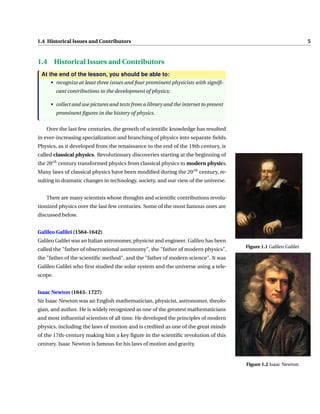
Figure 1.1 Galileo Galilei
There are many scientists whose thoughts and scientific contributions revolu-
tionized physics over the last few centuries. Some of the most famous ones are
discussed below.
Figure 1.2 Isaac Newton
Galileo Galilei (1564-1642)
Galileo Galilei was an Italian astronomer, physicist and engineer. Galileo has been
called the "father of observational astronomy", the "father of modern physics",
the "father of the scientific method", and the "father of modern science". It was
Galileo Galilei who first studied the solar system and the universe using a tele-
scope.
Isaac Newton (1643- 1727)
Sir Isaac Newton was an English mathematician, physicist, astronomer, theolo-
gian, and author. He is widely recognized as one of the greatest mathematicians
and most influential scientists of all time. He developed the principles of modern
physics, including the laws of motion and is credited as one of the great minds
of the 17th-century making him a key figure in the scientific revolution of this
century. Isaac Newton is famous for his laws of motion and gravity.
6 Unit 1 Physics and Human Society
Figure 1.3 Michael Faraday
Michael Faraday (1791-1867)
Michael Faraday was an English scientist. He contributed to the study of electro-
magnetism and electrochemistry. His main discoveries include the principles
underlying electromagnetic induction, diamagnetism and electrolysis. In general
Michael Faraday changed the world with magnet.
Figure 1.4 James Prescott Joule
James Prescott Joule(1818-1889)
James Prescott Joule is an English physicist, mathematician and brewer. Joule
studied the nature of heat, and discovered its relationship to mechanical work.
This led to the law of conservation of energy. Joule’s work helped lay the founda-
tion for the first of three laws of thermodynamics that describe how energy in our
universe is transferred from one object to another or transformed from one form
to another.
Figure 1.5 Marie Curie
Marie Curie(1867-1934)
Marie Curie, was a Polish-born French physicist and chemist who conducted
pioneering research on radioactivity. She was the first woman to win a Nobel
Prize for the discovery of the elements polonium and radium.
1.4 Historical Issues and Contributors 7
Figure 1.6 Albert Einstein
Albert Einstein (1879- 1955)
Albert Einstein was a German-born theoretical physicist. He is widely acknowl-
edged to be one of the greatest physicists of all time. Einstein is known for
developing the theory of relativity, but he also made important contributions to
the development of the theory of quantum mechanics.
Exercise 1.3
T Mention some other well-known historical contributors in physics and
describe their roles.
Key Concept:
T Revolutionary discoveries starting at the beginning of the 20th century
transformed physics from classical physics to modern physics. Many laws
of classical physics have been modified during the 20th
century, resulting
in dramatic changes in technology, society, and our view of the universe
Unit Summary
The following are the main points you learnt in this unit.
• Science is a systematized knowledge arising from observation, study
and experimentation.
• Physics is the branch of natural science which describes the basic
mechanisms that make our universe behave the way it does.
• Physics is the study of everyday phenomena.
• A person who studies physics is called a physicist.
• Physics has several branches such as mechanics, acoustics, optics,
thermodynamics, electromagnetism, nuclear physics, astrophysics
etc.
• Physics is the foundation of many important scientific disciplines
such as chemistry, engineering, geology, biophysics, geophysics,
medical physics, etc.
• There are several well-known scientists and engineers that have
contributed a lot for the advancement of physics.
8 Unit 1 Physics and Human Society
End of Unit Questions
1. The Greek word ’phusis’ for nature is appropriate in describing the
field of physics. Which one of the following is the best answer for
this?
(a) Physics is a natural science that studies life and living organ-
isms on habitable planets like Earth.
(b) Physics is a natural science that studies the laws and principles
of our universe.
(c) Physics is a physical science that studies the composition,
structure, and changes of matter in our universe.
(d) Physics is a social science that studies the social behavior of
living beings on habitable planets like Earth.
2. A moving car suddenly comes to a rest after applying brakes. Which
branch of physics do you think is appropriate to explain this phe-
nomenon?
(a) Mechanics
(b) Acoustics
(c) Electromagnetism
(d) Nuclear physics
(e) None of the above
3. Which of the following is not one of the branches of physics?
(a) Thermodynamics
(b) Optics
(c) Classical physics
(d) Evolution
4. Which of the following is not a historical contributor in physics?
(a) Willebrod Snell
(b) Daniel Bernoulli
(c) Thomas Young
1.4 Historical Issues and Contributors 9
(d) Charles Darwin
5. Which of the following institution/project does not apply the princi-
ple of physics?
(a) Ethiopian Aviation Industry
(b) Grand Ethiopian Renaissance Dam (GERD)
(c) Quality and Standard Authority of Ethiopia
(d) Ethiopian Radiation Protection Authority
(e) None of the above
6. Which branch of Physics is most important when studying the na-
ture and behavior of light?
(a) Quantum Mechanics
(b) Nuclear Physics
(c) Optics
(d) Thermodynamics
7. Galileo’s famous experiment at the leaning tower of Pisa demon-
strated that
(a) what goes up must come down
(b) all objects fall to earth at the same rate, regardless of their mass
(c) heavier object falls faster than lighter object of the same size
(d) gravity does not act on a falling object
Unit 2
Physical Quantities
Brainstorming
Questions
1. What types of dif-
ferent measurement
scales are used in
your surroundings?
2. What is physical
quantity? How can
you measure mass,
length and time?
What are their units
of measurement?
3. How can you
classify physical
quantities?
Introduction
Physics begins with observations of phenomena, events, matter or energy.
Through demanding and controlled experimentation and logical thought
process, the physical phenomena are described quantitatively using mathe-
matical tools. Any quantitative description of a property requires compari-
son with a scale of different measuring devises. For example, length needs
a meter-stick, time needs a watch, and mass needs a beam balance. In this
process, we recognize a very obvious fact that properties of different kinds
cannot be compared. You cannot compare the time of travel from point A to
B with the distance between the two points, although the two quantities may
be related. The time of travel (time) is a physical quantity and the distance
(length) is also a physical quantity. They are completely different types of
physical quantities measured by different measuring devices and units. In
this unit you will learn different types of scales, measurement, classification
of physical quantities, and conversion from one system of units to another.
At the end of this unit, you should be able to:
• know physical quantities.
• measure different physical quantities with accuracy.
• appreciate the measurement activities of different physical quantities.
11
12 Unit 2 Physical Quantities
In grade 8 General Science, you learned about scientific measurement. Differ-
ent types of scales are used in measurement.
Activity 2.1
Discuss different
examples of nom-
inal scales in your
community.
2.1 Scales, Standards, Units (prefixes)
Scales
Ay the end of this section, you should be able to:
• list the four type of scales;
• distinguish between the four types of scales.
In general there are four data measuring scales. These are nominal scales,
ordinal scales, interval scales and ratio scales.
Exercise 2.1
List different ex-
amples of ordinal
scales.
• Nominal scales: are used for labeling variables without any number value.
For nominal scales there is no inherent quantitative difference among the
categories. Examples are: gender (male, female), hair color (black, brown).
Exercise 2.2
List different ex-
amples of interval
scales.
• Ordinal scales: are rank-order observations. For this type of scale, there is
an underlying quantitative measurement on which the observations differ.
Example: Your class rank in the previous grades.
Key Concept:
T In physics scale
is a set of numbers,
amounts, etc., used
to measure or com-
pare the level of
something.
T Ratio scale is
an advanced scale
in which addition,
subtraction, multipli-
cation and division is
possible.
• Interval scales: have a constant interval but lack a true zero point. For this
type of scale, one can add and subtract values on an interval scale, but one
cannot multiply or divide units. Temperature in Celsius or Fahrenheit scale
is an example of interval scale.
• Ratio scales: have the property of equal intervals but also have a true zero
point. As a result, one can multiply and divide as well as add and subtract
using ratio scales. Units of time (second, minute, hour), length (centimeter,
meter, kilometer), weight (milligram, gram, kilogram), volume (centimeter
cube) and temperature in Kelvin Scale are ratio scales.
Note that even though a ratio scale has a true zero point, the nature of the
variable is such that a value of zero will never be observed. For example human
height is measured on a ratio scale but every human has a height greater than
zero.
2.1 Scales, Standards, Units (prefixes) 13
Activity 2.2
1. What is your weight in kilograms?
2. Are scales involving division of two ratio scales also themselves ratio
scales? Discuss in small groups.
3. In group observe measurement activities in the surrounding (home,
local market and work places) for two days and prepare a report on the
what, the where, and the how of the measurements observed.
4. Based on your observation discuss the traditional and commonly used
scales and units of measurement for length, mass, time, volume and tem-
perature.
People in different community measure physical quantities such as length,
time, volume, and mass using traditional measuring units. However, each unit
has different values at different time, position and conditions.
Figure 2.1 Traditional measuring units.
14 Unit 2 Physical Quantities
Standards
Brainstorming
Questions
What is a standard
in measurement? In
your local area peo-
ple measure volume,
mass and area using
different measuring
devices. Do these
measurements have
standards? Discuss
in groups.
Ay the end of this section, you should be able to:
• appreciate the measures used in their local environment and comment
on the practice;
• list standard units of measures and their relationship with units in their
surroundings.
In the previous section you have learned different types of scales. However, in
physics we focus more on ratio scales with defined standard units. The laws of
physics are expressed in terms of basic quantities that require a clear definition. In
physics, the seven basic quantities are length (l), mass (m), time (t), temperature
(T), current (I), amount of substance (n), and luminous intensity (IV ). All other
quantities in physics can be derived from these seven basic or fundamental
physical quantities.
Table 2.1 Measurement of mass at different places.
No. Name of student Place Measured value
1 Student A Location A 1.6 unit
2 Student B Location B 2.1 unit
3 Student C Location C 2.5 unit
4 Student D Location D 3.0 unit
5 Student E Location E 1.1 unit
6 Student F Location F 3.5 unit
Activity 2.3
T Six grade 9 stu-
dents in different
parts of Ethiopia
are given the same
object and mea-
sured its mass in
the same unit as
shown in Table 2.1.
Discuss whether the
measurement has a
standard or not re-
gardless of personal
errors.
If your teacher orders you to report the results of a measurement to someone who
wishes to reproduce this measurement, a standard must be defined. Whatever is
chosen as a standard:
• it must be readily accessible and possesses some property that can be
measured reliably.
• measurements taken by different people in different places must yield the
same result.
Lack of standard in measurement has many negative consequences. In Ethiopia,
for instance, people use their palm to measure things like cotton and footsteps to
measure the length of a plot of land. The one with a bigger palm collects much
cotton than the one with a smaller palm. Thus, using a palm or footsteps as a
2.1 Scales, Standards, Units (prefixes) 15
measuring device has no standard. It creates inaccuracy on measured value and
bias among people.
Exercise 2.3
T What are the
SI units of length,
mass, and time?
In 2019, an International Committee revised a set of standards for length, mass,
time and other basic quantities. The system established is an adaptation of the
metric system and is called the SI system of units (see Figure 2.2 or CLICK HERE
for further reading ).
Figure 2.2 The SI system after the
2019 redefinition
Length: Meter is the standard or international system (SI) unit for length. There
are also other none SI units of length. These are centimeter (cm), millimeter
(mm), and kilometer (km). Today, the meter (m) is defined as a distance traveled
by light in vacuum during a time of 1
299792458 s.
Time: It is defined as the interval between two events. It is a fundamental quantity.
The unit of time in SI system is second (s). The none SI units of time are minute
(min), hour (hr), day, month and year. The second (s) is defined as 9 192 631 770
times the period of vibration of radiation from the cesium-133 atom.
Mass: The kilogram (kg) is the standard or international system (SI) unit of mass.
The none SI units of of mass are gram (g), milligram (mg), and tonne. The kilogram
(kg) is defined by taking the fixed numerical value of the Plank constant h =
6.62607015×10⁻³⁴
when expressed in the units of J s (which is equal to kg m2
s ),
where the meter and second are defined in terms of the speed of light in vacuum
(c) and the frequency of the Caesium 133 atom (∆f ). [1kg = 1.4755214×1040 h∆f
c2 ]
Activity 2.4
T Discuss the need for standards of measurement.
T Identify problems of non-standard measurement practices in your lo-
cality and the country at large.
Key Concept:
T Standard units are conventional units which are used to measure phys-
ical quantity scientifically.
T Meter: a distance travelled by light in vacuum during a time of 1
299792458
s.
T Kilogram: 1 kilogram (1kg) is 1.4755214×1040 h∆f
c2 .
T Second: 9 192 631 770 times the period of vibration of radiation from
the cesium-133 atom.
16 Unit 2 Physical Quantities
Scientific Notation
Scientific notation is a way of writing numbers that are too large or too small to
be conveniently written as a decimal. This can be written more easily in scientific
notation, in the general form:
d ×10n
Exercise 2.4
T Write
0.000001256 in
scientific notation
to 3 decimal places.
T How many signif-
icant figures are in
7800?
where d is a decimal number between 0 and 10 that is rounded off to a few
decimal places; n is known as the exponent and is an integer. If n > 0 it represents
how many times the decimal place in d should be moved to the right. If n < 0,
then it represents how many times the decimal place in d should be moved to the
left. For example, 3.24×10³
represents 3240 (the decimal moved three places to
the right) and 3.24×10⁻³
presents 0.00324 (the decimal moved three places to
the left).
Significant Figures
In a number, each non-zero digit is a significant figure. Zeroes are only counted
if they are between two non-zero digits or are at the end of the decimal part.
For example, the number 2000 has 1 significant figure (the 2), but 2000.0 has 5
significant figures. You estimate a number like this by removing significant figures
from the number (starting from the right) until you have the desired number
of significant figures, rounding as you go. For example, 6.827 has 4 significant
figures, but if you wish to write it to 3 significant figures it would mean removing
the 7 and rounding up, so it would be 6.83.
Exercise 2.5
Write the physical
quantities in Table
2.2 using appropri-
ate prefixes.
T The radius of the
earth is 6,371,000 m
T The diameter
of our hair is 0.000
0075 m
Prefixes
In the previous section you have learned different basic units. When a numerical
unit is either very small or very large, the units used to define its size may be
modified by using a prefix. A prefix is an important aspect of dealing with units.
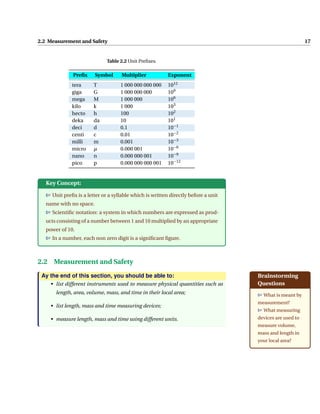
Prefixes are words or letters written in front that change the meaning. Table 2.2
lists a large set of these prefixes. The kilogram (kg) is a simple example. 1 kg is
1000 g, or 1×10³
g. We can replace the 103
with the prefix k (kilo).
2.2 Measurement and Safety 17
Table 2.2 Unit Prefixes.
Prefix Symbol Multiplier Exponent
tera T 1 000 000 000 000 1012
giga G 1 000 000 000 109
mega M 1 000 000 106
kilo k 1 000 103
hecto h 100 102
deka da 10 101
deci d 0.1 10−1
centi c 0.01 10−2
milli m 0.001 10−3
micro µ 0.000 001 10−6
nano n 0.000 000 001 10−9
pico p 0.000 000 000 001 10−12
Key Concept:
T Unit prefix is a letter or a syllable which is written directly before a unit
name with no space.
T Scientific notation: a system in which numbers are expressed as prod-
ucts consisting of a number between 1 and 10 multiplied by an appropriate
power of 10.
T In a number, each non zero digit is a significant figure.
2.2 Measurement and Safety
Brainstorming
Questions
T What is meant by
measurement?
T What measuring
devices are used to
measure volume,
mass and length in
your local area?
Ay the end of this section, you should be able to:
• list different instruments used to measure physical quantities such as
length, area, volume, mass, and time in their local area;
• list length, mass and time measuring devices;
• measure length, mass and time using different units.
18 Unit 2 Physical Quantities
Activity 2.5
T Observe your
local environment
and list different
instruments used
to measure physical
quantities.
T Discuss different
measurement ac-
tivities and related
issues in life.
Measurement
Measurement is the process of comparing an unknown quantity with another
quantity of its kind (called the unit of measurement). The measurement process
has three key elements:
• The physical quantity to be measured.
• The necessary measuring tools.
• Units of measurements used (standard units).
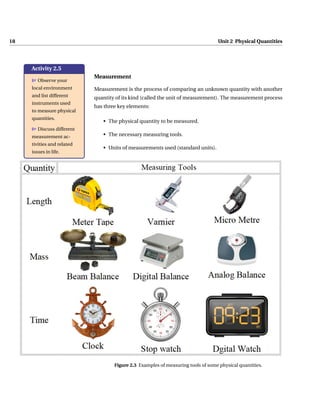
Figure 2.3 Examples of measuring tools of some physical quantities.
2.2 Measurement and Safety 19
Twenty-first century civilization is unthinkable without an appropriate measure-
ment tools on which everyday life depends. Modern society simply could not
exist without measurement. Figure 2.3 shows some measuring devices applicable
today.
Measuring Length
When you are measuring the length of objects, you are comparing it with the
standard length. The SI unit of length is meter (m) as we discussed before. There
are also non SI units of length. These are millimeter (mm), centimeter (cm) and
kilometer (km).
Key Concept:
T Measurement of any physical quantity involves comparison with a cer-
tain basic, arbitrarily chosen, internationally accepted reference standard
called unit.
Figure 2.4 Standard length measuring instruments.
20 Unit 2 Physical Quantities
Activity 2.6
T Make groups and measure the length and width of your exercise book
in meter, centimeter and millimeter.
T Which measuring instrument of length can you use for measuring the
diameter of a small sphere?
T A farmer wants to know the length of his plots of land in meter but he
has only a long rope, a 50 cm ruler and a 6 m long stick. How can he easily
measure the length of his plot? Discuss in groups.
Length is one of the fundamental (basic) physical quantities which describes
the distance between two points.
Activity 2.7
T Measure the length and width of your blackboard in meter unit.
T Calculate the area of the blackboard using the above measured values
in meter square unit.
T Compare your results with that of your friends’.
Exercise 2.6
T What mecha-
nisms do people in
your locality use to
measure the mass of
an object?
T Which scientific
mass measuring
instrument is used
in your locality?
Definition: Every physical quantity can be represented by its numerical
value and unit.
Measurement is the comparison of an unknown quantity with the known
fixed unit quantity. It consists of two parts: the unit and the number indicating
how many units are in the quantity being measured.
For example: The length of a table is 3 meters.
In this example, 3 is the magnitude, and meter is the standard (unit) of that
quantity.
2.2 Measurement and Safety 21
Key Concept:
T Length is the fundamental physical quantity that describes the distance
between two points. T The SI unit of length is meter (m).
Activity 2.8
T Visit different
shops in your living
area and observe
the procedure of
measuring goods
carefully. Write the
procedures and
exactness of the
measurement.
Measuring Mass
Measuring mass is a day to day activity in human life. People in various parts of
the world measure the mass of an object in different ways.
Definition: Mass is a basic physical quantity. It is defined as the amount
of matter contained in a body.
Figure 2.5 Different scientific
mass measuring instruments.
The SI unit of mass is a kilogram (kg). There are also non SI units used
to measure the mass of an object. In scientific way mass is measured by an
instrument called beam balance.
Activity 2.9
T Collect different simple objects such as a) a duster, b) an exercise book,
c) one stick of chalk.
T Measure the mass of these objects and record the measured values in a
table.
T Compare your recorded value with that of other groups and discuss.
Key Concept:
T Mass is a basic physical quantity. It is defined as the amount of matter
contained in a body.
TThe S.I unit of mass is the kilogram (kg).
Measuring Time
How long does it take for the sun to rise and set in your location? Do the people
in your locality use the sun set and sun rise as a time measuring devise? Some
22 Unit 2 Physical Quantities
people in the rural parts of Ethiopia traditionally use the position of the sun or
the position of shadows of their house or trees to estimate the time. The use of
sun rise and sun set as a time measuring device is called sundial. However, this
way of measuring time has no standard and is not accurate.
Figure 2.6 Different scientific time
measuring devices.
Time is the basic physical quantity. It describes the duration between the
beginning and end of an event. The SI unit of time is second (s). The commonly
used non SI units of time are: minute, hour, day, week, month and year.
Activity 2.10
T Discuss in groups and list the names of scientific time measuring
devices.
T Record the activities you do from sun rise to sun set. Compare your
recorded activities with that of your friend. Some of you are effectively
using your time to accomplish different activities. Discuss the wise use of
time in relation to its contribution for the development of our country.
Key Concept:
T Time is a basic physical quantity. It describes the duration between the
beginning and end of an event.
TThe S.I unit of time is second (s).
Laboratory Safety rules
A systematic and careful laboratory work is an essential part of any science
program since laboratory work is the key to progress in science. The
equipment and apparatus you use involve various safety hazards, just
as they do for working physicists. Students should follow the general
laboratory safety guidelines so that working in the physics laboratory can
be a safe and enjoyable process of discovery. These safety rules are:
• Always wear a lab safety goggles.
• Avoid wearing baggy clothing, bulky jewelry, dangling bracelets,
open-toed shoes or sandals.
• NEVER work alone in the laboratory.
2.3 Classification of Physical Quantities 23
• Only books and notebooks needed for the experiment should be in
the lab.
• Read about the experiment before entering the lab.
• Do not eat, drink, apply cosmetics, or chew gum in the laboratory.
• NEVER taste chemicals. Do not touch.
• Report all accidents to the teacher immediately, no matter how mi-
nor.
• Exercise caution when working with electrical equipment.
• Perform only those experiments authorized by the teacher.
• Wash hands thoroughly after participating in any laboratory activity.
2.3 Classification of Physical Quantities
Brainstorming
Questions
What is the differ-
ence between funda-
mental and derived
physical quanti-
ties? Some physical
quantities have only
magnitude. How-
ever, other physical
quantities have
both magnitude
and direction. Can
you mention some
examples of these
physical quantities?
At the end of this section, you should be able to:
• classify physical quantities as fundamental and derived physical quanti-
ties;
• describe derived physical quantities in terms of fundamental quantities;
• differentiate between fundamental and derived units;
• classify physical quantities as scalar and vector quantities.
Physical Quantities
Definition: A physical quantity is anything that you can measure. For
example, length, temperature, distance and time are physical quantities.
Quantities that can be measured directly or indirectly are known as physical
quantities. The measured values of physical quantities are described in terms of
number and unit. Each physical quantity and its unit have a symbol.
In Activity 2.7, you can observe that some physical quantities are directly mea-
sured while other physical quantities are measured by combining two or more
measurable quantities. For example you measured the width and length of your
24 Unit 2 Physical Quantities
blackboard directly. However, the area is measured by multiplying the length and
width of the blackboard - A = l × w. Physical quantities can be classified into two.
Activity 2.11
T In activity 2.7
you measured the
length, width and
area of the black-
board. Discuss the
symbols of the phys-
ical quantities and
their units. Is there
any difference be-
tween length, width
and area?
• Fundamental or basic physical quantities
• Derived physical quantities
Fundamental or basic physical quantities: are physical quantities which can
be measured directly. They cannot be described in terms of other physical quan-
tities. The units used to measure fundamental quantities are called fundamental
units. i.e., the unit of fundamental quantity is called fundamental unit. It does
not depend on any other unit. There are seven fundamental physical quantities
as shown in Table 2.3.
Activity 2.12
T Discuss in groups
and classify physical
quantities (length,
mass, speed, vol-
ume, force and
pressure) as funda-
mental or derived.
Table 2.3 The fundamental or basic physical quantities with their units and symbol of
units.
Basic physical quantities Symbol Basic unit Symbol
Length l meter m
Mass m kilogram kg
Time t Second s
Temperature T Kelvin K
Current I Ampere A
Amount of substance n Mole mol
Luminous intensity Iv Candela cd
Exercise 2.7
T Describe volume, density, and speed as combination of fundamental
physical quantities.
T Determine the units of volume, density and speed using basic units.
T Discuss how to use mobile phone (Android) to measure the time,
heartbeat and body temperature.
Derived physical quantities: Physical quantities which depend on one or
more fundamental quantities for their measurements are called derived physical
quantities. The units of derived quantities which depend on fundamental units
2.3 Classification of Physical Quantities 25
for their measurement are called derived units. Area, volume, density, and speed
are some examples of derived physical quantities. Table 2.4 shows some derived
quantities with their units and symbol of units. .
Table 2.4 Some derived physical quantities and their units.
Physical quantity Symbol Formula Unit Symbol of the
unit
Speed v Distance
Time
meter
second
m
s
Density ρ Mass
Volume
kilogram
meter cube
kg
m3
Acceleration a
Velocity
Time
meter
second square
m
s2
Force F Mass × Acceleration newton(N)
kg.m
s2
Work W Force × Displacement joule (J)
kgm2
s2
Pressure P Force
Area pascal (Pa)
kg
m.s2
Scalar and Vector Quantities
Activity 2.13
Discuss in groups
and classify the
following physical
quantities as scalar
or vector quantity:
mass, time, area,
speed, velocity, ac-
celeration, force,
energy, work, pres-
sure, momentum,
electric current,
current density,
displacement, and
temperature.
Physical quantities can also be classified as scalar and vector quantities. Some
physical quantities are described completely by a number and a unit. A number
with a unit is called a magnitude. However, other quantities have a direction
attached to the magnitude. They cannot be described by a number and unit only.
Thus, physical quantities are grouped into two. These are:
• Scalar quantities
• Vector quantities
A scalar quantity is a physical quantity which has only magnitude but no
direction.
Examples are: distance, mass, time, temperature, energy etc.
A vector quantity is a physical quantity which has both magnitude and di-
rection. When expressing that the car moves 50 km/h to east, this gives full
information about the velocity of the car that includes magnitude and direction
26 Unit 2 Physical Quantities
(50 km/h is the magnitude, and east is the direction). Because of this, velocity is a
vector quantity.
Examples are: displacement, acceleration, force, etc.
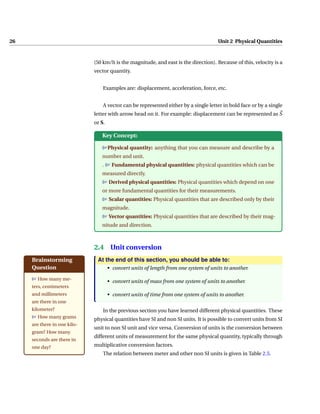
A vector can be represented either by a single letter in bold face or by a single
letter with arrow head on it. For example: displacement can be represented as ⃗
S
or S.
Key Concept:
TPhysical quantity: anything that you can measure and describe by a
number and unit.
. T Fundamental physical quantities: physical quantities which can be
measured directly.
T Derived physical quantities: Physical quantities which depend on one
or more fundamental quantities for their measurements.
T Scalar quantities: Physical quantities that are described only by their
magnitude.
T Vector quantities: Physical quantities that are described by their mag-
nitude and direction.
2.4 Unit conversion
Brainstorming
Question
T How many me-
ters, centimeters
and millimeters
are there in one
kilometer?
T How many grams
are there in one kilo-
gram? How many
seconds are there in
one day?
At the end of this section, you should be able to:
• convert units of length from one system of units to another.
• convert units of mass from one system of units to another.
• convert units of time from one system of units to another.
In the previous section you have learned different physical quantities. These
physical quantities have SI and non SI units. It is possible to convert units from SI
unit to non SI unit and vice versa. Conversion of units is the conversion between
different units of measurement for the same physical quantity, typically through
multiplicative conversion factors.
The relation between meter and other non SI units is given in Table 2.5.
2.4 Unit conversion 27
Example 2.1
The distance between two houses is 200 meter. What is the distance in: a) centime-
ter b) kilometer c) millimeter
Given: l = 200 m
Solution:
a) 1 m = 100 cm
200 m = ?
l in cm =
(200 m ×100 cm)
(1 m)
= 20000 cm
b) 1 m = 0.001 km
200 m = ?
l in km =
(200 m ×0.001 km)
(1 m)
= 0.2 km
c) 1 m = 1000 mm
200 m = ?
l in m =
200 m ×1000 mm
1 m
= 200000 mm = 2×10⁵
mm
Table 2.5 Conversion between units of length.
1 kilometer (km) 1000 meter (m)
1 meter (m) 100 centimeter (cm)
1 meter (m) 1000 millimeter (mm)
1 centimeter (cm) 10 millimeter (mm)
1 meter (m) 0.001 kilometer (km)
1 centimeter (cm) 0.01 meter (m)
1 millimeter (mm) 0.001 meter (m)
Exercise 2.8
1. Which one of the following is a suitable unit to measure the distance
between the Earth and the Moon?
(A) mm (B) km (C) cm (D) m (E) all
28 Unit 2 Physical Quantities
2. Which one of the following is a suitable unit to measure the diameter
of electric wire?
(A) mm (B) km (C) cm (D) m (E) all
3. A hydrogen atom has a diameter of about 10 nm.
(a) Express this diameter in meters.
(b) Express this diameter in millimeters.
(c) Express this diameter in micrometers.
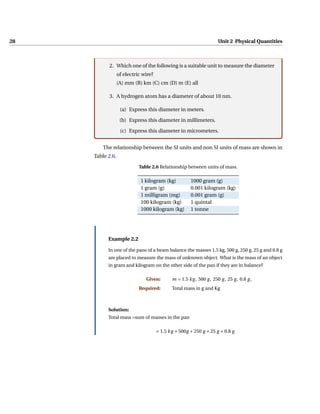
The relationship between the SI units and non SI units of mass are shown in
Table 2.6.
Table 2.6 Relationship between units of mass.
1 kilogram (kg) 1000 gram (g)
1 gram (g) 0.001 kilogram (kg)
1 milligram (mg) 0.001 gram (g)
100 kilogram (kg) 1 quintal
1000 kilogram (kg) 1 tonne
Example 2.2
In one of the pans of a beam balance the masses 1.5 kg, 500 g, 250 g, 25 g and 0.8 g
are placed to measure the mass of unknown object. What is the mass of an object
in gram and kilogram on the other side of the pan if they are in balance?
Given: m = 1.5 kg, 500 g, 250 g, 25 g, 0.8 g,
Required: Total mass in g and Kg
Solution:
Total mass =sum of masses in the pan
= 1.5 kg +500g +250 g +25 g +0.8 g
2.4 Unit conversion 29
= 1500 g +500 g +250 g +25 g +0.8 g = 2275.8 g,
1000 g = 1 kg,
2275.8 g = ?
mass in kg =
2275.8 g ×1 kg
1000 g
= 2.2758 kg
Table 2.7 The relation between different units of time.
1 minute (min) 60 second (s)
1 hour (hr) 60 minute (min)
1 day 24 hours (hrs)
1 week 7 days
1 month 30 days
1 year 365.25 days
Example 2.3
Express the following times in seconds.
a) 2 hours b) 0.5 hour c) 3/5 hour
Solution:
a) 1hr = 3600 s ,
2 hr =? =⇒ t =
2 hr ×3600 s
1 hr
= 7200 s
b) 1hr = 3600 s ,
0.5 hr =? =⇒ t =
0.5 hr ×3600 s
1 hr
= 1800 s
c) 1hr = 3600 s ,
3
5
hr =? =⇒ t =
3
5 hr ×3600 s
1 hr
= 2160 s
Exercise 2.9
1. How many hours, minutes and seconds are there in a day?
2. List some traditional ways of measuring time in your community.
30 Unit 2 Physical Quantities
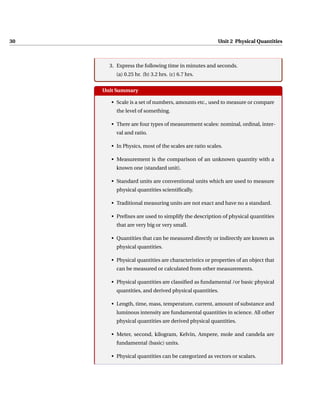
3. Express the following time in minutes and seconds.
(a) 0.25 hr. (b) 3.2 hrs. (c) 6.7 hrs.
Unit Summary
• Scale is a set of numbers, amounts etc., used to measure or compare
the level of something.
• There are four types of measurement scales: nominal, ordinal, inter-
val and ratio.
• In Physics, most of the scales are ratio scales.
• Measurement is the comparison of an unknown quantity with a
known one (standard unit).
• Standard units are conventional units which are used to measure
physical quantities scientifically.
• Traditional measuring units are not exact and have no a standard.
• Prefixes are used to simplify the description of physical quantities
that are very big or very small.
• Quantities that can be measured directly or indirectly are known as
physical quantities.
• Physical quantities are characteristics or properties of an object that
can be measured or calculated from other measurements.
• Physical quantities are classified as fundamental /or basic physical
quantities, and derived physical quantities.
• Length, time, mass, temperature, current, amount of substance and
luminous intensity are fundamental quantities in science. All other
physical quantities are derived physical quantities.
• Meter, second, kilogram, Kelvin, Ampere, mole and candela are
fundamental (basic) units.
• Physical quantities can be categorized as vectors or scalars.
2.4 Unit conversion 31
• Meter, kilogram and Second are the SI unit of length, mass, and time
respectively.
• SI units can be converted to non SI units and vise versa.
End of Unit Questions and Problems
Part I. Multiple choice
1. Which one of the following scale allows addition, subtraction, multi-
plication and division?
(a) Nominal scale (b) ratio scale (c) ordinal scale (d) interval scale
2. Which one of the following is NOT a fundamental physical quantity?
(a) Temperature (b) density (c) time (d) mass
3. The SI standard of time is based on:
(a) The daily rotation of the Earth
(b) The yearly revolution of the Earth about the sun
(c) 9 192 631 770 times the period of vibration of radiation from
the cesium-133 atom.
(d) A precision pendulum clock
4. Which one of the following is a derived SI unit?
(a) Second (b) Joule (c) kilogram (d) Kelvin
5. A nanosecond is
(a) 109
s (b) 10−9
s (c) 10−6
s (d) 10−12
s
6. Which one of the following method provides a more reliable mea-
surement of time in daily life activities?
(a) Looking the rotation of stars in the sky
(b) Using a digital watch
(c) Looking the position of shadows of trees
(d) Looking the position of the sun on the sky
7. Which one of the following pair of physical quantities has the same
unit?
32 Unit 2 Physical Quantities
(a) displacement and distance (b) mass and force (c) speed and
acceleration (d) volume and area
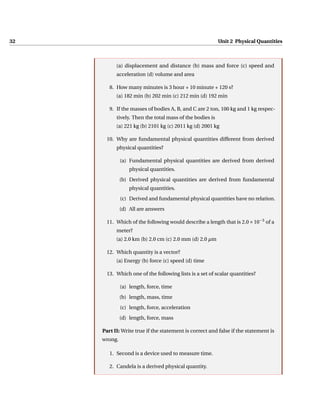
8. How many minutes is 3 hour + 10 minute + 120 s?
(a) 182 min (b) 202 min (c) 212 min (d) 192 min
9. If the masses of bodies A, B, and C are 2 ton, 100 kg and 1 kg respec-
tively. Then the total mass of the bodies is
(a) 221 kg (b) 2101 kg (c) 2011 kg (d) 2001 kg
10. Why are fundamental physical quantities different from derived
physical quantities?
(a) Fundamental physical quantities are derived from derived
physical quantities.
(b) Derived physical quantities are derived from fundamental
physical quantities.
(c) Derived and fundamental physical quantities have no relation.
(d) All are answers
11. Which of the following would describe a length that is 2.0×10⁻³
of a
meter?
(a) 2.0 km (b) 2.0 cm (c) 2.0 mm (d) 2.0 µm
12. Which quantity is a vector?
(a) Energy (b) force (c) speed (d) time
13. Which one of the following lists is a set of scalar quantities?
(a) length, force, time
(b) length, mass, time
(c) length, force, acceleration
(d) length, force, mass
Part II: Write true if the statement is correct and false if the statement is
wrong.
1. Second is a device used to measure time.
2. Candela is a derived physical quantity.
2.4 Unit conversion 33
3. The unit of force can be derived from the units of mass, length and
time.
4. One kilometer is 100 meter.
5. For a very large or very small numbers prefixes are used with SI units.
6. Scalar quantity can be described by its magnitude and direction.
Part III: Short answer questions
1. What is the difference between interval scale and ratio scale?
2. How many seconds are there in 12 hours?
3. What is measurement?
4. What is the difference between traditional measuring units and
scientific measuring units?
5. Define the following terms:
a) Meter b) second c) kilogram d) length e) time f) mass g) Physi-
cal quantity h) derived physical quantity i) fundamental physical
quantity. j) scalar physical quantity k) vector physical quantity
6. Which SI units would you use for the following measurements?
(a) the length of a swimming pool
(b) the mass of the water in the pool
(c) the time it takes a swimmer to swim a lap
7. Which instrument is used to measure the thickness of a sheet metal?
8. Write some safety rules.
9. Give three examples of scalar and vector quantities.
Part IV: Workout problems
1. In one of the pans of the beam balance the masses 3 kg, 900 g, 90 g
and 5 g are placed. What amount of mass should be placed on the
other side of the beam balance to make it balanced?
34 Unit 2 Physical Quantities
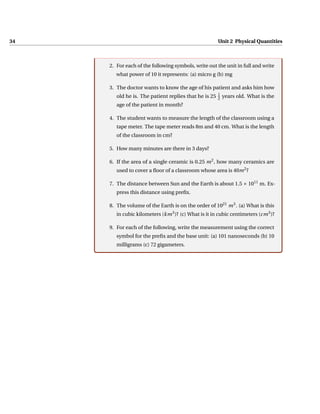
2. For each of the following symbols, write out the unit in full and write
what power of 10 it represents: (a) micro g (b) mg
3. The doctor wants to know the age of his patient and asks him how
old he is. The patient replies that he is 25 1
2 years old. What is the
age of the patient in month?
4. The student wants to measure the length of the classroom using a
tape meter. The tape meter reads 8m and 40 cm. What is the length
of the classroom in cm?
5. How many minutes are there in 3 days?
6. If the area of a single ceramic is 0.25 m2
, how many ceramics are
used to cover a floor of a classroom whose area is 40m2
?
7. The distance between Sun and the Earth is about 1.5 × 10¹¹
m. Ex-
press this distance using prefix.
8. The volume of the Earth is on the order of 1021
m3
. (a) What is this
in cubic kilometers (km3
)? (c) What is it in cubic centimeters (cm3
)?
9. For each of the following, write the measurement using the correct
symbol for the prefix and the base unit: (a) 101 nanoseconds (b) 10
milligrams (c) 72 gigameters.
Unit 3
Motion in a Straight Line
Introduction
Brainstorming
Question
T What do you
think is motion?
Give some examples
of motion that you
encounter in your
daily life.
In this unit, you will be introduced to the basic concepts of motion. We encounter
motion in our day-to-day activities and have enough experience about it. You
might have learnt in lower grades that everything in the universe moves. It is
because of this that motion is one of the key topics in physics. We use the basic
concepts of distance, displacement, speed, velocity and acceleration to express
motion. There are different types of motions. Motion in a straight line is one of
the simplest forms of motion in a specific direction. The motions of a car on a
road, the motion of a train along a straight railway track or an object falling freely
are examples of one-dimensional motion.
At the end of this unit, you should be able to:
• describe motion in terms of frame of reference, displacement, speed, ve-
locity, and acceleration;
• draw diagrams to locate objects with respect to a reference;
• solve problems involving distance, displacement, speed, velocity and
acceleration;
• make practical measurements of distance, displacement, average speed,
average velocity and acceleration.
35
36 Unit 3 Motion in a Straight Line
3.1 Position, Distance and Displacement
At the end of this section, you should be able to:
• define motion, position, and displacement;
• describe motion in terms of frame of reference;
• differentiate between position, distance and displacement;
• draw diagrams to locate objects with respect to a reference frame.
The most convenient example to explain about position, distance and dis-
placement is your daily travel from your home to your school. When you go to
school, your journey begins from your home. Your home is your original position.
After some time, you will reach your school. Your school is your final position.
In this process, you are continuously changing your position. While traveling
from home to school, you are increasing the gap between your present position
and your home. This continuous change of position is known as motion. Note
that your change of position is observed by considering the distance from your
school to home. Your home is taken as a reference frame. Motion is a continuous
change in position of an object relative to the position of a fixed object called
reference frame.
Key Concept:
T A frame of reference is a set of coordinates that can be used to deter-
mine positions of objects.
T Motion is the change in the position of the object with respect to a fixed
point as the time passes.
A body is said to be at rest in a frame of reference when its position in that
reference frame does not change with time. If the position of a body changes
with time in a frame of reference, the body is said to be in motion in that frame of
reference. The concepts of rest and motion are completely relative; a body at rest
in one reference frame may be in motion with respect to another reference frame.
For example, if you are 2 m from the doorway inside your classroom, then your
reference point is the doorway. Your classroom can be used as a reference frame.
In the classroom, the walls are not moving, and can be used as a fixed frame of
reference. We commonly use the origin as a fixed reference point to describe
motion along a straight line.
3.1 Position, Distance and Displacement 37
Exercise 3.1
T Assume you are sitting on a horse and the horse is moving at a certain
speed. Are you at rest or in motion? Discuss it by taking two frames of
reference: the horse itself and some fixed point on the ground.
Key Concept:
T Position is a
measurement of
a location, with
respect to some
reference point
(usually an origin).
Position
To describe the motion of a particle, we need to be able to describe the position
of the particle and how that position changes as the particle moves. Motion is
the change in the position of the object with respect to a fixed point as the time
passes. For one-dimensional motion, we often choose the x axis as the line along
which the motion takes place. Positions can therefore be negative or positive
with respect to the origin of the x-axis. Figure 3.1 shows the motion of a rider in a
straight line. Its position changes as it moves.
Have you ever used Google Maps to locate your geographical position while you
are moving from some place to another? Google Maps is a Web-based service
that provides detailed information about geographical regions and sites around
the world. In addition to conventional road maps, Google Maps offers aerial and
satellite views of many places. Google Maps provides you with the longitude
(east-west position) and latitude (north-south position) coordinates of a location
or position of a place.
Figure 3.1 A rider in motion changes its position as it moves.
38 Unit 3 Motion in a Straight Line
You can see how far you have travelled and how you travelled from place to place,
such as walking, biking, driving or on public transport. The following steps guide
you to get started using Google Maps:
Step 1: At first you need to open the Google Maps software application on your
Android phone, tablet or computer. For more information, click here to see
Google Maps https://www.google.com/maps/
Step 2: Search for a place or tap it on the map.
Step 3: In the bottom right, tap directions.
Step 4: To add destination you have to go to the top right and tap more and then
add a stop.
Exercise 3.2
T What is the dis-
tance around a
standard football
field?
T Is distance a pos-
itive or negative
quantity?
Distance (S)
Distance travelled is a measure of the actual distance covered during the motion of
a body. In other words, distance is the total path length traveled by the body. The
distance travelled does not distinguish between motion in a positive or negative
direction. This means that it is a scalar physical quantity. The SI unit of distance is
meter (m), though it can also be measured in other non-SI units such as kilometer
(km), miles (mi), centimeter (cm), etc. The symbol for distance is S. Pictorial
representation of the distance covered by a runner is shown in Figure 3.2.
Figure 3.2 The distance covered by a runner.
3.1 Position, Distance and Displacement 39
Displacement
When an object moves, it changes its position. This change of position in a certain
direction is known as displacement. A displacement is described by its magnitude
and direction. Hence, it is a vector quantity. Displacement is independent of
the path length taken. For example, you travel from your home to school. After
school, you travel o your home. Therefore, the change in your position when you
return back to your home is zero. In this case, we say that your displacement is
zero. The SI unit of displacement is the same as the SI unit of distance that is
meter (m). Figure 3.3 shows the difference between distance and displacement of
the motion covered from point A to point B.
Figure 3.3 Illustration of Distance
and displacement.
Figure 3.1 shows a student on a bicycle at position ⃗
Si at time ti . At a later time,
tf , the student is at position ⃗
Sf . The change in the student’s position, ⃗
Sf − ⃗
Si , is
called a displacement. We use the Greek letter ∆ (uppercase delta) to indicate the
change in a quantity; thus, the change in ⃗
S can be written as
△⃗
S = ⃗
Sf − ⃗
Si (3.1)
Key Concept:
T Displacement is the change in an object’s position.
Table 3.1 Difference between distance and displacement.
Distance Displacement
It is the length of path travelled
by an object in a given time.
It is the shortest distance between
the initial and final positions.
It is a scalar quantity. It is a vector quantity.
It depends on the path followed
by the object.
It depends o the initial and final
positions of the object, but not
necessarily on the path followed.
It can be more than or equal to
the magnitude of displacement.
Its magnitude can be less than or
equal to the distance.
40 Unit 3 Motion in a Straight Line
Activity 3.1
T Three students walked on a straight line. The first student walked 200 m
to the right from a reference point A, then returned and walked 100 m to
the left and then stopped. The second student walked 200 m from point A
to the right, then returned and walked 300 m to the left and stopped. The
third student walked 200 m to the right from point A, then returned and
walked 200m to the left and stopped at point A. Discuss in groups about
the total distance and displacements of the first, the second and the third
student.
Example 3.1
A cyclist rides 3 km west and then turns around and rides 2 km east. (a) What is
her displacement? (b) What distance does she ride? (c) What is the magnitude of
her displacement?
Solution:
To solve this problem, we need to find the difference between the final position
and the initial position while taking care to note the direction on the axis.
a) Displacement: The rider’s displacement is △⃗
S = ⃗
Sf − ⃗
Si = 1 km west. The displace-
ment is negative if we choose east to be positive and west to be negative.
b) Distance: The distance traveled is 3 km + 2 km = 5 km.
c) The magnitude of the displacement is 1 km.
Exercise 3.3
T What is the dis-
placement if the
final position is the
same as the initial
position?
Exercise 3.4
T Given the following values for the initial position Si and final position
Sf , check whether the value of the net displacement is positive or negative.
a) Sf = (5,0) and Si = (−1,0)
b) Sf = (10,0) and Si = (−15,0)
c) Sf = (6,0) and Si = (4,0)
3.2 Average Speed and Instantaneous Speed 41
3.2 Average Speed and Instantaneous Speed
At the end of this section, you should be able to:
• differentiate between average speed and instantaneous speed;
• compute the average speed of a body; moving in a straight line covering a
certain distance in a given time;
• estimate the speed of moving bodies in your surroundings.
Speed is a quantity that describes how fast a body moves. Speed is the rate
at which an object changes its location. Like distance, speed is a scalar quantity
because it has a magnitude but no direction. Since speed is a rate, it depends on
the time interval of motion. Its symbol is v. In other words, speed is the distance
covered by a moving body per unit time. The SI unit of speed is meter per second
(m/s). Other units of speed include kilometer per hour (km/h) and miles per hour
(mi/h). The mathematical equation used to calculate speed is
speed =
Distance
time
(3.2)
v =
s
t
(3.3)
Exercise 3.5
T In Figure ??, what
does the speedome-
ter read?
Figure 3.4 Speedometer.
One of the most obvious features of an object in motion is how fast it is moving.
In your journey from home to school, you walk slowly for some time, and you run
another time to cover the total distance. This shows that the speed for the walk
and the speed for the run are different. In this regard, we define average speed.
Speed and average speed are not the same although they are derived from the
same formula. The average speed is defined as the total distance travelled divided
by the total time it takes to travel that distance:
Average speed =
Total distance covered
Total time taken
(3.4)
(3.5)
vav =
stot
ttot
(3.6)
During a typical trip to school by car, the car undergoes a series of changes in its
42 Unit 3 Motion in a Straight Line
speed. If you were to look at the speedometer readings at regular intervals, you
would notice that it changes. The speedometer of a car gives information about
the instantaneous speed of the car. It shows the speed of the car at a particular
instant in time. The speed at any specific instant is called the instantaneous
speed. To calculate the instantaneous speed, we need to consider a very short
time interval-one that approaches zero. For example, a school bus undergoes
changes in speed. Mathematically the instantaneous speed is given
vins =
∆s
∆t
as ∆t → 0 (3.7)
Instantaneous speed and average speed are both scalar quantities. When you
solve the average of all instantaneous speeds that occurred during the whole trip,
you will get the average speed.
Exercise 3.6
T What are the
differences and
similarities between
average speed and
instantaneous
speed?
Example 3.2
A car covers a distance between two towns which are 80 km apart. If it takes the car
1hr and 30 minutes to travel between the two towns, calculate the average speed
of the car in m/s.
Solution:
The car takes 1hr and 30 minutes to travel between the two towns. This time is the
same as 1.5 hrs. Therefore, the average speed of the car is given by,
vav =
s
t
with s = 80 km and t=1.5 hrs, vav becomes,
vav =
(80 km)
(1.5 hr s)
= 53.33 km/hr
However, we are required to calculate the average speed in m/s. For this purpose,
we use 1 km = 1000 m and 1 hr = 3600 s. Hence,
vav = 53.33
km
hr
= 53.33×
1000 m
3600 s
= 14.81 m/s
Exercise 3.7
T If the car is trav-
elling at 120 km/h,
what is the car’s
speed in m/s.
Example 3.3
How far does a student walk in 1.5 hrs if her average speed is 5 m/s?.
3.3 Average Velocity and Instantaneous Velocity 43
Solution:
To find the distance, we rewrite the equation as
vav =
st
tt
s = vav t
s = 5400 s ×5
m
s
= 27000 m
3.3 Average Velocity and Instantaneous Velocity
At the end of this section, you should be able to:
• differentiate between average velocity and instantaneous velocity;
• compute the average velocity of a body moving in straight line covering a
certain displacement in a given time.
Where an object started and where it stopped does not completely describe
the motion of the object. Velocity is a physical quantity that describes how fast a
body moves as well as the direction in which it moves. Hence, velocity is a vector
quantity. Its symbol is ⃗
v (v with an arrow on the head). The SI unit of velocity
is meter per second (m/s). Other units of velocity include kilometer per hour
(km/h) and miles per hour (mi/h).
Key Concept:
T Velocity is the rate of change of displacement.
Suppose that the positions of a car are ⃗
Si at time ti and ⃗
Sf at time tf . If
the details of the motion at each instant are not important, the rate is usually
expressed as the average velocity. Average velocity ( ⃗
vav ) of a body is the total
displacement covered by that body in a specified direction divided by the total
time taken to cover the displacement. Analytically it can be written as
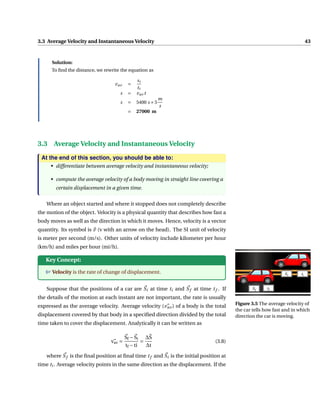
Figure 3.5 The average velocity of
the car tells how fast and in which
direction the car is moving.
⃗
vav =
⃗
Sf −⃗
Si
tf −ti
=
∆⃗
S
∆t
(3.8)
where ⃗
Sf is the final position at final time tf and ⃗
Si is the initial position at
time ti . Average velocity points in the same direction as the displacement. If the
44 Unit 3 Motion in a Straight Line
displacement points in the positive direction, the average velocity is positive. If
the displacement points in the negative direction, the average velocity is negative.
Key Concept:
T Average velocity is the total displacement of a body over a time interval.
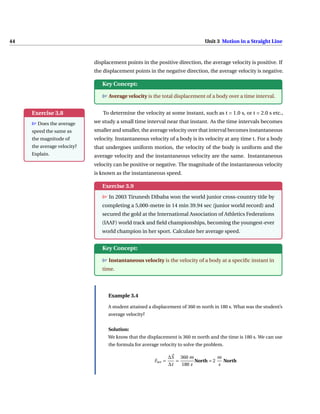
Exercise 3.8
T Does the average
speed the same as
the magnitude of
the average velocity?
Explain.
To determine the velocity at some instant, such as t = 1.0 s, or t = 2.0 s etc.,
we study a small time interval near that instant. As the time intervals becomes
smaller and smaller, the average velocity over that interval becomes instantaneous
velocity. Instantaneous velocity of a body is its velocity at any time t. For a body
that undergoes uniform motion, the velocity of the body is uniform and the
average velocity and the instantaneous velocity are the same. Instantaneous
velocity can be positive or negative. The magnitude of the instantaneous velocity
is known as the instantaneous speed.
Exercise 3.9
T In 2003 Tirunesh Dibaba won the world junior cross-country title by
completing a 5,000-metre in 14 min 39.94 sec (junior world record) and
secured the gold at the International Association of Athletics Federations
(IAAF) world track and field championships, becoming the youngest-ever
world champion in her sport. Calculate her average speed.
Key Concept:
T Instantaneous velocity is the velocity of a body at a specific instant in
time.
Example 3.4
A student attained a displacement of 360 m north in 180 s. What was the student’s
average velocity?
Solution:
We know that the displacement is 360 m north and the time is 180 s. We can use
the formula for average velocity to solve the problem.
⃗
vav =
∆⃗
S
∆t
=
360 m
180 s
North = 2
m
s
North
3.3 Average Velocity and Instantaneous Velocity 45
Example 3.5
A girl jogs with an average velocity of 2.4 m/s east. What is her displacement after
40 seconds?
Solution:
Given: ⃗
vav = 2.4m/s east, t = 40 seconds Solution: The displacement of the girl is
∆⃗
S = ⃗
vav ∆t = 2.4
m
s
(40 s)east = 96 m East
Exercise 3.10
T Athlete 1 com-
pletes 100m in 55
seconds and athlete
2 completes the
same distance in 50
seconds. Compare
their average speeds.
Which athlete has
higher average
speed?
Example 3.6
A bus moving along a straight line towards west covers the following distances in
the given time intervals. Calculate the average velocity of the bus for each time
interval.
S in km 20 60 100 140
t in hour 0 1 2 3
Solution:
By computing the displacement of the bus for each time interval, we can calculate
the average velocity of the bus as follows.
Between t0 = 0 and t1 = 1 hr
∆⃗
S1 = ⃗
S1 − ⃗
S0 = 60 km −20 km = 40 km
The average velocity during this time interval is
⃗
v1 =
∆⃗
S1
∆t1
=
40 km
1 hr
= 40
km
hr
Between t1 = 1 hr and t2 = 2 hr
∆⃗
S1 = ⃗
S2 − ⃗
S1 = 100 km −60 km = 40 km
The average velocity of the bus during this time interval is
⃗
v2 =
∆⃗
S2
∆t2
=
40 km
1 hr
= 40
km
hr
Between t2 = 2 hr and t3 = 3 hr
∆⃗
S1 = ⃗
S2 − ⃗
S2 = 140 km −100 km = 40 km
46 Unit 3 Motion in a Straight Line
The average velocity during this time interval is
⃗
v3 =
∆⃗
S3
∆t3
=
40 km
1 hr
= 40
km
hr
Therefore, for each time interval, the average velocity of the car is constant. This
implies that the car is undergoing uniform motion.
Note: You can convert km/hr into m/s by the relation:
1
km
hr
=
1000 m
60×60 s
=
10
36
m
s
3.4 Acceleration
At the end of this section, you should be able to:
• define acceleration;
• calculate the average acceleration of a body if its velocity changes from
some initial value to final value in a given time.
Figure 3.6 (a) positive acceleration
(car speeding up) and (b) negative
acceleration (car slowing down).
The discussion of motion with varying velocity can be dealt with by the intro-
duction of the concept of acceleration. Acceleration is a vector quantity and is
a measure of how much the velocity of an object changes in a unit of time (in
one second). Acceleration is denoted by ⃗
a and its SI unit is m
s2 , that is, meters
per second squared or meters per second per second. For example, if a runner
travelling at 10 km/h due east slows to a stop, reverses direction, and continues
her run at 10 km/h due west, her velocity has changed as a result of the change in
direction, although the magnitude of the velocity is the same in both directions.
Acceleration occurs when velocity changes in magnitude (an increase or decrease
in speed) or in direction, or both as shown in Figure. 3.6. Acceleration is, therefore,
a change in speed or direction, or both.
Key Concept:
T Acceleration is the rate of change of velocity.
If the initial velocity of a body is vi at a time ti , and the final velocity is vf at a
time tf , the average acceleration is, from the definition,
3.4 Acceleration 47
⃗
aav =
⃗
vf −⃗
vi
tf −ti
(3.9)
If a body starts from rest, then the initial velocity is zero (⃗
vi = 0). If the
velocity of a body decreases, then the final velocity is less than the initial velocity.
Such motion is called decelerating motion. Deceleration is called a negative
acceleration. If the body comes to rest, the final velocity is zero (⃗
vf = 0).
Exercise 3.11
T If the initial and final velocities of a car are the same, what will be its
acceleration?
T Is the direction of the acceleration always in the direction of the velocity?
Example 3.7
A train moving in the east direction accelerates from rest to 36 km/h in 20 s. What
is the average acceleration during that time interval?
Given: ⃗
vi = 0, ⃗
vf = 36 km/h, ∆t = 20 s,
Required: ⃗
aav =?
Solution:
⃗
aav =
⃗
vf − ⃗
vi
∆t
=
36 km
h −0
20 s
⃗
aav =
10 m
s −0
20 s
= +0.5
m
s2
to east
Note that 36 km
h is equivalent to 10 m
s . The plus sign in the answer means that
acceleration is to the right. This is a reasonable conclusion because the train
starts from rest and ends up with a velocity directed to the right (i.e., positive). So,
acceleration is in the same direction as the change in velocity.
Example 3.8
48 Unit 3 Motion in a Straight Line
A car travelling at 7.0 m/s along a straight road accelerates 2.5 m/s2
to reach a
speed of 12.0 m/s. How long does it take for this acceleration to occur?
Given: vi = 7.0 m/s, vf = 12.0 m/s, aav = 2.5 m/s2
,
Required: ∆t =?
Solution:
∆t =
vf − vi
aav
=
12.0 m/s −7.0 m/s
2.5 m/s2
= 2 s
3.5 Uniform Motion
At the end of this section, you should be able to:
• define uniform motion;
• give examples of uniform motion.
Uniform motion is the motion of an object along a straight line with a constant
velocity or speed in a given direction. In a uniform motion, an object travels
equal distances in fixed intervals of time. In fact, a moving body does not have a
uniform speed throughout its motion. Sometimes the body speeds up or slows
down, and other times it moves with a constant speed. This is why describing
motion in terms of average quantities (average speed and average velocity) is
highly important. Some examples of a uniform motion are a car moving on a
straight road with a fixed speed (as shown in Figure 3.7) and an airplane flying
with constant speed in a given direction.
Figure 3.7 A car moving with a constant speed without changing the direction of mo-
tion.
3.6 Graphical Representation of Motion 49
Key Concept:
TMotion at a constant velocity or uniform motion means that the position
of the object is changing at the same rate.
The uniform rectilinear motion has the following properties:
• The acceleration is zero (a=0) because neither the magnitude of the velocity
nor its direction changes.
• On the other hand, the average and instantaneous velocities have the same
values at all times.
Exercise 3.12
T Consider the fol-
lowing S-t graph of
two cars in motion
on a straight line as
shown in Figure 3.8.
Which car is moving
faster and why?
3.6 Graphical Representation of Motion
At the end of this section, you should be able to:
• plot s-t and v-t graphs;
• define the slope of a motion;
• calculate the velocity from S-t graph and acceleration from v-t graph.
The motion of an object travelling even in a straight line can be complicated.
The object may travel forwards or backwards, speed up or slow down, or even stop.
Where the motion remains in one dimension, the information can be presented
in graphical form. The main advantage of a graph compared with a table is that it
allows the scope of the motion to be seen clearly.
Figure 3.8 The s-t graph for a uni-
form motion.
Position-Time Graph
A position-time graph indicates the position of an object at any time for motion
that occurs over an extended time interval. The data from Table 3.2 can be
presented by plotting the time data on a horizontal axis and the position data on
a vertical axis, which is called a position-time graph. The graph of the runner’s
motion is shown in Figure ??. To draw this graph, first plot the runner’s recorded
positions; then, draw a line that best fits the recorded points.
To determine the velocity or speed of the runner, consider the meaning of the
slope. Start with the mathematical definition of slope.
50 Unit 3 Motion in a Straight Line
Table 3.2 Table 3.2: Position-time table for the runner.
Position vs. time
Time (s) Position (m)
0 0
1 5
2 10
3 15
4 20
5 25
6 30
Slope is the rise over the run.
Slope =
rise
run
=
⃗
∆S
∆t
= ⃗
vav (3.10)
Therefore, if we take any two points in a straight line, the speed from the S-t
graph is
Slope =
(5.0−0)m
(1.0−0)s
=
(10.0−5.0)m
(2.0−1.0)s
= 5.0
m
s
to the positive x-direction.
This shows that the displacement increased by 5.0 m in 1.0s. The S-t graph
gives a constant velocity.
Key Concept:
T The slope of a position-time graph represents the average velocity of an
object.
Velocity- Time Graph
A graph of velocity against time shows how the velocity of an object changes with
time. Just as a displacement-time graph shows how far an object has moved,
a velocity-time graph shows how its velocity changes during the motion of the
object. Table 3.3 shows the data for a car that starts at rest and speeds up along a
straight line of a road. The velocity-time graph obtained by plotting these data
points is shown in Figure 3.9. The positive direction has been chosen to be the
same as that of the motion of the car. Notice that this graph is a straight line,
3.6 Graphical Representation of Motion 51
which means that the car is speeding up at a constant rate. The rate at which the
car’s velocity is changing can be found by calculating the slope of the velocity-
time graph. Consider a pair of data points that are separated by 1 s, such as 4.0
s and 5.0 s. At 4.0 s, the car is moving at a velocity of 20.0 m/s. At 5.0 s, the car
is travelling at 25.0 m/s. Thus, the car’s velocity increased by 5.0 m/s in 1.00 s.
The rate at which an object’s velocity changes is called the acceleration of the
object. When the velocity of an object changes at a constant rate, the object has a
constant acceleration.
Figure 3.9 The slope of a velocity-
time graph is the acceleration of
the object.
Table 3.3: Velocity vs. time of a car
Time (s) Velocity (m/s)
0 0
1 5
2 10
3 15
4 20
5 25
Activity 3.2
Plot a-t graph from
the above v-t data
and discuss in
groups about the
value of the acceler-
ation as time goes.
Key Concept:
TThe slope of a velocity-time graph represents the acceleration of an
object.
Figure 3.10 The v-t graph of a uni-
form motion.
In a uniform motion, the v-t graph is a horizontal line as shown in Figure 3.10
indicating that the velocity is constant at any given time. The area under the v-t
graph in a uniform motion represents the distance covered by the object. The
area of the rectangle in Figure 3.10 is given by, area = b × h = vt = s, which is
equal to the distance covered by the object.
Activity 3.3
Discuss in groups and determine the slope of the v-t graph in a uniform
motion?
Speed Limit and Traffic Safety
Have you ever noticed a traffic sign of a speed limit shown in the Figure 3.11?
What does it indicate and what is its importance?
52 Unit 3 Motion in a Straight Line
The above Figure 3.11 shows that drivers are required to keep the speed of their
cars at 80 km/hr or below. Drivers violating this speed limit will be charged by
the traffic police as they may cause danger. Nowadays, vehicles moving with
very high speed are the main causes for the death of thousands of people and
several property damages as they cannot be controlled easily during accident
as indicated in Figure 3.12. One can easily read the speed of a car from the
speedometer. Speedometer is a device used to measure the instantaneous speed
of a car. It is very important to keep the speed of cars at optimum level to save
lives and avoid property damages.
Figure 3.12 Traffic accident.
Activity 3.4
T Discuss in groups and identify the type of vehicles causing human/ani-
mal deaths and property damages in your area. Can you guess the percent-
age of the accidents caused by violation of speed limits? Discuss in groups
and report to you teacher. Also suggest possible solutions.
Figure 3.11 Speed limit in a typical city road.
3.6 Graphical Representation of Motion 53
Virtual Laboratory
Click on the following link to perform virtual laboratory on motion in
straight line under the guidance of your teacher.
1. The Moving Man PhET Experiment
Unit Summary
In this unit, you have learnt the following main points.
• Motion in a straight line is one of the simplest forms of motion in a
specific direction and is called rectilinear motion.
• An object is in motion if it changes position relative to a reference
point
• Motion can be described by distance, speed, displacement, and
velocity, where displacement and velocity also include direction.
• Distance is a physical quantity which describes the length between
two points (places) and is the total path length travelled by a body.
Distance is a scalar quantity.
• Displacement is the change in position of a body in a certain direc-
tion.
• The speed of an object can be calculated by dividing the distance
traveled by the time needed to travel the distance.
• The velocity of an object is the speed of the object with its direction
of motion.
• Average velocity is displacement over the time period during which
the displacement occurs. If the velocity is constant, then average
velocity and instantaneous velocity are the same.
• Acceleration occurs whenever an object speeds up, slows down, or
changes direction.
• Uniform motion is the motion of an object along a straight line with
a constant velocity or speed in a given direction.
54 Unit 3 Motion in a Straight Line
• The slope of a position-versus-time graph at a specific time gives
instantaneous velocity at that time.
• On a speed-time graph, a horizontal line represents zero acceleration
or constant speed.
End of Unit Questions and Problems
Part I: Conceptual questions and workout problems
1. How are average velocity and instantaneous velocity related in a
uniform motion?
2. What does the area under velocity against time graph describe in a
uniform motion?
3. If the slope of the graph is zero in a distance against time graph,
what can one conclude about the motion of the body?
4. When do we say that the acceleration of a body is
(a) positive?
(b) negative?
5. Here are three pairs of initial and final positions, respectively; along
an x axis. Which pairs give a negative displacement: (a) -3 m, 5 m;
(b) -3 m, -7 m; (c) 7 m, -3 m?
6. An athlete covers a 100 m distance in 55 seconds. Calculate the
average speed of the athlete.
7. A car moves with a steady speed of 60 km/hr for 2 hours between
two towns A and B. If the average speed of the car for the round trip
is 50 km/hr, then compute the speed of the car when it moves from
B to A.
8. Based on the distance against time graph of a certain car
shown in the Figure below, answer the following questions.
3.6 Graphical Representation of Motion 55
(a) What is the initial position of the car? Take your reference
frame at the origin.
(b) How fast is the car going?
9. A man riding a horse maintained an average speed of 30km/hr to
cover the distance between two villages A and B in 45 minutes. How
far apart are villages A and B?
10. An airplane lands with an initial velocity of 70.0 m/s and then decel-
erates at 1.50 m
s2 for 40.0 s. What is its final velocity?
11. The following table describes the distance covered by a body moving
along a straight line to north direction for the first 10 seconds.
S(m) 0 20 40 60 80 100
t(s) 0 2 4 6 8 10
Based on the information given in the table,
(a) plot the distance against time graph using excel worksheet.
(b) compute the velocity of the car.
(c) plot the velocity against time graph of the car using excel work-
sheet.
(d) determine the initial position of the car
12. An athlete swims from the north end to the south end of a 50.0 m
pool in 20.0 s and makes the return trip to the starting position in
22.0 s.
56 Unit 3 Motion in a Straight Line
(a) What is the athlete’s average velocity for the first half of the
swim?
(b) What is the average velocity of the athlete for the second half
of the swim?
(c) What is the athlete’s average velocity for the round trip?
Part II: Multiple choice questions
13. A train is traveling on a straight track at a constant speed. In 80
seconds it covers a distance of 2400 meters. What is the speed of the
train?
(a) 30 m/s
(b) 40 m/s
(c) 60 m/s
(d) 100 m/s
14. A car is traveling on a straight highway at a speed of 90 km/h. How
far does the car travel in 15 minutes?
(a) 50 km
(b) 30 km
(c) 22.5 km
(d) 12.5 km
15. A car accelerates from rest to a speed of 20 m/s in 10 seconds. What
is the acceleration of the car during this time interval?
(a) 1m/s2
(b) 2m/s2
(c) 0.5m/s2
(d) 5m/s2
16. The following figure shows the speed versus time graph of a car
moving in a straight line. Between which two points is the car expe-
riencing uniform motion?
3.6 Graphical Representation of Motion 57
(a) Between B and C
(b) Between C and D
(c) Between A and B
(d) Between B and C, C and D
17. A man walks 7 km in 2 hours and 2 km in 1 hour in the same direction.
What is the man’s average velocity for the whole journey?
(a) 3 km/h
(b) 2 km/h in the same direction
(c) 2 km/h
(d) 3 km/h in the same direction
Unit 4
Force, Work, Energy and Power
Introduction
Brainstorming
Questions
T Based on the
knowledge you ac-
quired from your
lower grades, how
do you explain
force?
T What is your con-
cept of work and
energy?
In unit 3 you developed the concepts and ideas needed to describe the motion of
a moving body. This branch of mechanics is called kinematics. In this chapter,
rather than simply describing the motion, we will consider the forces that cause
the motion to occur. Treating motion in this way falls within the branch of me-
chanics called dynamics. In simple terms, a force can be thought of as simply a
push or a pull, but forces exist in a wide variety of situations in our daily lives and
are fundamental to the nature of matter and the structure of the universe. In this
unit, the different types of forces, Newton’s laws of motion and the concept of
work, energy and power will be discussed in a brief way.
At the end of this unit, you should be able to:
• understand the different types of forces;
• practically measure forces and differentiate between mass and weight;
• explain the Newton’s laws of motion;
• Know about work and energy;
• relate work and power.
59
60 Unit 4 Force, Work, Energy and Power
4.1 The Concept of Force
At the end of this section, you should be able to:
• define force, and give examples of forces;
• practically measure the gravitational force on an object.
From your everyday experience, you have basic understanding of the concept
of force. Any time the state of motion of an object changes, a force has been
applied. Force can cause a stationary object to start moving or a moving object
to accelerate. You exert force to stretch or compress a spring, to throw or kick a
ball, to pick your books from a table, to fetch water from a river or well etc. In
mechanics, a force is a push or a pull exerted on a body that changes the state of
motion of the body. That means force can change the velocity of a body or cause
deformation by changing its shape or size. The push or pull on an object can
vary considerably in either magnitude or direction. Because a force is determined
by both a magnitude and a direction, it is a vector quantity. Forces, like other
vectors, are represented by arrows and can be added using the familiar head-to-
tail method or trigonometric methods. Examples of forces include friction force,
normal force, and the force of gravity.
Activity 4.1
Can a force always
cause motion? Dis-
cuss in groups and
with your teacher.
Contact and Non-Contact Forces
In each of the situations depicted in Figure 4.1, forces are acting. Some are applied
directly to an object and some act on a body without touching it. Forces that
involve physical contact between objects are called contact forces, because the
bodies will experience the force while contact is maintained. However, forces that
do not involve physical contact between objects are know as non-contact forces.
Contact forces are the easiest to understand and include the simple push and
pull that are experienced daily in people’s lives. Applied forces, normal forces,
frictional forces, and spring forces are the types of contact forces.
You might have already an experience that when you bring a piece of iron
close to a magnet, but without touching it, the piece of iron will be attracted to
the magnet. This magnetic force is one common example of non-contact force.
Another example of a non-contact force is the gravitational force between an
object and the earth. If you throw the object vertically upwards, it falls back to
earth because of this force.
4.1 The Concept of Force 61
Figure 4.1 Examples of contact forces.
Figure 4.2 Examples of non-contact forces.
Key Concept:
Contact forces involve physical contact between two bodies and the non-
contact forces do not involve any physical contact.
Exercise 4.1
In unit 2, you have
already discussed
vector and scalar
quantities. There-
fore, tell whether a
force is a vector or
scalar quantity. How
do you represent it?
You might have day to day experience of measuring a force, for example, through
observation or by doing it yourself. The most convenient way of measuring a
force is by using the deformation of a spring. The spring elongates when the force
is applied, and a pointer on the scale reads the value of the applied force. The SI
unit of force is newton and is represented by N.
Activity 4.2
T What do the scales on the roadsides or in the bathroom actually mea-
sure? Your mass or your weight? Discuss in groups and with your teacher.
62 Unit 4 Force, Work, Energy and Power
Figure 4.3 Measuring force.
Key Concept:
Force is a vector
quantity and is rep-
resented as ⃗
F or
simply as bold F, i.e.,
F
Definition:
Weight is the magnitude of the gravitational force acting on a body and is
also measured in Newton. The gravitational force is directed towards the
center of the earth.
4.2 Newton’s Laws of Motion 63
4.2 Newton’s Laws of Motion
At the end of this section, you should be able to:
• define Newton’s first, second and third laws of motion;
• explain the dependence of acceleration on net force and mass;
• explain how gravity affects the motion of objects.
Newton’s First Law of Motion:
Activity 4.3
T Let us say you are riding in a car. If the car comes to a sudden stop,
your body tends to keep moving forward. However, when the car starts
moving again, your body tends to move backward. What do you think is
the reason? Discuss in groups.
Newton’s first law of motion is sometimes called the law of inertia. It states that a
body continues to be in its state of rest or of uniform motion in a straight line un-
less it is acted on by unbalanced force. Newton’s first law of motion explains how
inertia affects moving and non-moving objects. Inertia is a property of matter
by which it continues in its existing state of rest or uniform motion in a straight
line, unless that state is changed by an external force. In other words inertia is the
tendency of an object to resist any attempt to change its velocity.
Look at the pool balls in Figure 4.4. When a pool player pushes the pool stick
against the white ball, the white ball is set into motion. Once the white ball is
rolling, it rolls all the way across the table and stops moving only after it crashes
into the cluster of colored balls. Then, the force of the collision starts the colored
balls moving. Some may roll until they bounce off the raised sides of the table.
Some may fall down into the holes at the edges of the table. None of these motions
will occur, however, unless that initial push of the pool stick is applied.
Newton’s first law of motion defines a special set of reference frames called inertial
frames. An inertial frame is defined as one in which Newton’s first law of motion
(also called the law of inertia) is valid. Such a reference frame is called an inertial
frame of reference. If an object does not interact with other objects, it has zero
acceleration in an inertial frame of reference. Any reference frame that moves
64 Unit 4 Force, Work, Energy and Power
Figure 4.4 Pool balls remain at rest until an unbalanced force is applied to them. After
they are in motion, they stay in motion until another force opposes their motion.
with constant velocity relative to an inertial frame is itself an inertial frame.
Activity 4.4
What is the relation
between the mass
of a body and its
inertia? What is the
difference between
mass and weight?
Discuss in groups.
Key Concept:
TNewton’s first law:
• An object at rest remains at rest as long as no net force acts on it.
• An object moving with constant velocity continues to move with the
same speed and in the same direction as long as no net force acts on
it.
• Mass is a measure of inertia.
Mass is a measure of the resistance of an object to change in its state of motion.
Mass is an inherent property of an object and is constant everywhere. However,
weight is the magnitude of the gravitational force acting on an object and can
change from one place to another. Objects with large masses have large inertia
4.2 Newton’s Laws of Motion 65
and are more resistant to changes in their state of motion.
Newton’s Second Law of Motion
We have discussed Newton’s first law which explains that an object either remains
at rest or moves in a straight line with constant speed when there is no unbal-
anced force acting on it. But what happens to an object when there is nonzero
unbalanced force acting on it? This question is answered by Newton’s second law
of motion. To hold an object in your hand, you have to exert an upward force to
oppose, or "balance," the force of gravity. If you suddenly remove your hand so
that the only force acting on the object is gravity, it accelerates downward. This
is one example of Newton’s second law, which states, basically, that unbalanced
forces or net external force causes nonzero acceleration.
Activity 4.5
T Take a wooden block and place it on a smooth horizontal surface. Push
it with some force F. What did you observe? Now increase the force with
which you push the wooden block and see what happens. Repeat the
activity with even large pushing force. What can you conclude from this
activity?
When you exert some horizontal force F on the block, it moves with some
acceleration a. If you apply a force twice as great, you find that the acceleration
of the block doubles. If you increase the applied force to 3F, the acceleration
triples, and so on. From such observations, we conclude that the acceleration of
an object is directly proportional to the force acting on it. Consider the example
of a batter, like the man in Figure 4.5. The harder he hits the ball, the greater will
be its acceleration. It will travel faster and farther if he hits it with more force.
Figure 4.5 Hitting a baseball with
greater force gives it greater accel-
eration.
Activity 4.6
T Take two different wooden (or metal) blocks of different masses and
place them on a smooth horizontal surface. Push them with the same
force F. Which block accelerates more? What can you conclude from this
activity?
The acceleration of an object is directly proportional to the force acting on it.
Thus, the greater the mass of an object, the less that object accelerates under the
66 Unit 4 Force, Work, Energy and Power
action of a given applied force.
Key Concept:
Newton’s second law of motion states that the acceleration of a body is
directly proportional to the net force acting on it and inversely proportional
to the mass of the body.
Mathematically, Newton’s second law can be expressed as
⃗
F = m⃗
a (4.1)
where ⃗
F is the force acting on the body, m is the mass of the body , and ⃗
a is
the acceleration when acted on by the force ⃗
F.
From the above equation, you can see that the unit of force newton can be
expressed in terms of the units of mass, length, and time.
1 N = 1kgm/s2
(4.2)
Therefore, 1 N is defined as the force that, when acting on an object of mass
1 kg, produces an acceleration of m/s2
.
At this stage, you may be able to guess the gravitational force ⃗
Fg acting on an
object by applying Newton’s second law. However, here, ⃗
a is the acceleration due
to gravity. The acceleration due to gravity is denoted by ’g’ and has a constant
value of 9.8 m/s2
on the surface of the earth and is directed towards the center of
the earth.
Hence, applying Newton’s second law, the magnitude of the gravitational
force on an object is given by:
Fg = mg (4.3)
This force is directed towards the center of the earth. Fg is also called weight
of the object. Weight of a body is represented by ’W’. The above equation can also
be written as:
4.2 Newton’s Laws of Motion 67
W = mg (4.4)
Key Concept:
The value of the
acceleration due
to gravity g varies
with location. For
example, the value
of g on the surface
of the moon is about
1/6th of that on the
surface of the earth.
Moreover, the value
of g will change as
an object is moved
further from the
earth’s surface.
Example 4.1
A force of 10N acts on a block of mass 2kg resting on a smooth horizontal surface.
What is the acceleration of the block?
Given: F = 10 N, m = 2 kg
Required: The acceleration ’a’ of the block
Solution: The unbalanced force acting on the block is 10N. From Newton’s second
law of motion we have:
F = ma
Therefore,
a =
F
m
=
10N
2kg
=
10kgm/s2
2kg
= 5m/s2
The direction of acceleration is the same as the direction of the force.
Example 4.2
A force of 100N acts on a certain object and accelerates it by 2ms/s2
in the direction
of the force. What is the mass of the object?
Given: F = 100N, a = 2m/s2
Required: The mass m of the object.
Solution: The unbalanced force acting on the block is 100N. From Newton’s second
law of motion we have:
F = ma
Therefore,
m =
F
a
=
100N
2m/s2
=
100kgm/s2
2m/s2
= 50kg
Example 4.3
What is the weight of a body of mass 10kg on the surface of the earth?
Given: m = 10kg
Required: The weight ’W’ of the body.
68 Unit 4 Force, Work, Energy and Power
Solution: The weight of the body is given by:
W = mg
Therefore,
W = 10kg ×9.8m/s2
= 98N
Newton’s Third Law of Motion
Have you ever pushed a wall or your table with your finger tip? Let you do it again
in a class. What do you feel?
Figure 4.6 Action and reaction
forces involved when pushing a
car.
If you push a wall with your hand with some force, the wall pushes your
hand back with the same force. If you push the wall harder, the wall pushes you
back with larger force and you may feel pain in your hand. This simple activity
illustrates an important general principle known as Newton’s third law of motion.
In fact, the force with which you push the car is equal in magnitude but opposite
in direction to the force with which the car pushes you back as shown in Figure
4.6. In general, if F12 is the force exerted by object 1 on object 2 and F21 is the
force exerted by object 2 on object 1, then,
Key Concept:
The action and reac-
tion forces are equal
in magnitude but
opposite in direc-
tion and they act on
different objects.
F12 = −F21 (4.5)
That means F12 is equal in magnitude but opposite in direction to F21. F12 is
called action force and F21 is called reaction force, though either force can be
labeled the action or reaction force.
Consider a block of mass m placed on a horizontal table (Fig.4.7 ). What are the
action and reaction forces?
Figure 4.7 Action and reaction
forces for a block placed on a hori-
zontal table.
The action and reaction forces are represented by F12 and F21. Let F12 be the
force that the block exerts on the table. This force is equal to the weight of the
block. F12 is directed vertically downwards as shown in the figure. On the other
hand, the table exerts a force F21 on the block. F21 is directed vertically upwards,
but has the same magnitude as F12. F21 is also called normal force. However, it
has to be noted that taking F21 as action force and F12 as reaction force is also
possible. Newton’s third law of motion states that every action has an equal and
opposite reaction. This means that forces always act in pairs.
4.3 Forces of Friction 69
Figure 4.8 Cars stuck in a frictionless surface
4.3 Forces of Friction
Exercise 4.2
Why is it difficult to
walk on a smooth
surface? What
brings a car moving
along a road to stop?
What keeps you
from slipping when
you walk? Discuss in
groups.
At the end of this section, you should be able to:
• define the force of friction;
• explain the dependence of friction force on the smoothness and roughness
of surfaces;
• explain the advantage and disadvantage of the force of friction.
When an object is in motion on a given rough surface, there is resistance to the
motion of the object from the surface. Such resistance is called force of friction
and is denoted by ’f’. Forces of friction are very important in our everyday lives.
They allow us to walk or run and are necessary for the motion of wheeled vehicles.
Why do vehicles easily get stuck in a mud (Fig 4.8)? We classify friction forces in
to two main types. They are static friction and kinetic friction.
70 Unit 4 Force, Work, Energy and Power
Definition:
Static friction: is a kind of friction that exists between two surfaces in
contact when one body tends to slide over the other without moving. It
requires large force to overcome this friction.
Kinetic friction: is the friction between two contacting surfaces when one
of them slides over the other or when one body rolls over the other. Its
effect on motion is less than that of the static friction.
Figure 4.9 Frictional force oppos-
ing motion.
The magnitude of friction force depends on the value of the normal force and on
the nature of the contacting surfaces. In general, friction force is larger between
rough surfaces than smooth surfaces. The force of friction is directly proportional
to the normal force.
4.4 The Concept of Work
Brainstorming
Questions
If you carry a sack of
teff from your home
to the market, how
much work do you
do?
If you push a wall
for 3 hours, how
much work do you
do?
At the end of this section, you should be able to:
• define and describe the scientific meaning of work;
• describe the quantitative relationship between work, force and displace-
ment;
• calculate the work done on an object.
Scientific Meaning of Work
Figure 4.10 Work is done because
the force is applied in the same
direction as the direction of dis-
placement of the box.
The word work has a variety of meanings in everyday language. In everyday
sense, the term work means to do something that takes physical or mental effort.
But in physics, work has a distinctly different meaning. Consider the following
situations:
• A student holds up a heavy chair for several minutes.
• A student carries a bucket of water along a horizontal path while walking at
a constant velocity.
It might surprise you to know that as the term work is used in physics, there is no
work done on the chair or the bucket, even though effort is required in both cases.
In physics, work means the use of force to move an object. Not all force that is
used to move an object does work. For work to be done, the force must be applied
4.4 The Concept of Work 71
Figure 4.11 A force moves an object from point A to point B.
in the same direction as the direction of displacement of the object. If a force is
applied in a different direction than the direction of displacement of the object,
no work is done. Figure 4.10 illustrates this fact. As shown in the Figure, carrying
a box while walking does not result in work being done. Work is done only when
the box is lifted up from the ground.
In physics a force does work on an object if it causes the object to move.
Work is done, when a force F∥ is applied to an object and the object moves
through a displacement S in the direction of force.
W = F∥S (4.6)
where F∥ is the force in the direction of displacement of the objec and S is the
magnitude of the displacement.
Definition:
Work is a scalar quantity. The SI unit of work is a Newton-meter (N m)
which is called Joule (J).
Example 4.4
A boy pushed a box by a force of 60 N through a displacement of 12 m on a
horizontal surface. How much work is done by the boy? Assume the force is
parallel to the direction of displacement of the box.
Given: F∥ = 60N, S = 12m
Required: W =?
72 Unit 4 Force, Work, Energy and Power
Solution:
W = F∥ ×S = 60N ×12m
W = 720Nm = 720J
Exercise 4.3
1. Write the conditions
for work done to be
zero.
2. What will be the
work done by your
hand if you hold
your exercise book
at 1 m height for two
hours?
Key Concept:
One Joule of work is
done when 1New-
ton of force moves
an object a displace-
ment of 1 meter
in the direction of
force.
1Joule = 1 Newton ×
1 meter
Example 4.5
How much vertical force is required to lift a load vertically to a height of 3 m, if the
work done is 600 J?
Given: W = 600J, S = 3m
Required: F∥ =?
Solution:
W = F∥ ×S ⇒ F∥ =
W
S
F∥ =
600J
3m
= 200
J
m
= 200kg
m
s2
F∥ = 200
kg m2
s2
m
⇒ F∥ = 200N
The force needed to lift a load to a height of 3 m is 200 N.
Key Concept:
T Work is the product of a force and the magnitude of displacement in
the direction of the force.
T Work is a transfer of energy from one object to another through the force.
T Force does work on an object when the object is displaced in the direc-
tion of the applied force.
4.5 Kinetic and Potential Energies
At the end of this section, you should be able to:
• define and use the concepts of kinetic and potential energies;
• solve problems related to kinetic energy and potential energy of an object.
4.5 Kinetic and Potential Energies 73
Exercise 4.4
TWhat is energy?
Can you mention
some forms of
energy? How can
energy transform
from one form to
another?
In the previous section you have learned about work as the transfer of energy
from one object to another through the applied force. In this section you are
going to learn about kinetic and potential energies. Energy is the capacity to do
work and is a scalar quantity. Its S.I unit is Joule (J) similar to that of work.
Kinetic Energy
An object in motion has the ability do work and thus can be said to have energy.
Kinetic energy (Ek) is the form of mechanical energy possessed by an object due
to its motion. For example, a rolling ball, a moving car, or a thrown stone possess
kinetic energy due to their motion. The kinetic energy of an object depends on its
mass and the speed with which it travels.We define kinetic energy of the object as:
Kinetic energy =
1
2
×mass×(speed)2
⇒ Ek =
1
2
mv2
(4.7)
Definition:
Kinetic energy is a scalar quantity and can be described only by its magni-
tude. Its SI unit is Joule (J)
1J = 1kgm2
/s2
(4.8)
Example 4.6
A 200 g ball is thrown at a speed of 20 m/s. What is the kinetic energy of the ball?
Given: m = 200g, v = 20m/s
Required: Ek =?
Solution:
Convert the unit of mass from g to kg
200g ×(1kg)/(1000g) = 0.2kg
The kinetic energy is
Ek =
1
2
mv2
=
1
2
×0.2kg ×
³
20
m
s
´2
Ek =
1
2
×0.2kg ×400m2
/s2
= 40kgm2
/s2
= 40J
74 Unit 4 Force, Work, Energy and Power
Exercise 4.5
T Consider Example 4.6;
1. For a fixed speed, if the mass of the ball is doubled, what will be its
kinetic energy?
2. For a fixed mass, if the speed of the ball is doubled, what will be its
kinetic energy?
3. For a fixed mass, if the speed of the ball is tripled (3 times), what will
be its kinetic energy?
Exercise 4.6
TWhat is potential
energy? Mention
examples of poten-
tial energy. If you
lift a box and put it
on the top of a shelf,
what type of energy
is possessed by the
box? If you stretch a
spring, what type of
energy it holds?
Example 4.7
How fast must a 1 kg ball move in order to have a kinetic energy of 50 J?
Given: m = 1kg, Ek = 50J
Required: v =?
Solution:
N.B: The phrase ’how fast’ is related to the speed of the ball
Ek =
1
2
mv2
⇒ v2
=
2×Ek
m
⇒ v =
s
2×Ek
m
v =
s
2×Ek
m
=
s
2×50J
1kg
=
v
u
u
t
100
kg m2
s2
1kg
= 10m/s
Gravitational Potential Energy
Potential energy is the stored energy in an object by a virtue of its position or its
configuration. There are two types of potential energy. Examples are potential
energy due to gravity, and elastic potential energy. However, in this section you
are going to learn gravitational potential energy.
Gravitational potential energy is the energy of an object held in a vertical position
due to the force of gravity working to pull it down. The gravitational potential
energy depends the height and mass of an object. The heavier the object and the
4.5 Kinetic and Potential Energies 75
higher it is above the ground, the more potential energy it holds. The gravitational
potential energy (Ep) of an object is given by:
EP = mass×gravitational acceleration×height ⇒ Ep = mgh (4.9)
Exercise 4.7
T Object A has twice the mass of object B. If object B is 4 m above the
floor and object A is 2 m above the floor, which one has greater potential
energy?
T If both objects in the question above were lowered by 1 m, would they
still have the same ratio of potential energies that they had in their original
positions? Explain your reasoning.
Example 4.8
How much potential energy is possessed by an object of mass 30 kg placed on the
top of 50 m high building? (Use the acceleration due to gravity g = 10 m/s2
).
Given: m = 30 kg, h = 50m, g = 10 m/s2
Required: Ep =?
Solution:
Ep = mgh = 30 kg ×10
m
s2
×50 m
Ep = 15000 kg
m2
s2
= 15000 J
The potential energy possessed by a 30 kg object at a height of 50 m is 15000 J.
Example 4.9
How high should an object of mass 5 kg be lifted in order to have an energy of 1000
J? (Use the acceleration due to gravity g = 10 m/s2
).
Given: m = 5 kg, Ep = 1000 J, g = 10 m/s2
Required: h =?
Solution:
76 Unit 4 Force, Work, Energy and Power
Ep = mgh ⇒ h =
Ep
mg
Ep =
1000 J
5 kg ×10 m/s2
=
1000 kg m2
s2
10 kg m
s2
= 20 m
This means that an object of mass of 5 kg should be lifted to a height of 20 meters
in order to have a gravitational potential energy of 1000 J.
Key Concept:
T Kinetic energy:
energy possessed by
an object due to its
motion.
T Potential energy:
energy possessed
by an object due
to its position or
configuration
The sum of kinetic and potential energies is known as Mechanical energy. Thus,
we can express mechanical energy as:
Mechanical Energy = Kinetic Energy + Potential Energy
4.6 Power
At the end of this section, you should be able to:
• define and describe power;
• describe quantitative relationships among work, energy and power.
Brainstorming
Questions
T What is power?
You and your friend
are given the same
work. You com-
pleted the work in
3 hours. But your
friend completed
the work in one and
a half hour. Who has
more power? Men-
tion some examples
of power in your
daily life.
In the previous section you have learned that work is done by moving an object
parallel to the direction of the force applied. But it is important to consider the
time taken to do the work.
Definition:
Power is the rate at which work is done or the rate at which energy is being
transferred.
power =
work done
time taken
=
Energy transferred
time taken
(4.10)
P =
W
t
or P =
E
t
(4.11)
Power is a scalar quantity like work and energy. The SI unit of power is J/s
(Joule/second) which is called watt (W). 1 w is the power developed when one
Joule (1J) of energy is transferred in one second (1 s).
1 W = 1J/s (4.12)
4.6 Power 77
Example 4.10
If a car used up to 1500 J of energy in 5 seconds, what is the power developed by
the car?
Given: E = 1500 J, t = 5 s
Required: P =?
Solution:
P =
E
t
=
1500 J
5 s
= 300J/s = 300 W
Exercise 4.8
A machine lifts
a 100 kg of stone
to a height of 5 m
in 2 seconds. Cal-
culate the power
developed by the
machine?
Example 4.11
What is the power of a water pump that can lift 500 liters of water through a vertical
height of 10 meter in 5 seconds (Take g = 10 m/s2
)? .
Given: m = 500 kg, h = 10 m, t = 5 s
Required: P =?
Solution:
P =
Ep
t
= P =
mgh
t
=
500 kg × 10 m
s2 ×10m
5 s
= 10000J/s = 10000 W = 10 kW
The power of a water pump is 10 kW.
Virtual Laboratory
Click on the following links to perform virtual laboratory on force, work
and energy under the guidance of your teacher.
1. Forces and Motion: Basics PhET Experiment
2. Energy Skate Park PhET Experiment
3. Hooke’s Law PhET Experiment
78 Unit 4 Force, Work, Energy and Power
Unit Summary
• A simple machine (Compound machine) is a device that makes
easier to do mechanical work.
• In mechanics, a force is a push or a pull exerted on a body that
changes the state of motion of the body. That means force can
change the velocity of a body or cause deformation by changing its
shape or size.
• Forces can be classified as contact and non-contact forces. Contact
forces involve physical contact between two bodies and the non-
contact forces do not involve any physical contact
• Newton’s first law of motion, sometimes called the law of inertia,
states that a body continues to be in its state of rest or of uniform
motion in a straight line unless it is acted on by unbalanced force.
• An inertial frame is defined as one in which Newton’s first law of mo-
tion is valid. Any reference frame that moves with constant velocity
relative to an inertial frame is itself an inertial frame.
• Newton’s second law of motion states that the acceleration of a
body is directly proportional to the force acting on it and inversely
proportional to the mass of the body.
• Action and reaction forces are equal in magnitude but opposite in
direction. Work is the product of a force and displacement parallel
to the direction of the force applied, or a transfer of energy from one
object to another through the force.
• Kinetic energy (Ek) is the form of mechanical energy possessed by
an object due to its motion.
• Potential energy is the energy possessed by an object due to its
position or configuration.
• Mechanical energy is the sum of kinetic and potential energies.
• Power is the rate at which the work is done or the rate at which
energy is being transferred.
4.6 Power 79
End of Unit Questions and Problems
Part I: Short answer questions
1. What is the difference between mass and weight?
2. State Newton’s laws of motion.
3. What are the action and reaction forces involved when you walk on
a surface?
4. What is the acceleration of a 10 kg block when acted on by a force of
50N?
5. Determine the weight of a 50kg mass on the surface of the earth.
6. A certain force F accelerates a 25 kg object by 4m/s2
. Calculate the
magnitude of the force F.
7. What is frictional force? Explain some of its advantages and disad-
vantages.
8. What is the weight of a 250 kg object on the surface of the moon? The
acceleration due to gravity on the surface of the moon is one-sixth
of that on the surface of the earth.
Part II: Multiple choice questions
1. Which of the following units belongs to work?
A. kg m/s2
B. N/m
C. kg m2
/s2
D. N/m2
2. A box is pulled from point A to point B by a force of 10 N. If the
distance between the points is 6 m, what is the work done?
A. 6 J
B. 10 J
C. 60 J
D. 100 J
3. Which one of the following objects DOES NOT have gravitational
potential energy?
80 Unit 4 Force, Work, Energy and Power
A A bottle on the surface of a table
B. A ball on the level ground
C A stone on the roof of a house
D. A fruit on a branch of a tree
4. A loader lifts a 500 kg stone at a height of 8 m in 2 seconds. The
power developed by the loader is (take g = 10m/s2
)
A. 5000 W
B. 20000 W
C. 40000 W
D. 80 000 W
Part III: Workout Problems
1. A physics student does a work on a 2.5 kg curling stone by exerting
50 N of force horizontally over a distance of 2 m. Calculate the work
done by the student on the curling stone.
2. Calculate the kinetic energy of the following objects.
(a) A man weighing 50 kg running at a speed of 20 m/s
(b) A 200 g of bullet fired at a speed of 300 m/s
(c) A car of mass 1000 kg travelling at 80 meter per second
3. Calculate
(a) The potential energy of 10 kg stone placed at a height of 10 m
above the ground.
(b) The position of the 10 kg stone if it possesses a potential energy
of 400 J.
4. A crane is capable of doing 1.5×10⁵
J of work in 10 seconds. What is
the power of the crane in watts?
Unit 5
Simple Machines
Introduction
Brainstorming
Questions
What are simple
machines? Which
concepts do we
need to understand
simple machines?
What type of simple
machines do you
use in your home?
What is the purpose
of using simple
machines?
In this unit, you are going to study important concepts of simple machines. You
have observed that people in your local area use an axe to split wood into parts,
use knives to cut and chop different items and use pulley to lift water from a well.
An axe, knife and pulley are simple machines that help people to do work more
easily. Humans have been making and using simple machines for a long time.
We create these machines to help us to survive and do our work. We use these
machines every day and in all aspects of our lives. In this unit, students will learn
different types of simple machines, purpose of simple machines and mechanical
advantages of simple machines.
At the end of this unit, you should be able to:
• know the types of simple machines;
• define mechanical advantage and efficiency of a machine;
• solve problems related to simple machines;
• construct simple machines that are applicable to solve real problems in
their local area.
81
82 Unit 5 Simple Machines
5.1 Simple Machines and their Purposes
At the end of this section, you should be able to:
• define simple machines;
• identify simple machines as a force multipliers, distance multipliers or
direction changers;
• list different simple machines in your locality.
Brainstorming
Questions
T How can we
change the direc-
tion of force? Is it
possible to multiply
energy? How can we
multiply a force or a
speed?
Imagine trying to put a staple through a stack of paper with your bare hands! It
is an almost impossible and dangerous task. A stapler gets the job done quickly,
easily, and safely. A simple machine is a device that requires a single force to do
mechanical work. The stapler works by applying a single downward force at its
open end. Like the stapler, the mechanisms of most physical systems are made of
one or more simple machines that work alone or together to make physical tasks
such as nailing, cutting, throwing, carrying and chopping easier to do mechanical
work.
Simple machine is any device which helps us to do work more easier.
Activity 5.1
T Make observation in your village and write the type of simple machines
people are using in their day to day activity.
T Write the purpose of these simple machines in their day to day activities.
T List the number of activities in your village that are not supported by
simple machines.
T Suggest the type of simple machines that helps people in your village to
do their mechanical work easily.
Simple machines are energy transferring devices. Actually machines do not
create energy or change one form of energy into another. They simply transfer
mechanical energy involving a small force into mechanical energy involving a
large force. The purpose of simple machines is to make mechanical work easier
by:
• Changing the direction of force. When you raise a flag on a flagpole you
pull down on a rope wrapped around a pulley to raise the flag up.
5.1 Simple Machines and their Purposes 83
• Changing the distance of effort (to multiply speed or distance). Imagine
you need to move a heavy box up to the second floor of a building. It would
be easier to carry it up an inclined plane (like a set of stairs) than to throw
it straight up. But as you move the box up the stairs, it travels a longer
distance than if you threw it straight up.
Exercise 5.1
1. What is the purpose
of using a fixed single
pulley to take water
from a deep well?
2. What is the purpose
of using an inclined
plane to raise differ-
ent objects in the
truck?
3. What is the purpose
of using a bicycle
instead of walking or
running on feet?
• Changing the strength of a force (to multiply force). You can apply a weak
force to pull the bottle opener up over a long distance and it exerts a short
but strong force on the bottle cap.
Simple machines make mechanical work easier, but they do not lessen the work
done. If distance is gained, then the strength of the force lessens. If strength is
gained, the distance a force travels lessens.
Simple machines need energy or a power source to work. In many cases, you
supply the energy to apply a force by pushing or pulling, but energy can come
from gasoline or electricity, too. All of these are input forces. The machine’s
reaction or effect is the output. The input and output, the total amount of energy,
always remain the same. Simple machines act as force or speed multipliers.
Figure 5.1 a) A fixed single pulley.
To deal with exercise 5.1, it is better to use the terms effort and load.
Effort (F): is the force exerted on a simple machine (a fixed pulley, an inclined
plane, etc.) or a compound machine (e.g. a bicycle) by an external body like a
human being.
Work input = effort×distance moved by effort (5.1)
In order to do a mechanical work you need to move this effort through a distance.
Load (L): is a force exerted by a simple machine (a fixed pulley, an inclined plane,
etc.) or a compound machine (e.g. a bicycle) on an object to be lifted or moved. A
machine also provides a work output; this may be used to move a load.
Work output = load×distance moved by load (5.2)
Suppose in a fixed single pulley an effort moves 2m in one second to lift a bucket
of water from a well, and the bucket of water moves 2m at the same time. The
speed with which the effort moves would be 2m/s and that of the load is 2m/s.
Here the speed of the effort is the same as the load. So the purpose of the pulley is
84 Unit 5 Simple Machines
to change direction.
Figure 5.2 b) An inclined plane.
In an inclined plane a small effort is used to lift the heavy load. Hence the inclined
plane is used to multiply a force. In other words, it is a force multiplier.
Key Concept:
TMachine: a device designed to do mechanical work easily.
T Effort: the force applied to a machine or the force you exerted on a
machine.
T Load: the force exerted by the machine.
Figure 5.3 c) Simple machines on a bicycle.
In a bicycle, the small distance moved by a person on a pedal is multiplied by the
wheels of the bicycle and a long distance is covered during the same time. Hence
a bicycle is called a speed multiplier or a distance multiplier.
5.2 Simple Machines at Home 85
5.2 Simple Machines at Home
At the end of this section, you should be able to:
• list different simple machines used at home;
• write the purpose of the listed simple machines.
Activity 5.2
1. Write the list of simple machines at home.
No Simple machines used at home Function of the simple machine
1
2
3
4
5
6
2. Collect drawings and pictures of the simple machines you found
outside your home (in your community) along a brief descriptions
of the functions of the simple machines.
No Name of the simple machine Function of the simple machine
1
2
3
4
5
6
A simple machine is a device that helps reduce the amount of force required
to do work. They often change the direction or magnitude of a force and offer
mechanical advantage. Simple machines are seen as the building blocks of more
86 Unit 5 Simple Machines
complex machines. Most of the machines you encounter in everyday life are
complex. However, break them down to their smallest parts and you’re left with
simple machines: pulleys, wheels, levers, wedges and screws. Simple machines
magnify, or change the direction of force, making it easier to move, cut and bind
objects. Figure 5.4 shows some types of simple machines.
As we discussed in the previous section a function of a simple machine is to:
• change direction,
• multiply a speed or distance,
• multiply force.
Figure 5.4 Some simple machines.
5.3 Simple Machines at Work Place 87
Activity 5.3
Does a machine multiply a force and distance at the same time? Discuss
in groups.
Key Concept:
T Simple (compound) machines are said to be force multipliers when
they enable us to lift big load by applying small effort. Load is greater than
effort.
T Simple (compound) machines are said to be distance multipliers when
they enable people to lift a load through a large distance by moving the
effort through a small distance.
5.3 Simple Machines at Work Place
At the end of this section, you should be able to:
• categorize simple machines at home and workplace according to their
type.
The development of the technology that created cars, airplanes, and other
modern conveniences began with the invention of simple machines. A simple
machine is a mechanical device that accomplishes a task with only one movement
(such as a lever). A lever allows you to move a rock that weighs 10 times (or more)
than your weight.
88 Unit 5 Simple Machines
Exercise 5.2
1. Based on Figure 5.5 complete the following table
No Name of a sim-
ple machine
What is it (de-
scription)
How they make
work easier
1
2
3
4
5
6
7
8
Figure 5.5 List of simple machines associated with different activities.
5.4 Classification of Simple Machines 89
Figure 5.6 Examples of compound machines.
5.4 Classification of Simple Machines
Brainstorming
Question
T In the previous
section, you have
observed different
simple machines
at home and work
place. Can you clas-
sify these simple
machines in their
types?
At the end of this section, you should be able to:
• list type of simple machines;
• categorize simple machines at home and workplace according to their
type;
• identify the six types of simple machines.
Many people think of machines as complicated devices such as cars, elevators, or
computers. However, some machines are as simple as hammer, shovel, or ramp.
A simple machine does work only with one movement. A machine made up of a
combination of simple machines is called a compound machine. The bicycle and
wire cutter are familiar example of compound machine. The wire cutters in figure
5.6 combine two levers and two wedges. Bicycles include wheel and axles, levers,
screws, and pulleys. Cars and other vehicles are combinations of many machines.
Simple machines are categorized into two groups:
1. Inclined planes
• Ramp or inclined plane
• Wedge
90 Unit 5 Simple Machines
• Screw
2. Levers
• Lever
• Wheel & Axle
• Pulley
Exercise 5.3
In the previous activities you have listed variety of simple machines at
home and work place. Classify them under the types of simple machines.
Figure 5.7 The six different types of simple machines.
5.4 Classification of Simple Machines 91
No matter which type of simple machine we are dealing with, they will fit into
one or more of the following categories.
Figure 5.8 Examples of force multi-
plier simple machines.
1. Force multipliers: these are simple machines designed so that the load is
greater than the effort. This is only possible if the load moves through a
smaller distance than the effort.
2. Speed multipliers: these are simple machines designed so that the distance
moved by the load is greater than the distance moved by the effort in the
same time.
3. Direction changers: these are machines designed so that the load is moved
in different direction to the effort.
Figure 5.9 Pulley (left) and wedge (right) as direction changer simple ma-
chines.
Figure 5.10 A hammer as speed
multiplier machine.
Key Concept:
A simple machine is:
T A device that requires only a single force to do mechanical work;
T A device that uses a single effort to do a mechanical work against a
single load force.
92 Unit 5 Simple Machines
5.5 Mechanical Advantage, Velocity Ratio and Efficiency of
Simple Machine
Brainstorming
Questions
T Simple machines
in real world are not
100% efficient. Why?
T Is it possible to
transfer all input
energy to output
energy using simple
machines?
At the end of this section, you should be able to:
• determine whether the machines are force multipliers, speed multipliers,
or direction changers;
• define the terms work input, work output, effort, load, mechanical ad-
vantage (M.A), velocity ratio (V.R) and efficiency (η);
• derive the expression for efficiency;
• calculate mechanical advantage and efficiency of simple machines.
In this section you deal with mechanical advantage, velocity ratio and efficiency
of different types of simple machines.
Mechanical Advantage (M.A)
In the previous section you have learned about different types of simple machines.
Now you deal with mechanical advantage of simple machines.
Exercise 5.4
1. Explain about the
mechanical advan-
tage of a simple
machine.
2. What is the actual
mechanical advan-
tage?
3. What is the ideal
mechanical advan-
tage?
Different simple machines may be used to accomplish the same work. For
example, nails may be pulled out of a piece of wood with simple machines such
as a pair of pliers or a claw hammer. The claw hammer does a job with less effort.
Why is the case? The hammer acts as a first class lever that converts a small
input force into a much larger output force. When a machine turns a small input
force into a larger output force, we say that the machine gives us a mechanical
advantage.
Mechanical advantage (M.A) =
Output force
input force
=
load
effort
(5.3)
Exercise 5.5
The hammer produces an output force 15 times greater than the force you
apply to it (the input force). What is the mechanical advantage of hammer?
Mechanical advantage has no units; it is simply a comparison or ratio. When
the input and output forces are the same, the mechanical advantage is 1. Ma-
chines with a mechanical advantage greater than 1 are force multipliers (as the
5.5 Mechanical Advantage, Velocity Ratio and Efficiency of Simple Machine 93
load is greater than the effort).
There are two kinds of mechanical advantages.
• Actual mechanical advantage (AMA)
• Ideal mechanical advantage (IMA)
Actual mechanical advantage compares the force you get out (load) with
what you put in (effort).
Ideal mechanical advantage is the mechanical advantage if there were no
energy losses (e.g. no losses due to friction etc.).
For most of our calculations and examples in this unit we will consider that
there are no energy losses. That is AMA = IMA = MA. However, in the real world
IMA is always greater than AMA. Why? Discuss in groups.
Exercise 5.6
Complete the following table
Load (N) M.A Effort (N)
3 600
40 160
0.5 480
900 0.3
2000 500
Velocity Ratio (V.R)
The term velocity ratio describes the ratio of the distance moved by the effort to
the distance moved by the load.
Velocity ratio (V.R) =
distance moved by the effort
distance moved by the load
(5.4)
Velocity ratio has no units. If the V.R is 3 then the effort has to move three
times as far as the load. Similarly if the V.R is 0.5 then the effort moves half as far
as the load (or the load moves twice as far as the effort.)
94 Unit 5 Simple Machines
Key Concept:
T Mechanical advantage: the ratio of the load and the effort.
T Velocity ratio: the ratio of the distance moved by the effort and the
distance moved by the load.
T Actual mechanical advantage: the ratio of the load and the effort con-
sidering energy losses due to friction in real world.
T Ideal mechanical advantage: the ratio of the load and the effort without
considering energy losses due to friction.
Exercise 5.7: Velocity ratios
Complete the following table
Distance moved
by effort
V.R Distance moved by
the load
0.2 4
0.8 2
6 0.6
0.3 6
12 2
Exercise 5.8
What is the purpose
of a machine if:
1. V.R < 1 ?
2. V.R > 1 ?
Efficiency of Machines
Activity 5.4
Is it possible for a
machine to increase
both the magnitude
and the distance of
a force at the same
time? Discuss in
small group.
Efficiency describes how good a machine is at transferring the input energy to
useful output energy. It can also be defined in terms of power. As power is the
energy utilization, efficiency can also be expressed as the ratio of power output
to power input. Machines waste energy due to friction between their moving
parts. As the result the efficiency of a machine is less than one. When a machine
provides an increase in force, there must always be a decrease in the distance the
force moves. Is the reverse true? Discuss in group.
There is no a machine that can produce more work than the amount of work
that is put into a machine. In physics, the term efficiency (η) is the ratio between
the work output and the work input. It is often then multiplied by 100 to give a
percentage.
5.5 Mechanical Advantage, Velocity Ratio and Efficiency of Simple Machine 95
Key Concept:
T In a real simple
machine, not all of
the input work is
converted to output
work. Some of the
energy transferred
by the work may
be lost as a thermal
energy.
Effeciency (η) =
power output
power input
=
work output
work input
(5.5)
Similar to M.A and V.R, efficiency has no units since it is ratio.
Exercise 5.9
The efficiency of a
machine is 0.75 (or
75%). What is the
physical meaning of
this statement?
Efficiency can also be expressed in terms of M.A and V.R.
η =
work output
work input
=
load×distance moved by load
effort×distance moved by effort
(5.6)
But load
effort = M.A and
distance moved by load
distance moved by effort = 1
V.R
η =
M.A
V.R
(5.7)
Exercise 5.10
1. What is the effi-
ciency of a machine
with M.A = 3 and V.R
= 6?
2. What you conclude
if M.A = V.R? Write
your conclusion
in a piece of paper
and present it to the
whole class.
Example 5.1
A simple machine provides a work output 80 J for every 400 J of work input.
a) What is the efficiency of a simple machine?
b) What will be the work output of this simple machine if 2000 J of work goes to a
machine?
Solution:
a) Given Required
work output = 80 J η =?
work input = 400 J
η =
work output
work input
=
80 J
400 J
= 0.2 = 20%
b) Given Required
work input = 2000 J work output =?
From solution of a) η = 0.2
work output = η×work input = 0.2×2000 J = 400 J
96 Unit 5 Simple Machines
Levers
Exercise 5.11
1. Name the different
parts of lever.
2. List some examples
of lever that people
are use in your local
area.
3. Is lever speed mul-
tiplier or force
multiplier?
By the end of this section, you should be able to:
• define lever;
• describe the variables fulcrum, load arm and effort arm;
• differentiate three classes of levers;
• calculate the mechanical advantage, velocity ratio and efficiency of lever.
The term lever originates in France, ’levier’ means ’to raise’. Lever is a rigid bar of
a wood or metal which is free to turn about the supporting point which is called
fulcrum (F). Lever also consists of effort point (E), load point (L) and fulcrum (F).
Archimedes (282 - 212 BC):" Give me a place to stand and, I shall move
the Earth with lever."
Figure 5.11 Feature of lever.
5.5 Mechanical Advantage, Velocity Ratio and Efficiency of Simple Machine 97
Key Concept:
Lever consists of three parts namely: effort point (E), load point (L) and
fulcrum (F).
T Fulcrum: the pivot point of a lever.
TLoad arm: the part of the lever that extends from the fulcrum to the
mass being moved.
T Effort arm: the part of the lever that extends from the fulcrum to where
the force is applied.
Different Classes of Levers
There are three different classes of levers depending on the relative position of
fulcrum.
First-Class Lever:
• The fulcrum is always located between the load and the effort.
• Examples: seesaw, scissors, a crow bar.
• IMA can be greater than one, equal to one, or less than one.
Figure 5.12 First class levers.
98 Unit 5 Simple Machines
Figure 5.13 Second class levers.
Key Concept:
T First order lever:
the fulcrum is lo-
cated between the
effort and the load.
T Second order
lever: the load is
placed between the
fulcrum and the
effort.
Third order lever:
the effort is applied
between the ful-
crum and the load.
Second-Class Lever:
• The lever has the load in the middle, between the effort and the fulcrum.
In the second class lever, the fulcrum is usually closer to the load, which
reduces the force needed to accomplish the work.
• Example: wheelbarrow. The axle of the wheel acts as the fulcrum, the
handles are the force arm, and the load is carried between the two in the
bucket part of the wheel barrow. Other second class levers include: a pair
of nutcrackers, and a bottle opener.
• IMA is always greater than one.
Activity 5.6
1. Lever can be used as
a force multiplying
or speed multiply-
ing simple machine
with different ar-
rangements. Make a
small group discus-
sion and write the
cases.
Third-Class Lever:
• The lever has the effort in the middle, between the load and the fulcrum.
This arrangement requires large force to move the load. But this arrange-
ment facilitates movement of the load over a long distance with a relatively
small movement of the force arm.
• Examples of third class levers are: a fishing pole, a pair of tweezers, an arm
lifting a weight, a pair of calipers, a person using a broom, a hockey stick, a
tennis racket, a spade, or a shovel.
• IMA is always less than one.
5.5 Mechanical Advantage, Velocity Ratio and Efficiency of Simple Machine 99
Figure 5.14 Third class levers.
Activity 5.5: Velocity ratios
Draw the diagram and give examples of three different classes of levers in
the following table.
Class Diagram Description Examples
1st Fulcrum is between the load and the effort
1._______
2._______
3._______
4._______
2nd The load is between the effort and the fulcrum
1._______
2._______
3._______
3rd The effort is between the load and the fulcrum
1._______
2._______
3._______
100 Unit 5 Simple Machines
Figure 5.15 : Different classes of levers.
M.A, V.R, and Efficiency of Levers
The mechanical advantage of lever is the ratio of load to effort.
M.A =
load
effort
=
FL
FE
(5.8)
When dealing with levers the forces are turning rather than moving. Hence
the equation for V.R is somehow different. As a system is rotating, we do not use
the distance moved by the force.
The V.R can be determined as the ratio between the distance from the effort
to the fulcrum and the distance from the load to the fulcrum.
V.R =
(distance from the effort to the fulcrum)
(distance from the load to the fulcrum)
=
dE
dL
(5.9)
If there are no energy losses, the ideal mechanical advantage is equal to the
velocity ratio.
5.5 Mechanical Advantage, Velocity Ratio and Efficiency of Simple Machine 101
IM A = V.R =
dE
dL
(5.10)
Example 5.2
A load of 200 N is lifted by applying a force of 80 N on the lever. If the load is 10 cm
from the fulcrum and the effort is 40 cm from the fulcrum, calculate:
a) The V.R of the lever
b) The M.A of the lever
c) Efficiency
Given Required
L = 200 N V.R =?
E = 80 N M.A =?
dL = 10 cm η =?
dE = 40 cm
Solution:
a) V.R =
dE
dL
=
40 cm
10 cm
= 4
b) M.A =
L
E
=
200 N
80 N
= 2.5
c) η =
M.A
V.R
=
2.5
4
= 0.625 = 62.5 %
Inclined Plane, Wedge and Screw
Figure 5.16 An inclined plane.
At the end of this section, you should be able to:
• describe an inclined plane, wedge and screw;
• derive an expression for M.A of inclined plane, wedge, and screw;
• calculate M.A, V.R, and efficiency of an inclined plane;
• calculate M.A, V.R, and efficiency of a wedge;
• calculate M.A of a screw.
102 Unit 5 Simple Machines
The Inclined Plane
The inclined plane is the simplest machine of all the machines. It is a sloping
surface that connects two points together. An inclined plane is another name
for a ramp. A screw and a wedge are made up of two inclined planes. The longer
the distance of the ramp, the easier it is to do the work, however, it takes a much
longer time to do the work. An inclined plane is another name for a ramp. The
object is lifted to a height h by sliding it up the length of the slope l.
Activity 5.7
1. For what purpose
do people use an in-
clined plane in your
local area? Observe
and discuss.
2. Why is it easier to
push a heavy object
up an inclined plane
than directly lifting
it?
3. How can you can
make your inclined
plane have large
value of velocity
ratio?
M.A =
Load
Effort
=
L
E
(5.11)
V.R =
distance moved by effort
distance moved by load
=
length of inclined surface
height of inclined plane
=
l
h
(5.12)
Exercise 5.12
1. Calculate the velocity ratio (V.R) of:
(a) A slope of length 30 m that raises an object to a height of 5 m.
(b) A slope that makes an angle of 37o
to the horizontal and raises
an object to a height of 60 m.
2. A slope of length 40 m raises an object to a height of 8 m above the
ground. An effort of 80 N is needed to push a 240 N object up the
inclined plane. Calculate:
(a) M.A
(b) V.R
(c) Efficiency
5.5 Mechanical Advantage, Velocity Ratio and Efficiency of Simple Machine 103
The Wedge
Wedges are used to separate two objects or split objects apart. Examples of wedges
include knives, nails, axes and spears.
Exercise 5.13
1. What is a wedge?
2. For what pur-
pose do people
use wedge in your
community?
3. List examples of
wedges used in your
surroundings.
4. What is the differ-
ence between an
inclined plane and a
wedge?
Figure 5.17 The Wedge.
For wedges the load is the force exerted on the object being split and the effort
would be the force applied to the top of the wedge.
M.A =
Load
Effort
=
L
E
(5.13)
The velocity ratio of a wedge is the ratio of the penetration length (l) of a
wedge and the thickness of the wedge (t).
V.R =
penetration length
thickness
=
l
t
(5.14)
The efficiency of a wedge can be determined by:
η =
M.A
V.R
=
L×t
E×l
(5.15)
The more narrow the wedge, the greater the ratio of penetration length of its
slope to its thickness.
The Screw
Exercise 5.14
For what purpose
do people use a
screw?
The term screw refers to any cylinder with helical thread around it. It includes
nuts and bolts. It is used to hold objects together, to dig into the ground and to
bore through rocks.
104 Unit 5 Simple Machines
In one turn of the screw it penetrates in and moves into the material a distance
equal to the separation between the threads. This is referred to as the pitch (p) of
the screw. The length of the slope should be the same as the circumference of the
screw shaft (2πr = πd). The movement of the screw tip into the material provides
the load, whereas the force used to turn the screw is the effort.
Figure 5.18 The screw.
The mechanical advantage of the screw is given by:
M.A =
πd
p
=
2πr
p
(5.16)
where, diameter (d) = 2× radius (r)
d = the mean diameter of the screw, and p = the pitch of screw in m.
The Wheel and Axle
At the end of this section, you should be able to:
• define wheel and axle,
• tell the purpose of using wheel and axle in daily activities,
• calculate the mechanical advantage of wheel and axle,
• construct wheel and axle with materials in their local area.
Activity 5.8
Construct a wheel
and axle from locally
available materials.
Definition:
Wheel and axle: is comprised of a large wheel secured to a smaller wheel
which is called an axle.
Wheel and axle: is comprised of a large wheel secured to a smaller wheel
which is called an axle. The wheel and axle can be used in two ways. In some
devices, the input force is used to turn the wheel and the output force is exerted
by the axle. Because the wheel is larger than the axle, the mechanical advantage
is greater than one. So the output force is greater than the input force.
Activity 5.9
For a wheel and axle,
discuss the distance
moved by the effort
in comparison to
the distance moved
by the load.
Hence,
• A wheel with a rod, called an axle, through its center lifts or moves loads.
• The axle is a rod that goes through the wheel. This lets the wheel turn.
• The wheel and axle can be used as a tool to multiply the force you apply or
to multiply the distance traveled.
5.5 Mechanical Advantage, Velocity Ratio and Efficiency of Simple Machine 105
Figure 5.19 Arrangement of wheel and axle (input force is used to turn the wheel).
• A lever is able to rotate through a complete circle (360 degree).
• The circle turned by the wheel is much larger than the circle turned by the
axle.
• The increased distance over which the force is applied as the wheel turns
results in a more powerful force on the axle, which moves a shorter distance.
• The larger the diameter of the wheel, the less effort you need to turn it, but
you have to move the wheel a greater distance to get the same work done.
There are two basic types of wheel and axle in simple machines.
1. A machine where the force is applied to the axle. Applying a large force to
the axle makes the wheel go faster. The mechanical advantage is less than
one and the output force is less than the input force. Everyday examples of
this type of wheel and axle include:
• Bicycle
• Car tires
• Electric fan
2. A machine where the force is applied to the wheel. When you apply a small
force to the wheel, it travels a longer distance and creates a stronger force on
106 Unit 5 Simple Machines
the axle. In this method the effort (input force) has to move a long distance,
whereas the load (output force) moves a small distance. This is because the
circumference of the wheel is much larger than the circumference of the
axle. This is helpful to lift large loads. Everyday examples of this type of
wheel and axle include:
• Screwdriver
• Drill
• Windmill
• Water wheel
• Doorknob
• skateboard
Figure 5.20 Wheel and axle (input
force is used to turn the axle).
In windlass you can wrap a rope around a supported wheel and apply an
effort to the end of the rope. This results in rotation of the wheel and axle. In this
method the effort has to move a long distance, whereas the load moves a small
distance. This is because the circumference of the wheel is much larger than the
circumference of the axle. This is helpful to lift large loads.
Exercise 5.15
1. The diameter of the
wheel is 20 times
greater than the
diameter of the axle.
What is the mechan-
ical advantage of
this wheel and axle
system?
In other devices, the input force is applied to turn the axle and the output
force is exerted by the wheel. Then the mechanical advantage is less than one
and the output force is less than the input force. A ferries wheel and a fan are
examples of this type of wheel and axle.
The mechanical advantage of the wheel and axle is given by:
AM A =
L
E
(5.17)
The velocity ratio (V.R) of the wheel and axle is the ratio of the radius of the
wheel to the radius of the axle. If R is the radius of the wheel and r is the radius of
the axle, then the wheel covers a distance 2πR and the axle travels a distance of
2πr.
V.R =
distance moved by the effort
distance moved by the load
=
2πR
2πr
=
R
r
(5.18)
If there is no energy losses, V.R = M.A = IM A = R
r .
5.5 Mechanical Advantage, Velocity Ratio and Efficiency of Simple Machine 107
The Pulley System
Exercise 5.16
1. What is a pulley?
2. List different types
of pulleys?
3. What is the purpose
of using fixed and
movable pulleys?
At the end of this section, you should be able to:
• define a pulley;
• list different types of pulleys;
• calculate the mechanical advantage of pulleys;
• construct different pulley systems using materials in your local area.
There are different kinds of pulleys. They are:
1. Fixed pulley
2. Movable pulley
3. Compound pulley
Figure 5.21 A fixed pulley, A movable pulley and A compound pulley.
108 Unit 5 Simple Machines
Definition
A pulley is a circular body (wheel) with groove surface and is free to rotate
about its center.
A fixed pulley: comprises a fixed axle with the rope looped over the top. A
fixed pulley is used to change the direction of the force. A fixed pulley is the only
pulley that when used individually, uses more effort than the load to lift the load
from the ground. The fixed pulley when attached to an unmovable object e.g.
a ceiling or wall, acts as a first class lever with the fulcrum being located at the
axis but with a minor change, the bar becomes a rope. The advantage of the
fixed pulley is that you do not have to pull or push the pulley up and down. The
disadvantage is that you have to apply more effort than the load.
Activity 5.10
1. In a compound
pulley discuss the
purposes of a fixed
pulley and a mov-
able pulley?
2. Construct or design
pulley systems with:
a) V.R = 3
b) V.R = 4
c) V.R = 5
d) V.R = 6
A movable pulley: In this type of pulley the axle is free to move up and down.
For a movable pulley if one end of the rope is fixed, applying an effort to the other
end of the rope will effectively provide about 2 times a force. A movable pulley
has a V.R = 2. That is in order to lift the load 1m you would have to pull 2 m of the
rope through the pulley. The main disadvantage of a movable pulley is that you
have to pull or push the pulley up or down. The main advantage of a movable
pulley is that you use less effort to pull the load.
For both a fixed and a movable pulley there are energy losses due to friction.
As the result mechanical advantage (M.A) is always less than the velocity ratio
(V.R).
A compound pulley: is the combination of a fixed and a movable pulley. This
is sometimes called a block and tackle. A combined pulley makes life easier as
the effort needed to lift the load is less than half the weight of the load. The
main advantage of this pulley is that the amount of effort is less than half of the
load. The main disadvantage is it travels a very long distance. Figure 5.21 shows
different pulley types.
5.6 Designing Simple Machine
Now you are familiar with six kinds of simple machines and their mechanical
advantages. Moreover you have observed the working conditions of people in
5.6 Designing Simple Machine 109
your community. There are many activities which need simple machines to make
work easier. For example: people in your community are lifting a bucket of water
from a deep well and are carrying big loads without the help of simple machines
and so on.
1. List activities which need simple machine in your community;
2. Prioritize and select one activity in group,
3. Collect the necessary materials,
4. Design a machine that includes at least two simple machines.
Unit Summary
• A simple machine (compound machine) is a device that makes doing
mechanical work easier.
• Machines can be classified as direction changers, force multipliers
and speed or distance multipliers.
• There are six different types of simple machines (inclined plane,
wedge, screw, lever, wheel and axle, and pulley).
• The force put into a machine is called the effort.
• Work input to a machine = effort × distance moved by the effort.
• Work output from a machine = load × distance moved by the load.
• AMA= load/effort.
• V.R=distance moved by effort/distance moved by the load.
• Efficiency (η) = M.A/V.R.
• If there is no energy losses, AM A = IM A = V.R.
• There are three classes of levers depending on the relative position
of load, fulcrum and effort.
• For a lever the AMA=load/effort and V.R = dE
dL
.
• For an inclined plane AMA=load/effort.
110 Unit 5 Simple Machines
• If we assume there is no energy losses in an inclined plane then
V.R = IM A = length of the slope (l)/height of the slope (h)
• For a wedge AMA= the force applied to the object being split
apart/the force applied to the top surface of the wedge.
• If we assume there is no energy losses on the wedge, V.R = IM A =
penetration length (l)/wedge thickness (t).
• For screw IM A = πd
p , where d is the average diameter of the screw
and p is the peach.
• For wheel and axle, AMA=load/effort and V.R=radius of the wheel/ra-
dius of the axle.
• There are three different kinds of pulley systems: fixed, movable and
compound.
• For a pulley, AMA=load/effort and V.R = IMA= N (number of sections
of ropes used to lift the load)
End of Unit Questions and Problems
Part I: Multiple choice
1. Which one is NOT correct about simple machine?
a) Machines help us to make work easier
b) Machines create energy to help us
c) Machines act as force multipliers
d) Machines act as speed multipliers
2. Which one of the following is the purpose of a simple machine?
a) Increasing volume
b) Changing mass
c) Multiplying energy
d) Multiplying force
3. If a machine raises a load to height of 8 m when effort is moved by
2m, then the machine is
a) Distance multiplier
b) Force multiplier
5.6 Designing Simple Machine 111
c) Both force and speed multiplier
d) Direction changer
4. An effort of 30 N is applied on a machine to raise a load of 150 N. By
how much does the machine multiply the force?
a) 3
b) 5
c) 7
d) 95.
5. A machine used 50 N effort through a distance of 8 m in order to lift
a load of 100 N through a distance of 4 m. What is the efficiency of
the machine?
a) 70%
b) 80%
c) 90%
d) 100%
Part II: II. Write true if the statement is correct and false if the statement
is wrong.
1. In real world there is a machine which is 100% efficient.
2. Efficiency is the ratio of work input to work output.
3. A fixed pulley is used to multiply a force.
4. Wedge is a double inclined plane.
5. The separation between each thread in the screw is known as a pitch.
Part III: Work out
1. A simple wheel and axle is used to lift the bucket of water out of a
well. The radii of the wheel and axle are 30 cm and 5 cm respectively.
Determine:
a) The velocity ratio
b) The effort required to lift a load of 40 N assuming no energy losses.
c) The efficiency if the actual effort required is 20 N.
112 Unit 5 Simple Machines
2. A block of weight 6000 N is pushed up the slope by a force of 300 N.
Assume there is no energy losses. Determine:
a) The actual mechanical advantage
b) The velocity ratio
c) The length of the slope if the height of the slope is 10 m.
3. A 12 cm long and a 3 cm wide wooden wedge is pushed into a soft
wood block. Calculate:
a) The velocity ratio of the wedge.
b) The load on the soft wood if the effort applied is 20 N (assume
there is no energy losses).
4. What is the mechanical advantage of a lever that can lift 100 N load
with an input force of 20 N?
5. A single movable pulley is being used to move a 140 N load. The
pulley is a little dirty, so it adds another 5 N of frictional force.
a) Can this load be moved with a 75 N input force? Explain your
answer.
b) Would a single fixed pulley work? Explain your answer.
Part IV: Short answer questions
1. List six types of simple machines.
2. Define the terms: effort, load, work input, work output, AMA, V.R,
and efficiency.
3. For every simple machine AMA< IMA. Why? Explain it.
4. Describe the three classes of lever and give practical example of each.
Give two examples of wedges.
Unit 6
Mechanical Oscillation and Sound
Wave
Brainstorming
Questions
Have you ever
played a swing,
guitar or kirar? Have
you ever slapped wa-
ter with your hands
and observed what
happened? Discuss
such phenomena or
motion.
Introduction
Many systems oscillate, that is they move back and forth about a fixed point.
All oscillations involve force and energy. For example, you push a child in a
swing to get the motion started. You put energy into a guitar string when you
pluck it. Some oscillations create waves. A wave is a disturbance that moves
from its source accompanied by transfer of energy. A guitar creates sound
waves and you can make water waves in a swimming pool by slapping the
water with your hand. Some, such as water waves, are visible. Some, such as
sound waves, are not. Oscillation is also known as periodic motion. Periodic
motion is a motion that repeats itself. A small object oscillating at the end of
a spring, a swinging pendulum etc. are examples of periodic motion.
113
114 Unit 6 Mechanical Oscillation and Sound Wave
At the end of this unit, you should be able to:
• understand the oscillation of strings, pendulum, and a spring-mass sys-
tem;
• know the propagation of different types of waves;
• distinguish between different types of waves;
• estimate the speed of sound in different media and at different tempera-
ture.
6.1 Common Characteristics of Waves
At the end of this section, you should be able to:
• define the common characteristics of waves such as period, frequency,
wavelength and amplitude;
• describe terms like crest, trough and wave speed;
• relate wave frequency, period, wavelength, and velocity;
• solve problems involving wave properties.
There are common terms such as period, frequency, amplitude, wave speed
and wavelength that are used to explain periodic motion. These are common
characteristics that all waves share and are discussed below.
Rest position: Rest position is the undisturbed position of particles or fields when
they are not vibrating.
Displacement: Displacement is the distance that a certain point in the medium
has moved from its rest position.
Trough: Trough is the lowest point below the rest position.
Crest: Crest is the highest point above the rest position.
Period (T): Period, denoted by symbol T, is the time for one complete cycle of the
periodic motion. It is also defined as the time taken for one complete wave to
pass a given point.
Frequency (f): Frequency, denoted by symbol f, of a wave is defined as the number
of complete waves passing a given point per unit time. The higher the frequency,
the greater the number of waves per second. A common unit for frequency is one
6.1 Common Characteristics of Waves 115
cycle per second. This is defined as one Hertz (Hz).
1Hz=1 cycle/s.
Amplitude (A): Amplitude is defined as the maximum displacement from equilib-
rium position. Amplitude is denoted by the symbol A and measured in meters
(m).
Wave speed (v): Wave speed is defined as the distance the wave travels in one
second. It is denoted by the symbol v and like all speeds it is measured in meter
per second.
Wavelength (λ): Wavelength is defined as the distance between identical points
on adjacent waves. For example, the distance between two adjacent crests or
troughs of a wave is one wavelength. Wavelength is denoted by Greek letter λ
(lambda).
Figure 6.1 Characteristics of wave.
Key Concept:
Period, Frequency,
Amplitude, Wave
speed, and Wave-
length are common
characteristics of all
waves.
Next, we illustrate the relation between period, frequency, wavelength and wave
speed. We begin with simple question. What does it mean by a wave of frequency
1Hz, 2Hz, 3Hz, etc? If you consider a wave with a frequency of 2 Hz this would
mean 2 waves passing a point per second. This implies that each wave would
take 0.5 second to pass the point. Therefore, the period of the wave is 0.5 second.
Hence, the period is the reciprocal of the frequency.
f =
1
T
or T =
1
f
(6.1)
In terms of wavelength and frequency, wave speed can be written as,
wave speed = frequecy×wavelength ⇒ v = λ×f (6.2)
116 Unit 6 Mechanical Oscillation and Sound Wave
6.2 String, Pendulum and Spring
Brainstorming
Question
Find a string or
rope in your locality.
Stretch the string or
rope by fixing one of
its ends with a fixed
pole and holding
the other end with
your hand. We say
that the string is in
equilibrium. Now,
flick the string either
up or down. What
do you observe?
At the end of this section, you should be able to:
• calculate the period of simple pendulum of a given length;
• compute the period of oscillation of a spring mass system on smooth
horizontal surface;
• define Hooke’s law;
• practically measure the periods of simple pendulum of a given length and
spring mass system in a laboratory or class;
• calculate the value of the acceleration due to gravity in your locality.
Figure 6.2 Pulsed string wave.
Activity 6.1
Poke a stick into
water contained in
a dish. What do you
observe? Instead
of poking the steak
into the water once,
continuously move
it in and out. Now
what do you ob-
serve? Discuss the
phenomena with
your friends and
your teacher.
If you flick the string either up or down, a simple kind of wave called "pulse" is
created. The pulse moves horizontally along the string while the particles of the
string moves up and down at right angles to the horizontal motion of the pulse
(wave). The act of flicking creates disturbance called wave which propagates
along the string.
Figure 6.3 Particle and wave motion.
6.2 String, Pendulum and Spring 117
Periodic motion
A motion that repeats itself over and over is referred to as periodic motion. The
beating of your heart, the ticking of a clock, and the movement of a child on a
swing are familiar examples. One of the key characteristics of a periodic system is
the time required for the completion of one cycle of its repetitive motion. A swing-
ing simple pendulum is another example of periodic motion. A simple pendulum
consists of a point mass (the bob) suspended by a massless, un-stretchable string.
Figure 6.4 Schematics of simple pendulum.
If the pendulum is displaced from equilibrium, it swings back and forth, and
its motion is periodic.
A simple pendulum is defined to have an object that has a small mass, also
known as the pendulum bob, which is suspended from a light wire or string, such
as shown in Figure 6.4.
The period of a simple pendulum is given by
T = 2π
s
L
g
(6.3)
where, L is the length of the simple pendulum and g is the acceleration due to
gravity. The derivation of this equation is beyond the scope of this textbook. This
result is interesting because of its simplicity. The only parameters that affect the
period of a simple pendulum are its length and the acceleration due to gravity. The
118 Unit 6 Mechanical Oscillation and Sound Wave
period is completely independent of other factors, such as mass. If the length of a
pendulum is precisely known, it can actually be used to measure the acceleration
due to gravity.
Example 6.1
What is the period of a simple pendulum with length 50 cm? Use the acceleration
due to gravity g = 9.8m/s2
Given: L = 50 cm = 0.5m, g = 9.8m/s2
Required: T =?
Solution:
The period of a simple pendulum is given by
T = 2π
s
L
g
Substituting the values of L and g and using π=3.14 we have,
T = 2π
r
0.5m
9.8m/s2
= 1.42s
Example 6.2
A simple pendulum has a length of 100 cm and oscillates periodically with a period
of 0.65π s at a certain place. What is the value of the acceleration due to gravity at
that place?
Given: L = 100 cm = 1m, T = 0.65π
Required: T =?
Solution:
From the expression of the period of a simple pendulum,
T = 2π
s
L
g
The acceleration due to gravity at that place is given by
g =
µ
2π
T
¶2
L =
µ
2π
0.65πs
¶2
×1m = 9.47m/s2
6.2 String, Pendulum and Spring 119
Activity 6.2
T Use a simple pendulum to determine the acceleration due to gravity
g in your locality. Cut a piece of string that is about 1m long and attach
a metal ball (or any small object of high density) to the end of the string.
Starting at an angle of less than 10o
, allow the pendulum to swing. Using
stopwatch, measure the period of the simple pendulum for 10 complete
oscillations and calculate g. How accurate is this measurement? How
might it be improved?
Key Concept:
The period of a
simple pendulum
depends only on
its length and the
acceleration due to
gravity. It does not
depend on the mass
of the bob.
The simple spring
We are all familiar with a spring. Suppose an object of mass m is attached to one
end, while the other end of the spring is held fixed. The object has an equilibrium
position, call it x = 0, and this is the position where the spring is neither stretched
nor compressed. If the object is displaced away from x = 0 (either stretched or
compressed) and released, it will undergo a to and fro motion about x = 0. This is
another example of periodic motion. In this case, x is the distance by which the
spring is either stretched or compressed and is measured from the equilibrium
position.
If the object is displaced form x = 0, the spring pulls (or pushes) it back to
the equilibrium position (x = 0). Thus, the spring produces a restoring force
denoted by Fres. The restoring force (or the force exerted by the spring) is directly
proportional to the displacement of the object from the equilibrium position x.
Mathematically,
Fres = −kx (6.4)
where, k is a proportionality constant called the spring constant (or stiffness)
of the spring. The negative sign shows that the restoring force acts opposite to
the displacement of the object. This is called Hooke’s law . The above equation
can also be written as
Fapp = kx, (6.5)
where, Fapp is now the applied force on the spring.
The force exerted by the spring is a restoring force. No matter which way the
120 Unit 6 Mechanical Oscillation and Sound Wave
object is displaced from equilibrium, the spring force always acts to return the
object to equilibrium.
If k is large, then the spring is stiff and produces a lot of force for a small
displacement. If k is small, then the spring is said to be loose and doesn’t pull
back with much force. The spring constant k can be measured by applying a force
(Fapp ) and measuring how much the spring stretches (x). Then k = Fapp/x and
has units of force/distance (N/m).
Activity 6.3
Discuss different
examples of spring
by bringing them to
class. Which springs
are stiffer and which
ones are loose?
An oscillating object moves repeatedly one way and then in the opposite
direction through its equilibrium position. The displacement of the object (i.e.,
distance and direction) from equilibrium continually changes during the mo-
tion. In one full cycle after being released from a non-equilibrium position, the
displacement of the object:
• decreases as it returns to equilibrium
• reverses and increases as it moves away from equilibrium in the opposite
direction
• decreases as it returns to equilibrium
Figure 6.5 Demonstration of Hooke’s law using displacement of a spring.
6.2 String, Pendulum and Spring 121
Figure 6.6 A mass attached to a spring undergoes periodic motion about x = 0.
• increases as it moves away from equilibrium towards its starting position.
Key Concept:
The force exerted
by the spring is
a restoring force.
No matter which
way the object is
displaced from equi-
librium, the spring
force always acts to
return the object to
equilibrium.
Now, suppose the cart is released from rest at the location x = A. As indicated
in Figure 6.6, the spring exerts a force on the cart to the left, causing the cart to
accelerate toward the equilibrium position. When the cart reaches x = 0, the net
force acting on it is zero. Its speed is not zero at this point, however, and so it
continues to move to the left. As the cart compresses the spring, it experiences a
force to the right, causing it to decelerate and finally comes to rest at x = -A. The
spring continues to exert a force to the right; thus, the cart immediately begins to
move to the right until it comes to rest again at x = A, completing one oscillation
in the time T.
From Figure 6.6:
(a) The mass is at rest position and at its maximum positive value of x. Its veloc-
ity is zero, and the force on it points to the left with maximum magnitude.
(b) The mass is at the equilibrium position of the spring. Here the speed has its
122 Unit 6 Mechanical Oscillation and Sound Wave
maximum value, and the force exerted by the spring is zero.
(c) The mass is at its maximum displacement in the negative x direction. The
velocity is zero here, and the force points to the right with maximum mag-
nitude.
(d) The mass is at the equilibrium position of the spring, with zero force acting
on it and maximum speed.
(e) The mass has completed one cycle of its oscillation about x = 0.
Exercise 6.1
A block of mass
4kg is connected
to the free end of
a spring and un-
dergoes periodic
motion with period
of π
10 s. Compute the
spring constant of
the spring in N/m.
The period of an object of mass m attached to a spring of spring constant k is
given by
T = 2π
r
m
k
(6.6)
where, m is the mass of the object and k is the spring constant of the spring. It
can be seen that the period only depends on the mass and the spring constant (or
stiffness) of the spring.
Key Concept:
The period of a
spring mass sys-
tem oscillating on a
smooth horizontal
surface depends
on the mass and
the stiffness (spring
constant) of the
spring.
Example 6.3
A block of mass 2kg is connected to the free end of a spring with a spring constant
of 200 N/m. Compute the period of the block.
Given: m = 2kg, K = 200N/m
Required: T =?
Solution:
From the period of an object of mass m attached to a spring of spring constant k,
T = 2π
r
m
k
T = 2π
s
2kg
200N/m
= 2π
r
1
100
s =
2π
10
s =
π
5
s
6.3 Propagation of Waves and Energy Transmission 123
6.3 Propagation of Waves and Energy Transmission
At the end of this section, you should be able to:
• differentiate between mechanical, electromagnetic, longitudinal, and
transverse waves;
• give examples of mechanical, electromagnetic, longitudinal, and trans-
verse waves;
• describe the propagation of waves practically using string and water.
A wave is an oscillation that travels from one place to another. A musician’s
instrument creates waves that carry sound to your ears. Dialing a cell phone to
call a friend sends microwaves from the cell phone antenna; the microwaves carry
the signal containing your voice to your friend. Similarly, when you throw a stone
into a pond, the energy of the falling stone creates waves in the water that carry
the energy to the edge of the pond. Do you think waves require material medium
for their propagation? In this section we see that some waves need material
medium for their propagation, while others do not need material medium. Waves
that require material medium for their propagation are called Mechanical waves.
Other types of waves known as electromagnetic waves do not need material
medium for their propagation.
Mechanical waves travel through a material as a vibration of the particles of
the material (water, wood, air, etc.). It is these vibrations that form the wave. All
mechanical waves require a medium to travel through. Examples of mechanical
waves include sound waves, water waves, waves in strings, etc.
Electromagnetic waves do not require a medium to travel through. They
are comprised of vibrating electric and magnetic fields and there are no particle
vibrations at all. This means electromagnetic waves are able to travel through a
vacuum. Examples of electromagnetic waves include light, radio waves, x-rays etc.
The above discussion of wave propagation is depending on whether the waves
require a material medium for their propagation or not. It is also possible to
explain about wave propagation depending on the relation between the direction
of propagation of the wave and the direction of vibrations of the particles of the
medium. On this basis, waves can be classified as transverse and longitudinal
124 Unit 6 Mechanical Oscillation and Sound Wave
waves.
Key Concept:
All mechanical
waves require a
medium to travel
through. Electro-
magnetic waves
do not require a
medium to travel
through.
Transverse and Longitudinal Waves
A transverse wave is a wave where the direction of propagation of the wave
is perpendicular to the direction of vibrations of particles of the medium. In
other words, in transverse waves, the directions of the particles’ vibrations are at
right angles to the direction of energy transfer (wave movement). Examples of
transverse waves include all electromagnetic waves, waves on strings etc. Figure
6.7 shows a transverse wave on the string. To generate such a wave, start by tying
one end of a long string or rope to a wall. Pull on the free end with your hand,
producing a tension in the string, and then move your hand up and down. Note
that the wave travels in the horizontal direction, even though your hand oscillates
vertically about one spot. The displacement of particles in a string is at right
angles to the direction of propagation of the wave.
Key Concept:
In a transverse wave,
the displacement of
individual particles
is at right angles
to the direction of
propagation of the
wave. Figure 6.7 Example of transverse wave on a string.
In longitudinal waves the direction of propagation of the wave (the direction
of energy transfer) is parallel to (in the same direction as) the direction of vibra-
tions of particles of the medium. This means, the vibrations are forward and
backward along the wave. Examples of longitudinal waves include sound waves,
pressure waves, etc. Propagation of longitudinal waves results in the areas of
compressions and rarefactions. Compressions refer to regions where the particles
are pushed together whereas, rarefactions refer to regions where the particles
move apart (see Figure 6.8 ). Compressions and rarefactions can be considered
as the longitudinal version of a crest and a trough, respectively. Moreover, if the
medium of propagation is gas, compressions and rarefactions can be taught of as
regions of high and low pressures, respectively.
6.4 Sound Waves 125
Figure 6.8 Illustration of longitudinal wave.
Key Concept:
A transverse wave
is a wave where the
direction of propa-
gation of the wave
is perpendicular to
the direction of vi-
brations of particles
of the medium. In
longitudinal waves
the direction of
propagation of the
wave is parallel to
the direction of vi-
brations of particles
of the medium.
6.4 Sound Waves
At the end of this section, you should be able to:
• identify sources of sound wave and explain how sound is produced;
• compare the speed of sound in different materials;
• determine the speed of sound in air at a given temperature;
• explain reflection, refraction, diffraction, and interference of sound waves.
Have you ever tried to play a "guitar" or "kirar"? When you strike each string,
it starts to vibrate and as a result you hear a musical sound. When a tuning fork is
struck against a hard object, the prongs vibrate (move backward and forwards).
The vibrations travel away from the tuning fork as a wave called sound wave.
Sound is one of the most common phenomenon in nature. You hear different
sounds throughout the day. The sound of cars, barking of dogs, friends chatting, a
teacher talking and music are some examples of sound. All the above mentioned
sounds stimulate your ears and make you recognize the sources of sound and the
messages sent through sound. In this topic, we explain what a sound is, produc-
tion and propagation of sound, speed of sound in different media, and reflection
of sound (echo).
Sound carries energy and loses its energy as it travels. So, the further the sound
travels, the more energy it loses and the quieter the sound becomes. Our ears
are designed by nature to pick up sound transmitted through different materials.
Like other waves, sound has the properties of frequency, wavelength, amplitude,
and speed.
126 Unit 6 Mechanical Oscillation and Sound Wave
Production and Propagation of Sound
Sound wave is the most common example of longitudinal waves. They travel
through any material medium with a speed that depends on the properties of the
medium. As the wave travels through air, the elements of air vibrate to produce
changes in density and pressure along the direction of motion of the wave. Sound
is generated by the series of vibrations of an object. Every source of sound is in a
state of vibration.
Activity 6.4
Take different ma-
terials such as a
whistle, a ruler, a
tuning fork, etc from
your locality and
produce a sound
using them. Explain
how each material
produces sound.
How does the sound
reach your ears?
Explain and confirm
that sounds are pro-
duced by vibrating
objects.
Activity 6.5
T Tie a pith ball with a thread and suspend it from any height. Bring a
tuning fork and touch the pith ball with it. What do you observe? Strike
the tuning fork with a rubber hammer or on a table edge and touch the
pith ball. What do you observe? What does this show?
When you touch the pith ball with a tuning fork, nothing happens to the pith
ball. Now strike the tuning fork by the hammer on the prong by holding on its
stem. Then touch the pith ball with the fork, you can see the pith ball will fling
away. This shows that the energy on the prong is transferred to the pith ball, and
the pith ball starts to vibrate.
All the sounds you hear are produced by a vibrating object. The air near the
vibrating object is set in motion in all directions. The produced sound travels in
every direction, in the form of energy and reaches your ear.
Activity 6.6
T This activity shows the transmission of sound through solids. Two
students sitting at the two ends of a table will do this activity. Let one
student from one end scratch the table with his/her finger nail slightly
while you are sitting on another end of the table and hearing. Have you
heard the scratch or not? Now let the other student who is sitting place
his/her ear against the table while you are scratching. Ask the student who
has placed his/ her ear against the table, what he/she has heard. Can you
tell the difference? What do you conclude from this activity?
The material through which the sound travels and reaches your ear is called a
medium. Sound needs material medium for its transmission. For example, being
6.4 Sound Waves 127
in a classroom you hear the school bell ringing, student shouting in a field, or
an ambulance siren. All these sounds travel and reach your ear using air as a
medium.
Key Concept:
Sound is generated
by a series of vibra-
tions of particles.
Every source of
sound is in a state of
vibration.
Speed of Sound
Have you ever compared the speed of sound and light? Exercise 6.2 helps you
compare the two.
Exercise 6.2
During a thunder-
storm you may see
a distant lightning
flash some seconds
before you hear
the thunder. What
do you think is the
reason?
The speed of sound waves in a medium depends on the compressibility and
density of the medium. This means that sound has different speed in different
media. The speed of sound in air is about 331 m/s at 0o
C. The speed of sound in
air, v at any temperature Tc can be calculated as
v = 331m/s
s
1+
Tc
273oC
(6.7)
where 331m/s is the speed of sound at 0o
C and Tc is the air temperature in de-
gree Celsius. The speed of sound in liquids and solids is not affected significantly
by the change in temperature, but affected by their body structure.
Exercise 6.3
During rainy season
it is common to
hear thunderstorms.
Can you estimate
the distance to the
thunderstorm? Hint:
Count the number
of seconds between
seeing the flash of
lightning and hear-
ing the thunder and
use air temperature
to be approximately
20o
C.
Example 6.4
What is the speed of sound in air at 20o
C?
Given: Tc = 20o
C
Required: v =?
Solution:
The speed of sound at temperature Tc is given by:
v = 331m/s
s
1+
Tc
273oC
v = 331m/s
s
1+
20oC
273oC
≈ 343m/s
The difference in speed of sound in different materials can be easily under-
stood from the structure of molecules of a substance. The transmission of sound
in different substances depends on the structure of the particles in the substances.
Since the particles in solids are close to each other they easily pass the sound
to the next particles by collision and the sound moves faster. But in liquids and
128 Unit 6 Mechanical Oscillation and Sound Wave
Table 6.1 Speed of sound in various materials.
S. No Material Speed of sound in m/s
1 Air (0o
C) 331
2 Air (0o
C) 343
3 Sea water (25o
C) 1533
4 Water (25o
C) 1493
5 Iron 5950
6 Lead 1960
7 Rubber 1600
in gases, the particles are far apart and the collision between the particles takes
place rarely. This is why sound travels slower in liquid than in solids and faster in
liquids than in gases. The speed of sound in different materials is given in Table
6.1.
Key Concept:
Sound travels slower
in liquid than in
solids and faster in
liquids than in gases.
Speed of sound in
liquids and solids is
not affected signifi-
cantly by the change
in temperature, but
affected by their
body structure.
Reflection, Refraction, Diffraction and Interference of Sound
Echo is used in SONAR (Sound Navigation and Ranging) to find the depth of seas
or distance of submarines. The principle used here is the fact that time taken for
the sound to reach the obstacle from the source is equal to the time taken for it to
return.
Exercise 6.4
Discuss with your
friends the following
questions. What
do you hear if you
shout in a big empty
hall or in a forest?
Have you ever used
whip to scare birds
or animals? What is
the sound that you
hear back?
When you shout in an empty hall or in a forest, the sound will bounce back from
the wall or forest and comes towards you. We call this the reflection of sound. The
reflection of sound from hard surfaces is called an "echo".
Hard substances such as walls, rocks, hills, metals, wood, buildings, etc. are good
reflectors of sound since they are polished and hard. But when sound strikes soft
surfaces such as wool, cloth, etc. most of the sound energy is absorbed. When
you shout or whistle while you are at some distance away from a tall building or a
mountain, you may be able to hear the original sound and the reflected sound as
two separate sounds.
Key Concept:
The reflection of sound from hard surfaces is called an echo.
6.4 Sound Waves 129
Figure 6.10 Reflection of sound from an object.
Sound bends when the parts of the wave fronts travel at different speed. This
occurs, for example, in uneven winds or when sound is travelling through an air
Figure 6.9 : Demonstration of reflection of sound (echo).
130 Unit 6 Mechanical Oscillation and Sound Wave
Figure 6.11 Reflection of sound during the day and night
of uneven temperature. During a day, the air near the ground is warmer than
the rest of the air. This means that the speed of sound near the ground increases
making them bend away from the ground. However, during the night time, the
air near the ground is colder than the rest of the air and the speed of sound near
the ground decreases. This makes sound waves bend towards the ground.
Exercise 6.5
When do we hear
sounds clearly? Is
it during the day or
at night? Discuss
this phenomena in
groups.
Sound wave also changes its direction, for example, around corners or door
openings allowing us to hear others who are speaking to us from adjacent rooms.
Such a change in the direction of sound wave as it passes through an opening or
around a barrier in its path is known as diffraction.
6.5 Superposition of Waves 131
6.5 Superposition of Waves
At the end of this section, you should be able to:
• define superposition principle;
• explain how standing waves are formed;
• define interference of waves.
When two or more waves pass through a single point at the same time the re-
sultant instantaneous displacement at that point is the sum of the displacements
that would be created separately by each wave, taking signs in to account. This
principle is said to be the superposition principle.
Superposition is also known as Interference. Interference can be either con-
structive or destructive depending on the phase between the interfering waves.
Two waves are said to be in phase when corresponding points of each wave reach
maximum or minimum displacements at the same time. When two periodic
waves with the same frequency and wavelength travel in the same direction in
phase, their resultant wave is more amplified and we can say that the two waves
interfere constructively.
If two periodic waves with the same frequency and wavelength travel in the
same direction, but out of phase, the resulting wave is diminished (or may be
zero) in amplitude. In such a case the two waves interfere destructively.
Key Concept:
Superposition oc-
curs when two or
more waves pass
through a single
point at the same
time.
Standing Waves
The superposition of two identical waves travelling in opposite directions in the
same medium gives standing (stationary) wave. If you have ever plucked a guitar
string, or blown across the mouth of a pop bottle to create a tone, you have
generated standing waves. In general, a standing wave is one that oscillates with
time, but remains fixed in its location. It is in this sense that the wave is said to be
"standing."
The positions in the medium at which maximum displacement occurs are
called antinodes (A) and those positions with zero displacement are called nodes
(N). Note that:
• The distance between adjacent antinodes is equal to λ
2
• The distance between adjacent nodes is equal to λ
2 .
132 Unit 6 Mechanical Oscillation and Sound Wave
Figure 6.12 Superposition of two identical waves results in a standing wave.
• The distance between a node and an adjacent antinode is λ
4 .
Key Concept:
The superposition
of two identical
waves travelling in
opposite directions
in the same medium
gives standing (sta-
tionary) wave.
6.6 Characteristics of Sound Waves
At the end of this section, you should be able to:
• define terms like loudness, pitch, and timber (quality);
• identify sound pollution issues in the surrounding and justify problems
identified in relation to sound standards.
Sound cannot travel through a vacuum.The movement of molecules of a
medium is essential for the propagation of sound waves. The characteristics of
sound are:
Pitch: The pitch of a sound depends on the frequency of the sound wave. The
higher the frequency of the sound waves, the higher their pitch. In higher pitch
sounds, the particles vibrate more often past their equilibrium position per sec-
ond.
6.6 Characteristics of Sound Waves 133
Exercise 6.6
What is the dif-
ference between
louder and quieter
sounds, or higher
pitch and lower
pitch sounds? Why
does the same note
sound different
from a violin to a
piano? Discuss in
groups and with
your teacher.
Loudness: The loudness of a sound depends on the amplitude of the sound
wave. If the amplitude is greater, the sound is louder. In louder sounds, the
particles move further from their equilibrium position. The loudness of a sound
is measured in decibel (dB). Exposure to elevated sound that may lead to adverse
effects in humans or other living organisms is called sound pollution. Some of
the adverse effects include hypertension, hearing loss, sleep disturbances, etc. A
noise becomes harmful when it exceeds 75 dB and painful above 120 dB.
Timber (Quality): The same note played on different instruments sounds dis-
tinctly different. Timber or quality is the property of tone that distinguishes it
from another tone of the same pitch and intensity but produced by different
sources. Quality does not mean good or bad, it just refers to the difference in
sound.
Activity 6.7
What do you think
are the causes of
sound pollution in
your locality? Dis-
cuss in groups and
suggest possible
solutions to avoid
some of them.
Key Concept:
Pitch refers to the highness or lowness of a sound. Loudness or intensity
describes your perception of the energy of the sound. The loudness of
a sound is measured in decibel (dB). Timbre is a general term for the
distinguishable characteristics of a tone.
Virtual Laboratory
Click on the following links to perform virtual laboratory on mechanical
oscillation and sound wave under the guidance of your teacher.
1. Pendulum Lab PhET Experiment
2. Masses and Springs PhET Experiment
3. Wave on a String PhET Experiment
4. Wave Interference PhET Experiment
134 Unit 6 Mechanical Oscillation and Sound Wave
Unit Summary
• Oscillation, also known as periodic motion is a to and fro motion
about a fixed point called equilibrium position.
• Wave is a disturbance that propagates from source carrying energy.
Waves that require material medium for their propagation are called
mechanical waves; and those which do not require medium for their
propagation are known as electromagnetic waves.
• Transverse waves are waves in which their direction of propagation
is perpendicular to the direction of vibrations of the particles of the
medium. However, the direction of movement of some waves is
parallel to the direction of vibrations of particles of the medium.
Such waves are called longitudinal waves.
• Sound waves are the most common example of longitudinal waves.
They travel through any material medium with a speed that depends
on the properties (density) of the medium.
• When two or more waves pass through a single point at the same
time the resultant instantaneous displacement at that point is the
sum of the displacements that would be created separately by each
wave, taking signs in to account. This principle is said to be the
superposition principle. The superposition of two identical waves
travelling in opposite directions in the same medium gives standing
(stationary) wave.
End of Unit Questions and Problems
Part I: Conceptual questions and workout problems
1. Calculate the period of a simple pendulum of length 4m.
2. An object of mass 2kg is attached to one end of a spring of spring
constant 800N/m. If the object is undergoing periodic motion on a
smooth horizontal surface, what is the period of oscillation?
3. Explain the difference in the speed of sound:
(a) between solids, liquids and gases
6.6 Characteristics of Sound Waves 135
(b) between warm air and cold air
4. In which type of wave are the vibrations parallel to the direction of
wave propagation? Give at least two examples for such type of wave.
5. An electromagnetic wave has a wavelength of 10 nm. Calculate its
frequency.
6. Draw diagrams to illustrate the difference between constructive and
destructive interference.
7. Two identical waves of amplitude 4cm meet. What will be the ampli-
tude of the combined wave at a point where:
(a) they interfere constructively?
(b) They interfere destructively?
8. Imagine you are sitting in a room and someone is playing kirar
outside and next to your room. You may be able to hear the sound
of the kirar through the open doorway, though you cannot see the
kirarist. Explain why?
9. Sound travels along a steel rod of length 4m in a time of 0.0008 s.
What is the speed of sound in the steel?
10. Calculate the speed of sound in air at 30 degree celsius.
11. Suppose a man stands at a distance from a cliff and claps his hands.
He receives an echo from the cliff after 2 seconds. Calculate the
distance between the man and the cliff. Take the speed of sound to
be 343 m/s.
12. A ship is sailing in a part of the sea where seabed is 500m below the
ship. The ship uses sonar to detect the seabed. How long will it take
a pulse of sound to travel to the seabed and return to the ship. Use
speed of sound in sea water to be 1500m/s.
Part II: Multiple Choice Questions
13. With reference to waves, a disturbance is:
136 Unit 6 Mechanical Oscillation and Sound Wave
(a) an oscillation produced by some energy that creates a wave.
(b) the resistance produced by some particles of a material.
(c) the number of oscillations per unit time
(d) the constructive or destructive interference of waves.
14. What is the period of a wave with a frequency of 2 Hz?
(a) 1 s
(b) 4 s
(c) 0.5 s
(d) 2 s
15. What kind of interference occurs between two identical waves mov-
ing in opposite directions?
(a) Constructive interference
(b) Destructive interference
(c) Both constructive and destructive interference
(d) Neither constructive nor destructive interference
16. Diffraction is
(a) The constructive interference of two waves of the same fre-
quency travelling in the same direction
(b) The change in direction of waves as they pass through an open-
ing or around a barrier in their path
(c) The change in the direction of waves as they pass from one
medium to another
(d) The a change in the direction of waves when they bounce off a
barrier
17. A closed organ pipe has
(a) a node at the closed end and an antinode at the open end
(b) an antinode at the closed end and a node at the open end
(c) a node at each end
6.6 Characteristics of Sound Waves 137
(d) an antinode at each end
18. The loudness (or intensity) of a sound wave is related to its
(a) frequency
(b) wavelength
(c) amplitude
(d) period
Unit 7
Temperature and Thermometry
Introduction
Brainstorming
Questions
What is tempera-
ture? How do you
feel your environ-
ment? Is it hot
or cold? Do you
feel the difference
between hot and
warm, cold and
cool? Are these
words are accurate
to describe the
temperature of an
object? How is tem-
perature related to
your life?
You are familiar with the word temperature. The water in the shower or bucket
feels hot or cold or warm. The weather outside is chilly or steamy. You certainly
have a good experience for how one temperature is qualitatively different from
another temperature. You may not always agree on whether the room tempera-
ture is too hot or too cold or just moderate. But you will likely all agree that you
possess built-in thermometers for making qualitative judgments about relative
temperatures. In this unit you will learn temperature and its effects, different
temperature measuring scales, different types of thermometers, conversion of
temperature from one scale to another, and linear expansion of solids.
At the end of this unit, you should be able to:
• understand temperature and different temperature scales;
• construct your own temperature scale;
• develop experience of using different thermometers.
139
140 Unit 7 Temperature and Thermometry
7.1 Temperature and Our Life
At the end of this section , you should be able to:
• define temperature;
• describe the effect of temperature in your daily life;
• discuss the range of temperature difference from equator to polar region
of the Earth.
Activity 7.2
Click on the follow-
ing link
Gas Properties PhET
Experiment and
describe the mo-
tion of water and
gas particles and
their average ki-
netic energy as the
temperatures in-
creases or decreases
gradually.
The concept of temperature has evolved from the common concepts of hot
and cold. Human perception of what feels hot or cold is a relative one.
Activity 7.1
1. a) Prepare three cups with hot, warm and cold water;
b) Place your left hand in the hot water and your right hand in the
cold water and automatically put both hands in the warm water.
What do you feel on your left and right hands? Discuss.
2. If you touch a wood and a metal plate in the morning, the wood feels
warmer than the metal plate. Why? Discuss in large group.
3. Is testing the hotness and coldness of a body by your hands (feeling)
reliable?
Key Concept:
T Temperature is
the degree of hot-
ness or coldness of a
body.
TTemperature is
the average kinetic
energy of the parti-
cles on a body.
From Activity 7.1 you have learned that testing the hotness or coldness of a
body by feeling is not reliable. This is because the warm water feels cool to the
hand that was in the hot water, and warm to the one that was in the cold wa-
ter. Thus, you cannot conclude that the warm water is hot or cold using your hand.
Temperature is defined as the measure of the average kinetic energy of the
particles in a sample of matter expressed in terms of units or degrees designated
on a standard scale.
A key feature of our environment is the combination of temperature and
humidity that determines the heat balance of human beings. Human beings are
comfortable with temperature between 18o
C and 22o
C, particularly referred to
as room temperature. Temperature affects human life in different ways. Human-
being’s clothing, eating habit, health and even economy is affected by temperature
of the environment.
7.1 Temperature and Our Life 141
Figure 7.1 Different living styles due to variations of temperature.
Exercise 7.1
T How does temperature affect human-being’s clothing, eating habit,
health and economy?
T What do you feel when the temperature is below or above room temper-
ature?
Activity 7.3
T How do human
beings and other liv-
ing creatures adapt
to the temperature
of Tropic, Temper-
ate and Polar zones?
Discuss in group.
T Identify bodies
which have very
high temperature
and very low tem-
perature in your
surroundings.
In our planet Earth, temperature varies from one place to another. For exam-
ple, polar regions are very cold, temperate regions have moderate temperature
and tropical regions are hot. The temperature difference from the pole to the
equator depends on the Sun’s energy and the energy retained in Earth’s system.
The equator receives the most direct sunlight and therefore the most intense solar
energy. The polar region, on the other hand, receives less of sun’s energy and has
lower overall temperature. The yearly average temperature of tropical rain forest
zone varies from 21o
C to 31o
C. The average temperature of temperate climates is
between −3o
C and 18o
C. During summer, the average temperature in polar zone
is −14o
C. However, in winter the average temperature is −50o
C. Figure 7.2 shows
the temperature of tropic, temperate and polar zones in descending order from
the hottest (Equatorial zone) to the coldest (Polar zone).
In nature, the Sun and the other stars have high temperature. The average
temperature of the Sun’s outer surface is about 5600 K (≈ 5327o
C). In your sur-
rounding there are also bodies with high temperature, for example, fire from
biomass (wood), electric heaters, electric stoves, and a candle’s flame and so on.
There are also materials which have low temperature. Some examples are solid
water or ice (below 0o
C), solid carbon dioxide (−78o
C), liquid nitrogen (−196o
C)
and so on.
142 Unit 7 Temperature and Thermometry
Brainstorming
Questions
What is extreme
temperature? Which
temperature is com-
fortable for human
beings?
7.2 Extreme Temperature Safety
At the end of this section, you should be able to:
• describe the comfortable environmental temperature for human beings;
• explain some safety precautions of extreme temperature.
Activity 7.4
How can you main-
tain a healthy tem-
perature when the
weather is very cold
or very hot? Discuss
in groups.
The human body has a normal temperature between 97o
F (36.56o
C) and
99o
F (37.2o
C), but on average, a normal body temperature is 98.6o
F (37o
C). To
maintain this temperature without the help of warming or cooling devices, the
average temperature of the surrounding environment needs to be at about 82o
F
(28o
C). In reality the temperature of the surrounding environment is rarely 28o
C.
It varies from time to time.
Figure 7.2 Temperature of tropic, temperate and polar zones.
7.3 Temperature Change and its Effects 143
High environmental temperatures can be dangerous to your body. In the
range of 90o
and 105o
F (32o
C and 40o
C), you can experience heat cramps and ex-
haustion. Between 105o
and 130o
F (40o
and 54o
C), heat exhaustion is more likely.
You should limit your activities at this range. An environmental temperature over
130o
F (54o
C) often leads to heat stroke.
Safety precautions
1. Stay well-hydrated to best avoid heat-related illness. Drink enough
water. Don’t rely solely on thirst as a guide to how much liquid you
should be drinking.
2. Wear clothing that is appropriate to your environment. Clothes that
are too thick or too warm can quickly cause you to become over
heated. If you feel yourself getting too hot, loosen your clothing or
remove excess clothing until you feel cool enough.
3. Wear sunscreen when possible to avoid sunburn, which makes it
harder for your body to get rid of excess heat.
4. Try to avoid places that can get extremely hot.
7.3 Temperature Change and its Effects
Brainstorming
Questions
Have you observed
change in temper-
ature from year to
year? What are the
causes for change in
temperature? How
can this problem be
resolved?
At the end of this section, you should be able to:
• describe the average change in global temperature;
• explain the major effects of higher temperature in our community and
environment;
• list the causes for the temperature increment in our environment;
• list greenhouse gases that cause rise in temperature.
One of the most immediate and obvious effects of global warming is the increase
in temperatures around the world. The average global temperature has increased
by about 1.4 degrees Fahrenheit (0.8 degrees Celsius) over the past 100 years, ac-
cording to the National Oceanic and Atmospheric Administration (NOAA). Since
record keeping began in 1895, the hottest year on record worldwide was 2016
according to NOAA and NASA data. That year’s Earth surface temperature was
144 Unit 7 Temperature and Thermometry
1.78 degrees Fahrenheit (0.99 degrees C) higher and was the largest incremental
change in temperature.
Figure 7.3 Yearly average global temperature increment for the last 120
years.
Exercise 7.2
Search from different sources and write a report on the following questions:
1. What are the causes for the continuous rise in temperature on our
planet Earth.
2. How do you think can this problem be solved to improve the lives of
future generation?
3. What is the greenhouse effect?
4. The communities in different regions of Ethiopia have indigenous
knowledge practice of caring natural resources like forest. Have you
observed this in your community? How does this practice reduce
global warming?
The natural warming of the Earth that results when the greenhouse gases in
the atmosphere such as carbon dioxide, methane, nitrous oxide, water vapor and
fluorinated gasses trap heat from the sun is called greenhouse effect. Naturally,
7.3 Temperature Change and its Effects 145
the greenhouse effect is important to warm the planet to its comfortable average
temperature (150
C) and to keep life on Earth. However, mankind’s activity such
as burning of fossil fuels for energy is artificially increasing up the natural green-
house effect which results in global warming. The choices we make now and in
the next few decades will determine how much the planet’s temperature will rise.
• If people keep adding greenhouse gases into the atmosphere at the current
rate, the average temperature around the world could increase by about 4
to 12o
F.
• If we make big changes, like using more renewable resources instead of
fossil fuels, the increase will be less about 2 to 5o
F.
Higher temperatures mean that heat waves are likely to happen more often
and last longer, too. Heat waves can be dangerous, causing illnesses such as heat
cramps and heat stroke, or even death. Warmer temperatures can also lead to a
chain reaction of other changes around the world. This is because increasing air
temperature also affects the oceans, weather patterns, snow and ice, and plants
and animals. The warmer it gets, the more severe the impacts on people and the
environment will be.
Activity 7.5
Discuss the major effects that higher temperatures have on people and the
environment with respect to:
1. Agriculture
2. Water supply
3. Energy
4. Health
5. Forests
6. Plants, animals and ecosys-
tems
146 Unit 7 Temperature and Thermometry
Key Concepts:
T Greenhouse gases are the causes for global warmings.
T Higher temperature affects agriculture, energy, water supply, health,
and ecosystems.
T Greenhouse gases are: carbon dioxide, methane, nitrous oxide and
fluorinated gases.
T A body having particles with small kinetic energy has low temperature.
T A body having particles with high kinetic energy has high temperature.
7.4 Measuring Temperature with Different Thermometric
Scales
Brainstorming
Questions
Which tempera-
ture scales do you
come across in your
life? Which scale do
physicians use to
measure your body
temperature?
At the end of this section, you should be able to:
• define thermometer;
• explain how thermometer works;
• describe different temperature scales;
• design temperature scales using local materials.
In the previous section you have discussed that it is difficult to measure the
temperature of a body accurately by touching or using our sense perceptions.
To measure the temperature of a body accurately we need a special instrument
called thermometer.
Thermometer is a device used to measure the temperature of a body. It mea-
sures temperature in degrees.
Exercise 7.3
How does a ther-
mometer work?
Many thermometers make use of the fact that materials usually expand with
increasing temperature. A thermometer consists of a tube of uniform thin bore
with a small bulb at its bottom. The tube is commonly filled with mercury or
alcohol to a certain height. It operates by contraction and expansion of the
mercury or alcohol in the bulb. Figure 7.4 shows parts of mercury thermometer.
7.4 Measuring Temperature with Different Thermometric Scales 147
Temperature Scales
Figure 7.4 Mercury thermometer.
Exercise 7.4
1. List some of the temperature scales you know.
2. Which temperature scales do medical doctors use to measure a body
temperature?
3. What is the human body temperature in Celsius and Fahrenheit
scales?
4. Which temperature scales are commonly used in your local area?
In this section you are going to see three different temperature scales. These
are:
• Centigrade (Celsius) scale
• Fahrenheit scale
• Kelvin scale
In designing a thermometer, two temperatures of a body are marked on it as
fixed points. These are the lower fixed point (melting point of ice) and the upper
fixed point (boiling point of water) at sea level.
Figure 7.5 The Celsius tempera-
ture scale.
The Celsius Scale
The Celsius scale or centigrade scale was devised by the Swedish astronomer,
Anders Celsius (1701-1744). He assigned the value 0o
C (0 degree Celsius) to the
ice point of water and 100o
C(100 degree Celsius) to the steam point or boiling
point of water. By dividing the space between the two fixed points into 100 equal
parts a Celsius scale is determined. Each unit or division is called degree (o
). Each
division in Figure 7.5 represents 1o
C.
Exercise 7.5
T What is the temperature of the melting point of ice?
T What is the temperature of the boiling point of water at sea level?
148 Unit 7 Temperature and Thermometry
The Fahrenheit Scale
The Fahrenheit scale was designed by the German scientist Daniel Fahrenheit.
He assigned 32o
F (32 degrees Fahrenheit)to the ice point of water and 212o
F
(212 degrees Fahrenheit) to the steam point or boiling point of water. Since the
difference between the ice point and boiling point is 180; one can obtain the
Fahrenheit scale by dividing the space between the two fixed points into 180
equal parts. Temperature in Fahrenheit scale is denoted by o
F, read as degrees
Fahrenheit. Each division in Figure 7.6 represents 10 degree Fahrenheit.
Figure 7.6 The Celsius and Fahren-
heit temperature scales.
The Kelvin Scale
The third type of temperature scale is called Kelvin scale. This scale was designed
by Scottish physicist Lord Kelvin (1824 - 1907). He assigned 273.15 to ice point
and 373.15 to boiling point. By dividing the space between the two fixed points
into 100 equal parts Kelvin scale is obtained. The SI unit for temperature is kelvin.
Its symbol is K (Note: No degree sign is used with the unit kelvin). This scale is
used commonly for scientific works and has greater scientific significance.
Experiments have shown that there exists a lowest possible temperature below
which no substance can be cooled. This lowest temperature is defined to be the
zero point on the Kelvin scale (0 K or -273.15 o
C) and is referred to as absolute
zero.
Key Concepts:
T Celsius scale: a temperature scale where the freezing point of water is
fixed at 0 degrees and the boiling point is at 100 degrees.
T Fahrenheit scale: a temperature scale where the freezing point of water
is fixed at 32 degrees and the boiling point is at 212 degrees.
T Kelvin scale: a temperature scale that uses absolute zero as one of its
fixed points.
T Absolute zero: the temperature at which a substance has no thermal
energy.
Reading Thermometer
When the temperature of a material rises, the volume of the mercury expands and
causes the mercury inside the tube to rise. Thus, one can read out the marked
7.4 Measuring Temperature with Different Thermometric Scales 149
scale on the tube and know the value of the temperature. In contrast to this when
the temperature of the material falls, then the mercury inside the tube contracts.
This causes the level of the mercury inside the tube to drop. The temperature can
thus be read from the corresponding scale on the tube.
Activity 7.6
T Materials needed: Cold, warm, hot water in different containers and a
thermometer.
1. Observe your thermometer and determine its unit of measurement.
2. Measure the temperature of the water in different containers.
3. Record the measured values in a table with proper units.
4. Compare the temperature of the recorded values.
Project: Design Your own Temperature Scale
Materials needed for each group:
• Clear, narrow necked plastic bottle (350 to 500 ml water bottles work well ),
• Clear, plastic drinking straw or similar clear thin plastic,
• Measuring cups or beakers,
• 210 ml water,
• 210 ml alcohol (ethanol based),
• Large glass jars (to mix the water and alcohol). Note that this alcohol-water
mixture is more than enough for seven (7) groups. Each group needs only
60 ml.
• Stirring rod made of metal or wood,
• Food coloring,
• Rulers,
• Fine point permanent markers,
• Clay,
150 Unit 7 Temperature and Thermometry
• Thermometers.
Procedure
Before the activity
1. A week before the activity, bring a clear, plastic disposable bottle with a
narrow neck to school.
2. Prepare a mixture of equal parts rubbing alcohol and water. Each team
needs about 60 ml of this mixture.
Figure 7.7 A thermometer that should be designed by students.
7.4 Measuring Temperature with Different Thermometric Scales 151
3. Use a stirring rod to keep the solution mixed.
4. Pour about 60 ml of the alcohol-water mixture into each bottle.
5. Add a few drops of food coloring to the mixture and mix it gently.
6. Use a fine-point permanent marker, and use a ruler to make equally-spaced
marks on the straw. You can use any division you want, as long as the marks
divide the straw equally. You are advised to be careful not to bend the straw
in this process.
7. Consider how the scale on a thermometer is marked and carefully number
the marks on the straw.
8. Decide on a unit of measurement for your straw (degree name)
9. Place the straw in the bottle and hold it at the neck of the bottle without
letting it touch the bottom of your plastic bottle.
10. Use modeling clay to seal the neck of the bottle so the straw stays in place.
The designed thermometer should look like the one in Figure 7.7.
11. Wrap your hands around the bottle and observe what happens to the mix-
ture in the bottle. Record on your worksheets the thermometer reading
using the numbers on your scales. For more dramatic results, place the
thermometer in a tube of warm water.
12. Use a real thermometer to measure the temperature of your hands (or tube
of water). Record this temperature on the worksheet next to the reading
from your thermometers.
13. Place your thermometers in a location away from a source of heat (a hallway
instead of the classroom, or some distance away from a heater). After sev-
eral minutes, record the air temperature reading using your new thermome-
ters. Compare with your measurement using a commercial thermometer.
14. Move the thermometers to a source of heat (the warmer classroom instead
of a hallway, or near a heater) and repeat.
15. Place your thermometers in safe places around the classroom and record
the temperature throughout the day. At the same time, record the corre-
sponding Fahrenheit or Celsius thermometer reading, and note the times
the measurements were taken.
152 Unit 7 Temperature and Thermometry
16. Complete your worksheets, share, compare and discuss the results.
Exercise 7.6
1. Do you see any correlations in your data when the temperature is
cold and when the liquid in your thermometer drops or rises with
the supply of heat?
2. Compare the scale on your thermometer to the scale on the real
thermometer. How many units on your scale equals 1 unit degree
Celsius on the real thermometer?
3. Convert from one scale to the other?
4. How might understanding the thermal properties of objects, includ-
ing measuring their temperatures, be important in many every day
engineering applications?
5. Write a short report about the process and output of the activity.
Activity 7.7
1. What is the unit of measurement on your temperature scale?
2. Fill your temperature measurements in the provided chart (Table
7.1).
Table 7.1 Worksheet of your temperature scale.
Distance from heat
source
Temperature on
your designed
thermometer
Temperature
on your real
thermometer
Compare the tem-
peratures
0.5 m
1 m
1.5 m
2 m
2.5 m
7.5 Types of Thermometers and Their Use 153
7.5 Types of Thermometers and Their Use
Brainstorming
Question
What are the ther-
mometric prop-
erties of mercury
thermometer, alco-
hol thermometer,
thermocouple, resis-
tance thermometer
and radiation ther-
mometer?
At the end of this section, you should be able to:
• list different types of thermometers;
• describe the uses of different thermometers.
All thermometers make use of the change in some physical property with
temperature. A property that changes with temperature is called a thermometric
property. For example, the thermometric property of the mercury thermometer
is the length of the mercury column, while in the constant-volume gas ther-
mometer it is the pressure of the gas. Several important thermometers and their
thermometric properties will now be discussed.
Exercise 7.7
1. What are the different temperature scales? What are fixed points in
each scale?
2. Explain the meanings of lower and upper fixed points?
3. How many divisions are there between the lower and the upper fixed
points, in each scale?
4. What is the SI unit of temperature?
5. What type of thermometers do you know from your life experience?
Discuss.
6. Searching from the internet describe different types of thermome-
ters and their use.
Figure 7.8 Mercury thermometer.
Liquid Thermometers
1. Mercury Thermometer
In a mercury thermometer, a glass tube is filled with mercury and a standard
temperature scale is marked on the tube. With changes in temperature,
the mercury expands and contracts and the temperature can be read from
the scale. Mercury thermometers can be used to determine body, liquid,
and vapor temperatures. Mercury thermometers are used in households,
laboratory experiments, and industrial applications. Mercury thermometer
154 Unit 7 Temperature and Thermometry
is suitable to measure temperature between -30 degree Celsius and 300
degree Celsius.
Figure 7.9 Alcohol thermometer.
2. Alcohol Thermometers
An alcohol thermometer is a thermometer which utilizes the expansion
and contraction of alcohol in response to temperature changes to measure
the temperature. A number of different alcohols can be used, depending
on the environment where the thermometer is being utilized, with ethanol
being among the most common. This type of thermometer is very popular
because it is nontoxic, unlike a mercury-in-glass thermometer, and the
contents will not pose a threat to human health or the environment if
the thermometer is broken. Alcohol thermometers are used to measure
temperature from -115o
C to 78.15 o
C.
3. Resistance Thermometer
Figure 7.10 Resistance thermome-
ter.
Most substances offer resistance to the flow of electricity, and this resistance
changes with temperature. As a result, electrical resistance provides an-
other thermometric property. Electrical resistance thermometers are often
made from platinum wire, because platinum has excellent mechanical and
electrical properties in the temperature range from -270o
C to +700o
C. The
resistance of platinum wire is known as a function of temperature. Thus,
the temperature of a substance can be determined by placing the resistance
thermometer in thermal contact with the substance and measuring the
resistance of the wire.
4. Thermocouple
Figure 7.11 Thermocouple ther-
mometer.
The thermocouple is a thermometer used extensively in scientific labora-
tories. It consists of thin wires of different metals, welded together at the
ends to form two junctions, as Figure 7.12 illustrates. Often the metals are
copper and constantan (a copper-nickel alloy). One of the junctions, called
the "hot" junction, is placed in thermal contact with the object whose tem-
perature is being measured. The other junction, termed the "reference"
junction, is kept at a known constant temperature (usually an ice-water
mixture at 0o
C). The thermocouple generates a voltage that depends on
the difference in temperature between the two junctions. This voltage is
the thermometric property and is measured by a voltmeter, as the drawing
indicates. With the aid of calibration tables, the temperature of the hot
7.5 Types of Thermometers and Their Use 155
junction can be obtained from the voltage. Thermocouples are used to
measure temperatures as high as 2300 o
C or as low as -270o
C.
5. Thermistor
A thermistor is a resistance thermometer, or a resistor whose resistance
Figure 7.12 Thermistor thermome-
ter.
is dependent on temperature. The term is a combination of ’thermal’ and
’resistor’. It is made of metallic oxides, pressed into a bead, disk, or cylin-
drical shape and then encapsulated with an impermeable material such as
glass.There are two types of thermistors: Negative Temperature Coefficient
(NTC) and Positive Temperature Coefficient (PTC). With NTC thermistor,
when the temperature increases, resistance decreases. Conversely, when
temperature decreases, resistance increases. This type of thermistor is used
the most. A PTC thermistor works a little differently. When temperature
increases, the resistance increases, and when temperature decreases, resis-
tance decreases. This type of thermistor is generally used as a fuse.Typically,
a thermistor achieves high precision within a limited temperature range of
about 50o
C around the target temperature. This range is dependent on the
base resistance
6. Radiation Thermometers
Figure 7.13 A radiation thermome-
ter.
Radiation thermometers are not based on any change of property with tem-
perature but use the electromagnetic radiation from a body to be measured.
As the body warms up, the total radiation it emits increases rapidly and
the spectral distribution shifts to shorter wavelengths. The temperature
can thus be determined by measuring the radiation, and there is a clear
advantage that all the detecting equipments is remote from the hot body.
The application areas of radiation thermometer are quite extensive. They
are frequently used in industrial processes, the professional sector and in
particular to monitor main supply units or to measure the temperature of
components in motors or machines. Glass and electrical industries use
many forms of radiation thermometers.
156 Unit 7 Temperature and Thermometry
Exercise 7.8
1. List the different types of thermometer.
2. Write the difference between mercury and alcohol thermometers.
3. Describe measuring ranges of temperatures of different types of
thermometers.
4. Why do we need different types of thermometers? Discuss.
Key Concepts:
TMercury thermometer uses the expansion of mercury due to change in
temperature. It measures temperature between -30 degree Celsius and 300
degree Celsius.
T Alcohol thermometer uses the expansion of alcohol due to change in
temperature. It is used to measure temperature from -115 o
C to 78.15o
C.
T Thermocouple uses voltage as the thermometric property. It measures
temperatures as high as 2300 o
C or as low as -270 O
C.
7.6 Conversion between Temperature Scales
At the end of this section, you should be able to:
• convert temperature in degree Celsius scale to temperature in Fahrenheit
scale and vice versa;
• convert temperature in degree Celsius scale to temperature in Kelvin scale
and vice versa;
• convert temperature in degree Fahrenheit scale to temperature in Kelvin
scale and vice versa.
7.6 Conversion between Temperature Scales 157
Temperature conversion between Degree Celsius and Fahrenheit Scale
Figure 7.14 The fixed points of Fahrenheit, Celsius and Kelvin temperature
scales.
Exercise 7.9: Using the fixed points from Figure 7.6
T Derive the formula to convert temperature in Celsius scale to Fahrenheit
scale.
T Derive the formula to convert temperature in Fahrenheit scale to Celsius
scale.
TC −ice point
steam point−ice point
=
TF −ice point
steam point−ice point
(7.1)
TC −0
100−0
=
TF −32
212−32
⇒
TC
100
=
TF −32
180
(7.2)
From this relation we determine the following two formulas that help to
convert temperature from degree Celsius scale to Fahrenheit scale and vice versa.
158 Unit 7 Temperature and Thermometry
TC =
5
9
(TF −32) =
(TF −32
1.8
(7.3)
TF =
9
5
TC +32o
F = 1.8TC +32 (7.4)
Example 7.1
If the temperature of the surrounding is 50o
F, what is the temperature in degree
celsius?
Given: TF = 50o
F
Required: TC =?
Solution:
Inserting the value of TF
TC =
5
9
(TF −32) =
5
9
(50−32)
=
5
9
(18)
∴ TC = 10o
C
Example 7.2
The temperature of a room is 20o
C. What is the temperature of the room in degree
Fahrenheit?
Given: TC = 20o
C
Required: TF =?
Solution:
Inserting the value of TC
TF =
9
5
TC +32o
F =
9
5
(20)o
F +32o
F
= 36o
F +32o
F
∴ TF = 68o
F
7.6 Conversion between Temperature Scales 159
Temperature Conversion Between Degree Celsius and Kelvin Scale
Exercise 7.10
1. The size of one Kelvin is identical to that of one Celsius degree.
Discuss and reason out.
2. The temperature difference of 5 o
C is equal to the temperature dif-
ference of 5 K. Discuss.
3. What is the minimum possible temperature in nature?
Figure 7.15 The fixed points of
Celsius and Kelvin temperature
scales.
Denoting the Celsius temperature scale by TC and the Kelvin temperature
scale by TK and using the ice and steam points of both scales;
TC −ice point
steam point−ice point
=
TK −ice point
steam point−ice point
(7.5)
TC −0
100−0
=
TK −273.15
373.15−273.15
⇒
TC
100
=
TK −273.15
100
⇒ TC =TK −273.15
(7.6)
TC = TK −273.15, TK = TC +273.15 (7.7)
Example 7.3
Water is boiled to a temperature of 72 O
C. What does a Kelvin scale read for this
value?
Given: TC = 72o
C
Required: TK =?
Solution:
Inserting the value of TC
TK = TC +273.15 = (72+273.15)K
∴ TK = 345.15K
160 Unit 7 Temperature and Thermometry
Example 7.4
The temperature of a hot metal is 573.15 K. What is the value of this temperature
in degree Celsius scale?
Given: TK = 573.15K
Required: TC =?
Solution:
Inserting the value of TK
TC = TK −273.15 = (573.15−273.15)o
C
∴ TC = 300o
C
Temperature Conversion Between Degree Fahrenheit and Kelvin Scale
From the previous discussions you have learned how to derive a formula of
conversion between the Celsius temperature scale and Fahrenheit temperature
scale. Moreover, you have learnt how to determine the formula of conversion
between the Celsius temperature scale and the Kelvin temperature scale.
Exercise 7.11
1. Employing the same procedure, derive the formula relating the
Fahrenheit temperature scale and the Kelvin temperature scale.
2. The temperature of the environment in Fahrenheit scale is 82 . What
is its reading in Kelvin scale?
3. You designed your own thermometer and have a new temperature
scale. On this temperature scale the steam point is 312 degrees and
the ice point is 112 degrees. What is the temperature on this scale
that corresponds to 28 degree celsius ?
7.7 Thermal Expansion of Materials 161
7.7 Thermal Expansion of Materials
Brainstorming
Questions
What happens
to metals when
they are heated or
cooled? Does the
wood expand or
contract when it is
heated or cooled?
At the end of this section, you should be able to:
• define thermal expansion;
• describe the difference in expansion rate of materials;
• recommend materials for construction purpose based on their expansion
rate;
• calculate temperature dependent linear expansion of materials.
In the previous section you have learnt about temperature, effects of temperature,
different temperature scales, and all temperature related issues. Now we are going
to see the thermal expansion of materials.
Different materials expand or contract at different rates. In general, gases expand
more than liquids, and liquids expand more than solids. Observation of thermal
expansion in a solid object requires careful analysis. Understanding the expansion
of metals is very crucial for using them in different technological applications.
Have you ever found the metal lid on a glass jar too tight to open? One solution
is to run hot water over the lid, to loosen it because the metal expands more
than the glass does. To varying extents, most materials expand when heated and
contract when cooled.
Activity 7.8
T Materials needed: copper wire of 2 mm in diameter and 50 cm in length,
aluminum wire of 2mm in diameter and 50 cm in length and steel wire of
2 mm in diameter and 50 cm in length. Procedure
• Fasten the three wires at one end and put on a surface or knife-edge
near the other end,
• Heat the wires at the same time, (Please do not touch the wires in
your hand. It is dangerous! Use holder.)
1. Which wire expands more?
2. Which wire expands less?
3. What are the factors that determine the linear expansion of solids?
162 Unit 7 Temperature and Thermometry
Exercise 7.12
T The lengths of solid bars of different materials can be measured at
different temperatures using very precise equipment as shown in Table
7.2.
Table 7.2 Expansion and contraction of solids.
Material Length in cm(−100o
C) Length in cm (0o
C) Length in cm (100o
C)
Lead 99.71 100 100.29
Steel 99.89 100 100.11
Aluminum 99.77 100 100.23
Brass 99.81 100 100.19
Copper 99.83 100 100.17
Glass 99.91 100 100.09
PyrexT M
(glass) 99.97 100 100.03
Figure 7.16 When the temperature
of the rod raises by ∆T , the length
of the rod increases by ∆L.
1. What can you say about the change in length of the bars when they are
cooled to the temperature of -100 degree celsius or heated to the tempera-
ture of 100 degree celsius? Is it very small? While discussing consider very
long structures such as bridges.
2. What similarity do you see in how all the materials react as they warm?
3. In what way do the materials react differently as they warm?
4. Which material expands the most as it warms?
5. Which material expands the least as it warms?
6. What do you notice from your list when you examine how the materials
cool and contract? Does the material that expands the most at a high
temperature also contract the most at a low temperature?
7. Compare the change in length of materials at 100 o
C in the table and write
it in an increasing order.
8. A builder asked you to select a metal that does not vary with temperature.
Which best metal do you recommend from the list?
When a solid is heated, its particle moves farther apart and hence the solid
expands. To varying extents, most materials expand when heated and contract
7.7 Thermal Expansion of Materials 163
when cooled. The increase in any one dimension of a solid is called linear ex-
pansion, linear in the sense that the expansion occurs along a line. Figure 7.16
illustrates the linear expansion of a rod whose length is L0 at temperature T0.
When the temperature increases from T0 to T0 +∆T , the length becomes L0 +∆L
where ∆T and ∆L are the magnitude of the changes in temperature and length
respectively. Conversely when the temperature decreases to T0 −∆T , the length
decreases to L0 −∆L.
For modest temperature changes, experiments show that the change in length
(∆L) is directly proportional to the change in temperature ∆T .
Key Concept:
T Linear expansion: the increase in length of a substance due to heating.
T Coefficient of linear expansion: the increase in length of a 1 m road of
a given substance when its temperature increases by 1 K.
Exercise 7.14
T An interesting
example of linear
expansion occurs
when there is a hole
in a piece of solid
material. We know
that the material
itself expands when
heated. What about
the hole? Does it
expand, contract, or
remain the same?
∆L ∝ ∆T (7.8)
In addition, the change in length is proportional to the initial length of the
rod.
∆L ∝ L0 (7.9)
From the above two equations we conclude that,
∆L ∝ L0∆T (7.10)
By using the proportionality constant α,
∆L = αL0∆T (7.11)
where, α is the coefficient of linear expansion and its unit is 1
oC
164 Unit 7 Temperature and Thermometry
Exercise 7.13
1. What happens to the change in length of the rod if the initial length
of the rod is doubled?
2. Does the coefficient of linear expansion depend on the nature of
material?
3. A bimetallic strip is made from two thin strips of metal that have
different coefficients of linear expansion. Brass α = 19×10−6
(o
C)−1
and steel α = 12×10−6
(o
C)−1
are selected. The two pieces are weld
together.
(a) What happens when the bimetallic strip is heated?
(b) What happens when the bimetallic strip is cooled?
(c) Discuss some technological applications of bimetallic strips.The
coefficients of linear expansion of solids are described in Table 7.3.
Table 7.3 The coefficients of linear expansion of solids.
Substance Coefficient of linear expansion α in (o
C)−1
Aluminum 2.6×10⁻⁵
Brass 1.9×10⁻⁵
Concrete 1.2×10⁻⁵
Copper 1.7×10⁻⁵
Glass (common) 8.5×10⁻⁶
Glass (Pyrex) 3.3×10⁻⁶
Gold 1.4×10⁻⁵
Iron or steel 1.2×10⁻⁵
Lead 2.9×10⁻⁵
Nickel 1.3×10⁻⁵
Quartz (fused) 0.5×10⁻⁶
Silver 1.9×10⁻⁵
7.7 Thermal Expansion of Materials 165
Example 7.5
A thin rod of gold has a length of 1.5×10⁻¹
m at a temperature of 27 o
C. The rod
falls into a sink of hot water whose temperature is 49 o
C. What is the change in the
length of the gold rod?
Given: α = 1.4×10⁻⁵
(o
C)−1
, L0 = 1.5×10⁻¹
Required: ∆L =?
Solution:
From Table 7.3
∆L = αL0∆T = 1.4×10⁻⁵
(o
C)−1
×1.5×10−1
(49o
C −27o
C)
∆L = 1.4×10⁻⁵
(o
C)−1
×1.5×10−1
(22o
C)
∆L = (1.4×1.5×22)×10−6
m = 4.62×10⁻⁵
m
Example 7.6
The initial length of a brass rod is 50 cm at a temperature of 25o
C. What will be its
final length when it is heated to a temperature of 70o
C?
Given: L0 = 50cm = 0.5m
Required: LF =?
Solution:
∆L = αL0∆T
∆L = 1.9×10⁻⁵
(o
C)−1
×0.5m(70o
C −25o
C)
∆L = (1.9×0.5×45)×10−5
m
∆L = 0.043cm
LF = 50cm +0.043cm = 50.043cm
166 Unit 7 Temperature and Thermometry
Virtual Laboratory
Click on the following links to perform temperature related virtual
laboratory under the guidance of your teacher. You can also directly
copy and paste the links in to your browser.
1. States of Matter: Basics PhET Experiment
2. Energy Forms and Changes PhET Experiment
Unit Summary
• Temperature is the degree of hotness or coldness of a body or an
environment or it is the measure of the average kinetic energy of the
particles in a sample of matter.
• Temperature affects mankind’s clothing, eating habit, health and
economy.
• One of the most immediate and obvious effects of global warming is
the increase in temperatures around the world due to greenhouse
gases.
• An instrument that is used to measure temperature of a body is
called thermometer.
• A thermometer can read a temperature of a body in one of the fol-
lowing three scales. These are Celsius scale (o
C) Faherenheit scale
(o
F) and Kelvin scale (K).
• The SI unit of temperature is Kelvin (K).
• The change in temperature of Celsius and Kelvin scales are equal.
• On heating, the particles of a substance move faster and move fur-
ther apart so that the substance expands on heating.
• The increase in any one dimension of a solid is called linear expan-
sion.
• For modest temperature changes, experiments show that the change
in length (∆L) is directly proportional to the change in temperature
7.7 Thermal Expansion of Materials 167
∆T and the initial length of the rod Lo. ∆L = αL0∆T , where α is
coefficient of linear expansion.
End of Unit Questions and Problems
Part I Multiple choice
1. Which of the following best defines temperature? Temperature is:
A. the degree of hotness or coldness of a body
B. the measure of the average kinetic energy of a molecule in a body
C. the measure of the total kinetic energy of a molecule in a body
D. A and B E. A and C
2. Which one of the following instruments is used to measure the tem-
perature of a body?
A. Anemometer B. Barometer C. Hydrometer D.
Thermometer
3. In constructing a thermometer it is necessary to use a substance
that:
A. Expands or contracts with change in temperature
B. Remains constant while heating or cooling
C. Explode while heating
D. None of the above
4. At what temperature do the Fahrenheit and Celsius scale read the
same value?
A. 40o
C, 40o
F B. -40o
C, 40o
F C. -40o
C, − 40o
F D.
40o
C, −40o
F
5. Room temperature is about 20 degrees on the: A. Kelvin scale B.
Celsius scale C. Fahrenheit scale D. Absolute scale
6. Thin strips of iron and zinc are weld together to form a bimetallic
strip that bends when heated. The iron is on the inside of the bend
because:
A. It has higher coefficient of linear expansion
B. It has higher specific heat
C. It has higher temperature
D. It has lower temperature
168 Unit 7 Temperature and Thermometry
7. Which one of the following sets of temperatures are equivalent? A.
50o
F, 10o
C, 283.15 K B. 68o
F, 20o
C, 341.15 K C. 86o
F, 30o
C,
187.15 K D. None
8. An annular thin ring of aluminum is cut from the aluminum sheet
as shown below. When the ring is heated:
A. The aluminum expands outward and the hole remains the same
B. The hole decreases in diameter
C. The diameter of the hole expands with the same percent as any
length of the aluminum
D. Linear expansion forces the shape of the hole to be elliptical.
Part II: Short Answer
1. What is temperature?
2. What are the causes for the rise of temperature in our environment?
3. Define absolute zero temperature.
4. What are the steam and ice points of water in Kelvin scale?
5. What is the lowest possible temperature in nature?
Part III: Workout
1. What is the temperature in Celsius scale if the reading in Fahrenheit
scale zero?
2. The temperature of an object is 310 K. What is this temperature in
Fahrenheit scale?
3. The ice and the steam points of the newly designed thermometer is
25o
X and 125o
X respectively. What value of temperature does this
thermometer read for 62 o
C?
4. Calculate the increase in length of a 2m copper rod that is heated
from 0o
C to 150o
C?
7.7 Thermal Expansion of Materials 169
5. The temperature varies from 25o
C to 38 o
C yearly in Afar region. A
concrete side walk is constructed between two buildings when the
temperature is 25o
C. A sidewalk consists of one concrete slab of
length 3m with negligible thickness. What amount of empty space
should be provided to protect the concrete from bending?
Index
AMA, 93
IMA, 93
Alcohol thermometers, 154
Amplitude, 115
Antinodes, 131
Average Speed, 41
Average Velocity, 43
Axle, 104
Celsius scale, 147
Characteristics of sound waves, 132
Coefficient of linear expansion, 163
Concept of Force, 60
Contact and non-contact forces, 60
Conversion between Temperature
Scales, 156
Derived physical quantities, 26
Different thermometers, 153
Displacement, 36
Distance, 36
Efficiency, 92
Efficiency of machines, 94
Effort, 84
Effort arm, 97
Electromagnetic waves, 123
Energy, 59
Extreme temperature safety, 142
Fahrenheit scale, 148
Force, 59
Forces of Friction , 69
Fulcrum, 97
Fundamental physical quantities, 26
Gravitational potential energy, 74
Hertz, 115
Hooke’s law, 119
Instantaneous Speed, 41
Instantaneous velocity, 43
Interval scales, 12
Kelvin scale, 148
Kinetic Energy, 72
Kinetic energy, 73
Kinetic friction, 70
Length, 14
Levers, 96
Linear expansion, 163
Liquid thermometers, 153
Load, 84
Load arm, 97
Longitudinal wave, 124, 125
Loudness, 133
M.A, 92
Machine, 84
Mass, 14
Materials and Expansion, 161
Measurement, 18
171
172 INDEX
Measurement and Safety, 17
Measuring Length, 19
Measuring mass, 21
Measuring time, 21
Mechanical Advantage, 92
Mechanical Energy, 72
Mechanical Oscillation, 113
Mechanical waves, 123
Mercury thermometer, 153
Musical Instruments, 131
Newton’s first, 63
Newton’s Laws of Motion, 63
Newton’s second law of motion, 65
Node, 131
Ordinal scales, 12
Pendulum, 116
Period, 114
Periodic motion, 117
Physical Quantities, 23
Physical quantity, 26
Pitch, 132, 133
Position, 36
Potential Energy, 72, 74
Power, 76
Prefix, 12
Production, 126
Propagation of Sound, 126
Propagation of waves, 123
Radiation Thermometers, 155
Ratio scales, 12
Reading thermometer, 148
Refraction, 128
Resistance thermometer, 154
Scalar and vector quantities, 25
Scalar quantities, 26
Scales, 12
Scientific meaning of work, 70
screw, 101
Simple Machines, 82, 85, 92
Simple machines, 89
Simple Machines at work place, 87
Simple pendulum, 117
Sound Wave, 113
Sound Waves, 125
Speed of Sound, 127
Spring, 116
Standards, 12
Standing waves, 131
Static friction, 70
String, 116
Superposition principle, 131
superposition principle, 134
Temperature, 139
Temperature and our life, 140
Temperature Change and its Effects,
143
Temperature scales, 147
The Concept of Force, 60
The concept of work, 70
The inclined plane, 102
The pulley system, 107
The simple spring , 119
The wedge, 103
Thermistor, 155
Thermocouple, 154
Thermometric property, 153
Thermometric Scales, 146
Thermometry, 139
Timber (Quality), 133
Time, 14
INDEX 173
Transverse wave, 124
Uniform motion, 48
Unit conversion, 26
Units, 12
V.R, 92, 93
Vector quantities, 26
Velocity ratio, 92
Velocity- time graph, 50
Wave motion, 116, 117
Wave on the string, 124
Wave speed, 115
Wavelength, 115
Wheel, 104
Wheel and axle, 104
Work, 59

27. Physics Grade 9 StudentTextbook Final version.pdf

  • 1.
    Physics Physics Student Textbook Student Textbook Grade9 Grade 9 Physics Student Textbook – Grade 9 Physics Student Textbook – Grade 9 FEDERAL DEMOCRATIC FEDERAL DEMOCRATIC REPUBLIC OF ETHIOPIA REPUBLIC OF ETHIOPIA MINISTRY OF EDUCATION MINISTRY OF EDUCATION FEDERAL DEMOCRATIC FEDERAL DEMOCRATIC REPUBLIC OF ETHIOPIA REPUBLIC OF ETHIOPIA MINISTRY OF EDUCATION MINISTRY OF EDUCATION
  • 3.
    Physics Student Textbook Grade 9 Contributors: MenberuMengesha (Ph.D), Writer Nebiyu Gemechu (Ph.D), Writer Moges Tsega (Ph.D), Content Editor Samuel Asefa (Ph.D), Curriculum Editor Felekech G/Egziabher (Ph.D), Language Editor Umer Nuri (MSc), Illustrator Derese Tekestebrihan (Ph.D fellow), Book Designer Evaluators: Girmaye Defar (MSc) Dessie Melese (MSc) Zafu Abraha (MSc)
  • 4.
    iv First Published xxxxx2022 by the Federal Democratic Republic of Ethiopia, Min- istry of Education, under the General Education Quality Improvement Program for Equity (GEQIP-E) supported by the World Bank, UK’s Department for Inter- national Development/DFID-now merged with the Foreign, Common wealth and Development Office/FCDO, Finland Ministry for Foreign Affairs, the Royal Norwegian Embassy, United Nations Children’s Fund/UNICEF), the Global Part- nership for Education (GPE), and Danish Ministry of Foreign Affairs, through a Multi Donor Trust Fund. © 2022 by the Federal Democratic Republic of Ethiopia, Ministry of Education. All rights reserved. The moral rights of the author have been asserted. No part of this textbook reproduced, copied in a retrieval system or transmitted in any form or by any means including electronic, mechanical, magnetic, photocopying, recording or otherwise, without the prior written permission of the Ministry of Education or licensing in accordance with the Federal Democratic Republic of Ethiopia as expressed in the Federal Negarit Gazeta, Proclamation No. 410/2004 - Copyright and Neighboring Rights Protection. The Ministry of Education wishes to thank the many individuals, groups and other bodies involved – directly or indirectly - in publishing this Textbook. Special thanks are due to Hawassa University for their huge contribution in the devel- opment of this textbook in collaboration with Addis Ababa University, Bahir Dar University and Jimma University. Copyrighted materials used by permission of their owners. If you are the owner of copyrighted material not cited or improperly cited, please contact the Ministry of Education, Head Office, Arat Kilo, (P.O.Box 1367), Addis Ababa Ethiopia. PHOTO CREDIT: Printed by: xxxxxxxx PRINTING P.O.Box xxxxxx xxxxxxx, ETHIOPIA Under Ministry of Education Contract no. xxxxxxxxxxx ISBN: 978-999944-2-046-9
  • 5.
    Contents 1 Physics andHuman Society 1 1.1 Definition and Nature of Physics . . . . . . . . . . . . . . . . . . . . 2 1.2 Branches of Physics . . . . . . . . . . . . . . . . . . . . . . . . . . . . 2 1.3 Related Fields to Physics . . . . . . . . . . . . . . . . . . . . . . . . . 4 1.4 Historical Issues and Contributors . . . . . . . . . . . . . . . . . . . 5 2 Physical Quantities 11 2.1 Scales, Standards, Units (prefixes) . . . . . . . . . . . . . . . . . . . 12 2.2 Measurement and Safety . . . . . . . . . . . . . . . . . . . . . . . . . 17 2.3 Classification of Physical Quantities . . . . . . . . . . . . . . . . . . 23 2.4 Unit conversion . . . . . . . . . . . . . . . . . . . . . . . . . . . . . . 26 3 Motion in a Straight Line 35 3.1 Position, Distance and Displacement . . . . . . . . . . . . . . . . . 36 3.2 Average Speed and Instantaneous Speed . . . . . . . . . . . . . . . 41 3.3 Average Velocity and Instantaneous Velocity . . . . . . . . . . . . . 43 3.4 Acceleration . . . . . . . . . . . . . . . . . . . . . . . . . . . . . . . . 46 3.5 Uniform Motion . . . . . . . . . . . . . . . . . . . . . . . . . . . . . . 48 3.6 Graphical Representation of Motion . . . . . . . . . . . . . . . . . 49 4 Force, Work, Energy and Power 59 4.1 The Concept of Force . . . . . . . . . . . . . . . . . . . . . . . . . . . 60 4.2 Newton’s Laws of Motion . . . . . . . . . . . . . . . . . . . . . . . . 63 4.3 Forces of Friction . . . . . . . . . . . . . . . . . . . . . . . . . . . . . 69 4.4 The Concept of Work . . . . . . . . . . . . . . . . . . . . . . . . . . . 70 4.5 Kinetic and Potential Energies . . . . . . . . . . . . . . . . . . . . . 72 4.6 Power . . . . . . . . . . . . . . . . . . . . . . . . . . . . . . . . . . . . 76 5 Simple Machines 81 5.1 Simple Machines and their Purposes . . . . . . . . . . . . . . . . . 82 5.2 Simple Machines at Home . . . . . . . . . . . . . . . . . . . . . . . . 85 5.3 Simple Machines at Work Place . . . . . . . . . . . . . . . . . . . . . 87 5.4 Classification of Simple Machines . . . . . . . . . . . . . . . . . . . 89 5.5 Mechanical Advantage, Velocity Ratio and Efficiency of Simple Ma- chine . . . . . . . . . . . . . . . . . . . . . . . . . . . . . . . . . . . . 92 5.6 Designing Simple Machine . . . . . . . . . . . . . . . . . . . . . . . 108 v
  • 6.
    vi CONTENTS 6 MechanicalOscillation and Sound Wave 113 6.1 Common Characteristics of Waves . . . . . . . . . . . . . . . . . . . 114 6.2 String, Pendulum and Spring . . . . . . . . . . . . . . . . . . . . . . 116 6.3 Propagation of Waves and Energy Transmission . . . . . . . . . . . 123 6.4 Sound Waves . . . . . . . . . . . . . . . . . . . . . . . . . . . . . . . . 125 6.5 Superposition of Waves . . . . . . . . . . . . . . . . . . . . . . . . . 131 6.6 Characteristics of Sound Waves . . . . . . . . . . . . . . . . . . . . . 132 7 Temperature and Thermometry 139 7.1 Temperature and Our Life . . . . . . . . . . . . . . . . . . . . . . . . 140 7.2 Extreme Temperature Safety . . . . . . . . . . . . . . . . . . . . . . 142 7.3 Temperature Change and its Effects . . . . . . . . . . . . . . . . . . 143 7.4 Measuring Temperature with Different Thermometric Scales . . . 146 7.5 Types of Thermometers and Their Use . . . . . . . . . . . . . . . . 153 7.6 Conversion between Temperature Scales . . . . . . . . . . . . . . . 156 7.7 Thermal Expansion of Materials . . . . . . . . . . . . . . . . . . . . 161 Index 171
  • 7.
    Unit 1 Physics andHuman Society Introduction Brainstorming Questions T Explain science and its broad cate- gories. T What are the main branches of natural science? You learnt about general science in lower grades. General science includes sub- jects like Biology, Chemistry and Physics. Therefore, in this grade level and in higher grades, you will learn about each of the three subjects and explore their beauty. In this unit you will learn about physics and the human society. In par- ticular, you will learn about definition of physics, different branches of physics, relationship between physics and other fields of study, contributions of promi- nent scientists in advancing physics, and the way physics knowledge was evolving and changing in history. At the end of this unit, you should be able to: • define physics in different ways; • describe the different branches of physics; • describe the relationships between physics and other fields of study; • discuss the contributions of prominent scientists in advancing physics at different periods of time; • describe how aspects of physics are used in other sciences (e.g. biology, chemistry, engineering, etc.) as well as in everyday technology; and • discuss how physics knowledge was evolving and changing in history. 1
  • 8.
    2 Unit 1Physics and Human Society 1.1 Definition and Nature of Physics At the end of this section, you should be able to: • define physics in different ways. Exercise 1.1 T In your own words, define what physics is. T Name other tech- nological products in your locality that rely on the principle of physics. Have you ever thought about some modern technological devices such as computers, smart phones, tablets etc? Also think about the fact that our histor- ical heritages such as Harar Jugol, Fasciledes Castle, the Obelisk of Axum and rock-hewn churches of Lalibela buildings have kept their balance and survived for hundreds of years. The working principles of all these rely on physics. The word physics is thought to have come from the Greek word phusis, mean- ing nature. Hence, physics is a branch of natural science aimed at describing the fundamental aspects of our universe. These include what things are in it, what properties of those things are noticeable, and what processes those things or their properties undergo. In simpler terms, physics attempts to describe the basic mechanisms that make our universe behave the way it does. For example, Activity 1.1 T By discussing in groups, mention im- portance of physics other than those mentioned above. T What other physi- cal phenomena may you understand in your locality using physics? T What is a physi- cist? • Physics enables you to understand the working principles of cars, airplanes, space-rockets, refrigerators, radios, televisions,etc as well as many of your daily utensils and tools. • Physics explains physical phenomena such as the difficulty of walking on a smooth plane, and why an electric fan rotates etc. • Physics helps you discover some of the unknown parts of nature and makes you familiar with the modern world. • Physics helps you to understand some concepts in other subjects like: Biology, Chemistry, Geology, Astronomy, etc. Studying physics helps you understand concepts, relationships, principles and laws of nature. A person who studies physics is called a physicist. 1.2 Branches of Physics At the end of this section, you should be able to: • describe the different branches of physics.
  • 9.
    1.2 Branches ofPhysics 3 Table 1.1 Some branches of physics and their descriptions Branch Description Mechanics Mechanics is the branch of physics which deals with the motion of an object without or with the reference of force. Mechanics can be further divided into two branches namely quantum mechanics and classical mechanics. Quantum mechanics deals with the behavior of smallest particles like neutrons, protons, and electrons, while classical mechanics is the branch that deals with laws of motion of forces and physical objects. Acoustics Acoustics is the branch of physics which deals with the study of sound and its transmission, production, and effects. Optics Optics is the branch of physics which deals with the behav- ior, propagation, and properties of light. Thermodynamics Thermodynamics is the branch of physics which studies thermal energy and the transfer of heat. Electromagnetism Electromagnetism is the branch of physics which deals with the study of electromagnetic force like electric fields, light, magnetic fields, etc. There are two aspects of electromag- netism which are "electricity" and "magnetism" Nuclear physics Nuclear physics is the branch of physics which deals with the structure, properties and reactions of the nuclei of atoms. Astrophysics Astrophysics is a science that employs the methods and principles of physics in the study of astronomical objects and phenomena. As our technology evolved over the centuries, physics has expanded into many branches. Some of the branches of physics are summarized in Table 1.1. Key Concept: T Physics is a branch of natural science that at- tempts to describe the basic mecha- nisms that make our universe behave the way it does. Exercise 1.2 T List as many physical phenomena in your surroundings as you can. Describe in which branch of physics each physical phenomenon can be categorized.
  • 10.
    4 Unit 1Physics and Human Society Key Concept: T The branches of physics include: Mechanics, Acoustics, Optics, Ther- modynamics, Electromagnetism, Nuclear Physics, etc. 1.3 Related Fields to Physics At the end of the lesson, you should be able to: • identify different general fields of physics and their applications in life; • discuss the relationships between physics and other sciences and fields like transport, traffic, quality control and standards, etc. Activity 1.2 T Discuss in groups and list some other fields or areas of sci- ence where physics is applicable. Physics is the foundation of many important scientific disciplines. Some of them are discussed below. • Chemistry: Chemistry deals with the interactions of atoms and molecules. However, it is rooted in atomic and molecular physics. Key Concept: TPhysics is the foundation of many important scientific disciplines including, Chemistry, Engi- neering, Geology, Biophysics, Geo- physics, Medical Physics etc. • Engineering: Most branches of engineering also apply physics. For exam- ple, in architecture, physics is at the heart of determining structural stability, acoustics, heating, lighting, and cooling for buildings. • Geology: Parts of geology, the study of nonliving parts of Earth, rely heavily on physics; including radioactive dating, earthquake analysis, and heat transfer across Earth’s surface. • Biophysics: Biophysics applies principles and methods used in physics to study biological phenomena. • Geophysics: Geophysics applies the principles and methods of physics to the study of the Earth • Medical Physics: Diagnostics and medical therapy, such as x-rays, mag- netic resonance imaging (MRI), and ultrasonic blood flow measurements involves principles of physics.
  • 11.
    1.4 Historical Issuesand Contributors 5 1.4 Historical Issues and Contributors At the end of the lesson, you should be able to: • recognize at least three issues and four prominent physicists with signifi- cant contributions to the development of physics; • collect and use pictures and texts from a library and the internet to present prominent figures in the history of physics. Over the last few centuries, the growth of scientific knowledge has resulted in ever-increasing specialization and branching of physics into separate fields. Physics, as it developed from the renaissance to the end of the 19th century, is called classical physics. Revolutionary discoveries starting at the beginning of the 20th century transformed physics from classical physics to modern physics. Many laws of classical physics have been modified during the 20th century, re- sulting in dramatic changes in technology, society, and our view of the universe. Figure 1.1 Galileo Galilei There are many scientists whose thoughts and scientific contributions revolu- tionized physics over the last few centuries. Some of the most famous ones are discussed below. Figure 1.2 Isaac Newton Galileo Galilei (1564-1642) Galileo Galilei was an Italian astronomer, physicist and engineer. Galileo has been called the "father of observational astronomy", the "father of modern physics", the "father of the scientific method", and the "father of modern science". It was Galileo Galilei who first studied the solar system and the universe using a tele- scope. Isaac Newton (1643- 1727) Sir Isaac Newton was an English mathematician, physicist, astronomer, theolo- gian, and author. He is widely recognized as one of the greatest mathematicians and most influential scientists of all time. He developed the principles of modern physics, including the laws of motion and is credited as one of the great minds of the 17th-century making him a key figure in the scientific revolution of this century. Isaac Newton is famous for his laws of motion and gravity.
  • 12.
    6 Unit 1Physics and Human Society Figure 1.3 Michael Faraday Michael Faraday (1791-1867) Michael Faraday was an English scientist. He contributed to the study of electro- magnetism and electrochemistry. His main discoveries include the principles underlying electromagnetic induction, diamagnetism and electrolysis. In general Michael Faraday changed the world with magnet. Figure 1.4 James Prescott Joule James Prescott Joule(1818-1889) James Prescott Joule is an English physicist, mathematician and brewer. Joule studied the nature of heat, and discovered its relationship to mechanical work. This led to the law of conservation of energy. Joule’s work helped lay the founda- tion for the first of three laws of thermodynamics that describe how energy in our universe is transferred from one object to another or transformed from one form to another. Figure 1.5 Marie Curie Marie Curie(1867-1934) Marie Curie, was a Polish-born French physicist and chemist who conducted pioneering research on radioactivity. She was the first woman to win a Nobel Prize for the discovery of the elements polonium and radium.
  • 13.
    1.4 Historical Issuesand Contributors 7 Figure 1.6 Albert Einstein Albert Einstein (1879- 1955) Albert Einstein was a German-born theoretical physicist. He is widely acknowl- edged to be one of the greatest physicists of all time. Einstein is known for developing the theory of relativity, but he also made important contributions to the development of the theory of quantum mechanics. Exercise 1.3 T Mention some other well-known historical contributors in physics and describe their roles. Key Concept: T Revolutionary discoveries starting at the beginning of the 20th century transformed physics from classical physics to modern physics. Many laws of classical physics have been modified during the 20th century, resulting in dramatic changes in technology, society, and our view of the universe Unit Summary The following are the main points you learnt in this unit. • Science is a systematized knowledge arising from observation, study and experimentation. • Physics is the branch of natural science which describes the basic mechanisms that make our universe behave the way it does. • Physics is the study of everyday phenomena. • A person who studies physics is called a physicist. • Physics has several branches such as mechanics, acoustics, optics, thermodynamics, electromagnetism, nuclear physics, astrophysics etc. • Physics is the foundation of many important scientific disciplines such as chemistry, engineering, geology, biophysics, geophysics, medical physics, etc. • There are several well-known scientists and engineers that have contributed a lot for the advancement of physics.
  • 14.
    8 Unit 1Physics and Human Society End of Unit Questions 1. The Greek word ’phusis’ for nature is appropriate in describing the field of physics. Which one of the following is the best answer for this? (a) Physics is a natural science that studies life and living organ- isms on habitable planets like Earth. (b) Physics is a natural science that studies the laws and principles of our universe. (c) Physics is a physical science that studies the composition, structure, and changes of matter in our universe. (d) Physics is a social science that studies the social behavior of living beings on habitable planets like Earth. 2. A moving car suddenly comes to a rest after applying brakes. Which branch of physics do you think is appropriate to explain this phe- nomenon? (a) Mechanics (b) Acoustics (c) Electromagnetism (d) Nuclear physics (e) None of the above 3. Which of the following is not one of the branches of physics? (a) Thermodynamics (b) Optics (c) Classical physics (d) Evolution 4. Which of the following is not a historical contributor in physics? (a) Willebrod Snell (b) Daniel Bernoulli (c) Thomas Young
  • 15.
    1.4 Historical Issuesand Contributors 9 (d) Charles Darwin 5. Which of the following institution/project does not apply the princi- ple of physics? (a) Ethiopian Aviation Industry (b) Grand Ethiopian Renaissance Dam (GERD) (c) Quality and Standard Authority of Ethiopia (d) Ethiopian Radiation Protection Authority (e) None of the above 6. Which branch of Physics is most important when studying the na- ture and behavior of light? (a) Quantum Mechanics (b) Nuclear Physics (c) Optics (d) Thermodynamics 7. Galileo’s famous experiment at the leaning tower of Pisa demon- strated that (a) what goes up must come down (b) all objects fall to earth at the same rate, regardless of their mass (c) heavier object falls faster than lighter object of the same size (d) gravity does not act on a falling object
  • 17.
    Unit 2 Physical Quantities Brainstorming Questions 1.What types of dif- ferent measurement scales are used in your surroundings? 2. What is physical quantity? How can you measure mass, length and time? What are their units of measurement? 3. How can you classify physical quantities? Introduction Physics begins with observations of phenomena, events, matter or energy. Through demanding and controlled experimentation and logical thought process, the physical phenomena are described quantitatively using mathe- matical tools. Any quantitative description of a property requires compari- son with a scale of different measuring devises. For example, length needs a meter-stick, time needs a watch, and mass needs a beam balance. In this process, we recognize a very obvious fact that properties of different kinds cannot be compared. You cannot compare the time of travel from point A to B with the distance between the two points, although the two quantities may be related. The time of travel (time) is a physical quantity and the distance (length) is also a physical quantity. They are completely different types of physical quantities measured by different measuring devices and units. In this unit you will learn different types of scales, measurement, classification of physical quantities, and conversion from one system of units to another. At the end of this unit, you should be able to: • know physical quantities. • measure different physical quantities with accuracy. • appreciate the measurement activities of different physical quantities. 11
  • 18.
    12 Unit 2Physical Quantities In grade 8 General Science, you learned about scientific measurement. Differ- ent types of scales are used in measurement. Activity 2.1 Discuss different examples of nom- inal scales in your community. 2.1 Scales, Standards, Units (prefixes) Scales Ay the end of this section, you should be able to: • list the four type of scales; • distinguish between the four types of scales. In general there are four data measuring scales. These are nominal scales, ordinal scales, interval scales and ratio scales. Exercise 2.1 List different ex- amples of ordinal scales. • Nominal scales: are used for labeling variables without any number value. For nominal scales there is no inherent quantitative difference among the categories. Examples are: gender (male, female), hair color (black, brown). Exercise 2.2 List different ex- amples of interval scales. • Ordinal scales: are rank-order observations. For this type of scale, there is an underlying quantitative measurement on which the observations differ. Example: Your class rank in the previous grades. Key Concept: T In physics scale is a set of numbers, amounts, etc., used to measure or com- pare the level of something. T Ratio scale is an advanced scale in which addition, subtraction, multipli- cation and division is possible. • Interval scales: have a constant interval but lack a true zero point. For this type of scale, one can add and subtract values on an interval scale, but one cannot multiply or divide units. Temperature in Celsius or Fahrenheit scale is an example of interval scale. • Ratio scales: have the property of equal intervals but also have a true zero point. As a result, one can multiply and divide as well as add and subtract using ratio scales. Units of time (second, minute, hour), length (centimeter, meter, kilometer), weight (milligram, gram, kilogram), volume (centimeter cube) and temperature in Kelvin Scale are ratio scales. Note that even though a ratio scale has a true zero point, the nature of the variable is such that a value of zero will never be observed. For example human height is measured on a ratio scale but every human has a height greater than zero.
  • 19.
    2.1 Scales, Standards,Units (prefixes) 13 Activity 2.2 1. What is your weight in kilograms? 2. Are scales involving division of two ratio scales also themselves ratio scales? Discuss in small groups. 3. In group observe measurement activities in the surrounding (home, local market and work places) for two days and prepare a report on the what, the where, and the how of the measurements observed. 4. Based on your observation discuss the traditional and commonly used scales and units of measurement for length, mass, time, volume and tem- perature. People in different community measure physical quantities such as length, time, volume, and mass using traditional measuring units. However, each unit has different values at different time, position and conditions. Figure 2.1 Traditional measuring units.
  • 20.
    14 Unit 2Physical Quantities Standards Brainstorming Questions What is a standard in measurement? In your local area peo- ple measure volume, mass and area using different measuring devices. Do these measurements have standards? Discuss in groups. Ay the end of this section, you should be able to: • appreciate the measures used in their local environment and comment on the practice; • list standard units of measures and their relationship with units in their surroundings. In the previous section you have learned different types of scales. However, in physics we focus more on ratio scales with defined standard units. The laws of physics are expressed in terms of basic quantities that require a clear definition. In physics, the seven basic quantities are length (l), mass (m), time (t), temperature (T), current (I), amount of substance (n), and luminous intensity (IV ). All other quantities in physics can be derived from these seven basic or fundamental physical quantities. Table 2.1 Measurement of mass at different places. No. Name of student Place Measured value 1 Student A Location A 1.6 unit 2 Student B Location B 2.1 unit 3 Student C Location C 2.5 unit 4 Student D Location D 3.0 unit 5 Student E Location E 1.1 unit 6 Student F Location F 3.5 unit Activity 2.3 T Six grade 9 stu- dents in different parts of Ethiopia are given the same object and mea- sured its mass in the same unit as shown in Table 2.1. Discuss whether the measurement has a standard or not re- gardless of personal errors. If your teacher orders you to report the results of a measurement to someone who wishes to reproduce this measurement, a standard must be defined. Whatever is chosen as a standard: • it must be readily accessible and possesses some property that can be measured reliably. • measurements taken by different people in different places must yield the same result. Lack of standard in measurement has many negative consequences. In Ethiopia, for instance, people use their palm to measure things like cotton and footsteps to measure the length of a plot of land. The one with a bigger palm collects much cotton than the one with a smaller palm. Thus, using a palm or footsteps as a
  • 21.
    2.1 Scales, Standards,Units (prefixes) 15 measuring device has no standard. It creates inaccuracy on measured value and bias among people. Exercise 2.3 T What are the SI units of length, mass, and time? In 2019, an International Committee revised a set of standards for length, mass, time and other basic quantities. The system established is an adaptation of the metric system and is called the SI system of units (see Figure 2.2 or CLICK HERE for further reading ). Figure 2.2 The SI system after the 2019 redefinition Length: Meter is the standard or international system (SI) unit for length. There are also other none SI units of length. These are centimeter (cm), millimeter (mm), and kilometer (km). Today, the meter (m) is defined as a distance traveled by light in vacuum during a time of 1 299792458 s. Time: It is defined as the interval between two events. It is a fundamental quantity. The unit of time in SI system is second (s). The none SI units of time are minute (min), hour (hr), day, month and year. The second (s) is defined as 9 192 631 770 times the period of vibration of radiation from the cesium-133 atom. Mass: The kilogram (kg) is the standard or international system (SI) unit of mass. The none SI units of of mass are gram (g), milligram (mg), and tonne. The kilogram (kg) is defined by taking the fixed numerical value of the Plank constant h = 6.62607015×10⁻³⁴ when expressed in the units of J s (which is equal to kg m2 s ), where the meter and second are defined in terms of the speed of light in vacuum (c) and the frequency of the Caesium 133 atom (∆f ). [1kg = 1.4755214×1040 h∆f c2 ] Activity 2.4 T Discuss the need for standards of measurement. T Identify problems of non-standard measurement practices in your lo- cality and the country at large. Key Concept: T Standard units are conventional units which are used to measure phys- ical quantity scientifically. T Meter: a distance travelled by light in vacuum during a time of 1 299792458 s. T Kilogram: 1 kilogram (1kg) is 1.4755214×1040 h∆f c2 . T Second: 9 192 631 770 times the period of vibration of radiation from the cesium-133 atom.
  • 22.
    16 Unit 2Physical Quantities Scientific Notation Scientific notation is a way of writing numbers that are too large or too small to be conveniently written as a decimal. This can be written more easily in scientific notation, in the general form: d ×10n Exercise 2.4 T Write 0.000001256 in scientific notation to 3 decimal places. T How many signif- icant figures are in 7800? where d is a decimal number between 0 and 10 that is rounded off to a few decimal places; n is known as the exponent and is an integer. If n > 0 it represents how many times the decimal place in d should be moved to the right. If n < 0, then it represents how many times the decimal place in d should be moved to the left. For example, 3.24×10³ represents 3240 (the decimal moved three places to the right) and 3.24×10⁻³ presents 0.00324 (the decimal moved three places to the left). Significant Figures In a number, each non-zero digit is a significant figure. Zeroes are only counted if they are between two non-zero digits or are at the end of the decimal part. For example, the number 2000 has 1 significant figure (the 2), but 2000.0 has 5 significant figures. You estimate a number like this by removing significant figures from the number (starting from the right) until you have the desired number of significant figures, rounding as you go. For example, 6.827 has 4 significant figures, but if you wish to write it to 3 significant figures it would mean removing the 7 and rounding up, so it would be 6.83. Exercise 2.5 Write the physical quantities in Table 2.2 using appropri- ate prefixes. T The radius of the earth is 6,371,000 m T The diameter of our hair is 0.000 0075 m Prefixes In the previous section you have learned different basic units. When a numerical unit is either very small or very large, the units used to define its size may be modified by using a prefix. A prefix is an important aspect of dealing with units. Prefixes are words or letters written in front that change the meaning. Table 2.2 lists a large set of these prefixes. The kilogram (kg) is a simple example. 1 kg is 1000 g, or 1×10³ g. We can replace the 103 with the prefix k (kilo).
  • 23.
    2.2 Measurement andSafety 17 Table 2.2 Unit Prefixes. Prefix Symbol Multiplier Exponent tera T 1 000 000 000 000 1012 giga G 1 000 000 000 109 mega M 1 000 000 106 kilo k 1 000 103 hecto h 100 102 deka da 10 101 deci d 0.1 10−1 centi c 0.01 10−2 milli m 0.001 10−3 micro µ 0.000 001 10−6 nano n 0.000 000 001 10−9 pico p 0.000 000 000 001 10−12 Key Concept: T Unit prefix is a letter or a syllable which is written directly before a unit name with no space. T Scientific notation: a system in which numbers are expressed as prod- ucts consisting of a number between 1 and 10 multiplied by an appropriate power of 10. T In a number, each non zero digit is a significant figure. 2.2 Measurement and Safety Brainstorming Questions T What is meant by measurement? T What measuring devices are used to measure volume, mass and length in your local area? Ay the end of this section, you should be able to: • list different instruments used to measure physical quantities such as length, area, volume, mass, and time in their local area; • list length, mass and time measuring devices; • measure length, mass and time using different units.
  • 24.
    18 Unit 2Physical Quantities Activity 2.5 T Observe your local environment and list different instruments used to measure physical quantities. T Discuss different measurement ac- tivities and related issues in life. Measurement Measurement is the process of comparing an unknown quantity with another quantity of its kind (called the unit of measurement). The measurement process has three key elements: • The physical quantity to be measured. • The necessary measuring tools. • Units of measurements used (standard units). Figure 2.3 Examples of measuring tools of some physical quantities.
  • 25.
    2.2 Measurement andSafety 19 Twenty-first century civilization is unthinkable without an appropriate measure- ment tools on which everyday life depends. Modern society simply could not exist without measurement. Figure 2.3 shows some measuring devices applicable today. Measuring Length When you are measuring the length of objects, you are comparing it with the standard length. The SI unit of length is meter (m) as we discussed before. There are also non SI units of length. These are millimeter (mm), centimeter (cm) and kilometer (km). Key Concept: T Measurement of any physical quantity involves comparison with a cer- tain basic, arbitrarily chosen, internationally accepted reference standard called unit. Figure 2.4 Standard length measuring instruments.
  • 26.
    20 Unit 2Physical Quantities Activity 2.6 T Make groups and measure the length and width of your exercise book in meter, centimeter and millimeter. T Which measuring instrument of length can you use for measuring the diameter of a small sphere? T A farmer wants to know the length of his plots of land in meter but he has only a long rope, a 50 cm ruler and a 6 m long stick. How can he easily measure the length of his plot? Discuss in groups. Length is one of the fundamental (basic) physical quantities which describes the distance between two points. Activity 2.7 T Measure the length and width of your blackboard in meter unit. T Calculate the area of the blackboard using the above measured values in meter square unit. T Compare your results with that of your friends’. Exercise 2.6 T What mecha- nisms do people in your locality use to measure the mass of an object? T Which scientific mass measuring instrument is used in your locality? Definition: Every physical quantity can be represented by its numerical value and unit. Measurement is the comparison of an unknown quantity with the known fixed unit quantity. It consists of two parts: the unit and the number indicating how many units are in the quantity being measured. For example: The length of a table is 3 meters. In this example, 3 is the magnitude, and meter is the standard (unit) of that quantity.
  • 27.
    2.2 Measurement andSafety 21 Key Concept: T Length is the fundamental physical quantity that describes the distance between two points. T The SI unit of length is meter (m). Activity 2.8 T Visit different shops in your living area and observe the procedure of measuring goods carefully. Write the procedures and exactness of the measurement. Measuring Mass Measuring mass is a day to day activity in human life. People in various parts of the world measure the mass of an object in different ways. Definition: Mass is a basic physical quantity. It is defined as the amount of matter contained in a body. Figure 2.5 Different scientific mass measuring instruments. The SI unit of mass is a kilogram (kg). There are also non SI units used to measure the mass of an object. In scientific way mass is measured by an instrument called beam balance. Activity 2.9 T Collect different simple objects such as a) a duster, b) an exercise book, c) one stick of chalk. T Measure the mass of these objects and record the measured values in a table. T Compare your recorded value with that of other groups and discuss. Key Concept: T Mass is a basic physical quantity. It is defined as the amount of matter contained in a body. TThe S.I unit of mass is the kilogram (kg). Measuring Time How long does it take for the sun to rise and set in your location? Do the people in your locality use the sun set and sun rise as a time measuring devise? Some
  • 28.
    22 Unit 2Physical Quantities people in the rural parts of Ethiopia traditionally use the position of the sun or the position of shadows of their house or trees to estimate the time. The use of sun rise and sun set as a time measuring device is called sundial. However, this way of measuring time has no standard and is not accurate. Figure 2.6 Different scientific time measuring devices. Time is the basic physical quantity. It describes the duration between the beginning and end of an event. The SI unit of time is second (s). The commonly used non SI units of time are: minute, hour, day, week, month and year. Activity 2.10 T Discuss in groups and list the names of scientific time measuring devices. T Record the activities you do from sun rise to sun set. Compare your recorded activities with that of your friend. Some of you are effectively using your time to accomplish different activities. Discuss the wise use of time in relation to its contribution for the development of our country. Key Concept: T Time is a basic physical quantity. It describes the duration between the beginning and end of an event. TThe S.I unit of time is second (s). Laboratory Safety rules A systematic and careful laboratory work is an essential part of any science program since laboratory work is the key to progress in science. The equipment and apparatus you use involve various safety hazards, just as they do for working physicists. Students should follow the general laboratory safety guidelines so that working in the physics laboratory can be a safe and enjoyable process of discovery. These safety rules are: • Always wear a lab safety goggles. • Avoid wearing baggy clothing, bulky jewelry, dangling bracelets, open-toed shoes or sandals. • NEVER work alone in the laboratory.
  • 29.
    2.3 Classification ofPhysical Quantities 23 • Only books and notebooks needed for the experiment should be in the lab. • Read about the experiment before entering the lab. • Do not eat, drink, apply cosmetics, or chew gum in the laboratory. • NEVER taste chemicals. Do not touch. • Report all accidents to the teacher immediately, no matter how mi- nor. • Exercise caution when working with electrical equipment. • Perform only those experiments authorized by the teacher. • Wash hands thoroughly after participating in any laboratory activity. 2.3 Classification of Physical Quantities Brainstorming Questions What is the differ- ence between funda- mental and derived physical quanti- ties? Some physical quantities have only magnitude. How- ever, other physical quantities have both magnitude and direction. Can you mention some examples of these physical quantities? At the end of this section, you should be able to: • classify physical quantities as fundamental and derived physical quanti- ties; • describe derived physical quantities in terms of fundamental quantities; • differentiate between fundamental and derived units; • classify physical quantities as scalar and vector quantities. Physical Quantities Definition: A physical quantity is anything that you can measure. For example, length, temperature, distance and time are physical quantities. Quantities that can be measured directly or indirectly are known as physical quantities. The measured values of physical quantities are described in terms of number and unit. Each physical quantity and its unit have a symbol. In Activity 2.7, you can observe that some physical quantities are directly mea- sured while other physical quantities are measured by combining two or more measurable quantities. For example you measured the width and length of your
  • 30.
    24 Unit 2Physical Quantities blackboard directly. However, the area is measured by multiplying the length and width of the blackboard - A = l × w. Physical quantities can be classified into two. Activity 2.11 T In activity 2.7 you measured the length, width and area of the black- board. Discuss the symbols of the phys- ical quantities and their units. Is there any difference be- tween length, width and area? • Fundamental or basic physical quantities • Derived physical quantities Fundamental or basic physical quantities: are physical quantities which can be measured directly. They cannot be described in terms of other physical quan- tities. The units used to measure fundamental quantities are called fundamental units. i.e., the unit of fundamental quantity is called fundamental unit. It does not depend on any other unit. There are seven fundamental physical quantities as shown in Table 2.3. Activity 2.12 T Discuss in groups and classify physical quantities (length, mass, speed, vol- ume, force and pressure) as funda- mental or derived. Table 2.3 The fundamental or basic physical quantities with their units and symbol of units. Basic physical quantities Symbol Basic unit Symbol Length l meter m Mass m kilogram kg Time t Second s Temperature T Kelvin K Current I Ampere A Amount of substance n Mole mol Luminous intensity Iv Candela cd Exercise 2.7 T Describe volume, density, and speed as combination of fundamental physical quantities. T Determine the units of volume, density and speed using basic units. T Discuss how to use mobile phone (Android) to measure the time, heartbeat and body temperature. Derived physical quantities: Physical quantities which depend on one or more fundamental quantities for their measurements are called derived physical quantities. The units of derived quantities which depend on fundamental units
  • 31.
    2.3 Classification ofPhysical Quantities 25 for their measurement are called derived units. Area, volume, density, and speed are some examples of derived physical quantities. Table 2.4 shows some derived quantities with their units and symbol of units. . Table 2.4 Some derived physical quantities and their units. Physical quantity Symbol Formula Unit Symbol of the unit Speed v Distance Time meter second m s Density ρ Mass Volume kilogram meter cube kg m3 Acceleration a Velocity Time meter second square m s2 Force F Mass × Acceleration newton(N) kg.m s2 Work W Force × Displacement joule (J) kgm2 s2 Pressure P Force Area pascal (Pa) kg m.s2 Scalar and Vector Quantities Activity 2.13 Discuss in groups and classify the following physical quantities as scalar or vector quantity: mass, time, area, speed, velocity, ac- celeration, force, energy, work, pres- sure, momentum, electric current, current density, displacement, and temperature. Physical quantities can also be classified as scalar and vector quantities. Some physical quantities are described completely by a number and a unit. A number with a unit is called a magnitude. However, other quantities have a direction attached to the magnitude. They cannot be described by a number and unit only. Thus, physical quantities are grouped into two. These are: • Scalar quantities • Vector quantities A scalar quantity is a physical quantity which has only magnitude but no direction. Examples are: distance, mass, time, temperature, energy etc. A vector quantity is a physical quantity which has both magnitude and di- rection. When expressing that the car moves 50 km/h to east, this gives full information about the velocity of the car that includes magnitude and direction
  • 32.
    26 Unit 2Physical Quantities (50 km/h is the magnitude, and east is the direction). Because of this, velocity is a vector quantity. Examples are: displacement, acceleration, force, etc. A vector can be represented either by a single letter in bold face or by a single letter with arrow head on it. For example: displacement can be represented as ⃗ S or S. Key Concept: TPhysical quantity: anything that you can measure and describe by a number and unit. . T Fundamental physical quantities: physical quantities which can be measured directly. T Derived physical quantities: Physical quantities which depend on one or more fundamental quantities for their measurements. T Scalar quantities: Physical quantities that are described only by their magnitude. T Vector quantities: Physical quantities that are described by their mag- nitude and direction. 2.4 Unit conversion Brainstorming Question T How many me- ters, centimeters and millimeters are there in one kilometer? T How many grams are there in one kilo- gram? How many seconds are there in one day? At the end of this section, you should be able to: • convert units of length from one system of units to another. • convert units of mass from one system of units to another. • convert units of time from one system of units to another. In the previous section you have learned different physical quantities. These physical quantities have SI and non SI units. It is possible to convert units from SI unit to non SI unit and vice versa. Conversion of units is the conversion between different units of measurement for the same physical quantity, typically through multiplicative conversion factors. The relation between meter and other non SI units is given in Table 2.5.
  • 33.
    2.4 Unit conversion27 Example 2.1 The distance between two houses is 200 meter. What is the distance in: a) centime- ter b) kilometer c) millimeter Given: l = 200 m Solution: a) 1 m = 100 cm 200 m = ? l in cm = (200 m ×100 cm) (1 m) = 20000 cm b) 1 m = 0.001 km 200 m = ? l in km = (200 m ×0.001 km) (1 m) = 0.2 km c) 1 m = 1000 mm 200 m = ? l in m = 200 m ×1000 mm 1 m = 200000 mm = 2×105 mm Table 2.5 Conversion between units of length. 1 kilometer (km) 1000 meter (m) 1 meter (m) 100 centimeter (cm) 1 meter (m) 1000 millimeter (mm) 1 centimeter (cm) 10 millimeter (mm) 1 meter (m) 0.001 kilometer (km) 1 centimeter (cm) 0.01 meter (m) 1 millimeter (mm) 0.001 meter (m) Exercise 2.8 1. Which one of the following is a suitable unit to measure the distance between the Earth and the Moon? (A) mm (B) km (C) cm (D) m (E) all
  • 34.
    28 Unit 2Physical Quantities 2. Which one of the following is a suitable unit to measure the diameter of electric wire? (A) mm (B) km (C) cm (D) m (E) all 3. A hydrogen atom has a diameter of about 10 nm. (a) Express this diameter in meters. (b) Express this diameter in millimeters. (c) Express this diameter in micrometers. The relationship between the SI units and non SI units of mass are shown in Table 2.6. Table 2.6 Relationship between units of mass. 1 kilogram (kg) 1000 gram (g) 1 gram (g) 0.001 kilogram (kg) 1 milligram (mg) 0.001 gram (g) 100 kilogram (kg) 1 quintal 1000 kilogram (kg) 1 tonne Example 2.2 In one of the pans of a beam balance the masses 1.5 kg, 500 g, 250 g, 25 g and 0.8 g are placed to measure the mass of unknown object. What is the mass of an object in gram and kilogram on the other side of the pan if they are in balance? Given: m = 1.5 kg, 500 g, 250 g, 25 g, 0.8 g, Required: Total mass in g and Kg Solution: Total mass =sum of masses in the pan = 1.5 kg +500g +250 g +25 g +0.8 g
  • 35.
    2.4 Unit conversion29 = 1500 g +500 g +250 g +25 g +0.8 g = 2275.8 g, 1000 g = 1 kg, 2275.8 g = ? mass in kg = 2275.8 g ×1 kg 1000 g = 2.2758 kg Table 2.7 The relation between different units of time. 1 minute (min) 60 second (s) 1 hour (hr) 60 minute (min) 1 day 24 hours (hrs) 1 week 7 days 1 month 30 days 1 year 365.25 days Example 2.3 Express the following times in seconds. a) 2 hours b) 0.5 hour c) 3/5 hour Solution: a) 1hr = 3600 s , 2 hr =? =⇒ t = 2 hr ×3600 s 1 hr = 7200 s b) 1hr = 3600 s , 0.5 hr =? =⇒ t = 0.5 hr ×3600 s 1 hr = 1800 s c) 1hr = 3600 s , 3 5 hr =? =⇒ t = 3 5 hr ×3600 s 1 hr = 2160 s Exercise 2.9 1. How many hours, minutes and seconds are there in a day? 2. List some traditional ways of measuring time in your community.
  • 36.
    30 Unit 2Physical Quantities 3. Express the following time in minutes and seconds. (a) 0.25 hr. (b) 3.2 hrs. (c) 6.7 hrs. Unit Summary • Scale is a set of numbers, amounts etc., used to measure or compare the level of something. • There are four types of measurement scales: nominal, ordinal, inter- val and ratio. • In Physics, most of the scales are ratio scales. • Measurement is the comparison of an unknown quantity with a known one (standard unit). • Standard units are conventional units which are used to measure physical quantities scientifically. • Traditional measuring units are not exact and have no a standard. • Prefixes are used to simplify the description of physical quantities that are very big or very small. • Quantities that can be measured directly or indirectly are known as physical quantities. • Physical quantities are characteristics or properties of an object that can be measured or calculated from other measurements. • Physical quantities are classified as fundamental /or basic physical quantities, and derived physical quantities. • Length, time, mass, temperature, current, amount of substance and luminous intensity are fundamental quantities in science. All other physical quantities are derived physical quantities. • Meter, second, kilogram, Kelvin, Ampere, mole and candela are fundamental (basic) units. • Physical quantities can be categorized as vectors or scalars.
  • 37.
    2.4 Unit conversion31 • Meter, kilogram and Second are the SI unit of length, mass, and time respectively. • SI units can be converted to non SI units and vise versa. End of Unit Questions and Problems Part I. Multiple choice 1. Which one of the following scale allows addition, subtraction, multi- plication and division? (a) Nominal scale (b) ratio scale (c) ordinal scale (d) interval scale 2. Which one of the following is NOT a fundamental physical quantity? (a) Temperature (b) density (c) time (d) mass 3. The SI standard of time is based on: (a) The daily rotation of the Earth (b) The yearly revolution of the Earth about the sun (c) 9 192 631 770 times the period of vibration of radiation from the cesium-133 atom. (d) A precision pendulum clock 4. Which one of the following is a derived SI unit? (a) Second (b) Joule (c) kilogram (d) Kelvin 5. A nanosecond is (a) 109 s (b) 10−9 s (c) 10−6 s (d) 10−12 s 6. Which one of the following method provides a more reliable mea- surement of time in daily life activities? (a) Looking the rotation of stars in the sky (b) Using a digital watch (c) Looking the position of shadows of trees (d) Looking the position of the sun on the sky 7. Which one of the following pair of physical quantities has the same unit?
  • 38.
    32 Unit 2Physical Quantities (a) displacement and distance (b) mass and force (c) speed and acceleration (d) volume and area 8. How many minutes is 3 hour + 10 minute + 120 s? (a) 182 min (b) 202 min (c) 212 min (d) 192 min 9. If the masses of bodies A, B, and C are 2 ton, 100 kg and 1 kg respec- tively. Then the total mass of the bodies is (a) 221 kg (b) 2101 kg (c) 2011 kg (d) 2001 kg 10. Why are fundamental physical quantities different from derived physical quantities? (a) Fundamental physical quantities are derived from derived physical quantities. (b) Derived physical quantities are derived from fundamental physical quantities. (c) Derived and fundamental physical quantities have no relation. (d) All are answers 11. Which of the following would describe a length that is 2.0×10⁻³ of a meter? (a) 2.0 km (b) 2.0 cm (c) 2.0 mm (d) 2.0 µm 12. Which quantity is a vector? (a) Energy (b) force (c) speed (d) time 13. Which one of the following lists is a set of scalar quantities? (a) length, force, time (b) length, mass, time (c) length, force, acceleration (d) length, force, mass Part II: Write true if the statement is correct and false if the statement is wrong. 1. Second is a device used to measure time. 2. Candela is a derived physical quantity.
  • 39.
    2.4 Unit conversion33 3. The unit of force can be derived from the units of mass, length and time. 4. One kilometer is 100 meter. 5. For a very large or very small numbers prefixes are used with SI units. 6. Scalar quantity can be described by its magnitude and direction. Part III: Short answer questions 1. What is the difference between interval scale and ratio scale? 2. How many seconds are there in 12 hours? 3. What is measurement? 4. What is the difference between traditional measuring units and scientific measuring units? 5. Define the following terms: a) Meter b) second c) kilogram d) length e) time f) mass g) Physi- cal quantity h) derived physical quantity i) fundamental physical quantity. j) scalar physical quantity k) vector physical quantity 6. Which SI units would you use for the following measurements? (a) the length of a swimming pool (b) the mass of the water in the pool (c) the time it takes a swimmer to swim a lap 7. Which instrument is used to measure the thickness of a sheet metal? 8. Write some safety rules. 9. Give three examples of scalar and vector quantities. Part IV: Workout problems 1. In one of the pans of the beam balance the masses 3 kg, 900 g, 90 g and 5 g are placed. What amount of mass should be placed on the other side of the beam balance to make it balanced?
  • 40.
    34 Unit 2Physical Quantities 2. For each of the following symbols, write out the unit in full and write what power of 10 it represents: (a) micro g (b) mg 3. The doctor wants to know the age of his patient and asks him how old he is. The patient replies that he is 25 1 2 years old. What is the age of the patient in month? 4. The student wants to measure the length of the classroom using a tape meter. The tape meter reads 8m and 40 cm. What is the length of the classroom in cm? 5. How many minutes are there in 3 days? 6. If the area of a single ceramic is 0.25 m2 , how many ceramics are used to cover a floor of a classroom whose area is 40m2 ? 7. The distance between Sun and the Earth is about 1.5 × 10¹¹ m. Ex- press this distance using prefix. 8. The volume of the Earth is on the order of 1021 m3 . (a) What is this in cubic kilometers (km3 )? (c) What is it in cubic centimeters (cm3 )? 9. For each of the following, write the measurement using the correct symbol for the prefix and the base unit: (a) 101 nanoseconds (b) 10 milligrams (c) 72 gigameters.
  • 41.
    Unit 3 Motion ina Straight Line Introduction Brainstorming Question T What do you think is motion? Give some examples of motion that you encounter in your daily life. In this unit, you will be introduced to the basic concepts of motion. We encounter motion in our day-to-day activities and have enough experience about it. You might have learnt in lower grades that everything in the universe moves. It is because of this that motion is one of the key topics in physics. We use the basic concepts of distance, displacement, speed, velocity and acceleration to express motion. There are different types of motions. Motion in a straight line is one of the simplest forms of motion in a specific direction. The motions of a car on a road, the motion of a train along a straight railway track or an object falling freely are examples of one-dimensional motion. At the end of this unit, you should be able to: • describe motion in terms of frame of reference, displacement, speed, ve- locity, and acceleration; • draw diagrams to locate objects with respect to a reference; • solve problems involving distance, displacement, speed, velocity and acceleration; • make practical measurements of distance, displacement, average speed, average velocity and acceleration. 35
  • 42.
    36 Unit 3Motion in a Straight Line 3.1 Position, Distance and Displacement At the end of this section, you should be able to: • define motion, position, and displacement; • describe motion in terms of frame of reference; • differentiate between position, distance and displacement; • draw diagrams to locate objects with respect to a reference frame. The most convenient example to explain about position, distance and dis- placement is your daily travel from your home to your school. When you go to school, your journey begins from your home. Your home is your original position. After some time, you will reach your school. Your school is your final position. In this process, you are continuously changing your position. While traveling from home to school, you are increasing the gap between your present position and your home. This continuous change of position is known as motion. Note that your change of position is observed by considering the distance from your school to home. Your home is taken as a reference frame. Motion is a continuous change in position of an object relative to the position of a fixed object called reference frame. Key Concept: T A frame of reference is a set of coordinates that can be used to deter- mine positions of objects. T Motion is the change in the position of the object with respect to a fixed point as the time passes. A body is said to be at rest in a frame of reference when its position in that reference frame does not change with time. If the position of a body changes with time in a frame of reference, the body is said to be in motion in that frame of reference. The concepts of rest and motion are completely relative; a body at rest in one reference frame may be in motion with respect to another reference frame. For example, if you are 2 m from the doorway inside your classroom, then your reference point is the doorway. Your classroom can be used as a reference frame. In the classroom, the walls are not moving, and can be used as a fixed frame of reference. We commonly use the origin as a fixed reference point to describe motion along a straight line.
  • 43.
    3.1 Position, Distanceand Displacement 37 Exercise 3.1 T Assume you are sitting on a horse and the horse is moving at a certain speed. Are you at rest or in motion? Discuss it by taking two frames of reference: the horse itself and some fixed point on the ground. Key Concept: T Position is a measurement of a location, with respect to some reference point (usually an origin). Position To describe the motion of a particle, we need to be able to describe the position of the particle and how that position changes as the particle moves. Motion is the change in the position of the object with respect to a fixed point as the time passes. For one-dimensional motion, we often choose the x axis as the line along which the motion takes place. Positions can therefore be negative or positive with respect to the origin of the x-axis. Figure 3.1 shows the motion of a rider in a straight line. Its position changes as it moves. Have you ever used Google Maps to locate your geographical position while you are moving from some place to another? Google Maps is a Web-based service that provides detailed information about geographical regions and sites around the world. In addition to conventional road maps, Google Maps offers aerial and satellite views of many places. Google Maps provides you with the longitude (east-west position) and latitude (north-south position) coordinates of a location or position of a place. Figure 3.1 A rider in motion changes its position as it moves.
  • 44.
    38 Unit 3Motion in a Straight Line You can see how far you have travelled and how you travelled from place to place, such as walking, biking, driving or on public transport. The following steps guide you to get started using Google Maps: Step 1: At first you need to open the Google Maps software application on your Android phone, tablet or computer. For more information, click here to see Google Maps https://www.google.com/maps/ Step 2: Search for a place or tap it on the map. Step 3: In the bottom right, tap directions. Step 4: To add destination you have to go to the top right and tap more and then add a stop. Exercise 3.2 T What is the dis- tance around a standard football field? T Is distance a pos- itive or negative quantity? Distance (S) Distance travelled is a measure of the actual distance covered during the motion of a body. In other words, distance is the total path length traveled by the body. The distance travelled does not distinguish between motion in a positive or negative direction. This means that it is a scalar physical quantity. The SI unit of distance is meter (m), though it can also be measured in other non-SI units such as kilometer (km), miles (mi), centimeter (cm), etc. The symbol for distance is S. Pictorial representation of the distance covered by a runner is shown in Figure 3.2. Figure 3.2 The distance covered by a runner.
  • 45.
    3.1 Position, Distanceand Displacement 39 Displacement When an object moves, it changes its position. This change of position in a certain direction is known as displacement. A displacement is described by its magnitude and direction. Hence, it is a vector quantity. Displacement is independent of the path length taken. For example, you travel from your home to school. After school, you travel o your home. Therefore, the change in your position when you return back to your home is zero. In this case, we say that your displacement is zero. The SI unit of displacement is the same as the SI unit of distance that is meter (m). Figure 3.3 shows the difference between distance and displacement of the motion covered from point A to point B. Figure 3.3 Illustration of Distance and displacement. Figure 3.1 shows a student on a bicycle at position ⃗ Si at time ti . At a later time, tf , the student is at position ⃗ Sf . The change in the student’s position, ⃗ Sf − ⃗ Si , is called a displacement. We use the Greek letter ∆ (uppercase delta) to indicate the change in a quantity; thus, the change in ⃗ S can be written as △⃗ S = ⃗ Sf − ⃗ Si (3.1) Key Concept: T Displacement is the change in an object’s position. Table 3.1 Difference between distance and displacement. Distance Displacement It is the length of path travelled by an object in a given time. It is the shortest distance between the initial and final positions. It is a scalar quantity. It is a vector quantity. It depends on the path followed by the object. It depends o the initial and final positions of the object, but not necessarily on the path followed. It can be more than or equal to the magnitude of displacement. Its magnitude can be less than or equal to the distance.
  • 46.
    40 Unit 3Motion in a Straight Line Activity 3.1 T Three students walked on a straight line. The first student walked 200 m to the right from a reference point A, then returned and walked 100 m to the left and then stopped. The second student walked 200 m from point A to the right, then returned and walked 300 m to the left and stopped. The third student walked 200 m to the right from point A, then returned and walked 200m to the left and stopped at point A. Discuss in groups about the total distance and displacements of the first, the second and the third student. Example 3.1 A cyclist rides 3 km west and then turns around and rides 2 km east. (a) What is her displacement? (b) What distance does she ride? (c) What is the magnitude of her displacement? Solution: To solve this problem, we need to find the difference between the final position and the initial position while taking care to note the direction on the axis. a) Displacement: The rider’s displacement is △⃗ S = ⃗ Sf − ⃗ Si = 1 km west. The displace- ment is negative if we choose east to be positive and west to be negative. b) Distance: The distance traveled is 3 km + 2 km = 5 km. c) The magnitude of the displacement is 1 km. Exercise 3.3 T What is the dis- placement if the final position is the same as the initial position? Exercise 3.4 T Given the following values for the initial position Si and final position Sf , check whether the value of the net displacement is positive or negative. a) Sf = (5,0) and Si = (−1,0) b) Sf = (10,0) and Si = (−15,0) c) Sf = (6,0) and Si = (4,0)
  • 47.
    3.2 Average Speedand Instantaneous Speed 41 3.2 Average Speed and Instantaneous Speed At the end of this section, you should be able to: • differentiate between average speed and instantaneous speed; • compute the average speed of a body; moving in a straight line covering a certain distance in a given time; • estimate the speed of moving bodies in your surroundings. Speed is a quantity that describes how fast a body moves. Speed is the rate at which an object changes its location. Like distance, speed is a scalar quantity because it has a magnitude but no direction. Since speed is a rate, it depends on the time interval of motion. Its symbol is v. In other words, speed is the distance covered by a moving body per unit time. The SI unit of speed is meter per second (m/s). Other units of speed include kilometer per hour (km/h) and miles per hour (mi/h). The mathematical equation used to calculate speed is speed = Distance time (3.2) v = s t (3.3) Exercise 3.5 T In Figure ??, what does the speedome- ter read? Figure 3.4 Speedometer. One of the most obvious features of an object in motion is how fast it is moving. In your journey from home to school, you walk slowly for some time, and you run another time to cover the total distance. This shows that the speed for the walk and the speed for the run are different. In this regard, we define average speed. Speed and average speed are not the same although they are derived from the same formula. The average speed is defined as the total distance travelled divided by the total time it takes to travel that distance: Average speed = Total distance covered Total time taken (3.4) (3.5) vav = stot ttot (3.6) During a typical trip to school by car, the car undergoes a series of changes in its
  • 48.
    42 Unit 3Motion in a Straight Line speed. If you were to look at the speedometer readings at regular intervals, you would notice that it changes. The speedometer of a car gives information about the instantaneous speed of the car. It shows the speed of the car at a particular instant in time. The speed at any specific instant is called the instantaneous speed. To calculate the instantaneous speed, we need to consider a very short time interval-one that approaches zero. For example, a school bus undergoes changes in speed. Mathematically the instantaneous speed is given vins = ∆s ∆t as ∆t → 0 (3.7) Instantaneous speed and average speed are both scalar quantities. When you solve the average of all instantaneous speeds that occurred during the whole trip, you will get the average speed. Exercise 3.6 T What are the differences and similarities between average speed and instantaneous speed? Example 3.2 A car covers a distance between two towns which are 80 km apart. If it takes the car 1hr and 30 minutes to travel between the two towns, calculate the average speed of the car in m/s. Solution: The car takes 1hr and 30 minutes to travel between the two towns. This time is the same as 1.5 hrs. Therefore, the average speed of the car is given by, vav = s t with s = 80 km and t=1.5 hrs, vav becomes, vav = (80 km) (1.5 hr s) = 53.33 km/hr However, we are required to calculate the average speed in m/s. For this purpose, we use 1 km = 1000 m and 1 hr = 3600 s. Hence, vav = 53.33 km hr = 53.33× 1000 m 3600 s = 14.81 m/s Exercise 3.7 T If the car is trav- elling at 120 km/h, what is the car’s speed in m/s. Example 3.3 How far does a student walk in 1.5 hrs if her average speed is 5 m/s?.
  • 49.
    3.3 Average Velocityand Instantaneous Velocity 43 Solution: To find the distance, we rewrite the equation as vav = st tt s = vav t s = 5400 s ×5 m s = 27000 m 3.3 Average Velocity and Instantaneous Velocity At the end of this section, you should be able to: • differentiate between average velocity and instantaneous velocity; • compute the average velocity of a body moving in straight line covering a certain displacement in a given time. Where an object started and where it stopped does not completely describe the motion of the object. Velocity is a physical quantity that describes how fast a body moves as well as the direction in which it moves. Hence, velocity is a vector quantity. Its symbol is ⃗ v (v with an arrow on the head). The SI unit of velocity is meter per second (m/s). Other units of velocity include kilometer per hour (km/h) and miles per hour (mi/h). Key Concept: T Velocity is the rate of change of displacement. Suppose that the positions of a car are ⃗ Si at time ti and ⃗ Sf at time tf . If the details of the motion at each instant are not important, the rate is usually expressed as the average velocity. Average velocity ( ⃗ vav ) of a body is the total displacement covered by that body in a specified direction divided by the total time taken to cover the displacement. Analytically it can be written as Figure 3.5 The average velocity of the car tells how fast and in which direction the car is moving. ⃗ vav = ⃗ Sf −⃗ Si tf −ti = ∆⃗ S ∆t (3.8) where ⃗ Sf is the final position at final time tf and ⃗ Si is the initial position at time ti . Average velocity points in the same direction as the displacement. If the
  • 50.
    44 Unit 3Motion in a Straight Line displacement points in the positive direction, the average velocity is positive. If the displacement points in the negative direction, the average velocity is negative. Key Concept: T Average velocity is the total displacement of a body over a time interval. Exercise 3.8 T Does the average speed the same as the magnitude of the average velocity? Explain. To determine the velocity at some instant, such as t = 1.0 s, or t = 2.0 s etc., we study a small time interval near that instant. As the time intervals becomes smaller and smaller, the average velocity over that interval becomes instantaneous velocity. Instantaneous velocity of a body is its velocity at any time t. For a body that undergoes uniform motion, the velocity of the body is uniform and the average velocity and the instantaneous velocity are the same. Instantaneous velocity can be positive or negative. The magnitude of the instantaneous velocity is known as the instantaneous speed. Exercise 3.9 T In 2003 Tirunesh Dibaba won the world junior cross-country title by completing a 5,000-metre in 14 min 39.94 sec (junior world record) and secured the gold at the International Association of Athletics Federations (IAAF) world track and field championships, becoming the youngest-ever world champion in her sport. Calculate her average speed. Key Concept: T Instantaneous velocity is the velocity of a body at a specific instant in time. Example 3.4 A student attained a displacement of 360 m north in 180 s. What was the student’s average velocity? Solution: We know that the displacement is 360 m north and the time is 180 s. We can use the formula for average velocity to solve the problem. ⃗ vav = ∆⃗ S ∆t = 360 m 180 s North = 2 m s North
  • 51.
    3.3 Average Velocityand Instantaneous Velocity 45 Example 3.5 A girl jogs with an average velocity of 2.4 m/s east. What is her displacement after 40 seconds? Solution: Given: ⃗ vav = 2.4m/s east, t = 40 seconds Solution: The displacement of the girl is ∆⃗ S = ⃗ vav ∆t = 2.4 m s (40 s)east = 96 m East Exercise 3.10 T Athlete 1 com- pletes 100m in 55 seconds and athlete 2 completes the same distance in 50 seconds. Compare their average speeds. Which athlete has higher average speed? Example 3.6 A bus moving along a straight line towards west covers the following distances in the given time intervals. Calculate the average velocity of the bus for each time interval. S in km 20 60 100 140 t in hour 0 1 2 3 Solution: By computing the displacement of the bus for each time interval, we can calculate the average velocity of the bus as follows. Between t0 = 0 and t1 = 1 hr ∆⃗ S1 = ⃗ S1 − ⃗ S0 = 60 km −20 km = 40 km The average velocity during this time interval is ⃗ v1 = ∆⃗ S1 ∆t1 = 40 km 1 hr = 40 km hr Between t1 = 1 hr and t2 = 2 hr ∆⃗ S1 = ⃗ S2 − ⃗ S1 = 100 km −60 km = 40 km The average velocity of the bus during this time interval is ⃗ v2 = ∆⃗ S2 ∆t2 = 40 km 1 hr = 40 km hr Between t2 = 2 hr and t3 = 3 hr ∆⃗ S1 = ⃗ S2 − ⃗ S2 = 140 km −100 km = 40 km
  • 52.
    46 Unit 3Motion in a Straight Line The average velocity during this time interval is ⃗ v3 = ∆⃗ S3 ∆t3 = 40 km 1 hr = 40 km hr Therefore, for each time interval, the average velocity of the car is constant. This implies that the car is undergoing uniform motion. Note: You can convert km/hr into m/s by the relation: 1 km hr = 1000 m 60×60 s = 10 36 m s 3.4 Acceleration At the end of this section, you should be able to: • define acceleration; • calculate the average acceleration of a body if its velocity changes from some initial value to final value in a given time. Figure 3.6 (a) positive acceleration (car speeding up) and (b) negative acceleration (car slowing down). The discussion of motion with varying velocity can be dealt with by the intro- duction of the concept of acceleration. Acceleration is a vector quantity and is a measure of how much the velocity of an object changes in a unit of time (in one second). Acceleration is denoted by ⃗ a and its SI unit is m s2 , that is, meters per second squared or meters per second per second. For example, if a runner travelling at 10 km/h due east slows to a stop, reverses direction, and continues her run at 10 km/h due west, her velocity has changed as a result of the change in direction, although the magnitude of the velocity is the same in both directions. Acceleration occurs when velocity changes in magnitude (an increase or decrease in speed) or in direction, or both as shown in Figure. 3.6. Acceleration is, therefore, a change in speed or direction, or both. Key Concept: T Acceleration is the rate of change of velocity. If the initial velocity of a body is vi at a time ti , and the final velocity is vf at a time tf , the average acceleration is, from the definition,
  • 53.
    3.4 Acceleration 47 ⃗ aav= ⃗ vf −⃗ vi tf −ti (3.9) If a body starts from rest, then the initial velocity is zero (⃗ vi = 0). If the velocity of a body decreases, then the final velocity is less than the initial velocity. Such motion is called decelerating motion. Deceleration is called a negative acceleration. If the body comes to rest, the final velocity is zero (⃗ vf = 0). Exercise 3.11 T If the initial and final velocities of a car are the same, what will be its acceleration? T Is the direction of the acceleration always in the direction of the velocity? Example 3.7 A train moving in the east direction accelerates from rest to 36 km/h in 20 s. What is the average acceleration during that time interval? Given: ⃗ vi = 0, ⃗ vf = 36 km/h, ∆t = 20 s, Required: ⃗ aav =? Solution: ⃗ aav = ⃗ vf − ⃗ vi ∆t = 36 km h −0 20 s ⃗ aav = 10 m s −0 20 s = +0.5 m s2 to east Note that 36 km h is equivalent to 10 m s . The plus sign in the answer means that acceleration is to the right. This is a reasonable conclusion because the train starts from rest and ends up with a velocity directed to the right (i.e., positive). So, acceleration is in the same direction as the change in velocity. Example 3.8
  • 54.
    48 Unit 3Motion in a Straight Line A car travelling at 7.0 m/s along a straight road accelerates 2.5 m/s2 to reach a speed of 12.0 m/s. How long does it take for this acceleration to occur? Given: vi = 7.0 m/s, vf = 12.0 m/s, aav = 2.5 m/s2 , Required: ∆t =? Solution: ∆t = vf − vi aav = 12.0 m/s −7.0 m/s 2.5 m/s2 = 2 s 3.5 Uniform Motion At the end of this section, you should be able to: • define uniform motion; • give examples of uniform motion. Uniform motion is the motion of an object along a straight line with a constant velocity or speed in a given direction. In a uniform motion, an object travels equal distances in fixed intervals of time. In fact, a moving body does not have a uniform speed throughout its motion. Sometimes the body speeds up or slows down, and other times it moves with a constant speed. This is why describing motion in terms of average quantities (average speed and average velocity) is highly important. Some examples of a uniform motion are a car moving on a straight road with a fixed speed (as shown in Figure 3.7) and an airplane flying with constant speed in a given direction. Figure 3.7 A car moving with a constant speed without changing the direction of mo- tion.
  • 55.
    3.6 Graphical Representationof Motion 49 Key Concept: TMotion at a constant velocity or uniform motion means that the position of the object is changing at the same rate. The uniform rectilinear motion has the following properties: • The acceleration is zero (a=0) because neither the magnitude of the velocity nor its direction changes. • On the other hand, the average and instantaneous velocities have the same values at all times. Exercise 3.12 T Consider the fol- lowing S-t graph of two cars in motion on a straight line as shown in Figure 3.8. Which car is moving faster and why? 3.6 Graphical Representation of Motion At the end of this section, you should be able to: • plot s-t and v-t graphs; • define the slope of a motion; • calculate the velocity from S-t graph and acceleration from v-t graph. The motion of an object travelling even in a straight line can be complicated. The object may travel forwards or backwards, speed up or slow down, or even stop. Where the motion remains in one dimension, the information can be presented in graphical form. The main advantage of a graph compared with a table is that it allows the scope of the motion to be seen clearly. Figure 3.8 The s-t graph for a uni- form motion. Position-Time Graph A position-time graph indicates the position of an object at any time for motion that occurs over an extended time interval. The data from Table 3.2 can be presented by plotting the time data on a horizontal axis and the position data on a vertical axis, which is called a position-time graph. The graph of the runner’s motion is shown in Figure ??. To draw this graph, first plot the runner’s recorded positions; then, draw a line that best fits the recorded points. To determine the velocity or speed of the runner, consider the meaning of the slope. Start with the mathematical definition of slope.
  • 56.
    50 Unit 3Motion in a Straight Line Table 3.2 Table 3.2: Position-time table for the runner. Position vs. time Time (s) Position (m) 0 0 1 5 2 10 3 15 4 20 5 25 6 30 Slope is the rise over the run. Slope = rise run = ⃗ ∆S ∆t = ⃗ vav (3.10) Therefore, if we take any two points in a straight line, the speed from the S-t graph is Slope = (5.0−0)m (1.0−0)s = (10.0−5.0)m (2.0−1.0)s = 5.0 m s to the positive x-direction. This shows that the displacement increased by 5.0 m in 1.0s. The S-t graph gives a constant velocity. Key Concept: T The slope of a position-time graph represents the average velocity of an object. Velocity- Time Graph A graph of velocity against time shows how the velocity of an object changes with time. Just as a displacement-time graph shows how far an object has moved, a velocity-time graph shows how its velocity changes during the motion of the object. Table 3.3 shows the data for a car that starts at rest and speeds up along a straight line of a road. The velocity-time graph obtained by plotting these data points is shown in Figure 3.9. The positive direction has been chosen to be the same as that of the motion of the car. Notice that this graph is a straight line,
  • 57.
    3.6 Graphical Representationof Motion 51 which means that the car is speeding up at a constant rate. The rate at which the car’s velocity is changing can be found by calculating the slope of the velocity- time graph. Consider a pair of data points that are separated by 1 s, such as 4.0 s and 5.0 s. At 4.0 s, the car is moving at a velocity of 20.0 m/s. At 5.0 s, the car is travelling at 25.0 m/s. Thus, the car’s velocity increased by 5.0 m/s in 1.00 s. The rate at which an object’s velocity changes is called the acceleration of the object. When the velocity of an object changes at a constant rate, the object has a constant acceleration. Figure 3.9 The slope of a velocity- time graph is the acceleration of the object. Table 3.3: Velocity vs. time of a car Time (s) Velocity (m/s) 0 0 1 5 2 10 3 15 4 20 5 25 Activity 3.2 Plot a-t graph from the above v-t data and discuss in groups about the value of the acceler- ation as time goes. Key Concept: TThe slope of a velocity-time graph represents the acceleration of an object. Figure 3.10 The v-t graph of a uni- form motion. In a uniform motion, the v-t graph is a horizontal line as shown in Figure 3.10 indicating that the velocity is constant at any given time. The area under the v-t graph in a uniform motion represents the distance covered by the object. The area of the rectangle in Figure 3.10 is given by, area = b × h = vt = s, which is equal to the distance covered by the object. Activity 3.3 Discuss in groups and determine the slope of the v-t graph in a uniform motion? Speed Limit and Traffic Safety Have you ever noticed a traffic sign of a speed limit shown in the Figure 3.11? What does it indicate and what is its importance?
  • 58.
    52 Unit 3Motion in a Straight Line The above Figure 3.11 shows that drivers are required to keep the speed of their cars at 80 km/hr or below. Drivers violating this speed limit will be charged by the traffic police as they may cause danger. Nowadays, vehicles moving with very high speed are the main causes for the death of thousands of people and several property damages as they cannot be controlled easily during accident as indicated in Figure 3.12. One can easily read the speed of a car from the speedometer. Speedometer is a device used to measure the instantaneous speed of a car. It is very important to keep the speed of cars at optimum level to save lives and avoid property damages. Figure 3.12 Traffic accident. Activity 3.4 T Discuss in groups and identify the type of vehicles causing human/ani- mal deaths and property damages in your area. Can you guess the percent- age of the accidents caused by violation of speed limits? Discuss in groups and report to you teacher. Also suggest possible solutions. Figure 3.11 Speed limit in a typical city road.
  • 59.
    3.6 Graphical Representationof Motion 53 Virtual Laboratory Click on the following link to perform virtual laboratory on motion in straight line under the guidance of your teacher. 1. The Moving Man PhET Experiment Unit Summary In this unit, you have learnt the following main points. • Motion in a straight line is one of the simplest forms of motion in a specific direction and is called rectilinear motion. • An object is in motion if it changes position relative to a reference point • Motion can be described by distance, speed, displacement, and velocity, where displacement and velocity also include direction. • Distance is a physical quantity which describes the length between two points (places) and is the total path length travelled by a body. Distance is a scalar quantity. • Displacement is the change in position of a body in a certain direc- tion. • The speed of an object can be calculated by dividing the distance traveled by the time needed to travel the distance. • The velocity of an object is the speed of the object with its direction of motion. • Average velocity is displacement over the time period during which the displacement occurs. If the velocity is constant, then average velocity and instantaneous velocity are the same. • Acceleration occurs whenever an object speeds up, slows down, or changes direction. • Uniform motion is the motion of an object along a straight line with a constant velocity or speed in a given direction.
  • 60.
    54 Unit 3Motion in a Straight Line • The slope of a position-versus-time graph at a specific time gives instantaneous velocity at that time. • On a speed-time graph, a horizontal line represents zero acceleration or constant speed. End of Unit Questions and Problems Part I: Conceptual questions and workout problems 1. How are average velocity and instantaneous velocity related in a uniform motion? 2. What does the area under velocity against time graph describe in a uniform motion? 3. If the slope of the graph is zero in a distance against time graph, what can one conclude about the motion of the body? 4. When do we say that the acceleration of a body is (a) positive? (b) negative? 5. Here are three pairs of initial and final positions, respectively; along an x axis. Which pairs give a negative displacement: (a) -3 m, 5 m; (b) -3 m, -7 m; (c) 7 m, -3 m? 6. An athlete covers a 100 m distance in 55 seconds. Calculate the average speed of the athlete. 7. A car moves with a steady speed of 60 km/hr for 2 hours between two towns A and B. If the average speed of the car for the round trip is 50 km/hr, then compute the speed of the car when it moves from B to A. 8. Based on the distance against time graph of a certain car shown in the Figure below, answer the following questions.
  • 61.
    3.6 Graphical Representationof Motion 55 (a) What is the initial position of the car? Take your reference frame at the origin. (b) How fast is the car going? 9. A man riding a horse maintained an average speed of 30km/hr to cover the distance between two villages A and B in 45 minutes. How far apart are villages A and B? 10. An airplane lands with an initial velocity of 70.0 m/s and then decel- erates at 1.50 m s2 for 40.0 s. What is its final velocity? 11. The following table describes the distance covered by a body moving along a straight line to north direction for the first 10 seconds. S(m) 0 20 40 60 80 100 t(s) 0 2 4 6 8 10 Based on the information given in the table, (a) plot the distance against time graph using excel worksheet. (b) compute the velocity of the car. (c) plot the velocity against time graph of the car using excel work- sheet. (d) determine the initial position of the car 12. An athlete swims from the north end to the south end of a 50.0 m pool in 20.0 s and makes the return trip to the starting position in 22.0 s.
  • 62.
    56 Unit 3Motion in a Straight Line (a) What is the athlete’s average velocity for the first half of the swim? (b) What is the average velocity of the athlete for the second half of the swim? (c) What is the athlete’s average velocity for the round trip? Part II: Multiple choice questions 13. A train is traveling on a straight track at a constant speed. In 80 seconds it covers a distance of 2400 meters. What is the speed of the train? (a) 30 m/s (b) 40 m/s (c) 60 m/s (d) 100 m/s 14. A car is traveling on a straight highway at a speed of 90 km/h. How far does the car travel in 15 minutes? (a) 50 km (b) 30 km (c) 22.5 km (d) 12.5 km 15. A car accelerates from rest to a speed of 20 m/s in 10 seconds. What is the acceleration of the car during this time interval? (a) 1m/s2 (b) 2m/s2 (c) 0.5m/s2 (d) 5m/s2 16. The following figure shows the speed versus time graph of a car moving in a straight line. Between which two points is the car expe- riencing uniform motion?
  • 63.
    3.6 Graphical Representationof Motion 57 (a) Between B and C (b) Between C and D (c) Between A and B (d) Between B and C, C and D 17. A man walks 7 km in 2 hours and 2 km in 1 hour in the same direction. What is the man’s average velocity for the whole journey? (a) 3 km/h (b) 2 km/h in the same direction (c) 2 km/h (d) 3 km/h in the same direction
  • 65.
    Unit 4 Force, Work,Energy and Power Introduction Brainstorming Questions T Based on the knowledge you ac- quired from your lower grades, how do you explain force? T What is your con- cept of work and energy? In unit 3 you developed the concepts and ideas needed to describe the motion of a moving body. This branch of mechanics is called kinematics. In this chapter, rather than simply describing the motion, we will consider the forces that cause the motion to occur. Treating motion in this way falls within the branch of me- chanics called dynamics. In simple terms, a force can be thought of as simply a push or a pull, but forces exist in a wide variety of situations in our daily lives and are fundamental to the nature of matter and the structure of the universe. In this unit, the different types of forces, Newton’s laws of motion and the concept of work, energy and power will be discussed in a brief way. At the end of this unit, you should be able to: • understand the different types of forces; • practically measure forces and differentiate between mass and weight; • explain the Newton’s laws of motion; • Know about work and energy; • relate work and power. 59
  • 66.
    60 Unit 4Force, Work, Energy and Power 4.1 The Concept of Force At the end of this section, you should be able to: • define force, and give examples of forces; • practically measure the gravitational force on an object. From your everyday experience, you have basic understanding of the concept of force. Any time the state of motion of an object changes, a force has been applied. Force can cause a stationary object to start moving or a moving object to accelerate. You exert force to stretch or compress a spring, to throw or kick a ball, to pick your books from a table, to fetch water from a river or well etc. In mechanics, a force is a push or a pull exerted on a body that changes the state of motion of the body. That means force can change the velocity of a body or cause deformation by changing its shape or size. The push or pull on an object can vary considerably in either magnitude or direction. Because a force is determined by both a magnitude and a direction, it is a vector quantity. Forces, like other vectors, are represented by arrows and can be added using the familiar head-to- tail method or trigonometric methods. Examples of forces include friction force, normal force, and the force of gravity. Activity 4.1 Can a force always cause motion? Dis- cuss in groups and with your teacher. Contact and Non-Contact Forces In each of the situations depicted in Figure 4.1, forces are acting. Some are applied directly to an object and some act on a body without touching it. Forces that involve physical contact between objects are called contact forces, because the bodies will experience the force while contact is maintained. However, forces that do not involve physical contact between objects are know as non-contact forces. Contact forces are the easiest to understand and include the simple push and pull that are experienced daily in people’s lives. Applied forces, normal forces, frictional forces, and spring forces are the types of contact forces. You might have already an experience that when you bring a piece of iron close to a magnet, but without touching it, the piece of iron will be attracted to the magnet. This magnetic force is one common example of non-contact force. Another example of a non-contact force is the gravitational force between an object and the earth. If you throw the object vertically upwards, it falls back to earth because of this force.
  • 67.
    4.1 The Conceptof Force 61 Figure 4.1 Examples of contact forces. Figure 4.2 Examples of non-contact forces. Key Concept: Contact forces involve physical contact between two bodies and the non- contact forces do not involve any physical contact. Exercise 4.1 In unit 2, you have already discussed vector and scalar quantities. There- fore, tell whether a force is a vector or scalar quantity. How do you represent it? You might have day to day experience of measuring a force, for example, through observation or by doing it yourself. The most convenient way of measuring a force is by using the deformation of a spring. The spring elongates when the force is applied, and a pointer on the scale reads the value of the applied force. The SI unit of force is newton and is represented by N. Activity 4.2 T What do the scales on the roadsides or in the bathroom actually mea- sure? Your mass or your weight? Discuss in groups and with your teacher.
  • 68.
    62 Unit 4Force, Work, Energy and Power Figure 4.3 Measuring force. Key Concept: Force is a vector quantity and is rep- resented as ⃗ F or simply as bold F, i.e., F Definition: Weight is the magnitude of the gravitational force acting on a body and is also measured in Newton. The gravitational force is directed towards the center of the earth.
  • 69.
    4.2 Newton’s Lawsof Motion 63 4.2 Newton’s Laws of Motion At the end of this section, you should be able to: • define Newton’s first, second and third laws of motion; • explain the dependence of acceleration on net force and mass; • explain how gravity affects the motion of objects. Newton’s First Law of Motion: Activity 4.3 T Let us say you are riding in a car. If the car comes to a sudden stop, your body tends to keep moving forward. However, when the car starts moving again, your body tends to move backward. What do you think is the reason? Discuss in groups. Newton’s first law of motion is sometimes called the law of inertia. It states that a body continues to be in its state of rest or of uniform motion in a straight line un- less it is acted on by unbalanced force. Newton’s first law of motion explains how inertia affects moving and non-moving objects. Inertia is a property of matter by which it continues in its existing state of rest or uniform motion in a straight line, unless that state is changed by an external force. In other words inertia is the tendency of an object to resist any attempt to change its velocity. Look at the pool balls in Figure 4.4. When a pool player pushes the pool stick against the white ball, the white ball is set into motion. Once the white ball is rolling, it rolls all the way across the table and stops moving only after it crashes into the cluster of colored balls. Then, the force of the collision starts the colored balls moving. Some may roll until they bounce off the raised sides of the table. Some may fall down into the holes at the edges of the table. None of these motions will occur, however, unless that initial push of the pool stick is applied. Newton’s first law of motion defines a special set of reference frames called inertial frames. An inertial frame is defined as one in which Newton’s first law of motion (also called the law of inertia) is valid. Such a reference frame is called an inertial frame of reference. If an object does not interact with other objects, it has zero acceleration in an inertial frame of reference. Any reference frame that moves
  • 70.
    64 Unit 4Force, Work, Energy and Power Figure 4.4 Pool balls remain at rest until an unbalanced force is applied to them. After they are in motion, they stay in motion until another force opposes their motion. with constant velocity relative to an inertial frame is itself an inertial frame. Activity 4.4 What is the relation between the mass of a body and its inertia? What is the difference between mass and weight? Discuss in groups. Key Concept: TNewton’s first law: • An object at rest remains at rest as long as no net force acts on it. • An object moving with constant velocity continues to move with the same speed and in the same direction as long as no net force acts on it. • Mass is a measure of inertia. Mass is a measure of the resistance of an object to change in its state of motion. Mass is an inherent property of an object and is constant everywhere. However, weight is the magnitude of the gravitational force acting on an object and can change from one place to another. Objects with large masses have large inertia
  • 71.
    4.2 Newton’s Lawsof Motion 65 and are more resistant to changes in their state of motion. Newton’s Second Law of Motion We have discussed Newton’s first law which explains that an object either remains at rest or moves in a straight line with constant speed when there is no unbal- anced force acting on it. But what happens to an object when there is nonzero unbalanced force acting on it? This question is answered by Newton’s second law of motion. To hold an object in your hand, you have to exert an upward force to oppose, or "balance," the force of gravity. If you suddenly remove your hand so that the only force acting on the object is gravity, it accelerates downward. This is one example of Newton’s second law, which states, basically, that unbalanced forces or net external force causes nonzero acceleration. Activity 4.5 T Take a wooden block and place it on a smooth horizontal surface. Push it with some force F. What did you observe? Now increase the force with which you push the wooden block and see what happens. Repeat the activity with even large pushing force. What can you conclude from this activity? When you exert some horizontal force F on the block, it moves with some acceleration a. If you apply a force twice as great, you find that the acceleration of the block doubles. If you increase the applied force to 3F, the acceleration triples, and so on. From such observations, we conclude that the acceleration of an object is directly proportional to the force acting on it. Consider the example of a batter, like the man in Figure 4.5. The harder he hits the ball, the greater will be its acceleration. It will travel faster and farther if he hits it with more force. Figure 4.5 Hitting a baseball with greater force gives it greater accel- eration. Activity 4.6 T Take two different wooden (or metal) blocks of different masses and place them on a smooth horizontal surface. Push them with the same force F. Which block accelerates more? What can you conclude from this activity? The acceleration of an object is directly proportional to the force acting on it. Thus, the greater the mass of an object, the less that object accelerates under the
  • 72.
    66 Unit 4Force, Work, Energy and Power action of a given applied force. Key Concept: Newton’s second law of motion states that the acceleration of a body is directly proportional to the net force acting on it and inversely proportional to the mass of the body. Mathematically, Newton’s second law can be expressed as ⃗ F = m⃗ a (4.1) where ⃗ F is the force acting on the body, m is the mass of the body , and ⃗ a is the acceleration when acted on by the force ⃗ F. From the above equation, you can see that the unit of force newton can be expressed in terms of the units of mass, length, and time. 1 N = 1kgm/s2 (4.2) Therefore, 1 N is defined as the force that, when acting on an object of mass 1 kg, produces an acceleration of m/s2 . At this stage, you may be able to guess the gravitational force ⃗ Fg acting on an object by applying Newton’s second law. However, here, ⃗ a is the acceleration due to gravity. The acceleration due to gravity is denoted by ’g’ and has a constant value of 9.8 m/s2 on the surface of the earth and is directed towards the center of the earth. Hence, applying Newton’s second law, the magnitude of the gravitational force on an object is given by: Fg = mg (4.3) This force is directed towards the center of the earth. Fg is also called weight of the object. Weight of a body is represented by ’W’. The above equation can also be written as:
  • 73.
    4.2 Newton’s Lawsof Motion 67 W = mg (4.4) Key Concept: The value of the acceleration due to gravity g varies with location. For example, the value of g on the surface of the moon is about 1/6th of that on the surface of the earth. Moreover, the value of g will change as an object is moved further from the earth’s surface. Example 4.1 A force of 10N acts on a block of mass 2kg resting on a smooth horizontal surface. What is the acceleration of the block? Given: F = 10 N, m = 2 kg Required: The acceleration ’a’ of the block Solution: The unbalanced force acting on the block is 10N. From Newton’s second law of motion we have: F = ma Therefore, a = F m = 10N 2kg = 10kgm/s2 2kg = 5m/s2 The direction of acceleration is the same as the direction of the force. Example 4.2 A force of 100N acts on a certain object and accelerates it by 2ms/s2 in the direction of the force. What is the mass of the object? Given: F = 100N, a = 2m/s2 Required: The mass m of the object. Solution: The unbalanced force acting on the block is 100N. From Newton’s second law of motion we have: F = ma Therefore, m = F a = 100N 2m/s2 = 100kgm/s2 2m/s2 = 50kg Example 4.3 What is the weight of a body of mass 10kg on the surface of the earth? Given: m = 10kg Required: The weight ’W’ of the body.
  • 74.
    68 Unit 4Force, Work, Energy and Power Solution: The weight of the body is given by: W = mg Therefore, W = 10kg ×9.8m/s2 = 98N Newton’s Third Law of Motion Have you ever pushed a wall or your table with your finger tip? Let you do it again in a class. What do you feel? Figure 4.6 Action and reaction forces involved when pushing a car. If you push a wall with your hand with some force, the wall pushes your hand back with the same force. If you push the wall harder, the wall pushes you back with larger force and you may feel pain in your hand. This simple activity illustrates an important general principle known as Newton’s third law of motion. In fact, the force with which you push the car is equal in magnitude but opposite in direction to the force with which the car pushes you back as shown in Figure 4.6. In general, if F12 is the force exerted by object 1 on object 2 and F21 is the force exerted by object 2 on object 1, then, Key Concept: The action and reac- tion forces are equal in magnitude but opposite in direc- tion and they act on different objects. F12 = −F21 (4.5) That means F12 is equal in magnitude but opposite in direction to F21. F12 is called action force and F21 is called reaction force, though either force can be labeled the action or reaction force. Consider a block of mass m placed on a horizontal table (Fig.4.7 ). What are the action and reaction forces? Figure 4.7 Action and reaction forces for a block placed on a hori- zontal table. The action and reaction forces are represented by F12 and F21. Let F12 be the force that the block exerts on the table. This force is equal to the weight of the block. F12 is directed vertically downwards as shown in the figure. On the other hand, the table exerts a force F21 on the block. F21 is directed vertically upwards, but has the same magnitude as F12. F21 is also called normal force. However, it has to be noted that taking F21 as action force and F12 as reaction force is also possible. Newton’s third law of motion states that every action has an equal and opposite reaction. This means that forces always act in pairs.
  • 75.
    4.3 Forces ofFriction 69 Figure 4.8 Cars stuck in a frictionless surface 4.3 Forces of Friction Exercise 4.2 Why is it difficult to walk on a smooth surface? What brings a car moving along a road to stop? What keeps you from slipping when you walk? Discuss in groups. At the end of this section, you should be able to: • define the force of friction; • explain the dependence of friction force on the smoothness and roughness of surfaces; • explain the advantage and disadvantage of the force of friction. When an object is in motion on a given rough surface, there is resistance to the motion of the object from the surface. Such resistance is called force of friction and is denoted by ’f’. Forces of friction are very important in our everyday lives. They allow us to walk or run and are necessary for the motion of wheeled vehicles. Why do vehicles easily get stuck in a mud (Fig 4.8)? We classify friction forces in to two main types. They are static friction and kinetic friction.
  • 76.
    70 Unit 4Force, Work, Energy and Power Definition: Static friction: is a kind of friction that exists between two surfaces in contact when one body tends to slide over the other without moving. It requires large force to overcome this friction. Kinetic friction: is the friction between two contacting surfaces when one of them slides over the other or when one body rolls over the other. Its effect on motion is less than that of the static friction. Figure 4.9 Frictional force oppos- ing motion. The magnitude of friction force depends on the value of the normal force and on the nature of the contacting surfaces. In general, friction force is larger between rough surfaces than smooth surfaces. The force of friction is directly proportional to the normal force. 4.4 The Concept of Work Brainstorming Questions If you carry a sack of teff from your home to the market, how much work do you do? If you push a wall for 3 hours, how much work do you do? At the end of this section, you should be able to: • define and describe the scientific meaning of work; • describe the quantitative relationship between work, force and displace- ment; • calculate the work done on an object. Scientific Meaning of Work Figure 4.10 Work is done because the force is applied in the same direction as the direction of dis- placement of the box. The word work has a variety of meanings in everyday language. In everyday sense, the term work means to do something that takes physical or mental effort. But in physics, work has a distinctly different meaning. Consider the following situations: • A student holds up a heavy chair for several minutes. • A student carries a bucket of water along a horizontal path while walking at a constant velocity. It might surprise you to know that as the term work is used in physics, there is no work done on the chair or the bucket, even though effort is required in both cases. In physics, work means the use of force to move an object. Not all force that is used to move an object does work. For work to be done, the force must be applied
  • 77.
    4.4 The Conceptof Work 71 Figure 4.11 A force moves an object from point A to point B. in the same direction as the direction of displacement of the object. If a force is applied in a different direction than the direction of displacement of the object, no work is done. Figure 4.10 illustrates this fact. As shown in the Figure, carrying a box while walking does not result in work being done. Work is done only when the box is lifted up from the ground. In physics a force does work on an object if it causes the object to move. Work is done, when a force F∥ is applied to an object and the object moves through a displacement S in the direction of force. W = F∥S (4.6) where F∥ is the force in the direction of displacement of the objec and S is the magnitude of the displacement. Definition: Work is a scalar quantity. The SI unit of work is a Newton-meter (N m) which is called Joule (J). Example 4.4 A boy pushed a box by a force of 60 N through a displacement of 12 m on a horizontal surface. How much work is done by the boy? Assume the force is parallel to the direction of displacement of the box. Given: F∥ = 60N, S = 12m Required: W =?
  • 78.
    72 Unit 4Force, Work, Energy and Power Solution: W = F∥ ×S = 60N ×12m W = 720Nm = 720J Exercise 4.3 1. Write the conditions for work done to be zero. 2. What will be the work done by your hand if you hold your exercise book at 1 m height for two hours? Key Concept: One Joule of work is done when 1New- ton of force moves an object a displace- ment of 1 meter in the direction of force. 1Joule = 1 Newton × 1 meter Example 4.5 How much vertical force is required to lift a load vertically to a height of 3 m, if the work done is 600 J? Given: W = 600J, S = 3m Required: F∥ =? Solution: W = F∥ ×S ⇒ F∥ = W S F∥ = 600J 3m = 200 J m = 200kg m s2 F∥ = 200 kg m2 s2 m ⇒ F∥ = 200N The force needed to lift a load to a height of 3 m is 200 N. Key Concept: T Work is the product of a force and the magnitude of displacement in the direction of the force. T Work is a transfer of energy from one object to another through the force. T Force does work on an object when the object is displaced in the direc- tion of the applied force. 4.5 Kinetic and Potential Energies At the end of this section, you should be able to: • define and use the concepts of kinetic and potential energies; • solve problems related to kinetic energy and potential energy of an object.
  • 79.
    4.5 Kinetic andPotential Energies 73 Exercise 4.4 TWhat is energy? Can you mention some forms of energy? How can energy transform from one form to another? In the previous section you have learned about work as the transfer of energy from one object to another through the applied force. In this section you are going to learn about kinetic and potential energies. Energy is the capacity to do work and is a scalar quantity. Its S.I unit is Joule (J) similar to that of work. Kinetic Energy An object in motion has the ability do work and thus can be said to have energy. Kinetic energy (Ek) is the form of mechanical energy possessed by an object due to its motion. For example, a rolling ball, a moving car, or a thrown stone possess kinetic energy due to their motion. The kinetic energy of an object depends on its mass and the speed with which it travels.We define kinetic energy of the object as: Kinetic energy = 1 2 ×mass×(speed)2 ⇒ Ek = 1 2 mv2 (4.7) Definition: Kinetic energy is a scalar quantity and can be described only by its magni- tude. Its SI unit is Joule (J) 1J = 1kgm2 /s2 (4.8) Example 4.6 A 200 g ball is thrown at a speed of 20 m/s. What is the kinetic energy of the ball? Given: m = 200g, v = 20m/s Required: Ek =? Solution: Convert the unit of mass from g to kg 200g ×(1kg)/(1000g) = 0.2kg The kinetic energy is Ek = 1 2 mv2 = 1 2 ×0.2kg × ³ 20 m s ´2 Ek = 1 2 ×0.2kg ×400m2 /s2 = 40kgm2 /s2 = 40J
  • 80.
    74 Unit 4Force, Work, Energy and Power Exercise 4.5 T Consider Example 4.6; 1. For a fixed speed, if the mass of the ball is doubled, what will be its kinetic energy? 2. For a fixed mass, if the speed of the ball is doubled, what will be its kinetic energy? 3. For a fixed mass, if the speed of the ball is tripled (3 times), what will be its kinetic energy? Exercise 4.6 TWhat is potential energy? Mention examples of poten- tial energy. If you lift a box and put it on the top of a shelf, what type of energy is possessed by the box? If you stretch a spring, what type of energy it holds? Example 4.7 How fast must a 1 kg ball move in order to have a kinetic energy of 50 J? Given: m = 1kg, Ek = 50J Required: v =? Solution: N.B: The phrase ’how fast’ is related to the speed of the ball Ek = 1 2 mv2 ⇒ v2 = 2×Ek m ⇒ v = s 2×Ek m v = s 2×Ek m = s 2×50J 1kg = v u u t 100 kg m2 s2 1kg = 10m/s Gravitational Potential Energy Potential energy is the stored energy in an object by a virtue of its position or its configuration. There are two types of potential energy. Examples are potential energy due to gravity, and elastic potential energy. However, in this section you are going to learn gravitational potential energy. Gravitational potential energy is the energy of an object held in a vertical position due to the force of gravity working to pull it down. The gravitational potential energy depends the height and mass of an object. The heavier the object and the
  • 81.
    4.5 Kinetic andPotential Energies 75 higher it is above the ground, the more potential energy it holds. The gravitational potential energy (Ep) of an object is given by: EP = mass×gravitational acceleration×height ⇒ Ep = mgh (4.9) Exercise 4.7 T Object A has twice the mass of object B. If object B is 4 m above the floor and object A is 2 m above the floor, which one has greater potential energy? T If both objects in the question above were lowered by 1 m, would they still have the same ratio of potential energies that they had in their original positions? Explain your reasoning. Example 4.8 How much potential energy is possessed by an object of mass 30 kg placed on the top of 50 m high building? (Use the acceleration due to gravity g = 10 m/s2 ). Given: m = 30 kg, h = 50m, g = 10 m/s2 Required: Ep =? Solution: Ep = mgh = 30 kg ×10 m s2 ×50 m Ep = 15000 kg m2 s2 = 15000 J The potential energy possessed by a 30 kg object at a height of 50 m is 15000 J. Example 4.9 How high should an object of mass 5 kg be lifted in order to have an energy of 1000 J? (Use the acceleration due to gravity g = 10 m/s2 ). Given: m = 5 kg, Ep = 1000 J, g = 10 m/s2 Required: h =? Solution:
  • 82.
    76 Unit 4Force, Work, Energy and Power Ep = mgh ⇒ h = Ep mg Ep = 1000 J 5 kg ×10 m/s2 = 1000 kg m2 s2 10 kg m s2 = 20 m This means that an object of mass of 5 kg should be lifted to a height of 20 meters in order to have a gravitational potential energy of 1000 J. Key Concept: T Kinetic energy: energy possessed by an object due to its motion. T Potential energy: energy possessed by an object due to its position or configuration The sum of kinetic and potential energies is known as Mechanical energy. Thus, we can express mechanical energy as: Mechanical Energy = Kinetic Energy + Potential Energy 4.6 Power At the end of this section, you should be able to: • define and describe power; • describe quantitative relationships among work, energy and power. Brainstorming Questions T What is power? You and your friend are given the same work. You com- pleted the work in 3 hours. But your friend completed the work in one and a half hour. Who has more power? Men- tion some examples of power in your daily life. In the previous section you have learned that work is done by moving an object parallel to the direction of the force applied. But it is important to consider the time taken to do the work. Definition: Power is the rate at which work is done or the rate at which energy is being transferred. power = work done time taken = Energy transferred time taken (4.10) P = W t or P = E t (4.11) Power is a scalar quantity like work and energy. The SI unit of power is J/s (Joule/second) which is called watt (W). 1 w is the power developed when one Joule (1J) of energy is transferred in one second (1 s). 1 W = 1J/s (4.12)
  • 83.
    4.6 Power 77 Example4.10 If a car used up to 1500 J of energy in 5 seconds, what is the power developed by the car? Given: E = 1500 J, t = 5 s Required: P =? Solution: P = E t = 1500 J 5 s = 300J/s = 300 W Exercise 4.8 A machine lifts a 100 kg of stone to a height of 5 m in 2 seconds. Cal- culate the power developed by the machine? Example 4.11 What is the power of a water pump that can lift 500 liters of water through a vertical height of 10 meter in 5 seconds (Take g = 10 m/s2 )? . Given: m = 500 kg, h = 10 m, t = 5 s Required: P =? Solution: P = Ep t = P = mgh t = 500 kg × 10 m s2 ×10m 5 s = 10000J/s = 10000 W = 10 kW The power of a water pump is 10 kW. Virtual Laboratory Click on the following links to perform virtual laboratory on force, work and energy under the guidance of your teacher. 1. Forces and Motion: Basics PhET Experiment 2. Energy Skate Park PhET Experiment 3. Hooke’s Law PhET Experiment
  • 84.
    78 Unit 4Force, Work, Energy and Power Unit Summary • A simple machine (Compound machine) is a device that makes easier to do mechanical work. • In mechanics, a force is a push or a pull exerted on a body that changes the state of motion of the body. That means force can change the velocity of a body or cause deformation by changing its shape or size. • Forces can be classified as contact and non-contact forces. Contact forces involve physical contact between two bodies and the non- contact forces do not involve any physical contact • Newton’s first law of motion, sometimes called the law of inertia, states that a body continues to be in its state of rest or of uniform motion in a straight line unless it is acted on by unbalanced force. • An inertial frame is defined as one in which Newton’s first law of mo- tion is valid. Any reference frame that moves with constant velocity relative to an inertial frame is itself an inertial frame. • Newton’s second law of motion states that the acceleration of a body is directly proportional to the force acting on it and inversely proportional to the mass of the body. • Action and reaction forces are equal in magnitude but opposite in direction. Work is the product of a force and displacement parallel to the direction of the force applied, or a transfer of energy from one object to another through the force. • Kinetic energy (Ek) is the form of mechanical energy possessed by an object due to its motion. • Potential energy is the energy possessed by an object due to its position or configuration. • Mechanical energy is the sum of kinetic and potential energies. • Power is the rate at which the work is done or the rate at which energy is being transferred.
  • 85.
    4.6 Power 79 Endof Unit Questions and Problems Part I: Short answer questions 1. What is the difference between mass and weight? 2. State Newton’s laws of motion. 3. What are the action and reaction forces involved when you walk on a surface? 4. What is the acceleration of a 10 kg block when acted on by a force of 50N? 5. Determine the weight of a 50kg mass on the surface of the earth. 6. A certain force F accelerates a 25 kg object by 4m/s2 . Calculate the magnitude of the force F. 7. What is frictional force? Explain some of its advantages and disad- vantages. 8. What is the weight of a 250 kg object on the surface of the moon? The acceleration due to gravity on the surface of the moon is one-sixth of that on the surface of the earth. Part II: Multiple choice questions 1. Which of the following units belongs to work? A. kg m/s2 B. N/m C. kg m2 /s2 D. N/m2 2. A box is pulled from point A to point B by a force of 10 N. If the distance between the points is 6 m, what is the work done? A. 6 J B. 10 J C. 60 J D. 100 J 3. Which one of the following objects DOES NOT have gravitational potential energy?
  • 86.
    80 Unit 4Force, Work, Energy and Power A A bottle on the surface of a table B. A ball on the level ground C A stone on the roof of a house D. A fruit on a branch of a tree 4. A loader lifts a 500 kg stone at a height of 8 m in 2 seconds. The power developed by the loader is (take g = 10m/s2 ) A. 5000 W B. 20000 W C. 40000 W D. 80 000 W Part III: Workout Problems 1. A physics student does a work on a 2.5 kg curling stone by exerting 50 N of force horizontally over a distance of 2 m. Calculate the work done by the student on the curling stone. 2. Calculate the kinetic energy of the following objects. (a) A man weighing 50 kg running at a speed of 20 m/s (b) A 200 g of bullet fired at a speed of 300 m/s (c) A car of mass 1000 kg travelling at 80 meter per second 3. Calculate (a) The potential energy of 10 kg stone placed at a height of 10 m above the ground. (b) The position of the 10 kg stone if it possesses a potential energy of 400 J. 4. A crane is capable of doing 1.5×10⁵ J of work in 10 seconds. What is the power of the crane in watts?
  • 87.
    Unit 5 Simple Machines Introduction Brainstorming Questions Whatare simple machines? Which concepts do we need to understand simple machines? What type of simple machines do you use in your home? What is the purpose of using simple machines? In this unit, you are going to study important concepts of simple machines. You have observed that people in your local area use an axe to split wood into parts, use knives to cut and chop different items and use pulley to lift water from a well. An axe, knife and pulley are simple machines that help people to do work more easily. Humans have been making and using simple machines for a long time. We create these machines to help us to survive and do our work. We use these machines every day and in all aspects of our lives. In this unit, students will learn different types of simple machines, purpose of simple machines and mechanical advantages of simple machines. At the end of this unit, you should be able to: • know the types of simple machines; • define mechanical advantage and efficiency of a machine; • solve problems related to simple machines; • construct simple machines that are applicable to solve real problems in their local area. 81
  • 88.
    82 Unit 5Simple Machines 5.1 Simple Machines and their Purposes At the end of this section, you should be able to: • define simple machines; • identify simple machines as a force multipliers, distance multipliers or direction changers; • list different simple machines in your locality. Brainstorming Questions T How can we change the direc- tion of force? Is it possible to multiply energy? How can we multiply a force or a speed? Imagine trying to put a staple through a stack of paper with your bare hands! It is an almost impossible and dangerous task. A stapler gets the job done quickly, easily, and safely. A simple machine is a device that requires a single force to do mechanical work. The stapler works by applying a single downward force at its open end. Like the stapler, the mechanisms of most physical systems are made of one or more simple machines that work alone or together to make physical tasks such as nailing, cutting, throwing, carrying and chopping easier to do mechanical work. Simple machine is any device which helps us to do work more easier. Activity 5.1 T Make observation in your village and write the type of simple machines people are using in their day to day activity. T Write the purpose of these simple machines in their day to day activities. T List the number of activities in your village that are not supported by simple machines. T Suggest the type of simple machines that helps people in your village to do their mechanical work easily. Simple machines are energy transferring devices. Actually machines do not create energy or change one form of energy into another. They simply transfer mechanical energy involving a small force into mechanical energy involving a large force. The purpose of simple machines is to make mechanical work easier by: • Changing the direction of force. When you raise a flag on a flagpole you pull down on a rope wrapped around a pulley to raise the flag up.
  • 89.
    5.1 Simple Machinesand their Purposes 83 • Changing the distance of effort (to multiply speed or distance). Imagine you need to move a heavy box up to the second floor of a building. It would be easier to carry it up an inclined plane (like a set of stairs) than to throw it straight up. But as you move the box up the stairs, it travels a longer distance than if you threw it straight up. Exercise 5.1 1. What is the purpose of using a fixed single pulley to take water from a deep well? 2. What is the purpose of using an inclined plane to raise differ- ent objects in the truck? 3. What is the purpose of using a bicycle instead of walking or running on feet? • Changing the strength of a force (to multiply force). You can apply a weak force to pull the bottle opener up over a long distance and it exerts a short but strong force on the bottle cap. Simple machines make mechanical work easier, but they do not lessen the work done. If distance is gained, then the strength of the force lessens. If strength is gained, the distance a force travels lessens. Simple machines need energy or a power source to work. In many cases, you supply the energy to apply a force by pushing or pulling, but energy can come from gasoline or electricity, too. All of these are input forces. The machine’s reaction or effect is the output. The input and output, the total amount of energy, always remain the same. Simple machines act as force or speed multipliers. Figure 5.1 a) A fixed single pulley. To deal with exercise 5.1, it is better to use the terms effort and load. Effort (F): is the force exerted on a simple machine (a fixed pulley, an inclined plane, etc.) or a compound machine (e.g. a bicycle) by an external body like a human being. Work input = effort×distance moved by effort (5.1) In order to do a mechanical work you need to move this effort through a distance. Load (L): is a force exerted by a simple machine (a fixed pulley, an inclined plane, etc.) or a compound machine (e.g. a bicycle) on an object to be lifted or moved. A machine also provides a work output; this may be used to move a load. Work output = load×distance moved by load (5.2) Suppose in a fixed single pulley an effort moves 2m in one second to lift a bucket of water from a well, and the bucket of water moves 2m at the same time. The speed with which the effort moves would be 2m/s and that of the load is 2m/s. Here the speed of the effort is the same as the load. So the purpose of the pulley is
  • 90.
    84 Unit 5Simple Machines to change direction. Figure 5.2 b) An inclined plane. In an inclined plane a small effort is used to lift the heavy load. Hence the inclined plane is used to multiply a force. In other words, it is a force multiplier. Key Concept: TMachine: a device designed to do mechanical work easily. T Effort: the force applied to a machine or the force you exerted on a machine. T Load: the force exerted by the machine. Figure 5.3 c) Simple machines on a bicycle. In a bicycle, the small distance moved by a person on a pedal is multiplied by the wheels of the bicycle and a long distance is covered during the same time. Hence a bicycle is called a speed multiplier or a distance multiplier.
  • 91.
    5.2 Simple Machinesat Home 85 5.2 Simple Machines at Home At the end of this section, you should be able to: • list different simple machines used at home; • write the purpose of the listed simple machines. Activity 5.2 1. Write the list of simple machines at home. No Simple machines used at home Function of the simple machine 1 2 3 4 5 6 2. Collect drawings and pictures of the simple machines you found outside your home (in your community) along a brief descriptions of the functions of the simple machines. No Name of the simple machine Function of the simple machine 1 2 3 4 5 6 A simple machine is a device that helps reduce the amount of force required to do work. They often change the direction or magnitude of a force and offer mechanical advantage. Simple machines are seen as the building blocks of more
  • 92.
    86 Unit 5Simple Machines complex machines. Most of the machines you encounter in everyday life are complex. However, break them down to their smallest parts and you’re left with simple machines: pulleys, wheels, levers, wedges and screws. Simple machines magnify, or change the direction of force, making it easier to move, cut and bind objects. Figure 5.4 shows some types of simple machines. As we discussed in the previous section a function of a simple machine is to: • change direction, • multiply a speed or distance, • multiply force. Figure 5.4 Some simple machines.
  • 93.
    5.3 Simple Machinesat Work Place 87 Activity 5.3 Does a machine multiply a force and distance at the same time? Discuss in groups. Key Concept: T Simple (compound) machines are said to be force multipliers when they enable us to lift big load by applying small effort. Load is greater than effort. T Simple (compound) machines are said to be distance multipliers when they enable people to lift a load through a large distance by moving the effort through a small distance. 5.3 Simple Machines at Work Place At the end of this section, you should be able to: • categorize simple machines at home and workplace according to their type. The development of the technology that created cars, airplanes, and other modern conveniences began with the invention of simple machines. A simple machine is a mechanical device that accomplishes a task with only one movement (such as a lever). A lever allows you to move a rock that weighs 10 times (or more) than your weight.
  • 94.
    88 Unit 5Simple Machines Exercise 5.2 1. Based on Figure 5.5 complete the following table No Name of a sim- ple machine What is it (de- scription) How they make work easier 1 2 3 4 5 6 7 8 Figure 5.5 List of simple machines associated with different activities.
  • 95.
    5.4 Classification ofSimple Machines 89 Figure 5.6 Examples of compound machines. 5.4 Classification of Simple Machines Brainstorming Question T In the previous section, you have observed different simple machines at home and work place. Can you clas- sify these simple machines in their types? At the end of this section, you should be able to: • list type of simple machines; • categorize simple machines at home and workplace according to their type; • identify the six types of simple machines. Many people think of machines as complicated devices such as cars, elevators, or computers. However, some machines are as simple as hammer, shovel, or ramp. A simple machine does work only with one movement. A machine made up of a combination of simple machines is called a compound machine. The bicycle and wire cutter are familiar example of compound machine. The wire cutters in figure 5.6 combine two levers and two wedges. Bicycles include wheel and axles, levers, screws, and pulleys. Cars and other vehicles are combinations of many machines. Simple machines are categorized into two groups: 1. Inclined planes • Ramp or inclined plane • Wedge
  • 96.
    90 Unit 5Simple Machines • Screw 2. Levers • Lever • Wheel & Axle • Pulley Exercise 5.3 In the previous activities you have listed variety of simple machines at home and work place. Classify them under the types of simple machines. Figure 5.7 The six different types of simple machines.
  • 97.
    5.4 Classification ofSimple Machines 91 No matter which type of simple machine we are dealing with, they will fit into one or more of the following categories. Figure 5.8 Examples of force multi- plier simple machines. 1. Force multipliers: these are simple machines designed so that the load is greater than the effort. This is only possible if the load moves through a smaller distance than the effort. 2. Speed multipliers: these are simple machines designed so that the distance moved by the load is greater than the distance moved by the effort in the same time. 3. Direction changers: these are machines designed so that the load is moved in different direction to the effort. Figure 5.9 Pulley (left) and wedge (right) as direction changer simple ma- chines. Figure 5.10 A hammer as speed multiplier machine. Key Concept: A simple machine is: T A device that requires only a single force to do mechanical work; T A device that uses a single effort to do a mechanical work against a single load force.
  • 98.
    92 Unit 5Simple Machines 5.5 Mechanical Advantage, Velocity Ratio and Efficiency of Simple Machine Brainstorming Questions T Simple machines in real world are not 100% efficient. Why? T Is it possible to transfer all input energy to output energy using simple machines? At the end of this section, you should be able to: • determine whether the machines are force multipliers, speed multipliers, or direction changers; • define the terms work input, work output, effort, load, mechanical ad- vantage (M.A), velocity ratio (V.R) and efficiency (η); • derive the expression for efficiency; • calculate mechanical advantage and efficiency of simple machines. In this section you deal with mechanical advantage, velocity ratio and efficiency of different types of simple machines. Mechanical Advantage (M.A) In the previous section you have learned about different types of simple machines. Now you deal with mechanical advantage of simple machines. Exercise 5.4 1. Explain about the mechanical advan- tage of a simple machine. 2. What is the actual mechanical advan- tage? 3. What is the ideal mechanical advan- tage? Different simple machines may be used to accomplish the same work. For example, nails may be pulled out of a piece of wood with simple machines such as a pair of pliers or a claw hammer. The claw hammer does a job with less effort. Why is the case? The hammer acts as a first class lever that converts a small input force into a much larger output force. When a machine turns a small input force into a larger output force, we say that the machine gives us a mechanical advantage. Mechanical advantage (M.A) = Output force input force = load effort (5.3) Exercise 5.5 The hammer produces an output force 15 times greater than the force you apply to it (the input force). What is the mechanical advantage of hammer? Mechanical advantage has no units; it is simply a comparison or ratio. When the input and output forces are the same, the mechanical advantage is 1. Ma- chines with a mechanical advantage greater than 1 are force multipliers (as the
  • 99.
    5.5 Mechanical Advantage,Velocity Ratio and Efficiency of Simple Machine 93 load is greater than the effort). There are two kinds of mechanical advantages. • Actual mechanical advantage (AMA) • Ideal mechanical advantage (IMA) Actual mechanical advantage compares the force you get out (load) with what you put in (effort). Ideal mechanical advantage is the mechanical advantage if there were no energy losses (e.g. no losses due to friction etc.). For most of our calculations and examples in this unit we will consider that there are no energy losses. That is AMA = IMA = MA. However, in the real world IMA is always greater than AMA. Why? Discuss in groups. Exercise 5.6 Complete the following table Load (N) M.A Effort (N) 3 600 40 160 0.5 480 900 0.3 2000 500 Velocity Ratio (V.R) The term velocity ratio describes the ratio of the distance moved by the effort to the distance moved by the load. Velocity ratio (V.R) = distance moved by the effort distance moved by the load (5.4) Velocity ratio has no units. If the V.R is 3 then the effort has to move three times as far as the load. Similarly if the V.R is 0.5 then the effort moves half as far as the load (or the load moves twice as far as the effort.)
  • 100.
    94 Unit 5Simple Machines Key Concept: T Mechanical advantage: the ratio of the load and the effort. T Velocity ratio: the ratio of the distance moved by the effort and the distance moved by the load. T Actual mechanical advantage: the ratio of the load and the effort con- sidering energy losses due to friction in real world. T Ideal mechanical advantage: the ratio of the load and the effort without considering energy losses due to friction. Exercise 5.7: Velocity ratios Complete the following table Distance moved by effort V.R Distance moved by the load 0.2 4 0.8 2 6 0.6 0.3 6 12 2 Exercise 5.8 What is the purpose of a machine if: 1. V.R < 1 ? 2. V.R > 1 ? Efficiency of Machines Activity 5.4 Is it possible for a machine to increase both the magnitude and the distance of a force at the same time? Discuss in small group. Efficiency describes how good a machine is at transferring the input energy to useful output energy. It can also be defined in terms of power. As power is the energy utilization, efficiency can also be expressed as the ratio of power output to power input. Machines waste energy due to friction between their moving parts. As the result the efficiency of a machine is less than one. When a machine provides an increase in force, there must always be a decrease in the distance the force moves. Is the reverse true? Discuss in group. There is no a machine that can produce more work than the amount of work that is put into a machine. In physics, the term efficiency (η) is the ratio between the work output and the work input. It is often then multiplied by 100 to give a percentage.
  • 101.
    5.5 Mechanical Advantage,Velocity Ratio and Efficiency of Simple Machine 95 Key Concept: T In a real simple machine, not all of the input work is converted to output work. Some of the energy transferred by the work may be lost as a thermal energy. Effeciency (η) = power output power input = work output work input (5.5) Similar to M.A and V.R, efficiency has no units since it is ratio. Exercise 5.9 The efficiency of a machine is 0.75 (or 75%). What is the physical meaning of this statement? Efficiency can also be expressed in terms of M.A and V.R. η = work output work input = load×distance moved by load effort×distance moved by effort (5.6) But load effort = M.A and distance moved by load distance moved by effort = 1 V.R η = M.A V.R (5.7) Exercise 5.10 1. What is the effi- ciency of a machine with M.A = 3 and V.R = 6? 2. What you conclude if M.A = V.R? Write your conclusion in a piece of paper and present it to the whole class. Example 5.1 A simple machine provides a work output 80 J for every 400 J of work input. a) What is the efficiency of a simple machine? b) What will be the work output of this simple machine if 2000 J of work goes to a machine? Solution: a) Given Required work output = 80 J η =? work input = 400 J η = work output work input = 80 J 400 J = 0.2 = 20% b) Given Required work input = 2000 J work output =? From solution of a) η = 0.2 work output = η×work input = 0.2×2000 J = 400 J
  • 102.
    96 Unit 5Simple Machines Levers Exercise 5.11 1. Name the different parts of lever. 2. List some examples of lever that people are use in your local area. 3. Is lever speed mul- tiplier or force multiplier? By the end of this section, you should be able to: • define lever; • describe the variables fulcrum, load arm and effort arm; • differentiate three classes of levers; • calculate the mechanical advantage, velocity ratio and efficiency of lever. The term lever originates in France, ’levier’ means ’to raise’. Lever is a rigid bar of a wood or metal which is free to turn about the supporting point which is called fulcrum (F). Lever also consists of effort point (E), load point (L) and fulcrum (F). Archimedes (282 - 212 BC):" Give me a place to stand and, I shall move the Earth with lever." Figure 5.11 Feature of lever.
  • 103.
    5.5 Mechanical Advantage,Velocity Ratio and Efficiency of Simple Machine 97 Key Concept: Lever consists of three parts namely: effort point (E), load point (L) and fulcrum (F). T Fulcrum: the pivot point of a lever. TLoad arm: the part of the lever that extends from the fulcrum to the mass being moved. T Effort arm: the part of the lever that extends from the fulcrum to where the force is applied. Different Classes of Levers There are three different classes of levers depending on the relative position of fulcrum. First-Class Lever: • The fulcrum is always located between the load and the effort. • Examples: seesaw, scissors, a crow bar. • IMA can be greater than one, equal to one, or less than one. Figure 5.12 First class levers.
  • 104.
    98 Unit 5Simple Machines Figure 5.13 Second class levers. Key Concept: T First order lever: the fulcrum is lo- cated between the effort and the load. T Second order lever: the load is placed between the fulcrum and the effort. Third order lever: the effort is applied between the ful- crum and the load. Second-Class Lever: • The lever has the load in the middle, between the effort and the fulcrum. In the second class lever, the fulcrum is usually closer to the load, which reduces the force needed to accomplish the work. • Example: wheelbarrow. The axle of the wheel acts as the fulcrum, the handles are the force arm, and the load is carried between the two in the bucket part of the wheel barrow. Other second class levers include: a pair of nutcrackers, and a bottle opener. • IMA is always greater than one. Activity 5.6 1. Lever can be used as a force multiplying or speed multiply- ing simple machine with different ar- rangements. Make a small group discus- sion and write the cases. Third-Class Lever: • The lever has the effort in the middle, between the load and the fulcrum. This arrangement requires large force to move the load. But this arrange- ment facilitates movement of the load over a long distance with a relatively small movement of the force arm. • Examples of third class levers are: a fishing pole, a pair of tweezers, an arm lifting a weight, a pair of calipers, a person using a broom, a hockey stick, a tennis racket, a spade, or a shovel. • IMA is always less than one.
  • 105.
    5.5 Mechanical Advantage,Velocity Ratio and Efficiency of Simple Machine 99 Figure 5.14 Third class levers. Activity 5.5: Velocity ratios Draw the diagram and give examples of three different classes of levers in the following table. Class Diagram Description Examples 1st Fulcrum is between the load and the effort 1._______ 2._______ 3._______ 4._______ 2nd The load is between the effort and the fulcrum 1._______ 2._______ 3._______ 3rd The effort is between the load and the fulcrum 1._______ 2._______ 3._______
  • 106.
    100 Unit 5Simple Machines Figure 5.15 : Different classes of levers. M.A, V.R, and Efficiency of Levers The mechanical advantage of lever is the ratio of load to effort. M.A = load effort = FL FE (5.8) When dealing with levers the forces are turning rather than moving. Hence the equation for V.R is somehow different. As a system is rotating, we do not use the distance moved by the force. The V.R can be determined as the ratio between the distance from the effort to the fulcrum and the distance from the load to the fulcrum. V.R = (distance from the effort to the fulcrum) (distance from the load to the fulcrum) = dE dL (5.9) If there are no energy losses, the ideal mechanical advantage is equal to the velocity ratio.
  • 107.
    5.5 Mechanical Advantage,Velocity Ratio and Efficiency of Simple Machine 101 IM A = V.R = dE dL (5.10) Example 5.2 A load of 200 N is lifted by applying a force of 80 N on the lever. If the load is 10 cm from the fulcrum and the effort is 40 cm from the fulcrum, calculate: a) The V.R of the lever b) The M.A of the lever c) Efficiency Given Required L = 200 N V.R =? E = 80 N M.A =? dL = 10 cm η =? dE = 40 cm Solution: a) V.R = dE dL = 40 cm 10 cm = 4 b) M.A = L E = 200 N 80 N = 2.5 c) η = M.A V.R = 2.5 4 = 0.625 = 62.5 % Inclined Plane, Wedge and Screw Figure 5.16 An inclined plane. At the end of this section, you should be able to: • describe an inclined plane, wedge and screw; • derive an expression for M.A of inclined plane, wedge, and screw; • calculate M.A, V.R, and efficiency of an inclined plane; • calculate M.A, V.R, and efficiency of a wedge; • calculate M.A of a screw.
  • 108.
    102 Unit 5Simple Machines The Inclined Plane The inclined plane is the simplest machine of all the machines. It is a sloping surface that connects two points together. An inclined plane is another name for a ramp. A screw and a wedge are made up of two inclined planes. The longer the distance of the ramp, the easier it is to do the work, however, it takes a much longer time to do the work. An inclined plane is another name for a ramp. The object is lifted to a height h by sliding it up the length of the slope l. Activity 5.7 1. For what purpose do people use an in- clined plane in your local area? Observe and discuss. 2. Why is it easier to push a heavy object up an inclined plane than directly lifting it? 3. How can you can make your inclined plane have large value of velocity ratio? M.A = Load Effort = L E (5.11) V.R = distance moved by effort distance moved by load = length of inclined surface height of inclined plane = l h (5.12) Exercise 5.12 1. Calculate the velocity ratio (V.R) of: (a) A slope of length 30 m that raises an object to a height of 5 m. (b) A slope that makes an angle of 37o to the horizontal and raises an object to a height of 60 m. 2. A slope of length 40 m raises an object to a height of 8 m above the ground. An effort of 80 N is needed to push a 240 N object up the inclined plane. Calculate: (a) M.A (b) V.R (c) Efficiency
  • 109.
    5.5 Mechanical Advantage,Velocity Ratio and Efficiency of Simple Machine 103 The Wedge Wedges are used to separate two objects or split objects apart. Examples of wedges include knives, nails, axes and spears. Exercise 5.13 1. What is a wedge? 2. For what pur- pose do people use wedge in your community? 3. List examples of wedges used in your surroundings. 4. What is the differ- ence between an inclined plane and a wedge? Figure 5.17 The Wedge. For wedges the load is the force exerted on the object being split and the effort would be the force applied to the top of the wedge. M.A = Load Effort = L E (5.13) The velocity ratio of a wedge is the ratio of the penetration length (l) of a wedge and the thickness of the wedge (t). V.R = penetration length thickness = l t (5.14) The efficiency of a wedge can be determined by: η = M.A V.R = L×t E×l (5.15) The more narrow the wedge, the greater the ratio of penetration length of its slope to its thickness. The Screw Exercise 5.14 For what purpose do people use a screw? The term screw refers to any cylinder with helical thread around it. It includes nuts and bolts. It is used to hold objects together, to dig into the ground and to bore through rocks.
  • 110.
    104 Unit 5Simple Machines In one turn of the screw it penetrates in and moves into the material a distance equal to the separation between the threads. This is referred to as the pitch (p) of the screw. The length of the slope should be the same as the circumference of the screw shaft (2πr = πd). The movement of the screw tip into the material provides the load, whereas the force used to turn the screw is the effort. Figure 5.18 The screw. The mechanical advantage of the screw is given by: M.A = πd p = 2πr p (5.16) where, diameter (d) = 2× radius (r) d = the mean diameter of the screw, and p = the pitch of screw in m. The Wheel and Axle At the end of this section, you should be able to: • define wheel and axle, • tell the purpose of using wheel and axle in daily activities, • calculate the mechanical advantage of wheel and axle, • construct wheel and axle with materials in their local area. Activity 5.8 Construct a wheel and axle from locally available materials. Definition: Wheel and axle: is comprised of a large wheel secured to a smaller wheel which is called an axle. Wheel and axle: is comprised of a large wheel secured to a smaller wheel which is called an axle. The wheel and axle can be used in two ways. In some devices, the input force is used to turn the wheel and the output force is exerted by the axle. Because the wheel is larger than the axle, the mechanical advantage is greater than one. So the output force is greater than the input force. Activity 5.9 For a wheel and axle, discuss the distance moved by the effort in comparison to the distance moved by the load. Hence, • A wheel with a rod, called an axle, through its center lifts or moves loads. • The axle is a rod that goes through the wheel. This lets the wheel turn. • The wheel and axle can be used as a tool to multiply the force you apply or to multiply the distance traveled.
  • 111.
    5.5 Mechanical Advantage,Velocity Ratio and Efficiency of Simple Machine 105 Figure 5.19 Arrangement of wheel and axle (input force is used to turn the wheel). • A lever is able to rotate through a complete circle (360 degree). • The circle turned by the wheel is much larger than the circle turned by the axle. • The increased distance over which the force is applied as the wheel turns results in a more powerful force on the axle, which moves a shorter distance. • The larger the diameter of the wheel, the less effort you need to turn it, but you have to move the wheel a greater distance to get the same work done. There are two basic types of wheel and axle in simple machines. 1. A machine where the force is applied to the axle. Applying a large force to the axle makes the wheel go faster. The mechanical advantage is less than one and the output force is less than the input force. Everyday examples of this type of wheel and axle include: • Bicycle • Car tires • Electric fan 2. A machine where the force is applied to the wheel. When you apply a small force to the wheel, it travels a longer distance and creates a stronger force on
  • 112.
    106 Unit 5Simple Machines the axle. In this method the effort (input force) has to move a long distance, whereas the load (output force) moves a small distance. This is because the circumference of the wheel is much larger than the circumference of the axle. This is helpful to lift large loads. Everyday examples of this type of wheel and axle include: • Screwdriver • Drill • Windmill • Water wheel • Doorknob • skateboard Figure 5.20 Wheel and axle (input force is used to turn the axle). In windlass you can wrap a rope around a supported wheel and apply an effort to the end of the rope. This results in rotation of the wheel and axle. In this method the effort has to move a long distance, whereas the load moves a small distance. This is because the circumference of the wheel is much larger than the circumference of the axle. This is helpful to lift large loads. Exercise 5.15 1. The diameter of the wheel is 20 times greater than the diameter of the axle. What is the mechan- ical advantage of this wheel and axle system? In other devices, the input force is applied to turn the axle and the output force is exerted by the wheel. Then the mechanical advantage is less than one and the output force is less than the input force. A ferries wheel and a fan are examples of this type of wheel and axle. The mechanical advantage of the wheel and axle is given by: AM A = L E (5.17) The velocity ratio (V.R) of the wheel and axle is the ratio of the radius of the wheel to the radius of the axle. If R is the radius of the wheel and r is the radius of the axle, then the wheel covers a distance 2πR and the axle travels a distance of 2πr. V.R = distance moved by the effort distance moved by the load = 2πR 2πr = R r (5.18) If there is no energy losses, V.R = M.A = IM A = R r .
  • 113.
    5.5 Mechanical Advantage,Velocity Ratio and Efficiency of Simple Machine 107 The Pulley System Exercise 5.16 1. What is a pulley? 2. List different types of pulleys? 3. What is the purpose of using fixed and movable pulleys? At the end of this section, you should be able to: • define a pulley; • list different types of pulleys; • calculate the mechanical advantage of pulleys; • construct different pulley systems using materials in your local area. There are different kinds of pulleys. They are: 1. Fixed pulley 2. Movable pulley 3. Compound pulley Figure 5.21 A fixed pulley, A movable pulley and A compound pulley.
  • 114.
    108 Unit 5Simple Machines Definition A pulley is a circular body (wheel) with groove surface and is free to rotate about its center. A fixed pulley: comprises a fixed axle with the rope looped over the top. A fixed pulley is used to change the direction of the force. A fixed pulley is the only pulley that when used individually, uses more effort than the load to lift the load from the ground. The fixed pulley when attached to an unmovable object e.g. a ceiling or wall, acts as a first class lever with the fulcrum being located at the axis but with a minor change, the bar becomes a rope. The advantage of the fixed pulley is that you do not have to pull or push the pulley up and down. The disadvantage is that you have to apply more effort than the load. Activity 5.10 1. In a compound pulley discuss the purposes of a fixed pulley and a mov- able pulley? 2. Construct or design pulley systems with: a) V.R = 3 b) V.R = 4 c) V.R = 5 d) V.R = 6 A movable pulley: In this type of pulley the axle is free to move up and down. For a movable pulley if one end of the rope is fixed, applying an effort to the other end of the rope will effectively provide about 2 times a force. A movable pulley has a V.R = 2. That is in order to lift the load 1m you would have to pull 2 m of the rope through the pulley. The main disadvantage of a movable pulley is that you have to pull or push the pulley up or down. The main advantage of a movable pulley is that you use less effort to pull the load. For both a fixed and a movable pulley there are energy losses due to friction. As the result mechanical advantage (M.A) is always less than the velocity ratio (V.R). A compound pulley: is the combination of a fixed and a movable pulley. This is sometimes called a block and tackle. A combined pulley makes life easier as the effort needed to lift the load is less than half the weight of the load. The main advantage of this pulley is that the amount of effort is less than half of the load. The main disadvantage is it travels a very long distance. Figure 5.21 shows different pulley types. 5.6 Designing Simple Machine Now you are familiar with six kinds of simple machines and their mechanical advantages. Moreover you have observed the working conditions of people in
  • 115.
    5.6 Designing SimpleMachine 109 your community. There are many activities which need simple machines to make work easier. For example: people in your community are lifting a bucket of water from a deep well and are carrying big loads without the help of simple machines and so on. 1. List activities which need simple machine in your community; 2. Prioritize and select one activity in group, 3. Collect the necessary materials, 4. Design a machine that includes at least two simple machines. Unit Summary • A simple machine (compound machine) is a device that makes doing mechanical work easier. • Machines can be classified as direction changers, force multipliers and speed or distance multipliers. • There are six different types of simple machines (inclined plane, wedge, screw, lever, wheel and axle, and pulley). • The force put into a machine is called the effort. • Work input to a machine = effort × distance moved by the effort. • Work output from a machine = load × distance moved by the load. • AMA= load/effort. • V.R=distance moved by effort/distance moved by the load. • Efficiency (η) = M.A/V.R. • If there is no energy losses, AM A = IM A = V.R. • There are three classes of levers depending on the relative position of load, fulcrum and effort. • For a lever the AMA=load/effort and V.R = dE dL . • For an inclined plane AMA=load/effort.
  • 116.
    110 Unit 5Simple Machines • If we assume there is no energy losses in an inclined plane then V.R = IM A = length of the slope (l)/height of the slope (h) • For a wedge AMA= the force applied to the object being split apart/the force applied to the top surface of the wedge. • If we assume there is no energy losses on the wedge, V.R = IM A = penetration length (l)/wedge thickness (t). • For screw IM A = πd p , where d is the average diameter of the screw and p is the peach. • For wheel and axle, AMA=load/effort and V.R=radius of the wheel/ra- dius of the axle. • There are three different kinds of pulley systems: fixed, movable and compound. • For a pulley, AMA=load/effort and V.R = IMA= N (number of sections of ropes used to lift the load) End of Unit Questions and Problems Part I: Multiple choice 1. Which one is NOT correct about simple machine? a) Machines help us to make work easier b) Machines create energy to help us c) Machines act as force multipliers d) Machines act as speed multipliers 2. Which one of the following is the purpose of a simple machine? a) Increasing volume b) Changing mass c) Multiplying energy d) Multiplying force 3. If a machine raises a load to height of 8 m when effort is moved by 2m, then the machine is a) Distance multiplier b) Force multiplier
  • 117.
    5.6 Designing SimpleMachine 111 c) Both force and speed multiplier d) Direction changer 4. An effort of 30 N is applied on a machine to raise a load of 150 N. By how much does the machine multiply the force? a) 3 b) 5 c) 7 d) 95. 5. A machine used 50 N effort through a distance of 8 m in order to lift a load of 100 N through a distance of 4 m. What is the efficiency of the machine? a) 70% b) 80% c) 90% d) 100% Part II: II. Write true if the statement is correct and false if the statement is wrong. 1. In real world there is a machine which is 100% efficient. 2. Efficiency is the ratio of work input to work output. 3. A fixed pulley is used to multiply a force. 4. Wedge is a double inclined plane. 5. The separation between each thread in the screw is known as a pitch. Part III: Work out 1. A simple wheel and axle is used to lift the bucket of water out of a well. The radii of the wheel and axle are 30 cm and 5 cm respectively. Determine: a) The velocity ratio b) The effort required to lift a load of 40 N assuming no energy losses. c) The efficiency if the actual effort required is 20 N.
  • 118.
    112 Unit 5Simple Machines 2. A block of weight 6000 N is pushed up the slope by a force of 300 N. Assume there is no energy losses. Determine: a) The actual mechanical advantage b) The velocity ratio c) The length of the slope if the height of the slope is 10 m. 3. A 12 cm long and a 3 cm wide wooden wedge is pushed into a soft wood block. Calculate: a) The velocity ratio of the wedge. b) The load on the soft wood if the effort applied is 20 N (assume there is no energy losses). 4. What is the mechanical advantage of a lever that can lift 100 N load with an input force of 20 N? 5. A single movable pulley is being used to move a 140 N load. The pulley is a little dirty, so it adds another 5 N of frictional force. a) Can this load be moved with a 75 N input force? Explain your answer. b) Would a single fixed pulley work? Explain your answer. Part IV: Short answer questions 1. List six types of simple machines. 2. Define the terms: effort, load, work input, work output, AMA, V.R, and efficiency. 3. For every simple machine AMA< IMA. Why? Explain it. 4. Describe the three classes of lever and give practical example of each. Give two examples of wedges.
  • 119.
    Unit 6 Mechanical Oscillationand Sound Wave Brainstorming Questions Have you ever played a swing, guitar or kirar? Have you ever slapped wa- ter with your hands and observed what happened? Discuss such phenomena or motion. Introduction Many systems oscillate, that is they move back and forth about a fixed point. All oscillations involve force and energy. For example, you push a child in a swing to get the motion started. You put energy into a guitar string when you pluck it. Some oscillations create waves. A wave is a disturbance that moves from its source accompanied by transfer of energy. A guitar creates sound waves and you can make water waves in a swimming pool by slapping the water with your hand. Some, such as water waves, are visible. Some, such as sound waves, are not. Oscillation is also known as periodic motion. Periodic motion is a motion that repeats itself. A small object oscillating at the end of a spring, a swinging pendulum etc. are examples of periodic motion. 113
  • 120.
    114 Unit 6Mechanical Oscillation and Sound Wave At the end of this unit, you should be able to: • understand the oscillation of strings, pendulum, and a spring-mass sys- tem; • know the propagation of different types of waves; • distinguish between different types of waves; • estimate the speed of sound in different media and at different tempera- ture. 6.1 Common Characteristics of Waves At the end of this section, you should be able to: • define the common characteristics of waves such as period, frequency, wavelength and amplitude; • describe terms like crest, trough and wave speed; • relate wave frequency, period, wavelength, and velocity; • solve problems involving wave properties. There are common terms such as period, frequency, amplitude, wave speed and wavelength that are used to explain periodic motion. These are common characteristics that all waves share and are discussed below. Rest position: Rest position is the undisturbed position of particles or fields when they are not vibrating. Displacement: Displacement is the distance that a certain point in the medium has moved from its rest position. Trough: Trough is the lowest point below the rest position. Crest: Crest is the highest point above the rest position. Period (T): Period, denoted by symbol T, is the time for one complete cycle of the periodic motion. It is also defined as the time taken for one complete wave to pass a given point. Frequency (f): Frequency, denoted by symbol f, of a wave is defined as the number of complete waves passing a given point per unit time. The higher the frequency, the greater the number of waves per second. A common unit for frequency is one
  • 121.
    6.1 Common Characteristicsof Waves 115 cycle per second. This is defined as one Hertz (Hz). 1Hz=1 cycle/s. Amplitude (A): Amplitude is defined as the maximum displacement from equilib- rium position. Amplitude is denoted by the symbol A and measured in meters (m). Wave speed (v): Wave speed is defined as the distance the wave travels in one second. It is denoted by the symbol v and like all speeds it is measured in meter per second. Wavelength (λ): Wavelength is defined as the distance between identical points on adjacent waves. For example, the distance between two adjacent crests or troughs of a wave is one wavelength. Wavelength is denoted by Greek letter λ (lambda). Figure 6.1 Characteristics of wave. Key Concept: Period, Frequency, Amplitude, Wave speed, and Wave- length are common characteristics of all waves. Next, we illustrate the relation between period, frequency, wavelength and wave speed. We begin with simple question. What does it mean by a wave of frequency 1Hz, 2Hz, 3Hz, etc? If you consider a wave with a frequency of 2 Hz this would mean 2 waves passing a point per second. This implies that each wave would take 0.5 second to pass the point. Therefore, the period of the wave is 0.5 second. Hence, the period is the reciprocal of the frequency. f = 1 T or T = 1 f (6.1) In terms of wavelength and frequency, wave speed can be written as, wave speed = frequecy×wavelength ⇒ v = λ×f (6.2)
  • 122.
    116 Unit 6Mechanical Oscillation and Sound Wave 6.2 String, Pendulum and Spring Brainstorming Question Find a string or rope in your locality. Stretch the string or rope by fixing one of its ends with a fixed pole and holding the other end with your hand. We say that the string is in equilibrium. Now, flick the string either up or down. What do you observe? At the end of this section, you should be able to: • calculate the period of simple pendulum of a given length; • compute the period of oscillation of a spring mass system on smooth horizontal surface; • define Hooke’s law; • practically measure the periods of simple pendulum of a given length and spring mass system in a laboratory or class; • calculate the value of the acceleration due to gravity in your locality. Figure 6.2 Pulsed string wave. Activity 6.1 Poke a stick into water contained in a dish. What do you observe? Instead of poking the steak into the water once, continuously move it in and out. Now what do you ob- serve? Discuss the phenomena with your friends and your teacher. If you flick the string either up or down, a simple kind of wave called "pulse" is created. The pulse moves horizontally along the string while the particles of the string moves up and down at right angles to the horizontal motion of the pulse (wave). The act of flicking creates disturbance called wave which propagates along the string. Figure 6.3 Particle and wave motion.
  • 123.
    6.2 String, Pendulumand Spring 117 Periodic motion A motion that repeats itself over and over is referred to as periodic motion. The beating of your heart, the ticking of a clock, and the movement of a child on a swing are familiar examples. One of the key characteristics of a periodic system is the time required for the completion of one cycle of its repetitive motion. A swing- ing simple pendulum is another example of periodic motion. A simple pendulum consists of a point mass (the bob) suspended by a massless, un-stretchable string. Figure 6.4 Schematics of simple pendulum. If the pendulum is displaced from equilibrium, it swings back and forth, and its motion is periodic. A simple pendulum is defined to have an object that has a small mass, also known as the pendulum bob, which is suspended from a light wire or string, such as shown in Figure 6.4. The period of a simple pendulum is given by T = 2π s L g (6.3) where, L is the length of the simple pendulum and g is the acceleration due to gravity. The derivation of this equation is beyond the scope of this textbook. This result is interesting because of its simplicity. The only parameters that affect the period of a simple pendulum are its length and the acceleration due to gravity. The
  • 124.
    118 Unit 6Mechanical Oscillation and Sound Wave period is completely independent of other factors, such as mass. If the length of a pendulum is precisely known, it can actually be used to measure the acceleration due to gravity. Example 6.1 What is the period of a simple pendulum with length 50 cm? Use the acceleration due to gravity g = 9.8m/s2 Given: L = 50 cm = 0.5m, g = 9.8m/s2 Required: T =? Solution: The period of a simple pendulum is given by T = 2π s L g Substituting the values of L and g and using π=3.14 we have, T = 2π r 0.5m 9.8m/s2 = 1.42s Example 6.2 A simple pendulum has a length of 100 cm and oscillates periodically with a period of 0.65π s at a certain place. What is the value of the acceleration due to gravity at that place? Given: L = 100 cm = 1m, T = 0.65π Required: T =? Solution: From the expression of the period of a simple pendulum, T = 2π s L g The acceleration due to gravity at that place is given by g = µ 2π T ¶2 L = µ 2π 0.65πs ¶2 ×1m = 9.47m/s2
  • 125.
    6.2 String, Pendulumand Spring 119 Activity 6.2 T Use a simple pendulum to determine the acceleration due to gravity g in your locality. Cut a piece of string that is about 1m long and attach a metal ball (or any small object of high density) to the end of the string. Starting at an angle of less than 10o , allow the pendulum to swing. Using stopwatch, measure the period of the simple pendulum for 10 complete oscillations and calculate g. How accurate is this measurement? How might it be improved? Key Concept: The period of a simple pendulum depends only on its length and the acceleration due to gravity. It does not depend on the mass of the bob. The simple spring We are all familiar with a spring. Suppose an object of mass m is attached to one end, while the other end of the spring is held fixed. The object has an equilibrium position, call it x = 0, and this is the position where the spring is neither stretched nor compressed. If the object is displaced away from x = 0 (either stretched or compressed) and released, it will undergo a to and fro motion about x = 0. This is another example of periodic motion. In this case, x is the distance by which the spring is either stretched or compressed and is measured from the equilibrium position. If the object is displaced form x = 0, the spring pulls (or pushes) it back to the equilibrium position (x = 0). Thus, the spring produces a restoring force denoted by Fres. The restoring force (or the force exerted by the spring) is directly proportional to the displacement of the object from the equilibrium position x. Mathematically, Fres = −kx (6.4) where, k is a proportionality constant called the spring constant (or stiffness) of the spring. The negative sign shows that the restoring force acts opposite to the displacement of the object. This is called Hooke’s law . The above equation can also be written as Fapp = kx, (6.5) where, Fapp is now the applied force on the spring. The force exerted by the spring is a restoring force. No matter which way the
  • 126.
    120 Unit 6Mechanical Oscillation and Sound Wave object is displaced from equilibrium, the spring force always acts to return the object to equilibrium. If k is large, then the spring is stiff and produces a lot of force for a small displacement. If k is small, then the spring is said to be loose and doesn’t pull back with much force. The spring constant k can be measured by applying a force (Fapp ) and measuring how much the spring stretches (x). Then k = Fapp/x and has units of force/distance (N/m). Activity 6.3 Discuss different examples of spring by bringing them to class. Which springs are stiffer and which ones are loose? An oscillating object moves repeatedly one way and then in the opposite direction through its equilibrium position. The displacement of the object (i.e., distance and direction) from equilibrium continually changes during the mo- tion. In one full cycle after being released from a non-equilibrium position, the displacement of the object: • decreases as it returns to equilibrium • reverses and increases as it moves away from equilibrium in the opposite direction • decreases as it returns to equilibrium Figure 6.5 Demonstration of Hooke’s law using displacement of a spring.
  • 127.
    6.2 String, Pendulumand Spring 121 Figure 6.6 A mass attached to a spring undergoes periodic motion about x = 0. • increases as it moves away from equilibrium towards its starting position. Key Concept: The force exerted by the spring is a restoring force. No matter which way the object is displaced from equi- librium, the spring force always acts to return the object to equilibrium. Now, suppose the cart is released from rest at the location x = A. As indicated in Figure 6.6, the spring exerts a force on the cart to the left, causing the cart to accelerate toward the equilibrium position. When the cart reaches x = 0, the net force acting on it is zero. Its speed is not zero at this point, however, and so it continues to move to the left. As the cart compresses the spring, it experiences a force to the right, causing it to decelerate and finally comes to rest at x = -A. The spring continues to exert a force to the right; thus, the cart immediately begins to move to the right until it comes to rest again at x = A, completing one oscillation in the time T. From Figure 6.6: (a) The mass is at rest position and at its maximum positive value of x. Its veloc- ity is zero, and the force on it points to the left with maximum magnitude. (b) The mass is at the equilibrium position of the spring. Here the speed has its
  • 128.
    122 Unit 6Mechanical Oscillation and Sound Wave maximum value, and the force exerted by the spring is zero. (c) The mass is at its maximum displacement in the negative x direction. The velocity is zero here, and the force points to the right with maximum mag- nitude. (d) The mass is at the equilibrium position of the spring, with zero force acting on it and maximum speed. (e) The mass has completed one cycle of its oscillation about x = 0. Exercise 6.1 A block of mass 4kg is connected to the free end of a spring and un- dergoes periodic motion with period of π 10 s. Compute the spring constant of the spring in N/m. The period of an object of mass m attached to a spring of spring constant k is given by T = 2π r m k (6.6) where, m is the mass of the object and k is the spring constant of the spring. It can be seen that the period only depends on the mass and the spring constant (or stiffness) of the spring. Key Concept: The period of a spring mass sys- tem oscillating on a smooth horizontal surface depends on the mass and the stiffness (spring constant) of the spring. Example 6.3 A block of mass 2kg is connected to the free end of a spring with a spring constant of 200 N/m. Compute the period of the block. Given: m = 2kg, K = 200N/m Required: T =? Solution: From the period of an object of mass m attached to a spring of spring constant k, T = 2π r m k T = 2π s 2kg 200N/m = 2π r 1 100 s = 2π 10 s = π 5 s
  • 129.
    6.3 Propagation ofWaves and Energy Transmission 123 6.3 Propagation of Waves and Energy Transmission At the end of this section, you should be able to: • differentiate between mechanical, electromagnetic, longitudinal, and transverse waves; • give examples of mechanical, electromagnetic, longitudinal, and trans- verse waves; • describe the propagation of waves practically using string and water. A wave is an oscillation that travels from one place to another. A musician’s instrument creates waves that carry sound to your ears. Dialing a cell phone to call a friend sends microwaves from the cell phone antenna; the microwaves carry the signal containing your voice to your friend. Similarly, when you throw a stone into a pond, the energy of the falling stone creates waves in the water that carry the energy to the edge of the pond. Do you think waves require material medium for their propagation? In this section we see that some waves need material medium for their propagation, while others do not need material medium. Waves that require material medium for their propagation are called Mechanical waves. Other types of waves known as electromagnetic waves do not need material medium for their propagation. Mechanical waves travel through a material as a vibration of the particles of the material (water, wood, air, etc.). It is these vibrations that form the wave. All mechanical waves require a medium to travel through. Examples of mechanical waves include sound waves, water waves, waves in strings, etc. Electromagnetic waves do not require a medium to travel through. They are comprised of vibrating electric and magnetic fields and there are no particle vibrations at all. This means electromagnetic waves are able to travel through a vacuum. Examples of electromagnetic waves include light, radio waves, x-rays etc. The above discussion of wave propagation is depending on whether the waves require a material medium for their propagation or not. It is also possible to explain about wave propagation depending on the relation between the direction of propagation of the wave and the direction of vibrations of the particles of the medium. On this basis, waves can be classified as transverse and longitudinal
  • 130.
    124 Unit 6Mechanical Oscillation and Sound Wave waves. Key Concept: All mechanical waves require a medium to travel through. Electro- magnetic waves do not require a medium to travel through. Transverse and Longitudinal Waves A transverse wave is a wave where the direction of propagation of the wave is perpendicular to the direction of vibrations of particles of the medium. In other words, in transverse waves, the directions of the particles’ vibrations are at right angles to the direction of energy transfer (wave movement). Examples of transverse waves include all electromagnetic waves, waves on strings etc. Figure 6.7 shows a transverse wave on the string. To generate such a wave, start by tying one end of a long string or rope to a wall. Pull on the free end with your hand, producing a tension in the string, and then move your hand up and down. Note that the wave travels in the horizontal direction, even though your hand oscillates vertically about one spot. The displacement of particles in a string is at right angles to the direction of propagation of the wave. Key Concept: In a transverse wave, the displacement of individual particles is at right angles to the direction of propagation of the wave. Figure 6.7 Example of transverse wave on a string. In longitudinal waves the direction of propagation of the wave (the direction of energy transfer) is parallel to (in the same direction as) the direction of vibra- tions of particles of the medium. This means, the vibrations are forward and backward along the wave. Examples of longitudinal waves include sound waves, pressure waves, etc. Propagation of longitudinal waves results in the areas of compressions and rarefactions. Compressions refer to regions where the particles are pushed together whereas, rarefactions refer to regions where the particles move apart (see Figure 6.8 ). Compressions and rarefactions can be considered as the longitudinal version of a crest and a trough, respectively. Moreover, if the medium of propagation is gas, compressions and rarefactions can be taught of as regions of high and low pressures, respectively.
  • 131.
    6.4 Sound Waves125 Figure 6.8 Illustration of longitudinal wave. Key Concept: A transverse wave is a wave where the direction of propa- gation of the wave is perpendicular to the direction of vi- brations of particles of the medium. In longitudinal waves the direction of propagation of the wave is parallel to the direction of vi- brations of particles of the medium. 6.4 Sound Waves At the end of this section, you should be able to: • identify sources of sound wave and explain how sound is produced; • compare the speed of sound in different materials; • determine the speed of sound in air at a given temperature; • explain reflection, refraction, diffraction, and interference of sound waves. Have you ever tried to play a "guitar" or "kirar"? When you strike each string, it starts to vibrate and as a result you hear a musical sound. When a tuning fork is struck against a hard object, the prongs vibrate (move backward and forwards). The vibrations travel away from the tuning fork as a wave called sound wave. Sound is one of the most common phenomenon in nature. You hear different sounds throughout the day. The sound of cars, barking of dogs, friends chatting, a teacher talking and music are some examples of sound. All the above mentioned sounds stimulate your ears and make you recognize the sources of sound and the messages sent through sound. In this topic, we explain what a sound is, produc- tion and propagation of sound, speed of sound in different media, and reflection of sound (echo). Sound carries energy and loses its energy as it travels. So, the further the sound travels, the more energy it loses and the quieter the sound becomes. Our ears are designed by nature to pick up sound transmitted through different materials. Like other waves, sound has the properties of frequency, wavelength, amplitude, and speed.
  • 132.
    126 Unit 6Mechanical Oscillation and Sound Wave Production and Propagation of Sound Sound wave is the most common example of longitudinal waves. They travel through any material medium with a speed that depends on the properties of the medium. As the wave travels through air, the elements of air vibrate to produce changes in density and pressure along the direction of motion of the wave. Sound is generated by the series of vibrations of an object. Every source of sound is in a state of vibration. Activity 6.4 Take different ma- terials such as a whistle, a ruler, a tuning fork, etc from your locality and produce a sound using them. Explain how each material produces sound. How does the sound reach your ears? Explain and confirm that sounds are pro- duced by vibrating objects. Activity 6.5 T Tie a pith ball with a thread and suspend it from any height. Bring a tuning fork and touch the pith ball with it. What do you observe? Strike the tuning fork with a rubber hammer or on a table edge and touch the pith ball. What do you observe? What does this show? When you touch the pith ball with a tuning fork, nothing happens to the pith ball. Now strike the tuning fork by the hammer on the prong by holding on its stem. Then touch the pith ball with the fork, you can see the pith ball will fling away. This shows that the energy on the prong is transferred to the pith ball, and the pith ball starts to vibrate. All the sounds you hear are produced by a vibrating object. The air near the vibrating object is set in motion in all directions. The produced sound travels in every direction, in the form of energy and reaches your ear. Activity 6.6 T This activity shows the transmission of sound through solids. Two students sitting at the two ends of a table will do this activity. Let one student from one end scratch the table with his/her finger nail slightly while you are sitting on another end of the table and hearing. Have you heard the scratch or not? Now let the other student who is sitting place his/her ear against the table while you are scratching. Ask the student who has placed his/ her ear against the table, what he/she has heard. Can you tell the difference? What do you conclude from this activity? The material through which the sound travels and reaches your ear is called a medium. Sound needs material medium for its transmission. For example, being
  • 133.
    6.4 Sound Waves127 in a classroom you hear the school bell ringing, student shouting in a field, or an ambulance siren. All these sounds travel and reach your ear using air as a medium. Key Concept: Sound is generated by a series of vibra- tions of particles. Every source of sound is in a state of vibration. Speed of Sound Have you ever compared the speed of sound and light? Exercise 6.2 helps you compare the two. Exercise 6.2 During a thunder- storm you may see a distant lightning flash some seconds before you hear the thunder. What do you think is the reason? The speed of sound waves in a medium depends on the compressibility and density of the medium. This means that sound has different speed in different media. The speed of sound in air is about 331 m/s at 0o C. The speed of sound in air, v at any temperature Tc can be calculated as v = 331m/s s 1+ Tc 273oC (6.7) where 331m/s is the speed of sound at 0o C and Tc is the air temperature in de- gree Celsius. The speed of sound in liquids and solids is not affected significantly by the change in temperature, but affected by their body structure. Exercise 6.3 During rainy season it is common to hear thunderstorms. Can you estimate the distance to the thunderstorm? Hint: Count the number of seconds between seeing the flash of lightning and hear- ing the thunder and use air temperature to be approximately 20o C. Example 6.4 What is the speed of sound in air at 20o C? Given: Tc = 20o C Required: v =? Solution: The speed of sound at temperature Tc is given by: v = 331m/s s 1+ Tc 273oC v = 331m/s s 1+ 20oC 273oC ≈ 343m/s The difference in speed of sound in different materials can be easily under- stood from the structure of molecules of a substance. The transmission of sound in different substances depends on the structure of the particles in the substances. Since the particles in solids are close to each other they easily pass the sound to the next particles by collision and the sound moves faster. But in liquids and
  • 134.
    128 Unit 6Mechanical Oscillation and Sound Wave Table 6.1 Speed of sound in various materials. S. No Material Speed of sound in m/s 1 Air (0o C) 331 2 Air (0o C) 343 3 Sea water (25o C) 1533 4 Water (25o C) 1493 5 Iron 5950 6 Lead 1960 7 Rubber 1600 in gases, the particles are far apart and the collision between the particles takes place rarely. This is why sound travels slower in liquid than in solids and faster in liquids than in gases. The speed of sound in different materials is given in Table 6.1. Key Concept: Sound travels slower in liquid than in solids and faster in liquids than in gases. Speed of sound in liquids and solids is not affected signifi- cantly by the change in temperature, but affected by their body structure. Reflection, Refraction, Diffraction and Interference of Sound Echo is used in SONAR (Sound Navigation and Ranging) to find the depth of seas or distance of submarines. The principle used here is the fact that time taken for the sound to reach the obstacle from the source is equal to the time taken for it to return. Exercise 6.4 Discuss with your friends the following questions. What do you hear if you shout in a big empty hall or in a forest? Have you ever used whip to scare birds or animals? What is the sound that you hear back? When you shout in an empty hall or in a forest, the sound will bounce back from the wall or forest and comes towards you. We call this the reflection of sound. The reflection of sound from hard surfaces is called an "echo". Hard substances such as walls, rocks, hills, metals, wood, buildings, etc. are good reflectors of sound since they are polished and hard. But when sound strikes soft surfaces such as wool, cloth, etc. most of the sound energy is absorbed. When you shout or whistle while you are at some distance away from a tall building or a mountain, you may be able to hear the original sound and the reflected sound as two separate sounds. Key Concept: The reflection of sound from hard surfaces is called an echo.
  • 135.
    6.4 Sound Waves129 Figure 6.10 Reflection of sound from an object. Sound bends when the parts of the wave fronts travel at different speed. This occurs, for example, in uneven winds or when sound is travelling through an air Figure 6.9 : Demonstration of reflection of sound (echo).
  • 136.
    130 Unit 6Mechanical Oscillation and Sound Wave Figure 6.11 Reflection of sound during the day and night of uneven temperature. During a day, the air near the ground is warmer than the rest of the air. This means that the speed of sound near the ground increases making them bend away from the ground. However, during the night time, the air near the ground is colder than the rest of the air and the speed of sound near the ground decreases. This makes sound waves bend towards the ground. Exercise 6.5 When do we hear sounds clearly? Is it during the day or at night? Discuss this phenomena in groups. Sound wave also changes its direction, for example, around corners or door openings allowing us to hear others who are speaking to us from adjacent rooms. Such a change in the direction of sound wave as it passes through an opening or around a barrier in its path is known as diffraction.
  • 137.
    6.5 Superposition ofWaves 131 6.5 Superposition of Waves At the end of this section, you should be able to: • define superposition principle; • explain how standing waves are formed; • define interference of waves. When two or more waves pass through a single point at the same time the re- sultant instantaneous displacement at that point is the sum of the displacements that would be created separately by each wave, taking signs in to account. This principle is said to be the superposition principle. Superposition is also known as Interference. Interference can be either con- structive or destructive depending on the phase between the interfering waves. Two waves are said to be in phase when corresponding points of each wave reach maximum or minimum displacements at the same time. When two periodic waves with the same frequency and wavelength travel in the same direction in phase, their resultant wave is more amplified and we can say that the two waves interfere constructively. If two periodic waves with the same frequency and wavelength travel in the same direction, but out of phase, the resulting wave is diminished (or may be zero) in amplitude. In such a case the two waves interfere destructively. Key Concept: Superposition oc- curs when two or more waves pass through a single point at the same time. Standing Waves The superposition of two identical waves travelling in opposite directions in the same medium gives standing (stationary) wave. If you have ever plucked a guitar string, or blown across the mouth of a pop bottle to create a tone, you have generated standing waves. In general, a standing wave is one that oscillates with time, but remains fixed in its location. It is in this sense that the wave is said to be "standing." The positions in the medium at which maximum displacement occurs are called antinodes (A) and those positions with zero displacement are called nodes (N). Note that: • The distance between adjacent antinodes is equal to λ 2 • The distance between adjacent nodes is equal to λ 2 .
  • 138.
    132 Unit 6Mechanical Oscillation and Sound Wave Figure 6.12 Superposition of two identical waves results in a standing wave. • The distance between a node and an adjacent antinode is λ 4 . Key Concept: The superposition of two identical waves travelling in opposite directions in the same medium gives standing (sta- tionary) wave. 6.6 Characteristics of Sound Waves At the end of this section, you should be able to: • define terms like loudness, pitch, and timber (quality); • identify sound pollution issues in the surrounding and justify problems identified in relation to sound standards. Sound cannot travel through a vacuum.The movement of molecules of a medium is essential for the propagation of sound waves. The characteristics of sound are: Pitch: The pitch of a sound depends on the frequency of the sound wave. The higher the frequency of the sound waves, the higher their pitch. In higher pitch sounds, the particles vibrate more often past their equilibrium position per sec- ond.
  • 139.
    6.6 Characteristics ofSound Waves 133 Exercise 6.6 What is the dif- ference between louder and quieter sounds, or higher pitch and lower pitch sounds? Why does the same note sound different from a violin to a piano? Discuss in groups and with your teacher. Loudness: The loudness of a sound depends on the amplitude of the sound wave. If the amplitude is greater, the sound is louder. In louder sounds, the particles move further from their equilibrium position. The loudness of a sound is measured in decibel (dB). Exposure to elevated sound that may lead to adverse effects in humans or other living organisms is called sound pollution. Some of the adverse effects include hypertension, hearing loss, sleep disturbances, etc. A noise becomes harmful when it exceeds 75 dB and painful above 120 dB. Timber (Quality): The same note played on different instruments sounds dis- tinctly different. Timber or quality is the property of tone that distinguishes it from another tone of the same pitch and intensity but produced by different sources. Quality does not mean good or bad, it just refers to the difference in sound. Activity 6.7 What do you think are the causes of sound pollution in your locality? Dis- cuss in groups and suggest possible solutions to avoid some of them. Key Concept: Pitch refers to the highness or lowness of a sound. Loudness or intensity describes your perception of the energy of the sound. The loudness of a sound is measured in decibel (dB). Timbre is a general term for the distinguishable characteristics of a tone. Virtual Laboratory Click on the following links to perform virtual laboratory on mechanical oscillation and sound wave under the guidance of your teacher. 1. Pendulum Lab PhET Experiment 2. Masses and Springs PhET Experiment 3. Wave on a String PhET Experiment 4. Wave Interference PhET Experiment
  • 140.
    134 Unit 6Mechanical Oscillation and Sound Wave Unit Summary • Oscillation, also known as periodic motion is a to and fro motion about a fixed point called equilibrium position. • Wave is a disturbance that propagates from source carrying energy. Waves that require material medium for their propagation are called mechanical waves; and those which do not require medium for their propagation are known as electromagnetic waves. • Transverse waves are waves in which their direction of propagation is perpendicular to the direction of vibrations of the particles of the medium. However, the direction of movement of some waves is parallel to the direction of vibrations of particles of the medium. Such waves are called longitudinal waves. • Sound waves are the most common example of longitudinal waves. They travel through any material medium with a speed that depends on the properties (density) of the medium. • When two or more waves pass through a single point at the same time the resultant instantaneous displacement at that point is the sum of the displacements that would be created separately by each wave, taking signs in to account. This principle is said to be the superposition principle. The superposition of two identical waves travelling in opposite directions in the same medium gives standing (stationary) wave. End of Unit Questions and Problems Part I: Conceptual questions and workout problems 1. Calculate the period of a simple pendulum of length 4m. 2. An object of mass 2kg is attached to one end of a spring of spring constant 800N/m. If the object is undergoing periodic motion on a smooth horizontal surface, what is the period of oscillation? 3. Explain the difference in the speed of sound: (a) between solids, liquids and gases
  • 141.
    6.6 Characteristics ofSound Waves 135 (b) between warm air and cold air 4. In which type of wave are the vibrations parallel to the direction of wave propagation? Give at least two examples for such type of wave. 5. An electromagnetic wave has a wavelength of 10 nm. Calculate its frequency. 6. Draw diagrams to illustrate the difference between constructive and destructive interference. 7. Two identical waves of amplitude 4cm meet. What will be the ampli- tude of the combined wave at a point where: (a) they interfere constructively? (b) They interfere destructively? 8. Imagine you are sitting in a room and someone is playing kirar outside and next to your room. You may be able to hear the sound of the kirar through the open doorway, though you cannot see the kirarist. Explain why? 9. Sound travels along a steel rod of length 4m in a time of 0.0008 s. What is the speed of sound in the steel? 10. Calculate the speed of sound in air at 30 degree celsius. 11. Suppose a man stands at a distance from a cliff and claps his hands. He receives an echo from the cliff after 2 seconds. Calculate the distance between the man and the cliff. Take the speed of sound to be 343 m/s. 12. A ship is sailing in a part of the sea where seabed is 500m below the ship. The ship uses sonar to detect the seabed. How long will it take a pulse of sound to travel to the seabed and return to the ship. Use speed of sound in sea water to be 1500m/s. Part II: Multiple Choice Questions 13. With reference to waves, a disturbance is:
  • 142.
    136 Unit 6Mechanical Oscillation and Sound Wave (a) an oscillation produced by some energy that creates a wave. (b) the resistance produced by some particles of a material. (c) the number of oscillations per unit time (d) the constructive or destructive interference of waves. 14. What is the period of a wave with a frequency of 2 Hz? (a) 1 s (b) 4 s (c) 0.5 s (d) 2 s 15. What kind of interference occurs between two identical waves mov- ing in opposite directions? (a) Constructive interference (b) Destructive interference (c) Both constructive and destructive interference (d) Neither constructive nor destructive interference 16. Diffraction is (a) The constructive interference of two waves of the same fre- quency travelling in the same direction (b) The change in direction of waves as they pass through an open- ing or around a barrier in their path (c) The change in the direction of waves as they pass from one medium to another (d) The a change in the direction of waves when they bounce off a barrier 17. A closed organ pipe has (a) a node at the closed end and an antinode at the open end (b) an antinode at the closed end and a node at the open end (c) a node at each end
  • 143.
    6.6 Characteristics ofSound Waves 137 (d) an antinode at each end 18. The loudness (or intensity) of a sound wave is related to its (a) frequency (b) wavelength (c) amplitude (d) period
  • 145.
    Unit 7 Temperature andThermometry Introduction Brainstorming Questions What is tempera- ture? How do you feel your environ- ment? Is it hot or cold? Do you feel the difference between hot and warm, cold and cool? Are these words are accurate to describe the temperature of an object? How is tem- perature related to your life? You are familiar with the word temperature. The water in the shower or bucket feels hot or cold or warm. The weather outside is chilly or steamy. You certainly have a good experience for how one temperature is qualitatively different from another temperature. You may not always agree on whether the room tempera- ture is too hot or too cold or just moderate. But you will likely all agree that you possess built-in thermometers for making qualitative judgments about relative temperatures. In this unit you will learn temperature and its effects, different temperature measuring scales, different types of thermometers, conversion of temperature from one scale to another, and linear expansion of solids. At the end of this unit, you should be able to: • understand temperature and different temperature scales; • construct your own temperature scale; • develop experience of using different thermometers. 139
  • 146.
    140 Unit 7Temperature and Thermometry 7.1 Temperature and Our Life At the end of this section , you should be able to: • define temperature; • describe the effect of temperature in your daily life; • discuss the range of temperature difference from equator to polar region of the Earth. Activity 7.2 Click on the follow- ing link Gas Properties PhET Experiment and describe the mo- tion of water and gas particles and their average ki- netic energy as the temperatures in- creases or decreases gradually. The concept of temperature has evolved from the common concepts of hot and cold. Human perception of what feels hot or cold is a relative one. Activity 7.1 1. a) Prepare three cups with hot, warm and cold water; b) Place your left hand in the hot water and your right hand in the cold water and automatically put both hands in the warm water. What do you feel on your left and right hands? Discuss. 2. If you touch a wood and a metal plate in the morning, the wood feels warmer than the metal plate. Why? Discuss in large group. 3. Is testing the hotness and coldness of a body by your hands (feeling) reliable? Key Concept: T Temperature is the degree of hot- ness or coldness of a body. TTemperature is the average kinetic energy of the parti- cles on a body. From Activity 7.1 you have learned that testing the hotness or coldness of a body by feeling is not reliable. This is because the warm water feels cool to the hand that was in the hot water, and warm to the one that was in the cold wa- ter. Thus, you cannot conclude that the warm water is hot or cold using your hand. Temperature is defined as the measure of the average kinetic energy of the particles in a sample of matter expressed in terms of units or degrees designated on a standard scale. A key feature of our environment is the combination of temperature and humidity that determines the heat balance of human beings. Human beings are comfortable with temperature between 18o C and 22o C, particularly referred to as room temperature. Temperature affects human life in different ways. Human- being’s clothing, eating habit, health and even economy is affected by temperature of the environment.
  • 147.
    7.1 Temperature andOur Life 141 Figure 7.1 Different living styles due to variations of temperature. Exercise 7.1 T How does temperature affect human-being’s clothing, eating habit, health and economy? T What do you feel when the temperature is below or above room temper- ature? Activity 7.3 T How do human beings and other liv- ing creatures adapt to the temperature of Tropic, Temper- ate and Polar zones? Discuss in group. T Identify bodies which have very high temperature and very low tem- perature in your surroundings. In our planet Earth, temperature varies from one place to another. For exam- ple, polar regions are very cold, temperate regions have moderate temperature and tropical regions are hot. The temperature difference from the pole to the equator depends on the Sun’s energy and the energy retained in Earth’s system. The equator receives the most direct sunlight and therefore the most intense solar energy. The polar region, on the other hand, receives less of sun’s energy and has lower overall temperature. The yearly average temperature of tropical rain forest zone varies from 21o C to 31o C. The average temperature of temperate climates is between −3o C and 18o C. During summer, the average temperature in polar zone is −14o C. However, in winter the average temperature is −50o C. Figure 7.2 shows the temperature of tropic, temperate and polar zones in descending order from the hottest (Equatorial zone) to the coldest (Polar zone). In nature, the Sun and the other stars have high temperature. The average temperature of the Sun’s outer surface is about 5600 K (≈ 5327o C). In your sur- rounding there are also bodies with high temperature, for example, fire from biomass (wood), electric heaters, electric stoves, and a candle’s flame and so on. There are also materials which have low temperature. Some examples are solid water or ice (below 0o C), solid carbon dioxide (−78o C), liquid nitrogen (−196o C) and so on.
  • 148.
    142 Unit 7Temperature and Thermometry Brainstorming Questions What is extreme temperature? Which temperature is com- fortable for human beings? 7.2 Extreme Temperature Safety At the end of this section, you should be able to: • describe the comfortable environmental temperature for human beings; • explain some safety precautions of extreme temperature. Activity 7.4 How can you main- tain a healthy tem- perature when the weather is very cold or very hot? Discuss in groups. The human body has a normal temperature between 97o F (36.56o C) and 99o F (37.2o C), but on average, a normal body temperature is 98.6o F (37o C). To maintain this temperature without the help of warming or cooling devices, the average temperature of the surrounding environment needs to be at about 82o F (28o C). In reality the temperature of the surrounding environment is rarely 28o C. It varies from time to time. Figure 7.2 Temperature of tropic, temperate and polar zones.
  • 149.
    7.3 Temperature Changeand its Effects 143 High environmental temperatures can be dangerous to your body. In the range of 90o and 105o F (32o C and 40o C), you can experience heat cramps and ex- haustion. Between 105o and 130o F (40o and 54o C), heat exhaustion is more likely. You should limit your activities at this range. An environmental temperature over 130o F (54o C) often leads to heat stroke. Safety precautions 1. Stay well-hydrated to best avoid heat-related illness. Drink enough water. Don’t rely solely on thirst as a guide to how much liquid you should be drinking. 2. Wear clothing that is appropriate to your environment. Clothes that are too thick or too warm can quickly cause you to become over heated. If you feel yourself getting too hot, loosen your clothing or remove excess clothing until you feel cool enough. 3. Wear sunscreen when possible to avoid sunburn, which makes it harder for your body to get rid of excess heat. 4. Try to avoid places that can get extremely hot. 7.3 Temperature Change and its Effects Brainstorming Questions Have you observed change in temper- ature from year to year? What are the causes for change in temperature? How can this problem be resolved? At the end of this section, you should be able to: • describe the average change in global temperature; • explain the major effects of higher temperature in our community and environment; • list the causes for the temperature increment in our environment; • list greenhouse gases that cause rise in temperature. One of the most immediate and obvious effects of global warming is the increase in temperatures around the world. The average global temperature has increased by about 1.4 degrees Fahrenheit (0.8 degrees Celsius) over the past 100 years, ac- cording to the National Oceanic and Atmospheric Administration (NOAA). Since record keeping began in 1895, the hottest year on record worldwide was 2016 according to NOAA and NASA data. That year’s Earth surface temperature was
  • 150.
    144 Unit 7Temperature and Thermometry 1.78 degrees Fahrenheit (0.99 degrees C) higher and was the largest incremental change in temperature. Figure 7.3 Yearly average global temperature increment for the last 120 years. Exercise 7.2 Search from different sources and write a report on the following questions: 1. What are the causes for the continuous rise in temperature on our planet Earth. 2. How do you think can this problem be solved to improve the lives of future generation? 3. What is the greenhouse effect? 4. The communities in different regions of Ethiopia have indigenous knowledge practice of caring natural resources like forest. Have you observed this in your community? How does this practice reduce global warming? The natural warming of the Earth that results when the greenhouse gases in the atmosphere such as carbon dioxide, methane, nitrous oxide, water vapor and fluorinated gasses trap heat from the sun is called greenhouse effect. Naturally,
  • 151.
    7.3 Temperature Changeand its Effects 145 the greenhouse effect is important to warm the planet to its comfortable average temperature (150 C) and to keep life on Earth. However, mankind’s activity such as burning of fossil fuels for energy is artificially increasing up the natural green- house effect which results in global warming. The choices we make now and in the next few decades will determine how much the planet’s temperature will rise. • If people keep adding greenhouse gases into the atmosphere at the current rate, the average temperature around the world could increase by about 4 to 12o F. • If we make big changes, like using more renewable resources instead of fossil fuels, the increase will be less about 2 to 5o F. Higher temperatures mean that heat waves are likely to happen more often and last longer, too. Heat waves can be dangerous, causing illnesses such as heat cramps and heat stroke, or even death. Warmer temperatures can also lead to a chain reaction of other changes around the world. This is because increasing air temperature also affects the oceans, weather patterns, snow and ice, and plants and animals. The warmer it gets, the more severe the impacts on people and the environment will be. Activity 7.5 Discuss the major effects that higher temperatures have on people and the environment with respect to: 1. Agriculture 2. Water supply 3. Energy 4. Health 5. Forests 6. Plants, animals and ecosys- tems
  • 152.
    146 Unit 7Temperature and Thermometry Key Concepts: T Greenhouse gases are the causes for global warmings. T Higher temperature affects agriculture, energy, water supply, health, and ecosystems. T Greenhouse gases are: carbon dioxide, methane, nitrous oxide and fluorinated gases. T A body having particles with small kinetic energy has low temperature. T A body having particles with high kinetic energy has high temperature. 7.4 Measuring Temperature with Different Thermometric Scales Brainstorming Questions Which tempera- ture scales do you come across in your life? Which scale do physicians use to measure your body temperature? At the end of this section, you should be able to: • define thermometer; • explain how thermometer works; • describe different temperature scales; • design temperature scales using local materials. In the previous section you have discussed that it is difficult to measure the temperature of a body accurately by touching or using our sense perceptions. To measure the temperature of a body accurately we need a special instrument called thermometer. Thermometer is a device used to measure the temperature of a body. It mea- sures temperature in degrees. Exercise 7.3 How does a ther- mometer work? Many thermometers make use of the fact that materials usually expand with increasing temperature. A thermometer consists of a tube of uniform thin bore with a small bulb at its bottom. The tube is commonly filled with mercury or alcohol to a certain height. It operates by contraction and expansion of the mercury or alcohol in the bulb. Figure 7.4 shows parts of mercury thermometer.
  • 153.
    7.4 Measuring Temperaturewith Different Thermometric Scales 147 Temperature Scales Figure 7.4 Mercury thermometer. Exercise 7.4 1. List some of the temperature scales you know. 2. Which temperature scales do medical doctors use to measure a body temperature? 3. What is the human body temperature in Celsius and Fahrenheit scales? 4. Which temperature scales are commonly used in your local area? In this section you are going to see three different temperature scales. These are: • Centigrade (Celsius) scale • Fahrenheit scale • Kelvin scale In designing a thermometer, two temperatures of a body are marked on it as fixed points. These are the lower fixed point (melting point of ice) and the upper fixed point (boiling point of water) at sea level. Figure 7.5 The Celsius tempera- ture scale. The Celsius Scale The Celsius scale or centigrade scale was devised by the Swedish astronomer, Anders Celsius (1701-1744). He assigned the value 0o C (0 degree Celsius) to the ice point of water and 100o C(100 degree Celsius) to the steam point or boiling point of water. By dividing the space between the two fixed points into 100 equal parts a Celsius scale is determined. Each unit or division is called degree (o ). Each division in Figure 7.5 represents 1o C. Exercise 7.5 T What is the temperature of the melting point of ice? T What is the temperature of the boiling point of water at sea level?
  • 154.
    148 Unit 7Temperature and Thermometry The Fahrenheit Scale The Fahrenheit scale was designed by the German scientist Daniel Fahrenheit. He assigned 32o F (32 degrees Fahrenheit)to the ice point of water and 212o F (212 degrees Fahrenheit) to the steam point or boiling point of water. Since the difference between the ice point and boiling point is 180; one can obtain the Fahrenheit scale by dividing the space between the two fixed points into 180 equal parts. Temperature in Fahrenheit scale is denoted by o F, read as degrees Fahrenheit. Each division in Figure 7.6 represents 10 degree Fahrenheit. Figure 7.6 The Celsius and Fahren- heit temperature scales. The Kelvin Scale The third type of temperature scale is called Kelvin scale. This scale was designed by Scottish physicist Lord Kelvin (1824 - 1907). He assigned 273.15 to ice point and 373.15 to boiling point. By dividing the space between the two fixed points into 100 equal parts Kelvin scale is obtained. The SI unit for temperature is kelvin. Its symbol is K (Note: No degree sign is used with the unit kelvin). This scale is used commonly for scientific works and has greater scientific significance. Experiments have shown that there exists a lowest possible temperature below which no substance can be cooled. This lowest temperature is defined to be the zero point on the Kelvin scale (0 K or -273.15 o C) and is referred to as absolute zero. Key Concepts: T Celsius scale: a temperature scale where the freezing point of water is fixed at 0 degrees and the boiling point is at 100 degrees. T Fahrenheit scale: a temperature scale where the freezing point of water is fixed at 32 degrees and the boiling point is at 212 degrees. T Kelvin scale: a temperature scale that uses absolute zero as one of its fixed points. T Absolute zero: the temperature at which a substance has no thermal energy. Reading Thermometer When the temperature of a material rises, the volume of the mercury expands and causes the mercury inside the tube to rise. Thus, one can read out the marked
  • 155.
    7.4 Measuring Temperaturewith Different Thermometric Scales 149 scale on the tube and know the value of the temperature. In contrast to this when the temperature of the material falls, then the mercury inside the tube contracts. This causes the level of the mercury inside the tube to drop. The temperature can thus be read from the corresponding scale on the tube. Activity 7.6 T Materials needed: Cold, warm, hot water in different containers and a thermometer. 1. Observe your thermometer and determine its unit of measurement. 2. Measure the temperature of the water in different containers. 3. Record the measured values in a table with proper units. 4. Compare the temperature of the recorded values. Project: Design Your own Temperature Scale Materials needed for each group: • Clear, narrow necked plastic bottle (350 to 500 ml water bottles work well ), • Clear, plastic drinking straw or similar clear thin plastic, • Measuring cups or beakers, • 210 ml water, • 210 ml alcohol (ethanol based), • Large glass jars (to mix the water and alcohol). Note that this alcohol-water mixture is more than enough for seven (7) groups. Each group needs only 60 ml. • Stirring rod made of metal or wood, • Food coloring, • Rulers, • Fine point permanent markers, • Clay,
  • 156.
    150 Unit 7Temperature and Thermometry • Thermometers. Procedure Before the activity 1. A week before the activity, bring a clear, plastic disposable bottle with a narrow neck to school. 2. Prepare a mixture of equal parts rubbing alcohol and water. Each team needs about 60 ml of this mixture. Figure 7.7 A thermometer that should be designed by students.
  • 157.
    7.4 Measuring Temperaturewith Different Thermometric Scales 151 3. Use a stirring rod to keep the solution mixed. 4. Pour about 60 ml of the alcohol-water mixture into each bottle. 5. Add a few drops of food coloring to the mixture and mix it gently. 6. Use a fine-point permanent marker, and use a ruler to make equally-spaced marks on the straw. You can use any division you want, as long as the marks divide the straw equally. You are advised to be careful not to bend the straw in this process. 7. Consider how the scale on a thermometer is marked and carefully number the marks on the straw. 8. Decide on a unit of measurement for your straw (degree name) 9. Place the straw in the bottle and hold it at the neck of the bottle without letting it touch the bottom of your plastic bottle. 10. Use modeling clay to seal the neck of the bottle so the straw stays in place. The designed thermometer should look like the one in Figure 7.7. 11. Wrap your hands around the bottle and observe what happens to the mix- ture in the bottle. Record on your worksheets the thermometer reading using the numbers on your scales. For more dramatic results, place the thermometer in a tube of warm water. 12. Use a real thermometer to measure the temperature of your hands (or tube of water). Record this temperature on the worksheet next to the reading from your thermometers. 13. Place your thermometers in a location away from a source of heat (a hallway instead of the classroom, or some distance away from a heater). After sev- eral minutes, record the air temperature reading using your new thermome- ters. Compare with your measurement using a commercial thermometer. 14. Move the thermometers to a source of heat (the warmer classroom instead of a hallway, or near a heater) and repeat. 15. Place your thermometers in safe places around the classroom and record the temperature throughout the day. At the same time, record the corre- sponding Fahrenheit or Celsius thermometer reading, and note the times the measurements were taken.
  • 158.
    152 Unit 7Temperature and Thermometry 16. Complete your worksheets, share, compare and discuss the results. Exercise 7.6 1. Do you see any correlations in your data when the temperature is cold and when the liquid in your thermometer drops or rises with the supply of heat? 2. Compare the scale on your thermometer to the scale on the real thermometer. How many units on your scale equals 1 unit degree Celsius on the real thermometer? 3. Convert from one scale to the other? 4. How might understanding the thermal properties of objects, includ- ing measuring their temperatures, be important in many every day engineering applications? 5. Write a short report about the process and output of the activity. Activity 7.7 1. What is the unit of measurement on your temperature scale? 2. Fill your temperature measurements in the provided chart (Table 7.1). Table 7.1 Worksheet of your temperature scale. Distance from heat source Temperature on your designed thermometer Temperature on your real thermometer Compare the tem- peratures 0.5 m 1 m 1.5 m 2 m 2.5 m
  • 159.
    7.5 Types ofThermometers and Their Use 153 7.5 Types of Thermometers and Their Use Brainstorming Question What are the ther- mometric prop- erties of mercury thermometer, alco- hol thermometer, thermocouple, resis- tance thermometer and radiation ther- mometer? At the end of this section, you should be able to: • list different types of thermometers; • describe the uses of different thermometers. All thermometers make use of the change in some physical property with temperature. A property that changes with temperature is called a thermometric property. For example, the thermometric property of the mercury thermometer is the length of the mercury column, while in the constant-volume gas ther- mometer it is the pressure of the gas. Several important thermometers and their thermometric properties will now be discussed. Exercise 7.7 1. What are the different temperature scales? What are fixed points in each scale? 2. Explain the meanings of lower and upper fixed points? 3. How many divisions are there between the lower and the upper fixed points, in each scale? 4. What is the SI unit of temperature? 5. What type of thermometers do you know from your life experience? Discuss. 6. Searching from the internet describe different types of thermome- ters and their use. Figure 7.8 Mercury thermometer. Liquid Thermometers 1. Mercury Thermometer In a mercury thermometer, a glass tube is filled with mercury and a standard temperature scale is marked on the tube. With changes in temperature, the mercury expands and contracts and the temperature can be read from the scale. Mercury thermometers can be used to determine body, liquid, and vapor temperatures. Mercury thermometers are used in households, laboratory experiments, and industrial applications. Mercury thermometer
  • 160.
    154 Unit 7Temperature and Thermometry is suitable to measure temperature between -30 degree Celsius and 300 degree Celsius. Figure 7.9 Alcohol thermometer. 2. Alcohol Thermometers An alcohol thermometer is a thermometer which utilizes the expansion and contraction of alcohol in response to temperature changes to measure the temperature. A number of different alcohols can be used, depending on the environment where the thermometer is being utilized, with ethanol being among the most common. This type of thermometer is very popular because it is nontoxic, unlike a mercury-in-glass thermometer, and the contents will not pose a threat to human health or the environment if the thermometer is broken. Alcohol thermometers are used to measure temperature from -115o C to 78.15 o C. 3. Resistance Thermometer Figure 7.10 Resistance thermome- ter. Most substances offer resistance to the flow of electricity, and this resistance changes with temperature. As a result, electrical resistance provides an- other thermometric property. Electrical resistance thermometers are often made from platinum wire, because platinum has excellent mechanical and electrical properties in the temperature range from -270o C to +700o C. The resistance of platinum wire is known as a function of temperature. Thus, the temperature of a substance can be determined by placing the resistance thermometer in thermal contact with the substance and measuring the resistance of the wire. 4. Thermocouple Figure 7.11 Thermocouple ther- mometer. The thermocouple is a thermometer used extensively in scientific labora- tories. It consists of thin wires of different metals, welded together at the ends to form two junctions, as Figure 7.12 illustrates. Often the metals are copper and constantan (a copper-nickel alloy). One of the junctions, called the "hot" junction, is placed in thermal contact with the object whose tem- perature is being measured. The other junction, termed the "reference" junction, is kept at a known constant temperature (usually an ice-water mixture at 0o C). The thermocouple generates a voltage that depends on the difference in temperature between the two junctions. This voltage is the thermometric property and is measured by a voltmeter, as the drawing indicates. With the aid of calibration tables, the temperature of the hot
  • 161.
    7.5 Types ofThermometers and Their Use 155 junction can be obtained from the voltage. Thermocouples are used to measure temperatures as high as 2300 o C or as low as -270o C. 5. Thermistor A thermistor is a resistance thermometer, or a resistor whose resistance Figure 7.12 Thermistor thermome- ter. is dependent on temperature. The term is a combination of ’thermal’ and ’resistor’. It is made of metallic oxides, pressed into a bead, disk, or cylin- drical shape and then encapsulated with an impermeable material such as glass.There are two types of thermistors: Negative Temperature Coefficient (NTC) and Positive Temperature Coefficient (PTC). With NTC thermistor, when the temperature increases, resistance decreases. Conversely, when temperature decreases, resistance increases. This type of thermistor is used the most. A PTC thermistor works a little differently. When temperature increases, the resistance increases, and when temperature decreases, resis- tance decreases. This type of thermistor is generally used as a fuse.Typically, a thermistor achieves high precision within a limited temperature range of about 50o C around the target temperature. This range is dependent on the base resistance 6. Radiation Thermometers Figure 7.13 A radiation thermome- ter. Radiation thermometers are not based on any change of property with tem- perature but use the electromagnetic radiation from a body to be measured. As the body warms up, the total radiation it emits increases rapidly and the spectral distribution shifts to shorter wavelengths. The temperature can thus be determined by measuring the radiation, and there is a clear advantage that all the detecting equipments is remote from the hot body. The application areas of radiation thermometer are quite extensive. They are frequently used in industrial processes, the professional sector and in particular to monitor main supply units or to measure the temperature of components in motors or machines. Glass and electrical industries use many forms of radiation thermometers.
  • 162.
    156 Unit 7Temperature and Thermometry Exercise 7.8 1. List the different types of thermometer. 2. Write the difference between mercury and alcohol thermometers. 3. Describe measuring ranges of temperatures of different types of thermometers. 4. Why do we need different types of thermometers? Discuss. Key Concepts: TMercury thermometer uses the expansion of mercury due to change in temperature. It measures temperature between -30 degree Celsius and 300 degree Celsius. T Alcohol thermometer uses the expansion of alcohol due to change in temperature. It is used to measure temperature from -115 o C to 78.15o C. T Thermocouple uses voltage as the thermometric property. It measures temperatures as high as 2300 o C or as low as -270 O C. 7.6 Conversion between Temperature Scales At the end of this section, you should be able to: • convert temperature in degree Celsius scale to temperature in Fahrenheit scale and vice versa; • convert temperature in degree Celsius scale to temperature in Kelvin scale and vice versa; • convert temperature in degree Fahrenheit scale to temperature in Kelvin scale and vice versa.
  • 163.
    7.6 Conversion betweenTemperature Scales 157 Temperature conversion between Degree Celsius and Fahrenheit Scale Figure 7.14 The fixed points of Fahrenheit, Celsius and Kelvin temperature scales. Exercise 7.9: Using the fixed points from Figure 7.6 T Derive the formula to convert temperature in Celsius scale to Fahrenheit scale. T Derive the formula to convert temperature in Fahrenheit scale to Celsius scale. TC −ice point steam point−ice point = TF −ice point steam point−ice point (7.1) TC −0 100−0 = TF −32 212−32 ⇒ TC 100 = TF −32 180 (7.2) From this relation we determine the following two formulas that help to convert temperature from degree Celsius scale to Fahrenheit scale and vice versa.
  • 164.
    158 Unit 7Temperature and Thermometry TC = 5 9 (TF −32) = (TF −32 1.8 (7.3) TF = 9 5 TC +32o F = 1.8TC +32 (7.4) Example 7.1 If the temperature of the surrounding is 50o F, what is the temperature in degree celsius? Given: TF = 50o F Required: TC =? Solution: Inserting the value of TF TC = 5 9 (TF −32) = 5 9 (50−32) = 5 9 (18) ∴ TC = 10o C Example 7.2 The temperature of a room is 20o C. What is the temperature of the room in degree Fahrenheit? Given: TC = 20o C Required: TF =? Solution: Inserting the value of TC TF = 9 5 TC +32o F = 9 5 (20)o F +32o F = 36o F +32o F ∴ TF = 68o F
  • 165.
    7.6 Conversion betweenTemperature Scales 159 Temperature Conversion Between Degree Celsius and Kelvin Scale Exercise 7.10 1. The size of one Kelvin is identical to that of one Celsius degree. Discuss and reason out. 2. The temperature difference of 5 o C is equal to the temperature dif- ference of 5 K. Discuss. 3. What is the minimum possible temperature in nature? Figure 7.15 The fixed points of Celsius and Kelvin temperature scales. Denoting the Celsius temperature scale by TC and the Kelvin temperature scale by TK and using the ice and steam points of both scales; TC −ice point steam point−ice point = TK −ice point steam point−ice point (7.5) TC −0 100−0 = TK −273.15 373.15−273.15 ⇒ TC 100 = TK −273.15 100 ⇒ TC =TK −273.15 (7.6) TC = TK −273.15, TK = TC +273.15 (7.7) Example 7.3 Water is boiled to a temperature of 72 O C. What does a Kelvin scale read for this value? Given: TC = 72o C Required: TK =? Solution: Inserting the value of TC TK = TC +273.15 = (72+273.15)K ∴ TK = 345.15K
  • 166.
    160 Unit 7Temperature and Thermometry Example 7.4 The temperature of a hot metal is 573.15 K. What is the value of this temperature in degree Celsius scale? Given: TK = 573.15K Required: TC =? Solution: Inserting the value of TK TC = TK −273.15 = (573.15−273.15)o C ∴ TC = 300o C Temperature Conversion Between Degree Fahrenheit and Kelvin Scale From the previous discussions you have learned how to derive a formula of conversion between the Celsius temperature scale and Fahrenheit temperature scale. Moreover, you have learnt how to determine the formula of conversion between the Celsius temperature scale and the Kelvin temperature scale. Exercise 7.11 1. Employing the same procedure, derive the formula relating the Fahrenheit temperature scale and the Kelvin temperature scale. 2. The temperature of the environment in Fahrenheit scale is 82 . What is its reading in Kelvin scale? 3. You designed your own thermometer and have a new temperature scale. On this temperature scale the steam point is 312 degrees and the ice point is 112 degrees. What is the temperature on this scale that corresponds to 28 degree celsius ?
  • 167.
    7.7 Thermal Expansionof Materials 161 7.7 Thermal Expansion of Materials Brainstorming Questions What happens to metals when they are heated or cooled? Does the wood expand or contract when it is heated or cooled? At the end of this section, you should be able to: • define thermal expansion; • describe the difference in expansion rate of materials; • recommend materials for construction purpose based on their expansion rate; • calculate temperature dependent linear expansion of materials. In the previous section you have learnt about temperature, effects of temperature, different temperature scales, and all temperature related issues. Now we are going to see the thermal expansion of materials. Different materials expand or contract at different rates. In general, gases expand more than liquids, and liquids expand more than solids. Observation of thermal expansion in a solid object requires careful analysis. Understanding the expansion of metals is very crucial for using them in different technological applications. Have you ever found the metal lid on a glass jar too tight to open? One solution is to run hot water over the lid, to loosen it because the metal expands more than the glass does. To varying extents, most materials expand when heated and contract when cooled. Activity 7.8 T Materials needed: copper wire of 2 mm in diameter and 50 cm in length, aluminum wire of 2mm in diameter and 50 cm in length and steel wire of 2 mm in diameter and 50 cm in length. Procedure • Fasten the three wires at one end and put on a surface or knife-edge near the other end, • Heat the wires at the same time, (Please do not touch the wires in your hand. It is dangerous! Use holder.) 1. Which wire expands more? 2. Which wire expands less? 3. What are the factors that determine the linear expansion of solids?
  • 168.
    162 Unit 7Temperature and Thermometry Exercise 7.12 T The lengths of solid bars of different materials can be measured at different temperatures using very precise equipment as shown in Table 7.2. Table 7.2 Expansion and contraction of solids. Material Length in cm(−100o C) Length in cm (0o C) Length in cm (100o C) Lead 99.71 100 100.29 Steel 99.89 100 100.11 Aluminum 99.77 100 100.23 Brass 99.81 100 100.19 Copper 99.83 100 100.17 Glass 99.91 100 100.09 PyrexT M (glass) 99.97 100 100.03 Figure 7.16 When the temperature of the rod raises by ∆T , the length of the rod increases by ∆L. 1. What can you say about the change in length of the bars when they are cooled to the temperature of -100 degree celsius or heated to the tempera- ture of 100 degree celsius? Is it very small? While discussing consider very long structures such as bridges. 2. What similarity do you see in how all the materials react as they warm? 3. In what way do the materials react differently as they warm? 4. Which material expands the most as it warms? 5. Which material expands the least as it warms? 6. What do you notice from your list when you examine how the materials cool and contract? Does the material that expands the most at a high temperature also contract the most at a low temperature? 7. Compare the change in length of materials at 100 o C in the table and write it in an increasing order. 8. A builder asked you to select a metal that does not vary with temperature. Which best metal do you recommend from the list? When a solid is heated, its particle moves farther apart and hence the solid expands. To varying extents, most materials expand when heated and contract
  • 169.
    7.7 Thermal Expansionof Materials 163 when cooled. The increase in any one dimension of a solid is called linear ex- pansion, linear in the sense that the expansion occurs along a line. Figure 7.16 illustrates the linear expansion of a rod whose length is L0 at temperature T0. When the temperature increases from T0 to T0 +∆T , the length becomes L0 +∆L where ∆T and ∆L are the magnitude of the changes in temperature and length respectively. Conversely when the temperature decreases to T0 −∆T , the length decreases to L0 −∆L. For modest temperature changes, experiments show that the change in length (∆L) is directly proportional to the change in temperature ∆T . Key Concept: T Linear expansion: the increase in length of a substance due to heating. T Coefficient of linear expansion: the increase in length of a 1 m road of a given substance when its temperature increases by 1 K. Exercise 7.14 T An interesting example of linear expansion occurs when there is a hole in a piece of solid material. We know that the material itself expands when heated. What about the hole? Does it expand, contract, or remain the same? ∆L ∝ ∆T (7.8) In addition, the change in length is proportional to the initial length of the rod. ∆L ∝ L0 (7.9) From the above two equations we conclude that, ∆L ∝ L0∆T (7.10) By using the proportionality constant α, ∆L = αL0∆T (7.11) where, α is the coefficient of linear expansion and its unit is 1 oC
  • 170.
    164 Unit 7Temperature and Thermometry Exercise 7.13 1. What happens to the change in length of the rod if the initial length of the rod is doubled? 2. Does the coefficient of linear expansion depend on the nature of material? 3. A bimetallic strip is made from two thin strips of metal that have different coefficients of linear expansion. Brass α = 19×10−6 (o C)−1 and steel α = 12×10−6 (o C)−1 are selected. The two pieces are weld together. (a) What happens when the bimetallic strip is heated? (b) What happens when the bimetallic strip is cooled? (c) Discuss some technological applications of bimetallic strips.The coefficients of linear expansion of solids are described in Table 7.3. Table 7.3 The coefficients of linear expansion of solids. Substance Coefficient of linear expansion α in (o C)−1 Aluminum 2.6×10⁻⁵ Brass 1.9×10⁻⁵ Concrete 1.2×10⁻⁵ Copper 1.7×10⁻⁵ Glass (common) 8.5×10⁻⁶ Glass (Pyrex) 3.3×10⁻⁶ Gold 1.4×10⁻⁵ Iron or steel 1.2×10⁻⁵ Lead 2.9×10⁻⁵ Nickel 1.3×10⁻⁵ Quartz (fused) 0.5×10⁻⁶ Silver 1.9×10⁻⁵
  • 171.
    7.7 Thermal Expansionof Materials 165 Example 7.5 A thin rod of gold has a length of 1.5×10⁻¹ m at a temperature of 27 o C. The rod falls into a sink of hot water whose temperature is 49 o C. What is the change in the length of the gold rod? Given: α = 1.4×10⁻⁵ (o C)−1 , L0 = 1.5×10⁻¹ Required: ∆L =? Solution: From Table 7.3 ∆L = αL0∆T = 1.4×10⁻⁵ (o C)−1 ×1.5×10−1 (49o C −27o C) ∆L = 1.4×10⁻⁵ (o C)−1 ×1.5×10−1 (22o C) ∆L = (1.4×1.5×22)×10−6 m = 4.62×10⁻⁵ m Example 7.6 The initial length of a brass rod is 50 cm at a temperature of 25o C. What will be its final length when it is heated to a temperature of 70o C? Given: L0 = 50cm = 0.5m Required: LF =? Solution: ∆L = αL0∆T ∆L = 1.9×10⁻⁵ (o C)−1 ×0.5m(70o C −25o C) ∆L = (1.9×0.5×45)×10−5 m ∆L = 0.043cm LF = 50cm +0.043cm = 50.043cm
  • 172.
    166 Unit 7Temperature and Thermometry Virtual Laboratory Click on the following links to perform temperature related virtual laboratory under the guidance of your teacher. You can also directly copy and paste the links in to your browser. 1. States of Matter: Basics PhET Experiment 2. Energy Forms and Changes PhET Experiment Unit Summary • Temperature is the degree of hotness or coldness of a body or an environment or it is the measure of the average kinetic energy of the particles in a sample of matter. • Temperature affects mankind’s clothing, eating habit, health and economy. • One of the most immediate and obvious effects of global warming is the increase in temperatures around the world due to greenhouse gases. • An instrument that is used to measure temperature of a body is called thermometer. • A thermometer can read a temperature of a body in one of the fol- lowing three scales. These are Celsius scale (o C) Faherenheit scale (o F) and Kelvin scale (K). • The SI unit of temperature is Kelvin (K). • The change in temperature of Celsius and Kelvin scales are equal. • On heating, the particles of a substance move faster and move fur- ther apart so that the substance expands on heating. • The increase in any one dimension of a solid is called linear expan- sion. • For modest temperature changes, experiments show that the change in length (∆L) is directly proportional to the change in temperature
  • 173.
    7.7 Thermal Expansionof Materials 167 ∆T and the initial length of the rod Lo. ∆L = αL0∆T , where α is coefficient of linear expansion. End of Unit Questions and Problems Part I Multiple choice 1. Which of the following best defines temperature? Temperature is: A. the degree of hotness or coldness of a body B. the measure of the average kinetic energy of a molecule in a body C. the measure of the total kinetic energy of a molecule in a body D. A and B E. A and C 2. Which one of the following instruments is used to measure the tem- perature of a body? A. Anemometer B. Barometer C. Hydrometer D. Thermometer 3. In constructing a thermometer it is necessary to use a substance that: A. Expands or contracts with change in temperature B. Remains constant while heating or cooling C. Explode while heating D. None of the above 4. At what temperature do the Fahrenheit and Celsius scale read the same value? A. 40o C, 40o F B. -40o C, 40o F C. -40o C, − 40o F D. 40o C, −40o F 5. Room temperature is about 20 degrees on the: A. Kelvin scale B. Celsius scale C. Fahrenheit scale D. Absolute scale 6. Thin strips of iron and zinc are weld together to form a bimetallic strip that bends when heated. The iron is on the inside of the bend because: A. It has higher coefficient of linear expansion B. It has higher specific heat C. It has higher temperature D. It has lower temperature
  • 174.
    168 Unit 7Temperature and Thermometry 7. Which one of the following sets of temperatures are equivalent? A. 50o F, 10o C, 283.15 K B. 68o F, 20o C, 341.15 K C. 86o F, 30o C, 187.15 K D. None 8. An annular thin ring of aluminum is cut from the aluminum sheet as shown below. When the ring is heated: A. The aluminum expands outward and the hole remains the same B. The hole decreases in diameter C. The diameter of the hole expands with the same percent as any length of the aluminum D. Linear expansion forces the shape of the hole to be elliptical. Part II: Short Answer 1. What is temperature? 2. What are the causes for the rise of temperature in our environment? 3. Define absolute zero temperature. 4. What are the steam and ice points of water in Kelvin scale? 5. What is the lowest possible temperature in nature? Part III: Workout 1. What is the temperature in Celsius scale if the reading in Fahrenheit scale zero? 2. The temperature of an object is 310 K. What is this temperature in Fahrenheit scale? 3. The ice and the steam points of the newly designed thermometer is 25o X and 125o X respectively. What value of temperature does this thermometer read for 62 o C? 4. Calculate the increase in length of a 2m copper rod that is heated from 0o C to 150o C?
  • 175.
    7.7 Thermal Expansionof Materials 169 5. The temperature varies from 25o C to 38 o C yearly in Afar region. A concrete side walk is constructed between two buildings when the temperature is 25o C. A sidewalk consists of one concrete slab of length 3m with negligible thickness. What amount of empty space should be provided to protect the concrete from bending?
  • 177.
    Index AMA, 93 IMA, 93 Alcoholthermometers, 154 Amplitude, 115 Antinodes, 131 Average Speed, 41 Average Velocity, 43 Axle, 104 Celsius scale, 147 Characteristics of sound waves, 132 Coefficient of linear expansion, 163 Concept of Force, 60 Contact and non-contact forces, 60 Conversion between Temperature Scales, 156 Derived physical quantities, 26 Different thermometers, 153 Displacement, 36 Distance, 36 Efficiency, 92 Efficiency of machines, 94 Effort, 84 Effort arm, 97 Electromagnetic waves, 123 Energy, 59 Extreme temperature safety, 142 Fahrenheit scale, 148 Force, 59 Forces of Friction , 69 Fulcrum, 97 Fundamental physical quantities, 26 Gravitational potential energy, 74 Hertz, 115 Hooke’s law, 119 Instantaneous Speed, 41 Instantaneous velocity, 43 Interval scales, 12 Kelvin scale, 148 Kinetic Energy, 72 Kinetic energy, 73 Kinetic friction, 70 Length, 14 Levers, 96 Linear expansion, 163 Liquid thermometers, 153 Load, 84 Load arm, 97 Longitudinal wave, 124, 125 Loudness, 133 M.A, 92 Machine, 84 Mass, 14 Materials and Expansion, 161 Measurement, 18 171
  • 178.
    172 INDEX Measurement andSafety, 17 Measuring Length, 19 Measuring mass, 21 Measuring time, 21 Mechanical Advantage, 92 Mechanical Energy, 72 Mechanical Oscillation, 113 Mechanical waves, 123 Mercury thermometer, 153 Musical Instruments, 131 Newton’s first, 63 Newton’s Laws of Motion, 63 Newton’s second law of motion, 65 Node, 131 Ordinal scales, 12 Pendulum, 116 Period, 114 Periodic motion, 117 Physical Quantities, 23 Physical quantity, 26 Pitch, 132, 133 Position, 36 Potential Energy, 72, 74 Power, 76 Prefix, 12 Production, 126 Propagation of Sound, 126 Propagation of waves, 123 Radiation Thermometers, 155 Ratio scales, 12 Reading thermometer, 148 Refraction, 128 Resistance thermometer, 154 Scalar and vector quantities, 25 Scalar quantities, 26 Scales, 12 Scientific meaning of work, 70 screw, 101 Simple Machines, 82, 85, 92 Simple machines, 89 Simple Machines at work place, 87 Simple pendulum, 117 Sound Wave, 113 Sound Waves, 125 Speed of Sound, 127 Spring, 116 Standards, 12 Standing waves, 131 Static friction, 70 String, 116 Superposition principle, 131 superposition principle, 134 Temperature, 139 Temperature and our life, 140 Temperature Change and its Effects, 143 Temperature scales, 147 The Concept of Force, 60 The concept of work, 70 The inclined plane, 102 The pulley system, 107 The simple spring , 119 The wedge, 103 Thermistor, 155 Thermocouple, 154 Thermometric property, 153 Thermometric Scales, 146 Thermometry, 139 Timber (Quality), 133 Time, 14
  • 179.
    INDEX 173 Transverse wave,124 Uniform motion, 48 Unit conversion, 26 Units, 12 V.R, 92, 93 Vector quantities, 26 Velocity ratio, 92 Velocity- time graph, 50 Wave motion, 116, 117 Wave on the string, 124 Wave speed, 115 Wavelength, 115 Wheel, 104 Wheel and axle, 104 Work, 59