GUJARAT TECHNOLOGICAL UNIVERSITY
PHYSICS
SUBJECT CODE: 2110011
B.E. 1st
YEAR
Type of course: Engineering Science
Prerequisite: Engineering physics majors are expected to have a basic understanding of calculus,
physics and chemistry or computer science
Rationale: The Engineering Physics program is to prepare students for careers in engineering
where physics principles can be applied to the advancement of technology. This education at the
intersection of engineering and physics will enable students to seek employment in engineering
upon graduation while, at the same time, provide a firm foundation for the pursuit of graduate
studies in engineering.
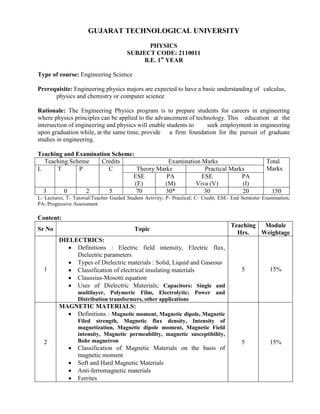
Teaching and Examination Scheme:
Teaching Scheme Credits Examination Marks Total
MarksL T P C Theory Marks Practical Marks
ESE
(E)
PA
(M)
ESE
Viva (V)
PA
(I)
3 0 2 5 70 30* 30 20 150
L- Lectures; T- Tutorial/Teacher Guided Student Activity; P- Practical; C- Credit; ESE- End Semester Examination;
PA- Progressive Assessment
Content:
Sr No Topic
Teaching
Hrs.
Module
Weightage
1
DIELECTRICS:
 Definitions : Electric field intensity, Electric flux,
Dielectric parameters
 Types of Dielectric materials : Solid, Liquid and Gaseous
 Classification of electrical insulating materials
 Claussius-Mosotti equation
 Uses of Dielectric Materials; Capacitors: Single and
multilayer, Polymeric Film, Electrolytic; Power and
Distribution transformers, other applications
5 15%
2
MAGNETIC MATERIALS:
 Definitions : Magnetic moment, Magnetic dipole, Magnetic
Filed strength, Magnetic flux density, Intensity of
magnetization, Magnetic dipole moment, Magnetic Field
intensity, Magnetic permeability, magnetic susceptibility,
Bohr magnetron
 Classification of Magnetic Materials on the basis of
magnetic moment
 Soft and Hard Magnetic Materials
 Anti-ferromagnetic materials
 Ferrites
5 15%
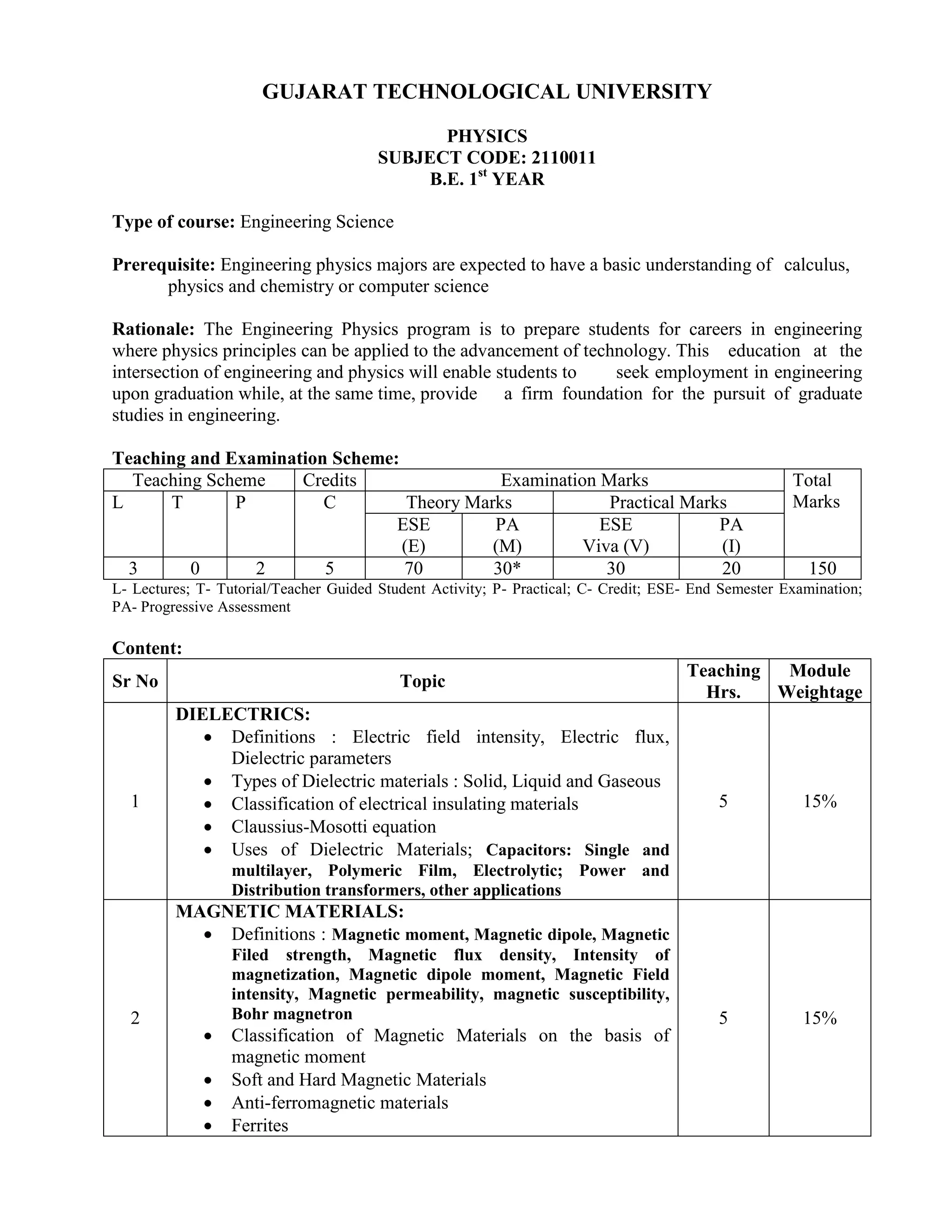
 Magnetic Recording and Readout Storage of magnetic
data
3
ACOUSTIC AND ULTRASONIC:
 Introduction, Classification and Characteristics of sound
 Sabine’s formula for reverberation (Without Derivations)
 Introduction of Absorption co-efficient
 Sound absorbing materials
 Factors affecting the acoustics of building and their
remedies
 Sound Insulation
 Noise Pollutions
 Noise Control in machines
 Properties of ultrasound
 Generation of ultrasound by (1) piezoelectric method and
(2) magnetostriction method
 Methods for Ultrasound Velocity measurement
 Applications of ultrasound: Industry, Medicine
 NDT through Ultrasonic
5 15%
4
SUPERCONDUCTIVITY:
 Superconductivity
 General Properties of superconductors
 Types of Superconductors
 High Temperature superconductors
 Applications: Magnets, Josephson effect, SQUID, Maglev,
other
4 10%
5
NON LINEAR OPTICS:
LASER
 Introduction
 Characteristics of laser radiation
 Spontaneous and stimulated emission
 Working of LASER with basic idea about Population
Inversion, Pumping mechanism, Optical Resonators
 Nd:YAG LASER
 Applications of LASER: Medical, Industrial,
Communication and other
FIBER OPTICS
 Introduction of Optical Fiber
 Advantages of Optical Fiber
 Total Internal Reflection
 Numerical Aperture and Acceptance angle
 Modes of Propagation
 Types of Optical Fiber
 Applications of optical fiber
7 15%
6
NANOPHYSICS:
 Nanoscale
 Surface to volume ratio
 Surface effects on Nanomaterials
5 15%
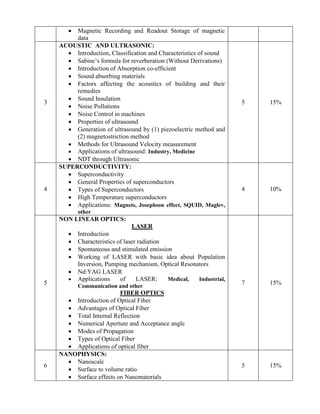
 Quantum size effects
 Electron confinement
 Nanomaterials and Nanotechnology
 Unusal properties of Nanomaterials
 Disadvantages of Nanomaterials
 Synthesis of Nanomaterials
 Carbon Nanotubes: Introduction, Structure, Synthesis,
Properties and applications
 Applications of Nanomaterials
7
ADVANCED ENGINEERING MATERIALS:
SHAPE MEMORY ALLOYS
 Introduction, Synthesis, Properties and Applications
METALLIC GLASSES
 Introduction, Synthesis, Properties and Applications
BIO MATERIALS
 Introduction, Properties and Applications
ENERGY MATERIALS
 Solar cells
 Fuel cells (H2O2, Lithium cell)
 Ultra capacitors
5 15%
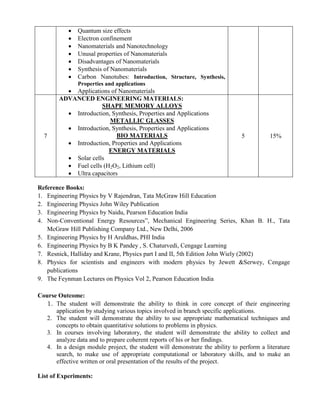
Reference Books:
1. Engineering Physics by V Rajendran, Tata McGraw Hill Education
2. Engineering Physics John Wiley Publication
3. Engineering Physics by Naidu, Pearson Education India
4. Non-Conventional Energy Resources”, Mechanical Engineering Series, Khan B. H., Tata
McGraw Hill Publishing Company Ltd., New Delhi, 2006
5. Engineering Physics by H Aruldhas, PHI India
6. Engineering Physics by B K Pandey , S. Chaturvedi, Cengage Learning
7. Resnick, Halliday and Krane, Physics part I and II, 5th Edition John Wiely (2002)
8. Physics for scientists and engineers with modern physics by Jewett &Serwey, Cengage
publications
9. The Feynman Lectures on Physics Vol 2, Pearson Education India
Course Outcome:
1. The student will demonstrate the ability to think in core concept of their engineering
application by studying various topics involved in branch specific applications.
2. The student will demonstrate the ability to use appropriate mathematical techniques and
concepts to obtain quantitative solutions to problems in physics.
3. In courses involving laboratory, the student will demonstrate the ability to collect and
analyze data and to prepare coherent reports of his or her findings.
4. In a design module project, the student will demonstrate the ability to perform a literature
search, to make use of appropriate computational or laboratory skills, and to make an
effective written or oral presentation of the results of the project.
List of Experiments:
Important Note
 Total 18 experiments are listed in the design module.
 Key goals of these experiments are :
(1) To enhance the understanding of student towards the errors present in the real time measurement and
the ways to take care of them.
(2) To create visualization of various phenomena covered in the syllabus.
(3) To induce the skill of student in handling different measuring instruments.
 Subject teacher is advised to setup any 8 experiments from the following list.
 In the session student should perform minimum 4 set of experiments and complete one small project
based on engineering applications. This project along with any performed experiment should be
EVALUATED BY EXTERNAL EXAMINER.
1. To understand some basic aspects of error analysis and graph drawing.
2. To measure the dielectric constant of a material
3. To measure the Hysteresis loss in a Ferromagnetic material.
4. To study the Hall-Effect.
5. To determine Young's Modulus of Elasticity of the given samples by bending.
6. Measurement of the Distance using Ultrasonic Sensors.
7. Study of Object Detection using Ultrasonic Sensors.
8. Determination of the Velocity of Ultrasonic Waves in a non-electrolytic Liquid by Ultrasonic
Interferometer.
9. Determination of the Compressibility of a non-electrolytic Liquid by Ultrasonic
Interferometer.
10. To study the I-V Characteristic of Silicon diode.
11. To study the I-V Characteristic of Zener diode.
12. To study the I-V Characteristic of LED.
13. To determine the efficiency of given solar cell.
14. To study basic wind power set up.
15. To measure the Resistivity & Band gap of Germanium Crystal (N-type) by Four Probe Method.
16. To measure the numerical aperture of optical fiber.
17. To Study of propagation & bending loss in optical fiber.
18. To determine the frequency of given laser source.
PROJECTS/STUDY REPORTS/LATEST OUTCOMES IN TECHNOLOGY STUDY
1. In the beginning of the academic term, faculties will have to allot their students at least one
- Design based small project or
- Study report based on latest science development or
- Technology study report/ modelling/ simulation/collection report or
- Computer based simulation/ web based application/ analysis presentations of applied
science field which may help them in their branches especially in their UDP/IDP
projects.
2. These can be done in a group containing maximum six students in each.
3. Study report/ small project/ IDP OR UDP based study will be evaluated by external
examiner with appropriate marks allotment given by GTU time to time.
4. Faculties should cultivate problem based project to enhance the basic mental and technical
level of students.
5. Evaluation should be done on approach of the student on his/her efforts (not on
completion) to study the design module of given task.
Project fields
Students are free to select any area of science and technology may be based on their branches to
define projects. Some suggested areas of project are listed below:
1. Electronics circuits, sensors and devices
2. Non-Conventional energy and applications
3. Classical mechanics and devices based on mechanics
4. Light and matters
5. Waves and oscillations
6. Dielectric materials
7. Energy efficient materials
8. Biomaterials
9. Low temperature physics
10. Nanophysics
11. Ultrasonic
12. Fluid Mechanics
13. Electromagnetism
14. Schematic modeling of ideal system
15. Computer based animations
16. Computer based simulation/ small calculation with help basic programming language based
on Physics
17. Problem based study with help of Electrical, Electronics and Mechanical software
18. Small set up of system design
19. Latest technical marvels
20. Environmental Physics
Major Equipments:
Sr.
No.
Name Technical Specification
1 Universal training kit – electronics
2
Rectifier Kit
(Half wave, full wave, bridge)
Consisting of 0-30 V variable power supply,
Diodes (IN 4007), Module of 10k resistors,
Included Filter Circuit.
3 LDR, LED characteristic kit 0-30 V variable power supply
4
Diode - Zener Diode Characteristic
Kit
0-30 V regulated tunnable power supply,
milliammeter (0-50mA),
Microammeter (0-100μA),
Digital multimeter,
Resistances module 10K,
Facility of Silicon Diode (IN4001),
Germanium Diode (DR 25) and Zener Diode with
reverse bias voltage Max. up to 8-9 V
5 dB meter, Sound generator, speaker dB meter with the range of 0-200 dB
6
Hall effect trainer Power supply of (220 V, 50Hz),
constant current source of (30 mA, DC) variable
through port Digital Gauss Meter,
Digital multimeter
7
Semiconductor energy gap set up Four Probe experimental Set up (consisting constant
current source,
Dual range miliVoltmeter,
power supply for oven and miliammeter
Thermometer (Mercury) Temperature range up to
200-250 °C
8
Young's Modulus set up Stand, weight box (up to 1kg),
Samples (iron, Al, Cu etc),
DC adapter,
Spherometer stand with buzzer,
weight holder
9
Resistivity and Band Gap
measurement
10
solar energy trainer Fundamental of photovoltaic cell should be studied,
application and Characteristics features should be
measured by a kit
11
Plank's constant determination with
using LED
Plank's constant apparatus,
oven, LED Red, LED Yellow
12
Ultrasonic measurement kit Quartz Crystal (Frequency: 2 MHz),
Ultrasonic Transducer approx 25 cm to 1.2 m,
Clock Generator 40 kHz,
Amplifier 40 dB - 70dB
13
X ray powder pattern kit Powder patterns slides,
travelling microscope 10x,
X ray diffraction pattern
14
Fiber Optic Kit LED source 950 nm/660 nm compatible APV or
Photo diode Detector with Numerical Aperture
Measurement Facility
15 Laser Source He- Ne Laser and 1350 nm I-R Laser
16 Introductory Nano Kit
17
Hysteresis loop set up Voltage Sensor range ± 0.5 V to ± 1V,
current Sensor ±0.5 A to ±1 A,
coil 250 to400 turns (pair),
Resistance Module 10 ohm ,10 watt
18 Ruben's Tube (Sound)
19 Optical Power meter (-50 dB to 0dB) measurement range
20
CRO (20MHz)-(5MHz) dual
channel
Dual channel,0-200 V,
four probe, with power probe
21 Digital Multimeters
22 Analog Voltmeters (mV, V)
23 Analog Ammeter (micro, mA, A)
24 Wires
25 Tool Kit with tester
26 Bread Board
27 Screw Dirver Kit
28 Regulated Power Supply (0-50V)
29 Capacitors, Resistors
30 Diodes
31 LEDs, LDRs
32 Rheostat
33 Soldering kit with wire
34
Function Generator ( 5MHz) Generation of sine, Square, Saw tooth waves required,
+/- pulses frequency range up to 20 MHz,
Peak to peak voltage around 20 V
35 Multiple power supply Variable of 0-30 volt , 30V/2A, 5V/2A , 15V/1A
List of Open Source Software/learning website:
 The Flying Circus of Physics 2nd
edition by Jearl Walker, Wiley India
 Six Ideas that shaped physics by Thomas A Moore, McGraw Hill education
 http://www.howstuffworks.com/ -- Tech stuff
 How things works by Louis A Bloomfeild, Wiley Publications
 Physics of Everyday Phenomena by W. Thomas Griffith, Juliet Brosing, McGraw Hill
Education
 Latest journals like BBC Knowledge, How things work-everyday technology explained by
National Geographics.
 http://www.sciencefairadventure.com/
*PA (M): 10 marks for Active Learning Assignments, 20 marks for other methods of PA
ACTIVE LEARNING ASSIGNMENTS: Preparation of power-point slides, which include videos,
animations, pictures, graphics for better understanding theory and practical work – The faculty will allocate
chapters/ parts of chapters to groups of students so that the entire syllabus of Physics is covered. The power-
point slides should be put up on the web-site of the College/ Institute, along with the names of the students of
the group, the name of the faculty, Department and College on the first slide. The best three works should be
sent to achievements@gtu.edu.in.

2110011

  • 1.
    GUJARAT TECHNOLOGICAL UNIVERSITY PHYSICS SUBJECTCODE: 2110011 B.E. 1st YEAR Type of course: Engineering Science Prerequisite: Engineering physics majors are expected to have a basic understanding of calculus, physics and chemistry or computer science Rationale: The Engineering Physics program is to prepare students for careers in engineering where physics principles can be applied to the advancement of technology. This education at the intersection of engineering and physics will enable students to seek employment in engineering upon graduation while, at the same time, provide a firm foundation for the pursuit of graduate studies in engineering. Teaching and Examination Scheme: Teaching Scheme Credits Examination Marks Total MarksL T P C Theory Marks Practical Marks ESE (E) PA (M) ESE Viva (V) PA (I) 3 0 2 5 70 30* 30 20 150 L- Lectures; T- Tutorial/Teacher Guided Student Activity; P- Practical; C- Credit; ESE- End Semester Examination; PA- Progressive Assessment Content: Sr No Topic Teaching Hrs. Module Weightage 1 DIELECTRICS:  Definitions : Electric field intensity, Electric flux, Dielectric parameters  Types of Dielectric materials : Solid, Liquid and Gaseous  Classification of electrical insulating materials  Claussius-Mosotti equation  Uses of Dielectric Materials; Capacitors: Single and multilayer, Polymeric Film, Electrolytic; Power and Distribution transformers, other applications 5 15% 2 MAGNETIC MATERIALS:  Definitions : Magnetic moment, Magnetic dipole, Magnetic Filed strength, Magnetic flux density, Intensity of magnetization, Magnetic dipole moment, Magnetic Field intensity, Magnetic permeability, magnetic susceptibility, Bohr magnetron  Classification of Magnetic Materials on the basis of magnetic moment  Soft and Hard Magnetic Materials  Anti-ferromagnetic materials  Ferrites 5 15%
  • 2.
     Magnetic Recordingand Readout Storage of magnetic data 3 ACOUSTIC AND ULTRASONIC:  Introduction, Classification and Characteristics of sound  Sabine’s formula for reverberation (Without Derivations)  Introduction of Absorption co-efficient  Sound absorbing materials  Factors affecting the acoustics of building and their remedies  Sound Insulation  Noise Pollutions  Noise Control in machines  Properties of ultrasound  Generation of ultrasound by (1) piezoelectric method and (2) magnetostriction method  Methods for Ultrasound Velocity measurement  Applications of ultrasound: Industry, Medicine  NDT through Ultrasonic 5 15% 4 SUPERCONDUCTIVITY:  Superconductivity  General Properties of superconductors  Types of Superconductors  High Temperature superconductors  Applications: Magnets, Josephson effect, SQUID, Maglev, other 4 10% 5 NON LINEAR OPTICS: LASER  Introduction  Characteristics of laser radiation  Spontaneous and stimulated emission  Working of LASER with basic idea about Population Inversion, Pumping mechanism, Optical Resonators  Nd:YAG LASER  Applications of LASER: Medical, Industrial, Communication and other FIBER OPTICS  Introduction of Optical Fiber  Advantages of Optical Fiber  Total Internal Reflection  Numerical Aperture and Acceptance angle  Modes of Propagation  Types of Optical Fiber  Applications of optical fiber 7 15% 6 NANOPHYSICS:  Nanoscale  Surface to volume ratio  Surface effects on Nanomaterials 5 15%
  • 3.
     Quantum sizeeffects  Electron confinement  Nanomaterials and Nanotechnology  Unusal properties of Nanomaterials  Disadvantages of Nanomaterials  Synthesis of Nanomaterials  Carbon Nanotubes: Introduction, Structure, Synthesis, Properties and applications  Applications of Nanomaterials 7 ADVANCED ENGINEERING MATERIALS: SHAPE MEMORY ALLOYS  Introduction, Synthesis, Properties and Applications METALLIC GLASSES  Introduction, Synthesis, Properties and Applications BIO MATERIALS  Introduction, Properties and Applications ENERGY MATERIALS  Solar cells  Fuel cells (H2O2, Lithium cell)  Ultra capacitors 5 15% Reference Books: 1. Engineering Physics by V Rajendran, Tata McGraw Hill Education 2. Engineering Physics John Wiley Publication 3. Engineering Physics by Naidu, Pearson Education India 4. Non-Conventional Energy Resources”, Mechanical Engineering Series, Khan B. H., Tata McGraw Hill Publishing Company Ltd., New Delhi, 2006 5. Engineering Physics by H Aruldhas, PHI India 6. Engineering Physics by B K Pandey , S. Chaturvedi, Cengage Learning 7. Resnick, Halliday and Krane, Physics part I and II, 5th Edition John Wiely (2002) 8. Physics for scientists and engineers with modern physics by Jewett &Serwey, Cengage publications 9. The Feynman Lectures on Physics Vol 2, Pearson Education India Course Outcome: 1. The student will demonstrate the ability to think in core concept of their engineering application by studying various topics involved in branch specific applications. 2. The student will demonstrate the ability to use appropriate mathematical techniques and concepts to obtain quantitative solutions to problems in physics. 3. In courses involving laboratory, the student will demonstrate the ability to collect and analyze data and to prepare coherent reports of his or her findings. 4. In a design module project, the student will demonstrate the ability to perform a literature search, to make use of appropriate computational or laboratory skills, and to make an effective written or oral presentation of the results of the project. List of Experiments:
  • 4.
    Important Note  Total18 experiments are listed in the design module.  Key goals of these experiments are : (1) To enhance the understanding of student towards the errors present in the real time measurement and the ways to take care of them. (2) To create visualization of various phenomena covered in the syllabus. (3) To induce the skill of student in handling different measuring instruments.  Subject teacher is advised to setup any 8 experiments from the following list.  In the session student should perform minimum 4 set of experiments and complete one small project based on engineering applications. This project along with any performed experiment should be EVALUATED BY EXTERNAL EXAMINER. 1. To understand some basic aspects of error analysis and graph drawing. 2. To measure the dielectric constant of a material 3. To measure the Hysteresis loss in a Ferromagnetic material. 4. To study the Hall-Effect. 5. To determine Young's Modulus of Elasticity of the given samples by bending. 6. Measurement of the Distance using Ultrasonic Sensors. 7. Study of Object Detection using Ultrasonic Sensors. 8. Determination of the Velocity of Ultrasonic Waves in a non-electrolytic Liquid by Ultrasonic Interferometer. 9. Determination of the Compressibility of a non-electrolytic Liquid by Ultrasonic Interferometer. 10. To study the I-V Characteristic of Silicon diode. 11. To study the I-V Characteristic of Zener diode. 12. To study the I-V Characteristic of LED. 13. To determine the efficiency of given solar cell. 14. To study basic wind power set up. 15. To measure the Resistivity & Band gap of Germanium Crystal (N-type) by Four Probe Method. 16. To measure the numerical aperture of optical fiber. 17. To Study of propagation & bending loss in optical fiber. 18. To determine the frequency of given laser source. PROJECTS/STUDY REPORTS/LATEST OUTCOMES IN TECHNOLOGY STUDY 1. In the beginning of the academic term, faculties will have to allot their students at least one - Design based small project or - Study report based on latest science development or - Technology study report/ modelling/ simulation/collection report or - Computer based simulation/ web based application/ analysis presentations of applied science field which may help them in their branches especially in their UDP/IDP projects. 2. These can be done in a group containing maximum six students in each.
  • 5.
    3. Study report/small project/ IDP OR UDP based study will be evaluated by external examiner with appropriate marks allotment given by GTU time to time. 4. Faculties should cultivate problem based project to enhance the basic mental and technical level of students. 5. Evaluation should be done on approach of the student on his/her efforts (not on completion) to study the design module of given task. Project fields Students are free to select any area of science and technology may be based on their branches to define projects. Some suggested areas of project are listed below: 1. Electronics circuits, sensors and devices 2. Non-Conventional energy and applications 3. Classical mechanics and devices based on mechanics 4. Light and matters 5. Waves and oscillations 6. Dielectric materials 7. Energy efficient materials 8. Biomaterials 9. Low temperature physics 10. Nanophysics 11. Ultrasonic 12. Fluid Mechanics 13. Electromagnetism 14. Schematic modeling of ideal system 15. Computer based animations 16. Computer based simulation/ small calculation with help basic programming language based on Physics 17. Problem based study with help of Electrical, Electronics and Mechanical software 18. Small set up of system design 19. Latest technical marvels 20. Environmental Physics Major Equipments: Sr. No. Name Technical Specification 1 Universal training kit – electronics 2 Rectifier Kit (Half wave, full wave, bridge) Consisting of 0-30 V variable power supply, Diodes (IN 4007), Module of 10k resistors, Included Filter Circuit. 3 LDR, LED characteristic kit 0-30 V variable power supply
  • 6.
    4 Diode - ZenerDiode Characteristic Kit 0-30 V regulated tunnable power supply, milliammeter (0-50mA), Microammeter (0-100μA), Digital multimeter, Resistances module 10K, Facility of Silicon Diode (IN4001), Germanium Diode (DR 25) and Zener Diode with reverse bias voltage Max. up to 8-9 V 5 dB meter, Sound generator, speaker dB meter with the range of 0-200 dB 6 Hall effect trainer Power supply of (220 V, 50Hz), constant current source of (30 mA, DC) variable through port Digital Gauss Meter, Digital multimeter 7 Semiconductor energy gap set up Four Probe experimental Set up (consisting constant current source, Dual range miliVoltmeter, power supply for oven and miliammeter Thermometer (Mercury) Temperature range up to 200-250 °C 8 Young's Modulus set up Stand, weight box (up to 1kg), Samples (iron, Al, Cu etc), DC adapter, Spherometer stand with buzzer, weight holder 9 Resistivity and Band Gap measurement 10 solar energy trainer Fundamental of photovoltaic cell should be studied, application and Characteristics features should be measured by a kit 11 Plank's constant determination with using LED Plank's constant apparatus, oven, LED Red, LED Yellow 12 Ultrasonic measurement kit Quartz Crystal (Frequency: 2 MHz), Ultrasonic Transducer approx 25 cm to 1.2 m, Clock Generator 40 kHz, Amplifier 40 dB - 70dB 13 X ray powder pattern kit Powder patterns slides, travelling microscope 10x, X ray diffraction pattern 14 Fiber Optic Kit LED source 950 nm/660 nm compatible APV or Photo diode Detector with Numerical Aperture Measurement Facility 15 Laser Source He- Ne Laser and 1350 nm I-R Laser
  • 7.
    16 Introductory NanoKit 17 Hysteresis loop set up Voltage Sensor range ± 0.5 V to ± 1V, current Sensor ±0.5 A to ±1 A, coil 250 to400 turns (pair), Resistance Module 10 ohm ,10 watt 18 Ruben's Tube (Sound) 19 Optical Power meter (-50 dB to 0dB) measurement range 20 CRO (20MHz)-(5MHz) dual channel Dual channel,0-200 V, four probe, with power probe 21 Digital Multimeters 22 Analog Voltmeters (mV, V) 23 Analog Ammeter (micro, mA, A) 24 Wires 25 Tool Kit with tester 26 Bread Board 27 Screw Dirver Kit 28 Regulated Power Supply (0-50V) 29 Capacitors, Resistors 30 Diodes 31 LEDs, LDRs 32 Rheostat 33 Soldering kit with wire 34 Function Generator ( 5MHz) Generation of sine, Square, Saw tooth waves required, +/- pulses frequency range up to 20 MHz, Peak to peak voltage around 20 V 35 Multiple power supply Variable of 0-30 volt , 30V/2A, 5V/2A , 15V/1A List of Open Source Software/learning website:  The Flying Circus of Physics 2nd edition by Jearl Walker, Wiley India  Six Ideas that shaped physics by Thomas A Moore, McGraw Hill education  http://www.howstuffworks.com/ -- Tech stuff  How things works by Louis A Bloomfeild, Wiley Publications  Physics of Everyday Phenomena by W. Thomas Griffith, Juliet Brosing, McGraw Hill Education  Latest journals like BBC Knowledge, How things work-everyday technology explained by National Geographics.  http://www.sciencefairadventure.com/ *PA (M): 10 marks for Active Learning Assignments, 20 marks for other methods of PA ACTIVE LEARNING ASSIGNMENTS: Preparation of power-point slides, which include videos, animations, pictures, graphics for better understanding theory and practical work – The faculty will allocate
  • 8.
    chapters/ parts ofchapters to groups of students so that the entire syllabus of Physics is covered. The power- point slides should be put up on the web-site of the College/ Institute, along with the names of the students of the group, the name of the faculty, Department and College on the first slide. The best three works should be sent to achievements@gtu.edu.in.