Building Economy ARE 431
Dr. Mohammad A. Hassanain 1
Life Cycle Costing
 The Concept of Life Cycle Costing.
 Techniques Used in Life Cycle Costing Calculations
Today’s Lecture
 Techniques Used in Life Cycle Costing Calculations.
 Present Worth Method.
 Examples Illustrating the Use of Present Worth
Method.
 Uniform Annual Worth Method.
2
 Examples Illustrating the Use of Uniform
Annual Worth Method.
Building Economy ARE 431
Dr. Mohammad A. Hassanain 2
Life Cycle Costing
 In the past, economic assessment of alternative
designs, construction, or investments have been
based on initial (first) cost which ignores the total costbased on initial (first) cost which ignores the total cost
incurred for the investment throughout its lifetime.
 The concept of life cycle costing provides an economic
tool which takes into account total costs for an
investment during its life span.
3
 Life cycle costing can be defined as “an economic
assessment of alternative designs, construction, or
other investments considering all significant costs of
initial costs and ownership costs over economic life of
each alternative”.
Life Cycle Costing
 The life cycle costing analysis can not be carried out
without considering the following:
 Total costs
 Concept of the time value of money
4
Building Economy ARE 431
Dr. Mohammad A. Hassanain 3
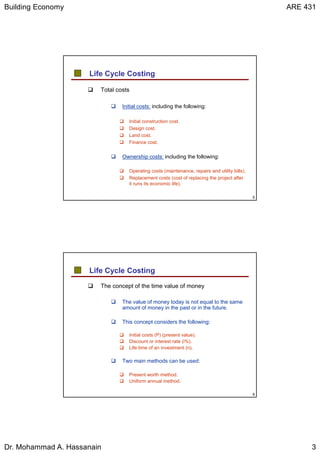
Life Cycle Costing
 Total costs
 Initial costs: including the following:
 Initial construction cost.
 Design cost.
 Land cost.
 Finance cost.
5
 Ownership costs: including the following:
 Operating costs (maintenance, repairs and utility bills).
 Replacement costs (cost of replacing the project after
it runs its economic life).
Life Cycle Costing
 The concept of the time value of money
 Th l f t d i t l t th The value of money today is not equal to the same
amount of money in the past or in the future.
 This concept considers the following:
 Initial costs (P) (present value).
 Discount or interest rate (i%).
 Life time of an investment (n).
6
 Life time of an investment (n).
 Two main methods can be used:
 Present worth method.
 Uniform annual method.

7.0 life cycle costing

  • 1.
    Building Economy ARE431 Dr. Mohammad A. Hassanain 1 Life Cycle Costing  The Concept of Life Cycle Costing.  Techniques Used in Life Cycle Costing Calculations Today’s Lecture  Techniques Used in Life Cycle Costing Calculations.  Present Worth Method.  Examples Illustrating the Use of Present Worth Method.  Uniform Annual Worth Method. 2  Examples Illustrating the Use of Uniform Annual Worth Method.
  • 2.
    Building Economy ARE431 Dr. Mohammad A. Hassanain 2 Life Cycle Costing  In the past, economic assessment of alternative designs, construction, or investments have been based on initial (first) cost which ignores the total costbased on initial (first) cost which ignores the total cost incurred for the investment throughout its lifetime.  The concept of life cycle costing provides an economic tool which takes into account total costs for an investment during its life span. 3  Life cycle costing can be defined as “an economic assessment of alternative designs, construction, or other investments considering all significant costs of initial costs and ownership costs over economic life of each alternative”. Life Cycle Costing  The life cycle costing analysis can not be carried out without considering the following:  Total costs  Concept of the time value of money 4
  • 3.
    Building Economy ARE431 Dr. Mohammad A. Hassanain 3 Life Cycle Costing  Total costs  Initial costs: including the following:  Initial construction cost.  Design cost.  Land cost.  Finance cost. 5  Ownership costs: including the following:  Operating costs (maintenance, repairs and utility bills).  Replacement costs (cost of replacing the project after it runs its economic life). Life Cycle Costing  The concept of the time value of money  Th l f t d i t l t th The value of money today is not equal to the same amount of money in the past or in the future.  This concept considers the following:  Initial costs (P) (present value).  Discount or interest rate (i%).  Life time of an investment (n). 6  Life time of an investment (n).  Two main methods can be used:  Present worth method.  Uniform annual method.