Formal Letters, Business
Memos and Emails - I
Technical English
Unit: 03
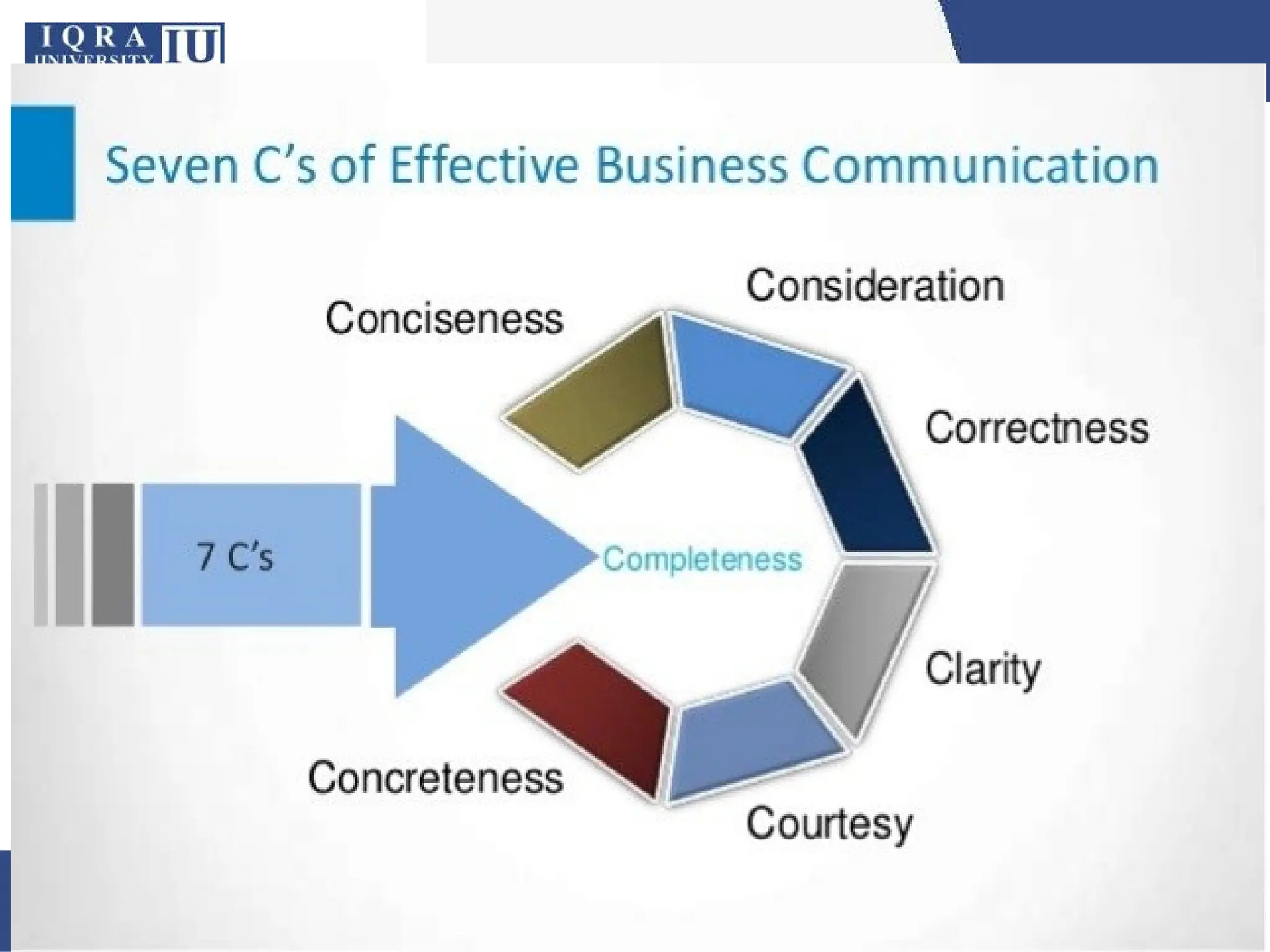
7 C’s of Effective Commination
Unit 3.2
Learning Outcomes
After studying this chapter, you will be able to:
• Identify why communication succeeds or fails.
• Recognize the technique that help in communicating
a message accurately.
• Understand the usage of all 7C`s in verbal and written
communication.
• Apply all 7C`s in professional writing.
1. Completeness
• In a complete message, the audience has everything they need to be
informed and, if applicable, take action.
• Does your message include a "call to action," so that your audience clearly
knows what you want them to do?
• Have you included all relevant information – contact names, dates, times,
locations, and so on?
• Provide all necessary information
• Answer all questions asked
-----Answering the 5 W’s help make messages clear: who, what, when, where and
why
• Give something extra, when desirable
A business communication
has to be complete.
Incomplete letters keep the
receiver guessing, or
making wrong choices, or
taking wrong decisions. The
letters should have the
quality of completeness. A
complete message will bring
the expected result or
desired response from the
receiver.
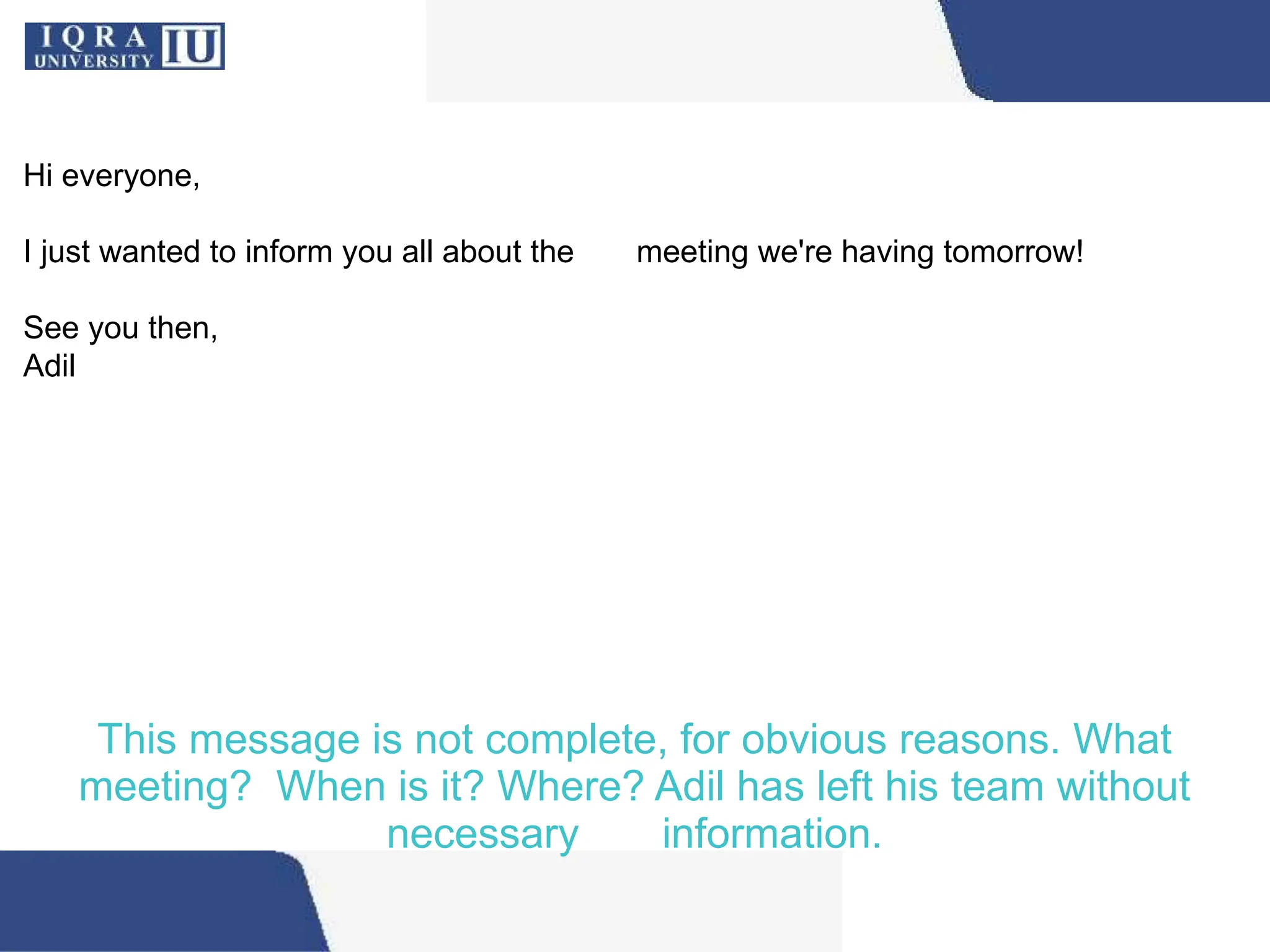
This message is not complete, for obvious reasons. What
meeting? When is it? Where? Adil has left his team without
necessary information.
Hi everyone,
I just wanted to inform you all about the meeting we're having tomorrow!
See you then,
Adil
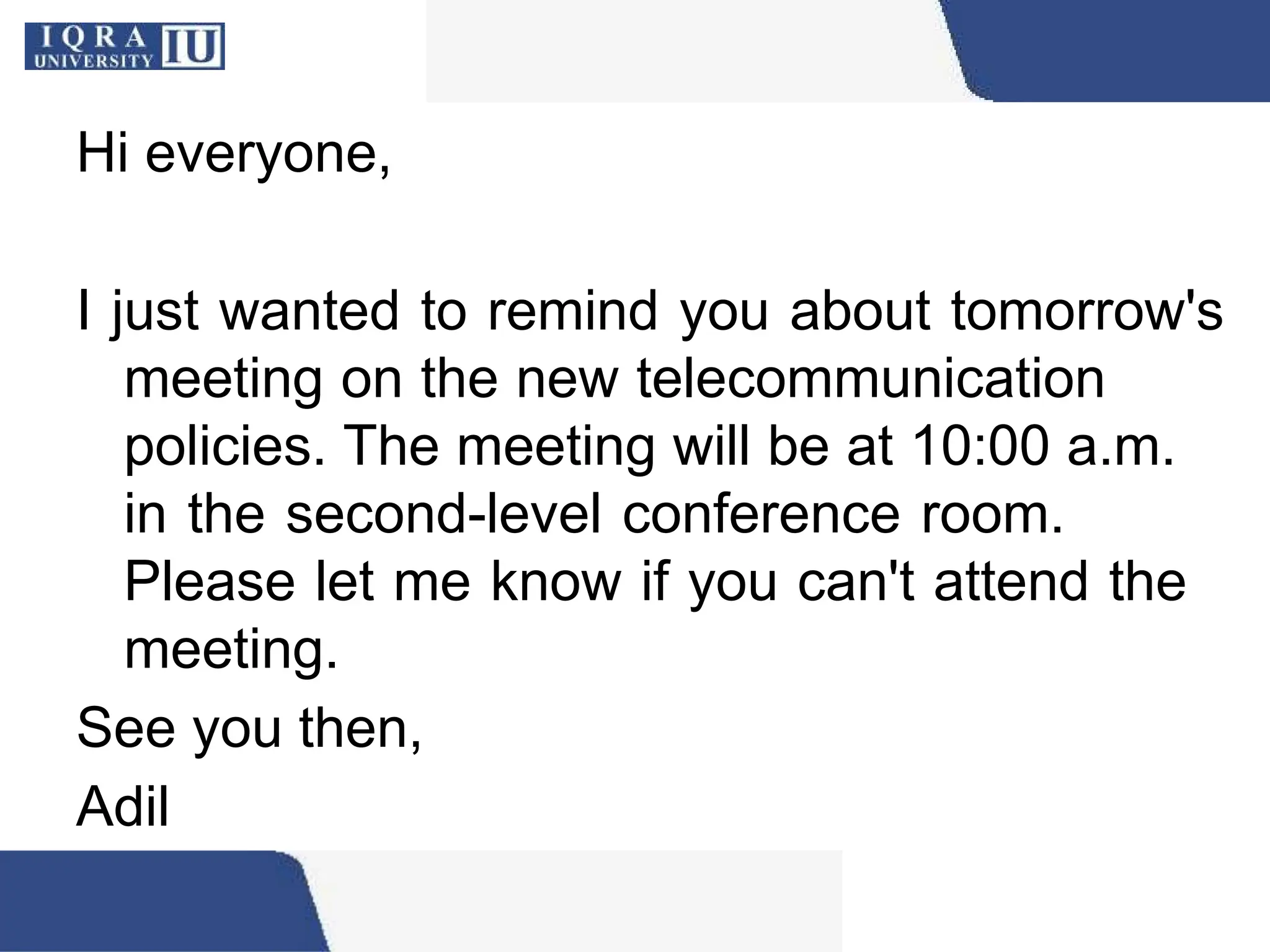
Hi everyone,
I just wanted to remind you about tomorrow's
meeting on the new telecommunication
policies. The meeting will be at 10:00 a.m.
in the second-level conference room.
Please let me know if you can't attend the
meeting.
See you then,
Adil
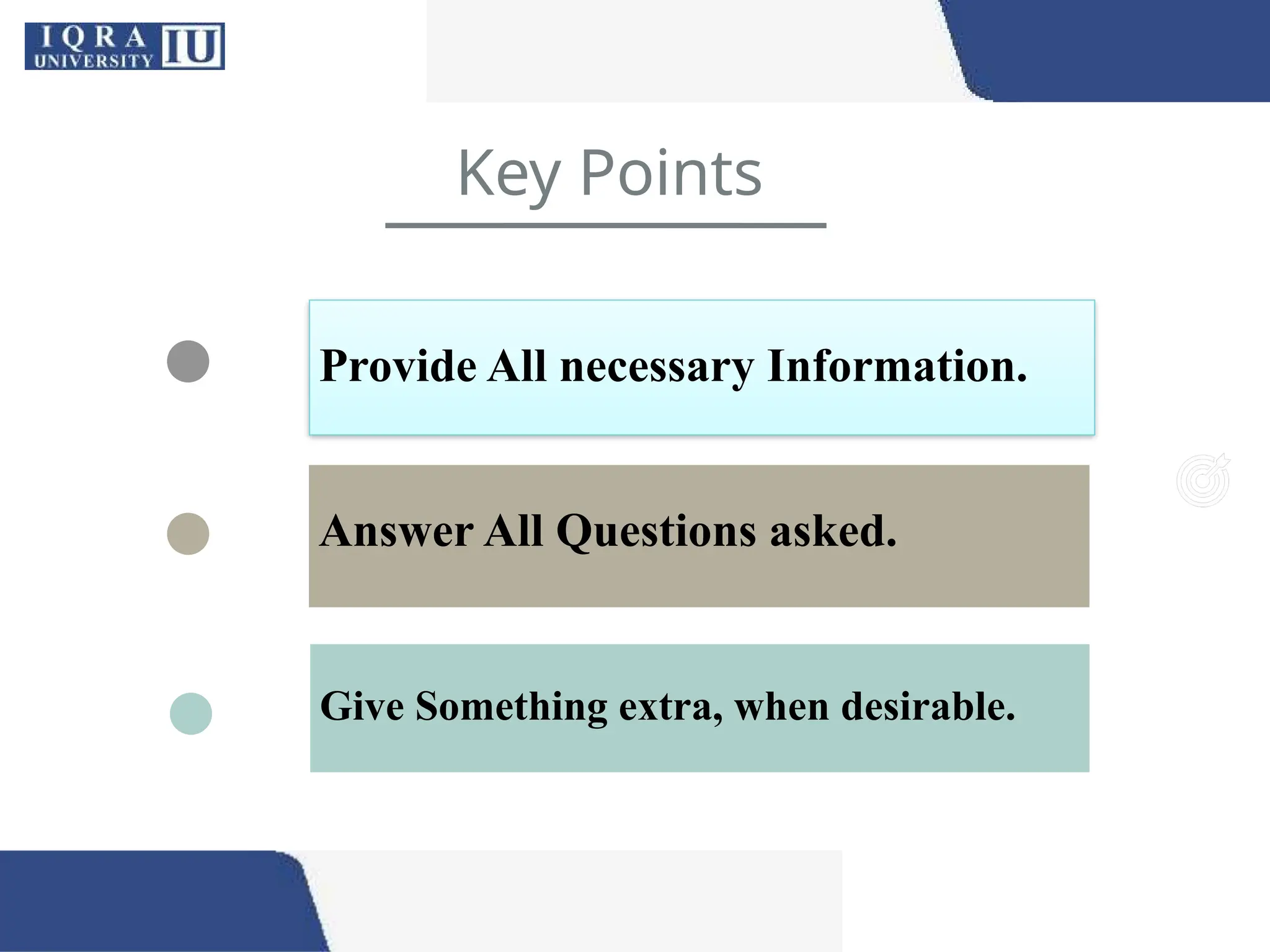
Provide All necessary Information.
Answer All Questions asked.
Give Something extra, when desirable.
Key Points
2. Conciseness
• It is saying what you have to say in fewest possible
words.
• Eliminate wordy expressions
– Use single word instead of phrases
– Examples:
– Wordy: At this time = Now
– Wordy: Due to the fact that = Because
– Wordy: It was known by Mr. Smith that we must reduce
inventory = Mr. Smith knew we must reduce inventory
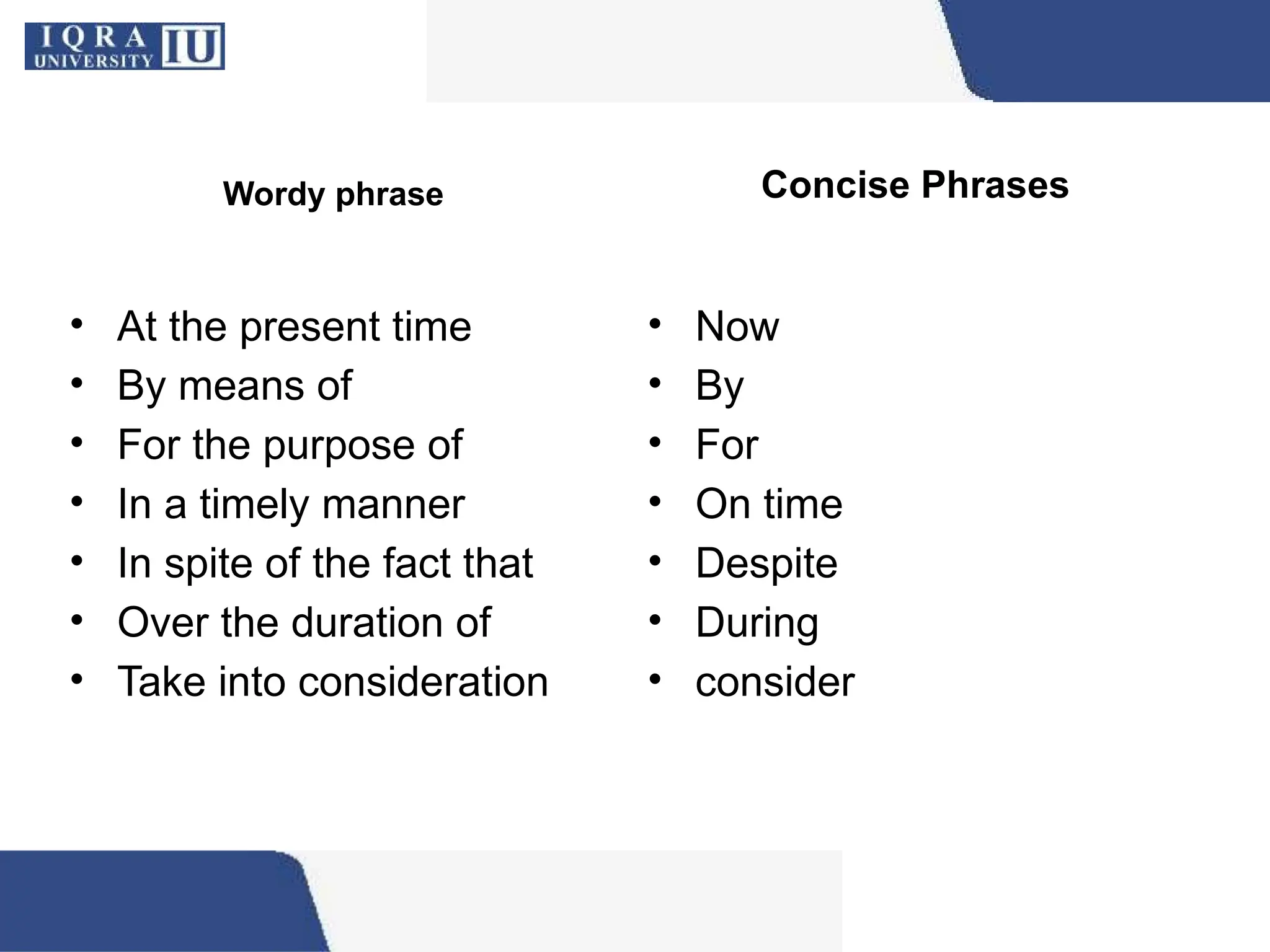
Wordy phrase
• At the present time
• By means of
• For the purpose of
• In a timely manner
• In spite of the fact that
• Over the duration of
• Take into consideration
Concise Phrases
• Now
• By
• For
• On time
• Despite
• During
• consider
2. Conciseness
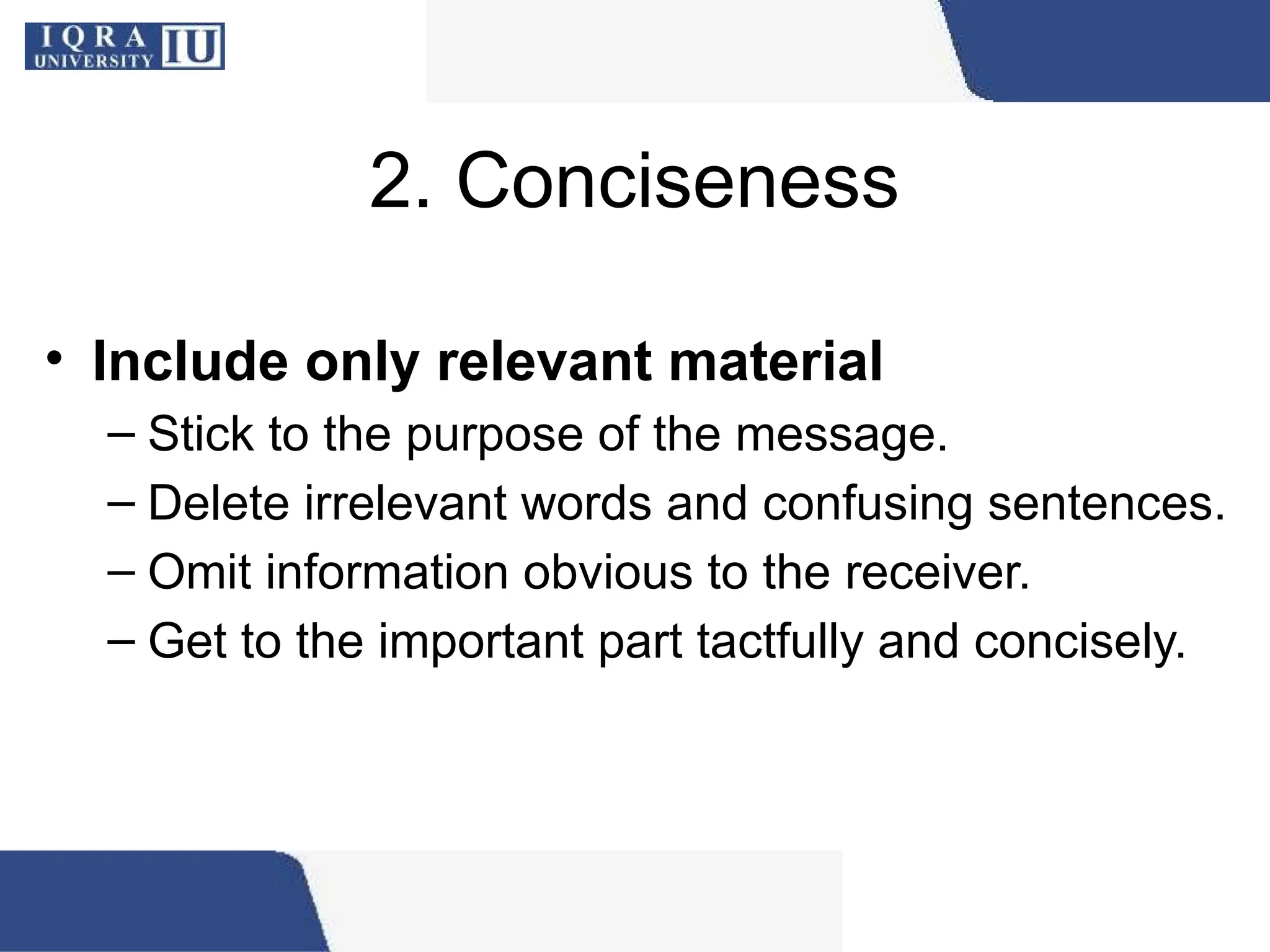
• Include only relevant material
– Stick to the purpose of the message.
– Delete irrelevant words and confusing sentences.
– Omit information obvious to the receiver.
– Get to the important part tactfully and concisely.
2. Conciseness
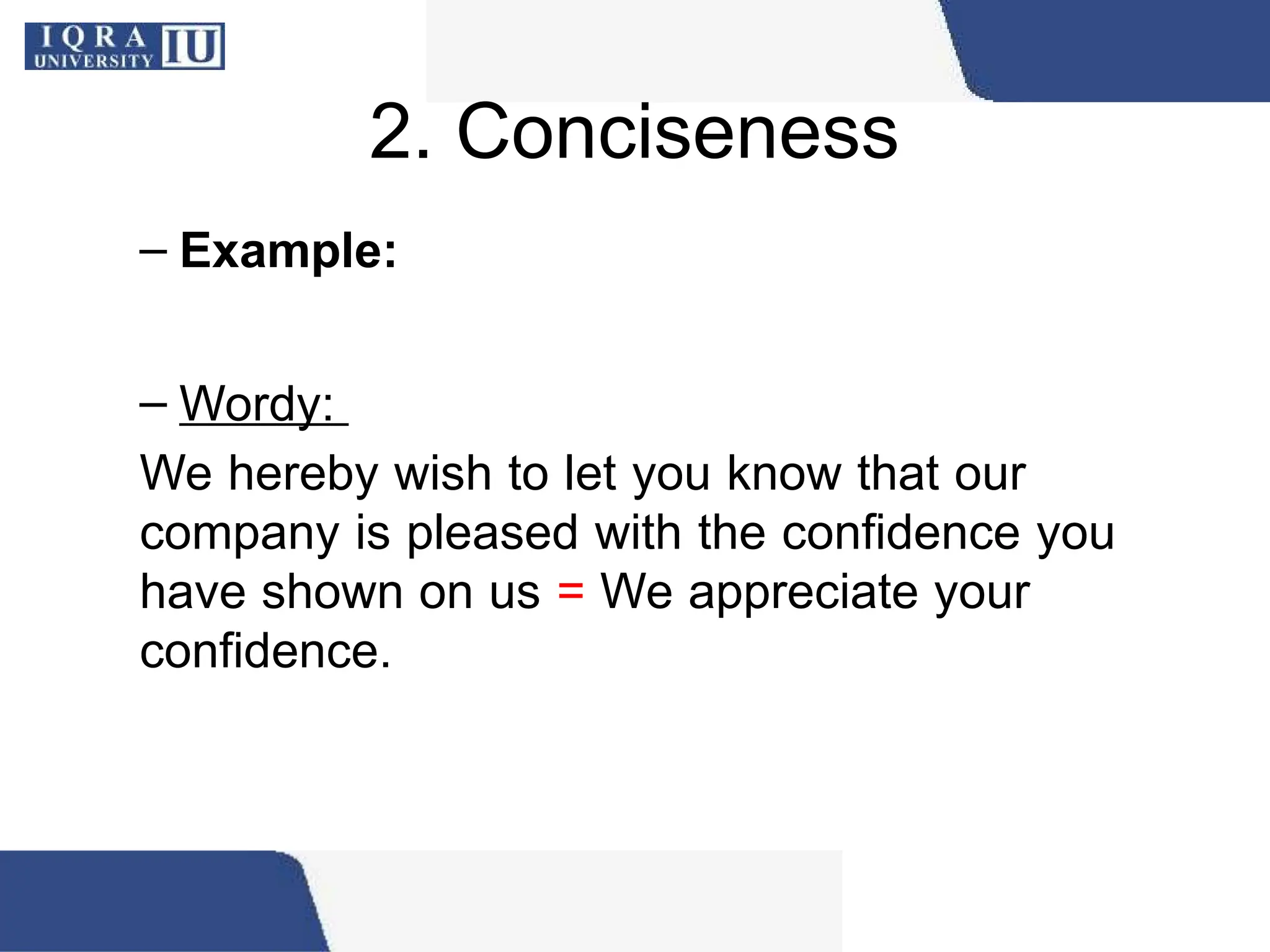
– Example:
– Wordy:
We hereby wish to let you know that our
company is pleased with the confidence you
have shown on us = We appreciate your
confidence.
2. Conciseness
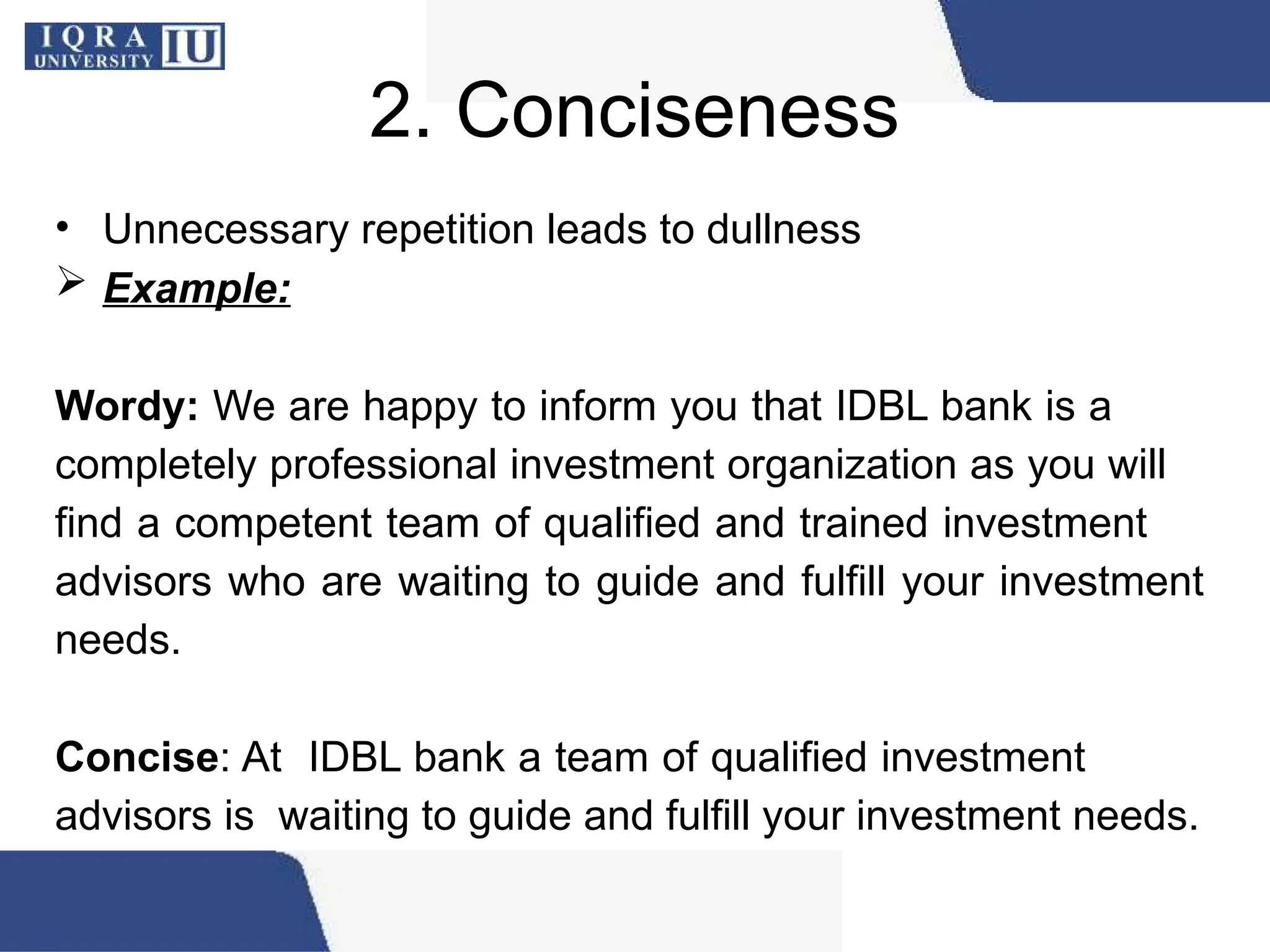
• Unnecessary repetition leads to dullness
 Example:
Wordy: We are happy to inform you that IDBL bank is a
completely professional investment organization as you will
find a competent team of qualified and trained investment
advisors who are waiting to guide and fulfill your investment
needs.
Concise: At IDBL bank a team of qualified investment
advisors is waiting to guide and fulfill your investment needs.
2. Conciseness
• Example:
• Wordy: The hybrid car, that was parked on the
street, close to the barber shop is the kind of car
that I have always wanted to own.
• Concise: I always wanted a hybrid car like the
one parked near the barber shop.
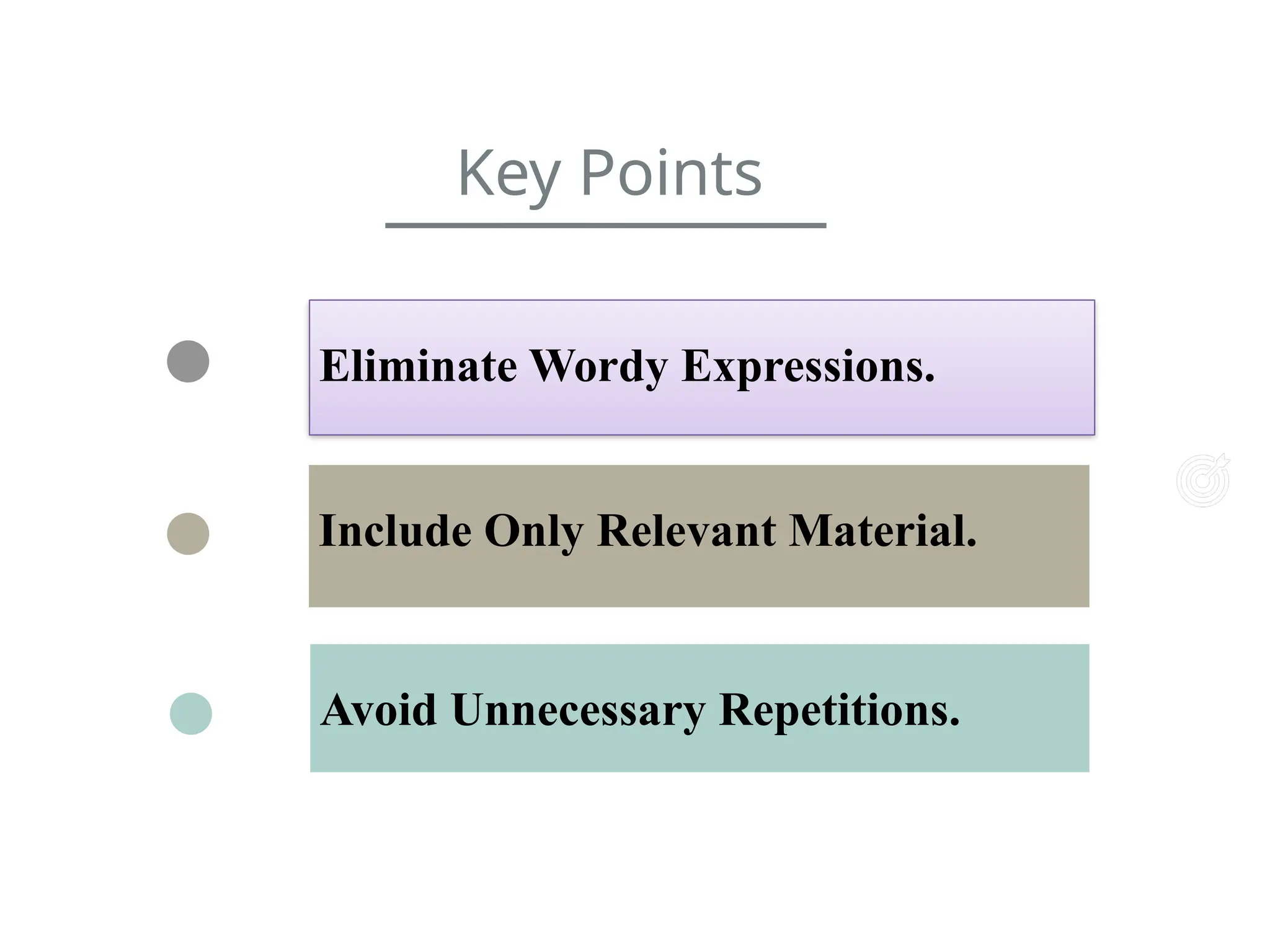
Eliminate Wordy Expressions.
Include Only Relevant Material.
Avoid Unnecessary Repetitions.
Key Points
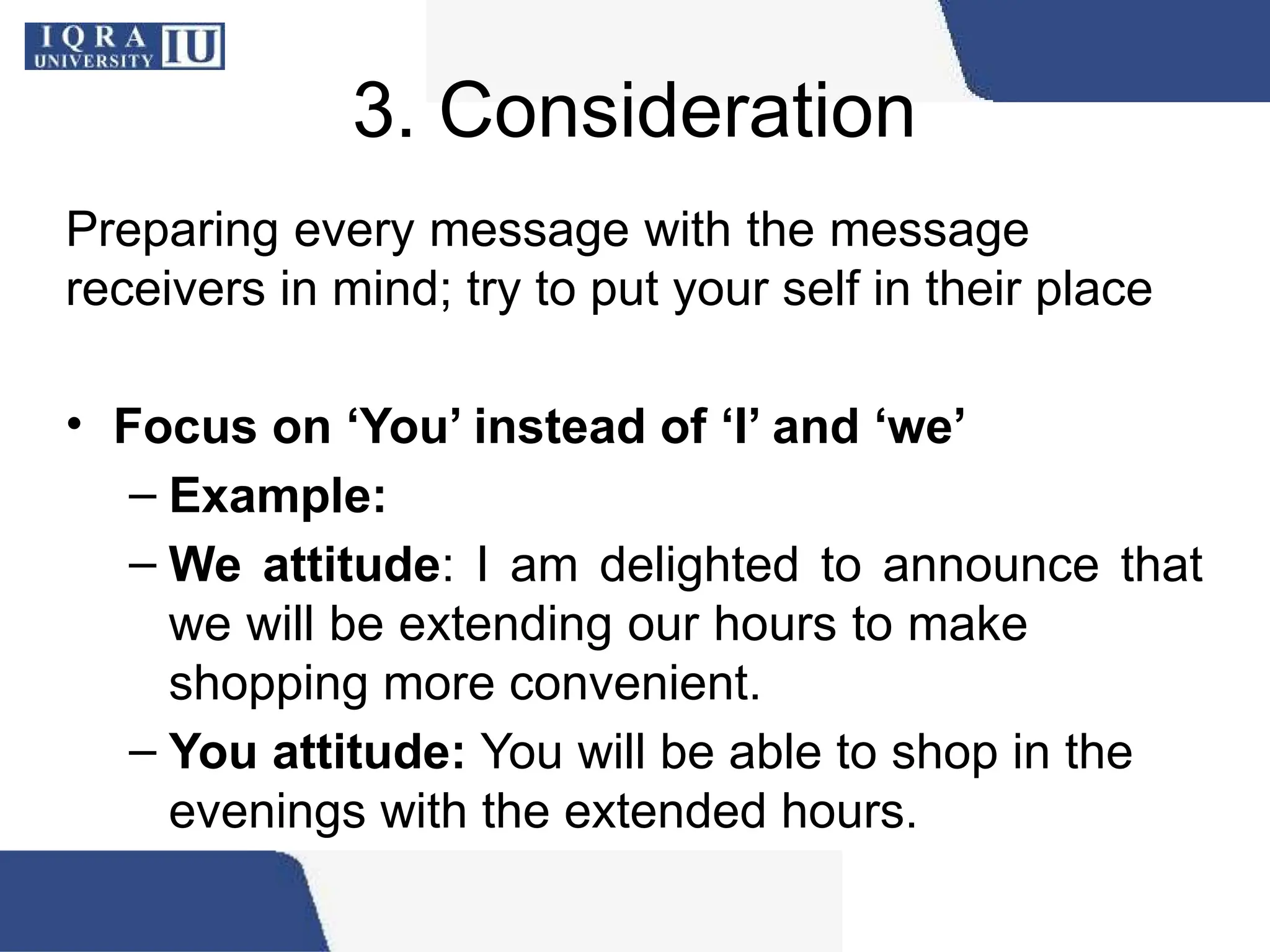
3. Consideration
Preparing every message with the message
receivers in mind; try to put your self in their place
• Focus on ‘You’ instead of ‘I’ and ‘we’
– Example:
– We attitude: I am delighted to announce that
we will be extending our hours to make
shopping more convenient.
– You attitude: You will be able to shop in the
evenings with the extended hours.
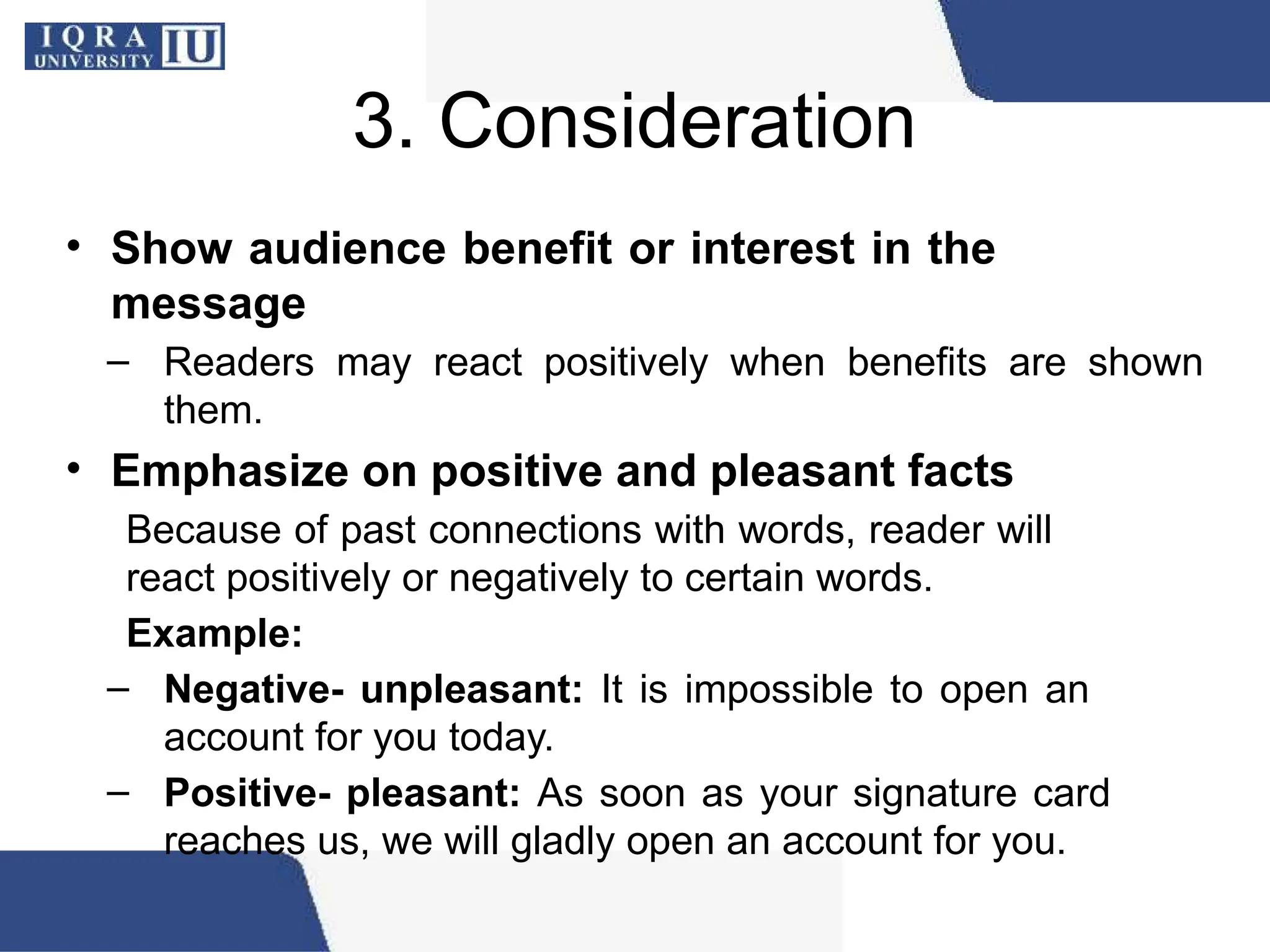
3. Consideration
• Show audience benefit or interest in the
message
– Readers may react positively when benefits are shown
them.
• Emphasize on positive and pleasant facts
Because of past connections with words, reader will
react positively or negatively to certain words.
Example:
– Negative- unpleasant: It is impossible to open an
account for you today.
– Positive- pleasant: As soon as your signature card
reaches us, we will gladly open an account for you.
Focus on “YOU” instead of “I” & “we”.
Show audience benefit or interest in the
message.
Emphasize Positive, Pleasant facts.
Key Points
4. Concreteness
• Being specific, definite, and vivid rather
than vague and general
• Use specific facts & figures
– It is desirable to be precise and concrete in both
written and oral communication
– Example:
– Vague, General: Sara is a very brilliant and
intelligent student.
– Concrete and precise: Sara have increased her
percentage from 86% in S.S.C to 90% in H.S.C.
4. Concreteness
• Put action in your words
– Use the active voice
– When the subject acts, there is more life
• Choose vivid image-building words
A statement like this probably won’t sell many of these
products. There’s no passion, no vivid detail, nothing that
create emotion, and nothing that tells people in the
audience why they should care. This message isn’t
concrete enough to make a difference.
Hence this is a bad example.
Consider this advertising copy:
The Lunchbox Services will save your time every day.
Good Example:
How much time do you spend every day
packing your kids' lunches? A lot of time! Just
take a complete Lunchbox services from us.
Each day give your kids a healthy lunch and
because of this lunch services now you can
spend more time with your kids.
5. Clarity
• Getting the meaning from your head into the head of your
receiver-accurately
• Choose precise, concrete and familiar words
– Use more familiar words; audience will understand them better
– Example:
– Unfamiliar: After our perusal of pertinent data, the conclusion is
that a lucrative market exists for the subject property.
– Familiar: The data we studied show that your property is
profitable and in high demand.
• Construct effective sentences and paragraphs
– Unity & Coherence: Insert no more than one main idea into a
sentence.
5. Clarity
To achieve clarity, keep in mind the following
points:
• Use common and simple language.
• Construct effective sentences and short
paragraphs.
• Use concrete words.
• Avoid unnecessary information.
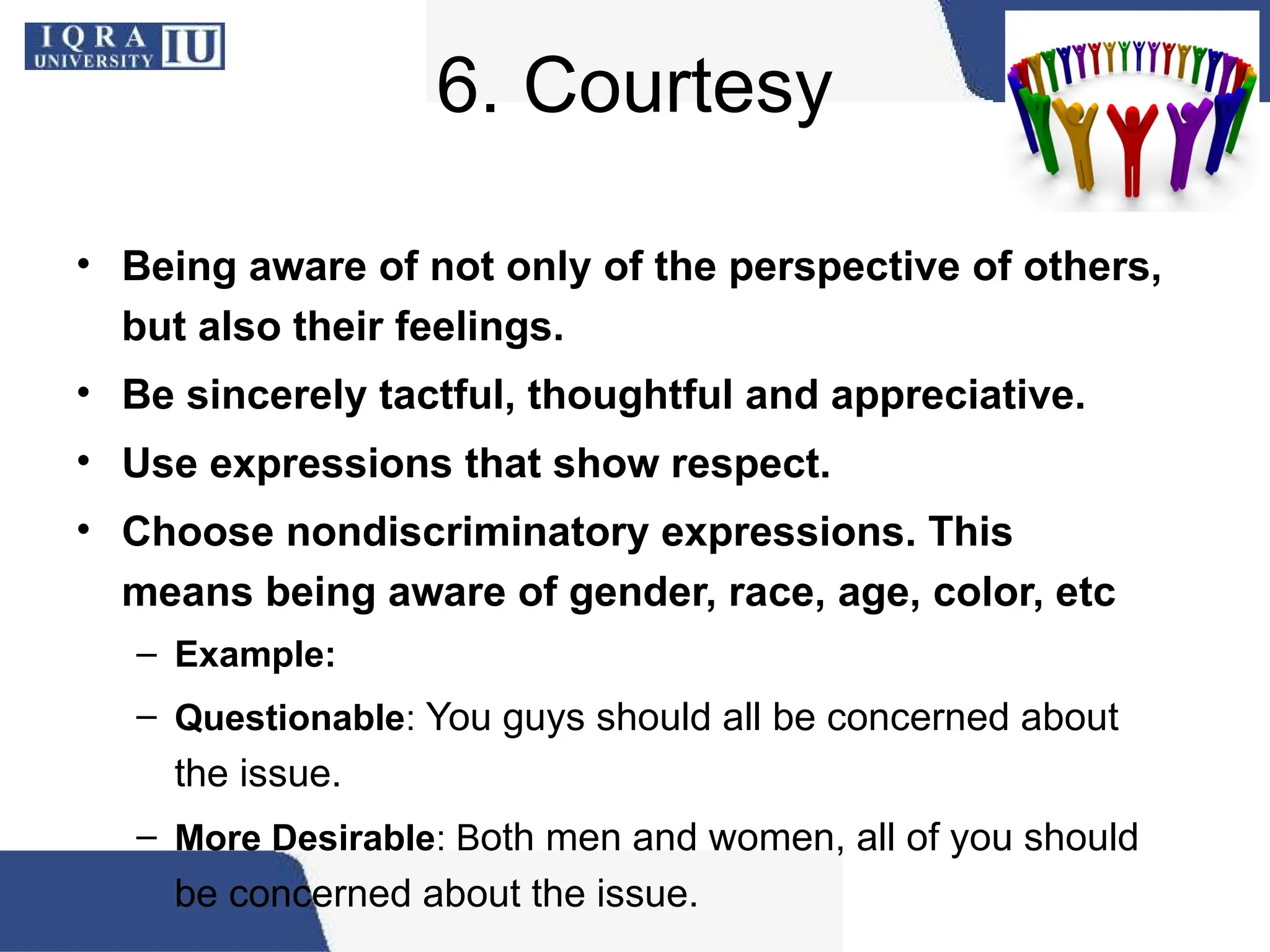
6. Courtesy
• Being aware of not only of the perspective of others,
but also their feelings.
• Be sincerely tactful, thoughtful and appreciative.
• Use expressions that show respect.
• Choose nondiscriminatory expressions. This
means being aware of gender, race, age, color, etc
– Example:
– Questionable: You guys should all be concerned about
the issue.
– More Desirable: Both men and women, all of you should
be concerned about the issue.
6. Courtesy
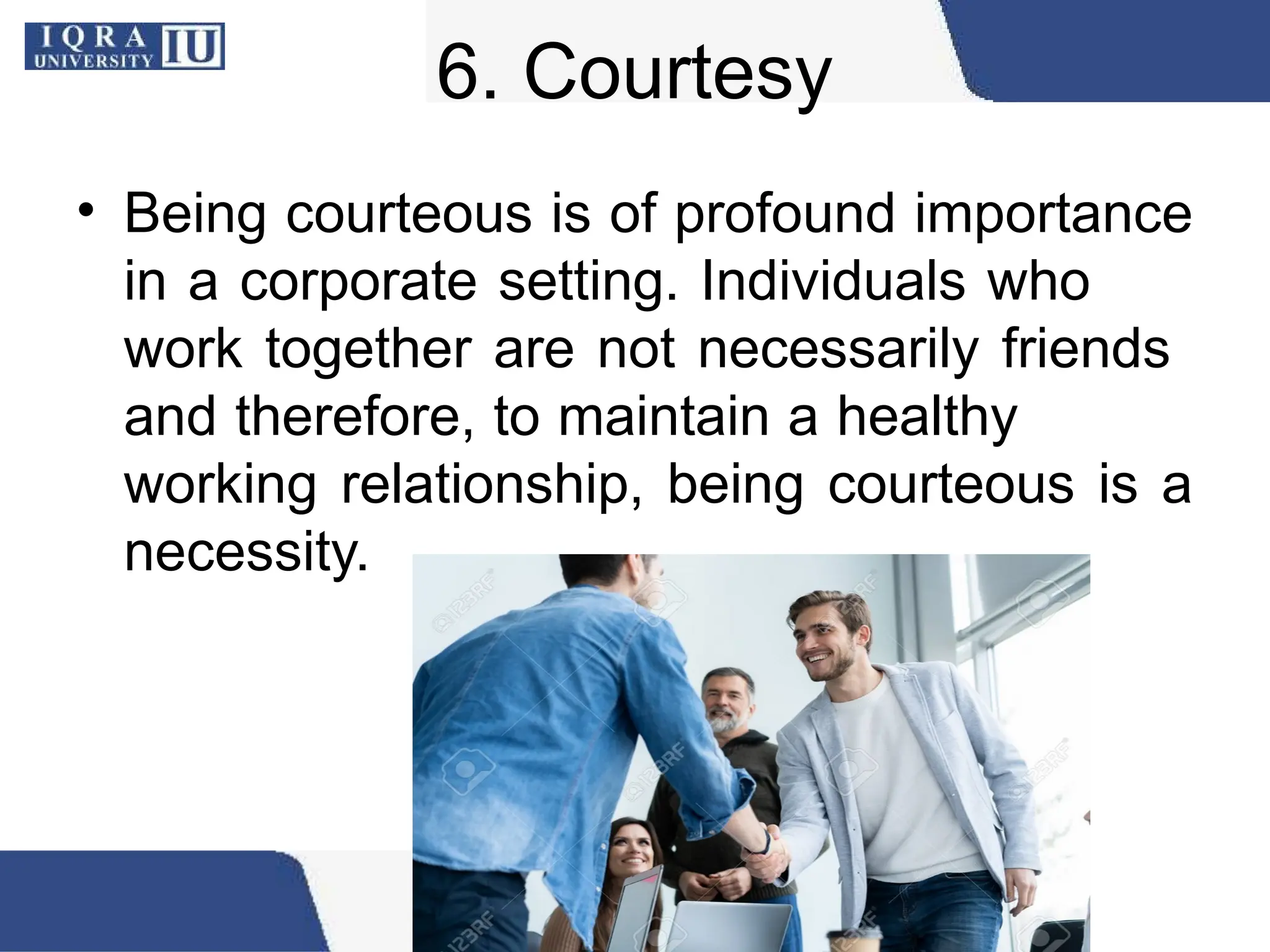
• Being courteous is of profound importance
in a corporate setting. Individuals who
work together are not necessarily friends
and therefore, to maintain a healthy
working relationship, being courteous is a
necessity.
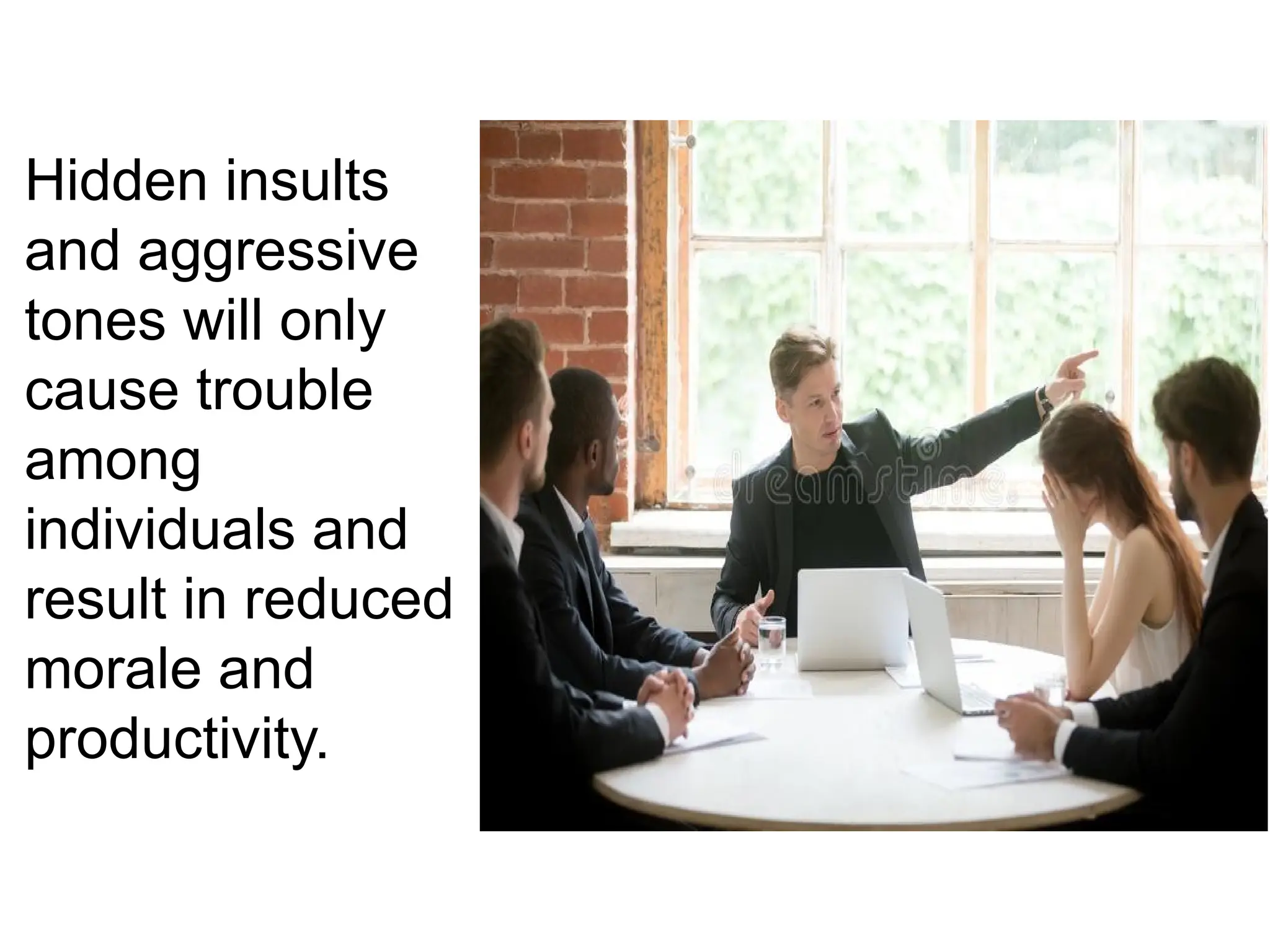
Hidden insults
and aggressive
tones will only
cause trouble
among
individuals and
result in reduced
morale and
productivity.
Dear Ali,
I wanted to let you know that I don't appreciate
how your team always monopolizes the
discussion at our weekly meetings. I have lot of
projects, and I really need time to get my
team's progress discussed as well. So far,
thanks to your department, I haven't been able to
do that. Can you make sure they make time for
me and my team next week?
Thanks,
Haris
Dear Ali,
I wanted to write you a quick note to ask a favor.
During our weekly meetings, your team does an
excellent job of highlighting their progress. But this
uses some of the time available for my team to
highlight theirs. I'd really appreciate it if
you could give my team a little extra time each
week to fully cover their progress reports.
Thanks so much, and please let me know if
there's anything I can do for you!
Best regards,
Haris
6. Courtesy
• To achieve courtesy, keep in mind the
following points:
• Be sincere.
• Use expressions that show respect.
• Be thoughtful and appreciative of the
receiver’s point of view.
• Avoid humor.
• Avoid discriminatory language i.e., race, color,
gender, etc.
7. Correctness
• Proper grammar, punctuation, and
spelling
• Use the right level of language
• Check accuracy of the figures, facts
and words
• When your communication is correct, it fits
your audience. And correct communication
is also error-free communication.
• Checked your writing for grammatical
errors? Remember, spell checkers won't
catch everything.
• Checked that all names and titles spelled
correctly.
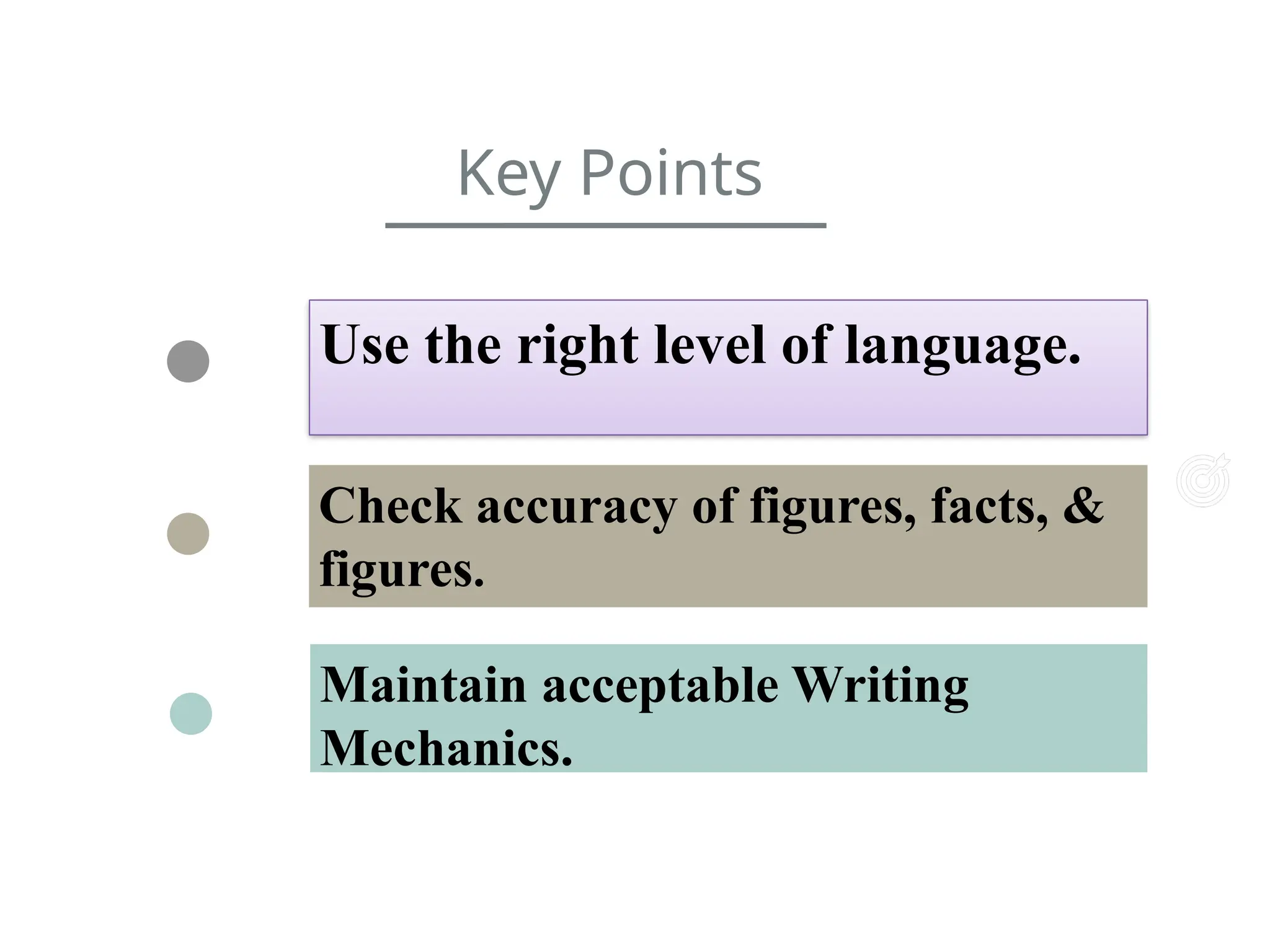
Use the right level of language.
Check accuracy of figures, facts, &
figures.
Maintain acceptable Writing
Mechanics.
Key Points
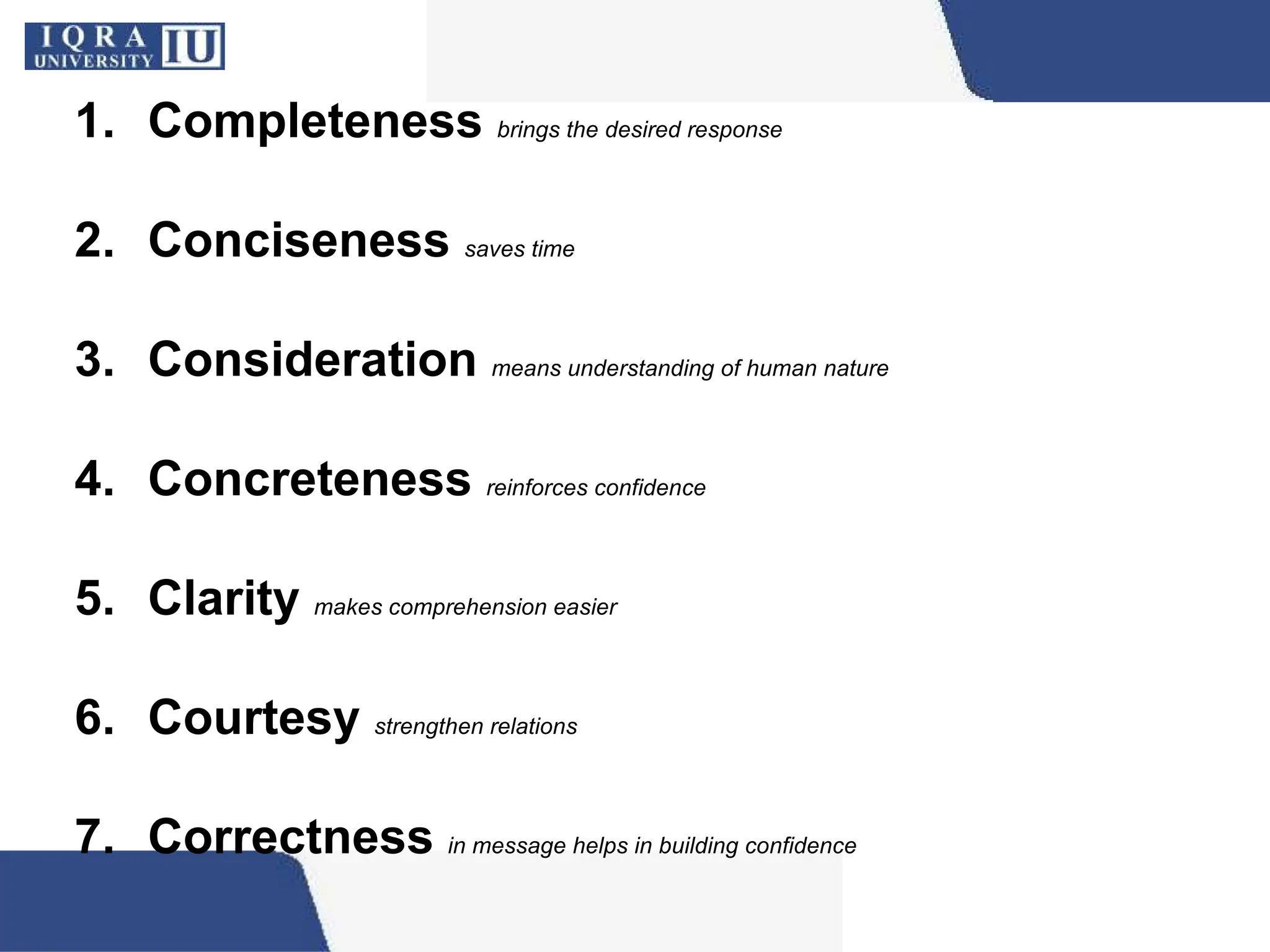
1. Completeness brings the desired response
2. Conciseness saves time
3. Consideration means understanding of human nature
4. Concreteness reinforces confidence
5. Clarity makes comprehension easier
6. Courtesy strengthen relations
7. Correctness in message helps in building confidence
Review Questions
Q) Explain the importance of completeness in verbal
and written messages.
Q) Why conciseness is important in business writing.
Elaborate your response with examples?
Q)What do you mean by you-attitude?
Q) Why it is important to have positive and
courteous tone, bias-free language, plain language,
and precise words in professional writings.
References
• Effective Business Communication
(7th
Edition), Herta A. Murphy, Herbert
W. Hildebrandt and Jane P. Thomas.
Thank you

Technical English support to Formal Letter

  • 1.
    Formal Letters, Business Memosand Emails - I Technical English Unit: 03
  • 2.
    7 C’s ofEffective Commination Unit 3.2
  • 3.
    Learning Outcomes After studyingthis chapter, you will be able to: • Identify why communication succeeds or fails. • Recognize the technique that help in communicating a message accurately. • Understand the usage of all 7C`s in verbal and written communication. • Apply all 7C`s in professional writing.
  • 5.
    1. Completeness • Ina complete message, the audience has everything they need to be informed and, if applicable, take action. • Does your message include a "call to action," so that your audience clearly knows what you want them to do? • Have you included all relevant information – contact names, dates, times, locations, and so on? • Provide all necessary information • Answer all questions asked -----Answering the 5 W’s help make messages clear: who, what, when, where and why • Give something extra, when desirable
  • 6.
    A business communication hasto be complete. Incomplete letters keep the receiver guessing, or making wrong choices, or taking wrong decisions. The letters should have the quality of completeness. A complete message will bring the expected result or desired response from the receiver.
  • 7.
    This message isnot complete, for obvious reasons. What meeting? When is it? Where? Adil has left his team without necessary information. Hi everyone, I just wanted to inform you all about the meeting we're having tomorrow! See you then, Adil
  • 8.
    Hi everyone, I justwanted to remind you about tomorrow's meeting on the new telecommunication policies. The meeting will be at 10:00 a.m. in the second-level conference room. Please let me know if you can't attend the meeting. See you then, Adil
  • 9.
    Provide All necessaryInformation. Answer All Questions asked. Give Something extra, when desirable. Key Points
  • 10.
    2. Conciseness • Itis saying what you have to say in fewest possible words. • Eliminate wordy expressions – Use single word instead of phrases – Examples: – Wordy: At this time = Now – Wordy: Due to the fact that = Because – Wordy: It was known by Mr. Smith that we must reduce inventory = Mr. Smith knew we must reduce inventory
  • 11.
    Wordy phrase • Atthe present time • By means of • For the purpose of • In a timely manner • In spite of the fact that • Over the duration of • Take into consideration Concise Phrases • Now • By • For • On time • Despite • During • consider
  • 12.
    2. Conciseness • Includeonly relevant material – Stick to the purpose of the message. – Delete irrelevant words and confusing sentences. – Omit information obvious to the receiver. – Get to the important part tactfully and concisely.
  • 13.
    2. Conciseness – Example: –Wordy: We hereby wish to let you know that our company is pleased with the confidence you have shown on us = We appreciate your confidence.
  • 14.
    2. Conciseness • Unnecessaryrepetition leads to dullness  Example: Wordy: We are happy to inform you that IDBL bank is a completely professional investment organization as you will find a competent team of qualified and trained investment advisors who are waiting to guide and fulfill your investment needs. Concise: At IDBL bank a team of qualified investment advisors is waiting to guide and fulfill your investment needs.
  • 15.
    2. Conciseness • Example: •Wordy: The hybrid car, that was parked on the street, close to the barber shop is the kind of car that I have always wanted to own. • Concise: I always wanted a hybrid car like the one parked near the barber shop.
  • 16.
    Eliminate Wordy Expressions. IncludeOnly Relevant Material. Avoid Unnecessary Repetitions. Key Points
  • 17.
    3. Consideration Preparing everymessage with the message receivers in mind; try to put your self in their place • Focus on ‘You’ instead of ‘I’ and ‘we’ – Example: – We attitude: I am delighted to announce that we will be extending our hours to make shopping more convenient. – You attitude: You will be able to shop in the evenings with the extended hours.
  • 18.
    3. Consideration • Showaudience benefit or interest in the message – Readers may react positively when benefits are shown them. • Emphasize on positive and pleasant facts Because of past connections with words, reader will react positively or negatively to certain words. Example: – Negative- unpleasant: It is impossible to open an account for you today. – Positive- pleasant: As soon as your signature card reaches us, we will gladly open an account for you.
  • 19.
    Focus on “YOU”instead of “I” & “we”. Show audience benefit or interest in the message. Emphasize Positive, Pleasant facts. Key Points
  • 20.
    4. Concreteness • Beingspecific, definite, and vivid rather than vague and general • Use specific facts & figures – It is desirable to be precise and concrete in both written and oral communication – Example: – Vague, General: Sara is a very brilliant and intelligent student. – Concrete and precise: Sara have increased her percentage from 86% in S.S.C to 90% in H.S.C.
  • 21.
    4. Concreteness • Putaction in your words – Use the active voice – When the subject acts, there is more life • Choose vivid image-building words
  • 22.
    A statement likethis probably won’t sell many of these products. There’s no passion, no vivid detail, nothing that create emotion, and nothing that tells people in the audience why they should care. This message isn’t concrete enough to make a difference. Hence this is a bad example. Consider this advertising copy: The Lunchbox Services will save your time every day.
  • 23.
    Good Example: How muchtime do you spend every day packing your kids' lunches? A lot of time! Just take a complete Lunchbox services from us. Each day give your kids a healthy lunch and because of this lunch services now you can spend more time with your kids.
  • 24.
    5. Clarity • Gettingthe meaning from your head into the head of your receiver-accurately • Choose precise, concrete and familiar words – Use more familiar words; audience will understand them better – Example: – Unfamiliar: After our perusal of pertinent data, the conclusion is that a lucrative market exists for the subject property. – Familiar: The data we studied show that your property is profitable and in high demand. • Construct effective sentences and paragraphs – Unity & Coherence: Insert no more than one main idea into a sentence.
  • 25.
    5. Clarity To achieveclarity, keep in mind the following points: • Use common and simple language. • Construct effective sentences and short paragraphs. • Use concrete words. • Avoid unnecessary information.
  • 26.
    6. Courtesy • Beingaware of not only of the perspective of others, but also their feelings. • Be sincerely tactful, thoughtful and appreciative. • Use expressions that show respect. • Choose nondiscriminatory expressions. This means being aware of gender, race, age, color, etc – Example: – Questionable: You guys should all be concerned about the issue. – More Desirable: Both men and women, all of you should be concerned about the issue.
  • 27.
    6. Courtesy • Beingcourteous is of profound importance in a corporate setting. Individuals who work together are not necessarily friends and therefore, to maintain a healthy working relationship, being courteous is a necessity.
  • 28.
    Hidden insults and aggressive toneswill only cause trouble among individuals and result in reduced morale and productivity.
  • 29.
    Dear Ali, I wantedto let you know that I don't appreciate how your team always monopolizes the discussion at our weekly meetings. I have lot of projects, and I really need time to get my team's progress discussed as well. So far, thanks to your department, I haven't been able to do that. Can you make sure they make time for me and my team next week? Thanks, Haris
  • 30.
    Dear Ali, I wantedto write you a quick note to ask a favor. During our weekly meetings, your team does an excellent job of highlighting their progress. But this uses some of the time available for my team to highlight theirs. I'd really appreciate it if you could give my team a little extra time each week to fully cover their progress reports. Thanks so much, and please let me know if there's anything I can do for you! Best regards, Haris
  • 31.
    6. Courtesy • Toachieve courtesy, keep in mind the following points: • Be sincere. • Use expressions that show respect. • Be thoughtful and appreciative of the receiver’s point of view. • Avoid humor. • Avoid discriminatory language i.e., race, color, gender, etc.
  • 32.
    7. Correctness • Propergrammar, punctuation, and spelling • Use the right level of language • Check accuracy of the figures, facts and words • When your communication is correct, it fits your audience. And correct communication is also error-free communication.
  • 33.
    • Checked yourwriting for grammatical errors? Remember, spell checkers won't catch everything. • Checked that all names and titles spelled correctly.
  • 34.
    Use the rightlevel of language. Check accuracy of figures, facts, & figures. Maintain acceptable Writing Mechanics. Key Points
  • 35.
    1. Completeness bringsthe desired response 2. Conciseness saves time 3. Consideration means understanding of human nature 4. Concreteness reinforces confidence 5. Clarity makes comprehension easier 6. Courtesy strengthen relations 7. Correctness in message helps in building confidence
  • 36.
    Review Questions Q) Explainthe importance of completeness in verbal and written messages. Q) Why conciseness is important in business writing. Elaborate your response with examples? Q)What do you mean by you-attitude? Q) Why it is important to have positive and courteous tone, bias-free language, plain language, and precise words in professional writings.
  • 37.
    References • Effective BusinessCommunication (7th Edition), Herta A. Murphy, Herbert W. Hildebrandt and Jane P. Thomas.

  • 38.

Editor's Notes

  • #5 It should contain all facts that reader or listener needs for the reaction you desire