Course 2: Programming Issues,
Section 6
Pascal Meunier, Ph.D., M.Sc., CISSP
May 2004; updated September 28, 2004
Developed thanks to the support of Symantec Corporation,
NSF SFS Capacity Building Program (Award Number 0113725) and
the Purdue e-Enterprise Center
Copyright (2004) Purdue Research Foundation. All rights reserved.
About These Slides


    Developed thanks to Symantec’s support
    Reviewed by Symantec engineers
    – Special thanks to:
          Jared Robinson
          Alan Krassowski
          Craig Ozancin
    Free to use
    – Notes, comments, suggestions, or modified slides are
      appreciated (pmeunier@purdue.edu)
    If you modify them, please keep this slide and add
    a note stating that you modified them
Course 2 Learning Plan


    Buffer Overflows
    Format String Vulnerabilities
    Code Injection and Input Validation
    Cross-site Scripting Vulnerabilities
    Links and Race Conditions
    Temporary Files and Randomness
    Canonicalization and Directory Traversal
Learning objectives


    Understand why creating files in insecure
    directories like /tmp is difficult but useful
    Learn why OS-provided function calls help
    tremendously
    Understand the need for good randomness
    Learn which OS-provided function calls help
    provide good random numbers
    Learn how to create random file names
Temporary Files and Randomness: Outline


    Temporary Files
    – Problem Statement
    – Survey of functions
           UNIX
           Windows
    Randomness
    –   Need
    –   Types of random numbers
    –   Devices
    –   Windows API
Temporary Files


    Space for temporary files is found in directories
    such as /tmp, /var/tmp or C:TEMP, where
    everyone can write
    Space may be purged regularly (e.g., "every night,
    files older than 5 days are deleted") and during
    reboot
    Space used by many UNIX or Windows utilities,
    installers and programs
    UNIX systems are often configured so that this
    space is not counted as part of user quota
    – Allow large, temporary jobs
Temporary Files Issues


    Need an unpredictable name to avoid a collision
    between links and your files or directories
    There's a race condition between testing if a file
    exists and creating it
    Need correct permissions
    There's a race condition between creating and
    setting permissions
    Need OS support!
Name Collisions Attacks


    What if the name of your temporary file (lock file or
    other) in /tmp is constant or predictable?
    – Your program using a lock file may never run or do what
      it's supposed to!
           Run the lock.c example from part A, but this time, create a
           lock file beforehand... Your program will never get past the
           lock file test (obviously)
           Lock files need to be put where other users can't create files
    – It's easy to make a symlink pointing to a sensitive file
    Symlink attacks are easier if the name of the
    temporary file is predictable
How Not to Choose a Random Name


   Use the process ID
   Use the user ID
   Use the time of day
   Use a counter
   Use a bad random number generator
   etc...
OS Support for Temporary Files


    The following take a filename “template” as input
    –   mktemp - generate temporary file name (unique)
    –   mkstemp - also create the file
    –   mkstemps - generate temporary file name with suffix
    –   mkdtemp - create a directory
    Overwrite part of a template to create a unique
    name
    Some of these functions used to create names
    using parts of the date or process ID, etc... and
    were insecure
mktemp (1) (3)

   Section (1): command line (shell scripts)
   – BSD/MacOS X:
   – creates file with mode 0600
     unique name
   Section (3): C programs
   – Race condition between getting the name and creating
     the file!
   – The program must use "open" with the O_CREAT |
     O_EXCL flags, and loop until the file is successfully
     created, or use a different function
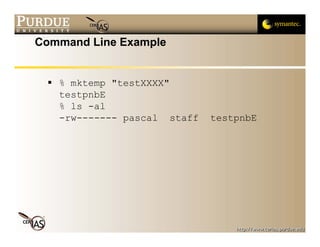
Command Line Example


   % mktemp "testXXXX"
   testpnbE
   % ls -al
   -rw------- pascal staff   testpnbE
mkstemp


   Creates name
   Creates file open for reading and writing with mode
   0600
   Returns a file descriptor
   No race condition!
   Recommended function
   Usage for extremely paranoid people:
   “Unlink” the hard link pointing to the descriptor
   immediately afterwards (this is a race condition)
   The file still exists but nobody else (except with
   difficulty, the superuser) can access it
Mini Lab


    Take the previous lock.c example
    Modify it to use mkstemp to generate a temporary
    file with a unique name
    Of course, the temporary file created that way is
    not a lock file anymore, and would be used to store
    temporary data instead
Windows


   No equivalent to mkstemp()
   GetTempFileName
   – Creates names by incrementing a counter!
   – Predictable file name
   Race condition between getting the name and
   creating the file
   – Attacker could create the file to prevent you from using it
   – If you use the CREATE_ALWAYS flag, see next slide
   Under Windows, you have no choice but to write
   your own function
   Still a race condition, limitation due to lack of OS
   support
Windows CreateFile Problems


    Recommended use with the "CREATE_ALWAYS"
    flag is dangerous
    – "CREATE_ALWAYS" flag recommended by MSDN,
      Howard and Leblanc 2003
           Overwrites the file
           Does not set the security descriptor specified by the
           SECURITY_ATTRIBUTES structure
            –   Do the SECURITY_ATTRIBUTES matter to your application?
    Perfect opportunity to trick you into overwriting a
    sensitive file
    – e.g., with a hard link
    – Can't use the flag to not follow reparse points
Windows CreateFile


    TRUNCATE_EXISTING will follow a hard link and
    could truncate something else than intended

    Use "CREATE_NEW"
    – "The function fails if the specified file already exists. "
      (MSDN)
    – You need to check for errors and loop until the file is
      successfully created
GetTempPath


   MSDN recommends that software use the
   GetTempPath function to get the location of the
   temp dir, but this is dangerous
   Checks for the existence of environment variables
   in the following order and uses the first path found:
   1. The path specified by the TMP environment variable.
   2. The path specified by the TEMP environment variable.
   3. The path specified by the USERPROFILE environment
      variable.
   4. The Windows directory."
   Are the environment variables safe to use?
   – Probably not unless you set them yourself
Exercise (Windows): Creating Temporary Files


    Go to
    http://msdn.microsoft.com/library/default.asp?url=/li
    brary/en-
    us/fileio/base/creating_and_using_a_temporary_file
    .asp
    Discuss things that you would do differently,
    compared to the example, when creating a
    temporary file in Windows
    – Find the race condition (hint: MoveFileEx)
Exercise Answers


    Possible answers:
    – They used the CREATE_ALWAYS flag instead of
      CREATE_NEW
          Add a loop until success
    – Use randomly generated file names
          How to do that on Windows? (see next slides)
The Need for Random Numbers


   Unique file or directory names
   Session IDs that carry proof of authentication
   (nonces), passwords
   Games (data, behavior, opponent generation,
   character generation)
   Encryption
   Cryptographic protocols
How Random Numbers Are Generated


   Linear Congruential Generators
    –   Simple way to generate pseudo-random numbers
    –   Easily cracked
    –   Produce finite sequences of numbers
    –   Each number is tied to the others
    –   Some sequences of numbers will not ever be generated
   Cryptographic random number generators
   Entropy sensors (i.e., extracted randomness)
Seeded Random Number Generators


   Pseudo-random generators depend solely on a
   seed, which determines the entire sequence of
   numbers returned
   How random is the seed?
    – Process ID, UserID: Bad Idea
    – Current time: if you’re running NTP (Network Time
      Protocol) all systems are synchronized up to some
      precision. If you use the time, maybe I can guess which
      seed you used (microsecond part might be difficult to
      guess, but is limited)
How to Cheat At Random Number Generation


   Find a seed that will produce the numbers you want
   Seed the generator with it
   Convince someone: "it's random, see?"
    – RPG Character generation, etc...
Roll Your Own Generator?


    What matters is not only the average and the
    variance of the numbers generated
    All sequences of numbers must be possible
    LCGs travel definite, limited “paths” through the
    universe of possible sequences
    Need to incorporate entropy as it becomes
    available
    Need to avoid betraying the internal state of the
    generator...
    It's difficult to do correctly
Which Generator to use?


    Read description, avoid Linear Congruential
    Generators such as these:
    –   “C” rand(3)
    –   rand (Windows)
    –   Perl rand
    –   C# Random
    –   PHP rand
Good Generators


   Hardware-based
    – Noise
   Cryptographical quality software, entropy-seeded
    – Fast, secure
   Pure Entropy
    – Random timing of events
          Packets
          Mouse movement, clicks
          Keyboard
    – Slow
Linux/UNIX Devices


    /dev/random:
    – MacOS X: same as urandom
    – Linux: this is a blocking call that returns only when
      sufficient entropy has been captured
    – Good for seeding pseudo-random number generators
    /dev/urandom:
    – Implements a fairly complex algorithm that varies
      between “random” and a well-seeded LCG depending on
      the availability of entropy
    – Non-blocking call
    – Try "cat /dev/urandom"
Portability


    FreeBSD, OpenBSD, NetBSD compatible
    Several projects ported the functionality to Solaris,
    HP-UX, AIX, IRIX
    MacOS X implements Yarrow for both random and
    urandom (so the behavior of “random” is
    unexpected).
Windows


   Windows developers must use the function
   CryptGenRandom(), which uses the same idea as
   /dev/urandom
   There is no directly accessible entropy collector
   provided by the OS
   – Reference: "Secure Programming Cookbook", section
     11.4 (Viega et al.)
Mini-lab


    Take the previous mini-lab (lock.c)
    Modify it to use random numbers from
    /dev/urandom instead of mkstemp, to generate a
    temporary file with a unique name
    – To obtain random bytes, open the device and read from it
Questions or Comments?


  §
About These Slides


    You are free to copy, distribute, display, and perform the work; and
    to make derivative works, under the following conditions.
    –   You must give the original author and other contributors credit
    –   The work will be used for personal or non-commercial educational uses
        only, and not for commercial activities and purposes
    –   For any reuse or distribution, you must make clear to others the terms of
        use for this work
    –   Derivative works must retain and be subject to the same conditions, and
        contain a note identifying the new contributor(s) and date of modification
    –   For other uses please contact the Purdue Office of Technology
        Commercialization.
    Developed thanks to the support of Symantec
    Corporation
Pascal Meunier
pmeunier@purdue.edu
Contributors:
Jared Robinson, Alan Krassowski, Craig Ozancin, Tim
Brown, Wes Higaki, Melissa Dark, Chris Clifton, Gustavo
Rodriguez-Rivera

6.Temp & Rand

  • 1.
    Course 2: ProgrammingIssues, Section 6 Pascal Meunier, Ph.D., M.Sc., CISSP May 2004; updated September 28, 2004 Developed thanks to the support of Symantec Corporation, NSF SFS Capacity Building Program (Award Number 0113725) and the Purdue e-Enterprise Center Copyright (2004) Purdue Research Foundation. All rights reserved.
  • 2.
    About These Slides Developed thanks to Symantec’s support Reviewed by Symantec engineers – Special thanks to: Jared Robinson Alan Krassowski Craig Ozancin Free to use – Notes, comments, suggestions, or modified slides are appreciated (pmeunier@purdue.edu) If you modify them, please keep this slide and add a note stating that you modified them
  • 3.
    Course 2 LearningPlan Buffer Overflows Format String Vulnerabilities Code Injection and Input Validation Cross-site Scripting Vulnerabilities Links and Race Conditions Temporary Files and Randomness Canonicalization and Directory Traversal
  • 4.
    Learning objectives Understand why creating files in insecure directories like /tmp is difficult but useful Learn why OS-provided function calls help tremendously Understand the need for good randomness Learn which OS-provided function calls help provide good random numbers Learn how to create random file names
  • 5.
    Temporary Files andRandomness: Outline Temporary Files – Problem Statement – Survey of functions UNIX Windows Randomness – Need – Types of random numbers – Devices – Windows API
  • 6.
    Temporary Files Space for temporary files is found in directories such as /tmp, /var/tmp or C:TEMP, where everyone can write Space may be purged regularly (e.g., "every night, files older than 5 days are deleted") and during reboot Space used by many UNIX or Windows utilities, installers and programs UNIX systems are often configured so that this space is not counted as part of user quota – Allow large, temporary jobs
  • 7.
    Temporary Files Issues Need an unpredictable name to avoid a collision between links and your files or directories There's a race condition between testing if a file exists and creating it Need correct permissions There's a race condition between creating and setting permissions Need OS support!
  • 8.
    Name Collisions Attacks What if the name of your temporary file (lock file or other) in /tmp is constant or predictable? – Your program using a lock file may never run or do what it's supposed to! Run the lock.c example from part A, but this time, create a lock file beforehand... Your program will never get past the lock file test (obviously) Lock files need to be put where other users can't create files – It's easy to make a symlink pointing to a sensitive file Symlink attacks are easier if the name of the temporary file is predictable
  • 9.
    How Not toChoose a Random Name Use the process ID Use the user ID Use the time of day Use a counter Use a bad random number generator etc...
  • 10.
    OS Support forTemporary Files The following take a filename “template” as input – mktemp - generate temporary file name (unique) – mkstemp - also create the file – mkstemps - generate temporary file name with suffix – mkdtemp - create a directory Overwrite part of a template to create a unique name Some of these functions used to create names using parts of the date or process ID, etc... and were insecure
  • 11.
    mktemp (1) (3) Section (1): command line (shell scripts) – BSD/MacOS X: – creates file with mode 0600 unique name Section (3): C programs – Race condition between getting the name and creating the file! – The program must use "open" with the O_CREAT | O_EXCL flags, and loop until the file is successfully created, or use a different function
  • 12.
    Command Line Example % mktemp "testXXXX" testpnbE % ls -al -rw------- pascal staff testpnbE
  • 13.
    mkstemp Creates name Creates file open for reading and writing with mode 0600 Returns a file descriptor No race condition! Recommended function Usage for extremely paranoid people: “Unlink” the hard link pointing to the descriptor immediately afterwards (this is a race condition) The file still exists but nobody else (except with difficulty, the superuser) can access it
  • 14.
    Mini Lab Take the previous lock.c example Modify it to use mkstemp to generate a temporary file with a unique name Of course, the temporary file created that way is not a lock file anymore, and would be used to store temporary data instead
  • 15.
    Windows No equivalent to mkstemp() GetTempFileName – Creates names by incrementing a counter! – Predictable file name Race condition between getting the name and creating the file – Attacker could create the file to prevent you from using it – If you use the CREATE_ALWAYS flag, see next slide Under Windows, you have no choice but to write your own function Still a race condition, limitation due to lack of OS support
  • 16.
    Windows CreateFile Problems Recommended use with the "CREATE_ALWAYS" flag is dangerous – "CREATE_ALWAYS" flag recommended by MSDN, Howard and Leblanc 2003 Overwrites the file Does not set the security descriptor specified by the SECURITY_ATTRIBUTES structure – Do the SECURITY_ATTRIBUTES matter to your application? Perfect opportunity to trick you into overwriting a sensitive file – e.g., with a hard link – Can't use the flag to not follow reparse points
  • 17.
    Windows CreateFile TRUNCATE_EXISTING will follow a hard link and could truncate something else than intended Use "CREATE_NEW" – "The function fails if the specified file already exists. " (MSDN) – You need to check for errors and loop until the file is successfully created
  • 18.
    GetTempPath MSDN recommends that software use the GetTempPath function to get the location of the temp dir, but this is dangerous Checks for the existence of environment variables in the following order and uses the first path found: 1. The path specified by the TMP environment variable. 2. The path specified by the TEMP environment variable. 3. The path specified by the USERPROFILE environment variable. 4. The Windows directory." Are the environment variables safe to use? – Probably not unless you set them yourself
  • 19.
    Exercise (Windows): CreatingTemporary Files Go to http://msdn.microsoft.com/library/default.asp?url=/li brary/en- us/fileio/base/creating_and_using_a_temporary_file .asp Discuss things that you would do differently, compared to the example, when creating a temporary file in Windows – Find the race condition (hint: MoveFileEx)
  • 20.
    Exercise Answers Possible answers: – They used the CREATE_ALWAYS flag instead of CREATE_NEW Add a loop until success – Use randomly generated file names How to do that on Windows? (see next slides)
  • 21.
    The Need forRandom Numbers Unique file or directory names Session IDs that carry proof of authentication (nonces), passwords Games (data, behavior, opponent generation, character generation) Encryption Cryptographic protocols
  • 22.
    How Random NumbersAre Generated Linear Congruential Generators – Simple way to generate pseudo-random numbers – Easily cracked – Produce finite sequences of numbers – Each number is tied to the others – Some sequences of numbers will not ever be generated Cryptographic random number generators Entropy sensors (i.e., extracted randomness)
  • 23.
    Seeded Random NumberGenerators Pseudo-random generators depend solely on a seed, which determines the entire sequence of numbers returned How random is the seed? – Process ID, UserID: Bad Idea – Current time: if you’re running NTP (Network Time Protocol) all systems are synchronized up to some precision. If you use the time, maybe I can guess which seed you used (microsecond part might be difficult to guess, but is limited)
  • 24.
    How to CheatAt Random Number Generation Find a seed that will produce the numbers you want Seed the generator with it Convince someone: "it's random, see?" – RPG Character generation, etc...
  • 25.
    Roll Your OwnGenerator? What matters is not only the average and the variance of the numbers generated All sequences of numbers must be possible LCGs travel definite, limited “paths” through the universe of possible sequences Need to incorporate entropy as it becomes available Need to avoid betraying the internal state of the generator... It's difficult to do correctly
  • 26.
    Which Generator touse? Read description, avoid Linear Congruential Generators such as these: – “C” rand(3) – rand (Windows) – Perl rand – C# Random – PHP rand
  • 27.
    Good Generators Hardware-based – Noise Cryptographical quality software, entropy-seeded – Fast, secure Pure Entropy – Random timing of events Packets Mouse movement, clicks Keyboard – Slow
  • 28.
    Linux/UNIX Devices /dev/random: – MacOS X: same as urandom – Linux: this is a blocking call that returns only when sufficient entropy has been captured – Good for seeding pseudo-random number generators /dev/urandom: – Implements a fairly complex algorithm that varies between “random” and a well-seeded LCG depending on the availability of entropy – Non-blocking call – Try "cat /dev/urandom"
  • 29.
    Portability FreeBSD, OpenBSD, NetBSD compatible Several projects ported the functionality to Solaris, HP-UX, AIX, IRIX MacOS X implements Yarrow for both random and urandom (so the behavior of “random” is unexpected).
  • 30.
    Windows Windows developers must use the function CryptGenRandom(), which uses the same idea as /dev/urandom There is no directly accessible entropy collector provided by the OS – Reference: "Secure Programming Cookbook", section 11.4 (Viega et al.)
  • 31.
    Mini-lab Take the previous mini-lab (lock.c) Modify it to use random numbers from /dev/urandom instead of mkstemp, to generate a temporary file with a unique name – To obtain random bytes, open the device and read from it
  • 32.
  • 33.
    About These Slides You are free to copy, distribute, display, and perform the work; and to make derivative works, under the following conditions. – You must give the original author and other contributors credit – The work will be used for personal or non-commercial educational uses only, and not for commercial activities and purposes – For any reuse or distribution, you must make clear to others the terms of use for this work – Derivative works must retain and be subject to the same conditions, and contain a note identifying the new contributor(s) and date of modification – For other uses please contact the Purdue Office of Technology Commercialization. Developed thanks to the support of Symantec Corporation
  • 34.
    Pascal Meunier pmeunier@purdue.edu Contributors: Jared Robinson,Alan Krassowski, Craig Ozancin, Tim Brown, Wes Higaki, Melissa Dark, Chris Clifton, Gustavo Rodriguez-Rivera